WO2013173004A2 - Radiopharmaceutical synthesis methods - Google Patents
Radiopharmaceutical synthesis methods Download PDFInfo
- Publication number
- WO2013173004A2 WO2013173004A2 PCT/US2013/036027 US2013036027W WO2013173004A2 WO 2013173004 A2 WO2013173004 A2 WO 2013173004A2 US 2013036027 W US2013036027 W US 2013036027W WO 2013173004 A2 WO2013173004 A2 WO 2013173004A2
- Authority
- WO
- WIPO (PCT)
- Prior art keywords
- filter
- radiopharmaceutical
- composition
- filters
- foregoing
- Prior art date
- Legal status (The legal status is an assumption and is not a legal conclusion. Google has not performed a legal analysis and makes no representation as to the accuracy of the status listed.)
- Ceased
Links
Classifications
-
- A—HUMAN NECESSITIES
- A61—MEDICAL OR VETERINARY SCIENCE; HYGIENE
- A61K—PREPARATIONS FOR MEDICAL, DENTAL OR TOILETRY PURPOSES
- A61K51/00—Preparations containing radioactive substances for use in therapy or testing in vivo
- A61K51/02—Preparations containing radioactive substances for use in therapy or testing in vivo characterised by the carrier, i.e. characterised by the agent or material covalently linked or complexing the radioactive nucleus
- A61K51/04—Organic compounds
-
- A—HUMAN NECESSITIES
- A61—MEDICAL OR VETERINARY SCIENCE; HYGIENE
- A61K—PREPARATIONS FOR MEDICAL, DENTAL OR TOILETRY PURPOSES
- A61K51/00—Preparations containing radioactive substances for use in therapy or testing in vivo
- A61K51/12—Preparations containing radioactive substances for use in therapy or testing in vivo characterised by a special physical form, e.g. emulsion, microcapsules, liposomes, characterized by a special physical form, e.g. emulsions, dispersions, microcapsules
- A61K51/121—Solutions, i.e. homogeneous liquid formulation
-
- A—HUMAN NECESSITIES
- A61—MEDICAL OR VETERINARY SCIENCE; HYGIENE
- A61K—PREPARATIONS FOR MEDICAL, DENTAL OR TOILETRY PURPOSES
- A61K51/00—Preparations containing radioactive substances for use in therapy or testing in vivo
- A61K51/02—Preparations containing radioactive substances for use in therapy or testing in vivo characterised by the carrier, i.e. characterised by the agent or material covalently linked or complexing the radioactive nucleus
- A61K51/04—Organic compounds
- A61K51/0402—Organic compounds carboxylic acid carriers, fatty acids
-
- A—HUMAN NECESSITIES
- A61—MEDICAL OR VETERINARY SCIENCE; HYGIENE
- A61K—PREPARATIONS FOR MEDICAL, DENTAL OR TOILETRY PURPOSES
- A61K51/00—Preparations containing radioactive substances for use in therapy or testing in vivo
- A61K51/02—Preparations containing radioactive substances for use in therapy or testing in vivo characterised by the carrier, i.e. characterised by the agent or material covalently linked or complexing the radioactive nucleus
- A61K51/04—Organic compounds
- A61K51/0404—Lipids, e.g. triglycerides; Polycationic carriers
- A61K51/0406—Amines, polyamines, e.g. spermine, spermidine, amino acids, (bis)guanidines
-
- A—HUMAN NECESSITIES
- A61—MEDICAL OR VETERINARY SCIENCE; HYGIENE
- A61K—PREPARATIONS FOR MEDICAL, DENTAL OR TOILETRY PURPOSES
- A61K51/00—Preparations containing radioactive substances for use in therapy or testing in vivo
- A61K51/02—Preparations containing radioactive substances for use in therapy or testing in vivo characterised by the carrier, i.e. characterised by the agent or material covalently linked or complexing the radioactive nucleus
- A61K51/04—Organic compounds
- A61K51/041—Heterocyclic compounds
- A61K51/044—Heterocyclic compounds having nitrogen as a ring hetero atom, e.g. guanethidine, rifamycins
- A61K51/0453—Heterocyclic compounds having nitrogen as a ring hetero atom, e.g. guanethidine, rifamycins having five-membered rings with two or more ring hetero atoms, at least one of which being nitrogen, e.g. tetrazole
-
- A—HUMAN NECESSITIES
- A61—MEDICAL OR VETERINARY SCIENCE; HYGIENE
- A61K—PREPARATIONS FOR MEDICAL, DENTAL OR TOILETRY PURPOSES
- A61K51/00—Preparations containing radioactive substances for use in therapy or testing in vivo
- A61K51/02—Preparations containing radioactive substances for use in therapy or testing in vivo characterised by the carrier, i.e. characterised by the agent or material covalently linked or complexing the radioactive nucleus
- A61K51/04—Organic compounds
- A61K51/041—Heterocyclic compounds
- A61K51/044—Heterocyclic compounds having nitrogen as a ring hetero atom, e.g. guanethidine, rifamycins
- A61K51/0455—Heterocyclic compounds having nitrogen as a ring hetero atom, e.g. guanethidine, rifamycins having six-membered rings with one nitrogen as the only ring hetero atom
-
- A—HUMAN NECESSITIES
- A61—MEDICAL OR VETERINARY SCIENCE; HYGIENE
- A61K—PREPARATIONS FOR MEDICAL, DENTAL OR TOILETRY PURPOSES
- A61K51/00—Preparations containing radioactive substances for use in therapy or testing in vivo
- A61K51/02—Preparations containing radioactive substances for use in therapy or testing in vivo characterised by the carrier, i.e. characterised by the agent or material covalently linked or complexing the radioactive nucleus
- A61K51/04—Organic compounds
- A61K51/041—Heterocyclic compounds
- A61K51/044—Heterocyclic compounds having nitrogen as a ring hetero atom, e.g. guanethidine, rifamycins
- A61K51/0459—Heterocyclic compounds having nitrogen as a ring hetero atom, e.g. guanethidine, rifamycins having six-membered rings with two nitrogen atoms as the only ring hetero atoms, e.g. piperazine
-
- A—HUMAN NECESSITIES
- A61—MEDICAL OR VETERINARY SCIENCE; HYGIENE
- A61K—PREPARATIONS FOR MEDICAL, DENTAL OR TOILETRY PURPOSES
- A61K51/00—Preparations containing radioactive substances for use in therapy or testing in vivo
- A61K51/02—Preparations containing radioactive substances for use in therapy or testing in vivo characterised by the carrier, i.e. characterised by the agent or material covalently linked or complexing the radioactive nucleus
- A61K51/04—Organic compounds
- A61K51/0491—Sugars, nucleosides, nucleotides, oligonucleotides, nucleic acids, e.g. DNA, RNA, nucleic acid aptamers
-
- C—CHEMISTRY; METALLURGY
- C07—ORGANIC CHEMISTRY
- C07B—GENERAL METHODS OF ORGANIC CHEMISTRY; APPARATUS THEREFOR
- C07B59/00—Introduction of isotopes of elements into organic compounds ; Labelled organic compounds per se
Definitions
- the invention is based on the unexpected finding that increased yields of certain radiopharmaceuticals can be achieved when particular filters are used to sterilize solutions comprising the radiopharmaceuticals.
- the filters are typically used in a final sterilization step following synthesis however it is to be understood that the invention is not so limited and the filters may be used in any step during or post-synthesis.
- the increased yield achieved with particular filters in accordance with the invention, relates to the differential retention properties of the various filters analyzed. It was not recognized nor was it expected prior to the invention that particular filters would demonstrate the varied retention profiles observed and documented herein. Moreover, it could not have been predicted which of the tested filters would be the best performing based on the various known properties of the various filters (e.g., hydrophobicity, etc.).
- a filter comprised of regenerated cellulose such as the Sartorius RC filter
- a filter comprised of polytetrafluoroethylene such as the Millipore PTFE filter
- two such disparate filter types would nevertheless perform relatively equivalently and better than other filters that are more similar to one or the other of the RC or PTFE filters.
- PVDF polyvinylidenedifluoride
- a polyvinylidenedifluoride (PVDF) filter which is structurally more similar to PTFE than is RC nevertheless performed less well than did the RC filter in terms of reduced retention of the radiopharmaceutical.
- the matrix within which the radiopharmaceutical was provided was not changed, and it was able to tolerate different filters without compromise of radiopharmaceutical yi eld.
- FIG. 1 is a graph showing liquid transfer efficiency through selected filters.
- FIG. 2 is a bar graph showing dependence of individual analyte retention on overall filtration rate.
- FIG. 3 is a bar graph showing dependence of individual analyte retention on overall solution concentration.
- FIG. 4 is a bar graph showing dependence of individual analyte retention on filter membrane composition.
- FIG. 5 is a bar graph showing dependence of individual analyte retention on filter membrane and housing composition.
- FIG. 6 is a graph showing the results of a flushing study.
- FIG. 7 is a bar graph showing dependence of individual analyte retention on filter size and membrane composition.
- FIG. 8 is a bar graph showing a comparison of select filters.
- FIG. 9 is a bar graph showing dependence of flurpiridaz F 18 retention on selected filters and synthesis modules.
- the method of the invention may be used to sterilize a radiopharmaceutical, such as an 18 F-bearing radiopharmaceutical (i.e., a composition intended for in vivo use, typically as an imaging agent, that comprises 18 F). It is to be understood that the method may also be used to sterilize other radiopharmaceuticals. The method of the invention may also be used to simply physically separate a radiopharmaceutical from other agents including degradation products, contaminants, and the like, regardless of whether the ultimate filtered solution is considered sterile.
- a radiopharmaceutical such as an 18 F-bearing radiopharmaceutical (i.e., a composition intended for in vivo use, typically as an imaging agent, that comprises 18 F). It is to be understood that the method may also be used to sterilize other radiopharmaceuticals. The method of the invention may also be used to simply physically separate a radiopharmaceutical from other agents including degradation products, contaminants, and the like, regardless of whether the ultimate filtered solution is considered sterile.
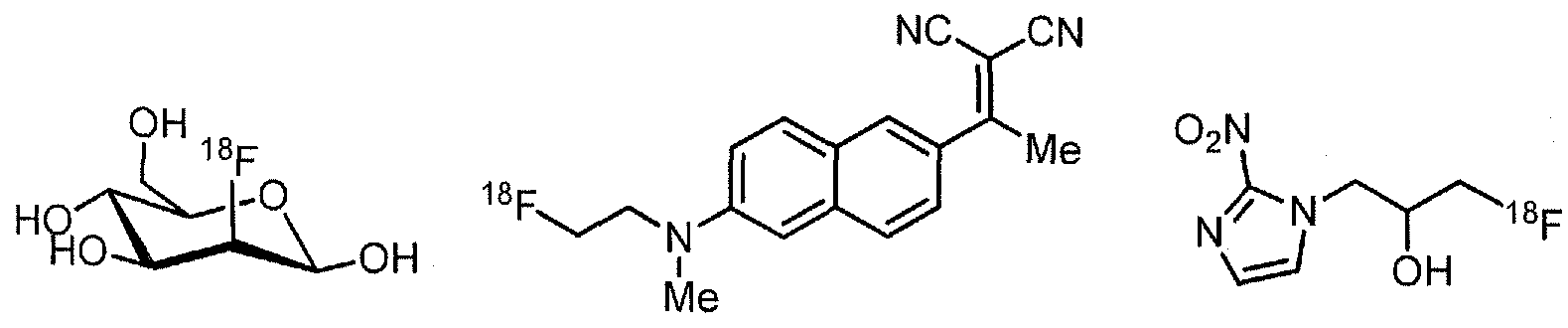
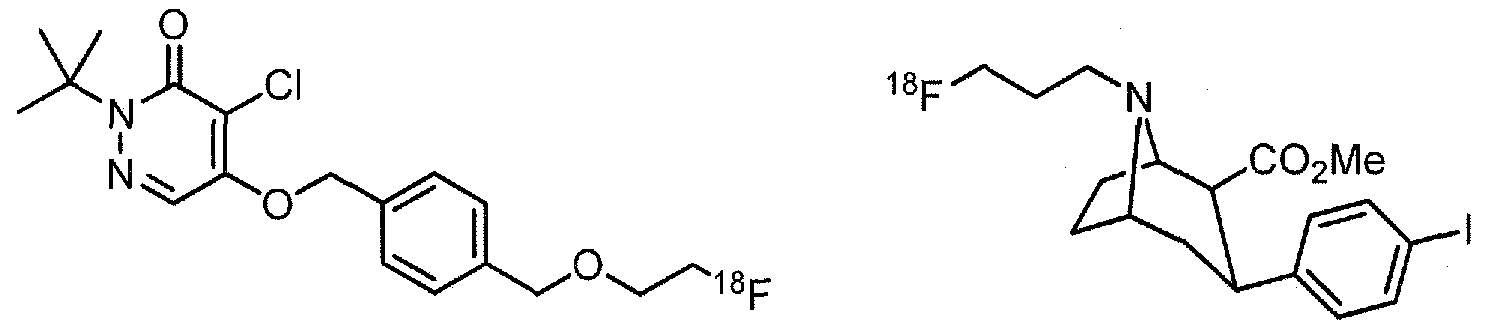
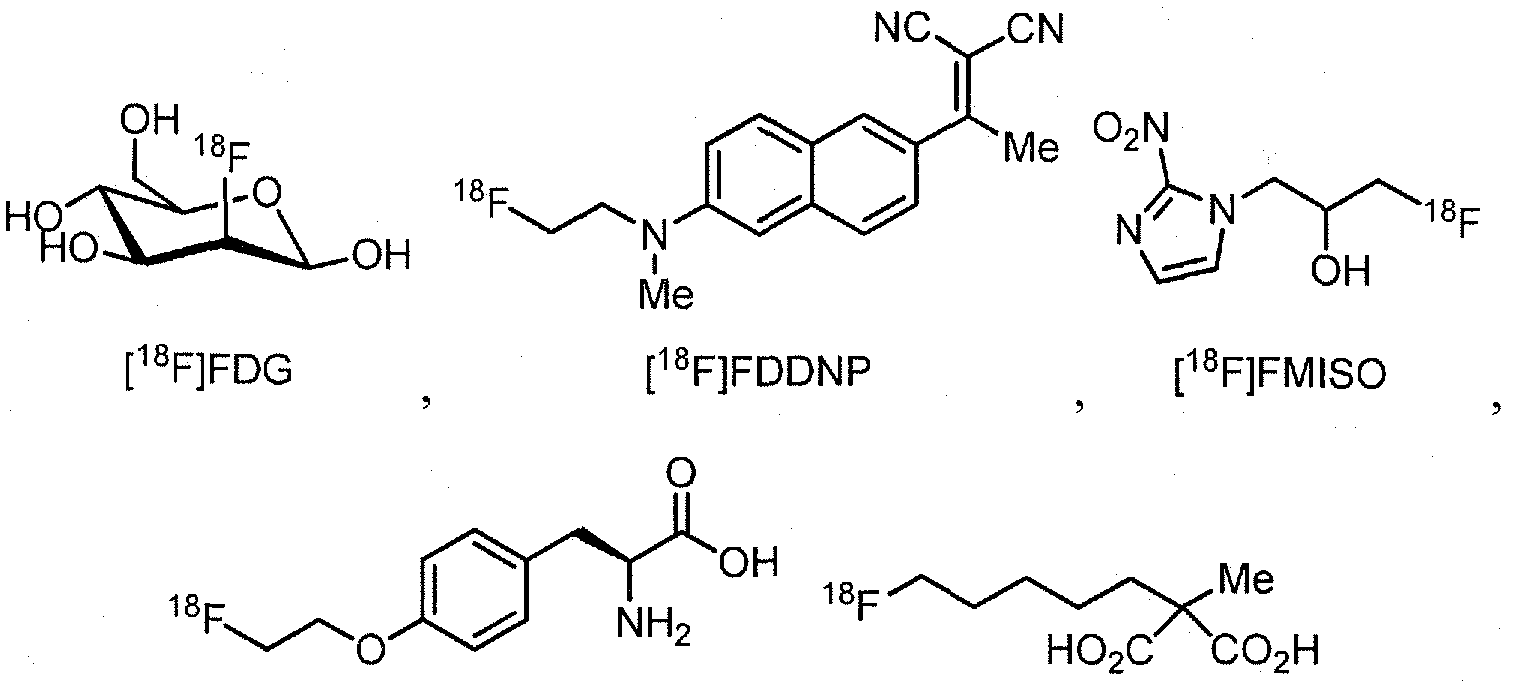
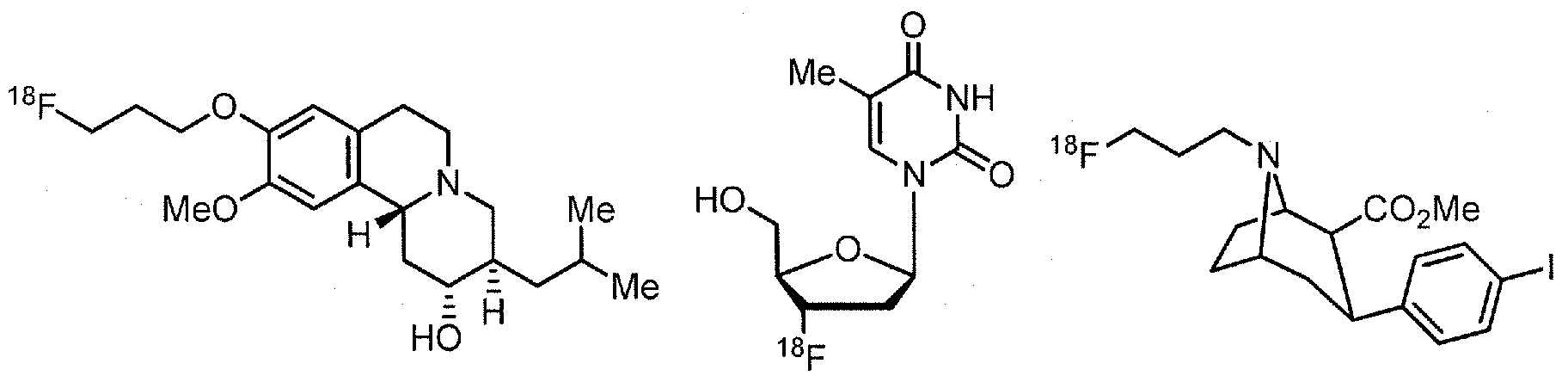
- Examples of 18 F-bearing radiopharmaceuticals include but are not limited to
- florbetapir examples include florbetapir, and florbetaben (disclosed in US 7687052 and5, respectively and shown below)
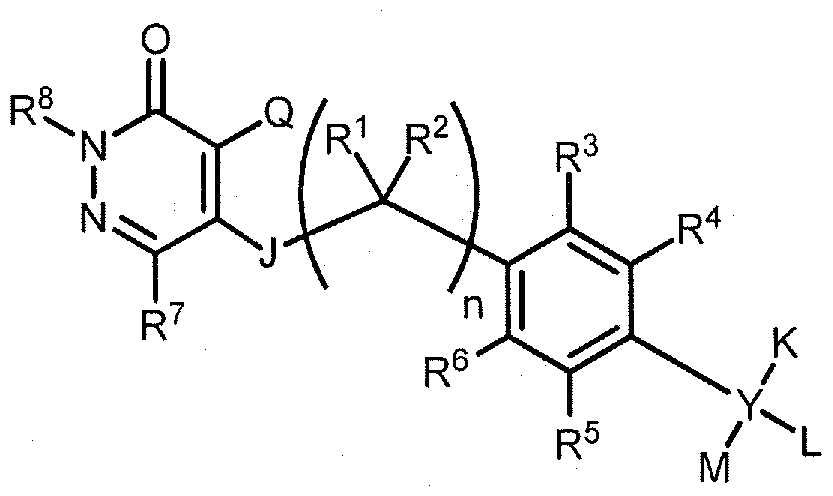
- the radiopharmaceutical has a structure as in formula
- L is selected from hydrogen, alkoxyalkyl, alkyloxy, aryl, C ⁇ -C 6 alkyl, heteroaryl, and an imaging moiety;
- M is selected from hydrogen, alkoxyalkyl, alkyloxy, aryl, Ci-C 6 alkyl, heteroaryl, and an imaging moiety; or
- Q is halo or haloalkyl
- n 0, 1, 2, or 3;
- R 1 , R 2 , R 7 , and R 9 are independently selected from hydrogen, C t -C alkyl, and an imaging moiety;
- R 3 , R 4 , R 5 , and R 6 are independently selected from hydrogen, halogen, hydroxyl, alkoxyalkyl, alkyloxy, Cj-C 6 alkyl, and an imaging moiety;
- R 8 is d-C 5 alkyl
- Y is selected from a bond, carbon, and oxygen; provided that when Y is a bond, K and L are absent and M is selected from aryl and heteroaryl; and provided that when Y is oxygen, K and L are absent and M is selected from hydrogen, alkoxyalkyl, aryl, Q-C6 alkyl, and heteroaryl; wherein each occurrence of alkoxyalkyl, alkyloxy, aryl, Ci-C 6 alkyl, and heteroaryl is optionally substituted with an imaging moiety, provided that at least one imaging moiety is present in formula (I).
- J is O; and R 8 is tert-butyl.
- Q is halo.
- Q is chloro.
- M is alkyloxy substituted with an imaging moiety.
- the imaging moiety is a radioisotope for use in nuclear medicine imaging, a paramagnetic species for use in MRI imaging, an echogenic entity for use in ultrasound imaging, a fluorescent entity for use in fluorescence imaging, or a light-active entity for use in optical imaging.
- the paramagnetic species for use in MRI imaging is Gd 3+ , Fe 3 ' , In 3+ , or Mn 2+ .
- the echogenic entity for use in ultrasound imaging is a surfactant encapsulated fluorocarbon microsphere.
- the radioisotope for use in nuclear medicine imaging is ll C, 13 N, ,8 F, 123 1, 125 I, 99m Tc, 95 Tc, 1 1 'in, 62 Cu, 64 Cu, 67 Ga, or 68 Ga.
- the imaging moiety is 18 F.
- radiopharmaceuticals include imaging agents.
- imaging agents include imaging agents.
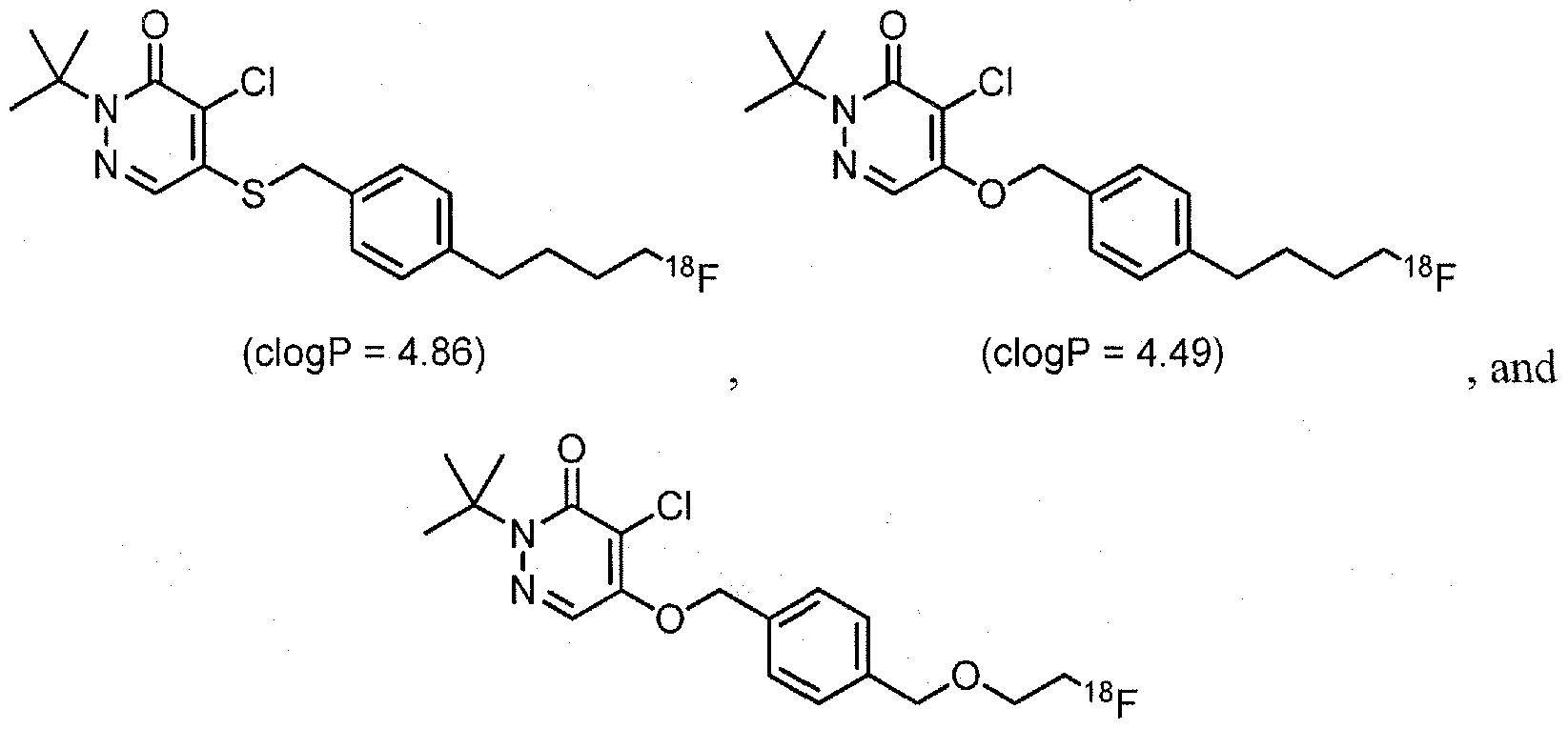
- a composition comprising ascorbic acid and an imaging agent, wherein the imaging agent comprises pyridaben or a pyridaben analog attached to an imaging moiety, including a radioisotope for use in nuclear medicine imaging such as 18 F.
- the filtering step may be performed as follows:
- a composition comprising the radiopharmaceutical is sterile filtered (e.g., using a Sartorius RC or Millipore PTFE sterilizing filter) into a sterile empty vial.
- the filter diameter is typically selected based on the manufacturer's standard for the actual volume of the composition to be filtered. Typically, a composition volume of 5 mL, up to 10 mL, up to 20 mL, up to 30 mL, up to 40 mL, up to 50 mL or greater may be filtered. In one embodiment, a filter with a diameter of 4 mm may be used to filter 5 mL of a composition comprising a
- a filter with a diameter of 13 mm may be used to filter about 5 mL, or about 10 mL of the composition.
- a filter with a diameter of 15 mm may be used to filter about 5 mL, or about 10 mL, or about 20 mL of a composition comprising the radiopharmaceutical.
- a filter with a diameter of 25 mm may be used to filter about 5 mL, or about 10 mL, or about 20 mL, or about 30 mL, or about 40 mL, or about 50 mL, or about 100 mL of the composition.
- the Sartorius RC filter is commercially available in 4, 15, and 25 mm diameters.
- the Millipore PTFE filter is commercially available in 13 and 25 mm diameters.
- the sterile empty vial used to receive the filtered composition may be a commercially available, pre-sterilized unit. Those of ordinary skill in the art would be able to select suitable sterile vials for filtration step.
- a final product vial assembly may be constructed from the following pre- sterilized components: one 30 mL sterile empty vial, one Millipore Millex GV4 venting filter (0.22 ⁇ x 4 mm), one tuberculin syringe (1 mL) and one insulin syringe (0.5 mL).
- the imaging agent is then transferred from the formulation module of an automated
- radiopharmaceutical synthesis system such as a GE TracerLab MX or Siemens Explora GN/LC module
- a Sartorius RC sterilizing filter 0.2 ⁇ x 15 mm
- a Millipore PTFE sterilizing filter 0.2 ⁇ x 13 mm
- compositions comprising BMS-747158-01 and BMS-747159-01 were prepared in water comprising absolute ethanol (4 wt. %) and sodium ascorbate (50 mg/mL; 5 wt. %) then loaded into plastic syringes (Norm-JectTM; 12 mL) and placed onto an automated syringe pump. Select filters were then placed on each respective syringe and the composition pumped through the units in a controlled fashion. In all cases, gravimetric analysis of the solution transfer process was performed in order to monitor efficiency of the liquid handling steps.
- PS polysulfone
- FIG. 1 demonstrates the liquid transfer efficiency of the process. Specifically, when the same diameter filter is utilized, the relationship between the volume and volume collected remains relatively consistent. When larger filters are used (without a concomitant increase in the volume of test solution), a difference is seen. The Figure therefore establishes that for a given filter diameter, near complete transfer of the test composition through the filter occurs.
- FIG. 2 demonstrates the effect of filtration rate on individual analyte recovery.
- FIG. 3 demonstrates the effect of increasing analyte concentration on individual analyte recovery. Specifically, the data demonstrate that the filters were not saturated when solutions comprising 10 ⁇ g/mL, 1 ⁇ g/mL, or 0.5 ⁇ g/mL of the individual analytes were employed; the recovery profiles for a given filter did not change appreciably between these various
- FIG. 4 demonstrates the effect of membrane composition on individual analyte recovery. Given filters of identical diameter, differential recovery of BMS-747158-01 is observed for a given membrane composition. Unexpectedly, the PVDF membrane retains the greatest amount of BMS-747158-01.
- FIG. 5 demonstrates the effect of filter membrane and housing composition on individual analyte recovery.
- filter housings comprising materials that lacked aromatic rings such as high density polyethylene (HDPE) and polypropylene (PP) retained lower amounts of BMS-747158- 01.
- filter housings comprising aromatic rings, such as polystyrene and polyacrylates, are less suitable.
- FIG. 6 demonstrates that certain filters have high levels of non-specific binding.
- An example of such a filter is the Pall PVDF filter, which retained large amounts of BMS-747158- 01 (but not BMS-747159-01) after the initial filtration.
- the same filter yielded nearly 100% recovery of BMS-747158-01 following a second filtration of the solution matrix itself (10 mL), indicating that non-specific binding occurred during initial filtration of the analyte composition.
- FIG. 7 demonstrates the effect of increasing filter diameter (or surface area) on individual analyte recovery. Specifically, the data demonstrate that larger filter diameters retain greater amounts of BMS-747158-01. The high recovery values for BMS-747159-01 indicate that mechanical retention of the solution (increased filter dead volume) did not occur. Note the numbers in parentheses indicate the filter diameter values.
- FIG. 8 provides a direct comparison of selected filters. Specifically, the data indicate that
- FIG. 9 demonstrates the retention profile of the PVDF, PTFE and RC filter membranes for the 18 F-bearing radiopharmaceutical, flurpiridaz F 18 and the effect of manual vs. automated filtration techniques utilized with the Siemens Explora GN/LC and GE TracerLab MX modules, respectively.
- the PTFE and RC filters retain far less of the radiopharmaceutical than does the PVDF filter. This was particularly surprising since structurally and chemically, the PVDF filter is more similar to the PTFE filter than the RC filter. Further, the data substantiate that use of the RC filter membrane improves recovery of 18 F-bearing radiopharmaceuticals across multiple synthesis module platforms.
Landscapes
- Health & Medical Sciences (AREA)
- Life Sciences & Earth Sciences (AREA)
- Chemical & Material Sciences (AREA)
- Veterinary Medicine (AREA)
- Physics & Mathematics (AREA)
- Medicinal Chemistry (AREA)
- Optics & Photonics (AREA)
- Pharmacology & Pharmacy (AREA)
- Epidemiology (AREA)
- Animal Behavior & Ethology (AREA)
- General Health & Medical Sciences (AREA)
- Public Health (AREA)
- Proteomics, Peptides & Aminoacids (AREA)
- Organic Chemistry (AREA)
- Molecular Biology (AREA)
- Engineering & Computer Science (AREA)
- Biochemistry (AREA)
- Biotechnology (AREA)
- Biophysics (AREA)
- Dispersion Chemistry (AREA)
- Medicines Containing Antibodies Or Antigens For Use As Internal Diagnostic Agents (AREA)
- Medicines That Contain Protein Lipid Enzymes And Other Medicines (AREA)
- Medicinal Preparation (AREA)
- Pharmaceuticals Containing Other Organic And Inorganic Compounds (AREA)
- Peptides Or Proteins (AREA)
Description




Claims


Priority Applications (14)
| Application Number | Priority Date | Filing Date | Title |
|---|---|---|---|
| DK13790824.0T DK2836241T3 (en) | 2012-04-10 | 2013-04-10 | METHOD OF SYNTHESIS OF RADIOACTIVE MEDICINAL PRODUCT |
| AU2013263297A AU2013263297B2 (en) | 2012-04-10 | 2013-04-10 | Radiopharmaceutical synthesis methods |
| CA2869398A CA2869398C (en) | 2012-04-10 | 2013-04-10 | Radiopharmaceutical synthesis methods |
| CN201811050819.3A CN109125745B (en) | 2012-04-10 | 2013-04-10 | Method for synthesizing radioactive drug |
| ES13790824T ES2725314T3 (en) | 2012-04-10 | 2013-04-10 | Methods of radiopharmaceutical synthesis |
| US14/390,425 US10568978B2 (en) | 2012-04-10 | 2013-04-10 | Radiopharmaceutical synthesis methods |
| SG11201406206RA SG11201406206RA (en) | 2012-04-10 | 2013-04-10 | Radiopharmaceutical synthesis methods |
| KR1020147031107A KR101930124B1 (en) | 2012-04-10 | 2013-04-10 | Radiopharmaceutical synthesis methods |
| EP13790824.0A EP2836241B1 (en) | 2012-04-10 | 2013-04-10 | Radiopharmaceutical synthesis methods |
| JP2015505884A JP6207588B2 (en) | 2012-04-10 | 2013-04-10 | Radiopharmaceutical synthesis method |
| BR112014024997-0A BR112014024997B1 (en) | 2012-04-10 | 2013-04-10 | radiopharmaceutical synthesis methods |
| CN201380019259.4A CN104244991A (en) | 2012-04-10 | 2013-04-10 | Synthetic Methods of Radiopharmaceuticals |
| AU2018201405A AU2018201405B2 (en) | 2012-04-10 | 2018-02-27 | Radiopharmaceutical synthesis methods |
| US16/745,446 US20200324002A1 (en) | 2012-04-10 | 2020-01-17 | Radiopharmaceutical synthesis methods |
Applications Claiming Priority (4)
| Application Number | Priority Date | Filing Date | Title |
|---|---|---|---|
| US201261622515P | 2012-04-10 | 2012-04-10 | |
| US61/622,515 | 2012-04-10 | ||
| US201361785623P | 2013-03-14 | 2013-03-14 | |
| US61/785,623 | 2013-03-14 |
Related Child Applications (2)
| Application Number | Title | Priority Date | Filing Date |
|---|---|---|---|
| US14/390,425 A-371-Of-International US10568978B2 (en) | 2012-04-10 | 2013-04-10 | Radiopharmaceutical synthesis methods |
| US16/745,446 Continuation US20200324002A1 (en) | 2012-04-10 | 2020-01-17 | Radiopharmaceutical synthesis methods |
Publications (3)
| Publication Number | Publication Date |
|---|---|
| WO2013173004A2 true WO2013173004A2 (en) | 2013-11-21 |
| WO2013173004A8 WO2013173004A8 (en) | 2014-01-23 |
| WO2013173004A3 WO2013173004A3 (en) | 2014-03-13 |
Family
ID=49584432
Family Applications (1)
| Application Number | Title | Priority Date | Filing Date |
|---|---|---|---|
| PCT/US2013/036027 Ceased WO2013173004A2 (en) | 2012-04-10 | 2013-04-10 | Radiopharmaceutical synthesis methods |
Country Status (13)
| Country | Link |
|---|---|
| US (2) | US10568978B2 (en) |
| EP (1) | EP2836241B1 (en) |
| JP (1) | JP6207588B2 (en) |
| KR (1) | KR101930124B1 (en) |
| CN (2) | CN109125745B (en) |
| AU (2) | AU2013263297B2 (en) |
| BR (1) | BR112014024997B1 (en) |
| CA (1) | CA2869398C (en) |
| DK (1) | DK2836241T3 (en) |
| ES (1) | ES2725314T3 (en) |
| PT (1) | PT2836241T (en) |
| SG (2) | SG11201406206RA (en) |
| WO (1) | WO2013173004A2 (en) |
Cited By (2)
| Publication number | Priority date | Publication date | Assignee | Title |
|---|---|---|---|---|
| FR3054445A1 (en) * | 2016-07-26 | 2018-02-02 | Laboratoires Cyclopharma | SYNTHESIS OF A RADIOACTIVE AGENT COMPOSITION |
| WO2025259806A1 (en) * | 2024-06-12 | 2025-12-18 | Ceremark Pharma, Llc | High activity pharmaceutical formulations of f-18 flornaptitril and processes of preparation thereof |
Families Citing this family (6)
| Publication number | Priority date | Publication date | Assignee | Title |
|---|---|---|---|---|
| CA2852395C (en) * | 2011-10-21 | 2020-04-28 | Lantheus Medical Imaging, Inc. | Compositions comprising ascorbic acid and pyridaben and pyridaben analogs attached to an imaging moiety and related methods |
| MX2016008466A (en) * | 2016-06-24 | 2017-12-25 | Instituto Nac De Investigaciones Nucleares | 99mtc-edda/hynic-ipsma as a radiopharmaceutical for detecting the overexpression of prostate-specific membrane antigen. |
| US10695450B2 (en) | 2016-07-26 | 2020-06-30 | Laboratoires Cyclopharma | Synthesis of a radioactive agent composition |
| WO2020202831A1 (en) * | 2019-03-29 | 2020-10-08 | 国立研究開発法人量子科学技術研究開発機構 | Method for producing radiopharmaceutical and radiopharmaceutical |
| GB201915206D0 (en) | 2019-10-21 | 2019-12-04 | Ge Healthcare Ltd | Use of cyclodextrins as a radiostabilizer |
| IL305054A (en) | 2021-03-22 | 2023-10-01 | Neurocrine Biosciences Inc | Vmat2 inhibitors and methods of use |
Citations (4)
| Publication number | Priority date | Publication date | Assignee | Title |
|---|---|---|---|---|
| US7687052B2 (en) | 2006-03-30 | 2010-03-30 | The Trustees Of The University Of Pennsylvania | Styrylpyridine derivatives and their use for binding and imaging amyloid plaques |
| US7807135B2 (en) | 2004-12-17 | 2010-10-05 | The Trustees Of The University Of Pennsylvania | Stilbene derivatives and their use for binding and imaging amyloid plaques |
| WO2011006610A1 (en) | 2009-07-11 | 2011-01-20 | Bayer Schering Pharma Aktiengesellschaft | Non-polar and polar leaving groups |
| WO2011097649A2 (en) | 2010-02-08 | 2011-08-11 | Lantheus Medical Imaging, Inc. | Methods and apparatus for synthesizing imaging agents, and intermediates thereof |
Family Cites Families (14)
| Publication number | Priority date | Publication date | Assignee | Title |
|---|---|---|---|---|
| US7344702B2 (en) | 2004-02-13 | 2008-03-18 | Bristol-Myers Squibb Pharma Company | Contrast agents for myocardial perfusion imaging |
| EP2474523B1 (en) | 2006-12-26 | 2020-04-08 | Lantheus Medical Imaging, Inc. | Ligands for imaging cardiac innervation |
| NZ583616A (en) | 2007-08-30 | 2012-06-29 | Ge Healthcare Ltd | Radiopharmaceutical composition |
| WO2009110984A2 (en) | 2008-02-29 | 2009-09-11 | Lantheus Medical Imaging, Inc. | Contrast agents for applications including perfusion imaging |
| EP2110367A1 (en) * | 2008-04-14 | 2009-10-21 | Bayer Schering Pharma Aktiengesellschaft | Purification strategy for direct nucleophilic procedures |
| GB0819293D0 (en) * | 2008-10-21 | 2008-11-26 | Hammersmith Imanet Ltd | Radiofluorination |
| ES2770364T3 (en) * | 2009-04-15 | 2020-07-01 | Lantheus Medical Imaging Inc | Stabilization of radiopharmaceutical compositions using ascorbic acid |
| EA022447B1 (en) | 2009-12-23 | 2016-01-29 | Пирамаль Имэджинг Са | Formulations suitable for pet imaging with hydrophobic pet agents |
| CN103002924A (en) | 2010-05-11 | 2013-03-27 | 蓝瑟斯医学影像公司 | Compositions, methods and systems for synthesizing and using contrast agents |
| US9345792B2 (en) * | 2010-08-13 | 2016-05-24 | Siemens Medical Solutions Usa, Inc. | Formulation, apparatus and method for stabilizing radiopharmaceuticals |
| CA2811688A1 (en) * | 2010-09-21 | 2012-03-29 | Ge Healthcare Limited | Choline analogs as radiotracer |
| ES2683818T3 (en) * | 2011-06-21 | 2018-09-28 | Piramal Imaging Sa | Acceptable fluorinated stilbene formulations for PET imaging |
| CA2848147C (en) | 2011-09-09 | 2021-08-24 | Lantheus Medical Imaging, Inc. | Compositions, methods, and systems for the synthesis and use of imaging agents |
| AU2013203000B9 (en) | 2012-08-10 | 2017-02-02 | Lantheus Medical Imaging, Inc. | Compositions, methods, and systems for the synthesis and use of imaging agents |
-
2013
- 2013-04-10 WO PCT/US2013/036027 patent/WO2013173004A2/en not_active Ceased
- 2013-04-10 US US14/390,425 patent/US10568978B2/en active Active
- 2013-04-10 AU AU2013263297A patent/AU2013263297B2/en active Active
- 2013-04-10 CN CN201811050819.3A patent/CN109125745B/en active Active
- 2013-04-10 SG SG11201406206RA patent/SG11201406206RA/en unknown
- 2013-04-10 ES ES13790824T patent/ES2725314T3/en active Active
- 2013-04-10 PT PT13790824T patent/PT2836241T/en unknown
- 2013-04-10 KR KR1020147031107A patent/KR101930124B1/en active Active
- 2013-04-10 EP EP13790824.0A patent/EP2836241B1/en active Active
- 2013-04-10 DK DK13790824.0T patent/DK2836241T3/en active
- 2013-04-10 JP JP2015505884A patent/JP6207588B2/en active Active
- 2013-04-10 CN CN201380019259.4A patent/CN104244991A/en active Pending
- 2013-04-10 SG SG10201608370TA patent/SG10201608370TA/en unknown
- 2013-04-10 BR BR112014024997-0A patent/BR112014024997B1/en active IP Right Grant
- 2013-04-10 CA CA2869398A patent/CA2869398C/en active Active
-
2018
- 2018-02-27 AU AU2018201405A patent/AU2018201405B2/en active Active
-
2020
- 2020-01-17 US US16/745,446 patent/US20200324002A1/en not_active Abandoned
Patent Citations (4)
| Publication number | Priority date | Publication date | Assignee | Title |
|---|---|---|---|---|
| US7807135B2 (en) | 2004-12-17 | 2010-10-05 | The Trustees Of The University Of Pennsylvania | Stilbene derivatives and their use for binding and imaging amyloid plaques |
| US7687052B2 (en) | 2006-03-30 | 2010-03-30 | The Trustees Of The University Of Pennsylvania | Styrylpyridine derivatives and their use for binding and imaging amyloid plaques |
| WO2011006610A1 (en) | 2009-07-11 | 2011-01-20 | Bayer Schering Pharma Aktiengesellschaft | Non-polar and polar leaving groups |
| WO2011097649A2 (en) | 2010-02-08 | 2011-08-11 | Lantheus Medical Imaging, Inc. | Methods and apparatus for synthesizing imaging agents, and intermediates thereof |
Cited By (2)
| Publication number | Priority date | Publication date | Assignee | Title |
|---|---|---|---|---|
| FR3054445A1 (en) * | 2016-07-26 | 2018-02-02 | Laboratoires Cyclopharma | SYNTHESIS OF A RADIOACTIVE AGENT COMPOSITION |
| WO2025259806A1 (en) * | 2024-06-12 | 2025-12-18 | Ceremark Pharma, Llc | High activity pharmaceutical formulations of f-18 flornaptitril and processes of preparation thereof |
Also Published As
| Publication number | Publication date |
|---|---|
| EP2836241A4 (en) | 2015-11-11 |
| CA2869398A1 (en) | 2013-11-21 |
| KR20140144731A (en) | 2014-12-19 |
| CA2869398C (en) | 2019-10-22 |
| AU2013263297B2 (en) | 2017-11-30 |
| EP2836241B1 (en) | 2019-02-20 |
| US20200324002A1 (en) | 2020-10-15 |
| AU2018201405A1 (en) | 2018-03-15 |
| JP6207588B2 (en) | 2017-10-04 |
| EP2836241A2 (en) | 2015-02-18 |
| DK2836241T3 (en) | 2019-05-13 |
| AU2018201405B2 (en) | 2019-05-02 |
| WO2013173004A8 (en) | 2014-01-23 |
| KR101930124B1 (en) | 2018-12-17 |
| US20150056136A1 (en) | 2015-02-26 |
| JP2015514133A (en) | 2015-05-18 |
| ES2725314T3 (en) | 2019-09-23 |
| US10568978B2 (en) | 2020-02-25 |
| CN104244991A (en) | 2014-12-24 |
| WO2013173004A3 (en) | 2014-03-13 |
| SG10201608370TA (en) | 2016-11-29 |
| BR112014024997B1 (en) | 2021-03-09 |
| CN109125745A (en) | 2019-01-04 |
| AU2013263297A1 (en) | 2014-10-23 |
| SG11201406206RA (en) | 2014-10-30 |
| PT2836241T (en) | 2019-05-30 |
| CN109125745B (en) | 2022-07-26 |
Similar Documents
| Publication | Publication Date | Title |
|---|---|---|
| AU2018201405B2 (en) | Radiopharmaceutical synthesis methods | |
| AU2009335049B2 (en) | Synthesis of 18F-radiolabeled styrylpyridines from tosylate precursors and stable pharmaceutical compositions thereof | |
| JP7164583B2 (en) | Methods for removing acetaldehyde from radiopharmaceuticals | |
| JP6846347B2 (en) | Lantanide complex preparation | |
| US20150139902A1 (en) | Purification of [18f] - fluciclatide | |
| CN114845999A (en) | Novel method for producing gadolinium complex | |
| Neelamegam et al. | A report of the automated radiosynthesis of the tau positron emission tomography radiopharmaceutical,[18F]‐THK‐5351 | |
| HK40078507A (en) | Novel manufacturing process for gadolinium complexes | |
| CA2710638A1 (en) | Endotoxin removal in contrast media | |
| HK1162951B (en) | Synthesis of 18f-radiolabeled styrylpyridines from tosylate precursors and stable pharmaceutical compositions thereof |
Legal Events
| Date | Code | Title | Description |
|---|---|---|---|
| 121 | Ep: the epo has been informed by wipo that ep was designated in this application |
Ref document number: 13790824 Country of ref document: EP Kind code of ref document: A2 |
|
| ENP | Entry into the national phase |
Ref document number: 2869398 Country of ref document: CA |
|
| WWE | Wipo information: entry into national phase |
Ref document number: 14390425 Country of ref document: US |
|
| REEP | Request for entry into the european phase |
Ref document number: 2013790824 Country of ref document: EP |
|
| WWE | Wipo information: entry into national phase |
Ref document number: 2013790824 Country of ref document: EP |
|
| ENP | Entry into the national phase |
Ref document number: 2015505884 Country of ref document: JP Kind code of ref document: A |
|
| ENP | Entry into the national phase |
Ref document number: 2013263297 Country of ref document: AU Date of ref document: 20130410 Kind code of ref document: A |
|
| ENP | Entry into the national phase |
Ref document number: 20147031107 Country of ref document: KR Kind code of ref document: A |
|
| REG | Reference to national code |
Ref country code: BR Ref legal event code: B01A Ref document number: 112014024997 Country of ref document: BR |
|
| ENP | Entry into the national phase |
Ref document number: 112014024997 Country of ref document: BR Kind code of ref document: A2 Effective date: 20141007 |