WO2013124265A1 - Regeneration of cellulose - Google Patents
Regeneration of cellulose Download PDFInfo
- Publication number
- WO2013124265A1 WO2013124265A1 PCT/EP2013/053260 EP2013053260W WO2013124265A1 WO 2013124265 A1 WO2013124265 A1 WO 2013124265A1 EP 2013053260 W EP2013053260 W EP 2013053260W WO 2013124265 A1 WO2013124265 A1 WO 2013124265A1
- Authority
- WO
- WIPO (PCT)
- Prior art keywords
- cellulose
- aqueous solution
- alkali aqueous
- temperature
- containing material
- Prior art date
- Legal status (The legal status is an assumption and is not a legal conclusion. Google has not performed a legal analysis and makes no representation as to the accuracy of the status listed.)
- Ceased
Links
Classifications
-
- C—CHEMISTRY; METALLURGY
- C08—ORGANIC MACROMOLECULAR COMPOUNDS; THEIR PREPARATION OR CHEMICAL WORKING-UP; COMPOSITIONS BASED THEREON
- C08B—POLYSACCHARIDES; DERIVATIVES THEREOF
- C08B16/00—Regeneration of cellulose
-
- D—TEXTILES; PAPER
- D01—NATURAL OR MAN-MADE THREADS OR FIBRES; SPINNING
- D01D—MECHANICAL METHODS OR APPARATUS IN THE MANUFACTURE OF ARTIFICIAL FILAMENTS, THREADS, FIBRES, BRISTLES OR RIBBONS
- D01D1/00—Treatment of filament-forming or like material
- D01D1/02—Preparation of spinning solutions
-
- D—TEXTILES; PAPER
- D01—NATURAL OR MAN-MADE THREADS OR FIBRES; SPINNING
- D01F—CHEMICAL FEATURES IN THE MANUFACTURE OF ARTIFICIAL FILAMENTS, THREADS, FIBRES, BRISTLES OR RIBBONS; APPARATUS SPECIALLY ADAPTED FOR THE MANUFACTURE OF CARBON FILAMENTS
- D01F2/00—Monocomponent artificial filaments or the like of cellulose or cellulose derivatives; Manufacture thereof
-
- D—TEXTILES; PAPER
- D01—NATURAL OR MAN-MADE THREADS OR FIBRES; SPINNING
- D01F—CHEMICAL FEATURES IN THE MANUFACTURE OF ARTIFICIAL FILAMENTS, THREADS, FIBRES, BRISTLES OR RIBBONS; APPARATUS SPECIALLY ADAPTED FOR THE MANUFACTURE OF CARBON FILAMENTS
- D01F2/00—Monocomponent artificial filaments or the like of cellulose or cellulose derivatives; Manufacture thereof
- D01F2/06—Monocomponent artificial filaments or the like of cellulose or cellulose derivatives; Manufacture thereof from viscose
-
- D—TEXTILES; PAPER
- D21—PAPER-MAKING; PRODUCTION OF CELLULOSE
- D21C—PRODUCTION OF CELLULOSE BY REMOVING NON-CELLULOSE SUBSTANCES FROM CELLULOSE-CONTAINING MATERIALS; REGENERATION OF PULPING LIQUORS; APPARATUS THEREFOR
- D21C5/00—Other processes for obtaining cellulose, e.g. cooking cotton linters ; Processes characterised by the choice of cellulose-containing starting materials
Definitions
- the present invention relates to a process useful when recycling cellulose.
- Cellulose is an important constituent in plants and comprises anhydrous glucose units. Cellulose is utilized for making synthetic fibers for instance by spinning a yarn or a thread. Recycled cellulose can be regenerated and used for spinning yarn, thread, fibers etc.
- WO 20101 124944 discloses a process for the hydrolysis of cellulose
- cellulose containing material said method comprising the sequential steps: a) exposing the cellulose containing material to oxygen or a gas mixture comprising oxygen together with an alkali aqueous solution at a pH of at least 9, and a temperature of at least 20 °C, b) dispersing the cellulose containing material in the alkali aqueous solution to obtain a dispersion, wherein the temperature of the alkali aqueous solution is lowered below 15°C, and wherein the pH of the alkali aqueous solution is above 9, c) adding at least one organic solvent to the dispersion to precipitate cellulose, and d) separating the precipitated cellulose from the remaining liquid by at least one method selected from filtering and centrifugation.
- Advantages include that the mechanical strength of fibers and yarn spun from cellulose increases when this regeneration method is used.
- the method makes it possible to maintain a high alkali pH value in the process, which saves costs since the pH value does not have to be lowered by additions of various additives.
- the method makes it possible to remove various components of the cloth, which components do not comprise cellulose.
- Encapsulation is used herein in connection with cellulose to denote encapsulation of cellulose in a fiber which may occur for instance during mercerizing of cotton yarn.
- Dispersion is used herein to denote a matter where regions of one component is embedded in a matrix of a second component.
- One example is cellulose particles in an alkali aqueous medium.
- a component in a dispersion can exist both as particles in a second component as well as in a solution in the second component.
- a part of the cellulose can be present in an aqueous solution and another part of the cellulose can be present as particles in the aqueous solution.
- This mixture of a solution and a dispersion is still referred to as a dispersion.
- dispersing can mean to simultaneous dissolve some cellulose in an alkali aqueous medium and at the same time to disperse remaining solid particles of cellulose in an alkali aqueous medium.
- step b) a part of the cellulose will dissolve in the alkali aqueous solution, and essentially all of the remaining part will be dispersed as fine particles in step b).
- the cellulose containing material is typically mixed with an alkali
- the content of oxygen in the gas mixture is at least 20 % by volume.
- air can be utilized as gas mixture.
- essentially pure oxygen is used.
- gas mixtures with an oxygen content between 20 and 100 % by volume can be utilized.
- the cellulose containing material is cloth.
- the pH is higher than 10 in step a) and b). In one embodiment the pH is at least 1 1 in step a) and b). In an alternative embodiment the pH is at least 12 in step a) and b).
- the temperature in step a) is at least 30°C. In one embodiment the temperature in step a) is at least 40°C. In an alternative embodiment the temperature in step a) is at least 80°C. In an alternative embodiment the temperature in step a) is at least 90°C.
- step a) comprising oxygen in step a) is carried out at an atmospheric pressure.
- the exposure to oxygen or a gas mixture comprising oxygen in step a) is carried at elevated pressure.
- the pressure of the gas or gas mixture is 0.6MPa or higher during step a).
- An elevated pressure has the advantage of giving a shorter time for the process.
- the cellulose containing material is dispersed in the alkali solution with stirring. In one embodiment vigorous stirring is used. In one embodiment a pump is used to create a turbulent flow which enhances mixing and dispersion of the cellulose containing material in the alkali aqueous solution. [00032] In one embodiment the dispersion of the cellulose containing material in the alkali aqueous solution is subjected to filtration after step b). This has the advantage of removing matter which is not cellulose in recycled clothes. The non-cellulose material which is filtered away is optionally recovered and utilized for other suitable purposes. A filter used for this purpose should suitably allow most of any dispersed cellulose particles to pass, while retaining larger impurities. If most of the cellulose is dissolved and/or present as very small particles the filter can be finer and retain smaller impurities. In one embodiment a coarse metal filter is utilized.
- the solvent is in one embodiment miscible with water.
- a water miscible solvent is considered to be miscible with water at all relevant proportions at the relevant temperature without forming a two phase system.
- the solvent has in one embodiment a boiling point which is lower than the boiling point of water.
- the solvent is miscible with water and has a boiling point which is lower than for water.
- the at least one organic solvent added in step c) is at least one selected from acetone, ethanol, isopropanol, and methanol.
- the remaining liquid from step d) is separated into at least one stream comprising the at least one organic solvent, and at least one different stream comprising the alkali aqueous solution, wherein at least one of the streams are recycled, and wherein the separation is effected by at least one selected from a pressure lower than atmospheric pressure and a temperature higher than room temperature.
- the mixture of at least one organic solvent and the alkali aqueous solution is subjected to a vacuum and moderately elevated temperature in the interval 30 - 70 °C.
- the alkali solution is free or essentially free of organic solvent.
- the alkali solution is purified with ultra-filtration before it is used again.
- the alkali solution is treated with an absorbent before it is used again.
- the alkali solution is purified with ultra-filtration and treated with an absorbent before it is used again.
- the alkali aqueous solution is recovered by heating the material so that the water evaporates and recover the alkali substance, for instance NaOH. It is advantageous to recycle both the organic solvent and the alkali aqueous solution. The recycling of organic solvent and alkali will be both economical and a benefit for the environment since it drastically reduces emissions of for instance organic solvent.
- the precipitated cellulose can in step d) be collected using any
- a cloth filter is utilized to collect the precipitated cellulose.
- the separated precipitated cellulose from step d) is subjected to at least one selected from a pressure lower than atmospheric pressure and a temperature higher than room temperature to remove remaining at least one solvent and alkali liquid.
- the separated cellulose from step d) is subjected to a wash with water. After the separation of cellulose from the remaining liquid there may be small quantities of remaining organic solvent and alkali aqueous solution in the recovered cellulose depending on the efficiency of the filtration and/or centrifugation. These small amounts can be removed and recycled in the process. This will further reduce emissions from the process.
- the alkali aqueous solution comprises hydroxide ions.
- the alkali aqueous solution comprises at least one metal hydroxide In one embodiment the alkali aqueous solution comprises at least one of NaOH, KOH and Mg(OH) 2 . In one embodiment the alkali aqueous solution comprises at least 4 wt% of at least one of NaOH and KOH. In one embodiment the alkali aqueous solution comprises at least 6 wt% of at least one of NaOH and KOH. In one embodiment the alkali aqueous solution comprises at least 10 wt% of at least one of NaOH and KOH. [00038] In one embodiment the temperature is below 10°C in step b). In an alternative embodiment the temperature is below 4°C in step b).
- the temperature is lowered below 0°C in step b). In one embodiment the temperature is lowered to a temperature in the interval -3 to -8°C in step b).
- the cooling is in one embodiment achieved with cooling by refrigerators. Alternatively a heat pump is utilized. Cooling can also at least partially be accomplished by cooling with cold water in a heat exchanger. Rapid cooling and/or cooling to low temperatures are accomplished with addition of frozen carbon dioxide and/or liquid nitrogen.
- the separated precipitated cellulose from step d) is used as raw material for manufacture of regenerated cellulose.
- the regenerated cellulose can in turn be made into new cloth etc.
- the separated precipitated cellulose from step d) is mixed with a solution of cellulose xanthate for manufacture of a regenerated fiber.
- step d) the separated precipitated cellulose from step d) is reacted with CS2 to obtain cellulose xanthate for further manufacture of viscose.
- the raw material is a cellulose containing material.
- the cloth comprises cellulose; examples include but are not limited cotton or rayon. It is an advantage that the cloth can be blended i.e. that they comprise both synthetic material in addition to cellulose. Examples of such synthetic material include petroleum-based polymers.
- a second method for regeneration of cellulose comprising the sequential steps: a) dissolving cellulose containing material in an aqueous solution, wherein the temperature of the aqueous solution is below 20°C, and wherein the pH of the aqueous solution is above 9, and b) subjecting the aqueous solution to microfiltration with a filter cut off from 0.1 ⁇ to 45 ⁇ .
- a pre-treatment step is
- said pretreatment step lowers the polymerization degree and decreases encapsulation of cellulose.
- the pre-treatment is desirable to perform for most cloth except certain materials such as rayon. For cotton pre-treatment is desirable.
- the cellulose containing material is pre- treated in order to lower the polymerization degree of the cellulose and decrease the encapsulation of cellulose, which may be a result of mercerizing cotton yarn.
- the pre-treatment is made with at least one method selected from the group consisting of treatment with strong acid, mechanical treatment, treatment by radical generating chemicals, and treatment with ionizing radiation.
- the cellulose containing material is ground.
- a radical generating system such as hydrogen peroxide is used.
- the pre-treatment is made with treatment in at least one strong acid.
- the pre- treatment is made with treatment in at least one of sulphuric acid and
- the pre-treatment is made with treatment in at least one of sulphuric acid, hydrochloric acid, hydrobromic acid, hydroiodic acid, and chloride acid.
- the treatment condition is suitably at 60-90°C during 1 - 5 minutes for a strong acid, for instance 20-50 wt% sulphuric acid or stronger.
- the pre-treatment is made with treatment in sulphuric acid in a concentration above 20 wt% and a temperature above 40° C.
- the aqueous solution comprises hydroxide ions.
- the aqueous solution comprises at least one metal hydroxide.
- the aqueous solution comprises at least one of NaOH, KOH and Mg(OH) 2 .
- the aqueous solution comprises at least 6 wt% of at least one of NaOH and KOH.
- the filter cut off is from 0.1 m to 10 ⁇ . In an alternative embodiment of the second method the filter cut off is from 0.1 ⁇ to 5 ⁇ . In yet another embodiment of the second method the filter cut off is from 0.2 to1 .0 ⁇ .
- the temperature is below 15°C in step a). In another embodiment of the second method the temperature is below 10°C in step a). In yet another embodiment of the second method the temperature is below 4°C in step a).
- the cellulose which has been filtered away in step b) is recycled to step a).
- the cellulose can be treated to decrease the particle size before it is recycled.
- the cellulose which has been dissolved and filtered is utilized for making a new fiber.
- the resulting cellulose is mixed with a solution cellulose xanthate for manufacture of a regenerated fiber.
- the resulting cellulose is reacted with CS 2 to obtain cellulose xanthate for further manufacture of viscose.
- cellulose is precipitated by lowering the pH and used for manufacturing fibers.
- cross flow-filter which comprises a long tubular ceramic membrane element perforated with several channels in its length direction.
- the cellulose solution is transported into the channels and while flowing through the channels the filtrate passes through the porous membrane channel walls and flows in a radial direction from the inside to the outside of the channels.
- Example 1 Decrease of viscosity caused by treatment by oxygen in alkali
- Example 2 Oxygen treatment and dissolution of cellulose.
- the textile sample was the same sheet as in example 1 .
- Samples were oxygen treated as described in the table, and thereafter dispersed in a 10% (weight) NaOH solution in water at 2% cellulose concentration, at - 4°C during agitation for 24h. Viscosity was measured of samples as well as how much cellulose that was dissolved. Results are shown in table 1 .
- Example 3 Dispersion of cloth resulting in samples with higher viscosity.
- the sample was in this case old colored clothes that according to the information provided by the manufacturer contained 5 % elastane. It was treated with oxygen and dissolved/dispersed as describe in table 3. Liquid with the dissolved/dispersed cellulose was filtered with a steel web and a fraction consisting of elastane fibers apparently free of cellulose was obtained.
- the precipitated cellulose was collected on a filter paper and washed with 18% NaOH. The cellulose was placed in a textile bag, and excel of liquid was pressed out. Thereafter the cellulose was mixed with CS 2 in mass proportions 1 :4. The sample was incubated in room temperature for 16h, and thereafter 10% NaOH was added so that the cellulose concentration was 9%. Sample was placed at 4°C with sporadic agitation and produced a viscous solution (cellulose xhanthate solution). When samples were injected in 3% sulphuric acid reprecipitated fibers were obtained.
- Example 8 Dissolution of viscose sampels.
- Viscose yarn from Svenska Rayon were directly dissolved in 10% NaOH at 2% concentration and at -5°C. A solution of practically 100% was obtained.
- the cellulose precipitated as in example 5 and cellulose xhantate could be made as in example 7.
Landscapes
- Chemical & Material Sciences (AREA)
- Engineering & Computer Science (AREA)
- Chemical Kinetics & Catalysis (AREA)
- Textile Engineering (AREA)
- General Chemical & Material Sciences (AREA)
- Materials Engineering (AREA)
- Life Sciences & Earth Sciences (AREA)
- Biochemistry (AREA)
- Health & Medical Sciences (AREA)
- Medicinal Chemistry (AREA)
- Polymers & Plastics (AREA)
- Organic Chemistry (AREA)
- Mechanical Engineering (AREA)
- Artificial Filaments (AREA)
- Polysaccharides And Polysaccharide Derivatives (AREA)
- Chemical Or Physical Treatment Of Fibers (AREA)
Description
REGENERATION OF CELLULOSE
Technical field
[0001 ]The present invention relates to a process useful when recycling cellulose. Background
[0002]Cellulose is an important constituent in plants and comprises anhydrous glucose units. Cellulose is utilized for making synthetic fibers for instance by spinning a yarn or a thread. Recycled cellulose can be regenerated and used for spinning yarn, thread, fibers etc.
[0003]There are several known ways to dissolve cellulose for various applications including manufacture regenerated cellulosic fiber. Often expensive chemicals are used in such processes. (Ohno H and Fukaya Y (2009) Task specific ionic liquids for cellulose technology Chemistry Letters V38)
[0004]Zhao et al, in Biotechnology and Bioengineering, pp. 1320-1328, Vol. 99, No. 6, 2008 discloses treatment of wood fiber bundles with NaOH and
NaOH/Urea. There is disclosed treatment with cold NaOH. The treated pulp is neutralized. Any cellulose which is dissolved in the NaOH solution is apparently not used further. It is disclosed that treatment with cold NaOH is advantageous. The yield is improved with pretreatment.
[0005]WO 20101 124944 discloses a process for the hydrolysis of cellulose
comprising the sequential steps: a) mixing cellulose with a viscosity below 900 ml/g with an aqueous solution to obtain a liquid, wherein particles comprising cellulose in said liquid have a diameter of maximum 200 nm, wherein the temperature of the aqueous solution is below 35°C, and wherein the pH of the aqueous solution is above 12, b) subjecting the liquid to at least one of the steps: i) decreasing the pH of the liquid with at least 1 pH unit, ii) increasing the temperature by at least 20°C, and c) hydrolyzing the cellulose.
[0006]A. Isogai et al in Cellulose, vol 5, pp 309-319, 1998 discloses a method of dissolving cellulose in NaOH and then freezing the liquid.
[0007]A problem in the prior art is that when making a synthetic cellulose fiber from cellulose by for example a spinning process it may result in a mechanical weak fiber. This is particularly a problem when using recycled cellulose. Often the mechanical strength of the cellulose fiber is not satisfactory.
[0008]Another problem is that during some processes the pH value is changed for instance from high to low, which will add to the cost of the process.
[0009]Another problem when recycling cotton clothes is that some parts, which do not comprise cellulose, have to be removed. Examples include but are not limited to seams, buttons, fibers not based on cellulose and so forth.
[00010] There is a need for an improved process for regenerating cellulose, in particular when using recycled cellulose as a raw material for new cellulose fibers.
Summary
[0001 1 ] It is an object of the present invention to obviate at least some of the disadvantages in the prior art and to provide an improved process for the regeneration of cellulose containing materials.
[00012] In a first aspect there is provided a method for regeneration of a
cellulose containing material, said method comprising the sequential steps: a) exposing the cellulose containing material to oxygen or a gas mixture comprising oxygen together with an alkali aqueous solution at a pH of at least 9, and a temperature of at least 20 °C, b) dispersing the cellulose containing material in the alkali aqueous solution to obtain a dispersion, wherein the temperature of the alkali aqueous solution is lowered below 15°C, and wherein the pH of the alkali aqueous solution is above 9, c) adding at least one organic solvent to the dispersion to precipitate cellulose, and
d) separating the precipitated cellulose from the remaining liquid by at least one method selected from filtering and centrifugation.
[00013] Further aspects and embodiments are defined in the appended
claims, which are specifically incorporated herein by reference.
[00014] Advantages include that the mechanical strength of fibers and yarn spun from cellulose increases when this regeneration method is used.
[00015] The method makes it possible to maintain a high alkali pH value in the process, which saves costs since the pH value does not have to be lowered by additions of various additives.
[00016] The method makes it possible to remove various components of the cloth, which components do not comprise cellulose.
Detailed description
[00017] Before the invention is disclosed and described in detail, it is to be understood that this invention is not limited to particular compounds, configurations, method steps, substrates, and materials disclosed herein as such compounds, configurations, method steps, substrates, and materials may vary somewhat. It is also to be understood that the terminology employed herein is used for the purpose of describing particular embodiments only and is not intended to be limiting since the scope of the present invention is limited only by the appended claims and equivalents thereof.
[00018] It must be noted that, as used in this specification and the appended claims, the singular forms "a", "an" and "the" include plural referents unless the context clearly dictates otherwise.
[00019] If nothing else is defined, any terms and scientific terminology used herein are intended to have the meanings commonly understood by those of skill in the art to which this invention pertains.
[00020] "Encapsulation" is used herein in connection with cellulose to denote encapsulation of cellulose in a fiber which may occur for instance during mercerizing of cotton yarn.
[00021 ] "Solution" is used herein to denote a homogeneous mixture
comprising at least one substance dissolved in a solvent.
[00022] "Dispersion" is used herein to denote a matter where regions of one component is embedded in a matrix of a second component. One example is cellulose particles in an alkali aqueous medium. A component in a dispersion can exist both as particles in a second component as well as in a solution in the second component. Thus a part of the cellulose can be present in an aqueous solution and another part of the cellulose can be present as particles in the aqueous solution. This mixture of a solution and a dispersion is still referred to as a dispersion. Thus dispersing can mean to simultaneous dissolve some cellulose in an alkali aqueous medium and at the same time to disperse remaining solid particles of cellulose in an alkali aqueous medium.
[00023] In a first aspect there is provided a method for regeneration of a
cellulose containing material, said method comprising the sequential steps: a) exposing the cellulose containing material to oxygen or a gas mixture comprising oxygen together with an alkali aqueous solution at a pH of at least 9, and a temperature of at least 20 °C, b) dispersing the cellulose containing material in the alkali aqueous solution to obtain a dispersion, wherein the temperature of the alkali aqueous solution is lowered below 15°C, and wherein the pH of the alkali aqueous solution is above 9, c) adding at least one organic solvent to the dispersion to precipitate cellulose, and d) separating the precipitated cellulose from the remaining liquid by at least one method selected from filtering and centrifugation.
[00024] In step b) a part of the cellulose will dissolve in the alkali aqueous solution, and essentially all of the remaining part will be dispersed as fine particles in step b).
[00025] The cellulose containing material is typically mixed with an alkali
solution and treated at an elevated temperature with oxygen.
[00026] In one embodiment the content of oxygen in the gas mixture is at least 20 % by volume. Thus air can be utilized as gas mixture. In an alternative embodiment essentially pure oxygen is used. Also gas mixtures with an oxygen content between 20 and 100 % by volume can be utilized.
[00027] In one embodiment the cellulose containing material is cloth.
[00028] In one alternative embodiment the pH is higher than 10 in step a) and b). In one embodiment the pH is at least 1 1 in step a) and b). In an alternative embodiment the pH is at least 12 in step a) and b).
[00029] In one embodiment the temperature in step a) is at least 30°C. In one embodiment the temperature in step a) is at least 40°C. In an alternative embodiment the temperature in step a) is at least 80°C. In an alternative embodiment the temperature in step a) is at least 90°C.
[00030] In one embodiment the exposure to oxygen or a gas mixture
comprising oxygen in step a) is carried out at an atmospheric pressure. In an alternative embodiment the exposure to oxygen or a gas mixture comprising oxygen in step a) is carried at elevated pressure. In one embodiment the pressure of the gas or gas mixture is 0.6MPa or higher during step a). An elevated pressure has the advantage of giving a shorter time for the process.
[00031 ] The cellulose containing material is dispersed in the alkali solution with stirring. In one embodiment vigorous stirring is used. In one embodiment a pump is used to create a turbulent flow which enhances mixing and dispersion of the cellulose containing material in the alkali aqueous solution.
[00032] In one embodiment the dispersion of the cellulose containing material in the alkali aqueous solution is subjected to filtration after step b). This has the advantage of removing matter which is not cellulose in recycled clothes. The non-cellulose material which is filtered away is optionally recovered and utilized for other suitable purposes. A filter used for this purpose should suitably allow most of any dispersed cellulose particles to pass, while retaining larger impurities. If most of the cellulose is dissolved and/or present as very small particles the filter can be finer and retain smaller impurities. In one embodiment a coarse metal filter is utilized.
[00033] In order for the solvent to be easily recyclable the solvent is in one embodiment miscible with water. A water miscible solvent is considered to be miscible with water at all relevant proportions at the relevant temperature without forming a two phase system. In order to facilitate the recycling the solvent has in one embodiment a boiling point which is lower than the boiling point of water. In one embodiment the solvent is miscible with water and has a boiling point which is lower than for water. In one embodiment the at least one organic solvent added in step c) is at least one selected from acetone, ethanol, isopropanol, and methanol.
[00034] In one embodiment the remaining liquid from step d) is separated into at least one stream comprising the at least one organic solvent, and at least one different stream comprising the alkali aqueous solution, wherein at least one of the streams are recycled, and wherein the separation is effected by at least one selected from a pressure lower than atmospheric pressure and a temperature higher than room temperature. In one embodiment the mixture of at least one organic solvent and the alkali aqueous solution is subjected to a vacuum and moderately elevated temperature in the interval 30 - 70 °C.
Thereby the at least one organic solvent will evaporate in gas phase and can be recovered by distillation. After this step the alkali solution is free or essentially free of organic solvent. In one embodiment the alkali solution is purified with ultra-filtration before it is used again. In one embodiment the alkali solution is treated with an absorbent before it is used again. In one
embodiment the alkali solution is purified with ultra-filtration and treated with an absorbent before it is used again. In another embodiment the alkali aqueous solution is recovered by heating the material so that the water evaporates and recover the alkali substance, for instance NaOH. It is advantageous to recycle both the organic solvent and the alkali aqueous solution. The recycling of organic solvent and alkali will be both economical and a benefit for the environment since it drastically reduces emissions of for instance organic solvent.
[00035] The precipitated cellulose can in step d) be collected using any
suitable filtering method. In one embodiment a cloth filter is utilized to collect the precipitated cellulose.
[00036] In one embodiment the separated precipitated cellulose from step d) is subjected to at least one selected from a pressure lower than atmospheric pressure and a temperature higher than room temperature to remove remaining at least one solvent and alkali liquid. In one embodiment the separated cellulose from step d) is subjected to a wash with water. After the separation of cellulose from the remaining liquid there may be small quantities of remaining organic solvent and alkali aqueous solution in the recovered cellulose depending on the efficiency of the filtration and/or centrifugation. These small amounts can be removed and recycled in the process. This will further reduce emissions from the process.
[00037] The alkali aqueous solution comprises hydroxide ions. In one
embodiment the alkali aqueous solution comprises at least one metal hydroxide In one embodiment the alkali aqueous solution comprises at least one of NaOH, KOH and Mg(OH)2. In one embodiment the alkali aqueous solution comprises at least 4 wt% of at least one of NaOH and KOH. In one embodiment the alkali aqueous solution comprises at least 6 wt% of at least one of NaOH and KOH. In one embodiment the alkali aqueous solution comprises at least 10 wt% of at least one of NaOH and KOH.
[00038] In one embodiment the temperature is below 10°C in step b). In an alternative embodiment the temperature is below 4°C in step b). In yet another embodiment the temperature is lowered below 0°C in step b). In one embodiment the temperature is lowered to a temperature in the interval -3 to -8°C in step b). The cooling is in one embodiment achieved with cooling by refrigerators. Alternatively a heat pump is utilized. Cooling can also at least partially be accomplished by cooling with cold water in a heat exchanger. Rapid cooling and/or cooling to low temperatures are accomplished with addition of frozen carbon dioxide and/or liquid nitrogen.
[00039] In one embodiment the separated precipitated cellulose from step d) is used as raw material for manufacture of regenerated cellulose. The regenerated cellulose can in turn be made into new cloth etc.
[00040] In one embodiment the separated precipitated cellulose from step d) is mixed with a solution of cellulose xanthate for manufacture of a regenerated fiber.
[00041 ] In another embodiment the separated precipitated cellulose from step d) is reacted with CS2 to obtain cellulose xanthate for further manufacture of viscose.
[00042] In a second aspect there is provided a cellulose fiber manufactured with cellulose material manufactured according to any of the embodiments described above.
[00043] The raw material is a cellulose containing material. In one
embodiment it is recycled cloth, where the cloth comprises cellulose; examples include but are not limited cotton or rayon. It is an advantage that the cloth can be blended i.e. that they comprise both synthetic material in addition to cellulose. Examples of such synthetic material include petroleum-based polymers.
[00044] It is also possible to use other raw materials with high cellulose
content.
[00045] As an alternative there is provided a second method for regeneration of cellulose comprising the sequential steps: a) dissolving cellulose containing material in an aqueous solution, wherein the temperature of the aqueous solution is below 20°C, and wherein the pH of the aqueous solution is above 9, and b) subjecting the aqueous solution to microfiltration with a filter cut off from 0.1 μιτι to 45μηη.
[00046] In one embodiment of the second method a pre-treatment step is
carried out before step a), said pretreatment step lowers the polymerization degree and decreases encapsulation of cellulose. The pre-treatment is desirable to perform for most cloth except certain materials such as rayon. For cotton pre-treatment is desirable. The cellulose containing material is pre- treated in order to lower the polymerization degree of the cellulose and decrease the encapsulation of cellulose, which may be a result of mercerizing cotton yarn. In one embodiment of the second method the pre-treatment is made with at least one method selected from the group consisting of treatment with strong acid, mechanical treatment, treatment by radical generating chemicals, and treatment with ionizing radiation. In one alternative the cellulose containing material is ground. In a different alternative a radical generating system such as hydrogen peroxide is used. In one alternative the pre-treatment is made with treatment in at least one strong acid. In one alternative the pre- treatment is made with treatment in at least one of sulphuric acid and
hydrochloric acid. In one alternative the pre-treatment is made with treatment in at least one of sulphuric acid, hydrochloric acid, hydrobromic acid, hydroiodic acid, and chloride acid. The treatment condition is suitably at 60-90°C during 1 - 5 minutes for a strong acid, for instance 20-50 wt% sulphuric acid or stronger. In one alternative the pre-treatment is made with treatment in sulphuric acid in a concentration above 20 wt% and a temperature above 40° C.
[00047] In one embodiment of the second method the aqueous solution
comprises hydroxide ions. In one embodiment of the second method the
aqueous solution comprises at least one metal hydroxide In one embodiment the aqueous solution comprises at least one of NaOH, KOH and Mg(OH)2. In one embodiment of the second method the aqueous solution comprises at least 6 wt% of at least one of NaOH and KOH.
[00048] In one embodiment of the second method the filter cut off is from 0.1 m to 10 μιτι. In an alternative embodiment of the second method the filter cut off is from 0.1 μιτι to 5 μιτι. In yet another embodiment of the second method the filter cut off is from 0.2 to1 .0 μιτι.
[00049] In one embodiment of the second method the temperature is below 15°C in step a). In another embodiment of the second method the temperature is below 10°C in step a). In yet another embodiment of the second method the temperature is below 4°C in step a).
[00050] In one embodiment of the second method the cellulose which has been filtered away in step b) is recycled to step a). Optionally the cellulose can be treated to decrease the particle size before it is recycled.
[00051 ] The cellulose which has been dissolved and filtered is utilized for making a new fiber. In one embodiment the resulting cellulose is mixed with a solution cellulose xanthate for manufacture of a regenerated fiber. In an alternative embodiment the resulting cellulose is reacted with CS2 to obtain cellulose xanthate for further manufacture of viscose. In yet another embodiment cellulose is precipitated by lowering the pH and used for manufacturing fibers.
[00052] Surprisingly, and regarding the second method the inventors have found that the combination of dissolving the cellulose and filter the solution using a filter pore size >0.10 μιτι but lower than 45 μιτι improves the
mechanical properties of the synthetic cellulose fiber.
[00053] An attractive solution for the continuous filtration of the cellulose
solution is cross flow-filter which comprises a long tubular ceramic membrane element perforated with several channels in its length direction. The cellulose
solution is transported into the channels and while flowing through the channels the filtrate passes through the porous membrane channel walls and flows in a radial direction from the inside to the outside of the channels.
[00054] Other features and uses of the invention and their associated
advantages will be evident to a person skilled in the art upon reading this description and the appended examples.
[00055] It is to be understood that this invention is not limited to the particular embodiments shown here. The following examples are provided for illustrative purposes and are not intended to limit the scope of the invention since the scope of the present invention is limited only by the appended claims and equivalents thereof.
Examples Examples
[00056] Example 1 Decrease of viscosity caused by treatment by oxygen in alkali
Slides of white sheet made of pure cotton were incubated at 2% with 4% NaOH 70°C at 0.6 MPa pure oxygen for varying time. Viscosity was measured and the value was more than halved within 50 min. See figure 1 for data.
Example 2 Oxygen treatment and dissolution of cellulose.
[00057] The textile sample was the same sheet as in example 1 . Samples were oxygen treated as described in the table, and thereafter dispersed in a 10% (weight) NaOH solution in water at 2% cellulose concentration, at - 4°C during agitation for 24h. Viscosity was measured of samples as well as how much cellulose that was dissolved. Results are shown in table 1 .
Table 1 .
Concentration Condition of oxygen Viscosity after Amounth Viscosity
of textile treatment treatment [mg/ml] dissolved after
in alkali dissolution
(%) [mg/ml]
70 min, 100°C, 0.6
5% MPa Oxygen 570 9 270
1 M
NaOH
90 min, 100°C, 0.6
ca 30% MPa Oxygen 350 88 200
70 min, 70°C, 0.6
5% MPa Oxygen 400 - -
4 M
NaOH
70 min, 70°C, 0.6
ca 30% MPa Oxygen 270 - -
Example 3 Dispersion of cloth resulting in samples with higher viscosity.
[00058] The same white cloth was used. Sample was pretreated with oxygen and thereafter dissolved in alkali as described in table 2. Viscosity of the dissolved cellulose was in this case higher than in the previous example.
Table 2
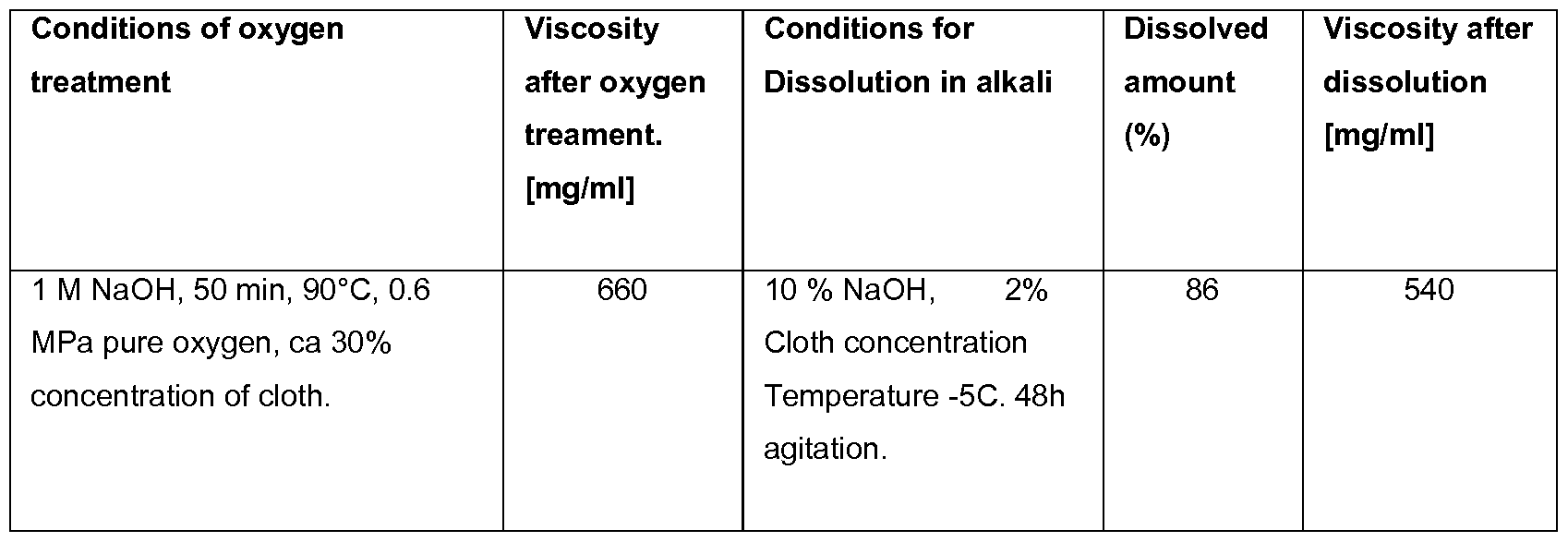
Example 4 Dissolution and fractionation of mixed cloth
[00059] The sample was in this case old colored clothes that according to the information provided by the manufacturer contained 5 % elastane. It was treated with oxygen and dissolved/dispersed as describe in table 3. Liquid with
the dissolved/dispersed cellulose was filtered with a steel web and a fraction consisting of elastane fibers apparently free of cellulose was obtained.
Table 3

Example 5 Precipitation of cellulose.
[00060] Cellulose from cloth treated as in example 2 was precipitated as follows:
Adjustment of pH to 12.5 with sulphuric acid, acetic acid or carbonic acid.
Addition of 5% (Volume) of acetone, isopropanol, methanol, or ethanol respectively.
[00061 ] In all cases the yield was close to 100%.
Example 6 Manufacture of regenerated cellulose using NMMO from Cloth
[00062] White sheet made of cotton were treated with oxygen under following conditions. 5% cloth was mixed with 4% NaOH and treated at 100°C for 60 minutes with 0.6 MPa oxygen. The viscosity after this treatment was 280 mg/ml. The sample was agitated at 2% concentration in 10% NaOH at minus 5°C for 24 h. Undissolved material and undispersed material was removed by filtration. The viscosity of the dispersion was 170 mg/ml. The material was precipitated with methanol, ethanol and isopropanol as in example 5. The precipitate could be dissolved in 50% NMMO (N- methyl morpholine), were water was evaporated until 10% cellulose, 80% NNMO, 10% water. Samples gave clear solutions. When injected in water after first being exposed, into air fibres were obtained. It worked for cellulose precipitated with all of the three organic solvents.
Example 7 Manufacture of regenerated cellulose made by the viscose method.
[00063] Cellulose from cloth was dissolved as in example 2. It was
precipitated with sulphuric acid as in example 5. The precipitated cellulose was collected on a filter paper and washed with 18% NaOH. The cellulose was placed in a textile bag, and excel of liquid was pressed out. Thereafter the cellulose was mixed with CS2 in mass proportions 1 :4. The sample was incubated in room temperature for 16h, and thereafter 10% NaOH was added so that the cellulose concentration was 9%. Sample was placed at 4°C with sporadic agitation and produced a viscous solution (cellulose xhanthate solution). When samples were injected in 3% sulphuric acid reprecipitated fibers were obtained.
Example 8 Dissolution of viscose sampels.
[00064] Viscose yarn from Svenska Rayon were directly dissolved in 10% NaOH at 2% concentration and at -5°C. A solution of practically 100% was obtained. The cellulose precipitated as in example 5 and cellulose xhantate could be made as in example 7.
Claims
1 . A method for regeneration of a cellulose containing material, said method comprising the sequential steps: a) exposing the cellulose containing material to oxygen or a gas mixture
comprising oxygen together with an alkali aqueous solution at a pH of at least 9, and a temperature of at least 20°C, b) dispersing the cellulose containing material in the alkali aqueous solution to obtain a dispersion, wherein the temperature of the alkali aqueous solution is lowered below 15°C, and wherein the pH of the alkali aqueous solution is above 9, c) adding at least one organic solvent to the dispersion to precipitate cellulose, d) separating the precipitated cellulose from the remaining liquid by at least one method selected from filtering and centrifugation.
2. The method according to claim 1 , wherein the dispersion of the cellulose containing material in the alkali aqueous solution is subjected to filtration after step b).
3. The method according to any one of claims 1 -2, wherein the at least one organic solvent added in step c) is miscible with water and has a boiling point which is lower than the boiling point of water.
4. The method according to any one of claims 1 -3, wherein the at least one organic solvent added in step c) is at least one selected from acetone, ethanol, isopropanol, and methanol.
5. The method according to any one of claims 1 -4, wherein the remaining liquid from step d) is separated into at least one stream comprising the at least one organic solvent, and at least one different stream comprising the alkali aqueous solution, wherein at least one of the streams are recycled, and wherein the separation is effected by at least one selected from a pressure lower than atmospheric pressure and a temperature higher than room temperature.
6. The method according to any one of claims 1 -5, wherein the separated precipitated cellulose from step d) is subjected to at least one selected from a pressure lower than atmospheric pressure and a temperature higher than room temperature to remove remaining at least one organic solvent and alkali aqueous solution.
7. The method according to any one of claims 1 -6, wherein the separated precipitated cellulose from step d) is subjected to a wash with water.
8. The method according to any one of claims 1 -7, wherein the cellulose containing material is cloth.
9. The method according to any one of claims 1 -8, wherein the alkali aqueous solution comprises at least one metal hydroxide.
10. The method according to any one of claims 1 -9, wherein the alkali aqueous solution comprises at least 4 wt% of at least one of NaOH and KOH.
1 1 . The method according to any one of claims 1 -10, wherein the
temperature is below 10°C in step b).
12. The method according to any one of claims 1 -1 1 , wherein the
temperature is below 4°C in step b).
13. The method according to any one of claims 1 -1 1 , wherein the pressure during step a) is 0.6 MPa or higher.
14. The method according to any one of claims 1 -12, wherein the separated precipitated cellulose from step d) is used as raw material for manufacture of regenerated cellulose.
15. The method according to any one of claims 1 -13, wherein the separated precipitated cellulose from step d) is mixed with a solution of cellulose xanthate for manufacture of a regenerated fiber.
16. The method according to any one of claims 1 -14, wherein the separated precipitated cellulose from step d) is reacted with CS2 to obtain cellulose xanthate for further manufacture of viscose.
17. A cellulose fiber manufactured with raw material manufactured according to any one of claims 1 -16.
Priority Applications (4)
| Application Number | Priority Date | Filing Date | Title |
|---|---|---|---|
| PL13706951T PL2817448T3 (en) | 2012-02-20 | 2013-02-19 | Regeneration of cellulose |
| CN201380009127.3A CN104169491B (en) | 2012-02-20 | 2013-02-19 | Regenerated cellulose |
| EP13706951.4A EP2817448B1 (en) | 2012-02-20 | 2013-02-19 | Regeneration of cellulose |
| US14/450,362 US9751955B2 (en) | 2012-02-20 | 2014-08-04 | Regeneration of cellulose |
Applications Claiming Priority (2)
| Application Number | Priority Date | Filing Date | Title |
|---|---|---|---|
| SE1250142-5 | 2012-02-20 | ||
| SE1250142 | 2012-02-20 |
Related Child Applications (1)
| Application Number | Title | Priority Date | Filing Date |
|---|---|---|---|
| US14/450,362 Continuation US9751955B2 (en) | 2012-02-20 | 2014-08-04 | Regeneration of cellulose |
Publications (1)
| Publication Number | Publication Date |
|---|---|
| WO2013124265A1 true WO2013124265A1 (en) | 2013-08-29 |
Family
ID=47757577
Family Applications (1)
| Application Number | Title | Priority Date | Filing Date |
|---|---|---|---|
| PCT/EP2013/053260 Ceased WO2013124265A1 (en) | 2012-02-20 | 2013-02-19 | Regeneration of cellulose |
Country Status (6)
| Country | Link |
|---|---|
| US (1) | US9751955B2 (en) |
| EP (1) | EP2817448B1 (en) |
| CN (1) | CN104169491B (en) |
| PL (1) | PL2817448T3 (en) |
| PT (1) | PT2817448T (en) |
| WO (1) | WO2013124265A1 (en) |
Cited By (21)
| Publication number | Priority date | Publication date | Assignee | Title |
|---|---|---|---|---|
| WO2015000820A1 (en) * | 2013-07-01 | 2015-01-08 | Kiram Ab | Alkali recycle in cellulose spinning process |
| WO2016177534A1 (en) | 2015-05-06 | 2016-11-10 | Södra Skogsägarna Ekonomisk Förening | A method of treating cellulose pulp |
| WO2018073177A1 (en) | 2016-10-19 | 2018-04-26 | Re:Newcell Ab | Recycling of cellulosic textiles |
| WO2018104330A1 (en) | 2016-12-06 | 2018-06-14 | Re:Newcell Ab | Cellulose fibers |
| EP3339504A1 (en) | 2016-12-22 | 2018-06-27 | Lenzing Aktiengesellschaft | Method of pulping cotton-based raw material |
| EP3074555B1 (en) | 2013-11-26 | 2019-03-27 | Lenzing AG | Process for pretreating reclaimed cotton fibres to be used in the production of moulded bodies from regenerated cellulose |
| US10501599B2 (en) | 2018-01-12 | 2019-12-10 | Tyton Biosciences, Llc | Methods for recycling cotton and polyester fibers from waste textiles |
| US10603651B2 (en) | 2015-06-11 | 2020-03-31 | Tyton Biosciences, Llc | Process and system for producing pulp, energy, and bioderivatives from plant-based and recycled materials |
| WO2020127453A1 (en) | 2018-12-19 | 2020-06-25 | Re:Newcell Ab | Separation of fibers |
| WO2020251463A1 (en) * | 2019-06-13 | 2020-12-17 | Treetotextile Ab | Fibers produced from recycled cellulosic waste material |
| US20210062417A1 (en) * | 2018-01-15 | 2021-03-04 | Lenzing Aktiengesellschaft | A process for separating a fibrous target component from textile waste |
| US11034817B2 (en) | 2013-04-17 | 2021-06-15 | Evrnu, Spc | Methods and systems for processing mixed textile feedstock, isolating constituent molecules, and regenerating cellulosic and polyester fibers |
| WO2021181007A1 (en) | 2020-03-09 | 2021-09-16 | Infinited Fiber Company Oy | Separation of polycotton blends |
| EP3882380A1 (en) | 2020-03-16 | 2021-09-22 | Re:NewCell AB | One stage method for acid metal removal and bleach |
| WO2022112425A1 (en) * | 2020-11-26 | 2022-06-02 | Treetotextile Ab | A process for providing an alkaline cellulose spin dope |
| EP4116470A1 (en) * | 2021-07-08 | 2023-01-11 | TreeToTextile AB | A method for providing a filtered spinning dope |
| EP4144785A2 (en) | 2021-09-01 | 2023-03-08 | Asia Pacific Resources International Holdings Ltd | A method of recycling textile waste cellulose |
| WO2023037048A1 (en) | 2021-09-09 | 2023-03-16 | Infinited Fiber Company Oy | Method for the treatment of a fibrous raw material |
| WO2023131749A1 (en) | 2022-01-07 | 2023-07-13 | Infinited Fiber Company Oy | Cellulose carbamate polymer |
| WO2025021524A1 (en) | 2023-07-25 | 2025-01-30 | Circulose AB | Metal removal in recycling of cellulosic textiles |
| US12281441B2 (en) | 2013-04-17 | 2025-04-22 | Evrnu, Spc | Methods and systems for forming composite fibers |
Families Citing this family (7)
| Publication number | Priority date | Publication date | Assignee | Title |
|---|---|---|---|---|
| EP3328924A4 (en) * | 2015-07-28 | 2019-04-03 | Evrnu, SPC | Methods and systems for processing mixed textile feedstock, isolating constituent molecules, and regenerating cellulosic and polyester fibers |
| EP3609924B1 (en) * | 2017-05-14 | 2021-12-29 | Washington State University | Environmentally friendly cellulose waste recycling |
| FI3511446T3 (en) * | 2018-01-15 | 2025-02-27 | Chemiefaser Lenzing Ag | Moulded article comprising cellulose incorporated into elastane and method of manufacturing |
| US10611891B2 (en) * | 2018-02-01 | 2020-04-07 | The Hong Kong Research Institute Of Textiles And Apparel Limited | Textile waste processing |
| CN109265737A (en) * | 2018-10-08 | 2019-01-25 | 湖北中泉环保技术有限公司 | A kind of useless ultrafiltration membrane filaments recovery method of polyvinyl alcohol |
| GB2583719B (en) * | 2019-05-02 | 2023-05-31 | Worn Again Tech Ltd | Recycling process |
| US12331157B2 (en) | 2021-09-16 | 2025-06-17 | Circ, LLC | Method of forming a polyester from a regenerated diacid formed from depolymerization of a waste material |
Citations (5)
| Publication number | Priority date | Publication date | Assignee | Title |
|---|---|---|---|---|
| GB588751A (en) * | 1947-12-01 | 1947-06-02 | Courtaulds Ltd | Improvements in and relating to the production of cellulose ethers |
| GB750100A (en) * | 1952-09-20 | 1956-06-06 | Henkel & Cie Gmbh | Process for the manufacture of regenerated cellulose structures from viscose |
| US4145532A (en) * | 1977-11-25 | 1979-03-20 | Akzona Incorporated | Process for making precipitated cellulose |
| WO2010112494A2 (en) | 2009-03-30 | 2010-10-07 | Robert Reiser | Mixed drink |
| WO2012039462A1 (en) * | 2010-09-24 | 2012-03-29 | 愛媛県 | Method for producing cellulose solution, method for producing cellulose precipitate, method for saccharifying cellulose, cellulose solution, and cellulose precipitate |
Family Cites Families (7)
| Publication number | Priority date | Publication date | Assignee | Title |
|---|---|---|---|---|
| US4004967A (en) * | 1972-06-22 | 1977-01-25 | Billeruds Aktiebolag | Bleaching cellulose pulp with oxygen in the presence of formaldehyde |
| US6605350B1 (en) * | 1996-08-23 | 2003-08-12 | Weyerhaeuser Company | Sawdust alkaline pulp having low average degree of polymerization values and method of producing the same |
| US6686039B2 (en) * | 1999-02-24 | 2004-02-03 | Weyerhaeuser Company | Use of thinnings and other low specific gravity wood for lyocell pulps |
| FI115835B (en) * | 2003-08-15 | 2005-07-29 | Kemira Oyj | Resolution Procedure |
| US7674608B2 (en) * | 2007-02-23 | 2010-03-09 | The University Of Toledo | Saccharifying cellulose |
| WO2010104458A1 (en) * | 2009-03-09 | 2010-09-16 | Kiram Ab | A shaped cellulose manufacturing process combined with a pulp mill recovery system |
| WO2010124944A1 (en) * | 2009-04-28 | 2010-11-04 | Heli Inovatio Handelsbolag | Process for the hydrolysis of cellulose |
-
2013
- 2013-02-19 WO PCT/EP2013/053260 patent/WO2013124265A1/en not_active Ceased
- 2013-02-19 EP EP13706951.4A patent/EP2817448B1/en active Active
- 2013-02-19 CN CN201380009127.3A patent/CN104169491B/en not_active Expired - Fee Related
- 2013-02-19 PL PL13706951T patent/PL2817448T3/en unknown
- 2013-02-19 PT PT137069514T patent/PT2817448T/en unknown
-
2014
- 2014-08-04 US US14/450,362 patent/US9751955B2/en not_active Expired - Fee Related
Patent Citations (5)
| Publication number | Priority date | Publication date | Assignee | Title |
|---|---|---|---|---|
| GB588751A (en) * | 1947-12-01 | 1947-06-02 | Courtaulds Ltd | Improvements in and relating to the production of cellulose ethers |
| GB750100A (en) * | 1952-09-20 | 1956-06-06 | Henkel & Cie Gmbh | Process for the manufacture of regenerated cellulose structures from viscose |
| US4145532A (en) * | 1977-11-25 | 1979-03-20 | Akzona Incorporated | Process for making precipitated cellulose |
| WO2010112494A2 (en) | 2009-03-30 | 2010-10-07 | Robert Reiser | Mixed drink |
| WO2012039462A1 (en) * | 2010-09-24 | 2012-03-29 | 愛媛県 | Method for producing cellulose solution, method for producing cellulose precipitate, method for saccharifying cellulose, cellulose solution, and cellulose precipitate |
Non-Patent Citations (3)
| Title |
|---|
| A. ISOGAI ET AL., CELLULOSE, vol. 5, 1998, pages 309 - 319 |
| OHNO H; FUKAYA Y: "Task specific ionic liquids for cellulose technology", CHEMISTRY LETTERS, 2009, pages 38 |
| ZHAO ET AL., BIOTECHNOLOGY AND BIOENGINEERING, vol. 99, no. 6, 2008, pages 1320 - 1328 |
Cited By (48)
| Publication number | Priority date | Publication date | Assignee | Title |
|---|---|---|---|---|
| US12281441B2 (en) | 2013-04-17 | 2025-04-22 | Evrnu, Spc | Methods and systems for forming composite fibers |
| US12319790B2 (en) | 2013-04-17 | 2025-06-03 | Evrnu, Spc | Methods and systems for processing mixed textile feedstock, isolating constituent molecules, and regenerating cellulosic and polyester fibers |
| US11034817B2 (en) | 2013-04-17 | 2021-06-15 | Evrnu, Spc | Methods and systems for processing mixed textile feedstock, isolating constituent molecules, and regenerating cellulosic and polyester fibers |
| US10138578B2 (en) | 2013-07-01 | 2018-11-27 | Treetotextile Ab | Alkali recycle in cellulose spinning process |
| WO2015000820A1 (en) * | 2013-07-01 | 2015-01-08 | Kiram Ab | Alkali recycle in cellulose spinning process |
| EP3521248A1 (en) * | 2013-07-01 | 2019-08-07 | TreeToTextile AB | Alkali recycle in cellulose spinning process |
| EP3074555B2 (en) † | 2013-11-26 | 2026-01-28 | Lenzing AG | Process for pretreating reclaimed cotton fibres to be used in the production of moulded bodies from regenerated cellulose |
| EP3074555B1 (en) | 2013-11-26 | 2019-03-27 | Lenzing AG | Process for pretreating reclaimed cotton fibres to be used in the production of moulded bodies from regenerated cellulose |
| WO2016177534A1 (en) | 2015-05-06 | 2016-11-10 | Södra Skogsägarna Ekonomisk Förening | A method of treating cellulose pulp |
| US10858781B2 (en) | 2015-05-06 | 2020-12-08 | Södra Skogsägarna Ekonomisk Förening | Method of treating cellulose pulp |
| US11305254B2 (en) | 2015-06-11 | 2022-04-19 | Circ, LLC | Process and system for producing pulp, energy, and bioderivatives from plant-based and recycled materials |
| US10603651B2 (en) | 2015-06-11 | 2020-03-31 | Tyton Biosciences, Llc | Process and system for producing pulp, energy, and bioderivatives from plant-based and recycled materials |
| EP3789406A1 (en) | 2016-10-19 | 2021-03-10 | Re:NewCell AB | Recycling of cellulosic textiles |
| EP3529282B1 (en) | 2016-10-19 | 2020-09-23 | Re:NewCell AB | Recycling of cellulosic textiles |
| US11618978B2 (en) | 2016-10-19 | 2023-04-04 | Re:Newcell Ab | Recycling of cellulosic textiles |
| WO2018073177A1 (en) | 2016-10-19 | 2018-04-26 | Re:Newcell Ab | Recycling of cellulosic textiles |
| US11891725B2 (en) | 2016-10-19 | 2024-02-06 | Re:Newcell Ab | Recycling of cellulosic textiles |
| EP3789406B1 (en) | 2016-10-19 | 2023-07-26 | Re:NewCell AB | Recycling of cellulosic textiles |
| EP4219808A1 (en) | 2016-12-06 | 2023-08-02 | Re:NewCell AB | Cellulose fibers |
| CN110546317B (en) * | 2016-12-06 | 2022-11-29 | 雷纽赛尔公司 | Cellulose fiber |
| CN110546317A (en) * | 2016-12-06 | 2019-12-06 | 雷纽赛尔公司 | Cellulose fiber |
| WO2018104330A1 (en) | 2016-12-06 | 2018-06-14 | Re:Newcell Ab | Cellulose fibers |
| US11414789B2 (en) | 2016-12-06 | 2022-08-16 | Re:Newcell Ab | Cellulose fibers |
| EP3339504A1 (en) | 2016-12-22 | 2018-06-27 | Lenzing Aktiengesellschaft | Method of pulping cotton-based raw material |
| US11939405B2 (en) | 2016-12-22 | 2024-03-26 | Lenzing Ag | Method of pulping cotton-based raw material |
| WO2018115428A1 (en) | 2016-12-22 | 2018-06-28 | Lenzing Aktiengesellschaft | Method of pulping cotton-based raw material |
| US11180629B2 (en) | 2018-01-12 | 2021-11-23 | Circ, LLC | Methods for recycling cotton and polyester fibers from waste textiles |
| US11370895B2 (en) | 2018-01-12 | 2022-06-28 | Circ, LLC | Methods for recycling cotton and polyester fibers from waste textiles |
| US12006403B2 (en) | 2018-01-12 | 2024-06-11 | Circ, LLC | Methods for recycling cotton and polyester fibers from waste textiles |
| US10501599B2 (en) | 2018-01-12 | 2019-12-10 | Tyton Biosciences, Llc | Methods for recycling cotton and polyester fibers from waste textiles |
| US20210062417A1 (en) * | 2018-01-15 | 2021-03-04 | Lenzing Aktiengesellschaft | A process for separating a fibrous target component from textile waste |
| US11952714B2 (en) * | 2018-01-15 | 2024-04-09 | Lenzing Aktiengesellschaft | Process for separating a fibrous target component from textile waste |
| WO2020127453A1 (en) | 2018-12-19 | 2020-06-25 | Re:Newcell Ab | Separation of fibers |
| US12215459B2 (en) | 2018-12-19 | 2025-02-04 | Circulose AB | Separation of fibers |
| EP4074797A1 (en) | 2018-12-19 | 2022-10-19 | Re:NewCell AB | Separation of fibers |
| WO2020251463A1 (en) * | 2019-06-13 | 2020-12-17 | Treetotextile Ab | Fibers produced from recycled cellulosic waste material |
| US12435160B2 (en) | 2020-03-09 | 2025-10-07 | Infinited Fiber Company | Separation of polycotton blends |
| WO2021181007A1 (en) | 2020-03-09 | 2021-09-16 | Infinited Fiber Company Oy | Separation of polycotton blends |
| WO2021185704A1 (en) | 2020-03-16 | 2021-09-23 | Re:Newcell Ab | One stage method for acid metal rewoval and bleach |
| EP3882380A1 (en) | 2020-03-16 | 2021-09-22 | Re:NewCell AB | One stage method for acid metal removal and bleach |
| WO2022112425A1 (en) * | 2020-11-26 | 2022-06-02 | Treetotextile Ab | A process for providing an alkaline cellulose spin dope |
| WO2023281058A1 (en) | 2021-07-08 | 2023-01-12 | Treetotextile Ab | A method for providing a filtered spinning dope |
| EP4116470A1 (en) * | 2021-07-08 | 2023-01-11 | TreeToTextile AB | A method for providing a filtered spinning dope |
| EP4144785A2 (en) | 2021-09-01 | 2023-03-08 | Asia Pacific Resources International Holdings Ltd | A method of recycling textile waste cellulose |
| WO2023030747A1 (en) | 2021-09-01 | 2023-03-09 | Asia Pacific Resources International Holdings Ltd | A method of recycling textile waste cellulose |
| WO2023037048A1 (en) | 2021-09-09 | 2023-03-16 | Infinited Fiber Company Oy | Method for the treatment of a fibrous raw material |
| WO2023131749A1 (en) | 2022-01-07 | 2023-07-13 | Infinited Fiber Company Oy | Cellulose carbamate polymer |
| WO2025021524A1 (en) | 2023-07-25 | 2025-01-30 | Circulose AB | Metal removal in recycling of cellulosic textiles |
Also Published As
| Publication number | Publication date |
|---|---|
| CN104169491A (en) | 2014-11-26 |
| US9751955B2 (en) | 2017-09-05 |
| US20140343270A1 (en) | 2014-11-20 |
| CN104169491B (en) | 2015-11-25 |
| EP2817448A1 (en) | 2014-12-31 |
| EP2817448B1 (en) | 2016-11-16 |
| PL2817448T3 (en) | 2017-12-29 |
| PT2817448T (en) | 2017-02-21 |
Similar Documents
| Publication | Publication Date | Title |
|---|---|---|
| US9751955B2 (en) | Regeneration of cellulose | |
| Pang et al. | Super-hydrophobic PTFE hollow fiber membrane fabricated by electrospinning of Pullulan/PTFE emulsion for membrane deamination | |
| CN109021264B (en) | Preparation method of MOFs-chitosan nanofiber composite membrane | |
| EP2683859B1 (en) | Method for spinning anionically modified cellulose | |
| CN110205748A (en) | A kind of composite nano-fiber membrane and the preparation method and application thereof of β-FeOOH/ polyacrylonitrile | |
| JP7685265B2 (en) | Purification method and system for NMMO and the obtained NMMO hydrate crystals | |
| CN113242894B (en) | separation of fibers | |
| WO2010042647A2 (en) | High flux high efficiency nanofiber membranes and methods of production thereof | |
| JP5072846B2 (en) | Use of aqueous sodium hydroxide / thiourea solution in the manufacture of cellulose products on a pilot scale | |
| EA023949B1 (en) | Method for dry spinning neutral and anionically modified cellulose and fibres made using the method | |
| CN101220523A (en) | Method for preparing cellulose silk protein composite fiber by solvent method | |
| CN107955984B (en) | A kind of graphene-grafted polysaccharide Lyocell fiber and preparation method thereof | |
| CN117597477A (en) | Regenerated cellulose composite fiber and preparation method thereof | |
| CN106757767A (en) | A kind of preparation and application of high intensity beta cyclodextrin/cellulose acetate composite nano-fiber membrane | |
| CN102443869B (en) | Cellulose solution coagulation forming method | |
| CN110678485A (en) | Environmentally friendly cellulosic waste recycle | |
| Feng et al. | Preparation of high-flux polyethylene hollow fiber microfiltration membranes with multiple pore structure through the combination technology of braided tube reinforcement and TIPS method | |
| CN112044406A (en) | A kind of method for preparing cotton stalk skin microcrystalline cellulose/graphene oxide aerogel fiber | |
| CN105887228A (en) | Preparation method for producing porous diacetate cellulose tow by using ultraviolet light-aided dry spinning | |
| EP4547458A1 (en) | A method for melt processing of textile waste material and products obtained by the method | |
| CN111661967A (en) | System and method for recovering alkali in viscose fiber production squeezing waste liquid by using double-membrane method | |
| WO2025241106A1 (en) | Method and system for selective nylon extraction from blended textile | |
| Liu et al. | Electrospun Cellulose Acetate Nanofiber Morphology and Property Derived from CaCl2-Formic Acid Solvent System | |
| EP4399360B1 (en) | Method for the treatment of a fibrous raw material | |
| CN101649574B (en) | A kind of waste cellophane recycling method |
Legal Events
| Date | Code | Title | Description |
|---|---|---|---|
| 121 | Ep: the epo has been informed by wipo that ep was designated in this application |
Ref document number: 13706951 Country of ref document: EP Kind code of ref document: A1 |
|
| NENP | Non-entry into the national phase |
Ref country code: DE |
|
| REEP | Request for entry into the european phase |
Ref document number: 2013706951 Country of ref document: EP |
|
| WWE | Wipo information: entry into national phase |
Ref document number: 2013706951 Country of ref document: EP |