WO2013124041A1 - Combination of lipid transfer proteins and plant matter containing phenol derivatives with local mucosal efficiency - Google Patents
Combination of lipid transfer proteins and plant matter containing phenol derivatives with local mucosal efficiency Download PDFInfo
- Publication number
- WO2013124041A1 WO2013124041A1 PCT/EP2013/000410 EP2013000410W WO2013124041A1 WO 2013124041 A1 WO2013124041 A1 WO 2013124041A1 EP 2013000410 W EP2013000410 W EP 2013000410W WO 2013124041 A1 WO2013124041 A1 WO 2013124041A1
- Authority
- WO
- WIPO (PCT)
- Prior art keywords
- sugar
- kda
- protein
- weight
- proteins
- Prior art date
- Legal status (The legal status is an assumption and is not a legal conclusion. Google has not performed a legal analysis and makes no representation as to the accuracy of the status listed.)
- Ceased
Links
Classifications
-
- A—HUMAN NECESSITIES
- A61—MEDICAL OR VETERINARY SCIENCE; HYGIENE
- A61K—PREPARATIONS FOR MEDICAL, DENTAL OR TOILETRY PURPOSES
- A61K31/00—Medicinal preparations containing organic active ingredients
- A61K31/045—Hydroxy compounds, e.g. alcohols; Salts thereof, e.g. alcoholates
- A61K31/05—Phenols
-
- A—HUMAN NECESSITIES
- A61—MEDICAL OR VETERINARY SCIENCE; HYGIENE
- A61K—PREPARATIONS FOR MEDICAL, DENTAL OR TOILETRY PURPOSES
- A61K31/00—Medicinal preparations containing organic active ingredients
- A61K31/185—Acids; Anhydrides, halides or salts thereof, e.g. sulfur acids, imidic, hydrazonic or hydroximic acids
- A61K31/19—Carboxylic acids, e.g. valproic acid
- A61K31/192—Carboxylic acids, e.g. valproic acid having aromatic groups, e.g. sulindac, 2-aryl-propionic acids, ethacrynic acid
-
- A—HUMAN NECESSITIES
- A61—MEDICAL OR VETERINARY SCIENCE; HYGIENE
- A61K—PREPARATIONS FOR MEDICAL, DENTAL OR TOILETRY PURPOSES
- A61K31/00—Medicinal preparations containing organic active ingredients
- A61K31/21—Esters, e.g. nitroglycerine, selenocyanates
- A61K31/215—Esters, e.g. nitroglycerine, selenocyanates of carboxylic acids
- A61K31/216—Esters, e.g. nitroglycerine, selenocyanates of carboxylic acids of acids having aromatic rings, e.g. benactizyne, clofibrate
-
- A—HUMAN NECESSITIES
- A61—MEDICAL OR VETERINARY SCIENCE; HYGIENE
- A61K—PREPARATIONS FOR MEDICAL, DENTAL OR TOILETRY PURPOSES
- A61K36/00—Medicinal preparations of undetermined constitution containing material from algae, lichens, fungi or plants, or derivatives thereof, e.g. traditional herbal medicines
- A61K36/18—Magnoliophyta (angiosperms)
- A61K36/185—Magnoliopsida (dicotyledons)
-
- A—HUMAN NECESSITIES
- A61—MEDICAL OR VETERINARY SCIENCE; HYGIENE
- A61K—PREPARATIONS FOR MEDICAL, DENTAL OR TOILETRY PURPOSES
- A61K36/00—Medicinal preparations of undetermined constitution containing material from algae, lichens, fungi or plants, or derivatives thereof, e.g. traditional herbal medicines
- A61K36/18—Magnoliophyta (angiosperms)
- A61K36/185—Magnoliopsida (dicotyledons)
- A61K36/53—Lamiaceae or Labiatae (Mint family), e.g. thyme, rosemary or lavender
-
- A—HUMAN NECESSITIES
- A61—MEDICAL OR VETERINARY SCIENCE; HYGIENE
- A61K—PREPARATIONS FOR MEDICAL, DENTAL OR TOILETRY PURPOSES
- A61K36/00—Medicinal preparations of undetermined constitution containing material from algae, lichens, fungi or plants, or derivatives thereof, e.g. traditional herbal medicines
- A61K36/18—Magnoliophyta (angiosperms)
- A61K36/185—Magnoliopsida (dicotyledons)
- A61K36/68—Plantaginaceae (Plantain Family)
-
- A—HUMAN NECESSITIES
- A61—MEDICAL OR VETERINARY SCIENCE; HYGIENE
- A61K—PREPARATIONS FOR MEDICAL, DENTAL OR TOILETRY PURPOSES
- A61K36/00—Medicinal preparations of undetermined constitution containing material from algae, lichens, fungi or plants, or derivatives thereof, e.g. traditional herbal medicines
- A61K36/18—Magnoliophyta (angiosperms)
- A61K36/185—Magnoliopsida (dicotyledons)
- A61K36/69—Polygalaceae (Milkwort family)
-
- A—HUMAN NECESSITIES
- A61—MEDICAL OR VETERINARY SCIENCE; HYGIENE
- A61K—PREPARATIONS FOR MEDICAL, DENTAL OR TOILETRY PURPOSES
- A61K36/00—Medicinal preparations of undetermined constitution containing material from algae, lichens, fungi or plants, or derivatives thereof, e.g. traditional herbal medicines
- A61K36/18—Magnoliophyta (angiosperms)
- A61K36/88—Liliopsida (monocotyledons)
- A61K36/899—Poaceae or Gramineae (Grass family), e.g. bamboo, corn or sugar cane
-
- A—HUMAN NECESSITIES
- A61—MEDICAL OR VETERINARY SCIENCE; HYGIENE
- A61K—PREPARATIONS FOR MEDICAL, DENTAL OR TOILETRY PURPOSES
- A61K9/00—Medicinal preparations characterised by special physical form
- A61K9/0012—Galenical forms characterised by the site of application
- A61K9/0053—Mouth and digestive tract, i.e. intraoral and peroral administration
- A61K9/0056—Mouth soluble or dispersible forms; Suckable, eatable, chewable coherent forms; Forms rapidly disintegrating in the mouth; Lozenges; Lollipops; Bite capsules; Baked products; Baits or other oral forms for animals
-
- A—HUMAN NECESSITIES
- A61—MEDICAL OR VETERINARY SCIENCE; HYGIENE
- A61K—PREPARATIONS FOR MEDICAL, DENTAL OR TOILETRY PURPOSES
- A61K9/00—Medicinal preparations characterised by special physical form
- A61K9/0087—Galenical forms not covered by A61K9/02 - A61K9/7023
- A61K9/0095—Drinks; Beverages; Syrups; Compositions for reconstitution thereof, e.g. powders or tablets to be dispersed in a glass of water; Veterinary drenches
-
- A—HUMAN NECESSITIES
- A61—MEDICAL OR VETERINARY SCIENCE; HYGIENE
- A61K—PREPARATIONS FOR MEDICAL, DENTAL OR TOILETRY PURPOSES
- A61K9/00—Medicinal preparations characterised by special physical form
- A61K9/08—Solutions
-
- A—HUMAN NECESSITIES
- A61—MEDICAL OR VETERINARY SCIENCE; HYGIENE
- A61K—PREPARATIONS FOR MEDICAL, DENTAL OR TOILETRY PURPOSES
- A61K9/00—Medicinal preparations characterised by special physical form
- A61K9/10—Dispersions; Emulsions
- A61K9/12—Aerosols; Foams
-
- A—HUMAN NECESSITIES
- A61—MEDICAL OR VETERINARY SCIENCE; HYGIENE
- A61K—PREPARATIONS FOR MEDICAL, DENTAL OR TOILETRY PURPOSES
- A61K9/00—Medicinal preparations characterised by special physical form
- A61K9/20—Pills, tablets, discs, rods
- A61K9/28—Dragees; Coated pills or tablets, e.g. with film or compression coating
- A61K9/2806—Coating materials
- A61K9/282—Organic compounds, e.g. fats
- A61K9/2826—Sugars or sugar alcohols, e.g. sucrose; Derivatives thereof
-
- A—HUMAN NECESSITIES
- A61—MEDICAL OR VETERINARY SCIENCE; HYGIENE
- A61P—SPECIFIC THERAPEUTIC ACTIVITY OF CHEMICAL COMPOUNDS OR MEDICINAL PREPARATIONS
- A61P11/00—Drugs for disorders of the respiratory system
-
- A—HUMAN NECESSITIES
- A61—MEDICAL OR VETERINARY SCIENCE; HYGIENE
- A61P—SPECIFIC THERAPEUTIC ACTIVITY OF CHEMICAL COMPOUNDS OR MEDICINAL PREPARATIONS
- A61P11/00—Drugs for disorders of the respiratory system
- A61P11/04—Drugs for disorders of the respiratory system for throat disorders
Definitions
- the present invention relates to combinations, in particular for local mucosal administration, especially in solid, semisolid or liquid preparation, containing lipid transfer proteins from plants, milk or combinations thereof, each having a mean molecular mass of 1-13 kDa, especially 1 -9 kDa, preferably 1-5 kDa, or milk having a mean molecular weight of 1-8 kDa, especially 1-5-7 kDa, and phytochemicals containing one or more phenol derivatives (powders or extracts of the drugs), such as Plantain, thyme, pelargonium, cistus, Senega, or combinations of several plant substances / extracts as mentioned.
- Such combinations, in particular preparations thereof, have above all a local-mucosal action, in particular on the oral, cervical and pharyngeal mucosa, e.g. in case of irritation, dryness, halitosis, infections, allergies, environmental noxae or other irritants.
- associates are formed by the interaction of said proteins with the phenol derivatives containing phytochemicals.
- these associates specifically modify the physical properties of aqueous systems, which also include physiological slime layers, e.g. the surface tension and thus the visco-elastic properties of the slime.
- the Schleimmotiltician is improved according to the invention.
- EP 1635776 A1 describes topically applicable preparations containing water, one or more lipids, one or more lipid transfer proteins from plants (MW 4 to 10 kDa) or milk (MW 2-4 KDa), as well as hydrocolloids such as gelatin, acrylates, etc. These preparations may in particular in the form of a cream, a gel, sprays, on the skin can be used for lipid transfer and thus the improvement of the lipid structure of skin. Depending on the further indication, active ingredients such as plant extracts may also be added.
- WO 2007/059836 A2 describes systems for recycling oxidatively modified lipids from structures containing them, such as biomembranes (skin), which contain a depot of one or more structurally / especially oxidatively unmodified lipids, one or more recycling transfer proteins with transfer rates for structurally / in particular oxidatively altered lipids, one or more non-transferable active substances for the regeneration of structurally / oxidatively modified lipids; and optionally one or more application-related additives.
- skin biomembranes
- the structurally and, above all, oxidatively altered lipid can be removed from the aggregates containing it by means of the transfer protein provided, transferred to the depot with unmodified lipids, regenerated by the active compounds present here and subsequently transferred back.
- Buckwheat, millet, spelled, tapioca with a mean molecular mass of 3.5 to 8 kDa or milk with a mean molecular mass of 2.5 to 8 kDa and a transfer rate for oxidized lipids of 600 to 8000 are primarily used as recycling transfer proteins ng / min / mg protein, suggested.
- Lipid transfer proteins are proteins available from plants or animal sources with a z. B. against collagen / keratin lower molecular weight. They have a transfer activity towards specific lipids such as phosphatidylcholine (specific lipid transfer proteins, for example from corn seeds, spinach leaves (see D. Zilversmit, Journal of Lipid Research, Vol.25, 1984, 1563-1569) also non-specific lipid transfer proteins with a broader transfer spectrum for several lipids, such as, for example, proteins from castor beans, wheat, rice, spinach, barley, oilseed rape, carrots, see JC Kader, Trends in Plant Science, February 1997, Vol 2, p 1330 -35.
- specific lipids such as phosphatidylcholine (specific lipid transfer proteins, for example from corn seeds, spinach leaves (see D. Zilversmit, Journal of Lipid Research, Vol.25, 1984, 1563-1569) also non-specific lipid transfer proteins with a broader transfer spectrum for several lipids, such as, for
- Zoccatelli, G. et al, J. Agric. Food Chem. 2007, 55, page 1 1057-1 1062 describe the isolation and identification of 2 specific low molecular weight (7-9 kDa) pomegranate lipid transfer proteins which are said to be involved in the allergic potential of this fruit.
- Plant substances for example, from leaves, twigs, seeds or extracts thereof are widely known and tested as medicines. They include, in particular, essential oils from the group of terpenes, terpene alcohols / aldehydes and phenol derivatives such as alcohols, acids, esters, aldehydes. So z.
- plantain or Pelargonium as thyme, plantain or Pelargonium (sidoides, reniforme), especially combinations of the latter, for the treatment of throat diseases, as described in EP 1829548 B1.
- lozenges are described herein.
- Ribwort plantain including terpene alcohol, phenol esters, carbohydrates
- Ribwort plantain is said to have an efficacy due to the binding of the polysaccharides contained therein, in particular the glucocannanes (carbohydrates), to the mucous membrane, quasi as a substitute for native mucopolysaccharides lacking infection or inflammation.
- the described principle of the interaction of a mucilage drug and a tanning agent drug is likewise taken up in WO 2010/00 3472 A2.
- This object is achieved according to the invention by locally, in particular mucosally, especially orally usable combinations of one or more phenol derivatives-containing plant substances (such as powders, extracts from plants) together with one or more lipid transfer proteins selected from one or more plant proteins each having an average molecular weight of 1 to 13 kDa, especially 1 to 9 kDa, preferably from 1 to 5 kDa, or milk protein, each having an average molecular weight of 1 to 8, preferably 1, 5 to 7, especially 1, 5 to 5 kDa, or combinations thereof, of plant and milk protein (s) having a pH of 4 to 6.5 (at 20 ° C, 10% aqueous solution).
- one or more phenol derivatives-containing plant substances such as powders, extracts from plants
- one or more lipid transfer proteins selected from one or more plant proteins each having an average molecular weight of 1 to 13 kDa, especially 1 to 9 kDa, preferably from 1 to 5 kDa, or milk protein, each having an average molecular weight
- phenol derivatives-containing plant substances in the form of powders or extracts from the drugs selected from pelargonium, ribwort, thyme, Senega root, rockrose, pomegranate, or mixtures thereof, in particular from Pelargonium, plantain, thyme, Senega root, pomegranate, or mixtures thereof.
- the lipid transfer protein (s) is (are) selected from oat, millet, wheat, barley protein, each having an average molecular weight of 1 to 9 kDa, or combinations thereof, or one or more milk proteins having an average molecular mass of 1 , 5 to 7 kDa, especially 1.5 to 4.5 kDa, or combinations thereof with plant proteins.
- These include Pelargonium sidoides and / or reniforms or extracts thereof as described below, in particular in combination with oat protein, wheat protein, barley protein, milk protein or combinations of oat and milk protein, wheat protein and milk protein, barley protein and milk protein, oats, barley or wheat protein and milk protein of the above-described molecular masses.
- the ratio of the proteins to one another may vary, preferably the ratio of vegetable protein (s) in total to milk protein (s, in total) 1: 1 to 1: 3.
- the quantities are by weight unless otherwise stated.
- the ratios are based on percent by weight of the amounts of substance present (without additives optionally present in the extracts, powders).
- the plant extract (s) may preferably be in the form of a fluid, a spissum, a dry extract / solid powder and the transfer protein (s) preferably as a solid powder.
- the plants (drug) extracts are preferably liquid extracts, eg. B. in the form of a tincture, especially with a drug / extract ratio of 1: 0.1 to 1: 100, especially 1: 0.5 to 1:40, in particular 1: 3 to 1: 13 ,
- Dry extracts are inventively particularly suitable, for. B. those with a drug / extract ratio (DEV) of 100: 1 to 1: 1, especially 60: 1 to 30: 1, in particular 30: 1 to 10: 1.
- DEV drug / extract ratio
- compositions which furthermore comprise excipients, especially in amounts of from 60 to 95% by weight, and optionally additives as described below.
- the combinations or preparations according to the application are therefore suitable for use in the case of irritations, reddenings, inflammations, eg due to allergens, air dryness, Dust particles, bacteria, spores of the oral, cervical and pharyngeal mucosa, but also the nasal mucosa or bronchial mucosa.
- Preferred preparation forms are liquid preparations (combinations as described with water as main carrier, ie more than 60% by weight) such as drops, juice, solutions (for spraying, gargling, rinsing), suckable pastilles (with sugar / sugar substitutes as the main carrier) or chewable solid dosage forms such as chewable tablet, medicated gum (with dextrose or chicle / water as carrier).
- the invention relates to preparations, in particular in solid, semisolid or liquid, especially oral / locally usable form, comprising a combination of phenol derivatives-containing plant active ingredients (eg 0.01 to 10 wt.%) Together with transfer proteins (eg 0.01 up to 10% by weight), through the association of which mucobions are formed.
- phenol derivatives-containing plant active ingredients eg 0.01 to 10 wt.%
- transfer proteins eg 0.01 up to 10% by weight
- Pelargonium (sidoides and / or reniforme) with gallic acid / ester, polyphenols;
- Plantain Plantain (Plantago lanceolata) with oct-1-en-3-ol, ortho-dihydroxycinnamic acid;
- Pomegranate (Punica granatum) with gallic acid
- Thyme Thymus vulgaris
- thymol Thymol
- carvacrol ursolic acid (terpeoids)
- rosmarinic acid caffeic acid (phenolic acids, esters), but not catechins or hydrolyzable labiates.
- Cistus (Cistus ladanifer, Cistus creticus, Cistus incanus ssp. Tauricus) with polyphenols, in particular 3,4-dihydroxybenzoic acid, procyanidines, flavan-3-ols; Labdanum oil;
- Senega (rattlesnake) with phenol glycosides (4- (di) methoxycinnamic acid fucose derivative (tetrasacharide from fucose, glucose, rhamnose, xylose, galactose, derivatized with triterpenoid residue: presenegenin).
- the combination in the preparations according to the invention comprises: 0.1 to 15% by weight, in particular 0.3 to 10% by weight, of one or more lipid transfer proteins selected from one or more plant proteins selected from oats, barley, wheat, or milk proteins, or combinations thereof, with one each average molecular weight of 1 to 13 kDa, especially 1 to 9 kDa, preferably 1 to 5 kDa, or milk protein, each having an average molecular weight of 1 to 8 kDa, preferably from 1, 5 to 7 kDa, in particular 1, 5 to 5 kDa, or even 1, 8 to 3.5 kDa, which have a pH of 4 to 6.5 at 20 ° C, 10% aqueous solution.
- one or more lipid transfer proteins selected from one or more plant proteins selected from oats, barley, wheat, or milk proteins, or combinations thereof, with one each average molecular weight of 1 to 13 kDa, especially 1 to 9 kDa, preferably 1 to 5 kDa, or milk protein,
- the preparations preferably contain a ratio of phenol derivatives-containing plant substance to protein of from 0.1: 1 to 1:10, in particular from 0.5: 1 to 1:10, in particular from 1: 1 to 1: 7.
- the ratio refers to the substance quantities (without any additives).
- the preparations further comprise a carrier selected from water, one or more sugars, sugar substitutes or mixtures of sugar / sugar substitutes and water.
- the sugar / sugar substitutes may be selected from glucose, maltose, dextrose, isomaltose, fructose, xylose, lactose, lactulose, galactose, inulin, maltitol, sorbitol, xylitol, mannitol, erythritol, or mixtures thereof, i.
- the carriers for example 60 and more% by weight are present in particular in amounts of 72 to 98% by weight.
- the combinations according to the application may further comprise additives, in particular pharmaceutically acceptable additives, selected from solvents, flavorings and flavorings, acidulants, buffer substances, sweeteners, stabilizers, additional active ingredients or combinations thereof.
- additives in particular pharmaceutically acceptable additives, selected from solvents, flavorings and flavorings, acidulants, buffer substances, sweeteners, stabilizers, additional active ingredients or combinations thereof.
- mucosal irritations such as inflammations, allergic reactions, reactions to environmental particles, dust, infections, irritations / inflammations by bacterial and / or viral organisms can be used.
- further constituents (additives) for administration forms they can be present in particular as a medical product, but also as a medicament.
- preparations according to the invention comprise biological ingredients. These are in accordance with the present application such Understand substances that occur / grow in nature and which are as such in / from this degradable.
- the preparations according to the invention contain as the first active ingredient one or more plant substances with phenolic ingredients (phenol derivatives) of the general formula:
- R 2 , R 3 , R 4 , R 5 independently of one another mean:
- Ri H, OH, OR 5 , COR 5 ; d-CfjAlkyl, CrC 8 substituted alkyl;
- R 2 OH; OR 5 , H; d-d-alkyl, dC 8 substituted alkyl;
- R 3 OH; OR 5 , Ci-CeAlkyl, dC 8 substituted alkyl; or sugar according to R 4 5 ;
- R 4 COOR 5 ; C 8 alkyl, C 8 alkenyl COOR 5 ; CrCeAlkyl, CC 8 substituted
- R 5 H, dC 8 alkyl, COOD-C 8 alkyl-subst.Phenol, sugar selected from glucose, fructose, fucose, xylose, galactose, rhamnose, xylose, and combinations of two or more of these sugar; wherein the sugars may be associated with mono-di-triterpenes.
- phenol derivative-containing plant substances are selected from Pelargonium sidoides and / or reniforme or mixtures thereof; Plantain; Thyme; Cistus, or possibly pomegranate, Senega root, in particular supplemented by one or more agents (especially terpenoids containing), selected from the group comprising dandelion, primrose root, fennel, anise, ivy, Icelandic moss, cranberry, or suitable mixtures thereof of 2, 3 or 4 different agents of this group.
- agents especially terpenoids containing
- thyme + ribwort preferably thyme + ribwort
- Thyme + ribwort plantain + anise Thyme + primrose root
- Pelargonium (sidoides, reniforme) + thyme and / or cistus Pelargonium (sidoides, reniforme) + thyme and / or cistus
- Ribwort plantain and ivy leaves Thyme + fennel
- Plantain & Dandelion / or Cranberry Especially suitable are combinations of thyme + ribwort; Thyme + ribwort plantain + anise; Thyme + primrose root; Pelargonium (sidoides, reniforme) + thyme and / or cistus; Ribwort plantain and ivy leaves; Thyme + fennel; Plantain & Dandelion / or Cranberry.
- Pelargonium sidoides, reniforme (or mixtures) - fluid extract powder eg 10-70% native, extractant: water-ethanol, 10 to 15%, added in powder: maltodextrin
- oat protein MW 1, 5 to 2 kDa, in particular about 1, 8 kDa (eg 70 to 90%, powder)
- oat protein powder MW 1 to 5 kDa, especially about 1 kDa, powder, eg 20 to 70%
- a combination of oat protein and milk protein of this type especially in a weight ratio of the proteins to each other of 1: 1.
- the ratio of pelargonium plant substance to protein here is 0.1: 1 to 1: 8, preferably 0.4: 1 to 1: 5, especially 1: 1 to 1: 3.
- the ratio protein / plant substance refers to the net weight of the substance group without possibly existing substances (ratio of protein substance to amount of phytochemicals).
- phenol derivative-containing plant substances are Pelargonium sidoides and / or reniforme or mixtures thereof or the combinations thyme + plantain; Thyme + ribwort plantain + anise; Thyme + primrose root; Pelargonium (sidoides, reniforme or mixtures) + thyme and / or cistus; Ribwort plantain and ivy leaves; Thyme + fennel; Plantain + Dandelion, Pelargonium (si- doides, reniforme or mixtures) + Cistus and / or Senega root, Pelargonium + Pomegranate.
- the phenol derivatives-containing plants substances are used in particular in the form of extracts from the leaves / roots / flowers of the plants either as a powder or fluid extracts. Alternatively, powders from the leaves, flowers, are used directly after appropriate workup known to those skilled in the art (drying, cleaning, grinding).
- Extracts are concentrated preparations of liquid, solid or viscous consistency, usually made of dried vegetable or animal material, which may be preconditioned by milling, degreasing, inactivation of enzymes (if any).
- Viscous extracts thick extracts are spissa, whose consistency is between that of fluid and dry extracts. They are obtained by partial evaporation of the solvent (such as ethanol, water or mixtures) (dry residue, e.g., at least 70%, m / m).
- the solvent such as ethanol, water or mixtures
- Dry extracts are solid preparations which are obtained by evaporation of the solvent used for their preparation (dry residue, for example at least 95%, m / m).
- Fluid extracts are liquid preparations, of which one mass or volume part generally corresponds to one part by mass of the dried starting drug. These preparations can be adjusted with regard to the solvent content / content of ingredients or the dry residue (drug-extract ratio).
- Tincturae are liquid preparations made from dried starting material, where a pretreatment can take place as mentioned.
- An overview of the production of extracts and drug preparations is given in Gaedcke, Steinhoff, "Phytopharmaka”, Scientific Verlagsgesellschaft mbH, Stuttgart, 2000, especially page 4.
- the herbal substances containing phenol derivatives according to the application are, in particular, plants, their leaves, twigs, flower heads or roots in a suitable (known) manner for use in the described preparations, above all for use in medical devices or also pharmaceutical preparations for medical purposes according to known methods be processed and available commercially.
- the respectively suitable plant parts are prepared by extraction with solvents such as water, alcohol (ethanol, glycerol or suitable mixtures thereof), if appropriate with the addition of suitable precipitants (ammonia solution) / organic solvents (such as hydrocarbons, triglycerides) either as a fluid extract or as a liquid extract or as a powder receive.
- solvents such as water, alcohol (ethanol, glycerol or suitable mixtures thereof)
- suitable precipitants such as ammonia solution
- organic solvents such as hydrocarbons, triglycerides
- the required phenol derivatives if they are available in isolation, directly as such z. B. be used in the form of powders.
- the isolated phenol derivatives may preferably be used in a smaller amount than the plant substances themselves such. B. 0.001 to 1 wt.%, Based on the total preparations.
- the amount of transfer proteins may then be adjusted accordingly, such as 0.01 to 10% by weight, in proportions as described above. In such preparations, carriers and additives are then incorporated if desired.
- Direct extraction of vegetable ingredients is z. B. known for thymol, lemon oil, peppermint oil (menthol), eucalyptus oil, which can also be used as flavorings and are obtained by steam distillation of the raw materials.
- Powder extracts or root extracts such as those from Pelargonium sidoides can be obtained after drying / milling the leaves or branches by extraction with solvents such as water, alcohol, organic solvents or mixtures thereof and subsequent drying.
- Flower extracts can be obtained by extraction with alcohol, especially ethanol, or alcohol (especially ethanol) / water mixtures and subsequent known work-up.
- the extracts / powders obtained as described are used in known amounts depending on the active substance.
- thyme fluid extract (eg DAB10) can be obtained by treating the herb with 10% aqueous ammonia solution, 85% glycerol, 90% ethanol, water (1:20:70:109). After macerization (5 days, RT), filtration and squeezing, the ex-tract containing phenols and thymol is obtained.
- a liquid extract can be obtained analogously, but using 96% ethanol, while the dry thyme extract a 70% aqueous extract z.
- Herba thymi vulgaris (3-6: 1), 15% maltodextrin, 15% gum arabic.
- Pelargonium sidoides or reniforme can be obtained as follows:
- Pelargonium plant extracts are preferably used in medicinal and medicinal products obtained by alcoholic extraction, eg. With water / ethanol.
- alcoholic extraction eg. with water / ethanol.
- z. B. a product can be obtained with 10-15, especially 1 1 or 15% ethanol (drug extract ratio of 1: 8-10).
- Pelargonium sidoides and / or reniform root extracts with a drug / extract ratio of 3: 1 to 30: 1, such. 7-25: 1, especially with water / ethanol (water with 10 to 50% ethanol, especially 15%).
- a dry extract powder thereof in particular with 10 to 70% by weight of native extract, preferably 10% by weight.
- thyme extracts Herba Thymi vulgaris Ph.Eur.
- water as extractant in particular as a dry powder (such as 30 -80%, especially 70% native).
- additives in said dry extract powders are especially maltodextrin, gum arabic Ph.Eur. suitable.
- Shredded cabbage Planttaginis lanceolatae herba
- a suitable ribwort active ingredient product macerates, fluid extracts, dry extracts, syrups (by dissolving the dry extract) can be obtained. It can also be used depending on the mode of application of the pressing juice of the fresh plant.
- a well-known and particularly suitable product here is a native aqueous plantain extract with a drug extract ratio (DEV) of 4-6: 1. From this, a dry extract can be prepared, consisting of 75% native extract and 25% maltodextrin. The mean daily dose for adults is between 3-6 g (ethanolic fluid extract: 4.5 mg).
- DEV drug extract ratio
- Senega (Polygala senega L.) is obtained by extracting the crushed root including the root head by means of ethanol as an ethanolic dry extract (polygonal lae extractum ethanolicum siccum or Polygalae extractum ethanolicum siccum normatum PH) or as a fluid (such as Polygalae extractum ethanolicum liquidum) or as a thicker product such as Polygalae syrupus PH.
- ethanolic dry extract polygonal lae extractum ethanolicum siccum or Polygalae extractum ethanolicum siccum normatum PH
- a fluid such as Polygalae extractum ethanolicum liquidum
- a thicker product such as Polygalae syrupus PH.
- Cistus can be used as ethanolic, ethanolic-aqueous (eg 10-50: 90-50) or aqueous primary extract (eg drug / extract ratio 1: 3-6) or as from this primary extract by solvent evaporation as a syrup or else as a powder extract, z. B. 80% natively.
- Icelandic moss can be obtained as a spissum extract from e.g. the whole or cut thallus of Cetraria islandica L. Acharius, with a drug-extract ratio z. B. from 2-5: 1, especially 3: 1 (extracting agent: water).
- Pomegranate can be obtained as a thickened juice or extract thereof as described above. Possibly.
- a spray-drying can be done, so that the phenol derivative containing plant material can be used as a powder.
- the plant extracts / powders described have the phenol derivatives mentioned in amounts of from 0.05 to 5% by weight or a total polyphenol content of from 0.5 to 25% by weight. Usually, other ingredients are also included.
- the preparations according to the invention contain as second active ingredient one or more lipid transfer proteins selected from one or more plant proteins selected from oats, millet, wheat, or else barley, algae, each having an average molecular mass of 1 to 13 kDa, especially 1 to 9 kDa, preferably from 1 to 5 kDa, or milk proteins having an average molecular weight of from 1 to 8, preferably 1.5 to 7, especially 1.5 to 5 kDa, or combinations thereof having a pH of 5 to 6.5 at 20 ° C, 10% aqueous solution.
- lipid transfer proteins selected from one or more plant proteins selected from oats, millet, wheat, or else barley, algae, each having an average molecular mass of 1 to 13 kDa, especially 1 to 9 kDa, preferably from 1 to 5 kDa, or milk proteins having an average molecular weight of from 1 to 8, preferably 1.5 to 7, especially 1.5 to 5 kDa, or combinations thereof having a pH of 5 to 6.5 at 20 ° C,
- the plant proteins are recovered by slurry, centrifugation (eg, 15,000 rpm), solvent treatment, or precipitation (e.g., with ammonium sulfate), filtration, dialysis, chromatography, and combinations thereof of the leaves or seeds of the plants.
- centrifugation eg, 15,000 rpm
- solvent treatment e.g., solvent treatment
- precipitation e.g., with ammonium sulfate
- the following method can be used here: Approximately 100-200 g of millet, oat or wheat seeds are taken up in distilled water with the addition of a buffer solution (such as 0.2 M ammonium acetate, pH 5.4, ammonium phosphate) and homogenized for several hours at room temperature. The mixture is then centrifuged cold for a short time (eg at 4 C, 12000 rpm, 20 minutes).
- a buffer solution such as 0.2 M ammonium acetate, pH 5.4, ammonium phosphate
- the supernatant (crude extract) is then fractionated with ammonium sulfate, centrifuged and the precipitate collected, taken up in the buffer (eg acetate, phosphate) and chromatographed (eg on Sephadey C50, gradient elution with NaCl, 200-400 mM in the same buffer as in the output buffer).
- An SDS-PAGE (sodium dodecylsulfate polyacrylamide gel electrophoresis) analysis indicates the appropriate fractions in the elution diagram.
- those having an average molecular weight of from 1 to 10 kDa, in particular from 1 to 8 kDa and a pH of in particular from 4.5 to 6.5 (20 ° C., 10% strength aqueous solution) are selected.
- a particularly suitable vegetable protein is oat protein with an average molecular weight of 1 to 1.3 kDa.
- Milk proteins can be obtained in a known manner by ultrafiltration and spray drying of fresh milk, whereby a dry product of about 78 to 90% by weight of protein, residues of lactose, water, ash is obtained. From this, the appropriate proteins can be fractionated by chromatography, in particular anion exchange chromatography.
- the suitable substances have a pH value as explained above.
- a particularly suitable milk protein is one having an average molecular weight of about 1.8 to 2.0 kDa.
- the protein fractions thus obtained are checked for their lipid transfer property.
- Two types of membranes are used for this purpose: a donor membrane and an acceptor membrane (resonance energy transfer test (RET test), see Nichols, JW, Paggano RE, J. Biol. Chem., 258 (1983), 5368- 5371).
- RET test resonance energy transfer test
- two liposome species of different lipid composition can be used, one being used as a probe and the resonance energy transfer system having two resonant fluorophores, such as the one shown in FIG. B.
- nitrobenzoxadiazole and Rhodamine B contains.
- the autofluorescence of the excited fluorophore disappears because the energy is directly absorbed by the second fluorophore. If the distance between the two fluorophores is changed by protein-catalytic lipid transfer, the autofluorescence of the excited fluorophore occurs again. It is a direct measure of lipid transfer.
- the protein fractions produced by this screnning NEN or hydrolyzates thereof obtained transfer proteins can then be used according to the invention.
- proteins used according to the invention are at least water-dispersible, but especially water-soluble.
- the third component of the preparation according to the invention comprises excipients selected from: water; one or more sugar / sugar substitutes; or mixtures thereof.
- the sugar / sugar substitutes may be selected from glucose, maltose, isomaltose, fructose, xylose, lactose, lactulose, galactose, inulin, dextrose, maltitol, sorbitol, xylitol, mannitol, erythritol, sugar substitutes (isomalt, maltitol syrup), or mixtures thereof, i.
- the carriers are present in amounts of above all 68 to 98% by weight, in particular 72 to 95% by weight, especially 82 to 95% by weight. Above all, the carriers are mixtures of water and one or more sugars / sugar substitutes.
- additives in particular pharmaceutical admissible additives for medical and / or pharmaceutical preparations can be selected:
- Solvents water, glycerol, (poly) ethylene glycol; Polypropylene glycol; organic solubilizers such as oxylated fatty acids, oxylated fatty alcohols (macrogels), poloxamers (polyethylene glycol-polypropylene block copolymers such as those of suitable molecular weight available under the tradename Lutrol®);
- Thickener arabic gum; Cellulose derivatives, e.g. Hydroxyethylcellulose, hydroxypropylcellulose, methylcellulose, methylhydroxyethylcellulose; Dextrins such as cyclodextrin, maltodextrin, dextrin guargalactomannan, dextran; Gelatin, polydextrose, chitosan, chitosan hydrochloride; Polyethylene / propylene glycol; Gelatin; Rubber (chicle, apple milk) or artificial rubber substitutes, silicon dioxide, magnesium stearate; Phospholipids (especially in amounts of less than 1% by weight), for example of egg, soybean, rapeseed, cottonseed, such as phosphatidylcholine from soya yes or egg yolks, mixtures with phosphatidylcholine in various ratios such as NAT products, phosphatidylethanolamine, phosphatidylserine, phosphatidylinositol from soy,
- - acidulants such as citric acid, tartaric acid, sorbic acid; Potassium citrate, buffers such as sodium (hydrogen) phosphate / carbonate, hydrochloric acid and the like;
- flavorings and flavorings such as grape juice concentrate, geranium aroma NA, currant aroma, lemon oil, eucalyptus oil, menthol; Orange oil, fennel oil, aniseed oil, peppermint oil, and the like;
- sweeteners sugar substitutes, in particular sucralose; Honey; synthetic sweeteners such as aspartame or analogs; Saccharin-Na, or mixtures thereof or other sweeteners known to those skilled in the art for this purpose;
- Preservatives such as potassium sorbate, methyl-ethylparaben, sodium benzoate or mixtures;
- Additional active ingredients such as in particular one or more action-enhancing especially terpenoid ingredients comprehensive substances (additional active ingredients) selected from licorice root, anise, fennel, lime blossom, pimel root, sundew, ivy leaves, turmeric, dandelion, ivy, Icelandic moss or mixtures of one or more of these Effect-enhancing substances. Possibly.
- Other effective or pharmaceutically active additives such as soothing substances such as panthenol, dexpanthenol, vitamins can also be used.
- the additives may in different amounts, in particular from 0 to 30 wt.%, Preferably 0.1 to 30, preferably 0.1 to 25 wt.%, In particular 0.1 to 20 wt.%, Especially 0.1 to 15 % By weight. These quantities are based on the total preparation. Preferred embodiments
- Preferred combination preparations according to the invention include:
- phenol derivatives containing plant active ingredients especially selected from pelargonium, thyme, Spitzwe- range, cistus, pomegranate, in particular combinations thereof, and / or with Primrose root, anise, fennel; in particular: ribwort plantain; Plantain and thyme; Plantain + thyme + primrose root; Pelargonium (sidoides, reniforme); Pelargonium (sidoides, reniforme) + anise and / or pomegranate; Pelargonium (sidoides, reniforme) + thyme and / or ivy and / or anise, Pelargonium (sidoides, reniforme) and Cistus and / or Senega;
- lipid transfer fibers in particular selected from oat, millet proteins or hydrolyzates or mixtures thereof, average molecular weight 1 to 7 kDa ; or milk protein, average molecular weight 1, 5 to 7 kDa, especially 1, 8 to 5 kDa, or mixtures thereof: plant and milk proteins), in particular from milk protein, mean molecular mass 1, 8 kDa;
- Carriers especially selected from water, maltitol syrup, sucralose, isomalt, sucrose, glucose syrup or mixtures thereof or mixtures of 73 to 67 Parts of one or more sugars and one to 5 parts of water, glycerol or mixtures thereof.
- additives Preferably, 0.1 to 20% by weight of additives are present in preparations according to the application as described above.
- preparations comprising, or also consisting of, 0.1 to 8% by weight of plant active substance (s), 0.1 to 10% by weight of transfer protein, especially the abovementioned, a carrier, preferably 65 to 95 or 65 to 74% by weight of sugar / sugar substitutes selected from glucose, maltose, isomaltose, fructose, dextrose, xylose, lactose, lactulose, galactose, inulin, maltitol, sorbitol, xylitol, mannitol, erythritol, sugar substitutes and additives selected from flavorings, thickeners, in particular cellulose derivatives, poly (ethylene / propylene) glycol, preservatives, solvents, acidulants, buffer substances, additives, the total amount of water preferably being less than 5% by weight, and the total amount Sugar is not more than 95% by weight.
- plant active substance s
- transfer protein especially the abovementioned, a carrier
- the application according to the application is in such products preferably in solid to gel form, for.
- pastilles such as unfilled or filled lozenges, gum pastilles, medicated gums, chewing dragees or tablets, especially for sucking.
- solid, in particular solid gelatinous forms of preparation it is also possible to divide the additional / carrier substances so that there are 2 product parts:
- the entire Mucobion combination plant active ingredient, if necessary Additional active ingredient + lipid transfer protein
- the second part (II) of the main part the carriers and additives selected from sugar / sugar substitutes, water or flavoring agents, acidulants, buffer substances, preservatives, the total amount of water being above all less than 5, preferably less than 3,% by weight.
- the cladding part with the majority of additional excipients may be especially solid
- the first filling part with the smaller amount of carrier / additives may be solid to liquid, especially according to the choice / the proportion of thickener, gel. It can be obtained as a filled lozenge.
- the cladding portion is substantially free of especially high calorie sugars, and has sugar substitutes / substitutes.
- a further preferred embodiment is preparations comprising, in particular consisting of, 0.1 to 15 wt.%, Above all, 0.15 to 8 wt.% Phenol derivatives containing plant active ingredient (s), 0.1 to 15 wt.% Before all 0.15 to 10 wt.% Transfer protein (s), especially the above or the most preferred as described above, and a carrier of 60 to 90 wt.% Water with 40 to 10 wt.% or 40 to 0 % By wt., Preferably 40 to 5 wt.% Sugar / sugar substitutes selected from glucose, maltose, isomaltose, dextrose, fructose, xylose, lactose, lactulose, galactose, inulin, maltitol, sorbitol, xylitol, manitolol, erythritol , as well as additives, preferably selected from flavoring agents, thickeners, preservatives, solvents, acid
- the preparation according to the application in such an embodiment is preferably in liquid form such as elixir, drops, juice, solution (for example mouthwash for gargling, spray for spraying to the respective local mucosal application in the oropharynx).
- liquid form such as elixir, drops, juice, solution (for example mouthwash for gargling, spray for spraying to the respective local mucosal application in the oropharynx).
- Concentrates or dense juices can be obtained with a lower water content of less than 56% and a corresponding proportion of sugar / sugar substitutes and thickeners.
- a carrier suitable for a cough syrup may be provided which is present in the total preparation in an amount of 50 to 80% by weight.
- the total preparation comprises, or in particular then continues to consist of (suitable) amounts of active substances, transfer proteins and additives, in particular from 0.1 to 15% by weight, in particular from 0.15 to 10% by weight, of plant active substance (s).
- 0.1 to 8% by weight especially 0.1 to 8% by weight transfer protein (s), in particular the abovementioned or the most preferred as described above, and also additives, preferably selected from flavor / Flavorings, thickeners, preservatives, solvents, sweeteners, in particular honey, acidulants, buffer substances, additives.
- s transfer protein
- additives preferably selected from flavor / Flavorings, thickeners, preservatives, solvents, sweeteners, in particular honey, acidulants, buffer substances, additives.
- lozenges in particular filled lozenges, juice of variable consistency, drops, and solutions.
- a further advantageous embodiment of the present invention represent preparations in which the phenol derivatives-containing plant substance Pelargonium sidoides, or extracts, powders thereof and in an amount of 0.1 to 10 wt.% Is present, the or the excipients in amounts of from 62 to 95% by weight, and from 0.1 to 27% by weight of additives, and the lipid transfer protein or proteins are present in an amount of from 0.1 to 10% by weight and selected from oat protein, wheat protein, barley protein or Mixtures thereof, each having a mean molecular weight of 1 to 9 kDa, milk protein having an average molecular weight of 1, 5 to 5 kDa, or combinations of oat and milk protein, wheat protein and milk protein, barley and milk protein or oat and barley and milk protein with molecular weights as described.
- extractant water with 10 to 50% ethanol, especially 10 to 15% ethanol.
- Particularly suitable here is also a dry extract powder thereof, especially with 10 to 70% native extract, preferably 10 wt.%, And maltodextrin as an additive.
- the main carrier (62-95%) is here in particular water or sugar / sugar substitutes present.
- cistus in particular Cistus ladanifer, Cistus creticus
- Extracts or powders as described above, in particular in combination with oat protein, wheat protein, barley protein or mixtures thereof, each having an average molecular weight of 1 to 13 kDa, in particular 1 to 9 kDa, milk protein having a mean molecular mass of 1 to 8 kDa, in particular 1, 5 to 5 kDa, or combinations of oat and milk protein, wheat protein and milk protein, barley and milk protein or oat and barley and milk protein with molecular weights as described.
- the preparations according to the application are preferably used for mucosal / local (eg therapeutic) administration in humans in the case of irritations and irritations of the mucous membranes concerned, resulting from dryness, inflammation, cold-related, allergic-induced or environmental particle-induced irritation or inflammatory conditions of the mouth, throat, and / or bronchial mucous membranes.
- oral forms of application such as pharmaceutical applications (which include medical devices, pharmaceuticals) are used.
- pharmaceutical applications which include medical devices, pharmaceuticals
- suckable lozenges such as especially filled lozenges (lozenges), lozenges, Kaudragees, Medicated Gums, or possibly sprayable solutions such as gargle solution, mouthwash, mouthwash, gels, elixirs, juices, drops, syrups.
- suckable lozenge, juice, drops can be selected Qe according to water content solid or liquid).
- the preparations can be pharmaceutical preparations which mainly comprise medical products (therapeutic, non-therapeutic) or also medicaments, if appropriate also with the addition of additional active ingredients, which They are also assigned to the term "pharmaceutical preparation.”
- the preparations are preferably in the form of medical products.
- the preparations according to the application are prepared by adding the individual constituents in liquid products (solutions, elixirs, sprays, juices, drops), preferably at room temperature in the submitted solvent such as water, and optionally organic solvents such as propylene glycol, optionally alcohol with stirring.
- the active ingredients containing phenol derivatives are used as fluid.
- a suitable thickener is added to the liquid preparation.
- Obtained solutions or gels can then be filled according to the desired administration form into suitable applicators and used as juice, drops, gargle solution.
- a juice can be obtained from water, sugar syrup, honey, flavors, active ingredients, transfer proteins, additives.
- Pastilles can be produced by mixing the carrier (eg liquid isomalt, Maltesirpup) with the preparation base mixture and then stripping it off in known devices as a strand and cutting it into suitably sized parts.
- a filling part is mixed with the above-described basic mixture (eg containing liquid iso-malt) and then filled in a suitable device (double-tube guide) the casing part (for example with malt syrup). Both product strands are then discharged simultaneously and portioned.
- Chewable tablets can be prepared by mixing the base (eg 75 to 88 wt.% Dextrose) the preparation mixture (phenol derivatives containing active ingredient, transfer protein, preferably in powdery form), flavors, adjuvants (such as silicon dioxide, magnesium stearate, simethicone PhEur) in the usual Adding equipment.
- base eg 75 to 88 wt.% Dextrose
- preparation mixture phenol derivatives containing active ingredient, transfer protein, preferably in powdery form
- flavors preferably in powdery form
- adjuvants such as silicon dioxide, magnesium stearate, simethicone PhEur
- Medicated gums are prepared with rubber, chicle or artificial rubber substitutes from the basic aqueous constituents. Examples
- Such combinations according to Examples 1 to 3 can be used directly for the preparation according to the preparations.
- the preparations can be prepared by separately admixing the individual ingredients.
- Example 4 Solid dosage form, filled lozenge
- Oat protein (50% total 0.21 protein), MW 1 kDa
- test formula TR (Mucobion recipe) according to Example 7, containing 1% native extract of Rad. Pelarg sid. (comprising 5% Automatphenolderivate), and 0.46% protein, both half of oats and milk protein (Mucobion combination of protein and phenol derivatives containing phytochemical) and water and additives as in Example 7 was investigated with respect to the surface tension by the hanging drop method and calculated according to the Laplace equation. In the process, the surface tension-dependent characteristic shape of a drop hanging from a downwardly directed capillary is geometrically measured.
- the measuring device Easy Drop from Krüss was used.
- the test samples to be examined water, saliva, test formulation TR
- the capillary D 1.814 mm, a drop was formed by pushing out the sample liquid and optically detected with the aid of the camera.
- the surface tension was automatically calculated by them.
- the surface tension of water served as a reference standard, since the mucus layer predominantly consists (96-99%) of water.
- the surface tension was for saliva, since saliva is an essential component of the mucus of the oral and pharyngeal cavity.
- the surface tension of the test formulation TR was determined at 20 ° C at different dilutions and calculated both arithmetically and as a logarithmic value.
- the phenolic compounds in the mucobion formulation are already saturated by the proteins, so that no undesirable pharmacological immunological or metabolic interactions with the cell proteins of the mucosa can occur.
- the dilution experiment shows that the formulation can be used over a wide concentration range, or that the surprising effect is due to the Mucobion combination.
Landscapes
- Health & Medical Sciences (AREA)
- Life Sciences & Earth Sciences (AREA)
- Natural Medicines & Medicinal Plants (AREA)
- Chemical & Material Sciences (AREA)
- Veterinary Medicine (AREA)
- Public Health (AREA)
- Medicinal Chemistry (AREA)
- Pharmacology & Pharmacy (AREA)
- Animal Behavior & Ethology (AREA)
- General Health & Medical Sciences (AREA)
- Epidemiology (AREA)
- Engineering & Computer Science (AREA)
- Biotechnology (AREA)
- Mycology (AREA)
- Alternative & Traditional Medicine (AREA)
- Botany (AREA)
- Medical Informatics (AREA)
- Microbiology (AREA)
- Bioinformatics & Cheminformatics (AREA)
- Pulmonology (AREA)
- General Chemical & Material Sciences (AREA)
- Chemical Kinetics & Catalysis (AREA)
- Nuclear Medicine, Radiotherapy & Molecular Imaging (AREA)
- Organic Chemistry (AREA)
- Dispersion Chemistry (AREA)
- Otolaryngology (AREA)
- Zoology (AREA)
- Nutrition Science (AREA)
- Physiology (AREA)
- Emergency Medicine (AREA)
- Medicines Containing Plant Substances (AREA)
- Medicinal Preparation (AREA)
Abstract
Description
Beschreibung description
Kombination aus Lipidtransferproteinen und Phenolderivate enthaltenden Pflanzenstoffen mit lokal-mucosaler Effizienz Combination of lipid transfer proteins and phenol derivatives containing plant substances with local mucosal efficiency
Gegenstand der Erfindung Subject of the invention
Die vorliegende Erfindung betrifft Kombinationen, insbesondere zur lokal-mucosalen Applikation, vor allem in fester, halbfester oder flüssiger Zubereitung, enthaltend Lipid- Transfer-Proteine aus Pflanzen, Milch oder Kombinationen hiervon, mit jeweils einer mittleren Molekülmasse von 1-13 kDa, vor allem 1 -9 kDa, vorzugsweise von 1-5 kDa, oder Milch mit einer mittleren Molekülmasse von 1-8 kDa, vor allem 1 ,5-7 kDa, sowie ein oder mehrere Phenolderivate enthaltende Pflanzenstoffe (Pulver oder Extrakte der Drogen), wie z.B. Spitzwegerich, Thymian, Pelargonium, Zistrose, Senega, oder Kombinationen mehrerer Pflanzenstoffe/Extrakte wie genannt. The present invention relates to combinations, in particular for local mucosal administration, especially in solid, semisolid or liquid preparation, containing lipid transfer proteins from plants, milk or combinations thereof, each having a mean molecular mass of 1-13 kDa, especially 1 -9 kDa, preferably 1-5 kDa, or milk having a mean molecular weight of 1-8 kDa, especially 1-5-7 kDa, and phytochemicals containing one or more phenol derivatives (powders or extracts of the drugs), such as Plantain, thyme, pelargonium, cistus, Senega, or combinations of several plant substances / extracts as mentioned.
Derartige Kombinationen, insbesondere Zubereitungen hiermit, weisen vor allem eine lokal-mucosale Wirkung, insbesondere auf die Mund-, Hals- und Rachenschleimhaut z.B. bei Reizung, Trockenheit, Halitose, Infektionen, Allergien, Umweltnoxen oder sonstige Reizstoffe auf. Es hat sich gezeigt, dass durch Wechselwirkung der genannten Proteine mit den Phenolderivate enthaltenden Pflanzenstoffen Assoziate (Muco- bione) entstehen. Überraschenderweise modifizieren diese Assoziate (Mucobione) gezielt die physikalischen Eigenschaften wässriger Systeme, zu denen auch physiologische Schleimschichten gehören, wie z.B. die Oberflächenspannung und damit auch die visco-elastischen Eigenschaften des Schleims. Dadurch wird erfindungsgemäß die Schleimmotilität verbessert. Hierdurch erfolgt ein erleichterter Abtransport korpuskulärer Materialien verschiedenster Art wie vor allem Stäube, allergene Partikel, Bakterien, Sporen etc. von den Schleimhäuten. Ferner bleibt die Wirkung lokal- mucosal begrenzt. Die erfindungsgemäßen Kombinationen und Zubereitungen eignen sich daher zur physikalischen Anwendung bei den genannten Indikationen auf Schleimhäuten. Such combinations, in particular preparations thereof, have above all a local-mucosal action, in particular on the oral, cervical and pharyngeal mucosa, e.g. in case of irritation, dryness, halitosis, infections, allergies, environmental noxae or other irritants. It has been shown that associates (mucobions) are formed by the interaction of said proteins with the phenol derivatives containing phytochemicals. Surprisingly, these associates (mucobions) specifically modify the physical properties of aqueous systems, which also include physiological slime layers, e.g. the surface tension and thus the visco-elastic properties of the slime. As a result, the Schleimmotilität is improved according to the invention. This results in a facilitated removal of corpuscular materials of various kinds such as especially dust, allergenic particles, bacteria, spores, etc. of the mucous membranes. Furthermore, the effect remains local-mucosally limited. The combinations and preparations according to the invention are therefore suitable for physical use in the indications mentioned on mucous membranes.
Stand der Technik State of the art
Zubereitungen mit Lipidtransferproteinen sind im Stand der Technik bekannt. So beschreibt die EP 1635776 A1 topisch applizierbare Zubereitungen, enthaltend Wasser, ein oder mehrere Lipide, ein oder mehrere Lipidtransferproteine aus Pflanzen (MW 4 bis 10 kDa) oder Milch (MW 2-4 KDa), sowie Hydrokolloide wie Gelatine, Acrylate u.a. Diese Zubereitungen können insbesondere in Form einer Creme, eines Gels, Sprays, auf der Haut zum Lipidtransfer und damit der Verbesserung der Lipidstruktur von Haut eingesetzt werden. Je nach weiterer Indikation können auch Wirkstoffe wie Pflanzenextrakte hinzugesetzt werden. In der WO 2007/059836 A2 werden Systeme zum Recycling oxidativ veränderter Lipide aus diesen enthaltenden Strukturen wie Biomembranen (Haut) beschrieben, welche ein Depot aus einem oder mehreren strukturell/vor allem oxidativ nicht veränderten Lipiden, ein oder mehrere Recycling-Transferproteine mit Transferraten für strukturell/insbesondere oxidativ veränderte Lipide, einen oder mehrere nicht transferierbare Wirkstoffe zur Regenerierung strukturell/oxidativ veränderter Lipide; und ggf. einen oder mehrere anwendungsbezogene Zusatzstoffe aufweisen. Mit derartigen Zubereitungen kann das strukturell und vor allem oxidativ veränderte Lipid mittels des dafür vorgesehenen Transferproteins aus den diese enthal- tenden Aggregaten herausgelöst, in das Depot mit nicht veränderten Lipiden transferiert, und durch die hier vorhandenen Wirkstoffe regeneriert sowie anschließend rücktransferiert werden. Als Recycling- Transferproteine werden vor allem Buchweizen, Hirse, Dinkel, Tapioka mit einer mittleren Molekülmasse von 3,5 bis 8 kDa, bzw. Milch mit einer mittleren Molekülmasse von 2,5 bis 8 kDa und einer Transferrate für oxidierte Lipide von 600 bis 8000 ng/ min/mg Protein, vorgeschlagen. Preparations with lipid transfer proteins are known in the art. Thus, EP 1635776 A1 describes topically applicable preparations containing water, one or more lipids, one or more lipid transfer proteins from plants (MW 4 to 10 kDa) or milk (MW 2-4 KDa), as well as hydrocolloids such as gelatin, acrylates, etc. These preparations may in particular in the form of a cream, a gel, sprays, on the skin can be used for lipid transfer and thus the improvement of the lipid structure of skin. Depending on the further indication, active ingredients such as plant extracts may also be added. WO 2007/059836 A2 describes systems for recycling oxidatively modified lipids from structures containing them, such as biomembranes (skin), which contain a depot of one or more structurally / especially oxidatively unmodified lipids, one or more recycling transfer proteins with transfer rates for structurally / in particular oxidatively altered lipids, one or more non-transferable active substances for the regeneration of structurally / oxidatively modified lipids; and optionally one or more application-related additives. With preparations of this type, the structurally and, above all, oxidatively altered lipid can be removed from the aggregates containing it by means of the transfer protein provided, transferred to the depot with unmodified lipids, regenerated by the active compounds present here and subsequently transferred back. Buckwheat, millet, spelled, tapioca with a mean molecular mass of 3.5 to 8 kDa or milk with a mean molecular mass of 2.5 to 8 kDa and a transfer rate for oxidized lipids of 600 to 8000 are primarily used as recycling transfer proteins ng / min / mg protein, suggested.
Lipidtransferproteine sind aus Pflanzen oder tierischen Quellen erhältliche Proteine mit einer z. B. gegenüber Kollagen/Keratin geringeren Molekülmasse. Sie weisen eine Transferaktivität gegenüber speziellen Lipiden wie Phosphatidylcholin auf (spezifische Lipid-transferproteine, z. B. aus Maissamen, Spinatblättern (siehe D. Zilversmit, Jour- nal of Lipid Research, Vol.25, 1984, 1563 - 1569). Daneben existieren auch nicht spezifische Lipidtransferproteine mit breiterem Transferspektrum für mehrere Lipide wie z. B. Proteine aus Rizinusbohnen, Weizen, Reis, Spinat, Gerste, Raps, Karotten, siehe J.C. Kader, Trends in plant Science, Februar 1997, Vol. 2, S. 1330-35. Lipid transfer proteins are proteins available from plants or animal sources with a z. B. against collagen / keratin lower molecular weight. They have a transfer activity towards specific lipids such as phosphatidylcholine (specific lipid transfer proteins, for example from corn seeds, spinach leaves (see D. Zilversmit, Journal of Lipid Research, Vol.25, 1984, 1563-1569) also non-specific lipid transfer proteins with a broader transfer spectrum for several lipids, such as, for example, proteins from castor beans, wheat, rice, spinach, barley, oilseed rape, carrots, see JC Kader, Trends in Plant Science, February 1997, Vol 2, p 1330 -35.
Zoccatelli, G. et al, J. Agric. Food Chem. 2007, 55, Seite 1 1057-1 1062 beschreiben die Isolierung und Identifizierung von 2 speziellen niedermolekularen (7-9 kDa) Lipid- transferproteinen aus Granatapfel, welche in das allergische Potential dieser Frucht involviert sein sollen. Zoccatelli, G. et al, J. Agric. Food Chem. 2007, 55, page 1 1057-1 1062 describe the isolation and identification of 2 specific low molecular weight (7-9 kDa) pomegranate lipid transfer proteins which are said to be involved in the allergic potential of this fruit.
Pflanzenstoffe z.B. aus Blättern, Zweigen, Samen oder auch Extrakte daraus sind vielfach bekannt und als Arzneimittel erprobt. Sie umfassen insbesondere ätherische Öle aus der Gruppe der Terpene, Terpenalkohole/-aldehyde sowie der Phenolderivate wie -alkohole, -säuren, -ester, -aldehyde. So eignen sich z. B. Thymian, Spitzwegerich oder Pelargonium (sidoides, reniforme), vor allem Kombinationen aus letztgenannten, zur Behandlung von Rachenerkrankungen, wie in der EP 1829548 B1 beschrieben. Hierin werden insbesondere Lutschpastillen beschrieben. Dabei wird bzgl. Pelargonium sidoides die Wirkung der darin enthaltenden Gerbstoffe (Catechi- ne/Gallussäure=Phenol-Derivat) durch physikalische Vernetzung mit Schleimhauteiweißen angenommen. Es handelt sich hier also um eine der Gerbung analoge Wechselwirkung der pflanzlichen Phenolderivate mit den mucosalen Polymerproteinen (Mu- einen). Spitzwegerich (umfassend Terpenalkohol, Phenolester, Kohlenhydrate) soll aufgrund der Bindung der darin enthaltenden Polysaccharide, insbesondere der Glu- comannane (Kohlenhydrate), an die Schleimhaut, quasi als Ersatz für infektions- oder entzündungsbedingt fehlende native Mucopolysaccharide, eine Wirksamkeit entfalten. Das beschriebene Prinzip des Zusammenwirkens einer Schleimstoffdroge und einer Gerbstoffdroge wird ebenfalls in der WO 2010/00 3472 A2 aufgegriffen. Hierbei werden spezielle Pastillen aus einer äußeren festen Hülle, enthaltend eine Gerbstoffdroge (wie Pelargonium) und einem inneren flüssigen Kern, enthaltend die Schleimdroge (wie Spitzwegerich), vorgeschlagen. Mit dieser Aufteilung der Wirkstoffe in 2 Phasen soll eine zeitversetzte Freisetzung und damit verbesserte Wirkung erfolgen. Mit den oben beschriebenen Wirkstoffkombinationen können somit lokal/topisch entzündliche Prozesse im Schleimhautbereich behandelt werden. Plant substances, for example, from leaves, twigs, seeds or extracts thereof are widely known and tested as medicines. They include, in particular, essential oils from the group of terpenes, terpene alcohols / aldehydes and phenol derivatives such as alcohols, acids, esters, aldehydes. So z. As thyme, plantain or Pelargonium (sidoides, reniforme), especially combinations of the latter, for the treatment of throat diseases, as described in EP 1829548 B1. In particular, lozenges are described herein. With regard to Pelargonium sidoides, the effect of the tanning agents contained therein (catechins / gallic acid = phenol derivative) is assumed by physical crosslinking with mucous membrane proteins. Thus, this is a tanning analogous interaction of the plant phenol derivatives with the mucosal polymer proteins (Mut). Ribwort plantain (including terpene alcohol, phenol esters, carbohydrates) is said to have an efficacy due to the binding of the polysaccharides contained therein, in particular the glucocannanes (carbohydrates), to the mucous membrane, quasi as a substitute for native mucopolysaccharides lacking infection or inflammation. The described principle of the interaction of a mucilage drug and a tanning agent drug is likewise taken up in WO 2010/00 3472 A2. Here, special pastilles are proposed from an outer solid shell containing a tanning agent drug (such as Pelargonium) and an inner liquid core containing the mucus drug (such as ribwort). With this division of the active ingredients in two phases, a time-delayed release and thus improved effect should take place. With the combination of active substances described above, local / topical inflammatory processes in the mucous membrane area can thus be treated.
Eine einphasige Kombination dieser Wirkstoffgruppen scheint weniger günstig, auch wegen der bekannten Unverträglichkeiten der Inhaltsstoffe. A single-phase combination of these drug classes seems less favorable, also because of the known incompatibilities of the ingredients.
Darüberhinaus ist eine kontrollierte Wechselwirkung der Phenolderivate aufgrund der beschriebenen Vernetzungsreaktionen nicht möglich, da nicht klar ist, mit welchen Mucoproteinen eine Reaktion erfolgt. Dies kann zu weiteren, ggf. auch nicht erwünschten pharmakologischen (z.B. systemischen), immunologischen und metabolischen Wirkungen führen. Aufgabe vorliegender Erfindung In addition, a controlled interaction of the phenol derivatives is not possible due to the described crosslinking reactions, since it is not clear with which mucoproteins a reaction takes place. This can lead to further, possibly even unwanted, pharmacological (e.g., systemic), immunological and metabolic effects. Object of the present invention
Trotz des oben beschriebenen Fortschritts der überraschenden Kombinierbarkeit von Gerbstoff- und Schleimstoffdrogen für den beschriebenen Anwendungsbereich wäre es von Vorteil, wenn Zubereitungen vorlägen, worin die Effektivität der Wirkstoffe nicht zwingend von deren zeitlich/lokaler Anordnung bzw. Freisetzung abhinge. Auch wäre es wünschenswert, wenn ein kontrollierbarer Effekt der pflanzlichen Wirkstoffe herbeigeführt werden könnte, um unerwünschte Folgereaktion wie beschrieben gezielt zu vermeiden. Lösung der Aufgabe Despite the above-described progress of the surprising combinability of tanning agent and mucilage drugs for the described field of application, it would be advantageous if preparations were present in which the effectiveness of the active ingredients did not necessarily depend on their temporal / local arrangement or release. Also would be it would be desirable if a controllable effect of the herbal active substances could be brought about in order to deliberately avoid undesired subsequent reaction as described. Solution of the task
Diese Aufgabe wird erfindungsgemäß gelöst durch lokal, insbesondere mucosal vor allem oral einsetzbare Kombinationen aus einem oder mehreren Phenol-Derivate-haltigen Pflanzenstoffen (wie Pulver, Extrakte aus Pflanzen) zusammen mit einem oder mehreren Lipid- transferproteinen, ausgewählt aus einem oder mehreren Pflanzenproteinen, mit jeweils einer mittleren Molekülmasse von 1 bis 13 kDa, vor allem 1 bis 9 kDa, vorzugsweise von 1 bis 5 kDa, oder Milchprotein mit jeweils einer mittleren Molekülmasse von 1 bis 8, vorzugsweise 1 ,5 bis 7, vor allem 1 ,5 bis 5 kDa, oder Kombinationen hiervon aus Pflanzen- und Milchprotein(en), welche einen pH-Wert von 4 bis 6,5 (bei 20° C, 10%ige wässrige Lösung) aufweisen. This object is achieved according to the invention by locally, in particular mucosally, especially orally usable combinations of one or more phenol derivatives-containing plant substances (such as powders, extracts from plants) together with one or more lipid transfer proteins selected from one or more plant proteins each having an average molecular weight of 1 to 13 kDa, especially 1 to 9 kDa, preferably from 1 to 5 kDa, or milk protein, each having an average molecular weight of 1 to 8, preferably 1, 5 to 7, especially 1, 5 to 5 kDa, or combinations thereof, of plant and milk protein (s) having a pH of 4 to 6.5 (at 20 ° C, 10% aqueous solution).
Besonders bevorzugt sind Phenol- Derivate-haltige Pflanzenstoffe, in Form von Pulvern oder Extrakten aus den Drogen, ausgewählt aus Pelargonium, Spitzwegerich, Thymian, Senegawurzel, Zistrose, Granatapfel, oder Mischungen hiervon, insbesondere aus Pelargonium, Spitzwegerich, Thymian, Senegawurzel, Granatapfel, oder Mischungen hiervon. Es ist weiterhin bevorzugt, wenn das oder die Lipidtransferproteine ausgewählt ist/sind aus Hafer, Hirse, Weizen, Gersteprotein, jeweils mit einer mittleren Molekülmasse von 1 bis 9 kDa, oder Kombinationen hiervon, oder aus einem oder mehreren Milchproteinen mit einer mittleren Molekülmasse von 1 ,5 bis 7 kDa, vor allem 1 ,5 bis 4,5 kDa, oder Kombinationen hiervon mit Pflanzenproteinen. Particularly preferred are phenol derivatives-containing plant substances, in the form of powders or extracts from the drugs selected from pelargonium, ribwort, thyme, Senega root, rockrose, pomegranate, or mixtures thereof, in particular from Pelargonium, plantain, thyme, Senega root, pomegranate, or mixtures thereof. It is further preferred if the lipid transfer protein (s) is (are) selected from oat, millet, wheat, barley protein, each having an average molecular weight of 1 to 9 kDa, or combinations thereof, or one or more milk proteins having an average molecular mass of 1 , 5 to 7 kDa, especially 1.5 to 4.5 kDa, or combinations thereof with plant proteins.
Insbesondere geeignet sind Kombinationen aus den vorgenannten bevorzugten Phenolde- rivat- haltigen Pflanzenstoffen und den vorgenannten bevorzugten Transferproteinen, sowie Zubereitungen, enthaltend diese. Dazu gehören Pelargonium sidoides und/oder reni- forme bzw. Extrakte hieraus wie nachfolgend beschrieben, insbesondere in Kombination mit Haferprotein, Weizenprotein, Gersteprotein, Milchprotein oder Kombinationen aus Hafer- und Milchprotein, Weizenprotein- und Milchprotein, Gersteprotein und Milchprotein, Hafer-, Gerste oder Weizenprotein und Milchprotein der jeweils oben beschriebenen Molekülmassen. Das Verhältnis der Proteine zueinander kann variieren, bevorzugt ist das Verhältnis von Pflanzenprotein(en, gesamt) zu Milchprotein(en, gesamt) 1 :1 bis 1 :3. Particularly suitable are combinations of the abovementioned preferred phenol derivative-containing plant substances and the abovementioned preferred transfer proteins, and also preparations containing them. These include Pelargonium sidoides and / or reniforms or extracts thereof as described below, in particular in combination with oat protein, wheat protein, barley protein, milk protein or combinations of oat and milk protein, wheat protein and milk protein, barley protein and milk protein, oats, barley or wheat protein and milk protein of the above-described molecular masses. The ratio of the proteins to one another may vary, preferably the ratio of vegetable protein (s) in total to milk protein (s, in total) 1: 1 to 1: 3.
Die Mengenangaben beziehen sich auf Gewichtsprozent, soweit nicht anders angegeben. Die Verhältnisangaben beziehen sich auf Gewichtsprozent der vorhandenen Substanz- mengen (ohne ggf. in den Extrakten, Pulvern vorhandene Zusätze). Der oder die Pflanzenextrakt(e) können in Form eines Fluids, eines Spissums, eines Trockenextraktes/festen Pulvers und das oder die Transferproteine bevorzugt als festes Pulver vorliegen. The quantities are by weight unless otherwise stated. The ratios are based on percent by weight of the amounts of substance present (without additives optionally present in the extracts, powders). The plant extract (s) may preferably be in the form of a fluid, a spissum, a dry extract / solid powder and the transfer protein (s) preferably as a solid powder.
Die Pflanzen(Drogen)extrakte sind bevorzugt Flüssigextrakte, z. B. auch in Form einer Ur- tinktur, vor allem mit einem Droge/Extrakt- Verhältnis von 1 :0,1 bis 1 :100, vor allem 1 :0,5 bis 1 : 40, insbesondere 1 :3 bis 1 :13. The plants (drug) extracts are preferably liquid extracts, eg. B. in the form of a tincture, especially with a drug / extract ratio of 1: 0.1 to 1: 100, especially 1: 0.5 to 1:40, in particular 1: 3 to 1: 13 ,
Auch Trockenextrakte sind erfindungsgemäß besonders geeignet, z. B. solche mit einem Droge/Extrakt-Verhältnis (DEV) von 100: 1 bis 1 :1 , vor allem 60:1 bis 30:1 , insbesondere 30:1 bis 10:1. Dry extracts are inventively particularly suitable, for. B. those with a drug / extract ratio (DEV) of 100: 1 to 1: 1, especially 60: 1 to 30: 1, in particular 30: 1 to 10: 1.
Die anmeldungsgemäßen Kombinationen können vor allem in Zubereitungen eingesetzt werden, welche weiterhin Trägerstoffe, vor allem in Mengen von 60 bis 95 Gew.%, sowie ggf. Zusatzstoffe wie nachfolgend beschrieben, aufweisen. The combinations according to the application can be used above all in preparations which furthermore comprise excipients, especially in amounts of from 60 to 95% by weight, and optionally additives as described below.
Überraschenderweise hat sich gezeigt, dass die durch Assoziatbildung aus den verwendeten Transferproteinen und den phenolischen Derivaten der Pflanzenstoffe gebildeten Mu- cobione zu einer gezielten Modifikation der physikalischen Eigenschaften der Schleimschicht führen. Insbesondere erfolgt eine Absenkung der Oberflächenspannung. Dies bedingt Veränderungen der visco-elastischen Eigenschaften des Schleims und damit eine verbesserte Schleimmotilität mit der Folge des erleichterten Abtransports korpuskularer Materialien wie oben beschrieben. Da die Phenolderivate spezifisch mit den anmeldungs- gemäßen Transferproteinen assoziiert sind, erfolgt - im Gegensatz zu bisherigen Reaktionsfolgen- eine kontrollierte lokal physikalische Wirkung. Dabei ist es nicht erforderlich, scheinbar unverträgliche Wirkstoffe räumlich voneinander zu trennen, da die eingesetzten Proteine spezifisch mit den Phenolderivaten in Wechselwirkung treten. Dies ist insbesondere auch deshalb überraschend, weil der Stand der Technik den Transfereffekt vor allem auch mit Lipiden oder amphiphilen Stoffen beschreibt. Darüber hinaus konnte nicht erwartet werden, dass die anmeldungsgemäßen Proteine überhaupt einen Einfluss zeigen, da bekanntlich die Mucine der Schleimhaut (dabei handelt es sich um anionische Glyko-Pro- teine mit einer zentralen Protein-Kette und langen Polysacchandketten) selbst Addukte mit den phenolischen Wirkstoffen bilden können (s.o.). Ohne an eine Theorie gebunden zu sein, wird angenommen, dass es durch die gezielt eingesetzten Transferproteine zu einer Absättigung der phenolischen Derivate der Pflanzenstoffe kommt und dadurch unspezifische Wechselwirkungen mit den Schleimhautmucinen und damit unerwünschte pharmakologische, immunologische oder metabolische Effekte vermieden werden können. Surprisingly, it has been found that the cobocents formed by associative formation from the transfer proteins used and the phenolic derivatives of the plant substances lead to a specific modification of the physical properties of the mucus layer. In particular, there is a lowering of the surface tension. This causes changes in the viscoelastic properties of the mucus and thus improved slime motility with the consequence of facilitating the removal of corpuscular materials as described above. Since the phenol derivatives are specifically associated with the application according to transfer proteins, takes place - in contrast to previous reaction sequences - a controlled local physical effect. It is not necessary to spatially separate seemingly incompatible active ingredients, since the proteins used interact specifically with the phenol derivatives. This is particularly surprising because the state of the art describes the transfer effect especially with lipids or amphiphilic substances. In addition, it was not to be expected that the proteins according to the application would ever show any influence, as it is known that the mucins of the mucous membrane (these are anionic glyco-proteins with a central protein chain and long polysaccharide chains) are themselves adducts with the phenolic active substances can form (see above). Without being bound to any theory, it is believed that the targeted use of transfer proteins leads to a saturation of the phenolic derivatives of the plant substances and thus nonspecific interactions with the mucous mucins and thus undesirable pharmacological, immunological or metabolic effects can be avoided.
Die anmeldungsgemäßen Kombinationen bzw. Zubereitungen sind daher geeignet zum Einsatz bei Reizungen, Rötungen, Entzündungen, z.B. durch Allergene, Lufttrockenheit, Staubpartikel, Bakterien, Sporen der Mund-, Hals- und Rachenschleimhaut, aber auch der Nasenschleimhaut oder der Bronchialschleimhaut. The combinations or preparations according to the application are therefore suitable for use in the case of irritations, reddenings, inflammations, eg due to allergens, air dryness, Dust particles, bacteria, spores of the oral, cervical and pharyngeal mucosa, but also the nasal mucosa or bronchial mucosa.
Bevorzugte Zubereitungsformen sind flüssige Zubereitungen (Kombinationen wie beschrieben mit Wasser als Hauptträgerstoff, d.h. mehr als 60 Gew.%) wie Tropfen, Saft, Lösungen (zum Sprühen, Gurgeln, Spülen), lutschbare Pastillen (mit Zucker/Zuckeraus- tauschstoffen als Hauptträgerstoff) oder kaubare feste Darreichungsformen wie Kautablette, Medicated Gum (mit Dextrose oder Chicle /Wasser als Träger). Preferred preparation forms are liquid preparations (combinations as described with water as main carrier, ie more than 60% by weight) such as drops, juice, solutions (for spraying, gargling, rinsing), suckable pastilles (with sugar / sugar substitutes as the main carrier) or chewable solid dosage forms such as chewable tablet, medicated gum (with dextrose or chicle / water as carrier).
Abbildungen pictures
Abb.1 und 2 zeigen die graphische Darstellung der Meßergebnisse gemäß Beispiel 11 und 12, woraus sich die Erniedrigung der Oberflächenspannung wässriger Medien (wie z. B. Schleimhäute) mit den anmeldungsgemäßen Mucobion-Assoziaten selbst bei hoher Verdünnung ergibt. Nähere Erläuterung der Erfindung 1 and 2 show the graphical representation of the measurement results according to Examples 11 and 12, which results in the lowering of the surface tension of aqueous media (such as mucous membranes) with the Mucobion associates according to the application even at high dilution. Further explanation of the invention
Die Erfindung betrifft Zubereitungen, insbesondere in fester, halbfester oder flüssiger, vor allem oral/lokal einsetzbarer Form, umfassend eine Kombination aus Phenol-Derivate-haltige Pflanzenwirkstoffen (z.B. 0,01 bis 10 Gew.%) zusammen mit Transferproteinen (z.B. 0,01 bis 10 Gew.%), durch deren Assoziatbildung Mucobione entstehen. The invention relates to preparations, in particular in solid, semisolid or liquid, especially oral / locally usable form, comprising a combination of phenol derivatives-containing plant active ingredients (eg 0.01 to 10 wt.%) Together with transfer proteins (eg 0.01 up to 10% by weight), through the association of which mucobions are formed.
Vorzugsweise sind 0,1 bis 15 Gew.%, vor allem 0,5 bis 10 Gew.%, eines oder mehrerer Phenol- und oder Phenol- Derivate-haltiger Pflanzenstoffe (Pulver, Extrakte) vorhanden, vor allem ausgewählt aus der Gruppe, umfassend: Preferably, 0.1 to 15 wt.%, Especially 0.5 to 10 wt.%, Of one or more phenol and or phenol derivatives-containing plant substances (powders, extracts) are present, especially selected from the group comprising :
Pelargonium (sidoides und/oder reniforme) mit Gallussäure/-ester, Polyphenolen; Pelargonium (sidoides and / or reniforme) with gallic acid / ester, polyphenols;
Spitzwegerich (Plantago lanceolata) mit Oct-1-en-3-ol, ortho-Dihydroxyzimtsäure; Plantain (Plantago lanceolata) with oct-1-en-3-ol, ortho-dihydroxycinnamic acid;
Granatapfel (Punica granatum) mit Gallussäure; Pomegranate (Punica granatum) with gallic acid;
Thymian (Thymus vulgaris) mit Thymol, Carvacrol, Ursolsäure (Terpeoide) sowie Rosmarinsäure, Kaffeesäure (Phenolsäuren, -ester), nicht jedoch Catechinen oder hydrolysierba- ren Labiaten. Thyme (Thymus vulgaris) with thymol, carvacrol, ursolic acid (terpeoids) and rosmarinic acid, caffeic acid (phenolic acids, esters), but not catechins or hydrolyzable labiates.
Zistrose (Cistus ladanifer, Cistus creticus, Cistus incanus ssp. tauricus) mit Polyphenolen, insbesondere 3,4 Dihydroxybenzoesäure, Procyanidinen, Flavan-3-olen; Labdanum-Öl; Cistus (Cistus ladanifer, Cistus creticus, Cistus incanus ssp. Tauricus) with polyphenols, in particular 3,4-dihydroxybenzoic acid, procyanidines, flavan-3-ols; Labdanum oil;
Senega (Klapperschlangenwurz) mit Phenolglykosiden (4-(Di)Methoxyzimt-säure-Fucose- Derivat (Tetrasacharid aus Fucose, Glucose, Rhamnose, Xylose, Galactose, mit Triterpe- noid-Rest derivatisiert: Presenegenin). Senega (rattlesnake) with phenol glycosides (4- (di) methoxycinnamic acid fucose derivative (tetrasacharide from fucose, glucose, rhamnose, xylose, galactose, derivatized with triterpenoid residue: presenegenin).
Weiterhin umfasst die Kombination in den erfindungsgemäßen Zubereitungen: 0,1 bis 15 Gew.%, insbesondere 0,3 bis 10 Gew.% eines oder mehrerer Lipidtransferpro- teine, ausgewählt aus einem oder mehreren Pflanzenproteinen, ausgewählt aus Hafer, Gerste, Weizen, oder Milchproteinen, oder Kombinationen hiervon, mit jeweils einer mittleren olekülmasse von 1 bis 13 kDa, vor allem 1 bis 9 kDa, vorzugsweise von 1 bis 5 kDa, oder Milchprotein mit jeweils einer mittleren Molekülmasse von 1 bis 8 kDa, vorzugsweise von 1 ,5 bis 7 kDa, insbesondere 1 ,5 bis 5 kDa, oder auch 1 ,8 bis 3,5 kDa, welche einen pH-Wert von 4 bis 6,5 bei 20° C, 10%ige wässrige Lösung aufweisen. Furthermore, the combination in the preparations according to the invention comprises: 0.1 to 15% by weight, in particular 0.3 to 10% by weight, of one or more lipid transfer proteins selected from one or more plant proteins selected from oats, barley, wheat, or milk proteins, or combinations thereof, with one each average molecular weight of 1 to 13 kDa, especially 1 to 9 kDa, preferably 1 to 5 kDa, or milk protein, each having an average molecular weight of 1 to 8 kDa, preferably from 1, 5 to 7 kDa, in particular 1, 5 to 5 kDa, or even 1, 8 to 3.5 kDa, which have a pH of 4 to 6.5 at 20 ° C, 10% aqueous solution.
In den Zubereitungen liegt vorzugsweise ein Verhältnis von Phenolderivate enthaltendem Pflanzenstoff zu Protein von 0,1 :1 bis 1 :10, insbesondere 0,5:1 bis 1 :10, vor allem 1 :1 bis 1 :7 vor. Das Verhältnis bezieht sich auf die Substanzmengen (ohne eventuell vorhandene Zusätze). The preparations preferably contain a ratio of phenol derivatives-containing plant substance to protein of from 0.1: 1 to 1:10, in particular from 0.5: 1 to 1:10, in particular from 1: 1 to 1: 7. The ratio refers to the substance quantities (without any additives).
Die Zubereitungen umfassen weiterhin einen Träger, ausgewählt aus Wasser, einem oder mehreren Zuckern, Zuckeraustauschstoffen oder Mischungen aus Zucker/Zuckeraustauschstoffen und Wasser. Die Zucker/ Zuckeraustauschstoffe können gewählt werden aus Glucose, Maltose, Dextrose, Isomaltose, Fructose, Xylose, Lactose, Lactulose, Galac- tose, Inulin, Maltitol, Sorbitol, Xylitol, Mannitol, Erythritol, oder Mischungen hiervon, d.h. Mischungen aus verschiedenen Zuckern oder auch aus einem oder mehreren Zuckern und Wasser, insbesondere Sirupe mit einer Zuckerkonzentration von z.B. 50 bis 70 Gew. % wie Glucose- oder Saccharosesirup. The preparations further comprise a carrier selected from water, one or more sugars, sugar substitutes or mixtures of sugar / sugar substitutes and water. The sugar / sugar substitutes may be selected from glucose, maltose, dextrose, isomaltose, fructose, xylose, lactose, lactulose, galactose, inulin, maltitol, sorbitol, xylitol, mannitol, erythritol, or mixtures thereof, i. Mixtures of different sugars or of one or more sugars and water, in particular syrups with a sugar concentration of e.g. 50 to 70% by weight, such as glucose or sucrose syrup.
Die Trägerstoffe (z. B. 60 und mehr Gew.%) sind vor allem in Mengen von 72 bis 98 Gew. % vorhanden. The carriers (for example 60 and more% by weight) are present in particular in amounts of 72 to 98% by weight.
Die anmeldungsgemäßen Kombinationen können weiterhin Zusatzstoffe, insbesondere pharmazeutische zulässige Zusatzstoffe aufweisen, ausgewählt aus Lösungsmitteln, Geschmacks- und Aromastoffen, Säuerungsmitteln, Puffersubstanzen, Süßstoffen, Stabilisa- toren, Zusatzwirkstoffen oder Kombinationen hiervon. The combinations according to the application may further comprise additives, in particular pharmaceutically acceptable additives, selected from solvents, flavorings and flavorings, acidulants, buffer substances, sweeteners, stabilizers, additional active ingredients or combinations thereof.
Mit den anmeldungsgemäßen Kombinationen (Mucobionen) werden vor allem in Verbindung mit Trägerstoffen und ggf. Zusatzstoffen Zubereitungen erhalten, die zur Anwendung bei Schleimhautirritationen wie Entzündungen, allergischen Reaktionen, Reaktionen auf Umweltpartikel, Staub, Infekte, Reizungen/Entzündungen durch bakterielle und/oder virale Organismen eingesetzt werden können. Hierzu gehören Reizungen/Entzündungen im Hals-Rachenraum, im Nasen- und Bronchialtrakt, auch im intestinalen oder vaginalen Bereich. Dazu können sie in Abhängigkeit der jeweils geeigneten bzw. zugelassenen weiteren Bestandteile (Zusatzstoffe) für Darreichungsformen insbesondere als Medizinprodukt, aber auch als Arzneimittel vorliegen. Insbesondere umfassen erfindungsgemäße Zuberei- tungen biologische Inhaltsstoffe. Hierunter werden gemäß vorliegender Anmeldung solche Substanzen verstanden, die in der Natur vorkommen/wachsen und welche als solche in/ aus dieser abbaubar sind. The combinations according to the application (mucobions), especially in combination with excipients and optionally additives, are used to obtain preparations for use in mucosal irritations such as inflammations, allergic reactions, reactions to environmental particles, dust, infections, irritations / inflammations by bacterial and / or viral organisms can be used. These include irritations / inflammations in the throat and throat, in the nasal and bronchial tract, also in the intestinal or vaginal area. Depending on the respectively suitable or approved further constituents (additives) for administration forms, they can be present in particular as a medical product, but also as a medicament. In particular, preparations according to the invention comprise biological ingredients. These are in accordance with the present application such Understand substances that occur / grow in nature and which are as such in / from this degradable.
Nähere Erläuterung der Inhaltsstoffe der anmeldungsgemäßen Zubereitungen Further explanation of the ingredients of the preparations according to the application
1. Phenolische (Phenolderivate enthaltende) Pflanzen Wirkstoffe 1. Phenolic (phenol derivatives containing) plant active ingredients
Die erfindungsgemäßen Zubereitungen enthalten als ersten wirksamen Bestandteil ein oder mehrere Pflanzenstoffe mit Phenolischen Inhaltsstoffen (Phenolderivate) der allgemeinen Formel: The preparations according to the invention contain as the first active ingredient one or more plant substances with phenolic ingredients (phenol derivatives) of the general formula:

Ri: H, OH, OR5, COR5; d-CfjAlkyl, CrC8substituiertes Alkyl; Ri: H, OH, OR 5 , COR 5 ; d-CfjAlkyl, CrC 8 substituted alkyl;
R2: OH; OR5, H; d-dAlkyl, d-C8substituiertes Alkyl; R 2 : OH; OR 5 , H; d-d-alkyl, dC 8 substituted alkyl;
R3: OH; OR5, Ci-CeAlkyl, d-C8substituiertes Alkyl; oder Zucker gemäß R4 5; R 3: OH; OR 5 , Ci-CeAlkyl, dC 8 substituted alkyl; or sugar according to R 4 5 ;
R4: COOR5; d-C8 -Alkyl, d-C8-Alkenyl-COOR5; CrCeAlkyl, C C8substituiertes R 4 : COOR 5 ; C 8 alkyl, C 8 alkenyl COOR 5 ; CrCeAlkyl, CC 8 substituted
Alkyl; alkyl;
R5: H, d-C8-Alkyl, COOd-C8 alkyl-subst.Phenol, Zucker, ausgewählt aus Glucose, Fructose, Fucose, Xylose, Galactose, Rhamnose, Xylose und Kombinationen aus 2 oder mehreren dieser Zucker; wobei die Zucker mit Mono-Di-Triterpenen assoziiert sein können. R 5: H, dC 8 alkyl, COOD-C 8 alkyl-subst.Phenol, sugar selected from glucose, fructose, fucose, xylose, galactose, rhamnose, xylose, and combinations of two or more of these sugar; wherein the sugars may be associated with mono-di-triterpenes.
Zu den besonders geeigneten Wirkstoffen gehören jene, worin die Phenolderivate folgende Gruppen aufweisen:

Weiterhin bevorzugt sind Wirkstoffe, worin R COOH und Ri,2 OH, OCH3 ist wie Zistro- se mit Dihydroxybenzoesäure; bzw. Senegawurzel mit R4: d-C4-Alkenyl-COOR5 mit R5= =Triterpenoid-Tetraglycosid,s.o.) und R2,3=OCH3 bzw. Spitzwegerich R4: C1-C4- Alkenyl-COOR5, mit R2, R3 =OH, R5= OCH3 (mit Zimtsäure). Further preferred are active compounds in which R is COOH and Ri, 2 OH, OCH 3 as Zistro- se with dihydroxybenzoic acid; or Senega root with R 4 : dC 4 alkenyl COOR 5 with R 5 = = triterpenoid tetraglycoside, see above) and R 2 , 3 = OCH 3 or ribwort R4: C 1 -C 4 alkenyl COOR 5 , with R 2 , R 3 = OH, R 5 = OCH 3 (with cinnamic acid) ,
Vorzugsweise werden Phenolderivate-haltige Pflanzenstoffe ausgewählt aus Pelargo- nium sidoides und/oder reniforme oder Mischungen hiervon; Spitzwegerich; Thymian; Cistus, oder ggf. Granatapfel, Senegawurzel, insbesondere ergänzt durch einen oder mehrere Wirkungsverstärkende (vor allem Terpenoide Substanzen aufweisende) Mittel (Zusatzwirkstoffe), ausgewählt aus der Gruppe, umfassend Löwenzahn, Primelwurzel, Fenchel, Anis, Efeu, Isländisch Moos, Cranberry, oder geeignete Mischungen hiervon aus 2, 3 oder 4 verschiedenen Mitteln dieser Gruppe. Insbesondere geeignet sind Kombinationen aus Thymian + Spitzwegerich; Thymian + Spitzwegerich + Anis; Thymian + Primelwurzel; Pelargonium (sidoides, reniforme) + Thymian und/oder Cistus; Spitzwegerich + Efeublätter; Thymian + Fenchel; Spitzwegerich + Löwenzahn/oder Cranberry. Preferably phenol derivative-containing plant substances are selected from Pelargonium sidoides and / or reniforme or mixtures thereof; Plantain; Thyme; Cistus, or possibly pomegranate, Senega root, in particular supplemented by one or more agents (especially terpenoids containing), selected from the group comprising dandelion, primrose root, fennel, anise, ivy, Icelandic moss, cranberry, or suitable mixtures thereof of 2, 3 or 4 different agents of this group. Especially suitable are combinations of thyme + ribwort; Thyme + ribwort plantain + anise; Thyme + primrose root; Pelargonium (sidoides, reniforme) + thyme and / or cistus; Ribwort plantain and ivy leaves; Thyme + fennel; Plantain & Dandelion / or Cranberry.
Besonders bevorzugte Kombinationen und Zubereitungen weisen auf: Particularly preferred combinations and preparations comprise:
Pelargonium sidoides, reniforme (oder Mischungen)- Fluid- Extraktpulver (z.B. 10-70% nativ, Extraktionsmittel: Wasser-Ethanol, 10 bis 15%, Zusatz im Pulver: Maltodextrin) zusammen mit Haferprotein, MW 1 ,5 bis 2 kDa, insbesondere ca. 1 ,8 kDa (z.B. 70 bis 90%, Pulver), Haferprotein (Pulver MW 1 bis 5 kDa, vor allem ca. 1 kDa, Pulver, z.B. 20 bis 70%) oder eine Kombination aus Haferprotein und Milchprotein dieser Art, vor allem in einem Gewichtsverhältnis der Proteine zueinander von 1 :1. Pelargonium sidoides, reniforme (or mixtures) - fluid extract powder (eg 10-70% native, extractant: water-ethanol, 10 to 15%, added in powder: maltodextrin) together with oat protein, MW 1, 5 to 2 kDa, in particular about 1, 8 kDa (eg 70 to 90%, powder), oat protein (powder MW 1 to 5 kDa, especially about 1 kDa, powder, eg 20 to 70%) or a combination of oat protein and milk protein of this type, especially in a weight ratio of the proteins to each other of 1: 1.
Insbesondere beträgt hier das Verhältnis von Pelargonium-Pflanzenstoff zu Protein 0,1 :1 bis 1 :8, bevorzugt 0,4:1 bis 1 :5, vor allem auch 1 :1 bis 1 :3. Das Verhältnis Protein/Pflanzenstoff bezieht sich auf das Reingewicht der Substanzgruppe ohne ggf. dabei vorhandene Substanzen (Verhältnis Proteinsubstanz zu Pflanzenstoffmenge). Weiterhin bevorzugte Phenolderivate-haltige Pflanzenstoffe sind Pelargonium sidoides und/oder reniforme oder Mischungen hiervon oder die Kombinationen Thymian + Spitzwegerich; Thymian + Spitzwegerich + Anis; Thymian + Primelwurzel; Pelargonium (sidoides, reniforme oder Mischungen) + Thymian und/oder Zistrose; Spitzwegerich + Efeublätter; Thymian + Fenchel; Spitzwegerich + Löwenzahn, Pelargonium (si- doides, reniforme oder Mischungen) + Zistrose und/oder Senegawurzel, Pelargonium + Granatapfel. In particular, the ratio of pelargonium plant substance to protein here is 0.1: 1 to 1: 8, preferably 0.4: 1 to 1: 5, especially 1: 1 to 1: 3. The ratio protein / plant substance refers to the net weight of the substance group without possibly existing substances (ratio of protein substance to amount of phytochemicals). Further preferred phenol derivative-containing plant substances are Pelargonium sidoides and / or reniforme or mixtures thereof or the combinations thyme + plantain; Thyme + ribwort plantain + anise; Thyme + primrose root; Pelargonium (sidoides, reniforme or mixtures) + thyme and / or cistus; Ribwort plantain and ivy leaves; Thyme + fennel; Plantain + Dandelion, Pelargonium (si- doides, reniforme or mixtures) + Cistus and / or Senega root, Pelargonium + Pomegranate.
Die Phenolderivate enthaltenden Pflanzen Stoffe werden insbesondere in Form von Extrakten aus den Blättern/Wurzeln/Blüten der Pflanzen entweder als Pulver oder Fluidextrakte eingesetzt. Alternativ können auch Pulver aus den Blättern, Blüten, Wur- zeln direkt nach entsprechender, dem Fachmann bekannter Aufarbeitung (Trocknen, Reinigen, Mahlen) eingesetzt werden. The phenol derivatives-containing plants substances are used in particular in the form of extracts from the leaves / roots / flowers of the plants either as a powder or fluid extracts. Alternatively, powders from the leaves, flowers, are used directly after appropriate workup known to those skilled in the art (drying, cleaning, grinding).
Extrakte sind konzentrierte Zubereitungen von flüssiger, fester oder zähflüssiger Konsistenz, die normalerweise aus getrocknetem pflanzlichem oder tierischem Material hergestellt werden, wobei zuvor eine Vorbehandlung wie Mahlen, Entfetten, Inaktivie- rung von Enzymen (falls vorhanden) erfolgen kann. Extracts are concentrated preparations of liquid, solid or viscous consistency, usually made of dried vegetable or animal material, which may be preconditioned by milling, degreasing, inactivation of enzymes (if any).
Zähflüssige Extrakte, Dickextrakte sind Spissa, deren Konsistenz zwischen der von Fluid- und Trockenextrakten liegt. Sie werden durch teilweises Eindampfen des Lösungsmittels (wie Ethanol, Wasser oder Mischungen) erhalten (Trockenrückstand z.B. mindestens 70%, m/m). Viscous extracts, thick extracts are spissa, whose consistency is between that of fluid and dry extracts. They are obtained by partial evaporation of the solvent (such as ethanol, water or mixtures) (dry residue, e.g., at least 70%, m / m).
Trockenextrakte (Sicca) sind feste Zubereitungen, die durch Verdampfen des zu ihrer Herstellung eingesetzten Lösungsmittels erhalten werden (Trockenrückstand z. B. mindestens 95 %,m/m). Dry extracts (Sicca) are solid preparations which are obtained by evaporation of the solvent used for their preparation (dry residue, for example at least 95%, m / m).
Fluidextrakte (Fluida) sind flüssige Zubereitungen, von denen ein Masse- oder Volu- menteil im allgemeinen einem Masseteil der getrockneten Ausgangsdroge entspricht. Diese Zubereitungen können bzgl. des Lösungsmittelgehalts/Gehalts an Inhaltsstoffen bzw. des Trockenrückstandes eingestellt werden (Droge-Extrakt-Verhältnis). Fluid extracts (fluids) are liquid preparations, of which one mass or volume part generally corresponds to one part by mass of the dried starting drug. These preparations can be adjusted with regard to the solvent content / content of ingredients or the dry residue (drug-extract ratio).
Tinkturen (Tincturae) sind flüssige Zubereitungen, die aus getrocknetem Ausgangsmaterial hergestellt werden, wobei eine Vorbehandlung wie genannt stattfinden kann. Eine Übersicht über die Herstellung von Extrakten und Drogenzubereitungen ist in Gaedcke, Steinhoff, „Phytopharmaka", Wissenschaftliche Verlagsgesellschaft mbH, Stuttgart, 2000, insbesondere Seite 4 gegeben. Tincturae (Tincturae) are liquid preparations made from dried starting material, where a pretreatment can take place as mentioned. An overview of the production of extracts and drug preparations is given in Gaedcke, Steinhoff, "Phytopharmaka", Scientific Verlagsgesellschaft mbH, Stuttgart, 2000, especially page 4.
Derartige Verfahren sind dem Fachmann bekannt. Es werden dementsprechend bekannte Pflanzenzubereitungen geeigneter Konsistenz und Konzentration im Handel angeboten. Sie entsprechen den Anforderungen an derartige Mittel im Bereich der MedizinproduktArzneistoffe. Such methods are known to the person skilled in the art. Accordingly, known plant preparations of suitable consistency and concentration are commercially available. They meet the requirements for such agents in the field of medical device drugs.
Die anmeldungsgemäßen Phenolderivate enthaltenden Pflanzlichen Stoffe sind insofern insbesondere Pflanzen, deren Blätter, Zweige, Blütenschäfte oder Wurzeln in geeigneter (bekannter) Weise zum Einsatz in den beschriebenen Zubereitungen, vor al- lern zur Verwendung in Medizinprodukten oder auch pharmazeutischen Zubereitungen für medizinische Zwecke nach bekannten Verfahren aufgearbeitet werden und im Handel erhältlich sind. The herbal substances containing phenol derivatives according to the application are, in particular, plants, their leaves, twigs, flower heads or roots in a suitable (known) manner for use in the described preparations, above all for use in medical devices or also pharmaceutical preparations for medical purposes according to known methods be processed and available commercially.
Beispielhaft können folgende Gewinnungsmethoden genannt werden: Die jeweils geeigneten Pflanzenteile werden durch Extraktion mit Lösungsmitteln wie Wasser, Alkohol (Ethanol, Glycerol oder geeignete Mischungen hiervon), ggf. unter Zusatz geeigneter Fällungsmittel (Ammoniaklösung)/organischer Lösungsmittel (wie Kohlenwasserstoffe, Triglyceride) entweder als Fluidextrakt oder als Liquidextrakt oder als Pulver erhalten. Die Methoden hierzu sind dem Fachmann bekannt. By way of example, the following extraction methods can be mentioned: The respectively suitable plant parts are prepared by extraction with solvents such as water, alcohol (ethanol, glycerol or suitable mixtures thereof), if appropriate with the addition of suitable precipitants (ammonia solution) / organic solvents (such as hydrocarbons, triglycerides) either as a fluid extract or as a liquid extract or as a powder receive. The methods for this are known to the person skilled in the art.
Alternativ können die erforderlichen Phenol- Derivate, sofern sie isoliert zur Verfügung stehen, direkt als solche z. B. in Form von Pulvern eingesetzt werden. Die isolierten Phenolderivate können vorzugsweise in einer geringeren Menge als die Pflanzen Stoffe selbst eingesetzt werden wie z. B. 0,001 bis 1 Gew.%, bezogen auf die Gesamtzube- reitungen. Die Menge an Transferproteinen kann dann entsprechend angepasst werden, wie 0,01 bis 10 Gew.%, in Verhältnissen wie vorstehend beschreiben. In derartigen Zubereitungen werden dann Träger-und Zusatzstoffe sofern gewünscht inkorporiert. Alternatively, the required phenol derivatives, if they are available in isolation, directly as such z. B. be used in the form of powders. The isolated phenol derivatives may preferably be used in a smaller amount than the plant substances themselves such. B. 0.001 to 1 wt.%, Based on the total preparations. The amount of transfer proteins may then be adjusted accordingly, such as 0.01 to 10% by weight, in proportions as described above. In such preparations, carriers and additives are then incorporated if desired.
Direktgewinnung von Pflanzlichen Inhaltsstoffen ist z. B. bekannt für Thymol, Zitronen- öl, Pfefferminzöl (Menthol), Eukalyptusöl, die auch als Aromastoffe einsetzbar sind und durch Wasserdampfdestillation aus den Grundstoffen erhalten werden. Direct extraction of vegetable ingredients is z. B. known for thymol, lemon oil, peppermint oil (menthol), eucalyptus oil, which can also be used as flavorings and are obtained by steam distillation of the raw materials.
Pulverextrakte oder Wurzelextrakte wie solche aus Pelargonium sidoides können nach dem Trocknen/Mahlen der Blätter oder Zweige durch Extraktion mit Lösungsmitteln wie Wasser, Alkohol, organischen Lösungsmitteln oder Gemischen hiervon und nach- folgender Trocknung gewonnen werden. Powder extracts or root extracts such as those from Pelargonium sidoides can be obtained after drying / milling the leaves or branches by extraction with solvents such as water, alcohol, organic solvents or mixtures thereof and subsequent drying.
Blütenextrakte können durch Extraktion mit Alkohol, vor allem Ethanol, oder Alkohol (insbesondere Ethanol)/Wasser- Gemischen und nachfolgende bekannte Aufarbeitung gewonnen werden. Flower extracts can be obtained by extraction with alcohol, especially ethanol, or alcohol (especially ethanol) / water mixtures and subsequent known work-up.
Auch hier sind dem Fachmann die gängigen Herstellungsmethoden bekannt. Again, the expert knows the common manufacturing methods.
Die wie beschrieben gewonnenen Extrakte/Pulver werden je nach Wirksubstanz in bekannten Mengen verwendet. The extracts / powders obtained as described are used in known amounts depending on the active substance.
Im Folgenden werden exemplarisch einige Extrakte/Herstellungsmethoden gemäß Stand der Technik beschrieben: In the following, some extracts / production methods according to the prior art are described by way of example:
So kann Thymian- Fluidextrakt (z. B: DAB10) erhalten werden durch Behandeln des Krautes mit 10%iger wässriger Ammoniaklösung, 85%igem Glycerin, 90%igem Ethanol, Wasser (1 :20:70:109). Nach Mazerisierung (5 Tage, RT), Filtration und Abpressen wird der Ex-trakt mit einem Gehalt an Phenolen und Thymol erhalten. Ein Liquid-Extrakt kann analog gewonnen werden, jedoch unter Einsatz von 96%igem Ethanol, während der Thymian-Trockenextrakt einen 70%igen wässrigen Extrakt z. B. aus Herba Thymi vulgaris (3-6:1 ), 15% Maltodextrin, 15% Gummi arabicum darstellt. Pelargonium sidoides oder reniforme kann erhalten werden wie folgt: Thus, thyme fluid extract (eg DAB10) can be obtained by treating the herb with 10% aqueous ammonia solution, 85% glycerol, 90% ethanol, water (1:20:70:109). After macerization (5 days, RT), filtration and squeezing, the ex-tract containing phenols and thymol is obtained. A liquid extract can be obtained analogously, but using 96% ethanol, while the dry thyme extract a 70% aqueous extract z. From Herba thymi vulgaris (3-6: 1), 15% maltodextrin, 15% gum arabic. Pelargonium sidoides or reniforme can be obtained as follows:
Pelargonium Pflanzen Extrakte (z. B. aus Pelargnium sidoides) werden zum Einsatz in Medizin-Arzneiprodukten vorzugsweise gewonnen durch alkoholische Extraktion, z. B. mit Wasser/Ethanol. Dadurch kann z. B. ein Produkt gewonnen werden mit 10-15, vor allem 1 1 oder 15 % Ethanol (Droge-Extrakt Verhältnis von 1 : 8-10). Pelargonium plant extracts (eg from Pelargnium sidoides) are preferably used in medicinal and medicinal products obtained by alcoholic extraction, eg. With water / ethanol. As a result, z. B. a product can be obtained with 10-15, especially 1 1 or 15% ethanol (drug extract ratio of 1: 8-10).
Es können pro Tag 60 mg nativer Pelargonium sidoides Extrakt (Arzneimittel) oder 30 mg (Medizinprodukte = 50 % der Arzneimitteldosierung) eingesetzt werden. Per day, 60 mg of native Pelargonium sidoides extract (medicine) or 30 mg (medical devices = 50% of the drug dosage) can be used.
Ganz besonders bevorzugt sind in anmeldungsgemäßen Kombinationen und Zubereitungen, vor allem auch im Zusammenhang mit den vorgenannten bevorzugten Proteinen, Pelargonium sidoides und/oder reniforme Wurzelextrakte mit einem Droge/Extrakt-Verhältnis von 3:1 bis 30:1 , wie z.B. 7-25:1 , vor allem mit Wasser/Ethanol (Wasser mit 10 bis 50% Ethanol, vor allem 15%). Very particular preference is given in combinations and preparations according to the invention, especially in connection with the aforementioned preferred proteins, Pelargonium sidoides and / or reniform root extracts with a drug / extract ratio of 3: 1 to 30: 1, such. 7-25: 1, especially with water / ethanol (water with 10 to 50% ethanol, especially 15%).
Geeignet ist auch ein Trockenextrakt-Pulver hieraus, insbesondere mit 10 bis 70 Gew.% nativem Extrakt, bevorzugt 10 Gew.%. Also suitable is a dry extract powder thereof, in particular with 10 to 70% by weight of native extract, preferably 10% by weight.
Weiterhin bevorzugt sind Thymianextrakte (Herba Thymi vulgaris Ph.Eur.), mit einem Droge/Extrakt-Verhältnis von 3-6:1 , mit Wasser als Auszugsmittel, insbesondere als Trockenpulver (wie 30 -80%, insbesondere 70% nativ). Further preferred are thyme extracts (Herba Thymi vulgaris Ph.Eur.), With a drug / extract ratio of 3-6: 1, with water as extractant, in particular as a dry powder (such as 30 -80%, especially 70% native).
Als Zusätze in den genannten Trockenextrakt-Pulvern sind vor allem Maltodextrin, Gummi arabicum Ph.Eur. geeignet. As additives in said dry extract powders are especially maltodextrin, gum arabic Ph.Eur. suitable.
Zur Herstellung eines geeigneten Spitzwegerich-Wirkstoffproduktes kann von zerkleinertem Kraut (Plantaginis lanceolatae herba) ausgegangen werden. Daraus können Mazerate, Fluidextrakte, Trockenextrakte, Sirupe (durch Lösen des Trockenextraktes) erhalten werden. Es kann auch je nach Applikationsart der Press-Saft der frischen Pflanze verwendet werden. Shredded cabbage (Plantaginis lanceolatae herba) can be used to prepare a suitable ribwort active ingredient product. From this, macerates, fluid extracts, dry extracts, syrups (by dissolving the dry extract) can be obtained. It can also be used depending on the mode of application of the pressing juice of the fresh plant.
Ein bekanntes und besonders geeignetes Produkt ist hier ein nativer wässriger Spitzwegerich-Extrakt mit einem Droge-Extrakt- Verhältnis (DEV) von 4-6:1 . Daraus lässt sich ein Trockenextrakt herstellen, bestehend aus 75% nativem Extrakt und 25% Maltodextrin. Die mittlere Tagesdosis für Erwachsene liegt zwischen 3-6 g (ethanolischer Fluidextrakt: 4,5 mg). A well-known and particularly suitable product here is a native aqueous plantain extract with a drug extract ratio (DEV) of 4-6: 1. From this, a dry extract can be prepared, consisting of 75% native extract and 25% maltodextrin. The mean daily dose for adults is between 3-6 g (ethanolic fluid extract: 4.5 mg).
Senega (Polygala senega L.) wird durch Extraktion der zerkleinerten Wurzel einschließlich des Wurzelkopfes mittels Ethanol als ethanolischer Trockenextrakt (Polyga- lae extractum ethanolicum siccum oder Polygalae extractum ethanolicum siccum nor- matum PH) oder als Fluid (wie Polygalae extractum ethanolicum liquidum) bzw. als dickflüssigeres Produkt wie Polygalae sirupus PH. Senega (Polygala senega L.) is obtained by extracting the crushed root including the root head by means of ethanol as an ethanolic dry extract (polygonal lae extractum ethanolicum siccum or Polygalae extractum ethanolicum siccum normatum PH) or as a fluid (such as Polygalae extractum ethanolicum liquidum) or as a thicker product such as Polygalae syrupus PH.
Diese Produkte sind anmeldungsgemäß geeignet. These products are suitable according to the application.
Zistrose (Cistus) kann als ethanolischer, ethanolisch-wässriger (z.B. 10-50:90-50) oder wässriger Primär-Extrakt (z.B. Droge/Extrakt-Verhältnis 1 :3-6) oder als aus diesem Primärextrakt durch Lösungsmittelverdampfung als Sirup oder auch als Pulverextrakt, z. B. 80% nativ erhalten werden. Cistus (Cistus) can be used as ethanolic, ethanolic-aqueous (eg 10-50: 90-50) or aqueous primary extract (eg drug / extract ratio 1: 3-6) or as from this primary extract by solvent evaporation as a syrup or else as a powder extract, z. B. 80% natively.
Isländisch Moos kann erhalten werden als Spissumextrakt aus z.B. dem ganzen oder geschnittenen Thallus von Cetraria islandica L. Acharius, mit einem Droge-Extrakt- Verhältnis z. B. von 2-5:1 , wie vor allem 3:1 (Auszugsmittel: Wasser). Icelandic moss can be obtained as a spissum extract from e.g. the whole or cut thallus of Cetraria islandica L. Acharius, with a drug-extract ratio z. B. from 2-5: 1, especially 3: 1 (extracting agent: water).
Granatapfel kann als eingedickter Saft oder Extrakt hieraus wie oben beschrieben gewonnen werden. Ggf. kann hier eine Sprühtrocknung erfolgen, so dass der das Phenolderivat enthaltende Pflanzenstoff als Pulver eingesetzt werden kann. Pomegranate can be obtained as a thickened juice or extract thereof as described above. Possibly. Here, a spray-drying can be done, so that the phenol derivative containing plant material can be used as a powder.
Die beschriebenen Pflanzenextrakte/Pulver weisen die genannten Phenolderivate in Mengen von 0,05 bis 5 Gew.% bzw. einen Gesamtpolyphenolgehalt von 0,5 bis 25 Gew.% auf. Üblicherweise sind daneben auch noch weitere Inhaltsstoffe enthalten. The plant extracts / powders described have the phenol derivatives mentioned in amounts of from 0.05 to 5% by weight or a total polyphenol content of from 0.5 to 25% by weight. Usually, other ingredients are also included.
2) Transferproteine 2) transfer proteins
Die erfindungsgemäßen Zubereitungen enthalten als zweiten wirksamen Bestandteil ein oder mehrere Lipidtransferproteine, ausgewählt aus einem oder mehreren Pflanzenproteinen, ausgewählt aus Hafer, Hirse, Weizen, oder auch Gerste, Algen, mit jeweils einer mittleren Molekülmasse von 1 bis 13 kDa, vor allem 1 bis 9 kDa, vorzugsweise von 1 bis 5 kDa, oder Milchproteinen mit einer mittleren Molekülmasse von 1 bis 8, vorzugsweise 1 ,5 bis 7, insbesondere 1 ,5 bis 5 kDa, oder Kombinationen hiervon, welche einen pH-Wert von 5 bis 6,5 bei 20° C, 10%ige wässrige Lösung aufweisen. Die Pflanzenproteine werden gewonnen durch Aufschlämmung, Zentrifugation (z. B. 15000 rpm), Lösungsmittelbehandlung, oder Ausfällen (z.B. mit Ammoniumsulfat), Filtration, Dialyse, Chromatographie und Kombinationen hiervon der Blätter oder Samen der Pflanzen. Dadurch werden die geeigneten Fraktionen mit den genannten Molekülmassen erhalten (ermittelbar über Gelelektrophorese), siehe auch US-A- 5,776,470, EP- A 0 620 979 und darin genannte Literatur. The preparations according to the invention contain as second active ingredient one or more lipid transfer proteins selected from one or more plant proteins selected from oats, millet, wheat, or else barley, algae, each having an average molecular mass of 1 to 13 kDa, especially 1 to 9 kDa, preferably from 1 to 5 kDa, or milk proteins having an average molecular weight of from 1 to 8, preferably 1.5 to 7, especially 1.5 to 5 kDa, or combinations thereof having a pH of 5 to 6.5 at 20 ° C, 10% aqueous solution. The plant proteins are recovered by slurry, centrifugation (eg, 15,000 rpm), solvent treatment, or precipitation (e.g., with ammonium sulfate), filtration, dialysis, chromatography, and combinations thereof of the leaves or seeds of the plants. Thereby, the appropriate fractions are obtained with said molecular masses (detectable by gel electrophoresis), see also US-A-5,776,470, EP-A 0 620 979 and literature mentioned therein.
Beispielhaft kann hier folgende Methode zur Anwendung kommen: Ca. 100 - 200 g Hirse- Hafer- oder Weizen-Samenkörner werden in destilliertem Wasser unter Zusatz einer Pufferlösung (wie 0,2 M Ammoniumacetat, pH 5,4, Ammoniumphosphat) aufgenommen und mehrere Stunden bei Raumtemperatur homogenisiert. Anschließend wird die Mischung kalt Kurzzeit- zentrifugiert (z.B. bei 4 C, 12000 rpm, 20 Minuten). Der Überstand (Rohextrakt) wird sodann mit Ammoniumsulfat fraktioniert, zentrifugiert und der Niederschlag ge-sammelt, im Puffer aufgenommen (z. B. Acetat, Phosphat) und chromatographiert (z. B. an Sephadey C50, Gradientenelution mit NaCI, 200-400 mM im selben Puffer wie im Ausgangspuffer). Eine SDS-PAGE (So- diumdodecylsulfat-polyacrylamide Gel Elektrophorese) - Analyse zeigt die geeigneten Fraktionen im Elutionsdiagramm an. Gewählt werden insbesondere solche mit einer mittleren Molekülmasse von bis 1 bis 10 kDa, vor allem von 1 bis 8 kDa und einem pH- Wert von insbesondere 4,5 bis 6,5 (20° C, 10%ige wässrige Lösung). Ein besonders geeignetes Pflanzenprotein ist Haferprotein mit einer mittleren Molekülmasse von 1 bis 1 ,3 kDa. By way of example, the following method can be used here: Approximately 100-200 g of millet, oat or wheat seeds are taken up in distilled water with the addition of a buffer solution (such as 0.2 M ammonium acetate, pH 5.4, ammonium phosphate) and homogenized for several hours at room temperature. The mixture is then centrifuged cold for a short time (eg at 4 C, 12000 rpm, 20 minutes). The supernatant (crude extract) is then fractionated with ammonium sulfate, centrifuged and the precipitate collected, taken up in the buffer (eg acetate, phosphate) and chromatographed (eg on Sephadey C50, gradient elution with NaCl, 200-400 mM in the same buffer as in the output buffer). An SDS-PAGE (sodium dodecylsulfate polyacrylamide gel electrophoresis) analysis indicates the appropriate fractions in the elution diagram. In particular, those having an average molecular weight of from 1 to 10 kDa, in particular from 1 to 8 kDa and a pH of in particular from 4.5 to 6.5 (20 ° C., 10% strength aqueous solution) are selected. A particularly suitable vegetable protein is oat protein with an average molecular weight of 1 to 1.3 kDa.
Milchproteine können erhalten werden auf bekannte Weise durch Ultrafiltration und Sprühtrocknung frischer Milch, wobei ein Trockenprodukt aus ca. 78 bis 90 Gew.% Protein, Reste Lactose, Wasser, Asche erhalten wird. Hieraus können durch Chromatographie, insbesondere Anionenaustauschchromatographie, die geeigneten Proteine fraktioniert werden. Die geeigneten Substanzen weisen einen pH-Wert wie oben erläu- tert auf. Ein besonderes geeignetes Milchprotein ist solches mit einer mittleren Molekülmasse von ca. 1 ,8 bis 2,0 kDa. Milk proteins can be obtained in a known manner by ultrafiltration and spray drying of fresh milk, whereby a dry product of about 78 to 90% by weight of protein, residues of lactose, water, ash is obtained. From this, the appropriate proteins can be fractionated by chromatography, in particular anion exchange chromatography. The suitable substances have a pH value as explained above. A particularly suitable milk protein is one having an average molecular weight of about 1.8 to 2.0 kDa.
Die so erhaltenen Proteinfraktionen werden überprüft auf ihre Lipidtransfereigenschaft. Dazu werden 2 Arten von Membranen verwendet: eine Donormemran und eine Akzeptormembran (Resonanz - Energie - Transfer Test (RET- Test), vgl. Nichols, J.W., Pa- gano R.E., J. Biol. Chem. 258 (1983), 5368-5371). Demnach können beispielsweise zwei Liposomenspezies unterschiedlicher Lipidzusammensetzung eingesetzt werden, wobei eine als Sonde verwendet wird und das Resonanz - Energie- Transfer- System mit zwei in Resonanz stehenden Fluorophoren, wie z. B. Nitrobenzoxadiazol und Rho- damin B enthält. Bei räumlicher Nähe der beiden Fluorophore in den Sondenliposo- men veschwindet die Eigenfluoreszenz des angeregten Fluorophors, da die Energie vom zweiten Fluorophor unmittelbar absorbiert wird. Wird nun durch Protein - katalyti- schen Lipidtransfer der Abstand zwischen den beiden Fluorophoren verändert, so tritt die Eigenfluoreszenz des angeregten Fluorophors wieder auf. Sie ist ein direktes Maß für den Lipidtransfer. Die durch dieses Screnning aus den hergestellten Proteinfraktio- nen bzw. Hydrolysate hiervon erhaltenen Transferproteine können dann erfindungsgemäß eingesetzt werden. The protein fractions thus obtained are checked for their lipid transfer property. Two types of membranes are used for this purpose: a donor membrane and an acceptor membrane (resonance energy transfer test (RET test), see Nichols, JW, Paggano RE, J. Biol. Chem., 258 (1983), 5368- 5371). Thus, for example, two liposome species of different lipid composition can be used, one being used as a probe and the resonance energy transfer system having two resonant fluorophores, such as the one shown in FIG. B. nitrobenzoxadiazole and Rhodamine B contains. When the two fluorophores are spatially close in the probe liposomes, the autofluorescence of the excited fluorophore disappears because the energy is directly absorbed by the second fluorophore. If the distance between the two fluorophores is changed by protein-catalytic lipid transfer, the autofluorescence of the excited fluorophore occurs again. It is a direct measure of lipid transfer. The protein fractions produced by this screnning NEN or hydrolyzates thereof obtained transfer proteins can then be used according to the invention.
Insbesondere sind die erfindungsgemäß eingesetzten Proteine zumindest wasserdis- pergierbar, vor allem aber wasserlöslich. In particular, the proteins used according to the invention are at least water-dispersible, but especially water-soluble.
3. Träqerstoffe 3. Carrier substances
Die dritte Komponente der erfindungsgemäßen Zubereitung umfasst Trägerstoffe, ausgewählt aus: Wasser; einem oder mehreren Zuckem/Zuckeraustauschstoffen; oder Mischungen hiervon. Die Zucker/Zuckeraustauschstoffe können gewählt werden aus Glucose, Maltose, Isomaltose, Fructose, Xylose, Lactose, Lactulose, Galactose, Inulin, Dextrose, Maltitol, Sorbitol, Xylitol, Mannitol, Erythritol, Zuckeraustauschstoffen (Isomalt, Maltitsirup), oder Mischungen hiervon, d.h. Mischungen aus verschiedenen Zuckern/ Zuckeraustauschstoffen, oder auch einem oder mehreren Zuckern und Wasser, insbesondere Sirupe mit einer Zuckerkonzentration von 30 bis 80 %, vorzugsweise 70% wie Glucosesirup, Saccharosesirup, 70%. The third component of the preparation according to the invention comprises excipients selected from: water; one or more sugar / sugar substitutes; or mixtures thereof. The sugar / sugar substitutes may be selected from glucose, maltose, isomaltose, fructose, xylose, lactose, lactulose, galactose, inulin, dextrose, maltitol, sorbitol, xylitol, mannitol, erythritol, sugar substitutes (isomalt, maltitol syrup), or mixtures thereof, i. Mixtures of various sugars / sugar substitutes, or else one or more sugars and water, in particular syrups with a sugar concentration of 30 to 80%, preferably 70%, such as glucose syrup, sucrose syrup, 70%.
Die Trägerstoffe sind in Mengen von vor allem 68 bis 98 Gew.%, insbesondere 72 bis 95 Gew.%, vor allem 82 bis 95 Gew% vorhanden. Vor allem liegen als Trägerstoffe Gemische aus Wasser und einem oder mehreren Zuckern/Zuckeraustauschstoffen vor. The carriers are present in amounts of above all 68 to 98% by weight, in particular 72 to 95% by weight, especially 82 to 95% by weight. Above all, the carriers are mixtures of water and one or more sugars / sugar substitutes.
4. Zusatzstoffe 4. Additives
Als Zusatzstoffe, insbesondere pharmazeutische zulässige Zusatzstoffe für Medizin- und/oder Arzneimittel-Zubereitungen können ausgewählt werden: As additives, in particular pharmaceutical admissible additives for medical and / or pharmaceutical preparations can be selected:
- Lösungsmittel: Wasser, Glycerin, (Poly)Ethylenglykol; Polypropylenglykol; organi- sehe Lösungsvermittler wie oxylierte Fettsäuren, oxylierte Fettalkohole (Macrogo- le), Poloxamere (Polyethylenglykol-Polypropylen-Block-Copolymere wie z.B. solche unter dem Handelsnamen Lutrol® erhältliche Produkte mit geeigneter Molmasse); Solvents: water, glycerol, (poly) ethylene glycol; Polypropylene glycol; organic solubilizers such as oxylated fatty acids, oxylated fatty alcohols (macrogels), poloxamers (polyethylene glycol-polypropylene block copolymers such as those of suitable molecular weight available under the tradename Lutrol®);
- Verdicker: Arabisches Gummi; Cellulosederivate, z. B. Hydroxyethylcellulose, Hyd- roxypropylcellulose, Methylcellulose, Methylhydroxyethylcellulose; Dextrine wie Cyclodextrin, Maltodextrin, Dextrin Guargalactomannan, Dextran; Gelatine, Poly- dextrose, Chitosan, Chitosanhydrochlorid; Polyethylen-/propylenglycol; Gelatine; Kautschuk (Chicle, Apfelmilch) oder künstliche Kautschuk-Ersatzstoffe, Siliciumdio- xid, Magnesiumstearat; Phospholipide (vor allem in Mengen von weniger als 1 Gew. %), z.B. aus Ei, Soja, Raps, Baumwollsamen, wie Phosphatidylcholin aus So- ja oder Eigelb, Gemische mit Phosphatidylcholin in unterschiedlichen Verhältnissen wie NAT-Produkte, Phosphatidylethanolamin, Phosphatidylserin, Phosphatidylinosi- tol aus Soja, Eigelb, Raps, Baumwollsamen, weiterhin Lecithine aus Soja, Eigelb, Raps, Baumwollsamen und diese Lecithin enthaltenden Lösungen, Dispersionen u.a.; die Lipide (z. B. auch Glyceride, Öle, Kohlenwasserstoffe, Fettsäuren, Fettsäureester, Fettsäureether, Fettalkohole, Silikonöle), können insbesondere in Mengen von weniger als 1 Gew.% vorhanden sein, und sind bevorzugt nicht erforderlich; Zucker wie die vorstehend genannten, Saccharose; Salze wie Natriumchlorid, oder Mischungen aus vorgenannten Substanzen. Thickener: arabic gum; Cellulose derivatives, e.g. Hydroxyethylcellulose, hydroxypropylcellulose, methylcellulose, methylhydroxyethylcellulose; Dextrins such as cyclodextrin, maltodextrin, dextrin guargalactomannan, dextran; Gelatin, polydextrose, chitosan, chitosan hydrochloride; Polyethylene / propylene glycol; Gelatin; Rubber (chicle, apple milk) or artificial rubber substitutes, silicon dioxide, magnesium stearate; Phospholipids (especially in amounts of less than 1% by weight), for example of egg, soybean, rapeseed, cottonseed, such as phosphatidylcholine from soya yes or egg yolks, mixtures with phosphatidylcholine in various ratios such as NAT products, phosphatidylethanolamine, phosphatidylserine, phosphatidylinositol from soy, yolk, rapeseed, cottonseed, furthermore lecithins from soy, yolk, rapeseed, cottonseed and these lecithin-containing solutions, dispersions, among others; the lipids (eg, also glycerides, oils, hydrocarbons, fatty acids, fatty acid esters, fatty acid ethers, fatty alcohols, silicone oils) may in particular be present in amounts of less than 1% by weight, and are preferably not required; Sugars such as the above, sucrose; Salts such as sodium chloride, or mixtures of the aforementioned substances.
- Säuerungsmittel wie Zitronensäure, Weinsäure, Sorbinsäure; Kaliumeitrat, Puffer wie Natrium(hydrogen)-phosphat/carbonat, Salzsäure u.a.; - acidulants such as citric acid, tartaric acid, sorbic acid; Potassium citrate, buffers such as sodium (hydrogen) phosphate / carbonate, hydrochloric acid and the like;
- Aroma- und Geschmacksstoffe wie Traubensaft-Konzentrat, Geranium Aroma NA, Johannisbeeraroma, Zitronenöl, Eukalyptusöl, Menthol; Orangenöl, Fenchelöl, Anisöl, Pfefferminzöl u.a.; - flavorings and flavorings such as grape juice concentrate, geranium aroma NA, currant aroma, lemon oil, eucalyptus oil, menthol; Orange oil, fennel oil, aniseed oil, peppermint oil, and the like;
- Süßunqsmittel, Zuckerersatzstoffe, insbesondere Sucralose; Honig; synthetische Süß-stoffe wie Aspartam oder Analoga; Saccharin-Na, oder Mischungen hiervon oder andere dem Fachmann zu diesem Zweck bekannte Süßungsmittel; - sweeteners, sugar substitutes, in particular sucralose; Honey; synthetic sweeteners such as aspartame or analogs; Saccharin-Na, or mixtures thereof or other sweeteners known to those skilled in the art for this purpose;
- Konservierungsmittel wie Kaliumsorbat, Methyl-Ethylparaben, Natriumbenzoat oder Gemische; Preservatives such as potassium sorbate, methyl-ethylparaben, sodium benzoate or mixtures;
- Zusatzwirkstoffe wie insbesondere ein oder mehrere Wirkungsverstärkende vor allem auch terpenoide Inhaltsstoffe umfassende Substanzen (Zusatzwirkstoffe), ausgewählt aus Süßholzwurzel, Anis, Fenchel, Lindenblüten, Pimelwurzel, Sonnentaukraut, Efeublätter, Gelbwurz, Löwenzahnkraut, Efeu, Isländisch Moos oder Mischungen aus einem oder mehreren dieser Wirkungsverstärkenden Substanzen. Ggf. können noch andere wirksame oder pharmazeutisch wirksame Zusatzwirkstoffe wie beruhigende Stoffe wie Panthenol, Dexpanthenol, Vitamine eingesetzt werden. - Additional active ingredients such as in particular one or more action-enhancing especially terpenoid ingredients comprehensive substances (additional active ingredients) selected from licorice root, anise, fennel, lime blossom, pimel root, sundew, ivy leaves, turmeric, dandelion, ivy, Icelandic moss or mixtures of one or more of these Effect-enhancing substances. Possibly. Other effective or pharmaceutically active additives such as soothing substances such as panthenol, dexpanthenol, vitamins can also be used.
Die Zusatzstoffe können in unterschiedlichen Mengen, insbesondere von 0 bis 30 Gew.%, vorzugsweise 0,1 bis 30, vorzugsweise 0,1 bis 25 Gew.%, insbesondere 0,1 bis 20 Gew.% , vor allem 0,1 bis 15 Gew.% vorliegen. Diese Mengenangaben sind bezogen auf die Gesamtzubereitung. Bevorzugte Ausführungsformen The additives may in different amounts, in particular from 0 to 30 wt.%, Preferably 0.1 to 30, preferably 0.1 to 25 wt.%, In particular 0.1 to 20 wt.%, Especially 0.1 to 15 % By weight. These quantities are based on the total preparation. Preferred embodiments
Bevorzugt sind erfindungsgemäße Kombinations-Zubereitungen umfassen: Preferred combination preparations according to the invention include:
0,1 bis 15, insbesondere 0,15 bis 8 Gew.% eines oder mehrere Phenol- Derivate haltiger Pflanzen-Wirkstoffe, vor allem ausgewählt aus Pelargonium, Thymian, Spitzwe- gereich, Zistus, Granatapfel, insbesondere Kombinationen hiervon, und/oder mit Primelwurzel, Anis, Fenchel; insbesondere: Spitzwegerich; Spitzwegerich +Thymian; Spitzwegerich +Thymian + Primelwurzel; Pelargonium (sidoides, reniforme); Pelargonium (sidoides, reniforme) + Anis und/ oder Granatapfel; Pelargonium (sidoides, reniforme) + Thymian und/oder Efeu und/oder Anis, Pelargonium (sidoides, reniforme) und Zistus und/oder Senega; 0.1 to 15, in particular 0.15 to 8 wt.% Of one or more phenol derivatives containing plant active ingredients, especially selected from pelargonium, thyme, Spitzwe- range, cistus, pomegranate, in particular combinations thereof, and / or with Primrose root, anise, fennel; in particular: ribwort plantain; Plantain and thyme; Plantain + thyme + primrose root; Pelargonium (sidoides, reniforme); Pelargonium (sidoides, reniforme) + anise and / or pomegranate; Pelargonium (sidoides, reniforme) + thyme and / or ivy and / or anise, Pelargonium (sidoides, reniforme) and Cistus and / or Senega;
0,1 bis 15 Gew.%, vor allem 0,15 bis 12 Gew.%, eines oder mehrerer Lipidtransferp- rotein(e), insbesondere ausgewählt aus Hafer-, Hirseproteinen bzw. Hydrolysaten oder Mischungen hiervon, mittlere Molekülmasse 1 bis 7 kDa; oder Milchprotein, mittlere Molekülmasse 1 ,5 bis 7 kDa, vor allem 1 ,8 bis 5 kDa, oder Mischungen hiervon: Pflan- zen- und Milchproteine), insbesondere aus Milchprotein, mittlere Molekülmasse 1 ,8 kDa; 0.1 to 15% by weight, especially 0.15 to 12% by weight, of one or more lipid transfer fibers (s), in particular selected from oat, millet proteins or hydrolyzates or mixtures thereof, average molecular weight 1 to 7 kDa ; or milk protein, average molecular weight 1, 5 to 7 kDa, especially 1, 8 to 5 kDa, or mixtures thereof: plant and milk proteins), in particular from milk protein, mean molecular mass 1, 8 kDa;
68 bis 98 Gew.%, insbesondere 68 bis 95 Gew.%, vor allem 68 bis 90 Gew.% Trägerstoffe, vor allem ausgewählt aus Wasser, Maltitsirup, Sucralose, Isomalt, Saccharose, Glucosesirup oder Mischungen hiervon oder auch Mischungen aus 73 bis 67 Teilen eines oder mehrerer Zucker und einem bis 5 Teilen Wasser, Glycerin oder Mischungen hiervon. 68 to 98 wt.%, In particular 68 to 95 wt.%, Especially 68 to 90 wt.% Carriers, especially selected from water, maltitol syrup, sucralose, isomalt, sucrose, glucose syrup or mixtures thereof or mixtures of 73 to 67 Parts of one or more sugars and one to 5 parts of water, glycerol or mixtures thereof.
Bevorzugt liegen 0,1 bis 20 Gew.% Zusatzstoffe in anmeldungsgemäßen Zubereitungen wie oben beschrieben vor. Preferably, 0.1 to 20% by weight of additives are present in preparations according to the application as described above.
Ganz besonders bevorzugt sind Zubereitungen, umfassend, oder auch bestehend aus, 0,1 bis 8 Gew. % Pflanzenwirkstoff(e), 0,1 bis 10 Gew.% Transferprotein, vor allem die vorstehend genannten, einen Träger aus, vorzugsweise 65 bis 95 oder 65 bis 74 Gew.%, Zucker/Zuckeraustauschstoffen, ausgewählt aus Glucose, Maltose, Isomaltose, Fructose, Dextrose, Xylose, Lactose, Lactulose, Galactose, Inulin, Maltitol, Sorbi- tol, Xylitol, Mannitol, Erythritol, Zuckerersatzstoffen, sowie Zusatzstoffen, ausgewählt aus Geschmacks- /Aromastoffen, Verdickern, insbesondere Cellulosederivaten, Po- ly(ethylen/Propylen)glykol, Konservierungsmitteln, Lösungsmitteln, Säuerungsmitteln, Puffersubstanzen, Zusatzwirkstoffen, wobei die Gesamtmenge an Wasser vorzugsweise weniger als 5 Gew. %, und die Gesamtmenge an Zucker maximal 95 Gew. % beträgt. Die anmeldungsgemäße Zubereitung liegt bei derartigen Produkten vorzugsweise in fester bis gelförmiger Form vor, z. B. in Form von Pastillen wie ungefüllten oder gefüllten Pastillen, Gum-Pastillen, Medicated Gum, Kau-Dragees oder -Tabletten, insbesondere zum Lutschen. Es kann bei festen, insbesondere fest-gelförmigen Zuberei- tungsformen auch eine Aufteilung der Zusatz-/Trägerstoffe vorgenommen werden, so dass 2 Produktteile vorliegen: Dazu kann vorzugsweise in einem ersten Füllungsteil (I) die gesamte Mucobion-Kom-bination (Pflanzenwirkstoff, ggf. Zusatzwirkstoff + Lipid- transferprotein) vorliegen zusammen mit einem geringeren Teil der Trägerstoffe und Zusatzstoffen, insbesondere hier ausgewählt aus Zuckern, Wasser bzw. Lösungsmit- teln wie Glycerin, Verdickern (wie Gelatine, Lecithin), während der zweite Hüllungsteil (II) die Hauptmenge der Träger- und Zusatzstoffe, ausgewählt aus Zu- cker/Zuckeraustauschstoffen, Wasser, bzw. Aroma-Geschmacksstoffen, Säuerungsmitteln, Puffersubstanzen, Konservierungsmitteln aufweist, wobei die Gesamtmenge an Wasser vor allem weniger als 5, vorzugsweise weniger als 3 Gew.% beträgt auf- weist. Der Hüllungsteil mit der Hauptmenge an Zusatz-Trägerstoffen kann dabei vor allem fest sein, der erste Füllungsteil mit der geringeren Menge an Träger- /Zusatzstoffen kann fest bis flüssig, vor allem auch entsprechend der Wahl/dem Anteil an Verdicker, gelförmig, sein. Es kann so eine gefüllte Pastille erhalten werden. Very particular preference is given to preparations comprising, or also consisting of, 0.1 to 8% by weight of plant active substance (s), 0.1 to 10% by weight of transfer protein, especially the abovementioned, a carrier, preferably 65 to 95 or 65 to 74% by weight of sugar / sugar substitutes selected from glucose, maltose, isomaltose, fructose, dextrose, xylose, lactose, lactulose, galactose, inulin, maltitol, sorbitol, xylitol, mannitol, erythritol, sugar substitutes and additives selected from flavorings, thickeners, in particular cellulose derivatives, poly (ethylene / propylene) glycol, preservatives, solvents, acidulants, buffer substances, additives, the total amount of water preferably being less than 5% by weight, and the total amount Sugar is not more than 95% by weight. The application according to the application is in such products preferably in solid to gel form, for. In the form of pastilles such as unfilled or filled lozenges, gum pastilles, medicated gums, chewing dragees or tablets, especially for sucking. In the case of solid, in particular solid gelatinous forms of preparation, it is also possible to divide the additional / carrier substances so that there are 2 product parts: For this purpose, preferably in a first filling part (I), the entire Mucobion combination (plant active ingredient, if necessary Additional active ingredient + lipid transfer protein) are present together with a smaller proportion of the excipients and additives, in particular selected from sugars, water or solvents such as glycerol, thickeners (such as gelatin, lecithin), while the second part (II) of the main part the carriers and additives selected from sugar / sugar substitutes, water or flavoring agents, acidulants, buffer substances, preservatives, the total amount of water being above all less than 5, preferably less than 3,% by weight. has. The cladding part with the majority of additional excipients may be especially solid, the first filling part with the smaller amount of carrier / additives may be solid to liquid, especially according to the choice / the proportion of thickener, gel. It can be obtained as a filled lozenge.
Bevorzugt ist der Hüllungsteil im Wesentlichen frei von insbesondere hochkalorischen Zuckern, und weist Zuckeraustausch/-ersatzstoffe auf. Preferably, the cladding portion is substantially free of especially high calorie sugars, and has sugar substitutes / substitutes.
Eine weitere bevorzugte Ausführungsform stellen Zubereitungen dar, umfassend, insbesondere bestehend aus, 0,1 bis 15 Gew.%, vor allem 0.15 bis 8 Gew. % Phenolderivate enthaltender Pflanzen-Wirkstoff(en), 0,1 bis 15 Gew.%, vor allem 0,15 bis 10 Gew.% Transferprotein(en), vor allem die oben genannten bzw. die besonders bevorzugten wie oben beschrieben, und einem Träger aus 60 bis 90 Gew.% Wasser mit 40 bis 10 Gew.% oder 40 bis 0 Gew.%, vorzugsweise 40 bis 5 Gew.% Zu- cker/Zuckeraustauschstoffe, ausgewählt aus Glucose, Maltose, Isomaltose, Dextrose, Fructose, Xylose, Lactose, Lactulose, Galactose, Inulin, Maltitol, Sorbitol, Xylitol, Man- nitol, Erythritol, sowie Zusatzstoffen, vorzugsweise ausgewählt aus Geschmacks- Aromastoffen, Verdickern, Konservierungsmitteln, Lösungsmitteln, Säuerungsmitteln, Puffersubstanzen, Zusatzwirkstoffen, wobei die Gesamtmenge an Wasser (in der Zubereitung) vorzugsweise 56 bis weniger als 90 Gew. % und die Menge an Zucker oder Zucker + Verdicker maximal 40 Gew. % beträgt. Dabei kann der Verdicker vor allem ausgewählt sein aus Poly(ethylen/-propylen)-glykol, Cellulosederivaten oder Gemischen hiervon. A further preferred embodiment is preparations comprising, in particular consisting of, 0.1 to 15 wt.%, Above all, 0.15 to 8 wt.% Phenol derivatives containing plant active ingredient (s), 0.1 to 15 wt.% Before all 0.15 to 10 wt.% Transfer protein (s), especially the above or the most preferred as described above, and a carrier of 60 to 90 wt.% Water with 40 to 10 wt.% or 40 to 0 % By wt., Preferably 40 to 5 wt.% Sugar / sugar substitutes selected from glucose, maltose, isomaltose, dextrose, fructose, xylose, lactose, lactulose, galactose, inulin, maltitol, sorbitol, xylitol, manitolol, erythritol , as well as additives, preferably selected from flavoring agents, thickeners, preservatives, solvents, acidulants, buffer substances, additives, wherein the total amount of water (in the preparation) preferably 56 to less than 90 wt.% And the amount of sugar or sugar + Thickener maximum 40% by weight. Here, the thickener can be especially be selected from poly (ethylene / -propylene) glycol, cellulose derivatives or mixtures thereof.
Insbesondere können hier auch 85 bis weniger als 90 Gew. % Wasser und maximal 12 Gew.% Zucker oder Verdicker + Zucker, wie beschrieben vorhanden sein. In particular, 85 to less than 90% by weight of water and at most 12% by weight of sugar or thickener + sugar can also be present as described.
Die anmeldungsgemäße Zubereitung liegt in einer derartigen Ausführungsform vorzugsweise in flüssiger Form wie Elixier, Tropfen, Saft, Lösung (z.B. Mundwasser zum Gurgeln, Spray zum Sprühen zur jeweiligen lokalen Schleimhautapplikation im Mund- und Rachenraum) vor. The preparation according to the application in such an embodiment is preferably in liquid form such as elixir, drops, juice, solution (for example mouthwash for gargling, spray for spraying to the respective local mucosal application in the oropharynx).
Bei geringerem Anteil an Wasser von weniger als 56% und entsprechendem Anteil an Zucker/Zuckeraustauschstoffen, Verdickern können Konzentrate oder dickflüssige Säfte erhalten werden. So kann aus einer Mischung aus 10-20 % Wasser + 40 bis 60% Zucker/-Zuckeraustauschstoffen, wie Glucosesirup ein für einen Hustensaft geeigneter Träger bereitgestellt werden, welcher in der Gesamtzubereitung in einer Menge von 50 bis 80 Gew. % vorhanden ist. Die Gesamtzubereitung umfasst, bzw. besteht insbe- sondere dann weiterhin (aus) geeignete Mengen an Wirkstoffen, Transferproteinen und Zusatzstoffen, wie insbesondere 0,1 bis 15 Gew.%, vor allem 0.15 bis 10 Gew, % Pflanzen-Wirkstoff-(en), 0,1 bis 8 Gew.%, vor allem 0,1 bis 8 Gew.% Transferpro- tein(en), vor allem die oben genannten bzw. die besonders bevorzugten wie oben beschrieben, sowie Zusatzstoffe, vorzugsweise ausgewählt aus Geschmacks- /Aromastoffen, Verdickern, Konservierungsmitteln, Lösungsmitteln, Süßungsmitteln, insbesondere Honig, Säuerungsmitteln, Puffersubstanzen, Zusatzwirkstoffen. Concentrates or dense juices can be obtained with a lower water content of less than 56% and a corresponding proportion of sugar / sugar substitutes and thickeners. Thus, from a mixture of 10-20% water + 40 to 60% sugar / sugar substitutes, such as glucose syrup, a carrier suitable for a cough syrup may be provided which is present in the total preparation in an amount of 50 to 80% by weight. The total preparation comprises, or in particular then continues to consist of (suitable) amounts of active substances, transfer proteins and additives, in particular from 0.1 to 15% by weight, in particular from 0.15 to 10% by weight, of plant active substance (s). , 0.1 to 8% by weight, especially 0.1 to 8% by weight transfer protein (s), in particular the abovementioned or the most preferred as described above, and also additives, preferably selected from flavor / Flavorings, thickeners, preservatives, solvents, sweeteners, in particular honey, acidulants, buffer substances, additives.
Besonders bevorzugt sind Pastillen, insbesondere gefüllte Pastillen (Lutschbonbons), Saft variabler Konsistenz, Tropfen, und Lösungen. Especially preferred are lozenges, in particular filled lozenges, juice of variable consistency, drops, and solutions.
Eine weitere vorteilhafte Ausgestaltung der vorliegenden Erfindung stellen Zubereitun- gen dar, worin der Phenol- Derivate-haltige Pflanzenstoff Pelargonium sidoides, bzw. Extrakte, Pulver hieraus und in einer Menge von 0,1 bis 10 Gew. % vorhanden ist, der oder die Trägerstoffe in Mengen von 62 bis 95 Gew.%, sowie 0,1 bis 27 Gew. % Zusatzstoffe vorhanden sind und das oder die Lipidtransferproteine in einer Menge von 0,1 bis 10 Gew. % vorhanden und ausgewählt sind aus Haferprotein, Weizenprotein, Gersteprotein oder Mischungen hiervon mit jeweils einer mittleren Molekülmasse von 1 bis 9 kDa, Milchprotein mit einer mittleren Molekülmasse von 1 ,5 bis 5 kDa, oder Kombinationen aus Hafer- und Milchprotein, Weizenprotein und Milchprotein, Gerste- und Milchprotein oder Hafer- und Gerste- und Milchprotein mit Molmassen wie beschrieben. Ganz besonders bevorzugt ist in diesen anmeldungsgemäßen Kombinationen Pelar- gonium sidoides und/oder reniforme Wurzelextrakt (Trockenextrakt) mit einem Droge/Extrakt-Verhältnis von 3:1 bis 30:1 , wie z.B. 7-25:1 , vor allem mit Wasser/Ethanol als Extraktionsmittel (Wasser mit 10 bis 50% Ethanol, vor allem 10 bis 15% Ethanol). Geeignet ist hier auch vor allem ein Trockenextrakt-Pulver hieraus, insbesondere mit 10 bis 70% nativem Extrakt, bevorzugt 10 Gew.%, und Maltodextrin als Zusatz. A further advantageous embodiment of the present invention represent preparations in which the phenol derivatives-containing plant substance Pelargonium sidoides, or extracts, powders thereof and in an amount of 0.1 to 10 wt.% Is present, the or the excipients in amounts of from 62 to 95% by weight, and from 0.1 to 27% by weight of additives, and the lipid transfer protein or proteins are present in an amount of from 0.1 to 10% by weight and selected from oat protein, wheat protein, barley protein or Mixtures thereof, each having a mean molecular weight of 1 to 9 kDa, milk protein having an average molecular weight of 1, 5 to 5 kDa, or combinations of oat and milk protein, wheat protein and milk protein, barley and milk protein or oat and barley and milk protein with molecular weights as described. Pelargonium sidoides and / or reniform root extract (dry extract) with a drug / extract ratio of 3: 1 to 30: 1, such as 7-25: 1, especially with water / ethanol, are very particularly preferred in these combinations according to the application as extractant (water with 10 to 50% ethanol, especially 10 to 15% ethanol). Particularly suitable here is also a dry extract powder thereof, especially with 10 to 70% native extract, preferably 10 wt.%, And maltodextrin as an additive.
Als Haupt-Trägerstoff (62-95%) ist hier insbesondere Wasser oder Zucker/Zuckeraustauschstoffe vorhanden. The main carrier (62-95%) is here in particular water or sugar / sugar substitutes present.
Geeignet ist auch Zistrose (insbesondere Cistus ladanifer, Cistus creticus), z.B. Extrakte oder Pulver wie vorstehend beschrieben, insbesondere in Kombination mit Haferprotein, Weizenprotein, Gersteprotein oder Mischungen hiervon mit jeweils einer mittleren Molekülmasse von 1 bis 13 kDa, insbesondere 1 bis 9 kDa, Milchprotein mit einer mittleren Molekülmasse von 1 bis 8 kDa, insbesondere 1 ,5 bis 5 kDa, oder Kombinationen aus Hafer- und Milchprotein, Weizenprotein und Milchprotein, Gerste- und Milch- protein oder Hafer- und Gerste- und Milchprotein mit Molmassen wie beschrieben. Also suitable is cistus (in particular Cistus ladanifer, Cistus creticus), e.g. Extracts or powders as described above, in particular in combination with oat protein, wheat protein, barley protein or mixtures thereof, each having an average molecular weight of 1 to 13 kDa, in particular 1 to 9 kDa, milk protein having a mean molecular mass of 1 to 8 kDa, in particular 1, 5 to 5 kDa, or combinations of oat and milk protein, wheat protein and milk protein, barley and milk protein or oat and barley and milk protein with molecular weights as described.
Anwendung application
Die anmeldungsgemäßen Zubereitungen werden vorzugsweise eingesetzt zur muco- sal/ lokalen (z. B. therapeutischen) Anwendung bei Menschen bei Irritationen und Rei- zungen der betreffenden Schleimhäute, welche aus Trockenheit, Entzündung, erkältungsbedingter, allergiebedingter oder durch Umweltpartikel bedingter Reizung oder entzündliche Zustände dadurch von Mund-Hals-Rachen-und/oder Bronchialschleimhäuten resultieren. The preparations according to the application are preferably used for mucosal / local (eg therapeutic) administration in humans in the case of irritations and irritations of the mucous membranes concerned, resulting from dryness, inflammation, cold-related, allergic-induced or environmental particle-induced irritation or inflammatory conditions of the mouth, throat, and / or bronchial mucous membranes.
Insbesondere werden hierbei orale Anwendungsformen, wie pharmazeutische Anwen- dungsformen (zu denen Medizinprodukte, Arzneimittel gehören) eingesetzt. Dazu gehören: lutschbare Pastillen wie vor allem gefüllte Pastillen (Bonbons), Lutschtabletten, Kaudragees, Medicated Gums, oder ggf. versprühbare Lösungen wie Gurgel-Lösung, Mund-Was-ser, Mundspüllösung, Gele, Elixiere, Säfte, Tropfenapplikationen, Sirup. Dazu können vor allem die oben beschriebenen besonders bevorzugten Ausführungs- formen (lutschbare Pastille, Saft, Tropfen) gewählt werden Qe nach Wasseranteil fest oder flüssig). Die Zubereitungen können demnach pharmazeutische Zubereitungen darstellen, welche vor allem Medizinprodukte (therapeutisch, nicht therapeutisch) oder auch Arzneimittel, ggf. hier auch unter Zusatz von Zusatzwirkstoffen, umfassen, wel- che ebenfalls dem Begriff„pharmazeutische Zubereitung" zugeordnet werden. Bevorzugt liegen die Zubereitungen in Form von Medizinprodukten vor. In particular, oral forms of application, such as pharmaceutical applications (which include medical devices, pharmaceuticals) are used. These include: suckable lozenges such as especially filled lozenges (lozenges), lozenges, Kaudragees, Medicated Gums, or possibly sprayable solutions such as gargle solution, mouthwash, mouthwash, gels, elixirs, juices, drops, syrups. For this purpose, especially the above-described particularly preferred embodiments (suckable lozenge, juice, drops) can be selected Qe according to water content solid or liquid). Accordingly, the preparations can be pharmaceutical preparations which mainly comprise medical products (therapeutic, non-therapeutic) or also medicaments, if appropriate also with the addition of additional active ingredients, which They are also assigned to the term "pharmaceutical preparation." The preparations are preferably in the form of medical products.
Herstellung manufacturing
Die anmeldungsgemäßen Zubereitungen werden hergestellt, indem bei flüssigen Produkten (Lösungen, Elixiere, Sprays, Säfte, Tropfen) die einzelnen Bestandteile vorzugsweise bei Raumtemperatur in das vorgelegte Lösungsmittel wie Wasser, und ggf. organische Lösungsmittel wie Propylenglykol, ggf. Alkohol unter Rühren hinzufügt werden. Bevorzugt werden die Phenolderivate enthaltenden pflanzlichen Wirkstoffe als Fluid eingesetzt. Im Falle von Gelen oder weniger dünnflüssigen Produkten wird der flüssigen Zubereitung ein geeigneter Verdicker hinzugesetzt. The preparations according to the application are prepared by adding the individual constituents in liquid products (solutions, elixirs, sprays, juices, drops), preferably at room temperature in the submitted solvent such as water, and optionally organic solvents such as propylene glycol, optionally alcohol with stirring. Preferably, the active ingredients containing phenol derivatives are used as fluid. In the case of gels or less viscous products, a suitable thickener is added to the liquid preparation.
Erhaltene Lösungen oder Gele können dann entsprechend der gewünschten Verabreichungsform in geeignete Applikatoren gefüllt werden und als Saft, Tropfen, Gurgellösung, eingesetzt werden. Obtained solutions or gels can then be filled according to the desired administration form into suitable applicators and used as juice, drops, gargle solution.
So kann beispielsweise ein Saft erhalten werden aus Wasser, Zuckersirup, Honig, Aromen, Wirkstoffen, Transferproteinen, Zusätzen. For example, a juice can be obtained from water, sugar syrup, honey, flavors, active ingredients, transfer proteins, additives.
Bei festen Produkten werden die festen Grundlagen zusammen mit eventuell vorliegenden flüssigen Bestandteilen in geeigneten Mischvorrichtungen zusammengeben und dann je nach Vorgabe verpreßt, getrocknet (Tabletten, Dragees) . Pastillen kön- nen hergestellt wer-den, indem der Träger (z. B. flüssiges Isomalt, Maltesirpup) mit der Zubereitungsgrundmischung vermengt wird und anschließend in dafür bekannten Vorrichtungen als Strang aus-getragen und in geeignet große Teile geschnitten wird. Bei gefüllten Pastillen wird ein Füllungsteil mit der oben beschriebenen Grundmischung (z. B. enthaltend flüssiges Iso-malt) vermischt und sodann in einer geeigneten Vorrich- tung (Doppelrohrführung) der Hüllungsteil (z.B. mit Maltesirup) eingefüllt. Beide Produktstränge werden dann gleichzeitig ausgetragen und portioniert. In the case of solid products, the solid bases together with any liquid constituents present are combined in suitable mixing devices and then compressed as required (tablets, dragees). Pastilles can be produced by mixing the carrier (eg liquid isomalt, Maltesirpup) with the preparation base mixture and then stripping it off in known devices as a strand and cutting it into suitably sized parts. For filled pastilles, a filling part is mixed with the above-described basic mixture (eg containing liquid iso-malt) and then filled in a suitable device (double-tube guide) the casing part (for example with malt syrup). Both product strands are then discharged simultaneously and portioned.
Kautabletten können hergestellt werden, indem man der Basis (z.B. 75 bis 88 Gew.% Dextrose) die Zubereitungsmischung (Phenolderivate haltiger Wirkstoff, Transferprotein, vorzugsweise in pulvriger Form), Aromen, Hilfsmittel (wie Siliciumdioxid, Magne- siumstearat, Simethicon PhEur) in üblichen Apparaturen hinzufügt. Chewable tablets can be prepared by mixing the base (eg 75 to 88 wt.% Dextrose) the preparation mixture (phenol derivatives containing active ingredient, transfer protein, preferably in powdery form), flavors, adjuvants (such as silicon dioxide, magnesium stearate, simethicone PhEur) in the usual Adding equipment.
Medicated Gums werden mit Kautschuk, Chicle oder künstlichen Kautschukersatzstoffen aus den wässrigen Grundbestandteilen bereitet. Beispiele Medicated gums are prepared with rubber, chicle or artificial rubber substitutes from the basic aqueous constituents. Examples
In den nachfolgenden Beispielen sind anmeldungsgemäße Kombinationen (Beispiele 1-3) sowie feste Zubereitungen (Beispiele 4-5) und flüssige Zubereitungen (Beispiele 6-10) hiermit repräsentativ aufgezeigt. Die Beispiele 11 ,12 belegen den Einfluss der erfindungsgemäßen Kombination/Zubereitung auf die Oberflächenspannung wässriger Systeme. In the following examples, combinations according to the application (Examples 1-3) as well as solid preparations (Examples 4-5) and liquid preparations (Examples 6-10) are hereby shown representatively. Examples 11, 12 demonstrate the influence of the combination / preparation according to the invention on the surface tension of aqueous systems.
Beispiel 1 : Example 1 :
Es wurden 1 g gelbliches Pulver aus Pelargonium-Wurzelextrakt (festes Pulver, ge- trockneter Ethanol (10%)/Wasser-Extrakt, 30% nativ, Maltodextrin) + 1g Milchprotein, festes weißliches Pulver (mittlere Molekülmasse 2 kDa zusammengemischt. Man erhält ein schwach gelbliches trockenes Pulver. 1 g yellowish powder of Pelargonium root extract (solid powder, dried ethanol (10%) / water extract, 30% native, maltodextrin) + 1 g milk protein, solid whitish powder (average molecular weight 2 kDa) were mixed together pale yellowish dry powder.
Beispiel 2: Example 2:
Es wurden 0,7 g sprühgetrockneter Granatapfelsaftextrakt (90%, Maltodextrin), 0,1 g Spitzwegerich (Trockenextrakt, bestehend aus 25% Maltodextrin und 75% nativem Extrakt, Auszugsmittel Wasser, mit einem Droge-Extrakt- Verhältnis (DEV) von 4-6:1 ) + Plantaginis lanceolatae herba Trockenpulver (aus gemahlenem Kraut) und 1 ,35 g gelblich-graues Haferprotein, mittlere Molekülmasse 1 ,8 kDa, 75%), gemischt. Man erhält ein grau gelblich Pulver. 0.7 g of spray-dried pomegranate juice extract (90%, maltodextrin), 0.1 g of ribwort (dry extract, consisting of 25% maltodextrin and 75% native extract, water extractant, with a drug extract ratio (DEV) of 4%). 6: 1) + Plantaginis lanceolatae herba dry powder (from ground herb) and 1.35 g yellowish-gray oat protein, mean molecular weight 1. 8 kDa, 75%). This gives a grayish yellowish powder.
Beispiel 3: Flüssige Kombination: Example 3: Liquid Combination
In 100 ml Wasser wurden 1 g Milchprotein, mittlere Molekülmasse 1 ,8 kDa, 80%), und Pelargonium-Wurzel-Extrakt (Wasser +15 % Ethanol-Fluid-Extrakt (Droge-Extrakt Ver- hältnis von 1 : 8), gemischt derart, dass das Verhältnis von Protein zu Pflanzenextrakt 3:1 ist. Man erhält eine leicht trübe bräunliche Flüssigkeit. In 100 ml of water, 1 g of milk protein, mean molecular weight 1, 8 kDa, 80%) and Pelargonium root extract (water +15% ethanol-fluid extract (drug-extract ratio of 1: 8) were mixed such that the ratio of protein to plant extract is 3: 1, giving a slightly turbid brownish liquid.
Derartige Kombinationen gemäß den Beispielen 1 bis 3 können direkt verwendet werden zur Herstellung anmeldungsgemäßer Zubereitungen. Alternativ können die Zube- reitungen hergestellt werden durch jeweils separates Zumischen der einzelnen Inhaltsstoffe. Such combinations according to Examples 1 to 3 can be used directly for the preparation according to the preparations. Alternatively, the preparations can be prepared by separately admixing the individual ingredients.
Die Zubereitungen gemäß den nachfolgenden Beispielen 4 bis 9 wurden durch jeweils separates Zumischen bei Raumtemperatur hergestellt. Beispiel 4: Feste Darreichungsform, Gefüllte Pastille The preparations according to Examples 4 to 9 below were prepared by separate admixture at room temperature. Example 4: Solid dosage form, filled lozenge

iel 5 Feste Kautablette 5 Solid chewable tablet
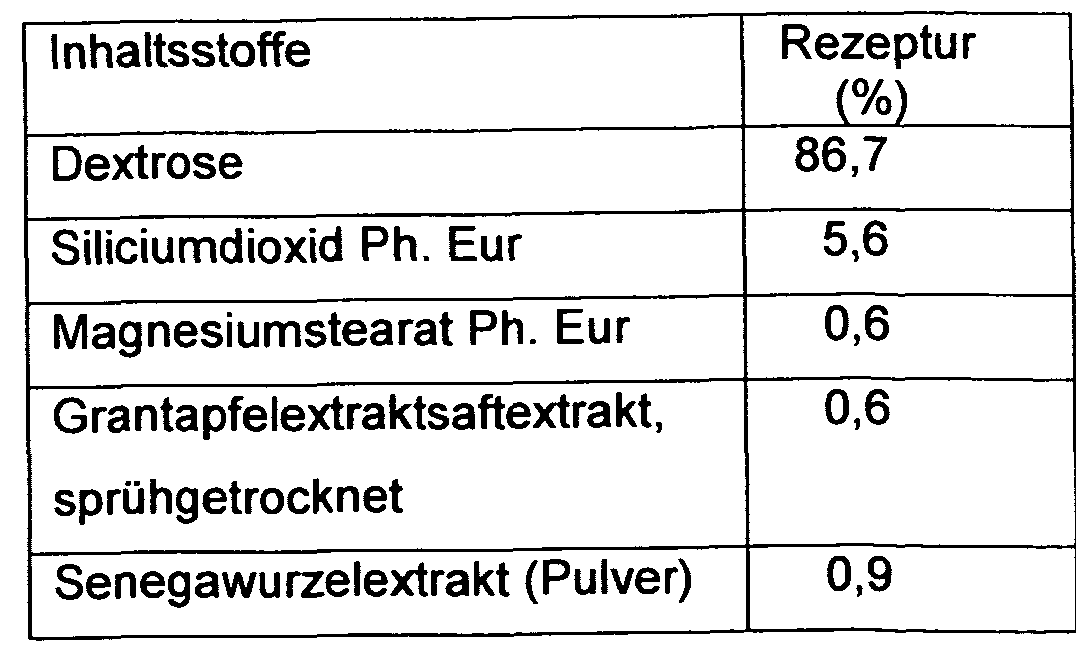
Weizenprotein, Pulver, mittl. 0,9 MW 4,5 kDa Wheat protein, powder, avg. 0.9 MW 4.5 kDa
Restfeuchte 1 ,7 Residual moisture 1, 7
Gesamtmenge 100 % Total amount 100%
Beispiel 6 Flüssige Darreichungsform: Tropfen Example 6 Liquid dosage form: drops
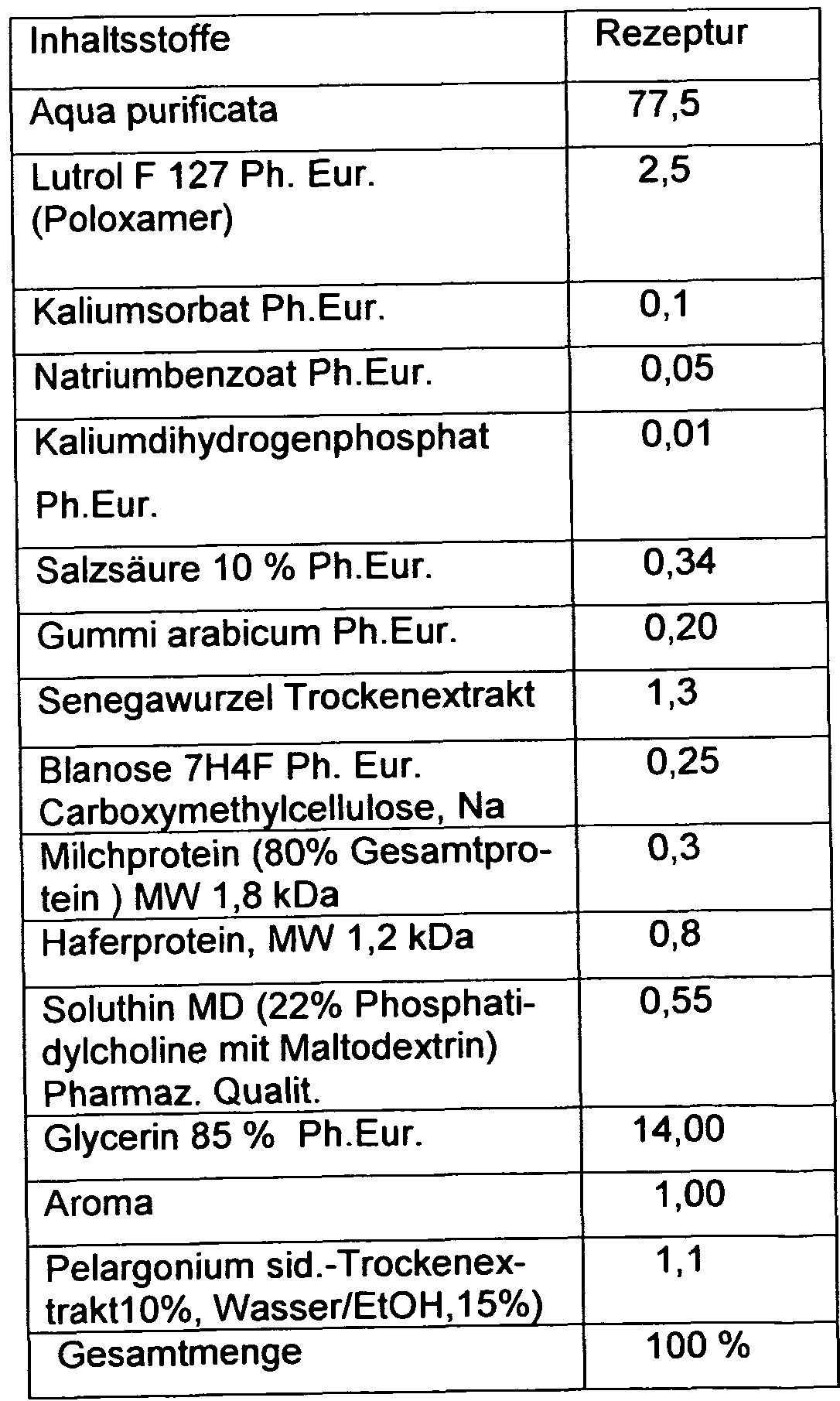

;l 8 Flüssige Darreichungsform: Saft ; l 8 Liquid dosage form: juice

Soluthin MD (22 % Phospha- 0,56 didylcholine mit Maltodextrin) Soluthin MD (22% phosphine-0.56 didylcholine with maltodextrin)
Pharmaz. Qualit. Pharmaceutical Industry. Quality.
Kaliumdihydrogenphosphat 0,01 Ph.Eur. Potassium dihydrogen phosphate 0.01 Ph. Eur.
Salzsäure 10 % Ph. Eur. 0,52 Hydrochloric acid 10% Ph. Eur. 0,52
Gummi arabicum Ph. Eur. 0,07Gum arabic Ph. Eur. 0,07
Glucosesirup 70 % Ph. Eur. 53,00Glucose syrup 70% Ph. Eur. 53,00
Zuckersirup 70% 10,00Sugar syrup 70% 10.00
Glycerin 85 % Ph. Eur. 4,00Glycerine 85% Ph. Eur. 4,00
Aroma (Anisöl) 1 ,2Aroma (aniseed oil) 1, 2
Aroma (Orangenöl) 1 ,1Aroma (orange oil) 1, 1
Honig hell (Speisehonig, DAB) 10,00Honey bright (Diseño honey, DAB) 10.00
Gesamtmenge 100 g/% Total amount 100 g /%
Beispiel 9 Flüssige Darreichungsform: Saft Example 9 Liquid Dosage Form: Juice

Zuckersirup 70% 10,00 Sugar syrup 70% 10.00
Glycerin 85 % Ph. Eur. 5,00 Glycerin 85% Ph. Eur. 5,00
Aroma 1 ,00 Aroma 1, 00
Gesamtmenge 100 g/% Total amount 100 g /%
Beispiel 10 Flüssige Darreichungsform: Spray Example 10 Liquid Dosage Form: Spray

* Fluidextrakt, Wasser-Ethanol 50/50 , 70% * Fluid extract, water-ethanol 50/50, 70%
Anwendungsbeispiel 1 1 Application Example 1 1
Eine Testrezeptur TR (Mucobion-Rezeptur) gemäß Beispiel 7, enthaltend 1 % nativen Extrakt aus Rad. Pelarg sid. (umfassend 5 % Gesamtphenolderivate), sowie 0,46 % Protein, je zur Hälfte aus Hafer und Milchprotein (Mucobion-Kombination aus Protein und Phenolderivate enthaltendem Pflanzenstoff) sowie Wasser und Zusatzstoffe wie in Beispiel 7 beschrieben wurde im Hinblick auf die Oberflächenspannung nach der Methode des hängenden Tropfens untersucht und nach der Laplace-Gleichung berechnet. Dabei wird die von der Oberflächenspannung abhängige charakteristische Form eines an einer nach unten gerichteten Kapillare hängenden Tropfens geometrisch vermessen. A test formula TR (Mucobion recipe) according to Example 7, containing 1% native extract of Rad. Pelarg sid. (comprising 5% Gesamtphenolderivate), and 0.46% protein, both half of oats and milk protein (Mucobion combination of protein and phenol derivatives containing phytochemical) and water and additives as in Example 7 was investigated with respect to the surface tension by the hanging drop method and calculated according to the Laplace equation. In the process, the surface tension-dependent characteristic shape of a drop hanging from a downwardly directed capillary is geometrically measured.
Im vorliegenden Experiment, welche bei 20° C durchgeführt wurde, wurde das Meßgerät Easy Drop der Fa. Krüss verwendet. Die zu untersuchenden Testproben (Wasser, Speichel, Testrezeptur TR) wurden halbautomatisch in die Kanüle aufgezogen. An der Kapillare D=1 ,814 mm wurde durch Herausdrücken der Probenflüssigkeit ein Tropfen gebildet und mit Hilfe der Kamera optisch erfasst. Nach Erkennung einer korrekten Tropfenkontur durch die Software wurde die Oberflächenspannung durch diese automatisch berechnet. In the present experiment, which was carried out at 20 ° C, the measuring device Easy Drop from Krüss was used. The test samples to be examined (water, saliva, test formulation TR) were semi-automatically drawn into the cannula. At the capillary D = 1.814 mm, a drop was formed by pushing out the sample liquid and optically detected with the aid of the camera. Upon detection of a correct drop contour by the software, the surface tension was automatically calculated by them.
Als Referenz-Standard diente einerseits die Oberflächenspannung von Wasser, da die Schleimschicht ganz überwiegend (96-99%) aus Wasser besteht. Als Vergleichs- Standard diente die Oberflächenspannung für Speichel, da Speichel ein wesentliche Komponente des Schleims der Mund- und Rachenhöhle ist. On the one hand, the surface tension of water served as a reference standard, since the mucus layer predominantly consists (96-99%) of water. As a comparison standard, the surface tension was for saliva, since saliva is an essential component of the mucus of the oral and pharyngeal cavity.
Die Ergebnisse sind in nachfolgender Tabelle 1 angegeben: The results are given in Table 1 below:
Tabelle 1 Table 1

Anwendungsbeispiel 12 Application Example 12
Nach der oben beschriebenen Methode wurde die Oberflächenspannung die Testrezeptur TR bei 20°C in unterschiedlichen Verdünnungen ermittelt und sowohl arithmetisch als auch als logarithmischer Wert berechnet. Using the method described above, the surface tension of the test formulation TR was determined at 20 ° C at different dilutions and calculated both arithmetically and as a logarithmic value.
Die Ergebnisse sind in den Abbildungen 1 (arithmetisch) und 2 (logarithmisch) dargestellt. Wie hieraus ersichtlich, wird erst ab einer 700- fachen Verdünnung der Testrezeptur die Oberflächenspannung von Speichel erreicht. Diese Meßdaten belegen die Tatsache, dass durch die erfindungsgemäße Mucobion- Rezeptur die Oberflächenspannung der Schleimschicht erniedrigt wird, was unmittelbar zu einer verbesserten Schleimmotilität führt. Dadurch kann der Abtransport von Schadpartikeln erleichtert werden. The results are shown in Figures 1 (arithmetic) and 2 (logarithmic). As can be seen, the surface tension of saliva is reached only from a 700-fold dilution of the test formulation. These data confirm the fact that the surface tension of the mucus layer is lowered by the Mucobion formulation according to the invention, which leads directly to improved Schleimmotilität. As a result, the removal of harmful particles can be facilitated.
Gleichzeitig sind die phenolischen Verbindungen in der Mucobion-Rezeptur bereits durch die Proteine abgesättigt, so dass keine unerwünschten pharmakologischen immunologischen oder metabolischen Wechselwirkungen mit den Zellproteinen der Schleimhaut auftreten können. At the same time, the phenolic compounds in the mucobion formulation are already saturated by the proteins, so that no undesirable pharmacological immunological or metabolic interactions with the cell proteins of the mucosa can occur.
Darüber hinaus zeigt auch das Verdünnungsexperiment, dass die Rezeptur über einen breiten Konzentrationsbereich einsetzbar ist, bzw. dass der überraschende Effekt auf die Mucobion-Kombination zurückzuführen ist. In addition, the dilution experiment shows that the formulation can be used over a wide concentration range, or that the surprising effect is due to the Mucobion combination.
Claims


Priority Applications (6)
| Application Number | Priority Date | Filing Date | Title |
|---|---|---|---|
| EP13704360.0A EP2817002B1 (en) | 2012-02-20 | 2013-02-12 | Combination of lipid transfer proteins and plant matter containing phenol derivatives with local mucosal efficiency |
| SI201331187T SI2817002T1 (en) | 2012-02-20 | 2013-02-12 | Combination of lipid transfer proteins and plant matter containing phenol derivatives with local mucosal efficiency |
| LTEP13704360.0T LT2817002T (en) | 2012-02-20 | 2013-02-12 | Combination of lipid transfer proteins and plant matter containing phenol derivatives with local mucosal efficiency |
| HRP20181511TT HRP20181511T1 (en) | 2012-02-20 | 2013-02-12 | COMBINATION OF LIPID TRANSFERABLE PROTEINS AND VEGETABLE SUBSTANCES CONTAINING Phenol DERIVATIVES WITH EFFECT ON LOCAL TREATMENT |
| RS20181130A RS57697B1 (en) | 2012-02-20 | 2013-02-12 | Combination of lipid transfer proteins and plant matter containing phenol derivatives with local mucosal efficiency |
| PL13704360T PL2817002T3 (en) | 2012-02-20 | 2013-02-12 | Combination of lipid transfer proteins and plant matter containing phenol derivatives with local mucosal efficiency |
Applications Claiming Priority (2)
| Application Number | Priority Date | Filing Date | Title |
|---|---|---|---|
| DE102012003286.2 | 2012-02-20 | ||
| DE102012003286A DE102012003286A1 (en) | 2012-02-20 | 2012-02-20 | Combination of lipid transfer proteins and phenol derivatives containing plant substances with local mucosal efficiency |
Publications (1)
| Publication Number | Publication Date |
|---|---|
| WO2013124041A1 true WO2013124041A1 (en) | 2013-08-29 |
Family
ID=47715975
Family Applications (1)
| Application Number | Title | Priority Date | Filing Date |
|---|---|---|---|
| PCT/EP2013/000410 Ceased WO2013124041A1 (en) | 2012-02-20 | 2013-02-12 | Combination of lipid transfer proteins and plant matter containing phenol derivatives with local mucosal efficiency |
Country Status (8)
| Country | Link |
|---|---|
| EP (1) | EP2817002B1 (en) |
| DE (1) | DE102012003286A1 (en) |
| HR (1) | HRP20181511T1 (en) |
| LT (1) | LT2817002T (en) |
| PL (1) | PL2817002T3 (en) |
| RS (1) | RS57697B1 (en) |
| SI (1) | SI2817002T1 (en) |
| WO (1) | WO2013124041A1 (en) |
Cited By (1)
| Publication number | Priority date | Publication date | Assignee | Title |
|---|---|---|---|---|
| EP3451341A1 (en) | 2017-08-31 | 2019-03-06 | Siemens Healthcare GmbH | Uploading a data record to a cloud repository |
Families Citing this family (2)
| Publication number | Priority date | Publication date | Assignee | Title |
|---|---|---|---|---|
| EP2908835B1 (en) | 2012-10-18 | 2017-04-26 | Montero Gida Sanayi Ve Ticaret A.S. | Stable formulations |
| CN114760976A (en) | 2019-12-16 | 2022-07-15 | 高露洁-棕榄公司 | Oral care composition containing inulin |
Citations (7)
| Publication number | Priority date | Publication date | Assignee | Title |
|---|---|---|---|---|
| EP0303227A1 (en) * | 1987-08-14 | 1989-02-15 | Boehringer Mannheim Italia S.P.A. | Ethers and thioethers having therapeutical activity, their preparation and pharmaceutical compositions containing them |
| EP0620979A1 (en) | 1993-02-09 | 1994-10-26 | The Quaker Oats Company | Process for preparing a low fat, transparent, stable oat protein containing aqueous solution and product thereof |
| US5776470A (en) | 1988-05-06 | 1998-07-07 | Schmidt; Karlheinz | Method of using lipid transfer proteins and lipids to reconstitute membranes |
| EP1635776A1 (en) | 2003-05-28 | 2006-03-22 | Merz Pharma GmbH & Co. KGaA | Lipidic protein-transfer systems and cosmetic/dermatological use thereof |
| WO2007059836A2 (en) | 2005-11-28 | 2007-05-31 | Merz Pharma Gmbh & Co. Kgaa | Compositions containing proteins for the transfer/recycling of structurally modified lipids, and the applications thereof |
| EP1829548A1 (en) * | 2006-03-01 | 2007-09-05 | Divapharma Chur AG | Use of Pelargonium sidoides extracts in combination with Plantago lanceolata extracts for the preparation of a medicament for the treatment of pharyngitis |
| WO2010003472A2 (en) | 2008-06-30 | 2010-01-14 | Maria Clementine Martin Klosterfrau Vertriebsgesellschaft Mbh | Lozenge composition for treating inflammatory diseases of the mouth and pharynx |
-
2012
- 2012-02-20 DE DE102012003286A patent/DE102012003286A1/en not_active Withdrawn
-
2013
- 2013-02-12 WO PCT/EP2013/000410 patent/WO2013124041A1/en not_active Ceased
- 2013-02-12 LT LTEP13704360.0T patent/LT2817002T/en unknown
- 2013-02-12 PL PL13704360T patent/PL2817002T3/en unknown
- 2013-02-12 HR HRP20181511TT patent/HRP20181511T1/en unknown
- 2013-02-12 SI SI201331187T patent/SI2817002T1/en unknown
- 2013-02-12 RS RS20181130A patent/RS57697B1/en unknown
- 2013-02-12 EP EP13704360.0A patent/EP2817002B1/en active Active
Patent Citations (8)
| Publication number | Priority date | Publication date | Assignee | Title |
|---|---|---|---|---|
| EP0303227A1 (en) * | 1987-08-14 | 1989-02-15 | Boehringer Mannheim Italia S.P.A. | Ethers and thioethers having therapeutical activity, their preparation and pharmaceutical compositions containing them |
| US5776470A (en) | 1988-05-06 | 1998-07-07 | Schmidt; Karlheinz | Method of using lipid transfer proteins and lipids to reconstitute membranes |
| EP0620979A1 (en) | 1993-02-09 | 1994-10-26 | The Quaker Oats Company | Process for preparing a low fat, transparent, stable oat protein containing aqueous solution and product thereof |
| EP1635776A1 (en) | 2003-05-28 | 2006-03-22 | Merz Pharma GmbH & Co. KGaA | Lipidic protein-transfer systems and cosmetic/dermatological use thereof |
| WO2007059836A2 (en) | 2005-11-28 | 2007-05-31 | Merz Pharma Gmbh & Co. Kgaa | Compositions containing proteins for the transfer/recycling of structurally modified lipids, and the applications thereof |
| EP1829548A1 (en) * | 2006-03-01 | 2007-09-05 | Divapharma Chur AG | Use of Pelargonium sidoides extracts in combination with Plantago lanceolata extracts for the preparation of a medicament for the treatment of pharyngitis |
| EP1829548B1 (en) | 2006-03-01 | 2009-02-04 | Divapharma Chur AG | Use of Pelargonium extracts in combination with Plantago for the preparation of a medicament for the treatment of pharyngitis |
| WO2010003472A2 (en) | 2008-06-30 | 2010-01-14 | Maria Clementine Martin Klosterfrau Vertriebsgesellschaft Mbh | Lozenge composition for treating inflammatory diseases of the mouth and pharynx |
Non-Patent Citations (8)
| Title |
|---|
| BASF: "Lutrol L and Lutrol F-Grades", April 2010 (2010-04-01), XP002695043, Retrieved from the Internet <URL:http://www.pharma-ingredients.basf.com/Statements/Technical%20Informations/EN/Pharma%20Solutions/03_100102e_Lutrol%20L%20and%20Lutrol%20F-Grades.pdf> [retrieved on 20130409] * |
| CHAND N ET AL: "Mucolytic activity of azelastine in mice and rats", AGENTS AND ACTIONS, vol. 38, no. 3-4, 1 March 1993 (1993-03-01), BIRKHAEUSER VERLAG, BASEL, CH, pages 165 - 170, XP009168549, ISSN: 0065-4299 * |
| D. ZILVERSMIT, JOURNAL OF LIPID RESEARCH, vol. 25, 1984, pages 1563 - 1569 |
| J.C. KADER, TRENDS IN PLANT SCIENCE, vol. 2, February 1997 (1997-02-01), pages 1330 - 35 |
| NATALE SANTAGATI ET AL: "Simultaneous determination of catechins, rutin, and gallic acid in Cistus species extracts by HPLC with diode array detection.", JOURNAL OF CHROMATOGRAPHIC SCIENCE, vol. 46, no. 2, 1 February 2008 (2008-02-01), pages 150 - 156, XP055058859, ISSN: 0021-9665 * |
| NICHOLS, J.W.; PAGANO R.E., J. BIOL. CHEM., vol. 258, 1983, pages 5368 - 5371 |
| SIMONETTA CAIRA, ROSA PIZZANO, GIANLUCA PICARIELLO, GABRIELLA PINTO, MARINA CUOLLO, LINA CHIANESE AND FRANCESCO ADDEO: "Allergenicity of Milk Proteins", September 2012 (2012-09-01), pages 173 - 214, XP002695044, ISBN: 978-953-51-0743-9, Retrieved from the Internet <URL:http://www.intechopen.com/books/milk-protein/allergenicity-of-milk-proteins> [retrieved on 20130409], DOI: 10.5772/52086 * |
| ZOCCATELLI, G. ET AL., J. AGRIC. FOOD CHEM., vol. 55, 2007, pages 11057 - 11062 |
Cited By (3)
| Publication number | Priority date | Publication date | Assignee | Title |
|---|---|---|---|---|
| EP3451341A1 (en) | 2017-08-31 | 2019-03-06 | Siemens Healthcare GmbH | Uploading a data record to a cloud repository |
| WO2019042719A1 (en) | 2017-08-31 | 2019-03-07 | Siemens Healthcare Gmbh | Uploading a data record to a cloud repository |
| US11636929B2 (en) | 2017-08-31 | 2023-04-25 | Siemens Healthcare Gmbh | Uploading a data record to a cloud repository |
Also Published As
| Publication number | Publication date |
|---|---|
| EP2817002B1 (en) | 2018-06-27 |
| EP2817002A1 (en) | 2014-12-31 |
| PL2817002T3 (en) | 2018-12-31 |
| SI2817002T1 (en) | 2018-11-30 |
| DE102012003286A8 (en) | 2013-10-31 |
| DE102012003286A1 (en) | 2013-08-22 |
| RS57697B1 (en) | 2018-12-31 |
| LT2817002T (en) | 2018-09-25 |
| HRP20181511T1 (en) | 2018-11-02 |
Similar Documents
| Publication | Publication Date | Title |
|---|---|---|
| DE69803099T2 (en) | COMPOSITION FOR THE TREATMENT OF SMELLING BREATH | |
| DE102008034944B4 (en) | microemulsion | |
| DE69532469T2 (en) | Adhesion-inhibiting vaccine extract | |
| WO2000012107A1 (en) | Composition containing pyrrolizidine-alkaloid-free petasites | |
| EP2293805B1 (en) | Lozenge composition for treating inflammatory diseases of the mouth and pharynx | |
| DE212016000151U1 (en) | Composition with mangosteen bark extract for the treatment of skin diseases | |
| DE3603576A1 (en) | USE OF TANNING SUBSTANCES AND / OR CHLOROIC ACID AND FOOD, ENJOYMENT AND / OR MEDICINAL PRODUCTS WITH ADDITIVES OF TANNING AGENT AND / OR CHLOROGENIC ACID | |
| EP2367557B1 (en) | Composition for the treatment of inflammatory diseases of the oral and pharyngeal cavity | |
| EP2817002B1 (en) | Combination of lipid transfer proteins and plant matter containing phenol derivatives with local mucosal efficiency | |
| DE102009005865A1 (en) | Dosing unit and composition for the treatment of inflammatory diseases of the oropharynx | |
| DE60113291T2 (en) | Preparations for the treatment of allergic symptoms and their preparation method | |
| EP1829548A1 (en) | Use of Pelargonium sidoides extracts in combination with Plantago lanceolata extracts for the preparation of a medicament for the treatment of pharyngitis | |
| EP2821060B1 (en) | Cosmetic cooling gel | |
| EP1871340B1 (en) | Anti-irritating cough mixture containing extracts from island moss and mallow as well as zinc derivatives | |
| CN112716840A (en) | Composition for inhibiting helicobacter pylori, preparation method and application thereof | |
| DE202006011920U1 (en) | Composition for the treatment of rhinitis | |
| WO2017088992A1 (en) | Composition for the treatment of colds and allergies | |
| EP3299026A1 (en) | Extracts made from seeds of aframomum species and their use | |
| EP1530971B1 (en) | Composition for the treatment of tooth and gum diseases | |
| DE10357110B4 (en) | Composition for the treatment of dental and gum diseases | |
| WO2011134667A2 (en) | Selected plant extract hydrolysates, and antibacterial agent containing the same | |
| DE19746284A1 (en) | Reducing odor of camomile extract or oil by cyclodextrin treatment, useful in pharmaceuticals and/or cosmetics having antiinflammatory activity | |
| EP4598368A1 (en) | Composition for increasing a cognitive skill | |
| EP2591791A1 (en) | Bulbine frutescens plant sap | |
| CH699169B1 (en) | A pharmaceutical composition comprising Canscora. |
Legal Events
| Date | Code | Title | Description |
|---|---|---|---|
| 121 | Ep: the epo has been informed by wipo that ep was designated in this application |
Ref document number: 13704360 Country of ref document: EP Kind code of ref document: A1 |
|
| WWE | Wipo information: entry into national phase |
Ref document number: 2013704360 Country of ref document: EP |
|
| NENP | Non-entry into the national phase |
Ref country code: DE |