WO2013052759A1 - A non-aerosol foaming alcohol hand sanitizer - Google Patents
A non-aerosol foaming alcohol hand sanitizer Download PDFInfo
- Publication number
- WO2013052759A1 WO2013052759A1 PCT/US2012/058892 US2012058892W WO2013052759A1 WO 2013052759 A1 WO2013052759 A1 WO 2013052759A1 US 2012058892 W US2012058892 W US 2012058892W WO 2013052759 A1 WO2013052759 A1 WO 2013052759A1
- Authority
- WO
- WIPO (PCT)
- Prior art keywords
- present
- alcohol
- peg
- composition
- amounts ranging
- Prior art date
- Legal status (The legal status is an assumption and is not a legal conclusion. Google has not performed a legal analysis and makes no representation as to the accuracy of the status listed.)
- Ceased
Links
Classifications
-
- A—HUMAN NECESSITIES
- A01—AGRICULTURE; FORESTRY; ANIMAL HUSBANDRY; HUNTING; TRAPPING; FISHING
- A01N—PRESERVATION OF BODIES OF HUMANS OR ANIMALS OR PLANTS OR PARTS THEREOF; BIOCIDES, e.g. AS DISINFECTANTS, AS PESTICIDES OR AS HERBICIDES; PEST REPELLANTS OR ATTRACTANTS; PLANT GROWTH REGULATORS
- A01N31/00—Biocides, pest repellants or attractants, or plant growth regulators containing organic oxygen or sulfur compounds
- A01N31/02—Acyclic compounds
-
- A—HUMAN NECESSITIES
- A01—AGRICULTURE; FORESTRY; ANIMAL HUSBANDRY; HUNTING; TRAPPING; FISHING
- A01N—PRESERVATION OF BODIES OF HUMANS OR ANIMALS OR PLANTS OR PARTS THEREOF; BIOCIDES, e.g. AS DISINFECTANTS, AS PESTICIDES OR AS HERBICIDES; PEST REPELLANTS OR ATTRACTANTS; PLANT GROWTH REGULATORS
- A01N25/00—Biocides, pest repellants or attractants, or plant growth regulators, characterised by their forms, or by their non-active ingredients or by their methods of application, e.g. seed treatment or sequential application; Substances for reducing the noxious effect of the active ingredients to organisms other than pests
- A01N25/16—Foams
-
- A—HUMAN NECESSITIES
- A61—MEDICAL OR VETERINARY SCIENCE; HYGIENE
- A61P—SPECIFIC THERAPEUTIC ACTIVITY OF CHEMICAL COMPOUNDS OR MEDICINAL PREPARATIONS
- A61P17/00—Drugs for dermatological disorders
-
- A—HUMAN NECESSITIES
- A61—MEDICAL OR VETERINARY SCIENCE; HYGIENE
- A61P—SPECIFIC THERAPEUTIC ACTIVITY OF CHEMICAL COMPOUNDS OR MEDICINAL PREPARATIONS
- A61P31/00—Antiinfectives, i.e. antibiotics, antiseptics, chemotherapeutics
- A61P31/02—Local antiseptics
-
- A—HUMAN NECESSITIES
- A61—MEDICAL OR VETERINARY SCIENCE; HYGIENE
- A61P—SPECIFIC THERAPEUTIC ACTIVITY OF CHEMICAL COMPOUNDS OR MEDICINAL PREPARATIONS
- A61P31/00—Antiinfectives, i.e. antibiotics, antiseptics, chemotherapeutics
- A61P31/04—Antibacterial agents
Definitions
- This invention is directed to alcohol-based hand sanitizers, in particular to non-aerosol foaming hand sanitizers having high alcohol content, enhanced and prolonged antimicrobial efficacy and tolerance for organic loads and dilution, and excellent residual activity.
- the invention is also directed to a foaming, high alcohol content hand saniiizer having superior moisturization and aesthetic skin feel properties.
- Hand sanitizing products including those that are alcohol-based, are known in the art.
- high alcohol content sanitizers include U.S. Patent No. 6,723,889, which describes an emollient antimicrobial composition comprising high alcohol content (60-95 wt.%), preservatives, a cationic cellulose polymer thickening agent, and silicone-based moisturizers and emollients, useful as a hand healthcare preparation or a pre-surgicai scrub; U.S. Patent Nos.
- alcohol-based products comprise thickening agents or emollients that increase the viscosity of the composition, in order to lower the alcohol evaporation rate and increase the exposure time that the alcohol is present on the skin.
- thickened compositions often result in a less than optimal aesthetic skin feel in use or upon rinsing. Prolonged contact of high alcohol content may also dry and irritate the skin, and thickeners may trap dead skin and bacteria on the surface of the skin.
- Alcohol-based antimicrobial compositions that provide prolonged and enhanced activity against various microorganisms without the need for additional antimicrobial agents have been described in the art.
- United States Patent Nos. 7,268,165 B2 and 7,985,773 B2 both to Greten et al., STERIS Corporation
- antimicrobial compositions comprising a synergistic combination of a simple aliphatic alcohol and an activity enhancing substance (an aromatic alcohol or cationic substrate binding compound) that provides unexpected and persistent activity against a broad range of microorganisms, while, at th same time, moisturizing the skin.
- additional antimicrobials may be added as an option, they are not required in order to provide enhanced and prolonged antimicrobial effect.
- the Greten et al. compositions are stated to be useful as hand sanitizers or pre-surgicai scrubs, but are not foaming compositions.
- Foaming alcohol sanitizers have been commercially available for many years, especially in healthcare settings. Traditionally, most foaming alcohol sanitizers used propelSant-based, i.e., aerosol, technologies to create and stabilize foam, and these products are still widely used in this market. However, due to recent concerns about disposal of propelSant systems, environmental sustainability, various safety issues, and regulatory scrutiny, non-aerosol, .alcohol-based products have recently found their way into the market as replacements for aerosol products.
- non-aerosol, alcohol-based foaming hand sanitizers utilize either fluorosurfactant or linear silicone surfactant chemistries to lower the surfac tension of the alcohol system to a level that creates foam in an alcohol-rich environment. Most of these products have poor moisturizatton and aesthetic properties, when dispensed through an appropriate dispenser (mechanical).
- U.S. Patent No. 7,723,279 describes a foaming non-aerosol, alcohol-based composition comprising polymeric fluorosurfactants as foaming agents
- U.S. Patent No. 7,683,018 describes a foaming non-aerosol, alcohol-based composition comprising anionic phosphate fluorosurfactants as the primary foaming agent.
- Other compositions are commercially available that utilize fluorinated surface active agents.
- Non-aerosol, alcohol-based compositions utilize silicone-hased compounds either as the sole foaming surfactant or in conjunction with fluorosurfactants or other surfactants,
- Some examples include: U.S. Patent Nos. 8,053,399, which discloses a foaming composition containing very little water that comprises the dimethicone copolyols PEG-10 dimethicone, PEG- 12 dimethicone, or mixtures thereof; 7,670,815 (polysifoxane-pofyether copolymers, such as, for example, a bis PEG-PFG-2Q/20 dimethicone); 7,651 ,990 (dimethicones and dimethicone copolyols with PEO and PPO side chains); 7,186,416 (polyoxyethyiene ethers, esters, fatty acids, sulfated acids, sulfosuccinafes, polystloxane, sorbitan fatty acid
- non-aerosol alcohol foam systems are very sensitive to excipient ingredients that could normally be used to enhance other attributes, specifically moisturization and overall feel.
- Alcohol sanitizers due to the high level of alcohol required for acceptable microbial efficacy, can be inherently drying to the skin.
- Standard alcohol ge!s or liquids often contain water-insoluble, but alcohol soluble (or miscible) ingredients (such as occlusive agents) to improve overall moisturization benefits.
- these ingredients due to the complex foam structure of alcohol-water mixtures, these ingredients often have a very significant negative impact on foam generation, quality and stability. Hence, ingredient selection may be limited.
- ingredient selection can also impact the microbial efficacy of the system. Though high levels of alcohol have good immediate efficacy against a broad range of microorganisms, due to its volatile nature, little prolonged microbial activity can be achieved without the addition of ingredients that either help retard the evaporation rate and/or bind to the skin. However, most ingredients traditionally used for this (e.g., cellulosic thickeners, high molecular weight occlusive agents) cannot be used in non-aerosol foam products.
- the CDC Guidelines for Hand Hygiene in Health Care Settings include recommendations for increased use of alcohol-based sanitizing products and, at the sam time, express significant concern with skin health issues resulting from their use.
- Alcohol-based sanitizing products are often used on hands that do not have a visible organic load; however, many currently available products are negatively impacted by both the presence of any organic load, even that not clearl visible, and dilution, in order to leverage the CDC guidelines properly and provide a product that also has enhanced moisturization capabilities that are equivalent or superior to current alcohol-based foam sanitizers, an alcohol- based foam sanitizer having efficacy and enhanced skin care properties in the presence of organic load and on repeated application is needed.
- the Tentative Final Monograph for Health-Care Antiseptic Drug Products sets forth the FDA criteria necessary to mak the claim of "Healthcare Personnel Handwash.” It is believed that when the tentative monograph issues as a final version, the criteria outlined in the tentative version will remain. For example, the Healthcare Personnel Handwash Test outlined in the tentative monograph establishes criteria that require a 2 log (base 10) reduction in bacteria after the first application and a 3 log reduction in bacteria after the tenth application. Because of the high inoculums and organic load present in the required methodology, not all alcohol-based sanitizing products can meet these criteria, especially after the tenth application and, in fact, may actually demonstrate a decrease in log reduction when compared to the first application.
- a novel non-aerosoi alcohol foam sanitize r has been discovered that resolves the disadvantages of current alcohol-based foam sanitizers and that will meet and exceed the criteria for a Healthcare Personnel Handwash claim.
- the invention is a non-aerosoi alcohol foam hand sanitizer that comprises a novel siitcone-dimer reaction product which, in combination with known components, resolves several issues encountered with alcohol-based sanitizing products in the past.
- the inventive composition provides both the necessary surface tension reduction to allow a high alcohol system to foam without the use of propej.iants and aids in improving moisturization and aesthetic skin feel properties of the final product.
- the system contains certain ingredients previously known to enhance and prolong aniimicrobial efficacy in combination with moisturizing components, but also contains novel components, not used heretofore, that provide unexpectedly high-quality, stable foam and excelient moisturizing and skin feel properties over current commercially available products,
- the inventive composition contains a high level of an aliphatic alcohol, a silicone based surfactant system comprising a novel silicone dimer reaction product, i.e., bis-PEG-10 dimethicone/dimer diiinoieate, PEG-T7 dimethicone, or mixtures of both; activity enhancing substances, including an aromatic alcohol, a cationic substrate binding component, or mixtures thereof; a pQiyquaternium component; a blend of humectant ingredients; a cationic surfactant(s); and water-soluble emollient ingredients, all in an aqueous base.
- the composition is efficacious against a broad range of microorganisms, including gram- negative organisms.
- the composition meets the Healthcare Personnel Handwash guidelines at both one and ten applications, based on the criteria set forth in the Tentative Final Monograph for Health-Care Antiseptic Drug Products (1994, 21 CFR Parts 333 and 369).
- the final inventive compositions have unexpectedly superior moistunzaiion and aesthetic feel characteristics, making it more likely that they will he used multiple times throughout the course of the day.
- the aesthetics of the inventive composition are such that the rub-in time, residue and foam properties are similar to current commercially available non-aerosol a!cohol-hased foam products, but with superior after-feel properties.
- the novel inventive compositions combine known and novel components to achieve a non-aerosol, high-alcohol-containing foam hand sanitizer that has excellent antimicrobial properties, with tolerance for organic load and dilution, excellent residual activity, and superior skin conditioning (moisturizing, aesthetic skin - feel) characteristics.
- the composition comprises: an aliphatic alcohol; a silicone- based surfactant; an aromatic alcohol as an activity enhancing substance; a cationic substrate binding activity enhancing substance; a po!yquaternium; a hume.ctant; a cationic surfactant; an emollient; and water. More than one of each type of component may be utilized within the scope of the invention.
- FIG. 1 is a chart demonstrating Skicon Measurements reflecting moisturization characteristics of the inventive compositions.
- FIG. 2 is a chart demonstrating Healthcare Persona! Handwash efficacy of an inventive composition (F) and showing an increased average log reduction as the number of applications of the composition increases.
- FIG. 3 is a chart demonstrating superior moisturization properties of an inventive composition (C) as compared to an untreated control and an existing marketed product, using a NOVA DPM 9003 instrument, which measures relative hydration of the skin.
- FIG. 4 is a chart reflecting results obtained using a pigskin model and an inocuiant, Serratia marcescens, comparing two ethanoi solutions at two different concentrations (N, O) with two inventive formulations having the same ethanoi coneentrations (P, Q) and demonstrating superior log reductions obtained with the inventive formulations compared to ethanoi alone at 1 and 5 inoculation/treatment cycles.
- FIG, 5 is a chart reflecting results obtained using a 5-appIication (inoculation/treatment cycle) pigskin test, comparing an inventive composition (R) with a leading commercial sanitizing product and demonstrating superior efficacy and residual activity of the inventive formulation as compared to a commercial product.
- novel inventive compositions of the invention meet and exceed criteria for a Healthcare Personnel Handwash claim as promulgated by the FDA.
- the invention provides a non-aerosol, foaming high alcohol content hand sanitizing composition with excellent antimicrobial and skin conditioning properties without the disadvantages of currently marketed hand sanitizens.
- the antimicrobial activity of the present inventive compositions are the result of combining high amounts of an aliphatic alcohol, a preservative having known gram-negative activity, and emollients that have antimicrobia! activity of a persistent nature.
- the superior moisturization characteristics ar the result of the addition of known humectants, skin feel agents, and skin conditioners, and surfactants.
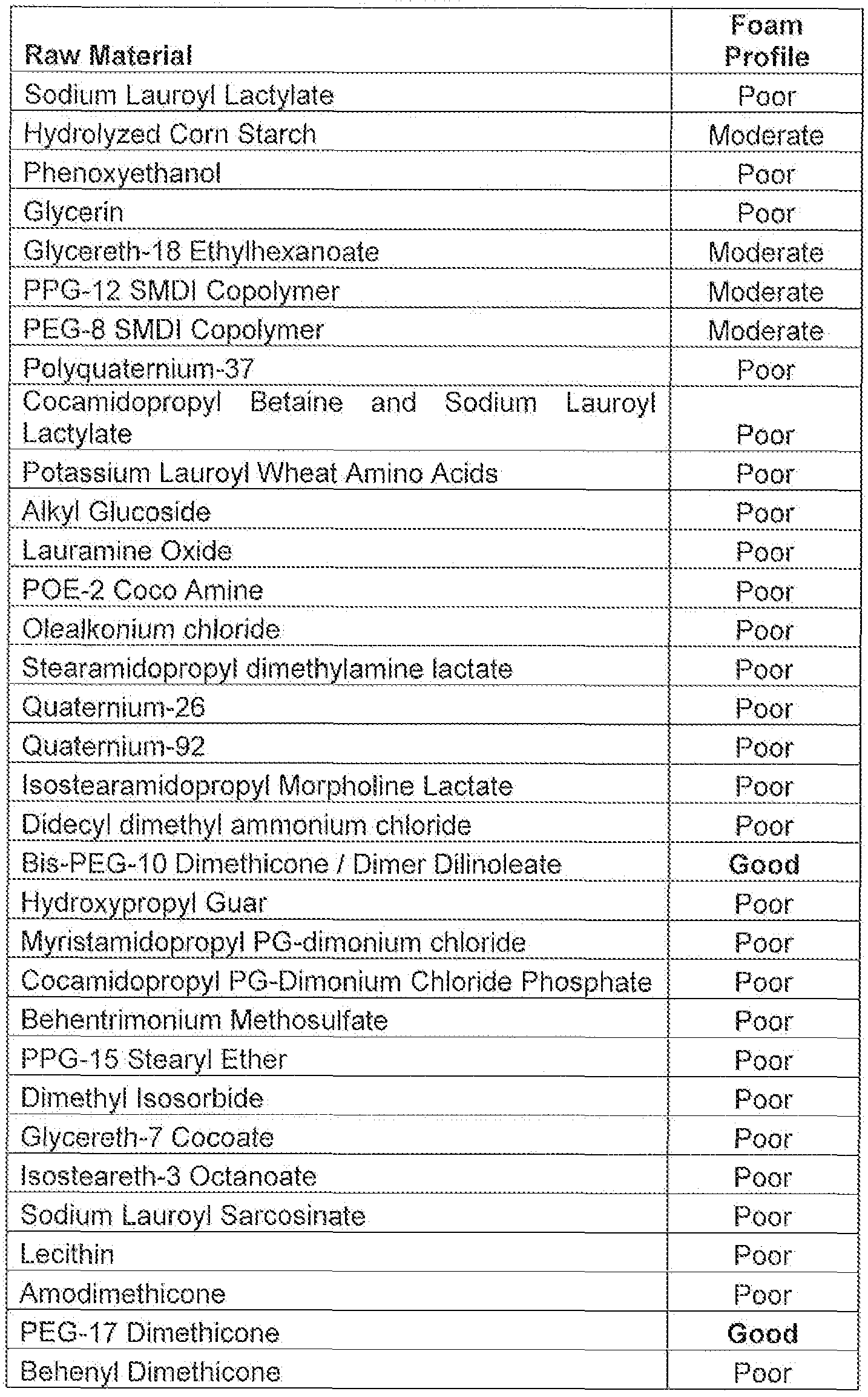
- the key to a non-aerosol foaming alcohol-based hand sanitizer is the amount, quality and stability of the foam produced.
- Skin conditioning agents while desirable and necessary, often affect the amount and qualify of the foam or its stability.
- a key material in the generation and stability of foam in the inventive compositions is a new silicone surfactant, which is a polyester made by the reaction of dimer acid and PEG-10 dimethicone.
- PEG-17 dimethicone has been found to produce unexpectedly large amounts of qualify foam with excellent stability.
- Preferred embodiments of the inventive compositions include: an aliphatic alcohol in amounts ranging from about 50 to about 60 wt.%; a silicone-based surfactant in amounts ranging from about 1 to about 5 wt.%; an activity enhancing component that is an aromatic alcohol or a cationic substrate binding component, or both; skin conditioning agents, such as polyquaternium compounds; humectants; a cationic surfactant; emollients and water.
- Each type of component may be present as a mixture of one or more components of that type.
- the aliphatic alcohol is an active ingredient for the formulation. The alcohol has from 1 to 8 carbon atoms. This component is recognized by the FDA as an antimicrobial ingredient. Ethano!
- Ethanol when used, is 200 proof, and may be Specifically Denatured Alcohol (SDA) 40-B, which utilizes both tert-foutyl alcohol (0.12%) and denatonium benzoate (0.0006%) as denaturants.
- SDA 40-2 Another appropriate alcohol is SDA 40-2, which utilizes both iert-buty! alcohol (0.12%) and brucine sulfate (0.014%),
- SDA 40-2 which utilizes both iert-buty! alcohol (0.12%) and brucine sulfate (0.014%)
- Other SDA alcohols are known to one skilled in the art and are within the scope of this invention.
- Ethanol has broad spectrum activity against bacteria and some viruses and evaporates on rub-in. As such, ethanol is highly preferred, but othe alcohols, including but not limited to butyl, n-propyl and isopropy! alcohol may also be used,
- the aliphatic alcohol is present in amounts greater than about 40 wt.% up to about 85 wt.%; optimally, greater than about 50 wt.% and less than about 70 wt.%, based upon the total weight of the components of the inventive compositions, Preferable ranges are 50-60 wt.%.
- the silicone- based surfactant component is primarily responsible for generating foam in the inventive compositions; however, the surfactants of the present invention surprisingly also add to the aesthetic feel of the product. An unexpectedly large amount of quality, stable foam is generated, even in view of the several skin conditioning/feel agents included in the composition.
- the surfactant comprises bis-PEG-TO dimethicone/dimer dilinoleate, a dimer reaction product.
- ZENESTER ME Zenifech LLC
- Another acceptable silicone-based surfactant is PEG-17 dimethicone, which also produces an unexpectedly large amount of good quality, stable foam in the inventive compositions. This material is provided under the trade name SILSOFT 895 (Momentive Performance Materials, Inc.)
- the silicone-based surfactant component is present in amounts of from about 1.0 wt.% to about 3,0 wt.%, based upon the total weight of the components of the inventive composition.
- the silicone-based surfactant component may be a mixture of the novel bis-PEG-10 dimethicone/dimer di!inoleate or PEG- 17 dimethicone.
- the aromatic alcohol comprises phenoxyethanoi, also known as ethylene glycol monopheny!. ether, it is used as a preservative and provides activity against Gram-negative organism. It is combined in the inventive compositions with other components having antimicrobial activity yielding a broad range of coverage for the inventive compositions.
- phenoxyethanoi also known as ethylene glycol monopheny!. ether
- Other suitable aromatic alcohols include benzyl alcohol and 1 -phenoxy-2-propanoL
- the aromatic alcohol is present in amounts greater than about 0.1 wt.% up to about 5.0 wt.%, optimally, greater than about 0.5 wt.% up to about 3.0 wt.%, based upon the total weight of the components of the inventive composition.
- the cationic substrate binding activity enhancing substance is behenfrimonium methosulfate.
- This emollient is a quaternary ammonium, salt derived from Rapeseed Oil. Its C 2 2 chain length and cationic charge make it substantive to the skin and provide a smooth after-fee! that is aesthetically pleasing to the user. If has some antimicrobial activity as well.
- Other acceptable cationic substrate binding activity enhancing substances include without limitation behenaikonium chloride, behentrimonium chloride, behenoy! PG-trimontum chloride and behenamidopropyl PG-dimonium chloride.
- the cationic substrate binding, activity enhancing substance is present in amounts greater than about 0.01 wt.% up to about 1.0 wt.%; optimally greater than about 0.05 wt.% up to about 0.5 wt.%, based upon the total weight of the components in the system.
- the polyquaternium ingredient preferably comprises po!yquaternium-6.
- This component is a cationic polymer which acts as a skin conditioner. It is the quaternary ammonium salt of acrylamide and dimethyl diallyl ammonium chloride monomers. It aids lubricity while rubbing onto the skin and contributes a soft after- feel.
- Other suitable polyquaternium materials include poiyquaternium-7.
- the po.iyquaternium component ' is present in amounts of about 0.1 wt.% up to about 2.0 wt.%, optimal!y, about 0.1 wt.% to about 1.0 wi%, based upon the total weight of the components of the inventive composition.
- the humectant in the inventive compositions preferably comprises glycerin, a well-known humectant that results in significant impact on moistunzation properties of the inventive compositions, even when used at low levels.
- Another suitable humectant is 2-methyl ⁇ 1,3-propanedioi, which is both a solvent and a humectant.
- the humectants can be used separately, or in combination.
- 2-methyi- 1 ,3-propanediol provides additional humectant properties, while reducing the tacky feel associated with glycerin, so that the combination of these two humectants is desirable.
- humectants usefui in the inventive compositions include propylene glycol, ethylene glycol, butyiene glycol, triethylene glycol, dieihyiene glycol, dipropylene glycol, tripropyiene glycol, hexyiene glycol, sorbitol, dimethyl isosorbide, sodium PGA, and hydrolyzed corn starch hydroxyethyl ether,
- humectants suitable in the present inventive compositions are known to one skilled in the art.
- the humectant components are present in total amounts of about 0.1 wt.% u to about 10.0 wt.%, optimally, about 1.5 wt.% up to about 3.0 wt.%, based upon the total weight of the components of the inventive composition.
- the catiomc surfactant comprises cocamidopropyl PG-dimonium chloride phosphate (known as ARIAS ILK PTC (Croda)) a quaternary ammonium salt derived from coconut oil. Although it is classified as a surfactant, it provides additional skin conditioning properties to the inventive compositions and aids in stabilizing the foam generated by the silicone-based surfactants upon dispensing, eliminating the need for additional foam stabilizing agents.
- Other suitable options include sodium coco PG-dimonium chloride, myristamidopropy!
- the cationic .surfactant is present in amounts of about 0.1 wt.% to 5.0 wt.%, optimally, about 1 .0 wt.% to about 3.0 wt.%, based upon the total weight of the components in the system.
- Emollient ingredients may include, but are not limited to, PEG--45 palm kernel glycerides, cetyl lactate, C 12-1-5 alkyl benzoate, and PE.G-7 glyceryl cocoafe.
- Other emollients are known to those skilled in the art and include but are not limited to cetyl myiistate, glyceryl dioleate, isopropyi myristate, lanolin, methyl laurate, ⁇ - 9 laurate, octyi palmstate, PPG-5 lanoate, and di ⁇ PPG-3 myristyi ether adipate.
- These emollients are skin conditioning agents that help improve rub-in characteristics and aid in the -after-feel aesthetics.
- a combination of emollients may be used,
- Emollients ar present in total amounts of about 0.01 wt.% up to about 5.0 wt.%, optimally, about. 0.01 wt.% up to about 3.0 wt.%, based upon the total weight of the components of the inventive compositions.
- compositions offer significant advantages over prior art compositions in that they provide superior foaming characteristics, without the use of aerosois or fiuorosurfaciants, both of which have negative environmental and toxicity profiles.
- the compositions also provide superior antimicrobial efficacy, both immediate and prolonged, against a wide range of microbes, including but not limited to gram-negative bacteria.
- the inventive compositions possess superio moisturizing characteristics and do not require the use of fragrance.
- inventive compositions may be prepared by simple mixing of components.
- One exemplary process for preparing one embodiment of the inventive compositions is set forth below: Raw Materia! Process
- PEG-45 palm kernel Add with mixing.
- the behentrimonium methosu State is a solid material, and thus, it must be added at a high temperature, so it can melt into the system. After it has melted, other components facilitate bringing it into solution as they are added. The other components can he added in any order (once the batch has cooled to the appropriate temperature), except for the alcohol, which is added last, because if is volatile,
- Example 1 Foam Quality and Stability.
- Each sample was evaluated at two different inoculation/treatment cycles, i.e., at 1 inoculation/treatment and 5 inoculations/treatments. Tests were completed using the pigskin model, the inoculant, Serratia marcescens, and 1 and 5 inoculation/treatment cycles.
- the "pigskin model” is a method designed to simulate a HGPHW test using pigskins prepared according to the method described in U.S. Patent No. 7,985,773 to Greten et a!. , incorporated herein by reference.
- pigskin pairs were inoculated with bacteria, rubbed togethe for 15 seconds, and allowed to air dry for 1 minute.
- the two different ethanol soiutions having concentrations of 62% w/w and 70% w/w and two different product formulations N and O, one having 62% w/w ethano! (N) and the other having 70% w/w ethanol (O), were applied to pairs of pigskins (0.2 ml per pair/ 0.1 ml per piece).
- the pairs of pigskins (having the same treatment) were rubbed together for 30 seconds and allowed to air dry for 4 minutes. Neutralize! was then applied to the pigskins, they were debrided for 30 seconds, serially diluted and plated.
- Results are shown in Figure 4 and show significant log reductions.
- Figure 4 shows that by adding other components of the formulation, such as the activit enhancing substances, efficacy was enhanced over simply using ethanol at the same concentration. The enhancement was seen at 1 application (inoculation/treatment cycle), but was more pronounced at 5 applications, showing excellent tolerance fo organic load and dilution with inoculum. The data showed that ethanol alone did provide efficacy upon initial treatment but the efficacy decreased upon multiple treatments due to the organic load. However, the two formulated systems (P and Q), which contained additional components of the inventive compositions maintained or increased the log-reduction (efficacy) at the fifth application.
- Results in Figure 5 showed thai at a 5 ⁇ application pigskin study, a leading commercially available alcohol-based hand sanitizing foam product had almost no activity, whereas the inventive composition had a 1.5-log reduction, which for this type of pigskin study is expected for a good product that will stand up to organic load and dilution and result in a formulation that will pass FDA criteria for 10 applications in a Healthcare Personnel Handwash test.
- This invention includes the use of a novel silicone surfactant that not only helps generate foam in a system with high amounts of alcohol, but also adds to the overall aesthetic feel and moisturization of the system.
- a novel silicone surfactant that not only helps generate foam in a system with high amounts of alcohol, but also adds to the overall aesthetic feel and moisturization of the system.
- the addition of other Ingredients phenoxyethanol, behentrimonium methosuifate and pofyquaternium-6 provides a system that exceeds the FDA ! s Tentative Final Monograph requirements for Healthcare Personnel Handwash efficacy.
- the inventive compositions show excellent tolerance for organic load and dilution and have excellent residual activity.
- the enhanced emollient system also provides moisturization to the user for hours after application, keeping the skin hydrated.
Landscapes
- Life Sciences & Earth Sciences (AREA)
- Health & Medical Sciences (AREA)
- General Health & Medical Sciences (AREA)
- Engineering & Computer Science (AREA)
- Environmental Sciences (AREA)
- Zoology (AREA)
- Wood Science & Technology (AREA)
- Dentistry (AREA)
- Plant Pathology (AREA)
- Pest Control & Pesticides (AREA)
- Agronomy & Crop Science (AREA)
- Veterinary Medicine (AREA)
- Chemical Kinetics & Catalysis (AREA)
- Public Health (AREA)
- Pharmacology & Pharmacy (AREA)
- Organic Chemistry (AREA)
- Animal Behavior & Ethology (AREA)
- Chemical & Material Sciences (AREA)
- Nuclear Medicine, Radiotherapy & Molecular Imaging (AREA)
- Medicinal Chemistry (AREA)
- General Chemical & Material Sciences (AREA)
- Toxicology (AREA)
- Oncology (AREA)
- Communicable Diseases (AREA)
- Dermatology (AREA)
- Bioinformatics & Cheminformatics (AREA)
- Cosmetics (AREA)
- Medicinal Preparation (AREA)
- Agricultural Chemicals And Associated Chemicals (AREA)
- Acyclic And Carbocyclic Compounds In Medicinal Compositions (AREA)
- Detergent Compositions (AREA)
Abstract
Description


Claims
Priority Applications (7)
| Application Number | Priority Date | Filing Date | Title |
|---|---|---|---|
| CN201280048423.XA CN103889220B (en) | 2011-10-07 | 2012-10-05 | Non-aerosol foaming alcohol hand sanitizer |
| JP2014534752A JP5816758B2 (en) | 2011-10-07 | 2012-10-05 | Non-aerosol foamy alcohol hand sanitizer |
| AU2012318555A AU2012318555B2 (en) | 2011-10-07 | 2012-10-05 | A non-aerosol foaming alcohol hand sanitizer |
| MX2014004111A MX339771B (en) | 2011-10-07 | 2012-10-05 | A non-aerosol foaming alcohol hand sanitizer. |
| EP12838148.0A EP2763530A4 (en) | 2011-10-07 | 2012-10-05 | A non-aerosol foaming alcohol hand sanitizer |
| CA2845010A CA2845010C (en) | 2011-10-07 | 2012-10-05 | A non-aerosol foaming alcohol hand sanitizer |
| BR112014004583A BR112014004583A2 (en) | 2011-10-07 | 2012-10-05 | non-aerosol sparkling alcohol hand sanitizer |
Applications Claiming Priority (4)
| Application Number | Priority Date | Filing Date | Title |
|---|---|---|---|
| US201161544802P | 2011-10-07 | 2011-10-07 | |
| US61/544,802 | 2011-10-07 | ||
| US13/644,677 US9089129B2 (en) | 2011-10-07 | 2012-10-04 | Non-aerosol foaming alcohol hand sanitizer |
| US13/644,677 | 2012-10-04 |
Publications (1)
| Publication Number | Publication Date |
|---|---|
| WO2013052759A1 true WO2013052759A1 (en) | 2013-04-11 |
Family
ID=48042468
Family Applications (1)
| Application Number | Title | Priority Date | Filing Date |
|---|---|---|---|
| PCT/US2012/058892 Ceased WO2013052759A1 (en) | 2011-10-07 | 2012-10-05 | A non-aerosol foaming alcohol hand sanitizer |
Country Status (9)
| Country | Link |
|---|---|
| US (2) | US9089129B2 (en) |
| EP (1) | EP2763530A4 (en) |
| JP (1) | JP5816758B2 (en) |
| CN (1) | CN103889220B (en) |
| AU (1) | AU2012318555B2 (en) |
| BR (1) | BR112014004583A2 (en) |
| CA (1) | CA2845010C (en) |
| MX (1) | MX339771B (en) |
| WO (1) | WO2013052759A1 (en) |
Cited By (3)
| Publication number | Priority date | Publication date | Assignee | Title |
|---|---|---|---|---|
| EP3206487B1 (en) | 2014-10-16 | 2021-12-29 | Schülke & Mayr GmbH | Use of fatty acid ester for improving the antimicrobial efficacy of an alcoholic disinfectant |
| EP4388873A3 (en) * | 2022-12-20 | 2024-08-14 | Bode Chemie GmbH | Hand disinfectant as alcoholic foam |
| EP4216911B1 (en) | 2020-09-25 | 2025-01-22 | Unilever IP Holdings B.V. | Moisturizing antibacterial composition |
Families Citing this family (16)
| Publication number | Priority date | Publication date | Assignee | Title |
|---|---|---|---|---|
| US9357771B2 (en) * | 2012-12-17 | 2016-06-07 | Kimberly-Clark Worldwide, Inc. | Foaming sanitizing formulations and products including a quaternary ammonium compound |
| ES2786084T3 (en) * | 2012-12-24 | 2020-10-08 | Novapharm Res Australia Pty Ltd | Improved antimicrobial compositions |
| US9439841B2 (en) | 2013-06-06 | 2016-09-13 | Ecolab Usa Inc. | Alcohol based sanitizer with improved dermal compatibility and feel |
| CN104082293B (en) * | 2014-07-17 | 2016-06-08 | 魏巍 | A kind of composite alcohol sterilizing agent and its preparation method |
| US20170000711A1 (en) * | 2015-03-24 | 2017-01-05 | The Procter & Gamble Company | Foam compositions, aerosol products, and methods of using the same to improve sensory benefits to the skin |
| US20170000696A1 (en) * | 2015-03-24 | 2017-01-05 | The Procter & Gamble Company | Methods of applying a high dose of a skin care active to skin with improved sensory benefits to the skin |
| WO2017184614A1 (en) | 2016-04-20 | 2017-10-26 | S.C. Johnson & Son, Inc. | Foaming antimicrobial compositions |
| JP6833476B2 (en) * | 2016-11-24 | 2021-02-24 | サンスター株式会社 | Skin and head cleansing composition |
| EP3606343A1 (en) | 2017-04-04 | 2020-02-12 | Gojo Industries Inc | Methods and compounds for increasing virucidal efficacy in hydroalcoholic systems |
| US11116220B2 (en) | 2017-12-22 | 2021-09-14 | Ecolab Usa Inc. | Antimicrobial compositions with enhanced efficacy |
| US11653645B2 (en) | 2018-05-10 | 2023-05-23 | Protair-X Health Solutions Inc. | Foam sanitizer composition |
| US20200078273A1 (en) * | 2018-09-07 | 2020-03-12 | Michael J. McKinnon-Dane | Method and apparatus for removal of contaminants from surfaces |
| AU2021306707B2 (en) * | 2020-07-06 | 2024-06-13 | Ecolab Usa Inc. | Foaming mixed alcohol/water compositions comprising a structured alkoxylated siloxane |
| EP3981249A1 (en) * | 2020-10-08 | 2022-04-13 | Lumendo AG | Sanitising formulation |
| CN113288860A (en) * | 2021-03-11 | 2021-08-24 | 江西车仆实业有限公司 | Convenient and easy-to-produce hand-washing-free disinfection gel and preparation method thereof |
| US20240197588A1 (en) * | 2021-04-21 | 2024-06-20 | Conopco, Inc., D/B/A Unilever | Antimicrobial composition |
Citations (7)
| Publication number | Priority date | Publication date | Assignee | Title |
|---|---|---|---|---|
| US20030069317A1 (en) * | 2001-03-29 | 2003-04-10 | Seitz Earl P. | High efficacy antibacterial compositions having enhanced esthetic and skin care properties |
| US20060039942A1 (en) * | 2004-08-20 | 2006-02-23 | Greten Zachariah C | Enhanced activity alcohol-based antimicrobial compositions |
| US20060275218A1 (en) * | 2003-08-04 | 2006-12-07 | Foamix Ltd. | Foamable vehicle and pharmaceutical compositions thereof |
| US20070065383A1 (en) * | 2005-03-07 | 2007-03-22 | Fernandez De Castro Maria T | High alcohol content foaming compositions with silicone-based surfactants |
| US20090226498A1 (en) * | 2008-03-07 | 2009-09-10 | Kimberly-Clark Worldwide, Inc. | Moisturizing hand sanitizer |
| EP2216010A1 (en) * | 2009-02-05 | 2010-08-11 | Rhodia Opérations | Aqueous composition suitable as shampoo |
| US20110206630A1 (en) * | 2010-02-14 | 2011-08-25 | Ls9, Inc. | Surfactant and cleaning compositions comprising microbially produced branched fatty alcohols |
Family Cites Families (17)
| Publication number | Priority date | Publication date | Assignee | Title |
|---|---|---|---|---|
| US5753130A (en) | 1992-05-15 | 1998-05-19 | Micron Technology, Inc. | Method for forming a substantially uniform array of sharp tips |
| AU715827B2 (en) | 1995-06-22 | 2000-02-10 | Minnesota Mining And Manufacturing Company | Stable hydroalcoholic compositions |
| US5607980A (en) | 1995-07-24 | 1997-03-04 | The Procter & Gamble Company | Topical compositions having improved skin feel |
| JP2002212051A (en) * | 2001-01-24 | 2002-07-31 | Pola Chem Ind Inc | Skin care preparation |
| WO2005018530A2 (en) * | 2003-08-25 | 2005-03-03 | Foamix Ltd. | Penetrating pharmaceutical foam |
| US7186416B2 (en) | 2003-05-28 | 2007-03-06 | Stiefel Laboratories, Inc. | Foamable pharmaceutical compositions and methods for treating a disorder |
| WO2005030917A1 (en) | 2003-09-29 | 2005-04-07 | Ethena Healthcare Inc. | High alcohol content gel-like and foaming compositions |
| US7468384B2 (en) * | 2004-11-16 | 2008-12-23 | Rohm And Haas Company | Microbicidal composition |
| DE102004062775A1 (en) | 2004-12-21 | 2006-06-29 | Stockhausen Gmbh | Alcoholic pump foam |
| US7651990B2 (en) | 2005-06-13 | 2010-01-26 | 3M Innovative Properties Company | Foamable alcohol compositions comprising alcohol and a silicone surfactant, systems and methods of use |
| US20070148101A1 (en) * | 2005-12-28 | 2007-06-28 | Marcia Snyder | Foamable alcoholic composition |
| US8450378B2 (en) * | 2006-02-09 | 2013-05-28 | Gojo Industries, Inc. | Antiviral method |
| US7723279B2 (en) | 2006-08-23 | 2010-05-25 | The Clorox Company | Foamable compositions containing alcohol |
| US8333954B2 (en) * | 2007-04-30 | 2012-12-18 | Kimberly-Clark Worldwide, Inc. | Foamable sanitizing compositions |
| EP2167045B1 (en) * | 2007-06-08 | 2017-08-09 | University of Virginia Patent Foundation | Topical poloxamer formulations for enhancing microvascular flow: compositions and uses thereof |
| US8053399B2 (en) | 2007-08-30 | 2011-11-08 | Kimberly-Clark Worldwide, Inc. | Foamable compositions |
| US7842725B2 (en) | 2008-07-24 | 2010-11-30 | Ecolab USA, Inc. | Foaming alcohol compositions with selected dimethicone surfactants |
-
2012
- 2012-10-04 US US13/644,677 patent/US9089129B2/en active Active
- 2012-10-05 EP EP12838148.0A patent/EP2763530A4/en not_active Withdrawn
- 2012-10-05 CN CN201280048423.XA patent/CN103889220B/en active Active
- 2012-10-05 MX MX2014004111A patent/MX339771B/en active IP Right Grant
- 2012-10-05 BR BR112014004583A patent/BR112014004583A2/en not_active Application Discontinuation
- 2012-10-05 WO PCT/US2012/058892 patent/WO2013052759A1/en not_active Ceased
- 2012-10-05 CA CA2845010A patent/CA2845010C/en active Active
- 2012-10-05 JP JP2014534752A patent/JP5816758B2/en active Active
- 2012-10-05 AU AU2012318555A patent/AU2012318555B2/en active Active
-
2015
- 2015-07-21 US US14/804,632 patent/US20150320041A1/en not_active Abandoned
Patent Citations (7)
| Publication number | Priority date | Publication date | Assignee | Title |
|---|---|---|---|---|
| US20030069317A1 (en) * | 2001-03-29 | 2003-04-10 | Seitz Earl P. | High efficacy antibacterial compositions having enhanced esthetic and skin care properties |
| US20060275218A1 (en) * | 2003-08-04 | 2006-12-07 | Foamix Ltd. | Foamable vehicle and pharmaceutical compositions thereof |
| US20060039942A1 (en) * | 2004-08-20 | 2006-02-23 | Greten Zachariah C | Enhanced activity alcohol-based antimicrobial compositions |
| US20070065383A1 (en) * | 2005-03-07 | 2007-03-22 | Fernandez De Castro Maria T | High alcohol content foaming compositions with silicone-based surfactants |
| US20090226498A1 (en) * | 2008-03-07 | 2009-09-10 | Kimberly-Clark Worldwide, Inc. | Moisturizing hand sanitizer |
| EP2216010A1 (en) * | 2009-02-05 | 2010-08-11 | Rhodia Opérations | Aqueous composition suitable as shampoo |
| US20110206630A1 (en) * | 2010-02-14 | 2011-08-25 | Ls9, Inc. | Surfactant and cleaning compositions comprising microbially produced branched fatty alcohols |
Non-Patent Citations (1)
| Title |
|---|
| See also references of EP2763530A4 * |
Cited By (3)
| Publication number | Priority date | Publication date | Assignee | Title |
|---|---|---|---|---|
| EP3206487B1 (en) | 2014-10-16 | 2021-12-29 | Schülke & Mayr GmbH | Use of fatty acid ester for improving the antimicrobial efficacy of an alcoholic disinfectant |
| EP4216911B1 (en) | 2020-09-25 | 2025-01-22 | Unilever IP Holdings B.V. | Moisturizing antibacterial composition |
| EP4388873A3 (en) * | 2022-12-20 | 2024-08-14 | Bode Chemie GmbH | Hand disinfectant as alcoholic foam |
Also Published As
| Publication number | Publication date |
|---|---|
| CA2845010A1 (en) | 2013-04-11 |
| US9089129B2 (en) | 2015-07-28 |
| CA2845010C (en) | 2017-05-09 |
| EP2763530A4 (en) | 2015-06-03 |
| MX339771B (en) | 2016-06-09 |
| US20150320041A1 (en) | 2015-11-12 |
| AU2012318555B2 (en) | 2015-05-14 |
| JP2014534188A (en) | 2014-12-18 |
| CN103889220A (en) | 2014-06-25 |
| EP2763530A1 (en) | 2014-08-13 |
| US20130090380A1 (en) | 2013-04-11 |
| JP5816758B2 (en) | 2015-11-18 |
| AU2012318555A1 (en) | 2014-02-20 |
| MX2014004111A (en) | 2014-05-21 |
| CN103889220B (en) | 2016-03-09 |
| BR112014004583A2 (en) | 2017-04-04 |
Similar Documents
| Publication | Publication Date | Title |
|---|---|---|
| CA2845010C (en) | A non-aerosol foaming alcohol hand sanitizer | |
| US20240224993A1 (en) | Antimicrobial compositions | |
| JP5925758B2 (en) | Antibacterial composition | |
| US10130655B2 (en) | Composition and method for pre-surgical skin disinfection | |
| JP6734781B2 (en) | Hand sanitizer with improved aesthetics and skin conditioning to encourage adherence to hand hygiene guidelines | |
| HK1107501A (en) | Composition and method for pre-surgical skin disinfection | |
| HK1196772A (en) | Antimicrobial compositions |
Legal Events
| Date | Code | Title | Description |
|---|---|---|---|
| WWE | Wipo information: entry into national phase |
Ref document number: 201280048423.X Country of ref document: CN |
|
| 121 | Ep: the epo has been informed by wipo that ep was designated in this application |
Ref document number: 12838148 Country of ref document: EP Kind code of ref document: A1 |
|
| ENP | Entry into the national phase |
Ref document number: 2845010 Country of ref document: CA |
|
| ENP | Entry into the national phase |
Ref document number: 2012318555 Country of ref document: AU Date of ref document: 20121005 Kind code of ref document: A |
|
| ENP | Entry into the national phase |
Ref document number: 2014534752 Country of ref document: JP Kind code of ref document: A |
|
| WWE | Wipo information: entry into national phase |
Ref document number: MX/A/2014/004111 Country of ref document: MX |
|
| NENP | Non-entry into the national phase |
Ref country code: DE |
|
| WWE | Wipo information: entry into national phase |
Ref document number: 2012838148 Country of ref document: EP |
|
| REG | Reference to national code |
Ref country code: BR Ref legal event code: B01A Ref document number: 112014004583 Country of ref document: BR |
|
| ENP | Entry into the national phase |
Ref document number: 112014004583 Country of ref document: BR Kind code of ref document: A2 Effective date: 20140226 |