WO2012151585A2 - Method and system for analyzing a task trajectory - Google Patents
Method and system for analyzing a task trajectory Download PDFInfo
- Publication number
- WO2012151585A2 WO2012151585A2 PCT/US2012/036822 US2012036822W WO2012151585A2 WO 2012151585 A2 WO2012151585 A2 WO 2012151585A2 US 2012036822 W US2012036822 W US 2012036822W WO 2012151585 A2 WO2012151585 A2 WO 2012151585A2
- Authority
- WO
- WIPO (PCT)
- Prior art keywords
- instrument
- trajectory
- information
- task
- task trajectory
- Prior art date
- Legal status (The legal status is an assumption and is not a legal conclusion. Google has not performed a legal analysis and makes no representation as to the accuracy of the status listed.)
- Ceased
Links
Classifications
-
- A—HUMAN NECESSITIES
- A61—MEDICAL OR VETERINARY SCIENCE; HYGIENE
- A61B—DIAGNOSIS; SURGERY; IDENTIFICATION
- A61B34/00—Computer-aided surgery; Manipulators or robots specially adapted for use in surgery
- A61B34/30—Surgical robots
-
- A—HUMAN NECESSITIES
- A61—MEDICAL OR VETERINARY SCIENCE; HYGIENE
- A61B—DIAGNOSIS; SURGERY; IDENTIFICATION
- A61B5/00—Measuring for diagnostic purposes; Identification of persons
- A61B5/06—Devices, other than using radiation, for detecting or locating foreign bodies ; Determining position of diagnostic devices within or on the body of the patient
- A61B5/065—Determining position of the probe employing exclusively positioning means located on or in the probe, e.g. using position sensors arranged on the probe
-
- A—HUMAN NECESSITIES
- A61—MEDICAL OR VETERINARY SCIENCE; HYGIENE
- A61B—DIAGNOSIS; SURGERY; IDENTIFICATION
- A61B34/00—Computer-aided surgery; Manipulators or robots specially adapted for use in surgery
- A61B34/10—Computer-aided planning, simulation or modelling of surgical operations
- A61B2034/107—Visualisation of planned trajectories or target regions
Definitions
- the current invention relates to analyzing a trajectory, and more particularly to analyzing a task trajectory.
- a da Vinci telesurgical system includes a console containing an auto-stereoscopic viewer, system configuration panels, and master manipulators which control a set of disposable wristed surgical instruments mounted on a separate set of patient side manipulators.
- the da Vinci surgical system is a complex man-machine interaction system. As with any complex system, it requires a considerable amount of practice and training to achieve proficiency.
- Literature also frequently notes the need for standardized training and assessment methods for minimally invasive surgery [Hall,M and Frank,E and Holmes,G and Pfahringer,B and Reutemann, P and Witten, I.H. The WEKA Data Mining Software: An Update. SIGKDD Explorations, 11, 2009; Jog,A and Itkowitz, B and Liu,M and DiMaio,S and Hager,G and Curet, M and Kumar,R. Towards integrating task information in skills assessment for dexterous tasks in surgery and simulation. IEEE International Conference on Robotics and Automation, pages 5273-5278, 2011].
- Studies on training with real models [Judkins, T.N. and Oleynikov, D. and Stergiou, N. Objective evaluation of expert and novice performance during robotic surgical training tasks. Surgical Endoscopy, 23(3):590— 597, 2009] have also shown that robotic surgery though complex, is equally challenging when presented as a new technology to novice and expert laparoscopic surgeons.
- Virtual reality trainers with full procedure tasks have been used to simulate realistic procedure level training and measure the effect of training by observing performance in the real world task [Kaul, S. and Shah, N.L. and Menon, M. Learning curve using robotic surgery. Current Urology Reports, 7(2): 125—129, 2006; Kumar, R and Jog, A and Malpani, A and Vagvolgyi, B and Yuh, D and Nguyen, H and Hager, G and Chen, CCG. System operation skills in robotic surgery trainees. The International Journal of Medical Robotics and Computer Assisted Surgery, : accepted, 2011; Lendvay, T.S. and Casale, P. and Sweet, R. and Peters, C. Initial validation of a virtual-reality robotic simulator.
- Fig. 1 illustrates a simulator for simulating a task along with a display of a simulation and a corresponding performance report according to an embodiment of the current invention.
- the simulator use a surgeon's console from the da Vinci system integrated with a software suite to simulate the instrument and the training environment.
- the training exercises can be configured for many levels of difficulty.
- the user Upon completion of a task, the user receives a report describing performance metrics and a composite score is calculated from these metrics.
- the API is an Ethernet interface that streams the motion variables including joint, Cartesian and torque data of all manipulators in the system in real-time.
- the data streaming rate is configurable and can be as high as 100Hz.
- the da Vinci system also provides for acquisition of stereo endoscopic video data from spare outputs.
- a computer-implemented method of analyzing a sample task trajectory including obtaining, with one or more computers, position information of an instrument in the sample task trajectory, obtaining, with the one or more computers, pose information of the instrument in the sample task trajectory, comparing, with the one or more computers, the position information and the pose information for the sample task trajectory with reference position information and reference pose information of the instrument for a reference task trajectory, determining, with the one or more computers, a skill assessment for the sample task trajectory based on the comparison, and outputting, with the one or more computers, the determined skill assessment for the sample task trajectory.
- a system for analyzing a sample task trajectory including a controller configured to receive motion input from a user for an instrument for the sample task trajectory and a display configured to output a view based on the received motion input.
- the system further includes a processor configured to obtain position information of the instrument in the sample task trajectory based on the received motion input, obtain pose information of the instrument in the sample task trajectory based on the received motion input, compare the position information and the pose information for the sample task trajectory with reference position information and reference pose information of the instrument for a reference task trajectory, determine a skill assessment for the sample task trajectory based on the comparison, and output the skill assessment.
- One or more tangible non-transitory computer-readable storage media for storing computer-executable instructions executable by processing logic, the media storing one or more instructions.
- the one or more instructions are for obtaining position information of an instrument in the sample task trajectory, obtaining pose information of the instrument in the sample task trajectory, comparing the position information and the pose information for the sample task trajectory with reference position information and reference pose information of the instrument for a reference task trajectory, determining a skill assessment for the sample task trajectory based on the comparison, and outputting the skill assessment for the sample task trajectory.
- Fig. 1 illustrates a simulator for simulating a task along with a display of a simulation and a corresponding performance report according to an embodiment of the current invention.
- Fig. 2 illustrates a block diagram of a system according to an embodiment of the current invention.
- Fig. 3 illustrates an exemplary process flowchart for analyzing a sample task trajectory according to an embodiment of the current invention.
- Fig. 4 illustrates a surface area defined by an instrument according to an embodiment of the current invention.
- Figs. 5A and 5B illustrate a task trajectory of an expert and a task trajectory of a novice, respectively, according to an embodiment of the current invention.
- Fig. 6 illustrates a pegboard task according to an embodiment of the current invention.
- Fig. 7 illustrates a ring walk task according to an embodiment of the current invention.
- Fig. 8 illustrates task trajectories during the ring walk task according to an embodiment of the current invention.
- FIG. 2 illustrates a block diagram of system 200 according to an embodiment of the current invention.
- System 200 includes controller 202, display 204, simulator 206, and processor 208.
- Controller 202 may be a configured to receive motion input from a user.
- Motion input may include input regarding motion.
- Motion may include motion in three dimensions of an instrument.
- An instrument may include a tool used for a task.
- the tool may include a surgical instrument and the task may include a surgical task.
- controller 202 may be a master manipulator of a da Vinci telesurgical system whereby a user may provide input for an instrument manipulator of the system which includes a surgical instrument.
- the motion input may be for a sample task trajectory.
- the sample task trajectory may be a trajectory of an instrument during a task based on the motion input where the trajectory is a sample which is to be analyzed.
- Display 204 may be configured to output a view based on the received motion input.
- display 204 may be a liquid crystal display (LCD) device.
- a view which is output on display 204 may be based on a simulation of a task using the received motion input.
- LCD liquid crystal display
- Simulator 206 may be configured to receive the motion input from controller 202 to simulate a sample task trajectory based on the motion input. Simulator 206 may be configured to further generate a view based on the receive motion input. For example, simulator 206 may generate a view of an instrument during a surgical task based on the received motion input. Simulator 206 may provide the view to display 204 to output the view.
- Processor 208 may be a processing unit adapted to obtain position information of the instrument in the sample task trajectory based on the received motion input.
- the processing unit may be a computing device, e.g., a computer.
- Position information may be information on the position of the instrument in a three dimensional coordinate system. Position information may further include a timestamp identifying the time at which the instrument is at the position.
- Processor 208 may receive the motion input and calculate position information or processor 208 may receive position information from simulator 206.
- Processor 208 may be further adapted to obtain pose information of the instrument in the sample task trajectory based on the received motion input.
- Pose information may include information on the orientation of the instrument in a three dimensional coordinate system.
- Pose information may correspond to roll, pitch, and yaw information of the instrument.
- the roll, pitch, and yaw information may correspond to a line along a last degree of freedom of the instrument.
- the pose information may be represented using at least one of a position vector and a rotation matrix in a conventional homogeneous transformation framework, three angles of pose and three elements of a position vector in a standard axis-angle representation, or a screw axis representation.
- Pose information may further include a timestamp identifying the time at which the instrument is at the pose.
- Processor 208 may receive the motion input and calculate pose information or processor 208 may receive pose information from simulator 206.
- Processor 208 may be further configured to compare the position information and the pose information for the sample task trajectory with reference position information and reference pose information of the instrument for a reference task trajectory.
- the reference task trajectory may be a trajectory of an instrument during a task where the trajectory is a reference to be compared to a sample trajectory.
- reference task trajectory could be a trajectory made by an expert.
- Processor 208 may be configured to determine a skill assessment for the sample task trajectory based on the comparison and output the skill assessment.
- a skill assessment may be a score and/or a classification.
- a classification may be a binary classification between novice and expert.
- FIG. 3 illustrates exemplary process flowchart 300 for analyzing a sample task trajectory according to an embodiment of the current invention.
- processor 208 may obtain position information of an instrument in a sample task trajectory (block 302) and obtain pose information of the instrument in the sample task trajectory (block 304).
- processor 208 may receive the motion input and calculate position and pose information or processor 208 may receive position and pose information from simulator 206.
- processor 208 may also filter the position information and pose information. For example, processor 208 may exclude information corresponding to non-important motion. Processor 208 may detect the importance or task relevance of position and pose information based on detecting a portion of the sample task trajectory which was outside a field of view of the user or identifying a portion of the sample task trajectory which is unrelated to a task. For example, processor 208 may exclude movement made to bring an instrument into the field of view shown on display 204 as this movement may be unimportant to the quality of the task performance. Processor 208 may also consider information corresponding to when an instrument is touching tissue as relevant.
- Processor 208 may compare the position information and the pose information for the sample task trajectory with reference position information and reference pose information (block 306).
- the position information and the pose information of the instrument for the sample task trajectory may be based on the corresponding orientation and location of a camera.
- the position information and the pose information may be in a coordinate system referenced to the orientation and location of a camera of a robot including the instrument.
- processor 208 may transform the position information of the instrument and the pose information of the instrument from a coordinate system based on the camera to a coordinate system based on the reference task trajectory.
- processor 208 may correspond position information of the instrument in a sample task trajectory with reference position information for a reference task trajectory and identify the difference between the pose information of the instrument and reference pose information based on the correspondence.
- trajectory points may also be established by using methods such as dynamic time warping.
- Processor 208 may alternatively transform the position information of the instrument and the pose information of the instrument from a coordinate system based on the camera to a coordinate system based on a world space.
- the world space may be based on setting a fixed position as a zero point and setting coordinates in reference to the fixed position.
- the reference position information of the instrument and the reference pose information of the instrument may also be transformed to a coordinate system based on a world space.
- Processor 208 may compare the position information of the instrument and the pose information of the instrument in the coordinate system based on the world space with the reference position information of the instrument and the reference pose information in the coordinate system based on the world space.
- processor 208 may transform the information to a coordinate system based on a dynamic point.
- the coordinate system may be based on a point on a patient where the point moves as the patient moves.
- processor 208 may also correspond the sample task trajectory and reference task trajectory based on progress in the task. For example, processor 208 may identify the time at which 50% of the task is completed during the sample task trajectory and the time at which 50%) of the task is completed during the reference task trajectory. Corresponding based on progress may account for differences in the trajectories during the task. For example, processor 208 may determine that the sample task trajectory is performed at 50% of the speed that the reference task trajectory is performed. Accordingly, processor 208 may compare the position and pose information corresponding to 50% task completion during the sample task trajectory with the reference position and pose information corresponding to 50% task completion during the reference task trajectory.
- processor 208 may further perform comparison based on surface area spanned by a line along an instrument axis of the instrument during the sample task trajectory. Processor 208 may compare the calculated surface area with a corresponding surface area spanned during the reference task trajectory. Processor 208 may calculate the surface area based on generating a sum of areas of consecutive quadrilaterals defined by the line sampled at one or more of time intervals, equal instrument tip distances, or equal angular or pose separation.
- Processor 208 may determine a skill assessment for the sample task trajectory based on the comparison (block 308). In determining the skill assessment, processor 208 may classify the sample task trajectory into a binary skill classification for users of a surgical robot based on the comparison. For example, processor 208 may determine that a sample task trajectory corresponds to either an unproficient user or a proficient user. Alternatively, processor 208 may determine the skill assessment is a score of 90%.
- processor 208 may calculate and weigh metrics based on one or more of the total surface spanned by a line along an instrument axis, total time, excessive force used, instrument collisions, total out of view instrument motion, range of the motion input, and critical errors made. These metrics may be equally weighted or unequally weighted. Adaptive thresholds may also be determined for classifying. For example, processor 208 may be provided task trajectories that are identified as those corresponding to proficient users and task trajectories that are identified as those corresponding to non-proficient users. Processor 208 may then adaptively determine thresholds and weights for the metrics which correctly classify the trajectories based on the known identifications of the trajectories.
- Process flowchart 300 may also analyze a sample task trajectory based on velocity information and gripper angle information.
- Processor 208 may obtain velocity information of the instrument in the sample task trajectory and obtain gripper angle information of the instrument in the sample trajectory.
- processor 208 may further compare the velocity information and gripper angle information with reference velocity information and reference gripper angle information of the instrument for the reference task trajectory.
- Processor 208 may output the determined skill assessment for the sample task trajectory (block 310). Processor 208 may output the determined skill assessment via an output device.
- An output device may include at least one of display 104, a printer, speakers, etc.
- Tasks may also involve the use of multiple instruments which may be separately controlled by a user. Accordingly, a task may include multiple trajectories where each trajectory corresponds to an instrument used in the task.
- Processor 208 may obtain position information and pose information for multiple sample trajectories during a task, obtain reference position information and reference pose information for multiple reference trajectories during a task to compare and determine a skill assessment for the task.
- Fig. 4 illustrates a surface area defined by an instrument according to an embodiment of the current invention.
- a line may be defined by points pi and qi along an axis of the instrument.
- Point qi may correspond with the kinematic tip of the instrument and qi may correspond to a point on the gripper of the instrument.
- a surface area may be defined based on the area covered by the line between a first sample time during a sample task trajectory and a second sample time during the sample task trajectory.
- surface area A is a quadrilateral defined by points 3 ⁇ 4, pi, ⁇ + ⁇ , and p 1+1 .
- Figs. 5A and 5B illustrate a task trajectory of an expert and a task trajectory of a novice, respectively, according to an embodiment of the current invention.
- the task trajectories shown may correspond to the surface area spanned by a line along an instrument axis of the instrument during the task trajectory. Both trajectories have been transformed to a shared reference frame (for example the robot base frame or the "world” frame) so they can be compared, and correspondences established.
- the surface area (or “ribbon”) spanned by the instrument can be configurable depending upon task, task time, or user preference aimed at distinguishing users of varying skill.
- Robotic surgery motion data has been analyzed for skill classification, establishment of learning curves, and training curricula development [Jog, A and Itkowitz, B and Liu,M and DiMaio,S and Hager,G and Curet,M and Kumar,R. Towards integrating task information in skills assessment for dexterous tasks in surgery and simulation. IEEE International Conference on Robotics and Automation, pages 5273-5278, 2011; Kumar, R and Jog, A and Malpani, A and Vagvolgyi, B and Yuh, D and Nguyen, H and Hager, G and Chen, CCG. System operation skills in robotic surgery trainees.
- the simulated environment provides complete information about both the task environment state, as well as the task/environment interactions. Simulated environments are tailor made to compare the performance of multiple users because of the reproducibility. Since tasks can be readily repeated, a trainee is more likely to perform a large number of unsupervised trials, and metrics of performance are needed to identify if acceptable proficiency has been achieved or if more repetitions of a particular training task would be helpful. The metrics reported above measure progress, but do not contain sufficient information to assess proficiency.
- MIMIC dV-Trainer Kenney, P.A. and Wszolek, M.F. and Gould, J.J. and
- robotic surgical simulator MIMIC Technologies, Inc., Seattle, WA
- MIMIC Technologies, Inc. provides a virtual task trainer for the da Vinci surgical system with a low cost table-top console. While this console is suitable for bench-top training, it lacks the man-machine interface of the real da Vinci console.
- the da Vinci Skills Simulator removes these limitations by integrating the simulated task environment with the master console of a da Vinci Si system. The virtual instruments are manipulated using the master manipulators as in the real system.
- the simulation environment provides motion data similar to the API stream
- the motion data describes the motion of the virtual instruments, master handles and the camera.
- Streamed motion parameters include the Cartesian pose, linear and angular velocities, gripper angles and joint positions.
- the API may be sampled at 20Hz for experiments and the timestamp (1 dimension), instrument Cartesian position (3 dimensions), orientation (3 dimensions), velocity (3 dimensions), and gripper position (1 dimension) extracted in a 10 dimensional vector for each of the instrument manipulators and the endoscopic camera manipulator.
- the instrument pose is provided in the camera coordinate frame, which can be transformed into a static " world" frame by a rigid transformation with the endoscopic camera frame. Since this reference frame is shared across all the trials and for the virtual environment models being manipulated, trajectories may be anazlyed across the systems reconfiguration and trials.
- d ⁇ - - - is the Euclidean distance between two points.
- the corresponding task completion time p T can also be directly measured from the timestamps.
- the simulator reports these measures at the end of a trial, including the line distance accumulated over the trajectory as a measure of motion efficiency [Lendvay, T.S. and Casale, P. and Sweet, R. and Peters, C. Initial validation of a virtual-reality robotic simulator. Journal of Robotic Surgery, 2(3): 145-149, 2008].
- the line distance may only use the instrument tip position, and not the full 6 DOF pose. In any dexterous motion that involves reorientation (most common instrument motions) using just the tip trajectory is not sufficient to capture the differences in skill.
- the surface generated by a " brush" consisting of the tool clevis point at time t , p t and another point q t at a distance of 1 mm from the clevis along the instrument axis is traced. If the area of the quadrilateral generated by p t , q t , p t+l and q t+l is 4 > then the surface area R A for the entire trajectory can be computed as:
- This measure may be called a " ribbon" area measure, and it is indicative of efficient pose management during the training task. Skill classification using adaptive threshold on simple statistical measures above also gives us baseline proficiency classification performance.
- An adaptive threshold may be computed using the C4.5 algorithm [Quinlan, J.
- the instrument trajectory (L ) for left and right instruments (10 dimensions each) may be sampled at regular distance intervals.
- the resulting 20 dimensional vectors may be concatenated over all sample points to obtain constant size feature vectors across users. For example, with k sample points, trajectory samples are obtained LIk meters apart. These samples are concatenated into a feature vector /J of size k * 20 for further analysis.
- Robotic surgery identifying the learning curve through objective measurement of skill. Surgical endoscopy, 17(11): 1744— 1748, 2003; Kaul, S. and Shah, NX. and Menon, M. Learning curve using robotic surgery. Current Urology Reports, 7(2): 125—129, 2006; Lin, H.C. and Shafran, I. and Yuh, D. and Hager, G.D. Towards automatic skill evaluation: Detection and segmentation of robot-assisted surgical motions. Computer Aided Surgery, 11(5):220— 230, 2006; Roberts, K.E. and Bell, R.L. and Duffy, A.J. Evolution of surgical skills training.
- a candidate trajectory e ⁇ e 1 , e 2 , ... , e i ⁇ may be selected as the reference trajectory.
- the gripper angle g ui was adjusted as g ui - g ei .
- the 10 dimensional feature vector for each instrument consists of ⁇ p . , r. , v ui , g i ⁇ .
- the candidate trajectory e may be an expert trial, or an optimal ground truth trajectory that may be available for certain simulated tasks, and can be computed for our experimental data. As an optimal trajectory lacks any relationship to a currently practiced proficient technique, we used an expert trial in the experiments reported here. Trials were annotated by the skill level of the subject for supervised statistical classification.
- SVM Support vector machines
- SVM classification uses a kernel function to transform the input data, and an optimization step then estimates a separating surface with maximum separation.
- Trials represented by feature vectors ( x ) are divided into a training set and test set.
- an optimization method (Sequential Minimal Optimization) is employed to find support vectors s ⁇ , weights a i and bias b , which minimizes the classification error and maximizes the geometric margin.
- the classification is done by calculating c for an x is the feature vector of a trial belonging to the test set.
- tp are the true positives (proficient classified as proficient)
- tn are the true negatives
- fp are false positives
- fn are false negative classifications respectively.
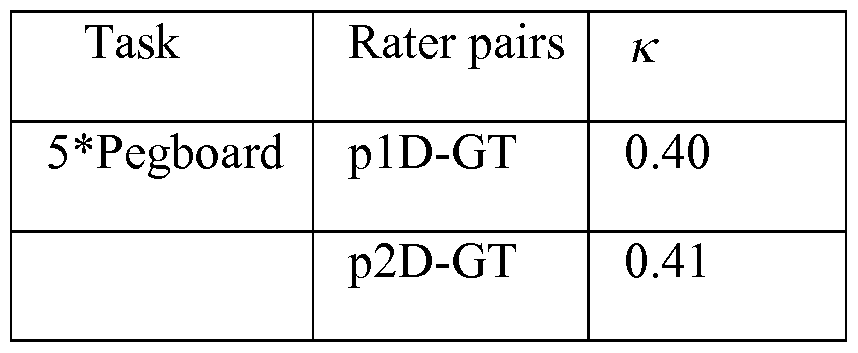
- Pr(a) is the relative observed agreement among raters and Pr ⁇ e) is the hypothetical probability of chance agreement. If the raters are in complete agreement ⁇ is 1. If there is no agreement then ⁇ ⁇ 0 The ⁇ was calculated between the self-reported skill levels assumed to be the ground truth, and the classification produced by the methods above.
- a ""pegboard ring maneuver" task which is a common pick and place task, and a
- Fig. 6 illustrates a pegboard task according to an embodiment of the current invention.
- a pegboard task with the da Vinci Skills Simulator requires a set of rings to be moved to multiple targets.
- a user is required to move a set of rings sequentially from one set of vertical pegs on a simulated task board to horizontal pegs extending from a wall of the task board.
- the task is performed in a specific sequence with both the source and target pegs constrained (and presented as targets) at each task step.
- a second level of difficulty (Level 2) may be used.
- Fig. 7 illustrates a ring walk task according to an embodiment of the current invention.
- a ringwalk task with the da Vinci Skills Simulator requires a ring to be moved to multiple targets along a simulated vessel.
- a user is required to move a ring placed around a simulated vessel to presented targets along the simulated vessel while avoiding obstacles.
- the obstacles need to be manipulated to ensure successful completion.
- the task ends when the user navigates the ring to the last target.
- This task can be configured in several levels of difficulty, each with an increasingly complex path. A highest difficulty available (Level 3) may be used.
- Fig. 8 illustrates task trajectories during the ring walk task according to an embodiment of the current invention.
- the gray structure is a simulated blood vessel.
- the other trajectories represent the motion of three instruments.
- the third instrument may be used only to move the obstacle. Thus, only the left and right instruments may be considered in the statistical analysis.
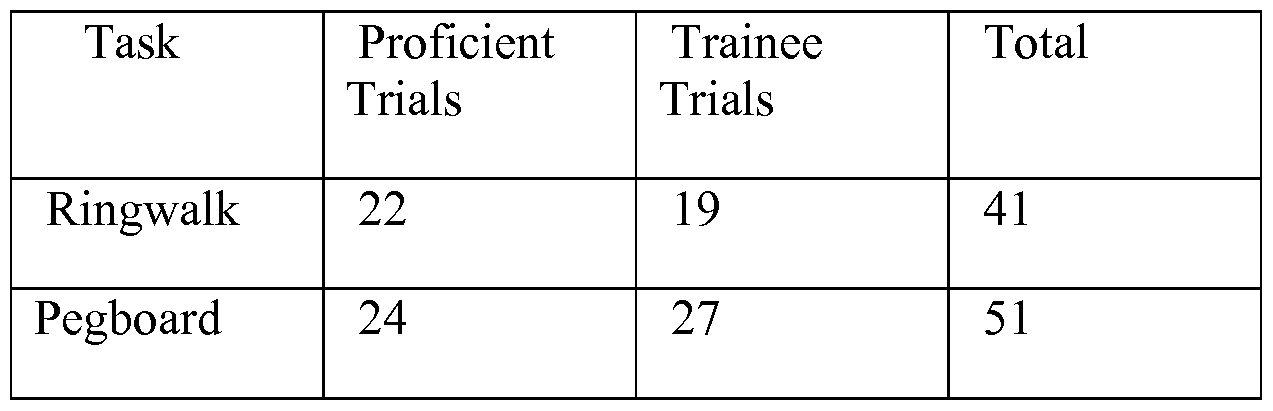
- Experimental data was collected for multiple trials of these tasks from 17 subjects. Experimental subjects were the manufacturers' employees with varying exposure to robotic surgery systems and the simulation environment. Each subject was required to perform six training tasks in an order of increasing difficulty. The pegboard task was performed second in the sequence while the ringwalk task, the most difficult, was performed the last. Total time allowed for each sequence was fixed, so not all subjects were able to complete all six exercises.
- Each subject was assigned a proficiency level on the basis of an initial skill assessment. Users with less than 40 hours of combined system exposure (9 of 17, simulation platform and robotic surgery system) were labeled as trainees. The remaining subjects, who had varied development and clinical experience and were considered proficient. Given that this is a new system still being validated, the skill level for a "proficient" user is arguable.
- alternative methodologies for classifying users as experts for the simulator and on real robotic surgery data were explored. For example, using structured assessment of a user's trials by an expert instead of self-reported data used here.
- Table 1 The Experimental dataset consisted of multiple trials from two tasks.
- Unequal weights may be assigned to the individual metrics, based on their relative importance computed as separation of trainee and expert averages. Let for a particular metric ni j , ⁇ ⁇ and ⁇ ⁇ be the expert and the novice mean values calculated from the data. Let ⁇ ⁇ be the expert standard deviation. The new weight w . may be assigned to be: 1 ⁇ 2 . — 1 ⁇ 2 .
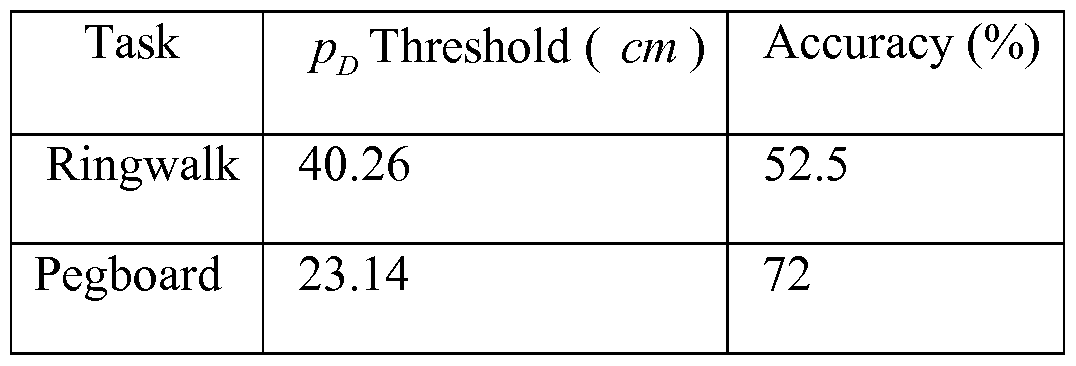
- Table 2 Classification accuracy and corresponding thresholds for task scores.
- Table 3 Classification accuracy and corresponding thresholds instrument tip distance.
- Table 4 Classification accuracy and corresponding thresholds for the time required to successfully complete the task.
- the ribbon measure R A is also calculated.
- An adaptive threshold on this pose metric outperforms adaptive thresholds on the simple metrics above for skill classification.
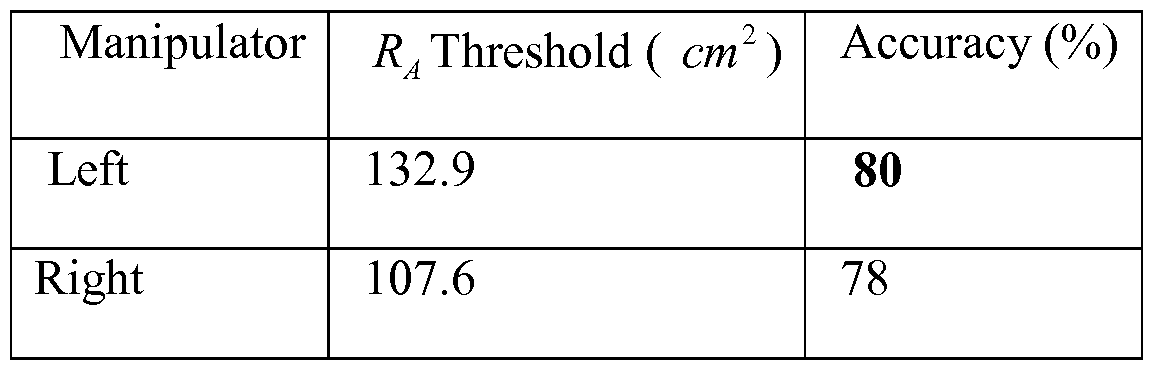
- Tables 5, 6 report this baseline performance.
- Table 5 Classification accuracy and corresponding thresholds for the R A measure for the ringwalk task.
- Table 6 Classification accuracy and corresponding thresholds for the R A measure for left and right instruments for the pegboard task.
- Table 7 Cohen's ⁇ for classification based on different metrics vs. ground truth
- Table 8 Binary classification performance of motion classification
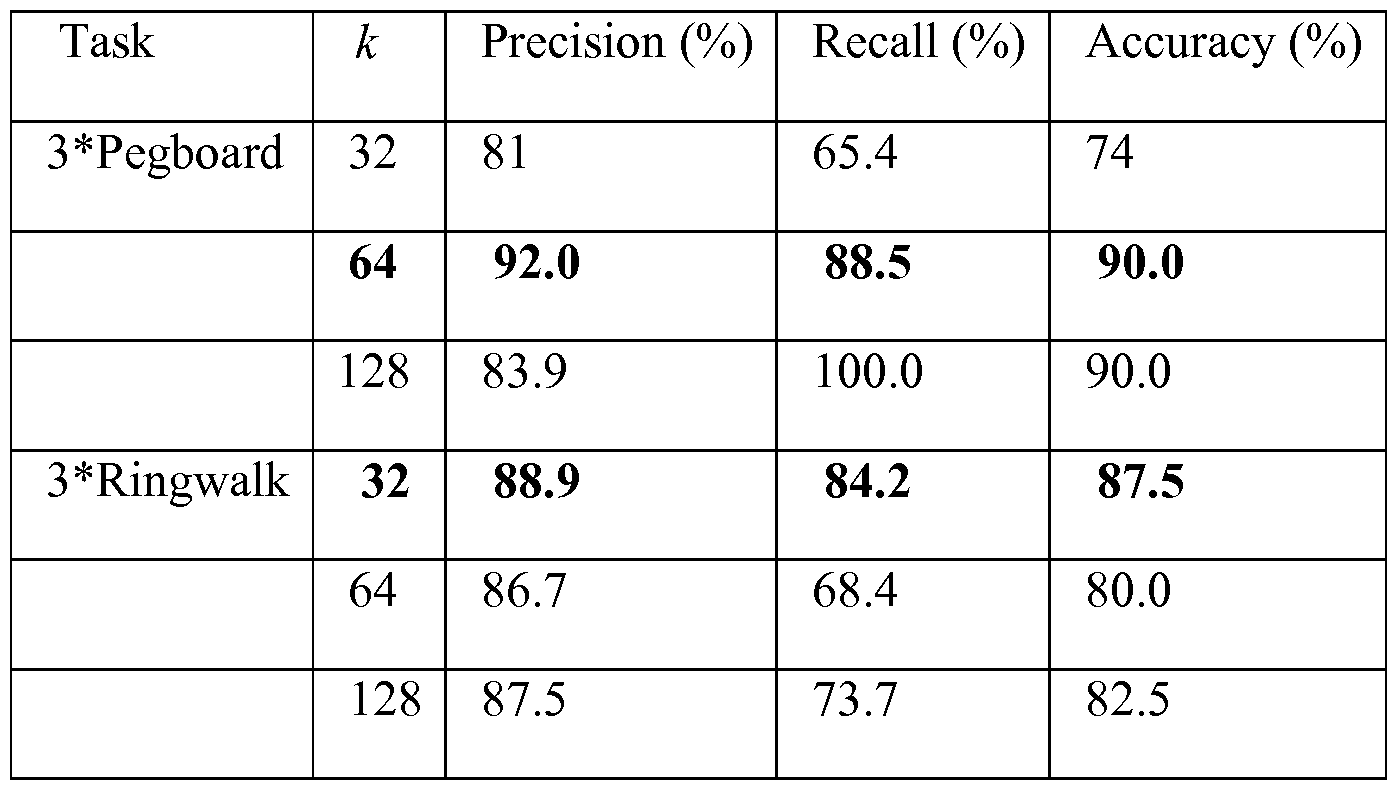
- Binary SVM classifiers were trained using Gaussian radial basis function kernels and performed a -fold cross-validation with the trained classifier to calculate the precision, recall, and accuracy.
- Table 9 shows the classification results in the static world frame do not outperform the baseline ribbon metric computations.
- Table 9 Performance of binary SVM classification (expert vs. novice) in the world frame for both tasks.
- the ground truth for the environment is accurately known in the simulator.
- the work may be extended to use the ground truth location of the simulated vessel together with the expert trajectory space results reported here.
- the work described also used a portion of experimental data obtained from the manufacturers employees.
- a binary classifier on entire task trajectories is used here, while noting that distinctions between users of varying skills are highlighted in task portions of high curvature/dexterity.
- Alternative classification methods and different trajectory segmentation emphasizing portions requiring high skill may also be used.
- Data may also be intelligently segmented to further improve classification accuracy.
Landscapes
- Health & Medical Sciences (AREA)
- Life Sciences & Earth Sciences (AREA)
- Engineering & Computer Science (AREA)
- Surgery (AREA)
- Animal Behavior & Ethology (AREA)
- Veterinary Medicine (AREA)
- Biomedical Technology (AREA)
- Heart & Thoracic Surgery (AREA)
- Medical Informatics (AREA)
- Molecular Biology (AREA)
- Public Health (AREA)
- General Health & Medical Sciences (AREA)
- Nuclear Medicine, Radiotherapy & Molecular Imaging (AREA)
- Robotics (AREA)
- Human Computer Interaction (AREA)
- Physics & Mathematics (AREA)
- Biophysics (AREA)
- Pathology (AREA)
- Manipulator (AREA)
- Management, Administration, Business Operations System, And Electronic Commerce (AREA)
- Automatic Analysis And Handling Materials Therefor (AREA)
Abstract
Description







Claims
Priority Applications (5)
| Application Number | Priority Date | Filing Date | Title |
|---|---|---|---|
| EP12779859.3A EP2704658A4 (en) | 2011-05-05 | 2012-05-07 | METHOD AND SYSTEM FOR ANALYZING A TASK PATH |
| CN201280033584.1A CN103702631A (en) | 2011-05-05 | 2012-05-07 | Method and system for analyzing a task trajectory |
| US14/115,092 US20140378995A1 (en) | 2011-05-05 | 2012-05-07 | Method and system for analyzing a task trajectory |
| JP2014509515A JP6169562B2 (en) | 2011-05-05 | 2012-05-07 | Computer-implemented method for analyzing sample task trajectories and system for analyzing sample task trajectories |
| KR1020137032183A KR20140048128A (en) | 2011-05-05 | 2012-05-07 | Method and system for analyzing a task trajectory |
Applications Claiming Priority (2)
| Application Number | Priority Date | Filing Date | Title |
|---|---|---|---|
| US201161482831P | 2011-05-05 | 2011-05-05 | |
| US61/482,831 | 2011-05-05 |
Publications (2)
| Publication Number | Publication Date |
|---|---|
| WO2012151585A2 true WO2012151585A2 (en) | 2012-11-08 |
| WO2012151585A3 WO2012151585A3 (en) | 2013-01-17 |
Family
ID=47108276
Family Applications (1)
| Application Number | Title | Priority Date | Filing Date |
|---|---|---|---|
| PCT/US2012/036822 Ceased WO2012151585A2 (en) | 2011-05-05 | 2012-05-07 | Method and system for analyzing a task trajectory |
Country Status (6)
| Country | Link |
|---|---|
| US (1) | US20140378995A1 (en) |
| EP (1) | EP2704658A4 (en) |
| JP (1) | JP6169562B2 (en) |
| KR (1) | KR20140048128A (en) |
| CN (1) | CN103702631A (en) |
| WO (1) | WO2012151585A2 (en) |
Cited By (23)
| Publication number | Priority date | Publication date | Assignee | Title |
|---|---|---|---|---|
| JP2014106942A (en) * | 2012-11-30 | 2014-06-09 | Tokyo Metropolitan Univ | Usability evaluation system, usability evaluation method and program for usability evaluation system |
| WO2014201422A3 (en) * | 2013-06-14 | 2015-12-03 | Brain Corporation | Apparatus and methods for hierarchical robotic control and robotic training |
| US9280386B1 (en) | 2011-07-14 | 2016-03-08 | Google Inc. | Identifying task instance outliers based on metric data in a large scale parallel processing system |
| US9314924B1 (en) | 2013-06-14 | 2016-04-19 | Brain Corporation | Predictive robotic controller apparatus and methods |
| US9346167B2 (en) | 2014-04-29 | 2016-05-24 | Brain Corporation | Trainable convolutional network apparatus and methods for operating a robotic vehicle |
| US9358685B2 (en) | 2014-02-03 | 2016-06-07 | Brain Corporation | Apparatus and methods for control of robot actions based on corrective user inputs |
| US9463571B2 (en) | 2013-11-01 | 2016-10-11 | Brian Corporation | Apparatus and methods for online training of robots |
| US9566710B2 (en) | 2011-06-02 | 2017-02-14 | Brain Corporation | Apparatus and methods for operating robotic devices using selective state space training |
| US9579789B2 (en) | 2013-09-27 | 2017-02-28 | Brain Corporation | Apparatus and methods for training of robotic control arbitration |
| US9597797B2 (en) | 2013-11-01 | 2017-03-21 | Brain Corporation | Apparatus and methods for haptic training of robots |
| US9604359B1 (en) | 2014-10-02 | 2017-03-28 | Brain Corporation | Apparatus and methods for training path navigation by robots |
| WO2017126313A1 (en) * | 2016-01-19 | 2017-07-27 | 株式会社ファソテック | Surgery training and simulation system employing bio-texture modeling organ |
| US9717387B1 (en) | 2015-02-26 | 2017-08-01 | Brain Corporation | Apparatus and methods for programming and training of robotic household appliances |
| US9764468B2 (en) | 2013-03-15 | 2017-09-19 | Brain Corporation | Adaptive predictor apparatus and methods |
| US9792546B2 (en) | 2013-06-14 | 2017-10-17 | Brain Corporation | Hierarchical robotic controller apparatus and methods |
| US9821457B1 (en) | 2013-05-31 | 2017-11-21 | Brain Corporation | Adaptive robotic interface apparatus and methods |
| JP2020114439A (en) * | 2014-02-21 | 2020-07-30 | スリーディインテグレイテッド アーペーエス3Dintegrated Aps | Training method |
| WO2020163263A1 (en) | 2019-02-06 | 2020-08-13 | Covidien Lp | Hand eye coordination system for robotic surgical system |
| WO2020185218A1 (en) * | 2019-03-12 | 2020-09-17 | Intuitive Surgical Operations, Inc. | Layered functionality for a user input mechanism in a computer-assisted surgical system |
| WO2021034694A1 (en) * | 2019-08-16 | 2021-02-25 | Intuitive Surgical Operations, Inc. | Auto-configurable simulation system and method |
| WO2022031995A1 (en) * | 2020-08-06 | 2022-02-10 | Canon U.S.A., Inc. | Methods for operating a medical continuum robot |
| US11529737B2 (en) | 2020-01-30 | 2022-12-20 | Raytheon Company | System and method for using virtual/augmented reality for interaction with collaborative robots in manufacturing or industrial environment |
| US11908337B2 (en) | 2018-08-10 | 2024-02-20 | Kawasaki Jukogyo Kabushiki Kaisha | Information processing device, intermediation device, simulation system, and information processing method |
Families Citing this family (49)
| Publication number | Priority date | Publication date | Assignee | Title |
|---|---|---|---|---|
| US8423182B2 (en) | 2009-03-09 | 2013-04-16 | Intuitive Surgical Operations, Inc. | Adaptable integrated energy control system for electrosurgical tools in robotic surgical systems |
| EP2622594B1 (en) | 2010-10-01 | 2018-08-22 | Applied Medical Resources Corporation | Portable laparoscopic trainer |
| US9990856B2 (en) * | 2011-02-08 | 2018-06-05 | The Trustees Of The University Of Pennsylvania | Systems and methods for providing vibration feedback in robotic systems |
| ES2640005T3 (en) | 2011-10-21 | 2017-10-31 | Applied Medical Resources Corporation | Simulated tissue structure for surgical training |
| KR101953187B1 (en) | 2011-12-20 | 2019-02-28 | 어플라이드 메디컬 리소시스 코포레이션 | Advanced surgical simulation |
| KR20150037987A (en) | 2012-08-03 | 2015-04-08 | 어플라이드 메디컬 리소시스 코포레이션 | Simulated stapling and energy based ligation for surgical training |
| EP2895098B1 (en) | 2012-09-17 | 2022-08-10 | Intuitive Surgical Operations, Inc. | Methods and systems for assigning input devices to teleoperated surgical instrument functions |
| US10535281B2 (en) | 2012-09-26 | 2020-01-14 | Applied Medical Resources Corporation | Surgical training model for laparoscopic procedures |
| US10679520B2 (en) | 2012-09-27 | 2020-06-09 | Applied Medical Resources Corporation | Surgical training model for laparoscopic procedures |
| AU2013323463B2 (en) | 2012-09-27 | 2017-08-31 | Applied Medical Resources Corporation | Surgical training model for laparoscopic procedures |
| EP2901436B1 (en) | 2012-09-27 | 2019-02-27 | Applied Medical Resources Corporation | Surgical training model for laparoscopic procedures |
| EP3467805B1 (en) | 2012-09-28 | 2020-07-08 | Applied Medical Resources Corporation | Surgical training model for transluminal laparoscopic procedures |
| WO2014052868A1 (en) | 2012-09-28 | 2014-04-03 | Applied Medical Resources Corporation | Surgical training model for laparoscopic procedures |
| US10631939B2 (en) | 2012-11-02 | 2020-04-28 | Intuitive Surgical Operations, Inc. | Systems and methods for mapping flux supply paths |
| KR102537277B1 (en) | 2013-03-01 | 2023-05-30 | 어플라이드 메디컬 리소시스 코포레이션 | Advanced surgical simulation constructions and methods |
| AU2014265412B2 (en) | 2013-05-15 | 2018-07-19 | Applied Medical Resources Corporation | Hernia model |
| CA3159232C (en) | 2013-06-18 | 2024-04-23 | Applied Medical Resources Corporation | Gallbladder model |
| KR102573569B1 (en) | 2013-07-24 | 2023-09-01 | 어플라이드 메디컬 리소시스 코포레이션 | First entry model |
| US10198966B2 (en) | 2013-07-24 | 2019-02-05 | Applied Medical Resources Corporation | Advanced first entry model for surgical simulation |
| FR3016512B1 (en) * | 2014-01-23 | 2018-03-02 | Universite De Strasbourg | MASTER INTERFACE DEVICE FOR MOTORIZED ENDOSCOPIC SYSTEM AND INSTALLATION COMPRISING SUCH A DEVICE |
| EP3913602B1 (en) | 2014-03-26 | 2025-08-27 | Applied Medical Resources Corporation | Simulated dissectible tissue |
| KR102518089B1 (en) | 2014-11-13 | 2023-04-05 | 어플라이드 메디컬 리소시스 코포레이션 | Simulated tissue models and methods |
| EP3259107B1 (en) | 2015-02-19 | 2019-04-10 | Applied Medical Resources Corporation | Simulated tissue structures and methods |
| KR20180008417A (en) | 2015-05-14 | 2018-01-24 | 어플라이드 메디컬 리소시스 코포레이션 | Synthetic tissue structure for electrosurgical training and simulation |
| US12512017B2 (en) | 2015-05-27 | 2025-12-30 | Applied Medical Resources Corporation | Surgical training model for laparoscopic procedures |
| US9918798B2 (en) | 2015-06-04 | 2018-03-20 | Paul Beck | Accurate three-dimensional instrument positioning |
| EP4057260A1 (en) | 2015-06-09 | 2022-09-14 | Applied Medical Resources Corporation | Hysterectomy model |
| KR20240128138A (en) | 2015-07-16 | 2024-08-23 | 어플라이드 메디컬 리소시스 코포레이션 | Simulated dissectable tissue |
| EP3326168B1 (en) | 2015-07-22 | 2021-07-21 | Applied Medical Resources Corporation | Appendectomy model |
| JP6916781B2 (en) | 2015-10-02 | 2021-08-11 | アプライド メディカル リソーシーズ コーポレイション | Hysterectomy model |
| EP3378053B1 (en) | 2015-11-20 | 2023-08-16 | Applied Medical Resources Corporation | Simulated dissectible tissue |
| WO2017098507A1 (en) * | 2015-12-07 | 2017-06-15 | M.S.T. Medical Surgery Technologies Ltd. | Fully autonomic artificial intelligence robotic system |
| CA2958802C (en) | 2016-04-05 | 2018-03-27 | Timotheus Anton GMEINER | Multi-metric surgery simulator and methods |
| AU2017291422B2 (en) | 2016-06-27 | 2023-04-06 | Applied Medical Resources Corporation | Simulated abdominal wall |
| US11931122B2 (en) | 2016-11-11 | 2024-03-19 | Intuitive Surgical Operations, Inc. | Teleoperated surgical system with surgeon skill level based instrument control |
| EP3583589B1 (en) | 2017-02-14 | 2024-12-18 | Applied Medical Resources Corporation | Laparoscopic training system |
| US10847057B2 (en) | 2017-02-23 | 2020-11-24 | Applied Medical Resources Corporation | Synthetic tissue structures for electrosurgical training and simulation |
| US10678338B2 (en) | 2017-06-09 | 2020-06-09 | At&T Intellectual Property I, L.P. | Determining and evaluating data representing an action to be performed by a robot |
| EP3664739A4 (en) * | 2017-08-10 | 2021-04-21 | Intuitive Surgical Operations, Inc. | SYSTEMS AND METHODS FOR DISPLAYS OF INTERACTION POINTS IN A TELEOPERATIONAL SYSTEM |
| US10147052B1 (en) * | 2018-01-29 | 2018-12-04 | C-SATS, Inc. | Automated assessment of operator performance |
| CN108447333B (en) * | 2018-03-15 | 2019-11-26 | 四川大学华西医院 | A method for assessing laparoscopic surgery cutting operation |
| JP7333204B2 (en) * | 2018-08-10 | 2023-08-24 | 川崎重工業株式会社 | Information processing device, robot operating system, and robot operating method |
| JP6982324B2 (en) * | 2019-02-27 | 2021-12-17 | 公立大学法人埼玉県立大学 | Finger operation support device and support method |
| US11497564B2 (en) * | 2019-06-07 | 2022-11-15 | Verb Surgical Inc. | Supervised robot-human collaboration in surgical robotics |
| IT202000029786A1 (en) | 2020-12-03 | 2022-06-03 | Eng Your Endeavour Ltd | APPARATUS FOR THE EVALUATION OF THE EXECUTION OF SURGICAL TECHNIQUES AND RELATED METHOD |
| EP4256579A1 (en) * | 2020-12-03 | 2023-10-11 | Intuitive Surgical Operations, Inc. | Systems and methods for assessing surgical ability |
| US12245823B2 (en) | 2023-02-02 | 2025-03-11 | Edda Technology, Inc. | System and method for automated trocar and robot base location determination |
| US12496149B2 (en) * | 2023-02-02 | 2025-12-16 | Edda Technology, Inc. | System and method for automated simultaneous trocar and robot base location determination |
| CN120347731A (en) * | 2025-03-31 | 2025-07-22 | 遵义医科大学珠海校区 | Learner action track analysis and optimization guidance system in surgical operation teaching |
Family Cites Families (27)
| Publication number | Priority date | Publication date | Assignee | Title |
|---|---|---|---|---|
| US5417210A (en) * | 1992-05-27 | 1995-05-23 | International Business Machines Corporation | System and method for augmentation of endoscopic surgery |
| US5558091A (en) * | 1993-10-06 | 1996-09-24 | Biosense, Inc. | Magnetic determination of position and orientation |
| US6122403A (en) * | 1995-07-27 | 2000-09-19 | Digimarc Corporation | Computer system linked by using information in data objects |
| US5882206A (en) * | 1995-03-29 | 1999-03-16 | Gillio; Robert G. | Virtual surgery system |
| US8600551B2 (en) * | 1998-11-20 | 2013-12-03 | Intuitive Surgical Operations, Inc. | Medical robotic system with operatively couplable simulator unit for surgeon training |
| US6459926B1 (en) * | 1998-11-20 | 2002-10-01 | Intuitive Surgical, Inc. | Repositioning and reorientation of master/slave relationship in minimally invasive telesurgery |
| US6659939B2 (en) * | 1998-11-20 | 2003-12-09 | Intuitive Surgical, Inc. | Cooperative minimally invasive telesurgical system |
| JP3660521B2 (en) * | 1999-04-02 | 2005-06-15 | 株式会社モリタ製作所 | Medical training device and medical training evaluation method |
| CA2556082A1 (en) * | 2004-03-12 | 2005-09-29 | Bracco Imaging S.P.A. | Accuracy evaluation of video-based augmented reality enhanced surgical navigation systems |
| US20110020779A1 (en) * | 2005-04-25 | 2011-01-27 | University Of Washington | Skill evaluation using spherical motion mechanism |
| EP2289454B1 (en) * | 2005-06-06 | 2020-03-25 | Intuitive Surgical Operations, Inc. | Laparoscopic ultrasound robotic surgical system |
| JP2007183332A (en) * | 2006-01-05 | 2007-07-19 | Advanced Telecommunication Research Institute International | Operation training device |
| US20070207448A1 (en) * | 2006-03-03 | 2007-09-06 | The National Retina Institute | Method and system for using simulation techniques in ophthalmic surgery training |
| US20070238981A1 (en) * | 2006-03-13 | 2007-10-11 | Bracco Imaging Spa | Methods and apparatuses for recording and reviewing surgical navigation processes |
| US8792688B2 (en) * | 2007-03-01 | 2014-07-29 | Titan Medical Inc. | Methods, systems and devices for three dimensional input and control methods and systems based thereon |
| CA2684459C (en) * | 2007-04-16 | 2016-10-04 | Neuroarm Surgical Ltd. | Methods, devices, and systems for non-mechanically restricting and/or programming movement of a tool of a manipulator along a single axis |
| US20130165945A9 (en) * | 2007-08-14 | 2013-06-27 | Hansen Medical, Inc. | Methods and devices for controlling a shapeable instrument |
| US20110046637A1 (en) * | 2008-01-14 | 2011-02-24 | The University Of Western Ontario | Sensorized medical instrument |
| US8386401B2 (en) * | 2008-09-10 | 2013-02-26 | Digital Infuzion, Inc. | Machine learning methods and systems for identifying patterns in data using a plurality of learning machines wherein the learning machine that optimizes a performance function is selected |
| WO2010105237A2 (en) * | 2009-03-12 | 2010-09-16 | Health Research Inc. | Method and system for minimally-invasive surgery training |
| CN105342705A (en) * | 2009-03-24 | 2016-02-24 | 伊顿株式会社 | Surgical robot system using augmented reality, and method for controlling same |
| US9786202B2 (en) * | 2010-03-05 | 2017-10-10 | Agency For Science, Technology And Research | Robot assisted surgical training |
| US8460236B2 (en) * | 2010-06-24 | 2013-06-11 | Hansen Medical, Inc. | Fiber optic instrument sensing system |
| US8672837B2 (en) * | 2010-06-24 | 2014-03-18 | Hansen Medical, Inc. | Methods and devices for controlling a shapeable medical device |
| SG188303A1 (en) * | 2010-09-01 | 2013-04-30 | Agency Science Tech & Res | A robotic device for use in image-guided robot assisted surgical training |
| WO2012112694A2 (en) * | 2011-02-15 | 2012-08-23 | Conformis, Inc. | Medeling, analyzing and using anatomical data for patient-adapted implants. designs, tools and surgical procedures |
| EP2739251A4 (en) * | 2011-08-03 | 2015-07-29 | Conformis Inc | Automated design, selection, manufacturing and implantation of patient-adapted and improved articular implants, designs and related guide tools |
-
2012
- 2012-05-07 WO PCT/US2012/036822 patent/WO2012151585A2/en not_active Ceased
- 2012-05-07 US US14/115,092 patent/US20140378995A1/en not_active Abandoned
- 2012-05-07 EP EP12779859.3A patent/EP2704658A4/en not_active Withdrawn
- 2012-05-07 CN CN201280033584.1A patent/CN103702631A/en active Pending
- 2012-05-07 KR KR1020137032183A patent/KR20140048128A/en not_active Withdrawn
- 2012-05-07 JP JP2014509515A patent/JP6169562B2/en active Active
Non-Patent Citations (1)
| Title |
|---|
| See references of EP2704658A4 * |
Cited By (41)
| Publication number | Priority date | Publication date | Assignee | Title |
|---|---|---|---|---|
| US9566710B2 (en) | 2011-06-02 | 2017-02-14 | Brain Corporation | Apparatus and methods for operating robotic devices using selective state space training |
| US9280386B1 (en) | 2011-07-14 | 2016-03-08 | Google Inc. | Identifying task instance outliers based on metric data in a large scale parallel processing system |
| US9880879B1 (en) | 2011-07-14 | 2018-01-30 | Google Inc. | Identifying task instance outliers based on metric data in a large scale parallel processing system |
| JP2014106942A (en) * | 2012-11-30 | 2014-06-09 | Tokyo Metropolitan Univ | Usability evaluation system, usability evaluation method and program for usability evaluation system |
| US10155310B2 (en) | 2013-03-15 | 2018-12-18 | Brain Corporation | Adaptive predictor apparatus and methods |
| US9764468B2 (en) | 2013-03-15 | 2017-09-19 | Brain Corporation | Adaptive predictor apparatus and methods |
| US9821457B1 (en) | 2013-05-31 | 2017-11-21 | Brain Corporation | Adaptive robotic interface apparatus and methods |
| WO2014201422A3 (en) * | 2013-06-14 | 2015-12-03 | Brain Corporation | Apparatus and methods for hierarchical robotic control and robotic training |
| US9314924B1 (en) | 2013-06-14 | 2016-04-19 | Brain Corporation | Predictive robotic controller apparatus and methods |
| US9792546B2 (en) | 2013-06-14 | 2017-10-17 | Brain Corporation | Hierarchical robotic controller apparatus and methods |
| US9950426B2 (en) | 2013-06-14 | 2018-04-24 | Brain Corporation | Predictive robotic controller apparatus and methods |
| US9579789B2 (en) | 2013-09-27 | 2017-02-28 | Brain Corporation | Apparatus and methods for training of robotic control arbitration |
| US9597797B2 (en) | 2013-11-01 | 2017-03-21 | Brain Corporation | Apparatus and methods for haptic training of robots |
| US9844873B2 (en) | 2013-11-01 | 2017-12-19 | Brain Corporation | Apparatus and methods for haptic training of robots |
| US9463571B2 (en) | 2013-11-01 | 2016-10-11 | Brian Corporation | Apparatus and methods for online training of robots |
| US9358685B2 (en) | 2014-02-03 | 2016-06-07 | Brain Corporation | Apparatus and methods for control of robot actions based on corrective user inputs |
| US9789605B2 (en) | 2014-02-03 | 2017-10-17 | Brain Corporation | Apparatus and methods for control of robot actions based on corrective user inputs |
| JP2020114439A (en) * | 2014-02-21 | 2020-07-30 | スリーディインテグレイテッド アーペーエス3Dintegrated Aps | Training method |
| US9346167B2 (en) | 2014-04-29 | 2016-05-24 | Brain Corporation | Trainable convolutional network apparatus and methods for operating a robotic vehicle |
| US9604359B1 (en) | 2014-10-02 | 2017-03-28 | Brain Corporation | Apparatus and methods for training path navigation by robots |
| US10105841B1 (en) | 2014-10-02 | 2018-10-23 | Brain Corporation | Apparatus and methods for programming and training of robotic devices |
| US10131052B1 (en) | 2014-10-02 | 2018-11-20 | Brain Corporation | Persistent predictor apparatus and methods for task switching |
| US9687984B2 (en) | 2014-10-02 | 2017-06-27 | Brain Corporation | Apparatus and methods for training of robots |
| US9630318B2 (en) | 2014-10-02 | 2017-04-25 | Brain Corporation | Feature detection apparatus and methods for training of robotic navigation |
| US9717387B1 (en) | 2015-02-26 | 2017-08-01 | Brain Corporation | Apparatus and methods for programming and training of robotic household appliances |
| US10376117B2 (en) | 2015-02-26 | 2019-08-13 | Brain Corporation | Apparatus and methods for programming and training of robotic household appliances |
| WO2017126313A1 (en) * | 2016-01-19 | 2017-07-27 | 株式会社ファソテック | Surgery training and simulation system employing bio-texture modeling organ |
| JPWO2017126313A1 (en) * | 2016-01-19 | 2018-11-22 | 株式会社ファソテック | Surgical training and simulation system using biological texture organs |
| US11908337B2 (en) | 2018-08-10 | 2024-02-20 | Kawasaki Jukogyo Kabushiki Kaisha | Information processing device, intermediation device, simulation system, and information processing method |
| CN113271883B (en) * | 2019-02-06 | 2024-01-02 | 柯惠Lp公司 | Hand-eye coordination system for robotic surgical systems |
| CN113271883A (en) * | 2019-02-06 | 2021-08-17 | 柯惠Lp公司 | Hand-eye coordination system for robotic surgical system |
| EP3920821A4 (en) * | 2019-02-06 | 2023-01-11 | Covidien LP | HAND-EYE COORDINATION SYSTEMS FOR SURGICAL ROBOTIC SYSTEM |
| WO2020163263A1 (en) | 2019-02-06 | 2020-08-13 | Covidien Lp | Hand eye coordination system for robotic surgical system |
| US12082898B2 (en) | 2019-02-06 | 2024-09-10 | Covidien Lp | Hand eye coordination system for robotic surgical system |
| WO2020185218A1 (en) * | 2019-03-12 | 2020-09-17 | Intuitive Surgical Operations, Inc. | Layered functionality for a user input mechanism in a computer-assisted surgical system |
| US12016646B2 (en) | 2019-03-12 | 2024-06-25 | Intuitive Surgical Operations, Inc. | Layered functionality for a user input mechanism in a computer-assisted surgical system |
| US12383361B2 (en) | 2019-03-12 | 2025-08-12 | Intuitive Surgical Operations, Inc. | Layered functionality for a user input mechanism in a computer-assisted surgical system |
| WO2021034694A1 (en) * | 2019-08-16 | 2021-02-25 | Intuitive Surgical Operations, Inc. | Auto-configurable simulation system and method |
| US12349978B2 (en) | 2019-08-16 | 2025-07-08 | Intuitive Surgical Operations, Inc. | Auto-configurable simulation system and method |
| US11529737B2 (en) | 2020-01-30 | 2022-12-20 | Raytheon Company | System and method for using virtual/augmented reality for interaction with collaborative robots in manufacturing or industrial environment |
| WO2022031995A1 (en) * | 2020-08-06 | 2022-02-10 | Canon U.S.A., Inc. | Methods for operating a medical continuum robot |
Also Published As
| Publication number | Publication date |
|---|---|
| JP2014520279A (en) | 2014-08-21 |
| US20140378995A1 (en) | 2014-12-25 |
| JP6169562B2 (en) | 2017-07-26 |
| KR20140048128A (en) | 2014-04-23 |
| CN103702631A (en) | 2014-04-02 |
| WO2012151585A3 (en) | 2013-01-17 |
| EP2704658A2 (en) | 2014-03-12 |
| EP2704658A4 (en) | 2014-12-03 |
Similar Documents
| Publication | Publication Date | Title |
|---|---|---|
| US20140378995A1 (en) | Method and system for analyzing a task trajectory | |
| KR101975808B1 (en) | System and method for the evaluation of or improvement of minimally invasive surgery skills | |
| Chmarra et al. | Systems for tracking minimally invasive surgical instruments | |
| Oprea et al. | A visually realistic grasping system for object manipulation and interaction in virtual reality environments | |
| Fard et al. | Machine learning approach for skill evaluation in robotic-assisted surgery | |
| Kumar et al. | Objective measures for longitudinal assessment of robotic surgery training | |
| Long et al. | Integrating artificial intelligence and augmented reality in robotic surgery: An initial dvrk study using a surgical education scenario | |
| Zhang et al. | Automatic microsurgical skill assessment based on cross-domain transfer learning | |
| Menegozzo et al. | Surgical gesture recognition with time delay neural network based on kinematic data | |
| Stenmark et al. | Vision-based tracking of surgical motion during live open-heart surgery | |
| Sun et al. | Smart sensor-based motion detection system for hand movement training in open surgery | |
| Mohaidat et al. | Multi-class detection and tracking of intracorporeal suturing instruments in an FLS laparoscopic box trainer using scaled-YOLOv4 | |
| Carciumaru et al. | Systematic review of machine learning applications using nonoptical motion tracking in surgery | |
| Jog et al. | Towards integrating task information in skills assessment for dexterous tasks in surgery and simulation | |
| Fathabadi et al. | Autonomous sequential surgical skills assessment for the peg transfer task in a laparoscopic box-trainer system with three cameras | |
| Peng et al. | Single shot state detection in simulation-based laparoscopy training | |
| Loukas et al. | Performance comparison of various feature detector‐descriptors and temporal models for video‐based assessment of laparoscopic skills | |
| Mohaidat et al. | A systematic approach to the development of an automated assessment system for laparoscopic surgery fundamentals | |
| Anderson et al. | Sensor fusion for laparoscopic surgery skill acquisition | |
| Speidel et al. | Recognition of surgical skills using hidden Markov models | |
| Mohaidat et al. | A Hybrid YOLOv8 and Instance Segmentation to Distinguish Sealed Tissue and Detect Tools' Tips in FLS Laparoscopic Box Trainer | |
| Agrawal | Automating endoscopic camera motion for teleoperated minimally invasive surgery using inverse reinforcement learning | |
| Sonsilphong et al. | A development of object detection system based on deep learning approach to support the laparoscope manipulating robot (LMR) | |
| Rashidi Fathabadi et al. | Autonomous sequential surgical skills assessment for the peg transfer task in a laparoscopic box-trainer system with three cameras. | |
| Amel | Intelligent Virtual Breast Palpation Environment |
Legal Events
| Date | Code | Title | Description |
|---|---|---|---|
| 121 | Ep: the epo has been informed by wipo that ep was designated in this application |
Ref document number: 12779859 Country of ref document: EP Kind code of ref document: A2 |
|
| ENP | Entry into the national phase |
Ref document number: 2014509515 Country of ref document: JP Kind code of ref document: A |
|
| NENP | Non-entry into the national phase |
Ref country code: DE |
|
| ENP | Entry into the national phase |
Ref document number: 20137032183 Country of ref document: KR Kind code of ref document: A |
|
| REEP | Request for entry into the european phase |
Ref document number: 2012779859 Country of ref document: EP |
|
| WWE | Wipo information: entry into national phase |
Ref document number: 2012779859 Country of ref document: EP |