WO2012134851A1 - Reduced complexity transform for a low-frequency-effects channel - Google Patents
Reduced complexity transform for a low-frequency-effects channel Download PDFInfo
- Publication number
- WO2012134851A1 WO2012134851A1 PCT/US2012/029603 US2012029603W WO2012134851A1 WO 2012134851 A1 WO2012134851 A1 WO 2012134851A1 US 2012029603 W US2012029603 W US 2012029603W WO 2012134851 A1 WO2012134851 A1 WO 2012134851A1
- Authority
- WO
- WIPO (PCT)
- Prior art keywords
- transform
- valued
- real
- transform coefficients
- cos
- Prior art date
- Legal status (The legal status is an assumption and is not a legal conclusion. Google has not performed a legal analysis and makes no representation as to the accuracy of the status listed.)
- Ceased
Links
Classifications
-
- G—PHYSICS
- G10—MUSICAL INSTRUMENTS; ACOUSTICS
- G10L—SPEECH ANALYSIS TECHNIQUES OR SPEECH SYNTHESIS; SPEECH RECOGNITION; SPEECH OR VOICE PROCESSING TECHNIQUES; SPEECH OR AUDIO CODING OR DECODING
- G10L19/00—Speech or audio signals analysis-synthesis techniques for redundancy reduction, e.g. in vocoders; Coding or decoding of speech or audio signals, using source filter models or psychoacoustic analysis
- G10L19/02—Speech or audio signals analysis-synthesis techniques for redundancy reduction, e.g. in vocoders; Coding or decoding of speech or audio signals, using source filter models or psychoacoustic analysis using spectral analysis, e.g. transform vocoders or subband vocoders
-
- G—PHYSICS
- G06—COMPUTING OR CALCULATING; COUNTING
- G06F—ELECTRIC DIGITAL DATA PROCESSING
- G06F17/00—Digital computing or data processing equipment or methods, specially adapted for specific functions
- G06F17/10—Complex mathematical operations
- G06F17/14—Fourier, Walsh or analogous domain transformations, e.g. Laplace, Hilbert, Karhunen-Loeve, transforms
- G06F17/147—Discrete orthonormal transforms, e.g. discrete cosine transform, discrete sine transform, and variations therefrom, e.g. modified discrete cosine transform, integer transforms approximating the discrete cosine transform
-
- G—PHYSICS
- G10—MUSICAL INSTRUMENTS; ACOUSTICS
- G10L—SPEECH ANALYSIS TECHNIQUES OR SPEECH SYNTHESIS; SPEECH RECOGNITION; SPEECH OR VOICE PROCESSING TECHNIQUES; SPEECH OR AUDIO CODING OR DECODING
- G10L19/00—Speech or audio signals analysis-synthesis techniques for redundancy reduction, e.g. in vocoders; Coding or decoding of speech or audio signals, using source filter models or psychoacoustic analysis
- G10L19/02—Speech or audio signals analysis-synthesis techniques for redundancy reduction, e.g. in vocoders; Coding or decoding of speech or audio signals, using source filter models or psychoacoustic analysis using spectral analysis, e.g. transform vocoders or subband vocoders
- G10L19/0212—Speech or audio signals analysis-synthesis techniques for redundancy reduction, e.g. in vocoders; Coding or decoding of speech or audio signals, using source filter models or psychoacoustic analysis using spectral analysis, e.g. transform vocoders or subband vocoders using orthogonal transformation
-
- G—PHYSICS
- G10—MUSICAL INSTRUMENTS; ACOUSTICS
- G10L—SPEECH ANALYSIS TECHNIQUES OR SPEECH SYNTHESIS; SPEECH RECOGNITION; SPEECH OR VOICE PROCESSING TECHNIQUES; SPEECH OR AUDIO CODING OR DECODING
- G10L19/00—Speech or audio signals analysis-synthesis techniques for redundancy reduction, e.g. in vocoders; Coding or decoding of speech or audio signals, using source filter models or psychoacoustic analysis
- G10L19/008—Multichannel audio signal coding or decoding using interchannel correlation to reduce redundancy, e.g. joint-stereo, intensity-coding or matrixing
Definitions
- the present invention pertains generally to digital signal processing and is directed more particularly toward methods and apparatuses that may be used to apply filterbanks to limited bandwidth audio channels such as so called low-frequency-effects (LFE) channels using fewer computational resources.
- LFE low-frequency-effects
- Audio systems that conform to standards like those mentioned above generally include transmitters that apply an analysis filterbank to each of several channels of input audio signals, process the output of the analysis filterbanks into encoded signals and transmit or record the encoded signals, and receivers that receive the encoded signals, decode them and apply synthesis filterbanks to the decoded signals to generate channels of output audio signals that are a replica of the original input audio signals.
- MDCT Modified Discrete Transform
- IMDCT Inverse Modified Discrete Transform
- Filterbanks that are implemented by these particular transforms have many attractive properties but significant processing or computational resources are required to perform the needed calculations.
- Techniques are known that can be used to perform the transforms more efficiently, thereby reducing the amount of computational resources that are needed.
- One characteristic that is common to these techniques is that their computational complexity varies with the so-called length of the transform. Techniques are known that can realize further reductions in computational complexity by using shorter transform lengths to process audio channels with narrower bandwidths.
- Standards like those mentioned above define sequences of digital data or digital bit streams that carry data representing encoded representations of one or more audio channels.
- One configuration of channels sometimes referred to as "5.1 channels” includes five full -bandwidth channels denoted left (L), right (R), center (C), left-surround (LS), and right-surround (RS), and one limited-bandwidth channel or low-frequency-effects (LFE) channel.
- the full-bandwidth channels typically have a bandwidth of about 20 kHz and the limited-bandwidth LFE channel typically has a bandwidth of about 100 to 200 Hz. Because the bandwidth of the LFE channel is narrower, known techniques can be used to perform a filterbank transform more efficiently for the LFE channel than can be performed for one of the full-bandwidth channels.
- a limited-bandwidth signal is processed by receiving a block of K real- valued transform coefficients of which only a number L of the coefficients represent spectral components of a limited-bandwidth audio signal, where 1 ⁇ 2 L ⁇ M ⁇ K, and M is a power of two; applying a first-transform of length R to a block of complex-valued coefficients derived from M complex- valued transform coefficients that include the L real- valued transform coefficients representing
- Fig. 1 is a schematic block diagram of an audio coding system in which various aspects of the present invention may be carried out.
- Fig. 2 is a schematic block diagram of a process that may be used to perform a synthesis transform in the coding system shown in Fig. 1.
- Figs. 3 and 4 are schematic block diagrams that illustrate some features that may be used to perform a portion of the process shown in Fig. 2.
- Fig. 5 is a schematic block diagram of a device that may be used to implement various aspects of the present invention.
- Fig. 1 is a schematic illustration of a two-channel audio coding system that includes a transmitter 100 and a receiver 200.
- the transmitter 100 receives from the paths 11, 12 two channels of input audio signals.
- the analysis filterbanks 111, 112 are applied to the input audio channels to obtain a first set of frequency-subband signals representing the spectral content of the input audio signals. These analysis filterbanks are implemented by time-domain to frequency-domain transforms.
- the encoder 120 applies an encoding process to the first set of frequency-subband signals to generate encoded information, which is passed along the path 20.
- the receiver 200 receives the encoded information from the path 20.
- Decoder 220 applies a decoding process to the encoded information to obtain a second set of frequency-subband signals.
- the synthesis filterbanks 231, 232 are applied to the second set of frequency-subband signals to generate two or more channels of output audio signals, which are passed along the paths 31 , 32. These synthesis filterbanks are implemented by frequency-domain to time-domain transforms.
- the path 20 may be a broadcast medium, a point-to-point communication medium, a recording medium or any other medium that can convey or record the encoded information.
- the encoder 120 and the decoder 220 are not essential to practice the present invention. If they are used, they may perform either lossless or lossy coding processes. The present invention is not limited to any particular encoding and decoding processes.
- the present invention is directed toward reducing the computational resources needed to perform the transform that implements the synthesis filterbank 231 or 232 in the receiver 200 used to generate narrower bandwidth output audio signals.
- the present invention can implement a more efficient synthesis filterbank in a receiver 200 that maintains compatibility with an analysis filterbank in existing transmitters 100.
- the present invention may also be used to reduce the computational resources needed to perform the transform that implements the analysis filterbank 111 or 112 in the transmitter 100 applied to narrower bandwidth input audio signals.
- This implementation can maintain compatibility with a synthesis filterbank in existing receivers 200.
- Synthesis filterbanks can be implemented by a wide variety of frequency-domain to time-domain transforms including many variations of the Inverse Discrete Cosine Transform (IDCT) and the Inverse Modified Discrete Cosine Transform (IMDCT) mentioned above.
- IMDCT Inverse Modified Discrete Cosine Transform
- direct transforms The algorithms that define these transforms in a direct manner are referred to herein as "direct transforms.”
- the folding technique comprises three stages as illustrated in Fig. #2.
- the second stage 402 performs a transform that has a shorter length than the direct transform this folding technique implements.
- the transform that is performed in the second stage 402 is referred to as a "folded transform" so that the following description can more easily distinguish it from the direct transform.
- the pre-processor stage 401 combines transform coefficients in a block of K real- valued frequency-domain transform coefficients into a block of Vi-K complex- valued transform coefficients.
- the transform stage 402 applies a frequency-domain to time-domain folded transform of length Vi-K to the block of complex- valued transform coefficients to generate Vi-K complex-valued time-domain samples.
- the post-processor stage 403 derives a sequence of K real- valued time-domain samples from the 1 ⁇ 2 ⁇ K complex- valued time-domain signal samples.
- the K time-domain signal samples that are obtained by this technique are identical to the K time-domain signal samples that could be obtained by applying the direct transform of length K to the block of K real- valued frequency-domain transform coefficients.
- This technique improves efficiency because the additional computational resources needed to perform the direct transform as opposed to the folded transform in the stage 402 is greater than the computational resources needed to implement the processes performed in the pre-processor stage 401 and the postprocessor stage 403.
- transform-decomposition technique may be used to increase processing efficiency of the folded transform that is performed in the stage 402.
- the direct IMDCT is shown in expression 2. Its complementary Modified
- MDCT Discrete Cosine Transform
- x(n) real-valued time-domain signal sample n
- the proper operation of these direct transforms requires the use of analysis window functions and synthesis window functions whose lengths and shapes meet certain requirements that are well known in the art.
- the analysis window function is applied to segments of N input audio signal samples prior to the application of the MDCT.
- the synthesis window function is applied to segments of N samples obtained from an application of the IMDCT to blocks of K transform coefficients and these windowed segments of samples are overlapped and added to windowed segments of samples obtained from other blocks of transform coefficients. Additional details may be obtained from the Princen et al. paper cited above. The following paragraphs omit further
- the folded transform performed in the transform stage 402 may be expressed n-k
- x' ⁇ n complex-valued time-domain signal sample.
- the process performed in the post-processor stage 403 may be expressed as
- Im [j ' ( «)] imaginary part of the complex value x' (n) .
- Proper operation of the IMDCT includes applying a properly designed synthesis window function to the time-domain samples generated by the transform.
- the time- domain signal samples that are obtained from this windowing operation may be expressed as:
- the windowed intermediate samples y obtained from expression 6 are the intermediate time-domain samples that could have been obtained by application of the direct IMDCT to a block of the frequency-domain transform coefficients X followed by an application of the synthesis window function h.
- the output time-domain signal samples are obtained by overlapping and adding the windowed interim samples derived from a "current" block of transform coefficients with a set of "previous" windowed interim samples derived from a previous block of transform coefficients. This overlap-add process may be expressed as:
- a transform decomposition technique may be used to derive a more efficient method for performing the folded transform for limited bandwidth signals in which some of the transform coefficients in a block of frequency-domain transform coefficients are known to be equal to zero.
- This decomposition technique consists of expressing the folded transform as an equivalent two-dimensional transform and decomposing this two- dimensional transform into a single-dimension vertical transform followed by a bank of single-dimension horizontal Inverse Discrete Fourier Transforms (IDFT).
- the vertical transform has a length equal to Q and the bank of horizontal complex IDFT comprises Q transforms each having a length equal to P, where P and Q are integers and the product of P and Q equals the length of the folded transform.
- P and Q integers
- the product of P and Q equals the length of the folded transform.
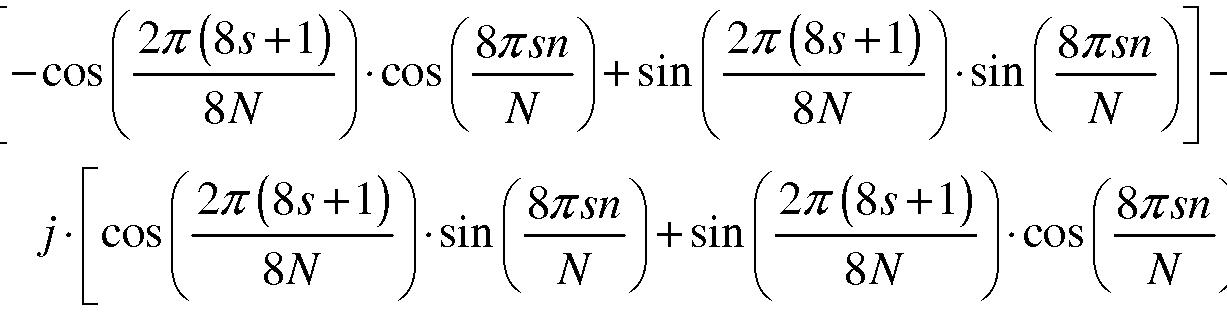
- the horizontal IDFT and the vertical transform are shown in expressions 8 and 9, respectively: r 0 ⁇ n ⁇ Q and 0 ⁇ m ⁇ P where for 0 ⁇ n ⁇ Q.
- the transform kernel WN / 4 in the vertical transform may be calculated using Euler's law:
- the direct transform coefficients X(k) represent an audio signal in an LFE channel with a limited bandwidth
- L of these coefficients can have a value other than zero, where L is much less than K.
- no more than of the complex- valued frequency-domain transform coefficients X ' (k) obtained from the preprocessor stage 401 may have values other than zero and the length of the vertical transform may be reduced.
- a value M is chosen such that it is the smallest power-of-two equal to or greater than this number and the folding process is modified to derive
- M complex- valued frequency-domain transform coefficients X'(k) that include the L real- valued direct transform coefficients that can have non-zero values. These M complex- valued frequency-domain transform coefficients are to be processed by the
- the efficiency of the folding technique combined with the transform- decomposition technique as described above can be improved further by integrating the pre-processor stage 401 and the vertical transform as shown in expression 9 into one process. This is illustrated schematically in Fig. 3.
- the length R of the vertical transform may be chosen to be equal to the value M or be a power-of-two sub-multiple of the value M.
- the number 1 ⁇ 2-N of real-valued frequency- domain transform coefficients is equal to 256 and the spectral content of the audio signal in the LFE channel can be represented by seven real- valued transform coefficients X(k), where 0 ⁇ k ⁇ 7.
- M is equal to four and R can be set equal to either 4, 2 or 1 by setting P equal to 1, 2 or 4, respectively.
- P Q J
- the horizontal transform length Q is equal to 128, 64 and 32 when P is equal to 1 , 2 and 4, respectively. Little or no gain in efficiency is achieved when P equals one.
- expression 17 is on the order of 3.5 ⁇ P R- Q.
- FIG. 5 is a schematic block diagram of a device 70 that may be used to implement aspects of the present invention.
- the processor 72 provides computing resources.
- RAM 73 is system random access memory (RAM) used by the processor 72 for processing.
- ROM 74 represents some form of persistent storage such as read only memory (ROM) for storing programs needed to operate the device 70 and possibly for carrying out various aspects of the present invention.
- I/O control 75 represents interface circuitry to receive and transmit signals by way of the communication channels 76, 77. In the embodiment shown, all major system components connect to the bus 71, which may represent more than one physical or logical bus; however, a bus architecture is not required to implement the present invention.
- additional components may be included for interfacing to devices such as a keyboard or mouse and a display, and for controlling a storage device 78 having a storage medium such as magnetic tape or disk, or an optical medium.
- the storage medium may be used to record programs of instructions for operating systems, utilities and applications, and may include programs that implement various aspects of the present invention.
- Software implementations of the present invention may be conveyed by a variety of machine readable media such as baseband or modulated communication paths throughout the spectrum including from supersonic to ultraviolet frequencies, or storage media that convey information using essentially any recording technology including magnetic tape, cards or disk, optical cards or disc, and detectable markings on media including paper.
- machine readable media such as baseband or modulated communication paths throughout the spectrum including from supersonic to ultraviolet frequencies, or storage media that convey information using essentially any recording technology including magnetic tape, cards or disk, optical cards or disc, and detectable markings on media including paper.
Landscapes
- Engineering & Computer Science (AREA)
- Physics & Mathematics (AREA)
- General Physics & Mathematics (AREA)
- Mathematical Physics (AREA)
- Health & Medical Sciences (AREA)
- Human Computer Interaction (AREA)
- Multimedia (AREA)
- Acoustics & Sound (AREA)
- Audiology, Speech & Language Pathology (AREA)
- Signal Processing (AREA)
- Computational Linguistics (AREA)
- Spectroscopy & Molecular Physics (AREA)
- Computational Mathematics (AREA)
- Mathematical Analysis (AREA)
- Theoretical Computer Science (AREA)
- Pure & Applied Mathematics (AREA)
- Data Mining & Analysis (AREA)
- Mathematical Optimization (AREA)
- Databases & Information Systems (AREA)
- Discrete Mathematics (AREA)
- Algebra (AREA)
- Software Systems (AREA)
- General Engineering & Computer Science (AREA)
- Compression, Expansion, Code Conversion, And Decoders (AREA)
- Complex Calculations (AREA)
- Stereophonic System (AREA)
- Tone Control, Compression And Expansion, Limiting Amplitude (AREA)
Abstract
Description




Claims


Priority Applications (18)
| Application Number | Priority Date | Filing Date | Title |
|---|---|---|---|
| CN201280011954.1A CN103415883B (en) | 2011-03-28 | 2012-03-19 | Minimizing complicacy for low frequency effects channel converts |
| US14/005,924 US10410644B2 (en) | 2011-03-28 | 2012-03-19 | Reduced complexity transform for a low-frequency-effects channel |
| UAA201312169A UA107293C2 (en) | 2011-03-28 | 2012-03-19 | CONVERSION OF REDUCED COMPLEXITY FOR LOW-FREQUENCY EFFECT CHANNELS |
| CA2826018A CA2826018C (en) | 2011-03-28 | 2012-03-19 | Reduced complexity transform for a low-frequency-effects channel |
| MX2013011131A MX2013011131A (en) | 2011-03-28 | 2012-03-19 | Reduced complexity transform for a low-frequency-effects channel. |
| AU2012238001A AU2012238001B2 (en) | 2011-03-28 | 2012-03-19 | Reduced complexity transform for a low-frequency-effects channel |
| EA201370207A EA030776B9 (en) | 2011-03-28 | 2012-03-19 | Reduced complexity transform for a low-frequency-effects channel |
| ES12712486.5T ES2598827T3 (en) | 2011-03-28 | 2012-03-19 | Reduced complexity transformation for a low frequency effects channel |
| JP2014502622A JP5762620B2 (en) | 2011-03-28 | 2012-03-19 | Reduced complexity conversion for low frequency effects channels |
| DK12712486.5T DK2691951T3 (en) | 2011-03-28 | 2012-03-19 | TRANSFORMATION WITH REDUCED COMPLEXITY OF AN Low-Frequency |
| KR1020137020501A KR101411297B1 (en) | 2011-03-28 | 2012-03-19 | Reduced complexity transform for a low-frequency-effects channel |
| BR112013022988-8A BR112013022988B1 (en) | 2011-03-28 | 2012-03-19 | Method for processing a digital audio signal, apparatus for processing a digital audio signal and storage medium |
| EP12712486.5A EP2691951B1 (en) | 2011-03-28 | 2012-03-19 | Reduced complexity transform for a low-frequency-effects channel |
| HK14102791.1A HK1189699B (en) | 2011-03-28 | 2012-03-19 | Reduced complexity transform for a low-frequency-effects channel |
| SG2013064829A SG193237A1 (en) | 2011-03-28 | 2012-03-19 | Reduced complexity transform for a low-frequency-effects channel |
| TW101135308A TWI470622B (en) | 2012-03-19 | 2012-09-26 | Reduced complexity transform for a low-frequency-effects channel |
| ARP120103568A AR088059A1 (en) | 2012-03-19 | 2012-09-26 | TRANSFORMED METHOD WITH REDUCED COMPLEXITY FOR LOW FREQUENCY EFFECT CHANNEL |
| IL227635A IL227635A (en) | 2011-03-28 | 2013-07-24 | Reduced complexity transform for a low-frequency-effects channel |
Applications Claiming Priority (2)
| Application Number | Priority Date | Filing Date | Title |
|---|---|---|---|
| US201161468373P | 2011-03-28 | 2011-03-28 | |
| US61/468,373 | 2011-03-28 |
Publications (1)
| Publication Number | Publication Date |
|---|---|
| WO2012134851A1 true WO2012134851A1 (en) | 2012-10-04 |
Family
ID=45931032
Family Applications (1)
| Application Number | Title | Priority Date | Filing Date |
|---|---|---|---|
| PCT/US2012/029603 Ceased WO2012134851A1 (en) | 2011-03-28 | 2012-03-19 | Reduced complexity transform for a low-frequency-effects channel |
Country Status (19)
| Country | Link |
|---|---|
| US (1) | US10410644B2 (en) |
| EP (1) | EP2691951B1 (en) |
| JP (1) | JP5762620B2 (en) |
| KR (1) | KR101411297B1 (en) |
| CN (1) | CN103415883B (en) |
| AU (1) | AU2012238001B2 (en) |
| CA (1) | CA2826018C (en) |
| CL (1) | CL2013002762A1 (en) |
| DK (1) | DK2691951T3 (en) |
| EA (1) | EA030776B9 (en) |
| ES (1) | ES2598827T3 (en) |
| HU (1) | HUE030185T2 (en) |
| IL (1) | IL227635A (en) |
| MX (1) | MX2013011131A (en) |
| MY (1) | MY166267A (en) |
| PL (1) | PL2691951T3 (en) |
| SG (1) | SG193237A1 (en) |
| UA (1) | UA107293C2 (en) |
| WO (1) | WO2012134851A1 (en) |
Families Citing this family (1)
| Publication number | Priority date | Publication date | Assignee | Title |
|---|---|---|---|---|
| EP4026122A1 (en) | 2019-09-03 | 2022-07-13 | Dolby Laboratories Licensing Corporation | Low-latency, low-frequency effects codec |
Family Cites Families (74)
| Publication number | Priority date | Publication date | Assignee | Title |
|---|---|---|---|---|
| US2888554A (en) | 1955-09-06 | 1959-05-26 | Rca Corp | Diversity reception |
| US3900721A (en) | 1974-02-14 | 1975-08-19 | Us Navy | Serial-access linear transform |
| US4241411A (en) | 1978-11-16 | 1980-12-23 | Probe Systems, Incorporated | FFT Parallel processor having mutually connected, multiple identical cards |
| US4579032A (en) | 1984-09-10 | 1986-04-01 | Kawai Musical Instrument Mfg. Co., Ltd | Computation time reduction in a polyphonic tone synthesizer |
| US5394349A (en) | 1992-07-10 | 1995-02-28 | Xing Technology Corporation | Fast inverse discrete transform using subwords for decompression of information |
| IL107658A0 (en) | 1993-11-18 | 1994-07-31 | State Of Israel Ministy Of Def | A system for compaction and reconstruction of wavelet data |
| US5671168A (en) | 1995-07-06 | 1997-09-23 | Technion Research & Development Foundation Ltd. | Digital frequency-domain implementation of arrays |
| US5742527A (en) | 1996-03-15 | 1998-04-21 | Motorola, Inc. | Flexible asymmetrical digital subscriber line (ADSL) receiver, central office using same, and method therefor |
| US5781728A (en) | 1996-03-15 | 1998-07-14 | Motorola Inc. | Flexible asymmetrical digital subscriber line ADSL transmitter, remote terminal using same, and method therefor |
| US5841890A (en) | 1996-05-06 | 1998-11-24 | Northrop Grumman Corporation | Multi-dimensional wavelet tomography |
| US6252965B1 (en) | 1996-09-19 | 2001-06-26 | Terry D. Beard | Multichannel spectral mapping audio apparatus and method |
| SE515535C2 (en) | 1996-10-25 | 2001-08-27 | Ericsson Telefon Ab L M | A transcoder |
| SG54383A1 (en) | 1996-10-31 | 1998-11-16 | Sgs Thomson Microelectronics A | Method and apparatus for decoding multi-channel audio data |
| SE9703849L (en) | 1997-03-14 | 1998-09-15 | Ericsson Telefon Ab L M | Scaling down images |
| US5983067A (en) | 1997-07-10 | 1999-11-09 | The United States Of America As Represented By The Secretary Of The Navy | Method and apparatus for simulating cross-correlation coefficients in a multipath sonar system |
| US5978646A (en) | 1997-07-10 | 1999-11-02 | The United States Of America As Represented By The Secretary Of The Navy | Method and apparatus for simulating a lofargram in a multipath sonar system |
| US5995803A (en) | 1997-07-10 | 1999-11-30 | The United States Of America As Represented By The Secretary Of The Navy | Method and apparatus for simulating a multipath sonar system |
| US5978647A (en) | 1997-07-10 | 1999-11-02 | The United States Of America As Represented By The Secretary Of The Navy | Method and apparatus for simulating autocorrelation coefficients in a multipath sonar system |
| US6002914A (en) | 1997-07-10 | 1999-12-14 | The United States Of America As Represented By The Secretary Of The Navy | Method and apparatus for simulating reverberation in a multipath sonar system |
| WO1999012292A1 (en) | 1997-08-29 | 1999-03-11 | Sgs-Thomson Microelectronics Asia Pacific (Pte) Ltd. | Fast synthesis sub-band filtering method for digital signal decoding |
| US6263312B1 (en) | 1997-10-03 | 2001-07-17 | Alaris, Inc. | Audio compression and decompression employing subband decomposition of residual signal and distortion reduction |
| US6081783A (en) | 1997-11-14 | 2000-06-27 | Cirrus Logic, Inc. | Dual processor digital audio decoder with shared memory data transfer and task partitioning for decompressing compressed audio data, and systems and methods using the same |
| US6847737B1 (en) | 1998-03-13 | 2005-01-25 | University Of Houston System | Methods for performing DAF data filtering and padding |
| US6324559B1 (en) | 1998-10-16 | 2001-11-27 | Telefonaktiebolaget Lm Ericsson (Publ) | Odd-transform fast convolution |
| US6477553B1 (en) | 1999-01-13 | 2002-11-05 | Philip Druck | Measurement scale for non-uniform data sampling in N dimensions |
| US6430529B1 (en) | 1999-02-26 | 2002-08-06 | Sony Corporation | System and method for efficient time-domain aliasing cancellation |
| US6643406B1 (en) | 1999-07-28 | 2003-11-04 | Polaroid Corporation | Method and apparatus for performing linear filtering in wavelet based domain |
| WO2001033335A1 (en) | 1999-10-28 | 2001-05-10 | Philip Druck | Self-stabilizing, portable and efficient computer arithmetic using mappings of d scale points |
| EP1269346B1 (en) | 2000-03-10 | 2007-10-31 | Jaber Associates, L.L.C. | Parallel multiprocessing for the fast fourier transform with pipeline architecture |
| AU2001252924A1 (en) | 2000-04-07 | 2001-10-23 | Comsat Corporation | Traced fast fourier transform apparatus and method |
| DE60132853D1 (en) | 2000-07-07 | 2008-04-03 | Nokia Siemens Networks Oy | A method and apparatus for perceptual audio coding of a multi-channel audio signal using the cascaded discrete cosine transform or the modified discrete cosine transform |
| AU2001269592A1 (en) | 2000-07-11 | 2002-01-21 | Samsung Electronics Co. Ltd. | Repetitive-pn1023-sequence echo-cancellation reference signal for single-carrierdigital television broadcast systems |
| WO2002057901A1 (en) | 2001-01-17 | 2002-07-25 | Exxonmobil Upstream Research Company | Simulation method and system using component-phase transformations |
| US7020672B2 (en) | 2001-03-30 | 2006-03-28 | Koninklijke Philips Electronics, N.V. | Reduced complexity IDCT decoding with graceful degradation |
| WO2002091221A2 (en) | 2001-05-07 | 2002-11-14 | Jaber Associates, L.L.C. | Address generator for fast fourier transform processor |
| US7366236B1 (en) | 2001-06-04 | 2008-04-29 | Cisco Sytems Canada Co. | Source adaptive system and method for 2D iDCT |
| GB2383412B (en) | 2001-12-18 | 2004-06-30 | Univ Sheffield | Structural health monitoring |
| US6776760B2 (en) | 2002-03-06 | 2004-08-17 | Alfred E. Mann Institute For Biomedical Engineering At The University Of Southern California | Multi-mode processing for ultrasonic imaging |
| US6850589B2 (en) | 2002-03-27 | 2005-02-01 | Agilent Technologies, Inc. | Tomography of curved surfaces |
| EP1502086A2 (en) | 2002-04-13 | 2005-02-02 | I-For-T Gmbh | Vibration sensor and method for monitoring the condition of rotating components and bearings |
| DE10234130B3 (en) * | 2002-07-26 | 2004-02-19 | Fraunhofer-Gesellschaft zur Förderung der angewandten Forschung e.V. | Device and method for generating a complex spectral representation of a discrete-time signal |
| US7277493B2 (en) | 2003-01-28 | 2007-10-02 | Agere Systems Inc. | Equalization in orthogonal frequency domain multiplexing |
| AU2003222397A1 (en) | 2003-04-30 | 2004-11-23 | Nokia Corporation | Support of a multichannel audio extension |
| US20040230419A1 (en) | 2003-05-15 | 2004-11-18 | Divio, Inc. | DRAM access for MDCT/IDMCT implementation |
| US7606138B2 (en) | 2003-09-29 | 2009-10-20 | Her Majesty The Queen In Right Of Canada, As Represented By The Minister Of Industry, Through The Communications Research Centre Canada | Multi-symbol encapsulated OFDM system |
| US7702002B2 (en) | 2004-01-28 | 2010-04-20 | Qualcomm Incorporated | Rapid acquisition methods and apparatus for GPS signals |
| EP1711938A1 (en) * | 2004-01-28 | 2006-10-18 | Koninklijke Philips Electronics N.V. | Audio signal decoding using complex-valued data |
| MXPA06011359A (en) | 2004-04-05 | 2007-01-16 | Koninkl Philips Electronics Nv | Multi-channel encoder. |
| US7483480B2 (en) | 2004-11-24 | 2009-01-27 | Nokia Corporation | FFT accelerated iterative MIMO equalizer receiver architecture |
| KR101315077B1 (en) | 2005-03-30 | 2013-10-08 | 코닌클리케 필립스 일렉트로닉스 엔.브이. | Scalable multi-channel audio coding |
| RU2407073C2 (en) | 2005-03-30 | 2010-12-20 | Конинклейке Филипс Электроникс Н.В. | Multichannel audio encoding |
| ATE406651T1 (en) | 2005-03-30 | 2008-09-15 | Koninkl Philips Electronics Nv | AUDIO CODING AND AUDIO DECODING |
| US7961890B2 (en) | 2005-04-15 | 2011-06-14 | Fraunhofer-Gesellschaft Zur Foerderung Der Angewandten Forschung, E.V. | Multi-channel hierarchical audio coding with compact side information |
| ES2374309T3 (en) | 2005-07-14 | 2012-02-15 | Koninklijke Philips Electronics N.V. | AUDIO DECODING. |
| US8443026B2 (en) * | 2005-09-16 | 2013-05-14 | Dolby International Ab | Partially complex modulated filter bank |
| BRPI0706285A2 (en) | 2006-01-05 | 2011-03-22 | Ericsson Telefon Ab L M | methods for decoding a parametric multichannel surround audio bitstream and for transmitting digital data representing sound to a mobile unit, parametric surround decoder for decoding a parametric multichannel surround audio bitstream, and, mobile terminal |
| US8112247B2 (en) | 2006-03-24 | 2012-02-07 | International Business Machines Corporation | Resource adaptive spectrum estimation of streaming data |
| EP1999847B1 (en) | 2006-03-28 | 2012-11-14 | Telefonaktiebolaget LM Ericsson (publ) | Filter adaptive frequency resolution |
| US20070286431A1 (en) | 2006-05-25 | 2007-12-13 | Microlink Communications Inc. | Headset |
| US8700387B2 (en) | 2006-09-14 | 2014-04-15 | Nvidia Corporation | Method and system for efficient transcoding of audio data |
| CN101192269B (en) | 2006-11-29 | 2012-05-02 | 佳能株式会社 | Method and device for estimating vanishing point from image, computer program and its storage medium |
| JP5134016B2 (en) | 2007-03-02 | 2013-01-30 | クゥアルコム・インコーポレイテッド | Using adaptive antenna arrays in conjunction with online repeaters to improve signal quality |
| US8548815B2 (en) | 2007-09-19 | 2013-10-01 | Qualcomm Incorporated | Efficient design of MDCT / IMDCT filterbanks for speech and audio coding applications |
| US20090141808A1 (en) | 2007-11-30 | 2009-06-04 | Yiufai Wong | System and methods for improved video decoding |
| US8497743B2 (en) | 2007-12-24 | 2013-07-30 | Telefonaktiebolaget L M Ericsson (Publ) | Passive fourier transform circuits and butler matrices |
| US7940864B2 (en) | 2008-04-28 | 2011-05-10 | Newport Media, Inc. | Channel estimation for high doppler mobile environments |
| US7907683B2 (en) | 2008-04-28 | 2011-03-15 | Newport Media, Inc. | Application of superfast algorithms to a pilot-based channel estimation process |
| FR2938947B1 (en) * | 2008-11-25 | 2012-08-17 | A Volute | PROCESS FOR PROCESSING THE SIGNAL, IN PARTICULAR AUDIONUMERIC. |
| US8438204B2 (en) | 2008-12-18 | 2013-05-07 | Lsi Corporation | Apparatus for calculating an N-point discrete fourier transform |
| US8787501B2 (en) | 2009-01-14 | 2014-07-22 | Qualcomm Incorporated | Distributed sensing of signals linked by sparse filtering |
| EP2237269B1 (en) | 2009-04-01 | 2013-02-20 | Motorola Mobility LLC | Apparatus and method for processing an encoded audio data signal |
| WO2011026247A1 (en) * | 2009-09-04 | 2011-03-10 | Svox Ag | Speech enhancement techniques on the power spectrum |
| BR112012009447B1 (en) | 2009-10-20 | 2021-10-13 | Voiceage Corporation | AUDIO SIGNAL ENCODER, STNAI, AUDIO DECODER, METHOD FOR ENCODING OR DECODING AN AUDIO SIGNAL USING AN ALIASING CANCEL |
| ES2565959T3 (en) * | 2010-06-09 | 2016-04-07 | Panasonic Intellectual Property Corporation Of America | Bandwidth extension method, bandwidth extension device, program, integrated circuit and audio decoding device |
-
2012
- 2012-03-19 WO PCT/US2012/029603 patent/WO2012134851A1/en not_active Ceased
- 2012-03-19 PL PL12712486T patent/PL2691951T3/en unknown
- 2012-03-19 DK DK12712486.5T patent/DK2691951T3/en active
- 2012-03-19 CA CA2826018A patent/CA2826018C/en active Active
- 2012-03-19 ES ES12712486.5T patent/ES2598827T3/en active Active
- 2012-03-19 SG SG2013064829A patent/SG193237A1/en unknown
- 2012-03-19 UA UAA201312169A patent/UA107293C2/en unknown
- 2012-03-19 EP EP12712486.5A patent/EP2691951B1/en active Active
- 2012-03-19 EA EA201370207A patent/EA030776B9/en not_active IP Right Cessation
- 2012-03-19 CN CN201280011954.1A patent/CN103415883B/en active Active
- 2012-03-19 AU AU2012238001A patent/AU2012238001B2/en active Active
- 2012-03-19 MY MYPI2013002742A patent/MY166267A/en unknown
- 2012-03-19 HU HUE12712486A patent/HUE030185T2/en unknown
- 2012-03-19 KR KR1020137020501A patent/KR101411297B1/en active Active
- 2012-03-19 MX MX2013011131A patent/MX2013011131A/en active IP Right Grant
- 2012-03-19 US US14/005,924 patent/US10410644B2/en active Active
- 2012-03-19 JP JP2014502622A patent/JP5762620B2/en active Active
-
2013
- 2013-07-24 IL IL227635A patent/IL227635A/en active IP Right Grant
- 2013-09-26 CL CL2013002762A patent/CL2013002762A1/en unknown
Non-Patent Citations (4)
| Title |
|---|
| PATRICK DE SMET ET AL: "Optimized MPEG audio decoding using recursive subband synthesis windowing", 2002 IEEE INTERNATIONAL CONFERENCE ON ACOUSTICS, SPEECH, AND SIGNAL PROCESSING. PROCEEDINGS. (ICASSP). ORLANDO, FL, MAY 13 - 17, 2002; [IEEE INTERNATIONAL CONFERENCE ON ACOUSTICS, SPEECH, AND SIGNAL PROCESSING (ICASSP)], NEW YORK, NY : IEEE, US, 13 May 2002 (2002-05-13), pages III - 3160, XP032015508, ISBN: 978-0-7803-7402-7, DOI: 10.1109/ICASSP.2002.5745320 * |
| PRINCEN J P ET AL: "SUBBAND/TRANSFORM CODING USING FILTER BANK DESIGNS BASED ON TIME DOMAIN ALIASING CANCELLATION", INTERNATIONAL CONFERENCE ON ACOUSTICS, SPEECH & SIGNAL PROCESSING. ICASSP. DALLAS, APRIL 6 - 9, 1987; [INTERNATIONAL CONFERENCE ON ACOUSTICS, SPEECH & SIGNAL PROCESSING. ICASSP], NEW YORK, IEEE, US, vol. 4, 6 April 1987 (1987-04-06), pages 2161 - 2164, XP000560572 * |
| PRINCEN; JOHNSON; BRADLEY: "Subband/Trans1orm Coding Using Filter Bank Designs Based on Time Domain Aliasing Cancellation", ICASSP 1987 CONF. PROC., May 1987 (1987-05-01), pages 2161 - 64 |
| WINNIE LAU ET AL: "A COMMON TRANSFORM ENGINE FOR MPEG & AC3 AUDIO DECODER", 19970801, vol. 43, no. 3, 1 August 1997 (1997-08-01), pages 559 - 566, XP011083574 * |
Also Published As
| Publication number | Publication date |
|---|---|
| HK1189699A1 (en) | 2014-06-13 |
| HUE030185T2 (en) | 2017-04-28 |
| EP2691951A1 (en) | 2014-02-05 |
| DK2691951T3 (en) | 2016-11-14 |
| CN103415883A (en) | 2013-11-27 |
| JP2014514605A (en) | 2014-06-19 |
| CA2826018C (en) | 2016-05-17 |
| CN103415883B (en) | 2015-11-25 |
| KR20130116914A (en) | 2013-10-24 |
| JP5762620B2 (en) | 2015-08-12 |
| UA107293C2 (en) | 2014-12-10 |
| AU2012238001B2 (en) | 2015-09-17 |
| CL2013002762A1 (en) | 2014-03-07 |
| IL227635A0 (en) | 2013-09-30 |
| EA030776B9 (en) | 2019-01-31 |
| SG193237A1 (en) | 2013-10-30 |
| MX2013011131A (en) | 2013-10-30 |
| KR101411297B1 (en) | 2014-06-26 |
| EA030776B1 (en) | 2018-09-28 |
| CA2826018A1 (en) | 2012-10-04 |
| US20140012588A1 (en) | 2014-01-09 |
| EP2691951B1 (en) | 2016-08-24 |
| EA201370207A1 (en) | 2014-01-30 |
| IL227635A (en) | 2017-05-29 |
| US10410644B2 (en) | 2019-09-10 |
| PL2691951T3 (en) | 2017-03-31 |
| MY166267A (en) | 2018-06-22 |
| ES2598827T3 (en) | 2017-01-30 |
Similar Documents
| Publication | Publication Date | Title |
|---|---|---|
| US9620132B2 (en) | Decoding of multichannel audio encoded bit streams using adaptive hybrid transformation | |
| JP4689625B2 (en) | Adaptive mixed transform for signal analysis and synthesis | |
| EP3025336B1 (en) | Reduction of comb filter artifacts in multi-channel downmix with adaptive phase alignment | |
| US20130166307A1 (en) | Efficient Implementation of Phase Shift Filtering for Decorrelation and Other Applications in an Audio Coding System | |
| CA2826018C (en) | Reduced complexity transform for a low-frequency-effects channel | |
| AU2012238001A1 (en) | Reduced complexity transform for a low-frequency-effects channel | |
| Khaldi et al. | HHT-based audio coding | |
| TWI470622B (en) | Reduced complexity transform for a low-frequency-effects channel | |
| HK1189699B (en) | Reduced complexity transform for a low-frequency-effects channel | |
| BR112013022988B1 (en) | Method for processing a digital audio signal, apparatus for processing a digital audio signal and storage medium | |
| HK1170058B (en) | Decoding of multichannel audio encoded bit streams using adaptive hybrid transformation | |
| HK1224797A1 (en) | Reduction of comb filter artifacts in multi-channel downmix with adaptive phase alignment | |
| HK1224797B (en) | Reduction of comb filter artifacts in multi-channel downmix with adaptive phase alignment |
Legal Events
| Date | Code | Title | Description |
|---|---|---|---|
| 121 | Ep: the epo has been informed by wipo that ep was designated in this application |
Ref document number: 12712486 Country of ref document: EP Kind code of ref document: A1 |
|
| ENP | Entry into the national phase |
Ref document number: 2826018 Country of ref document: CA |
|
| ENP | Entry into the national phase |
Ref document number: 20137020501 Country of ref document: KR Kind code of ref document: A |
|
| ENP | Entry into the national phase |
Ref document number: 2012238001 Country of ref document: AU Date of ref document: 20120319 Kind code of ref document: A |
|
| REEP | Request for entry into the european phase |
Ref document number: 2012712486 Country of ref document: EP |
|
| WWE | Wipo information: entry into national phase |
Ref document number: 2012712486 Country of ref document: EP |
|
| WWE | Wipo information: entry into national phase |
Ref document number: 14005924 Country of ref document: US |
|
| ENP | Entry into the national phase |
Ref document number: 2014502622 Country of ref document: JP Kind code of ref document: A |
|
| WWE | Wipo information: entry into national phase |
Ref document number: 2013002762 Country of ref document: CL Ref document number: MX/A/2013/011131 Country of ref document: MX |
|
| WWE | Wipo information: entry into national phase |
Ref document number: 1301005236 Country of ref document: TH |
|
| NENP | Non-entry into the national phase |
Ref country code: DE |
|
| WWE | Wipo information: entry into national phase |
Ref document number: 201370207 Country of ref document: EA |
|
| REG | Reference to national code |
Ref country code: BR Ref legal event code: B01A Ref document number: 112013022988 Country of ref document: BR |
|
| ENP | Entry into the national phase |
Ref document number: 112013022988 Country of ref document: BR Kind code of ref document: A2 Effective date: 20130909 |