WO2012092105A1 - Control of resin molecular weight distribution using mixed catalyst systems - Google Patents
Control of resin molecular weight distribution using mixed catalyst systems Download PDFInfo
- Publication number
- WO2012092105A1 WO2012092105A1 PCT/US2011/066743 US2011066743W WO2012092105A1 WO 2012092105 A1 WO2012092105 A1 WO 2012092105A1 US 2011066743 W US2011066743 W US 2011066743W WO 2012092105 A1 WO2012092105 A1 WO 2012092105A1
- Authority
- WO
- WIPO (PCT)
- Prior art keywords
- ziegler
- procatalyst
- natta type
- reactor
- feed
- Prior art date
- Legal status (The legal status is an assumption and is not a legal conclusion. Google has not performed a legal analysis and makes no representation as to the accuracy of the status listed.)
- Ceased
Links
Classifications
-
- C—CHEMISTRY; METALLURGY
- C08—ORGANIC MACROMOLECULAR COMPOUNDS; THEIR PREPARATION OR CHEMICAL WORKING-UP; COMPOSITIONS BASED THEREON
- C08F—MACROMOLECULAR COMPOUNDS OBTAINED BY REACTIONS ONLY INVOLVING CARBON-TO-CARBON UNSATURATED BONDS
- C08F210/00—Copolymers of unsaturated aliphatic hydrocarbons having only one carbon-to-carbon double bond
- C08F210/14—Monomers containing five or more carbon atoms
-
- C—CHEMISTRY; METALLURGY
- C08—ORGANIC MACROMOLECULAR COMPOUNDS; THEIR PREPARATION OR CHEMICAL WORKING-UP; COMPOSITIONS BASED THEREON
- C08F—MACROMOLECULAR COMPOUNDS OBTAINED BY REACTIONS ONLY INVOLVING CARBON-TO-CARBON UNSATURATED BONDS
- C08F10/00—Homopolymers and copolymers of unsaturated aliphatic hydrocarbons having only one carbon-to-carbon double bond
-
- C—CHEMISTRY; METALLURGY
- C08—ORGANIC MACROMOLECULAR COMPOUNDS; THEIR PREPARATION OR CHEMICAL WORKING-UP; COMPOSITIONS BASED THEREON
- C08F—MACROMOLECULAR COMPOUNDS OBTAINED BY REACTIONS ONLY INVOLVING CARBON-TO-CARBON UNSATURATED BONDS
- C08F10/00—Homopolymers and copolymers of unsaturated aliphatic hydrocarbons having only one carbon-to-carbon double bond
- C08F10/02—Ethene
-
- C—CHEMISTRY; METALLURGY
- C08—ORGANIC MACROMOLECULAR COMPOUNDS; THEIR PREPARATION OR CHEMICAL WORKING-UP; COMPOSITIONS BASED THEREON
- C08F—MACROMOLECULAR COMPOUNDS OBTAINED BY REACTIONS ONLY INVOLVING CARBON-TO-CARBON UNSATURATED BONDS
- C08F2/00—Processes of polymerisation
- C08F2/001—Multistage polymerisation processes characterised by a change in reactor conditions without deactivating the intermediate polymer
-
- C—CHEMISTRY; METALLURGY
- C08—ORGANIC MACROMOLECULAR COMPOUNDS; THEIR PREPARATION OR CHEMICAL WORKING-UP; COMPOSITIONS BASED THEREON
- C08F—MACROMOLECULAR COMPOUNDS OBTAINED BY REACTIONS ONLY INVOLVING CARBON-TO-CARBON UNSATURATED BONDS
- C08F210/00—Copolymers of unsaturated aliphatic hydrocarbons having only one carbon-to-carbon double bond
- C08F210/16—Copolymers of ethene with alpha-alkenes, e.g. EP rubbers
-
- C—CHEMISTRY; METALLURGY
- C08—ORGANIC MACROMOLECULAR COMPOUNDS; THEIR PREPARATION OR CHEMICAL WORKING-UP; COMPOSITIONS BASED THEREON
- C08F—MACROMOLECULAR COMPOUNDS OBTAINED BY REACTIONS ONLY INVOLVING CARBON-TO-CARBON UNSATURATED BONDS
- C08F2410/00—Features related to the catalyst preparation, the catalyst use or to the deactivation of the catalyst
- C08F2410/03—Multinuclear procatalyst, i.e. containing two or more metals, being different or not
-
- C—CHEMISTRY; METALLURGY
- C08—ORGANIC MACROMOLECULAR COMPOUNDS; THEIR PREPARATION OR CHEMICAL WORKING-UP; COMPOSITIONS BASED THEREON
- C08F—MACROMOLECULAR COMPOUNDS OBTAINED BY REACTIONS ONLY INVOLVING CARBON-TO-CARBON UNSATURATED BONDS
- C08F2410/00—Features related to the catalyst preparation, the catalyst use or to the deactivation of the catalyst
- C08F2410/04—Dual catalyst, i.e. use of two different catalysts, where none of the catalysts is a metallocene
-
- C—CHEMISTRY; METALLURGY
- C08—ORGANIC MACROMOLECULAR COMPOUNDS; THEIR PREPARATION OR CHEMICAL WORKING-UP; COMPOSITIONS BASED THEREON
- C08F—MACROMOLECULAR COMPOUNDS OBTAINED BY REACTIONS ONLY INVOLVING CARBON-TO-CARBON UNSATURATED BONDS
- C08F2410/00—Features related to the catalyst preparation, the catalyst use or to the deactivation of the catalyst
- C08F2410/06—Catalyst characterized by its size
Definitions
- the invention relates to a process for producing very high molecular weight olefm-based polymers in either a slurry polymerization system or in a gas phase polymerization system in condensed mode operation, very high molecular weight olefm- based polymers produced thereby and articles made from such polymers. More specifically, the invention relates to a process to control the molecular weight distribution of polymers produced with mixed metal Ziegler-Natta type catalysts in gas phase polymerization reactors, independent of catalyst composition changes.
- High molecular weight olefm-based resins are desirable to produce articles with improved mechanical properties, such as those produced from HDPE blow molding resin, where resin swell is important.
- One of the most efficient processes for the production of ethylene polymers and copolymers is the gas phase fluidized bed process. In order to maximize efficiency and minimize operation costs of the system, it is best to run such process in what is known as “condensed” or “super- condensed” mode in which a large fraction of the recycle gas is condensed and recycled back into the reactor.
- MWD molecular weight distribution
- Various techniques for modifying molecular weight distribution are known in the art. Manipulation of polymerization process variables, for example, allows for some change in molecular weight distribution.
- reaction temperature for example, can be limiting if the polymer becomes soft or sticky
- process limitations e.g., total pressure, monomer solubility in the polymer
- the catalyst is inactive at very high temperatures (i.e., close to the melting point of the polymer). Catalyst deactivation is also a consideration in reactor locations with excessive heat, e.g. those portions of the reactor in which resin may accumulate, leading to sheeting or chunk formation.
- the instant invention is a process to produce polyolefm polymers and polymers produced from such process.
- the instant invention provides a polymerization process to produce a polyolefm polymer comprising: contacting in a polymerization reactor one or more olefins, a first Ziegler-Natta type procatalyst, a second Ziegler-Natta type procatalyst, and at least one cocatalyst; wherein the first Ziegler-Natta type procatalyst is free of any electron donor component and the second Ziegler-Natta type procatalyst comprises at least one electron donor component.
- the invention provides a polyolefm polymer produced by the inventive process.
- the instant invention provides a process and polymer, in accordance with any of the preceding embodiments, except that the first Ziegler-Natta type procatalyst comprises the spray dried reaction product of contacting a Group 4 metal compound with one or more Titanium compounds selected from the group TiC13 (Al-activated or hydrogen-reduced), and Ti(OR)4 where R is ethyl, isopropyl or n- butyl in the presence of an alcohol solution comprising at least one C2-C4 alcohol and at least one of MgC12 and magnesium compounds which form MgC12 in the presence of the alcohol solution; and wherein the second Ziegler-Natta type procatalyst corresponds to the formula [Mg] d Ti(ORe)eXf[ED]q , wherein; Re is an aliphatic or aromatic
- hydrocarbon radical having from 1 to 14 carbon atoms or COR' wherein R' is an aliphatic or aromatic hydrocarbon radical having from 1 to 14 carbon atoms; each ORe group is the same or different; X is independently R', chlorine, bromine or iodine; d is 0.5 to 5; e is 0-12; and f is 1-10; ED is an electron donor; q is from 0 to 50; and r is 0, 1, or 2.
- the instant invention provides a process and polymer, in accordance with any of the preceding embodiments, except that the first and second Ziegler-Natta type procatalysts are mixed prior to being fed into the reactor to form a mixed procatalyst feed.
- the instant invention provides a process and polymer, in accordance with any of the preceding embodiments, except that the first and second Ziegler-Natta type procatalysts are separately fed into the reactor.
- the instant invention provides a process and polymer, in accordance with any of the preceding embodiments, except that a feed of the first Ziegler-Natta type procatalyst is decreased as a feed of the second Ziegler-Natta type procatalyst is increased.
- the instant invention provides a process and polymer, in accordance with any of the preceding embodiments, except that the mixed procatalyst feed comprises from 0.8 to 2.1 wt% of the second Ziegler-Natta type procatalyst and from 99.2 to 97.9 wt% of the first Ziegler-Natta type procatalyst based on the total weight of the first and second Zielger-Natta procatalysts.
- the instant invention provides a process and polymer, in accordance with any of the preceding embodiments, except that no electron donor is added to the reactor.
- the instant invention provides a process and polymer, in accordance with any of the preceding embodiments, except that the process further comprises adding a continuity additive to the reactor.
- the instant invention provides a process and polymer, in accordance with any of the preceding embodiments, except that the relative weight percentages of the first and second Ziegler-Natta type procatalysts produce a variation in the molecular weight of the polyolefm polymer.
- the instant invention provides a process and polymer, in accordance with any of the preceding embodiments, except that the relative weight percentages of the first and second Ziegler-Natta type procatalysts produce a variation in the molecular weight distribution of the polyolefm polymer.
- the instant invention provides a process and polymer, in accordance with any of the preceding embodiments, except that the one or more olefins comprises ethylene and further wherein a partial pressure of the ethylene is varied to maintain a constant rate of production of polyolefm.
- the instant invention provides a process and polymer, in accordance with any of the preceding embodiments, except that the second Ziegler-Natta type procatalyst has a second order productivity response to ethylene concentration.
- the instant invention provides a process and polymer, in accordance with any of the preceding embodiments, except that the polymerization is a slurry reactor or a fluidized bed reactor.
- the instant invention provides a polymerization process to produce a polyolefm polymer consisting essentially of: contacting in a polymerization reactor one or more olefins, a first Ziegler-Natta type procatalyst, a second Ziegler-Natta type procatalyst, and at least one cocatalyst; wherein the first Ziegler-Natta type procatalyst is free of any electron donor component and the second Ziegler-Natta type procatalyst comprises at least one electron donor component.
- Fig. 1 is a graph illustrating the rate of transition from Procatalyst B to Procatalyst A in Inventive Example 2;
- Fig. 2 is a graph illustrating the on production rate of the procatalyst transition shown in Fig. 1;
- Fig. 3 is a graph illustrating the effect on the polymer flow index, I 21 , of the transition of procatalyst feed illustrated in Fig. 1. Detailed Description of the Invention
- catalysts refers to transition metal compounds, or mixtures thereof, that are useful in catalyzing the polymerization of addition polymerizable monomers.
- Preferred catalysts are mixtures or complexes of non- metallocene transition metal compounds and magnesium compounds, such as magnesium chloride compounds, alternatively referred to as Ziegler Natta catalysts or Ziegler Natta type catalysts.
- catalyst as used herein means a catalyst composition ready to be injected or fed into a polymerization reactor and that is activated to an active
- a cocatalyst such as an aluminum alkyl cocatalyst.
- catalyst and "catalyst precursor” as used herein mean a portion of the catalyst composition containing the transition metals that is subjected to an additional reaction step to convert it into a procatalyst.
- polymer is used herein to indicate, for example, a homopolymer, a copolymer, or a terpolymer.
- polymer as used herein also includes
- interpolymers such as those made by the copolymerization of ethylene with C3-C 10 a- olefins or polypropylene with C4-C 10 a-olefms.
- interpolymer refers to polymers prepared by the polymerization of at least two different types of monomers.
- the generic term refers to polymers prepared by the polymerization of at least two different types of monomers.
- interpolymer thus includes copolymers, usually employed to refer to polymers prepared from two different types of monomers, and polymers prepared from more than two different types of monomers.
- any numerical range recited herein includes all values from the lower value and the upper value, in increments of one unit, provided that there is a separation of at least two units between any lower value and any higher value.
- a compositional, physical or other property such as, for example, molecular weight, is from 100 to 1,000, it is intended that all individual values, such as 100, 101, 102, etc., and sub ranges, such as 100 to 144, 155 to 170, 197 to 200, etc., are expressly
- the invention provides a polymerization process to produce a polyolefm polymer comprising contacting in a fluidized bed polymerization reactor or a slurry
- polymerization reactor one or more olefins, a first Ziegler-Natta type procatalyst, a second Ziegler-Natta type procatalyst, and at least one cocatalyst, wherein the first Ziegler-Natta type procatalyst is free of any electron donor component and the second Ziegler-Natta type procatalyst comprises at least one electron donor component.
- the first Ziegler-Natta type procatalyst may comprise the spray dried reaction product of contacting a Group 4 metal compound with one or more Titanium compounds selected from the group TiCl 3 (Al-activated or hydrogen-reduced), and Ti(OR) 4 where R is ethyl, isopropyl or n-butyl in the presence of an alcohol solution comprising at least one C 2 -C 4 alcohol and at least one of MgCl 2 and magnesium compounds which form MgCl 2 in the presence of the alcohol solution.
- the first Ziegler-Natta type procatalyst may be one or more of any of the procatalysts disclosed in the inventive and comparative examples of copending application U.S. Serial No. 12/759,515 filed on April 13, 2010.
- the second Ziegler-Natta type procatalyst may comprise a compound having the formula Mg m TiX p (OR) r [ED] q , wherein: m is 1 to 56, preferably 1.5 to 10; p is 5 to 115, preferably 6 to 13; q is 2 to 85, preferably 3 to 12; r is between 0 and 4; R is an aliphatic or aromatic hydrocarbon radical having from 1 to 14 carbon atoms or COR' wherein R' is an aliphatic or aromatic hydrocarbon radical having from 1 to 14 carbon atoms; each OR e group is the same or different; X is independently chlorine, bromine or iodine; ED is an electron donor compound chosen from alkyl esters of aliphatic and aromatic carboxylic acids, aliphatic ethers, cycloaliphatic ethers and aliphatic ketones.
- alkyl esters of saturated aliphatic carboxylic acids containing from 1 to 4 carbon atoms are particularly useful.
- alkyl esters of aromatic carboxylic acids containing from 7 to 8 carbon atoms are particularly useful.
- the most preferred electron donor is tetrahydrofuran.
- the second Ziegler-Natta procatalyst component may then be isolated as a solid by means such as spray drying or impregnation into inert solids supports. Spray drying is especially preferred.
- the contacting step of the inventive process may occur in any appropriate polymerization reactor.
- the inventive process is conducted in the reactor configurations disclosed in WO2008US87581 and WO2008US87378, the disclosures of which are incorporated herein by reference.
- Such reactors include multiple reactors in series.
- the first and second Ziegler-Natta type procatalysts may be mixed prior to being fed into the reactor to form a mixed procatalyst feed.
- the mixed procatalyst feed comprises between 0.5 and 20 wt% of the second Ziegler-Natta type procatalyst and between 99.5 and 80 wt% of the first Ziegler-Natta type procatalyst based on the total weight of the first and second Zielger-Natta procatalysts.
- All individual values greater than or equal to 0.5 wt% and equal to or less than 10 wt% of the first Ziegler-Natta type procatalyst are included herein and disclosed herein; for example, the first Ziegler-Natta type procatalyst could have an upper limit of 2.1 wt%, 1.9 wt%, 1.6 wt% or 1.3 wt% and a lower limit of 0.8 wt%, 0.9 wt%, 1.1 wt% or 1.2 wt%.
- the second Ziegler-Natta type procatalyst could have an upper limit of 99.2 wt%, 98.9 wt%, 98.5 wt% or 98.0 wt% and a lower limit of 97.9 wt%, 98.0 wt%, 98.3 wt% or 98.4 wt%.
- the first and second Ziegler-Natta type procatalysts may be separately fed into the reactor.
- the first Ziegler-Natta type procatalyst may be first fed into a polymerization reactor, with the feed amount of the first Ziegler-Natta type procatalyst subsequently decreased.
- the polymerization process may be begun with no feed of the second Ziegler-Natta type procatalyst, with the amount of the second Ziegler-Natta type procatalyst subsequently increased.
- the amounts and rates of feed of the first and second Ziegler-Natta type procatalysts may be tailored to produce a variation in the molecular weight and/or molecular weight distribution of the polyolefin polymer produced by the inventive process.
- the contacting step of the inventive process may be conducted in the absence of any electron donor added into the polymerization reactor other than the electron donor that is a component of the second Ziegler-Natta type procatalyst.
- the contacting step may be conducted in the presence of a continuity additive which improves the operability of the polymerization reactor.
- a continuity additive which improves the operability of the polymerization reactor.
- the inventive process may be used to produce a polyolefin polymer.
- the polyolefin polymer is polyethylene.
- the polyolefin polymer may be a copolymer, most preferably including ethylene units and units of a C3-C6 olefin.
- the polyolefin polymers produced by some embodiments of the inventive process may have an I 21 that is between 7 % and 12 %, alternatively between 8 % and 11%, alternatively between 9 % and 10 %, greater than that of polyolefin polymers produced solely in the presence of the first Ziegler-Natta type procatalyst.
- the polyolefin polymers produced by some embodiments of the inventive process may have an I 21 /I 2 that is between 10 % and 16 %, alternatively between 11 % and 15%, alternatively between 12 % and 14 %, less than that of polyolefin polymers produced solely in the presence of the first Ziegler-Natta type procatalyst.
- the partial pressure of the one or more olefins maintained in the polymerization reactor may be varied in some embodiments of the invention in order to maintain a constant desired rate of production of polyolefin.
- the reactors may be utilized either in single reactor mode or in linked reactor mode, depending on the final product properties desired in the polymer.
- Procatalyst A was prepared following the examples of U.S. Patent No. 6,187,866, except as expressly described. The entire disclosure of U.S. Patent No. 6,187,866 is incorporated herein by reference.
- Granular magnesium metal 100 to about 4000 micron in particle size was then added to the THF followed by addition of titanium tetrachloride. The mixture was then heated to approximately 70 °C.
- the Mg metal chemically reduces the titanium tetrachloride to lower valence states, primarily to the +3 valence state.
- a Mg/Ti molar ratio of slightly higher than 0.5 was used to assure essentially complete reduction of the Ti +4 to lower valence states.
- Magnesium dichloride was then added to bring the total molar ratio of magnesium to titanium in the mixture to between 5.5 : 1 to 6 : 1. This mixture was then heated and mixed further for approximately 4 to 6 hours followed by filtration to remove any unreacted magnesium metal and impurities present in the magnesium dichloride that were insoluble in the THF.
- fumed silica Cab-O-Sil TS-610, available from the Cabot Corporation, was added and mixing was continued until the fumed silica was dispersed, producing a spray drying feedstock.
- fumed silica Cab-O-Sil TS-610, available from the Cabot Corporation.
- magnesium metal 4.8 to 5 moles of magnesium metal, 9.7 to 10.1 moles of titanium tetrachloride and 49 to 55 moles of magnesium dichloride were used to make the solution.
- the spray drying feedstock was spray dried using an 8-foot diameter closed cycle spray dryer equipped with a rotary atomizer using nitrogen as the drying gas.
- the rotary atomizer was adjusted to give catalyst particles with a D50 of 25 microns.
- the spray dried catalyst precursor contained approximately 2.5 weight percent Ti, 6.3 weight percent Mg, and 25 to 29 weight percent THF.
- the spray dried catalyst precursor particles had a D50 of 25 microns and a span [(D90-D10)/D50] of less than 2 as determined by means of a Leeds and Northrup Microtrac® particle size analyzer using a dodecane solvent.
- the discrete catalyst precursor particles were mixed with mineral oil under a nitrogen atmosphere to form a slurry containing approximately 28 weight percent of the solid catalyst precursor.
- the catalyst precursor slurry was then fed to the polymerization reactor.
- Triethyaluminum was used as cocatalyst.
- Procatalyst B was prepared according to the following method:
- Catalyst precursor solution was prepared as follows:
- Ethanol was charged first followed by MgCl 2 , HfCl 4 and T1CI 3 (AA). Amounts listed were aim values, some slight losses occurred although the amounts are all within 5% by weight of the amount given.
- the ethanol used was specially denatured ethanol from BruggemannChemical U.S., Inc. (Newtown Square, PA) containing about 0.5% by weight of toluene and ⁇ 100 ppm water.
- Magnesium chloride was obtained from SRC, Inc. (Cleveland, OH ), Hafnium Tetrachloride (containing up to 1 wt% Zirconium) from ATI Wah-Chang (Albany, Oregon) and aluminum activated titanium trichloride from W.R. Grace & Co.
- CAB-O-SILTM TS-610 (which is a filler) was obtained from the Cabot Corporation.
- the mixture was stirred at 35 to 50 °C under a nitrogen blanket for about 8 hours prior to the start of spray drying.
- a 2.5 meter Niro Atomizer spray dryer with the FS-15 atomizer was used. Atomizer speed was adjusted to obtain an average particle size of the catalyst precursor of about 30 microns.
- Inlet temperature was adjusted to achieve an outlet temperature between 105 and 110 °C and the feedstock was spray dried at a rate of 100 to 150 kg/hr.
- Particle size data was determined using a Malvern Mastersizer 2000 particle size analyzer and is given in the Table 2. Heptane was used as dispersant and the General Purpose (Spherical) particle model was used to calculate particle size. Sonication was utilized (50% power, 30 to 60 seconds) to break up any agglomerates that might have formed in the sampling process.
- the precursor powder was first dispersed in isopentane, then the halogenation agent, ethylaluminum sesquichloride (EASC), was added at a 2.0 "CI to ethoxide" molar ratio.
- Ethoxide as described here is either free ethanol remaining in the spray dried catalyst precursor or ethoxide ligands present, for example, on the Hf, Ti and/or Zr components.
- Ethoxide content is measured as ethanol after the catalyst precursor is contacted with acidified (HCl) water. A sample of the liquid phase is then injected into a gas chromatograph and ethanol content determined. The slurry was mixed at 50 °C for one hour, and then the solids allowed to settle.
- the supernatant liquid was decanted, an additional volume of heptane was added, and this step repeated two additional times.
- Hydrobrite 380 mineral oil available from Sonneborn, Inc. (Mahwah, N.J.), was then added to produce a slurry of halogenated catalyst precursor. Vacuum was drawn on the slurry for to evaporate additional heptane prior to use. Final heptane content in the precursor slurry was approximately 5 w%. The precursor had an ethoxide content of approximately 25% (ranging from 24 to 27%).
- the final procatalyst slurry was between 19.5 and 20%> by weight solids.
- Procatalyst C was prepared according to the following method:
- Procatalyst A (as solids) was added to the slurry of Procatalyst B to form a Procatalyst C slurry containing a solids composition of 98.5 wt% Procatalyst B and 1.5 wt% Procatalyst A.
- Comparative Example 1 is a polymerization reaction conducted using Procatalyst B.
- Inventive Ex. 1 is a polymerization reaction conducted using Procatalyst C which is a combined Procatalyst A and Procatalyst B slurry as described above.
- the polymerization reactions were effected in a dual reactor system as described in PCT Publication Nos. WO2009088701 and WO2009085922.
- a Continuity Additive a 1 : 1 mixture by weight of aluminum distearate and diethyoxylated stearyl amine, was used in each polymerization reaction at a level of approximately 10 ppmw / gram resin in the fluidized bed in the first reactor.
- Procatalyst was fed as a mineral oil slurry and carried into the reactor with an isopentane carrier.
- Procatalyst B and the mixed procatalyst, Procatalyst C were used in a dual reactor system to produce the first portion of a product which will be used for small part blow molding.
- the effluent product from the first reactor was then passed into a second reactor where additional polymer is produced.
- Reaction conditions for each of the first and second reactors are given in Table 3. Production rate was maintained essentially constant in both reactors.
- the cocatalyst used was 1 wt% triethylaluminum in isopentane.
- the feed rate of the cocatalyst was adjusted to maintain approximately 14 Al:Ti ratio in the first reactor and approximately 20 Al:Ti ratio in the second reactor. All other reactor conditions were maintained effectively constant.
- Residence time in each of the two reactors was approximately 3 hours for each of the Comparative and Inventive Examples. Final titanium concentration in the polymer from the second reactor was approximately 1.5 ppm. Table 3
- Table 4 provides the resin properties of the resin produced in the first reactor.
- Table 5 provides the final resin properties; that is, Table 5 provides the properties of the resin exiting the second reactor.
- Each of the resin properties given in Tables 4 and 5 are average values obtained from between 9 and 25 separate sample measurements.
- Inventive Example 2 was a polymerization reaction conducted with a co-feed of Procatalyst A and Procatalyst B.
- the polymerization reaction was effected in a the first reactor of the dual reactor system as described in WO2008US87581 and
- Inventive Example 2 polymerization reaction was begun with Procatalyst B feed and was subsequently transitioned to a Procatalyst A feed. Polymerization was maintained during the transition. Procatalyst B feed was decreased and Procatalyst A feed increased until 100% of the procatalyst feed was Procatalyst A. Production rate was manipulated through the transition by adjusting ethylene partial pressure and adjusting feed rate of Procatalyst A. The transition from Procatalyst B to Procatalyst A is depicted in Fig. 1. Figs. 2 and 3 illustrate the effect of the procatalyst transition on the rate of polymer production and the polymer flow index, I 21 , respectively.
- Ethylene (“C2”) partial pressure was varied to maintain production rate constant.
- the decay rate of the two catalyst systems once activated in the reactor by the presence of the cocatalyst is also a function of reaction conditions.
- Catalyst System A- Deactivation Rate is -0.25 to 0.4 Hr 1 ;
- Catalyst System B ⁇ Deactivation Rate is -0.05 to 0.15 Hr "1 .
- Catalyst System A is Procatalyst A plus the cocatalyst and Catalyst System B is Procatalyst B plus the cocatalyst.
- Catalyst System A produces a very narrow molecular weight distribution in comparison to Catalyst B and, at constant reaction conditions (H2/C2 and C6/C2 molar ratios), produces resin of lower average molecular weight.
- I 21 can be related to the number average molecular weight of the polymer. Higher values of I 21 denote lower values of number average molecular weight. Similarly, I 2 is related to the weight average molecular weight.
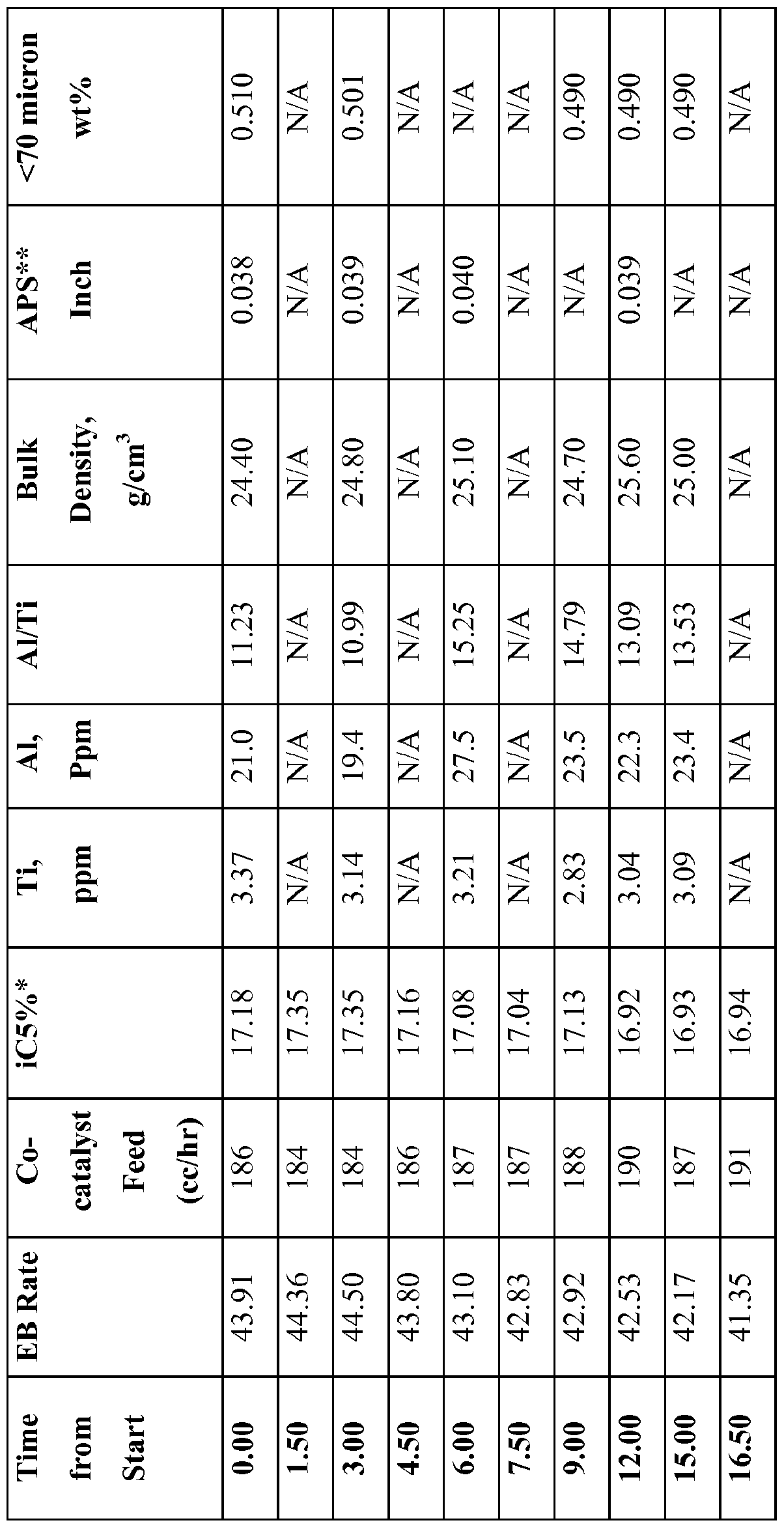
- Tables 6 and 7 provide the hourly average values for various process parameters for the polymerization reaction of Inventive Example 3. Procatalysts A and B were fed as slurries in mineral oil and their feed rates are reported in cc/hr in Tables 6 and 7. EB Rate in Table 7 is an energy balance calculated production rate given in pounds of polymer per hour, calibrated against an actual mass production rate.
- Procatalyst B does not include an internal electron donor. However, the Mg and Ti concentrations of Procatalyst A and Procatalyst B are similar. In fact, Procatalyst A may be produced using the same Ti compound as used to prepare Procatalyst B.
- Procatalyst A i.e., tetrahydrofuran
- Procatalyst B combining the electron donor of Procatalyst A, i.e., tetrahydrofuran, with Procatalyst B would result in the production of polymer with a molecular weight distribution similar to that achieved with Procatalyst A.
- Comparative Example 2 was a polymerization reaction effected as with Inventive Example 2 except using Procatalyst B feed.
- a 0.5 wt% solution of tetrahydrofuran ("THF") in isopentane was fed directly into the fluidizing bed of the reactor.
- the THF solution was fed at a molar ratio of 2 to 1 based on the Titanium feed in Procatalyst B.
- Reactor temperature was increased from 82°C (as in Inventive Example 2) to 92°C. No positive effect on I 21 , i.e., reduction in molecular weight, was observed.
- Polymer particle size distribution was calculated using the data obtained from screen measurement using a standard set of mesh sieves— 10/18/35/60/120/200/pan (having mesh opening sizes of 2000/1000/500/250/125/70/0 microns respectively) and calculated using the mass of resin retained on each sieve. Fines are defined as resin particles on the 200 mesh screen and on the pan. The pan fraction actual size is generally assumed to be the average of 70 and zero, i.e. 35 microns.
- Resin density is measured by the Archimedes displacement method, ASTM D 792-00, Method B, in isopropanol. Specimens are measured within one hour of molding, after conditioning in the isopropanol bath at 23°C, for 8 minutes, to achieve thermal equilibrium prior to measurement. The specimens are compression molded according to ASTM D-4703-00, Annex A, with a five minutes initial heating period at about 190°C, and a 15 °C/min cooling rate per Procedure C. The specimen is cooled to 45°C in the press, with continued cooling until "cool to the touch.”
- Melt flow rate measurements for the ethylene-based polymers are performed according to ASTM D-1238-04, Condition 190°C/2.16 kg, Condition 190°C/5 kg and Condition 190°C/21.6 kg, which are known as I 2 , and I 21 , respectively.
- Melt flow rate is inversely proportional to the molecular weight of the polymer. Thus, the higher the molecular weight, the lower the melt flow rate, although the relationship is not linear.
- Melt Flow Ratio (MFR) is the ratio of I 21 to I 2 , unless otherwise specified.
- Titanium, aluminum and hafnium residuals were measured as ppm by wt using X- ray Diffraction techniques with appropriate standards.
- the Bulk Density measurement was a poured bulk density using a standard 500 cc volumetric cylinder.
Landscapes
- Chemical & Material Sciences (AREA)
- Health & Medical Sciences (AREA)
- Chemical Kinetics & Catalysis (AREA)
- Medicinal Chemistry (AREA)
- Polymers & Plastics (AREA)
- Organic Chemistry (AREA)
- Transition And Organic Metals Composition Catalysts For Addition Polymerization (AREA)
- Addition Polymer Or Copolymer, Post-Treatments, Or Chemical Modifications (AREA)
- Engineering & Computer Science (AREA)
- Materials Engineering (AREA)
Abstract
Description




Claims
Priority Applications (7)
| Application Number | Priority Date | Filing Date | Title |
|---|---|---|---|
| CN201180065754.XA CN103328517B (en) | 2010-12-31 | 2011-12-22 | Spent mixed catalyst Systematical control molecular resin amount is distributed |
| EP11808804.6A EP2658883B1 (en) | 2010-12-31 | 2011-12-22 | Control of resin molecular weight distribution using mixed catalyst systems |
| ES11808804.6T ES2546516T3 (en) | 2010-12-31 | 2011-12-22 | Control of molecular weight distribution of resins using mixed catalyst systems |
| BR112013016651-7A BR112013016651B1 (en) | 2010-12-31 | 2011-12-22 | polymerization process to produce a polyolefin |
| US13/991,538 US9394392B2 (en) | 2010-12-31 | 2011-12-22 | Control of resin molecular weight distribution using mixed catalyst systems |
| JP2013547564A JP5921571B2 (en) | 2010-12-31 | 2011-12-22 | Control of resin molecular weight distribution using mixed catalyst system |
| RU2013135707/04A RU2013135707A (en) | 2010-12-31 | 2011-12-22 | CONTROL OF MOLECULAR MASS DISTRIBUTION OF POLYMER USING MIXED CATALYTIC SYSTEMS |
Applications Claiming Priority (2)
| Application Number | Priority Date | Filing Date | Title |
|---|---|---|---|
| US201061428964P | 2010-12-31 | 2010-12-31 | |
| US61/428,964 | 2010-12-31 |
Publications (1)
| Publication Number | Publication Date |
|---|---|
| WO2012092105A1 true WO2012092105A1 (en) | 2012-07-05 |
Family
ID=45491819
Family Applications (1)
| Application Number | Title | Priority Date | Filing Date |
|---|---|---|---|
| PCT/US2011/066743 Ceased WO2012092105A1 (en) | 2010-12-31 | 2011-12-22 | Control of resin molecular weight distribution using mixed catalyst systems |
Country Status (8)
| Country | Link |
|---|---|
| US (1) | US9394392B2 (en) |
| EP (1) | EP2658883B1 (en) |
| JP (1) | JP5921571B2 (en) |
| CN (1) | CN103328517B (en) |
| BR (1) | BR112013016651B1 (en) |
| ES (1) | ES2546516T3 (en) |
| RU (1) | RU2013135707A (en) |
| WO (1) | WO2012092105A1 (en) |
Families Citing this family (3)
| Publication number | Priority date | Publication date | Assignee | Title |
|---|---|---|---|---|
| SG11202005004UA (en) * | 2017-12-05 | 2020-06-29 | Univation Tech Llc | Activated spray-dried ziegler-natta catalyst system |
| SG11202004922SA (en) * | 2017-12-05 | 2020-06-29 | Univation Tech Llc | Modified spray-dried ziegler-natta (pro)catalyst systems |
| CN112521539B (en) * | 2020-11-02 | 2024-06-28 | 中煤陕西能源化工集团有限公司 | Method for improving granule yield by adjusting powder particle size distribution and granule production system |
Citations (6)
| Publication number | Priority date | Publication date | Assignee | Title |
|---|---|---|---|---|
| US4543389A (en) * | 1984-04-10 | 1985-09-24 | Shell Oil Company | Copolymerization catalyst and process for polymerizing impact resistant ethylene-propylene polymers |
| US6187866B1 (en) | 1999-06-04 | 2001-02-13 | Union Carbide Chemicals & Plastics Technology Corporation | Staged reactor process |
| US6489411B1 (en) * | 1993-06-30 | 2002-12-03 | Fina Technology, Inc. | Catalyst formulation and polymerization processes |
| EP1773892A1 (en) | 2004-07-07 | 2007-04-18 | Dow Gloval Technologies Inc. | Multistage process for producing ethylene polymer compositions |
| WO2009085922A1 (en) | 2007-12-31 | 2009-07-09 | Dow Global Technologies Inc. | Ethylene-based polymer compositions, methods of making the same, and articles prepared from the same |
| WO2009088701A1 (en) | 2007-12-31 | 2009-07-16 | Dow Global Technologies Inc. | Process for polymerizing olefin-based polymers |
Family Cites Families (10)
| Publication number | Priority date | Publication date | Assignee | Title |
|---|---|---|---|---|
| US4302566A (en) * | 1978-03-31 | 1981-11-24 | Union Carbide Corporation | Preparation of ethylene copolymers in fluid bed reactor |
| US5290745A (en) * | 1992-08-10 | 1994-03-01 | Union Carbide Chemicals & Plastics Technology Corporation | Process for producing ethylene polymers having reduced hexane extractable content |
| US5817591A (en) * | 1995-06-07 | 1998-10-06 | Fina Technology, Inc. | Polyolefin catalyst from metal alkoxides or dialkyls, production and use |
| US6617405B1 (en) * | 1999-07-14 | 2003-09-09 | Union Carbide Chemicals & Plastics Technology Corporation | Process for the preparation of polyethylene |
| US6780808B2 (en) * | 2002-07-15 | 2004-08-24 | Univation Technologies, Llc | Enhanced solubility of magnesium halides and catalysts and polymerization process using same |
| BRPI0416646A (en) * | 2003-11-20 | 2007-01-16 | Union Carbide Chem Plastic | ziegler-natta catalyst precursor composition, processes for preparing a ziegler natta precursor composition and for converting a catalyst precursor composition to a procatalyst composition, catalyst composition and processes for forming an olefin polymerization and catalyst composition |
| MX2007001648A (en) * | 2004-08-09 | 2007-04-23 | Union Carbide Chem Plastic | Robust spray-dried ziegler-natta procatalyst and polymerization process employing same. |
| US7786237B2 (en) * | 2008-02-01 | 2010-08-31 | Fina Technology, Inc. | Polyethylene materials prepared using mixed ziegler-natta catalysts systems |
| BR112012025198A2 (en) * | 2010-04-05 | 2016-06-21 | Dow Global Technologies Llc | process to produce an olefin-based polymer and reaction product |
| JP2014502659A (en) * | 2010-12-31 | 2014-02-03 | ユニオン カーバイド ケミカルズ アンド プラスティックス テクノロジー エルエルシー | Polymer, method of producing the same and article made therefrom |
-
2011
- 2011-12-22 RU RU2013135707/04A patent/RU2013135707A/en not_active Application Discontinuation
- 2011-12-22 BR BR112013016651-7A patent/BR112013016651B1/en active IP Right Grant
- 2011-12-22 US US13/991,538 patent/US9394392B2/en active Active
- 2011-12-22 ES ES11808804.6T patent/ES2546516T3/en active Active
- 2011-12-22 CN CN201180065754.XA patent/CN103328517B/en active Active
- 2011-12-22 WO PCT/US2011/066743 patent/WO2012092105A1/en not_active Ceased
- 2011-12-22 EP EP11808804.6A patent/EP2658883B1/en active Active
- 2011-12-22 JP JP2013547564A patent/JP5921571B2/en active Active
Patent Citations (6)
| Publication number | Priority date | Publication date | Assignee | Title |
|---|---|---|---|---|
| US4543389A (en) * | 1984-04-10 | 1985-09-24 | Shell Oil Company | Copolymerization catalyst and process for polymerizing impact resistant ethylene-propylene polymers |
| US6489411B1 (en) * | 1993-06-30 | 2002-12-03 | Fina Technology, Inc. | Catalyst formulation and polymerization processes |
| US6187866B1 (en) | 1999-06-04 | 2001-02-13 | Union Carbide Chemicals & Plastics Technology Corporation | Staged reactor process |
| EP1773892A1 (en) | 2004-07-07 | 2007-04-18 | Dow Gloval Technologies Inc. | Multistage process for producing ethylene polymer compositions |
| WO2009085922A1 (en) | 2007-12-31 | 2009-07-09 | Dow Global Technologies Inc. | Ethylene-based polymer compositions, methods of making the same, and articles prepared from the same |
| WO2009088701A1 (en) | 2007-12-31 | 2009-07-16 | Dow Global Technologies Inc. | Process for polymerizing olefin-based polymers |
Also Published As
| Publication number | Publication date |
|---|---|
| BR112013016651B1 (en) | 2021-02-09 |
| JP2014504661A (en) | 2014-02-24 |
| EP2658883A1 (en) | 2013-11-06 |
| EP2658883B1 (en) | 2015-07-22 |
| JP5921571B2 (en) | 2016-05-24 |
| US9394392B2 (en) | 2016-07-19 |
| CN103328517A (en) | 2013-09-25 |
| RU2013135707A (en) | 2015-02-10 |
| BR112013016651A2 (en) | 2017-04-04 |
| CN103328517B (en) | 2015-09-16 |
| US20130338320A1 (en) | 2013-12-19 |
| ES2546516T3 (en) | 2015-09-24 |
Similar Documents
| Publication | Publication Date | Title |
|---|---|---|
| EP3778668B1 (en) | Polyolefin resin composition and production method of same | |
| EP3686223A2 (en) | Catalyst composition for polymerizing polyolefin, method for producing polyolefin, and polyolefin resin | |
| US8124708B2 (en) | Polyolefin powder | |
| AU2004293404B2 (en) | Spray-dried, mixed metal Ziegler catalyst compositions | |
| WO2010097351A1 (en) | Multi-stage process for producing multi-modal linear low density polyethylene | |
| RU2560179C2 (en) | Method of producing polyolefin polymer with improved wax deposition | |
| US9394392B2 (en) | Control of resin molecular weight distribution using mixed catalyst systems | |
| US9221932B2 (en) | Ziegler-Natta type catalysts, methods of preparing same, polymers produced using the catalysts and articles produced therefrom | |
| US9644049B2 (en) | Polymers, method of producing the same, and articles made therefrom | |
| CN102471401A (en) | Catalyst systems and methods for producing polyethylene | |
| WO2019231986A1 (en) | Ziegler-natta catalyst with an electron donor compound for increasing polymer molecular weight | |
| JP7389757B2 (en) | Ziegler-Natta catalyst system with heat-treated magnesium chloride component | |
| WO2002064647A1 (en) | Process for the polymerization of olefins | |
| EP4004070A1 (en) | Polymerization catalysts for production of polyethylene with high molecular weight | |
| JP6282299B2 (en) | Catalysts for olefin polymerization and their polymerization | |
| WO2014071119A1 (en) | Mixed compatible ziegler-natta/chromium catalysts for improved polymer products | |
| CN107880163B (en) | Catalyst component for olefin polymerization and preparation and application thereof | |
| CN101928360A (en) | Polyolefin catalyst with wide molecular weight distribution, and preparation and application thereof | |
| WO2021021792A1 (en) | Polymerization of ethylene in solution processes using a ziegler-natta catalyst and a hydrogenation catalyst | |
| WO2009087036A1 (en) | Use of an improved solid vanadium-containing ziegler-natta catalyst system for producing ethylene polymer compositions in a multistage process |
Legal Events
| Date | Code | Title | Description |
|---|---|---|---|
| 121 | Ep: the epo has been informed by wipo that ep was designated in this application |
Ref document number: 11808804 Country of ref document: EP Kind code of ref document: A1 |
|
| DPE1 | Request for preliminary examination filed after expiration of 19th month from priority date (pct application filed from 20040101) | ||
| WWE | Wipo information: entry into national phase |
Ref document number: 2011808804 Country of ref document: EP |
|
| ENP | Entry into the national phase |
Ref document number: 2013547564 Country of ref document: JP Kind code of ref document: A |
|
| NENP | Non-entry into the national phase |
Ref country code: DE |
|
| ENP | Entry into the national phase |
Ref document number: 2013135707 Country of ref document: RU Kind code of ref document: A Ref document number: 2013135645 Country of ref document: RU Kind code of ref document: A |
|
| WWE | Wipo information: entry into national phase |
Ref document number: 13991538 Country of ref document: US |
|
| REG | Reference to national code |
Ref country code: BR Ref legal event code: B01A Ref document number: 112013016651 Country of ref document: BR |
|
| ENP | Entry into the national phase |
Ref document number: 112013016651 Country of ref document: BR Kind code of ref document: A2 Effective date: 20130627 |