WO2012069794A1 - Composition i-ii and products and uses thereof - Google Patents
Composition i-ii and products and uses thereof Download PDFInfo
- Publication number
- WO2012069794A1 WO2012069794A1 PCT/GB2011/001652 GB2011001652W WO2012069794A1 WO 2012069794 A1 WO2012069794 A1 WO 2012069794A1 GB 2011001652 W GB2011001652 W GB 2011001652W WO 2012069794 A1 WO2012069794 A1 WO 2012069794A1
- Authority
- WO
- WIPO (PCT)
- Prior art keywords
- composition
- wound
- prepolymer
- sterile
- wound site
- Prior art date
- Legal status (The legal status is an assumption and is not a legal conclusion. Google has not performed a legal analysis and makes no representation as to the accuracy of the status listed.)
- Ceased
Links
Classifications
-
- A—HUMAN NECESSITIES
- A61—MEDICAL OR VETERINARY SCIENCE; HYGIENE
- A61M—DEVICES FOR INTRODUCING MEDIA INTO, OR ONTO, THE BODY; DEVICES FOR TRANSDUCING BODY MEDIA OR FOR TAKING MEDIA FROM THE BODY; DEVICES FOR PRODUCING OR ENDING SLEEP OR STUPOR
- A61M1/00—Suction or pumping devices for medical purposes; Devices for carrying-off, for treatment of, or for carrying-over, body-liquids; Drainage systems
- A61M1/90—Negative pressure wound therapy devices, i.e. devices for applying suction to a wound to promote healing, e.g. including a vacuum dressing
- A61M1/91—Suction aspects of the dressing
- A61M1/915—Constructional details of the pressure distribution manifold
-
- A—HUMAN NECESSITIES
- A61—MEDICAL OR VETERINARY SCIENCE; HYGIENE
- A61F—FILTERS IMPLANTABLE INTO BLOOD VESSELS; PROSTHESES; DEVICES PROVIDING PATENCY TO, OR PREVENTING COLLAPSING OF, TUBULAR STRUCTURES OF THE BODY, e.g. STENTS; ORTHOPAEDIC, NURSING OR CONTRACEPTIVE DEVICES; FOMENTATION; TREATMENT OR PROTECTION OF EYES OR EARS; BANDAGES, DRESSINGS OR ABSORBENT PADS; FIRST-AID KITS
- A61F13/00—Bandages or dressings; Absorbent pads
- A61F13/05—Bandages or dressings; Absorbent pads specially adapted for use with sub-pressure or over-pressure therapy, wound drainage or wound irrigation, e.g. for use with negative-pressure wound therapy [NPWT]
-
- A—HUMAN NECESSITIES
- A61—MEDICAL OR VETERINARY SCIENCE; HYGIENE
- A61L—METHODS OR APPARATUS FOR STERILISING MATERIALS OR OBJECTS IN GENERAL; DISINFECTION, STERILISATION OR DEODORISATION OF AIR; CHEMICAL ASPECTS OF BANDAGES, DRESSINGS, ABSORBENT PADS OR SURGICAL ARTICLES; MATERIALS FOR BANDAGES, DRESSINGS, ABSORBENT PADS OR SURGICAL ARTICLES
- A61L15/00—Chemical aspects of, or use of materials for, bandages, dressings or absorbent pads
- A61L15/16—Bandages, dressings or absorbent pads for physiological fluids such as urine or blood, e.g. sanitary towels, tampons
- A61L15/22—Bandages, dressings or absorbent pads for physiological fluids such as urine or blood, e.g. sanitary towels, tampons containing macromolecular materials
- A61L15/26—Macromolecular compounds obtained otherwise than by reactions only involving carbon-to-carbon unsaturated bonds; Derivatives thereof
-
- A—HUMAN NECESSITIES
- A61—MEDICAL OR VETERINARY SCIENCE; HYGIENE
- A61L—METHODS OR APPARATUS FOR STERILISING MATERIALS OR OBJECTS IN GENERAL; DISINFECTION, STERILISATION OR DEODORISATION OF AIR; CHEMICAL ASPECTS OF BANDAGES, DRESSINGS, ABSORBENT PADS OR SURGICAL ARTICLES; MATERIALS FOR BANDAGES, DRESSINGS, ABSORBENT PADS OR SURGICAL ARTICLES
- A61L15/00—Chemical aspects of, or use of materials for, bandages, dressings or absorbent pads
- A61L15/16—Bandages, dressings or absorbent pads for physiological fluids such as urine or blood, e.g. sanitary towels, tampons
- A61L15/42—Use of materials characterised by their function or physical properties
- A61L15/425—Porous materials, e.g. foams or sponges
-
- A—HUMAN NECESSITIES
- A61—MEDICAL OR VETERINARY SCIENCE; HYGIENE
- A61L—METHODS OR APPARATUS FOR STERILISING MATERIALS OR OBJECTS IN GENERAL; DISINFECTION, STERILISATION OR DEODORISATION OF AIR; CHEMICAL ASPECTS OF BANDAGES, DRESSINGS, ABSORBENT PADS OR SURGICAL ARTICLES; MATERIALS FOR BANDAGES, DRESSINGS, ABSORBENT PADS OR SURGICAL ARTICLES
- A61L15/00—Chemical aspects of, or use of materials for, bandages, dressings or absorbent pads
- A61L15/16—Bandages, dressings or absorbent pads for physiological fluids such as urine or blood, e.g. sanitary towels, tampons
- A61L15/42—Use of materials characterised by their function or physical properties
- A61L15/58—Adhesives
-
- A—HUMAN NECESSITIES
- A61—MEDICAL OR VETERINARY SCIENCE; HYGIENE
- A61L—METHODS OR APPARATUS FOR STERILISING MATERIALS OR OBJECTS IN GENERAL; DISINFECTION, STERILISATION OR DEODORISATION OF AIR; CHEMICAL ASPECTS OF BANDAGES, DRESSINGS, ABSORBENT PADS OR SURGICAL ARTICLES; MATERIALS FOR BANDAGES, DRESSINGS, ABSORBENT PADS OR SURGICAL ARTICLES
- A61L15/00—Chemical aspects of, or use of materials for, bandages, dressings or absorbent pads
- A61L15/16—Bandages, dressings or absorbent pads for physiological fluids such as urine or blood, e.g. sanitary towels, tampons
- A61L15/42—Use of materials characterised by their function or physical properties
- A61L15/58—Adhesives
- A61L15/585—Mixtures of macromolecular compounds
-
- A—HUMAN NECESSITIES
- A61—MEDICAL OR VETERINARY SCIENCE; HYGIENE
- A61L—METHODS OR APPARATUS FOR STERILISING MATERIALS OR OBJECTS IN GENERAL; DISINFECTION, STERILISATION OR DEODORISATION OF AIR; CHEMICAL ASPECTS OF BANDAGES, DRESSINGS, ABSORBENT PADS OR SURGICAL ARTICLES; MATERIALS FOR BANDAGES, DRESSINGS, ABSORBENT PADS OR SURGICAL ARTICLES
- A61L24/00—Surgical adhesives or cements; Adhesives for colostomy devices
- A61L24/001—Use of materials characterised by their function or physical properties
- A61L24/0036—Porous materials, e.g. foams or sponges
-
- A—HUMAN NECESSITIES
- A61—MEDICAL OR VETERINARY SCIENCE; HYGIENE
- A61L—METHODS OR APPARATUS FOR STERILISING MATERIALS OR OBJECTS IN GENERAL; DISINFECTION, STERILISATION OR DEODORISATION OF AIR; CHEMICAL ASPECTS OF BANDAGES, DRESSINGS, ABSORBENT PADS OR SURGICAL ARTICLES; MATERIALS FOR BANDAGES, DRESSINGS, ABSORBENT PADS OR SURGICAL ARTICLES
- A61L24/00—Surgical adhesives or cements; Adhesives for colostomy devices
- A61L24/0047—Composite materials, i.e. containing one material dispersed in a matrix of the same or different material
- A61L24/0073—Composite materials, i.e. containing one material dispersed in a matrix of the same or different material with a macromolecular matrix
-
- A—HUMAN NECESSITIES
- A61—MEDICAL OR VETERINARY SCIENCE; HYGIENE
- A61L—METHODS OR APPARATUS FOR STERILISING MATERIALS OR OBJECTS IN GENERAL; DISINFECTION, STERILISATION OR DEODORISATION OF AIR; CHEMICAL ASPECTS OF BANDAGES, DRESSINGS, ABSORBENT PADS OR SURGICAL ARTICLES; MATERIALS FOR BANDAGES, DRESSINGS, ABSORBENT PADS OR SURGICAL ARTICLES
- A61L26/00—Chemical aspects of, or use of materials for, wound dressings or bandages in liquid, gel or powder form
- A61L26/0061—Use of materials characterised by their function or physical properties
- A61L26/0085—Porous materials, e.g. foams or sponges
-
- A—HUMAN NECESSITIES
- A61—MEDICAL OR VETERINARY SCIENCE; HYGIENE
- A61L—METHODS OR APPARATUS FOR STERILISING MATERIALS OR OBJECTS IN GENERAL; DISINFECTION, STERILISATION OR DEODORISATION OF AIR; CHEMICAL ASPECTS OF BANDAGES, DRESSINGS, ABSORBENT PADS OR SURGICAL ARTICLES; MATERIALS FOR BANDAGES, DRESSINGS, ABSORBENT PADS OR SURGICAL ARTICLES
- A61L26/00—Chemical aspects of, or use of materials for, wound dressings or bandages in liquid, gel or powder form
- A61L26/0095—Composite materials, i.e. containing one material dispersed in a matrix of the same or different material
-
- C—CHEMISTRY; METALLURGY
- C08—ORGANIC MACROMOLECULAR COMPOUNDS; THEIR PREPARATION OR CHEMICAL WORKING-UP; COMPOSITIONS BASED THEREON
- C08L—COMPOSITIONS OF MACROMOLECULAR COMPOUNDS
- C08L83/00—Compositions of macromolecular compounds obtained by reactions forming in the main chain of the macromolecule a linkage containing silicon with or without sulfur, nitrogen, oxygen or carbon only; Compositions of derivatives of such polymers
- C08L83/04—Polysiloxanes
-
- C—CHEMISTRY; METALLURGY
- C08—ORGANIC MACROMOLECULAR COMPOUNDS; THEIR PREPARATION OR CHEMICAL WORKING-UP; COMPOSITIONS BASED THEREON
- C08G—MACROMOLECULAR COMPOUNDS OBTAINED OTHERWISE THAN BY REACTIONS ONLY INVOLVING UNSATURATED CARBON-TO-CARBON BONDS
- C08G77/00—Macromolecular compounds obtained by reactions forming a linkage containing silicon with or without sulfur, nitrogen, oxygen or carbon in the main chain of the macromolecule
- C08G77/04—Polysiloxanes
- C08G77/12—Polysiloxanes containing silicon bound to hydrogen
-
- C—CHEMISTRY; METALLURGY
- C08—ORGANIC MACROMOLECULAR COMPOUNDS; THEIR PREPARATION OR CHEMICAL WORKING-UP; COMPOSITIONS BASED THEREON
- C08G—MACROMOLECULAR COMPOUNDS OBTAINED OTHERWISE THAN BY REACTIONS ONLY INVOLVING UNSATURATED CARBON-TO-CARBON BONDS
- C08G77/00—Macromolecular compounds obtained by reactions forming a linkage containing silicon with or without sulfur, nitrogen, oxygen or carbon in the main chain of the macromolecule
- C08G77/04—Polysiloxanes
- C08G77/20—Polysiloxanes containing silicon bound to unsaturated aliphatic groups
Definitions
- Embodiments of the present invention relate to a two part, curable composition, methods for preparing the composition, manufacture thereof and methods for sterilisation thereof, medical and nonmedical use thereof, methods for use or therapy therewith, a device incorporating the composition, and a precursor therefor including its sterilisable precursor composition.
- a sterilisable or sterile composition for medical use particularly in wound therapy, more particularly as a wound packing material or filler which can be shaped and configured to the shape of a wound, or an adhesive or sealant for a wound dressing, most particularly for application in negative pressure wound therapy (NPWT).
- NGWT negative pressure wound therapy
- NPWT is a relatively new treatment for open wounds.
- negative pressure therapy can assist in the closure and healing of many forms of "hard to heal" wounds by reducing tissue oedema; encouraging blood flow and granular tissue formation; removing excess exudate and may reduce bacterial load (and thus infection risk).
- the therapy allows for less disturbance of a wound leading to more rapid healing.
- TNP therapy systems may also assist on the healing of surgically closed wounds by removing fluid and by helping to stabilise the tissue in the apposed position of closure.
- NPWT niobium niobium niobium niobium niobium niobium niobium niobium niobium niobium niobium niobium niobium niobium niobium niobium niobium niobium niobium niobium niobium ni.e. ni., a partial vacuum (i.e. does not completely collapse) to the wound bed when a negative pressure is applied to the wound area, and also allows fluids to pass from the wound bed towards the source of negative pressure.
- gauze or foam types There are two primary approaches to NPWT, i.e. gauze or foam types.
- the gauze type involves the use of a drain wrapped in gauze topped by a sealed dressing.
- the foam type involves the use of foam placed over or in the wound. , also topped by a sealed dressing.
- One embodiment is directed primarily towards the foam type of NPWT.
- Further rmation Copy embodiments are directed towards either the foam or gauze type of NPWT, or to a further type of NPWT which uses a sealed dressing as a combination or preformed with additional absorption or distribution layers or the like.
- articles of high free internal volume tend to be poorly drapeable due to the requirement for their structure to mechanically support their high free internal volume, and this is the case in foams applied in NPWT.
- packing material for use in NPWT must be shaped to fit the wound to be packed. This is typically achieved by the medical practitioner (physician or nurse) cutting a preformed block of foam to approximately fit the wound using a scalpel, knife or scissors. This operation can be complex and has the potential to introduce contamination, moreover is time consuming and messy for the medical practitioner, and indeed can be dangerous with the possibility of particulate foam contaminating the wound site or of an accident during the cutting process. Accordingly the process of shaping the wound dressing is currently an unaddressed problem in the field of NPWT.
- Castable compositions are known for use in wound care.
- WO2009/156709 discloses a topical negative pressure, or vacuum, wound therapy wound covering element or drape constructed of silicone or polyurethane based materials, which provides a substantially air-tight seal over a wound, having a vacuum connection tube or line for connection to a negative pressure source moulded or glued in place to reduce the likelihood of negative pressure leakage.
- the drape may be manufactured by casting a two-part heat curable silicone elastomer over the vacuum line, located in a mould.
- the resulting drape may be sterilised by irradiation and packaged in sterile form until required for use by placing over a foam or gauze wound filler
- An RTV-2 (addition cure two-part room temperature vulcanizing) silicone foam wound dressing, Cavi-Care, is sold non-sterile.
- US 5,153,231 discloses the composition which is capable of providing a low density foamed medical dressing by releasing two components into a mixing vessel by rupture of their individual packaging, mixing and dispensing or casting onto a surface such as an open wound and allowing the mixture to cure at room temperature.
- sterile foamed wound dressing materials are available such as AllevynTM, a polyurethane foam wound covering element, and black foam (“Granufoam”), a polyurethane wound filler, supplied packaged in a peel pouch, no two-part RTV-2 silicone composition or indeed any RTV-2 composition, foamable or otherwise, appears to be available sterile, as the two part system prior to curing, either terminally sterilised in primary packaging or sterilised and then aseptically packaged. Furthermore a process for sterilising these systems does not appear to be available.
- One object of the invention is to provide an improved terminally sterile RTV-2 foamable silicone composition. It is a further object to provide an improved, terminally sterile, wound filler which can be conformed to the shape of a wound cavity. It is a further object to provide a terminally sterile RTV-2 nonrfpamable or partially foamable silicone composition. It is a further object to provide a terminally sterile adhesive or sealant which can be conformed about a wound cavity.
- 25kGy is a typical dose for achieving the required level of microbial kill for terminal sterility.
- Rhodorsil RTFoam 3240 a RTV-2 polydiorganosiloxane composition having liquid prepolymer mixture Part A and Part B, suffered a noticeable increase in viscosity in Part A whilst Part B formed a solid elastomer.
- the resulting sterile composition was clearly incapable of mixing and casting.
- This viscosity increase can be influenced by reducing the gamma irradiation dose levels to 15kGy and even 10kGy, however across a wide range of gamma doses the irradiation alters the physical properties of the composition Part, with an increase in viscosity being observed at all dose levels.
- a curable composition comprising or apportioned between at least one Part A and at least one Part B, the at least one Part A comprising: (i) one or more alkenyl-containing prepolymers having at least one alkenyl group or moiety per molecule,
- composition additionally comprising:
- prepolymer (ii) is substantially absent from Part A and prepolymer (i) is substantially absent from Part B.
- the Parts are sealed within barrier means in manner to prevent contamination thereof,
- a curable composition for use as a negative pressure wound therapy wound filling material comprising or apportioned between at least one Part A and at least one Part B, the at least one Part A comprising:
- composition additionally comprising:
- prepolymer (ii) is substantially absent from Part A and prepolymer (i) is substantially absent from Part B
- the at least one Part A and at least one Part B are adapted to be dispensed in cooperative manner facilitating intimate contact and curing thereof and formation of a porous foam which is capable of transmitting negative pressure.
- the composition may be useful as a negative presure wound therapy adhesive or sealant, which is capable of adhering a negative presure wound therapy drape or which is air-tight.
- catalyst may be present in an inert Part, or preferably in the at least one Part A.
- the at least one Part A and / or the at least one Part B is sterilisable by irradiation or sterilised by irradiation, or one thereof is sterilisable by irradiation or sterilised by irradiation and the other thereof is sterilisable or sterilised by other means.
- prepolymer (i) makes up substantially the entirety of reactive prepolymer present in Part A which is capable of undergoing a hydrosilylation reaction and prepolymer (ii) makes up substantially the entirety of reactive prepolymer present in Part B which is capable of undergoing hydrosilylation reaction. More preferably prepolymer (i) and/or (ii) makes up substantially the entirety of reactive prepolymer present in Part A and/or Part B respectively.
- prepolymers incorporate a number of different molecules differing in chain length and unit composition, and that a reactive prepolymer other than (i) or (ii) may be present in trace amount
- certain embodiments encompass compositions for which such trace amount is insufficient to react with prepolymer (i) or (ii) comprised in the same Part, in the course of irradiation sterilisation, for example to an extent that the viscosity of the Part is increased by a value of greater than 0% up to 5% by weight and/or the foam properties are affected by a volume reduction greater than 0% up to 5%.
- the Part not incorporating catalyst such as Part B, may incorporate a trace amount of prepolymer (i) greater than 0% up to 5% by weight.
- Part A if not incorporating catalyst, may incorporate a trace amount of prepolymer (ii) greater than 0% up to 5% by weight, however this is not preferred.
- prepolymer (ii) is totally absent from Part A.
- Prepolymers include a distribution of discrete polymer chains with differing numbers of reactive groups. Accordingly a more accurate measure of trace amount of one Part in another is given by ratio of reactive groups.
- Part B may incorporate a trace amount of prepolymer (i) represented as molar ratio (Si-H unit or moiety)/(alkenyl unit or moiety) of greater than or equal to 2000, preferably greater than or equal to 5,000 more preferably greater than or equal to 10,000.
- prepolymer i
- Si-H unit or moiety molar ratio
- alkenyl unit or moiety a trace amount of prepolymer (i) represented as molar ratio (Si-H unit or moiety)/(alkenyl unit or moiety) of greater than or equal to 2000, preferably greater than or equal to 5,000 more preferably greater than or equal to 10,000.
- Reference herein to barrier means for the prevention of contamination of respective Parts A and B is to any chemical or mechanical barrier which prevents contamination by infectious agents which are capable of proliferation, or by contaminants which are capable of reaction with the prepolymers (i) and/or (ii), of otherwise prevents passage of substances which deleteriously affect the reaction of Parts A and B, for example loss of composition components by leakage.
- the barrier means is capable of preventing contamination by microorganisms or viruses, more preferably by pathogenic microbes or viruses, and escape of composition components.
- Embodiments of the invention may have application to any RTV, LTV or HTV compositions, which may comprise 2 or more components or Parts.
- the composition of the invention is an RTV-2, LTV-2 or HTV-2 composition, foamable or otherwise, for any envisaged use requiring sterility.
- the addition cure chemistry of 2-part RTV, LTV and HTV compositions is based on the hydrosilylation of vinyl functional prepolymers by Si-hydride functional prepolymers.
- Room temperature vulcanising is typically taken to mean the system cures below 50°C.
- Low temperature vulcanising is taken to mean the system cures in the range from 50°C to 130°C.
- High temperature vulcanising is taken to mean the system cures at a temperature in excess of 130°C.
- the composition is an RTV-2 composition.
- Embodiments of the invention may also have application to any two or more Part curable composition for which the Parts are adapted to be dispensed or released in cooperative manner facilitating intimate contact and curing thereof.
- Such Parts are therefore suitably fluid phase or capable of fluid behaviour under acceptable dispensing or release conditions or capable of wetting out a surface or material to which they are dispensed or released, for example Part A and Part B are capable of mutual wetting out when cooperatively dispensed or cooperatively released.
- the at least one Part A and at least one Part B are sealed within or upon at least two respective receptacles or supports and are adapted to be dispensed or released therefrom in cooperative manner facilitating intimate contact and curing thereof.
- the receptacles or supports are antimicrobially sealed.
- the Part A and Part B may be provided sealed within receptacles or on supports in substantial absence of air within the receptacles or on the supports.
- Reference herein to Parts A and B being present in receptacles in substantial absence of air or moisture, is suitably to air or moisture presenting less than 10% of the receptacle volume, preferably less than 5% of the receptacle volume.
- Air or moisture is suitably absent from any space above or about the composition, i.e headspace or the like, or such space is substantially absent.
- Air or moisture may additionally be absent from the composition itself, i.e the composition may be degassed or sparged or the like to remove air. It will be appreciated that the objective of providing an absence of air is to provide an absence of oxygen and moisture vapour.
- a substantial absence of air may be provided in known manner by displacement and/or removal or air.
- Displacement of air is suitably by means of purging the space about the composition, such as the headspace present above the composition within the barrier means, with a suitable inert gas; and/or sparging the composition with a suitable inert gas.
- Removal of air is suitably by means of providing the Part in a receptacle of substantially equal volume to the Part volume in manner to substantially eliminate any headspace.
- a suitable inert gas is argon or nitrogen or the like. Purging displaces air above the Part with inert gas. Sparging displaces air within the Part with inert gas. Matching volumes removes air above the Part.
- Receptacles or supports preferably comprise any suitable material which provides a barrier means as hereinbefore defined, preferably to microbial or viral infection and to ingress or egress of chemically reactive or contaminating material.
- receptacle or support materials are selected from any irradiation tolerant material, preferably any gamma, x-ray or e-beam irradiation tolerant material, which is sufficiently dense to be impermeable to contaminants, suitably being non-porous to such contaminants.
- Receptacle or support material may comprise any commonly available packaging materials and is preferably selected from polymeric materials such as polyolefins for example polyethylene (PE), polyethylene terephthalate (PET) and polypropylene (PP), polystyrene (PS), polyamides, and the like, metals such as metal foils, glass, silicone materials and from composites, laminates and combinations thereof; more preferably is selected from PE, PET and PP.
- polymeric materials such as polyolefins for example polyethylene (PE), polyethylene terephthalate (PET) and polypropylene (PP), polystyrene (PS), polyamides, and the like
- metals such as metal foils, glass, silicone materials and from composites, laminates and combinations thereof; more preferably is selected from PE, PET and PP.
- the composition including receptacles or supports and any integral cooperating means is packaged in a further outer (secondary) packaging which is resistant to EO or is steam permeable, which is suitable for sterilisation in usual manner.
- a receptacle or support may be flexible or rigid.
- a rigid receptacle or support is suitably any vial or cartridge as known in the art.
- a flexible receptacle or support for example may be formed from a laminate of metal foil having on each face thereof a film of polymer as hereinbefore defined which can be heat-sealed or laminated.
- a receptacle may comprise a portion which is intended for mechanical opening, rupture or penetration in manner to release the composition Part sealed therein.
- a receptacle may therefore comprise a combination of different materials or a combination of different, rupturable or penetratable and non-rupturable or non-penetratable, thicknesses of a material.
- Receptacles may be manually ruptured at weakened portions thereof, or mechanically ruptured or penetrated by physical means for example provided in a device for penetration and cooperative dispensing of composition parts.
- Suitable physical means include needles, spikes, punches such as bayonet caps, push-fit opening means and the like.
- Reference to cooperative dispensing as hereinbefore defined is to any method by which one or more Parts is dispensed simultaneously with and into direct contact with the other one or more Parts, preferably with simultaneous mixing.
- receptacles are adapted to be received within a device providing means to cooperatively release the respective Parts into an of enhancing accuracy of administering composition.
- the composition is suitable for dispensing into or about a wound.
- the composition is suitable for dispensing or releasing in a sterile field or environment. This is particularly advantageous in the case of medical applications for example within the sterile field of an operating theatre allowing the possibility to dispense directly or indirectly, for example via a mould, into a wound in a sterile field or environment. This avoids the need to contact the composition once dispensed, for example for positioning or shaping, and minimises the risk of introducing infection.
- An embodiment of the RTV-2 composition of the invention may comprise any prepo!ymers that follow a hydrosilylation reaction. One prepolymer contains alkenyl groups, the other contains Si-H moieties.
- the group of siloxane polymers is based on a structure comprising alternate silicon and oxygen atoms with various organic moieties attached to the silicon. Curing can be defined as a treatment that decreases the flow of an elastomer. This change is generally brought about by linking reactions between polymer molecules.
- the silicon hydride (Si-H) moiety is part of a polysiloxane
- the alkenyl group it is possible for the alkenyl group to either be part of a siloxane prepolymer or otherwise part of a non-siloxane prepolymer.
- the position of the alkenyl functional group is not critical and it may be either at the molecular chain terminals or in non-terminal positions along the molecular chain.
- Prepolymers (i) and (ii) are commercially available or may be obtained by known techniques.
- prepolymers (i) and / or (ii) are independently selected from known and novel fluid phase and soluble homopolymeric, and copolymeric prepolymers, and their entangled systems and mixtures thereof.
- the compositions cure to form copolymers, and may also include their entangled systems and mixtures with other non-reactive prepolymers if present in the composition.
- fluid phase is meant that the prepolymers are capable of admixture to form the respective Part.
- the respective Parts are of a viscosity suitable for mixing by hand within a period of up to 1 minute.
- fluid phase is intended to include prepolymers which can exist in fluid phase or behave as fluids, i.e the sterilised prepolymers are capable of admixture to form the respective Part.
- Copolymeric prepolymers include all hybrids derived from two or more monomeric species, including alternating, periodic, statistical, random, block, linear, branched, star, graft and pendant copolymers. Entangled systems include interpenetrating networks (IPNs) and semi-interpenetrating networks (SIPNs). It is also the case that these prepolymers can incorporate both organic and inorganic moieties.
- IPNs interpenetrating networks
- SIPNs semi-interpenetrating networks
- prepolymers (i) and (ii) are selected from silicones, including siloxanes and modified siloxanes, polyurethanes (PU) including polyester and polyether urethanes, elastomeric polyether polyesters, polyglycolic acid, polyacetates such as ethyl vinyl acetate, polyacrylate, polyacid derivatives of polysaccharides, such as carboxyalkylcellulose, carboxyalkylchitosan and copolymers thereof, and their hybrids including copolymers, entangled systems and mixtures thereof. More preferably the curable composition makes use of an addition cure reaction between organohydrogensiloxane units and organoalkenylsiloxane units.
- Preferred siloxane prepolymers (i) and (ii) therefore include these respective units and are more preferably polyorganosiloxanes.
- hybrid organic-inorganic polymeric systems that have used both siloxane and organic units include: acrylate functionalized siloxane copolymers, which have found use in contact lenses (US 3,808,178); hybrid grafts where organic polymers are grafted onto a polysiloxane chain or where siloxanes are grafted onto organic polymers, for example in silane graft technology for cross linkable HDPE (US 3,646,155) where hybrid grafts have been used to allow the cross linking of organic polymers through siloxane bond formation; hybrid block copolymers for example silicone-polycarbonate block copolymers (US 3,274,155); and copolymers of hybrids of silicone and ethylene copolymers, cross-linked with vinyl-containing silicone copolymers which have found use in coating textiles (US 2005/0100692);
- IPNs represent a special class of hybrid polymeric systems, these systems use a combination of mechanical entanglement and crosslinking in which one polymer is cured about another; these include thermoplastics entangled with platinum catalyzed addition cure silicones such as silicone-urethane IPNs and semi-IPNs including silicone-urethane and silicone-polyamide systems which are of general application or have found specific use in coating textiles (US 4,714,739, US 7,543,843); hydrophilic components immobilised in a silicone polymer (US 5,397,848) which have found use as contact lens material; and silicone polymer cured about a non-reactive polymer of comparable adhesion, which have found use in coating textiles (US 7, 32,170).
- Prepolymers may also be selected from modified silicones (MS) which find use as adhesives in catheter tubing and the like.
- compositions comprise a polydiorganosiloxane prepolymer (i) and/or (ii) and/or their respective combinations with the aforementioned prepolymers.
- a composition in which prepolymers comprise or consist essentially of polydiorganosiloxane prepolymers (i) and (ii) has particular advantages, for example in applications where low toxicity is an advantage, preferably in medical or dental applications or in non-medical or non-dental applications requiring low toxicity or favorable biocompatibility.
- Prepolymer (i) and (ii) may comprise respective alkenyl-containing units and organohydrogensiloxane units situated along the length of prepolymer chains, and/or as prepolymer chain end-capping units or a combination thereof.
- Prepolymer (i) in-chain and end-capping alkenyl units preferably comprise alkenyl group or moiety R Alk selected from C-2-20 alkenyl optionally substituted or including one or more aryl groups or moieties.
- R Alk may comprise terminal or non terminal unsaturation, and may be of the formula i-l:
- R Alk1 and R Alk2 are independently selected from H, C-1-20 alkyl and C 5- 2o aryl groups and combinations thereof and a moiety R Alk1 is selected from a single bond, Ci -2 o alkyl and C ⁇ o aryl groups and combinations thereof.
- R Alk2 may be a moiety linking to polymer chain. More preferably each R Alk is independently selected from vinyl, allyl, propenyl, and from terminally and non- terminally unsaturated butenyl, pentenyl, hexenyl, heptenyl, octenyl, nonenyl and decenyl groups, most preferably selected from vinyl and hexenyl groups.
- prepolymer (i) comprises a polydiorganosiloxane polymer or copolymer comprising alkenyl-containing units of the formula (i-ll): (i-ll) f Si - R Alk , more particularly of the formula (i-ll I) and/or (i-IV): (i-lll) - O - Si R 1 R Alk - 0 - (j-IV) - 0 - Si R 1 2 R Alk
- R Alk is as hereinbefore defined and one or more groups R 1 are organo groups suitably independently selected from alkyl and aryl groups, more preferably ⁇ 1 -2 ⁇ alkyl and C5-20 aryl groups and combinations thereof, for example from methyl, ethyl, propyl, butyl, pentyl, hexyl, heptyl, octyl, nonyl and / or decyl groups and moieties.
- prepolymer (i) is selected from the formula i-V and i- VI:
- Prepolymer (i) may also comprise a polyorganosiloxane exhibiting, per molecule, at least two C2-C 6 alkenyl groups bonded to the silicon and having, for example, a viscosity of between 10 and 300 000 mPa s, which can in particular be formed of at least two siloxyl units of formula:
- - Y is a C2-C 6 alkenyl such as vinyl, allyl or hexenyl groups, preferably vinyl,
- - R is a monovalent hydrocarbon group with no unfavorable effect on the activity of the catalyst which is generally chosen from alkyl groups having from 1 to 8 carbon atoms inclusive, such as the methyl, ethyl, propyl and 3,3,3-trifluoropropyl groups, cycloalkyl groups, such as the cyclohexyl, cycioheptyl and cyclooctyl groups, and aryl groups, such as xylyl, tolyl and phenyl,
- - d is 1 or 2
- e is 0, 1 or 2
- d + e 1 , 2 or 3
- prepolymer (i) are, for example, dimethylpolysiloxanes comprising dimethylvinylsilyl ends, (methylvinyl)(dimethyl)polysiloxane copolymers comprising trimethylsilyl ends or (methylvinyl)(dimethyl)polysiloxane copolymers comprising dimethylvinylsilyl ends.
- Prepolymer (i) may also be a silicone resin bearing at least two alkenyl, preferably vinyl groups.
- silicone resin comprising at least two different siloxane units chosen from those of M siloxane unit of formula R3S1O1/2, D siloxane unit of formula R2S1O2/2, T siloxane unit of formula RSi0 3/2 and Q siloxane unit of formula Si0 4 2 ,
- R denotes a monovalent hydrocarbon group, with the conditions that at least one of these siloxane units being a T or Q siloxane unit and that at least two of the M, D and T siloxane units comprises an alkenyl group.
- the silicone resin could be selected from the group consisting of:
- Q consisting essentially of:
- Q consisting essentially of:
- Q consisting essentially of:
- R denotes a monovalent hydrocarbon group such as methyl and R' denotes a vinyl group:
- Such resins are well-known branched organopolysiloxane oligomers or polymers which are commercially available. They are provided in the form of solutions, preferably siloxane solutions.
- Prepolymer (ii) in-chain and end-capping polyorganohydrogensiloxane units are preferably selected from the formula ii-l and ii-ll:
- prepolymer (ii) is selected from formula ii-lll and ii-IV:
- P denotes the remainder of the polymer chain which may incorporate same or different units and one or more groups R 2 are organo groups suitably independently selected from C 1-2 o alkyl, C 5-2 o aryl and combinations thereof, for example from methyl, ethyl, propyl, butyl, pentyl, hexyl, heptyl, octyl, nonyl and / or decyl groups.
- Prepolymer (ii) preferably comprises a polyorganohydrogensiloxane - polydiorganosiloxane copolymer, incorporating one or more units ii-l and/or ii-ll :
- ii-VII Si - H, more particularly with the unit of formula ii-ll:
- prepolymer (ii) comprises methylhydrogensiloxane-dimethylsiloxane copolymers.
- Prepolymer (ii) may also comprises a polyorganosiloxane, exhibiting, per molecule, at least two hydrogen atoms bonded to the silicon and preferably at least three ⁇ SiH units and having, for example, a viscosity of between 1 and 5000 mPa-s, which can in particular be formed of siloxyl units of formula: H g X , SiO (V) in which:
- - X is a monovalent hydrocarbon group with no unfavorable effect on the activity of the catalyst which is generally chosen from alkyl groups having from 1 to 8 carbon atoms inclusive, such as the methyl, ethyl, propyl and 3,3,3-trifluoropropyl groups, cycloalkyl groups, such as the cyclohexyl, cycloheptyl and cyclooctyl groups, and aryl groups, such as xylyl, tolyl and phenyl,
- prepolymer (ii) are polymethylhydrosiloxanes or methylhydrodimethylsiloxane copolymers.
- prepolymers (i) and (ii) are as defined in US 5,153,231 for Cavi-Care RTV-2 type compositions, also as defined in US 2006/0217016, US 3,928,629 and US 4,529,553, US 4,714,739 and US 2002/0010299 the contents of which are incorporated herein by reference, or as commercially available (Rhodorsil RTFoam 3240, Mepiseal, Silpuran 211 1 A/B, Silpuran 2400/18 A/B, and the like.
- prepolymers include other units additional to illl, ilV, iil and iil I for example, these are suitably not reactive with the respective prepolymer at ambient temperature or under sterilising conditions.
- the ratio of silicon-bonded hydrogen atoms provided by (ii) to silicon-bonded alkenyl moieties provided by (i) is at least 0.5 :1, preferably 1 :1 .
- the curable composition follow the catalysed addition cure reaction according to the following scheme:
- the prepolymers (i) and (ii) and catalyst (iii) are apportioned in at least one Part A and at least one Part B in manner to provide respective Parts A and B which in isolation are not reactive at ambient temperature, nor under sterilisation conditions. Apportioning may also be determined according to volume and viscosity.
- the at least one Part A and at least one Part B may be of substantially equal volume and viscosity or of different volume and/or viscosity.
- Part A or Part B may incorporate a suitable viscosity moderator or diluent, in amount to increase or reduce volume and /or viscosity.
- Part A and Part B having different volume and viscosity may be volume and viscosity matched for improved ease and intimacy of mixing and dispensing.
- a suitable diluent is for example a silicone oil which is available in any desired viscosity for thickening or thinning effect.
- Part A comprising a silicone oil is radiation sterilisable without deleterious effect on properties of the resultant cured composition.
- Part A may be apportioned between two or more Parts A1 , A2 etc, of equal volume, providing 3 or more Parts A and B of approximately equal volume.
- Part B may incorporate silicone oil as a substantially inert diluent and/or thickener.
- a catalyst as hereinbefore defined may be any catalyst which is effective in catalysing the addition curing reaction as hereinbefore defined, more preferably as hereinabove illustrated.
- Suitable catalysts are selected from any known form of platinum, rhodium, palladium, nickel and like addition curing hydrosilylation catalysts, for example as disclosed in US 5,153,231, US 2006/0217016, US 3,928,629 and US 4,529,553 the contents of which are incorporated herein by reference.
- a platinum catalyst may be selected from platinum black, platinum as deposited on carriers including silica such as silica gel or carbon such as powdered charcoal, platinic chloride or chloroplatinic acid and alcohol solutions thereof, salts of platinic and chloroplatinic acids and platinum complexes such as platinum/olefin, platinum/alkenylsiloxane, platinum/beta-diketone, platinum/phosphine and the like.
- Chloroplatinic acid may be the hexahydrate or anhydrous form.
- a platinum complex may be prepared from chloroplatinic acid and its hexahydrate, or from platinous chloride, platinum dichloride, platinum tetrachloride and their neutralised complexes with divinyltetramethyldisiloxane, optionally diluted with dimethylvinylsiloxy endcapped polydimethylsiloxane.
- a palladium catalyst may be selected from palladium on carbon, palladium chloride and the like.
- a rhodium catalyst may be selected from rhodium chloride and one or more complexes of rhodium having the general formula iii-l or iii-ll: (iii-l) RhX 3 (SR 2 ) 3
- each X represents a halogen atom and each R represents an alkyl or aryl radical or combination thereof having from 1 to 8 inclusive carbon atoms or the R' 3 SiQ group in which Q represents a divalent aliphatic hydrocarbon radical having from 1 to 6 inclusive carbon atoms and R' represents an alkyl or aryl radical or combination thereof having from 1 to 8 inclusive carbon atoms or a (Ch ⁇ Si- group, not more than one R' per molecule being (Ch ⁇ Si-.
- Q represents a divalent aliphatic hydrocarbon radical having from 1 to 6 inclusive carbon atoms
- R' represents an alkyl or aryl radical or combination thereof having from 1 to 8 inclusive carbon atoms or a (Ch ⁇ Si- group, not more than one R' per molecule being (Ch ⁇ Si-.
- Ch ⁇ Si- rhodium chloride/di(n-butyl)sulfide complex and the like.
- a nickel catalyst is preferably a zero valent nickel selected from M2Ni (0) such as bis(1 ,5-cyclo-octadienyl)nickel (Ni(COD)2) and from MNi (0) G wherein M is a bidentate alkene cyclic hydrocarbon ring of C 8 . 12 and G is selected from monodentate and bidentate phosphorous groups having hydrogen atoms, substituted or unsubstituted hydrocarbon radicals or mixtures thereof bonded to the phosphorous atoms of the phosphorous groups.
- the composition may include a catalyst inhibitor. Suitable inhibitors are known in the art.
- a catalyst inhibitor may be selected from a polymethylvinylsiloxane cyclic compound and an acetylenic alcohol, such as methyl butynol for example as in Cavi-Care
- the composition comprises an addition-reaction retardant or a crosslinking inhibitor chosen, for example, from the following compounds:
- alkyl maleates and acetylenic alcohols.
- R' is a linear or branched alkyl radical, or a phenyl radical
- R" is H or a linear or branched alkyl radical, or a phenyl radical; the radicals R', R" and the carbon atom alpha to the triple bond possibly forming a ring; and
- R' and R" the total number of carbon atoms contained in R' and R" being at least 5 and preferably from 9 to 20. Examples that may be mentioned include:
- a-acetylenic alcohols are commercial products. Such a retardant is present in a maximum proportion of 3000 ppm relative to the total weight of the polyorganosiloxanes in the silicone composition. Methyl butynol could be chosen as in Cavi-Care.
- composition may be non-foamable or may be foamable, comprising (iv) a blowing agent, selected from any agent which evolves gas or vapour as part of or during the curing reaction, for example selected from H-donors, OH-containing agents, H-bonding agents such as:
- - alcohols including methanol, ethanol, n-propanol, isopropanol, n- butanol, 2-butanol, tert-butanol, n-hexanol, n-octanol and benzyl alcohol.
- n-Propanol, n-butanol, n-hexanol and n-octanol are particularly preferred
- - polyols such as diols including ,4-butanediol, 1 ,5-pentanediol and 1 ,7 heptanediol,
- a foamable composition may produce a foam having any desired porosity or pore architecture.
- a foamable composition provides an open-pore foam.
- a preferred foamable composition is adapted to deliver a foam of very high free internal volume, e.g. of the order of 70% to 90%.
- Preferred porous foams are of mechanical strength to prevent the foam structure collapsing in use, more preferably are adapted to form a cured three dimensional body which is resiliently deformable.
- a foamable composition is adapted to deliver a foam which cures to form open interfaces with moist or wet surfaces.
- open- interface foams are suitable for communicating with wound surfaces via the foam body, for example.
- open-interface foams are provided by silicone compositions.
- the composition is suitable for providing a cured porous three dimensional body of desired shape. When the composition is non foamable it could lead after hydrosilylation to a silicone elastomer or to a silicone gel.
- silicone gel denotes a crosslinked silicone product characterized by a degree of penetration of, for example, between 20 and 500 tenths of a mm (measured by ASTM D 2137 penetrometry, weight of the rod and of the cone: 62.5
- composition When the composition is prepared for a silicone gel it may have at least one nonfunctionalized polyorganosiloxane comprising:
- R 6 radicals which are identical or different correspond to an optionally substituted linear or branched C1-C6 alkyl group and/or a substituted or unsubstituted aryl group
- b) identical or different siloxyl units of type D (R 7 )2Si0 2 /2 in which the R 7 radicals correspond to the same definition as R 6 .
- the physical properties of these gels are adjusted according to the use by varying the levels of siloxyl units carrying Si-alkenyl and SiH functional groups and when it is present by varying the percentage by weight of nonfunctionalized polyorganosiloxane, which is well known in the prior art.
- the composition can further comprises a monofunctional polyorganosiloxane carrying a single Si-alkenyl group per molecule as teached by the European patent application EP-1633830-A2 .
- composition may also comprise inorganic filler such as reinforcing or bulking fillers.
- inorganic filler such as reinforcing or bulking fillers.
- These fillers can be provided in the form of very finely divided products, the mean particle diameter of which is less than 0.1 pm.
- These fillers include in particular fumed silicas and precipitated silicas; their specific surface is generally greater than 10 m 2 /g and generally lies within the range 20-300 m 2 /g.
- fillers can also be provided in the form of more coarsely divided products, with a mean particle diameter of greater than 0.1 pm. Mention may in particular be made, as examples of such fillers, of ground quartz, calcium carbonate, diatomaceous silicas, calcined clay, titanium oxide of the rutile type, iron, zinc, chromium, zirconium or magnesium oxides, the various forms of alumina (hydrated or nonhydrated), boron nitride, lithopone or barium metaborate; their specific surfaces are generally less than 30 m 2 /g.
- the filler may have a hydrophobic surface, which may be obtained by treating the filler, e.g. with suitable silanes, short chain siloxanes, fatty acids or resinous silicone materials. Suitable materials and processes for rendering the surface of fillers hydrophobic have been described in the literature, and are known to the person skilled in the art.
- the fillers can also be composed of a mixture of several types of fillers with different particle sizes.
- the composition may comprise active agents, which may have any desired activity for the intended purpose, for example medically active agents and the like. Suitable active agents or APIs are radiation stable as hereinbefore defined, preferably are stable under the required radiation levels to achieve terminal sterility of the compositions disclosed herein.
- antimicrobial agents and disinfectants such as silver and derivatives including silver oxide, silver nitrate, silver acetate and silver chloride, biguanides including polyhexamethylene and chlorhexidine glucanate and its acetate salt, active agents such as pharmaceuticals, biocides, growth factors, hemostats and the like, nutrients, pain killers and agents to minimise discomfort and the like and combination materials
- Antimicrobial agents, biocides and disinfectants may be selected from silver, in particular nano crystalline silver, and derivatives including silver complexes and salts such as ionic silvers, silver zeolite, silver oxide, silver nitrate, silver acetate, silver chloride, silver sulphadiazine), biguanides including polyhexamethylene biguanide and chlorhexidine digluconate and its acetate salt chlorhexidine acetate and diacetate, manuka honey, peroxides (e.g. hydrogen peroxide), iodine (e.g. povidone iodine), sodium hypochlorite, copper, copper complexes; zinc (e.g.
- phosphates, amines, amides and sulphonamides e.g. hexatidine, proflavine, mafenide, nitrofurazone, norfloxacin
- antibiotics e.g. gentamicin, bacitracin, rifampicin
- alcohols and acids e.g.
- known irradiation stable antimicrobials include Chlorhexidine acetate, silver sulphadiazine(SSD) and nano crystalline silver, these are active components of terminally sterile commercially available products BactigrasTM, Allevyn AgTM and ActicoatTM respectively; nutrients, pain killers and other pain management techniques suitably include analgesics and anasthetics and may be selected from amethocaine, lignocaine, non-steroidal anti-inflammatory drugs);
- Heamostats may be selected from Chit ' in, chitosan, kaolin; Antifibrinolytics such as amino acids, aminocaproic acid, tranexamic acid, aminomethylbenzoic acid; Proteinase inhibitors including aprotinin, alfal antitrypsin, Cl-inhibitor, camostat; Vitamin K and other hemostatics including vitamin K, phytomenadione, menadione; Fibrinogen including human fibrinogen; Local hemostatics including absorbable gelatin sponge, oxidized cellulose, tetragalacturonic acid hydroxymethylester, adrenalone, thrombin, collagen, calcium alginate, epinephrine; Blood coagulation factors including coagulation factor IX, II, VII and X in combination, coagulation factor VIII, factor VIII inhibitor bypassing activity, coagulation factor IX, coagulation factor VII, Von Willebrand factor and coagulation factor VIII in combination, coagulation factor XIII, epta
- combination materials including superabsorbers, Odour management, Wovens and non wovens, Gellable fibres; Growth factors, Wound debridements - mechanical, autolytic and enzymatic; Resorbable dressings and micro structure to influence cell ingrowth; Cells, tissue (e.g. autologous treatments); Indicators; Dyes and colourants.
- composition may include additional components selected from adjuvants, preservatives, extenders and the like.
- Adjuvants are preferably selected from fillers, colorants, coloured indicators.
- Preservatives include propyl gallate.
- composition comprises, by weight percent: Part A:
- Part A : B may be present in a 1 :99: 99:1 , for example 30:70 to 99 : 1 volume % ratio, respectively with or without added diluent or viscosity modifier.
- Preferably Part A : Part B is present in 30:70 to 70:30 volume % ratio, more preferably 45 : 55 to 55: 45, such as substantially 50:50.
- Preferably Parts A and B are of compatible viscosity enabling mixing and substantially complete reaction thereof.
- Suitably viscosity of Part A : Part B is in the range 6:1 - 1 :8, preferably 5:1 - 1:5, more preferably substantially 1 :1.
- Compositions of disparate viscosity may be mixed in devices with increased length mixing head for example. The sterilisation of a composition may induce some viscosity increase, and therefore the viscosity ratio is preferably that of the Parts post-sterilisation.
- the composition comprises prepolymers which are relatively short in length compared to that of the intended sterilised prepolymer. Prepolymers undergo chain lengthening during irradiation to a desired final viscosity or density.
- the Part A prepolymer(s) having at least one alkenyl unit or moity per molecule are relatively short in length compared to that of the corresponding sterilised Part A prepolymer(s).
- the respective sterilised Parts are of a viscosity suitable for mixing by hand within a period of up to 1 minute.
- Part A and/or Part B may comprise shortened prepolymers that will increase in molecular weight during sterilisation to give species with the desired properties following sterilisation.
- Part A and optionally Part B comprise pre-polymers of chain length determined such that an increase in molecular weight after irradiation sterilisation confers on the prepolymers a desired molecular weight, viscosity, Theology or the like following sterilisation.
- Part A comprises such shortened pre-polymers.
- Shortening is preferably to a percentage corresponding to the percentage increase in molecular weight and viscosity of the Part during sterilisation. This percentage will vary according to the chemical nature of any given composition. For example for a polydiorganosiloxane composition, shortening of Part A prepolymers is typically to the extent to give a 9 - 11% reduction in viscosity and shortening of Part B prepolymers is typically to the extent to give a 17 - 23% reduction in viscosity.
- a problem envisaged with dispensing low viscosity compositions in the lower part of the range 5-300 Pa*s is retaining the composition in position at an intended site until cure is complete.
- WO2004/108175 (Molnlycke Health Care AB) discloses the compounded problem encountered if the composition is affected by movements of the body, pressure or friction.
- the composition may have, on initial mixing, a viscosity within the range 10-120Pa * s, more preferably within the range 20-80 Pa*s.
- the composition may comprise one or more fillers to confer thixotropic properties thereon.
- a suitable filler may be fumed silica, for example such as Wacker Chemie, Wacker HDKTM WO2004/108175 discloses Wacker HDKTM as especially effective for this purpose.
- Prepolymers (i) and (ii) have cross-linking function, prepolymer (ii) may also cooperate with blowing agent to cause foaming.
- a composition comprises, by part weight, a modification of Cavi-Care composition recited in US 5,153,231 example col 7 the contents of which are incorporated herein by reference, for example in which all of prepolymer i) is moved to Part A:
- a method of preparing a composition as hereinbefore defined from its composition precursor comprising the steps of:- combining prepolymers (i), (ii) and catalyst (iii) as hereinbefore defined to form at least one Part A and at least one Part B as hereinbefore defined; and
- a method for the sterilisation of the composition comprising irradiating at least one of Part A and Part B, more preferably irradiating with x-ray, gamma and/or e-beam irradiation, most preferably gamma irradiation.
- irradiation is in sterilising dose.
- Part B or both Parts A and B are irradiated.
- the other Part is suitably sterilised by another known or novel means.
- Sterilization is regarded as a special process because of the difficulty in verifying by retrospective testing that products which have been through a sterilisation cycle are in fact sterile.
- Sterilisation controls for medical devices are achieved by a combination of validated sterilisation processes, selection of packaging appropriate to the sterilisation process and the application of quality assurance principles to the control of microbial bioburden on raw materials, intermediates, finished products and the manufacturing environment.
- the terminal sterilisation of medical devices and medical products is carried out using gamma irradiation amongst other processes, as defined in BS EN 556 - 1 :2001 Sterilisation of medical devices - Requirements for terminally sterilised devices to be labelled sterile.
- gamma ray irradiation short wavelength electromagnetic radiation (photons) are emitted from radioactive substances in the process of nuclear transition.
- Any radiation source may be used for sterilisation of product, and is preferably the isotope cobalt 60 (60Co).
- Radiation sterilisation is concerned with the exposure of an item to ionising radiation under defined validated conditions.
- e-beam radiation continuous or pulsed streams of high energy electrons are emitted.
- the radioisotope Cobalt 60 is the energy source for use in gamma irradiation plants and is manufactured specifically for this purpose.
- the irradiation process takes place in a specially designed cell, constructed of reinforced concrete often up to two metres thick. This design ensures that the radiation is attenuated so that there is no increase in external background levels.
- Cobalt 60 pellets are sealed inside stainless steel cylinders, referred to as source pencils. These pencils are placed into a metal source rack located within the concrete cell.
- the source rack can only be in one of two positions: the storage position, which most commonly is within a deep pool of water, or in the raised operating position. During operation, the source rack is surrounded by product circulating on a conveyor system.
- the energies given out by the decay of Cobalt 60 are insufficient to induce radioactivity in any material, irrespective of the length of exposure to the source.
- Electron beam processing is well established as a technology for initiating chemical change at a molecular level in polymers presented as thin sections, for instance, heat shrink tubing and wire and cable insulation. As a result of increased energy available from new generation equipment this technology has established itself as a valuable addition to the range of sterilization processes available for sterilizing medical devices, dressings and pharmaceuticals. Electron beam generation is typically by means of electron accelerators. Electron accelerators can best be described by analogy with a television tube. A heated tungsten filament forms the electron gun, a high voltage placed across the filament draws electrons away from the filament and accelerates them down an evacuated tube.
- the beam then passes through an oscillating magnetic field which 'scans' it back and forth (analogous to the horizontal scan of a TV tube), so that it emerges from the scan horn through a thin metallic window, usually made from titanium, in a fan- shaped configuration. Products then pass through this curtain of electrons to receive the required dose of irradiation.
- X-ray irradiation is appropriate for products which are too dense for E-beam. Much more penetrating than E-beam, X-ray is very similar to Gamma rays generated from cobalt with the key difference that X- rays are powered by electricity. High-energy X-rays are high frequency, short-wave length electromagnetic photons. They are emitted when high-energy electrons are stopped by a material that has a high atomic number.
- Electron accelerators function in a similar way to large cathode ray tubes in old fashioned TVs. They accelerate electrons from a plasma around a filament using electric fields to the desired energy (or speed). Hence their radiation can be turned on and off.
- the electron accelerator needs to be equipped with an X-ray converter.
- the X-ray converter is designed to stop the accelerated electrons and is typically a water cooled tungsten or tantalum plate in an appropriate mechanical assembly.
- the efficiency for X-ray emission increases with the electron energy and the atomic number of the target material.
- the X-ray energy spectrum is broad; the maximum photon energy is the same as the kinetic energy of the incident electrons. With X-ray energies of 5 MeV and 7 MeV, product penetration is greater than that provided by gamma rays from an uncollimated cobalt-60 source.
- X-rays and gamma rays are both photons. They lose their energy in matter in the same manner and have a good penetration power. However, their different production processes lead to different emission characteristics:
- the dose rate is the amount of radiation given per unit of time such as kGy/min. Simulations based on X-ray and gamma medical device sterilisation facility modelling show a dose rate two times higher for X-rays compared with gamma rays
- results are determined as the "bioburden” this being the population of viable microorganisms on a product and/or a package.
- a product is determined “sterile” if free from viable microorganisms.
- a sterility assurance level (SAL) is given as the probability of a viable microorganism being present on a product unit after sterilisation. SAL is normally expressed as 10 "n .
- Requirements for terminally sterilized devices to be labelled “sterile” are defined as a SAL of 10 "6 , or in other words that the theoretical probability of there being a viable microorganism present on a device is equal to or less than 1 x 10 6 (BS EN 556 - 1 :2001 Sterilisation of medical devices - Requirement sfor terminally sterilised devices to be labelled sterile).
- a suitable gamma irradiation dose for a composition is in the range 5 - 42 kGy (Isotron). Different irradiation processes (continuous and passing) are suitable. A reduced dose achieving terminal sterility of more sensitive composition Parts is in the range 15 -25kGy. Preferably a dose is in the range 15 kGy +/- 10% or 15 - 20 kGy. e-Beam irradiation is suitable for sterilising compositions of low receptacle wall density and low volume. A suitable dose is delivered by 10 MeV electron beam (Isotron).
- composition may be terminally sterile, i.e sterilised in its (primary) packaging, or otherwise, eg aseptically filled.
- a method of preparing an elastomer comprising combining the at least one Part(s) A and at least one Part(s) B of a composition as hereinbefore defined with curing or crosslinking thereof.
- the method may be a method of preparing a porous foam, adhesive or sealant comprising combining the at least one Part(s) A and at least one Part(s) B of a foamable and/or adhesive or sealant composition as hereinbefore defined with curing or cross linking thereof.
- an elastomer comprising a cured or crosslinked composition as hereinbefore defined.
- the elastomer is suitably obtained by combining the at least one Part(s) A and at least one Part(s) B of a composition as hereinbefore defined with curing or crosslinking thereof.
- the elastomer may be a porous foam, adhesive or sealant comprising a cured or crosslinked foamable and/or adhesive or sealant composition as herenbefore defined.
- the porous foam, adhesive or sealant elastomer may be obtained by combining the at least one Part(s) A and at least one Part(s) B of a foamable and/or adhesive or sealant composition as herenbefore defined with curing or cross linking thereof.
- the elastomer is terminally sterile.
- elastomer is meant the resulting end-prouct obtained after combining or mixing the at least one Part A and at least one Part B to form a mixture, with curing or crosslinking thereof. Curing or crosslinking is suitably initiated by subjecting to low (less than room temperature (around 20C), ambient (room temperature) or high temperature (greater than room temperature up to 190C).
- a composition or elastomer as hereinbefore defined.
- Such use includes use as dyes; preservatives; gels; foams; aerosols; pharmaceuticals; adhesives; encapsulants; hair/skin care; cosmetic use; dental use; release coatings; coatings; adhesives and sealants; wound care; skin care including scar reduction; cavity care; medical device encapsulation such as electronic device encapsulation for biomedical applications; mould making; orthopaedics; drug delivery systems including antimicrobial systems; haemostatic and pharmaceutical systems; nutrition including manufacture of foodstuffs; aerospace, marine and submarine applications; ecologically sensitive applications; confined or isolated organisms, or their habitats, or confined or isolated W
- medium or atmosphere such as those having low immunity
- sterile, clean or aseptic applications germination or propagation of living matter such as plants or organisms; including manufacture and repair of equipment, apparatus or components for any of the above and in 5 particular aerospace, submarine sterile, clean or aseptic, germination or propagation.
- a medical use of particular advantage is as a foamable composition as hereinbefore defined.
- a foamable composition is particularly suited
- the foamable composition is of particular advantage in that it may be used in a sterile field or environment. It is in this field, working on very severe wounds, that the advantages of a dispensable
- the foamable composition for use in wound care or wound therapy is suitable for providing a porous cured three dimensional resiliently deformable body. This is of particular advantage in providing support for the wound whilst being compressible as the wound heals and closes.
- the foamable composition provides an open-pore cured three dimensional body.
- the open pore system allows the development of a negative pressure at the wound, transmitted through the open-pore foamed 30 body. Wound fluids may be evacuated through the foamed body.
- the wound cavity is filled or covered with a porous foam packing material and covered over and sealed with flexible sheet (a drape) that is fairly impermeable to fluids.
- gauze 35 based NPWT a corresponding procedure is followed but using gauze packing material in place of porous foam packing material.
- combination dressing or preformed dressing based NPWT either procedure may be followed if gauze or foam are to be used.
- a vacuum line is inserted under or through the drape into the wound site and its distal end is connected to a vacuum source (commonly a pump).
- the wound cavity, enclosed by the drape and tissue contracts under the force of atmospheric pressure and compresses the packing material visibly.
- the wound packing material mechanically supports the tissue to which it is applied, and also allows the free flow of fluids away from the site when a vacuum is applied, even when compressed.
- Porosity is a function of number of pores and their size. It can be conveniently measured as a function of volume increase.
- the foamable composition suitably delivers a foam having a volume increase compared to the composition in the range from 3 to 10. Volume increase may be regulated by choice and amount of foaming agent, but is also a function of the polymer.
- the compositions, and in particular the polydiorganosiloxane compositions deliver porosity which is eminently suitable for wound care applications.
- the body is of very high free internal volume, e.g. 70% - 90% as hereinbefore defined.
- the size of the pores affects the transmission of negative pressure. Therefore, the smaller the pores, the smaller the negative pressure which can be established and the shorter its duration as the foam is progressively compressed by surrounding tissue growth. However the larger the pore size the lower the tensile strength, and the lower the support which the foam is able to deliver.
- the composition suitably delivers a foamed cured material having resilience and tensile strength capable of withstanding negative pressure of broadly -40 to -200 mmHg such as 80 - 120 mmHg below ambient atmospheric pressure without causing the foam to collapse.
- the pores are resilient to tissue contraction, and do not collapse under contraction, whereby negative pressure may be maintained.
- a foamable composition is adapted to deliver a foam which is open at its interfaces with moist or wet surfaces, more preferably is a polydiorganosiloxane composition. This creates the ideal material for generating a negative pressure at a wound surface whilst maintaining open communication with the wound itself.
- the polydiorganosiloxane composition is adapted to deliver negative pressure selectively to moist wound surfaces for example via an aperture or valve which can be readily inserted directly at its sealed face remote from the wound surface or indirectly via a vacuum connection tube connecting to such sealed face.
- the pores are resilient to tissue contraction, and do not collapse under contraction, whereby negative pressure may be maintained.
- the composition suitably delivers a foamed cured material having resilience and tensile strength capable of withstanding negative pressure of more than - 150mmHg, preferably 60 - 120mmHg such as 60 - 100mmHg below ambient atmospheric pressure, or 80 - 120 mmHg below ambient atmospheric pressure without causing the foam to collapse.
- a foamable composition is adapted to deliver a foam which is open at its interfaces with moist or wet surfaces, more preferably is a silicone composition.
- a silicone composition This creates the ideal material for generating a negative pressure at a wound surface whilst maintaining open communication with the wound itself.
- the composition is suitable for providing a cured porous three dimensional body of desired shape.
- the polydiorganosiloxane composition is adapted to deliver negative pressure selectively to moist wound surfaces, for example via an aperture or valve which can be readily inserted directly at its sealed face remote from the wound surface or indirectly via a vacuum connection line connecting to such sealed face.
- wound is to be broadly construed and encompasses open and closed wounds in which skin is torn, cut or punctured or where trauma causes a contusion.
- a wound is thus broadly defined as any damaged region of tissue where fluid may or may not be produced. Examples of such wounds include, but are not limited to, incisions, lacerations, abrasions, contusions, bums, diabetic ulcers, pressure ulcers, stoma, surgical wounds, trauma and venous ulcers or the like. Certain embodiments of the present invention are not restricted to use with wounds as will be discussed in more detail hereinbelow.
- a wound filling material preferably a negative pressure wound therapy wound filling material as hereinbefore defined includes use on wounds selected from chronic, acute, traumatic, sub-acute and dehisced wounds, ulcers (such as pressure or diabetic), partial- thickness burns and flaps and grafts. These include open, moist, granulating wounds, preferably surgical wounds such as those resulting from excision of ulcers, cancerous tissue such as perianal and perineal wounds and the like. For optimum healing of such wounds, the wound should be prevented from closing in on itself and allowing fluids to accumulate, whilst at the same time allowing the tissue around the wound to progressively contract, and the wound to shrink. Wound filling materials in NPWT therefore function as a type of "stent", supporting the wound and holding it open.
- compositions are particularly advantageous for use as an adhesive or sealant composition as hereinbefore defined.
- An adhesive or sealant composition is particularly suited for use in clean, aseptic or sterile applications, more particularly as an adhesive or sealant for clean aseptic storage or packaging of items such as medicaments, particularly packaging medicaments within a medical device, or nutritional items and the like, or in the repair and/or maintenance and/or manufacture of sterile, aseptic or clean devices or machinery.
- the composition for use as an adhesive or sealant in sterile, clean or aseptic conditions is packaged within further barrier means as hereinbefore defined.
- Further barrier means provide a barrier to infection.
- the composition is therefore a double wrapped item, this allows for the removal of the first layer of sterile sealed packaging to reveal receptacles or supports such as cartridges for or incorporated in a syringe, adhesive strips and the like, which are completely sterile inside and out, facilitating entry into a sterile environment.
- the composition omitting a further barrier means would comprise a non-sterile external surface of receptacles or supports and associated barrier means.
- the adhesive or sealant composition is suitable for introducing into a clean or aseptic area and dispensing or releasing into contact with an item to be adhered or sealed.
- a closure means is applied thereto.
- a bead of sealant may be dispensed around the rim of a sterile bottle prior to application of a closure means, or to any surface which it is desired to seal.
- a closure means or other opposing or adjacent surface is suitably applied with application of light pressure thereby ensuring that a seal is produced between the rim and the lid or other opposing or adjacent surfaces.
- sealant may be provided in a bagged dual syringe applicator and dispensed though a static mixer at the point of use. In this way a sterile dispenser and sealant may be conveniently provided for the user.
- sealant composition may be useful for example in sealing medical dressings, is useful for example in restraining egress of wound exudate or ingress of infection, or providing a vacuum seal for NPWT application; or as an insitu sterile lid sealant for laboratory vials and other vessels (e.g. Petri dish lids, sample storage pots, bijou bottles, culture bottles, demijohns and dewars ) under clean or aseptic techniques; or in the aseptic manufacture of packaged nutritional items such as for example foodstuffs including milk, fruit juice, egg; or in the repair and/or maintenance and/or manufacture of sterile, aseptic or clean devices or machinery and the like.
- laboratory vials and other vessels e.g. Petri dish lids, sample storage pots, bijou bottles, culture bottles, demijohns and dewars
- aseptic manufacture of packaged nutritional items such as for example foodstuffs including milk, fruit juice, egg
- a sealant for medical dressings may be applied in any known or novel manner.
- WO 00/74738 discloses use of silicone based RTV-2 compositions to seal wounds i.a to minimise potential infections.
- the sealant of the invention may suitably therefore be used by casting on top of the wound and surrounding skin and allowing to cure.
- WO2004/108175 discloses use of silicone based RTV-2 compositions to disintegrating skin or skin around wounds i.a to minimise potential infections and protect against harmful effects of wound exudate.
- the sealant is used by applying to skin about a wound, or to disintegrating skin, applying an adhesive or non-adhesive dressing over the wound and in contact with the sealant and allowing to cure, or by applying to an adhesive or non-adhesive dressing, applying the dressing to a wound and allowing to cure. In either case the dressing is sealed to the skin about the wound.
- the composition presents an admirable improvement on these methods by providing the surgeon, clinician or patient with a sterile sealant for use in these known manners or modifications thereof.
- Foodstuffs may be sealed within a container e.g. Tetra Pak as hereinbefore described.
- the sealant may be provided in bulk for industrial scale automated mixing and dispensing (e.g. using robotic dispensing systems as supplied by Rampf Dosiertechnik GMBH) in aseptic conditions.
- Sterile bagged cartridges of the 2 components may be manufactured for insertion in the dispensing machine.
- sterile cartridges of the 2 components may be provided for delivery into the aseptic manufacturing area and insertion into the dispensing machine.
- the sealant may be applied to a flange area or sealing surface as a bead prior to the bringing together of the components to form a seal.
- sealant composition may be dispensed to create an insitu gasket as hereinbefore defined.
- foamable composition may be dispensed as anti vibration material or insulation for heat or electrical purposes.
- the sealant may be provided in a bagged dual syringe applicator and dispensed though a static mixer at the point of use. In this way a sterile dispenser and sealant may be conveniently provided for the user.
- sterile bagged receptacles such as cartridges of the composition Parts may be provided for delivery into an aseptic manufacturing area and insertion into a dispensing machine.
- a wound dressing comprising the foamable or foamed composition, adhesive or sealant or composition thereof as hereinbefore defined .
- a method for dispensing or releasing, and curing a composition as hereinbefore defined comprising dispensing into a desired location or aperture at curing temperature for curing time.
- composition dispensing device comprising a terminally sterile composition as hereinbefore defined.
- the device is a NPWT device.
- a device comprises a mixing head having means to receive 2 or more cartridges comprising Parts A and B. Cartridges are adapted to locate and lock in place in the device.
- a suitable device for NPWT is a double barrelled syringe suitable for loading with 40g of pre-polymers and fitted with a mixing head.
- a method of therapy comprising dispensing a sterile composition as hereinbefore defined, preferably a terminally sterile composition, to the site of a wound.
- a method of therapy as hereinbefore defined which is a method of negative pressure wound therapy comprising dispensing a terminally sterile composition as hereinbefore defined directly or indirectly into a wound and allowing to foam and cure, sealing the wound including the foamed cured composition and optionally including a negative pressure connection means, and applying negative pressure to the wound.
- the composition may be dispensed directly into an open wound cavity and covered or dispensed into a covered cavity via an aperture in the cover or dispensed into a mould and inserted into a wound cavity.
- An open-pore surface or recess of surface is generated which may be connected directly or indirectly to a negative pressure source.
- wound fillers require removal and cleansing or changing on a regular basis, typically every 8, 12 or 24 hours, with the maximum recommended period for a dressing to remain in place being 48 hours in the case for example of foam, although up to 72 hours for black foam, and 72 hours in the case of gauze. After longer periods tissue in-growth may occur.
- the washed dressing may be reused for up to a week, but as wound healing progresses successively smaller fillers should be produced.
- the composition may be dispensed into a prepared wound in a sterile field and may remain in situ without the need to cleanse and replace because the shaping process is simplified and highly accurate, rather the used filler is discarded and a new filler is simply dipensed.
- the degree of tissue contraction which has taken place may be determined by monitoring a reduction in the negative pressure being delivered or by a decrease in the resilient deformation of the cured composition, and if sufficient contraction is observed, the cured composition may be removed and new composition dispensed into the wound for continued therapy.
- the foamable curable composition preferably has a pore structure which is capable of being compressed under moderate pressures, as tissue contracts, without pore collapse. The composition may be manually mixed and dispensed.
- a composition dispensing device comprising a terminally sterile composition as hereinbefore defined.
- the device is a NPWT device.
- a device comprises a mixing head having means to receive 2 or more cartridges comprising Parts A and B. Cartridges are adapted to locate and lock in place in the device.
- a suitable device for NPWT is a 40g mixing head
- a method for treating a wound site comprising:
- composition comprises a sealant capable of making a substantially fluid- tight seal
- the composition comprises a first part and a second part.
- the method further comprises curing the composition during or after covering the wound site.
- the method further comprises placing a filler such as foam, gauze or the like into the wound site.
- a filler such as foam, gauze or the like
- the drape suitably comprises an aperture so as to connect the source of negative pressure.
- the aperture may be positioned centrally, to one side or at the perimeter fo the drape.
- the method may further comprise creating at least one aperture into or under the drape so as to connect the source of negative pressure.
- the terminally sterile composition is sterilized prior to dispensing by exposing the composition to radiation in terminally sterilising dose.
- the terminally sterile foamable composition is a composition as hereinbefore defined.
- a method for treating a wound site comprising:
- the negative pressure range for certain embodiments of the present invention may be between about -20 mmHg and -200 mmHg (note that these pressures are relative to normal ambient atmospheric pressure thus, -200 mmHg would be about 560 mmHg in practical terms).
- the pressure range may be between about -40 mmHg and -150 mmHg.
- a pressure range of up to -75 mmHg, up to -80 mmHg or over -80 mmHg can be used.
- a pressure range of below -75 mmHg could be used.
- a pressure range of over -100 mmHg could be used or over -150 mmHg.
- the pressure provided may be modulated over a period of time according to one or more desired and predefined pressure profiles.
- a profile may include modulating the negative pressure between two predetermined negative pressures P1 and P2 such that pressure is held substantially constant at P1 for a pre-determined time period T1 and then adjusted by suitable means such as varying pump work or restricting fluid flow or the like, to a new predetermined pressure P2 where the pressure may be held substantially constant for a further predetermined time period T2.
- Two, three or four or more predetermined pressure values and respective time periods may be optionally utilised.
- a wound dressing comprising the foamed composition as hereinbefore defined.
- the wound dressing is a NPWT wound dressing.
- a NPWT kit comprising a fluid-tight wound dressing, a dispensable or releasable terminally sterile curable composition and attachment means for a vacuum pump to supply a negative pressure to the dressing.
- the terminally sterile curable composition is a composition of the invention as hereinefore defined.
- Figures 1 and 2 illustrate a NPWT foam filler wound dressing
- Figures 3 and 7, 8, 9 and 10 illustrate the use and application of a dispensible sterile foam filler wound dressing onto a patient
- Figures 4, 5 and 6 illustrate the a kit including a sealant composition and wound dressing
- FIGs 11 to 15 illustrate the use and application of an embodiment of a wound cover kit, apparatus and sealant onto a patient.
- a wound cavity (1) is filled or covered with a porous foam packing material (2), that may need to be cut to shape (2x shown as a) and covered over and sealed with an adhesive flexible sheet (a drape, 3) that is fairly impermeable to fluids.
- a vacuum line (4) is inserted (5) under or through the drape (3) into the wound site (1), in various embodiments this is received in a aperture or groove in the foam (6), or wrapped in gauze.
- the distal end (not shown) of vacuum line (4) is connected to a vacuum source (commonly a pump, not shown).
- FIG. 3A a sterile foamable composition is shown (10) being dispensed from syringe (11) into wound site (1).
- Figure 3B the composition cures once dispensed to form a foamed block (12) contacting the wound bed (1).
- a drape (3) is placed thereover and sealed in place in conventional manner.
- Vacuum line (4) is inserted (5) through the drape (3) in conventional manner whereupon vacuum may be initiated via vacuum line (4).
- the wound cavity behaves in corresponding manner as described in relation to Figure 2. This system improves the fit of the foam filler, and reduces the stresses placed on the adhesive sealing drape.
- Figure 4A illustrates a composition for use as a NPWT sealant.
- the sealant (20) is used by applying to skin about or around a wound site (1), or to disintegrating skin.
- Adhesive or non-adhesive drape (3) is applied, with optional dressing (not shown) over the wound (1) and in contact with the sealant (20) and the sealant is allowed to cure in contact with the drape.
- Vacuum line (4) is inserted through an aperture (5) in the drape (3) in conventional manner whereupon vacuum may be initiated via vacuum line (4).
- the sealant improves the quality of the negative pressure transmitted to the wound bed.
- Figure 5 shows a variant of Figure 4, in which the pump (8) is removably connected (5a) through aperture (5b) in the drape (3).
- FIG. 6 shows a further variant in which preformed drape (33 incorporating integral vacuum line sheath (34) and aperture (5) is positioned over sealant (30) applied via syringe (11).
- the drape (33) incorporates an adhesive backing (39), and sealant is therefore either dispensed about the wound in conventional manner as shown in step 3, or sealant (33) is dispensed to the edges of the adhered drape (33) as shown in step 4.
- Figures 7 to 10 show a further variant to Figures 3A to 3C, in which the drape (3) is placed over the wound site (1) before composition (10) is dispensed from syringe (11) through aperture (5).
- the composition foams and cures to form a foamed block (12) including button (13) projecting through aperture (5). Button (13) is broken offto provide an aperture into the foam body.
- Figure 10 shows vacuum line (4) coupled to aperture (5) and connected to vacuum pump (8) in conventional manner.
- Figure 11 to 15 show variants to Figures 4a, 5 and 6, relating to dispensing sealant 20 to seal combination dressings/drapes (2a, 3) including integral port (5) for vacuum line (4).
- For these combination dressings (2a, 3) it is necessary to dispense the sealant (20) to the region of skin (1a) which will underly the perimeter portion of the drape (3) surrounding the dressing portion (2a), as shown in Figure 15.
- dispensing about the edge of the combination dressing (2a, 3) is advantageous, as in Figures 11 and 12.
- sealant (20) may be dispensed at the edge of the drape at positions where leakages can be observed or are suspected.
- sealant (20) may be dispensed directly to the combination dressing, also illustrated in Figure 15, as a gasket (2), and the dressing then applied over the wound.
- adhesive tape strips (3a) can be overlaid to ensure both adhesion and seal are satisfactory.
- curing, sealing and operation of the vacuum are as previously described.
- RTV-2 polydimethylsiloxane composition Cavi-Care is a commercially available (Smith & Nephew) RTV-2 Pt catalysed foamable silicone elastomer having 30-105 seconds rise time, packaged as Parts A and B in foil pouches formed from aluminium foil laminated to either face with PE.
- Rhodorsil RT Foam 3240 A/B (Bluestar Silicones) is a RTV-2 Pt catalysed foamable silicone elastomer having 7.5 minutes rise time.
- compositions were subjected to gamma irradiation using a Co source irradiation and e-beam irradiation at 10 eV, at 10, 15, 20 and 25kGy.
- composition Part B formed a solid elastomer (gamma) and underwent an increase in viscosity (e-beam).
- composition Part A underwent an increase in viscosity with either radiation means, with gamma at 25 - 42 kGy, increase in viscosity was 230% (Cavi-Care) or 850% (Rhodorsil).
- EXAMPLE 1 A two part composition and a method for its preparation will hereinafter be described
- the viscosities of the following examples correspond to a dynamic viscosity quantity which was measured, in a way known per se, at 25°C.
- the viscosities were measured using a Brookfield
- compositions comprising parts P1 and P2, the composition of which are described in Table 1, were prepared :
- Vinylated polyorganosiloxane resin comprising M, D V
- poly(vinylmethyl)(dimethyl)siloxane oil having a content of D V
- - a Vinylated polyorganosiloxane resin comprising M, D V
- - b1_ polydimethylsiloxane blocked at each of the chain ends by a (CH 3 )2ViSiOi 2 unit and having a viscosity of 3500 mPa.s at 25°C.
- Example 6 the composition was made by mixing the three Parts A, B and C (components of Part C are indicated by "*" term).
- Examples 1 to 7 are foaming.
- Example 8 is non foaming.
- Parts A and B were irradiated by gamma, e-beam or X-Ray at various doses included between 10kGy to 35kGy.
- each Part was then mixed with the sterilized (or with the non-sterilised such as in Example 6 or 8) corresponding part, according to the ratio mentioned in the Table 1.
- the resultant solid or foam elastomers are evaluated and compared with unsterilised elastomers (results recorded in Tables 2 to 5).
- the Comparative Example 7 demonstrates that the presence in Part B of polysiloxanes having SiH units and of polysiloxanes having SiVinyl units leads to gel or cured pre-polymer after sterilization of Part B. Thus, it is not possible to mix Parts A and B in order to produce the foam. Nevertheless, the Example 5 demonstrates that the presence of 0,5% by weight of a polydimethylsiloxane blocked at each of the chain ends by a (CH 3 ) 2 ViSiOi/2 (M l )unit is acceptable.
- Density of cured foam (g/cm 3 ) 0, 19 0,23 0,19 0,26 0,24
- Example 3 Determination of tolerated contaminant prepolymer (i) in Part B Compositions were prepared incorporating different amounts of vinyl in Part B and irradiated by gamma or e-beam at 25 kGy.
- composition tested are described in Table 6 below :
- the resuts are as follows :
- Example 9 acceptable (1% of short 10 000 - 15
Landscapes
- Health & Medical Sciences (AREA)
- Chemical & Material Sciences (AREA)
- Engineering & Computer Science (AREA)
- Veterinary Medicine (AREA)
- Public Health (AREA)
- Life Sciences & Earth Sciences (AREA)
- Animal Behavior & Ethology (AREA)
- General Health & Medical Sciences (AREA)
- Materials Engineering (AREA)
- Epidemiology (AREA)
- Hematology (AREA)
- Heart & Thoracic Surgery (AREA)
- Chemical Kinetics & Catalysis (AREA)
- Composite Materials (AREA)
- Dispersion Chemistry (AREA)
- Biomedical Technology (AREA)
- Vascular Medicine (AREA)
- Polymers & Plastics (AREA)
- Organic Chemistry (AREA)
- Medicinal Chemistry (AREA)
- Surgery (AREA)
- Anesthesiology (AREA)
- Materials For Medical Uses (AREA)
- Medicinal Preparation (AREA)
- Adhesives Or Adhesive Processes (AREA)
- Compositions Of Macromolecular Compounds (AREA)
- Sealing Material Composition (AREA)
- Food Preservation Except Freezing, Refrigeration, And Drying (AREA)
- Apparatus For Disinfection Or Sterilisation (AREA)
Abstract
Description


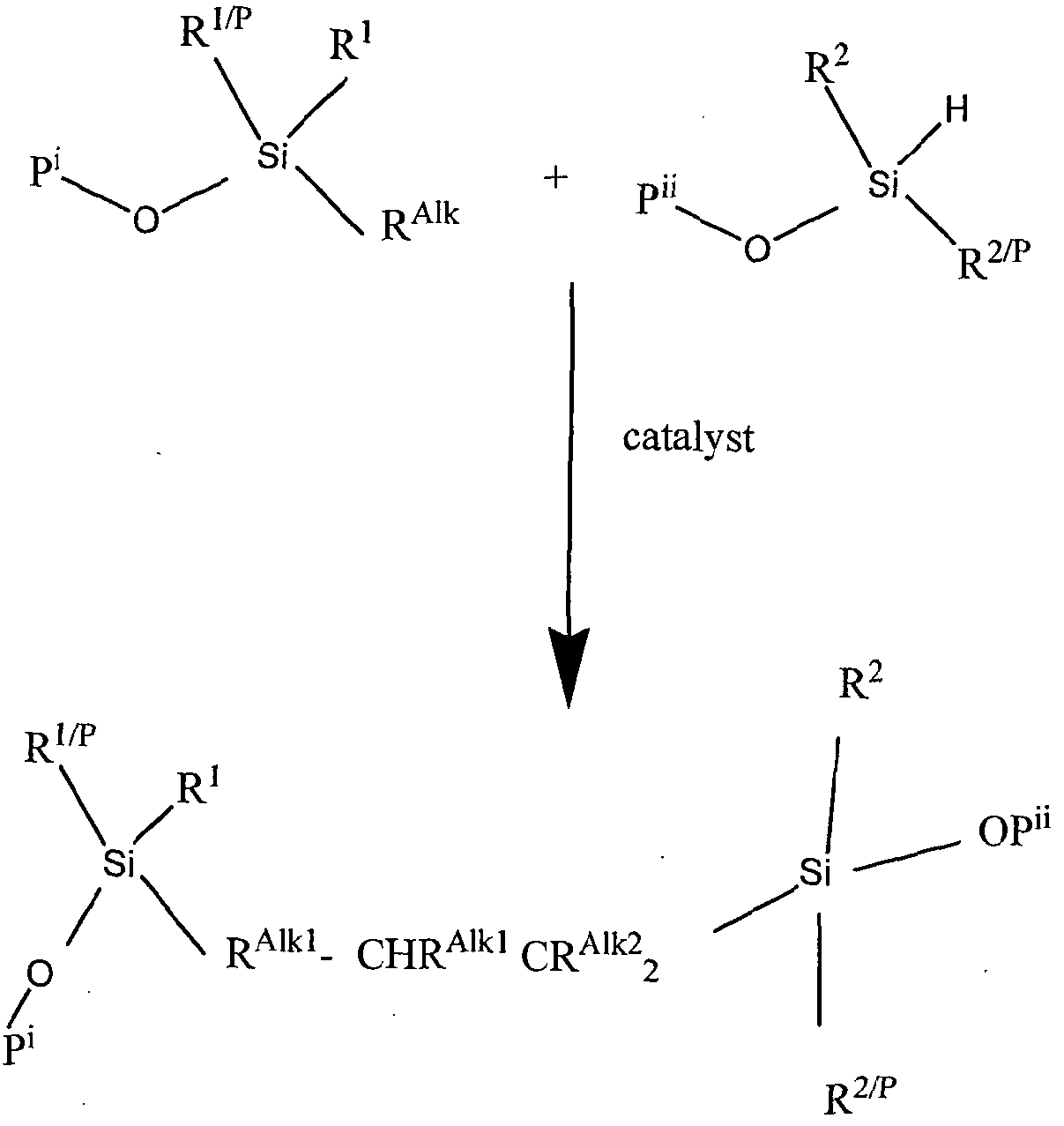
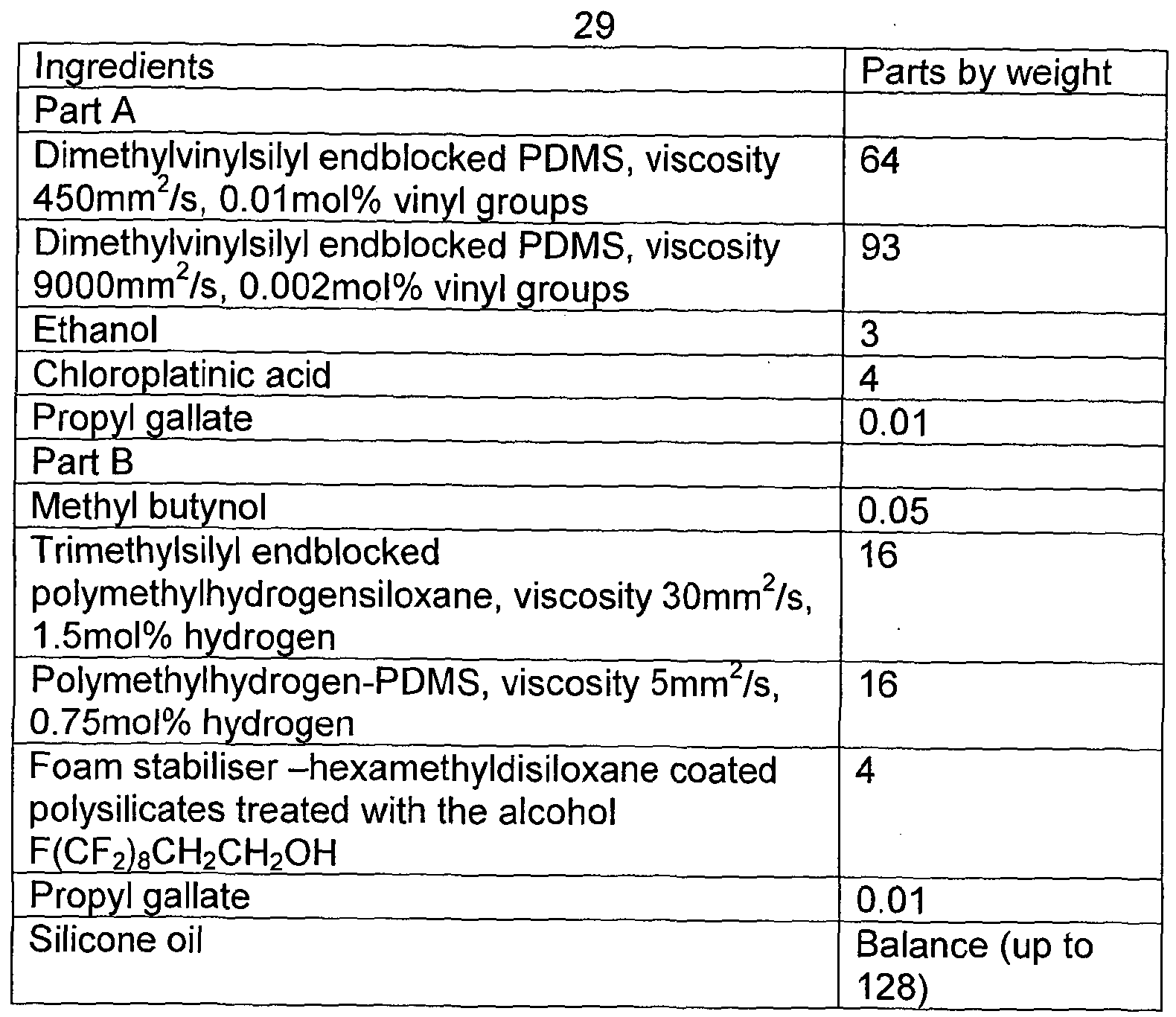

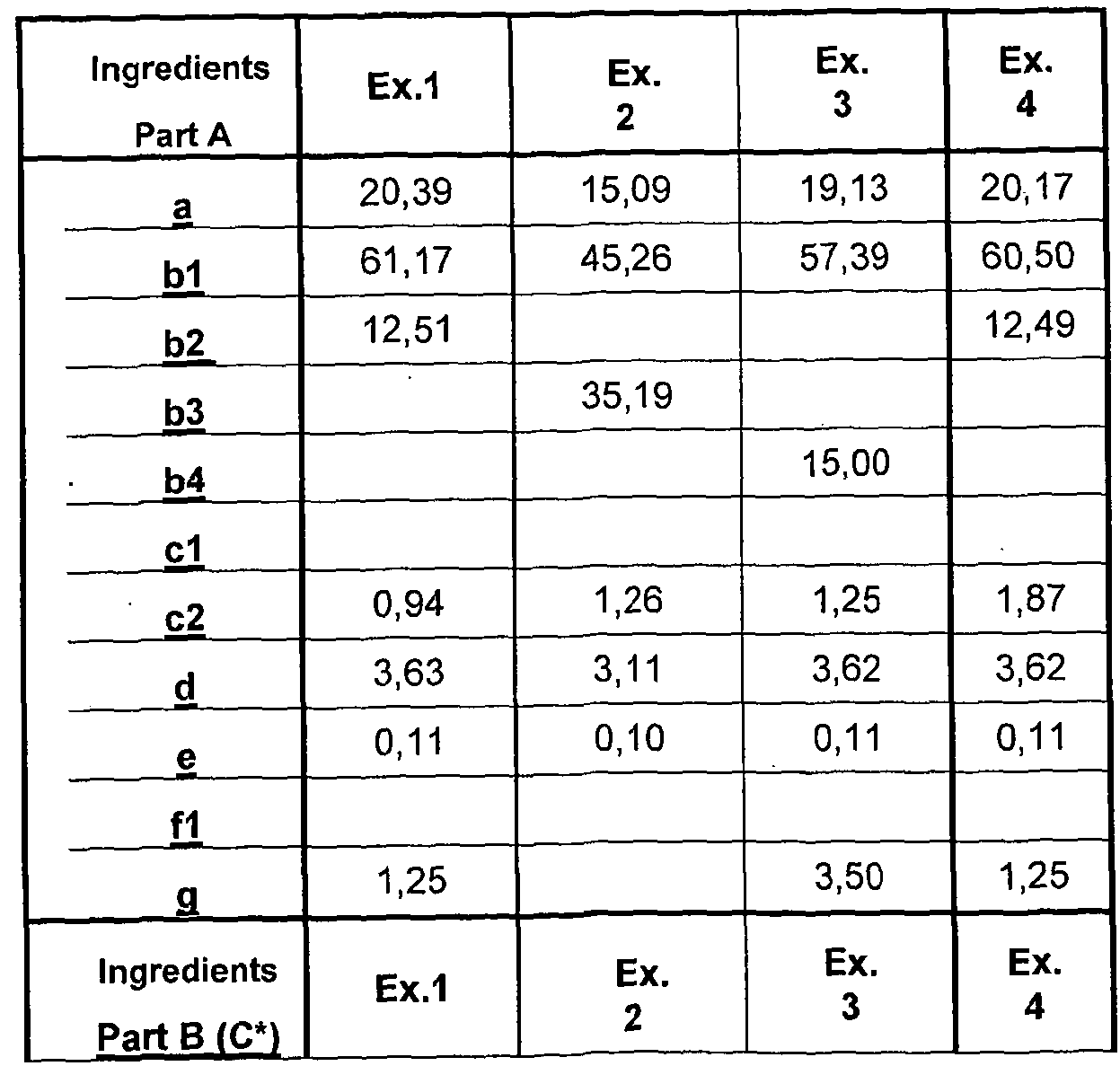
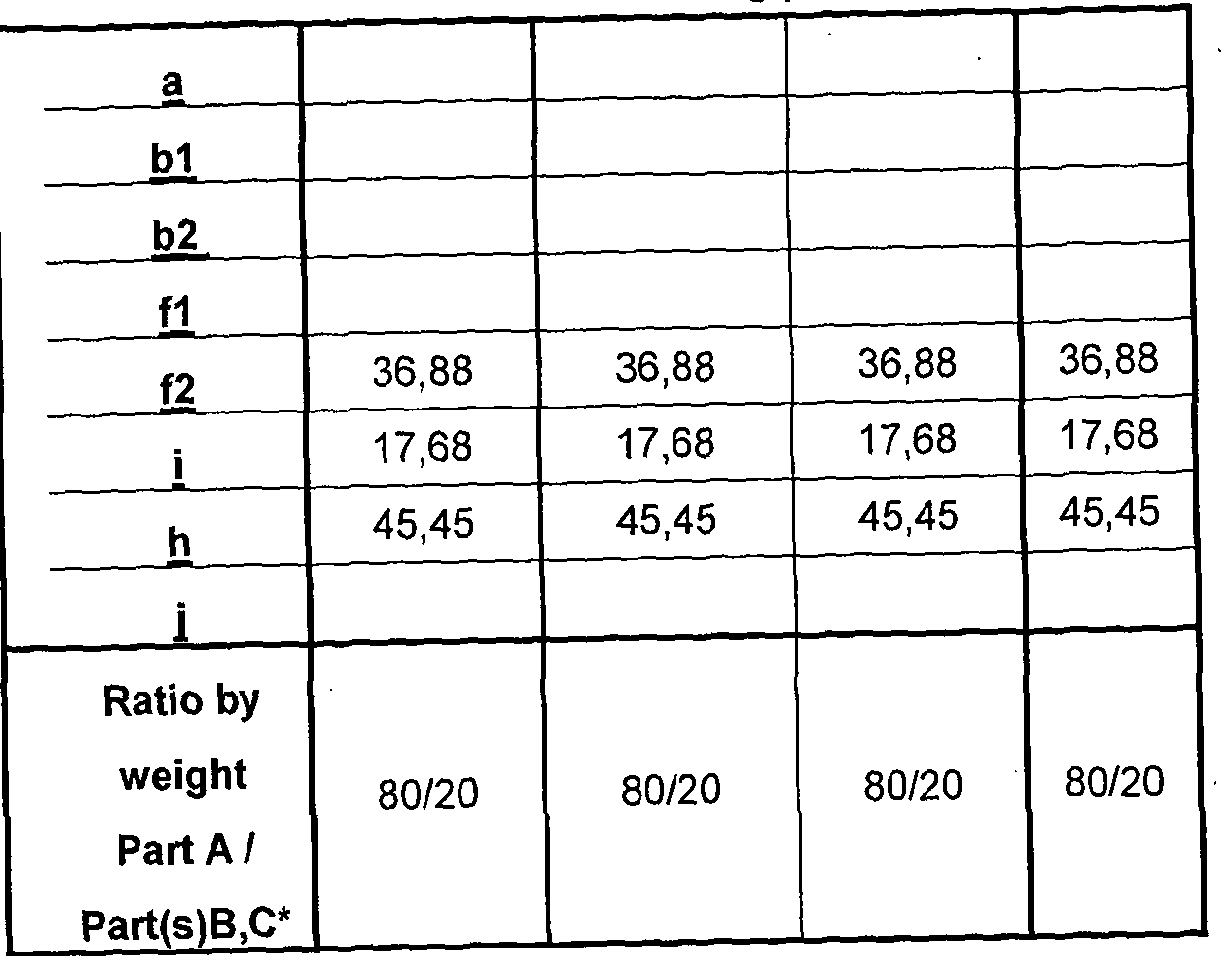
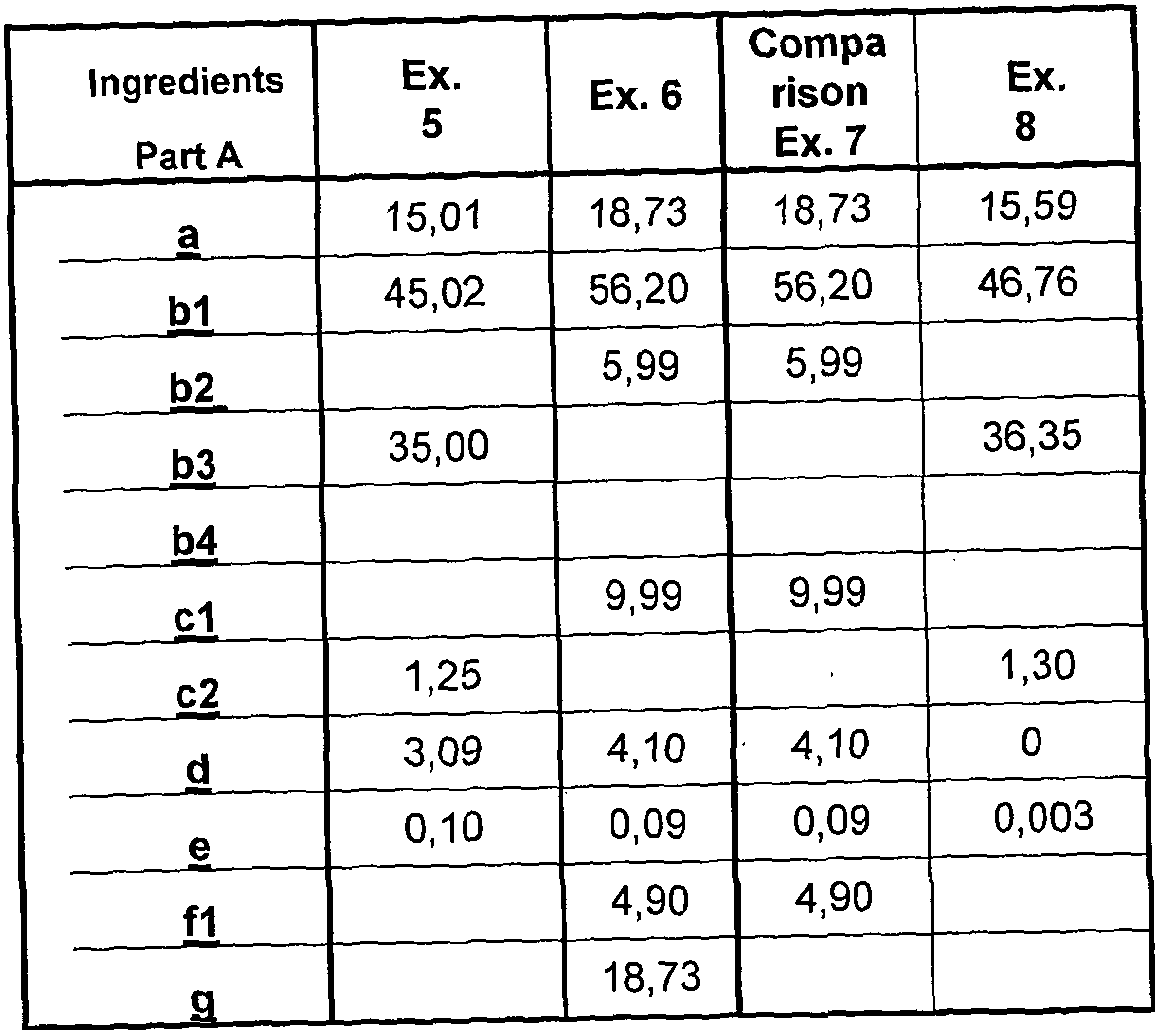
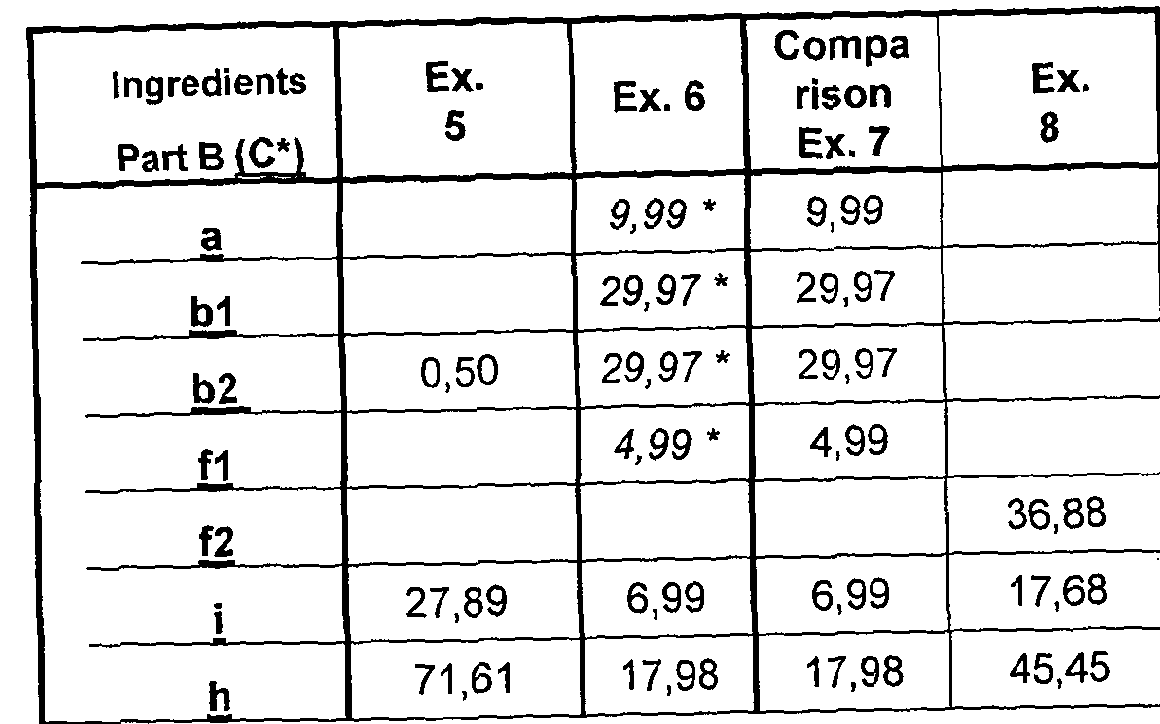

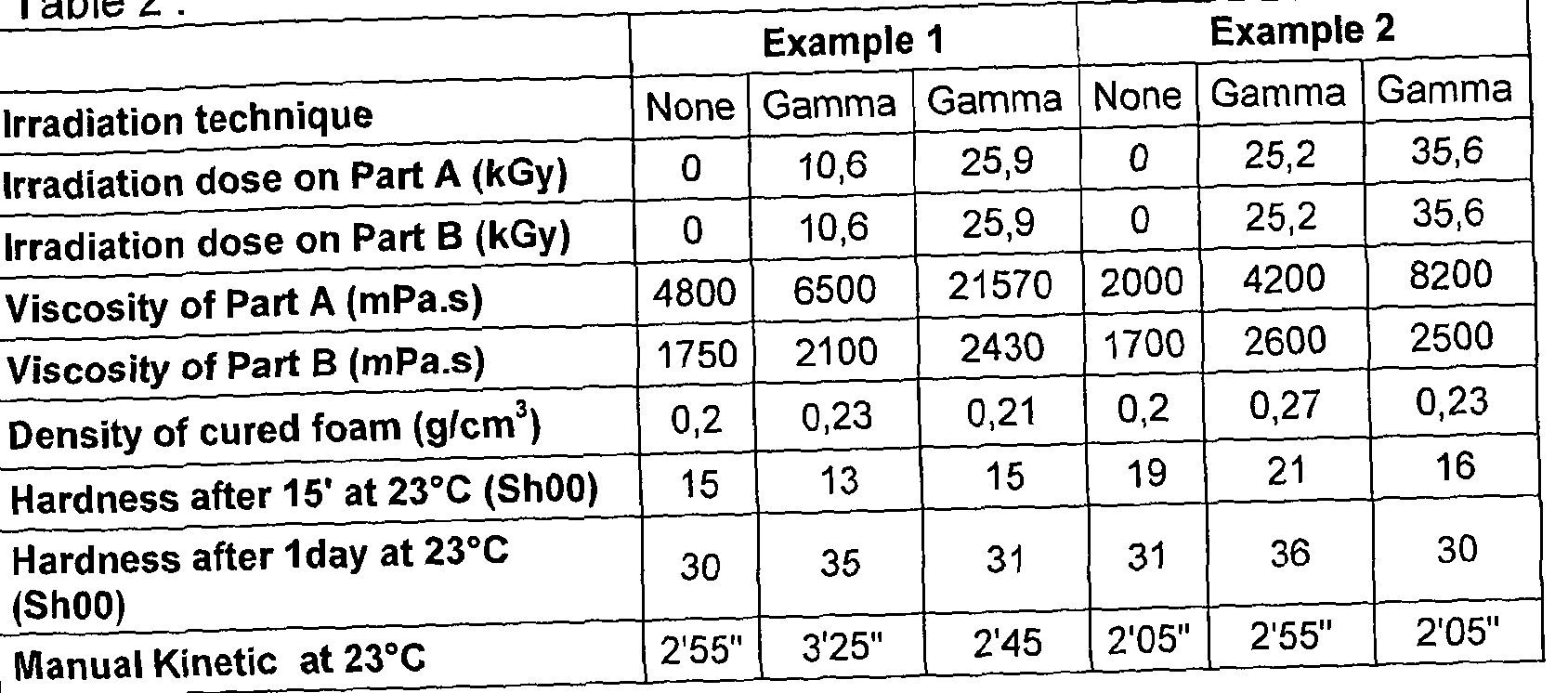

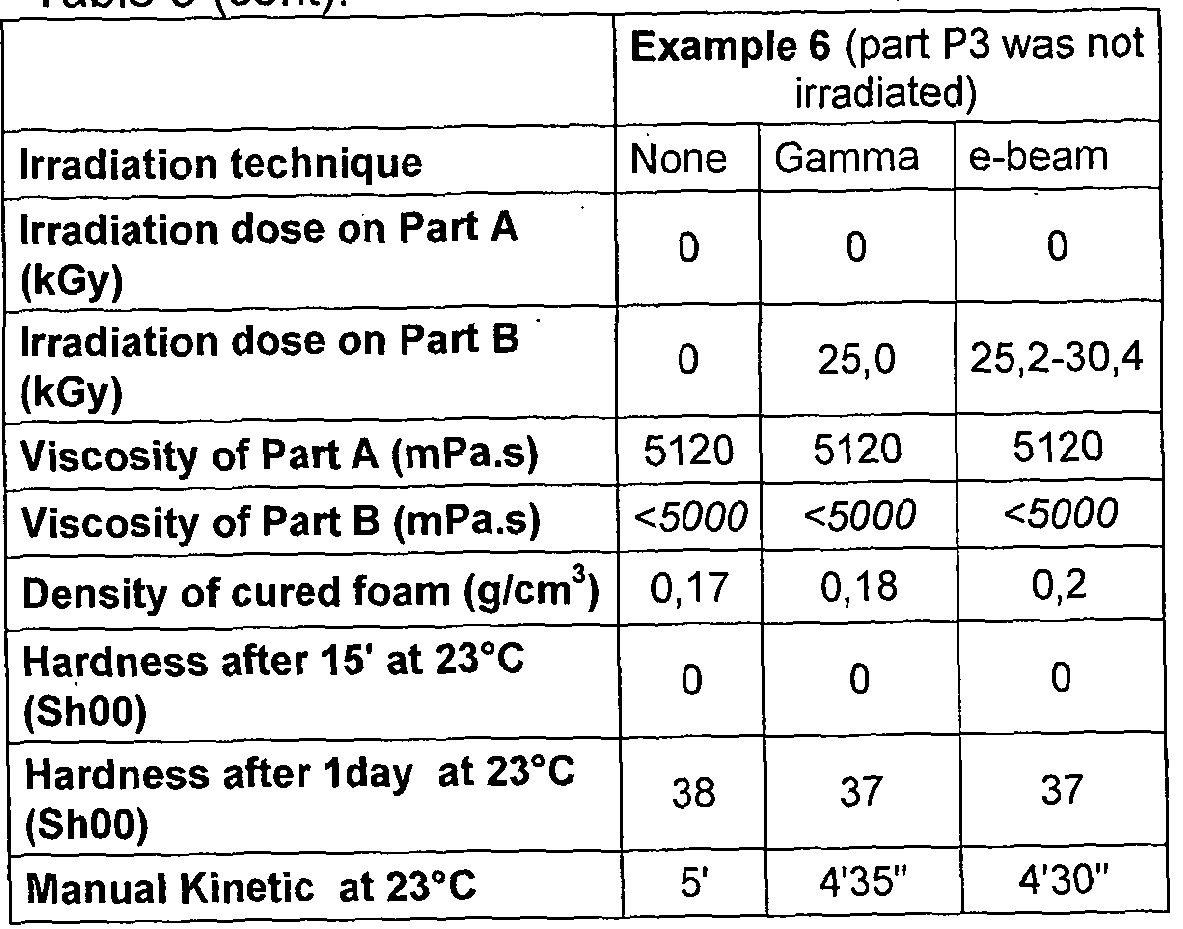
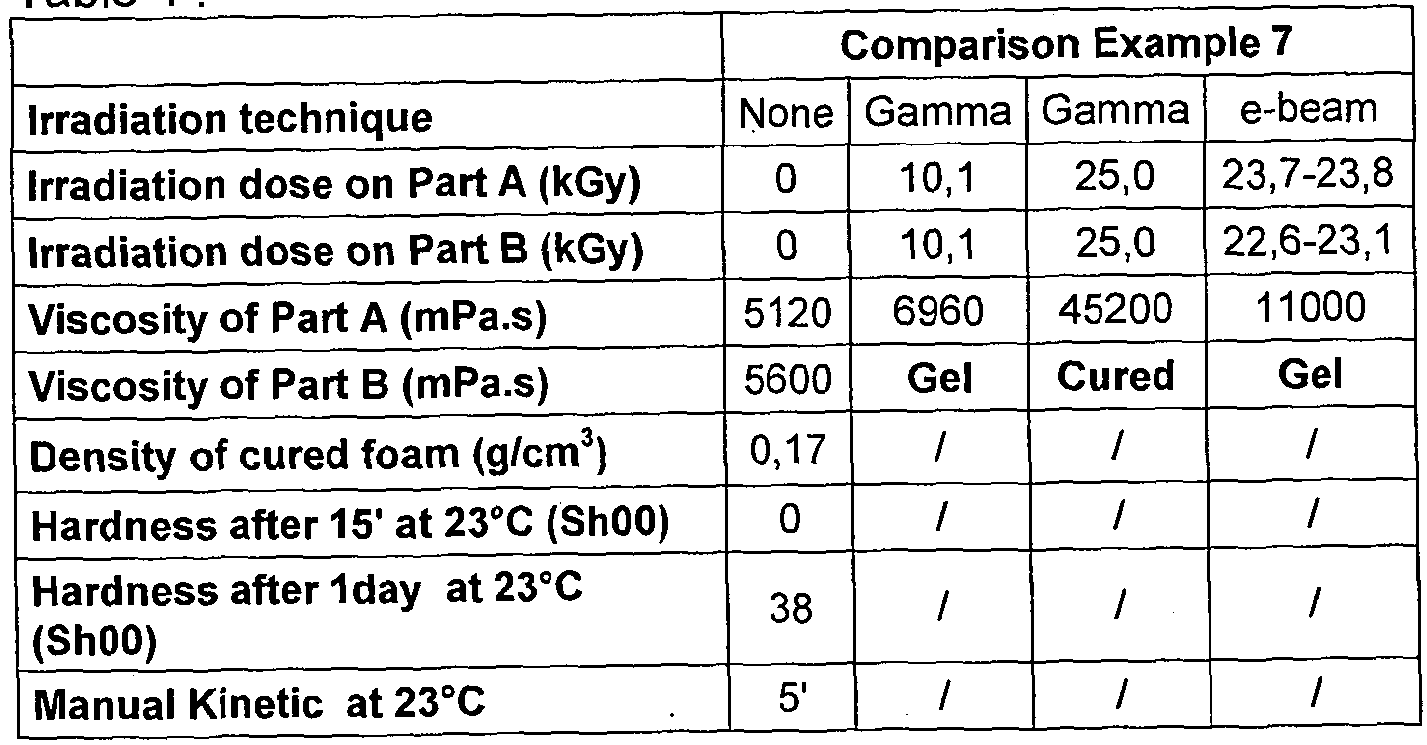
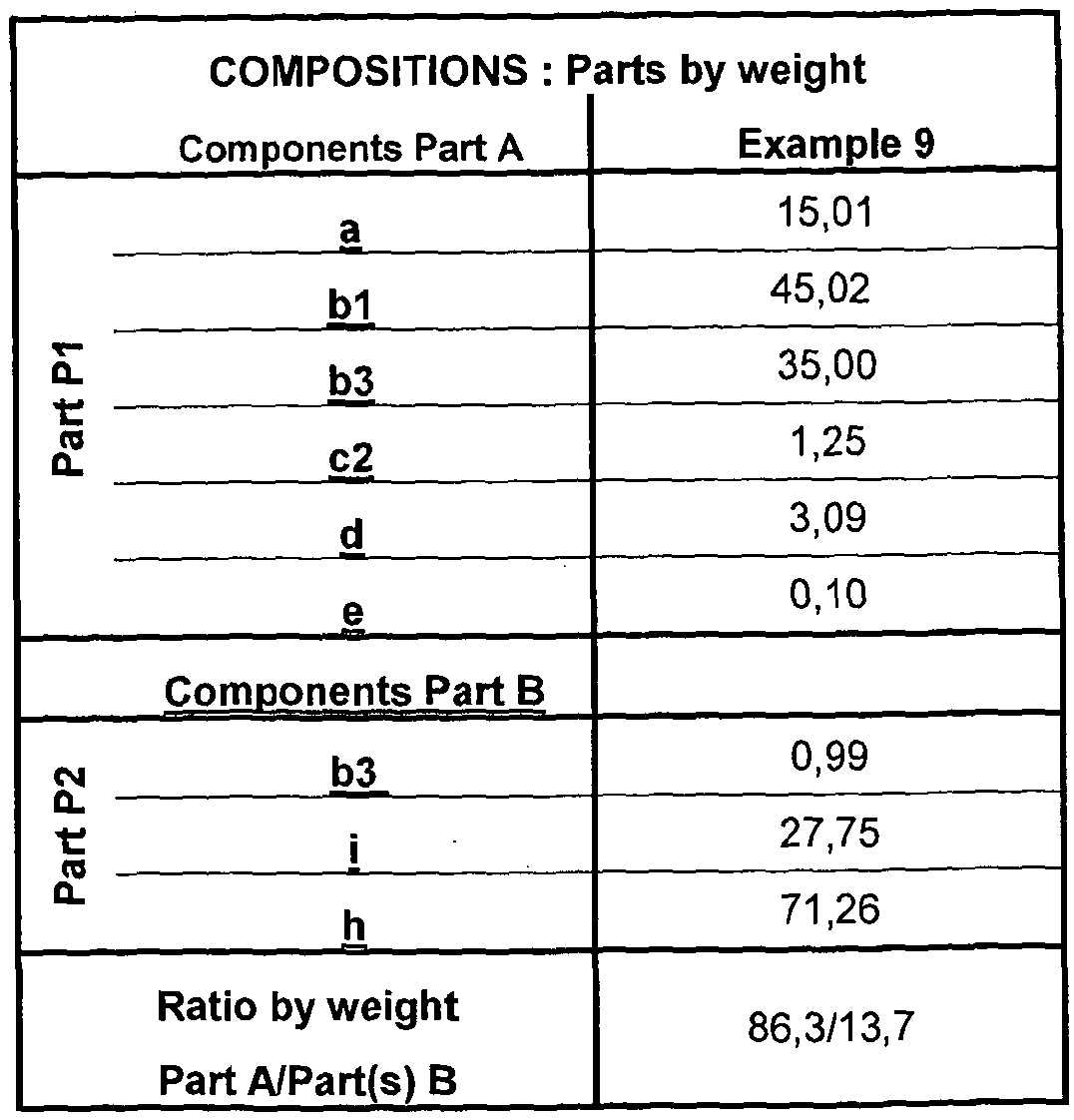
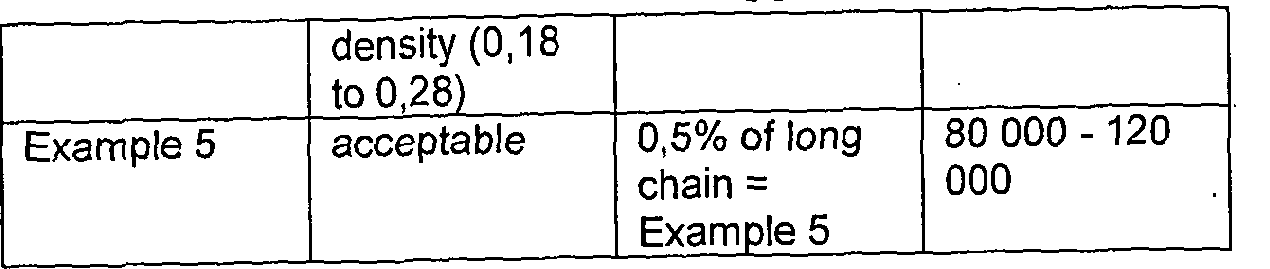
Claims
Priority Applications (12)
| Application Number | Priority Date | Filing Date | Title |
|---|---|---|---|
| CN201180065988.4A CN103403095B (en) | 2010-11-25 | 2011-11-25 | Compositions I - II and their products and uses |
| CA2819032A CA2819032C (en) | 2010-11-25 | 2011-11-25 | Composition i-ii and products and uses thereof |
| EP11811106.1A EP2643412B1 (en) | 2010-11-25 | 2011-11-25 | Composition i-ii and products and uses thereof |
| BR112013012785-6A BR112013012785A2 (en) | 2010-11-25 | 2011-11-25 | composition i - ii and products and uses thereof |
| US13/989,569 US10537657B2 (en) | 2010-11-25 | 2011-11-25 | Composition I-II and products and uses thereof |
| JP2013540432A JP6078472B2 (en) | 2010-11-25 | 2011-11-25 | Compositions I-II and Products and Their Uses |
| MX2013005923A MX337627B (en) | 2010-11-25 | 2011-11-25 | Composition i-ii and products and uses thereof. |
| RU2013128336/05A RU2597393C2 (en) | 2010-11-25 | 2011-11-25 | Composition i-ii, article containing same and use thereof |
| AU2011333538A AU2011333538C1 (en) | 2010-11-25 | 2011-11-25 | Composition I-II and products and uses thereof |
| ES11811106.1T ES2603152T3 (en) | 2010-11-25 | 2011-11-25 | Composition I-II and its products and uses |
| ZA2013/03600A ZA201303600B (en) | 2010-11-25 | 2013-05-17 | Composition i-ii and products and uses thereof |
| US16/705,056 US11730876B2 (en) | 2010-11-25 | 2019-12-05 | Composition I-II and products and uses thereof |
Applications Claiming Priority (4)
| Application Number | Priority Date | Filing Date | Title |
|---|---|---|---|
| GBGB1019997.4A GB201019997D0 (en) | 2010-11-25 | 2010-11-25 | Comopition I-II |
| GB1019997.4 | 2010-11-25 | ||
| GBGB1104512.7A GB201104512D0 (en) | 2011-03-17 | 2011-03-17 | Composition I - lla |
| GB1104512.7 | 2011-03-17 |
Related Child Applications (2)
| Application Number | Title | Priority Date | Filing Date |
|---|---|---|---|
| US13/989,569 A-371-Of-International US10537657B2 (en) | 2010-11-25 | 2011-11-25 | Composition I-II and products and uses thereof |
| US16/705,056 Continuation US11730876B2 (en) | 2010-11-25 | 2019-12-05 | Composition I-II and products and uses thereof |
Publications (1)
| Publication Number | Publication Date |
|---|---|
| WO2012069794A1 true WO2012069794A1 (en) | 2012-05-31 |
Family
ID=45509537
Family Applications (1)
| Application Number | Title | Priority Date | Filing Date |
|---|---|---|---|
| PCT/GB2011/001652 Ceased WO2012069794A1 (en) | 2010-11-25 | 2011-11-25 | Composition i-ii and products and uses thereof |
Country Status (12)
| Country | Link |
|---|---|
| US (2) | US10537657B2 (en) |
| EP (1) | EP2643412B1 (en) |
| JP (2) | JP6078472B2 (en) |
| CN (2) | CN107033596A (en) |
| AU (1) | AU2011333538C1 (en) |
| BR (1) | BR112013012785A2 (en) |
| CA (1) | CA2819032C (en) |
| ES (1) | ES2603152T3 (en) |
| MX (1) | MX337627B (en) |
| RU (1) | RU2597393C2 (en) |
| WO (1) | WO2012069794A1 (en) |
| ZA (1) | ZA201303600B (en) |
Cited By (34)
| Publication number | Priority date | Publication date | Assignee | Title |
|---|---|---|---|---|
| WO2013085891A1 (en) * | 2011-12-09 | 2013-06-13 | Avery Dennison Corporation | Fast curing polymeric sealant for negative pressure wound therapy |
| WO2014093093A1 (en) | 2012-12-12 | 2014-06-19 | 3M Innovative Properties Company | Room temperature curable siloxane-based gels |
| US8834451B2 (en) | 2002-10-28 | 2014-09-16 | Smith & Nephew Plc | In-situ wound cleansing apparatus |
| WO2014140608A1 (en) * | 2013-03-15 | 2014-09-18 | Smith & Nephew Plc | Wound dressing sealant and use thereof |
| EP2782536A1 (en) * | 2011-11-25 | 2014-10-01 | Smith & Nephew PLC | Composition, apparatus, kit and method and uses thereof |
| EP2837369A1 (en) * | 2013-08-16 | 2015-02-18 | Paul Hartmann AG | Sealing element for a wound dressing for vacuum therapy |
| US8998866B2 (en) | 2010-07-02 | 2015-04-07 | Smith & Nephew Plc | Provision of wound filler |
| US9198801B2 (en) | 2004-04-05 | 2015-12-01 | Bluesky Medical Group, Inc. | Flexible reduced pressure treatment appliance |
| US9662246B2 (en) | 2012-08-01 | 2017-05-30 | Smith & Nephew Plc | Wound dressing and method of treatment |
| EP3326663A1 (en) * | 2016-11-23 | 2018-05-30 | Medizinische Universität Innsbruck | Intraoral suctioning device for intraoral negative pressure wound treatment and method for manufacturing the intraoral suctioning device |
| WO2018121706A1 (en) * | 2016-12-30 | 2018-07-05 | Elkem Silicones Shanghai Co., Ltd. | Curable silicone compositions |
| US10046096B2 (en) | 2012-03-12 | 2018-08-14 | Smith & Nephew Plc | Reduced pressure apparatus and methods |
| US10058642B2 (en) | 2004-04-05 | 2018-08-28 | Bluesky Medical Group Incorporated | Reduced pressure treatment system |
| US10076449B2 (en) | 2012-08-01 | 2018-09-18 | Smith & Nephew Plc | Wound dressing and method of treatment |
| US10117782B2 (en) | 2012-05-24 | 2018-11-06 | Smith & Nephew, Inc. | Devices and methods for treating and closing wounds with negative pressure |
| US10124098B2 (en) | 2013-03-13 | 2018-11-13 | Smith & Nephew, Inc. | Negative pressure wound closure device and systems and methods of use in treating wounds with negative pressure |
| US10154928B2 (en) | 2012-08-08 | 2018-12-18 | Smith & Nephew Plc | Bespoke wound treatment apparatuses and methods for use in negative pressure wound therapy |
| RU2683930C2 (en) * | 2017-09-04 | 2019-04-02 | Общество с ограниченной ответственностью "Научно-производственная компания "Силикон" (ООО НПК "СИЛИКОН") | Composition for making dental impression |
| JP2019093218A (en) * | 2013-03-15 | 2019-06-20 | スミス アンド ネフュー ピーエルシーSmith & Nephew Public Limited Company | Wound dressing sealant and use thereof |
| US10493184B2 (en) | 2013-03-15 | 2019-12-03 | Smith & Nephew Plc | Wound dressing and method of treatment |
| US10537657B2 (en) | 2010-11-25 | 2020-01-21 | Smith & Nephew Plc | Composition I-II and products and uses thereof |
| US10660992B2 (en) | 2013-10-21 | 2020-05-26 | Smith & Nephew, Inc. | Negative pressure wound closure device |
| US10695226B2 (en) | 2013-03-15 | 2020-06-30 | Smith & Nephew Plc | Wound dressing and method of treatment |
| WO2021126195A1 (en) * | 2019-12-19 | 2021-06-24 | Wacker Chemie Ag | Antifoam compositions comprising branched siloxanes |
| US11083631B2 (en) | 2012-07-16 | 2021-08-10 | University Of Massachusetts | Negative pressure wound closure device |
| US11166726B2 (en) | 2011-02-04 | 2021-11-09 | University Of Massachusetts | Negative pressure wound closure device |
| CN113648452A (en) * | 2021-07-21 | 2021-11-16 | 北京大学口腔医院 | In-vivo in-situ foaming material |
| US11306224B2 (en) | 2015-08-31 | 2022-04-19 | 3M Innovative Properties Company | Articles comprising (meth)acrylate pressure-sensitive adhesive with enhanced adhesion to wet surfaces |
| US11439539B2 (en) | 2015-04-29 | 2022-09-13 | University Of Massachusetts | Negative pressure wound closure device |
| US11471586B2 (en) | 2015-12-15 | 2022-10-18 | University Of Massachusetts | Negative pressure wound closure devices and methods |
| US11660371B2 (en) | 2015-08-31 | 2023-05-30 | 3M Innovative Properties Company | Negative pressure wound therapy dressings comprising (meth)acrylate pressure-sensitive adhesive with enhanced adhesion to wet surfaces |
| US11931226B2 (en) | 2013-03-15 | 2024-03-19 | Smith & Nephew Plc | Wound dressing sealant and use thereof |
| US11938231B2 (en) | 2010-11-25 | 2024-03-26 | Smith & Nephew Plc | Compositions I-I and products and uses thereof |
| US11981836B2 (en) | 2018-11-15 | 2024-05-14 | 3M Innovative Properties Company | Silicone pressure-sensitive adhesive and silicone pressure-sensitive adhesive composition |
Families Citing this family (78)
| Publication number | Priority date | Publication date | Assignee | Title |
|---|---|---|---|---|
| US11298453B2 (en) | 2003-10-28 | 2022-04-12 | Smith & Nephew Plc | Apparatus and method for wound cleansing with actives |
| GB0508531D0 (en) | 2005-04-27 | 2005-06-01 | Smith & Nephew | Sai with ultrasound |
| US9820888B2 (en) | 2006-09-26 | 2017-11-21 | Smith & Nephew, Inc. | Wound dressing |
| GB0808376D0 (en) | 2008-05-08 | 2008-06-18 | Bristol Myers Squibb Co | Wound dressing |
| GB0817796D0 (en) | 2008-09-29 | 2008-11-05 | Convatec Inc | wound dressing |
| GB201020236D0 (en) | 2010-11-30 | 2011-01-12 | Convatec Technologies Inc | A composition for detecting biofilms on viable tissues |
| CA2819475C (en) | 2010-12-08 | 2019-02-12 | Convatec Technologies Inc. | Integrated system for assessing wound exudates |
| US9526816B2 (en) | 2010-12-08 | 2016-12-27 | Convatec Technologies Inc. | Wound exudate monitor accessory |
| WO2012078723A1 (en) | 2010-12-08 | 2012-06-14 | Convatec Technologies Inc. | Method and system for removing exudates from a wound site |
| JP6158096B2 (en) | 2011-02-04 | 2017-07-05 | ユニバーシティー オブ マサチューセッツUniversity of Massachusetts | Negative pressure wound closure device |
| AU2012258916B2 (en) * | 2011-05-26 | 2016-06-16 | Kci Licensing, Inc. | Systems and methods of stimulation and activation of fluids for use with instillation therapy |
| AU2012282287B2 (en) | 2011-07-14 | 2017-06-01 | Smith & Nephew Plc | Wound dressing and method of treatment |
| GB201115182D0 (en) | 2011-09-02 | 2011-10-19 | Trio Healthcare Ltd | Skin contact material |
| GB2497406A (en) | 2011-11-29 | 2013-06-12 | Webtec Converting Llc | Dressing with a perforated binder layer |
| GB201120693D0 (en) | 2011-12-01 | 2012-01-11 | Convatec Technologies Inc | Wound dressing for use in vacuum therapy |
| AU346291S (en) | 2012-05-15 | 2013-01-09 | Smith & Nephew | Medical dressing |
| JP6382185B2 (en) | 2012-05-22 | 2018-08-29 | スミス アンド ネフュー ピーエルシーSmith & Nephew Public Limited Company | Apparatus and method for wound treatment |
| AU2013291693B2 (en) | 2012-05-22 | 2018-03-01 | Smith & Nephew Plc | Wound closure device |
| DE102012220790A1 (en) * | 2012-11-14 | 2014-05-15 | Henkel Ag & Co. Kgaa | Container for dispensing a multi-component mixture |
| CA2895896A1 (en) | 2012-12-20 | 2014-06-26 | Convatec Technologies Inc. | Processing of chemically modified cellulosic fibres |
| US9737649B2 (en) | 2013-03-14 | 2017-08-22 | Smith & Nephew, Inc. | Systems and methods for applying reduced pressure therapy |
| CN105492035B (en) | 2013-03-14 | 2019-06-14 | 史密夫和内修有限公司 | System and method for applying reduced pressure therapy |
| WO2014140578A1 (en) | 2013-03-14 | 2014-09-18 | Smith & Nephew Plc | Compressible wound fillers and systems and methods of use in treating wounds with negative pressure |
| RU2015152082A (en) | 2013-05-10 | 2017-06-16 | СМИТ ЭНД НЕФЬЮ ПиЭлСи | CONNECTOR FOR A FLUID ENVIRONMENT FOR IRRIGATION AND ASPIRATION OF THE RAS |
| JP2016528964A (en) | 2013-07-16 | 2016-09-23 | スミス アンド ネフュー ピーエルシーSmith & Nephew Public Limited Company | Apparatus and method for wound treatment |
| JP6679483B2 (en) | 2013-08-13 | 2020-04-15 | スミス アンド ネフュー インコーポレイテッド | System and method for performing reduced pressure therapy |
| US10342891B2 (en) * | 2013-09-19 | 2019-07-09 | Medline Industries, Inc. | Wound dressing containing saccharide and collagen |
| JP6704346B2 (en) | 2014-01-21 | 2020-06-03 | スミス アンド ネフュー ピーエルシーSmith & Nephew Public Limited Company | Wound treatment device |
| AU2015208299B2 (en) | 2014-01-21 | 2019-11-21 | Smith & Nephew Plc | Collapsible dressing for negative pressure wound treatment |
| US10610414B2 (en) | 2014-06-18 | 2020-04-07 | Smith & Nephew Plc | Wound dressing and method of treatment |
| US12133789B2 (en) | 2014-07-31 | 2024-11-05 | Smith & Nephew, Inc. | Reduced pressure therapy apparatus construction and control |
| EP3174569B1 (en) | 2014-07-31 | 2020-01-15 | Smith & Nephew, Inc | Systems and methods for applying reduced pressure therapy |
| CN107106743B (en) | 2014-12-30 | 2020-06-05 | 史密夫和内修有限公司 | System and method for applying reduced pressure therapy |
| PL3288600T3 (en) | 2015-04-28 | 2024-02-19 | Convatec Technologies Inc. | Antibacterial nanofibres |
| WO2016205468A1 (en) * | 2015-06-18 | 2016-12-22 | Nusil Technology Llc | High strength silicone elastomers and compositions therefor |
| CA2986444C (en) | 2015-06-29 | 2023-10-24 | 480 Biomedical, Inc. | Implantable scaffolds for treatment of sinusitis |
| US10232082B2 (en) | 2015-06-29 | 2019-03-19 | 480 Biomedical, Inc. | Implantable scaffolds for treatment of sinusitis |
| WO2017004209A1 (en) | 2015-06-29 | 2017-01-05 | 480 Biomedical, Inc. | Scaffold loading and delivery systems |
| WO2017044138A1 (en) | 2015-09-11 | 2017-03-16 | Smith & Nephew, Inc. | Systems and methods for applying reduced negative pressure therapy |
| WO2017062042A1 (en) | 2015-10-07 | 2017-04-13 | Smith & Nephew, Inc. | Systems and methods for applying reduced pressure therapy |
| GB2543544A (en) | 2015-10-21 | 2017-04-26 | Brightwake Ltd | Wound dressing |
| US10814049B2 (en) | 2015-12-15 | 2020-10-27 | University Of Massachusetts | Negative pressure wound closure devices and methods |
| US10575991B2 (en) | 2015-12-15 | 2020-03-03 | University Of Massachusetts | Negative pressure wound closure devices and methods |
| US10973664B2 (en) | 2015-12-30 | 2021-04-13 | Lyra Therapeutics, Inc. | Scaffold loading and delivery systems |
| WO2017127369A1 (en) * | 2016-01-19 | 2017-07-27 | Kci Usa, Inc. | A silicone wound contact layer with silver |
| EP3435941B1 (en) | 2016-03-30 | 2021-09-01 | ConvaTec Technologies Inc. | Detecting microbial infections in wounds |
| KR20190015210A (en) | 2016-03-30 | 2019-02-13 | 퀄리자임 다이아그노스틱스 게엠베하 엔드 코 카게 | Detection of microbial infection in wound |
| GB201608099D0 (en) | 2016-05-09 | 2016-06-22 | Convatec Technologies Inc | Negative pressure wound dressing |
| CN109688991B (en) | 2016-07-08 | 2021-10-29 | 康沃特克科技公司 | Flexible negative pressure system |
| PL3481360T3 (en) | 2016-07-08 | 2022-05-02 | Convatec Technologies Inc. | Fluid flow sensing |
| CN109640904A (en) | 2016-07-08 | 2019-04-16 | 康沃特克科技公司 | fluid collection equipment |
| US10660985B2 (en) * | 2017-09-13 | 2020-05-26 | Shienlin Saber | Kits, compositions and methods for wound treatment and management |
| PL3580790T3 (en) | 2017-02-08 | 2024-10-28 | Elkem Silicones USA Corp. | Secondary battery pack with improved thermal management |
| US10201639B2 (en) | 2017-05-01 | 2019-02-12 | 480 Biomedical, Inc. | Drug-eluting medical implants |
| KR101840254B1 (en) * | 2017-07-31 | 2018-03-21 | 주식회사 메가코스 | A composition for producing an artificial skin comprising fibrous polymer and a method for preparing the artificial skin using the same |
| CN107280860A (en) * | 2017-08-02 | 2017-10-24 | 中国人民解放军第三军医大学第附属医院 | A kind of set composite for having electric field application and drainage concurrently |
| US12161792B2 (en) | 2017-11-16 | 2024-12-10 | Convatec Limited | Fluid collection apparatus |
| CN109852333A (en) * | 2017-11-30 | 2019-06-07 | 山东朱氏药业集团有限公司 | A kind of Silica hydrogel preparation process of scar plaster |
| TW202007730A (en) | 2018-07-31 | 2020-02-16 | 美商陶氏全球科技公司 | Composition, foamed silicone elastomer formed therefrom, and methods of formation |
| US11589977B2 (en) * | 2018-10-02 | 2023-02-28 | Elkem Silicones USA Corp. | Kit for preparing a customizable flesh simulating silicone gel or silicone foam in particular for use in medical devices |
| US11724007B2 (en) * | 2018-11-29 | 2023-08-15 | Ethicon, Inc. | Operating room coating applicator and method |
| CN109651822B (en) * | 2018-12-29 | 2021-01-12 | 山东百多安医疗器械股份有限公司 | Medical silicone rubber with high mechanical property and preparation method thereof |
| WO2020245656A1 (en) | 2019-06-03 | 2020-12-10 | Convatec Limited | Methods and devices to disrupt and contain pathogens |
| US11771819B2 (en) | 2019-12-27 | 2023-10-03 | Convatec Limited | Low profile filter devices suitable for use in negative pressure wound therapy systems |
| US11331221B2 (en) | 2019-12-27 | 2022-05-17 | Convatec Limited | Negative pressure wound dressing |
| CN111171323B (en) * | 2020-01-14 | 2021-12-21 | 广东达志化学科技有限公司 | Oxidation-resistant strong acid-resistant organic silicon compound and synthesis method and application thereof |
| US11718753B2 (en) | 2020-05-28 | 2023-08-08 | Ethicon, Inc. | Topical skin closure compositions and systems |
| US11518604B2 (en) | 2020-05-28 | 2022-12-06 | Ethicon, Inc. | Systems, methods and devices for aerosol spraying of silicone based topical skin adhesives for sealing wounds |
| US11479669B2 (en) | 2020-05-28 | 2022-10-25 | Ethicon, Inc. | Topical skin closure compositions and systems |
| US12465577B2 (en) | 2020-05-28 | 2025-11-11 | Ethicon, Inc. | Antimicrobial topical skin closure compositions and systems |
| US11712229B2 (en) | 2020-05-28 | 2023-08-01 | Ethicon, Inc. | Systems, devices and methods for dispensing and curing silicone based topical skin adhesives |
| US11589867B2 (en) | 2020-05-28 | 2023-02-28 | Ethicon, Inc. | Anisotropic wound closure systems |
| US12528913B2 (en) | 2020-05-28 | 2026-01-20 | Ethicon, Inc. | Antimicrobial anhydrous topical skin closure compositions and systems |
| US20220192890A1 (en) * | 2020-12-18 | 2022-06-23 | Zam Research Llc | Wound treatment system and method |
| US12527892B2 (en) | 2021-07-23 | 2026-01-20 | Convatec Limited | Selectively configurable wound dressing |
| JP7740013B2 (en) * | 2021-12-24 | 2025-09-17 | 株式会社プロテリアル | Booted cable and medical diagnostic device |
| CN115429539B (en) * | 2022-09-13 | 2023-12-19 | 湖北世丰新材料有限公司 | Liquid silica gel for negative pressure drainage gum dipping sponge and preparation method thereof |
| CN116726227A (en) * | 2023-03-07 | 2023-09-12 | 河南驼人贝斯特医疗器械有限公司 | Radiation-resistant sterilization silicone gel dressing and preparation method and application thereof |
Citations (23)
| Publication number | Priority date | Publication date | Assignee | Title |
|---|---|---|---|---|
| US3274155A (en) | 1963-08-09 | 1966-09-20 | Midland Silicones Ltd | Organosilicon compositions |
| FR1528464A (en) | 1966-06-23 | 1968-06-07 | Dow Corning | One-part curable organopolysiloxane compositions |
| US3646155A (en) | 1968-12-20 | 1972-02-29 | Midland Silicones Ltd | Cross-linking of a polyolefin with a silane |
| US3808178A (en) | 1972-06-16 | 1974-04-30 | Polycon Laboratories | Oxygen-permeable contact lens composition,methods and article of manufacture |
| US3928629A (en) | 1973-06-23 | 1975-12-23 | Dow Corning | Coating process |
| FR2372874A1 (en) | 1976-12-03 | 1978-06-30 | Wacker Chemie Gmbh | PROCESS FOR THE MANUFACTURE OF ANTI-ADHESIVE COATINGS |
| US4529553A (en) | 1981-12-14 | 1985-07-16 | General Electric Company | Nickel complex catalyst for hydrosilation reaction |
| US4714739A (en) | 1982-04-20 | 1987-12-22 | Petrarch Systems Inc. | Curable silicone semi-interpenetrating polymer networks and methods of making same |
| EP0425164A1 (en) * | 1989-10-23 | 1991-05-02 | Dow Corning France S.A. | Silicone foams |
| US5145933A (en) * | 1987-12-18 | 1992-09-08 | Dow Corning France S.A. | Organosiloxane gel-forming compositions and use thereof |
| US5153231A (en) | 1991-03-13 | 1992-10-06 | Dow Corning France S.A. | Silicone foams |
| US5348392A (en) * | 1991-03-13 | 1994-09-20 | Dow Corning France S.A. | Apparatus for mixing and dispensing a multicomponent composition |
| US5397848A (en) | 1991-04-25 | 1995-03-14 | Allergan, Inc. | Enhancing the hydrophilicity of silicone polymers |
| WO2000074738A1 (en) | 1999-06-04 | 2000-12-14 | Bahman Guyuron | Use of rtv silicone compositions for wound dressing |
| WO2004108175A1 (en) | 2003-06-10 | 2004-12-16 | Mölnlycke Health Care Ab | Elastomer-forming barrier preparation |
| US20050100692A1 (en) | 2003-11-06 | 2005-05-12 | Parker Richard H. | Textile products and silicone-based copolymeric coating compositions for textile products |
| EP1633830A2 (en) | 2003-06-16 | 2006-03-15 | Rhodia Chimie | Silicon composition which can be crosslinked into an adhesive gel |
| US20060217016A1 (en) | 2003-06-04 | 2006-09-28 | Shaow Lin | Silicone/polyurethane coated fabrics |
| US7132170B2 (en) | 2003-07-29 | 2006-11-07 | Milliken & Company | Polymer coating blends |
| US20070185426A1 (en) * | 2001-02-16 | 2007-08-09 | Kci Licensing, Inc. | Biocompatible wound dressing |
| US20070225663A1 (en) * | 2004-06-21 | 2007-09-27 | Watt Paul W | Wound dressings for vacuum therapy |
| US7543843B2 (en) | 2006-08-10 | 2009-06-09 | Milliken & Company | Airbag coatings made with hybrid resin compositions |
| WO2009156709A1 (en) | 2008-06-24 | 2009-12-30 | Smith & Nephew Plc | Negative pressure wound therapy device |
Family Cites Families (523)
| Publication number | Priority date | Publication date | Assignee | Title |
|---|---|---|---|---|
| FR1163907A (en) | 1956-10-25 | 1958-10-02 | Skin care devices | |
| CS161842B2 (en) | 1968-03-09 | 1975-06-10 | ||
| US4029598A (en) | 1969-03-14 | 1977-06-14 | E. Merck A. G. | Non-bleeding indicator and dyes therefor |
| BE792506A (en) | 1971-12-09 | 1973-03-30 | Sherwood Medical Ind Inc | Medical drainage devices |
| US3783870A (en) | 1971-12-27 | 1974-01-08 | Sherwood Medical Ind Inc | Suction drainage device |
| US3809087A (en) | 1973-05-17 | 1974-05-07 | R Lewis | Closed wound suction apparatus having biased plate members |
| US4117551A (en) | 1974-05-30 | 1978-09-26 | William R. Brooks | Purgeable dispensing gun for polyurethane foam and the like |
| US4073294A (en) | 1975-07-23 | 1978-02-14 | Medical Development Corporation | Negative pressure drainage vessel |
| US3972328A (en) | 1975-07-28 | 1976-08-03 | E. R. Squibb & Sons, Inc. | Surgical bandage |
| US4278089A (en) | 1978-11-09 | 1981-07-14 | Howmedica, Inc. | Wound drainage device |
| US4392860A (en) | 1979-01-11 | 1983-07-12 | Howmedica, Inc. | Disposable wound drainage device |
| US4266545A (en) | 1979-04-06 | 1981-05-12 | Moss James P | Portable suction device for collecting fluids from a closed wound |
| WO1983000742A1 (en) | 1981-08-26 | 1983-03-03 | Towsend, Marvin, S. | Disposable article with non-leachable saline water indicator |
| US4569674A (en) | 1982-08-03 | 1986-02-11 | Stryker Corporation | Continuous vacuum wound drainage system |
| JPS5936608A (en) | 1982-08-23 | 1984-02-28 | Hisamitsu Pharmaceut Co Inc | Novel application drug |
| US4538920A (en) | 1983-03-03 | 1985-09-03 | Minnesota Mining And Manufacturing Company | Static mixing device |
| DE3321151C2 (en) | 1983-06-11 | 1986-09-18 | Walter Küsnacht Beck | Device for aspirating secretions |
| US4578060A (en) | 1983-07-20 | 1986-03-25 | Howmedica, Inc. | Wound drainage device |
| US4872450A (en) | 1984-08-17 | 1989-10-10 | Austad Eric D | Wound dressing and method of forming same |
| US4655754A (en) | 1984-11-09 | 1987-04-07 | Stryker Corporation | Vacuum wound drainage system and lipids baffle therefor |
| US4826494A (en) | 1984-11-09 | 1989-05-02 | Stryker Corporation | Vacuum wound drainage system |
| DE3441893A1 (en) | 1984-11-16 | 1986-05-28 | Walter Küsnacht Beck | METHOD AND DEVICE FOR SUCTIONING SECRETARY LIQUID FROM A Wound |
| US4798583A (en) | 1984-11-16 | 1989-01-17 | Walter Beck | Method and apparatus for aspirating secreted fluids from a wound |
| DE3443101A1 (en) | 1984-11-27 | 1986-05-28 | Artur 6230 Frankfurt Beudt | Covering device for open wounds |
| FR2589737A1 (en) * | 1985-11-12 | 1987-05-15 | Dow Corning Sa | METHODS OF MANUFACTURING DRESSINGS |
| GB2192142B (en) | 1986-07-04 | 1990-11-28 | Johnson & Johnson | Wound dressing |
| US4720431A (en) * | 1986-05-21 | 1988-01-19 | American Telephone And Telegraph Company At&T Technologies, Inc. | Silicone encapsulated devices |
| US4728499A (en) | 1986-08-13 | 1988-03-01 | Fehder Carl G | Carbon dioxide indicator device |
| USRE36235E (en) | 1987-01-16 | 1999-06-29 | Wilhelm Keller | Dispensing and mixing apparatus |
| US4767026A (en) | 1987-01-16 | 1988-08-30 | Keller Wilhelm A | Dispensing and mixing apparatus |
| US5033650A (en) | 1987-03-09 | 1991-07-23 | Laurence Colin | Multiple barrel dispensing device |
| US4753536A (en) | 1987-03-09 | 1988-06-28 | Spehar Edward R | Dispensing mixer for the storage and mixing of separate materials |
| US4813942A (en) | 1987-03-17 | 1989-03-21 | Bioderm, Inc. | Three step wound treatment method and dressing therefor |
| FR2618337B1 (en) | 1987-07-22 | 1989-12-15 | Dow Corning Sa | SURGICAL DRESSING AND PROCESS FOR MAKING SAME |
| US4771919A (en) | 1987-10-28 | 1988-09-20 | Illinois Tool Works Inc. | Dispensing device for multiple components |
| FR2624874B1 (en) * | 1987-12-18 | 1990-06-08 | Dow Corning Sa | GELIFIABLE COMPOSITION BASED ON ORGANOSILOXANES, GEL PRODUCED FROM THIS COMPOSITION, AND DRESSING AND PROSTHESIS CONTAINING THIS GEL |
| DE3802010A1 (en) | 1988-01-25 | 1989-08-10 | Gunter Siegel | DEVICE FOR TREATING BODY PARTS OF A HUMAN |
| US5004643A (en) * | 1988-03-14 | 1991-04-02 | Sili-Tex, Inc. | Silicone polymer-internally coated webs |
| WO1989008553A1 (en) * | 1988-03-14 | 1989-09-21 | Sili-Tex, Inc. | Silicone polymer fiber encapsulated webs |
| US5064653A (en) | 1988-03-29 | 1991-11-12 | Ferris Mfg. Co. | Hydrophilic foam compositions |
| CA1334926C (en) | 1988-04-28 | 1995-03-28 | Masao Yafuso | Composition, apparatus and method for sensing ionic components |
| GB8812803D0 (en) | 1988-05-28 | 1988-06-29 | Smiths Industries Plc | Medico-surgical containers |
| DE3827561C1 (en) | 1988-08-13 | 1989-12-28 | Lts Lohmann Therapie-Systeme Gmbh & Co Kg, 5450 Neuwied, De | |
| DE3838587A1 (en) | 1988-11-14 | 1990-05-17 | Espe Stiftung | POLYETHER IMPRESSION MATERIAL, METHOD FOR PRODUCING IT AND ITS USE |
| US4923444A (en) | 1988-12-19 | 1990-05-08 | Ivac Corporation | Negative pressure measurement system |
| US5089606A (en) | 1989-01-24 | 1992-02-18 | Minnesota Mining And Manufacturing Company | Water-insoluble polysaccharide hydrogel foam for medical applications |
| US4969880A (en) | 1989-04-03 | 1990-11-13 | Zamierowski David S | Wound dressing and treatment method |
| US5056510A (en) | 1989-04-13 | 1991-10-15 | The Kendall Company | Vented wound dressing |
| IL91918A0 (en) | 1989-10-06 | 1990-06-10 | Rosenberg Lior | Fluid drain system for wounds |
| US5249709A (en) | 1989-10-16 | 1993-10-05 | Plas-Pak Industries, Inc. | Cartridge system for dispensing predetermined ratios of semi-liquid materials |
| US5181905A (en) | 1989-11-28 | 1993-01-26 | Eric Flam | Method of monitoring the condition of the skin or wound |
| EP0443262B1 (en) | 1990-02-22 | 1995-09-27 | Minnesota Mining And Manufacturing Company | Static mixing assembly |
| DK0564502T3 (en) | 1990-11-27 | 2002-05-13 | Univ Loyola Chicago | Tissue sealant and growth factor-containing preparations that promote accelerated wound healing |
| GB9026065D0 (en) | 1990-11-30 | 1991-01-16 | Chemence Ltd | Composition |
| GB9028075D0 (en) | 1990-12-24 | 1991-02-13 | Gardner Arthur M N | Bandage |
| US5141503A (en) | 1991-01-29 | 1992-08-25 | Sewell Jr Frank K | Wound suction drainage system |
| GB9105995D0 (en) | 1991-03-21 | 1991-05-08 | Smith & Nephew | Wound dressing |
| IT225480Y1 (en) | 1991-07-05 | 1996-11-18 | Zhermack S R L | MODULAR EQUIPMENT ESPECIALLY FOR THE DOSAGE OF MULTI-COMPONENT F LUID AND / OR PASTOUS PRODUCTS |
| SG55146A1 (en) | 1991-07-23 | 1998-12-21 | Procter & Gamble | Absorbent articles especially catamenials having improved fluid directionality |
| EP0625894A1 (en) | 1991-10-09 | 1994-11-30 | LecTec Corporation | Aqueous gel wound dressing and package |
| AU2605592A (en) | 1991-10-15 | 1993-04-22 | Atrix Laboratories, Inc. | Polymeric compositions useful as controlled release implants |
| JPH07503943A (en) | 1991-10-29 | 1995-04-27 | クローバー コンソリデイテッド,リミテッド | Cross-linked polysaccharides, polycations and lipids useful for encapsulation and drug release |
| US5636643A (en) | 1991-11-14 | 1997-06-10 | Wake Forest University | Wound treatment employing reduced pressure |
| US7198046B1 (en) | 1991-11-14 | 2007-04-03 | Wake Forest University Health Sciences | Wound treatment employing reduced pressure |
| US5645081A (en) | 1991-11-14 | 1997-07-08 | Wake Forest University | Method of treating tissue damage and apparatus for same |
| US5840777A (en) | 1992-06-19 | 1998-11-24 | Albany International Corp. | Method of producing polysaccharide foams |
| US5257914A (en) | 1992-06-24 | 1993-11-02 | Warren Rupp, Inc. | Electronic control interface for fluid powered diaphragm pump |
| US5266326A (en) | 1992-06-30 | 1993-11-30 | Pfizer Hospital Products Group, Inc. | In situ modification of alginate |
| US5238732A (en) | 1992-07-16 | 1993-08-24 | Surface Coatings, Inc. | Waterproof breathable polyurethane membranes and porous substrates protected therewith |
| US5582596A (en) | 1992-09-26 | 1996-12-10 | Juridical Foundation The Chemo-Sero-Therapeutic Research Institute | Applicator for applying a biocompatible adhesive |
| GB2272645B8 (en) | 1992-11-23 | 2010-02-10 | Johnson & Johnson Medical | Wound dressing |
| US5333760A (en) | 1992-12-28 | 1994-08-02 | Coltene/Whaledent, Inc. | Dispensing and mixing apparatus |
| DK169711B1 (en) | 1993-01-15 | 1995-01-23 | Coloplast As | A dressing |
| EP0617152B1 (en) | 1993-02-22 | 1999-08-25 | Recaro GmbH & Co. | Face-to-face fabric with variable trickness, process of manufacturing and applications |
| EP0696201B2 (en) | 1993-03-12 | 2012-09-19 | The American National Red Cross | Supplemented tissue sealants, methods of their production and use |
| KR100355857B1 (en) | 1993-03-22 | 2003-03-31 | 미네소타 마이닝 앤드 매뉴팩춰링 캄파니 | Adhesive composite dressing and manufacturing method |
| EP0690736B1 (en) | 1993-03-23 | 1998-11-11 | Focal, Inc. | Apparatus and method for local application of polymeric material to tissue |
| WO1995003838A1 (en) | 1993-07-28 | 1995-02-09 | Pfizer Inc. | Psoriasis treatment |
| WO1995004511A1 (en) | 1993-08-11 | 1995-02-16 | Michael John Smith | Improvements in and relating to dressings |
| WO1995007719A1 (en) | 1993-09-16 | 1995-03-23 | Sunao Kubota | Wound covering material and wound covering composition |
| CA2132657C (en) | 1993-10-05 | 2005-12-06 | Marjory A. Kadash | Trimmable wound dressing |
| US5549584A (en) | 1994-02-14 | 1996-08-27 | The Kendall Company | Apparatus for removing fluid from a wound |
| ATE241394T1 (en) | 1994-04-08 | 2003-06-15 | Atrix Lab Inc | ASSOCIATED POLYMER SYSTEM FOR USE WITH A MEDICAL DEVICE |
| GB9408545D0 (en) | 1994-04-29 | 1994-06-22 | Zyma Sa | Compositions |
| US5852126A (en) | 1994-05-02 | 1998-12-22 | Novartis Ag | Polymerisable composition and the use thereof |
| CA2193968A1 (en) | 1994-06-28 | 1996-01-11 | Jeffrey G. Clark | Ph-modified biocompatible monomer and polymer compositions |
| WO1996001731A1 (en) | 1994-07-07 | 1996-01-25 | Jiffy Packaging Company Limited | Packaging material, packaging pad and machine for manufacturing packaging material |
| US5583114A (en) | 1994-07-27 | 1996-12-10 | Minnesota Mining And Manufacturing Company | Adhesive sealant composition |
| DK0853950T3 (en) | 1994-08-22 | 2002-11-25 | Kinetic Concepts Inc | Wound drainage canisters |
| CN1160359A (en) | 1994-10-11 | 1997-09-24 | 医药研究有限公司 | Improved Wound Aspiration System |
| US5609271A (en) | 1995-01-25 | 1997-03-11 | Wilhelm A. Keller | Mixer and multiple component dispensing device assembly and method for the aligned connection of the mixer to the multiple component dispensing device |
| US6261276B1 (en) | 1995-03-13 | 2001-07-17 | I.S.I. International, Inc. | Apparatus for draining surgical wounds |
| US5918772A (en) | 1995-03-13 | 1999-07-06 | Wilhelm A. Keller | Bayonet fastening device for the attachment of an accessory to a multiple component cartridge or dispensing device |
| CA2215309C (en) | 1995-03-23 | 2008-11-25 | Focal, Inc. | Redox and photoinitiator systems for priming for improved adherence of gels to substrates |
| AU6169896A (en) | 1995-06-07 | 1996-12-30 | American National Red Cross, The | Supplemented and unsupplemented tissue sealants, methods of their production and use |
| US5785679A (en) | 1995-07-19 | 1998-07-28 | Endotex Interventional Systems, Inc. | Methods and apparatus for treating aneurysms and arterio-venous fistulas |
| US5759560A (en) | 1995-07-27 | 1998-06-02 | Bio Med Sciences, Inc. | Silicone thermoplastic sheeting for scar treatment and useful article thereof; process of manufacture and use |
| GB9519574D0 (en) | 1995-09-26 | 1995-11-29 | Smith & Nephew | Conformable absorbent dressing |
| GB9519571D0 (en) | 1995-09-26 | 1995-11-29 | Smith & Nephew | Absorbent article |
| US5707499A (en) | 1995-10-06 | 1998-01-13 | Ceramatec, Inc. | Storage-stable, fluid dispensing device using a hydrogen gas generator |
| US5660823A (en) | 1995-10-11 | 1997-08-26 | Isp Investments Inc. | Fast drying, film forming iodine release solution |
| US5776193A (en) | 1995-10-16 | 1998-07-07 | Orquest, Inc. | Bone grafting matrix |
| CA2160757C (en) | 1995-10-17 | 2000-01-04 | Roger Boulanger | Highly absorbent transfer layer structure |
| GB9521397D0 (en) | 1995-10-18 | 1995-12-20 | Summit Medical Ltd | Wound drainage system |
| GB2306580B (en) | 1995-10-27 | 1998-12-02 | William Alexander Courtney | Improved dual chamber displacement pumps |
| GB9523253D0 (en) | 1995-11-14 | 1996-01-17 | Mediscus Prod Ltd | Portable wound treatment apparatus |
| PT1704878E (en) | 1995-12-18 | 2013-07-17 | Angiodevice Internat Gmbh | Crosslinked polymer compositions and methods for their use |
| US6458889B1 (en) | 1995-12-18 | 2002-10-01 | Cohesion Technologies, Inc. | Compositions and systems for forming crosslinked biomaterials and associated methods of preparation and use |
| GB9604645D0 (en) | 1996-03-01 | 1996-05-01 | Boc Group Plc | Improvements in vacuum pumps |
| US5667773A (en) | 1996-03-12 | 1997-09-16 | Adolor Corporation | Film-forming compositions of antihyperalgesic opiates and method of treating hyperalgesic conditions therewith |
| WO1997033922A1 (en) | 1996-03-15 | 1997-09-18 | Minnesota Mining And Manufacturing Company | Photopolymerization reactions induced by chemiluminescence |
| USD406899S (en) | 1996-05-09 | 1999-03-16 | Kci Medical Limited | Portable medical appliance for stimulating healing of wounds |
| CA2254898A1 (en) | 1996-05-14 | 1997-11-20 | C.R. Bard, Inc. | Methods and products for sealing a fluid leak in a tissue |
| CN1129404C (en) | 1996-05-22 | 2003-12-03 | 科洛普拉斯特公司 | A bandage comprising a body portion and a handle portion |
| ES2167761T3 (en) | 1996-07-02 | 2002-05-16 | Minnesota Mining & Mfg | COMPOSITE MATERIAL ADHESIVE MEDICAL AND ENVELOPE. |
| US20040171998A1 (en) | 2000-07-21 | 2004-09-02 | Marasco Patrick V. | Isolated wound-treatment arrangement |
| US6252129B1 (en) | 1996-07-23 | 2001-06-26 | Electrosols, Ltd. | Dispensing device and method for forming material |
| ATE263629T1 (en) | 1996-07-23 | 2004-04-15 | Battelle Memorial Institute | DEVICE FOR DISPENSING AND METHOD FOR SHAPING A MATERIAL |
| AU4065297A (en) | 1996-08-13 | 1998-03-06 | Eugene Bell | Collagen-based blood coagulating foams, method and devices for their delivery |
| US5976117A (en) | 1996-09-25 | 1999-11-02 | 3M Innovative Properties Company | Wound dressing |
| DE19652708C2 (en) | 1996-12-18 | 1999-08-12 | Schott Glas | Process for producing a filled plastic syringe body for medical purposes |
| CA2317413A1 (en) | 1997-01-10 | 1998-07-16 | Medlogic Global Corporation | Cyanoacrylate compositions comprising an antimicrobial agent |
| IL130859A0 (en) | 1997-01-10 | 2001-01-28 | Medlogic Global Corp | Methods for draping surgical incision sites |
| NL1006457C2 (en) | 1997-07-03 | 1999-01-05 | Polymedics N V | Drainage system to be used with an open wound, element used for applying a drainage pipe or hose and method for applying the drainage system. |
| US6135116A (en) | 1997-07-28 | 2000-10-24 | Kci Licensing, Inc. | Therapeutic method for treating ulcers |
| GB2328443B (en) | 1997-08-21 | 2001-09-05 | Reckitt & Colmann Prod Ltd | In situ formation of pharmaceutically acceptable polymeric material |
| GB9719520D0 (en) | 1997-09-12 | 1997-11-19 | Kci Medical Ltd | Surgical drape and suction heads for wound treatment |
| US6168788B1 (en) | 1997-09-26 | 2001-01-02 | Leon Wortham | Fibrin glue without fibrinogen and biosealant compositions and methods |
| US5855208A (en) | 1997-10-08 | 1999-01-05 | Medlogic Global Corporation | Methods for draping surgical incision sites using a biocompatible prepolymer |
| WO1999018950A1 (en) | 1997-10-09 | 1999-04-22 | Medlogic Global Corporation | Mixed cyanoacrylate ester compositions |
| WO1999019013A1 (en) | 1997-10-09 | 1999-04-22 | Paul Viranyi | Adaptor for use with a double lumen endobronchial tube |
| US6458095B1 (en) | 1997-10-22 | 2002-10-01 | 3M Innovative Properties Company | Dispenser for an adhesive tissue sealant having a housing with multiple cavities |
| US5962010A (en) | 1997-11-03 | 1999-10-05 | Medlogic Global Corporation | Methods and compositions for treating dermatoses |
| FR2770843B1 (en) | 1997-11-13 | 2000-01-14 | Lavipharm Lab | ASSOCIATION OF PLANT POLAR LIPID-LIPIDS, PROCESS FOR THE PREPARATION THEREOF AND ITS APPLICATIONS |
| US6095851A (en) | 1997-11-17 | 2000-08-01 | Xircom, Inc. | Status indicator for electronic device |
| US6168758B1 (en) | 1997-11-19 | 2001-01-02 | Starplex Scientific | Liquid sample assay device |
| WO1999030629A1 (en) | 1997-12-17 | 1999-06-24 | Hemodynamics, Inc. | Sealing media for surgery and wound closure |
| EP0934737A1 (en) | 1998-02-05 | 1999-08-11 | The Procter & Gamble Company | Absorbent article comprising topsheet with masking capabilities |
| US6071267A (en) | 1998-02-06 | 2000-06-06 | Kinetic Concepts, Inc. | Medical patient fluid management interface system and method |
| DE19808117A1 (en) | 1998-02-26 | 1999-09-09 | Wacker Chemie Gmbh | RTV-2 silicone foams with low compression set |
| DE19812195C2 (en) | 1998-03-19 | 2000-03-30 | Uwe Storch | Process for producing a tissue-forming implant and its use |
| AU3208299A (en) | 1998-03-26 | 1999-10-18 | Exogen, Inc. | Arrays made from flexible transducer elements |
| CA2332326C (en) | 1998-05-21 | 2008-04-22 | Baxter International Inc. | Sealant applicator and method employing impulse clearing |
| EP1085913A1 (en) | 1998-06-08 | 2001-03-28 | Ferris Corporation | Analgesic and antinociceptive methods |
| AUPP421498A0 (en) | 1998-06-18 | 1998-07-09 | Macquarie Research Limited | Method of tissue repair |
| EP1091887A1 (en) | 1998-06-29 | 2001-04-18 | The Procter & Gamble Company | Packaged prodcut and device with dispensing means |
| AU8272398A (en) | 1998-06-29 | 2000-01-17 | Procter & Gamble Company, The | Liquid transport member for high flux rates between two port regions |
| US6458109B1 (en) | 1998-08-07 | 2002-10-01 | Hill-Rom Services, Inc. | Wound treatment apparatus |
| WO2000009199A1 (en) | 1998-08-14 | 2000-02-24 | Incept Llc | Methods and apparatus for in situ formation of hydrogels |
| US6152943A (en) | 1998-08-14 | 2000-11-28 | Incept Llc | Methods and apparatus for intraluminal deposition of hydrogels |
| AU761754B2 (en) | 1998-08-18 | 2003-06-12 | Baxter International Inc. | Sealant applicator tip and application method |
| MXPA01001752A (en) | 1998-08-20 | 2002-04-08 | 3M Innovative Properties Co | AEROSOL PATCH AND MEDICINAL PRODUCT APPLICATION SYSTEM. |
| ATE324831T1 (en) | 1998-08-26 | 2006-06-15 | Neomend Inc | KIT FOR THE IN-SITU GENERATION OF CHEMICALLY BONDED MECHANICAL BARRIERS OR COVERING STRUCTURES FOR A PUNCTURE SITE IN A BLOOD VESSEL |
| US6899889B1 (en) | 1998-11-06 | 2005-05-31 | Neomend, Inc. | Biocompatible material composition adaptable to diverse therapeutic indications |
| US7083634B2 (en) | 1998-11-12 | 2006-08-01 | Poly Med Inc | Stabilized polyester/cyanoacrylate tissue adhesive formulation |
| EP1013290A1 (en) | 1998-12-17 | 2000-06-28 | Fort James Corporation | Multi-layered absorbent composites having one or more apertured transfer layers |
| AU754458B2 (en) | 1998-12-23 | 2002-11-14 | Csl Behring Gmbh | Fibrin-based glue granulate and corresponding production method |
| US6767334B1 (en) | 1998-12-23 | 2004-07-27 | Kci Licensing, Inc. | Method and apparatus for wound treatment |
| EP1016389A1 (en) | 1998-12-30 | 2000-07-05 | The Procter & Gamble Company | Tridimensional disposable absorbent article with an absorbent core having special fluid handling properties |
| DE29902666U1 (en) | 1999-02-15 | 2000-06-29 | Ernst Mühlbauer KG, 22547 Hamburg | Device for dispensing mixed multicomponent materials, in particular for dental purposes |
| FR2790391B1 (en) | 1999-03-02 | 2002-11-15 | Flamel Tech Sa | MEANS FOR THE PREVENTION OF POST-SURGICAL ADHESION, BASED ON CROSS-LINKED COLLAGENIC PEPTIDES |
| US6994702B1 (en) | 1999-04-06 | 2006-02-07 | Kci Licensing, Inc. | Vacuum assisted closure pad with adaptation for phototherapy |
| US7799004B2 (en) | 2001-03-05 | 2010-09-21 | Kci Licensing, Inc. | Negative pressure wound treatment apparatus and infection identification system and method |
| US7947033B2 (en) | 1999-04-06 | 2011-05-24 | Kci Licensing Inc. | Systems and methods for detection of wound fluid blood and application of phototherapy in conjunction with reduced pressure wound treatment system |
| US6856821B2 (en) | 2000-05-26 | 2005-02-15 | Kci Licensing, Inc. | System for combined transcutaneous blood gas monitoring and vacuum assisted wound closure |
| US6695823B1 (en) | 1999-04-09 | 2004-02-24 | Kci Licensing, Inc. | Wound therapy device |
| ATE547136T1 (en) | 1999-04-09 | 2012-03-15 | Kci Licensing Inc | THERAPY DEVICE FOR WOUNDS |
| US6312725B1 (en) | 1999-04-16 | 2001-11-06 | Cohesion Technologies, Inc. | Rapid gelling biocompatible polymer composition |
| GB9909301D0 (en) | 1999-04-22 | 1999-06-16 | Kci Medical Ltd | Wound treatment apparatus employing reduced pressure |
| EP1048276A1 (en) | 1999-04-28 | 2000-11-02 | The Procter & Gamble Company | Method for applying a foamable movement obstruction agent to an absorbent member |
| USD439341S1 (en) | 1999-05-11 | 2001-03-20 | Kci Licensing, Inc. | Portable medical pumping unit with belt clip |
| USD434150S (en) | 1999-05-11 | 2000-11-21 | Kci Licensing, Inc. | Portable medical pumping unit |
| DK1068848T4 (en) | 1999-07-13 | 2010-11-29 | Bristol Myers Squibb Co | Bag for collecting secretions from the body |
| CA2344222C (en) | 1999-07-21 | 2008-05-13 | Imedex Biomateriaux | Adhesive protein foam for surgical and/or therapeutic uses |
| DE29924058U1 (en) | 1999-08-09 | 2002-01-10 | Riesinger, geb. Dahlmann, Birgit, 48346 Ostbevern | Device for collecting and collecting exudates emerging from a stoma or from another wetting opening |
| EP1083005A3 (en) | 1999-08-11 | 2004-12-15 | Tah Industries, Inc. | A static mixer nozzle and attachment accessory configuration |
| AU7084300A (en) | 1999-08-27 | 2001-03-26 | Cohesion Technologies, Inc. | Compositions that form interpenetrating polymer networks for use as high strength medical sealants |
| US6394314B1 (en) | 1999-10-12 | 2002-05-28 | Discus Dental Impressions, Inc. | Double-barreled syringe with detachable locking mixing tip |
| US6509031B1 (en) | 1999-11-15 | 2003-01-21 | Board Of Regents, Texas A&M University System | System for polymerizing collagen and collagen composites in situ for a tissue compatible wound sealant, delivery vehicle, binding agent and/or chemically modifiable matrix |
| GB9927952D0 (en) | 1999-11-26 | 2000-01-26 | Caldwell Kenneth | A ventilation apparatus |
| DE60039451D1 (en) | 1999-11-29 | 2008-08-21 | Hill Rom Services Inc | DEVICE FOR TREATING A WOUNCE |
| US6764462B2 (en) | 2000-11-29 | 2004-07-20 | Hill-Rom Services Inc. | Wound treatment apparatus |
| US6824533B2 (en) | 2000-11-29 | 2004-11-30 | Hill-Rom Services, Inc. | Wound treatment apparatus |
| AU2020501A (en) | 1999-12-08 | 2001-06-18 | 1149336 Ontario Inc. | Chemotherapy treatment |
| US6345776B1 (en) | 1999-12-23 | 2002-02-12 | Fomo Products Inc. | Two-component dispensing gun |
| US6528697B1 (en) | 2000-01-03 | 2003-03-04 | Augustine Medical, Inc. | Modular bandage |
| JP3370653B2 (en) | 2000-01-06 | 2003-01-27 | 株式会社テクノ高槻 | Electromagnetic vibration pump and its manufacturing method |
| KR100721752B1 (en) | 2000-01-24 | 2007-05-25 | 쿠라레 메디카루 가부시키가이샤 | Water-swellable polymer gel and process for preparing the same |
| JP2003523409A (en) | 2000-02-25 | 2003-08-05 | デイビッド シエラ | Foam-forming wound dressing |
| AR028271A1 (en) | 2000-03-24 | 2003-04-30 | Kimberly Clark Co | A SYSTEM FOR A HYGIENIC PRODUCT AND A PAD FOR WOMEN'S HYGIENE THAT UNDERSTANDS THIS SYSTEM |
| ATE255919T1 (en) | 2000-03-31 | 2003-12-15 | Polyganics Bv | BIOMEDICAL POLYURETHANAMID, ITS PRODUCTION AND USE |
| GB0011202D0 (en) | 2000-05-09 | 2000-06-28 | Kci Licensing Inc | Abdominal wound dressing |
| US6471685B1 (en) | 2000-05-18 | 2002-10-29 | David James Johnson | Medical dressing assembly and associated method of using the same |
| US20010043943A1 (en) | 2000-05-22 | 2001-11-22 | Coffey Arthur C. | Combination SIS and vacuum bandage and method |
| JP2003534054A (en) | 2000-05-25 | 2003-11-18 | 住友製薬株式会社 | How to sterilize silicone products |
| GB0015682D0 (en) | 2000-06-28 | 2000-08-16 | Bristol Myers Squibb Co | Sprayable wound care composition |
| US6379702B1 (en) | 2000-07-05 | 2002-04-30 | Hydromer, Inc. | Gels formed by the interaction of polyvinylpyrrolidone with chitosan derivatives |
| US7619130B2 (en) | 2000-07-18 | 2009-11-17 | Coloplast A/S | Multi-layer wound dressing formed as a single unit |
| AU2001283512A1 (en) | 2000-07-27 | 2002-02-13 | Flowers Park Limited | Methods for treating burns on mammalian skin to reduce the risk of infection andto minimize fluid loss |
| AU2001279595A1 (en) | 2000-08-28 | 2002-03-13 | Bente Kathe Yonne Merrild | Bandage for treatment of pressure sores, bedsores and similar ailments |
| GB0022084D0 (en) | 2000-09-08 | 2000-10-25 | Univ Aberdeen | Treatment of multiply antibiotic-resistant organisms |
| AR030767A1 (en) | 2000-09-22 | 2003-09-03 | Kimberly Clark Co | AN ABSORBENT SYSTEM FOR PRODUCTS FOR PERSONAL HYGIENE SUCH AS PANELS, LEARNING SHOES, INCONTINENCE PRODUCTS, BANDS AND HEALTH TOWELS |
| US20020122771A1 (en) | 2000-09-23 | 2002-09-05 | Troy Holland | Spray hydrogel wound dressings |
| CA2422786A1 (en) | 2000-10-23 | 2002-05-02 | Tissuemed Limited | Self-adhesive hydratable matrix for topical therapeutic use |
| AU2001290955A1 (en) | 2000-10-24 | 2002-05-21 | Velcro Industries B.V. | Wound covering |
| US20050084514A1 (en) | 2000-11-06 | 2005-04-21 | Afmedica, Inc. | Combination drug therapy for reducing scar tissue formation |
| US6685681B2 (en) | 2000-11-29 | 2004-02-03 | Hill-Rom Services, Inc. | Vacuum therapy and cleansing dressing for wounds |
| US6855135B2 (en) | 2000-11-29 | 2005-02-15 | Hill-Rom Services, Inc. | Vacuum therapy and cleansing dressing for wounds |
| US6398761B1 (en) | 2001-01-19 | 2002-06-04 | Ultradent Products, Inc. | Double syringe barrels with ported delivery ends |
| US7175336B2 (en) | 2001-01-26 | 2007-02-13 | Depuy Acromed, Inc. | Graft delivery system |
| WO2002064182A2 (en) | 2001-02-14 | 2002-08-22 | Genzyme Corporation | Biocompatible fleece for hemostasis and tissue engineering |
| US7070584B2 (en) | 2001-02-20 | 2006-07-04 | Kci Licensing, Inc. | Biocompatible wound dressing |
| US6746428B2 (en) | 2001-02-21 | 2004-06-08 | Becton, Dickinson And Company | High temperature dry heat sterilizable syringe barrel and needle cannula assembly |
| WO2002070040A1 (en) | 2001-03-05 | 2002-09-12 | Klaus Hoyer | Skin cleaning apparatus for the removal of puss or tallow by suction |
| US6776769B2 (en) | 2001-03-05 | 2004-08-17 | Joseph Smith | Anatomically configured tubular body of woven or knitted fabric for pressure support of articulating joint |
| US20020146662A1 (en) | 2001-04-06 | 2002-10-10 | Ivoclar Vivadent Ag | Syringe-type material supply device |
| US7108683B2 (en) | 2001-04-30 | 2006-09-19 | Kci Licensing, Inc | Wound therapy and tissue management system and method with fluid differentiation |
| US7645269B2 (en) | 2001-04-30 | 2010-01-12 | Kci Licensing, Inc. | Gradient wound treatment system and method |
| WO2002094256A1 (en) | 2001-05-23 | 2002-11-28 | Debatosh Datta | Lysine and/or analogues and/or polymers thereof for promoting wound healing and angiogenesis |
| PT1406567E (en) | 2001-07-12 | 2010-07-21 | Kci Medical Resources | Control of vacuum rate of change |
| US7004915B2 (en) | 2001-08-24 | 2006-02-28 | Kci Licensing, Inc. | Negative pressure assisted tissue treatment system |
| US6547467B2 (en) * | 2001-08-29 | 2003-04-15 | Closure Medical Corporation | Microapplicators, delivery systems and methods for adhesives and sealants |
| WO2003022333A1 (en) | 2001-09-13 | 2003-03-20 | Cheng Gordon C | Personal urine management system for human males |
| SE0103276L (en) | 2001-10-01 | 2003-04-02 | Medeikonos Ab | Device for administering ointment to a skin surface |
| EP1450878A1 (en) | 2001-10-11 | 2004-09-01 | Hill-Rom Services, Inc. | Waste container for negative pressure therapy |
| EP1306123A1 (en) | 2001-10-24 | 2003-05-02 | Karlheinz Reiber | Applicator |
| US20030143189A1 (en) | 2001-11-14 | 2003-07-31 | Askill Ian N | Therapy for topical diseases |
| US6648862B2 (en) | 2001-11-20 | 2003-11-18 | Spheric Products, Ltd. | Personally portable vacuum desiccator |
| WO2003057071A2 (en) | 2001-12-26 | 2003-07-17 | Hill-Rom Services, Inc. | Vacuum bandage packing |
| AU2002359830A1 (en) | 2001-12-26 | 2003-07-24 | Hill-Rom Services, Inc. | Wound vacuum therapy dressing kit |
| US20030125646A1 (en) | 2001-12-29 | 2003-07-03 | Whitlock Russell Ward | Device and method for relieving pain |
| AU2003225543A1 (en) | 2002-02-04 | 2003-09-02 | Damage Control Surgical Technologies, Inc. | Method and apparatus for improved hemostasis and damage control operations |
| US7622299B2 (en) | 2002-02-22 | 2009-11-24 | University Of Washington | Bioengineered tissue substitutes |
| ATE526918T1 (en) | 2002-02-28 | 2011-10-15 | Kci Medical Resources | EXTERNAL CATHETER ACCESS TO A VACUUM DRESSING |
| US6732887B2 (en) | 2002-03-26 | 2004-05-11 | Ultradent Products, Inc. | Two-part composition syringe delivery system |
| EP1496822B1 (en) | 2002-04-10 | 2018-08-29 | KCI Medical Resources | Access openings in vacuum bandage |
| US20030212357A1 (en) | 2002-05-10 | 2003-11-13 | Pace Edgar Alan | Method and apparatus for treating wounds with oxygen and reduced pressure |
| GB2389794A (en) | 2002-06-19 | 2003-12-24 | Johnson & Johnson Medical Ltd | Wound dressing with variable shape |
| DE20209581U1 (en) | 2002-06-20 | 2003-10-30 | Braun Melsungen Ag | syringe pump |
| DE10228421B4 (en) * | 2002-06-25 | 2010-03-25 | Heraeus Kulzer Gmbh | Method for sterilization and / or germ reduction of impression materials |
| DE10228420A1 (en) | 2002-06-25 | 2004-02-05 | Heraeus Kulzer Gmbh & Co. Kg | Process for germ reduction and / or sterilization of impression materials |
| DE10233051A1 (en) | 2002-07-19 | 2004-02-05 | Coltène/Whaledent GmbH + Co. KG | Dispensing system for fluid substances |
| WO2005017000A1 (en) | 2003-07-31 | 2005-02-24 | Cambridge Polymer Group | Systems and methods for controlling and forming polymer gels |
| EP3915529A1 (en) | 2002-08-06 | 2021-12-01 | BAXTER INTERNATIONAL INC. (a Delaware corporation) | Biocompatible phase invertible proteinaceous compositions and methods for making and using the same |
| US20040033466A1 (en) | 2002-08-15 | 2004-02-19 | Kerr Corporation | Single dose dental restorative material delivery system and method |
| US7163531B2 (en) | 2002-08-19 | 2007-01-16 | Baxter International, Inc. | User-friendly catheter connection adapters for optimized connection to multiple lumen catheters |
| US8062331B2 (en) | 2002-08-21 | 2011-11-22 | Kci Licensing, Inc. | Internal and external medical closure screen systems and methods |
| US7846141B2 (en) | 2002-09-03 | 2010-12-07 | Bluesky Medical Group Incorporated | Reduced pressure treatment system |
| US6936686B2 (en) | 2002-12-11 | 2005-08-30 | Nutech Corporation | Cross-linked silicone gels; products containing the same; and methods of manufacture thereof |
| US6979324B2 (en) | 2002-09-13 | 2005-12-27 | Neogen Technologies, Inc. | Closed wound drainage system |
| US7625362B2 (en) | 2003-09-16 | 2009-12-01 | Boehringer Technologies, L.P. | Apparatus and method for suction-assisted wound healing |
| US7862831B2 (en) | 2002-10-09 | 2011-01-04 | Synthasome, Inc. | Method and material for enhanced tissue-biomaterial integration |
| US7094212B2 (en) | 2002-10-11 | 2006-08-22 | Ossur Hf | Rigid dressing |
| GB2394418B (en) | 2002-10-25 | 2007-01-31 | Johnson & Johnson Medical Ltd | Fluid wound dressing |
| GB0224986D0 (en) | 2002-10-28 | 2002-12-04 | Smith & Nephew | Apparatus |
| DE10258954A1 (en) | 2002-12-16 | 2004-07-08 | Langer, Hans-Georg | Bleeding wound care |
| US7060795B2 (en) | 2002-12-19 | 2006-06-13 | Kimberly-Clark Worldwide, Inc. | Wound care compositions |
| EP1578477B2 (en) | 2002-12-31 | 2020-05-06 | KCI Licensing, Inc. | A dressing assembly for a closed wound or incision |
| US7976519B2 (en) | 2002-12-31 | 2011-07-12 | Kci Licensing, Inc. | Externally-applied patient interface system and method |
| US6951553B2 (en) | 2002-12-31 | 2005-10-04 | Kci Licensing, Inc | Tissue closure treatment system and method with externally-applied patient interface |
| GB0300625D0 (en) | 2003-01-10 | 2003-02-12 | Bristol Myers Squibb Co | Wound dressing |
| EP1440737A1 (en) | 2003-01-24 | 2004-07-28 | Mixpac Systems AG | Dispensing applicator for at least two components |
| AU2003227020A1 (en) | 2003-02-27 | 2004-09-17 | Bang And Olufsen A/S | Metal structure with translucent region |
| SE0300694D0 (en) | 2003-03-14 | 2003-03-14 | Sca Hygiene Prod Ab | Absorbent articles with improved surface material |
| US20070141101A1 (en) | 2003-04-10 | 2007-06-21 | The Trustees Of Boston University | Method for stimulating angiogenesis and wound healing |
| EP1644564B1 (en) | 2003-07-11 | 2016-06-01 | Nonwovens Innovation & Research Institute Limited | Nonwoven spacer fabric |
| EP1663380B2 (en) | 2003-07-22 | 2024-07-03 | KCI Licensing, Inc. | Negative pressure wound treatment dressing |
| US7129210B2 (en) | 2003-07-23 | 2006-10-31 | Covalent Medical, Inc. | Tissue adhesive sealant |
| US7785584B2 (en) | 2003-08-13 | 2010-08-31 | Healthpoint, Ltd. | Ointment wound spray |
| US20050038183A1 (en) * | 2003-08-14 | 2005-02-17 | Dongchan Ahn | Silicones having improved surface properties and curable silicone compositions for preparing the silicones |
| EP1656309B1 (en) | 2003-08-14 | 2014-11-19 | 3M Deutschland GmbH | Capsule for two-component materials |
| US20060273109A1 (en) | 2003-08-21 | 2006-12-07 | Mixpac Systems Ag | Device and method for transferring, mixing and delivering components |
| CN100577207C (en) | 2003-08-27 | 2010-01-06 | 东亚合成株式会社 | Active energy radiation hardenable composition for skin plaster and skin plaster |
| ATE459379T1 (en) | 2003-09-08 | 2010-03-15 | Fmc Biopolymer As | BIOPOLYMER-BASED GEL FOAM |
| US7361184B2 (en) | 2003-09-08 | 2008-04-22 | Joshi Ashok V | Device and method for wound therapy |
| JP4551073B2 (en) * | 2003-10-06 | 2010-09-22 | 日東電工株式会社 | Adhesive sheet for skin application |
| GB0518804D0 (en) | 2005-09-15 | 2005-10-26 | Smith & Nephew | Exudialysis tissue cleanser |
| GB0518825D0 (en) | 2005-09-15 | 2005-10-26 | Smith & Nephew | Apparatus with actives from tissue - sai |
| GB0325129D0 (en) | 2003-10-28 | 2003-12-03 | Smith & Nephew | Apparatus in situ |
| GB0409443D0 (en) | 2004-04-28 | 2004-06-02 | Smith & Nephew | Apparatus |
| GB0325126D0 (en) | 2003-10-28 | 2003-12-03 | Smith & Nephew | Apparatus with heat |
| US7128735B2 (en) | 2004-01-02 | 2006-10-31 | Richard Scott Weston | Reduced pressure wound treatment appliance |
| DE102004001594B4 (en) | 2004-01-09 | 2006-09-21 | Bio-Gate Ag | Wound dressing and process for its preparation |
| US20050163904A1 (en) | 2004-01-22 | 2005-07-28 | Durafizz, Llc | Foam forming particles and methods |
| ES2348306T3 (en) | 2004-02-13 | 2010-12-02 | Convatec Technologies Inc. | MULTIPLE LAYER LAYOUT FOR WOUNDS. |
| GB0403406D0 (en) | 2004-02-17 | 2004-03-24 | Biotransys Ltd | Preparation of carriers for drug delivery and other therapeutic applications |
| GB0403969D0 (en) | 2004-02-24 | 2004-03-31 | Huntleigh Technology Plc | Tissue treatment device |
| US8100887B2 (en) | 2004-03-09 | 2012-01-24 | Bluesky Medical Group Incorporated | Enclosure-based reduced pressure treatment system |
| JP2005261376A (en) | 2004-03-22 | 2005-09-29 | Elan Alfa:Kk | Supplement containing chitosan |
| US10058642B2 (en) | 2004-04-05 | 2018-08-28 | Bluesky Medical Group Incorporated | Reduced pressure treatment system |
| US8062272B2 (en) | 2004-05-21 | 2011-11-22 | Bluesky Medical Group Incorporated | Flexible reduced pressure treatment appliance |
| US7776028B2 (en) | 2004-04-05 | 2010-08-17 | Bluesky Medical Group Incorporated | Adjustable overlay reduced pressure wound treatment system |
| US7708724B2 (en) | 2004-04-05 | 2010-05-04 | Blue Sky Medical Group Incorporated | Reduced pressure wound cupping treatment system |
| GB0424046D0 (en) | 2004-10-29 | 2004-12-01 | Smith & Nephew | Apparatus |
| GB0508528D0 (en) | 2005-04-27 | 2005-06-01 | Smith & Nephew | SAI with macrostress |
| JP2005334188A (en) | 2004-05-26 | 2005-12-08 | Able Corp | Injured tissue treatment device and pad therefor |
| EP1755693A1 (en) | 2004-05-27 | 2007-02-28 | University Of Pittsburgh | Medical adhesive and methods of tissue adhesion |
| US20050281806A1 (en) | 2004-06-16 | 2005-12-22 | Collegium Pharmaceutical, Inc., Delaware | Compositions for topical enzymatic debridement |
| US8119160B2 (en) | 2004-06-29 | 2012-02-21 | Ethicon, Inc. | Hemostatic compositions and devices |
| EP1773415A1 (en) | 2004-06-30 | 2007-04-18 | Covalon Technologies Inc. | Non-adhesive hydrogels |
| JP5192806B2 (en) | 2004-07-08 | 2013-05-08 | スルザー ミックスパック アクチェンゲゼルシャフト | Dispensing assembly including a syringe or cartridge, a closing cap, and a mixer |
| WO2006005939A1 (en) | 2004-07-09 | 2006-01-19 | Ethicon, Inc. | Vacuum wound dressings |
| US20060009744A1 (en) | 2004-07-09 | 2006-01-12 | Erdman Edward P | Decorative component for an absorbent article |
| JP4430470B2 (en) | 2004-07-09 | 2010-03-10 | 信越化学工業株式会社 | Addition reaction curable silicone rubber composition |
| CA2574555A1 (en) | 2004-08-03 | 2006-02-09 | Royal College Of Surgeons In Ireland | Phenytoin formulations, and uses thereof in wound healing |
| ES2246726B2 (en) | 2004-08-12 | 2007-11-01 | Universitat Politecnica De Catalunya | SELF-FRAGABLE AND INJECTABLE CALCIUM PHOSPHATE FOAM |
| WO2006028244A1 (en) | 2004-09-07 | 2006-03-16 | Teijin Limited | Bioabsorbable porous object |
| JP2008513141A (en) | 2004-09-17 | 2008-05-01 | コーディス・ニューロバスキュラー・インコーポレイテッド | Thin-film metal instrument for plugging an aneurysm or blood vessel |
| EP1796602A4 (en) | 2004-09-17 | 2016-10-19 | Angiotech Pharm Inc | Multifunctional compounds for forming crosslinked biomaterials and methods of preparation and use |
| US8790632B2 (en) | 2004-10-07 | 2014-07-29 | Actamax Surgical Materials, Llc | Polymer-based tissue-adhesive form medical use |
| DE602005014919D1 (en) | 2004-10-18 | 2009-07-30 | Tyco Healthcare | Surgical device and structure for applying a wound treatment agent |
| US7717313B2 (en) | 2004-10-18 | 2010-05-18 | Tyco Healthcare Group Lp | Surgical apparatus and structure for applying sprayable wound treatment material |
| CA2584019C (en) | 2004-10-18 | 2014-09-16 | Tyco Healthcare Group Lp | Structure for applying sprayable wound treatment material |
| DE202004017052U1 (en) | 2004-11-02 | 2005-06-09 | Riesinger, Birgit | Device for wound treatment using negative pressure |
| DK1807145T3 (en) | 2004-11-05 | 2016-04-11 | Convatec Technologies Inc | Vakuumsårbandage |
| US7485112B2 (en) | 2004-11-08 | 2009-02-03 | Boehringer Technologies, L.P. | Tube attachment device for wound treatment |
| DE202004018245U1 (en) | 2004-11-24 | 2005-07-07 | Riesinger, Birgit | Drainage device for treating wounds using reduced pressure has absorption body with layer(s) of textile section enriched with super-absorbents enclosed by liquid transmissive sleeve; absorbed wound secretions remain in absorption body |
| US7161056B2 (en) | 2005-01-28 | 2007-01-09 | Ossur Hf | Wound dressing and method for manufacturing the same |
| GB0501719D0 (en) | 2005-01-28 | 2005-03-02 | Green Bruce P | Sterilant system |
| US20060173514A1 (en) | 2005-02-02 | 2006-08-03 | Advanced Photodynamic Technologies, Inc. | Wound treatment device for photodynamic therapy and method of using same |
| GB2423019A (en) | 2005-02-09 | 2006-08-16 | Ind Ltd Ak | Wound dressing and wound treatment system including the wound dressing |
| DE102005007016A1 (en) | 2005-02-15 | 2006-08-24 | Fleischmann, Wilhelm, Dr.med. | Device for the treatment of wounds |
| GB0505909D0 (en) | 2005-03-23 | 2005-04-27 | Univ Leeds | Formulations |
| US7635343B2 (en) | 2005-04-21 | 2009-12-22 | Arteriocyte Medical Systems, Inc. | Fluid dispenser |
| JP5204646B2 (en) | 2005-04-25 | 2013-06-05 | マサチューセッツ インスティテュート オブ テクノロジー | Compositions and methods for promoting hemostasis and other physiological activities |
| US9162005B2 (en) | 2005-04-25 | 2015-10-20 | Arch Biosurgery, Inc. | Compositions for prevention of adhesions and other barrier applications |
| DE102005021292B4 (en) | 2005-05-03 | 2009-11-05 | Universität Rostock | Wound dressing for the treatment of wounds |
| US7749531B2 (en) | 2005-06-08 | 2010-07-06 | Indicator Systems International | Apparatus and method for detecting bacterial growth beneath a wound dressing |
| US8061917B2 (en) | 2005-06-10 | 2011-11-22 | Medlogic Global Limited | Liquid applicator and method of use |
| WO2006135934A2 (en) | 2005-06-13 | 2006-12-21 | Smith & Nephew, Inc. | Surgical fluid management |
| US7503910B2 (en) | 2006-02-01 | 2009-03-17 | Carmeli Adahan | Suctioning system, method and kit |
| ES2391527T5 (en) | 2005-07-24 | 2017-11-02 | M.E.A.C. Engineering Ltd. | Drainage and wound closure system |
| DE102005039772A1 (en) | 2005-08-22 | 2007-03-08 | Prominent Dosiertechnik Gmbh | solenoid |
| US7812212B2 (en) | 2005-08-23 | 2010-10-12 | Centurion Medical Products Corporation | Window dressing |
| CA2619929A1 (en) | 2005-09-06 | 2007-03-15 | Tyco Healthcare Group Lp | Self contained wound dressing with micropump |
| MX2008002882A (en) | 2005-09-07 | 2008-03-27 | Tyco Healthcare | Wound dressing with vacuum reservoir. |
| JP2009509570A (en) | 2005-09-07 | 2009-03-12 | タイコ ヘルスケア グループ リミテッド パートナーシップ | Self-contained wound care device |
| ATE453944T1 (en) | 2005-12-13 | 2010-01-15 | Research In Motion Ltd | BATTERY CHARGER AND POWER SUPPLY CIRCUIT FOR MOBILE DEVICES |
| DE202005019670U1 (en) | 2005-12-14 | 2006-04-27 | Riesinger, Birgit | Wound treatment device with elastically deformable negative pressure generating element |
| US7622629B2 (en) | 2005-12-15 | 2009-11-24 | Aalnex, Inc. | Wound shield for exudate management |
| WO2007073607A1 (en) | 2005-12-29 | 2007-07-05 | Sulzer Mixpac Ag | Dispensing device for single use |
| WO2007089103A1 (en) | 2006-02-01 | 2007-08-09 | Samyang Corporation | Composition for inhibiting adhesion |
| JP4719278B2 (en) | 2006-02-06 | 2011-07-06 | ケーシーアイ ライセンシング インコーポレイテッド | Adapter for applying negative pressure wound therapy to tissue sites |
| JP5263882B2 (en) | 2006-02-07 | 2013-08-14 | コビディエン・リミテッド・パートナーシップ | Surgical wound dressing |
| US7816577B2 (en) | 2006-02-13 | 2010-10-19 | Aalnex, Inc. | Wound shield |
| US7984893B2 (en) | 2006-02-13 | 2011-07-26 | Rco Engineering | Reusable support for a contoured surface of a part allowing machining of an opposite side of the part |
| GB2435419B (en) | 2006-02-21 | 2008-03-05 | Syntopix Ltd | Formulations |
| GB2435422A (en) | 2006-02-22 | 2007-08-29 | Chou Chang-Tsung | Slow release agent absorbent dressing |
| JP5503148B2 (en) | 2006-02-22 | 2014-05-28 | コヴィディエン リミテッド パートナーシップ | Biodegradable phosphate polyamine |
| CN101389412B (en) | 2006-02-24 | 2011-07-06 | 苏舍米克斯帕克有限公司 | Dispensing appliance for a double syringe |
| JP2009528095A (en) | 2006-03-01 | 2009-08-06 | メッドミックス システムズ アーゲー | Two-piece double syringe |
| US9028872B2 (en) | 2006-03-01 | 2015-05-12 | Fmc Corporation | Gelled composite |
| US9456860B2 (en) | 2006-03-14 | 2016-10-04 | Kci Licensing, Inc. | Bioresorbable foaming tissue dressing |
| US8267918B2 (en) | 2006-03-14 | 2012-09-18 | Kci Licensing, Inc. | System and method for percutaneously administering reduced pressure treatment using a flowable manifold |
| GB0606661D0 (en) | 2006-04-03 | 2006-05-10 | Brightwake Ltd | Improvements relating to dressings |
| EP1842513B1 (en) | 2006-04-07 | 2014-09-10 | The Procter and Gamble Company | Absorbent article having nonwoven lateral zones |
| US20070237811A1 (en) | 2006-04-10 | 2007-10-11 | Scherr George H | Chitosan wound dressing |
| US7854923B2 (en) | 2006-04-18 | 2010-12-21 | Endomedix, Inc. | Biopolymer system for tissue sealing |
| WO2007123598A1 (en) | 2006-04-19 | 2007-11-01 | Fmc Biopolymer As | A foam and use thereof |
| RU2401846C2 (en) * | 2006-04-25 | 2010-10-20 | Учреждение Российской академии наук Институт синтетических полимерных материалов им. Н.С. Ениколопова РАН (ИСПМ РАН) | Functional polyorganosiloxanes and curable composition based on said polyorganosiloxanes |
| SE529829C3 (en) | 2006-04-26 | 2007-12-27 | Forskarpatent I Syd Ab | Mechanical barrier for use with negative pressure, especially for sternums |
| DE102006021240B4 (en) | 2006-04-28 | 2008-01-31 | Bühler Motor GmbH | rotary pump |
| US7779625B2 (en) | 2006-05-11 | 2010-08-24 | Kalypto Medical, Inc. | Device and method for wound therapy |
| US7615036B2 (en) | 2006-05-11 | 2009-11-10 | Kalypto Medical, Inc. | Device and method for wound therapy |
| KR101460980B1 (en) | 2006-05-23 | 2014-11-13 | 다우 코닝 코포레이션 | Novel silicon film formers for delivering active agents |
| US8079991B2 (en) | 2006-06-02 | 2011-12-20 | Kci Licensing Inc. | Wound suction peg apparatus |
| US8025650B2 (en) | 2006-06-12 | 2011-09-27 | Wound Care Technologies, Inc. | Negative pressure wound treatment device, and methods |
| SE0601536L (en) | 2006-07-11 | 2008-01-12 | Moelnlycke Health Care Ab | Coil connection |
| US8916742B2 (en) | 2006-07-19 | 2014-12-23 | Joseph O. Smith | Anatomically engineered configured article |
| RU2009113005A (en) | 2006-09-08 | 2010-10-20 | Колопласт А/С (Dk) | TWO COMPONENT SEALANT INCLUDING A crosslinked polyalkylene oxide |
| US20080060550A1 (en) | 2006-09-12 | 2008-03-13 | Macdonald Gavin | Color changing skin sealant with co-acid trigger |
| NZ576472A (en) | 2006-09-26 | 2011-12-22 | Boehringer Technologies Lp | Pump system for negative pressure wound therapy |
| EP2081629A4 (en) | 2006-09-28 | 2014-06-25 | Puricore Inc | APPARATUS AND METHOD FOR TREATMENT OF INJURY, SURGICAL CAVITY OR BONE |
| DE602007004546D1 (en) | 2006-09-28 | 2010-03-18 | Tyco Healthcare | Portable wound therapy system |
| DE102006047041A1 (en) | 2006-10-02 | 2008-04-10 | Birgit Riesinger | Areal absorbent body |
| EP2063789A2 (en) | 2006-10-03 | 2009-06-03 | Arsenal Medical, Inc. | Articles and methods for tissue repair |
| SE0602064L (en) | 2006-10-03 | 2008-04-04 | Moelnlycke Health Care Ab | Wound dressing with pressure distributing hose inlet |
| US20080243096A1 (en) | 2006-10-05 | 2008-10-02 | Paul Svedman | Device For Active Treatment and Regeneration of Tissues Such as Wounds |
| US7387432B2 (en) | 2006-10-11 | 2008-06-17 | Meditech International Ltd.-Samoa | Slidable securing device for a mixer to allow communication between a mixer housing and a mixer inlet portion of the mixer |
| US7910135B2 (en) | 2006-10-13 | 2011-03-22 | Uluru Inc. | Hydrogel wound dressing and biomaterials formed in situ and their uses |
| US20080114277A1 (en) | 2006-11-09 | 2008-05-15 | Archel Ambrosio | Porous bioresorbable dressing conformable to a wound and methods of making same |
| US20080206155A1 (en) | 2006-11-14 | 2008-08-28 | Foamix Ltd. | Stable non-alcoholic foamable pharmaceutical emulsion compositions with an unctuous emollient and their uses |
| US20080260655A1 (en) | 2006-11-14 | 2008-10-23 | Dov Tamarkin | Substantially non-aqueous foamable petrolatum based pharmaceutical and cosmetic compositions and their uses |
| CN103933606B (en) | 2006-12-15 | 2016-08-24 | 生命连结有限公司 | Gelatin-transglutaminase hemostatic dressings and encapsulant |
| US8377016B2 (en) | 2007-01-10 | 2013-02-19 | Wake Forest University Health Sciences | Apparatus and method for wound treatment employing periodic sub-atmospheric pressure |
| US7829819B2 (en) | 2007-02-08 | 2010-11-09 | Automotive Components Holdings, Llc | Attaching a component to an internal surface of a tank formed of polymer |
| EP2109427B1 (en) | 2007-02-09 | 2014-11-05 | KCI Licensing, Inc. | A breathable interface system for topical reduced pressure |
| CN105879128A (en) | 2007-02-22 | 2016-08-24 | 普拉罗美德公司 | Use Of Reverse Thermosensitive Polymers To Control Biological Fluid Flow Following A Medical Procedure |
| WO2008104609A1 (en) | 2007-03-01 | 2008-09-04 | Coloplast A/S | Pressure-distributing elements for use with negative pressure therapy |
| JP5172185B2 (en) | 2007-03-22 | 2013-03-27 | 株式会社ジーシー | Mixing chip |
| DE102007016791A1 (en) * | 2007-04-05 | 2008-10-09 | Heraeus Kulzer Gmbh | Foaming, solidifying compositions for molding surfaces and suitable impression trays |
| TWI434890B (en) * | 2007-04-06 | 2014-04-21 | Shinetsu Chemical Co | Addition curable silicone resin composition and silicone lens using same |
| GB0707758D0 (en) | 2007-04-21 | 2007-05-30 | Smith & Nephew | A foam material for medical use and method for producing same |
| US9211358B2 (en) | 2007-04-24 | 2015-12-15 | Rutgers, The State University Of New Jersey | Dressing compositions and methods |
| US8092837B2 (en) | 2007-04-27 | 2012-01-10 | Biomet Manufacturing Corp | Fibrin based glue with functionalized hydrophilic polymer protein binding agent |
| JP2010525916A (en) | 2007-05-07 | 2010-07-29 | カルメリ アダハン | Suction system |
| SE531259C2 (en) | 2007-06-27 | 2009-02-03 | Moelnlycke Health Care Ab | Device for treating reduced pressure ulcers |
| US8152783B2 (en) | 2007-06-29 | 2012-04-10 | Kci Licensing, Inc. | Activation of bone and cartilage formation |
| GB0715259D0 (en) | 2007-08-06 | 2007-09-12 | Smith & Nephew | Canister status determination |
| US20090024068A1 (en) | 2007-07-16 | 2009-01-22 | Hemcon Medical Technologies, Inc. | Absorbable tissue dressing assemblies, systems, and methods formed from a Hydrophilic chitosan sponge structure and including a flexible absorbable backing layer of poly-4-hydroxy butyrate |
| JP5474798B2 (en) | 2007-09-19 | 2014-04-16 | サーモディクス,インコーポレイティド | Biocompatible foams, systems and methods |
| US7993679B2 (en) | 2007-09-25 | 2011-08-09 | Integra Lifesciences Corporation | Flowable wound matrix and its preparation and use |
| WO2009047524A2 (en) | 2007-10-10 | 2009-04-16 | Talley Group Limited | Medical apparatus for use in negative pressure wound therapy |
| US20090098073A1 (en) | 2007-10-12 | 2009-04-16 | Macdonald John Gavin | Phase change visual indicating composition |
| US20090104252A1 (en) | 2007-10-19 | 2009-04-23 | Scar Consultants, Llc | Wound dressing for improving scarring |
| US20090123569A1 (en) | 2007-11-08 | 2009-05-14 | Macdonald John Gavin | Coverage indicating technology for skin sealants using tannates |
| TWI340653B (en) | 2007-11-09 | 2011-04-21 | Ind Tech Res Inst | Detachable pump and the negative pressure wound therapy system using the same |
| US9408755B2 (en) | 2007-11-13 | 2016-08-09 | Medela Holding Ag | Wound drainage dressing |
| WO2009066105A1 (en) | 2007-11-21 | 2009-05-28 | Smith & Nephew Plc | Wound dressing |
| EP3000448B2 (en) | 2007-11-21 | 2022-03-09 | Smith & Nephew PLC | Wound dressing |
| GB0722820D0 (en) | 2007-11-21 | 2008-01-02 | Smith & Nephew | Vacuum assisted wound dressing |
| US20110086077A1 (en) | 2007-11-28 | 2011-04-14 | The Polymer Technology Group, Inc. | Silicone hydrogels for tissue adhesives and tissue dressing applications |
| GB0724039D0 (en) | 2007-12-08 | 2008-01-16 | Smith & Nephew | Wound fillers |
| US20090157024A1 (en) | 2007-12-14 | 2009-06-18 | Kimberly-Clark Worldwide, Inc. | Hydration Test Devices |
| GB0724564D0 (en) | 2007-12-18 | 2008-01-30 | Smith & Nephew | Portable wound therapy apparatus and method |
| JP2009148393A (en) | 2007-12-20 | 2009-07-09 | Kaneka Corp | Wound covering material |
| WO2009083544A2 (en) | 2007-12-28 | 2009-07-09 | Kuros Biosurgery Ag | Pdgf fusion proteins incorporated into fibrin foams |
| ES2524696T3 (en) | 2007-12-31 | 2014-12-11 | Acclarent, Inc. | Mucosal tissue bandage and method of use |
| US8377017B2 (en) | 2008-01-03 | 2013-02-19 | Kci Licensing, Inc. | Low-profile reduced pressure treatment system |
| WO2009086580A1 (en) | 2008-01-07 | 2009-07-16 | Cerulean Medical Pty Ltd | Negative pressure treatment device |
| US20110046242A1 (en) | 2008-01-17 | 2011-02-24 | Jean-Luc Garaud | Film Forming, Silicone Containing Compositions |
| EP2247645B1 (en) | 2008-02-13 | 2017-12-06 | Hyperbranch Medical Technology, Inc. | Crosslinked polyalkyleneimine hydrogels with tunable degradation rates |
| EP2586471B1 (en) | 2008-02-14 | 2019-04-24 | KCI Licensing, Inc. | Devices and methods for treatment of damaged tissue |
| WO2009102021A1 (en) | 2008-02-14 | 2009-08-20 | Kyoto University | Treatment of retinal disease by activation of the function of bone marrow-derived stem cell or progenitor cell thereof |
| KR101615395B1 (en) | 2008-03-05 | 2016-04-25 | 케이씨아이 라이센싱 인코포레이티드 | Dressing and method for applying reduced pressure to and collecting and storing fluid from a tissue site |
| US20090234306A1 (en) | 2008-03-13 | 2009-09-17 | Tyco Healthcare Group Lp | Vacuum wound therapy wound dressing with variable performance zones |
| US8152785B2 (en) | 2008-03-13 | 2012-04-10 | Tyco Healthcare Group Lp | Vacuum port for vacuum wound therapy |
| US8753670B2 (en) | 2008-03-26 | 2014-06-17 | Baxter International Inc. | Fibrin foam and process |
| JP5680817B2 (en) | 2008-03-31 | 2015-03-04 | ユニ・チャーム株式会社 | Absorber that forms crosslinks upon absorption |
| US20110021431A1 (en) | 2008-04-01 | 2011-01-27 | Jones Curtis E | Methods And Compositions For Medical Articles Produced From Proteinaceous Compounds |
| WO2009124100A1 (en) | 2008-04-04 | 2009-10-08 | 3M Innovative Properties Company | Wound dressing with micropump |
| SE533167C2 (en) | 2008-04-09 | 2010-07-13 | Moelnlycke Health Care Ab | Device for treating wounds and means for making wound pads |
| SE533170C2 (en) | 2008-04-09 | 2010-07-13 | Moelnlycke Health Care Ab | Device for treating wounds with suppression |
| WO2009124407A1 (en) | 2008-04-10 | 2009-10-15 | Medmix Systems Ag | Connectable double syringe |
| US8414519B2 (en) | 2008-05-21 | 2013-04-09 | Covidien Lp | Wound therapy system with portable container apparatus |
| US20090299306A1 (en) | 2008-05-27 | 2009-12-03 | John Buan | Control unit with pump module for a negative pressure wound therapy device |
| HUE047281T2 (en) | 2008-05-27 | 2020-04-28 | Smith & Nephew Inc | Negative pressure wound therapy device |
| CA2725943C (en) | 2008-05-30 | 2012-12-04 | Robert Peyton Wilkes | Reduced-pressure, compression systems and apparatuses for use on breast tissue |
| GB0810404D0 (en) | 2008-06-06 | 2008-07-09 | Manuka Medical Ltd | Compositions |
| RU2011101663A (en) | 2008-07-11 | 2012-08-20 | КейСиАй Лайсензинг, Инк. (US) | MANUFACTURED PRESSURE SYSTEMS FOR RAS THERAPY, MANUALLY OPERATED |
| JP5172514B2 (en) | 2008-07-15 | 2013-03-27 | 株式会社ジーシー | Mixing chip |
| WO2010013799A1 (en) * | 2008-07-31 | 2010-02-04 | 株式会社カネカ | Pressure-sensitive adhesive sheet to be stuck to the skin |
| HUE037556T2 (en) | 2008-08-08 | 2018-09-28 | Smith & Nephew Inc | Wound dressing of continuous fibers |
| AU2009284692B2 (en) | 2008-08-18 | 2016-02-25 | Mesoblast, Inc. | Monoclonal antibody STRO-4 |
| US8251979B2 (en) | 2009-05-11 | 2012-08-28 | Tyco Healthcare Group Lp | Orientation independent canister for a negative pressure wound therapy device |
| JP5500602B2 (en) | 2008-09-18 | 2014-05-21 | ケーシーアイ ライセンシング インコーポレイテッド | Layered dressing, system and method for applying reduced pressure to a tissue site |
| MX2011004416A (en) | 2008-10-29 | 2011-05-31 | Kci Licensing Inc | Open-cavity, reduced-pressure treatment devices and systems. |
| EP2868300B1 (en) | 2008-11-14 | 2018-06-06 | KCI Licensing, Inc. | Fluid pouch, system, and method for storing fluid from a tissue site |
| RU2011113997A (en) | 2008-11-19 | 2012-12-27 | КейСиАй ЛАЙСЕНЗИНГ, ИНК. | DYNAMIC SYSTEMS AND METHODS OF THERAPY WITH REDUCED PRESSURE |
| DK2358425T3 (en) | 2008-11-25 | 2014-12-01 | Spiracur Inc | A device for the supply of reduced pressure on the body surfaces |
| US8162907B2 (en) | 2009-01-20 | 2012-04-24 | Tyco Healthcare Group Lp | Method and apparatus for bridging from a dressing in negative pressure wound therapy |
| US20100191198A1 (en) | 2009-01-26 | 2010-07-29 | Tyco Healthcare Group Lp | Wound Filler Material with Improved Nonadherency Properties |
| GB0902368D0 (en) | 2009-02-13 | 2009-04-01 | Smith & Nephew | Wound packing |
| GB2468905B (en) | 2009-03-27 | 2013-12-11 | Brightwake Ltd | Wound packing material |
| US8444614B2 (en) | 2009-04-10 | 2013-05-21 | Spiracur, Inc. | Methods and devices for applying closed incision negative pressure wound therapy |
| US8193944B2 (en) | 2009-04-10 | 2012-06-05 | Richard Brand Caso | System and method for measuring fluid pressure |
| CN102803423A (en) | 2009-04-17 | 2012-11-28 | 3M创新有限公司 | Silicone gel adhesive construction |
| WO2010121186A1 (en) | 2009-04-17 | 2010-10-21 | Kalypto Medical, Inc. | Negative pressure wound therapy device |
| US8377015B2 (en) | 2009-04-24 | 2013-02-19 | Alcare Co., Ltd. | Wound dressing and method for producing it |
| US9421309B2 (en) | 2009-06-02 | 2016-08-23 | Kci Licensing, Inc. | Reduced-pressure treatment systems and methods employing hydrogel reservoir members |
| GB2470940A (en) | 2009-06-10 | 2010-12-15 | Systagenix Wound Man Ip Co Bv | Vacuum wound dressing with hydrogel layer |
| SE533841C2 (en) | 2009-06-15 | 2011-02-01 | Moelnlycke Health Care Ab | Wound dressing with high fluid handling capacity |
| EP3050545B1 (en) | 2009-06-16 | 2019-07-24 | 3M Innovative Properties Company | Conformable medical dressing with self supporting substrate |
| DE102009031992A1 (en) | 2009-07-06 | 2011-01-13 | Paul Hartmann Ag | Device for negative pressure therapy of wounds |
| US8444613B2 (en) | 2009-07-14 | 2013-05-21 | Richard Vogel | Pump leak monitor for negative pressure wound therapy |
| US20110066123A1 (en) | 2009-09-15 | 2011-03-17 | Aidan Marcus Tout | Medical dressings, systems, and methods employing sealants |
| EP2335747B1 (en) | 2009-12-16 | 2016-12-14 | Paul Hartmann AG | Device for negative pressure wound therapy |
| US9452247B2 (en) | 2009-12-16 | 2016-09-27 | Paul Hartmann Ag | Device for negative pressure wound therapy |
| AU2010341491B2 (en) | 2009-12-22 | 2015-05-14 | Smith & Nephew, Inc. | Apparatuses and methods for negative pressure wound therapy |
| US8721606B2 (en) | 2010-03-11 | 2014-05-13 | Kci Licensing, Inc. | Dressings, systems, and methods for treating a tissue site |
| US8454580B2 (en) | 2010-03-12 | 2013-06-04 | Kci Licensing, Inc. | Adjustable reduced-pressure wound coverings |
| DE102010012521A1 (en) | 2010-03-17 | 2011-09-22 | Aesculap Ag | Medical kit for use in vacuum sealing therapy |
| ES2535703T3 (en) | 2010-03-31 | 2015-05-14 | Bsn Medical, Inc. | Water-resistant medical bandage product |
| US20110257611A1 (en) | 2010-04-16 | 2011-10-20 | Kci Licensing, Inc. | Systems, apparatuses, and methods for sizing a subcutaneous, reduced-pressure treatment device |
| GB201008347D0 (en) | 2010-05-19 | 2010-07-07 | Smith & Nephew | Wound protection |
| GB201006983D0 (en) | 2010-04-27 | 2010-06-09 | Smith & Nephew | Wound dressing |
| GB201006986D0 (en) | 2010-04-27 | 2010-06-09 | Smith & Nephew | Wound dressing |
| GB201006985D0 (en) | 2010-04-27 | 2010-06-09 | Smith & Nephew | Wound dressing |
| GB201006988D0 (en) | 2010-04-27 | 2010-06-09 | Smith & Nephew | Suction port |
| US9061095B2 (en) | 2010-04-27 | 2015-06-23 | Smith & Nephew Plc | Wound dressing and method of use |
| CN101838463B (en) * | 2010-06-10 | 2012-05-23 | 东莞新东方科技有限公司 | Foaming silicone rubber and preparation method thereof |
| US9199013B2 (en) | 2010-06-16 | 2015-12-01 | Simex Medizintechnik Gmbh | Device for wound treatment and a wound covering bandage or dressing |
| GB201011173D0 (en) | 2010-07-02 | 2010-08-18 | Smith & Nephew | Provision of wound filler |
| WO2012009370A2 (en) | 2010-07-12 | 2012-01-19 | Martin Long Medical Products, Llc | Protective wound shield |
| US8926291B2 (en) | 2010-07-19 | 2015-01-06 | Michael Orndorff | Speed control for diaphragm pump |
| EP3053608B1 (en) | 2010-11-17 | 2017-10-18 | KCI Licensing, Inc. | Systems for managing reduced pressure at a plurality of wound sites |
| GB201020005D0 (en) | 2010-11-25 | 2011-01-12 | Smith & Nephew | Composition 1-1 |
| WO2012069794A1 (en) * | 2010-11-25 | 2012-05-31 | Smith & Nephew Plc | Composition i-ii and products and uses thereof |
| WO2012074512A1 (en) | 2010-11-30 | 2012-06-07 | Kimberly-Clark Worldwide, Inc. | Absorbent article having asymmetric printed patterns for providing a functional cue |
| CN103347471B (en) | 2010-12-08 | 2017-05-03 | 康沃特克科技公司 | Self-sealing dressing |
| TWI465263B (en) | 2010-12-10 | 2014-12-21 | Ind Tech Res Inst | Medical dressing and negative pressure wound therapy apparatus using the same |
| DE102011010181A1 (en) | 2011-02-02 | 2012-08-02 | Pierburg Gmbh | Workpiece part, in particular for housing arrangements and methods for connecting by means of laser beams of workpiece parts |
| US9278166B2 (en) | 2011-03-02 | 2016-03-08 | Medline Industries, Inc. | Method and apparatus pertaining to a medical drape having a suction port |
| FR2972923B1 (en) | 2011-03-25 | 2013-08-23 | Urgo Lab | FILMOGENIC COMPOSITION CONTAINING A SOLAR FILTER, ITS USE FOR THE TREATMENT OF SCARS |
| FR2974005B1 (en) | 2011-04-15 | 2014-05-02 | Urgo Lab | THIN ABSORBENT THIN ADHESIVE DRESSING, ITS USES FOR THE TREATMENT OF CHRONIC WOUNDS |
| AU2011366180B2 (en) | 2011-04-21 | 2016-04-21 | Smith & Nephew Plc | Blockage management |
| DE102011075844A1 (en) | 2011-05-13 | 2012-11-15 | Paul Hartmann Ag | Device for providing negative pressure for the negative pressure treatment of wounds |
| US9067003B2 (en) | 2011-05-26 | 2015-06-30 | Kalypto Medical, Inc. | Method for providing negative pressure to a negative pressure wound therapy bandage |
| DE102011110705A1 (en) | 2011-06-01 | 2012-12-06 | Alexander May | Device for negative pressure wound treatment |
| US9681993B2 (en) | 2011-06-07 | 2017-06-20 | Kci Licensing, Inc. | Solutions for bridging and pressure concentration reduction at wound sites |
| ES2518890T3 (en) | 2011-07-18 | 2014-11-05 | Laboratoires Urgo | Negative pressure wound treatment set |
| WO2013029652A1 (en) | 2011-08-26 | 2013-03-07 | Vir I Kinda Ab | Bandage |
| WO2013033131A1 (en) | 2011-08-30 | 2013-03-07 | Avery Dennison Corporation | Silicone absorbent adhesive layer |
| US8911681B2 (en) | 2011-09-12 | 2014-12-16 | Kimberly-Clark Worldwide, Inc. | Wetness indicator having varied hues |
| CA2844663C (en) | 2011-09-14 | 2019-09-24 | Kci Licensing, Inc. | Reduced-pressure systems and methods employing a leak-detection member |
| DK2773383T3 (en) | 2011-11-02 | 2018-06-18 | Smith & Nephew | Device for pressure ulcer treatment |
| WO2013078214A1 (en) | 2011-11-23 | 2013-05-30 | Kci Licensing, Inc. | Reduced-pressure systems, methods, and devices for simultaneously treating a plurality of tissue sites |
| US20150159066A1 (en) | 2011-11-25 | 2015-06-11 | Smith & Nephew Plc | Composition, apparatus, kit and method and uses thereof |
| WO2013083800A1 (en) | 2011-12-09 | 2013-06-13 | Birgit Riesinger | Set comprising wound dressing and wound filler |
| BR112014017625B1 (en) | 2012-01-18 | 2019-12-24 | Worldwide Innovative Healthcare Inc | modifiable occlusive dressing kit and its construction method |
| EP3708196A1 (en) | 2012-03-12 | 2020-09-16 | Smith & Nephew PLC | Reduced pressure apparatus and methods |
| US10286129B2 (en) | 2012-03-28 | 2019-05-14 | Kci Licensing, Inc. | Reduced-pressure systems, dressings, and methods facilitating separation of electronic and clinical component parts |
| US9752565B2 (en) | 2012-07-05 | 2017-09-05 | Kci Licensing, Inc. | Systems and methods for supplying reduced pressure using a disc pump with electrostatic actuation |
| FR2993465B1 (en) | 2012-07-23 | 2015-06-26 | Commissariat Energie Atomique | ARTICLE INTENDED TO COME IN CONTACT WITH A LIQUID, IN PARTICULAR DRESSING. |
| EP3406231B1 (en) | 2012-08-01 | 2022-04-13 | Smith & Nephew plc | Wound dressing and method of treatment |
| JP6307504B2 (en) | 2012-08-01 | 2018-04-04 | スミス アンド ネフュー ピーエルシーSmith & Nephew Public Limited Company | Wound dressing |
| DE102012223399A1 (en) | 2012-12-17 | 2014-06-18 | Paul Hartmann Ag | Cuttable wound dressing |
| DE102013100157A1 (en) | 2013-01-09 | 2014-07-10 | Birgit Riesinger | Liquid-permeable primary dressing with a silicone coating |
| WO2014113253A1 (en) | 2013-01-16 | 2014-07-24 | Kci Licensing, Inc. | Dressing with asymmetric absorbent core for negative pressure wound therapy |
| US10695226B2 (en) | 2013-03-15 | 2020-06-30 | Smith & Nephew Plc | Wound dressing and method of treatment |
| EP2968648B1 (en) | 2013-03-15 | 2020-12-23 | Smith & Nephew plc | Wound dressing and method of treatment |
| US20160120706A1 (en) | 2013-03-15 | 2016-05-05 | Smith & Nephew Plc | Wound dressing sealant and use thereof |
| WO2015022334A1 (en) | 2013-08-12 | 2015-02-19 | Birgit Riesinger | Wound care article having a substantially polygonal or ellipsoid main surface and at least one recess arranged on one side |
-
2011
- 2011-11-25 WO PCT/GB2011/001652 patent/WO2012069794A1/en not_active Ceased
- 2011-11-25 RU RU2013128336/05A patent/RU2597393C2/en not_active IP Right Cessation
- 2011-11-25 CN CN201611022126.4A patent/CN107033596A/en active Pending
- 2011-11-25 AU AU2011333538A patent/AU2011333538C1/en active Active
- 2011-11-25 BR BR112013012785-6A patent/BR112013012785A2/en not_active IP Right Cessation
- 2011-11-25 ES ES11811106.1T patent/ES2603152T3/en active Active
- 2011-11-25 EP EP11811106.1A patent/EP2643412B1/en active Active
- 2011-11-25 CA CA2819032A patent/CA2819032C/en not_active Expired - Fee Related
- 2011-11-25 MX MX2013005923A patent/MX337627B/en active IP Right Grant
- 2011-11-25 CN CN201180065988.4A patent/CN103403095B/en active Active
- 2011-11-25 US US13/989,569 patent/US10537657B2/en active Active
- 2011-11-25 JP JP2013540432A patent/JP6078472B2/en active Active
-
2013
- 2013-05-17 ZA ZA2013/03600A patent/ZA201303600B/en unknown
-
2016
- 2016-10-27 JP JP2016210602A patent/JP2017020051A/en active Pending
-
2019
- 2019-12-05 US US16/705,056 patent/US11730876B2/en active Active
Patent Citations (24)
| Publication number | Priority date | Publication date | Assignee | Title |
|---|---|---|---|---|
| US3274155A (en) | 1963-08-09 | 1966-09-20 | Midland Silicones Ltd | Organosilicon compositions |
| FR1528464A (en) | 1966-06-23 | 1968-06-07 | Dow Corning | One-part curable organopolysiloxane compositions |
| US3646155A (en) | 1968-12-20 | 1972-02-29 | Midland Silicones Ltd | Cross-linking of a polyolefin with a silane |
| US3808178A (en) | 1972-06-16 | 1974-04-30 | Polycon Laboratories | Oxygen-permeable contact lens composition,methods and article of manufacture |
| US3928629A (en) | 1973-06-23 | 1975-12-23 | Dow Corning | Coating process |
| FR2372874A1 (en) | 1976-12-03 | 1978-06-30 | Wacker Chemie Gmbh | PROCESS FOR THE MANUFACTURE OF ANTI-ADHESIVE COATINGS |
| US4529553A (en) | 1981-12-14 | 1985-07-16 | General Electric Company | Nickel complex catalyst for hydrosilation reaction |
| US4714739A (en) | 1982-04-20 | 1987-12-22 | Petrarch Systems Inc. | Curable silicone semi-interpenetrating polymer networks and methods of making same |
| US5145933A (en) * | 1987-12-18 | 1992-09-08 | Dow Corning France S.A. | Organosiloxane gel-forming compositions and use thereof |
| EP0425164A1 (en) * | 1989-10-23 | 1991-05-02 | Dow Corning France S.A. | Silicone foams |
| US5153231A (en) | 1991-03-13 | 1992-10-06 | Dow Corning France S.A. | Silicone foams |
| US5348392A (en) * | 1991-03-13 | 1994-09-20 | Dow Corning France S.A. | Apparatus for mixing and dispensing a multicomponent composition |
| US5397848A (en) | 1991-04-25 | 1995-03-14 | Allergan, Inc. | Enhancing the hydrophilicity of silicone polymers |
| WO2000074738A1 (en) | 1999-06-04 | 2000-12-14 | Bahman Guyuron | Use of rtv silicone compositions for wound dressing |
| US20020010299A1 (en) | 1999-06-04 | 2002-01-24 | Bahman Guyuron | Use of rtv silicone compositions for wound dressing |
| US20070185426A1 (en) * | 2001-02-16 | 2007-08-09 | Kci Licensing, Inc. | Biocompatible wound dressing |
| US20060217016A1 (en) | 2003-06-04 | 2006-09-28 | Shaow Lin | Silicone/polyurethane coated fabrics |
| WO2004108175A1 (en) | 2003-06-10 | 2004-12-16 | Mölnlycke Health Care Ab | Elastomer-forming barrier preparation |
| EP1633830A2 (en) | 2003-06-16 | 2006-03-15 | Rhodia Chimie | Silicon composition which can be crosslinked into an adhesive gel |
| US7132170B2 (en) | 2003-07-29 | 2006-11-07 | Milliken & Company | Polymer coating blends |
| US20050100692A1 (en) | 2003-11-06 | 2005-05-12 | Parker Richard H. | Textile products and silicone-based copolymeric coating compositions for textile products |
| US20070225663A1 (en) * | 2004-06-21 | 2007-09-27 | Watt Paul W | Wound dressings for vacuum therapy |
| US7543843B2 (en) | 2006-08-10 | 2009-06-09 | Milliken & Company | Airbag coatings made with hybrid resin compositions |
| WO2009156709A1 (en) | 2008-06-24 | 2009-12-30 | Smith & Nephew Plc | Negative pressure wound therapy device |
Non-Patent Citations (1)
| Title |
|---|
| WALTER NOLL: "Chemistry and Technology of Silicones", 1968, ACADEMIC PRESS, pages: 1 - 9 |
Cited By (78)
| Publication number | Priority date | Publication date | Assignee | Title |
|---|---|---|---|---|
| US9205001B2 (en) | 2002-10-28 | 2015-12-08 | Smith & Nephew Plc | Apparatus for aspirating, irrigating and cleansing wounds |
| US10278869B2 (en) | 2002-10-28 | 2019-05-07 | Smith & Nephew Plc | Apparatus for aspirating, irrigating and cleansing wounds |
| US8834451B2 (en) | 2002-10-28 | 2014-09-16 | Smith & Nephew Plc | In-situ wound cleansing apparatus |
| US9844474B2 (en) | 2002-10-28 | 2017-12-19 | Smith & Nephew Plc | Apparatus for aspirating, irrigating and cleansing wounds |
| US9844473B2 (en) | 2002-10-28 | 2017-12-19 | Smith & Nephew Plc | Apparatus for aspirating, irrigating and cleansing wounds |
| US10842678B2 (en) | 2002-10-28 | 2020-11-24 | Smith & Nephew Plc | Apparatus for aspirating, irrigating and cleansing wounds |
| US9387126B2 (en) | 2002-10-28 | 2016-07-12 | Smith & Nephew Plc | Apparatus for aspirating, irrigating and cleansing wounds |
| US9198801B2 (en) | 2004-04-05 | 2015-12-01 | Bluesky Medical Group, Inc. | Flexible reduced pressure treatment appliance |
| US11730874B2 (en) | 2004-04-05 | 2023-08-22 | Smith & Nephew, Inc. | Reduced pressure treatment appliance |
| US10350339B2 (en) | 2004-04-05 | 2019-07-16 | Smith & Nephew, Inc. | Flexible reduced pressure treatment appliance |
| US10363346B2 (en) | 2004-04-05 | 2019-07-30 | Smith & Nephew, Inc. | Flexible reduced pressure treatment appliance |
| US10842919B2 (en) | 2004-04-05 | 2020-11-24 | Smith & Nephew, Inc. | Reduced pressure treatment system |
| US10105471B2 (en) | 2004-04-05 | 2018-10-23 | Smith & Nephew, Inc. | Reduced pressure treatment system |
| US10058642B2 (en) | 2004-04-05 | 2018-08-28 | Bluesky Medical Group Incorporated | Reduced pressure treatment system |
| US8998866B2 (en) | 2010-07-02 | 2015-04-07 | Smith & Nephew Plc | Provision of wound filler |
| US9801761B2 (en) | 2010-07-02 | 2017-10-31 | Smith & Nephew Plc | Provision of wound filler |
| US10537657B2 (en) | 2010-11-25 | 2020-01-21 | Smith & Nephew Plc | Composition I-II and products and uses thereof |
| US11730876B2 (en) | 2010-11-25 | 2023-08-22 | Smith & Nephew Plc | Composition I-II and products and uses thereof |
| US11938231B2 (en) | 2010-11-25 | 2024-03-26 | Smith & Nephew Plc | Compositions I-I and products and uses thereof |
| US11166726B2 (en) | 2011-02-04 | 2021-11-09 | University Of Massachusetts | Negative pressure wound closure device |
| US11638666B2 (en) | 2011-11-25 | 2023-05-02 | Smith & Nephew Plc | Composition, apparatus, kit and method and uses thereof |
| EP3574876A1 (en) | 2011-11-25 | 2019-12-04 | Smith & Nephew plc | Composition, apparatus, kit and method and uses thereof |
| EP2782536A1 (en) * | 2011-11-25 | 2014-10-01 | Smith & Nephew PLC | Composition, apparatus, kit and method and uses thereof |
| WO2013085891A1 (en) * | 2011-12-09 | 2013-06-13 | Avery Dennison Corporation | Fast curing polymeric sealant for negative pressure wound therapy |
| US10046096B2 (en) | 2012-03-12 | 2018-08-14 | Smith & Nephew Plc | Reduced pressure apparatus and methods |
| US10660994B2 (en) | 2012-03-12 | 2020-05-26 | Smith & Nephew Plc | Reduced pressure apparatus and methods |
| US11903798B2 (en) | 2012-03-12 | 2024-02-20 | Smith & Nephew Plc | Reduced pressure apparatus and methods |
| US12186163B2 (en) | 2012-03-12 | 2025-01-07 | Smith & Nephew Plc | Reduced pressure apparatus and methods |
| US11129931B2 (en) | 2012-03-12 | 2021-09-28 | Smith & Nephew Plc | Reduced pressure apparatus and methods |
| US10117782B2 (en) | 2012-05-24 | 2018-11-06 | Smith & Nephew, Inc. | Devices and methods for treating and closing wounds with negative pressure |
| US11083631B2 (en) | 2012-07-16 | 2021-08-10 | University Of Massachusetts | Negative pressure wound closure device |
| US11564843B2 (en) | 2012-07-16 | 2023-01-31 | University Of Massachusetts | Negative pressure wound closure device |
| US10076449B2 (en) | 2012-08-01 | 2018-09-18 | Smith & Nephew Plc | Wound dressing and method of treatment |
| US10667955B2 (en) | 2012-08-01 | 2020-06-02 | Smith & Nephew Plc | Wound dressing and method of treatment |
| US11801338B2 (en) | 2012-08-01 | 2023-10-31 | Smith & Nephew Plc | Wound dressing and method of treatment |
| US9662246B2 (en) | 2012-08-01 | 2017-05-30 | Smith & Nephew Plc | Wound dressing and method of treatment |
| US11864981B2 (en) | 2012-08-01 | 2024-01-09 | Smith & Nephew Plc | Wound dressing and method of treatment |
| US10154928B2 (en) | 2012-08-08 | 2018-12-18 | Smith & Nephew Plc | Bespoke wound treatment apparatuses and methods for use in negative pressure wound therapy |
| US11045358B2 (en) | 2012-08-08 | 2021-06-29 | Smith & Nephew Plc | Bespoke wound treatment apparatuses and methods for use in negative pressure wound therapy |
| US11801164B2 (en) | 2012-08-08 | 2023-10-31 | Smith & Nephew Plc | Bespoke wound treatment apparatuses and methods for use in negative pressure wound therapy |
| US10294333B2 (en) | 2012-12-12 | 2019-05-21 | 3M Innovative Properties Company | Room temperature curable siloxane-based gels |
| WO2014093093A1 (en) | 2012-12-12 | 2014-06-19 | 3M Innovative Properties Company | Room temperature curable siloxane-based gels |
| US11419767B2 (en) | 2013-03-13 | 2022-08-23 | University Of Massachusetts | Negative pressure wound closure device and systems and methods of use in treating wounds with negative pressure |
| US10124098B2 (en) | 2013-03-13 | 2018-11-13 | Smith & Nephew, Inc. | Negative pressure wound closure device and systems and methods of use in treating wounds with negative pressure |
| US10695226B2 (en) | 2013-03-15 | 2020-06-30 | Smith & Nephew Plc | Wound dressing and method of treatment |
| JP2019093218A (en) * | 2013-03-15 | 2019-06-20 | スミス アンド ネフュー ピーエルシーSmith & Nephew Public Limited Company | Wound dressing sealant and use thereof |
| US12533440B2 (en) | 2013-03-15 | 2026-01-27 | Smith & Nephew Plc | Wound dressing and method of treatment |
| US12350129B2 (en) | 2013-03-15 | 2025-07-08 | Smith & Nephew Plc | Wound dressing sealant and use thereof |
| WO2014140608A1 (en) * | 2013-03-15 | 2014-09-18 | Smith & Nephew Plc | Wound dressing sealant and use thereof |
| US11931226B2 (en) | 2013-03-15 | 2024-03-19 | Smith & Nephew Plc | Wound dressing sealant and use thereof |
| CN105188780A (en) * | 2013-03-15 | 2015-12-23 | 史密夫及内修公开有限公司 | Wound dressing sealant and use thereof |
| AU2014229779B2 (en) * | 2013-03-15 | 2017-11-02 | Smith & Nephew Plc | Wound dressing sealant and use thereof |
| US11771796B2 (en) | 2013-03-15 | 2023-10-03 | Smith & Nephew Plc | Wound dressing and method of treatment |
| US10493184B2 (en) | 2013-03-15 | 2019-12-03 | Smith & Nephew Plc | Wound dressing and method of treatment |
| EP2837369A1 (en) * | 2013-08-16 | 2015-02-18 | Paul Hartmann AG | Sealing element for a wound dressing for vacuum therapy |
| WO2015022352A1 (en) * | 2013-08-16 | 2015-02-19 | Paul Hartmann Ag | Sealing element for a wound dressing for vacuum therapy |
| US12239509B2 (en) | 2013-10-21 | 2025-03-04 | Smith & Nephew, Inc. | Negative pressure wound closure device |
| US12133790B2 (en) | 2013-10-21 | 2024-11-05 | Smith & Nephew, Inc. | Negative pressure wound closure device |
| US10660992B2 (en) | 2013-10-21 | 2020-05-26 | Smith & Nephew, Inc. | Negative pressure wound closure device |
| US11439539B2 (en) | 2015-04-29 | 2022-09-13 | University Of Massachusetts | Negative pressure wound closure device |
| US11306224B2 (en) | 2015-08-31 | 2022-04-19 | 3M Innovative Properties Company | Articles comprising (meth)acrylate pressure-sensitive adhesive with enhanced adhesion to wet surfaces |
| US11660371B2 (en) | 2015-08-31 | 2023-05-30 | 3M Innovative Properties Company | Negative pressure wound therapy dressings comprising (meth)acrylate pressure-sensitive adhesive with enhanced adhesion to wet surfaces |
| US11471586B2 (en) | 2015-12-15 | 2022-10-18 | University Of Massachusetts | Negative pressure wound closure devices and methods |
| WO2018095904A1 (en) * | 2016-11-23 | 2018-05-31 | Medizinische Universität Innsbruck | Intraoral suctioning device for intraoral negative pressure wound treatment and method for manufacturing the intraoral suctioning device |
| US11033373B2 (en) | 2016-11-23 | 2021-06-15 | Medizinische Universität Innsbruck | Intraoral suctioning device for intraoral negative pressure wound treatment and method for manufacturing the intraoral suctioning device |
| EP3326663A1 (en) * | 2016-11-23 | 2018-05-30 | Medizinische Universität Innsbruck | Intraoral suctioning device for intraoral negative pressure wound treatment and method for manufacturing the intraoral suctioning device |
| WO2018121706A1 (en) * | 2016-12-30 | 2018-07-05 | Elkem Silicones Shanghai Co., Ltd. | Curable silicone compositions |
| US11518883B2 (en) | 2016-12-30 | 2022-12-06 | Elkem Silicones Shanghai Co., Ltd. | Curable silicone compositions |
| RU2683930C2 (en) * | 2017-09-04 | 2019-04-02 | Общество с ограниченной ответственностью "Научно-производственная компания "Силикон" (ООО НПК "СИЛИКОН") | Composition for making dental impression |
| US11981836B2 (en) | 2018-11-15 | 2024-05-14 | 3M Innovative Properties Company | Silicone pressure-sensitive adhesive and silicone pressure-sensitive adhesive composition |
| CN114846054B (en) * | 2019-12-19 | 2023-07-14 | 瓦克化学股份公司 | Antifoam compositions comprising branched silicones |
| WO2021126195A1 (en) * | 2019-12-19 | 2021-06-24 | Wacker Chemie Ag | Antifoam compositions comprising branched siloxanes |
| KR102776311B1 (en) | 2019-12-19 | 2025-03-04 | 와커 헤미 아게 | A composition comprising a branched siloxane |
| KR20220101674A (en) * | 2019-12-19 | 2022-07-19 | 와커 헤미 아게 | Antifoam composition comprising branched siloxane |
| US12325773B2 (en) | 2019-12-19 | 2025-06-10 | Wacker Chemie Ag | Antifoam compositions comprising branched siloxanes formed by treating linear siloxanes with high-energy radiation |
| CN114846054A (en) * | 2019-12-19 | 2022-08-02 | 瓦克化学股份公司 | Antifoam compositions comprising branched siloxanes |
| CN113648452A (en) * | 2021-07-21 | 2021-11-16 | 北京大学口腔医院 | In-vivo in-situ foaming material |
| CN113648452B (en) * | 2021-07-21 | 2022-08-19 | 北京大学口腔医院 | In-vivo in-situ foaming material |
Also Published As
| Publication number | Publication date |
|---|---|
| US20200254139A1 (en) | 2020-08-13 |
| JP2017020051A (en) | 2017-01-26 |
| CN103403095B (en) | 2016-12-14 |
| EP2643412B1 (en) | 2016-08-17 |
| CN103403095A (en) | 2013-11-20 |
| MX2013005923A (en) | 2013-10-03 |
| US20130310781A1 (en) | 2013-11-21 |
| JP2014505118A (en) | 2014-02-27 |
| US10537657B2 (en) | 2020-01-21 |
| CN107033596A (en) | 2017-08-11 |
| MX337627B (en) | 2016-03-10 |
| RU2597393C2 (en) | 2016-09-10 |
| CA2819032C (en) | 2020-06-23 |
| EP2643412A1 (en) | 2013-10-02 |
| ZA201303600B (en) | 2014-01-29 |
| AU2011333538A1 (en) | 2013-05-02 |
| AU2011333538C1 (en) | 2015-07-30 |
| CA2819032A1 (en) | 2012-05-31 |
| US11730876B2 (en) | 2023-08-22 |
| RU2013128336A (en) | 2014-12-27 |
| JP6078472B2 (en) | 2017-02-08 |
| AU2011333538B2 (en) | 2015-04-16 |
| BR112013012785A2 (en) | 2020-10-20 |
| ES2603152T3 (en) | 2017-02-23 |
Similar Documents
| Publication | Publication Date | Title |
|---|---|---|
| US11730876B2 (en) | Composition I-II and products and uses thereof | |
| US11938231B2 (en) | Compositions I-I and products and uses thereof | |
| US11931226B2 (en) | Wound dressing sealant and use thereof | |
| AU2012342246B2 (en) | Composition, apparatus, kit and method and uses thereof | |
| WO2014140608A1 (en) | Wound dressing sealant and use thereof | |
| US12350129B2 (en) | Wound dressing sealant and use thereof |
Legal Events
| Date | Code | Title | Description |
|---|---|---|---|
| 121 | Ep: the epo has been informed by wipo that ep was designated in this application |
Ref document number: 11811106 Country of ref document: EP Kind code of ref document: A1 |
|
| DPE1 | Request for preliminary examination filed after expiration of 19th month from priority date (pct application filed from 20040101) | ||
| ENP | Entry into the national phase |
Ref document number: 2011333538 Country of ref document: AU Date of ref document: 20111125 Kind code of ref document: A |
|
| ENP | Entry into the national phase |
Ref document number: 2013540432 Country of ref document: JP Kind code of ref document: A Ref document number: 2819032 Country of ref document: CA |
|
| WWE | Wipo information: entry into national phase |
Ref document number: MX/A/2013/005923 Country of ref document: MX |
|
| NENP | Non-entry into the national phase |
Ref country code: DE |
|
| REEP | Request for entry into the european phase |
Ref document number: 2011811106 Country of ref document: EP |
|
| WWE | Wipo information: entry into national phase |
Ref document number: 2011811106 Country of ref document: EP |
|
| ENP | Entry into the national phase |
Ref document number: 2013128336 Country of ref document: RU Kind code of ref document: A |
|
| WWE | Wipo information: entry into national phase |
Ref document number: 13989569 Country of ref document: US |
|
| REG | Reference to national code |
Ref country code: BR Ref legal event code: B01A Ref document number: 112013012785 Country of ref document: BR |
|
| ENP | Entry into the national phase |
Ref document number: 112013012785 Country of ref document: BR Kind code of ref document: A2 Effective date: 20130523 |