NOVEL PIPERAZINE ANALOGS WITH SUBSTITUTED HETEROARYL GROUPS AS BROAD-SPECTRUM INFLUENZA ANTIVIRALS
FIELD OF THE INVENTION
The present invention relates to novel piperazine compounds with one or more substituted heteroaryl groups, useful for the prophylaxis and treatment of influenza virus, and to compositions and formulations containing these compounds. The invention also relates to methods for preventing and treating influenza infection utilizing the compounds herein set forth.
BACKGROUND OF THE INVENTION
Influenza virus is a significant causative agent of acute lower respiratory tract infections in humans. It transmits readily, resulting in annual epidemics that can manifest in severe illness and death for high-risk populations. It is one of the RNA viruses of the family Orthomyxoviridae that affects birds and mammals, and is responsible for the illness commonly referred to as the "flu". The most common symptoms of the flu are chills, fever, sore throat, muscle pains, severe headache, coughing, weakness/fatigue and general discomfort. Sore throat, fever and coughs are the most frequent symptoms. In more serious cases, influenza causes pneumonia, which can be fatal, particularly for the young and the elderly. Although it is often confused with other influenza-like illnesses, especially the common cold, influenza is a more severe disease than the common cold and is caused by a different type of virus. Influenza may produce nausea and vomiting, particularly in children, but these symptoms are more common in the unrelated gastroenteritis, which is sometimes called "stomach flu" or "24-hour flu".
Typically, the influenza virus is transmitted through the air by coughs or sneezes, creating aerosols containing the virus. Influenza can also be transmitted by direct contact with bird droppings or nasal secretions, or through contact with contaminated surfaces. Airborne aerosols have been thought to cause most infections, although which means of transmission is most important is not absolutely clear.
Influenza remains a constant threat, as new variants emerge seasonally. Annual epidemics take an economic toll through lost workforce productivity, while straining
health service resources. Additionally, influenza virus is responsible for major pandemics every 10-50 years. In 2009, a new H1N1 triple re-assortment of swine influenza emerged in North America and reached pandemic proportion (Zimmer and Burke, 2009). Influenza virus' ability to mutate (antigenic drift), as well as re-assort with other influenza viruses from different mammalian species (antigenic shift), are mechanisms causing seasonal epidemic variation and pandemic virus insurgence, respectively (Chen and Deng, 2009). Moreover, resistance to available anti-influenza agents is increasing. The majority of H3N2 isolates and 2009 H1N1 are resistant to the adamantane M2 ion channel inhibitors (Deyde et al, 2009). Furthermore, 2008 H1N1 has shown resistance to the neuraminidase inhibitor Tamiflu (Oseltamivir), the standard of care (Moscona, 2009). Neither class has been shown to be effective against highly pathogenic H5N1 avian virus (Soepandi, 2010).
Multiple novel therapeutic and prophylactic agents against influenza virus are therefore currently needed in the art. Also needed are new compositions and formulations containing these agents, as well as new methods for preventing and treating influenza utilizing these agents.
SUMMARY OF THE INVENTION
The invention, in a first embodiment, provides a compound of Formula I, including pharmaceutically acceptable salts thereof:
( I ) wherein Het is a 5 or 6-membered heterocycle with -N, -O, or -S adjacent to the substituent or adjacent to the point of attachment for the -Ar substituent;
Ar is aryl or heteroaryl;
R is -CH3, -CH2F, -CHF2 or -CH=CH2;
V is -H, -CH3 or =0;
W is -NO2, -CI, -Br, -CH2OH, or -CN;
X is -CI, -Br, -F, -CH3, -OCH3, or -CN;
Y is -CH or -N; and
Z is -CH or -N;
with the proviso that the compound of Formula I does not include the following compounds:
Also provided as part of the invention is a pharmaceutical composition which comprises an antiviral effective amount of one or more of the compounds of Formula I, including pharmaceutically acceptable salts thereof, together with one or more pharmaceutically acceptable carriers, excipients or diluents.
In addition, there is provided a method for treating a mammal infected with influenza virus comprising administering to said mammal an antiviral effective amount of a compound of Formula I including pharmaceutically acceptable salts thereof, and one or more pharmaceutically acceptable carriers, excipients or diluents.
Methods for making the compounds of Formula I are also herein provided.
The invention is directed to these and other important ends, hereinafter described.
DETAILED DESCRIPTION OF THE EMBODIMENTS
Since the compounds of the present invention may possess asymmetric centers and therefore occur as mixtures of diastereomers and enantiomers, the present invention includes the individual diastereoisomeric and enantiomeric forms of the compounds of Formula I in addition to the mixtures thereof.
Definitions
Unless otherwise specifically set forth elsewhere in the application, one or more of the following terms may be used herein, and shall have the following meanings:
The term "C 6 alkyl" as used herein means straight or branched chain alkyl groups such as methyl, ethyl, propyl, isopropyl, butyl, isobutyl, t-butyl, amyl, hexyl and the like. "Halogen" refers to chlorine, bromine, iodine or fluorine.
"H" or "Hydrogen" refers to hydrogen, including its isotopes such as deuterium.
An "aryl" group refers to an all carbon monocyclic or fused-ring polycyclic(i.e., rings which share adjacent pairs of carbon atoms) groups having a completely conjugated pi-electron system. Examples, without limitation, of aryl groups are phenyl, napthalenyl and anthracenyl. The aryl group may be substituted or unsubstituted. When substituted the substituted group(s) is preferably one or more selected from alkyl, cycloalkyl, aryl, heteroaryl, heteroalicyclic, hydroxy, alkoxy, aryloxy, heteroaryloxy, heteroalicycloxy, thiohydroxy, thioaryloxy, thioheteroaryloxy, thioheteroalicycloxy, cyano, halogen, nitro, carbonyl, O-carbamyl, N-carbamyl, C-amido, N-amido, C-carboxy, O-carboxy, sulfinyl, sulfonyl, sulfonamido, trihalomethyl, ureido, amino and -NRxRy, wherein Rx and Ry are independently selected from the group consisting of hydrogen, alkyl, cycloalkyl, aryl, carbonyl, C-carboxy, sulfonyl, trihalomethyl, and, combined, a five- or six-member heteroalicyclic ring.
As used herein, a "heteroaryl" group refers to a monocyclic or fused ring (i.e., rings which share an adjacent pair of atoms) group having in the ring(s) one or more atoms selected from the group consisting of nitrogen, oxygen and sulfur and, in addition, having a completely conjugated pi-electron system. Unless otherwise indicated, the heteroaryl group may be attached at either a carbon or nitrogen atom within the heteroaryl group. It should be noted that the term heteroaryl is intended to encompass an N-oxide of the parent heteroaryl if such an N-oxide is chemically feasible as is known in the art. Examples, without limitation, of heteroaryl groups are furyl, thienyl, benzothienyl, thiazolyl, imidazolyl, oxazolyl, oxadiazolyl, thiadiazolyl, benzothiazolyl, triazolyl, tetrazolyl, isoxazolyl, isothiazolyl, pyrrolyl, pyranyl, tetrahydropyranyl, pyrazolyl, pyridyl, pyrimidinyl, quinolinyl, isoquinolinyl, purinyl, carbazolyl, benzoxazolyl, benzimidazolyl, indolyl, isoindolyl, pyrazinyl. diazinyl, pyrazine, triazinyl, tetrazinyl, and
tetrazolyl. When substituted the substituted group(s) is preferably one or more selected from alkyl, cycloalkyl, aryl, heteroaryl, heteroalicyclic, hydroxy, alkoxy, aryloxy, heteroaryloxy, heteroalicycloxy, thioalkoxy, thiohydroxy, thioaryloxy, thioheteroaryloxy, thioheteroalicycloxy, cyano, halogen, nitro, carbonyl, O-carbamyl, N-carbamyl, C-amido, N-amido, C-carboxy, O-carboxy, sulfinyl, sulfonyl, sulfonamido, trihalomethyl, ureido, amino, and -NRxRy, wherein Rx and Ry are as defined above.
As used herein, a "heteroalicyclic" group refers to a monocyclic or fused ring group having in the ring(s) one or more atoms selected from the group consisting of nitrogen, oxygen and sulfur. Rings are selected from those which provide stable arrangements of bonds and are not intended to encompass systems which would not exist. The rings may also have one or more double bonds. However, the rings do not have a completely conjugated pi-electron system. Examples, without limitation, of
heteroalicyclic groups are azetidinyl, piperidyl, piperazinyl, imidazolinyl, thiazolidinyl, 3- pyrrolidin-l-yl, morpholinyl, thiomorpholinyl and tetrahydropyranyl. When substituted the substituted group(s) is preferably one or more selected from alkyl, cycloalkyl, aryl, heteroaryl, heteroalicyclic, hydroxy, alkoxy, aryloxy, heteroaryloxy, heteroalicycloxy, thiohydroxy, thioalkoxy, thioaryloxy, thioheteroaryloxy, thioheteroalicycloxy, cyano, halogen, nitro, carbonyl, thiocarbonyl, O-carbamyl, N-carbamyl, O-thiocarbamyl, N- thiocarbamyl, C-amido, C-thioamido, N-amido, C-carboxy, O-carboxy, sulfinyl, sulfonyl, sulfonamido, trihalomethanesulfonamido, trihalomethanesulfonyl, silyl, guanyl, guanidino, ureido, phosphonyl, amino and -NRxRy, wherein Rx and Ry are as defined above. An "alkyl" group refers to a saturated aliphatic hydrocarbon including straight chain and branched chain groups. Preferably, the alkyl group has 1 to 20 carbon atoms (whenever a numerical range; e.g., "1-20", is stated herein, it means that the group, in this case the alkyl group may contain 1 carbon atom, 2 carbon atoms, 3 carbon atoms, etc. up to and including 20 carbon atoms). More preferably, it is a medium size alkyl having 1 to 10 carbon atoms. Most preferably, it is a lower alkyl having 1 to 4 carbon atoms. The alkyl group may be substituted or unsubstituted. When substituted, the substituent group(s) is preferably one or more individually selected from trihaloalkyl, cycloalkyl, aryl, heteroaryl, heteroalicyclic, hydroxy, alkoxy, aryloxy, heteroaryloxy,
heteroalicycloxy, thiohydroxy, thioalkoxy, thioaryloxy, thioheteroaryloxy,
thioheteroalicycloxy, cyano, halo, nitro, carbonyl, thiocarbonyl, O-carbamyl, N-carbamyl, O-thiocarbamyl, N-thiocarbamyl, C-amido, C-thioamido, N-amido, C-carboxy, O- carboxy, sulfinyl, sulfonyl, sulfonamido, trihalomethanesulfonamido,
trihalomethanesulfonyl, and combined, a five- or six-member heteroalicyclic ring.
A "cycloalkyl" group refers to an all-carbon monocyclic or fused ring (i.e., rings which share and adjacent pair of carbon atoms) group wherein one or more rings does not have a completely conjugated pi-electron system. Examples, without limitation, of cycloalkyl groups are cyclopropane, cyclobutane, cyclopentane, cyclopentene, cyclohexane, cyclohexadiene, cycloheptane, cycloheptatriene and adamantane. A cycloalkyl group may be substituted or unsubstituted. When substituted, the substituent group(s) is preferably one or more individually selected from alkyl, aryl, heteroaryl, heteroalicyclic, hydroxy, alkoxy, aryloxy, heteroaryloxy, heteroalicycloxy, thiohydroxy, thioalkoxy, thioaryloxy, thioheteroaryloxy, thioheteroalicycloxy, cyano, halo, nitro, carbonyl, thiocarbonyl, O-carbamyl, N-carbamyl, O-thiocarbamyl, N-thiocarbamyl, C- amido, C-thioamido, N-amido, C-carboxy, O-carboxy, sulfinyl, sulfonyl, sulfonamido, trihalo- methanesulfonamido, trihalomethanesulfonyl, silyl, guanyl, guanidino, ureido, phosphonyl, amino and -NRxRy with Rx and Ry as defined above.
An "alkenyl" group refers to an alkyl group, as defined herein, having at least two carbon atoms and at least one carbon-carbon double bond.
An "alkynyl" group refers to an alkyl group, as defined herein, having at least two carbon atoms and at least one carbon-carbon triple bond.
A "hydroxy" group refers to an -OH group.
An "alkoxy" group refers to both an -O-alkyl and an -O-cycloalkyl group as defined herein.
An "aryloxy" group refers to both an -O-aryl and an -O-heteroaryl group, as defined herein.
A "heteroaryloxy" group refers to a heteroaryl-O- group with heteroaryl as defined herein.
A "heteroalicycloxy" group refers to a heteroalicyclic-O- group with
heteroalicyclic as defined herein.
A "thiohydroxy" group refers to an -SH group.
A "thioalkoxy" group refers to both an S-alkyl and an -S-cycloalkyl group, as defined herein.
A "thioaryloxy" group refers to both an -S-aryl and an -S-heteroaryl group, as defined herein.
A "thioheteroaryloxy" group refers to a heteroaryl-S- group with heteroaryl as defined herein.
A "thioheteroalicycloxy" group refers to a heteroalicyclic-S- group with heteroalicyclic as defined herein.
A "carbonyl" group refers to a -C(=0)-R" group, where R" is selected from the group consisting of hydrogen, alkyl, alkenyl, alkynyl, cycloalkyl, aryl, heteroaryl (bonded through a ring carbon) and heteroalicyclic (bonded through a ring carbon), as each is defined herein.
An "aldehyde" group refers to a carbonyl group where R" is hydrogen.
A "thiocarbonyl" group refers to a -C(=S)-R" group, with R" as defined herein.
A "Keto" group refers to a -CC(=0)C- group wherein the carbon on either or both sides of the C=0 may be alkyl, cycloalkyl, aryl or a carbon of a heteroaryl or heteroalicyclic group.
A "trihalomethanecarbonyl" group refers to a Z3CC(=0)- group with said Z being a halogen. A "C-carboxy" group refers to a -C(=0)0-R" groups, with R" as defined herein.
An "O-carboxy" group refers to a R"C(-0)0-group, with R" as defined herein. A "carboxylic acid" group refers to a C-carboxy group in which R" is hydrogen.
A "trihalomethyl" group refers to a -CZ3, group wherein Z is a halogen group as defined herein.
A "trihalomethanesulfonyl" group refers to an Z?CS(=0)2- groups with Z as defined above.
A "trihalomethanesulfonamido" group refers to a
group with Z as defined above and R
x being H or (Ci-6)alkyl. A "sulfinyl" group refers to a -S(=0)-R" group, with R" being (Ci_
6)alkyl.
A "sulfonyl" group refers to a -S(=0)2R" group with R" being (Ci_6)alkyl.
A "S-sulfonamido" group refers to a -S(=0)
2NR
xR
Y, with R
x and R
Y independently being H or
A "N-Sulfonamido" group refers to a R"S(=0)2NRx- group, with Rx being H or (C1-6)alkyl; A "O-carbamyl" group refers to a -OC(=0)NRxRy group, with Rx and RY independently being H or (Ci_6)alkyl.
A "N-carbamyl" group refers to a RxOC(=0)NRy group, with Rx and Ry independently being H or (Ci-6)alkyl.
A "O-thiocarbamyl" group refers to a -OC(=S)NRxRy group, with Rx and Ry independently being H or (Ci_6)alkyl.
A "N-thiocarbamyl" group refers to a RxOC(=S)NRy- group, with Rx and Ry independently being H or (Ci_6)alkyl. An "amino" group refers to an -NH2 group.
An "amido" group refers to a univalent radical -ΝΙ¾ when attached via a carboxyl group. A "C-amido" group refers to a -C(=0)NRxRy group, with Rx and Ry
independently being H or (Ci_6)alkyl.
A "C-thioamido" group refers to a -C(=S)NRxRy group, with Rx and Ry independently being H or (Ci_6)alkyl.
A "N-amido" group refers to a RxC(=0)NRy- group, with Rx and Ry
independently being H or (Ci_6)alkyl.
An "ureido" group refers to a -NRxC(=0)NRyRy2 group, with Rx, Ry, and Ry2 independently being H or (Ci-6)alkyl.
A "guanidino" group refers to a -RxNC(=N)NRyRy2 group, with Rx, Ry, and Ry2 independently being H or (Ci_6)alkyl. A "guanyl" group refers to a RxRyNC(=N)- group, with Rx and Ry independently being H or (Ci_6)alkyl.
A "cyano" group refers to a -CN group.
A "silyl" group refers to a -Si(R")3, with R" being (Ci-6)alkyl or phenyl.
A "phosphonyl" group refers to a P(=0)(ORx)2 with Rx being (C1-6)alkyl.
A "hydrazino" group refers to a -NRxNRyRy2 group, with Rx, Ry, and Ry2 independently being H or (Ci_6)alkyl.
Any two adjacent R groups may combine to form an additional aryl, cycloalkyl, heteroaryl or heterocyclic ring fused to the ring initially bearing those R groups.
It is known in the art that nitrogen atoms in heteroaryl systems can be
"participating in a heteroaryl ring double bond", and this refers to the form of double bonds in the two tautomeric structures which comprise five-member ring heteroaryl groups. This dictates whether nitrogens can be substituted as well understood by chemists in the art. The disclosure and claims of the present disclosure are based on the known general principles of chemical bonding. It is understood that the claims do not encompass structures known to be unstable or not able to exist based on the literature. Physiologically acceptable salts and prodrugs of compounds disclosed herein are within the scope of this disclosure. The term "pharmaceutically acceptable salt" as used herein and in the claims is intended to include nontoxic base addition salts. Suitable salts include those derived from organic and inorganic acids such as, without limitation, hydrochloric acid, hydrobromic acid, phosphoric acid, sulfuric acid, methanesulfonic acid, acetic acid, tartaric acid, lactic acid, sulfinic acid, citric acid, maleic acid, fumaric acid, sorbic acid, aconitic acid, salicylic acid, phthalic acid, and the like. The term
"pharmaceutically acceptable salt" as used herein is also intended to include salts of acidic groups, such as a carboxylate, with such counterions as ammonium, alkali metal salts, particularly sodium or potassium, alkaline earth metal salts, particularly calcium or magnesium, and salts with suitable organic bases such as lower alkylamines (methylamine, ethylamine, cyclohexylamine, and the like) or with substituted lower alkylamines (e.g. hydroxyl-substituted alkylamines such as diethanolamine, triethanolamine or
tris(hydroxymethyl)- aminomethane), or with bases such as piperidine or morpholine.
As set forth above, the present invention is directed to compounds of Formula I, including pharmaceutically acceptable salts thereof:
( I )
wherein Het is a 5 or 6-membered heterocycle with -N, -O, or -S adjacent to the -Ar substituent or adjacent to the point of attachment for the -Ar substituent;
Ar is aryl or heteroaryl;
R is -CH3, -CH2F, -CHF2 or -CH=CH2;
V is -H, -CH3 or =0;
W is -N02, -CI, -Br, -CH2OH, or -CN;
X is -CI, -Br, -F, -CH3, -OCH3, or -CN;
Y is -CH or -N; and
Z is -CH or -N;
with the proviso that the compound of Formula I does not include the following compounds:
In a preferred embodiment of the invention, the substituent Het is selected from the group of:
In particular, it is preferred that Het is a 5 or 6-membered heterocycle with -N adjacent to the point of attachment for the -Ar component. Even more preferably, Het selected from the group of:
In a further embodiment of the compounds of Formula I, it is preferred that Ar selected from the group of :
L is H, halogen, cyano, hydroxyl, amino, alkyl, alkoxy, alkylamino, or amido; M is H, halogen, cyano, hydroxyl, amino, alkyl, alkoxy, alkylamino, or amido; Q is H, halogen, cyano, hydroxyl, amino, alkyl, alkoxy, alkylamino, or amido; U is H, halogen, cyano, hydroxyl, amino, alkyl, alkoxy, alkylamino, or amido; Xi is O, NH, N-alkyl, N-aryl, S or CH2; and
Yi is O, NH, N-alkyl, N-aryl, S or CH2.
Even more preferably, the Ar substituent is selected from the group of:
12/044531
and
It is even more preferred that Ar be selected from the group
„ is especially preferred tha, Ar be a phenyl group, or phenyl which is subsided with methoxy or hydroxy.. In other embodies, Ar may be a feed btcyc.ic structure.
As set forth above, the substituent R is -CH3, -CH2F, or -CH=CH2. Preferably, R is -CH3 or -CH2F. Even more preferably, R is -CH3.
The substituent V is preferably -H.
The substituent W is defined as being selected from the group of -N02, -CI, -Br, - CHO, -CH=CH2, and -CN. More preferably, W is -N02, -CI, -Br, or -CN. It is especially preferred that W be -N02, -CI, or -Br, with -NO2 or -Br being even more preferred.
The substituent X is -CI, -CH3, or -CN. Even more preferably, X is -CI or -CN, with -CI being even more preferred.
The substituent Y can be -CH or -N. In certain embodiments, it is preferred that Y be -CH. It certain other embodiments, it is preferred both that Y be -CH and that the Ar substituent be phenyl which is substituted with either methoxy or a hydroxyl group.
The substituent Z is preferably -CH.
Preferred compounds of Formula I, including pharmaceutically acceptable salts thereof, include the following:
The compounds of the present invention may be administered orally, parenterally (including subcutaneous injections, intravenous, intramuscular, intrasternal injection or infusion techniques), by inhalation spray, or rectally or by other means available in the art, in dosage unit formulations containing conventional non-toxic pharmaceutically acceptable carriers, adjuvants and diluents.
Thus, in accordance with the present invention, there is further provided a method of treating and a pharmaceutical composition for treating viral infections such as influenza infection. The treatment involves administering to a patient in need of such
treatment a pharmaceutical composition comprising a pharmaceutical carrier and a therapeutically effective amount of a compound of the present disclosure.
The pharmaceutical composition may be in the form of orally administrable suspensions or tablets; nasal sprays, sterile injectable preparations, for example, as sterile injectable aqueous or oleaginous suspensions or suppositories.
When administered orally as a suspension, these compositions are prepared according to techniques available in the art of pharmaceutical formulation and may contain microcrystalline cellulose for imparting bulk, alginic acid or sodium alginate as a suspending agent, methylcellulose as a viscosity enhancer, and sweeteners/flavoring agents known in the art. As immediate release tablets, these compositions may contain microcrystalline cellulose, dicalcium phosphate, starch, magnesium stearate and lactose and/or other excipients, binders, extenders, disintegrants, diluents, and lubricants known in the art.
The injectable solutions or suspensions may be formulated according to known art, using suitable non-toxic, parenterally acceptable diluents or solvents, such as mannitol, 1,3-butanediol, water, Ringer's solution or isotonic sodium chloride solution, or suitable dispersing or wetting and suspending agents, such as sterile, bland, fixed oils, including synthetic mono- or diglycerides, and fatty acids, including oleic acid.
The compounds herein set forth can be administered orally to humans in a dosage range of 1 to 100 mg/kg body weight, perhaps in divided doses. One preferred dosage range is 1 to 10 mg/kg body weight orally in divided doses. Another preferred dosage range is 1 to 20 mg/kg body weight in divided doses. It will be understood, however, that the specific dose level and frequency of dosage for any particular patient may be varied and will depend upon a variety of factors including the activity of the specific compound employed, the metabolic stability and length of action of that compound, the age, body weight, general health, sex, diet, mode and time of administration, rate of excretion, drug combination, the severity of the particular condition, and the host undergoing therapy.
In the compositions and methods of the present invention herein described, the term "antiviral effective amount" means the total amount of each active compound or component of the composition or method that is sufficient to show a meaningful patient benefit, e.g., prevention of infection by influenza or healing of acute conditions or symptoms characterized by influenza infection. The terms "treat, treating, treatment" as used herein and in the claims means preventing or ameliorating diseases and symptoms associated with influenza infection. When applied to an individual active ingredient, administered alone, the term refers to that ingredient alone. When applied to a combination, the term refers to combined amounts of the active ingredients that result in the therapeutic effect, whether administered in combination, serially or simultaneously.
The present invention is also directed to combinations of the compounds herein described with one or more other agents useful in the treatment of influenza. For example, the compounds of this invention may be effectively administered, whether at periods of pre-exposure and/or post-exposure, in combination with effective amounts of other influenza antivirals, immunomodulators, antiinfectives, or vaccines available in the art.
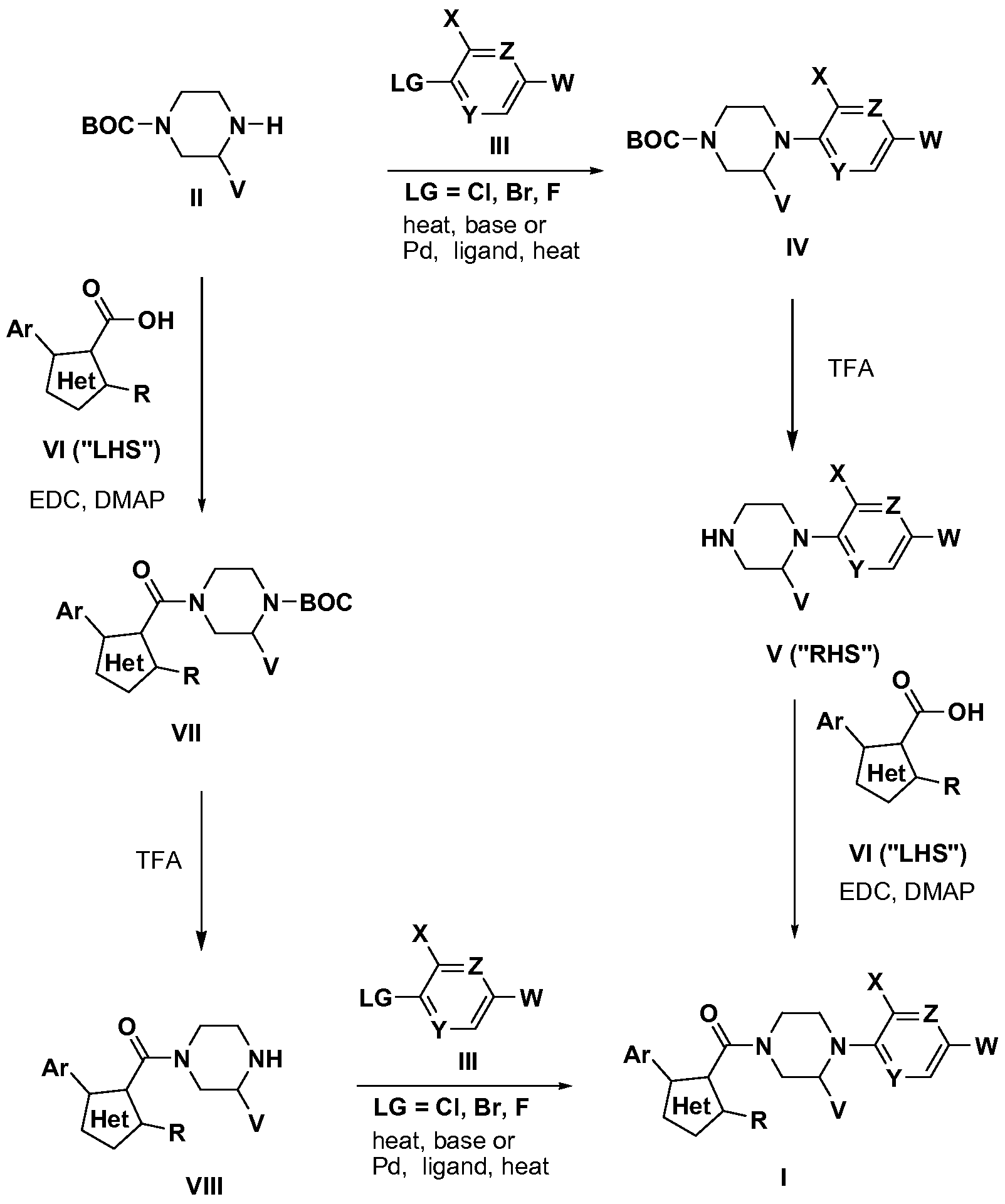
The following schemata are generalized procedures for making the compounds of the invention by those skilled in the art.
Scheme 1
Compounds of formula I were prepared from intermediates of formula II via two complementary routes as illustrated in Scheme 1. In the first route, intermediates of formula II were treated with intermediates of formula III in the presence of base and heat or in the presence of base, heat and a palladium catalyst to afford intermediates of formula IV. Intermediates of formula III can be obtained commercially, can be prepared by methods known in the literature, or can be readily prepared by one skilled in the art. Intermediates of formula IV were treated with TFA to provide intermediates of formula V
(also referred to as the "RHS" or right hand side). Intermediates of formula V were treated with carboxylic acids of formula VI (also referred to as the "LHS" or left hand side) and an amide-bond forming reagent (i.e. EDC) to provide compounds of formula I. Carboxylic acids of formula IV can be obtained commercially, can be prepared by methods known in the literature, or can be readily prepared by one skilled in the art. In the second route, the synthetic steps described in the first route are reversed.
Intermediates of formula II were treated with carboxylic acids of formula VI (also referred to as the "LHS" or left hand side) and an amide-bond forming reagent to afford intermediates of formula VII. Carboxylic acids of formula VI can be obtained commercially, can be prepared by methods known in the literature, or can be readily prepared by one skilled in the art. Intermediates of formula VII were treated with trifluoroacetic acid to afford intermediates of formula VIII. Intermediates of formula VIII were treated with intermediates of formula III in the presence of base and heat or in the presence of base, heat and a palladium catalyst to afford compounds of formula I. Intermediates of formula III can be obtained commercially, can be prepared by methods known in the literature, or can be readily prepared by one skilled in the art.
Scheme 2
Via
Compounds of formula Via were prepared as outlined in Scheme 2 and as described in the literature. [See: Gerald W.Zamponi, Stephanie C. Stotz, Richard J. Staples, Tina M. Andro, Jared K. Nelson, Victoria Hulubei, Alex Blumenfeld, and Nicholas R. Natale, J. Med. Chem., 2003, 46, 87-96.] Sequential treatment of aryl aldehyde derivatives of formula IX with hydroxylamine hydrochloride, then n- chlorosuccinimide provided intermediates of formula X. Aldehyde derivatives of formula IX can be obtained commercially, can be prepared by methods known in the literature, or
can be readily prepared by one skilled in the art. Intermediates of formula XI were prepared by treatment of chlorooximes of formula XII with (£)-ethyl 3-(pyrrolidin-l- yl)but-2-enoate to afford isoxazoles of formula XL Hydrolysis of the methyl ester of isoxazoles of formula XI afforded compounds of formula Via.
Scheme 3
VIb
Compounds of formula VIb were prepared as outlined in Scheme 3. Aryl iodides of formula XII were coupled with methyl propiolate in the presence of copper (I) oxide [See: Liliebris, C; Larsen, S.D; Ogg, D.; Palazuk, B.J; and Pleasdale, J.E. J.Med. Chem., 2002, 45, 1785.] to provide intermediates of formula XIII. Aryl iodide derivatives of formula XII can be obtained commercially, can be prepared by methods known in the literature, or can be readily prepared by one skilled in the art. Intermediates of formula XIII were treated with sodium azide and methyl iodide to afford triazoles of formula XIV after chromatographic separation from an undesired regioisomer. Treatment of triazoles of formula XIV with sodium hydroxide provided compounds of formula VIb.
XV XVI Vic Compounds of formula IVc were prepared as outlined in Scheme 4 and as described in the literature. [See: Martins, M.A.P. et al. J. Molecular Catalysis A:
Chemical, 2007, 266, 100.] Aryl hydrazines of formula XV were treated with (E)-\, \, \-
trichloro-4-ethoxy-3-methylbut-3-en-2-one to afford pyrazoles of formula XVI after chromatographic separation from the undesired regioisomer. Aryl hydrazines of formula XV can be obtained commercially, can be prepared by methods known in the literature, or can be readily prepared by one skilled in the art. Treatment of pyrazoles of formula XVI with sodium hydroxide provided compounds of formula Vic.
Scheme 5
XX VId
Compounds of formula VId were prepared as outlined in Scheme 5 and as described in the literature. [See: Grigg, R.; Savic, V. Chem. Commun. 2000, (10), 873- 874.] Beta-ketoesters of formula XVII were treated with ammonia to afford enamines of formula XVIII. Beta-ketoesters of formula XVII can be obtained commercially, can be prepared by methods known in the literature, or can be readily prepared by one skilled in the art. Treatment of enamines of formula XVIII with 2,3-dibromoprop-l-ene provided intermediates of formula XIX, which upon treatment with palladium(II) acetate afforded pyrroles of formula XX. Treatment of pyrroles of formula XX with lithium hydroxide provided compounds of formula VId.
Scheme 6
Compounds of formula Vie were prepared as outlined in Scheme 6 and as described in the literature. [See: Luke, R.W.A.; Jones, CD.; McCoull, W; Hayter, B.R. WO Patent 2004013141, 2004.] Isocyanates of formula XXI were treated with 1,4- dioxane-2,5-diol and methylamine to afford imidazoles of formula XXII. Isocyanates of formula XXI can be obtained commercially, can be prepared by methods known in the literature, or can be readily prepared by one skilled in the art. Sequential treatment of imidazoles of formula XXII with manganese (IV) oxide and potassium permanganate afforded compounds of formula Vie.
Compounds of formula Vlf were prepared as outlined in Scheme 7. Isoxazoles of formula XXIII were brominated under free radical conditions to provide intermediates of formula XXIV. Isoxazoles of formula XXIV can be obtained commercially, can be prepared by methods known in the literature, can be prepared by analogy to Scheme 2, or can be readily prepared by one skilled in the art. Intermediates of formula XXIV were treated with tetrabutylammonium fluoride to afford intermediates of formula XXV. [See: Sun, H.; DiMagno, S. G., J.Am. Chem. Soc. 2005, 127, 2050-2051.] Treatment of intermediates of formula XXV with trifluoroacetic acid provided compounds of formula Vlf.
Scheme 8
Compounds of formula VIg were prepared as outlined in Scheme 8 and as described in the literature. [See: El Kaim,L.; Lacroix, S. Synlett, 2000, 3, 353-354.] Aldehydes of formula XXVI were condensed with trichloroacetylhydrazide to afford hydrazones of formula XXVII. Aldehydes of formula XXVI can be obtained commercially, can be prepared by methods known in the literature, or can be readily prepared by one skilled in the art. Treatment of hydrazones of formula XXVII with ethyl acetoacetate under basic conditions afforded pyrazoles of formula XXVIII, which were hydro lyzed in a subsequent step to afford compounds of formula VIg.
XXXII Vlh
Compounds of formula Vlh were prepared as outlined in Scheme 9 and as described in the literature. [See: Chantegrel, B.; Nadi, A.I.; Gelin, S. J. Org. Chem, 1984, 49, 4419-4424.] Enamine of formula XXIX was treated with acid chlorides of formula XXX to afford enamines of formula XXXI. Acid chlorides of formula XXX can be obtained commercially, can be prepared by methods known in the literature, or can be readily prepared by one skilled in the art. Treatment of enamines of formula XXXI with hydroxylamine provided isoxazoles of formula XXXII. Treatment of isoxazoles of formula XXXII with lithium hydroxide provided compounds of formula Vlh.
Scheme 10
VI i
Compounds of formula Vli were prepared as outlined in Scheme 10 and as described in the literature. [See: Bell, M. G. et al. PCT Int. Appl. 2007, WO 2007140174.] Aryl azides of formula XXXIII were treated with ethyl but-2-ynoate to afford triazoles of formula XXXIV. Aryl azides of formula XXXIII can be obtained commercially, can be prepared by methods known in the literature, or can be readily prepared by one skilled in the art. Treatment of triazoles of formula XXXIV with lithium hydroxide provided compounds of formula Vli.
EXAMPLES
The compounds herein described and set forth and their preparation can be understood further by the following working examples. These examples are meant to be illustrative of the present invention, and are not to be taken as limiting the scope thereof.
Chemical abbreviations used in the Examples are defined as follows:
"Ac" for acetate,
"APCI" for atmospheric pressure chemical ionization,
"BEMP" for 2-tert-butimino-2-diethylamino- 1 ,3 -dimethyl-perhydro- 1 ,3 ,2-diaza- phosphorine,
"Boc" or "BOC" for i-but loxycarbonyl,
"BOP" for benzotriazol-l-yloxytris-(dimethylamino)-phosphonium hexafluorophosphate,
"Cbz" for benzyloxycarbonyl,
"CDI" for Ι,Γ-carbonyldiimidazole,
"CD3OD" for deuteromethanol,
"CDCI3" for deuterochloroform,
"DCC" for 1,3-dicyclohexylcarbodiimide,
"DCE" for 1,2-dichloroethane,
"DCM" for dichloromethane
"DEAD" for diethyl azodicarboxylate,
"DIEA", "Hunig's base", or "DIPEA" for NN-diisopropylethylamine,
"DMF" for Ν,Ν-dimethylformamide,
"DMAP" for 4-dimethylaminopyridine,
"DMPU" for l,3-dimethyl-3,4,5,6-tetrahydro-2(lH)-pyrimidone,
"DMSO" for dimethylsulfoxide,
"DPPA" for diphenylphosphorylazide
"EDC" or "EDO" for l-(3-dimethylaminopropyl)-3-ethylcarbodiimide hydrochloride, "Et" for ethyl,
"EtOAC" for ethyl acetate,
"HOAc" for acetic acid,
"HOBt" for 1 -hydroxybenzotriazole hydrate,
"HATU" for 0-(7-azabenzotriazol-l-yl)-N, N, ', N'-tetramethyluronium
hexafluorophosphate,
"HMPA" for hexamethylphosphoramide,
"LDA" for lithium diisopropylamide,
"LiHMDS" for lithium bis(trimethylsilyl)amide,
"NaHMDS" for sodium bis(trimethylsilyl)amide,
"NBS" for N-bromosuccinimide,
"NCS" for -chlorosuccinimide,
"NMM" for 4-methylmoipholine,
"PyBOP" for benzotriazole-l-yl-oxy-tris-pyrrolidino-phosphonium hexafluorophosphate,
"TMSCH2N2" for (trimethylsilyl)diazomethane,
"TMSN3" for Azidotrimethylsilane,
"TBTU" for 0-(lH-benzotriazol-l-yl)-N,N,N',N'-tetramethyluronium tetrafluoroborate,
"TEA" for triethylamine,
"TFA" for trifluoroacetic acid, and
"THF" for tetrahydrofuran.
Abbreviations used in the Examples are defined as follows: "°C" for degrees Celsius, "MS" for mass spectrometry, "ESI" for electrospray ionization mass spectroscopy, "HR" for high resolution, "LC-MS" for liquid chromatography mass spectrometry, "eq" for equivalent or equivalents, "g" for gram or grams, "h" for hour or hours, "mg" for milligram or milligrams, "mL" for milliliter or milliliters, "mmol" for
millimolar, "M" for molar, "min" for minute or minutes, "rt" for room temperature, "NMR" for nuclear magnetic resonance spectroscopy, "tic" for thin layer
chromatography, "atm" for atmosphere, and "α", "β", "R", "S", "E", and "Z" are stereochemical designations familiar to one skilled in the art.
"HPLC" is an abbreviation used herein for high pressure liquid chromatography.
Reverse-phase HPLC can be carried out using a Vydac C-18 column with gradient elution from 10% to 100 % buffer B in buffer A (buffer A: water containing 0.1% trifluoroacetic acid, buffer B: 10% water, 90% acetonitrile containing 0.1% trifluoroacetic acid). If necessary, organic layers can be dried over sodium sulfate unless otherwise indicated. However, unless otherwise indicated, the following conditions are generally applicable. "LC-MS" refers to high pressure liquid chromatography carried out according to the definition for HPLC with a mass spectrometry detector.
Preparatory HPLC: When described as performed under "standard conditions", samples (approx. 20 mg) were dissolved in methanol (10 mg/mL) and purified on a 25mm X 50 mm Vydac CI 8 column with a 5 minute gradient elution from 10% to 100 % buffer B in buffer A (buffer A: water containing 0.1% trifluoroacetic acid, buffer B: 10% water, 90% acetonitrile containing 0.1% trifluoroacetic acid) at 10 mL/minute.
Melting points were determined on a Mel-Temp II apparatus and are uncorrected. IR spectra were obtained on a single-beam Nicolet Nexus FT-IR spectrometer using 16 accumulations at a resolution of 4.00 cm-1 on samples prepared in a pressed disc of KBr or as a film on KBr plates. Proton NMR spectra (300 MHz, referenced to
tetramethylsilane) were obtained on a Varian INOUA 300, Bruker Avance 300, Avance 400, or Avance 500 spectrometer. Data were referred to the lock solvent. Electrospray Ionization (ESI) experiments were performed on a Micromass II Platform single- quadrupole mass spectrometer, or on a Finnigan SSQ7000 mass spectrometer.
SYNTHESIS OF INTERMEDIATES Acid-A. 3-(2-methoxyphenyl)-5-methylisoxazole-4-carboxylic acid
Step Al. Ethyl 3-(2-methoxyphenyl)-5-methylisoxazole-4-carboxylate was synthesized from 2-methoxybenzaldehyde as described in [Zamponi, G. W.; Stotz, S. C; Staples, R. J.; Andro, T. M.; Nelson, J. K.; Hulubei, V.; Blumenfeld, A.; Natale, N. R. J. Med. Chem. 2003, 46, 87-96.]
Step A2. The reaction mixture of ethyl 3-(2-methoxyphenyl)-5-methylisoxazole-4- carboxylate (12.85 g, 49.2 mmol) and sodium hydroxide (9.84 g, 246 mmol) in MeOH (100 mL) and Water (10 mL) in a 500-mL round bottom flask was stirred at 65 °C for 20 hours. The MeOH was removed in vacuo, then the concentrated reaction mixture was transferred to a 500-mL separatory funnel with 150 mL of water and 100 mL of ether. The organic layer was discarded. The aqueous layer was acidified by adding
concentrated HC1 (26 mL). The product precipitated and was separated by filtration and dried under high vacuum to give 10.63 g (93%, theoretical yield 1 1.47 g). XH NMR (400 MHz, CD3OD) δ 2.69 (s, 3H, CH3), 3.77 (s, 3Η, OCH3), 7.00-7.07 (m, 2Η, aryl), 7.32- 7.34 (m, aryl), 7.43-7.48 (m, ¾, aryl).
Acids B-AJ were synthesized by analogy to Acid-A, substituting the appropriate aldehyde for 2-methoxybenzaldehyde. Acid-B: 3-(2-cyanophenyl)-5-met oxylic acid
¾-NMR (DMSO, 400 MHz): δ 7.83-7.98(m IH) ), 7.74-7.8 (m, IH), 7.5-7.7 (m, 2H), 2.74 (3H, s). m/e 228.90 (M+l)+. Acid-C: 3-(2-(benzyloxy)phenyl)-5- 4-carboxylic acid
XH-NMR (DMSO, 400 MHz): δ 1 1.5 (s, IH), 9.4 (S, IH), 9.1 (S, IH), 8.4 (m, IH), 8.1 -8.15 (dd IH) ), 7.8-7.85 (dd, IH), 7.5-7.7 (m, 3H), 3.5 (2H, bs), 2.5 (3H, s). m/e 310.09 (M+l)
+.
Acid-D: 3-(2-ethylphenyl)-5-met acid
¾-NMR (DMSO, 400 MHz): δ 7.16-7.44(4H,m), 3.15-3.51 (q, 2H), 2.67-2.89 (3H, s), 1.03- 1.24 (3H, t). m/e 231.84 (M+l)+.
Acid-E : 5-methyl-3-(2-(trifluorom le-4-carboxylic acid
¾-NMR (DMSO, 400 MHz): δ 7.83-8.05 (lH,m), 7.64-7.81 (2H, m), 7.42-7.64 (IH, s), 2.73 (3H, t). m/e 271.14 (M+l)+.
Acid-F : 3-(2-(difluoromethoxy)phen -5-methylisoxazole-4-carboxylic acid
¾-NMR (DMSO, 400 MHz): δ 13.31 (IH, s), 7.51-7.69 (IH, m), 7.41-7.50 (IH, m), 7.15 7.40 (lH,m), 7.02-7.18 (IH, m), 6.8-6.96 (IH, s), 2.73 (3H, t). m/e 270.02 (M+l)+.
Acid-G: 3-(3-fluoro-2-methylphen -5-methylisoxazole-4-carboxylic acid
¾-NMR (DMSO, 400 MHz): δ 7.21-7.42 (2H, m), 7.03-7.2 (IH, m), 2.77 (3H, s). Acid-H: 3-(2-chloro-6-fluorophenyl)- -methylisoxazole-4-carboxylic acid
¾-NMR (DMSO, 400 MHz): δ 7.30-7.68 (3H, m), 2.68 (3H, s). m/e 255.98 (M+l)
+.
Acid-I: 3-(2,3-dimethoxyphenyl)- -methylisoxazole-4-carboxylic acid
¾-NMR (DMSO, 400 MHz): δ 7.1-7.2 (2H, m), 6.9 (1H, m), 3.87 (3H, m), 3.58 (3H, m), 2.65 (3H, s).
Acid-J: 3-(4-fluoro-2-methoxyphen -5-methylisoxazole-4-carboxylic acid
¾-NMR (CD3OD, 400 MHz): δ 7.36-7.29 (1H, m), 6.90-6.84 (1H, m), 6.80-6.72 (1H, 3.77 (3H, s), 2.68 (3H, s).
Acid-K: 3-(2-chloro-4-fluorophenyl)-5-methylisoxazole-4-carboxylic acid
¾-NMR (CD3OD, 400 MHz): δ 7.48-7.41 (1H, m), 7.38-7.31 (1H, m), 7.23-7.14 (1H, 2.74 (3H, s).
Acid-L : 3-(2,5-dichlorophenyl)-5-m carboxylic acid
¾-NMR (CD3OD, 400 MHz): δ 7.51-7.48 (2H, m), 7.46-7.42 (1H, m), 2.75 (3H, s).
Acid-M: 3-(5-bromo-2-methoxyphenyl)-5-methylisoxazole-4-carboxylic acid
¾-NMR (DMSO, 400 MHz): δ 12.82 (1H, s), 7.65 (1H, dd, Jl = 8.8 Hz, J2 = 2.5 Hz), 7.45 (1H, d, J= 2.5 Hz), 7.10 (1H, d, J= 8.8 Hz), 3.72 (3H, s), 2.66 (3H, s).
¾-NMR (CDC13, 500 MHz): δ 7.0-7.1 (1H, m), 6.9 (lH,m), 6.52 (lH,m), 2.65 (3H, s).
Acid-N: 5-methyl-3-(quinolin-8-yl) acid
¾-NMR (DMSO, 400 MHz): δ 8.85 (1H, s), 8.17 (1H, dd, Jl = 7.5 Hz, J2 = 1.5 Hz), 8.14 (1H, dd, Jl = 7.5 Hz, J2 = 1.5 Hz), 7.82 (1H, m),7.69 (1H, s), 7.58 (1H, m), 2.73 (3H, s).
Acid-O: 5-methyl-3-(pyridin-2-yl)is c acid
¾-NMR (DMSO, 400 MHz): δ 15.68-16.07 (1H, s), 8.73 (2H, m), 8.14 (1H, m), 7.64 (1H, m), 2.73 (3H, s). LCMS 205.2
Acid-P: 5-methyl-3-(pyrimidin-5-yl) oxylic acid
¾-NMR (DMSO, 400 MHz): δ 9.23-9.37 (1H, m), 8.96-9.22 (2H, m), 2.73 (3H, s).
Acid-Q: 5-methyl-3-(3-methylpyridin-2-yl)isoxazole-4-carboxylic acid
¾-NMR (DMSO, 400 MHz): δ 8.45 (IH, m), 7.86 (IH, m), 7.46 (IH, m), 2.72 (3H, s), 2.16 (3H, s). Acid-R: 3',5,5'-trimethyl-3,4'-biisox acid
¾-NMR (DMSO, 400 MHz): δ 2.57 (3H, s), 2.41 (3H, s), 2.27 (3H, s).
Acid-S : 5-methyl-3-(3-methylthiophe -2-yl)isoxazole-4-carboxylic acid
¾-NMR (DMSO, 400 MHz): δ 7.49-7.74 (dd, IH), 6.96-7.24(dd, IH), 2.7 (s, 3H), 2.13 (s,3H). m/e 224(M+1)+.
Acid-T: 3-(2-methoxypyridin-3-yl)- -methylisoxazole-4-carboxylic acid
¾-NMR (DMSO, 400 MHz): δ 8.39-8.59(m, IH), 7.64-7.89(m, IH), 6.96-7. l l(m, IH), 3.89 (3H, S), 2.89 (s, 3H). azole-4-carboxylic acid
¾-NMR (DMSO, 400 MHz): δ 7.2-7.38 (IH, m), 7.0-7.20 (IH, m), 6.75-6.94 (IH, 4.58 (2H), 3.09-3.29 (2H), 3.09-3.28(2H), 2.69 (3H, s). m/e 246.04 (M+l)
+.
Acid-V: 3-(benzo[d] [l,3]dioxol-4-y -5-methylisoxazole-4-carboxylic acid
¾-NMR (DMSO, 400 MHz): δ 7.1-7.2 (IH, m), 6.9 (2H, m), 6.09 (2H, m), 2.62 (3H).
Acid-W: 3-(2-ethoxypyridin-3-yl)-5- 4-carboxylic acid
¾-NMR (DMSO, 400 MHz): δ 8.21-8.59 (IH, m), 7.54-7.89 (IH, m), 6.96-7.11 (IH, 4.14-4.36 (q, 2H), 3.89 (3H, S), 2.89 (s, 3H), 1.07-1.26 (3H, t). m/e 249.06 (M+l)+.
Acid-X: 5-methyl-3-(naphthalen-l oxylic acid
¾-NMR (DMSO, 400 MHz): δ 7.83-8.22 (m, 3H), 7.4-7.7 (m, 4H), 3.5 (2H, bs), 2.74 (3H, s). m/e 253.97 (M+l)+.
Acid-Y: 5-methyl-3-(quinolin-5-yl) acid
¾-NMR (DMSO, 400 MHz): δ 8.97 (IH, s), 8.12-8.31 (2H, m), 7.83-8.11(1H, m), 7.64-7.82 (IH, m),7.51-7.63 (IH, m), 2.80 (3H, s). m/e 255.5 (M+l)
+.
Acid-Z: 3-(isoquinolin-5-yl)-5-met oxylic acid
¾-NMR (DMSO, 400 MHz): δ 9.14-9.49 (1H, m), 8.37-8.47 (1H, m), 8.24-8.37(lH, m), 7.76-7.98 (2H, m),7.52-7.72 (1H, m), 2.82 (3H, s). m/e 254.80 (M+l)+.
Acid-AA: 5-methyl-3-(quinolin-4-yl)isoxazole-4-carboxylic acid
¾-NMR (DMSO, 400 MHz): δ 12.79-13.30 (1H, s), 8.84-9.12 (1H, m), 8.01-8.21(1H, m), 7.73-7.95 (1H, m),7.46-7.72 (2H, m), 2.63 (3H, s). m/e 255.06 (M+l)+.
Acid-AB: 5-methyl-3-(l-methyl-l -benzo[d]imidazol-2-yl)isoxazole-4-carboxylic acid
¾-NMR (DMSO, 400 MHz): δ 7.86-7.89 (2H, m), 7.31-7.86 (2H, m), 3.97(3H, s), 2.78 (3H, s). m/e 258.04 (M+l)+.
Acid-AC: 3-(2,3-dihydrobenzo[b] [l,4]dioxin-5-yl)-5-methylisoxazole-4-carboxylic acid
¾-NMR (DMSO, 400 MHz): δ 6.72-7.08 (3H, m), 4.2-4.36 (4H, m), 2.68(3H, s). m/e 262.01 (M+l)+.
Acid-AD: 3-(2,2-dimethyl-2,3-dihydrobenzofuran-7-yl)-5-methylisoxazole-4-carboxylic acid
¾-NMR (DMSO, 400 MHz): δ 7.21-7.34 (1H, m), 7.09-7.2 (1H, m), 6.79-6.96 (1H, m), 2.94-3.11 (2H, m), 2.68(3H, s), 1.38-1.53 (3H, m), 1.24-1.38 (3H, m). m/e 274.03 (M+l)+. Acid-AE: 5-methyl-3-(2-(pyridin-3 le-4-carboxylic acid
¾-NMR (DMSO, 400 MHz): δ 8.88-9.05 (1H, m), 8.54-8.78 (1H, m), 7.43-8.40 (3H, m), 7.4-7.71 (3H, m), 2.47(3H, s). m/e 281.04 (M+l)
+. Acid-AF: 5-methyl-3-(3-(pyridi -3-yl)phenyl)isoxazole-4-carboxylic acid
¾-NMR (DMSO, 400 MHz): δ 8.41-8.58 (1H, m), 8.3 (1H, s), 7.43-7.77 (5H, m), 7.14-7.40 (1H, m), 2.94-3.11 (1H, m), 2.47(3H, s). m/e 281.04 (M+l)
+. Acid-AG: 3-(3-chloropyridin-4-yl)- e-4-carboxylic acid
¾-NMR (CD
3OD, 300 MHz): δ 8.63 (lH,s), 8.53 (1H, d, J= 4.8 Hz), 7.49 (1H, d, J Hz), 2.75 (3H, s).
Acid-AH: 3-(2-chloropyridin-3-yl)- -carboxylic acid
¾-NMR (CD3OD, 500 MHz): δ 8.52-8.44 (1H, m), 7.92-7.83 (1H, m), 7.53-7.44 (1H, m), 2.76 (3H, s).
Acid-AI : 5-methyl-3-(quinoxalin-5 oxylic acid
¾-NMR (DMSO, 500 MHz): δ 12.62 (1H, s), 9.01 (1H, d, J
Hz), 8.28-8.21 (1H, m), 7.99-7.92 (2H, m), 2.74 (3H, s).
Acid-AJ: 3-(2-methoxynaphthalen- -yl)-5-methylisoxazole-4-carboxylic acid
¾-NMR (DMSO, 400 MHz): δ 12.60 (1H, s), 8.09 (1H, d, J= 9.0 Hz), 7.93 (1H, d, J= 7.8 Hz), 7.55 (1H, d, J= 9.0 Hz), 7.46-7.33 (3H, m), 3.84 (3H, s), 2.77 (3H, s).
Step AK1. A solution of tert-butyl 3-(2-methoxyphenyl)-5-methylisoxazole-4-carboxylate (0.795 g, 2.75 mmol), NBS (0.978 g, 5.50 mmol) and benzoyl peroxide (0.033 g, 0.137 mmol) in CC1
4 (10 mL) was stirred at 90 °C for 16 hours. The reaction mixture was cooled to RT and the solid was filtered off. Solvent was removed in vacuo. The product was purified by flash chromatography (DCM, R/0.56) to give 0.44 g (44% yield).
XH-NMR (CDC1
3, 400 MHz): δ 7.49-7.37 (2H, m), 7.04 (1H, t, J= 7.5 Hz), 6.96 (1H, d, J= 8.3 Hz), 4.79 (2H, s), 3.79 (3H, s), 1.38 (9H, s).
Step AK2. tert-butyl 5-(fluoromethyl)-3-(2-methoxyphenyl)isoxazole-4-carboxylate was prepared from tert-Butyl 5-(bromomethyl)-3-(2-methoxyphenyl)isoxazole-4-carboxylate by the method described in Sun, H.; DiMagno, S. G., J.Am. Chem. Soc. 2005, 127, 2050-2051. ¾-NMR (CDCI3, 400 MHz): δ 7.49-7.37 (2H, m), 7.08-7.01 (1H, m), 6.97 (1H, d, J= 8.3 Hz), 5.72 (2H, d, J= 47.2 Hz), 3.79 (3H, s), 1.35 (9H, s). Step AK3. Treating tert-butyl 5-(fluoromethyl)-3-(2-methoxyphenyl)isoxazole-4-carboxylate with TFA/DCM (1 : 1) at room temperature for one hour followed by evaporation of
DCM/TFA in vacuo provided the title compound. XH-NMR (CD3OD, 400 MHz): δ 7.53-7.44 (1H, m), 7.42-7.35 (1H, m), 7.13-6.98 (2H, m), 5.74 (2H, d, J= 47.2 Hz), 3.78 (3H, s). Acid-AL: 5-(difluoromethyl)-3-(2-chlorophenyl)isoxazole-4-carboxylic acid
Step ALL A mixture of methyl 3-(2-chlorophenyl)-5-(difluoromethyl)isoxazole-4- carboxylate and ethyl 3-(2-chlorophenyl)-5-(difluoromethyl)isoxazole-4-carboxylate was synthesized as described in [Roy, A. K.; Batra, S. Synthesis 2003, 1347-56.]. Analytical samples of the two esters were obtained by isolation with preparative HPLC.
Methyl 3-(2-chlorophenyl)-5-(difluoromethyl)isoxazole-4-carboxylate. XH NMR (CDC13, 300 MHz) δ 7.36 - 7.56 (4 H, m), 7.25 (1H, t, J= 52.3 Hz), 3.78 (3 H, s).
Ethyl 3-(2-chlorophenyl)-5-(difluoromethyl)isoxazole-4-carboxylate. 'H NMR (CDCI3, 300 MHz) δ 7.36 - 7.54 (4 H, m), 7.27 (1H, t, J= 52.3 Hz), 4.22 (2 H, q, J=7.0 Hz), 1.13 (3 H, t, J=7.3 Hz)
Step AL2. Hydrolysis of the mixture of the two esters obtained from Step ALl following the procedure described in Step Al of Acid-A provided the title compound. XH-NMR (CD3OD, 300 MHz): δ 7.55-7.46 (2H,m), 7.45-7.36 (2H,m), 6.73 (1H, t, J= 54.1 Hz).
Acid-AM: 3-(2-chlorophenyl)-5-m -carboxylic acid
The title compound was prepared according to the literature procedure: El Kaim,L.; Lacroix, S. Synlett, 2000, 3, 353-354.. ¾-NMR (CDC13, 400 MHz): δ 7.45-7.55(1Η, m), 7.28-7.40 (2H, m), 7.25-7.27 (lH,m), 2.44 (3H, s).
Acid-AN: 5-(2-chlorophenyl)-l,3-di le-4-carboxylic acid
The title compound was prepared by analogy to Acid-AM, substituting methyl hydrazine for hydrazine and separating the regioisomers.
¾-NMR (CDCI3, 400 MHz): δ 7.33-7.35 (1H, m), 7.29-7.30 (1H, m), 7.25-7.27(lH, m), 3.59 (3H, m), 2.52 (3H, s).
Acid-AO: 2-(2-Chlorophenyl)-4-met -carboxylic acid
The title compound was prepared according to the literature procedure: Grigg, R.; Savic, V. Chem. Commun. 2000, (10), 873-874.
XH-NMR (CDC1
3, 400 MHz): δ 7.52-7.63(1Η, m), 7.41-7.48 (2H, m), 7.28-7.32 (lH,m), 6.8-6.85 (1H, m), 2.17 (3H, s). Acid-AP: 3-(2,6-dichlorophenyl)-5- roisoxazole-4-carboxylic acid
The title compound was prepared as described in: Golebiewski, W.M.; Gucma, MJournal of Heterocyclic Chemistry (2008), 45(6), 1687-1693.
Acid-AQ: l-(2-chlorophenyl)-4-methyl-lH-pyrazole-5-carboxylic acid
Fraction A
Reference: Martins, M.A.P. et al. J. Molecular Catalysis A: Chemical, 2007, 266,100. Step AQ1. A mixture of (E)-l-ethoxyprop-l-ene (6.41 mL, 57.9 mmol) and pyridine
(4.68 mL, 57.9 mmol) was added to a soln. of 2,2,2-trichloroacetyl chloride (10.53 g, 57.9 mmol) in DCM (15 mL) at -10 °C at a rate of 6-10 drops/min. After the addition was completed, the mixture was stirred at r.t for 24hrs. Filtered, and the filtrate was
concentrated in reduced pressure (at first the temperature of the water bath was r.t, after most DCM was evaporated off, water bath was warmed to 50°C to afford (E)- 1 , 1 , 1 - trichloro-4-ethoxy-3-methylbut-3-en-2-one (2.55 g, 10.79 mmol, 18.64 % yield). 1H-
NMR(500MHz, CDC13): δ: 7.96(s, 1H), 4.21(q, J=7.1Hz, 2H), 1.94(s, 3H), 1.41(t,
J=7.2Hz, 3H).This material was taken into Step G2 without further purification.
Step AQ2. A mixture of (E)-l,l,l-trichloro-4-ethoxy-3-methylbut-3-en-2-one (279 mg, 1.205 mmol) and (2-chlorophenyl)hydrazine, HC1 (253 mg, 1.446 mmol) in EtOH (5 mL) was heated to reflux for 3hrs. Cooled to r.t. then separated by prep-HPLC to afford ethyl l-(2-chlorophenyl)-4-methyl-lH-pyrazole-5-carboxylate (Fraction A, 30mg, 0.113 mmol, 9.37 % yield). Step AQ3. A solution of ethyl l-(2-chlorophenyl)-4-methyl-lH-pyrazole-5-carboxylate (120 mg, 0.453 mmol) in a 1 : 1 mixture of Sodium hydroxide (2 mL, 6.00 mmol) and Methanol (2 mL) was stirred at rt for 2h. Concentrated to remove the solvent. The residue was taken up in EtOAc and water. The aqueous layer was acidified with 6M HC1 to PH=~3, extracted with EtOAc (3x). The combined organic layer was dried (Na2S04) and concentrated to afford 50mg (47%) of l-(2-chlorophenyl)-4-methyl-lH-pyrazole-5-carboxylic acid. XH-NMR
(CDC13, 400 MHz): δ 7.78-7.92 (1H, m), 7.56-7.71 (2H, m), 7.44-7.55(2H, m), 2.38 (3H, s).
Acid-AR: 5-(2-methoxyphenyl)-3-m carboxylic acid
The title compound was prepared as described in: Chantegrel, B.; Nadi, A.I.; Gelin, S. J.Org.Chem, 1984, 49, 4419-4424.
¾-NMR (CDCI3, 400 MHz): δ 7.36-7.55 (2H, m), 6.86-7.25 (2H, m), 2.50 (3H, s).
Acid-AS: 5-(2-chlorophenyl)-3-met rboxylic acid
The title compound was prepared by analogy to Acid-AR.
¾-NMR (CDCI
3, 400 MHz): δ 7.41-7.69 (2H, m), 2.44(3H, s). m/e 238.02 (M+l)
+.
Acid-AT: 5-(2-methoxyphenyl)-3-m e-4-carboxylic acid
The title compound was prepared according to the literature procedure: El Kaim,L.; Lacroix, S. Synlett, 2000, 3, 353-354. XH-NMR (CDC13, 400 MHz): δ 7.28-7.40 (1H, m), 7.17-7.25 (lH,m), 6.90-7.08 (2H, m), 2.38 (3H, s). m/e 233.23 (M+l)+.
Acid-AU: 4-(2-methoxyphenyl)-l-methyl-lH-l,2,3-triazole-5-carboxylic acid
Major isomer Minor isomer
Step AU1. Reference: Liliebris, C; Larsen, S.D; Ogg, D.; Palazuk, B.J; and Pleasdale, J.E. J.Med. Chem., 2002, 45, 1785.
To a suspension of methyl propiolate (2, 1.314 ml, 15.41 mmol) and copper(I) oxide (1.086 g, 7.59 mmol) in DMF (20 ml) was added l-iodo-2-methoxybenzene (1, 1.262 ml, 9.48 mmol). The resulting mixture was heated in a Microwave reactor to 110 °C for 2hrs. The reaction mixture was filtered through a short pad of silica gel and washed w/ EtOAc. The organic layer was washed w/lM HC1, brine and sat'd NaHC03, dried ( a2S04) and concentrated to leave an oil as crude product, which was purified by flash chromatography (S1O2, EtOAc/Hexane, 1 :2) to afford methyl 3-(2-methoxyphenyl)propiolate 3 (932mg, 4.66 mmol, 49.1 % yield). 1H-NMR( 500MHz, CDC13), δ: 7.54(1H, dd), 7.44(1H, td), 6.98- 6.92(m,2H), 3.92(s,3H), 3.86( s,3H).
Step AU2. A mixture of methyl 3-(2-methoxyphenyl)propiolate (3, 932 mg, 4.90 mmol), sodium azide (478 mg, 7.35 mmol), and iodomethane (0.458 ml, 7.35 mmol) in Water (7 ml)
and DMF(3 ml) was heated to 100 °C in a Microwave reactor for 6hrs. Purified by Prep- HPLC (Varian, 15-90B in min., B=90% MeOH/10% H20) to afford methyl 5-(2- methoxyphenyl)-l-methyl-lH-l,2,3-triazole-4-carboxylate (701 mg, 2.69 mmol, 55.0 % yield), XH-NMR( 500MHz, CD30D), δ: 7.52-7.56( m, 1H), 7.30 ( dd, 1H), 7.12, (td, 1H), 7.06, (d,lH), 3.90 (s, 3H), 3.86(s,3H), 3.82(s, 3H). and methyl 4-(2-methoxyphenyl)-l- methyl-lH-l,2,3-triazole-5-carboxylate (185 mg, 0.711 mmol, 14.51 % yield), XH-NMR( 500MHz, CD30D), δ: 7.49-7.46(m,2H), 7.10-7.07(m,2H), 4.32(s,3H), 3.79(s, 3H), 3.78(s,3H). Step AU3. To a soln. of methyl 4-(2-methoxyphenyl)-l-methyl-lH-l,2,3-triazole-5- carboxylate (183 mg, 0.74 mmol) in MeOH (5ml) was added sodium hydroxide (1.3 ml, 3M aq. solution). The mixture was stirred at r.t for 2hrs, then concentrated in vacuo. The residue was taken up in water, washed w/ether (3x) to remove the possible impurity. The aq. phase was acidified w/6M HC1 to pH 3, extracted w/EtOAc (4x). The combined organic layer was dried and evaporated to afford the title compound (164mg, 0.703 mmol, 95 % yield). XH- NMR( 500MHz, CD30D), δ: 7.46-7.42(m,2H), 7.09-7.05(m,2H), 4.32(s,3H), 3.73(s,3H).
A
Reference: Luke, R.W.A.; Jones, CD.; McCoull, W; Hayter, B.R. WO Patent 2004013141, 2004.
Step AVI. To a soln. of l,4-dioxane-2,5-diol (120 mg, 0.995 mmol) in THF (8ml) was added methylamine (2.8 ml, 0.664 mmol) at r.t. The resulting mixture was stirred at r.t for 75min. Then l-(isocyano(tosyl)methyl)-2-methoxybenzene (200 mg, 0.664 mmol) was added while keeping reaction mixture at <30 °C by a water bath. The reaction mixture was stirred at r.t overnight. Evaporated to leave white solid, dissolved in DMF, and purified by Pre-HPLC to afford (4-(2-methoxyphenyl)-l -methyl- lH-imidazol-5-yl)methanol (84mg, 0.377 mmol, 38.6
% yield) as a colorless oil. ^- MR^MeOD), δ: 8.97(lH,s), 7.55(lH,t, J=7.5Hz), 7.47(1H, d, J=8.0Hz), 7.22(1H, d, 8.0Hz), 7.15(1H, t, J=7.5Hz), 4.67(2H,s), 4.05(3H,s), 3.89(3H,s).
Step AV2. To a soln. of (4-(2-methoxyphenyl)-l-methyl-lH-imidazol-5-yl)methanol (84mg, 0.385 mmol) in 1,4-Dioxane (5ml) was added Mn02 (147 mg, 1.693 mmol). The mixture was heated to 90 °C for 4hrs or until LC/MS showed the completion of the reaction. The reaction mixture was Filtered through celite, and evaporated to afford 4-(2-methoxyphenyl)- l-methyl^H-imidazole-S-carbaldehyde (78mg, 0.325 mmol, 84 % yield), which was used for the next reaction w/o purification.
Step AV3. To a soln. of 4-(2-methoxyphenyl)-l -methyl- lH-imidazole-5-carbaldehyde (78 mg, 0.361 mmol) in acetone (5ml) and water (1 ml) was added potassium carbonate (100 mg, 0.721 mmol) . After potassium was dissolved, KMn04 (123 mg, 0.776 mmol) was added at r.t. The mixture was stirred for 24hrs. LC/MS showed the completion. The mixture was filtered through celite, washed w/water. The actone was evaporated from the filtrate which was extracted with EtOAc (2x). The aq. layer was acidified w/ HOAc to PH=5, reduced the volume to half volume, freezed and lyphilized to leave solid, which was purified by Pre-
HPLC to afford the title compound (41 mg, 0.173 mmol, 48 % yield). ^- MR^MeOD), δ: 8.06(s, lH), 7.41-7.36(m, 2H), 7.05-6.99(m, 2H), 3.98(s,3H), 3.80(s,3H).
Acid-AW: 3-(4-Methoxyphenyl)-5-methylisothiazole-4-carboxylic acid
The title compound was prepared as described in [Gerritz, S.; Shi, S.; Zhu, S. U.S. Pat. Appl. 2006, US 2006287287.]
Acid-AX: l-(2-chlorophenyl)-4-met le-5-carboxylic acid
Methyl l-(2-chlorophenyl)-4-methyl-
1H-l,2,3-triazole-5-carboxylate (methyl ester of Acid- AX) was prepared as described in [Bell, M. G. et al. PCT Int. Appl. 2007, WO 2007140174.] The methyl ester was hydrolyzed ( aOH/ H20/ MeOH, RT) to afford the title compound. NMR for methyl ester of Acid-AX: ¾-NMR (CD
3OD, 400 MHz): δ 7.67-7.58 (2H, m), 7.55-7.51 (2H, m), 3.77 (3H, s), 2.61 (3H, s).
NMR for Acid-AX: XH-NMR (CD3OD, 400 MHz): δ 7.65-7.50 (4H, m), 2.61 (3H, s).
The title compound was prepared by analogy to Acid-AO.
NMR data for Acid-AY methyl ester: ¾-NMR (CDC13, 400 MHz): δ 8.59 (1H, s), 7.42-7.27 (2H, m), 7.02-6.95 (2H, m), 6.58 (1H, s), 3.80 (3H, s), 3.67 (3H, s), 2.32 (3H, s).
A mixture of methyl 2-(2-methoxyphenyl)-4-methyl-1H-pyrrole-3-carboxylate (0.126 g, 0.514 mmol) and sodium hydroxide (0.205 g, 5.14 mmol) in NMP (4.500 mL) and Water (1.500 mL) was stirred at 120 °C overnight. The crude product was used in amide formation without further purification. LCMS showed both MH+ (232.05) and [M-H]" (230.24).
Acid-AZ: 4-methyl-2-(naphthalen- -yl)-lH-pyrrole-3-carboxylic acid
The title compound was prepared by analogy to Acid-AO.
¾-NMR (CD3OD, 400 MHz): δ 7.86 (2H, d, J= 8.3 Hz), 7.65 (1H, d, J= 8.3 Hz), 7.53-7.35 (4H, m), 6.66 (1H, s), 2.35 (3H, s).
Acid-BA: 3-(2-methoxy-5-nitrophenyl)-5-methylisoxazole-4-carboxylic acid
Prepared by analogy to Acid-A.
¾-NMR (DMSO, 400 MHz): δ 12.94 (1H, s), 8.41 (1H, dd, Jl = 9.3 Hz, J2
(1H, d, J= 2.9 Hz), 7.38 (1H, d, J= 9.3 Hz),3.88 (3H, s), 2.69 (3H, s).
Step BBl. Ethyl 5-methyl-3-(4-nitrophenyl)isoxazole-4-carboxylate was prepared by analogy to Acid-A. XH-NMR (CDC13, 500 MHz): δ 8.31 (2H, d, J= 8.7 Hz), 7.85 (2H, d, J= 8.7 Hz), 4.28 (2H, q, J= 7.2 Hz), 2.78 (3H, s), 1.27 (3H, t, J= 7.2 Hz).
Step BB2. Ethyl 3-(4-aminophenyl)-5-methylisoxazole-4-carboxylate was prepared by reducing ethyl 5-methyl-3-(4-nitrophenyl)isoxazole-4-carboxylate with tin(II) chloride dihydrate. XH-NMR (CDC13, 500 MHz): δ 7.48 (2H, d, J= 8.4 Hz), 6.72 (2H, d, J= 8.4 Hz), 4.28 (2H, q, J= 7.2 Hz), 3.85 (2H, s), 2.71 (3H, s), 1.29 (3H, t, J= 7.2 Hz).
Step BB3. Conversion of ethyl 3-(4-aminophenyl)-5-methylisoxazole-4-carboxylate to ethyl 3-(4-azidophenyl)-5-methylisoxazole-4-carboxylate with the chemistry described in [Barral, K.; Moorhouse, A. D.; Moses, J. E.. Org. Lett. 2007, 9, 1809-181 1.], followed by the hydrolysis of the ethyl ester provided the title compound. XH-NMR (CD3OD, 500 MHz): δ 7.68 (2H, d, J= 8.9 Hz), 7.15 (2H, d, J= 8.9 Hz), 2.72 (3H, s).
-(2-(methoxycarbonyl)phenyl)-5-methylisoxazole-4-carboxylic acid
The mixture of /er/-butyl 3-(2-(methoxycarbonyl)phenyl)-5-methylisoxazole-4-carboxylate (558 mg, 1.758 mmol) and TFA (4.0 mL, 51.9 mmol) was stirred at RT for one hour. TFA was evaporated in vacuo to give 0.450 g (98%, theoretical yield 0.459 g) of the acid.
¾-NMR (DMSO, 400 MHz): δ 12.85 (1H, s), 7.99 (1H, dd, Jl = 7.5 Hz, J2 = 1.5 Hz), 7.72- 7.60 (2H, m), 7.45 (1H, dd, Jl = 7.5 Hz, J2 = 1.5 Hz),3.67 (3H, s), 2.70 (3H, s). 13C-NMR (DMSO, 100 MHz) δ 173.9, 166.0, 162.7, 162.5, 132.0, 131.0, 130.5, 129.7, 129.70, 129.6, 109.5, 51.9, 12.8.
Acid-BD: 3-(5-(tert-butoxycarbonylamino)-2-methoxyphenyl)-5-methylisoxazole-4- carboxylic acid
Step BD1: Ethyl 3-(2-methoxy-5-nitrophenyl)-5-methylisoxazole-4-carboxylate
prepared by analogy to Acid-A.
Step BD2: Reduction of ethyl 3-(2-methoxy-5-nitrophenyl)-5-methylisoxazole-4-carboxylate (0.54 g, 1.763 mmol) by tin (II) chloride dihydrate (6 eq) in DMF (5mL) at room temperature in 16 hours provided 0.44 g of ethyl 3-(5-amino-2-methoxyphenyl)-5-methylisoxazole-4- carboxylate. ¾-NMR (CDC13, 400 MHz): δ 6.81-6.76 (3H, m), 4.16 (2H, q, J= 7.2 Hz), 3.68 (3H, s), 3.48 (2H, s), 2.70 (3H, s), 1.14 (3H, t, J = 7.2 Hz).
Step BD3: Ethyl 3-(5-amino-2-methoxyphenyl)-5-methylisoxazole-4-carboxylate was Boc-protected under standard conditions. XH-NMR (CDC13, 400 MHz): δ 7.54 (1H, d, J = 8.3 Hz), 7.32 (1H, d, J= 2.5 Hz), 6.88 (1H, d, J= 8.8 Hz), 6.39 (1H, s), 4.15 (2H, q, J= 7.2 Hz), 3.73 (3H, s), 2.70 (3H, s), 1.51 (9H, s), 1.12 (3H, t, J = 7.2 Hz).
Step BD4: Ethyl 3-(5-(tert-butoxycarbonylamino)-2-methoxyphenyl)-5-methylisoxazole-4- carboxylate was hydrolyzed to the title compound by analogy to Step A-2 of Acid-A. XH- NMR (CDCI3, 400 MHz): δ 7.52 (1H, d, J= 8.8 Hz), 7.34 (1H, s), 6.91 (1H, d, J= 8.8 Hz), 6.43 (1H, s), 3.75 (3H, s), 2.73 (3H, s), 1.52 (9H, s).
Amine-A: l-(3-chloro-5-nitro
A mixture of piperazine (569 mg, 6.61 mmol) and 2,3-dichloro-5-nitropyridine (255mg, 1.320 mml) in DMF (5ml) was stirred at r.t. for 3hrs. The mixture was poured into water, extracted w/EtOAc (4x). The combined organic layer was dried (Na2S04) and
concentrated to afford l-(3-chloro-5-nitropyridin-2-yl)piperazine (286mg, 1.120 mmol, 85 % yield). 1H-NMR(CDCl3, 400MHz) δ 8.96 (1H, s), 8.32 (1H, s), 3.70 (4H,m), 3.02 (1H, s), 3.70 (4H,m).
Amine-B: l-(3-bromo-5-nitropy
Step Bl. A solution of 3-bromo-2-chloro-5-nitropyridine (0.475 g, 2.000 mmol), tert-butyl piperazine-l-carboxylate (0.373 g, 2 mmol), and triethylamine (0.405 g, 4.00 mmol) in DCM (10 mL) was stirred at RT overnight. Purified by silicon gel column with 5% EtOAc in DCM gave tert-butyl 4-(3-bromo-5-nitropyridin-2-yl)piperazine-l-carboxylate (0.68 g, 1.756 mmol, 88 % yield), yellow solid.
500MHz) 89.02 (1H, s), 8.55 (1H, s), 3.59-3.65 (8H,m), 1.50(9H,s).
Step B2. tert-butyl 4-(3-bromo-5-nitropyridin-2-yl)piperazine-l-carboxylate was treated with 30% TFA in DCM (5ml) for 2 hours. Drained and dried to afford the title compound (0.71 g, 1.770 mmol, 88 % yield) as a yellow solid.
500MHz) δ 9.08 (1H, s), 8.72 (1H, s), 3.85 (4H,m), 3.41 (4H,m).
Amine-C: ( ?)-l-(2-chloro-4-nitr e
Step CI. A mixture of (R)-tert-butyl 3-methylpiperazine-l-carboxylate (500 mg, 2.497 mmol), 2-chloro-l-fluoro-4-nitrobenzene (438 mg, 2.497 mmol), and DIEA (436 μί, 2.497 mmol) in a vial was heated at 160-165 °C for 1 h. Purification via silica gel column with DCM gave (R)-tert-butyl 4-(2-chloro-4-nitrophenyl)-3-methylpiperazine-l-carboxylate (478mg, 1.343 mmol, 53.8 % yield), yellow solid.
500MHz) 88.28 (1H, s),
8.11 (1H, d, J=8.8Hz), 7.05 (lH,d, J=8.8Hz), 3.81 (2H,s), 3.56 (2H,s), 3.37 (2H,s), 2.84 (lH,s), 1.50(9H,s), 1.01 (3H,d,J=6.4).
Step C2. (R)-tert-butyl 4-(2-chloro-4-nitrophenyl)-3-methylpiperazine-l-carboxylate was stirred with 40% TFA in DCM (5 ml) for 2h. After drained, dried in vacuum, a brown solid was obtained. 77232-012-02, (R)-l-(2-chloro-4-nitrophenyl)-2-methylpiperazine (516mg, 1.395 mmol, 55.9 % yield). 1H-NMR(CDCl3, 500MHz) 88.35 (1H, s), 8.18 (1H, d, J=8.8Hz), 7.25 (lH,d, J=8.8Hz), 3.88 (lH,m), 3.56 (2H,m), 3.48-3.57 (4H,m), 3.15 (2H,m), 1.11 (3H,d, J=6.4).
Amine-D: (5)-l-(2-chloro-4-nitro azine
Step Dl. A mixture of (5)-tert-butyl 3-methylpiperazine-l-carboxylate (600mg, 3.00 mmo 2-chloro-l-fluoro-4-nitrobenzene (526 mg, 3.00 mmol), and triethylamine (455 mg, 4.49 mmol) was at 160-165°C for ΧΗ. Silicon gel column purification with DCM, then 5% EtOAc in DCM gave (5)-tert-butyl 4-(2-chloro-4-nitrophenyl)-3-methylpiperazine-l- carboxylate (683mg, 1.920 mmol, 64.1 % yield), white solid. 1H-NMR(CDCl3,
500MHz) 88.24 (1H, s), 8.08 (1H, d, J=8.8Hz), 7.05 (lH,d, J=8.8Hz), 3.80 (2H,s), 3.54 (2H,s), 3.37 (2H,s), 2.83 (lH,s), 1.47(9H,s), 1.00 (3H,d,J=6.4).
Step D2. (5)-tert-butyl 4-(2-chloro-4-nitrophenyl)-3-methylpiperazine-l -carboxylate was treated with 40% TFA in DCM (5ml) for 2 h. Drained and concentrated in vacuo gave (5)- 1 - (2-chloro-4-nitrophenyl)-2-methylpiperazine (722mg, 1.953 mmol, 65.2 % yield), brown solid. ).
500MHz) 88.34 (1H, s), 8.21 (1H, d, J=8.8Hz), 7.46 (lH,d, J=8.8Hz), 3.87 (lH,m), 3.51 (2H,m), 3.40 (2H,m), 3.10 (2H,m), 1.09 (3H,d, J=6.4). -(2-chlorophenyl)-5-methylisoxazol-4-yl)(piperazin-l-yl)methanone
Steps E1-E2. To a solution of 3-(2-chlorophenyl)-5-methylisoxazole-4-carboxylic acid (2.376 g, 10.00 mmol) in DCM (70 mL) was added 2 drops of DMF, then oxalyl dichloride (1.523 g, 12.00 mmol) in portions. The mixture was stirred for 2 hours and the solution turn clear. The solvent was removed by rotovap and the residue was dried in vacuum for 10 min. The residue was dissolved in DCM (70 mL), then triethylamine (3.04 g, 30.0 mmol) and tert-butyl piperazine-1 -carboxylate (1.862 g, 10.00 mmol) was added, the resulting mixture was stirred overnight. After the solvent was removed by rotovap, the residue was purified by silicon gel column with DCM, then 10% EtOAc in DCM to give tert-butyl 4-(3-(2-chlorophenyl)-5-methylisoxazole-4-carbonyl)piperazine- 1-carboxylate (3.6 g, 8.87 mmol, 89 % yield).
Step E3. tert-butyl 4-(3-(2-chlorophenyl)-5-methylisoxazole-4-carbonyl)piperazine-l- carboxylate was treated with 50% TFA in DCM (20ml) for 2 hours. After the solvent was removed, the residue was purified by silicon gel column with 10% MeOH in DCM to give (3-(2-chlorophenyl)-5-methylisoxazol-4-yl)(piperazin-l-yl)methanone (2.4g, 7.85 mmol, 79 % yield). 1H-NMR(CD3OD, 500MHz) 8 7.54-7.61(3H, m.), 7.50(1H, t, J
=7.3Hz ), 3.63 (4H,s), 2.94 (4H,s), 2.58 (3H,s).
Amine-G: l-(2-chloro-4-nitrophe
The title compound was prepared from 2-chloro-4-nitroaniline via intramolecular Mitsunobu cyclodehydration as described in [Weissman, S.A. etc. Tetrahedron Lett. 1998, 39, 7459- 7462.]
¾-NMR (CDC13, 300 MHz): δ 8.39 (1H, d, J= 2.6 Hz), 8.21 (1H, dd, Jl = 8.8 Hz, Jl = 2.6 Hz), 7.50 (1H, d, J= 8.8 Hz), 3.74 (2H, s), 3.63 (2H, t, J= 5.5 Hz), 3.28 (2H, t, J= 5.5 Hz), 1.86 (1H, s).
Amine-I: l-(5-chloro-3-fluorop
A solution of tert-butyl piperazine-l-carboxylate (745 mg, 4.00 mmol), 5-chloro-2,3- difluoropyridine (598 mg, 4 mmol), and DIEA (699 μί, 4.00 mmol) in NMP was heated at 160-165 °C for 1 h. After cooled down, the residue was treated with 50% TFA in DCM (5ml) for 1 h. The solvent was removed, then residue was purified by silicon gel column with DCM, then 5% MeOH in DCM to give l-(5-chloro-3-fluoropyridin-2-yl)piperazine (213mg, 0.988 mmol, 24.69 % yield), white solid.
500MHz) 88.08 (1H, s), 7.64 (1H, s), 3.69 (4H,m), 3.34 (4H,m). Amine-J: (5-chloro-6-(piperazin- -yl)pyridin-3-yl)methanol
Step Jl. A mixture of tert-butyl piperazine-l-carboxylate (186 mg, 1.000 mmol), (5,6- dichloropyridin-3-yl)methanol (178 mg, 1.000 mmol), and DIEA (175 μΐ^, 1.000 mmol) in NMP was heated at 160-165 °C for 15min. Silica gel column purification with 25% EtOAc in DCM gave tert-butyl 4-(3-chloro-5-(hydroxymethyl)pyridin-2-yl)piperazine-l-carboxylate (106 mg, 0.323 mmol, 32.3 % yield), white solid. ^- MR^CDCls, 500MHz) 88.13 (1H, s), 7.66 (1H, s), 4.62 (2H,s), 3.57 (4H,m), 3.28(4H,m), 1.48 (9H,s).
Step J2. Tert-butyl 4-(3-chloro-5-(hydroxymethyl)pyridin-2-yl)piperazine- l-carboxylate was stirred with 40% TFA in DCM for 2 h. Drained and dried in vacuum gave the title compound (120mg, 0.351 mmol, 35.1 % yield).
Amine-K: l-(5-bromo-3-chloropy
A mixture of tert-butyl piperazine- l-carboxylate (186 mg, 0.996 mmol), 5-bromo-2,3- dichloropyridine (226mg, 0.996 mmol), and DIEA (174 μΐ,, 0.996 mmol) was heated at 160- 165 °C for 1 h. The solid was stirred with 40% TFA in DCM for 2 hours. Purification on silicon gel column with 5% MeOH in DCM gave l-(5-bromo-3-chloropyridin-2- yl)piperazine (213mg, 0.770 mmol, 77 % yield). ^-NMRCCDsOD, 500MHz) δ 8.31 (1H, s), 8.01 (1H, s), 3.58 (4H,m), 3.38(4H,m).
Amine-L: l-(3,5-dibromopyridin- -yl)piperazine
A solution of tert-butyl piperazine-l -carboxylate (279 mg, 1.500 mmol), 3,5-dibromo-2- chloropyridine (407 mg, 1.5 mmol), and DIEA (262 μΐ
^, 1.500 mmol) in NMP was heated at 160- 165 °C for 1 h. LCMS showed the desired product is the major peak. After cold down, the solid was treated with 40% TFA in DCM for 2h. Purification in silicon gel column with 5% MeOH/DCM gave l-(3,5-dibromopyridin-2-yl)piperazine (213mg, 0.664 mmol, 44.2 % yield).
500MHz) δ 8.3 1 (1H, s), 8.01 (1H, s), 3.58 (4H,m), 3.38(4H,m).
Amine-M: l-(3-bromo-5-chloro
Step Ml. A mixture of tert-butyl piperazine- l-carboxylate (186 mg, 0.996 mmol), 3-bromo- 2,5-dichloropyridine (226mg, 0.996 mmol), and DIEA (174 μΕ, 0.996 mmol) in NMP was
heated at 160-165 °C for 15 min. Silica gel column purification with 5% EtOAc in DCM gave tert-butyl 4-(3-bromo-5-chloropyridin-2-yl)piperazine-l-carboxylate (204mg, 0.542 mmol, 54.4 % yield). White solid. ^- MRCCDCls, 500MHz) δ 8.18 (1H, s), 7.80 (1H, s), 3.58 (4H,m), 3.26(4H,m), 1.49 (9H, s),
Step M2. Tert-butyl 4-(3-bromo-5-chloropyridin-2-yl)piperazine-l-carboxylate was stirred with 40% TFA in DCM (5ml) for 2h. Drained and dried in vacuum gave 3-bromo-5- chloropyridin-2-yl)piperazine (213mg, 0.545 mmol, 54.7 % yield) as off-white solid. XH- NMR(CD3OD, 500MHz) δ 8.27 (1H, s), 8.06 (1H, s), 3.54 (4H,m), 3.38(4H,m).
Amine-O: 3,5-dichloro-2-(piperaz -l-yl)pyrazine
3,5-dichloro-2-(piperazin-l-yl)pyrazine was prepared as described in reference Appl. 2000, WO 2000076984.
Example 1
(3-(2-chlorophenyl)-5-methylisoxazol-4-yl)(4-(2-methyl-4-nitrophenyl)piperazin-l-
A mixture of 3-(2-chlorophenyl)-5-methylisoxazole-4-carboxylic acid (0.050 g, 0.210 mmol), l-(2-methyl-4-nitrophenyl)piperazine (0.071 g, 0.210 mmol) (TFA salt), EDC (0.048 g, 0.252 mmol) and DMAP (0.051 g, 0.421 mmol) in dichloromethane (3 mL) was stirred at room temperature overnight. The solvent was evaporated in vacuo. The crude product was purified by preparative HPLC (methanol/ water with 0.1% TFA) to give 41 mg (44% yield) of the title compound. XH-NMR (300 MHz, CDC13) δ 8.08-7.99 (2 H, m), 7.60-7.36 (4 H, m), 6.81 (1 H, d, J=8.4 Hz), 3.79 (2 H, br. s.), 3.39 (2 H, br. s.), 2.89 (2 H,
br. s.), 2.61 (3 H, s), 2.40 (2 H, br. s.), 2.33 (3 H, s). HPLC/MS (Method U): (ES+) m/z (M+H)+ = 441; Rt = 5.67 min.
Examples 2-5
Examples 2-5 were synthesized by analogy to Example 1, substituting the appropriate
RHS Preparation for l-(2-methyl-4-nitrophenyl)piperazine.
Example 6
(3-(2-chlorophenyl)-5-methylisoxazol-4-yl)(4-(3-methoxy-5-nitropyridin-2-yl)piperazin- -yl)methanone
A solution of Amine-E (30 mg, 0.098 mmol), triethylamine (14.89 mg, 0.147 mmol), and 2-chloro-3-methoxy-5-nitropyridine (18.50 mg, 0.098 mmol) in THF (1.5 mL) was stirred at rt overnight. HPLC purification gave the title compound (16.1mg, 0.035 mmol, 35.5 % yield), yellow solid. ^- MR^CDsOD, 500MHz) 88.64 (1H, s), 7.82 (1H, s), 7.48- 7.56(4H, m), 3.92(3H,s), 3.70 (4H,s), 3.36(4H,s), 2.57(3H,s). HPLC/MS (Method K):
(ES+) m/z (M+H)+ = 458; Rt = 1.47 min.
Example 7
(3-(2-chlorophenyl)-5-methylisoxazol-4-yl)(4-(3-methyl-5-nitropyridin-2-yl)piperazin-l-
The title compound was synthesized by analogy to Example 6, substituting 2-chloro-3- methyl-5-nitropyridine for 2-chloro-3-methoxy-5-nitropyridine. ^- MRl DCls,
500MHz) δ 8.93 (1H, s), 8.14 (1H, s), 7.55(1H, d, J=7.6), 7.51(1H, d, J=7.9), 7.39- 7.46(2H, m), 3.76(2H,s), 3.36 (4H,s), 2.96(2H,s), 2.60(3H,s), 2.31(3H,s). HPLC/MS (Method N): (ES+) m/z (M+H)+ = 442; Rt = 2.18 min.
Example 8
(4-(2-bromo-4-nitrophenyl)piperazin-l-yl)(3-(2-chlorophenyl)-5-methylisoxazol-4-
The title compound was synthesized by analogy to Example 6, substituting 2-bromo-l- chloro-4-nitrobenzene for 2-chloro-3-methoxy-5-nitropyridine. ^- M^CDCls,
500MHz) 88.93 (1H, s), 8.14 (1H, s), 7.55(1H, d, J=7.6), 7.51(1H, d, J=7.9), 7.39- 7.46(2H, m), 3.76(2H,s), 3.36 (4H,s), 2.96(2H,s), 2.60(3H,s), 2.31(3H,s). HPLC/MS (Method K): (ES+) m/z (M+H)+ = 507; Rt = 1.56 min. -19
Examples 9-19 were synthesized by analogy to Example 1, substituting the appropriate RHS Preparation for l-(2-methyl-4-nitrophenyl)piperazine and the appropriate LHS Preparation for 3-(2-chlorophenyl)-5-methylisoxazole-4-carboxylic acid.
Examples 20-
Examples 20-35 were synthesized by analogy to Example 1, substituting l-(2-chloro-4- nitrophenyl)piperazine for l-(2-methyl-4-nitrophenyl)piperazine and the appropriate LHS Preparation for 3-(2-chlorophenyl)-5-methylisoxazole-4-carboxylic acid.
LC/MS LHS
Example R MH+ RT
Method Prep.
20 4-CH30-Ph 457 6.28 U Commercial
21 4-CI-Ph 461 7.27 U Commercial
22 2,6-di-CI-Ph 495 6.46 u Commercial
23 2-CH3-3-F-Ph 459 5.66 Q Acid-G
24 2-CI-6-F-Ph 479 5.67 Q Acid-H
2,3-di-CH30-
25 487 5.30 Q Acid-I
Ph
26 3-CH3-Ph 441 3.14 A Commercial
27 4-F-Ph 445 3.00 A Commercial
28 3-CI-Ph 461 2.56 B Commercial
2-CH30-4-F-
29 475 1.80 J Acid-J
Ph
30 2-CI-4-F-Ph 479 1.84 J Acid-K
2-CI-4-CH30-
31 491 2.42 C Commercial
Ph
32 2,4-di-CI-Ph 497 2.39 F Commercial
33 2,5-di-CI-Ph 495 1.32 D Acid-L
2-CH30-5-Br-
34 537 1.57 D Acid-M
Ph
35 4-N3-Ph 468 2.55 C Acid-BB
Examples 36-63
Examples 36-63 were synthesized by analogy to Example 1, substituting l-(2-chloro-4- nitrophenyl)piperazine for l-(2-methyl-4-nitrophenyl)piperazine and the appropriate LHS Preparation for 3-(2-chlorophenyl)-5-methylisoxazole-4-carboxylic acid.
Example R MH+ RT LHS Prep
Method
48 2-ethoxypyrid-3-yl 472 5.38 Q Acid-W
49 naphth-1-yl 477 4.88 Q Acid-X
50 quinolin-5-yl 478 4.84 Q Acid-Y
51 isoquinolin-5-yl 478 4.55 Q Acid-Z
52 quinolin-4-yl 478 4.79 Q Acid-AA
53 481 5.48 Q Acid-AB
N
I
54 485 5.33 Q Acid-AC
55 497 5.94 Q Acid-AD
56 2-(pyrid-3-yl)phenyl 504 5.09 Q Acid-AE
57 3-(pyrid-3-yl)phenyl 504 4.91 Q Acid-AF
58 pyrid-3-yl 428 2.45 A Commercial
59 pyrid-4-yl 428 2.31 A Commercial
60 3-chloropyrid-4-yl 462 1 .90 F Acid-AG
61 2-chloropyrid-3-yl 462 2.74 A Acid-AH
62 quinoxalin-5-yl 479 1 .76 I Acid-AI
LC/MS
Example R MH+ RT LHS Prep
Method
63 2-methoxynaphth-1 -yl 507 2.48 C Acid-AJ
Examples 64-69 were synthesized by analogy to Example 1, substituting the appropriate RHS Preparation for l-(2-methyl-4-nitrophenyl)piperazine and the appropriate LHS
Preparation for 3-(2-chlorophenyl)-5-methylisoxazole-4-carboxylic acid.
Examples 70-90 were synthesized by analogy to Example 1, substituting the appropriate RHS Preparation for l-(2-methyl-4-nitrophenyl)piperazine and the appropriate LHS Preparation for 3-(2-chlorophenyl)-5-methylisoxazole-4-carboxylic acid.
Example X R MH+ RT LHS Prep. RHS Prep.
Method
76 CH 497 9.73 0 Acid-AP Commercial
77 CH 460 7.95 0 Acid-AQ Commercial
78 CH 457 3.19 R Acid-AR Commercial
79 CH 461 3.41 R Acid-AS Commercial
80 CH 456 3.59 R Acid-AT Commercial
81 CH 457 2.97 G Acid-AU Commercial
82 CH 456 2.24 G Acid-AV Commercial
83 N 457 2.56 G Acid-AT Amine-A
LC/MS
Example X R MH+ RT LHS Prep. RHS Prep.
Method
84 N 461 2.71 G Acid-AM Amine-A
85 N 458 2.04 G Acid-AV Amine-A
86 N 458 2.79 G Acid-AU Amine-A
87 CH 473 3.09 A Acid-AW Commercial
88 CH 461 2.25 C Acid-AX Commercial
89 CH 455 1 .98 I Acid-AY Commercial
90 CH 475 2.10 I Acid-AZ Commercial
Examples 91-97 were synthesized by analogy to Example 1, substituting l-(3,5-dichloro- piperidin-2-yl)piperazine for l-(2-methyl-4-nitrophenyl)piperazine and the appropriate LHS Preparation for 3-(2-chlorophenyl)-5-methylisoxazole-4-carboxylic acid.
Examples 98-118
Examples 98-118 were synthesized by analogy to Example 1, substituting l-(3,5- dichloro-piperidin-2-yl)piperazine for l-(2-methyl-4-nitrophenyl)piperazine and the appropriate LHS Preparation for 3-(2-chlorophenyl)-5-methylisoxazole-4-carboxylic acid.
Example Ar MH+ RT LHS Prep.
Method
112 475 3.28 R Acid-AC
2,3-
113 dimethoxyph 477 3.34 R Acid-I
enyl
2-methoxy-4-
114 465 1 .89 J Acid-J
fluorophenyl
quinoxalin-5-
115 469 1 .83 I Acid-AI
yi
2-chloro-6-
116 methoxyphe 481 2.31 F Commercial
nyl
2-methoxy-5-
117 492 2.36 C Acid-BA
nitrophenyl
2-
118 methoxynap 497 2.46 I Acid-AJ
Examples 119-124 were synthesized by analogy to Example 1, substituting the appropriate RHS Preparation for l-(2-methyl-4-nitrophenyl)piperazine and the appropriate LHS Preparation for 3-(2-chlorophenyl)-5-methylisoxazole-4-carboxylic acid.
Example R2 MH+ RT
Method Prep. Prep.
2-CI-4- Commer Commer
121 CI 441 2.23 T
CN-Ph cial cial
2,4-di-
122 CI 410 3.13 A Commer Commer
CH3-Ph cial cial
2-CH3^-
123 CI 430 3.18 A Commer Commer
Cl-Ph cial cial
2,4-di-CI-
124 CI 451 3.25 A Commer Commer
Ph cial cial -132
Examples 125-132 were synthesized by analogy to Example 1, substituting the appropriate RHS Preparation for l-(2-methyl-4-nitrophenyl)piperazine and the appropriate LHS Preparation for 3-(2-chlorophenyl)-5-methylisoxazole-4-carboxylic acid.
Example R1 R2 R3 MH+ RT
Method Prep. Prep.
131 OCH3 Br Br 537 1 .55 K Acid-A Amine-L
132 CI CH3 Br 477 2.99 A Commer Commer cial cial
Examples 133-137 were synthesized by analogy to Example 1, substituting the appropriate RHS Preparation for l-(2-methyl-4-nitrophenyl)piperazine and the appropriate LHS Preparation for 3-(2-chlorophenyl)-5-methylisoxazole-4-carboxylic acid.
(3-(2-bromophenyl)-5-methylisoxazol-4-yl)(4-(2-chloro-4-nitrophenyl)piperazin-l- yl)methanone
Reference: Xin, Z.; Zhao, H.; Serby, M.D. et al. Bioorg. Med. Chem. Lett. 2005, 15(4), 1201-1204.
To a solution of l-(4-(2-chloro-4-nitrophenyl)piperazin-l-yl)butane-l,3-dione (200 mg, 0.614 mmol), in THF (3 mL) was added lithium bis(trimethylsilyl)amide (0.614 mL, 0.614 mmol) and stirred at room temperature for lh. To this pale yellow suspension was added (Z)-2-bromo-N-hydroxybenzimidoyl chloride (144 mg, 0.614 mmol), followed by Acetonitrile (3.00 mL) and the contents were stirred at rt overnight. Solid separated from the reaction mixture was filtered and dried to yield the title compound ^- MR (CDCI3, 500 MHz): δ 8.23 (1H, S), 8.05-8.12 (1H, m), 7.64-7.74 (1H, m), 7.40-7.53(2H, m), 7.31- 7.4 (1H, S), 6.75-6.91 (1H, m), 2.6 (3H, s). HPLC/MS (Method P): (ES+) m/z (M+H)+ = 506; Rt = 3.03 min.
Example 139
(3-(2-(lH-pyrrol-2-yl)phenyl)-5-methylisoxazol-4-yl)(4-(2-chloro-4- nit ne
Step 139A.
(4-(2-chloro-4-nitrophenyl)piperazin-l-yl)(3-(2-iodophenyl)-5-methylisoxazol-4-
(4-(2-chloro-4-nitrophenyl)piperazin-l-yl)(3-(2-iodophenyl)-5-methylisoxazol-4- yl)methanone was prepared by analogy to Example 1, substituting 3-(2-iodophenyl)-5- methylisoxazole-4-carboxylic acid for 3-(2-chlorophenyl)-5-methylisoxazole-4-carboxylic acid and l-(2-chloro-4-nitrophenyl)piperazine for l-(2-methyl-4-nitrophenyl)piperazine.
XH- NMR (CDC1
3, 500 MHz): δ 8.25 (1H, d, J = 2.8 Hz), 8.10 (1H, dd, Jl = 9.0 Hz, J2 = 2.8 Hz), 8.00 (1H, d, J = 8.9 Hz), 7.51-7.41 (2H, m), 7.22-7.16 (1H, m), 6.85 (1H, d, J= 8.9 Hz), 3.81 (2H, s), 3.40 (2H, s), 3.04 (2H, s), 3.63 (3H, s), 2.55 (2H, s).
Step 139B.
The title compound was prepared by Suzuki coupling of (4-(2-chloro-4- nitrophenyl)piperazin-l-yl)(3-(2-iodophenyl)-5-methylisoxazol-4-yl)methanone and l-(tert- butoxycarbonyl)-lH-pyrrol-2-ylboronic acid (Pd(PPh3)4, K3P04 in 1,4-dioxane and water, 85 °C ), followed by removal of Boc by treating the crude product with trifluoroacetic acid. ¾-NMR (CD3OD, 500 MHz): δ 10.57 (1H, s), 8.25 (1H, d, J= 2.8 Hz), 8.15 (1H, dd, Jl = 9.0 Hz, J2 = 2.8 Hz), 7.58-7.49 (2H, m), 7.44 (1H, d, J= 8.6 Hz), 7.39-7.32 (1H, m), 7.09 (1H, d, J= 8.9 Hz), 6.81-6.75 (1H, m), 6.10-6.03 (1H, m), 5.92-5.86 (1H, m), 3.54 (2H, s), 3.13 (2H, s), 3.02 (2H, s), 2.54 (2H, s), 2.50 (3H, s).
Example 140
(4-(2-chloro-4-nitrophenyl)piperazin-l-yl)(2-(2-chlorophenyl)-l,4-dimethyl-lH-pyrrol- 3-yl)methanone
A mixture of (4-(2-chloro-4-nitrophenyl)piperazin-l-yl)(2-(2-chlorophenyl)-4-methyl-lH- pyrrol-3-yl)methanone (Example 75, 100 mg, 0.22 mmol), dimethyl carbonate (lmL, 12 mmol) and DMF (0.1 mL) in presence of l,4-Diazabicyclo[2.2.2]octane (2.4 mg, 0.022 mmol) was heated at 95 °C for 3 h. Solvent was removed using rotary evaporator and the residue was purified by Prep-HPLC to afford the title compound (30 mg, 0.22 mmol, 28% yield) as a pale yellow solid. XH NMR (CDC13, 400 MHz): δ 8.18 (1 H, d, J= 2.8 Hz), 7.92 - 8.06 (1 H, m), 7.46 (1 H, d, J= 2.0 Hz), 7.32 - 7.41 (1 H, m), 7.26 - 7.33 (1 H, m), 7.23 (1 H, s), 6.73 - 6.86 (1 H, m), 6.44 - 6.57 (1 H, m), 3.67 (2 H, br. s.), 3.52 (2 H, br. s.), 3.42 - 3.61
(2 H, m), 3.37 (3 H, s), 2.82 (2 H, br. s.), 2.11 (3 H, s). HPLC/MS (Method O): (ES+) m/z (M+H)+ = 473; Rt = 11.83 min.
Example 141
(4-(2-bromo-6-nitropyridin-3-yl)piperazin-l-yl)(3-(2-methoxyphenyl)-5-methylisoxazol-
4-yl)methanone
Step 141A.
5-Bromo-2-nitropyridin-3-amine
5-Bromo-2-nitropyridin-3 -amine was prepared as described in reference: Journal of
Medicinal Chemistry, 2007, 50, 18, 4453.
Step 141B.
t-Butyl 4-(5-amino-6-nitropyridin-3-yl)piperazine-l-carboxylate
A mixture of 5-bromo-2-nitropyridin-3-amine (160 mg, 0.734 mmol) and t-butyl piperazine- 1-carboxylate (1 g, 5.37 mmol) was stirred at 105°C for 4 h. The reaction was cooled down to room temperature and diluted with water. The resulting precipitate was collected by filtration, washed with water to give the title compound (221mg, 84%). 1H NMR (400 MHz, CHLOROFORM-d) δ ppm 7.70 (d, J=2.6 Hz, 1 H), 6.31 (d, J=2.6 Hz, 1 H), 5.99 (br. s., 2 H), 3.70 - 3.58 (m, 4 H), 3.43 - 3.27 (m, 4 H), 1.50 (s, 9 H).
Step 141C.
ί-Butyl 4-(5-amino-2-b erazine-l-carboxylate
A solution of NBS (110 mg, 0.619 mmol) in dichloroethane (30ml) was added dropwise to t- butyl 4-(5-amino-6-nitropyridin-3-yl)piperazine-l-carboxylate (200 mg, 0.619 mmol) in dichloroethane (35ml) at 60°C over 1 h. The resulted reaction mixture was stirred at room temperature for 15mins. The solvent was evaporated under reduced pressure and the residue was purified by flash chromatography to give the title compound (88mg, 35.4%). 1H NMR (500 MHz, CHLOROFORM-d) δ ppm 6.59 (s, 1 H), 6.06 (br. s., 2 H), 3.68 - 3.58 (m, 4 H), 3.15 - 3.06 (m, 4 H), 1.48 (s, 9 H).
Step 141D.
6-Bromo-2-nitr -5-(piperazin-l-yl)pyridin-3-amine
?-Butyl 4-(5-amino-2-bromo-6-nitropyridin-3-yl)piperazine-l-carboxylate (88 mg, 0.219 mmol) was treated with 50% TFA in dichloromethane (2ml). The reaction mixture was stirred at room temperature for 0.5 h. The solvent was evaporated and the residue was dried under vacuum pump to give the title compound (85mg, 93%). LCMS - Phenomenex Luna C18 3.0 x 50mm S10, 0 to 100% B over 2.0 minute gradient, 1 minute hold time, A = 5% acetonitrile 95% water lOmM NH4OAc, B = 95% acetonitrile 5% water lOmM NH4OAc. Flow rate: 4ml/min. Retention time: 0.793 min, m/e 302.10 (M+l)+.
Step 141E.
(4-(5-Amino-2-bromo-6-nitropyridin-3-yl)piperazin-l-yl)(3-(2-methoxyphi
methylisoxazol-4-yl)methanone
To a solution of 6-bromo-2-nitro-5-(piperazin-l-yl)pyridin-3 -amine, TFA salt (85 mg, 0.204 mmol) in DMF (3ml) was added DIEA (0.143 ml, 0.817 mmol), HATU (85 mg, 0.225 mmol) and 3-(2-methoxyphenyl)-5-methylisoxazole-4-carboxylic acid (47.6 mg, 0.204 mmol). The reaction was stirred at room temperature for 1 h. The reaction mixture was purified by preparative HPLC to afford 73mg (68.4%) of the title compound. 1H NMR (500 MHz, CHLOROFORM-d) δ ppm 7.58 (dd, J=7.63, 1.83 Hz, 1 H), 7.46 (td, J=7.93, 1.83 Hz, 1 H), 7.10 - 1.07 (m, 1 H), 6.98 (d, J=8.55 Hz, 1 H), 6.38 (s, 1 H), 6.02 (br. s., 2 H), 3.92 - 3.71 (m, 5 H), 3.24 - 3.22 (m, 2 H), 3.03 - 3.02 (m, 2 H), 2.57 (s, 3 H), 2.46 - 2.43 (m, 2 H).
Step 141F.
The suspension of (4-(5-amino-2-bromo-6-nitropyridin-3-yl)piperazin-l-yl)(3-(2- methoxyphenyl)-5-methylisoxazol-4-yl)methanone (25 mg, 0.048 mmol) in Ethanol (500 μΚ) was cooled down to -10°C. 48% HBF4 (150ul) was added in one portion. The temperature was further lowered to -25°C. Isoamyl nitrite (50 μί, 0.371 mmol) was added dropwise. The reaction was allowed to warm up to -5°C. The reaction mixture was stirred at -5°C for 30mins. Then it was cooled down to -25°C. 50% Aqueous
Η3Ρ02 (500ul) was added dropwise. The reaction was allowed to warm up to room temperature slowly and stirred at room temperature for 16 h. DMF(lml) was added to the reaction mixture. After filtration, the filtrate was purified by preparative HPLC to afford the title compound (8mg, 31.3%). ¾ NMR (500 MHz, CHLOROFORM-d) δ ppm 8.17 (d, J=8.24 Hz, 1 H), 7.59 (dd, J=7.48, 1.98 Hz, 1 H), 7.43 - 7.51 (m, 1 H), 7.17 (d, J=8.55 Hz, 1 H), 7.05 - 7.13 (m, 1 H), 6.99 (d, J=8.24 Hz, 1 H), 3.86 (br. s., 2 H), 3.79 (s, 3 H), 3.28 (br. s., 2 H), 3.09 (br. s., 2 H), 2.57 (s, 3 H), 2.44 (br. s., 2 H). HPLC/MS (Method D): (ES+) m/z (M+H)+ = 502; Rt = 1.28 min.
Example 142
(4-(3,5-dichloropyridin-2-yl)piperazin-l-yl)(3-(2-hydroxyphenyl)-5-methylisoxazol-4- yl)methanone
A 1.0 M solution of boron tribromide (5.70 mL, 5.70 mmol) was cooled to -78 °C. A solution of (4-(3,5-dichloropyridin-2-yl)piperazin-l-yl)(3-(2-methoxyphenyl)-5- methylisoxazol-4-yl)methanone (Example 96, 0.85 g, 1.900 mmol) in DCM (10 mL) was added dropwise. The reaction mixture was stirred at -78 °C for 3 hr. and at room
temperature overnight. Water was added slowly, followed by the addition of saturated aHC03 solution. The product was extracted with DCM (3 X 50 mL). The crude product was purified via column chromatography (20% EtOAc/ DCM Rf 0.45) to give
0.75 g (92%, theoretical yield 0.823 g) of the title compound. XH-NMR (CDC13, 300
MHz): δ 9.31 (1H, s), 8.12 (1H, d, J= 2.2 Hz), 7.62 (1H, d, J= 2.2 Hz), 7.50-7.40 (1H, m), 7.40-7.30 (1H, m), 7.14-7.06 (1H, m), 6.99-6.87 (1H, m), 3.98 (2H, t, J= 5.1 Hz), 3.40 (2H, t, J= 5.1 Hz), 3.35 (2H, s), 3.05 (2H, s), 2.54 (3H, s). HPLC/MS (Method F): (ES+) m/z (M+H)+ = 433; Rt = 2.05 min.
Example 143
(4-(3,5-dichloropyridin-2-yl)piperazin-l-yl)(3-(2-isopropoxyphenyl)-5-methylisoxazol-4-
To a solution of (4-(3,5-dichloropyridin-2-yl)piperazin-l-yl)(3-(2-hydroxyphenyl)-5- methylisoxazol-4-yl)methanone (Example 142, 20 mg, 0.046 mmol), propan-2-ol (4.16 mg, 0.069 mmol) and tri-w-butylphosphine (0.017 mL, 0.069 mmol) in THF (2 mL) at 0 °C was added diisopropyl azodicarboxylate (0.013 mL, 0.069 mmol). The reaction mixture was stirred at 0 °C for 3 minutes and then at room temperature overnight. Solvent was evaporated in vacuo. The product was purified by prep HPLC (0.1% TFA buffer, MeOH/ H20) to give 13.0 mg (59% yield). XH-NMR (CD3OD, 300 MHz): δ 8.1 1 (1H, d, J= 2.2 Hz), 7.77 (1H, d, J= 2.2 Hz), 7.51-7.41 (2H, m), 7.15-6.99 (2H, m), 4.64 (1H, m), 3.70 (2H, s), 3.26-3.08 (4H), 2.57 (2H, s), 2.54 (3H, s), 1.27 (6H, d, J= 5.9 Hz).
-146
Examples 144-146 were synthesized by analogy to Example 143, substituting the appropriate alcohol ("R-OH") for propan-2-ol.
Example 147
(4-(2-chloro-4-nitrophenyl)piperazin-l-yl)(3-(2-hydroxyphenyl)-5-methylisoxazol-4-
The title compound was prepared by analogy to Example 142, substituting Example 18 for Example 96. XH-NMR (CDC13, 500 MHz): δ 9.20 (1H, s), 8.26 (1H, d, J= 2.7 Hz), 8.10 (1H, dd, Jl = 9.0 Hz, J2 = 2.7 Hz), 7.47-7.42 (1H, m), 7.40-7.34 (1H, m), 7.12 (1H, d, J = 8.6 Hz), 6.99-6.90 (2H, m), 4.03 (2H, s), 3.37 (2H, s), 3.23 (2H, s), 2.69 (2H, s), 2.56 (3H, s). HPLC/MS (Method C): (ES+) m/z (M+H)+ = 443; Rt = 2.16 min. -153
Examples 148-153 were synthesized by analogy to Example 143, substituting Example 147 for Example 142 and the appropriate alcohol ("R-OH") for propan-2-ol.
Example 154
Methyl 2-(4-(4-(2-chloro-4-nitrophenyl)piperazine-l-carbonyl)-5-methylisoxazol-3-
The title compound was synthesized by analogy to Example 1, substituting l-(2-chloro-4- nitrophenyl)piperazine for l-(2-methyl-4-nitrophenyl)piperazine and Acid-BC for 3-(2- chlorophenyl)-5-methylisoxazole-4-carboxylic acid. ¾-NMR (CD3OD, 500 MHz): δ 8.23 (1H, d, J= 2.6 Hz), 8.12 (1H, dd, Jl = 8.9 Hz, J2 = 2.6 Hz), 8.00-7.94 (1H, m), 7.75-7.62 (2H, m), 7.58-7.52 (1H, m), 7.03 (1H, d, J= 9.2 Hz), 3.80 (3H, s), 2.56 (3H, s). HPLC/MS (Method I): (ES+) m/z (M+H)+ = 485; Rt = 2.06 min.
Example 155
2-(4-(4-(2-chloro-4-nitrophenyl)piperazine-l-carbonyl)-5-methylisoxazol-3- yl)benzamide
Step 155A.
-chloro-4-nitrophenyl)piperazine-l-carbonyl)-5-methylisoxazol-3-yl)benzoic acid
A solution of methyl 2-(4-(4-(2-chloro-4-nitrophenyl)piperazine-l-carbonyl)-5- methylisoxazol-3-yl)benzoate (Example 154, 496 mg, 1.022 mmol) and sodium hydroxide (245 mg, 6.13 mmol) in methanol (15 mL) and Water (1.5 mL) was stirred at room temperature overnight. The reaction mixture was concentrated by removing methanol by rotary evaporation. The concentrated reaction mixture was transferred to a 250-mL separatory funnel with 80 mL of water and 60 mL of ethyl acetate. Two layers were separated and the organic layer was discarded. The aqueous layer was acidified by adding concentrated HC1 (0.8 mL). The product was extracted with ethyl acetate (2 X 60 mL) and methylene chloride (2 X 50 mL). The extract was dried over anhydrous sodium sulfate and solvent was evaporated in vacuo to give 0.400 g (83%, theoretical yield 0.481 g). XH-NMR (DMSO-d6, 500 MHz): δ 13.05 (1H, s), 8.24 (1H, d, J= 2.6 Hz), 8.17 (1H, dd, Jl = 9.2 Hz, Jl = 2.6 Hz), 7.95-7.87 (1H, m), 7.73-7.58 (2H, m), 7.49-7.40 (1H, m), 7.18 (1H, d, J = 9.2 Hz), 2.52 (3H, s).
Step 155B.
2-(4-(4-(2-Chloro-4-nitrophenyl)piperazine-l-carbonyl)-5-methylisoxazol-3-yl)benzoyl chloride (44 mg, 0.090 mmol) was prepared from 2-(4-(4-(2-chloro-4-nitrophenyl)piperazine- l-carbonyl)-5-methylisoxazol-3-yl)benzoic acid
by treatment with oxalyl chloride (17 mg, 0.135 mmol) in DCM (2.0 mL) at room
temperature in the presence of ldrop of DMF. Solvent was evaporated in vacuo, followed by the addition of DCM (2 mL) and ammonia (0.054 mL, 0.108 mmol) (2.0 M solution in methanol). The resulted reaction mixture was stirred at room temperature overnight. The product was purified by preparative HPLC (0.1% TFA MeOH/ H20) to give 4.5 mg of the title compound. XH-NMR (DMSO, 400 MHz): δ 8.24 (1H, d, J = 2.6 Hz), 8.16 (1H, dd, Jl =
z, J2 = 2.6 Hz), 7.98 (1H, s), 7.69-7.61 (1H, m), 7.61-7.51 (2H, m), 7.45-7.34 (2H, m), (1H, d, J= 9.0 Hz), 2.51 (3H, s). HPLC/MS (Method F): (ES+) m/z (M+H)+ = 470; Rt = min.
Examples 156-158
Examples 156-158 were synthesized by analogy to Example 155, substituting the appropriate amine ("R-NH2") for ammonia.
Example 159
(3-(5-amino-2-methoxyphenyl)-5-methylisoxazol-4-yl)(4-(3,5-dichloropyridin-2- yl)piperazin-l-yl)methanone
Step 159A.
(4-(3,5-dichloropyridin-2-yl)piperazin-l-yl)(3-(2-methoxy-5-nitrophenyl)-5-
(4-(3,5-dichloropyridin-2-yl)piperazin-l-yl)(3-(2-methoxy-5-nitrophenyl)-5-methylisoxazol- 4-yl)methanone was synthesized by analogy to Example 1, substituting l-(3,5-dichloro- piperidin-2-yl)piperazine for l-(2-methyl-4-nitrophenyl)piperazine and Acid-BA for 3-(2- chlorophenyl)-5-methylisoxazole-4-carboxylic acid.
Step 159B.
The title compound was prepared by analogy to Step BD2 of Acid-BD.
¾-NMR (CD3OD, 400 MHz): δ 8.15 (1H, d, J= 2.3 Hz), 7.82 (1H, d, J= 2.3 Hz), 7.59 (1H, d, J= 2.8 Hz), 7.54 (1H, dd, Jl = 8.8 Hz, J2 = 2.8 Hz), 7.28 (1H, d, J= 9.0 Hz), 3.86 (3H, s), 3.78 (2H, s), 3.40 (2H, s), 2.97 (2H, s), 2.56 (3H, s). HPLC/MS (Method J): (ES+) m/z (M+H)+ = 462; Rt = 1.66 min.
Example 160
N-(3-(4-(4-(3,5-dichloropyridin-2-yl)piperazine-l-carbonyl)-5-methylisoxazol-3-yl)-4- methoxyphenyl)acetamide
To a solution of (3-(5-amino-2-methoxyphenyl)-5-methylisoxazol-4-yl)(4-(3,5- dichloropyridin-2-yl)piperazin-l-yl)methanone (Example 159, 28 mg, 0.061 mmol) and DIEA (0.026 mL, 0.151 mmol) in DCM (1.4 mL) was added acetyl chloride (5 μΐ,, 0.091 mmol). The resulting reaction mixture was stirred at room temperature for one hour. The product was purified by preparative HPLC (0.1% TFA, MeOH/ H20) to give 16.6 mg (54% yield).
¾-NMR (400 MHz, MeOD) δ 8.12 (1 H, d, J=2.3 Hz), 7.76 (2 H, dd, J=l 1.8, 2.5 Hz), 7.66 (1 H, dd, J=8.9, 2.6 Hz), 7.07 (1 H, d, J=9.0 Hz), 3.78 (3 H, s), 3.75 (2 H, br. s.), 3.28 (4 H, br. s.), 2.81 (2 H, br. s.), 2.53 (3 H, s), 2.1 1 (3 H, s). HPLC/MS (Method J):
(ES+) m/z (M+H)+ = 504; Rt = 1.67 min.
Example 161
N-(3-(4-(4-(3,5-dichloropyridin-2-yl)piperazine-l-carbonyl)-5-methylisoxazol-3-yl)-4- methoxyphenyl)methanesulfonamide
To a solution of (3-(5-amino-2-methoxyphenyl)-5-methylisoxazol-4-yl)(4-(3,5- dichloropyridin-2-yl)piperazin-l-yl)methanone (Example 159, 34.5 mg, 0.075 mmol) and methanesulfonyl chloride (7.0 μϊ^, 0.090 mmol) in DCM (1.4 mL) was added 4- methylmorpholine (11.3 mg, 0.112 mmol). The resulted reaction mixture was stirred at room temperature for one hour. The product was purified by preparative HPLC (0.1% TFA, MeOH/ H20) to give 8.8 mg (21% yield). XH-NMR (400 MHz, MeOD) δ 8.12 (1 H, d, J=2.3 Hz), 7.80 (1 H, d, J=2.3 Hz), 7.39 - 7.49 (2 H, m), 7.12 (1 H, d, J=8.8 Hz), 3.79 (3 H, s), 3.75 (2 H, br. s.), 3.25 (2 H, br. s.), 2.96 (3 H, s), 2.73 (2 H, br. s.), 2.54 (3 H, s). HPLC/MS (Method J): (ES+) m/z (M+H)+ = 540; Rt = 1.65 min.
Example 162
(3-(5-amino-2-methoxyphenyl)-5-methylisoxazol-4-yl)(4-(2-chloro-4- nitrophenyl)piperazin-l-yl)methanone
Step 162A.
tert-butyl 3-(4-(4-(2-chloro-4-nitrophenyl)piperazine-l-carbonyl)-5-methylisoxazol-3- yl)-4-methoxyphenylcarbamate
Tert-butyl 3-(4-(4-(2-chloro-4-nitrophenyl)piperazine-l-carbonyl)-5-methylisoxazol-3-yl)-4- methoxyphenylcarbamate was prepared by analogy to Example 1, substituting l-(2-chloro-4- nitrophenyl)piperazine for l-(2-methyl-4-nitrophenyl)piperazine and Acid-BD for 3-(2- chlorophenyl)-5-methylisoxazole-4-carboxylic acid.
Step 162B.
Tert-butyl 3-(4-(4-(2-chloro-4-nitrophenyl)piperazine-l-carbonyl)-5-methylisoxazol-3-yl)-4- methoxyphenylcarbamate was treated with TFA in DCM for 1 hour and concentrated in vacuo. The crude residue was purified by prep HPLC to provide the title compound. XH-NMR (CD3OD, 400 MHz): δ 8.26 (1H, d, J= 2.8 Hz), 8.15 (1H, dd, Jl = 9.0 Hz, J2 = 2.8 Hz), 7.60 (1H, d, J= 2.8 Hz), 7.54 (1H, dd, Jl = 8.8 Hz, J2 = 2.8 Hz), 7.30 (1H, d, J= 9.0 Hz), 7.19 (1H, d, J= 9.0 Hz), 3.88 (3H, s), 3.83 (2H, s), 3.46 (2H, s), 3.21 (2H, s), 2.88 (2H, s), 2.57 (3H, s). HPLC/MS (Method J): (ES+) m/z (M+H)+ = 472; Rt = 1.58 min. -165
Examples 163-165 were prepared by analogy to Example 160, substituting Example 162 for Example 159 and the appropriate acylating agent ("R-Cl") for acetyl chloride.
(4-(4-azido-2-chlorophenyl)piperazin-l-yl)(3-(2-chlorophenyl)-5-methylisoxazol-4- yl)methanone
Step 166A.
(4-(2-chloro-4-nitrophenyl)piperazin-l-yl)(3-(2-chlorophenyl)-5-methylisoxazol-4-
To 3-(2-chlorophenyl)-5-methylisoxazole-4-carboxylic acid (1.426 g, 6.00 mmol) in CH2C12 (40 mL) was added oxalyl chloride (0.914 g, 7.20 mmol) and 2 drops of DMF, then the mixture was stirred for 2 hours. After bubbling stopped, the solvent was removed by rotovap and dried in vacuum for 10 min, then the residue was dissolved in DCM (40 mL) and triethylamine (1.821 g, 18.00 mmol), l-(2-chloro-4-nitrophenyl)piperazine (1.450 g, 6.00 mmol) were added, stirred overnight. LCMS showed the desired product is major. After solvent was removed by rotovap, a yellow solid was obtained, (4-(2-chloro-4- nitrophenyl)piperazin-l-yl)(3-(2-chlorophenyl)-5-methylisoxazol-4-yl)methanone (crude, ~2.77g, 6.00 mmol).
Step 166B.
(4-(4-amino-2-chlorophenyl)piperazin-l-yl)(3-(2-chlorophenyl)-5-methylisoxazol-4-
To a solution of (4-(2-chloro-4-nitrophenyl)piperazin-l-yl)(3-(2-chlorophenyl)-5- methylisoxazol-4-yl)methanone (2.77g, 6.00 mmol) in DMF (60ml) was added tin(II) chloride dihydrate (6.77 g, 30.0 mmol). The mixture was stirred overnight, then was treated with concentrated hydrochloride acid (20 ml). The solution was adjusted to pH at 5-6 with 50% NaOH. Then the mixture was extracted with EtOAc four times (4x50ml ) and combined extractions was washed with water (6x50 ml). After solvent was removed, the residue was dried in vacuum to give (4-(4-amino-2-chlorophenyl)piperazin-l-yl)(3-(2- chlorophenyl)-5-methylisoxazol-4-yl)methanone (2g, 4.64 mmol, 77 % yield).
500MHz) δ 7.46-7.59 (4H, m), 7.35 (1H, s), 7.22 (lh,d,J=8.6Hz), 7.04 (lH,d, J=8.6Hz), 3.76 (2H,s), 3.42 (2H,s), 2.95 (2H,s), 2.58 (3H, s), 2.51 (2H,s).
Step 166C.
A mixture of (4-(4-amino-2-chlorophenyl)piperazin- 1 -yl)(3-(2-chlorophenyl)-5- methylisoxazol-4-yl)methanone (43 mg, 0.100 mmol),tert-butyl nitrite (20.56 mg, 0.199 mmol), and azidotrimethylsilane (17.23 mg, 0.150 mmol) in acetonitrile (1ml) was stirred at 0 °C for 2h, then warmed up to RT and stand overnight. HPLC purification afforded the title compound (31.2mg, 0.054 mmol, 54.2 % yield).
1H-NMR(CDCl3, 500MHz) δ 7.50-7.55 (2H, m), 7.37-7.46 (2H, m), 7.04 (lH,s), 6.88 (lH,d, J=8.5Hz), 6.81 (lH,d, J=8.5Hz), 3.78 (2H,s), 3.37 (2H,s), 2.89 (2H,s), 2.59 (3H, s), 243 (2H,s). HPLC/MS (Method K): (ES+) m/z (M+H)+ = 457; Rt = 1.65 min.
Example 167
6-(4-(3-(2-chlorophenyl)-5-methylisoxazole-4-carbonyl)piperazin-l-yl)-5-
The title compound was prepared from Example 132 (4-(5-bromo-3-methylpyridin-2- yl)piperazin-l-yl)(3-(2-chlorophenyl)-5-methylisoxazol-4-yl)methanone as described in Tschaen, D.M.; Desmond, R.; King, A. O.; Fortin, M. C; Pipik, B.; King, S.; Verhoeven, T. R. Synth. Commun., 1994, 24, 887-890..
¾ NMR (500 MHz, DMSO-d6) δ 8.50 (1 H, d, J=2.4 Hz), 7.90 (1 H, d, J=1.5 Hz), 7.45 - 7.66 (4 H, m), 3.60 (2 H, br. s.), 3.44 (2 H, br. s.), 3.23 (2 H, br. s.), 3.02 (2 H, br. s.), 2.55 (3 H, s), 2.24 (3 H, s). HPLC/MS (Method B): (ES+) m/z (M+H)+ = 422; Rt = 2.12 min.
Materials and Methods
Ceils and Virus
Madin Darby canine kidney (MDCK) cells and influenza A/WSN/33 were obtained from ATCC. Influenza A/Solomon Islands/3/06 and influenza A/Brisbane/ 10/2007 were obtained from the CDC.
Compounds
Test compounds, at lOOx the final test concentration, were serially diluted in DMSO in 3- fold steps. One ul of diluted compound was added to each well of a 96-well plate.
Antivial Assays
For antiviral assays, MDCK cells were re-suspended in assay media (MEM with pen/strep plus 0.125% BA (bovine albumin) and 1 ug/ml TPCK-treated trypsin) at 4.5 x 10⁵ cells per ml. Virus was added for final multiplicity of infection (MOI) of 0.001 plaque forming units per cell and 100 ul was added to each well of a 96-well plate (lul of compound/well). For cytotoxicity assays, only cells were added to the assay plates. 48 hrs post infection, viral replication in the presence of inhibitor was determined by measuring viral neuraminidase (NA) activity via activation of the quenched substrate 2'-(4- Methylunbelliferyl)-a-D-N-acetylneuraminic acid (MUNANA). A 5x substrate solution was added to yield a final concentration of 100 uM MUNANA, 50 mM MES, 2 mM CaCi2 and 0.25% NP-40. After a 30 minute incubation at 37 0 C the plates were read on a fluorescence plate reader set at 360 nm excitation and 460 nm emission. Cytotoxicity was ascertained via crystal violet staining of treated cells. Cells were washed once with PBS, stained for 20 min with 0.5% crystal violet in 20% methanol, washed with water and air dried. 50ul of methanol was added to each well to solubilize the crystal violet and 50 ul PBS was added before the absorbance was read at 540 nM.
References
Chen J, Deng YM. 2009. Influenza virus antigenic variation, host antibody production and new approach to control epidemic. Virol J. Mar 13;6:30.
Deyde VM, Sheu TG, Trujillo AA, Okomo-Adhiambo M, Garten R, Klimov AI,
Gubareva LV. 2010. Detection of molecular markers of drug resistance in 2009 pandemic influenza A (H1N1) viruses by pyrosequencing. Antimicrob Agents Chemother. Mar;54(3): 1102-10.
Moscona A. 2009. Global transmission of oseltamivir-resistant influenza. N Engl J Med. Mar 5;360(10):953-6.
Soepandi PZ, Burhan E, Mangunnegoro H, Nawas A, Aditama TY, Partakusuma L, Isbaniah F, Malik S, Benamore R, Baird JK, Taylor WR. 2010. Clinical course of H5N1 avian influenza in patients at the Persahabatan Hospital, Jakarta, Indonesia, 2005- 2008. Chest 09-2644. Zimmer SM, Burke DS. 2009. Historical perspective— Emergence of influenza A (H1N1) viruses. N Engl J Med. Jul 16;361(3):279-85.
Activity Table 1
A/H1N1/
A/H1N1/ A/H3N2 A/H5N1/ A/H5N1/
Example Solomon
WSN Brisbane Duck MN Duck PA
Islands
133 ++
80
82 ++
18 ~H ++ ++
81 ~H ++
86 ++
75 ~H ++
72 ++
77 ++
88 ++
61 ~H ++
132 ++
31 ~H ++ ++
129 ++
63 ~H ++ ++
165 ++ ++
Table Key: "-" = EC50 > 10 uM; "+" = EC50 <10 uM; "++" = EC50 < 1 uM;
"+++" = EC50 < 0.1 uM
Activity Table 2
The foregoing description is merely illustrative and should not be understood to limit the scope or underlying principles of the invention in any way. Indeed, various
modifications of the invention, in addition to those shown and described herein, will become apparent to those skilled in the art from the following examples and the foregoing description. Such modifications are also intended to fall within the scope of the appended claims.