WO2012027357A2 - Thermally stable volatile precursors - Google Patents
Thermally stable volatile precursors Download PDFInfo
- Publication number
- WO2012027357A2 WO2012027357A2 PCT/US2011/048792 US2011048792W WO2012027357A2 WO 2012027357 A2 WO2012027357 A2 WO 2012027357A2 US 2011048792 W US2011048792 W US 2011048792W WO 2012027357 A2 WO2012027357 A2 WO 2012027357A2
- Authority
- WO
- WIPO (PCT)
- Prior art keywords
- compound
- alkyl
- butyl
- metal
- aryl
- Prior art date
- Legal status (The legal status is an assumption and is not a legal conclusion. Google has not performed a legal analysis and makes no representation as to the accuracy of the status listed.)
- Ceased
Links
Classifications
-
- C—CHEMISTRY; METALLURGY
- C23—COATING METALLIC MATERIAL; COATING MATERIAL WITH METALLIC MATERIAL; CHEMICAL SURFACE TREATMENT; DIFFUSION TREATMENT OF METALLIC MATERIAL; COATING BY VACUUM EVAPORATION, BY SPUTTERING, BY ION IMPLANTATION OR BY CHEMICAL VAPOUR DEPOSITION, IN GENERAL; INHIBITING CORROSION OF METALLIC MATERIAL OR INCRUSTATION IN GENERAL
- C23C—COATING METALLIC MATERIAL; COATING MATERIAL WITH METALLIC MATERIAL; SURFACE TREATMENT OF METALLIC MATERIAL BY DIFFUSION INTO THE SURFACE, BY CHEMICAL CONVERSION OR SUBSTITUTION; COATING BY VACUUM EVAPORATION, BY SPUTTERING, BY ION IMPLANTATION OR BY CHEMICAL VAPOUR DEPOSITION, IN GENERAL
- C23C16/00—Chemical coating by decomposition of gaseous compounds, without leaving reaction products of surface material in the coating, i.e. chemical vapour deposition [CVD] processes
- C23C16/22—Chemical coating by decomposition of gaseous compounds, without leaving reaction products of surface material in the coating, i.e. chemical vapour deposition [CVD] processes characterised by the deposition of inorganic material, other than metallic material
- C23C16/30—Deposition of compounds, mixtures or solid solutions, e.g. borides, carbides, nitrides
- C23C16/34—Nitrides
-
- B—PERFORMING OPERATIONS; TRANSPORTING
- B05—SPRAYING OR ATOMISING IN GENERAL; APPLYING FLUENT MATERIALS TO SURFACES, IN GENERAL
- B05D—PROCESSES FOR APPLYING FLUENT MATERIALS TO SURFACES, IN GENERAL
- B05D3/00—Pretreatment of surfaces to which liquids or other fluent materials are to be applied; After-treatment of applied coatings, e.g. intermediate treating of an applied coating preparatory to subsequent applications of liquids or other fluent materials
- B05D3/10—Pretreatment of surfaces to which liquids or other fluent materials are to be applied; After-treatment of applied coatings, e.g. intermediate treating of an applied coating preparatory to subsequent applications of liquids or other fluent materials by other chemical means
- B05D3/107—Post-treatment of applied coatings
-
- C—CHEMISTRY; METALLURGY
- C07—ORGANIC CHEMISTRY
- C07F—ACYCLIC, CARBOCYCLIC OR HETEROCYCLIC COMPOUNDS CONTAINING ELEMENTS OTHER THAN CARBON, HYDROGEN, HALOGEN, OXYGEN, NITROGEN, SULFUR, SELENIUM OR TELLURIUM
- C07F11/00—Compounds containing elements of Groups 6 or 16 of the Periodic Table
- C07F11/005—Compounds containing elements of Groups 6 or 16 of the Periodic Table compounds without a metal-carbon linkage
-
- C—CHEMISTRY; METALLURGY
- C07—ORGANIC CHEMISTRY
- C07F—ACYCLIC, CARBOCYCLIC OR HETEROCYCLIC COMPOUNDS CONTAINING ELEMENTS OTHER THAN CARBON, HYDROGEN, HALOGEN, OXYGEN, NITROGEN, SULFUR, SELENIUM OR TELLURIUM
- C07F13/00—Compounds containing elements of Groups 7 or 17 of the Periodic Table
- C07F13/005—Compounds without a metal-carbon linkage
-
- C—CHEMISTRY; METALLURGY
- C07—ORGANIC CHEMISTRY
- C07F—ACYCLIC, CARBOCYCLIC OR HETEROCYCLIC COMPOUNDS CONTAINING ELEMENTS OTHER THAN CARBON, HYDROGEN, HALOGEN, OXYGEN, NITROGEN, SULFUR, SELENIUM OR TELLURIUM
- C07F15/00—Compounds containing elements of Groups 8, 9, 10 or 18 of the Periodic Table
- C07F15/02—Iron compounds
- C07F15/025—Iron compounds without a metal-carbon linkage
-
- C—CHEMISTRY; METALLURGY
- C07—ORGANIC CHEMISTRY
- C07F—ACYCLIC, CARBOCYCLIC OR HETEROCYCLIC COMPOUNDS CONTAINING ELEMENTS OTHER THAN CARBON, HYDROGEN, HALOGEN, OXYGEN, NITROGEN, SULFUR, SELENIUM OR TELLURIUM
- C07F15/00—Compounds containing elements of Groups 8, 9, 10 or 18 of the Periodic Table
- C07F15/04—Nickel compounds
- C07F15/045—Nickel compounds without a metal-carbon linkage
-
- C—CHEMISTRY; METALLURGY
- C07—ORGANIC CHEMISTRY
- C07F—ACYCLIC, CARBOCYCLIC OR HETEROCYCLIC COMPOUNDS CONTAINING ELEMENTS OTHER THAN CARBON, HYDROGEN, HALOGEN, OXYGEN, NITROGEN, SULFUR, SELENIUM OR TELLURIUM
- C07F15/00—Compounds containing elements of Groups 8, 9, 10 or 18 of the Periodic Table
- C07F15/06—Cobalt compounds
- C07F15/065—Cobalt compounds without a metal-carbon linkage
Definitions
- the present invention relates to thermally stable volatile compounds for depositing thin films by activated deposition processes, and, in particular, to thermally stable volatile compounds for depositing thin films by atomic layer deposition.
- Atomic layer deposition is a thin film deposition technique that addresses many of the current technological demands.
- ALD Atomic layer deposition
- a substrate is contacted with a first chemical composition that modifies the substrate for a first predetermined period of time (a pulse).
- a pulse Such modification involves adsorption to the surface of the substrate, reaction with the surface of the substrate, or a combination of adsorption and reaction.
- a purging gas is introduced to remove any lingering first gaseous chemical composition in the vicinity of the substrate.
- a second gaseous chemical composition that reacts with the modified substrate surface is introduced for a second predetermined period of time into the vicinity of the substrate to form a portion of the thin film.
- a purging gas is subsequently introduced to remove any lingering second chemical composition in the vicinity of the substrate.
- the present invention solves one or more problems of the prior art by providing, in at least one embodiment, a method for depositing a thin film on a surface of a substrate.
- the method includes a step of contacting the substrate with a vapor of a metal- containing compound described by any of formulae I to form a modified surface on the substrate: wherein:
- M is a transition metal
- n is the formal charge of M
- n is an integer
- o is an integer such that the overall formal charge of the compound having formula I is 0;
- p is the formal charge of the ligand within the brackets
- Ri is C1-C12 alkyl, amine, or C 6 -Ci8 aryl
- R 2 is hydrogen, C 1 -C 1 0 alkyl, C 6 -Ci 8 aryl, amino, C ⁇ -Cn alkylamino, or C 2 -C 2 4 dialkylamino.
- the modified surface is then contacted with a vapor of an activating compound to form at least a portion of the thin film on the surface of the substrate.
- a precursor compound useful for depositing a film on a substrate is provided.
- the recursor compound has formula I:
- M is a transition metal selected from groups 3-7;
- n is the formal charge of M (typically, n is 0, 1+, 2+, or 3+);
- p is the formal charge of the ligand within the brackets (typically, 0, 1-, or 2-)
- m is an integer (typically, m is 1);
- o is an integer such that the overall formal charge of the compound having formula I is 0 (typically, o is 1, 2, or 3);
- Ri is C1-C12 alkyl, amino, or C 6 -Ci8 aryl
- R 2 is hydrogen, C1-C12 alkyl, C 6 -Ci8 aryl, amino, C1-C10 alkylamino, or C 2 -C 2 4 dialkylamino.
- FIGURE 1 is a schematic illustration of an atomic layer deposition system
- FIGURE 2 is Table 1 which provides crystal data and data collection parameters for compounds 1 and 3-5;
- FIGURE 3 is Table 2 which provides selected bond lengths (A) and angles (°) for i;
- FIGURE 4 is Table 3 which provides selected bond lengths (A) and angles (°) for compounds 3-5;
- FIGURE 5 is Table 4 which provides sublimation temperature, melting point, solid state decomposition temperature, percent recovery, and percent nonvolatile residue for compounds 1-5.
- FIGURE 6 provides a crystal structure of a perspective view of compound 1 with thermal ellipsoids at the 50% probability level
- FIGURE 7 provides a crystal structure of a perspective view of compound 3 with thermal ellipsoids at the 50% probability level
- FIGURE 8 provides a crystal structure of a perspective view of compound 4 with thermal ellipsoids at the 50% probability level
- FIGURE 9 provides a crystal structure of a perspective view of compound 5 with thermal ellipsoids at the 50% probability level
- FIGURE 10 provides a plot of the solid-state decomposition temperatures of
- FIGURE 11 provides thermogravimetric analysis traces of compounds 1 -5 from
- FIGURE 12 provides an X-ray diffraction pattern of chromium metal powder obtained upon thermolysis of compound 1 ;
- FIGURE 13 provides a plot of growth rate as a function of Ni(tBu 2 DAD)2 pulse length at a substrate temperature of 225 °C;
- FIGURE 14 provides a plot of growth rate as a function of deposition temperature. (An ALD window is observed between 225 and 240 °C); and
- FIGURE 15 provides a plot of film thickness as a function of the number of deposition cycles at a growth temperature of 225 °C.
- percent, "parts of,” and ratio values are by weight; the description of a group or class of materials as suitable or preferred for a given purpose in connection with the invention implies that mixtures of any two or more of the members of the group or class are equally suitable or preferred; description of constituents in chemical terms refers to the constituents at the time of addition to any combination specified in the description, and does not necessarily preclude chemical interactions among the constituents of a mixture once mixed; the first definition of an acronym or other abbreviation applies to all subsequent uses herein of the same abbreviation and applies mutatis mutandis to normal grammatical variations of the initially defined abbreviation; and, unless expressly stated to the contrary, measurement of a property is determined by the same technique as previously or later referenced for the same property.
- transition metal as used herein means an element whose atom has an incomplete d sub-shell, or which can give rise to cations with an incomplete d sub-shell.
- thin film means a coating on a substrate having a thickness less than about 0.5 microns.
- a thin film as used herein is a coating with a thickness less than about 500 nm.
- a thin film as deposited by ALD is less than about 100 nm.
- thick film means a coating on a substrate having a thickness greater than about 0.5 microns.
- a thick film is deposited by a chemical vapor deposition process (CVD).
- deposition system 10 includes reaction chamber 12, substrate holder 14, and vacuum pump 16. Typically, the substrate is heated via heater 18. Virtually any substrate may be coated as is well known by one skilled in the art of ALD. Examples of substrates include, but are not limited to, silicon wafers, quartz plates, glass plates, and the like.
- the method has a deposition cycle comprising contacting substrate 20 with a vapor of a metal-containing compound described by any of formulae I, ⁇ , and II.
- the complex having formula I is described as follows:
- M is a transition metal
- n is the formal charge of M (typically, n is 0, 1+, 2+, or 3+);
- p is the formal charge of the ligand within the brackets (typically, 0, 1-, or 2-)
- m is an integer (typically, m is 1);
- o is an integer such that the overall formal charge of the compound having formula I is 0 (typically, o is 1, 2, or 3);
- Ri is C1-C12 alkyl, amine, or C 6 -Ci8 aryl
- R 2 is hydrogen, C1-C10 alkyl, C 6 -Ci8 aryl, amino, C1-C12 alkylamino, or C 2 -C 2 4 dialkylamino.
- M is a transition metal
- n is an integer (typically, m is 1);
- q is an integer (typically, q is 1 , 2, or 3);
- Ri is C1-C12 alkyl, amino (i.e., -NH 2 ), or C 6 -Ci8 aryl;
- R 2 is hydrogen, C 1 -C 10 alkyl, C 6 -Ci 8 aryl, amino, C ⁇ -Cn alkylamino, or C 2 -C 22 dialkylamino.
- M is a transition metal
- Ri is C 1 -C 12 alkyl, amino (i.e., -NH 2 ), or C 6 -Ci 8 aryl;
- R 2 is hydrogen, C 1 -C 10 alkyl, C 6 -Ci 8 aryl, amino, C ⁇ -Cn alkylamino, or C 2 -C 22 dialkylamino.
- the compounds having formulae I, ⁇ , and II are activated via a plasma prior to contacting the substrate.
- the vapor is introduced from precursor source 22 into reaction chamber 12 for a predetermined pulse time.
- the pulse time is controlled via control valve 24.
- At least a portion of the vapor of the metal- containing compound modifies (e.g, adsorbs or reacts with) substrate surface 26 to form a modified surface.
- the method further comprises contacting the modified surface with a vapor of an activating compound from activating compound source 30 for a predetermined pulse time.
- the pulse time is controlled via control valve 32.
- the activating compound causes the metal-containing compound to react and form at least a portion of the thin film on the surface of the substrate.
- the reduced pressure of chamber 12 is maintained by vacuum pump 16.
- the method further comprises removing at least a portion of the vapor of the metal containing compound that is lingering in the gas phase (i.e., has not adsorbed or reacted with the substrate) from the vicinity of the substrate before introducing the vapor of the activating compound and removing at least a portion of the vapor of the activating compound from the vicinity of the substrate.
- the metal-containing compound and the activating compound are removed in purging steps by introducing a purge gas from purge source 34 into reaction chamber 12 for a predetermined purge time. The purge time is controlled by control valve 36.
- the method further includes at least one additional deposition cycle comprising sequentially contacting the substrate with the vapor of a metal- containing compound (formulae I, ⁇ , and II) and then the vapor of an activating compound.
- the substrate is contacted for a plurality of additional deposition cycles.
- the substrate may be contacted with from 1 to several thousand deposition cycles depending on the thickness of the film desired.
- the activating compound is a reducing agent.
- the resulting thin film is a metallic film.
- useful reducing agents include, but are not limited to, molecular hydrogen, atomic hydrogen, silane, disilane, organosilanes, compounds containing Si-H bonds, germane, organogermanes, compounds containing Ge-H bonds, stannane, compounds containing Sn-H bonds, other metal hydride compounds, formic acid, glyoxalic acid, oxalic acid, other carboxylic acids, diborane, compounds containing B-H bonds, hydrazine, carbon-substituted hydrazines, formalin, formaldehyde, organic alcohols, or gano aluminum compounds, organozinc compounds, other organometallic compounds, plasma-activated versions of the above compounds.
- the activating compound is an oxidizing agent with the resulting thin film being a metal oxide.
- oxidizing agents include, but are not limited to, water, ozone, molecular oxygen, atomic oxygen, organic alcohols, hydrogen peroxide, organic hydroperoxides, organic peroxides, nitrous oxide, plasma- activated versions of the above compounds.
- the activating compound is a nitrogen-containing agent with the resulting thin film being a metal nitride.
- nitrogen activating compounds include, but are not limited to, ammonia, hydrazine, alkyl-substituted hydrazines, and plasma activated versions thereof.
- the substrate temperature will be at a temperature suitable to the properties of the chemical precursor(s) and film to be formed.
- the substrate is set to a temperature from about 0 to 1000 °C.
- the substrate has a temperature from about 50 to 450 °C.
- the substrate has a temperature from about 100 to 250 °C.
- the substrate has a temperature from about 150 to 400 °C.
- the substrate has a temperature from about 200 to 300 °C.
- the pressure during film formation is set at a value suitable to the properties of the chemical precursors and film to be formed.
- the pressure is from about 10 "6 Torr to about 760 Torr.
- the pressure is from about 0.1 millitorr to about 10 Torr.
- the pressure is from about 1 to about 100 millitorr.
- the pressure is from about 1 to 20 millitorr.
- Pulse times and purge times also depend on the properties of the chemical precursors and the geometric shape of the substrates. Thin film growth on flat substrates uses short pulse and purge times, but pulse and purge times in ALD growth on 3- dimensional substrates can be very long. Therefore, in one refinement, pulse times and purge times are each independently from about 0.0001 to 200 seconds. In another refinement, pulse and purge times are each independently from about 0.1 to about 10 seconds.
- Ri is a C ⁇ -Cn alkyl or C 6 -Ci 8 aryl.
- Ri is C 1 -C4 alkyl.
- Specific examples for Ri include, but are not limited to, methyl, ethyl, propyl, n- butyl, sec-butyl, isobutyl, t-butyl, and the like.
- Ri is t- butyl.
- Ri is C 6 -Cio aryl.
- specific examples for Ri include, but are not limited to, phenyl, biphenyl, napthyl, and the like.
- Ri include substituted variations of such groups.
- substituents include, but are not limited to, halogen, hydroxyl, -N0 2 , and in the case of aryl, C 1 -C 4 alkyl. These substituents are particularly relevant when Ri is aryl.
- R 2 is a C ⁇ -Cn alkyl or C 6 -Ci 8 aryl.
- R 2 is C 1 -C 4 alkyl.
- specific examples for R 2 include, but are not limited to, methyl, ethyl, propyl, n-butyl, sec-butyl, isobutyl, t-butyl, and the like.
- R 2 is C 1 -C 12 alkylamino or C 2 -C 22 dialkylamino
- the alkyl component is the same as set forth for when R 2 is a C 1 -C 12 alkyl.
- R 2 examples include, but are not limited to, methylamino, ethylamino, propylamino, diethylamino, dimethylamino, dipropylamino, and the like.
- R 2 is C 6 -Cio aryl.
- specific examples for R 2 include, but are not limited to, phenyl, biphenyl, napthyl, and the like.
- the definitions for R 2 include substituted variations of such groups. Examples of substituents include, but are not limited to, halogen, hydroxyl, - N0 2 , and in the case of aryl, C 1 -C 4 alkyl. These substituents are particularly relevant when R 2 is aryl.
- M is a metal in a 0, 1+, 2+, or 3+ oxidation state.
- useful transition metals for M include, but are not limited to, Cu, Ni, Co, Cr, Mn, Fe, W, Mo, Ti, Zr, Hf, Rf, V, Nb, Ta, Re, Ru, Rh, Ir, Pd, Pt, and Au.
- Particularly useful examples for M include, but are not limited to, Cr(II), Mn(II), Fe(II), Co(II), and Ni(II).
- M is a transition metal selected from groups 3- 7 of the periodic table.
- a precursor compound for thin and/or thick film deposition, and, in particular, for deposition of a thin film is provided.
- the precursor compound has formula I:
- M is a transition metal selected from groups 3-7 of the periodic table, Ru, Pd, Pt, Rh, and Ir;
- n is the formal charge of M (typically, n is 0, 1+, 2+, or 3+);
- p is the formal charge of the ligand within the brackets (typically, 0, 1-, or 2-)
- m is an integer (typically, m is 1);
- o is an integer such that the overall formal charge of the compound having formula I is 0 (typically, o is 1, 2, or 3);
- Ri is C 1 -C 12 alkyl, amine, or C 6 -Ci 8 aryl
- R 2 is hydrogen, C 1 -C 10 alkyl, C 6 -Ci 8 aryl, amino, C ⁇ -Cn alkylamino, or C 2 -C 2 4 dialkylamino.
- the precursor compounds have formula ⁇ :
- M is a transition metal selected from groups 3-7 of the periodic table, Ru, Pd, Pt, Rh, and Ir;
- n is an integer (typically, m is 1);
- q is an integer (typically, q is 1, 2, or 3);
- Ri is C 1 -C 12 alkyl, amino (i.e., -NH 2 ), or C 6 -Ci 8 aryl;
- R 2 is hydrogen, C 1 -C 10 alkyl, C 6 -Ci 8 aryl, amino, C ⁇ -Cn alkylamino, or C 2 -C 22 dialkylamino.
- Ri is a C 1 -C 12 alkyl or C 6 -Ci 8 aryl.
- Ri is C 1 -C4 alkyl.
- Specific examples for Ri include, but are not limited to, methyl, ethyl, propyl, n- butyl, sec-butyl, isobutyl, t-butyl, and the like.
- Ri is t- butyl.
- Ri is C 6 -Cio aryl.
- specific examples for Ri include, but are not limited to, phenyl, biphenyl, napthyl, and the like.
- Ri include substituted variations of such groups.
- substituents include, but are not limited to, halogen, hydroxyl, -N0 2 , and in the case of aryl, C 1 -C 4 alkyl. These substituents are particularly relevant when Ri is aryl.
- R 2 is a C ⁇ -Cn alkyl or C 6 -Ci 8 aryl.
- R 2 is C 1 -C 4 alkyl.
- specific examples for R 2 include, but are not limited to, methyl, ethyl, propyl, n-butyl, sec-butyl, isobutyl, t-butyl, and the like.
- R 2 is C 1 -C 12 alkylamino or C 2 -C 22 dialkylamino
- the alkyl component is the same as set forth for when R 2 is a C 1 -C 12 alkyl.
- R 2 examples include, but are not limited to, methylamino, ethylamino, propylamino, diethylamino, dimethylamino, dipropylamino, and the like.
- R 2 is C 6 -Cio aryl.
- specific examples for R 2 include, but are not limited to, phenyl, biphenyl, napthyl, and the like.
- the definitions for R 2 include substituted variations of such groups. Examples of substituents include, but are not limited to, halogen, hydroxyl, - N0 2 , and in the case of aryl, C 1 -C 4 alkyl. These substituents are particularly relevant when R 2 is aryl.
- M is a metal in a 0, 1+, 2+, or 3+ oxidation state.
- useful transition metals for M include but are not limited to, Cu, Ni, Co, Cr, Mn, Fe, W, Mo, Ti, Zr, Hf, Rf, V, Nb, Ta, Re, Ru, Rh, Ir, Pd, Pt, and Au.
- Particularly useful examples for M include, but are not limited to, Cr(II), Mn(II), Fe(II), Co(II), and Ni(II).
- M is a transition metal selected from groups 3-7 of the periodic table, Ru, Pd, Pt, Rh, and Ir;
- Ri is C1-C12 alkyl, amino (i.e., -NH 2 ), or C 6 -Ci8 aryl;
- R 2 is hydrogen, C1-C10 alkyl, C 6 -Ci8 aryl, amino, C1-C12 alkylamino, or C 2 -C 22 dialkylamino.
- the compounds set forth above are found to possess a number of useful properties that are relevant to thin and thick film deposition processes. For example, many of these compounds sublime at temperatures from 80 to 120 °C at reduced pressures (e.g., about 1 Torr). The compounds of the present embodiment tend to decompose at high temperatures with minimal residues being formed. Many of the compounds of the present invention decompose to form metal foils.
- Solid state magnetic moments for 1-4 were 2.83, 3.85, 2.88, and 1.75 BM, respectively. Very similar values were measured in benzene solution using the Evans method, suggesting similar molecular structures in the solid state and solution.
- the magnetic moments for 1-4 are very close to those expected for high spin M(II) ions that are antiferromagnetically coupled to two unpaired electrons of radical anion tBu2 DAD ligands (Chart 1, form B). Analogous magnetic coupling is well established in transition metal complexes containing l,4-diaza-l,3-butadiene radical anion ligands with various alkyl and aryl substituents. Complexes 3 and 5 have been previously reported, and 4 was studied theoretically.
- Complexes 1 and 3-5 adopt mononuclear structures, with distorted tetrahedral geometry about the metal centers.
- the planes of the C 2 N 2 ligand cores are constrained by symmetry to be orthogonal.
- Complex 1 crystallizes with two independent molecules in the unit cell; both molecules are identical within experimental uncertainty and only data for the molecule containing Cr(l) are presented herein.
- Complexes 3-5 are isostructural.
- Complex 5 was obtained in the space group Pnma.
- the metal-nitrogen bond lengths (1, 1.924(2)- 1.934(2) A; 3, 1.952(1)-1.956(1) A; 4, 1.929(1)-1.936(1) A; 5, 1.916(1)-1.919 A) fall into a narrow range.
- the X-ray crystal structure of a polymorph of 5 was reported, and has nickel nitrogen bond lengths of 1.906 to 1.941 A, with an average value of 1.923 A.
- the ligand that contains N(l) and N(2) has the C(l) and C(2) atoms tilted toward the chromium atom, with chromium-carbon distances of 2.351(3) and 2.361(3) A.
- the ligand containing N(3) and N(4) forms a planar CrN 2 C 2 ring and has chromium-carbon distances of 2.758 and 2.767 A.
- the metal-carbon distances associated with the tBu2 DAD core carbon atoms of 3-5 range between 2.706 and 2.727 A and the metal ions are coplanar with the N 2 C 2 rings.
- the chromium-carbon interactions in the ligand in 1 containing C(l) and C(2) appear to reflect the additional empty d orbitals associated with the d 4 Cr(II) ion.
- the modified bonding to one of the ligands in 1 may alleviate interligand tert-butyl crowding by a small amount, thereby allowing slightly shorter chromium-nitrogen bond lengths than expected based upon the ionic radius of the Cr(II) ion.
- the other ligand is bent toward the chromium ion and has a carbon-carbon distance of 1.395(4) A and carbon-nitrogen distances of 1.360(4) and 1.356(4) A.
- the bond distances of the latter ligand are very similar to those of 3-5, and support assignment as a tBu2 DAD radical anion.
- the carbon-carbon bond length differs significantly within experimental error from that of the latter ligand.
- the high air sensitivity of 1-5 limited the ability to obtain higher sublimed recoveries since product isolation had to be conducted in an inert atmosphere dry box. Additionally, exposure to trace amounts of air during sample loading may have led to higher nonvolatile residues.
- the solid state decomposition temperatures were determined visually by monitoring sealed glass capillary tubes containing a few milligrams of 1-5, and then noting the temperatures at which metal foils began to appear. These solid state decomposition temperatures are generally very close to the upper limit of self-limited ALD growth in plots of growth rate versus deposition temperature, and are thus very useful.
- the solid state decomposition temperature of 2 is the highest at 325 °C, while that of 5 is the lowest at 230 °C.
- TGA Thermo gravimetric analyses
- Vapor pressure measurements were carried out on 2 and 5 using a previously reported method and apparatus. Details of these analyses are found in the Supporting Information.
- the vapor pressures of 2 and 5 at 115 °C are 2.48 and 5.13 Torr, respectively.
- the vapor pressures of 1, 3, and 4 should be close to those of 2 and 5, since the preparative sublimation temperatures of 1-5 are similar.
- solid state decompositions of 1-5 afforded shiny metallic foils as products.
- thermolysis product obtained under conditions similar to those used for the thermolysis of 1 and 3-5 showed weak reflections that were consistent with Mn 3 0 4 (JCPDS 04-07320). Since it was possible that the ⁇ 3 0 4 formed upon oxidation of manganese metal by residual oxygen or water in the argon used in the thermolysis experiment, the thermolysis of 2 was repeated under a vacuum of 0.05 Torr at 375 °C for one hour. X-ray diffraction spectra of the resulting gray-black metallic powder did not show any reflections, suggesting an amorphous product. Treatment of the powders resulting from the thermolysis of 2 with 30% aqueous hydrogen peroxide led to vigorous reaction and gas evolution.
- ALD precursors must be thermally stable at the film growth temperatures, or the self-limited ALD growth mechanism is lost and CVD-like growth occurs.
- Complexes 1-5 also have properties that may be useful in ALD film growth, especially since they have high thermal decomposition temperatures compared to other available precursors for each metal.
- the amidinate complex Ni(iPrNC(Me)NiPr)2 decomposes at about 180 °C, compared to a solid state decomposition temperature of 235 °C for nickel complex 5.
- the amidinate complexes Fe(tBuNC(Me)NtBu) 2 and Co(iPrNC(Me)NiPr) 2 exhibited single step weight loss events in the TGA traces, but had 12% and 9% nonvolatile residues, respectively, upon reaching 225 (Fe(tBuNC(Me)NtBu) 2 ) and 200 °C (Co(iPrNC(Me)NiPr) 2 ). These nonvolatile residues are higher than those observed in the TGA traces of 1-5 ( ⁇ 3.6%), again suggesting that our new complexes have higher thermal decomposition temperatures than the analogous amidinate complexes.
- the increased thermal stabilities of 1-5 could allow wider temperature ranges of self-limited ALD film growth, relative to amidinate and other precursors with lower decomposition temperatures. ALD growth studies using 1-5 are ongoing, and will be reported separately.
- NiCl 2 *CH 3 CN and l,4-di-tert-butyl-l,3-diazabutadiene were prepared according to literature procedures. [0067] 1H and NMR spectra were obtained at 400 and 100 MHz, respectively, in
- Thermo gravimetric analyses were performed in a nitrogen filled glove box on a TA Instruments Q500 equipped with an evolved gas analysis furnace with samples heated at a rate of 10 °C/min. Elemental analyses were performed by Midwest Microlab, Indianapolis, Indiana. Powder X-ray diffraction data was acquired on a Rigaku RU200B diffractometer with a Cu Ka rotating anode. Crystalline phases were identified by comparison of the experimental patterns with the powder diffraction files of the International Center of Diffraction Data using the Jade 5.0 software package.
- the resultant deep purple solution was stirred for 6 h at ambient temperature.
- the volatile components were then removed under reduced pressure and the resultant dark purple powder was dissolved in toluene (50 mL).
- the solution was filtered through a 1-cm pad of Celite on a coarse glass frit, and toluene was then removed under reduced pressure.
- the activating compound is a coreagent where the resulting thin film would be a metallic.
- reacting complexes 1-5 with diethylsilane induces reduction of the transition metal to produce a metal film.
- metallic film formation occurs by reducing metal nitride films under inert/reducing atmospheres at elevated temperatures. For example, Ni 3 N is reduced to nickel metal when heated above 180 °C under a H 2 atmosphere.
- complexes 1-5 are reacted with formic acid upon a catalytically active ruthenium substrate, catalytic decomposition of the metal formate to the respective metal occurs.
- the activating compound is a nitrogen-based coreagent where the resulting thin film would be a transition metal nitride.
- Useful sources of nitrogen-based coreagents include ammonia, hydrazine, dimethylhydrazine, and plasma-activated versions thereof. When complexes 1-5 are reacted with dimethyl hydrazine, metal nitride films will be formed. Ammonia and other nitrogen sources will produce nitrides as well.
- the activating compound is an oxidizing agent resulting in the formation of a metal oxide thin film. Given their high reactivity toward ambient dioxygen and water, 1-5 will decompose to the respective metal oxides. Therefore, combining this practice to film growth using a combination of 1-5 and an oxygen source such as oxygen or ozone, a metal oxide film will be produced.
- Example 4
- ALD growth of Ni x N on 500 nm thick thermal Si0 2 was investigated using complex 5 and anhydrous 1,1 -dimethylhydrazme.
- the growth of Ni x N was evaluated by varying substrate temperatures, precursor pulse lengths, and the number of deposition cycles.
- the study of growth rate as a function of Ni(tBu 2 DAD) 2 (complex 5) pulse length was carried out at a substrate temperature of 225 °C ( Figure 13).
- the 1,1- dimethylhydrazine pulse length, purge time between each reactant, and the number of deposition cycles were held constant at 0.2 s, 3.0 s, and 1000 cycles, respectively.
- the complex 5 source was kept at 150 °C to allow for sufficient consumption of the precursor over the deposition period.
Landscapes
- Chemical & Material Sciences (AREA)
- Organic Chemistry (AREA)
- General Chemical & Material Sciences (AREA)
- Chemical Kinetics & Catalysis (AREA)
- Inorganic Chemistry (AREA)
- Engineering & Computer Science (AREA)
- Materials Engineering (AREA)
- Mechanical Engineering (AREA)
- Metallurgy (AREA)
- Chemical Vapour Deposition (AREA)
- Inorganic Compounds Of Heavy Metals (AREA)
- Chemically Coating (AREA)
Abstract
A method of forming a thin film on a substrate which includes a step of contacting a surface with a precursor compound having a transition metal and one or more alkyl-1,3-diazabutadiene ligands is provided. The resulting modified surface is then contacted with an activating compound.
Description
THERMALLY STABLE VOLATILE PRECURSORS
CROSS-REFERENCE TO RELATED APPLICATION
[0001] This application claims the benefit of U.S. provisional application Serial No.
61/376,495 filed August 24, 2010, the disclosure of which is incorporated in its entirety by reference herein.
TECHNICAL FIELD
[0002] The present invention relates to thermally stable volatile compounds for depositing thin films by activated deposition processes, and, in particular, to thermally stable volatile compounds for depositing thin films by atomic layer deposition.
BACKGROUND
[0003] The growth of thin films is a central step in the fabrication of many functional materials and devices. While film growth efforts have been traditionally directed toward films with thicknesses greater than 100 nm, recent trends in several areas are calling for the growth of films ranging in thickness from a few atomic layers up to tens of nanometers.
[0004] As a significant example of this trend, the semiconductor industry has mandated a continuous reduction in microelectronics feature sizes from 65 nm in 2006 to 22 nm in 2012. This push toward smaller feature sizes requires controlled growth of films as thin as 1 nm. In addition to film growth on two-dimensional substrates such as etched silicon (Si) wafers, there is an increasing call to apply film growth techniques to nanoscale three- dimensional substrates such as nanoparticles, nanowires, carbon nanotubes, and biomaterials such as viruses, proteins, and natural fibers. Films on these substrates can play protective, passivating, or other functional roles, or may reproduce the shape of
interesting nanoscale entities. The coatings may be as thin as a few monolayers to achieve the desired properties.
[0005] Atomic layer deposition ("ALD") is a thin film deposition technique that addresses many of the current technological demands. In a typical ALD process, a substrate is contacted with a first chemical composition that modifies the substrate for a first predetermined period of time (a pulse). Such modification involves adsorption to the surface of the substrate, reaction with the surface of the substrate, or a combination of adsorption and reaction. A purging gas is introduced to remove any lingering first gaseous chemical composition in the vicinity of the substrate. A second gaseous chemical composition that reacts with the modified substrate surface is introduced for a second predetermined period of time into the vicinity of the substrate to form a portion of the thin film. A purging gas is subsequently introduced to remove any lingering second chemical composition in the vicinity of the substrate. These steps of contacting the substrate with the first chemical composition, purging, contacting the substrate with the second gaseous chemical composition, and purging are usually repeated a plurality of times until a film of desired thickness is coated onto the substrate. Although the prior art ALD processes work well, there is unfortunately only a limited number of chemical precursors having the requisite thermal stability, reactivity, and vapor pressure for ALD.
[0006] Accordingly, there is a need for thermally stable volatile precursors suitable for depositing thin films by atomic layer deposition.
SUMMARY OF THE INVENTION
[0007] The present invention solves one or more problems of the prior art by providing, in at least one embodiment, a method for depositing a thin film on a surface of a substrate. The method includes a step of contacting the substrate with a vapor of a metal- containing compound described by any of formulae I to form a modified surface on the substrate:
 wherein:
M is a transition metal;
n is the formal charge of M;
m is an integer;
o is an integer such that the overall formal charge of the compound having formula I is 0;
p is the formal charge of the ligand within the brackets;
Ri is C1-C12 alkyl, amine, or C6-Ci8 aryl; and
R2 is hydrogen, C1-C10 alkyl, C6-Ci8 aryl, amino, C\-Cn alkylamino, or C2-C24 dialkylamino.
The modified surface is then contacted with a vapor of an activating compound to form at least a portion of the thin film on the surface of the substrate.
In another embodiment, a precursor compound useful for depositing a film on a substrate is provided. The recursor compound has formula I:

I
wherein:
M is a transition metal selected from groups 3-7;
n is the formal charge of M (typically, n is 0, 1+, 2+, or 3+);
p is the formal charge of the ligand within the brackets (typically, 0, 1-, or 2-) m is an integer (typically, m is 1);
o is an integer such that the overall formal charge of the compound having formula I is 0 (typically, o is 1, 2, or 3);
Ri is C1-C12 alkyl, amino, or C6-Ci8 aryl; and
R2 is hydrogen, C1-C12 alkyl, C6-Ci8 aryl, amino, C1-C10 alkylamino, or C2-C24 dialkylamino.
BRIEF DESCRIPTION OF THE DRAWINGS
[0009] Exemplary embodiments of the present invention will become more fully understood from the detailed description and the accompanying drawings, wherein:
[0010] FIGURE 1 is a schematic illustration of an atomic layer deposition system;
[0011] FIGURE 2 is Table 1 which provides crystal data and data collection parameters for compounds 1 and 3-5;
[0012] FIGURE 3 is Table 2 which provides selected bond lengths (A) and angles (°) for i;
[0013] FIGURE 4 is Table 3 which provides selected bond lengths (A) and angles (°) for compounds 3-5;
[0014] FIGURE 5 is Table 4 which provides sublimation temperature, melting point, solid state decomposition temperature, percent recovery, and percent nonvolatile residue for compounds 1-5.
[0015] FIGURE 6 provides a crystal structure of a perspective view of compound 1 with thermal ellipsoids at the 50% probability level;
[0016] FIGURE 7 provides a crystal structure of a perspective view of compound 3 with thermal ellipsoids at the 50% probability level;
[0017] FIGURE 8 provides a crystal structure of a perspective view of compound 4 with thermal ellipsoids at the 50% probability level;
[0018] FIGURE 9 provides a crystal structure of a perspective view of compound 5 with thermal ellipsoids at the 50% probability level;
[0019] FIGURE 10 provides a plot of the solid-state decomposition temperatures of
2_|_ 0
compounds 1-5 versus the M /M redox couple;
[0020] FIGURE 11 provides thermogravimetric analysis traces of compounds 1 -5 from
50 to 550 °C at lO °C/min;
[0021] FIGURE 12 provides an X-ray diffraction pattern of chromium metal powder obtained upon thermolysis of compound 1 ;
[0022] FIGURE 13 provides a plot of growth rate as a function of Ni(tBu2DAD)2 pulse length at a substrate temperature of 225 °C;
[0023] FIGURE 14 provides a plot of growth rate as a function of deposition temperature. (An ALD window is observed between 225 and 240 °C); and
[0024] FIGURE 15 provides a plot of film thickness as a function of the number of deposition cycles at a growth temperature of 225 °C.
DETAILED DESCRIPTION OF EXEMPLARY EMBODIMENTS
[0025] Reference will now be made in detail to presently preferred compositions, embodiments and methods of the present invention, which constitute the best modes of practicing the invention presently known to the inventors. The Figures are not necessarily to scale. However, it is to be understood that the disclosed embodiments are merely exemplary of the invention that may be embodied in various and alternative forms. Therefore, specific details disclosed herein are not to be interpreted as limiting, but merely as a representative basis for any aspect of the invention and/or as a representative basis for teaching one skilled in the art to variously employ the present invention.
[0026] Except in the examples, or where otherwise expressly indicated, all numerical quantities in this description indicating amounts of material or conditions of reaction and/or use are to be understood as modified by the word "about" in describing the broadest scope of the invention. Practice within the numerical limits stated is generally preferred. Also, unless expressly stated to the contrary: percent, "parts of," and ratio values are by weight; the description of a group or class of materials as suitable or preferred for a given purpose in connection with the invention implies that mixtures of any two or more of the members of the group or class are equally suitable or preferred; description of constituents in chemical terms refers to the constituents at the time of
addition to any combination specified in the description, and does not necessarily preclude chemical interactions among the constituents of a mixture once mixed; the first definition of an acronym or other abbreviation applies to all subsequent uses herein of the same abbreviation and applies mutatis mutandis to normal grammatical variations of the initially defined abbreviation; and, unless expressly stated to the contrary, measurement of a property is determined by the same technique as previously or later referenced for the same property.
[0027] It is also to be understood that this invention is not limited to the specific embodiments and methods described below, as specific components and/or conditions may, of course, vary. Furthermore, the terminology used herein is used only for the purpose of describing particular embodiments of the present invention and is not intended to be limiting in any way.
[0028] It must also be noted that, as used in the specification and the appended claims, the singular form "a," "an," and "the" comprise plural referents unless the context clearly indicates otherwise. For example, reference to a component in the singular is intended to comprise a plurality of components.
[0029] Throughout this application, where publications are referenced, the disclosures of these publications in their entireties are hereby incorporated by reference into this application to more fully describe the state of the art to which this invention pertains.
[0030] The term "transition metal" as used herein means an element whose atom has an incomplete d sub-shell, or which can give rise to cations with an incomplete d sub-shell.
[0031] The term "thin film" as used herein means a coating on a substrate having a thickness less than about 0.5 microns. Typically, a thin film as used herein is a coating with a thickness less than about 500 nm. However, for many applications, a thin film as deposited by ALD is less than about 100 nm.
[0032] The term "thick film" as used herein means a coating on a substrate having a thickness greater than about 0.5 microns. Typically, a thick film is deposited by a chemical vapor deposition process (CVD).
[0033] In an embodiment of the present embodiment, a method for depositing a thin film on a surface of a substrate using the precursor compounds set forth above is provided.
With reference to Figure 1, deposition system 10 includes reaction chamber 12, substrate holder 14, and vacuum pump 16. Typically, the substrate is heated via heater 18. Virtually any substrate may be coated as is well known by one skilled in the art of ALD. Examples of substrates include, but are not limited to, silicon wafers, quartz plates, glass plates, and the like. The method has a deposition cycle comprising contacting substrate 20 with a vapor of a metal-containing compound described by any of formulae I, Γ, and II. The complex having formula I is described as follows:

I
wherein:
M is a transition metal;
n is the formal charge of M (typically, n is 0, 1+, 2+, or 3+);
p is the formal charge of the ligand within the brackets (typically, 0, 1-, or 2-) m is an integer (typically, m is 1);
o is an integer such that the overall formal charge of the compound having formula I is 0 (typically, o is 1, 2, or 3);
Ri is C1-C12 alkyl, amine, or C6-Ci8 aryl; and
R2 is hydrogen, C1-C10 alkyl, C6-Ci8 aryl, amino, C1-C12 alkylamino, or C2-C24 dialkylamino.
The complex having formula Γ is described as follows:
Mm[R1-NCR2CR2N-R1]q
Γ
wherein
M is a transition metal;
m is an integer (typically, m is 1);
q is an integer (typically, q is 1 , 2, or 3);
Ri is C1-C12 alkyl, amino (i.e., -NH2), or C6-Ci8 aryl; and
R2 is hydrogen, C1-C10 alkyl, C6-Ci8 aryl, amino, C\-Cn alkylamino, or C2-C22 dialkylamino.
[0035] The complex having formula II is described as follows:

wherein
M is a transition metal;
Ri is C1-C12 alkyl, amino (i.e., -NH2), or C6-Ci8 aryl; and
R2 is hydrogen, C1-C10 alkyl, C6-Ci8 aryl, amino, C\-Cn alkylamino, or C2-C22 dialkylamino.
[0036] In a refinement, the compounds having formulae I, Γ, and II are activated via a plasma prior to contacting the substrate. In particular, the vapor is introduced from precursor source 22 into reaction chamber 12 for a predetermined pulse time. The pulse time is controlled via control valve 24. At least a portion of the vapor of the metal- containing compound modifies (e.g, adsorbs or reacts with) substrate surface 26 to form a modified surface. The method further comprises contacting the modified surface with a vapor of an activating compound from activating compound source 30 for a predetermined pulse time. The pulse time is controlled via control valve 32. The activating compound causes the metal-containing compound to react and form at least a
portion of the thin film on the surface of the substrate. The reduced pressure of chamber 12 is maintained by vacuum pump 16.
[0037] In a variation of the present embodiment, the method further comprises removing at least a portion of the vapor of the metal containing compound that is lingering in the gas phase (i.e., has not adsorbed or reacted with the substrate) from the vicinity of the substrate before introducing the vapor of the activating compound and removing at least a portion of the vapor of the activating compound from the vicinity of the substrate. The metal-containing compound and the activating compound are removed in purging steps by introducing a purge gas from purge source 34 into reaction chamber 12 for a predetermined purge time. The purge time is controlled by control valve 36.
[0038] In another variation, the method further includes at least one additional deposition cycle comprising sequentially contacting the substrate with the vapor of a metal- containing compound (formulae I, Γ, and II) and then the vapor of an activating compound. In some refinements, the substrate is contacted for a plurality of additional deposition cycles. For example, the substrate may be contacted with from 1 to several thousand deposition cycles depending on the thickness of the film desired.
[0039] In another variation, the activating compound is a reducing agent. In this variation, the resulting thin film is a metallic film. Examples of useful reducing agents include, but are not limited to, molecular hydrogen, atomic hydrogen, silane, disilane, organosilanes, compounds containing Si-H bonds, germane, organogermanes, compounds containing Ge-H bonds, stannane, compounds containing Sn-H bonds, other metal hydride compounds, formic acid, glyoxalic acid, oxalic acid, other carboxylic acids, diborane, compounds containing B-H bonds, hydrazine, carbon-substituted hydrazines, formalin, formaldehyde, organic alcohols, or gano aluminum compounds, organozinc compounds, other organometallic compounds, plasma-activated versions of the above compounds.
[0040] In still another variation, the activating compound is an oxidizing agent with the resulting thin film being a metal oxide. Examples of useful oxidizing agents include, but are not limited to, water, ozone, molecular oxygen, atomic oxygen, organic alcohols,
hydrogen peroxide, organic hydroperoxides, organic peroxides, nitrous oxide, plasma- activated versions of the above compounds.
[0041] In still another variation, the activating compound is a nitrogen-containing agent with the resulting thin film being a metal nitride. Examples of such nitrogen activating compounds include, but are not limited to, ammonia, hydrazine, alkyl-substituted hydrazines, and plasma activated versions thereof.
[0042] During film formation by the method of the present embodiment, the substrate temperature will be at a temperature suitable to the properties of the chemical precursor(s) and film to be formed. In a refinement of the method, the substrate is set to a temperature from about 0 to 1000 °C. In another refinement of the method, the substrate has a temperature from about 50 to 450 °C. In another refinement of the method, the substrate has a temperature from about 100 to 250 °C. In still another refinement of the method, the substrate has a temperature from about 150 to 400 °C. In another refinement of the method, the substrate has a temperature from about 200 to 300 °C.
[0043] Similarly, the pressure during film formation is set at a value suitable to the properties of the chemical precursors and film to be formed. In one refinement, the pressure is from about 10"6 Torr to about 760 Torr. In another refinement, the pressure is from about 0.1 millitorr to about 10 Torr. In still another refinement, the pressure is from about 1 to about 100 millitorr. In yet another refinement, the pressure is from about 1 to 20 millitorr.
[0044] Pulse times and purge times also depend on the properties of the chemical precursors and the geometric shape of the substrates. Thin film growth on flat substrates uses short pulse and purge times, but pulse and purge times in ALD growth on 3- dimensional substrates can be very long. Therefore, in one refinement, pulse times and purge times are each independently from about 0.0001 to 200 seconds. In another refinement, pulse and purge times are each independently from about 0.1 to about 10 seconds.
[0045] As set forth above, Ri is a C\-Cn alkyl or C6-Ci8 aryl. In a variation, Ri is C1-C4 alkyl. Specific examples for Ri include, but are not limited to, methyl, ethyl, propyl, n- butyl, sec-butyl, isobutyl, t-butyl, and the like. In a particularly useful refinement, Ri is t-
butyl. In another variation, Ri is C6-Cio aryl. In this refinement, specific examples for Ri include, but are not limited to, phenyl, biphenyl, napthyl, and the like. In a further refinement, it should be appreciated that the definitions for Ri include substituted variations of such groups. Examples of substituents include, but are not limited to, halogen, hydroxyl, -N02, and in the case of aryl, C1-C4 alkyl. These substituents are particularly relevant when Ri is aryl.
[0046] As set forth above, R2 is a C\-Cn alkyl or C6-Ci8 aryl. In a variation, R2 is C1-C4 alkyl. In this refinement, specific examples for R2 include, but are not limited to, methyl, ethyl, propyl, n-butyl, sec-butyl, isobutyl, t-butyl, and the like. It should also be appreciated that when R2 is C1-C12 alkylamino or C2-C22 dialkylamino, the alkyl component is the same as set forth for when R2 is a C1-C12 alkyl. Therefore, additional specific examples for R2 include, but are not limited to, methylamino, ethylamino, propylamino, diethylamino, dimethylamino, dipropylamino, and the like. In another refinement, R2 is C6-Cio aryl. In this refinement, specific examples for R2 include, but are not limited to, phenyl, biphenyl, napthyl, and the like. In a further refinement, it should be appreciated that the definitions for R2 include substituted variations of such groups. Examples of substituents include, but are not limited to, halogen, hydroxyl, - N02, and in the case of aryl, C1-C4 alkyl. These substituents are particularly relevant when R2 is aryl.
[0047] In another variation of the present embodiment, M is a metal in a 0, 1+, 2+, or 3+ oxidation state. Examples of useful transition metals for M include, but are not limited to, Cu, Ni, Co, Cr, Mn, Fe, W, Mo, Ti, Zr, Hf, Rf, V, Nb, Ta, Re, Ru, Rh, Ir, Pd, Pt, and Au. Particularly useful examples for M include, but are not limited to, Cr(II), Mn(II), Fe(II), Co(II), and Ni(II). In a refinement, M is a transition metal selected from groups 3- 7 of the periodic table.
[0048] In another embodiment, a precursor compound for thin and/or thick film deposition, and, in particular, for deposition of a thin film is provided. The precursor compound has formula I:

I
wherein:
M is a transition metal selected from groups 3-7 of the periodic table, Ru, Pd, Pt, Rh, and Ir;
n is the formal charge of M (typically, n is 0, 1+, 2+, or 3+);
p is the formal charge of the ligand within the brackets (typically, 0, 1-, or 2-) m is an integer (typically, m is 1);
o is an integer such that the overall formal charge of the compound having formula I is 0 (typically, o is 1, 2, or 3);
Ri is C1-C12 alkyl, amine, or C6-Ci8 aryl; and
R2 is hydrogen, C1-C10 alkyl, C6-Ci8 aryl, amino, C\-Cn alkylamino, or C2-C24 dialkylamino.
[0049] Alternatively, the precursor compounds have formula Γ:
Mm[R1-NCR2CR2N-R1]q
Γ
wherein
M is a transition metal selected from groups 3-7 of the periodic table, Ru, Pd, Pt, Rh, and Ir;
m is an integer (typically, m is 1);
q is an integer (typically, q is 1, 2, or 3);
Ri is C1-C12 alkyl, amino (i.e., -NH2), or C6-Ci8 aryl; and
R2 is hydrogen, C1-C10 alkyl, C6-Ci8 aryl, amino, C\-Cn alkylamino, or C2-C22 dialkylamino.
[0050] As set forth above, Ri is a C1-C12 alkyl or C6-Ci8 aryl. In a variation, Ri is C1-C4 alkyl. Specific examples for Ri include, but are not limited to, methyl, ethyl, propyl, n-
butyl, sec-butyl, isobutyl, t-butyl, and the like. In a particularly useful refinement, Ri is t- butyl. In another variation, Ri is C6-Cio aryl. In this refinement, specific examples for Ri include, but are not limited to, phenyl, biphenyl, napthyl, and the like. In a further refinement, it should be appreciated that the definitions for Ri include substituted variations of such groups. Examples of substituents include, but are not limited to, halogen, hydroxyl, -N02, and in the case of aryl, C1-C4 alkyl. These substituents are particularly relevant when Ri is aryl.
[0051] As set forth above, R2 is a C\-Cn alkyl or C6-Ci8 aryl. In a variation, R2 is C1-C4 alkyl. In this refinement, specific examples for R2 include, but are not limited to, methyl, ethyl, propyl, n-butyl, sec-butyl, isobutyl, t-butyl, and the like. It should also be appreciated that when R2 is C1-C12 alkylamino or C2-C22 dialkylamino, the alkyl component is the same as set forth for when R2 is a C1-C12 alkyl. Therefore, additional specific examples for R2 include, but are not limited to, methylamino, ethylamino, propylamino, diethylamino, dimethylamino, dipropylamino, and the like. In another refinement, R2 is C6-Cio aryl. In this refinement, specific examples for R2 include, but are not limited to, phenyl, biphenyl, napthyl, and the like. In a further refinement, it should be appreciated that the definitions for R2 include substituted variations of such groups. Examples of substituents include, but are not limited to, halogen, hydroxyl, - N02, and in the case of aryl, C1-C4 alkyl. These substituents are particularly relevant when R2 is aryl.
[0052] In another variation of the present embodiment, M is a metal in a 0, 1+, 2+, or 3+ oxidation state. Examples of useful transition metals for M, include but are not limited to, Cu, Ni, Co, Cr, Mn, Fe, W, Mo, Ti, Zr, Hf, Rf, V, Nb, Ta, Re, Ru, Rh, Ir, Pd, Pt, and Au. Particularly useful examples for M include, but are not limited to, Cr(II), Mn(II), Fe(II), Co(II), and Ni(II).
[0053] In another variation of the present embodiment, a precursor compound having formula II is provided:
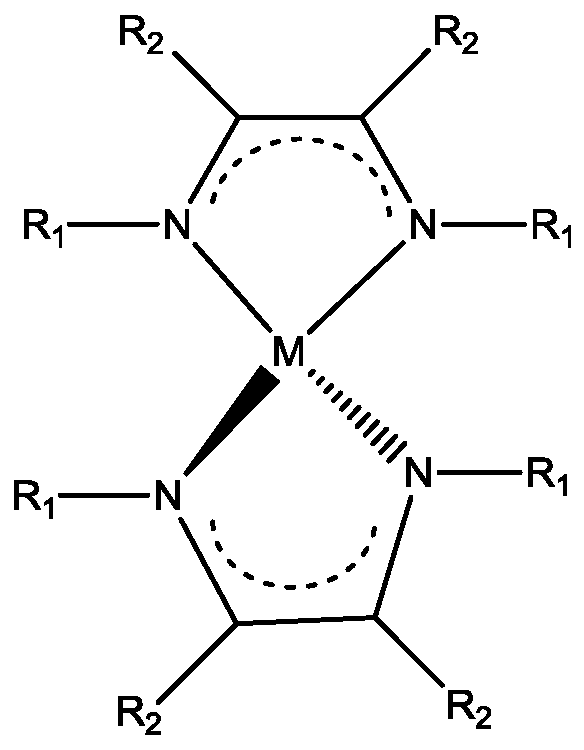
wherein
M is a transition metal selected from groups 3-7 of the periodic table, Ru, Pd, Pt, Rh, and Ir;
Ri is C1-C12 alkyl, amino (i.e., -NH2), or C6-Ci8 aryl; and
R2 is hydrogen, C1-C10 alkyl, C6-Ci8 aryl, amino, C1-C12 alkylamino, or C2-C22 dialkylamino.
[0054] The compounds set forth above are found to possess a number of useful properties that are relevant to thin and thick film deposition processes. For example, many of these compounds sublime at temperatures from 80 to 120 °C at reduced pressures (e.g., about 1 Torr). The compounds of the present embodiment tend to decompose at high temperatures with minimal residues being formed. Many of the compounds of the present invention decompose to form metal foils.
[0055] The following examples illustrate the various embodiments of the present invention. Those skilled in the art will recognize many variations that are within the spirit of the present invention and scope of the claims.
Results and Discussion
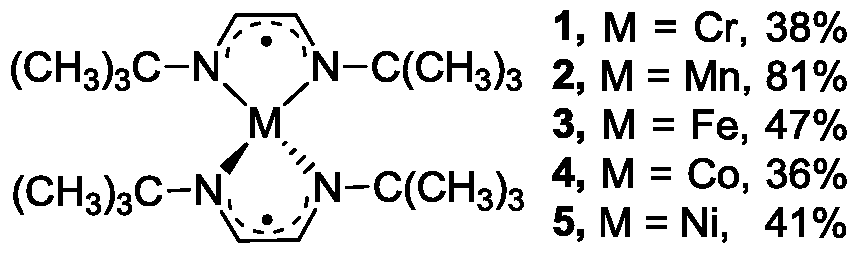
Synthesic Aspects. Treatment of anhydrous metal(II) chlorides (MC12, M = Cr,
Mn, Fe, Co, Ni) with two equivalents of l,4-di-tert-butyl-diaza-l,3-butadiene and two equivalents of lithium metal afforded complexes of the formula M(tBu2DAD)2 (DAD = diazobutadiene) as purple (1), black (2), brown (3), blue (4), and dichroic red/green (5) crystalline powders (eq 1). Crystalline samples of 1-5 were subsequently obtained either by sublimation or crystallization in hexane at -23 °C. The synthetic procedure is a modification of previous routes to transition metal complexes containing l,4-diaza-l,3- butadiene ligands. It was not possible to prepare any copper(II) or copper(I) complexes containing tBu2DAD ligands, since all reactions afforded copper powders. The compositions of 1-5 were determined by a combination of analytical and spectroscopic techniques, and by X-ray crystal structure determinations of 1 and 3-5. Complex 5 is the only diamagnetic species in the series, and revealed tert-butyl and imino hydrogen atom resonances at δ 1.93 and 8.95, respectively, in the 1H NMR spectrum in benzene-^. In the infrared spectra of 1-5, the carbon-nitrogen stretching frequencies were observed between 1716 and 1698 cm"1. Solid state magnetic moments for 1-4 were 2.83, 3.85, 2.88, and 1.75 BM, respectively. Very similar values were measured in benzene solution using the Evans method, suggesting similar molecular structures in the solid state and solution. The magnetic moments for 1-4 are very close to those expected for high spin M(II) ions that are antiferromagnetically coupled to two unpaired electrons of radical anion tBu2DAD ligands (Chart 1, form B). Analogous magnetic coupling is well established in transition metal complexes containing l,4-diaza-l,3-butadiene radical anion ligands with various alkyl and aryl substituents. Complexes 3 and 5 have been previously reported, and 4 was studied theoretically. The solution state magnetic moment reported for 3 in benzene solution was 2.88 BM, which is very similar to the values of 2.88 and 2.68 BM that were observed herein for the solid state and benzene solution magnetic moments, respectively. The 1H NMR spectrum previously reported for 5 exactly match that reported herein.
2 (CHakC-r Vc(CH3)3 + MCI2 ^'z ua ^
(1 )
[0057] X-Ray Crystal Structures of 1-5. The X-ray crystal structures of 1 and 3-5 were determined to establish their solid-state configurations. Despite multiple attempts, high quality crystals of 2 could not be obtained, although a low resolution X-ray structure revealed a monomeric, tetrahedral complex with a molecular arrangement similar to those of 3-5. Experimental crystallographic data are summarized in Table 1 (Figure 2), selected bond lengths and angles are given in Tables 2 (Figure 3) and 3 (Figure 4), and perspective views are presented in Figures 6-9.
[0058] Complexes 1 and 3-5 adopt mononuclear structures, with distorted tetrahedral geometry about the metal centers. In 3-5, the planes of the C2N2 ligand cores are constrained by symmetry to be orthogonal. Complex 1 crystallizes with two independent molecules in the unit cell; both molecules are identical within experimental uncertainty and only data for the molecule containing Cr(l) are presented herein. Complexes 3-5 are isostructural. Complex 5 was obtained in the space group Pnma. The metal-nitrogen bond lengths (1, 1.924(2)- 1.934(2) A; 3, 1.952(1)-1.956(1) A; 4, 1.929(1)-1.936(1) A; 5, 1.916(1)-1.919 A) fall into a narrow range. The metal-nitrogen bond distances in 1 are considerably shorter than those found in Cr(2,6-iPr2C6H3N=CHC(Me)=NC6H3-2,6-iPr2)2 (2.019(1), 2.030(1) A) and Cr(2,6-iPr2C6H3N=CHCH=NC6H3-2,6-iPr2)2 (2.030(4), 2.035(5) A), but are similar to the values observed in Cr2(2,6-iPr2C6H3N=CHCH=NC6H3- 2,6-iPr2)2 (1.914(2), 1.913(2) A). The metal-nitrogen bond distances in 3 are similar to those of Fe(C6F5N=C(Me)C(Me)=NC6F5)2 (1.962(2), 1.962(2) A), but are shorter than those found in Fe(2,6-iPr2C6H3N=C(Me)C(Me)=NC6H3-2,6-iPr2)2 (1.988(9)-2.077(8) A). Fe(C6F5N=C(Me)C(Me)=NC6F5)2 is proposed to contain two diazadienyl radical anion ligands, based upon the carbon-carbon and carbon-nitrogen distances of the ligand core. By contrast, one of the ligand core carbon-carbon distances in Fe(2,6-
iPr2C6H3N=C(Me)C(Me)=NC6H3-2,6-iPr2)2 is about 0.08 A longer than the other, suggesting more neutral character in one ligand (Chart 1, form C). The cobalt -nitrogen distances in 4 are similar to those of Co(C6F5N=C(Me)C(Me)=NC6F5)2 (1.931(3), 1.932(3) A). The nickel-nitrogen bond lengths in 5 compare well with those of Ni(C6F5N=C(Me)C(Me)=NC6F5)2 (1.9173(18), 1.9165(17) A) and Ni(2,6- Me2C6H3N=CHC(Me)=NC6H3-2,6-Me2)2 (1.921(1)-1.948(1) A), but are shorter than those found in Ni(2,6-iPr2C6H3N=CHC(Me)=NC6H3-2,6-iPr2)2 (1.963(2)- 1.999(2) A). Interestingly, the X-ray crystal structure of a polymorph of 5 was reported, and has nickel nitrogen bond lengths of 1.906 to 1.941 A, with an average value of 1.923 A.
[0059] The average metal-nitrogen bond lengths follow the order 3 (1.954 A) > 4 (1.932
A) > 1 (1.928 A) > 5 (1.917 A), even though the ionic radii of the metal ions decrease in the order Cr(II) (0.80 A) > Fe(II) (0.78 A) > Co(II) (0.745 A) > Ni(II) (0.69 A). Hence, the chromium-nitrogen distances in 1 are shorter than expected, based upon the ionic radius of the Cr(II) ion relative to those of the other ions. Closer inspection of 1 reveals that there are two types of tBu2DAD ligands. The ligand that contains N(l) and N(2) has the C(l) and C(2) atoms tilted toward the chromium atom, with chromium-carbon distances of 2.351(3) and 2.361(3) A. By contrast, the ligand containing N(3) and N(4) forms a planar CrN2C2 ring and has chromium-carbon distances of 2.758 and 2.767 A. For comparison, the metal-carbon distances associated with the tBu2DAD core carbon atoms of 3-5 range between 2.706 and 2.727 A and the metal ions are coplanar with the N2C2 rings. The chromium-carbon interactions in the ligand in 1 containing C(l) and C(2) appear to reflect the additional empty d orbitals associated with the d4 Cr(II) ion. The modified bonding to one of the ligands in 1 may alleviate interligand tert-butyl crowding by a small amount, thereby allowing slightly shorter chromium-nitrogen bond lengths than expected based upon the ionic radius of the Cr(II) ion.
[0060] It is well established that the carbon-carbon and carbon-nitrogen bond lengths within the C2N2 ligand cores offer a reliable tool for distinguishing among forms A, B, and C in Chart 1. In 3-5, the carbon-carbon and carbon-nitrogen bond lengths fall into the narrow ranges of 1.393 to 1.407 A and 1.326 to 1.347 A, respectively. These values are in between those expected for single and double bonds, and are diagnostic of the tBu2DAD
radical anion. These assignments are also consistent with the magnetic moment data described above. The situation with 1 is a little more complex, since one ligand has a carbon-carbon distance of 1.337(5) A and carbon-nitrogen distances of 1.386(4) and 1.367(4) A. The other ligand is bent toward the chromium ion and has a carbon-carbon distance of 1.395(4) A and carbon-nitrogen distances of 1.360(4) and 1.356(4) A. The bond distances of the latter ligand are very similar to those of 3-5, and support assignment as a tBu2DAD radical anion. In the former ligand, only the carbon-carbon bond length differs significantly within experimental error from that of the latter ligand. Hence, there may be a slightly higher amount of charge localization on the nitrogen atoms in the former ligand, but any differences in the structural data are small and at the edge of experimental uncertainty. The magnetic moment data for 1 described above are consistent with the presence of two tBu2DAD radical anion ligands that are antiferromagnetically coupled to a high spin d4 Cr(II) ion. Complexes of the formula FeCl3(tBu2DAD), CoCl2(tBu2DAD), and NiBr2(tBu2DAD) have been structurally characterized, and have C2N2 ligand core carbon-carbon and carbon-nitrogen distances of 1.455-1.510 and 1.247- 1.275 A, respectively. The carbon-carbon distances in these complexes are close to those expected for a single bond, and the carbon-nitrogen distances are close to those expected for a double bond. Hence, these ligands are consistent with neutral form C in Chart 1, and are distinct from the radical anion ligand type B observed in 1 and 3-5.
Volatility and Thermal Stability. The volatility and thermal stability of 1-5 were studied by preparative sublimation, thermogravimetric analyses, and melting point/solid state thermal decomposition experiments to assess their potential for use as ALD precursors. Sublimation data, melting points, and solid state decomposition temperatures for 1-5 are listed in Table 4 (Figure 5). In preparative sublimations, 0.5-1.0 g samples were sublimed at 0.05 Torr and the temperature was adjusted so that the sublimation was complete in less than five hours. In previous work, we have established that these preparative sublimation temperatures approximate the temperatures required for the vapor phase delivery of precursors in our ALD reactors. Under these conditions, the sublimed recoveries of 1-5 were > 92.3% with nonvolatile residues of < 6.9%. The high air sensitivity of 1-5 limited the ability to obtain higher sublimed recoveries since product
isolation had to be conducted in an inert atmosphere dry box. Additionally, exposure to trace amounts of air during sample loading may have led to higher nonvolatile residues. The solid state decomposition temperatures were determined visually by monitoring sealed glass capillary tubes containing a few milligrams of 1-5, and then noting the temperatures at which metal foils began to appear. These solid state decomposition temperatures are generally very close to the upper limit of self-limited ALD growth in plots of growth rate versus deposition temperature, and are thus very useful. The solid state decomposition temperature of 2 is the highest at 325 °C, while that of 5 is the lowest at 230 °C. Interestingly, a plot of the solid state decomposition temperatures of 1-5 versus
2_|_ o
the M → M reduction potentials is linear (Figure 10), suggesting that decomposition might occur through transfer of an electron from the tBu2DAD radical anion ligands to the metal ions. The failure to produce copper(II) or copper(I) complexes noted above likely arises from immediate reduction of the copper ions to copper metal due to the large positive reduction potentials of these ions (Cu T 0.342 V, Cu 0.521 V).
[0062] Thermo gravimetric analyses (TGA) were performed on 1-5 to understand their volatilities and thermal stabilities (Figure 11). These analyses were carried out with an instrument that was contained in a high-purity nitrogen-filled glove box to minimize decomposition arising from exposure to air. Complexes 1-5 have similar TGA traces with single step weight losses occurring between 150 and 225 °C. The residues upon reaching 500 °C were all < 3.6%. Complex 2 is the most air sensitive compound in the series, and its TGA traces always showed 10-20% weight losses between 50 and 150 °C that were presumably due to reaction with ambient oxygen or water, in spite of multiple runs and utmost care to maintain a high purity nitrogen atmosphere.
[0063] Vapor pressure measurements were carried out on 2 and 5 using a previously reported method and apparatus. Details of these analyses are found in the Supporting Information. The vapor pressure of 2 obeys the equation LogioP(mTorr) = 12.753 - 3631/T(K), whereas the equation for 5 is Logi0P(mTorr) = 13.983 - 3986/T(K). The vapor pressures of 2 and 5 at 115 °C are 2.48 and 5.13 Torr, respectively. The vapor pressures of 1, 3, and 4 should be close to those of 2 and 5, since the preparative sublimation temperatures of 1-5 are similar.
[0064] As described above, solid state decompositions of 1-5 afforded shiny metallic foils as products. To verify the formation of the metals, preparative scale solid state thermolyses were carried out on 1-5 as described in the Experimental Section and the residues were analyzed by X-ray powder diffraction. X-ray diffraction analyses demonstrated that 1 and 3-5 afford crystalline, shiny gray-black powders of the metals. Figure 12 shows the X-ray diffraction pattern of the chromium metal thermolysis product from 1, which matches the JCPDS 06-0694 reference pattern for chromium metal. The X- ray diffraction patterns of the powders derived from 3-5 are contained in the Supporting Information. The thermolysis product of 2 was also a shiny metallic powder. The X-ray diffraction pattern of the thermolysis product obtained under conditions similar to those used for the thermolysis of 1 and 3-5 showed weak reflections that were consistent with Mn304 (JCPDS 04-07320). Since it was possible that the Μη304 formed upon oxidation of manganese metal by residual oxygen or water in the argon used in the thermolysis experiment, the thermolysis of 2 was repeated under a vacuum of 0.05 Torr at 375 °C for one hour. X-ray diffraction spectra of the resulting gray-black metallic powder did not show any reflections, suggesting an amorphous product. Treatment of the powders resulting from the thermolysis of 2 with 30% aqueous hydrogen peroxide led to vigorous reaction and gas evolution. Similar reactivities were observed for the powders resulting from thermolysis under flowing argon and under vacuum. For comparison, manganese metal powder reacted in a similar vigorous manner with 30% aqueous hydrogen peroxide, whereas commercial Mn304 powder was inert under the same conditions. The commercial Mn304 powder was crystalline and indexed as Hausmannite (JCPDS 24- 0734), and is thus in a different crystalline form from the powder described above that was obtained upon thermolysis of 2. However, the reactivity of both forms of Mn304 toward 30%> hydrogen peroxide should be similar. Hence, it is possible that thermolysis of 2 affords amorphous manganese metal powder.
[0065] Evaluation of Precursor Properties. Complexes 1-5 sublime at 85 (1) and 115-
120 °C (2-5) with low nonvolatile residues, have high solid state decomposition temperatures, and are highly reactive toward ambient atmosphere. Additionally, 1 and 3-5 decompose to the metals upon thermolysis, and 2 may afford manganese metal upon
thermolysis. These complexes thus have useful properties for applications as film growth precursors by ALD and CVD. Complexes 1 and 3-5 decompose thermally between 230 and 295 °C to afford the metals, and 2 decomposes at 325 °C possibly to afford manganese metal. Since 1-5 evaporate with low residues between 85 and 120 °C, they are highly likely to be useful CVD precursors to films of the metals. ALD precursors must be thermally stable at the film growth temperatures, or the self-limited ALD growth mechanism is lost and CVD-like growth occurs. Complexes 1-5 also have properties that may be useful in ALD film growth, especially since they have high thermal decomposition temperatures compared to other available precursors for each metal. For example, the amidinate complex Ni(iPrNC(Me)NiPr)2 decomposes at about 180 °C, compared to a solid state decomposition temperature of 235 °C for nickel complex 5. The amidinate complexes Fe(tBuNC(Me)NtBu)2 and Co(iPrNC(Me)NiPr)2 exhibited single step weight loss events in the TGA traces, but had 12% and 9% nonvolatile residues, respectively, upon reaching 225 (Fe(tBuNC(Me)NtBu)2) and 200 °C (Co(iPrNC(Me)NiPr)2). These nonvolatile residues are higher than those observed in the TGA traces of 1-5 (< 3.6%), again suggesting that our new complexes have higher thermal decomposition temperatures than the analogous amidinate complexes. The increased thermal stabilities of 1-5 could allow wider temperature ranges of self-limited ALD film growth, relative to amidinate and other precursors with lower decomposition temperatures. ALD growth studies using 1-5 are ongoing, and will be reported separately.
Experimental Section
General Considerations. All manipulations were carried out under argon using either Schlenk or glove box techniques. Tetrahydrofuran was distilled from sodium benzophenone ketyl, and hexane was distilled from P205. Lithium metal was obtained from Acros Organics. Anhydrous transition metal chlorides (CrCl2, MnCl2, FeCl2, CoCl2, and NiCl2) were obtained from Strem Chemicals Inc. and used as received. Manganese metal powder and Μη304 were obtained from Aldrich Chemical Company.
23
NiCl2*CH3CN and l,4-di-tert-butyl-l,3-diazabutadiene were prepared according to literature procedures.
[0067] 1H and NMR spectra were obtained at 400 and 100 MHz, respectively, in
13
benzene-^ and were referenced to the residual proton and the C resonances of the solvent. Infrared spectra were obtained using Nujol as the medium. Magnetic moments were determined in the solid state using a Johnson Mathey magnetic susceptibility apparatus, and in benzene solution using the Evans method. Melting points were determined on a Thermo Scientific Mel-Temp 3.0 melting point apparatus and are uncorrected. X-ray quality crystals of 1 and 3-5 were grown from hexane at -23 °C. Preparative sublimations and solid state decomposition temperatures were determined using previously described procedures. Thermo gravimetric analyses were performed in a nitrogen filled glove box on a TA Instruments Q500 equipped with an evolved gas analysis furnace with samples heated at a rate of 10 °C/min. Elemental analyses were performed by Midwest Microlab, Indianapolis, Indiana. Powder X-ray diffraction data was acquired on a Rigaku RU200B diffractometer with a Cu Ka rotating anode. Crystalline phases were identified by comparison of the experimental patterns with the powder diffraction files of the International Center of Diffraction Data using the Jade 5.0 software package.
[0068] Preparation of Bis(l,4-di-tei"i-butyl-l,3-diazabutadienyl)chromium(II) (1). A
100 mL Schlenk flask, equipped with a magnetic stir bar and a rubber septum, was charged with l,4-di-tert-butyl-l,3-diazabutadiene (1.000 g, 5.94 mmol) and tetrahydrofuran (20 mL). To this stirred solution at ambient temperature was slowly added freshly cut lithium metal (0.042 g, 6.000 mmol) and the resultant dark brown solution was stirred for 6 h. This solution was then added dropwise by cannula over a 30 min period to a stirred suspension of anhydrous chromium(II) chloride (0.365 g, 2.970 mmol) in tetrahydrofuran (40 mL). The resultant deep purple solution was stirred for 6 h at ambient temperature. The volatile components were then removed under reduced pressure and the resultant dark purple powder was dissolved in toluene (50 mL). The solution was filtered through a 1-cm pad of Celite on a coarse glass frit, and toluene was then removed under reduced pressure. Dark purple crystals of 1 were obtained by sublimation at 85 °C/0.05 Torr (0.442 g, 38%): mp 95-97 °C; IR (Nujol, cm"1) 1704 (w), 1628 (w), 1538 (w), 1246 (m), 1209 (s), 1132 (m), 1104 (m), 1034 (m); μείί = 2.83 and
2.84 BM in the solid state and in benzene solution, respectively. Anal. Calcd for C2oH4oCrN4: C, 61.82; H, 10.38; N, 14.42. Found: C, 61.71 ; H, 10.06; N, 14.37.
[0069] Preparation of Bis(l,4-di-terf-butyl-l,3-diazabutadienyl)manganese(II) (2). In a fashion similar to the preparation of 1, treatment of anhydrous MnCl2 (0.371 g, 2.970 mmol) in tetrahydrofuran (40 mL) with a solution of LitBu2DAD (prepared from 1 ,4-di- tert-butyl-l ,3-diazabutadiene (1.000 g, 5.940 mmol) and freshly cut lithium metal (0.042 g, 6.000 mmol) in tetrahydrofuran (20 mL)) for 6 h at ambient temperature afforded 2 (0.942 g, 81%) as black crystals upon sublimation at 120 °C/0.05 Torr: mp 155-157 °C; IR (Nujol, cm"1) 1716 (m), 1610 (m), 1558 (w), 1364 (s), 1254 (s), 1210 (s), 1007 (m), 929 (m), 759 (s); 1H NMR (C6D6, 23 °C, δ) 8.06 (s, broad, CH), 1.10 (s, very broad, C(CH3)3); μβΐΐ = 3.85 and 3.85 BM in the solid state and in benzene solution, respectively. Anal. Calcd for C2oH40MnN4: C, 61.36; H, 10.30; N, 14.31. Found: C, 60.99; H, 9.96; N, 14.01.
[0070] Preparation of Bis(l,4-di-terf-butyl-l,3-diazabutadienyl)iron(II) (3). In a fashion similar to the preparation of 1, treatment of anhydrous FeCl2 (0.377 g, 2.970 mmol) in tetrahydrofuran (40 mL) with LitBu2DAD (prepared from l ,4-di-tert-butyl-l ,3- diazabutadiene (1.000 g, 5.940 mmol) and freshly cut lithium metal (0.042 g, 6.000 mmol) in tetrahydrofuran (20 mL)) for 6 h at ambient temperature afforded 3 (0.544 g, 47%) as dark brown crystals upon sublimation at 1 10 °C/0.05 Torr: mp 132-134 °C; IR (Nujol, cm"1) 1703 (w), 1606 (w), 1525 (w), 1359 (s), 1254 (s), 1208 (s), 1022 (m), 1002 (m), 926 (m), 762 (s); μείί = 2.88 and 2.68 BM in the solid state and in benzene solution, respectively. Anal. Calcd for C20H40FeN4: C, 61.22; H, 10.27; N, 14.16. Found: C, 61.39; H, 10.03; N, 14.16.
[0071 ] Preparation of Bis(l,4-di-terf-butyl-l,3-diazabutadienyl)cobalt(II) (4). In a fashion similar to the preparation of 1, treatment of anhydrous CoCl2 (0.386 g, 2.970 mmol) in tetrahydrofuran (40 mL) with LitBu2DAD (prepared from l ,4-di-tert-butyl-l ,3- diazabutadiene (1.000 g, 5.940 mmol) and freshly cut lithium metal (0.042 g, 6.000 mmol) in tetrahydrofuran (20 mL)) for 6 h at ambient temperature afforded 4 (0.418 g, 36%) as dark-blue crystals upon sublimation at 1 10 °C/0.05 Torr: mp 173-174 °C; IR (Nujol, cm"1) 1698 (m), 1605 (m), 1527 (m), 1362 (s), 1260 (s), 1210 (s), 1008 (s), 933
(m), 763 (s); = 1.75 and 1.83 BM in the solid state and in benzene solution, respectively. Anal. Calcd for C20H40C0N4: C, 60.74; H, 10.19; N, 14.17. Found: C, 60.84; H, 10.01; N, 14.29.
[0072] Preparation of Bis(l,4-di-ter )utyl-l,3-diazabutadienyl)nickel(II) (5). In a fashion similar to the preparation of 1, treatment of NiCb'C bCN (0.507 g, 2.970 mmol) in tetrahydrofuran (40 mL) with LitBu2DAD (prepared from l,4-di-tert-butyl-l,3- diazabutadiene (1.000 g, 5.940 mmol) and freshly cut lithium metal (0.042 g, 6.000 mmol) in tetrahydrofuran (20 mL)) for 6 h at ambient temperature afforded 5 (0.482 g, 41%) as dichroic red-green crystals upon sublimation at 110 °C/0.05 Torr: mp 184-185 °C; IR (Nujol, cm"1) 1715 (w), 1625 (w), 1547 (w), 1493 (s), 1264 (s), 1212 (s), 934 (m), 764 (s); 1H NMR (C6D6, 23 °C, δ) 8.95 (s, 2H, CH), 1.93 (s, 18Η, C(CH3)3); 13C {1H} NMR (C6D6, 23 °C, ppm) 129.88 (s, CH), 64.61 (s, C(CH3)3), 30.61 (s, C(CH3)3). Anal. Calcd for C20H40N4 : C, 60.77; H, 10.20; N, 14.85. Found: C, 60.89; H, 9.88; N, 14.61.
[0073] Solid State Thermolyses of 1-5. Thermolysis experiments were performed on analytically pure samples of 1-5 to assess their solid state thermal decomposition products. A 20-cm long, 2.5-cm diameter quartz tube, equipped with female 24/40 joints on each end, was fitted with two flow control valves that were attached to male 24/40 joints. A 6-cm long, 1-cm diameter glass vial was charged with 1.00 g of the sample in a glove box. The vial was placed in the center of the quartz tube. This apparatus was placed into a tube furnace and a 50 seem flow of argon was established. The sample was then heated to 500 °C for 1 h and was allowed to cool to room temperature under argon flow. Subsequently, the powder residues were collected from the inside of the quartz tube and subjected to X-ray powder diffraction analyses as described in the text.
[0074] X-ray Crystallographic Structure Determinations. Diffraction data were measured on a Bruker X8 APEX-II kappa geometry diffractometer with Mo radiation and a graphite monochromator. Frames were collected at 100 K with the detector at 40 mm and 0.3-0.5° between each frame. The frames were recorded for 3-5 s. APEX-II and SHELX software were used in the collection and refinement of the models. All structures contained discrete neutral complexes without ions or solvent. Complex 1 crystallized
with two independent but chemically equivalent molecules in the asymmetric unit. Complexes 3-5 are all isostructural, with one-half molecule in the asymmetric unit. The iron, cobalt and nickel atoms all occupy a crystallographic mirror plane.
Deposition Examples
Example 1
[0075] The activating compound is a coreagent where the resulting thin film would be a metallic. For example, reacting complexes 1-5 with diethylsilane induces reduction of the transition metal to produce a metal film. In addition, metallic film formation occurs by reducing metal nitride films under inert/reducing atmospheres at elevated temperatures. For example, Ni3N is reduced to nickel metal when heated above 180 °C under a H2 atmosphere. Additionally, when complexes 1-5 are reacted with formic acid upon a catalytically active ruthenium substrate, catalytic decomposition of the metal formate to the respective metal occurs.
Example 2
[0076] The activating compound is a nitrogen-based coreagent where the resulting thin film would be a transition metal nitride. Useful sources of nitrogen-based coreagents include ammonia, hydrazine, dimethylhydrazine, and plasma-activated versions thereof. When complexes 1-5 are reacted with dimethyl hydrazine, metal nitride films will be formed. Ammonia and other nitrogen sources will produce nitrides as well.
Example 3
[0077] The activating compound is an oxidizing agent resulting in the formation of a metal oxide thin film. Given their high reactivity toward ambient dioxygen and water, 1-5 will decompose to the respective metal oxides. Therefore, combining this practice to film growth using a combination of 1-5 and an oxygen source such as oxygen or ozone, a metal oxide film will be produced.
Example 4
[0078] ALD growth of NixN on 500 nm thick thermal Si02 was investigated using complex 5 and anhydrous 1,1 -dimethylhydrazme. The growth of NixN was evaluated by varying substrate temperatures, precursor pulse lengths, and the number of deposition cycles. The study of growth rate as a function of Ni(tBu2DAD)2 (complex 5) pulse length was carried out at a substrate temperature of 225 °C (Figure 13). The 1,1- dimethylhydrazine pulse length, purge time between each reactant, and the number of deposition cycles were held constant at 0.2 s, 3.0 s, and 1000 cycles, respectively. The complex 5 source was kept at 150 °C to allow for sufficient consumption of the precursor over the deposition period. In order to display that film growth is occurring by a self- limited ALD mechanism, film saturation must be demonstrated. In the event of surface saturation, all available surface sites are occupied with adsorbed precursor molecules, which in turn remain on the film surface awaiting the introduction of a second coreactant. Once this condition is met, a constant growth rate is observed even in cases of excess precursor dose, given that neither precursor undergoes thermal decomposition. Self- limited film growth was achieved with complex 5 pulse lengths > 4.0 s as evident by a constant growth rate of 0.7 A/cycle when these conditions were met. Shorter pulse lengths of complex 5 (< 4 s) may lead to sub-saturative growth and loss of the self- limiting ALD mechanism. For the studies described herein, a complex Spulse length of 4.0 s was applied to guarantee self-limited film growth. A plot of growth rate versus 1,1- dimethylhydrazine pulse length exhibited similar saturative behavior at pulse lengths > 0.2 s.
[0079] The effect of substrate temperature upon growth rate was also investigated
(Figure 14). Film depositions were executed using complex Sand 1,1 -dimethylhydrazme pulse lengths of 5.0 s, 0.2 s, and 1000 deposition cycles. Nitrogen purge times of 3.0 s were used between each reactant pulse. A consistent growth rate of 0.7 A/cycle was obtained between 225 and 240 °C. This observed region of constant growth rate over a specified temperature range is often referred to as the "ALD window" and is further evidence of an ALD process. Interestingly, the observed ALD window extends up to 240 °C, which lies beyond the decomposition temperature of complex 5. It is also noted that
at substrate temperatures > 240 °C, the growth rate increases significantly due to precursor decomposition. NixN growth rates of 0.15 and 0.95 A/cycle were observed at substrate temperatures of 200 and 250 °C, respectively, which extend beyond the observed ALD window.
[0080] The influence of the number of deposition cycles upon the film thickness of NixN was subsequently investigated. In this collection of experiments, the complex 5 and 1,1- dimethylhydrazine pulse lengths were kept at 4.0 and 0.2 s, respectively, with a 3.0 s inert gas purge between each reactant pulse. The substrate temperature was held at 225 °C. The thickness of the film varied in a direct linear behavior with respect to the number of ALD cycles employed as shown in Figure 15. A trendline that demonstrates a best fit for the data points collected has a y-intercept of 4.45 nm. In principle, the y-intercept should be zero or negative which would indicate an incubation period. In this case, the positive y-intercept value could be attributed to a minor artificial offset induced from the observed film roughness and its effects on thickness measurements as determined by cross sectional SEM.
[0081] While embodiments of the invention have been illustrated and described, it is not intended that these embodiments illustrate and describe all possible forms of the invention. Rather, the words used in the specification are words of description rather than limitation, and it is understood that various changes may be made without departing from the spirit and scope of the invention.
Claims
WHAT IS CLAIMED IS :
1. A method for depositing a thin film on a surface of a substrate, the method comprising:
a) contacting the substrate with a vapor of a metal-containing compound to form a modified surface on the substrate, the metal-containing compound being described by formulae I:

I
wherein:
M is a transition metal;
n is the formal charge of M;
m is an integer;
o is an integer such that the overall formal charge of the compound having formula I is 0;
p is the formal charge of the ligand within the brackets;
Ri is C1-C12 alkyl, amine, or C6-Ci8 aryl; and
R2 is hydrogen, C1-C10 alkyl, C6-Ci8 aryl, amino, C1-C12 alkylamino, or C2-C24 dialkylamino; and
b) contacting the modified surface with a vapor of an activating compound to form at least a portion of the thin film on the surface of the substrate.
2. The method of claim 1 wherein the activating compound is a reducing agent and the thin film is a metallic film.
3. The method of claim 2 wherein the reducing agent is selected from the group consisting of molecular hydrogen, atomic hydrogen, silane, disilane, organosilanes, compounds containing Si-H bonds, germane, organogermanes, compounds containing Ge-H bonds, stannane, compounds containing Sn-H bonds, other metal hydride compounds, formic acid, glyoxalic acid, oxalic acid, other carboxylic acids, diborane, compounds containing B-H bonds, hydrazine, carbon-substituted hydrazines, formalin, formaldehyde, organic alcohols, organoaluminum compounds, organozinc compounds, and plasma-activated versions thereof.
4. The method of claim 1 wherein the activating compound is an oxidizing agent and the thin film is a metal oxide.
5. The method of claim 4 wherein the oxidizing agent is selected from the group consisting of water, ozone, molecular oxygen, atomic oxygen, organic alcohols, hydrogen peroxide, organic hydroperoxides, organic peroxides, nitrous oxide, and plasma-activated versions of thereof.
6. The method of claim 1 wherein the activating compound is a nitrogen- containing agent and the thin film is a metal nitride.
7. The method of claim 6 wherein the nitrogen activating compound is selected from the group consisting of ammonia, hydrazine, alkyl-substituted hydrazines, and plasma activated versions thereof.
8. The method of claim 1 wherein the compound having formula I is thermally activated.
9. The method of claim 1 wherein the compound having formula I is plasma activated.
10. The method of claim 1 wherein Ri and R2 are each independently C1-C4 alkyl.
11. The method of claim 1 wherein Ri and R2 are each independently methyl, ethyl, propyl, n-butyl, sec-butyl, isobutyl, or t-butyl.
12. The method of claim 1 wherein R1 is t-butyl.
13. The method of claim 1 wherein
n is 0, 1, 2, or 3;
m is 1 ; and
o is 1 , 2, or 3.
14. The method of claim 1 wherein
n is 2;
m is 1 ; and
o is 2.
15. The method of claim 1 wherein M is Cr(II), Mn(II), Fe(II), Co(II), or
Ni(II).
16. The method of claim 1 wherein the metal-containing compound is described by formulae II:

A compound havin formula I:

I
wherein:
M is a transition metal selected from groups 3-7 of the periodic table, Ru, Pd, Pt, Rh, and Ir;
n is the formal charge of M;
m is an integer;
o is an integer such that the overall formal charge of the compound having formula I is 0;
p is the formal charge of the ligand within brackets;
Ri is C1-C12 alkyl, amine, or C6-Ci8 aryl; and
R2 is hydrogen, C1-C10 alkyl, C6-Ci8 aryl, amino, C1-C12 alkylamino, or C2-C24 dialkylamino.
18. The compound of claim 17 wherein Ri and R2 are each independently Ci- C4 alkyl.
19. The compound of claim 17 wherein Ri and R2 are each independently methyl, ethyl, propyl, n-butyl, sec-butyl, isobutyl, or t-butyl.
20. The compound of claim 17 wherein R1 is t-butyl.
21. The compound of claim 17 wherein M is Cr(II) or Mn(II).
22. A compound having formula II:

wherein:
M is a transition metal selected from groups 3-7 of the periodic table, Ru, Pd, Pt, Rh, and Ir;
Ri is C1-C12 alkyl, amino, or C6-Ci8 aryl; and
R2 is hydrogen, C1-C10 alkyl, C6-Ci8 aryl, amino, C1-C12 alkylamino, or C2-C22 dialkylamino.
Priority Applications (4)
| Application Number | Priority Date | Filing Date | Title |
|---|---|---|---|
| US13/818,154 US9255327B2 (en) | 2010-08-24 | 2011-08-23 | Thermally stable volatile precursors |
| US15/017,105 US9822446B2 (en) | 2010-08-24 | 2016-02-05 | Thermally stable volatile precursors |
| US15/215,153 US9982344B2 (en) | 2010-08-24 | 2016-07-20 | Thermally stable volatile precursors |
| US15/984,940 US20180265975A1 (en) | 2010-08-24 | 2018-05-21 | Thermally stable volatile precursors |
Applications Claiming Priority (2)
| Application Number | Priority Date | Filing Date | Title |
|---|---|---|---|
| US37649510P | 2010-08-24 | 2010-08-24 | |
| US61/376,495 | 2010-08-24 |
Related Child Applications (3)
| Application Number | Title | Priority Date | Filing Date |
|---|---|---|---|
| US13/818,154 A-371-Of-International US9255327B2 (en) | 2010-08-24 | 2011-08-23 | Thermally stable volatile precursors |
| US15/017,105 Continuation US9822446B2 (en) | 2010-08-24 | 2016-02-05 | Thermally stable volatile precursors |
| US15/017,105 Continuation-In-Part US9822446B2 (en) | 2010-08-24 | 2016-02-05 | Thermally stable volatile precursors |
Publications (2)
| Publication Number | Publication Date |
|---|---|
| WO2012027357A2 true WO2012027357A2 (en) | 2012-03-01 |
| WO2012027357A3 WO2012027357A3 (en) | 2012-04-19 |
Family
ID=45724014
Family Applications (1)
| Application Number | Title | Priority Date | Filing Date |
|---|---|---|---|
| PCT/US2011/048792 Ceased WO2012027357A2 (en) | 2010-08-24 | 2011-08-23 | Thermally stable volatile precursors |
Country Status (2)
| Country | Link |
|---|---|
| US (1) | US9255327B2 (en) |
| WO (1) | WO2012027357A2 (en) |
Cited By (23)
| Publication number | Priority date | Publication date | Assignee | Title |
|---|---|---|---|---|
| WO2013046157A1 (en) | 2011-09-27 | 2013-04-04 | L'air Liquide, Societe Anonyme Pour L'etude Et L'exploitation Des Procedes Georges Claude | Nickel bis diazabutadiene precursors, their synthesis, and their use for nickel containing film depositions |
| WO2013046155A1 (en) | 2011-09-27 | 2013-04-04 | L'air Liquide, Societe Anonyme Pour L'etude Et L'exploitation Des Procedes Georges Claude | Tungsten diazabutadiene precursors, their synthesis, and their use for tungsten containing film depositions |
| WO2014197803A1 (en) * | 2013-06-06 | 2014-12-11 | Applied Materials, Inc. | Methods for the deposition of manganese-containing films using diazabutadiene-based precursors |
| WO2014210512A1 (en) * | 2013-06-28 | 2014-12-31 | Wayne State University | Bis(trimethylsilyl) six-membered ring systems and related compounds as reducing agents for forming layers on a substrate |
| US8962876B2 (en) | 2009-05-15 | 2015-02-24 | Wayne State University | Thermally stable volatile film precursors |
| US9109281B2 (en) | 2008-06-25 | 2015-08-18 | L'Air Liquide, Société Anonyme pour l'Etude et l'Exploitation des Procédés Georges Claude | Metal heterocyclic compounds for deposition of thin films |
| US9129897B2 (en) | 2008-12-19 | 2015-09-08 | Asm International N.V. | Metal silicide, metal germanide, methods for making the same |
| US9157149B2 (en) | 2013-06-28 | 2015-10-13 | Wayne State University | Bis(trimethylsilyl) six-membered ring systems and related compounds as reducing agents for forming layers on a substrate |
| US9249505B2 (en) | 2013-06-28 | 2016-02-02 | Wayne State University | Bis(trimethylsilyl) six-membered ring systems and related compounds as reducing agents for forming layers on a substrate |
| US9255327B2 (en) | 2010-08-24 | 2016-02-09 | Wayne State University | Thermally stable volatile precursors |
| US9379011B2 (en) | 2008-12-19 | 2016-06-28 | Asm International N.V. | Methods for depositing nickel films and for making nickel silicide and nickel germanide |
| US9416443B2 (en) | 2012-02-07 | 2016-08-16 | L'Air Liquide, Société Anonyme pour l'Etude et l'Exploitation des Procédés Georges Claude | Method for the deposition of a ruthenium containing film using arene diazadiene ruthenium(0) precursors |
| US9540730B2 (en) | 2012-09-21 | 2017-01-10 | Wayne State University | Deposition of metal films based upon complementary reactions |
| WO2017023991A1 (en) * | 2015-08-03 | 2017-02-09 | Wayne State University | 6-membered cyclic dienes as strongly reducing precursors for the growth of element films by vapor phase deposition |
| CN106460169A (en) * | 2014-06-13 | 2017-02-22 | Up化学株式会社 | Liquid precursor compositions, preparation methods thereof, and methods for forming layer using the composition |
| US9607842B1 (en) | 2015-10-02 | 2017-03-28 | Asm Ip Holding B.V. | Methods of forming metal silicides |
| US9758866B2 (en) | 2013-02-13 | 2017-09-12 | Wayne State University | Synthesis and characterization of first row transition metal complexes containing α-imino alkoxides as precursors for deposition of metal films |
| US9822446B2 (en) | 2010-08-24 | 2017-11-21 | Wayne State University | Thermally stable volatile precursors |
| JP2017226614A (en) * | 2016-06-22 | 2017-12-28 | 株式会社Adeka | Vanadium compound, raw material for thin film formation, and method for producing thin film |
| WO2018042871A1 (en) * | 2016-08-29 | 2018-03-08 | 株式会社Adeka | Diazadienyl compound, raw material for forming thin film, and method for producing thin film |
| CN107868944A (en) * | 2017-10-31 | 2018-04-03 | 北京北方华创微电子装备有限公司 | A kind of titanium nitride apparatus for atomic layer deposition and its deposition process |
| WO2018106626A1 (en) * | 2016-12-06 | 2018-06-14 | Applied Materials, Inc. | Ruthenium precursors for ald and cvd thin film deposition and uses thereof |
| CN112647059A (en) * | 2020-12-14 | 2021-04-13 | 江南大学 | Rapid growth of Ni by utilizing atomic layer deposition technologyxMethod for forming C film |
Families Citing this family (38)
| Publication number | Priority date | Publication date | Assignee | Title |
|---|---|---|---|---|
| KR101719526B1 (en) * | 2010-11-17 | 2017-04-04 | 주식회사 유피케미칼 | Diazadiene metal compound, preparing method of the same, and preparing method of thin film using the same |
| US11326255B2 (en) | 2013-02-07 | 2022-05-10 | Uchicago Argonne, Llc | ALD reactor for coating porous substrates |
| US9005875B2 (en) | 2013-03-15 | 2015-04-14 | Intel Corporation | Pre-patterned hard mask for ultrafast lithographic imaging |
| US9067958B2 (en) | 2013-10-14 | 2015-06-30 | Intel Corporation | Scalable and high yield synthesis of transition metal bis-diazabutadienes |
| US10364492B2 (en) * | 2013-10-28 | 2019-07-30 | Applied Materials, Inc. | Film deposition using precursors containing amidoimine ligands |
| US10221481B2 (en) * | 2013-10-28 | 2019-03-05 | Merck Patent Gmbh | Metal complexes containing amidoimine ligands |
| US11476158B2 (en) | 2014-09-14 | 2022-10-18 | Entegris, Inc. | Cobalt deposition selectivity on copper and dielectrics |
| JP6675159B2 (en) | 2015-06-17 | 2020-04-01 | 株式会社Adeka | Novel compound, raw material for forming thin film and method for producing thin film |
| JP6043851B1 (en) * | 2015-09-11 | 2016-12-14 | 田中貴金属工業株式会社 | Chemical vapor deposition material comprising organic ruthenium compound and chemical vapor deposition method using the chemical vapor deposition material |
| WO2017173212A1 (en) | 2016-04-01 | 2017-10-05 | Wayne State University | A method for etching a metal surface |
| TWI736631B (en) * | 2016-06-06 | 2021-08-21 | 韋恩州立大學 | Reaction of diazadiene complexes with amines |
| US10106893B1 (en) * | 2017-04-07 | 2018-10-23 | Applied Materials, Inc. | Iridium precursors for ALD and CVD thin film deposition and uses thereof |
| WO2018187781A2 (en) | 2017-04-07 | 2018-10-11 | Applied Materials, Inc. | Metal precursors with modified diazabutadiene ligands for cvd and ald applications and methods of use |
| US10276411B2 (en) | 2017-08-18 | 2019-04-30 | Applied Materials, Inc. | High pressure and high temperature anneal chamber |
| KR101962355B1 (en) | 2017-09-26 | 2019-03-26 | 주식회사 한솔케미칼 | Precursor for vapor deposition having excellent thermal stability and reactivity and preparing method thereof |
| TWI773839B (en) | 2017-10-14 | 2022-08-11 | 美商應用材料股份有限公司 | Integration of ald copper with high temperature pvd copper deposition for beol interconnect |
| CN111902566B (en) * | 2018-03-19 | 2023-06-27 | 应用材料公司 | Method for protecting metal parts against corrosion using chromium-containing films |
| SG11202008268RA (en) | 2018-03-19 | 2020-10-29 | Applied Materials Inc | Methods for depositing coatings on aerospace components |
| EP3784815A4 (en) | 2018-04-27 | 2021-11-03 | Applied Materials, Inc. | PROTECTION OF COMPONENTS FROM CORROSION |
| US11440929B2 (en) * | 2018-06-19 | 2022-09-13 | Versum Materials Us, Llc | Bis(diazadiene)cobalt compounds, method of making and method of use thereof |
| WO2020006379A1 (en) * | 2018-06-30 | 2020-01-02 | Applied Materials, Inc. | Deposition and etch processes of chromium-containing thin films for semiconductor manufacturing |
| US11009339B2 (en) | 2018-08-23 | 2021-05-18 | Applied Materials, Inc. | Measurement of thickness of thermal barrier coatings using 3D imaging and surface subtraction methods for objects with complex geometries |
| TW202028504A (en) | 2018-12-03 | 2020-08-01 | 德商馬克專利公司 | Method for highly selective deposition of metal films |
| US11473198B2 (en) | 2019-01-25 | 2022-10-18 | Applied Materials, Inc. | Homoleptic lanthanide deposition precursors |
| US11993844B2 (en) | 2019-04-24 | 2024-05-28 | The Regents Of The University Of California | Passivation of silicon dioxide defects for atomic layer deposition |
| EP3959356A4 (en) | 2019-04-26 | 2023-01-18 | Applied Materials, Inc. | Methods of protecting aerospace components against corrosion and oxidation |
| US11794382B2 (en) | 2019-05-16 | 2023-10-24 | Applied Materials, Inc. | Methods for depositing anti-coking protective coatings on aerospace components |
| US11697879B2 (en) | 2019-06-14 | 2023-07-11 | Applied Materials, Inc. | Methods for depositing sacrificial coatings on aerospace components |
| US11466364B2 (en) | 2019-09-06 | 2022-10-11 | Applied Materials, Inc. | Methods for forming protective coatings containing crystallized aluminum oxide |
| US11111578B1 (en) * | 2020-02-13 | 2021-09-07 | Uchicago Argonne, Llc | Atomic layer deposition of fluoride thin films |
| US11519066B2 (en) | 2020-05-21 | 2022-12-06 | Applied Materials, Inc. | Nitride protective coatings on aerospace components and methods for making the same |
| WO2022005696A1 (en) | 2020-07-03 | 2022-01-06 | Applied Materials, Inc. | Methods for refurbishing aerospace components |
| US11434254B2 (en) | 2021-01-12 | 2022-09-06 | Applied Materials, Inc. | Dinuclear molybdenum precursors for deposition of molybdenum-containing films |
| US11459347B2 (en) | 2021-01-12 | 2022-10-04 | Applied Materials, Inc. | Molybdenum(IV) and molybdenum(III) precursors for deposition of molybdenum films |
| US11390638B1 (en) | 2021-01-12 | 2022-07-19 | Applied Materials, Inc. | Molybdenum(VI) precursors for deposition of molybdenum films |
| US11760768B2 (en) | 2021-04-21 | 2023-09-19 | Applied Materials, Inc. | Molybdenum(0) precursors for deposition of molybdenum films |
| US12065738B2 (en) | 2021-10-22 | 2024-08-20 | Uchicago Argonne, Llc | Method of making thin films of sodium fluorides and their derivatives by ALD |
| US11901169B2 (en) | 2022-02-14 | 2024-02-13 | Uchicago Argonne, Llc | Barrier coatings |
Family Cites Families (24)
| Publication number | Priority date | Publication date | Assignee | Title |
|---|---|---|---|---|
| DE1768943C3 (en) | 1967-07-25 | 1973-12-20 | Snam Progetti S.P.A., Mailand (Italien) | Process for the preparation of a cobalt chelate complex |
| US5721014A (en) | 1995-12-19 | 1998-02-24 | Surface Tek Specialty Products, Inc. | Composition and method for reducing copper oxide to metallic copper |
| US5874131A (en) * | 1996-10-02 | 1999-02-23 | Micron Technology, Inc. | CVD method for forming metal-containing films |
| US6783849B2 (en) | 1998-03-27 | 2004-08-31 | Yissum Research Development Company Of The Hebrew University Of Jerusalem | Molecular layer epitaxy method and compositions |
| US6281124B1 (en) | 1998-09-02 | 2001-08-28 | Micron Technology, Inc. | Methods and systems for forming metal-containing films on substrates |
| US6475276B1 (en) | 1999-10-15 | 2002-11-05 | Asm Microchemistry Oy | Production of elemental thin films using a boron-containing reducing agent |
| FI20000099A0 (en) | 2000-01-18 | 2000-01-18 | Asm Microchemistry Ltd | Process for making metal thin films |
| US20020013487A1 (en) | 2000-04-03 | 2002-01-31 | Norman John Anthony Thomas | Volatile precursors for deposition of metals and metal-containing films |
| ATE473305T1 (en) | 2003-09-19 | 2010-07-15 | Stanford Res Inst Int | METHOD AND DEVICES FOR PRODUCING METALLIC COMPOSITIONS BY REDUCING METAL HALIDES |
| US7115304B2 (en) * | 2004-02-19 | 2006-10-03 | Nanosolar, Inc. | High throughput surface treatment on coiled flexible substrates |
| WO2006033731A2 (en) | 2004-08-16 | 2006-03-30 | E.I. Dupont De Nemours And Company | Atomic layer deposition of copper using surface-activating agents |
| US7078326B1 (en) | 2005-01-19 | 2006-07-18 | Marsh Eugene P | Nucleation method for atomic layer deposition of cobalt on bare silicon during the formation of a semiconductor device |
| US20100104755A1 (en) | 2005-06-29 | 2010-04-29 | Christian Dussarrat | Deposition method of ternary films |
| US7632351B2 (en) | 2005-08-08 | 2009-12-15 | E. I. Du Pont De Nemours And Company | Atomic layer deposition processes for the formation of ruthenium films, and ruthenium precursors useful in such processes |
| US20090208637A1 (en) | 2006-06-15 | 2009-08-20 | Advanced Technology Materials, Inc. | Cobalt precursors useful for forming cobalt-containing films on substrates |
| US8263795B2 (en) | 2007-11-05 | 2012-09-11 | Air Products And Chemicals, Inc. | Copper precursors for thin film deposition |
| KR20100061183A (en) * | 2008-11-28 | 2010-06-07 | 주식회사 유피케미칼 | Organometallic precursors for deposition of metallic cobalt and cobalt containing ceramic films, and deposition process of the thin films |
| US9379011B2 (en) | 2008-12-19 | 2016-06-28 | Asm International N.V. | Methods for depositing nickel films and for making nickel silicide and nickel germanide |
| US8871628B2 (en) | 2009-01-21 | 2014-10-28 | Veeco Ald Inc. | Electrode structure, device comprising the same and method for forming electrode structure |
| US8198129B2 (en) | 2009-04-15 | 2012-06-12 | Micron Technology, Inc. | Methods of depositing antimony-comprising phase change material onto a substrate and methods of forming phase change memory circuitry |
| US8962876B2 (en) | 2009-05-15 | 2015-02-24 | Wayne State University | Thermally stable volatile film precursors |
| WO2012027357A2 (en) | 2010-08-24 | 2012-03-01 | Wayne State University | Thermally stable volatile precursors |
| KR101719526B1 (en) | 2010-11-17 | 2017-04-04 | 주식회사 유피케미칼 | Diazadiene metal compound, preparing method of the same, and preparing method of thin film using the same |
| WO2012176988A1 (en) | 2011-06-24 | 2012-12-27 | Up Chemical Co., Ltd. | Organometallic compound, preparing method of the same, and preparing method of thin film using the same |
-
2011
- 2011-08-23 WO PCT/US2011/048792 patent/WO2012027357A2/en not_active Ceased
- 2011-08-23 US US13/818,154 patent/US9255327B2/en active Active
Cited By (51)
| Publication number | Priority date | Publication date | Assignee | Title |
|---|---|---|---|---|
| US9109281B2 (en) | 2008-06-25 | 2015-08-18 | L'Air Liquide, Société Anonyme pour l'Etude et l'Exploitation des Procédés Georges Claude | Metal heterocyclic compounds for deposition of thin films |
| US9129897B2 (en) | 2008-12-19 | 2015-09-08 | Asm International N.V. | Metal silicide, metal germanide, methods for making the same |
| US9634106B2 (en) | 2008-12-19 | 2017-04-25 | Asm International N.V. | Doped metal germanide and methods for making the same |
| US9379011B2 (en) | 2008-12-19 | 2016-06-28 | Asm International N.V. | Methods for depositing nickel films and for making nickel silicide and nickel germanide |
| US8962876B2 (en) | 2009-05-15 | 2015-02-24 | Wayne State University | Thermally stable volatile film precursors |
| US9255327B2 (en) | 2010-08-24 | 2016-02-09 | Wayne State University | Thermally stable volatile precursors |
| US9982344B2 (en) | 2010-08-24 | 2018-05-29 | Wayne State University | Thermally stable volatile precursors |
| US9822446B2 (en) | 2010-08-24 | 2017-11-21 | Wayne State University | Thermally stable volatile precursors |
| US10043880B2 (en) | 2011-04-22 | 2018-08-07 | Asm International N.V. | Metal silicide, metal germanide, methods for making the same |
| WO2013046157A1 (en) | 2011-09-27 | 2013-04-04 | L'air Liquide, Societe Anonyme Pour L'etude Et L'exploitation Des Procedes Georges Claude | Nickel bis diazabutadiene precursors, their synthesis, and their use for nickel containing film depositions |
| US9206507B2 (en) | 2011-09-27 | 2015-12-08 | L'Air Liquide, Société Anonyme pour l'Etude et l'Exploitation des Procédés Georges Claude | Nickel bis diazabutadiene precursors, their synthesis, and their use for nickel containing films depositions |
| WO2013046155A1 (en) | 2011-09-27 | 2013-04-04 | L'air Liquide, Societe Anonyme Pour L'etude Et L'exploitation Des Procedes Georges Claude | Tungsten diazabutadiene precursors, their synthesis, and their use for tungsten containing film depositions |
| US9416443B2 (en) | 2012-02-07 | 2016-08-16 | L'Air Liquide, Société Anonyme pour l'Etude et l'Exploitation des Procédés Georges Claude | Method for the deposition of a ruthenium containing film using arene diazadiene ruthenium(0) precursors |
| US9540730B2 (en) | 2012-09-21 | 2017-01-10 | Wayne State University | Deposition of metal films based upon complementary reactions |
| US9758866B2 (en) | 2013-02-13 | 2017-09-12 | Wayne State University | Synthesis and characterization of first row transition metal complexes containing α-imino alkoxides as precursors for deposition of metal films |
| US9328415B2 (en) | 2013-06-06 | 2016-05-03 | Applied Materials, Inc. | Methods for the deposition of manganese-containing films using diazabutadiene-based precursors |
| WO2014197803A1 (en) * | 2013-06-06 | 2014-12-11 | Applied Materials, Inc. | Methods for the deposition of manganese-containing films using diazabutadiene-based precursors |
| TWI647223B (en) * | 2013-06-28 | 2019-01-11 | 韋恩州立大學 | Bis (trimethylsilyl) six-membered ring systems and related compounds as reducing agents for forming layers on a substrate |
| JP2016528384A (en) * | 2013-06-28 | 2016-09-15 | ウェイン ステイト ユニバーシティー | Bis (trimethylsilyl) 6-membered ring system and related compounds as reducing agents for forming layers on substrates |
| US10533023B2 (en) | 2013-06-28 | 2020-01-14 | Wayne State University | Bis(trimethylsilyl) six-membered ring systems and related compounds as reducing agents for forming layers on a substrate |
| US9157149B2 (en) | 2013-06-28 | 2015-10-13 | Wayne State University | Bis(trimethylsilyl) six-membered ring systems and related compounds as reducing agents for forming layers on a substrate |
| US9249505B2 (en) | 2013-06-28 | 2016-02-02 | Wayne State University | Bis(trimethylsilyl) six-membered ring systems and related compounds as reducing agents for forming layers on a substrate |
| WO2014210512A1 (en) * | 2013-06-28 | 2014-12-31 | Wayne State University | Bis(trimethylsilyl) six-membered ring systems and related compounds as reducing agents for forming layers on a substrate |
| JP2017525840A (en) * | 2014-06-13 | 2017-09-07 | ユーピー ケミカル カンパニー リミテッド | Liquid precursor composition, method for producing the same, and method for forming a film using the composition |
| US10763001B2 (en) | 2014-06-13 | 2020-09-01 | Up Chemical Co., Ltd. | Liquid precursor compositions, preparation methods thereof, and methods for forming layer using the composition |
| CN106460169B (en) * | 2014-06-13 | 2019-04-23 | Up化学株式会社 | Liquid precursor composition, method of making the same, and method of using the composition to form a layer |
| CN106460169A (en) * | 2014-06-13 | 2017-02-22 | Up化学株式会社 | Liquid precursor compositions, preparation methods thereof, and methods for forming layer using the composition |
| US10014089B2 (en) * | 2014-06-13 | 2018-07-03 | Up Chemical Co., Ltd. | Liquid precursor compositions, preparation methods thereof, and methods for forming layer using the composition |
| US20180286529A1 (en) * | 2014-06-13 | 2018-10-04 | Up Chemical Co., Ltd. | Liquid precursor compositions, preparation methods thereof, and methods for forming layer using the composition |
| US10711346B2 (en) | 2015-08-03 | 2020-07-14 | Wayne State University | 6-membered cyclic dienes as strongly reducing precursors for the growth of element films by vapor phase deposition |
| WO2017023991A1 (en) * | 2015-08-03 | 2017-02-09 | Wayne State University | 6-membered cyclic dienes as strongly reducing precursors for the growth of element films by vapor phase deposition |
| US9607842B1 (en) | 2015-10-02 | 2017-03-28 | Asm Ip Holding B.V. | Methods of forming metal silicides |
| US10199234B2 (en) | 2015-10-02 | 2019-02-05 | Asm Ip Holding B.V. | Methods of forming metal silicides |
| WO2017221586A1 (en) * | 2016-06-22 | 2017-12-28 | 株式会社Adeka | Vanadium compound, starting material for thin film formation, and method for producing thin film |
| JP2017226614A (en) * | 2016-06-22 | 2017-12-28 | 株式会社Adeka | Vanadium compound, raw material for thin film formation, and method for producing thin film |
| KR20190020738A (en) * | 2016-06-22 | 2019-03-04 | 가부시키가이샤 아데카 | Vanadium compounds, raw materials for forming thin films and methods for producing thin films |
| KR102280110B1 (en) | 2016-06-22 | 2021-07-20 | 가부시키가이샤 아데카 | Vanadium compound, raw material for thin film formation and thin film manufacturing method |
| US10882874B2 (en) | 2016-06-22 | 2021-01-05 | Adeka Corporation | Vanadium compound |
| TWI713747B (en) * | 2016-06-22 | 2020-12-21 | 日商Adeka股份有限公司 | Vanadium compound, raw material for forming thin film and method for manufacturing thin film |
| JP2018035072A (en) * | 2016-08-29 | 2018-03-08 | 株式会社Adeka | Diazadienyl compound, raw material for forming thin film, and method for producing thin film |
| WO2018042871A1 (en) * | 2016-08-29 | 2018-03-08 | 株式会社Adeka | Diazadienyl compound, raw material for forming thin film, and method for producing thin film |
| CN109715601A (en) * | 2016-08-29 | 2019-05-03 | 株式会社Adeka | Diaza dialkenyl compound, film form the manufacturing method with raw material and film |
| US10920313B2 (en) | 2016-08-29 | 2021-02-16 | Adeka Corporation | Diazadienyl compound, raw material for forming thin film, and method for manufacturing thin film |
| CN109715601B (en) * | 2016-08-29 | 2022-02-25 | 株式会社Adeka | Diazadienyl compound, raw material for forming thin film, and method for producing thin film |
| US10577386B2 (en) | 2016-12-06 | 2020-03-03 | Applied Materials, Inc. | Ruthenium precursors for ALD and CVD thin film deposition and uses thereof |
| WO2018106626A1 (en) * | 2016-12-06 | 2018-06-14 | Applied Materials, Inc. | Ruthenium precursors for ald and cvd thin film deposition and uses thereof |
| US10906925B2 (en) | 2016-12-06 | 2021-02-02 | Applied Materials, Inc. | Ruthenium precursors for ALD and CVD thin film deposition and uses thereof |
| CN107868944B (en) * | 2017-10-31 | 2020-02-07 | 北京北方华创微电子装备有限公司 | Titanium nitride atomic layer deposition device and deposition method thereof |
| CN107868944A (en) * | 2017-10-31 | 2018-04-03 | 北京北方华创微电子装备有限公司 | A kind of titanium nitride apparatus for atomic layer deposition and its deposition process |
| CN112647059A (en) * | 2020-12-14 | 2021-04-13 | 江南大学 | Rapid growth of Ni by utilizing atomic layer deposition technologyxMethod for forming C film |
| CN112647059B (en) * | 2020-12-14 | 2021-10-22 | 江南大学 | A Method for Rapid Growth of NixC Thin Films Using Atomic Layer Deposition |
Also Published As
| Publication number | Publication date |
|---|---|
| WO2012027357A3 (en) | 2012-04-19 |
| US20130164456A1 (en) | 2013-06-27 |
| US9255327B2 (en) | 2016-02-09 |
Similar Documents
| Publication | Publication Date | Title |
|---|---|---|
| US9255327B2 (en) | Thermally stable volatile precursors | |
| US9982344B2 (en) | Thermally stable volatile precursors | |
| US9353437B2 (en) | Diazadiene-based metal compound, method for preparing same and method for forming a thin film using same | |
| US9758866B2 (en) | Synthesis and characterization of first row transition metal complexes containing α-imino alkoxides as precursors for deposition of metal films | |
| US9580799B2 (en) | Nitrogen-containing ligands and their use in atomic layer deposition methods | |
| JP6465699B2 (en) | Diazadienyl compound, raw material for thin film formation, method for producing thin film, and diazadiene compound | |
| US8481119B2 (en) | Bisamineazaallylic ligands and their use in atomic layer deposition methods | |
| CN106460169B (en) | Liquid precursor composition, method of making the same, and method of using the composition to form a layer | |
| US9714464B2 (en) | Precursors for atomic layer deposition | |
| TWI481615B (en) | Precursors and methods for the atomic layer deposition of manganese | |
| US8907115B2 (en) | Synthesis and characterization of first row transition metal complexes containing α-keto hydrazonate ligands as potential precursors for use in metal film deposition | |
| JPWO2018088079A1 (en) | Compound, raw material for thin film formation, method for producing thin film, and amidine compound | |
| van Dijkman et al. | Extremely bulky copper (i) complexes of [HB (3, 5-{1-naphthyl} 2 pz) 3]− and [HB (3, 5-{2-naphthyl} 2 pz) 3]− and their self-assembly on graphene | |
| EP3781577B1 (en) | Aluminum precursor and process for the generation of metal-containing films | |
| Zhang et al. | An iron (II) guanidinate compound: Synthesis, characterization, thermal properties and its application as a CVD precursor for iron oxide film | |
| JP2018035072A (en) | Diazadienyl compound, raw material for forming thin film, and method for producing thin film | |
| EP3484901B1 (en) | Hapto-3-pentadienyl cobalt or nickel precursors and their use in thin film deposition processes | |
| JP2018083771A (en) | Compound, material for thin film formation, and thin film production method | |
| CN109072431A (en) | The method for generating inorganic thin film |
Legal Events
| Date | Code | Title | Description |
|---|---|---|---|
| 121 | Ep: the epo has been informed by wipo that ep was designated in this application |
Ref document number: 11820516 Country of ref document: EP Kind code of ref document: A2 |
|
| WWE | Wipo information: entry into national phase |
Ref document number: 13818154 Country of ref document: US |
|
| NENP | Non-entry into the national phase |
Ref country code: DE |
|
| 122 | Ep: pct application non-entry in european phase |
Ref document number: 11820516 Country of ref document: EP Kind code of ref document: A2 |