WO2011156938A1 - Fluorine containing ionomer composite with ion exchange function, preparation method and use thereof - Google Patents
Fluorine containing ionomer composite with ion exchange function, preparation method and use thereof Download PDFInfo
- Publication number
- WO2011156938A1 WO2011156938A1 PCT/CN2010/000896 CN2010000896W WO2011156938A1 WO 2011156938 A1 WO2011156938 A1 WO 2011156938A1 CN 2010000896 W CN2010000896 W CN 2010000896W WO 2011156938 A1 WO2011156938 A1 WO 2011156938A1
- Authority
- WO
- WIPO (PCT)
- Prior art keywords
- composite material
- ion exchange
- resin
- fiber
- film
- Prior art date
- Legal status (The legal status is an assumption and is not a legal conclusion. Google has not performed a legal analysis and makes no representation as to the accuracy of the status listed.)
- Ceased
Links
Classifications
-
- H—ELECTRICITY
- H01—ELECTRIC ELEMENTS
- H01M—PROCESSES OR MEANS, e.g. BATTERIES, FOR THE DIRECT CONVERSION OF CHEMICAL ENERGY INTO ELECTRICAL ENERGY
- H01M8/00—Fuel cells; Manufacture thereof
- H01M8/10—Fuel cells with solid electrolytes
- H01M8/1016—Fuel cells with solid electrolytes characterised by the electrolyte material
- H01M8/1018—Polymeric electrolyte materials
- H01M8/1041—Polymer electrolyte composites, mixtures or blends
-
- B—PERFORMING OPERATIONS; TRANSPORTING
- B01—PHYSICAL OR CHEMICAL PROCESSES OR APPARATUS IN GENERAL
- B01D—SEPARATION
- B01D69/00—Semi-permeable membranes for separation processes or apparatus characterised by their form, structure or properties; Manufacturing processes specially adapted therefor
- B01D69/14—Dynamic membranes
- B01D69/141—Heterogeneous membranes, e.g. containing dispersed material; Mixed matrix membranes
-
- B—PERFORMING OPERATIONS; TRANSPORTING
- B01—PHYSICAL OR CHEMICAL PROCESSES OR APPARATUS IN GENERAL
- B01D—SEPARATION
- B01D69/00—Semi-permeable membranes for separation processes or apparatus characterised by their form, structure or properties; Manufacturing processes specially adapted therefor
- B01D69/10—Supported membranes; Membrane supports
- B01D69/107—Organic support material
- B01D69/1071—Woven, non-woven or net mesh
-
- C—CHEMISTRY; METALLURGY
- C08—ORGANIC MACROMOLECULAR COMPOUNDS; THEIR PREPARATION OR CHEMICAL WORKING-UP; COMPOSITIONS BASED THEREON
- C08J—WORKING-UP; GENERAL PROCESSES OF COMPOUNDING; AFTER-TREATMENT NOT COVERED BY SUBCLASSES C08B, C08C, C08F, C08G or C08H
- C08J5/00—Manufacture of articles or shaped materials containing macromolecular substances
- C08J5/20—Manufacture of shaped structures of ion-exchange resins
- C08J5/22—Films, membranes or diaphragms
- C08J5/2206—Films, membranes or diaphragms based on organic and/or inorganic macromolecular compounds
- C08J5/2275—Heterogeneous membranes
- C08J5/2281—Heterogeneous membranes fluorine containing heterogeneous membranes
-
- D—TEXTILES; PAPER
- D06—TREATMENT OF TEXTILES OR THE LIKE; LAUNDERING; FLEXIBLE MATERIALS NOT OTHERWISE PROVIDED FOR
- D06M—TREATMENT, NOT PROVIDED FOR ELSEWHERE IN CLASS D06, OF FIBRES, THREADS, YARNS, FABRICS, FEATHERS OR FIBROUS GOODS MADE FROM SUCH MATERIALS
- D06M14/00—Graft polymerisation of monomers containing carbon-to-carbon unsaturated bonds on to fibres, threads, yarns, fabrics, or fibrous goods made from such materials
- D06M14/18—Graft polymerisation of monomers containing carbon-to-carbon unsaturated bonds on to fibres, threads, yarns, fabrics, or fibrous goods made from such materials using wave energy or particle radiation
- D06M14/26—Graft polymerisation of monomers containing carbon-to-carbon unsaturated bonds on to fibres, threads, yarns, fabrics, or fibrous goods made from such materials using wave energy or particle radiation on to materials of synthetic origin
- D06M14/28—Graft polymerisation of monomers containing carbon-to-carbon unsaturated bonds on to fibres, threads, yarns, fabrics, or fibrous goods made from such materials using wave energy or particle radiation on to materials of synthetic origin of macromolecular compounds obtained by reactions only involving carbon-to-carbon unsaturated bonds
-
- H—ELECTRICITY
- H01—ELECTRIC ELEMENTS
- H01M—PROCESSES OR MEANS, e.g. BATTERIES, FOR THE DIRECT CONVERSION OF CHEMICAL ENERGY INTO ELECTRICAL ENERGY
- H01M8/00—Fuel cells; Manufacture thereof
- H01M8/10—Fuel cells with solid electrolytes
- H01M8/1016—Fuel cells with solid electrolytes characterised by the electrolyte material
- H01M8/1018—Polymeric electrolyte materials
- H01M8/1039—Polymeric electrolyte materials halogenated, e.g. sulfonated polyvinylidene fluorides
-
- H—ELECTRICITY
- H01—ELECTRIC ELEMENTS
- H01M—PROCESSES OR MEANS, e.g. BATTERIES, FOR THE DIRECT CONVERSION OF CHEMICAL ENERGY INTO ELECTRICAL ENERGY
- H01M8/00—Fuel cells; Manufacture thereof
- H01M8/10—Fuel cells with solid electrolytes
- H01M8/1016—Fuel cells with solid electrolytes characterised by the electrolyte material
- H01M8/1018—Polymeric electrolyte materials
- H01M8/1058—Polymeric electrolyte materials characterised by a porous support having no ion-conducting properties
- H01M8/106—Polymeric electrolyte materials characterised by a porous support having no ion-conducting properties characterised by the chemical composition of the porous support
-
- H—ELECTRICITY
- H01—ELECTRIC ELEMENTS
- H01M—PROCESSES OR MEANS, e.g. BATTERIES, FOR THE DIRECT CONVERSION OF CHEMICAL ENERGY INTO ELECTRICAL ENERGY
- H01M8/00—Fuel cells; Manufacture thereof
- H01M8/10—Fuel cells with solid electrolytes
- H01M8/1016—Fuel cells with solid electrolytes characterised by the electrolyte material
- H01M8/1018—Polymeric electrolyte materials
- H01M8/1069—Polymeric electrolyte materials characterised by the manufacturing processes
- H01M8/1072—Polymeric electrolyte materials characterised by the manufacturing processes by chemical reactions, e.g. in situ polymerisation or in situ crosslinking
-
- B—PERFORMING OPERATIONS; TRANSPORTING
- B01—PHYSICAL OR CHEMICAL PROCESSES OR APPARATUS IN GENERAL
- B01D—SEPARATION
- B01D2323/00—Details relating to membrane preparation
- B01D2323/30—Cross-linking
-
- B—PERFORMING OPERATIONS; TRANSPORTING
- B01—PHYSICAL OR CHEMICAL PROCESSES OR APPARATUS IN GENERAL
- B01D—SEPARATION
- B01D2325/00—Details relating to properties of membranes
- B01D2325/42—Ion-exchange membranes
-
- B—PERFORMING OPERATIONS; TRANSPORTING
- B01—PHYSICAL OR CHEMICAL PROCESSES OR APPARATUS IN GENERAL
- B01D—SEPARATION
- B01D71/00—Semi-permeable membranes for separation processes or apparatus characterised by the material; Manufacturing processes specially adapted therefor
- B01D71/06—Organic material
- B01D71/30—Polyalkenyl halides
- B01D71/32—Polyalkenyl halides containing fluorine atoms
-
- C—CHEMISTRY; METALLURGY
- C08—ORGANIC MACROMOLECULAR COMPOUNDS; THEIR PREPARATION OR CHEMICAL WORKING-UP; COMPOSITIONS BASED THEREON
- C08J—WORKING-UP; GENERAL PROCESSES OF COMPOUNDING; AFTER-TREATMENT NOT COVERED BY SUBCLASSES C08B, C08C, C08F, C08G or C08H
- C08J2327/00—Characterised by the use of homopolymers or copolymers of compounds having one or more unsaturated aliphatic radicals, each having only one carbon-to-carbon double bond, and at least one being terminated by a halogen; Derivatives of such polymers
- C08J2327/02—Characterised by the use of homopolymers or copolymers of compounds having one or more unsaturated aliphatic radicals, each having only one carbon-to-carbon double bond, and at least one being terminated by a halogen; Derivatives of such polymers not modified by chemical after-treatment
- C08J2327/12—Characterised by the use of homopolymers or copolymers of compounds having one or more unsaturated aliphatic radicals, each having only one carbon-to-carbon double bond, and at least one being terminated by a halogen; Derivatives of such polymers not modified by chemical after-treatment containing fluorine atoms
- C08J2327/18—Homopolymers or copolymers of tetrafluoroethylene
-
- C—CHEMISTRY; METALLURGY
- C08—ORGANIC MACROMOLECULAR COMPOUNDS; THEIR PREPARATION OR CHEMICAL WORKING-UP; COMPOSITIONS BASED THEREON
- C08K—Use of inorganic or non-macromolecular organic substances as compounding ingredients
- C08K9/00—Use of pretreated ingredients
- C08K9/04—Ingredients treated with organic substances
-
- H—ELECTRICITY
- H01—ELECTRIC ELEMENTS
- H01M—PROCESSES OR MEANS, e.g. BATTERIES, FOR THE DIRECT CONVERSION OF CHEMICAL ENERGY INTO ELECTRICAL ENERGY
- H01M8/00—Fuel cells; Manufacture thereof
- H01M8/10—Fuel cells with solid electrolytes
- H01M8/1016—Fuel cells with solid electrolytes characterised by the electrolyte material
- H01M8/1018—Polymeric electrolyte materials
- H01M8/102—Polymeric electrolyte materials characterised by the chemical structure of the main chain of the ion-conducting polymer
- H01M8/1023—Polymeric electrolyte materials characterised by the chemical structure of the main chain of the ion-conducting polymer having only carbon, e.g. polyarylenes, polystyrenes or polybutadiene-styrenes
-
- Y—GENERAL TAGGING OF NEW TECHNOLOGICAL DEVELOPMENTS; GENERAL TAGGING OF CROSS-SECTIONAL TECHNOLOGIES SPANNING OVER SEVERAL SECTIONS OF THE IPC; TECHNICAL SUBJECTS COVERED BY FORMER USPC CROSS-REFERENCE ART COLLECTIONS [XRACs] AND DIGESTS
- Y02—TECHNOLOGIES OR APPLICATIONS FOR MITIGATION OR ADAPTATION AGAINST CLIMATE CHANGE
- Y02E—REDUCTION OF GREENHOUSE GAS [GHG] EMISSIONS, RELATED TO ENERGY GENERATION, TRANSMISSION OR DISTRIBUTION
- Y02E60/00—Enabling technologies; Technologies with a potential or indirect contribution to GHG emissions mitigation
- Y02E60/30—Hydrogen technology
- Y02E60/50—Fuel cells
-
- Y—GENERAL TAGGING OF NEW TECHNOLOGICAL DEVELOPMENTS; GENERAL TAGGING OF CROSS-SECTIONAL TECHNOLOGIES SPANNING OVER SEVERAL SECTIONS OF THE IPC; TECHNICAL SUBJECTS COVERED BY FORMER USPC CROSS-REFERENCE ART COLLECTIONS [XRACs] AND DIGESTS
- Y02—TECHNOLOGIES OR APPLICATIONS FOR MITIGATION OR ADAPTATION AGAINST CLIMATE CHANGE
- Y02P—CLIMATE CHANGE MITIGATION TECHNOLOGIES IN THE PRODUCTION OR PROCESSING OF GOODS
- Y02P70/00—Climate change mitigation technologies in the production process for final industrial or consumer products
- Y02P70/50—Manufacturing or production processes characterised by the final manufactured product
Definitions
- the invention belongs to the field of functional polymer composite materials, and relates to a perfluoro ion exchange composite material in which a functional group grafted fiber and an ion exchange resin are combined. Background technique
- the proton exchange membrane fuel cell is a power generation device that directly converts chemical energy into electrical energy by electrochemical means, and is considered to be the clean, efficient power generation technology of choice in the 21st century.
- Proton exchange membrane (PEM) is a key material for proton exchange membrane fuel cell (PEMFC).
- the perfluorosulfonic acid proton exchange membranes now used have good proton conductivity and chemical stability at lower temperatures (80 ° C) and higher humidity. However, they also have many disadvantages such as poor dimensional stability, low mechanical strength, and poor chemical stability.
- the water absorption of the film at different humidity levels and the dimensional expansion due to water absorption are different. When the film is changed under different working conditions, the film size will also change. This repetition eventually leads to mechanical damage of the proton exchange membrane.
- the positive electrode reaction of a fuel cell often generates a large amount of highly oxidizing substances such as hydroxyl radicals and hydrogen peroxide, which attack the non-fluorine groups on the film-forming resin molecules, resulting in chemical degradation and damage of the film. bubble.
- Japanese Patent JP-B-5-75835 uses a perfluorotungonic resin impregnated porous medium made of polytetrafluoroethylene (PTFE) to enhance the strength of the film.
- PTFE polytetrafluoroethylene
- Such a porous medium of PTFE has not solved the above problems because the PTFE material is relatively soft and the reinforcing effect is insufficient.
- the Gore-Select series of composite membrane fluids developed by WL Gore uses a porous Teflon-filled Nafion ion-conducting fluid (US5547551, US5635041, US5599614), which has high proton conductivity and large dimensional stability.
- Japanese Patent JP-B-7-68377 also proposes a method of filling a porous medium made of polyolefin with a proton exchange resin, but its chemical durability is insufficient, and thus there is a problem in long-term stability. Moreover, due to the addition of a porous medium which does not have proton conductivity, the proton conduction path is reduced and the proton exchange capacity of the membrane is lowered.
- Japanese Patent JP-A-6-231779 proposes another reinforcing method using fluororesin fibers. It is an ion exchange membrane reinforced with a fluorocarbon polymer reinforcement in the form of fibrils. However, this method must incorporate a relatively large amount of reinforcing material. In this case, the processing of the film tends to be difficult, and the film resistance may increase.
- European Patent EP 0 875 524 B1 discloses a glass fiber reinforced membrane nafion film prepared by a glass fiber nonwoven technique, in which an oxide such as silica is also mentioned.
- the patented nonwoven glass fiber cloth is a substrate that must be used, which greatly limits the enhanced range of use.
- U.S. Patent No. 6,692,858 discloses the use of polytetrafluoroethylene fibers to enhance perfluoro-cross-acid resins.
- a perfluorosulfonyl fluororesin and a polytetrafluoroethylene fiber are mixed, extruded, and transformed to obtain a fiber-reinforced perfluorosulfonic acid resin. This method cannot be continuously produced due to the time-consuming transition process.
- the above technique only mixes the porous film or fiber with the resin because the film or fiber has a large difference from the properties of the film-forming resin, and even because it is mutually exclusive, it is easy to form a film and enhance the film.
- a gap is formed between the objects, and sometimes some of the pores of the enhanced microporous membrane are not filled by the resin.
- Such membranes therefore often have high gas permeability. When operating in a fuel cell, high permeability often results in loss of energy and damage to the battery overheating.
- Another object of the present invention is to provide a method of preparing the composite. It is still another object of the present invention to provide an ion exchange membrane prepared from the above composite material. It is still another object of the present invention to provide a fuel cell comprising the above ion exchange membrane. It is still another object of the present invention to provide a use of the above composite material.
- the present invention provides a composite material comprising one or more ion exchange resins having ion exchange function and fluoropolymer fibers as a reinforcing material;
- the surface of the fiber is graft-modified with a nitrile-containing functional monomer; at least one of the ion exchange resins constituting the composite contains a nitrile group, and the nitrile group and the fluoropolymer fiber are grafted thereon.
- the nitrile group of the functional monomer forms a triazine ring crosslinked structure.
- the nitrile group-containing functional monomer is one or more combinations of the substances represented by the following formula (I):
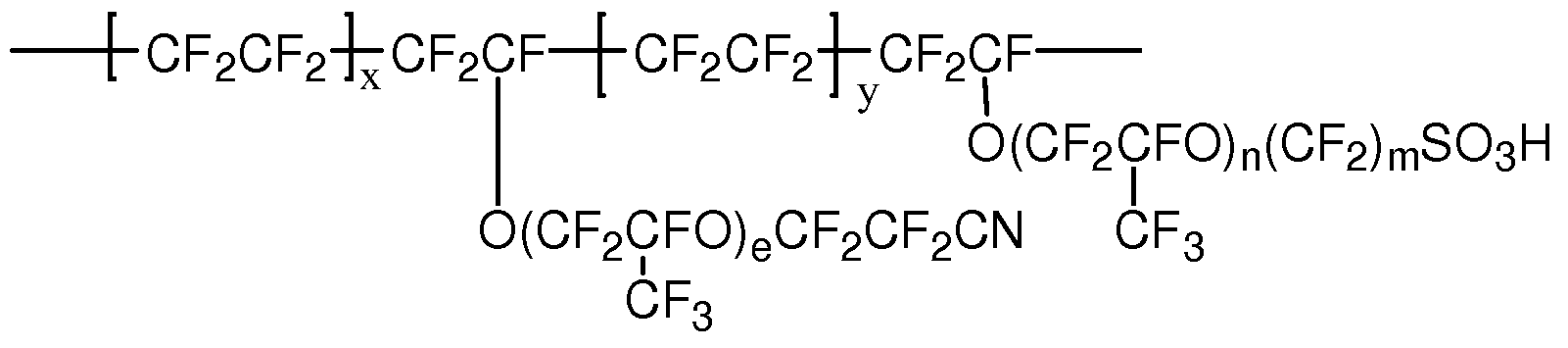
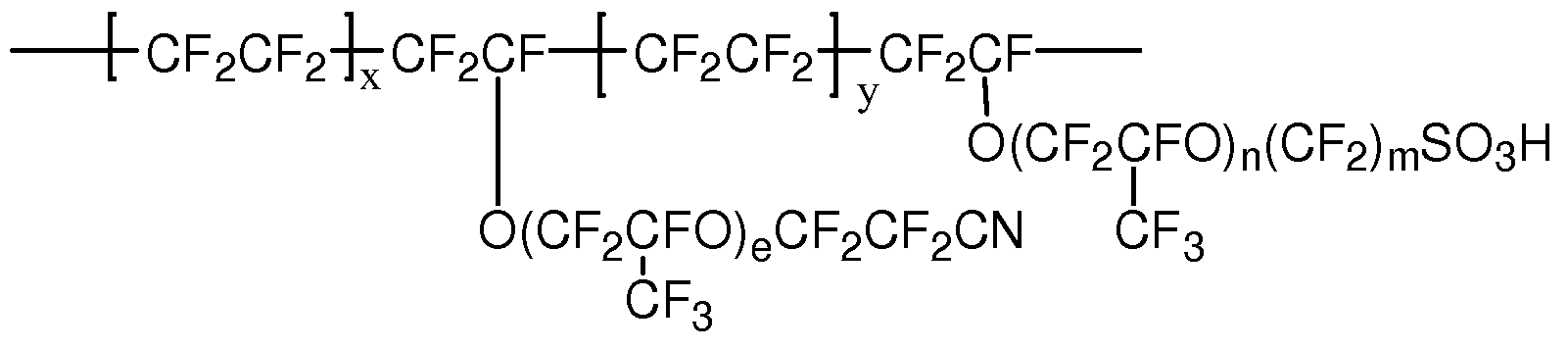
- the ion exchange resin containing a nitrile group is a kind of a resin represented by the following formula (II) and / or (III)
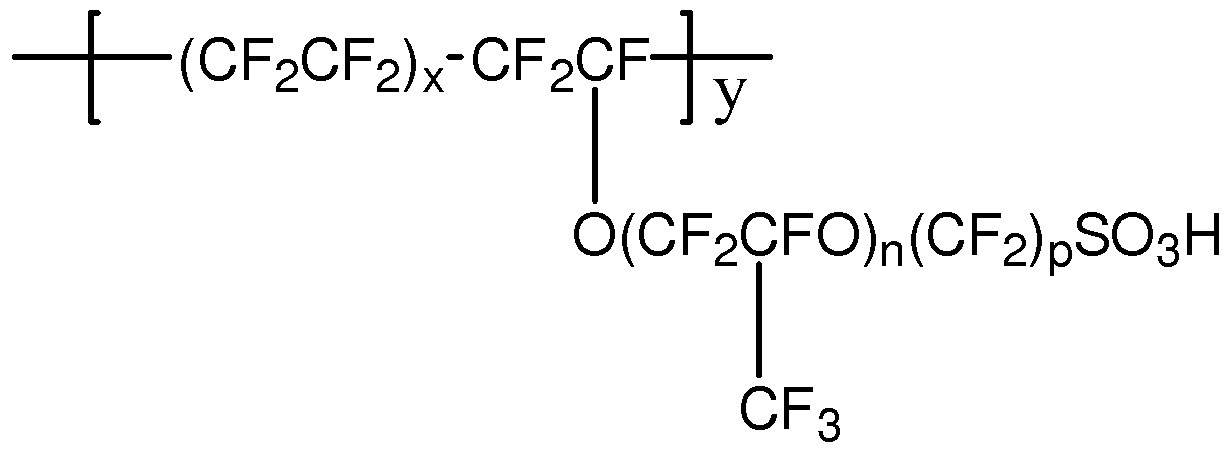
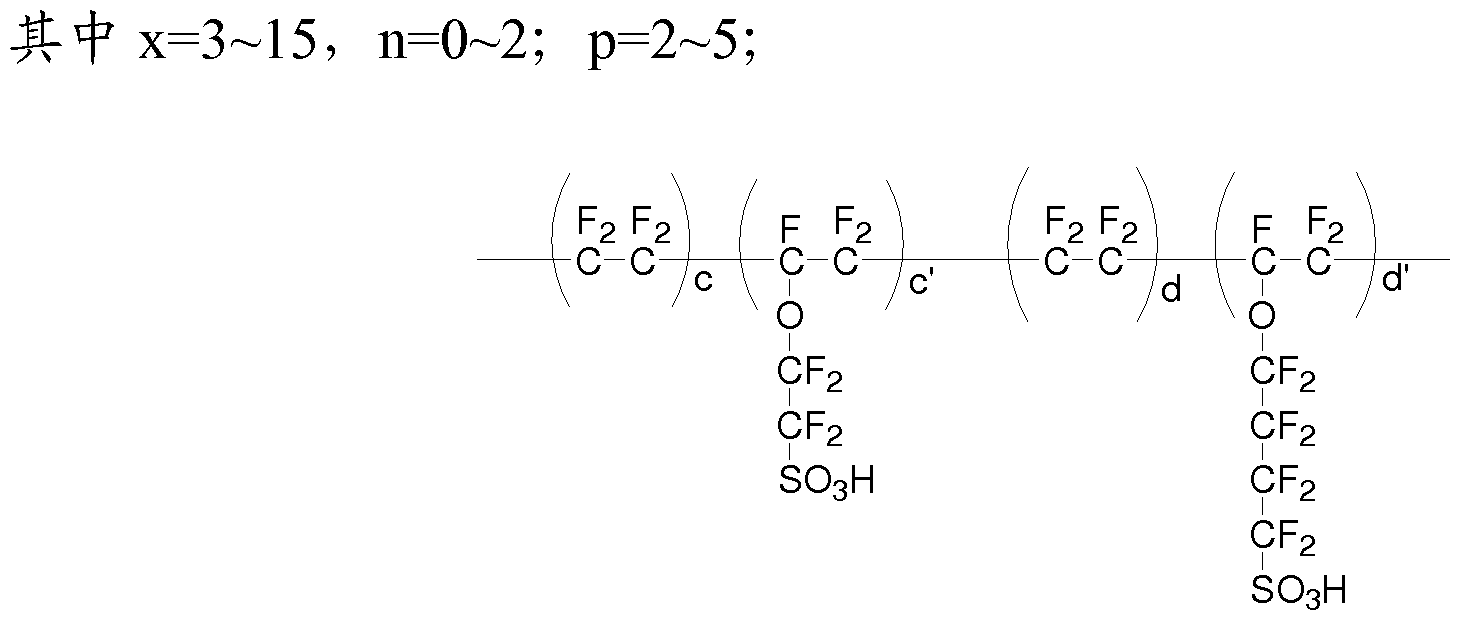
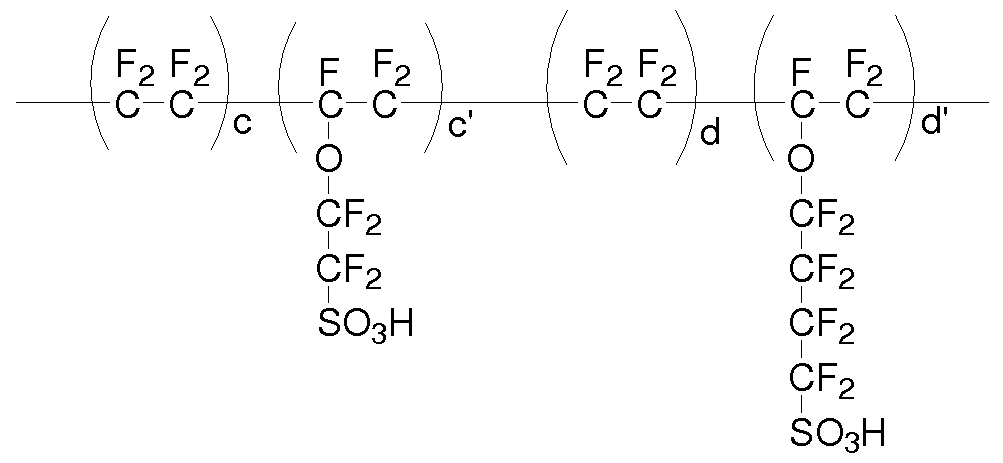
- the composite material may further comprise one or more combinations of resins represented by the following formula (IV) and / or (V) and / or (VI):
- the resin represented by the above formulae II, III, IV, V and VI has an ion exchange capacity of 0.80-1.60 mmol/g; and a number average molecular weight of 150,000 to 450,000.
- the fluoropolymer fiber is selected from one or more of: a polytetrafluoroethylene fiber, a polyperfluoroethylene propylene fiber, a polyperfluoropropyl ethoxylate fiber, and/or a fluorocarbon polymer fiber.
- the diameter of the fiber is 0.005 ⁇ 50 ⁇ , and the length is 0.05 m ⁇ 3mm; the preferred diameter is 0.01 ⁇ 20 ⁇ .
- the mass ratio of the fluoropolymer fiber to the ion exchange resin is 0.5 ⁇ 50 : 100 , preferably
- the composite material may further contain a high-valent metal compound, a part of the acidic exchange group in the ion exchange resin is physically bonded by the high-valent metal compound, and a part of the high-valent metal compound is also a catalyst for forming a cross-linking structure of the triazine ring, and The triazine ring forms a complex and a bond; preferably, The one or more combinations of the compound forming the physically bonded high-valent metal compound selected from the group consisting of W, Zr, Ir, Y, Mn, Ru, Ce, V, Zn, Ti and La; further preferred The high-valent metal ion compound is selected from the highest valence state and the intermediate valence state of one or more of the nitrates, sulfates, carbonates, phosphates, acetates of the metal elements; or selected from these metals One or more of the highest and intermediate valence states of the cyclodextrin, crown ether, acetylacetone,
- the high-valent metal compound is added in an amount of 0.0001 to 5% by weight, preferably 0.001 to 1% by weight based on the mass of the resin.
- the present invention provides a method for preparing the above composite material, which comprises adding a trace amount of a protonic acid and/or a Lewis acid as a catalyst to a composite material, and at least one nitrile group-containing ion exchange resin
- the base group and the nitrile group of the functional monomer grafted on the fluoropolymer fiber form a triazine ring crosslinked structure; preferably, the protonic acid is selected from the group consisting of H 2 S0 4 , CF 3 S0 3 H or H 3 P0 4 ;
- the Lewis acid is selected from the group consisting of ZnCl 2 , FeCl 3 , A1C1 3 , organotin, organic germanium or organic germanium.
- the method for preparing a composite material containing a high-valent metal ion compound comprises the following steps:
- a high-valent metal compound and an acidic crosslinking catalyst liquid are mixed with a dispersion solution of an ion exchange resin and a fiber grafted with a nitrile group, and then formed on a flat plate by casting, casting, screen printing, spraying or dipping.
- the solvent used in the processes of solution casting, casting, screen printing, spraying, dipping, etc. is selected from the group consisting of dinonyl amide, dimercaptoacetamide, mercapto amide, dimercapto sulfoxide, N-mercaptopyrrolidone.
- preparation conditions include: concentration of the resin dispersion solution is 1 ⁇ 80%, the heat treatment temperature is 30 ⁇ 300 °C, the heat treatment time is l ⁇ 600min; the preferred preparation conditions include: the concentration of the resin dispersion solution is 5 ⁇ 40%, the heat treatment temperature is 120 ⁇ 250 °C, and the heat treatment time is 5 ⁇ 200min.
- the high-valent metal compound is added in an amount of 0.0001 to 5% by weight, preferably 0.001 to 1% by weight based on the mass of the resin;
- the acid crosslinking catalyst is preferably Lewis acid and/or protonic acid, and the amount is 0.1% by mass of the resin. 1%.
- the present invention provides an ion exchange membrane prepared from the above composite material. In still another aspect, the present invention provides the use of the above composite material for the manufacture of ion exchange membranes in fuel cells.
- the present invention has at least the following advantages:
- At least one of the ion exchange resins of the composite material of the invention contains a nitrile group which forms a triazine ring crosslinked structure with the nitrile group grafted on the fluoropolymer fiber. Due to the formed triazine ring crosslinked structure, the above composite material becomes a compact monolithic structure.
- the acidic group contained in the high-valent metal and the ion exchange resin forms a physically bonded crosslinked structure, and the triazine ring also forms a complex bond with the high-valent metal. Therefore, the ion exchange membrane prepared by the composite material of the present invention has high mechanical strength, gas tightness, and stability while having high ion exchange capacity.
- the ion exchange membrane of the composite material of the invention has better performance in terms of electrical conductivity, tensile strength, hydrogen permeation current, dimensional change rate and the like than the ordinary ion exchange membrane.
- Perfluorinated acid ionic membranes for fuel cells need to meet requirements: stability, high electrical conductivity, high mechanical strength.
- the gas permeability of the membrane also increases, which will have a very serious impact on the fuel cell. Therefore, the preparation of a membrane having high ion exchange capacity while having good mechanical strength and airtightness while also having good stability is a key to the practical use of a fuel cell, particularly a fuel cell used in a vehicle such as an automobile.
- the present invention provides a composite material and a method of preparing the same.
- the composite material provided by the invention uses fiber as a reinforcing material, but changes the bonding mode and method of merely filling the fiber with the ion exchange resin, and forms a cross-linking structure of the triazine ring between the fiber and the ion exchange resin.
- the membrane has high mechanical properties and air tightness.
- the composite material is composed of one or more ion exchange resins having an ion exchange function and fluoropolymer fibers as a reinforcing material;
- At least one of the ion exchange resins constituting the composite material contains a nitrile group capable of forming a triazine ring chemically networked with a functional monomer grafted on the fluoropolymer fiber. Structure (as shown by X).
- the fiber as the reinforcement is selected from one or more of a polytetrafluoroethylene fiber, a polyperfluoroethylene propylene fiber, a polyperfluoropropyl vinyl ether fiber, and/or a fluorocarbon polymer fiber; the diameter of the fiber is
- the grafting method includes one or more of the following: reacting the fiber with the grafting monomer under the action of heat, light, electron radiation, plasma, X-ray, a radical initiator or the like.
- the method of preparation is disclosed in many literatures, such as Journal of Tianjin Polytechnic University, 2008, Vol. 27, No. 5, page 33, which discloses a method for plasma-modified grafted polyvinylidene fluoride (PVDF) nanofibers.
- the ion exchange resin having a nitrile group may be one or a combination of polymers having a repeating structure represented by the following formula II and / or III:
- the ion exchange resin used in the present invention may be one or a combination of polymers having a repeating structure represented by the following formula IV and / or V and / or VI:
- the resin has an ion exchange capacity of 0.80 to 1.60 mmol/g; and a number average molecular weight of 150,000 to 450,000 o.
- the method for forming a triazine ring crosslinked structure on a nitrile group on an ion exchange resin and a nitrile group on the fiber is to add a trace amount of a protonic acid or a Lewis acid as a catalyst to the material at the time of composite film formation; wherein the protonic acid is selected from the group consisting of 3 ⁇ 4S0 4 , CF 3 S0 3 H or H 3 P0 4 ;
- the Lewis acid is selected from the group consisting of ZnCl 2 , FeCl 3 , A1C1 3 , organotin, organic germanium or organic germanium.
- a method of forming a cross of a triazine ring can be referred to US Patent 3933767 and EP1464671A1.
- the amount of Lewis acid and protic acid added is generally from 0.1% to 1% of the mass of the resin.
- High-valent metal compounds may also be added to the composite material provided by the present invention to form a partial physical exchange group in the ion exchange resin to form a physical bond through the high-valent metal compound.
- some of the high-valent metal compounds are also catalysts for forming a triazine ring crosslinked structure. They also form a complex bond with the triazine ring cross-linking structure.
- the metal compound forming the physically bonded high valence state is selected from one or a combination of the following elements: W, Zr, Ir, Y, Mn, Ru, Ce, V, Zn, Ti and La.
- the metal ion compound having a high valence state is selected from one of a highest valence state and a middle valence state of a nitrate, a sulfate, a carbonate, a phosphate, an acetate or a combined double salt of these metal elements.
- the metal ion compound having a high valence state is selected from the group consisting of a cyclodextrin, a crown ether, an acetylacetone, a nitrogen-containing crown ether, and a nitrogen-containing heterocyclic ring, EDTA, DMF, and DMSO in the highest valence state and the intermediate valence state of these metal elements. Things.
- the metal ion compound having a high valence state is selected from the highest valence state and the intermediate valence state hydroxide of these metal elements.
- the metal ion compound having a high valence state is selected from these metal elements
- the high-valent metal compound is added in an amount of 0.0001 to 5% by weight, preferably 0.001 to 1% by weight.
- the preparation method of the composite material containing the high-valent metal compound comprises the following steps:
- a composite material having a crosslinked bond between the film-forming resin and the fiber is obtained after the treatment.
- the solvents used in the processes of solution casting, casting, screen printing, spraying and dipping are dinonyl amide, dimercaptoacetamide, mercapto amide, dimercapto sulfoxide, N-decyl pyrrolidone, One or more of hexamethylene phosphate, acetone, water, ethanol, decyl alcohol, propanol, isopropanol, ethylene glycol, and/or glycerol; the concentration of the resin solution used is 1 to 80%, Preferably, the temperature is 5 to 40%, the heat treatment temperature is 30 to 300 ° C, preferably 120 to 250 ° C, and the heat treatment time is 1 to 600 min, preferably 5 to 200 min.
- the present invention provides an ion exchange membrane prepared from the above composite material. In still another aspect, the present invention provides a fuel cell comprising the above ion exchange membrane.
- the present invention provides the use of the above composite material for the manufacture of an ion exchange membrane in a fuel cell.
- the beneficial effects of the invention are:
- the present invention provides an ion exchange composite material having excellent chemical stability, mechanical mechanical properties and airtightness obtained by grafting a modified fiber with an ion exchange resin through a triazine ring.
- a triazine ring cross-linking structure is formed between the fibers used and the film-forming resin; in the preferred embodiment, the partial acidic groups of the film-forming molecules also form a physical bond cross-linking structure with each other through the high-valent metal, and the triazine ring can also be expensive.
- the metal forms a complex bond and thus the disclosed composite material is a compact unitary structure. Rather than the technology of the past, only the ion exchange resin and the fiber cartridge are blended together.
- the ion membrane provided by the present invention solves the disadvantages of the conventional fiber composite membrane having poor airtightness and easy separation of the ion exchange resin and the fiber. The best way to implement the invention
- perfluorosulfonic acid resin containing a trace amount of triphenyltin (mass ratio of fiber to resin: 1:100), 1% ethanol solution of cerium (III) nitrate (mass ratio of water to alcohol is 1:1)
- the modified polytetrafluoroethylene fiber (diameter 0.05 ⁇ m, length 5 ⁇ , mass ratio of modified fiber to resin: 1:40) was sprayed into a film. Then, the wet film sample was dried in an oven at 200 ° C for 60 seconds to obtain a 20 ⁇ m composite film.
- Example 3 The modified polytetrafluoroethylene fiber (diameter 0.05 ⁇ m, length 5 ⁇ , mass ratio of modified fiber to resin: 1:40) was sprayed into a film. Then, the wet film sample was dried in an oven at 200 ° C for 60 seconds to obtain a 20 ⁇ m composite film.
- Perfluoro-cross-acid resin ⁇ , repeat unit structure is
- Grafted polyperfluoropropyl ethoxylate fiber diameter 0.005 ⁇ , length 0.07 ⁇ m, fiber to resin mass ratio 25:100
- 0.005um diameter polyperfluoropropyl ethyl ether ether fiber can pass Electrospinning (obtained in US Patent 20090032475), a wet film was obtained by screen printing, and after heating at 240 ° C for 10 minutes, a film having a thickness of 11 ⁇ m was obtained.
- Grafted polyperfluoropropyl ethyl ether ether fiber (teflon FPE) (two grafts with a mass ratio of 1:1) straight The diameter is 15 ⁇ and the length is 2mm, and the fiber to resin mass ratio is 0.5:5). It is dispersed in 5% perfluorosulfonic acid resin DMF solution, and the solution is also mixed with traces of triphenyltin and 0.05% Ce-DMF.
- Compound, wherein the repeating structural formula of the perfluoroic acid resin is
- a polyperfluoroethylene propylene fiber (diameter 30 ⁇ , length 3 mm, mass ratio of fiber to resin of 2:100) co-grafted with the same two nitrile group-containing monomers (mass ratio: 2:1) as in Example 5 was taken.
- the grafted polytetrafluoroethylene fiber (diameter 20 ⁇ , length 3mm) is dispersed in 10% mixed perfluoroic acid resin and 10% manganese sulfate, and trace triphenyl tin sterol-water solution (the ratio of fiber to resin is 0.5:100), wherein the structural formula of the resin A in the perfluoro-cross-acid resin is
- the polytetrafluoroethylene fiber has a diameter of 0.01 ⁇ m and a length of 120 ⁇ m, which accounts for 5% of the total mass.
- a common composite ion film having a thickness of 20 ⁇ m is obtained by screen printing.
- Example 1 Film Dryer Drying for Two Days 0.0298/0.0118
- Example 2 Film 0.0287/0.0134
- Example 3 Film 0. 0299/0.0123
- Example 4 Film 0.0299/0.0128
- Example 5 Film 0.0308/0.0129
- Example 6 Film 0.0313/0.0123 Implementation
- Example 7 Film 0.0323/0.0121
- Example 8 Film 0.0334/0.0133
- Example 3 film 0.08 Example 4 Film 0.10 Example 5 Film 0.10 Example 6 Film 0.07 Example 7 Film 0.09 Example 8 Film 0.08 Size Change Rate Example 9 Film (GB/T20042. 3-2009) 5
Landscapes
- Chemical & Material Sciences (AREA)
- Engineering & Computer Science (AREA)
- Chemical Kinetics & Catalysis (AREA)
- Manufacturing & Machinery (AREA)
- General Chemical & Material Sciences (AREA)
- Life Sciences & Earth Sciences (AREA)
- Sustainable Development (AREA)
- Sustainable Energy (AREA)
- Electrochemistry (AREA)
- Health & Medical Sciences (AREA)
- Textile Engineering (AREA)
- Organic Chemistry (AREA)
- Dispersion Chemistry (AREA)
- Inorganic Chemistry (AREA)
- Materials Engineering (AREA)
- Medicinal Chemistry (AREA)
- Polymers & Plastics (AREA)
- Toxicology (AREA)
- Composite Materials (AREA)
- Manufacture Of Macromolecular Shaped Articles (AREA)
- Fuel Cell (AREA)
- Treatments For Attaching Organic Compounds To Fibrous Goods (AREA)
- Conductive Materials (AREA)
- Compositions Of Macromolecular Compounds (AREA)
Abstract
Description
一种具有离子交换功能的含氟离聚物复合材料 Fluorinated ionomer composite material with ion exchange function
及其制备方法和用途 And preparation method and use thereof
技术领域 Technical field
本发明属于功能高分子复合材料领域, 涉及一种功能基团接枝的纤维和 离子交换树脂复合的全氟离子交换复合材料。 背景技术 The invention belongs to the field of functional polymer composite materials, and relates to a perfluoro ion exchange composite material in which a functional group grafted fiber and an ion exchange resin are combined. Background technique
质子交换膜燃料电池是一种通过电化学方式直接将化学能转化为电能 的发电装置, 被认为是 21世纪首选的洁净、 高效的发电技术。 质子交换膜 ( proton exchange membrane, PEM )是质子交换膜燃料电池 ( proton exchange membrane fuel cell, PEMFC ) 的关键材料。 The proton exchange membrane fuel cell is a power generation device that directly converts chemical energy into electrical energy by electrochemical means, and is considered to be the clean, efficient power generation technology of choice in the 21st century. Proton exchange membrane (PEM) is a key material for proton exchange membrane fuel cell (PEMFC).
现在所使用全氟磺酸质子交换膜在较低温度下(80°C )和较高的湿度下 具有良好的质子传导性和化学稳定性。 但是, 它们也有很多的不足, 如尺寸 稳定性差, 机械强度不高, 化学稳定性差等。 膜在不同的湿度下吸水率和因 吸水而导致的尺寸膨胀不同, 当膜在不同工况下变换时, 膜的尺寸也将因此 发生变化。 如此反复最终导致质子交换膜的机械破损。 此外, 燃料电池的正 极反应常常产生大量的氢氧自由基和过氧化氢等具有强氧化性的物质, 这些 物质会进攻成膜树脂分子上非氟基团, 导致膜的化学降解和破损、 起泡。 最 后, 当全氟橫酸交换膜的工作温度高于 90°C时, 由于膜的迅速失水导致膜的 质子传导性急剧下降, 从而使燃料电池的效率大大下降。 但高的工作温度可 以大大提高燃料电池催化剂的耐一氧化碳性。还有就是现有的全氟橫酸膜都 有一定的氢气或曱醇渗透性, 尤其是在直接曱醇燃料电池中, 曱醇渗透率十 分大, 成为致命的问题。 因此, 如何提高全氟磺酸质子交换膜的强度、 尺寸 稳定性及高温下的质子传导效率, 降低工作介质的渗透性等是燃料电池工业 所面临的重大课题。 The perfluorosulfonic acid proton exchange membranes now used have good proton conductivity and chemical stability at lower temperatures (80 ° C) and higher humidity. However, they also have many disadvantages such as poor dimensional stability, low mechanical strength, and poor chemical stability. The water absorption of the film at different humidity levels and the dimensional expansion due to water absorption are different. When the film is changed under different working conditions, the film size will also change. This repetition eventually leads to mechanical damage of the proton exchange membrane. In addition, the positive electrode reaction of a fuel cell often generates a large amount of highly oxidizing substances such as hydroxyl radicals and hydrogen peroxide, which attack the non-fluorine groups on the film-forming resin molecules, resulting in chemical degradation and damage of the film. bubble. Finally, when the operating temperature of the perfluoro-cross-acid exchange membrane is higher than 90 ° C, the proton conductivity of the membrane is drastically lowered due to the rapid dehydration of the membrane, so that the efficiency of the fuel cell is greatly lowered. However, high operating temperatures can greatly increase the carbon monoxide resistance of fuel cell catalysts. In addition, existing perfluorinated acid membranes have a certain hydrogen or sterol permeability, especially in direct sterol fuel cells, where sterol permeability is extremely large, which is a fatal problem. Therefore, how to improve the strength, dimensional stability of the perfluorosulfonic acid proton exchange membrane, proton conduction efficiency at high temperatures, and reduce the permeability of the working medium are major issues facing the fuel cell industry.
目前人们已经提出了一些方法来解决这些问题。 如日本专利 JP-B-5-75835采用全氟蹟酸树脂浸渍聚四氟乙烯( PTFE )制成的多孔介质来 增强膜的强度。 然而, 这种 PTFE的多孔介质由于 PTFE材料相对较软, 增 强作用不充分, 仍未能解决上述问题。 W. L. Gore公司开发的 Gore-Select 系列复合膜液采用多孔特氟隆填充 Nafion离子导电液的方法(US5547551 , US5635041 , US5599614 ),这种膜具有高的质子导电性和较大的尺寸稳定性, 但在高温下特氟隆蠕变很大, 导致性能下降。 日本专利 JP-B-7-68377还提出 过一种方法, 用质子交换树脂填充聚烯烃制成的多孔介质, 但是其化学耐久 性不足, 因而长期稳定性方面存在问题。 并且由于不具备质子导电能力的多 孔介质的加入, 使得质子传导通路减少, 膜的质子交换能力下降。 At present, some methods have been proposed to solve these problems. For example, Japanese Patent JP-B-5-75835 uses a perfluorotungonic resin impregnated porous medium made of polytetrafluoroethylene (PTFE) to enhance the strength of the film. However, such a porous medium of PTFE has not solved the above problems because the PTFE material is relatively soft and the reinforcing effect is insufficient. The Gore-Select series of composite membrane fluids developed by WL Gore uses a porous Teflon-filled Nafion ion-conducting fluid (US5547551, US5635041, US5599614), which has high proton conductivity and large dimensional stability. However, Teflon creeps at high temperatures, resulting in reduced performance. Japanese Patent JP-B-7-68377 also proposes a method of filling a porous medium made of polyolefin with a proton exchange resin, but its chemical durability is insufficient, and thus there is a problem in long-term stability. Moreover, due to the addition of a porous medium which does not have proton conductivity, the proton conduction path is reduced and the proton exchange capacity of the membrane is lowered.
此外, 日本专利 JP-A-6-231779提出了另一种增强方法, 是使用氟树脂 纤维。 其为采用原纤维形式的氟烃聚合物增强材料增强的离子交换膜。 但这 种方法必须加入相对大量的增强材料, 这种情况下, 薄膜的加工趋于困难, 并且^艮可能会发生膜电阻增大。 Further, Japanese Patent JP-A-6-231779 proposes another reinforcing method using fluororesin fibers. It is an ion exchange membrane reinforced with a fluorocarbon polymer reinforcement in the form of fibrils. However, this method must incorporate a relatively large amount of reinforcing material. In this case, the processing of the film tends to be difficult, and the film resistance may increase.
而欧洲专利 EP0875524B1 公开了利用玻璃纤维无纺技术制备的玻璃纤 维膜增强 nafion膜的技术, 在该专利中同时提到二氧化硅等氧化物。 但是该 专利中无纺玻璃纤维布是必须使用的基材, 这将大大限制了增强的使用范 围。 European Patent EP 0 875 524 B1 discloses a glass fiber reinforced membrane nafion film prepared by a glass fiber nonwoven technique, in which an oxide such as silica is also mentioned. However, the patented nonwoven glass fiber cloth is a substrate that must be used, which greatly limits the enhanced range of use.
美国专利 US6692858公开了聚四氟乙烯纤维增强全氟橫酸树脂的技术。 在该技术中, 将全氟磺酰氟树脂和聚四氟乙烯纤维混合、 挤出、 转型制得纤 维增强的全氟磺酸树脂。 该方法由于转型过程耗时而不能连续生产。 U.S. Patent No. 6,692,858 discloses the use of polytetrafluoroethylene fibers to enhance perfluoro-cross-acid resins. In this technique, a perfluorosulfonyl fluororesin and a polytetrafluoroethylene fiber are mixed, extruded, and transformed to obtain a fiber-reinforced perfluorosulfonic acid resin. This method cannot be continuously produced due to the time-consuming transition process.
但上述技术只是筒单的将多孔膜或纤维与树脂混合起来, 因为薄膜或纤 维与成膜树脂的性质有^艮大的区别, 甚至由于是相互排斥的, 所以极易在成 膜分子和增强物件间形成间隙,有时增强微孔膜的某些孔还不能被树脂所填 充。 因而这样的膜常常具有高的气体渗透性。 在燃料电池中工作时, 高的渗 透率往往导致能量的损失和电池过热而损坏。 发明内容 However, the above technique only mixes the porous film or fiber with the resin because the film or fiber has a large difference from the properties of the film-forming resin, and even because it is mutually exclusive, it is easy to form a film and enhance the film. A gap is formed between the objects, and sometimes some of the pores of the enhanced microporous membrane are not filled by the resin. Such membranes therefore often have high gas permeability. When operating in a fuel cell, high permeability often results in loss of energy and damage to the battery overheating. Summary of the invention
本发明的一个目的在于, 提供一种复合材料, 该复合材料由离子交换树 脂和含氟聚合物纤维复合而成,其中离子交换树脂的腈基基团和含氟聚合物 纤维上接枝的腈基基团形成三嗪环交联结构,从而使得该复合材料具有很高 的机械力学性质和气密性, 以及具有高离子交换能力和电导率。 本发明的另 一个目的在于, 提供该复合材料的制备方法。 本发明的又一目的在于, 提供 一种由上述复合材料制备的离子交换膜。 本发明的再一个目的在于, 提供一 种包含上述离子交换膜的燃料电池。 本发明的再一个目的在于, 提供一种上 述复合材料的用途。 It is an object of the present invention to provide a composite material comprising a composite of an ion exchange resin and a fluoropolymer fiber, wherein the nitrile group of the ion exchange resin and the nitrile grafted on the fluoropolymer fiber The group forms a triazine ring crosslinked structure, so that the composite material has high mechanical properties and airtightness, and has high ion exchange capacity and electrical conductivity. Another object of the present invention is to provide a method of preparing the composite. It is still another object of the present invention to provide an ion exchange membrane prepared from the above composite material. It is still another object of the present invention to provide a fuel cell comprising the above ion exchange membrane. It is still another object of the present invention to provide a use of the above composite material.
本发明的上述目的采用如下技术方案来实现: The above object of the present invention is achieved by the following technical solutions:
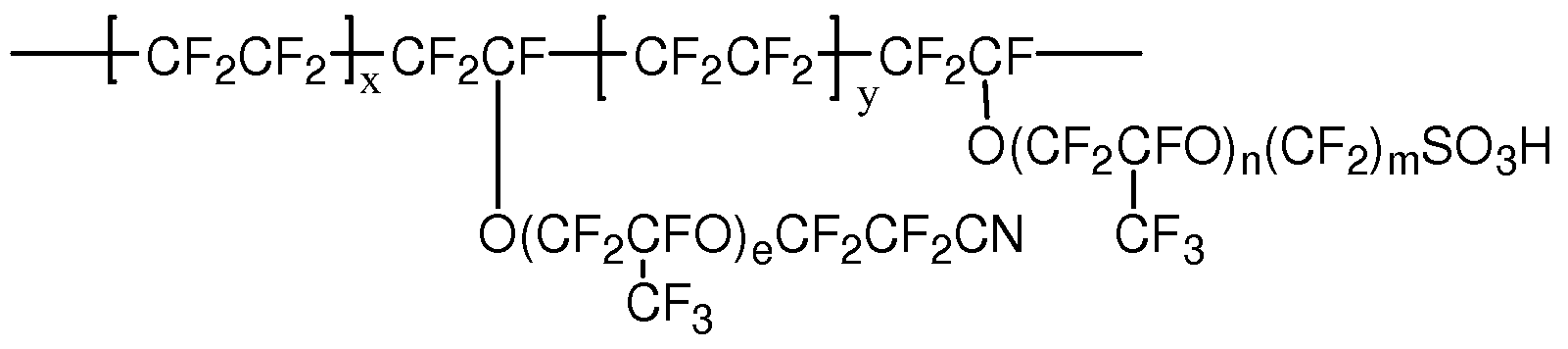
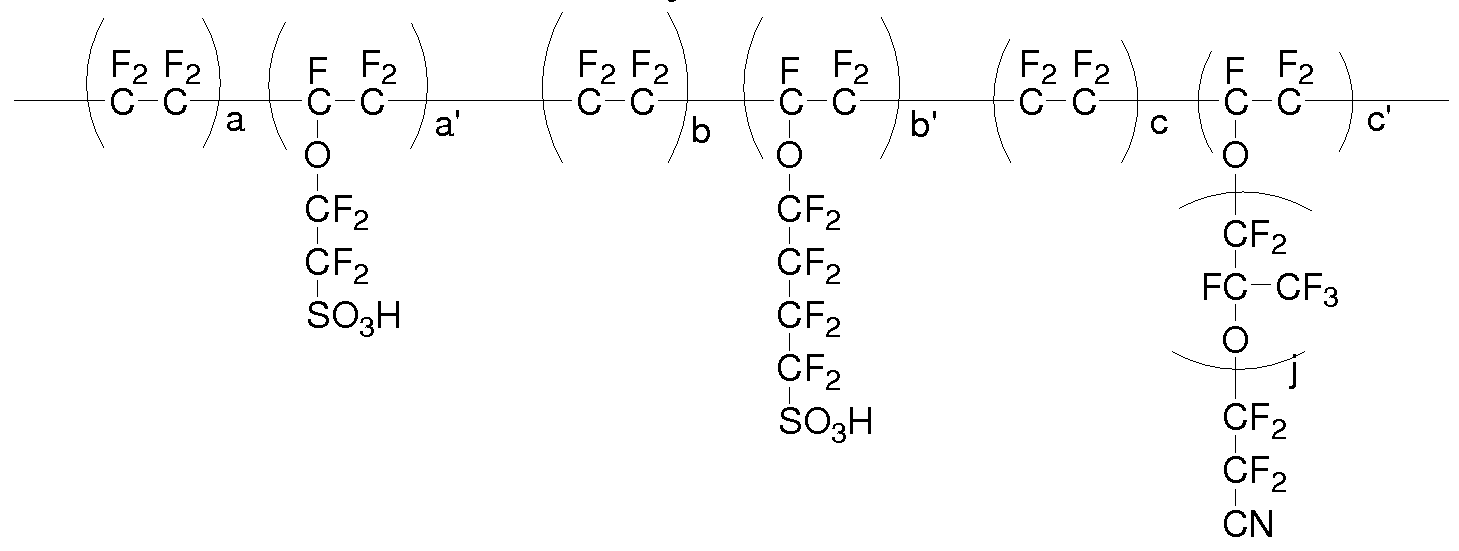
一方面, 本发明提供一种复合材料, 该复合材料由一种或多种具有离子 交换功能的离子交换树脂和作为增强材料的含氟聚合物纤维构成; 含氟聚合 物纤维表面被含腈基的功能单体接枝修饰; 组成复合材料的离子交换树脂中 至少有一种离子交换树脂含有腈基基团, 该腈基基团和含氟聚合物纤维上接 枝的功能单体的腈基形成三嗪环交联结构。 In one aspect, the present invention provides a composite material comprising one or more ion exchange resins having ion exchange function and fluoropolymer fibers as a reinforcing material; The surface of the fiber is graft-modified with a nitrile-containing functional monomer; at least one of the ion exchange resins constituting the composite contains a nitrile group, and the nitrile group and the fluoropolymer fiber are grafted thereon. The nitrile group of the functional monomer forms a triazine ring crosslinked structure.
优选地, 所述含腈基的功能单体是如下通式(I)表述的物质的一种或 多种组合: Preferably, the nitrile group-containing functional monomer is one or more combinations of the substances represented by the following formula (I):
F2C=CF F 2 C=CF
0(CF2CFO)eCF2CF2CN 0(CF 2 CFO) e CF 2 CF 2 CN
CF3 CF 3
(I) 含有腈基基团的离子交换树脂是如下通式(II)和 /或(III)表述的树脂 的一种 (I) The ion exchange resin containing a nitrile group is a kind of a resin represented by the following formula (II) and / or (III)
(II) (II)
其中 e=l~3 Where e=l~3

(III) (III)
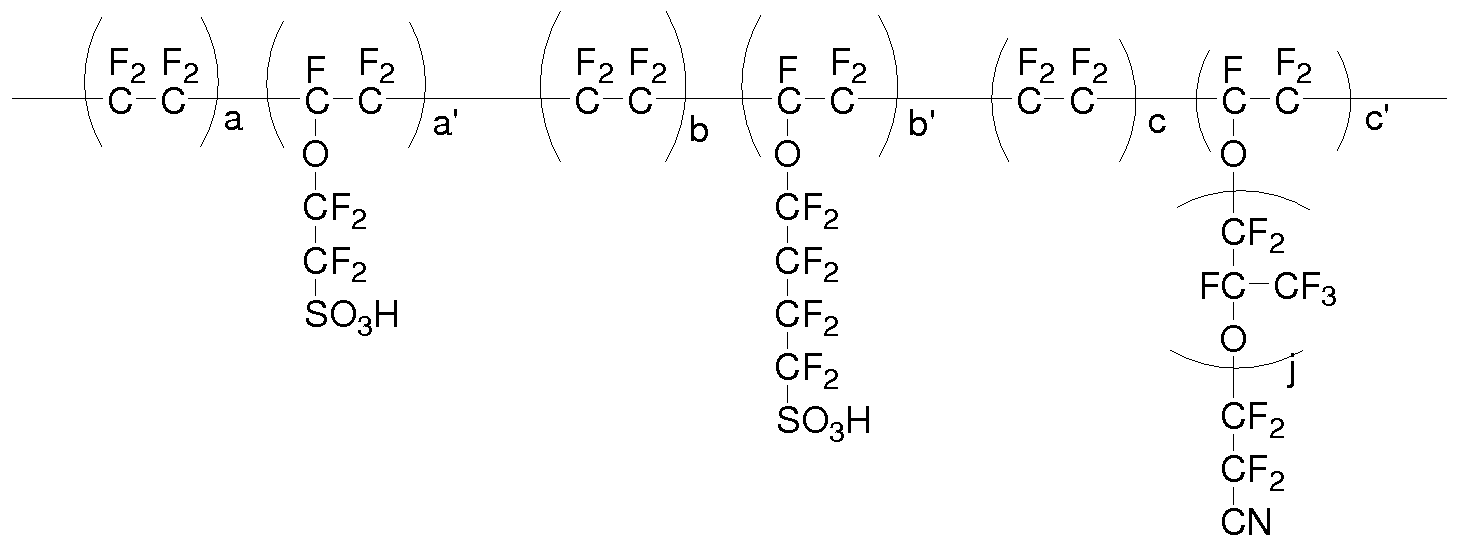
其中 a、 b、 c = 3-15的整数, a,、 b,、 c,=l-3的整数; j=0~3。 Wherein a, b, c = an integer of 3-15, an integer of a, b, c, = l-3; j = 0~3.
进一步优选地, 所述复合材料还可以含有以下通式(IV)和 /或(V)和 /或 (VI)表述的树脂的一种或多种组合: Further preferably, the composite material may further comprise one or more combinations of resins represented by the following formula (IV) and / or (V) and / or (VI):
V V
其中 c、 d=3~15的整数; c,、 d,=l-3的整数; Where c, d = an integer from 3 to 15; an integer from c, d, = l-3;

( VI ) ( VI )
其中 f、 g、 h = 3-15的整数, f,、 g,、 h,=l-3的整数; i=0~3; M、 M,=H、 K、 Na或 NH4。 Wherein f, g, h = an integer of 3-15, f ,, g ,, h, an integer of l-3 =; i = 0 ~ 3; M, M, = H, K, Na or NH 4.
所述通式 II、 III、 IV、 V 和 VI 所表示的树脂的离子交换容量为 0.80-1.60mmol/g; 数均分子量为 150000~450000。 The resin represented by the above formulae II, III, IV, V and VI has an ion exchange capacity of 0.80-1.60 mmol/g; and a number average molecular weight of 150,000 to 450,000.
优选地, 所述含氟聚合物纤维选自: 聚四氟乙烯纤维、 聚全氟乙丙烯纤 维、聚全氟丙基乙婦基醚纤维和 /或氟碳聚合物纤维中的一种或几种; 纤维的 直径为 0.005μηι~50μηι, 长度为 0.05 m~3mm; 优选的直径为: 0.01~20μηι 含氟聚合物纤维与离子交换树脂的质量比为 0.5 ~ 50 : 100 , 优选为

优选地, 上述复合材料还可以含有高价金属化合物, 离子交换树脂中的 部分酸性交换基团通过高价金属化合物形成物理键合,部分高价金属化合物 同时也是形成三嗪环交联结构的催化剂, 并和三嗪环形成络和键; 优选地, 所述的形成物理键合的高价金属化合物选自下列元素的化合物的一种或多 种组合: W, Zr, Ir, Y, Mn, Ru, Ce, V, Zn, Ti和 La元素; 进一步优 选地, 高价金属离子化合物选自这些金属元素的最高价态和中间价态的硝酸 盐、 硫酸盐、 碳酸盐、 磷酸盐、 醋酸盐中的一种或组合复盐; 或选自这些金 属元素的最高价态和中间价态的一种或多种的环糊精、 冠醚、 乙酰丙酮、 含 氮冠醚及含氮杂环、 EDTA、 DMF和 DMSO络合物; 或选自这些金属元素 的最高价态和中间价态的氢氧化物; 或选自这些金属元素的最高价态和中间 价态的具有钙钛矿结构的氧化物, 包括但不限于化合物 CexTi(1_x)02 Preferably, the composite material may further contain a high-valent metal compound, a part of the acidic exchange group in the ion exchange resin is physically bonded by the high-valent metal compound, and a part of the high-valent metal compound is also a catalyst for forming a cross-linking structure of the triazine ring, and The triazine ring forms a complex and a bond; preferably, The one or more combinations of the compound forming the physically bonded high-valent metal compound selected from the group consisting of W, Zr, Ir, Y, Mn, Ru, Ce, V, Zn, Ti and La; further preferred The high-valent metal ion compound is selected from the highest valence state and the intermediate valence state of one or more of the nitrates, sulfates, carbonates, phosphates, acetates of the metal elements; or selected from these metals One or more of the highest and intermediate valence states of the cyclodextrin, crown ether, acetylacetone, nitrogen-containing crown ether, and nitrogen-containing heterocycle, EDTA, DMF, and DMSO complexes; or selected from these metals The highest valence state of the element and the hydroxide of the intermediate valence state; or an oxide having a perovskite structure selected from the highest and intermediate valence states of these metal elements, including but not limited to the compound Ce x Ti (1 _ x )0 2
( χ=0·25~0·4 )、 Ca0.6La027TiO3、 La(i-y)CeyMn03 ( y=0.1-0.4 )和 (χ=0·25~0·4), Ca0.6 La027 TiO 3 , La(i -y) Ce y Mn0 3 ( y=0.1-0.4 ) and
La0.7Ce i5Ca i5MnO3。 高价金属化合物的加入量为树脂质量的 0.0001-5重量 %, 优选为 0.001-1重量%。 La 0 . 7 Ce i5 Ca i5 MnO 3 . The high-valent metal compound is added in an amount of 0.0001 to 5% by weight, preferably 0.001 to 1% by weight based on the mass of the resin.
另一方面, 本发明提供上述复合材料的制备方法, 该方法包含向复合材 料中加入微量强的质子酸和 /或路易斯酸作为催化剂,使至少一种含有腈基基 团的离子交换树脂其腈基基团和含氟聚合物纤维上接枝的功能单体的腈基 形成三嗪环交联结构; 优选地, 质子酸选自 H2S04、 CF3S03H或 H3P04; 路 易斯酸选自 ZnCl2、 FeCl3、 A1C13、 有机锡、 有机锑或有机碲。 形成三嗪环交 联的方法可参考 US Patent 3933767和 EP1464671A1。 路易士酸和质子酸的 加入量一般为树脂质量的 0.1%~1%。 In another aspect, the present invention provides a method for preparing the above composite material, which comprises adding a trace amount of a protonic acid and/or a Lewis acid as a catalyst to a composite material, and at least one nitrile group-containing ion exchange resin The base group and the nitrile group of the functional monomer grafted on the fluoropolymer fiber form a triazine ring crosslinked structure; preferably, the protonic acid is selected from the group consisting of H 2 S0 4 , CF 3 S0 3 H or H 3 P0 4 ; The Lewis acid is selected from the group consisting of ZnCl 2 , FeCl 3 , A1C1 3 , organotin, organic germanium or organic germanium. For a method of forming a cross-linking of a triazine ring, reference is made to US Patent 3933767 and EP1464671A1. The amount of Lewis acid and protic acid added is generally 0.1% to 1% of the mass of the resin.
优选地, 含有高价金属离子化合物的复合材料其制备方法包括如下步 骤: Preferably, the method for preparing a composite material containing a high-valent metal ion compound comprises the following steps:
( 1 ) 高价金属化合物和酸性交联催化剂液与离子交换树脂的分散溶液 以及被腈基接枝的纤维相混合, 再经浇铸、 流延、 丝网印刷工艺、 喷 涂或浸渍工艺在平板上形成湿膜; (1) a high-valent metal compound and an acidic crosslinking catalyst liquid are mixed with a dispersion solution of an ion exchange resin and a fiber grafted with a nitrile group, and then formed on a flat plate by casting, casting, screen printing, spraying or dipping. Wet film
( 2 )将湿膜置于 30 ~ 300 °C热处理,得到形成三嗪环交联结构的复合材 料; (2) The wet film is heat-treated at 30 to 300 ° C to obtain a composite material forming a triazine ring crosslinked structure;
在溶液浇铸、 流延、 丝网印刷、 喷涂、 浸渍等工艺中所用的溶剂选自二 曱基曱酰胺、 二曱基乙酰胺、 曱基曱酰胺、 二曱基亚砜、 N -曱基吡咯烷酮、 六曱基磷酸胺、 丙酮、 水、 乙醇、 曱醇、 丙醇、 异丙醇、 乙二醇和 /或丙三醇 中的一种或几种; 制备条件包括: 树脂分散溶液的浓度为 1~80%, 热处理的 温度为 30~300°C , 热处理时间为 l~600min; 优选制备条件包括: 树脂分散 溶液的浓度为 5~40%,热处理的温度为 120~250°C ,热处理时间为 5~200min。 其中高价金属化合物的加入量为树脂质量的 0.0001-5重量%,优选为 0.001-1 重量%; 酸性交联催化剂优选路易士酸和 /或质子酸, 加入量为树脂质量的 0·1%~1%。 The solvent used in the processes of solution casting, casting, screen printing, spraying, dipping, etc. is selected from the group consisting of dinonyl amide, dimercaptoacetamide, mercapto amide, dimercapto sulfoxide, N-mercaptopyrrolidone. , one or more of hexamethyl phosphinate, acetone, water, ethanol, decyl alcohol, propanol, isopropanol, ethylene glycol and/or glycerol; preparation conditions include: concentration of the resin dispersion solution is 1 ~80%, the heat treatment temperature is 30~300 °C, the heat treatment time is l~600min; the preferred preparation conditions include: the concentration of the resin dispersion solution is 5~40%, the heat treatment temperature is 120~250 °C, and the heat treatment time is 5~200min. The high-valent metal compound is added in an amount of 0.0001 to 5% by weight, preferably 0.001 to 1% by weight based on the mass of the resin; the acid crosslinking catalyst is preferably Lewis acid and/or protonic acid, and the amount is 0.1% by mass of the resin. 1%.
又一方面, 本发明提供一种由上述复合材料制备而成的离子交换膜。 再一方面,本发明提供上述复合材料用于制造燃料电池中离子交换膜的 用途。 In still another aspect, the present invention provides an ion exchange membrane prepared from the above composite material. In still another aspect, the present invention provides the use of the above composite material for the manufacture of ion exchange membranes in fuel cells.
与现有技术相比, 本发明至少具有以下优点: Compared with the prior art, the present invention has at least the following advantages:
组成本发明的复合材料中至少有一种离子交换树脂含有腈基基团, 该腈 基与含氟聚合物纤维上接枝的腈基形成了三嗪环交联结构。 由于所形成的三 嗪环交联结构, 上述复合材料成为一个紧密整体结构。 在优选实施方式中, 含有的高价金属和离子交换树脂中的酸性基团形成物理键合交联结构, 三嗪 环也和高价金属形成络合键。 因此, 本发明的复合材料制备的离子交换膜在 具有高离子交换能力的同时, 还具有良好的机械力学强度, 气密性, 和稳定 性。 与普通复合材料制备的离子交换膜相比, 本发明复合材料的离子交换膜 在电导率、 拉伸强度、 氢气渗透电流、 尺寸变化率等方面的性能均优于普通 离子交换膜。 以下是本发明的详细描述: At least one of the ion exchange resins of the composite material of the invention contains a nitrile group which forms a triazine ring crosslinked structure with the nitrile group grafted on the fluoropolymer fiber. Due to the formed triazine ring crosslinked structure, the above composite material becomes a compact monolithic structure. In a preferred embodiment, the acidic group contained in the high-valent metal and the ion exchange resin forms a physically bonded crosslinked structure, and the triazine ring also forms a complex bond with the high-valent metal. Therefore, the ion exchange membrane prepared by the composite material of the present invention has high mechanical strength, gas tightness, and stability while having high ion exchange capacity. Compared with the ion exchange membrane prepared by the common composite material, the ion exchange membrane of the composite material of the invention has better performance in terms of electrical conductivity, tensile strength, hydrogen permeation current, dimensional change rate and the like than the ordinary ion exchange membrane. The following is a detailed description of the invention:
用于燃料电池的全氟橫酸离子膜需要满足要求: 稳定、 高电导率、 高机 械强度。 一般而言, 当离子交换能力升高时, 全氟聚合物的当量值下降(当 量值 EW值减小, 离子交换容量 IEC=1000/EW ), 同时膜的强度也降低。 同 时膜的气体渗透性也随之上升,这将对燃料电池产生非常严重的影响。因此, 制备具有高离子交换能力, 同时具有好的机械力学强度和气密性, 同时还具 有好的稳定性的膜是燃料电池,尤其是在汽车等运载工具上使用的燃料电池 实用的关键。 Perfluorinated acid ionic membranes for fuel cells need to meet requirements: stability, high electrical conductivity, high mechanical strength. In general, when the ion exchange capacity is increased, the equivalent value of the perfluoropolymer decreases (when the amount of EW decreases, the ion exchange capacity IEC = 1000/EW), and the strength of the membrane also decreases. At the same time, the gas permeability of the membrane also increases, which will have a very serious impact on the fuel cell. Therefore, the preparation of a membrane having high ion exchange capacity while having good mechanical strength and airtightness while also having good stability is a key to the practical use of a fuel cell, particularly a fuel cell used in a vehicle such as an automobile.
针对现有技术的不足, 本发明提供一种复合材料及其制备方法。 本发明 提供的复合材料, 使用纤维作为增强材料, 但改变了以往仅仅是将离子交换 树脂填充纤维的结合方式和方法, 而是在纤维和离子交换树脂间形成三嗪环 交联结构, 所得到的膜具有很高的机械力学性质和气密性。 In view of the deficiencies of the prior art, the present invention provides a composite material and a method of preparing the same. The composite material provided by the invention uses fiber as a reinforcing material, but changes the bonding mode and method of merely filling the fiber with the ion exchange resin, and forms a cross-linking structure of the triazine ring between the fiber and the ion exchange resin. The membrane has high mechanical properties and air tightness.
一种复合离子材料, 其特征包括: A composite ionic material characterized by:
(a)所述复合材料是由一种或多种具有离子交换功能的离子交换树脂和 作为增强材料的含氟聚合物纤维构成的; (a) the composite material is composed of one or more ion exchange resins having an ion exchange function and fluoropolymer fibers as a reinforcing material;
(b)所述的含氟聚合物纤维表面被含腈基的功能单体所接枝修饰; (b) the surface of the fluoropolymer fiber is graft-modified with a nitrile-containing functional monomer;
(c)组成复合材料的离子交换树脂中至少有一种离子交换树脂含有腈基 基团, 该腈基基团能够和含氟聚合物纤维上接枝的功能单体形成三嗪环 化学交联网状结构 (如 X所示)。 (c) at least one of the ion exchange resins constituting the composite material contains a nitrile group capable of forming a triazine ring chemically networked with a functional monomer grafted on the fluoropolymer fiber. Structure (as shown by X).

X X
作为增强物的纤维选自聚四氟乙烯纤维、 聚全氟乙丙烯纤维、 聚全氟丙 基乙烯基醚纤维和 /或氟碳聚合物纤维中的一种或几种; 纤维的直径为 The fiber as the reinforcement is selected from one or more of a polytetrafluoroethylene fiber, a polyperfluoroethylene propylene fiber, a polyperfluoropropyl vinyl ether fiber, and/or a fluorocarbon polymer fiber; the diameter of the fiber is
0.005μηι~50μηι, 长度为 0.05μηι ~3mm; 优选的直径为: 0.01~20μηι, 纤维与 全氟离子交换树脂的质量比为 0.01 ~ 50: 100。 0.005μηι~50μηι, length 0.05μηι ~3mm; preferred diameter: 0.01~20μηι, the mass ratio of fiber to perfluoro ion exchange resin is 0.01 ~ 50: 100.
用于接枝在纤维上的含腈基的功能单体是如下通式(I )表述的物质中 的一种或几种: The nitrile group-containing functional monomer for grafting onto the fiber is one or more of the following compounds of the formula (I):
F2C=CF F 2 C=CF
0(CF2CFO)eCF2CF2CN 0(CF 2 CFO) e CF 2 CF 2 CN
CF3 CF 3
( I ) (I)
e=l~3。 e=l~3.
接枝的方法包括如下的一种或几种: 将纤维与接枝单体在热、 光、 电子 辐射、 等离子体、 X射线、 自由基引发剂等手段的作用下发生反应。 具体制 备的方法被很多文献所披露, 如天津工业大学学报 2008年 vol.27 第五期) 第 33页披露了等离子体改性接枝聚偏氟乙烯(PVDF ) 纳米纤维的方法。 The grafting method includes one or more of the following: reacting the fiber with the grafting monomer under the action of heat, light, electron radiation, plasma, X-ray, a radical initiator or the like. The method of preparation is disclosed in many literatures, such as Journal of Tianjin Polytechnic University, 2008, Vol. 27, No. 5, page 33, which discloses a method for plasma-modified grafted polyvinylidene fluoride (PVDF) nanofibers.
本发明所提供复合材料中, 具有腈基基团的离子交换树脂可以是具有以 下通式 II和 /或 III表述的重复结构的聚合物的一种或多种组合: In the composite material provided by the present invention, the ion exchange resin having a nitrile group may be one or a combination of polymers having a repeating structure represented by the following formula II and / or III:
( II ) e=l~3; n=0或 1 ; m=2~5; x、 y= 3-15的整数;
(III) (III)
其中 a、 b、 c = 3-15的整数; a,、 b, 、 c,=l-3的整数; j=0~3。 Wherein a, b, c = an integer of 3-15; an integer of a, b, c, = l-3; j = 0~3.
本发明所用离子交换树脂可以是具有以下通式 IV和 /或 V和 /或 VI表述 的重复结构的聚合物的一种或多种组合: The ion exchange resin used in the present invention may be one or a combination of polymers having a repeating structure represented by the following formula IV and / or V and / or VI:

(IV) (IV)
其中 x=3~15; n=0~2; p=2~ Where x=3~15; n=0~2; p=2~

V 其中 c、 d=3~15的整数; c,、 d,=l-3的整数;
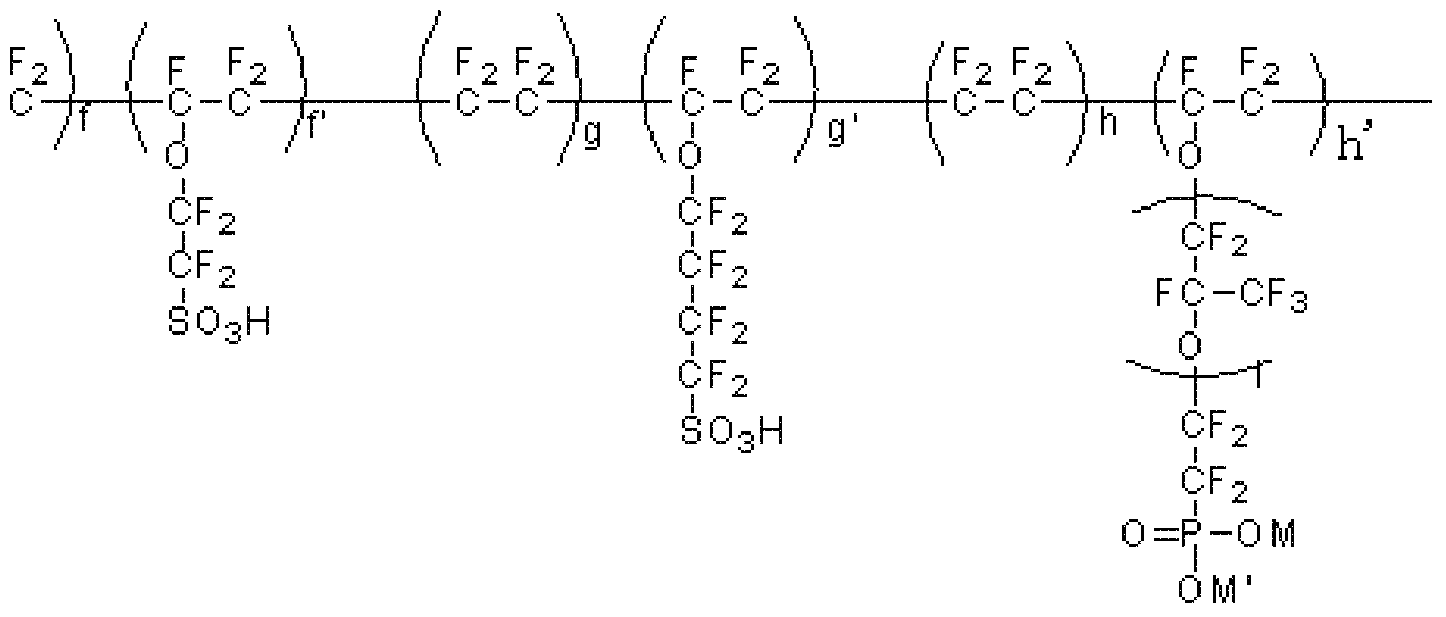
其中 f、 g、 h = 3-15的整数; f,、 g,、 h,=l-3的整数; i=0~3; M、 M,=H、 K、 Na或 NH4。 Wherein f, g, h = an integer of 3-15; an integer of f, g, h, = l-3; i = 0 to 3; M, M, = H, K, Na or NH 4 .
所述的树脂的离子交换容量为 0.80~1.60mmol/g; 数均分子量为 150000-450000 o The resin has an ion exchange capacity of 0.80 to 1.60 mmol/g; and a number average molecular weight of 150,000 to 450,000 o.
当使用 IV、 V及 VI式的全氟蹟酸树脂时必须与 II或 III混合使用。 在离子交换树脂上的腈基和纤维上的腈基形成三嗪环交联结构的方法 是在复合成膜的时候向材料中加入微量强的质子酸或路易斯酸作为催化剂; 其中质子酸选自 ¾S04、 CF3S03H或 H3P04; 路易斯酸选自 ZnCl2、 FeCl3、 A1C13、 有机锡、 有机锑或有机碲。 形成三嗪环交联的方法可参考 US Patent 3933767 和 EP1464671A1。 路易士酸和质子酸的加入量一般为树脂质量的 0·1%~1%。 When using IV, V and VI type perfluoric acid resins, they must be mixed with II or III. The method for forming a triazine ring crosslinked structure on a nitrile group on an ion exchange resin and a nitrile group on the fiber is to add a trace amount of a protonic acid or a Lewis acid as a catalyst to the material at the time of composite film formation; wherein the protonic acid is selected from the group consisting of 3⁄4S0 4 , CF 3 S0 3 H or H 3 P0 4 ; The Lewis acid is selected from the group consisting of ZnCl 2 , FeCl 3 , A1C1 3 , organotin, organic germanium or organic germanium. A method of forming a cross of a triazine ring can be referred to US Patent 3933767 and EP1464671A1. The amount of Lewis acid and protic acid added is generally from 0.1% to 1% of the mass of the resin.
在本发明提供的复合材料中还可加入高价金属化合物使离子交换树脂 中的部分酸性交换基团通过高价金属化合物形成物理键合。 当然部分高价金 属化合物同时也是形成三嗪环交联结构的催化剂。 它们也会和三嗪环交联结 构形成络合键。 High-valent metal compounds may also be added to the composite material provided by the present invention to form a partial physical exchange group in the ion exchange resin to form a physical bond through the high-valent metal compound. Of course, some of the high-valent metal compounds are also catalysts for forming a triazine ring crosslinked structure. They also form a complex bond with the triazine ring cross-linking structure.
所述的形成物理键合的高价态的金属化合物选自下列元素的化合物之 一或组合: W, Zr, Ir, Y, Mn, Ru, Ce, V, Zn, Ti和 La元素。 The metal compound forming the physically bonded high valence state is selected from one or a combination of the following elements: W, Zr, Ir, Y, Mn, Ru, Ce, V, Zn, Ti and La.
所述具有高价态的金属离子化合物选自这些金属元素的最高价态和中 间价态的硝酸盐、 硫酸盐、 碳酸盐、 磷酸盐、 醋酸盐中的一种或组合复盐。 所述具有高价态的金属离子化合物选自这些金属元素的最高价态和中间价 态的环糊精、冠醚、 乙酰丙酮、含氮冠醚及含氮杂环、 EDTA、 DMF和 DMSO 络合物。所述具有高价态的金属离子化合物选自这些金属元素的最高价态和 中间价态的氢氧化物。所述具有高价态的金属离子化合物选自这些金属元素 的最高价态和中间价态的具有钙钛矿结构的氧化物, 包括但不限于如下化合 物: CexTi(1-x)02 ( χ=0·25~0·4 )、 Ca0.6La027TiO3、 La ( i-y) CeyMn03 ( y=0.1-0.4 ) 和 La 7Ce i5Ca i5Mn03。 高价金属化合物的加入量为 0.0001-5重量%,优选 为 0.001-1重量% The metal ion compound having a high valence state is selected from one of a highest valence state and a middle valence state of a nitrate, a sulfate, a carbonate, a phosphate, an acetate or a combined double salt of these metal elements. The metal ion compound having a high valence state is selected from the group consisting of a cyclodextrin, a crown ether, an acetylacetone, a nitrogen-containing crown ether, and a nitrogen-containing heterocyclic ring, EDTA, DMF, and DMSO in the highest valence state and the intermediate valence state of these metal elements. Things. The metal ion compound having a high valence state is selected from the highest valence state and the intermediate valence state hydroxide of these metal elements. The metal ion compound having a high valence state is selected from these metal elements The highest valence state and the intermediate valence state oxide with perovskite structure, including but not limited to the following compounds: Ce x Ti (1-x) 0 2 (χ=0·25~0·4), Ca0.6 La027 TiO 3 , La ( i -y) Ce y MnO 3 ( y = 0.1 - 0.4 ) and La 7 Ce i5 Ca i5 Mn0 3 . The high-valent metal compound is added in an amount of 0.0001 to 5% by weight, preferably 0.001 to 1% by weight.
这种含高价金属化合物的复合材料的制备方法, 包括如下步骤: The preparation method of the composite material containing the high-valent metal compound comprises the following steps:
( 1 )制备离子交换树脂的分散溶液, 高价金属化合物和酸性交联催化剂 液与上述树脂分散液及被腈基接枝的纤维相混合,再经浇铸、流 延、 丝网印刷工艺、 喷涂或浸渍工艺在平板上成湿膜; (1) preparing a dispersion solution of the ion exchange resin, mixing the high-valent metal compound and the acidic crosslinking catalyst liquid with the above resin dispersion and the fiber grafted by the nitrile group, and then casting, casting, screen printing, spraying or The dipping process forms a wet film on the plate;
( 2 )将湿膜置于 30 ~ 250°C处理; (2) placing the wet film at 30 ~ 250 °C;
( 3 )经处理后得到成膜树脂与纤维有交联键的复合材料。 (3) A composite material having a crosslinked bond between the film-forming resin and the fiber is obtained after the treatment.
在溶液浇铸, 流延、 丝网印刷、 喷涂和浸渍等工艺中所用的溶剂为二曱 基曱酰胺、 二曱基乙酰胺、 曱基曱酰胺、 二曱基亚砜、 N -曱基吡咯烷酮、 六曱基磷酸胺、 丙酮、 水、 乙醇、 曱醇、 丙醇、 异丙醇、 乙二醇和 /或丙三醇 中的一种或几种; 所使用树脂溶液的浓度为 1~80%, 优选 5~40%, 热处理的 温度为 30~300°C ,优选 120~250°C ,热处理时间为 l~600min,优选 5~200min。 The solvents used in the processes of solution casting, casting, screen printing, spraying and dipping are dinonyl amide, dimercaptoacetamide, mercapto amide, dimercapto sulfoxide, N-decyl pyrrolidone, One or more of hexamethylene phosphate, acetone, water, ethanol, decyl alcohol, propanol, isopropanol, ethylene glycol, and/or glycerol; the concentration of the resin solution used is 1 to 80%, Preferably, the temperature is 5 to 40%, the heat treatment temperature is 30 to 300 ° C, preferably 120 to 250 ° C, and the heat treatment time is 1 to 600 min, preferably 5 to 200 min.
又一方面, 本发明提供一种由上述复合材料制备而成的离子交换膜。 再一方面, 本发明提供一种包含上述离子交换膜的燃料电池。 In still another aspect, the present invention provides an ion exchange membrane prepared from the above composite material. In still another aspect, the present invention provides a fuel cell comprising the above ion exchange membrane.
再一方面, 本发明提供上述复合材料用于制造燃料电池中离子交换膜的 用途。 本发明的有益效果是: In still another aspect, the present invention provides the use of the above composite material for the manufacture of an ion exchange membrane in a fuel cell. The beneficial effects of the invention are:
本发明提供一种接枝改性的纤维与离子交换树脂通过三嗪环键合得到 的具有优异化学稳定性、 机械力学性能及气密性的离子交换复合材料。 由于 所使用的纤维与成膜树脂间形成三嗪环交联结构;优选实施方式中成膜分子 的部分酸性基团还通过高价金属相互形成物理键合交联结构, 三嗪环也可与 高价金属形成络合键, 因而所公开的复合材料是一个紧密整体结构。 而不是 象过去的技术, 仅仅是离子交换树脂和纤维筒单的掺和在一起。 本发明提供 的离子膜解决了以往的纤维复合膜气密性不好, 离子交换树脂和纤维易分离 等缺点。 实施发明的最佳方式 The present invention provides an ion exchange composite material having excellent chemical stability, mechanical mechanical properties and airtightness obtained by grafting a modified fiber with an ion exchange resin through a triazine ring. A triazine ring cross-linking structure is formed between the fibers used and the film-forming resin; in the preferred embodiment, the partial acidic groups of the film-forming molecules also form a physical bond cross-linking structure with each other through the high-valent metal, and the triazine ring can also be expensive. The metal forms a complex bond and thus the disclosed composite material is a compact unitary structure. Rather than the technology of the past, only the ion exchange resin and the fiber cartridge are blended together. The ion membrane provided by the present invention solves the disadvantages of the conventional fiber composite membrane having poor airtightness and easy separation of the ion exchange resin and the fiber. The best way to implement the invention
以下结合实施例对本发明进行进一步说明, 但本发明并不局限于此。

F2C=CF F 2 C=CF
0(CF2CFO)eCF2CF2CN 0(CF 2 CFO) e CF 2 CF 2 CN
CF3 CF 3
(I) (I)
其中 e=l Where e=l
混合于含微量三苯基锡的 25%全氟磺酸树脂 (纤维与树脂的质量比为 1:100), 1%硝酸铈 (III) 的乙醇-水溶液 (水醇质量比为 1:1)中, 其中全氟 磺酸树脂的结构式为 Mixed with 25% perfluorosulfonic acid resin containing a trace amount of triphenyltin (mass ratio of fiber to resin: 1:100), 1% ethanol solution of cerium (III) nitrate (mass ratio of water to alcohol is 1:1) Where the structural formula of the perfluorosulfonic acid resin is
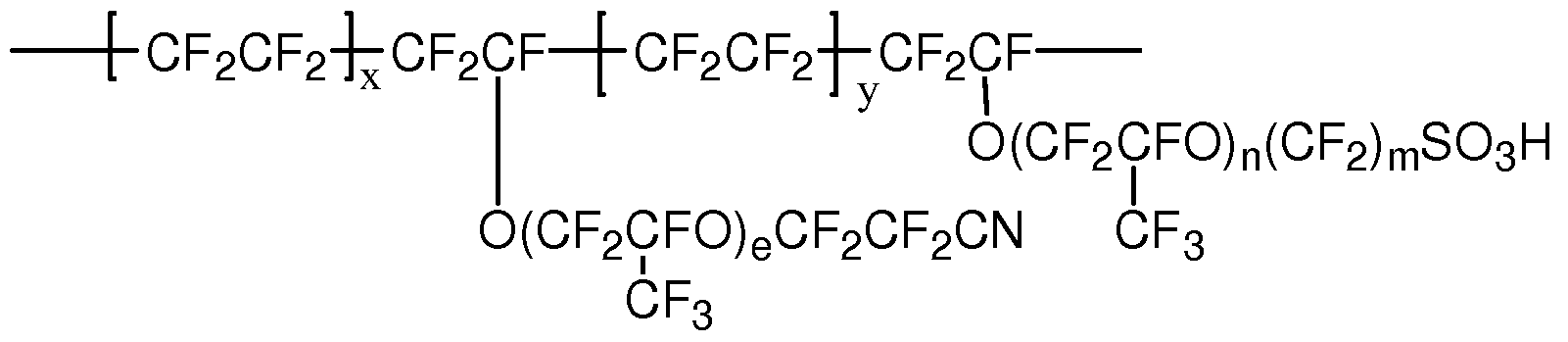
(II) (II)
其中 e=l;n=l; m=2; x=13; y=ll, 数均分子量 160000 (树脂的合成参照 CN200910230762.x„ ) Wherein e=l; n=l; m=2; x=13; y=ll, number average molecular weight 160000 (recombination of resin reference CN200910230762.x„)
然后流延成膜, 将湿膜在 190°C处理 20分钟, 得到厚度为 60微米的交 联的复合膜。 实施例 2 Then, the film was cast and the wet film was treated at 190 ° C for 20 minutes to obtain a crosslinked composite film having a thickness of 60 μm. Example 2
15%混合全氟橫酸树脂, 其中树脂 A, 结构式为 15% mixed perfluoroic acid resin, in which resin A, structural formula is

(IV) x=5; n=0; p=2; 交换容量 1.35mmol/g, 数均分子量为 230000 和树脂 B, 结构式为

(II) (II)
e=2; n=l; m=3; x=10; y=5, 交换容量: 0.90mmol/g; 数均分子量 250000 混 合树脂(树脂 A和 B质量比 4:1 )溶于含有微量三苯基锡的丙醇 -水混合溶 液, 溶液中还混有 0.2%硝酸锰 (II), 和经如实施例 1改性方法, e=2; n=l; m=3; x=10; y=5, exchange capacity: 0.90mmol/g; number average molecular weight 250,000 mixed resin (resin A and B mass ratio 4:1) soluble in trace three a propanol-water mixed solution of phenyl tin, which is further mixed with 0.2% manganese (II) nitrate, and modified by the method of Example 1,
F2C=CF F 2 C=CF
0(CF2CFO)eCF2CF2CN 0(CF 2 CFO) e CF 2 CF 2 CN
CF3 CF 3
(I) 其中 e=2 (I) where e=2
改性的聚四氟乙烯纤维 (直径 0.05μηι, 长度 5μηι, 改性纤维与树脂的质量 比为 1:40), 喷涂成膜。 然后, 将湿膜样品在烘箱内于 200°C干燥处理 60秒, 得到 20μιη的复合膜。 实施例 3 The modified polytetrafluoroethylene fiber (diameter 0.05 μm, length 5 μηι, mass ratio of modified fiber to resin: 1:40) was sprayed into a film. Then, the wet film sample was dried in an oven at 200 ° C for 60 seconds to obtain a 20 μm composite film. Example 3
将全氟横酸树脂 Α, 重复单元结构式为 Perfluoro-cross-acid resin Α, repeat unit structure is

(IV) (IV)
x=6, n=0; p=4; 交换容量 1.25mmol/g, 数均分子量为 280000和树脂 B, 复单元结构式为 x=6, n=0; p=4; exchange capacity 1.25mmol/g, number average molecular weight: 280,000 and resin B, complex unit structure

e=2; n=l; m=3; x=10; y=5, 交换容量: 0.90mmol/g; 数均分子量 250000 制备得到质量浓度为 10%异丙醇-丙醇-水溶液(其中质量比 A:B=5: 1), 其 中还含有 5%La (III) -DMF络合物、 微量三苯基锡和经如实施例 1改性方 法, 被 e=2; n=l; m=3; x=10; y=5, exchange capacity: 0.90 mmol/g; number average molecular weight 250,000 prepared to obtain a mass concentration of 10% isopropanol-propanol-water solution (where mass Ratio A: B = 5: 1), which also contains 5% La (III) -DMF complex, traces of triphenyltin and modified by the method of Example 1,
F2C=CF F 2 C=CF
0(CF2CFO)eCF2CF2CN 0(CF 2 CFO) e CF 2 CF 2 CN
CF3 CF 3
(I) 其中 e=3 (I) where e=3
接枝的聚全氟丙基乙婦基醚纤维(直径 0.005μηι, 长度 0.07微米, 纤维与树 脂的质量比为 25:100) (直径 0.005um的聚全氟丙基乙婦基醚纤维可通过静 电纺丝(US Patent 20090032475 )获得) , 利用丝网印刷得湿膜, 在 240°C 加热 10分钟后, 得到厚度为 11微米的膜。 实施例 4 Grafted polyperfluoropropyl ethoxylate (fiber diameter 0.005μηι, length 0.07 μm, fiber to resin mass ratio 25:100) (0.005um diameter polyperfluoropropyl ethyl ether ether fiber can pass Electrospinning (obtained in US Patent 20090032475), a wet film was obtained by screen printing, and after heating at 240 ° C for 10 minutes, a film having a thickness of 11 μm was obtained. Example 4
经如实施例 1改性方法, 被 By the modification method of Example 1,
F2C=CF F 2 C=CF
0(CF2CFO)eCF2CF2CN 0(CF 2 CFO) e CF 2 CF 2 CN
CF3 CF 3
(I) (I)
其中 e=3 Where e=3
和 with
F2C=CF F 2 C=CF
0(CF2CFO)eCF2CF2CN 0(CF 2 CFO) e CF 2 CF 2 CN
CF3 CF 3
(I) 其中 e=l (I) where e=l
接枝的聚全氟丙基乙婦基醚纤维(teflon FPE) (两种接枝的质量比 1:1)直 径为 15μηι长 2mm, 纤维与树脂的质量比为 0.5:5 ) 将其分散于 5%全氟磺 酸树脂 DMF溶液, 同时溶液中还混有微量的三苯基锡及 0.05%Ce-DMF络 合物, 其中全氟橫酸树脂的重复结构式为 Grafted polyperfluoropropyl ethyl ether ether fiber (teflon FPE) (two grafts with a mass ratio of 1:1) straight The diameter is 15μηι and the length is 2mm, and the fiber to resin mass ratio is 0.5:5). It is dispersed in 5% perfluorosulfonic acid resin DMF solution, and the solution is also mixed with traces of triphenyltin and 0.05% Ce-DMF. Compound, wherein the repeating structural formula of the perfluoroic acid resin is
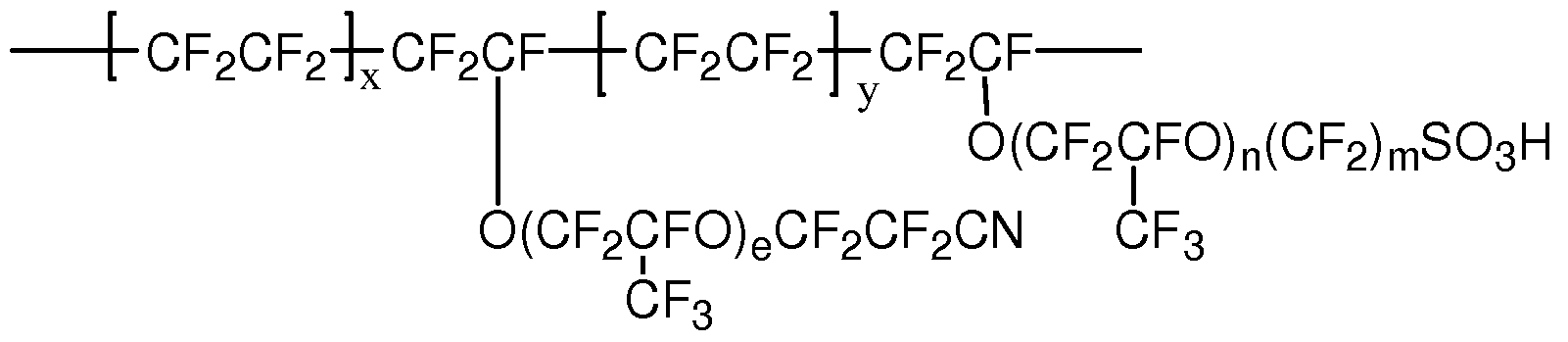
(II) (II)
e=3;n= 1; m=4; x=7; y=ll; 交换容量 0.8mmol/g, 数均分子量 310000。 将 上述分散液流延成湿膜。 然后, 将湿膜样品在烘箱内于 100°C干燥处理 20 秒。 再将其置于 190°C处理 20分钟, 得到厚度为 31微米的复合膜。 实施例 5 e = 3; n = 1; m = 4; x = 7; y = ll; exchange capacity 0.8 mmol/g, number average molecular weight 310,000. The above dispersion was cast into a wet film. Then, the wet film sample was dried in an oven at 100 ° C for 20 seconds. Further, it was treated at 190 ° C for 20 minutes to obtain a composite film having a thickness of 31 μm. Example 5
将如实施例 1改性方法, 被 Will be modified as in Example 1, by
F2C=CF F 2 C=CF
0(CF2CFO)eCF2CF2CN 0(CF 2 CFO) e CF 2 CF 2 CN
CF3 CF 3
(I) (I)
其中 e=2 Where e=2
和 with
F2C=CF F 2 C=CF
0(CF2CFO)eCF2CF2CN 0(CF 2 CFO) e CF 2 CF 2 CN
CF3 CF 3
(I) 其中 e=l (I) where e=l
两者质量比为 1: 1共同接枝的聚偏氟乙烯纤维(购置上海 3F) (直径 3μηι、 长度 50~70μηι ), 分散于 30 %全氟橫酸树脂、 0.01%的硝酸辞的 DMSO溶液 和少量三苯基锡(纤维: 全氟磺酸树脂 =5:100质量比), 其中全氟横酸树脂 的结构式为

(III) (III)
a=9; b=6; c=3; a,=b,=c,=l; j=l, 数均分子量 170000喷涂成膜。 a=9; b=6; c=3; a,=b,=c,=l; j=l, number average molecular weight 170000 sprayed into a film.
然后, 将湿膜样品在烘箱内于 250°C干燥处理 20分钟, 得到厚度为 50 微米的复合膜。 实施例 6 Then, the wet film sample was dried in an oven at 250 ° C for 20 minutes to obtain a composite film having a thickness of 50 μm. Example 6
取被与实施例 5相同的两种含腈基单体(质量比为 2: 1 )共同接枝的聚 全氟乙丙烯纤维(直径 30μηι, 长度 3mm, 纤维与树脂的质量比为 2:100) 加入到 20%全氟磺酸树脂和 2%碳酸锰 (II)及微量的三苯基锡的丙醇 -水 溶液, 其中全氟橫酸树脂的结构式为 A polyperfluoroethylene propylene fiber (diameter 30 μηι, length 3 mm, mass ratio of fiber to resin of 2:100) co-grafted with the same two nitrile group-containing monomers (mass ratio: 2:1) as in Example 5 was taken. Adding a 20% perfluorosulfonic acid resin and 2% manganese carbonate (II) and a trace amount of triphenyltin in a propanol-water solution, wherein the structural formula of the perfluoro-cross-acid resin is
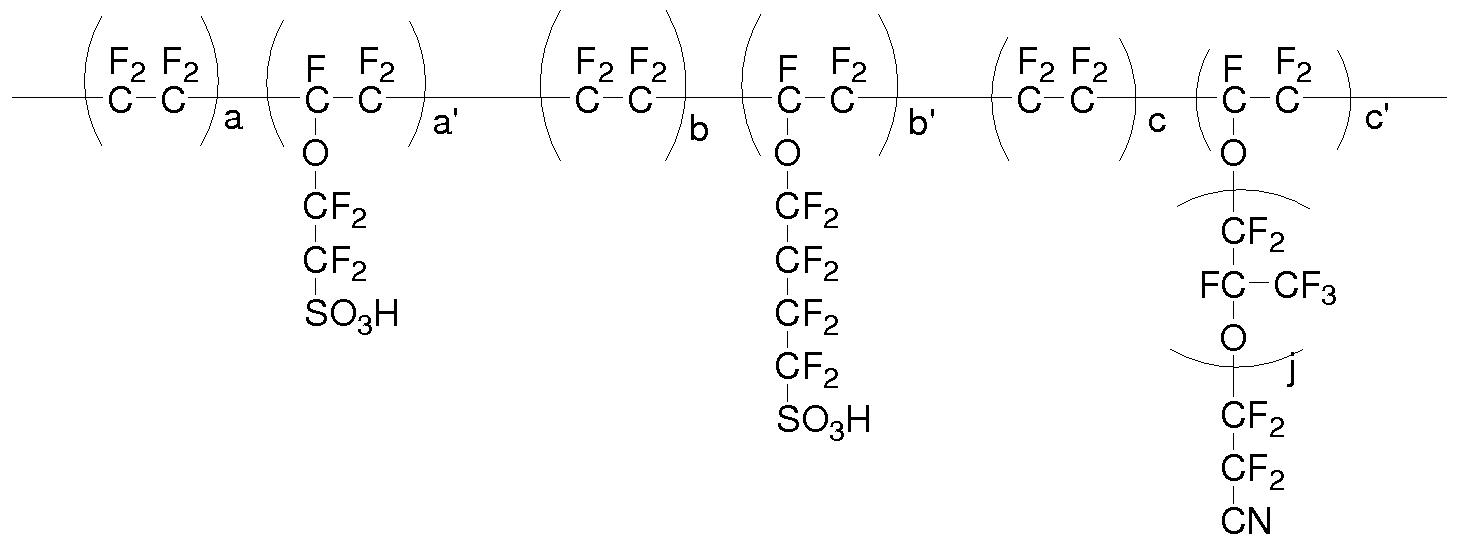
(III) (III)
a=ll; b=7; c=5; a,=b,=c,=l; j=l数均分子量 170000喷涂成膜。 将湿膜样 品在烘箱内于 180°C干燥处理 20分钟。 制备得到厚度 50μηι的复合膜。 实施例 7 a = ll; b = 7; c = 5; a, = b, = c, = l; j = l number average molecular weight 170,000 sprayed into a film. The wet film samples were dried in an oven at 180 ° C for 20 minutes. A composite film having a thickness of 50 μm was prepared. Example 7
将 Will
F2C=CF F 2 C=CF
0(CF2CFO)eCF2CF2CN 0(CF 2 CFO) e CF 2 CF 2 CN
CF3 CF 3
(I) 其中 e=3 (I) Where e=3
和 with
F2C=CF F 2 C=CF
0(CF2CFO)eCF2CF2CN 0(CF 2 CFO) e CF 2 CF 2 CN
CF3 CF 3
(I) (I)
其中 e=l Where e=l
(两种接枝的质量比 1:1 )接枝的聚四氟乙烯纤维(直径 0.5μηι; 长度 1mm) 分散于 30 %混合全氟磺酸树脂和 5%环糊精 -钒、 及微量四苯基锑的 NMP溶 液中浸泡(纤维与树脂的质量比为 10:100), 其中全氟橫酸树脂中树脂 A的 结构式为 (Two grafts with a mass ratio of 1:1) grafted polytetrafluoroethylene fibers (0.5 μηη diameter; length 1 mm) dispersed in 30% mixed perfluorosulfonic acid resin and 5% cyclodextrin-vanadium, and trace four Soaking in a NMP solution of phenylhydrazine (mass ratio of fiber to resin is 10:100), wherein the structural formula of resin A in perfluoro-cross-acid resin is

(V) (V)
c=7; d=5; c,=d,=l, 数均分子量 210000 c=7; d=5; c,=d,=l, number average molecular weight 210000
和树脂 B, 结构式为 And resin B, the structural formula is

(II) (II)
e=2; n= 1; m=3; x=9; y=10, 数均分子量 170000混合树脂溶液( A:B质量 比为 1:2), 然后将上述分散液流延成膜。 将湿膜样品在烘箱内于 230°C干燥 处理 20分钟得到厚度为 25μηι复合膜。 实施例 8 e = 2; n = 1; m = 3; x = 9; y = 10, a number average molecular weight of 170,000 mixed resin solution (A: B mass ratio of 1:2), and then the above dispersion was cast into a film. The wet film sample was dried in an oven at 230 ° C for 20 minutes to obtain a composite film having a thickness of 25 μm. Example 8
将 F2C=CF will F 2 C=CF
0(CF2CFO)eCF2CF2CN 0(CF 2 CFO) e CF 2 CF 2 CN
CF3 CF 3
( I) (I)
其中 e=3 Where e=3
接枝的聚四氟乙烯纤维 (直径 20μηι, 长度 3mm, )分散于 10%混合全氟橫 酸树脂和 10%的硫酸锰、 微量三苯基锡曱醇-水溶液(纤维与树脂的质量比 为 0.5:100), 其中全氟橫酸树脂中树脂 A结构式为 The grafted polytetrafluoroethylene fiber (diameter 20μηι, length 3mm) is dispersed in 10% mixed perfluoroic acid resin and 10% manganese sulfate, and trace triphenyl tin sterol-water solution (the ratio of fiber to resin is 0.5:100), wherein the structural formula of the resin A in the perfluoro-cross-acid resin is

(III ) (III)
a=9; b=7; c=5; a,=b,=c,=l; j=l, 数均分子量 170000 a=9; b=7; c=5; a,=b,=c,=l; j=l, number average molecular weight 170000
和树脂 B, 结构式为 And resin B, the structural formula is

( IV) (IV)
x=5; n=0; p=4; 交换容量 1.20mmol/g, 数均分子量 250000然后将上述 散液流延成膜并在 150°C热处理 2分钟后, 得厚度为 50μηι复合膜。 实施例 9 x = 5; n = 0; p = 4; exchange capacity 1.20 mmol/g, number average molecular weight: 250,000. Then, the above-mentioned dispersion was cast into a film and heat-treated at 150 ° C for 2 minutes to obtain a composite film having a thickness of 50 μm. Example 9
将纤维直径 30μηι, 长度 3mm聚全氟乙丙烯纤维(如杜邦 Teflon FEP 纤维)在等离子体发生器中, 在 I Pa, 利用 Ar为工作气体, 产生等离子体 与如下单体接枝: F2C=CF A fiber having a diameter of 30 μm and a length of 3 mm of perfluoroethylene-propylene fibers (such as DuPont Teflon FEP fiber) is implanted in a plasma generator at I Pa using Ar as a working gas to generate a plasma grafted with the following monomers: F 2 C=CF
0(CF2CFO)eCF2CF2CN 0(CF 2 CFO) e CF 2 CF 2 CN
CF3 CF 3
(I) (I)
其中 e=l Where e=l
混合于含微量三苯基锡的 25%全氟磺酸树脂 (纤维与树脂的质量比为 Mixed with 25% perfluorosulfonic acid resin containing traces of triphenyltin (the ratio of fiber to resin is
0.5:100)的乙醇 -水溶液中(水醇质量比为 1:1),其中全氟橫酸树脂的结构式 为 0.5:100) in ethanol-water solution (mass ratio of water to alcohol is 1:1), wherein the structural formula of perfluoro-cross-acid resin is

(II) 其中 e=l;n=l; m=2; x=13; y=ll, 数均分子量 160000 (树脂的合成参照 CN200910230762.x)„ (II) where e = l; n = l; m = 2; x = 13; y = ll, number average molecular weight 160000 (recombination of resin reference CN200910230762.x)
然后流延成膜, 将湿膜在 190°C处理 20分钟, 得到厚度为 60微米的交 联的复合膜。 实施例 10 Then, the film was cast and the wet film was treated at 190 ° C for 20 minutes to obtain a crosslinked composite film having a thickness of 60 μm. Example 10
全氟磺酸树脂, 结构式为 Perfluorosulfonic acid resin, the structural formula is
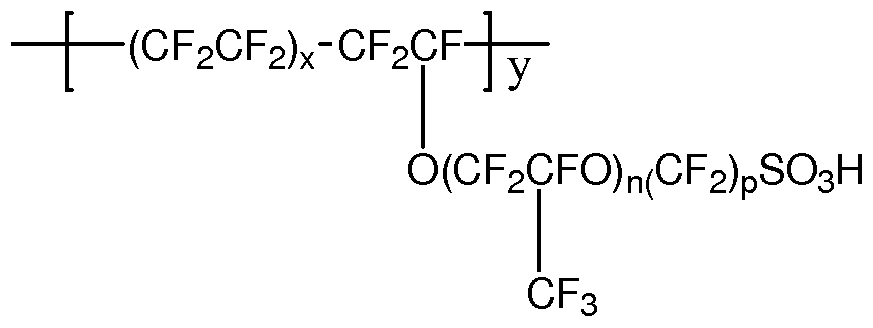
(IV) (IV)
x=5; n=0; p=4; 交换容量 1.2mmol/g, 数均分子量 180000的 15%异丙醇- 丙醇-水溶液。 x = 5; n = 0; p = 4; 15% isopropanol-propanol-water solution having an exchange capacity of 1.2 mmol/g and a number average molecular weight of 180,000.
聚四氟乙烯纤维直径为 0.01微米, 长度为 120微米,占总质量的 5%, 利 用上述溶液, 通过丝网印刷的方法得到厚度为 20微米的普通复合离子膜。 实施例 11 The polytetrafluoroethylene fiber has a diameter of 0.01 μm and a length of 120 μm, which accounts for 5% of the total mass. Using the above solution, a common composite ion film having a thickness of 20 μm is obtained by screen printing. Example 11
本实施例用于比较说明实施例 1-10制备的复合膜的各项性能。 对各种膜的性能进行表征, 结果见表 1。 由表 1可以看出, 本发明的复 合膜的 95 °C电导率、拉伸强度、 氢气渗透电流, 尺寸变化率等性能均优于普 通复合离子膜。 电导率值的测试条件分别为 T=95 °C , 饱和湿度下, 以及 T=25 °C , 干燥器干燥两天后; 拉伸强度的测试方法为 国标法 ( GB/T20042.3-2009 )、 氢气渗透电流的测试方法为电化学方法 ( Electrochemical and Solid-State Letters, 10 ,5, B101-B104 2007) This example was used to compare the properties of the composite membranes prepared in Examples 1-10. The properties of the various films were characterized and the results are shown in Table 1. It can be seen from Table 1 that the composite membrane of the present invention has better electrical conductivity, tensile strength, hydrogen permeation current, dimensional change rate and the like than ordinary composite ion membranes. The test conditions of conductivity values are T=95 °C, saturated humidity, and T=25 °C, and the dryer is dried for two days. The test method of tensile strength is the national standard method (GB/T20042.3-2009). The test method for hydrogen permeation current is electrochemical method (Electrochemical and Solid-State Letters, 10, 5, B101-B104 2007)
表 1 各种膜表征 Table 1 Various film characterization
编号 测试条件和方法 测试结果 电导率 实施例 9膜 T=95°C 0.0290/0.0116 No. Test conditions and methods Test results Conductivity Example 9 Membrane T=95°C 0.0290/0.0116
( S/cm ) 实施例 10膜 饱和湿度下 /T=25°C干 0.0216/0.0041 (S/cm) Example 10 Membrane at Saturated Humidity /T=25°C Dry 0.0216/0.0041
实施例 1膜 燥器干燥两天 0.0298/0.0118 实施例 2膜 0.0287/0.0134 实施例 3膜 0. 0299/0.0123 实施例 4膜 0.0299/0.0128 实施例 5膜 0.0308/0.0129 实施例 6膜 0.0313/0.0123 实施例 7膜 0.0323/0.0121 实施例 8膜 0.0334/0.0133 拉伸强度 实施例 9膜 国标 32 Example 1 Film Dryer Drying for Two Days 0.0298/0.0118 Example 2 Film 0.0287/0.0134 Example 3 Film 0. 0299/0.0123 Example 4 Film 0.0299/0.0128 Example 5 Film 0.0308/0.0129 Example 6 Film 0.0313/0.0123 Implementation Example 7 Film 0.0323/0.0121 Example 8 Film 0.0334/0.0133 Tensile Strength Example 9 Membrane National Standard 32
( MPa ) 实施例 10膜 ( GB/T20042. 3-2009 ) 30 ( MPa ) Example 10 film (GB/T20042. 3-2009) 30
实施例 1膜 35 Example 1 Film 35
实施例 2膜 34 Example 2 Film 34
实施例 3膜 36 Example 3 Film 36
实施例 4膜 37 Example 4 Film 37
实施例 5膜 36 Example 5 Membrane 36
实施例 6膜 38 Example 6 Film 38
实施例 7膜 37 Example 7 Film 37
实施例 8膜 38 Example 8 Film 38
氢气渗透电 实施例 9膜 电化学方法 2 Hydrogen permeation electricity Example 9 Membrane Electrochemical method 2
流 实施例 10膜 >4 Flow Example 10 Membrane >4
(mA/cm2) 实施例 1膜 0.11 (mA/cm 2 ) Example 1 Film 0.11
实施例 2膜 0.11 Example 2 Film 0.11
实施例 3膜 0.08 实施例 4膜 0.10 实施例 5膜 0.10 实施例 6膜 0.07 实施例 7膜 0.09 实施例 8膜 0.08 尺寸变化率 实施例 9膜 ( GB/T20042. 3-2009 ) 5Example 3 film 0.08 Example 4 Film 0.10 Example 5 Film 0.10 Example 6 Film 0.07 Example 7 Film 0.09 Example 8 Film 0.08 Size Change Rate Example 9 Film (GB/T20042. 3-2009) 5
(%) 实施例 10膜 8 (%) Example 10 film 8
实施例 1膜 1.2 实施例 2膜 1.5 实施例 3膜 1 实施例 4膜 1.3 实施例 5膜 0.9 实施例 6膜 2.1 实施例 7膜 1.1 实施例 8膜 1.1 Example 1 Film 1.2 Example 2 Film 1.5 Example 3 Film 1 Example 4 Film 1.3 Example 5 Film 0.9 Example 6 Film 2.1 Example 7 Film 1.1 Example 8 Film 1.1
Claims


Priority Applications (5)
| Application Number | Priority Date | Filing Date | Title |
|---|---|---|---|
| US13/805,329 US9017899B2 (en) | 2010-06-18 | 2010-06-18 | Fluorine containing ionomer composite with ion exchange function, preparation method and use thereof |
| CA2802973A CA2802973C (en) | 2010-06-18 | 2010-06-18 | Fluorine containing ionomer composite with ion exchange function, preparation method and use thereof |
| PCT/CN2010/000896 WO2011156938A1 (en) | 2010-06-18 | 2010-06-18 | Fluorine containing ionomer composite with ion exchange function, preparation method and use thereof |
| JP2013514513A JP5748844B2 (en) | 2010-06-18 | 2010-06-18 | Fluorine-containing ionomer complex having ion exchange function, preparation method and use thereof |
| EP10853048.6A EP2583747B1 (en) | 2010-06-18 | 2010-06-18 | Fluorine containing ionomer composite with ion exchange function, preparation method and use thereof |
Applications Claiming Priority (1)
| Application Number | Priority Date | Filing Date | Title |
|---|---|---|---|
| PCT/CN2010/000896 WO2011156938A1 (en) | 2010-06-18 | 2010-06-18 | Fluorine containing ionomer composite with ion exchange function, preparation method and use thereof |
Publications (1)
| Publication Number | Publication Date |
|---|---|
| WO2011156938A1 true WO2011156938A1 (en) | 2011-12-22 |
Family
ID=45347619
Family Applications (1)
| Application Number | Title | Priority Date | Filing Date |
|---|---|---|---|
| PCT/CN2010/000896 Ceased WO2011156938A1 (en) | 2010-06-18 | 2010-06-18 | Fluorine containing ionomer composite with ion exchange function, preparation method and use thereof |
Country Status (5)
| Country | Link |
|---|---|
| US (1) | US9017899B2 (en) |
| EP (1) | EP2583747B1 (en) |
| JP (1) | JP5748844B2 (en) |
| CA (1) | CA2802973C (en) |
| WO (1) | WO2011156938A1 (en) |
Cited By (1)
| Publication number | Priority date | Publication date | Assignee | Title |
|---|---|---|---|---|
| CN113381046A (en) * | 2021-03-29 | 2021-09-10 | 浙江汉丞新能源有限公司 | Preparation method of special enhanced fluorine-containing composite membrane or membrane electrode |
Families Citing this family (9)
| Publication number | Priority date | Publication date | Assignee | Title |
|---|---|---|---|---|
| US9017899B2 (en) | 2010-06-18 | 2015-04-28 | Shandong Huaxia Shenzhou New Material Co., Ltd. | Fluorine containing ionomer composite with ion exchange function, preparation method and use thereof |
| US8927612B2 (en) * | 2010-06-18 | 2015-01-06 | Shandong Huaxia Shenzhou New Material Co., Ltd. | Composite having ion exchange function and preparation method and use thereof |
| US9855534B1 (en) * | 2016-12-28 | 2018-01-02 | Pall Corporation | Porous PTFE membranes for metal removal |
| WO2018231232A1 (en) * | 2017-06-15 | 2018-12-20 | W. L. Gore & Associates, Inc. | Highly reinforced ionomer membranes for high selectivity and high strength |
| US12230850B2 (en) | 2017-06-15 | 2025-02-18 | W. L. Gore & Associates, Inc. | Highly reinforced ionomer membranes for high selectivity and high strength |
| CN111808309A (en) * | 2020-06-22 | 2020-10-23 | 山东东岳高分子材料有限公司 | High proton conduction perfluorosulfonic acid ion exchange membrane and preparation method thereof |
| CN115948012B (en) * | 2022-11-30 | 2023-12-19 | 华电重工股份有限公司 | Fiber reinforced proton exchange membrane for hydrogen production by water electrolysis and preparation method thereof |
| CN115976683A (en) * | 2022-11-30 | 2023-04-18 | 华电重工股份有限公司 | Reinforcing material prepared from fluorine-containing ionic polymer and application of reinforcing material in proton exchange membrane |
| CN120209378A (en) * | 2025-04-08 | 2025-06-27 | 戈尔(青岛)氢能科技有限公司 | Method for preparing perfluorosulfonic acid solution and perfluorosulfonic acid ion membrane using discarded ion membrane |
Citations (17)
| Publication number | Priority date | Publication date | Assignee | Title |
|---|---|---|---|---|
| US3933767A (en) | 1972-06-14 | 1976-01-20 | E. I. Du Pont De Nemours And Company | Cyanoperfluoroether acid fluorides and copolymers derived therefrom |
| JPH0575835B2 (en) | 1985-04-22 | 1993-10-21 | Japan Gore Tex Inc | |
| JPH06231779A (en) | 1993-01-29 | 1994-08-19 | Asahi Glass Co Ltd | Solid high polymer electrolytic type fuel cell |
| JPH0768377B2 (en) | 1987-07-20 | 1995-07-26 | 東燃株式会社 | Electrolyte thin film |
| US5547551A (en) | 1995-03-15 | 1996-08-20 | W. L. Gore & Associates, Inc. | Ultra-thin integral composite membrane |
| US5599614A (en) | 1995-03-15 | 1997-02-04 | W. L. Gore & Associates, Inc. | Integral composite membrane |
| JPH10340732A (en) * | 1997-06-06 | 1998-12-22 | Toyota Central Res & Dev Lab Inc | Solid electrolyte composite film |
| EP0875524B1 (en) | 1997-04-25 | 2002-04-03 | Johnson Matthey Public Limited Company | Composite membranes |
| US6692858B2 (en) | 2000-03-31 | 2004-02-17 | Asahi Glass Company, Limited | Electrolyte membrane for polymer electrolyte fuel cell and producing method thereof |
| EP1464671A1 (en) | 2001-12-17 | 2004-10-06 | Daikin Industries, Ltd. | Elastomer formed product |
| US20090032475A1 (en) | 2007-08-01 | 2009-02-05 | Ismael Ferrer | Fluoropolymer fine fiber |
| CN101350419B (en) * | 2008-07-22 | 2010-04-14 | 山东东岳神舟新材料有限公司 | Fiber-reinforced fluorine-containing cross-linking ionic membrane and preparation method thereof |
| CN101020758B (en) * | 2007-02-25 | 2010-05-19 | 山东东岳神舟新材料有限公司 | Ion exchange polymer film and its preparation method |
| CN101733011A (en) * | 2009-12-10 | 2010-06-16 | 山东东岳神舟新材料有限公司 | Fiber reinforced perfluoro dual crosslinked ion membrane and preparation method thereof |
| CN101733016A (en) * | 2009-12-10 | 2010-06-16 | 山东东岳神舟新材料有限公司 | Functional group grafted porous membrane compound perfluorinated ion exchange membrane |
| CN101733005A (en) * | 2009-12-10 | 2010-06-16 | 山东东岳神舟新材料有限公司 | Modified cross-linked perfluorinated ion-exchange membrane |
| CN101733020A (en) * | 2009-12-10 | 2010-06-16 | 山东东岳神舟新材料有限公司 | Fiber reinforced fluorine-containing crosslinked ion membrane and preparation method thereof |
Family Cites Families (20)
| Publication number | Priority date | Publication date | Assignee | Title |
|---|---|---|---|---|
| JPS5837030A (en) * | 1981-08-29 | 1983-03-04 | Tokuyama Soda Co Ltd | Perfluorocarbon cation exchange resin membrane |
| JPH01224009A (en) * | 1988-03-04 | 1989-09-07 | Asahi Chem Ind Co Ltd | Treatment of graft membrane |
| JP3400847B2 (en) * | 1994-03-31 | 2003-04-28 | 旭硝子株式会社 | Method for producing cross-linked amorphous fluoropolymer and amorphous fluoropolymer solution composition |
| US6254978B1 (en) | 1994-11-14 | 2001-07-03 | W. L. Gore & Associates, Inc. | Ultra-thin integral composite membrane |
| US6281296B1 (en) * | 1998-08-10 | 2001-08-28 | Dupont Dow Elastomers L.L.C. | Curable perfluoroelastomer composition |
| CA2328433A1 (en) * | 2000-12-20 | 2002-06-20 | Hydro-Quebec | Cross-linkable low tg fluorosulfonated nitrile elastomers with a vinylidene fluoride base and not containing either tetrafluoroethylene or the siloxane group |
| JP2004525204A (en) * | 2000-12-29 | 2004-08-19 | ザ・ユニバーシティ・オブ・オクラホマ | Conducting polyamine-based electrolytes |
| CN1308381C (en) * | 2002-07-26 | 2007-04-04 | 旭硝子株式会社 | Polymer membrane, process for its production and membrane-electrode assembly for solid polymer electrolyte fuel cells |
| TW200504095A (en) | 2003-06-27 | 2005-02-01 | Du Pont | Fluorinated sulfonamide compounds and polymer electrolyte membranes prepared therefrom for use in electrochemical cells |
| ATE509383T1 (en) | 2003-07-31 | 2011-05-15 | Toyo Boseki | ELECTROLYTE MEMBRANE ELECTRODE ASSEMBLY, FUEL CELL THEREFROM AND METHOD FOR PRODUCING AN ELECTROLYTE MEMBRANE ELECTRODE ASSEMBLY |
| US7259208B2 (en) | 2003-11-13 | 2007-08-21 | 3M Innovative Properties Company | Reinforced polymer electrolyte membrane |
| US7074841B2 (en) * | 2003-11-13 | 2006-07-11 | Yandrasits Michael A | Polymer electrolyte membranes crosslinked by nitrile trimerization |
| JP4079893B2 (en) * | 2004-02-20 | 2008-04-23 | セントラル硝子株式会社 | Fluorine-containing cyclic compound, fluorine-containing polymer compound, resist material and pattern forming method using the same |
| WO2007068822A2 (en) | 2005-12-12 | 2007-06-21 | Phostech Lithium Inc. | Sulphonyl-1,2,4-triazole salts |
| CN100588676C (en) * | 2007-02-25 | 2010-02-10 | 山东东岳神舟新材料有限公司 | A kind of perfluorinated proton exchange membrane with cross-linked structure and its preparation method and application |
| CN100580987C (en) * | 2008-07-22 | 2010-01-13 | 山东东岳神舟新材料有限公司 | A microporous membrane reinforced fluorine-containing cross-linked ion exchange membrane and its preparation method |
| CN101670246B (en) | 2008-07-22 | 2011-11-23 | 山东东岳神舟新材料有限公司 | A kind of microporous membrane reinforced multi-layer fluorine-containing cross-linked doped ion membrane and preparation method thereof |
| US8658707B2 (en) | 2009-03-24 | 2014-02-25 | W. L. Gore & Associates, Inc. | Expandable functional TFE copolymer fine powder, the expanded functional products obtained therefrom and reaction of the expanded products |
| US9139669B2 (en) * | 2009-03-24 | 2015-09-22 | W. L. Gore & Associates, Inc. | Expandable functional TFE copolymer fine powder, the expandable functional products obtained therefrom and reaction of the expanded products |
| US9017899B2 (en) | 2010-06-18 | 2015-04-28 | Shandong Huaxia Shenzhou New Material Co., Ltd. | Fluorine containing ionomer composite with ion exchange function, preparation method and use thereof |
-
2010
- 2010-06-18 US US13/805,329 patent/US9017899B2/en active Active
- 2010-06-18 CA CA2802973A patent/CA2802973C/en active Active
- 2010-06-18 WO PCT/CN2010/000896 patent/WO2011156938A1/en not_active Ceased
- 2010-06-18 JP JP2013514513A patent/JP5748844B2/en active Active
- 2010-06-18 EP EP10853048.6A patent/EP2583747B1/en active Active
Patent Citations (18)
| Publication number | Priority date | Publication date | Assignee | Title |
|---|---|---|---|---|
| US3933767A (en) | 1972-06-14 | 1976-01-20 | E. I. Du Pont De Nemours And Company | Cyanoperfluoroether acid fluorides and copolymers derived therefrom |
| JPH0575835B2 (en) | 1985-04-22 | 1993-10-21 | Japan Gore Tex Inc | |
| JPH0768377B2 (en) | 1987-07-20 | 1995-07-26 | 東燃株式会社 | Electrolyte thin film |
| JPH06231779A (en) | 1993-01-29 | 1994-08-19 | Asahi Glass Co Ltd | Solid high polymer electrolytic type fuel cell |
| US5547551A (en) | 1995-03-15 | 1996-08-20 | W. L. Gore & Associates, Inc. | Ultra-thin integral composite membrane |
| US5599614A (en) | 1995-03-15 | 1997-02-04 | W. L. Gore & Associates, Inc. | Integral composite membrane |
| US5635041A (en) | 1995-03-15 | 1997-06-03 | W. L. Gore & Associates, Inc. | Electrode apparatus containing an integral composite membrane |
| EP0875524B1 (en) | 1997-04-25 | 2002-04-03 | Johnson Matthey Public Limited Company | Composite membranes |
| JPH10340732A (en) * | 1997-06-06 | 1998-12-22 | Toyota Central Res & Dev Lab Inc | Solid electrolyte composite film |
| US6692858B2 (en) | 2000-03-31 | 2004-02-17 | Asahi Glass Company, Limited | Electrolyte membrane for polymer electrolyte fuel cell and producing method thereof |
| EP1464671A1 (en) | 2001-12-17 | 2004-10-06 | Daikin Industries, Ltd. | Elastomer formed product |
| CN101020758B (en) * | 2007-02-25 | 2010-05-19 | 山东东岳神舟新材料有限公司 | Ion exchange polymer film and its preparation method |
| US20090032475A1 (en) | 2007-08-01 | 2009-02-05 | Ismael Ferrer | Fluoropolymer fine fiber |
| CN101350419B (en) * | 2008-07-22 | 2010-04-14 | 山东东岳神舟新材料有限公司 | Fiber-reinforced fluorine-containing cross-linking ionic membrane and preparation method thereof |
| CN101733011A (en) * | 2009-12-10 | 2010-06-16 | 山东东岳神舟新材料有限公司 | Fiber reinforced perfluoro dual crosslinked ion membrane and preparation method thereof |
| CN101733016A (en) * | 2009-12-10 | 2010-06-16 | 山东东岳神舟新材料有限公司 | Functional group grafted porous membrane compound perfluorinated ion exchange membrane |
| CN101733005A (en) * | 2009-12-10 | 2010-06-16 | 山东东岳神舟新材料有限公司 | Modified cross-linked perfluorinated ion-exchange membrane |
| CN101733020A (en) * | 2009-12-10 | 2010-06-16 | 山东东岳神舟新材料有限公司 | Fiber reinforced fluorine-containing crosslinked ion membrane and preparation method thereof |
Non-Patent Citations (3)
| Title |
|---|
| ELECTROCHEMICAL METHOD AND SOLID-STATE LETTERS, vol. 10, no. 5, 2007, pages B101 - B104 |
| JOURNAL OF TIANJIN POLYTECHNIC UNIVERSITY, vol. 27, no. 5, 2008, pages 33 |
| See also references of EP2583747A4 |
Cited By (2)
| Publication number | Priority date | Publication date | Assignee | Title |
|---|---|---|---|---|
| CN113381046A (en) * | 2021-03-29 | 2021-09-10 | 浙江汉丞新能源有限公司 | Preparation method of special enhanced fluorine-containing composite membrane or membrane electrode |
| CN113381046B (en) * | 2021-03-29 | 2022-11-18 | 浙江汉丞新能源有限公司 | Preparation method of enhanced fluorine-containing composite membrane or membrane electrode |
Also Published As
| Publication number | Publication date |
|---|---|
| US9017899B2 (en) | 2015-04-28 |
| US20130095411A1 (en) | 2013-04-18 |
| EP2583747A1 (en) | 2013-04-24 |
| CA2802973A1 (en) | 2011-12-22 |
| JP2013538878A (en) | 2013-10-17 |
| EP2583747B1 (en) | 2016-09-21 |
| JP5748844B2 (en) | 2015-07-15 |
| EP2583747A4 (en) | 2014-01-08 |
| CA2802973C (en) | 2017-09-12 |
Similar Documents
| Publication | Publication Date | Title |
|---|---|---|
| US8927612B2 (en) | Composite having ion exchange function and preparation method and use thereof | |
| WO2011156938A1 (en) | Fluorine containing ionomer composite with ion exchange function, preparation method and use thereof | |
| Dai et al. | SPEEK/Graphene oxide nanocomposite membranes with superior cyclability for highly efficient vanadium redox flow battery | |
| CN101728549B (en) | High-temperature proton exchange compound film | |
| US9325027B2 (en) | Preparation method of fluorine-containing ionomer composite material with ion exchange function | |
| CN101733016A (en) | Functional group grafted porous membrane compound perfluorinated ion exchange membrane | |
| CN102024958B (en) | Proton exchange membrane and preparation method and application thereof | |
| CN104134812A (en) | Fiber-net-reinforced polymer electrolyte membrane and preparation method thereof | |
| JP5189394B2 (en) | Polymer electrolyte membrane | |
| CN101745321B (en) | Micro-porous membrane reinforced perfluorinated cross-linking ion exchange membrane and preparation method thereof | |
| JP2006190627A (en) | Polymer solid electrolyte membrane with reinforcing material | |
| CN102010555B (en) | Fluorine-containing ionomer composite with ion exchange function as well as preparation method and application thereof | |
| CN102013499B (en) | Fluorine-containing ionomer composite material with function of ion exchange and preparation method and application thereof | |
| CN102013498B (en) | Fluorine-containing ionomer composite material with ion exchange function as well as preparation method and application thereof | |
| JP2022015656A (en) | Polyelectrolyte membrane and polymer electrolyte fuel cell | |
| CN101733017B (en) | Microporous membrane reinforced perfluoro crosslinked ion exchange membrane |
Legal Events
| Date | Code | Title | Description |
|---|---|---|---|
| 121 | Ep: the epo has been informed by wipo that ep was designated in this application |
Ref document number: 10853048 Country of ref document: EP Kind code of ref document: A1 |
|
| ENP | Entry into the national phase |
Ref document number: 2802973 Country of ref document: CA |
|
| REEP | Request for entry into the european phase |
Ref document number: 2010853048 Country of ref document: EP |
|
| WWE | Wipo information: entry into national phase |
Ref document number: 2010853048 Country of ref document: EP |
|
| ENP | Entry into the national phase |
Ref document number: 2013514513 Country of ref document: JP Kind code of ref document: A |
|
| NENP | Non-entry into the national phase |
Ref country code: DE |
|
| WWE | Wipo information: entry into national phase |
Ref document number: 13805329 Country of ref document: US |