WO2011141926A2 - Liquid formulation of polypeptides containing an fc domain of an immunoglobulin - Google Patents
Liquid formulation of polypeptides containing an fc domain of an immunoglobulin Download PDFInfo
- Publication number
- WO2011141926A2 WO2011141926A2 PCT/IN2011/000313 IN2011000313W WO2011141926A2 WO 2011141926 A2 WO2011141926 A2 WO 2011141926A2 IN 2011000313 W IN2011000313 W IN 2011000313W WO 2011141926 A2 WO2011141926 A2 WO 2011141926A2
- Authority
- WO
- WIPO (PCT)
- Prior art keywords
- pharmaceutical formulation
- formulation
- acid
- group
- combination
- Prior art date
- Legal status (The legal status is an assumption and is not a legal conclusion. Google has not performed a legal analysis and makes no representation as to the accuracy of the status listed.)
- Ceased
Links
Classifications
-
- A—HUMAN NECESSITIES
- A61—MEDICAL OR VETERINARY SCIENCE; HYGIENE
- A61K—PREPARATIONS FOR MEDICAL, DENTAL OR TOILETRY PURPOSES
- A61K9/00—Medicinal preparations characterised by special physical form
- A61K9/08—Solutions
-
- A—HUMAN NECESSITIES
- A61—MEDICAL OR VETERINARY SCIENCE; HYGIENE
- A61K—PREPARATIONS FOR MEDICAL, DENTAL OR TOILETRY PURPOSES
- A61K39/00—Medicinal preparations containing antigens or antibodies
- A61K39/395—Antibodies; Immunoglobulins; Immune serum, e.g. antilymphocytic serum
- A61K39/39591—Stabilisation, fragmentation
-
- A—HUMAN NECESSITIES
- A61—MEDICAL OR VETERINARY SCIENCE; HYGIENE
- A61K—PREPARATIONS FOR MEDICAL, DENTAL OR TOILETRY PURPOSES
- A61K47/00—Medicinal preparations characterised by the non-active ingredients used, e.g. carriers or inert additives; Targeting or modifying agents chemically bound to the active ingredient
- A61K47/06—Organic compounds, e.g. natural or synthetic hydrocarbons, polyolefins, mineral oil, petrolatum or ozokerite
- A61K47/08—Organic compounds, e.g. natural or synthetic hydrocarbons, polyolefins, mineral oil, petrolatum or ozokerite containing oxygen, e.g. ethers, acetals, ketones, quinones, aldehydes, peroxides
- A61K47/12—Carboxylic acids; Salts or anhydrides thereof
-
- A—HUMAN NECESSITIES
- A61—MEDICAL OR VETERINARY SCIENCE; HYGIENE
- A61K—PREPARATIONS FOR MEDICAL, DENTAL OR TOILETRY PURPOSES
- A61K47/00—Medicinal preparations characterised by the non-active ingredients used, e.g. carriers or inert additives; Targeting or modifying agents chemically bound to the active ingredient
- A61K47/06—Organic compounds, e.g. natural or synthetic hydrocarbons, polyolefins, mineral oil, petrolatum or ozokerite
- A61K47/16—Organic compounds, e.g. natural or synthetic hydrocarbons, polyolefins, mineral oil, petrolatum or ozokerite containing nitrogen, e.g. nitro-, nitroso-, azo-compounds, nitriles, cyanates
- A61K47/18—Amines; Amides; Ureas; Quaternary ammonium compounds; Amino acids; Oligopeptides having up to five amino acids
- A61K47/183—Amino acids, e.g. glycine, EDTA or aspartame
-
- A—HUMAN NECESSITIES
- A61—MEDICAL OR VETERINARY SCIENCE; HYGIENE
- A61K—PREPARATIONS FOR MEDICAL, DENTAL OR TOILETRY PURPOSES
- A61K9/00—Medicinal preparations characterised by special physical form
- A61K9/0012—Galenical forms characterised by the site of application
- A61K9/0019—Injectable compositions; Intramuscular, intravenous, arterial, subcutaneous administration; Compositions to be administered through the skin in an invasive manner
-
- A—HUMAN NECESSITIES
- A61—MEDICAL OR VETERINARY SCIENCE; HYGIENE
- A61P—SPECIFIC THERAPEUTIC ACTIVITY OF CHEMICAL COMPOUNDS OR MEDICINAL PREPARATIONS
- A61P29/00—Non-central analgesic, antipyretic or antiinflammatory agents, e.g. antirheumatic agents; Non-steroidal antiinflammatory drugs [NSAID]
-
- A—HUMAN NECESSITIES
- A61—MEDICAL OR VETERINARY SCIENCE; HYGIENE
- A61K—PREPARATIONS FOR MEDICAL, DENTAL OR TOILETRY PURPOSES
- A61K31/00—Medicinal preparations containing organic active ingredients
- A61K31/185—Acids; Anhydrides, halides or salts thereof, e.g. sulfur acids, imidic, hydrazonic or hydroximic acids
- A61K31/19—Carboxylic acids, e.g. valproic acid
- A61K31/195—Carboxylic acids, e.g. valproic acid having an amino group
- A61K31/197—Carboxylic acids, e.g. valproic acid having an amino group the amino and the carboxyl groups being attached to the same acyclic carbon chain, e.g. gamma-aminobutyric acid [GABA], beta-alanine, epsilon-aminocaproic acid or pantothenic acid
- A61K31/198—Alpha-amino acids, e.g. alanine or edetic acid [EDTA]
-
- A—HUMAN NECESSITIES
- A61—MEDICAL OR VETERINARY SCIENCE; HYGIENE
- A61K—PREPARATIONS FOR MEDICAL, DENTAL OR TOILETRY PURPOSES
- A61K38/00—Medicinal preparations containing peptides
- A61K38/16—Peptides having more than 20 amino acids; Gastrins; Somatostatins; Melanotropins; Derivatives thereof
- A61K38/17—Peptides having more than 20 amino acids; Gastrins; Somatostatins; Melanotropins; Derivatives thereof from animals; from humans
-
- A—HUMAN NECESSITIES
- A61—MEDICAL OR VETERINARY SCIENCE; HYGIENE
- A61K—PREPARATIONS FOR MEDICAL, DENTAL OR TOILETRY PURPOSES
- A61K47/00—Medicinal preparations characterised by the non-active ingredients used, e.g. carriers or inert additives; Targeting or modifying agents chemically bound to the active ingredient
- A61K47/02—Inorganic compounds
-
- A—HUMAN NECESSITIES
- A61—MEDICAL OR VETERINARY SCIENCE; HYGIENE
- A61K—PREPARATIONS FOR MEDICAL, DENTAL OR TOILETRY PURPOSES
- A61K47/00—Medicinal preparations characterised by the non-active ingredients used, e.g. carriers or inert additives; Targeting or modifying agents chemically bound to the active ingredient
- A61K47/06—Organic compounds, e.g. natural or synthetic hydrocarbons, polyolefins, mineral oil, petrolatum or ozokerite
- A61K47/26—Carbohydrates, e.g. sugar alcohols, amino sugars, nucleic acids, mono-, di- or oligo-saccharides; Derivatives thereof, e.g. polysorbates, sorbitan fatty acid esters or glycyrrhizin
-
- C—CHEMISTRY; METALLURGY
- C07—ORGANIC CHEMISTRY
- C07K—PEPTIDES
- C07K2319/00—Fusion polypeptide
- C07K2319/30—Non-immunoglobulin-derived peptide or protein having an immunoglobulin constant or Fc region, or a fragment thereof, attached thereto
Definitions
- the present invention relates to an aqueous formulation comprising TNFR:Fc, methods of manufacture of the composition, methods of administration and kits containing the same.
- Tumour necrosis factor is a polypeptide cytokine involved in inflammation and the acute phase response.
- TNF-alpha is present in larger quantities in persons with rheumatoid arthritis or Crohn's disease.
- Direct inhibition of TNF-alpha by the biological agents has produced significant advances in rheumatoid arthritis treatment and has validated the extra-cellular inhibition of this pro-inflammatory cytokine as an effective therapy.
- One such biological agent is Etanercept.
- Etanercept is a dimeric fusion protein consisting of the extra-cellular ligand- binding portion of the human 75 kilo Dalton (p75) tumor necrosis factor receptor (TNFR) linked to the Fc portion of human IgGl.
- the Fc component of Etanercept consists of the CH 2 domain, the CH 3 domain and hinge region, whereas the CH 1 domain is absent. It is produced through recombinant DNA technology in a Chinese hamster ovary mammalian cell expression system. It consists of 934 amino acids, and has an apparent molecular weight of approximately 150 kilo Dalton.
- l overcome the stability problem of proteins in aqueous formulations, therapeutic protein products are made more stable via lyophilization (freeze-drying). Lyophilized products are usually accompanied by sterile aqueous media for reconstitution. After reconstitution, the formulations typically have short useful storage lives, even when stored at low temperatures (e.g., 5°C).
- Example of TNF alpha inhibitors which are available in the market in the lyophilized form are Enbrel ® and Remicade ® and both the compositions should be reconstituted before use.
- Typical practices to improve polypeptide stability can be addressed by varying the concentration of elements with the formulation, or by adding excipients to modify the formulation.
- US5580856 discloses the stabilization of dried proteins against loss of biological activity in the formulations by adding a reconstitution stabilizer upon rehydration of the dried protein.
- a kit for producing a formulation by dissolving the dried composition in a solvent containing the reconstitution stabilizer is also described.
- US6171586 discloses a stable aqueous pharmaceutical formulation comprising a therapeutically effective amount of an antibody not subjected to prior lyophilization, a buffer maintaining the pH in the range from about 4.5 to about 6.0, a surfactant and a polyol, along with uses for such a formulation.
- EP1314437 relates to an invention of stabilized preparations containing an antibody in a glycine buffer and/ or a histidine buffer and also provides processes for preparing a protein-containing stabilized preparation, comprising adjusting the pH with a basic amino acid or a basic amino acid derivative or a salt thereof.
- EP1478394 discloses about the invention that relates to an aqueous pharmaceutical composition suitable for long-term storage of polypeptides containing an Fc domain of an immunoglobulin, methods of manufacture, methods of administration and kits containing same.
- TNFR liquid formulations of TNFR: Fc having enhanced stability under refrigeration and at least moderate stability at normal room temperatures, and to avoid the inconvenience and potential for errors from the reconstitution procedure.
- the invention provides a novel liquid formulation comprising TNFR:Fc which exhibits long term stability at 4°C and room temperatures.
- the invention provides a formulation consisting of a polypeptide containing an Fc domain of an immunoglobulin and an aggregation inhibitor, wherein the aggregation inhibitor is selected from the group consisting of aspartic acid, phenylalanine, glutamic acid, alanine, histidine and lysine.
- the formulation comprises a polypeptide containing an Fc domain of an immunoglobulin, an aggregation inhibitor, buffer, a non-ionic surfactant, polyol, a stabilizer, a tonicity modifier, and a chelating agent.
- the buffer system of the novel formulation is selected from the group consisting of sodium phosphate, histidine, potassium phosphate, sodium or potassium citrate, maleic acid, ammonium acetate, tris-(hydroxymethyl)-aminomethane (tris), acetate and diethanolamine or a combination thereof.
- the formulation comprises the ionic surfactant selected from the group consisting of a polysorbate-based non-ionic surfactant and a poloxamer-based non- ionic surfactant or a combination thereof.
- the polyol of the formulation is further selected from the group consisting of sucrose, trehalose, maltose, mannitol, xylitol, maltitol and sorbitol or a combination thereof.
- the stabilizer of the formulation is selected from the group consisting of EDTA (ethylenediamine tetraacetic acid), HEDTA (hydroxyethylenediamine triacetic acid), NTA (nitriolotriacetic acid), DTPA (Diethylenetriamine pentaacetate) and citric acid or a combination thereof.
- EDTA ethylenediamine tetraacetic acid
- HEDTA hydroxyethylenediamine triacetic acid
- NTA nitriolotriacetic acid
- DTPA Diethylenetriamine pentaacetate
- the formulation provides for a tonicity modifier selected from the group consisting of sodium chloride, potassium chloride, sodium sulfate or a combination thereof.
- the formulation of the present invention encompasses TNFR:Fc comprising aspartic acid, sodium-potassium phosphate buffer, lysine, sodium chloride, sucrose, polysorbate 20 and di sodium ethylene diamine tetra acetic acid wherein TNFR:Fc is present at a concentration of 10 mg/ml to 100 mg/ml.
- Figure la Non-reducing
- Figure lb Reducing
- Figure 2a Non-reducing
- Figure 2b Reducing shows the comparison of degradation pattern of Etanercept formulations with different aggregation inhibitors kept at 40°C for 1 month.
- Figure 3a Non-reducing
- Figure 3b Reducing shows the comparison of degradation pattern of Etanercept formulations with different aggregation inhibitors kept at 47°C for 16 hours.
- Lane 2 F-3 as given in Table 1
- Lane 3 F-l as given in Table 1
- Figure 4 shows the comparison of degradation pattern of Etanercept formulations with different aggregation inhibitors kept at 55°C for 24 hours.
- Figure 5a Non-reducing
- Figure 5b Reducing shows the comparison of degradation pattern of Etanercept formulations with lysine as stabilizer, kept at 40°C for 7 days.
- Figure 6a Non-reducing
- Figure 6b Reducing shows the comparison of degradation pattern of Etanercept formulations kept at 40°C on Zero day for checking the effect of EDTA.
- Figure 7a Non-reducing
- Figure 7b Reducing shows the comparison of degradation pattern of Etanercept formulations kept at 40°C for 3 days.
- Lane 3 Marker Figure 8a, Figure 8b and Figure 8c shows. the DSC profile of Etanercept formulations with different buffer and their salt.
- Figure 9 shows comparative transition midpoints of formulations (F6 to F8).
- Figure 10 shows comparative bioactivity of Final formulated bulk and RMP.
- Figure 12 shows comparative HIC profile of F8 and RMP kept at -20°C for 3 months.
- Figure 13 shows comparative HIC profile of F8 and RMP kept at 5 ⁇ 3°C °C for 3 months.
- Figure 14 shows comparative HIC profile of F8 and RMP kept at 25 ⁇ 2°C °C for 3 months.
- Figure 15 shows comparative HIC profile of F8 and RMP kept at 40°C for 3 months.
- the present pharmaceutical formulation comprises a purified polypeptide, buffer, aggregation inhibitors, tonicity modifiers, stabilizers, surfactants, chelating agents and optionally with preservative in suitable combinations thereof.
- Monoclonal antibodies are used in high concentration for therapeutic use and the high concentration of protein is known to increase aggregation.
- aggregation inhibitors are required in formulation compositions to keep the product in native state as well as biologically active with enhanced shelf life and storage conditions.
- Aggregation inhibitors reduce a polypeptide's tendency to form aggregates.
- the amino acids like aspartic acid, phenylalanine, glutamic acid, alanine, histidine and lysine act to reduce aggregation of Fc domain containing polypeptide in a formulation for long periods and are preferred embodiments of the invention.
- buffers are required for maintaining pH of the formulation.
- the buffer system of the present invention comprises phosphate buffer, bicarbonate buffer, succinate buffer, acetate buffer, citrate buffer, amino acids, TRIS buffer, either alone or in suitable combination, giving desired pH range from 5.5 to 7.5.
- surfactant is used in order to prevent adsorption of TNFR:Fc on the surface of the vial, ampoule, carpoule, cartridge or syringe.
- Surfactants lower surface tension of a protein solution, thereby, preventing its adsorption or aggregation on to a hydrophobic surface.
- Preferred surfactants of the present invention include a polysorbate- based non-ionic surfactant and polyoxyethylene copolymer, polyvinylpyrrolidone, either alone or in combination.
- stabilizers used in the present invention are selected from the group that consists of: amino acids such as glycine, alanine, lysine, praline, serine and the like and its salts thereof, either alone or in combination, monosaccharide such as glucose and mannose, and their likes, either alone or in combination, disaccharides such as sucrose, trehalose, and maltose, and their likes, either alone or in combination, sugar alcohols such as mannitol and sorbitol, and their likes, either alone or in combination, and polysaccharides such as dextran , polyethylene glycol and their likes, either alone or in combination.
- amino acids such as glycine, alanine, lysine, praline, serine and the like and its salts thereof, either alone or in combination, monosaccharide such as glucose and mannose, and their likes, either alone or in combination, disaccharides such as sucrose, trehalose, and maltose, and
- a tonicity modifier is understood to be a molecule that contributes to the osmolality of a solution.
- the osmolality of a pharmaceutical composition is preferably regulated in order to maximize the active ingredient's stability and also to minimize discomfort to the patient upon administration.
- Examples of tonicity modifiers suitable for modifying osmolality include, but are not limited to amino acids (arginine, cysteine, histidine and the like), salts (sodium chloride, potassium chloride, calcium chloride and the like), and/or saccharides (sucrose, glucose, mannitol and their likes).
- Etanercept is prone to fragmentation during storage, so some fragmentation inhibitor is required for making optimum formulation composition for etanercept.
- EDTA known to have an impact in preventing fragmentation in many of the products such as Interferon, Alemtuzumab, etc is used in the present formulation.
- Chelating agents stabilize or prevent the free metal ions to react with protein of interest.
- chelating agents that can be used in the present invention includes but not limited to EDTA (ethylenediamine tetraacetic acid), HEDTA (hydroxyethylenediarnine triacetic acid), NTA (nitriolotriacetic acid), DTPA (Diethylenetriamine pentaacetate) and citric acid.
- Preservative refers to a composition or substance added to a formulation to act as a bacteriostatic agent.
- a preserved TNFR: Fc containing formulation of the present invention preferably meets statutory or regulatory guidelines for preservative effectiveness to be a commercially viable multi-use product, preferably in humans.
- Preservatives used in the present invention are selected from the group consisting of phenol, m-cresol, p-cresol, o-cresol, chloro-cresol, alkylparaben (methyl, ethyl, propyl, butyl and the like), benzethonium chloride, sodium dehydroacetate or thiomersal, either alone or in combination thereof.
- the use of preservative is optional and is preferred while designing multi-dose formulations.
- the novel, thermostable, aqueous formulation of TNFR: Fc described in the present invention has the following advantages;
- Etanercept with different aggregation inhibitors like lysine, aspartic acid, glycine and proline were studied. These formulations also contained other excipients as per details given in Table 1. Samples and RMP were incubated at 40°C for one month and then analyzed by SDS-PAGE. SDS-PAGE was used as an analytical technique which can separate the dissociated and high molecular weight species from native protein based on molecular weight. Due to high propensity to aggregate in case of high concentration of monoclonal antibodies and fusion proteins, non-reducing SDS PAGE was utilized to assess covalent aggregates. As there are many disulphide bonds present in fusion proteins as well as monoclonal antibodies, the fragmentation of proteins was checked under reducing SDS PAGE.
- SDS-PAGE gel (Fig. la, lb, 2a & 2b) of different formulations shows the aggregation and fragmentation of Etanercept after one month at 40°C.
- F2 and F4 were found to have more degradation in terms of aggregation as well as fragmentation but there is no major difference in terms of aggregates and fragments observed for Fl and F3. As no significant difference in impurities was observed at this temperature, both (Fl and F3) the formulations were further studied at higher temperatures to increase degradation kinetics as well as the degradants.
- Aspartic acid is shown to be effective against aggregation as well as fragmentation at all the temperatures without any extra band compared to reference medicinal product (RMP).
- RMP reference medicinal product
- the formulation containing Lysine in combination with Aspartic acid (F5) showed less fragmentation compared to the formulation without lysine (F3) as seen in Figure 5 a and 5b.
- F3 was found to have less rate of degradation to that of formulation without EDTA SE-HPLC results particularly in terms of fragments.
- Etanercept formulations with phosphate buffer and histidine buffer as given in Table 3 were charged at 50°C for 2 days and analyzed by SE-HPLC and Differential Scanning Calorimetry (DSC).
- DSC Differential Scanning Calorimetry
- composition with phosphate buffer as buffering agent was having high purity and lower aggregates compared to formulations containing histidine buffer as per SE-HPLC results.
- transition midpoints of first and second transition peak of phosphate buffer are around 1°C and 2°C respectively higher than that of histidine buffer formulation.
- the midpoint of third transition peak is almost similar in both the buffers.
- phosphate buffer was observed to have less degradation rate compared to histidine buffer as evidenced by SE-HPLC results and high thermodynamic stability evidenced by DSC analysis, phosphate buffer is preferred as suitable buffer system.
- the buffer salts (Sodium and Potassium) were screened for best suitable candidate in terms of stability.
- the Phosphate buffer in combination of its salts i.e. sodium / potassium was used for desired stability of protein.
- Table 5 summarizes the combination sets used for selecting the best formulation candidate.
- thermodynamic stability of compositions was identified with the means of DSC.
- the aggregation and fragmentation in due course of storage was assessed by means of SE- HPLC. The results are reported in Table 6 and Table 7.
- Table 6 Experimental DSC results of selected combinations
- composition with potassium salt was having high purity as compared to formulations containing sodium salt as per the SE-HPLC results.
- transition midpoint of first transition peak of potassium salt is around 1°C higher than that of sodium salt composition only.
- the midpoints of second and third transition peak are almost similar in both the salts.
- sodium-potassium salt combination was observed to have less degradation rate compared to sodium salt alone as evidenced by SE-FIPLC results and high thermodynamic stability evidenced by DSC analysis, the sodium-potassium salt combination was chosen as suitable buffer system.
- TNFR Fc fusion protein with aggregation inhibitors L-aspartic acid and Lysine
- the bioactivity of samples was also checked. The method is based on principle of neutralization of cytotoxic effect.
- TNF-a produces cytotoxic effect on L929 (mouse connective tissue) cell line.
- TNFRrFc specifically neutralizes the cytotoxic activity of TNF- a in a dose dependent manner.
- the bioactivity of RMP is 1.7 Million units per mg.
- the results are reported in Table 9.
- the present pharmaceutical formulation was prepared by adding aggregation inhibitors to the purified polypeptide as described above,. Further, a buffer, a tonicity modifier, a surfactant, a fragmentation inhibitor and an additional excipient can be added as needed.
- the combining of the various components to be included in the composition can be done in any appropriate order, namely, the buffer can be added first, middle or last and the tonicity modifier can also be added first, middle or last. It is also to be understood by one of ordinary skill in the art that some of these chemicals are incompatible at certain combinations, and accordingly, are easily substituted with different chemicals that have similar properties but are compatible in the relevant mixture.
- HIC separates proteins on the basis of hydrophobicity. Peak 1 in HIC determines fragments, Peak 2 corresponds to active dimer of Etanercept and Peak 3 corresponds to aggregates. Pre-peak 1 observed in some cases corresponds to truncated impurities. Reference profiles of HIC defining Peak 1 , Peak 2 and Peak 3 are respectively given in Figure 12 (-20°C after 3 months), Figure 13 (5 ⁇ 3°C after 3 months), Figure 14 (25 ⁇ 2°C after 3 months).
- DSC is a technique used to determine thermodynamic stability of protein.
- Etanercept has three transitions and Figure 9 is indicative that Tml corresponds to TNFR, Tm2 corresponds to CH2 domain and Tm3 corresponds to CH3 domain of Fc portion (Higher the Tm determines higher stability).
- TNF-a produces cytotoxic effect on L929 (mouse connective tissue) cell line.
- TNFR Fc specifically neutralizes the cytotoxic activity of TNF- a in a dose dependent manner ( Figure 10).
- the bioactivity of RMP is 1.7 Million units per mg.
- the aspects with respect to stability of aqueous formulation are captured in Table 9.
- Liquid formulation comprising Etanercept having the composition given in Table 8 was prepared.
- Formulated solution was sterilized by using 0.2 ⁇ filter under laminar air flow and stored at 40 °C for 1 month.
- the formulation was analyzed by SE-HPLC, SDS- PAGE, and HIC (Figure 15) at zero time, 7 days, 15 days, 21 days and 1 month of storage at 40°C and bioactivity was also checked. The results are reported in Table 10.
- Liquid formulation comprising Etanercept having the composition given in Table 8 was prepared.
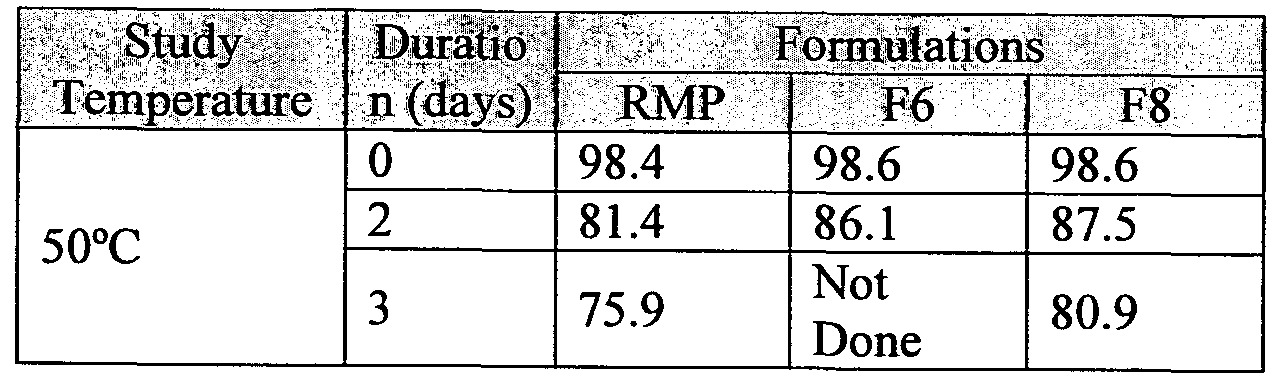
- Formulated solution was sterilized by using 0.2 ⁇ filter under laminar air flow and stored at 50°C for 3 days.
- the formulation was analyzed by SE-HPLC, SDS-PAGE, and HIC at zero time, and after 2 days and 3 days of storage at 50°C. The results are reported in Table 11.
- novel formulations of fusion protein are prepared using suitable combination of buffer, an aggregation inhibitors, tonicity modifiers, stabilizers, surfactants, chelating agents and optionally with preservative in suitable combinations thereof.
- the formulation prepared by the said invention comprises an effective amount of biologically active TNFR: Fc which is used in treating inflammatory diseases in humans. They are preferably used as injectable aqueous solutions.
Landscapes
- Health & Medical Sciences (AREA)
- Chemical & Material Sciences (AREA)
- Life Sciences & Earth Sciences (AREA)
- Medicinal Chemistry (AREA)
- Pharmacology & Pharmacy (AREA)
- Veterinary Medicine (AREA)
- Public Health (AREA)
- Animal Behavior & Ethology (AREA)
- General Health & Medical Sciences (AREA)
- Epidemiology (AREA)
- Engineering & Computer Science (AREA)
- General Chemical & Material Sciences (AREA)
- Chemical Kinetics & Catalysis (AREA)
- Oil, Petroleum & Natural Gas (AREA)
- Mycology (AREA)
- Bioinformatics & Cheminformatics (AREA)
- Immunology (AREA)
- Microbiology (AREA)
- Proteomics, Peptides & Aminoacids (AREA)
- Dermatology (AREA)
- Pain & Pain Management (AREA)
- Rheumatology (AREA)
- Nuclear Medicine, Radiotherapy & Molecular Imaging (AREA)
- Organic Chemistry (AREA)
- Medicinal Preparation (AREA)
- Medicines That Contain Protein Lipid Enzymes And Other Medicines (AREA)
- Medicines Containing Antibodies Or Antigens For Use As Internal Diagnostic Agents (AREA)
Abstract
Description




Claims
Priority Applications (5)
| Application Number | Priority Date | Filing Date | Title |
|---|---|---|---|
| CN201180031464.3A CN102946858B (en) | 2010-05-10 | 2011-05-04 | The liquid preparation of the polypeptide containing immunoglobulin Fc |
| ES11780312.2T ES2684921T3 (en) | 2010-05-10 | 2011-05-04 | Liquid formulation of polypeptides containing an Fc domain of an immunoglobulin |
| EP11780312.2A EP2568960B1 (en) | 2010-05-10 | 2011-05-04 | Liquid formulation of polypeptides containing an fc domain of an immunoglobulin |
| RU2012149852/15A RU2600847C2 (en) | 2010-05-10 | 2011-05-04 | Liquid composition of polypeptides containing fc domain of immunoglobulin |
| ZA2012/09235A ZA201209235B (en) | 2010-05-10 | 2012-12-06 | Liquid formulation of polypeptides containing an fc domain of an immunoglobulin |
Applications Claiming Priority (2)
| Application Number | Priority Date | Filing Date | Title |
|---|---|---|---|
| IN1465MU2010 | 2010-05-10 | ||
| IN1465/MUM/2010 | 2010-05-10 |
Publications (2)
| Publication Number | Publication Date |
|---|---|
| WO2011141926A2 true WO2011141926A2 (en) | 2011-11-17 |
| WO2011141926A3 WO2011141926A3 (en) | 2012-09-27 |
Family
ID=44914774
Family Applications (1)
| Application Number | Title | Priority Date | Filing Date |
|---|---|---|---|
| PCT/IN2011/000313 Ceased WO2011141926A2 (en) | 2010-05-10 | 2011-05-04 | Liquid formulation of polypeptides containing an fc domain of an immunoglobulin |
Country Status (6)
| Country | Link |
|---|---|
| EP (1) | EP2568960B1 (en) |
| CN (1) | CN102946858B (en) |
| ES (1) | ES2684921T3 (en) |
| RU (1) | RU2600847C2 (en) |
| WO (1) | WO2011141926A2 (en) |
| ZA (1) | ZA201209235B (en) |
Cited By (26)
| Publication number | Priority date | Publication date | Assignee | Title |
|---|---|---|---|---|
| US20130101640A1 (en) * | 2011-10-18 | 2013-04-25 | Coherus Biosciences, Inc. | Etanercept Formulations Stabilized with Combinations of Sugars and Polyols |
| US20130101583A1 (en) * | 2011-10-18 | 2013-04-25 | Coherus Biosciences, Inc. | Etanercept Formulations Stabilized with Sodium Chloride |
| WO2013114112A3 (en) * | 2012-01-30 | 2013-11-07 | Arecor Limited | Stabilized aqueous antibody compositions |
| EP2699265A1 (en) | 2011-04-20 | 2014-02-26 | Sandoz AG | STABLE PHARMACEUTICAL LIQUID FORMULATIONS OF THE FUSION PROTEIN TNFR:Fc |
| WO2014043103A1 (en) * | 2012-09-11 | 2014-03-20 | Coherus Biosciences, Inc. | Correctly folded etanercept in high purity and excellent yield |
| WO2014064637A1 (en) | 2012-10-26 | 2014-05-01 | Lupin Limited | Stable pharmaceutical composition of tnfr:fc fusion protein |
| WO2014078627A1 (en) * | 2012-11-19 | 2014-05-22 | Merck Sharp & Dohme Corp. | Liquid formulations for tnfr:fc fusion proteins |
| KR101419884B1 (en) * | 2012-11-27 | 2014-07-16 | (주)알테오젠 | Formulation composition for stabilizing fusion proteins with IgG Fc domain |
| WO2014114651A1 (en) * | 2013-01-24 | 2014-07-31 | Glaxosmithkline Intellectual Property Development Limited | Tnf-alpha antigen-binding proteins |
| WO2014177548A1 (en) * | 2013-05-02 | 2014-11-06 | Mabxience, S.A. | Alternative formulations for tnfr: fc fusion polypeptides |
| EP2714009A4 (en) * | 2011-06-03 | 2014-11-26 | Lg Life Sciences Ltd | STABLE LIQUID FORMULATION OF ETANERCEPT |
| CN104661651A (en) * | 2012-07-09 | 2015-05-27 | 科荣生生物科学公司 | Etanercept formulations exhibiting marked reduction in sub-visible particles |
| US9340612B2 (en) | 2001-03-19 | 2016-05-17 | Coherus Biosciences, Inc. | Stable aqueous formulations of adalimumab |
| WO2016102328A1 (en) | 2014-12-22 | 2016-06-30 | Ares Trading S.A. | Liquid pharmaceutical composition |
| US20170202909A1 (en) * | 2014-06-13 | 2017-07-20 | Santa Maria Biotherapeutics, Inc. | Formulated Receptor Polypeptides and Related Methods |
| US9821059B2 (en) | 2014-10-17 | 2017-11-21 | Alteogen Inc. | Composition for stabilizing protein and pharmaceutical formulation comprising the same |
| RU2679124C2 (en) * | 2012-11-06 | 2019-02-06 | Байер Фарма Акциенгезельшафт | Formulation for bispecific t-cell engagers (bites) |
| CN109562173A (en) * | 2016-08-09 | 2019-04-02 | 信达生物制药(苏州)有限公司 | PD-1 antibody preparation |
| WO2019094333A1 (en) * | 2017-11-13 | 2019-05-16 | Amgen Inc. | Methods for producing protein products |
| US11071782B2 (en) | 2016-04-20 | 2021-07-27 | Coherus Biosciences, Inc. | Method of filling a container with no headspace |
| US11229702B1 (en) | 2015-10-28 | 2022-01-25 | Coherus Biosciences, Inc. | High concentration formulations of adalimumab |
| CN115135302A (en) * | 2019-12-20 | 2022-09-30 | 阿雷斯贸易股份有限公司 | IgG TGF beta RII fusion protein compositions |
| WO2022261716A1 (en) * | 2021-06-16 | 2022-12-22 | Exopharm Limited | Aqueous formulations for preservation of extracellular vesicles |
| US11634485B2 (en) | 2019-02-18 | 2023-04-25 | Eli Lilly And Company | Therapeutic antibody formulation |
| EP3615066B1 (en) | 2017-04-28 | 2023-12-27 | Amgen Inc. | Formulations of human anti-rankl antibodies, and methods of using the same |
| US11932699B2 (en) | 2017-09-07 | 2024-03-19 | Jcr Pharmaceuticals Co., Ltd. | Aqueous pharmaceutical composition |
Families Citing this family (7)
| Publication number | Priority date | Publication date | Assignee | Title |
|---|---|---|---|---|
| CA2930227C (en) * | 2013-11-29 | 2021-09-28 | Ares Trading S.A. | A liquid formulation of a fusion protein comprising tnfr and fc region |
| CN104194758B (en) * | 2014-09-23 | 2017-06-16 | 兰州熙瑞化工科技有限公司 | Oil well neutral de-plugging agent composition and preparation method thereof |
| CN104194757B (en) * | 2014-09-23 | 2017-06-16 | 甘肃黑马石化工程有限公司 | Oil field machine-pumped oil well neutrality descaling and blockage relieving agent composition and preparation method |
| CN104459158B (en) * | 2014-12-22 | 2016-06-22 | 宁波美康生物科技股份有限公司 | Aspartate aminotransferase Mitochondria Isoenzyme detection kit |
| CN106620691B (en) * | 2015-11-04 | 2020-08-21 | 信达生物制药(苏州)有限公司 | Recombinant fully human anti-CTLA-4 monoclonal antibody preparation and application thereof |
| CN106913869B (en) * | 2017-03-17 | 2020-07-28 | 信达生物制药(苏州)有限公司 | A kind of anti-CTLA-4 monoclonal antibody preparation and its application |
| CN111228225B (en) * | 2018-11-28 | 2022-08-26 | 鲁南制药集团股份有限公司 | Recombinant human tumor necrosis factor receptor-Fc fusion protein freeze-dried preparation |
Citations (7)
| Publication number | Priority date | Publication date | Assignee | Title |
|---|---|---|---|---|
| US5580856A (en) | 1994-07-15 | 1996-12-03 | Prestrelski; Steven J. | Formulation of a reconstituted protein, and method and kit for the production thereof |
| US6171586B1 (en) | 1997-06-13 | 2001-01-09 | Genentech, Inc. | Antibody formulation |
| EP1314437A1 (en) | 2000-08-11 | 2003-05-28 | Chugai Seiyaku Kabushiki Kaisha | Stabilized antibody-containing preparations |
| EP1478394A2 (en) | 2002-02-27 | 2004-11-24 | Immunex Corporation | Polypeptide formulation |
| US20060240520A1 (en) | 2000-09-18 | 2006-10-26 | Ambrose Christine M | Novel receptor nucleic acids and polypeptides |
| WO2007092772A2 (en) | 2006-02-03 | 2007-08-16 | Medimmune, Inc. | Protein formulations |
| WO2010077422A2 (en) | 2008-10-29 | 2010-07-08 | Wyeth Llc | Formulations of single domain antigen binding molecules |
Family Cites Families (6)
| Publication number | Priority date | Publication date | Assignee | Title |
|---|---|---|---|---|
| RU2366664C2 (en) * | 2002-12-17 | 2009-09-10 | Мерк Патент Гмбх | Humanised antibody (h14,18) based on mouse antibody 14,18, contacting gd2, and its fusion with il-2 |
| SG145712A1 (en) * | 2003-08-01 | 2008-09-29 | Amgen Inc | Crystalline tumor necrosis factor receptor 2 polypeptides |
| CN101426527A (en) * | 2006-02-03 | 2009-05-06 | 米迪缪尼有限公司 | Protein formulations |
| NZ591252A (en) * | 2006-03-17 | 2012-06-29 | Biogen Idec Inc | Methods of designing antibody or antigen binding fragments thereof with substituted non-covarying amino acids |
| EP2282770B1 (en) * | 2008-06-04 | 2018-03-07 | MacroGenics, Inc. | Antibodies with altered binding to fcrn and methods of using same |
| EP3329911A1 (en) * | 2008-09-19 | 2018-06-06 | Pfizer Inc | Stable liquid antibody formulation |
-
2011
- 2011-05-04 CN CN201180031464.3A patent/CN102946858B/en not_active Expired - Fee Related
- 2011-05-04 EP EP11780312.2A patent/EP2568960B1/en active Active
- 2011-05-04 RU RU2012149852/15A patent/RU2600847C2/en active
- 2011-05-04 ES ES11780312.2T patent/ES2684921T3/en active Active
- 2011-05-04 WO PCT/IN2011/000313 patent/WO2011141926A2/en not_active Ceased
-
2012
- 2012-12-06 ZA ZA2012/09235A patent/ZA201209235B/en unknown
Patent Citations (8)
| Publication number | Priority date | Publication date | Assignee | Title |
|---|---|---|---|---|
| US5580856A (en) | 1994-07-15 | 1996-12-03 | Prestrelski; Steven J. | Formulation of a reconstituted protein, and method and kit for the production thereof |
| US6171586B1 (en) | 1997-06-13 | 2001-01-09 | Genentech, Inc. | Antibody formulation |
| EP1314437A1 (en) | 2000-08-11 | 2003-05-28 | Chugai Seiyaku Kabushiki Kaisha | Stabilized antibody-containing preparations |
| US20060240520A1 (en) | 2000-09-18 | 2006-10-26 | Ambrose Christine M | Novel receptor nucleic acids and polypeptides |
| EP1478394A2 (en) | 2002-02-27 | 2004-11-24 | Immunex Corporation | Polypeptide formulation |
| WO2007092772A2 (en) | 2006-02-03 | 2007-08-16 | Medimmune, Inc. | Protein formulations |
| US20080071063A1 (en) | 2006-02-03 | 2008-03-20 | Medimmune, Inc. | Protein Formulations |
| WO2010077422A2 (en) | 2008-10-29 | 2010-07-08 | Wyeth Llc | Formulations of single domain antigen binding molecules |
Non-Patent Citations (1)
| Title |
|---|
| See also references of EP2568960A4 |
Cited By (135)
| Publication number | Priority date | Publication date | Assignee | Title |
|---|---|---|---|---|
| US9340612B2 (en) | 2001-03-19 | 2016-05-17 | Coherus Biosciences, Inc. | Stable aqueous formulations of adalimumab |
| US9453067B2 (en) | 2011-04-20 | 2016-09-27 | Sandoz Ag | Stable pharmaceutical liquid formulations of the fusion protein TNFR:Fc |
| EP2699265B1 (en) * | 2011-04-20 | 2019-10-16 | Sandoz AG | STABLE PHARMACEUTICAL LIQUID FORMULATIONS OF THE FUSION PROTEIN TNFR:Fc |
| EP2699265A1 (en) | 2011-04-20 | 2014-02-26 | Sandoz AG | STABLE PHARMACEUTICAL LIQUID FORMULATIONS OF THE FUSION PROTEIN TNFR:Fc |
| EP2714009A4 (en) * | 2011-06-03 | 2014-11-26 | Lg Life Sciences Ltd | STABLE LIQUID FORMULATION OF ETANERCEPT |
| US10258689B2 (en) | 2011-06-03 | 2019-04-16 | Lg Chem, Ltd. | Stable liquid formulation of etanercept |
| AU2012263100B2 (en) * | 2011-06-03 | 2016-04-14 | Lg Chem, Ltd. | Stable liquid formulation of etanercept |
| US20130101640A1 (en) * | 2011-10-18 | 2013-04-25 | Coherus Biosciences, Inc. | Etanercept Formulations Stabilized with Combinations of Sugars and Polyols |
| US20190290768A1 (en) * | 2011-10-18 | 2019-09-26 | Coherus Biosciences, Inc. | Stable Aqueous Etanercept Composition |
| US10987405B2 (en) | 2011-10-18 | 2021-04-27 | Coherus Biosciences, Inc. | Method of reducing formation of etanercept aggregates or fragments |
| US10980885B2 (en) | 2011-10-18 | 2021-04-20 | Coherus Biosciences, Inc. | Method of reducing formation of etanercept aggregates or fragments |
| JP2014530255A (en) * | 2011-10-18 | 2014-11-17 | コヒラス・バイオサイエンシズ・インコーポレイテッド | Etanercept formulation stabilized by metal ions |
| US11129876B2 (en) | 2011-10-18 | 2021-09-28 | Coherus Biosciences, Inc. | Etanercept formulations stabilized with amino acids |
| US9801942B2 (en) | 2011-10-18 | 2017-10-31 | Coherus Biosciences, Inc. | Etanercept formulations stabilized with metal ions |
| EP2768854A4 (en) * | 2011-10-18 | 2015-03-11 | Coherus Biosciences Inc | AMINO ACID-STABILIZED ETANERPT FORMULATIONS |
| EP2768532A4 (en) * | 2011-10-18 | 2015-03-11 | Coherus Biosciences Inc | FORMANTS OF STANOLPT STABILIZED WITH SODIUM CHLORIDE |
| US9943601B2 (en) | 2011-10-18 | 2018-04-17 | Coherus Biosciences, Inc. | Etanercept formulations stabilized with combinations of sugars and polyols |
| US10980884B2 (en) | 2011-10-18 | 2021-04-20 | Coherus Biosciences, Inc. | Stable aqueous etanercept composition |
| EP2768525A4 (en) * | 2011-10-18 | 2015-07-15 | Coherus Biosciences Inc | FORMANTS OF STERILE STABILIZED BY METALLIC IONS |
| US10888619B2 (en) | 2011-10-18 | 2021-01-12 | Coherus Biosciences, Inc. | Stable aqueous etanercept composition |
| US10213508B2 (en) | 2011-10-18 | 2019-02-26 | Coherus Biosciences, Inc. | Etanercept formulations stabilized with xylitol |
| US20130101583A1 (en) * | 2011-10-18 | 2013-04-25 | Coherus Biosciences, Inc. | Etanercept Formulations Stabilized with Sodium Chloride |
| US10293049B2 (en) | 2011-10-18 | 2019-05-21 | Coherus Biosciences, Inc. | Etanercept formulations stabilized with amino acids |
| US10772963B2 (en) | 2011-10-18 | 2020-09-15 | Coherus Biosciences, Inc. | Etanercept formulations stabilized with xylitol |
| US9770510B2 (en) | 2011-10-18 | 2017-09-26 | Coherus Biosciences, Inc. | Etanercept formulations stabilized with xylitol |
| AU2012326168B2 (en) * | 2011-10-18 | 2016-12-15 | Coherus Biosciences, Inc. | Etanercept formulations stabilized with amino acids |
| US10493151B2 (en) | 2011-10-18 | 2019-12-03 | Coherus Biosciences, Inc. | Etanercept formulations stabilized with sodium chloride |
| US9302002B2 (en) * | 2011-10-18 | 2016-04-05 | Coherus Biosciences, Inc. | Etanercept formulations stabilized with combinations of sugars and polyols |
| US10376588B2 (en) | 2011-10-18 | 2019-08-13 | Coherus Biosciences, Inc. | Etanercept formulations stabilized with combinations of sugars and polyols |
| US11135267B2 (en) | 2011-10-18 | 2021-10-05 | Coherus Biosciences, Inc. | Etanercept formulations stabilized with metal ions |
| US10485869B2 (en) | 2011-10-18 | 2019-11-26 | Coherus Biosciences, Inc. | Etanercept formulations stabilized with meglumine |
| US20130108632A1 (en) * | 2011-10-18 | 2013-05-02 | Coherus Biosciences, Inc. | Etanercept Formulations Stabilized with Amino Acids |
| US20160199489A1 (en) * | 2011-10-18 | 2016-07-14 | Coherus Biosciences, Inc. | Etanercept Formulations Stabilized with Combinations of Sugars and Polyols |
| US20190343955A1 (en) * | 2011-10-18 | 2019-11-14 | Coherus Biosciences, Inc. | Etanercept Formulations Stabilized with Sodium Chloride |
| US11000588B2 (en) | 2011-10-18 | 2021-05-11 | Coherus Biosciences, Inc. | Etanercept formulations stabilized with sodium chloride |
| US20190298837A1 (en) * | 2011-10-18 | 2019-10-03 | Coherus Biosciences, Inc. | Method of Reducing Formation of Etanercept Aggregates or Fragments |
| US20190290767A1 (en) * | 2011-10-18 | 2019-09-26 | Coherus Biosciences, Inc. | Method of Reducing Formation of Etanercept Aggregates or Fragments |
| US20190290766A1 (en) * | 2011-10-18 | 2019-09-26 | Coherus Biosciences, Inc. | Stable Aqueous Etanercept Composition |
| WO2013114112A3 (en) * | 2012-01-30 | 2013-11-07 | Arecor Limited | Stabilized aqueous antibody compositions |
| US12016922B2 (en) | 2012-01-30 | 2024-06-25 | Arecor Limited | Stabilized aqueous antibody compositions |
| US10532098B2 (en) | 2012-01-30 | 2020-01-14 | Arecor Limited | Stabilized aqueous antibody compositions |
| CN104203282A (en) * | 2012-01-30 | 2014-12-10 | 艾瑞克有限公司 | Stabilized aqueous antibody compositions |
| EP2869816A4 (en) * | 2012-07-09 | 2016-04-20 | Coherus Biosciences Inc | FORMANTS OF ETANERCEPT HAVING A REDUCTION MARKED IN INVISIBLE PARTICLES IN THE NU |
| EP2869817A4 (en) * | 2012-07-09 | 2016-04-06 | Coherus Biosciences Inc | STAINLESS AQUEOUS FORMULATIONS OF ETANERCEPT |
| US10822429B2 (en) | 2012-07-09 | 2020-11-03 | Coherus Biosciences, Inc. | Etanercept formulations exhibiting marked reduction in sub-visible particles |
| US9662396B2 (en) | 2012-07-09 | 2017-05-30 | Coherus Biosciences, Inc. | Stable aqueous formulations of etanercept |
| JP2015525763A (en) * | 2012-07-09 | 2015-09-07 | コヒラス・バイオサイエンシズ・インコーポレイテッド | Etanercept formulation showing marked reduction of macroscopic invisible particles |
| JP2015525762A (en) * | 2012-07-09 | 2015-09-07 | コヒラス・バイオサイエンシズ・インコーポレイテッド | Stable aqueous formulation of etanercept |
| CN104661651A (en) * | 2012-07-09 | 2015-05-27 | 科荣生生物科学公司 | Etanercept formulations exhibiting marked reduction in sub-visible particles |
| AU2013290289B2 (en) * | 2012-07-09 | 2018-03-29 | Coherus Biosciences, Inc. | Etanercept formulations exhibiting marked reduction in sub-visible particles |
| US10716853B2 (en) | 2012-09-07 | 2020-07-21 | Coherus Biosciences, Inc. | Stable aqueous formulations of adalimumab |
| US9382317B2 (en) | 2012-09-07 | 2016-07-05 | Coherus Biosciences, Inc. | Stable aqueous formulations of adalimumab |
| US9737600B2 (en) | 2012-09-07 | 2017-08-22 | Coherus Biosciences, Inc. | Stable aqueous formulations of adalimumab |
| US9757454B2 (en) | 2012-09-07 | 2017-09-12 | Coherus Biosciences, Inc. | Stable aqueous formulations of adalimumab |
| US9731009B2 (en) | 2012-09-07 | 2017-08-15 | Coherus Biosciences, Inc. | Stable aqueous formulations of adalimumab |
| US9770507B2 (en) | 2012-09-07 | 2017-09-26 | Coherus Biosciences, Inc. | Stable aqueous formulations of adalimumab |
| US9782479B2 (en) | 2012-09-07 | 2017-10-10 | Coherus Biosciences, Inc. | Stable aqueous formulations of adalimumab |
| US9782480B2 (en) | 2012-09-07 | 2017-10-10 | Coherus Biosciences, Inc. | Stable aqueous formulations of adalimumab |
| US9789185B2 (en) | 2012-09-07 | 2017-10-17 | Coherus Biosciences, Inc. | Stable aqueous formulations of adalimumab |
| US9724414B2 (en) | 2012-09-07 | 2017-08-08 | Coherus Biosciences, Inc. | Stable aqueous formulations of adalimumab |
| US9808525B2 (en) | 2012-09-07 | 2017-11-07 | Coherus Biosciences, Inc. | Stable aqueous formulations of adalimumab |
| US9731008B2 (en) | 2012-09-07 | 2017-08-15 | Coherus Biosciences, Inc. | Stable aqueous formulations of adalimumab |
| US9861695B2 (en) | 2012-09-07 | 2018-01-09 | Coherus Biosciences, Inc. | Stable aqueous formulations of adalimumab |
| US10799585B2 (en) | 2012-09-07 | 2020-10-13 | Coherus Biosciences, Inc. | Stable aqueous formulations of adalimumab |
| US9724415B2 (en) | 2012-09-07 | 2017-08-08 | Coherus Biosciences, Inc. | Stable aqueous formulations of adalimumab |
| US10786566B2 (en) | 2012-09-07 | 2020-09-29 | Coherus Biosciences, Inc. | Stable aqueous formulations of adalimumab |
| US10780163B2 (en) | 2012-09-07 | 2020-09-22 | Coherus Biosciences, Inc. | Stable aqueous formulations of adalimumab |
| US10772959B2 (en) | 2012-09-07 | 2020-09-15 | Coherus Biosciences, Inc. | Stable aqueous formulations of adalimumab |
| US10772960B2 (en) | 2012-09-07 | 2020-09-15 | Coherus Biosciences, Inc. | Stable aqueous formulations of adalimumab |
| US10722579B2 (en) | 2012-09-07 | 2020-07-28 | Coherus Biosciences, Inc. | Stable aqueous formulations of adalimumab |
| US10155039B2 (en) | 2012-09-07 | 2018-12-18 | Coherus Biosciences, Inc. | Stable aqueous formulations of adalimumab |
| US10159733B2 (en) | 2012-09-07 | 2018-12-25 | Coherus Biosciences, Inc. | Stable aqueous formulations of adalimumab |
| US10159732B2 (en) | 2012-09-07 | 2018-12-25 | Coherus Biosciences, Inc. | Stable aqueous formulations of adalimumab |
| US10716854B2 (en) | 2012-09-07 | 2020-07-21 | Coherus Biosciences, Inc. | Stable aqueous formulations of adalimumab |
| US10195275B2 (en) | 2012-09-07 | 2019-02-05 | Coherus Biosciences, Inc. | Stable aqueous formulations of adalimumab |
| US10716852B2 (en) | 2012-09-07 | 2020-07-21 | Coherus Biosciences, Inc. | Stable aqueous formulations of adalimumab |
| US10207000B2 (en) | 2012-09-07 | 2019-02-19 | Coherus Biosciences, Inc. | Stable aqueous formulations of adalimumab |
| US9707293B2 (en) | 2012-09-07 | 2017-07-18 | Coherus Biosciences, Inc. | Stable aqueous formulations of adalimumab |
| US10688183B2 (en) | 2012-09-07 | 2020-06-23 | Coherus Biosciences, Inc. | Stable aqueous formulations of adalimumab |
| US9340611B2 (en) | 2012-09-07 | 2016-05-17 | Coherus Biosciences, Inc. | Stable aqueous formulations of adalimumab |
| US9682145B2 (en) | 2012-09-07 | 2017-06-20 | Coherus Biosciences, Inc. | Stable aqueous formulations of adalimumab |
| US10286071B2 (en) | 2012-09-07 | 2019-05-14 | Coherus Biosciences, Inc. | Syringe containing stable aqueous formulations of adalimumab |
| US10286072B2 (en) | 2012-09-07 | 2019-05-14 | Coherus Biosciences, Inc. | Methods of manufacturing stable aqueous formulations of adalimumab |
| US9346880B2 (en) | 2012-09-07 | 2016-05-24 | Coherus Biosciences, Inc. | Stable aqueous formulations of adalimumab |
| US10954295B2 (en) | 2012-09-11 | 2021-03-23 | Coherus Biosciences, Inc. | Correctly folded etanercept in high purity and excellent yield |
| US10954294B2 (en) | 2012-09-11 | 2021-03-23 | Coherus Biosciences, Inc. | Correctly folded etanercept in high purity and excellent yield |
| WO2014043103A1 (en) * | 2012-09-11 | 2014-03-20 | Coherus Biosciences, Inc. | Correctly folded etanercept in high purity and excellent yield |
| EA031324B1 (en) * | 2012-09-11 | 2018-12-28 | Кохерус Байосайенсис, Инк. | Correctly folded etanercept in high purity and excellent yield |
| CN110051823A (en) * | 2012-09-11 | 2019-07-26 | 科荣生生物科学公司 | The Etanercept of high-purity and excellent yield correctly folded |
| EP2895188A4 (en) * | 2012-09-11 | 2016-05-25 | Coherus Biosciences Inc | ETANERCEPT CORRECTLY FILLED WITH HIGH PURITY AND EXCELLENT YIELD |
| US11001627B2 (en) | 2012-09-11 | 2021-05-11 | Coherus Biosciences, Inc. | Correctly folded etanercept in high purity and excellent yield |
| JP2015533797A (en) * | 2012-09-11 | 2015-11-26 | コヒラス・バイオサイエンシズ・インコーポレイテッド | Precisely folded etanercept with high purity and excellent yield |
| US10954293B2 (en) | 2012-09-11 | 2021-03-23 | Coherus Biosciences, Inc. | Correctly folded etanercept in high purity and excellent yield |
| JP2019038817A (en) * | 2012-09-11 | 2019-03-14 | コヒラス・バイオサイエンシズ・インコーポレイテッド | Precisely folded etanercept with high purity and excellent yield |
| US10947306B2 (en) | 2012-09-11 | 2021-03-16 | Coherus Biosciences, Inc. | Correctly folded etanercept in high purity and excellent yield |
| JP2015535237A (en) * | 2012-10-26 | 2015-12-10 | ルピン アトランティス ホールディングス エスエーLupin Atlantis Holdings Sa | Stable pharmaceutical composition of TNFR: FC fusion protein |
| AU2013336279B2 (en) * | 2012-10-26 | 2018-07-19 | Lupin Limited | Stable pharmaceutical composition of TNFR:Fc fusion protein |
| KR102132050B1 (en) * | 2012-10-26 | 2020-07-10 | 루핀 아틀란티스 홀딩스 에스에이 | Stable pharmaceutical composition of tnfr:fc fusion protein |
| KR20150074069A (en) * | 2012-10-26 | 2015-07-01 | 루핀 아틀란티스 홀딩스 에스에이 | Stable pharmaceutical composition of tnfr:fc fusion protein |
| WO2014064637A1 (en) | 2012-10-26 | 2014-05-01 | Lupin Limited | Stable pharmaceutical composition of tnfr:fc fusion protein |
| US10058589B2 (en) | 2012-10-26 | 2018-08-28 | Lupin Limited | Stable pharmaceutical composition of Etanercept in a phosphate citrate buffer with glycine as an anti-aggregating agent |
| CN104936607A (en) * | 2012-10-26 | 2015-09-23 | 鲁平有限公司 | Stable pharmaceutical composition of tnfr:fc fusion protein |
| RU2664691C2 (en) * | 2012-10-26 | 2018-08-21 | Люпин Лимитед | Stable pharmaceutical composition of tnfr: fc fusion protein |
| RU2679124C2 (en) * | 2012-11-06 | 2019-02-06 | Байер Фарма Акциенгезельшафт | Formulation for bispecific t-cell engagers (bites) |
| WO2014078627A1 (en) * | 2012-11-19 | 2014-05-22 | Merck Sharp & Dohme Corp. | Liquid formulations for tnfr:fc fusion proteins |
| EP2919812A4 (en) * | 2012-11-19 | 2016-05-18 | Merck Sharp & Dohme | LIQUID FORMULATIONS FOR TNFR: FC FUSION PROTEINS |
| US9649383B2 (en) | 2012-11-19 | 2017-05-16 | Merck Sharp & Dohme Corp. | Liquid formulations for TNFR:Fc fusion proteins |
| KR101419884B1 (en) * | 2012-11-27 | 2014-07-16 | (주)알테오젠 | Formulation composition for stabilizing fusion proteins with IgG Fc domain |
| CN104870019A (en) * | 2012-11-27 | 2015-08-26 | 阿特根公司 | Composition for stabilizing fusion protein in which protein and fc domain are fused |
| US9474803B2 (en) | 2012-11-27 | 2016-10-25 | Alteogen Inc. | Composition for stabilizing fusion protein in which protein and FC domain are fused |
| EP2926834A4 (en) * | 2012-11-27 | 2016-04-20 | Alteogen Inc | Composition for stabilizing fusion protein in which protein and fc domain are fused |
| US20150368333A1 (en) * | 2013-01-24 | 2015-12-24 | Glaxosmithkline Intellectual Property Development Limited | Tnf-alpha antigen-binding proteins |
| CN105051064A (en) * | 2013-01-24 | 2015-11-11 | 葛兰素史克知识产权开发有限公司 | Tnf-alpha antigen-binding proteins |
| WO2014114651A1 (en) * | 2013-01-24 | 2014-07-31 | Glaxosmithkline Intellectual Property Development Limited | Tnf-alpha antigen-binding proteins |
| WO2014177548A1 (en) * | 2013-05-02 | 2014-11-06 | Mabxience, S.A. | Alternative formulations for tnfr: fc fusion polypeptides |
| RU2663727C2 (en) * | 2013-05-02 | 2018-08-08 | Мабксьенсе С.А. | Alternative compositions for tnfr:fc chimerical polypeptides |
| US20170202909A1 (en) * | 2014-06-13 | 2017-07-20 | Santa Maria Biotherapeutics, Inc. | Formulated Receptor Polypeptides and Related Methods |
| US20240277805A1 (en) * | 2014-06-13 | 2024-08-22 | Santa Maria Biotherapeutics, Inc. | Formulated receptor polypeptides and related methods |
| US9821059B2 (en) | 2014-10-17 | 2017-11-21 | Alteogen Inc. | Composition for stabilizing protein and pharmaceutical formulation comprising the same |
| JP2018501311A (en) * | 2014-12-22 | 2018-01-18 | アレス トレーディング ソシエテ アノニム | Liquid pharmaceutical composition |
| US10959939B2 (en) | 2014-12-22 | 2021-03-30 | Ares Trading S.A. | Liquid pharmaceutical composition of etanercept with lysine and proline |
| WO2016102328A1 (en) | 2014-12-22 | 2016-06-30 | Ares Trading S.A. | Liquid pharmaceutical composition |
| IL252871B (en) * | 2014-12-22 | 2021-01-31 | Gianluca Rinaldi | Liquid pharmaceutical composition comprising etanercept |
| US11229702B1 (en) | 2015-10-28 | 2022-01-25 | Coherus Biosciences, Inc. | High concentration formulations of adalimumab |
| US11071782B2 (en) | 2016-04-20 | 2021-07-27 | Coherus Biosciences, Inc. | Method of filling a container with no headspace |
| US11576971B2 (en) | 2016-04-20 | 2023-02-14 | Coherus Biosciences, Inc. | Method of filling a container with no headspace |
| CN109562173A (en) * | 2016-08-09 | 2019-04-02 | 信达生物制药(苏州)有限公司 | PD-1 antibody preparation |
| CN109562173B (en) * | 2016-08-09 | 2022-09-02 | 信达生物制药(苏州)有限公司 | PD-1 antibody formulations |
| EP3615066B1 (en) | 2017-04-28 | 2023-12-27 | Amgen Inc. | Formulations of human anti-rankl antibodies, and methods of using the same |
| US11873343B2 (en) | 2017-04-28 | 2024-01-16 | Amgen Inc. | Pharmaceutical formulations comprising anti-RANKL antibodies and an aromatic amino acid comprising a phenyl or an indole |
| US11932699B2 (en) | 2017-09-07 | 2024-03-19 | Jcr Pharmaceuticals Co., Ltd. | Aqueous pharmaceutical composition |
| WO2019094333A1 (en) * | 2017-11-13 | 2019-05-16 | Amgen Inc. | Methods for producing protein products |
| US11634485B2 (en) | 2019-02-18 | 2023-04-25 | Eli Lilly And Company | Therapeutic antibody formulation |
| CN115135302A (en) * | 2019-12-20 | 2022-09-30 | 阿雷斯贸易股份有限公司 | IgG TGF beta RII fusion protein compositions |
| WO2022261716A1 (en) * | 2021-06-16 | 2022-12-22 | Exopharm Limited | Aqueous formulations for preservation of extracellular vesicles |
Also Published As
| Publication number | Publication date |
|---|---|
| EP2568960B1 (en) | 2018-06-06 |
| EP2568960A2 (en) | 2013-03-20 |
| RU2012149852A (en) | 2014-06-20 |
| ES2684921T3 (en) | 2018-10-05 |
| ZA201209235B (en) | 2014-02-26 |
| CN102946858B (en) | 2015-09-30 |
| CN102946858A (en) | 2013-02-27 |
| WO2011141926A3 (en) | 2012-09-27 |
| RU2600847C2 (en) | 2016-10-27 |
| EP2568960A4 (en) | 2013-10-23 |
Similar Documents
| Publication | Publication Date | Title |
|---|---|---|
| EP2568960B1 (en) | Liquid formulation of polypeptides containing an fc domain of an immunoglobulin | |
| US10980884B2 (en) | Stable aqueous etanercept composition | |
| JP5946448B2 (en) | Sustained human growth hormone conjugate liquid formulation | |
| KR101335765B1 (en) | Liquid formulation for long-acting erythropoietin conjugate | |
| EP3139960B1 (en) | Liquid formulation comprising gm-csf neutralizing compound | |
| US20200405864A1 (en) | Liquid pharmaceutical composition of adalimumab | |
| KR102106914B1 (en) | Liquid formulation comprising GM-CSF neutralizing compound | |
| US10493151B2 (en) | Etanercept formulations stabilized with sodium chloride | |
| JP7157082B2 (en) | Stable formulations of fibronectin-based scaffolding domain proteins that bind myostatin | |
| CN104740612A (en) | Liquid formulation of receptor antibody fusion protein | |
| CN104740609A (en) | Pharmaceutical composition of receptor antibody fusion protein | |
| JP2024507347A (en) | Aqueous compositions of engineered protein constructs containing Fc domains | |
| HK40010132A (en) | AQUEOUS PHARMACEUTICAL COMPOSITION OF A RECOMBINANT MONOCLONAL ANTIBODY TO TNFα | |
| HK1235316A1 (en) | Liquid formulation comprising gm-csf neutralizing compound | |
| HK1235316B (en) | Liquid formulation comprising gm-csf neutralizing compound |
Legal Events
| Date | Code | Title | Description |
|---|---|---|---|
| WWE | Wipo information: entry into national phase |
Ref document number: 201180031464.3 Country of ref document: CN |
|
| 121 | Ep: the epo has been informed by wipo that ep was designated in this application |
Ref document number: 11780312 Country of ref document: EP Kind code of ref document: A2 |
|
| WWE | Wipo information: entry into national phase |
Ref document number: 1201005899 Country of ref document: TH |
|
| NENP | Non-entry into the national phase |
Ref country code: DE |
|
| WWE | Wipo information: entry into national phase |
Ref document number: 2011780312 Country of ref document: EP |
|
| ENP | Entry into the national phase |
Ref document number: 2012149852 Country of ref document: RU Kind code of ref document: A |
|
| 121 | Ep: the epo has been informed by wipo that ep was designated in this application |
Ref document number: 11780312 Country of ref document: EP Kind code of ref document: A2 |