WO2011089985A1 - Cosmetic composition for keratin fibers - Google Patents
Cosmetic composition for keratin fibers Download PDFInfo
- Publication number
- WO2011089985A1 WO2011089985A1 PCT/JP2011/050590 JP2011050590W WO2011089985A1 WO 2011089985 A1 WO2011089985 A1 WO 2011089985A1 JP 2011050590 W JP2011050590 W JP 2011050590W WO 2011089985 A1 WO2011089985 A1 WO 2011089985A1
- Authority
- WO
- WIPO (PCT)
- Prior art keywords
- group
- chosen
- keratin fibers
- radical
- cosmetic composition
- Prior art date
- Legal status (The legal status is an assumption and is not a legal conclusion. Google has not performed a legal analysis and makes no representation as to the accuracy of the status listed.)
- Ceased
Links
- YXFVVABEGXRONW-UHFFFAOYSA-N Cc1ccccc1 Chemical compound Cc1ccccc1 YXFVVABEGXRONW-UHFFFAOYSA-N 0.000 description 1
Classifications
-
- A—HUMAN NECESSITIES
- A61—MEDICAL OR VETERINARY SCIENCE; HYGIENE
- A61Q—SPECIFIC USE OF COSMETICS OR SIMILAR TOILETRY PREPARATIONS
- A61Q5/00—Preparations for care of the hair
- A61Q5/04—Preparations for permanent waving or straightening the hair
-
- A—HUMAN NECESSITIES
- A61—MEDICAL OR VETERINARY SCIENCE; HYGIENE
- A61K—PREPARATIONS FOR MEDICAL, DENTAL OR TOILETRY PURPOSES
- A61K8/00—Cosmetics or similar toiletry preparations
- A61K8/18—Cosmetics or similar toiletry preparations characterised by the composition
- A61K8/30—Cosmetics or similar toiletry preparations characterised by the composition containing organic compounds
- A61K8/58—Cosmetics or similar toiletry preparations characterised by the composition containing organic compounds containing atoms other than carbon, hydrogen, halogen, oxygen, nitrogen, sulfur or phosphorus
- A61K8/585—Organosilicon compounds
-
- A—HUMAN NECESSITIES
- A61—MEDICAL OR VETERINARY SCIENCE; HYGIENE
- A61K—PREPARATIONS FOR MEDICAL, DENTAL OR TOILETRY PURPOSES
- A61K8/00—Cosmetics or similar toiletry preparations
- A61K8/18—Cosmetics or similar toiletry preparations characterised by the composition
- A61K8/72—Cosmetics or similar toiletry preparations characterised by the composition containing organic macromolecular compounds
- A61K8/84—Cosmetics or similar toiletry preparations characterised by the composition containing organic macromolecular compounds obtained by reactions otherwise than those involving only carbon-carbon unsaturated bonds
- A61K8/89—Polysiloxanes
- A61K8/896—Polysiloxanes containing atoms other than silicon, carbon, oxygen and hydrogen, e.g. dimethicone copolyol phosphate
- A61K8/898—Polysiloxanes containing atoms other than silicon, carbon, oxygen and hydrogen, e.g. dimethicone copolyol phosphate containing nitrogen, e.g. amodimethicone, trimethyl silyl amodimethicone or dimethicone propyl PG-betaine
-
- A—HUMAN NECESSITIES
- A61—MEDICAL OR VETERINARY SCIENCE; HYGIENE
- A61K—PREPARATIONS FOR MEDICAL, DENTAL OR TOILETRY PURPOSES
- A61K2800/00—Properties of cosmetic compositions or active ingredients thereof or formulation aids used therein and process related aspects
- A61K2800/80—Process related aspects concerning the preparation of the cosmetic composition or the storage or application thereof
- A61K2800/88—Two- or multipart kits
-
- A—HUMAN NECESSITIES
- A61—MEDICAL OR VETERINARY SCIENCE; HYGIENE
- A61K—PREPARATIONS FOR MEDICAL, DENTAL OR TOILETRY PURPOSES
- A61K2800/00—Properties of cosmetic compositions or active ingredients thereof or formulation aids used therein and process related aspects
- A61K2800/80—Process related aspects concerning the preparation of the cosmetic composition or the storage or application thereof
- A61K2800/95—Involves in-situ formation or cross-linking of polymers
Definitions
- the present invention relates to a cosmetic composition for keratin fibers such as hair.
- the present relates to a cosmetic composition for keratin fibers such as hair.
- the present is a cosmetic composition for keratin fibers such as hair.
- invention relates to a cosmetic composition for keratin fibers which provides the keratin fibers with good reshaping or
- keratin fibers such as hair consists, in a first step, in opening the keratin disulfide bonds (cystine) with a composition comprising a reducing agent, and preferably after rinsing the keratin fibers, in reforming, in a second step, said disulfide bonds by applying to the keratin fibers which have been placed beforehand under tension with curlers or equivalents thereof, or which have been straightened by other means,- an oxidizing
- composition also called a fixing agent, so as to give the desired form to the keratin fibers.
- This method enables either the waving of the keratin fibers or the decurling, the backcombing or the straightening thereof.
- the reducing agents usually used during the first step comprise thiol-based reducing agents such as thioglycolic acid and
- cysteine as well as non thiol-based reducing agents such as sulfites and bisulfites.
- JP-A-2008-260750 discloses a method for permanent waving of keratin fibers such as hair by using a reducing composition which may include a thiol-based or non-thiol based reducing agent.
- the cosmetic , roperties of the keratin fibers sometimes become worse when the keratin fibers are subjected to shampooing.
- hair relaxers which can relax or straighten naturally curly or kinky hair. Hair relaxers may either be applied in a hair salon by a professional or in the home by an individual consumer.
- Hair fiber is a keratinous material which is comprised of
- a disulfide bond may be formed from the reaction of two sulfhydryl groups (-SH) , one on each of two cysteine residues, which results in the formation of a cystine residue. While there maybe other types of bonds between the polypeptides in hair fibers, such as ionic bonds, the permanent curling and the shape of the hair is essentially dependent on the disulfide bonds of cystine residues.
- hair relaxing processes are chemical processes which may alter the aforementioned disulfide bonds between polypeptides in hair fibers and may form lanthionine residues [S[CH 2 CH(NH- ) (CO-)] 2 ].
- lanthionizing is used when one skilled in the art refers to the relaxing or straightening of keratin fibers by hydroxide ions.
- hair fibers may be relaxed or straightened by disrupting the disulfide bonds of the hair- fibers with an
- alkaline agent The chemical disruption of disulfide bonds with such an alkaline agent is generally combined with mechanical straightening of the hair, such as combing, and straightening generally occurs due to changes in the relative positions of neighboring polypeptide chains within the hair fiber.
- This reaction is generally terminated by rinsing and/or application of a neutralizing composition.
- the reaction with the alkaline agent is normally initiated by available hydroxide ions, as shown in, for example, JP-A-2004- 256535 (US-A-2004-166073) .
- available hydroxide ions are hydroxide ions which are available for lanthionization .
- reaction sequences that are predominantly used in the art to explain the disruption of the disulfide bonds in hair fibers by available hydroxide ions. Both of these reaction sequences result in lanthionine residue formation.
- One reaction sequence comprises at least one
- the second reaction sequence comprises at least one ⁇ -elimination reaction initiated by the nucleophilic attack of an available hydroxide ion on a hydrogen atom bonded to a carbon atom in the ⁇ -position with respect to the disulfide bond of a cystine residue. See Zviak. The result is the formation of a dehydroalanine residue.
- the dehydroalanine residue then reacts with either the thiol group of a cysteine residue or the amino group of an alanine residue to form a lanthionine residue or a lysinoalanine residue, respectively.
- These stable irreversible crosslinks in the treated hair make subsequent chemical relinking of the polypeptides unnecessary.
- the only step that may be required following a straightening process using such hydroxide-containing alkaline agents is the removal of any excess alkaline solution to avoid and minimize damage to the hair
- an acidic shampoo may be used to neutralize residual alkali and remove it from the hair and scalp.
- alkaline agents such as guanidine hydroxide
- hydroxide-based straighteners do not have a highly objectionable odor or cause such an odor upon treating the hair.
- relaxers including hydroxide ions typically cause damage to keratin fibers, and often result in poor cosmetic properties such as a dry and coarse appearance and feel to the touch of the keratin fibers .
- the cosmetic properties of the keratin fibers sometimes become worse when the keratin fibers are subjected to shampooing .
- An objective of the present invention is to reduce the damage to keratin fibers due to permanent reshaping or deforming , of the keratin fibers, and to provide the keratin fibers with good cosmetic properties in terms of, for example, softness,
- the keratin fibers should have good permanent reshaping or deforming properties.
- a cosmetic composition for keratin fibers comprising (a) at least one alkoxysilane, (b) at least one silicone, and (c) at least one reshaping or deforming agent selected from the group consisting of thiol-based reducing agents, non thiol-based reducing agents, alkaline metal hydroxides and alkaline earth metal hydroxides.
- the alkoxysilane in the cosmetic composition according to the present invention comprise at least one solubilizing group.
- the alkoxysilane comprising at least one solubilizing group may be represented by the formula:
- R 1 denotes a halogen atom, an -OR 11 group or a -R 12 group
- R 2 denotes a halogen atom, an -OR 21 group or a -R 22 group
- R 3 denotes a halogen atom, an -OR 31 group or a -R 32 group,
- R 4 denotes a group bearing at least one functional group chosen from the group consisting of carboxylic acids and salts thereof, sulfonic acids and salts thereof, amines and salts thereof, amino acids and salts thereof, and polyalkylethers ;
- R 11 , R 21 , R 31 , R 12 , R 22 and R 32 which may be identical or different, are chosen from linear and branched, saturated and unsaturated, C 1 -C14 hydrocarbon groups, optionally bearing at least one additional chemical function chosen from carboxylic acids and salts thereof, sulfonic acids and salts thereof, amines and salts thereof, amino acids and salts thereof, and polyalkylethers, where R 11 , R 21 and R 31 may also be chosen from hydrogen and at least two groups of R 11 , R 21 and R 31 are not hydrogen.
- alkoxysilane comprising at least one solubilizing group be represented by the formula:
- R 11 , R 21 and R 31 which may be identical or different, are chosen from linear and branched, saturated and unsaturated, Ci-C 6
- hydrocarbon groups optionally bearing at least one additional chemical function chosen from carboxylic acids and salts thereof, sulfonic acids and salts thereof, amines and salts thereof, amino acids and salts thereof, and polyalkylethers; and
- n denotes an integer from 1 to 6.
- the alkoxysilane ( s ) may be present in the cosmetic composition according to the present invention in an amount of 0.1 to 20% by weight relative to the total weight of the cosmetic composition.
- the silicone be chosen from the group consisting of
- polydial kylsiloxanes polydial kylsiloxanes , polyalkylarylsiloxanes, polydiarylsiloxanes, and organomodified polysiloxanes .
- organomodified polysiloxanes organomodified
- polysiloxanes may be chosen from polydialkylsiloxanes
- the silicone (s) may be present in the cosmetic composition
- the thiol-based reducing agent may be chosen from the group consisting of thioglycolic acid and' derivatives thereof, dithioglycolic acid and derivatives thereof, thiolactic acid and derivatives thereof, 3-mercaptopropionic acid and derivatives thereof, cysteamine and derivatives thereof, mono- thioglycerol and derivatives thereof, cysteine and derivatives thereof, and salts thereof.
- the non thiol-based reducing agent may be chosen from the group consisting of sulfites, bisulfites, sulfinates, phosphines, sugars, reductones and hydrides and preferably from sulfites, bisulfites and phosphines.
- the alkaline metal hydroxide may be selected from the group consisting of lithium hydroxide, sodium hydroxide, potassium hydroxide, rubidium hydroxide, and cesium hydroxide.
- the alkaline earth metal hydroxide may be selected from the group consisting of beryllium hydroxide, magnesium hydroxide, calcium hydroxide, strontium hydroxide and barium hydroxide.
- the reshaping or deforming agent (s) may be present in the
- cosmetic composition according to the present invention in an amount of 0.1 to 15% by weight relative to the total weight of the cosmetic composition.
- the pH of the cosmetic composition according to the present invention may range from 10 to 14, preferably 12 to 14.
- the cosmetic composition according to the present invention is preferably intended for permanently deforming keratin fibers.
- the present invention also relates to a kit for deforming keratin fibers, comprising:
- first composition comprising (a) at least one alkoxysilane ; and a second composition comprising (b) at least one silicone, wherein
- either the first composition or second composition comprises (c) at least one reshaping or deforming agent selected from the group consisting of thiol-based reducing agents, non thiol-based reducing agents, alkaline metal hydroxides and alkaline earth metal hydroxides.
- the present invention also relates to a process for deforming keratin fibers, comprising the steps of:
- composition comprising (a) at least one alkoxysilane, (b) at least one silicone, and (c) at least one reshaping or deforming agent selected from the group consisting of thiol-based reducing agents, non thiol-based reducing agents, alkaline metal hydroxides and alkaline earth metal hydroxides; and providing the keratin fibers with mechanical tension and/or heat, for the deformation of the keratin fibers; and
- the above process may further comprise the step of rinsing the keratin fibers after the step of applying the composition onto the keratin fibers and/or after the step of oxidizing the keratin fibers.
- the inventors After diligent research, the inventors have discovered that it is possible to reduce the damage to keratin fibers by permanent reshaping or deforming of the keratin fibers, and provide the keratin fibers with good cosmetic properties such as a soft or supple appearance and feel to the touch which can last for a long time even after shampooing, while providing the keratin fibers with good permanent reshaping or deforming effects, by combining at least one reshaping or deforming agent selected from the group consisting of thiol-based reducing agents, non-thiol based reducing agents, alkaline metal hydroxides and alkaline earth metal hydroxides, with at least one alkoxysilane and at least one silicone .
- the cosmetic composition according to the present invention comprises at least one alkoxysilane, at least one silicone, and at least one reshaping or deforming agent selected from the group consisting of thiol-based reducing agents, non thiol-based reducing agents, alkaline metal hydroxides and alkaline earth metal hydroxides.
- thiol-based reducing agents selected from the group consisting of thiol-based reducing agents, non thiol-based reducing agents, alkaline metal hydroxides and alkaline earth metal hydroxides.
- the cosmetic composition according to the present invention includes at least one alkoxysilane.
- the alkoxysilane comprise at least one solubilizing group.
- Suitable solubilizing groups for use in accordance with the present invention include, but are not limited to, primary, secondary, and tertiary amine, aromatic amine, alcohol,
- carboxylic acid sulfonic acid, anhydride, carbamate, urea, guanidine, aldehyde, ester, amide, epoxy, pyrrole,
- solubilizing functional groups may be identical or different.
- the alkoxysilane present in the cosmetic composition according to the present invention may comprise at least one silicon atom, preferably one silicon atom.
- the alkoxysilane present in the cosmetic composition according to the present invention may, in at least one embodiment, comprise two or three alkoxy functions.
- the alkoxy functional groups are chosen from methoxy and ethoxy functional groups .
- the alkoxysilane comprising at least one solubilizing group present in the cosmetic composition according to the present invention may be chosen from compounds of formula ( I ) :
- R 1 denotes a halogen atom, an -OR 11 group or a -R 12 group
- R 2 denotes a halogen atom, an -OR 21 group or a -R 22 group
- R 3 denotes a halogen atom, an -OR 31 group or a -R 32 group,
- R 4 denotes a group bearing at least one functional group chosen from the group consisting of carboxylic acids and salts thereof, sulfonic acids and salts thereof, amines and salts thereof, amino acids and salts thereof, and polyal kylethers ;
- R 11 , R 21 , R 31 , R 12 , R 22 and R 32 which may be identical or different, are chosen from linear and branched, saturated and unsaturated, C x -Ci4 hydrocarbon groups, optionally bearing at least one
- R , R and R may also be chosen from hydrogen and at least two groups of R 11 , R 21 and R 31 are not hydrogen.
- the R 11 , R 21 , R 31 , R 12 , R 22 and R 32 groups are chosen from C1-C12 alkyl groups, C 6 -Ci 4 aryl groups, Ci ⁇ Cs alkyl-C6-Ci4 aryl groups, and C6-C14 aryl-Ci-Cg alkyl groups.
- the alkoxysilane comprising at least one solubilizing group may be chosen from the compounds represented by the
- R 11 , R 21 and R 31 which may be identical or different, are chosen from linear and branched, saturated and unsaturated, C1-C6
- hydrocarbon groups optionally bearing at least one additional chemical function chosen from carboxylic acids and salts thereof, sulfonic acids and salts thereof, amines and salts thereof, amino acids and salts thereof, and polyalkylethers ; and
- n denotes an integer from 1 to 6, for example, from 2 to 4.
- the alkoxysilane comprising at least one solubilizing group present in the cosmetic composition according to the present invention is a ⁇ - aminopropyltriethoxysi lane .
- the alkoxysilane comprising at least one solubilizing group present in the cosmetic composition according to the present invention may be chosen from compounds of formula (II):
- R 8 is chosen from halogen atoms, OR 1 groups, and R 81 groups;
- R 9 is chosen from halogen atoms, OR 1 ' groups, and R 91 groups;
- R 10 is chosen from halogen atoms, OR''' groups, and R 101 groups; R 5 , R 6 , R 7 , .R', R'', R''', R 81 , R 91 , and R 101 , which may be
- R 5 , R 6 , R', R'', and R' 1 ' may also be chosen from hydrogen; at least two of the groups R 8 , R 9 , and R 10 are different from R 81 , R 91 , and R 101 and halogen atoms, and with corresponding groups R' and/or R 1 ', and/or R ' ' ' are not hydrogen.
- the R 5 , R 6 , R 81 , R 91 , R 101 , R', R ' ' , and R 1 ' 1 groups are chosen from C 1 -C 12 alkyl, C e -Ci 4 aryl, Ci-Cg alkyl- C 6 -Ci4 aryl, and C 6 -Ci 4 aryl-Cx-Ce-al kyl radicals.
- the R 7 may be chosen from C 1 .-C 12 alkylene, C e -Ci 4 arylene, Ci-C 8 alkylene-C 6 -Ci 4 arylene, and C6 ⁇ Ci 4 arylene ' -Ci-Cs-al kylene radicals.
- the alkoxysilane comprising at least one solublizing group present in the cosmetic composition according to the present invention may be chosen from compounds of formula (III) :
- R 13 is chosen from halogen atoms and OR' 13 groups and R 14 is chosen from halogen atoms and OR' 14 groups, wherein at least one of R 13 and R 14 is not a halogen atom;
- R' 13 and R' 14 which may be identical or different, are chosen from hydrogen, and linear and branched, saturated and unsaturated Ci ⁇ Ci 4 hydrocarbon groups; wherein at least one of R' 13 and R' 14 is not hydrogen;
- R 16 is a non-hydrolyzable functional group providing a cosmetic effect
- R 15 is a non-hydrolyzable functional group bearing at least one function chosen from: amines, carboxylic acids and salts thereof, sulfonic acids and salts thereof, polyols such as glycol,
- polyethers such as polyalkylene ether, and phosphoric acids and salts thereof.
- the term "functional group providing a cosmetic effect” means a group derived from an entity chosen from reducing agents, oxidizing agents, coloring agents, polymers, surfactants, antibacterial agents, and UV absorbing filters.
- the functional group providing a cosmetic effect is a group derived from a coloring agent.
- the alkoxysilane comprising at least one solubilizing group present in the cosmetic composition according to the present invention may be chosen from. compounds of formula (IV) :
- R 45 , R 44 , R' 45 , and R' 44 which may be identical or different, are chosen from linear. and branched, saturated and unsaturated
- hydrocarbon chains optionally comprising at least one heteroatom, optionally interrupted by or substituted with at least one group chosen from ether, ester, amine, amide, carboxyl, hydroxyl, and carbonyl groups;
- x is an integer ranging from 1 to 3;
- x' is an integer ranging from 1 to 3;
- A, A', and A' 1 which may be identical or different, are chosen from linear or branched Ci-C 2 o alkylene divalent radicals; and R 23 and R' 23 , which may be identical or different, are chosen from hydrogen and linear and branched, saturated and unsaturated hydrocarbon chains, optionally comprising at least one ⁇ heteroatom, optionally interrupted by or substituted with at least one entity chosen from: ether, Ci-C 2 o alcohol ester, amine, carboxyl,
- R 45 , R 44 , R' 45 , and R' 44 which may be identical or different, may be chosen from hydrocarbon chains.
- hydrocarbon chain means, for example, a chain comprising from 1 to 10 carbon atoms.
- R 23 and R' 23 may be chosen from hydrocarbon chains.
- the hydrocarbon chains may comprise from 1 to 10 carbon atoms.
- the aromatic ring comprises from 6 to 30 carbon atoms. In another embodiment, the aromatic ring is an optionally substituted phenyl radical.
- R" R' 45
- the alkoxysilane comprising at least one solubilizing group used according to the present
- invention may also have at least one of the following
- R 45 , R 4 V R' 45 , and R ' 4 which may be identical or different, are chosen from C1-C4 alkyl groups;
- a and A' which may be identical or different, are chosen from linear C1-C4 alkylene groups; and/or
- R 23 is hydrogen
- the alkoxysilane comprising at least one solubilizing group may be chosen from compounds of formula (V) :
- R 24 and R 25 which may be identical or different, are chosen from linear and branched, saturated and unsaturated hydrocarbon chains, optionally comprising at least one heteroatom, optionally
- n ' ' 0 or 1;
- n' ' 0 or 1;
- E and E' which may be identical or different, are chosen from linear or branched C1-C20 alkylene divalent radicals;
- R 26 and R 27 which may be identical or different, are chosen from hydrogen and linear. and branched, saturated and unsaturated hydrocarbon chains, optionally comprising at least one heteroatom, optionally interrupted by or substituted with at least one entity chosen from: ether, Ci-C 20 alcohol ester, amine, carboxyl,
- r is an integer ranging from 0 to 4.
- R which may be identical or different, is chosen from hydrogen 'and linear and branched, saturated and unsaturated hydrocarbon chains, comprising, for example, from 1 to 10 carbon atoms and optionally at least one heteroatom, optionally interrupted by or substituted with at least one entity chosen from: ether, Ci-C 2 o alcohol ester, amine, carboxyl, alkoxysilane, C 6 -C 30 aryl,
- hydroxyl, and carbonyl groups and aromatic, heterocyclic, and non-heterocyclic rings, optionally substituted with at least one group chosen from: C ! -C 2 o alcohol ester, amine, amide, carboxyl, alkoxysilane, hydroxyl, carbonyl, and acyl groups.
- R 24 and R 25 which may be identical or different, may be chosen from hydrocarbon chains.
- hydrocarbon chain is intended to mean a chain comprising, for example, from 1 to 10 carbon atoms.
- R 26 and R 27 may be chosen from hydrocarbon chains.
- the hydrocarbon chains may comprise from 1 to 10 carbon atoms.
- the aromatic ring comprises from 6 to 30 carbon atoms.
- the aromatic ring is an optionally substituted phenyl radical.
- the alkoxysilane comprising at least one solubilizing group used in accordance with the present invention may have at least one of the following
- R 24 is a Ci-C 4 alkyl group
- R 26 and R 27 which may be identical or different, are chosen from hydrogen and groups chosen from C1-C4 alkyl groups, C1-C4
- the alkoxysilane comprising at least one solubilizing group may be chosen from:
- the alkoxysilane comprising at least one solubilizing group present in the cosmetic composition according to the present invention may be chosen from compounds of formula (VI):
- R 29 and R 30 which may be identical or different, are chosen from linear or branched, saturated or unsaturated, hydrocarbon chains, optionally comprising at least one heteroatom, optionally
- R29 and R 30 which may be identical or different, can be chosen from hydrocarbon chains.
- hydrocarbon chain means a chain comprising, for example, from 1 to 10 carbon atoms.
- the alkoxysilane comprising at least one solubilizing group may have at least one of the following
- R 29 and R 30 which may be identical or different, are chosen from Ci-C ⁇ , alkyl groups;
- ⁇ is a linear C1-C4 alkylene group.
- the alkoxysilane comprising at least one solubilizing group may be chosen from:
- alkoxysilanes of the invention are N-(2-aminoethoxysilanes of the invention.
- the alkoxysilane is a ⁇ -aminopropyltriethoxysilane (APTES) .
- APTES ⁇ -aminopropyltriethoxysilane
- the amount of the alkoxysilane ( s ) in the cosmetic composition according to the present invention is not limited.
- the amount of the alkoxysilane ( s ) can be 0.1 wt% to 20 wt%, preferably 0.5 wt% to 10 wt%, relative to the total weight of the cosmetic
- the cosmetic composition according to the present invention includes at least one silicone.
- the silicone used according to the present invention may be chosen from polydialkylsiloxanes, such as polydimethyl siloxanes (PDMS), polyalkylarylsiloxanes, polydiarylsiloxanes, and
- organomodified-polysiloxanes comprising at least one functional moiety chosen from poly (oxyalkylene) moieties, amine moieties, alkoxy moieties, hydroxylated moieties, acyloxyalkyl moieties, carboxylic acid moieties, hydroxyacylamino moieties, acrylic moieties, polyamine moieties and oxazoline moieties, and
- the organomodified-polysiloxanes may be preferably chosen from polydialkylsiloxanes organomodified with at least one functional group chosen from amine groups, C 1-C4 alkoxy groups, carboxyl groups, acrylic groups and polyamine groups.
- Silicones suitable for use according to the present invention include, but are not limited to, volatile or non-volatile, cyclic, linear, or branched silicones, optionally modified with organic moieties, having a viscosity ranging from 5 ⁇ 10 ⁇ 6 to 2.5 m 2 /s at 25° C, for example, from 1*10 ⁇ 5 to 1 m 2 /s.
- Silicones that may be used in the present invention may be any suitable silicones that may be used in the present invention.
- soluble or insoluble in the cosmetic composition according to the present invention may be, for instance, polyorganosiloxanes that are not soluble in the cosmetic composition according to the present invention. They may be in a form chosen from fluids, waxes, resins, and gums.
- Organopolysiloxanes are defined, for instance, by Walter NOLL in “Chemistry and Technology of Silicones” (1968), Academic Press. They may be volatile or non volatile.
- the silicones When they are volatile, the silicones may be chosen from those having a boiling point ranging from 60°C to 260°C, for example: (i) cyclic polydialkylsiloxanes comprising from 3 to 7 silicon atoms, for instance, from 4 to 5 silicon atoms.
- cyclic polydialkylsiloxanes comprising from 3 to 7 silicon atoms, for instance, from 4 to 5 silicon atoms.
- Non-limiting examples of such siloxanes include the
- octamethylcyclotetrasiloxane marketed, for instance, under the trade name VOLATILE SILICONE® 7207 by UNION CARBIDE and SILBIONE® 70045 V2 by RHODIA, the decamethylcyclopentasiloxane marketed under the trade name VOLATILE SILICONE® 7158 by UNION CARBIDE, and SILBIONE®70045 V5 by RHODIA, as well as mixtures thereof.
- Cyclomethicones may also be used, for example, those marketed under the references DC 244, DC 245, DC 344, DC 345, and DC 246 by DOW CORNING. Cyclocopolymers of the dimethylsiloxane/methylalkylsiloxane type may also be used, such as SILICONE VOLATILE® FZ 3109 marketed by UNION CARBIDE, of formula : wherein
- Combinations of cyclic polydialkylsiloxanes with silicon derived organic compounds may also be used, such as an
- linear volatile polydialkylsiloxanes comprising from 2 to 9 silicon atoms and having a viscosity equal to or less than 5*10 " ⁇ m 2 /s . at 25°C.
- a non-limiting example of such a compound is the decamethyltetrasiloxane marketed, for instance, under the trade name "SH-200" by TORAY SILICONE. Silicones belonging to this class are also described, for example, in Cosmetics and
- the silicones may be chosen from nonvolatile silicones such as polydialkylsiloxanes,
- polyalkylarylsiloxanes polydiarylsiloxanes, waxes, gums, silicone resins, and polyorganosiloxanes modified with the hereabove organofunctional moieties.
- -the silicones are chosen from polydialkylsiloxanes, for example, polydimethylsiloxanes with trimethylsilyl end groups known under the trade name dimethicones .
- the viscosity of these silicones is measured at 25°C according to ASTM 445 standard Appendix C.
- Non limiting examples of commercial products corresponding to such polydialkylsiloxanes include:
- SILBIONE® fluids of the series 47 and 70 047 and MIRASIL® fluids marketed by RHODIA for example the 70 047 fluid V 500 000; * fluids of the MIRASIL® series marketed by RHODIA;
- fluids of the series 200 marketed by DOW CORNING such as DC200, with a viscosity of 60,000 mm 2 /s;
- VISCASIL® fluids of GENERAL ELECTRIC and some fluids of the SF series (e.g., SF 96 and SF 18) of GENERAL ELECTRIC; and
- Polydimethylsiloxanes with dimethylsilanol end groups may also be used, for example, those sold under the trade name dimethiconol (CTFA) , such as fluids of the 48 series marketed by RHODIA.
- CTFA dimethiconol
- Polydimethylsiloxane waxes may also be used.
- Silicone gums suitable for use according to the present invention include, but are not limited to, polydialkylsiloxanes such as polydimethylsiloxanes having high number average molecular
- This solvent may be chosen from volatile silicones, polydimethylsiloxane (PDMS ) fluids , polyphenylmethylsiloxane
- PPMS polyisoparaffins
- silicone gums may also be chosen, for example, from amodimethicones , such as the products marketed under the references DC 929 Emulsion and DC 939 Emulsion by DOW CORNING, and the Belsil ADM LOG1 product marketed by WACKER.
- combinations of silicones may also be used, such as:
- CTFA dimethiconol
- CFA cyclic polydimethylsiloxane also called cyclomethicone
- a polydimethylsiloxane gum and a cyclic silicone such as the SF 1214 Silicone Fluid product marketed by GENERAL ELECTRIC, such a product being an SF 30 gum corresponding to a dimethicone, with a number average molecular weight of 500,000 solubilized in the SF 1202 Silicone Fluid, and a product
- mixtures of two PDMS with different viscosities for example, mixtures of a PDMS gum and a PDMS fluid, such as the SF 1236
- the SF 1236 product is a mixture of an SE 30 gum such as that defined above with a
- Such product may comprise 15% of an SE 30 gum and 85% of an SF 96 fluid.
- organopolysiloxane resins suitable for use according to the - present invention include, but are not limited to, crosslinked siloxane systems comprising at least one of the following units:
- These resins include, for example, the product marketed under the trade name “ DOW CORNING 593” and those marketed under the trade names “SILICONE FLUID SS 4230 and SS 4267” by GENERAL ELECTRIC, that are dimethyl /trimethyl siloxane structured silicones.
- Resins of the trimethylsiloxysilicate type may also be used, for instance, those marketed under the trade names X22-4914, X21-5034, and X21-5037 by SHIN-ETSU.
- Polyalkylarylsiloxanes may be chosen from
- polydimethyl /methylphenyl siloxanes and linear and/or branched polydimethyl /diphenyls iloxanes with viscosities ranging from
- Non-limiting examples of such polyalkylarylsiloxanes include the products marketed under the following trade names:
- SILBIONE® fluids of the 70 641 series from RHODIA SILBIONE® fluids of the 70 641 series from RHODIA
- RHODORSIL® fluids of the 70 633 and 763 series from RHODIA phenyltrimethicone fluid marketed under the reference DOW CORNING 556 COSMETIC, GRADE FLUID by DOW CORNING;
- PK series silicones from BAYER for example, the PK20 product
- PN PH series silicones from BAYER, for example, the PN1000 and PH1000 products
- SF series fluids from GENERAL ELECTRIC such as SF 1023, SF 1154, SF 1250, -and SF 1265.
- Organomodified-silicones which may be used according to the present invention include, but are not limited to, silicones such as those previously defined and comprising within their structure at least one organofunctional moiety linked by means of a
- Organomodified silicones may include, for example,
- polyorganosiloxanes comprising:
- polyethyleneoxy and/or polypropyleneoxy moieties optionally comprising C 6 -C 24 alkyl moieties, such as products called
- optionally substituted amine moieties for example, the products marketed under the trade name GP 4 Silicone Fluid and GP 7100 by GENESEE, and the products marketed under the trade names Q2 8220 and DOW CORNING, 929 and 939 by DOW CORNING.
- Substituted amine moieties may be chosen, for example, from amino Ci-C 4 alkyl moieties.
- Aminosilicones may have additional Ci-C 4 alkoxy functional groups, such as " those corresponding to the WACKER BELSIL ADM LOG 1 product;
- alkoxylated moieties such as the product marketed under the trade name "SILICONE COPOLYMER F-755" by SWS SILICONES, and ABIL WAX® 2428, 2434, and 2440 by GOLDSCHMIDT;
- hydroxylated moieties such as hydroxyalkyl function-containing polyorganosiloxanes described, for instance, in French Patent Application No. FR-A-85 163 34;
- acyloxyalkyl moieties for example, the polyorganosiloxanes described in U.S. Pat. No. 4,957,732;
- anionic moieties of the carboxylic acid type for example, the products described in European Patent No. 0 186 507, marketed by CHISSO CORPORATION, and carboxylic alkyl anionic moieties, such as those present in the X-22-3701E product marketed by SHIN-ETSU; 2-hydroxyalkyl sulfonate; and 2-hydroxyal kyl thiosulfate such as the products marketed by GOLDSCHMIDT under the trade names ABIL® S201 and ABIL® S255;
- hydroxyacylamino moieties such as the polyorganosiloxanes described in European Patent Application No. 0 342 834.
- a non- limiting example of a corresponding commercial product is the Q2- 8413 product marketed by DOW CORNING;
- acrylic moieties such as the products marketed under the names VS80 and VS70 by 3M;
- Silicones that may be, used according to the present invention may comprise 1 or 2 oxazoline groups, for example, poly ( 2-methyl oxazoline-b-dimethyl siloxane-b-2-methyl oxazoline) and poly (2- ethyl-2-oxazoline-dimethyl siloxane) .
- oxazoline groups for example, poly ( 2-methyl oxazoline-b-dimethyl siloxane-b-2-methyl oxazoline) and poly (2- ethyl-2-oxazoline-dimethyl siloxane) .
- OX-40, OS-51, OS-96, and OS-88 may also be used.
- Suitable silicone-based celluloses which may be used according to the present invention include the products marketed by SHIN-ETSU under the references X-22-8401 and X-22-8404.
- the silicones of the invention are organomodified- silicones. More preferably, the silicones of the invention are aminosilicones .
- the amount of the silicone (s) in the cosmetic composition is the amount of the silicone (s) in the cosmetic composition.
- the amount of the silicone (s) can be 0.01 wt% to 20 wt%, preferably 0.1 wt% to 5 wt%, relative to the total weight of the cosmetic composition.
- the cosmetic composition according to the present invention includes at least one reshaping or deforming agent selected from the group consisting of thiol-based reducing agents, non thiol- based reducing agents, alkaline metal hydroxides and alkaline earth metal hydroxides.
- a reshaping or deforming agent selected from the group consisting of thiol-based reducing agents, non thiol- based reducing agents, alkaline metal hydroxides and alkaline earth metal hydroxides.
- the "thiol-based reducing agent” means a reducing agent with at least one thiol.
- the thiol-based reducing agent may preferably be chosen from the group consisting of thioglycolic acid and derivatives thereof, in particular esters thereof such as
- glycerol or glycol monothioglycolate dithioglycolic acid and derivatives thereof in particular esters thereof such as glycerol or glycol dithioglycolate ; thiolactic acid and derivatives
- esters thereof such as glycerol
- esters such as N-acetylcysteine, N-alkanoylcysteine and cysteine alkyl esters; and salts thereof.
- salts mention may be made of, for example, ammonium salts; primary-, secondary- or tertiary-amihe salts; alkaline metal salts; and, alkaline earth metal salts.
- primary-, secondary- or tertiary-amine for example, monoethanolamine , di- isopropanolamine or triethanolamine, respectively, may be
- thiol-based reducing agent examples include, but are not limited to, sugar N-mercapto alkyl amides such as N- (mercapto-2-ethyl ) gluconamide , ⁇ - mercaptopropionic acid and derivatives thereof; thiomalic acid; pantheteine; N- (mercaptoalkyl ) ⁇ -hydroxyalkyl amides such as those described in European Patent Application No. 0 354 835 and N- mono- or N, N-dialkylmercapto 4-butyramides such as those
- aminomercaptoalkyl amides such ' as those described in European Patent Application No. 0 432 000 and
- alkylaminomercaptoalkylamides such as those described in European Patent Application No. 0 514 282; (2/3) hydroxy-2 propyl
- non thiol-based reducing, agent means a reducing agent with no thiol moiety.
- the non thiol-based reducing agent may
- the non thiol-based reducing agent may be selected from ammonium sulfites and bisulfites as well as metal sulfites and bisulfites, more preferably alkali metal or alkali earth metal sulfites and bisulfites, and more preferably sodium sulfites and bisulfites.
- sulfinates As the sulfinates, mention may be made of sulfinic acid salts, and benzenesulfinic acid salts such as sodium salts thereof.
- the sulfinic acid derivatives as described in FR-A-2814948 can also be used.
- a preferred sulfinate compound is 2-hydroxy-2- sulfinatoacetic acid, disodium salt.
- the phosphine(s) can be chosen from the compounds of formula (VII) below:
- L is a linker that represents a covalent bond or a divalent hydrocarbon-based radical optionally comprising one or more hetero atoms chosen from an oxygen atom, a sulfur atom, a
- n is an integer equal to 0 or 1;
- q is an integer equal to 1 or 2;
- p is an integer equal to 0 or 1;
- R 31 , R 32 and R 33 which may be identical or different, represent: a hydrogen atom
- a monovalent hydrocarbon-based radical optionally comprising one or more hetero atoms chosen from a sulfur atom, an oxygen atom, a nitrogen atom, a phosphorus atom and a silicon atom, optionally substituted with one or more radicals chosen from:
- an aromatic or heteroaromatic ring which is unsubstituted or substituted with one or more radicals chosen from a halogen atom, a hydroxyl radical, an alkoxy radical and a mono- or
- a radical that increases the solubility of the phosphine in water such as sulfonate, sulfinate, phosphonate or carboxylate radicals, a substituted or unsubstituted, aromatic or non-aromatic
- the substituents are chosen from halo, hydroxyl, alkyl, haloalkyl, alkoxy, amino, mono- or dialkylamino, mono- or
- the radical p- methoxyphenyl is a substituted aryl radical.
- the radicals R 31 , R 32 and R 33 do not simultaneously represent a hydrogen atom.
- At least one of the radicals R 31 , R 32 and R 33 denotes, as a hydrocarbon-based radical, an optionally substituted alkyl radical.
- R 31 , R 32 and R 33 are chosen from a hydrogen atom; an alkyl radical; a cycloalkyl radical optionally substituted with one or more alkyl radicals; an alkoxy radical; an alkoxyalkyl radical; a haloalkyl radical; a cyanoalkyl radical; a hydroxyalkyl radical; a
- a pyridyl radical a trialkylsilyl radical
- R 31 , R 32 and R 33 may be chosen from a hydrogen atom; a methyl radical; an ethyl radical; a propyl radical; an isopropyl radical; an n-butyl radical; an isobutyl radical; a tert-butyl radical; an octyl radical; a cyclohexyl radical; a cyclopentyl radical; a methoxy radical; an ethoxy radical; a methoxypropyl radical; a chloroethyl radical; a cyanoethyl
- radical a hydroxymethyl radical; a hydroxypropyl radical; a carboxyethyl radical; a chlorine atom; a hydroxyl radical; a carboxyl radical; a trifluoromethyl radical; a chloromethyl radical; an allyl radical; a vinyl radical; a dimethylamino radical; a diethylamino radical; a di ( isopropyl ) amino radical; a phenyl radical; an o-tolyl radical; an m-tolyl radical; a p-tolyl radical; a dimethylphenyl radical; a trimethylphenyl radical; an o-methoxyphenyl radical; an m-methoxyphenyl radical; a p- methoxyphenyl radical; a dimethoxyphenyl radical; a
- trimethoxyphenyl radical an o- (dimethylamino) phenyl radical; an m- (dimethylamino) phenyl radical; a p- (dimethylamino) phenyl
- phosphines that are useful in the context of the invention may be optionally salified with strong mineral acids, for
- HC1, HBr, H 2 S0 4 or HBF 4 organic acids, for instance acetic acid, lactic acid, tartaric acid, citric acid or succinic acid .
- the phosphine(s) that is (are) useful in the context of the invention is (are) chosen from monophosphines.
- q is then preferably equal to 1.
- benzyldiphenylphosphine bis (3, 4, 5- trimethoxyphenyl ) chlorophosphine ; bis (3,4,5- trimethoxyphenyl ) phosphine;
- butyldichlorophosphine butyldiphenylphosphine ; tert- butyldiphenylphosphine; cyclohexyl (diethylamino) chlorophosphine; cyclohexyl (dimethyl-amino) chlorophosphine;
- cyclohexyldichlorophosphine cyclohexyldiphenylphosphine ; 2- chloroethyldiphenylphosphine; 2- (dicyclohexylphosphino) biphenyl ; 2-dicyclo-hexylphosphino-2 ' - (N, N-dimethylamino) biphenyl; diethyl- aminodiethylphosphine; dimethylaminodichlorophosphine ; (4- dimethylaminophenyl ) diphenylphosphine; N- [ (diphenyl- phosphinyl ) methyl ] -N-methylaniline; o-diphenylphosphinobenzoic acid; 2-methoxy (dichlorophosphino) benzene; 4- methoxyphenyl (diethylamino) chlorophosphine; 4- methoxyphenyl (dimethylamin
- triphenylphosphine diallylphenylphosphine; dibenzylphosphine ; dibutylphenylphosphine; dibutylphosphine ;
- dicyclohexylchlorophosphine dicyclohexylphenylphosphine ;
- diethylphenylphosphine diethylphosphine ; diethylphosphine ; diisobutylphosphine; diisopropylchlorophosphine; diisopropylphosphine;
- dimethyl (phenyl ) phosphine dimethyl ( trimethylsilyl) phosphine ; dimethylchlorophosphine; diphenyl (o-tolyl ) phosphine; diphenyl (p- tolyl) phosphine; diphenyl (trimethylsilyl) phosphine;
- diphenylpropylphosphine diphenylvinylphosphine ; di-tert- butylchlorophosphine; di-tert-butylhydroxyphosphine ; di-tert- butylmethylphosphine ; di-tert-butylphenylphosphine ; di-tert- butylphosphine; divinylphenylphosphine ; ethy1-dichlorophosphine ; ethyldiphenylphosphine ; isopropyl-dichlorophosphine ; methoxydiethoxyphosphine ; methyl-dichlorophosphine ;
- phenylphosphine propyldichlorophosphine ; tert- butylbis ( trimethylsilyl ) phosphine ; tert-butyldichlorophosphine ; tert-butyldiethylphosphine; tert-butyldiphenylphosphine; tert- butylphosphine ; tri(m-tolyl) phosphine; tri(o-tolyl) phosphine ; tri (p-tolyl) phosphine; tricyclohexylphosphine;
- tricyclopentylphosphine triethylphosphine ; triisobutylphosphine ; triisopropylphosphine ; trimethylphosphine ; tri-n-butylphosphine ; tri-n-octylphosphine ; tripropylphosphine ; tris(l- naphthyl ) phosphine; tris ( 2 , 4 , 6-trimethylphenyl ) phosphine;
- t is ( hydroxymethyl ) phosphine ; tris (trimethylsilyl ) phosphine ;
- the monophosphines are chosen from:
- the phosphine (s) that is (are) useful in the context of the invention is (are) diphosphines .
- q is then ⁇ preferably equal to 2.
- the linker L is a covalent bond or a divalent radical chosen from a binaphthylene radical; a methylene radical; an ethylene radical; a propylene radical; a butylene radical; a pentylene radical; a hexylene radical; a phenylene radical; a meta-dimethylenebenzene radical; an N- methyl-N ' -methylhydrazo radical; a vinylene radical; and a diethyleneoxy radical.
- a binaphthylene radical a methylene radical; an ethylene radical; a propylene radical; a butylene radical; a pentylene radical; a hexylene radical; a phenylene radical; a meta-dimethylenebenzene radical; an N- methyl-N ' -methylhydrazo radical; a vinylene radical; and a diethyleneoxy radical.
- diphosphines that are useful in the context of the invention, mention may be made of 2,2'- bis (dicyclohexylphosphino) -1,1' -binaphthyl ; 2,2'-bis[bis(3,5- dimethylphenylphosphino) ] -1, 1 ' -binaphthyl ; l,4-bis[bis(3,5- dimethylphenyl ) phosphino] butane; 1, 2-bis [bis (3, 5- dimethylphenyl ) phosphino] ethane; bis [bis (3, 5- dimethylphenyl ) phosphino] methane; l,5-bis[bis(3,5- dimethylphenyl ) phosphino] pentane; 1, 3-bis [bis (3, 5- dimethylphenyl ) phosphino] propane; 2,2'-bis[bis(3,5- ditrifluoromethylphenyl ) phosphino] propane
- (2R, 3R) is (dicyclohexylphosphino) butane; (2S, 3S) - bis (dicyclohexylphosphino) butane; 1, 2- bis (dicyclohexylphosphino) ethane;
- the phosphine(s) that is (are) useful in the context of the invention is (are) soluble in a cosmetically acceptable medium.
- the phosphine(s) that is (are) useful in the context of the invention is (are) water-soluble.
- water-soluble means any phosphine whose solubility in water is greater than 0.01 wt% at 20°C.
- the phosphine is
- sugars mention may be made of ribose, glucose, maltose, galactose, lactose, and xylose.
- reductones mention may be made of ascorbic acid and erythorbic acid.
- boron hydrides such as sodium borohydride, lithium hydride, and phosphorous hydride.
- Precursors of hydrides and especially of boron hydrides such as diborane, tetraborane, pentaborane, decaborane and dodecaborane can be used.
- Preferred non thiol-based reducing agents are chosen from
- the alkaline metal hydroxide may be selected from the group consisting of lithium hydroxide, sodium hydroxide, potassium hydroxide, rubidium hydroxide, and cesium hydroxide.
- the alkaline metal hydroxide is selected from sodium hydroxide and potassium hydroxide.
- the alkaline earth metal hydroxide may be selected from the group consisting of beryllium hydroxide, magnesium hydroxide, calcium hydroxide, strontium hydroxide and barium hydroxide.
- the alkaline earth metal hydroxide is selected from magnesium hydroxide and calcium hydroxide.
- the amount of the reshaping or deforming agent (s) in the cosmetic composition according to the present invention is not limited.
- the .amount of the reshaping or deforming agent (s) can be 0.1 wt% to 15 wt%, preferably 0.5 wt% to 10 wt%, relative to the total weight of the cosmetic composition.
- the cosmetic composition according to the present invention may also comprise at least one additive chosen, for example, from solvents, higher alcohols, pH regulating agents, protein
- hydrolyzates hydrolyzates , swelling and penetrating agents, conditioning agents other than silicones and alkoxysilanes, agents for
- fragrances and preserving agents fragrances and preserving agents.
- the solvent may be chosen from water, organic solvents, and mixtures thereof.
- the amount of the solvent (s) is not limited but can be 10 wt% to 90 wt%, preferably 30 wt% to 70 wt%,
- Organic solvents may be chosen, by way of non-limiting example, from alkanols, polyols, benzyl alcohol, and phenylethyl alcohol. According to one embodiment, the solvent is chosen from ethanol, n-propanol, glycerol, propyleneglycol and isopropanol.
- higher alcohol here means an alcohol having a linear, branched, or cyclic, saturated or unsaturated, C 3 -C 4 o hydrocarbon group, preferably a C 8 -C 2 o hydrocarbon group.
- hydrocarbon group may be a C 8 -C 40 alkyl, alkenyl or aralkyl group.
- the higher alcohols preferably used for the present invention mention may be made of stearyl alcohol and cetearyl alcohol.
- the amount of the higher alcohol (s) is not limited.
- the amount of the higher alcohol (s) can be 0.1 wt% to 10 wt%, preferably 1 wt% to 5 wt%, relative to the total weight of the cosmetic
- the pH regulating agents may be chosen, for instance, from alkaline agents, such as ammonia, ammonium hydroxide,
- the amount of the pH regulating agent (s) is not limited. The amount of the pH
- regulating agent ( s ) can be 0.5 wt% to 10 wt%, preferably 0.1 wt% to 8 wt%, relative to the total weight of the cosmetic
- the pH of the cosmetic composition according to the present invention may range from 2 to 13, for example, from 4 to 12, and preferably from 7 to 12.
- the cosmetic composition according to the present invention may also comprise at least one organic acid.
- the organic acid may be chosen, for example, from acids comprising at least one organic acid.
- ⁇ chosen from carboxylic, sulfonic, phosphonic, and phosphoric acid functional groups. They may further comprise other chemical functional groups, for instance, hydroxy and amino functional groups. They may be saturated or unsaturated.
- organic acids include acetic acid, propanoic acid, butanoic acid, lactic acid, glycolic acid, ascorbic acid, maleic acid, phthalic acid, succinic acid, taurine, tartaric acid, gluconic acid, glucuronic acid, and citric acid.
- the thickener may be chosen, for example, from cellulose-based thickeners such as hydroxyethylcellulose, hydroxypropylcellulose, and carboxymethylcellulose; guar gum and derivatives thereof, for example, hydroxypropyl guar, marketed by RHODIA under the
- JAGUAR HP 105 and microbial gums such as xanthan gum and scleroglucan gum; and synthetic thickeners such as cetyl stearyl alcohol, acrylic and acrylamidopropane sulfonic acid crosslinked homopolymers , for example Carbomer, associative non ionic, anionic, cationic, and amphoteric polymers, such as
- Suitable conditioning agents which may be used according to the present invention include, but are not limited to cationic
- surfactants cationic polymers, ceramides, fatty esters, and mineral oils.
- Preferred conditioning agents are cationic
- surfactants such as behentrimonium chloride marketed by CLARIANT under the reference GENAMIN KDNP.
- the cosmetic composition used according to the present invention may be in any form that can suitably be applied onto the hair, for example, lotions, serum type solutions, gels, water-in-oil emulsions, oil-in-water emulsions, and combinations thereof, with a more or less thick, liquid consistency, such as milks and creams that are more or less creamy, and foams.
- the cosmetic composition used according to the present invention may be in a form chosen from lotions, solutions, gels, foams, and creams .
- the cosmetic composition according to the present invention may be conditioned in different forms, for example, in tubes, in cosmetic jars, in sprays, in pump containers, and in aerosol containers, in order to distribute the cosmetic composition as a spray or as a foam.
- the cosmetic composition according to the present invention may be contained in a two-compartment container.
- the cosmetic composition according to the present invention is conditioned in an aerosol device, it comprises at least one propellant, which may be chosen from volatile hydrocarbons, such as n-butane, propane, isobutane, pentane, halogenated hydrocarbons, and mixtures thereof.
- propellants include, but are not limited to, carbon dioxide, nitrous oxide, dimethyl ether (DME), nitrogen, and compressed air. Combinations of propellants may also be used. According to at least one embodiment, the propellant is dimethylether .
- the propellant may be present in the cosmetic composition in an amount ranging from 5 to 90% by weight relative to the total weight of the cosmetic composition within the aerosol device, for example, from 10 to 60%.
- the cosmetic composition of the present invention is preferably intended for permanently deforming or reshaping keratin fibers such as hair.
- the composition ' according to the present invention comprising the at least one alkoxysilane, at least one silicone, and at least one reshaping or deforming agent selected from the group consisting of thiol-based. reducing agents, non thiol-based reducing agents, alkaline metal hydroxides and alkaline earth metal hydroxides can be applied onto the keratin fibers, and optionally rinsed off.
- the composition ' according to the present invention comprising the at least one alkoxysilane, at least one silicone, and at least one reshaping or deforming agent selected from the group consisting of thiol-based. reducing agents, non thiol-based reducing agents, alkaline metal hydroxides and alkaline earth metal hydroxides can be applied onto the keratin fibers, and optionally rinsed off.
- the composition ' according to the present invention comprising the at least one alkoxysilane, at least one silicone, and at least one reshaping or deforming agent selected from
- composition of the present invention is then allowed to stand on the keratin fibers so as to let it penetrate into the keratin fibers, for example, for a time period of up to 30 minutes, such as from 5 to 15 minutes.
- the keratin fibers may be rinsed with water after the composition is applied and allowed to react for a while.
- the keratin fibers are provided with mechanical tension and/or heat, for deforming or reshaping the keratin fibers.
- the keratin fibers may then be set in form, for example, by means of a brush and/or an iron.
- the keratin fibers are oxidized with an oxidizing composition.
- the oxidizing composition comprises at least one oxidizing agent.
- the oxidizing agent (s) is (are) chosen from hydrogen peroxide, urea peroxide, alkali metal bromates or ferricyanides , and peroxygenated salts, for instance alkali metal or alkaline-earth metal persulfates, perborates and percarbonates , and peracids and precursors thereof.
- the oxidizing agent is advantageously constituted by hydrogen peroxide, especially as an aqueous solution (aqueous hydrogen peroxide solution) , the concentration of which may range from 1 to 50 wt% and preferably from 5 to 40 wt% .
- the oxidizing composition may be aqueous or nonaqueous.
- aqueous means that the developer comprises more than 5% by weight of water, preferably more than 10% by weight of water and even more advantageously more than 20% by weight of water.
- the pH. of the oxidizing composition when it is aqueous, is less than 7.
- the oxidizing composition may also contain other ingredients conventionally used in the field, especially those detailed previously in the context of the cosmetic composition according to the present invention.
- the oxidizing composition may be in various forms, for instance a solution, an emulsion or a gel.
- the keratin fibers may be rinsed with water after the oxidizing composition is applied and allowed to react for a while.
- first, keratin fibers are subjected to mechanical tension for deformation.
- the mechanical tension can be applied to the keratin fibers by any means to deform the keratin fibers to an intended shape.
- the mechanical tension may be provided by at least one reshaping means selected from the group consisting of a curler, a roller, a plate and an iron.
- the reshaping means may comprise at least one heater.
- the cosmetic composition according to the present invention is applied to the keratin fibers.
- a disulfide bond in the keratin fibers is broken.
- composition may be performed by any means, such as a brush and a comb.
- the keratin fibers to which the mechanical tension has been applied should be treated with the cosmetic composition.
- an oxidizing composition comprising one or several oxidizing agents as described above is applied onto the keratin fibers to form a disulfide bond again.
- keratin fibers such as hair can be reshaped.
- the keratin fibers may be rinsed after the step of applying the cosmetic composition according to the present invention onto the keratin fibers and/or after the step of oxidizing the keratin fibers .
- the cosmetic composition according to the present invention may be in the form of a kit.
- the kit may be for deforming keratin fibers, comprising:
- first composition comprising at least one al koxysilane ; and a second composition comprising at least one silicone,
- either the first composition and/or second composition comprise at least one reshaping or deforming agent selected from the group consisting of thiol-based reducing agents, non thiol-based
- the kit comprises a third composition comprising at least one oxidizing agent.
- a third composition comprising at least one oxidizing agent.
- compositions were prepared (the unit of the content is grams based on material as provided) .
- Composition 1 (Reducing Cream)
- Composition 2 (Oxidizing Lotion)
- Composition 1 was applied onto a swatch of natural hair (2.7g) in a weight ratio of 1:2 of the swatch to Composition 1, and left for 15 minutes. After a pause, the swatch was rinsed, squeezed, and dried. The swatch was treated twice with an iron (180°C) to be straightened.
- Composition 2 was applied onto the swatch in a weight ratio of 1:2 of the swatch to Composition 2, and left for 5 minutes. After a pause, the swatch was rinsed and dried.
- the swatch which had been treated as above was completely straightened.
- the swatch showed very good cosmetic properties in terms ' of softness and suppleness, and the cosmetic properties were able to be maintained even after 5 shampoos.
- Comparative Example 1 The following composition was prepared (the unit of the content is grams based on material as provided) .
- Composition 3 (Reducing Cream)
- Composition 3 was applied onto a swatch of natural hair (2.7g) in a weight ratio of 1:2 of the swatch to Composition 3, and left for 15 minutes. After a pause, the swatch was rinsed, squeezed, and dried. The swatch was treated twice with an iron (180°C) to be straightened.
- Composition 2 was applied onto the swatch in a weight ratio of 1:2 of the swatch to Composition 2, and left for 5 minutes. After a pause, the swatch was rinsed and dried.
- Composition 1 The feel to the touch was brittle and dry.
- composition 4 (Reducing Cream)
- Composition 4 was applied onto a swatch of natural hair (2.7g) in a weight ratio of 1:2 of the swatch to Composition 4, and left for 15 minutes. After a pause, the swatch was rinsed, squeezed, and dried. The swatch was treated twice with an iron (180°C) to be straightened.
- Composition 2 was applied onto the swatch in a weight ratio of 1:2 of the swatch to Composition 2, and left for 5 minutes. After a pause, the swatch was rinsed and dried.
- the swatch showed very good cosmetic properties in terms of softness and suppleness, and the cosmetic properties were able to be maintained even after 5 shampoos.
- composition 5 (Reducing Cream)
- Composition 5 was applied onto a swatch of natural hair (2.7g) in a weight ratio of 1:2 of the swatch to Composition 5, and left for 15 minutes. After a pause, the swatch was rinsed, squeezed, and dried. The swatch was treated twice with an iron (180°C) to be straightened.
- Composition 2 was applied onto the swatch in a weight ratio of 1:2 of the swatch to Composition 2, and left for 5 minutes. After a pause, the swatch was rinsed and dried.
- the swatch which had been treated as above was straightened.
- the swatch had softness and suppleness just after the above
- composition 6 (Reducing Lotion)
- Composition 8 (Oxidizing Lotion)
- Compositions 6 and 7 were mixed in a weight ratio of 4:1 of Composition 6 to Composition 7. The obtained mixture was applied onto a swatch, (lg) of natural Japanese hair which had been already wound onto a curler with a diameter of 1.4 cm. After being left for 15 minutes, the swatch was rinsed. Then,
- Composition 8 was applied onto the swatch, and left for 10 minutes. After a pause, the swatch was rinsed, unwound and dried at ambient temperature.
- the hair which had been treated as above showed very good curl, and exhibited excellent cosmetic properties in terms of softness and disentanglement. These cosmetic properties were able to be maintained even after several shampoos.
- Comparative Example 3 The following compositions were prepared (the unit of the content is grams based on material as provided) .
- Composition 9 (Reducing Lotion)
- Compositions 9 and 10 were mixed in a weight ratio of 4:1 of Composition 9 to Composition 10. The obtained mixture was applied onto a swatch (lg) of natural Japanese hair which had been already wound onto a curler with a diameter of 1.4 cm.
- composition 8 was applied onto the swatch, and left for 10 minutes. After a pause, the swatch was rinsed, unwound and dried in ambient temperature.
- the hair which had been treated as above showed the same curl as seen in Example 3.
- the cosmetic properties of the hairof Comparative Example 3 just after the above treatment and after several shampoos were inferior to those of the hair in Example 3 in terms of softness and disentanglement.
- composition 11 (Reducing Cream)
- Composition 12 (Oxidizing Lotion)
- Composition 11 is applied onto a swatch of natural hair (2.7g) in a weight ratio of 1:2 of the swatch to Composition 11, and the swatch is left for 15 minutes. After a pause, the swatch is rinsed, squeezed, and dried. The swatch is treated twice with an iron (180°C) to be straightened.
- Composition 12 is applied onto the swatch in a weight ratio of 1:2 of the swatch to Composition 12, and the swatch is left for 5 minutes. After a pause, the swatch is rinsed and dried.
- the swatch treated as above is completely straightened.
- the swatch shows very good cosmetic properties in terms of softness and suppleness, and the cosmetic properties are able to be maintained even after 5 shampoos.
- Comparative Example 4 The following composition is prepared (the unit of the content is grams based on material as provided) .
- Composition 13 (Reducing Cream)
- Composition 13 is applied onto a swatch of natural hair (2.7g) in a weight ratio of 1:2 of the swatch to Composition 13, and the swatch is left for 15 minutes. After a pause, the swatch is rinsed, squeezed, and dried. The swatch is treated twice with an iron (180°C) to be straightened.
- Composition 12 is applied onto the swatch in a weight ratio of 1:2 of the swatch to Composition 12, and the swatch is left for 5 minutes. After a pause, the swatch is rinsed and dried.
- the swatch treated as above is straightened. However, the cosmetic properties of the swatch are inferior to those of the swatch treated with Composition 11.. The feel to the touch is brittle and dry.
- composition 14 (Reducing Cream)
- Composition 14 is applied onto a swatch of natural hair (2.7g) in a weight ratio of 1:2 of the swatch to Composition 14, and the swatch is left for 15 minutes. After a pause, the swatch is rinsed, squeezed, and dried. The swatch is treated twice with an iron (180°C) to be straightened.
- Composition 12 is applied onto the swatch in a weight ratio of 1:2 of the swatch to Composition 12, and the swatch is left for 5 minutes. After a pause, the swatch is rinsed and dried.
- the swatch treated as above is completely straightened.
- the swatch shows very good cosmetic properties in terms of softness and suppleness, and the cosmetic properties are able to be maintained even after 5 shampoos.
- composition 15 (Reducing Cream)
- Composition 15 is applied onto a swatch of natural hair (2.7g) in a weight ratio of 1:2 of the swatch to Composition 15, and the swatch is left for 15 minutes. After a pause, the swatch is rinsed, squeezed, and dried. The swatch is treated twice with an iron (180°C) to be straightened.
- Composition 12 is applied onto the swatch in a weight ratio of 1:2 of the swatch to Composition 12, and the swatch is left for 5 minutes. After a pause, the swatch is rinsed and dried.
- the swatch treated as above is straightened.
- the swatch has softness and suppleness just after the above treatment. However, these cosmetic properties disappear after the first shampoo.
- composition 16 (Reducing Lotion)
- Composition 18 (Oxidizing Lotion)
- Compositions 16 and 17 are mixed in a weight ratio of 4:1 of Composition 16 to Composition 17. The obtained mixture is applied onto a swatch (lg) of natural Japanese hair which has been already wound onto a curler with a diameter of 1.4 cm.
- the swatch After being left for 15 minutes, the swatch is rinsed. Then, Composition 18 is applied onto the swatch, and the swatch is left for 10 minutes. After a pause, the swatch is rinsed, unwound and dried at ambient temperature.
- the hair treated as above shows very good curl, and exhibited excellent cosmetic properties in terms of softness and
- Comparative Example 6 The following compositions are prepared (the unit of the content is grams based on material as provided) .
- Composition 19 (Reducing Lotion)
- Compositions 19 and 20 are mixed in a weight ratio of 4:1 of Composition 19 to Composition 20.
- the obtained mixture is applied onto a swatch (lg) of natural Japanese hair which has already been wound onto a curler with a diameter of 1.4 cm.
- the swatch After being left for 15 minutes, the swatch is rinsed. Then, Composition 18 is applied onto the swatch, and the swatch is left for 10 minutes. After a pause, the swatch is rinsed, unwound and dried at ambient temperature.
- the hair treated as above shows the same curl as seen in Example 6.
- the cosmetic properties of the hair of Comparative Example 6 just after the above treatment and after several shampoos in terms of softness and disentanglement are inferior to those of the hair in Example 6.
- composition 21 The following composition was prepared (the unit of the content is grams based on material as provided) .
- Composition 21 was applied onto a swatch of naturally curly hair (0.2g) in a weight ratio of 1:2 of the swatch to Composition 21, and left for 10 minutes. After a pause, the swatch was rinsed with water and dried.
- the swatch showed very good cosmetic properties in terms of softness and suppleness, and the cosmetic properties were able to be maintained even after 5 shampoos.
- composition was prepared (the unit of the content is grams based on material as provided) .
- Composition 22 was applied onto a swatch of naturally curly hair (0.2g) in a weight ratio of 1:2 of the swatch to Composition 22, and left for 10 minutes. After a pause, the swatch was rinsed with water and dried. The swatch which had been treated as above was completely straightened. However, the cosmetic properties of the swatch were inferior to those of the swatch which had been treated with Composition 21.
Landscapes
- Health & Medical Sciences (AREA)
- Life Sciences & Earth Sciences (AREA)
- Animal Behavior & Ethology (AREA)
- General Health & Medical Sciences (AREA)
- Public Health (AREA)
- Veterinary Medicine (AREA)
- Birds (AREA)
- Epidemiology (AREA)
- Cosmetics (AREA)
Abstract
The- present invention relates to a cosmetic -composition for keratin fibers, comprising: (a) at least one alkoxysilane; (b) at least one silicone; and (c) at least one selected from the group consisting of thiol-based reducing agents, non thiol-based reducing agents, alkaline metal hydroxides and alkaline earth metal hydroxides. The present invention is useful because the present invention can reduce the damage to keratin fibers due to permanent reshaping or deforming of the keratin fibers, and provide the keratin fibers with good cosmetic properties such as soft or supple appearance and feel to the touch which can last for a long time even after shampooing, while providing the keratin fibers with good permanent reshaping or deforming effects
Description
DESCRIPTION
COSMETIC COMPOSITION FOR KERATIN FIBERS
TECHNICAL FIELD
The present invention relates to a cosmetic composition for keratin fibers such as hair. In particular, the present,
invention relates to a cosmetic composition for keratin fibers which provides the keratin fibers with good reshaping or
deforming effects as well as good cosmetic properties.
BACKGROUND ART
The, most useful art to obtain a permanent reshaping or deforming of keratin fibers such as hair consists, in a first step, in opening the keratin disulfide bonds (cystine) with a composition comprising a reducing agent, and preferably after rinsing the keratin fibers, in reforming, in a second step, said disulfide bonds by applying to the keratin fibers which have been placed beforehand under tension with curlers or equivalents thereof, or which have been straightened by other means,- an oxidizing
composition also called a fixing agent, so as to give the desired form to the keratin fibers. This method enables either the waving of the keratin fibers or the decurling, the backcombing or the straightening thereof.
The reducing agents usually used during the first step comprise thiol-based reducing agents such as thioglycolic acid and
cysteine as well as non thiol-based reducing agents such as sulfites and bisulfites.
These thiol-based and non thiol-based reducing agents are
particularly effective to reduce the keratin disulfide bonds. For example, JP-A-2008-260750 (US-A-2008-274070) discloses a method for permanent waving of keratin fibers such as hair by using a reducing composition which may include a thiol-based or non-thiol based reducing agent.
However, such permanent reshaping or deforming of keratin fibers typically causes damage to the keratin fibers, and often results in poor cosmetic properties such as a dry and coarse appearance and feel to the touch of the keratin fibers.
In particular, when the permanent reshaping or deforming is repeated, or when the keratin fibers have been or will be treated with another hair treatment agent such as a hair coloring agent, the damage to the keratin fibers becomes worse.
Furthermore, the cosmetic , roperties of the keratin fibers sometimes become worse when the keratin fibers are subjected to shampooing.
On the other hand, straightening or relaxing the curls of very curly keratin fibers such as hair may increase the manageability and the ease of styling the keratin fibers. In today's market, there is an increasing demand for hair care products referred to as "hair relaxers" which can relax or straighten naturally curly or kinky hair. Hair relaxers may either be applied in a hair salon by a professional or in the home by an individual consumer.
Hair fiber is a keratinous material which is comprised of
proteins. Many of the polypeptides in hair fibers are bonded together by disulfide bonds (-S-S-) . A disulfide bond may be formed from the reaction of two sulfhydryl groups (-SH) , one on each of two cysteine residues, which results in the formation of a cystine residue. While there maybe other types of bonds between the polypeptides in hair fibers, such as ionic bonds, the permanent curling and the shape of the hair is essentially dependent on the disulfide bonds of cystine residues.
Generally, hair relaxing processes are chemical processes which may alter the aforementioned disulfide bonds between polypeptides in hair fibers and may form lanthionine residues [S[CH2CH(NH- ) (CO-)]2]. Thus, the term "lanthionizing" is used when one skilled in the art refers to the relaxing or straightening of keratin fibers by hydroxide ions.
For example, hair fibers may be relaxed or straightened by disrupting the disulfide bonds of the hair- fibers with an
alkaline agent. The chemical disruption of disulfide bonds with such an alkaline agent is generally combined with mechanical straightening of the hair, such as combing, and straightening generally occurs due to changes in the relative positions of neighboring polypeptide chains within the hair fiber. This reaction is generally terminated by rinsing and/or application of a neutralizing composition.
The reaction with the alkaline agent is normally initiated by available hydroxide ions, as shown in, for example, JP-A-2004- 256535 (US-A-2004-166073) . As used herein, "available hydroxide ions" are hydroxide ions which are available for lanthionization . Not to be limited by theory, there are two reaction sequences that are predominantly used in the art to explain the disruption of the disulfide bonds in hair fibers by available hydroxide ions. Both of these reaction sequences result in lanthionine residue formation. One reaction sequence comprises at least one
bimolecular nucleophilic substitution reaction wherein an
available hydroxide ion directly attacks the disulfide linkage of a cystine residue. The result is the formation of lanthionine residues and HOS-. See Zviak, C, The Science of Hair Care, 185- 186 (1986) . The second reaction sequence comprises at least one β-elimination reaction initiated by the nucleophilic attack of an available hydroxide ion on a hydrogen atom bonded to a carbon atom in the β-position with respect to the disulfide bond of a cystine residue. See Zviak. The result is the formation of a dehydroalanine residue. The dehydroalanine residue then reacts with either the thiol group of a cysteine residue or the amino group of an alanine residue to form a lanthionine residue or a lysinoalanine residue, respectively. These stable irreversible crosslinks in the treated hair make subsequent chemical relinking of the polypeptides unnecessary. Thus, the only step that may be required following a straightening process using such hydroxide-containing alkaline agents is the removal of any excess alkaline solution to avoid and minimize damage to the hair
protein or skin. If such a step is required, an acidic shampoo may be used to neutralize residual alkali and remove it from the hair and scalp.
Hydroxide-containing alkaline agents also have other advantages. For example, alkaline agents, such as guanidine hydroxide, do not have a highly objectionable odor or cause such an odor upon treating the hair. Further, hydroxide-based straighteners
generally have relatively fast processing times and good
straightening of naturally curly or kinky hair.
However, relaxers including hydroxide ions typically cause damage to keratin fibers, and often result in poor cosmetic properties such as a dry and coarse appearance and feel to the touch of the keratin fibers .
In particular, when the permanent reshaping or deforming of keratin fibers is repeated, or when the keratin fibers have been
or will be treated with another hair treatment agent such as a hair coloring agent, the damage to the keratin fibers becomes worse .
Furthermore, the cosmetic properties of the keratin fibers sometimes become worse when the keratin fibers are subjected to shampooing .
DISCLOSURE OF INVENTION
An objective of the present invention is to reduce the damage to keratin fibers due to permanent reshaping or deforming, of the keratin fibers, and to provide the keratin fibers with good cosmetic properties in terms of, for example, softness,
suppleness, or the like, which can last for a long time even after shampooing. Of course, the keratin fibers should have good permanent reshaping or deforming properties.
The above objective of the present invention can be achieved by a cosmetic composition for keratin fibers, comprising (a) at least one alkoxysilane, (b) at least one silicone, and (c) at least one reshaping or deforming agent selected from the group consisting of thiol-based reducing agents, non thiol-based reducing agents, alkaline metal hydroxides and alkaline earth metal hydroxides.
It is preferable that (a) the alkoxysilane in the cosmetic composition according to the present invention comprise at least one solubilizing group. The alkoxysilane comprising at least one solubilizing group may be represented by the formula:
R -SiRxR2R3 wherein
R1 denotes a halogen atom, an -OR11 group or a -R12 group;
R2 denotes a halogen atom, an -OR21 group or a -R22 group;
R3 denotes a halogen atom, an -OR31 group or a -R32 group,
where at least two groups of R1, R2 and R3 are different from R12,
R22 and R32;
R4 denotes a group bearing at least one functional group chosen from the group consisting of carboxylic acids and salts thereof, sulfonic acids and salts thereof, amines and salts thereof, amino acids and salts thereof, and polyalkylethers ; and
R11, R21, R31, R12, R22 and R32, which may be identical or different, are chosen from linear and branched, saturated and unsaturated, C1-C14 hydrocarbon groups, optionally bearing at least one
additional chemical function chosen from carboxylic acids and salts thereof, sulfonic acids and salts thereof, amines and salts thereof, amino acids and salts thereof, and polyalkylethers, where R11, R21 and R31 may also be chosen from hydrogen and at least two groups of R11, R21 and R31 are not hydrogen.
It is more preferable that (a) the alkoxysilane comprising at least one solubilizing group be represented by the formula:
H2N (CH2) n-Si (OR11) (OR21) (OR31) wherein
R11, R21 and R31, which may be identical or different, are chosen from linear and branched, saturated and unsaturated, Ci-C6
hydrocarbon groups, optionally bearing at least one additional chemical function chosen from carboxylic acids and salts thereof, sulfonic acids and salts thereof, amines and salts thereof, amino acids and salts thereof, and polyalkylethers; and
n denotes an integer from 1 to 6.
The alkoxysilane ( s ) may be present in the cosmetic composition according to the present invention in an amount of 0.1 to 20% by weight relative to the total weight of the cosmetic composition.
According to the present invention, it is preferable that (b) the silicone be chosen from the group consisting of
polydial kylsiloxanes , polyalkylarylsiloxanes, polydiarylsiloxanes, and organomodified polysiloxanes . The organomodified
polysiloxanes may be chosen from polydialkylsiloxanes
organomodified with at least one functional group chosen from amine groups, Ci-C4 alkoxy groups, carboxyl groups, acrylic
groups and polyamine groups.
The silicone (s) may be present in the cosmetic composition
according to the present invention in an amount of 0.01 to 20% by weight relative to the total weight of the cosmetic composition.
According to the present invention, the thiol-based reducing agent may be chosen from the group consisting of thioglycolic acid and' derivatives thereof, dithioglycolic acid and derivatives thereof, thiolactic acid and derivatives thereof, 3-mercaptopropionic acid and derivatives thereof, cysteamine and derivatives thereof, mono- thioglycerol and derivatives thereof, cysteine and derivatives thereof, and salts thereof..
According to the present invention, the non thiol-based reducing agent may be chosen from the group consisting of sulfites, bisulfites, sulfinates, phosphines, sugars, reductones and hydrides and preferably from sulfites, bisulfites and phosphines.
According to the present invention, the alkaline metal hydroxide may be selected from the group consisting of lithium hydroxide, sodium hydroxide, potassium hydroxide, rubidium hydroxide, and cesium hydroxide.
According to the present invention, the alkaline earth metal hydroxide may be selected from the group consisting of beryllium hydroxide, magnesium hydroxide, calcium hydroxide, strontium hydroxide and barium hydroxide.
The reshaping or deforming agent (s) may be present in the
cosmetic composition according to the present invention in an amount of 0.1 to 15% by weight relative to the total weight of the cosmetic composition.
The pH of the cosmetic composition according to the present invention may range from 10 to 14, preferably 12 to 14.
The cosmetic composition according to the present invention is preferably intended for permanently deforming keratin fibers.
The present invention also relates to a kit for deforming keratin fibers, comprising:
a first composition comprising (a) at least one alkoxysilane ; and a second composition comprising (b) at least one silicone, wherein
either the first composition or second composition comprises (c) at least one reshaping or deforming agent selected from the group consisting of thiol-based reducing agents, non thiol-based reducing agents, alkaline metal hydroxides and alkaline earth metal hydroxides.
The present invention also relates to a process for deforming keratin fibers, comprising the steps of:
applying onto the keratin fibers a composition comprising (a) at least one alkoxysilane, (b) at least one silicone, and (c) at least one reshaping or deforming agent selected from the group consisting of thiol-based reducing agents, non thiol-based reducing agents, alkaline metal hydroxides and alkaline earth metal hydroxides; and
providing the keratin fibers with mechanical tension and/or heat, for the deformation of the keratin fibers; and
oxidizing the keratin fibers, if necessary.
The above process may further comprise the step of rinsing the keratin fibers after the step of applying the composition onto the keratin fibers and/or after the step of oxidizing the keratin fibers.
BEST MODE FOR CARRYING OUT THE INVENTION
After diligent research, the inventors have discovered that it is possible to reduce the damage to keratin fibers by permanent reshaping or deforming of the keratin fibers, and provide the keratin fibers with good cosmetic properties such as a soft or supple appearance and feel to the touch which can last for a long time even after shampooing, while providing the keratin fibers with good permanent reshaping or deforming effects, by combining at least one reshaping or deforming agent selected from the group consisting of thiol-based reducing agents, non-thiol based reducing agents, alkaline metal hydroxides and alkaline earth metal hydroxides, with at least one alkoxysilane and at least one silicone .
Thus, the cosmetic composition according to the present invention comprises at least one alkoxysilane, at least one silicone, and at least one reshaping or deforming agent selected from the group consisting of thiol-based reducing agents, non thiol-based reducing agents, alkaline metal hydroxides and alkaline earth metal hydroxides. Each of the components will be described hereafter in a more detailed manner.
(Alkoxysilane )
The cosmetic composition according to the present invention includes at least one alkoxysilane.
It is preferable that the alkoxysilane comprise at least one solubilizing group.
As used herein, the term "solubilizing group" means any
functional chemical group facilitating the bringing into solution of the alkoxysilane in a solvent or in a combination of solvents which may be present in the cosmetic composition according to the
present invention, for example, in solvents chosen from water and water-alcoholic mixtures.
Suitable solubilizing groups for use in accordance with the present invention include, but are not limited to, primary, secondary, and tertiary amine, aromatic amine, alcohol,
carboxylic acid, sulfonic acid, anhydride, carbamate, urea, guanidine, aldehyde, ester, amide, epoxy, pyrrole,
dihydroimidazole, gluconamide, pyridyle, and polyether groups. The solubilizing functional groups may be identical or different.
The alkoxysilane present in the cosmetic composition according to the present invention may comprise at least one silicon atom, preferably one silicon atom.
The alkoxysilane present in the cosmetic composition according to the present invention may, in at least one embodiment, comprise two or three alkoxy functions. In another embodiment, the alkoxy functional groups are chosen from methoxy and ethoxy functional groups .
According to one embodiment, the alkoxysilane comprising at least one solubilizing group present in the cosmetic composition according to the present invention may be chosen from compounds of formula ( I ) :
R4-SiR1R2R3 (I) wherein
R1 denotes a halogen atom, an -OR11 group or a -R12 group;
R2 denotes a halogen atom, an -OR21 group or a -R22 group;
R3 denotes a halogen atom, an -OR31 group or a -R32 group,
where at least two groups of R1, R2 and R3 are different from R12,
R22 and R32;
R4 denotes a group bearing at least one functional group chosen from the group consisting of carboxylic acids and salts thereof, sulfonic acids and salts thereof, amines and salts thereof, amino acids and salts thereof, and polyal kylethers ; and
R11, R21, R31, R12, R22 and R32, which may be identical or different, are chosen from linear and branched, saturated and unsaturated, Cx-Ci4 hydrocarbon groups, optionally bearing at least one
additional chemical function chosen from carboxylic acids and salts thereof, sulfonic acids and salts thereof, amines and salts thereof, amino acids and salts thereof, and polyalkylethers,
where R , R and R may also be chosen from hydrogen and at least two groups of R11, R21 and R31 are not hydrogen.
In at least one embodiment, the R11, R21, R31, R12 , R22 and R32 groups are chosen from C1-C12 alkyl groups, C6-Ci4 aryl groups, Ci~ Cs alkyl-C6-Ci4 aryl groups, and C6-C14 aryl-Ci-Cg alkyl groups.
Preferably, the alkoxysilane comprising at least one solubilizing group may be chosen from the compounds represented by the
formula :
H2N (CH2)n-Si (OR11) (OR21) (OR31) wherein
R11, R21 and R31, which may be identical or different, are chosen from linear and branched, saturated and unsaturated, C1-C6
hydrocarbon groups, optionally bearing at least one additional chemical function chosen from carboxylic acids and salts thereof, sulfonic acids and salts thereof, amines and salts thereof, amino acids and salts thereof, and polyalkylethers ; and
n denotes an integer from 1 to 6, for example, from 2 to 4.
In at least one embodiment, the alkoxysilane comprising at least one solubilizing group present in the cosmetic composition according to the present invention is a γ- aminopropyltriethoxysi lane .
According to another embodiment, the alkoxysilane comprising at least one solubilizing group present in the cosmetic composition according to the present invention may be chosen from compounds of formula (II):
R5R6N-R-SiR8R9R10 (II)
wherein:
R8 is chosen from halogen atoms, OR1 groups, and R81 groups;
R9 is chosen from halogen atoms, OR1' groups, and R91 groups;
R10 is chosen from halogen atoms, OR''' groups, and R101 groups; R5, R6, R7, .R', R'', R''', R81, R91, and R101, which may be
identical or different, are chosen from linear and branched, saturated and unsaturated hydrocarbon groups, optionally bearing at least one additional chemical group, wherein R5, R6, R', R'', and R'1' may also be chosen from hydrogen; at least two of the groups R8, R9, and R10 are different from R81, R91, and R101 and halogen atoms, and with corresponding groups R' and/or R1', and/or R ' ' ' are not hydrogen.
In at least one embodiment, the R5 , R6, R81, R91, R101, R', R ' ' , and R1 ' 1 groups are chosen from C1-C12 alkyl, Ce-Ci4 aryl, Ci-Cg alkyl- C6-Ci4 aryl, and C6-Ci4 aryl-Cx-Ce-al kyl radicals. The R7 may be chosen from C1.-C12 alkylene, Ce-Ci4 arylene, Ci-C8 alkylene-C6-Ci4 arylene, and C6~Ci4 arylene'-Ci-Cs-al kylene radicals.
According to another embodiment of the present invention, the alkoxysilane comprising at least one solublizing group present in the cosmetic composition according to the present invention may be chosen from compounds of formula (III) :
R16R15SiR13R14 (III) wherein
R13 is chosen from halogen atoms and OR'13 groups and R14 is chosen from halogen atoms and OR'14 groups, wherein at least one of R13 and R14 is not a halogen atom;
R'13 and R'14, which may be identical or different, are chosen from hydrogen, and linear and branched, saturated and unsaturated Ci~Ci4 hydrocarbon groups; wherein at least one of R'13 and R'14 is not hydrogen;
R16 is a non-hydrolyzable functional group providing a cosmetic effect; and
R15 is a non-hydrolyzable functional group bearing at least one function chosen from: amines, carboxylic acids and salts thereof, sulfonic acids and salts thereof, polyols such as glycol,
polyethers such as polyalkylene ether, and phosphoric acids and salts thereof.
As used herein, the term "functional group providing a cosmetic effect" means a group derived from an entity chosen from reducing agents, oxidizing agents, coloring agents, polymers, surfactants, antibacterial agents, and UV absorbing filters.
In at least one embodiment, the functional group providing a cosmetic effect is a group derived from a coloring agent.
According to another embodiment of the present invention, the alkoxysilane comprising at least one solubilizing group present in the cosmetic composition according to the present invention may be chosen from. compounds of formula (IV) :
(R 50)x(R 4)ySi- (A)P-[NR23-(A - )p']q-[NR,23-(A' ' )p.,]q.-Si (R,4 )y (OR'45)x.
(IV)
wherein
R45, R44, R'45, and R'44, which may be identical or different, are chosen from linear. and branched, saturated and unsaturated
hydrocarbon chains, optionally comprising at least one heteroatom, optionally interrupted by or substituted with at least one group chosen from ether, ester, amine, amide, carboxyl, hydroxyl, and carbonyl groups;
x is an integer ranging from 1 to 3;
y=3-x;
x' is an integer ranging from 1 to 3;
y'=3-x';
p=0 or 1;
p'=0 or 1;
p 1 ' =0 or 1;
q=0 or 1; and
q'=0 or 1,
wherein at least one of q or q' is not equal to zero;
A, A', and A'1, which may be identical or different, are chosen from linear or branched Ci-C2o alkylene divalent radicals; and R23 and R'23, which may be identical or different, are chosen from hydrogen and linear and branched, saturated and unsaturated hydrocarbon chains, optionally comprising at least one · heteroatom, optionally interrupted by or substituted with at least one entity chosen from: ether, Ci-C2o alcohol ester, amine, carboxyl,
alkoxysilane, C6-C30 aryl, hydroxyl, and carbonyl groups, and aromatic, heterocyclic, and non-heterocyclic rings, optionally substituted with at least one group chosen from C3-C2o alcohol ester, amine, amide, carboxyl, alkoxysilane, hydroxyl, carbonyl, and acyl groups.
As defined above, R45, R44, R'45, and R'44, which may be identical or different, may be chosen from hydrocarbon chains. As used herein, the term "hydrocarbon chain" means, for example, a chain comprising from 1 to 10 carbon atoms.
Likewise, R23 and R'23 may be chosen from hydrocarbon chains. In such an embodiment, the hydrocarbon chains may comprise from 1 to 10 carbon atoms.
According to one embodiment, the aromatic ring comprises from 6 to 30 carbon atoms. In another embodiment, the aromatic ring is an optionally substituted phenyl radical.
In at least one embodiment in formula (IV) above:
R"=R'45, R«=R.« ( χ=χ', y=y', p=p ' , A=A ' , q=l, and q'=0.
According to a further embodiment, the alkoxysilane comprising at least one solubilizing group used according to the present
invention may also have at least one of the following
characteristics:
R45, R4V R'45, and R ' 4 , which may be identical or different, are chosen from C1-C4 alkyl groups;
P=P'=1;
A and A', which may be identical or different, are chosen from linear C1-C4 alkylene groups; and/or
R23 is hydrogen.
According to this embodiment, the alkoxysilane comprising at least one solubilizing group may be chosen from compounds of formula (V) :

R24 and R25, which may be identical or different, are chosen from linear and branched, saturated and unsaturated hydrocarbon chains, optionally comprising at least one heteroatom, optionally
interrupted by or substituted with at least one group chosen from ether, ester, amine, amide, carboxyl, hydroxyl, and carbonyl groups;
x' '=2 or 3;
y ' '=3-χ' ' ;
n ' ' =0 or 1;
n' '=0 or 1;
E and E', which may be identical or different, are chosen from linear or branched C1-C20 alkylene divalent radicals;
R26 and R27, which may be identical or different, are chosen from hydrogen and linear. and branched, saturated and unsaturated hydrocarbon chains, optionally comprising at least one heteroatom, optionally interrupted by or substituted with at least one entity chosen from: ether, Ci-C20 alcohol ester, amine, carboxyl,
alkoxysilane, C6-C3o aryl, hydroxyl, and carbonyl groups, and aromatic, heterocyclic, and non-heterocyclic rings, optionally
substituted with at least one group chosen from: Ci-C2o alcohol ester, amine, amide, carboxyl, alkoxysilane, hydroxyl, carbonyl, and acyl groups,'
r is an integer ranging from 0 to 4;
r'=0 or 1; and
R , which may be identical or different, is chosen from hydrogen 'and linear and branched, saturated and unsaturated hydrocarbon chains, comprising, for example, from 1 to 10 carbon atoms and optionally at least one heteroatom, optionally interrupted by or substituted with at least one entity chosen from: ether, Ci-C2o alcohol ester, amine, carboxyl, alkoxysilane, C6-C30 aryl,
hydroxyl, and carbonyl groups, and aromatic, heterocyclic, and non-heterocyclic rings, optionally substituted with at least one group chosen from: C!-C2o alcohol ester, amine, amide, carboxyl, alkoxysilane, hydroxyl, carbonyl, and acyl groups.
As defined above, R24 and R25, which may be identical or different, may be chosen from hydrocarbon chains. As used herein, the term "hydrocarbon chain" is intended to mean a chain comprising, for example, from 1 to 10 carbon atoms.
Likewise, R26 and R27 may be chosen from hydrocarbon chains. In this embodiment, the hydrocarbon chains may comprise from 1 to 10 carbon atoms.
According to another embodiment, the aromatic ring comprises from 6 to 30 carbon atoms. In a further embodiment, the aromatic ring is an optionally substituted phenyl radical.
According to at least one embodiment, the alkoxysilane comprising at least one solubilizing group used in accordance with the present invention may have at least one of the following
characteristics:
R24 is a Ci-C4 alkyl group;
x"=3;
n*=n''=l;
r=r'=0; and/or
R26 and R27, which may be identical or different, are chosen from hydrogen and groups chosen from C1-C4 alkyl groups, C1-C4
hydroxyalkyl groups, and C1-C4 aminoalkyl groups.
According to this embodiment, the alkoxysilane comprising at least one solubilizing group may be chosen from:
3- (m-aminophenoxy) propyl trimethoxys ilane , of formula:
 p-aminophenyl trimethoxysilane, of formula

N- ( 2-aminoethylaminomethyl ) phenethyl trimethoxysilane, of
formula :

According to a further embodiment of the present invention, the alkoxysilane comprising at least one solubilizing group present in the cosmetic composition according to the present invention may be chosen from compounds of formula (VI):
(R29O)x1(R30)y1-Si-(A1)s-CH=O (VI) wherein
R29 and R30, which may be identical or different, are chosen from linear or branched, saturated or unsaturated, hydrocarbon chains, optionally comprising at least one heteroatom, optionally
interrupted by or substituted with at least one group chosen from ether, ester, amine, amide, carboxyl, hydroxyl, and carbonyl groups ;
Xi=2 or 3;
Αχ is chosen from linear or branched Ci-C2o alkylene divalent radicals, optionally interrupted by or substituted with at least one group chosen from Ci-C30 alcohol ester, amine, carboxyl, alkoxysilane, C3-C3o aryl, hydroxy!, and carbonyl groups; and s=0 or 1.
As defined above, R29 and R30, which may be identical or different, can be chosen from hydrocarbon chains. As used herein, the term "hydrocarbon chain" means a chain comprising, for example, from 1 to 10 carbon atoms.
In another embodiment, the alkoxysilane comprising at least one solubilizing group may have at least one of the following
characteristics:
R29 and R30, which may be identical or different, are chosen from Ci-C^, alkyl groups;
s=l; and
Αχ is a linear C1-C4 alkylene group.
According to this embodiment, the alkoxysilane comprising at least one solubilizing group may be chosen from:
triethoxysilyl butyraldehyde , of formula:
(CH3CH2O) 3-Si- (CH2) 3-CH=0
triethoxysilyl undecanal, of formula:
(CH3CH20) 3-Si- (CH2) io-CH=0
and
triethoxysilyl undecanal, ethylene glycol acetal, of formula:
(CH3CH2O) 3-Si- (CH2) 10-CH (OCH2) 2.
Preferably, alkoxysilanes of the invention are
aminoalkyletrialkoxy silanes. More preferably, the alkoxysilane is a γ-aminopropyltriethoxysilane (APTES) .
The amount of the alkoxysilane ( s ) in the cosmetic composition according to the present invention is not limited. The amount of the alkoxysilane ( s ) can be 0.1 wt% to 20 wt%, preferably 0.5 wt% to 10 wt%, relative to the total weight of the cosmetic
composition .
(Silicone )
The cosmetic composition according to the present invention includes at least one silicone.
The silicone used according to the present invention may be chosen from polydialkylsiloxanes, such as polydimethyl siloxanes (PDMS), polyalkylarylsiloxanes, polydiarylsiloxanes, and
organomodified-polysiloxanes comprising at least one functional moiety chosen from poly (oxyalkylene) moieties, amine moieties, alkoxy moieties, hydroxylated moieties, acyloxyalkyl moieties, carboxylic acid moieties, hydroxyacylamino moieties, acrylic moieties, polyamine moieties and oxazoline moieties, and
silicone-based celluloses.
The organomodified-polysiloxanes may be preferably chosen from polydialkylsiloxanes organomodified with at least one functional group chosen from amine groups, C 1-C4 alkoxy groups, carboxyl groups, acrylic groups and polyamine groups.
Silicones suitable for use according to the present invention include, but are not limited to, volatile or non-volatile, cyclic, linear, or branched silicones, optionally modified with organic moieties, having a viscosity ranging from 5χ10~6 to 2.5 m2/s at 25° C, for example, from 1*10~5 to 1 m2/s.
Silicones that may be used in the present invention may be
soluble or insoluble in the cosmetic composition according to the present invention and may be, for instance, polyorganosiloxanes that are not soluble in the cosmetic composition according to the present invention. They may be in a form chosen from fluids, waxes, resins, and gums.
Organopolysiloxanes are defined, for instance, by Walter NOLL in "Chemistry and Technology of Silicones" (1968), Academic Press. They may be volatile or non volatile.
When they are volatile, the silicones may be chosen from those having a boiling point ranging from 60°C to 260°C, for example: (i) cyclic polydialkylsiloxanes comprising from 3 to 7 silicon atoms, for instance, from 4 to 5 silicon atoms. Non-limiting examples of such siloxanes include the
octamethylcyclotetrasiloxane marketed, for instance, under the trade name VOLATILE SILICONE® 7207 by UNION CARBIDE and SILBIONE® 70045 V2 by RHODIA, the decamethylcyclopentasiloxane marketed under the trade name VOLATILE SILICONE® 7158 by UNION CARBIDE, and SILBIONE®70045 V5 by RHODIA, as well as mixtures thereof.
Cyclomethicones may also be used, for example, those marketed under the references DC 244, DC 245, DC 344, DC 345, and DC 246 by DOW CORNING. Cyclocopolymers of the
dimethylsiloxane/methylalkylsiloxane type may also be used, such as SILICONE VOLATILE® FZ 3109 marketed by UNION CARBIDE, of formula :
 wherein
CH3
D" is ■Si— O
CH3
CH3
D' is ■Si— O C8Hi7
Combinations of cyclic polydialkylsiloxanes with silicon derived organic compounds may also be used, such as an
octamethylcyclotetrasiloxane and
tetratrimethylsilylpentaerythritol (50/50) mixture and an
octamethylcyclotetrasiloxane and oxy-1, 1 ' - (hexa-2, 2, 2 ' , 2 ' , 3, 3 ' - trimethylsilyloxy ) bis-neopentane mixture; and/or
(ii) linear volatile polydialkylsiloxanes comprising from 2 to 9 silicon atoms and having a viscosity equal to or less than 5*10"δ m2/s . at 25°C. A non-limiting example of such a compound is the decamethyltetrasiloxane marketed, for instance, under the trade name "SH-200" by TORAY SILICONE. Silicones belonging to this class are also described, for example, in Cosmetics and
Toiletries, Vol. 91, Jan. 76, P. 27-32 TODD & BYERS "Volatile Silicone fluids for cosmetics".
In at least one embodiment, the silicones may be chosen from nonvolatile silicones such as polydialkylsiloxanes,
polyalkylarylsiloxanes , polydiarylsiloxanes, waxes, gums, silicone resins, and polyorganosiloxanes modified with the hereabove organofunctional moieties.
According to another embodiment, -the silicones are chosen from polydialkylsiloxanes, for example, polydimethylsiloxanes with trimethylsilyl end groups known under the trade name dimethicones . The viscosity of these silicones is measured at 25°C according to ASTM 445 standard Appendix C.
Non limiting examples of commercial products corresponding to such polydialkylsiloxanes include:
SILBIONE® fluids of the series 47 and 70 047 and MIRASIL® fluids marketed by RHODIA, for example the 70 047 fluid V 500 000;* fluids of the MIRASIL® series marketed by RHODIA;
fluids of the series 200 marketed by DOW CORNING such as DC200, with a viscosity of 60,000 mm2/s;
VISCASIL® fluids of GENERAL ELECTRIC and some fluids of the SF series (e.g., SF 96 and SF 18) of GENERAL ELECTRIC; and
the fluid marketed under the reference DC 1664 by DOW CORNING.
Polydimethylsiloxanes with dimethylsilanol end groups may also be used, for example, those sold under the trade name dimethiconol (CTFA) , such as fluids of the 48 series marketed by RHODIA.
Products marketed under the trade names "ABIL Wax® 9800 and 9801" by GOLDSCHMIDT belonging to this class of polydialkylsiloxanes, that are polydialkyl (Ci-C2o) siloxanes may also be used.
Polydimethylsiloxane waxes may also be used.
Silicone gums suitable for use according to the present invention include, but are not limited to, polydialkylsiloxanes such as polydimethylsiloxanes having high number average molecular
weights ranging from 200,000 to 1,000,000, alone or as mixtures in a solvent. This solvent may be chosen from volatile silicones, polydimethylsiloxane ( PDMS ) fluids , polyphenylmethylsiloxane
(PPMS) fluids, isoparaffins, polyisobutylenes , methylene chloride, pentane, dodecane, tridecane, and mixtures thereof. Silicone gums may also be chosen, for example, from amodimethicones , such as the products marketed under the references DC 929 Emulsion and DC 939 Emulsion by DOW CORNING, and the Belsil ADM LOG1 product marketed by WACKER.
According to at least one embodiment, combinations of silicones may also be used, such as:
mixtures of a polydimethylsiloxane hydroxylated at the end of the chain, or dimethiconol (CTFA) , and a cyclic polydimethylsiloxane
also called cyclomethicone (CTFA) , such as the Q2 1401 product marketed by DOW CORNING;
mixtures of a polydimethylsiloxane gum and a cyclic silicone, such as the SF 1214 Silicone Fluid product marketed by GENERAL ELECTRIC, such a product being an SF 30 gum corresponding to a dimethicone, with a number average molecular weight of 500,000 solubilized in the SF 1202 Silicone Fluid, and a product
corresponding to a decamethylcyclopentasiloxane; and
mixtures of two PDMS with different viscosities, for example, mixtures of a PDMS gum and a PDMS fluid, such as the SF 1236
product marketed by GENERAL ELECTRIC. The SF 1236 product is a mixture of an SE 30 gum such as that defined above with a
viscosity of 20 m2/s and an SF 96 fluid with a viscosity of 5><10"6 m2/s. Such product may comprise 15% of an SE 30 gum and 85% of an SF 96 fluid.
The organopolysiloxane resins suitable for use according to the - present invention include, but are not limited to, crosslinked siloxane systems comprising at least one of the following units:
R2Si02/2, R3S1O1/2, RSi03/2, and Si04/2 wherein R is an alkyl group comprising from 1 to 16 carbon atoms. According to at least one embodiment, R is a lower C1-C4 alkyl group such as a methyl group.
These resins include, for example, the product marketed under the trade name " DOW CORNING 593" and those marketed under the trade names "SILICONE FLUID SS 4230 and SS 4267" by GENERAL ELECTRIC, that are dimethyl /trimethyl siloxane structured silicones.
Resins of the trimethylsiloxysilicate type may also be used, for instance, those marketed under the trade names X22-4914, X21-5034, and X21-5037 by SHIN-ETSU.
Polyalkylarylsiloxanes may be chosen from
polydimethyl /methylphenyl siloxanes, and linear and/or branched polydimethyl /diphenyls iloxanes with viscosities ranging from
lxlO"5 to 5xl0"2 m2/s at 25°C.
Non-limiting examples of such polyalkylarylsiloxanes include the products marketed under the following trade names:
SILBIONE® fluids of the 70 641 series from RHODIA; RHODORSIL® fluids of the 70 633 and 763 series from RHODIA;
phenyltrimethicone fluid marketed under the reference DOW CORNING 556 COSMETIC, GRADE FLUID by DOW CORNING;
PK series silicones from BAYER, for example, the PK20 product; PN, PH series silicones from BAYER, for example, the PN1000 and PH1000 products; and
some SF series fluids from GENERAL ELECTRIC, such as SF 1023, SF 1154, SF 1250, -and SF 1265.
Organomodified-silicones which may be used according to the present invention include, but are not limited to, silicones such as those previously defined and comprising within their structure at least one organofunctional moiety linked by means of a
hydrocarbon group.
Organomodified silicones may include,, for example,
polyorganosiloxanes comprising:
polyethyleneoxy and/or polypropyleneoxy moieties optionally comprising C6-C24 alkyl moieties, such as products called
dimethicone copolyols marketed by DOW CORNING under the trade name DC 1248 and under the trade name DC Q2-5220, and SILWET® L 722, L 7500, L 77, and L 711 fluids marketed by UNION CARBIDE, and the ( Ci2 ) alkyl-methicone copolyol marketed by DOW CORNING under the trade name Q2 5200;
optionally substituted amine moieties, for example, the products marketed under the trade name GP 4 Silicone Fluid and GP 7100 by GENESEE, and the products marketed under the trade names Q2 8220 and DOW CORNING, 929 and 939 by DOW CORNING. Substituted amine moieties may be chosen, for example, from amino Ci-C4 alkyl moieties. Aminosilicones may have additional Ci-C4 alkoxy functional groups, such as" those corresponding to the WACKER BELSIL ADM LOG 1 product;
alkoxylated moieties, such as the product marketed under the trade name "SILICONE COPOLYMER F-755" by SWS SILICONES, and ABIL WAX® 2428, 2434, and 2440 by GOLDSCHMIDT;
hydroxylated moieties, such as hydroxyalkyl function-containing polyorganosiloxanes described, for instance, in French Patent Application No. FR-A-85 163 34;
acyloxyalkyl moieties, for example, the polyorganosiloxanes described in U.S. Pat. No. 4,957,732;
anionic moieties of the carboxylic acid type, for example, the products described in European Patent No. 0 186 507, marketed by CHISSO CORPORATION, and carboxylic alkyl anionic moieties, such as those present in the X-22-3701E product marketed by SHIN-ETSU; 2-hydroxyalkyl sulfonate; and 2-hydroxyal kyl thiosulfate such as
the products marketed by GOLDSCHMIDT under the trade names ABIL® S201 and ABIL® S255;
hydroxyacylamino moieties, such as the polyorganosiloxanes described in European Patent Application No. 0 342 834. A non- limiting example of a corresponding commercial product is the Q2- 8413 product marketed by DOW CORNING;
acrylic moieties, such as the products marketed under the names VS80 and VS70 by 3M;
polyamine moieties, and
oxazoline moieties:
CH2—CH

Silicones that may be, used according to the present invention may comprise 1 or 2 oxazoline groups, for example, poly ( 2-methyl oxazoline-b-dimethyl siloxane-b-2-methyl oxazoline) and poly (2- ethyl-2-oxazoline-dimethyl siloxane) . The products marketed by KAO under the references OX-40, OS-51, OS-96, and OS-88 may also be used.
Suitable silicone-based celluloses which may be used according to the present invention include the products marketed by SHIN-ETSU under the references X-22-8401 and X-22-8404.
Preferably, the silicones of the invention are organomodified- silicones. More preferably, the silicones of the invention are aminosilicones .
The amount of the silicone (s) in the cosmetic composition
according to the present invention is not limited. The amount of the silicone (s) can be 0.01 wt% to 20 wt%, preferably 0.1 wt% to 5 wt%, relative to the total weight of the cosmetic composition.
(Reshaping or Deforming Agent)
The cosmetic composition according to the present invention includes at least one reshaping or deforming agent selected from the group consisting of thiol-based reducing agents, non thiol- based reducing agents, alkaline metal hydroxides and alkaline earth metal hydroxides.
(i) Thiol-based Reducing Agent
The "thiol-based reducing agent" means a reducing agent with at least one thiol. The thiol-based reducing agent may preferably be chosen from the group consisting of thioglycolic acid and derivatives thereof, in particular esters thereof such as
glycerol or glycol monothioglycolate ; dithioglycolic acid and derivatives thereof in particular esters thereof such as glycerol or glycol dithioglycolate ; thiolactic acid and derivatives
thereof, in particular esters thereof such as glycerol
monothiolactate ; 3-mercaptopropionic acid and derivatives thereof, in particular esters thereof such as glycerol 3- mercaptopropionate and ethyleneglycol 3-mercaptopropionate;
cysteamine and derivatives thereof, in particular C 1 - 4 acyl
derivatives thereof such as N-acetylcysteamine and N- propionylcysteamine ; mono-thioglycerol and derivatives thereof, in particular esters; cysteine and derivatives thereof, in
particular esters such as N-acetylcysteine, N-alkanoylcysteine and cysteine alkyl esters; and salts thereof.
As the above salts, mention may be made of, for example, ammonium salts; primary-, secondary- or tertiary-amihe salts; alkaline metal salts; and, alkaline earth metal salts. As the primary-, secondary- or tertiary-amine , for example, monoethanolamine , di- isopropanolamine or triethanolamine, respectively, may be
mentioned .
Other suitable examples of the thiol-based reducing agent that may be used in the cosmetic composition according to the present invention include, but are not limited to, sugar N-mercapto alkyl amides such as N- (mercapto-2-ethyl ) gluconamide , β- mercaptopropionic acid and derivatives thereof; thiomalic acid; pantheteine; N- (mercaptoalkyl ) ω-hydroxyalkyl amides such as those described in European Patent Application No. 0 354 835 and N- mono- or N, N-dialkylmercapto 4-butyramides such as those
described in European Patent Application No. 0 368 763;
aminomercaptoalkyl amides such ' as those described in European Patent Application No. 0 432 000 and
alkylaminomercaptoalkylamides such as those described in European Patent Application No. 0 514 282; (2/3) hydroxy-2 propyl
thioglycolate ; and the hydroxy-2 methyl-1 ethyl thioglycolate- based mixture (67/33) described in French Patent Application No. 2 679 448.
(ii) Non thiol-based Reducing Agent
The "non thiol-based reducing, agent" means a reducing agent with no thiol moiety. The non thiol-based reducing agent may
preferably be chosen from the group consisting of sulfites, bisulfites, sulfinates, phosphines, sugars, reductones and hydrides. More preferably, the non thiol-based reducing agent may be selected from ammonium sulfites and bisulfites as well as metal sulfites and bisulfites, more preferably alkali metal or alkali earth metal sulfites and bisulfites, and more preferably sodium sulfites and bisulfites.
As the sulfinates, mention may be made of sulfinic acid salts, and benzenesulfinic acid salts such as sodium salts thereof. The sulfinic acid derivatives as described in FR-A-2814948 can also be used. A preferred sulfinate compound is 2-hydroxy-2- sulfinatoacetic acid, disodium salt.
As the phosphines, mention may be made of monophosphine and diphosphines as described in FR-A-2870119. According to one particular embodiment of the present invention, the phosphine(s) can be chosen from the compounds of formula (VII) below:

L is a linker that represents a covalent bond or a divalent hydrocarbon-based radical optionally comprising one or more hetero atoms chosen from an oxygen atom, a sulfur atom, a
nitrogen atom and a silicon atom;
m is an integer equal to 0 or 1;
q is an integer equal to 1 or 2;
p is an integer equal to 0 or 1;
R31, R32 and R33, which may be identical or different, represent: a hydrogen atom;
a halogen atom;
a hydroxyl radical;
a carboxyl radical;
a monovalent hydrocarbon-based radical optionally comprising one or more hetero atoms chosen from a sulfur atom, an oxygen atom, a
nitrogen atom, a phosphorus atom and a silicon atom, optionally substituted with one or more radicals chosen from:
a halogen atom,
a hydroxyl radical,
an alkoxy radical,
a haloalkyl radical,
an amino radical,
a carboxyl radical,
an alkoxycarbonyl radical,
an amido radical,
an alkylaminocarbonyl radical,
an acylamino radical,
a mono- or di ( alkyl ) amino radical,
a mono- or di (hydroxyalkyl ) amino radical,
an N-aryl-N-alkylamino radical,
an aromatic or heteroaromatic ring, which is unsubstituted or substituted with one or more radicals chosen from a halogen atom, a hydroxyl radical, an alkoxy radical and a mono- or
di (alkyl) amino radical,
a cyano radical,
a radical that increases the solubility of the phosphine in water, such as sulfonate, sulfinate, phosphonate or carboxylate radicals, a substituted or unsubstituted, aromatic or non-aromatic
heterocyclic radical;
a substituted or unsubstituted aryl radical;
a substituted or unsubstituted arylalkyl radical;
an arylalkyloxy radical;
a substituted or unsubstituted, aromatic or non-aromatic
heterocyclic radical;
a silyl radical;
it being understood that:
when q=l, m=0 and p=l;
when q=2, m=l and p=0 or 1, with:
when p=0, the linker L is attached to the phosphorus atom; and when p=l, the linker L is attached to one of the radicals R31, R32 and R33,
and acid-addition salts thereof.
In all the above definitions, when a radical is substituted, the substituents are chosen from halo, hydroxyl, alkyl, haloalkyl, alkoxy, amino, mono- or dialkylamino, mono- or
dihydroxyalkylamino and carboxyl. For example, the radical p- methoxyphenyl is a substituted aryl radical.
Preferably, the radicals R31, R32 and R33 do not simultaneously represent a hydrogen atom.
Advantageously, but optionally, at least one of the radicals R31, R32 and R33 denotes, as a hydrocarbon-based radical, an optionally substituted alkyl radical.
According to one particular embodiment of the invention, R31, R32 and R33 are chosen from a hydrogen atom; an alkyl radical; a cycloalkyl radical optionally substituted with one or more alkyl radicals; an alkoxy radical; an alkoxyalkyl radical; a haloalkyl radical; a cyanoalkyl radical; a hydroxyalkyl radical; a
carboxyalkyl radical; a halogen atom; a hydroxyl radical; a carboxyl radical; an alkenyl radical; a mono- or dialkylamino radical; an N-aryl-N-alkylaminoalkyl radical; an aryl radical optionally substituted with one or more radicals chosen from an alkyl radical, an alkoxy radical, a mono- or dialkylamino radical, a mono- or dialkylaminoalkyl radical, a haloalkyl radical, a hydroxyl radical, a carboxyl radical, a halogen atom, and an aryl radical substituted with a mono- or dialkylaminoalkyl radical; an arylalkyl radical; an arylalkyloxy radical; a pyrrolidino
radical; a furyl radical; a morpholino radical; a thienyl
radical; a pyridyl radical; a trialkylsilyl radical; and an alkyl radical substituted with a pyrrolidino radical, a furyl radical, a morpholino radical or a thienyl radical.
By way of example, R31, R32 and R33 may be chosen from a hydrogen atom; a methyl radical; an ethyl radical; a propyl radical; an isopropyl radical; an n-butyl radical; an isobutyl radical; a tert-butyl radical; an octyl radical; a cyclohexyl radical; a cyclopentyl radical; a methoxy radical; an ethoxy radical; a methoxypropyl radical; a chloroethyl radical; a cyanoethyl
radical; a hydroxymethyl radical; a hydroxypropyl radical; a carboxyethyl radical; a chlorine atom; a hydroxyl radical; a carboxyl radical; a trifluoromethyl radical; a chloromethyl radical; an allyl radical; a vinyl radical; a dimethylamino radical; a diethylamino radical; a di ( isopropyl ) amino radical; a phenyl radical; an o-tolyl radical; an m-tolyl radical; a p-tolyl radical; a dimethylphenyl radical; a trimethylphenyl radical; an o-methoxyphenyl radical; an m-methoxyphenyl radical; a p- methoxyphenyl radical; a dimethoxyphenyl radical; a
trimethoxyphenyl radical; an o- (dimethylamino) phenyl radical; an m- (dimethylamino) phenyl radical; a p- (dimethylamino) phenyl
radical; a di ( tert-butyl ) phenyl radical; a tri ( tert-butyl ) phenyl radical; a trifluoromethylphenyl radical; a
bis ( trifluoromethyl ) phenyl radical; an o-fluorophenyl radical; an m-fluorophenyl radical; a p-fluorophenyl radical; an o- chlorophenyl radical; an m-chlorophenyl radical; a p-chlorophenyl radical; an o-hydroxyphenyl radical; an m-hydroxyphenyl radical; a p-hydroxyphenyl radical; a 4- (diethylaminomethyl ) phenyl
radical; a 3 , 5-dimethyl-4-methoxyphenyl radical; a 2- methylbiphenyl radical; a benzyl radical; a benzyloxy radical; a naphthyl radical; a morpholino radical; a morpholinomethyl radical; a pyrrolidino radical; a furyl radical; a pyridyl radical; a thienyl radical; a trimethylsilyl radical; a 2-(4- diethylaminomethyl-phenyl ) phenyl radical; a 5-methyl-2- isopropylcyclohexyl radical; an N-methyl-N-phenylaminomethyl radical; and a carboxyphenyl radical.
The phosphines that are useful in the context of the invention may be optionally salified with strong mineral acids, for
instance HC1, HBr, H2S04 or HBF4 or organic acids, for instance acetic acid, lactic acid, tartaric acid, citric acid or succinic acid . '
According to one particular embodiment of the invention, the phosphine(s) that is (are) useful in the context of the invention is (are) chosen from monophosphines. For example, when the phosphine(s) is (are) of formula (I), q is then preferably equal to 1.
Examples of monophosphines that may be mentioned include
tri ( hydroxymethyl ) phosphine; tri ( hydroxypropyl ) phosphine;
bis (hydroxymethyl ) (phenyl ) phosphine ; allyldiphenylphosphine;
benzyldiphenylphosphine; bis (3, 4, 5- trimethoxyphenyl ) chlorophosphine ; bis (3,4,5- trimethoxyphenyl ) phosphine;
benzyloxy (diisopropylamino) methylphosphine ;
bis (diisopropylamino) chlorophosphine; bis ( 2-cyanoethyl ) phosphine; bis (3, 5-di—tert-butylphenyl) chlorophosphine; bis (3, 5-di-tert- butyl-phenyl ) phosphine; bis (diethylamino) methylphosphine;
bis (diethylamino) chlorophosphine;
bis (diethylamino) phenylphosphine; bis (3, 5-dimethyl-4- methoxyphenyl ) chlorophosphine; bis (3, 5-dimethyl-4- methoxyphenyl ) phosphine; bis (3, 5-dimethylphenyl ) chlorophosphine; bis ( 3 , 5-dimethylphenyl ) diethylaminophosphine; bis ( 3 , 5- dimethylphenyl ) phosphine; bis (3,5- ditrifluoromethylphenyl) chlorophosphine; bis (3,5- ditrifluoromethylphenyl) phosphine; bis (4- fluorophenyl ) chlorophosphine; bis (2-furyl) chlorophosphine; bis (2-
furyl ) phosphine; bis (hydroxymethyl ) phenylphosphine; bis (4- methoxyphenyl ) phenylphosphine; bis (3, 5-dimethylphenyl ) phosphine; bis (3, 5-di-tert-butylphenyl ) chlorophosphine; bis (3, 5-di-tert- butylphenyl ) phosphine; bis (3,5- ditrifluoromethylphenyl ) chlorophosphine; bis (3,5- ditrifluoromethylphenyl) phosphine; bis (4- fluorophenyl ) chlorophosphine; bis (4- methoxyphenyl ) chlorophosphine; bis (4- methoxyphenyl ) phenylphosphine ; bis (4- methylphenyl ) chlorophosphine; bis ( 4-methylphenyl ) phosphine;
bis ( 4-tri fluoromethylphenyl ) chlorophosphine; bis (4- trifluoromethylphenyl ) phosphine;
bis (diethylamino) methylphosphine;
bis (diethylamino) phenylphosphine;
bis (hydroxymethyl ) phenylphosphine ; bis (o-tolyl) chlorophosphine; bis (o-tolyl) phosphine; bis (pyrrolidino ) methylphosphine ;
butyldichlorophosphine; butyldiphenylphosphine ; tert- butyldiphenylphosphine; cyclohexyl (diethylamino) chlorophosphine; cyclohexyl (dimethyl-amino) chlorophosphine;
cyclohexyldichlorophosphine ; cyclohexyldiphenylphosphine ; 2- chloroethyldiphenylphosphine; 2- (dicyclohexylphosphino) biphenyl ; 2-dicyclo-hexylphosphino-2 ' - (N, N-dimethylamino) biphenyl; diethyl- aminodiethylphosphine; dimethylaminodichlorophosphine ; (4- dimethylaminophenyl ) diphenylphosphine; N- [ (diphenyl- phosphinyl ) methyl ] -N-methylaniline; o-diphenylphosphinobenzoic acid; 2-methoxy (dichlorophosphino) benzene; 4- methoxyphenyl (diethylamino) chlorophosphine; 4- methoxyphenyl (dimethylamino) chlorophosphine; (2- methoxyphenyl ) methylphenylphosphine ; 2-methoxyphosphinobenzene ; ( 5-methyl-2-i sopropylcyclohexyl ) diphenylphosphine ;
triphenylphosphine; diallylphenylphosphine; dibenzylphosphine ; dibutylphenylphosphine; dibutylphosphine ;
dicyclohexylchlorophosphine; dicyclohexylphenylphosphine ;
dicyclohexylphosphine; diethylchlorophosphine ;
diethylphenylphosphine; diethylphosphine ; diisobutylphosphine; diisopropylchlorophosphine; diisopropylphosphine;
dimethyl (phenyl ) phosphine; dimethyl ( trimethylsilyl) phosphine ; dimethylchlorophosphine; diphenyl (o-tolyl ) phosphine; diphenyl (p- tolyl) phosphine; diphenyl (trimethylsilyl) phosphine;
diphenylchlorophosphine; diphenylphosphine;
diphenylpropylphosphine; diphenylvinylphosphine ; di-tert- butylchlorophosphine; di-tert-butylhydroxyphosphine ; di-tert- butylmethylphosphine ; di-tert-butylphenylphosphine ; di-tert- butylphosphine; divinylphenylphosphine ; ethy1-dichlorophosphine ; ethyldiphenylphosphine ; isopropyl-dichlorophosphine ;
methoxydiethoxyphosphine ; methyl-dichlorophosphine ;
methyldiphenylphosphine; methyl-phenylchlorophosphine ;
phenylphosphine ; propyldichlorophosphine ; tert- butylbis ( trimethylsilyl ) phosphine ; tert-butyldichlorophosphine ; tert-butyldiethylphosphine; tert-butyldiphenylphosphine; tert- butylphosphine ; tri(m-tolyl) phosphine; tri(o-tolyl) phosphine ; tri (p-tolyl) phosphine; tricyclohexylphosphine;
tricyclopentylphosphine; triethylphosphine ; triisobutylphosphine ; triisopropylphosphine ; trimethylphosphine ; tri-n-butylphosphine ; tri-n-octylphosphine ; tripropylphosphine ; tris(l- naphthyl ) phosphine; tris ( 2 , 4 , 6-trimethylphenyl ) phosphine;
tris (2 , 6-dimethoxyphenyl ) phosphine; tris (2- carboxyethyl ) phosphine; tris ( 2-cyanoethyl ) phosphine ; tris (2- furyl ) phosphine ; tris ( 2-methoxyphenyl ) phosphine; tris (2- thienyl) phosphine; tris (3, 5-dimethyl-4-methoxy) phosphine; tris (3- chlorophenyl ) phosphine; tris ( 3-fluoro-phenyl ) phosphine ; tris (3- methoxyphenyl ) phosphine; tris ( 3-methoxypropyl ) phosphine; tris ( 4- chlorophenyl ) phosphine; tris ( 4-fluorophenyl ) phosphine; tris (4- methoxyphenyl ) phosphine; tris ( 4-morpholino ) phosphine ;
t is ( hydroxymethyl ) phosphine ; tris (trimethylsilyl ) phosphine ;
tris [3, 5-bis ( trifluoromethyl ) phenyl] phosphine; tri-tert- butylphosphine; 2-cyanoethyldiphenylphosphine ; 2- dicyclohexylphosphino-2 ' -methylbiphenyl ; bis (2, 4, 6- trimethylphenyl ) phosphine ; and 2- ( di-tert-butyl- phosphino) biphenyl .
Preferably, the monophosphines are chosen from
trihydroxymethylphosphine ; trihydroxypropylphosphine ; and
bis ( hydroxymethyl ) phenylphosphine .
According to another particular embodiment of the invention, the phosphine (s) that is (are) useful in the context of the invention is (are) diphosphines . When the phosphine (s) is (are) of formula (I), q is then · preferably equal to 2.
Preferably, p is equal to 0 and the linker L is a covalent bond or a divalent radical chosen from a binaphthylene radical; a methylene radical; an ethylene radical; a propylene radical; a butylene radical; a pentylene radical; a hexylene radical; a phenylene radical; a meta-dimethylenebenzene radical; an N- methyl-N ' -methylhydrazo radical; a vinylene radical; and a diethyleneoxy radical.
As examples of diphosphines that are useful in the context of the invention, mention may be made of 2,2'- bis (dicyclohexylphosphino) -1,1' -binaphthyl ; 2,2'-bis[bis(3,5-
dimethylphenylphosphino) ] -1, 1 ' -binaphthyl ; l,4-bis[bis(3,5- dimethylphenyl ) phosphino] butane; 1, 2-bis [bis (3, 5- dimethylphenyl ) phosphino] ethane; bis [bis (3, 5- dimethylphenyl ) phosphino] methane; l,5-bis[bis(3,5- dimethylphenyl ) phosphino] pentane; 1, 3-bis [bis (3, 5- dimethylphenyl ) phosphino] propane; 2,2'-bis[bis(3,5- ditrifluoromethylphenyl ) phosphino] -1, 1 '-binaphthyl; 1, 4- bis [bis (3, 5-ditrifluoromethylphenyl ) phosphino ] butane ; 1, 2- bis [bis (3, 5-ditrifluoromethylphenyl ) phosphino] ethane;
bis [bis (3, 5-ditri fluoromethylphenyl ) phosphino] methane; 1, 5-bis- [bis ( 3 , 5-ditrifluoromethylphenyl ) phosphino ] pentane; 1,3- bis [bis (3, 5-ditrifluoromethylphenyl) phosphino] -propane; 1,2- bis (di-tert-butylphosphino) benzene; 1, 4 -bis (di-tert- butylphosphino) butane; 1, 2-bis (di-tert-butylphosphino) ethane;
1.3-bis (di-tert-butylphosphinomethyl ) benzene; 1, 3-bis (di-tert- butylphosphino) propane; 1, 2-bis (dichlorophosphino ) benzene; 1,3- bis (dichlorophosphino) benzene; 1, 4-bis (dichlorophosphino) benzene;
1.4-bis (dichlorophosphino) butane; 1, 2-bis (dichlorophosphino) -1, 2- dimethylhydrazine ; 1, 2-bis (dichlorophosphino) ethane;
bis (dichlorophosphino) methane; 1, 3-bis (dichlorophosphino )"propane ;
1.2-bis (dieyelohexyl-phosphino) benzene; 2,2'- bis (dicyclohexylphosphino) -1,1' -binaphthyl; 1,4- bis (dicyclohexylphosphino) butane;
(2R, 3R) is (dicyclohexylphosphino) butane; (2S, 3S) - bis (dicyclohexylphosphino) butane; 1, 2- bis (dicyclohexylphosphino) ethane;
bis (dicyclohexylphosphino) methane; 1, 3- bis (dicyclohexylphosphino) propane; bis [2- (4- diethylaminomethylphenyl ) phenylphosphino] ethylether; 1,2- bis (diethylphosphino) ethane; 1, 2-bis (dimethyl-phosphino) benzene; 1, 4-bis (dimethylphosphino) butane; 1,2- bis (dimethylphosphino) ethane; bis (dimethylphosphino) methane; 1, 3- bis (dimethylphosphino) propane; 1, 2-bis (diphenylphosphino) benzene;
1.3-bis (diphenylphosphino) benzene ; 1,4- bis (diphenylphosphino) benzene; 2,2' -bis (diphenylphosphino) -1,1'- binaphthyl; 1 , 4-bis (di-phenylphosphino) butane; 1,2- bis (diphenylphosphino) ethane; cis-1,2- bis (diphenylphosphino) ethylene; trans-1, 2- bis (diphenylphosphino) ethylene; bis ( 2-diphenylphosphino) ethyl ether; 1, 6-bis (diphenylphosphino) hexane;
bis (diphenylphosphino) methane; 1, 5-bis (diphenylphosphino) pentane; 1, 3-bis (diphenylphosphino) propane; 1, 2- bis (ditrifluoromethylphosphino) ethane; 1, 2-bis [ (2- methoxyphenyl) phenylphosphino] ethane; 1,2-bis-
(phenylphosphino) ethane; 1, 3-bis (phenylphosphino) propane; bis-2-
[(phenyl) ( 3-pyridyl ) phosphinoethyl ] ether ; 1,2- bis (phosphino) benzene; 1, 2-bis (phosphino) ethane;
bis (phosphino) methane ; 1 , 2-bis ( trifluoro-methyl ) phosphino) ethane ; bis (di-tert-butylphosphino) pentane; and tetraphenylbiphosphine .
According to one particular embodiment of the invention, the phosphine(s) that is (are) useful in the context of the invention is (are) soluble in a cosmetically acceptable medium. Preferably, the phosphine(s) that is (are) useful in the context of the invention is (are) water-soluble.
In the context of the present invention, the term "water-soluble" means any phosphine whose solubility in water is greater than 0.01 wt% at 20°C. Preferably, the phosphine is
trihydroxymethylphosphine .
As the sugars, mention may be made of ribose, glucose, maltose, galactose, lactose, and xylose.
As the reductones, mention may be made of ascorbic acid and erythorbic acid.
As the hydrides, mention may be made of boron hydrides such as sodium borohydride, lithium hydride, and phosphorous hydride.
Precursors of hydrides and especially of boron hydrides such as diborane, tetraborane, pentaborane, decaborane and dodecaborane can be used.
Preferred non thiol-based reducing agents are chosen from
sulfites, bisulfites and phosphines.
(iii) Alkaline Metal Hydroxide and Alkaline Earth Metal Hydroxide
The alkaline metal hydroxide may be selected from the group consisting of lithium hydroxide, sodium hydroxide, potassium hydroxide, rubidium hydroxide, and cesium hydroxide. Preferably, the alkaline metal hydroxide is selected from sodium hydroxide and potassium hydroxide.
The alkaline earth metal hydroxide may be selected from the group consisting of beryllium hydroxide, magnesium hydroxide, calcium hydroxide, strontium hydroxide and barium hydroxide. Preferably, the alkaline earth metal hydroxide is selected from magnesium hydroxide and calcium hydroxide.
The amount of the reshaping or deforming agent (s) in the cosmetic composition according to the present invention is not limited. The .amount of the reshaping or deforming agent (s) can be 0.1 wt% to 15 wt%, preferably 0.5 wt% to 10 wt%, relative to the total weight of the cosmetic composition.
(Additives )
The cosmetic composition according to the present invention may also comprise at least one additive chosen, for example, from solvents, higher alcohols, pH regulating agents, protein
hydrolyzates , swelling and penetrating agents, conditioning agents other than silicones and alkoxysilanes, agents for
combating hair loss, anti-dandruff agents, synthetic and natural thickeners, suspending agents, sequestering agents, opacifying agents, dyes, sunscreen agents, vitamins and provitamins,
fragrances and preserving agents.
The solvent may be chosen from water, organic solvents, and mixtures thereof. The amount of the solvent (s) is not limited but can be 10 wt% to 90 wt%, preferably 30 wt% to 70 wt%,
relative to the total weight of the cosmetic composition.
Organic solvents may be chosen, by way of non-limiting example, from alkanols, polyols, benzyl alcohol, and phenylethyl alcohol.. According to one embodiment, the solvent is chosen from ethanol, n-propanol, glycerol, propyleneglycol and isopropanol.
The term "higher alcohol" here means an alcohol having a linear, branched, or cyclic, saturated or unsaturated, C3-C4o hydrocarbon group, preferably a C8-C2o hydrocarbon group.- The C8-C40
hydrocarbon group may be a C8-C40 alkyl, alkenyl or aralkyl group. As the higher alcohols preferably used for the present invention, mention may be made of stearyl alcohol and cetearyl alcohol. The amount of the higher alcohol (s) is not limited. The amount of the higher alcohol (s) can be 0.1 wt% to 10 wt%, preferably 1 wt% to 5 wt%, relative to the total weight of the cosmetic
composition.
The pH regulating agents may be chosen, for instance, from alkaline agents, such as ammonia, ammonium hydroxide,
monoethanolamine, diethanolamine , triethanolamine, 1,3- propanediamine, 2-amino-2-methyl-l-propanol, guanidine, guanidine hydroxide, guanidine carbonate, alkaline metal hydroxide,
alkaline earth metal hydroxide, alkaline metal carbonate, and
alkaline earth metal carbonate; and acidifying agents such as phosphoric acid and hydrochloric acid. The amount of the pH regulating agent (s) is not limited. The amount of the pH
regulating agent ( s ) can be 0.5 wt% to 10 wt%, preferably 0.1 wt% to 8 wt%, relative to the total weight of the cosmetic
composition .
The pH of the cosmetic composition according to the present invention may range from 2 to 13, for example, from 4 to 12, and preferably from 7 to 12.
The cosmetic composition according to the present invention may also comprise at least one organic acid. The organic acid may be chosen, for example, from acids comprising at least one
functional group chosen from carboxylic, sulfonic, phosphonic, and phosphoric acid functional groups. They may further comprise other chemical functional groups, for instance, hydroxy and amino functional groups. They may be saturated or unsaturated. Non- limiting examples of organic acids include acetic acid, propanoic acid, butanoic acid, lactic acid, glycolic acid, ascorbic acid, maleic acid, phthalic acid, succinic acid, taurine, tartaric acid, gluconic acid, glucuronic acid, and citric acid.
The thickener may be chosen, for example, from cellulose-based thickeners such as hydroxyethylcellulose, hydroxypropylcellulose, and carboxymethylcellulose; guar gum and derivatives thereof, for example, hydroxypropyl guar, marketed by RHODIA under the
reference JAGUAR HP 105, and microbial gums such as xanthan gum and scleroglucan gum; and synthetic thickeners such as cetyl stearyl alcohol, acrylic and acrylamidopropane sulfonic acid crosslinked homopolymers , for example Carbomer, associative non ionic, anionic, cationic, and amphoteric polymers, such as
polymers marketed under the names PEMULEN TR1 and TR2 by GOODRICH, SALCARE SC90 by ALLIED COLLOIDS, ACULYN 22, 28, 33, 44, and 46 by ROHM & HAAS and ELFACOS T210 and T212 by AKZO.
Suitable conditioning agents which may be used according to the present invention include, but are not limited to cationic
surfactants, cationic polymers, ceramides, fatty esters, and mineral oils. Preferred conditioning agents are cationic
surfactants such as behentrimonium chloride marketed by CLARIANT under the reference GENAMIN KDNP.
The cosmetic composition used according to the present invention may be in any form that can suitably be applied onto the hair,
for example, lotions, serum type solutions, gels, water-in-oil emulsions, oil-in-water emulsions, and combinations thereof, with a more or less thick, liquid consistency, such as milks and creams that are more or less creamy, and foams. Thus, the cosmetic composition used according to the present invention may be in a form chosen from lotions, solutions, gels, foams, and creams .
The cosmetic composition according to the present invention may be conditioned in different forms, for example, in tubes, in cosmetic jars, in sprays, in pump containers, and in aerosol containers, in order to distribute the cosmetic composition as a spray or as a foam. When the cosmetic composition according to the present invention is conditioned as an aerosol, it may be contained in a two-compartment container. When the cosmetic composition according to the present invention is conditioned in an aerosol device, it comprises at least one propellant, which may be chosen from volatile hydrocarbons, such as n-butane, propane, isobutane, pentane, halogenated hydrocarbons, and mixtures thereof. Additional examples of suitable propellants include, but are not limited to, carbon dioxide, nitrous oxide, dimethyl ether (DME), nitrogen, and compressed air. Combinations of propellants may also be used. According to at least one embodiment, the propellant is dimethylether . The propellant may be present in the cosmetic composition in an amount ranging from 5 to 90% by weight relative to the total weight of the cosmetic composition within the aerosol device, for example, from 10 to 60%.
As discussed above, the cosmetic composition of the present invention is preferably intended for permanently deforming or reshaping keratin fibers such as hair.
In one embodiment, for deforming or reshaping keratin fibers such as hair, the composition ' according to the present invention comprising the at least one alkoxysilane, at least one silicone, and at least one reshaping or deforming agent selected from the group consisting of thiol-based. reducing agents, non thiol-based reducing agents, alkaline metal hydroxides and alkaline earth metal hydroxides can be applied onto the keratin fibers, and optionally rinsed off. In at least one embodiment, the
application is conducted by spraying, either via a pump bottle, or via an aerosol.
The composition of the present invention is then allowed to stand on the keratin fibers so as to let it penetrate into the keratin fibers, for example, for a time period of up to 30 minutes, such as from 5 to 15 minutes.
The keratin fibers may be rinsed with water after the composition is applied and allowed to react for a while.
Then, the keratin fibers are provided with mechanical tension and/or heat, for deforming or reshaping the keratin fibers. For example, the keratin fibers may then be set in form, for example, by means of a brush and/or an iron.
If necessary, the keratin fibers are oxidized with an oxidizing composition. The oxidizing composition comprises at least one oxidizing agent. Preferably, the oxidizing agent (s) is (are) chosen from hydrogen peroxide, urea peroxide, alkali metal bromates or ferricyanides , and peroxygenated salts, for instance alkali metal or alkaline-earth metal persulfates, perborates and percarbonates , and peracids and precursors thereof.
The oxidizing agent is advantageously constituted by hydrogen peroxide, especially as an aqueous solution (aqueous hydrogen peroxide solution) , the concentration of which may range from 1 to 50 wt% and preferably from 5 to 40 wt% .
The oxidizing composition may be aqueous or nonaqueous. The term "aqueous" means that the developer comprises more than 5% by weight of water, preferably more than 10% by weight of water and even more advantageously more than 20% by weight of water.
Usually, the pH. of the oxidizing composition, when it is aqueous, is less than 7.
The oxidizing composition may also contain other ingredients conventionally used in the field, especially those detailed previously in the context of the cosmetic composition according to the present invention.
The oxidizing composition may be in various forms, for instance a solution, an emulsion or a gel.
The keratin fibers may be rinsed with water after the oxidizing composition is applied and allowed to react for a while.
In another embodiment, first, keratin fibers are subjected to mechanical tension for deformation. The mechanical tension can be applied to the keratin fibers by any means to deform the keratin fibers to an intended shape. For example, the mechanical tension may be provided by at least one reshaping means selected from the group consisting of a curler, a roller, a plate and an iron. The reshaping means may comprise at least one heater.
Next, the cosmetic composition according to the present invention is applied to the keratin fibers. Thus, a disulfide bond in the keratin fibers is broken. The application of the cosmetic
composition may be performed by any means, such as a brush and a comb. The keratin fibers to which the mechanical tension has been applied should be treated with the cosmetic composition.
Then, if necessary, an oxidizing composition comprising one or several oxidizing agents as described above is applied onto the keratin fibers to form a disulfide bond again. As a result, keratin fibers such as hair can be reshaped.
The keratin fibers may be rinsed after the step of applying the cosmetic composition according to the present invention onto the keratin fibers and/or after the step of oxidizing the keratin fibers .
It is possible for the cosmetic composition according to the present invention to be in the form of a kit. The kit may be for deforming keratin fibers, comprising:
a first composition comprising at least one al koxysilane ; and a second composition comprising at least one silicone,
wherein
either the first composition and/or second composition comprise at least one reshaping or deforming agent selected from the group consisting of thiol-based reducing agents, non thiol-based
reducing agents, alkaline metal hydroxides and alkaline earth metal hydroxides.
Preferably, the kit comprises a third composition comprising at least one oxidizing agent. Other than in the examples, or where otherwise indicated, all numbers expressing quantities of ingredients, reaction conditions, and so forth used in the specification and claims are to be understood as being modified in all instances by the term "about". Accordingly, unless indicated to the contrary, the numerical
parameters set forth in the specification and attached claims are approximations that may vary depending upon the desired
properties sought to be obtained by the present invention. At the very least, and not as an attempt to limit the application of the doctrine of equivalents to the scope of the claims, each numerical parameter should be construed in light of the number of significant digits and ordinary rounding approaches.
Notwithstanding that the numerical ranges and parameters setting forth the broad scope of the disclosure are approximations, unless otherwise indicated the numerical values set forth in the specific examples are reported as precisely as possible. Any numerical value, however, inherently contains certain errors necessarily resulting from the standard deviation found in their respective testing measurements.
EXAMPLES
The present invention will be described in more detail by way of examples, which however should not be construed as limiting the scope of the present invention.
(Straightening )
Example 1
The following compositions were prepared (the unit of the content is grams based on material as provided) .
Composition 1 (Reducing Cream)
Table 1
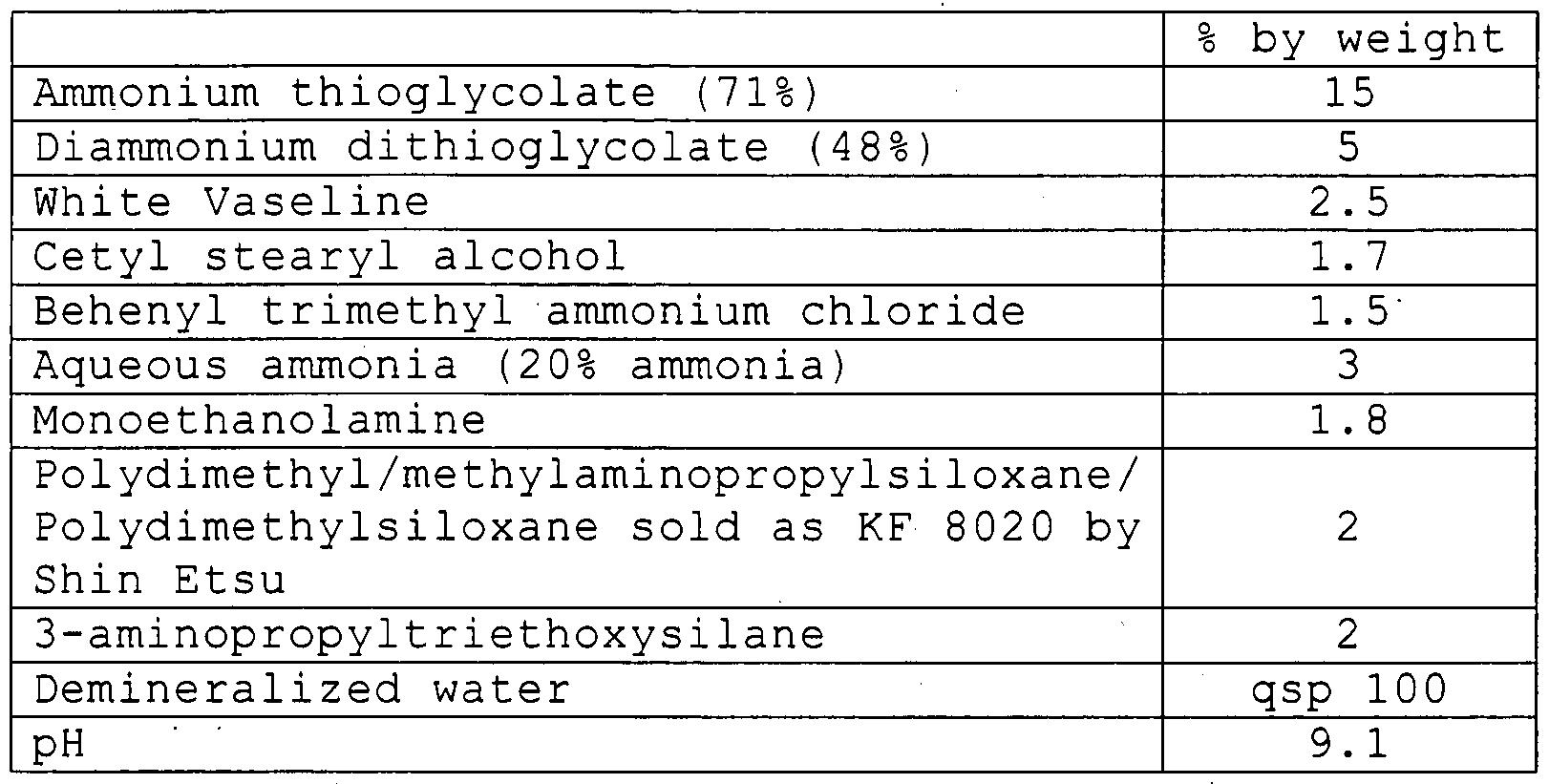
Composition 2 (Oxidizing Lotion)
Table 2

Composition 1 was applied onto a swatch of natural hair (2.7g) in a weight ratio of 1:2 of the swatch to Composition 1, and left for 15 minutes. After a pause, the swatch was rinsed, squeezed, and dried. The swatch was treated twice with an iron (180°C) to be straightened.
Then, Composition 2 was applied onto the swatch in a weight ratio of 1:2 of the swatch to Composition 2, and left for 5 minutes. After a pause, the swatch was rinsed and dried.
The swatch which had been treated as above was completely straightened. The swatch showed very good cosmetic properties in terms' of softness and suppleness, and the cosmetic properties were able to be maintained even after 5 shampoos.
Comparative Example 1
The following composition was prepared (the unit of the content is grams based on material as provided) .
Composition 3 (Reducing Cream)
Table 3

Composition 3 was applied onto a swatch of natural hair (2.7g) in a weight ratio of 1:2 of the swatch to Composition 3, and left for 15 minutes. After a pause, the swatch was rinsed, squeezed, and dried. The swatch was treated twice with an iron (180°C) to be straightened.
Then, Composition 2 was applied onto the swatch in a weight ratio of 1:2 of the swatch to Composition 2, and left for 5 minutes. After a pause, the swatch was rinsed and dried.
The swatch which had been treated as above was straightened.
However, the cosmetic properties of the tuft of hair were
inferior to those of the swatch which had been treated with
Composition 1. The feel to the touch was brittle and dry.
Example 2
The following composition was prepared (the unit of the content is grams based on material as provided) .
Composition 4 (Reducing Cream)
Table 4

Composition 4 was applied onto a swatch of natural hair (2.7g) in a weight ratio of 1:2 of the swatch to Composition 4, and left for 15 minutes. After a pause, the swatch was rinsed, squeezed, and dried. The swatch was treated twice with an iron (180°C) to be straightened.
Then, Composition 2 was applied onto the swatch in a weight ratio of 1:2 of the swatch to Composition 2, and left for 5 minutes. After a pause, the swatch was rinsed and dried.
The swatch which had been treated as above was completely
straightened. The swatch showed very good cosmetic properties in terms of softness and suppleness, and the cosmetic properties were able to be maintained even after 5 shampoos.
Comparative Example 2
The following composition was prepared (the unit of the content is grams based on material as provided) .
Composition 5 (Reducing Cream)
Table 5

Composition 5 was applied onto a swatch of natural hair (2.7g) in a weight ratio of 1:2 of the swatch to Composition 5, and left for 15 minutes. After a pause, the swatch was rinsed, squeezed, and dried. The swatch was treated twice with an iron (180°C) to be straightened.
Then, Composition 2 was applied onto the swatch in a weight ratio of 1:2 of the swatch to Composition 2, and left for 5 minutes. After a pause, the swatch was rinsed and dried.
The swatch which had been treated as above was straightened. The swatch had softness and suppleness just after the above
treatment. However, these cosmetic properties disappeared after the first shampoo.
(Permanent Waving)
Example 3
The following compositions were prepared (the unit of the content is grams based on material as provided) .
Composition 6 (Reducing Lotion)
Table 6

Composition 7

Composition 8 (Oxidizing Lotion)
Table 8

Compositions 6 and 7 were mixed in a weight ratio of 4:1 of Composition 6 to Composition 7. The obtained mixture was applied onto a swatch, (lg) of natural Japanese hair which had been already wound onto a curler with a diameter of 1.4 cm. After being left for 15 minutes, the swatch was rinsed. Then,
Composition 8 was applied onto the swatch, and left for 10 minutes. After a pause, the swatch was rinsed, unwound and dried at ambient temperature.
The hair which had been treated as above showed very good curl, and exhibited excellent cosmetic properties in terms of softness and disentanglement. These cosmetic properties were able to be maintained even after several shampoos.
Comparative Example 3
The following compositions were prepared (the unit of the content is grams based on material as provided) .
Composition 9 (Reducing Lotion)
Table 9

Composition 10
Table 10

Compositions 9 and 10 were mixed in a weight ratio of 4:1 of Composition 9 to Composition 10. The obtained mixture was applied onto a swatch (lg) of natural Japanese hair which had been already wound onto a curler with a diameter of 1.4 cm.
After being left for 15 minutes, the swatch was rinsed. Then, Composition 8 was applied onto the swatch, and left for 10 minutes. After a pause, the swatch was rinsed, unwound and dried in ambient temperature.
The hair which had been treated as above showed the same curl as seen in Example 3. However, the cosmetic properties of the hairof Comparative Example 3 just after the above treatment and after several shampoos were inferior to those of the hair in Example 3 in terms of softness and disentanglement.
(Straightening)
Example 4
The following compositions are prepared (the unit of the content is grams based on material as provided) .
Composition 11 (Reducing Cream),
Table 11

Composition 12 (Oxidizing Lotion)
Table 12

Composition 11 is applied onto a swatch of natural hair (2.7g) in a weight ratio of 1:2 of the swatch to Composition 11, and the swatch is left for 15 minutes. After a pause, the swatch is rinsed, squeezed, and dried. The swatch is treated twice with an iron (180°C) to be straightened.
Then, Composition 12 is applied onto the swatch in a weight ratio of 1:2 of the swatch to Composition 12, and the swatch is left for 5 minutes. After a pause, the swatch is rinsed and dried.
The swatch treated as above is completely straightened. The swatch shows very good cosmetic properties in terms of softness and suppleness, and the cosmetic properties are able to be maintained even after 5 shampoos.
Comparative Example 4
The following composition is prepared (the unit of the content is grams based on material as provided) .
Composition 13 (Reducing Cream)
Table 13

Composition 13 is applied onto a swatch of natural hair (2.7g) in a weight ratio of 1:2 of the swatch to Composition 13, and the swatch is left for 15 minutes. After a pause, the swatch is rinsed, squeezed, and dried. The swatch is treated twice with an iron (180°C) to be straightened.
Then, Composition 12 is applied onto the swatch in a weight ratio of 1:2 of the swatch to Composition 12, and the swatch is left for 5 minutes. After a pause, the swatch is rinsed and dried.
The swatch treated as above is straightened. However, the cosmetic properties of the swatch are inferior to those of the swatch treated with Composition 11.. The feel to the touch is brittle and dry.
Example 5
The following composition is prepared (the unit of the content is grams based on material as provided) .
Composition 14 (Reducing Cream)
Table 14

Composition 14 is applied onto a swatch of natural hair (2.7g) in a weight ratio of 1:2 of the swatch to Composition 14, and the swatch is left for 15 minutes. After a pause, the swatch is rinsed, squeezed, and dried. The swatch is treated twice with an iron (180°C) to be straightened.
Then, Composition 12 is applied onto the swatch in a weight ratio of 1:2 of the swatch to Composition 12, and the swatch is left for 5 minutes. After a pause, the swatch is rinsed and dried.
The swatch treated as above is completely straightened. The swatch shows very good cosmetic properties in terms of softness and suppleness, and the cosmetic properties are able to be maintained even after 5 shampoos.
Comparative Example 5
The following composition is prepared (the unit of the content is grams based on material as provided) .
Composition 15 (Reducing Cream)
Table 15

Composition 15 is applied onto a swatch of natural hair (2.7g) in a weight ratio of 1:2 of the swatch to Composition 15, and the swatch is left for 15 minutes. After a pause, the swatch is rinsed, squeezed, and dried. The swatch is treated twice with an iron (180°C) to be straightened.
Then, Composition 12 is applied onto the swatch in a weight ratio of 1:2 of the swatch to Composition 12, and the swatch is left for 5 minutes. After a pause, the swatch is rinsed and dried.
The swatch treated as above is straightened. The swatch has softness and suppleness just after the above treatment. However, these cosmetic properties disappear after the first shampoo.
(Permanent Waving)
Example 6
The following compositions are prepared (the unit of the content is grams based on material as provided) .
Composition 16 (Reducing Lotion)
Table 16

Composition 17
Table 17

Composition 18 (Oxidizing Lotion)
Table 18

Compositions 16 and 17 are mixed in a weight ratio of 4:1 of Composition 16 to Composition 17. The obtained mixture is applied onto a swatch (lg) of natural Japanese hair which has been already wound onto a curler with a diameter of 1.4 cm.
After being left for 15 minutes, the swatch is rinsed. Then, Composition 18 is applied onto the swatch, and the swatch is left for 10 minutes. After a pause, the swatch is rinsed, unwound and dried at ambient temperature.
The hair treated as above shows very good curl, and exhibited excellent cosmetic properties in terms of softness and
disentanglement. These cosmetic properties are able to be recognized even after several shampoos.
Comparative Example 6
The following compositions are prepared (the unit of the content is grams based on material as provided) .
Composition 19 (Reducing Lotion)
Table 19

Composition 20
Table 20

Compositions 19 and 20 are mixed in a weight ratio of 4:1 of Composition 19 to Composition 20. The obtained mixture is applied onto a swatch (lg) of natural Japanese hair which has already been wound onto a curler with a diameter of 1.4 cm.
After being left for 15 minutes, the swatch is rinsed. Then, Composition 18 is applied onto the swatch, and the swatch is left for 10 minutes. After a pause, the swatch is rinsed, unwound and dried at ambient temperature.
The hair treated as above shows the same curl as seen in Example 6. However, the cosmetic properties of the hair of Comparative Example 6 just after the above treatment and after several shampoos in terms of softness and disentanglement are inferior to those of the hair in Example 6.
(Straightening)
Example 7
The following composition was prepared (the unit of the content is grams based on material as provided) .
Composition 21
Table 21

Composition 21 was applied onto a swatch of naturally curly hair (0.2g) in a weight ratio of 1:2 of the swatch to Composition 21, and left for 10 minutes. After a pause, the swatch was rinsed with water and dried.
The swatch which had been treated as above was completely
straightened. The swatch showed very good cosmetic properties in terms of softness and suppleness, and the cosmetic properties were able to be maintained even after 5 shampoos.
Comparative Example 7
The following composition was prepared (the unit of the content is grams based on material as provided) .
Composition 22
Table 22

Composition 22 was applied onto a swatch of naturally curly hair (0.2g) in a weight ratio of 1:2 of the swatch to Composition 22, and left for 10 minutes. After a pause, the swatch was rinsed with water and dried.
The swatch which had been treated as above was completely straightened. However, the cosmetic properties of the swatch were inferior to those of the swatch which had been treated with Composition 21.
Claims
A cosmetic composition for keratin fibers, comprising:
(a) at least one alkoxysilane;
(b) at least one silicone; and
(c) at least one reshaping or deforming agent selected from the group consisting of thiol-based reducing agents, non thiol-based reducing agents, alkaline metal hydroxides and alkaline earth metal hydroxides.
The cosmetic composition according to Claim 1, wherein (a) the alkoxysilane comprises at least one solubilizing group.
The cosmetic composition according to Claim 2 , wherein (a) the alkoxysilane comprising at least one solubilizing group is represented by the formula:
R4-SiR1R2R3 wherein
R1 denotes a halogen atom, an -OR11 group or a -R12 group; R2 denotes a halogen atom, an -OR21 group or a -R22 group; R3 denotes a halogen atom, an -OR31 group or a -R32 group, where at least two groups of R1, R2 and R3 are different from R12, R22 and R32;
R4 denotes a group bearing at least one functional group chosen from the group consisting of carboxylic acids and salts thereof, sulfonic acids and salts thereof, amines and salts thereof, amino acids and salts thereof, and
polyalkylethers ; and
R11, R21, R31, R12, R22 and R32, which may be identical or different, are chosen from linear and branched, saturated and unsaturated, C1-C14 hydrocarbon groups, optionally bearing at least one additional chemical function chosen from carboxylic acids and salts thereof, sulfonic acids and salts thereof, amines and salts thereof, amino acids and salts thereof, and polyalkylethers,
where R11, R21 and R31 may also be chosen from hydrogen and at least two groups of R11, R21 and R31 are not hydrogen.
The cosmetic composition according to Claim 3, wherein (a) the alkoxysilane comprising at least one solubilizing group is represented by the formula:
H2N(CH2)n-Si (OR11) (OR21) (OR31)
wherein
R11, R21 and R31, which may be identical or different, are chosen from linear and branched, saturated and unsaturated, Ci-C6 hydrocarbon groups, optionally bearing at least one additional chemical function chosen from carboxylic acids and salts thereof, sulfonic acids and salts thereof, amines and salts thereof, amino acids and salts thereof, and polyalkylethers ; and
n denotes an integer from 1 to 6.
The cosmetic composition according to any one of Claims 1 to 4, wherein (a) the alkoxysilane is an
aminoalkyltrialkoxy silane, and more preferably is a γ- aminopropyltriethoxysi lane .
The cosmetic composition according to any one of Claims 1 to 5, wherein (a) the alkoxysilane ( s ) is/are present in an amount of 0.1 to 20% by weight relative to the total weight of the composition.
The cosmetic composition according to any one of Claims 1 to 6, wherein (b) the silicone is chosen from the group consisting of polydialkylsiloxanes , polyal kylarylsiloxanes , polydiarylsiloxanes , and organomodified polysiloxanes .
The cosmetic composition according to Claim 7, wherein the organomodi fied polysiloxanes are chosen from
polydialkylsiloxanes organomodified with at least one functional group chosen from amine groups, C1-C4 alkoxy groups, carboxyl groups, acrylic groups and polyamine groups, and preferably with amine groups.
The cosmetic composition according to any one of Claims 1 to 8, wherein (b) the silicone (s) is/are present in an amount of 0.01 to 20% by weight relative to the total weight of the composition.
The cosmetic composition according to any one of Claims 1 to 9, wherein the thiol-based reducing agent is chosen from the group consisting of thioglycolic acid and derivatives thereof, dithioglycolic acid and derivatives thereof,- thiolactic acid and derivatives thereof, 3-mercaptopropionic acid and derivatives thereof, cysteamine and derivatives thereof, mono-thioglycerol and derivatives thereof, cysteine
and derivatives thereof, and salts thereof.
11. The cosmetic composition according to any one of Claims 1 to 9, wherein the non thiol-based reducing agent is chosen from the group consisting of sulfites, bisulfites,
sulfinates, phosphines, sugars, reductones and hydrides and preferably . from sulfites, bisulfites and phosphines.
12. The cosmetic composition according to any one of Claims 1 to 9, wherein the alkaline metal hydroxide is selected from the group consisting of lithium hydroxide, sodium hydroxide, potassium hydroxide, rubidium hydroxide, and cesium
hydroxide .
13. The cosmetic composition according to any. one of Claims 1 to 9, wherein the alkaline earth metal hydroxide is selected from the group consisting of beryllium hydroxide, magnesium hydroxide, calcium hydroxide, strontium hydroxide and barium hydroxide .
14. The cosmetic composition according to any one of Claims 1 to 13, wherein (c) the reshaping or deforming agent (s) is/are present in an amount of 0.1 to 15% by weight
relative to the total weight of the composition.
15. The cosmetic composition according to any one of Claims 1 to 14, wherein the pH of the composition ranges from 10 to 14, preferably from 12 to 14.
16. The cosmetic composition according to any one of Claims 1 to 15, wherein the composition is intended for permanently deforming the keratin fibers.
17. A kit for deforming keratin fibers, comprising:
a first composition comprising (a) at least one
alkoxysilane; and
a second composition comprising (b) at least one silicone, wherein
either the first composition and/or second composition comprises (c) at least one reshaping or deforming agent selected from the group consisting of thiol-based reducing agents, non thiol-based reducing agents, alkaline metal hydroxides and alkaline earth metal hydroxides,
and optionally comprising
a third composition comprising at least one oxidizing agent.
18. A process for deforming keratin fibers, comprising the steps of:
applying onto the keratin fibers a composition comprising (a) at least one alkoxysilane, (b) at least one silicone, and (c) at least one reshaping or deforming agent selected from the group consisting, of thiol-based reducing agents, non thiol-based reducing agents, alkaline metal hydroxides and alkaline earth metal hydroxides;
providing the keratin fibers with mechanical tension and/or heat, for the deformation of the keratin fibers; and oxidizing the keratin fibers, if necessary.
19. The process according to Claim 18, further comprising the step of rinsing the keratin fibers after the step of applying the composition onto the keratin fibers and/or after the step of oxidizing the keratin fibers.
Applications Claiming Priority (12)
| Application Number | Priority Date | Filing Date | Title |
|---|---|---|---|
| JP2010-009239 | 2010-01-19 | ||
| JP2010009238 | 2010-01-19 | ||
| JP2010009239 | 2010-01-19 | ||
| JP2010-009240 | 2010-01-19 | ||
| JP2010009240 | 2010-01-19 | ||
| JP2010-009238 | 2010-01-19 | ||
| US31702610P | 2010-03-24 | 2010-03-24 | |
| US31703310P | 2010-03-24 | 2010-03-24 | |
| US31703810P | 2010-03-24 | 2010-03-24 | |
| US61/317,033 | 2010-03-24 | ||
| US61/317,038 | 2010-03-24 | ||
| US61/317,026 | 2010-03-24 |
Publications (1)
| Publication Number | Publication Date |
|---|---|
| WO2011089985A1 true WO2011089985A1 (en) | 2011-07-28 |
Family
ID=43867195
Family Applications (1)
| Application Number | Title | Priority Date | Filing Date |
|---|---|---|---|
| PCT/JP2011/050590 Ceased WO2011089985A1 (en) | 2010-01-19 | 2011-01-07 | Cosmetic composition for keratin fibers |
Country Status (1)
| Country | Link |
|---|---|
| WO (1) | WO2011089985A1 (en) |
Cited By (17)
| Publication number | Priority date | Publication date | Assignee | Title |
|---|---|---|---|---|
| US8343238B1 (en) | 2011-12-30 | 2013-01-01 | L'oreal Sa. | Process for altering the appearance of hair using a composition containing dyes and non-hydroxide bases |
| US8591872B2 (en) | 2011-12-30 | 2013-11-26 | L'oreal | Composition and process for reducing the curl and frizziness of hair |
| WO2014072657A1 (en) * | 2012-11-09 | 2014-05-15 | L'oreal | Composition comprising a dicarbonyl derivative and method for straightening the hair using this composition |
| WO2013098332A3 (en) * | 2011-12-30 | 2015-01-22 | L'oreal | Composition and process for reducing the curl and frizziness of hair |
| WO2013098335A3 (en) * | 2011-12-30 | 2015-01-22 | L'oreal | Process for altering the appearance of hair using a composition containing dyes and non-hydroxide bases |
| EP2857004A1 (en) * | 2013-10-07 | 2015-04-08 | The Procter and Gamble Company | Hair straightening method involving reducing sugars |
| EP2866773B1 (en) | 2012-06-29 | 2017-08-09 | Henkel AG & Co. KGaA | Method for chemical smoothing of human hairs ii |
| WO2017192990A1 (en) | 2016-05-05 | 2017-11-09 | Avlon Industries, Inc. | Hair relaxer compositions and method |
| US10434051B2 (en) | 2014-12-19 | 2019-10-08 | The Procter And Gamble Company | Shaping keratin fibers using arabinose and ethylene carbonate |
| US10568826B2 (en) | 2014-12-19 | 2020-02-25 | The Procter And Gamble Company | Shaping keratin fibres using a pretreatment and a protein crosslinking composition |
| US10912726B2 (en) | 2013-12-19 | 2021-02-09 | The Procter And Gamble Company | Shaping keratin fibres using a reducing composition and a fixing composition |
| US10945931B2 (en) | 2015-06-18 | 2021-03-16 | The Procter And Gamble Company | Shaping keratin fibres using dialdehyde compounds |
| US11096879B2 (en) | 2013-12-19 | 2021-08-24 | The Procter And Gamble Plaza | Shaping keratin fibres using an active agent comprising a functional group selected from the group consisting of: -C(=O)-, -C(=O)-H, and -C(=O)-O- |
| US11103434B2 (en) | 2013-12-19 | 2021-08-31 | The Procter And Gamble Company | Shaping keratin fibres using carbonate ester |
| US11110046B2 (en) | 2013-12-19 | 2021-09-07 | The Procter And Gamble Company | Shaping keratin fibres using 2-hydroxypropane-1,2,3-tricarboxylic acid and/or 1,2,3,4-butanetetracarboxylic acid |
| US11129784B2 (en) | 2013-12-19 | 2021-09-28 | The Procter And Gamble Company | Shaping keratin fibres using oxoethanoic acid and/or derivatives thereof |
| US11154480B2 (en) | 2013-12-19 | 2021-10-26 | The Procter And Gamble Company | Shaping keratin fibres using a sugar |
Citations (17)
| Publication number | Priority date | Publication date | Assignee | Title |
|---|---|---|---|---|
| EP0186507A2 (en) | 1984-12-22 | 1986-07-02 | Chisso Corporation | Carboxyl group-containing siloxane compounds |
| EP0342834A2 (en) | 1988-05-17 | 1989-11-23 | Dow Corning Limited | Treatment of fibrous materials |
| EP0354835A1 (en) | 1988-08-04 | 1990-02-14 | L'oreal | N-(mercaptoalkyl)-omega-hydroxyalkyl amides and their use as reducing agents in a process for the permanent setting of hair |
| EP0368763A1 (en) | 1988-11-09 | 1990-05-16 | L'oreal | 4-Mercapto butyramides N-mono or N,N-disubstituted by a mono or polyhydroxyalkyl radical, and their use as reducing agents in the process of permanent deformation of the hair |
| US4957732A (en) | 1988-12-29 | 1990-09-18 | L'oreal | Shaving composition for the skin based on polyorgano-siloxanes containing an acyloxyalkyl group and process for use |
| EP0432000A1 (en) | 1989-11-20 | 1991-06-12 | L'oreal | Reducing composition for permanent hairwaving, comprising as reducing agent an amino-mercaptoalkylamide or one of its salts, and its use in a process for permanent hairwaving |
| EP0514282A1 (en) | 1991-05-17 | 1992-11-19 | L'oreal | Alkylamino mercaptoalkylamides or salts thereof acceptable for cosmetic use, their use as a reducing agent and a process for the permanent deformation of hair |
| FR2679448A1 (en) | 1991-07-23 | 1993-01-29 | Oreal | AZETROPIC MIXTURE OF 2-HYDROXY PROPYL THIOGLYCOLATE AND 2-HYDROXY METHYL-ETHYL THIOGLYCOLATE, PROCESS FOR OBTAINING THE SAME, AND USE THEREOF IN A PROCESS FOR PERMANENTLY DEFORMING HAIR. |
| EP0829257A2 (en) * | 1996-09-13 | 1998-03-18 | Dow Corning Corporation | Permanent waving emulsion with mercaptosilicones, and process for using it |
| FR2814948A1 (en) | 2000-10-11 | 2002-04-12 | Oreal | COSMETIC COMPOSITION CONTAINING SULFINIC ACID DERIVATIVES |
| US20030147841A1 (en) * | 2001-11-08 | 2003-08-07 | Frederic Legrand | Reducing composition for treating keratin fibres, comprising a particular aminosilicone |
| US20040166073A1 (en) | 2003-02-24 | 2004-08-26 | L'oreal | Multimineral no-mix relaxer |
| FR2870119A1 (en) | 2004-05-17 | 2005-11-18 | Oreal | USE FOR THE ARTIFICIAL COLOR DETERMINATION OF KERATIN FIBERS OF A COMPOSITION COMPRISING AT LEAST ONE PHOSPHINE AS A MAJORITY REDUCING AGENT |
| US20060110351A1 (en) * | 2002-07-25 | 2006-05-25 | Sabine Koehler | Use of silanes on cosmetic agents and methods for treating hair |
| US20080226576A1 (en) * | 2006-12-20 | 2008-09-18 | Katarina Benabdillah | Hair shaping compositions comprising at least one silicone and at least one alkoxysilane having solubilizing functional groups |
| JP2008260750A (en) | 2006-12-22 | 2008-10-30 | L'oreal Sa | Permanent remolding method of keratin fiber including low concentration concentrated composition application process and intermediate drying process |
| WO2010025311A1 (en) * | 2008-08-29 | 2010-03-04 | Dow Corning Corporation | Silicone-organic hybrid emulsions in personal care applications |
-
2011
- 2011-01-07 WO PCT/JP2011/050590 patent/WO2011089985A1/en not_active Ceased
Patent Citations (19)
| Publication number | Priority date | Publication date | Assignee | Title |
|---|---|---|---|---|
| EP0186507A2 (en) | 1984-12-22 | 1986-07-02 | Chisso Corporation | Carboxyl group-containing siloxane compounds |
| EP0342834A2 (en) | 1988-05-17 | 1989-11-23 | Dow Corning Limited | Treatment of fibrous materials |
| EP0354835A1 (en) | 1988-08-04 | 1990-02-14 | L'oreal | N-(mercaptoalkyl)-omega-hydroxyalkyl amides and their use as reducing agents in a process for the permanent setting of hair |
| EP0368763A1 (en) | 1988-11-09 | 1990-05-16 | L'oreal | 4-Mercapto butyramides N-mono or N,N-disubstituted by a mono or polyhydroxyalkyl radical, and their use as reducing agents in the process of permanent deformation of the hair |
| US4957732A (en) | 1988-12-29 | 1990-09-18 | L'oreal | Shaving composition for the skin based on polyorgano-siloxanes containing an acyloxyalkyl group and process for use |
| EP0432000A1 (en) | 1989-11-20 | 1991-06-12 | L'oreal | Reducing composition for permanent hairwaving, comprising as reducing agent an amino-mercaptoalkylamide or one of its salts, and its use in a process for permanent hairwaving |
| EP0514282A1 (en) | 1991-05-17 | 1992-11-19 | L'oreal | Alkylamino mercaptoalkylamides or salts thereof acceptable for cosmetic use, their use as a reducing agent and a process for the permanent deformation of hair |
| FR2679448A1 (en) | 1991-07-23 | 1993-01-29 | Oreal | AZETROPIC MIXTURE OF 2-HYDROXY PROPYL THIOGLYCOLATE AND 2-HYDROXY METHYL-ETHYL THIOGLYCOLATE, PROCESS FOR OBTAINING THE SAME, AND USE THEREOF IN A PROCESS FOR PERMANENTLY DEFORMING HAIR. |
| EP0829257A2 (en) * | 1996-09-13 | 1998-03-18 | Dow Corning Corporation | Permanent waving emulsion with mercaptosilicones, and process for using it |
| FR2814948A1 (en) | 2000-10-11 | 2002-04-12 | Oreal | COSMETIC COMPOSITION CONTAINING SULFINIC ACID DERIVATIVES |
| US20030147841A1 (en) * | 2001-11-08 | 2003-08-07 | Frederic Legrand | Reducing composition for treating keratin fibres, comprising a particular aminosilicone |
| US20060110351A1 (en) * | 2002-07-25 | 2006-05-25 | Sabine Koehler | Use of silanes on cosmetic agents and methods for treating hair |
| US20040166073A1 (en) | 2003-02-24 | 2004-08-26 | L'oreal | Multimineral no-mix relaxer |
| JP2004256535A (en) | 2003-02-24 | 2004-09-16 | L'oreal Sa | Non-mixed multi-mineral relaxer |
| FR2870119A1 (en) | 2004-05-17 | 2005-11-18 | Oreal | USE FOR THE ARTIFICIAL COLOR DETERMINATION OF KERATIN FIBERS OF A COMPOSITION COMPRISING AT LEAST ONE PHOSPHINE AS A MAJORITY REDUCING AGENT |
| US20080226576A1 (en) * | 2006-12-20 | 2008-09-18 | Katarina Benabdillah | Hair shaping compositions comprising at least one silicone and at least one alkoxysilane having solubilizing functional groups |
| JP2008260750A (en) | 2006-12-22 | 2008-10-30 | L'oreal Sa | Permanent remolding method of keratin fiber including low concentration concentrated composition application process and intermediate drying process |
| US20080274070A1 (en) | 2006-12-22 | 2008-11-06 | Catherine Campain | Method for permanently reshaping keratin fibers comprising applying a poorly concentrated reducing compositions followed by drying |
| WO2010025311A1 (en) * | 2008-08-29 | 2010-03-04 | Dow Corning Corporation | Silicone-organic hybrid emulsions in personal care applications |
Non-Patent Citations (3)
| Title |
|---|
| TODD; BYERS: "Volatile Silicone fluids for cosmetics", COSMETICS AND TOILETRIES, vol. 91, January 1976 (1976-01-01), pages 27 - 32 |
| WALTER NOLL: "Chemistry and Technology of Silicones", 1968, ACADEMIC PRESS |
| ZVIAK, C., THE SCIENCE OF HAIR CARE, 1986, pages 185 - 186 |
Cited By (22)
| Publication number | Priority date | Publication date | Assignee | Title |
|---|---|---|---|---|
| US8343238B1 (en) | 2011-12-30 | 2013-01-01 | L'oreal Sa. | Process for altering the appearance of hair using a composition containing dyes and non-hydroxide bases |
| US8591872B2 (en) | 2011-12-30 | 2013-11-26 | L'oreal | Composition and process for reducing the curl and frizziness of hair |
| WO2013098332A3 (en) * | 2011-12-30 | 2015-01-22 | L'oreal | Composition and process for reducing the curl and frizziness of hair |
| WO2013098335A3 (en) * | 2011-12-30 | 2015-01-22 | L'oreal | Process for altering the appearance of hair using a composition containing dyes and non-hydroxide bases |
| EP2866773B1 (en) | 2012-06-29 | 2017-08-09 | Henkel AG & Co. KGaA | Method for chemical smoothing of human hairs ii |
| WO2014072657A1 (en) * | 2012-11-09 | 2014-05-15 | L'oreal | Composition comprising a dicarbonyl derivative and method for straightening the hair using this composition |
| FR2997849A1 (en) * | 2012-11-09 | 2014-05-16 | Oreal | COMPOSITION COMPRISING A DICARBONYL DERIVATIVE AND A METHOD FOR SMOOTHING THE HAIR THEREFROM |
| EP2857004A1 (en) * | 2013-10-07 | 2015-04-08 | The Procter and Gamble Company | Hair straightening method involving reducing sugars |
| WO2015054018A1 (en) * | 2013-10-07 | 2015-04-16 | The Procter & Gamble Company | Hair straightening method involving reducing sugars |
| US9415000B2 (en) | 2013-10-07 | 2016-08-16 | The Procter & Gamble Company | Hair straightening method involving reducing sugars |
| US10912726B2 (en) | 2013-12-19 | 2021-02-09 | The Procter And Gamble Company | Shaping keratin fibres using a reducing composition and a fixing composition |
| US11096879B2 (en) | 2013-12-19 | 2021-08-24 | The Procter And Gamble Plaza | Shaping keratin fibres using an active agent comprising a functional group selected from the group consisting of: -C(=O)-, -C(=O)-H, and -C(=O)-O- |
| US11103434B2 (en) | 2013-12-19 | 2021-08-31 | The Procter And Gamble Company | Shaping keratin fibres using carbonate ester |
| US11110046B2 (en) | 2013-12-19 | 2021-09-07 | The Procter And Gamble Company | Shaping keratin fibres using 2-hydroxypropane-1,2,3-tricarboxylic acid and/or 1,2,3,4-butanetetracarboxylic acid |
| US11129784B2 (en) | 2013-12-19 | 2021-09-28 | The Procter And Gamble Company | Shaping keratin fibres using oxoethanoic acid and/or derivatives thereof |
| US11154480B2 (en) | 2013-12-19 | 2021-10-26 | The Procter And Gamble Company | Shaping keratin fibres using a sugar |
| US10434051B2 (en) | 2014-12-19 | 2019-10-08 | The Procter And Gamble Company | Shaping keratin fibers using arabinose and ethylene carbonate |
| US10568826B2 (en) | 2014-12-19 | 2020-02-25 | The Procter And Gamble Company | Shaping keratin fibres using a pretreatment and a protein crosslinking composition |
| US10945931B2 (en) | 2015-06-18 | 2021-03-16 | The Procter And Gamble Company | Shaping keratin fibres using dialdehyde compounds |
| EP3452174A4 (en) * | 2016-05-05 | 2020-01-01 | Avlon Industries, Inc. | HAIR RELAXATION COMPOSITIONS AND METHOD |
| US10568829B2 (en) | 2016-05-05 | 2020-02-25 | Avlon Industries, Inc. | Hair relaxer compositions and method |
| WO2017192990A1 (en) | 2016-05-05 | 2017-11-09 | Avlon Industries, Inc. | Hair relaxer compositions and method |
Similar Documents
| Publication | Publication Date | Title |
|---|---|---|
| WO2011089985A1 (en) | Cosmetic composition for keratin fibers | |
| ES2617280T3 (en) | Use of a silicone in a hair molding composition comprising an alkoxysilane comprising a solubilizing functional group | |
| ES2457615T3 (en) | Cosmetic composition comprising an organic silicon compound, and hair molding process | |
| JP6914837B2 (en) | Methods for treating keratin fibers | |
| US9005593B2 (en) | Method for shaping the hair using at least one reducing composition, at least one care composition, and heating | |
| WO2013098332A2 (en) | Composition and process for reducing the curl and frizziness of hair | |
| US10722450B2 (en) | Process for treating the hair with at least one silicone functionalized with at least one alkoxysilane unit, and steam | |
| FR3045376A1 (en) | A CAPILLARY TREATMENT PROCESS USING A COMPOSITION COMPRISING AT LEAST ONE CATIONIC ACRYLIC COPOLYMER | |
| HUP0201164A2 (en) | Process for permanently reshaping the hair using aminosilicones | |
| US20120031420A1 (en) | Composition and method for thermally activated hair treatment | |
| US8591872B2 (en) | Composition and process for reducing the curl and frizziness of hair | |
| CN115996699A (en) | Pretreatment composition for a method of dyeing or bleaching keratin fibers | |
| EP3525752A1 (en) | Hair cosmetic composition comprising thiol-based compounds | |
| HK1049450A1 (en) | Method for permanently shaping keratin fibres, and agents | |
| AU749034B2 (en) | Cosmetic composition comprising at least one silicone/ acrylate copolymer and at least one conditioning agent | |
| JP7622099B2 (en) | Method for treating keratin fibers with high concentrations of specific amino acids | |
| JP6317060B2 (en) | Method for treating keratin fibers | |
| WO2016076437A1 (en) | Composition for keratin fibers | |
| KR100971259B1 (en) | Reducing composition for use in a method for permanently reshaping keratin fibers comprising cysteine and thiolactic acid, or salts thereof | |
| EP3558251A1 (en) | Aqueous composition comprising a compound of thiolactone type and a silicone and process for treating keratin materials with the composition | |
| JP2018070460A (en) | Method for treating keratin fibers | |
| JP2017105713A (en) | Cosmetic use of oleuropein or olive leaf extract for permanent deformation of keratin fibers | |
| JPH06192040A (en) | Hair cosmetic | |
| WO2018122123A1 (en) | Process for treating keratin fibres using a derivative of butenedioic acid and an amino silicone | |
| WO2011074142A1 (en) | Process for treating keratin fibers |
Legal Events
| Date | Code | Title | Description |
|---|---|---|---|
| 121 | Ep: the epo has been informed by wipo that ep was designated in this application |
Ref document number: 11702085 Country of ref document: EP Kind code of ref document: A1 |
|
| NENP | Non-entry into the national phase |
Ref country code: DE |
|
| NENP | Non-entry into the national phase |
Ref country code: JP |
|
| 122 | Ep: pct application non-entry in european phase |
Ref document number: 11702085 Country of ref document: EP Kind code of ref document: A1 |