WO2011071402A1 - Mortars containing phase change material microcapsules, their preparation process and use - Google Patents
Mortars containing phase change material microcapsules, their preparation process and use Download PDFInfo
- Publication number
- WO2011071402A1 WO2011071402A1 PCT/PT2009/000072 PT2009000072W WO2011071402A1 WO 2011071402 A1 WO2011071402 A1 WO 2011071402A1 PT 2009000072 W PT2009000072 W PT 2009000072W WO 2011071402 A1 WO2011071402 A1 WO 2011071402A1
- Authority
- WO
- WIPO (PCT)
- Prior art keywords
- pcm
- mortars
- mortar
- microcapsules
- phase change
- Prior art date
- Legal status (The legal status is an assumption and is not a legal conclusion. Google has not performed a legal analysis and makes no representation as to the accuracy of the status listed.)
- Ceased
Links
Classifications
-
- C—CHEMISTRY; METALLURGY
- C04—CEMENTS; CONCRETE; ARTIFICIAL STONE; CERAMICS; REFRACTORIES
- C04B—LIME, MAGNESIA; SLAG; CEMENTS; COMPOSITIONS THEREOF, e.g. MORTARS, CONCRETE OR LIKE BUILDING MATERIALS; ARTIFICIAL STONE; CERAMICS; REFRACTORIES; TREATMENT OF NATURAL STONE
- C04B28/00—Compositions of mortars, concrete or artificial stone, containing inorganic binders or the reaction product of an inorganic and an organic binder, e.g. polycarboxylate cements
- C04B28/02—Compositions of mortars, concrete or artificial stone, containing inorganic binders or the reaction product of an inorganic and an organic binder, e.g. polycarboxylate cements containing hydraulic cements other than calcium sulfates
- C04B28/10—Lime cements or magnesium oxide cements
-
- C—CHEMISTRY; METALLURGY
- C04—CEMENTS; CONCRETE; ARTIFICIAL STONE; CERAMICS; REFRACTORIES
- C04B—LIME, MAGNESIA; SLAG; CEMENTS; COMPOSITIONS THEREOF, e.g. MORTARS, CONCRETE OR LIKE BUILDING MATERIALS; ARTIFICIAL STONE; CERAMICS; REFRACTORIES; TREATMENT OF NATURAL STONE
- C04B20/00—Use of materials as fillers for mortars, concrete or artificial stone according to more than one of groups C04B14/00 - C04B18/00 and characterised by shape or grain distribution; Treatment of materials according to more than one of the groups C04B14/00 - C04B18/00 specially adapted to enhance their filling properties in mortars, concrete or artificial stone; Expanding or defibrillating materials
- C04B20/10—Coating or impregnating
- C04B20/1018—Coating or impregnating with organic materials
- C04B20/1029—Macromolecular compounds
- C04B20/1033—Macromolecular compounds obtained by reactions only involving carbon-to-carbon unsaturated bonds
-
- C—CHEMISTRY; METALLURGY
- C04—CEMENTS; CONCRETE; ARTIFICIAL STONE; CERAMICS; REFRACTORIES
- C04B—LIME, MAGNESIA; SLAG; CEMENTS; COMPOSITIONS THEREOF, e.g. MORTARS, CONCRETE OR LIKE BUILDING MATERIALS; ARTIFICIAL STONE; CERAMICS; REFRACTORIES; TREATMENT OF NATURAL STONE
- C04B2103/00—Function or property of ingredients for mortars, concrete or artificial stone
- C04B2103/0068—Ingredients with a function or property not provided for elsewhere in C04B2103/00
- C04B2103/0071—Phase-change materials, e.g. latent heat storage materials used in concrete compositions
-
- C—CHEMISTRY; METALLURGY
- C04—CEMENTS; CONCRETE; ARTIFICIAL STONE; CERAMICS; REFRACTORIES
- C04B—LIME, MAGNESIA; SLAG; CEMENTS; COMPOSITIONS THEREOF, e.g. MORTARS, CONCRETE OR LIKE BUILDING MATERIALS; ARTIFICIAL STONE; CERAMICS; REFRACTORIES; TREATMENT OF NATURAL STONE
- C04B2111/00—Mortars, concrete or artificial stone or mixtures to prepare them, characterised by specific function, property or use
- C04B2111/00474—Uses not provided for elsewhere in C04B2111/00
- C04B2111/00482—Coating or impregnation materials
-
- C—CHEMISTRY; METALLURGY
- C04—CEMENTS; CONCRETE; ARTIFICIAL STONE; CERAMICS; REFRACTORIES
- C04B—LIME, MAGNESIA; SLAG; CEMENTS; COMPOSITIONS THEREOF, e.g. MORTARS, CONCRETE OR LIKE BUILDING MATERIALS; ARTIFICIAL STONE; CERAMICS; REFRACTORIES; TREATMENT OF NATURAL STONE
- C04B2111/00—Mortars, concrete or artificial stone or mixtures to prepare them, characterised by specific function, property or use
- C04B2111/00474—Uses not provided for elsewhere in C04B2111/00
- C04B2111/00482—Coating or impregnation materials
- C04B2111/00517—Coating or impregnation materials for masonry
Definitions
- This invention describes the preparation of lime based binder coating mortars and their incorporation with phase change materials (PCM).
- PCM phase change materials
- PCM polystyrene-co-styrene-styrene-styrene-styrene-styrene-styrene-styrene-styrene-styrene-styrene-styrene-styrene-styrene-styrene-styrene-styrene-styrene-styrene-styrene-styrene-styrene-styrene-styrene-styrene-styrene-styrene-styrene-styrene-styrene-styrene-styrene-styrene-styrene-styrene-styrene-styrene-styrene-styrene-styrene-styrene-sty
- PCM phase change material
- US Patent 5,555,216 describes a technique of incorporating a phase change material (PCM) composite into the hollow cores of a cement brick.
- PCM phase change material
- a disadvantage of this solution is that PCM is not in contact. with the exterior, as the blocks are covered with finishing materials and wall cladding, thus, it becomes more difficult to exchange heat with the interior air of the rooms.
- US 4572864 discloses the solution for using PCM in boards finished in different materials (metal, wood or fiber), which can be placed inside buildings. PCM performance depends on the thermal conductivity of the board's finishing materials, which may in some cases greatly decrease the effectiveness of the product.
- PCM construction products are already on the market, such as the Smartboard TM product developed by BASF. It is a plaster based product with built-in Micronal capsules for application in the interior lining of buildings. Maxit has developed a commercially available PCM plaster mortar, Maxit Clima. Research has been developed, with some success, in the incorporation of PCM in cement. [5]
- Figure 1 represents the PCM particle size distribution curve obtained in a Coulter assay.
- Figure 2 is the PCM differential scanning calorimetry for determining the phase transition temperature.
- Figure 3 represents the performance of the mortar described in Example 1 in the mechanical strength tests.
- Figure 4 represents the thermal behavior of the mortar of Example 1 with 30% and 50% PCM.
- Figure 5 represents the mortar performance described in Example 2 in the mechanical strength tests.
- Figure 6 represents the thermal behavior of the mortar of Example 2 with 30% and 50% PCM.
- Figure 7 shows the visualization of two samples by scanning electron microscopy.
- Figure 7a shows a mortar without PCM and
- Figure 7b represents the same mortar with 30% PCM.
- the present invention describes lime-based binder mortars incorporating PCMs which have the ability to accumulate latent heat in order to reduce the energy charge of buildings as well as the process for preparing said mortars and their use in the building. interior and exterior cladding of building systems with the aim of saving energy.
- the mortars of the present invention use a commercial PCM considered suitable for application to building materials, as their phase transition temperature is within the considered comfort temperature for building interiors (between 20 and 25 ° C). ⁇ ) .
- the selected PCM consists of methyl polymethacrylate microcapsules containing a paraffin wax mixture.
- the product is used in powders with a particle diameter between 2 and 20 ⁇ , has a transition temperature of 23 ° C and 110 kj / kg of specific heat (as specified by the supplier).
- PCM encapsulation is intended to ensure the integrity of the paraffins by ensuring that they retain their heat storage capacity.
- the production process results in a suspension of water-dispersed microcapsules which upon spray drying give rise to a fine powder which can be added to porous building materials.
- PCM phase change material
- the binder consists of air lime or air lime and cement.
- microcapsules of the phase change material are usually between 0.2 and 25 ⁇ and consist of methyl polymethacrylate containing a mixture of paraffin waxes.
- a second object of the invention is a process for preparing the mortars of the present invention by mixing the PCM microcapsules with lime based binder and other auxiliary products in a mixer machine.
- a third object of the invention is the use of the mortars of the present invention in the interior and exterior cladding of building systems with the aim of saving energy.
- the supplier-indicated PCM phase transition temperature was compared with the results of a differential scanning calorimetry ( Figure 2). This technique provides information on endothermic and exothermic reactions that occur in the material when it is heated and / or cooled. It can be seen from the graph obtained for the differential scanning calorimetry that the phase transition temperature of is between 23 ° C and 25 ° C.
- This system is divided into three components:
- a programmable climate chamber for predefined temperature and humidity cycles.
- Cells constructed with an insulating material (expanded polystyrene) coated on both sides with a wire plaster, the inner faces are covered with a mortar layer approximately 100 x 100 x 3 mm (width x length x thickness). Each cell has two thermocouples inside, one placed against the wall and one in the central area of the cell.
- Data acquisition system consisting of a data logger with a multi-duplexer connected to a computer that allows the temperature data to be recorded using its own software.
- Mortar C1 contains equal parts (1: 1) of lime and cement binder, and is then added up to 50% (by weight) of the selected PCM. Table 1 summarizes the mortar composition and properties.
- PCM is added to the mortar powder, the mixture is homogenized and then the necessary water is added to the previously defined spreading value.
- Example 2 Mortar C3 contains equal parts by volume.
- Table 4 shows the percent water, density and spread value for the 30% and 50% PCM mortar.
- Figure 6 demonstrates the effectiveness of mortar when subjected to heating and cooling cycles in a climate chamber.
Landscapes
- Chemical & Material Sciences (AREA)
- Engineering & Computer Science (AREA)
- Ceramic Engineering (AREA)
- Materials Engineering (AREA)
- Structural Engineering (AREA)
- Organic Chemistry (AREA)
- Chemical Kinetics & Catalysis (AREA)
- Inorganic Chemistry (AREA)
- Curing Cements, Concrete, And Artificial Stone (AREA)
Abstract
Description
DESCRIÇÃO DESCRIPTION
"ARGAMASSAS CONTENDO MICROCAPSXJLAS DE MATERIAIS DE MUDANÇA DE FASE, PROCESSO PARA A SUA PREPARAÇÃO E SUA UTILIZAÇÃO" "MORTARS CONTAINING MICROCAPSXJLAS OF PHASE CHANGE MATERIALS, PROCESS FOR THEIR PREPARATION AND USE"
Campo da Invenção Este invento descreve a preparação de argamassas de revestimento com ligante à base de cal e a sua incorporação com materiais de mudança de fase (PCM) . A incorporação de materiais de mudança de fase permite melhorar o desempenho térmico das argamassas utilizadas no revestimento interior e exterior de sistemas construtivos, contribuindo assim para a poupança energética do edifício. Field of the Invention This invention describes the preparation of lime based binder coating mortars and their incorporation with phase change materials (PCM). The incorporation of phase change materials improves the thermal performance of mortars used in the interior and exterior cladding of building systems, thus contributing to the energy saving of the building.
Antecedentes da invenção A poupança energética nos edifícios tem ganho importância crescente, fruto do aumento do preço dos combustíveis, da diminuição das reservas de combustíveis fosseis e de uma crescente consciencialização ambiental. Uma das formas de contribuir para uma redução do consumo energético dos edifícios é melhorar a sua eficiência energética. A utilização de materiais capazes de armazenar calor latente contribui para uma diminuição do consumo associado aos sistemas de aquecimento e arrefecimento dos edifícios . Alguns materiais têm a capacidade de armazenar calor latente, quando mudam de uma fase sólida para líquida (ocorrendo uma reacção endotérmica) , posteriormente esse calor é libertado, quando estes materiais regressam à fase sólida (reacção exotérmica) . Por causa desta característica estes materiais são denominados de PCM (Materiais de Mudança de Fase) . A incorporação de PCM em argamassas de revestimento de edifícios permite controlar a temperatura, reduzindo o consumo associado aos sistemas de climatização, que consomem energia e geram poluição. O desenvolvimento das técnicas de microencapsulamento, permitiu a sua incorporação em materiais de construção. O armazenamento de energia é feito a partir do aproveitamento do calor latente destes materiais. Entende-se por calor latente a energia absorvida ou libertada quando um dado material muda de sólido para líquido ou de líquido para sólido. Para alguns materiais este processo pode ser repetido indefinidamente. As parafinas são dos materiais de mudança de fase com melhor adequabilidade para aplicações em sistemas construtivos, porque apresentam uma temperatura de transição que ronda os 22-26 °C, o que é ideal para aplicação em edifícios, por se encontrar no intervalo da temperatura de conforto (20-25 °C) .Os materiais de mudança de fase começaram a ser considerados para armazenamento de energia há mais de 30 anos. Existem exemplos descritos na literatura que datam de 1975. Nas últimas décadas tem sido desenvolvido trabalho de investigação na área da incorporação de PCM em materiais de construção. [1] Os PCM apresentam algumas características que os tornam particularmente interessantes para a sua aplicação em sistemas construtivos. Existem materiais para gamas de temperatura adequadas à aplicação na construção, ou seja, a sua temperatura de transição está dentro da zona de conforto térmico. A variação de densidade na transição de fase é muito baixa, e esta estabilidade é particularmente importante quando o PCM está incorporado no material de construção, para que a sua transição não comprometa a resistência mecânica do produto. São quimicamente estáveis e compatíveis com os materiais em que são incorporados (gessos, cimentos, argamassas, etc.) . [2] BACKGROUND OF THE INVENTION Energy saving in buildings is becoming increasingly important as a result of rising fuel prices, decreasing reserves of fossil fuels and increasing environmental awareness. One way to contribute to reducing the energy consumption of buildings is to improve their energy efficiency. The use of materials capable of storing latent heat contributes to a reduction in consumption associated with building heating and cooling systems. Some materials have the ability to store latent heat when they change from a solid to a liquid phase (an endothermic reaction taking place), afterwards that heat is released when these materials return to the solid phase (an exothermic reaction). Because of this feature these materials are called PCM (Phase Change Materials). The incorporation of PCM in building cladding mortars allows to control the temperature, reducing the consumption associated with the energy-consuming and pollution-generating HVAC systems. The development of microencapsulation techniques allowed their incorporation into building materials. Energy storage is made from the latent heat of these materials. Latent heat is the energy absorbed or released when a given material changes from solid to liquid or from liquid to solid. For some materials this process can be repeated indefinitely. Paraffins are one of the phase change materials best suited for building system applications because they have a transition temperature of around 22-26 ° C, which is ideal for building applications as it is in the range of comfort (20-25 ° C). Phase change materials have been considered for energy storage for over 30 years. There are examples described in the literature dating from 1975. In recent decades research work has been developed in the area of incorporating PCM in building materials. [1] PCMs have some features that make them particularly interesting for their application in building systems. There are materials for temperature ranges suitable for application in construction, ie their transition temperature is within the thermal comfort zone. The density change in phase transition is very low, and this stability is particularly important when PCM is incorporated into the building material so that its transition does not compromise the mechanical strength of the product. They are chemically stable and compatible with the materials in which they are incorporated (plaster, cement, mortar, etc.). [2]
Mediante a incorporação de PCM nos materiais usados no revestimento de tectos e paredes dos edifícios, é possível tirar proveito dessas áreas para armazenamento de calor latente. Ao contrário da sua aplicação em placas ou estruturas próprias, no caso da incorporação em materiais de construção, o custo acrescido é principalmente o do próprio PCM, eliminando-se a necessidade de utilização de estruturas auxiliares ou sistemas construtivos adaptados. By incorporating PCM into the materials used to cover buildings' ceilings and walls, it is possible to take advantage of these areas for latent heat storage. Unlike its application on its own plates or structures, in the case of incorporation in building materials, the added cost is mainly that of PCM itself, eliminating the need to use ancillary structures or adapted building systems.
Têm sido desenvolvidos vários métodos de incorporação de PCM em materiais e produtos de construção, a Patente US 5755216 descreve uma técnica de incorporação de um compósito contendo um material de mudança de fase (PCM) nos núcleos ocos de um tijolo de cimento. Uma desvantagem desta solução é que o PCM não está em contacto com o exterior, dado que os blocos são cobertos com materiais de acabamento e revestimento de paredes, sendo assim, torna-se mais difícil a troca de calor com o ar interior das divisões. A patente US 4572864 apresenta a solução de utilização de PCM em placas com acabamento em diferentes materiais (metal, madeira ou fibras), que podem ser colocadas no interior dos edifícios. O desempenho do PCM depende da condutividade térmica dos materiais de acabamento das placas, o que pode em alguns casos diminuir muito a eficácia do produto. Various methods of incorporating PCM into construction materials and products have been developed, US Patent 5,555,216 describes a technique of incorporating a phase change material (PCM) composite into the hollow cores of a cement brick. A disadvantage of this solution is that PCM is not in contact. with the exterior, as the blocks are covered with finishing materials and wall cladding, thus, it becomes more difficult to exchange heat with the interior air of the rooms. US 4572864 discloses the solution for using PCM in boards finished in different materials (metal, wood or fiber), which can be placed inside buildings. PCM performance depends on the thermal conductivity of the board's finishing materials, which may in some cases greatly decrease the effectiveness of the product.
Nos dois exemplos anteriores o PCM não é incorporado directamente no material de construção, na Patente US 4747240 são explicadas diferentes formas de incorporação dos PCM em massas que são usadas no acabamento de paredes. Apesar de ser referida a possibilidade de utilização de microcápsulas , nesta patente são utilizadas cápsulas com dimensões que variam entre 500 e 3000 μτη. Com estas dimensões a camada aplicada tem que ter uma espessura elevada para garantir uma boa incorporação das cápsulas sem comprometer a qualidade do acabamento. A patente de invenção US 4587279 relata a técnica de incorporação de PCM em betão fresco. 0 desenvolvimento de técnicas de microencapsu- lamento de PCM veio facilitar a mistura do material em massas de gesso ou argamassas de cimento. [3] A invenção da patente US 2004/0234738 diz respeito à incorporação de uma suspensão com microcápsulas de PCM em argamassas de gesso. São referidas algumas desvantagens deste tipo de aplicações, destacando-se a dificuldade em obter uma distribuição uniforme das microcápsulas durante a aplicação na parede. A patente ES 2298056A1 relata a produção de placas de gesso cartonado, constituídas por um núcleo de argamassa contendo PCM. In the above two examples PCM is not incorporated directly into the building material, US Patent 4,746,240 describes different ways of incorporating PCMs into putties which are used in wall finishing. Although the possibility of using microcapsules is mentioned, in this patent capsules ranging from 500 to 3000 μτη are used. With these dimensions the applied layer must be of high thickness to ensure a good incorporation of the capsules without compromising the quality of the finish. US 4587279 discloses the technique of incorporating PCM into fresh concrete. The development of PCM micro-encapsulation techniques has facilitated the mixing of the material in plaster masses or cement mortars. [3] The invention of US patent 2004/0234738 concerns the incorporation of a PCM microcapsule suspension in plaster mortars. Some disadvantages of this type of applications are mentioned, highlighting the difficulty to obtain a uniform distribution of the microcapsules during the wall application. ES 2298056A1 discloses the production of plasterboard made of a PCM-containing mortar core.
Inicialmente as pesquisas no desenvolvimento de PCM centraram-se sobretudo nos PCM não orgânicos, que não podem ser directamente incorporados em materiais de construção. Na última década, desenvolveram-se os PCM orgânicos, que apesar de mais caros, abriram a possibilidade de incorporação em materiais de construção porosos . [4] Initially research on PCM development focused mainly on non-organic PCMs, which cannot be directly incorporated into building materials. In the last decade, organic PCMs have been developed, which, although more expensive, have opened the possibility of incorporation into porous building materials. [4]
Quando se comparam os PCM orgânicos e inorgânicos, é preciso considerar as vantagens e desvantagens de cada tipo. No caso dos inorgânicos, a principal vantagem reside na sua elevada entalpia de mudança de fase, o que garante uma maior capacidade de armazenamento de calor latente. No entanto estes materiais apresentam algumas desvantagens, entre elas a possibilidade de sofrerem superarrefecimento, o que leva a que o produto arrefeça abaixo da temperatura de solidificação, sem se tornar sólido. Também podem sofrer separação de fases, apresentam pouca estabilidade térmica e podem ser corrosivos. No caso dos PCM orgânicos a principal vantagem é a sua elevada estabilidade térmica, para além disso não são corrosivos e não sofrem superarrefecimento . Mas este tipo de PCM pode apresentar algumas limitações: apresentam uma entalpia de transição de fase mais baixa do que a dos inorgânicos e alguns podem ser inflamáveis. When comparing organic and inorganic PCMs, one must consider the advantages and disadvantages of each type. In the case of inorganics, the main advantage lies in their high phase shift enthalpy, which ensures greater latent heat storage capacity. However, these materials have some disadvantages, including the possibility of overcooling, which causes the product to cool below solidification temperature without becoming solid. They may also undergo phase separation, have poor thermal stability and may be corrosive. In the case of organic PCMs the main advantage is their high thermal stability, in addition they are non-corrosive and do not suffer from overcooling. But this type of PCM may have some limitations: they have a lower phase transition enthalpy than inorganic ones and some may be flammable.
Já são comercializados alguns produtos de construção com PCM incorporados, é o caso do produto Smartboard™, desenvolvido pela BASF. Trata-se de um produto a base de gesso com capsulas de Micronal incorporadas, para aplicação no revestimento interior de edifícios. A Maxit desenvolveu uma argamassa de gesso com PCM, que já está disponível comercialmente, a Maxit Clima. Tem sido desenvolvida pesquisa, com algum sucesso, na incorporação de PCM em cimento. [5] Some built-in PCM construction products are already on the market, such as the Smartboard ™ product developed by BASF. It is a plaster based product with built-in Micronal capsules for application in the interior lining of buildings. Maxit has developed a commercially available PCM plaster mortar, Maxit Clima. Research has been developed, with some success, in the incorporation of PCM in cement. [5]
No que diz respeito ao desenvolvimento de argamassas de base de cal com incorporação de PCM, nas pesquisas efectuadas, não foram encontradas patentes ou produtos comerciais semelhantes. As regards the development of PCM-incorporated lime-based mortars, no patents or similar commercial products were found in the searches.
Breve Descrição das Figuras Brief Description of the Figures
A Figura 1 representa a curva de distribuição granulométrica do PCM, obtida num ensaio de Coulter. Figure 1 represents the PCM particle size distribution curve obtained in a Coulter assay.
A Figura 2 diz respeito à calorimetria diferencial de varrimento do PCM, para determinação da temperatura de transição de fase. A Figura 3 representa o desempenho da argamassa descrita no Exemplo 1 nos ensaios de resistência mecânica. A Figura 4 representa o comportamento térmico da argamassa do Exemplo 1 com 30% e 50% de PCM. Figure 2 is the PCM differential scanning calorimetry for determining the phase transition temperature. Figure 3 represents the performance of the mortar described in Example 1 in the mechanical strength tests. Figure 4 represents the thermal behavior of the mortar of Example 1 with 30% and 50% PCM.
A Figura 5 representa o desempenho da argamassa descrita no Exemplo 2 nos ensaios de resistência mecânica. Figure 5 represents the mortar performance described in Example 2 in the mechanical strength tests.
A Figura 6 representa o comportamento térmico da argamassa do Exemplo 2 com 30% e 50% de PCM. Figure 6 represents the thermal behavior of the mortar of Example 2 with 30% and 50% PCM.
A Figura 7 mostra a visualização de duas amostras por microscopia electrónica de varrimento. A Figura 7a diz respeito uma argamassa sem PCM e a Figura 7b representa a mesma argamassa com 30% de PCM. Figure 7 shows the visualization of two samples by scanning electron microscopy. Figure 7a shows a mortar without PCM and Figure 7b represents the same mortar with 30% PCM.
Sumário da Invenção Summary of the Invention
A presente invenção descreve argamassas com ligante à base de cal onde se incorporaram PCM, que têm a capacidade de acumular calor latente com o objectivo de reduzir a tarifa energética dos edifícios, bem como o processo para a preparação das referidas argamassas e a sua utilização no revestimento interior e exterior de sistemas construtivos, com o objectivo de poupar energia. Descrição Pormenorizada da Invenção The present invention describes lime-based binder mortars incorporating PCMs which have the ability to accumulate latent heat in order to reduce the energy charge of buildings as well as the process for preparing said mortars and their use in the building. interior and exterior cladding of building systems with the aim of saving energy. Detailed Description of the Invention
As argamassas da presente invenção utilizam um PCM comercial considerado adequado para a aplicação em materiais de construção, uma vez que, a sua temperatura de transição de fase se encontra dentro da temperatura considerada de conforto para o interior de edifícios (entre os 20 e 25 °C) . [6] Assim, aplicando a argamassa no revestimento interior das divisões de um edifício, esta contribui para evitar o arrefecimento do ar no inverno, através da libertação do calor retido pelos PCM, e pode manter a divisão mais fresca no verão, pela absorção de calor. The mortars of the present invention use a commercial PCM considered suitable for application to building materials, as their phase transition temperature is within the considered comfort temperature for building interiors (between 20 and 25 ° C). Ç) . [6] Thus, by applying mortar to the interior cladding of a building's rooms, it helps to prevent air cooling in winter by releasing heat trapped by PCMs, and can maintain the coolest room in summer by absorbing heat. heat.
O PCM seleccionado é constituído por micro- cápsulas de polimetacrilato de metilo contendo uma mistura de ceras de parafina. O produto é utilizado em pó com um diâmetro de partícula que se situa entre 2 e 20 μιτι, tem uma temperatura de transição de 23 °C e 110 kj/kg de calor específico (segundo indicações do fornecedor) . The selected PCM consists of methyl polymethacrylate microcapsules containing a paraffin wax mixture. The product is used in powders with a particle diameter between 2 and 20 μιτι, has a transition temperature of 23 ° C and 110 kj / kg of specific heat (as specified by the supplier).
0 encapsulamento do PCM tem por finalidade garantir a integridade das parafinas, assegurando que esta mantém a sua capacidade de armazenamento de calor. Do processo produtivo resulta uma suspensão de microcápsulas dispersas em água, que ao secar por atomização, dá origem a um pó fino, que pode ser adicionado a materiais de construção porosos . Objectos da Invenção PCM encapsulation is intended to ensure the integrity of the paraffins by ensuring that they retain their heat storage capacity. The production process results in a suspension of water-dispersed microcapsules which upon spray drying give rise to a fine powder which can be added to porous building materials. Objects of the Invention
Constitui um primeiro objecto da invenção arga- massas, para aplicação no revestimento interior e exterior de sistemas construtivos, que compreendem microcápsulas de materiais de mudança de fase (PCM) , juntamente com um ligante à base de cal e outros materiais auxiliares. A percentagem de PCM incorporado pode variar entre 5% e 50%. Com maior preferência essa percentagem situa-se entre 10% e 40%. It is a first object of the invention to apply mortars for the interior and exterior coating of construction systems comprising phase change material (PCM) microcapsules together with a lime-based binder and other auxiliary materials. The percentage of embedded PCM can range from 5% to 50%. Most preferably this percentage is between 10% and 40%.
Normalmente o ligante é constituído por cal aérea ou por cal aérea e cimento. Usually the binder consists of air lime or air lime and cement.
As microcápsulas do material de mudança de fase têm habitualmente dimensões entre 0,2 e 25 μπι e são constituídas por polimetacrilato de metilo contendo uma mistura de ceras de parafina. The microcapsules of the phase change material are usually between 0.2 and 25 μπι and consist of methyl polymethacrylate containing a mixture of paraffin waxes.
Constitui um segundo objecto da invenção um processo para a preparação das argamassas da presente invenção, por mistura das microcápsulas de PCM com ligante à base de cal e outros produtos auxiliares, numa máquina misturador . A second object of the invention is a process for preparing the mortars of the present invention by mixing the PCM microcapsules with lime based binder and other auxiliary products in a mixer machine.
Constitui um terceiro objecto da invenção a utilização das argamassas da presente invenção, no revestimento interior e exterior de sistemas construtivos, com o objectivo de poupar energia. A third object of the invention is the use of the mortars of the present invention in the interior and exterior cladding of building systems with the aim of saving energy.
Parte Experimental Experimental Part
Foram realizados ensaios laboratoriais ao PCM, para confirmar estas especificações dadas pelo fornecedor. Realizou-se o ensaio de Coulter para determinar a distribuição granulométrica do PCM (Figura 1) , e verificou- se que a maior percentagem de partículas se situa entre os 4 e 15 μηη, sendo o tamanho médio de 6 μιτι. PCM laboratory tests were performed to confirm these specifications given by the supplier. The Coulter test was performed to determine the particle size distribution of the PCM (Figure 1), and it was found that the largest percentage of particles was between 4 and 15 μηη, with an average size of 6 μιτι.
A temperatura de transição de fase do PCM indicada pelo fornecedor foi comparada com os resultados de uma calorimetria diferencial de varrimento (Figura 2) . Esta técnica permite obter informação sobre reacções endotér- micas e exotérmicas que ocorrem no material, quando este é sujeito a aquecimento e/ou arrefecimento. É possível verificar, pelo gráfico obtido para a calorimetria diferencial de varrimento, que a temperatura de transição de fase do se situa entre os 23°C e 25°C. The supplier-indicated PCM phase transition temperature was compared with the results of a differential scanning calorimetry (Figure 2). This technique provides information on endothermic and exothermic reactions that occur in the material when it is heated and / or cooled. It can be seen from the graph obtained for the differential scanning calorimetry that the phase transition temperature of is between 23 ° C and 25 ° C.
Conclui-se pela análise de distribuição granulométrica e a DSC que os dados que constam da ficha técnica do produto são correctos. It is concluded from the analysis of particle size distribution and the DSC that the data in the product data sheet is correct.
Avaliaram-se para as argamassas preparadas algumas das suas propriedades em fresco. Determinou-se o valor do espalhamento e a densidade em fresco, para verificar a sua adequada trabalhabil idade . Para a avaliação resistência mecânica à flexão e compressão preparam-si ensaiaram-se provetes de acordo com a Norma 1015-11 [7] . Algumas amostras foram observadas ao Microscópio electrónico de varrimento (SEM) para analisar a sua microestrutura e a distribuição do PCM na argamassa. For the prepared mortars some of their fresh properties were evaluated. Spread value and fresh density were determined to verify your proper workable age. For the evaluation of mechanical resistance to flexion and compression, specimens were tested according to Standard 1015-11 [7]. Some samples were observed by scanning electron microscope (SEM) to analyze their microstructure and the distribution of PCM in the mortar.
Com o objectivo de estudar a eficiência das argamassas enquanto armazenadores de calor latente, ou seja, para avaliar o impacto da incorporação do PCM no material, realizaram-se ensaios com pequenas células de teste associadas a um sistema de medição. In order to study the efficiency of mortars as latent heat storages, ie to evaluate the impact of incorporating PCM in the material, small test cells associated with a measuring system were performed.
Este sistema divide-se em três componentes: This system is divided into three components:
Uma câmara climática programável para ciclos de temperatura e humidade previamente definidos. A programmable climate chamber for predefined temperature and humidity cycles.
Células construídas com um material isolante (poliestireno expandido) revestido em ambas as faces com um reboco aramado, as faces internas estão cobertas com uma camada de argamassa com aproximadamente 100 x 100 x 3 mm (largura x comprimento x espessura) . Cada célula tem no seu interior dois termopares, um colocado junto à parede e outro na zona central da célula. Cells constructed with an insulating material (expanded polystyrene) coated on both sides with a wire plaster, the inner faces are covered with a mortar layer approximately 100 x 100 x 3 mm (width x length x thickness). Each cell has two thermocouples inside, one placed against the wall and one in the central area of the cell.
Sistema de aquisição de dados, composto por um "data-logger " com um "mult iplexer " ligado a um computador que permite registar os dados de temperatura, através de um "software" próprio. Exemplos Data acquisition system, consisting of a data logger with a multi-duplexer connected to a computer that allows the temperature data to be recorded using its own software. Examples
Foram preparadas e estudadas diferentes composições de argamassas de cal, com quantidades de PCM que variaram entre 10 e 50%. O PCM é misturado com a argamassa seleccionada tendo o cuidado de promover uma boa homogeneização, depois é adicionada água até se atingir um valor no ensaio de espalhamento de 140-150 mm, que garante uma adequada trabalhabilidade . É possível preparar argamassas com até 50% de PCM, sem comprometer a resistência mecânica do produto. A título de exemplo apresentam-se duas composições possíveis para a argamassa. Exemplo 1 Different lime mortar compositions were prepared and studied, with amounts of PCM ranging from 10 to 50%. The PCM is mixed with the selected mortar taking care to promote good homogenization, then water is added until a scattering test value of 140-150 mm is reached, which ensures adequate workability. Mortars with up to 50% PCM can be prepared without compromising the mechanical strength of the product. By way of example, two possible mortar compositions are provided. Example 1
A argamassa Cl contém partes iguais em peso (1:1) de ligante de cal e de cimento, e é depois adicionado até 50% (em peso) do PCM seleccionado. A Tabela 1 resume a composição e propriedades da argamassa. Mortar C1 contains equal parts (1: 1) of lime and cement binder, and is then added up to 50% (by weight) of the selected PCM. Table 1 summarizes the mortar composition and properties.
O PCM é adicionado em pó à argamassa, a mistura é homogeneizada e depois é adicionada a água necessária para o valor de espalhamento anteriormente definido. PCM is added to the mortar powder, the mixture is homogenized and then the necessary water is added to the previously defined spreading value.
A mistura é amassada até ter a consistência de uma pasta fluida, sendo aplicada de acordo com as técnicas de aplicação das argamassas tradicionais. Tabela 1 - Resumo da composição e propriedades da argamas The mixture is kneaded to the consistency of a slurry and applied in accordance with traditional mortar application techniques. Table 1 - Summary of mortar composition and properties

A percentagem de água adicionada e o valor da densidade da argamassa, em fresco, apresentam-se na Tabela 2. The percentage of water added and the value of fresh mortar density are shown in Table 2.
Tabela 2 - Características em fresco da argamassa Cl com PCM Table 2 - Fresh characteristics of Cl mortar with PCM

10% a 50% de PCM garante uma resistência mecânica da argamassa que viabiliza a sua utilização nas mesmas condições de uma argamassa tradicional . A eficácia desta argamassa como sistema de armazenamento de calor latente e o efeito da aplicação do produto em paredes interiores, foi avaliado através do ensaio de células de teste já anteriormente descrito. As caixas foram sujeitas a ciclos de aquecimento e arrefe- cimento entre 10°C e 40°C, para simular o efeito das oscilações de temperatura verificadas entre a noite e o dia. Os resultados da Figura 4 demonstram que a presença dos PCM tem impacto na temperatura no interior da célula. É notório que a temperatura aumenta menos na caixa com PCM, quando a temperatura exterior sobe até 40 °C, por outro lado, com a diminuição da temperatura até 10 °C, verifica-se que a redução de temperatura nesta caixa é menor. Também é visível uma menor taxa de aquecimento e arrefecimento, em relação â caixa de referência, o que significa que as variações de temperatura se manifestam de forma mais lenta na caixa com PCM. Este efeito é o que possibilita a poupança de energia na climatização dos edifícios, quando a argamassa é aplicada em sistemas construtivos. Para garantir que a argamassa é eficiente, é fundamental que exista uma distribuição homogénea das microcápsulas de PCM no interior da argamassa. A visualização de amostras ao microscópio electrónico de varrimento permite observar a distribuição e a integridade das cápsulas incorporadas na argamassa (Figura 7) . Na referida Figura 7 exibem- se duas amostras, uma da argamassa Cl sem PCM (Figura 7a) e outra da mesma argamassa com 30% de PCM (Figura 7b) . É visível na segunda amostra a presença de microcápsulas de forma esférica distribuídas pelo material, o que demonstra a boa homogeneização do produto. 10% to 50% PCM guarantees a mechanical strength of the mortar that enables its use under the same conditions as a traditional mortar. The effectiveness of this mortar as a latent heat storage system and the effect of application of the product on interior walls was evaluated by the test cell assay previously described. The boxes were subjected to heating and cooling cycles between 10 ° C and 40 ° C to simulate the effect of temperature fluctuations between night and day. The results in Figure 4 demonstrate that the presence of PCMs has an impact on the temperature inside the cell. It is noticeable that the temperature rises less in the case with PCM, when the outside temperature rises to 40 ° C, on the other hand, with the temperature decreasing to 10 ° C, it is found that the temperature reduction in this box is smaller. A lower heating and cooling rate is also visible compared to the reference box, which means that temperature variations manifest more slowly in the PCM box. This effect is what enables energy savings in the air conditioning of buildings when mortar is applied in building systems. To ensure that mortar is efficient, it is essential that there is a homogeneous distribution of PCM microcapsules within the mortar. Viewing samples under the scanning electron microscope allows the distribution and integrity of the capsules incorporated into the mortar to be observed (Figure 7). In said Figure 7 two samples are shown, one of the mortar Cl without PCM (Figure 7a) and the other of the same mortar with 30% PCM (Figure 7b). It is visible in the second sample the presence of spherical microcapsules distributed by the material, which demonstrates the good homogenization of the product.
Exemplo 2 A argamassa C3 contém partes iguais em volumeExample 2 Mortar C3 contains equal parts by volume.
(1:2) de ligante de cal e areia, com até 50% (em peso) de PCM adicionado. Esta argamassa não contém nenhum tipo de ligantes ou adjuvantes adicionados, ao contrário da argamassa Cl (Exemplo 1) . Assim, a resistência mecânica desta composição será à partida mais baixa do que no exemplo anterior. Na Tabela 3 apresenta-se a composição da argamassa em valores percentuais . (1: 2) lime and sand binder, with up to 50 wt% PCM added. This mortar does not contain any added binders or adjuvants, unlike Cl mortar (Example 1). Thus, the mechanical strength of this composition will be lower starting than in the previous example. Table 3 presents the mortar composition in percentage values.
Tabela 3 - Composição da argamassa C3 (% em peso) Table 3 - C3 mortar composition (% by weight)
Cal Areia PCM Lime Sand PCM
C3 11,2% 58,8% 30,0% C3 11.2% 58.8% 30.0%
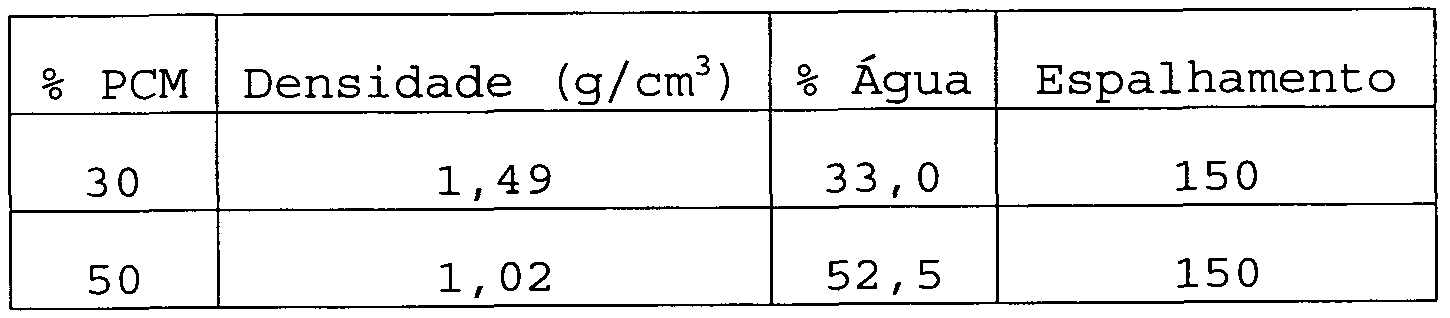
C3 8,1% 41,9% 50% À semelhança do exemplo anterior, a Tabela 4 mostra a percentagem de água, densidade e valor do espalhamento, para a argamassa com 30% e 50% de PCM. C3 8.1% 41.9% 50% As in the previous example, Table 4 shows the percent water, density and spread value for the 30% and 50% PCM mortar.
Tabela 4 - Propriedades em fresco da argamassa C3 Table 4 - Fresh properties of mortar C3
Os resultados da resistência mecânica à flexão (Figura 5) , permitem concluir que a adição de PCM ajuda a melhorar o comportamento mecânico da argamassa ao contrário de outras matrizes de incorporação, como o cimento ou o gesso em que se verifica uma queda da resistência mecânica com o teor de PCM, o que limita a capacidade de incorporação do aditivo. The results of the mechanical flexural strength (Figure 5) allow us to conclude that the addition of PCM helps to improve the mechanical behavior of the mortar unlike other incorporation matrices, such as cement or plaster where mechanical strength decreases. with PCM content, which limits the incorporation capacity of the additive.
A Figura 6 demonstra a eficácia da argamassa quando sujeita a ciclos de aquecimento e arrefecimento, em câmara climática. Figure 6 demonstrates the effectiveness of mortar when subjected to heating and cooling cycles in a climate chamber.
Referências References
[1] Zhang Y., Zhou G. , Lin K. , Zhang Q., Di H., Application of latent heat thermal energy storage in buildings: state-of-the-art and Outlook, Building and Environment, vol. 42, 2007, pp 2197-2209 [1] Zhang Y., Zhou G., Lin K., Zhang Q., Di H., Application of latent heat energy storage in buildings: state-of-the-art and Outlook, Building and Environment, vol. 42, 2007, pp 2197-2209
[2]Zalba B., Marin J. , Cabeza L., Mehling H. , Review on thermal energy storage with phase change : materiais, heat transfer analysis and applications, Applied Thermal[2] Zalba B., Marin J., Cabeza L., Mehling H., Review on thermal energy storage with phase change: materials, heat transfer analysis and applications, Applied Thermal
Engineering, vol . 23, 2003, pp 251-283 Engineering, vol. 23, 2003, pp 251-283
[3]Hawlader M. , Uddin M. , Khin M. , icroencapsulated phase change materiais, Proceedings of 9th APCChE Congress and[3] Hawlader M., Uddin M., Khin M., icroencapsulated phase change materials, Proceedings of 9th APCChE Congress and
CHEMECA 2002, New Zealand, 2002 CHEMECA 2002, New Zealand, 2002
[4]Athientis A., Liu C, Hawes D., Banu D., Feldman D.,[4] Athientis A., Liu C., Hawes D., Banu D., Feldman D.,
Investigation of the thermal performance of a passive solar test-room with wall latent heat storage, Building and Environment, vol. 32, 1997, pp 405-410 Investigation of the thermal performance of a passive solar test room with latent heat storage, Building and Environment, vol. 32, 1997, pp 405-410
[5]Cabeza L., Castellon C, Nogués M. , Medrano M. , Leppers[5] Cabeza L., Castellon C, Nogues M., Medrano M., Leppers
R. , Zubillaga O., Use of microencapsulated PCM in concrete walls for energy savings, Energy and Buildings, vol. 39, 2007, pp 113-119 R., Zubillaga O., Use of microencapsulated PCM in concrete walls for energy savings, Energy and Buildings, vol. 39, 2007, pp 113-119
[6] Ministério da Obras Públicas, Transportes e[6] Ministry of Public Works, Transport and
Comunicações, Regulamento das características de comportamento térmico dos edifícios, Decreto Lei n°80/2006 de 4 de Abril de 2006 Communications, Regulation of the thermal behavior characteristics of buildings, Decree Law No. 80/2006 of 4 April 2006
[7] EN 1015-11, Methods of test for mortar for masonry -[7] EN 1015-11, Methods of testing for death for masonry -
Part 11 - Determination of flexural and compressive strength of hardened mortar, 1999 Part 11 - Determination of flexural and compressive strength of hardened mortar, 1999
Claims
Applications Claiming Priority (2)
| Application Number | Priority Date | Filing Date | Title |
|---|---|---|---|
| PT104866 | 2009-12-10 | ||
| PT104866A PT104866A (en) | 2009-12-10 | 2009-12-10 | HARVES CONTAINING MICROCAPSULES OF PHASE CHANGE MATERIALS, PROCESS FOR THEIR PREPARATION AND THEIR USE |
Publications (1)
| Publication Number | Publication Date |
|---|---|
| WO2011071402A1 true WO2011071402A1 (en) | 2011-06-16 |
Family
ID=42651442
Family Applications (1)
| Application Number | Title | Priority Date | Filing Date |
|---|---|---|---|
| PCT/PT2009/000072 Ceased WO2011071402A1 (en) | 2009-12-10 | 2009-12-10 | Mortars containing phase change material microcapsules, their preparation process and use |
Country Status (2)
| Country | Link |
|---|---|
| PT (1) | PT104866A (en) |
| WO (1) | WO2011071402A1 (en) |
Cited By (10)
| Publication number | Priority date | Publication date | Assignee | Title |
|---|---|---|---|---|
| KR101090526B1 (en) | 2011-07-26 | 2011-12-08 | 김보현 | Mortar composition with improved heat and cold storage performance including phase change material |
| CN103159437A (en) * | 2011-12-15 | 2013-06-19 | 张国庆 | Temperature adjusting humidity adjusting coating and preparation method thereof |
| DE102012218378A1 (en) | 2012-10-09 | 2014-04-10 | Wacker Chemie Ag | Sheet or molding containing latent heat storage |
| CN104169236A (en) * | 2012-01-31 | 2014-11-26 | 李元睦 | Construction material containing microencapsulated phase change material, and preparation method thereof |
| CN104817302A (en) * | 2015-03-30 | 2015-08-05 | 南京倍立达新材料系统工程股份有限公司 | Phase change microcapsule temperature self-adjusting GRC dry-mixed mortar surface layer material |
| WO2015130183A1 (en) | 2014-02-27 | 2015-09-03 | Cmp-Cimentos Maceira E Pataias, S.A. | Active management system for energy in concrete walls and/or pavements |
| CN105544748A (en) * | 2015-12-25 | 2016-05-04 | 上海泛亚生命科技有限公司 | Novel thin-layer building-external-wall heat preservation system |
| CN108101478A (en) * | 2018-01-05 | 2018-06-01 | 庞龙雨 | A kind of composite micro-capsule heat insulating mortar and preparation method thereof |
| CN112830729A (en) * | 2021-01-15 | 2021-05-25 | 上海煌煌砼制品有限公司 | A kind of high-strength concrete and preparation method thereof |
| EP4015487A1 (en) * | 2020-12-18 | 2022-06-22 | Technische Universität Darmstadt | Hybrid material for thermal insulation |
Families Citing this family (1)
| Publication number | Priority date | Publication date | Assignee | Title |
|---|---|---|---|---|
| PT106935A (en) * | 2013-05-09 | 2014-11-10 | Univ Aveiro | MULTIFUNCTIONAL HARMASSES FOR HEAT STORAGE, AIR REMOVAL AND SELF CLEANING, PROCESS FOR THEIR PREPARATION AND USE |
Citations (10)
| Publication number | Priority date | Publication date | Assignee | Title |
|---|---|---|---|---|
| US4572864A (en) | 1985-01-04 | 1986-02-25 | The United States Of America As Represented By The United States Department Of Energy | Composite materials for thermal energy storage |
| US4587279A (en) | 1984-08-31 | 1986-05-06 | University Of Dayton | Cementitious building material incorporating end-capped polyethylene glycol as a phase change material |
| US4747240A (en) | 1981-08-06 | 1988-05-31 | National Gypsum Company | Encapsulated PCM aggregate |
| US5755216A (en) | 1995-06-06 | 1998-05-26 | The University Of Dayton | Building products incorporating phase change materials and method of making same |
| EP1029018A1 (en) * | 1997-11-11 | 2000-08-23 | Basf Aktiengesellschaft | Application of microcapsules as latent heat accumulators |
| DE19954771A1 (en) * | 1999-11-15 | 2001-05-17 | Remmers Bauchemie Gmbh | Silicone microcapsules, used as a latent heat storage medium, e.g. in fireproof linings or insulating plaster for buildings, contain a water-soluble solid, e.g. sodium sulfate or calcium chloride |
| DE19954772A1 (en) * | 1999-11-15 | 2001-05-17 | Remmers Bauchemie Gmbh | Use of microcapsules as a latent heat storage medium, e.g. in fireproof linings or insulating plaster, involves using capsules with a lipophilic core and a wall made by polymerisation of organosilicon monomers |
| US20040234738A1 (en) | 2001-08-16 | 2004-11-25 | Ekkehard Jahns | Use of microcapsules in gypsum plasterboards |
| EP1752509A1 (en) * | 2005-08-13 | 2007-02-14 | H + H CELCON GmbH | Process for increasing the heat storage capacity of calcium - silicate construction bricks and construction brick made from calcium- silicate |
| ES2298056A1 (en) | 2005-08-26 | 2008-05-01 | Universidade Do Minho | Set of mortars incorporating phase change microcapsules comprises lining materials containing e.g. cement, for room temperature control |
-
2009
- 2009-12-10 PT PT104866A patent/PT104866A/en active IP Right Grant
- 2009-12-10 WO PCT/PT2009/000072 patent/WO2011071402A1/en not_active Ceased
Patent Citations (10)
| Publication number | Priority date | Publication date | Assignee | Title |
|---|---|---|---|---|
| US4747240A (en) | 1981-08-06 | 1988-05-31 | National Gypsum Company | Encapsulated PCM aggregate |
| US4587279A (en) | 1984-08-31 | 1986-05-06 | University Of Dayton | Cementitious building material incorporating end-capped polyethylene glycol as a phase change material |
| US4572864A (en) | 1985-01-04 | 1986-02-25 | The United States Of America As Represented By The United States Department Of Energy | Composite materials for thermal energy storage |
| US5755216A (en) | 1995-06-06 | 1998-05-26 | The University Of Dayton | Building products incorporating phase change materials and method of making same |
| EP1029018A1 (en) * | 1997-11-11 | 2000-08-23 | Basf Aktiengesellschaft | Application of microcapsules as latent heat accumulators |
| DE19954771A1 (en) * | 1999-11-15 | 2001-05-17 | Remmers Bauchemie Gmbh | Silicone microcapsules, used as a latent heat storage medium, e.g. in fireproof linings or insulating plaster for buildings, contain a water-soluble solid, e.g. sodium sulfate or calcium chloride |
| DE19954772A1 (en) * | 1999-11-15 | 2001-05-17 | Remmers Bauchemie Gmbh | Use of microcapsules as a latent heat storage medium, e.g. in fireproof linings or insulating plaster, involves using capsules with a lipophilic core and a wall made by polymerisation of organosilicon monomers |
| US20040234738A1 (en) | 2001-08-16 | 2004-11-25 | Ekkehard Jahns | Use of microcapsules in gypsum plasterboards |
| EP1752509A1 (en) * | 2005-08-13 | 2007-02-14 | H + H CELCON GmbH | Process for increasing the heat storage capacity of calcium - silicate construction bricks and construction brick made from calcium- silicate |
| ES2298056A1 (en) | 2005-08-26 | 2008-05-01 | Universidade Do Minho | Set of mortars incorporating phase change microcapsules comprises lining materials containing e.g. cement, for room temperature control |
Non-Patent Citations (5)
| Title |
|---|
| ATHIENTIS A.; LIU C.; HAWES D.; BANU D.; FELDMAN D.: "Investigation of the thermal performance of a passive solar test-room with wall latent heat storage", BUILDING AND ENVIRONMENT, vol. 32, 1997, pages 405 - 410, XP002686316, DOI: doi:10.1016/S0360-1323(97)00009-7 |
| CABEZA L.; CASTELLON C.; NOGUES M.; MEDRANO M.; LEPPERS R.; ZUBILLAGA O.: "Use of microencapsulated PCM in concrete walls for energy savings", ENERGY AND BUILDINGS, vol. 39, 2007, pages 113 - 119, XP005818969, DOI: doi:10.1016/j.enbuild.2006.03.030 |
| HAWLADER M.; UDDIN M.; KHIN M.: "Microencapsulated phase change materials", PROCEEDINGS OF 9TH APCCHE CONGRESS AND CHEMECA 2002, 2002 |
| ZALBA B.; MARIN J.; CABEZA L.; MEHLING H.: "Review on thermal energy storage with phase change: materials, heat transfer analysis and applications", APPLIED THERMAL ENGINEERING, vol. 23, 2003, pages 251 - 283, XP008149082, DOI: doi:10.1016/S1359-4311(02)00192-8 |
| ZHANG Y.; ZHOU G.; LIN K.; ZHANG Q.; DI H.: "Application of latent heat thermal energy storage in buildings: state-of-the-art and Outlook", BUILDING AND ENVIRONMENT, vol. 42, 2007, pages 2197 - 2209, XP022110021, DOI: doi:10.1016/j.buildenv.2006.07.023 |
Cited By (14)
| Publication number | Priority date | Publication date | Assignee | Title |
|---|---|---|---|---|
| KR101090526B1 (en) | 2011-07-26 | 2011-12-08 | 김보현 | Mortar composition with improved heat and cold storage performance including phase change material |
| CN103159437B (en) * | 2011-12-15 | 2016-08-03 | 张国庆 | A kind of conditioning coating and preparation method thereof |
| CN103159437A (en) * | 2011-12-15 | 2013-06-19 | 张国庆 | Temperature adjusting humidity adjusting coating and preparation method thereof |
| CN104169236B (en) * | 2012-01-31 | 2018-05-29 | 李元睦 | Civil construction material of phase change material containing microencapsulated and preparation method thereof |
| CN104169236A (en) * | 2012-01-31 | 2014-11-26 | 李元睦 | Construction material containing microencapsulated phase change material, and preparation method thereof |
| US9410022B2 (en) | 2012-10-09 | 2016-08-09 | Wacker Chemie Ag | Sheetlike structure or shaped article comprising latent heat storage media |
| WO2014056963A1 (en) | 2012-10-09 | 2014-04-17 | Wacker Chemie Ag | Sheetlike structure or shaped article comprising latent heat storage media |
| DE102012218378A1 (en) | 2012-10-09 | 2014-04-10 | Wacker Chemie Ag | Sheet or molding containing latent heat storage |
| WO2015130183A1 (en) | 2014-02-27 | 2015-09-03 | Cmp-Cimentos Maceira E Pataias, S.A. | Active management system for energy in concrete walls and/or pavements |
| CN104817302A (en) * | 2015-03-30 | 2015-08-05 | 南京倍立达新材料系统工程股份有限公司 | Phase change microcapsule temperature self-adjusting GRC dry-mixed mortar surface layer material |
| CN105544748A (en) * | 2015-12-25 | 2016-05-04 | 上海泛亚生命科技有限公司 | Novel thin-layer building-external-wall heat preservation system |
| CN108101478A (en) * | 2018-01-05 | 2018-06-01 | 庞龙雨 | A kind of composite micro-capsule heat insulating mortar and preparation method thereof |
| EP4015487A1 (en) * | 2020-12-18 | 2022-06-22 | Technische Universität Darmstadt | Hybrid material for thermal insulation |
| CN112830729A (en) * | 2021-01-15 | 2021-05-25 | 上海煌煌砼制品有限公司 | A kind of high-strength concrete and preparation method thereof |
Also Published As
| Publication number | Publication date |
|---|---|
| PT104866A (en) | 2011-06-14 |
Similar Documents
| Publication | Publication Date | Title |
|---|---|---|
| WO2011071402A1 (en) | Mortars containing phase change material microcapsules, their preparation process and use | |
| Li et al. | Development of granular expanded perlite/paraffin phase change material composites and prevention of leakage | |
| Salgueiro et al. | Incorporation of phase change materials in an expanded clay containing mortar for indoor thermal regulation of buildings | |
| Li et al. | Fabrication and stability of form-stable diatomite/paraffin phase change material composites | |
| Wi et al. | Climatic cycling assessment of red clay/perlite and vermiculite composite PCM for improving thermal inertia in buildings | |
| Miliozzi et al. | Experimental investigation of a cementitious heat storage medium incorporating a solar salt/diatomite composite phase change material | |
| Karaipekli et al. | Capric–myristic acid/vermiculite composite as form-stable phase change material for thermal energy storage | |
| Xu et al. | Preparation and thermal energy storage properties of LiNO3-KCl-NaNO3/expanded graphite composite phase change material | |
| Figueiredo et al. | Mechanical and thermal characterization of concrete with incorporation of microencapsulated PCM for applications in thermally activated slabs | |
| Sarı et al. | Preparation, characterization and thermal properties of lauric acid/expanded perlite as novel form-stable composite phase change material | |
| Sayyar et al. | Experimental and numerical study of shape-stable phase-change nanocomposite toward energy-efficient building constructions | |
| Sarı et al. | Fatty acid esters-based composite phase change materials for thermal energy storage in buildings | |
| Lu et al. | Effects of the form-stable expanded perlite/paraffin composite on cement manufactured by extrusion technique | |
| Essid et al. | Experimental and numerical analysis of the energy efficiency of PCM concrete wallboards under different thermal scenarios | |
| Pavlík et al. | Experimental investigation of the properties of lime-based plaster-containing PCM for enhancing the heat-storage capacity of building envelopes | |
| Abdellatef et al. | Thermal, microstructural and numerical analysis of hempcrete-microencapsulated phase change material composites | |
| Sarier et al. | Thermal insulation capability of PEG-containing polyurethane foams | |
| Wang et al. | Experimental assessment on a kind of composite wall incorporated with shape-stabilized phase change materials (SSPCMs) | |
| Li et al. | Calcium chloride hexahydrate/nano-SiO2 composites as form-stable phase change materials for building energy conversation: The influence of pore size of nano-SiO2 | |
| Yoo et al. | Performance of energy storage system containing cement mortar and PCM/epoxy/SiC composite fine aggregate | |
| He et al. | Hygrothermal performance of temperature-humidity controlling materials with different compositions | |
| Liu et al. | Development of calcium silicate-coated expanded clay based form-stable phase change materials for enhancing thermal and mechanical properties of cement-based composite | |
| Pavlík et al. | Apparent thermal properties of phase-change materials: an analysis using differential scanning calorimetry and impulse method | |
| Mokhtari et al. | The performance effect of PEG-silica fume as shape-stabilized phase change materials on mechanical and thermal properties of lightweight concrete panels | |
| Fořt et al. | Fabrication of dodecanol/diatomite shape-stabilized PCM and its utilization in interior plaster |
Legal Events
| Date | Code | Title | Description |
|---|---|---|---|
| 121 | Ep: the epo has been informed by wipo that ep was designated in this application |
Ref document number: 09804079 Country of ref document: EP Kind code of ref document: A1 |
|
| NENP | Non-entry into the national phase |
Ref country code: DE |
|
| 122 | Ep: pct application non-entry in european phase |
Ref document number: 09804079 Country of ref document: EP Kind code of ref document: A1 |