WO2011032876A1 - Color-stable superabsorber - Google Patents
Color-stable superabsorber Download PDFInfo
- Publication number
- WO2011032876A1 WO2011032876A1 PCT/EP2010/063199 EP2010063199W WO2011032876A1 WO 2011032876 A1 WO2011032876 A1 WO 2011032876A1 EP 2010063199 W EP2010063199 W EP 2010063199W WO 2011032876 A1 WO2011032876 A1 WO 2011032876A1
- Authority
- WO
- WIPO (PCT)
- Prior art keywords
- acid
- superabsorber
- superabsorbent
- water
- weight
- Prior art date
- Legal status (The legal status is an assumption and is not a legal conclusion. Google has not performed a legal analysis and makes no representation as to the accuracy of the status listed.)
- Ceased
Links
Classifications
-
- C—CHEMISTRY; METALLURGY
- C08—ORGANIC MACROMOLECULAR COMPOUNDS; THEIR PREPARATION OR CHEMICAL WORKING-UP; COMPOSITIONS BASED THEREON
- C08K—Use of inorganic or non-macromolecular organic substances as compounding ingredients
- C08K3/00—Use of inorganic substances as compounding ingredients
- C08K3/32—Phosphorus-containing compounds
-
- C—CHEMISTRY; METALLURGY
- C08—ORGANIC MACROMOLECULAR COMPOUNDS; THEIR PREPARATION OR CHEMICAL WORKING-UP; COMPOSITIONS BASED THEREON
- C08K—Use of inorganic or non-macromolecular organic substances as compounding ingredients
- C08K5/00—Use of organic ingredients
- C08K5/04—Oxygen-containing compounds
- C08K5/13—Phenols; Phenolates
Definitions
- the present invention relates to a color-stable superabsorber, a process for its preparation and its use and hygiene articles containing it.
- a color-stable superabsorber is to be understood as meaning a superabsorber which does not discolor or only in a comparatively small extent when stored under elevated temperature and atmospheric humidity.
- Superabsorbents are known. Also, for such materials, terms such as “high swellable polymer” “hydrogel” (often used for the dry form), “hydrogel-forming polymer”, “water-absorbent polymer”, “absorbent gelling material”, “swellable resin”, “water-absorbent resin”, These are crosslinked hydrophilic polymers, in particular polymers of (co) polymerized hydrophilic monomers, graft (co) polymers of one or more hydrophilic monomers on a suitable graft base, crosslinked cellulose or starch ethers, crosslinked carboxymethylcellulose partially cross-linked polyalkylene oxide or natural products swellable in aqueous liquids, such as guar derivatives, with water-absorbing polymers based on partially neutralized acrylic acid being the most widespread.
- the essential properties of superabsorbents are their ability to multiply their own weight of aqueous liquid absorb the fluid and even under some pressure not to give the liquid again.
- the superabsorber which is used in the form of a dry powder, transforms into a gel when it absorbs liquid, and accordingly turns into a hydrogel during normal water absorption.
- Crosslinking is essential for synthetic superabsorbents and an important difference to conventional pure thickeners, as it leads to the insolubility of the polymers in water. Soluble substances would not be useful as superabsorbent.
- the most important application of superabsorbents is the absorption of body fluids.
- Superabsorbents are used, for example, in infant diapers, adult incontinence products or feminine hygiene products.
- Other fields of application are, for example, the water-retaining agents in agricultural horticulture, as water storage for protection against fire, for liquid absorption in food packaging or, more generally, for the absorption of moisture.
- Superabsorbents can absorb a multiple of their own weight of water and retain it under some pressure.
- such a superabsorber has a CRC ("Centrifuge Retention Capacity", measuring method, see below) of at least 5 g / g, preferably at least 10 g / g and in a particularly preferred form at least 15 g / g.
- CRC Chiptrifuge Retention Capacity
- AUL absorption under load
- AAP absorption against pressure
- Swollen gel can hinder liquid transport to superabsorbers that have not yet swollen ("gel blocking") .
- Good transport properties for liquids include, for example, hydrogels which have a high gel strength in the swollen state
- Gels with only low gel strength are under an applied pressure ( Body pressure) deforms, clogs pores in the superabsorbent / cellulose fiber absorbent body and thus prevents further absorption of fluid.
- a higher gel strength is usually achieved by a higher degree of cross-linking, which, however, reduces the absorption capacity of the product.
- An elegant method for increasing the gel strength represents the increase in the degree of crosslinking on the surface of the superabsorbent particles in relation to the interior of the particles.
- dried superabsorbent particles having an average crosslinking density are usually introduced he subjected additional crosslinking in a thin surface layer of their particles.
- Surface postcrosslinking increases the crosslink density in the shell of the superabsorbent particles, raising the absorption under pressure to a higher level. While the absorption capacity in the surface layer of the superabsorbent particles decreases, their core has an improved absorption capacity compared to the shell due to the presence of mobile polymer chains, so that the shell construction ensures improved fluid transfer without gel blocking occurring. It is also known to produce super-crosslinked superabsorbers overall and to subsequently reduce the degree of crosslinking in the interior of the particles compared to an outer shell of the particles.
- Acrylic acid-based superabsorbents which are most commonly used in the marketplace, are prepared by free-radical polymerization of acrylic acid in the presence of a crosslinker (the "internal crosslinker"), the acrylic acid before, after or partly before, partly after the polymerization
- the polymer gel obtained in this way is comminuted (depending on the polymerization reactor used, this can be done simultaneously with the polymerization) and dried.
- the dry powder obtained in this way (the "base polymer” or "polymer”) is neutralized to a certain degree.
- Basispolymer is usually postcrosslinked on the surface of the particles by reacting with other crosslinkers such as organic crosslinkers or polyvalent cations, for example aluminum (usually as aluminum sulfate used) or both is implemented in order to produce a more crosslinked surface layer relative to the particle interior.
- crosslinkers such as organic crosslinkers or polyvalent cations, for example aluminum (usually as aluminum sulfate used) or both is implemented in order to produce a more crosslinked surface layer relative to the particle interior.
- a common problem with superabsorbents is discoloration, which occurs when storing under higher temperature or higher humidity. Such conditions often occur during storage of superabsorbers in tropical or subtropical countries. Under such conditions, superabsorbents tend to yellow, they may even take on brown or almost black coloring. This discoloration of the actually colorless superabsorbent powder is unsightly and undesirable because it is particularly visible in the desired thin hygiene products and
- WO 2008/055856 A1 teaches the avoidance of discolorations of a superabsorber which are caused by excessively high iron content of the sodium hydroxide solution used to partially neutralize the acrylic acid in the preparation of the superabsorber by adding phosphoric acid or phosphate salts.
- JP 05/086 251 A teaches the use of phosphoric acid derivatives or salts thereof, in particular 1-hydroxyethylidene-1, 1-diphosphonic acid, ethylenediaminetetra (methylenephosphonic acid), diethylenetriaminepenta (methylenephosphonic acid) or their alkali metal or ammonium salts as stabilizers of superabsorbers against discoloration.
- WO 03/059 962 A1 or the equivalent patent application US 2005/0085604 A1 discloses the use of The use of metal chelating agents in any step of the superabsorbent production and the addition of a reducing or oxidizing agent before drying of the aqueous polymer as measures against discoloration.
- WO 03/014 172 A2 relates to the production of superabsorbers from highly pure acrylic acid, which has been freed to prevent discoloration of the superabsorbent in particular of aldehydes.
- WO 00/55245 A1 teaches the stabilization of superabsorbents against discoloration by treatment with an inorganic reducing agent and optionally a metal salt, such as an alkaline earth salt, which is added after the polymerization.
- the inorganic reducing agent is typically a hypophosphite, phosphite, bisulfite or sulfite.
- the metal salt is typically a colorless (the property "colorless” is often simply called “white”), phosphate, acetate or lactate, but not a halide. According to the teaching of WO 2006/058 682, discolorations of superabsorbents are avoided when the drying and the post-crosslinking reaction are carried out in an atmosphere which is substantially free of oxidizing gases.
- EP 505 163 A1 discloses the use of a combination of surface-active substance and a compound which adds to double bonds, for example unsubstituted or substituted alkyl- or arylsulfinic acids or salts thereof for reducing residual monomers in superabsorbers.
- EP 668 080 A2 and the divisional application EP 1570 869 A1 relate to the use of organic acids, including sulfinic acids, but exclusively of salts of organic acids or sulfinic acids, or of polyamino acids or their salts to reduce residual surface postcrosslinkers, in particular of surface postcrosslinkers Epoxy compounds, after surface postcrosslinking.
- EP 386 897 A2 discloses the use of a combination of surface-active substance and a compound which adds to double bonds, for example unsubstituted or substituted alkyl- or arylsulfinic acids or salts thereof for reducing residual monomers in superabsorbers.
- EP 441 975 A1 and EP 605 215 A1 teach the use of sulfites, hydrogen sulfites or thiosulfates for reducing residual monomers from the polymerization.
- EP 1 645 596 A1 teaches the stabilization of superabsorbers against discoloration by addition of an inorganic salt, an aminocarboxylic acid chelating agent and an organic antioxidant.
- an inorganic salt sulfites, bisulfites, pyrosulfites, dithionites, trithionates, tetrathionates, thiosulfates or nitrites are used.
- EP 1 577 349 A1 teaches the use of these salts for the same purpose, but the content of the superabsorbent treated with iron is kept below 1 ppm by weight.
- WO 2009/060062 or earlier International Patent Application Serial No. PCT / EP2009 / 059793 teach the addition of sulfinic acid derivatives to superabsorbents to stabilize them against discoloration.
- WO 2008/092 842 A1 teaches the addition of a basic salt of a divalent metal cation to superabsorbers, inter alia, in order to increase the stability against discoloration.
- WO 2008/092 843 A1 discloses the use of carboxylic acid salts and / or basic salts of trivalent metal cations for the same purpose.
- WO 2005/054 356 A1 teaches the use of steric Hindered phenols instead of the technically usual para-methoxyphenol ("methyl hydroquinone", "MEHQ") as stabilizers for acrylic acid against polymerization, which have the advantage of less discoloration of the polymer.
- Another object is to find other or even better superabsorbers which are stabilized against discoloration, in particular against yellowing or browning when stored under elevated temperature and / or elevated air humidity.
- Useful properties of the superabsorber in particular its ability to absorb liquid, even under pressure, as well as its ability to convey liquid, should not be impaired or at least not significantly impaired.
- other properties should not be affected, such as odor, which may be a problem with sulfur-containing reducing agents in the presence of moisture, or its flowability, which may be a problem with sodium hypophosphite additive, or dusting, which can be a problem when adding insoluble calcium salts .
- Further objects of the invention are finding a method for producing such a superabsorbent and uses of this superabsorbent.
- the object was achieved by a superabsorber containing at least one stabilizer against discoloration, which consists of phenols, phosphonic acid (HP (0) (OH) 2),
- the superabsorbers according to the invention show surprisingly good stability against discoloration without their use properties such as CRC, AUL or SFC being significantly impaired.
- at least one stabilizer against discoloration is added to the SAP.
- the stabilizer can be added in any form. Usually it is preferred to add it in predominantly undissolved form. "Predominantly undissolved” means that in general at least 50% by weight, preferably at least 70% by weight and in a particularly preferred form at least 90% by weight of the amount of stabilizer added does not occur at the time of addition
- the stabilizer is added either as a dry powder or as a suspension in a suspending agent
- the stabilizer can be added to the superabsorbent at any time during preparation Preferably, it is not added to the monomer mixture for polymerization or to a monomer but instead only when crosslinked polymer is present is, at the earliest during the polymerization.
- the stabilizer can be added, for example, during the polymerization, during a surface postcrosslinking or after the surface postcrosslinking.
- the stabilizer is added to the monomer mixture or to a monomer, it is additionally added to any stabilizer against undesired or premature polymerization.
- the stabilizer is a sterically hindered phenol, it is preferred to add it at the earliest during the polymerization.
- the stabilizer is soluble or insoluble.
- the stabilizer is insoluble in water, i. its solubility in water at 25 ° C is at most 5 g / l, preferably at most 1 g / l.
- the stabilizer (or stabilizers) is made from phenols, phosphonic acid
- Hindered phenols are understood as meaning phenols which have a single or double-branched substituent, preferably a double-branched substituent, at least in the 2-position and optionally also in the 6-position on the phenyl ring.
- Branched substituents are understood to mean substituents which bear at least two radicals other than hydrogen on the atom bonded to the phenyl ring of the phenol, apart from the C atom of the phenyl ring to which they are attached.
- sterically hindered phenols are also those which carry a sterically demanding unbranched substituent at least in the 2-position and optionally also in the 6-position.
- substituents which comprise at least 6, preferably at least 8, and in a particularly preferred form at least 12 atoms other than hydrogen, but only one on the atom bound to the phenyl ring of the phenol other than the C atom of the phenyl ring to which they are attached of hydrogen other residue.
- the simplest examples of singly branched substituents are secondary alkyl radicals such as 2-propyl, 2-butyl, 2-pentyl, 3-pentyl, ethylhexyl or cycloalkyl radicals such as cyclobutyl, cyclopentyl, cyclohexyl or aromatic radicals such as phenyl.
- di-branched substituents are tertiary alkyl radicals such as tert-butyl, tert-pentyl or norbornyl.
- unbranched radicals are hexyl, heptyl, octyl, nonyl, decyl, undecyl and dodecyl, but also neo-pentyl, neo-hexyl or dodecylthiomethyl. All of these radicals can also be substituted or contain atoms other than carbon and hydrogen.
- the phenyl ring of the phenol may optionally carry further substituents in addition to the substituent in the 2-position and optionally in the 6-position.
- Examples of preferred sterically hindered phenols are 2-tert-butylphenol, 2,6-di-tert-butylphenol, 2,6-di-tert-butyl-4-methyl-phenol (also referred to as 2,6-di-tert tert-butyl-para-cresol or 3,5-di-tert-butyl-4-hydroxytoluene), 3,5-di-tert-butyl-4- hydroxyphenylacetic acid, 3,5-di-tert-butyl-4-hydroxyphenylpropionic acid and the esters of these acids with alcohols and polyols, for example their simple or multiple esters with glycol, glycerol, 1, 2- or 1, 3-propanediol, trimethylolpropane or Pentaerythritol, such as pentaerythritol tetrakis (3- (3,5-di-tert-butyl-4-hydroxyphenyl) propionate) or oc
- Phosphonic acid HP (0) (OH) 2
- phosphorous acid H3PO3
- Phosphonic acid is tautomeric with phosphorous acid, the latter does not exist as free acid.
- Genuine derivatives of phosphorous acid are only their triesters, commonly referred to as phosphites.
- the tautomeric phosphonic acid derivatives are commonly referred to as phosphonates.
- all primary and secondary phosphonates of the alkali metals, including ammonium, and the alkaline earth metals are suitable.
- aqueous solutions of phosphonic acid which contain primary and / or secondary phosphonations and at least one cation selected from sodium, potassium, calcium, strontium.
- phosphites or phosphonates examples include calcium bis [monoethyl (3,5-di-tert-butyl-4-hydroxybenzyl) phosphonate], tris (2,4-di-tert-butylphenyl) phosphite, 3.9- Bis (octa-decyloxy) -2,4,8,10-tetraoxa-3,9-diphosphaspiro [5.5] undecane and bis (2,4-di-tert-butylphenol) pentaerythritol diphosphite.
- Stabilizers may simultaneously be phosphonates or phosphites and hindered phenols.
- the stabilizers are, unless they are dissolved, naturally particulate, they are therefore predominantly in powder form when applied.
- the average particle size is typically in the range of at least 0.001 ⁇ , preferably at least 0.002 ⁇ , more preferably at least 0.005, and most preferably at least 0.01 ⁇ , and generally at most 500 ⁇ , preferably at most 200 ⁇ , more preferably Form at most 100 ⁇ and in a very particularly preferred form of at most 50 ⁇ .
- the particles themselves may be aggregates or agglomerates of smaller primary particles.
- the particle size can be determined by means of sieve analysis, but it is simpler and therefore preferred to determine the particle size by means of laser diffraction technology. These methods are well known and routinely performed on suitable and commercially available equipment.
- the anti-discoloration stabilizers mentioned above, when added, are generally present in amounts of at least 0.0001% by weight, preferably at least 0.001% by weight, and most preferably at least 0.025% by weight, and in the formula Generally at most 3% by weight, in a preferred form at most 2% by weight and in a particularly preferred form at most 0.5% by weight, in each case based on the total weight of the superabsorbent according to the invention.
- each superabsorber can be mixed with the stabilizer.
- such superabsorbents are crosslinked hydrophilic polymers, in particular polymers of (co) polymerized hydrophilic monomers, graft (co) polymers of one or more hydrophilic monomers on a suitable graft base, crosslinked cellulose or starch ethers, crosslinked carboxymethylcellulose, partially crosslinked polyalkylene oxide or in aqueous Liquid swellable natural products such as guar derivatives.
- a superabsorbent based on partially neutralized acrylic acid is used.
- Superabsorbents are characterized above all by their ability to absorb and retain liquids.
- An inventive and preferred superabsorbent is prepared, for example, by aqueous solution polymerization of a monomer mixture comprising: a) at least one ethylenically unsaturated monomer bearing at least one acid group, which is optionally present at least partially as a salt,
- the monomers a) are preferably water-soluble, i. the solubility in water at 23 ° C. is typically at least 1 g / 100 g of water, preferably at least 5 g / 100 g of water, more preferably at least 25 g / 100 g of water, most preferably at least 35 g / 100 g of water.
- Suitable monomers a) are, for example, ethylenically unsaturated carboxylic acids or their salts, such as acrylic acid, methacrylic acid, maleic acid or its salts, maleic anhydride and itaconic acid or their salts. Particularly preferred monomers are acrylic acid and methacrylic acid. Very particular preference is given to acrylic acid.
- suitable monomers a) are, for example, ethylenically unsaturated sulfonic acids, such as styrenesulfonic acid and 2-acrylamido-2-methylpropanesulfonic acid (AMPS).
- Impurities can have a significant influence on the polymerization. Therefore, the raw materials used should have the highest possible purity. It is therefore often advantageous to purify the monomers a) specifically. Suitable purification processes are described, for example, in WO 2002/055469 A1, WO 2003/078378 A1 and WO 2004/035514 A1.
- a suitable monomer a) is, for example, an acrylic acid purified according to WO 2004/035514 A1 with 99.8460% by weight of acrylic acid, 0.0950% by weight of acetic acid, 0.0332% by weight of water, 0.0203% by weight.
- % Propionic acid 0.0001% by weight of furfurals, 0.0001% by weight of maleic anhydride, 0.0003% by weight of diacrylic acid and 0.0050% by weight of hydroquinone monomethyl ether.
- the proportion of acrylic acid and / or salts thereof in the total amount of monomers a) is preferably at least 50 mol%, particularly preferably at least 90 mol%, very particularly preferably at least 95 mol%.
- the monomer solution preferably contains at most 250 ppm by weight, preferably at most 130 ppm by weight, more preferably at most 70 ppm by weight and preferably at least 10 ppm by weight, more preferably at least 30 ppm by weight, in particular by 50% by weight.
- ppm, hydroquinone half ethers based in each case on the unneutralized monomer a), where neutralized monomer a), ie a salt of the monomer a) is mathematically taken into account as unneutralized monomer.
- an ethylenically unsaturated, acid group-carrying monomer having a corresponding content of hydroquinone half-ether can be used to prepare the monomer solution.
- hydroquinone half ethers are hydroquinone monomethyl ether (MEHQ) and / or alpha-tocopherol (vitamin E).
- Suitable crosslinkers b) are compounds having at least two groups suitable for crosslinking. Such groups are, for example, ethylenically unsaturated groups which can be radically copolymerized into the polymer chain, and functional groups which can form covalent bonds with the acid groups of the monomer a). Furthermore, polyvalent metal salts which can form coordinative bonds with at least two acid groups of the monomer a) are also suitable as crosslinking agents b).
- Crosslinkers b) are preferably compounds having at least two polymerizable groups which can be incorporated in the polymer network in free-radically polymerized form.
- Suitable crosslinkers b) are, for example, ethylene glycol dimethacrylate, diethylene glycol diacrylate, polyethylene glycol diacrylate, allyl methacrylate, trimethylolpropane triacrylate, triallylamine, tetraallylammonium chloride, tetraallyloxyethane, as described in EP 530 438 A1, di- and triacrylates, as in EP 547 847 A1, EP 559 476 A1 , EP 632 068 A1, WO 93/21237 A1, WO 2003/104299 A1, WO 2003/104300 A1, WO 2003/104301 A1 and DE 103 31 450 A1, mixed acrylates which, in addition to acrylate groups, contain further ethylenically unsaturated groups, as in DE 103 31 456 A1 and US Pat DE 103
- Preferred crosslinkers b) are pentaerythritol triallyl ether, tetraallyloxyethane, methylene bismethacrylamide, trimethylolpropane triacrylate 15 to 20 times ethoxylated, 15-20 times ethoxylated glycerol triacrylate, polyethylene glycol diacrylate having between 4 and 45 - Ch Ch O units in the molecular chain, trimethylolpropane triacrylate and triallylamine.
- Very particularly preferred crosslinkers b) are the polyethoxylated and / or propoxylated glycerols esterified with acrylic acid or methacrylic acid to form di- or triacrylates, as described, for example, in WO 2003/104301 A1.
- Particularly advantageous are di- and / or triacrylates of 3- to 10-fold ethoxylated glycerol.
- diacrylates or triacrylates of 1 to 5 times ethoxylated and / or propoxylated glycerol.
- Most preferred are the triacrylates of 3 to 5 times ethoxylated and / or propoxylated glycerol, in particular the triacrylate of 3-times ethoxylated glycerol.
- the amount of crosslinker b) is preferably from 0.05 to 1, 5 wt .-%, particularly preferably 0.1 to 1 wt .-%, most preferably 0.3 to 0.6 wt .-%, each based on Monomer a).
- the centrifuge retention capacity (CRC) decreases and the absorption increases under a pressure of 0.3 psi
- initiators c) it is possible to use all compounds which generate radicals under the polymerization conditions, for example thermal initiators, redox initiators, photoinitiators.
- Suitable redox initiators are sodium peroxodisulfate / ascorbic acid, hydrogen peroxide / ascorbic acid, sodium peroxodisulfate / sodium bisulfite and hydrogen peroxide / sodium bisulfite.
- Preference is given to using mixtures of thermal initiators and redox initiators, such as sodium peroxodisulfate / hydrogen peroxide / ascorbic acid.
- the reducing component but is preferably the mixture of the sodium salt of 2-hydroxy-2-sulfinatoacetic acid described in greater detail below, the acid disodium salt of 2-hydroxy-2-sulfonatoessig- and sodium bisulfite (Brüggolit ® FF6M or Brüggolit ® FF7).
- Suitable ethylenically unsaturated monomers d) which can be copolymerized with the ethylenically unsaturated monomers having acid groups are acrylamide, methacrylamide, hydroxyethyl acrylate, hydroxyethyl methacrylate, dimethylaminoethyl methacrylate, dimethylaminoethyl acrylate, dimethylaminopropyl acrylate, diethylaminopropyl acrylate, Dimethylaminoethyl methacrylate, diethylaminoethyl methacrylate, maleic acid or its salts and maleic anhydride.
- water-soluble polymers e it is possible to use polyvinyl alcohol, polyvinylpyrrolidone, starch, starch derivatives, modified cellulose, such as methylcellulose or hydroxyethylcellulose, gelatin, polyglycols or polyacrylic acids, preferably starch, starch derivatives and modified cellulose.
- an aqueous monomer solution is used.
- the water content of the monomer solution is preferably from 40 to 75 wt .-%, particularly preferably from 45 to 70 wt .-%, most preferably from 50 to 65 wt .-%.
- monomer suspensions i. to use supersaturated monomer solutions. With increasing water content, the energy expenditure increases during the subsequent drying and with decreasing water content, the heat of polymerization can only be sufficiently dissipated.
- At least one water-soluble alkaline earth salt selected from the salts of calcium, strontium or barium is added to the superabsorbent according to the invention.
- Mixtures of salts of all possible combinations of two of these elements or all three of these elements can be used.
- calcium salts are usually preferred.
- alkaline earth salt-containing superabsorbent a smaller amount of stabilizers according to the invention is necessary against discoloration than without alkaline earth salt.
- the anions of the alkaline earth salts can basically be chosen freely, with the restriction that they must not lead to negative effects in the superabsorber and / or in its application.
- suitable anions of the alkaline earth metal salts are halides, in particular chloride, hydroxide, carbonate, carboxylate, such as formate, acetate, propionate or lactate, nitrate or sulfate. Mixtures can also be used.
- water-soluble alkaline earth salts are used or those which, although themselves relatively poorly soluble in water, react rapidly with the acid groups of the superabsorbent or the monomers.
- Such salts have the advantage, in particular in the customary preparation of the superabsorber from water-containing monomer mixtures, that an equivalent amount of the neutralizing agent otherwise used can be saved.
- the anions of the alkaline earth metal salt are selected accordingly, preference is given to hydroxide, carbonate or lactate.
- Total preferred alkaline earth salts are calcium hydroxide, strontium hydroxide, barium hydroxide, calcium carbonate, strontium carbonate, barium carbonate, calcium lactate, strontium lactate, barium lactate, calcium sulfate, strontium sulfate, barium sulfate or mixtures thereof. Particularly preferred are calcium hydroxide, calcium carbonate, calcium lactate and calcium sulfate.
- the alkaline earth salt is generally used in an amount of at least 0.1% by weight, preferably at least 0.5% by weight and more preferably at least 1% by weight and generally at most 20% by weight, preferably at most 10 wt .-% and in a particularly preferred form of at most 5 wt .-% added, in each case based on the total amount of ethylenically unsaturated, at least one acid group-carrying monomers. These are calculated as free acid, any total or partial neutralization of the acid groups is not taken into account in the calculation. Some alkaline earth salts may contain water of crystallization. This is also not taken into account in the calculation.
- the alkaline earth salt (or mixture of alkaline earth salts) is added to the monomer mixture before or during the polymerization or, if the polymerization is followed by a separate drying step, to the polymer before drying, or partially before or during the polymerization and partly to the polymer before drying.
- the aim is a uniform distribution of the alkaline earth salt in the superabsorbent.
- the alkaline earth salt is mixed by method and time as described below for the neutralizing agent.
- the simplest and therefore preferred is the addition into the monomer mixture before the polymerization.
- the alkaline earth metal salt can also be introduced into the resulting polymer gel during the polymerization or after the polymerization, but it is in any case introduced before the drying.
- the addition during the polymerization is particularly easy in the methods in which the polymerizing composition is mixed, for example, in polymerization in a kneader.
- the addition after the polymerization and before the drying is easy, above all, in the processes in which the polymerized mass from the polymerization is passed into a separate drying step, ie in particular in all processes in which polymerization and drying are carried out in separate apparatuses become.
- the alkaline earth salt may in this case be mixed into the polymer gel by any known mixing method and apparatus.
- the alkaline earth salt is added as a dry substance or as a solution or dispersion in a solvent.
- the solvent used is preferably water.
- the monomer solution can be freed of dissolved oxygen prior to the polymerization by inertization, ie by flowing through with an inert gas, preferably nitrogen or carbon dioxide.
- an inert gas preferably nitrogen or carbon dioxide.
- the oxygen the monomer solution before polymerization to less than 1 ppm by weight, more preferably to less than 0.5 ppm by weight, most preferably to less than 0.1 ppm by weight, lowered.
- the monomer mixture may contain other components. Examples of other components used in such monomer mixtures include chelating agents to keep metal ions in solution.
- the acid groups of the polymer gels obtained from the polymerization are usually partially neutralized.
- the neutralization is preferably carried out at the stage of the monomers, in other words salts of the acid group-carrying monomers or, strictly speaking, a mixture of acid group-carrying monomers and salts of the acid group-carrying monomers ("partially neutralized acid") as component a) in the polymerization
- This is usually done by mixing the neutralizing agent as an aqueous solution or preferably also as a solid in the monomer mixture intended for the polymerization or preferably in the acid group-carrying monomer or a solution thereof
- the degree of neutralization is preferably from 25 to 95 mol%, particularly preferably from 50 to 80 mol%, very particularly preferably from 65 to 72 mol%, it being possible to use the customary neutralizing agents, preferably alkali metal hydroxides, alkali metal oxides, alkali metal carbonates or alkali metal bicarbonates and mixtures thereof ammonium salts can also be
- the polymer gel is at least partially neutralized after the polymerization, the polymer gel is preferably comminuted mechanically, for example by means of an extruder, wherein the neutralizing agent can be sprayed, sprinkled or poured on and then thoroughly mixed in. For this purpose, the gel mass obtained can be extruded several times for homogenization.
- the monomer a) used is a mixture of from 25 to 95 mol%, particularly preferably from 50 to 80 mol%. , very particularly preferably from 65 to 72 mol% salt of the acid group carrier the monomers and the remainder used to 100 mol% acid group-carrying monomer.
- This mixture is, for example, a mixture of sodium acrylate and acrylic acid or a mixture of potassium acrylate and acrylic acid.
- a neutralizing agent is used for neutralization, the content of iron is generally below 10 ppm by weight, preferably below 2 ppm by weight and most preferably below 1 ppm by weight.
- a suitable neutralizing agent is, for example, the 50% strength by weight sodium hydroxide solution or potassium hydroxide solution, which is usually sold as "membrane grade", even purer and equally suitable, but also more expensive is the 50% by weight conventionally sold as "amalgam grade” or "mercury process". % sodium hydroxide solution or potassium hydroxide solution.
- the alkaline earth salt used is a water-soluble or a relatively poorly soluble, yet relatively fast-reacting alkaline earth metal salt
- the amount of neutralizing agent added can be reduced by adding an amount of alkaline earth metal ions.
- the alkaline earth salt may also serve as a neutralizing agent at the same time, the divalent alkaline earth ion replacing two monovalent alkali ions.
- alkaline earth metal hydroxides, carbonates and lactates are suitable.
- Suitable polymerization reactors are, for example, kneading reactors or belt reactors.
- the polymer gel formed in the polymerization of an aqueous monomer solution or suspension is comminuted continuously by, for example, counter-rotating stirring shafts, as described in WO 2001/38402 A1.
- the polymerization on the belt is described, for example, in EP 955 086 A2, DE 38 25 366 A1 and US Pat. No. 6,241,928.
- a polymer gel must be comminuted in a further process step, for example in one Meat grinder, extruder or kneader.
- WO 2009/027 356 A1 Also known are methods in which the monomer mixture is applied to a substrate such as a nonwoven web and polymerized, as described for example in WO 02/94 328 A2 and WO 02/94 329 A1.
- the polymer gel obtained from the aqueous solution polymerization and optionally subsequent neutralization is then preferably dried with a belt dryer until the residual moisture content is preferably 0.5 to 15 wt .-%, particularly preferably 1 to 10 wt .-%, most preferably 2 to 8 wt .-%, is (measurement method for the residual moisture or water content, see below). If the residual moisture content is too high, the dried polymer gel has too low a glass transition temperature Tg and is difficult to process further.
- the dryer may be operated under nitrogen or other non-oxidizing inert gas, or at least a reduced partial pressure of oxygen to prevent oxidative yellowing, but usually results in a drier or similar dryer also adequate ventilation and drainage of the water steam to an acceptable product.
- Advantageous in terms of color and product quality is usually the shortest possible drying time.
- the residual monomer content in the polymer particles also decreases and the last residues of the initiator are destroyed.
- the dried polymer gel is then ground and classified, wherein for grinding usually one- or multi-stage roller mills, preferably two- or three-stage roller mills, pin mills, hammer mills or vibratory mills can be used.
- Oversized gel lumps often not dried on the inside, are rubber-elastic, cause grinding problems and are preferably used before grinding
- Grind separation which can be done easily by air classification or a sieve ("protective sieve" for the mill) .
- the mesh size of the sieve is to be chosen in view of the mill used so that as possible no interference from oversized, rubbery particles occur.
- coarse-grained polymer particles are separated from the product. This is done by conventional classification methods, such as air classification or sieving through a sieve with a mesh size of at most 1000 ⁇ , preferably at most 900 ⁇ , more preferably at most 850 ⁇ and most preferably at most 800 ⁇ . For example, screens are used with 700 ⁇ , 650 ⁇ or 600 ⁇ mesh size.
- the separated coarse-grained polymer particles (“oversize") can be fed back to the grinding and screening circuit for cost optimization or further processed separately.
- SFC permeability
- also fine-grained polymer particles are separated in this classification. This can, if sieved, conveniently by a sieve with a mesh size of at most 300 ⁇ , preferably at most 200 ⁇ , more preferably used at most 150 ⁇ and most preferably not more than 100 ⁇ .
- the separated fine-grained polymer particles (“undersize” or “fines”) can be fed back to the monomer stream, the polymerizing gel, or the polymerized gel before drying the gel for cost optimization.
- the mean particle size of the polymer particles separated off as product fraction is generally at least 200 ⁇ m, preferably at least 250 ⁇ m, and preferably at least 300 ⁇ m, and generally at most 600 ⁇ m, and more preferably at most 500 ⁇ m.
- the proportion of particles having a particle size of at least 150 ⁇ m is generally at least 90% by weight, preferably at least 95% by weight and most preferably at least 98% by weight.
- the proportion of particles with a particle size of at most 850 ⁇ m is generally at least 90% by weight, preferably at least 95% by weight and more preferably at least 98% by weight.
- the particle size distribution is predetermined by the choice of process parameters.
- particulate superabsorbents of the desired particle size are formed directly, so that milling and screening steps can often be omitted.
- a separate drying step can often be dispensed with.
- the polymer produced in this way has superabsorbent properties and is referred to as "superabsorbent.” Its CRC is typically comparatively high, while its AUL or SFC is comparatively low. Called base polymer “or" base polymer ".
- Suitable postcrosslinkers are compounds which contain groups which can form bonds with at least two functional groups of the superabsorbent particles.
- Acrylic acid / sodium acrylate-based superabsorbents which are prevalent on the market are suitable surface postcrosslinker compounds which contain groups which can form bonds with at least two carboxylate groups.
- Preferred postcrosslinkers are amide acetals or carbamates of the general formula (I)
- R 1 is Ci-Ci2-alkyl, C 2 -C 2 hydroxyalkyl, C 2 -C 2 -alkenyl or C 6 -C 2 aryl,
- R 3 is hydrogen, Ci-Ci 2 -alkyl, C 2 -C 2 hydroxyalkyl, C 2 -C 2 -alkenyl or C 6 -C 2 aryl, or X,
- R 4 Ci-Ci 2 -alkyl, C 2 -C 2 hydroxyalkyl, C 2 -C 2 -alkenyl or C 6 -C 2 aryl,
- R 5 is hydrogen, Ci-Ci 2 -alkyl, C 2 -C 2 hydroxyalkyl, C 2 -C 2 -alkenyl, Ci-Ci2 acyl or
- R 6 Ci-Ci 2 -alkyl, C 2 -C 2 hydroxyalkyl, C 2 -C 2 -alkenyl or C 6 -C 2 aryl, and
- X is a carbonyl oxygen common to the radicals R 2 and R 3 , where R 1 and R 4 and / or R 5 and R 6 may be a bridged C 2 -C 6 alkanediyl, and where the abovementioned radicals R 1 to R 6 are still may have at least one to two free valences and may be connected to these free valencies with at least one suitable base, or polyhydric alcohols, wherein the polyhydric alcohol preferably has a molecular weight of less than 100 g / mol, preferably less than 90 g / mol , more preferably less than 80 g / mol, most preferably less than 70 g / mol, per hydroxy group and no vicinal, geminal, secondary or tertiary hydroxy groups, and polyhydric alcohols either diols of general formula (IIa) HO R 7 - OH (IIa) where R 7 is either an unbranched alkylene radical of the formula - (CH 2) n
- radicals R 8 , R 9 , R 10 , R 11 independently of one another denote hydrogen, hydroxyl, hydroxymethyl, hydroxyethyloxymethyl, 1-hydroxyprop-2-yloxymethyl, 2-hydroxypropyloxymethyl, methyl, ethyl, n-propyl, isopropyl, n-butyl, n-pentyl, n-hexyl, 1, 2-dihydroxyethyl, 2-hydroxyethyl, 3-hydroxypropyl or 4-hydroxybutyl and a total of 2, 3, or 4, preferably 2 or 3, hydroxy groups are present, and not more than one of R 8 , R 9 , R 10 , or R 11 is hydroxyl, are, or cyclic carbonates of the general formula (III)
- R 12 , R 13 , R 14 , R 15 , R 16 and R 17 are independently hydrogen, methyl, ethyl, n-propyl, isopropyl, n-butyl, sec-butyl or isobutyl, and n is either 0 or Is 1, or bisoxazolines of the general formula (IV) wherein R 18 , R 19 , R 20 , R 21 , R 22 , R 23 , R 24 and R 25 are independently hydrogen, methyl, ethyl, n-propyl, isopropyl, n-butyl, sec-butyl or isobutyl, and R 26 represents a single bond, a linear, branched or cyclic C 2 -C 12 -alkylene radical, or a polyalkoxydiyl radical which is composed of one to ten ethylene oxide and / or propylene oxide units, such as, for example, polyglycol dicarboxylic acids.
- Preferred postcrosslinkers of the general formula (I) are 2-oxazolidones, such as 2-oxazolidone and N- (2-hydroxyethyl) -2-oxazolidone, N-methyl-2-oxazolidone, N-acyl-2-oxazolidones, such as N-acetyl -2-oxazolidone, 2-oxotetrahydro-1,3-oxazine, bicyclic amidacetals such as 5-methyl-1 -aza-4,6-dioxa-bicyclo [3.3.0] octane, 1-aza-4,6 -dioxabicyclo [3.3.0] octane and 5-isopropyl-1 -aza-4,6-dioxa-bicyclo [3.3.0] octane, bis-2-oxazolidones and poly-2-oxazolidones.
- 2-oxazolidones such as 2-oxazolidone and N- (2-hydroxy
- Particularly preferred postcrosslinkers of the general formula (I) are 2-oxazolidone, N-methyl-2-oxazolidone, N- (2-hydroxyethyl) -2-oxazolidone and N-hydroxypropyl-2-oxazolidone.
- Preferred postcrosslinkers of the general formula (IIa) are 1, 3-propanediol, 1, 5-pentanediol, 1, 6-hexanediol and 1, 7-heptanediol. Further examples of postcrosslinkers of the formula (IIa) are 1, 3-butanediol, 1, 8-octanediol, 1, 9-nonanediol and 1, 10-decanediol.
- the diols are preferably water-soluble, wherein the diols of the general formula (IIa) at 23 ° C to at least 30 wt .-%, preferably at least 40 wt .-%, particularly preferably at least 50 wt .-%, most preferably at least 60 wt .-%, in water, such as 1, 3-propanediol and 1, 7-heptanediol. Even more preferred are those postcrosslinkers which are liquid at 25 ° C.
- Preferred postcrosslinkers of the general formula (IIb) are butane-1, 2,3-triol, butane-1, 2,4-triol, glycerol, trimethylolpropane, trimethylolethane, pentaerythritol, per molecule 1 to 3 times ethoxylated glycerol, trimethylolethane or Trimethylolpropane and per molecule 1 - to 3-fold propoxylated glycerol, trimethylolethane or trimethylolpropane.
- 2-fold ethoxylated or propoxylated neopentyl glycol Particularly preferred are 2-fold and 3-fold ethoxylated glycerol, neopentyl glycol, 2- Methyl 1, 3-propanediol and trimethylolpropane.
- Preferred polyhydric alcohols (IIa) and (IIb) have a viscosity at 23 ° C. of less than 3000 mPas, preferably less than 1500 mPas, preferably less than 1000 mPas, more preferably less than 500 mPas, very particularly preferably less than 300 mPas, on.
- Particularly preferred postcrosslinkers of the general formula (III) are ethylene carbonate and propylene carbonate.
- a particularly preferred postcrosslinker of the general formula (IV) is 2,2'-bis (2-oxazoline).
- the preferred postcrosslinkers minimize side reactions and subsequent reactions which lead to volatile and thus malodorous compounds.
- the superabsorbers produced with the preferred postcrosslinkers are therefore odorless even when moistened.
- the postcrosslinker is generally used in an amount of at least 0.001% by weight, preferably at least 0.02% by weight, more preferably at least 0.05% by weight, and generally at most 2% by weight, preferably at most 1% by weight, in a particularly preferred form at most 0.3% by weight, for example at most 0.15% by weight or at most 0.095% by weight, in each case based on the mass of the base polymer (for example the relevant Sieve fraction).
- the postcrosslinking is usually carried out by spraying a solution of the postcrosslinker onto the dried base polymer particles. Subsequent to the spraying, the polymer particles coated with postcrosslinker are thermally dried, wherein the postcrosslinking reaction can take place both before and during the drying.
- the surface postcrosslinking can also be effected by free-radically induced polymerization of such groups by means of conventional free-radical formers or else by means of high-energy radiation such as UV light. This can be done in parallel or instead of using postcrosslinkers that form covalent or ionic bonds to functional groups on the surface of the base polymer particles.
- the spraying of Nachvernetzerpears is preferably carried out in mixers with moving mixing tools, such as screw mixers, disc, paddle or paddle mixers or mixers with other mixing tools. However, particularly preferred are vertical mixers. However, it is also possible to spray the postcrosslinker solution in a fluidized bed.
- Suitable mixers are flocking for example as a plow mixer ® Gebr Lödige Maschinenbau GmbH, Elsener Street. 7 - 9, 33102 Paderborn, Germany, or ® as Schugi ® Flexomix mixer, Vrieco-Nauta ® mixer or blender Turbulizer® ® from Hosokawa Micron BV, Gildenstraat 26, 7000 AB Doetinchem, The Netherlands.
- the applicable spray nozzles are subject to no restriction. Suitable nozzles and atomization systems are described, for example, in the following references: Atomization of Liquids, Expert-Verlag, Vol. 660, series Kunststoff & Meeting, Thomas Richter (2004) and in atomization technology, Springer-Verlag, VDI series, Günter Wozniak (2002 ). Applicable are mono- and polydisperse spray systems. Among the polydisperse systems are single-fluid pressure nozzles (jet or lamella-forming), rotary atomizers, two-component atomizers, ultrasonic atomizers and impact nozzles. In the two-component atomizers, the mixture of the liquid and the gas phase can take place both internally and externally.
- the spray pattern of the nozzles is not critical and can take any shape, such as omnidirectional, fan-beam, wide-angle omnidirectional or circular ring spray pattern. It is advantageous to use a non-oxidizing gas, if two-component atomizers are used, particularly preferably nitrogen, argon or carbon dioxide. Such nozzles, the liquid to be sprayed can be supplied under pressure. The division of the liquid to be sprayed can take place in that it is relaxed after reaching a certain minimum speed in the nozzle bore.
- single-substance nozzles such as, for example, slot nozzles or twist chambers (full-cone nozzles) can also be used for the purpose according to the invention (for example, by Düsen-Schlick GmbH, DE, or by Spraying Systems GmbH, DE).
- Such nozzles are also described in EP 0 534 228 A1 and EP 1 191 051 A2.
- the postcrosslinkers are typically used as an aqueous solution. If only water is used as the solvent, the postcrosslinker solution or the base polymer is advantageously added with a surfactant or deagglomerization aid. This improves the wetting behavior and reduces the tendency to clog.
- anionic, cationic, nonionic and amphoteric surfactants are suitable as Deagglomerationstoskar, but are preferred for skin compatibility reasons non-ionic and amphoteric surfactants.
- the surfactant may also contain nitrogen.
- sorbitan monoesters such as sorbitan monococoate and sorbitan tanmonolaurate, or ethoxylated variants thereof, such as polysorbate 20 ® added.
- deagglomerating assistants the ethoxylated and alkoxylated derivatives of 2-propylheptanol, which are marketed under the brand names Lutensol® XL ® and Lutensol XP ® (BASF SE, Carl-Bosch-Strckee 38, 67056 Ludwigshafen hafen, Germany).
- the Deagglomerationstosmittel can be metered separately or the Nachvernetzerlosung be added.
- the deagglomerating aid is simply added to the postcrosslinker solution.
- the amount used of the deagglomerating assistant based on the base polymer is, for example, 0 to 0.1% by weight, preferably 0 to 0.01% by weight, particularly preferably 0 to 0.002% by weight.
- the deagglomerating aid is metered so that the surface tension of an aqueous extract of the swollen base polymer and / or the swollen postcrosslinked water-absorbing polymer at 23 ° C at least 0.060 N / m, preferably at least 0.062 N / m, more preferably at least 0.065 N / m, and advantageously not more than 0.072 N / m.
- the aqueous Nachvernetzerlosung may also contain a cosolvent in addition to the at least one postcrosslinker.
- a cosolvent in addition to the at least one postcrosslinker.
- the penetration depth of the postcrosslinker can be adjusted in the polymer particles.
- cosolvents are C 1 -C 6 -alcohols, such as methanol, ethanol, n-propanol, isopropanol, n-butanol, sec-butanol, tert-butanol or 2-methyl-1-propanol, C 2 -C 5 -diols, such as Ethylene glycol, 1, 2
- ketones such as acetone
- carboxylic acid esters such as ethyl acetate.
- a disadvantage of some of these cosolvents is that they have typical odors.
- the co-solvent itself is ideally not a postcrosslinker under the reaction conditions. However, in the limiting case and depending on residence time and temperature, it may happen that the cosolvent partially contributes to crosslinking.
- postcrosslinker is relatively inert and therefore can itself form its cosolvent, such as when using cyclic carbonates of the general formula (III), diols of the general formula (IIa) or polyols of the general formula (IIb) .
- Such postcrosslinkers can also be used as cosolvents in a mixture with more reactive secondary crosslinkers since the actual postcrosslinking reaction can then be carried out at lower temperatures and / or shorter residence times than in the absence of the more reactive crosslinker. Since co-solvent is used in relatively large amounts and also remains partially in the product, it must not be toxic.
- the diols of the general formula (IIa), the polyols of the general formula (IIb) and the cyclic carbonates of the general formula (III) are also suitable as cosolvents. They fulfill this function in the presence of a reactive postcrosslinker of the general formula (I) and / or (IV) and / or a di- or triglycidyl compound.
- preferred cosolvents in the process according to the invention are, in particular, the diols of the general formula (IIa), especially when the hydroxyl groups are hindered sterically by neighboring groups on a reaction.
- diols are in principle also suitable as postcrosslinkers, they require significantly higher reaction temperatures or optionally higher amounts of use than sterically unhindered diols.
- Particularly preferred combinations of less reactive postcrosslinker as cosolvent and reactive postcrosslinker are combinations of preferred polyhydric alcohols, diols of general formula (IIa) and polyols of general formula (IIb), with amide acetals or carbamates of general formula (I).
- Suitable combinations are, for example, 2-oxazolidone / 1, 2-propanediol and N- (2-hydroxyethyl) -2-oxazolidone / 1, 2-propanediol and ethylene glycol diglycidyl ether / 1, 2-propanediol.
- Very particularly preferred combinations are 2-oxazolidone / 1,3-propanediol and N- (2-hydroxyethyl) -2-oxazolidone / 1,3-propanediol.
- ethylene glycol diglycidyl ether or glycerol or triglycidyl ether with the following solvents, cosolvents or co-crosslinkers: isopropanol, 1,3-propanediol, 1,2-propylene glycol or mixtures thereof.
- 2-oxazolidone or (2-hydroxyethyl) -2-oxazolidone in the following solvents, cosolvents or co-crosslinkers: isopropanol, 1, 3-propanediol, 1, 2-propylene glycol, ethylene carbonate, propylene carbonate or mixtures thereof.
- the concentration of cosolvent in the aqueous postcrosslinker solution is from 15 to 50% by weight, preferably from 15 to 40% by weight, more preferably from 20 to 35% by weight, based on the postcrosslinker solution.
- concentration of the at least one postcrosslinker in the aqueous postcrosslinker solution is typically from 1 to 20% by weight, preferably from 1 to 5% by weight, particularly preferably from 2 to 5% by weight, based on the postcrosslinker solution.
- the total amount of Nachvernetzerlosung based on the base polymer is usually from 0.3 to 15 wt .-%, preferably from 2 to 6 wt .-%.
- the actual surface postcrosslinking by reaction of the surface postcrosslinker with functional groups on the surface of the base polymer particles is usually carried out by heating the base polymer wetted with surface postcrosslinker solution, usually called “drying" (but not to be confused with the above-described drying of the polymer gel from the polymerization)
- drying can be carried out in the mixer itself, by heating the jacket, by heat exchange surfaces or by blowing warm gases in.
- Simultaneous addition of the superabsorbent with surface postcrosslinker and drying can take place, for example, in a fluidized-bed dryer but is usually carried out in a downstream dryer, such as a hopper dryer, a rotary kiln, a paddle or disc dryer or a heated screw ielsweise as Solidair ® or Torusdisc ® -T Rockner from Bepex International LLC, 333 NE Taft Street, Minneapolis, MN 55413, USA, or as a paddle or paddle dryer or as a fluidized bed dryer of Nara Machinery Co., Ltd., branch Europa, Europa Allee 46, 50226 Frechen, Germany available.
- a downstream dryer such as a hopper dryer, a rotary kiln, a paddle or disc dryer or a heated screw ielsweise as Solidair ® or Torusdisc ® -T Rockner from Bepex International LLC, 333 NE Taft Street, Minneapolis, MN 55413, USA, or as a paddle or paddle dryer or
- the polymer particles can already be heated in the post-crosslinking mixer with steam.
- the base polymer used may still have a temperature of 10 to 120 ° C from previous process steps, the Nachvernetzerlosung may have a temperature of 0 to 70 ° C.
- the postcrosslinker solution can be heated to reduce the viscosity.
- Preferred drying temperatures are in the range 100 to 250 ° C, preferably 120 to 220 ° C, more preferably 130 to 210 ° C, most preferably 150 to 200 ° C.
- the preferred residence time at this temperature in the reaction mixer or dryer is preferably at least 10 minutes, more preferably at least 20 minutes, most preferably at least 30 minutes, and usually at most 60 minutes.
- the drying is conducted in such a way that the superabsorber has a residual moisture content of generally at least 0.1% by weight, preferably at least 0.2% by weight and in a particularly preferred form at least 0.5% by weight, and also Generally at most 15% by weight, preferably at most 10% by weight and in a particularly preferred form at most 8% by weight.
- Postcrosslinking can take place under normal atmospheric conditions. Normal atmospheric conditions means that no technical precautions are taken to reduce the partial pressure of oxidizing gases such as atmospheric oxygen in the apparatus in which the postcrosslinking reaction predominantly takes place (the "postcrosslinking reactor", typically the dryer), but it is preferred Oxidizing gases are substances which have a vapor pressure of at least 1013 mbar at 23 ° C.
- oxygen, nitrogen oxide and nitrogen dioxide in particular oxygen less than 140 mbar, preferably less than 100 mbar, particularly preferably less than 50 mbar, very particularly preferably less than 10 mbar, if the thermal postcrosslinking is carried out at ambient pressure, ie at a total pressure of around 1013 mbar,
- the total partial pressure of the oxidizing gases is determined by their volume fraction.
- the proportion of oxidizing gases is preferably less than 14% by volume, preferably less than 10% by volume, particularly preferably less than 5% by volume, very particularly preferably less than 1% by volume.
- the post-crosslinking can be carried out under reduced pressure, ie at a total pressure of less than 1013 mbar.
- the total pressure is typically less than 670 mbar, preferably less than 480 mbar, more preferably less than 300 mbar, most preferably less than 200 mbar. If drying and postcrosslinking are carried out under air with an oxygen content of 20.8% by volume, the oxygen partial pressures corresponding to the abovementioned total pressures are 139 mbar (670 mbar), 100 mbar (480 mbar), 62 mbar (300 mbar) and 42 m mbar (200 mbar), with the respective total pressures in parentheses. Another way to reduce the partial pressure of oxidizing gases, the introduction of non-oxidizing gases, especially inert gases in the apparatus used for post-crosslinking.
- Suitable inert gases are gaseous substances at the postcrosslinking temperature and given pressure in the postcrosslinking dryer which, under these conditions, do not oxidize to the constituents of the drying polymer particles, for example nitrogen, carbon dioxide, argon, water vapor, with nitrogen being preferred.
- the amount of inert gas is generally from 0.0001 to 10 m 3 , preferably from 0.001 to 5 m 3 , more preferably from 0.005 to 1 m 3 , and most preferably from 0.005 to 0.1 m 3 , based on 1 kg of superabsorbent.
- the inert gas if it does not contain water vapor, can be injected via nozzles into the postcrosslinking dryer, more preferably the inert gas is added to the polymer particle stream via nozzles via the nozzles in or just before the mixer by adding superoxide absorber with surface postcrosslinker ,
- vapors of cosolvents removed from the dryer can be condensed outside the dryer again and, if necessary, recycled.
- polyvalent cations are applied to the particle surface in addition to the postcrosslinkers before, during or after the postcrosslinking. This is in principle a further surface postcrosslinking by ionic, noncovalent bonds, but is sometimes also referred to as "complexing" with the metal ions in question or simply as “coating” with the relevant substances (the "complexing agent").
- Polyvalent cations are applied by spraying solutions of divalent or polyvalent cations, usually divalent, trivalent or tetravalent metal cations, but also polyvalent cations, such as formally wholly or partly of vinylamine monomers, such as partially or completely hydrolyzed polyvinylamide
- divalent metal cations which may be used are, in particular, the divalent cations of metals of groups 2 (in particular Mg, Ca, Sr, Ba), 7 (in particular Mn), 8 (in particular Fe), 9 (in particular Co), 10 (in particular Ni), 11 (in particular Cu) and 12 (in particular Zn) of the Periodic Table of the Elements
- Examples of trivalent metal cations which may be used are in particular the trivalent cations of Group 3 metals, including lanthanides (in particular Sc, Y, La, Ce), 8 (in particular Fe), 1 1 (in particular Au) and 13 (in particular Al) of the Periodic Table of the Elements.
- tetravalent cations are, in particular, the tetravalent cations of metals of the lanthanides (in particular Ce) and of group 4 (in particular Ti, Zr, Hf) of the Periodic Table of the Elements.
- the metal cations can be used alone or mixed with each other. Particularly preferred is the use of trivalent metal cations. Very particularly preferred is the use of aluminum cations. Of the cited metal cations, all metal salts which have sufficient solubility in the solvent to be used are suitable.
- metal salts with weakly complexing anions such as chloride, nitrate and sulfate, hydrogen sulfate, carbonate, bicarbonate, nitrate, phosphate, hydrogen phosphate, or dihydrogen phosphate.
- Preferred are salts of mono- and dicarboxylic acids, hydroxy acids, keto acids and amino acids or basic salts. Examples of acetates, propionates, tartrates, maleates, citrates, lactates, malates and succinates are also preferred is the use of hydroxides.
- Particularly preferred is the use of 2-hydroxycarboxylic acid salts such as citrates and lactates.
- particularly preferred metal salts are alkali metal and alkaline earth metal aluminates and their hydrates, for example sodium aluminate and its hydrates, aluminum acetate, aluminum propionate, aluminum citrate and aluminum lactate.
- the cations and salts mentioned can be used in pure form or as a mixture of different cations or salts.
- the salts of the two and / or trivalent metal cation used may contain further secondary constituents such as unneutralized carboxylic acid and / or alkali metal salts of the neutralized carboxylic acid.
- Preferred alkali metal salts are those of sodium, potassium and ammonium. They are typically used as an aqueous solution which is obtained by dissolving the solid salt in water, or is preferably produced directly as such, whereby optionally drying and purification steps are avoided.
- the hydrates of said salts can be used, which often dissolve faster in water than the anhydrous salts.
- the amount of metal salt used is generally at least 0.001 wt .-%, preferably at least 0.01 wt .-% and in a particularly preferred form at least 0.1 wt .-%, for example at least 0.4 wt .-% and generally at most 5 wt .-%, preferably at most 2.5 wt .-% and in a particularly preferred form at most 1 wt .-%, for example at most 0.7 wt .-% in each case based on the mass of the base polymer.
- the salt of the trivalent metal cation can be used as a solution or suspension.
- solvents for the metal salts water, alcohols, DMF, DMSO and mixtures of these components can be used. Particularly preferred are water and water / alcohol mixtures such as water / methanol, water / 1, 2-propanediol and water / 1, 3-propanediol.
- the treatment of the base polymer with solution of a divalent or polyvalent cation is carried out in the same way as with surface postcrosslinkers, including the drying step.
- Surface postcrosslinker and polyvalent cation can be sprayed in a common solution or as separate solutions.
- the spraying of the metal salt solution on the superabsorbent particles can be both before and after the surface postcrosslinking.
- the spraying of the metal salt solution in the same step is carried out by spraying the crosslinker solution, wherein both solutions are sprayed separately successively or simultaneously via two nozzles, or crosslinker and metal salt solution can be sprayed together via a nozzle ,
- a drying step is carried out after the surface postcrosslinking and / or treatment with complexing agent, it is advantageous, but not absolutely necessary, to cool the product after drying.
- the cooling can be continuous or discontinuous, conveniently the product is continuously conveyed to a dryer downstream cooler.
- Any apparatus known for removing heat from powdered solids may be used for this purpose, in particular any apparatus mentioned above as a drying apparatus, unless it is supplied with a heating medium but with a cooling medium, such as cooling water, so that over the walls and depending on the construction No heat is introduced into the superabsorber via the stirring elements or other heat exchange surfaces, but is removed therefrom.
- coolers in which the product is moved ie cooled mixers, for example blade coolers, disk coolers or paddle coolers.
- the superabsorbent can also be cooled in the fluidized bed by blowing in a cooled gas such as cold air. The conditions of the cooling are adjusted so that a superabsorbent is obtained with the temperature desired for further processing.
- an average residence time in the condenser of generally at least 1 minute, preferably at least 3 minutes and more preferably at least 5 minutes and generally at most 6 hours, preferably at most 2 hours and more preferably at most 1 hour is set and the cooling capacity is so in that the product obtained has a temperature of generally at least 0 ° C, preferably at least 10 ° C and more preferably at least 20 ° C and generally at most 100 ° C, preferably at most 80 ° C and most preferably at most 60 ° C.
- the surface postcrosslinked superabsorbent is optionally ground and / or sieved in the usual way. Milling is typically not required here, but most often, the setting of the desired particle size distribution of the product, the screening of formed agglomerates or fine grain is appropriate. Agglomerates and fines are either discarded or preferably recycled to the process in a known manner and at the appropriate place; Agglomerates after comminution.
- the particle sizes desired for surface postcrosslinked superabsorbents are the same as for base polymers.
- the superabsorbers according to the invention are provided with further additives which stabilize against discoloration.
- Such stabilizers against discoloration are, for example, derivatives of sulfinic acid.
- Particularly suitable derivatives of sulfinic acid are, for example, compounds of the following formula (V):
- M represents a hydrogen atom, an ammonium ion, a monovalent metal ion or one equivalent of a divalent metal ion of Groups 1, 2, 8, 9, 10, 12 or 14 of the Periodic Table of the Elements;
- R 27 is OH or NR 30 R 31 , wherein R 30 and R 31 independently of one another are H or C 1 -C 6 -alkyl;
- R 28 is H or an alkyl, alkenyl, cycloalkyl or aryl group, this group optionally having 1, 2 or 3 substituents which are independently selected from C 1 -C 6 -alkyl, OH, O-C 1 -C 6 -alkyl, Alkyl, halogen and CF3; and
- R 29 is COOM, SO 3M, COR 30 , CONR 30 R 31 or COOR 30 , wherein M, R 30 and R 31 have the meanings given above or, when R 28 is aryl, which is optionally substituted as indicated above, also stands for H,
- alkyl represents straight-chain or branched alkyl groups which preferably have 1-6, in particular 1-4, carbon atoms.
- alkyl groups are methyl, ethyl, n-propyl, isopropyl, n-butyl, t-butyl, n-hexyl, etc.
- Alkenyl represents straight-chain or branched alkenyl groups which preferably have 3-8 carbon atoms, in particular 3-6 carbon atoms.
- a preferred alkenyl group is the allyl group.
- Cycloalkyl is in particular C 1 -C 6 -cycloalkyl, with cyclopentyl and cyclohexyl being particularly preferred.
- Aryl also in aralkyl is preferably phenyl or naphthyl. When the aryl group is a phenyl group and is substituted, it preferably has two substituents. These are available in particular in the 2- and / or 4- position.
- Halogen is F, Cl, Br and I, preferably Cl and Br.
- M is preferably an ammonium, alkali metal or one equivalent of an alkaline earth metal or zinc ion. Suitable alkali metal ions are in particular sodium and potassium ions, and suitable alkaline earth metal ions are, above all, magnesium, strontium and calcium ions.
- R 27 is preferably a hydroxy or amino group.
- R 28 is preferably a hydrogen atom or an alkyl or aryl group which may be substituted as above. It preferably has one or two hydroxyl and / or alkoxy substituents.
- R 29 is preferably either COOM or COOR 30 (M and R 30 have the meanings given above) or, when R 27 is aryl, which may be substituted as indicated above, also for a hydrogen atom.
- the superabsorbent contains compounds of the above formula wherein M is an alkali metal ion or one equivalent of an alkaline earth metal or zinc ion; R 27 is a hydroxy or amino group; R 28 is H or alkyl and R 29 is COOM or COOR 30 , wherein when R 29 is COOM, M in this COOM moiety is H, an alkali metal ion or an equivalent of an alkaline earth metal ion, and when R 29 is COOR 30 , R 30 is Ci-C 6 alkyl.
- the superabsorbent contains compounds of the above formula wherein M is an alkali metal ion or one equivalent of an alkaline earth metal or zinc ion; R 27 is a hydroxy or amino group; R 28 is aryl which is optionally substituted as indicated above, in particular hydroxyphenyl or C 1 -C 4 alkoxyphenyl; and R 29 is a hydrogen atom.
- Groups 1 H, Li, Na, K, Rb, Cs, Fr), 2 (Be, Mg, Ca, Sr, Ba, Ra), 8 (Fe, Ru, Os), 9 (Co, Rh, Ir ), 10 (Ni, Pd, Pt), 12 (Zn, Cd, Hg), and 14 (C, Si, Ge, Sn, Pb) of the periodic table of elements in the current IUPAC numbering (International Union of Pure and Applied Chemistry, 104 TW Alexander Drive, Building 19, Research Tri- angle Park, NC 27709, USA, www.iupac.org), the international nomenclature organization responsible for chemistry, corresponds to Groups Ia, IIa, IIb, IVa and VIIIb in the numbering used by CAS (Chemical Abstracts Service, 2540 Olentangy River Road, Columbus, OH 43202, USA, www.cas.org).
- the sulfinic acid derivatives of the above formula can be used in pure form, but optionally also in the usual manner resulting from the preparation of such compounds with the sulfite of the corresponding metal ion and the corresponding sulfonic acid.
- the preparation of such sulfinic acid derivatives of the above formula is known and described for example in WO 99/18 067 A1. They are also common commodities and, for example, in the form of mixtures from the sodium salt of 2-hydroxy-2-sulfinatoacetic acid, the disodium salt of 2-hydroxy-2-sulfonatoacetic acid and sodium bisulfite by L.
- the superabsorber according to the invention is also mixed with at least one inorganic water-insoluble particulate solid.
- any inorganic water-insoluble powder is suitable for this purpose.
- examples are in general solid, chemically inert (that is, superabsorbent non-interfering) substances such as oxides, oxide hydroxides, hydroxides, sulfates, carbonates zeolites, inorganic pigments, minerals or clays.
- sulfates such as magnesium sulfate or barium sulfate
- carbonates such as calcium carbonate, magnesium carbonate or dolomite
- silicates such as calcium silicate or magnesium silicate
- carbides such as perlite or silicon carbide, diatomaceous earth or fly ash.
- Suitable oxides are the metal oxides of Groups 2 to 14 of the Periodic Table of the Elements, including the lanthanides and actinides.
- particularly suitable oxides are magnesium oxide, calcium oxide, strontium oxide, barium oxide, titanium dioxide, zirconium dioxide, vanadium oxide, chromium oxide, molybdenum oxide, tungsten oxide, manganese dioxide, iron oxide, cobalt oxide, nickel oxide, copper oxide, zinc oxide, boron oxide, aluminum oxide, silicon dioxide, tin oxide, lead oxide, lanthanum oxide or ceria.
- the use of a trivial name for metal oxides should not be a statement about the valence of the metal and the stoichiometry of the oxide.
- one element forms multiple oxides, generally all are suitable.
- the oxide is selected according to considerations specific to the individual case, for example by price, toxicity, stability or color.
- particularly suitable oxides are titanium dioxide, in particular in the anatase or rutile modifications, precipitated or pyrolysis-produced silicon dioxide.
- Clays are silicates or aluminosilicates which are usually obtained by mining of natural sediments and occasionally also their further processing. However, some clays are made synthetically. It is also possible to use mixtures of these substances.
- the inorganic water-insoluble solid is particulate, it is in powder form.
- the average particle size is typically in the range of at least 0.001 ⁇ , preferably at least 0.002 ⁇ , more preferably at least 0.005, and most preferably at least 0.01 ⁇ , and generally at most 500 ⁇ , preferably at most 200 ⁇ , more preferably Form at most 100 ⁇ and in a very particularly preferred form of at most 50 ⁇ .
- the particles themselves may be aggregates or agglomerates of smaller primary particles.
- the particle size can be determined by means of sieve analysis, but it is simpler and therefore preferred to determine the particle size by means of laser diffraction technology. These methods are well known and routinely performed on suitable and commercially available equipment.
- the aforementioned optional further anti-discoloration stabilizers and the inorganic water-insoluble particulate solid, when added, are generally present in amounts of at least 0.0001% by weight, preferably at least 0.001% by weight, and more preferably at least
- a lower amount of known stabilizers against discoloration is necessary with the alkaline earth salt-containing superabsorber according to the invention than without alkaline earth salt.
- the mixture of superabsorbents with the stabilizers according to the invention to be used against discoloration, optional further stabilizers and the inorganic water-insoluble particulate solid can be carried out by any known mixing method.
- the anti-discoloration stabilizers to be used according to the invention, if in solid form, and the inorganic water-insoluble particulate solid are mixed in bulk or as a suspension in a solvent or suspending agent, the anti-discoloration stabilizers to be used according to the invention, if in dissolved or liquid form and optional others Stabilizers can optionally be mixed in solution or in liquid form.
- the stabilizers are blended into the superabsorber as a powder or suspension because of the easier homogeneous distribution.
- the additives may well enter into a firmer connection with the superabsorber, for example as a comparatively firmly adhering surface layer or as particles firmly adhering to the surface of the superabsorber particles.
- the interference of the additives in the known superabsorber can certainly also be understood and referred to as a "coating".
- a solvent or suspending agent is used as the solvent or suspending agent, which is chemically compatible with both the superabsorbent and the additive, that is to say that no undesired chemical reactions occur therewith.
- water or an organic solvent is used, for example an alcohol or polyol, or mixtures thereof.
- suitable solvents or suspending agents are water, isopropanol / water, 1,3-propanediol / water and propylene glycol. col / water, wherein the mixture mass ratio is preferably from 20:80 to 40:60.
- a suspension agent is used for the stabilizers to be used according to the invention or the inorganic particulate solid, water is preferred.
- a surfactant may be added to the solution or suspension.
- Stabilizers and other additives are generally mixed with the superabsorbent in exactly the same way as the surface postcrosslinker-containing solution or suspension applied to the superabsorbent, such as described below.
- the additive can be applied to a (not) postcrosslinked superabsorber (a "base polymer” or “base polymer”) as part of the solution applied to the surface postcrosslinking or one of its components, ie added to the solution of the surface postcrosslinker or one of its components.
- the superabsorber coated with surface postcrosslinking agents and additives then passes through the further process steps required for surface postcrosslinking, for example a thermally induced reaction of the surface postcrosslinking agent with the superabsorber. This process is comparatively simple and economical.
- stabilizers and additives are preferably applied after the surface postcrosslinking in a separate process step. If stabilizers and additives are applied as a solution or suspension, the application is carried out on the already surface-postcrosslinked superabsorber in the same way as the application of the surface postcrosslinker to the base polymer. Most, but not necessarily, is then heated as well as in the surface postcrosslinking to rewet the superabsorber. However, the temperature set in this drying is then generally at most 1 10 ° C, preferably at most 100 ° C, and most preferably at most 90 ° C to avoid undesirable reactions of the additive.
- the temperature is adjusted so that, in view of the residence time in the drying unit, the desired water content of the superabsorber is achieved. It is also possible and convenient to add the additive individually or together with other customary auxiliaries, for example dust binders, anti-caking agents or water for rewetting the superabsorber, as described below for these aids, for example in a cooler connected downstream of the surface postcrosslinking.
- auxiliaries for example dust binders, anti-caking agents or water for rewetting the superabsorber, as described below for these aids, for example in a cooler connected downstream of the surface postcrosslinking.
- the temperature of the polymer particles in this case is between 0 ° C and 190 ° C, preferably less than 160 ° C, more preferably less than 130 ° C, even more preferably less than 100 ° C, and most preferably less than 70 ° C ,
- the polymer particles are optionally rapidly cooled to temperatures below a possible decomposition temperature of the additive after coating.
- any known coatings such as film-forming polymers, thermoplastic polymers, dendrimers, polycationic polymers (such as polyvinylamine, polyethylenimine or polyallylamine), or all of them, may be applied to the surface of the superabsorber particles, whether postcrosslinked or postcrosslinked, in the manufacturing process in any process step as required the water-soluble mono- or polyvalent metal salts known to the person skilled in the art, such as, for example, aluminum sulfate, sodium, potassium, zirconium or iron salts, are additionally applied.
- useful alkali metal salts are sodium and potassium sulfate, sodium and potassium lactates, citrates, sorbates.
- additives are used and sprayed on in the form of dispersions, they are preferably used as aqueous dispersions, and it is preferable to additionally apply a dedusting agent for fixing the additive to the surface of the SAP.
- the dedusting agent is then added either directly to the dispersion of the inorganic powder additive, optionally it may also be added as a separate solution before, during, or after the inorganic powdery additive has been applied by spraying.
- the simultaneous spraying of postcrosslinking agent, dedusting agent and powdery inorganic additive in the postcrosslinking is added separately in the cooler, for example by spraying from above, below or from the side.
- Particularly suitable dedusting agents which can also serve to fix powdery inorganic additives on the surface of the water-absorbing polymer particles, are polyethylene glycols having a molecular weight of 400 to 20,000 g / mol, polyglycerol, 3 to 100-fold ethoxylated polyols, such as trimethylolpropane, glycerol, sorbitol and neopentyl glycol.
- Particularly suitable are 7 to 20 times ethoxylated glycerol or trimethylolpropane, such as, for example, polyol TP 70® (Perstorp, SE).
- polyol TP 70® Perstorp, SE.
- the latter have the particular advantage that they only insignificantly reduce the surface tension of an aqueous extract of the water-absorbing polymer particles.
- the superabsorbents according to the invention generally have a centrifuge retention capacity (CRC, measuring method see below) of at least 5 g / g, preferably of at least 10 g / g and in a particularly preferred form of at least 20 g / g. Usually it is not above 40 g / g.
- the superabsorbers according to the invention typically have an absorption under pressure (AUL0.7 psi, measuring method see below) of at least 18 g / g, preferably at least 20 g / g, preferably at least 22 g / g and usually not more than 30 g / g.
- AUL0.7 psi absorption under pressure
- the superabsorbent according to the invention further typically have a saline flow conductivity (SFC measurement method s. Below) of at least 10x10 "7 cm 3 sec / g, preferably at least 30x10" 7 cm 3 sec / g, preferably at least 40x10 "7 cm 3 s / g and übli - not over 1000x10 "7 cm 3 s / g.
- SFC measurement method s saline flow conductivity
- the L value of the superabsorber (CIE color number) in the non-stored state is typically at least 75, preferably at least 80, particularly preferably at least 85 and at most 100.
- the a-value of the superabsorbent (CIE color number) in the non-stored state is typically from -2.5 to +2.5, preferably from -2.0 to +2.0, more preferably from -1.5 to +1 ; 5.
- the b-value of the superabsorbent (CIE color number) in the non-stored state is typically from 0 to 12, preferably from 2 to 1.
- the superabsorber according to the invention After the relatively stressful aging test described below, the superabsorber according to the invention, after measurement for the L and a values, has only slightly worse results compared to the non-stored state, in particular b values of preferably not more than 13, particularly preferably not more than 12, up.
- b values preferably not more than 13, particularly preferably not more than 12, up.
- a b-value above 12 is critical in feminine hygiene articles and ultrathin diapers; a b-value of more than 15 is already critical in conventional diapers because this discoloration can be perceived by the consumer in use.
- a further subject of the present invention are hygiene articles containing superabsorbents according to the invention, preferably ultrathin diapers, containing an absorbent layer consisting of 50 to 100 wt .-%, preferably 60 to 100 wt .-%, preferably 70 to 100 wt .-%, especially preferably from 80 to 100% by weight, very particularly preferably from 90 to 100% by weight, of superabsorbents according to the invention, wherein the coating of the absorbent layer is of course not taken into account.
- the superabsorbents according to the invention are also very particularly advantageous for the production of laminates and composite structures, as described, for example, in US 2003/0181115 and US 2004/0019342.
- the superabsorbents of the invention are also suitable for the preparation of completely analogous Structures using UV-crosslinkable hotmelt adhesives which are sold, for example, as AC-Resin® (BASF SE, Germany).
- UV-crosslinkable hot-melt adhesives which are sold, for example, as AC-Resin® (BASF SE, Germany).
- AC-Resin® BASF SE, Germany.
- UV-crosslinkable hot-melt adhesives have the advantage of being processable at as low as 120 to 140 ° C, so they are better compatible with many thermoplastic substrates.
- Another significant advantage is that UV-crosslinkable hot melt adhesives are toxicologically very harmless and also cause no exhalations in the toiletries.
- the combination of the superabsorbents according to the invention with UV-crosslinkable hotmelt adhesives is therefore particularly advantageous.
- Suitable UV-crosslinkable hot-melt adhesives are described, for example, in EP 0 377 199 A2, EP 0 445 641 A1, US Pat. No. 5,026,806, EP 0 655 465 A1 and EP 0 377 191 A2.
- the superabsorbent according to the invention can also be used in other fields of technology in which liquids, in particular water or aqueous solutions, are absorbed.
- These areas are for example storage, packaging, transport (as components of packaging material for water or moisture sensitive articles, such as flower transport, as well as protection against mechanical effects); Animal hygiene (in cat litter); Food packaging (transport of fish, fresh meat, absorption of water, blood in fresh fish or meat packaging); Medicine (wound plaster, water-absorbing material for burn dressings or for other weeping wounds), cosmetics (carrier material for pharmaceutical chemicals and medicaments, rheumatism plaster, ultrasound gel, cooling gel, cosmetic thickener, sunscreen); Thickener for oil / water or water / oil emulsions; Textiles (moisture regulation in textiles, shoe inserts, for evaporative cooling, for example in protective clothing, gloves, headbands); chemical-technical applications (as a catalyst for organic reactions, for the immobilization of large functional molecules such as enzymes, as adhesives in a
- liquid absorption articles according to the invention differ from those known in that they contain the superabsorber according to the invention.
- a process has also been found for the preparation of articles for the absorption of liquid, in particular hygiene articles, which is characterized in that at least one superabsorber according to the invention is used in the production of the article in question.
- methods for producing such articles using superabsorbents are known.
- the superabsorbent is tested using the test methods described below.
- CRC Centrifuge Retention Capacity
- the absorption under a pressure of 4826 Pa (0.7 psi) of the superabsorbent is determined analogously to the standard test method no. WSP 242.2-05 "absorption under pressure", but with a weight of 49 g / cm 2 (leads to a pressure of 0.7 psi) instead of a weight of 21 g / cm 2 (leading to a pressure of 0.3 psi) is used.
- Moisture content of the hydrogel residual moisture, water content
- the water content of the water-absorbing polymer particles is determined according to the standard test method no. WSP 230.2-05 "Moisture content”.
- the mean particle size of the product fraction is determined according to the standard test method no. WSP 220.2-05 "Particle size distribution”.
- the color measurement is carried out according to the CIELAB method (Hunterlab, Volume 8, Volume 1996, No. 7, pages 1 to 4) with a colorimeter, model "LabScan XE S / N LX17309" (HunterLab, Reston, USA)
- the values for a and b indicate the position of the color on the red / green color axes or yellow / blue, where + a stands for red, -a for green, + b for yellow and -b for blue
- Measurement 1 (initial color): A 9 cm inner diameter plastic dish is filled with superabsorbent particles and then smoothed over the edge with a knife and the CIE color numbers and HC60 value are determined.
- Measurement 2 (after aging): A 9 cm inner diameter plastic dish is filled with superabsorbent particles and then smoothed over the edge with a knife. The dish is then placed open in a controlled at 60 ° C cabinet with a constant relative humidity of 86%. The peel is taken out after 21 days. After cooling to room temperature, the CIE color numbers are determined.
- the superabsorbent is in a Pflugschar ® mixer (manufacturer: Gebr Lödige Maschinenbau GmbH, Elsener Straße 7 - 9, 33102 Paderborn, Germany, type M5) at room temperature and a shaft speed of 250 revolutions per minute using a two-component spray nozzle with respectively coated amount of the respective solution. After spraying, mixing is continued for 15 minutes at a shaft speed of 80 revolutions per minute, the product is dried in a vacuum drying oven at 80 ° C. and 250 mbar pressure for 60 minutes and freed from lumps by means of an 850 ⁇ m sieve.
- HySorb ® B 7055 100 g HySorb ® B 7055 was mixed with 0.050 g of 2,6-di-tert-butyl-4-methyl-phenol according to general procedure I.
- Example 2 100 g HySorb ® B 7055 was mixed with 0.050 g of 2,6-di-tert-butyl-4-methyl-phenol according to general procedure I.
- HySorb ® B 7055 were [monoethyl (3,5-di-hydroxibenzyl tert-butyl-4) phosphonate] mixed with 0.060 g of calcium bis according to general procedure I.
- Example 3
- HySorb ® B 7055 100 g HySorb ® B 7055 was mixed with 0.075 g of 3,5-di-tert-butyl-4-hydroxiphenylpropion- acid according to general procedure I mixed.
- Example 4 100 g HySorb ® B 7055 was mixed with 0.075 g of 3,5-di-tert-butyl-4-hydroxiphenylpropion- acid according to general procedure I mixed.
- HySorb ® B 7055 100 g HySorb ® B 7055 was mixed with 0.100 g of 4,4-thio-bis (6-tert-butyl-meta-cresol) according to general procedure I.
- Example 5 100 g HySorb ® B 7055 were mixed with 0,040 g of pentaerythritol tetrakis (3- (3,5-di-tert-butyl-4-hydroxyphenyl) propionate) according to general procedure I mixed.
- HySorb ® B 7055 were propionate with 0.130 g octadecyl-3- (3,5-di-tert-butyl-4-hydroxybenzophenone phenyl)) according to the general procedure I mixed.
- HySorb ® B 7055 100 g HySorb ® B 7055 were 4,6-bis mixed with 0.050 g (dodecylthiomethyl) -ortho-cresol according to the general procedure I.
- HySorb ® B 7055 100 g HySorb ® B 7055 was mixed with 0.070 g of 3,3 ', 3', 5,5 ', 5'-hexa-tert-butyl-a, a', a'- (mesitylene-2,4,6-triyl ) tri-para-cresol according to general procedure I.
- HySorb ® B 7055 100 g HySorb ® B 7055 were, 3-diylbis ((3,5-di-tert-butyl-4-hydroxiphenylpropionamid) 3-) mixed with 0.050 g N, N-hexane-1 according to the general procedure I.
- HySorb ® B 7055 100 g HySorb ® B 7055 was mixed with 0.050 g of tris (2,4-di-tert-butylphenyl) phosphite according to general procedure I mixed.
- HySorb ® B 7055 100 g HySorb ® B 7055 were 3,9-bis (octa-decyloxi) -2,4,8,10-tetraoxa-3,9-diphosphaspiro undecane mixed with 0.060 g [5.5] according to general procedure I.
- HySorb ® B 7055 100 g HySorb ® B 7055 was mixed with 0.040 g of bis (2,4-di-tert-butylphenol) pentaerythritol diphosphite according to the general procedure I mixed.
- HySorb ® 7055 B was prepared according to general procedure II with 1, 5 wt .-%, based on the amount of the superabsorbent, of a 4.0 wt .-% solution of calcium bis [monoethyl (3,5-di-tert .-Butyl-4-hydroxibenzyl) phosphonate] in methanol.
- Example 14
- HySorb ® 7055 B was prepared according to general procedure II with 2.0 wt .-%, based on the amount of the superabsorbent, of a 2.5 wt .-% solution of tris (2, 4-d i-tert- butylphenyl) phosphite in iso-propanol.
- HySorb ® B 7055 was obtained with 0.5 wt .-%, according to the general procedure II bis-3- (5-tert on the amount of the superabsorbent, of a 40 wt .-% aqueous dispersion of ethylene lenbis (oxyethylene) .-Butyl-4-hydroxy-m-tolyl) -propionate). Notwithstanding the general rule II, the product was not dried, but sieved directly after mixing.
- the coated superabsorbers thus prepared were subjected to the aging test.
- the results are summarized in Table 1.
- the examples show that the superabsorbers according to the invention are much lighter and less discolored after aging.
- the mixture was freed by passing nitrogen through a glass frit of oxygen.
- 0.51 g of sodium persulfate (dissolved in 5 ml of water) and 0.06 g of hydrogen peroxide (dissolved in 6 ml of water) were added and the monomer solution was transferred to a glass dish.
- the glass dish was dimensioned such that a layer thickness of the monomer solution of 5 cm was established.
- 0.047 g of mixture were acid from the sodium salt of 2-hydroxy-2-sulfinatoessig-, the disodium salt of 2-hydroxy-2-sulfonatoacetic acid and sodium bisulfite (Brüggolit ® FF6, L.
- the gel obtained was wound three times with the aid of a commercially available meat grinder with a 6 mm perforated disc and in the laboratory drying cupboard at 160 ° C.
- This base polymer was for surface postcrosslinking in a ploughshare ® - mixer with heating jacket (manufacturer: Gebr Lödige Maschinenbau GmbH, Elsener- 7 - 9, 33102 Paderborn, Germany; Type M5.) At room temperature and a shaft speed of 450 revolutions per minute by means of a two-substance -Sprühdüse with a mixture of 0.10 wt .-% ethylene glycol diglycidyl ether (Denacol EX-810 ® from Nagase ChemteX Corporation, Osaka, Japan) by weight, 1 50 .-% 1, 2-propanediol, 2.8 wt .-% Water and 0.4 wt .-% aqueous aluminum sulfate solution (26.8 wt .-%), each based on the base polymer, coated.
- a ploughshare ® - mixer with heating jacket manufactured by means of a two-substance -Sprühd
- Example V16 150 g of the superabsorber of Example V16 were according to general procedure I, 0.15 g of a hydrophobic precipitated silica (Sipernat ® D-17, Evonik Degussa GmbH, Frankfurt am Main, Germany) and the amounts of calcium bis [shown in the following Table 2 monoethyl (3,5-di-tert-butyl-4-hydroxypentyl) phosphonate].
- a hydrophobic precipitated silica Sipernat ® D-17, Evonik Degussa GmbH, Frankfurt am Main, Germany
- the coated superabsorbers produced in this way were subjected to the aging test.
- the results are summarized in Table 2.
- the examples show that even small amounts of the stabilizer stabilize the superabsorber according to the invention against discoloration on aging.
- Example V16 150 g of the superabsorber of Example V16 were according to general procedure I, 0.15 g of a hydrophobic precipitated silica (Sipernat ® D-17, Evonik Degussa GmbH, Frankfurt am Main, Germany) and the amounts indicated in Table 3 below tris (2,4-di-tert-butylphenyl) phosphite.
- a hydrophobic precipitated silica Sipernat ® D-17, Evonik Degussa GmbH, Frankfurt am Main, Germany
- Example V16 was repeated except that the monomer solution was additionally added with 0.59 g of calcium bis [monoethyl (3,5-di-tert-butyl-4-hydroxibenzyl) phosphonate] prior to further cooling to 15 ° C.
- Example V16 was repeated except that 0.59 g of calcium bis [monoethyl (3,5-di-tert-butyl-4-hydroxybenzyl) phosphonate] was added to the gel in the wake.
- the monomer solution was mixed via a static mixer with two initiator solutions.
- initiator 1 a 3 wt .-% solution of 2,2'-azobis [2- (2-imidazolin-2-yl) propane] dihydrochloride in deionized water
- initiator 2 a 6.1 wt. % solution of sodium peroxodisulfate in deionized water.
- the metering rate of the initiator solution 1 was 1.462 kg / h
- the metering rate of the solution 2 was 0.629 kg / h.
- the resulting polymer particles were screened to separate any agglomerates formed.
- the sieve fraction of 150 to 850 ⁇ was recovered as a product.
- Example V28 100 g of the superabsorbent of Example V28 were mixed with 0.10 g of pentaerythritol tetrakis (3- (3,5-di-tert-butyl-4-hydroxyphenyl) propionate) according to general procedure I.
- Example V28 100 g of the superabsorbent of Example V28 were mixed with 0.10 g of tris (2,4-di-tert-butylphenyl) phosphite according to general procedure I.
- Example V28 100 g of the superabsorbent of Example V28 were mixed with 0.05 g of pentaerythritol tetrakis (3- (3,5-di-tert-butyl-4-hydroxyphenyl) propionate) and 0.05 g of tris (2,4-di tert-butylphenyl) phosphite according to general procedure I.
- a 3 wt .-% solution of ascorbic acid in deionized water was used.
- the metering rate of the initiator solution 1 was 0.548 kg / h
- the metering rate of the solution 2 was 0.449 kg / h
- the metering rate of the solution 3 was 0.183 kg / h.
- the resulting polymer particles were screened to separate any agglomerates formed.
- the sieve fraction of 150 to 850 ⁇ was recovered as a product.
- the monomer solution was mixed via a static mixer with three initiator solutions.
- initiator 1 a 3 wt .-% solution of 2,2'-azobis [2- (2-imidazolin-2-yl) propane] dihydrochloride in deionized water
- initiator 2 a 6.1 wt. -% solution of sodium peroxodisulfate in deionized water
- initiator 3 was a 3 wt .-% solution of a mixture of the sodium salt of 2-hydroxy-2-sulfinatoacetic acid, the disodium salt of 2-hydroxy-2-sulfonatoessig- acid and sodium bisulfite (Brüggolit ® FF7, L.
- the obtained polymer particles were sieved to separate any formed agglomerates. The sieve fraction of 150 to 850 ⁇ was recovered as a product.
- Example 32 100 g of the superabsorber of Example V31 were mixed with 0.10 g of calcium bis [monoethyl (3,5-di-tert-butyl-4-hydroxypentyl) phosphonate] according to general procedure I.
- Example 32 100 g of the superabsorber of Example V31 were mixed with 0.10 g of calcium bis [monoethyl (3,5-di-tert-butyl-4-hydroxypentyl) phosphonate] according to general procedure I.
- Example 32 100 g of the superabsorber of Example V31 were mixed with 0.10 g of calcium bis [monoethyl (3,5-di-tert-butyl-4-hydroxypentyl) phosphonate] according to general procedure I.
- Example V32 100 g of the superabsorber of Example V32 were mixed with 0.10 g of diethyl (3,5-di-tert-butyl-4-hydroxibenzyl) phosphonate according to general procedure I.
- the superabsorbents prepared in this way were subjected to the aging test.
- the results are summarized in Table 6. The examples show that the superabsorbers according to the invention are much lighter and less discolored after aging.
- the shaft of the reactor was rotated continuously at 96 revolutions per minute.
- the reaction mixture was cooled from the outside so that the subsequent addition of initiator took place at about 20 ° C.
- 0.046 g of ascorbic acid dissolved in 9.12 g of water
- 0.127 g of 30 wt .-% aqueous hydrogen peroxide solution diluted with 1 , 15 g of water
- This base polymer was for surface postcrosslinking in a ploughshare ® - mixer with heating jacket (manufacturer: Gebr Lödige Maschinenbau GmbH, Elsener- 7 - 9, 33102 Paderborn, Germany; Type M5.) At room temperature and a shaft speed of 450 revolutions per minute by means of a two-substance Spray nozzle with a mixture of 0.125 wt .-% N- (2-hydroxyethyl) -2-oxazolidinone, 1, 5 wt .-% water, 1, 5 wt.% 1, 3-propanediol, 0.003 wt .-% sorbitan monococoate (" Span® 20") and 2.8% by weight of a 25% by weight aqueous aluminum lactate solution, based in each case on the base polymer After spraying, the product temperature was raised to 175 ° C. and the reaction mixture 80 The resulting product was allowed to cool back to room temperature and sieved The surface-postcrosslinked superabsorber was
- Example 34 100 g of the superabsorbent of Example V26 were mixed with 0.050 g of 2,2'-ethylidenebis [4,6-bis (1,1-dimethylethyl) phenol] according to general procedure I.
- Example 34 100 g of the superabsorbent of Example V26 were mixed with 0.050 g of 2,2'-ethylidenebis [4,6-bis (1,1-dimethylethyl) phenol] according to general procedure I.
- Example 34 100 g of the superabsorbent of Example V26 were mixed with 0.050 g of 2,2'-ethylidenebis [4,6-bis (1,1-dimethylethyl) phenol] according to general procedure I.
- Example 34 100 g of the superabsorbent of Example V26 were mixed with 0.050 g of 2,2'-ethylidenebis [4,6-bis (1,1-dimethylethyl) phenol] according to general procedure I.
- Example V33 was repeated, but in the case of surface postcrosslinking, the base polymer was additionally coated with 0.2% by weight of tris- (2,4-di-tert-butylphenyl) phosphite, based on the base polymer.
- Example V33 (comparison) was repeated, but in the polymerization after reaching an internal temperature of 60 ° C of the reaction mixture in Pflugschar ® paddle dryer still 1, 2 g pentaerythritol tetrakis (3- (3,5-di-tert. -butyl-4-hydroxyphenyl) propionate).
Landscapes
- Chemical & Material Sciences (AREA)
- Health & Medical Sciences (AREA)
- Chemical Kinetics & Catalysis (AREA)
- Medicinal Chemistry (AREA)
- Polymers & Plastics (AREA)
- Organic Chemistry (AREA)
- Compositions Of Macromolecular Compounds (AREA)
- Addition Polymer Or Copolymer, Post-Treatments, Or Chemical Modifications (AREA)
- Absorbent Articles And Supports Therefor (AREA)
Abstract
Description
Farbstabiler Superabsorber Beschreibung Die vorliegende Erfindung betrifft einen farbstabilen Superabsorber, ein Verfahren zu seiner Herstellung sowie seine Verwendung und ihn enthaltende Hygieneartikel. Unter einem farbstabilen Superabsorber ist ein Superabsorber zu verstehen, der sich bei Lagerung unter erhöhter Temperatur und Luftfeuchtigkeit nicht oder nur in vergleichsweise geringem Maße verfärbt. The present invention relates to a color-stable superabsorber, a process for its preparation and its use and hygiene articles containing it. A color-stable superabsorber is to be understood as meaning a superabsorber which does not discolor or only in a comparatively small extent when stored under elevated temperature and atmospheric humidity.
Superabsorber sind bekannt. Für derartige Materialien sind auch Bezeichnungen wie „hochquellfähiges Polymer"„Hydrogel" (oft auch für die trockene Form verwendet), „Hydrogel bildendes Polymer",„Wasser absorbierendes Polymer",„absorbierendes gelbildendes Material",„quellfähiges Harz",„wasserabsorbierendes Harz" oder ähnli- che gebräuchlich. Es handelt sich dabei um vernetzte hydrophile Polymere, insbesondere Polymere aus (co)polymerisierten hydrophilen Monomeren, Pfropf(co)polymere von einem oder mehreren hydrophilen Monomeren auf einer geeigneten Pfropfgrundlage, vernetzte Cellulose- oder Stärkeether, vernetzte Carboximethylcellulose, teilweise vernetztes Polyalkylenoxid oder in wässrigen Flüssigkeiten quellbare Naturprodukte, wie beispielsweise Guarderivate, wobei wasserabsorbierende Polymere auf Basis teilneutralisierter Acrylsäure am weitesten verbreitet sind. Die wesentlichen Eigenschaften von Superabsorbern sind ihre Fähigkeiten, ein Vielfaches ihres Eigengewichts an wässrigen Flüssigkeiten zu absorbieren und die Flüssigkeit auch unter gewissem Druck nicht wieder abzugeben. Der Superabsorber, der in Form eines trockenen Pul- vers eingesetzt wird, wandelt sich bei Flüssigkeitsaufnahme in ein Gel, bei der üblichen Wasseraufnahme entsprechend in ein Hydrogel um. Die Vernetzung ist für synthetische Superabsorber wesentlich und ein wichtiger Unterschied zu üblichen reinen Verdickern, da sie zur Unlöslichkeit der Polymeren in Wasser führt. Lösliche Substanzen wären als Superabsorber nicht brauchbar. Das mit weitem Abstand wichtigste Einsatz- gebiet von Superabsorbern ist das Absorbieren von Körperflüssigkeiten. Superabsorber werden beispielsweise in Windeln für Kleinkinder, Inkontinenzprodukten für Erwachsene oder Damenhygieneprodukten verwendet. Andere Anwendungsgebiete sind beispielsweise die als Wasser zurückhaltende Mittel im landwirtschaftlichen Gartenbau, als Wasserspeicher zum Schutz vor Feuer, zur Flüssigkeitsabsorption in Lebensmittel- Verpackungen oder ganz allgemein zur Absorption von Feuchtigkeit. Superabsorbents are known. Also, for such materials, terms such as "high swellable polymer" "hydrogel" (often used for the dry form), "hydrogel-forming polymer", "water-absorbent polymer", "absorbent gelling material", "swellable resin", "water-absorbent resin These are crosslinked hydrophilic polymers, in particular polymers of (co) polymerized hydrophilic monomers, graft (co) polymers of one or more hydrophilic monomers on a suitable graft base, crosslinked cellulose or starch ethers, crosslinked carboxymethylcellulose partially cross-linked polyalkylene oxide or natural products swellable in aqueous liquids, such as guar derivatives, with water-absorbing polymers based on partially neutralized acrylic acid being the most widespread.The essential properties of superabsorbents are their ability to multiply their own weight of aqueous liquid absorb the fluid and even under some pressure not to give the liquid again. The superabsorber, which is used in the form of a dry powder, transforms into a gel when it absorbs liquid, and accordingly turns into a hydrogel during normal water absorption. Crosslinking is essential for synthetic superabsorbents and an important difference to conventional pure thickeners, as it leads to the insolubility of the polymers in water. Soluble substances would not be useful as superabsorbent. By far the most important application of superabsorbents is the absorption of body fluids. Superabsorbents are used, for example, in infant diapers, adult incontinence products or feminine hygiene products. Other fields of application are, for example, the water-retaining agents in agricultural horticulture, as water storage for protection against fire, for liquid absorption in food packaging or, more generally, for the absorption of moisture.
Superabsorber können ein mehrfaches ihres Eigengewichts an Wasser absorbieren und unter gewissem Druck zurückhalten. Im Allgemeinen weist ein derartiger Superabsorber eine CRC („Centrifuge Retention Capacity", Meßmethode siehe unten) von min- destens 5 g/g, vorzugsweise mindestens 10 g/g und in besonders bevorzugter Form mindestens 15 g/g auf. Ein„Superabsorber" kann auch ein Gemisch stofflich verschiedener einzelner Superabsorber sein oder ein Gemisch von Komponenten, die erst im Zusammenwirken superabsorbierende Eigenschaften zeigen, es kommt hier weniger auf die stoffliche Zusammensetzung an als auf die superabsorbierenden Eigenschaften. Superabsorbents can absorb a multiple of their own weight of water and retain it under some pressure. In general, such a superabsorber has a CRC ("Centrifuge Retention Capacity", measuring method, see below) of at least 5 g / g, preferably at least 10 g / g and in a particularly preferred form at least 15 g / g. can also be a mixture of materially different individual superabsorbers or a mixture of components that show superabsorbent properties only in combination, it comes here less on the material composition than on the superabsorbent properties.
Wichtig für einen Superabsorber ist nicht nur seine Absorptionskapazität, sondern auch die Fähigkeit, Flüssigkeit unter Druck zurückzuhalten (Retention, meist als„Absorption under Load" („AUL") oder„Absorption against Pressure" („AAP") ausgedrückt, Meßmethode siehe unten) sowie der Flüssigkeitstransport im gequollenen Zustand (meist als„Saline Flow Conductivity" („SFC") ausgedrückt, Meßmethode siehe unten). Gequollenes Gel kann den Flüssigkeitstransport zu noch nicht gequollenem Superabsor- ber behindern bis verhindern („gel blocking"). Gute Transporteigenschaften für Flüssigkeiten besitzen beispielsweise Hydrogele, die im gequollenen Zustand eine hohe Gelfestigkeit aufweisen. Gele mit nur geringer Gelfestigkeit sind unter einem angewendetem Druck (Körperdruck) deformierbar, verstopfen Poren in dem Superabsorber / Cel- lulosefaser-Saugkörper und verhindern dadurch eine weitere Flüssigkeitsaufnahme. Eine erhöhte Gelfestigkeit wird in aller Regel durch einen höheren Vernetzungsgrad erreicht, wodurch allerdings Absorptionskapazität des Produktes verringert wird. Eine elegante Methode zur Erhöhung der Gelfestigkeit stellt die Erhöhung des Vernetzungsgrads an der Oberfläche der Superabsorberpartikel gegenüber dem Inneren der Partikel dar. Dazu werden meist in einem Oberflächennachvernetzungsschritt getrock- nete Superabsorberpartikel mit durchschnittlicher Vernetzungsdichte einer zusätzlichen Vernetzung in einer dünnen Oberflächenschicht ihrer Partikel unterworfen. Durch die Oberflächennachvernetzung steigt die Vernetzungsdichte in der Schale der Superabsorberpartikel, wodurch die Absorption unter Druckbelastung auf ein höheres Niveau gehoben wird. Während die Absorptionskapazität in der Oberflächenschicht der Super- absorberpartikel sinkt, weist ihr Kern durch das Vorhandensein beweglicher Polymerketten eine im Vergleich zur Schale verbesserte Absorptionskapazität auf, so dass durch den Schalenaufbau eine verbesserte Flüssigkeitsweiterleitung gewährleistet wird, ohne dass gel blocking auftritt. Es ist ebenfalls bekannt, insgesamt höher vernetzte Superabsorber zu erzeugen und den Vernetzungsgrad im Inneren der Partikel ge- genüber einer äußeren Schale der Partikel nachträglich zu verringern. Important for a superabsorbent is not only its absorption capacity, but also the ability to retain fluid under pressure (retention, usually expressed as "absorption under load" ("AUL") or "absorption against pressure" ("AAP"), method of measurement, see below ) as well as the liquid transport in the swollen state (usually expressed as "Saline Flow Conductivity" ("SFC"), measurement method see below). Swollen gel can hinder liquid transport to superabsorbers that have not yet swollen ("gel blocking") .Good transport properties for liquids include, for example, hydrogels which have a high gel strength in the swollen state Gels with only low gel strength are under an applied pressure ( Body pressure) deforms, clogs pores in the superabsorbent / cellulose fiber absorbent body and thus prevents further absorption of fluid.A higher gel strength is usually achieved by a higher degree of cross-linking, which, however, reduces the absorption capacity of the product.An elegant method for increasing the gel strength represents the increase in the degree of crosslinking on the surface of the superabsorbent particles in relation to the interior of the particles. For this purpose, in a surface postcrosslinking step, dried superabsorbent particles having an average crosslinking density are usually introduced he subjected additional crosslinking in a thin surface layer of their particles. Surface postcrosslinking increases the crosslink density in the shell of the superabsorbent particles, raising the absorption under pressure to a higher level. While the absorption capacity in the surface layer of the superabsorbent particles decreases, their core has an improved absorption capacity compared to the shell due to the presence of mobile polymer chains, so that the shell construction ensures improved fluid transfer without gel blocking occurring. It is also known to produce super-crosslinked superabsorbers overall and to subsequently reduce the degree of crosslinking in the interior of the particles compared to an outer shell of the particles.
Auch Verfahren zur Herstellung von Superabsorbern sind bekannt. Superabsorber auf Basis von Acrylsäure, die auf dem Markt am gängigsten sind, werden durch radikalische Polymerisation von Acrylsäure in Gegenwart eines Vernetzers (dem„Innenver- netzer") hergestellt, wobei die Acrylsäure vor, nach oder teils vor, teils nach der Polymerisation zu einem gewissen Grad neutralisiert wird, üblicherweise durch Zugabe von Alkali, meist einer wässrigen Natriumhydroxidlösung. Das so gewonnene Polymergel wird zerkleinert (je nach verwendetem Polymerisationsreaktor kann dies gleichzeitig mit der Polymerisation erfolgen) und getrocknet. Das so gewonnene trockene Pulver (das„Grundpolymer" oder„Basispolymer") wird üblicherweise an der Oberfläche der Partikel nachvernetzt, indem es mit weiteren Vernetzern wie etwa organischen Vernetzern oder mehrwertigen Kationen, beispielsweise Aluminium (meist als Aluminiumsulfat eingesetzt) oder beidem umgesetzt wird, um eine gegenüber dem Partikelinneren stärker vernetzte Oberflächenschicht zu erzeugen. Also, processes for the production of superabsorbents are known. Acrylic acid-based superabsorbents, which are most commonly used in the marketplace, are prepared by free-radical polymerization of acrylic acid in the presence of a crosslinker (the "internal crosslinker"), the acrylic acid before, after or partly before, partly after the polymerization The polymer gel obtained in this way is comminuted (depending on the polymerization reactor used, this can be done simultaneously with the polymerization) and dried.The dry powder obtained in this way (the "base polymer" or "polymer") is neutralized to a certain degree. Basispolymer ") is usually postcrosslinked on the surface of the particles by reacting with other crosslinkers such as organic crosslinkers or polyvalent cations, for example aluminum (usually as aluminum sulfate used) or both is implemented in order to produce a more crosslinked surface layer relative to the particle interior.
Ein bei Superabsorbern oft auftretendes Problem sind Verfärbungen, die beim Lagern unter höherer Temperatur oder höherer Luftfeuchtigkeit auftreten. Derartige Bedingungen treten oft bei Lagerung von Superabsorbern in tropischen oder subtropischen Ländern auf. Unter solchen Bedingungen neigen Superabsorber zum Vergilben, sie können sogar braune oder gar fast schwarze Färbung annehmen. Diese Verfärbung des eigentlich farblosen Superabsorberpulvers ist unansehnlich und unerwünscht, da sie insbesondere bei den erwünschten dünnen Hygieneprodukten sichtbar ist und A common problem with superabsorbents is discoloration, which occurs when storing under higher temperature or higher humidity. Such conditions often occur during storage of superabsorbers in tropical or subtropical countries. Under such conditions, superabsorbents tend to yellow, they may even take on brown or almost black coloring. This discoloration of the actually colorless superabsorbent powder is unsightly and undesirable because it is particularly visible in the desired thin hygiene products and
Verbraucher unansehnliche Hygieneprodukte ablehnen. Die Ursache für die Verfärbung ist nicht vollständig geklärt, allerdings scheinen reaktive Verbindungen wie Rest- monomere aus der Polymerisation, die Verwendung mancher Initiatoren, Verunreinigungen des Monomeren oder des Neutralisationsmittels, Oberflächennachvernetzer oder Stabilisatoren der verwendeten Monomere eine Rolle zu spielen. Consumers reject unsightly hygiene products. The cause of the discoloration is not fully understood, however, reactive compounds such as residual monomers from the polymerization, the use of some initiators, impurities of the monomer or the neutralizing agent, surface postcrosslinkers or stabilizers of the monomers used seem to play a role.
Fredric L. Buchholz und Andrew T. Graham (Hrsg.) geben in:„Modern Superabsorbent Polymer Technology", J. Wiley & Sons, New York, U.S.A. / Wiley-VCH, Weinheim, Germany, 1997, ISBN 0-471 -1941 1 -5, einen zusammenfassenden Überblick über Su- perabsorber, ihre Eigenschaften und Verfahren zur Herstellung von Superabsorbern. In Abschnitt 2.7.2 wird dort auch erwähnt, dass Calciumionen als ionische Vernetzer von Superabsorbern bekannt sind, aber erst dreiwertige Ionen wie Aluminium brauchbare Vernetzer wären. WO 2005/073 260 A1 offenbart, dass bei der Herstellung von Superabsorbern durch Polymerisation übersättigter Lösungen Natriumacrylat-Monomeres ganz oder teilweise durch Salze wie Magnesium-, Calcium-, Strontium- oder Bariumacrylat ersetzt werden kann. WO 2005/01 1860 teilt die bekannten Innenvernetzer für Superabsorber in verschiedene Vernetzerklassen ein, in einer werden polyvalente Metallkationen zusam- mengefasst. Darunter genannt werden unter anderem als zweiwertige Kationen Magnesium, Calcium und Strontium, insgesamt bevorzugt wird jedoch das dreiwertige Aluminium. Fredric L. Buchholz and Andrew T. Graham (ed.), In: "Modern Superabsorbent Polymer Technology", J. Wiley & Sons, New York, USA / Wiley-VCH, Weinheim, Germany, 1997, ISBN 0-471 -1941 In Section 2.7.2, it is also mentioned that calcium ions are known as ionic crosslinkers of superabsorbers, but only trivalent ions such as aluminum would be useful crosslinkers WO 2005/073 260 A1 discloses that in the preparation of superabsorbers by polymerization of supersaturated solutions, sodium acrylate monomer can be wholly or partly replaced by salts, such as magnesium, calcium, strontium or barium acrylate WO 2005/01 1860 shares the known Internal crosslinkers for superabsorbents in various crosslinker classes, one in which polyvalent metal cations are summarized, including, inter alia, as a divalent cation magnesium, calcium and strontium, but the trivalent aluminum is generally preferred.
WO 2008/055856 A1 lehrt die Vermeidung von Verfärbungen eines Superabsorbers, die durch zu hohen Eisengehalt der Natronlauge hervorgerufen werden, die zur Teilneutralisation der Acrylsäure bei der Herstellung des Superabsorbers verwendet wird, durch Zusatz von Phosphorsäure oder Phosphatsalzen. JP 05/086 251 A lehrt die Verwendung von Phosphorsäurederivaten oder Salzen davon, insbesondere 1 - Hydroxiethyliden-1 ,1 -diphosphonsäure, Ethylendiamintetra(methylenphosphonsäure), Diethylentriaminpenta(methylenphosphonsäure) oder deren Alkali- oder Ammoniumsalze als Stabilisatoren von Superabsorbern gegen Verfärbung. WO 03/059 962 A1 oder die äquivalente Patentanmeldung US 2005/0085604 A1 offenbart die Verwen- dung von Metall-Chelatisierungsmitteln in irgendeinem Schritt der Superabsorberherstellung sowie die Hinzufügung eines Reduktions- oder Oxidationsmittels vor Trocknung des wasserhaltigen Polymerisats als Maßnahmen gegen Verfärbung. WO 2008/055856 A1 teaches the avoidance of discolorations of a superabsorber which are caused by excessively high iron content of the sodium hydroxide solution used to partially neutralize the acrylic acid in the preparation of the superabsorber by adding phosphoric acid or phosphate salts. JP 05/086 251 A teaches the use of phosphoric acid derivatives or salts thereof, in particular 1-hydroxyethylidene-1, 1-diphosphonic acid, ethylenediaminetetra (methylenephosphonic acid), diethylenetriaminepenta (methylenephosphonic acid) or their alkali metal or ammonium salts as stabilizers of superabsorbers against discoloration. WO 03/059 962 A1 or the equivalent patent application US 2005/0085604 A1 discloses the use of The use of metal chelating agents in any step of the superabsorbent production and the addition of a reducing or oxidizing agent before drying of the aqueous polymer as measures against discoloration.
WO 03/014 172 A2 betrifft die Herstellung von Superabsorbern aus hochreiner Acryl- säure, die zur Vermeidung von Verfärbungen der Superabsorber insbesondere von Aldehyden befreit wurde. WO 00/55245 A1 lehrt die Stabilisierung von Superabsorbern gegen Verfärbung durch Behandlung mit einem anorganischen Reduktionsmittel und wahlweise einem Metallsalz wie etwa einem Erdalkalisalz, das nach der Polymerisation zugegeben wird. Das anorganische Reduktionsmittel ist typischerweise ein Hy- pophosphit, Phosphit, Bisulfit oder Sulfit. Das Metallsalz ist typischerweise ein farbloses (die Eigenschaft„farblos" wird oft auch einfach„weiß" genannt) Phosphat, Acetat oder Lactat, aber kein Halogenid. Nach der Lehre von WO 2006/058 682 werden Verfärbungen von Superabsorbern vermieden, wenn die Trocknung und die Nachvernetzungsreaktion in einer Atmosphäre durchgeführt werden, die im wesentlichen frei von oxidierenden Gasen ist. WO 03/014 172 A2 relates to the production of superabsorbers from highly pure acrylic acid, which has been freed to prevent discoloration of the superabsorbent in particular of aldehydes. WO 00/55245 A1 teaches the stabilization of superabsorbents against discoloration by treatment with an inorganic reducing agent and optionally a metal salt, such as an alkaline earth salt, which is added after the polymerization. The inorganic reducing agent is typically a hypophosphite, phosphite, bisulfite or sulfite. The metal salt is typically a colorless (the property "colorless" is often simply called "white"), phosphate, acetate or lactate, but not a halide. According to the teaching of WO 2006/058 682, discolorations of superabsorbents are avoided when the drying and the post-crosslinking reaction are carried out in an atmosphere which is substantially free of oxidizing gases.
EP 505 163 A1 offenbart die Verwendung einer Kombination von oberflächenaktivem Stoff und einer sich an Doppelbindungen addierenden Verbindung wie beispielsweise unsubstituierte oder substituierte Alkyl- oder Arylsulfinsäuren oder deren Salze zur Ver- ringerung von Restmonomeren in Superabsorbern. EP 668 080 A2 sowie die Teilanmeldung EP 1570 869 A1 betreffen die Verwendung von organischen Säuren, einschließlich Sulfinsäuren, aber ausschließlich von Salzen organischer Säuren oder Sul- finsäuren, oder von Polyaminosäuren oder deren Salzen zur Verringerung restlichen Oberflächennachvernetzers, insbesondere von als Oberflächennachvernetzer verwen- deten Epoxiverbindungen, nach der Oberflächennachvernetzung. EP 386 897 A2,EP 505 163 A1 discloses the use of a combination of surface-active substance and a compound which adds to double bonds, for example unsubstituted or substituted alkyl- or arylsulfinic acids or salts thereof for reducing residual monomers in superabsorbers. EP 668 080 A2 and the divisional application EP 1570 869 A1 relate to the use of organic acids, including sulfinic acids, but exclusively of salts of organic acids or sulfinic acids, or of polyamino acids or their salts to reduce residual surface postcrosslinkers, in particular of surface postcrosslinkers Epoxy compounds, after surface postcrosslinking. EP 386 897 A2,
EP 441 975 A1 und EP 605 215 A1 lehren die Verwendung von Sulfiten, Hydrogensulfiten oder Thiosulfaten zur Verringerung von Restmonomeren aus der Polymerisation. EP 1 645 596 A1 lehrt die Stabilisierung von Superabsorbern gegen Verfärbung durch Zusatz eines anorganischen Salzes, eines Aminocarboxisäure-Chelatisierungsmittels und eines organischen Antioxidationsmittels. Als anorganisches Salz werden Sulfite, Bisulfite, Pyrosulfite, Dithionite, Trithionate, Tetrathionate, Thiosulfate oder Nitrite verwendet. EP 1 577 349 A1 lehrt die Verwendung dieser Salze zum selben Zweck, wobei jedoch der Gehalt des damit behandelten Superabsorbers an Eisen unter 1 Gew.-ppm gehalten wird. EP 441 975 A1 and EP 605 215 A1 teach the use of sulfites, hydrogen sulfites or thiosulfates for reducing residual monomers from the polymerization. EP 1 645 596 A1 teaches the stabilization of superabsorbers against discoloration by addition of an inorganic salt, an aminocarboxylic acid chelating agent and an organic antioxidant. As the inorganic salt, sulfites, bisulfites, pyrosulfites, dithionites, trithionates, tetrathionates, thiosulfates or nitrites are used. EP 1 577 349 A1 teaches the use of these salts for the same purpose, but the content of the superabsorbent treated with iron is kept below 1 ppm by weight.
WO 2009/060062 oder die ältere internationale Patentanmeldung mit Aktenzeichen PCT/EP2009/059793 lehren den Zusatz von Sulfinsäurederivaten zu Superabsorbern, um diese gegen Verfärbung zu stabilisieren. WO 2008/092 842 A1 lehrt den Zusatz eines basischen Salzes eines zweiwertigen Metallkations zu Superabsorbern, unter anderem, um die Stabilität gegen Verfärbung zu erhöhen. WO 2008/092 843 A1 offenbart die Verwendung von Carbonsäuresalzen und/oder basischen Salzen dreiwertiger Metallkationen zum selben Zweck. WO 2005/054 356 A1 lehrt die Verwendung sterisch gehinderter Phenole statt dem technisch üblichen para-Methoxiphenol („ Methyl hydro- chinon",„MEHQ") als Stabilisatoren für Acrylsäure gegen Polymerisation, die den Vorteil geringerer Verfärbung des Polymerisats aufweisen. Es besteht weiterhin die Aufgabe, andere oder sogar besser gegen Verfärbung, insbesondere gegen Vergilbung oder Braunfärbung bei Lagerung unter erhöhter Temperatur und/oder erhöhter Luftfeuchtigkeit stabilisierte Superabsorber zu finden. Die WO 2009/060062 or earlier International Patent Application Serial No. PCT / EP2009 / 059793 teach the addition of sulfinic acid derivatives to superabsorbents to stabilize them against discoloration. WO 2008/092 842 A1 teaches the addition of a basic salt of a divalent metal cation to superabsorbers, inter alia, in order to increase the stability against discoloration. WO 2008/092 843 A1 discloses the use of carboxylic acid salts and / or basic salts of trivalent metal cations for the same purpose. WO 2005/054 356 A1 teaches the use of steric Hindered phenols instead of the technically usual para-methoxyphenol ("methyl hydroquinone", "MEHQ") as stabilizers for acrylic acid against polymerization, which have the advantage of less discoloration of the polymer. Another object is to find other or even better superabsorbers which are stabilized against discoloration, in particular against yellowing or browning when stored under elevated temperature and / or elevated air humidity. The
Gebrauchseigenschaften des Superabsorbers, insbesondere seine Aufnahmefähigkeit für Flüssigkeit, auch unter Druck, sowie seine Fähigkeit zur Weiterleitung von Flüssig- keit, sollen dabei nicht oder zumindest nicht wesentlich beeinträchtigt werden. Ebenso sollen weitere Eigenschaften nicht beeinträchtigt werden, wie etwa Geruch, was bei schwefelhaltigen Reduktionsmitteln in Gegenwart von Feuchtigkeit ein Problem sein kann, oder seine Rieselfähigkeit, was bei Natriumhypophosphitzusatz ein Problem sein kann, oder die Staubbildung, was beim Zusatz unlöslicher Calciumsalze ein Problem sein kann. Weitere Aufgaben der Erfindung sind das Finden eines Verfahrens zur Herstellung eines derartigen Superabsorbers sowie von Verwendungen dieses Superabsorbers. Useful properties of the superabsorber, in particular its ability to absorb liquid, even under pressure, as well as its ability to convey liquid, should not be impaired or at least not significantly impaired. Likewise, other properties should not be affected, such as odor, which may be a problem with sulfur-containing reducing agents in the presence of moisture, or its flowability, which may be a problem with sodium hypophosphite additive, or dusting, which can be a problem when adding insoluble calcium salts , Further objects of the invention are finding a method for producing such a superabsorbent and uses of this superabsorbent.
Gelöst wurde die Aufgabe durch einen Superabsorber, enthaltend mindestens einen Stabilisator gegen Verfärbung, der aus Phenolen, Phosphonsäure (HP(0)(OH)2),The object was achieved by a superabsorber containing at least one stabilizer against discoloration, which consists of phenols, phosphonic acid (HP (0) (OH) 2),
Phosphorigsäure (H3PO3), und den Salzen und Estern dieser Säuren gewählt ist. Weiterhin wurden ein Verfahren zur Herstellung dieses Superabsorbers gefunden, Verwendungen dieses Superabsorbers sowie Hygieneartikel, die diesen Superabsorber enthalten und Verfahren zu deren Herstellung. Phosphorus acid (H3PO3), and the salts and esters of these acids is selected. Furthermore, a process for the preparation of this superabsorbent, uses of this superabsorbent as well as hygiene articles containing this superabsorber and processes for their preparation have been found.
Die erfindungsgemäßen Superabsorber zeigen überraschend gute Stabilität gegen Verfärbung, ohne dass ihre Gebrauchseigenschaften wie CRC, AUL oder SFC wesentlich beeinträchtigt wären. Dem Superabsorber wird erfindungsgemäß mindestens ein Stabilisator gegen Verfärbung zugesetzt. The superabsorbers according to the invention show surprisingly good stability against discoloration without their use properties such as CRC, AUL or SFC being significantly impaired. According to the invention, at least one stabilizer against discoloration is added to the SAP.
Der Stabilisator kann in jeder Form zugesetzt werden. Meist ist bevorzugt, ihn in überwiegend ungelöster Form zuzusetzen.„Überwiegend ungelöst" heißt, dass im Allge- meinen mindestens 50 Gew.%, vorzugsweise mindestens 70 Gew.% und in besonders bevorzugter Form mindestens 90 Gew.% der zugesetzten Stabilisatormenge zum Zugabezeitpunkt nicht in einem Lösungsmittel gelöst sind. Der Stabilisator wird dazu entweder als Pulver trocken oder als Suspension in einem Suspensionsmittel eingebracht. Der Stabilisator kann dem Superabsorber zu jedem Zeitpunkt bei der Herstellung zugesetzt werden. Vorzugsweise wird er nicht der Monomermischung zur Polymerisation oder einem Monomeren zugesetzt, sondern erst, wenn vernetztes Polymer vorhanden ist, also frühestens während der Polymerisation. Er kann beispielsweise während der Polymerisation, während einer Oberflächennachvernetzung oder nach der Oberflä- chennachvernetzung zugegeben werden. Sofern der Stabilisator der Monomermi- schung oder einem Monomeren zugesetzt wird, wird er jedenfalls zusätzlich zu etwai- gern Stabilisator gegen unerwünschte oder vorzeitige Polymerisation zugesetzt. Insbesondere wenn der Stabilisator ein sterisch gehindertes Phenol ist, ist es bevorzugt, ihn frühestens während der Polymerisation zuzusetzen. The stabilizer can be added in any form. Mostly it is preferred to add it in predominantly undissolved form. "Predominantly undissolved" means that in general at least 50% by weight, preferably at least 70% by weight and in a particularly preferred form at least 90% by weight of the amount of stabilizer added does not occur at the time of addition The stabilizer is added either as a dry powder or as a suspension in a suspending agent The stabilizer can be added to the superabsorbent at any time during preparation Preferably, it is not added to the monomer mixture for polymerization or to a monomer but instead only when crosslinked polymer is present is, at the earliest during the polymerization. It can be added, for example, during the polymerization, during a surface postcrosslinking or after the surface postcrosslinking. In any case, if the stabilizer is added to the monomer mixture or to a monomer, it is additionally added to any stabilizer against undesired or premature polymerization. In particular, when the stabilizer is a sterically hindered phenol, it is preferred to add it at the earliest during the polymerization.
Der Stabilisator ist löslich oder unlöslich. Vorzugsweise ist der Stabilisator in Wasser unlöslich, d.h. seine Löslichkeit in Wasser bei 25 °C beträgt höchstens 5 g/l, vorzugsweise höchstens 1 g/l. The stabilizer is soluble or insoluble. Preferably, the stabilizer is insoluble in water, i. its solubility in water at 25 ° C is at most 5 g / l, preferably at most 1 g / l.
Der Stabilisator (oder die Stabilisatoren) wird aus Phenolen, Phosphonsäure The stabilizer (or stabilizers) is made from phenols, phosphonic acid
(HP(0)(OH)2), Phosphorigsäure (H3PO3) und den Salzen und Estern dieser Säuren gewählt. (HP (0) (OH) 2), phosphorous acid (H3PO3) and the salts and esters of these acids.
Unter den Phenolen sind die sterisch gehinderten Phenole bevorzugt. Unter sterisch gehinderten Phenolen werden Phenole verstanden, die mindestens in 2-Position und wahlweise auch in 6-Position am Phenylring einen einfach oder doppelt verzweigten Substituenten tragen, vorzugsweise einen doppelt verzweigten Substituenten. Unter verzweigten Substituenten werden Substituenten verstanden, die am an den Phenylring des Phenols gebundenen Atom außer dem C-Atom des Phenylrings, an den sie gebunden sind, wenigstens zwei von Wasserstoff verschiedene Reste tragen. Sterisch gehinderte Phenole sind aber auch solche, die mindestens in 2-Position und wahlweise auch in 6-Position einen sterisch anspruchsvollen unverzweigten Substituenten tragen. Darunter werden Substituenten verstanden, die mindestens 6, vorzugsweise mindestens 8 und in besonders bevorzugter Form mindestens 12 von Wasserstoff verschiedene Atome umfassen, aber am an den Phenylring des Phenols gebundenen Atom außer dem C-Atom des Phenylrings, an den sie gebunden sind, nur einen von Was- serstoff verschiedenen Rest tragen. Die einfachsten Beispiele für einfach verzweigte Substituenten sind sekundäre Alkylreste wie 2-Propyl, 2-Butyl, 2-Pentyl, 3-Pentyl, E- thylhexyl oder Cycloalkylreste wie Cyclobutyl, Cyclopentyl, Cyclohexyl oder aromatische Reste wie Phenyl. Die einfachsten Beispiele für zweifach verzweigte Substituenten sind tertiäre Alkylreste wie tert.-Butyl, tert.-Pentyl oder Norbornyl. Die einfachsten Beispiele für unverzweigte Reste sind Hexyl, Heptyl, Octyl, Nonyl, Decyl, Undecyl und Dodecyl, aber auch neo-Pentyl, neo-Hexyl oder Dodecylthiomethyl. All diese Reste können aber auch selbst substituiert sein oder andere Atome als Kohlenstoff und Wasserstoff enthalten. Der Phenylring des Phenols kann neben dem Substituenten in 2- Position und wahlweise in 6-Position auch wahlweise weitere Substituenten tragen. Beispiele bevorzugter sterisch gehinderter Phenole sind 2-tert.-Butylphenol, 2,6-Di- tert.-Butylphenol, 2,6-Di-tert.-butyl-4-methyl-phenol (auch als 2,6-Di-tert.-butyl-para- kresol oder 3,5-Di-tert.-butyl-4-hydroxytoluol bezeichnet), 3,5-Di-tert.-butyl-4- hydroxiphenylessigsäure, 3,5-Di-tert.-butyl-4-hydroxiphenylpropionsäure und die Ester dieser Säuren mit Alkoholen und Polyolen, beispielsweise ihre einfachen oder mehrfachen Ester mit Glykol, Glycerin, 1 ,2- oder 1 ,3-Propandiol, Trimethylolpropan oder Pen- taerythrit, so etwa Pentaerythrit-tetrakis-(3-(3,5-di-tert.-butyl-4-hydroxiphenyl)propionat) oder Octadecyl-(3,5-di-tert.-butyl-4-hydroxiphenyl)propionat), 4,4-Thio-bis(6-tert.-butyl- meta-kresol), 4,6-Bis(dodecylthiomethyl)-ortho-kresol, 3,3',3",5,5',5"-Hexa-tert.butyl- - α; a', a"-(mesitylen-2,4,6-triyl)tri-para-kresol (anderer Name für 2,4, 6-tri[(4-Hydroxi- 3,5-di-tert.-butylphenyl)methyl]mesitylen, CAS-Nr. 1709-70-2, von Ciba Specialty Chemicals, Basel, Schweiz AG, unter der Marke Irganox® 1330 erhältlich), N,N-Hexan-1 ,3- diylbis(3-(3,5-di-tert.-butyl-4-hydroxyphenylpropionamid)), 2,2'-Ethylidenbis[4,6-bis(1 ,1 - dimethylethyl)-phenol] und Ethylenbis(oxyethylen)bis-3-(5-tert.-butyl-4-hydroxy-m-tolyl)- propionat) (CAS-Nr. 36443-68-2, von Ciba Specialty Chemicals, Basel, Schweiz AG, unter der Marke Irganox® 245 erhältlich). Weitere erfindungsgemäß geeignete Stabilisatoren sind Salze und Ester der Among the phenols, the sterically hindered phenols are preferred. Hindered phenols are understood as meaning phenols which have a single or double-branched substituent, preferably a double-branched substituent, at least in the 2-position and optionally also in the 6-position on the phenyl ring. Branched substituents are understood to mean substituents which bear at least two radicals other than hydrogen on the atom bonded to the phenyl ring of the phenol, apart from the C atom of the phenyl ring to which they are attached. However, sterically hindered phenols are also those which carry a sterically demanding unbranched substituent at least in the 2-position and optionally also in the 6-position. These are understood to mean substituents which comprise at least 6, preferably at least 8, and in a particularly preferred form at least 12 atoms other than hydrogen, but only one on the atom bound to the phenyl ring of the phenol other than the C atom of the phenyl ring to which they are attached of hydrogen other residue. The simplest examples of singly branched substituents are secondary alkyl radicals such as 2-propyl, 2-butyl, 2-pentyl, 3-pentyl, ethylhexyl or cycloalkyl radicals such as cyclobutyl, cyclopentyl, cyclohexyl or aromatic radicals such as phenyl. The simplest examples of di-branched substituents are tertiary alkyl radicals such as tert-butyl, tert-pentyl or norbornyl. The simplest examples of unbranched radicals are hexyl, heptyl, octyl, nonyl, decyl, undecyl and dodecyl, but also neo-pentyl, neo-hexyl or dodecylthiomethyl. All of these radicals can also be substituted or contain atoms other than carbon and hydrogen. The phenyl ring of the phenol may optionally carry further substituents in addition to the substituent in the 2-position and optionally in the 6-position. Examples of preferred sterically hindered phenols are 2-tert-butylphenol, 2,6-di-tert-butylphenol, 2,6-di-tert-butyl-4-methyl-phenol (also referred to as 2,6-di-tert tert-butyl-para-cresol or 3,5-di-tert-butyl-4-hydroxytoluene), 3,5-di-tert-butyl-4- hydroxyphenylacetic acid, 3,5-di-tert-butyl-4-hydroxyphenylpropionic acid and the esters of these acids with alcohols and polyols, for example their simple or multiple esters with glycol, glycerol, 1, 2- or 1, 3-propanediol, trimethylolpropane or Pentaerythritol, such as pentaerythritol tetrakis (3- (3,5-di-tert-butyl-4-hydroxyphenyl) propionate) or octadecyl (3,5-di-tert-butyl-4-hydroxyphenyl) propionate), 4,4-thio-bis (6-tert-butyl meta-cresol), 4,6-bis (dodecylthiomethyl) ortho-cresol, 3,3 ', 3 ", 5,5', 5 '"-Hexa-tert-butyl-α; a ', a "- (mesitylene-2,4,6-triyl) tri-para-cresol (other name for 2,4,6-tri [(4-hydroxy-3,5-di-tert-butylphenyl) methyl] mesitylene, CAS no. 1709-70-2, from Ciba Specialty Chemicals, Basel, Switzerland AG, under the brand name Irganox ® available), N, N-hexane-1 1330 3- diylbis (3- (3, 5-di-tert-butyl-4-hydroxyphenylpropionamide), 2,2'-ethylidenebis [4,6-bis (1,1-dimethylethyl) phenol] and ethylenebis (oxyethylene) bis-3- (5-tert .-butyl-4-hydroxy-m-tolyl) -.. propionate) (CAS No. 36443-68-2, from Ciba Specialty Chemicals, Basel, Switzerland AG, sold under the trademark Irganox ® 245) Further inventively suitable stabilizers are Salts and esters of
Phosphonsäure (HP(0)(OH)2) und Phosphorigsäure (H3PO3) sowie Phosphonsäure selbst. Phosphonsäure ist mit Phosphorigsäure tautomer, letztere existiert nicht als freie Säure. Echte Derivate der Phosphorigsäure sind nur ihre Triester, die üblicherweise als Phosphite bezeichnet werden. Die Derivate der tautomeren Phosphonsäure werden üblicherweise als Phosphonate bezeichnet. Beispielsweise eignen sich alle primären und sekundären Phosphonate der Alkalimetalle, inklusive des Ammoniums, und der Erdalkalimetalle. Geeignet sind beispielsweise auch wässrige Lösungen der Phosphonsäure, welche primäre und/oder sekundäre Phosphonationen sowie mindestens ein Kation ausgewählt aus Natrium, Kalium, Calcium, Strontium enthalten. Bei- spiele geeigneter Phosphite oder Phosphonate sind Calciumbis[monoethyl(3,5-di-tert.- butyl-4-hydroxybenzyl)phosphonat], Tris-(2,4-di-tert.-butylphenyl)phosphit, 3,9- Bis(octa-decyloxy)-2,4,8,10-tetraoxa-3,9-diphosphaspiro[5.5]undecan und Bis-(2,4-di- tert.-butylphenol)pentaerythritoldiphosphit. Stabilisatoren können gleichzeitig Phosphonate oder Phosphite und sterisch gehinderte Phenole sein. Phosphonic acid (HP (0) (OH) 2) and phosphorous acid (H3PO3) as well as phosphonic acid itself. Phosphonic acid is tautomeric with phosphorous acid, the latter does not exist as free acid. Genuine derivatives of phosphorous acid are only their triesters, commonly referred to as phosphites. The tautomeric phosphonic acid derivatives are commonly referred to as phosphonates. For example, all primary and secondary phosphonates of the alkali metals, including ammonium, and the alkaline earth metals are suitable. Also suitable, for example, are aqueous solutions of phosphonic acid which contain primary and / or secondary phosphonations and at least one cation selected from sodium, potassium, calcium, strontium. Examples of suitable phosphites or phosphonates are calcium bis [monoethyl (3,5-di-tert-butyl-4-hydroxybenzyl) phosphonate], tris (2,4-di-tert-butylphenyl) phosphite, 3.9- Bis (octa-decyloxy) -2,4,8,10-tetraoxa-3,9-diphosphaspiro [5.5] undecane and bis (2,4-di-tert-butylphenol) pentaerythritol diphosphite. Stabilizers may simultaneously be phosphonates or phosphites and hindered phenols.
Die Stabilisatoren sind, soweit ungelöst, naturgemäß partikulär, sie liegen bei Aufbringung demnach überwiegend in Pulverform vor. Die mittlere Partikelgröße ist typischerweise im Bereich von mindestens 0,001 μηη, vorzugsweise mindestens 0,002 μηη, in besonders bevorzugter Form von mindestens 0,005 und am meisten bevorzugten von mindestens 0,01 μηη sowie im Allgemeinen von höchstens 500 μ, vorzugsweise höchstens 200 μηη, in besonders bevorzugter Form höchstens 100 μηη und in ganz besonders bevorzugter Form von höchstens 50 μηη. Die Partikel können selbst Aggregate oder Agglomerate von kleineren Primärpartikeln sein. Die Partikelgröße kann mittels Siebanalyse bestimmt werden, aber einfacher und daher bevorzugt ist die Bestimmung der Partikelgröße mittels Laserbeugungstechnik. Diese Verfahren sind wohlbekannt und werden routinemäßig auf dazu geeigneten und kommerziell erhältlichen Geräten durchgeführt. Die vorstehend genannten Stabilisatoren gegen Verfärbung werden, sofern sie zugegeben werden, in Mengen von jeweils im Allgemeinen mindestens 0,0001 Gew.-%, vorzugsweise mindestens 0,001 Gew.-% und in besonders bevorzugter Form mindes- tens 0,025 Gew.-% sowie im Allgemeinen höchstens 3 Gew.-%, in bevorzugter Form höchstens 2 Gew.-% und in besonders bevorzugter Form höchstens 0,5 Gew.-% zugegeben, jeweils auf das Gesamtgewicht des erfindungsgemäßen Superabsorbers bezogen. Erfindungsgemäß kann jeder Superabsorber mit dem Stabilisator versetzt werden. Im Allgemeinen sind derartige Superabsorber vernetzte hydrophile Polymere, insbesondere Polymere aus (co)polymerisierten hydrophilen Monomeren, Pfropf(co)polymere von einem oder mehreren hydrophilen Monomeren auf einer geeigneten Pfropfgrundlage, vernetzte Cellulose- oder Stärkeether, vernetzte Carboxymethylcellulose, teilweise vernetztes Polyalkylenoxid oder in wässrigen Flüssigkeiten quellbare Naturprodukte, wie beispielsweise Guarderivate. Vorzugsweise wird ein Superabsorber auf Basis teilneutralisierter Acrylsäure verwendet. Superabsorber sind vor allem durch ihre Fähigkeit zur Absorption und Retention von Flüssigkeiten gekennzeichnet. Ein erfindungsgemäßer und bevorzugter Superabsorber wird beispielsweise hergestellt durch wässrige Lösungspolymerisation einer Monomermischung, enthaltend: a) mindestens ein ethylenisch ungesättigtes, mindestens eine Säuregruppe tragendes Monomer, das wahlweise zumindest teilweise als Salz vorliegt, The stabilizers are, unless they are dissolved, naturally particulate, they are therefore predominantly in powder form when applied. The average particle size is typically in the range of at least 0.001 μηη, preferably at least 0.002 μηη, more preferably at least 0.005, and most preferably at least 0.01 μηη, and generally at most 500 μ, preferably at most 200 μηη, more preferably Form at most 100 μηη and in a very particularly preferred form of at most 50 μηη. The particles themselves may be aggregates or agglomerates of smaller primary particles. The particle size can be determined by means of sieve analysis, but it is simpler and therefore preferred to determine the particle size by means of laser diffraction technology. These methods are well known and routinely performed on suitable and commercially available equipment. The anti-discoloration stabilizers mentioned above, when added, are generally present in amounts of at least 0.0001% by weight, preferably at least 0.001% by weight, and most preferably at least 0.025% by weight, and in the formula Generally at most 3% by weight, in a preferred form at most 2% by weight and in a particularly preferred form at most 0.5% by weight, in each case based on the total weight of the superabsorbent according to the invention. According to the invention, each superabsorber can be mixed with the stabilizer. In general, such superabsorbents are crosslinked hydrophilic polymers, in particular polymers of (co) polymerized hydrophilic monomers, graft (co) polymers of one or more hydrophilic monomers on a suitable graft base, crosslinked cellulose or starch ethers, crosslinked carboxymethylcellulose, partially crosslinked polyalkylene oxide or in aqueous Liquid swellable natural products such as guar derivatives. Preferably, a superabsorbent based on partially neutralized acrylic acid is used. Superabsorbents are characterized above all by their ability to absorb and retain liquids. An inventive and preferred superabsorbent is prepared, for example, by aqueous solution polymerization of a monomer mixture comprising: a) at least one ethylenically unsaturated monomer bearing at least one acid group, which is optionally present at least partially as a salt,
b) mindestens einen Vernetzer, b) at least one crosslinker,
c) mindestens einen Initiator, c) at least one initiator,
d) wahlweise ein oder mehrere mit den unter a) genannten Monomeren copolymeri- sierbare ethylenisch ungesättigte Monomere und d) optionally one or more ethylenically unsaturated monomers copolymerizable with the monomers mentioned under a) and
e) wahlweise ein oder mehrere wasserlösliche Polymere. e) optionally one or more water-soluble polymers.
Die Monomeren a) sind vorzugsweise wasserlöslich, d.h. die Löslichkeit in Wasser bei 23°C beträgt typischerweise mindestens 1 g/100 g Wasser, vorzugsweise mindestens 5 g/100 g Wasser, besonders bevorzugt mindestens 25 g/100 g Wasser, ganz besonders bevorzugt mindestens 35 g/100 g Wasser. The monomers a) are preferably water-soluble, i. the solubility in water at 23 ° C. is typically at least 1 g / 100 g of water, preferably at least 5 g / 100 g of water, more preferably at least 25 g / 100 g of water, most preferably at least 35 g / 100 g of water.
Geeignete Monomere a) sind beispielsweise ethylenisch ungesättigte Carbonsäuren oder ihre Salze, wie Acrylsäure, Methacrylsäure, Maleinsäure oder ihre Salze, Maleinsäureanhydrid und Itaconsäure oder ihre Salze. Besonders bevorzugte Monomere sind Acrylsäure und Methacrylsäure. Ganz besonders bevorzugt ist Acrylsäure. Suitable monomers a) are, for example, ethylenically unsaturated carboxylic acids or their salts, such as acrylic acid, methacrylic acid, maleic acid or its salts, maleic anhydride and itaconic acid or their salts. Particularly preferred monomers are acrylic acid and methacrylic acid. Very particular preference is given to acrylic acid.
Weitere geeignete Monomere a) sind beispielsweise ethylenisch ungesättigte Sulfon- säuren, wie Styrolsulfonsäure und 2-Acrylamido-2-methylpropansulfonsäure (AMPS). Verunreinigungen können einen erheblichen Einfluss auf die Polymerisation haben. Daher sollten die eingesetzten Rohstoffe eine möglichst hohe Reinheit aufweisen. Es ist daher oft vorteilhaft die Monomeren a) speziell zu reinigen. Geeignete Reinigungs- verfahren werden beispielsweise in der WO 2002/055469 A1 , der WO 2003/078378 A1 und der WO 2004/035514 A1 beschrieben. Ein geeignetes Monomer a) ist beispielsweise eine gemäß WO 2004/035514 A1 gereinigte Acrylsaure mit 99,8460 Gew.-% Acrylsaure, 0,0950 Gew.-% Essigsäure, 0,0332 Gew.-% Wasser, 0,0203 Gew.-% Propionsäure, 0,0001 Gew.-% Furfurale, 0,0001 Gew.-% Maleinsäureanhydrid, 0,0003 Gew.-% Diacrylsäure und 0,0050 Gew.-% Hydrochinonmonomethylether. Further suitable monomers a) are, for example, ethylenically unsaturated sulfonic acids, such as styrenesulfonic acid and 2-acrylamido-2-methylpropanesulfonic acid (AMPS). Impurities can have a significant influence on the polymerization. Therefore, the raw materials used should have the highest possible purity. It is therefore often advantageous to purify the monomers a) specifically. Suitable purification processes are described, for example, in WO 2002/055469 A1, WO 2003/078378 A1 and WO 2004/035514 A1. A suitable monomer a) is, for example, an acrylic acid purified according to WO 2004/035514 A1 with 99.8460% by weight of acrylic acid, 0.0950% by weight of acetic acid, 0.0332% by weight of water, 0.0203% by weight. % Propionic acid, 0.0001% by weight of furfurals, 0.0001% by weight of maleic anhydride, 0.0003% by weight of diacrylic acid and 0.0050% by weight of hydroquinone monomethyl ether.
Der Anteil an Acrylsäure und/oder deren Salzen an der Gesamtmenge der Monomeren a) beträgt vorzugsweise mindestens 50 mol-%, besonders bevorzugt mindestens 90 mol-%, ganz besonders bevorzugt mindestens 95 mol-%. The proportion of acrylic acid and / or salts thereof in the total amount of monomers a) is preferably at least 50 mol%, particularly preferably at least 90 mol%, very particularly preferably at least 95 mol%.
Die Monomerlösung enthält vorzugsweise höchstens 250 Gew.-ppm, bevorzugt höchstens 130 Gew.-ppm, besonders bevorzugt höchstens 70 Gew.-ppm sowie bevorzugt mindestens 10 Gew.-ppm, besonders bevorzugt mindestens 30 Gew.-ppm, insbesondere um 50 Gew.-ppm, Hydrochinonhalbether, jeweils bezogen auf das unneutralisierte Monomer a), wobei neutralisiertes Monomer a), d.h. ein Salz des Monomers a) rechnerisch als unneutralisiertes Monomer berücksichtigt wird. Beispielsweise kann zur Herstellung der Monomerlösung ein ethylenisch ungesättigtes, säuregruppentragendes Monomer mit einem entsprechenden Gehalt an Hydrochinonhalbether verwendet werden. The monomer solution preferably contains at most 250 ppm by weight, preferably at most 130 ppm by weight, more preferably at most 70 ppm by weight and preferably at least 10 ppm by weight, more preferably at least 30 ppm by weight, in particular by 50% by weight. ppm, hydroquinone half ethers, based in each case on the unneutralized monomer a), where neutralized monomer a), ie a salt of the monomer a) is mathematically taken into account as unneutralized monomer. For example, an ethylenically unsaturated, acid group-carrying monomer having a corresponding content of hydroquinone half-ether can be used to prepare the monomer solution.
Bevorzugte Hydrochinonhalbether sind Hydrochinonmonomethylether (MEHQ) und/oder alpha-Tocopherol (Vitamin E). Preferred hydroquinone half ethers are hydroquinone monomethyl ether (MEHQ) and / or alpha-tocopherol (vitamin E).
Geeignete Vernetzer b) sind Verbindungen mit mindestens zwei zur Vernetzung geeig- neten Gruppen. Derartige Gruppen sind beispielsweise ethylenisch ungesättigte Gruppen, die in die Polymerkette radikalisch einpolymerisiert werden können, und funktionelle Gruppen, die mit den Säuregruppen des Monomeren a) kovalente Bindungen ausbilden können. Weiterhin sind auch polyvalente Metallsalze, die mit mindestens zwei Säuregruppen des Monomeren a) koordinative Bindungen ausbilden können, als Vernetzer b) geeignet. Suitable crosslinkers b) are compounds having at least two groups suitable for crosslinking. Such groups are, for example, ethylenically unsaturated groups which can be radically copolymerized into the polymer chain, and functional groups which can form covalent bonds with the acid groups of the monomer a). Furthermore, polyvalent metal salts which can form coordinative bonds with at least two acid groups of the monomer a) are also suitable as crosslinking agents b).
Vernetzer b) sind vorzugsweise Verbindungen mit mindestens zwei polymerisierbaren Gruppen, die in das Polymernetzwerk radikalisch einpolymerisiert werden können. Geeignete Vernetzer b) sind beispielsweise Ethylenglykoldimethacrylat, Diethylenglykoldi- acrylat, Polyethylenglykoldiacrylat, Allylmethacrylat, Trimethylolpropantriacrylat, Trially- lamin, Tetraallylammoniumchlorid, Tetraallyloxyethan, wie in EP 530 438 A1 beschrieben, Di- und Triacrylate, wie in EP 547 847 A1 , EP 559 476 A1 , EP 632 068 A1 , WO 93/21237 A1 , WO 2003/104299 A1 , WO 2003/104300 A1 , WO 2003/104301 A1 und DE 103 31 450 A1 beschrieben, gemischte Acrylate, die neben Acrylatgruppen weitere ethylenisch ungesättigte Gruppen enthalten, wie in DE 103 31 456 A1 und DE 103 55 401 A1 beschrieben, oder Vernetzermischungen, wie beispielsweise in DE 195 43 368 A1 , DE 196 46 484 A1 , WO 90/15830 A1 und WO 2002/32962 A2 beschrieben. Crosslinkers b) are preferably compounds having at least two polymerizable groups which can be incorporated in the polymer network in free-radically polymerized form. Suitable crosslinkers b) are, for example, ethylene glycol dimethacrylate, diethylene glycol diacrylate, polyethylene glycol diacrylate, allyl methacrylate, trimethylolpropane triacrylate, triallylamine, tetraallylammonium chloride, tetraallyloxyethane, as described in EP 530 438 A1, di- and triacrylates, as in EP 547 847 A1, EP 559 476 A1 , EP 632 068 A1, WO 93/21237 A1, WO 2003/104299 A1, WO 2003/104300 A1, WO 2003/104301 A1 and DE 103 31 450 A1, mixed acrylates which, in addition to acrylate groups, contain further ethylenically unsaturated groups, as in DE 103 31 456 A1 and US Pat DE 103 55 401 A1, or crosslinker mixtures, as described, for example, in DE 195 43 368 A1, DE 196 46 484 A1, WO 90/15830 A1 and WO 2002/32962 A2.
Bevorzugte Vernetzer b) sind Pentaerythrittriallylether, Tetraallyloxiethan, Methylen- bismethacrylamid, 15-bis 20-fach ethoxiliertes Trimethylolpropantriacrylat, 15-20-fach ethoxiliertes Glycerintriacrylat, Polyethylenglykoldiacrylat mit zwischen 4 und 45 - Ch Ch O-Einheiten in der Molekülkette, Trimethylolpropantriacrylat und Triallylamin. Preferred crosslinkers b) are pentaerythritol triallyl ether, tetraallyloxyethane, methylene bismethacrylamide, trimethylolpropane triacrylate 15 to 20 times ethoxylated, 15-20 times ethoxylated glycerol triacrylate, polyethylene glycol diacrylate having between 4 and 45 - Ch Ch O units in the molecular chain, trimethylolpropane triacrylate and triallylamine.
Ganz besonders bevorzugte Vernetzer b) sind die mit Acrylsäure oder Methacrylsäure zu Di- oder Triacrylaten veresterten mehrfach ethoxylierten und/oder propoxylierten Glyzerine, wie sie beispielsweise in WO 2003/104301 A1 beschrieben sind. Besonders vorteilhaft sind Di- und/oder Triacrylate des 3- bis 10-fach ethoxylierten Glyzerins. Ganz besonders bevorzugt sind Di- oder Triacrylate des 1 - bis 5-fach ethoxylierten und/oder propoxylierten Glyzerins. Am meisten bevorzugt sind die Triacrylate des 3- bis 5-fach ethoxylierten und/oder propoxylierten Glyzerins, insbesondere das Triacrylat des 3-fach ethoxylierten Glyzerins . Very particularly preferred crosslinkers b) are the polyethoxylated and / or propoxylated glycerols esterified with acrylic acid or methacrylic acid to form di- or triacrylates, as described, for example, in WO 2003/104301 A1. Particularly advantageous are di- and / or triacrylates of 3- to 10-fold ethoxylated glycerol. Very particular preference is given to diacrylates or triacrylates of 1 to 5 times ethoxylated and / or propoxylated glycerol. Most preferred are the triacrylates of 3 to 5 times ethoxylated and / or propoxylated glycerol, in particular the triacrylate of 3-times ethoxylated glycerol.
Die Menge an Vernetzer b) beträgt vorzugsweise 0,05 bis 1 ,5 Gew.-%, besonders bevorzugt 0,1 bis 1 Gew.-%, ganz besonders bevorzugt 0,3 bis 0,6 Gew.-%, jeweils bezogen auf Monomer a). Mit steigendem Vernetzergehalt sinkt die Zentrifugenretenti- onskapazität (CRC) und steigt die Absorption unter einem Druck von 0.3 psi The amount of crosslinker b) is preferably from 0.05 to 1, 5 wt .-%, particularly preferably 0.1 to 1 wt .-%, most preferably 0.3 to 0.6 wt .-%, each based on Monomer a). As the crosslinker content increases, the centrifuge retention capacity (CRC) decreases and the absorption increases under a pressure of 0.3 psi
(AUL0.3psi). (AUL0.3 psi).
Als Initiatoren c) können sämtliche unter den Polymerisationsbedingungen in Radikale erzeugende Verbindungen eingesetzt werden, beispielsweise thermische Initiatoren, Redox-Initiatoren, Photoinitiatoren. Geeignete Redox-Initiatoren sind Natriumperoxodi- sulfat/Ascorbinsäure, Wasserstoffperoxid/Ascorbinsäure, Natriumperoxodisul- fat/Natriumbisulfit und Wasserstoffperoxid/Natriumbisulfit. Vorzugsweise werden Mischungen aus thermischen Initiatoren und Redox-Initiatoren eingesetzt, wie Natriumpe- roxodisulfat/Wasserstoffperoxid/Ascorbinsäure. Als reduzierende Komponente wird aber vorzugsweise das unten näher beschriebene Gemisch aus dem Natriumsalz der 2-Hydroxy-2-sulfinatoessigsäure, dem Dinatriumsalz der 2-Hydroxy-2-sulfonatoessig- säure und Natriumbisulfit eingesetzt (Brüggolit® FF6M oder Brüggolit® FF7). As initiators c) it is possible to use all compounds which generate radicals under the polymerization conditions, for example thermal initiators, redox initiators, photoinitiators. Suitable redox initiators are sodium peroxodisulfate / ascorbic acid, hydrogen peroxide / ascorbic acid, sodium peroxodisulfate / sodium bisulfite and hydrogen peroxide / sodium bisulfite. Preference is given to using mixtures of thermal initiators and redox initiators, such as sodium peroxodisulfate / hydrogen peroxide / ascorbic acid. The reducing component but is preferably the mixture of the sodium salt of 2-hydroxy-2-sulfinatoacetic acid described in greater detail below, the acid disodium salt of 2-hydroxy-2-sulfonatoessig- and sodium bisulfite (Brüggolit ® FF6M or Brüggolit ® FF7).
Mit den ethylenisch ungesättigten, säuregruppentragenden Monomeren a) copolymeri- sierbare ethylenisch ungesättigte Monomere d) sind beispielsweise Acrylamid, Methac- rylamid, Hydroxyethylacrylat, Hydroxyethylmethacrylat, Dimethylaminoethylmethacry- lat, Dimethylaminoethylacrylat, Dimethylaminopropylacrylat, Diethylaminopropylacrylat, Dimethylaminoethylmethacrylat, Diethylaminoethylmethacrylat, Maleinsäure oder ihre Salze und Maleinsäureanhydrid. Examples of suitable ethylenically unsaturated monomers d) which can be copolymerized with the ethylenically unsaturated monomers having acid groups are acrylamide, methacrylamide, hydroxyethyl acrylate, hydroxyethyl methacrylate, dimethylaminoethyl methacrylate, dimethylaminoethyl acrylate, dimethylaminopropyl acrylate, diethylaminopropyl acrylate, Dimethylaminoethyl methacrylate, diethylaminoethyl methacrylate, maleic acid or its salts and maleic anhydride.
Als wasserlösliche Polymere e) können Polyvinylalkohol, Polyvinylpyrrolidon, Stärke, Stärkederivate, modifizierte Cellulose, wie Methylcellulose oder Hydroxyethylcellulose, Gelatine, Polyglykole oder Polyacrylsäuren, vorzugsweise Stärke, Stärkederivate und modifizierte Cellulose, eingesetzt werden. As water-soluble polymers e) it is possible to use polyvinyl alcohol, polyvinylpyrrolidone, starch, starch derivatives, modified cellulose, such as methylcellulose or hydroxyethylcellulose, gelatin, polyglycols or polyacrylic acids, preferably starch, starch derivatives and modified cellulose.
Üblicherweise wird eine wässrige Monomerlösung verwendet. Der Wassergehalt der Monomerlösung beträgt vorzugsweise von 40 bis 75 Gew.-%, besonders bevorzugt von 45 bis 70 Gew.-%, ganz besonders bevorzugt von 50 bis 65 Gew.-%. Es ist auch möglich Monomersuspensionen, d.h. übersättigte Monomerlösungen einzusetzen. Mit steigendem Wassergehalt steigt der Energieaufwand bei der anschließenden Trocknung und mit sinkendem Wassergehalt kann die Polymerisationswärme nur noch un- genügend abgeführt werden. Usually, an aqueous monomer solution is used. The water content of the monomer solution is preferably from 40 to 75 wt .-%, particularly preferably from 45 to 70 wt .-%, most preferably from 50 to 65 wt .-%. It is also possible monomer suspensions, i. to use supersaturated monomer solutions. With increasing water content, the energy expenditure increases during the subsequent drying and with decreasing water content, the heat of polymerization can only be sufficiently dissipated.
Dem erfindungsgemäßen Superabsorber wird wahlweise mindestens ein in Wasser lösliches Erdalkalisalz zugegeben, das aus den Salzen von Calcium, Strontium oder Barium ausgewählt ist. Es können Gemische aus Salzen aller möglichen Zweierkombi- nationen dieser Elemente oder alle drei dieser Elemente verwendet werden. In der technischen Wirkung besteht kein wesentlicher Unterschied zwischen den Salzen des Calciums, Strontiums oder Bariums, aber aus wirtschaftlichen Gründen werden Calci- umsalze meist bevorzugt. Im Allgemeinen ist bei Erdalkalisalz enthaltenden Superabsorber eine geringere Menge an erfindungsgemäßen Stabilisatoren gegen Verfärbung notwendig als ohne Erdalkalisalz. Optionally, at least one water-soluble alkaline earth salt selected from the salts of calcium, strontium or barium is added to the superabsorbent according to the invention. Mixtures of salts of all possible combinations of two of these elements or all three of these elements can be used. In the technical effect, there is no significant difference between the salts of calcium, strontium or barium, but for economic reasons, calcium salts are usually preferred. In general, with alkaline earth salt-containing superabsorbent, a smaller amount of stabilizers according to the invention is necessary against discoloration than without alkaline earth salt.
Die Anionen der Erdalkalisalze können grundsätzlich frei gewählt werden, mit der Einschränkung, dass sie im Superabsorber und/oder bei dessen Anwendung nicht zu negativen Effekten führen dürfen. Beispiele geeigneter Anionen der Erdalkalisalze sind Halogenide, insbesondere Chlorid, Hydroxid, Carbonat, Carboxylat wie Formiat, Ace- tat, Propionat oder Lactat, Nitrat oder Sulfat. Es können auch Mischungen verwendet werden. The anions of the alkaline earth salts can basically be chosen freely, with the restriction that they must not lead to negative effects in the superabsorber and / or in its application. Examples of suitable anions of the alkaline earth metal salts are halides, in particular chloride, hydroxide, carbonate, carboxylate, such as formate, acetate, propionate or lactate, nitrate or sulfate. Mixtures can also be used.
Bevorzugterweise werden wasserlösliche Erdalkalisalze verwendet oder solche, die, obwohl selbst relativ schlecht in Wasser löslich, rasch mit den Säuregruppen des Su- perabsorbers oder der Monomeren reagieren. Derartige Salze haben insbesondere bei der üblichen Herstellung des Superabsorbers aus Wasser enthaltenden Monomermi- schungen den Vorteil, dass eine äquivalente Menge des ansonsten verwendeten Neutralisationsmittels eingespart werden kann. Die Anionen des Erdalkalisalzes werden dazu entsprechend gewählt, bevorzugt sind Hydroxid, Carbonat oder Lactat. Insgesamt bevorzugte Erdalkalisalze sind Calciumhydroxid, Strontiumhydroxid, Bariumhydroxid, Calciumcarbonat, Strontiumcarbonat, Bariumcarbonat, Calciumlactat, Strontiumlactat, Bariumlactat, Calciumsulfat, Strontiumsulfat, Bariumsulfat oder deren Mischungen. Besonders bevorzugt sind Calciumhydroxid, Calciumcarbonat, Calcium- lactat und Calciumsulfat. Preferably, water-soluble alkaline earth salts are used or those which, although themselves relatively poorly soluble in water, react rapidly with the acid groups of the superabsorbent or the monomers. Such salts have the advantage, in particular in the customary preparation of the superabsorber from water-containing monomer mixtures, that an equivalent amount of the neutralizing agent otherwise used can be saved. The anions of the alkaline earth metal salt are selected accordingly, preference is given to hydroxide, carbonate or lactate. Total preferred alkaline earth salts are calcium hydroxide, strontium hydroxide, barium hydroxide, calcium carbonate, strontium carbonate, barium carbonate, calcium lactate, strontium lactate, barium lactate, calcium sulfate, strontium sulfate, barium sulfate or mixtures thereof. Particularly preferred are calcium hydroxide, calcium carbonate, calcium lactate and calcium sulfate.
Das Erdalkalisalz wird im Allgemeinen in einer Menge von mindestens 0,1 Gew.-%, vorzugsweise mindestens 0,5 Gew.-% und in besonders bevorzugter Form mindestens 1 Gew.-% sowie im Allgemeinen von höchstens 20 Gew.-%, vorzugsweise höchstens 10 Gew.-% und in besonders bevorzugter Form von höchstens 5 Gew.-% zugesetzt, jeweils bezogen auf die Gesamtmenge ethylenisch ungesättigter, mindestens eine Säuregruppe tragender Monomere. Diese werden dabei als freie Säure berechnet, eine etwaige vollständige oder teilweise Neutralisation der Säuregruppen bleibt bei der Berechnung unberücksichtigt. Manche Erdalkalisalze können Kristallwasser enthalten. Dieses wird bei der Berechnung ebenfalls nicht berücksichtigt. The alkaline earth salt is generally used in an amount of at least 0.1% by weight, preferably at least 0.5% by weight and more preferably at least 1% by weight and generally at most 20% by weight, preferably at most 10 wt .-% and in a particularly preferred form of at most 5 wt .-% added, in each case based on the total amount of ethylenically unsaturated, at least one acid group-carrying monomers. These are calculated as free acid, any total or partial neutralization of the acid groups is not taken into account in the calculation. Some alkaline earth salts may contain water of crystallization. This is also not taken into account in the calculation.
Das Erdalkalisalz (oder Gemisch von Erdalkalisalzen) wird dem Monomergemisch vor oder während der Polymerisation oder, falls sich der Polymerisation ein getrennter Trocknungsschritt anschließt, dem Polymer vor der Trocknung, oder teilweise vor oder während der Polymerisation und teilweise dem Polymer vor der Trocknung zugegeben. Angestrebt wird eine gleichmäßige Verteilung des Erdalkalisalzes im Superabsorber. Grundsätzlich wird das Erdalkalisalz nach Methode und Zeitpunkt eingemischt wie unten für das Neutralisationsmittel beschrieben. Am einfachsten und daher bevorzugt ist die Zugabe in die Monomermischung vor der Polymerisation. Das Erdalkalisalz kann aber auch während der Polymerisation oder nach der Polymerisation in das entstandene Polymergel eingebracht werden, es wird aber jedenfalls vor der Trocknung eingebracht. Die Zugabe während der Polymerisation ist vor allem bei den Verfahren einfach möglich, bei denen die polymerisierende Masse durchmischt wird, beispielsweise bei Polymerisation in einem Kneter. Die Zugabe nach der Polymerisation und vor der Trocknung ist vor allem bei den Verfahren einfach möglich, bei denen die polymerisier- te Masse aus der Polymerisation in einen eigenen Trocknungsschritt geführt wird, also insbesondere bei allen Verfahren, bei denen Polymerisation und Trocknung in getrennten Apparaten durchgeführt werden. Das Erdalkalisalz kann in diesem Fall mittels jedes bekannten Mischverfahrens und -apparats in das Polymergel eingemischt werden. The alkaline earth salt (or mixture of alkaline earth salts) is added to the monomer mixture before or during the polymerization or, if the polymerization is followed by a separate drying step, to the polymer before drying, or partially before or during the polymerization and partly to the polymer before drying. The aim is a uniform distribution of the alkaline earth salt in the superabsorbent. Basically, the alkaline earth salt is mixed by method and time as described below for the neutralizing agent. The simplest and therefore preferred is the addition into the monomer mixture before the polymerization. However, the alkaline earth metal salt can also be introduced into the resulting polymer gel during the polymerization or after the polymerization, but it is in any case introduced before the drying. The addition during the polymerization is particularly easy in the methods in which the polymerizing composition is mixed, for example, in polymerization in a kneader. The addition after the polymerization and before the drying is easy, above all, in the processes in which the polymerized mass from the polymerization is passed into a separate drying step, ie in particular in all processes in which polymerization and drying are carried out in separate apparatuses become. The alkaline earth salt may in this case be mixed into the polymer gel by any known mixing method and apparatus.
Das Erdalkalisalz wird als Trockensubstanz oder als Lösung oder Dispersion in einem Lösungsmittel zugegeben. Als Lösungsmittel wird vorzugsweise Wasser verwendet. The alkaline earth salt is added as a dry substance or as a solution or dispersion in a solvent. The solvent used is preferably water.
Die bevorzugten Polymerisationsinhibitoren benötigen für eine optimale Wirkung gelös- ten Sauerstoff. Daher kann die Monomerlösung vor der Polymerisation durch Inertisie- rung, d.h. Durchströmen mit einem inerten Gas, vorzugsweise Stickstoff oder Kohlendioxid, von gelöstem Sauerstoff befreit werden. Vorzugsweise wird der Sauerstoffge- halt der Monomerlösung vor der Polymerisation auf weniger als 1 Gew.-ppm, besonders bevorzugt auf weniger als 0,5 Gew.-ppm, ganz besonders bevorzugt auf weniger als 0,1 Gew.-ppm, gesenkt. Die Monomermischung kann weitere Komponenten enthalten. Beispiele in derartigen Monomermischungen verwendeter weiterer Komponenten sind etwa Chelatbildner, um Metallionen in Lösung zu halten. The preferred polymerization inhibitors require dissolved oxygen for optimum performance. Therefore, the monomer solution can be freed of dissolved oxygen prior to the polymerization by inertization, ie by flowing through with an inert gas, preferably nitrogen or carbon dioxide. Preferably, the oxygen the monomer solution before polymerization to less than 1 ppm by weight, more preferably to less than 0.5 ppm by weight, most preferably to less than 0.1 ppm by weight, lowered. The monomer mixture may contain other components. Examples of other components used in such monomer mixtures include chelating agents to keep metal ions in solution.
Die Säuregruppen der aus der Polymerisation erhaltenen Polymergele sind üblicher- weise teilweise neutralisiert. Die Neutralisation wird vorzugsweise auf der Stufe der Monomeren durchgeführt, mit anderen Worten, es werden Salze der säuregruppentra- genden Monomeren oder genaugenommen eine Mischung von säuregruppentragen- den Monomeren und Salzen der säuregruppentragenden Monomeren („teilneutralisierte Säure") als Komponente a) in die Polymerisation eingesetzt. Dies geschieht übli- cherweise durch Einmischung des Neutralisationsmittels als wässrige Lösung oder bevorzugt auch als Feststoff in die zur Polymerisation vorgesehene Monomermischung oder bevorzugt in das säuregruppentragende Monomer oder eine Lösung davon. Der Neutralisationsgrad beträgt vorzugsweise von 25 bis 95 mol-%, besonders bevorzugt von 50 bis 80 mol-%, ganz besonders bevorzugt von 65 bis 72 mol-%, wobei die übli- chen Neutralisationsmittel verwendet werden können, vorzugsweise Alkalimetallhydro- xide, Alkalimetalloxide, Alkalimetallkarbonate oder Alkalimetallhydrogenkarbonate sowie deren Mischungen. Statt Alkalimetallsalzen können auch Ammoniumsalze verwendet werden. Natrium und Kalium sind als Alkalimetalle besonders bevorzugt, ganz besonders bevorzugt sind jedoch Natriumhydroxid, Natriumkarbonat oder Natriumhydro- genkarbonat sowie deren Mischungen. The acid groups of the polymer gels obtained from the polymerization are usually partially neutralized. The neutralization is preferably carried out at the stage of the monomers, in other words salts of the acid group-carrying monomers or, strictly speaking, a mixture of acid group-carrying monomers and salts of the acid group-carrying monomers ("partially neutralized acid") as component a) in the polymerization This is usually done by mixing the neutralizing agent as an aqueous solution or preferably also as a solid in the monomer mixture intended for the polymerization or preferably in the acid group-carrying monomer or a solution thereof The degree of neutralization is preferably from 25 to 95 mol%, particularly preferably from 50 to 80 mol%, very particularly preferably from 65 to 72 mol%, it being possible to use the customary neutralizing agents, preferably alkali metal hydroxides, alkali metal oxides, alkali metal carbonates or alkali metal bicarbonates and mixtures thereof ammonium salts can also be used. Sodium and potassium are particularly preferred as alkali metals, but very particularly preferred are sodium hydroxide, sodium carbonate or Natriumhydro- genkarbonat and mixtures thereof.
Es ist aber auch möglich die Neutralisation nach der Polymerisation auf der Stufe des bei der Polymerisation entstehenden Polymergeis durchzuführen. Weiterhin ist es möglich bis zu 40 mol-%, vorzugsweise 10 bis 30 mol-%, besonders bevorzugt 15 bis 25 mol-%, der Säuregruppen vor der Polymerisation zu neutralisieren indem ein Teil des Neutralisationsmittels bereits der Monomerlösung zugesetzt und der gewünschte Endneutralisationsgrad erst nach der Polymerisation auf der Stufe des Polymergeis eingestellt wird. Wird das Polymergel zumindest teilweise nach der Polymerisation neutralisiert, so wird das Polymergel vorzugsweise mechanisch zerkleinert, beispielsweise mittels eines Extruders, wobei das Neutralisationsmittel aufgesprüht, übergestreut oder aufgegossen und dann sorgfältig untergemischt werden kann. Dazu kann die erhaltene Gelmasse noch mehrmals zur Homogenisierung extrudiert werden. But it is also possible to carry out the neutralization after the polymerization at the stage of Polymergeis formed during the polymerization. Furthermore, it is possible to neutralize up to 40 mol%, preferably 10 to 30 mol%, particularly preferably 15 to 25 mol%, of the acid groups before the polymerization by adding a part of the neutralizing agent already to the monomer solution and the desired final degree of neutralization only after the polymerization is adjusted at the stage of Polymergeis. If the polymer gel is at least partially neutralized after the polymerization, the polymer gel is preferably comminuted mechanically, for example by means of an extruder, wherein the neutralizing agent can be sprayed, sprinkled or poured on and then thoroughly mixed in. For this purpose, the gel mass obtained can be extruded several times for homogenization.
Es ist jedoch bevorzugt, die Neutralisation auf der Stufe des Monomeren durchzufüh- ren. Mit anderen Worten: in einer ganz besonders bevorzugten Ausführungsform wird als Monomer a) ein Gemisch aus 25 bis 95 mol-%, besonders bevorzugt von 50 bis 80 mol-%, ganz besonders bevorzugt von 65 bis 72 mol-% Salz des säuregruppentragen- den Monomeren und dem Rest zu 100 mol-% säuregruppentragendes Monomer ein- gesetzt. Dieses Gemisch ist beispielsweise ein Gemisch aus Natriumacrylat und Acryl- säure oder ein Gemisch aus Kaliumacrylat und Acrylsäure. In einer bevorzugten Ausführungsform wird zur Neutralisation ein Neutralisationsmittel verwendet, dessen Gehalt an Eisen im Allgemeinen unter 10 Gew.-ppm, vorzugsweise unter 2 Gew.-ppm und in besonders bevorzugter Weise unter 1 Gew.-ppm liegt. Ebenso ist ein niedriger Gehalt an Chlorid sowie Anionen von Sauerstoffsäuren des Chlors erwünscht. Ein geeignetes Neutralisationsmittel ist beispielsweise die üblicherweise als „membrane grade" gehandelte 50 Gew.-%ige Natronlauge oder Kalilauge, noch reiner und ebenso geeignet, allerdings auch kostspieliger ist die üblicherweise als„amalgame grade" oder„mercury process" gehandelte 50 Gew.-%ige Natronlauge oder Kalilauge. However, it is preferred to carry out the neutralization at the stage of the monomer. In other words, in a very particularly preferred embodiment, the monomer a) used is a mixture of from 25 to 95 mol%, particularly preferably from 50 to 80 mol%. , very particularly preferably from 65 to 72 mol% salt of the acid group carrier the monomers and the remainder used to 100 mol% acid group-carrying monomer. This mixture is, for example, a mixture of sodium acrylate and acrylic acid or a mixture of potassium acrylate and acrylic acid. In a preferred embodiment, a neutralizing agent is used for neutralization, the content of iron is generally below 10 ppm by weight, preferably below 2 ppm by weight and most preferably below 1 ppm by weight. Similarly, a low content of chloride and anions of oxygen acids of the chlorine is desired. A suitable neutralizing agent is, for example, the 50% strength by weight sodium hydroxide solution or potassium hydroxide solution, which is usually sold as "membrane grade", even purer and equally suitable, but also more expensive is the 50% by weight conventionally sold as "amalgam grade" or "mercury process". % sodium hydroxide solution or potassium hydroxide solution.
Wird bei der optionalen Ausführungsform der Erfindung, in der ein Erdalkalisalz zuge- setzt wird, als Erdalkalisalz ein wasserlösliches oder ein obwohl relativ schlecht lösliches, dennoch relativ schnell reagierendes Erdalkalisalz verwendet, kann zugesetzten Menge Erdalkaliionen äquivalente Menge Neutralisationsmittel eingespart werden. Mit anderen Worten, das Erdalkalisalz kann auch gleichzeitig als Neutralisationsmittel dienen, wobei das zweiwertige Erdalkaliion zwei einwertige Alkaliionen ersetzt. Hierfür sind insbesondere Erdalkalihydroxide, -carbonate und -lactate geeignet. If, in the optional embodiment of the invention in which an alkaline earth salt is added, the alkaline earth salt used is a water-soluble or a relatively poorly soluble, yet relatively fast-reacting alkaline earth metal salt, the amount of neutralizing agent added can be reduced by adding an amount of alkaline earth metal ions. In other words, the alkaline earth salt may also serve as a neutralizing agent at the same time, the divalent alkaline earth ion replacing two monovalent alkali ions. For this purpose, in particular alkaline earth metal hydroxides, carbonates and lactates are suitable.
Auch Verfahren zur Herstellung von Superabsorbern aus Monomermischungen wie der vorstehend beispielhaft beschriebenen sind bekannt. Geeignete Polymerisationsreaktoren sind beispielsweise Knetreaktoren oder Bandreaktoren. Im Kneter wird das bei der Polymerisation einer wässrigen Monomerlösung oder -Suspension entstehende Polymergel durch beispielsweise gegenläufige Rührwellen kontinuierlich zerkleinert, wie in WO 2001/38402 A1 beschrieben. Die Polymerisation auf dem Band wird beispielsweise in EP 955 086 A2, DE 38 25 366 A1 und US 6,241 ,928 beschrieben. Bei der Polymerisation in einem Bandreaktor entsteht wie auch bei der ebenso bekannten Polymerisation im Satzbetrieb oder im Rohrreaktor, wie beispielsweise in EP 445 619 A2 and DE 19 846 413 A1 beschrieben, ein Polymergel, das in einem weiteren Verfahrensschritt zerkleinert werden muss, beispielsweise in einem Fleischwolf, Extruder oder Kneter. Es können aber auch sphärische oder anders geformte Superabsorberpartikel durch Suspensions- oder Emulsionspolymerisation hergestellt werden, wie beispielsweise in EP 457 660 A1 beschrieben, oder durch Sprüh- oder Tropfenpolymerisationsverfahren hergestellt werden, wie beispielsweise in EP 348 180 A1 , EP 816 383 A1 , WO 96/404 27 A1 , US 4 020 256, US 2002/0 193 546 A1 , DE 35 19 013 A1 , DE 10 2005 044 035 A1 , WO 2007/093531 A1 , WO 2008/086 976 A1 oder Also, processes for producing superabsorbents from monomer mixtures such as those exemplified above are known. Suitable polymerization reactors are, for example, kneading reactors or belt reactors. In the kneader, the polymer gel formed in the polymerization of an aqueous monomer solution or suspension is comminuted continuously by, for example, counter-rotating stirring shafts, as described in WO 2001/38402 A1. The polymerization on the belt is described, for example, in EP 955 086 A2, DE 38 25 366 A1 and US Pat. No. 6,241,928. During polymerization in a belt reactor, as in the case of the likewise known polymerization in batch operation or in the tubular reactor, as described, for example, in EP 445 619 A2 and DE 19 846 413 A1, a polymer gel must be comminuted in a further process step, for example in one Meat grinder, extruder or kneader. However, it is also possible to produce spherical or differently shaped superabsorbent particles by suspension or emulsion polymerization, as described, for example, in EP 457 660 A1, or by spray or drop polymerization processes, as for example in EP 348 180 A1, EP 816 383 A1, WO 96 404 27 A1, US Pat. No. 4,020,256, US 2002/0 193 546 A1, DE 35 19 013 A1, DE 10 2005 044 035 A1, WO 2007/093531 A1, WO 2008/086 976 A1 or US Pat
WO 2009/027 356 A1 beschrieben. Ebenso bekannt sind Verfahren, bei denen die Monomermischung auf ein Substrat wie beispielsweise eine Vliesbahn aufgebracht und polymerisiert wird, wie etwa in WO 02/94 328 A2 und WO 02/94 329 A1 beschrieben. Das aus der wässrigen Lösungspolymerisation und gegebenenfalls nachträglicher Neutralisation erhaltene Polymergel wird dann vorzugsweise mit einem Bandtrockner getrocknet, bis der Restfeuchtegehalt vorzugsweise 0,5 bis 15 Gew.-%, besonders bevorzugt 1 bis 10 Gew.-%, ganz besonders bevorzugt 2 bis 8 Gew.-%, beträgt (Messmethode für den Restfeuchte- oder Wassergehalt siehe unten). Bei einer zu hohen Restfeuchte weist das getrocknete Polymergel eine zu niedrige Glasübergangstemperatur Tg auf und ist nur schwierig weiter zu verarbeiten. Bei einer zu niedrigen Restfeuchte ist das getrocknete Polymergel zu spröde und in den anschließenden Zerkleinerungsschritten fallen unerwünscht große Mengen an Polymerpartikeln mit zu niedriger Partikelgröße („fines") an. Der Feststoffgehalt des Gels beträgt vor der Trocknung im Allgemeinen von 25 bis 90 Gew.-%, vorzugsweise von 30 bis 80 Gew.-%, besonders bevorzugt von 35 bis 70 Gew.-%, ganz besonders bevorzugt von 40 bis 60 Gew.-%. Wahlweise kann zur Trocknung aber auch ein Wirbelbetttrockner oder ein beheizbarer Mischer mit mechanischem Mischorgan wie beispielsweise ein Schaufel- trockner oder ein ähnlicher Trockner mit anders gestalteten Mischwerkzeugen verwendet werden. Wahlweise kann der Trockner unter Stickstoff oder einem anderen nicht- oxidierenden Inertgas oder zumindest unter verringertem Partialdruck des Sauerstoffs betrieben werden, um oxidative Vergilbungsvorgänge zu verhindern. Im Regelfall führt aber auch eine ausreichende Belüftung und Abführung des Wasserdampfes zu einem akzeptablen Produkt. Vorteilhaft hinsichtlich Farbe und Produktqualität ist in der Regel eine möglichst kurze Trocknungszeit. WO 2009/027 356 A1. Also known are methods in which the monomer mixture is applied to a substrate such as a nonwoven web and polymerized, as described for example in WO 02/94 328 A2 and WO 02/94 329 A1. The polymer gel obtained from the aqueous solution polymerization and optionally subsequent neutralization is then preferably dried with a belt dryer until the residual moisture content is preferably 0.5 to 15 wt .-%, particularly preferably 1 to 10 wt .-%, most preferably 2 to 8 wt .-%, is (measurement method for the residual moisture or water content, see below). If the residual moisture content is too high, the dried polymer gel has too low a glass transition temperature Tg and is difficult to process further. If the residual moisture content is too low, the dried polymer gel is too brittle and in the subsequent comminution steps undesirably large amounts of polymer particles with too small particle size ("fines") are produced. %, preferably from 30 to 80 wt .-%, particularly preferably from 35 to 70 wt .-%, most preferably from 40 to 60 wt .-%. Optionally, for drying but also a fluidized bed dryer or a heatable mixer with mechanical mixing element Optionally, the dryer may be operated under nitrogen or other non-oxidizing inert gas, or at least a reduced partial pressure of oxygen to prevent oxidative yellowing, but usually results in a drier or similar dryer also adequate ventilation and drainage of the water steam to an acceptable product. Advantageous in terms of color and product quality is usually the shortest possible drying time.
Während der Trocknung verringert sich auch der Restmonomerengehaltes in den Polymerpartikeln und letzte Reste des Initiators werden zerstört. During drying, the residual monomer content in the polymer particles also decreases and the last residues of the initiator are destroyed.
Das getrocknete Polymergel wird hiernach gemahlen und klassiert, wobei zur Mahlung üblicherweise ein- oder mehrstufige Walzenstühle, bevorzugt zwei- oder dreistufige Walzenstühle, Stiftmühlen, Hammermühlen oder Schwingmühlen eingesetzt werden können. Übergroße, oft im Inneren noch nicht getrocknete Gelklumpen sind gummi- elastisch, führen zu Problemen bei der Mahlung und werden vorzugsweise vor derThe dried polymer gel is then ground and classified, wherein for grinding usually one- or multi-stage roller mills, preferably two- or three-stage roller mills, pin mills, hammer mills or vibratory mills can be used. Oversized gel lumps, often not dried on the inside, are rubber-elastic, cause grinding problems and are preferably used before grinding
Mahlung abgetrennt, was durch Windsichtung oder ein Sieb („Schutzsieb" für die Mühle) in einfacher Weise erfolgen kann. Die Maschenweite des Siebs ist angesichts der verwendeten Mühle so zu wählen, dass möglichst keine Störungen durch übergroße, gummielastische Partikel auftreten. Grind separation, which can be done easily by air classification or a sieve ("protective sieve" for the mill) .The mesh size of the sieve is to be chosen in view of the mill used so that as possible no interference from oversized, rubbery particles occur.
Zu große, nicht ausreichend fein gemahlene Superabsorberpartikel sind bei ihrer ü- berwiegenden Verwendung, in Hygieneprodukten wie Windeln, als grobe Partikel fühlbar, sie senken auch die mittlere Anquellgeschwindigkeit des Superabsorbers Beides ist unerwünscht. Vorteilhafterweise werden daher grobkörnige Polymerpartikel aus dem Produkt abgetrennt. Dies erfolgt durch übliche Klassierverfahren, beispielsweise Windsichtung oder durch Siebung durch ein Sieb mit einer Maschenweite von höchstens 1000 μηη, vorzugsweise höchstens 900 μηη, besonders bevorzugt höchstens 850 μηι und ganz besonders bevorzugt höchstens 800 μηι. Beispielsweise werden Siebe mit 700 μηη, 650 μηη oder 600 μηη Maschenweite verwendet. Die abgetrennten grobkörnigen Polymerpartikel („Überkorn") können zur Kostenoptimierung dem Mahl- und Siebkreislauf wieder zugeführt oder separat weiter verarbeitet werden. Too large, insufficiently finely ground superabsorbent particles are in their overwhelming use, in hygiene products such as diapers, as coarse particles perceptible, they also reduce the average swelling rate of the superabsorbent Both is undesirable. Advantageously, therefore, coarse-grained polymer particles are separated from the product. This is done by conventional classification methods, such as air classification or sieving through a sieve with a mesh size of at most 1000 μηη, preferably at most 900 μηη, more preferably at most 850 μηι and most preferably at most 800 μηι. For example, screens are used with 700 μηη, 650 μηη or 600 μηη mesh size. The separated coarse-grained polymer particles ("oversize") can be fed back to the grinding and screening circuit for cost optimization or further processed separately.
Polymerpartikel mit zu niedriger Partikelgröße senken die Permeabilität (SFC). Vorteilhafterweise werden daher bei dieser Klassierung auch feinkörnige Polymerpartikel abgetrennt. Dies kann, falls gesiebt wird, bequem durch ein Sieb mit einer Maschenweite von höchstens 300 μηη, vorzugsweise höchstens 200 μηη, in besonders bevorzugter Weise höchstens 150 μηη und in ganz besonders bevorzugter Weise höchstens 100 μηη verwendet. Die abgetrennten feinkörnigen Polymerpartikel („Unterkorn" oder„fi- nes") können zur Kostenoptimierung beliebig dem Monomerstrom, dem polymerisie- renden Gel, oder dem auspolymerisierten Gel vor der Trocknung des Gels wieder zugeführt werden. Polymer particles with too small particle size lower the permeability (SFC). Advantageously, therefore, also fine-grained polymer particles are separated in this classification. This can, if sieved, conveniently by a sieve with a mesh size of at most 300 μηη, preferably at most 200 μηη, more preferably used at most 150 μηη and most preferably not more than 100 μηη. The separated fine-grained polymer particles ("undersize" or "fines") can be fed back to the monomer stream, the polymerizing gel, or the polymerized gel before drying the gel for cost optimization.
Die mittlere Partikelgröße der als Produktfraktion abgetrennten Polymerpartikel beträgt im Allgemeinen mindestens 200 μηη, bevorzugt mindestens 250 μηη und in bevorzugter Form mindestens 300 μηη sowie im Allgemeinen höchstens 600 μηη und in bevorzugter Weise höchstens 500 μηη. Der Anteil an Partikeln mit einer Partikelgröße von mindes- tens 150 μηη beträgt im Allgemeinen mindestens 90 Gew.-%, bevorzugterweise mindestens 95 Gew.-% und in besonders bevorzugter Weise mindestens 98 Gew.-%. Der Anteil an Partikeln mit einer Partikelgröße von höchstens 850 μηη, beträgt im Allgemeinen mindestens 90 Gew.-%, bevorzugterweise mindestens 95 Gew.-% und in besonders bevorzugter Weise mindestens 98 Gew.-%. The mean particle size of the polymer particles separated off as product fraction is generally at least 200 μm, preferably at least 250 μm, and preferably at least 300 μm, and generally at most 600 μm, and more preferably at most 500 μm. The proportion of particles having a particle size of at least 150 μm is generally at least 90% by weight, preferably at least 95% by weight and most preferably at least 98% by weight. The proportion of particles with a particle size of at most 850 μm, is generally at least 90% by weight, preferably at least 95% by weight and more preferably at least 98% by weight.
Bei manchen anderen bekannten Herstellverfahren für Superabsorber, insbesondere bei Suspensionspolymerisation, Sprüh- oder Vertropfungspolymerisation wird durch die Wahl der Verfahrensparameter die Partikelgrößenverteilung vorgegeben. Bei diesen Verfahren entsteht direkt partikulärer Superabsorber der gewünschten Partikelgröße, so dass Mahl- und Siebschritte oft entfallen können. In manchen Verfahren (insbesondere bei Sprüh- oder Vertropfungspolymerisation) kann oft auch ein eigener Trocknungsschritt entfallen. In some other known production processes for superabsorbents, in particular in suspension polymerization, spray or dropletization polymerization, the particle size distribution is predetermined by the choice of process parameters. In these processes, particulate superabsorbents of the desired particle size are formed directly, so that milling and screening steps can often be omitted. In some processes (in particular in the case of spray or dropletization polymerization), a separate drying step can often be dispensed with.
Das so hergestellte Polymer hat superabsorbierende Eigenschaften und fällt unter den Begriff„Superabsorber". Seine CRC ist typischerweise vergleichsweise hoch, seine AUL oder SFC dagegen vergleichsweise niedrig. Ein derartiger, nicht oberflächen- nachvernetzter Superabsorber wird zur Unterscheidung von einem daraus hergestellten oberflächennachvernetzten Superabsorber oft„Grundpolymer" oder„Basispolymer" genannt. The polymer produced in this way has superabsorbent properties and is referred to as "superabsorbent." Its CRC is typically comparatively high, while its AUL or SFC is comparatively low. Called base polymer "or" base polymer ".
Geeignete Nachvernetzer sind Verbindungen, die Gruppen enthalten, die mit mindestens zwei funktionellen Gruppen der Superabsorberpartikel Bindungen bilden können. Bei den auf dem Markt vorherrschenden Superabsorbern auf Acrylsäure/Natrium- acrylat-Basis sind geeignete Oberflächennachvernetzer Verbindungen, die Gruppen enthalten, die mit mindestens zwei Carboxylatgruppen Bindungen bilden können. Bevorzugte Nachvernetzer sind Amidacetale oder Carbamate der allgemeinen Formel (I) Suitable postcrosslinkers are compounds which contain groups which can form bonds with at least two functional groups of the superabsorbent particles. Acrylic acid / sodium acrylate-based superabsorbents which are prevalent on the market are suitable surface postcrosslinker compounds which contain groups which can form bonds with at least two carboxylate groups. Preferred postcrosslinkers are amide acetals or carbamates of the general formula (I)
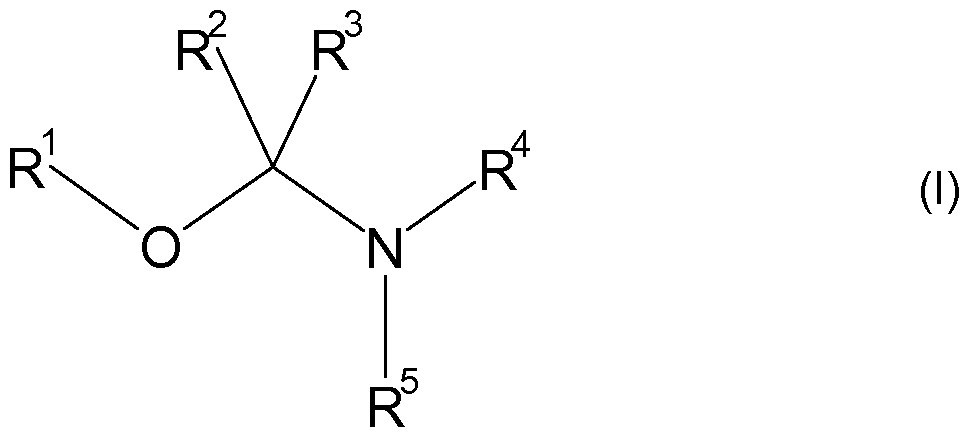
R2 X oder OR6' R 2 X or OR 6 '
R3 Wasserstoff, Ci-Ci2-Alkyl, C2-Ci2-Hydroxyalkyl, C2-Ci2-Alkenyl oder C6-Ci2-Aryl, oder X, R 3 is hydrogen, Ci-Ci 2 -alkyl, C 2 -C 2 hydroxyalkyl, C 2 -C 2 -alkenyl or C 6 -C 2 aryl, or X,
R4 Ci-Ci2-Alkyl, C2-Ci2-Hydroxyalkyl, C2-Ci2-Alkenyl oder C6-Ci2-Aryl, R 4 Ci-Ci 2 -alkyl, C 2 -C 2 hydroxyalkyl, C 2 -C 2 -alkenyl or C 6 -C 2 aryl,
R5 Wasserstoff, Ci-Ci2-Alkyl, C2-Ci2-Hydroxyalkyl, C2-Ci2-Alkenyl, Ci-Ci2-Acyl oder

R6 Ci-Ci2-Alkyl, C2-Ci2-Hydroxyalkyl, C2-Ci2-Alkenyl oder C6-Ci2-Aryl und R 6 Ci-Ci 2 -alkyl, C 2 -C 2 hydroxyalkyl, C 2 -C 2 -alkenyl or C 6 -C 2 aryl, and
X ein für die Reste R2 und R3 gemeinsamer Carbonylsauerstoff bedeuten, wobei R1 und R4 und/oder R5 und R6 ein verbrücktes C2-C6-Alkandiyl sein können, und wobei die obengenannte Reste R1 bis R6 noch insgesamt über ein bis zwei freie Valenzen verfügen können und mit diesen freien Valenzen mit mindestens einem geeigneten Grundkörper verbunden sein können, oder mehrwertige Alkohole, wobei der mehrwertige Alkohol vorzugsweise ein Molekulargewicht von weniger als 100 g/mol, bevorzugt von weniger als 90 g/mol, besonders bevorzugt von weniger als 80 g/mol, ganz besonders bevorzugt von weniger als 70 g/mol, pro Hydroxygruppe sowie keine vicinalen, geminalen, sekundären oder tertiären Hydroxygruppen aufweist, und mehrwertige Alkohole entweder Diole der allgemeinen Formel (IIa) HO R7— OH (IIa) worin R7 entweder einen unverzweigten Alkylenrest der Formel -(CH2)n- , wobei n eine ganze Zahl von 3 bis 20, bevorzugt 3 bis 12 ist, bedeutet und beide Hydroxygruppen endständig sind, oder R7 einen unverzweigten, verzweigten oder cyclischen Alkylenrest bedeutet, oder Polyole der allgemeinen Formel (IIb) X is a carbonyl oxygen common to the radicals R 2 and R 3 , where R 1 and R 4 and / or R 5 and R 6 may be a bridged C 2 -C 6 alkanediyl, and where the abovementioned radicals R 1 to R 6 are still may have at least one to two free valences and may be connected to these free valencies with at least one suitable base, or polyhydric alcohols, wherein the polyhydric alcohol preferably has a molecular weight of less than 100 g / mol, preferably less than 90 g / mol , more preferably less than 80 g / mol, most preferably less than 70 g / mol, per hydroxy group and no vicinal, geminal, secondary or tertiary hydroxy groups, and polyhydric alcohols either diols of general formula (IIa) HO R 7 - OH (IIa) where R 7 is either an unbranched alkylene radical of the formula - (CH 2) n -, where n is an integer from 3 to 20, preferably 3 to 12, and both hydroxy groups are terminal, or R 7 denotes an unbranched, branched or cyclic alkylene radical, or polyols of the general formula (IIb)
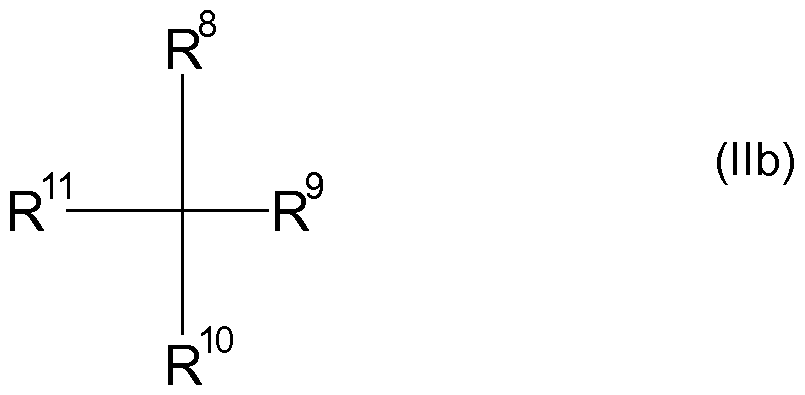

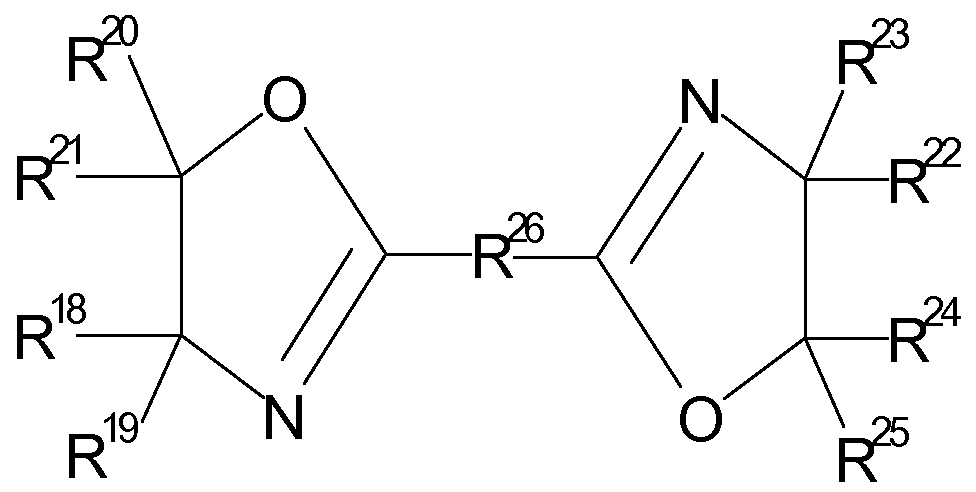
Besonders bevorzugte Nachvernetzer der allgemeinen Formel (I) sind 2-Oxazolidon, N-Methyl-2-oxazolidon, N-(2-Hydroxyethyl)-2-oxazolidon und N-Hydroxypropyl-2- oxazolidon. Particularly preferred postcrosslinkers of the general formula (I) are 2-oxazolidone, N-methyl-2-oxazolidone, N- (2-hydroxyethyl) -2-oxazolidone and N-hydroxypropyl-2-oxazolidone.
Bevorzugte Nachvernetzer der allgemeinen Formel (IIa) sind 1 ,3-Propandiol, 1 ,5- Pentandiol, 1 ,6-Hexandiol und 1 ,7-Heptandiol. Weitere Beispiele für Nachvernetzer der Formel (IIa) sind 1 ,3-Butandiol, 1 ,8-Octandiol, 1 ,9-Nonandiol und 1 ,10-Decandiol. Die Diole sind vorzugsweise wasserlöslich, wobei sich die Diole der allgemeinen Formel (IIa) bei 23°C zu mindestens 30 Gew.-%, bevorzugt zu mindestens 40 Gew.-%, besonders bevorzugt zu mindestens 50 Gew.-%, ganz besonders bevorzugt mindestens zu 60 Gew.-%, in Wasser lösen, wie beispielsweise 1 ,3-Propandiol und 1 ,7- Heptandiol. Noch mehr bevorzugt sind solche Nachvernetzer die bei 25°C flüssig sind. Preferred postcrosslinkers of the general formula (IIa) are 1, 3-propanediol, 1, 5-pentanediol, 1, 6-hexanediol and 1, 7-heptanediol. Further examples of postcrosslinkers of the formula (IIa) are 1, 3-butanediol, 1, 8-octanediol, 1, 9-nonanediol and 1, 10-decanediol. The diols are preferably water-soluble, wherein the diols of the general formula (IIa) at 23 ° C to at least 30 wt .-%, preferably at least 40 wt .-%, particularly preferably at least 50 wt .-%, most preferably at least 60 wt .-%, in water, such as 1, 3-propanediol and 1, 7-heptanediol. Even more preferred are those postcrosslinkers which are liquid at 25 ° C.
Bevorzugte Nachvernetzer der allgemeinen Formel (IIb) sind Butan-1 ,2,3-triol, Butan- 1 ,2,4-triol, Glyzerin, Trimethylolpropan, Trimethylolethan, Pentaerythrit, pro Molekül 1 - bis 3-fach ethoxyliertes Glyzerin, Trimethylolethan oder Trimethylolpropan und pro Molekül 1 - bis 3-fach propoxyliertes Glyzerin, Trimethylolethan oder Trimethylolpropan. Weiterhin bevorzugt sind 2-fach ethoxyliertes oder propoxyliertes Neopentylglykol. Besonders bevorzugt sind 2-fach und 3-fach ethoxyliertes Glyzerin, Neopentylglykol, 2- Methyl-1 ,3-propandiol und Trimethylolpropan. Preferred postcrosslinkers of the general formula (IIb) are butane-1, 2,3-triol, butane-1, 2,4-triol, glycerol, trimethylolpropane, trimethylolethane, pentaerythritol, per molecule 1 to 3 times ethoxylated glycerol, trimethylolethane or Trimethylolpropane and per molecule 1 - to 3-fold propoxylated glycerol, trimethylolethane or trimethylolpropane. Also preferred are 2-fold ethoxylated or propoxylated neopentyl glycol. Particularly preferred are 2-fold and 3-fold ethoxylated glycerol, neopentyl glycol, 2- Methyl 1, 3-propanediol and trimethylolpropane.
Bevorzugte mehrwertige Alkohole (IIa) und (IIb) weisen bei 23 °C eine Viskosität von weniger als 3000 mPas, vorzugsweise weniger als 1500 mPas, bevorzugt weniger als 1000 mPas, besonders bevorzugt weniger als 500 mPas, ganz besonders bevorzugt weniger als 300 mPas, auf. Preferred polyhydric alcohols (IIa) and (IIb) have a viscosity at 23 ° C. of less than 3000 mPas, preferably less than 1500 mPas, preferably less than 1000 mPas, more preferably less than 500 mPas, very particularly preferably less than 300 mPas, on.
Besonders bevorzugte Nachvernetzer der allgemeinen Formel (III) sind Ethylencarbo- nat und Propylencarbonat. Particularly preferred postcrosslinkers of the general formula (III) are ethylene carbonate and propylene carbonate.
Ein besonders bevorzugter Nachvernetzer der allgemeinen Formel (IV) ist 2,2'-Bis(2- oxazolin). A particularly preferred postcrosslinker of the general formula (IV) is 2,2'-bis (2-oxazoline).
Die bevorzugten Nachvernetzer minimieren Neben- und Folgereaktionen, die zu flüch- tigen und damit übelriechenden Verbindungen führen. Die mit den bevorzugten Nachvernetzern hergestellten Superabsorber sind daher auch im angefeuchteten Zustand geruchsneutral. The preferred postcrosslinkers minimize side reactions and subsequent reactions which lead to volatile and thus malodorous compounds. The superabsorbers produced with the preferred postcrosslinkers are therefore odorless even when moistened.
Es kann ein einzelner Nachvernetzer aus der obigen Auswahl verwendet werden oder beliebige Gemische verschiedener Nachvernetzer. It is possible to use a single postcrosslinker from the above selection or any mixtures of different postcrosslinkers.
Der Nachvernetzer wird im Allgemeinen in einer Menge von mindestens 0,001 Gew.- %, vorzugsweise von mindestens 0,02 Gew.-%, in besonders bevorzugter Form von mindestens 0,05 Gew.% sowie im Allgemeinen höchstens 2 Gew.-%, vorzugsweise höchstens 1 Gew.-%, in besonders bevorzugter Form höchstens 0,3 Gew.-%, beispielsweise höchstens 0,15 Gew.-% oder höchstens 0,095 Gew.-% eingesetzt, jeweils auf die Masse des damit beaufschlagten Grundpolymeren (beispielsweise der betreffenden Siebfraktion) bezogen. Die Nachvernetzung wird üblicherweise so durchgeführt, dass eine Lösung des Nach- vernetzers auf die getrockneten Grundpolymerpartikel aufgesprüht wird. Im Anschluss an das Aufsprühen werden die mit Nachvernetzer beschichteten Polymerpartikel thermisch getrocknet, wobei die Nachvernetzungsreaktion sowohl vor als auch während der Trocknung stattfinden kann. Falls Oberflächennachvernetzer mit polymerisierbaren Gruppen verwendet werden, kann die Oberflächennachvernetzung auch durch radikalisch induzierte Polymerisation solcher Gruppen mittels gängiger Radikalbildner oder auch mittels energiereicher Strahlung wie beispielsweise UV-Licht erfolgen. Dies kann parallel oder anstatt der Verwendung von Nachvernetzern erfolgen, die kovalente oder ionische Bindungen zu funktionellen Gruppen an der Oberfläche der Grundpolymerpar- tikel ausbilden. Das Aufsprühen der Nachvernetzerlösung wird vorzugsweise in Mischern mit bewegten Mischwerkzeugen, wie Schneckenmischern, Scheiben-, Paddel- oder Schaufelmischern oder Mischern mit anderen Mischwerkzeugen durchgeführt. Besonders bevorzugt sind jedoch Vertikalmischer. Es ist aber auch möglich die Nachvernetzerlösung in einem Wirbelbett aufzusprühen. Geeignete Mischer sind beispielsweise als Pflug- schar®-Mischer von Gebr. Lödige Maschinenbau GmbH, Elsener-Straße 7 - 9, 33102 Paderborn, Deutschland, oder als Schugi® Flexomix®-Mischer, Vrieco-Nauta®-Mischer oder Turbulizer®-Mischer von Hosokawa Micron BV, Gildenstraat 26, 7000 AB Doetin- chem, Niederlande, erhältlich. The postcrosslinker is generally used in an amount of at least 0.001% by weight, preferably at least 0.02% by weight, more preferably at least 0.05% by weight, and generally at most 2% by weight, preferably at most 1% by weight, in a particularly preferred form at most 0.3% by weight, for example at most 0.15% by weight or at most 0.095% by weight, in each case based on the mass of the base polymer (for example the relevant Sieve fraction). The postcrosslinking is usually carried out by spraying a solution of the postcrosslinker onto the dried base polymer particles. Subsequent to the spraying, the polymer particles coated with postcrosslinker are thermally dried, wherein the postcrosslinking reaction can take place both before and during the drying. If surface postcrosslinkers with polymerizable groups are used, the surface postcrosslinking can also be effected by free-radically induced polymerization of such groups by means of conventional free-radical formers or else by means of high-energy radiation such as UV light. This can be done in parallel or instead of using postcrosslinkers that form covalent or ionic bonds to functional groups on the surface of the base polymer particles. The spraying of Nachvernetzerlösung is preferably carried out in mixers with moving mixing tools, such as screw mixers, disc, paddle or paddle mixers or mixers with other mixing tools. However, particularly preferred are vertical mixers. However, it is also possible to spray the postcrosslinker solution in a fluidized bed. Suitable mixers are flocking for example as a plow mixer ® Gebr Lödige Maschinenbau GmbH, Elsener Street. 7 - 9, 33102 Paderborn, Germany, or ® as Schugi ® Flexomix mixer, Vrieco-Nauta ® mixer or blender Turbulizer® ® from Hosokawa Micron BV, Gildenstraat 26, 7000 AB Doetinchem, The Netherlands.
Die einsetzbaren Sprühdüsen unterliegen keiner Beschränkung. Geeignete Düsen und Zerstäubungssysteme sind beispielsweise in den folgenden Literaturstellen beschrieben: Zerstäuben von Flüssigkeiten, Expert-Verlag, Bd. 660, Reihe Kontakt & Studium, Thomas Richter (2004) sowie in Zerstäubungstechnik, Springer-Verlag, VDI-Reihe, Günter Wozniak (2002). Einsetzbar sind mono- und polydisperse Sprühsysteme. Unter den polydispersen Systemen sind Einstoff-Druckdüsen (strahl- oder lamellenbildend), Rotationszerstäuber, Zweistoffzerstäuber, Ultraschallzerstäuber und Pralldüsen geeignet. Bei den Zweistoffzerstäubern kann die Mischung der Flüssigkeits- mit der Gasphase sowohl innenliegend als auch außenliegend erfolgen. Das Sprühbild der Düsen ist unkritisch und kann jede beliebige Form annehmen, beispielsweise Rundstrahl-, Flachstrahl-, Weitwinkel-Rundstrahl- oder Kreisring-Spritzbild. Vorteilhaft ist die Verwendung eines nicht-oxidierenden Gases, falls Zweistoffzerstäuber eingesetzt werden, besonders bevorzugt sind Stickstoff, Argon oder Kohlendioxid. Derartigen Düsen kann die zu versprühende Flüssigkeit unter Druck zugeführt werden. Die Zerteilung der zu versprühenden Flüssigkeit kann dabei dadurch erfolgen, dass sie nach Erreichen einer bestimmten Mindestgeschwindigkeit in der Düsenbohrung entspannt wird. Ferner können für den erfindungsgemäßen Zweck auch Einstoffdüsen, wie beispielsweise Schlitzdüsen oder Drallkammern (Vollkegeldüsen) verwendet werden (beispielsweise von Düsen-Schlick GmbH, DE, oder von Spraying Systems Deutschland GmbH, DE). Derartige Düsen sind auch in der EP 0 534 228 A1 und der EP 1 191 051 A2 beschrieben. The applicable spray nozzles are subject to no restriction. Suitable nozzles and atomization systems are described, for example, in the following references: Atomization of Liquids, Expert-Verlag, Vol. 660, series Kontakt & Studium, Thomas Richter (2004) and in atomization technology, Springer-Verlag, VDI series, Günter Wozniak (2002 ). Applicable are mono- and polydisperse spray systems. Among the polydisperse systems are single-fluid pressure nozzles (jet or lamella-forming), rotary atomizers, two-component atomizers, ultrasonic atomizers and impact nozzles. In the two-component atomizers, the mixture of the liquid and the gas phase can take place both internally and externally. The spray pattern of the nozzles is not critical and can take any shape, such as omnidirectional, fan-beam, wide-angle omnidirectional or circular ring spray pattern. It is advantageous to use a non-oxidizing gas, if two-component atomizers are used, particularly preferably nitrogen, argon or carbon dioxide. Such nozzles, the liquid to be sprayed can be supplied under pressure. The division of the liquid to be sprayed can take place in that it is relaxed after reaching a certain minimum speed in the nozzle bore. Furthermore, single-substance nozzles, such as, for example, slot nozzles or twist chambers (full-cone nozzles) can also be used for the purpose according to the invention (for example, by Düsen-Schlick GmbH, DE, or by Spraying Systems Deutschland GmbH, DE). Such nozzles are also described in EP 0 534 228 A1 and EP 1 191 051 A2.
Die Nachvernetzer werden typischerweise als wässrige Lösung eingesetzt. Wird ausschließlich Wasser als Lösungsmittel verwendet, so wird der Nachvernetzerlösung o- der bereits dem Grundpolymer vorteilhafterweise ein Tensid oder Deagglomerisations- hilfsmittel zugesetzt. Dadurch wird das Benetzungsverhalten verbessert und die Ver- klumpungsneigung vermindert. The postcrosslinkers are typically used as an aqueous solution. If only water is used as the solvent, the postcrosslinker solution or the base polymer is advantageously added with a surfactant or deagglomerization aid. This improves the wetting behavior and reduces the tendency to clog.
Alle anionischen, kationischen, nichtionischen und amphoteren Tenside sind als Deagglomerationshilfsmittel geeignet, bevorzugt sind jedoch aus Hautverträglichkeitsgründen nicht-ionische und amphotere Tenside. Das Tensid kann auch Stickstoff enthalten. Beispielsweise werden Sorbitanmonoester, wie Sorbitanmonococoat und Sorbi- tanmonolaurat, oder ethoxylierte Varianten davon, wie beispielsweise Polysorbat 20®, zugesetzt. Weitere geeignete Deagglomerationshilfsmittel stellen die ethoxylierten und alkoxylierten Derivate des 2-Propylheptanols dar, die unter den Marken Lutensol XL® und Lutensol XP® vertrieben werden (BASF SE, Carl-Bosch-Straße 38, 67056 Lud- wigshafen, Deutschland). All anionic, cationic, nonionic and amphoteric surfactants are suitable as Deagglomerationshilfsmittel, but are preferred for skin compatibility reasons non-ionic and amphoteric surfactants. The surfactant may also contain nitrogen. For example, sorbitan monoesters such as sorbitan monococoate and sorbitan tanmonolaurate, or ethoxylated variants thereof, such as polysorbate 20 ® added. Other suitable deagglomerating assistants the ethoxylated and alkoxylated derivatives of 2-propylheptanol, which are marketed under the brand names Lutensol® XL ® and Lutensol XP ® (BASF SE, Carl-Bosch-Straße 38, 67056 Ludwigshafen hafen, Germany).
Das Deagglomerationshilfsmittel kann getrennt dosiert oder der Nachvernetzerlosung zugesetzt werden. Vorzugsweise wird das Deagglomerationshilfsmittel der Nachvernetzerlosung einfach zugesetzt. The Deagglomerationshilfsmittel can be metered separately or the Nachvernetzerlosung be added. Preferably, the deagglomerating aid is simply added to the postcrosslinker solution.
Die Einsatzmenge des Deagglomerationshilfsmittels bezogen auf Grundpolymer beträgt beispielsweise 0 bis 0,1 Gew.-%, vorzugsweise 0 bis 0,01 Gew.-%, besonders bevorzugt 0 bis 0,002 Gew.-%. Vorzugsweise wird das Deagglomerationshilfsmittel so dosiert, dass die Oberflächenspannung eines wässrigen Extrakts des gequollenen Grundpolymers und/oder des gequollenen nachvernetzten wasserabsorbierenden Polymeren bei 23 °C mindestens 0,060 N/m, vorzugsweise mindestens 0,062 N/m, besonders bevorzugt mindestens 0,065 N/m, und vorteilhaft höchstens 0,072 N/m beträgt. Die wässrige Nachvernetzerlosung kann neben dem mindestens einen Nachvernetzer auch noch ein Cosolvens enthalten. Über den Gehalt an nichtwässrigem Lösungsmittel bzw. Gesamtlösungsmittelmenge kann die Eindringtiefe des Nachvernetzers in die Polymerpartikel eingestellt werden. Technisch gut geeignete Cosolventien sind C1 -C6- Alkohole, wie Methanol, Ethanol, n-Propanol, Isopropanol, n-Butanol, sec-Butanol, tert.-Butanol oder 2-Methyl-1 -propanol, C2-C5-Diole, wie Ethylenglykol, 1 ,2-The amount used of the deagglomerating assistant based on the base polymer is, for example, 0 to 0.1% by weight, preferably 0 to 0.01% by weight, particularly preferably 0 to 0.002% by weight. Preferably, the deagglomerating aid is metered so that the surface tension of an aqueous extract of the swollen base polymer and / or the swollen postcrosslinked water-absorbing polymer at 23 ° C at least 0.060 N / m, preferably at least 0.062 N / m, more preferably at least 0.065 N / m, and advantageously not more than 0.072 N / m. The aqueous Nachvernetzerlosung may also contain a cosolvent in addition to the at least one postcrosslinker. About the content of non-aqueous solvent or total solvent amount, the penetration depth of the postcrosslinker can be adjusted in the polymer particles. Technically suitable cosolvents are C 1 -C 6 -alcohols, such as methanol, ethanol, n-propanol, isopropanol, n-butanol, sec-butanol, tert-butanol or 2-methyl-1-propanol, C 2 -C 5 -diols, such as Ethylene glycol, 1, 2
Propylenglykol oder 1 ,4-Butandiol, Ketone, wie Aceton, oder Carbonsäureester, wie Essigsäureethylester. Nachteilig an einigen dieser Cosolventien ist, dass sie typische Eigengerüche aufweisen. Das Cosolvens selbst ist unter den Reaktionsbedingungen idealerweise kein Nachvernetzer. Es kann jedoch im Grenzfall und abhängig von Verweilzeit und Temperatur dazu kommen, dass das Cosolvens teilweise zur Vernetzung beiträgt. Dies ist insbesondere dann der Fall, wenn der Nachvernetzer relativ träge ist und daher auch selbst sein Cosolvens bilden kann, wie beispielsweise bei Einsatz cyclischer Carbonate der allgemeinen Formel (III), Diole der allgemeinen Formel (IIa) oder Polyole der allgemeinen Formel (IIb). Solche Nachvernetzer können im Gemisch mit reaktiveren Nachver- netzern auch in der Funktion als Cosolvens eingesetzt werden, da die eigentliche Nachvernetzungsreaktion dann bei niedrigeren Temperaturen und/oder kürzeren Verweilzeiten als in Abwesenheit des reaktiveren Vernetzers durchgeführt werden kann. Da das Cosolvens in relativ großen Mengen verwendet wird und auch teilweise im Produkt verbleibt, darf es nicht toxisch sein. Im erfindungsgemäßen Verfahren eignen sich die Diole der allgemeinen Formel (IIa), die Polyole der allgemeinen Formel (IIb), sowie die cyclischen Carbonate der allgemeinen Formel (III) auch als Cosolventien. Diese Funktion erfüllen sie in Gegenwart eines reaktiven Nachvernetzers der allgemeinen Formel (I) und/oder (IV) und/oder einer Di- oder Triglycidylverbindung. Bevorzugte Cosolventien im erfindungsgemäßen Verfahren sind jedoch insbesondere die Diole der allgemeinen Formel (IIa), insbesondere, wenn die Hydroxygruppen sterisch durch Nachbargruppen an einer Reaktion behindert werden. Solche Diole eignen sich zwar prinzipiell auch als Nachvernetzer, erfordern dazu jedoch deutlich höhere Reaktionstemperaturen oder gegebenenfalls höhere Einsatz- mengen als sterisch ungehinderte Diole. Propylene glycol or 1, 4-butanediol, ketones, such as acetone, or carboxylic acid esters, such as ethyl acetate. A disadvantage of some of these cosolvents is that they have typical odors. The co-solvent itself is ideally not a postcrosslinker under the reaction conditions. However, in the limiting case and depending on residence time and temperature, it may happen that the cosolvent partially contributes to crosslinking. This is particularly the case when the postcrosslinker is relatively inert and therefore can itself form its cosolvent, such as when using cyclic carbonates of the general formula (III), diols of the general formula (IIa) or polyols of the general formula (IIb) , Such postcrosslinkers can also be used as cosolvents in a mixture with more reactive secondary crosslinkers since the actual postcrosslinking reaction can then be carried out at lower temperatures and / or shorter residence times than in the absence of the more reactive crosslinker. Since co-solvent is used in relatively large amounts and also remains partially in the product, it must not be toxic. In the process according to the invention, the diols of the general formula (IIa), the polyols of the general formula (IIb) and the cyclic carbonates of the general formula (III) are also suitable as cosolvents. They fulfill this function in the presence of a reactive postcrosslinker of the general formula (I) and / or (IV) and / or a di- or triglycidyl compound. However, preferred cosolvents in the process according to the invention are, in particular, the diols of the general formula (IIa), especially when the hydroxyl groups are hindered sterically by neighboring groups on a reaction. Although such diols are in principle also suitable as postcrosslinkers, they require significantly higher reaction temperatures or optionally higher amounts of use than sterically unhindered diols.
Besonders bevorzugte Kombinationen aus wenig reaktivem Nachvernetzer als Cosol- vens und reaktivem Nachvernetzer sind Kombinationen von bevorzugten mehrwertigen Alkoholen, Diolen der allgemeinen Formel (IIa) und Polyolen der allgemeinen Formel (IIb), mit Amidacetalen oder Carbamaten der allgemeinen Formel (I). Particularly preferred combinations of less reactive postcrosslinker as cosolvent and reactive postcrosslinker are combinations of preferred polyhydric alcohols, diols of general formula (IIa) and polyols of general formula (IIb), with amide acetals or carbamates of general formula (I).
Geeignete Kombinationen sind beispielsweise 2-Oxazolidon/1 ,2-Propandiol und N-(2- Hydroxyethyl)-2-oxazolidon/1 ,2-Propandiol sowie Ethylenglykoldiglycidylether/1 ,2- Propandiol. Suitable combinations are, for example, 2-oxazolidone / 1, 2-propanediol and N- (2-hydroxyethyl) -2-oxazolidone / 1, 2-propanediol and ethylene glycol diglycidyl ether / 1, 2-propanediol.
Ganz besonders bevorzugte Kombinationen sind 2-Oxazolidon/1 ,3-Propandiol und N- (2-Hydroxyethyl)-2-oxazolidon/1 ,3-Propandiol. Very particularly preferred combinations are 2-oxazolidone / 1,3-propanediol and N- (2-hydroxyethyl) -2-oxazolidone / 1,3-propanediol.
Weiterhin bevorzugte Kombinationen sind solche mit Ethylenglykoldiglycidylether oder Glyzerindi- oder -triglycidylether mit folgenden Lösemitteln, Cosolventien oder Covernetzern: Isopropanol, 1 ,3-Propandiol, 1 ,2-Propylenglykol oder Gemischen davon. Further preferred combinations are those with ethylene glycol diglycidyl ether or glycerol or triglycidyl ether with the following solvents, cosolvents or co-crosslinkers: isopropanol, 1,3-propanediol, 1,2-propylene glycol or mixtures thereof.
Weiterhin bevorzugte Kombinationen sind solche mit 2-Oxazolidon oder (2- Hydroxyethyl)-2-oxazolidon in folgenden Lösemitteln, Cosolventien oder Covernetzern: Isopropanol, 1 ,3-Propandiol, 1 ,2-Propylenglykol, Ethylencarbonat, Propylencarbonat oder Gemischen davon. Further preferred combinations are those with 2-oxazolidone or (2-hydroxyethyl) -2-oxazolidone in the following solvents, cosolvents or co-crosslinkers: isopropanol, 1, 3-propanediol, 1, 2-propylene glycol, ethylene carbonate, propylene carbonate or mixtures thereof.
Häufig beträgt die Konzentration des Cosolvens in der wässrigen Nachvernetzerlö- sung, von 15 bis 50 Gew.-%, vorzugsweise von 15 bis 40 Gew.-%, besonders bevor- zugt von 20 bis 35 Gew.-%, bezogen auf die Nachvernetzerlösung. Bei Cosolventien, die mit Wasser nur begrenzt mischbar sind, wird man vorteilhaft die wässrige Nachvernetzerlösung so einstellen, dass nur eine Phase vorliegt, gegebenenfalls durch Erniedrigung der Konzentration des Cosolvens. In einer bevorzugten Ausführungsform wird kein Cosolvens eingesetzt. Der Nachvernetzer wird dann nur als Lösung in Wasser angewandt, gegebenenfalls unter Zusatz eines Deagglomerationshilfsmittels. Die Konzentration des mindestens einen Nachvernetzers in der wässrigen Nachvernetzerlosung, beträgt typischerweise 1 bis 20 Gew.-%, vorzugsweise 1 ,5 bis 10 Gew.- %, besonders bevorzugt 2 bis 5 Gew.-%, bezogen auf die Nachvernetzerlosung. Frequently, the concentration of cosolvent in the aqueous postcrosslinker solution is from 15 to 50% by weight, preferably from 15 to 40% by weight, more preferably from 20 to 35% by weight, based on the postcrosslinker solution. For cosolvents which are only slightly miscible with water, it is advantageous to adjust the aqueous postcrosslinker solution so that only one phase is present, if appropriate by lowering the concentration of the cosolvent. In a preferred embodiment, no cosolvent is used. The postcrosslinker is then used only as a solution in water, optionally with the addition of a deagglomerating auxiliary. The concentration of the at least one postcrosslinker in the aqueous postcrosslinker solution is typically from 1 to 20% by weight, preferably from 1 to 5% by weight, particularly preferably from 2 to 5% by weight, based on the postcrosslinker solution.
Die Gesamtmenge der Nachvernetzerlosung bezogen auf Grundpolymer beträgt üblicherweise von 0,3 bis 15 Gew.-%, vorzugsweise von 2 bis 6 Gew.-%. The total amount of Nachvernetzerlosung based on the base polymer is usually from 0.3 to 15 wt .-%, preferably from 2 to 6 wt .-%.
Die eigentliche Oberflächennachvernetzung durch Reaktion des Oberflächennachver- netzers mit funktionellen Gruppen an der Oberfläche der Grundpolymerpartikel wird meist durch Erwärmung des mit Oberflächennachvernetzerlösung benetzten Grundpolymers durchgeführt, üblicherweise„Trocknung" genannt (aber nicht mit der oben beschriebenen Trocknung des Polymergeis aus der Polymerisation zu verwechseln, bei der typischerweise sehr viel mehr Flüssigkeit zu entfernen ist). Die Trocknung kann im Mischer selbst erfolgen, durch Beheizung des Mantels, durch Wärmeaustauschflächen oder Einblasen warmer Gase. Gleichzeitiges Versetzen des Superabsorbers mit O- berflächennachvernetzer und Trocknen kann beispielsweise in einem Wirbelschichttrockner erfolgen. Die Trocknung wird aber meist in einem nachgeschalteten Trockner, wie beispielsweise einem Hordentrockner, einem Drehrohrofen, ein Paddel- oder Scheibentrockner oder einer beheizbaren Schnecke durchgeführt. Geeignete Trockner sind beispielsweise als Solidair® oder Torusdisc®-T rockner von Bepex International LLC, 333 N.E. Taft Street, Minneapolis, MN 55413, U.S.A., oder als Paddel- oder Schaufeltrockner oder auch als Fließbetttrockner von Nara Machinery Co., Ltd., Zweigniederlassung Europa, Europaallee 46, 50226 Frechen, Deutschland erhältlich. The actual surface postcrosslinking by reaction of the surface postcrosslinker with functional groups on the surface of the base polymer particles is usually carried out by heating the base polymer wetted with surface postcrosslinker solution, usually called "drying" (but not to be confused with the above-described drying of the polymer gel from the polymerization) The drying can be carried out in the mixer itself, by heating the jacket, by heat exchange surfaces or by blowing warm gases in. Simultaneous addition of the superabsorbent with surface postcrosslinker and drying can take place, for example, in a fluidized-bed dryer but is usually carried out in a downstream dryer, such as a hopper dryer, a rotary kiln, a paddle or disc dryer or a heated screw ielsweise as Solidair ® or Torusdisc ® -T Rockner from Bepex International LLC, 333 NE Taft Street, Minneapolis, MN 55413, USA, or as a paddle or paddle dryer or as a fluidized bed dryer of Nara Machinery Co., Ltd., branch Europa, Europa Allee 46, 50226 Frechen, Germany available.
Es ist möglich die Polymerpartikel zur Trocknung und Durchführung der Oberflächennachvernetzung über Kontaktflächen in einem nachgeschalteten Trockner zu beheizen, oder über zugeführtes warmes Inertgas, oder über eine Mischung eines oder mehrerer Inertgase mit Wasserdampf, oder nur mit Wasserdampf allein. Bei Zufuhr der Wärme über Kontaktflächen ist es möglich die Reaktion bei leichtem oder vollständigem Unterdruck unter Inertgas durchzuführen. Bei Verwendung von Wasserdampf zum direkten Beheizen der Polymerpartikel ist es erfindungsgemäß wünschenswert den Trockner bei Normaldruck oder Überdruck zu betreiben. In diesem Fall kann es sinnvoll sein den Nachvernetzungsschritt in einen Aufheizschritt mit Wasserdampf und einen Reaktions- schritt unter Inertgas aber ohne Wasserdampf aufzuspalten. Dies kann in einem oder mehreren Apparaten realisiert werden. Erfindungsgemäß können die Polymerpartikel schon im Nachvernetzungsmischer mit Wasserdampf aufgeheizt werden. Das eingesetzte Grundpolymer kann aus vorhergehenden Prozessschritten noch eine Temperatur von 10 bis 120 °C aufweisen, die Nachvernetzerlosung kann eine Temperatur von 0 bis 70 °C aufweisen. Insbesondere kann die Nachvernetzerlosung zur Verminderung der Viskosität erwärmt werden. Bevorzugte Trocknungstemperaturen liegen im Bereich 100 bis 250°C, bevorzugt 120 bis 220°C, besonders bevorzugt 130 bis 210°C, ganz besonders bevorzugt 150 bis 200°C. Die bevorzugte Verweilzeit bei dieser Temperatur im Reaktionsmischer oder Trockner beträgt vorzugsweise mindestens 10 Minuten, besonders bevorzugt mindes- tens 20 Minuten, ganz besonders bevorzugt mindestens 30 Minuten, und üblicherweise höchstens 60 Minuten. Typischerweise wird die Trocknung so geführt, dass der Super- absorber einen Restfeuchtegehalt von im Allgemeinen mindestens 0,1 Gew.-%, vorzugsweise mindestens 0,2 Gew.-% und in besonders bevorzugter Form mindestens 0,5 Gew.-% sowie im Allgemeinen höchstens 15 Gew.-%, vorzugsweise höchstens 10 Gew.-% und in besonders bevorzugter Form höchstens 8 Gew.-% aufweist. It is possible to heat the polymer particles for drying and carrying out the surface postcrosslinking via contact surfaces in a downstream dryer, or via supplied warm inert gas, or via a mixture of one or more inert gases with water vapor, or only with steam alone. When the heat is supplied via contact surfaces, it is possible to carry out the reaction under slight or complete underpressure under inert gas. When steam is used for directly heating the polymer particles, it is desirable according to the invention to operate the dryer at normal pressure or overpressure. In this case, it may be useful to split the postcrosslinking step into a heating step with water vapor and a reaction step under inert gas but without water vapor. This can be realized in one or more apparatuses. According to the invention, the polymer particles can already be heated in the post-crosslinking mixer with steam. The base polymer used may still have a temperature of 10 to 120 ° C from previous process steps, the Nachvernetzerlosung may have a temperature of 0 to 70 ° C. In particular, the postcrosslinker solution can be heated to reduce the viscosity. Preferred drying temperatures are in the range 100 to 250 ° C, preferably 120 to 220 ° C, more preferably 130 to 210 ° C, most preferably 150 to 200 ° C. The preferred residence time at this temperature in the reaction mixer or dryer is preferably at least 10 minutes, more preferably at least 20 minutes, most preferably at least 30 minutes, and usually at most 60 minutes. Typically, the drying is conducted in such a way that the superabsorber has a residual moisture content of generally at least 0.1% by weight, preferably at least 0.2% by weight and in a particularly preferred form at least 0.5% by weight, and also Generally at most 15% by weight, preferably at most 10% by weight and in a particularly preferred form at most 8% by weight.
Die Nachvernetzung kann unter normalen atmosphärischen Bedingungen stattfinden. Normale atmosphärische Bedingungen bedeutet, dass keine technischen Vorkehrungen getroffen werden, um den Partialdruck oxidierender Gase wie den des atmosphä- rischen Sauerstoffs im Apparat, in dem die Nachvernetzungsreaktion überwiegend stattfindet (dem„Nachvernetzungsreaktor", typischerweise der Trockner) zu verringern. Es ist jedoch bevorzugt, die Nachvernetzungsreaktion unter verringertem Partialdruck oxidierender Gase durchzuführen. Oxidierende Gase sind Stoffe, die bei 23 °C einen Dampfdruck von mindestens 1013 mbar aufweisen und in Verbrennungsvorgängen als Oxidationsmittel wirken, beispielsweise Sauerstoff, Stickoxid und Stickstoffdioxid, insbesondere Sauerstoff. Vorzugsweise beträgt der Partialdruck oxidierender Gase dabei weniger als 140 mbar, bevorzugt weniger als 100 mbar, besonders bevorzugt weniger als 50 mbar, ganz besonders bevorzugt weniger als 10 mbar. Wird die thermische Nachvernetzung bei Umgebungsdruck, d. h. bei einem Gesamtdruck um 1013 mbar, durchgeführt, so wird der Gesamtpartialdruck der oxidierenden Gase über deren Volumenanteil festgelegt. Der Anteil der oxidierenden Gase beträgt dabei vorzugsweise weniger als 14 Vol.-%, bevorzugt weniger als 10 Vol.-%, besonders bevorzugt weniger als 5 Vol.-%, ganz besonders bevorzugt weniger als 1 Vol.-%. Die Nachvernetzung kann unter vermindertem Druck durchgeführt werden, d. h. bei einem Gesamtdruck von weniger als 1.013 mbar. Der Gesamtdruck beträgt typischerweise weniger als 670 mbar, vorzugsweise weniger als 480 mbar, besonders bevorzugt weniger als 300 mbar, ganz besonders bevorzugt weniger als 200 mbar. Werden Trocknung und Nachvernetzung unter Luft mit einem Sauerstoffgehalt von 20,8 Vol.-% durchgeführt, so betragen die zu den obengenannten Gesamtdrücken korrespondierenden Sauerstoffpartialdrücke 139 mbar (670 mbar), 100 mbar (480 mbar), 62 mbar (300 mbar) und 42 mbar (200 mbar), wobei die jeweiligen Gesamtdrücke in den Klammern stehen. Eine andere Möglichkeit, den Partialdruck oxidierender Gase zu senken, ist die Einleitung von nicht oxidierenden Gase, insbesondere Inertgasen in den zur Nachvernetzung verwendeten Apparat. Geeignete Inertgase sind bei der Nachvernetzungstemperatur und gegebenem Druck im Nachvernetzungstrockner gasförmig vorliegende Stoffe, die unter diesen Bedingungen nicht oxidierend auf die Bestandteile der trocknenden Polymerpartikel wirken, beispielsweise Stickstoff, Kohlendioxid, Argon, Wasserdampf, wobei Stickstoff bevorzugt ist. Die Inertgasmenge beträgt im Allgemeinen von 0,0001 bis 10 m3, bevorzugt 0,001 bis 5 m3, besonders bevorzugt 0,005 bis 1 m3, und ganz besonders bevorzugt 0,005 bis 0,1 m3, bezogen auf 1 kg Superabsorber. Postcrosslinking can take place under normal atmospheric conditions. Normal atmospheric conditions means that no technical precautions are taken to reduce the partial pressure of oxidizing gases such as atmospheric oxygen in the apparatus in which the postcrosslinking reaction predominantly takes place (the "postcrosslinking reactor", typically the dryer), but it is preferred Oxidizing gases are substances which have a vapor pressure of at least 1013 mbar at 23 ° C. and act as oxidizing agents in combustion processes, for example oxygen, nitrogen oxide and nitrogen dioxide, in particular oxygen less than 140 mbar, preferably less than 100 mbar, particularly preferably less than 50 mbar, very particularly preferably less than 10 mbar, if the thermal postcrosslinking is carried out at ambient pressure, ie at a total pressure of around 1013 mbar, Thus, the total partial pressure of the oxidizing gases is determined by their volume fraction. The proportion of oxidizing gases is preferably less than 14% by volume, preferably less than 10% by volume, particularly preferably less than 5% by volume, very particularly preferably less than 1% by volume. The post-crosslinking can be carried out under reduced pressure, ie at a total pressure of less than 1013 mbar. The total pressure is typically less than 670 mbar, preferably less than 480 mbar, more preferably less than 300 mbar, most preferably less than 200 mbar. If drying and postcrosslinking are carried out under air with an oxygen content of 20.8% by volume, the oxygen partial pressures corresponding to the abovementioned total pressures are 139 mbar (670 mbar), 100 mbar (480 mbar), 62 mbar (300 mbar) and 42 m mbar (200 mbar), with the respective total pressures in parentheses. Another way to reduce the partial pressure of oxidizing gases, the introduction of non-oxidizing gases, especially inert gases in the apparatus used for post-crosslinking. Suitable inert gases are gaseous substances at the postcrosslinking temperature and given pressure in the postcrosslinking dryer which, under these conditions, do not oxidize to the constituents of the drying polymer particles, for example nitrogen, carbon dioxide, argon, water vapor, with nitrogen being preferred. The amount of inert gas is generally from 0.0001 to 10 m 3 , preferably from 0.001 to 5 m 3 , more preferably from 0.005 to 1 m 3 , and most preferably from 0.005 to 0.1 m 3 , based on 1 kg of superabsorbent.
Im erfindungsgemäßen Verfahren kann das Inertgas, wenn es nicht Wasserdampf enthält, über Düsen in den Nachvernetzungstrockner eingeblasen werden, besonders bevorzugt wird das Inertgas aber bereits im oder kurz vor dem Mischer, indem der Superabsorber mit Oberflächennachvernetzer versetzt wird, über Düsen dem Polymerpar- tikelstrom zugegeben. In the process according to the invention, the inert gas, if it does not contain water vapor, can be injected via nozzles into the postcrosslinking dryer, more preferably the inert gas is added to the polymer particle stream via nozzles via the nozzles in or just before the mixer by adding superoxide absorber with surface postcrosslinker ,
Selbstverständlich können aus dem Trockner abgeführte Dämpfe von Cosolventien außerhalb des Trockners wieder kondensiert und gegebenenfalls rezykliert werden. In einer bevorzugten Ausführungsform der vorliegenden Erfindung werden vor, während oder nach der Nachvernetzung zusätzlich zu den Nachvernetzern polyvalente Kationen auf die Partikeloberfläche aufgebracht. Dies ist im Prinzip eine weitere Ober- flächennachvernetzung durch ionische, nicht kovalente Bindungen, wird aber gelegentlich auch als„Komplexierung" mit den betreffenden Metallionen oder einfach als„Be- Schichtung" mit den betreffenden Substanzen (dem„Komplexierungsmittel") bezeichnet. Of course, vapors of cosolvents removed from the dryer can be condensed outside the dryer again and, if necessary, recycled. In a preferred embodiment of the present invention, polyvalent cations are applied to the particle surface in addition to the postcrosslinkers before, during or after the postcrosslinking. This is in principle a further surface postcrosslinking by ionic, noncovalent bonds, but is sometimes also referred to as "complexing" with the metal ions in question or simply as "coating" with the relevant substances (the "complexing agent").
Dieses Aufbringen von polyvalenten Kationen erfolgt durch Aufsprühen von Lösungen zwei- oder mehrwertiger Kationen, meist zwei-, drei- oder vierwertiger Metallkationen, aber auch polyvalenter Kationen wie formal ganz oder teilweise aus Vinylaminmono- meren aufgebauter Polymere wie teilweise oder vollständig hydrolysiertes Polyvinyla- mid (sogenanntes„Polyvinylamin"), dessen Amingruppen stets - auch bei sehr hohen pH-Werten - teilweise zu Ammoniumgruppen protoniert vorliegen. Beispiele verwendbarer zweiwertiger Metallkationen sind insbesondere die zweiwertigen Kationen von Metallen der Gruppen 2 (insbesondere Mg, Ca, Sr, Ba), 7 (insbesondere Mn), 8 (insbesondere Fe), 9 (insbesondere Co), 10 (insbesondere Ni), 1 1 (insbesondere Cu) und 12 (insbesondere Zn) des Periodensystems der Elemente. Beispiele verwendbarer dreiwertiger Metallkationen sind insbesondere die dreiwertigen Kationen von Metallen der Gruppen 3 einschließlich der Lanthaniden (insbesondere Sc, Y, La, Ce), 8 (insbeson- dere Fe), 1 1 (insbesondere Au) und 13 (insbesondere AI) des Periodensystems der Elemente. Beispiele verwendbarer vierwertiger Kationen sind insbesondere die vier- wertigen Kationen von Metallen der Lanthaniden (insbesondere Ce) sowie der Gruppe 4 (insbesondere Ti, Zr, Hf) des Periodensystems der Elemente. Die Metallkationen können sowohl allein als auch im Gemisch untereinander eingesetzt werden. Beson- ders bevorzugt ist die Verwendung dreiwertiger Metallkationen. Ganz besonders bevorzugt ist die Verwendung von Aluminiumkationen. Von den genannten Metall-Kationen sind alle Metallsalze geeignet, die eine ausreichende Löslichkeit in dem zu verwendenden Lösungsmittel besitzen. Besonders geeignet sind Metallsalze mit schwach komplexierenden Anionen wie zum Beispiel Chlorid, Nitrat und Sulfat, Hydrogensulfat, Carbonat, Hydrogencarbonat, Nitrat, Phosphat, Hydrogenphosphat, oder Dihydrogenphosphat, Bevorzugt sind Salze von Mono- und Dicarbonsäuren, Hydroxisäuren, Ketosäuren sowie Aminosäuren oder basische Salze. Beispiel Acetate, Propionate, Tartrate, Maleate, Citrate, Lactate, Malate und Succinate sind ebenso bevorzugt ist die Verwendung von Hydroxiden. Besonders bevorzugt ist die Verwendung von 2-Hydroxicarbonsäuresalzen wie Citraten und Lactaten. Beispiele besonders bevorzugter Metallsalze sind Alkali- und Erdalkalimetallaluminate und deren Hydrate, etwa Natriumaluminat und dessen Hydrate, Aluminiumacetat, Aluminiumpro- pionat, Aluminiumeitrat und Aluminiumlactat. Polyvalent cations are applied by spraying solutions of divalent or polyvalent cations, usually divalent, trivalent or tetravalent metal cations, but also polyvalent cations, such as formally wholly or partly of vinylamine monomers, such as partially or completely hydrolyzed polyvinylamide ( Examples of divalent metal cations which may be used are, in particular, the divalent cations of metals of groups 2 (in particular Mg, Ca, Sr, Ba), 7 (in particular Mn), 8 (in particular Fe), 9 (in particular Co), 10 (in particular Ni), 11 (in particular Cu) and 12 (in particular Zn) of the Periodic Table of the Elements Examples of trivalent metal cations which may be used are in particular the trivalent cations of Group 3 metals, including lanthanides (in particular Sc, Y, La, Ce), 8 (in particular Fe), 1 1 (in particular Au) and 13 (in particular Al) of the Periodic Table of the Elements. Examples of suitable tetravalent cations are, in particular, the tetravalent cations of metals of the lanthanides (in particular Ce) and of group 4 (in particular Ti, Zr, Hf) of the Periodic Table of the Elements. The metal cations can be used alone or mixed with each other. Particularly preferred is the use of trivalent metal cations. Very particularly preferred is the use of aluminum cations. Of the cited metal cations, all metal salts which have sufficient solubility in the solvent to be used are suitable. Particularly suitable are metal salts with weakly complexing anions such as chloride, nitrate and sulfate, hydrogen sulfate, carbonate, bicarbonate, nitrate, phosphate, hydrogen phosphate, or dihydrogen phosphate. Preferred are salts of mono- and dicarboxylic acids, hydroxy acids, keto acids and amino acids or basic salts. Examples of acetates, propionates, tartrates, maleates, citrates, lactates, malates and succinates are also preferred is the use of hydroxides. Particularly preferred is the use of 2-hydroxycarboxylic acid salts such as citrates and lactates. Examples of particularly preferred metal salts are alkali metal and alkaline earth metal aluminates and their hydrates, for example sodium aluminate and its hydrates, aluminum acetate, aluminum propionate, aluminum citrate and aluminum lactate.
Die genannten Kationen und Salze können in Reinform oder als Gemisch verschiede- ner Kationen oder Salze verwendet werden. Die eingesetzten Salze des zwei und/oder dreiwertigen Metallkations können weitere Nebenbestandteile wie noch unneutralisierte Carbonsäure und/oder Alkalisalze der neutralisierten Carbonsäure enthalten. Bevorzugte Alkalisalze sind die des Natriums, Kaliums und des Ammoniums. Sie werden typischerweise als wässerige Lösung eingesetzt welche durch Auflösen der festen Sal- ze in Wasser gewonnen wird, oder bevorzugt direkt als solche erzeugt wird, wodurch gegebenenfalls Trocknungs- und Reinigungsschritte vermieden werden. Vorteilhaft können auch die Hydrate der genannten Salze eingesetzt werden, die sich oft schneller in Wasser lösen als die wasserfreien Salze. Die Einsatzmenge an Metallsalz beträgt im Allgemeinen mindestens 0,001 Gew.-%, vorzugsweise mindestens 0,01 Gew.-% und in besonders bevorzugter Form mindestens 0,1 Gew.-%, beispielsweise mindestens 0,4 Gew.-% sowie im Allgemeinen höchstens 5 Gew.-%, vorzugsweise höchstens 2,5 Gew.-% und in besonders bevorzugter Form höchstens 1 Gew.-%, beispielsweise höchstens 0,7 Gew.-% jeweils bezogen auf die Masse des Grundpolymeren. The cations and salts mentioned can be used in pure form or as a mixture of different cations or salts. The salts of the two and / or trivalent metal cation used may contain further secondary constituents such as unneutralized carboxylic acid and / or alkali metal salts of the neutralized carboxylic acid. Preferred alkali metal salts are those of sodium, potassium and ammonium. They are typically used as an aqueous solution which is obtained by dissolving the solid salt in water, or is preferably produced directly as such, whereby optionally drying and purification steps are avoided. Advantageously, the hydrates of said salts can be used, which often dissolve faster in water than the anhydrous salts. The amount of metal salt used is generally at least 0.001 wt .-%, preferably at least 0.01 wt .-% and in a particularly preferred form at least 0.1 wt .-%, for example at least 0.4 wt .-% and generally at most 5 wt .-%, preferably at most 2.5 wt .-% and in a particularly preferred form at most 1 wt .-%, for example at most 0.7 wt .-% in each case based on the mass of the base polymer.
Das Salz des dreiwertigen Metallkations kann als Lösung oder Suspension eingesetzt werden. Als Lösungsmittel für die Metallsalze können Wasser, Alkohole, DMF, DMSO sowie Mischungen dieser Komponenten eingesetzt werden. Besonders bevorzugt sind Wasser und Wasser/Alkohol-Mischungen wie zum Beispiel Wasser/Methanol, Wasser/1 ,2-Propandiol und Wasser/1 ,3-Propandiol. The salt of the trivalent metal cation can be used as a solution or suspension. As solvents for the metal salts, water, alcohols, DMF, DMSO and mixtures of these components can be used. Particularly preferred are water and water / alcohol mixtures such as water / methanol, water / 1, 2-propanediol and water / 1, 3-propanediol.
Die Behandlung des Grundpolymeren mit Lösung eines zwei- oder mehrwertigen Kations erfolgt in gleicher Weise wie die mit Oberflächennachvernetzer, einschließlich des Trocknungsschritts. Oberflächennachvernetzer und polyvalentes Kation können in einer gemeinsamen Lösung oder als getrennte Lösungen aufgesprüht werden. Das Aufsprühen der Metallsalz-Lösung auf die Superabsorberpartikel kann sowohl vor als auch nach der Oberflächennachvernetzung erfolgen. In einem besonders bevorzugten Verfahren erfolgt die Aufsprühung der Metallsalz-Lösung im gleichen Schritt mit dem Aufsprühen der Vernetzer-Lösung, wobei beide Lösungen getrennt nacheinander oder gleichzeitig über zwei Düsen aufgesprüht werden, oder Vernetzer- und Metallsalz- Lösung vereint über eine Düse aufgesprüht werden können. The treatment of the base polymer with solution of a divalent or polyvalent cation is carried out in the same way as with surface postcrosslinkers, including the drying step. Surface postcrosslinker and polyvalent cation can be sprayed in a common solution or as separate solutions. The spraying of the metal salt solution on the superabsorbent particles can be both before and after the surface postcrosslinking. In a particularly preferred method, the spraying of the metal salt solution in the same step is carried out by spraying the crosslinker solution, wherein both solutions are sprayed separately successively or simultaneously via two nozzles, or crosslinker and metal salt solution can be sprayed together via a nozzle ,
Sofern im Anschluss an die Oberflächennachvernetzung und/oder Behandlung mit Komplexbildner ein Trocknungsschritt durchgeführt wird, ist es vorteilhaft, aber nicht unbedingt notwendig, das Produkt nach der Trocknung zu kühlen. Die Kühlung kann kontinuierlich oder diskontinuierlich erfolgen, bequemerweise wird das Produkt dazu kontinuierlich in einen dem Trockner nachgeschalteten Kühler gefördert. Dazu kann jeder zur Abfuhr von Wärme aus pulverförmigen Feststoffen bekannte Apparat verwendet werden, insbesondere jede oben als Trocknungsapparat erwähnte Vorrichtung, sofern sie nicht mit einem Heizmedium, sondern mit einem Kühlmedium wie etwa mit Kühlwasser beaufschlagt wird, so dass über die Wände und je nach Konstruktion auch über die Rührorgane oder sonstige Wärmeaustauschflächen keine Wärme in den Superabsorber eingetragen, sondern daraus abgeführt wird. Bevorzugt ist die Verwendung von Kühlern, in denen das Produkt bewegt wird, also gekühlten Mischern, beispielsweise Schaufelkühlern, Scheibenkühlern oder Paddelkühlern. Der Superabsorber kann auch in der Wirbelschicht durch Einblasen eines gekühlten Gases wie kalter Luft gekühlt werden. Die Bedingungen der Kühlung werden so eingestellt, dass ein Superabsorber mit der für die Weiterverarbeitung gewünschten Temperatur erhalten wird. Typischerweise wird eine mittlere Verweilzeit im Kühler von im Allgemeinen mindestens 1 Minute, vorzugsweise mindestens 3 Minuten und in besonders bevorzugter Form mindestens 5 Minuten sowie im Allgemeinen höchstens 6 Stunden, vorzugsweise höchstens 2 Stunden und in besonders bevorzugter Weise höchstens 1 Stunde eingestellt und die Kühlleistung so bemessen, dass das erhaltene Produkt eine Temperatur von im Allgemeinen mindestens 0 °C, vorzugsweise mindestens 10 °C und in besonders bevorzugter Form mindestens 20 °C sowie im Allgemeinen höchstens 100 °C, vorzugsweise höchstens 80 °C und in besonders bevorzugter Form höchstens 60 °C aufweist. If a drying step is carried out after the surface postcrosslinking and / or treatment with complexing agent, it is advantageous, but not absolutely necessary, to cool the product after drying. The cooling can be continuous or discontinuous, conveniently the product is continuously conveyed to a dryer downstream cooler. Any apparatus known for removing heat from powdered solids may be used for this purpose, in particular any apparatus mentioned above as a drying apparatus, unless it is supplied with a heating medium but with a cooling medium, such as cooling water, so that over the walls and depending on the construction No heat is introduced into the superabsorber via the stirring elements or other heat exchange surfaces, but is removed therefrom. Preference is given to the use of coolers in which the product is moved, ie cooled mixers, for example blade coolers, disk coolers or paddle coolers. The superabsorbent can also be cooled in the fluidized bed by blowing in a cooled gas such as cold air. The conditions of the cooling are adjusted so that a superabsorbent is obtained with the temperature desired for further processing. Typically, an average residence time in the condenser of generally at least 1 minute, preferably at least 3 minutes and more preferably at least 5 minutes and generally at most 6 hours, preferably at most 2 hours and more preferably at most 1 hour is set and the cooling capacity is so in that the product obtained has a temperature of generally at least 0 ° C, preferably at least 10 ° C and more preferably at least 20 ° C and generally at most 100 ° C, preferably at most 80 ° C and most preferably at most 60 ° C.
Der oberflächennachvernetzte Superabsorber wird wahlweise in üblicher Weise gemahlen und/oder gesiebt. Mahlung ist hier typischerweise nicht erforderlich, meist ist aber zur Einstellung der gewünschten Partikelgrößenverteilung des Produkts das Absieben von gebildeten Agglomeraten oder Feinkorn angebracht. Agglomerate und Feinkorn werden entweder verworfen oder vorzugsweise in bekannter Weise und an geeigneter stelle in das Verfahren zurückgeführt; Agglomerate nach Zerkleinerung. Die für oberflächennachvernetzte Superabsorber gewünschten Partikelgrößen sind die gleichen wie bei Grundpolymeren. Wahlweise werden die erfindungsgemäßen Superabsorber mit weiteren Zusätzen versehen, die gegen Verfärbung stabilisieren. The surface postcrosslinked superabsorbent is optionally ground and / or sieved in the usual way. Milling is typically not required here, but most often, the setting of the desired particle size distribution of the product, the screening of formed agglomerates or fine grain is appropriate. Agglomerates and fines are either discarded or preferably recycled to the process in a known manner and at the appropriate place; Agglomerates after comminution. The particle sizes desired for surface postcrosslinked superabsorbents are the same as for base polymers. Optionally, the superabsorbers according to the invention are provided with further additives which stabilize against discoloration.
Bekannte derartige Stabilisatoren gegen Verfärbung sind beispielsweise Derivate der Sulfinsäure. Besonders geeignete Derivate der Sulfinsäure sind beispielsweise Verbindungen der folgenden Formel (V): Known such stabilizers against discoloration are, for example, derivatives of sulfinic acid. Particularly suitable derivatives of sulfinic acid are, for example, compounds of the following formula (V):

M für ein Wasserstoffatom, ein Ammoniumion, ein einwertiges Metallion oder ein Äquivalent eines zweiwertigen Metallions der Gruppen 1 , 2, 8, 9, 10, 12 oder 14 des Periodensystems der Elemente steht; M represents a hydrogen atom, an ammonium ion, a monovalent metal ion or one equivalent of a divalent metal ion of Groups 1, 2, 8, 9, 10, 12 or 14 of the Periodic Table of the Elements;
R27 für OH oder NR30R31 steht, wobei R30 und R31 unabhängig voneinander für H oder Ci-Ce-Alkyl stehen; R 27 is OH or NR 30 R 31 , wherein R 30 and R 31 independently of one another are H or C 1 -C 6 -alkyl;
R28 für H oder eine Alkyl-, Alkenyl-, Cycloalkyl- oder Arylgruppe steht, wobei diese Gruppe wahlweise 1 , 2 oder 3 Substituenten aufweist, die unabhängig voneinander ausgewählt sind unter Ci-C6-Alkyl, OH, 0-Ci-C6-Alkyl, Halogen und CF3; undR 28 is H or an alkyl, alkenyl, cycloalkyl or aryl group, this group optionally having 1, 2 or 3 substituents which are independently selected from C 1 -C 6 -alkyl, OH, O-C 1 -C 6 -alkyl, Alkyl, halogen and CF3; and
R29 für COOM, SO3M, COR30,CONR30R31 oder COOR30 steht, wobei M, R30 und R31 die oben angegebenen Bedeutungen besitzen oder, wenn R28 für Aryl steht, das wahlweise wie oben angegeben substituiert ist, auch für H steht, R 29 is COOM, SO 3M, COR 30 , CONR 30 R 31 or COOR 30 , wherein M, R 30 and R 31 have the meanings given above or, when R 28 is aryl, which is optionally substituted as indicated above, also stands for H,
Salze davon oder Gemische solcher Verbindungen und/oder Salze davon. Salts thereof or mixtures of such compounds and / or salts thereof.
In obiger Formel (V) steht Alkyl für geradkettige oder verzweigte Alkylgruppen, die vor- zugsweise 1 - 6, insbesondere 1 - 4 Kohlenstoffatome aufweisen. Beispiele für Alkylgruppen sind Methyl, Ethyl, n-Propyl, Isopropyl, n-Butyl, t-Butyl, n-Hexyl etc. Entsprechendes gilt für die Alkylgruppen in O-Alkyl. Alkenyl steht für geradkettige oder verzweigte Alkenylgruppen, die vorzugsweise 3 - 8 Kohlenstoffatome, insbesondere 3 - 6 Kohlenstoffatome aufweisen. Eine bevorzugte Alkenylgruppe ist die Allylgruppe. Cyc- loalkyl steht insbesondere für Ci-C6-Cycloalkyl, wobei Cyclopentyl und Cyclohexyl besonders bevorzugt sind. Aryl (auch in Aralkyl) steht vorzugsweise für Phenyl oder Naphthyl. Wenn der Arylrest für eine Phenylgruppe steht und substituiert ist, so weist er vorzugsweise zwei Substituenten auf. Diese sind insbesondere in 2- und/oder 4- Stellung vorhanden. In the above formula (V), alkyl represents straight-chain or branched alkyl groups which preferably have 1-6, in particular 1-4, carbon atoms. Examples of alkyl groups are methyl, ethyl, n-propyl, isopropyl, n-butyl, t-butyl, n-hexyl, etc. The same applies to the alkyl groups in O-alkyl. Alkenyl represents straight-chain or branched alkenyl groups which preferably have 3-8 carbon atoms, in particular 3-6 carbon atoms. A preferred alkenyl group is the allyl group. Cycloalkyl is in particular C 1 -C 6 -cycloalkyl, with cyclopentyl and cyclohexyl being particularly preferred. Aryl (also in aralkyl) is preferably phenyl or naphthyl. When the aryl group is a phenyl group and is substituted, it preferably has two substituents. These are available in particular in the 2- and / or 4- position.
Halogen steht für F, Cl, Br und I, vorzugsweise für Cl und Br. M steht vorzugsweise für ein Ammonium-, Alkalimetall- oder ein Äquivalent eines Erdalkalimetall- oder Zinkions. Geeignete Alkalimetallionen sind insbesondere Natrium- und Kaliumionen, geeignete Erdalkalimetallionen sind vor allem Magnesium-, Strontium- und Calciumionen. Halogen is F, Cl, Br and I, preferably Cl and Br. M is preferably an ammonium, alkali metal or one equivalent of an alkaline earth metal or zinc ion. Suitable alkali metal ions are in particular sodium and potassium ions, and suitable alkaline earth metal ions are, above all, magnesium, strontium and calcium ions.
R27 steht vorzugsweise für eine Hydroxi- oder Aminogruppe. R 27 is preferably a hydroxy or amino group.
R28 steht vorzugsweise für ein Wasserstoffatom oder eine Alkyl- oder Arylgruppe, die wie oben substituiert sein kann. Vorzugsweise weist sie einen oder zwei Hydroxi- und/oder Alkoxisubstituenten auf. R 28 is preferably a hydrogen atom or an alkyl or aryl group which may be substituted as above. It preferably has one or two hydroxyl and / or alkoxy substituents.
R29 steht vorzugsweise entweder für COOM oder COOR30 (M und R30 besitzen die o- ben angegebenen Bedeutungen) oder, wenn R27 für Aryl steht, das wie oben angegeben substituiert sein kann, auch für ein Wasserstoffatom. In einer bevorzugten Ausführungsform enthält der Superabsorber Verbindungen der obigen Formel, worin M für ein Alkalimetallion oder ein Äquivalent eines Erdalkalimetall- oder Zinkions steht; R27 für eine Hydroxi- oder Aminogruppe steht; R28 für H oder Alkyl steht und R29 für COOM oder COOR30 steht, wobei, wenn R29 für COOM steht, M in diesem COOM-Rest für H, ein Alkalimetallion oder ein Äquivalent eines Erdalkalime- tallions steht und wenn R29 für COOR30 steht, R30 für Ci-C6-Alkyl steht. R 29 is preferably either COOM or COOR 30 (M and R 30 have the meanings given above) or, when R 27 is aryl, which may be substituted as indicated above, also for a hydrogen atom. In a preferred embodiment, the superabsorbent contains compounds of the above formula wherein M is an alkali metal ion or one equivalent of an alkaline earth metal or zinc ion; R 27 is a hydroxy or amino group; R 28 is H or alkyl and R 29 is COOM or COOR 30 , wherein when R 29 is COOM, M in this COOM moiety is H, an alkali metal ion or an equivalent of an alkaline earth metal ion, and when R 29 is COOR 30 , R 30 is Ci-C 6 alkyl.
In einer weiteren bevorzugten Ausführungsform enthält der Superabsorber Verbindungen der obigen Formel, worin M für ein Alkalimetallion oder ein Äquivalent eines Erdalkalimetall- oder Zinkions steht; R27 für eine Hydroxi- oder Aminogruppe steht; R28 für Aryl, das wahlweise wie oben angegeben substituiert ist, insbesondere für Hydroxiphe- nyl oder Ci-C4-Alkoxyphenyl steht; und R29 für ein Wasserstoffatom steht. In another preferred embodiment, the superabsorbent contains compounds of the above formula wherein M is an alkali metal ion or one equivalent of an alkaline earth metal or zinc ion; R 27 is a hydroxy or amino group; R 28 is aryl which is optionally substituted as indicated above, in particular hydroxyphenyl or C 1 -C 4 alkoxyphenyl; and R 29 is a hydrogen atom.
Die Gruppen 1 (H, Li, Na, K, Rb, Cs, Fr), 2 (Be, Mg, Ca, Sr, Ba, Ra), 8 (Fe, Ru, Os), 9 (Co, Rh, Ir), 10 (Ni, Pd, Pt), 12 (Zn, Cd, Hg) und 14 (C, Si, Ge, Sn, Pb) des Perioden- Systems der Elemente in der aktuellen Nummerierung der IUPAC (International Union of Pure and Applied Chemistry, 104 T.W. Alexander Drive, Building 19, Research Tri- angle Park, NC 27709, U.S.A., www.iupac.org), der für Nomenklatur im Bereich der Chemie zuständigen internationalen Organisation, entsprechen den Gruppen la, IIa, IIb, IVa und Vlllb in der von CAS (Chemical Abstracts Service, 2540 Olentangy River Road, Columbus, OH 43202, U.S.A., www.cas.org) verwendeten Nummerierung. Groups 1 (H, Li, Na, K, Rb, Cs, Fr), 2 (Be, Mg, Ca, Sr, Ba, Ra), 8 (Fe, Ru, Os), 9 (Co, Rh, Ir ), 10 (Ni, Pd, Pt), 12 (Zn, Cd, Hg), and 14 (C, Si, Ge, Sn, Pb) of the periodic table of elements in the current IUPAC numbering (International Union of Pure and Applied Chemistry, 104 TW Alexander Drive, Building 19, Research Tri- angle Park, NC 27709, USA, www.iupac.org), the international nomenclature organization responsible for chemistry, corresponds to Groups Ia, IIa, IIb, IVa and VIIIb in the numbering used by CAS (Chemical Abstracts Service, 2540 Olentangy River Road, Columbus, OH 43202, USA, www.cas.org).
Die Sulfinsäurederivate der obigen Formel können in Reinform verwendet werden, wahlweise aber auch in dem aus der Herstellung solcher Verbindungen auf übliche Weise resultierenden Gemisch mit dem Sulfit des entsprechenden Metallions und der entsprechenden Sulfonsäure. Die Herstellung derartiger Sulfinsäurederivate der obigen Formel ist bekannt und beispielsweise in WO 99/18 067 A1 beschrieben. Sie sind auch gängige Handelswaren und beispielsweise in der Form von Gemischen aus dem Natri- umsalz der 2-Hydroxy-2-sulfinatoessigsäure, dem Dinatriumsalz der 2-Hydroxy-2- sulfonatoessigsäure und Natriumbisulfit von L. Brüggemann KG (Salzstraße 131 , 74076 Heilbronn, Deutschland, www.brueggemann.com) unter den Bezeichnungen BRÜGGOLIT® FF6M oder BRÜGGOLIT® FF7, alternativ BRUGGOLITE® FF6M oder BRUGGOLITE® FF7 erhältlich. The sulfinic acid derivatives of the above formula can be used in pure form, but optionally also in the usual manner resulting from the preparation of such compounds with the sulfite of the corresponding metal ion and the corresponding sulfonic acid. The preparation of such sulfinic acid derivatives of the above formula is known and described for example in WO 99/18 067 A1. They are also common commodities and, for example, in the form of mixtures from the sodium salt of 2-hydroxy-2-sulfinatoacetic acid, the disodium salt of 2-hydroxy-2-sulfonatoacetic acid and sodium bisulfite by L. Brüggemann KG (Salzstraße 131, 74076 Heilbronn, Germany, www.brueggemann.com) under the names BRÜGGOLIT ® FF6M or BRÜGGOLIT ® FF7, alternatively BRUGGOLITE ® FF6M or BRUGGOLITE ® FF7 available.
Wahlweise wird der erfindungsgemäße Superabsorber auch mit mindestens einem anorganischen wasserunlöslichen partikulären Feststoff versetzt. Grundsätzlich ist dafür jedes anorganische wasserunlösliche Pulver geeignet. Beispiele sind im Allgemei- nen feste, chemisch inerte (d.h., im Superabsorber nicht störende) Stoffe wie Oxide, Oxidhydroxide, Hydroxide, Sulfate, Carbonate Zeolithe, anorganische Pigmente, Mineralien oder Tone. Beispiele sind Sulfate wie Magnesiumsulfat oder Bariumsulfat, Carbonate wie Calciumcarbonat, Magnesiumcarbonat oder Dolomit, Silikate wie Calcium- silikat oder Magnesiumsilikat, Carbide wie Perlit oder Siliciumcarbid, Diatomeenerde oder Flugasche. Optionally, the superabsorber according to the invention is also mixed with at least one inorganic water-insoluble particulate solid. Basically, any inorganic water-insoluble powder is suitable for this purpose. Examples are in general solid, chemically inert (that is, superabsorbent non-interfering) substances such as oxides, oxide hydroxides, hydroxides, sulfates, carbonates zeolites, inorganic pigments, minerals or clays. Examples are sulfates such as magnesium sulfate or barium sulfate, carbonates such as calcium carbonate, magnesium carbonate or dolomite, silicates such as calcium silicate or magnesium silicate, carbides such as perlite or silicon carbide, diatomaceous earth or fly ash.
Geeignete Oxide sind die Metalloxide der Gruppen 2 bis 14 des Periodensystems der Elemente einschließlich der Lanthaniden und Actiniden. Beispiele besonders geeigneter Oxide sind Magnesiumoxid, Calciumoxid, Strontiumoxid, Bariumoxid, Titandioxid, Zirkondioxid, Vanadiumoxid, Chromoxid, Molybdänoxid, Wolframoxid, Mangandioxid, Eisenoxid, Kobaltoxid, Nickeloxid, Kupferoxid, Zinkoxid, Boroxid, Aluminiumoxid, Silici- umdioxid, Zinnoxid, Bleioxid, Lanthanoxid oder Ceroxid. Zur Klarstellung: Die Verwendung eines Trivialnamens für Metalloxide soll keine Aussage über die Wertigkeit des Metalls und die Stöchiometrie des Oxids sein. Falls ein Element mehrere Oxide bildet, sind im Allgemeinen alle geeignet. Im Einzelfall wird das Oxid nach für den Einzelfall spezifischen Erwägungen ausgewählt, beispielsweise nach Preis, Toxizität, Stabilität oder Farbe. Beispiele besonders geeigneter Oxide sind Titandioxid, insbesondere in den Modifikationen Anatas oder Rutil, gefälltes oder durch Pyrolyse hergestelltes Silici- umdioxid. Suitable oxides are the metal oxides of Groups 2 to 14 of the Periodic Table of the Elements, including the lanthanides and actinides. Examples of particularly suitable oxides are magnesium oxide, calcium oxide, strontium oxide, barium oxide, titanium dioxide, zirconium dioxide, vanadium oxide, chromium oxide, molybdenum oxide, tungsten oxide, manganese dioxide, iron oxide, cobalt oxide, nickel oxide, copper oxide, zinc oxide, boron oxide, aluminum oxide, silicon dioxide, tin oxide, lead oxide, lanthanum oxide or ceria. For clarification: The use of a trivial name for metal oxides should not be a statement about the valence of the metal and the stoichiometry of the oxide. If one element forms multiple oxides, generally all are suitable. In individual cases, the oxide is selected according to considerations specific to the individual case, for example by price, toxicity, stability or color. Examples of particularly suitable oxides are titanium dioxide, in particular in the anatase or rutile modifications, precipitated or pyrolysis-produced silicon dioxide.
Tone sind Silikate oder Alumosilikate die üblicherweise durch bergmännischen Abbau natürlicher Sedimente und gelegentlich auch deren weitere Verarbeitung gewonnen werden. Manche Tone werden jedoch synthetisch hergestellt. Es können auch Gemische dieser Substanzen eingesetzt werden. Clays are silicates or aluminosilicates which are usually obtained by mining of natural sediments and occasionally also their further processing. However, some clays are made synthetically. It is also possible to use mixtures of these substances.
Der anorganische wasserunlösliche Feststoff ist partikulär, er liegt in Pulverform vor. Die mittlere Partikelgröße ist typischerweise im Bereich von mindestens 0,001 μηη, vorzugsweise mindestens 0,002 μηη, in besonders bevorzugter Form von mindestens 0,005 und am meisten bevorzugten von mindestens 0,01 μηη sowie im Allgemeinen von höchstens 500 μ, vorzugsweise höchstens 200 μηη, in besonders bevorzugter Form höchstens 100 μηη und in ganz besonders bevorzugter Form von höchstens 50 μηι. Die Partikel können selbst Aggregate oder Agglomerate von kleineren Primärpartikeln sein. Die Partikelgröße kann mittels Siebanalyse bestimmt werden, aber einfacher und daher bevorzugt ist die Bestimmung der Partikelgröße mittels Laserbeugungstechnik. Diese Verfahren sind wohlbekannt und werden routinemäßig auf dazu geeigneten und kommerziell erhältlichen Geräten durchgeführt. The inorganic water-insoluble solid is particulate, it is in powder form. The average particle size is typically in the range of at least 0.001 μηη, preferably at least 0.002 μηη, more preferably at least 0.005, and most preferably at least 0.01 μηη, and generally at most 500 μ, preferably at most 200 μηη, more preferably Form at most 100 μηη and in a very particularly preferred form of at most 50 μηι. The particles themselves may be aggregates or agglomerates of smaller primary particles. The particle size can be determined by means of sieve analysis, but it is simpler and therefore preferred to determine the particle size by means of laser diffraction technology. These methods are well known and routinely performed on suitable and commercially available equipment.
Die vorstehend genannten optionalen weiteren Stabilisatoren gegen Verfärbung und der anorganische wasserunlösliche partikuläre Feststoff werden, sofern sie zugegeben werden, in Mengen von jeweils im Allgemeinen mindestens 0,0001 Gew.-%, vorzugs- weise mindestens 0,001 Gew.-% und in besonders bevorzugter Form mindestensThe aforementioned optional further anti-discoloration stabilizers and the inorganic water-insoluble particulate solid, when added, are generally present in amounts of at least 0.0001% by weight, preferably at least 0.001% by weight, and more preferably at least
0,025 Gew.-% sowie im Allgemeinen höchstens 3 Gew.-%, in bevorzugter Form höchstens 2 Gew.-% und in besonders bevorzugter Form höchstens 0,5 Gew.-% zugegeben, jeweils auf das Gesamtgewicht des erfindungsgemäßen Superabsorbers bezogen. Im Allgemeinen ist beim erfindungsgemäßen, Erdalkalisalz enthaltenden Superabsorber eine geringere Menge an bekannten Stabilisatoren gegen Verfärbung notwendig als ohne Erdalkalisalz. 0.025 wt .-% and generally at most 3 wt .-%, in a preferred form at most 2 wt .-% and in a particularly preferred form at most 0.5 wt .-% added, in each case based on the total weight of the superabsorbent according to the invention. In general, a lower amount of known stabilizers against discoloration is necessary with the alkaline earth salt-containing superabsorber according to the invention than without alkaline earth salt.
Die Mischung von Superabsorbern mit den erfindungsgemäß zu verwendenden Stabilisatoren gegen Verfärbung, optionalen weiteren Stabilisatoren und dem anorganischen wasserunlöslichen partikulären Feststoff kann durch jedes bekannte Mischverfahren erfolgen. Die erfindungsgemäß zu verwendenden Stabilisatoren gegen Verfärbung, sofern in fester Form, und der anorganische wasserunlösliche partikuläre Feststoff werden in Substanz oder als Suspension in einem Lösungs- oder Suspensionsmittel eingemischt, die erfindungsgemäß zu verwendenden Stabilisatoren gegen Verfärbung, sofern in gelöster oder flüssiger Form und optionale weitere Stabilisatoren können wahlweise auch in Lösung oder flüssiger Form eingemischt werden. Vorzugsweise werden die Stabilisatoren aufgrund der leichteren homogenen Verteilung dem Superabsorber als Pulver oder Suspension eingemischt. Dabei wird nicht notwendigerweise eine einfach durch mechanische Maßnahmen trennbare physikalische Mischung er- zeugt. Die Zusatzstoffe können durchaus eine festere Verbindung mit dem Superabsorber eingehen, beispielsweise als vergleichsweise fest anhaftende Oberflächenschicht oder als fest an der Oberfläche der Superabsorberpartikel anhaftende Partikel. Die Einmischung der Zusatzstoffe in den bekannten Superabsorber kann durchaus auch als„Beschichtung" verstanden und bezeichnet werden. The mixture of superabsorbents with the stabilizers according to the invention to be used against discoloration, optional further stabilizers and the inorganic water-insoluble particulate solid can be carried out by any known mixing method. The anti-discoloration stabilizers to be used according to the invention, if in solid form, and the inorganic water-insoluble particulate solid are mixed in bulk or as a suspension in a solvent or suspending agent, the anti-discoloration stabilizers to be used according to the invention, if in dissolved or liquid form and optional others Stabilizers can optionally be mixed in solution or in liquid form. Preferably, the stabilizers are blended into the superabsorber as a powder or suspension because of the easier homogeneous distribution. In this case, a physical mixture which can not be separated easily by mechanical means is not necessarily produced. The additives may well enter into a firmer connection with the superabsorber, for example as a comparatively firmly adhering surface layer or as particles firmly adhering to the surface of the superabsorber particles. The interference of the additives in the known superabsorber can certainly also be understood and referred to as a "coating".
Falls zur Beschichtung eine Lösung oder Suspension verwendet wird, wird als Lösungs- oder Suspensionsmittel ein Lösungs- oder Suspensionsmittel verwendet, das sowohl mit dem Superabsorber wie auch mit dem Zusatzstoff chemisch verträglich ist, also keine unerwünschten chemischen Reaktionen damit eingeht. Typischerweise wird Wasser oder ein organisches Lösungsmittel verwendet, beispielsweise ein Alkohol oder Polyol, oder Mischungen davon. Beispiele geeigneter Lösungs- oder Suspensionsmittel sind Wasser, Isopropanol/Wasser, 1 ,3-Propandiol/Wasser und Propylengly- kol/Wasser, wobei das Mischungsmassenverhältnis vorzugsweise von 20:80 bis 40:60 beträgt. Wird ein Suspensionsmittel für die erfindungsgemäß zu verwendenden Stabilisatoren oder den anorganischen partikulären Feststoff verwendet, so ist Wasser bevorzugt. Der Lösung oder Suspension kann ein Tensid zugesetzt werden. If a solution or suspension is used for the coating, a solvent or suspending agent is used as the solvent or suspending agent, which is chemically compatible with both the superabsorbent and the additive, that is to say that no undesired chemical reactions occur therewith. Typically, water or an organic solvent is used, for example an alcohol or polyol, or mixtures thereof. Examples of suitable solvents or suspending agents are water, isopropanol / water, 1,3-propanediol / water and propylene glycol. col / water, wherein the mixture mass ratio is preferably from 20:80 to 40:60. If a suspension agent is used for the stabilizers to be used according to the invention or the inorganic particulate solid, water is preferred. A surfactant may be added to the solution or suspension.
Stabilisatoren und sonstige Zusatzstoffe werden, sofern sie nicht der Monomermi- schung oder dem polymerisierenden Gel zugegeben werden, im Allgemeinen auf genau die gleiche Weise mit dem Superabsorber vermischt wie die zur Oberflächennach- vernetzung auf den Superabsorber aufgebrachte, einen Oberflächennachvernetzer enthaltende Lösung oder Suspension, wie weiter unten beschrieben. Der Zusatzstoff kann als Bestandteil der zur Oberflächennachvernetzung aufgebrachten Lösung oder einer ihrer Komponenten auf einen (noch) nicht nachvernetzten Superabsorber (ein „Grundpolymer" oder„Basispolymer") aufgebracht, also der Lösung des Oberflächen- nachvernetzers oder einer ihrer Komponenten zugesetzt werden. Der mit Oberflächen- nachvernetzungsmittel und Zusatzstoffen beschichtete Superabsorber durchläuft dann die weiteren zur Oberflächennachvernetzung erforderlichen Verfahrensschritte, beispielsweise eine thermisch induzierte Reaktion des Oberflächennachvernetzungsmit- tels mit dem Superabsorber. Dieses Verfahren ist vergleichsweise einfach und wirtschaftlich. Stabilizers and other additives, unless added to the monomer mixture or to the polymerizing gel, are generally mixed with the superabsorbent in exactly the same way as the surface postcrosslinker-containing solution or suspension applied to the superabsorbent, such as described below. The additive can be applied to a (not) postcrosslinked superabsorber (a "base polymer" or "base polymer") as part of the solution applied to the surface postcrosslinking or one of its components, ie added to the solution of the surface postcrosslinker or one of its components. The superabsorber coated with surface postcrosslinking agents and additives then passes through the further process steps required for surface postcrosslinking, for example a thermally induced reaction of the surface postcrosslinking agent with the superabsorber. This process is comparatively simple and economical.
Falls höchste Stabilität gegen Verfärbung wesentlich ist, werden Stabilisatoren und Zusatzstoffe vorzugsweise nach der Oberflächennachvernetzung in einem eigenen Verfahrensschritt aufgebracht. Falls Stabilisatoren und Zusatzstoffe als Lösung oder Suspension aufgebracht werden, erfolgt die Aufbringung dabei auf den bereits oberflä- chennachvernetzten Superabsorber in gleicher Weise wie die Aufbringung des Ober- flächennachvernetzungsmittels auf das Grundpolymer. Meist, aber nicht notwendigerweise wird anschließend ebenso wie bei der Oberflächennachvernetzung erwärmt, um den Superabsorber wieder zu trocknen. Die bei dieser Trocknung eingestellte Temperatur liegt dann aber im Allgemeinen bei höchstens 1 10 °C, vorzugsweise höchstens 100 °C und in besonders bevorzugter Weise höchstens 90 °C, um unerwünschte Reaktionen des Zusatzstoffs zu vermeiden. Die Temperatur wird so eingestellt, dass in Anbetracht der Verweilzeit im Trocknungsaggregat der gewünschte Wassergehalt des Superabsorbers erreicht wird. Es ist durchaus auch möglich und bequem, den Zusatzstoff einzeln oder gemeinsam mit anderen üblichen Hilfsmitteln, beispielsweise Staub- bindemitteln, Mitteln gegen Verbackung oder Wasser zur Rückbefeuchtung des Superabsorbers, wie unten für diese Hilfsmittel beschrieben zuzugeben, beispielsweise in einem der Oberflächennachvernetzung nachgeschalteten Kühler. Die Temperatur der Polymerpartikel beträgt in diesem Fall zwischen 0 °C und 190 °C, bevorzugt weniger als 160 °C, mehr bevorzugt weniger als 130 °C, noch mehr bevorzugt weniger als 100 °C, und am meisten bevorzugt weniger als 70 °C. Die Polymerpartikel werden gegebenenfalls nach Beschichtung zügig auf Temperaturen unterhalb einer etwaigen Zersetzungstemperatur des Zusatzstoffs abgekühlt. Wahlweise können auf die Oberfläche der Superabsorberpartikel, ob nicht nachvernetzt oder nachvernetzt, im Herstellverfahren in jedem Prozessschritt bei Bedarf alle bekannten Beschichtungen, wie filmbildende Polymere, thermoplastische Polymere, Dendrimere, polykationische Polymere (wie beispielsweise Polyvinylamin, Polyethyle- nimin oder Polyallylamin), oder alle dem Fachmann bekannten wasserlöslichen mono- oder polyvalenten Metallsalze, wie beispielsweise Aluminiumsulfat, Natrium-, Kalium-, Zirkonium- oder Eisensalze zusätzlich aufgebracht werden. Beispiele für nützliche Alkalimetallsalze sind Natrium- und Kaliumsulfat, Natrium- und Kaliumlactate, -citrate, - sorbate. Dadurch können zusätzliche Effekte, beispielsweise eine verringerte Verba- ckungsneigung des Endprodukts oder des Zwischenprodukts im jeweiligen Prozessschritt des Herstellverfahrens, verbesserte Verarbeitungseigenschaften oder eine weiter gesteigerte Flüssigkeitsleitfähigkeit (SFC) erreicht werden. Wenn Zusatzstoffe in Form von Dispersionen eingesetzt und aufgesprüht werden, dann werden sie bevor- zugt als wässrige Dispersionen eingesetzt, und es wird bevorzugt noch zusätzlich ein Entstaubungsmittel zur Fixierung des Additivs auf der Oberfläche des Superabsorbers aufgebracht. Das Entstaubungsmittel wird dann entweder direkt der Dispersion des anorganischen pulvrigen Additivs hinzugefügt, optional kann es auch als separate Lösung vor, während, oder nach dem Auftrag des anorganischen pulvrigen Additivs durch Aufsprühen hinzugefügt werden. Am meisten bevorzugt ist die gleichzeitige Aufsprühung von Nachvernetzungsmittel, Entstaubungsmittel und pulvrigem anorganischen Additiv in der Nachvernetzung. In einer weiteren bevorzugten Verfahrensvariante wird das Entstaubungsmittel aber separat im Kühler zugegeben, beispielsweise durch Aufsprühen von oben, unten oder von der Seite. Besonders geeignete Entstaubungsmittel, die auch zur Fixierung pulvriger anorganischer Additive an der Oberfläche der wasserabsorbierenden Polymerpartikel dienen können, sind Polyethylenglykole mit einem Molekulargewicht von 400 bis 20000 g/mol, Polyglyzerin, 3- bis 100-fach ethoxylierte Polyole, wie Trimethylolpropan, Glyzerin, Sorbitol und Neopentylglykol. Besonders geeignet sind 7- bis 20-fach ethoxyliertes Glyzerin oder Trimethylolpropan, wie beispiels- weise Polyol TP 70® (Perstorp, SE). Letztere haben insbesondere den Vorteil, dass sie die Oberflächenspannung eines wässrigen Extrakts der wasserabsorbierenden Polymerpartikel nur unwesentlich herabsetzen. If the highest stability against discoloration is essential, stabilizers and additives are preferably applied after the surface postcrosslinking in a separate process step. If stabilizers and additives are applied as a solution or suspension, the application is carried out on the already surface-postcrosslinked superabsorber in the same way as the application of the surface postcrosslinker to the base polymer. Most, but not necessarily, is then heated as well as in the surface postcrosslinking to rewet the superabsorber. However, the temperature set in this drying is then generally at most 1 10 ° C, preferably at most 100 ° C, and most preferably at most 90 ° C to avoid undesirable reactions of the additive. The temperature is adjusted so that, in view of the residence time in the drying unit, the desired water content of the superabsorber is achieved. It is also possible and convenient to add the additive individually or together with other customary auxiliaries, for example dust binders, anti-caking agents or water for rewetting the superabsorber, as described below for these aids, for example in a cooler connected downstream of the surface postcrosslinking. The temperature of the polymer particles in this case is between 0 ° C and 190 ° C, preferably less than 160 ° C, more preferably less than 130 ° C, even more preferably less than 100 ° C, and most preferably less than 70 ° C , The polymer particles are optionally rapidly cooled to temperatures below a possible decomposition temperature of the additive after coating. Optionally, any known coatings, such as film-forming polymers, thermoplastic polymers, dendrimers, polycationic polymers (such as polyvinylamine, polyethylenimine or polyallylamine), or all of them, may be applied to the surface of the superabsorber particles, whether postcrosslinked or postcrosslinked, in the manufacturing process in any process step as required the water-soluble mono- or polyvalent metal salts known to the person skilled in the art, such as, for example, aluminum sulfate, sodium, potassium, zirconium or iron salts, are additionally applied. Examples of useful alkali metal salts are sodium and potassium sulfate, sodium and potassium lactates, citrates, sorbates. As a result, additional effects, for example a reduced tendency for the end product or the intermediate product to become clogged in the respective process step of the production process, improved processing properties or a further increased liquid conductivity (SFC), can be achieved. If additives are used and sprayed on in the form of dispersions, they are preferably used as aqueous dispersions, and it is preferable to additionally apply a dedusting agent for fixing the additive to the surface of the SAP. The dedusting agent is then added either directly to the dispersion of the inorganic powder additive, optionally it may also be added as a separate solution before, during, or after the inorganic powdery additive has been applied by spraying. Most preferred is the simultaneous spraying of postcrosslinking agent, dedusting agent and powdery inorganic additive in the postcrosslinking. In a further preferred variant of the method, however, the dedusting agent is added separately in the cooler, for example by spraying from above, below or from the side. Particularly suitable dedusting agents, which can also serve to fix powdery inorganic additives on the surface of the water-absorbing polymer particles, are polyethylene glycols having a molecular weight of 400 to 20,000 g / mol, polyglycerol, 3 to 100-fold ethoxylated polyols, such as trimethylolpropane, glycerol, sorbitol and neopentyl glycol. Particularly suitable are 7 to 20 times ethoxylated glycerol or trimethylolpropane, such as, for example, polyol TP 70® (Perstorp, SE). The latter have the particular advantage that they only insignificantly reduce the surface tension of an aqueous extract of the water-absorbing polymer particles.
Es ist ebenso möglich, den erfindungsgemäßen Superabsorber durch Wasserzusatz auf einen gewünschten Wassergehalt einzustellen. It is also possible to adjust the superabsorber according to the invention by adding water to a desired water content.
Alle Beschichtungen, Feststoffe, Zusätze und Hilfsstoffe können jeweils in separaten Verfahrensschritten zugegeben werden, meist ist jedoch die bequemste Methode, sie - falls sie nicht während der Versetzung des Grundpolymers mit Oberflächennachver- netzungsmittel zugegeben werden - dem Superabsorber im Kühler zuzugeben, etwa durch Aufsprühen einer Lösung oder Zugabe in feinteiliger fester oder in flüssiger Form. Die erfindungsgemäßen Superabsorber weisen im Allgemeinen eine Zentrifugenreten- tionskapazität (CRC, Messmethode s. unten) von mindestens 5 g/g, vorzugsweise von mindestens 10 g/g und in besonders bevorzugter Form von mindestens 20 g/g auf. Üblicherweise liegt sie nicht über 40 g/g. All coatings, solids, additives and auxiliaries can each be added in separate process steps, but in most cases the most convenient method is to add them, if they are not added during the displacement of the base polymer with surface postcrosslinking agent, to the superabsorber in the cooler, for example by spraying Solution or addition in finely divided solid or in liquid form. The superabsorbents according to the invention generally have a centrifuge retention capacity (CRC, measuring method see below) of at least 5 g / g, preferably of at least 10 g / g and in a particularly preferred form of at least 20 g / g. Usually it is not above 40 g / g.
Die erfindungsgemäßen Superabsorber weisen, sofern sie oberflächennachvernetzt sind, typischerweise eine Absorption unter Druck (AUL0.7psi, Messmethode s. unten) von mindestens 18 g/g, vorzugsweise mindestens 20 g/g, bevorzugt mindestens 22 g/g und üblicherweise nicht über 30 g/g auf. The superabsorbers according to the invention, if they are surface-postcrosslinked, typically have an absorption under pressure (AUL0.7 psi, measuring method see below) of at least 18 g / g, preferably at least 20 g / g, preferably at least 22 g / g and usually not more than 30 g / g.
Die erfindungsgemäßen Superabsorber weisen weiterhin typischerweise eine Flüssigkeitsweiterleitung (SFC, Messmethode s. unten) von mindestens 10x10"7cm3s/g, vorzugsweise mindestens 30x10"7cm3s/g, bevorzugt mindestens 40x10"7cm3s/g und übli- cherweise nicht über 1000x10"7cm3s/g auf. The superabsorbent according to the invention further typically have a saline flow conductivity (SFC measurement method s. Below) of at least 10x10 "7 cm 3 sec / g, preferably at least 30x10" 7 cm 3 sec / g, preferably at least 40x10 "7 cm 3 s / g and übli - not over 1000x10 "7 cm 3 s / g.
Der L-Wert des Superabsorbers (CIE-Farbzahl) beträgt im nicht gelagerten Zustand typischerweise mindestens 75, vorzugsweise mindestens 80, besonders bevorzugt mindestens 85 und höchstens 100. The L value of the superabsorber (CIE color number) in the non-stored state is typically at least 75, preferably at least 80, particularly preferably at least 85 and at most 100.
Der a-Wert des Superabsorbers (CIE-Farbzahl) beträgt im nicht gelagerten Zustand typischerweise von -2,5 bis +2,5, vorzugsweise von -2,0 bis +2,0, besonders bevorzugt von -1 ,5 bis +1 ,5. Der b-Wert des Superabsorbers (CIE-Farbzahl) beträgt im nicht gelagerten Zustand typischerweise von 0 bis 12, vorzugsweise von 2 bis 1 1. The a-value of the superabsorbent (CIE color number) in the non-stored state is typically from -2.5 to +2.5, preferably from -2.0 to +2.0, more preferably from -1.5 to +1 ; 5. The b-value of the superabsorbent (CIE color number) in the non-stored state is typically from 0 to 12, preferably from 2 to 1.
Nach dem unten beschriebenen, relativ belastenden Alterungstest weist der erfindungsgemäße Superabsorber nach Messung für die L- und a-Werte nur wenig ver- schlechterte Ergebnisse gegenüber dem nicht-gelagerten Zustand auf, insbesondere b-Werte von vorzugsweise nicht mehr als 13, besonders bevorzugt nicht mehr als 12, auf. Ein b-Wert oberhalb 12 ist in Damenhygieneartikeln und ultradünnen Windeln kritisch; ein b-Wert von mehr als 15 ist auch bereits in üblichen Windeln kritisch da diese Verfärbung vom Verbraucher bei Benutzung wahrgenommen werden kann. After the relatively stressful aging test described below, the superabsorber according to the invention, after measurement for the L and a values, has only slightly worse results compared to the non-stored state, in particular b values of preferably not more than 13, particularly preferably not more than 12, up. A b-value above 12 is critical in feminine hygiene articles and ultrathin diapers; a b-value of more than 15 is already critical in conventional diapers because this discoloration can be perceived by the consumer in use.
Ein weiterer Gegenstand der vorliegenden Erfindung sind Hygieneartikel, enthaltend erfindungsgemäße Superabsorber, vorzugsweise ultradünne Windeln, enthaltend eine absorbierende Schicht bestehend aus 50 bis 100 Gew.-%, vorzugsweise 60 bis 100 Gew.-%, bevorzugt 70 bis 100 Gew.-%, besonders bevorzugt 80 bis 100 Gew.-%, ganz besonders bevorzugt 90 bis 100 Gew.-%, erfindungsgemäßer Superabsorber, wobei die Umhüllung der absorbierenden Schicht selbstverständlich nicht berücksichtigt ist. Ganz besonders vorteilhaft sind die erfindungsgemäßen Superabsorber auch zur Herstellung von Laminaten und Kompositstrukturen, wie sie beispielsweise in der US 2003/0181 1 15 sowie der US 2004/0019342 beschrieben sind, geeignet. Zusätzlich zu den in beiden Schriften zur Herstellung solcher neuer absorbierenden Strukturen be- schriebenen Schmelzklebern und insbesondere den in der US 2003/0181 1 15 beschriebenen Fasern aus Schmelzklebern, an die die Superabsorberpartikel gebunden ist, eignen sich die erfindungsgemäßen Superabsorber auch zur Herstellung von vollkommen analogen Strukturen unter Verwendung von UV-vernetzbaren Schmelzklebern, welche beispielsweise als AC-Resin® (BASF SE, Deutschland) vertrieben wer- den. Diese UV-vernetzbaren Schmelzkleber haben den Vorteil bereits bei 120 bis 140 °C verarbeitbar zu sein, daher sind sie mit vielen thermoplastischen Substraten besser kompatibel. Ein weiterer wesentlicher Vorteil besteht darin, dass UV-vernetzbare Schmelzkleber toxikologisch sehr unbedenklich sind und auch keine Ausdünstungen in den Hygieneartikeln verursachen. Ein ganz wesentlicher Vorteil, im Zusammenhang mit den erfindungsgemäßen Superabsorbern, ist die Eigenschaft der UV-vernetzbaren Schmelzkleber während der Verarbeitung und Vernetzung nicht zur Vergilbung zu neigen. Dies ist insbesondere von Vorteil, wenn ultradünne oder teilweise transparente Hygieneartikel hergestellt werden sollen. Die Kombination der erfindungsgemäßen Superabsorber mit UV-vernetzbaren Schmelzklebern ist daher besonders vorteilhaft. Geeignete UV-vernetzbare Schmelzkleber sind beispielsweise beschrieben in EP 0 377 199 A2, EP 0 445 641 A1 , US 5,026,806, EP 0 655 465 A1 und EP 0 377 191 A2. A further subject of the present invention are hygiene articles containing superabsorbents according to the invention, preferably ultrathin diapers, containing an absorbent layer consisting of 50 to 100 wt .-%, preferably 60 to 100 wt .-%, preferably 70 to 100 wt .-%, especially preferably from 80 to 100% by weight, very particularly preferably from 90 to 100% by weight, of superabsorbents according to the invention, wherein the coating of the absorbent layer is of course not taken into account. The superabsorbents according to the invention are also very particularly advantageous for the production of laminates and composite structures, as described, for example, in US 2003/0181115 and US 2004/0019342. In addition to the hot melt adhesives described in both documents for the production of such new absorbent structures, and more particularly the fibers of hot melt adhesives described in US 2003/0181115, to which the superabsorbent particles are bound, the superabsorbents of the invention are also suitable for the preparation of completely analogous Structures using UV-crosslinkable hotmelt adhesives which are sold, for example, as AC-Resin® (BASF SE, Germany). These UV-crosslinkable hot-melt adhesives have the advantage of being processable at as low as 120 to 140 ° C, so they are better compatible with many thermoplastic substrates. Another significant advantage is that UV-crosslinkable hot melt adhesives are toxicologically very harmless and also cause no exhalations in the toiletries. A very significant advantage, in connection with the superabsorbents according to the invention, is that the property of the UV-crosslinkable hotmelt adhesives does not tend to yellow during processing and crosslinking. This is particularly advantageous if ultrathin or partially transparent hygiene articles are to be produced. The combination of the superabsorbents according to the invention with UV-crosslinkable hotmelt adhesives is therefore particularly advantageous. Suitable UV-crosslinkable hot-melt adhesives are described, for example, in EP 0 377 199 A2, EP 0 445 641 A1, US Pat. No. 5,026,806, EP 0 655 465 A1 and EP 0 377 191 A2.
Der erfindungsgemäße Superabsorber kann außerdem in anderen Gebieten der Technik eingesetzt werden, bei denen Flüssigkeiten, insbesondere Wasser oder wässrige Lösungen absorbiert werden. Diese Gebiete sind beispielsweise Lagerung, Verpackung, Transport (als Bestandteile von Verpackungsmaterial für wasser- oder feuchtigkeitsempfindliche Artikel, etwa zum Blumentransport, auch als Schutz gegen mechanische Einwirkungen); Tierhygiene (in Katzenstreu); Lebensmittelverpackung (Transport von Fisch, Frischfleisch; Absorption von Wasser, Blut in Frischfisch- oder - fleischverpackungen); Medizin (Wundpflaster, wasserabsorbierendes Material für Brandverbände oder für andere nässende Wunden), Kosmetik (Trägermaterial für Pharmachemikalien und Medikamente, Rheumapflaster, Ultraschallgel, Kühlgel, Kosmetikverdicker, Sonnenschutz); Verdicker für Öl/Wasser bzw. Wasser/Öl-Emulsionen; Textilien (Feuchtigkeitsregulation in Textilien, Schuheinlagen, zur Verdampfungsküh- lung, etwa in Schutzkleidung, Handschuhen, Stirnbändern); chemisch-technische Anwendungen (als Katalysator für org. Reaktionen, zur Immobilisierung großer funktioneller Moleküle wie Enzymen, als Adhäsionsmittel bei Agglomerationen, Wärmespeicher, Filtrationshilfsmittel, hydrophile Komponente in Polymerlaminaten, Dispergiermittel, Verflüssiger); als Hilfsmittel beim Pulverspritzguss, im Bau- und Konstruktionswesen (Installation, in lehmbasierenden Putzen, als vibrationshemmendes Medium, Hilfsmittel bei Tunnelgrabungen in wasserreichem Untergrund, Kabelummantelung); Wasserbehandlung, Abfallbehandlung, Wasserabtrennung (Enteisungsmittel, wiederverwendbare Sandsäcke); Reinigung; Agrarindustrie (Bewässerung, Rückhaltung von Schmelzwasser und Tauniederschläge, Kompostierungszusatz, Schutz der Wälder vor Pilz- /Insektenbefall, verzögerte Freisetzung von Wirkstoffen an Pflanzen); zur Brandbekämpfung oder zum Brandschutz; Coextrusionsmittel in thermoplastischen Polymeren (z. B. zur Hydrophilierung von Mehrschichtfolien); Herstellung von Folien und thermoplastischen Formkörpern, die Wasser absorbieren können (z.B. Regen- und Tauwasser speichernde Folien für die Landwirtschaft; Superabsorber enthaltende Folien zum Frischhalten von Obst und Gemüse, die in feuchte Folien verpackt werden; Superab- sorber-Polystyrol Coextrudate, beispielsweise für Lebensmittelverpackungen wie Fleisch, Fisch, Geflügel, Obst und Gemüse); oder als Trägersubstanz in Wirkstoffformulierungen (Pharma, Pflanzenschutz). The superabsorbent according to the invention can also be used in other fields of technology in which liquids, in particular water or aqueous solutions, are absorbed. These areas are for example storage, packaging, transport (as components of packaging material for water or moisture sensitive articles, such as flower transport, as well as protection against mechanical effects); Animal hygiene (in cat litter); Food packaging (transport of fish, fresh meat, absorption of water, blood in fresh fish or meat packaging); Medicine (wound plaster, water-absorbing material for burn dressings or for other weeping wounds), cosmetics (carrier material for pharmaceutical chemicals and medicaments, rheumatism plaster, ultrasound gel, cooling gel, cosmetic thickener, sunscreen); Thickener for oil / water or water / oil emulsions; Textiles (moisture regulation in textiles, shoe inserts, for evaporative cooling, for example in protective clothing, gloves, headbands); chemical-technical applications (as a catalyst for organic reactions, for the immobilization of large functional molecules such as enzymes, as adhesives in agglomerations, heat storage, filtration aids, hydrophilic component in polymer laminates, dispersants, condenser); as an aid in powder injection molding, in construction and construction (installation, in clay-based plasters, as a vibration-inhibiting medium, aids in tunnel excavations in water-rich underground, cable sheathing); Water treatment, waste treatment, water separation (deicing, reusable Sandbags); Cleaning; Agribusiness (irrigation, retention of meltwater and dew precipitation, addition of compost, protection of forests against fungal / insect attack, delayed release of active substances into plants); for fire fighting or fire protection; Coextrusion agents in thermoplastic polymers (eg for the hydrophilization of multilayer films); Production of films and thermoplastic moldings capable of absorbing water (eg rain and condensation water-storing films for agriculture; superabsorbent-containing films for keeping fruit and vegetables fresh and packed in wet films; superabsorber-polystyrene coextrudates, for example for food packaging such as meat, fish, poultry, fruits and vegetables); or as a carrier substance in active ingredient formulations (pharmaceuticals, crop protection).
Die erfindungsgemäßen Artikel zur Absorption von Flüssigkeit unterscheiden sich von bekannten dadurch, dass sie den erfindungsgemäßen Superabsorber enthalten. The liquid absorption articles according to the invention differ from those known in that they contain the superabsorber according to the invention.
Es wurde außerdem ein Verfahren zur Herstellung von Artikeln zur Absorption von Flüssigkeit, insbesondere Hygieneartikeln gefunden, das dadurch gekennzeichnet ist, dass man bei der Herstellung des betreffenden Artikels mindestens einen erfindungsgemäßen Superabsorber einsetzt. Im übrigen sind Verfahren zur Herstellung solcher Artikel unter Einsatz von Superabsorber bekannt. A process has also been found for the preparation of articles for the absorption of liquid, in particular hygiene articles, which is characterized in that at least one superabsorber according to the invention is used in the production of the article in question. Incidentally, methods for producing such articles using superabsorbents are known.
Testmethoden test methods
Der Superabsorber wird mit den nachfolgend beschriebenen Testmethoden geprüft. The superabsorbent is tested using the test methods described below.
Die nachfolgend beschriebenen, mit "WSP" bezeichneten Standard-Testmethoden werden beschrieben in: "Standard Test Methods for the Nonwovens Industry", Ausgabe 2005, gemeinsam herausgegeben von den "Worldwide Strategie Partners" EDANA (European Disposables and Nonwovens Association, Avenue Eugene Plasky, 157, 1030 Brüssels, Belgium, www.edana.org) und INDA (Association of the NonwovenThe "WSP" standard test methods described below are described in: "Standard Test Methods for the Nonwovens Industry", 2005 edition, co-edited by the Worldwide Strategy Partners EDANA (European Disposables and Nonwovens Association, Avenue Eugene Plasky). 157, 1030 Brussels, Belgium, www.edana.org) and INDA (Association of the Nonwoven
Fabrics Industry, 1 100 Crescent Green, Suite 1 15, Cary, North Carolina 27518, U.S.A., www.inda.org). Diese Veröffentlichung ist sowohl von EDANA als auch von INDA erhältlich. Alle nachfolgend beschriebenen Messungen sollten, wenn nicht anders angegeben, bei einer Umgebungstemperatur von 23 ± 2 °C und einer relativen Luftfeuchte von 50 ± 10 % durchgeführt werden. Die Superabsorberpartikel werden vor der Messung gut durchmischt, wenn nicht anders angegeben. Fabrics Industry, 1 100 Crescent Green, Suite 1 15, Cary, North Carolina 27518, U.S.A., www.inda.org). This publication is available from both EDANA and INDA. All measurements described below should be performed at an ambient temperature of 23 ± 2 ° C and a relative humidity of 50 ± 10% unless otherwise specified. The superabsorbent particles are thoroughly mixed before measurement, unless stated otherwise.
Zentrifugenretentionskapazität (CRC, Centrifuge Retention Capacity) Die Zentrifugenretentionskapazität des Superabsorbers wird gemäß der Standard- Testmethode Nr. WSP 241.5-05 "Centrifuge retention capacity" bestimmt. Centrifuge Retention Capacity (CRC) The centrifuge retention capacity of the superabsorbent is determined according to the standard test method no. WSP 241.5-05 "Centrifuge retention capacity".
Absorption unter Druck (AUL0.3psi,„Absorbency Under Load of 0.3 psi") Absorption under pressure (AUL0.3psi, "Absorbency Under Load of 0.3 psi")
Die Absorption unter einem Druck von 2068 Pa (0.3 psi) des Superabsorbers wird gemäß der Standard-Testmethode Nr. WSP 242.2-05 "Absorption under pressure" bestimmt. Absorption unter Druck (AUL0.7psi,„Absorbency Under Load of 0.7 psi) The absorption under a pressure of 2068 Pa (0.3 psi) of the superabsorbent is determined according to the standard test method no. WSP 242.2-05 "Absorption under pressure". Absorption under pressure (AUL0.7psi, "Absorbency Under Load of 0.7 psi)
Die Absorption unter einem Druck von 4826 Pa (0.7 psi) des Superabsorbers wird analog der Standard-Testmethode Nr. WSP 242.2-05 "Absorption under pressure" bestimmt, wobei jedoch ein Gewicht mit 49 g/cm2 (führt zu einem Druck von 0.7 psi) statt eines Gewichts mit 21 g/cm2 (führt zu einem Druck von 0.3 psi) verwendet wird. The absorption under a pressure of 4826 Pa (0.7 psi) of the superabsorbent is determined analogously to the standard test method no. WSP 242.2-05 "absorption under pressure", but with a weight of 49 g / cm 2 (leads to a pressure of 0.7 psi) instead of a weight of 21 g / cm 2 (leading to a pressure of 0.3 psi) is used.
Flüssigkeitsweiterleitung (SFC,„Saline Flow Conductivity") Fluid Transfer (SFC, "Saline Flow Conductivity")
Die Flüssigkeitsweiterleitung einer vom Superabsorber durch Flüssigkeitsabsorption gebildeten gequollenen Gelschicht wird unter Druckbelastung von 0.3 psi (2068 Pa), wie in EP 0 640 330 A1 beschrieben, als Gel-Layer-Permeability einer gequollenen Gelschicht aus Superabsorberpartikeln bestimmt, wobei die in zuvor genannter Patentanmeldung auf Seite 19 und in Figur 8 beschriebene Apparatur dahingehend modifiziert ist, dass die Glasfritte (40) nicht mehr verwendet wird, der Stempel (39) aus glei- ehern Kunststoffmaterial besteht wie der Zylinder (37) und jetzt über die gesamte Auflagefläche gleichmäßig verteilt 21 gleichgroße Bohrungen enthält. Die Vorgehensweise sowie Auswertung der Messung bleibt unverändert gegenüber EP 0 640 330 A1 . Der Durchfluss wird automatisch erfasst. Die Flüssigkeitsweiterleitung (SFC) wird wie folgt berechnet: The fluid transfer of a swollen gel layer formed by the superabsorber by liquid absorption is determined under pressure load of 0.3 psi (2068 Pa), as described in EP 0 640 330 A1, as gel layer permeability of a swollen gel layer of superabsorbent particles, wherein the in aforementioned patent application Page 19 and modified in Figure 8 is modified so that the glass frit (40) is no longer used, the punch (39) consists of ies more plastic material as the cylinder (37) and now evenly distributed over the entire support surface 21 of equal size Contains holes. The procedure and evaluation of the measurement remains unchanged compared to EP 0 640 330 A1. The flow is automatically detected. Fluid transfer (SFC) is calculated as follows:
SFC [cm3s/g] = (Fg(t=0)xL0)/(dxAxWP), wobei Fg(t=0) der Durchfluss an NaCI-Lösung in g/s ist, der anhand einer linearen Regressionsanalyse der Daten Fg(t) der Durchflussbestimmungen durch Extrapolation gegen t=0 erhalten wird, L0 die Dicke der Gelschicht in cm, d die Dichte der NaCI- Lösung in g/cm3, A die Fläche der Gelschicht in cm2 und WP der hydrostatische Druck über der Gelschicht in dyn/cm2 darstellt. SFC [cm 3 s / g] = (F g (t = 0) x L 0) / (dxAx WP), where F g (t = 0) is the NaCI solution flow in g / s calculated from a linear regression analysis of data Fg (t) of flow determinations by extrapolation to t = 0, L0 is the thickness of the gel layer in cm, d is the density of the NaCl solution in g / cm 3, A is the area of the gel layer in cm 2, and WP the hydrostatic pressure over the Gel layer in dyn / cm 2 represents.
Permeabilität (FSGBP,„Free Swell Gel Bed Permeability") Die Permeabilität wird bestimmt wie in US 2005/0 256 757 A1 in Absätzen [0061 ] bis [0075] beschrieben. Permeability (FSGBP, Free Swell Gel Bed Permeability) The permeability is determined as described in US 2005/0 256 757 A1 in paragraphs [0061] to [0075].
Feuchtegehalt des Hydrogels (Restfeuchte, Wassergehalt) Moisture content of the hydrogel (residual moisture, water content)
Der Wassergehalt der wasserabsorbierenden Polymerpartikel wird gemäß der Standard-Testmethode Nr. WSP 230.2-05 "Moisture content" bestimmt. The water content of the water-absorbing polymer particles is determined according to the standard test method no. WSP 230.2-05 "Moisture content".
Mittlere Partikelgröße Mean particle size
Die mittlere Partikelgröße der Produktfraktion wird gemäß der Standard-Testmethode Nr. WSP 220.2-05 "Particle size distribution" ermittelt. The mean particle size of the product fraction is determined according to the standard test method no. WSP 220.2-05 "Particle size distribution".
CIE-Farbzahl (L, a, b) CIE color number (L, a, b)
Die Farbmessung wird entsprechend dem CIELAB-Verfahren (Hunterlab, Band 8, Jahrgang 1996, Heft 7, Seiten 1 bis 4) mit einem Colorimeter, Modell„LabScan XE S/N LX17309" (HunterLab, Reston, U.S.A.) durchgeführt. Dabei werden die Farben über die Koordinaten L, a und b eines dreidimensionalen Systems beschrieben. Dabei gibt L die Helligkeit an, wobei L = 0 schwarz und L = 100 weiß bedeutet. Die Werte für a und b geben die Position der Farbe auf den Farbachsen rot/grün bzw. gelb/blau an, wobei +a für rot, -a für grün, +b für gelb und -b für blau steht. Nach der Formel HC60 = L-3b wird der HC60-Wert berechnet. Die Farbmessung entspricht dem Dreibereichsverfahren nach DIN 5033-6. The color measurement is carried out according to the CIELAB method (Hunterlab, Volume 8, Volume 1996, No. 7, pages 1 to 4) with a colorimeter, model "LabScan XE S / N LX17309" (HunterLab, Reston, USA) Let L describe the colors L, a and b of a three-dimensional system, where L is the brightness, where L = 0 means black and L = 100. The values for a and b indicate the position of the color on the red / green color axes or yellow / blue, where + a stands for red, -a for green, + b for yellow and -b for blue According to the formula HC60 = L-3b, the HC60 value is calculated DIN 5033-6.
Alterungstest aging test
Messung 1 (anfängliche Farbe): Eine Plastikschale mit 9 cm Innendurchmesser wird mit Superabsorberpartikeln überfüllt und diese dann mit einem Messer über den Rand glatt gestrichen und die CIE-Farbzahlen sowie der HC60-Wert bestimmt. Measurement 1 (initial color): A 9 cm inner diameter plastic dish is filled with superabsorbent particles and then smoothed over the edge with a knife and the CIE color numbers and HC60 value are determined.
Messung 2 (nach Alterung): Eine Plastikschale mit 9 cm Innendurchmesser wird mit Superabsorberpartikeln überfüllt und diese dann mit einem Messer über den Rand glatt gestrichen. Die Schale wird dann offen in einen auf 60 °C temperierten Klimaschrank bei konstanter relativer Luftfeuchte von 86% gestellt. Die Schale wird nach Ablauf von 21 Tagen herausgenommen. Nach Abkühlen auf Raumtemperatur werden die CIE- Farbzahlen bestimmt. Measurement 2 (after aging): A 9 cm inner diameter plastic dish is filled with superabsorbent particles and then smoothed over the edge with a knife. The dish is then placed open in a controlled at 60 ° C cabinet with a constant relative humidity of 86%. The peel is taken out after 21 days. After cooling to room temperature, the CIE color numbers are determined.
Beispiele Examples
Allgemeine Vorschrift I: trockene Mischungen Die zu mischenden Komponenten werden in eine Polyethylen-Probenflasche (500 ml Fassungsvermögen) gegeben und mit einem Taumelmischer (Typ T2C; Willy A. Bachofen AG Maschinenfabrik, Basel; Schweiz) 15 Minuten lang innig vermischt. General Procedure I: dry mixtures The components to be mixed are placed in a polyethylene sample bottle (500 ml capacity) and intimately mixed with a tumble mixer (type T2C, Willy A. Bachofen AG Maschinenfabrik, Basel, Switzerland) for 15 minutes.
Allgemeine Vorschrift II: Nassmischung General Procedure II: Wet Mixture
Der Superabsorber wird in einem Pflugschar®-Mischer (Hersteller: Gebr. Lödige Maschinenbau GmbH, Elsener-Straße 7 - 9, 33102 Paderborn, Deutschland; Typ M5) bei Raumtemperatur und einer Wellendrehzahl von 250 Umdrehungen pro Minute mittels einer Zweistoff-Sprühdüse mit der jeweils angegebenen Menge der jeweiligen Lösung beschichtet. Nach dem Aufsprühen wird noch 15 Minuten bei einer Wellendrehzahl von 80 Umdrehungen pro Minute nachgemischt, das Produkt im Vakuumtrockenschrank bei 80 °C und 250 mbar Druck 60 Minuten lang getrocknet und mittels eines 850 μηη- Siebs von Klumpen befreit. The superabsorbent is in a Pflugschar ® mixer (manufacturer: Gebr Lödige Maschinenbau GmbH, Elsener Straße 7 - 9, 33102 Paderborn, Germany, type M5) at room temperature and a shaft speed of 250 revolutions per minute using a two-component spray nozzle with respectively coated amount of the respective solution. After spraying, mixing is continued for 15 minutes at a shaft speed of 80 revolutions per minute, the product is dried in a vacuum drying oven at 80 ° C. and 250 mbar pressure for 60 minutes and freed from lumps by means of an 850 μm sieve.
Als Basis für die Beispiele 1 bis 15 wurde der kommerziell erhältliche Superabsorber Hysorb® B 7055 (BASF SE, Ludwigshafen, Deutschland) verwendet. Beispiel 1 As basis for the examples 1 to 15 of the commercially available superabsorbent Hysorb ® B was 7055 (BASF SE, Ludwigshafen, Germany) was used. example 1
100 g HySorb® B 7055 wurden mit 0,050 g 2,6-Di-tert.-butyl-4-methyl-phenol nach der allgemeinen Vorschrift I vermischt. Beispiel 2 100 g HySorb ® B 7055 was mixed with 0.050 g of 2,6-di-tert-butyl-4-methyl-phenol according to general procedure I. Example 2
100 g HySorb® B 7055 wurden mit 0,060 g Calciumbis[monoethyl(3,5-di-tert.-butyl-4- hydroxibenzyl)phosphonat] nach der allgemeinen Vorschrift I vermischt. Beispiel 3 100 g HySorb ® B 7055 were [monoethyl (3,5-di-hydroxibenzyl tert-butyl-4) phosphonate] mixed with 0.060 g of calcium bis according to general procedure I. Example 3
100 g HySorb® B 7055 wurden mit 0,075 g 3,5-Di-tert.-butyl-4-hydroxiphenylpropion- säure nach der allgemeinen Vorschrift I vermischt. Beispiel 4 100 g HySorb ® B 7055 was mixed with 0.075 g of 3,5-di-tert-butyl-4-hydroxiphenylpropion- acid according to general procedure I mixed. Example 4
100 g HySorb® B 7055 wurden mit 0,100 g 4,4-Thio-bis(6-tert.-butyl-meta-kresol) nach der allgemeinen Vorschrift I vermischt. 100 g HySorb ® B 7055 was mixed with 0.100 g of 4,4-thio-bis (6-tert-butyl-meta-cresol) according to general procedure I.
Beispiel 5 100 g HySorb® B 7055 wurden mit 0,040 g Pentaerythrit-tetrakis(3-(3,5-di-tert.-butyl-4- hydroxiphenyl)propionat) nach der allgemeinen Vorschrift I vermischt. Example 5 100 g HySorb ® B 7055 were mixed with 0,040 g of pentaerythritol tetrakis (3- (3,5-di-tert-butyl-4-hydroxyphenyl) propionate) according to general procedure I mixed.
Beispiel 6 Example 6
100 g HySorb® B 7055 wurden mit 0,130 g Octadecyl-3-(3,5-di-tert.-butyl-4-hydroxi- phenyl)propionat) nach der allgemeinen Vorschrift I vermischt. 100 g HySorb ® B 7055 were propionate with 0.130 g octadecyl-3- (3,5-di-tert-butyl-4-hydroxybenzophenone phenyl)) according to the general procedure I mixed.
Beispiel 7 Example 7
100 g HySorb® B 7055 wurden mit 0,050 g 4,6-Bis(dodecylthiomethyl)-ortho-kresol nach der allgemeinen Vorschrift I vermischt. 100 g HySorb ® B 7055 were 4,6-bis mixed with 0.050 g (dodecylthiomethyl) -ortho-cresol according to the general procedure I.
Beispiel 8 Example 8
100 g HySorb® B 7055 wurden mit 0,070 g 3,3',3',5,5',5'-Hexa-tert.butyl-a,a',a'- (mesitylen-2,4,6-triyl)tri-para-kresol nach der allgemeinen Vorschrift I vermischt. 100 g HySorb ® B 7055 was mixed with 0.070 g of 3,3 ', 3', 5,5 ', 5'-hexa-tert-butyl-a, a', a'- (mesitylene-2,4,6-triyl ) tri-para-cresol according to general procedure I.
Beispiel 9 Example 9
100 g HySorb® B 7055 wurden mit 0,050 g N,N-Hexan-1 ,3-diylbis(3-(3,5-di-tert.-butyl- 4-hydroxiphenylpropionamid)) nach der allgemeinen Vorschrift I vermischt. 100 g HySorb ® B 7055 were, 3-diylbis ((3,5-di-tert-butyl-4-hydroxiphenylpropionamid) 3-) mixed with 0.050 g N, N-hexane-1 according to the general procedure I.
Beispiel 10 Example 10
100 g HySorb® B 7055 wurden mit 0,050 g Tris-(2,4-di-tert.-butylphenyl)phosphit nach der allgemeinen Vorschrift I vermischt. 100 g HySorb ® B 7055 was mixed with 0.050 g of tris (2,4-di-tert-butylphenyl) phosphite according to general procedure I mixed.
Beispiel 1 1 Example 1 1
100 g HySorb® B 7055 wurden mit 0,060 g 3,9-Bis(octa-decyloxi)-2,4,8,10-tetraoxa- 3,9-diphosphaspiro[5.5]undecan nach der allgemeinen Vorschrift I vermischt. 100 g HySorb ® B 7055 were 3,9-bis (octa-decyloxi) -2,4,8,10-tetraoxa-3,9-diphosphaspiro undecane mixed with 0.060 g [5.5] according to general procedure I.
Beispiel 12 Example 12
100 g HySorb® B 7055 wurden mit 0,040 g Bis-(2,4-di-tert.-butylphenol)pentaerythrit- diphosphit nach der allgemeinen Vorschrift I vermischt. 100 g HySorb ® B 7055 was mixed with 0.040 g of bis (2,4-di-tert-butylphenol) pentaerythritol diphosphite according to the general procedure I mixed.
Beispiel 13 HySorb® B 7055 wurde nach der allgemeinen Vorschrift II mit 1 ,5 Gew.-%, bezogen auf die Menge des Superabsorbers, einer 4,0 Gew.-%igen Lösung von Calcium- bis[monoethyl(3,5-di-tert.-butyl-4-hydroxibenzyl)phosphonat] in Methanol beschichtet. Beispiel 14 Example 13 HySorb ® 7055 B was prepared according to general procedure II with 1, 5 wt .-%, based on the amount of the superabsorbent, of a 4.0 wt .-% solution of calcium bis [monoethyl (3,5-di-tert .-Butyl-4-hydroxibenzyl) phosphonate] in methanol. Example 14
HySorb® B 7055 wurde nach der allgemeinen Vorschrift II mit 2,0 Gew.-%, bezogen auf die Menge des Superabsorbers, einer 2,5 Gew.-%igen Lösung von Tris-(2 ,4-d i-tert.- butylphenyl)phosphit in iso-Propanol beschichtet. HySorb ® 7055 B was prepared according to general procedure II with 2.0 wt .-%, based on the amount of the superabsorbent, of a 2.5 wt .-% solution of tris (2, 4-d i-tert- butylphenyl) phosphite in iso-propanol.
Beispiel 15 Example 15
HySorb® B 7055 wurde nach der allgemeinen Vorschrift II mit 0,5 Gew.-%, bezogen auf die Menge des Superabsorbers, einer 40 Gew.-%igen wässrigen Dispersion von Ethy- lenbis(oxyethylen)bis-3-(5-tert.-butyl-4-hydroxy-m-tolyl)-propionat) beschichtet. Abweichend von der allgemeinen Vorschrift II wurde das Produkt nicht getrocknet, sondern nach dem Mischen direkt abgesiebt. HySorb ® B 7055 was obtained with 0.5 wt .-%, according to the general procedure II bis-3- (5-tert on the amount of the superabsorbent, of a 40 wt .-% aqueous dispersion of ethylene lenbis (oxyethylene) .-Butyl-4-hydroxy-m-tolyl) -propionate). Notwithstanding the general rule II, the product was not dried, but sieved directly after mixing.
Die so hergestellten beschichteten Superabsorber wurden dem Alterungstest unterzogen. Die Ergebnisse sind in Tabelle 1 zusammengestellt. Die Beispiele zeigen, dass die erfindungsgemäßen Superabsorber nach Alterung deutlich heller und weniger verfärbt sind. The coated superabsorbers thus prepared were subjected to the aging test. The results are summarized in Table 1. The examples show that the superabsorbers according to the invention are much lighter and less discolored after aging.
Tabelle 1 Table 1

*) Menge jeweils bezogen auf Superabsorber; **) anfängliche Farbe L = 93,4; a= 3,7; b= 4,8; HC60 = 79,1 *) Quantity in each case based on superabsorbent; **) initial color L = 93.4; a = 3.7; b = 4.8; HC60 = 79.1
Beispiel V16 (Vergleich) Example V16 (comparison)
In einem 2 L Edelstahlbecher wurden 326,7 g 50 Gew.-%ige Natronlauge und 675 g gefrorenes, entionisiertes Wasser vorgelegt. Unter Rühren wurden 392,0 g Acrylsaure zugegeben, wobei die die Geschwindigkeit der Zugabe so eingestellt wurde, dass die Temperatur 35 °C nicht überstieg. Der Mischung wurde dann unter Rühren mit Hilfe eines Kühlbades abgekühlt. Wenn die Temperatur der Mischung auf 20 °C abgefallen war, wurden 1 ,08 g Triacrylat dreifach ethoxylierten Glycerins (Laromer® PO 9044V, BASF SE; Ludwigshafen, Deutschland), 0,041 g 2-Hydroxy-2-methyl-1 -phenylpropan- 1 -on (DAROCUR® 1 173, Ciba Specialty Chemicals Inc., Basel, Schweiz) und 0,014 g 2,2-Dimethoxy-1 ,2-diphenylethan-1 -on (IRGACURE® 651 , Ciba Specialty Chemicals Inc., Basel, Schweiz) zugesetzt. Es wurde weiter abgekühlt, und bei Erreichen von326.7 g of 50% strength by weight sodium hydroxide solution and 675 g of frozen, deionized water were placed in a 2 l stainless steel beaker. With stirring, 392.0 g of acrylic acid were added, adjusting the rate of addition so that the temperature did not exceed 35 ° C. The mixture was then cooled with stirring by means of a cooling bath. (Ludwigshafen, Germany Laromer ® PO 9044V, BASF SE), 0.041 g of 2-hydroxy-2-methyl-1 -phenylpropan- 1 when the temperature of the mixture had dropped to 20 ° C, 08 g triacrylate were 1 triple ethoxylated glycerol -one (DAROCUR ® 1173, Ciba Specialty Chemicals Inc., Basel, Switzerland) and 0.014 g of 2,2-dimethoxy-1, 2-diphenylethane-1-one (IRGACURE® 651, Ciba Specialty Chemicals Inc., Basel, Switzerland ) was added. It was further cooled, and upon reaching
15 °C wurde die Mischung durch Durchleiten von Stickstoff mittels einer Glasfritte von Sauerstoff befreit. Beim Erreichen von 0 °C wurden 0,51 g Natriumpersulfat (gelöst in 5 ml Wasser) und 0,06 g Wasserstoffperoxid (gelöst in 6 ml Wasser) zugesetzt und die Monomerlösung wurde in eine Glasschale überführt. Die Glasschale war so dimensioniert, dass sich eine Schichtdicke der Monomerlösung von 5 cm einstellte. Anschließend wurden 0,047 g Gemisch aus dem Natriumsalz der 2-Hydroxy-2-sulfinatoessig- säure, dem Dinatriumsalz der 2-Hydroxy-2-sulfonatoessigsäure und Natriumbisulfit (Brüggolit® FF6, L. Brüggemann KG, Salzstraße 131 , 74076 Heilbronn, Deutschland), gelöst in 5 ml Wasser, zugesetzt und die Monomerlösung mit Hilfe eines Glasstabes kurz durchgerührt. Die Glasschale mit der Monomerlösung wurde unter eine UV- Lampe gestellt (UV-Intensität = 25 mW/cm2), wobei die Polymerisation einsetzte. Nach15 ° C, the mixture was freed by passing nitrogen through a glass frit of oxygen. When reaching 0 ° C, 0.51 g of sodium persulfate (dissolved in 5 ml of water) and 0.06 g of hydrogen peroxide (dissolved in 6 ml of water) were added and the monomer solution was transferred to a glass dish. The glass dish was dimensioned such that a layer thickness of the monomer solution of 5 cm was established. Subsequently, 0.047 g of mixture were acid from the sodium salt of 2-hydroxy-2-sulfinatoessig-, the disodium salt of 2-hydroxy-2-sulfonatoacetic acid and sodium bisulfite (Brüggolit ® FF6, L. Brüggemann KG, Salzstraße 131, 74076 Heilbronn, Germany), dissolved in 5 ml of water, was added and the monomer solution was stirred briefly using a glass rod. The glass dish with the monomer solution was placed under a UV lamp (UV intensity = 25 mW / cm 2 ), the polymerization started. To
16 Minuten wurde das erhaltene Gel dreimal mit Hilfe eines handelsüblichen Fleisch- wolfs mit 6 mm-Lochscheibe gewolft und im Labortrockenschrank bei 160 °C eineFor 16 minutes, the gel obtained was wound three times with the aid of a commercially available meat grinder with a 6 mm perforated disc and in the laboratory drying cupboard at 160 ° C.
Stunde lang getrocknet. Das Produkt wurde dann gemahlen und die Siebfraktion von 150 - 850 μηη gewonnen. Dried for an hour. The product was then ground and the sieve fraction was recovered from 150-850 μηη.
Dieses Grundpolymer wurde zur Oberflächennachvernetzung in einem Pflugschar®- Mischer mit Heizmantel (Hersteller: Gebr. Lödige Maschinenbau GmbH, Elsener- Straße 7 - 9, 33102 Paderborn, Deutschland; Typ M5) bei Raumtemperatur und einer Wellendrehzahl von 450 Umdrehungen pro Minute mittels einer Zweistoff-Sprühdüse mit einem Gemisch aus 0,10 Gew.-% Ethylenglykoldiglycidylether (Denacol® EX-810 von Nagase ChemteX Corporation, Osaka, Japan), 1 ,50 Gew.-% 1 ,2-Propandiol, 2,8 Gew.-% Wasser und 0,4 Gew.-% wässriger Aluminiumsulfat-Lösung (26,8 Gew.-%ig), jeweils bezogen auf das Grundpolymer, beschichtet. This base polymer was for surface postcrosslinking in a ploughshare ® - mixer with heating jacket (manufacturer: Gebr Lödige Maschinenbau GmbH, Elsener- 7 - 9, 33102 Paderborn, Germany; Type M5.) At room temperature and a shaft speed of 450 revolutions per minute by means of a two-substance -Sprühdüse with a mixture of 0.10 wt .-% ethylene glycol diglycidyl ether (Denacol EX-810 ® from Nagase ChemteX Corporation, Osaka, Japan) by weight, 1 50 .-% 1, 2-propanediol, 2.8 wt .-% Water and 0.4 wt .-% aqueous aluminum sulfate solution (26.8 wt .-%), each based on the base polymer, coated.
Nach dem Aufsprühen wurde die Produkttemperatur auf 150 °C erhöht und das Reaktionsgemisch 60 Minuten lang bei dieser Temperatur und einer Wellendrehzahl von 80 Umdrehungen pro Minute gehalten. Das erhaltene Produkt wurde wieder auf Raumtemperatur abkühlen gelassen und gesiebt. Der oberflächennachvernetzte Superab- sorber wurde als Siebfraktion mit Partikelgrößen zwischen 150 μηη und 850 μηη gewonnen. Beispiele 16 bis 20 After spraying, the product temperature was raised to 150 ° C and the reaction mixture was maintained at that temperature for 60 minutes at a shaft speed of 80 revolutions per minute. The resulting product was allowed to cool back to room temperature and sieved. The surface-postcrosslinked superabsorber was obtained as a sieve fraction with particle sizes between 150 μm and 850 μm. Examples 16 to 20
Jeweils 150 g des Superabsorbers von Beispiel V16 wurden nach der allgemeinen Vorschrift I mit 0,15 g einer hydrophoben Fällungskieselsäure (Sipernat® D-17, Evonik Degussa GmbH, Frankfurt am Main, Deutschland) sowie den in der folgenden Tabelle 2 angegebenen Mengen Calciumbis[monoethyl(3,5-di-tert.-butyl-4-hydroxibenzyl)phos- phonat] vermischt. 150 g of the superabsorber of Example V16 were according to general procedure I, 0.15 g of a hydrophobic precipitated silica (Sipernat ® D-17, Evonik Degussa GmbH, Frankfurt am Main, Germany) and the amounts of calcium bis [shown in the following Table 2 monoethyl (3,5-di-tert-butyl-4-hydroxypentyl) phosphonate].
Die so hergestellten beschichteten Superabsorber wurden dem Alterungstest unterzo- gen. Die Ergebnisse sind in Tabelle 2 zusammengestellt. Die Beispiele zeigen, dass bereits geringe Mengen des Stabilisators die erfindungsgemäßen Superabsorber gegen Verfärbung bei Alterung stabilisieren. The coated superabsorbers produced in this way were subjected to the aging test. The results are summarized in Table 2. The examples show that even small amounts of the stabilizer stabilize the superabsorber according to the invention against discoloration on aging.
Tabelle 2 Table 2
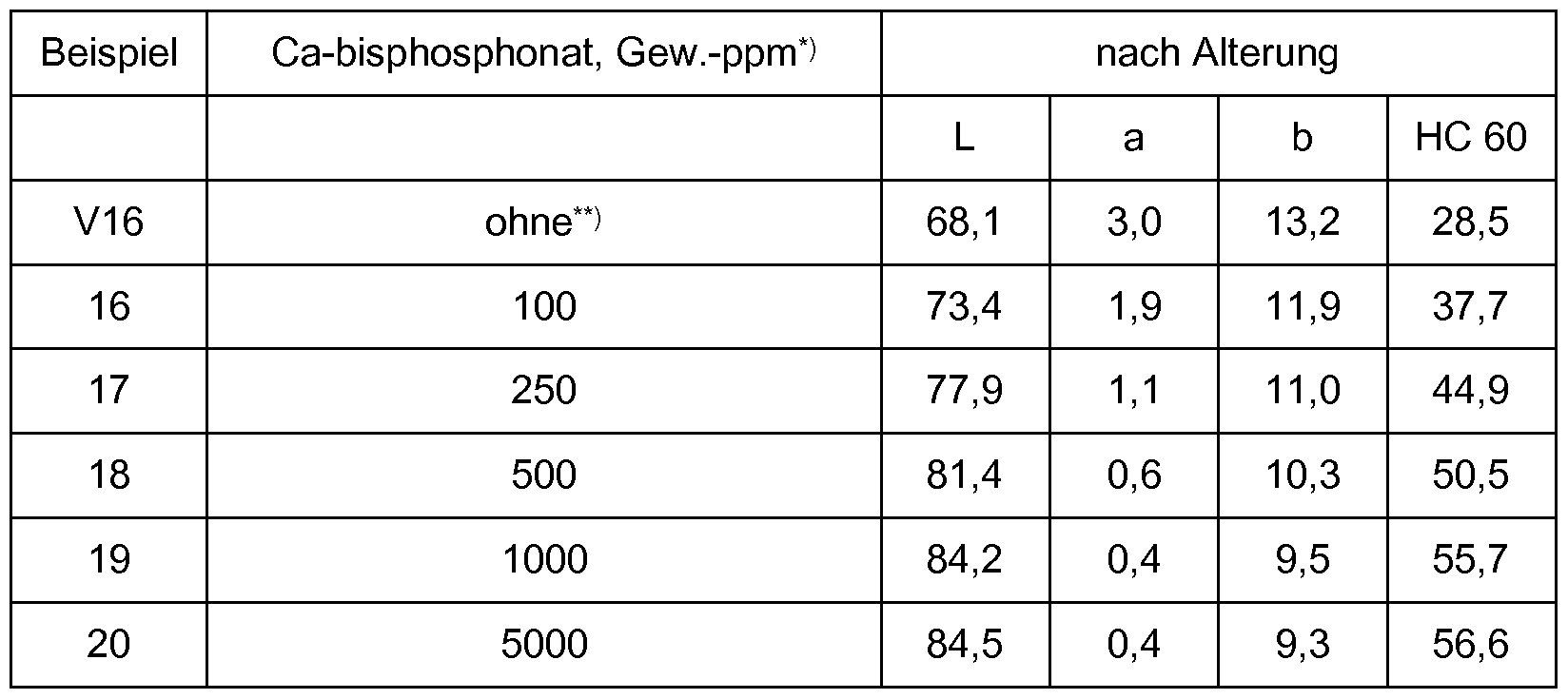
*) Menge jeweils bezogen auf Superabsorber; *) Quantity in each case based on superabsorbent;
**) anfängliche Farbe L = 88,7; a= -0,4; b= 9,0; HC60 = 61 ,7 Beispiele 21 bis 25 ** ) initial color L = 88.7; a = -0.4; b = 9.0; HC60 = 61, 7 Examples 21 to 25
Jeweils 150 g des Superabsorbers von Beispiel V16 wurden nach der allgemeinen Vorschrift I mit 0,15 g einer hydrophoben Fällungskieselsäure (Sipernat® D-17, Evonik Degussa GmbH, Frankfurt am Main, Deutschland) sowie den in der folgenden Tabelle 3 angegebenen Mengen Tris-(2,4-di-tert.-butylphenyl)phosphit vermischt. 150 g of the superabsorber of Example V16 were according to general procedure I, 0.15 g of a hydrophobic precipitated silica (Sipernat ® D-17, Evonik Degussa GmbH, Frankfurt am Main, Germany) and the amounts indicated in Table 3 below tris (2,4-di-tert-butylphenyl) phosphite.
Die so hergestellten beschichteten Superabsorber wurden dem Alterungstest unterzogen. Die Ergebnisse sind in Tabelle 3 zusammengestellt. Die Beispiele zeigen, dass bereits geringe Mengen des Stabilisators die erfindungsgemäßen Superabsorber gegen Verfärbung bei Alterung stabilisieren. Tabelle 3 The coated superabsorbers thus prepared were subjected to the aging test. The results are summarized in Table 3. The examples show that even small amounts of the stabilizer stabilize the superabsorber according to the invention against discoloration on aging. Table 3
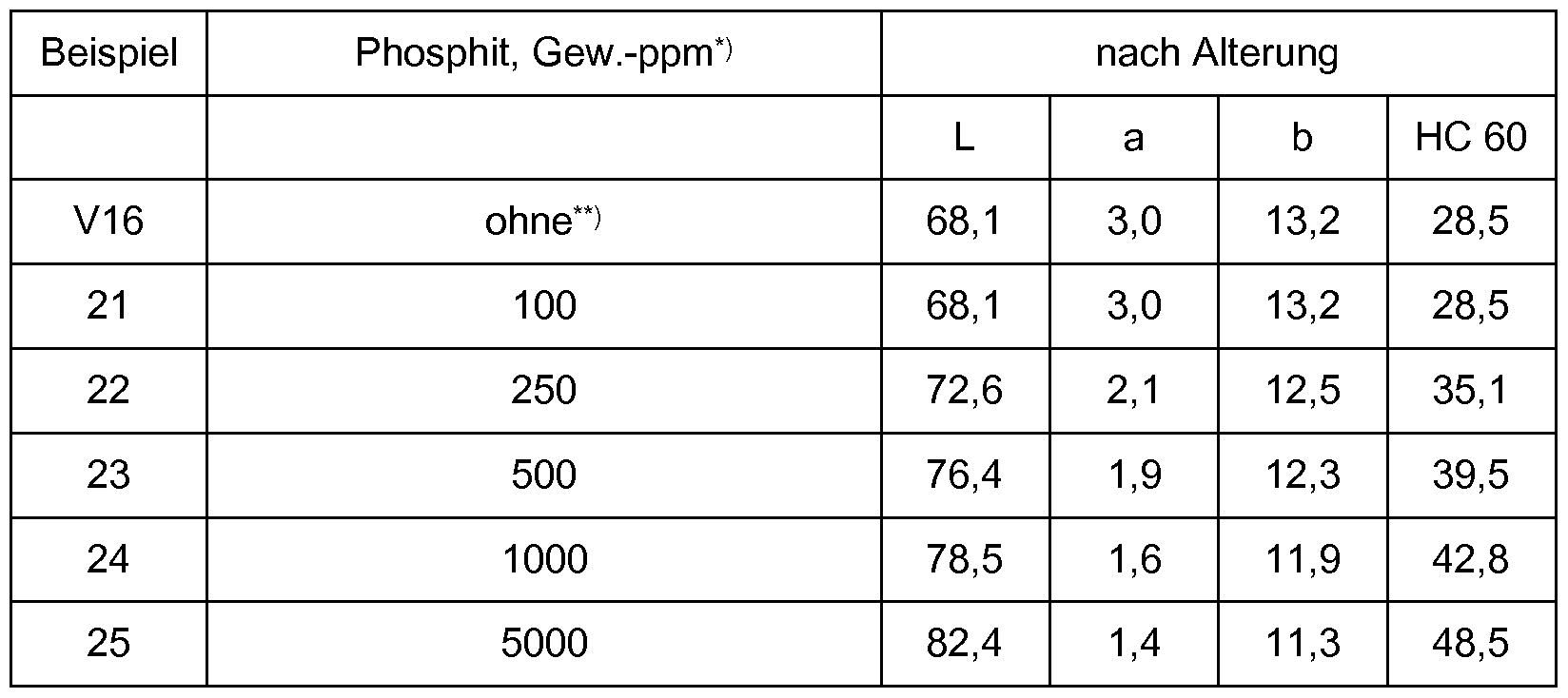
*) Menge jeweils bezogen auf Superabsorber; *) Quantity in each case based on superabsorbent;
**) anfängliche Farbe L = 88,7; a= -0,4; b= 9,0; HC60 **) initial color L = 88.7; a = -0.4; b = 9.0; HC60
Beispiel 26 Example 26
Beispiel V16 wurde wiederholt, allerdings wurde der Monomerlösung vor der weiteren Abkühlung auf 15 °C noch zusätzlich 0,59 g Calciumbis[monoethyl(3,5-di-tert.-butyl-4- hydroxibenzyl)-phosphonat] zugesetzt. Example V16 was repeated except that the monomer solution was additionally added with 0.59 g of calcium bis [monoethyl (3,5-di-tert-butyl-4-hydroxibenzyl) phosphonate] prior to further cooling to 15 ° C.
Beispiel 27 Example 27
Beispiel V16 wurde wiederholt, allerdings wurde dem Gel bei der Wolfung 0,59 g Cal- ciumbis[monoethyl(3,5-di-tert.-butyl-4-hydroxibenzyl)-phosphonat] zugesetzt. Example V16 was repeated except that 0.59 g of calcium bis [monoethyl (3,5-di-tert-butyl-4-hydroxybenzyl) phosphonate] was added to the gel in the wake.
Die so hergestellten Superabsorber wurden dem Alterungstest unterzogen. Die Ergebnisse sind in Tabelle 4 zusammengestellt. Die Beispiele zeigen, dass bereits geringe Mengen des Stabilisators die erfindungsgemäßen Superabsorber gegen Verfärbung bei Alterung stabilisieren. The superabsorbents prepared in this way were subjected to the aging test. The results are summarized in Table 4. The examples show that even small amounts of the stabilizer stabilize the superabsorber according to the invention against discoloration on aging.
Tabelle 4 Table 4
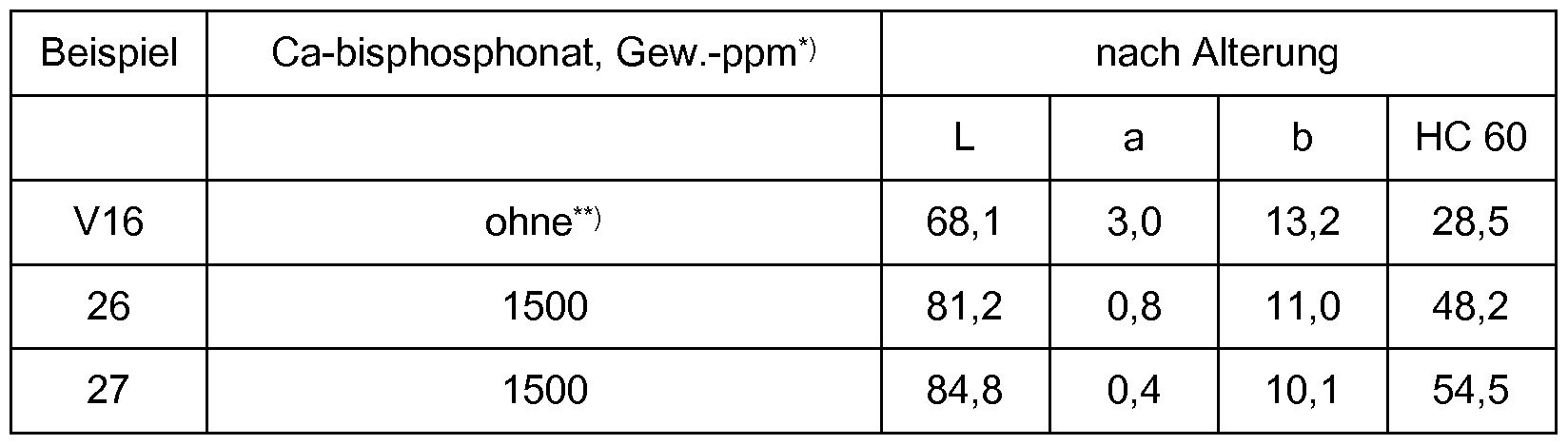
*) Menge jeweils bezogen auf Acrylsäure; *) Amount in each case based on acrylic acid;
**) anfängliche Farbe L = 88,7; a= -0,4; b= 9,0; HC60 = 61 ,7 Beispiel V 28 (Vergl **) initial color L = 88.7; a = -0.4; b = 9.0; HC60 = 61, 7 Example V 28 (cf.
14,3 kg wässrige Natriumacrylat-Lösung (37,5 Gew.-%ige Lösung in entionisiertem Wasser), 1 ,4 kg Acrylsäure und 350 g entionisiertes Wasser wurden mit 18,5 g Triacry- lat dreifach ethoxylierten Glycerins (Laromer® PO 9044V, BASF SE; Ludwigshafen, Deutschland) gemischt. Diese Lösung wurde in einem erwärmten, mit Stickstoffatmosphäre gefüllten Vertropfungsturm (180°C, 12 m Höhe, 2 m Durchmesser, Gasgeschwindigkeit 0,1 m/s im Gleichstrom, Vertropfer mit 40 mm Durchmesser, 2 mm Innenhöhe und einer Vertropferplatte mit 60 Bohrungen von je 200 μηη Durchmesser) in einer Rate von 32 kg/h vertropft, ihre Temperatur betrug dabei 25°C. Kurz vor dem Vertropfer wurde die Monomerlösung über einen statischen Mischer mit zwei Initiatorlösungen gemischt. Als Initiator 1 wurden eine 3 Gew.-%ige Lösung von 2,2'-Azobis-[2- (2-imidazolin-2-yl)-propan]-dihydrochlorid in entionisiertem Wasser, als Initiator 2 eine 6,1 Gew.-%ige Lösung von Natriumperoxodisulfat in entionisiertem Wasser verwendet. Die Dosiergeschwindigkeit der Initiatorlösung 1 betrug 1 ,462 kg/h, die Dosiergeschwindigkeit der Lösung 2 betrug 0,629 kg/h. Die erhaltenen Polymerpartikel wurden gesiebt, um eventuell gebildete Agglomerate abzutrennen. Die Siebfraktion von 150 bis 850 μηη wurde als Produkt gewonnen. Beispiel 28 14.3 kg of sodium acrylate aqueous solution (37.5 wt .-% solution in deionized water), 1, 4 kg of acrylic acid and 350 g of deionized water with 18.5 g Triacry- lat threefold ethoxylated glycerol (Laromer PO 9044V ® BASF SE, Ludwigshafen, Germany). This solution was placed in a heated nitrogen sparge drop tower (180 ° C, 12 m high, 2 m diameter, 0.1 m / s gas velocity, 40 mm diameter dropper, 2 mm internal height, and 60 drilled holes in 200 μηη of diameter) at a rate of 32 kg / h, their temperature was 25 ° C. Shortly before the dropletizer, the monomer solution was mixed via a static mixer with two initiator solutions. As initiator 1, a 3 wt .-% solution of 2,2'-azobis [2- (2-imidazolin-2-yl) propane] dihydrochloride in deionized water, as initiator 2, a 6.1 wt. % solution of sodium peroxodisulfate in deionized water. The metering rate of the initiator solution 1 was 1.462 kg / h, the metering rate of the solution 2 was 0.629 kg / h. The resulting polymer particles were screened to separate any agglomerates formed. The sieve fraction of 150 to 850 μηη was recovered as a product. Example 28
100 g des Superabsorbers von Beispiel V28 wurden mit 0,10 g Pentaerythrit-tetrakis(3- (3,5-di-tert.-butyl-4-hydroxiphenyl)propionat) nach der allgemeinen Vorschrift I vermischt. 100 g of the superabsorbent of Example V28 were mixed with 0.10 g of pentaerythritol tetrakis (3- (3,5-di-tert-butyl-4-hydroxyphenyl) propionate) according to general procedure I.
Beispiel 29 Example 29
100 g des Superabsorbers von Beispiel V28 wurden mit 0,10 g Tris-(2,4-di-tert.- butylphenyl)phosphit nach der allgemeinen Vorschrift I vermischt. 100 g of the superabsorbent of Example V28 were mixed with 0.10 g of tris (2,4-di-tert-butylphenyl) phosphite according to general procedure I.
Beispiel 30 Example 30
100 g des Superabsorbers von Beispiel V28 wurden mit 0,05 g Pentaerythrit-tetrakis(3- (3,5-di-tert.-butyl-4-hydroxiphenyl)propionat) und 0,05 g Tris-(2,4-di-tert.-butylphenyl)- phosphit nach der allgemeinen Vorschrift I vermischt. 100 g of the superabsorbent of Example V28 were mixed with 0.05 g of pentaerythritol tetrakis (3- (3,5-di-tert-butyl-4-hydroxyphenyl) propionate) and 0.05 g of tris (2,4-di tert-butylphenyl) phosphite according to general procedure I.
Die so hergestellten Superabsorber wurden dem Alterungstest unterzogen. Die Ergebnisse sind in Tabelle 5 zusammengestellt. Die Beispiele zeigen, dass die erfindungsgemäßen Superabsorber nach Alterung deutlich heller und weniger verfärbt sind. Sie zeigen aber auch, dass Mischungen synergistisch wirken können. Beispiel V31 (Vergleich) The superabsorbents prepared in this way were subjected to the aging test. The results are summarized in Table 5. The examples show that the superabsorbers according to the invention are much lighter and less discolored after aging. But they also show that mixtures can work synergistically. Example V31 (comparison)
14,3 kg wässrige Natriumacrylat-Lösung (37,5 Gew.-%ige Lösung in entionisiertem Wasser), 1 ,4 kg Acrylsaure und 350 g entionisiertes Wasser wurden mit 6,6 g Triacrylat dreifach ethoxylierten Glycerins (Laromer® PO 9044V, BASF SE; Ludwigshafen,14.3 kg of sodium acrylate aqueous solution (37.5 wt .-% solution in deionized water), 1, 4 kg of acrylic acid and 350 g of deionized water were mixed with 6.6 g triacrylate threefold ethoxylated glycerol (Laromer PO 9044V ®, BASF SE, Ludwigshafen,
Deutschland) gemischt. Diese Lösung wurde in einem erwärmten, mit Stickstoffatmosphäre gefüllten Vertropfungsturm (180°C, 12 m Höhe, 2 m Durchmesser, Gasgeschwindigkeit 0,1 m/s im Gleichstrom, Vertropfer mit 40 mm Durchmesser, 2 mm Innenhöhe und einer Vertropferplatte mit 60 Bohrungen von je 200 μηη Durchmesser) in einer Rate von 32 kg/h vertropft, ihre Temperatur betrug dabei 25°C. Kurz vor dem Vertropfer wurde die Monomerlösung über einen statischen Mischer mit drei Initiatorlösungen gemischt. Als Initiator 1 wurden eine 3 Gew.-%ige Lösung von 2,2'-Azobis-[2- (2-imidazolin-2-yl)-propan]-dihydrochlorid in entionisiertem Wasser, als Initiator 2 eine 6,1 Gew.-%ige Lösung von Natriumperoxodisulfat in entionisiertem Wasser und als Initiator 3 wurde eine 3 Gew.-%ige Lösung von Ascorbinsäure in entionisiertem Wasser verwendet. Die Dosiergeschwindigkeit der Initiatorlösung 1 betrug 0,548 kg/h, die Dosiergeschwindigkeit der Lösung 2 betrug 0,449 kg/h und die Dosiergeschwindigkeit der Lösung 3 betrug 0,183 kg/h. Die erhaltenen Polymerpartikel wurden gesiebt, um eventuell gebildete Agglomerate abzutrennen. Die Siebfraktion von 150 bis 850 μηη wurde als Produkt gewonnen. Germany) mixed. This solution was placed in a heated nitrogen sparge drop tower (180 ° C, 12 m high, 2 m diameter, 0.1 m / s gas velocity, 40 mm diameter dropper, 2 mm internal height, and 60 drilled holes in 200 μηη of diameter) at a rate of 32 kg / h, their temperature was 25 ° C. Shortly before the dropletizer, the monomer solution was mixed via a static mixer with three initiator solutions. As initiator 1, a 3 wt .-% solution of 2,2'-azobis [2- (2-imidazolin-2-yl) propane] dihydrochloride in deionized water, as initiator 2, a 6.1 wt. -% solution of sodium peroxodisulfate in deionized water and as initiator 3, a 3 wt .-% solution of ascorbic acid in deionized water was used. The metering rate of the initiator solution 1 was 0.548 kg / h, the metering rate of the solution 2 was 0.449 kg / h and the metering rate of the solution 3 was 0.183 kg / h. The resulting polymer particles were screened to separate any agglomerates formed. The sieve fraction of 150 to 850 μηη was recovered as a product.
Beispiel V32 (Vergleich) Example V32 (comparison)
14,3 kg wässrige Natriumacrylat-Lösung (37,5 Gew.-%ige Lösung in entionisiertem Wasser), 1 ,4 kg Acrylsäure und 350 g entionisiertes Wasser wurden mit 6,6 g Triacrylat dreifach ethoxylierten Glycerins (Laromer® PO 9044V, BASF SE; Ludwigshafen, Deutschland) gemischt. Diese Lösung wurde in einem erwärmten, mit Stickstoffatmosphäre gefüllten Vertropfungsturm (180°C, 12 m Höhe, 2 m Durchmesser, Gasgeschwindigkeit 0,1 m/s im Gleichstrom, Vertropfer mit 40 mm Durchmesser, 2 mm In- nenhöhe und einer Vertropferplatte mit 60 Bohrungen von je 200 μηη Durchmesser) in einer Rate von 32 kg/h vertropft, ihre Temperatur betrug dabei 25°C. Kurz vor dem Vertropfer wurde die Monomerlösung über einen statischen Mischer mit drei Initiatorlösungen gemischt. Als Initiator 1 wurden eine 3 Gew.-%ige Lösung von 2,2'-Azobis-[2- (2-imidazolin-2-yl)-propan]-dihydrochlorid in entionisiertem Wasser, als Initiator 2 eine 6,1 Gew.-%ige Lösung von Natriumperoxodisulfat in entionisiertem Wasser und als Initiator 3 wurde eine 3 Gew.-%ige Lösung eines Gemisches aus dem Natriumsalz der 2-Hydroxy-2-sulfinatoessigsäure, dem Dinatriumsalz der 2-Hydroxi-2-sulfonatoessig- säure und Natriumbisulfit (Brüggolit® FF7, L. Brüggemann KG, Salzstraße 131 , 74076 Heilbronn, Deutschland) in entionisiertem Wasser verwendet. Die Dosiergeschwindig- keit der Initiatorlösung 1 betrug 0,548 kg/h, die Dosiergeschwindigkeit der Lösung 2 betrug 0,449 kg/h und die Dosiergeschwindigkeit der Lösung 3 betrug 0,183 kg/h. Die erhaltenen Polymerpartikel wurden gesiebt, um eventuell gebildete Agglomerate abzutrennen. Die Siebfraktion von 150 bis 850 μηη wurde als Produkt gewonnen. 14.3 kg of sodium acrylate aqueous solution (37.5 wt .-% solution in deionized water), 1, 4 kg of acrylic acid and 350 g of deionized water were mixed with 6.6 g triacrylate threefold ethoxylated glycerol (Laromer PO 9044V ®, BASF SE, Ludwigshafen, Germany). This solution was placed in a heated, nitrogen-filled drip tower (180 ° C, 12 m high, 2 m diameter, gas velocity 0.1 m / s cocurrent, 40 mm diameter dropper, 2 mm internal height, and a 60 ° dropper plate 200 μηη diameter holes) at a rate of 32 kg / h, their temperature was thereby 25 ° C. Shortly before the dropletizer, the monomer solution was mixed via a static mixer with three initiator solutions. As initiator 1, a 3 wt .-% solution of 2,2'-azobis [2- (2-imidazolin-2-yl) propane] dihydrochloride in deionized water, as initiator 2, a 6.1 wt. -% solution of sodium peroxodisulfate in deionized water and as initiator 3 was a 3 wt .-% solution of a mixture of the sodium salt of 2-hydroxy-2-sulfinatoacetic acid, the disodium salt of 2-hydroxy-2-sulfonatoessig- acid and sodium bisulfite (Brüggolit ® FF7, L. Brüggemann KG, salt Straße 131, 74076 Heilbronn, Germany) in deionized water. The metering rate of the initiator solution 1 was 0.548 kg / h, the metering rate of the solution 2 was 0.449 kg / h and the metering rate of the solution 3 was 0.183 kg / h. The obtained polymer particles were sieved to separate any formed agglomerates. The sieve fraction of 150 to 850 μηη was recovered as a product.
Beispiel 31 Example 31
100 g des Superabsorbers von Beispiel V31 wurden mit 0,10 g Calcium- bis[monoethyl(3,5-di-tert.-butyl-4-hydroxibenzyl)-phosphonat] nach der allgemeinen Vorschrift I vermischt. Beispiel 32 100 g of the superabsorber of Example V31 were mixed with 0.10 g of calcium bis [monoethyl (3,5-di-tert-butyl-4-hydroxypentyl) phosphonate] according to general procedure I. Example 32
100 g des Superabsorbers von Beispiel V32 wurden mit 0,10 g Diethyl(3,5-di-tert.butyl- 4-hydroxibenzyl)phosphonat nach der allgemeinen Vorschrift I vermischt. Die so hergestellten Superabsorber wurden dem Alterungstest unterzogen. Die Ergebnisse sind in Tabelle 6 zusammengestellt. Die Beispiele zeigen, dass die erfindungsgemäßen Superabsorber nach Alterung deutlich heller und weniger verfärbt sind. 100 g of the superabsorber of Example V32 were mixed with 0.10 g of diethyl (3,5-di-tert-butyl-4-hydroxibenzyl) phosphonate according to general procedure I. The superabsorbents prepared in this way were subjected to the aging test. The results are summarized in Table 6. The examples show that the superabsorbers according to the invention are much lighter and less discolored after aging.
Beispiel V33 (Vergleich) Example V33 (comparison)
In einen Pflugschar®-Schaufeltrockner mit 5 I Volumen und Heiz-/Kühlmantel (Hersteller: Gebr. Lödige Maschinenbau GmbH, Elsener-Straße 7 - 9, 33102 Paderborn, Deutschland; Typ VT 5R-MK) wurden 478 g Wasser, 244,3 g Acrylsäure, 1924,9 g einer 37,3 Gew.-%igen Natriumacrylatlösung (zu 100 mol-% neutralisierte Acrylsäure, d.h. ohne freie Acrylsäure oder freies Natriumsalz), 16,0 g Calciumcarbonat sowie 2,52 g Triacrylat dreifach ethoxylierten Glycerins (Laromer® PO 9044V, BASF SE; Ludwigshafen, Deutschland), vorgelegt und unter Durchperlen von Stickstoff 20 Minuten inerti- siert. Die Welle des Reaktors wurde durchgehend mit 96 Umdrehungen pro Minute gedreht. Die Reaktionsmischung wurde dabei von außen so gekühlt, dass die nachfol- gende Initiatorzugabe bei ca. 20 °C erfolgte. Schließlich wurden in den Kneter unter Rühren noch 2,139 g Natriumpersulfat (gelöst in 12,12 g Wasser), 0,046 g Ascorbin- säure (gelöst in 9,12 g Wasser) und 0,127 g 30 Gew.-%ige wässrige Wasserstoffperoxidlösung (verdünnt mit 1 ,15 g Wasser) rasch hintereinander hinzugefügt. Die Reaktion setzte zügig ein und bei Erreichen einer Innentemperatur von 30 °C wurde der Mantel mit 80 °C heißem Wärmeträgermedium beheizt, um die Reaktion möglichst adiabat zu Ende zu führen. Nach Erreichen der Maximaltemperatur wurde wiederum gekühlt (Kühlflüssigkeit mit -12 °C), so das entstandene Gel auf unter 50°C herabgekühlt und dann ausgetragen. Das Gel wurde dann im Labortrockenschrank bei 160 °C eine Stunde lang getrocknet. Das Produkt wurde dann gemahlen und die Siebfraktion von 150 - 700 μηη gewonnen. Dieses Grundpolymer wurde zur Oberflächennachvernetzung in einem Pflugschar®- Mischer mit Heizmantel (Hersteller: Gebr. Lödige Maschinenbau GmbH, Elsener- Straße 7 - 9, 33102 Paderborn, Deutschland; Typ M5) bei Raumtemperatur und einer Wellendrehzahl von 450 Umdrehungen pro Minute mittels einer Zweistoff-Sprühdüse mit einem Gemisch aus 0,125 Gew.-% N-(2-Hydroxyethyl)-2-oxazolidinon, 1 ,5 Gew.-% Wasser, 1 ,5 Gew.% 1 ,3-Propandiol, 0,003 Gew.-% Sorbitanmonococoat („Span® 20") und 2,8 Gew.-% einer 25 Gew.-%igen wässrigen Aluminiumlactat-Lösung, jeweils bezogen auf das Grundpolymer, beschichtet. Nach dem Aufsprühen wurde die Produkttemperatur auf 175 °C erhöht und das Reaktionsgemisch 80 Minuten lang bei dieser Temperatur und einer Wellendrehzahl von 80 Umdrehungen pro Minute gehalten. Das erhaltene Produkt wurde wieder auf Raumtemperatur abkühlen gelassen und gesiebt. Der oberflächennachvernetzte Superabsorber wurde als Siebfraktion mit Partikelgrößen zwischen 150 μηη und 710 μηη gewonnen. Beispiel 33 In a Pflugschar ® paddle dryer with 5 l volume and heating / cooling jacket (manufacturer: Gebr Lödige Maschinenbau GmbH, Elsener-Straße 7 - 9, 33102 Paderborn, Germany, type VT 5R-MK) were 478 g of water, 244.3 g acrylic acid, 1924.9 g of a 37.3 wt .-% sodium acrylate solution (to 100 mol% neutralized acrylic acid, ie without free acrylic acid or free sodium salt), 16.0 g of calcium carbonate and 2.52 g triacrylate tri ethoxylated glycerol ( Laromer PO 9044V ®, BASF SE; Ludwigshafen, Germany), and 20 minutes presented inertization Siert by bubbling nitrogen. The shaft of the reactor was rotated continuously at 96 revolutions per minute. The reaction mixture was cooled from the outside so that the subsequent addition of initiator took place at about 20 ° C. Finally, with stirring 2.199 g of sodium persulfate (dissolved in 12.12 g of water), 0.046 g of ascorbic acid (dissolved in 9.12 g of water) and 0.127 g of 30 wt .-% aqueous hydrogen peroxide solution (diluted with 1 , 15 g of water) are added rapidly in succession. The reaction started quickly and when reaching an internal temperature of 30 ° C, the jacket was heated with 80 ° C hot heat transfer medium to perform the reaction as adiabatic as possible to an end. After reaching the maximum temperature was again cooled (cooling liquid at -12 ° C), so the resulting gel was cooled to below 50 ° C and then discharged. The gel was then dried in a laboratory oven at 160 ° C for one hour. The product was then ground and the sieve fraction was recovered from 150-700 μηη. This base polymer was for surface postcrosslinking in a ploughshare ® - mixer with heating jacket (manufacturer: Gebr Lödige Maschinenbau GmbH, Elsener- 7 - 9, 33102 Paderborn, Germany; Type M5.) At room temperature and a shaft speed of 450 revolutions per minute by means of a two-substance Spray nozzle with a mixture of 0.125 wt .-% N- (2-hydroxyethyl) -2-oxazolidinone, 1, 5 wt .-% water, 1, 5 wt.% 1, 3-propanediol, 0.003 wt .-% sorbitan monococoate (" Span® 20") and 2.8% by weight of a 25% by weight aqueous aluminum lactate solution, based in each case on the base polymer After spraying, the product temperature was raised to 175 ° C. and the reaction mixture 80 The resulting product was allowed to cool back to room temperature and sieved The surface-postcrosslinked superabsorber was used as a sieve fraction with particle sizes between 150 μ η and μηη won the 710th Example 33
100 g des Superabsorbers von Beispiel V26 wurden mit 0,050 g 2,2'-Ethylidenbis[4,6- bis(1 ,1 -dimethylethyl)-phenol] nach der allgemeinen Vorschrift I vermischt. Beispiel 34 100 g of the superabsorbent of Example V26 were mixed with 0.050 g of 2,2'-ethylidenebis [4,6-bis (1,1-dimethylethyl) phenol] according to general procedure I. Example 34
Beispiel V33 wurde wiederholt, allerdings wurde bei der Oberflächennachvernetzung das Grundpolymer noch zusätzlich mit 0,2 Gew.-% Tris-(2,4-di-tert.-butylphenyl)- phosphit bezogen auf das Grundpolymer beschichtet. Example V33 was repeated, but in the case of surface postcrosslinking, the base polymer was additionally coated with 0.2% by weight of tris- (2,4-di-tert-butylphenyl) phosphite, based on the base polymer.
Beispiel 35 Example 35
Beispiel V33 (Vergleich) wurde wiederholt, allerdings wurde bei der Polymerisation nach Erreichen einer Innentemperatur von 60 °C der Reaktionsmischung im Pflug- schar®-Schaufeltrockner noch 1 ,2 g Pentaerythrit-tetrakis(3-(3,5-di-tert.-butyl-4- hydroxiphenyl)propionat) zugesetzt. Example V33 (comparison) was repeated, but in the polymerization after reaching an internal temperature of 60 ° C of the reaction mixture in Pflugschar ® paddle dryer still 1, 2 g pentaerythritol tetrakis (3- (3,5-di-tert. -butyl-4-hydroxyphenyl) propionate).
Die so hergestellten Superabsorber wurden dem Alterungstest unterzogen. Die Ergebnisse sind in Tabelle 7 zusammengestellt. Die Beispiele zeigen, dass die erfindungs- gemäßen Superabsorber nach Alterung deutlich heller und weniger verfärbt sind, ohne dass die Absorptionseigenschaften beeinträchtigt wären. Tabelle 5 The superabsorbents prepared in this way were subjected to the aging test. The results are summarized in Table 7. The examples show that the superabsorbents according to the invention are much lighter and less discolored after aging, without the absorption properties being impaired. Table 5

*) Menge jeweils bezogen auf Superabsorber; **) anfängliche Farbe L = 93,4; a= 0,6; b= 2,1 ; HC60 = 87,1 * ) Quantity in each case based on superabsorbent; ** ) initial color L = 93.4; a = 0.6; b = 2.1; HC60 = 87.1
Tabelle 6 Table 6

*) Menge jeweils bezogen auf Superabsorber; **) anfängliche Farbe L = 99,3; a= 0,2; b= - 1 ,5; HC60 = 103,8; * ) Quantity in each case based on superabsorbent; ** ) initial color L = 99.3; a = 0.2; b = -1.5; HC60 = 103.8;
) anfängliche Farbe L = 96,2; a= 0,5; b= - 1 ,5; HC60 ) initial color L = 96.2; a = 0.5; b = -1.5; HC60
Tabelle 7 Table 7

Claims
Priority Applications (3)
| Application Number | Priority Date | Filing Date | Title |
|---|---|---|---|
| CN2010800414261A CN102597082A (en) | 2009-09-16 | 2010-09-09 | Color-stable superabsorber |
| BR112012005901A BR112012005901A2 (en) | 2009-09-16 | 2010-09-09 | superabsorbent, process for producing a superabsorbent, article for absorbing fluids, and process for producing articles for absorbing fluids |
| JP2012529215A JP2013504674A (en) | 2009-09-16 | 2010-09-09 | Color-stable superabsorbent |
Applications Claiming Priority (2)
| Application Number | Priority Date | Filing Date | Title |
|---|---|---|---|
| EP09011809.2 | 2009-09-16 | ||
| EP09011809 | 2009-09-16 |
Publications (1)
| Publication Number | Publication Date |
|---|---|
| WO2011032876A1 true WO2011032876A1 (en) | 2011-03-24 |
Family
ID=42937304
Family Applications (1)
| Application Number | Title | Priority Date | Filing Date |
|---|---|---|---|
| PCT/EP2010/063199 Ceased WO2011032876A1 (en) | 2009-09-16 | 2010-09-09 | Color-stable superabsorber |
Country Status (4)
| Country | Link |
|---|---|
| JP (1) | JP2013504674A (en) |
| CN (1) | CN102597082A (en) |
| BR (1) | BR112012005901A2 (en) |
| WO (1) | WO2011032876A1 (en) |
Cited By (1)
| Publication number | Priority date | Publication date | Assignee | Title |
|---|---|---|---|---|
| US8497337B2 (en) | 2009-11-23 | 2013-07-30 | Basf Se | Process for producing water-absorbing polymer particles with improved color stability |
Families Citing this family (5)
| Publication number | Priority date | Publication date | Assignee | Title |
|---|---|---|---|---|
| CN104365491A (en) * | 2014-11-18 | 2015-02-25 | 芜湖悠派卫生用品有限公司 | Organic environment-friendly cat litter and preparation method thereof |
| CN104351062A (en) * | 2014-11-25 | 2015-02-18 | 芜湖悠派卫生用品有限公司 | Cocoanut shell active charcoal cat litter and preparation method thereof |
| CN109563210B (en) * | 2016-08-10 | 2021-10-08 | 巴斯夫欧洲公司 | Method for preparing superabsorbent |
| CN112295386B (en) * | 2019-08-02 | 2022-06-14 | 中国石油化工股份有限公司 | Activating agent for manganese dioxide generated in styrene waste gas treatment and application thereof |
| CN111792980A (en) * | 2020-06-18 | 2020-10-20 | 湖南国发精细化工科技有限公司 | O-sec-butylphenol containing antitarnish agent |
Citations (72)
| Publication number | Priority date | Publication date | Assignee | Title |
|---|---|---|---|---|
| US4020256A (en) | 1975-07-03 | 1977-04-26 | The Dow Chemical Company | Method for preparing polymers from water soluble vinyl monomers |
| DE3519013A1 (en) | 1985-05-25 | 1986-11-27 | Basf Ag, 6700 Ludwigshafen | METHOD FOR PRODUCING POWDERED WATER-SOLUBLE POLYMERISATS AND THE USE THEREOF |
| GB2184733A (en) * | 1985-12-18 | 1987-07-01 | Basf Corp | Stabilizer package for the preparation of thermoplastic polyurethane having improved high temperature color stability |
| DE3825366A1 (en) | 1987-07-28 | 1989-02-09 | Dai Ichi Kogyo Seiyaku Co Ltd | METHOD FOR CONTINUOUS PRODUCTION OF AN ACRYLIC POLYMER GEL |
| EP0348180A2 (en) | 1988-06-22 | 1989-12-27 | Mitsubishi Petrochemical Company Limited | Process for the preparation of water absorptive resin |
| EP0377199A2 (en) | 1988-12-31 | 1990-07-11 | BASF Aktiengesellschaft | UV-cross-linkable compositions based on polymers of (meth)acrylic esters |
| EP0377191A2 (en) | 1988-12-31 | 1990-07-11 | BASF Aktiengesellschaft | Radiation-sensitive ethylenically unsaturated copolymerisable compounds, and process for their preparation |
| EP0386897A2 (en) | 1989-02-28 | 1990-09-12 | Nippon Shokubai Co., Ltd. | Process for producing quality-improved water-absorbent polymers and products |
| WO1990015830A1 (en) | 1989-06-12 | 1990-12-27 | Weyerhaeuser Company | Hydrocolloid polymer |
| US5026806A (en) | 1988-10-31 | 1991-06-25 | Basf Aktiengesellschaft | UV-crosslinkable materials based on isoamyl (meth)acrylate copolymers |
| EP0441975A1 (en) | 1989-09-04 | 1991-08-21 | Nippon Shokubai Co., Ltd. | Method of preparing water-absorbent resin |
| EP0445641A1 (en) | 1990-03-08 | 1991-09-11 | BASF Aktiengesellschaft | Ethylenic unsaturated compounds |
| EP0445619A2 (en) | 1990-03-08 | 1991-09-11 | BASF Aktiengesellschaft | Process for preparing aqueous soluble fine particle polymers |
| EP0457660A1 (en) | 1990-05-14 | 1991-11-21 | Societe Francaise Hoechst | Absorbing polymers, process for their preparation and their use |
| EP0505163A1 (en) | 1991-03-18 | 1992-09-23 | Nalco Chemical Company | Reduction of residual monomers in superabsorbent polymers |
| EP0530438A1 (en) | 1991-09-03 | 1993-03-10 | Hoechst Celanese Corporation | A superabsorbent polymer having improved absorbency properties |
| EP0534228A1 (en) | 1991-09-18 | 1993-03-31 | Hoechst Aktiengesellschaft | Process for modifying hydrophilic polymerisates |
| JPH0586251A (en) | 1991-09-26 | 1993-04-06 | Uni Charm Corp | Highly water-absorbable polymer composition |
| EP0547847A1 (en) | 1991-12-18 | 1993-06-23 | Nippon Shokubai Co., Ltd. | Process for producing water-absorbent resin |
| JPH05230291A (en) * | 1992-02-18 | 1993-09-07 | Showa Denko Kk | Resin composition excellent in discoloration resistance under low-temperature and long-term storage condition |
| EP0559476A1 (en) | 1992-03-05 | 1993-09-08 | Nippon Shokubai Co., Ltd. | Method for the production of absorbent resin |
| WO1993021237A1 (en) | 1992-04-16 | 1993-10-28 | The Dow Chemical Company | Crosslinked hydrophilic resins and method of preparation |
| EP0605215A1 (en) | 1992-12-25 | 1994-07-06 | Nippon Shokubai Co., Ltd. | Absorbent and method for production of absorbent resin |
| EP0632068A1 (en) | 1993-06-18 | 1995-01-04 | Nippon Shokubai Co., Ltd. | Process for preparing absorbent resin |
| EP0640330A1 (en) | 1993-06-30 | 1995-03-01 | The Procter & Gamble Company | Hygienic absorbent articles |
| EP0655465A1 (en) | 1993-11-25 | 1995-05-31 | BASF Aktiengesellschaft | Process for removing volatile residues from polyacrylate melts |
| EP0668080A2 (en) | 1994-02-17 | 1995-08-23 | Nippon Shokubai Co., Ltd. | Water-absorbent agent, method for production thereof, and water-absorbent composition |
| WO1996040427A1 (en) | 1995-06-07 | 1996-12-19 | Freeman Clarence S | A polymerization process, apparatus and polymer |
| DE19646484A1 (en) | 1995-11-21 | 1997-05-22 | Stockhausen Chem Fab Gmbh | Liquid-absorbing polymers, process for their preparation and their use |
| DE19543368A1 (en) | 1995-11-21 | 1997-05-22 | Stockhausen Chem Fab Gmbh | Water-absorbing polymers with improved properties, process for their preparation and their use |
| EP0816383A1 (en) | 1996-06-24 | 1998-01-07 | Clariant GmbH | Process for producing hydrophilic hydrogels having a high swelling capacity |
| WO1999018067A1 (en) | 1997-10-02 | 1999-04-15 | L. Brüggemann KG | Sulphinic acid derivatives, method for producing them, and their use |
| EP0955086A2 (en) | 1998-04-28 | 1999-11-10 | Nippon Shokubai Co., Ltd. | Method for production of shaped hydrogel of absorbent resin |
| DE19846413A1 (en) | 1998-10-08 | 2000-04-13 | Basf Ag | Economical preparation of swellable, hydrophilic polymer having good water absorption properties, useful e.g. in hygienic articles, by polymerization, comminution, post-neutralization, drying, grinding and sieving |
| WO2000055245A1 (en) | 1999-03-12 | 2000-09-21 | Basf Aktiengesellschaft | Color-stable superabsorbent polymer composition |
| JP2000327926A (en) * | 1999-05-25 | 2000-11-28 | Sanyo Chem Ind Ltd | Absorbent composition and absorbing article |
| WO2001038402A1 (en) | 1999-11-20 | 2001-05-31 | Basf Aktiengesellschaft | Method for continuously producing cross-linked fine-particle geleous polymerizates |
| US6241928B1 (en) | 1998-04-28 | 2001-06-05 | Nippon Shokubai Co., Ltd. | Method for production of shaped hydrogel of absorbent resin |
| EP1191051A2 (en) | 2000-09-20 | 2002-03-27 | Nippon Shokubai Co., Ltd. | Water-absorbent polymer particles and production process therefor |
| WO2002032962A2 (en) | 2000-10-20 | 2002-04-25 | Millennium Pharmaceuticals, Inc. | Compositions of human proteins and method of use thereof |
| WO2002055469A1 (en) | 2001-01-12 | 2002-07-18 | Degussa Ag | Continuous method for the production and purification of (meth)acrylic acid |
| WO2002094329A1 (en) | 2001-05-23 | 2002-11-28 | Basf Aktiengesellschaft | Odor control containing absorbent materials |
| WO2002094328A2 (en) | 2001-05-23 | 2002-11-28 | Basf Aktiengesellschaft | Double-sided coated fibrous web absorbent article |
| US20020193546A1 (en) | 1990-06-06 | 2002-12-19 | Waterguard Telecommunications Technologies, Inc. A Texas Corporation | Polymerization process, apparatus mid polymer |
| WO2003014172A2 (en) | 2001-08-03 | 2003-02-20 | Basf Aktiengesellschaft | Method for producing water-absorbent resins |
| WO2003059962A1 (en) | 2002-01-16 | 2003-07-24 | Sumitomo Seika Chemicals Co., Ltd. | Process for producing water-absorbing resin |
| US20030181115A1 (en) | 2002-02-04 | 2003-09-25 | Kinya Nagasuna | Absorbent structure, its production process, and absorbent article comprising said absorbent structure |
| WO2003078378A1 (en) | 2002-03-15 | 2003-09-25 | Stockhausen Gmbh | (meth)acrylic acid crystal and method for the production and purification of aqueous (meth)acrylic acid |
| WO2003104300A1 (en) | 2002-06-01 | 2003-12-18 | Basf Aktiengesellschaft | (meth)acrylic esters of polyalkoxylated trimethylolpropane |
| WO2003104299A1 (en) | 2002-06-11 | 2003-12-18 | Basf Aktiengesellschaft | Method for the production of esters of polyalcohols |
| WO2003104301A1 (en) | 2002-06-11 | 2003-12-18 | Basf Aktiengesellschaft | (meth)acrylic esters of polyalkoxylated glycerine |
| US20040019342A1 (en) | 2001-09-19 | 2004-01-29 | Kinya Nagasuna | Absorbent structure, absorbent article, water-absorbent resin, and its production process and evaluation method |
| WO2004035514A1 (en) | 2002-10-10 | 2004-04-29 | Basf Aktiengesellschaft | Method for the production of acrylic acid |
| DE10331450A1 (en) | 2003-07-10 | 2005-01-27 | Basf Ag | (Meth) acrylic esters of monoalkoxylated polyols and their preparation |
| WO2005011860A2 (en) | 2003-07-25 | 2005-02-10 | Stockhausen Gmbh | Powdery, water-absorbent polymers comprising fine particles bonded by means of thermoplastic adhesives |
| DE10331456A1 (en) | 2003-07-10 | 2005-02-24 | Basf Ag | (Meth) acrylic esters of alkoxylated unsaturated polyol ethers and their preparation |
| WO2005054356A1 (en) | 2003-12-03 | 2005-06-16 | Basf Aktiengesellschaft | Superabsorber that comprises at least one sterically hindered monovalent and/or polyvalent phenol |
| DE10355401A1 (en) | 2003-11-25 | 2005-06-30 | Basf Ag | (Meth) acrylic esters of unsaturated amino alcohols and their preparation |
| WO2005073260A1 (en) | 2004-01-28 | 2005-08-11 | Basf Aktiengesellschaft | Method for producing polymers |
| EP1577349A1 (en) | 2002-12-27 | 2005-09-21 | Sumitomo Seika Chemicals Co., Ltd. | Water-absorbing resin composition |
| US20050256757A1 (en) | 2004-04-30 | 2005-11-17 | Sierra Alisa K | Method of manufacturing and method of marketing gender-specific absorbent articles having liquid-handling properties tailored to each gender |
| EP1645596A1 (en) | 2003-07-11 | 2006-04-12 | Sumitomo Seika Chemicals Co., Ltd. | Water-absorbing resin composition |
| WO2006058682A1 (en) | 2004-11-30 | 2006-06-08 | Basf Aktiengesellschaft | Method for the secondary cross-linking of water-absorbing polymer particles |
| DE102005044035A1 (en) | 2005-09-14 | 2007-03-15 | Basf Ag | Method for dripping liquids |
| WO2007093531A1 (en) | 2006-02-17 | 2007-08-23 | Basf Se | Process for producing water-absorbing polymer particles by polymerizing droplets on a monomer solution |
| WO2008055856A1 (en) | 2006-11-09 | 2008-05-15 | Basf Se | Process for producing superabsorbents |
| WO2008086976A1 (en) | 2007-01-16 | 2008-07-24 | Basf Se | Method for producing polymer particles by the polymerization of fluid drops in a gas phase |
| WO2008092843A1 (en) | 2007-01-29 | 2008-08-07 | Basf Se | Method for producing white and color-stable water-absorbing polymer particles having high absorbency and high saline flow conductivity |
| WO2008092842A1 (en) | 2007-01-29 | 2008-08-07 | Basf Se | Method for producing white and color-stable water-absorbing polymer particles having high absorbency and high saline flow conductivity |
| WO2009005114A1 (en) * | 2007-07-04 | 2009-01-08 | Nippon Shokubai Co., Ltd. | Particulate water-absorbing agent and method for producing the same |
| WO2009027356A1 (en) | 2007-08-30 | 2009-03-05 | Basf Se | Method for the production of water-absorbing polymer particles by polymerizing drops of a monomer solution |
| WO2009060062A1 (en) | 2007-11-08 | 2009-05-14 | Evonik Stockhausen Gmbh | Water-absorbing polymer structure with improved color stability |
Family Cites Families (7)
| Publication number | Priority date | Publication date | Assignee | Title |
|---|---|---|---|---|
| DE19807504A1 (en) * | 1998-02-21 | 1999-08-26 | Basf Ag | Surface crosslinking of superabsorbing polymer particles used in hygiene articles, packaging materials and nonwovens |
| US6444744B1 (en) * | 1998-03-11 | 2002-09-03 | Nippon Shokubai Co., Ltd. | Hydrophilic resin, absorbent article, and acrylic acid for polymerization |
| JP2000230129A (en) * | 1998-12-11 | 2000-08-22 | Nippon Shokubai Co Ltd | Water-absorbent composition |
| DE10161864A1 (en) * | 2001-12-14 | 2003-07-03 | Basf Ag | Stabilizer composition III |
| KR100549717B1 (en) * | 2001-12-19 | 2006-02-07 | 니폰 쇼쿠바이 컴파니 리미티드 | Acrylic acid composition and its manufacturing method, and the manufacturing method of water absorbing resin using this acrylic acid composition, and water absorbing resin |
| JP2005186016A (en) * | 2003-12-26 | 2005-07-14 | San-Dia Polymer Ltd | Absorbent |
| CN101155840B (en) * | 2005-04-07 | 2011-06-15 | 株式会社日本触媒 | Production process of polyacrylic acid (salt)water-absorbent resin |
-
2010
- 2010-09-09 BR BR112012005901A patent/BR112012005901A2/en not_active IP Right Cessation
- 2010-09-09 JP JP2012529215A patent/JP2013504674A/en active Pending
- 2010-09-09 CN CN2010800414261A patent/CN102597082A/en active Pending
- 2010-09-09 WO PCT/EP2010/063199 patent/WO2011032876A1/en not_active Ceased
Patent Citations (74)
| Publication number | Priority date | Publication date | Assignee | Title |
|---|---|---|---|---|
| US4020256A (en) | 1975-07-03 | 1977-04-26 | The Dow Chemical Company | Method for preparing polymers from water soluble vinyl monomers |
| DE3519013A1 (en) | 1985-05-25 | 1986-11-27 | Basf Ag, 6700 Ludwigshafen | METHOD FOR PRODUCING POWDERED WATER-SOLUBLE POLYMERISATS AND THE USE THEREOF |
| GB2184733A (en) * | 1985-12-18 | 1987-07-01 | Basf Corp | Stabilizer package for the preparation of thermoplastic polyurethane having improved high temperature color stability |
| DE3825366A1 (en) | 1987-07-28 | 1989-02-09 | Dai Ichi Kogyo Seiyaku Co Ltd | METHOD FOR CONTINUOUS PRODUCTION OF AN ACRYLIC POLYMER GEL |
| EP0348180A2 (en) | 1988-06-22 | 1989-12-27 | Mitsubishi Petrochemical Company Limited | Process for the preparation of water absorptive resin |
| US5026806A (en) | 1988-10-31 | 1991-06-25 | Basf Aktiengesellschaft | UV-crosslinkable materials based on isoamyl (meth)acrylate copolymers |
| EP0377199A2 (en) | 1988-12-31 | 1990-07-11 | BASF Aktiengesellschaft | UV-cross-linkable compositions based on polymers of (meth)acrylic esters |
| EP0377191A2 (en) | 1988-12-31 | 1990-07-11 | BASF Aktiengesellschaft | Radiation-sensitive ethylenically unsaturated copolymerisable compounds, and process for their preparation |
| EP0386897A2 (en) | 1989-02-28 | 1990-09-12 | Nippon Shokubai Co., Ltd. | Process for producing quality-improved water-absorbent polymers and products |
| WO1990015830A1 (en) | 1989-06-12 | 1990-12-27 | Weyerhaeuser Company | Hydrocolloid polymer |
| EP0441975A1 (en) | 1989-09-04 | 1991-08-21 | Nippon Shokubai Co., Ltd. | Method of preparing water-absorbent resin |
| EP0445641A1 (en) | 1990-03-08 | 1991-09-11 | BASF Aktiengesellschaft | Ethylenic unsaturated compounds |
| EP0445619A2 (en) | 1990-03-08 | 1991-09-11 | BASF Aktiengesellschaft | Process for preparing aqueous soluble fine particle polymers |
| EP0457660A1 (en) | 1990-05-14 | 1991-11-21 | Societe Francaise Hoechst | Absorbing polymers, process for their preparation and their use |
| US20020193546A1 (en) | 1990-06-06 | 2002-12-19 | Waterguard Telecommunications Technologies, Inc. A Texas Corporation | Polymerization process, apparatus mid polymer |
| EP0505163A1 (en) | 1991-03-18 | 1992-09-23 | Nalco Chemical Company | Reduction of residual monomers in superabsorbent polymers |
| EP0530438A1 (en) | 1991-09-03 | 1993-03-10 | Hoechst Celanese Corporation | A superabsorbent polymer having improved absorbency properties |
| EP0534228A1 (en) | 1991-09-18 | 1993-03-31 | Hoechst Aktiengesellschaft | Process for modifying hydrophilic polymerisates |
| JPH0586251A (en) | 1991-09-26 | 1993-04-06 | Uni Charm Corp | Highly water-absorbable polymer composition |
| EP0547847A1 (en) | 1991-12-18 | 1993-06-23 | Nippon Shokubai Co., Ltd. | Process for producing water-absorbent resin |
| JPH05230291A (en) * | 1992-02-18 | 1993-09-07 | Showa Denko Kk | Resin composition excellent in discoloration resistance under low-temperature and long-term storage condition |
| EP0559476A1 (en) | 1992-03-05 | 1993-09-08 | Nippon Shokubai Co., Ltd. | Method for the production of absorbent resin |
| WO1993021237A1 (en) | 1992-04-16 | 1993-10-28 | The Dow Chemical Company | Crosslinked hydrophilic resins and method of preparation |
| EP0605215A1 (en) | 1992-12-25 | 1994-07-06 | Nippon Shokubai Co., Ltd. | Absorbent and method for production of absorbent resin |
| EP0632068A1 (en) | 1993-06-18 | 1995-01-04 | Nippon Shokubai Co., Ltd. | Process for preparing absorbent resin |
| EP0640330A1 (en) | 1993-06-30 | 1995-03-01 | The Procter & Gamble Company | Hygienic absorbent articles |
| EP0655465A1 (en) | 1993-11-25 | 1995-05-31 | BASF Aktiengesellschaft | Process for removing volatile residues from polyacrylate melts |
| EP0668080A2 (en) | 1994-02-17 | 1995-08-23 | Nippon Shokubai Co., Ltd. | Water-absorbent agent, method for production thereof, and water-absorbent composition |
| EP1570869A1 (en) | 1994-02-17 | 2005-09-07 | Nippon Shokubai Co., Ltd. | Water absorbent agent, method for production thereof, and water absorbent composition |
| WO1996040427A1 (en) | 1995-06-07 | 1996-12-19 | Freeman Clarence S | A polymerization process, apparatus and polymer |
| DE19646484A1 (en) | 1995-11-21 | 1997-05-22 | Stockhausen Chem Fab Gmbh | Liquid-absorbing polymers, process for their preparation and their use |
| DE19543368A1 (en) | 1995-11-21 | 1997-05-22 | Stockhausen Chem Fab Gmbh | Water-absorbing polymers with improved properties, process for their preparation and their use |
| EP0816383A1 (en) | 1996-06-24 | 1998-01-07 | Clariant GmbH | Process for producing hydrophilic hydrogels having a high swelling capacity |
| WO1999018067A1 (en) | 1997-10-02 | 1999-04-15 | L. Brüggemann KG | Sulphinic acid derivatives, method for producing them, and their use |
| EP0955086A2 (en) | 1998-04-28 | 1999-11-10 | Nippon Shokubai Co., Ltd. | Method for production of shaped hydrogel of absorbent resin |
| US6241928B1 (en) | 1998-04-28 | 2001-06-05 | Nippon Shokubai Co., Ltd. | Method for production of shaped hydrogel of absorbent resin |
| DE19846413A1 (en) | 1998-10-08 | 2000-04-13 | Basf Ag | Economical preparation of swellable, hydrophilic polymer having good water absorption properties, useful e.g. in hygienic articles, by polymerization, comminution, post-neutralization, drying, grinding and sieving |
| WO2000055245A1 (en) | 1999-03-12 | 2000-09-21 | Basf Aktiengesellschaft | Color-stable superabsorbent polymer composition |
| JP2000327926A (en) * | 1999-05-25 | 2000-11-28 | Sanyo Chem Ind Ltd | Absorbent composition and absorbing article |
| WO2001038402A1 (en) | 1999-11-20 | 2001-05-31 | Basf Aktiengesellschaft | Method for continuously producing cross-linked fine-particle geleous polymerizates |
| EP1191051A2 (en) | 2000-09-20 | 2002-03-27 | Nippon Shokubai Co., Ltd. | Water-absorbent polymer particles and production process therefor |
| WO2002032962A2 (en) | 2000-10-20 | 2002-04-25 | Millennium Pharmaceuticals, Inc. | Compositions of human proteins and method of use thereof |
| WO2002055469A1 (en) | 2001-01-12 | 2002-07-18 | Degussa Ag | Continuous method for the production and purification of (meth)acrylic acid |
| WO2002094329A1 (en) | 2001-05-23 | 2002-11-28 | Basf Aktiengesellschaft | Odor control containing absorbent materials |
| WO2002094328A2 (en) | 2001-05-23 | 2002-11-28 | Basf Aktiengesellschaft | Double-sided coated fibrous web absorbent article |
| WO2003014172A2 (en) | 2001-08-03 | 2003-02-20 | Basf Aktiengesellschaft | Method for producing water-absorbent resins |
| US20040019342A1 (en) | 2001-09-19 | 2004-01-29 | Kinya Nagasuna | Absorbent structure, absorbent article, water-absorbent resin, and its production process and evaluation method |
| US20050085604A1 (en) | 2002-01-16 | 2005-04-21 | Masayoshi Handa | Process for producing water-absorbing resin |
| WO2003059962A1 (en) | 2002-01-16 | 2003-07-24 | Sumitomo Seika Chemicals Co., Ltd. | Process for producing water-absorbing resin |
| US20030181115A1 (en) | 2002-02-04 | 2003-09-25 | Kinya Nagasuna | Absorbent structure, its production process, and absorbent article comprising said absorbent structure |
| WO2003078378A1 (en) | 2002-03-15 | 2003-09-25 | Stockhausen Gmbh | (meth)acrylic acid crystal and method for the production and purification of aqueous (meth)acrylic acid |
| WO2003104300A1 (en) | 2002-06-01 | 2003-12-18 | Basf Aktiengesellschaft | (meth)acrylic esters of polyalkoxylated trimethylolpropane |
| WO2003104299A1 (en) | 2002-06-11 | 2003-12-18 | Basf Aktiengesellschaft | Method for the production of esters of polyalcohols |
| WO2003104301A1 (en) | 2002-06-11 | 2003-12-18 | Basf Aktiengesellschaft | (meth)acrylic esters of polyalkoxylated glycerine |
| WO2004035514A1 (en) | 2002-10-10 | 2004-04-29 | Basf Aktiengesellschaft | Method for the production of acrylic acid |
| EP1577349A1 (en) | 2002-12-27 | 2005-09-21 | Sumitomo Seika Chemicals Co., Ltd. | Water-absorbing resin composition |
| DE10331456A1 (en) | 2003-07-10 | 2005-02-24 | Basf Ag | (Meth) acrylic esters of alkoxylated unsaturated polyol ethers and their preparation |
| DE10331450A1 (en) | 2003-07-10 | 2005-01-27 | Basf Ag | (Meth) acrylic esters of monoalkoxylated polyols and their preparation |
| EP1645596A1 (en) | 2003-07-11 | 2006-04-12 | Sumitomo Seika Chemicals Co., Ltd. | Water-absorbing resin composition |
| WO2005011860A2 (en) | 2003-07-25 | 2005-02-10 | Stockhausen Gmbh | Powdery, water-absorbent polymers comprising fine particles bonded by means of thermoplastic adhesives |
| DE10355401A1 (en) | 2003-11-25 | 2005-06-30 | Basf Ag | (Meth) acrylic esters of unsaturated amino alcohols and their preparation |
| WO2005054356A1 (en) | 2003-12-03 | 2005-06-16 | Basf Aktiengesellschaft | Superabsorber that comprises at least one sterically hindered monovalent and/or polyvalent phenol |
| WO2005073260A1 (en) | 2004-01-28 | 2005-08-11 | Basf Aktiengesellschaft | Method for producing polymers |
| US20050256757A1 (en) | 2004-04-30 | 2005-11-17 | Sierra Alisa K | Method of manufacturing and method of marketing gender-specific absorbent articles having liquid-handling properties tailored to each gender |
| WO2006058682A1 (en) | 2004-11-30 | 2006-06-08 | Basf Aktiengesellschaft | Method for the secondary cross-linking of water-absorbing polymer particles |
| DE102005044035A1 (en) | 2005-09-14 | 2007-03-15 | Basf Ag | Method for dripping liquids |
| WO2007093531A1 (en) | 2006-02-17 | 2007-08-23 | Basf Se | Process for producing water-absorbing polymer particles by polymerizing droplets on a monomer solution |
| WO2008055856A1 (en) | 2006-11-09 | 2008-05-15 | Basf Se | Process for producing superabsorbents |
| WO2008086976A1 (en) | 2007-01-16 | 2008-07-24 | Basf Se | Method for producing polymer particles by the polymerization of fluid drops in a gas phase |
| WO2008092843A1 (en) | 2007-01-29 | 2008-08-07 | Basf Se | Method for producing white and color-stable water-absorbing polymer particles having high absorbency and high saline flow conductivity |
| WO2008092842A1 (en) | 2007-01-29 | 2008-08-07 | Basf Se | Method for producing white and color-stable water-absorbing polymer particles having high absorbency and high saline flow conductivity |
| WO2009005114A1 (en) * | 2007-07-04 | 2009-01-08 | Nippon Shokubai Co., Ltd. | Particulate water-absorbing agent and method for producing the same |
| WO2009027356A1 (en) | 2007-08-30 | 2009-03-05 | Basf Se | Method for the production of water-absorbing polymer particles by polymerizing drops of a monomer solution |
| WO2009060062A1 (en) | 2007-11-08 | 2009-05-14 | Evonik Stockhausen Gmbh | Water-absorbing polymer structure with improved color stability |
Non-Patent Citations (7)
| Title |
|---|
| "Hunterlab", vol. 8, 1996, pages: 1 - 4 |
| "Modern Superabsorbent Polymer Technology", 1997, J. WILEY & SONS |
| DATABASE WPI Week 199340, Derwent World Patents Index; AN 1993-317644, XP002605560 * |
| DATABASE WPI Week 200130, Derwent World Patents Index; AN 2001-284977, XP002615991 * |
| DATABASE WPI Week 200915, Derwent World Patents Index; AN 2009-B36405, XP002615992 * |
| REIHE KONTAKT; STUDIUM, THOMAS RICHTER: "Literaturstellen beschrieben: Zerstäuben von Flüssigkeiten", vol. 660, 2004, EXPERT-VERLAG |
| VDI-REIHE; GÜNTER WOZNIAK: "Zerstäubungstechnik", 2002, SPRINGER-VERLAG |
Cited By (1)
| Publication number | Priority date | Publication date | Assignee | Title |
|---|---|---|---|---|
| US8497337B2 (en) | 2009-11-23 | 2013-07-30 | Basf Se | Process for producing water-absorbing polymer particles with improved color stability |
Also Published As
| Publication number | Publication date |
|---|---|
| JP2013504674A (en) | 2013-02-07 |
| CN102597082A (en) | 2012-07-18 |
| BR112012005901A2 (en) | 2019-09-24 |
Similar Documents
| Publication | Publication Date | Title |
|---|---|---|
| EP2307486B2 (en) | Colour-stable superabsorbent | |
| EP2313119B1 (en) | Method for producing superabsorbers with a low residual monomer content | |
| EP2934411A1 (en) | Odour-inhibiting superabsorber | |
| EP3774999B1 (en) | Permeable superabsorber and method for the production thereof | |
| EP2358820A1 (en) | Mixture of surface postcrosslinked superabsorbers with different surface postcrosslinking | |
| WO2013144026A1 (en) | Color-stable super-absorbent | |
| WO2013076031A1 (en) | Superabsorbent polymer with pyrogenium aluminum oxide | |
| EP2470572A1 (en) | Soft particulate super absorbent and use thereof | |
| WO2011032876A1 (en) | Color-stable superabsorber | |
| US20130256593A1 (en) | Color-Stable Superabsorbent | |
| EP2477664A1 (en) | Color-stable superabsorber | |
| EP2547705B1 (en) | Process for the fabrication of waterabsorbing polymeric particles having improved colour stability | |
| EP2504368B1 (en) | Method for producing water-absorbing polymer particles having improved color stability | |
| WO2013072311A1 (en) | Method for producing thermally surface crosslinked water-absorbent polymer particles | |
| WO2013144027A1 (en) | Color-stable super-absorbent | |
| EP3706900B1 (en) | Super absorber | |
| DE102019216910A1 (en) | Process for post-crosslinking superabsorbents |
Legal Events
| Date | Code | Title | Description |
|---|---|---|---|
| WWE | Wipo information: entry into national phase |
Ref document number: 201080041426.1 Country of ref document: CN |
|
| 121 | Ep: the epo has been informed by wipo that ep was designated in this application |
Ref document number: 10750128 Country of ref document: EP Kind code of ref document: A1 |
|
| NENP | Non-entry into the national phase |
Ref country code: DE |
|
| WWE | Wipo information: entry into national phase |
Ref document number: 1201001122 Country of ref document: TH Ref document number: 2012529215 Country of ref document: JP |
|
| 122 | Ep: pct application non-entry in european phase |
Ref document number: 10750128 Country of ref document: EP Kind code of ref document: A1 |
|
| REG | Reference to national code |
Ref country code: BR Ref legal event code: B01A Ref document number: 112012005901 Country of ref document: BR |
|
| ENP | Entry into the national phase |
Ref document number: 112012005901 Country of ref document: BR Kind code of ref document: A2 Effective date: 20120315 |