WO2010121600A2 - Particulate pharmaceutical composition having an opioid and an opioid antagonist - Google Patents
Particulate pharmaceutical composition having an opioid and an opioid antagonist Download PDFInfo
- Publication number
- WO2010121600A2 WO2010121600A2 PCT/DE2010/000453 DE2010000453W WO2010121600A2 WO 2010121600 A2 WO2010121600 A2 WO 2010121600A2 DE 2010000453 W DE2010000453 W DE 2010000453W WO 2010121600 A2 WO2010121600 A2 WO 2010121600A2
- Authority
- WO
- WIPO (PCT)
- Prior art keywords
- opioid
- pharmaceutical composition
- opioid antagonist
- particles
- dosage form
- Prior art date
- Legal status (The legal status is an assumption and is not a legal conclusion. Google has not performed a legal analysis and makes no representation as to the accuracy of the status listed.)
- Ceased
Links
Classifications
-
- A—HUMAN NECESSITIES
- A61—MEDICAL OR VETERINARY SCIENCE; HYGIENE
- A61K—PREPARATIONS FOR MEDICAL, DENTAL OR TOILETRY PURPOSES
- A61K31/00—Medicinal preparations containing organic active ingredients
-
- A—HUMAN NECESSITIES
- A61—MEDICAL OR VETERINARY SCIENCE; HYGIENE
- A61K—PREPARATIONS FOR MEDICAL, DENTAL OR TOILETRY PURPOSES
- A61K31/00—Medicinal preparations containing organic active ingredients
- A61K31/33—Heterocyclic compounds
- A61K31/395—Heterocyclic compounds having nitrogen as a ring hetero atom, e.g. guanethidine or rifamycins
- A61K31/435—Heterocyclic compounds having nitrogen as a ring hetero atom, e.g. guanethidine or rifamycins having six-membered rings with one nitrogen as the only ring hetero atom
- A61K31/47—Quinolines; Isoquinolines
- A61K31/485—Morphinan derivatives, e.g. morphine, codeine
-
- A—HUMAN NECESSITIES
- A61—MEDICAL OR VETERINARY SCIENCE; HYGIENE
- A61K—PREPARATIONS FOR MEDICAL, DENTAL OR TOILETRY PURPOSES
- A61K45/00—Medicinal preparations containing active ingredients not provided for in groups A61K31/00 - A61K41/00
- A61K45/06—Mixtures of active ingredients without chemical characterisation, e.g. antiphlogistics and cardiaca
-
- A—HUMAN NECESSITIES
- A61—MEDICAL OR VETERINARY SCIENCE; HYGIENE
- A61K—PREPARATIONS FOR MEDICAL, DENTAL OR TOILETRY PURPOSES
- A61K9/00—Medicinal preparations characterised by special physical form
- A61K9/48—Preparations in capsules, e.g. of gelatin, of chocolate
- A61K9/50—Microcapsules having a gas, liquid or semi-solid filling; Solid microparticles or pellets surrounded by a distinct coating layer, e.g. coated microspheres, coated drug crystals
- A61K9/5005—Wall or coating material
- A61K9/5021—Organic macromolecular compounds
- A61K9/5026—Organic macromolecular compounds obtained by reactions only involving carbon-to-carbon unsaturated bonds, e.g. polyvinyl pyrrolidone, poly(meth)acrylates
-
- A—HUMAN NECESSITIES
- A61—MEDICAL OR VETERINARY SCIENCE; HYGIENE
- A61K—PREPARATIONS FOR MEDICAL, DENTAL OR TOILETRY PURPOSES
- A61K9/00—Medicinal preparations characterised by special physical form
- A61K9/48—Preparations in capsules, e.g. of gelatin, of chocolate
- A61K9/50—Microcapsules having a gas, liquid or semi-solid filling; Solid microparticles or pellets surrounded by a distinct coating layer, e.g. coated microspheres, coated drug crystals
- A61K9/5005—Wall or coating material
- A61K9/5021—Organic macromolecular compounds
- A61K9/5036—Polysaccharides, e.g. gums, alginate; Cyclodextrin
- A61K9/5042—Cellulose; Cellulose derivatives, e.g. phthalate or acetate succinate esters of hydroxypropyl methylcellulose
- A61K9/5047—Cellulose ethers containing no ester groups, e.g. hydroxypropyl methylcellulose
-
- A—HUMAN NECESSITIES
- A61—MEDICAL OR VETERINARY SCIENCE; HYGIENE
- A61K—PREPARATIONS FOR MEDICAL, DENTAL OR TOILETRY PURPOSES
- A61K9/00—Medicinal preparations characterised by special physical form
- A61K9/48—Preparations in capsules, e.g. of gelatin, of chocolate
- A61K9/50—Microcapsules having a gas, liquid or semi-solid filling; Solid microparticles or pellets surrounded by a distinct coating layer, e.g. coated microspheres, coated drug crystals
- A61K9/5073—Microcapsules having a gas, liquid or semi-solid filling; Solid microparticles or pellets surrounded by a distinct coating layer, e.g. coated microspheres, coated drug crystals having two or more different coatings optionally including drug-containing subcoatings
- A61K9/5078—Microcapsules having a gas, liquid or semi-solid filling; Solid microparticles or pellets surrounded by a distinct coating layer, e.g. coated microspheres, coated drug crystals having two or more different coatings optionally including drug-containing subcoatings with drug-free core
-
- A—HUMAN NECESSITIES
- A61—MEDICAL OR VETERINARY SCIENCE; HYGIENE
- A61K—PREPARATIONS FOR MEDICAL, DENTAL OR TOILETRY PURPOSES
- A61K9/00—Medicinal preparations characterised by special physical form
- A61K9/48—Preparations in capsules, e.g. of gelatin, of chocolate
- A61K9/50—Microcapsules having a gas, liquid or semi-solid filling; Solid microparticles or pellets surrounded by a distinct coating layer, e.g. coated microspheres, coated drug crystals
- A61K9/5084—Mixtures of one or more drugs in different galenical forms, at least one of which being granules, microcapsules or (coated) microparticles according to A61K9/16 or A61K9/50, e.g. for obtaining a specific release pattern or for combining different drugs
-
- A—HUMAN NECESSITIES
- A61—MEDICAL OR VETERINARY SCIENCE; HYGIENE
- A61P—SPECIFIC THERAPEUTIC ACTIVITY OF CHEMICAL COMPOUNDS OR MEDICINAL PREPARATIONS
- A61P25/00—Drugs for disorders of the nervous system
- A61P25/04—Centrally acting analgesics, e.g. opioids
-
- A—HUMAN NECESSITIES
- A61—MEDICAL OR VETERINARY SCIENCE; HYGIENE
- A61P—SPECIFIC THERAPEUTIC ACTIVITY OF CHEMICAL COMPOUNDS OR MEDICINAL PREPARATIONS
- A61P25/00—Drugs for disorders of the nervous system
- A61P25/30—Drugs for disorders of the nervous system for treating abuse or dependence
- A61P25/36—Opioid-abuse
Definitions
- the present invention relates to a pharmaceutical composition
- a pharmaceutical composition comprising an opioid, preferably morphine, and an opioid antagonist, preferably naloxone. More particularly, the present invention relates to a pharmaceutical composition for the controlled release of the opioid antagonist in a particular area of the digestive system, continuously over a period of 30 minutes to 8 hours after oral administration. Furthermore, the present invention relates to a pharmaceutical composition comprising first particles with the opioid and second particles with the opioid antagonist, wherein the first and second particles are indistinguishable. Furthermore, the present invention relates to a pharmaceutical composition comprising a particle with the opioid and with the opioid antagonist.
- opioid-like is a chemically heterogeneous group of natural and synthetic substances that possess morphine-like properties and are active on opioid receptors, distinguishing endogenous opioids, which play a role in pain suppression
- opioid refers to opioids naturally occurring in opium, which are chemically alkaloids and which include morphine.
- opioids Unlike nonopioid analgesics, opioids exert their analgesic effects primarily in the central nervous system (CNS).
- CNS central nervous system
- the most common adverse effects of opioids are nausea, vomiting, dizziness and, especially if used for long periods, (spastic) constipations of the intestine.
- An overdose of opioids can lead to dangerous respiratory depression or suffocation.
- the opioids are in addition to the benzodiazepines to the substances that can cause a strong drug dependence.
- the anxiety-relieving and euphoric effects of opioids are primarily held responsible for the psychological component of dependency.
- the physical dependency is mainly due to the fact that it comes with withdrawal of opioid intake withdrawal symptoms, which is based on an increased release of norepinephrine. Typical withdrawal symptoms are restlessness, unfounded sensations of pain, depression, vomiting and stomach cramps, diarrhea, fatigue and flu-like symptoms.
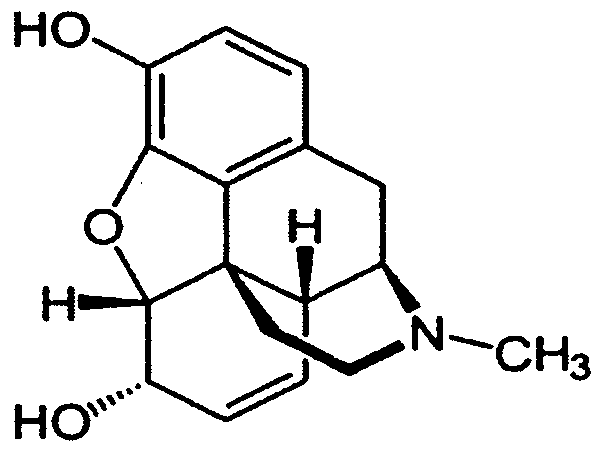
- Therapeutic opioids include tilidine, tramadol and morphine. Tilidin is often not enough for very severe pain and morphine or morphine-like substances are used. Morphine (5R, 6S, 9R, ⁇ 3S, l4R) -4,5-epoxy-N-methylmorphin-7-ene-3,6-diol, also colloquially referred to as morphine, is a very effective analgesic derived from the Capsules of the opium poppy is obtained and has the following structural formula:
- the most analgesic opioids include sufentanil, remifentanil and fentanyl.
- Therapeutically insignificant is heroin (diacetylmorphine), whose release in Germany is prohibited.
- Heroin substitution therapy mainly uses the opioid methadone.
- intravenous (syringes), nasal (sniffing) or pulmonary (smoking) administration is preferred because of the rapid onset of action ("kick") over oral ingestion.
- a preparation is melted or dissolved and injected intravenously, or it is burned on aluminum foil and inhaled the smoke (foil smoking).
- opioid antagonists can be added to the pharmaceutical preparations.
- Such a commercial preparation is Valoron ® N, which contains a combination of tilidine and naloxone.
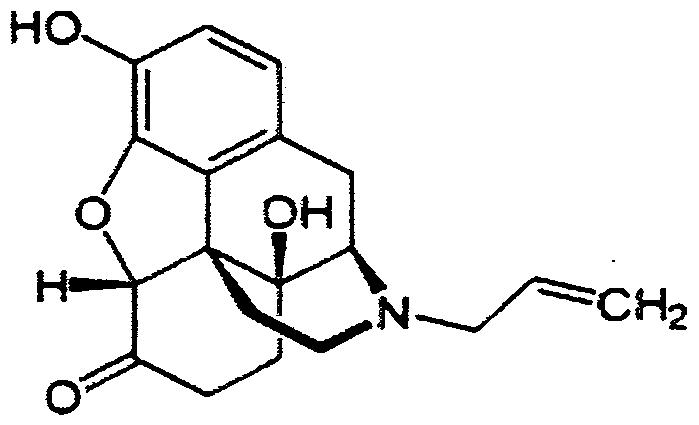
- Naloxone (5A, 9.K, 135.14S) -IT-AllyI-S, 14-dihydroxy-4,5-epoxymorphinan-6-one) is an opioid antagonist having the following structural formula:
- naloxone is one of the pure opioid antagonists that act as compeptive antagonists on all opioid receptors.
- Buprenorphine acts as a mixed agonist / antagonist at the ⁇ receptor.
- the antagonistic effect the effect of the opioid, i. of the agonist, suspended. This property is exploited by, for example, using naloxone therapeutically as an antidote in an opioid overdose.
- naloxone When administered orally naloxone is subject to a high first-pass effect, ie a substantial inactivation in the liver before reaching the site of action. On intravenous administration, on the other hand, large portions of the naloxone remain active. Since naloxone, as an opioid antagonist, abolishes the effect of the opiate, triggers simultaneous intravenous administration Opioid and opioid antagonist withdrawal syndrome. Naloxone can also exhibit its antagonistic effect on pulmonary, nasal, transdermal or rectal administration.
- a prerequisite for naloxone to fulfill its abuse protection function is that the opioid antagonist can not be readily separated from the opioid. This would be the case, for example, if the opioid and the opioid antagonist were administered with different tablets.
- a solvent for example water or ethanol
- a dosage form containing morphine containing a naltrexone core is known. Separation of morphine and naltrexone can be achieved by placing the dosage form in water for 20 minutes. Thereafter, the morphine is dissolved and can be obtained by abducting the naltrexone nuclei. There may also be a manual separation, for example by scraping or rupturing the outer shell of a preparation.
- WO 2007/082935 discloses dosage forms in which the opioid and the opioid antagonist are present as a powder or granule mixture. In the mixture, the particles containing the opioid and the opioid antagonist particles are visually indistinguishable. It is further disclosed that the opioid and / or the opioid antagonist can be released with a delay.
- naloxone exerts its desirable adverse effects substantially in non-oral administration, oral ingestion is not without side effects.
- active naloxone enters the colon, severe diarrhea lasting up to four weeks is elicited in patients who have developed constipation as a result of long-term opioid use.
- Valoron ® N is contraindicated in existing drug dependence of opiates.
- naloxone is easily absorbed in the mouth area.
- This principle is used for example in sublingual administration forms.
- the first-pass effect is at least partially circumvented, which is used in the administration of active ingredients through suppositories.
- naloxone to morphine, which is used to treat pain or as a substitution therapy, is highly problematic. In the extreme case, the therapy must be stopped.
- the object of the invention is achieved by a pharmaceutical composition
- a pharmaceutical composition comprising first particles and second particles, wherein the first particles comprise at least one opioid or a pharmaceutically acceptable salt thereof, and the second particles comprise at least one opioid antagonist or a pharmaceutically acceptable salt thereof wherein the first and second particles are indistinguishable by optically detectable and / or physical properties, characterized in that the release of the opioid antagonist is continuous over a period of 30 minutes to 8 hours after oral administration.
- the object of the invention is further achieved by a pharmaceutical composition
- a pharmaceutical composition comprising a particle comprising at least one opioid or a pharmaceutically acceptable salt thereof and at least one opioid antagonist or a pharmaceutically acceptable salt thereof, characterized in that the release of the opioid Antagonists are continuous over a period of 30 minutes to 8 hours after oral administration.
- the release of the opioid antagonist takes place continuously over a period of 30 Minutes to 6 hours, preferably from 45 minutes to 4.5 hours, after oral administration.
- the opioid is a full agonist, preferably morphine.
- the opiod antagonist has a bioavailability of less than 5%, and is preferably naloxone.
- the release of the opioid occurs for a period of from 0 to at least 12 hours, preferably from 0 to 24 hours after oral administration.
- the first and second particles are beads or the one particle are beads.
- the beads comprise a core and a controlled release coating.
- the coating for release of active ingredient comprises at least one polyacrylate / methacrylate Polyrner, in particular at least one Eudragit ®.
- a dosage form for peroral administration comprising one of the pharmaceutical compositions of the present invention for three times, preferably twice, more preferably once daily.
- the dosage form is a capsule, preferably a hard gelatin capsule, or a sachet.
- the ratio of opioid antagonist to opioid in the dosage form is less than 1:10, preferably in the range of 1: 250 to ⁇ 1:10, and most preferably 1: 100.
- the object of the invention is further achieved by a pharmaceutical composition of the present invention for use in the treatment of opioid dependence.
- the dose of the opioid in the dosage form is 200 mg. Accordingly, the dose of the antagonist is preferably 2 mg.
- the object of the invention is further achieved by a pharmaceutical composition of the present invention for pain therapy in opioid-dependent or non-opioid-dependent patients.
- the dosage of the opioid in the dosage form is 30 or 60 mg. Accordingly, the dose of the antagonist is preferably 0.3 or 0.6 mg.
- the opioid preferably morphine
- Preferred salts of morphine are morphine hydrochloride, morphine sulphate pentahydrate, morphine chlorate, morphine methobromide or other quaternary salts of morphine and morphine N-oxide. Particularly preferred is morphine sulfate pentahydrate.
- the opioid antagonist preferably naloxone
- the present invention provides more compatible pharmaceutical compositions with an opioid and an opioid antagonist which avoids the occurrence of withdrawal symptoms.
- This advantage is achieved by the particular release profile of opiod and opioid antagonist and by the relationship of these two to each other.
- the effect of the release profile is that unlike the Her usual concept of avoiding the "deprivation” also comes to avoid the so-called "local partial withdrawal” in the intestine.
- the pharmaceutical composition is formulated such that the opioid exhibits its beneficial effect while the effect of the opioid antagonist upon oral administration is substantially reduced or abolished.
- This property of the pharmaceutical composition i. better compatibility, is achieved by controlled release of the opioid antagonist, ie by release of the opioid antagonist in a specific area of the digestive system, while at the same time the release of the opioid is delayed ("delayed release"). sustained-release formulation). Since resorption of the opioid antagonist in the oral area avoids the first-pass effect, it is advantageous to prevent absorption in this section of the digestive system. According to the invention, this is achieved by virtually no release of the opioid antagonist takes place in the first 30 minutes after oral administration of the pharmaceutical composition (or in the presence of a physiological saline solution).
- the opioid antagonist in the rectum. According to the present invention, this is achieved by virtually completely liberating the opioid antagonist 8 hours, preferably 6 hours after oral administration of the pharmaceutical composition (or in the presence of a physiological saline solution), i. already released when the pharmaceutical composition reaches the rectum.
- the opioid antagonist is already released when the pharmaceutical composition reaches the end of the transverse colon or the beginning of the descending colon. According to the invention this is achieved by the opioid antagonist is almost completely released 8 hours, preferably 6 hours after oral administration of the pharmaceutical composition (or in the presence of a physiological saline solution), that is already released when the pharmaceutical composition after about 10 hours this Reached section of the digestive system.
- the antagonist If the antagonist is released in the rectum, it becomes fully effective bypassing the first-pass effect and causes general and local withdrawal. Since an opioid antagonist in the colon can trigger severe diarrhea in opioid-dependent patients, it is furthermore advantageous to suppress release in this section of the digestive tract as far as possible. According to the invention, this is achieved by the opioid antagonist almost completely liberated 8 hours, preferably 6 hours after oral administration of the pharmaceutical composition (or in the presence of a physiological saline solution), that is already released when the pharmaceutical composition after about 6 hours the Colon reached.
- naloxone is continuous, i. is retarded, follows a kinetics approximately first order and virtually no release peaks (peaks) occur.
- the first and second particles in which the opioid or the opioid antagonist is contained by optically detectable properties such as, for example, color, shape or size, or physically measurable properties, such as, for example, weight or density
- optically detectable properties such as, for example, color, shape or size
- physically measurable properties such as, for example, weight or density
- a very similar size of the particles prevents separation by sieving.
- a very similar weight or a very similar density prevents separation due to different floating properties (skimming).
- Valoron ® N solution contains 4 mg of naloxone and 50 mg of tilidine in 0.72 ml, ie in a ratio of 1: 12.5.
- Suboxone ® contains 2 mg naloxone and 8 mg buprenorphine, ie a ratio of 1: 4. It has been shown, however, that in non-opioid-dependent patients, 0.4 mg naloxone is sufficient to cause discrete withdrawal symptoms when intravenously administered with 200 mg morphine, ie at a ratio of naloxone to morphine of 1: 500.
- a ratio of 1: 100 is regarded as optimal, ie withdrawal symptoms are triggered with iv administration without life-threatening conditions occurring.
- Figure 1 is a graphical representation of the release data of naloxone over the
- the pharmaceutical composition comprises a mixture of morphine and naloxone beads.
- Each bead contains a core to which the active agent, i. either morphine or naloxone, and a drug release control coating.
- spherical pellets (sugar spheres) are film-coated using a suspension containing morphine sulfate, povidone (Kollidon K 25) and titanium dioxide in purified water.
- the morphine-loaded pellets are then sprayed with a dispersion of colloidal anhydrous silica (Aerosil 200) in purified water.
- a first release-delaying layer is applied.
- the pellets are film-coated using an Eudragit coating suspension I containing talc and Eudragit FS 30 D in purified water.
- a second release-delaying layer is applied.
- hy- limellose is dispersed in purified water and polysorbate 80 is added.
- talc talc
- titanium dioxide talc
- Eudragit NE 30 D and Eudragit FS 30 D are added.
- this Eudragit coating suspension II the pellets are film-coated. Onto this layer is then sprayed a dispersion of colloidal anhydrous silica.
- spherical pellets (sugar spheres) are film-coated using a suspension containing naloxone hydrochloride dihydrate, povidone (Kollidon K 25) and titania in purified water. These naloxone-loaded pellets are then sprayed with a dispersion of colloidal anhydrous silica (Aerosil 200).
- a release delaying layer is applied.
- hy- limellose is dispersed in purified water and polysorbate 80 is added.
- talc talc
- titanium dioxide talc
- Eudragit NE 30 D and Eudragit FS 30 D are added.
- this Eudragit coating suspension the pellets are film-coated.
- Onto this layer is then sprayed a dispersion of colloidal anhydrous silica onto the pellets. The ratio of the constituents of the coating is adjusted so that the desired release profile is achieved.
- Table 1 shows that the morphine and naloxone beads have very similar properties in terms of, for example, size (radius), density and weight.
- Table 2 and Figure 1 show the course of the release of naloxone over a period of 360 minutes after various storage conditions.
- naloxone starts between 30 and 60 minutes and is practically complete after about 270 to 300 minutes (4.5 to 5 hours). It runs continuously over the entire period without occurrence of peaks (FIG. 1).
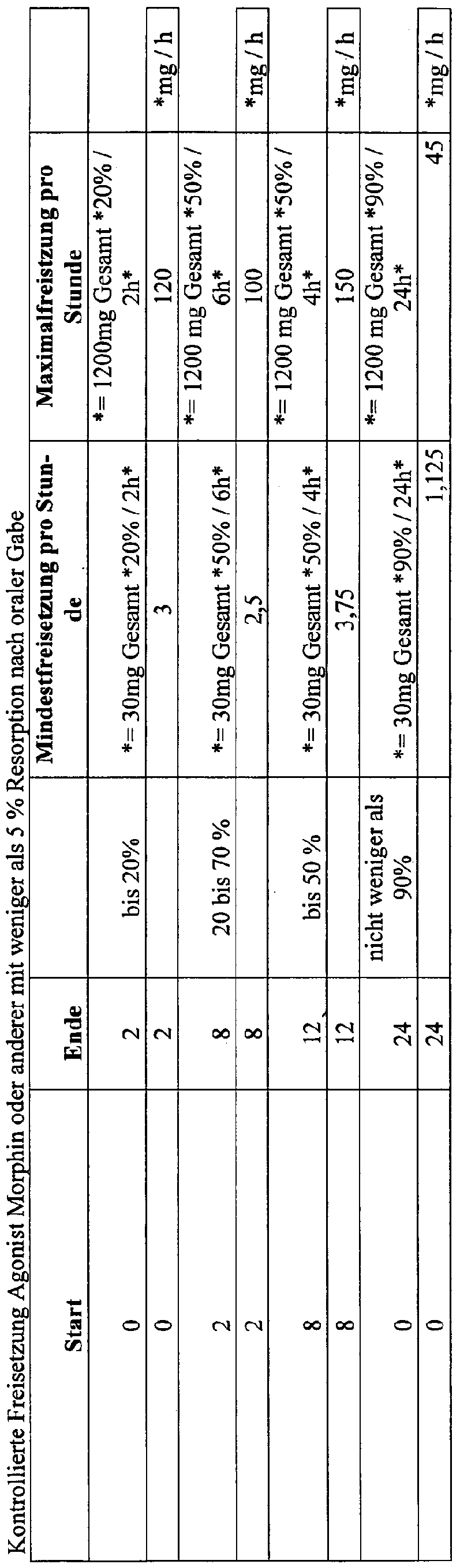
- Table 3 shows the time course of the release of naloxone and morphine.
- the pellets contained naloxone (hydrochloride dihydrate) in an amount of 1.2 to 2.1 mg / 2 g or morphine (sulfate pentahydrate) in an amount of 120 to 210 mg morphine / 2 g.
- naloxone While the release of naloxone after 6 hours is not less than 90%, about 30-70% of morphine is released after 8 hours, and a morphine release of not less than 90% is achieved after 20 hours.
Landscapes
- Health & Medical Sciences (AREA)
- Engineering & Computer Science (AREA)
- Bioinformatics & Cheminformatics (AREA)
- Chemical & Material Sciences (AREA)
- Medicinal Chemistry (AREA)
- Pharmacology & Pharmacy (AREA)
- Life Sciences & Earth Sciences (AREA)
- Animal Behavior & Ethology (AREA)
- General Health & Medical Sciences (AREA)
- Public Health (AREA)
- Veterinary Medicine (AREA)
- Epidemiology (AREA)
- Emergency Medicine (AREA)
- General Chemical & Material Sciences (AREA)
- Organic Chemistry (AREA)
- Biomedical Technology (AREA)
- Neurology (AREA)
- Neurosurgery (AREA)
- Chemical Kinetics & Catalysis (AREA)
- Addiction (AREA)
- Nuclear Medicine, Radiotherapy & Molecular Imaging (AREA)
- Psychiatry (AREA)
- Pain & Pain Management (AREA)
- Pharmaceuticals Containing Other Organic And Inorganic Compounds (AREA)
- Medicinal Preparation (AREA)
- Medicines That Contain Protein Lipid Enzymes And Other Medicines (AREA)
- Medicines Containing Antibodies Or Antigens For Use As Internal Diagnostic Agents (AREA)
Abstract
Description
„Partikelformige pharmazeutische Zusammensetzung mit einem Opioid und einem Opioid- Antagonisten" "Particulate Pharmaceutical Composition Having an Opioid and an Opioid Antagonist"
Die vorliegende Erfindung betrifft eine pharmazeutische Zusammensetzung mit einem Opioid, vorzugsweise Morphin, und einem Opioid-Antagonisten, vorzugsweise Naloxon. Insbesondere betrifft die vorliegende Erfindung eine pharmazeutische Zusammensetzung zur gesteuerten Freisetzung des Opioid-Antagonisten in einem bestimmten Bereich des Verdauungsapparats, und zwar kontinuierlich über einen Zeitraum von 30 Minuten bis zu 8 Stunden nach oraler Verabreichung. Weiterhin betrifft die vorliegende Erfindung eine pharmazeutische Zusammensetzung, die erste Partikel mit dem Opioid und zweite Partikel mit dem Opioid-Antagonisten umfasst, wobei die ersten und zweiten Partikel nicht unterscheidbar sind. Weiterhin betrifft die vorliegende Erfindung eine pharmazeutische Zusammensetzung, die ein Partikel mit dem Opioid und mit dem Opioid- Antagonisten umfasst.The present invention relates to a pharmaceutical composition comprising an opioid, preferably morphine, and an opioid antagonist, preferably naloxone. More particularly, the present invention relates to a pharmaceutical composition for the controlled release of the opioid antagonist in a particular area of the digestive system, continuously over a period of 30 minutes to 8 hours after oral administration. Furthermore, the present invention relates to a pharmaceutical composition comprising first particles with the opioid and second particles with the opioid antagonist, wherein the first and second particles are indistinguishable. Furthermore, the present invention relates to a pharmaceutical composition comprising a particle with the opioid and with the opioid antagonist.
Stand der TechnikState of the art
Die Gruppe der Opioide („dem Opium ähnlich") ist eine chemisch heterogene Gruppe natürlicher und synthetischer Substanzen, die morphinartige Eigenschaften aufweisen und an Opi- oid-Rezeptoren wirksam sind. Man unterscheidet körpereigene (endogene) Opioide, die eine Rolle bei der Schmerzunterdrückung im Rahmen der Stressreaktion spielen, von therapeutisch oder missbräuchlich zugeführten (exogenen) Opioiden. Als „Opiate" werden die natürlicherweise im Opium vorkommenden Opioide bezeichnet, die chemisch Alkaloide darstellen und zu denen Morphin gehört.The group of opioids ("opium-like") is a chemically heterogeneous group of natural and synthetic substances that possess morphine-like properties and are active on opioid receptors, distinguishing endogenous opioids, which play a role in pain suppression The term "opiate" refers to opioids naturally occurring in opium, which are chemically alkaloids and which include morphine.
Von großer therapeutischer Bedeutung ist die stark schmerzlindernde Wirkung (Analgesie) der Opioide. Im Gegensatz zu den Nichtopioid- Analgetika entfalten Opioide ihre analgetische Wirkung vorrangig im Zentralnervensystem (ZNS). Häufigste unerwünschte Nebenwirkungen von Opioiden sind Übelkeit, Erbrechen, Schwindel und, insbesondere bei langfristiger Anwendung, (spastische) Obstipationen des Darms. Eine Überdosierung von Opioiden kann zu gefährlichen Atemdepressionen bis hin zum Erstickungstod führen.Of great therapeutic importance is the strong pain-relieving effect (analgesia) of the opioids. Unlike nonopioid analgesics, opioids exert their analgesic effects primarily in the central nervous system (CNS). The most common adverse effects of opioids are nausea, vomiting, dizziness and, especially if used for long periods, (spastic) constipations of the intestine. An overdose of opioids can lead to dangerous respiratory depression or suffocation.
Bei längerer regelmäßiger Anwendung von Opioiden kann sich eine Toleranzentwicklung (Gewöhnung) einstellen. Dadurch werden immer höhere Dosierungen notwendig, um die gewünschten Effekte zu erzielen. Es handelt sich um eine pharmakodynamische Toleranz, die hauptsächlich auf einer gesteigerten Enzymaktivität der intrazellulären Adenylatzyklase beruht.Prolonged regular use of opioids may lead to tolerance development (habituation). As a result, higher and higher doses are necessary to achieve the desired effects. It is a pharmacodynamic tolerance that mainly due to increased enzyme activity of intracellular adenylate cyclase.
Die Opioide gehören neben den Benzodiazepinen zu den Substanzen, die eine starke Medikamentenabhängigkeit verursachen können. Hierbei ist zwischen psychischer und physischer Abhängigkeit zu unterscheiden. Für die psychische Komponente der Abhängigkeit werden vor allem die angstlösenden und euphorisierenden Effekte der Opioide verantwortlich gemacht. Die physische Abhängigkeit ist hauptsächlich darauf zurückzuführen, dass es bei unterbrochener Opioid-Zufuhr zu einer Entzugssymptomatik kommt, die auf einer vermehrten Freisetzung von Noradrenalin beruht. Typische Entzugserscheinungen sind Unruhe, unbegründetes Schmerzempfinden, Depressionen, Erbrechen und Magenkrämpfe, Durchfall, Erschöpfung und grippeähnliche Beschwerden.The opioids are in addition to the benzodiazepines to the substances that can cause a strong drug dependence. Here, a distinction must be made between mental and physical dependence. The anxiety-relieving and euphoric effects of opioids are primarily held responsible for the psychological component of dependency. The physical dependency is mainly due to the fact that it comes with withdrawal of opioid intake withdrawal symptoms, which is based on an increased release of norepinephrine. Typical withdrawal symptoms are restlessness, unfounded sensations of pain, depression, vomiting and stomach cramps, diarrhea, fatigue and flu-like symptoms.
Der Entzug von Opioiden ist ausgesprochen langwierig. Während der physische Entzug meistens schnell überwunden wird, können nach vorangegangenem starkem regelmäßigem Konsum beispielsweise Schlafstörungen oder Albträume noch ein Jahr später auftreten. Durch den psychischen Suchtdruck kommt es auch häufig zu Rückfällen.The withdrawal of opioids is extremely tedious. While physical withdrawal is usually overcome quickly, sleep disorders or nightmares can occur a year later, following previous heavy regular consumption. The psychological addiction often causes relapses.
Zu den therapeutisch gebräuchlichen Opioiden gehören Tilidin, Tramadol und Morphin. Bei sehr starken Schmerzen reicht etwa Tilidin häufig nicht aus und es werden Morphin oder morphinähnliche Substanzen eingesetzt. Morphin (5R,6S,9R,\3S,l4R)-4,5-Epoxy-N- methylmorphin-7-en-3,6-diol), umgangssprachlich auch als Morphium bezeichnet, ist ein sehr wirksames Schmerzmittel, das aus den Kapseln des Schlafmohns gewonnen wird und folgende Strukturformel aufweist:Therapeutic opioids include tilidine, tramadol and morphine. Tilidin is often not enough for very severe pain and morphine or morphine-like substances are used. Morphine (5R, 6S, 9R, \ 3S, l4R) -4,5-epoxy-N-methylmorphin-7-ene-3,6-diol, also colloquially referred to as morphine, is a very effective analgesic derived from the Capsules of the opium poppy is obtained and has the following structural formula:
Zu den am stärksten analgetisch wirkenden Opioiden gehören Sufentanil, Remifentanil und Fentanyl. Therapeutisch unbedeutend ist Heroin (Diacetylmorphin), dessen Abgabe in Deutschland verboten ist. Zur Heroin-Substitutionstherapie wird überwiegend das Opioid Methadon eingesetzt.The most analgesic opioids include sufentanil, remifentanil and fentanyl. Therapeutically insignificant is heroin (diacetylmorphine), whose release in Germany is prohibited. Heroin substitution therapy mainly uses the opioid methadone.
Insbesondere durch die psychotrope Wirkung der Opioide besteht die Gefahr einer miss- bräuchlichen Anwendung (Abusus). Dazu gehört, dass der Wirkstoff nicht auf dem dazu vorgesehenen Verabreichungsweg zugeführt wird. So ist die intravenöse (Spritzen), nasale (Snif- fen) oder pulmonale (Rauchen) Verabreichung aufgrund des schnellen Wirkungseintritts ("Kick") gegenüber einer oralen Einnahme bevorzugt. Zu diesem Zweck wird ein Präparat geschmolzen oder aufgelöst und intravenös injiziert, oder es wird auf Alufolie verbrannt und der Rauch inhaliert (Folienrauchen).In particular, due to the psychotropic effect of the opioids, there is a risk of misuse (abuse). This includes that the active ingredient is not supplied by the intended route of administration. Thus, intravenous (syringes), nasal (sniffing) or pulmonary (smoking) administration is preferred because of the rapid onset of action ("kick") over oral ingestion. For this purpose, a preparation is melted or dissolved and injected intravenously, or it is burned on aluminum foil and inhaled the smoke (foil smoking).
Um die missbräuchliche Anwendung von Opioden einzuschränken (Abusus-Schutz), können den pharmazeutischen Zubereitungen Opioid-Antagonisten beigemischt werden. Ein derartiges handelsübliches Präparat ist Valoron® N, das eine Kombination aus Tilidin und Naloxon enthält. Naloxon (5Ä,9.K,135,14S)-IT-AlIyI-S, 14-dihydroxy-4,5-epoxymorphinan-6-on) ist ein Opioid- Antagonist mit der folgenden Stπikturformel:In order to limit the misuse of opiods (abuse protection), opioid antagonists can be added to the pharmaceutical preparations. Such a commercial preparation is Valoron ® N, which contains a combination of tilidine and naloxone. Naloxone (5A, 9.K, 135.14S) -IT-AllyI-S, 14-dihydroxy-4,5-epoxymorphinan-6-one) is an opioid antagonist having the following structural formula:
Zusammen mit Naltrexon gehört Naloxon zu den reinen Opioid- Antagonisten, die als kompe- titive Antagonisten an allen Opioid-Rezeptoren wirken. Buprenorphin dagegen wirkt als gemischter Agonist/ Antagonist am μ-Rezeptor. Durch die antagonistische Wirkung wird die Wirkung des Opioids, d.h. des Agonisten, aufgehoben. Diese Eigenschaft wird genutzt, indem beispielsweise Naloxon therapeutisch als Antidot bei einer Opioid-Überdosierung eingesetzt wird.Together with naltrexone, naloxone is one of the pure opioid antagonists that act as compeptive antagonists on all opioid receptors. Buprenorphine, on the other hand, acts as a mixed agonist / antagonist at the μ receptor. By the antagonistic effect, the effect of the opioid, i. of the agonist, suspended. This property is exploited by, for example, using naloxone therapeutically as an antidote in an opioid overdose.
Bei oraler Verabreichung unterliegt Naloxon einem hohen First-pass-Effekt, d.h. einer weitgehenden Inaktivierung in der Leber vor Erreichen des Wirkungsorts. Bei intravenöser Verabreichung dagegen bleiben große Teile des Naloxons wirksam. Da Naloxon als Opioid- Antagonist die Wirkung des Opiods aufhebt, löst die gleichzeitige intravenöse Verabreichung von Opioid und Opioid- Antagonist ein Entzugssyndrom aus. Auch bei pulmonaler, nasaler, transdermaler oder rektaler Verabreichung kann Naloxon seine antagonistische Wirkung entfalten.When administered orally naloxone is subject to a high first-pass effect, ie a substantial inactivation in the liver before reaching the site of action. On intravenous administration, on the other hand, large portions of the naloxone remain active. Since naloxone, as an opioid antagonist, abolishes the effect of the opiate, triggers simultaneous intravenous administration Opioid and opioid antagonist withdrawal syndrome. Naloxone can also exhibit its antagonistic effect on pulmonary, nasal, transdermal or rectal administration.
Eine Voraussetzung dafür, dass Naloxon seine Funktion als Abusus-Schutz erfüllt, ist, dass der Opioid-Antagonist nicht ohne weiteres von dem Opioid abgetrennt werden kann. Dies wäre beispielsweise der Fall, wenn das Opioid und der Opiod-Antagonist mit verschiedenen Tabletten verabreicht würden. Bei mehrschichtigen Präparaten etwa ist es möglich, die einzelnen Schichten in Lösungsmittel, beispielsweise Wasser oder Ethanol, aufzulösen und das Opioid durch Eindampfen der gewonnenen Lösung zu erhalten. Bekannt ist eine Darreichungsform mit Morphin, die einen Naltrexon-Kern enthält. Eine Trennung von Morphin und Naltrexon kann erreicht werden, indem die Darreichungsform 20 Minuten in Wasser eingelegt wird. Danach ist das Morphin gelöst und kann durch Abseien der Naltrexon-Kerne gewonnen werden. Es kann auch eine manuelle Auftrennung, beispielsweise durch Abkratzen oder Aufbrechen der äußeren Hülle eines Präparats stattfinden.A prerequisite for naloxone to fulfill its abuse protection function is that the opioid antagonist can not be readily separated from the opioid. This would be the case, for example, if the opioid and the opioid antagonist were administered with different tablets. In the case of multilayer preparations, for example, it is possible to dissolve the individual layers in a solvent, for example water or ethanol, and to obtain the opioid by evaporating the solution obtained. A dosage form containing morphine containing a naltrexone core is known. Separation of morphine and naltrexone can be achieved by placing the dosage form in water for 20 minutes. Thereafter, the morphine is dissolved and can be obtained by abducting the naltrexone nuclei. There may also be a manual separation, for example by scraping or rupturing the outer shell of a preparation.
Die WO 2007/082935 offenbart Darreichungsformen, bei denen das Opioid und der Opioid- Antagonist als eine Pulver- oder Granulatmischung vorliegen. In der Mischung sind die das Opioid und die den Opioid-Antagonisten enthaltenden Partikel visuell nicht voneinander zu unterscheiden. Weiterhin offenbart wird, dass das Opioid und/oder der Opioid-Antagonist verzögert freigesetzt werden können.WO 2007/082935 discloses dosage forms in which the opioid and the opioid antagonist are present as a powder or granule mixture. In the mixture, the particles containing the opioid and the opioid antagonist particles are visually indistinguishable. It is further disclosed that the opioid and / or the opioid antagonist can be released with a delay.
Obwohl Naloxon seine erwünschten nachteiligen Wirkungen im Wesentlichen bei nicht oraler Verabreichung ausübt, ist auch die orale Einnahme nicht ohne Nebenwirkungen. Gelangt aktives Naloxon in das Colon, wird dort bei Patienten, die infolge einer langfristigen Opioid- Anwendung eine Obstipation entwickelt haben, eine bis zu vier Wochen andauernde schwere Diarrhoe hervorgerufen. Wegen der Gefahr unmittelbar auftretender Entzugserscheinungen ist beispielsweise die Einnahme von Valoron® N bei bestehender Drogenabhängigkeit von Opiaten kontraindiziert.Although naloxone exerts its desirable adverse effects substantially in non-oral administration, oral ingestion is not without side effects. When active naloxone enters the colon, severe diarrhea lasting up to four weeks is elicited in patients who have developed constipation as a result of long-term opioid use. Because of the risk of immediate withdrawal symptoms, for example, the use of Valoron ® N is contraindicated in existing drug dependence of opiates.
Weiterhin ist auch bei oraler Verabreichung eine Resorption von Naloxon unter Umgehung des First-pass-Effekts möglich. Studien haben gezeigt, dass Naloxon im Mundbereich leicht resorbiert wird. Bei einer Resorption durch die Schleimhäute im Bereich des Munds, beispielsweise durch die Zungenschleimhaut (perlingual) und die Wangeninnenflächen, gelangt ein Wirkstoff über das venöse Blut aus der Mundschleimhaut direkt in die obere Hohlvene. Dieses Prinzip wird etwa bei sublingualen Verabreichungsformen genutzt. Auch bei rektaler Resorption wird der First-pass-Effekt zumindest teilweise umgangen, was bei der Verabreichung von Wirkstoffen durch Zäpfchen genutzt wird.Furthermore, even with oral administration, absorption of naloxone is possible, bypassing the first-pass effect. Studies have shown that naloxone is easily absorbed in the mouth area. Upon absorption through the mucous membranes in the area of the mouth, for example, through the peroneal mucosa and the cheek inner surfaces passes an active ingredient via the venous blood from the oral mucosa directly into the superior vena cava. This principle is used for example in sublingual administration forms. Even with rectal absorption, the first-pass effect is at least partially circumvented, which is used in the administration of active ingredients through suppositories.
Aufgrund der Nebenwirkungen bei opioidabhängigen Patienten ist die Beimischung von Naloxon zu Morphin, das zur Behandlung von Schmerzen oder als Substitutionstherapie eingesetzt wird, höchst problematisch. Im äußersten Fall muss die Therapie abgebrochen werden.Due to the side effects of opioid-dependent patients, the addition of naloxone to morphine, which is used to treat pain or as a substitution therapy, is highly problematic. In the extreme case, the therapy must be stopped.
Eine Aufgabe der Erfindung ist es deshalb, eine besser verträgliche pharmazeutische Zusammensetzung mit einem Opioid und einem Opioid-Antagonisten bereitzustellen. Insbesondere ist es eine Aufgabe der Erfindung, eine Opioid-Zusammensetzung bereitzustellen, die eine Anwendung auch bei Opioidabhängigkeit bzw. Opioidtoleranz erlaubt.It is therefore an object of the invention to provide a more compatible pharmaceutical composition with an opioid and an opioid antagonist. In particular, it is an object of the invention to provide an opioid composition which allows application even with opioid dependence or opioid tolerance.
Kurzfassung der ErfindungSummary of the invention
Die Aufgabe der Erfindung wird gelöst durch eine pharmazeutische Zusammensetzung, die erste Partikel und zweite Partikel umfasst, wobei die ersten Partikel mindestens ein Opioid oder ein pharmazeutisch annehmbares Salz davon umfassen, und die zweiten Partikel mindestens einen Opioid-Antagonisten oder ein pharmazeutisch annehmbares Salz davon umfassen, wobei die ersten und zweiten Partikel durch optisch erfassbare und/oder physikalische Eigenschaften nicht unterscheidbar sind, dadurch gekennzeichnet, dass die Freisetzung des Opioid- Antagonisten kontinuierlich über einen Zeitraum von 30 Minuten bis zu 8 Stunden nach oraler Verabreichung erfolgt.The object of the invention is achieved by a pharmaceutical composition comprising first particles and second particles, wherein the first particles comprise at least one opioid or a pharmaceutically acceptable salt thereof, and the second particles comprise at least one opioid antagonist or a pharmaceutically acceptable salt thereof wherein the first and second particles are indistinguishable by optically detectable and / or physical properties, characterized in that the release of the opioid antagonist is continuous over a period of 30 minutes to 8 hours after oral administration.
Die Aufgabe der Erfindung wird weiterhin gelöst durch eine pharmazeutische Zusammensetzung, die ein Partikel umfasst, welches mindestens ein Opioid oder ein pharmazeutisch annehmbares Salz davon und mindestens einen Opioid-Antagonisten oder ein pharmazeutisch annehmbares Salz davon umfassen, dadurch gekennzeichnet, dass die Freisetzung des Opioid- Antagonisten kontinuierlich über einen Zeitraum von 30 Minuten bis zu 8 Stunden nach oraler Verabreichung erfolgt.The object of the invention is further achieved by a pharmaceutical composition comprising a particle comprising at least one opioid or a pharmaceutically acceptable salt thereof and at least one opioid antagonist or a pharmaceutically acceptable salt thereof, characterized in that the release of the opioid Antagonists are continuous over a period of 30 minutes to 8 hours after oral administration.
In einer Ausführungsform der erfindungsgemäßen pharmazeutischen Zusammensetzungen erfolgt die Freisetzung des Opioid-Antagonisten kontinuierlich über einen Zeitraum von 30 Minuten bis zu 6 Stunden, vorzugsweise von 45 Minuten bis zu 4,5 Stunden, nach oraler Verabreichung.In one embodiment of the pharmaceutical compositions according to the invention, the release of the opioid antagonist takes place continuously over a period of 30 Minutes to 6 hours, preferably from 45 minutes to 4.5 hours, after oral administration.
In einer Ausführungsform ist das Opioid ein Vollagonist, bevorzugt Morphin.In one embodiment, the opioid is a full agonist, preferably morphine.
In einer Ausfuhrungsform weist der Opiod-Antagonist eine Bioverfügbarkeit von unter 5% auf und ist bevorzugt Naloxon.In one embodiment, the opiod antagonist has a bioavailability of less than 5%, and is preferably naloxone.
In einer Ausführungsform erfolgt die Freisetzung des Opioids während eines Zeitraums von 0 bis mindestens 12 Stunden, vorzugsweise von 0 bis 24 Stunden nach oraler Verabreichung.In one embodiment, the release of the opioid occurs for a period of from 0 to at least 12 hours, preferably from 0 to 24 hours after oral administration.
In einer Ausführungsform sind die ersten und zweiten Partikel Kügelchen oder sind der eine Partikel Kügelchen.In one embodiment, the first and second particles are beads or the one particle are beads.
In einer Ausführungsform umfassen die Kügelchen einen Kern und eine Beschichtung zur gesteuerten Wirkstofffreisetzung.In one embodiment, the beads comprise a core and a controlled release coating.
In einer Ausführungsform umfasst die Beschichtung zur Wirkstofffreisetzung mindestens ein Polyacrylat/-methacrylat-Polyrner, insbesondere mindestens ein Eudragit®.In one embodiment, the coating for release of active ingredient comprises at least one polyacrylate / methacrylate Polyrner, in particular at least one Eudragit ®.
Die Aufgabe der vorliegenden Erfindung wird weiterhin gelöst durch eine Darreichungsform zur peroralen Verabreichung, welche eine der pharmazeutischen Zusammensetzungen der vorliegenden Erfindung umfasst, zur dreimal, vorzugsweise zweimal, besonders bevorzugt einmal täglichen Verabreichung.The object of the present invention is further achieved by a dosage form for peroral administration comprising one of the pharmaceutical compositions of the present invention for three times, preferably twice, more preferably once daily.
In einer Ausführungsform ist die Darreichungsform eine Kapsel, vorzugsweise eine Hartgelatine-Kapsel, oder ein Sachet.In one embodiment, the dosage form is a capsule, preferably a hard gelatin capsule, or a sachet.
In einer Ausführungsform beträgt das Verhältnis von Opioid-Antagonist zu Opioid in der Darreichungsform einen Wert von weniger als 1:10, vorzugsweise einen Wert im Bereich von 1 :250 bis < 1 :10, und besonders bevorzugt einen Wert von 1 : 100. Die Aufgabe der Erfindung wird weiterhin gelöst durch eine pharmazeutische Zusammensetzung der vorliegenden Erfindung zur Verwendung bei der Behandlung einer Opioid- Abhängigkeit.In one embodiment, the ratio of opioid antagonist to opioid in the dosage form is less than 1:10, preferably in the range of 1: 250 to <1:10, and most preferably 1: 100. The object of the invention is further achieved by a pharmaceutical composition of the present invention for use in the treatment of opioid dependence.
In einer Ausfuhrungsform der Zusammensetzung beträgt die Dosis des Opioids in der Darreichungsform 200 mg. Dementsprechend beträgt die Dosis des Antagonisten vorzugsweise 2 mg.In one embodiment of the composition, the dose of the opioid in the dosage form is 200 mg. Accordingly, the dose of the antagonist is preferably 2 mg.
Die Aufgabe der Erfindung wird weiterhin gelöst durch eine pharmazeutische Zusammensetzung der vorliegenden Erfindung zur Schmerztherapie bei opioidabhängigen oder nicht opi- oidabhängigen Patienten.The object of the invention is further achieved by a pharmaceutical composition of the present invention for pain therapy in opioid-dependent or non-opioid-dependent patients.
In einer Ausführungsform der Zusammensetzung beträgt die Dosis des Opioids in der Darrei- chungsform 30 oder 60 mg. Dementsprechend beträgt die Dosis des Antagonisten vorzugsweise 0,3 oder 0,6 mg.In one embodiment of the composition, the dosage of the opioid in the dosage form is 30 or 60 mg. Accordingly, the dose of the antagonist is preferably 0.3 or 0.6 mg.
Detaillierte Beschreibung der ErfindungDetailed description of the invention
Das Opioid, vorzugsweise Morphin, kann als physiologisch annehmbares Salz wie Hydro- chlorid, Hydrat, Sulfat, Chlorat oder als quartäre Salze vorliegen. Bevorzugte Salze des Morphins sind Morphin-Hydrochlorid, Morphin- Sulfatpentahydrat, Morphin-Chlorat, Morphin- Methobromid oder andere quartäre Salze des Morphins sowie Morphin-N-oxid. Besonders bevorzugt ist Morphin-Sulfatpentahydrat.The opioid, preferably morphine, may be present as a physiologically acceptable salt such as hydrochloride, hydrate, sulfate, chlorate or quaternary salts. Preferred salts of morphine are morphine hydrochloride, morphine sulphate pentahydrate, morphine chlorate, morphine methobromide or other quaternary salts of morphine and morphine N-oxide. Particularly preferred is morphine sulfate pentahydrate.
Der Opioid- Antagonist, vorzugsweise Naloxon, kann als physiologisch annehmbares Salz wie Hydrochlorid oder Hydrochloriddihydrat vorliegen. Besonders bevorzugt ist Naloxon- Hydrochloriddihydrat.The opioid antagonist, preferably naloxone, may be present as a physiologically acceptable salt, such as hydrochloride or hydrochloride dihydrate. Particularly preferred is naloxone hydrochloride dihydrate.
Die vorliegende Erfindung stellt besser verträgliche pharmazeutische Zusammensetzungen mit einem Opioid und einem Opioid- Antagonisten bereit, mit der das Auftreten von Entzugserscheinungen vermieden wird. Dieser Vorteil wird durch das besondere Freisetzungsprofil von Opiod und Opioid-Antagonist sowie durch das Verhältnis dieser beiden zueinander erreicht. Die Wirkung des Freisetzungsprofils besteht darin, dass es im Unterschied zu dem bis- her üblichen Konzept der Vermeidung des "Vollentzugs" auch zu einer Vermeidung des sogenannten "lokalen Teilentzugs" im Darm kommt.The present invention provides more compatible pharmaceutical compositions with an opioid and an opioid antagonist which avoids the occurrence of withdrawal symptoms. This advantage is achieved by the particular release profile of opiod and opioid antagonist and by the relationship of these two to each other. The effect of the release profile is that unlike the Her usual concept of avoiding the "deprivation" also comes to avoid the so-called "local partial withdrawal" in the intestine.
Die pharmazeutische Zusammensetzung ist derart formuliert, dass das Opioid seine vorteilhafte Wirkung entfaltet, während die Wirkung des Opioid-Antagonisten bei oraler Verabreichung erheblich reduziert oder aufgehoben ist. Diese Eigenschaft der pharmazeutischen Zusammensetzung, d.h. die bessere Verträglichkeit, wird durch eine gesteuerte Freisetzung („controlled release") des Opioid-Antagonisten erreicht, d.h. durch eine Freisetzung des Opioid-Antagonisten in einem bestimmten Bereich des Verdauungsapparats. Zugleich ist die Freisetzung des Opioids zeitlich verzögert („delayed release", Retardformulierung). Da bei einer Resorption des Opioid-Antagonisten im Mundbereich der First-pass-Effekt umgangen wird, ist es vorteilhaft, eine Resorption in diesem Abschnitt des Verdauungsapparat zu unterbinden. Erfindungsgemäß wird dies erreicht, indem in den ersten 30 Minuten nach oraler Verabreichung der pharmazeutischen Zusammensetzung (bzw. in Gegenwart einer physiologischen Salzlösung) praktisch keine Freisetzung des Opioid-Antagonisten stattfindet.The pharmaceutical composition is formulated such that the opioid exhibits its beneficial effect while the effect of the opioid antagonist upon oral administration is substantially reduced or abolished. This property of the pharmaceutical composition, i. better compatibility, is achieved by controlled release of the opioid antagonist, ie by release of the opioid antagonist in a specific area of the digestive system, while at the same time the release of the opioid is delayed ("delayed release"). sustained-release formulation). Since resorption of the opioid antagonist in the oral area avoids the first-pass effect, it is advantageous to prevent absorption in this section of the digestive system. According to the invention, this is achieved by virtually no release of the opioid antagonist takes place in the first 30 minutes after oral administration of the pharmaceutical composition (or in the presence of a physiological saline solution).
Weiterhin ist es vorteilhaft, eine Resorption des Opioid- Antagonisten im Rektum zu unterbinden. Erfindungsgemäß wird dies erreicht, indem der Opioid-Antagonist 8 Stunden, vorzugsweise 6 Stunden nach oraler Verabreichung der pharmazeutischen Zusammensetzung (bzw. in Gegenwart einer physiologischen Salzlösung) praktisch vollständig freigesetzt ist, d.h. bereits freigesetzt ist, wenn die pharmazeutische Zusammensetzung das Rektum erreicht.Furthermore, it is advantageous to prevent absorption of the opioid antagonist in the rectum. According to the present invention, this is achieved by virtually completely liberating the opioid antagonist 8 hours, preferably 6 hours after oral administration of the pharmaceutical composition (or in the presence of a physiological saline solution), i. already released when the pharmaceutical composition reaches the rectum.
Ab dem Colon transversum, und speziell ab dem Colon descends ist eine Resorption des Opioid-Antagonisten nicht mehr oder nur noch gering möglich, da dieser aufgrund fehlender Flüssigkeit nicht mehr in Lösung geht und noch dem First-pass-Effekt unterliegt. Eine Resorption findet erst wieder im Rektum statt. Deshalb ist es vorteilhaft, dass der Opioid- Antagonist bereits freigesetzt ist, wenn die pharmazeutische Zusammensetzung das Ende des Colon transversum bzw. den Beginn des Colon descends erreicht. Erfindungsgemäß wird dies erreicht, indem der Opioid- Antagonist 8 Stunden, vorzugsweise 6 Stunden nach oraler Verabreichung der pharmazeutischen Zusammensetzung (bzw. in Gegenwart einer physiologischen Salzlösung) praktisch vollständig freigesetzt ist, d.h. bereits freigesetzt ist, wenn die pharmazeutische Zusammensetzung nach etwa 10 Stunden diesen Abschnitt des Verdauungsapparats erreicht. Falls der Antagonist im Rektum freigesetzt wird, wird dieser unter Umgehung des First-pass-Effekts voll wirksam und ruft einen generellen und lokalen Entzug hervor. Da ein Opioid-Antagonist im Colon bei opioidabhängigen Patienten eine schwere Diarrhoe auslösen kann, ist es weiterhin vorteilhaft, eine Freisetzung in diesem Abschnitt des Verdauungstrakts möglichst zu unterbinden. Erfindungsgemäß wird dies erreicht, indem der Opioid- Antagonist 8 Stunden, vorzugsweise 6 Stunden nach oraler Verabreichung der pharmazeutischen Zusammensetzung (bzw. in Gegenwart einer physiologischen Salzlösung) praktisch vollständig freigesetzt ist, d.h. bereits freigesetzt ist, wenn die pharmazeutische Zusammensetzung nach etwa 6 Stunden das Colon erreicht.From the transverse colon, and especially from the descending colon, absorption of the opioid antagonist is no longer possible or only possible to a lesser extent, since due to lack of fluid, it no longer dissolves and is still subject to the first-pass effect. Resorption only takes place in the rectum. Therefore, it is advantageous that the opioid antagonist is already released when the pharmaceutical composition reaches the end of the transverse colon or the beginning of the descending colon. According to the invention this is achieved by the opioid antagonist is almost completely released 8 hours, preferably 6 hours after oral administration of the pharmaceutical composition (or in the presence of a physiological saline solution), that is already released when the pharmaceutical composition after about 10 hours this Reached section of the digestive system. If the antagonist is released in the rectum, it becomes fully effective bypassing the first-pass effect and causes general and local withdrawal. Since an opioid antagonist in the colon can trigger severe diarrhea in opioid-dependent patients, it is furthermore advantageous to suppress release in this section of the digestive tract as far as possible. According to the invention, this is achieved by the opioid antagonist almost completely liberated 8 hours, preferably 6 hours after oral administration of the pharmaceutical composition (or in the presence of a physiological saline solution), that is already released when the pharmaceutical composition after about 6 hours the Colon reached.
Wesentlich für die Erfindung ist, dass die Freisetzung von Naloxon kontinuierlich verläuft, d.h. retardiert ist, einer Kinetik annähernd erster Ordnung folgt und praktisch keine Freisetzungsspitzen (Peaks) auftreten.Essential to the invention is that the release of naloxone is continuous, i. is retarded, follows a kinetics approximately first order and virtually no release peaks (peaks) occur.
Aus dem Stand der Technik sind vielfaltige Möglichkeiten für die Erreichung des speziellen Freisetzungsprofils des Opioids bzw. Opioid-Antagonisten bekannt. Gegenwärtig bevorzugt wird eine Lösung, bei der die Freisetzung über eine bestimmte Retardbeschichtung gesteuert wird, wobei die in den folgenden Beispielen vorgeschlagene Retardbeschichtung nur beispielhaft ist, da auch andere Möglichkeiten denkbar und für den Durchschnittsfachmann aus dem Stand der Technik ableitbar sind. Alternativ zu einer Retardbeschichtung kann auch eine entsprechende Retardmatrix gewählt werden, aus der das Opioid bzw. der Opioid-Antagonist freigesetzt wird.From the state of the art, various possibilities for achieving the special release profile of the opioid or opioid antagonist are known. Presently preferred is a solution in which release is controlled by a particular sustained-release coating, the sustained-release coating proposed in the following examples being only an example, since other possibilities are conceivable and derivable for the person skilled in the art from the prior art. As an alternative to a slow-release coating, it is also possible to select a corresponding sustained release matrix from which the opioid or the opioid antagonist is released.
Indem in der Ausführungsform mit den ersten und zweiten Partikeln, in denen das Opioid bzw. der Opioid-Antagonist enthalten ist, durch optisch erfassbare Eigenschaften, wie bspw. Farbe, Form oder Größe, oder physikalisch messbare Eigenschaften, wie bspw. Gewicht oder Dichte, nicht unterscheidbar sind, wird eine leichte Trennbarkeit der beiden Substanzen vermieden. Eine sehr ähnliche Größe der Partikel etwa verhindert eine Trennung durch Aussieben. Ein sehr ähnliches Gewicht bzw. eine sehr ähnliche Dichte verhindert eine Trennung aufgrund unterschiedlicher Schwimmeigenschaften (Abschöpfen).In the embodiment, with the first and second particles in which the opioid or the opioid antagonist is contained by optically detectable properties, such as, for example, color, shape or size, or physically measurable properties, such as, for example, weight or density, are indistinguishable, easy separability of the two substances is avoided. A very similar size of the particles, for example, prevents separation by sieving. A very similar weight or a very similar density prevents separation due to different floating properties (skimming).
In der Ausführungsform mit nur einem Partikel, die das Opioid und den Opioid-Antagonist enthalten, wird eine leichte Trennbarkeit der beiden Substanzen ebenfalls vermieden. Neuere Befunde zeigen, dass opioidabhängige Patienten im Vergleich zu nicht abhängigen Patienten eine erhöhte Resorption von Opioiden und Opioid-Antagonist aufweisen (Halbsguth U, Rentsch KM, Eich-Höchli D, Diterich I, Fattinger K. Br J Clin Pharmacol 66: 781-91, 2008). Bei diesen Patienten löst ein Verhältnis von Opioid zu Opioid-Antagonist von mehr als 1:10 Entzugserscheinungen aus. Deshalb ist es vorteilhaft, wenn das Verhältnis von Opioid zu Opioid- Antagonist weniger als 1:10 beträgt.In the single-particle embodiment containing the opioid and the opioid antagonist, easy separability of the two substances is also avoided. More recent findings show that opioid-dependent patients show an increased absorption of opioids and opioid antagonist compared to non-dependent patients (Halbsguth U, Rentsch KM, Eich-Hochli D, Diterich I, Fattinger K. Br J Clin Pharmacol 66: 781-91 , 2008). In these patients, a ratio of opioid to opioid antagonist of more than 1:10 triggers withdrawal symptoms. Therefore, it is advantageous if the ratio of opioid to opioid antagonist is less than 1:10.
Um einen Abusus-Schutz zu erreichen, wurde bisher ein hohes Verhältnis zwischen Opioid und Opioid- Antagonist als vorteilhaft bzw. notwendig angesehen. Valoron® N Lösung beispielsweise enthält 4 mg Naloxon und 50 mg Tilidin in 0,72 ml, d.h. in einem Verhältnis von 1:12,5. Suboxone® enthält 2 mg Naloxon und 8 mg Buprenorphin, also ein Verhältnis von 1:4. Es hat sich jedoch gezeigt, dass bei nicht opioidabhängigen Patienten 0,4 mg Naloxon ausreichen, um bei intravenöser Verabreichung von 200 mg Morphin diskrete Entzugserscheinungen auszulösen, d.h. bei einem Verhältnis von Naloxon zu Morphin von 1 :500. Ein Verhältnis von 1:100 wird als optimal angesehen, d.h. es werden bei i.v.-Applikation Entzugserscheinungen ausgelöst, ohne dass lebensbedrohliche Zustände auftreten. Außerdem hat sich überraschenderweise herausgestellt, dass die Halbwertzeiten von Naloxon und Morphin ähnlicher sind als bisher angenommen.In order to achieve abuse protection, a high ratio of opioid to opioid antagonist has hitherto been regarded as advantageous or necessary. For example, Valoron ® N solution contains 4 mg of naloxone and 50 mg of tilidine in 0.72 ml, ie in a ratio of 1: 12.5. Suboxone ® contains 2 mg naloxone and 8 mg buprenorphine, ie a ratio of 1: 4. It has been shown, however, that in non-opioid-dependent patients, 0.4 mg naloxone is sufficient to cause discrete withdrawal symptoms when intravenously administered with 200 mg morphine, ie at a ratio of naloxone to morphine of 1: 500. A ratio of 1: 100 is regarded as optimal, ie withdrawal symptoms are triggered with iv administration without life-threatening conditions occurring. In addition, it has surprisingly been found that the half-lives of naloxone and morphine are more similar than previously thought.
Zusätzlich zu den oben beschriebenen vorteilhaften Eigenschaften und Wirkungen der erfϊn- dungsgemäßen pharmazeutischen Zusammensetzung bzw. Darreichungsform wurde durch eine kürzlich durchgeführten Studie noch ein weiterer bisher unbekannter positiver Effekt der ultraniedrigen Dosierung des Antagonisten, in diesem Falle Naloxon, der mit dieser Erfindung möglich wird, festgestellt.In addition to the above-described advantageous properties and effects of the pharmaceutical composition or dosage form according to the invention, a previously conducted study has determined yet another previously unknown positive effect of the ultralow dosing of the antagonist, in this case naloxone, which is possible with this invention ,
Aus der Literatur ist bekannt, dass ultraniedrige Dosierungen von Opiatantagonisten sich positiv auf die Entwicklung der Opiattoleranz und Abhängigkeit auswirken, einen anti- nozeptiven Effekt verstärken, einen Opiat-sparenden Effekt haben und eine Wirkung auf Alkoholabhängigkeit zeigen.It is known from the literature that ultra-low dosages of opiate antagonists have a positive effect on the development of opiate tolerance and dependency, enhance an anti-nascent effect, have an opiate-sparing effect and have an effect on alcohol dependence.
In der erwähnten Studie wurde nunmehr gezeigt, dass überraschenderweise zusätzliche positive Effekte auftraten, nämlich die Verringerung der Morphin-typischen Nebenwirkungen Nau- sea und Juckreiz, Verringerung oder Vermeidung von Obstipation, die Verringerung von Opi- at-Craving, die Verbesserung der Kognition (zu den kognitiven Fähigkeiten eines Menschen zählen zum Beispiel Aufmerksamkeit, die Erinnerung, das Lernen, die Kreativität, das Planen, die Orientierung, die Imagination, die Argumentation, die Introspektion, der Wille, das Glauben, etc.) und der emotionalen Schwingungsfähigkeit (auch als affektive Schwingungsfähigkeit bezeichnet. Emotionale Schwingungsfähigkeit drückt eine adäquate Modulationsfähigkeit der Stimmung aus. Dies bedeutet, dass die vom Betroffenen oder Beobachter wahrnehmbaren Emotionen sich angemessen an das Gesprächsthema und die Kontaktsituation anpassen und erkennbar die übliche Bandbreite von Gefühlen ausgedrückt werden kann. In der Fremdbeurteilung wird emotionale Schwingungsfähigkeit nach den mimischen und gestischen Reaktionen und der Anpassung der Stimme im Gesprächskontakt beurteilt.), die Verbesserung von Appetit- und Hungergefühl, die Verringerung von Völlegefühl und die Normalisierung des Tag-Nacht- bzw. Schlafrhythmus. Bei Patienten, die zusätzlich alkoholabhängig waren, zeigte sich mit der erfϊndungsgernäßen Zusammensetzung bzw. Darreichungsform eine Verringerung der Auswirkung des Alkoholentzuges bzw. des Alkoholcravings.In the mentioned study, it has now been shown that surprisingly additional positive effects occurred, namely the reduction of morphine-typical side effects nausea and itching, reduction or avoidance of constipation, the reduction of opiate craving, the improvement of cognition (zu the cognitive abilities of a human These include, for example, attention, memory, learning, creativity, planning, orientation, imagination, reasoning, introspection, will, belief, etc.) and emotional vibration (also referred to as affective vibration Vibration ability expresses an adequate ability to modulate the mood, which means that the emotions perceivable by the affected person or observer can be adapted appropriately to the topic of conversation and the contact situation, and the usual range of emotions can be expressed in a recognizable manner judged by gestural reactions and the adjustment of the voice in the conversational contact), the improvement of appetite and hunger, the reduction of bloating and the normalization of the day-night or sleep rhythm. In patients who were also addicted to alcohol, the composition or pharmaceutical form of the invention showed a reduction in the effect of alcohol withdrawal or alcohol craving.
Beschreibung der ZeichnungDescription of the drawing
Figur 1 ist eine graphische Darstellung der Freisetzungsdaten von Naloxon über dieFigure 1 is a graphical representation of the release data of naloxone over the
Zeit.Time.
BEISPIELEXAMPLE
Herstellung der pharmazeutischen Zusammensetzung (mit 2 Partikeln)Preparation of the pharmaceutical composition (with 2 particles)
Die pharmazeutische Zusammensetzung umfasst eine Mischung aus Morphin- und Naloxon- Kügelchen. Jedes Kügelchen enthält einen Kern, auf den der Wirkstoff, d.h. entweder Morphin oder Naloxon, aufgebracht ist, und eine Beschichtung zur Steuerung der Wirkstofffreisetzung.The pharmaceutical composition comprises a mixture of morphine and naloxone beads. Each bead contains a core to which the active agent, i. either morphine or naloxone, and a drug release control coating.
Morphin-KügelchenMorphine beads
Zunächst werden kugelförmige Pelletkerne (sugar spheres) unter Verwendung einer Suspension, die Morphin-Sulfat, Povidon (Kollidon K 25) und Titandioxid in gereinigtem Wasser enthält, filmbeschichtet. Die mit Morphin beladenen Pellets werden dann mit einer Dispersion aus kolloidalem, wasserfreiem Silica (Aerosil 200) in gereinigtem Wasser besprüht. Anschließend wird eine erste, die Freisetzung verzögernde Schicht aufgetragen. Dazu werden die Pellets unter Verwendung einer Eudragit-Beschichtungssuspension I, die Talkum und Eudragit FS 30 D in gereinigtem Wasser enthält, filmbeschichtet.First, spherical pellets (sugar spheres) are film-coated using a suspension containing morphine sulfate, povidone (Kollidon K 25) and titanium dioxide in purified water. The morphine-loaded pellets are then sprayed with a dispersion of colloidal anhydrous silica (Aerosil 200) in purified water. Subsequently, a first release-delaying layer is applied. For this purpose, the pellets are film-coated using an Eudragit coating suspension I containing talc and Eudragit FS 30 D in purified water.
Danach wird eine zweite, die Freisetzung verzögernde Schicht aufgetragen. Dazu wird Hypro- mellose in gereinigtem Wasser dispergiert, und es wird Polysorbat 80 hinzugefügt. Zu dieser Lösung wird eine Dispersion aus Talkum und Titandioxid gegeben. Dann werden Eudragit NE 30 D und Eudragit FS 30 D hinzugefügt. Unter Verwendung dieser Eudragit- Beschichtungssuspension II werden die Pellets filmbeschichtet. Auf diese Schicht wird dann eine Dispersion aus kolloidalem, wasserfreiem Silica gesprüht.Thereafter, a second release-delaying layer is applied. To this end, hy- limellose is dispersed in purified water and polysorbate 80 is added. To this solution is added a dispersion of talc and titanium dioxide. Then Eudragit NE 30 D and Eudragit FS 30 D are added. Using this Eudragit coating suspension II, the pellets are film-coated. Onto this layer is then sprayed a dispersion of colloidal anhydrous silica.
Naloxon-KügelchenNaloxone beads
Zunächst werden kugelförmige Pelletkerne (sugar spheres) unter Verwendung einer Suspension, die Naloxon-Hydrochloriddihydrat, Povidon (Kollidon K 25) und Titandioxid in gereinigtem Wasser enthält, filmbeschichtet. Diese mit Naloxon beladenen Pellets werden dann mit einer Dispersion aus kolloidalem, wasserfreiem Silica (Aerosil 200) besprüht.First, spherical pellets (sugar spheres) are film-coated using a suspension containing naloxone hydrochloride dihydrate, povidone (Kollidon K 25) and titania in purified water. These naloxone-loaded pellets are then sprayed with a dispersion of colloidal anhydrous silica (Aerosil 200).
Anschließend wird eine die Freisetzung verzögernde Schicht aufgetragen. Dazu wird Hypro- mellose in gereinigtem Wasser dispergiert, und es wird Polysorbat 80 hinzugefügt. Zu dieser Lösung wird eine Dispersion aus Talkum und Titandioxid gegeben. Dann werden Eudragit NE 30 D und Eudragit FS 30 D hinzugefugt. Mit dieser Eudragit-Beschichtungssuspension werden die Pellets filmbeschichtet. Auf diese Schicht wird dann eine Dispersion aus kolloidalem, wasserfreiem Silica auf die Pellets gesprüht. Das Verhältnis der Bestandteile der Be- schichtung wird so eingestellt, dass das gewünschte Freisetzprofil erreicht wird.Subsequently, a release delaying layer is applied. To this end, hy- limellose is dispersed in purified water and polysorbate 80 is added. To this solution is added a dispersion of talc and titanium dioxide. Then Eudragit NE 30 D and Eudragit FS 30 D are added. With this Eudragit coating suspension, the pellets are film-coated. Onto this layer is then sprayed a dispersion of colloidal anhydrous silica onto the pellets. The ratio of the constituents of the coating is adjusted so that the desired release profile is achieved.
Vergleich von Morphin- und Naloxon-KügelchenComparison of morphine and naloxone beads
Tabelle 1 zeigt, dass die Morphin- und Naloxon-Kügelchen in Bezug auf beispielsweise Größe (Radius), Dichte und Gewicht sehr ähnliche Eigenschaften aufweisen. Tabelle 2 und Figur 1 zeigen den Verlauf der Freisetzung von Naloxon über einen Zeitraum von 360 Minuten nach verschiedenen Lagerungsbedingungen.Table 1 shows that the morphine and naloxone beads have very similar properties in terms of, for example, size (radius), density and weight. Table 2 and Figure 1 show the course of the release of naloxone over a period of 360 minutes after various storage conditions.
Die Freisetzung von Naloxon setzt zwischen 30 und 60 Minuten ein und ist nach etwa 270 bis 300 Minuten (4,5 bis 5 Stunden) praktisch abgeschlossen. Sie verläuft über den gesamt Zeitraum kontinuierlich ohne Auftreten von Peaks (Figur 1).The release of naloxone starts between 30 and 60 minutes and is practically complete after about 270 to 300 minutes (4.5 to 5 hours). It runs continuously over the entire period without occurrence of peaks (FIG. 1).
Tabelle 3 zeigt den zeitlichen Verlauf der Freisetzung von Naloxon und Morphin. Die Pellets enthielten Naloxon (Hydrochloriddihydrat) in einer Menge von 1,2 bis 2,1 mg/2 g oder Morphin (Sulfatpentahydrat) in einer Menge von 120 bis 210 mg Morphin/2 g.Table 3 shows the time course of the release of naloxone and morphine. The pellets contained naloxone (hydrochloride dihydrate) in an amount of 1.2 to 2.1 mg / 2 g or morphine (sulfate pentahydrate) in an amount of 120 to 210 mg morphine / 2 g.
Während die Freisetzung von Naloxon nach 6 Stunden nicht weniger als 90% beträgt, sind von Morphin nach 8 Stunden etwa 30-70% freigesetzt, und eine Morphin-Freisetzung von nicht weniger als 90% wird nach 20 Stunden erreicht.While the release of naloxone after 6 hours is not less than 90%, about 30-70% of morphine is released after 8 hours, and a morphine release of not less than 90% is achieved after 20 hours.
Die in der vorstehenden Beschreibung, in den Ansprüchen und in der Zeichnung offenbarten Merkmale der Erfindung können sowohl einzeln als auch in jeder beliebigen Kombination für die Verwirklichung der Erfindung in ihren verschiedenen Ausführungsformen wesentlich sein. The features of the invention disclosed in the foregoing description, in the claims and in the drawing may be essential both individually and in any combination for the realization of the invention in its various embodiments.
Tabelle 1Table 1
Morphin NaloxonMorphine naloxone
Pellets 1700 - 2000 1700 - 2000 [μmlPellets 1700 - 2000 1700 - 2000 [μml
Pellet-Radius 0,925 0,925 [mm]Pellet radius 0.925 0.925 [mm]
Rütt-/Schüttdichte m 175,9 175,9 [g]Bulk / bulk density m 175.9 175.9 [g]
Schüttvolumen Vl 202,0 202,0 [ml]Bulk volume Vl 202.0 202.0 [ml]
Rückvolumen V2 197,0 197,0 [ml]Back volume V2 197.0 197.0 [ml]
Schüttdichte 0,8708 0,8708 [g/ml]Bulk density 0.8708 0.8708 [g / ml]
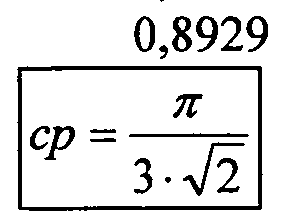
Rüttdichte 0,8929 [g/ml]
Annahme dichteste Kugelpackung cp 0,7405 0,7405 Wahre Dichte Pellets p 1,2058 1,2058 [g/ml]Acceptance densest packing cp 0.7405 0.7405 True Density Pellets p 1.2058 1.2058 [g / ml]
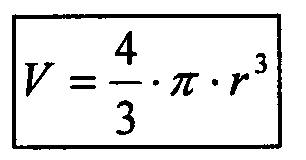
Volumen 3,315231098 3,315231098 [mπrVPellet]Volume 3.315231098 3.315231098 [mπrVPellet]
\O = A - π - r'\ O = A - π - r '
Oberfläche O 10,75210086 10,75210086 [mmVPellet] Surface O 10,75210086 10,75210086 [mmVPellet]
Tabelle 2Table 2
Ul
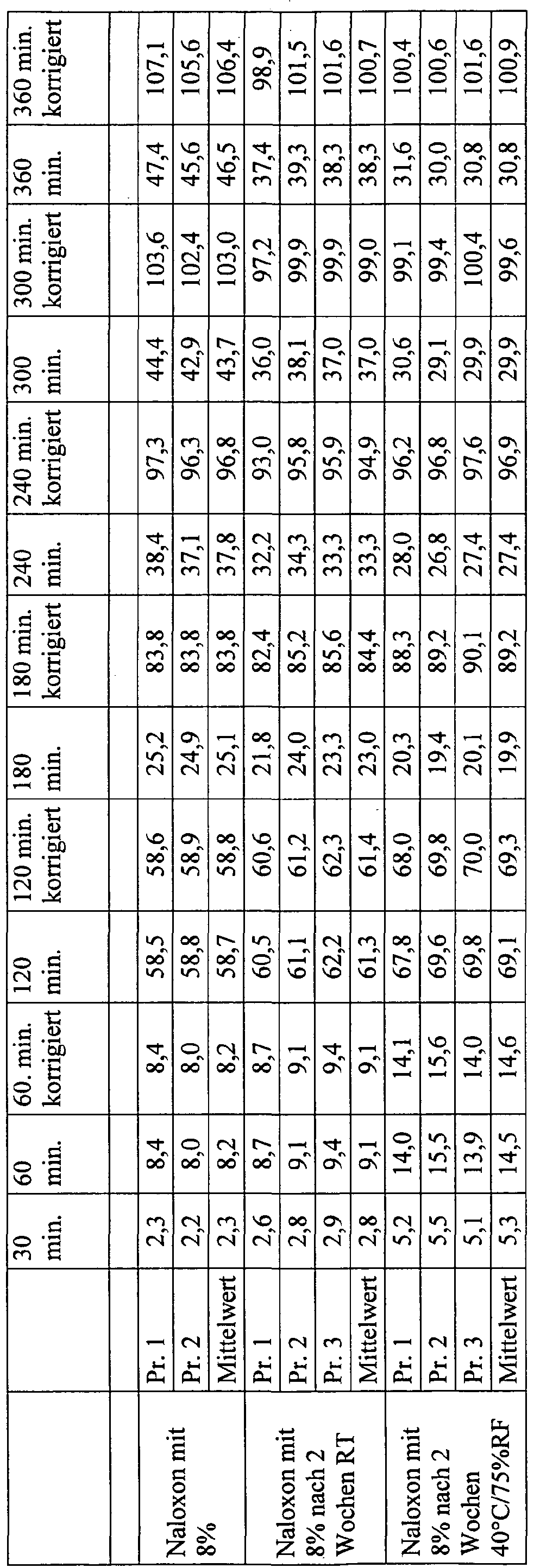
Tabelle 3Table 3
Berechnun für Verhältnis 100 zu 1


Claims
Priority Applications (7)
| Application Number | Priority Date | Filing Date | Title |
|---|---|---|---|
| JP2012506335A JP2012524732A (en) | 2009-04-22 | 2010-04-22 | Fine particle pharmaceutical composition comprising opioid and opioid antagonist |
| EA201171271A EA201171271A1 (en) | 2009-04-22 | 2010-04-22 | PHARMACEUTICAL COMPOSITION IN THE FORM OF PARTICLES WITH OPIOID AND ANTAGONIST OPIOID |
| US13/265,860 US20120040009A1 (en) | 2009-04-22 | 2010-04-22 | Particulate pharmaceutical composition with an opioid and an opioid antagonist |
| AU2010238925A AU2010238925A1 (en) | 2009-04-22 | 2010-04-22 | Particulate pharmaceutical composition having an opioid and an opioid antagonist |
| EP10723484A EP2421515A2 (en) | 2009-04-22 | 2010-04-22 | Particulate pharmaceutical composition having an opioid and an opioid antagonist |
| CA2759870A CA2759870A1 (en) | 2009-04-22 | 2010-04-22 | Particulate pharmaceutical composition with an opioid and an opioid antagonist |
| IL215813A IL215813A0 (en) | 2009-04-22 | 2011-10-23 | Pariticulate pharmaceutical composition with an opioid and an opioid antagonist |
Applications Claiming Priority (2)
| Application Number | Priority Date | Filing Date | Title |
|---|---|---|---|
| DE102009018474 | 2009-04-22 | ||
| DE102009018474.0 | 2009-04-22 |
Publications (2)
| Publication Number | Publication Date |
|---|---|
| WO2010121600A2 true WO2010121600A2 (en) | 2010-10-28 |
| WO2010121600A3 WO2010121600A3 (en) | 2011-10-27 |
Family
ID=42651253
Family Applications (1)
| Application Number | Title | Priority Date | Filing Date |
|---|---|---|---|
| PCT/DE2010/000453 Ceased WO2010121600A2 (en) | 2009-04-22 | 2010-04-22 | Particulate pharmaceutical composition having an opioid and an opioid antagonist |
Country Status (8)
| Country | Link |
|---|---|
| US (1) | US20120040009A1 (en) |
| EP (1) | EP2421515A2 (en) |
| JP (1) | JP2012524732A (en) |
| AU (1) | AU2010238925A1 (en) |
| CA (1) | CA2759870A1 (en) |
| EA (1) | EA201171271A1 (en) |
| IL (1) | IL215813A0 (en) |
| WO (1) | WO2010121600A2 (en) |
Cited By (3)
| Publication number | Priority date | Publication date | Assignee | Title |
|---|---|---|---|---|
| WO2012052169A3 (en) * | 2010-10-21 | 2012-07-26 | Phoeme Gmbh | Particulate pharmaceutical composition containing an opioid and an opioid antagonist |
| EP2606879A1 (en) | 2011-12-21 | 2013-06-26 | Hexal AG | Multiple unit pellet tablet formulation comprising an opioid |
| WO2016091805A3 (en) * | 2014-12-08 | 2016-12-15 | Develco Pharma Schweiz Ag | Naloxone monopreparation and multi-layer tablet |
Families Citing this family (6)
| Publication number | Priority date | Publication date | Assignee | Title |
|---|---|---|---|---|
| US20140179727A1 (en) | 2012-12-14 | 2014-06-26 | Trevi Therapeutics, Inc. | Methods for treating pruritus |
| US8637538B1 (en) | 2012-12-14 | 2014-01-28 | Trevi Therapeutics, Inc. | Methods for treatment of pruritis |
| US8987289B2 (en) | 2012-12-14 | 2015-03-24 | Trevi Therapeutics, Inc. | Methods for treating pruritus |
| CA2875384A1 (en) | 2013-12-20 | 2015-06-20 | AntiOP, Inc. | Intranasal naloxone compositions and methods of making and using same |
| AU2019309913B2 (en) | 2018-07-23 | 2025-02-27 | Trevi Therapeutics, Inc. | Treatment of chronic cough, breathlessness and dyspnea |
| EP4087569A4 (en) | 2020-01-10 | 2024-01-24 | Trevi Therapeutics, Inc. | Methods of administering nalbuphine |
Citations (1)
| Publication number | Priority date | Publication date | Assignee | Title |
|---|---|---|---|---|
| WO2007082935A1 (en) | 2006-01-19 | 2007-07-26 | Phoenux Ag | Use of a combination of morphine and at least one opiate antagonist for treatment of opiate dependency and for prevention of non-oral opiate abuse in opiate addicts |
Family Cites Families (6)
| Publication number | Priority date | Publication date | Assignee | Title |
|---|---|---|---|---|
| DK1225897T3 (en) * | 1999-11-01 | 2005-01-10 | John Rhodes | Composition for the treatment of constipation and irritable colon |
| ES2540103T3 (en) * | 2000-02-08 | 2015-07-08 | Euro-Celtique S.A. | Oral formulations of opioid agonists resistant to improper manipulations |
| US20030035839A1 (en) * | 2001-05-15 | 2003-02-20 | Peirce Management, Llc | Pharmaceutical composition for both intraoral and oral administration |
| US20040202717A1 (en) * | 2003-04-08 | 2004-10-14 | Mehta Atul M. | Abuse-resistant oral dosage forms and method of use thereof |
| MY135852A (en) * | 2003-04-21 | 2008-07-31 | Euro Celtique Sa | Pharmaceutical products |
| EP1897544A1 (en) * | 2006-09-05 | 2008-03-12 | Holger Lars Hermann | Opioid agonist and antagonist combinations |
-
2010
- 2010-04-22 WO PCT/DE2010/000453 patent/WO2010121600A2/en not_active Ceased
- 2010-04-22 US US13/265,860 patent/US20120040009A1/en not_active Abandoned
- 2010-04-22 EP EP10723484A patent/EP2421515A2/en not_active Withdrawn
- 2010-04-22 CA CA2759870A patent/CA2759870A1/en not_active Abandoned
- 2010-04-22 JP JP2012506335A patent/JP2012524732A/en not_active Withdrawn
- 2010-04-22 EA EA201171271A patent/EA201171271A1/en unknown
- 2010-04-22 AU AU2010238925A patent/AU2010238925A1/en not_active Abandoned
-
2011
- 2011-10-23 IL IL215813A patent/IL215813A0/en unknown
Patent Citations (1)
| Publication number | Priority date | Publication date | Assignee | Title |
|---|---|---|---|---|
| WO2007082935A1 (en) | 2006-01-19 | 2007-07-26 | Phoenux Ag | Use of a combination of morphine and at least one opiate antagonist for treatment of opiate dependency and for prevention of non-oral opiate abuse in opiate addicts |
Non-Patent Citations (1)
| Title |
|---|
| HALBSGUTH U; RENTSCH KM; EICH-HÖCHLI D; DITERICH I; FATTINGER K., BR J CLIN PHARMACOL, vol. 66, 2008, pages 781 - 91 |
Cited By (4)
| Publication number | Priority date | Publication date | Assignee | Title |
|---|---|---|---|---|
| WO2012052169A3 (en) * | 2010-10-21 | 2012-07-26 | Phoeme Gmbh | Particulate pharmaceutical composition containing an opioid and an opioid antagonist |
| EP2606879A1 (en) | 2011-12-21 | 2013-06-26 | Hexal AG | Multiple unit pellet tablet formulation comprising an opioid |
| WO2013092589A1 (en) | 2011-12-21 | 2013-06-27 | Hexal Ag | Multiple unit pellet tablet formulation comprising an opioid |
| WO2016091805A3 (en) * | 2014-12-08 | 2016-12-15 | Develco Pharma Schweiz Ag | Naloxone monopreparation and multi-layer tablet |
Also Published As
| Publication number | Publication date |
|---|---|
| EA201171271A1 (en) | 2012-05-30 |
| US20120040009A1 (en) | 2012-02-16 |
| EP2421515A2 (en) | 2012-02-29 |
| JP2012524732A (en) | 2012-10-18 |
| IL215813A0 (en) | 2012-01-31 |
| WO2010121600A3 (en) | 2011-10-27 |
| AU2010238925A1 (en) | 2011-12-15 |
| CA2759870A1 (en) | 2010-10-28 |
Similar Documents
| Publication | Publication Date | Title |
|---|---|---|
| EP2421515A2 (en) | Particulate pharmaceutical composition having an opioid and an opioid antagonist | |
| WO2012052169A2 (en) | Particulate pharmaceutical composition containing an opioid and an opioid antagonist | |
| DE69834268T2 (en) | Peroral dosage form containing a combination of an opioid agonist and naltrexone | |
| KR100417490B1 (en) | A method of preventing abuse of opioid dosage forms | |
| DE60216078T2 (en) | OPIOID CONTAINING ARZNEIFORM AGAINST MISUSE | |
| JP4522652B2 (en) | Abuse prevention controlled release opioid dosage form | |
| DE69720985T3 (en) | ADMINISTRATION OF NICOTIN IN THICK DARM FOR THE TREATMENT OF INFLAMMATORY INFUSION DISEASE | |
| US20160058755A1 (en) | Pharmaceutical Composition | |
| BRPI0618502A2 (en) | oral dosage form of microparticles against misuse | |
| CA2709905A1 (en) | Abuse-resistant oxycodone composition | |
| WO2009085778A1 (en) | Pharmaceutical composition | |
| EP1976524B1 (en) | Use of a combination of morphine and at least one opiate antagonist for treatment of opiate dependency and for prevention of non-oral opiate abuse in opiate addicts | |
| AU2008338439A1 (en) | Pharmaceutical composition | |
| DE102010048883A1 (en) | Use of buprenorphine for abuse protection in pharmaceutical compositions containing a opioid full-agonist | |
| EP1897544A1 (en) | Opioid agonist and antagonist combinations | |
| CN1505516A (en) | Application of Galantamine in the Treatment of Central Nervous System Disorders Caused by Psychotropic Substances | |
| AU2004205244B2 (en) | Opioid Agonist/Antagonist Combinations | |
| AU2014216032A1 (en) | Pharmaceutical composition | |
| MXPA00006259A (en) | Opioid agonist/antagonist combinations | |
| DE4423416A1 (en) | Oral compsn. contg. opioid analgesic and papaverine | |
| CZ20002359A3 (en) | Method of reducing capability of opoid analgesic to induce dependence | |
| MXPA00006261A (en) | A method of preventing abuse of opioid dosage forms |
Legal Events
| Date | Code | Title | Description |
|---|---|---|---|
| 121 | Ep: the epo has been informed by wipo that ep was designated in this application |
Ref document number: 10723484 Country of ref document: EP Kind code of ref document: A2 |
|
| WWE | Wipo information: entry into national phase |
Ref document number: 2012506335 Country of ref document: JP |
|
| WWE | Wipo information: entry into national phase |
Ref document number: 13265860 Country of ref document: US |
|
| WWE | Wipo information: entry into national phase |
Ref document number: 215813 Country of ref document: IL |
|
| WWE | Wipo information: entry into national phase |
Ref document number: 2759870 Country of ref document: CA |
|
| WWE | Wipo information: entry into national phase |
Ref document number: 2010723484 Country of ref document: EP |
|
| WWE | Wipo information: entry into national phase |
Ref document number: a201113307 Country of ref document: UA |
|
| WWE | Wipo information: entry into national phase |
Ref document number: 12466 Country of ref document: GE Ref document number: 201171271 Country of ref document: EA |
|
| WWE | Wipo information: entry into national phase |
Ref document number: 2010238925 Country of ref document: AU Ref document number: 596574 Country of ref document: NZ |
|
| ENP | Entry into the national phase |
Ref document number: 2010238925 Country of ref document: AU Date of ref document: 20100422 Kind code of ref document: A |