WO2010111332A1 - Polyolefin films for in-mold labels - Google Patents
Polyolefin films for in-mold labels Download PDFInfo
- Publication number
- WO2010111332A1 WO2010111332A1 PCT/US2010/028412 US2010028412W WO2010111332A1 WO 2010111332 A1 WO2010111332 A1 WO 2010111332A1 US 2010028412 W US2010028412 W US 2010028412W WO 2010111332 A1 WO2010111332 A1 WO 2010111332A1
- Authority
- WO
- WIPO (PCT)
- Prior art keywords
- film
- nucleator
- polypropylene resin
- label
- mil
- Prior art date
- Legal status (The legal status is an assumption and is not a legal conclusion. Google has not performed a legal analysis and makes no representation as to the accuracy of the status listed.)
- Ceased
Links
Classifications
-
- G—PHYSICS
- G09—EDUCATION; CRYPTOGRAPHY; DISPLAY; ADVERTISING; SEALS
- G09F—DISPLAYING; ADVERTISING; SIGNS; LABELS OR NAME-PLATES; SEALS
- G09F3/00—Labels, tag tickets, or similar identification or indication means; Seals; Postage or like stamps
- G09F3/02—Forms or constructions
-
- C—CHEMISTRY; METALLURGY
- C08—ORGANIC MACROMOLECULAR COMPOUNDS; THEIR PREPARATION OR CHEMICAL WORKING-UP; COMPOSITIONS BASED THEREON
- C08J—WORKING-UP; GENERAL PROCESSES OF COMPOUNDING; AFTER-TREATMENT NOT COVERED BY SUBCLASSES C08B, C08C, C08F, C08G or C08H
- C08J5/00—Manufacture of articles or shaped materials containing macromolecular substances
- C08J5/18—Manufacture of films or sheets
-
- B—PERFORMING OPERATIONS; TRANSPORTING
- B29—WORKING OF PLASTICS; WORKING OF SUBSTANCES IN A PLASTIC STATE IN GENERAL
- B29C—SHAPING OR JOINING OF PLASTICS; SHAPING OF MATERIAL IN A PLASTIC STATE, NOT OTHERWISE PROVIDED FOR; AFTER-TREATMENT OF THE SHAPED PRODUCTS, e.g. REPAIRING
- B29C45/00—Injection moulding, i.e. forcing the required volume of moulding material through a nozzle into a closed mould; Apparatus therefor
- B29C45/14—Injection moulding, i.e. forcing the required volume of moulding material through a nozzle into a closed mould; Apparatus therefor incorporating preformed parts or layers, e.g. injection moulding around inserts or for coating articles
-
- B—PERFORMING OPERATIONS; TRANSPORTING
- B29—WORKING OF PLASTICS; WORKING OF SUBSTANCES IN A PLASTIC STATE IN GENERAL
- B29C—SHAPING OR JOINING OF PLASTICS; SHAPING OF MATERIAL IN A PLASTIC STATE, NOT OTHERWISE PROVIDED FOR; AFTER-TREATMENT OF THE SHAPED PRODUCTS, e.g. REPAIRING
- B29C48/00—Extrusion moulding, i.e. expressing the moulding material through a die or nozzle which imparts the desired form; Apparatus therefor
- B29C48/03—Extrusion moulding, i.e. expressing the moulding material through a die or nozzle which imparts the desired form; Apparatus therefor characterised by the shape of the extruded material at extrusion
- B29C48/07—Flat, e.g. panels
- B29C48/08—Flat, e.g. panels flexible, e.g. films
-
- B—PERFORMING OPERATIONS; TRANSPORTING
- B29—WORKING OF PLASTICS; WORKING OF SUBSTANCES IN A PLASTIC STATE IN GENERAL
- B29C—SHAPING OR JOINING OF PLASTICS; SHAPING OF MATERIAL IN A PLASTIC STATE, NOT OTHERWISE PROVIDED FOR; AFTER-TREATMENT OF THE SHAPED PRODUCTS, e.g. REPAIRING
- B29C48/00—Extrusion moulding, i.e. expressing the moulding material through a die or nozzle which imparts the desired form; Apparatus therefor
- B29C48/25—Component parts, details or accessories; Auxiliary operations
- B29C48/92—Measuring, controlling or regulating
-
- B—PERFORMING OPERATIONS; TRANSPORTING
- B29—WORKING OF PLASTICS; WORKING OF SUBSTANCES IN A PLASTIC STATE IN GENERAL
- B29C—SHAPING OR JOINING OF PLASTICS; SHAPING OF MATERIAL IN A PLASTIC STATE, NOT OTHERWISE PROVIDED FOR; AFTER-TREATMENT OF THE SHAPED PRODUCTS, e.g. REPAIRING
- B29C49/00—Blow-moulding, i.e. blowing a preform or parison to a desired shape within a mould; Apparatus therefor
- B29C49/24—Lining or labelling
-
- B—PERFORMING OPERATIONS; TRANSPORTING
- B32—LAYERED PRODUCTS
- B32B—LAYERED PRODUCTS, i.e. PRODUCTS BUILT-UP OF STRATA OF FLAT OR NON-FLAT, e.g. CELLULAR OR HONEYCOMB, FORM
- B32B27/00—Layered products comprising a layer of synthetic resin
- B32B27/18—Layered products comprising a layer of synthetic resin characterised by the use of special additives
-
- C—CHEMISTRY; METALLURGY
- C08—ORGANIC MACROMOLECULAR COMPOUNDS; THEIR PREPARATION OR CHEMICAL WORKING-UP; COMPOSITIONS BASED THEREON
- C08K—Use of inorganic or non-macromolecular organic substances as compounding ingredients
- C08K5/00—Use of organic ingredients
- C08K5/0008—Organic ingredients according to more than one of the "one dot" groups of C08K5/01 - C08K5/59
- C08K5/0083—Nucleating agents promoting the crystallisation of the polymer matrix
-
- B—PERFORMING OPERATIONS; TRANSPORTING
- B29—WORKING OF PLASTICS; WORKING OF SUBSTANCES IN A PLASTIC STATE IN GENERAL
- B29C—SHAPING OR JOINING OF PLASTICS; SHAPING OF MATERIAL IN A PLASTIC STATE, NOT OTHERWISE PROVIDED FOR; AFTER-TREATMENT OF THE SHAPED PRODUCTS, e.g. REPAIRING
- B29C2948/00—Indexing scheme relating to extrusion moulding
- B29C2948/92—Measuring, controlling or regulating
- B29C2948/92504—Controlled parameter
- B29C2948/92704—Temperature
-
- B—PERFORMING OPERATIONS; TRANSPORTING
- B29—WORKING OF PLASTICS; WORKING OF SUBSTANCES IN A PLASTIC STATE IN GENERAL
- B29C—SHAPING OR JOINING OF PLASTICS; SHAPING OF MATERIAL IN A PLASTIC STATE, NOT OTHERWISE PROVIDED FOR; AFTER-TREATMENT OF THE SHAPED PRODUCTS, e.g. REPAIRING
- B29C2948/00—Indexing scheme relating to extrusion moulding
- B29C2948/92—Measuring, controlling or regulating
- B29C2948/92819—Location or phase of control
- B29C2948/92923—Calibration, after-treatment or cooling zone
-
- B—PERFORMING OPERATIONS; TRANSPORTING
- B29—WORKING OF PLASTICS; WORKING OF SUBSTANCES IN A PLASTIC STATE IN GENERAL
- B29C—SHAPING OR JOINING OF PLASTICS; SHAPING OF MATERIAL IN A PLASTIC STATE, NOT OTHERWISE PROVIDED FOR; AFTER-TREATMENT OF THE SHAPED PRODUCTS, e.g. REPAIRING
- B29C48/00—Extrusion moulding, i.e. expressing the moulding material through a die or nozzle which imparts the desired form; Apparatus therefor
- B29C48/25—Component parts, details or accessories; Auxiliary operations
- B29C48/88—Thermal treatment of the stream of extruded material, e.g. cooling
- B29C48/911—Cooling
- B29C48/9135—Cooling of flat articles, e.g. using specially adapted supporting means
- B29C48/914—Cooling drums
-
- B—PERFORMING OPERATIONS; TRANSPORTING
- B29—WORKING OF PLASTICS; WORKING OF SUBSTANCES IN A PLASTIC STATE IN GENERAL
- B29C—SHAPING OR JOINING OF PLASTICS; SHAPING OF MATERIAL IN A PLASTIC STATE, NOT OTHERWISE PROVIDED FOR; AFTER-TREATMENT OF THE SHAPED PRODUCTS, e.g. REPAIRING
- B29C48/00—Extrusion moulding, i.e. expressing the moulding material through a die or nozzle which imparts the desired form; Apparatus therefor
- B29C48/25—Component parts, details or accessories; Auxiliary operations
- B29C48/88—Thermal treatment of the stream of extruded material, e.g. cooling
- B29C48/911—Cooling
- B29C48/9135—Cooling of flat articles, e.g. using specially adapted supporting means
- B29C48/915—Cooling of flat articles, e.g. using specially adapted supporting means with means for improving the adhesion to the supporting means
- B29C48/916—Cooling of flat articles, e.g. using specially adapted supporting means with means for improving the adhesion to the supporting means using vacuum
-
- B—PERFORMING OPERATIONS; TRANSPORTING
- B29—WORKING OF PLASTICS; WORKING OF SUBSTANCES IN A PLASTIC STATE IN GENERAL
- B29C—SHAPING OR JOINING OF PLASTICS; SHAPING OF MATERIAL IN A PLASTIC STATE, NOT OTHERWISE PROVIDED FOR; AFTER-TREATMENT OF THE SHAPED PRODUCTS, e.g. REPAIRING
- B29C48/00—Extrusion moulding, i.e. expressing the moulding material through a die or nozzle which imparts the desired form; Apparatus therefor
- B29C48/25—Component parts, details or accessories; Auxiliary operations
- B29C48/88—Thermal treatment of the stream of extruded material, e.g. cooling
- B29C48/911—Cooling
- B29C48/9135—Cooling of flat articles, e.g. using specially adapted supporting means
- B29C48/915—Cooling of flat articles, e.g. using specially adapted supporting means with means for improving the adhesion to the supporting means
- B29C48/9165—Electrostatic pinning
-
- C—CHEMISTRY; METALLURGY
- C08—ORGANIC MACROMOLECULAR COMPOUNDS; THEIR PREPARATION OR CHEMICAL WORKING-UP; COMPOSITIONS BASED THEREON
- C08J—WORKING-UP; GENERAL PROCESSES OF COMPOUNDING; AFTER-TREATMENT NOT COVERED BY SUBCLASSES C08B, C08C, C08F, C08G or C08H
- C08J2323/00—Characterised by the use of homopolymers or copolymers of unsaturated aliphatic hydrocarbons having only one carbon-to-carbon double bond; Derivatives of such polymers
- C08J2323/02—Characterised by the use of homopolymers or copolymers of unsaturated aliphatic hydrocarbons having only one carbon-to-carbon double bond; Derivatives of such polymers not modified by chemical after treatment
- C08J2323/10—Homopolymers or copolymers of propene
- C08J2323/12—Polypropene
-
- C—CHEMISTRY; METALLURGY
- C08—ORGANIC MACROMOLECULAR COMPOUNDS; THEIR PREPARATION OR CHEMICAL WORKING-UP; COMPOSITIONS BASED THEREON
- C08L—COMPOSITIONS OF MACROMOLECULAR COMPOUNDS
- C08L23/00—Compositions of homopolymers or copolymers of unsaturated aliphatic hydrocarbons having only one carbon-to-carbon double bond; Compositions of derivatives of such polymers
- C08L23/26—Compositions of homopolymers or copolymers of unsaturated aliphatic hydrocarbons having only one carbon-to-carbon double bond; Compositions of derivatives of such polymers modified by chemical after-treatment
- C08L2023/40—Compositions of homopolymers or copolymers of unsaturated aliphatic hydrocarbons having only one carbon-to-carbon double bond; Compositions of derivatives of such polymers modified by chemical after-treatment by reaction with compounds changing molecular weight
- C08L2023/42—Depolymerisation, vis-breaking or degradation
-
- C—CHEMISTRY; METALLURGY
- C08—ORGANIC MACROMOLECULAR COMPOUNDS; THEIR PREPARATION OR CHEMICAL WORKING-UP; COMPOSITIONS BASED THEREON
- C08L—COMPOSITIONS OF MACROMOLECULAR COMPOUNDS
- C08L2203/00—Applications
- C08L2203/16—Applications used for films
-
- C—CHEMISTRY; METALLURGY
- C08—ORGANIC MACROMOLECULAR COMPOUNDS; THEIR PREPARATION OR CHEMICAL WORKING-UP; COMPOSITIONS BASED THEREON
- C08L—COMPOSITIONS OF MACROMOLECULAR COMPOUNDS
- C08L23/00—Compositions of homopolymers or copolymers of unsaturated aliphatic hydrocarbons having only one carbon-to-carbon double bond; Compositions of derivatives of such polymers
- C08L23/02—Compositions of homopolymers or copolymers of unsaturated aliphatic hydrocarbons having only one carbon-to-carbon double bond; Compositions of derivatives of such polymers not modified by chemical after-treatment
- C08L23/10—Homopolymers or copolymers of propene
Definitions
- Embodiments of the present invention generally relate to polyolefm films for use in in- mold labeling applications. Specifically, the present invention relates to polypropylene cast films for use in in-mold labeling.
- In-mold labels have mostly been produced from biaxially-oriented polypropylene (BOPP) or from machine direction oriented (MDO) films. It has been observed that cast films used in in-mold labeling applications require stiffness and clarity. Furthermore, the firms must be easily die cut for ease of label preparation.
- BOPP biaxially-oriented polypropylene
- MDO machine direction oriented
- Embodiments of the present invention include an in-mold label that comprises a cast film that comprises a polypropylene resin and a nucleator.
- the polypropylene resin has a melt flow rate from 2 dg/min. to 10 dg/min., a xylene solubles content less than 1 wt%, and meso pentad distribution greater than 98%.
- the polypropylene resin may be visbroken.
- Another embodiment includes a process of producing a cast film for in-mold labeling wherein at least one casting roll has a set temperature of 205°F.
- Yet another embodiment includes using a cast film for an in-mold label, which may be incorporated as part of an injection molded package, a blow molded package, or an injection stretch blow molded package.
- Catalyst systems useful for polymerizing olefin monomers include any catalyst system known to one skilled in the art.
- the catalyst system may include metallocene catalyst systems, single site catalyst systems, Ziegler-Natta catalyst systems or combinations thereof, for example.
- the catalysts may be activated for subsequent polymerization and may or may not be associated with a support material.
- a brief discussion of such catalyst systems is included below, but is in no way intended to limit the scope of the invention to such catalysts.
- Ziegler-Natta catalyst systems are generally formed from the combination of a metal component (e.g., a catalyst) with one or more additional components, such as a catalyst support, a cocatalyst and/or one or more electron donors, for example.
- a metal component e.g., a catalyst
- additional components such as a catalyst support, a cocatalyst and/or one or more electron donors, for example.
- Metallocene catalysts may be characterized generally as coordination compounds i ⁇ corp orating one or more cyclopentadienyl (Cp) groups (which may be substituted or unsubstituted, each substitution being the same or different) coordinated with a transition metal through ⁇ bonding.
- the substituent groups on Cp may be linear, branched or cyclic hydrocarbyl radicals, for example.
- the cyclic hydrocarbyl radicals may further form other contiguous ring structures, including indenyl, azuienyl and fJuorenyl groups, for example. These contiguous ring structures may also be substituted or unsubstituted by hydrocarbyl radicals, such as C 1 to C 20 hydrocarbyl radicals, for example.
- catalyst systems are used to form polyolefin compositions. Once the catalyst system is prepared, as described above and/or as known to one skilled in the art, a variety of processes may be earned out using that composition.
- the equipment, process conditions, reactants, additives and other materials used in polymerization processes will vary in a given process, depending on the desired composition and properties of the polymer being formed.
- Such processes may include solution phase, gas phase, slurry phase, bulk phase, high pressure processes or combinations thereof, for example.
- the processes described above generally include polymerizing one or more olefin monomers to form polymers.
- the olefin monomers may include C 2 to C 30 olefin monomers, or C 2 to Cj 2 olefin monomers (e.g., ethylene, propylene, butene, pentene, methylpentene, hexene, octene and decene), for example.
- the monomers may include ethylenically unsaturated monomers, C 4 to C 1S diolefms, conjugated or nonconjugated dienes, polyenes, vinyl monomers and cyclic olefins, for example.
- Non-limiting examples of other monomers may include norbomene, nobomadiene, isobutylene, isoprene, vinylbenzocyclobutane, sytrene, alkyl substituted styrene, ethylidene norbomene, dicyclopentadiene and cyclopentene, for example.
- the formed polymer may include homopolymers, copolymers or terpolymers, for example.
- One example of a gas phase polymerization process includes a continuous cycle system, wherein a cycling gas stream (otherwise known as a recycle stream or fluidizing medium) is heated in a reactor by heat of polymerization. The heat is removed from the cycling gas stream in another part of the cycle by a cooling system external to the reactor.
- the cycling gas stream containing one or more monomers may be continuously cycled through a fluidized bed in the presence of a catalyst under reactive conditions.
- the cycling gas stream is generally withdrawn from the fluidized bed and recycled back into the reactor. Simultaneously, polymer product may be withdrawn from the reactor and fresh monomer may be added to replace the polymerized monomer.
- the reactor pressure in a gas phase process may vary from about 100 psig to about 500 psig, or from about 200 psig to about 400 psig or from about 250 psig to about 350 psig, for example.
- the reactor temperature in a gas phase process may vary from about 3O 0 C to about 120 0 C, or from about 60°C to about 115 0 C, or from about 7O 0 C to about 110 0 C or from about 70°C to about 95 0 C, for example.
- Slurry phase processes generally include forming a suspension of solid, particulate polymer in a liquid polymerization medium, to which monomers and optionally hydrogen, along with catalyst, are added.
- the suspension (which may include diluents) may be intermittently or continuously removed from the reactor where the volatile components can be separated from the polymer and recycled, optionally after a distillation, to the reactor.
- the liquefied diluent employed in the polymerization medium may include a C 3 to C 7 alkane ⁇ e.g., hexane or isobutane), for example.
- the medium employed is generally liquid under the conditions of polymerization and relatively inert.
- a bulk phase process is similar to that of a slurry process with the exception that the liquid medium is also the reactant (e.g., monomer) in a bulk phase process.
- a process may be a bulk process, a slurry process or a bulk slurry process, for example.
- a slurry process or a bulk process may be carried out continuously in one or more loop reactors.
- the catalyst as slurry or as a dry free flowing powder, may be injected regularly to the reactor loop, which can itself be filled with circulating slurry of growing polymer particles in a diluent, for example.
- hydrogen may be added to the process, such as for molecular weight control of the resultant polymer.
- the loop reactor may be maintained at a pressure of from about 27 bar to about 50 bar or from about 35 bar to about 45 bar and a temperature of from about 38 0 C to about 121°C, for example.
- Reaction heat may be removed through the loop wall via any method known to one skilled in the art, such as via a double-jacketed pipe or heat exchanger, for example.
- Alternatively, other types of polymerization processes may be used, such as stirred reactors in series, parallel or combinations thereof, for example.
- Polymer Product Upon removal from the reactor, the polymer may be passed to a polymer recovery system for further processing, such as addition of additives and/or extrusion, for example.
- the polymers (and blends thereof) formed via the processes described herein may include, but are not limited to, linear low density polyethylene, elastomers, plastomers, high density po ⁇ yethylenes, low density polyethylenes, medium density polyethylenes, polypropylene and polypropylene copolymers, for example.
- the polymers include propylene based polymers.
- propylene based is used interchangeably with the terms “propylene polymer” or “polypropylene” and refers to a polymer having at least about 50 wt.%, or at least about 70 wt.%, or at least about 75 wt.%, or at least about 80 wt.%, or at least about 85 wt.% or at least about 90 wt.% polypropylene relative to the total weight of polymer, for example.
- the propylene based polymers may have a molecular weight distribution (M n /M w ) of from about 1.0 to about 20, or from about 1,5 to about 15 or from about 2 to about 12, for example.
- the propylene polymer has a microtacticity of from about 89% to about 99%, for example.
- propylene based polymers may have a recrystallization temperature (T r ) of 11O 0 C.
- propylene based polymers may have a molecular weight (M w ) of
- the propylene based polymers may have a melting point (T 111 ) (as measured by DSC) of at least about 110 0 C, or from about 115 0 C to about 175°C, for example.
- the propylene based polymers may include about 15 wt.% or less, or about 12 wt.% or less, or about 10 wt.% or less, or about 6 wt.% or less, or about 5 wt.% or less or about 4 wt.% or less, or about 1 wt% or less of xylene soluble material (XS), for example (as measured by
- the propylene based polymers may have a melt flow rate (MFR) (as measured by
- ASTM D-1238 of from about 0.01 dg/min to about 100 dg/min., or from about 0.01 dg/min. to about 50 dg/min., or from about 2 dg/min. to about 10 dg/min., or from about 5 dg/min. to about
- the polypropylene based polymers may have a crystallinity based on the microtacticity of the polymer as measured by C 13 NMR of greater than 95%, or greater than 98%, or greater than 99% meso pentads.
- the propylene based polymers may have a crystallinity, measured by DSC, of 50, or from 40 to 60, or from 45 to 55.
- the polymers include polypropylene homopolymers.
- polypropylene homopolymer refers to propylene homopolymers or those polymers composed primarily of propylene and amounts of other comonomers, wherein the amount of comonomer is insufficient to change the crystalline nature of the propylene polymer significantly.
- the polymers include propylene based random copolymers.
- the term "propylene based random copolymer” refers to those copolymers composed primarily of propylene and an amount of at least one comonomer, wherein the polymer includes at least about 0.5 wt.%, or at least about 0.8 wt.%, or at least about 2 wt.%, or from about 0,5 wt.% to about 5.0 wt.%, or from about 0.6 wt.% to about 1.0 wt.% comonomer relative to the total weight of polymer, for example.
- the comonomers may be selected from C 2 to C 10 alkenes.
- the comonomers may be selected from ethylene, propylene, 1-butene, 1-pentene, 1-hexene, 1-heptene, 1-octene, 1-nonene, 1-decene, 4-methyl-l- pentene and combinations thereof.
- the comonomer includes ethylene.
- random copolymer refers to a copolymer formed of macromolecules in which the probability of finding a given monomelic unit at any given site in the chain is independent of the nature of the adjacent units.
- the propylene based random copolymers may exhibit a melt flow rate of at least about 2 dg./10 min., or from about 5 dg./10 min. to about 30 dg./10 min. or from about 10 dg./10 min. to about 20 dg./10 min,, for example.
- the propylene based polymers include stereospecific polymers.
- stereospecific polymer refers to a polymer having a defined arrangement of molecules in space, such as isotactic and syndiotactic polypropylene, for example.
- the term “tacticity” refers to the arrangement of pendant groups in a polymer. For example, a polymer is “atactic” when its pendant groups are arranged in a random fashion on both sides of the chain of the polymer. In contrast, a polymer is "isotactic” when all of its pendant groups are arranged on the same side of the chain and “syndiotactic” when its pendant groups alternate on opposite sides of the chain.
- the polymers include syndiotactic polypropylene.
- the polymers include isotactic polypropylene.
- isotactic polypropylene refers to polypropylene having a crystallinity measured by 13 C NMR spectroscopy using meso pentads (e.g., %mmmm) of greater at least about 60%, or at least about 70%, or at least about 80%, or at least about 85% or at least about 90%, for example.
- the isotactic polypropylene may have a melting point (T m ) (as measured by DSC) of from about 13O 0 C to about 175 0 C, or from about 140 0 C to about 17O 0 C or from about 150 0 C to about 165°C, for example.
- the isotactic polypropylene may have a molecular weight (M w ) (as measured by gel permeation chromatography) of from about 2,000 to about 1,000,000 or from about 100,000 to about 800,000, for example.
- the polypropylene based polymer generally has a melt flow rate of from 4 g/10 min. to 20 g/10 min., or from 6 g/10 min.
- Nucleators may include any nucleator known to one skilled in the art.
- nucleators may include carboxylic acid salts, including sodium benzoate, talc, phosphates, metallic-silicate hydrates, norbornane carboxylic acid salts, organic derivatives of dibenzylidene sorbitol, sorbitol acetals, organophosphate salts and combinations thereof.
- the nucleators are selected from Amfme Na-11 and Na-21, commercially available from Amfine Chemical, Milliken HPN-68, and Millad 3988, commercially available from Milliken Chemical.
- the nucleators may be used in concentrations of from about 0 to about 3000 ppm, or from about 5 ppm to about 1000 ppm or from about 10 ppm to about 500 ppm by weight of the polymer, for example.
- the additives may contact the polymer by any method known to one skilled in the ait.
- the additives may contact the polymer prior to extrusion (within the polymerization process) or within the extruder, for example.
- the additives contact the polymer independently.
- the additives are contacted with one another prior to contacting the polymer,
- the contact includes blending, such as mechanical blending, for example.
- the propylene based polymers may be visbroken.
- a polymer is visbroken when a chemical, such as peroxide, is added to the polymer powder during extrusion which causes copolymer chain breaking, therefore narrowing the molecular weight distribution and increasing the melt flow rate.
- the polymers and blends thereof are useful in applications known to one skilled in the art, such as forming operations (e.g., film, sheet, pipe and fiber extrusion and co-extrusion as well as blow molding, injection molding and rotary molding).
- Films include blown or cast films formed by co-extrusion or by lamination useful as shrink film, cling film, stretch film, sealing films, oriented films, snack packaging, heavy duty bags, grocery sacks, baked and frozen food packaging, medical packaging, industrial liners, and membranes, for example, in food-contact and non-food contact application.
- Fibers include melt spinning, solution spinning and melt blown fiber operations for use in woven or non-woven form to make filters, diaper fabrics, medical garments and geotextiles, for example.
- Extruded articles include medical tubing, wire and cable coatings, geomembranes and pond liners, for example. Molded articles include single and multi-layered constructions in the form of bottles, tanks, large hollow articles, rigid food containers and toys, for example.
- the polymers are useful for cast film applications.
- cast films are non-oriented films in the sense that these films are not further oriented as with BOPP or MDO.
- a polymer is extruded out of a flat die face and cooled rapidly (typically on a chilled roll) to form a film with a thickness which can range from 0.4 mil to 15 mil.
- the polymers are useful in cast films that may be used in in-mold labeling applications.
- IML mold labeling
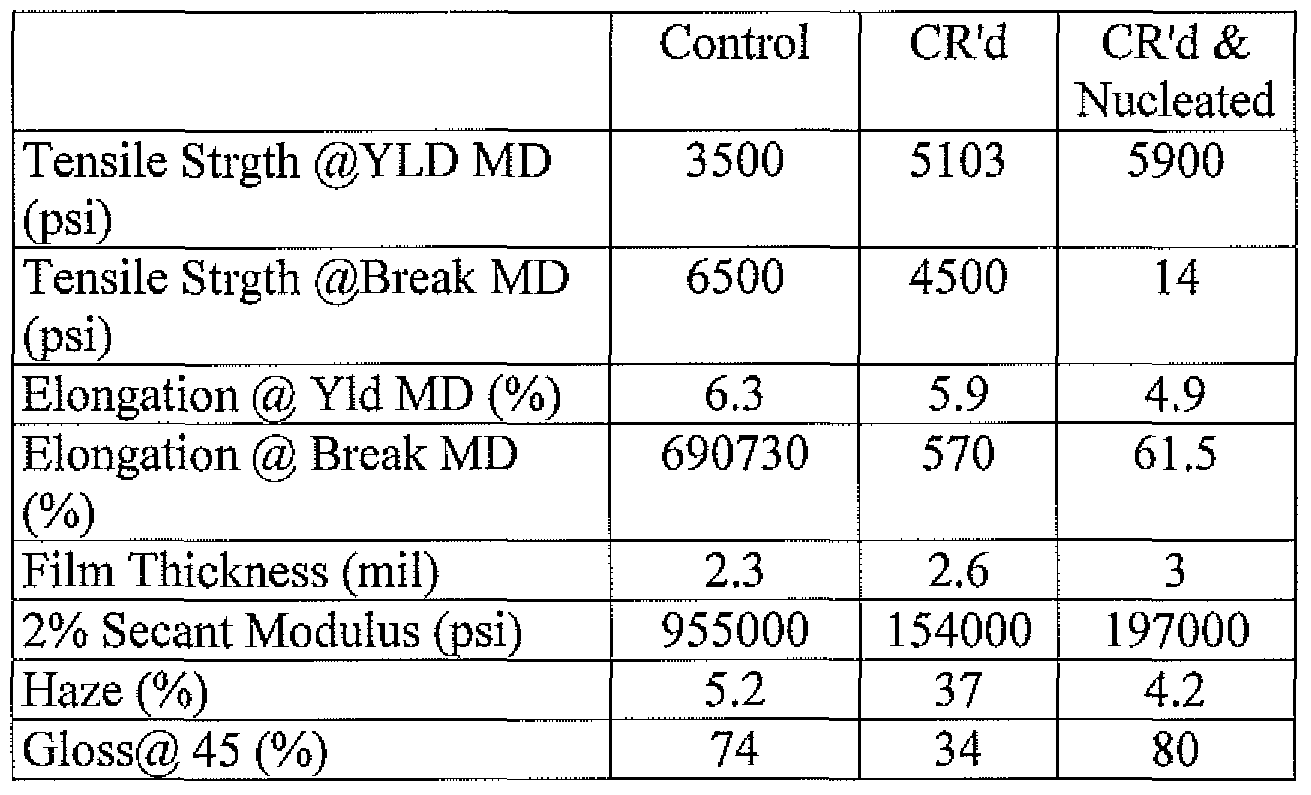
- the films produced may have haze properties of from 2% to 20%, or from 4% to 15%, or from 5% to 10%. In one embodiment, the films produced may have gloss at 45° of from 50% to 90%, or from 70% to 85%, or from 75% to 80%.
- the films produced may have a 2% secant modulus of from 100 kpsi to 300 kpsi, or from 150 kpsi to 250 kpsi, or from 175 kpsi to 200 kpsi. In one embodiment, the films produced may have tensile strength at yield of from 3000 psi to 7500 psi, or from 4000 psi to 6500 psi, or from 5000 psi to 6000 psi. In one embodiment, the films produced may have an elongation at yield of from 1% to 15%, or from 2% to 10%, or from 4% to 8%.
- the films produced may have tensile strength at break of from 1 psi to 50 psi, or from 5 psi to 25 psi, or from 10 psi to 15 psi. In one embodiment, the films produced may have an elongation at break of from 25% to 75%, or from 40% to 65%, or from
- the films produced may have a thickness of from 1 mil to 10 mil, or from 3 mil to 8 mil, or 5 mil.
- the resin used was TOTAL Petrochemicals 3270 available from TOTAL
- CR' d means 3270 visbroken
- CR' d and Nucleated means 3270 visbroken with nucleators added.
Landscapes
- Chemical & Material Sciences (AREA)
- Engineering & Computer Science (AREA)
- Mechanical Engineering (AREA)
- Manufacturing & Machinery (AREA)
- Medicinal Chemistry (AREA)
- Polymers & Plastics (AREA)
- Organic Chemistry (AREA)
- Chemical Kinetics & Catalysis (AREA)
- Health & Medical Sciences (AREA)
- Materials Engineering (AREA)
- Crystallography & Structural Chemistry (AREA)
- Physics & Mathematics (AREA)
- General Physics & Mathematics (AREA)
- Theoretical Computer Science (AREA)
- Compositions Of Macromolecular Compounds (AREA)
- Manufacture Of Macromolecular Shaped Articles (AREA)
- Addition Polymer Or Copolymer, Post-Treatments, Or Chemical Modifications (AREA)
- Containers Having Bodies Formed In One Piece (AREA)
- Extrusion Moulding Of Plastics Or The Like (AREA)
Abstract
Description
Claims
Priority Applications (4)
| Application Number | Priority Date | Filing Date | Title |
|---|---|---|---|
| EA201171108A EA201171108A1 (en) | 2009-03-26 | 2010-03-24 | POLYOLEPHIN FILMS FOR MOLDED LABELS |
| JP2012502189A JP2012522267A (en) | 2009-03-26 | 2010-03-24 | Polyolefin film for in-mold labels |
| EP10756751.3A EP2411214B1 (en) | 2009-03-26 | 2010-03-24 | Polyolefin films for in-mold labels |
| CN2010800140539A CN102361750A (en) | 2009-03-26 | 2010-03-24 | Polyolefin films for in-mold labels |
Applications Claiming Priority (2)
| Application Number | Priority Date | Filing Date | Title |
|---|---|---|---|
| US12/411,887 | 2009-03-26 | ||
| US12/411,887 US20100247887A1 (en) | 2009-03-26 | 2009-03-26 | Polyolefin films for in-mold labels |
Publications (1)
| Publication Number | Publication Date |
|---|---|
| WO2010111332A1 true WO2010111332A1 (en) | 2010-09-30 |
Family
ID=42781456
Family Applications (1)
| Application Number | Title | Priority Date | Filing Date |
|---|---|---|---|
| PCT/US2010/028412 Ceased WO2010111332A1 (en) | 2009-03-26 | 2010-03-24 | Polyolefin films for in-mold labels |
Country Status (7)
| Country | Link |
|---|---|
| US (1) | US20100247887A1 (en) |
| EP (1) | EP2411214B1 (en) |
| JP (1) | JP2012522267A (en) |
| KR (1) | KR20120001730A (en) |
| CN (1) | CN102361750A (en) |
| EA (1) | EA201171108A1 (en) |
| WO (1) | WO2010111332A1 (en) |
Families Citing this family (2)
| Publication number | Priority date | Publication date | Assignee | Title |
|---|---|---|---|---|
| US9827729B2 (en) | 2012-05-25 | 2017-11-28 | Phoenix Packaging Operations, LLC | Food container top with integrally formed utensil |
| CN109070568B (en) * | 2016-03-28 | 2021-08-27 | 东洋纺株式会社 | Biaxially stretched laminated polypropylene film |
Citations (42)
| Publication number | Priority date | Publication date | Assignee | Title |
|---|---|---|---|---|
| US4271060A (en) | 1979-09-17 | 1981-06-02 | Phillips Petroleum Company | Solution polymerization process |
| US4543399A (en) | 1982-03-24 | 1985-09-24 | Union Carbide Corporation | Fluidized bed reaction systems |
| US4588790A (en) | 1982-03-24 | 1986-05-13 | Union Carbide Corporation | Method for fluidized bed polymerization |
| US5001205A (en) | 1988-06-16 | 1991-03-19 | Exxon Chemical Patents Inc. | Process for production of a high molecular weight ethylene α-olefin elastomer with a metallocene alumoxane catalyst |
| US5028670A (en) | 1988-07-15 | 1991-07-02 | Bp Chemicals Limited | Process for the gas-phase polymerization of olefins in a fluidized-bed reactor |
| US5236998A (en) | 1991-03-07 | 1993-08-17 | Occidental Chemical Corporation | Process for the manufacture of linear polyethylene containing α-alkene commonomers |
| US5317036A (en) | 1992-10-16 | 1994-05-31 | Union Carbide Chemicals & Plastics Technology Corporation | Gas phase polymerization reactions utilizing soluble unsupported catalysts |
| US5352749A (en) | 1992-03-19 | 1994-10-04 | Exxon Chemical Patents, Inc. | Process for polymerizing monomers in fluidized beds |
| US5405922A (en) | 1993-04-26 | 1995-04-11 | Exxon Chemical Patents Inc. | Process for polymerizing monomers in fluidized beds |
| US5436304A (en) | 1992-03-19 | 1995-07-25 | Exxon Chemical Patents Inc. | Process for polymerizing monomers in fluidized beds |
| US5456471A (en) | 1992-08-18 | 1995-10-10 | Macdonald; Donald K. | Golf practice apparatus and fabricating process |
| US5462999A (en) | 1993-04-26 | 1995-10-31 | Exxon Chemical Patents Inc. | Process for polymerizing monomers in fluidized beds |
| US5525678A (en) | 1994-09-22 | 1996-06-11 | Mobil Oil Corporation | Process for controlling the MWD of a broad/bimodal resin produced in a single reactor |
| US5589555A (en) | 1991-10-03 | 1996-12-31 | Novacor Chemicals (International) S.A. | Control of a solution process for polymerization of ethylene |
| US5616661A (en) | 1995-03-31 | 1997-04-01 | Union Carbide Chemicals & Plastics Technology Corporation | Process for controlling particle growth during production of sticky polymers |
| US5627242A (en) | 1996-03-28 | 1997-05-06 | Union Carbide Chemicals & Plastics Technology Corporation | Process for controlling gas phase fluidized bed polymerization reactor |
| US5665818A (en) | 1996-03-05 | 1997-09-09 | Union Carbide Chemicals & Plastics Technology Corporation | High activity staged reactor process |
| US5668228A (en) | 1993-05-20 | 1997-09-16 | Bp Chemicals Limited | Polymerization process |
| US5677375A (en) | 1995-07-21 | 1997-10-14 | Union Carbide Chemicals & Plastics Technology Corporation | Process for producing an in situ polyethylene blend |
| US6180735B1 (en) | 1998-12-17 | 2001-01-30 | Univation Technologies | Catalyst composition and methods for its preparation and use in a polymerization process |
| US6207606B1 (en) | 1998-05-15 | 2001-03-27 | Univation Technologies, Llc | Mixed catalysts and their use in a polymerization process |
| US6211105B1 (en) | 1998-11-13 | 2001-04-03 | Univation Technologies, Lld | Nitrogen-containing group 13 anionic complexes for olefin polymerization |
| US6242545B1 (en) | 1997-12-08 | 2001-06-05 | Univation Technologies | Polymerization catalyst systems comprising substituted hafinocenes |
| US6245705B1 (en) | 1993-11-18 | 2001-06-12 | Univation Technologies | Cocatalysts for metallocene-based olefin polymerization catalyst systems |
| US6245868B1 (en) | 1998-05-29 | 2001-06-12 | Univation Technologies | Catalyst delivery method, a catalyst feeder and their use in a polymerization process |
| US6271323B1 (en) | 1999-10-28 | 2001-08-07 | Univation Technologies, Llc | Mixed catalyst compounds, catalyst systems and their use in a polymerization process |
| US6274684B1 (en) | 1999-10-22 | 2001-08-14 | Univation Technologies, Llc | Catalyst composition, method of polymerization, and polymer therefrom |
| US6300436B1 (en) | 1998-07-10 | 2001-10-09 | Univation Technologies, Llc | Catalyst composition and methods for its preparation and use in a polymerization process |
| US6339134B1 (en) | 1999-05-06 | 2002-01-15 | Univation Technologies, Llc | Polymerization process for producing easier processing polymers |
| US6340730B1 (en) | 1999-12-06 | 2002-01-22 | Univation Technologies, Llc | Multiple catalyst system |
| US6346586B1 (en) | 1999-10-22 | 2002-02-12 | Univation Technologies, Llc | Method for preparing a supported catalyst system and its use in a polymerization process |
| US6359072B1 (en) | 2000-02-16 | 2002-03-19 | Univation Technologies, Llc | Polyethylene films having improved optical properties |
| US6380328B1 (en) | 1999-12-10 | 2002-04-30 | Univation Technologies, Llc | Catalyst systems and their use in a polymerization process |
| US6420580B1 (en) | 1999-11-05 | 2002-07-16 | Univation Technologies, Llc | Catalyst compositions and method of polymerization therewith |
| US6476172B1 (en) * | 2001-07-27 | 2002-11-05 | Fina Technology, Inc. | Metallocene catalyzed propylene-α-olefin random copolymer melt spun fibers |
| WO2005066247A1 (en) | 2003-12-24 | 2005-07-21 | Petroquimica Cuyo S.A.I.C. | Sealing layer resin compositions |
| US20060024520A1 (en) | 2004-08-02 | 2006-02-02 | Dan-Cheng Kong | Permeable polypropylene film |
| US20070003777A1 (en) * | 2005-03-03 | 2007-01-04 | Yupo Corporation | In-mold label and molded article using the same |
| US20070100053A1 (en) * | 2002-08-12 | 2007-05-03 | Chapman Bryan R | Plasticized polyolefin compositions |
| US20080061468A1 (en) * | 2006-09-07 | 2008-03-13 | Frank Li | Fiber processing of high ethylene level propylene-ethylene random copolymers by use of nucleators |
| US20080161515A1 (en) * | 2006-12-29 | 2008-07-03 | Fina Technology, Inc. | Succinate-Containing Polymerization Catalyst System Using n-Butylmethyldimethoxysilane for Preparation of Polypropylene Film Grade Resins |
| EP2159253A1 (en) | 2008-09-02 | 2010-03-03 | Total Petrochemicals Research Feluy | Metallocene-catalyzed polypropylene cast or blown film with improved film forming properties. |
Family Cites Families (6)
| Publication number | Priority date | Publication date | Assignee | Title |
|---|---|---|---|---|
| US3287342A (en) * | 1963-05-09 | 1966-11-22 | Phillips Petroleum Co | Process for visbreaking polyolefins |
| US6090325A (en) | 1997-09-24 | 2000-07-18 | Fina Technology, Inc. | Biaxially-oriented metallocene-based polypropylene films |
| WO2002066230A1 (en) * | 2001-02-22 | 2002-08-29 | Yupo Corporation | Label for in-mold forming |
| EP1376516B1 (en) * | 2002-06-26 | 2008-05-21 | Avery Dennison Corporation | Machine direction oriented polymeric films |
| US20060062951A1 (en) * | 2004-09-23 | 2006-03-23 | Fina Technology, Inc. | Opaque films for use in packaging |
| US20060279026A1 (en) * | 2005-06-09 | 2006-12-14 | Fina Technology, Inc. | Polypropylene composition for injection stretch blow molding |
-
2009
- 2009-03-26 US US12/411,887 patent/US20100247887A1/en not_active Abandoned
-
2010
- 2010-03-24 JP JP2012502189A patent/JP2012522267A/en active Pending
- 2010-03-24 EP EP10756751.3A patent/EP2411214B1/en not_active Revoked
- 2010-03-24 KR KR1020117021825A patent/KR20120001730A/en not_active Withdrawn
- 2010-03-24 EA EA201171108A patent/EA201171108A1/en unknown
- 2010-03-24 CN CN2010800140539A patent/CN102361750A/en active Pending
- 2010-03-24 WO PCT/US2010/028412 patent/WO2010111332A1/en not_active Ceased
Patent Citations (43)
| Publication number | Priority date | Publication date | Assignee | Title |
|---|---|---|---|---|
| US4271060A (en) | 1979-09-17 | 1981-06-02 | Phillips Petroleum Company | Solution polymerization process |
| US4543399A (en) | 1982-03-24 | 1985-09-24 | Union Carbide Corporation | Fluidized bed reaction systems |
| US4588790A (en) | 1982-03-24 | 1986-05-13 | Union Carbide Corporation | Method for fluidized bed polymerization |
| US5001205A (en) | 1988-06-16 | 1991-03-19 | Exxon Chemical Patents Inc. | Process for production of a high molecular weight ethylene α-olefin elastomer with a metallocene alumoxane catalyst |
| US5028670A (en) | 1988-07-15 | 1991-07-02 | Bp Chemicals Limited | Process for the gas-phase polymerization of olefins in a fluidized-bed reactor |
| US5236998A (en) | 1991-03-07 | 1993-08-17 | Occidental Chemical Corporation | Process for the manufacture of linear polyethylene containing α-alkene commonomers |
| US5589555A (en) | 1991-10-03 | 1996-12-31 | Novacor Chemicals (International) S.A. | Control of a solution process for polymerization of ethylene |
| US5436304A (en) | 1992-03-19 | 1995-07-25 | Exxon Chemical Patents Inc. | Process for polymerizing monomers in fluidized beds |
| US5352749A (en) | 1992-03-19 | 1994-10-04 | Exxon Chemical Patents, Inc. | Process for polymerizing monomers in fluidized beds |
| US5456471A (en) | 1992-08-18 | 1995-10-10 | Macdonald; Donald K. | Golf practice apparatus and fabricating process |
| US5317036A (en) | 1992-10-16 | 1994-05-31 | Union Carbide Chemicals & Plastics Technology Corporation | Gas phase polymerization reactions utilizing soluble unsupported catalysts |
| US5462999A (en) | 1993-04-26 | 1995-10-31 | Exxon Chemical Patents Inc. | Process for polymerizing monomers in fluidized beds |
| US5405922A (en) | 1993-04-26 | 1995-04-11 | Exxon Chemical Patents Inc. | Process for polymerizing monomers in fluidized beds |
| US5668228A (en) | 1993-05-20 | 1997-09-16 | Bp Chemicals Limited | Polymerization process |
| US6245705B1 (en) | 1993-11-18 | 2001-06-12 | Univation Technologies | Cocatalysts for metallocene-based olefin polymerization catalyst systems |
| US5525678A (en) | 1994-09-22 | 1996-06-11 | Mobil Oil Corporation | Process for controlling the MWD of a broad/bimodal resin produced in a single reactor |
| US5616661A (en) | 1995-03-31 | 1997-04-01 | Union Carbide Chemicals & Plastics Technology Corporation | Process for controlling particle growth during production of sticky polymers |
| US5677375A (en) | 1995-07-21 | 1997-10-14 | Union Carbide Chemicals & Plastics Technology Corporation | Process for producing an in situ polyethylene blend |
| US5665818A (en) | 1996-03-05 | 1997-09-09 | Union Carbide Chemicals & Plastics Technology Corporation | High activity staged reactor process |
| US5627242A (en) | 1996-03-28 | 1997-05-06 | Union Carbide Chemicals & Plastics Technology Corporation | Process for controlling gas phase fluidized bed polymerization reactor |
| US6242545B1 (en) | 1997-12-08 | 2001-06-05 | Univation Technologies | Polymerization catalyst systems comprising substituted hafinocenes |
| US6248845B1 (en) | 1997-12-08 | 2001-06-19 | Univation Technologies | Polymerization catalyst systems comprising substituted hafnocenes |
| US6207606B1 (en) | 1998-05-15 | 2001-03-27 | Univation Technologies, Llc | Mixed catalysts and their use in a polymerization process |
| US6245868B1 (en) | 1998-05-29 | 2001-06-12 | Univation Technologies | Catalyst delivery method, a catalyst feeder and their use in a polymerization process |
| US6300436B1 (en) | 1998-07-10 | 2001-10-09 | Univation Technologies, Llc | Catalyst composition and methods for its preparation and use in a polymerization process |
| US6211105B1 (en) | 1998-11-13 | 2001-04-03 | Univation Technologies, Lld | Nitrogen-containing group 13 anionic complexes for olefin polymerization |
| US6180735B1 (en) | 1998-12-17 | 2001-01-30 | Univation Technologies | Catalyst composition and methods for its preparation and use in a polymerization process |
| US6339134B1 (en) | 1999-05-06 | 2002-01-15 | Univation Technologies, Llc | Polymerization process for producing easier processing polymers |
| US6274684B1 (en) | 1999-10-22 | 2001-08-14 | Univation Technologies, Llc | Catalyst composition, method of polymerization, and polymer therefrom |
| US6346586B1 (en) | 1999-10-22 | 2002-02-12 | Univation Technologies, Llc | Method for preparing a supported catalyst system and its use in a polymerization process |
| US6271323B1 (en) | 1999-10-28 | 2001-08-07 | Univation Technologies, Llc | Mixed catalyst compounds, catalyst systems and their use in a polymerization process |
| US6420580B1 (en) | 1999-11-05 | 2002-07-16 | Univation Technologies, Llc | Catalyst compositions and method of polymerization therewith |
| US6340730B1 (en) | 1999-12-06 | 2002-01-22 | Univation Technologies, Llc | Multiple catalyst system |
| US6380328B1 (en) | 1999-12-10 | 2002-04-30 | Univation Technologies, Llc | Catalyst systems and their use in a polymerization process |
| US6359072B1 (en) | 2000-02-16 | 2002-03-19 | Univation Technologies, Llc | Polyethylene films having improved optical properties |
| US6476172B1 (en) * | 2001-07-27 | 2002-11-05 | Fina Technology, Inc. | Metallocene catalyzed propylene-α-olefin random copolymer melt spun fibers |
| US20070100053A1 (en) * | 2002-08-12 | 2007-05-03 | Chapman Bryan R | Plasticized polyolefin compositions |
| WO2005066247A1 (en) | 2003-12-24 | 2005-07-21 | Petroquimica Cuyo S.A.I.C. | Sealing layer resin compositions |
| US20060024520A1 (en) | 2004-08-02 | 2006-02-02 | Dan-Cheng Kong | Permeable polypropylene film |
| US20070003777A1 (en) * | 2005-03-03 | 2007-01-04 | Yupo Corporation | In-mold label and molded article using the same |
| US20080061468A1 (en) * | 2006-09-07 | 2008-03-13 | Frank Li | Fiber processing of high ethylene level propylene-ethylene random copolymers by use of nucleators |
| US20080161515A1 (en) * | 2006-12-29 | 2008-07-03 | Fina Technology, Inc. | Succinate-Containing Polymerization Catalyst System Using n-Butylmethyldimethoxysilane for Preparation of Polypropylene Film Grade Resins |
| EP2159253A1 (en) | 2008-09-02 | 2010-03-03 | Total Petrochemicals Research Feluy | Metallocene-catalyzed polypropylene cast or blown film with improved film forming properties. |
Non-Patent Citations (1)
| Title |
|---|
| See also references of EP2411214A4 |
Also Published As
| Publication number | Publication date |
|---|---|
| EP2411214A1 (en) | 2012-02-01 |
| EA201171108A1 (en) | 2012-05-30 |
| CN102361750A (en) | 2012-02-22 |
| KR20120001730A (en) | 2012-01-04 |
| EP2411214A4 (en) | 2013-11-13 |
| US20100247887A1 (en) | 2010-09-30 |
| JP2012522267A (en) | 2012-09-20 |
| EP2411214B1 (en) | 2014-11-05 |
Similar Documents
| Publication | Publication Date | Title |
|---|---|---|
| US8026305B2 (en) | Articles formed from nucleated polyethylene | |
| JP2012522073A (en) | Process for producing heterophase copolymer and use thereof | |
| CN101341209A (en) | Polypropylene composition for stretched articles | |
| US8623484B2 (en) | Injection stretch blow molded articles and polymers for use therein | |
| EP2411214B1 (en) | Polyolefin films for in-mold labels | |
| EP1871832A1 (en) | Biaxially oriented propylene polymer films | |
| US20100010175A1 (en) | Additives for Polyolefin Extruder Start-Up | |
| US20100210797A1 (en) | Polyethylene Films having Improved Barrier Properties | |
| US8399587B2 (en) | Mini-random copolymer resins having improved mechanical toughness and related properties suitable for thin wall thermoforming applications | |
| US8114932B2 (en) | Neutralizer modified propylene based polymers and processes of forming the same | |
| US20100249354A1 (en) | Injection stretch blow molded articles and syndiotactic polymers for use therein | |
| WO2023148259A1 (en) | Polyolefin blend containing recycled aluminium | |
| US20110305857A1 (en) | Modified polypropylene for packaging applications | |
| WO2011056760A9 (en) | Blends of polypropylene and polyethylene and methods of forming the same | |
| US8507628B2 (en) | Propylene based polymers for injection stretch blow molding | |
| TW201130864A (en) | Mini-random copolymer resins |
Legal Events
| Date | Code | Title | Description |
|---|---|---|---|
| WWE | Wipo information: entry into national phase |
Ref document number: 201080014053.9 Country of ref document: CN |
|
| 121 | Ep: the epo has been informed by wipo that ep was designated in this application |
Ref document number: 10756751 Country of ref document: EP Kind code of ref document: A1 |
|
| WWE | Wipo information: entry into national phase |
Ref document number: 2010756751 Country of ref document: EP |
|
| WWE | Wipo information: entry into national phase |
Ref document number: 2012502189 Country of ref document: JP |
|
| ENP | Entry into the national phase |
Ref document number: 20117021825 Country of ref document: KR Kind code of ref document: A |
|
| NENP | Non-entry into the national phase |
Ref country code: DE |
|
| WWE | Wipo information: entry into national phase |
Ref document number: 201171108 Country of ref document: EA |