WO2010045682A1 - Storage stable compositions and methods for preparing same - Google Patents
Storage stable compositions and methods for preparing same Download PDFInfo
- Publication number
- WO2010045682A1 WO2010045682A1 PCT/AU2009/001386 AU2009001386W WO2010045682A1 WO 2010045682 A1 WO2010045682 A1 WO 2010045682A1 AU 2009001386 W AU2009001386 W AU 2009001386W WO 2010045682 A1 WO2010045682 A1 WO 2010045682A1
- Authority
- WO
- WIPO (PCT)
- Prior art keywords
- composition
- physiological
- initial
- anaesthetic
- months
- Prior art date
- Legal status (The legal status is an assumption and is not a legal conclusion. Google has not performed a legal analysis and makes no representation as to the accuracy of the status listed.)
- Ceased
Links
Classifications
-
- A—HUMAN NECESSITIES
- A61—MEDICAL OR VETERINARY SCIENCE; HYGIENE
- A61K—PREPARATIONS FOR MEDICAL, DENTAL OR TOILETRY PURPOSES
- A61K31/00—Medicinal preparations containing organic active ingredients
- A61K31/16—Amides, e.g. hydroxamic acids
- A61K31/165—Amides, e.g. hydroxamic acids having aromatic rings, e.g. colchicine, atenolol, progabide
- A61K31/167—Amides, e.g. hydroxamic acids having aromatic rings, e.g. colchicine, atenolol, progabide having the nitrogen of a carboxamide group directly attached to the aromatic ring, e.g. lidocaine, paracetamol
-
- A—HUMAN NECESSITIES
- A61—MEDICAL OR VETERINARY SCIENCE; HYGIENE
- A61K—PREPARATIONS FOR MEDICAL, DENTAL OR TOILETRY PURPOSES
- A61K9/00—Medicinal preparations characterised by special physical form
- A61K9/0012—Galenical forms characterised by the site of application
- A61K9/0019—Injectable compositions; Intramuscular, intravenous, arterial, subcutaneous administration; Compositions to be administered through the skin in an invasive manner
-
- A—HUMAN NECESSITIES
- A61—MEDICAL OR VETERINARY SCIENCE; HYGIENE
- A61P—SPECIFIC THERAPEUTIC ACTIVITY OF CHEMICAL COMPOUNDS OR MEDICINAL PREPARATIONS
- A61P23/00—Anaesthetics
- A61P23/02—Local anaesthetics
Definitions
- the present invention relates to methods for preparing storage stable compositions, and in particular pharmaceutical compositions.
- the invention also relates to storage stable compositions and methods for minimising the pain and discomfort associated with injections.
- compositions such as vaccines and anaesthetics are often commercially available as acidic solutions. The reason for this is to ensure the solubility and/or stability of the active compounds which are not stable and/or not soluble at a higher pH.
- buffering agents such as bicarbonate are not readily available in a form suitable for this purpose.
- a further disadvantage lies in the fact that the person giving the injection must measure out a precise amount of buffering agent to add to the anaesthetic composition and perform the addition whilst maintaining sterility of the composition shortly before every injection. This is because the active compounds are only stable and/or soluble for a limited time following addition of the base.
- compositions which have a non-acidic pH, including physiological pH.
- Such compositions are highly desirable as they could be administered by physicians without prior neutralisation and with minimal pain and discomfort to the patient. Accordingly, there is a need for compositions, in particular anaesthetic compositions, which are stable at non-acidic pH for example at physiological pH for an extended period of time.
- the present invention provides a method for preparing a composition having a desired pH the method comprising:
- the desired pH may be a non-acidic pH, for example physiological pH.
- the initial composition may have a pH between about 4.5 and about 6.9.
- the pH may be increased in step (ii) to a level between about 5.0 and about 7.0.
- the pH may be increased in step (ii) by less than about 20%, or by less than about
- Carbon dioxide may be added to the composition until the pH decreases by between about 0.1 and about 4 pH units.
- the desired pH is a non-acidic pH, for example physiological pH
- the initial composition has a pH between about 6.0 and about 6.8, base is added to increase the pH to below about 7.0 and carbon dioxide is added so as to decrease the pH by at least 0.5 pH units.
- the desired pH is a non-acidic pH, for example physiological pH
- the initial composition has a pH between about 6.0 and about 6.8, base is added to increase the pH to below about 7.0 and carbon dioxide is added so as to decrease the pH by between about 0.5 and about 2 pH units.
- the desired pH is a non-acidic pH, for example physiological pH
- the initial composition has a pH between about 6.2 and about 6.7
- base is added to increase the pH to below about 7.0
- carbon dioxide is added so as to decrease the pH by between about 0.5 and about 2 pH units.
- the desired pH is a non-acidic pH, for example physiological pH
- the initial composition has a pH between about 6.4 and about 6.7
- base is added to increase the pH to below about 7.0
- carbon dioxide is added so as to decrease the pH by between about 1 and about 2 pH units.
- the desired pH is a non-acidic pH, for example physiological pH
- the initial composition has a pH between about 6.5 and about 6.7
- base is added to increase the pH to below about 7.0
- carbon dioxide is added so as to decrease the pH by between about 1 and about 1.5 pH units.
- the desired pH is a non-acidic pH, for example physiological pH
- the initial composition has a pH between about 6.4 and about 6.7
- base is added to increase the pH by less than about 10%, or less than about 5%
- carbon dioxide is added so as to decrease the pH by between about 1 and about 2 pH units.
- the base may be bicarbonate, for example sodium bicarbonate.
- the composition may be a pharmaceutical composition.
- the composition may be a pharmaceutical composition intended for injection.
- the composition may be a food or drink composition.
- the pharmaceutical composition may be an anaesthetic composition or a vaccine composition.
- the pharmaceutical composition may be an anaesthetic composition or a vaccine composition intended for injection.
- the anaesthetic composition may be any local anaesthetic composition. Examples include, but are not limited to: lignocaine, prilocaine, etidocaine, articaine, marcaine, carbocaine, bupivacaine and mepivacaine compositions.
- the pH of the composition may increase over time and ultimately reach the desired pH by the release of carbon dioxide from the composition.
- the method may further comprise the step of sterilising the composition.
- the present invention provides a composition whenever prepared by the method of the first aspect.
- the composition may have a non-acidic pH, for example physiological pH.
- the present invention provides a stable composition comprising one or more compounds that are not stable and/or not soluble at physiological pH, said composition having a pH between about 7.1 and about 7.6.
- the composition may be a pharmaceutical composition.
- the composition may be a vaccine or anaesthetic composition.
- the composition may be a local anaesthetic composition, for example a lignocaine composition.
- the composition may have a pH between about 7.1 and about 7-.5, or between about 7.2 and about 7.6, or between about 7.2 and about 7.5.
- composition may be stable for a period beyond three months, four months, five months, six months, seven months, eight months, nine months, ten months, eleven months, twelve months, eighteen months or twenty-four months.
- composition may be stable for at least three months, four months, five months, six months, seven months, eight months, nine months, ten months, eleven months, twelve months, eighteen months or twenty-four months.
- the composition may be stable for a period of up to three months, four months, five months, six months, seven months, eight months, nine months, ten months, eleven months, twelve months, eighteen months or twenty-four months.
- composition may be stable for the above noted periods at a temperature between about 15 °C and 25 °C.
- the present invention provides a container comprising a stable anaesthetic composition including one or more compounds that are not stable and/or not soluble at physiological pH, said composition having a pH between about 7.1 and about 7.6.
- the anaesthetic composition may be a local anaesthetic composition, for example a lignocaine composition.
- the composition may have a pH between about 7.1 and about 7.5, or between about
- the composition may be stable for a period beyond three months, four months, five months, six months, seven months, eight months, nine months, ten months, eleven months, twelve months, eighteen months or twenty-four months.
- the composition may be stable for at least three months, four months, five months, six months, seven months, eight months, nine months, ten months, eleven months, twelve months, eighteen months or twenty-four months.
- the composition may be stable for a period of up to three months, four months, five months, six months, seven months, eight months, nine months, ten months, eleven months, twelve months, eighteen months or twenty-four months.
- composition may be stable for the above noted periods at a temperature between about 15 °C and 25 °C.
- the present invention provides a method for reducing and/or minimising the pain and/or sting experienced by a subject that is associated with an injection, said method comprising injection into the subject of a composition of the second aspect or third aspect.
- the composition may be an anaesthetic or vaccine composition.
- the method of the fifth aspect may involve reducing and/or minimising the pain and/or sting experienced by a subject that is associated with injection of an anaesthetic or vaccine composition having an acidic pH, the method comprising injection into the subject of a composition of the second or third aspects having a physiological pH.
- the subject may be an animal, for example a human.
- an element means one element or more than one element.
- stable is understood to mean that active compound(s) included in the composition do not irreversibly precipitate out of solution, and/or do not decompose (for example to a level such that administration of the composition does not produce the desired effect or activity) and/or that the solution does not irreversibly form precipitates (such as crystals) or become turbid.
- stable may also mean that one or more compounds included in the composition do not undergo undesired physical and/or chemical changes which adversely affect the properties or use of the composition.
- physiological pH means a pH in the range of about 7.1 to about 7.6, or a pH in the range of about 7.2 to about 7.6
- the present invention relates to a method for preparing stable compositions comprising compounds that are not normally stable and/or not normally soluble at the pH of the compositions.
- the invention further relates to compositions prepared by the method, and also methods for reducing and/or minimising the pain and/or sting associated with compositions administered by injection.
- the first aspect of the invention provides a method for preparing a composition having a desired pH the method comprising:
- the desired pH is physiological pH, however it is to be understood that the desired pH may be any pH that is above the pH of the initial composition.
- the desired pH may be a pH in the range of about 6.5 and about 8.0.
- the desired pH may be in the range of about 5.5 and about 6.5.
- the initial composition may be any composition that comprises one or more active compounds that are not normally stable and/or not normally soluble at the desired pH.
- the composition may, for example, be an anaesthetic composition or a vaccine composition, or any composition that is intended for injection.
- the composition may be a food or drink composition.
- the desired pH will be dependent on the nature of the initial .composition and its intended use. For example, if the composition is to be injected, then the desired pH may be physiological pH, or a pH that is near physiological pH. Alternatively, if the composition is a beverage composition then the desired pH may be lower, for example in the range of about 5.0 to about 6.0.
- the initial composition may have a pH of between about 4.5 and about 6.9, or between about 5.0 and about 6.9, or between about 5.5 and about 6.9, or between about 6.0 and about 6.9, or between about 6.2 and about 6.9, or between about 6.3 and about 6.9, or between about 6.4 and about 6.9, or between about 6.5 and about 6.9, or between about 6.6 and about 6.9, or between about 6.6 and about 6.85.
- the initial composition has a pH between about 6.5 and about 6.8.
- Step (ii) of the method involves adding a base to the composition so as to increase the pH of the composition to a pH below the desired pH. Where the pH is increased to the desired pH or above by addition of a base, the resulting composition will become turbid and/or exhibit precipitation within a matter of a few days to weeks after the composition is allowed to stand.
- the amount of base added to the composition may be an amount sufficient to increase the pH by less than about 30%, 29%, 28%, 27%, 26%, 25%, 24%, 23%, 22%, 21%, 20%, 19%, 18%, 17%, 16%, 15%, 14%, 13%, 12%, 11%, 10%, 9%, 8%, 7%, 6%, 5%, 4%, 3%, 2% or 1%, of the pH of the initial composition.
- the amount of base added to the composition may be an amount sufficient to increase the pH by between about 1% and about 30%, or between about 1% and about 20%, or between about 1% and about 15%, or between about 1% and about 10%, or between about 1% and about 8%, or between about 1% and about 6%, or between about 2% and about 10%, or between about 3% and about 10%, or between about 2% and about 8%, or between about 2% and about 6%, or between about 0.1% and about 10%, or between about 0.1% and about 8%, or between about 0.1% and about 7%, or between about 0.1% and about 6%, or between about 0.5% and about 8%, or between about 0.5% and about 6%, or between about 0.5% and about 5%, or between about 0.5% and about 4%, or between about 0.75% and about 4%, or between about 1% and about 5% of the pH of the initial composition.
- the pH may be raised to a level between about 5.0 and about 7.0, or between about 5.0 and about 6.95, or between about 5.5 and about 6.95, or between about 6.0 and about 6.95, or between about 6.2 and about 6.95, or between about 6.3 and about 6.95, or between about 6.4 and about 6.95, or between about 6.5 and about 6.95, or between about 6.6 and about 6.95, or between about 6.7 and about 6.9, or between about 6.75 and about 6.95, or between about 6.75 and about 6.9, or between about 6.7 and about 7.0.
- the pH may be raised to a level below about 7.0, 6.95, 6.9, 6.85, 6.8, 6.75, 6.7, 6.65, 6.6, 6.55, 6.5, 6.4, 6.3, 6.2 or 6.1. In one embodiment, the pH may be raised to between about 6.7 and about 6.95.
- the base may be, for example, any physiologically acceptable base.
- the base is bicarbonate which may be present as either 'an alkali or alkali earth metal salt, for example sodium bicarbonate, magnesium bicarbonate or potassium bicarbonate.
- Step (iii) of the method involves introducing carbon dioxide into the composition so as to decrease the pH of the composition. Introduction of carbon dioxide may be achieved by bubbling carbon dioxide gas into the composition, or alternatively by adding a compound to the composition that liberates carbon dioxide in solution.
- Carbon dioxide may be introduced into the composition until the pH decreases by between about 0.1 and about 4 pH units, or between about 0.1 and about 3 pH units, or between about 0.1 and about 2 pH units, or between about 0.2 and about 3 pH units, or between about 0.3 and about 3 pH units, or between about 0.4 and about 3 pH units or between about 0.5 and about 3 pH units or between about 0.6 and about 3 pH units, or between about 0.7 and about 3 pH units, or between about 0.8 and about 3 pH units, or between about 0.9 and about 3 pH units, or between about 1 and about 3 pH units or between about 1 and about 2.5 pH units, or between about 1.25 and about 2.5 pH units, or between about 1 and about 1.5 pH units.
- carbon dioxide may be introduced into the composition until the pH decreases by between about 1 and about 2 pH units.
- Steps (ii) and (iii) may be performed in any order, i.e. the base may be added before or after the carbon dioxide is added to the composition.
- carbon dioxide may be added to the initial composition so as to decrease the pH by at least 0.5 pH units, followed by addition of base so as to increase the pH by less than about 5% of the pH of the initial composition.
- Step (iv) involves allowing the composition to stand such that the pH increases over time and ultimately reaches the desired pH. This may be achieved by allowing the composition to stand in a container such that carbon dioxide is able to escape from the composition.
- the container may be a permeable or semi-permeable container. In an alternative embodiment, it is possible to allow the composition to stand in a non-permeable container so as to achieve the pH increase.
- the composition may be allowed to stand at room temperature (approximately 15 0 C to 25 °C), or alternatively may be stored at reduced temperature, for example in a refrigerator. Where the composition is allowed to stand in a permeable or semi-permeable container, the time required for the composition to reach the desired pH may be reduced by subjecting the composition to reduced pressure and/or to heat, thereby increasing the rate at which carbon dioxide escapes from the composition.
- the method of the first aspect may further comprise the step of sterilising the composition.
- Sterilisation may be performed at any stage of the method, for example after step (iii).
- Methods for sterilisation are well known to those skilled in the art and may include, for example, filtration (for example microfiltration), UV radiation, gamma radiation, some other form of sterilising radiation or some other form of sterilisation.
- the sterilisation may be conducted so as not to damage or degrade any of the active compounds in the composition.
- sterilising radiation UV, gamma or other
- the present invention provides a method for preparing a composition having a desired pH which is physiological pH comprising:
- an anaesthetic composition comprising one or more compounds that are not stable and/or not soluble at physiological pH, the composition having an initial pH of between about 6.4 and about 6.7; (ii) adding a base to the composition to increase the pH thereof by an amount that is less than about 10% of the initial pH;
- Step (ii) may comprise adding a base to the composition to increase the pH thereof by an amount that is less than about 3%, 4%, 5%, 6%, 7%, 8% or 9% of the initial pH.
- Step (ii) may comprise adding a base to the composition to increase the pH thereof by an amount between about 0.5% and about 10%, or between about 0.5.% and about 5%, of the initial pH.
- Step (iii) may comprise decreasing the pH of the composition by between about 0.5 and about 2, or by between about 1 and about 2, pH units.
- the pH of the composition may increase over time and ultimately reach physiological pH by release of carbon dioxide from the composition.
- the present invention provides a method for preparing a composition having a desired pH which is physiological pH comprising: (i) providing an anaesthetic composition comprising one or more compounds that are not stable and/or not soluble at physiological pH, the composition having an initial pH of between about 6.4 and about 6.75;
- Step (iii) decreasing the pH of the composition by at least 0.5 pH units by adding carbon dioxide thereto; and (iv) allowing the pH of the composition to increase over time -and ultimately reach physiological pH.
- Step (iii) may comprise decreasing the pH of the composition by between about 0.5 and about 2, or by between about 1 and about 2, pH units.
- the pH of the composition may increase over time and ultimately reach physiological pH by release of carbon dioxide from the composition.
- the anaesthetic composition may be a local anaesthetic composition comprising lignocaine, for example Xylocaine® (AstraZeneca).
- Local anaesthetic compositions prepared in accordance with the method of the first aspect have surprisingly been found to be stable on storage at room temperature (about 15 °C to 25 °C) for a period up to and exceeding twelve months.
- compositions prepared using combinations of base and carbon dioxide by methods other than the" method of the first aspect show a marked reduction in anaesthetic efficacy and often exhibit turbidity and/or precipitation within a matter of a few days to a few weeks following preparation.
- the inventor believes that the combination of increasing the pH of the composition to a pH below the desired pH in the presence of carbon dioxide creates a unique set of conditions wherein compounds not normally stable and/or not normally soluble at the desired pH are effectively stabilised at such a pH.
- compositions prepared in accordance with the methods of the invention having a physiological pH result in a significantly reduced stinging sensation as compared to injection of the same composition having a lower pH.
- the method of the first aspect may be carried out as follows:
- Aim is to prepare a beverage composition having a desired pH which is between about 5.5 and about 6.0; (ii) providing a beverage composition comprising one or more compounds that are susceptible to discolouration and/or precipitation at increased pH, the composition having an initial pH of between about 4.0 and about 4.5;
- the method of the first aspect may be carried out as follows:
- Aim is to prepare a local anaesthetic composition having a desired pH which is physiological pH;
- the composition obtained typically reaches a pH of about 7.2 after 1 to 2 months and is stable for a period up to and beyond twelve months whilst at the same time maintaining anaesthetic activity throughout this period. Because of its increased pH, injection of the composition results in significantly less pain and stinging when injected into a patient as compared to injection of a commercial -caine anaesthetic having a pH of less than 6.8.
- the above method may be repeated wherein the anaesthetic composition is replaced by another composition comprising a pharmacologically active compound or compounds, for example a vaccine composition.
- the method is also applicable to any water-based composition that requires an acidic pH so as to maintain stability of the active compound(s).
- the method may also be used to prepare a stable aqueous composition comprising genetic material at a higher pH than that which is currently achievable, whilst maintaining the structure, form and properties of the material.
- the method may also find application generally in industrial processes wherein it is desired to prepare a stable aqueous solution at a higher pH than that which is currently achievable.
- compositions comprising local anaesthetics at physiological pH Storage stable compositions comprising lignocaine were prepared in accordance with the method of the first aspect as follows:
- Carbon dioxide gas is then introduced into each ampoule via syringe at a rate of about 1 to 2 litres per minute for a period of 60 seconds so as to reduce the pH by at least 0.5 pH units.
- the pH values of each solution following addition of base are depicted in Table 2 below:
- the ampoules were sealed using a soldering iron and hot melt glue applied.
- the ampoules were then stored at room temperature (approximately 15 °C to 25 °C) in the absence of light.
- the pH values of TTO, X2, 444 and XC8 were checked over a period of five months. Within two months, all samples had reached physiological pH whilst at the same time maintaining anaesthetic activity. Sample XC8 attained the highest pH during this period (7.36), whilst sample X2 attained the lowest pH (7.1). Where it is desired to increase the pH of a composition to the upper range of physiological pH, an increased amount of base addition may be necessary. Samples X2 and 444 reached pH's of 7.21 and 7.23 respectively after about the same -time period thereby confirming the reproducibility of the method of the invention.
- samples XC8, X2 and 444 had pH values of 7.34, 7.16 and 7.23 respectively.
- the samples did not contain any precipitate and all retained anaesthetic activity.
- Sample XC8 was checked again after a period of twelve months and found to contain no precipitate nor turbidity.
- the pH of the composition was 7.43. Surprisingly, the anaesthetic activity remained.
- Sample ND was allowed to stand for a period of twelve months and the pH was not assessed prior to the expiry of this period. After twelve months the sample attained a pH of 7.43. Surprisingly, the anaesthetic activity remained and the sample appeared clear with no evidence of precipitation or turbidity.
- the anaesthetic activity of all samples was tested qualitatively by comparing the anaesthetic effect resulting from subcutaneous injection (but not into the dermis) of 1 mL of the relevant sample and 1 mL of 2% lignocaine drawn from a new ampoule.
Landscapes
- Health & Medical Sciences (AREA)
- Public Health (AREA)
- Animal Behavior & Ethology (AREA)
- Veterinary Medicine (AREA)
- Medicinal Chemistry (AREA)
- Life Sciences & Earth Sciences (AREA)
- Pharmacology & Pharmacy (AREA)
- Chemical & Material Sciences (AREA)
- General Health & Medical Sciences (AREA)
- Epidemiology (AREA)
- Anesthesiology (AREA)
- Nuclear Medicine, Radiotherapy & Molecular Imaging (AREA)
- Organic Chemistry (AREA)
- General Chemical & Material Sciences (AREA)
- Dermatology (AREA)
- Chemical Kinetics & Catalysis (AREA)
- Pain & Pain Management (AREA)
- Pharmaceuticals Containing Other Organic And Inorganic Compounds (AREA)
- Medicinal Preparation (AREA)
Abstract
The present invention relates to methods for preparing storage stable compositions, and in particular pharmaceutical compositions. The invention also relates to storage stable compositions and methods for minimising the pain and discomfort associated with injections.
Description
STORAGE STABLE COMPOSITIONS AND METHODS FOR PREPARING SAME
Technical field
The present invention relates to methods for preparing storage stable compositions, and in particular pharmaceutical compositions. The invention also relates to storage stable compositions and methods for minimising the pain and discomfort associated with injections.
Background
Compositions such as vaccines and anaesthetics are often commercially available as acidic solutions. The reason for this is to ensure the solubility and/or stability of the active compounds which are not stable and/or not soluble at a higher pH.
When injected into a patient, the acidic solutions result in pain and discomfort. Generally the pain and discomfort increases as the pH decreases. In order to minimise these unwanted side effects in local anaesthetic compositions it is possible to add a base, such as bicarbonate, just prior to injection of the anaesthetic so as to raise the pH of the composition and thereby minimise pain and discomfort.
One disadvantage of this approach is that buffering agents such as bicarbonate are not readily available in a form suitable for this purpose. A further disadvantage lies in the fact that the person giving the injection must measure out a precise amount of buffering agent to add to the anaesthetic composition and perform the addition whilst maintaining sterility of the composition shortly before every injection. This is because the active compounds are only stable and/or soluble for a limited time following addition of the base.
To date, there are no commercially available stable local anaesthetic compositions which have a non-acidic pH, including physiological pH. Such compositions are highly desirable as they could be administered by physicians without prior neutralisation and with minimal pain and discomfort to the patient. Accordingly, there is a need for compositions, in particular anaesthetic compositions, which are stable at non-acidic pH for example at physiological pH for an extended period of time.
The present inventor has discovered that storage stable compositions comprising active compounds not normally stable and/or not normally soluble at non-acidic pH can be prepared at such a pH. In the context of local anaesthetics this is particularly surprising and unexpected given the view in the art generally that stable local anaesthetic compositions simply cannot be prepared at a non-acidic pH.
Summary of the Invention
In a first aspect, the present invention provides a method for preparing a composition having a desired pH the method comprising:
(i) providing an initial composition comprising one or more compounds that are not stable and/or not soluble at the desired pH, the composition having a pH that is less than the desired pH; (ii) adding a base to the composition to increase the pH thereof to a pH below the desired pH;
(iii) decreasing the pH of the composition by adding carbon dioxide thereto; and (iv) allowing the composition to stand such that the pH of the composition increases over time and ultimately reaches the desired pH. The desired pH may be a non-acidic pH, for example physiological pH. The initial composition may have a pH between about 4.5 and about 6.9. The pH may be increased in step (ii) to a level between about 5.0 and about 7.0. The pH may be increased in step (ii) by less than about 20%, or by less than about
10%, or by less than about 5%, of the pH of the initial composition.
Carbon dioxide may be added to the composition until the pH decreases by between about 0.1 and about 4 pH units.
In one embodiment, the desired pH is a non-acidic pH, for example physiological pH, the initial composition has a pH between about 6.0 and about 6.8, base is added to increase the pH to below about 7.0 and carbon dioxide is added so as to decrease the pH by at least 0.5 pH units.
In another embodiment, the desired pH is a non-acidic pH, for example physiological pH, the initial composition has a pH between about 6.0 and about 6.8, base is added to increase the pH to below about 7.0 and carbon dioxide is added so as to decrease the pH by between about 0.5 and about 2 pH units.
In a further embodiment, the desired pH is a non-acidic pH, for example physiological pH, the initial composition has a pH between about 6.2 and about 6.7, base is added to increase the pH to below about 7.0 and carbon dioxide is added so as to decrease the pH by between about 0.5 and about 2 pH units.
In yet another embodiment, the desired pH is a non-acidic pH, for example physiological pH, the initial composition has a pH between about 6.4 and about 6.7, base is added to increase the pH to below about 7.0 and carbon dioxide is added so as to decrease the pH by between about 1 and about 2 pH units.
In a further embodiment, the desired pH is a non-acidic pH, for example physiological pH, the initial composition has a pH between about 6.5 and about 6.7, base is added to increase the pH to below about 7.0 and carbon dioxide is added so as to decrease the pH by between about 1 and about 1.5 pH units. In yet another embodiment, the desired pH is a non-acidic pH, for example physiological pH, the initial composition has a pH between about 6.4 and about 6.7, base is added to increase the pH by less than about 10%, or less than about 5%, of the pH of the initial composition and carbon dioxide is added so as to decrease the pH by between about 1 and about 2 pH units. The base may be bicarbonate, for example sodium bicarbonate.
The composition may be a pharmaceutical composition.
The composition may be a pharmaceutical composition intended for injection.
The composition may be a food or drink composition.
The pharmaceutical composition may be an anaesthetic composition or a vaccine composition.
The pharmaceutical composition may be an anaesthetic composition or a vaccine composition intended for injection.
The anaesthetic composition may be any local anaesthetic composition. Examples include, but are not limited to: lignocaine, prilocaine, etidocaine, articaine, marcaine, carbocaine, bupivacaine and mepivacaine compositions.
The pH of the composition may increase over time and ultimately reach the desired pH by the release of carbon dioxide from the composition.
The method may further comprise the step of sterilising the composition.
In a second aspect, the present invention provides a composition whenever prepared by the method of the first aspect.
The composition may have a non-acidic pH, for example physiological pH.
In a third aspect, the present invention provides a stable composition comprising one or more compounds that are not stable and/or not soluble at physiological pH, said composition having a pH between about 7.1 and about 7.6. The composition may be a pharmaceutical composition.
The composition may be a vaccine or anaesthetic composition.
The composition may be a local anaesthetic composition, for example a lignocaine composition.
The composition may have a pH between about 7.1 and about 7-.5, or between about 7.2 and about 7.6, or between about 7.2 and about 7.5.
The composition may be stable for a period beyond three months, four months, five months, six months, seven months, eight months, nine months, ten months, eleven months, twelve months, eighteen months or twenty-four months.
The composition may be stable for at least three months, four months, five months, six months, seven months, eight months, nine months, ten months, eleven months, twelve months, eighteen months or twenty-four months.
The composition may be stable for a period of up to three months, four months, five months, six months, seven months, eight months, nine months, ten months, eleven months, twelve months, eighteen months or twenty-four months.
The composition may be stable for the above noted periods at a temperature between about 15 °C and 25 °C.
In a fourth aspect, the present invention provides a container comprising a stable anaesthetic composition including one or more compounds that are not stable and/or not soluble at physiological pH, said composition having a pH between about 7.1 and about 7.6.
The anaesthetic composition may be a local anaesthetic composition, for example a lignocaine composition. The composition may have a pH between about 7.1 and about 7.5, or between about
7.2 and about 7.6, or between about 7.2 and about 7.5.
The composition may be stable for a period beyond three months, four months, five months, six months, seven months, eight months, nine months, ten months, eleven months, twelve months, eighteen months or twenty-four months. The composition may be stable for at least three months, four months, five months, six months, seven months, eight months, nine months, ten months, eleven months, twelve months, eighteen months or twenty-four months.
The composition may be stable for a period of up to three months, four months, five months, six months, seven months, eight months, nine months, ten months, eleven months, twelve months, eighteen months or twenty-four months.
The composition may be stable for the above noted periods at a temperature between about 15 °C and 25 °C.
In a fifth aspect, the present invention provides a method for reducing and/or minimising the pain and/or sting experienced by a subject that is associated with an
injection, said method comprising injection into the subject of a composition of the second aspect or third aspect.
The composition may be an anaesthetic or vaccine composition.
The method of the fifth aspect may involve reducing and/or minimising the pain and/or sting experienced by a subject that is associated with injection of an anaesthetic or vaccine composition having an acidic pH, the method comprising injection into the subject of a composition of the second or third aspects having a physiological pH.
The subject may be an animal, for example a human.
Definitions The following are some definitions that may be helpful in understanding the description of the present invention. These are intended as general definitions and should in no way limit the scope of the present invention to those terms alone, but are put forth for a better understanding of the following description.
Throughout this specification, unless the context requires otherwise, the word "comprise", or variations such as "comprises" or" comprising", will be understood to imply the inclusion of a stated step or element or integer or group of steps or elements or integers, but not the exclusion of any other step or element or integer or group of elements or integers. Thus, in the context of this specification, the term "comprising" means "including principally, but not necessarily solely". In the context of this specification, the term "about," is understood to refer to a range of numbers that a person of skill in the art would consider equivalent to the recited value in the context of achieving the same function or result.
In the context of this specification, the terms "a" and "an" are used herein to refer to one or to more than one (i.e. to at least one) of the grammatical object of the article. By way of example, "an element" means one element or more than one element.
In the context of this specification the term "stable" is understood to mean that active compound(s) included in the composition do not irreversibly precipitate out of solution, and/or do not decompose (for example to a level such that administration of the composition does not produce the desired effect or activity) and/or that the solution does not irreversibly form precipitates (such as crystals) or become turbid. The term "stable" may also mean that one or more compounds included in the composition do not undergo undesired physical and/or chemical changes which adversely affect the properties or use of the composition.
In the context of this specification the term "physiological pH" means a pH in the range of about 7.1 to about 7.6, or a pH in the range of about 7.2 to about 7.6
Detailed Description of the Invention
The present invention relates to a method for preparing stable compositions comprising compounds that are not normally stable and/or not normally soluble at the pH of the compositions. The invention further relates to compositions prepared by the method, and also methods for reducing and/or minimising the pain and/or sting associated with compositions administered by injection.
The first aspect of the invention provides a method for preparing a composition having a desired pH the method comprising:
(i) providing an initial composition comprising one or more compounds that are not stable and/or not soluble at the desired pH, the composition having a pH that is less than the desired pH;
(ii) adding a base to the composition to increase the pH thereof to a pH below the desired pH;
(iii) decreasing the pH of the composition by adding carbon dioxide thereto; and (iv) allowing the composition to stand such that the pH of the composition increases over time and ultimately reaches the desired pH.
In one embodiment the desired pH is physiological pH, however it is to be understood that the desired pH may be any pH that is above the pH of the initial composition. For example, if the pH of the initial composition is between about 4 and about 6, then the desired pH may be a pH in the range of about 6.5 and about 8.0. Alternatively, if the pH of the initial composition is between about 3 and about 4 for example, then the desired pH may be in the range of about 5.5 and about 6.5. The initial composition may be any composition that comprises one or more active compounds that are not normally stable and/or not normally soluble at the desired pH. The composition may, for example, be an anaesthetic composition or a vaccine composition, or any composition that is intended for injection. Alternatively, the composition may be a food or drink composition. The desired pH will be dependent on the nature of the initial .composition and its intended use. For example, if the composition is to be injected, then the desired pH may be physiological pH, or a pH that is near physiological pH. Alternatively, if the composition is a beverage composition then the desired pH may be lower, for example in the range of about 5.0 to about 6.0.
The initial composition may have a pH of between about 4.5 and about 6.9, or between about 5.0 and about 6.9, or between about 5.5 and about 6.9, or between about 6.0 and about 6.9, or between about 6.2 and about 6.9, or between about 6.3 and about 6.9, or between about 6.4 and about 6.9, or between about 6.5 and about 6.9, or between about 6.6 and about 6.9, or between about 6.6 and about 6.85. In one embodiment, the initial composition has a pH between about 6.5 and about 6.8.
Step (ii) of the method involves adding a base to the composition so as to increase the pH of the composition to a pH below the desired pH. Where the pH is increased to the desired pH or above by addition of a base, the resulting composition will become turbid and/or exhibit precipitation within a matter of a few days to weeks after the composition is allowed to stand.
The amount of base added to the composition may be an amount sufficient to increase the pH by less than about 30%, 29%, 28%, 27%, 26%, 25%, 24%, 23%, 22%, 21%, 20%, 19%, 18%, 17%, 16%, 15%, 14%, 13%, 12%, 11%, 10%, 9%, 8%, 7%, 6%, 5%, 4%, 3%, 2% or 1%, of the pH of the initial composition. The amount of base added to the composition may be an amount sufficient to increase the pH by between about 1% and about 30%, or between about 1% and about 20%, or between about 1% and about 15%, or between about 1% and about 10%, or between about 1% and about 8%, or between about 1% and about 6%, or between about 2% and about 10%, or between about 3% and about 10%, or between about 2% and about 8%, or between about 2% and about 6%, or between about 0.1% and about 10%, or between about 0.1% and about 8%, or between about 0.1% and about 7%, or between about 0.1% and about 6%, or between about 0.5% and about 8%, or between about 0.5% and about 6%, or between about 0.5% and about 5%, or between about 0.5% and about 4%, or between about 0.75% and about 4%, or between about 1% and about 5% of the pH of the initial composition.
The pH may be raised to a level between about 5.0 and about 7.0, or between about 5.0 and about 6.95, or between about 5.5 and about 6.95, or between about 6.0 and about 6.95, or between about 6.2 and about 6.95, or between about 6.3 and about 6.95, or between about 6.4 and about 6.95, or between about 6.5 and about 6.95, or between about 6.6 and about 6.95, or between about 6.7 and about 6.9, or between about 6.75 and about 6.95, or between about 6.75 and about 6.9, or between about 6.7 and about 7.0. The pH may be raised to a level below about 7.0, 6.95, 6.9, 6.85, 6.8, 6.75, 6.7, 6.65, 6.6, 6.55, 6.5, 6.4, 6.3, 6.2 or 6.1. In one embodiment, the pH may be raised to between about 6.7 and about 6.95.
The base may be, for example, any physiologically acceptable base. In one embodiment, the base is bicarbonate which may be present as either 'an alkali or alkali earth metal salt, for example sodium bicarbonate, magnesium bicarbonate or potassium bicarbonate. Step (iii) of the method involves introducing carbon dioxide into the composition so as to decrease the pH of the composition. Introduction of carbon dioxide may be achieved by bubbling carbon dioxide gas into the composition, or alternatively by adding a compound to the composition that liberates carbon dioxide in solution.
Carbon dioxide may be introduced into the composition until the pH decreases by between about 0.1 and about 4 pH units, or between about 0.1 and about 3 pH units, or between about 0.1 and about 2 pH units, or between about 0.2 and about 3 pH units, or between about 0.3 and about 3 pH units, or between about 0.4 and about 3 pH units or between about 0.5 and about 3 pH units or between about 0.6 and about 3 pH units, or between about 0.7 and about 3 pH units, or between about 0.8 and about 3 pH units, or between about 0.9 and about 3 pH units, or between about 1 and about 3 pH units or between about 1 and about 2.5 pH units, or between about 1.25 and about 2.5 pH units, or between about 1 and about 1.5 pH units. In one embodiment, carbon dioxide may be introduced into the composition until the pH decreases by between about 1 and about 2 pH units. Steps (ii) and (iii) may be performed in any order, i.e. the base may be added before or after the carbon dioxide is added to the composition. In one embodiment for example, carbon dioxide may be added to the initial composition so as to decrease the pH by at least 0.5 pH units, followed by addition of base so as to increase the pH by less than about 5% of the pH of the initial composition. Step (iv) involves allowing the composition to stand such that the pH increases over time and ultimately reaches the desired pH. This may be achieved by allowing the composition to stand in a container such that carbon dioxide is able to escape from the composition. The container may be a permeable or semi-permeable container. In an alternative embodiment, it is possible to allow the composition to stand in a non-permeable container so as to achieve the pH increase.
The composition may be allowed to stand at room temperature (approximately 15 0C to 25 °C), or alternatively may be stored at reduced temperature, for example in a refrigerator. Where the composition is allowed to stand in a permeable or semi-permeable container, the time required for the composition to reach the desired pH may be reduced by
subjecting the composition to reduced pressure and/or to heat, thereby increasing the rate at which carbon dioxide escapes from the composition.
The method of the first aspect may further comprise the step of sterilising the composition. Sterilisation may be performed at any stage of the method, for example after step (iii). Methods for sterilisation are well known to those skilled in the art and may include, for example, filtration (for example microfiltration), UV radiation, gamma radiation, some other form of sterilising radiation or some other form of sterilisation. The sterilisation may be conducted so as not to damage or degrade any of the active compounds in the composition. Thus sterilising radiation (UV, gamma or other), if used, should be in a dose sufficiently high to sterilise the composition but sufficiently low to avoid damage or degradation of any active compounds in the composition.
In an embodiment of the first aspect, the present invention provides a method for preparing a composition having a desired pH which is physiological pH comprising:
(i) providing an anaesthetic composition comprising one or more compounds that are not stable and/or not soluble at physiological pH, the composition having an initial pH of between about 6.4 and about 6.7; (ii) adding a base to the composition to increase the pH thereof by an amount that is less than about 10% of the initial pH;
(iii) decreasing the pH of the composition by at least 0.5 pH units by adding carbon dioxide thereto; and
(iv) allowing the pH of the composition to increase over time "and ultimately reach physiological pH.
Step (ii) may comprise adding a base to the composition to increase the pH thereof by an amount that is less than about 3%, 4%, 5%, 6%, 7%, 8% or 9% of the initial pH. Step (ii) may comprise adding a base to the composition to increase the pH thereof by an amount between about 0.5% and about 10%, or between about 0.5.% and about 5%, of the initial pH.
Step (iii) may comprise decreasing the pH of the composition by between about 0.5 and about 2, or by between about 1 and about 2, pH units. The pH of the composition may increase over time and ultimately reach physiological pH by release of carbon dioxide from the composition.
In another embodiment of the first aspect, the present invention provides a method for preparing a composition having a desired pH which is physiological pH comprising:
(i) providing an anaesthetic composition comprising one or more compounds that are not stable and/or not soluble at physiological pH, the composition having an initial pH of between about 6.4 and about 6.75;
(ii) adding a base to the composition to increase the pH thereof to a pH below the desired pH;
(iii) decreasing the pH of the composition by at least 0.5 pH units by adding carbon dioxide thereto; and (iv) allowing the pH of the composition to increase over time -and ultimately reach physiological pH. Step (iii) may comprise decreasing the pH of the composition by between about 0.5 and about 2, or by between about 1 and about 2, pH units.
The pH of the composition may increase over time and ultimately reach physiological pH by release of carbon dioxide from the composition.
In the above embodiments, the anaesthetic composition may be a local anaesthetic composition comprising lignocaine, for example Xylocaine® (AstraZeneca). Local anaesthetic compositions prepared in accordance with the method of the first aspect have surprisingly been found to be stable on storage at room temperature (about 15 °C to 25 °C) for a period up to and exceeding twelve months. In contrast, compositions prepared using combinations of base and carbon dioxide by methods other than the" method of the first aspect show a marked reduction in anaesthetic efficacy and often exhibit turbidity and/or precipitation within a matter of a few days to a few weeks following preparation.
Without wishing to be bound by theory, the inventor believes that the combination of increasing the pH of the composition to a pH below the desired pH in the presence of carbon dioxide creates a unique set of conditions wherein compounds not normally stable and/or not normally soluble at the desired pH are effectively stabilised at such a pH.
When administered by injection, local anaesthetic compositions prepared in accordance with the methods of the invention having a physiological pH result in a significantly reduced stinging sensation as compared to injection of the same composition having a lower pH. Modes for carrying out the invention
In an embodiment of the invention, the method of the first aspect may be carried out as follows:
(i) Aim is to prepare a beverage composition having a desired pH which is between about 5.5 and about 6.0;
(ii) providing a beverage composition comprising one or more compounds that are susceptible to discolouration and/or precipitation at increased pH, the composition having an initial pH of between about 4.0 and about 4.5;
(iii) adding bicarbonate to the composition in an amount sufficient to increase the pH of the composition to between about 5.0 and about 5.2 (i.e. below the desired pH);
(iv) decreasing the pH of the composition by bubbling carbon dioxide gas through the composition for a period of time sufficient to lower the pH to about 4.5; and, (v) allowing the pH of the composition to increase over time and ultimately reach the desired pH (i.e about 5.5 to about 6.0) by storing the composition in a container comprising a semi-permeable membrane so as to allow carbon dioxide to escape from the composition.
In another embodiment of the invention, the method of the first aspect may be carried out as follows:
(i) Aim is to prepare a local anaesthetic composition having a desired pH which is physiological pH;
(ii) providing a local anaesthetic composition comprising a -caine anaesthetic compound, the composition having an initial pH of between about 6.3 and about 6.7;
(iii) adding bicarbonate to the composition in an amount sufficient to increase the pH of the composition to between about 6.75 and about 6.95 (i.e. below the desired pH); (iv) decreasing the pH of the composition by bubbling carbon dioxide gas through the composition for a period of time sufficient to lower the pH to below about 5.5 (or possibly below about 6.0); and,
(v) allowing the pH of the composition to increase over time and ultimately reach the desired pH (i.e physiological pH) by storing the composition in a container comprising a semi-permeable membrane so as to allow carbon dioxide to escape from the composition.
The composition obtained typically reaches a pH of about 7.2 after 1 to 2 months and is stable for a period up to and beyond twelve months whilst at the same time maintaining anaesthetic activity throughout this period. Because of its increased pH, injection of the
composition results in significantly less pain and stinging when injected into a patient as compared to injection of a commercial -caine anaesthetic having a pH of less than 6.8.
The above method may be repeated wherein the anaesthetic composition is replaced by another composition comprising a pharmacologically active compound or compounds, for example a vaccine composition. Furthermore, the method is also applicable to any water-based composition that requires an acidic pH so as to maintain stability of the active compound(s).
The method may also be used to prepare a stable aqueous composition comprising genetic material at a higher pH than that which is currently achievable, whilst maintaining the structure, form and properties of the material. The method may also find application generally in industrial processes wherein it is desired to prepare a stable aqueous solution at a higher pH than that which is currently achievable.
The invention will now be described in more detail, by way of illustration only, with respect to the following examples. The examples are intended to serve to illustrate this invention and should not be construed as limiting the generality of the disclosure of the description throughout this specification.
Examples
Preparation of compositions comprising local anaesthetics at physiological pH Storage stable compositions comprising lignocaine were prepared in accordance with the method of the first aspect as follows:
Five ampoules of Xylocaine® (AstraZeneca) containing 2% lignocaine (100 mg in 5 mL) are provided. All compositions except one had a measured pH of 6.65.*
Sodium bicarbonate intravenous infusion BP 8.4% (8.4 g in 100 mL) was used as the base, and is added via a syringe to each ampoule in amounts of 0.02 mL (TTO) 0.04 mL (X2) 0.04 mL (444), 0.08 mL (XC8) and 0.1 mL (ND). The pH values of each solution following addition of base are depicted in Table 1 below:
TABLE 1
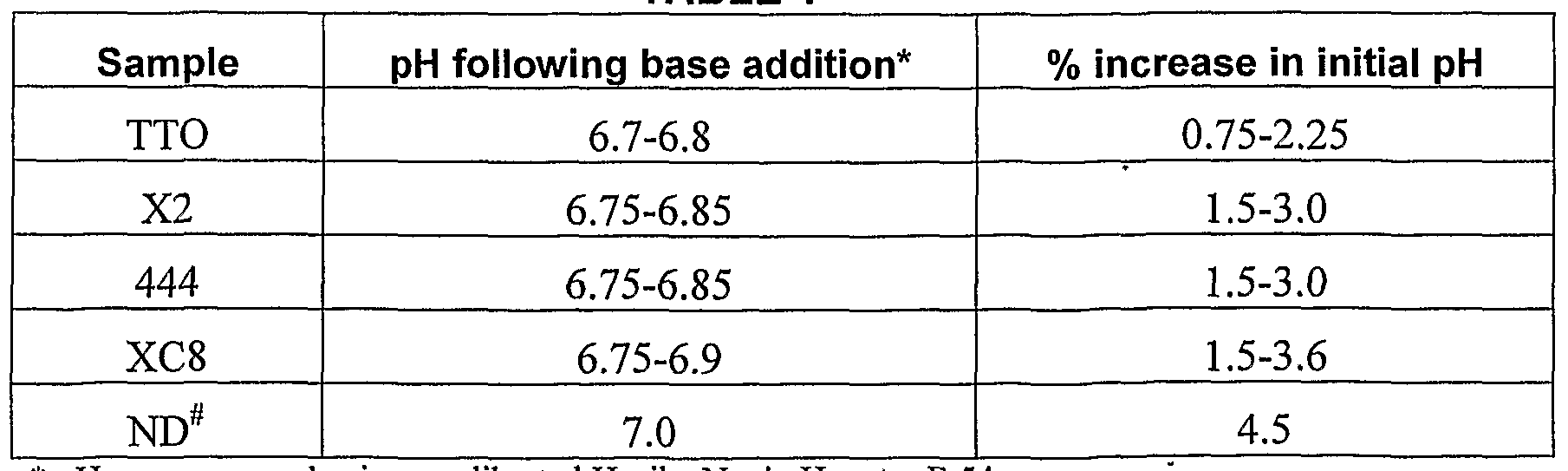
* pH was measured using a calibrated Horiba Navi pH meter F-54 *The initial pH of this sample was 6.70
When buffering lignocaine just prior to injection according" to current methods, a ratio of one part sodium bicarbonate to nine or ten parts of lignocaine is typically used. This corresponds to 0.5 mL of sodium bicarbonate (8.4%). When this amount of sodium bicarbonate is added either in the presence or absence of carbon dioxide a stable solution at physiological pH cannot be created.
Carbon dioxide gas is then introduced into each ampoule via syringe at a rate of about 1 to 2 litres per minute for a period of 60 seconds so as to reduce the pH by at least 0.5 pH units. The pH values of each solution following addition of base are depicted in Table 2 below:
TABLE 2

*pH was measured using a calibrated Horiba Navi pH meter F-54
Following addition of carbon dioxide, the ampoules were sealed using a soldering iron and hot melt glue applied. The ampoules were then stored at room temperature (approximately 15 °C to 25 °C) in the absence of light. The pH values of TTO, X2, 444 and XC8 were checked over a period of five months. Within two months, all samples had reached physiological pH whilst at the same time maintaining anaesthetic activity. Sample XC8 attained the highest pH during this period (7.36), whilst sample X2 attained the lowest pH (7.1). Where it is desired to increase the pH of a composition to the upper range of physiological pH, an increased amount of base addition may be necessary. Samples X2 and 444 reached pH's of 7.21 and 7.23 respectively after about the same -time period thereby confirming the reproducibility of the method of the invention.
After a period of four months, samples XC8, X2 and 444 had pH values of 7.34, 7.16 and 7.23 respectively. The samples did not contain any precipitate and all retained anaesthetic activity.
Sample XC8 was checked again after a period of twelve months and found to contain no precipitate nor turbidity. The pH of the composition was 7.43. Surprisingly, the anaesthetic activity remained.
Sample ND was allowed to stand for a period of twelve months and the pH was not assessed prior to the expiry of this period. After twelve months the sample attained a pH of 7.43. Surprisingly, the anaesthetic activity remained and the sample appeared clear with no evidence of precipitation or turbidity. The anaesthetic activity of all samples was tested qualitatively by comparing the anaesthetic effect resulting from subcutaneous injection (but not into the dermis) of 1 mL of the relevant sample and 1 mL of 2% lignocaine drawn from a new ampoule.
Comparative experiments were also performed by the methods described above wherein samples of Xylocaine® were subjected to addition of carbon dioxide only, or a base only. It was found that samples wherein only carbon dioxide was added attained pH values that were about the same as the pH of the initial composition (i.e. about 6.6) after a period of four months. In these experiments, carbon dioxide was added to the initial composition until the pH reached between 5.6 and 5.8. It was not therefore possible to achieve physiological pH by using carbon dioxide addition only. Where only base is added (i.e. bicarbonate) in an amount sufficient to achieve physiological pH, the resultant compositions became unstable within a matter of days or weeks.
Those skilled in the art will appreciate that the invention described herein is susceptible to variations and modifications other than those specifically described. It is to be understood that the invention includes all such variations and modifications.
Claims
1. A method for preparing a composition having a desired pH the method comprising:
(i) providing an initial composition comprising one or more compounds that are not stable and/or not soluble at the desired pH, the composition having a pH that is less than the desired pH; (ii) adding a base to the composition to increase the pH thereof to a pH below the desired pH;
(iii) decreasing the pH of the composition by adding carbon dioxide thereto; and (iv) allowing the composition to stand such that the pH of the composition increases over time and ultimately reaches the desired pH.
2. The method of claim 1 , wherein the desired pH is a non-acidic pH.
3. The method of claim 1 or claim 2, wherein the desired pH is physiological pH.
4. The method of any one of claims 1 to 3, wherein the initial composition has a pH between about 4.5 and about 6.9.
5. The method of claim 4, wherein the initial composition has a pH between about 6.0 and about 6.9.
6. The method of claim 5, wherein the initial composition has a pH between about 6.5 and about 6.8.
7. The method of any one of claims 1 to 6, wherein the pH is increased in step (ii) by less than about 20% of the pH of the initial composition.
8. The method of claim 7, wherein the pH is increased in step (ii) by less than about 10% of the pH of the initial composition.
9. The method of claim 8, wherein the pH is increased in step (ii) by less than about 5% of the pH of the initial composition.
10. The method of any one of claims 1 to 9, wherein carbon dioxide is added to the composition until the pH decreases by between about 0.1 and about 4 pH units.
1 1. The method of any one of claims 1 to 10, wherein the base is bicarbonate.
12. The method of any one of claims 1 to 11, wherein the composition is a pharmaceutical composition.
13. The method of claim 12, wherein the pharmaceutical composition is an injectable anaesthetic composition or an injectable vaccine composition.
14. The method of claim 13, wherein the anaesthetic composition is a local anaesthetic composition.
15. The method of any one of claims 1 to 14, wherein the pH of the composition increases over time and ultimately reaches the desired pH by release of carbon dioxide from the composition.
16. The method of claim 1, comprising preparing a composition having a desired pH which is physiological pH, the method comprising the following steps:
(i) providing an anaesthetic composition comprising one or more compounds that are not stable and/or not soluble at physiological pH, the composition having an initial pH of between about 6.4 and about 6.7;
(ii) adding a base to the composition to increase the pH thereof by an amount that is less than about 10% of the initial pH; (iii) decreasing the pH of the composition by at least 0.5 pH units by adding carbon dioxide thereto; and (iv) allowing the pH of the composition to increase over time and ultimately reach physiological pH.
17. The method of claim 16, wherein step (ii) comprises adding a base to the composition to increase the pH thereof by an amount that is between about 0.5% and about 10% of the initial pH.
18. The method of claim 16 or claim 17, wherein step (iii) comprises decreasing the pH of the composition by between about 0.5 and about 2 pH units.
19. The method of claim 1, comprising preparing a composition having a desired pH which is physiological pH, the method comprising the following steps:
(i) providing an anaesthetic composition comprising one or more compounds that are not stable and/or not soluble at physiological pH, the composition having an initial pH of between about 6.4 and about 6.75; (ii) adding a base to the composition to increase the pH thereof to a pH below the desired pH;
(iii) decreasing the pH of the composition by at least 0.5 pH units by adding carbon dioxide thereto; and
(iv) allowing the pH of the composition to increase over time and ultimately reach physiological pH.
20. The method of claim 19, wherein step (iii) comprises decreasing the pH of the composition by between about 0.5 and about 2 pH units.
21. The method of any one of claims 16 to 20, wherein the composition is a local anaesthetic composition.
22. A composition whenever prepared by the method of any one of claims 1 to 21.
23. The composition of claim 22, wherein the composition' has a physiological pH.
24. A stable composition comprising one or more compounds that are not stable and/or not soluble at physiological pH, said composition having a pH between about 7.1 and about 7.6.
25. The composition of claim 24, which is a pharmaceutical composition.
26. The composition of claim 25, wherein the pharmaceutical composition is a vaccine or anaesthetic composition.
27. The composition of claim 26, wherein the anaesthetic composition is a local anaesthetic composition.
28. The composition of any one of claims 24 to 27, wherein the composition has a pH between about 7.2 and about 7.6.
29. The composition of any one of claims 24 to 28, wherein the composition is stable for a period of at least six months.
30. The composition of claim 29, wherein the composition is stable for a period of at least twelve months.
31. A container comprising a stable anaesthetic composition including one or more compounds that are not stable and/or not soluble at physiological pH, said composition having a pH between about 7.1 and about 7.6.
32. The container of claim 31, wherein the anaesthetic composition is a local anaesthetic composition.
33. A method for reducing and/or minimising the pain and/or sting experienced by a subject that is associated with an injection, said method comprising injection into the subject of a composition of any one of claims 21 to 30.
Applications Claiming Priority (2)
| Application Number | Priority Date | Filing Date | Title |
|---|---|---|---|
| AU2008905429 | 2008-10-21 | ||
| AU2008905429A AU2008905429A0 (en) | 2008-10-21 | Storage stable compositions and methods for preparing same |
Publications (1)
| Publication Number | Publication Date |
|---|---|
| WO2010045682A1 true WO2010045682A1 (en) | 2010-04-29 |
Family
ID=41319963
Family Applications (1)
| Application Number | Title | Priority Date | Filing Date |
|---|---|---|---|
| PCT/AU2009/001386 Ceased WO2010045682A1 (en) | 2008-10-21 | 2009-10-19 | Storage stable compositions and methods for preparing same |
Country Status (2)
| Country | Link |
|---|---|
| AU (1) | AU2009101067A4 (en) |
| WO (1) | WO2010045682A1 (en) |
Citations (3)
| Publication number | Priority date | Publication date | Assignee | Title |
|---|---|---|---|---|
| US5226901A (en) * | 1988-04-11 | 1993-07-13 | Dhaliwal Avtar S | Composite anesthetic article and method of use |
| US5261903A (en) * | 1988-04-11 | 1993-11-16 | M.D. Inc. | Composite anesthetic article and method of use |
| WO1996029103A1 (en) * | 1995-03-23 | 1996-09-26 | Baxter International Inc. | Method of manufacturing and storing solutions |
-
2009
- 2009-10-19 WO PCT/AU2009/001386 patent/WO2010045682A1/en not_active Ceased
- 2009-10-20 AU AU2009101067A patent/AU2009101067A4/en not_active Ceased
Patent Citations (3)
| Publication number | Priority date | Publication date | Assignee | Title |
|---|---|---|---|---|
| US5226901A (en) * | 1988-04-11 | 1993-07-13 | Dhaliwal Avtar S | Composite anesthetic article and method of use |
| US5261903A (en) * | 1988-04-11 | 1993-11-16 | M.D. Inc. | Composite anesthetic article and method of use |
| WO1996029103A1 (en) * | 1995-03-23 | 1996-09-26 | Baxter International Inc. | Method of manufacturing and storing solutions |
Also Published As
| Publication number | Publication date |
|---|---|
| AU2009101067A4 (en) | 2009-11-19 |
| AU2009101067A8 (en) | 2009-12-24 |
Similar Documents
| Publication | Publication Date | Title |
|---|---|---|
| RU2260429C2 (en) | Sodium chloride-containing moxifloxacin compositions | |
| CN106061467B (en) | Method for producing stable low concentration, injectable solutions of norepinephrine | |
| US9283197B1 (en) | More potent and less toxic formulations of epinephrine and methods of medical use | |
| JPS6094910A (en) | Lactate solution of piperazinyl-quinolone and piperazinyl-azaquinolone carboxylic acid | |
| WO2013144814A1 (en) | Stable ready-to-use pharmaceutical composition of pemetrexed | |
| EP2854765B1 (en) | Pharmaceutical pemetrexed solution | |
| HRP20020636A2 (en) | Pharmaceutical composition comprising pemetrexed with monothioglycerol l-cystein or thioglycolic acid | |
| EP3206666A2 (en) | Liquid pharmaceutical composition comprising pemetrexed | |
| SK12782002A3 (en) | Esmolol formulation | |
| RU2362557C2 (en) | Pharmaceutical composition of vinflunine intended for parenteral administration, way of reception and application | |
| WO2009047634A2 (en) | Aqueous formulations of acetaminophen for injection | |
| WO2013108180A1 (en) | Aqueous paracetamol composition for injection | |
| AU2009101067A4 (en) | Storage stable compositions and methods for preparing same | |
| EP2571498A1 (en) | Pharmaceutical aqueous compositions comprising lipoic acid as an antioxidant | |
| WO2009081283A2 (en) | Aqueous formulations of acetaminophen for injection | |
| AU2011254651A1 (en) | Pharmaceutical aqueous compositions comprising lipoic acid as an antioxidant | |
| WO2022263595A1 (en) | Ascorbic acid vial | |
| JP5013325B2 (en) | Liquid composition | |
| CN116251057B (en) | Isosorbide dinitrate injection and preparation method thereof | |
| RU2185152C1 (en) | Method of preparing pharmaceutical composition suspension based on substance of genetic engineering (recombinant) human insulin | |
| DE102007014947B4 (en) | Stabilized aqueous solutions of ergoline compounds | |
| JPWO2003055483A1 (en) | Famotidine injection | |
| EP4342455A1 (en) | Pharmaceutical compositions and manufacturing methods thereof | |
| KR20220033561A (en) | Pharmaceutical composition of premix formulation containing peramivir compound | |
| JP2023535037A (en) | Suxamethonium composition and its pre-filled syringe |
Legal Events
| Date | Code | Title | Description |
|---|---|---|---|
| 121 | Ep: the epo has been informed by wipo that ep was designated in this application |
Ref document number: 09821438 Country of ref document: EP Kind code of ref document: A1 |
|
| NENP | Non-entry into the national phase |
Ref country code: DE |
|
| 122 | Ep: pct application non-entry in european phase |
Ref document number: 09821438 Country of ref document: EP Kind code of ref document: A1 |