WO2009114959A1 - Injectalble sustained-release pharmaceutical formulation and method for preparing it - Google Patents
Injectalble sustained-release pharmaceutical formulation and method for preparing it Download PDFInfo
- Publication number
- WO2009114959A1 WO2009114959A1 PCT/CN2008/000551 CN2008000551W WO2009114959A1 WO 2009114959 A1 WO2009114959 A1 WO 2009114959A1 CN 2008000551 W CN2008000551 W CN 2008000551W WO 2009114959 A1 WO2009114959 A1 WO 2009114959A1
- Authority
- WO
- WIPO (PCT)
- Prior art keywords
- sustained release
- release pharmaceutical
- acid
- pharmaceutical composition
- composition according
- Prior art date
- Legal status (The legal status is an assumption and is not a legal conclusion. Google has not performed a legal analysis and makes no representation as to the accuracy of the status listed.)
- Ceased
Links
Classifications
-
- A—HUMAN NECESSITIES
- A61—MEDICAL OR VETERINARY SCIENCE; HYGIENE
- A61K—PREPARATIONS FOR MEDICAL, DENTAL OR TOILETRY PURPOSES
- A61K9/00—Medicinal preparations characterised by special physical form
- A61K9/0012—Galenical forms characterised by the site of application
- A61K9/0019—Injectable compositions; Intramuscular, intravenous, arterial, subcutaneous administration; Compositions to be administered through the skin in an invasive manner
-
- A—HUMAN NECESSITIES
- A61—MEDICAL OR VETERINARY SCIENCE; HYGIENE
- A61K—PREPARATIONS FOR MEDICAL, DENTAL OR TOILETRY PURPOSES
- A61K47/00—Medicinal preparations characterised by the non-active ingredients used, e.g. carriers or inert additives; Targeting or modifying agents chemically bound to the active ingredient
- A61K47/02—Inorganic compounds
-
- A—HUMAN NECESSITIES
- A61—MEDICAL OR VETERINARY SCIENCE; HYGIENE
- A61K—PREPARATIONS FOR MEDICAL, DENTAL OR TOILETRY PURPOSES
- A61K47/00—Medicinal preparations characterised by the non-active ingredients used, e.g. carriers or inert additives; Targeting or modifying agents chemically bound to the active ingredient
- A61K47/06—Organic compounds, e.g. natural or synthetic hydrocarbons, polyolefins, mineral oil, petrolatum or ozokerite
- A61K47/08—Organic compounds, e.g. natural or synthetic hydrocarbons, polyolefins, mineral oil, petrolatum or ozokerite containing oxygen, e.g. ethers, acetals, ketones, quinones, aldehydes, peroxides
- A61K47/12—Carboxylic acids; Salts or anhydrides thereof
-
- A—HUMAN NECESSITIES
- A61—MEDICAL OR VETERINARY SCIENCE; HYGIENE
- A61K—PREPARATIONS FOR MEDICAL, DENTAL OR TOILETRY PURPOSES
- A61K47/00—Medicinal preparations characterised by the non-active ingredients used, e.g. carriers or inert additives; Targeting or modifying agents chemically bound to the active ingredient
- A61K47/06—Organic compounds, e.g. natural or synthetic hydrocarbons, polyolefins, mineral oil, petrolatum or ozokerite
- A61K47/24—Organic compounds, e.g. natural or synthetic hydrocarbons, polyolefins, mineral oil, petrolatum or ozokerite containing atoms other than carbon, hydrogen, oxygen, halogen, nitrogen or sulfur, e.g. cyclomethicone or phospholipids
-
- A—HUMAN NECESSITIES
- A61—MEDICAL OR VETERINARY SCIENCE; HYGIENE
- A61K—PREPARATIONS FOR MEDICAL, DENTAL OR TOILETRY PURPOSES
- A61K47/00—Medicinal preparations characterised by the non-active ingredients used, e.g. carriers or inert additives; Targeting or modifying agents chemically bound to the active ingredient
- A61K47/44—Oils, fats or waxes according to two or more groups of A61K47/02-A61K47/42; Natural or modified natural oils, fats or waxes, e.g. castor oil, polyethoxylated castor oil, montan wax, lignite, shellac, rosin, beeswax or lanolin
-
- A—HUMAN NECESSITIES
- A61—MEDICAL OR VETERINARY SCIENCE; HYGIENE
- A61K—PREPARATIONS FOR MEDICAL, DENTAL OR TOILETRY PURPOSES
- A61K9/00—Medicinal preparations characterised by special physical form
- A61K9/10—Dispersions; Emulsions
- A61K9/127—Synthetic bilayered vehicles, e.g. liposomes or liposomes with cholesterol as the only non-phosphatidyl surfactant
Definitions
- the present invention relates to a sustained release pharmaceutical composition, particularly a sustained release composition of a hydrophilic biopharmaceutical such as a peptide, a protein, a nucleic acid, and a saccharide.
- the present invention also relates to an injectable sustained release pharmaceutical preparation prepared from the sustained release pharmaceutical composition and a process for producing the injectable sustained release pharmaceutical preparation. Background technique
- biopharmaceuticals such as peptides, proteins, nucleic acids and sugars are becoming a very important therapeutic agent.
- biopharmaceuticals Although the efficacy of biopharmaceuticals has long been clinically proven, these drugs are less stable and less susceptible than small molecule drugs. Moreover, most of them are hydrophilic macromolecular substances, and the lipid/water partition coefficient is small, and it is not easily taken up by the lipophilic membrane, which makes it difficult to pass the biological barrier. Therefore, the oral bioavailability of biopharmaceuticals is usually low.
- biopharmaceuticals a preferred route of administration is by parenteral administration such as injection.
- parenteral administration such as injection.
- this mode of administration needs to be repeated. Therefore, in recent years, sustained release preparations of biopharmaceuticals have been developed with the aim of improving the rationality and efficiency of administration.
- the suspension or solution of the drug in an oily solvent as a solvent has a sustained release effect.
- a drug having a higher water solubility such as a biopharmaceutical
- the drug easily enters the aqueous phase after reaching the oil/water interface. Therefore, for a biopharmaceutical having a high water solubility or a high polarity, it is difficult to achieve a desired sustained release effect by using a simple oily suspension.
- liposomes have been successfully used as drug delivery vehicles for biopharmaceuticals.
- liposomes as a sustained-release system still have some problems to be solved, such as poor sustained-release effect, low encapsulation efficiency, and poor physical and chemical stability in some cases.
- the invention relates to a sustained release pharmaceutical composition
- a sustained release pharmaceutical composition comprising a therapeutically effective amount of an active ingredient, an amphiphilic molecule, a poorly water-soluble organic acid and/or a salt thereof, and an oily solvent.
- the present invention relates to an injectable sustained release pharmaceutical preparation prepared from the above sustained release pharmaceutical composition.
- the present invention provides a method of preparing the sustained release pharmaceutical preparation for injectables, which comprises:
- the present invention provides a sustained release pharmaceutical preparation for injectables comprising a therapeutically effective amount of an active ingredient, an amphiphilic molecule, a poorly water-soluble organic acid and/or a salt thereof, and an oily solvent, said injectable
- the sustained release pharmaceutical preparation is prepared by the following steps:
- a further aspect of the invention is a method of treating a condition in a subject comprising administering to the individual a therapeutically effective amount of a pharmaceutical composition or a sustained release pharmaceutical formulation of the invention.
- the sustained release pharmaceutical preparation of the invention relates to a hydrophilic biopharmaceutical, in particular a peptide, a protein, a nucleic acid and Drugs such as sugars have a good sustained release effect.
- One aspect of the present invention relates to a sustained release pharmaceutical composition
- a sustained release pharmaceutical composition comprising a therapeutically effective amount of an active ingredient, an amphiphilic molecule, a poorly water-soluble organic acid and/or a salt thereof.
- the active ingredient which can be used in the compositions of the present invention is a hydrophilic drug including, but not limited to, the following:
- Peptides protein drugs, such as pituitary polypeptides such as adrenocorticotropic hormone, gastrin, vasopressin, oxytocin, melanin, etc.; such as secretin, gastrin, biliary vasopressin, gastrin, blood vessels Digestive tract polypeptides such as active intestinal peptide, pancreatic polypeptide, neurotensin, frog peptide; such as gonadotropin releasing hormone, gonadotropin releasing hormone, somatostatin, growth hormone releasing hormone, and melanocyte stimulating hormone a hypothalamic polypeptide such as a hormone; a brain polypeptide such as an enkephalin, a neomorphin, an endorphin, a memory peptide, or the like; a kinin such as angiotensin I, II, III, etc.; glutathione; calcitonin; Sleep peptide; pinecone; hemin; thymosin;
- Nucleic acid drugs such as DNA fragments such as DNA fragments containing 33 base pairs, chemically modified DNA fragments such as thio DNA fragments, RNA fragments, chemically modified RNA fragments, polyinosinic acid, thiol polycytidine, cAMP, CTP, CDP-choline, GMP, IMP, AMP. Inosine, UTP, NAD, NADP, 2-mercaptofuranosinic acid, biguanide cAMP, 6-mercaptopurine, 6-mercaptopurine nucleoside, 6-thiopurine, 5-fluorouracil, furan fluorouracil, 2-deoxynucleoside, cytarabine hydrochloride, anti-toxic enzyme Shield gene, etc.;
- a saccharide or non-peptide non-nucleic acid organic molecular drug for example, a polysaccharide drug such as heparin, velvet polysaccharide, sea cucumber polysaccharide, chitosan polysaccharide, dextran, mushroom polysaccharide, tremella polysaccharide, lycium polysaccharide, ganoderma lucidum polysaccharide, etc.;
- naltrexone hydrochloride, morphine hydrochloride, mitoxantrone hydrochloride, acetic acid Chemical synthesis drugs such as pine.
- the active ingredients useful in the compositions of the present invention are peptides, proteins, and the like.
- the active ingredient useful in the compositions of the present invention is selected from the group consisting of thymopentin, bovine serum albumin, exenatide, pramlintide, somatostatin, omega-interferon, octreotide , salmon calcitonin, insulin.
- the active ingredient useful in the compositions of the present invention is a nucleic acid. In certain more preferred embodiments, the active ingredients useful in the compositions of the present invention are selected from the group consisting of oligonucleotides.
- the active ingredients useful in the compositions of the present invention are saccharide, non-peptide non-nucleic acid organic drugs. In certain more preferred embodiments, the active ingredient useful in the compositions of the present invention is selected from the group consisting of naltrexone hydrochloride.
- the active ingredient may be a pharmaceutically acceptable salt or other derivative thereof.
- the pharmaceutically acceptable salts of the active ingredients are those well known to those skilled in the art and include the addition of salts with acids or bases.
- exemplary acids include inorganic acids such as hydrochloric acid, sulfuric acid, phosphoric acid, hydrobromic acid, boric acid, phosphoric acid, etc.; organic acids such as acetic acid, maleic acid, tartaric acid, salicylic acid, citric acid, benzoic acid, pamoic acid , sulfonic acid, etc.
- Exemplary bases include inorganic bases and organic bases. Salts derived from inorganic bases are well known to those skilled in the art and include, but are not limited to, ammonium, sodium, potassium, calcium and magnesium salts and the like.
- Salts derived from organic bases include, but are not limited to, salts of isopropylamine, diethylamine, ethylenediamine, ethanolamine, diethanolamine, tridecylamine, dicyclohexylamine, choline, and caffeine.
- the active ingredient useful in the compositions of the present invention is leuprolide acetate, triptorelin acetate.
- Prodrug means a compound which can be converted into a pharmaceutically active ingredient under physiological conditions or by solvolysis.
- prodrug refers to a pharmaceutically acceptable metabolic precursor of the active ingredient in the compositions of the present invention.
- Examples of prodrugs include, but are not limited to, acetates, phthalates, benzoates, phosphates, sulfonate derivatives, etc. of the alcohol functional groups of the active ingredients in the compositions of the present invention; amide derivatives of amine functional groups Etc.; ester of carboxylic acid functional group, amide derivative, and the like.
- the amount of active ingredient contained in the compositions of the present invention is based on a therapeutically effective amount.
- “Therapeutically effective amount” means the amount of the active ingredient in the composition of the present invention, when administered to a mammal, preferably a human, sufficient to effect treatment of the disease or condition to be treated/prevented in the mammal, preferably a human. /prevention.
- the amount of the active ingredient in the composition of the present invention constituting the "therapeutically effective amount” varies depending on the kind of the active ingredient, the disease state and its severity, and the conditions of the subject to be administered, such as age, body weight, etc., but can be conventionally conventionally used in the art. The skilled person is determined based on his or her own knowledge and the disclosure of this application.
- the active ingredient may be a single drug or a combination of one or more pharmaceutically compatible drugs.
- the amount of the active ingredient contained in the composition of the present invention is usually from 0.0001% to 50% by weight (w/w;) based on the total amount of the composition. In certain embodiments, the amount of active ingredient in the compositions of the present invention is from 0.0005% to 30% (w/w;) based on the total amount of the composition. In certain embodiments, the amount of active ingredient in the compositions of the present invention is from 0.0005% to 10% (w/w) based on the total amount of the composition. In certain embodiments, the amount of active ingredient in the compositions of the present invention is from 0.0005% to 5% (w/w) based on the total amount of the composition. child.
- Amphiphilic molecules include surfactants and other surface active agent shields such as short carbon chain fatty acids or fatty alcohols.
- amphiphilic molecules used in the present invention are surfactants.
- the surfactant used in the present invention is an ionic surfactant and a nonionic surfactant which are commonly used in the pharmaceutical field.
- the ionic surfactants include anionic surfactants, cationic surfactants, and amphoteric surfactants.
- ionic surfactants those which are less water soluble are preferably used.
- Exemplary ionic surfactants include, but are not limited to, anionic surfactants such as fatty acid salts, sulfates, sulfonates, and the like; cationic surfactants such as quaternary ammonium compounds; and such as amino acids, beets A zwitterionic surfactant such as a base.
- nonionic surfactants include, but are not limited to, polyethylene glycols such as fatty alcohol polyoxyethylene ethers (AEO), alkylphenol ethoxylates, fatty acid polyoxyethylene esters, polyoxyethylene oxime fatty amines , ethylene oxide-propylene oxide block copolyether, etc.; polyols, such as monool esters, ethylene Alcohol esters, glycerides, neopentyl polyol esters, sorbitol esters, sorbitan esters, sugar esters, alkyl glycosides, etc.; nitrogen-containing nonionic surfactants, such as alkyl alcohol amides, amine oxides, etc.; And sterol-derived nonionic surfactants.
- polyethylene glycols such as fatty alcohol polyoxyethylene ethers (AEO), alkylphenol ethoxylates, fatty acid polyoxyethylene esters, polyoxyethylene oxime fatty amines , ethylene oxide-propylene
- the surfactants used in the present invention are phospholipids.
- the phospholipids useful in the present invention are selected from the group consisting of natural phospholipids including, but not limited to, phosphatidic acid, phosphatidylglycerol (PG), cardiolipin, phosphatidylcholine, phosphatidylethanolamine, phosphatidylserine (PS), phosphatidylinositol (PI), plasmalogens, ether lipids, cephalin (PE), soy lecithin (SPC) or egg yolk lecithin (EPC), phospholipid (PA), sphingomyelin (SPH), galactose Glycosides, glucocerebroside, brain sulphur, gangliosides, etc.; synthetic phospholipids, including but not limited to dipalmitoylphosphatidylcholine (DPPC), distearoylphosphatidylcholine (DSPC), di-hard
- the surfactants used in the present invention are cholesterols. In certain preferred embodiments, the surfactant used in the present invention is cholesterol.
- amphiphilic molecule to be added to the composition of the present invention may be a mixture of one or a combination of the above surfactants.
- amphiphilic molecule in the composition will depend on a variety of factors, such as the nature of the active molecule, its polarity and pH, the type and concentration of other additives that may be present in the composition, and the like. However, those skilled in the art can grasp the specific conditions of the composition.
- the specific amphiphilic molecules are selected and added in an amount to form a lipid-drug composite microparticle.
- the particular amphiphilic molecule is added in an amount of from 0.0001% to 30.0% by weight, w/w based on the total amount of the composition. In certain embodiments, the amphiphilic molecule is added in an amount of from 0.005% to 20% (w/w;) based on the total amount of the composition. In certain embodiments, the amphiphilic molecule is added in an amount of from 0.005% to 10% (w/w) based on the total amount of the composition.
- the sustained-release pharmaceutical composition of the present invention in addition to the amphiphilic molecule, it is necessary to add an organic acid and/or a salt thereof which is poorly soluble in water.
- the active ingredient and the poorly water-soluble organic acid and/or its salt molecule increase the lipophilicity and stability of the active ingredient by electrostatic force, hydrophobic interaction and coordination bond, thereby delaying the release of the drug.
- the addition of a poorly water-soluble organic acid and/or a salt thereof to the composition contributes to the formation of the lipid-drug complex dispersed in an oily solvent.
- hardly soluble in water means the organic acid or its salt at room temperature, per 100 g Water solubility is less than or equal to 1 g .
- the poorly water-soluble organic acid used in the compositions of the present invention may be selected from fatty acids or aromatic acids.
- Fatty acids such as lauric acid, myristic acid, palmitic acid, oleic acid, linoleic acid, linolenic acid, stearic acid, palmitic acid, arachidonic acid and the like.
- Exemplary aromatic acids such as pamoic acid.
- the poorly water-soluble organic acid salt may be selected from various salts of the poorly water-soluble organic acid, including but not limited to calcium, magnesium, barium, manganese, iron, copper, zinc and aluminum salts, and the like. It may be a salt formed by any other organic acid, provided that it is poorly soluble in water and must be pharmaceutically acceptable (non-toxic).
- the poorly water-soluble organic acid and/or its salt may be a combination of one or more.
- the water-insoluble organic acid and/or its salt is usually added in an amount of usually 0.0001% to 30% by weight based on the total amount of the composition (w/w;). In certain embodiments, the water-insoluble organic acid and/or salt thereof is specifically added in an amount of from 0.005% to 20% (w/w) based on the total amount of the composition. In certain embodiments, The water-insoluble organic acid and/or its salt is specifically added in an amount of from 0.005% to 10% (w/w) based on the total amount of the composition.
- the sustained release pharmaceutical composition of the present invention may further comprise a pharmaceutically acceptable carrier or excipient.
- the carrier or excipient is an oily solvent.
- oily solvents in the compositions of the present invention are those conventional in the pharmaceutical arts well known to those skilled in the art.
- Exemplary oily solvents include, but are not limited to, natural vegetable oils such as soybean oil, tea oil, sesame oil, garlic oil, walnut oil, olive oil, corn oil, peanut oil, coconut oil, cottonseed oil, castor oil, etc.; refined vegetable oil; long chain or Medium chain fatty acid glyceride; isopropyl myristate; ethyl oleate; polyoxyethylene oleic acid triglyceride; white oil; and benzyl benzoate.
- natural vegetable oils such as soybean oil, tea oil, sesame oil, garlic oil, walnut oil, olive oil, corn oil, peanut oil, coconut oil, cottonseed oil, castor oil, etc.
- refined vegetable oil long chain or Medium chain fatty acid glyceride
- isopropyl myristate ethyl oleate
- the oily solvent can be a combination of one or more of the foregoing.
- the oily solvent uses soybean oil, long chain or medium chain fatty acid glycerides.
- the amount of the oily solvent is not critical, and those skilled in the art can select an appropriate amount depending on the particular dosage form. It may generally be from 5% to 99% by weight of the composition (% by weight, w/w;). In certain embodiments, the oily solvent is added in an amount Based on 30% to 99% (w / w) of the total composition 0] In certain embodiments, the oily solvent is added in an amount based on the composition Total amount 60% to 99% (w/w) o
- the active ingredient, the amphiphilic molecule, the water-insoluble organic acid and/or its salt, and the type and content of the oily solvent in the composition of the present invention may be arbitrarily combined according to the above range, as long as The object of the present invention can be achieved.
- the sustained release pharmaceutical composition comprises from 1 to 500 mg of a peptide, a proteinaceous drug, from 1 to 300 mg of a surfactant, from 1 to 300 mg with a saturation of 10 or more carbon atoms or not Saturated fatty acid, lg natural vegetable oil.
- the sustained release pharmaceutical composition comprises 5 to 300 mg of a peptide, a pharmaceutically acceptable salt of a proteinaceous drug, 50 to 200 mg of a surfactant, and 50 to 200 mg of 10 carbons.
- the sustained release pharmaceutical composition comprises from 5 to 100 mg of a peptide, a protein drug, from 50 to 100 mg of a phospholipid surfactant, and from 50 to 100 mg with a saturation of more than 10 carbon atoms.
- unsaturated fatty acids 1 g long or medium chain fatty acid glycerides.
- the sustained release pharmaceutical composition comprises from 5 g to 50 mg of a nucleic acid drug, from 1 to 300 mg of a phospholipid surfactant, and from 1 to 300 mg of a water-insoluble aromatic acid, 1 g long or medium chain fatty acid glycerides.
- the sustained release pharmaceutical composition comprises from 1 / ig to 500 mg of a saccharide or non-peptide non-nucleic acid organic drug, from 50 to 200 mg of Stefan surfactant, 50 to 200 mg salt of a saturated or unsaturated fatty acid containing more than 10 carbon atoms, 1 g of natural vegetable oil.
- sustained release pharmaceutical preparation prepared from the above sustained release pharmaceutical composition.
- the sustained release pharmaceutical preparation can be administered by any suitable route by any person skilled in the art.
- the sustained release pharmaceutical preparation is a sustained release pharmaceutical preparation for injectable use. It will be understood by those skilled in the art that when the sustained release pharmaceutical preparation is administered by injection, the various ingredients in the preparation should be injectable ingredients.
- Another aspect of the invention provides a method of preparing a sustained release pharmaceutical formulation, comprising:
- the aqueous solvent used in step (1) includes, but is not limited to, water, 0.9% aqueous sodium chloride solution, and any pharmaceutically suitable aqueous buffer solution.
- water for injection is used as the aqueous solvent.
- a PBS buffer solution is used as the aqueous solvent.
- the acid and/or its salt has an organic solvent which has a good solubility and has a boiling point of less than 1 and is easily removed.
- organic solvents include, but are not limited to, dichlorosilane, chloroform, diethyl ether, ethanol, methanol, n-propanol, isopropanol, n-butanol, tert-butanol, acetone, acetonitrile, ethyl acetate.
- dichloromethane is used as the organic solvent.
- the preparation of the lipid-drug composite microparticles may be performed by ultrasonic dispersion method, reverse evaporation method, film dispersion method, injection method, MVL preparation method, pH gradient method, ammonium sulfate gradient method or according to the properties of the active ingredient.
- the preparation process such as the secondary encapsulation process encapsulates the active drug more completely in the lipid-drug composite microparticles. In this step, it is important to uniformly mix and disperse the aqueous solution with the organic solution. In certain preferred embodiments, ultrasonic dispersion is employed.
- the operating temperature is selected in accordance with the kind of the amphiphilic molecule used and the boiling point of the organic solvent used. Usually the preparation process is at -40. C to 45. The temperature of C is carried out. In some embodiments, the amphiphilic molecule HSPC can be used at 40 ° C to 45 ° C.
- the organic solvent is preferably removed by evaporation under reduced pressure to prevent the active ingredient in the preparation from being destroyed at a higher temperature.
- a suitable amount of water may be added to the solid after removal of the solvent to effect dispersion to obtain a homogenous suspension, followed by drying in step (5).
- the drying process in the step (5) may be freeze drying, spray drying or other suitable drying method.
- the dried composition is present in solid form.
- a lyophilized support agent in order to reduce the damage of the lipid-drug composite particles during the freezing and thawing process and to reduce the leakage of the drug during the freeze-drying process, it is usually necessary to use a lyophilized support agent.
- the action of the support agent not only reduces the breakage of the bilayer membrane during the freeze-drying process, but also allows the drug-coated lyophilized lipid particles to be easily dispersed in the oily medium.
- the organic acid salt which is poorly soluble in water is added, and in addition to the above-mentioned effects, it can function as a lyophilized support agent.
- additional lyophilized support may not be required.
- the solid obtained in the above step (5) is dissolved or dispersed in an oily solvent to form a solution or an oily suspension.
- the sustained release pharmaceutical preparation is preferably a sustained release preparation for injectable use.
- the present invention is applicable to biopharmaceuticals, and can also be used for any hydrophilic injectable drug such as a small molecule compound. It is especially suitable for peptides, proteins, nucleic acids and carbohydrates that are highly polar, water soluble and unstable in water. We have used this technology to prepare a variety of sustained-release preparations of peptides, proteins, and nucleic acids, which achieve a sustained release effect of 3 to 7 days in vitro.
- the novel sustained release pharmaceutical preparation is preferably administered by intramuscular or subcutaneous injection to maintain the release of the active ingredient within 3 to 7 days.
- Leuprolide acetate synthesized by the inventor's laboratory according to the literature method (J. A. Vilchez-Martinez, et al. Biochem. Biophys. Res. Commun. 1974, 59: 1226), HPLC purity > 98%;
- Naltrexone hydrochloride presented by China Huasu Pharmaceutical
- Thymopentin synthesized by the inventor's laboratory according to the literature method (G. Goldstein, et al. Science 1979, 204: 1309), HPLC purity > 98%;
- Bovine serum albumin purchased from Sigma, USA;
- D33 DNA fragment containing 33 base pairs: 5,-d (TGC TCT CCA GGC TAG CTA CAA CGA CCT GCA CCT)-3, by the inventor's laboratory according to the literature method (Naruhisa Ota, et al. Nucleic Acid Research, 1998, 26(4): 3385) Synthesis, HPLC purity >98%; base pairs used in the synthesis of D33 were purchased from Proligo;
- Pramlintide synthesized by the inventor's laboratory according to the literature method (US 5998367), HPLC purity > 98%;
- Triptorelin acetate synthesized by the inventor's laboratory according to the literature method (D. H. Coy, et al. J Med. Chem. 1976, 19: 423), HPLC purity > 98%;
- Octreotide synthesized by the inventor's laboratory according to the literature method (W. Bauer, et al. Life Sci. 1982, 31: 1 133), HPLC purity > 98%;
- Salmon calcitonin synthesized by the inventor's laboratory according to the literature method (US 3926938), HPLC purity > 98%;
- Insulin purchased from China Tonghua Dongbao Pharmaceutical Co., Ltd.;
- EPC Egg yolk lecithin
- HSPC hydrogenated soy lecithin
- Aluminum stearate purchased from Shanghai Bangcheng Chemical Co., Ltd., China;
- Stearic acid purchased from Lishun Chemical Factory, Shunyi, Beijing, China;
- Oleic acid purchased from Beijing Jinlong Chemical Reagent Co., Ltd., China;
- Zinc stearate purchased from Tianjin Langhu Chemical Co., Ltd., China;
- Span 85 purchased from Fisher Company, USA;
- Ether purchased from Shenzhou Tianjin Chemical Reagent 3 Factory;
- PBS buffer solution prepared according to the Chinese Pharmacopoeia 2005 appendix; Water for injection: purchased from Beijing Huahua Pharmaceutical Co., Ltd., China.
- Water for injection purchased from Beijing Huahua Pharmaceutical Co., Ltd., China.
- the active ingredient reference substance was added with water to prepare a standard active ingredient solution having a concentration of 10 g/mL, 20 g/mL, 30 g/mL, 50 g/mL, 100 g/mL, and 200 g/mL, respectively, using forinol.
- the absorbance A was measured by the method, and the concentration was regressed by the absorbance A to establish a standard curve regression equation.
- the prepared sustained-release pharmaceutical preparation was placed in a 50 mL stoppered conical flask, and 10 mL of a phosphate buffer solution having a pH of 7.10 was added thereto. Place the conical flask at 37 ⁇ 1.
- the C is shaken in a constant temperature shaker at an oscillation frequency of 70 r/m. Approximately 200 L of the solution was taken at different time points and 200 L of phosphate buffer solution of pH 7.10 was added. After centrifugation at 12,000 r/m for 10 minutes, the supernatant was taken as a sample solution.
- the absorbance of the sample solution is determined by the same method, and the concentration of the active ingredient in the sample solution is obtained by substituting into the regression equation.
- the cumulative cumulative drug amount is calculated as a cumulative cumulative drug release compared to the total amount of drug added.
- leuprolide acetate 1 mg was dissolved in 5 mL of a pH 7.0 solution of 10 mmol/L PBS as an aqueous phase.
- 20 mg of egg yolk lecithin (EPC), 5 mg of cholesterol, and 20 mg of aluminum stearate were dissolved in a mixed solvent of 20 mL of diethyl ether-nonanol (10:1) as an organic phase.
- EPC egg yolk lecithin
- cholesterol aqueous phase
- aluminum stearate 1 mg was dissolved in 5 mL of diethyl ether-nonanol (10:1) as an organic phase.
- the aqueous phase was slowly added dropwise to the above organic phase with full agitation, and then ultrasonically treated on a water bath type ultrasonic machine to form a homogenous emulsion system.
- the mixed liquid was distilled off under reduced pressure to an organic solvent, and then an appropriate amount of water was added and dispersed uniformly, and the obtained suspension was freeze-dried to remove water.
- 1 g of a medium-chain oil for injection was added, and the mixture was stirred to be uniformly dispersed.
- naltrexone hydrochloride 2 mg was dissolved in 5 mL of water for injection as an aqueous phase.
- 20 mg of hydrogenated soybean lecithin (HSPC), 5 mg of cholesterol, and 20 mg of aluminum stearate were dissolved in 20 mL of dichlorosilane as an organic phase.
- the aqueous phase was slowly added dropwise to the above organic phase with full agitation and then sonicated on a water bath type sonicator to form a homogenous emulsion system.
- the mixture was evaporated under reduced pressure to an organic solvent.
- the resulting suspension was freeze-dried to remove water.
- 1 g of medium-chain oil for injection was added, and the mixture was stirred to be uniformly dispersed.
- Example 2 According to the same procedure as in Example 1, a sustained release preparation of different active ingredients was prepared using different amphiphilic molecules, different poorly water-soluble organic acids or salts, and different preparation conditions, as shown in Table 1. The in vitro cumulative release results within 7 days were determined as shown in Table 2. Table 1 sustained release preparations of different active ingredients
- the sustained release pharmaceutical preparations were prepared using the same preparation conditions as in Experiment 1, using different amounts of aluminum stearate, and the cumulative release results in vitro were determined and listed in Tables 3 and 4. .
- amphiphilic molecules such as EPC, Span 85
- the active drug was added, and the dispersion was uniform.
- the cumulative release of the drug in vitro was determined by the same method. The results showed that the active drug was released more than 90% in one day, which was significantly lower than that of the preparation obtained through the preparation process. The results are shown in Table 5.
Landscapes
- Health & Medical Sciences (AREA)
- Chemical & Material Sciences (AREA)
- Life Sciences & Earth Sciences (AREA)
- Veterinary Medicine (AREA)
- Epidemiology (AREA)
- Medicinal Chemistry (AREA)
- Animal Behavior & Ethology (AREA)
- General Health & Medical Sciences (AREA)
- Public Health (AREA)
- Pharmacology & Pharmacy (AREA)
- Oil, Petroleum & Natural Gas (AREA)
- Chemical Kinetics & Catalysis (AREA)
- General Chemical & Material Sciences (AREA)
- Engineering & Computer Science (AREA)
- Molecular Biology (AREA)
- Biophysics (AREA)
- Dermatology (AREA)
- Dispersion Chemistry (AREA)
- Inorganic Chemistry (AREA)
- Medicines That Contain Protein Lipid Enzymes And Other Medicines (AREA)
- Medicinal Preparation (AREA)
- Pharmaceuticals Containing Other Organic And Inorganic Compounds (AREA)
Abstract
Description
可注射用緩释药物制剂及其制备方法 技术领域 Injectable sustained-release pharmaceutical preparation and preparation method thereof
本发明涉及緩释药物组合物, 尤其是亲水性生物药物如肽、 蛋白、 核 酸及糖类等药物的緩释组合物。 本发明还涉及由所述緩释药物组合物制备 的可注射用緩释药物制剂以及所述可注射用緩释药物制剂的制备方法。 背景技术 The present invention relates to a sustained release pharmaceutical composition, particularly a sustained release composition of a hydrophilic biopharmaceutical such as a peptide, a protein, a nucleic acid, and a saccharide. The present invention also relates to an injectable sustained release pharmaceutical preparation prepared from the sustained release pharmaceutical composition and a process for producing the injectable sustained release pharmaceutical preparation. Background technique
随着生物技术的高速发展, 生物药物如肽、 蛋白、 核酸及糖类等药物 正在成为一类很重要的治疗剂。 With the rapid development of biotechnology, biopharmaceuticals such as peptides, proteins, nucleic acids and sugars are becoming a very important therapeutic agent.
尽管生物药物的疗效早已为临床所证实, 但与小分子药物相比, 这类 药物稳定性差、 易失活。 而且多属亲水性大分子物质, 脂 /水分配系数小, 不易被亲脂性膜所摄取而导致很难通过生物屏障。 因此生物药物的口服生 物利用度通常较低。 Although the efficacy of biopharmaceuticals has long been clinically proven, these drugs are less stable and less susceptible than small molecule drugs. Moreover, most of them are hydrophilic macromolecular substances, and the lipid/water partition coefficient is small, and it is not easily taken up by the lipophilic membrane, which makes it difficult to pass the biological barrier. Therefore, the oral bioavailability of biopharmaceuticals is usually low.
因而, 对生物药物而言, 较好的给药途径是通过非肠道用药如注射。 但是, 对于需维持一定的血药浓度的患者, 这种给药方式需反复进行。 因 此, 近年来开发了生物药物的緩释制剂, 旨在提高给药的合理性和效率。 Thus, for biopharmaceuticals, a preferred route of administration is by parenteral administration such as injection. However, for patients who need to maintain a certain blood concentration, this mode of administration needs to be repeated. Therefore, in recent years, sustained release preparations of biopharmaceuticals have been developed with the aim of improving the rationality and efficiency of administration.
将药物以油性溶剂为溶媒制成混悬液或溶液具有緩释效果。 然而当具 有较高水溶性的药物如生物药物混悬或部分溶解在油相中时, 药物到达油 / 水界面后易进入水相中。 因此对于具有较高水溶性或强极性的生物药物来 说, 采用单纯油性混悬剂很难达到理想的緩释效果。 The suspension or solution of the drug in an oily solvent as a solvent has a sustained release effect. However, when a drug having a higher water solubility such as a biopharmaceutical is suspended or partially dissolved in the oil phase, the drug easily enters the aqueous phase after reaching the oil/water interface. Therefore, for a biopharmaceutical having a high water solubility or a high polarity, it is difficult to achieve a desired sustained release effect by using a simple oily suspension.
在一些治疗领域中, 脂质体已被成功地用作生物药物的释药载体。 但 脂质体作为緩释体系仍有一些问题需要解决, 如在某些情况下緩释效果不 理想、 包封率较低、 物理及化学稳定性差等。 In some therapeutic areas, liposomes have been successfully used as drug delivery vehicles for biopharmaceuticals. However, liposomes as a sustained-release system still have some problems to be solved, such as poor sustained-release effect, low encapsulation efficiency, and poor physical and chemical stability in some cases.
虽然对肽、 蛋白、 核酸及糖类药物的緩释制剂研究已取得了长足的进 展, 并且已有成功的注射用緩释制剂上市, 但现有技术中的这类制剂由于 其生产工艺复杂, 操作要求严格, 从而存在不同的问题需要解决。 Although significant progress has been made in the study of sustained release preparations of peptides, proteins, nucleic acids and saccharides, and successful sustained release preparations for injection have been marketed, such preparations of the prior art are complicated due to their production processes. The operation requirements are strict, so there are different problems to be solved.
因此, 仍然需要开发出各种新的緩释药物制剂, 以适应不同治疗目的 的要求。 发明内容 Therefore, there is still a need to develop new sustained release pharmaceutical preparations to meet the requirements of different therapeutic purposes. Summary of the invention
一方面, 本发明涉及一种緩释药物组合物, 该组合物包含治疗有效量 的活性成分, 两亲性分子, 难溶于水的有机酸和 /或其盐, 以及油性溶剂。 In one aspect, the invention relates to a sustained release pharmaceutical composition comprising a therapeutically effective amount of an active ingredient, an amphiphilic molecule, a poorly water-soluble organic acid and/or a salt thereof, and an oily solvent.
另一方面, 本发明涉及由上述緩释药物组合物制备的可注射用緩释药 物制剂。 In another aspect, the present invention relates to an injectable sustained release pharmaceutical preparation prepared from the above sustained release pharmaceutical composition.
另一方面, 本发明提供所述可注射用緩释药物制剂的制备方法, 其包 括: In another aspect, the present invention provides a method of preparing the sustained release pharmaceutical preparation for injectables, which comprises:
(1) 将活性成分溶解或分散在水性溶剂中; (1) dissolving or dispersing the active ingredient in an aqueous solvent;
(2) 将两亲性分子和难溶于水的有机酸和 /或其盐溶解或分散在有机溶 剂中; (2) dissolving or dispersing an amphiphilic molecule and a poorly water-soluble organic acid and/or a salt thereof in an organic solvent;
(3) 将步骤 (1)得到的活性成分水性混合液分散于步骤 (2)得到的有机混 合液中; (3) dispersing the aqueous mixture of the active ingredients obtained in the step (1) in the organic mixture obtained in the step (2);
(4) 由步骤 (3)制得的混合液中除去有机溶剂; (4) removing the organic solvent from the mixed solution obtained in the step (3);
(5) 将步骤 (4)得到的产物干燥形成固体; 以及 (5) drying the product obtained in the step (4) to form a solid;
(6) 将步骤 (5)得到的固体溶解或分散于油性溶剂中。 (6) The solid obtained in the step (5) is dissolved or dispersed in an oily solvent.
另一方面, 本发明提供可注射用緩释药物制剂, 其包含治疗有效量的 活性成分、 两亲性分子、 难溶于水的有机酸和 /或其盐、 油性溶剂, 所述可 注射用緩释药物制剂通过下列步骤制备: In another aspect, the present invention provides a sustained release pharmaceutical preparation for injectables comprising a therapeutically effective amount of an active ingredient, an amphiphilic molecule, a poorly water-soluble organic acid and/or a salt thereof, and an oily solvent, said injectable The sustained release pharmaceutical preparation is prepared by the following steps:
(1) 将活性成分溶解或分散在水性溶剂中; (1) dissolving or dispersing the active ingredient in an aqueous solvent;
(2) 将两亲性分子和难溶于水的有机酸和 /或其盐溶解或分散在有机溶 剂中; (2) dissolving or dispersing an amphiphilic molecule and a poorly water-soluble organic acid and/or a salt thereof in an organic solvent;
(3) 将步骤 (1)得到的活性成分水性混合液分散于步骤 (2)得到的有机混 合液中; (3) dispersing the aqueous mixture of the active ingredients obtained in the step (1) in the organic mixture obtained in the step (2);
(4) 由步骤 (3)得到的混合液中除去有机溶剂; (4) removing the organic solvent from the mixed solution obtained in the step (3);
(5) 将步骤 (4)得到的产物干燥形成固体; 以及 (5) drying the product obtained in the step (4) to form a solid;
(6) 将步骤 (5)得到的固体溶解或分散于油性溶剂中。 (6) The solid obtained in the step (5) is dissolved or dispersed in an oily solvent.
本发明再一方面是提供对个体病症的治疗方法, 包括对所述个体给予 治疗有效量的本发明的药物组合物或緩释药物制剂。 A further aspect of the invention is a method of treating a condition in a subject comprising administering to the individual a therapeutically effective amount of a pharmaceutical composition or a sustained release pharmaceutical formulation of the invention.
本发明的緩释药物制剂对亲水性生物药物, 特别是肽、 蛋白、 核酸及 糖类等药物具有较好的緩释作用。 具体实施方式 The sustained release pharmaceutical preparation of the invention relates to a hydrophilic biopharmaceutical, in particular a peptide, a protein, a nucleic acid and Drugs such as sugars have a good sustained release effect. detailed description
本发明的一方面涉及一种緩释药物组合物, 该组合物包含治疗有效量 的活性成分, 两亲性分子, 难溶于水的有机酸和 /或其盐。 One aspect of the present invention relates to a sustained release pharmaceutical composition comprising a therapeutically effective amount of an active ingredient, an amphiphilic molecule, a poorly water-soluble organic acid and/or a salt thereof.
可用于本发明组合物中的活性成分为亲水性药物, 其包括但不限于下 列药物: The active ingredient which can be used in the compositions of the present invention is a hydrophilic drug including, but not limited to, the following:
肽、 蛋白类药物, 例如诸如促肾上腺皮质激素、 促胃液素、 加压素、 催产素、 促黑素等的垂体多肽; 诸如促胰液素、 胃泌素、 胆嚢收缩素、 抑 胃素、 血管活性肠肽、 胰多肽、 神经降压肽、 蛙皮肽等的消化道多肽; 诸 如促曱状腺素释放激素、 促性腺激素释放激素、 生长抑素、 生长激素释放 激素、 促黑细胞激素抑制激素等的下丘脑多肽; 诸如脑啡肽、 新啡肽、 内 啡肽、 记忆肽等的脑多肽; 诸如血管紧张肽 I、 II、 III等的激肽; 谷胱甘肽; 降钙素; 睡眠肽; 松果肽; 血活素; 胸腺素; 胸腺五肽; 奥曲肽; 艾塞那 肽; 普兰林肽; 纤维蛋白; 纤维蛋白原; 胃膜素; 明胶; 明胶海绵; 精蛋 白;抑素;唾液素;腮腺素;水蛭素;肝细胞生长因子;亮丙瑞林 (Leuprorelin); 曲普瑞林 (Triptorelin); 那法瑞林 (Nafarelin); 戈舍瑞林 (Goserelin); 布舍瑞 林 (Buserelin); 牛血清白蛋白; 胰岛素; 红细胞生成素 (EPO); 肿瘤坏死因 子; 疫苗; 生长素; 胰高血糖素; 血清白蛋白; 丙种球蛋白; 胰蛋白酶抑 制剂; 促红细胞生长素; 干扰素; 白介素; 集落刺激因子 (GM-CSF); 促黄 体激素、 植物凝集素、 天花粉蛋白、 植物毒蛋白; 抗体类等; Peptides, protein drugs, such as pituitary polypeptides such as adrenocorticotropic hormone, gastrin, vasopressin, oxytocin, melanin, etc.; such as secretin, gastrin, biliary vasopressin, gastrin, blood vessels Digestive tract polypeptides such as active intestinal peptide, pancreatic polypeptide, neurotensin, frog peptide; such as gonadotropin releasing hormone, gonadotropin releasing hormone, somatostatin, growth hormone releasing hormone, and melanocyte stimulating hormone a hypothalamic polypeptide such as a hormone; a brain polypeptide such as an enkephalin, a neomorphin, an endorphin, a memory peptide, or the like; a kinin such as angiotensin I, II, III, etc.; glutathione; calcitonin; Sleep peptide; pinecone; hemin; thymosin; thymopentin; octreotide; exenatide; pramlintide; fibrin; fibrinogen; gastric membrane; gelatin; gelatin sponge; protamine; ; salivary; adenoid; hirudin; hepatocyte growth factor; leuprolide (Triprerelin); triptorelin; nafarelin; goserelin; Buserelin; bovine serum albumin; insulin; erythropoietin (EPO); tumor necrosis factor; vaccine; auxin; glucagon; serum albumin; gamma globulin; trypsin inhibitor; Auxin; interferon; interleukin; colony-stimulating factor (GM-CSF); luteinizing hormone, plant lectin, trichosanthin, plant toxic protein; antibody;
核酸类药物, 例如 DNA片段如含 33个碱基对的 DNA片段、 化学修饰的 DNA片段如硫代的 DNA片段、 RNA片段、化学修饰的 RNA片段、聚肌苷酸、 巯基聚胞苷酸、 cAMP、 CTP、 CDP-胆碱、 GMP、 IMP, AMP. 肌苷、 UTP、 NAD、 NADP、 2-曱巯基呋喃肌苷酸、 双曱酰 cAMP、 6-巯基嘌呤、 6-巯基 嘌呤核苷、 6-硫代嘌呤、 5-氟尿嘧啶、 呋喃氟尿嘧啶、 2-脱氧核苷、 盐酸阿 糖胞苷、 抗毒酶盾粒基因等; Nucleic acid drugs, such as DNA fragments such as DNA fragments containing 33 base pairs, chemically modified DNA fragments such as thio DNA fragments, RNA fragments, chemically modified RNA fragments, polyinosinic acid, thiol polycytidine, cAMP, CTP, CDP-choline, GMP, IMP, AMP. Inosine, UTP, NAD, NADP, 2-mercaptofuranosinic acid, biguanide cAMP, 6-mercaptopurine, 6-mercaptopurine nucleoside, 6-thiopurine, 5-fluorouracil, furan fluorouracil, 2-deoxynucleoside, cytarabine hydrochloride, anti-toxic enzyme Shield gene, etc.;
糖类、 非肽类非核酸类有机分子药物, 例如诸如肝素、 鹿茸多糖、 刺 参多糖、 壳聚多糖、 右旋糖苷、 蘑菇多糖、 银耳多糖、 茯苓多糖、 灵芝多 糖等的多糖类药物; 诸如盐酸纳曲酮、 盐酸吗啡、 盐酸米托恩醌、 醋酸可 的松等的化学合成药物等。 A saccharide or non-peptide non-nucleic acid organic molecular drug, for example, a polysaccharide drug such as heparin, velvet polysaccharide, sea cucumber polysaccharide, chitosan polysaccharide, dextran, mushroom polysaccharide, tremella polysaccharide, lycium polysaccharide, ganoderma lucidum polysaccharide, etc.; Such as naltrexone hydrochloride, morphine hydrochloride, mitoxantrone hydrochloride, acetic acid Chemical synthesis drugs such as pine.
在某些优选实施方案中, 可用于本发明组合物中的活性成分为肽、 蛋 白类药物。 在某些更优选的实施方案中, 可用于本发明组合物中的活性成 分选自胸腺五肽、 牛血清白蛋白、 艾塞那肽、 普兰林肽、 生长抑素、 ω-干 扰素、 奥曲肽、 鲑鱼降钙素、 胰岛素。 In certain preferred embodiments, the active ingredients useful in the compositions of the present invention are peptides, proteins, and the like. In certain more preferred embodiments, the active ingredient useful in the compositions of the present invention is selected from the group consisting of thymopentin, bovine serum albumin, exenatide, pramlintide, somatostatin, omega-interferon, octreotide , salmon calcitonin, insulin.
在某些优选实施方案中, 可用于本发明组合物中的活性成分为核酸类 药物。 在某些更优选的实施方案中, 可用于本发明组合物中的活性成分选 自寡聚核苷酸。 In certain preferred embodiments, the active ingredient useful in the compositions of the present invention is a nucleic acid. In certain more preferred embodiments, the active ingredients useful in the compositions of the present invention are selected from the group consisting of oligonucleotides.
在某些优选实施方案中, 可用于本发明组合物中的活性成分为糖类、 非肽类非核酸类有机药物。 在某些更优选的实施方案中, 可用于本发明组 合物中的活性成分选自盐酸纳曲酮。 In certain preferred embodiments, the active ingredients useful in the compositions of the present invention are saccharide, non-peptide non-nucleic acid organic drugs. In certain more preferred embodiments, the active ingredient useful in the compositions of the present invention is selected from the group consisting of naltrexone hydrochloride.
在本发明的某些实施方案中, 所述活性成分可以是其药物可接受的盐 或其它衍生物。 In certain embodiments of the invention, the active ingredient may be a pharmaceutically acceptable salt or other derivative thereof.
所述活性成分的药物可接受的盐为本领域所属技术人员所熟知的那 些, 包括与酸或碱加成的盐。 示例性的酸包括无机酸例如盐酸、 硫酸、 磷 酸、 氢溴酸、 硼酸、 磷酸等; 有机酸例如乙酸、 马来酸、 酒石酸、 水杨酸、 枸橼酸、 苯曱酸、 双羟萘酸、 磺酸等。 示例性的碱包括无机碱和有机碱。 衍生自无机碱的盐是本领域所属技术人员所熟知的那些,包括但不限于铵、 钠、 钾、 钙及镁盐等。 衍生自有机碱的盐包括但不限于异丙胺、 二乙胺、 乙二胺、 乙醇胺、 二乙醇胺、 三曱胺、 二环己基胺、 胆碱及咖啡因等的盐。 The pharmaceutically acceptable salts of the active ingredients are those well known to those skilled in the art and include the addition of salts with acids or bases. Exemplary acids include inorganic acids such as hydrochloric acid, sulfuric acid, phosphoric acid, hydrobromic acid, boric acid, phosphoric acid, etc.; organic acids such as acetic acid, maleic acid, tartaric acid, salicylic acid, citric acid, benzoic acid, pamoic acid , sulfonic acid, etc. Exemplary bases include inorganic bases and organic bases. Salts derived from inorganic bases are well known to those skilled in the art and include, but are not limited to, ammonium, sodium, potassium, calcium and magnesium salts and the like. Salts derived from organic bases include, but are not limited to, salts of isopropylamine, diethylamine, ethylenediamine, ethanolamine, diethanolamine, tridecylamine, dicyclohexylamine, choline, and caffeine.
在某些优选实施方案中, 可用于本发明组合物中的活性成分为醋酸亮 丙瑞林、 醋酸曲普瑞林。 In certain preferred embodiments, the active ingredient useful in the compositions of the present invention is leuprolide acetate, triptorelin acetate.
所述活性成分的药物可接受的其它衍生物为本领域所属技术人员所熟 知的那些, 包括但不限于其前药。 Other pharmaceutically acceptable derivatives of the active ingredient are those well known to those skilled in the art including, but not limited to, prodrugs thereof.
"前药" 是指可在生理条件下或通过溶剂分解转化成药物活性成分的 化合物。 因此, 术语 "前药" 是指本发明的组合物中所述活性成分的药物 可接受代谢前体。 前药的实例包括但不限于本发明的组合物中所述活性成 分的醇官能团的乙酸酯、 曱酸酯、 苯甲酸酯、 磷酸酯、 磺酸酯衍生物等; 胺官能团的酰胺衍生物等; 羧酸官能团的酯、 酰胺衍生物等。 "Prodrug" means a compound which can be converted into a pharmaceutically active ingredient under physiological conditions or by solvolysis. Thus, the term "prodrug" refers to a pharmaceutically acceptable metabolic precursor of the active ingredient in the compositions of the present invention. Examples of prodrugs include, but are not limited to, acetates, phthalates, benzoates, phosphates, sulfonate derivatives, etc. of the alcohol functional groups of the active ingredients in the compositions of the present invention; amide derivatives of amine functional groups Etc.; ester of carboxylic acid functional group, amide derivative, and the like.
本发明组合物中含有活性成分的量以达到治疗有效量为基准。 "治疗有效量" 是指本发明组合物中活性成分的量, 当其被给予哺乳 动物, 优选为人时, 足以在所述哺乳动物, 优选为人中实现待治疗 /预防的 疾病或疾病状态的治疗 /预防。 构成 "治疗有效量" 的本发明组合物中活性 成分的量, 根据活性成分的种类、 疾病状态及其严重性以及给药对象的条 件如年龄、 体重等而改变, 但可常规地由本领域一般技术人员根据其自有 知识及本申请公开内容而决定。 The amount of active ingredient contained in the compositions of the present invention is based on a therapeutically effective amount. "Therapeutically effective amount" means the amount of the active ingredient in the composition of the present invention, when administered to a mammal, preferably a human, sufficient to effect treatment of the disease or condition to be treated/prevented in the mammal, preferably a human. /prevention. The amount of the active ingredient in the composition of the present invention constituting the "therapeutically effective amount" varies depending on the kind of the active ingredient, the disease state and its severity, and the conditions of the subject to be administered, such as age, body weight, etc., but can be conventionally conventionally used in the art. The skilled person is determined based on his or her own knowledge and the disclosure of this application.
活性成分可以是单一药物, 也可以是一种或多种制药上相容药物的组 合。 The active ingredient may be a single drug or a combination of one or more pharmaceutically compatible drugs.
本发明组合物中含有活性成分的量通常为基于组合物总量的 0.0001% 至 50% (重量百分比, w/w;)。 在某些实施方案中, 本发明组合物中含有活性 成分的量为基于组合物总量的 0.0005%至 30% (w/w;)。 在某些实施方案中, 本发明组合物中含有活性成分的量为基于组合物总量的 0.0005%至 10% (w/w)。 在某些实施方案中, 本发明组合物中含有活性成分的量为基于组合 物总量的 0.0005%至 5% (w/w)。 子。 两亲性分子包括表面活性剂及其它具有表面活性的物盾如短碳链的脂 肪酸或脂肪醇。 The amount of the active ingredient contained in the composition of the present invention is usually from 0.0001% to 50% by weight (w/w;) based on the total amount of the composition. In certain embodiments, the amount of active ingredient in the compositions of the present invention is from 0.0005% to 30% (w/w;) based on the total amount of the composition. In certain embodiments, the amount of active ingredient in the compositions of the present invention is from 0.0005% to 10% (w/w) based on the total amount of the composition. In certain embodiments, the amount of active ingredient in the compositions of the present invention is from 0.0005% to 5% (w/w) based on the total amount of the composition. child. Amphiphilic molecules include surfactants and other surface active agent shields such as short carbon chain fatty acids or fatty alcohols.
在某些优选实施方案中, 本发明使用的两亲性分子为表面活性剂。 本发明中所使用的表面活性剂为制药领域常用的离子型表面活性剂和 非离子型表面活性剂。 In certain preferred embodiments, the amphiphilic molecules used in the present invention are surfactants. The surfactant used in the present invention is an ionic surfactant and a nonionic surfactant which are commonly used in the pharmaceutical field.
离子型表面活性剂包括阴离子表面活性剂、 阳离子表面活性剂和两性 表面活性剂。 The ionic surfactants include anionic surfactants, cationic surfactants, and amphoteric surfactants.
在本发明的某些实施方案中, 对于离子型表面活性剂, 优选使用水溶 解性较小的那些。 In certain embodiments of the invention, for ionic surfactants, those which are less water soluble are preferably used.
示例性的离子型表面活性剂包括但不限于诸如脂肪酸盐类、硫酸化物、 磺酸化物等的阴离子型表面活性剂; 诸如季铵类化合物等的阳离子型表面 活性剂; 以及诸如氨基酸类、 甜菜碱类等的两性离子型表面活性剂。 Exemplary ionic surfactants include, but are not limited to, anionic surfactants such as fatty acid salts, sulfates, sulfonates, and the like; cationic surfactants such as quaternary ammonium compounds; and such as amino acids, beets A zwitterionic surfactant such as a base.
示例性的非离子型表面活性剂包括但不限于聚乙二醇类, 例如脂肪醇 聚氧乙烯醚 (AEO)、 烷基酚聚氧乙烯醚、 脂肪酸聚氧乙烯酯、 聚氧乙浠脂 肪胺、 环氧乙烷 -环氧丙烷嵌段共聚醚等; 多元醇类, 例如一元醇酯、 乙二 醇酯、 甘油酯、 新戊基型多元醇酯、 山梨醇酯、 失水山梨醇酯、 糖酯、 烷 基糖苷等; 含氮非离子表面活性剂, 例如烷基醇酰胺、 氧化胺等; 以及甾 醇衍生的非离子表面活性剂。 Exemplary nonionic surfactants include, but are not limited to, polyethylene glycols such as fatty alcohol polyoxyethylene ethers (AEO), alkylphenol ethoxylates, fatty acid polyoxyethylene esters, polyoxyethylene oxime fatty amines , ethylene oxide-propylene oxide block copolyether, etc.; polyols, such as monool esters, ethylene Alcohol esters, glycerides, neopentyl polyol esters, sorbitol esters, sorbitan esters, sugar esters, alkyl glycosides, etc.; nitrogen-containing nonionic surfactants, such as alkyl alcohol amides, amine oxides, etc.; And sterol-derived nonionic surfactants.
在某些实施方案中, 本发明所使用的表面活性剂为磷脂类。 可用于本 发明的磷脂类选自天然磷脂类, 包括但不限于磷脂酸、 磷脂酰甘油 (PG)、 心磷脂、磷脂酰胆碱、磷脂酰乙醇胺、磷脂酰丝氨酸 (PS)、磷脂酰肌醇 (PI)、 缩醛磷脂类、醚脂质类、脑磷脂 (PE)、大豆卵磷脂 (SPC)或蛋黄卵磷脂 (EPC)、 磷脂醇 (PA)、 神经鞘磷脂 (SPH)、 半乳糖脑苷脂、 葡萄糖脑苷脂、 脑硫脂、 神经节苷脂等; 合成磷脂, 包括但不限于二棕榈酰磷脂酰胆碱 (DPPC)、 二 硬脂酰磷脂酰胆碱 (DSPC)、 二硬脂酰磷脂酰乙醇胺 (DSPE)、 氢化大豆卵磷 脂 (HSPC)、 PEG化二硬脂酰磷脂酰乙醇胺 (DSPE-PEG)等。 在某些优选实施 方案中, 所述磷脂为蛋黄卵磷脂 (EPC)或氢化大豆卵磷脂 (HSPC)。 In certain embodiments, the surfactants used in the present invention are phospholipids. The phospholipids useful in the present invention are selected from the group consisting of natural phospholipids including, but not limited to, phosphatidic acid, phosphatidylglycerol (PG), cardiolipin, phosphatidylcholine, phosphatidylethanolamine, phosphatidylserine (PS), phosphatidylinositol (PI), plasmalogens, ether lipids, cephalin (PE), soy lecithin (SPC) or egg yolk lecithin (EPC), phospholipid (PA), sphingomyelin (SPH), galactose Glycosides, glucocerebroside, brain sulphur, gangliosides, etc.; synthetic phospholipids, including but not limited to dipalmitoylphosphatidylcholine (DPPC), distearoylphosphatidylcholine (DSPC), di-hard Aliphaylphosphatidylethanolamine (DSPE), hydrogenated soy lecithin (HSPC), PEGylated distearoylphosphatidylethanolamine (DSPE-PEG), and the like. In certain preferred embodiments, the phospholipid is egg yolk lecithin (EPC) or hydrogenated soy lecithin (HSPC).
在某些实施方案中, 本发明所使用的表面活性剂为胆固醇类。 在某些 优选的实施方案中, 本发明所使用的表面活性剂为胆固醇。 In certain embodiments, the surfactants used in the present invention are cholesterols. In certain preferred embodiments, the surfactant used in the present invention is cholesterol.
本发明组合物中所加入的两亲性分子可以是上述表面活性剂的一种或 其多种组合形成的混合物。 The amphiphilic molecule to be added to the composition of the present invention may be a mixture of one or a combination of the above surfactants.
所述组合物中具体两亲性分子的选择取决于多种因素, 如活性分子的 种类、 极性及 pH值、 组合物中可能存在的其它添加剂的种类和浓度等。 但 是, 本领域所属技术人员可根据组合物的具体情况予以掌握。 所述具体两 亲性分子的选择和加入量以可形成脂质-药物复合微粒为准。 The choice of a particular amphiphilic molecule in the composition will depend on a variety of factors, such as the nature of the active molecule, its polarity and pH, the type and concentration of other additives that may be present in the composition, and the like. However, those skilled in the art can grasp the specific conditions of the composition. The specific amphiphilic molecules are selected and added in an amount to form a lipid-drug composite microparticle.
通常具体两亲性分子的加入量为基于组合物总量的 0.0001%至 30.0% (重量百分比, w/w)。 在某些实施方案中, 两亲性分子的加入量为基于组合 物总量的 0.005%至 20% (w/w;)。 在某些实施方案中, 两亲性分子的加入量 为基于组合物总量的 0.005%至 10% (w/w)。 Typically, the particular amphiphilic molecule is added in an amount of from 0.0001% to 30.0% by weight, w/w based on the total amount of the composition. In certain embodiments, the amphiphilic molecule is added in an amount of from 0.005% to 20% (w/w;) based on the total amount of the composition. In certain embodiments, the amphiphilic molecule is added in an amount of from 0.005% to 10% (w/w) based on the total amount of the composition.
在本发明的緩释药物组合物中, 除加入两亲性分子之外, 还需加入难 溶于水的有机酸和 /或其盐。 一方面, 活性成分与难溶于水的有机酸和 /或 其盐分子间通过静电力、 疏水作用、 配位键结合增加活性成分的亲脂性和 稳定性, 从而延緩药物的释放。 另一方面, 组合物中加入难溶于水的有机 酸和 /或其盐有助于形成的脂质 -药物复合物在油性溶剂中分散。 In the sustained-release pharmaceutical composition of the present invention, in addition to the amphiphilic molecule, it is necessary to add an organic acid and/or a salt thereof which is poorly soluble in water. On the one hand, the active ingredient and the poorly water-soluble organic acid and/or its salt molecule increase the lipophilicity and stability of the active ingredient by electrostatic force, hydrophobic interaction and coordination bond, thereby delaying the release of the drug. On the other hand, the addition of a poorly water-soluble organic acid and/or a salt thereof to the composition contributes to the formation of the lipid-drug complex dispersed in an oily solvent.
本文所用的术语 "难溶于水"是指所述有机酸或其盐在室温下, 每 100 g水中溶解度小于或等于 1 g。 The term "hardly soluble in water" as used herein means the organic acid or its salt at room temperature, per 100 g Water solubility is less than or equal to 1 g .
在某些实施方案中, 本发明组合物中所使用的难溶于水的有机酸可选 自脂肪酸或芳香酸。 肪酸如月桂酸、 豆蔻酸、 棕榈酸、 油酸、 亚油酸、 亚麻酸、 硬脂酸、 软脂 酸、 花生四烯酸等。 示例性的芳香酸如双羟萘酸。 In certain embodiments, the poorly water-soluble organic acid used in the compositions of the present invention may be selected from fatty acids or aromatic acids. Fatty acids such as lauric acid, myristic acid, palmitic acid, oleic acid, linoleic acid, linolenic acid, stearic acid, palmitic acid, arachidonic acid and the like. Exemplary aromatic acids such as pamoic acid.
所述难溶于水的有机酸盐可以选自所述难溶于水的有机酸的各种盐, 包括但不限于钙、 镁、 钡、 锰、 铁、 铜、 锌和铝盐等, 也可以为其它任意 有机酸所形成的盐, 条件是其难溶于水并须是药物可接受的 (无毒)。 The poorly water-soluble organic acid salt may be selected from various salts of the poorly water-soluble organic acid, including but not limited to calcium, magnesium, barium, manganese, iron, copper, zinc and aluminum salts, and the like. It may be a salt formed by any other organic acid, provided that it is poorly soluble in water and must be pharmaceutically acceptable (non-toxic).
在某些实施方案中,所述难溶于水的有机酸和 /或其盐可以是一种或多 种的组合。 In certain embodiments, the poorly water-soluble organic acid and/or its salt may be a combination of one or more.
所述难溶于水的有机酸和 /或其盐的具体加入量通常为基于组合物总 量的 0.0001%至 30% (重量百分比, w/w;)。 在某些实施方案中, 所述难溶于 水的有机酸和 /或其盐的具体加入量为基于组合物总量的 0.005%至 20% (w/w)„ 在某些实施方案中, 所述难溶于水的有机酸和 /或其盐的具体加入 量为基于组合物总量的 0.005%至 10% (w/w)。 The water-insoluble organic acid and/or its salt is usually added in an amount of usually 0.0001% to 30% by weight based on the total amount of the composition (w/w;). In certain embodiments, the water-insoluble organic acid and/or salt thereof is specifically added in an amount of from 0.005% to 20% (w/w) based on the total amount of the composition. In certain embodiments, The water-insoluble organic acid and/or its salt is specifically added in an amount of from 0.005% to 10% (w/w) based on the total amount of the composition.
本发明的緩释药物组合物中,还可以包含药物可接受的载体或赋形剂。 优选地, 所述载体或赋形剂为油性溶剂。 The sustained release pharmaceutical composition of the present invention may further comprise a pharmaceutically acceptable carrier or excipient. Preferably, the carrier or excipient is an oily solvent.
本发明组合物中的油性溶剂为本领域所属技术人员所熟知的制药领域 中常用的那些。 示例性的油性溶剂包括但不限于天然植物油如大豆油、 茶 油、 芝麻油、 大蒜油、 核桃油、 橄榄油、 玉米油、 花生油、 椰子油、 棉籽 油、 蓖麻油等; 精制植物油; 长链或中链脂肪酸甘油酯; 肉豆蔻异丙酯; 油酸乙酯; 聚氧乙烯油酸甘油三酯; 白油; 以及苯曱酸苄酯等。 The oily solvents in the compositions of the present invention are those conventional in the pharmaceutical arts well known to those skilled in the art. Exemplary oily solvents include, but are not limited to, natural vegetable oils such as soybean oil, tea oil, sesame oil, garlic oil, walnut oil, olive oil, corn oil, peanut oil, coconut oil, cottonseed oil, castor oil, etc.; refined vegetable oil; long chain or Medium chain fatty acid glyceride; isopropyl myristate; ethyl oleate; polyoxyethylene oleic acid triglyceride; white oil; and benzyl benzoate.
在某些实施方案中, 所述油性溶剂可以是上述一种或多种的组合。 在某些优选实施方案中, 所述油性溶剂使用大豆油、 长链或中链脂肪 酸甘油酯。 In certain embodiments, the oily solvent can be a combination of one or more of the foregoing. In certain preferred embodiments, the oily solvent uses soybean oil, long chain or medium chain fatty acid glycerides.
油性溶剂的量要求并不严格, 本领域所属技术人员可根据具体剂型选 择适当的量。 通常可为占组合物重量的 5%至 99% (重量百分比, w/w;)。 在 某些实施方案中, 所述油性溶剂的加入量为基于组合物总量的 30%至 99% (w/w)0 在某些实施方案中, 所述油性溶剂的加入量为基于组合物总量的 60%至 99% (w/w) o The amount of the oily solvent is not critical, and those skilled in the art can select an appropriate amount depending on the particular dosage form. It may generally be from 5% to 99% by weight of the composition (% by weight, w/w;). In certain embodiments, the oily solvent is added in an amount Based on 30% to 99% (w / w) of the total composition 0] In certain embodiments, the oily solvent is added in an amount based on the composition Total amount 60% to 99% (w/w) o
本领域技术人员可以理解, 本发明组合物中的活性成分, 两亲性分子, 难溶于水的有机酸和 /或其盐, 以及油性溶剂的种类和含量可根据上述范围 进行任意组合, 只要可实现本发明的目的即可。 It will be understood by those skilled in the art that the active ingredient, the amphiphilic molecule, the water-insoluble organic acid and/or its salt, and the type and content of the oily solvent in the composition of the present invention may be arbitrarily combined according to the above range, as long as The object of the present invention can be achieved.
在本发明的某些实施方案中, 所述緩释药物组合物包含 1 至 500 mg 肽、 蛋白类药物, 1 至 300 mg表面活性剂, 1 至 300 mg含 10个碳原子 以上的饱和或不饱和脂肪酸, l g天然植物油。 In certain embodiments of the invention, the sustained release pharmaceutical composition comprises from 1 to 500 mg of a peptide, a proteinaceous drug, from 1 to 300 mg of a surfactant, from 1 to 300 mg with a saturation of 10 or more carbon atoms or not Saturated fatty acid, lg natural vegetable oil.
在本发明的某些实施方案中, 所述緩释药物组合物包含 5 至 300 mg 肽、 蛋白类药物的药物可接受的盐, 50 至 200 mg表面活性剂, 50 至 200 mg含 10个碳原子以上的饱和或不饱和脂肪酸的难溶于水的盐, l g长链 或中链脂肪酸甘油酯。 In certain embodiments of the invention, the sustained release pharmaceutical composition comprises 5 to 300 mg of a peptide, a pharmaceutically acceptable salt of a proteinaceous drug, 50 to 200 mg of a surfactant, and 50 to 200 mg of 10 carbons. a poorly water-soluble salt of a saturated or unsaturated fatty acid above the atom, lg long-chain or medium-chain fatty acid glyceride.
在本发明的某些优选实施方案中,所述緩释药物组合物包含 5 至 100 mg肽、 蛋白药物, 50 至 100 mg磷脂类表面活性剂, 50 至 100 mg含 10 个碳原子以上的饱和或不饱和脂肪酸, 1 g长链或中链脂肪酸甘油酯。 In certain preferred embodiments of the invention, the sustained release pharmaceutical composition comprises from 5 to 100 mg of a peptide, a protein drug, from 50 to 100 mg of a phospholipid surfactant, and from 50 to 100 mg with a saturation of more than 10 carbon atoms. Or unsaturated fatty acids, 1 g long or medium chain fatty acid glycerides.
在本发明的某些优选实施方案中, 所述緩释药物组合物包含 5 g至 50 mg核酸类药物, 1 至 300 mg磷脂类表面活性剂, 1 至 300 mg难溶于水 的芳香酸, 1 g长链或中链脂肪酸甘油酯。 In certain preferred embodiments of the invention, the sustained release pharmaceutical composition comprises from 5 g to 50 mg of a nucleic acid drug, from 1 to 300 mg of a phospholipid surfactant, and from 1 to 300 mg of a water-insoluble aromatic acid, 1 g long or medium chain fatty acid glycerides.
在本发明的某些优选实施方案中,所述緩释药物组合物包含 1 /ig至 500 mg糖类或非肽类非核酸类有机药物, 50 至 200 mg碑脂类表面活性剂, 50 至 200 mg含 10个碳原子以上的饱和或不饱和的脂肪酸的盐, 1 g天然 植物油。 In certain preferred embodiments of the invention, the sustained release pharmaceutical composition comprises from 1 / ig to 500 mg of a saccharide or non-peptide non-nucleic acid organic drug, from 50 to 200 mg of Stefan surfactant, 50 to 200 mg salt of a saturated or unsaturated fatty acid containing more than 10 carbon atoms, 1 g of natural vegetable oil.
本发明另一方面涉及由上述緩释药物组合物制备的緩释药物制剂。 所 述緩释药物制剂可通过本领域技术人员任何适当的任何途径给药。优选地, 所述緩释药物制剂为可注射用緩释药物制剂。 本领域技术人员应当理解, 当所述緩释药物制剂通过注射方式给药时, 所述制剂中的各种成分均应当 是可注射用成分。 Another aspect of the invention relates to a sustained release pharmaceutical preparation prepared from the above sustained release pharmaceutical composition. The sustained release pharmaceutical preparation can be administered by any suitable route by any person skilled in the art. Preferably, the sustained release pharmaceutical preparation is a sustained release pharmaceutical preparation for injectable use. It will be understood by those skilled in the art that when the sustained release pharmaceutical preparation is administered by injection, the various ingredients in the preparation should be injectable ingredients.
本发明另一方面提供緩释药物制剂的制备方法, 包括: Another aspect of the invention provides a method of preparing a sustained release pharmaceutical formulation, comprising:
(1 ) 将活性成分溶解或分散在水性溶剂中; (1) dissolving or dispersing the active ingredient in an aqueous solvent;
(2) 将两亲性分子和难溶于水的有机酸和 /或其盐溶解或分散在有机溶 剂中; (3) 将步骤(1)得到的活性成分水性混合液分散于步骤 (2)得到的有机混 合液中; (2) dissolving or dispersing an amphiphilic molecule and a water-insoluble organic acid and/or a salt thereof in an organic solvent; (3) dispersing the aqueous mixture of the active ingredients obtained in the step (1) in the organic mixture obtained in the step (2);
(4) 由步骤 (3)制得的混合液中除去有机溶剂; (4) removing the organic solvent from the mixed solution obtained in the step (3);
(5) 将步骤 (4)得到的产物干燥形成固体; 以及 (5) drying the product obtained in the step (4) to form a solid;
(6) 将步骤 (5)中得到的固体溶解或分散于油性溶剂中。 (6) The solid obtained in the step (5) is dissolved or dispersed in an oily solvent.
可以理解, 上述制备方法中的步骤(1)、 (2)并非需要按其次序进行。 步骤(1)中所用的水性溶剂包括但不限于水、 0.9%氯化钠水溶液及任何 制药上适当的水性緩冲溶液。 在某些优选实施方案中, 使用注射用水作为 水性溶剂。 在某些优选实施方案中, 使用 PBS緩沖溶液作为水性溶剂。 酸和 /或其盐具有较好溶解度, ^且沸点较1氏、 容易除去的有机溶剂。'示例 性的上述有机溶剂包括但不限于二氯曱烷、 氯仿、 乙醚、 乙醇、 甲醇、 正 丙醇、 异丙醇、 正丁醇、 叔丁醇、 丙酮、 乙腈、 乙酸乙酯。 根据所用的两 亲性分子和难溶于水的有机酸和 /或其盐的不同结构,可选择不同的有机溶 剂。 溶剂的选择是本领域技术人员熟知的。 在某些优选实施方案中, 使用 二氯甲烷作为有机溶剂。 It is to be understood that the steps (1), (2) in the above preparation method are not required to be carried out in the order. The aqueous solvent used in step (1) includes, but is not limited to, water, 0.9% aqueous sodium chloride solution, and any pharmaceutically suitable aqueous buffer solution. In certain preferred embodiments, water for injection is used as the aqueous solvent. In certain preferred embodiments, a PBS buffer solution is used as the aqueous solvent. The acid and/or its salt has an organic solvent which has a good solubility and has a boiling point of less than 1 and is easily removed. 'Ex exemplified above organic solvents include, but are not limited to, dichlorosilane, chloroform, diethyl ether, ethanol, methanol, n-propanol, isopropanol, n-butanol, tert-butanol, acetone, acetonitrile, ethyl acetate. Depending on the different structures of the amphiphilic molecules used and the poorly water-soluble organic acids and/or their salts, different organic solvents can be selected. The choice of solvent is well known to those skilled in the art. In certain preferred embodiments, dichloromethane is used as the organic solvent.
在步骤 (3)中,脂质-药物复合微粒的制备可根据活性成分的性质采用超 声波分散法、 逆向蒸发法、 薄膜分散法、 注入法、 MVL制备法、 pH梯度法、 硫酸铵梯度法或二次包封工艺等制备工艺将活性药物较完全地包封于脂质 -药物复合微粒中。 在该步骤中, 很重要是将水性溶液与有机溶液的均匀混 合与分散。 在某些优选实施方案中, 采用超声波分散法。 In the step (3), the preparation of the lipid-drug composite microparticles may be performed by ultrasonic dispersion method, reverse evaporation method, film dispersion method, injection method, MVL preparation method, pH gradient method, ammonium sulfate gradient method or according to the properties of the active ingredient. The preparation process such as the secondary encapsulation process encapsulates the active drug more completely in the lipid-drug composite microparticles. In this step, it is important to uniformly mix and disperse the aqueous solution with the organic solution. In certain preferred embodiments, ultrasonic dispersion is employed.
在步骤 (3)中, 根据所用两亲性分子的种类、 所用有机溶剂的沸点选择 操作温度。通常制备过程是在如 -40。C至 45。C的温度下进行。在某些实施方 案中, 选用两亲性分子 HSPC时, 可在 40°C至 45°C下进行。 In the step (3), the operating temperature is selected in accordance with the kind of the amphiphilic molecule used and the boiling point of the organic solvent used. Usually the preparation process is at -40. C to 45. The temperature of C is carried out. In some embodiments, the amphiphilic molecule HSPC can be used at 40 ° C to 45 ° C.
在步骤 (4)中, 优选采用减压蒸发的方法除去有机溶剂以防止制剂中的 活性成分在较高温度下被破坏。 In the step (4), the organic solvent is preferably removed by evaporation under reduced pressure to prevent the active ingredient in the preparation from being destroyed at a higher temperature.
在某些优选实施方案中, 可向除去溶剂后的固体中加入适量水进行分 散制得均勾混悬液, 然后再进行步骤 (5)的干燥。 In certain preferred embodiments, a suitable amount of water may be added to the solid after removal of the solvent to effect dispersion to obtain a homogenous suspension, followed by drying in step (5).
步骤 (5)中的干燥过程可采用冷冻干燥、 喷雾干燥或其它适当的干燥方 法。 干燥后的组合物以固体形式存在。 在冷冻干燥法中,为了降低冷冻和融化过程对脂质 -药物复合微粒的损 害, 减少冷冻干燥过程中药物的渗漏, 通常需使用冻干支持剂。 支持剂的 作用不仅能够减少冷冻干燥过程中双分子层膜的破裂, 而且还使得包有药 物的冻干脂质微粒易于分散在油性介质中。 但在本发明的技术方案中, 加 入难溶于水的有机酸盐, 除可起到以上所述作用外, 可起到冻干支持剂的 作用。 因此在本发明的某些实施方案中, 可不需另外加入冻干支持剂。 The drying process in the step (5) may be freeze drying, spray drying or other suitable drying method. The dried composition is present in solid form. In the freeze-drying method, in order to reduce the damage of the lipid-drug composite particles during the freezing and thawing process and to reduce the leakage of the drug during the freeze-drying process, it is usually necessary to use a lyophilized support agent. The action of the support agent not only reduces the breakage of the bilayer membrane during the freeze-drying process, but also allows the drug-coated lyophilized lipid particles to be easily dispersed in the oily medium. However, in the technical solution of the present invention, the organic acid salt which is poorly soluble in water is added, and in addition to the above-mentioned effects, it can function as a lyophilized support agent. Thus, in certain embodiments of the invention, additional lyophilized support may not be required.
将上述步骤 (5)中得到的固体溶解或分散于油性溶剂中形成溶液或油 性混悬液。 The solid obtained in the above step (5) is dissolved or dispersed in an oily solvent to form a solution or an oily suspension.
在上述制备方法中, 所述緩释药物制剂优选为可注射用緩释制剂。 本发明可用于生物药物, 也可用于任何亲水性可注射用药物如小分子 化合物。 尤其适用于强极性、 水溶性好、 在水中不稳定的肽、 蛋白类、 核 酸及糖类药物。 我们采用这项技术制备了多种肽、 蛋白、 核酸类药物的緩 释制剂, 在体外达到 3至 7天的緩释效果。 这种新型緩释药物制剂优选可 以肌肉或皮下注射给药, 能够在 3天至 7天内维持释放有效活性成分。 In the above preparation method, the sustained release pharmaceutical preparation is preferably a sustained release preparation for injectable use. The present invention is applicable to biopharmaceuticals, and can also be used for any hydrophilic injectable drug such as a small molecule compound. It is especially suitable for peptides, proteins, nucleic acids and carbohydrates that are highly polar, water soluble and unstable in water. We have used this technology to prepare a variety of sustained-release preparations of peptides, proteins, and nucleic acids, which achieve a sustained release effect of 3 to 7 days in vitro. The novel sustained release pharmaceutical preparation is preferably administered by intramuscular or subcutaneous injection to maintain the release of the active ingredient within 3 to 7 days.
下面以具体实施例对本发明进行进一步说明。 必须理解, 这些实施例 并不构成对本发明范围的任何限制。 实施例 材料与试剂 The invention is further illustrated by the following specific examples. It is to be understood that these examples do not constitute any limitation of the scope of the invention. Examples Materials and reagents
活性成分 Active ingredient
醋酸亮 丙瑞林: 由发明人的 实验室按照文献方法(J. A. Vilchez-Martinez, et al. Biochem. Biophys. Res. Commun. 1974, 59: 1226)合 成, HPLC纯度 >98%; Leuprolide acetate: synthesized by the inventor's laboratory according to the literature method (J. A. Vilchez-Martinez, et al. Biochem. Biophys. Res. Commun. 1974, 59: 1226), HPLC purity > 98%;
盐酸纳曲酮: 中国华素制药赠送; Naltrexone hydrochloride: presented by China Huasu Pharmaceutical;
胸腺五肽: 由发明人的实验室按照文献方法 (G. Goldstein, et al. Science 1979, 204: 1309)合成, HPLC纯度 >98%; Thymopentin: synthesized by the inventor's laboratory according to the literature method (G. Goldstein, et al. Science 1979, 204: 1309), HPLC purity > 98%;
牛血清白蛋白: 购自美国 Sigma公司; Bovine serum albumin: purchased from Sigma, USA;
D33 : 含 33个碱基对的 DNA片段: 5,-d(TGC TCT CCA GGC TAG CTA CAA CGA CCT GCA CCT)-3,, 由发明人的实验室按照文献方法 (Naruhisa Ota, et al. Nucleic Acid Research, 1998, 26(4):3385)合成, HPLC纯度 >98%; D33的合成中所用的碱基对均购自 Proligo公司; D33: DNA fragment containing 33 base pairs: 5,-d (TGC TCT CCA GGC TAG CTA CAA CGA CCT GCA CCT)-3, by the inventor's laboratory according to the literature method (Naruhisa Ota, et al. Nucleic Acid Research, 1998, 26(4): 3385) Synthesis, HPLC purity >98%; base pairs used in the synthesis of D33 were purchased from Proligo;
艾塞那肽: 由发明人的实验室按照文献方法 (US 6528486)合成, HPLC 纯度 >98%; Exenatide: synthesized by the inventor's laboratory according to the literature method (US 6528486), HPLC purity > 98%;
普兰林肽: 由发明人的实验室按照文献方法 (US 5998367)合成, HPLC 纯度 >98%; Pramlintide: synthesized by the inventor's laboratory according to the literature method (US 5998367), HPLC purity > 98%;
醋酸曲普瑞林: 由发明人的实验室按照文献方法 (D. H. Coy, et al. J Med. Chem. 1976, 19:423)合成, HPLC纯度〉 98%; Triptorelin acetate: synthesized by the inventor's laboratory according to the literature method (D. H. Coy, et al. J Med. Chem. 1976, 19: 423), HPLC purity > 98%;
生长抑素: 由发明人的实验室按照文献方法 (A. M. Felix, et al. Int. J. 尸¾^^尸 " ^? 1980, 15:342)合成, HPLC纯度〉 98%; Somatostatin: synthesized by the inventor's laboratory according to the literature method (A. M. Felix, et al. Int. J. corpse 3⁄4^^ corpse "^? 1980, 15:342), HPLC purity > 98%;
ω-干扰素: 中国西南药业赠送; Ω-interferon: gift from Southwest China Pharmaceuticals;
奥曲肽: 由发明人的实验室按照文献方法(W. Bauer, et al. Life Sci. 1982, 31 : 1 133)合成, HPLC纯度 >98%; Octreotide: synthesized by the inventor's laboratory according to the literature method (W. Bauer, et al. Life Sci. 1982, 31: 1 133), HPLC purity > 98%;
鲑鱼降钙素: 由发明人的实验室按照文献方法(US 3926938)合成, HPLC纯度〉 98%; Salmon calcitonin: synthesized by the inventor's laboratory according to the literature method (US 3926938), HPLC purity > 98%;
胰岛素: 购自中国通化东宝药业股份有限公司; Insulin: purchased from China Tonghua Dongbao Pharmaceutical Co., Ltd.;
两亲分子 Amphiphilic
蛋黄卵磷脂 (EPC)、 氢化大豆卵磷脂 (HSPC)、 胆固醇: 均购自中国上 海东尚实业有限公司; Egg yolk lecithin (EPC), hydrogenated soy lecithin (HSPC), cholesterol: all purchased from Shanghai Shangshang Industrial Co., Ltd.;
硬脂酸铝: 购自中国上海邦成化工有限公司; Aluminum stearate: purchased from Shanghai Bangcheng Chemical Co., Ltd., China;
硬脂酸: 购自中国北京顺义李遂化工厂; Stearic acid: purchased from Lishun Chemical Factory, Shunyi, Beijing, China;
油酸: 购自中国北京金龙化学试剂有限公司; Oleic acid: purchased from Beijing Jinlong Chemical Reagent Co., Ltd., China;
硬脂酸锌: 购自中国天津市朗湖化工有限公司; Zinc stearate: purchased from Tianjin Langhu Chemical Co., Ltd., China;
司盘 85 (Span 85): 购自美国 Fisher公司; Span 85 (Span 85): purchased from Fisher Company, USA;
油, I"生溶剂 Oil, I" solvent
注射用中链油、 注射用大豆油, 均购自中国铁岭北亚药用油有限公司; 其它试剂 Medium chain oil for injection and soybean oil for injection, all purchased from China Tieling North Asia Pharmaceutical Oil Co., Ltd.; other reagents
乙醚: 购自申国天津市化学试剂三厂; Ether: purchased from Shenzhou Tianjin Chemical Reagent 3 Factory;
曱醇、 二氯曱烷: 购自中国北京化工厂; Sterols, dichlorodecane: purchased from Beijing Chemical Plant, China;
PBS緩冲溶液: 按照中国药典 2005附录配制; 注射用水: 购自中国北京市亚华医药有限公司。 体外累积释放的测定 PBS buffer solution: prepared according to the Chinese Pharmacopoeia 2005 appendix; Water for injection: purchased from Beijing Huahua Pharmaceutical Co., Ltd., China. In vitro cumulative release assay
取活性成分对照品加水配制成浓度分别为 10 g/mL、 20 g/mL、 30 g/mL、 50 g/mL、 100 g/mL, 200 g/mL的标准活性成分溶液, 采用福 林酚法测定吸光度 A, 以吸光度 A对浓度进行回归, 建立标准曲线回归方 程。 The active ingredient reference substance was added with water to prepare a standard active ingredient solution having a concentration of 10 g/mL, 20 g/mL, 30 g/mL, 50 g/mL, 100 g/mL, and 200 g/mL, respectively, using forinol. The absorbance A was measured by the method, and the concentration was regressed by the absorbance A to establish a standard curve regression equation.
取制备的緩释药物制剂适量置于 50 mL具塞锥形瓶中, 并向其中加入 lO mL pH 7.10的磷酸盐緩沖溶液。将锥形瓶置于 37士 1。C恒温摇床中振荡, 振荡频率为 70 r/m。分别于不同时间点定量取液 200 L, 同时补入 pH 7.10 的磷酸盐緩冲溶液 200 L。 在 12,000 r/m条件下离心 10分钟, 取上清液, 作为样品溶液。 同法测定样品溶液的吸光度, 代入回归方程计算即得样品 溶液中活性成分的浓度。 The prepared sustained-release pharmaceutical preparation was placed in a 50 mL stoppered conical flask, and 10 mL of a phosphate buffer solution having a pH of 7.10 was added thereto. Place the conical flask at 37 ± 1. The C is shaken in a constant temperature shaker at an oscillation frequency of 70 r/m. Approximately 200 L of the solution was taken at different time points and 200 L of phosphate buffer solution of pH 7.10 was added. After centrifugation at 12,000 r/m for 10 minutes, the supernatant was taken as a sample solution. The absorbance of the sample solution is determined by the same method, and the concentration of the active ingredient in the sample solution is obtained by substituting into the regression equation.
将计算的累积药物量与加入药物总量相比计算药物累积释放百分数。 实施例 1 The cumulative cumulative drug amount is calculated as a cumulative cumulative drug release compared to the total amount of drug added. Example 1
可注射用醋酸亮丙瑞林緩释制剂的制备及緩释效果 Preparation and sustained release effect of injectable leuprolide acetate sustained-release preparation
将 1 mg醋酸亮丙瑞林溶于 5 mL pH 7.0的 10 mmol/L PBS緩冲溶液中, 作为水相。 将 20 mg蛋黄卵磷脂(EPC)、 5 mg胆固醇以及 20 mg硬脂酸铝溶 于 20 mL乙醚 -曱醇(10: 1)混合溶剂中,作为有机相。在 30。C和充分搅拌下将 上述水相緩慢滴加入上述有机相中, 然后在水浴型超声仪上超声处理至形 成均勾乳液体系。 将混合液减压蒸出有机溶剂后加入适量水并分散均匀, 得到的混悬液进行冷冻干燥除去水份。 向得到的固体产物中加入 1 g注射用 中链油, 搅拌使之分散均匀。 1 mg of leuprolide acetate was dissolved in 5 mL of a pH 7.0 solution of 10 mmol/L PBS as an aqueous phase. 20 mg of egg yolk lecithin (EPC), 5 mg of cholesterol, and 20 mg of aluminum stearate were dissolved in a mixed solvent of 20 mL of diethyl ether-nonanol (10:1) as an organic phase. At 30. The aqueous phase was slowly added dropwise to the above organic phase with full agitation, and then ultrasonically treated on a water bath type ultrasonic machine to form a homogenous emulsion system. The mixed liquid was distilled off under reduced pressure to an organic solvent, and then an appropriate amount of water was added and dispersed uniformly, and the obtained suspension was freeze-dried to remove water. To the obtained solid product, 1 g of a medium-chain oil for injection was added, and the mixture was stirred to be uniformly dispersed.
按照上述体外累积释放的测定方法, 测定制得的醋酸亮丙瑞林緩释制 剂在 7天内的体外累积释放结果, 如下所示: The in vitro cumulative release results of the prepared leuprolide acetate sustained release preparation in 7 days were measured according to the above-described in vitro cumulative release assay method, as follows:
1天 3天 5天 7天 1 day 3 days 5 days 7 days
20.6% 37.4% 76.0% 94.0% 实施例 2 可注射用盐酸纳曲酮緩释制剂的制备及緩释效果 20.6% 37.4% 76.0% 94.0% Example 2 Preparation and sustained release of naltrexone hydrochloride sustained-release preparation for injectables
将 2 mg盐酸纳曲酮溶于 5 mL注射用水中, 作为水相。 将 20 mg氢化大 豆卵磷脂 (HSPC)、 5 mg胆固醇以及 20 mg硬脂酸铝溶于 20 mL二氯曱烷中, 作为有机相。 在 44。C和充分搅拌下将上述水相緩慢滴加入上述有机相中, 然后在水浴型超声仪上超声处理至形成均勾乳液体系。 将混合液减压蒸出 有机溶剂。 将得到的混悬液进行冷冻干燥除去水份。 向得到的固体产物中 加入 l g注射用中链油, 搅拌使之分散均匀。 2 mg of naltrexone hydrochloride was dissolved in 5 mL of water for injection as an aqueous phase. 20 mg of hydrogenated soybean lecithin (HSPC), 5 mg of cholesterol, and 20 mg of aluminum stearate were dissolved in 20 mL of dichlorosilane as an organic phase. At 44. The aqueous phase was slowly added dropwise to the above organic phase with full agitation and then sonicated on a water bath type sonicator to form a homogenous emulsion system. The mixture was evaporated under reduced pressure to an organic solvent. The resulting suspension was freeze-dried to remove water. To the obtained solid product, 1 g of medium-chain oil for injection was added, and the mixture was stirred to be uniformly dispersed.
按照上述体外累积释放的测定方法, 测定制得的盐酸纳曲酮緩释制剂 在 7天内的体外累积释放结果, 如下所示: The in vitro cumulative release results of the prepared naltrexone hydrochloride sustained-release preparation in 7 days were measured according to the above-described in vitro cumulative release assay method, as follows:
1天 3天 5天 7天 1 day 3 days 5 days 7 days
35.9% 56.4% 78.2% 96.3% 实施例 3 35.9% 56.4% 78.2% 96.3% Example 3
可注射用寡聚核苷酸緩释制剂的制备及緩释效果 Preparation and sustained release of injectable oligonucleotide sustained release preparation
将 2 mg D33溶于 5 mL注射用水中, 作为水相。 将 20 mg EPC、 5 mg胆 固醇以及 20 mg硬脂酸铝溶于 20 mL二氯曱烷中, 作为有机相。 在 30。C和充 分搅拌下将上述水相緩慢滴加入上述有机相中, 然后在水浴型超声仪上超 声处理至形成均勾乳液体系。 将混合液减压蒸出有机溶剂。 将得到的混悬 液进行冷冻干燥除去水份。 向得到的固体产物中加入 1 g注射用中链油, 搅 拌使之分散均匀。 2 mg of D33 was dissolved in 5 mL of water for injection as an aqueous phase. 20 mg of EPC, 5 mg of cholesterol and 20 mg of aluminum stearate were dissolved in 20 mL of dichlorosilane as an organic phase. At 30. The aqueous phase was slowly added dropwise to the above organic phase under C and with thorough agitation, and then ultrasonically treated on a water bath type sonicator to form a homogenous emulsion system. The mixture was evaporated under reduced pressure to an organic solvent. The resulting suspension was lyophilized to remove water. To the obtained solid product, 1 g of a medium-chain oil for injection was added, and the mixture was stirred to be uniformly dispersed.
按照上述体外累积释放的测定方法, 测定制得的寡聚核苷酸緩释制剂 在 7天内的体外累积释放结果, 如下所示: The in vitro cumulative release results of the prepared oligonucleotide sustained-release preparations in 7 days were measured according to the above-described in vitro cumulative release assay, as follows:
1天 3天 5天 7天 1 day 3 days 5 days 7 days
38.8% 48.2% 54.1% 64.7% 实施例 4 38.8% 48.2% 54.1% 64.7% Example 4
按照与实施例 1相同的操作,使用不同的两亲性分子、 不同的难溶于水 的有机酸或盐以及不同制备条件, 制备了不同活性成分的緩释制剂,如表 1 所示。 并测定了其 7天内的体外累积释放结果, 如表 2所示。 表 1 不同活性成分的緩释制剂 According to the same procedure as in Example 1, a sustained release preparation of different active ingredients was prepared using different amphiphilic molecules, different poorly water-soluble organic acids or salts, and different preparation conditions, as shown in Table 1. The in vitro cumulative release results within 7 days were determined as shown in Table 2. Table 1 sustained release preparations of different active ingredients


表 2 不同处方緩释药物制剂体外释放结果 Table 2 In vitro release results of different formulations of sustained release pharmaceutical preparations

使用醋酸亮丙瑞林作为活性成分, 采用与实验 1相同的制备条件,使用 不同量的硬脂酸铝, 制备了緩释药物制剂并测定了其体外累积释放结果, 列于表 3和表 4。 表 3 醋酸亮丙瑞林緩释制剂 Using leuprolide acetate as the active ingredient, the sustained release pharmaceutical preparations were prepared using the same preparation conditions as in Experiment 1, using different amounts of aluminum stearate, and the cumulative release results in vitro were determined and listed in Tables 3 and 4. . Table 3 leuprolide acetate sustained-release preparation
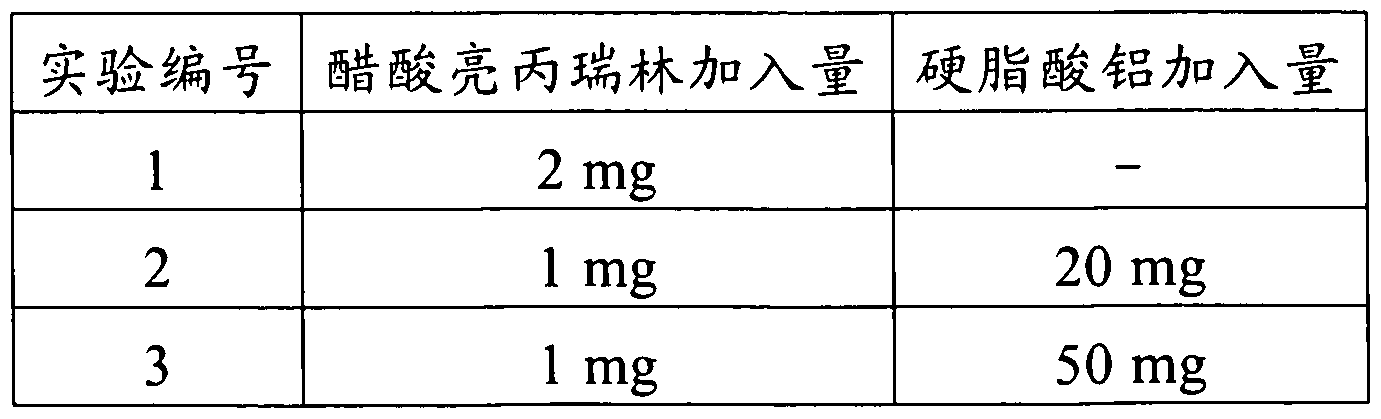

考查了制备方式对醋酸亮丙瑞林緩释效果的影响。 The effect of preparation methods on the sustained release of leuprolide acetate was examined.
不经过制备过程, 将两亲性分子 (如 EPC、 司盘 85)直接加入油性溶剂 中, 再加入活性药物, 分散均匀, 用相同的方法测定药物体外累积释放。 结果表明, 活性药物在一天内已释放 90%以上, 比经过制备过程得到的制 剂的緩释效果显著下降。 结果见表 5。 Without the preparation process, the amphiphilic molecules (such as EPC, Span 85) were directly added to the oily solvent, the active drug was added, and the dispersion was uniform. The cumulative release of the drug in vitro was determined by the same method. The results showed that the active drug was released more than 90% in one day, which was significantly lower than that of the preparation obtained through the preparation process. The results are shown in Table 5.


本领域技术人员可以理解, 本文中所用的 "例如" 、 "诸如" 均表示 "包括但不限于" 。 此作为限制。 本领域所属技术人员可以根据本申请的公开, 在不违背本发 明精神的情况下对上述实施方式中的技术特征进行改进和变换, 这些改进 和变换都应属于本发明的范围。 Those skilled in the art will appreciate that "for example" and "such as" are used herein to mean "including but not limited to". This is a limitation. Those skilled in the art can make improvements and alterations to the technical features in the above embodiments without departing from the spirit of the present invention, and such modifications and variations are intended to fall within the scope of the present invention.
Claims
Priority Applications (4)
| Application Number | Priority Date | Filing Date | Title |
|---|---|---|---|
| PCT/CN2008/000551 WO2009114959A1 (en) | 2008-03-20 | 2008-03-20 | Injectalble sustained-release pharmaceutical formulation and method for preparing it |
| CN200980109804.2A CN102036653B (en) | 2008-03-20 | 2009-03-20 | Injectable sustained-release pharmaceutical formulation and the preparation method thereof |
| PCT/CN2009/070913 WO2009115053A1 (en) | 2008-03-20 | 2009-03-20 | Injectable sustained-release pharmaceutical formulation and the preparation method thereof |
| US12/933,669 US20110091420A1 (en) | 2008-03-20 | 2009-03-20 | Injectable Sustained-Release Pharmaceutical Formulation and the Preparation Method Thereof |
Applications Claiming Priority (1)
| Application Number | Priority Date | Filing Date | Title |
|---|---|---|---|
| PCT/CN2008/000551 WO2009114959A1 (en) | 2008-03-20 | 2008-03-20 | Injectalble sustained-release pharmaceutical formulation and method for preparing it |
Publications (1)
| Publication Number | Publication Date |
|---|---|
| WO2009114959A1 true WO2009114959A1 (en) | 2009-09-24 |
Family
ID=41090463
Family Applications (2)
| Application Number | Title | Priority Date | Filing Date |
|---|---|---|---|
| PCT/CN2008/000551 Ceased WO2009114959A1 (en) | 2008-03-20 | 2008-03-20 | Injectalble sustained-release pharmaceutical formulation and method for preparing it |
| PCT/CN2009/070913 Ceased WO2009115053A1 (en) | 2008-03-20 | 2009-03-20 | Injectable sustained-release pharmaceutical formulation and the preparation method thereof |
Family Applications After (1)
| Application Number | Title | Priority Date | Filing Date |
|---|---|---|---|
| PCT/CN2009/070913 Ceased WO2009115053A1 (en) | 2008-03-20 | 2009-03-20 | Injectable sustained-release pharmaceutical formulation and the preparation method thereof |
Country Status (3)
| Country | Link |
|---|---|
| US (1) | US20110091420A1 (en) |
| CN (1) | CN102036653B (en) |
| WO (2) | WO2009114959A1 (en) |
Cited By (8)
| Publication number | Priority date | Publication date | Assignee | Title |
|---|---|---|---|---|
| WO2011138802A1 (en) * | 2010-05-07 | 2011-11-10 | Sun Pharma Advanced Research Company Ltd., | Injection solution |
| US20140249077A1 (en) * | 2011-06-09 | 2014-09-04 | Astrazeneca Pharmaceuticals Lp | Gel compositions |
| CN105579055A (en) * | 2013-07-29 | 2016-05-11 | 益普生制药股份有限公司 | Aqueous sustained release compositions of LHRH analogues |
| US10086035B2 (en) | 2016-02-04 | 2018-10-02 | ALASTIN Skincare, Inc. | Compositions and methods for invasive and non-invasive procedural skincare |
| CN109789088A (en) * | 2016-09-29 | 2019-05-21 | 艾瑞克有限公司 | Novel formulation |
| US10493011B2 (en) | 2017-08-03 | 2019-12-03 | ALASTIN Skincare, Inc. | Peptide compositions and methods for ameliorating skin laxity and body contour |
| US11103455B2 (en) | 2018-08-02 | 2021-08-31 | ALASTIN Skincare, Inc. | Liposomal compositions and methods of use |
| CN114916557A (en) * | 2022-05-07 | 2022-08-19 | 渭南东旺农华生物科技有限公司 | Agricultural composition containing lecithin and gamma-aminobutyric acid |
Families Citing this family (27)
| Publication number | Priority date | Publication date | Assignee | Title |
|---|---|---|---|---|
| US8450269B2 (en) * | 2006-02-03 | 2013-05-28 | Prolor Biotech Ltd. | Long-acting growth hormone and methods of producing same |
| KR101494594B1 (en) | 2011-08-30 | 2015-02-23 | 주식회사 종근당 | Sustained-release lipid pre-concentrate of pharmacologically active substance and pharmaceutical composition comprising the same |
| CN103163258B (en) * | 2011-12-09 | 2015-09-23 | 山东绿叶制药有限公司 | A kind of method measuring trace Triptorelin |
| CN104159570A (en) * | 2011-12-29 | 2014-11-19 | 陈献 | Stabilized glucagon nanoemulsions |
| CN102552169B (en) * | 2012-02-17 | 2015-07-29 | 深圳市健元医药科技有限公司 | A kind of Aviptadil acetate sustained-release microsphere preparation and preparation method thereof |
| UA116217C2 (en) | 2012-10-09 | 2018-02-26 | Санофі | Exendin-4 derivatives as dual glp1/glucagon agonists |
| SG11201503526UA (en) | 2012-12-21 | 2015-06-29 | Sanofi Sa | Dual glp1/gip or trigonal glp1/gip/glucagon agonists |
| KR101586791B1 (en) | 2012-12-28 | 2016-01-19 | 주식회사 종근당 | Sustained-release lipid pre-concentrate of GnRH analogues and pharmaceutical composition comprising the same |
| WO2015086729A1 (en) | 2013-12-13 | 2015-06-18 | Sanofi | Dual glp-1/gip receptor agonists |
| EP3080150B1 (en) | 2013-12-13 | 2018-08-01 | Sanofi | Exendin-4 peptide analogues as dual glp-1/gip receptor agonists |
| WO2015086730A1 (en) | 2013-12-13 | 2015-06-18 | Sanofi | Non-acylated exendin-4 peptide analogues |
| WO2015086733A1 (en) | 2013-12-13 | 2015-06-18 | Sanofi | Dual glp-1/glucagon receptor agonists |
| CN104292305B (en) * | 2014-01-17 | 2017-06-09 | 河南科技大学 | A kind of polypeptide, preparation method and applications |
| TW201625669A (en) | 2014-04-07 | 2016-07-16 | 賽諾菲公司 | Peptidic dual GLP-1/glucagon receptor agonists derived from Exendin-4 |
| TW201625670A (en) | 2014-04-07 | 2016-07-16 | 賽諾菲公司 | Dual GLP-1/glucagon receptor agonists derived from EXENDIN-4 |
| TW201625668A (en) | 2014-04-07 | 2016-07-16 | 賽諾菲公司 | Exendin-4 derivatives as peptidic dual GLP-1/glucagon receptor agonists |
| EP3131532A1 (en) | 2014-04-16 | 2017-02-22 | Veyx-Pharma GmbH | Veterinary pharmaceutical composition and use thereof |
| US9932381B2 (en) | 2014-06-18 | 2018-04-03 | Sanofi | Exendin-4 derivatives as selective glucagon receptor agonists |
| CN107106659B (en) | 2014-10-27 | 2022-07-08 | 莱迪杜德制药公司 | Parenteral glucagon formulations |
| AR105319A1 (en) | 2015-06-05 | 2017-09-27 | Sanofi Sa | PROPHARMS THAT INCLUDE A DUAL AGONIST GLU-1 / GLUCAGON CONJUGATE HIALURONIC ACID CONNECTOR |
| TW201706291A (en) | 2015-07-10 | 2017-02-16 | 賽諾菲公司 | New EXENDIN-4 derivatives as selective peptidic dual GLP-1/glucagon receptor agonists |
| CN105076199A (en) * | 2015-08-31 | 2015-11-25 | 江苏七洲绿色化工股份有限公司 | Weeding composition and preparation method thereof |
| WO2017123760A1 (en) * | 2016-01-15 | 2017-07-20 | Qun Sun | Compositions and formulations including cabazitaxel and human serum albumin |
| GB202004115D0 (en) * | 2020-03-20 | 2020-05-06 | Invex Therapeutics Ltd | Modified release formulations and dosage regimens |
| CN115624533B (en) * | 2022-12-22 | 2023-04-07 | 山东则正医药技术有限公司 | Nifedipine controlled release tablet, preparation method and application thereof |
| CN117017928B (en) * | 2023-08-18 | 2024-09-13 | 广州森升生物科技有限公司 | Freeze-dried powder of hirudin or hirudin analogue cyclic peptide and preparation method thereof |
| CN119792245A (en) * | 2025-01-08 | 2025-04-11 | 中国药科大学 | Injectable sustained-release preparation and preparation method thereof |
Citations (2)
| Publication number | Priority date | Publication date | Assignee | Title |
|---|---|---|---|---|
| WO2003015753A1 (en) * | 2001-08-20 | 2003-02-27 | Terumo Kabushiki Kaisha | Liposome preparations |
| CN101129375A (en) * | 2007-07-06 | 2008-02-27 | 浙江大学 | Vinorelbine solid lipid nanoparticles and its freeze-dried preparation and preparation method |
Family Cites Families (3)
| Publication number | Priority date | Publication date | Assignee | Title |
|---|---|---|---|---|
| EP0451791A2 (en) * | 1990-04-12 | 1991-10-16 | Hoechst Aktiengesellschaft | Long acting liposome compositions containing peptid drugs and method for their preparation |
| SI9300468A (en) * | 1992-10-14 | 1994-06-30 | Hoffmann La Roche | Injectable composition for the sustained release of biologically active compounds |
| GB9323588D0 (en) * | 1993-11-16 | 1994-01-05 | Cortecs Ltd | Hydrophobic preparation |
-
2008
- 2008-03-20 WO PCT/CN2008/000551 patent/WO2009114959A1/en not_active Ceased
-
2009
- 2009-03-20 CN CN200980109804.2A patent/CN102036653B/en not_active Expired - Fee Related
- 2009-03-20 US US12/933,669 patent/US20110091420A1/en not_active Abandoned
- 2009-03-20 WO PCT/CN2009/070913 patent/WO2009115053A1/en not_active Ceased
Patent Citations (2)
| Publication number | Priority date | Publication date | Assignee | Title |
|---|---|---|---|---|
| WO2003015753A1 (en) * | 2001-08-20 | 2003-02-27 | Terumo Kabushiki Kaisha | Liposome preparations |
| CN101129375A (en) * | 2007-07-06 | 2008-02-27 | 浙江大学 | Vinorelbine solid lipid nanoparticles and its freeze-dried preparation and preparation method |
Cited By (16)
| Publication number | Priority date | Publication date | Assignee | Title |
|---|---|---|---|---|
| WO2011138802A1 (en) * | 2010-05-07 | 2011-11-10 | Sun Pharma Advanced Research Company Ltd., | Injection solution |
| US20140249077A1 (en) * | 2011-06-09 | 2014-09-04 | Astrazeneca Pharmaceuticals Lp | Gel compositions |
| CN105579055A (en) * | 2013-07-29 | 2016-05-11 | 益普生制药股份有限公司 | Aqueous sustained release compositions of LHRH analogues |
| US11426442B2 (en) | 2016-02-04 | 2022-08-30 | ALASTIN Skincare, Inc. | Compositions and methods for invasive and non-invasive procedural skincare |
| US10286030B2 (en) | 2016-02-04 | 2019-05-14 | Alastin Skincare, Inc | Compositions and methods for invasive and non-invasive procedural skincare |
| US10688147B2 (en) | 2016-02-04 | 2020-06-23 | ALASTIN Skincare, Inc. | Compositions and methods for invasive and non-invasive procedural skincare |
| US11426443B2 (en) | 2016-02-04 | 2022-08-30 | ALASTIN Skincare, Inc. | Compositions and methods for invasive and non-invasive procedural skincare |
| US10086035B2 (en) | 2016-02-04 | 2018-10-02 | ALASTIN Skincare, Inc. | Compositions and methods for invasive and non-invasive procedural skincare |
| US12357671B2 (en) | 2016-02-04 | 2025-07-15 | ALASTIN Skincare, Inc. | Compositions and methods for invasive and non-invasive procedural skincare |
| CN109789088A (en) * | 2016-09-29 | 2019-05-21 | 艾瑞克有限公司 | Novel formulation |
| US10493011B2 (en) | 2017-08-03 | 2019-12-03 | ALASTIN Skincare, Inc. | Peptide compositions and methods for ameliorating skin laxity and body contour |
| US11052032B2 (en) | 2017-08-03 | 2021-07-06 | ALASTIN Skincare, Inc. | Peptide compositions and methods for ameliorating skin laxity and body contour |
| US11752084B2 (en) | 2017-08-03 | 2023-09-12 | ALASTIN Skincare, Inc. | Methods for fat reduction or elimination of lipid droplets |
| US11103455B2 (en) | 2018-08-02 | 2021-08-31 | ALASTIN Skincare, Inc. | Liposomal compositions and methods of use |
| US12053547B2 (en) | 2018-08-02 | 2024-08-06 | ALASTIN Skincare, Inc. | Liposomal compositions and methods of use |
| CN114916557A (en) * | 2022-05-07 | 2022-08-19 | 渭南东旺农华生物科技有限公司 | Agricultural composition containing lecithin and gamma-aminobutyric acid |
Also Published As
| Publication number | Publication date |
|---|---|
| CN102036653A (en) | 2011-04-27 |
| WO2009115053A1 (en) | 2009-09-24 |
| CN102036653B (en) | 2014-01-29 |
| US20110091420A1 (en) | 2011-04-21 |
Similar Documents
| Publication | Publication Date | Title |
|---|---|---|
| WO2009114959A1 (en) | Injectalble sustained-release pharmaceutical formulation and method for preparing it | |
| CN103764127B (en) | Sustained release lipid preconcentrate of pharmacologically active substance and pharmaceutical composition containing same | |
| EP1071408B1 (en) | Microparticles for drug delivery across mucosa and the blood-brain barrier | |
| ES2336766T3 (en) | PROCEDURE FOR COATING FINE PARTICLES WITH LIPID FILM. | |
| CN1096850C (en) | Prepn. of multivesicular liposomes for controlled release of active agents | |
| US5662931A (en) | Process for preparing liposome composition | |
| ES2617747T3 (en) | Aqueous systems for the preparation of lipid-based pharmaceutical compounds; compositions, procedures and uses thereof | |
| EP2938332B1 (en) | Sustained-release lipid pre-concentrate of gnrh analogues and pharmaceutical composition comprising the same | |
| US20040009229A1 (en) | Stabilized nanoparticle formulations of camptotheca derivatives | |
| US20030059465A1 (en) | Stabilized nanoparticle formulations of camptotheca derivatives | |
| BRPI0715469A2 (en) | Pharmaceutical compositions for sustained release of peptides | |
| JP2003534265A (en) | Sustained release pharmaceutical composition for parenterally administering a biologically active hydrophilic compound | |
| CS273139B1 (en) | Method of pharmaceutical agent production for intranasal feed | |
| JP2000086501A (en) | Liposome formulation of human calcitonin | |
| EP1696961A1 (en) | Nanoparticle compositions of water-soluble drugs for oral administration and preparation methods thereof | |
| EP2968376B1 (en) | Composition containing buffered aminoalkyl glucosaminide phosphate derivatives and its use for enhancing an immune response | |
| Gill et al. | Emulsomes: An emerging vesicular drug delivery system | |
| JP3804452B2 (en) | Hepatitis treatment agent | |
| CN1479609A (en) | Oral delivery of peptides | |
| US20030219473A1 (en) | Cochleates made with purified soy phosphatidylserine | |
| JPH06183954A (en) | Liposome pharmaceutical preparation | |
| JP2660341B2 (en) | Liposome preparation and method for producing the same | |
| KR20220002140A (en) | Injection composition comprising GnRH analogue | |
| Lindner et al. | Strategies to Improve the Lipophilicity of Hydrophilic Macromolecular Drugs | |
| JPH1171266A (en) | Liposomal formulation of xanthine derivative |
Legal Events
| Date | Code | Title | Description |
|---|---|---|---|
| 121 | Ep: the epo has been informed by wipo that ep was designated in this application |
Ref document number: 08715004 Country of ref document: EP Kind code of ref document: A1 |
|
| NENP | Non-entry into the national phase |
Ref country code: DE |
|
| 122 | Ep: pct application non-entry in european phase |
Ref document number: 08715004 Country of ref document: EP Kind code of ref document: A1 |