WO2009023667A1 - Organic photosensitive optoelectronic devices with triplet harvesting - Google Patents
Organic photosensitive optoelectronic devices with triplet harvesting Download PDFInfo
- Publication number
- WO2009023667A1 WO2009023667A1 PCT/US2008/072896 US2008072896W WO2009023667A1 WO 2009023667 A1 WO2009023667 A1 WO 2009023667A1 US 2008072896 W US2008072896 W US 2008072896W WO 2009023667 A1 WO2009023667 A1 WO 2009023667A1
- Authority
- WO
- WIPO (PCT)
- Prior art keywords
- groups
- group
- acyl
- amino
- substituted
- Prior art date
- Legal status (The legal status is an assumption and is not a legal conclusion. Google has not performed a legal analysis and makes no representation as to the accuracy of the status listed.)
- Ceased
Links
Classifications
-
- B—PERFORMING OPERATIONS; TRANSPORTING
- B82—NANOTECHNOLOGY
- B82Y—SPECIFIC USES OR APPLICATIONS OF NANOSTRUCTURES; MEASUREMENT OR ANALYSIS OF NANOSTRUCTURES; MANUFACTURE OR TREATMENT OF NANOSTRUCTURES
- B82Y10/00—Nanotechnology for information processing, storage or transmission, e.g. quantum computing or single electron logic
-
- H—ELECTRICITY
- H10—SEMICONDUCTOR DEVICES; ELECTRIC SOLID-STATE DEVICES NOT OTHERWISE PROVIDED FOR
- H10K—ORGANIC ELECTRIC SOLID-STATE DEVICES
- H10K30/00—Organic devices sensitive to infrared radiation, light, electromagnetic radiation of shorter wavelength or corpuscular radiation
- H10K30/20—Organic devices sensitive to infrared radiation, light, electromagnetic radiation of shorter wavelength or corpuscular radiation comprising organic-organic junctions, e.g. donor-acceptor junctions
- H10K30/211—Organic devices sensitive to infrared radiation, light, electromagnetic radiation of shorter wavelength or corpuscular radiation comprising organic-organic junctions, e.g. donor-acceptor junctions comprising multiple junctions, e.g. double heterojunctions
-
- H—ELECTRICITY
- H10—SEMICONDUCTOR DEVICES; ELECTRIC SOLID-STATE DEVICES NOT OTHERWISE PROVIDED FOR
- H10K—ORGANIC ELECTRIC SOLID-STATE DEVICES
- H10K30/00—Organic devices sensitive to infrared radiation, light, electromagnetic radiation of shorter wavelength or corpuscular radiation
- H10K30/30—Organic devices sensitive to infrared radiation, light, electromagnetic radiation of shorter wavelength or corpuscular radiation comprising bulk heterojunctions, e.g. interpenetrating networks of donor and acceptor material domains
-
- H—ELECTRICITY
- H10—SEMICONDUCTOR DEVICES; ELECTRIC SOLID-STATE DEVICES NOT OTHERWISE PROVIDED FOR
- H10K—ORGANIC ELECTRIC SOLID-STATE DEVICES
- H10K71/00—Manufacture or treatment specially adapted for the organic devices covered by this subclass
- H10K71/30—Doping active layers, e.g. electron transporting layers
-
- H—ELECTRICITY
- H10—SEMICONDUCTOR DEVICES; ELECTRIC SOLID-STATE DEVICES NOT OTHERWISE PROVIDED FOR
- H10K—ORGANIC ELECTRIC SOLID-STATE DEVICES
- H10K85/00—Organic materials used in the body or electrodes of devices covered by this subclass
- H10K85/30—Coordination compounds
- H10K85/341—Transition metal complexes, e.g. Ru(II)polypyridine complexes
- H10K85/346—Transition metal complexes, e.g. Ru(II)polypyridine complexes comprising platinum
-
- H—ELECTRICITY
- H10—SEMICONDUCTOR DEVICES; ELECTRIC SOLID-STATE DEVICES NOT OTHERWISE PROVIDED FOR
- H10K—ORGANIC ELECTRIC SOLID-STATE DEVICES
- H10K2102/00—Constructional details relating to the organic devices covered by this subclass
- H10K2102/10—Transparent electrodes, e.g. using graphene
- H10K2102/101—Transparent electrodes, e.g. using graphene comprising transparent conductive oxides [TCO]
- H10K2102/103—Transparent electrodes, e.g. using graphene comprising transparent conductive oxides [TCO] comprising indium oxides, e.g. ITO
-
- H—ELECTRICITY
- H10—SEMICONDUCTOR DEVICES; ELECTRIC SOLID-STATE DEVICES NOT OTHERWISE PROVIDED FOR
- H10K—ORGANIC ELECTRIC SOLID-STATE DEVICES
- H10K30/00—Organic devices sensitive to infrared radiation, light, electromagnetic radiation of shorter wavelength or corpuscular radiation
- H10K30/50—Photovoltaic [PV] devices
- H10K30/57—Photovoltaic [PV] devices comprising multiple junctions, e.g. tandem PV cells
-
- H—ELECTRICITY
- H10—SEMICONDUCTOR DEVICES; ELECTRIC SOLID-STATE DEVICES NOT OTHERWISE PROVIDED FOR
- H10K—ORGANIC ELECTRIC SOLID-STATE DEVICES
- H10K85/00—Organic materials used in the body or electrodes of devices covered by this subclass
- H10K85/10—Organic polymers or oligomers
- H10K85/111—Organic polymers or oligomers comprising aromatic, heteroaromatic, or aryl chains, e.g. polyaniline, polyphenylene or polyphenylene vinylene
- H10K85/113—Heteroaromatic compounds comprising sulfur or selene, e.g. polythiophene
-
- H—ELECTRICITY
- H10—SEMICONDUCTOR DEVICES; ELECTRIC SOLID-STATE DEVICES NOT OTHERWISE PROVIDED FOR
- H10K—ORGANIC ELECTRIC SOLID-STATE DEVICES
- H10K85/00—Organic materials used in the body or electrodes of devices covered by this subclass
- H10K85/10—Organic polymers or oligomers
- H10K85/111—Organic polymers or oligomers comprising aromatic, heteroaromatic, or aryl chains, e.g. polyaniline, polyphenylene or polyphenylene vinylene
- H10K85/113—Heteroaromatic compounds comprising sulfur or selene, e.g. polythiophene
- H10K85/1135—Polyethylene dioxythiophene [PEDOT]; Derivatives thereof
-
- H—ELECTRICITY
- H10—SEMICONDUCTOR DEVICES; ELECTRIC SOLID-STATE DEVICES NOT OTHERWISE PROVIDED FOR
- H10K—ORGANIC ELECTRIC SOLID-STATE DEVICES
- H10K85/00—Organic materials used in the body or electrodes of devices covered by this subclass
- H10K85/20—Carbon compounds, e.g. carbon nanotubes or fullerenes
- H10K85/211—Fullerenes, e.g. C60
-
- H—ELECTRICITY
- H10—SEMICONDUCTOR DEVICES; ELECTRIC SOLID-STATE DEVICES NOT OTHERWISE PROVIDED FOR
- H10K—ORGANIC ELECTRIC SOLID-STATE DEVICES
- H10K85/00—Organic materials used in the body or electrodes of devices covered by this subclass
- H10K85/60—Organic compounds having low molecular weight
- H10K85/615—Polycyclic condensed aromatic hydrocarbons, e.g. anthracene
- H10K85/622—Polycyclic condensed aromatic hydrocarbons, e.g. anthracene containing four rings, e.g. pyrene
-
- Y—GENERAL TAGGING OF NEW TECHNOLOGICAL DEVELOPMENTS; GENERAL TAGGING OF CROSS-SECTIONAL TECHNOLOGIES SPANNING OVER SEVERAL SECTIONS OF THE IPC; TECHNICAL SUBJECTS COVERED BY FORMER USPC CROSS-REFERENCE ART COLLECTIONS [XRACs] AND DIGESTS
- Y02—TECHNOLOGIES OR APPLICATIONS FOR MITIGATION OR ADAPTATION AGAINST CLIMATE CHANGE
- Y02E—REDUCTION OF GREENHOUSE GAS [GHG] EMISSIONS, RELATED TO ENERGY GENERATION, TRANSMISSION OR DISTRIBUTION
- Y02E10/00—Energy generation through renewable energy sources
- Y02E10/50—Photovoltaic [PV] energy
- Y02E10/549—Organic PV cells
Definitions
- the present invention generally relates to organic photosensitive optoelectronic devices comprising organic photoconductive materials which comprise singlet fission host materials doped with triplet forming materials.
- Optoelectronic devices rely on the optical and electronic properties of materials to either produce or detect electromagnetic radiation electronically or to generate electricity from ambient electromagnetic radiation.
- Photosensitive optoelectronic devices convert electromagnetic radiation into an electrical signal or electricity.
- Solar cells also called photovoltaic (“PV") devices, are a type of photosensitive optoelectronic device that is specifically used to generate electrical power.
- Photoconductor cells are a type of photosensitive optoelectronic device that are used in conjunction with signal detection circuitry which monitors the resistance of the device to detect changes due to absorbed light.
- Photodetectors which may receive an applied bias voltage, are a type of photosensitive optoelectronic device that are used in conjunction with current detecting circuits which measures the current generated when the photodetector is exposed to electromagnetic radiation.
- These three classes of photosensitive optoelectronic devices may be distinguished according to whether a rectifying junction is present and also according to whether the device is operated with an external applied voltage, also known as a bias or bias voltage.
- a photoconductor cell does not have a rectifying junction and is normally operated with a bias.
- a PV device has at least one rectifying junction and is operated with no bias.
- a photodetector has at least one rectifying junction and is usually but not always operated with a bias.
- the term “rectifying” denotes, inter alia, that an interface has an asymmetric conduction characteristic, i.e., the interface supports electronic charge transport preferably in one direction.
- semiconductor denotes materials which can conduct electricity when charge carriers are induced by thermal or electromagnetic excitation.
- photoconductive generally relates to the process in which electromagnetic radiant energy is absorbed and thereby converted to excitation energy of electric charge carriers so that the carriers can conduct (i.e., transport) electric charge in a material.
- photoconductive material refers to semiconductor materials which are utilized for their property of absorbing electromagnetic radiation to generate electric charge carriers.
- an organic semiconductor material When electromagnetic radiation of an appropriate energy is incident upon an organic semiconductor material, a photon can be absorbed to produce an excited molecular state.
- the generated molecular state is generally believed to be an "exciton," i.e., an electron-hole pair in a bound state which is transported as a quasi-particle.
- An exciton can have an appreciable life-time before geminate recombination ("quenching"), which refers to the original electron and hole recombining with each other (as opposed to recombination with holes or electrons from other pairs).
- quenching geminate recombination
- the electron-hole forming the exciton are typically separated at a rectifying junction.
- the rectifying junction is referred to as a photovoltaic heterojunction.
- Types of organic photovoltaic heterojunctions include a donor-acceptor heterojunction formed at an interface of a donor material and an acceptor material, and a Schottky-barrier heterojunction formed at the interface of a photoconductive material and a metal.
- FIG. 1 is an energy- level diagram illustrating an example donor-acceptor heterojunction.
- donor and acceptor refer to the relative positions of the Highest Occupied Molecular Orbital ("HOMO”) and Lowest Unoccupied Molecular Orbital (“LUMO”) energy levels of two contacting but different organic materials. If the LUMO energy level of one material in contact with another is lower, then that material is an acceptor. Otherwise it is a donor. It is energetically favorable, in the absence of an external bias, for electrons at a donor- acceptor junction to move into the acceptor material.
- HOMO Highest Occupied Molecular Orbital
- LUMO Lowest Unoccupied Molecular Orbital
- a first HOMO or LUMO energy level is "greater than” or “higher than” a second HOMO or LUMO energy level if the first energy level is closer to the vacuum energy level 10.
- a higher HOMO energy level corresponds to an ionization potential ("IP") having a smaller absolute energy relative to a vacuum level.
- IP ionization potential
- EA electron affinity
- the LUMO energy level of a material is higher than the HOMO energy level of the same material.
- the exciton 8 dissociates at the rectifying interface.
- the donor 152 transports the hole (open circle) and the acceptor 154 transports the electron (dark circle).
- a significant property in organic semiconductors is carrier mobility. Mobility measures the ease with which a charge carrier can move through a conducting material in response to an electric field.
- a material that conducts preferentially by electrons due to a high electron mobility may be referred to as an electron transport material.
- a material that conducts preferentially by holes due to a high hole mobility may be referred to as a hole transport material.
- a layer that conducts preferentially by electrons, due to mobility and / or position in the device may be referred to as an electron transport layer ("ETL").
- a layer that conducts preferentially by holes, due to mobility and / or position in the device may be referred to as a hole transport layer ("HTL").
- an acceptor material is an electron transport material and a donor material is a hole transport material.
- the band gap is the energy difference between the highest energy level filled with electrons and the lowest energy level that is empty. In an inorganic semiconductor or inorganic insulator, this energy difference is the difference between the valence band edge (top of the valence band) and the conduction band edge (bottom of the conduction band). In an organic semiconductor or organic insulator, this energy difference is the difference between the HOMO and the LUMO.
- the band gap of a pure material is devoid of energy states where electrons and holes can exist. The only available carriers for conduction are the electrons and holes which have enough energy to be excited across the band gap.
- semiconductors have a relatively small band gap in comparison to insulators.
- semiconductors In terms of an energy band model for organic semiconductors, only electrons on the LUMO side of the band gap are charge carriers, and only holes on the HOMO side of the band gap are charge carriers.
- FF depends on the series resistance and is typically between 0.5 and 0.65 for high performance small molecular weight organic photovoltaics.
- the maximum J sc is defined by the overlap between the absorption of the organics, the solar spectrum and the extinction coefficients and thicknesses of the absorbing layers and other factors.
- the photocurrent is highly dependent on the charge transport properties of the materials, since resistivity to charge flow represents a significant challenge to cell performance [Ref. 2].
- Another very important parameter to be considered when referring to cell performance is the exciton diffusion length.
- the exciton diffusion length of a material represents the distance that an exciton can travel prior to recombination.
- the exciton is preferably formed within about L D of a Heterojunction.
- the exciton diffusion length is generally short for organic semiconductors relative to the optical absorption length L A , hence limiting the thickness of the organic layer to be used due to the relatively low ability of the excitons to reach the Donor- Acceptor interface for charge separation. This effect not only restrains the amount of absorbing material but also creates a resistive pathway for separated charge that is undesirable for efficient light conversion [Ref. I].
- Organic photovoltaic (OPV) cells have great promise to become a viable alternative to the existing solar cell technologies, dominated by silicon based devices. However, their efficiencies are currently too low to compete effectively with Si based devices. The record efficiencies for laboratory based OPV cells is 5.7%, [Ref. 7] which is roughly half the efficiency of commercial amorphous silicon based PV cells.
- An inherent limitation of the current OPV systems is related to light collection efficiency, which is controlled by the excitons diffusion length. New device architectures have been developed to compensate for the short diffusion lengths, but there has not been a detailed study of applicable materials, focused on solving the problem by extending the diffusion length. [Refs. 8,9]
- OCVs organic photovoltaic cells
- D net electron donor
- A acceptor
- the process can be broken down into four sequential steps ( Figure X).
- the first step of the process is light absorption, leading to exciton formation, with an efficiency given by ⁇ A .
- the donor and acceptor materials chosen for OPVs must have broad absorbance lines and high extinction coefficients, giving a high optical density for thin films.
- the exciton then migrates to the D/A interface, or alternatively decays to the ground state via radiative or nonradiative processes (kd eca y)-
- the optimal thickness is determined by the exciton diffusion length, since excitons generated beyond this distance decay faster then they migrate to the D/A interface.
- the efficiency of exciton diffusion ( ⁇ E ⁇ ) is related to the relative magnitudes of the diffusion rate (kdrff) and the decay rate (kd eca y)-
- the majority of the OPV materials that have been examined have short exciton diffusion lengths. For example, CuPC and C 6O , common donor and acceptor materials, have exciton diffusion lengths of 8-10 and 40 nm, respectively.
- the short exciton diffusion lengths seen for these materials forces the D and A films to be kept thin, limiting the optical density in OPVs, and thus the amount of light that can be efficiently collected and the efficiency of OPVs.
- the driving force for charge transfer is the energy offset between the donor and acceptor orbitals.
- a high carrier mobility is critical for an efficient OPV.
- a low mobility (high resistance) material will leave charges trapped near the D/A interface, promoting back electron transfer (recombination of the hole and electron at the interface). This leads to a decreased photocurrent and a marked decrease in the fill factor, both contributing to lower the power available for the device.
- the highest exciton diffusion coefficients will be observed for single crystalline thin films.
- the amorphous glasses used in typical OPV cells tend to have lower diffusion coefficients, due to exciton scattering at defect sites.
- the exciton formed on light absorption is in a singlet configuration.
- the radiative lifetime of this exciton is typically 10 nsec or less.
- the measured lifetimes for singlet excitons in neat thin films are markedly lower than their radiative lifetime, due to excimer formation, quenching at defects and unimolecular nonradiative decay, principally intersystem crossing to the triplet exciton.
- the exciton diffusion coefficient for a singlet exciton can be rather high, since Forster energy transfer processes are operative, allowing hops of several nm at a time.
- Triplet excitons have lifetimes that are markedly longer than their singlet counterparts.
- the triplet lifetime of the same material can be as high as minutes to hours in a dilute sample. Based on the VDT relationship, it would be expected to see long diffusion lengths for triplet excitons. While triplet exciton diffusion lengths can be reasonably long, for example C 6O gives an L D of 40 nm for an amorphous thin film, they are not as long as one would have guessed from the triplet lifetime. There are several reasons for this. The first reason is that the lifetime in a neat thin film is markedly less than that in a dilute matrix, where it is often measured. Quenching, excimer formation and T-T annihilation decrease triplet lifetimes by several orders of magnitude.
- triplet exciton diffusion occurs mainly through nearest neighbor hopping, via a Dexter mechanism. While the triplet lifetimes for common organic molecules can be very long, common OPV materials have triplet lifetimes in the microsecond regime. This coupled with the low D values give triplet based materials good but not exceptional L D values.
- the present invention provides a photosensitive optoelectronic device comprising an anode, a cathode and at least one photoactive region disposed between the anode and cathode wherein: the at least one photoactive region comprises at least one organic photoconductive material comprising at least one singlet fission host material and at least one triplet forming dopant material; the amount of the at least one singlet fission host material is greater than the amount of the at least one triplet forming dopant material; the at least one singlet fission host material is selected from a material that exhibits singlet fission when light is absorbed; and the at least one triplet forming dopant material forms a triplet exciton after light is absorbed by the dopant.
- the present invention provides a method of fabricating the organic photosensitive optoelectronic device of the invention, comprising: providing an anode, a cathode and putting at least one organic photoconductive material in contact with at least the anode or cathode wherein: the at least one organic photoconductive material comprises at least one singlet fission host material and at least one triplet forming dopant material; the amount of the at least one singlet fission host material is greater than the amount of the at least one triplet fission dopant material; the at least one singlet fission host material is selected from a material that exhibits singlet fission when light is absorbed; and the at least one triplet forming dopant forms a triplet exciton after light is absorbed by the dopant.
- FIG. 1 is an energy level diagram illustrating a donor-acceptor heterojunction.
- FIG. 2 shows a general mechanism for photocurrent generation in OPV cells.
- FIGS. 3A-3B show a tandem cell design in 3 A and a bulk heterojunction cell in 3B, wherein the donor is shown solid cross-hatched and the acceptor is stippled in FIGS. 3A-3B, and the internal transparent electrodes are shown as broken cross-hatched, and the cathode and anode are as labeled in the FIGS. 3A-3B.
- FIGS. 4A-4D show the singlet fission energetics in Scheme 1 (FIG. 4A); dopant triplet quenching into the triplet state of the host in Scheme 2 (FIG. 4B); quenching of host singlet by donor singlet and further conversion and transfer into the triplet of the host in Scheme 3 (FIG. 4C); and overall process of enhanced triplet creation on the host in Scheme 4 (FIG. 4D).
- the organic photoconductive material comprising at least one singlet fission host material doped with at least one triplet forming dopant material described herein may have applications in optoelectronic devices other than organic solar cells.
- other optoelectronic devices such as organic photodetectors, organic photosensors, organic photoconductors, chemical sensors and biological sensors may employ the nonplanar porphyrins.
- photosensitive optoelectronic devices can be solar cells, photodetectors, photosensors, photoconductors, chemical sensors, and biological sensors.
- organic includes polymeric materials as well as small molecule organic materials that may be used to fabricate organic photosensitive optoelectronic devices.
- Small molecule refers to any organic material that is not a polymer, and "small molecules” may actually be quite large. Small molecules may include repeat units in some circumstances. For example, using a long chain alkyl group as a substituent does not remove a molecule from the "small molecule” class. Small molecules may also be incorporated into polymers, for example as a pendent group on a polymer backbone or as a part of the backbone.
- Small molecules may also serve as the core moiety of a dendrimer, which consists of a series of chemical shells built on the core moiety.
- the core moiety of a dendrimer may be a fluorescent or phosphorescent small molecule emitter.
- a dendrimer may be a "small molecule.”
- a small molecule has a defined chemical formula with a molecular weight that is the same from molecule to molecule, whereas a polymer has a defined chemical formula with a molecular weight that may vary from molecule to molecule.
- organic includes metal complexes of hydrocarbyl and heteroatom-substituted hydrocarbyl ligands.
- the present invention is directed to a method to improve singlet fission materials to give enhanced/broader light absorption, particularly into the red and near IR regions of the solar spectrum.
- the present invention involves the doping of materials known to give significant intersystem crossing on optical excitation, such that absorption of a photon at the dopant site will efficiently from a triplet exciton at the dopant.
- the dopant materials being employed herein typically have small energy shifts between the absorption bands and the triplet exciton, such that the loss of the energy between the singlet excited state formed in optical excitation and the triplet is small (i.e. a small exchange energy).
- Metal porphyrin and phthalocyanine complexes have these characteristics, with intense "Q-bands" in the red to near IR part of the spectrum and triplet energies in the near IR.
- the dopant formed triplet will transfer efficiently to the singlet fission materials to be transported to the D/A interface.
- light absorption by either the fission materials or the dopant will give triplet excitons in the fission/host material.
- the absorption spectrum of the doped film will be the superposition of the spectra of the host and dopant materials, leading to a broad range of useful absorption energies.
- the dopant material will be chosen so that its principal absorption bands fall between the dominant absorption bands of the fission material (singlet absorption bands) and the energy of the triplet in the fission material. This will ensure the broadest possible spectral absorbance for the doped film and that the dopant triplet will have a higher energy than the host triplet.
- the dopant materials comprise about 50% or less of the material and the host comprises about 50% or more of the film.
- the singlet fission host material can be selected molecules that would potentially undergo singlet fission.
- the singlet fission host material is selected from molecules that present intense light absorption, consisting of essentially ⁇ - conjugated systems.
- Molecules that would provide an efficient singlet fission can be selected using the basic strategy presented in the publication by Paci et. al. [Ref. 15], the disclosures of which are herein incorporated by reference.
- the selection criterion is based on the relative energetics of the Sl, Tl and T2 states. First, it is necessary that the generation of the two Tl states to be slightly exoergic starting from the vibrationally relaxed excited state, so that E(Sl) > 2E(Tl). This same requirement also assures a low room- temperature rate of Tl- Tl annihilation to yield Sl and SO since it would now be endoergic.
- triplet materials have tended to be avoided due to the exchange energy losses associated with the exciton converting from a singlet to a triplet. This energy loss can be as a high as 1 eV and represents significant loss in the photon energy harvested by the device.
- the present invention comprises dopant materials with comparatively small singlet-triplet energy differences. Thus, light absorption in the material will lead to a fairly small exchange energy loss.
- the singlet fission materials will of course have large singlet-triplet energy separations, since the singlet has an energy greater than twice the triplet energy (i.e. E(S 1 ) > 2 E(T 1 )). If this is not the case, singlet fission will not occur.
- Pt(TPBP) Platinum tetraphenyl tetrabenzoporphyrin
- Pt(TPBP) has been tested in OPVs as donor layer and showed great performance making it a suitable donor material for solar cell applications. Due to the extensive ⁇ system of the porphyrin it is observed that the absorption coefficient is high for the visible part of the spectrum.
- a very interesting feature of metallo-porphyrins is their high intersystem crossing yielding complete conversion from the singlet into the triplet state. The high Isc efficiency is due in large part to the high spin-orbit-coupling of the heavy metal core of this complex.
- the triplet state is known to be very long lived, -53 ⁇ s for a diluted solution of this molecule. Still, the problem of the small exciton diffusion length remains on the fabrication of solar cells by limiting the thickness of donor to be used and therefore the amount of light to be absorbed.
- the advantage of this combination of molecules is to minimize energy losses and to provide a material consisting of mainly triplet states upon light absorption in the hope of obtaining long exciton diffusion lengths.
- metallo-porphyrin molecules will absorb into the singlet state and very efficiently convert into the triplet state due to its high intersystem crossing, with very little energy loss, due to the small exchange energy difference between the S 1 and T 1 in these materials.
- This triplet is thought to not diffuse extensively within pure porphyrin matrix, but given that the porphyrin is only diluted into the acene, it can rapidly transfer the excitation to the acene host (see scheme 2 of FIG. 4B).
- the triplet state is close to 1.2 eV whereas the Pt(TPBP)'s triplet is at 1.68 eV, allowing for exothermic transfer of the porphyrin triplet to the tetracene material.
- the tetracene now will be highly populated into the triplet excited state and it is anticipated it would have a large diffusion coefficient that together with a very long lived exciton it would result in a highly elongated exciton diffusion length. In this approach, the dopant excitons will be transferred to the tetracene and diffuse to the D/ A interface for separation, using the acene for both exciton and carrier conduction.
- the OPV cells of the present invention have a structure similar to those of the small molecule based devices described elsewhere, with the donor layer replaced with a singlet fission host material doped with a triplet forming dopant (such as a heavy metal based porphyrin).
- a triplet forming dopant such as a heavy metal based porphyrin
- the present invention relates to an organic photosensitive optoelectronic device comprising an anode, a cathode, and at least one photoactive region disposed between the anode and cathode wherein: the at least one photoactive region comprises at least one organic photoconductive material comprising at least one singlet fission host material and at least one triplet forming dopant material; the amount of the at least one singlet fission host material is greater than the amount of the at least one triplet forming dopant material; the at least one singlet fission host material is selected from a material that exhibits singlet fission when light is absorbed; and the at least one triplet forming dopant material forms a triplet exciton after light is absorbed by the dopant.
- the at least one singlet fission host material satisfies the condition of E(Si), E(T 2) > 2E(Ti).
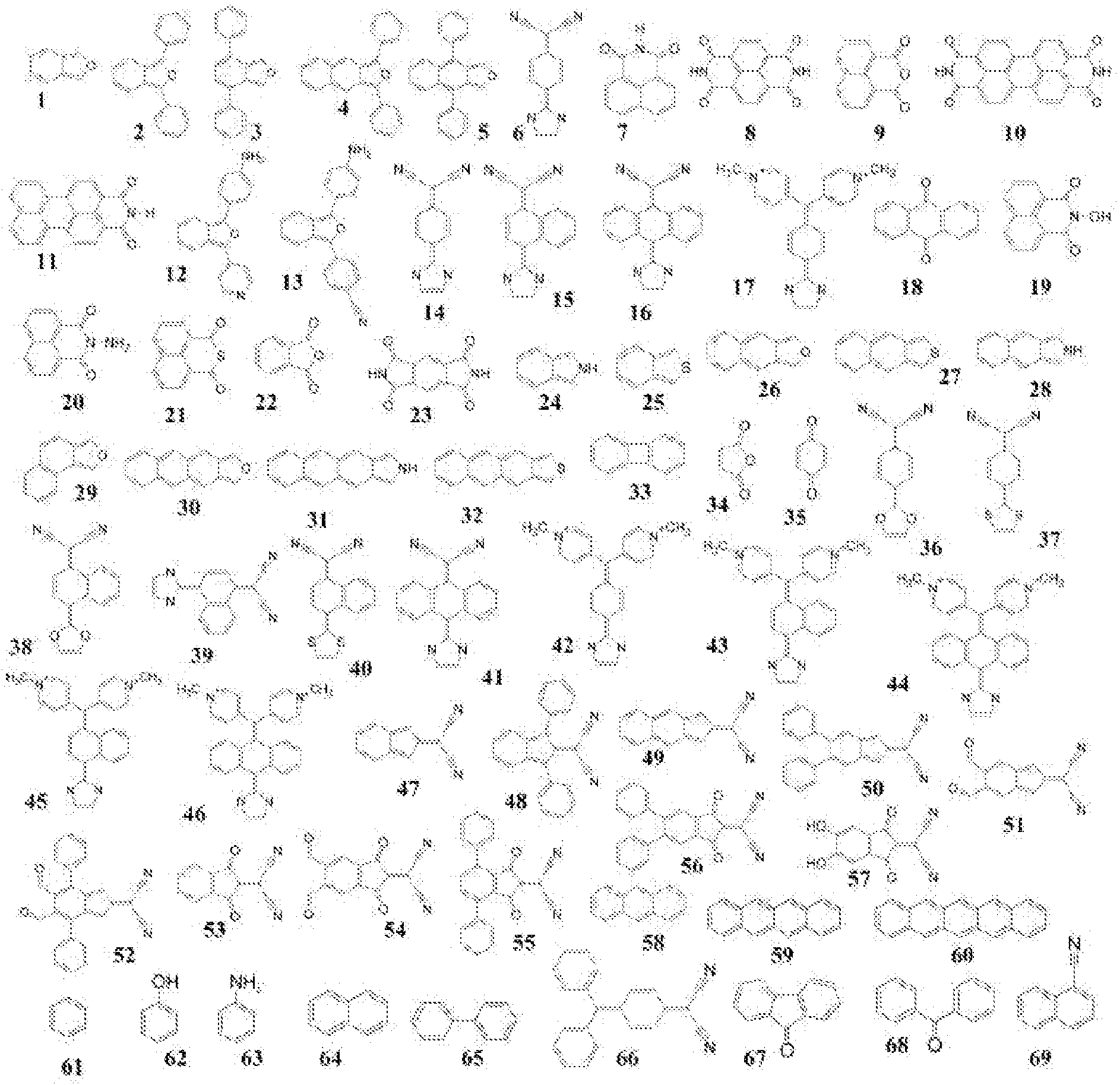
- the at least one singlet fission host material is selected from o-xylylene, p-xylylene, isobenzofulvene, perylene, polythiophene and polyacenes, such as tetracene, p-sexiphenyl, tetracyano-p- quinodimethane, tetrafluoro tetracyano-p-quinodimethane, polydiacetylene, poly(p- phenylene), poly(p-phenylenevinylene), carotenoids, l,4-bis(tetracen-5-yl) benzene.
- the at least one singlet fission host material is selected from the following compounds:
- the at least one singlet fission host material is selected from the group consisting of anthracene, tetracene and pentacene. In a further embodiment, the at least one singlet fission host material is selected from crystalline anthracene, crystalline tetracene, and crystalline pentacene.
- the at least one triplet forming dopant material has a higher triplet energy than that of the at least one singlet fission host material.
- the at least one triplet forming dopant material has a small singlet-triplet gap, for example a singlet-triplet gap of less than about 0.5 eV.
- the triplet forming dopant material has the right energetics relative to the singlet fission host material so that the dopant material' s triplet will transfer exothermically to the triplet of the singlet fission host material.
- Examples of the triplet forming dopant material that can be used in the devices of the present invention can be, but are not limited to porphyrins and phthalocyanines.
- a triplet forming dopant material other than a porphyrin or phthalocyanine complex will work in the devices of the present invention.
- the at least one triplet forming dopant material absorbs light in the red and near IR regions of the solar spectrum.
- the at least one triplet forming dopant material is selected from porphyrin compounds and phthalocyanine complexes.
- the at least one triplet forming dopant material is at least one porphyrin compound.
- the at least one porphyrin compound is nonplanar.
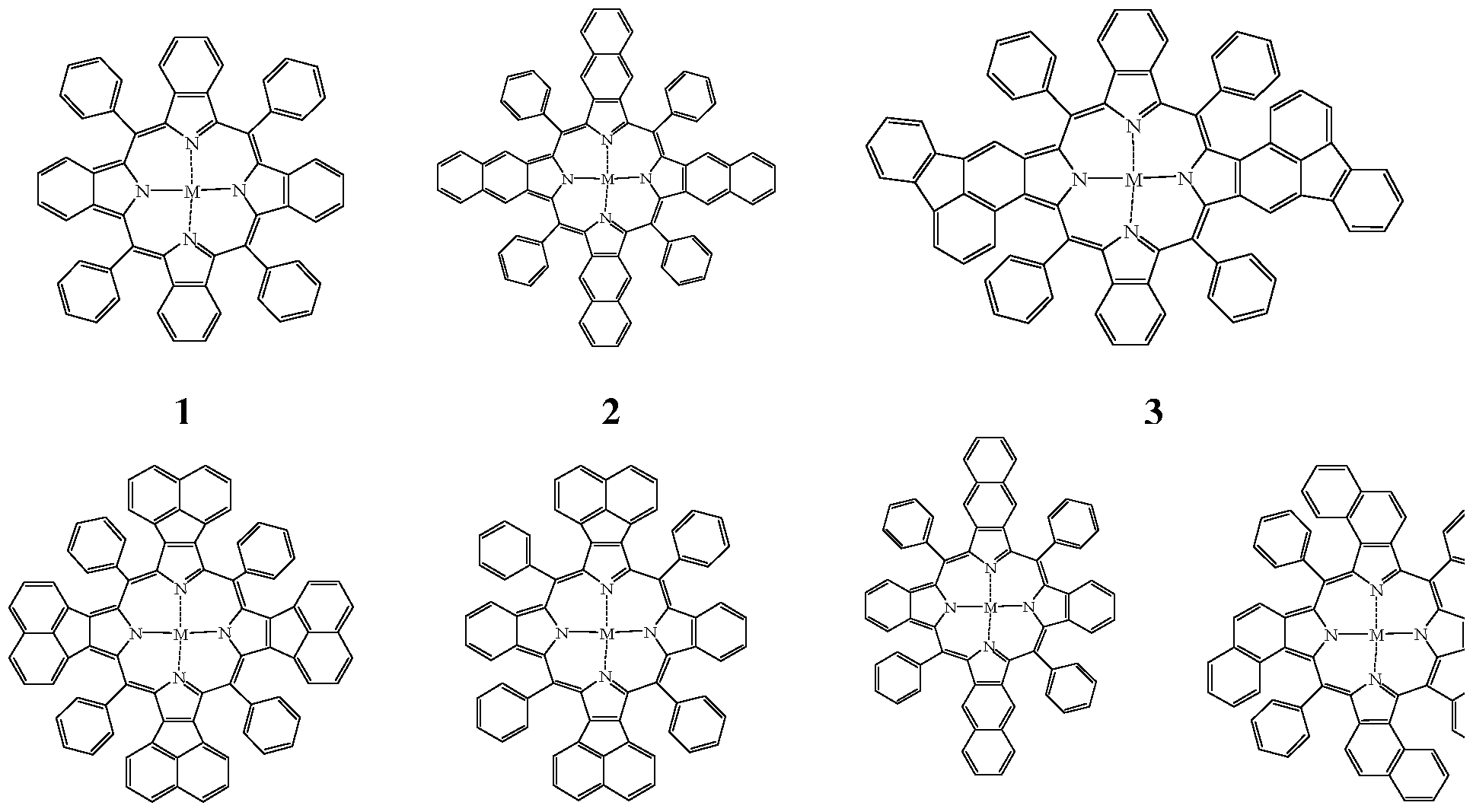
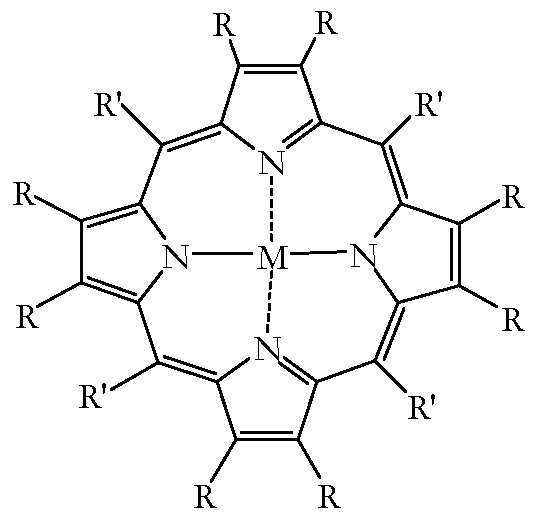
- the at least one nonplanar porphyrin is selected from compounds having formula (I),
- M is selected from Sc, Y, La, Ti, Zr, Hf, V, Nb, Ta, Cr, Mo, W, Mn, Tc, Re, Fe, Ru, Os, Co, Rh, Ir, Ni, Pd, Pt, Cu, Ag, Au, Zn, Cd, Hg, Al, Ga, In, Tl, Si, Ge, Sn, Pb, P, As, Sb, Bi, S, Se, Te, Po, Cl, Br, I, At, lanthanides, actinides, and 2H;
- R' is independently selected from Cl, Br, I, At, and a group comprising a valence atom attached to the meso carbon of the porphyrin, wherein the valence atom is selected from B, C, N, O, Si, P, S, Cl, Ge, As, Se, Br, In, Sn, Sb, Te, I, Tl, Pb, Bi, Po and At; and R is independently selected from Cl, Br, I, At, and a group comprising a valence atom attached to a ⁇ carbon of a pyrrole ring, wherein the valence atom is selected from B, C, N, O, Si, P, S, Cl, Ge, As, Se, Br, In, Sn, Sb, Te, I, Tl, Pb, Bi, Po and At, wherein two adjacent R groups attached to the same pyrrole ring together with the two ⁇ carbons of the pyrrole ring may form a carbocyclic group or heterocyclic group.
- the valence atom in at least one R' or R group is C.
- the at least one R' or R group is independently selected from an alkyl group, substituted alkyl group, alkenyl group, substituted alkenyl group, alkynyl group, substituted alkynyl group, cycloalkyl group, substituted cycloalkyl group, cycloalkenyl group, substituted cycloalkenyl group, cycloalkynyl group, substituted cycloalkynyl group, aryl group, substituted aryl group, heterocyclic group and substituted heterocyclic group.
- the substituted alkyl group is substituted with at least one radical independently selected from cycloalkyl groups, cycloalkenyl groups, cycloalkynyl groups, aryl groups, heterocyclic groups, hydroxy groups, alkoxy groups, alkenyloxy groups, alkynyloxy groups, cycloalkoxy groups, cyclo alkenyloxy groups, cycloalkynyloxy groups, aryloxy groups, alkylcarbonyloxy groups, cycloalkylcarbonyloxy groups, cycloalkenylcarbonyloxy groups, cycloalkynylcarbonyloxy groups, arylcarbonyloxy groups, thiol group, alkylthio groups, cyclo alkylthio groups, cyclo alkenylthio groups, cyclo alkynylthio groups, arylthio groups, formyl group, acyl group, carbamoyl groups, amino groups optionally substituted
- the two adjacent R groups of at least one pyrrole ring together with the two ⁇ carbon atoms of the at least one pyrrole ring form a carbocyclic group, substituted carbocyclic group, heterocyclic group, or substituted heterocyclic group.
- the two adjacent R groups of the at least one pyrrole ring together with the two ⁇ carbon atoms of the at least one pyrrole ring form a carbocyclic group or substituted carbocyclic group.
- the carbocyclic group or substituted carbocyclic group is a macrocycle or benzanulated ⁇ - system.
- the carbocyclic group or substituted carbocyclic group is aromatic.
- the two adjacent R groups of the at least one pyrrole ring together with the two ⁇ carbon atoms of the at least one pyrrole ring form a heterocyclic group or substituted heterocyclic group.
- the heterocyclic group or substituted heterocyclic group is aromatic.
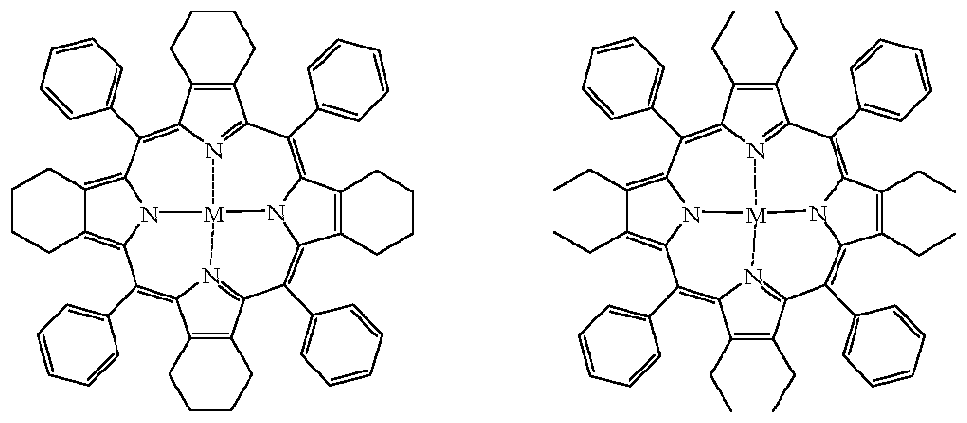
- the at least one R' or R group is phenyl, tolyl, xylenyl, mesityl, methyl, ethyl, n-propyl or isopropyl.
- the at least one nonplanar porphyrin is selected from the following compounds:
- the valence atom in at least one R' or R group is O.
- the at least one R' or R group having O as the valence atom is hydroxy, alkoxy, alkenyloxy, alkynyloxy, cycloakoxy, cyclo alkenyloxy, cyclo alkny Io xy, aralkyloxy, aralkenyloxy, aralkynyloxy, aryloxy, alkylcarbonyloxy, alkenylcarbonyloxy, alkynylcarbonyloxy, hydroxycarbonyloxy or alkoxycarbonyloxy.
- the at least one R' or R group having O as the valence atom is hydroxy or alkoxy.
- the at least one R' or R group having O as the valence atom is OH, methoxy, ethoxy, n-propoxy or isopropoxy.
- At least one R or R' group is independently selected from Cl, Br, I, and At.
- At least one R or R' group has N as the valence atom.
- the at least one R or R' group having N as the valence atom is selected from an amino group, alkylamino groups, dialkylamino groups, alkenylamino groups, dialkenylamino groups, alkynylamino groups, dialkynylamino groups, N- alkyl- N- alkenylamino groups, N- alkyl- N- alkynylamino groups, N-alkenyl-N- alkynylamino groups, acylamino groups, N-acyl-N-alkyl amino groups, N-acyl-N-alkenyl amino groups, N-acyl-N-alkynyl amino groups, N-acyl-N-cycloalkyl amino groups, N- acyl-N-cycloalkenyl amino groups, N-acyl-N-aryl amino groups, nitro group, heterocyclic groups comprising a nitrogen valence atom and substituted heterocyclic groups comprising a nitrogen
- At least one R or R' group has S as the valence atom.
- the at least one R or R' group comprising S as the valence atom is selected from a thiol group, alkylthio groups, alkenylthio groups, alkynylthio groups, aralkylthio groups, aralkenylthio groups, aralkynylthio groups, cycloalkylalkylthio groups, cycloalkenylalkylthio groups, cycloalkynylalkylthio groups, cyclo alkylthio groups, cyclo alkenylthio groups, cyclo alkynylthio groups, and arylthio groups.
- M is Pt, Pd, or Ir. [0082] In another embodiment, M is Pt. [0083] In another embodiment, M is Pd. [0084] In one embodiment, the at least one nonplanar porphyrin is Pt(tetraphenyl benzo-porphyrin) .
- the at least one nonplanar porphyrin is Pd(tetraphenyl benzo-porphyrin) .
- the device is an organic photovoltaic cell. [0087] In another embodiment, the device is a photoconductor cell. [0088] In another embodiment, the device is a photodetector.
- the device is selected from organic photosensors, chemical sensors and biological sensors.
- carrier group means a cyclic chemical group wherein all the ring atoms are carbon.
- the “carbocyclic group” is monocyclic or multicyclic.
- the “carbocyclic group” can be a cycloalkyl group, cycloalkenyl group, cycloalkynyl group and aryl group.
- heterocyclic group refers to a cyclic chemical group having at least one N, O or S ring atom, with C atom(s) as the remaining ring atom(s).
- the “heterocyclic group” is monocyclic or multicyclic. When the “heterocyclic group” is aromatic, it is called a “heteroaryl group.”
- the heterocyclic group can be a cyclic group comprising a A-, 5-, 6-, 7- or 8-membered ring, wherein the ring comprises at least one ring atom selected from the group consisting of N, O and S with C as the remaining ring atom(s).
- heterocyclic group examples include pyrrolidinyl group, piperidinyl group, piperazinyl group, morpholino group, thiomorpholino group, homopiperidinyl group, chromanyl group, isochromanyl group, chromenyl group, pyrrolyl group, furanyl group, thienyl group, pyrazolyl group, imidazolyl group, furazanyl group, oxazolyl group, isoxazolyl group, thiazolyl group, isothiazolyl group, pyridyl group, pyridazinyl group, pyrimidinyl group, pyrazinyl group, pyranyl group, indolyl group, isoindolyl group, indazolyl group, purinyl group, indolizinyl group, quinolinyl group, isoquinolinyl group, quinazolinyl group, pteridinyl group
- the carbocyclic group or heterocyclic group comprises at least two rings.
- examples of “multicyclic” include bicyclic, tricyclic and tetracyclic. Some or all of the rings in the “multicyclic” group can be peri- fused, ortho-fused and/or bridged.
- the “multicyclic” group can be a spiro group.
- valence atom of a chemical group refers to the atom of the chemical group that attaches to another chemical group or atom.
- hydrocarbyl group refers to a chemical group having carbon and hydrogen atoms.
- alkyl group means a straight-chain or branched saturated hydrocarbyl group.
- the "alkyl group” is C 1 -C 6 .
- Examples of the alkyl group include methyl, ethyl, n-propyl, isopropyl, n-butyl, sec-butyl, isobutyl, tert- butyl, n-pentyl and n-hexyl.
- the "alkenyl group” is C 2 -C 6 .
- An example of the alkenyl group is vinyl.
- alkynyl group means a hydrocarbyl group comprising at least one carbon-to-carbon triple bond.
- the "alkynyl group” is C 2 -C 6 .
- cycloalkyl group means a saturated cyclic hydrocarbyl group.
- the "cycloalkyl group” is monocyclic or multicyclic.
- the "cycloalkyl group” can be C 3 -Cs.
- Examples of “cycloalkyl group” include cyclobutyl, cyclopentyl, cyclohexyl, cycloheptyl, cyclooctyl and cyclononyl.
- the "cycloalkenyl group” is monocyclic or multicyclic.
- the "cycloalkenyl group” can be C 3 -Cs.
- cycloalkynyl group means an unsaturated cyclic hydrocarbyl group having at least one carbon-to-carbon triple bond.
- the "cycloalkynyl group” is monocyclic or multicyclic.
- the "cycloalkynyl group” can be C 3 -Cs.
- aryl group means an aromatic hydrocarbyl group.
- the "aryl group” is monocyclic or multicyclic.
- the “aryl group” can be C 6 -C 1O .
- Examples of the “aryl group” include phenyl group and naphthyl group.
- aralkyl group refers to an alkyl group substituted with at least one aryl group.
- the aryl portion of the “aralkyl group” can be C 6 -C 1O .
- the alkyl portion of the “aralkyl group” can be C 1 -C 6 .
- Example of the "aralkyl group” are benzyl group, i.e., phenylmethyl group, and 2-phenylethyl group.
- a chemical group is modified by "substituted” that means the chemical group has at least one hydrogen atom replaced by a substituent.
- substituent include a radical selected from the group consisting of alkyl groups, alkenyl groups, alkynyl groups, cyclo alkyl groups, cycloalkenyl groups, cycloalkynyl groups, aryl groups, heterocyclic groups, hydroxy group, alkoxy groups, alkenyloxy groups, alkynyloxy groups, cycloalkoxy groups, cyclo alkenyloxy groups, cyclo alkynyloxy groups, aryloxy groups, alkylcarbonyloxy groups, cycloalkylcarbonyloxy groups, cycloalkenylcarbonyloxy groups, cycloalkynylcarbonyloxy groups, arylcarbonyloxy groups, thiol group, alkylthio groups, cyclo alkylthio groups, cyclo alkylthio groups, cycl
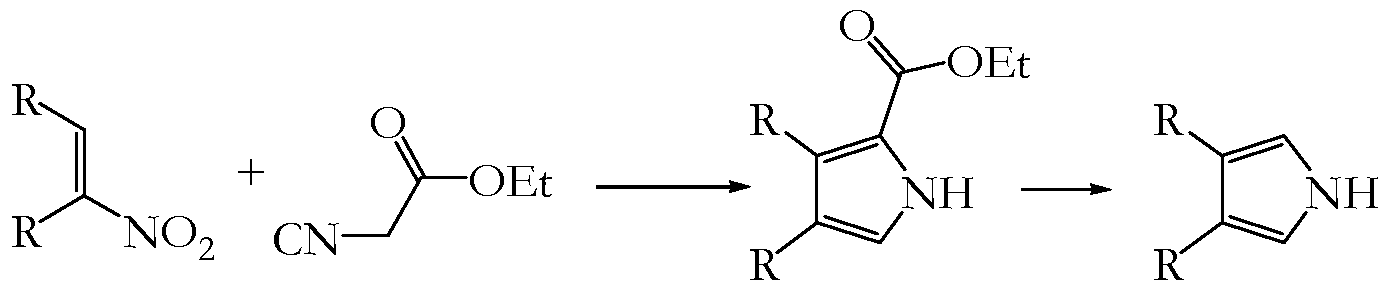
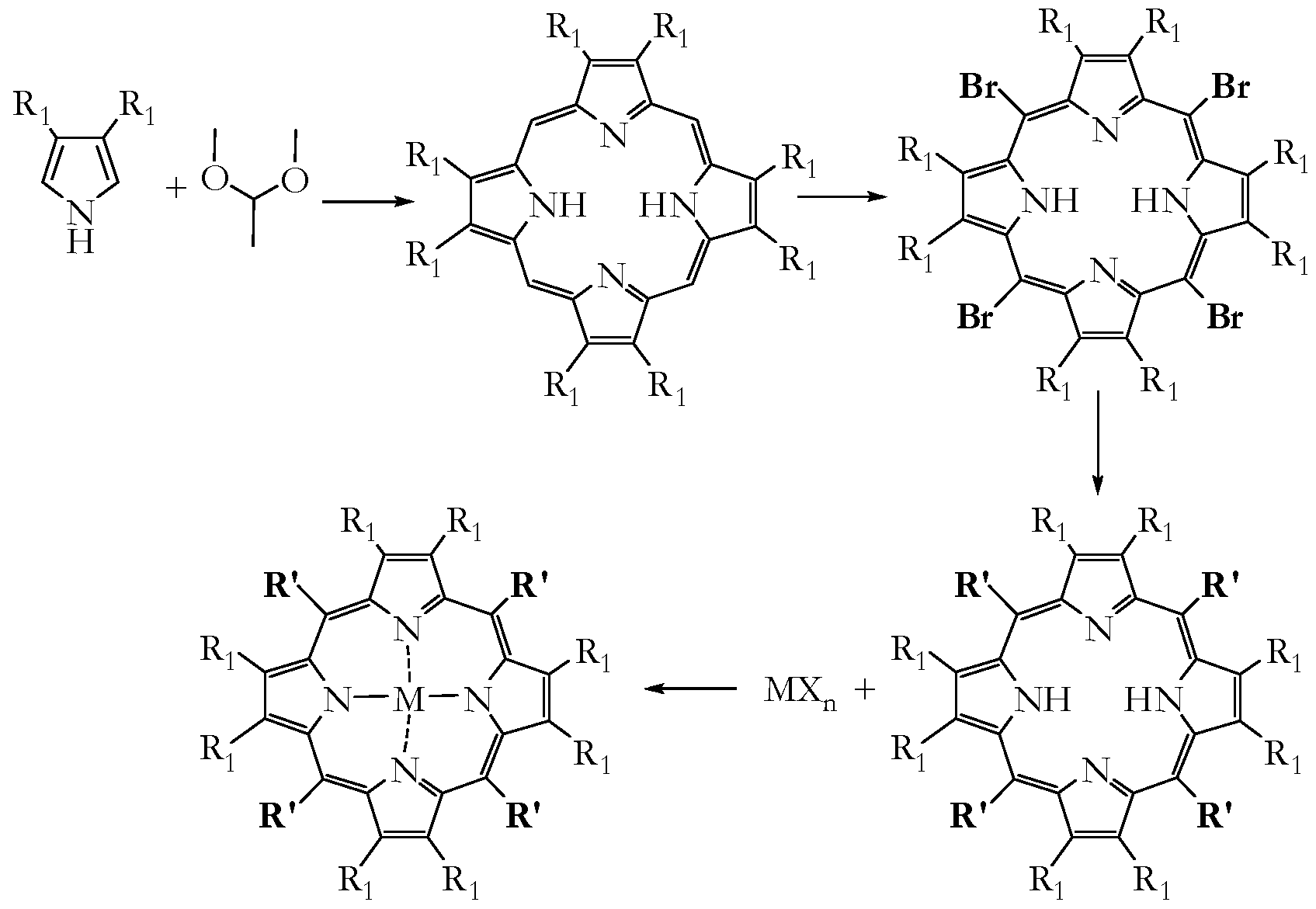
- Substituted vinyl nitro compounds may be reacted under nonnucleophilic basic conditions with ethyl isocyano acetate to form carboxyl ester substituted pyrrole derivatives.
- the carboxyl ester substituted pyrrole derivatives may then be decarboxylated under basic conditions to yield the pyrrolic moiety.
- a carboxyl ester protected substituted pyrrole is condensed with a substituted aldehyde to form a dipyrromethane under Lindsey conditions with subsequent decarboxylation under basic conditions.
- a substituted pyrrole is acylated with benzoyl chloride under Friedel-Crafts conditions and condensed with a substituted aldehyde to form a phenyl ketone substituted dipyrromethane.
- This phenyl ketone substituted dipyrromethane is reduced with NaBH 4 to the corresponding secondary alcohol.
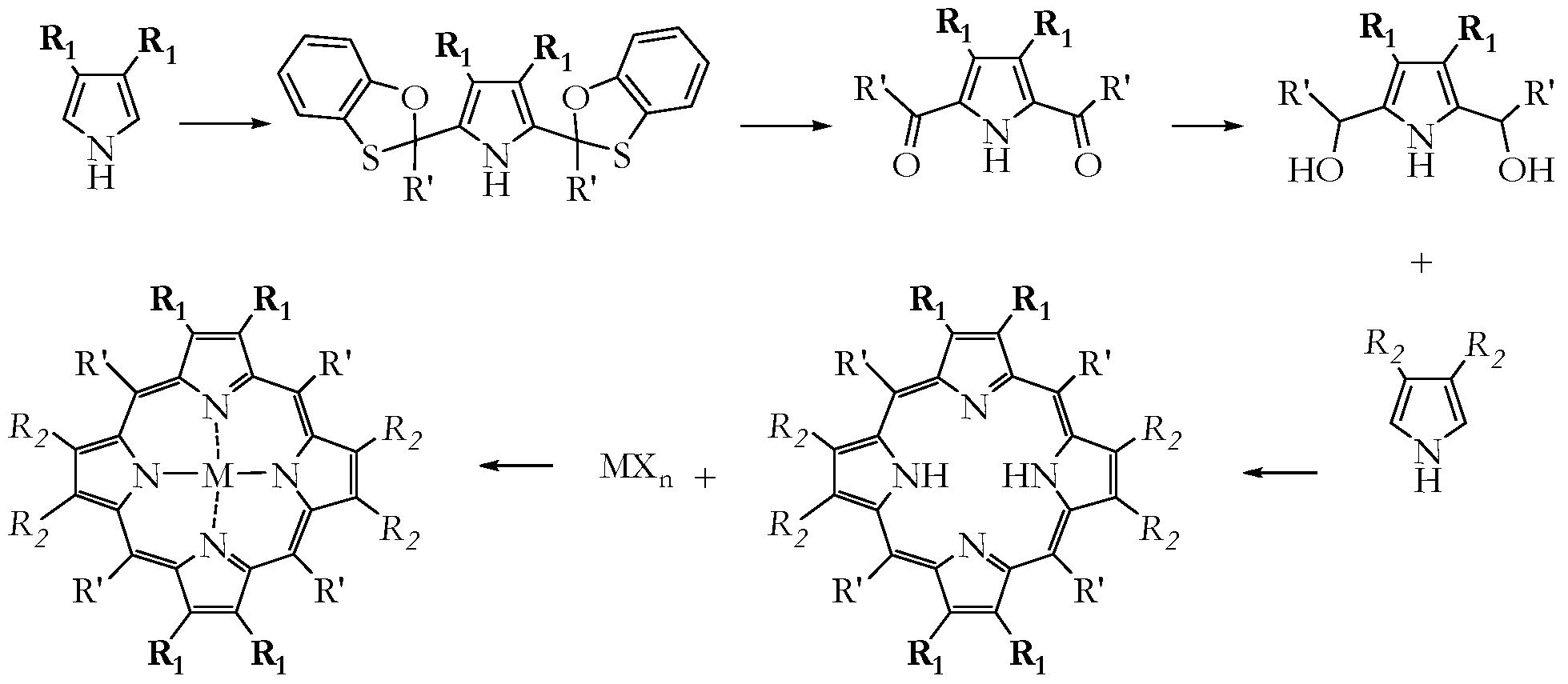
- a substituted pyrrole is reacted with phenyl- 1,3-benzoxathiolylium tetrafluoroborate to form a disubstituted pyrrole.
- Subsequent quenching with mercury oxide yields the ketone derivative which gets reduced using NaBH 4 to form the secondary alcohol.
- This alcohol reacts under acidic conditions with a different substituted pyrrole to form the porphyrin after oxidation.
- Metallation using for example a metal halide yields the final product.
- M in the reaction scheme below is a metal.
- R 1 and R 2 are examples of R.
- organic photovoltaic device of the present invention examples include: tetracene doped with Pt(TPBP)/C60/BCP/Al; and ITO/PEDOT/P3HT doped with Pt(TPBP)/C60/BCP/Al.
Landscapes
- Engineering & Computer Science (AREA)
- Chemical & Material Sciences (AREA)
- Physics & Mathematics (AREA)
- Nanotechnology (AREA)
- Crystallography & Structural Chemistry (AREA)
- Electromagnetism (AREA)
- Theoretical Computer Science (AREA)
- Mathematical Physics (AREA)
- Manufacturing & Machinery (AREA)
- Inorganic Chemistry (AREA)
- Materials Engineering (AREA)
- Photovoltaic Devices (AREA)
- Nitrogen Condensed Heterocyclic Rings (AREA)
- Electroluminescent Light Sources (AREA)
- Light Receiving Elements (AREA)
- Compositions Of Macromolecular Compounds (AREA)
- Heterocyclic Compounds Containing Sulfur Atoms (AREA)
- Hydrogenated Pyridines (AREA)
- Indole Compounds (AREA)
- Other In-Based Heterocyclic Compounds (AREA)
- Furan Compounds (AREA)
- Pyrane Compounds (AREA)
- Plural Heterocyclic Compounds (AREA)
Abstract
Description




Claims


Priority Applications (7)
| Application Number | Priority Date | Filing Date | Title |
|---|---|---|---|
| JP2010521119A JP2010537407A (en) | 2007-08-13 | 2008-08-12 | Organic photosensitive optoelectronic equipment using triplet harvesting |
| KR1020107005400A KR101508024B1 (en) | 2007-08-13 | 2008-08-12 | Organic photosensitive optoelectronic devices with triplet harvesting |
| CA2694965A CA2694965A1 (en) | 2007-08-13 | 2008-08-12 | Organic photosensitive optoelectronic devices with triplet harvesting |
| CN2008801033876A CN101803056B (en) | 2007-08-13 | 2008-08-12 | Organic photosensitive optoelectronic devices with triplet harvesting |
| AU2008286909A AU2008286909B2 (en) | 2007-08-13 | 2008-08-12 | Organic photosensitive optoelectronic devices with triplet harvesting |
| EP08827437A EP2179458A1 (en) | 2007-08-13 | 2008-08-12 | Organic photosensitive optoelectronic devices with triplet harvesting |
| HK10109784.9A HK1143453B (en) | 2007-08-13 | 2008-08-12 | Organic photosensitive optoelectronic devices with triplet harvesting |
Applications Claiming Priority (2)
| Application Number | Priority Date | Filing Date | Title |
|---|---|---|---|
| US95548507P | 2007-08-13 | 2007-08-13 | |
| US60/955,485 | 2007-08-13 |
Publications (1)
| Publication Number | Publication Date |
|---|---|
| WO2009023667A1 true WO2009023667A1 (en) | 2009-02-19 |
Family
ID=39890231
Family Applications (1)
| Application Number | Title | Priority Date | Filing Date |
|---|---|---|---|
| PCT/US2008/072896 Ceased WO2009023667A1 (en) | 2007-08-13 | 2008-08-12 | Organic photosensitive optoelectronic devices with triplet harvesting |
Country Status (9)
| Country | Link |
|---|---|
| US (2) | US20090044864A1 (en) |
| EP (1) | EP2179458A1 (en) |
| JP (2) | JP2010537407A (en) |
| KR (1) | KR101508024B1 (en) |
| CN (2) | CN101803056B (en) |
| AU (1) | AU2008286909B2 (en) |
| CA (1) | CA2694965A1 (en) |
| TW (1) | TWI445184B (en) |
| WO (1) | WO2009023667A1 (en) |
Cited By (39)
| Publication number | Priority date | Publication date | Assignee | Title |
|---|---|---|---|---|
| WO2009117613A1 (en) * | 2008-03-19 | 2009-09-24 | The Regents Of The University Of Michigan | Organic thin films for infrared detection |
| JP2010219448A (en) * | 2009-03-18 | 2010-09-30 | Ricoh Co Ltd | Organic thin-film solar cell |
| CN102544372A (en) * | 2010-10-22 | 2012-07-04 | 施乐公司 | Photovoltaic device |
| JP2013537925A (en) * | 2010-09-10 | 2013-10-07 | ユニバーシティ オブ サザン カリフォルニア | Multiple chromophore sequences based on metalloporphyrins with broad absorption for triplet harvesting |
| WO2014089179A3 (en) * | 2012-12-04 | 2014-10-30 | Massachusetts Institute Of Technology | Devices including organic materials such as singlet fission materials |
| WO2016029137A1 (en) * | 2014-08-22 | 2016-02-25 | Arizona Board Of Regents On Behalf Of Arizona State University | Organic light-emitting diodes with fluorescent and phosphorescent emitters |
| US9899614B2 (en) | 2013-06-10 | 2018-02-20 | Arizona Board Of Regents On Behalf Of Arizona State University | Phosphorescent tetradentate metal complexes having modified emission spectra |
| US9944847B2 (en) | 2015-02-17 | 2018-04-17 | Massachusetts Institute Of Technology | Methods and compositions for the upconversion of light |
| US10033003B2 (en) | 2014-11-10 | 2018-07-24 | Arizona Board Of Regents On Behalf Of Arizona State University | Tetradentate metal complexes with carbon group bridging ligands |
| WO2018189527A1 (en) * | 2017-04-11 | 2018-10-18 | Cambridge Enterprise Limited | Photon multiplier film |
| US10158091B2 (en) | 2015-08-04 | 2018-12-18 | Arizona Board Of Regents On Behalf Of Arizona State University | Tetradentate platinum (II) and palladium (II) complexes, devices, and uses thereof |
| US10177323B2 (en) | 2016-08-22 | 2019-01-08 | Arizona Board Of Regents On Behalf Of Arizona State University | Tetradentate platinum (II) and palladium (II) complexes and octahedral iridium complexes employing azepine functional groups and their analogues |
| US10263197B2 (en) | 2010-04-30 | 2019-04-16 | Arizona Board Of Regents Acting For And On Behalf Of Arizona State University | Synthesis of four coordinated palladium complexes and their applications in light emitting devices thereof |
| US10516117B2 (en) | 2017-05-19 | 2019-12-24 | Arizona Board Of Regents On Behalf Of Arizona State University | Metal-assisted delayed fluorescent emttters employing benzo-imidazo-phenanthridine and analogues |
| US10622571B2 (en) | 2012-09-24 | 2020-04-14 | Arizona Board Of Regents For And On Behalf Of Arizona State University | Metal compounds, methods, and uses thereof |
| US10794771B2 (en) | 2015-02-17 | 2020-10-06 | Massachusetts Institute Of Technology | Compositions and methods for the downconversion of light |
| US10804476B2 (en) | 2011-05-26 | 2020-10-13 | Arizona Board Of Regents, Acting For And On Behalf Of Arizona State University | Synthesis of platinum and palladium complexes as narrow-band phosphorescent emitters for full color displays |
| US10822363B2 (en) | 2016-10-12 | 2020-11-03 | Arizona Board Of Regents On Behalf Of Arizona State University | Narrow band red phosphorescent tetradentate platinum (II) complexes |
| US10836785B2 (en) | 2015-06-03 | 2020-11-17 | Arizona Board Of Regents On Behalf Of Arizona State University | Tetradentate and octahedral metal complexes containing naphthyridinocarbazole and its analogues |
| US10886478B2 (en) | 2014-07-24 | 2021-01-05 | Arizona Board Of Regents On Behalf Of Arizona State University | Tetradentate platinum (II) complexes cyclometalated with functionalized phenyl carbene ligands and their analogues |
| US10991897B2 (en) | 2014-11-10 | 2021-04-27 | Arizona Board Of Regents On Behalf Of Arizona State University | Emitters based on octahedral metal complexes |
| US11011712B2 (en) | 2014-06-02 | 2021-05-18 | Arizona Board Of Regents On Behalf Of Arizona State University | Tetradentate cyclometalated platinum complexes containing 9,10-dihydroacridine and its analogues |
| US11101435B2 (en) | 2017-05-19 | 2021-08-24 | Arizona Board Of Regents On Behalf Of Arizona State University | Tetradentate platinum and palladium complexes based on biscarbazole and analogues |
| US11183670B2 (en) | 2016-12-16 | 2021-11-23 | Arizona Board Of Regents On Behalf Of Arizona State University | Organic light emitting diode with split emissive layer |
| US11189808B2 (en) | 2013-10-14 | 2021-11-30 | Arizona Board Of Regents On Behalf Of Arizona State University | Platinum complexes and devices |
| US11335865B2 (en) | 2016-04-15 | 2022-05-17 | Arizona Board Of Regents On Behalf Of Arizona State University | OLED with multi-emissive material layer |
| US11594691B2 (en) | 2019-01-25 | 2023-02-28 | Arizona Board Of Regents On Behalf Of Arizona State University | Light outcoupling efficiency of phosphorescent OLEDs by mixing horizontally aligned fluorescent emitters |
| US11594688B2 (en) | 2017-10-17 | 2023-02-28 | Arizona Board Of Regents On Behalf Of Arizona State University | Display and lighting devices comprising phosphorescent excimers with preferred molecular orientation as monochromatic emitters |
| US11647643B2 (en) | 2017-10-17 | 2023-05-09 | Arizona Board Of Regents On Behalf Of Arizona State University | Hole-blocking materials for organic light emitting diodes |
| US11708385B2 (en) | 2017-01-27 | 2023-07-25 | Arizona Board Of Regents On Behalf Of Arizona State University | Metal-assisted delayed fluorescent emitters employing pyrido-pyrrolo-acridine and analogues |
| US11785838B2 (en) | 2019-10-02 | 2023-10-10 | Arizona Board Of Regents On Behalf Of Arizona State University | Green and red organic light-emitting diodes employing excimer emitters |
| US11878988B2 (en) | 2019-01-24 | 2024-01-23 | Arizona Board Of Regents On Behalf Of Arizona State University | Blue phosphorescent emitters employing functionalized imidazophenthridine and analogues |
| US11930698B2 (en) | 2014-01-07 | 2024-03-12 | Arizona Board Of Regents On Behalf Of Arizona State University | Tetradentate platinum and palladium complex emitters containing phenyl-pyrazole and its analogues |
| US11945985B2 (en) | 2020-05-19 | 2024-04-02 | Arizona Board Of Regents On Behalf Of Arizona State University | Metal assisted delayed fluorescent emitters for organic light-emitting diodes |
| US12037348B2 (en) | 2018-03-09 | 2024-07-16 | Arizona Board Of Regents On Behalf Of Arizona State University | Blue and narrow band green and red emitting metal complexes |
| US12043611B2 (en) | 2014-08-15 | 2024-07-23 | Arizona Board Of Regents On Behalf Of Arizona State University | Non-platinum metal complexes for excimer based single dopant white organic light emitting diodes |
| US12043633B2 (en) | 2012-10-26 | 2024-07-23 | Arizona Board Of Regents On Behalf Of Arizona State University | Metal complexes, methods, and uses thereof |
| US12091429B2 (en) | 2018-07-16 | 2024-09-17 | Arizona Board Of Regents On Behalf Of Arizona State University | Fluorinated porphyrin derivatives for optoelectronic applications |
| US12503644B2 (en) | 2020-05-19 | 2025-12-23 | Arizona Board Of Regents On Behalf Of Arizona State University | Metal assisted delayed fluorescent emitters for organic light-emitting diodes |
Families Citing this family (15)
| Publication number | Priority date | Publication date | Assignee | Title |
|---|---|---|---|---|
| AU2007224400B2 (en) * | 2007-10-12 | 2014-10-02 | The University Of Southern California | Organic photosenstive optoelectronic devices containing tetra-azaporphyrins |
| US20130240850A1 (en) * | 2012-03-13 | 2013-09-19 | The Regents Of The University Of Michigan | Ultra-high efficiency (125%) phosphorescent organic light emitting diodes using singlet fission |
| US9758606B2 (en) | 2012-07-31 | 2017-09-12 | The Trustees Of Columbia University In The City Of New York | Cyclopropenium polymers and methods for making the same |
| AU2013323565A1 (en) * | 2012-09-26 | 2015-04-09 | The Regents Of The University Of Michigan | Excitonic energy transfer to increase inorganic solar cell efficiency |
| KR101624094B1 (en) | 2013-03-11 | 2016-05-24 | 사우디 베이식 인더스트리즈 코포레이션 | Aryloxy-phthalocyanines of group iii metals |
| CN107068871A (en) | 2013-03-11 | 2017-08-18 | 沙特基础工业公司 | Plane donor-acceptor hetero-junctions and the photovoltaic cell comprising it |
| US10636974B2 (en) | 2014-04-24 | 2020-04-28 | The Trustees Of Columbia University In The City Of New York | Molecular compositions, materials, and methods for efficient multiple exciton generation |
| WO2015164831A1 (en) * | 2014-04-24 | 2015-10-29 | The Trustees Of Columbia University In The City Of New York | Molecular compositions, materials, and methods for efficient multiple exciton generation |
| US9929365B2 (en) * | 2014-05-28 | 2018-03-27 | The Regents Of The University Of Michigan | Excited state management |
| US10290816B2 (en) | 2015-11-16 | 2019-05-14 | The Regents Of The University Of Michigan | Organic electroluminescent materials and devices |
| CN105601560B (en) * | 2015-12-31 | 2018-01-23 | 苏州科技学院 | Dim light frequency upooaversion Triplet Sensitizers and its application |
| CN106279193A (en) * | 2016-08-10 | 2017-01-04 | 天津大学 | One buries in oblivion upper conversion near infrared light photosensitizer and the application of upper converting system thereof based on triplet |
| US12046425B2 (en) * | 2017-04-14 | 2024-07-23 | Cubicpv Inc. | Photovoltaic device encapsulation |
| JP7214142B2 (en) * | 2017-07-25 | 2023-01-30 | 国立大学法人九州大学 | Singlet fission materials, triplet sensitizers, compounds and thin films |
| JP2021163869A (en) * | 2020-03-31 | 2021-10-11 | 住友化学株式会社 | Photodetection element |
Citations (2)
| Publication number | Priority date | Publication date | Assignee | Title |
|---|---|---|---|---|
| JPS58190074A (en) * | 1982-04-30 | 1983-11-05 | Riken Corp | Photoelectric conversion element |
| WO2006092135A1 (en) * | 2005-03-04 | 2006-09-08 | Heliatek Gmbh | Photoactive component with organic layers |
Family Cites Families (14)
| Publication number | Priority date | Publication date | Assignee | Title |
|---|---|---|---|---|
| US6352777B1 (en) * | 1998-08-19 | 2002-03-05 | The Trustees Of Princeton University | Organic photosensitive optoelectronic devices with transparent electrodes |
| JP3383839B2 (en) | 2000-03-13 | 2003-03-10 | 奈良先端科学技術大学院大学長 | Novel mercapto-substituted imidazolyl porphyrin metal complex monomer, polymer having the same as a repeating unit, and methods for producing them |
| JP2002008861A (en) * | 2000-06-20 | 2002-01-11 | Toray Ind Inc | Light-emitting element |
| US6420648B1 (en) * | 2000-07-21 | 2002-07-16 | North Carolina State University | Light harvesting arrays |
| US6580027B2 (en) * | 2001-06-11 | 2003-06-17 | Trustees Of Princeton University | Solar cells using fullerenes |
| US6657378B2 (en) * | 2001-09-06 | 2003-12-02 | The Trustees Of Princeton University | Organic photovoltaic devices |
| GB0216154D0 (en) * | 2002-07-12 | 2002-08-21 | Elam T Ltd | Metal chelates |
| EP1644135A4 (en) * | 2003-06-25 | 2011-04-20 | Univ Princeton | IMPROVED SOLAR CELLS |
| JP4548779B2 (en) * | 2004-01-23 | 2010-09-22 | 日本電信電話株式会社 | Organic photoelectric conversion device and organic solar cell |
| JP2005338661A (en) * | 2004-05-28 | 2005-12-08 | Mitsui Chemicals Inc | Filter for display and its use |
| DE102004034140A1 (en) | 2004-07-15 | 2006-02-23 | Covion Organic Semiconductors Gmbh | Use of polymers for up-conversion and devices for up-conversion |
| US7196366B2 (en) * | 2004-08-05 | 2007-03-27 | The Trustees Of Princeton University | Stacked organic photosensitive devices |
| US7598381B2 (en) * | 2006-09-11 | 2009-10-06 | The Trustees Of Princeton University | Near-infrared emitting organic compounds and organic devices using the same |
| US8785624B2 (en) * | 2007-06-13 | 2014-07-22 | University Of Southern California | Organic photosensitive optoelectronic devices with nonplanar porphyrins |
-
2008
- 2008-08-12 KR KR1020107005400A patent/KR101508024B1/en not_active Expired - Fee Related
- 2008-08-12 JP JP2010521119A patent/JP2010537407A/en active Pending
- 2008-08-12 CA CA2694965A patent/CA2694965A1/en not_active Abandoned
- 2008-08-12 WO PCT/US2008/072896 patent/WO2009023667A1/en not_active Ceased
- 2008-08-12 CN CN2008801033876A patent/CN101803056B/en not_active Expired - Fee Related
- 2008-08-12 AU AU2008286909A patent/AU2008286909B2/en not_active Ceased
- 2008-08-12 EP EP08827437A patent/EP2179458A1/en not_active Withdrawn
- 2008-08-12 US US12/190,265 patent/US20090044864A1/en not_active Abandoned
- 2008-08-12 CN CN2011102813027A patent/CN102447065A/en active Pending
- 2008-08-13 TW TW097130824A patent/TWI445184B/en not_active IP Right Cessation
-
2012
- 2012-02-05 US US13/366,339 patent/US9391284B2/en active Active
-
2014
- 2014-12-05 JP JP2014247416A patent/JP2015092587A/en active Pending
Patent Citations (2)
| Publication number | Priority date | Publication date | Assignee | Title |
|---|---|---|---|---|
| JPS58190074A (en) * | 1982-04-30 | 1983-11-05 | Riken Corp | Photoelectric conversion element |
| WO2006092135A1 (en) * | 2005-03-04 | 2006-09-08 | Heliatek Gmbh | Photoactive component with organic layers |
Non-Patent Citations (5)
| Title |
|---|
| I. PACI, J. .C. JOHNSON, X. CHEN, G. RANA, D. POPOVIC, D. E. DAVID, A. J. NOZIK, M. A. RATNER, J. MICHEL, J. AM. CHEM. SOC., vol. 128, 2006, pages 16546 - 16553, XP002502946 * |
| SMESTAD G P: "Absorptivity as a predictor of the photoluminescence spectra of silicon solar cells and photosynthesis", SOLAR ENERGY MATERIALS AND SOLAR CELLS, ELSEVIER SCIENCE PUBLISHERS, AMSTERDAM, NL, vol. 38, no. 1/4, 1 August 1995 (1995-08-01), pages 57 - 71, XP004005354, ISSN: 0927-0248 * |
| SUN YIRU ET AL: "Photophysics of Pt-porphyrin electrophosphorescent devices emitting in the near infrared", APPLIED PHYSICS LETTERS, AIP, AMERICAN INSTITUTE OF PHYSICS, MELVILLE, NY, vol. 90, no. 21, 21 May 2007 (2007-05-21), pages 213503-1 - 213503-3, XP012094989, ISSN: 0003-6951 * |
| SYMKO-DAVIES M ET AL: "Future generation technology status within the high-performance PV project", PHOTOVOLTAIC ENERGY CONVERSION, CONFERENCE RECORD OF THE 2006 IEEE 4TH WORLD CONFERENCE ON, IEEE, PI, vol. 1, 7 May 2006 (2006-05-07), pages 175 - 178, XP031007266, ISBN: 978-1-4244-0016-4 * |
| WANG X ET AL: "Electrophosphorescence from substituted poly(thiophene) doped with iridium or platinum complex", THIN SOLID FILMS, ELSEVIER-SEQUOIA S.A. LAUSANNE, CH, vol. 468, no. 1-2, 1 December 2004 (2004-12-01), pages 226 - 233, XP004579177, ISSN: 0040-6090 * |
Cited By (63)
| Publication number | Priority date | Publication date | Assignee | Title |
|---|---|---|---|---|
| WO2009117613A1 (en) * | 2008-03-19 | 2009-09-24 | The Regents Of The University Of Michigan | Organic thin films for infrared detection |
| JP2010219448A (en) * | 2009-03-18 | 2010-09-30 | Ricoh Co Ltd | Organic thin-film solar cell |
| US10727422B2 (en) | 2010-04-30 | 2020-07-28 | Arizona Board Of Regents On Behalf Of Arizona State University | Synthesis of four coordinated palladium complexes and their applications in light emitting devices thereof |
| US10263197B2 (en) | 2010-04-30 | 2019-04-16 | Arizona Board Of Regents Acting For And On Behalf Of Arizona State University | Synthesis of four coordinated palladium complexes and their applications in light emitting devices thereof |
| JP2013537925A (en) * | 2010-09-10 | 2013-10-07 | ユニバーシティ オブ サザン カリフォルニア | Multiple chromophore sequences based on metalloporphyrins with broad absorption for triplet harvesting |
| CN102544372A (en) * | 2010-10-22 | 2012-07-04 | 施乐公司 | Photovoltaic device |
| US11121328B2 (en) | 2011-05-26 | 2021-09-14 | Arizona Board Of Regents On Behalf Of Arizona State University | Synthesis of platinum and palladium complexes as narrow-band phosphorescent emitters for full color displays |
| US10804476B2 (en) | 2011-05-26 | 2020-10-13 | Arizona Board Of Regents, Acting For And On Behalf Of Arizona State University | Synthesis of platinum and palladium complexes as narrow-band phosphorescent emitters for full color displays |
| US10622571B2 (en) | 2012-09-24 | 2020-04-14 | Arizona Board Of Regents For And On Behalf Of Arizona State University | Metal compounds, methods, and uses thereof |
| US11114626B2 (en) | 2012-09-24 | 2021-09-07 | Arizona Board Of Regents On Behalf Of Arizona State University | Metal compounds, methods, and uses thereof |
| US12232411B2 (en) | 2012-09-24 | 2025-02-18 | Arizona Board Of Regents On Behalf Of Arizona State University | Metal compounds, methods, and uses thereof |
| US12043633B2 (en) | 2012-10-26 | 2024-07-23 | Arizona Board Of Regents On Behalf Of Arizona State University | Metal complexes, methods, and uses thereof |
| WO2014089179A3 (en) * | 2012-12-04 | 2014-10-30 | Massachusetts Institute Of Technology | Devices including organic materials such as singlet fission materials |
| US9899614B2 (en) | 2013-06-10 | 2018-02-20 | Arizona Board Of Regents On Behalf Of Arizona State University | Phosphorescent tetradentate metal complexes having modified emission spectra |
| US11189808B2 (en) | 2013-10-14 | 2021-11-30 | Arizona Board Of Regents On Behalf Of Arizona State University | Platinum complexes and devices |
| US12167676B2 (en) | 2013-10-14 | 2024-12-10 | Arizona Board Of Regents On Behalf Of Arizona State University | Platinum complexes and devices |
| US11930698B2 (en) | 2014-01-07 | 2024-03-12 | Arizona Board Of Regents On Behalf Of Arizona State University | Tetradentate platinum and palladium complex emitters containing phenyl-pyrazole and its analogues |
| US11011712B2 (en) | 2014-06-02 | 2021-05-18 | Arizona Board Of Regents On Behalf Of Arizona State University | Tetradentate cyclometalated platinum complexes containing 9,10-dihydroacridine and its analogues |
| US11839144B2 (en) | 2014-06-02 | 2023-12-05 | Arizona Board Of Regents On Behalf Of Arizona State University | Tetradentate cyclometalated platinum complexes containing 9,10-dihydroacridine and its analogues |
| US12082486B2 (en) | 2014-07-24 | 2024-09-03 | Arizona Board Of Regents On Behalf Of Arizona State University | Tetradentate platinum (II) complexes cyclometalated with functionalized phenyl carbene ligands and their analogues |
| US10886478B2 (en) | 2014-07-24 | 2021-01-05 | Arizona Board Of Regents On Behalf Of Arizona State University | Tetradentate platinum (II) complexes cyclometalated with functionalized phenyl carbene ligands and their analogues |
| US12043611B2 (en) | 2014-08-15 | 2024-07-23 | Arizona Board Of Regents On Behalf Of Arizona State University | Non-platinum metal complexes for excimer based single dopant white organic light emitting diodes |
| WO2016029137A1 (en) * | 2014-08-22 | 2016-02-25 | Arizona Board Of Regents On Behalf Of Arizona State University | Organic light-emitting diodes with fluorescent and phosphorescent emitters |
| US12492336B2 (en) | 2014-08-22 | 2025-12-09 | Arizona Board Of Regents On Behalf Of Arizona State University | Organic light-emitting diodes with fluorescent and phosphorescent emitters |
| US11329244B2 (en) | 2014-08-22 | 2022-05-10 | Arizona Board Of Regents On Behalf Of Arizona State University | Organic light-emitting diodes with fluorescent and phosphorescent emitters |
| US10991897B2 (en) | 2014-11-10 | 2021-04-27 | Arizona Board Of Regents On Behalf Of Arizona State University | Emitters based on octahedral metal complexes |
| US11856840B2 (en) | 2014-11-10 | 2023-12-26 | Arizona Board Of Regents On Behalf Of Arizona State University | Emitters based on octahedral metal complexes |
| US12302745B2 (en) | 2014-11-10 | 2025-05-13 | Arizona Board Of Regents On Behalf Of Arizona State University | Tetradentate metal complexes with carbon group bridging ligands |
| US10944064B2 (en) | 2014-11-10 | 2021-03-09 | Arizona Board Of Regents On Behalf Of Arizona State University | Tetradentate metal complexes with carbon group bridging ligands |
| US11653560B2 (en) | 2014-11-10 | 2023-05-16 | Arizona Board Of Regents On Behalf Of Arizona State University | Tetradentate metal complexes with carbon group bridging ligands |
| US10033003B2 (en) | 2014-11-10 | 2018-07-24 | Arizona Board Of Regents On Behalf Of Arizona State University | Tetradentate metal complexes with carbon group bridging ligands |
| US10794771B2 (en) | 2015-02-17 | 2020-10-06 | Massachusetts Institute Of Technology | Compositions and methods for the downconversion of light |
| US9944847B2 (en) | 2015-02-17 | 2018-04-17 | Massachusetts Institute Of Technology | Methods and compositions for the upconversion of light |
| US12312366B2 (en) | 2015-06-03 | 2025-05-27 | Arizona Board Of Regents On Behalf Of Arizona State University | Tetradentate and octahedral metal complexes containing naphthyridinocarbazole and its analogues |
| US11472827B2 (en) | 2015-06-03 | 2022-10-18 | Arizona Board Of Regents On Behalf Of Arizona State University | Tetradentate and octahedral metal complexes containing naphthyridinocarbazole and its analogues |
| US10836785B2 (en) | 2015-06-03 | 2020-11-17 | Arizona Board Of Regents On Behalf Of Arizona State University | Tetradentate and octahedral metal complexes containing naphthyridinocarbazole and its analogues |
| US10158091B2 (en) | 2015-08-04 | 2018-12-18 | Arizona Board Of Regents On Behalf Of Arizona State University | Tetradentate platinum (II) and palladium (II) complexes, devices, and uses thereof |
| US10930865B2 (en) | 2015-08-04 | 2021-02-23 | Arizona Board Of Regents On Behalf Of Arizona State University | Tetradentate platinum (II) and palladium (II) complexes, devices, and uses thereof |
| US11335865B2 (en) | 2016-04-15 | 2022-05-17 | Arizona Board Of Regents On Behalf Of Arizona State University | OLED with multi-emissive material layer |
| US10177323B2 (en) | 2016-08-22 | 2019-01-08 | Arizona Board Of Regents On Behalf Of Arizona State University | Tetradentate platinum (II) and palladium (II) complexes and octahedral iridium complexes employing azepine functional groups and their analogues |
| US10566554B2 (en) | 2016-08-22 | 2020-02-18 | Arizona Board Of Regents On Behalf Of Arizona State University | Tetradentate platinum (II) and palladium (II) complexes and octahedral iridium complexes employing azepine functional groups and their analogues |
| US10822363B2 (en) | 2016-10-12 | 2020-11-03 | Arizona Board Of Regents On Behalf Of Arizona State University | Narrow band red phosphorescent tetradentate platinum (II) complexes |
| US11183670B2 (en) | 2016-12-16 | 2021-11-23 | Arizona Board Of Regents On Behalf Of Arizona State University | Organic light emitting diode with split emissive layer |
| US11708385B2 (en) | 2017-01-27 | 2023-07-25 | Arizona Board Of Regents On Behalf Of Arizona State University | Metal-assisted delayed fluorescent emitters employing pyrido-pyrrolo-acridine and analogues |
| WO2018189527A1 (en) * | 2017-04-11 | 2018-10-18 | Cambridge Enterprise Limited | Photon multiplier film |
| US10516117B2 (en) | 2017-05-19 | 2019-12-24 | Arizona Board Of Regents On Behalf Of Arizona State University | Metal-assisted delayed fluorescent emttters employing benzo-imidazo-phenanthridine and analogues |
| US11974495B2 (en) | 2017-05-19 | 2024-04-30 | Arizona Board Of Regents On Behalf Of Arizona State University | Tetradentate platinum and palladium complexes based on biscarbazole and analogues |
| US12010908B2 (en) | 2017-05-19 | 2024-06-11 | Arizona Board Of Regents On Behalf Of Arizona State University | Metal-assisted delayed fluorescent emitters employing benzo-imidazo-phenanthridine and analogues |
| US11101435B2 (en) | 2017-05-19 | 2021-08-24 | Arizona Board Of Regents On Behalf Of Arizona State University | Tetradentate platinum and palladium complexes based on biscarbazole and analogues |
| US11063228B2 (en) | 2017-05-19 | 2021-07-13 | Arizona Board Of Regents On Behalf Of Arizona State University | Metal-assisted delayed fluorescent emitters employing benzo-imidazo-phenanthridine and analogues |
| US11647643B2 (en) | 2017-10-17 | 2023-05-09 | Arizona Board Of Regents On Behalf Of Arizona State University | Hole-blocking materials for organic light emitting diodes |
| US11594688B2 (en) | 2017-10-17 | 2023-02-28 | Arizona Board Of Regents On Behalf Of Arizona State University | Display and lighting devices comprising phosphorescent excimers with preferred molecular orientation as monochromatic emitters |
| US12120945B2 (en) | 2017-10-17 | 2024-10-15 | Arizona Board Of Regents On Behalf Of Arizona State University | Display and lighting devices comprising phosphorescent excimers with preferred molecular orientation as monochromatic emitters |
| US12037348B2 (en) | 2018-03-09 | 2024-07-16 | Arizona Board Of Regents On Behalf Of Arizona State University | Blue and narrow band green and red emitting metal complexes |
| US12091429B2 (en) | 2018-07-16 | 2024-09-17 | Arizona Board Of Regents On Behalf Of Arizona State University | Fluorinated porphyrin derivatives for optoelectronic applications |
| US11878988B2 (en) | 2019-01-24 | 2024-01-23 | Arizona Board Of Regents On Behalf Of Arizona State University | Blue phosphorescent emitters employing functionalized imidazophenthridine and analogues |
| US12448405B2 (en) | 2019-01-24 | 2025-10-21 | Arizona Board Of Regents On Behalf Of Arizona State University | Blue phosphorescent emitters employing functionalized imidazophenthridine and analogues |
| US12082490B2 (en) | 2019-01-25 | 2024-09-03 | Arizona Board Of Regents On Behalf Of Arizona State University | Light outcoupling efficiency of phosphorescent OLEDs by mixing horizontally aligned fluorescent emitters |
| US11594691B2 (en) | 2019-01-25 | 2023-02-28 | Arizona Board Of Regents On Behalf Of Arizona State University | Light outcoupling efficiency of phosphorescent OLEDs by mixing horizontally aligned fluorescent emitters |
| US12120946B2 (en) | 2019-10-02 | 2024-10-15 | Arizona Board Of Regents On Behalf Of Arizona State University | Green and red organic light-emitting diodes employing excimer emitters |
| US11785838B2 (en) | 2019-10-02 | 2023-10-10 | Arizona Board Of Regents On Behalf Of Arizona State University | Green and red organic light-emitting diodes employing excimer emitters |
| US11945985B2 (en) | 2020-05-19 | 2024-04-02 | Arizona Board Of Regents On Behalf Of Arizona State University | Metal assisted delayed fluorescent emitters for organic light-emitting diodes |
| US12503644B2 (en) | 2020-05-19 | 2025-12-23 | Arizona Board Of Regents On Behalf Of Arizona State University | Metal assisted delayed fluorescent emitters for organic light-emitting diodes |
Also Published As
| Publication number | Publication date |
|---|---|
| US9391284B2 (en) | 2016-07-12 |
| CN102447065A (en) | 2012-05-09 |
| CA2694965A1 (en) | 2009-02-19 |
| JP2015092587A (en) | 2015-05-14 |
| EP2179458A1 (en) | 2010-04-28 |
| JP2010537407A (en) | 2010-12-02 |
| TW200915585A (en) | 2009-04-01 |
| US20120228586A1 (en) | 2012-09-13 |
| CN101803056A (en) | 2010-08-11 |
| AU2008286909B2 (en) | 2014-07-10 |
| US20090044864A1 (en) | 2009-02-19 |
| CN101803056B (en) | 2011-11-16 |
| KR101508024B1 (en) | 2015-04-06 |
| TWI445184B (en) | 2014-07-11 |
| HK1143453A1 (en) | 2010-12-31 |
| AU2008286909A1 (en) | 2009-02-19 |
| KR20100053650A (en) | 2010-05-20 |
Similar Documents
| Publication | Publication Date | Title |
|---|---|---|
| US9391284B2 (en) | Organic photosensitive optoelectronic devices with triplet harvesting | |
| AU2008266277B2 (en) | Organic photosensitive optoelectronic devices with nonplanar porphyrins | |
| AU2005327083B2 (en) | Organic photosensitive optoelectronic device having a phenanthroline exciton blocking layer | |
| EP2904649B1 (en) | Energy sensitization of acceptors and donors in organic photovoltaics | |
| US20090235971A1 (en) | Photoactive device with organic layers | |
| TW201240948A (en) | Organic photosensitive devices comprising aryl squaraines and methods of making the same | |
| WO2010031042A1 (en) | Organic photosensitive devices comprising a squaraine containing organoheterojunction and methods of making the same | |
| US8158972B2 (en) | Organic photosensitive optoelectronic devices containing tetra-azaporphyrins | |
| JP5106361B2 (en) | Organic photoelectric conversion device using benzophosphole compound | |
| HK1143453B (en) | Organic photosensitive optoelectronic devices with triplet harvesting | |
| Marques | New electron-deficient pi-conjugated systems for potential application in organic photovoltaics. | |
| Zoombelt | pi-Conjugated polymers for photovoltaics | |
| HK1175027A (en) | Organic photosensitive optoelectronic devices with nonplanar porphyrins | |
| HK1155852A (en) | Organic photosensitive optoelectronic device having a phenanthroline exciton blocking layer |
Legal Events
| Date | Code | Title | Description |
|---|---|---|---|
| WWE | Wipo information: entry into national phase |
Ref document number: 200880103387.6 Country of ref document: CN |
|
| 121 | Ep: the epo has been informed by wipo that ep was designated in this application |
Ref document number: 08827437 Country of ref document: EP Kind code of ref document: A1 |
|
| REEP | Request for entry into the european phase |
Ref document number: 2008827437 Country of ref document: EP |
|
| WWE | Wipo information: entry into national phase |
Ref document number: 2008827437 Country of ref document: EP |
|
| WWE | Wipo information: entry into national phase |
Ref document number: 2008286909 Country of ref document: AU |
|
| WWE | Wipo information: entry into national phase |
Ref document number: 2694965 Country of ref document: CA |
|
| WWE | Wipo information: entry into national phase |
Ref document number: 2010521119 Country of ref document: JP |
|
| WWE | Wipo information: entry into national phase |
Ref document number: 809/DELNP/2010 Country of ref document: IN |
|
| NENP | Non-entry into the national phase |
Ref country code: DE |
|
| ENP | Entry into the national phase |
Ref document number: 2008286909 Country of ref document: AU Date of ref document: 20080812 Kind code of ref document: A |
|
| ENP | Entry into the national phase |
Ref document number: 20107005400 Country of ref document: KR Kind code of ref document: A |