WO2009006301A2 - Protein stabilization - Google Patents
Protein stabilization Download PDFInfo
- Publication number
- WO2009006301A2 WO2009006301A2 PCT/US2008/068581 US2008068581W WO2009006301A2 WO 2009006301 A2 WO2009006301 A2 WO 2009006301A2 US 2008068581 W US2008068581 W US 2008068581W WO 2009006301 A2 WO2009006301 A2 WO 2009006301A2
- Authority
- WO
- WIPO (PCT)
- Prior art keywords
- stabilizer
- group
- amino acid
- protein
- poly
- Prior art date
- Legal status (The legal status is an assumption and is not a legal conclusion. Google has not performed a legal analysis and makes no representation as to the accuracy of the status listed.)
- Ceased
Links
Classifications
-
- C—CHEMISTRY; METALLURGY
- C12—BIOCHEMISTRY; BEER; SPIRITS; WINE; VINEGAR; MICROBIOLOGY; ENZYMOLOGY; MUTATION OR GENETIC ENGINEERING
- C12N—MICROORGANISMS OR ENZYMES; COMPOSITIONS THEREOF; PROPAGATING, PRESERVING, OR MAINTAINING MICROORGANISMS; MUTATION OR GENETIC ENGINEERING; CULTURE MEDIA
- C12N9/00—Enzymes; Proenzymes; Compositions thereof; Processes for preparing, activating, inhibiting, separating or purifying enzymes
- C12N9/96—Stabilising an enzyme by forming an adduct or a composition; Forming enzyme conjugates
-
- A—HUMAN NECESSITIES
- A61—MEDICAL OR VETERINARY SCIENCE; HYGIENE
- A61K—PREPARATIONS FOR MEDICAL, DENTAL OR TOILETRY PURPOSES
- A61K39/00—Medicinal preparations containing antigens or antibodies
- A61K39/395—Antibodies; Immunoglobulins; Immune serum, e.g. antilymphocytic serum
- A61K39/39591—Stabilisation, fragmentation
-
- C—CHEMISTRY; METALLURGY
- C07—ORGANIC CHEMISTRY
- C07K—PEPTIDES
- C07K14/00—Peptides having more than 20 amino acids; Gastrins; Somatostatins; Melanotropins; Derivatives thereof
- C07K14/435—Peptides having more than 20 amino acids; Gastrins; Somatostatins; Melanotropins; Derivatives thereof from animals; from humans
- C07K14/43504—Peptides having more than 20 amino acids; Gastrins; Somatostatins; Melanotropins; Derivatives thereof from animals; from humans from invertebrates
- C07K14/43536—Peptides having more than 20 amino acids; Gastrins; Somatostatins; Melanotropins; Derivatives thereof from animals; from humans from invertebrates from worms
- C07K14/43559—Peptides having more than 20 amino acids; Gastrins; Somatostatins; Melanotropins; Derivatives thereof from animals; from humans from invertebrates from worms from trematodes
-
- C—CHEMISTRY; METALLURGY
- C07—ORGANIC CHEMISTRY
- C07K—PEPTIDES
- C07K14/00—Peptides having more than 20 amino acids; Gastrins; Somatostatins; Melanotropins; Derivatives thereof
- C07K14/435—Peptides having more than 20 amino acids; Gastrins; Somatostatins; Melanotropins; Derivatives thereof from animals; from humans
- C07K14/52—Cytokines; Lymphokines; Interferons
- C07K14/555—Interferons [IFN]
- C07K14/56—IFN-alpha
-
- C—CHEMISTRY; METALLURGY
- C12—BIOCHEMISTRY; BEER; SPIRITS; WINE; VINEGAR; MICROBIOLOGY; ENZYMOLOGY; MUTATION OR GENETIC ENGINEERING
- C12N—MICROORGANISMS OR ENZYMES; COMPOSITIONS THEREOF; PROPAGATING, PRESERVING, OR MAINTAINING MICROORGANISMS; MUTATION OR GENETIC ENGINEERING; CULTURE MEDIA
- C12N9/00—Enzymes; Proenzymes; Compositions thereof; Processes for preparing, activating, inhibiting, separating or purifying enzymes
- C12N9/10—Transferases (2.)
- C12N9/12—Transferases (2.) transferring phosphorus containing groups, e.g. kinases (2.7)
- C12N9/1241—Nucleotidyltransferases (2.7.7)
- C12N9/1252—DNA-directed DNA polymerase (2.7.7.7), i.e. DNA replicase
-
- C—CHEMISTRY; METALLURGY
- C12—BIOCHEMISTRY; BEER; SPIRITS; WINE; VINEGAR; MICROBIOLOGY; ENZYMOLOGY; MUTATION OR GENETIC ENGINEERING
- C12N—MICROORGANISMS OR ENZYMES; COMPOSITIONS THEREOF; PROPAGATING, PRESERVING, OR MAINTAINING MICROORGANISMS; MUTATION OR GENETIC ENGINEERING; CULTURE MEDIA
- C12N9/00—Enzymes; Proenzymes; Compositions thereof; Processes for preparing, activating, inhibiting, separating or purifying enzymes
- C12N9/14—Hydrolases (3)
- C12N9/16—Hydrolases (3) acting on ester bonds (3.1)
- C12N9/22—Ribonucleases [RNase]; Deoxyribonucleases [DNase]
Definitions
- PROTEIN STABILIZATION This invention was made with government support under Contract No. W81XWH-05-
- the present invention relates to a method and formulation for temperature stabilization of proteins such as restriction enzymes, e.g., Taq polymerase, antibodies and other diagnostic or therapeutic proteins.
- proteins such as restriction enzymes, e.g., Taq polymerase, antibodies and other diagnostic or therapeutic proteins.
- proteins are utilized in a variety of diagnostic and therapeutic applications.
- one protein used in a diagnostic application is the enzyme glucose oxidase, which is used in glucose assays.
- the hormone insulin is an example of a protein utilized in therapeutic applications.
- proteins are particularly sensitive to certain environmental conditions and may not be stable at elevated temperatures, including physiological temperature of 37 0 C, in non-optimal aqueous solvent systems, or in organic solvent systems. Protein stability may also be affected by pH and buffer conditions and exposure to shear forces or other physical forces.
- the stability of a protein refers to both its conformational stability, which is reflected in the protein's three-dimensional structure, and its chemical stability, which refers to the chemical composition of the protein's constituent amino acids. Protein instability can result in a marked decrease or complete loss of a protein's biological activity. Deleterious stresses such as organic solvents, interfaces between organic and aqueous solvents, extremes of pH, high temperatures, and/or dehydration (drying) can affect both the conformational and chemical stability of a protein.
- Chemical instability can result from processes such as (a) deamidation of the amino acids residues asparagine or glutamine, (b) oxidation of cysteine or methionine amino acid residues in the protein or (c) cleavage at any of the peptide amide linkages of the protein.
- conformational instability include aggregation (fibrillation), precipitation, and subunit dissociation.
- the present invention is directed to a method for temperature stabilization of protein solutions or gels as well as formulations containing stabilized proteins as the active agent.
- the protein in solution or as a gel is stabilized by a unique stabilization system comprising a combination of a first stabilizer selected from the group consisting of an amino acid, peptide, polypeptide or poly(amino acid); and a second stabilizer selected from the group consisting of a surfactant; a monosaccharide; a disaccharide; an inorganic salt; ectoine; and combinations thereof.
- the unique stabilization system of the invention provides stabilization of a protein to a much greater degree of thermal stabilization than can be obtained with either stabilizer separately.
- One embodiment of the present invention is directed to temperature stable aqueous solutions and gels of biologically active proteins wherein the active protein solutions and gels are stabilized by mixtures of (i) a first stabilizer based on an amino acid based compound and (ii) a second stabilizer based on a surfactant; a monosaccharide; a disaccharide; an inorganic salt; ectoine; and combinations thereof.
- the stable protein solutions and gels may be used in drug delivery systems and are protected against stresses such as high temperatures, oxidation, organic solvents, extremes of pH, drying, freezing, and agitation.
- the aqueous solutions or gels of the invention include at least one biologically active protein, wherein the protein may be an enzyme (e.g. Taq) or an antibody (e.g. anti-Yersinia pestis antibody) and at least two stabilizers for stabilizing the protein, wherein the first stabilizer is typically at least one amino acid based compound, wherein the amino acid based compound, for example, may be a protein, a peptide, a polypeptide, or a poly(amino acid).
- the amino acid based stabilizers are polyarginine, oligo(arginine), arginine; po!y(glutamic acid), oligo(glutamic acid), or glutamic acid.
- the second stabilizer is typically a small solute, a detergent, a monosaccharide, a disaccharide, a salt, or a polyionic compound.
- Fig. 1 is a graph illustrating stabilization data at 7O 0 C for several Taq polymerase stabilizing formulations. DETAILED DESCRIPTION OF THE INVENTION AND BEST MODE
- the invention is directed to a method of preparing a temperature stabilized solution or gel of a protein in need of stabilization which comprises combining the protein to be stabilized with a stabilizing effective amount of a first stabilizer and a stabilizing effective amount of a second stabilizer; wherein the first stabilizer is selected from the group consisting of: a) an amino acid; b) a peptide; c) a polypeptide; and d) a poly(amino acid); and wherein said second stabilizer is selected from the group consisting of: a) a surfactant; b) a monosaccharide c) a disaccharide; d) an inorganic salt; e) ectoine; f) a polyionic compound; and g) one or more of an amino acid, peptide, polypeptide, poly(amino acid); provided that such amino acid, peptide, polypeptide, or poly(amino acid) is not selected as a first stabilizer
- Yet another broad embodiment of the invention is directed to a formulation containing a temperature stabilized solution or gel of a protein in need of stabilization which formulation comprises a combination of said protein and a stabilizing effective amount of a first stabilizer and a stabilizing effective amount of a second stabilizer; wherein the first stabilizer is selected from the group consisting of: a) an amino acid; b) a peptide; c) a polypeptide; and d) poly(amino acid); and wherein said second stabilizer is selected from the group consisting of: a) one or more of a surfactant; b) one or more of a monosaccharide c) one or more of a disaccharide; d) one or more of an inorganic salt; e) ectoine; f) one or more of a polyionic compound; and g) one or more of an amino acid, peptide, polypeptide, poly(amino acid); provided that such amino acid, peptide, polypeptide, or
- a stabilizing effective amount of a first stabilizer wherein said first stabilizer is selected from the group consisting of: a) a basic amino acid; b) an acidic amino acid; c) an acidic or a basic poly(amino acid); and
- a second stabilizer selected from the group consisting of: a) a surfactant; b) a monosaccharide or a disaccharide; c) one or more of an inorganic salt; d) ectoine; e) combinations of any of components a) - c) of said first stabilizer group provided that such basic amino acid, acidic amino acid, or said acidic or basic poly(amino acid) is not selected as said first stabilizer; and f) combinations of any of components a) - e) of said second stabilizer group.
- Yet another embodiment of the invention is directed to a temperature stabilized formulation of Taq polymerase which is an aqueous solution or gel, containing a stabilizing effective amount of: (i) a first stabilizer selected from the group consisting of : a) a basic amino acid; b) an acidic amino acid; and c) an acidic or basic poly(amino acid); and
- a second stabilizer selected from the group consisting of: a) a surfactant; b) a monosaccharide or a disaccharide; c) an inorganic salt; and d) ectoine; e) combinations of any of components a - c of said first stabilizer group provided that such basic amino acid, acidic amino acid, or said acidic or basic poly(amino acid) is not selected as said first stabilizer; and f) combinations of any of components a - e of said second stabilizer group.
- protein as used herein is used according to its generally under stood meaning and refers to macromolecules that are constructed from one or more unbranched chains of amino acids. A typical protein contains 200-300 amino acids. As used herein, the term “protein” specifically refers to biologically active polymerases, restriction enzymes, antibodies, diagnostic proteins and therapeutic proteins.
- polymerase refers to an enzyme whose central function is associated with polymers of nucleic acids such as RNA and DNA.
- the primary function of a polymerase is the polymerization of new DNA or RNA against an existing DNA or RNA template in the processes of replication and transcription. In association with a cluster of other enzymes and proteins, they take nucleotides from solution, and catalyze the synthesis of a polynucleotide sequence against a nucleotide template strand using base-pairing interactions.
- a DNA polymerase is an enzyme that assists in DNA replication. Such enzymes catalyze the polymerization of deoxyribonucleotides alongside a DNA strand, which they "read” and use as a template. The newly-polymerized molecule is complementary to the template strand and identical to the template's partner strand.
- a RNA polymerase produces a transcription unit that extends from the promoter to the termination sequences.
- the gene is defined in reference to the start site - those sequences before the start site are called the upstream sequences, those after the start site are called downstream sequences.
- the immediate product is the primary transcript.
- polymerases are commercially available from suppliers that readily may be found by doing an internet search.
- One well known supplier is New England Biolabs, 240 County Road, Ipswich, MA 01938- 2723 USA.
- New England Biolabs supplies the following types of polymerases: PreCR, PCR Products, qPCR Products, RT-PCR and qRT-PCR, Amplification and Cloning Technologies, Thermophilic DNA Polymerases, Mesophilic DNA Polymerases, Reverse Transcriptases, and RNA Polymerases.
- the preferred polymerase for use in the formulations and method of the invention is Taq polymerase.
- Taq Pol it is often abbreviated to "Taq Pol” (or simply “Taq”), and is frequently used in polymerase chain reaction (PCR) methods for greatly amplifying short segments of DNA.
- New England Biolabs has eight (8) various Taq products available.
- the bacterium Hemophilus aegypticus produces an enzyme named Haelll that cuts DNA wherever it encounters the sequence 5OGCC3' 3'CCGG5 ⁇ The cut is made between the adjacent G and C. This particular sequence occurs at 11 places in the circular DNA molecule of the virus phiX174. Thus, treatment of this DNA with the enzyme produces 11 fragments, each with a precise length and nucleotide sequence.
- restriction enzymes that may be useful in the methods and formulations of the invention include Ava I, Bam HI, BgI II, Eco Rl, Eco RII, Eco RV, Hha I, Hind 111, Hpa I, Kpn I, Mbo I, Pst I, Sma I, Sstl, Sal I, Taq I, and Xma I.
- antibody or “antibodies” also known as immunoglobulins
- immunoglobulins are gamma globulin proteins that are found in blood or other bodily fluids of vertebrates, and are used by the immune system to identify and neutralize foreign objects, such as bacteria and viruses. They are typically made of basic structural units - each with two large heavy chains and two small light chains - to form, for example, monomers with one unit, dinners with two units or pentamers with five units. Antibodies are produced by a kind of white blood cell called a B cell.
- Antibodies that have been stabilized by the methods and formulations of the invention include anti-Yp monoclonal antibody, goat anti-Yp polyclonal antibody, rabbit anti- ricin antibody, and rabbit anti-ovalbumin antibody.
- diagnostic proteins refers to diagnostic proteins used to detect certain diseases in humans and animals.
- the following examples are illustrative of, but not limited to diagnostic proteins known in the art: 31 kD proteins from Schistosoma mansoni worms; purified proteins analyzed using sera from rabbits immunized with M. paratuberculosis which causes Johne's disease in cattle; polyamine-modified AP40 used to target Alzheimer's amyloid plaques, and A-Protein used as a diagnostic of cancer.
- therapeutic proteins is used herein to refer to proteins that are engineered in the laboratory for pharmaceutical use.
- the majority of biopharmaceuticals marketed to date are recombinant therapeutic protein drugs.
- therapeutic proteins are exemplified by but not limited to Pegasys (peginterferon alpha 2-a) for treatment of hepatitis C and hepatitis B; Humira® (adalimumab) for treatment of rheumatoid arthritis and Crohn's disease; Fabrazyme® (agalsidase beta) for treatment of Fabry's Disease; Amevive® (alefacept) for treatment of psoriasis; Herceptin® (trastuzumab) for treatment of breast cancer; Aranesep® (darbepoetin) for treatment of anemia; Remicade® (infliximab) for treatment of rheumatoid arthritis and Crohn's disease; Rituxan® (rituxamab
- the biologically active proteins used in the methods and formulations of the invention will be present in the solution or gel at an amount effective to accomplish the function of the protein.
- a therapeutic protein such as peginterferon alpha 2-a
- it will be present in the solution at an amount effective to treat hepatitis C or B in accordance with its approved package insert.
- approved refers to approval to market a drug by the U.S. Food and Drug Administration (FDA) or other international approval bodies.
- the stabilized formulations of the invention are solutions or gels and may be prepared using aqueous or organic solvents. Since proteins are generally soluble in water, and since water is a benign material, the use of an aqueous solvent is preferred herein; however, under some circumstances it may be necessary to use a mixture of aqueous and an organic solvent such as ethanol to form the solutions or gels of the invention.
- the formulations of the invention are stabilized against extremes of temperature by a unique combination of a first group and second group of stabilizing agents (Group 1 and Group Stabilizers) which are described in detail below.
- Group 1 Stabilizers Group 1 Stabilizers.
- amino acid as used herein means the stereoisomers forms, e.g. D and L forms, the following compounds: alanine, /?-alanine, arginine, asparagine, aspartic acid, cysteine, glutamine, glutamic acid, glycine, histidine, isoleucine, leucine, lysine, methionine, phenylalanine, serine, threonine, tryptophan, tyrosine, valine, ⁇ -aminobutyrate, Ne- acetyllysine, Nd-acetylornithine, N ⁇ -acetyldiaminobutyrate and No-acetyldiaminobutyrate.
- L- amino acids are preferred. Particularly preferred amino acids for use herein are arginine and glutamic acid or mixtures of arginine and glutamic acid preferably 1:1 mixtures.
- Basic amino acids are polar and positively charged at pH values below their pK a 's, and are very hydrophilic; histidine, lysine and arginine are basic amino acids. Acidic amino acids are negatively charged, polar and hydrophilic and include aspartic acid and glutamic acid. The amino acid will be present in the stabilized formulations of the invention at from about 1% to about 40%, preferably from about 5% to about 30% by weight.
- peptide encompasses a sequence of two or more amino acids wherein the amino acids are naturally occurring or synthetic (non-naturally occurring) amino acids.
- peptide typically refers to short polypeptides.
- a peptide may be used as a Group 1 stabilizer at a concentration at from about 1% to about 30% by weight.
- polypeptide refers to a polymer composed of amino acid residues, related naturally occurring structural variants, and synthetic non- naturally occurring analogs thereof linked via peptide bonds, and synthetic non-naturally occurring analogs thereof. Synthetic polypeptides can be synthesized, for example, using an automated polypeptide synthesizer. If a polypeptide is used as the Group 1 stabilizer it may be used at a concentration of from about 1 % to about 30%, preferably from about 1 % to 20% by weight.
- polyamino acid refers to a synthetic polymer made up of many repeating units of amino acid(s).
- a homo polyamino acid is a polymer made up of a single amino acid as the repeating unit.
- a random co-polyamino acid is a polymer made from two or more different amino acids that repeat in a random sequence.
- Natural poly(amino acid)s are a group of poly(ionic) molecules (ionomers) with various biological functions.
- Preferred for use herein in the methods and formulations of the invention are poly(arginine), oligo(arginine) and poly(glutamic acid). If poly(amino acids) are selected as the Group 1 stabilize the will be present in the formulation at a concentration of from about 0.1% to about 15%, preferably from about 0.3% to about 5% by weight.
- surfactants or “detergents” are used herein to refer to wetting agents that lower the surface tension of a liquid, allowing easier spreading, and lower the interfacial tension between two liquids.
- Surfactants are usually organic compounds that are amphiphilic, meaning they contain both hydrophobic groups (their "tails") and hydrophilic groups (their "heads”). Therefore, they are soluble in both organic solvents and water.
- Preferred surface active agents (surfactants) include nonionic and ionic surfactants. Two or more surface modifiers can be used in combination.
- gelatin and glycerol are not typically used as surfactants, they both have surface modifying properties.
- Gelatin is commonly used as an emulsifier and glycerol is commonly used as a humectant and thickening agent; accordingly, they are placed in the category of surfactant for use as a Group Stabilizer.
- a charged phospholipid such as dimyristoyl phophatidyl glycerol, dioctylsulfosuccinate (DOSS); alkyl aryl polyether sulfonate ; decanoyl-N-methylglucamide; n-decyl /?-D-glucopyranoside; n-decyl /?-D-maltopyranoside; n-dodecyl /?-D-glucopyranoside; n-dodecyl /?-D-maltoside; heptanoyl-N-methylglucamide; n- heptyl-/?-D-glucopyranoside; n-heptyl /?-D-thioglucoside; n-hexyl /?-D-glucopyranoside; nonanoyl-N-methylglucamide; n-noyl /?-D-glucopyran
- surfactants listed above are known in the art and are known pharmaceutical excipients and are described in detail in the Handbook of Pharmaceutical Excipients, published jointly by the American Pharmaceutical Association and The Pharmaceutical Society of Great Britain (The Pharmaceutical Press, 1986), specifically incorporated by reference.
- the surface modifiers are commercially available and/or can be prepared by techniques known in the art.
- dipalmitoylphosphatidylcholine DPPC
- gelatin gelatin
- glycerol polyoxyethylene (20) sorbitan monooleate
- Tween® 20 polyoxyethylene (20) sorbitan monolaurate
- Pluronic® F68 polyoxyethylene-polyoxypropylene block copolymer
- Brij-35® polyoxyethyleneglycol dodecyl ether
- a surfactant is selected as the Group Stabilizer it will be present in the formulations at from about 0.01 % to about 10%; preferably about 0.1 % to about 5%.
- a surfactant is selected as a stabilizer, one important aspect of the invention is that the formulations have a concentration below the critical micelle concentration. Critical micelle concentration is defined as that above which micelles form.
- the term "monosaccharide” refers to the simplest carbohydrates which cannot be hydrolyzed into simpler sugars. They consist of one sugar and are usually colorless, water-soluble, crystalline solids. Monosaccharides such as pentoses and hexoses are useful herein.
- the pentoses include arabinose, lyxose, ribose, xylose, ribulose, xylulose, and mixtures thereof.
- the hexose maybe an aldohexose including allose, altrose, galactose, glucose, gulose, idose, mannose, and talose, or ketohexoses including fructose, psicose, sorbose, tagatose, and mixtures thereof.
- the monosaccharides preferred for use herein include glucose (dextrose), fructose, galactose, xylose and ribose. If a monosaccharide is selected for use as a Group 2 Stabilizer it will be present in the formulation at from about 15% to about 20% and preferably at from about 5% to about 10%.
- disaccharide refers to a sugar (a carbohydrate) composed of two monosaccharides.
- Disaccharide is one of the four chemical groupings of carbohydrates (monosaccharide, disaccharide, oligosaccharide, and polysaccharide). The commonly used disaccharides are listed in the following Table A. Table A. List of Disaccharides
- gentiobiose that consists of two glucose monomers with an /?(1 ⁇ 6) linkage
- isomaltose that consists of two glucose monomers with an ⁇ (1 ⁇ 6) linkage
- Kojibiose that consists of two glucose monomers with an ⁇ (1— 2) linkage
- laminaribiose that consists of two glucose monomers with a 0(1 ⁇ 3) linkage
- mannobiose that consists of two mannose monomers with either an ⁇ (1 ⁇ 2), ⁇ (1 ⁇ 3), ⁇ (1— 4), or an ⁇ (1 ⁇ 6) linkage
- melibiose that consists of a glucose monomer and a galactose monomer with an ⁇ (1 ⁇ 6) linkage
- nigerose that consists of two glucose monomers with an ⁇ (1 ⁇ 3) linkage
- rutinose that consists of a rhamnose monomer and a glucose
- the preferred disaccharides for use herein include sucrose and trehalose; especially preferred for use in the stabilized formulations of the invention is trehalose.
- the disaccharide will generally be present in the formulations of the invention at from about 1 % to about 40% and preferable from about 30% to 40%.
- the term "inorganic salt” as used herein include salts of for example, bicarbonate, borate, bromide, carbonate, chloride, chlorite, fluoride, hydrosulfite, iodide, molybdate, nitrate, persulfate, phosphate, sulfate and thiosulfate.
- any inorganic salt that is approved for use in humans and animals and which is pharmaceutically acceptable may be used herein provided the salt has no deleterious effect on the protein active agent.
- Preferred salts for use herein are sodium chloride, sodium phosphate, potassium phosphate, lithium chloride, calcium chloride, sodium sulfate and the like.
- the inorganic salt will preferably be present in the solutions of the invention at from about 100m/W to about 1 M.
- Ectoine is a natural compound which serves as a protective substance in many bacterial cells and is a preferred Group 2 Stabilizer. Ectoine and the ectoine derivatives are low molecular weight cyclic amino acid derivatives which can be obtained from various halophilic microorganisms and confers resistance towards salt and temperature stress. Ectoine was first identified in the microorganism Ectothiorhodospira halochloris, but has since been found in a wide range of gram-negative and gram-positive bacteria.
- ectoine is (4S)-2-methyl-3,4,5,6-tetrahydropyrimidine-4-carboxylic acid (C 6 Hi 0 N 2 O 2 ) and hydroxyectoine is (S,S)-1 ,4,5,6-tetrahydro-5-hydroxy-2-methyl-4- pyrimidinecarboxylic acid.
- ectoine will be present in the solutions of the invention at from about 10% to about 40%, preferably from about 20% to about 40% and preferably at about 30% by weight.
- Preferred "polyionic compounds" or “polyions” for use in the present invention include polyamino acids, e.g., proteins, polypeptides, i.e., polylysine, polyhistidine, and polyarginine.
- Other polyions that are useful in accordance with the invention include organic polyions, i.e., polyacrylic acid, polycarboxylic acids, polyamines (e.g., polyethylamine), polysulfonic acids (e.g., polystyrene sulfonic acid) polyphosphoric acid (e.g., polyvinylphosphoric acid), or copolymers of any or all of these, e.g., mixed polymers of these polyamino acids, and the like.
- the polyion will range in size from about 5 kD to about 1000 kD, and preferably, from about 10 kD to about 100 kD. In the case of polyamino acids, this typically constitutes a polymer of from about 50 to about 10,000 amino acid monomers in length, and preferably from about 100 to about 1000 monomers in length.
- Preferred polyionic compounds for use herein are dextran sulphates, poly-L-lysines, and polyethleneimine; especially preferred for use herein is polyethleneimine (PEI) or polyacrylic acid (PAA) at from about 0.05% to about 1% by weight.
- a Group 1 Stabilizer with the Group 2 Stabilizers such as those presented in Table B provides for protein stabilization at reduced amounts of stabilizer materials.
- the present invention provides methods and formulations for stabilizing proteins, e.g., enzymes such as Taq polymerase, restriction enzymes, and other diagnostic or therapeutic enzymes.
- Group 1 Stabilizer may be used in the liquid or gel formulations of the invention, it is also contemplated to use combinations or mixtures of Group 1 Stabilizers as for example a combination of arginine and glutamic acid at 2% by weight of each amino acid.
- Group 2 Stabilizers may be combined to produce an optimal stabilization combination.
- the Group 2 Stabilizer may be a combination of trehalose and an arginine/glutamic acid mixture, or a combination of trehalose and NaCI or CaCI 2 - It is within the skill of the art to select the optimal combination of Group 1 and Group 2 Stabilizers to effectively stabilize a particular protein.
- percent "%" refers to weight %.
- Tables with alpha designators, e.g., A, B. C, etc. contain informational material.
- Tables with numeric designators e.g., I, 2, 3, etc. contain summarized data.
- Table B below lists typical Group 1 and Group 2 Stabilizers and their concentration useful in the stabilizing system of the invention.
- Amino acid based compounds may be both first and secondary stabilizers as long as a different amino acid based compound is selected for each.
- the aqueous solution of the protein to be stabilized is prepared with conventional buffering solutions known in the art as for example pH 7.2 phosphate buffered saline (PBS).
- PBS pH 7.2 phosphate buffered saline
- stock solutions are prepared of monobasic sodium phosphate 0.2M by adding 27.6 g/liter of dH 2 O; a stock solution of dibasic sodium phosphate (anhydrous) 0.2 M is prepared by adding 28.4 g/liter dH 2 O.
- a quantity of 7.2 pH buffer is prepared as shown in the following chart:
- the stabilized protein solution is thereafter filled into sterile vials and sealed using conventional pharmaceutical filling and capping equipment and are either stored frozen or at 4° C until used for the purpose the protein is normally used.
- the vials are lyophiiized and the lyophilized vials are held at 4° C or at controlled room temperature until reconstituted with sterile water, or saline solution.
- One embodiment of the invention provides for a method and formulations that stabilize liquid proteins containing an enzyme such as Taq polymerase.
- the formulations are designed to eliminate the need for specialized storage conditions for liquid protein formulations, as well as to extend the shelf life for these intrinsically temperature sensitive reagents.
- stabilized protein reagents for portable assays is clear, as it may not be possible to regulate storage and assay temperatures in varying environments.
- stabilized protein reagents will benefit laboratory assays by increasing the reliability of the reagents before, during and after shipping, storage on-site, and during use of the assay itself. This is especially important for high throughput screening where liquid reagents may need to remain at room temperature for several days in a queue.
- the amount of reagent that needs to be shipped from the reagent manufacturer to end users can be dramatically reduced, which creates another source of benefit via reduced product cost.
- An activity assay of Taq polymerase was used using a one cycle PCR reaction system where the activity of Taq polymerase was directly quantified by measuring the rate of incorporation of 32 P-labeled dCTP into nicked DNA.
- the one cycle reaction system involved reagents and conditions similar to those used in normal PCR, except for the addition of 32 P-labeled dCTP and the use of a single reaction temperature (74 0 C for 10-20 minutes).
- the synthesized 32 P-Iabeled DNA was precipitated with trichloroacetic acid (TCA) and unincorporated free 32 P-labeled dCTP was washed from the precipitated 32 P-labeled DNA.
- TCA trichloroacetic acid
- Unit activity calculations were performed by converting the 32 P count to the amount of incorporated nucleotides.
- One unit of Taq polymerase activity is the amount of polymerase required to incorporate 10 nmol of deoxynucleoside triphosphate into acid-insoluble at 74°C in 30 minutes under standard conditions.
- the original Taq polymerase activity assay using 32 P obtained from the vendor was not a high throughput procedure (using a single filter reaction).
- An in house 96 well assay format was used to screen multiple stabilizers in a highly efficient fashion.
- Taq DNA polymerase 400-600 U/ ⁇ L was obtained from Invitrogen. This thermostable enzyme can withstand prolonged incubation at temperatures up to 95°C without significant loss of activity for a few hours.
- the enzyme consists of a single polypeptide with a molecular weight of 94kDa. It has a 5'a3' DNA polymerase activity and a 5'a3' exonuclease activity.
- FIG. 1 this figure is a graph that shows stabilization data for Taq at 70 0 C.
- the off-the-shelf reagent lost all activity within a few days while stabilized formulations according to the invention maintained more than 90% and 50% of activity at 7O 0 C after two weeks and six weeks storage, respectively.
- the abbreviations listed in Table C were used in the Tables 1- 9.
- Table 1 which shows Taq polymerase stabilization data at ambient temperature and 40°C. Activity as high as 90% and 75% was maintained at ambient temperature and 40°C, respectively, after nine months of storage. The off-the-shelf reagent lost all activity within 10 days.
- Table 2 illustrates the Taq stabilization data for 7O 0 C. As can be seen a small amount of second stabilizer allowed a 33 percent reduction in first stabilizer concentration (arginine) content while maintaining similar or better activity retention. Particularly good results were obtained with secondary stabilizers such as 1M NaCI, 0.1% PIu F68®, and 0.1% DPPC.
- Table 3 illustrates the combination of 20% Arginine with various concentrations of secondary stabilizer. The table shows that the combination of 20% Arginine with the secondary stabilizers gave much better results than the secondary stabilizer alone.
- Table 4 illustrates first and secondary stabilizer data for Taq at 70 0 C. A 33% reduction in Arginine content plus a small amount of secondary stabilizer gave equal or better stability. Table 2. % Activity in Taq Stabilization Maintained After Indicated Time at 70 0 C
- Table 5 illustrates first and secondary stabilizer data for Anti-Yp monoclonal antibody at elevated temperatures.
- Table 6 illustrates high temperature stabilizer results for Goat anti-Yp polyclonal antibody using first and secondary stabilizers.
- Table 7 illustrates high temperature stabilization results for Rabbit Anti-Ricin antibody using first and secondary stabilizers.
- Table 8 illustrates high temperature stabilizer results for Rabbit anti-ovalbumin antibody using first and secondary stabilizers.
- Table 9 illustrates high temperature stability tests for anti-Yp monoclonal antibody using first and secondary stabilizers.
- Goat Anti-Yp Polyclonal Goat polyclonal antibodies to the Fl antigen of Yp were produced internally at Battelle.
- the IgG fraction was prepared by Protein G chromatography
- Rabbit Anti-Ovalbumin An IgG fraction of rabbit polyclonal antibodies to ovalbumin was obtained from Research Diagnostics, Inc.
- F1 antigen of Yp The F1 antigen was prepared at Battelle by the method of Andrews et. al. (1996), Immunity, 64,21 80-21 87
- Ricin Ricin was purchased from Vector Laboratories as a heat inactivated preparation. The preparation was autoclaved at Battelle for 15 minutes and sonicated to re-solubilize any precipitated protein.
- the plates are incubated either at 4°C overnight or at 37°C for 90 minutes to coat the plate with antigen. Plates coated at 4°C were stored for up to five days before use. Plates coated at 37°C were used the same day.
- the plates can be washed either by hand or with an automatic device.
- the liquid in the wells is removed by aspiration and 0.3 ml of wash buffer (0.01 M phosphate buffer, pH 7.4, 0.05% Tween 20) is added via a manual or automated pipet.
- wash buffer (0.01 M phosphate buffer, pH 7.4, 0.05% Tween 20) is added via a manual or automated pipet. The sequence of aspiration and buffer addition is repeated two more times.
- the antibody samples to be assayed are diluted appropriately in dilution buffer (0.01 M phosphate buffer, pH 7.4, 0.05% Tween 20, 0.5% bovine serum albumin) and 0.1 ml, aliquots are added to the wells via a pipet.
- the antibody standards are similarly diluted and added to the wells. The plates are then covered, incubated at room temperature for 90 minutes, and then washed using the plate wash procedure.
- the antibody concentrations used for the standard curves is shown In Table F below:
- Protein detection reagent is added in 0.1 ml aliquots to each well and the plates are covered and incubated for 90 minutes at room temperature.
- the protein detection reagents for the four antibodies are shown in Table G below:
- the peroxidase substrate prepared by mixing one part ABTS A and one part ABTS B, is added, in 0.1 ml, aliquots to each well. The plate is then covered and incubated in the dark for 30 minutes.
- the absorbance of each well is read in a Molecular Devices microtiter plate reader at 420 nm.
- the standard curve is generated using a four-parameter curve fit via the Soft-Max software and the samples are quantitated from the standard curve.
- the stock solutions of antibodies are diluted to 0.1 mg/ml in the various formulation buffers.
- the stock antibody solutions are shown below:
- Rabbit Anti-Ovalbumin Stored as a lyophilized powder. Before use, dissolve in deionized water at I mg protein/ml. This solution contains 0.002 M potassium phosphate buffer, pH 7.2 and 0.01 15 M NaCI
- Antibody samples are incubated as 0.1 ml aliquots in 0.3 ml polypropylene tubes with screw caps and O-ring seals. The samples are stored in incubators at the various temperatures. The entire content of each tube is used for the assay.
Landscapes
- Health & Medical Sciences (AREA)
- Life Sciences & Earth Sciences (AREA)
- Chemical & Material Sciences (AREA)
- Organic Chemistry (AREA)
- Genetics & Genomics (AREA)
- Zoology (AREA)
- Engineering & Computer Science (AREA)
- Bioinformatics & Cheminformatics (AREA)
- Medicinal Chemistry (AREA)
- Molecular Biology (AREA)
- General Health & Medical Sciences (AREA)
- Wood Science & Technology (AREA)
- Biochemistry (AREA)
- Microbiology (AREA)
- Biotechnology (AREA)
- General Engineering & Computer Science (AREA)
- Biomedical Technology (AREA)
- Toxicology (AREA)
- Gastroenterology & Hepatology (AREA)
- Biophysics (AREA)
- Proteomics, Peptides & Aminoacids (AREA)
- Tropical Medicine & Parasitology (AREA)
- Mycology (AREA)
- Immunology (AREA)
- Pharmacology & Pharmacy (AREA)
- Epidemiology (AREA)
- Animal Behavior & Ethology (AREA)
- Public Health (AREA)
- Veterinary Medicine (AREA)
- Medicinal Preparation (AREA)
- Medicines Containing Antibodies Or Antigens For Use As Internal Diagnostic Agents (AREA)
- Medicines That Contain Protein Lipid Enzymes And Other Medicines (AREA)
- Enzymes And Modification Thereof (AREA)
Abstract
A method and formulation for temperature stabilization of proteins, such as antibodies, enzymes such as Taq polymerase, restriction enzymes, and other diagnostic or therapeutic enzymes using a combination of first and second stabilizers.
Description
PROTEIN STABILIZATION This invention was made with government support under Contract No. W81XWH-05-
C-0078 awarded by the US Army Medical Research and Material Command. The United States Government has certain rights in this invention.
FIELD OF THE INVENTION The present invention relates to a method and formulation for temperature stabilization of proteins such as restriction enzymes, e.g., Taq polymerase, antibodies and other diagnostic or therapeutic proteins.
BACKGROUND OF THE INVENTION There is a need to stabilize therapeutic and diagnostic proteins against changes of temperature during use and storage. Currently, proteins are utilized in a variety of diagnostic and therapeutic applications. For example, one protein used in a diagnostic application is the enzyme glucose oxidase, which is used in glucose assays. The hormone insulin is an example of a protein utilized in therapeutic applications. However, proteins are particularly sensitive to certain environmental conditions and may not be stable at elevated temperatures, including physiological temperature of 370C, in non-optimal aqueous solvent systems, or in organic solvent systems. Protein stability may also be affected by pH and buffer conditions and exposure to shear forces or other physical forces.
The stability of a protein refers to both its conformational stability, which is reflected in the protein's three-dimensional structure, and its chemical stability, which refers to the chemical composition of the protein's constituent amino acids. Protein instability can result in a marked decrease or complete loss of a protein's biological activity. Deleterious stresses such as organic solvents, interfaces between organic and aqueous solvents, extremes of pH, high temperatures, and/or dehydration (drying) can affect both the conformational and chemical stability of a protein. Chemical instability can result from processes such as (a) deamidation of the amino acids residues asparagine or glutamine, (b) oxidation of cysteine or methionine amino acid residues in the protein or (c) cleavage at any of the peptide amide linkages of the protein. Examples of conformational instability include aggregation (fibrillation), precipitation, and subunit dissociation. For reviews of protein stability see Arakawa et al., Advanced Drug Delivery Reviews, 46, 307 - 326 (2001 ) and Wang, International Journal of Pharmaceutics, 185, 129 - 188 (1999).
Because an inactive protein is useless, and in some cases deleterious, for most diagnostic and therapeutic applications, there is a need for a means by which proteins can
be stabilized in solution at elevated temperatures (e.g. at and above room temperature, at body temperature or higher).
BRIEF DESCRIPTION OF THE INVENTION Broadly, the present invention is directed to a method for temperature stabilization of protein solutions or gels as well as formulations containing stabilized proteins as the active agent. The protein in solution or as a gel is stabilized by a unique stabilization system comprising a combination of a first stabilizer selected from the group consisting of an amino acid, peptide, polypeptide or poly(amino acid); and a second stabilizer selected from the group consisting of a surfactant; a monosaccharide; a disaccharide; an inorganic salt; ectoine; and combinations thereof. The unique stabilization system of the invention provides stabilization of a protein to a much greater degree of thermal stabilization than can be obtained with either stabilizer separately.
One embodiment of the present invention is directed to temperature stable aqueous solutions and gels of biologically active proteins wherein the active protein solutions and gels are stabilized by mixtures of (i) a first stabilizer based on an amino acid based compound and (ii) a second stabilizer based on a surfactant; a monosaccharide; a disaccharide; an inorganic salt; ectoine; and combinations thereof. The stable protein solutions and gels may be used in drug delivery systems and are protected against stresses such as high temperatures, oxidation, organic solvents, extremes of pH, drying, freezing, and agitation.
According to a preferred embodiment, the aqueous solutions or gels of the invention include at least one biologically active protein, wherein the protein may be an enzyme (e.g. Taq) or an antibody (e.g. anti-Yersinia pestis antibody) and at least two stabilizers for stabilizing the protein, wherein the first stabilizer is typically at least one amino acid based compound, wherein the amino acid based compound, for example, may be a protein, a peptide, a polypeptide, or a poly(amino acid). Currently preferred amino acid based stabilizers are polyarginine, oligo(arginine), arginine; po!y(glutamic acid), oligo(glutamic acid), or glutamic acid. The second stabilizer is typically a small solute, a detergent, a monosaccharide, a disaccharide, a salt, or a polyionic compound.
BRIEF DESCRIPTION OF THE DRAWINGS Fig. 1 is a graph illustrating stabilization data at 7O0C for several Taq polymerase stabilizing formulations.
DETAILED DESCRIPTION OF THE INVENTION AND BEST MODE
In a broad embodiment, the invention is directed to a method of preparing a temperature stabilized solution or gel of a protein in need of stabilization which comprises combining the protein to be stabilized with a stabilizing effective amount of a first stabilizer and a stabilizing effective amount of a second stabilizer; wherein the first stabilizer is selected from the group consisting of: a) an amino acid; b) a peptide; c) a polypeptide; and d) a poly(amino acid); and wherein said second stabilizer is selected from the group consisting of: a) a surfactant; b) a monosaccharide c) a disaccharide; d) an inorganic salt; e) ectoine; f) a polyionic compound; and g) one or more of an amino acid, peptide, polypeptide, poly(amino acid); provided that such amino acid, peptide, polypeptide, or poly(amino acid) is not selected as a first stabilizer; and h) combinations of any of components a - g of said second stabilizer group.
Yet another broad embodiment of the invention is directed to a formulation containing a temperature stabilized solution or gel of a protein in need of stabilization which formulation comprises a combination of said protein and a stabilizing effective amount of a first stabilizer and a stabilizing effective amount of a second stabilizer; wherein the first stabilizer is selected from the group consisting of: a) an amino acid; b) a peptide; c) a polypeptide; and d) poly(amino acid); and wherein said second stabilizer is selected from the group consisting of: a) one or more of a surfactant; b) one or more of a monosaccharide c) one or more of a disaccharide;
d) one or more of an inorganic salt; e) ectoine; f) one or more of a polyionic compound; and g) one or more of an amino acid, peptide, polypeptide, poly(amino acid); provided that such amino acid, peptide, polypeptide, or poly(amino acid) is not selected as a first stabilizer; and h) combinations of any of components a - g of said second stabilizer group.
Another embodiment of the invention is directed to a method of preparing a temperature stabilized aqueous solution or gel of Taq polymerase which comprises combining said Taq polymerase with:
(i) a stabilizing effective amount of a first stabilizer, wherein said first stabilizer is selected from the group consisting of: a) a basic amino acid; b) an acidic amino acid; c) an acidic or a basic poly(amino acid); and
(ii) a second stabilizer selected from the group consisting of: a) a surfactant; b) a monosaccharide or a disaccharide; c) one or more of an inorganic salt; d) ectoine; e) combinations of any of components a) - c) of said first stabilizer group provided that such basic amino acid, acidic amino acid, or said acidic or basic poly(amino acid) is not selected as said first stabilizer; and f) combinations of any of components a) - e) of said second stabilizer group.
Yet another embodiment of the invention is directed to a temperature stabilized formulation of Taq polymerase which is an aqueous solution or gel, containing a stabilizing effective amount of: (i) a first stabilizer selected from the group consisting of : a) a basic amino acid; b) an acidic amino acid; and c) an acidic or basic poly(amino acid); and
(ii) a second stabilizer selected from the group consisting of: a) a surfactant; b) a monosaccharide or a disaccharide;
c) an inorganic salt; and d) ectoine; e) combinations of any of components a - c of said first stabilizer group provided that such basic amino acid, acidic amino acid, or said acidic or basic poly(amino acid) is not selected as said first stabilizer; and f) combinations of any of components a - e of said second stabilizer group.
Biologically Active Proteins. The term, "protein" as used herein is used according to its generally under stood meaning and refers to macromolecules that are constructed from one or more unbranched chains of amino acids. A typical protein contains 200-300 amino acids. As used herein, the term "protein" specifically refers to biologically active polymerases, restriction enzymes, antibodies, diagnostic proteins and therapeutic proteins.
The term "polymerase" as used herein refers to an enzyme whose central function is associated with polymers of nucleic acids such as RNA and DNA. The primary function of a polymerase is the polymerization of new DNA or RNA against an existing DNA or RNA template in the processes of replication and transcription. In association with a cluster of other enzymes and proteins, they take nucleotides from solution, and catalyze the synthesis of a polynucleotide sequence against a nucleotide template strand using base-pairing interactions.
A DNA polymerase is an enzyme that assists in DNA replication. Such enzymes catalyze the polymerization of deoxyribonucleotides alongside a DNA strand, which they "read" and use as a template. The newly-polymerized molecule is complementary to the template strand and identical to the template's partner strand.
A RNA polymerase produces a transcription unit that extends from the promoter to the termination sequences. The gene is defined in reference to the start site - those sequences before the start site are called the upstream sequences, those after the start site are called downstream sequences. The immediate product is the primary transcript.
As would be recognized by one skilled in the art, various polymerases are commercially available from suppliers that readily may be found by doing an internet search. One well known supplier is New England Biolabs, 240 County Road, Ipswich, MA 01938- 2723 USA. New England Biolabs supplies the following types of polymerases: PreCR, PCR Products, qPCR Products, RT-PCR and qRT-PCR, Amplification and Cloning Technologies, Thermophilic DNA Polymerases, Mesophilic DNA Polymerases, Reverse Transcriptases, and RNA Polymerases.
The preferred polymerase for use in the formulations and method of the invention is Taq polymerase. It is often abbreviated to "Taq Pol" (or simply "Taq"), and is frequently used in polymerase chain reaction (PCR) methods for greatly amplifying short segments of DNA. New England Biolabs has eight (8) various Taq products available. The Term "restriction enzyme" as used herein, refers to enzymes which are DNA- cutting enzymes found in bacteria (and harvested from them for use). Because restriction enzymes cut within the molecule, they are often called restriction endonucleases. These restriction enzymes are readily commercially available and over 100 restriction enzymes are available from New England Biolabs. A restriction enzyme recognizes and cuts DNA only at a particular sequence of nucleotides. For example, the bacterium Hemophilus aegypticus produces an enzyme named Haelll that cuts DNA wherever it encounters the sequence 5OGCC3' 3'CCGG5\ The cut is made between the adjacent G and C. This particular sequence occurs at 11 places in the circular DNA molecule of the virus phiX174. Thus, treatment of this DNA with the enzyme produces 11 fragments, each with a precise length and nucleotide sequence.
Other restriction enzymes that may be useful in the methods and formulations of the invention include Ava I, Bam HI, BgI II, Eco Rl, Eco RII, Eco RV, Hha I, Hind 111, Hpa I, Kpn I, Mbo I, Pst I, Sma I, Sstl, Sal I, Taq I, and Xma I.
As used herein, the term "antibody" or "antibodies" also known as immunoglobulins) are gamma globulin proteins that are found in blood or other bodily fluids of vertebrates, and are used by the immune system to identify and neutralize foreign objects, such as bacteria and viruses. They are typically made of basic structural units - each with two large heavy chains and two small light chains - to form, for example, monomers with one unit, dinners with two units or pentamers with five units. Antibodies are produced by a kind of white blood cell called a B cell.
Antibodies that have been stabilized by the methods and formulations of the invention include anti-Yp monoclonal antibody, goat anti-Yp polyclonal antibody, rabbit anti- ricin antibody, and rabbit anti-ovalbumin antibody.
The term "diagnostic proteins" as used herein, refers to diagnostic proteins used to detect certain diseases in humans and animals. The following examples are illustrative of, but not limited to diagnostic proteins known in the art: 31 kD proteins from Schistosoma
mansoni worms; purified proteins analyzed using sera from rabbits immunized with M. paratuberculosis which causes Johne's disease in cattle; polyamine-modified AP40 used to target Alzheimer's amyloid plaques, and A-Protein used as a diagnostic of cancer.
The term "therapeutic proteins" is used herein to refer to proteins that are engineered in the laboratory for pharmaceutical use. The majority of biopharmaceuticals marketed to date are recombinant therapeutic protein drugs. Examples of therapeutic proteins are exemplified by but not limited to Pegasys (peginterferon alpha 2-a) for treatment of hepatitis C and hepatitis B; Humira® (adalimumab) for treatment of rheumatoid arthritis and Crohn's disease; Fabrazyme® (agalsidase beta) for treatment of Fabry's Disease; Amevive® (alefacept) for treatment of psoriasis; Herceptin® (trastuzumab) for treatment of breast cancer; Aranesep® (darbepoetin) for treatment of anemia; Remicade® (infliximab) for treatment of rheumatoid arthritis and Crohn's disease; Rituxan® (rituxamab) for treatment of rheumatoid arthritis and non-Hodgkin's lymphoma; Bexxar® (tositumomab) for treatment of non-Hodgkin's lymphoma; Avastin® (bevacizumab) for treatment of metastatic colorectal cancer; and Erbitux® (cetuximab) for treatment of metastatic colorectal cancer.
The biologically active proteins used in the methods and formulations of the invention will be present in the solution or gel at an amount effective to accomplish the function of the protein. For example, if a therapeutic protein such as peginterferon alpha 2-a is stabilized according to the methods of the invention it will be present in the solution at an amount effective to treat hepatitis C or B in accordance with its approved package insert. As used herein, the term "approved" refers to approval to market a drug by the U.S. Food and Drug Administration (FDA) or other international approval bodies.
The stabilized formulations of the invention are solutions or gels and may be prepared using aqueous or organic solvents. Since proteins are generally soluble in water, and since water is a benign material, the use of an aqueous solvent is preferred herein; however, under some circumstances it may be necessary to use a mixture of aqueous and an organic solvent such as ethanol to form the solutions or gels of the invention.
The formulations of the invention are stabilized against extremes of temperature by a unique combination of a first group and second group of stabilizing agents (Group 1 and Group Stabilizers) which are described in detail below.
Group 1 Stabilizers.
The term "amino acid" as used herein means the stereoisomers forms, e.g. D and L forms, the following compounds: alanine, /?-alanine, arginine, asparagine, aspartic acid, cysteine, glutamine, glutamic acid, glycine, histidine, isoleucine, leucine, lysine, methionine, phenylalanine, serine, threonine, tryptophan, tyrosine, valine, κ-aminobutyrate, Ne- acetyllysine, Nd-acetylornithine, Nκ-acetyldiaminobutyrate and No-acetyldiaminobutyrate. L- amino acids are preferred. Particularly preferred amino acids for use herein are arginine and glutamic acid or mixtures of arginine and glutamic acid preferably 1:1 mixtures.
Basic amino acids are polar and positively charged at pH values below their pKa's, and are very hydrophilic; histidine, lysine and arginine are basic amino acids. Acidic amino acids are negatively charged, polar and hydrophilic and include aspartic acid and glutamic acid. The amino acid will be present in the stabilized formulations of the invention at from about 1% to about 40%, preferably from about 5% to about 30% by weight.
The term "peptide" encompasses a sequence of two or more amino acids wherein the amino acids are naturally occurring or synthetic (non-naturally occurring) amino acids. The term "peptide" typically refers to short polypeptides. Typically, a peptide may be used as a Group 1 stabilizer at a concentration at from about 1% to about 30% by weight.
The term "polypeptide" as used in this application refers to a polymer composed of amino acid residues, related naturally occurring structural variants, and synthetic non- naturally occurring analogs thereof linked via peptide bonds, and synthetic non-naturally occurring analogs thereof. Synthetic polypeptides can be synthesized, for example, using an automated polypeptide synthesizer. If a polypeptide is used as the Group 1 stabilizer it may be used at a concentration of from about 1 % to about 30%, preferably from about 1 % to 20% by weight.
The term "polyamino acid" as used herein refers to a synthetic polymer made up of many repeating units of amino acid(s). A homo polyamino acid is a polymer made up of a single amino acid as the repeating unit. A random co-polyamino acid is a polymer made from two or more different amino acids that repeat in a random sequence. Natural poly(amino acid)s are a group of poly(ionic) molecules (ionomers) with various biological functions. Preferred for use herein in the methods and formulations of the invention are poly(arginine), oligo(arginine) and poly(glutamic acid). If poly(amino acids) are selected as the Group 1
stabilize the will be present in the formulation at a concentration of from about 0.1% to about 15%, preferably from about 0.3% to about 5% by weight.
Group 2 Stabilizers The terms "surfactants" or "detergents" are used herein to refer to wetting agents that lower the surface tension of a liquid, allowing easier spreading, and lower the interfacial tension between two liquids. Surfactants are usually organic compounds that are amphiphilic, meaning they contain both hydrophobic groups (their "tails") and hydrophilic groups (their "heads"). Therefore, they are soluble in both organic solvents and water. Preferred surface active agents (surfactants) include nonionic and ionic surfactants. Two or more surface modifiers can be used in combination.
Although gelatin and glycerol are not typically used as surfactants, they both have surface modifying properties. Gelatin is commonly used as an emulsifier and glycerol is commonly used as a humectant and thickening agent; accordingly, they are placed in the category of surfactant for use as a Group Stabilizer.
Representative examples of surface modifiers that may be useful in the unique stabilizing system of the invention include gelatins, glycerol, dipalmitoylphosphatidylcholine , sorbitan esters; polyoxyethylene alkyl ethers (e.g., macrogol ethers such as Cetomacrogol 1000); polyoxyethylene castor oil derivatives; polyoxyethylene sorbitan fatty acid esters (e.g., the commercially available Tweens® such as e.g., Tween 20® and Tween 80® from ICI Specialty Chemicals; polyethylene glycols (e.g., Carbowaxs 3350® and 1450®, and Carbopol 934® from Union Carbide; dodecyl trimethyl ammonium bromide; polyoxyethylene stearates; sodium dodecylsulfate; triethanolamine; polyvinyl alcohol (PVA); polyvinylpyrrolidone (PVP); 4-(1 ,1 ,3,3-tetramethylbutyl)-phenol polymer with ethylene oxide and formaldehyde (also known as tyloxapol); poloxamers (e.g., Pluronics F68® and F108®, which are block copolymers of ethylene oxide and propylene oxide); poloxamines (e.g., Tetronic 908®, also known as Poloxamine 908®, which is a tetrafunctional block copolymer derived from sequential addition of propylene oxide and ethylene oxide to ethylenediamine from BASF Wyandotte Corporation, Parsippany, NJ. ; a charged phospholipid such as dimyristoyl phophatidyl glycerol, dioctylsulfosuccinate (DOSS); alkyl aryl polyether sulfonate ; decanoyl-N-methylglucamide; n-decyl /?-D-glucopyranoside; n-decyl /?-D-maltopyranoside; n-dodecyl /?-D-glucopyranoside; n-dodecyl /?-D-maltoside; heptanoyl-N-methylglucamide; n- heptyl-/?-D-glucopyranoside; n-heptyl /?-D-thioglucoside; n-hexyl /?-D-glucopyranoside; nonanoyl-N-methylglucamide; n-noyl /?-D-glucopyranoside; octanoyl-N-methylglucamide; n- octyl-/?-D-glucopyranoside; octyl /?-D-thioglucopyranoside; and the like.
The surfactants listed above are known in the art and are known pharmaceutical excipients and are described in detail in the Handbook of Pharmaceutical Excipients, published jointly by the American Pharmaceutical Association and The Pharmaceutical Society of Great Britain (The Pharmaceutical Press, 1986), specifically incorporated by reference. The surface modifiers are commercially available and/or can be prepared by techniques known in the art.
Applicants have found that dipalmitoylphosphatidylcholine (DPPC), gelatin, glycerol, Tween® 80 (polyoxyethylene (20) sorbitan monooleate), Tween® 20 (polyoxyethylene (20) sorbitan monolaurate), Pluronic® F68 (polyoxyethylene-polyoxypropylene block copolymer) and Brij-35® (polyoxyethyleneglycol dodecyl ether) are especially useful in the methods and formulations of the invention.
In general, if a surfactant is selected as the Group Stabilizer it will be present in the formulations at from about 0.01 % to about 10%; preferably about 0.1 % to about 5%. When a surfactant is selected as a stabilizer, one important aspect of the invention is that the formulations have a concentration below the critical micelle concentration. Critical micelle concentration is defined as that above which micelles form.
As used herein, the term "monosaccharide" refers to the simplest carbohydrates which cannot be hydrolyzed into simpler sugars. They consist of one sugar and are usually colorless, water-soluble, crystalline solids. Monosaccharides such as pentoses and hexoses are useful herein. The pentoses include arabinose, lyxose, ribose, xylose, ribulose, xylulose, and mixtures thereof. The hexose maybe an aldohexose including allose, altrose, galactose, glucose, gulose, idose, mannose, and talose, or ketohexoses including fructose, psicose, sorbose, tagatose, and mixtures thereof. The monosaccharides preferred for use herein include glucose (dextrose), fructose, galactose, xylose and ribose. If a monosaccharide is selected for use as a Group 2 Stabilizer it will be present in the formulation at from about 15% to about 20% and preferably at from about 5% to about 10%.
The term "disaccharide" refers to a sugar (a carbohydrate) composed of two monosaccharides. Disaccharide is one of the four chemical groupings of carbohydrates (monosaccharide, disaccharide, oligosaccharide, and polysaccharide). The commonly used disaccharides are listed in the following Table A.
Table A. List of Disaccharides

Less common disaccharides include: gentiobiose, that consists of two glucose monomers with an /?(1→ 6) linkage; isomaltose, that consists of two glucose monomers with an α(1→ 6) linkage; Kojibiose, that consists of two glucose monomers with an σ(1— 2) linkage; laminaribiose, that consists of two glucose monomers with a 0(1 → 3) linkage; mannobiose, that consists of two mannose monomers with either an σ(1→ 2), σ(1→ 3), σ(1— 4), or an σ(1→ 6) linkage; melibiose, that consists of a glucose monomer and a galactose monomer with an σ(1→ 6) linkage; nigerose, that consists of two glucose monomers with an σ(1→ 3) linkage; rutinose, that consists of a rhamnose monomer and a glucose monomer with an σ(1→ 6) linkage; and xylobiose, that consists of two xylopyranose monomers with a 0(1→ 4) linkage.
The preferred disaccharides for use herein include sucrose and trehalose; especially preferred for use in the stabilized formulations of the invention is trehalose. The disaccharide will generally be present in the formulations of the invention at from about 1 % to about 40% and preferable from about 30% to 40%. As used herein, the term "inorganic salt" as used herein include salts of for example, bicarbonate, borate, bromide, carbonate, chloride, chlorite, fluoride, hydrosulfite, iodide, molybdate, nitrate, persulfate, phosphate, sulfate and thiosulfate. Any inorganic salt that is approved for use in humans and animals and which is pharmaceutically acceptable may be used herein provided the salt has no deleterious effect on the protein active agent. Preferred salts for use herein are sodium chloride, sodium phosphate, potassium phosphate, lithium
chloride, calcium chloride, sodium sulfate and the like. The inorganic salt will preferably be present in the solutions of the invention at from about 100m/W to about 1 M.
Ectoine is a natural compound which serves as a protective substance in many bacterial cells and is a preferred Group 2 Stabilizer. Ectoine and the ectoine derivatives are low molecular weight cyclic amino acid derivatives which can be obtained from various halophilic microorganisms and confers resistance towards salt and temperature stress. Ectoine was first identified in the microorganism Ectothiorhodospira halochloris, but has since been found in a wide range of gram-negative and gram-positive bacteria. The chemical name of ectoine is (4S)-2-methyl-3,4,5,6-tetrahydropyrimidine-4-carboxylic acid (C6Hi0N2O2) and hydroxyectoine is (S,S)-1 ,4,5,6-tetrahydro-5-hydroxy-2-methyl-4- pyrimidinecarboxylic acid. In general, ectoine will be present in the solutions of the invention at from about 10% to about 40%, preferably from about 20% to about 40% and preferably at about 30% by weight.
Preferred "polyionic compounds" or "polyions" for use in the present invention include polyamino acids, e.g., proteins, polypeptides, i.e., polylysine, polyhistidine, and polyarginine. Other polyions that are useful in accordance with the invention include organic polyions, i.e., polyacrylic acid, polycarboxylic acids, polyamines (e.g., polyethylamine), polysulfonic acids (e.g., polystyrene sulfonic acid) polyphosphoric acid (e.g., polyvinylphosphoric acid), or copolymers of any or all of these, e.g., mixed polymers of these polyamino acids, and the like. Typically, the polyion will range in size from about 5 kD to about 1000 kD, and preferably, from about 10 kD to about 100 kD. In the case of polyamino acids, this typically constitutes a polymer of from about 50 to about 10,000 amino acid monomers in length, and preferably from about 100 to about 1000 monomers in length. Preferred polyionic compounds for use herein are dextran sulphates, poly-L-lysines, and polyethleneimine; especially preferred for use herein is polyethleneimine (PEI) or polyacrylic acid (PAA) at from about 0.05% to about 1% by weight.
Broadly, it has been discovered that the combination of a Group 1 Stabilizer with the Group 2 Stabilizers such as those presented in Table B provides for protein stabilization at reduced amounts of stabilizer materials. The present invention provides methods and formulations for stabilizing proteins, e.g., enzymes such as Taq polymerase, restriction enzymes, and other diagnostic or therapeutic enzymes.
Although It is contemplated herein that a single Group 1 Stabilizer may be used in the liquid or gel formulations of the invention, it is also contemplated to use combinations or
mixtures of Group 1 Stabilizers as for example a combination of arginine and glutamic acid at 2% by weight of each amino acid.. It is also contemplated that Group 2 Stabilizers may be combined to produce an optimal stabilization combination. For example, the Group 2 Stabilizer may be a combination of trehalose and an arginine/glutamic acid mixture, or a combination of trehalose and NaCI or CaCI2- It is within the skill of the art to select the optimal combination of Group 1 and Group 2 Stabilizers to effectively stabilize a particular protein.
Unless other wise provided herein percent "%" refers to weight %. Also, as used herein, Tables with alpha designators, e.g., A, B. C, etc. contain informational material. Tables with numeric designators e.g., I, 2, 3, etc., contain summarized data.
Table B below lists typical Group 1 and Group 2 Stabilizers and their concentration useful in the stabilizing system of the invention.
Table B. Typical First and Second Stabilizers
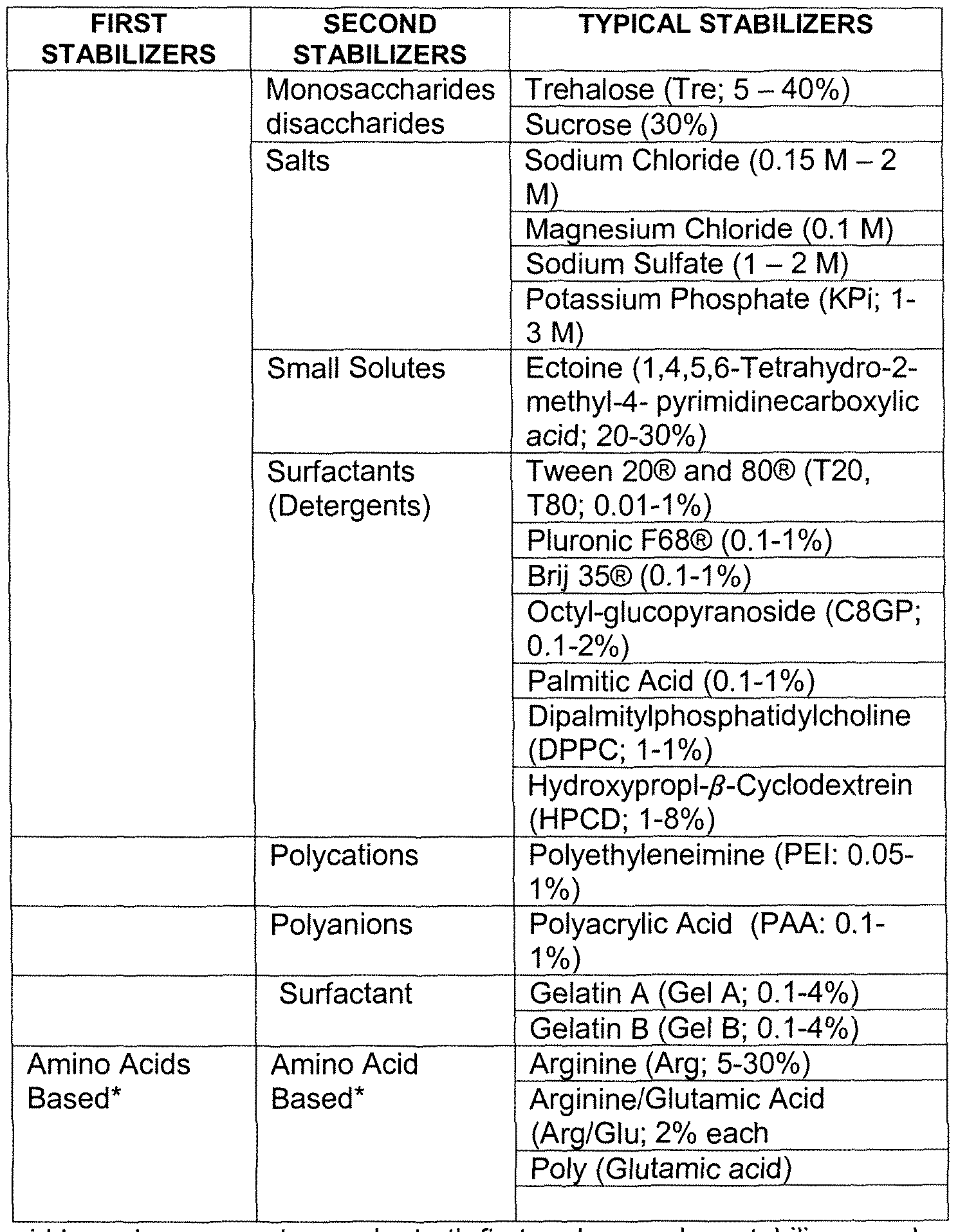
* Amino acid based compounds may be both first and secondary stabilizers as long as a different amino acid based compound is selected for each.
Multiple effective stabilizing formulations were developed at room temperature, 40°C, and 700C. The disclosed formulations allow the storage of Taq polymerase at ambient temperatures for up to nine months to one year, removing the need for refrigerated storage and increasing the reagent's ease of use in the field or laboratory.
Preferably the aqueous solution of the protein to be stabilized is prepared with conventional buffering solutions known in the art as for example pH 7.2 phosphate buffered
saline (PBS). To prepare PBS, stock solutions are prepared of monobasic sodium phosphate 0.2M by adding 27.6 g/liter of dH2O; a stock solution of dibasic sodium phosphate (anhydrous) 0.2 M is prepared by adding 28.4 g/liter dH2O. A quantity of 7.2 pH buffer is prepared as shown in the following chart:
500ml 1000 ml
Monobasic 140 ml 280 ml
Sodium phosphate
Dibasic sodium 360 ml 720 ml
Phosphate (anhydrous)
NaCI 4.5 g Q g
The stabilized protein solution is thereafter filled into sterile vials and sealed using conventional pharmaceutical filling and capping equipment and are either stored frozen or at 4° C until used for the purpose the protein is normally used. Alternatively, the vials are lyophiiized and the lyophilized vials are held at 4° C or at controlled room temperature until reconstituted with sterile water, or saline solution.
One embodiment of the invention provides for a method and formulations that stabilize liquid proteins containing an enzyme such as Taq polymerase. The formulations are designed to eliminate the need for specialized storage conditions for liquid protein formulations, as well as to extend the shelf life for these intrinsically temperature sensitive reagents.
The benefit of stabilized protein reagents for portable assays is clear, as it may not be possible to regulate storage and assay temperatures in varying environments. In addition, stabilized protein reagents will benefit laboratory assays by increasing the reliability of the reagents before, during and after shipping, storage on-site, and during use of the assay itself. This is especially important for high throughput screening where liquid reagents may need to remain at room temperature for several days in a queue. There is also a strong likelihood that the amount of reagent that needs to be shipped from the reagent manufacturer to end users can be dramatically reduced, which creates another source of benefit via reduced product cost.
In order to demonstrate the effectiveness of the methods and compositions of the invention, the following assay was used to quantitate Taq polymerase activity and illustrates the effectiveness of the stabilization method of the invention.
Assay to Quantitate Tag Activity
An activity assay of Taq polymerase was used using a one cycle PCR reaction system where the activity of Taq polymerase was directly quantified by measuring the rate of incorporation of 32P-labeled dCTP into nicked DNA.
The one cycle reaction system involved reagents and conditions similar to those used in normal PCR, except for the addition of 32P-labeled dCTP and the use of a single reaction temperature (740C for 10-20 minutes). The synthesized 32P-Iabeled DNA was precipitated with trichloroacetic acid (TCA) and unincorporated free 32P-labeled dCTP was washed from the precipitated 32P-labeled DNA.
Unit activity calculations were performed by converting the 32P count to the amount of incorporated nucleotides. One unit of Taq polymerase activity is the amount of polymerase required to incorporate 10 nmol of deoxynucleoside triphosphate into acid-insoluble at 74°C in 30 minutes under standard conditions.
The original Taq polymerase activity assay using 32P obtained from the vendor was not a high throughput procedure (using a single filter reaction). An in house 96 well assay format was used to screen multiple stabilizers in a highly efficient fashion.
In the stabilization tests, the absolute enzyme activity is not necessary. The relative rates of 32P incorporation into synthesized DNA catalyzed by Taq polymerase that had been stored under different conditions were used.
Taq DNA polymerase (400-600 U/μL) was obtained from Invitrogen. This thermostable enzyme can withstand prolonged incubation at temperatures up to 95°C without significant loss of activity for a few hours. The enzyme consists of a single polypeptide with a molecular weight of 94kDa. It has a 5'a3' DNA polymerase activity and a 5'a3' exonuclease activity.
Referring now to Fig. 1 , this figure is a graph that shows stabilization data for Taq at 700C. The off-the-shelf reagent lost all activity within a few days while stabilized formulations according to the invention maintained more than 90% and 50% of activity at 7O0C after two weeks and six weeks storage, respectively.
The abbreviations listed in Table C were used in the Tables 1- 9.
Tabk i C.
List of Abbreviations
Purpose or Action Full Name
Abbreviation
Arg Amino Acid Arginine
DPPC Surfactant Dipalmitoylphosphatidylcholine
Ecto 2nd Stabilizer Ectoine
PluF68 Surfactant Pluronic® F68
PoIyGIu Polyamino acid Poly(glutamic acid)
T20® Surfactant Tween® 20
T80® Surfactant Tween® 80
GIu Amino Acid Glutamic acid
Tre Disaccharide Trehalose
N. D. Not Determined
As illustrated by Table 1 , which shows Taq polymerase stabilization data at ambient temperature and 40°C. Activity as high as 90% and 75% was maintained at ambient temperature and 40°C, respectively, after nine months of storage. The off-the-shelf reagent lost all activity within 10 days.
Table 1. % Taq Activity Retained After Stabilization

Table 2 illustrates the Taq stabilization data for 7O0C. As can be seen a small amount of second stabilizer allowed a 33 percent reduction in first stabilizer concentration (arginine) content while maintaining similar or better activity retention. Particularly good results were obtained with secondary stabilizers such as 1M NaCI, 0.1% PIu F68®, and 0.1% DPPC.
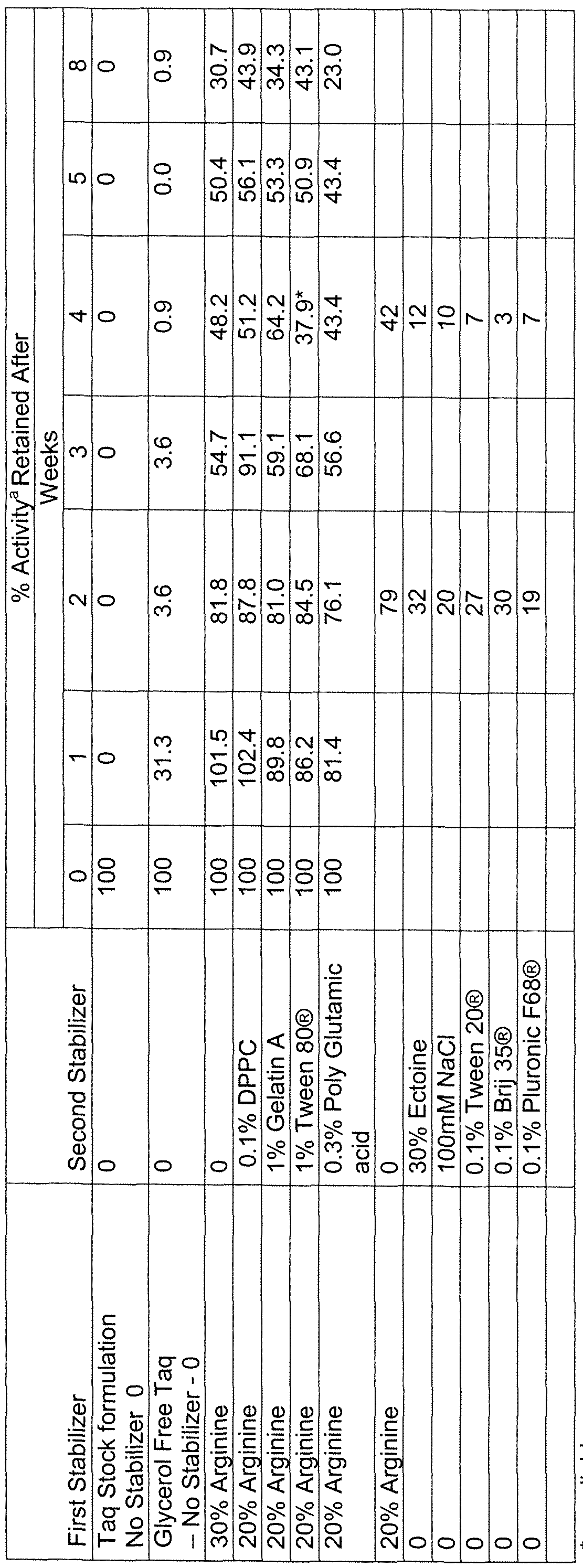
Table 3 illustrates the combination of 20% Arginine with various concentrations of secondary stabilizer. The table shows that the combination of 20% Arginine with the secondary stabilizers gave much better results than the secondary stabilizer alone.
Table 4 illustrates first and secondary stabilizer data for Taq at 700C. A 33% reduction in Arginine content plus a small amount of secondary stabilizer gave equal or better stability.
Table 2. % Activity in Taq Stabilization Maintained After Indicated Time at 700C

Table 3. Taq % Activity Maintained After Indicated Time @ 70°

Table 3 Continued.

ND - not determined
Control = Taq stock formulation
10
Table 4 % Activity in Stabilization of Taq DNA polymerase at 7O0C
K* K*
 unreliable
The following tables illustrate the stabilization of polyclonal antibodies and monoclonal antibodies. Table 5 illustrates first and secondary stabilizer data for Anti-Yp monoclonal antibody at elevated temperatures. Table 6 illustrates high temperature stabilizer results for Goat anti-Yp polyclonal antibody using first and secondary stabilizers. Table 7 illustrates high temperature stabilization results for Rabbit Anti-Ricin antibody using first and secondary stabilizers. Table 8 illustrates high temperature stabilizer results for Rabbit anti-ovalbumin antibody using first and secondary stabilizers. Table 9 illustrates high temperature stability tests for anti-Yp monoclonal antibody using first and secondary stabilizers.
Table 5 . % Activity in High Temperature Stabilization Tests for Anti-Yp Monoclonal Antibody*
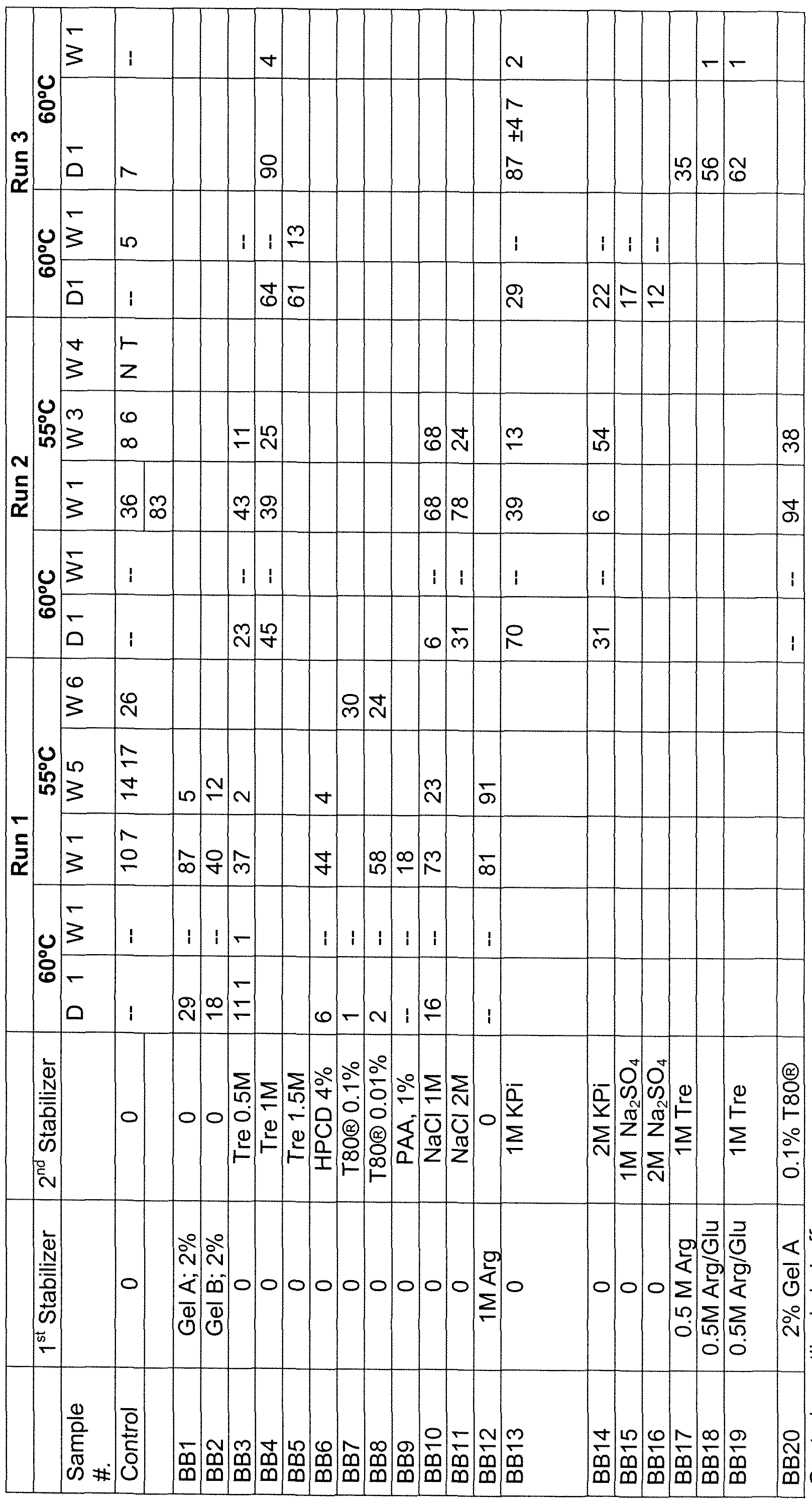
Control - antibody in buffer
Table 6. % Activity in High Temperature Stabilization Tests the Goat Anti-Yp Polyclonal Antibody
K* Ul
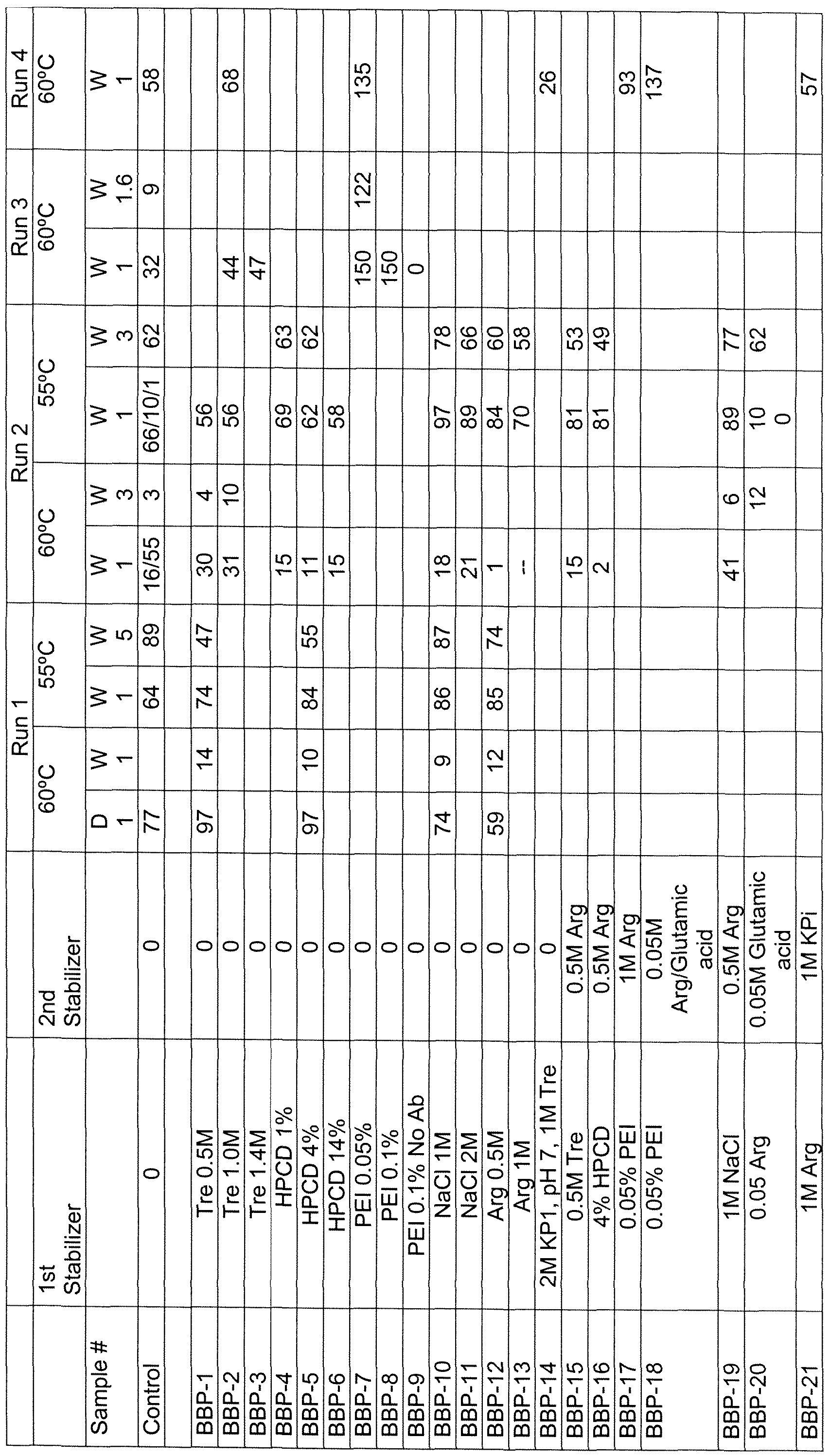
jφ 13
 Table 8.
% Activity in High Temperature Stabilization Tests the Rabbit Anti-Ovalbumin Antibody
Sam le BB-RAR-2
K*
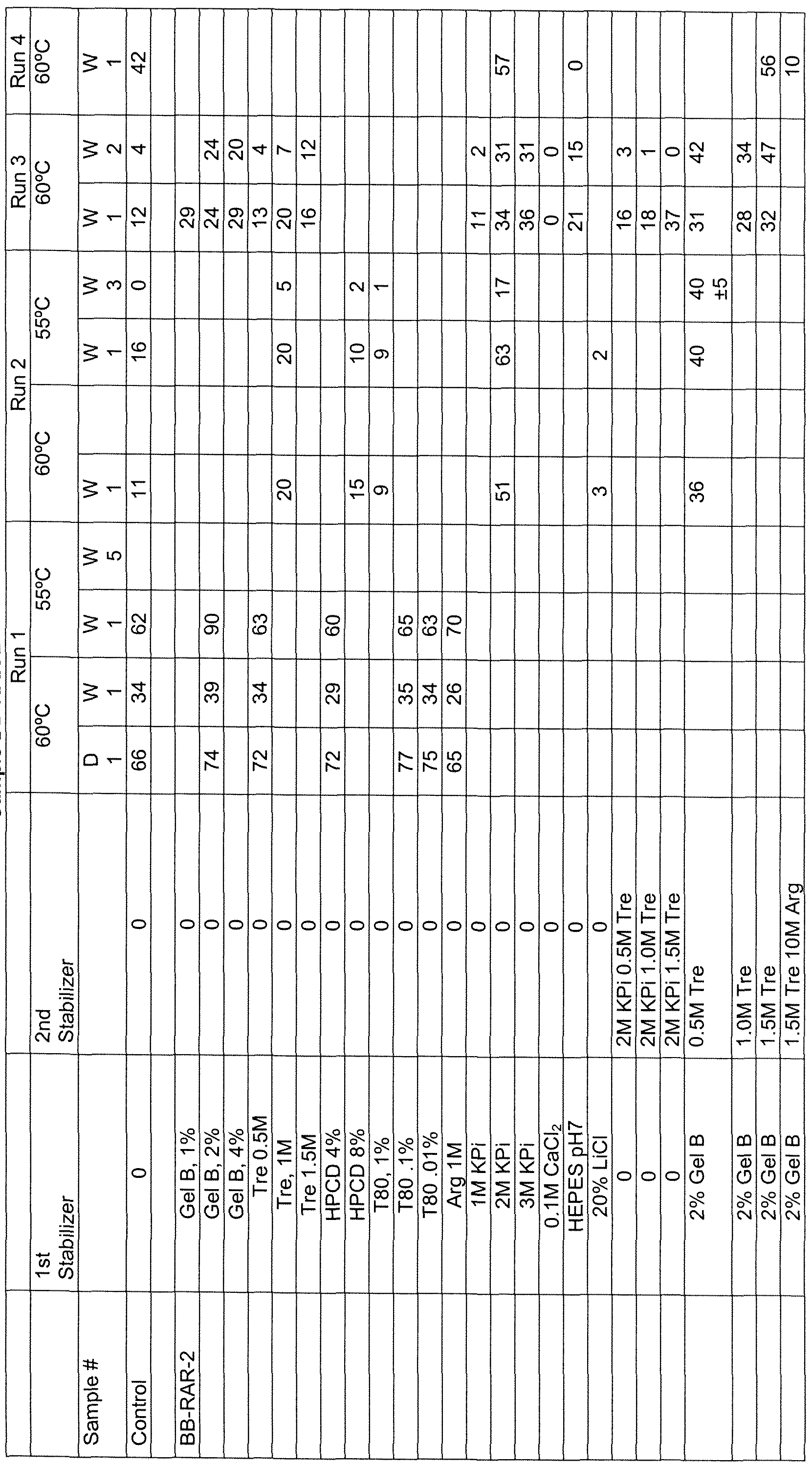
Table 8 continued for Sample BB-RAR-2.

κ>
90
Table 9. % Activity in Anti-Yp Monoclonal Antibody Stability
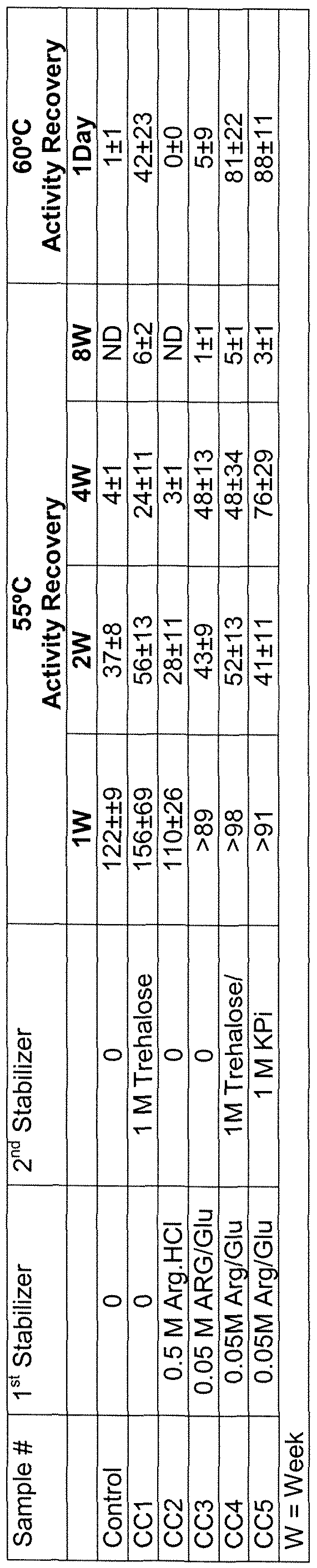
K*
Materials and Methods
The following methods and materials were used to prepare the antibodies used in the tests described in Tables 5 - 9 above.
Table D. Antibody Stabilization
Antibodies
A monoclonal antibody to the F1 antigen of Yp was
Anti-Yp Monoclonal obtained from Biodesign (C86308M)
Goat Anti-Yp Polyclonal Goat polyclonal antibodies to the Fl antigen of Yp were produced internally at Battelle. The IgG fraction was prepared by Protein G chromatography
Rabbit Anti-Ricin Goat polyclonal antibodies to autoclaved ricin were produced internally at Battelle. The IgG fraction was prepared by Protein G chromatography.
Rabbit Anti-Ovalbumin An IgG fraction of rabbit polyclonal antibodies to ovalbumin was obtained from Research Diagnostics, Inc.
Antigens
F1 antigen of Yp The F1 antigen was prepared at Battelle by the method of Andrews et. al. (1996), Immunity, 64,21 80-21 87
Ricin Ricin was purchased from Vector Laboratories as a heat inactivated preparation. The preparation was autoclaved at Battelle for 15 minutes and sonicated to re-solubilize any precipitated protein.
Ovalbumin Purchased from Sigma
Indirect ELISA Assay Method Plate Coating The antigen is diluted in coating buffer and 0.1 ml aliquots are added to the required number of wells on a 96-well polystyrene microtiter plate. The coating buffers and antibody concentrations for the four antigens are shown in Table E below:
Table E.
Coating Buffers and Antibody Concentrations
Antigen Coating Coating Buffer Concentration
F1 (Yp) 0.05 M Carbonate buffer, pH 9.4
10 μg/ml
Ricin 1 μg/ml 0.05 M Carbonate buffer, pH 9.4
Ovalbumin I μg/ml Phosphate Buffered Saline (PBS, pH 7.4)
The plates are incubated either at 4°C overnight or at 37°C for 90 minutes to coat the plate with antigen. Plates coated at 4°C were stored for up to five days before use. Plates coated at 37°C were used the same day.
Plate Wash
The plates can be washed either by hand or with an automatic device. The liquid in the wells is removed by aspiration and 0.3 ml of wash buffer (0.01 M phosphate buffer, pH 7.4, 0.05% Tween 20) is added via a manual or automated pipet. The sequence of aspiration and buffer addition is repeated two more times.
Finally the aspirated plate is inverted and tapped forcefully several times on paper towels to remove the remaining liquid from the wells.
Plate Block
Each well is filled with 0.25 - 0.3 ml, of blocking buffer (0.01 M phosphate buffer, pH 7, 0.5% bovine serum albumin), covered, and incubated at room temperature for 90 minutes. The plate is then washed using the plate wash procedure.
Sample and Standards Load
The antibody samples to be assayed are diluted appropriately in dilution buffer (0.01 M phosphate buffer, pH 7.4, 0.05% Tween 20, 0.5% bovine serum albumin) and 0.1 ml, aliquots are added to the wells via a pipet. The antibody standards are similarly diluted and added to the wells. The plates are then covered, incubated at room temperature for 90 minutes, and then washed using the plate wash procedure. The antibody concentrations used for the standard curves is shown In Table F below:
Table F. Antibody Concentrations for Std. Curve.

Antibody Detection Reagent Addition
Protein detection reagent is added in 0.1 ml aliquots to each well and the plates are covered and incubated for 90 minutes at room temperature. The protein detection reagents for the four antibodies are shown in Table G below:
Table G. Protein Detection Reagents
Antibody Standard Curve Concentrations Anti-Yp Monoclonal Anti-Mouse IgG antibody conjugated to Horse Radish Peroxidase
Goat Anti-Yp Polyclonal Protein G conjugated to Rabbit Anti-Ricin Protein G conjugated to Horse Radish Peroxidase Rabbit Anti-Ovalbumin Protein A conjugated to Horse Radish Peroxidase
The plate is then washed using the plate wash procedure.
Substrate Addition
The peroxidase substrate, prepared by mixing one part ABTS A and one part ABTS B, is added, in 0.1 ml, aliquots to each well. The plate is then covered and incubated in the dark for 30 minutes.
Plate Assay
The absorbance of each well is read in a Molecular Devices microtiter plate reader at 420 nm. The standard curve is generated using a four-parameter curve fit via the Soft-Max software and the samples are quantitated from the standard curve.
Stabilization Studies
Stock Antibody Solutions
The stock solutions of antibodies are diluted to 0.1 mg/ml in the various formulation buffers. The stock antibody solutions are shown below:
Antibody Standard Curve Concentrations Anti-Yp Monoclonal 3.8 mg/ml solution in PBS, stored at 4°C
Goat Anti-Yp 2.0 mg/ml solution in PBS, stored frozen Polyclonal Rabbit Anti-Ricin 8 mg/ml solution in PBS stored at 4°C
Rabbit Anti-Ovalbumin Stored as a lyophilized powder. Before use, dissolve in deionized water at I mg protein/ml. This solution contains 0.002 M potassium phosphate buffer, pH 7.2 and 0.01 15 M NaCI
Incubation Conditions Antibody samples are incubated as 0.1 ml aliquots in 0.3 ml polypropylene tubes with screw caps and O-ring seals. The samples are stored in incubators at the various temperatures. The entire content of each tube is used for the assay.
While the forms of the invention herein disclosed constitute presently preferred embodiments, many others are possible. It is not intended herein to mention all of the possible equivalent forms or ramifications of the invention. It is to be understood that the terms used herein are merely descriptive, rather than limiting, and that various changes may be made without departing from the spirit of the scope of the invention.
Claims
1. A method for preparing a temperature stabilized solution or gel of a biologically active protein in need of stabilization which comprises combining said protein to be stabilized with a stabilizing effective amount of a first stabilizer and a stabilizing effective amount of a second stabilizer; wherein said first stabilizer is selected from the group consisting of: a) an amino acid; b) a peptide; c) a polypeptide; and d) a poly(amino acid); and wherein said second stabilizer is selected from the group consisting of: a) a surfactant; b) a monosaccharide c) a disaccharide; d) an inorganic salt; e) ectoine; f) a polyionic compound; and g) an amino acid, peptide, polypeptide or poly(amino acid), provided that such amino acid, peptide, polypeptide, or poly(amino acid) is not selected as said first stabilizer; and h) combinations of any of components a - g of said second stabilizer group.
2. The method according to claim 1 wherein said protein is selected from the group consisting of polymerases, restriction enzymes, antibodies, diagnostic proteins and therapeutic proteins.
3. The method according to claim 2 wherein said protein is a polymerase.
4. The method according to claim 3 wherein said polymerase is Taq polymerase.
5. The method according to claim 2 wherein said protein is a restriction enzyme.
6. The method according to claim 5 wherein said restriction enzyme is selected from the group consisting of Ava I, Bam HI, BgI II, Eco Rl, Eco RII, Eco RV, Hae III, Hha I, Hind III, Hpa I, Kpn I, Mbo I, Pst I, Sma I, Sstl, Sal I, Taq I, and Xma I.
7. The method according to claim 2 wherein said protein is an antibody.
8. The method according to claim 7 wherein said antibody is selected from the group consisting of anti-Yp monoclonal antibody, goat anti-Yp polyclonal antibody, rabbit anti-ricin antibody, and rabbit anti-ovalbumin antibody.
9. The method according to claim 2 wherein said diagnostic protein is selected from the group consisting of the 31 kD protein from Schistosoma mansoni worms; purified protein from M. paratuberculosis, polyamine-modified AlHO , and A-Protein.
10. The method according to claim 2 wherein said therapeutic protein is selected form the group consisting of peginterferon alpha 2-a, adalimumab, agalsidase beta, alfacet, trastuzumab, darbepoetin, infliximab, rituxamab, tositumomab, bevacizumab, and cetuximab.
11. The method according to claim 1 wherein said first stabilizer is an amino acid, a poly(amino acid) and mixtures thereof.
12. The method according to claim 11 wherein said amino acid is arginine or glutamic acid and mixtures thereof.
13. The method according to claim 11 wherein said poly(amino acid) is poly(glutamic acid).
14. The method according to claim 1 wherein said is first stabilizer is selected from the group consisting of peptides and polypeptides and mixtures thereof.
15. The method according to claim 1 , wherein said second stabilizer is selected from the group consisting of a surfactant, a monosaccharide, a disaccharide, an inorganic salt, ectoine and polyionic compounds and mixtures thereof.
16. The method according to claim 1 , wherein said second stabilizer is selected from the group consisting of an amino acid, peptide, polypeptide or poly(amino acid), provided that such amino acid, peptide, polypeptide, or poly(amino acid) is not selected as said first stabilizer.
17. The method according to claim 15, wherein said second stabilizer is selected from the group consisting of a surfactant, ectoine, and a polyionic compound or mixtures thereof.
18. The method according to claim 17, wherein said second stabilizer is a surfactant selected from the group consisting of dipalmitoylphosphatidylcholine, polyoxyethylene (20) sorbitan monooleate, polyoxyethylene (20) sorbitan monolaurate, polyoxyethylene-polyoxypropylene block copolymer, polyoxyethyleneglycol dodecyl ether, gelatin and glycerol or mixtures thereof.
19. The method according to claim 15, wherein said second stabilizer is an inorganic salt selected from the group consisting of NaCI, MgCI2, KCI, K2SO4, Na2SO4, Na3PO4, and K3PO4 or mixtures thereof.
20. The method according to claim 15, wherein said second stabilizer is selected from the group consisting of monosaccharides and disaccharides and mixtures thereof.
21. The method according to claim 20, wherein said second stabilizer is selected from the group consisting of lactose, maltose, melibiose, sucrose, and trehalose and mixtures thereof.
22. The method according to claim 21, wherein said second stabilizer is trehalose.
23. The method according to claim 17, wherein said second stabilizer is ectoine.
24. The method according to claim 17 wherein said polyionic compound is selected from the group consisting of polyethleneimine and polyacrylic acid.
25. The method according to Claim 1 wherein said protein is a polymerase and wherein said first stabilizer is arginine and wherein said second stabilizer is selected from the group consisting of ectoine and trehalose and mixtures thereof.
26. The method according to Claim 2 wherein said solution or gel is an aqueous solution or gel.
27. The method according to Claim 25 wherein said polymerase is Taq polymerase.
28. The method according to Claim 2 wherein said protein is a polymerase; wherein said first stabilizer is arginine; wherein said second stabilizer is a surfactant selected from the group consisting of dipalmitoylphosphatidylcholine, polyoxyethylene (20) sorbitan monooleate, polyoxyethylene (20) sorbitan monolaurate, polyoxyethylene- polyoxypropylene block copolymer, and polyoxyethyleneglycol dodecyl ether; and wherein said solution or gel is an aqueous solution or gel.
29. A formulation containing a temperature stabilized solution or gel of a biologically active protein in need of stabilization which formulation comprises a combination of said protein and a stabilizing effective amount of a first stabilizer and a stabilizing effective amount of a second stabilizer; wherein said first stabilizer is selected from the group consisting of: a) an amino acid; b) a peptide; c) a polypeptide; and d) a poly(amino acid); and wherein said second stabilizer is selected from the group consisting of: a) a surfactant; b) a monosaccharide c) a disaccharide; d) an inorganic salt; e) ectoine; f) a polyionic compound; and g) an amino acid, peptide, polypeptide or poly(amino acid), provided that such amino acid, peptide, polypeptide, or poly(amino acid) is not selected as said first stabilizer; and h) combinations of any of components a - g of said second stabilizer group.
30. The formulation according to claim 29 wherein said protein is selected from the group consisting of polymerases, restriction enzymes, antibodies, diagnostic proteins and therapeutic proteins.
31. The formulation according to claim 30 wherein said solution or gel is an aqueous solution or gel.
32. The formulation according to claim 30 wherein said protein is a polymerase.
33. The formulation according to claim 32 wherein said polymerase is Taq polymerase.
34 The formulation according to claim 30 wherein said protein is an antibody.
35. The formulation according to claim 34 wherein said antibody is selected from the group consisting of anti-Yp monoclonal antibody, goat anti-Yp polyclonal antibody, rabbit anti-ricin antibody, and rabbit anti-ovalbumin antibody.
36. The formulation according to claim 30 wherein said protein is a restriction enzyme.
37. The formulation according to claim 36 wherein said restriction enzyme is selected from the group consisting of Ava I, Bam HI, BgI II, Eco Rl, Eco RII, Eco RV, Hae III, Hha I, Hind III, Hpa I, Kpn I, Mbo I, Pst I, Sma I, Sstl, Sal I, Taq I, and Xma I.
38. The formulation according to claim 30 wherein said diagnostic protein is selected from the group consisting of the 31 kD protein from Schistosoma mansoni worms; purified protein from M. paratuberculosis, polyamine-modified AP40 , and A-Protein.
39. The formulation according to claim 30 wherein said therapeutic protein is selected from the group consisting of peginterferon alpha 2-a, adalimumab, agalsidase beta, alfacet, trastuzumab, darbepoetin, infliximab, rituxamab, tositumomab, bevacizumab, and cetuximab.
40. The formulation according to claim 29 wherein said first stabilizer is an amino acid, a poly(amino acid) and mixtures thereof.
41. The formulation according to claim 40 wherein said amino acid is selected from the group consisting of arginine and glutamic acid or mixtures thereof.
42. The formulation according to claim 40 wherein said poly(amino acid) is poly(glutamic acid).
43. The formulation according to claim 29 wherein said is first stabilizer is selected from the group consisting of peptides and polypeptides and mixtures thereof.
44. The formulation according to claim 29, wherein said second stabilizer is selected from the group consisting of a surfactant, a monosaccharide, a disaccharide, an inorganic salt, ectoine and polyionic compounds and mixtures thereof.
45. The formulation according to claim 29, wherein said second stabilizer is selected from the group consisting of an amino acid, peptide, polypeptide or poly(amino acid) and mixtures thereof, provided that such amino acid, peptide, polypeptide, or poly(amino acid) is not selected as said first stabilizer.
46. The formulation according to claim 44, wherein said second stabilizer is selected from the group consisting of a surfactant, ectoine, a polyionic compound and mixtures thereof.
47. The formulation according to claim 46, wherein said second stabilizer is a surfactant selected from the group consisting of dipalmitoylphosphatidylcholine, polyoxyethylene (20) sorbitan monooleate, polyoxyethylene (20) sorbitan monolaurate, polyoxyethylene-polyoxypropylene block copolymer, polyoxyethyleneglycol dodecyl ether, gelatin and glycerol and mixtures thereof.
48. The formulation according to claim 44, wherein said second stabilizer is an inorganic salt selected from the group consisting of NaCI, MgCI2, KCI, K2SO4, Na2SO4, Na3PO4, and K3PO4 or mixtures thereof.
49. The formulation according to claim 44, wherein said second stabilizer is selected from the group consisting of monosaccharides and disaccharides and mixtures thereof.
50. The formulation according to claim 49, wherein said second stabilizer is selected from the group consisting of lactose, maltose, melibiose, sucrose, and trehalose and mixtures thereof.
51. The formulation according to claim 50, wherein said second stabilizer is trehalose.
52. The formulation according to claim 44, wherein said second stabilizer is ectoine.
53. The formulation according to claim 44 wherein said polyionic compound is selected from the group consisting of polyethleneimine and polyacrylic acid.
54. The formulation according to claim 29 wherein said protein is a polymerase; wherein said first stabilizer is arginine; and wherein said second stabilizer is selected from the group consisting of ectoine and trehalose and mixtures thereof.
55. The formulation according to Claim 54 wherein said polymerase is Taq polymerase.
56. The formulation according to Claim 31 wherein said protein is a polymerase; wherein said first stabilizer is arginine; and wherein said second stabilizer is a surfactant selected from the group consisting of dipalmitoylphosphatidylcholine, polyoxyethylene (20) sorbitan monooleate, polyoxyethylene (20) sorbitan monolaurate, polyoxyethylene- polyoxypropylene block copolymer, and polyoxyethyleneglycol dodecyl ether.
57. A method for preparing a temperature stabilized aqueous solution or gel of Taq polymerase which comprises combining said Taq polymerase with:
(i) a stabilizing effective amount of a first stabilizer, wherein said first stabilizer is selected from the group consisting of: a) a basic amino acid; b) an acidic amino acid; c) an acidic or a basic poly(amino acid); and
(ii) a second stabilizer selected from the group consisting of: a) a surfactant; b) a monosaccharide or a disaccharide; c) one or more of an inorganic salt; d) ectoine; e) combinations of any of components a) - c) of said first stabilizer group provided that such basic amino acid, acidic amino acid, or said acidic or basic poly(amino acid) is not selected as said first stabilizer; and f) combinations of any of components a) - e) of said second stabilizer group.
58. The method according to claim 57 wherein said first stabilizer is arginine.
59. The method according to claim 57 wherein said first stabilizer is poly(glutamic acid).
60. The method according to claim 57 wherein said second stabilizer is a surfactant selected from the group consisting of dipalmitoylphosphatidylcholine, polyoxyethylene (20) sorbitan monooleate, polyoxyethylene (20) sorbitan monolaurate, polyoxyethylene-polyoxypropylene block copolymer, polyoxyethyleneglycol dodecyl ether, gelatin and glycerol or mixtures thereof.
61. The method according to claim 57 wherein said second stabilizer is ectoine.
62. A temperature stabilized aqueous solution or gel formulation of Taq polymerase which comprises combining said Taq polymerase with:
(i) a stabilizing effective amount of a first stabilizer, wherein said first stabilizer is selected from the group consisting of: a) a basic amino acid; b) an acidic amino acid; c) an acidic or a basic poly(amino acid); and
(ii) a second stabilizer selected from the group consisting of: a) a surfactant; b) a monosaccharide or a disaccharide; c) one or more of an inorganic salt; d) ectoine; e) combinations of any of components a) - c) of said first stabilizer group provided that such basic amino acid, acidic amino acid, or said acidic or basic poly(amino acid) is not selected as said first stabilizer; and f) combinations of any of components a) - e) of said second stabilizer group.
63. The formulation according to claim 62 wherein said first stabilizer is arginine.
64. The formulation according to claim 62 wherein said first stabilizer is poly(glutamic acid).
65. The method according to claim 62 wherein said second stabilizer is a surfactant selected from the group consisting of dipalmitoylphosphatidylcholine, polyoxyethylene (20) sorbitan monooleate, polyoxyethylene (20) sorbitan monolaurate, polyoxyethylene-polyoxypropylene block copolymer, polyoxyethyleneglycol dodecyl ether, gelatin and glycerol or mixtures thereof.
66. The method according to claim 62 wherein said second stabilizer is ectoine.
Priority Applications (1)
| Application Number | Priority Date | Filing Date | Title |
|---|---|---|---|
| US12/667,070 US20110014676A1 (en) | 2007-06-29 | 2008-06-27 | Protein stabilization |
Applications Claiming Priority (2)
| Application Number | Priority Date | Filing Date | Title |
|---|---|---|---|
| US93774207P | 2007-06-29 | 2007-06-29 | |
| US60/937,742 | 2007-06-29 |
Publications (3)
| Publication Number | Publication Date |
|---|---|
| WO2009006301A2 true WO2009006301A2 (en) | 2009-01-08 |
| WO2009006301A3 WO2009006301A3 (en) | 2009-02-26 |
| WO2009006301A4 WO2009006301A4 (en) | 2009-04-30 |
Family
ID=39869793
Family Applications (1)
| Application Number | Title | Priority Date | Filing Date |
|---|---|---|---|
| PCT/US2008/068581 Ceased WO2009006301A2 (en) | 2007-06-29 | 2008-06-27 | Protein stabilization |
Country Status (2)
| Country | Link |
|---|---|
| US (1) | US20110014676A1 (en) |
| WO (1) | WO2009006301A2 (en) |
Cited By (17)
| Publication number | Priority date | Publication date | Assignee | Title |
|---|---|---|---|---|
| US7947649B2 (en) | 2008-04-14 | 2011-05-24 | Advanced Technologies And Regenerative Medicine, Llc | Liquid buffered GDF-5 formulations |
| US7956028B2 (en) | 2006-12-14 | 2011-06-07 | Johnson & Johnson Regenerative Therapeutics, Llc | Protein stabilization formulations |
| US7964561B2 (en) | 2007-06-29 | 2011-06-21 | Advanced Technologies And Regenerative Medicine, Llc | Protein formulations for use at elevated temperatures |
| US20110256592A1 (en) * | 2008-12-12 | 2011-10-20 | Eurogentec S.A | Use of cyclodextrins to improve the specificity, sensitivity and yield of nucleic acid amplification reactions |
| US8058237B2 (en) | 2007-08-07 | 2011-11-15 | Advanced Technologies & Regenerative Medicine, LLC | Stable composition of GDF-5 and method of storage |
| WO2014081278A1 (en) * | 2012-11-26 | 2014-05-30 | Universiti Sains Malaysia | (method for detection of target analyte(s) |
| US8883151B2 (en) | 2010-01-15 | 2014-11-11 | Kirin-Amgen, Inc. | IL-17 receptor antibody formulation |
| EP2704751A4 (en) * | 2011-05-02 | 2015-06-03 | Immunomedics Inc | ULTRAFILTRATION CONCENTRATION SELECTED ALLOTYPIC ANTIBODY FOR SMALL VOLUME ADMINISTRATION |
| FR3014446A1 (en) * | 2013-12-10 | 2015-06-12 | Biomerieux Sa | STABILIZATION OF GDH IN AQUEOUS SOLUTION |
| CN107002063A (en) * | 2014-11-25 | 2017-08-01 | 生物辐射实验室股份有限公司 | Arginine improves polymerase storage stability |
| US10208122B2 (en) | 2006-10-02 | 2019-02-19 | Amgen K-A, Inc. | IL-17 receptor A antigen binding proteins |
| US10322176B2 (en) | 2002-03-01 | 2019-06-18 | Immunomedics, Inc. | Subcutaneous administration of anti-CD74 antibody for systemic lupus erythematosus |
| US10799597B2 (en) | 2017-04-03 | 2020-10-13 | Immunomedics, Inc. | Subcutaneous administration of antibody-drug conjugates for cancer therapy |
| EP3378486B1 (en) | 2010-01-20 | 2021-03-03 | Chugai Seiyaku Kabushiki Kaisha | Stabilized antibody-containing liquid formulations |
| US11180559B2 (en) | 2005-03-03 | 2021-11-23 | Immunomedics, Inc. | Subcutaneous anti-HLA-DR monoclonal antibody for treatment of hematologic malignancies |
| US12296008B2 (en) | 2014-12-22 | 2025-05-13 | Novartis Ag | Pharmaceutical products and stable liquid compositions of IL-17 antibodies |
| US12544438B2 (en) | 2025-03-24 | 2026-02-10 | Novartis Ag | Pharmaceutical products and stable liquid compositions of IL-17 antibodies |
Families Citing this family (16)
| Publication number | Priority date | Publication date | Assignee | Title |
|---|---|---|---|---|
| US8883146B2 (en) | 2007-11-30 | 2014-11-11 | Abbvie Inc. | Protein formulations and methods of making same |
| PT2337580E (en) * | 2008-09-03 | 2012-05-28 | Octapharma Ag | Stabilized compositions for recombinantly produced factor viii |
| CN102458469B (en) * | 2009-05-04 | 2014-12-24 | 艾伯维生物技术有限公司 | Stable high protein concentration formulations of human anti-TNF-α antibodies |
| WO2012018639A2 (en) | 2010-07-26 | 2012-02-09 | Biomatrica, Inc. | Compositions for stabilizing dna, rna and proteins in saliva and other biological samples during shipping and storage at ambient temperatures |
| US9376709B2 (en) | 2010-07-26 | 2016-06-28 | Biomatrica, Inc. | Compositions for stabilizing DNA and RNA in blood and other biological samples during shipping and storage at ambient temperatures |
| AU2011325974B2 (en) | 2010-11-11 | 2016-10-27 | Abbvie Biotechnology Ltd. | Improved high concentration anti-TNFalpha antibody liquid formulations |
| WO2013171275A2 (en) * | 2012-05-16 | 2013-11-21 | Novopolymers N.V. | Polymer sheet |
| SI2922530T1 (en) | 2012-11-20 | 2017-04-26 | Fresenius Kabi Usa, Llc | Caspofungin acetate formulations |
| EP2934572A4 (en) | 2012-12-20 | 2016-11-23 | Biomatrica Inc | Formulations and methods for stabilizing pcr reagents |
| ES2786373T3 (en) | 2014-06-10 | 2020-10-09 | Biomatrica Inc | Platelet stabilization at room temperatures |
| JP6548896B2 (en) * | 2014-12-26 | 2019-07-24 | 株式会社マテリアル・コンセプト | Solar cell module and method of manufacturing the same |
| CN113588501B (en) | 2015-12-08 | 2024-12-17 | 生物马特里卡公司 | Reducing erythrocyte sedimentation rate |
| WO2019030118A1 (en) | 2017-08-08 | 2019-02-14 | Thermo Fisher Scientific Baltics Uab | Glycerol-free formulations for reverse transcriptases |
| WO2020060192A1 (en) * | 2018-09-18 | 2020-03-26 | 삼성바이오에피스 주식회사 | Trastuzumab stabilizing liquid formulation containing high concentration of surfactant |
| KR102735988B1 (en) | 2019-02-18 | 2024-12-03 | 일라이 릴리 앤드 캄파니 | therapeutic antibody preparations |
| CN114113594B (en) * | 2021-11-23 | 2024-06-21 | 上海凯创生物技术有限公司 | Antigen diluent and immunodeficiency virus detection kit |
Family Cites Families (6)
| Publication number | Priority date | Publication date | Assignee | Title |
|---|---|---|---|---|
| DE3718889A1 (en) * | 1987-06-05 | 1988-12-22 | Behringwerke Ag | METHOD FOR PRODUCING A SOLUTION OF HIGH SPECIFIC VOLUME ACTIVITY FROM A PROTEIN WITH TISSUE PLASMINOGEN ACTIVATOR (T-PA) ACTIVITY, SOLUTION, CONTAINING PROTEIN WITH T-PA ACTIVITY AND USE OF THE SOLUTION AND IN THE HUMAN VITALIZE |
| US5556771A (en) * | 1995-02-10 | 1996-09-17 | Gen-Probe Incorporated | Stabilized compositions of reverse transcriptase and RNA polymerase for nucleic acid amplification |
| US6787305B1 (en) * | 1998-03-13 | 2004-09-07 | Invitrogen Corporation | Compositions and methods for enhanced synthesis of nucleic acid molecules |
| US6242235B1 (en) * | 1998-06-24 | 2001-06-05 | Promega Corp. | Polymerase stabilization by polyethoxylated amine surfactants |
| CA2409347C (en) * | 2000-04-14 | 2010-03-30 | Frank T. Robb | Enhanced protein thermostability and temperature resistance |
| PL1610820T5 (en) * | 2003-04-04 | 2014-01-31 | Genentech Inc | High concentration antibody and protein formulations |
-
2008
- 2008-06-27 WO PCT/US2008/068581 patent/WO2009006301A2/en not_active Ceased
- 2008-06-27 US US12/667,070 patent/US20110014676A1/en not_active Abandoned
Cited By (36)
| Publication number | Priority date | Publication date | Assignee | Title |
|---|---|---|---|---|
| US10322176B2 (en) | 2002-03-01 | 2019-06-18 | Immunomedics, Inc. | Subcutaneous administration of anti-CD74 antibody for systemic lupus erythematosus |
| US11180559B2 (en) | 2005-03-03 | 2021-11-23 | Immunomedics, Inc. | Subcutaneous anti-HLA-DR monoclonal antibody for treatment of hematologic malignancies |
| US11858999B2 (en) | 2006-10-02 | 2024-01-02 | Amgen K-A, Inc. | IL-17 receptor A antigen binding proteins |
| US10208122B2 (en) | 2006-10-02 | 2019-02-19 | Amgen K-A, Inc. | IL-17 receptor A antigen binding proteins |
| US11180564B2 (en) | 2006-10-02 | 2021-11-23 | Amgen K-A, Inc. | IL-17 Receptor A antigen binding proteins |
| US8895506B2 (en) | 2006-12-14 | 2014-11-25 | DePuy Synthes Products, LLC | Protein stabilization formulations |
| US8435943B2 (en) | 2006-12-14 | 2013-05-07 | Advanced Technogies And Regenerative Medicine, Llc | Protein stabilization formulations |
| US7956028B2 (en) | 2006-12-14 | 2011-06-07 | Johnson & Johnson Regenerative Therapeutics, Llc | Protein stabilization formulations |
| US7964561B2 (en) | 2007-06-29 | 2011-06-21 | Advanced Technologies And Regenerative Medicine, Llc | Protein formulations for use at elevated temperatures |
| US8058237B2 (en) | 2007-08-07 | 2011-11-15 | Advanced Technologies & Regenerative Medicine, LLC | Stable composition of GDF-5 and method of storage |
| US7947649B2 (en) | 2008-04-14 | 2011-05-24 | Advanced Technologies And Regenerative Medicine, Llc | Liquid buffered GDF-5 formulations |
| US20110256592A1 (en) * | 2008-12-12 | 2011-10-20 | Eurogentec S.A | Use of cyclodextrins to improve the specificity, sensitivity and yield of nucleic acid amplification reactions |
| US8883151B2 (en) | 2010-01-15 | 2014-11-11 | Kirin-Amgen, Inc. | IL-17 receptor antibody formulation |
| US10072085B2 (en) | 2010-01-15 | 2018-09-11 | Kirin-Amgen, Inc. | Method of treating psoriasis using an IL-17 receptor antibody formulation |
| US11505612B2 (en) | 2010-01-15 | 2022-11-22 | Amgen K-A, Inc. | Method of treating diseases using an IL-17 receptor antibody formulation |
| US10808033B2 (en) | 2010-01-15 | 2020-10-20 | Amgen K-A, Inc. | IL-17 receptor antibody formulation |
| US11612562B2 (en) | 2010-01-20 | 2023-03-28 | Chugai Seiyaku Kabushiki Kaisha | Solution preparation containing stabilized antibody |
| EP3378486B1 (en) | 2010-01-20 | 2021-03-03 | Chugai Seiyaku Kabushiki Kaisha | Stabilized antibody-containing liquid formulations |
| EP2704751A4 (en) * | 2011-05-02 | 2015-06-03 | Immunomedics Inc | ULTRAFILTRATION CONCENTRATION SELECTED ALLOTYPIC ANTIBODY FOR SMALL VOLUME ADMINISTRATION |
| US9683050B2 (en) | 2011-05-02 | 2017-06-20 | Immunomedics, Inc. | Stable compositions of high-concentration allotype-selected antibodies for small-volume administration |
| US9963516B2 (en) | 2011-05-02 | 2018-05-08 | Immunomedics, Inc. | Stable compositions of high-concentration allotype-selected antibodies for small-volume administration |
| US9180205B2 (en) | 2011-05-02 | 2015-11-10 | Immunomedics, Inc. | Stable compositions of high-concentration allotype-selected antibodies for small-volume administration |
| US9468689B2 (en) | 2011-05-02 | 2016-10-18 | Immunomedics, Inc. | Ultrafiltration concentration of allotype selected antibodies for small-volume administration |
| WO2014081278A1 (en) * | 2012-11-26 | 2014-05-30 | Universiti Sains Malaysia | (method for detection of target analyte(s) |
| US11029312B2 (en) | 2013-12-10 | 2021-06-08 | Biomerieux | Stabilization of glutamate dehydrogenase in an aqueous solution |
| US10533999B2 (en) | 2013-12-10 | 2020-01-14 | Biomerieux | Stabilization of glutamate dehydrogenase in an aqueous solution |
| WO2015086973A1 (en) * | 2013-12-10 | 2015-06-18 | bioMérieux | Stabilization of glutamate dehydrogenase in an aqueous solution |
| FR3014446A1 (en) * | 2013-12-10 | 2015-06-12 | Biomerieux Sa | STABILIZATION OF GDH IN AQUEOUS SOLUTION |
| CN107002063A (en) * | 2014-11-25 | 2017-08-01 | 生物辐射实验室股份有限公司 | Arginine improves polymerase storage stability |
| EP3224359A4 (en) * | 2014-11-25 | 2018-04-04 | Bio-rad Laboratories, Inc. | Arginine improves polymerase storage stability |
| US10053676B2 (en) | 2014-11-25 | 2018-08-21 | Bio-Rad Laboratories, Inc. | Arginine improves polymerase storage stability |
| US12296008B2 (en) | 2014-12-22 | 2025-05-13 | Novartis Ag | Pharmaceutical products and stable liquid compositions of IL-17 antibodies |
| US12485172B2 (en) | 2014-12-22 | 2025-12-02 | Novartis Ag | Pharmaceutical products and stable liquid compositions of IL-17 antibodies |
| US12485173B2 (en) | 2014-12-22 | 2025-12-02 | Novartis Ag | Pharmaceutical products and stable liquid compositions of IL-17 antibodies |
| US10799597B2 (en) | 2017-04-03 | 2020-10-13 | Immunomedics, Inc. | Subcutaneous administration of antibody-drug conjugates for cancer therapy |
| US12544438B2 (en) | 2025-03-24 | 2026-02-10 | Novartis Ag | Pharmaceutical products and stable liquid compositions of IL-17 antibodies |
Also Published As
| Publication number | Publication date |
|---|---|
| US20110014676A1 (en) | 2011-01-20 |
| WO2009006301A4 (en) | 2009-04-30 |
| WO2009006301A3 (en) | 2009-02-26 |
Similar Documents
| Publication | Publication Date | Title |
|---|---|---|
| WO2009006301A2 (en) | Protein stabilization | |
| JP3282819B2 (en) | Stabilized enzyme composition for nucleic acid amplification | |
| US6294365B1 (en) | Method and formulation for stabilization of enzymes | |
| AU2007321877B2 (en) | Pharmaceutical manufacturing methods | |
| US20110236412A1 (en) | Method for Preserving Polypeptides Using a Sugar and Polyethyleneimine | |
| US20130071431A1 (en) | Method for Preserving Polypeptides Using A Sugar and Polyethyleneimine | |
| CN113564214A (en) | Integrated preparation method, kit and application of protein synthesis and purification in vitro | |
| WO2015151115A1 (en) | Liquid pharmaceutical composition of adalimumab | |
| CN107449918A (en) | A kind of protein chip stabilizer and its preparation method and application | |
| AU2022202538A1 (en) | Pharmaceutical formulations for adalimumab | |
| TWI586802B (en) | Formulations of recombinant furin | |
| US20230054359A1 (en) | Proteins for stabilization of biological material | |
| JP2009203223A (en) | Protectant for freeze drying and production method of physiologically active substance | |
| CN121068918B (en) | AIDS antibody, syphilis antibody and hepatitis C antibody composite quality control product and preparation method and application thereof | |
| Meagher et al. | Process development and cGMP manufacturing of a recombinant ricin vaccine: An effective and stable recombinant ricin a‐chain vaccine—RVEc™ | |
| Bernardo-García et al. | Crystallization and preliminary X-ray diffraction analysis of phosphoglycerate kinase from Streptococcus pneumoniae | |
| CN116966294A (en) | Bispecific antibody preparation | |
| Bausch | Impact of filling processes on protein solutions | |
| CN121023104A (en) | A rapid, extraction-free hepatitis C virus detection kit and method | |
| EP1375659A1 (en) | Soluble capsules containing stock mixtures for easy preparation of chemical or biological solutions | |
| HK1176009A (en) | Liquid formulations for long-acting erythropoietin conjugate |
Legal Events
| Date | Code | Title | Description |
|---|---|---|---|
| 121 | Ep: the epo has been informed by wipo that ep was designated in this application |
Ref document number: 08772167 Country of ref document: EP Kind code of ref document: A2 |
|
| DPE1 | Request for preliminary examination filed after expiration of 19th month from priority date (pct application filed from 20040101) | ||
| DPE1 | Request for preliminary examination filed after expiration of 19th month from priority date (pct application filed from 20040101) | ||
| NENP | Non-entry into the national phase |
Ref country code: DE |
|
| WWE | Wipo information: entry into national phase |
Ref document number: 12667070 Country of ref document: US |
|
| 122 | Ep: pct application non-entry in european phase |
Ref document number: 08772167 Country of ref document: EP Kind code of ref document: A2 |