[go: up one dir, main page]

WO2008077556A1 - Cycloalkylamine substituted isoquinoline and isoquinolinone derivatives - Google Patents

Cycloalkylamine substituted isoquinoline and isoquinolinone derivatives Download PDF

Info

Publication number
WO2008077556A1
WO2008077556A1 PCT/EP2007/011169 EP2007011169W WO2008077556A1 WO 2008077556 A1 WO2008077556 A1 WO 2008077556A1 EP 2007011169 W EP2007011169 W EP 2007011169W WO 2008077556 A1 WO2008077556 A1 WO 2008077556A1
Authority
WO
WIPO (PCT)
Prior art keywords
alkyl
alkylene
isoquinolin
chloro
amino
Prior art date
Legal status (The legal status is an assumption and is not a legal conclusion. Google has not performed a legal analysis and makes no representation as to the accuracy of the status listed.)
Ceased
Application number
PCT/EP2007/011169
Other languages
French (fr)
Inventor
Oliver Plettenburg
Katrin Lorenz
Jochen Goerlitzer
Matthias LÖHN
Sandrine Biscarrat
Frédéric JEANNOT
Olivier Duclos
Current Assignee (The listed assignees may be inaccurate. Google has not performed a legal analysis and makes no representation or warranty as to the accuracy of the list.)
Sanofi Aventis France
Original Assignee
Sanofi Aventis France
Priority date (The priority date is an assumption and is not a legal conclusion. Google has not performed a legal analysis and makes no representation as to the accuracy of the date listed.)
Filing date
Publication date
Priority to PL07856892T priority Critical patent/PL2102164T3/en
Priority to HK10104257.8A priority patent/HK1138585B/en
Priority to BRPI0720859-6A priority patent/BRPI0720859A2/en
Priority to AU2007338412A priority patent/AU2007338412B2/en
Priority to AT07856892T priority patent/ATE490243T1/en
Priority to MX2009005967A priority patent/MX2009005967A/en
Priority to KR1020097013327A priority patent/KR101494452B1/en
Priority to RU2009128652/04A priority patent/RU2468011C2/en
Priority to DK07856892.0T priority patent/DK2102164T3/en
Priority to DE602007010981T priority patent/DE602007010981D1/en
Priority to CA2673922A priority patent/CA2673922C/en
Priority to EP07856892A priority patent/EP2102164B1/en
Priority to NZ577984A priority patent/NZ577984A/en
Priority to SI200730505T priority patent/SI2102164T1/en
Application filed by Sanofi Aventis France filed Critical Sanofi Aventis France
Priority to JP2009543377A priority patent/JP5318779B2/en
Priority to HR20100705T priority patent/HRP20100705T1/en
Priority to CN2007800484652A priority patent/CN101578266B/en
Publication of WO2008077556A1 publication Critical patent/WO2008077556A1/en
Priority to US12/487,503 priority patent/US8710077B2/en
Priority to MA32040A priority patent/MA31076B1/en
Priority to TNP2009000274A priority patent/TN2009000274A1/en
Anticipated expiration legal-status Critical
Priority to NO20092488A priority patent/NO20092488L/en
Ceased legal-status Critical Current

Links

Classifications

    • CCHEMISTRY; METALLURGY
    • C07ORGANIC CHEMISTRY
    • C07DHETEROCYCLIC COMPOUNDS
    • C07D217/00Heterocyclic compounds containing isoquinoline or hydrogenated isoquinoline ring systems
    • C07D217/22Heterocyclic compounds containing isoquinoline or hydrogenated isoquinoline ring systems with hetero atoms or with carbon atoms having three bonds to hetero atoms with at the most one bond to halogen, e.g. ester or nitrile radicals, directly attached to carbon atoms of the nitrogen-containing ring
    • C07D217/24Oxygen atoms
    • AHUMAN NECESSITIES
    • A61MEDICAL OR VETERINARY SCIENCE; HYGIENE
    • A61KPREPARATIONS FOR MEDICAL, DENTAL OR TOILETRY PURPOSES
    • A61K31/00Medicinal preparations containing organic active ingredients
    • A61K31/33Heterocyclic compounds
    • A61K31/395Heterocyclic compounds having nitrogen as a ring hetero atom, e.g. guanethidine or rifamycins
    • A61K31/435Heterocyclic compounds having nitrogen as a ring hetero atom, e.g. guanethidine or rifamycins having six-membered rings with one nitrogen as the only ring hetero atom
    • A61K31/47Quinolines; Isoquinolines
    • A61K31/472Non-condensed isoquinolines, e.g. papaverine
    • AHUMAN NECESSITIES
    • A61MEDICAL OR VETERINARY SCIENCE; HYGIENE
    • A61PSPECIFIC THERAPEUTIC ACTIVITY OF CHEMICAL COMPOUNDS OR MEDICINAL PREPARATIONS
    • A61P1/00Drugs for disorders of the alimentary tract or the digestive system
    • AHUMAN NECESSITIES
    • A61MEDICAL OR VETERINARY SCIENCE; HYGIENE
    • A61PSPECIFIC THERAPEUTIC ACTIVITY OF CHEMICAL COMPOUNDS OR MEDICINAL PREPARATIONS
    • A61P1/00Drugs for disorders of the alimentary tract or the digestive system
    • A61P1/16Drugs for disorders of the alimentary tract or the digestive system for liver or gallbladder disorders, e.g. hepatoprotective agents, cholagogues, litholytics
    • AHUMAN NECESSITIES
    • A61MEDICAL OR VETERINARY SCIENCE; HYGIENE
    • A61PSPECIFIC THERAPEUTIC ACTIVITY OF CHEMICAL COMPOUNDS OR MEDICINAL PREPARATIONS
    • A61P11/00Drugs for disorders of the respiratory system
    • AHUMAN NECESSITIES
    • A61MEDICAL OR VETERINARY SCIENCE; HYGIENE
    • A61PSPECIFIC THERAPEUTIC ACTIVITY OF CHEMICAL COMPOUNDS OR MEDICINAL PREPARATIONS
    • A61P11/00Drugs for disorders of the respiratory system
    • A61P11/06Antiasthmatics
    • AHUMAN NECESSITIES
    • A61MEDICAL OR VETERINARY SCIENCE; HYGIENE
    • A61PSPECIFIC THERAPEUTIC ACTIVITY OF CHEMICAL COMPOUNDS OR MEDICINAL PREPARATIONS
    • A61P13/00Drugs for disorders of the urinary system
    • A61P13/08Drugs for disorders of the urinary system of the prostate
    • AHUMAN NECESSITIES
    • A61MEDICAL OR VETERINARY SCIENCE; HYGIENE
    • A61PSPECIFIC THERAPEUTIC ACTIVITY OF CHEMICAL COMPOUNDS OR MEDICINAL PREPARATIONS
    • A61P13/00Drugs for disorders of the urinary system
    • A61P13/12Drugs for disorders of the urinary system of the kidneys
    • AHUMAN NECESSITIES
    • A61MEDICAL OR VETERINARY SCIENCE; HYGIENE
    • A61PSPECIFIC THERAPEUTIC ACTIVITY OF CHEMICAL COMPOUNDS OR MEDICINAL PREPARATIONS
    • A61P15/00Drugs for genital or sexual disorders; Contraceptives
    • A61P15/06Antiabortive agents; Labour repressants
    • AHUMAN NECESSITIES
    • A61MEDICAL OR VETERINARY SCIENCE; HYGIENE
    • A61PSPECIFIC THERAPEUTIC ACTIVITY OF CHEMICAL COMPOUNDS OR MEDICINAL PREPARATIONS
    • A61P15/00Drugs for genital or sexual disorders; Contraceptives
    • A61P15/10Drugs for genital or sexual disorders; Contraceptives for impotence
    • AHUMAN NECESSITIES
    • A61MEDICAL OR VETERINARY SCIENCE; HYGIENE
    • A61PSPECIFIC THERAPEUTIC ACTIVITY OF CHEMICAL COMPOUNDS OR MEDICINAL PREPARATIONS
    • A61P19/00Drugs for skeletal disorders
    • A61P19/08Drugs for skeletal disorders for bone diseases, e.g. rachitism, Paget's disease
    • AHUMAN NECESSITIES
    • A61MEDICAL OR VETERINARY SCIENCE; HYGIENE
    • A61PSPECIFIC THERAPEUTIC ACTIVITY OF CHEMICAL COMPOUNDS OR MEDICINAL PREPARATIONS
    • A61P25/00Drugs for disorders of the nervous system
    • AHUMAN NECESSITIES
    • A61MEDICAL OR VETERINARY SCIENCE; HYGIENE
    • A61PSPECIFIC THERAPEUTIC ACTIVITY OF CHEMICAL COMPOUNDS OR MEDICINAL PREPARATIONS
    • A61P25/00Drugs for disorders of the nervous system
    • A61P25/04Centrally acting analgesics, e.g. opioids
    • AHUMAN NECESSITIES
    • A61MEDICAL OR VETERINARY SCIENCE; HYGIENE
    • A61PSPECIFIC THERAPEUTIC ACTIVITY OF CHEMICAL COMPOUNDS OR MEDICINAL PREPARATIONS
    • A61P25/00Drugs for disorders of the nervous system
    • A61P25/28Drugs for disorders of the nervous system for treating neurodegenerative disorders of the central nervous system, e.g. nootropic agents, cognition enhancers, drugs for treating Alzheimer's disease or other forms of dementia
    • AHUMAN NECESSITIES
    • A61MEDICAL OR VETERINARY SCIENCE; HYGIENE
    • A61PSPECIFIC THERAPEUTIC ACTIVITY OF CHEMICAL COMPOUNDS OR MEDICINAL PREPARATIONS
    • A61P27/00Drugs for disorders of the senses
    • A61P27/02Ophthalmic agents
    • AHUMAN NECESSITIES
    • A61MEDICAL OR VETERINARY SCIENCE; HYGIENE
    • A61PSPECIFIC THERAPEUTIC ACTIVITY OF CHEMICAL COMPOUNDS OR MEDICINAL PREPARATIONS
    • A61P27/00Drugs for disorders of the senses
    • A61P27/02Ophthalmic agents
    • A61P27/06Antiglaucoma agents or miotics
    • AHUMAN NECESSITIES
    • A61MEDICAL OR VETERINARY SCIENCE; HYGIENE
    • A61PSPECIFIC THERAPEUTIC ACTIVITY OF CHEMICAL COMPOUNDS OR MEDICINAL PREPARATIONS
    • A61P29/00Non-central analgesic, antipyretic or antiinflammatory agents, e.g. antirheumatic agents; Non-steroidal antiinflammatory drugs [NSAID]
    • AHUMAN NECESSITIES
    • A61MEDICAL OR VETERINARY SCIENCE; HYGIENE
    • A61PSPECIFIC THERAPEUTIC ACTIVITY OF CHEMICAL COMPOUNDS OR MEDICINAL PREPARATIONS
    • A61P3/00Drugs for disorders of the metabolism
    • AHUMAN NECESSITIES
    • A61MEDICAL OR VETERINARY SCIENCE; HYGIENE
    • A61PSPECIFIC THERAPEUTIC ACTIVITY OF CHEMICAL COMPOUNDS OR MEDICINAL PREPARATIONS
    • A61P3/00Drugs for disorders of the metabolism
    • A61P3/08Drugs for disorders of the metabolism for glucose homeostasis
    • A61P3/10Drugs for disorders of the metabolism for glucose homeostasis for hyperglycaemia, e.g. antidiabetics
    • AHUMAN NECESSITIES
    • A61MEDICAL OR VETERINARY SCIENCE; HYGIENE
    • A61PSPECIFIC THERAPEUTIC ACTIVITY OF CHEMICAL COMPOUNDS OR MEDICINAL PREPARATIONS
    • A61P31/00Antiinfectives, i.e. antibiotics, antiseptics, chemotherapeutics
    • A61P31/04Antibacterial agents
    • AHUMAN NECESSITIES
    • A61MEDICAL OR VETERINARY SCIENCE; HYGIENE
    • A61PSPECIFIC THERAPEUTIC ACTIVITY OF CHEMICAL COMPOUNDS OR MEDICINAL PREPARATIONS
    • A61P31/00Antiinfectives, i.e. antibiotics, antiseptics, chemotherapeutics
    • A61P31/12Antivirals
    • A61P31/14Antivirals for RNA viruses
    • A61P31/18Antivirals for RNA viruses for HIV
    • AHUMAN NECESSITIES
    • A61MEDICAL OR VETERINARY SCIENCE; HYGIENE
    • A61PSPECIFIC THERAPEUTIC ACTIVITY OF CHEMICAL COMPOUNDS OR MEDICINAL PREPARATIONS
    • A61P31/00Antiinfectives, i.e. antibiotics, antiseptics, chemotherapeutics
    • A61P31/12Antivirals
    • A61P31/20Antivirals for DNA viruses
    • AHUMAN NECESSITIES
    • A61MEDICAL OR VETERINARY SCIENCE; HYGIENE
    • A61PSPECIFIC THERAPEUTIC ACTIVITY OF CHEMICAL COMPOUNDS OR MEDICINAL PREPARATIONS
    • A61P35/00Antineoplastic agents
    • AHUMAN NECESSITIES
    • A61MEDICAL OR VETERINARY SCIENCE; HYGIENE
    • A61PSPECIFIC THERAPEUTIC ACTIVITY OF CHEMICAL COMPOUNDS OR MEDICINAL PREPARATIONS
    • A61P37/00Drugs for immunological or allergic disorders
    • A61P37/02Immunomodulators
    • A61P37/06Immunosuppressants, e.g. drugs for graft rejection
    • AHUMAN NECESSITIES
    • A61MEDICAL OR VETERINARY SCIENCE; HYGIENE
    • A61PSPECIFIC THERAPEUTIC ACTIVITY OF CHEMICAL COMPOUNDS OR MEDICINAL PREPARATIONS
    • A61P43/00Drugs for specific purposes, not provided for in groups A61P1/00-A61P41/00
    • AHUMAN NECESSITIES
    • A61MEDICAL OR VETERINARY SCIENCE; HYGIENE
    • A61PSPECIFIC THERAPEUTIC ACTIVITY OF CHEMICAL COMPOUNDS OR MEDICINAL PREPARATIONS
    • A61P5/00Drugs for disorders of the endocrine system
    • AHUMAN NECESSITIES
    • A61MEDICAL OR VETERINARY SCIENCE; HYGIENE
    • A61PSPECIFIC THERAPEUTIC ACTIVITY OF CHEMICAL COMPOUNDS OR MEDICINAL PREPARATIONS
    • A61P7/00Drugs for disorders of the blood or the extracellular fluid
    • A61P7/02Antithrombotic agents; Anticoagulants; Platelet aggregation inhibitors
    • AHUMAN NECESSITIES
    • A61MEDICAL OR VETERINARY SCIENCE; HYGIENE
    • A61PSPECIFIC THERAPEUTIC ACTIVITY OF CHEMICAL COMPOUNDS OR MEDICINAL PREPARATIONS
    • A61P9/00Drugs for disorders of the cardiovascular system
    • AHUMAN NECESSITIES
    • A61MEDICAL OR VETERINARY SCIENCE; HYGIENE
    • A61PSPECIFIC THERAPEUTIC ACTIVITY OF CHEMICAL COMPOUNDS OR MEDICINAL PREPARATIONS
    • A61P9/00Drugs for disorders of the cardiovascular system
    • A61P9/04Inotropic agents, i.e. stimulants of cardiac contraction; Drugs for heart failure
    • AHUMAN NECESSITIES
    • A61MEDICAL OR VETERINARY SCIENCE; HYGIENE
    • A61PSPECIFIC THERAPEUTIC ACTIVITY OF CHEMICAL COMPOUNDS OR MEDICINAL PREPARATIONS
    • A61P9/00Drugs for disorders of the cardiovascular system
    • A61P9/10Drugs for disorders of the cardiovascular system for treating ischaemic or atherosclerotic diseases, e.g. antianginal drugs, coronary vasodilators, drugs for myocardial infarction, retinopathy, cerebrovascula insufficiency, renal arteriosclerosis
    • AHUMAN NECESSITIES
    • A61MEDICAL OR VETERINARY SCIENCE; HYGIENE
    • A61PSPECIFIC THERAPEUTIC ACTIVITY OF CHEMICAL COMPOUNDS OR MEDICINAL PREPARATIONS
    • A61P9/00Drugs for disorders of the cardiovascular system
    • A61P9/12Antihypertensives
    • CCHEMISTRY; METALLURGY
    • C07ORGANIC CHEMISTRY
    • C07CACYCLIC OR CARBOCYCLIC COMPOUNDS
    • C07C211/00Compounds containing amino groups bound to a carbon skeleton
    • C07C211/01Compounds containing amino groups bound to a carbon skeleton having amino groups bound to acyclic carbon atoms
    • C07C211/26Compounds containing amino groups bound to a carbon skeleton having amino groups bound to acyclic carbon atoms of an unsaturated carbon skeleton containing at least one six-membered aromatic ring
    • C07C211/27Compounds containing amino groups bound to a carbon skeleton having amino groups bound to acyclic carbon atoms of an unsaturated carbon skeleton containing at least one six-membered aromatic ring having amino groups linked to the six-membered aromatic ring by saturated carbon chains

Definitions

  • the present invention relates to novel isoquinoline and isoquinolinone derivatives as described in the claims, their preparation and their use in the treatment and/or prevention of diseases related to the inhibition of Rho-kinase and/or of Rho-kinase mediated phosphorylation of myosin light chain phosphatase.
  • Rho-kinase 2 Activation of a small GTPase RhoA upon agonist stimulation results in conversion of RhoA from the inactive GDP-bound form to the active GTP-bound form with a subsequent binding to and activation of Rho-kinase.
  • Rho-kinase 1 and Rho-kinase 2 Two isoforms, Rho-kinase 1 and Rho-kinase 2, are known.
  • Rho-kinase 2 is expressed in vascular smooth muscle cells and endothelial cells.
  • Rho-kinase 2 Activation of Rho-kinase 2 by the active GTP-bound RhoA leads to calcium sensitization of smooth muscle cells through phosphorylation-mediated inhibition of the myosin light chain phosphatase activity and thereby up-regulation of the activity of myosin regulatory light chain (Uehata et al., Nature 1997, 389, 990-994).
  • Rho-kinase is involved in vasoconstriction, including the development of myogenic tone and smooth muscle hypercontractility (Gokina et al. J. Appi. Physiol. 2005, 98, 1940-8), bronchial smooth muscle contraction (Yoshii et al. Am. J. Resp. Cell MoI. Biol. 20, 1190-1200), asthma (Setoguchi et al. Br J Pharmacol. 2001 , 132, 111 -8; Nakahara, et al.
  • PAOD peripheral arterial occlusive disease
  • sexual dysfunction e.g., penile erectile dysfunction (Chitaley et al. Nature Medicine 2001 , 7, 119-122), retinopathy, inflammation, immune diseases, AIDS, osteoporosis, endocrine dysfunctions, e.g. hyperaldosteronism, central nervous system disorders such as neuronal degeneration and spinal cord injury (Hara, et al. JNeurosurg 2000, 93, 94), cerebral ischemia (Uehata, et al. Nature 1997, 389, 990; Satoh et al. Life Sci. 2001 , 69, 1441-53; Hitomi, et al.
  • a compound having inhibitory effect on Rho-kinas ⁇ and/or on Rho-kinase mediated phosphorylation of myosin light chain phosphatase is useful for the treatment and/or prevention of cardiovascular and non-cardiovascular diseases involving Rho- kinase as the primary or secondary disease cause, like hypertension, pulmonary hypertension, ocular hypertension, retinopathy, and glaucoma, peripheral circulatory disorder, peripheral arterial occlusive disease (PAOD), coronary heart disease, angina pectoris, heart hypertrophy, heart failure, ischemic diseases, ischemic organ failure (end organ damage), fibroid lung, fibroid liver, liver failure, nephropathy, including hypertension-induced, non-hypertension-induced, and diabetic nephropathies, renal failure, fibroid kidney, renal glomerulosclerosis, organ hypertrophy, asthma, chronic obstructive pulmonary disease (COPD), aduit respiratory distress syndrome, thrombotic disorders,
  • neuropathic pain neuronal degeneration, spinal cord injury, Alzheimer's disease, premature birth, erectile dysfunction, endocrine dysfunctions, arteriosclerosis, prostatic hypertrophy, diabetes and complications of diabetes, metabolic syndrome, blood vessel restenosis, atherosclerosis, inflammation, autoimmune diseases, AIDS, osteopathy such as osteoporosis, infection of digestive tracts with bacteria, sepsis, cancer development and progression, e.g. cancers of the breast, colon, prostate, ovaries, brain and lung and their metastases.
  • WO 01/64238 describes isoquinoline-5-sulfonamide derivatives optionally substituted by a -(CH 2 )i-6-0-(CH 2 ) ⁇ -6-. a -(CH 2 ) 0 -6-S-(CH 2 ) 0 -6- or a -(CH 2 ) 0 -6-linked heterocyclic group useful as neuroprotective agents.
  • WO 2004/106325 (Schering AG) describes prodrugs of the Rho-kinase inhibitor fasudil carrying an ether or ester group in the 1 -position of the isoquinoline ring.
  • JP 10087629 A describes isoquinoline derivatives useful for the treatment of diseases caused by Heliobacter pylori such as for example gastritis cancer or ulcer.
  • the isoquinoline derivatives may be substituted by OH in the 1 -position and are preferably 5-substituted by X-[(Ci-C6)alkylene)]rj--]-Y wherein X may be oxygen and Y may be an aryl or a heterocyclic group.
  • I may be among others an optionally substituted isoquinolone and Ar Il may be among others an optionally substituted C3.7 monocyclic saturated heterocyclic system.
  • WO 2005/030791 (Merck & Co.) generically describes as potassium channel inhibitors for the treatment of cardiac arrhythmias, stroke, congestive heart failure etc. isoquinolone derivatives which are optionally substituted in 6-position by a group
  • R 43 j a group R ⁇ 1 defined as a 4-6 membered unsaturated or saturated monocyclic heterocylic ring with 1 , 2, 3 or 4 heteroatoms; and are substituted by a directly bound optionally substituted aryl or heteroaryl ring in the 4-position.
  • WO 2005/030130 (Merck & Co.) generically describes as potassium channel inhibitors for the treatment of cardiac arrhythmias, stroke, congestive heart failure etc. isoquinoline derivatives which may be substituted by hydroxyl in the 1 -position and are optionally substituted in 6-position by a group (CR e Rf)pOR 43 wherein p may be zero, and R 43 j s e.g.
  • R 51 and R 52 may be hydrogen, (C ⁇
  • WO 03/053330 (Ube) generically describes isoquinolone derivatives of the formula
  • Rho-kinase inhibitors As Rho-kinase inhibitors.
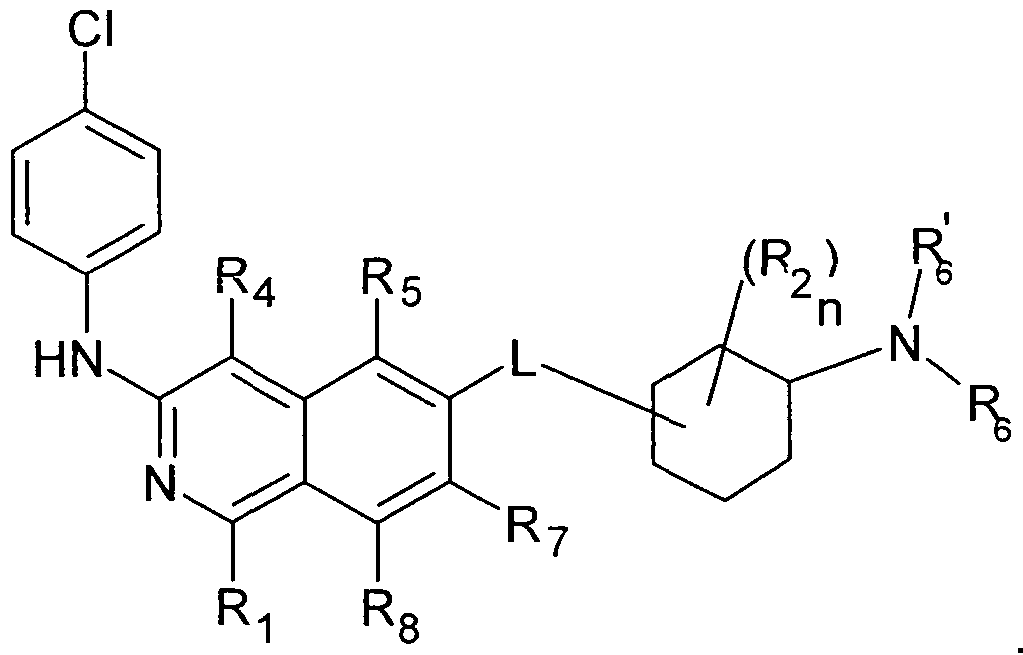
  • An embodiment of the present invention is a compound of the formula (I)
  • R-I is H, OH or NH2
  • R' (C 7 -C 8 )alkyl
  • R 2 is (Ci-C6)alkyl, provided that in said alkyl residue at least one hydrogen is substituted by OH, OCH 3 , COOH, COOCH 3 , NH 2 , NHCH 3 , N(CH 3 ) 2 , CONH 2 , CONHCH 3 or CON(CH 3 )2;
  • R 2 is a (Ci-C4)alkylene bound to the cycloalkyl amine, in which the (C1-C4) alkylene forms a second bond to a different carbon atom of the cycloalkyl amine ring and forms, together with carbon atoms of the cycloalkyl amine, a second, 4-8 membered ring;
  • R 3 is H, halogen
  • R' (C-
  • R 6 and R 6 ' are independently of each other
  • R' (C 1 -C 8 )alkyl
  • R8 is H, halogen or (C-j-C ⁇ alkyl
  • n 1 , 2, 3 or 4;
  • n 1 , 2 ,3 ,4 or 5;
  • r is O, 1 or2,
  • L is 0(CH 2 )P, S(CH 2 )P, S(O)(CH 2 )P, SO 2 (CH 2 )P, NH(CH 2 )p, N(C 1 -C 6 )SlICyI-(CH 2 )P, N(C3-C 6 )cycloalkyl-(CH 2 )p, N[CO(C 1 -C 6 )alkyl]-(CH 2 )p or N[(Ci-C3)alkylene-R ' ]- (CH 2 )P;
  • p is O, 1 , 2, 3 or 4;
  • R" is (C3-C8)cycloalkyl, (C 5 -C 1 0 )heterocyclyl, (C 6 -C 1 0 )aryl, (C 1 -C 6 )alkyl, (C 1 -C 6 )alkylene-R 1 , (C 1 -C 6 )alkylene-O-t(C 1 -C 6 )alkyl,
  • alkyl alkylene or cycloalkyl can optionally be substituted one or more times by OH, OCH 3 , COOH, COOCH3, NH 2 , NHCH 3 , N(CH 3 J 2 , CONH 2 , CONHCH 3 or CON(CH 3 ) 2;
  • residues R 2 to R 8 alkyl or alkylene can optionally be substituted one or more times by halogen
  • residues R 2 to R 8 (C 6 -C 1 0 )aryl and (C 5 -C 1 0 )heterocyclyl are unsubstituted or substituted one or more times by suitable groups independently selected from halogen, OH 1 NO 2 . N 3 , CN 1 C(O)-(C 1 -C 6 )alkyl, C(O)-(C 1-C 6 )aryl, COOH 1 COO(C 1 - C 6 )alkyl, CONH 2 , CONH(C 1 -C 6 )alkyl, CONf(C 1 -C 6 )alkyl] 2 .
  • is H and the compound is characterized by the formula (II)
  • is OH and the compound is characterized by the formula (III)
  • the isoquinoline derivative of formula (I), wherein R-] is OH include the corresponding tautomeric 1-isoquino!one derivative which is characterized by the formula (I Il ' ) ⁇ ⁇ • ,
  • R-I is preferably H or OH
  • R3 is preferably H, halogen, (C-
  • R4 is H, halogen or (Ci-C ⁇ jalkyl. More preferred, R4 is H, halogen or (C-)- C4)alkyl. Most preferred, R4 is H.
  • R 5 is H, halogen, CN, (C 1 -C 6 )alkyl, (C 1 -C 6 )alkenyl, R 1 , NH-(C 6 -C 1 0 )aryl or (C 1 -C 6 )alkylene-R'.
  • R 5 is H, halogen, (C 1 -C 6 )alkyl, (C2-C6)alkenyl, R', NH-(C 6 -C 1 0 )aryl or (C 1 -C 6 )alkylene-R'
  • R5 is H, halogen, (C 1 -C 6 )alkyl, (C 2 -C 6 )alkenyl, (C 6 -C 1 0 )aryl, NH-(C 6 -C 1 0 )aryl, (Ci-C2)alkyl-(C 6 -C 1 0 )aryl or (C 5 -C 1 0 )heteroaryl.
  • R5 is H, halogen, phenyl, (C 1 -C 6 )alkyl, (C2-C6)aikenyl, (C 6 -C 1 0 )aryl or (Cs-C ⁇ Jheteroaryl.
  • R5 is H, halogen, methyl, ethyl, vinyl, phenyl, thienyl or pyridyl.
  • R5 are hydrogen, fluoro, chloro, bromo, iodo, methyl, ethyl, vinyl, phenyl, thienyl or pyridyl, nitrile, nitro, (p-methoxy)-phenyl, N-aniline, benzyl, 2-propenyl, s- butenyl, cyclopropyl, tetrazol, amino, 4-methoxy-aniline or N-acetyl, preferably hydrogen, fluoro, chloro, bromo, iodo, methyl, ethyl, vinyl, phenyl, thienyl or pyridyl More preferred, R5 is H, halogen, methyl, or ethyl, most preferred R5 is H.
  • R 6 and RQ' are independently of each other H, (C 1 -C 6 )alkyl, R', (Ci-C4)alkylene-(C 3 -C 8 )cycloalkyl, (C 1 -C 4 )alkylene-(C 5 -C 1 0 )heterocyclyl, (C 1 -C4)alkylene-(C 6 -C 1 0 )aryl, (C 1 - C6)alkylene-O-(C 1 -C 6 )alkyl, (C 1 -C 4 )alkylene-C(0)-(C5-Cio)heterocyclyl, (C 1 -C 4 )alkylene-C(OH(C 6 -C 1 0 )aryl l (C 1 -C 6 )alkylene-C(0)N[(Ci-C 6 )alkyl] 2 , (C 1 - C 6 )alkylene-C(O)NH-(C
  • C(O)(Ci-C 6 )alkyl C(O)O-(C 1 -C 6 )alkyl, C(O)NH-(C 1 -C 6 )alkyl, C(O)N[(C 1 -C 6 )alkylte, or C(O)(C 1 -C 6 )alkylene-R', or
  • RQ and RQ' together with the N-atom to which they are attached, form a (C 5 -C 1 0 )heterocyclyl group.
  • R 6 and RQ' are independently of each other
  • R 6 is H, (C 1 -C 6 )alkyl, (C3-C6)cycloalkyl or (Ci-C4)alkylene-(C 3 -C 6 )cycloalkyl
  • R 6 1 is H 1 (C 1 -C 6 )alkyl, (C 3 -C8)cycloalkyl, (C 5 -C 10 )heterocyclyl, (C 5 -C 10 )aryl, (C 1 -C4)alkylene-(C3-C8)cycloalkyl, (C 1 -C4)alkylene-(C 5 -Cio)heterocyclyl, (C 1 -C 4 )alkylene-(C 6 -C 1 0 )a ryl, (C 1 -C 6 )alkylene-O ⁇ (C 1 -C 6 )alkyl, (C 1 -C 6 )alkylene- C ⁇ NH-(C 1 -C 6 )
  • RQ is H, (C 6 -C 1 0 ) ! and R 6 1 is H 1 (C 1 -C6)alkyl, (C3-C 8 )cycloalkyl, (C 6 -C 1 0 )aryl,(C 5 -C 1 0 )heterocyclyl, (C 1 -C4)alkylene-(C 3 -C 8 )cycloalkyl, (C 1 -C4)alkylene-(C 5 -C 1 0 )heterocyclyl, (C 1 -C6)alkylene-(C 6 -C 1 0 )aryl, (C 1 -C4)alkylene-O-(C 1 -C 4 )alkyl, (C 1 -C4)alkylene-
  • R 6 and R 6 1 together with the N-atom to which they are attached, form a (C 5 -C 1 o)heterocyclyl group.
  • RQ is H, (C 1 -C 6 )alkyl and R 6 ' is H, (C ⁇
  • the formed heterocyclyl group is morpholino, piperidino, pyrrolidino or piperazino. More preferably the heterocyclyl group is morpho ⁇ no or piperazino.
  • RQ is H, (C-
  • Rg is H and R ⁇ " is H, preferably unsubstituted (Ci-C ⁇ )alkyl, or preferably unsubstituted (C3-C8)cycloalkyl.
  • RQ and Rg' are H.
  • Rg or R ⁇ ' are, independently from each other, hydrogen, methyl, ethyl, propyl, isopropyl, 3-methyl-butyl, 2-methyl-propyl, butyl, pentyl, 3,3,3-thfluoropropyl, 4,4,4-trifluorobutyl or a substituent selected from the group consisting of
  • the asterisk (*) denotes where the bond is connected to the N-atom of the amine.
  • R 7 is H, halogen, CN, ((C 1 -C 6 )alkyl, O-(C 1 -C 6 )alkyl, (C 2 -C 6 )alkenyl, R' or (C 1 -C 6 )alkylene-(C 3 -C 8 )cycloalkyl. More preferred, R 7 is H, halogen, CN, (C 1 -C 4 )alkyl, O-(C 1 -C 4 )alkyl, (C 1 -C 4 )alkenyl, phenyl, cyclopropyl or (C 5 -C 6 )heteroaryl.
  • R7 is H, fluoro, chloro, bromo, methyl, ethyl, methoxy, phenyl, nitrile, cyclopropyl, thienyl or vinyl, most especially preferred R 7 is H, fluoro, chloro, methyl or methoxy. More particular preferred R 7 is H or chloro, most particular preferred R 7 is H.
  • R 8 is preferably H, halogen or (C 1 -C 4 )alkyl. More preferred, R 8 is H, Cl, F, methyl or ethyl. Most preferred R3 is H.
  • R2 is N-(2-aminoethyl)-2-aminoethyl-N-(2-aminoethyl)-2-aminoethyl-N-(2-aminoethyl)-2-aminoethyl-N-(2-aminoethyl)-2-aminoethyl-N-(2-aminoethyl)-2-aminoethyl
  • R 1 (C 7 -C 8 )alkyl, (C 1 -C 6 )alkylene-R ⁇ (C 2 -C 6 )alkenyl
  • R 2 is (C-
  • R 2 is a (C-
  • R 2 is
  • C(O)NHR', C(O)-NH(Ci-C6)alkylene-R ⁇ or R 2 is (Ci-C3)alkyl, provided that in said alkyl residue at least one hydrogen is substituted by OH, OCH 3 , COOH, COOCH 3 , NH 2 , NHCH 3 , N(CH 3 ) 2 , CONH 2 , CONHCH 3 or CON(CH 3 )2;
  • R 2 is a (C-
  • R 2 is
  • R 2 is a (C-
  • R 2 is phenyl, which is unsubstituted or substituted one or two times by halogen, OH, OMe or CF3; (C3-C8)cycloalkyl, which is unsubstituted, or is (C 2 -C6)alkenyl, preferably allyl, or R 2 is a (C ⁇
  • R2 may be bound to any carbon atom of the ring including the position where the linker group L is bound, preferably at the carbon atom where the -NR ⁇ .R ⁇ ' group is bound.
  • R2 is N-(2-aminoethyl)-2-aminoethyl-N-(2-aminoethyl)-2-aminoethyl-N-(2-aminoethyl)-2-aminoethyl-N-(2-aminoethyl)-2-aminoethyl-N-(2-aminoethyl)-2-aminoethyl
  • the asterisk (*) denotes where the bond is connected to the C-atom of the ring.
  • R2 is a C-1-C4 alkylene, which creates a second ring system with the cyclic amine, comprise
  • n is 1 , 2 or 3. More preferred, n is 1 or 2. Most preferred n is 1.
  • n is 2, 3 or 4. More preferred m is 3. In a further embodiment m is 1 , 2, 4 or 5. Preferably r is 0 or 1 , more preferred r is 0.
  • the linker group L may be bound to the ring in any position via a ring carbon atom.
  • m is 3 and L is attached to the 4-position of the amino cyclohexane ring
  • L is attached to the 4-position of the amino cyclohexane ring.
  • L is O(CH 2 )p.
  • L is S(CH 2 )P, S(O)(CH 2 )P or SO 2 (CH 2 )P.
  • L is NH(CH 2 )p, N(Ci-C 6 )alkyl- (CH 2 )P, N(C 3 -C 6 )cycloalkyi-(CH 2 )p, N[CO(C 1 -C 6 )aikyi]-(CH 2 )p, N[(Ci-C 3 )alkylene-aryl]- (CH 2 )P or N[(C 1 -C 3 )a!kylene-(C5-C6)heterocyclyl]-(CH 2 )p with NH(CH 2 )P, N(C 1 - C 6 )alkyl-(CH 2 )p being more preferred.
  • -C6)alkyl is N(C-
  • Even more preferred L is O(CH 2 )p, S(CH 2 )p or NH(CH 2 )p. Most preferred L is O, S or NH with O being especially preferred.
  • p is O, 1 , 2, or 3, more preferred O or 1 , with O being most preferred;
  • m is 3 and L is O, S or NH and is attached to the 4-position of the amino cyclohexane ring.
  • an alkyl or alkylene can optionally be substituted one or more times by halogen.
  • alkyl or aikylene is substituted one to three times by halogen selected from chloro or bromo but may be substituted by fluoro once or more, e.g. being perfluorinated.
  • halogen is fluor. More preferred an alkyl or alkylene is not halogenated.
  • alkylene or cycloalkyl can optionally be substituted one or more times by a group selected independently from OH, OCH3, COOH, COOCH 3 , NH 2 , NHCH3, N(CH 3 ) 2 , CONH 2 , CONHCH 3 or CON(CH 3 ) 2 .
  • the number of substituents is preferably between 1 , 2, 3 or 4, more preferably 1 or 2 with 1 being even more preferred.
  • an alkylene or cycloalkyl is not substituted. More preferably an alkyl, alkylene or cycloalkyl is not substituted.
  • alkyl, alkylene or cycloalkyl in R4, R5, R7 and Re are not substituted.
  • alkyl, alkylene or cycloalkyl in R4, R5, RQ, RQ , RJ and Rs are not substituted.
  • one or more or ail of the groups contained in the compounds of formula (I) can independently of each other have any of the preferred, more preferred or most preferred definitions of the groups specified above or any one or some of the specific denotations which are comprised by the definitions of the groups and specified above, al! combinations of preferred definitions, more preferred or most preferred and/or specific denotations being a subject of the present invention.
  • the invention includes the compounds of the formula (I) in all stereoisomeric forms and mixtures of stereoisomer ⁇ forms in all ratios, and their pharmaceutically acceptable salts.
  • a preferred embodiment is a compound of the formula (I) wherein
  • R-I is H or OH
  • R 2 is
  • R' (C 7 -C 8 )alkyl
  • R 2 is (C-
  • R 2 is a (C-j-C ⁇ alkylene bound to the cycloalkyl amine, in which the (C 1 -C4) alkylene forms a second bond to a different carbon atom of the cycloalkyl amine ring and forms, together with carbon atoms of cycloalkyl amine, a second, 4-8 membered ring;
  • R 3 is H, halogen, (C-(C 1 -C 4 )alleknye-R', O-R" or NHR";
  • R 4 is H, halogen or (C 1 -C 6 )alkyl
  • R 5 is H, (C 1 -C 6 )alkyl, halogen, CN 1 (C 2 -C 6 )alkenyl, (C 6 -C 10 )aryl, NH-(C 6 -C 10 )aryl,(C 1 -C 6 )alkylene-(C 6 -C 1 0 )aryl. (C 5 -C 1 0 )heterocyclyl or (C 1 -C 6 )alkylene-(C 5 -C 1 0 )heterocyclyl;
  • R 6 and R 6 ' are independently of each other H, R', (C 1 -C 3 )alkyl, (C 1 -C 6 )alkylene-R',(C 1 -C 6 )alkylene-O-C(C 1 -C 6 )alkyl, (C 1 -C 6 )alkylene-O-R ⁇ (C 1 -C 6 )alkylene-CH[R']2, (C 1 -
  • R7 is H, halogen, CN, (C 1 -C 6 )alkyl, O-t(C 1 -C 6 )alkyl, (C 2 -C 6 )alkenyl or R 1 ;
  • R ⁇ is H, halogen or (C 1 -C 6 )alkyl
  • n 2, 3 or 4
  • n 1 , 2 or 3
  • r 0,1 or 2
  • L is 0(CH 2 )P, S(CH 2 )P, NH(CH 2 )P or N(C 1 -C 6 )alkyl-(CH 2 )p; and p is O, 1 or 2;
  • a further preferred embodiment is a compound of the formula (I) wherein
  • R-I is H or OH
  • R2 is R'
  • R 2 is (C-
  • R 2 is a (C ⁇
  • F*3 is H, halogen or NHR", wherein R" is defined as above;
  • R4 is H, halogen or (C-
  • R5 is H, (C-
  • R6 and RQ are independently of each other H, (C ⁇ -CsJcycloalkyl, (C-
  • R7 is H, halogen, CN, (C-
  • R8 is H, halogen or (Ci-C6)alkyl;
  • L is 0(CH 2 )P, S(CH 2 )P or NH(CH 2 )p,
  • p is 0 or 1 ;
  • An especially preferred embodiment is a compound of the formula (I) wherein
  • Ci-C6)alkylene-R' (C 2 -C 6 )alkenyl, (Ci-C6)alkylene-C(O)NH-R', (Ci-C 6 )alkylene-C(O)NH-(Ci-C 6 )alkyl f C(O)NH-(Ci -C 6 )alkyl,
  • R2 is a (C-
  • R3 is H, NH-(C5-C6)heteroaryl or NH-phenyl
  • R4 is H, halogen or (C-
  • R5 is H, (C-
  • R ⁇ is H, (C3-C6)cycloalkyl or (C ⁇
  • R 6 ' is H, (C 3 -C 8 )cycloalkyl
  • R 7 is H, halogen, CN, (Ci-C4)alkyl, O(C-
  • Rg is H, halogen or (C-
  • n 1 ;
  • L is O, S or NH; or their stereoisomeric and/or tautomeric forms and/or their pharmaceutically acceptable salts.
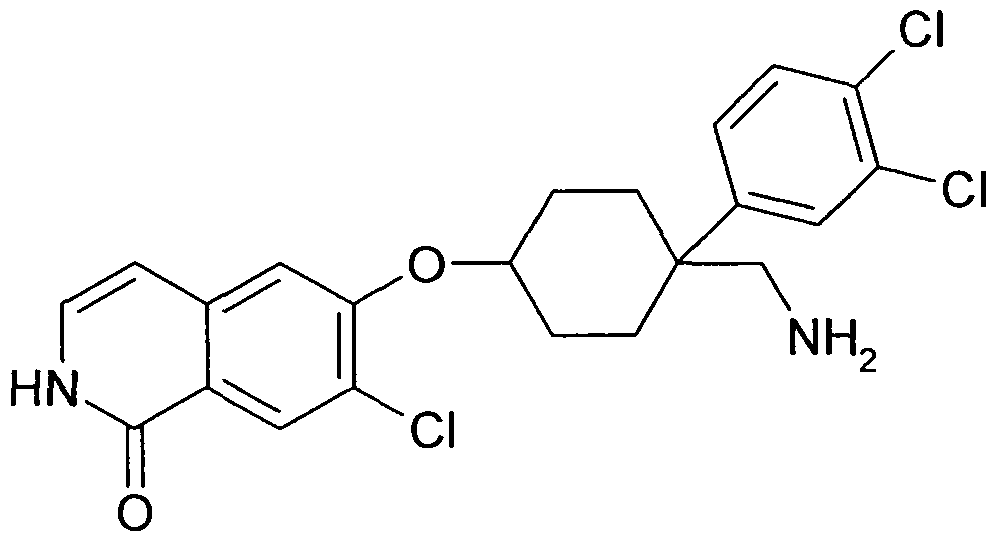
  • the present invention relates to a compound of formula (I) selected from the group of 6-(4-Allyl-4-amino-cyclohexyloxy)-7-chloro-2H-isoquinolin-1 -one (20),
  • the present invention relates to a compound of formula (I) selected from the group of
  • one or more or all of the groups can have any of its preferred, more preferred, most preferred definitions specified above or any one or some of the specific denotations which are comprised by its definitions and are specified above.
  • Isoquinoline substitution pattern is numbered according to IUPAC rules:
  • compositions of the formula (I) mean both their organic and inorganic salts as described in Remington's Pharmaceutical Sciences (17th edition, page 1418 (1985)). Because of the physical and chemical stability and the solubility, preference is given for acidic groups inter alia to sodium, potassium, calcium and ammonium salts; preference is given for basic groups inter alia to salts of maleic acid, fumaric acid, succinic acid, malic acid, tartaric acid, methylsulfonic acid, hydrochloric acid, sulfuric acid, phosphoric acid or of carboxylic acids or sulfonic acids, for example as hydrochlorides, hydrobromides, phosphates, sulfates, methanesulfonates, acetates, lactates, maleates, fumarates, malates, gluconates, and salts of amino acids, of natural bases or carboxylic acids.
  • acidic groups inter alia to sodium, potassium, calcium and ammonium salts
  • basic groups inter alia to salts of maleic acid
  • the compounds of the formula (I) form stable alkali metal, alkaline earth metal or optionally substituted ammonium saits with basic reagents such as hydroxides, carbonates, bicarbonates, alcoholates and ammonia or organic bases, for example trimethyl- or triethylamine, ethanolamine, diethanolamine or triethanolamine, trometamol or else basic amino acids, for example lysine, ornithine or arginine.
  • basic reagents such as hydroxides, carbonates, bicarbonates, alcoholates and ammonia or organic bases, for example trimethyl- or triethylamine, ethanolamine, diethanolamine or triethanolamine, trometamol or else basic amino acids, for example lysine, ornithine or arginine.
  • stable acid addition salts can also be prepared with strong acids.
  • Suitable pharmaceutically acceptable acid addition salts of the compounds of the invention are salts of inorganic acids such as hydrochloric acid, hydrobromic, phosphoric, metaphosphoric, nitric and sulfuric acid, and of organic acids such as, for example, acetic acid, benzenesulfonic, benzoic, citric, ethanesulfonic, fumaric, gluconic, glycolic, isethionic, lactic, lactobionic, maleic, malic, methanesulfonic, succinic, p-toluenesulfonic and tartaric acid.
  • the hydrochloride salt is a prefered salt.
  • Salts with a pharmaceutically unacceptable anion such as, for example, trifluoroacetate likewise belong within the framework of the invention as useful intermediates for the preparation or purification of pharmaceutically acceptable salts and/or for use in nontherapeutic, for example in vitro, applications.
  • physiologically functional derivative refers to any physiologically tolerated derivative of a compound of the formula (!) of the invention, for example an N-oxide, which on administration to a mammal such as, for example, a human is able to form (directly or indirectly) a compound of the formula (I) or an active metabolite thereof.
  • Physiologically functional derivatives include prodrugs of the compounds of the invention, as described, for example, in H. Okada et al., Chem. Pharm. Bull. 1994, 42, 57-61. Such prodrugs can be metabolized in vivo to a compound of the invention. These prodrugs may themselves be active or not.
  • the invention relates to compounds of the formula (I) in the form of their stereoisomeric forms, which include racemates, racemic mixtures, pure enantiomers and diastereomers and mixtures thereof.
  • the compounds of the invention may also exist in various polymorphous forms, for example as amorphous and crystalline polymorphous forms. All polymorphous forms of the compounds of the invention belong within the framework of the invention and are a further aspect of the invention.
  • radicals or substituents may occur more than once in the compounds of the formula (I) , they may all, independently of one another, have the stated meaning and be identical or different.
  • -C2)alkyl, (Ci-C 4 )alkyl, (C-i-C ⁇ Jalkyl, (Ci-Cs)alkyl and the corresposponding alkylene substituents are understood as a hydrocarbon residue which can be linear, i.e. straight-chain, or branched and has 1 , 2, 3, 4, 5, 6, 7 or 8 carbon atoms, respectively. This also applies if an alkyl group occurs as a substituent on another group, for example in an alkoxy group (O-alkyl), S-alkyl or a -O(C - ⁇ - C6)alkylene-O-, an alkoxycarbonyl group or an arylalkyl group.
  • aikyl groups are methyl, ethyl, propyl, butyl, pentyl or hexyl, the n-isomers of all these groups, isopropyl, isobutyl, 1-methylbutyi, isopentyl, neopentyl, 2,2-dimethylbutyl, 2- methylpentyl, 3-methylpentyl, isohexyl, sec-butyl, tert-butyl or tert-pentyl.
  • Alkyl or alkylene groups may - if not otherwise stated - be halogenated once or more, e.g. alkyl groups may be fluorinated, e.g. perfluorinated. Examples of halogenated alkyl groups are CF3 and CH2CF3, OCF3, SCF3, or -O-(CF2)2-O-.
  • the double bond may where possible have the E or Z orientation.
  • the double bonds may be both internal and terminal.
  • the triple bonds may be both internal and terminal.
  • Halogen means fluoro, chloro, bromo or iodo.
  • (C3-C8)cycloalkyl groups are cyclic alkyl groups containing 3, 4, 5, 6, 7 or 8 ring carbon atoms like cyclopropyl, cyclobutyl, cyclopentyl, cyclohexyl or cyclooctyl, which can also be substituted and/or contain 1 or 2 double bounds (unsaturated cycloalkyl groups) like, for example, cyclopentenyl or cyclohexenyl can be bonded via any carbon atom.
  • a (C6-Cio) a ryl group means an aromatic ring or a ring system which comprises two aromatic rings which are fused or otherwise linked, for example a phenyl, naphthyl, biphenyl, tetrahydronaphthyl, alpha- or beta-tetralon-, indanyl- or indan-1-on-yl group.
  • a preferred (Cg-Ci rj) ar yl 9 rou P ' s phenyl.
  • o)heterocyclyl group means a mono- or bicyclic ring system in which one or more carbon atoms can be replaced by one ore more heteroatoms such as, for example 1 , 2 or 3 nitrogen atoms, 1 or 2 oxygen atoms, 1 or 2 sulfur atoms or combinations of different hetero atoms.
  • the heterocyclyl residues can be bound at any positions, for example on the 1 -position, 2-position, 3-position, 4-position, 5-position, 6- position, 7-position or 8-position.
  • Suitable (C5-Cio)heterocyclyl group include acridinyl, azocinyl, benzimidazolyl, benzofuryl, benzomorpholinyl, benzothienyl, benzothiophenyl, benzoxazolyl, benzthiazolyl, benztriazolyl, benztetrazolyl, benzisoxazolyl, benzisothiazolyl, carbazolyl, 4aH-carbazolyl, carbolinyl, furanyl, quinazolinyl, quinolinyl, 4H-quinolizinyl, quinoxalinyl, quinuclidinyl, chromanyl, chromenyl, chromen-2-onyl, cinnolinyl, decahydroquinolinyl, 2H,6H-1 ,5,2-dithiazinyl, dihydrofuro[2,3-b]-tetrahydrofuran, fu
  • Pyridyl stands both for 2-, 3- and 4-pyridyl.
  • Thienyl stands both for 2- and 3-thienyl.
  • Furyl stands both for 2- and 3-furyl.
  • N-oxides of these compounds for example, 1-oxy-2-, 3- or 4-pyridyl.
  • o)heterocyclyl residues can occur on free carbon atoms or on nitrogen atoms.
  • Preferred examples of (C 5 -C 1 rj)heterocyclyl residues are pyrazinyl, pyridyl, pyrimidinyl, pyrazolyl, morpholinyl, pyrrolidinyl, piperazinyl, piperidinyl, thienyl, benzofuryl, quinolinyl, tetrazolyl and triazolyl.
  • fj)aryl and (C 5 -C 1 rj)heterocyclyl groups are unsubstituted or, if not stated otherwise, substituted one or more times, preferably one to three times, by suitable groups independently selected from halogen, OH, NO2, N3, CN, C(O)-(C 1 -C6)alkyl,
  • C(O)-(C 1 -C 6 )aryl COOH 1 COO(C 1 -C6)alkyl, CONH 2 , CONH(Ci -C 6 )alkyl, CONKC 1 - C6)alkyl] 2, (C3-C8)cycloalkyl, (C 1 -Ce)alkyl, (C 1 -Ce)alkylene-OH, (Ci -C ⁇ )alkylene- NH 2 , (C-i-CeJalkylene-NH ⁇ i-C ⁇ Jalkyl ⁇ Ci-CeJalkylene-NUCi-CeJalkyl ⁇ , (C 2 -C 6 )alkenyl, (C 2 -C 6 )alkynyl, O-(Ci-C 6 )alkyl.
  • O-C(O)-(Ci-C 6 )alkyl PO 3 H 2 , SO 3 H, SO 2 -NH 2 , SO 2 NH(Ci -C ⁇ Jalkyl, SO 2 N[(Ci-C6)alkyl] 2 .
  • Ce)alkyl CONH 2 , (C 1 -Ce)alkylene-O-(C 1 -C6)alkyl, (C-i-CeJalkylene-O- ⁇ e-C-i oJaryl, ⁇ -(C-i-CeJalkylene ⁇ Ce-C-ioJaryl; or wherein (Ce-C-ioJaryl is vicinally substituted by a O-(C ⁇ i-C4)alkylene-O group whereby a 5-8-membered ring is formed together with the carbon atoms the oxygen atoms are attached to.
  • o)heterocyclyl groups may not be further substituted by an aryl or heterocyclyl containing group.
  • Preferred substituents for (C ⁇ -C ⁇ aryl groups are (Ci-C 4 )alkyl, O-(Ci-C4)alkyl, O-phenyl, phenyl, C(O)O-(C 1 -Ce)BlKyI, C(O)OH, C(O)-(Ci-C 4 )alkyl, halogen, NO 2 , SO2NH2, CN, SO2-(C-
  • -C4)alkyl, SO 2 -N CH-NKC 1 -C 6 )alkyl] 2 , NH-SO 2 -(C 1 - C 4 )alkyl, NH 2 , NH-C(O)-(C 1 -C 4 )alkyl, (C 3 -C 8 )cycloalkyl, (C ⁇
  • substituents for (CQ- C ⁇ io)aryl are halogen, CN, phenyl, O-phenyl, NH-C ⁇ OHC-i-C ⁇ alkyl especially NH-C(O)-CH 3 , C(O)-(C -i -C 4 )alkyl especially C(O)-CH 3 , C(O)-O(C 1 -C 4 )alkyl especially C(O)-OCH 3 , (C-i-C ⁇ alky!
  • the substituent can be located in the 2-position, the 3-position or the 4-position, with the 3-position and the 4-position being preferred. If a phenyl group carries two substituents, they can be located in 2, 3-position, 2,4-position, 2,5-position, 2,6-position, 3,4-position or 3,5-position. In phenyl groups carrying three substituents the substituents can be located in 2, 3,4-position, 2, 3,5-position, 2,3,6- position, 2,4,5-position, 2,4,6-position, or 3,4,5-position.
  • phenyl groups correspondingly apply to divalent groups derived from phenyl groups, i.e. phenylene which can be unsubstituted or substituted 1 ,2-phenylene, 1 ,3-phenylene or 1 ,4-phenylene.
  • the above statements also correspondingly apply to the aryl subgroup in arylalkylene groups.
  • arylalkylene groups which can also be unsubstituted or substituted in the aryl subgroup as well as in the alkylene subgroup, are benzyl, 1-phenylethylene, 2-phenylethylene, 3- phenylpropylene, 4-phenylbutylene, 1-m ⁇ thyl-3-phenyl-propy!ene.
  • Preferred substitu ⁇ nts for (C5-C1 o)heterocyclyl groups are (C-
  • o)heterocyclyl groups are (C-
  • the present invention therefore also relates to the compounds of the formula (I) and/or their pharmaceutically acceptable salts and/or their prodrugs for use as pharmaceuticals (or medicaments), to the use of the compounds of the formula (I) and/or their pharmaceutically acceptable salts and/or their prodrugs for the production of pharmaceuticals for the treatment and/or prevention of diseases associated with Rho-kinase and/or Rho-kinase mediated phosphorylation of myosin light chain phosphatase, i.e.
  • hypertension for the treatment and/or prevention of hypertension, pulmonary hypertension, ocular hypertension, retinopathy, and glaucoma, peripheral circulatory disorder, peripheral occlusive arterial disease (PAOD), coronary heart disease, angina pectoris, heart hypertrophy, heart failure, ischemic diseases, ischemic organ failure (end organ damage), fibroid lung, fibroid liver, liver failure, nephropathy, including hypertension-induced, non-hypertension-induced, and diabetic nephropathies, renal failure, fibroid kidney, renal glomerulosclerosis, organ hypertrophy, asthma, chronic obstructive pulmonary disease (COPD), adult respiratory distress syndrome, thrombotic disorders, stroke, cerebral vasospasm, cerebral ischemia, pain, e.g.
  • PAOD peripheral occlusive arterial disease
  • COPD chronic obstructive pulmonary disease
  • neuropathic pain neuronal degeneration, spinal cord injury, Alzheimer's disease, premature birth, erectile dysfunction, endocrine dysfunctions, arteriosclerosis, prostatic hypertrophy, diabetes and complications of diabetes, metabolic syndrome, blood vessel restenosis, atherosclerosis, inflammation, autoimmune diseases, AIDS, osteopathy such as osteoporosis, infection of digestive tracts with bacteria, sepsis, cancer development and progression, e.g. cancers of the breast, colon, prostate, ovaries, brain and lung and their metastases.
  • the present invention furthermore relates to pharmaceutical preparations (or pharmaceutical compositions) which contain an effective amount of at least one compound of the formula (I) and/or its pharmaceutically acceptable salts and a pharmaceutically acceptable carrier, i. e. one or more pharmaceutically acceptable carrier substances (or vehicles) and/or additives (or excipients).
  • a pharmaceutically acceptable carrier i. e. one or more pharmaceutically acceptable carrier substances (or vehicles) and/or additives (or excipients).
  • the pharmaceuticals can be administered orally, for example in the form of pills, tablets, lacquered tablets, coated tablets, granules, hard and soft gelatin capsules, solutions, syrups, emulsions, suspensions or aerosol mixtures. Administration, however, can also be carried out rectally, for example in the form of suppositories, or parenterally, for example intravenously, intramuscularly or subcutaneously, in the form of injection solutions or infusion solutions, microcapsules, implants or rods, or percutaneousiy or topically, for example in the form of ointments, solutions or tinctures, or in other ways, for example in the form of aerosols or nasal sprays.
  • compositions according to the invention are prepared in a manner known per se and familiar to one skilled in the art, pharmaceutically acceptable inert inorganic and/or organic carrier substances and/or additives being used in addition to the compound(s) of the formula (I) and/or its (their) pharmaceutically acceptable salts and/or its (their) prodrugs.
  • pharmaceutically acceptable inert inorganic and/or organic carrier substances and/or additives being used in addition to the compound(s) of the formula (I) and/or its (their) pharmaceutically acceptable salts and/or its (their) prodrugs.
  • pharmaceutically acceptable inert inorganic and/or organic carrier substances and/or additives being used in addition to the compound(s) of the formula (I) and/or its (their) pharmaceutically acceptable salts and/or its (their) prodrugs.
  • for the production of pills, tablets, coated tablets and hard gelatin capsules it is possible to use, for example, lactose, corn starch or derivatives thereof, talc
  • Suitable carrier substances for the production of solutions for example injection solutions, or of emulsions or syrups are, for example, water, saline, alcohols, glycerol, polyols, sucrose, invert sugar, glucose, vegetable oils, etc.
  • Suitable carrier substances for microcapsules, implants or rods are, for example, copolymers of glycolic acid and lactic acid.
  • the pharmaceutical preparations normally contain about 0.5 to about 90 % by weight of the compounds of the formula (I) and/or their pharmaceutically acceptable salts and/or their prodrugs.
  • the amount of the active ingredient of the formula (I) and/or its pharmaceutically acceptable salts and/or its prodrugs in the pharmaceutical preparations normally is from about 0.5 to about 1000 mg, preferably from about 1 to about 500 mg.
  • the pharmaceutical preparations can contain one or more additives such as, for example, fillers, disintegrants, binders, lubricants, wetting agents, stabilizers, emulsifiers, preservatives, sweeteners, colorants, flavorings, aromatizers, thickeners, diluents, buffer substances, solvents, solubilizers, agents for achieving a depot effect, salts for altering the osmotic pressure, coating agents or antioxidants. They can also contain two or more compounds of the formula (I) and/or their pharmaceutically acceptable salts.
  • a pharmaceutical preparation contains two or more compounds of the formula (I) the selection of the individual compounds can aim at a specific overall pharmacological profile of the pharmaceutical preparation. For example, a highly potent compound with a shorter duration of action may be combined with a long-acting compound of lower potency.
  • the flexibility permitted with respect to the choice of substituents in the compounds of the formula (I) allows a great deal of control over the biological and physico-chemical properties of the compounds and thus allows the selection of such desired compounds.
  • the pharmaceutical preparations can also contain one or more other therapeutically or prophylactically active ingredients.
  • the dose can vary within wide limits and, as is customary and is known to the physician, is to be suited to the individual conditions in each individual case. It depends, for example, on the specific compound employed, on the nature and severity of the disease to be treated, on the mode and the schedule of administration, or on whether an acute or chronic condition is treated or whether prophylaxis is carried out.
  • An appropriate dosage can be established using clinical approaches well known in the medical art.
  • the daily dose for achieving the desired results in an adult weighing about 75 kg is from about 0.01 to about 100 mg/kg, preferably from about 0.1 to about 50 mg/kg, in particular from about 0.1 to about 10 mg/kg, (in each case in mg per kg of body weight).
  • the daily dose can be divided, in particular in the case of the administration of relatively large amounts, into several, for example 2, 3 or 4, part administrations. As usual, depending on individual behavior it may be necessary to deviate upwards or downwards from the daily dose indicated.
  • the compounds of the formula (I) can be used as synthesis intermediates for the preparation of other compounds, in particular of other pharmaceutical active ingredients, which are obtainable from the compounds of the formula I, for example by introduction of substituents or modification of functional groups.
  • protective groups that may still be present in the products obtained in the coupling reaction are then removed by standard procedures.
  • tert-butyl protecting groups in particular a tert-butoxycarbonyl group which is a protection form of an amino group
  • tert-butoxycarbonyl group which is a protection form of an amino group
  • functional groups can be generated from suitable precursor groups.
  • a conversion into a pharmaceutically acceptable salt or a prodrug of a compound of the formulae (I) can then be carried out by known processes.
  • a reaction mixture containing a final compound of the formula (I) or (I') or an intermediate is worked up and, if desired, the product is then purified by customary processes known to those skilled in the art.
  • a synthesized compound can be purified using well known methods such as crystallization, chromatography or reverse phase-high performance liquid chromatography (RP-HPLC) or other methods of separation based, for example, on the size, charge or hydrophobicity of the compound.
  • RP-HPLC reverse phase-high performance liquid chromatography
  • well known methods such as amino acid sequence analysis, NMR, IR and mass spectrometry (MS) can be used for characterizing a compound of the invention.
  • the acid chloride was dissolved in 45 mL of acetone. At 0 0 C 8.03 g of NaN 3 were added portionwise. Then 41 mL of water were added while the temperature was kept below 5 0 C. The reaction was stirred for another 1.5 h. Then 55 ml of chloroform were added. The mixture was extracted with 80 mL of water followed by 40 mL of brine. After drying over Na 2 SO 4 and filtration, 14 mL of diphenyl ether were added and most of the chloroform was removed in vacuo (without heating). A total removal of the chloroform should be avoided.
  • Amberlyst 15 (0.1 g) was added to a solution of methyl (3-endo)-9- oxobicyclo[3.3.1]nonane-3-carboxylate (3 g, 15.29 mmol) and trimethyl orthoformate (5.02 mL, 45.86 mmol) in dry methanol (15 ml_). The mixture was heated at 80 0 C for 1 hour, it was then filtered through a pad of silica and washed with diethyl ether.
  • Method B Stationary phase: CoI YMC Jsphere 33 x 2 Gradient: ACN+0.05% TFA : H 2 O + 0.05% TFA 5:95(0 min) to 95:5(2.5 min) to 95:5(3.0 min)
  • Method D Stationary phase: CoI YMC Jsphere 33 x 2.1 Gradient: ACN+0.08% FA:H 2 O+0.1%FA (Formic acid) 5:95 (Omin) to 95:5 (2.5min) to 95:5 (3min)
  • IC50 values were determined according to the following protocol:
  • ROCK-II residues 11-552) was purchased from Upstate Ltd., Dundee, UK.
  • the peptide substrate, Fluorescein-AKRRRLSSLRA-COOH was obtained from JPT Peptide Technologies, Berlin, Germany.
  • Adenosine-5'-triphosphate (ATP), bovine serum albumine (BSA), dimethylsulphoxide (DMSO), 4-(2-Hydroxyethyl)piperazine-1- ethanesulfonic acid (Hepes), Brij-35 and dithiothreitol (DTT) were purchased from Sigma-Aldrich, Kunststoff, Germany.
  • Tris(hydroxymethyl)-aminomethane (Tris) magnesium chloride, NaOH, 1M HCI and EDTA were obtained from Merck
  • Test compounds were diluted to the appropriate concentrations in buffer 1 (25 mM Tris-HCI, pH 7.4, 5 mM MgCI 2 , 2 mM DTT, 0.02 % (w/v) BSA and 3 % DMSO).
  • the ROCK Il enzyme was diluted to a concentration of 100 ng/ml in buffer 2 (25 mM Tris- HCI, pH 7.4, 5 mM MgCI 2 , 2 mM DTT and 0.02 % (w/v) BSA).
  • the peptide substrate and ATP were diluted to concentrations of 3 ⁇ M and 120 ⁇ M, respectively, in the buffer 2.
  • PIC50 negative decadal logarithm of the IC50

Landscapes

  • Health & Medical Sciences (AREA)
  • Chemical & Material Sciences (AREA)
  • Organic Chemistry (AREA)
  • Life Sciences & Earth Sciences (AREA)
  • Animal Behavior & Ethology (AREA)
  • Pharmacology & Pharmacy (AREA)
  • Veterinary Medicine (AREA)
  • Public Health (AREA)
  • Medicinal Chemistry (AREA)
  • General Health & Medical Sciences (AREA)
  • Nuclear Medicine, Radiotherapy & Molecular Imaging (AREA)
  • General Chemical & Material Sciences (AREA)
  • Chemical Kinetics & Catalysis (AREA)
  • Engineering & Computer Science (AREA)
  • Bioinformatics & Cheminformatics (AREA)
  • Diabetes (AREA)
  • Cardiology (AREA)
  • Endocrinology (AREA)
  • Heart & Thoracic Surgery (AREA)
  • Neurosurgery (AREA)
  • Neurology (AREA)
  • Biomedical Technology (AREA)
  • Virology (AREA)
  • Ophthalmology & Optometry (AREA)
  • Communicable Diseases (AREA)
  • Pulmonology (AREA)
  • Hematology (AREA)
  • Oncology (AREA)
  • Immunology (AREA)
  • Urology & Nephrology (AREA)
  • Hospice & Palliative Care (AREA)
  • Molecular Biology (AREA)
  • Pain & Pain Management (AREA)
  • Rheumatology (AREA)
  • Reproductive Health (AREA)
  • Obesity (AREA)
  • Gynecology & Obstetrics (AREA)
  • Physical Education & Sports Medicine (AREA)
  • Vascular Medicine (AREA)
  • Pregnancy & Childbirth (AREA)

Abstract

The invention relates to 6-substituted isoquinoline and isoquinolinone derivatives of the formula (I) useful for the treatment and/or prevention of diseases associated with Rho-kinase and/or Rho-kinase mediated phosphorylation of myosin light chain phosphatase, and compositions containing such compounds.

Description

Cycloalkylamine substituted isoquinoline and isoquinolinone derivatives
The present invention relates to novel isoquinoline and isoquinolinone derivatives as described in the claims, their preparation and their use in the treatment and/or prevention of diseases related to the inhibition of Rho-kinase and/or of Rho-kinase mediated phosphorylation of myosin light chain phosphatase.
Activation of a small GTPase RhoA upon agonist stimulation results in conversion of RhoA from the inactive GDP-bound form to the active GTP-bound form with a subsequent binding to and activation of Rho-kinase. Two isoforms, Rho-kinase 1 and Rho-kinase 2, are known. Rho-kinase 2 is expressed in vascular smooth muscle cells and endothelial cells. Activation of Rho-kinase 2 by the active GTP-bound RhoA leads to calcium sensitization of smooth muscle cells through phosphorylation-mediated inhibition of the myosin light chain phosphatase activity and thereby up-regulation of the activity of myosin regulatory light chain (Uehata et al., Nature 1997, 389, 990-994).
It is known that Rho-kinase is involved in vasoconstriction, including the development of myogenic tone and smooth muscle hypercontractility (Gokina et al. J. Appi. Physiol. 2005, 98, 1940-8), bronchial smooth muscle contraction (Yoshii et al. Am. J. Resp. Cell MoI. Biol. 20, 1190-1200), asthma (Setoguchi et al. Br J Pharmacol. 2001 , 132, 111 -8; Nakahara, et al. Eur J 2000,389,103) and chronic obstructive pulmonary disease (COPD, Maruoka, Nippon Rinsho, 1999 , 57, 1982-7), hypertension, pulmonary hypertension (Fukumoto et al. Heart, 91 , 391-2, 2005, Mukai et al. Nature 1997,389, 990-4 ) and ocular hypertension and regulation of intraoccular pressure (Honjo et al. Invest. Ophthalmol. Visual Sci. 2001 , 42, 137-144), endothelial dysfunction (Steioff et al. Eur. J. Pharmacol. 2005, 512, 247-249), angina (Masumoto et al. Circ 2002, 105, 1545-47, Shimokawa et al. JCP, 2002, 40, 751-761), nephropathy, including hypertension-induced, non-hypertension-induced, and diabetic nephropathies, renal failure and peripheral arterial occlusive disease (PAOD) (Wakino et al. Drug News Perspect. 2005, 18, 639-43), myocardial infarction (Demiryurek et al. Eur J Pharmacol. 2005, 527, 129-40, Hattori et al. Circulation, 2004, 109, 2234-9), cardiac hypertrophy and failure (Yamakawa, et al. Hypertension 2000, 35, 313-318, Liao et al. Am J Physiol Cell Physiol. 2006, 290, C661-8, Kishi et al. Circ 2005, 111 , 2741-2747), coronary heart disease, artherosclerosis, restenosis (Pacaud et al. Arch. MaI. Coeur 2005, 98, 249-254, Retzer, et al. FEBS Lett 2000, 466, 70, Negoro, et al. Biochem Biophys Res Commun 1999, 262, 211), diabetes, diabetic complications, glucose utilization and metabolic syndrome (Sandu, et al. Diabetes 2000, 49, 2178, Maeda et al. Cell Metab. 2005, 2, 119-29), sexual dysfunction, e.g., penile erectile dysfunction (Chitaley et al. Nature Medicine 2001 , 7, 119-122), retinopathy, inflammation, immune diseases, AIDS, osteoporosis, endocrine dysfunctions, e.g. hyperaldosteronism, central nervous system disorders such as neuronal degeneration and spinal cord injury (Hara, et al. JNeurosurg 2000, 93, 94), cerebral ischemia (Uehata, et al. Nature 1997, 389, 990; Satoh et al. Life Sci. 2001 , 69, 1441-53; Hitomi, et al. Life Sci 2000, 67, 1929; Yamamoto, et al. J Cardiovasc Pharmacol. 2000, 35, 203-11), cerebral vasospasm (Sato, et al. Circ Res 2000, 87, 195; Kim, et al. Neurosurgery 2000, 46, 440), pain, e.g. neuropathic pain (Tatsumi, et al. Neuroscience 2005, 131 ,491 , Inoue, et al. Nature medicine 2004, 10, 712), infection of digestive tracts with bacteria (WO 98/06433), cancer development and progression, neoplasia where inhibition of Rho kinase has been shown to inhibit tumor cell growth and metastasis (Itoh, et al. Nature Medicine 1999, 5, 221 ; Somlyo, et al. Res Commun 2000, 269, 652), angiogenesis (Uchida, et al. Biochem Biophys Res 2000, 269, 633-40 ; Gingras, et al. Biochem J 2000, 348, 273), vascular smooth muscle cell proliferation and motility (Tammy et al. Circ. Res.
1999, 84, 1186-1193; Tangkijvanich et al. Atherosclerosis 2001 , 155, 321-327), endothelial cell proliferation, endothelial cell retraction and motility (Oikawa et al. Biochem. Biophys. Res. Commun. 2000, 269, 633-640), stress fiber formation (Kimura et al. Science 1997, 275, 1308-1311 ; Yamashiro et al. J. Cell Biol. 2000, 150, 797- 806), thrombotic disorders (Kikkawa, et al. FEBS Lett. 2000, 466, 70-74; Bauer et al. Blood 1999, 94, 1665-1672, Klages, et al. J Cell Biol 1999,144, 745; Retzer, et al. Cell Signal 2000,12,645) and leukocyte aggregation (Kawaguchi, et al. Eur J Pharmacol.
2000, 403:203-8; Sanchez-Madrid, et al. J Immunol. 2003, 171 , 1023-34, Sanchez- Madrid, et al. J Immunol. 2002, 168, 400-10), and bone resorption (Chellaiah, et al. J Biol Chem. 2003, 278, 29086-97). Na/H exchange transport system activation
(Kawaguchi, et al. Eur J Pharmacol. 2000, 403, 203-8), Alzheimer's disease (Zhou et al. Science 2003, 302, 1215-1217), adducin activation (Fukata et al. J. Biol. Chem., 1998, 273, 5542-5548), and in SREB (Sterol response binding element) signalling and its effects on lipid metabolism (Lin et al. Circ. Res., 92, 1296-304, 2003).
Therefore, a compound having inhibitory effect on Rho-kinasε and/or on Rho-kinase mediated phosphorylation of myosin light chain phosphatase is useful for the treatment and/or prevention of cardiovascular and non-cardiovascular diseases involving Rho- kinase as the primary or secondary disease cause, like hypertension, pulmonary hypertension, ocular hypertension, retinopathy, and glaucoma, peripheral circulatory disorder, peripheral arterial occlusive disease (PAOD), coronary heart disease, angina pectoris, heart hypertrophy, heart failure, ischemic diseases, ischemic organ failure (end organ damage), fibroid lung, fibroid liver, liver failure, nephropathy, including hypertension-induced, non-hypertension-induced, and diabetic nephropathies, renal failure, fibroid kidney, renal glomerulosclerosis, organ hypertrophy, asthma, chronic obstructive pulmonary disease (COPD), aduit respiratory distress syndrome, thrombotic disorders, stroke, cerebral vasospasm, cerebral ischemia, pain, e.g. neuropathic pain, neuronal degeneration, spinal cord injury, Alzheimer's disease, premature birth, erectile dysfunction, endocrine dysfunctions, arteriosclerosis, prostatic hypertrophy, diabetes and complications of diabetes, metabolic syndrome, blood vessel restenosis, atherosclerosis, inflammation, autoimmune diseases, AIDS, osteopathy such as osteoporosis, infection of digestive tracts with bacteria, sepsis, cancer development and progression, e.g. cancers of the breast, colon, prostate, ovaries, brain and lung and their metastases.
WO 01/64238 describes isoquinoline-5-sulfonamide derivatives optionally substituted by a -(CH2)i-6-0-(CH2)θ-6-. a -(CH2)0-6-S-(CH2)0-6- or a -(CH2)0-6-linked heterocyclic group useful as neuroprotective agents.
WO 2004/106325 (Schering AG) describes prodrugs of the Rho-kinase inhibitor fasudil carrying an ether or ester group in the 1 -position of the isoquinoline ring.
WO 2001/039726 generically describes -O-(Cn_-Cio)alkyl-neteroaryl substituted cyclohexyl derivatives useful for the treatment of microbial infections. JP 10087629 A describes isoquinoline derivatives useful for the treatment of diseases caused by Heliobacter pylori such as for example gastritis cancer or ulcer. The isoquinoline derivatives may be substituted by OH in the 1 -position and are preferably 5-substituted by X-[(Ci-C6)alkylene)]rj--]-Y wherein X may be oxygen and Y may be an aryl or a heterocyclic group.
Hagihara et al. (Bioorg. Med. Chem. 1999, 7, 2647-2666) disclose 6-benzyloxy- isoquinoline for the treatment of infections caused by Heliobacter pylori.
US 5,480,883 generically discloses as EGF and/or PDGF receptor inhibitors useful for inhibiting cell proliferation compounds of the formula "Ar I - X - Ar M" wherein X may be (CHR-] )m-Z-(CHR-|)n> e.g. Z-CH2, wherein Z may be O, R-j is hydrogen or alkyl, Ar
I may be among others an optionally substituted isoquinolone and Ar Il may be among others an optionally substituted C3.7 monocyclic saturated heterocyclic system.
WO 2005/030791 (Merck & Co.) generically describes as potassium channel inhibitors for the treatment of cardiac arrhythmias, stroke, congestive heart failure etc. isoquinolone derivatives which are optionally substituted in 6-position by a group
(CReRf)pOR43 wherein p may be zero, and R43 js e.g. a (C3-C-|rj)cycloalkyl residue optionally substituted by NR51 R52 wherein R^and R^2 may be hydrogen,
(C-|-C6)alkyl etc.; or R43 js a group R^ 1 defined as a 4-6 membered unsaturated or saturated monocyclic heterocylic ring with 1 , 2, 3 or 4 heteroatoms; and are substituted by a directly bound optionally substituted aryl or heteroaryl ring in the 4-position.
WO 2005/030130 (Merck & Co.) generically describes as potassium channel inhibitors for the treatment of cardiac arrhythmias, stroke, congestive heart failure etc. isoquinoline derivatives which may be substituted by hydroxyl in the 1 -position and are optionally substituted in 6-position by a group (CReRf)pOR43 wherein p may be zero, and R43 js e.g. a (C3-C-|o)cycloalkyl residue optionally substituted by NR51 R52 wherein R51and R52 may be hydrogen, (C<|-C6)alkyl etc.; or R43 is a group R81 defined as a 4-6 membered unsaturated or saturated monocyclic heterocylic ring with 1 , 2, 3 or 4 heteroatoms; and are substituted by a directly bound optionally substituted aryl or heteroaryl ring in the 4-position.
WO 03/053330 (Ube) generically describes isoquinolone derivatives of the formula
Figure imgf000006_0001
as Rho-kinase inhibitors.
An embodiment of the present invention is a compound of the formula (I)
Figure imgf000006_0002
wherein
R-I is H, OH or NH2;
R2 is
R', (C7-C8)alkyl,
(Ci-C6)alky!ene-R\
(C2-C6)alkenyl,
(C2-C6)alkynyl,
(C 1 -C6)alkylene-O-(C i -C6)alkyl,
(C-|-C6)alkylene-O-R\ (Ci-C6)alkylene-CH[R']2, (C-I -C6)alkylene-C(O)-R', (Ci-C6)alkylene-C(O)NH2, (Ci-CeJalkylene-C^NH-R1, (Ci-C6)alkylene-C(O)NH-(Ci-C6)a!kyl, (Ci-C6)alkylene-C(O)N[(Ci-C6)alkyl]2, (Ci-C6)alkylene-C(O)N[R']2; (Ci-C6)alkylene-C(O)O-(Ci-C6)alkyl, CfOJO-fC-i-CeJalkyl, C(O)OR'
C(O)(C1 -C6)alkyl,
C(O)R',
C(O)NH-(Ci-C6)alkyl, C(O)NHR', C(O)-NH-(C2-C6)alkenyl,
C(O)-N H-(C2-C6)alkynyl,
C(O)-NH(Ci-C6)alkylene-R',
C(O)N[(Ci-C6)alkyl]R'
CfOJNKCi-CβWfe. C(O)-(Ci -C6)alkylene-R',
C(O)O(Ci -C6)alkylene-R';
or R2 is (Ci-C6)alkyl, provided that in said alkyl residue at least one hydrogen is substituted by OH, OCH3, COOH, COOCH3, NH2, NHCH3, N(CH3)2, CONH2, CONHCH3 or CON(CH3)2;
or R2 is a (Ci-C4)alkylene bound to the cycloalkyl amine, in which the (C1-C4) alkylene forms a second bond to a different carbon atom of the cycloalkyl amine ring and forms, together with carbon atoms of the cycloalkyl amine, a second, 4-8 membered ring;
R3 is H, halogen,
(Ci-CβJalkyl,
(Ci-C6)alkylene-R\
OH, O-R",
NH2,
NHR",
NR"R" or
NH-C(O)-R",
R4 is
H, halogen, hydroxy, CN,
(Ci-C^alkyl,
R', (C-|-C6)alkylene-R';
R5 is
H, halogen, CN, NO2, (Ci-C6)alkyl, (C2-C6)alkenyl, R',
(C1-C6)alkylene-(C6-C1 0)aryl,
(C1-C6)alkylene -(C6-C1 0)aryl,
(C1-C6)alkylene-(C5-C1 0)heterocyc|yl,
CH(OH)-(C1-C6)alkyl,
NH2,
NH-R',
NH-SO2H,
NH-SO2-(C1-C6)alkyl, NH-SO2-R',
NH-C(OMC1-C6)alkyl,
NH-C(O)-R', C(O)N[(C1-C6)alkyl]2,
C(O)OH1 or C(O)O-(C1-C6)alkyl;
R6 and R6' are independently of each other
H,
R', (C1-C8)alkyl,
(C1-C6)alkylene-R',
(C1-C6)alkylene-O-(C1-C6)alkyl,
(C1-C6)alkylene-O-R',
(C1-C6)alkylene-CH[R']2,
(C1-C6)alkylene-C(O)-Rf,
(C1-C6)alkylene-C(O)NH2,
(C1-C6)alkylene-C(O)NH-R\
(C1-C6)alkylene-C(O)NH-(C1-C6)alkyl, (C1-C6)alkylene-C(O)N[(C1-C6)alkyl]2, (C1-C6)alkylene-C(O)N[R']2;
(C1-C6)alkylene-C(O)O-(C1-C6)alkyl,
C(O)O- (C1-C6)alkyl,
C(O)OR' C(O) (C1-C6)alkyl,
C(O)R', C(O)NH- (C1-C6)alkyl,
C(O)NHR',
C(O)N[ (C1-C6)alkyl]R' C(O)N[ l]1-C6)alkyl]2, C(O)-(C1-C6)alkylene-R', C(O)O(C1-C6)alkylene-R', or R6 and R6', together with the N-atom to which they are attached, form a (C5-C10) heterocyclyl group;
R7 is
H, halogen, CN, NO2,
(C1-C6)alkyl,
O-(C1-C6)alkyl,
(C2-C6)alkenyl,
R',
(C1-C6)alkylene -(C6-C10)aryl,
(C1-C6)alkylene-R', CH(OH)-(C1-C6)alkyl,
NH2, NH-R', NH-SO2H,
NH-SO2-(C1 -C6)alkyl, NH-SO2-R', SO2-NH2, SO2-NHR',
NH-C(O)-(C1 -C6)a!kyl, NH-C(O)-R', CPJNKCi-CβJalkylb, C(O)OH, or C(O)O-(C1 -C6)alkyl;
R8 is H, halogen or (C-j-C^alkyl;
n is 1 , 2, 3 or 4;
m is 1 , 2 ,3 ,4 or 5;
r is O, 1 or2, and
L is 0(CH2)P, S(CH2)P, S(O)(CH2)P, SO2(CH2)P, NH(CH2)p, N(C1-C6)SlICyI-(CH2)P, N(C3-C6)cycloalkyl-(CH2)p, N[CO(C1 -C6)alkyl]-(CH2)p or N[(Ci-C3)alkylene-R']- (CH2)P;
p is O, 1 , 2, 3 or 4;
wherein
R' is
(C3-Cδ)cycloalkyl,
(Cs-C1 rj)heterocyclyl, (Ce-C1 rj)aryl; and R" is (C3-C8)cycloalkyl, (C5-C1 0)heterocyclyl, (C6-C1 0)aryl, (C1-C6)alkyl, (C1-C6)alkylene-R1, (C1-C6)alkylene-O-t(C1-C6)alkyl,
(C1-C6)alkylene-O-R1, or (C1-C6)alkylene-NRxRy; and wherein Rx and Ry are independently of each other
(C1-C6)alkyl, (C5-C1 0)heterocyclyl, (C6-C1 0)aryl,
(C1-C4)alkylene-(C5-C1 0)heterocyclyl, (C1-C4)alkylene-(C6-C1 0)aryl, (C1-C4)alkylene-NH(C1-C6)alkyl, (C1-C4)alkylene-N [(C1-C6)alky I]2.
(C1-C4)alkylene-N[(C6-C1 0)aryl]2, or
(C1-C4)alkylene-N[(C5-C1 0)heterocyclyl]2;
wherein in residues R2, R4, R5, R6, R6', R7 and R8 alkyl, alkylene or cycloalkyl can optionally be substituted one or more times by OH, OCH3, COOH, COOCH3, NH2, NHCH3, N(CH3J2, CONH2, CONHCH3 or CON(CH3)2;
wherein in residues R2 to R8 alkyl or alkylene can optionally be substituted one or more times by halogen;
wherein in residues R2 to R8 (C6-C1 0)aryl and (C5-C1 0)heterocyclyl are unsubstituted or substituted one or more times by suitable groups independently selected from halogen, OH1 NO2. N3, CN1 C(O)-(C 1-C6)alkyl, C(O)-(C 1-C6)aryl, COOH1 COO(C1- C6)alkyl, CONH2, CONH(C1 -C6)alkyl, CONf(C1 -C6)alkyl]2. (C3-C8)cycloalkyl, (C<|-C6)alkyl, (C-i-C^alkylene-OH, (C1-C6JaIkYIeHe-NH2, (C-|-C6)alkylene-NH(Ci- C6)alkyl, (C1-C6)alkylene-N[(C1-C6)alkyl]2, (C2-C6)alkenyl, (C2-C6)alkynyl, O- (C1-C6)alkyl, O-C(O)- (C1-C6)alkyl, PO3H2, SO3H, SO2-NH2, SO2NH(C1-C6)alkyl, SO2N[(C1-C6)alkyl]2 , S-(C1-C6)alkyl, SO-(C 1-C6)alkyl, SO2-(C1-C6)alkyl, SO2-N=CH-N[(C1 -C6)alkyl]2.
C(NH)(NH2), NH2, NH-( C1-C6)alkyl, N[(C1 -C6)alkyl]2. NH-C(O)-(C1 -C6)alkyl, NH-C(O)O- (C1-C6)alkyl, NH-SO2 (C1-C6)alky, NH--SO2-(C6-C1 0)aryl, NH-SO2-(C5-C1 0)heterocyclyl, N(C1- C6alkyl-C(O)-(C1-C6)alky Nle^ne-i-CβJalkyl-CtOJO^C-i-CeJalkyl, N(C1 -C6)BIkYl-C(O)-NH-(C1 -C6)alkyl], (C6-C1 o)aryl, (C^CeJalkylene^Cβ-C-joJaryl, 0-(C6-C1 o)aryl, O-(C1-C6)alkylene-(C6-C1o)aryl, (Cs-C1 o)heterocyclyl, (C-i-CeJalkylene-tCδ-C^heterocyclyl, or O-tC-i-CeJalkylene-fCs-CioJheterocyclyl, wherein the (Cβ-C-ioJaryl or (Cs-C1 o)heterocyclyl may be substituted one to three times by a group independently selected from halogen, OH, NO2, CN1 O-fC-i-C^alkyl, (C1-C6JaIkYl1 NH2. NH(C1-C6JaIkYl, Nf(C1 -C6)alkyl]2l SO2CH3, COOH1 C(O)O-(C1- C6)alkyl, CONH2, (C^CβJalkylene-O^C^CeJalkyl, (C1-C6)alkylene-O-(C6-C10)aryl. or 0-(C1 -C6)alkylene-(C6-C-| rj)aryl; or wherein (C6-C1 o)aryl is vicinally substituted by a O-(C-|-C4)alkylene-O group whereby a 5-8-membered ring is formed together with the carbon atoms the oxygen atoms are attached to; and wherein aryl or heterocyclyl substituents of (C6-C -loJaryl and (Cs-C-joJheterocyclyl groups may not be further substituted by an aryl or heterocyclyl containing group;
or their stereoisomers and/or tautomeric forms and/or their pharmaceutically acceptable salts thereof. In one embodiment of the present invention R-| is H and the compound is characterized by the formula (II)
Figure imgf000014_0001
In another embodiment of the present invention R-| is OH and the compound is characterized by the formula (III)
Figure imgf000014_0002
The isoquinoline derivative of formula (I), wherein R-] is OH, include the corresponding tautomeric 1-isoquino!one derivative which is characterized by the formula (I Il ')<■•,
Figure imgf000014_0003
This tautomeric form is also an embodiment of the present invention. In a further embodiment Ri is NH2 and the compound is characterized by the formula (IV)
Figure imgf000015_0001
The following embodiments refer to the compounds of formula (I), (II), (III), (Ml') and (IV).
R-I is preferably H or OH;
R3 is preferably H, halogen, (C-|-C4)alkylene-R\ O-R" or NHR". More preferred, R3 is H or NHR". Most preferred, R3 is H, NH-(C5-C6)heterocyclyl or NH-phenyl, especially preferred are H, NH-(C5-Cβ)heteroaryl containing one or more N atoms or NH-phenyl. Most especially preferred, R3 is H. Examples of R3 substituents are
Figure imgf000015_0002
Preferably, R4 is H, halogen or (Ci-Cβjalkyl. More preferred, R4 is H, halogen or (C-)- C4)alkyl. Most preferred, R4 is H. Preferably, R5 is H, halogen, CN, (C1-C6)alkyl, (C1-C6)alkenyl, R1, NH-(C6-C1 0)aryl or (C1-C6)alkylene-R'. More preferably, R5 is H, halogen, (C1-C6)alkyl, (C2-C6)alkenyl, R', NH-(C6-C1 0)aryl or (C1-C6)alkylene-R' Most preferably, R5 is H, halogen, (C1-C6)alkyl, (C2-C6)alkenyl, (C6-C1 0)aryl, NH-(C6-C1 0)aryl, (Ci-C2)alkyl-(C6-C1 0)aryl or (C5-C1 0)heteroaryl. Especially preferred, R5 is H, halogen, phenyl, (C1-C6)alkyl, (C2-C6)aikenyl, (C6-C1 0)aryl or (Cs-CβJheteroaryl. Most especially preferred R5 is H, halogen, methyl, ethyl, vinyl, phenyl, thienyl or pyridyl.
Examples of R5 are hydrogen, fluoro, chloro, bromo, iodo, methyl, ethyl, vinyl, phenyl, thienyl or pyridyl, nitrile, nitro, (p-methoxy)-phenyl, N-aniline, benzyl, 2-propenyl, s- butenyl, cyclopropyl, tetrazol, amino, 4-methoxy-aniline or N-acetyl, preferably hydrogen, fluoro, chloro, bromo, iodo, methyl, ethyl, vinyl, phenyl, thienyl or pyridyl More preferred, R5 is H, halogen, methyl, or ethyl, most preferred R5 is H.
Preferably, R6 and RQ' are independently of each other H, (C1-C6)alkyl, R', (Ci-C4)alkylene-(C3-C8)cycloalkyl, (C1-C4)alkylene-(C5-C1 0)heterocyclyl, (C 1 -C4)alkylene-(C6-C1 0)aryl, (C 1 - C6)alkylene-O-(C1-C6)alkyl, (C1-C4)alkylene-C(0)-(C5-Cio)heterocyclyl, (C1-C4)alkylene-C(OH(C6-C1 0)aryll (C1-C6)alkylene-C(0)N[(Ci-C6)alkyl]2, (C1- C6)alkylene-C(O)NH-(Ci-C6)alkyl, (C1-C6)alkylene-C(O)O-(Ci-C6)alkyl, C(O)R"
C(O)(Ci-C6)alkyl. C(O)O-(C1-C6)alkyl, C(O)NH-(C1 -C6)alkyl, C(O)N[(C1-C6)alkylte, or C(O)(C1-C6)alkylene-R', or
RQ and RQ', together with the N-atom to which they are attached, form a (C5-C1 0)heterocyclyl group.
In a further preferred embodiment, R6 and RQ' are independently of each other
H, (C1-C6)alkyl, (C5-C1 0)heterocyclyl, (C3-C8)cycloalkyl, (C6-C1 0)aryl . (C1-C4)alkylene-(C3-C8)cycloalkyl. (C1-C4)alkylene-(C5-C1 0)heterocyclyl, (C1-C4)alkylene-(C6-C1 0)aryl, (C1-C6)alkylene-O-(C1-C6)alkyl, (C1-C6)alkylene- C(O)N[(Ci-C6)alkyl]2, (Ci-C6)alkylene-C(O)NH-(C-j-C6)alkyl, (C-|-C6)alkylene- C(O)O-(C1-C6)alkyl, C(O)O-(C1 -C6)a!kyl, CfOX(C1-C6)alkyl, C(O)(C3-C8)cycloalkyl, C(O)NH-(C 1-C6)alky1, C(O)N[(C1-C6)alky1]2, C(O) (C1-C6)alkylene-(C3-C8)cycloalkyl, C(O) (Ci-C6)alkylene- (C5-C1 o)heterocyclyl, C(O) (C1-C6)alkylene-f(C6-C1 0)aryl, or R6 and R6', together with the N-atom to which they are attached form a (C5-C1 0)heterocyclyl group.
In a more preferred embodiment, R6 is H, (C1-C6)alkyl, (C3-C6)cycloalkyl or (Ci-C4)alkylene-(C3-C6)cycloalkyl, and R6 1 is H1 (C1-C6)alkyl, (C3-C8)cycloalkyl, (C5-C 10)heterocyclyl, (C5-C10)aryl, (C1-C4)alkylene-(C3-C8)cycloalkyl, (C1-C4)alkylene-(C5-Cio)heterocyclyl, (C1-C4)alkylene-(C6-C1 0)a ryl, (C1-C6)alkylene-O^(C1-C6)alkyl, (C1-C6)alkylene- C^NH-(C1-C6)alkyl^(C1-C6)alkylene-C^N^(C1-C6)alkyl^, (C1-C6)alkylene- C(O)O-(C1-C6)alkyl, C(O)O-(C1 -C6)alkyl, C(O)(C1-C6)alkyI1 C(O)(C3-C8)cycloalkyl, C(O)NH-(C1-C6)alkyl, C(0)N[(C1-C6)alkyθ2, CfOX(C1-C6)alkyleπe-Cs-C^cycloalkyl, C(O)(C1 -C6)alkylene-(C5-C -i o)heterocyclyl, C(O)(C1-C6)alkylene-(C6-C1 0)aryl. or R6 and R6', together with the N-atom to which they are attached, form a (C5-C1 o)heterocyclyl group.
In a further more preferred embodiment, RQ is H, (C6-C1 0) ! and R6 1 is H1 (C1-C6)alkyl, (C3-C8)cycloalkyl, (C6-C1 0)aryl,(C5-C1 0)heterocyclyl, (C1 -C4)alkylene-(C3-C8)cycloalkyl, (C1-C4)alkylene-(C5-C1 0)heterocyclyl, (C1 -C6)alkylene-(C6-C1 0)aryl, (C1 -C4)alkylene-O-(C1-C4)alkyl, (C1-C4)alkylene-
C(O)N[(C1-C4)alkyl]2, (C1-C6)alkylene-C^JNH^(C1-C6)alkyl. C(O)(C1-C6)alkyl, C(O)(C1-C6)alkylene-(C5-C1o)heterocyclyl, or
R6 and R6 1, together with the N-atom to which they are attached, form a (C5-C1 o)heterocyclyl group.
In a further even more preferred embodiment, RQ is H, (C1-C6)alkyl and R6' is H, (C<|-C6)alkyl;
(C3-Cβ)cycloalkyl; (Ci-C4)alkylene-(C3-C8)cycloalkyl; (C-i-C4)alkylene-O-(Ci-C4)alkyl;
(Ci-C4)alkylene-C(O)N[(C<|-C4)alkyl]2; (C-|-C4)aikylene-(C5-C-|o)heterocyclyl, or
(Ci-C4)alkylene-(C6-Cio)aryl; C(O)(C1-C4)alkyl; C(O)(Ci -C4)alkylene-(C5-C-|o)heterocyclyl; or Rg and RQ , together with the N-atom to which they are attached, form a (C5-C6)heterocycly! group.
Preferably the formed heterocyclyl group is morpholino, piperidino, pyrrolidino or piperazino. More preferably the heterocyclyl group is morphoϋno or piperazino.
In a most preferred embodiment, RQ is H, (C-|-Cβ)alkyl and RQ is H, (Ci-Cβ)alkyl or (C3-C8)cycloalkyl,
In a further most preferred embodiment, Rg is H and Rβ" is H, preferably unsubstituted (Ci-Cβ)alkyl, or preferably unsubstituted (C3-C8)cycloalkyl. Especially preferred, RQ and Rg' are H.
As examples for these embodiments, Rg or Rβ' are, independently from each other, hydrogen, methyl, ethyl, propyl, isopropyl, 3-methyl-butyl, 2-methyl-propyl, butyl, pentyl, 3,3,3-thfluoropropyl, 4,4,4-trifluorobutyl or a substituent selected from the group consisting of
Figure imgf000019_0001
Figure imgf000020_0001
Figure imgf000020_0002
Figure imgf000020_0003
Figure imgf000021_0001
The asterisk (*) denotes where the bond is connected to the N-atom of the amine.
Preferably, R7 is H, halogen, CN, ((C1-C6)alkyl, O-(C1-C6)alkyl, (C2-C6)alkenyl, R' or (C1-C6)alkylene-(C3-C8)cycloalkyl. More preferred, R7 is H, halogen, CN, (C1-C4)alkyl, O-(C1-C4)alkyl, (C1-C4)alkenyl, phenyl, cyclopropyl or (C5-C6)heteroaryl. Most preferably, R7 is H, fluoro, chloro, bromo, methyl, ethyl, methoxy, phenyl, nitrile, cyclopropyl, thienyl or vinyl, most especially preferred R7 is H, fluoro, chloro, methyl or methoxy. More particular preferred R7 is H or chloro, most particular preferred R7 is H.
R8 is preferably H, halogen or (C1-C4)alkyl. More preferred, R8 is H, Cl, F, methyl or ethyl. Most preferred R3 is H.
Preferably, R2 is
R1, (C7-C8)alkyl, (C1-C6)alkylene-R\ (C2-C6)alkenyl,
(C1-C6)alkylene-C(O)NH2, (C1-C6)alkylene-C(O)NH-R', (C1-C6)alkylene-C(O)NH-(C1-C6)alkyl, (C1-C6)alkylene-C(O)N[(C1-C6)alkyl]2 (C1-C6)alkylene-C(O)N[R']2; (C1-C6)alkylene-C(O)O-(C1-C6)alkyl, C(O)NH-(C1 -C6)alkyl,
C(O)NHR1, C(O)-NH-(C2-C6)alkenyl,
C(O)-NH-(C2-C6)alkynyl, C(O)-NH(Ci-C6)alkylene-R", C^NKC^CeJalkyllR' C^N^C^CeJalkyl^, C(O)-(C1 -C6)alkylene-R\
Figure imgf000022_0001
or R2 is (C-|-C6)alkyl, provided that in said alkyl residue at least one hydrogen is substituted by OH, OCH3, COOH, COOCH3, NH2, NHCH3, N(CHs)2, CONH2, CONHCH3 or CON(CH3)2;
or R2 is a (C-|-C4)alkylene bound to the cycloalkyl amine, in which the (C1-C4) alkylene forms a second bond to a different carbon atom of the cycloalkyl amine ring and forms, together with carbon atoms of cycloalkyl amine, a second, 4-8 membered ring;
More preferably, R2 is
R', (C-|-C6)alkylene-R\
(C2-C6)alkenyl, (C1-C6)alkylene-C(O)NH2,
Figure imgf000022_0002
(C1-C6)alkylene-C(O)NH-(C1-C6)alkyl, C(O)NH-(Ci -C6)alkyl,
C(O)NHR', C(O)-NH(Ci-C6)alkylene-R\ or R2 is (Ci-C3)alkyl, provided that in said alkyl residue at least one hydrogen is substituted by OH, OCH3, COOH, COOCH3, NH2, NHCH3, N(CH3)2, CONH2, CONHCH3 or CON(CH3)2;
or R2 is a (C-|-C4)alkylene bound to the cycloalkyl amine, in which the (C1-C4) alkylene forms a second bond to a different carbon atom of the cycloalkyl amine ring and forms, together with carbon atoms of the cycloalkyl amine, a second, 4-8 membered ring;
Most preferably, R2 is
R', (C«|-C6)alkylene-R\
(C2-C6)alkenyl, (C<|-C6)alkylene-C(O)NH-R', (C1-C6)aikylene-C(O)NH-(Ci-C6)alkyl, C(O)NH-(C-I -C6)alkyl,
C(O)NHR1, C(O)-NH-(C2-C6)alkenyl,
C^-NHtC-i-C^alkylene-R',
or R2 is a (C-|-C4)alkylene bound to the cycloalkyl amine, in which the (C-1-C4) alkylene forms a second bond to a different carbon atom of the cycloalkyl amine ring and forms, together with carbon atoms of cycloalkyl amine, a second, 4-8 membered ring.
Even more preferred R2 is phenyl, which is unsubstituted or substituted one or two times by halogen, OH, OMe or CF3; (C3-C8)cycloalkyl, which is unsubstituted, or is (C2-C6)alkenyl, preferably allyl, or R2 is a (C<|-C4)alkylene bound to the cycloalkyl amine, in which the (C1-C4) alkylene forms a second bond to a different carbon atom of the cycloalkyl amine ring and forms, together with a carbon atom of the cycloalkyl amine, a second, 4-8 membered ring.
R2 may be bound to any carbon atom of the ring including the position where the linker group L is bound, preferably at the carbon atom where the -NRø.Rβ' group is bound.
As examples for these embodiments, R2 is
Figure imgf000024_0001
Figure imgf000024_0002
In other Examples R2 is
Figure imgf000024_0003
Figure imgf000024_0004
Figure imgf000025_0001
The asterisk (*) denotes where the bond is connected to the C-atom of the ring.
Examples for the embodiments wherein R2 is a C-1-C4 alkylene, which creates a second ring system with the cyclic amine, comprise
Figure imgf000025_0002
Other examples are
Figure imgf000025_0003
In a particular embodiment the created ring system is
Figure imgf000025_0004
, or The asterisk (*) denotes the bond to L.
The amino group in the created tricyclic cycloalkylamine residue is substituted by R6 and R61 residues as defined above in the general formula (I).
Preferably, n is 1 , 2 or 3. More preferred, n is 1 or 2. Most preferred n is 1.
Preferably m is 2, 3 or 4. More preferred m is 3. In a further embodiment m is 1 , 2, 4 or 5. Preferably r is 0 or 1 , more preferred r is 0.
The linker group L may be bound to the ring in any position via a ring carbon atom. In a preferred embodiment, m is 3 and L is attached to the 4-position of the amino cyclohexane ring
Figure imgf000026_0001
or L is attached to the 3-position of the amino cyclohexane ring
Figure imgf000026_0002
in all their stereochemical forms.
In an especially preferred embodiment, L is attached to the 4-position of the amino cyclohexane ring. In another embodiment, L is O(CH2)p. In a further embodiment of L, L is S(CH2)P, S(O)(CH2)P or SO2(CH2)P. In another embodiment L is NH(CH2)p, N(Ci-C6)alkyl- (CH2)P, N(C3-C6)cycloalkyi-(CH2)p, N[CO(C1 -C6)aikyi]-(CH2)p, N[(Ci-C3)alkylene-aryl]- (CH2)P or N[(C1-C3)a!kylene-(C5-C6)heterocyclyl]-(CH2)p with NH(CH2)P, N(C1- C6)alkyl-(CH2)p being more preferred. A preferred N(C-|-C6)alkyl is N(C-|-C4)alkyl, more preferably NCH3 or NCH2CH3 with NCH3 being more preferred. Even more preferred L is O(CH2)p, S(CH2)p or NH(CH2)p. Most preferred L is O, S or NH with O being especially preferred.
Preferably p is O, 1 , 2, or 3, more preferred O or 1 , with O being most preferred;
More preferably, m is 3 and L is O, S or NH and is attached to the 4-position of the amino cyclohexane ring.
In residues R2 to Re an alkyl or alkylene can optionally be substituted one or more times by halogen. Preferably alkyl or aikylene is substituted one to three times by halogen selected from chloro or bromo but may be substituted by fluoro once or more, e.g. being perfluorinated. Preferably halogen is fluor. More preferred an alkyl or alkylene is not halogenated.
In residues R2, R4, R5, RQ ,RQ', RJ and Re alkyl, alkylene or cycloalkyl can optionally be substituted one or more times by a group selected independently from OH, OCH3, COOH, COOCH3, NH2, NHCH3, N(CH3)2, CONH2, CONHCH3 or CON(CH3)2.
If substituted, the number of substituents is preferably between 1 , 2, 3 or 4, more preferably 1 or 2 with 1 being even more preferred. Preferably an alkylene or cycloalkyl is not substituted. More preferably an alkyl, alkylene or cycloalkyl is not substituted. Preferably alkyl, alkylene or cycloalkyl in R4, R5, R7 and Re are not substituted. In a further embodiment alkyl, alkylene or cycloalkyl in R4, R5, RQ, RQ , RJ and Rs are not substituted. In preferred embodiments of the present invention one or more or ail of the groups contained in the compounds of formula (I) can independently of each other have any of the preferred, more preferred or most preferred definitions of the groups specified above or any one or some of the specific denotations which are comprised by the definitions of the groups and specified above, al! combinations of preferred definitions, more preferred or most preferred and/or specific denotations being a subject of the present invention. Also with respect to all preferred embodiments the invention includes the compounds of the formula (I) in all stereoisomeric forms and mixtures of stereoisomer^ forms in all ratios, and their pharmaceutically acceptable salts.
The term "*-" in the exemplified substituents vide supra marks the point where the substituent is attached, which means, for example, for a R3 substituent
Figure imgf000028_0001
with r = 0 and and m is 3, a compound of the formula
Figure imgf000028_0002
A preferred embodiment is a compound of the formula (I) wherein
R-I is H or OH R2 is
R', (C7-C8)alkyl,
(Ci-Cβjalkylene-R1, (C2-C6)alkenyl,
(Ci-C6)alkylene-C(O)NH2, (Ci-C6)alkylene-C(O)NH-R', (Ci-C6)alkylene-C(O)NH-(Ci-C6)alkyl, (C1-C6)alkylene-C(O)N[(C1-C6)alkyl]2, (C-i-C^alkylene-C^NtR'k;
(Ci-C6)alkylene-C(O)O-(Ci-C6)alkyl, C(O)NH-(C i-C6)alkyl,
C(O)NHR', C(O)-NH-(C2-C6)alkenyl, C(O)-NH-(C2-C6)alkynyl,
C(O)-NH(Ci-C6)a!ky!ene-R', C(O)Nt(C1 -C6)alkyl]R'
CtOJNKCi-CβJalkylfe, C(O)-(C1 -C6)alkylene-R', C(O)O(C -i -C6)alkylene-R';
or R2 is (C-|-C6)alkyl, provided that in said aikyl residue at least one hydrogen is substituted by OH, OCH3, COOH, COOCH3, NH2, NHCH3, N(CH3J2, CONH2, CONHCH3 or CON(CH3)2;
or R2 is a (C-j-C^alkylene bound to the cycloalkyl amine, in which the (C1 -C4) alkylene forms a second bond to a different carbon atom of the cycloalkyl amine ring and forms, together with carbon atoms of cycloalkyl amine, a second, 4-8 membered ring; R3 is H, halogen, (C-(C1-C4)alleknye-R', O-R" or NHR";
R4 is H, halogen or (C1-C6)alkyl;
R5 is H, (C1 -C6)alkyl, halogen, CN1 (C2-C6)alkenyl, (C6-C10)aryl, NH-(C6-C10)aryl,(C1-C6)alkylene-(C6-C1 0)aryl. (C5-C1 0)heterocyclyl or (C1-C6)alkylene-(C5-C1 0)heterocyclyl;
R6 and R6' are independently of each other H, R', (C1-C3)alkyl, (C1-C6)alkylene-R',(C1-C6)alkylene-O-C(C1-C6)alkyl, (C1-C6)alkylene-O-R\ (C1-C6)alkylene-CH[R']2, (C1-
C6)alkylene-C(O)NH2, (C1-C6)alkylene-C(O)NH-R', (C1-C6)alkylene-C(O)N[(C1-
C4)alkyl]2, (C1-C6)alkylene-C(O)N[R']2, C(O)O-(C1 -C6)alkyl, C(O)(C1-C6)alkyl,
C(O)(C3-C8)cycloalkyl, C(O)(C5-C1 o)heterocyclyl, C^NH-t(C1-C6)alkyl, C(O)NI(C1-
C6)alkyl}2, C(O)-(C1-C6)alkylene-C3-C8)cycloalkyl> C(O) (C1-C6)alkyiene-(C5-C1o)heterocyclyl, C(O) (C1-C6)alkylene^(C6-C1 0)aryl, or R6 and RQ', together with the N-atom to which they are attached, form a
(C5-C6)heterocyclyl group.
R7 is H, halogen, CN, (C1-C6)alkyl, O-t(C1-C6)alkyl, (C2-C6)alkenyl or R1;
Rβ is H, halogen or (C1-C6)alkyl;
m is 2, 3 or 4
n is 1 , 2 or 3, and
r is 0,1 or 2
L is 0(CH2)P, S(CH2)P, NH(CH2)P or N(C1-C6)alkyl-(CH2)p; and p is O, 1 or 2;
and their stereoisomeric and/or tautomeric forms and/or their pharmaceutically acceptable salts.
A further preferred embodiment is a compound of the formula (I) wherein
R-I is H or OH;
R2 is R',
(C-|-C6)alkylene-R\
(C2-C6)alkenyl, (Ci-C6)alkylene-C(O)NH2, (C<i-C6)alky!ene-C(O)NH-R\ (Ci-C6)alkylene-C(O)NH-(C-|-C6)alkyl, C(O)NH-(C-I -C6)alkyl,
C(O)NHR',, C(O)-NH-(C2-C6)alkynyl,
C(O)-NH(C1 -C6)alkylene-R',
or R2 is (C-|-C3)alkyl, provided that in said alkyl residue at least one hydrogen is substituted by OH, OCH3, COOH, COOCH3, NH2, NHCH3, N(CH3)2, CONH2, CONHCH3 or CON(CH3)2;
or R2 is a (C<|-C4)alkylene bound to the cycloalkyl amine, in which the (C1-C4) alkylene forms a second bond to a different carbon atom of the cycloalkyl amine ring and forms, together with carbon atoms of cycloalkyl amine, a second, 4-8 membered ring; F*3 is H, halogen or NHR", wherein R" is defined as above;
R4 is H, halogen or (C-|-C4)aikyl;
R5 is H, (C-|-C6)alkyl, halogen, (C2-C4)alkenyl, (C6-C-|o>ryl, (C-|-C6)alkylene-(Ce- Ciθ)ary' or (C5-C-|o)heterocyclyl;
R6 and RQ are independently of each other H, (Cβ-CsJcycloalkyl, (C-|-C8)alkyl, (C-|- C6)alkylene-O-(C1-C6)alkyl, (C-|-C3)alkylene-R'; C(O)(Ci -CβJalkyl, C(O)(C3- C8)cycloalkyl, C(O)(Cs-Ci o)heterocyclyl, C(O)(Ci-C6)alkylene-C3-C8)cycloalkyl, C(O)(Ci-C6)alkylene-(C5-Cio)heterocyclyl or C(O)(C-| -C6)alkylene-(C6-Cio)aryl;
R7 is H, halogen, CN, (C-|-C6)alkyl, O(Ci-C6)alkyl, (C2-Ce)alkenyl or R'; R8 is H, halogen or (Ci-C6)alkyl;
m is 2, 3 or 4 n is 1 , 2 or 3; r is 0,1 or 2 and
L is 0(CH2)P, S(CH2)P or NH(CH2)p,
p is 0 or 1 ;
or their stereoisomeric and/or tautomeric forms and/or their pharmaceutically acceptable salts.
An especially preferred embodiment is a compound of the formula (I) wherein
R-I is H or OH; F*2 is
Ci-C6)alkylene-R', (C2-C6)alkenyl, (Ci-C6)alkylene-C(O)NH-R', (Ci-C6)alkylene-C(O)NH-(Ci-C6)alkylf C(O)NH-(Ci -C6)alkyl,
C(O)NHR', C(O)-NH-(C2-C6)alkynyl,
C(O)-NH(Ci -C6)alkylene-R",
or R2 is a (C-|-C4)alkylene bound to the cycloalkyl amine, in which the (C1-C4) alkylene forms a second bond to a different carbon atom of the cycloalkyl amine ring and forms, together with carbon atoms of cycloalkyl amine, a second, 4-8 membered ring;
R3 is H, NH-(C5-C6)heteroaryl or NH-phenyl;
R4 is H, halogen or (C-|-C4)alkyl;
R5 is H, (C-|-C4)alkyl, halogen, (C-|-C4)alkenyl, {CQ-C^o)ary\, (Ci-C2)alkyl-
(Ce-Cio)aryl or (Cs-CeJheteroaryl;
Rø is H, (C3-C6)cycloalkyl or (C<|-C4)alkyl;
R6' is H, (C3-C8)cycloalkyl,
Figure imgf000033_0001
C(O){Ci-CQ)a\ky\, C(O)(C3-C6)cycloalkyl, C(O)(C5-C6)heterocyclyl, C(O)(C -|-C3)alkylene-(C3-C6)cycloalkyl, C(O)(Ci-C3)alkylene-(C5-C6)heterocyclyl, or C(O)(Ci -C3)alkylene-phenyl; R7 is H, halogen, CN, (Ci-C4)alkyl, O(C-|-C4)alkyl, (Ci-C4)alkenyl, phenyl, cyclopropyl, (C5-C6)heteroaryl;
Rg is H, halogen or (C-|-C4)alkyl;
m is 3
n is 1 ;
r is O or i
and
L is O, S or NH; or their stereoisomeric and/or tautomeric forms and/or their pharmaceutically acceptable salts.
In an embodiment the present invention relates to a compound of formula (I) selected from the group of 6-(4-Allyl-4-amino-cyclohexyloxy)-7-chloro-2H-isoquinolin-1 -one (20),
6-(4-Allyl-4-amino-cyclohexyloxy)-2H-isoquinolin-1-one (21)
6-(4-amino-4-benzyl-cyclohexyloxy)-7-chloro-2H-isoquinolin-1-one (69)
6-(4-Amino-4-phenyl-cyclohexyloxy)-7-chloro-2H-isoquinolin-1 -one (71 ) δ-^-AminomethyM-phenyl-cyclohexyloxy^-chloro^H-isoquinolin-i -one (108) 6-[4-Aminomethyl-4-(4-chloro-phenyl)-cyclohexyloxy]-7-chloro-2H-isoquinolin-1-one
(109)
6-[4-Aminomethyl-4-(3-chloro-phenyl)-cyclohexyloxy]-7-chloro-2H-isoquinolin-1-one
(110)
6-[4-Aminomethyl-4-(3-methyl-phenyl)-cyclohexyloxy]-7-chloro-2H-isoquinolin-1-one (111)
6-[4-Aminomethyl-4-(3,4-dimethoxy-phenyl)-cyclohexyloxy]-7-chloro-2H-isoquinolin-1- one (112) δ-K-Aminomethyl^^-fluoro-phenyO-cyclohexyloxyJ-y-chloro-ZH-isoquinolin-i-one (113)
6-[4-Aminomethyl-4-(4-methoxy-phenyl)-cyclohexyloxy]-7-chloro-2H-isoquinolin-1-one (114) 6-[4-Aminomethyl-4-(4-methyl-phenyl)-cyclohexy!oxy]-7-chloro-2H-isoquinolin-1-one (115)
6-[4-Aminomethyl-4-(3,4-chloro-phenyl)-cyclohexyloxy]-7-chloro-2H-isoquinolin-1-one (116) or C-[4-(7-Chloro-isoquinolin-6-yloxy)-1 -phenyl-cyclohexylj-methylamine (120), or their stereoisomeric and/or tautomeric forms and/or their pharmaceutically acceptable salts thereof.
In an embodiment the present invention relates to a compound of formula (I) selected from the group of
6-(4-Allyl-4-amino-cyclohexyloxy)-4,7-dimethyl-2H-isoquinolin-1-one (22), 6-(cis-4-Allyl-4-amino-cyclohexyloxy)-7-methyl-2H-isoquinolin-1-one (24), 6-(cis-4-Amino-4-cyclopropyl-cyclohexyloxy)-7-chloro-2H-isoquinolin-1-one (41), 6-(trans-4-amino-4-cyclopropyl-cyclohexyloxy)-7-chloro-2H-isoquinolin-1-one (42), 6-(trans-4-amino-4-cyclopropyl-cyclohexyloxy)-7-methyl-2H-isoquinolin-1 -one (43), 6-(cis-1-amino-bicyclohexyl-4-yloxy)-7-chloro-2H-isoquinolin-1-one (44), β-^rans-i-amino-bicyclohexyM-yloxy^-chloro^H-isoquinolin-i-one (45), 6-(5-allyl-5-amino-cyclooctyloxy)-7-chloro-2H-isoquinolin-1-one (46), 6-[cis-4-amino-4-(3-methoxy-propyl)-cyclohexyloxy]-7-chloro-2H-isoquinolin-1-one (47), δ-ttrans^-amino^^S-methoxy-propyO-cyclohexyloxy^-chloro^H-isoquinolin-i-one (48),
6-(trans-4-Benzylamino-4-cyclopropyl-cyclohexyloxy)-7-chloro-2H-isoquinolin-1-one (49), 7-chloro-6-(trans-4-cyclopropyl-4-isopropylamino-cyclohexyloxy)-2H-isoquinolin-1-one (50), 7-chloro-6-(4-cyclopropyl-4-ethylamino-cyclohexyloxy)-2H-isoquinolin-1-one (51), 6-[cis-4-Amino-4-(3-hydroxy-propyl)-cyclohexyloxy]-7-chloro-2H-isoquinolin-1-one (54), e-ftrans^-amino^^S-hydroxy-propyO-cyclohexyloxyl-T-chloro-ZH-isoquinolin-i-one
(55),
6-[4-amino-4-(2,3-dihydroxy-propyl)-cyclohexyloxy3-7-chloro-2H-isoquinolin-1-one (57), 6-[5-Amino-5-(3-hydroxy-propyl)-cycloocty!oxy]-7-ch!oro-2H-isoquJnolin-1 -one (60),
6-[5-Amino-5-(3-methoxy-propyl)-cyc!ooctyloxy]-7-chloro-2H-isoquinolin-1-one (62),
6-[5-Amino-5-(2,3-dihydroxy-propyl)-cyclooctyloxy]-7-chloro-2H-isoquinolin-1-one (64),
6-[cis-4-Amino-4-(4-fluoro-phenyl)-cyclohexyloxy]-7-chloro-2H-isoquinolin-1-one (81),
6-(cis-4-Amino-4-phenyl-cyclohexyloxy)-7-chloro-2H-isoquinolin-1-one (82), e-Orans^-Amino^-phenyl-cyclohexyloxyJ^-chloro^H-isoquinolin-i -one (83),
6-[cis-4-Amino-4-(4-trifluoromethyl-phenyl)-cyclohexyloxy]-7-chloro-2H-isoquinolin-1- one (84), e-tcis^-Amino^^-fluoro-phenyO-cyclohexyloxyj^-benzyl^-methyl^H-isoquinolin-i- one (85), 6-[cis-4-Amino-4-(3,5-dimethyl-phenyl)-cyclohexy!oxy]-7-chloro-2H-isoquinolin-1 -one
(86), e-fcis^-Amino^^S.S-dimethyl-phenyO-cyclohexyloxyJ^-methyl^H-isoquinolin-i-one
(87),
6-[cis-4-Amino-4-(2,4-difluoro-phenyl)-cyclohexyloxy]-7-chloro-2H-isoquinolin-1-one (88),
6-[cis-4-Amino-4-(2,6-difluoro-phenyl)-cyclohexyloxy]-7-chloro-2H-isoquinolin-1-one
(89), δ-Icis^-Amino^^.e-difluoro-phenyO-cyclohexyloxyl^-methyl^H-isoquinolin-i-one
(90), 6-[cis-4-Amino-4-(4-fluoro-phenyl)-cyclohexyloxy]-7-methyl-2H-isoquinolin-1-one (91),
6-[cis-4-Amino-4-(2,6-difluoro-phenyl)-cyclohexyloxy]-4-benzyl-7-methyl-2H- isoquinolin-1-one (92),
6-[cis-4-Amino-4-(2,4-difluoro-phenyl)-cyclohexyloxy]-7-methyl-2H-isoquinolin-1-one
(93), 6-[cis-4-Amino-4-(2-fluoro-phenyl)-cyclohexyloxy]-7-chloro-2H-isoquinolin-1 -one (94),
6-[cis-4-Amino-4-(2-fluoro-phenyl)-cyclohexyloxy]-7-methyl-2H-isoquinolin-1-one (95), 6-[cis-4-Amino-4-(3,5-dimethyl-phenyl)-cyclohexyloxy]-7-chloro-2H-isoquinolin-1-one
(96),
6-((1 R,5R)-6-Amino-bicyclo[3.3.1]non-2-yloxy)-7-ch!oro-2H-isoquinolin-1-one (103),
6-((1 R,5R)-6-Amino-bicyc!o[3.3.1]non-2-yloxy)-7-methyl-2H-isoquinolin-1-one (104), 6-((1 R,5R)-6-Amino-bicyclo[3.3.1]non-2-yIoxy)-4-benzyl-7-methyl-2H-isoquino!!n-1-one
(105),
6-(4-Amino-bicyclo[2.2.2]oct-1 -yloxy)-7-chloro-2H-isoquinolin-1 -one (106),
6-{[(3-endo)-3-aminobicyclo[3.3.1 ]non-9-yl]oxy}-7-chloroisoquinolin-1 (2H)-one (126),
6-{[(3-Exo)-3-aminobicyclo[3.3.1 ]non-9-yl]oxy}-7-chloroisoquinolin-1 (2H)-one (131), 6-{[(3-Endo,8-syn)-3-aminobicyclo[3.2.1]oct-8-yl]oxy}-7-chloroisoquinolin-1 (2H)-one
(133), or
6-{[(3-endo,8-anti)-3-aminobicyclo[3.2.1]oct-8-yl]oxy}-7-chloroisoquinolin-1 (2H)-one
(134), or their stereoisomeric and/or tautomeric forms and/or their pharmaceutically acceptable salts thereof.
As in any embodiment of the invention, in the preceding embodiments which contain preferred, more preferred, most preferred or exemplary definitions of compounds according to the invention, one or more or all of the groups can have any of its preferred, more preferred, most preferred definitions specified above or any one or some of the specific denotations which are comprised by its definitions and are specified above.
Isoquinoline substitution pattern is numbered according to IUPAC rules:
4 5
Figure imgf000037_0001
All references to "compound(s) of formula (I)" hereinafter refer to compound(s) of the formula (I), (II) (III), (IH') and (IV) as described above, and their pharmaceutically acceptable salts, and/or to their stereoisomeric forms, polymorphs and solvates. Physiologically functional derivatives as described herein are also included.
Pharmaceutically acceptable salts of compounds of the formula (I) mean both their organic and inorganic salts as described in Remington's Pharmaceutical Sciences (17th edition, page 1418 (1985)). Because of the physical and chemical stability and the solubility, preference is given for acidic groups inter alia to sodium, potassium, calcium and ammonium salts; preference is given for basic groups inter alia to salts of maleic acid, fumaric acid, succinic acid, malic acid, tartaric acid, methylsulfonic acid, hydrochloric acid, sulfuric acid, phosphoric acid or of carboxylic acids or sulfonic acids, for example as hydrochlorides, hydrobromides, phosphates, sulfates, methanesulfonates, acetates, lactates, maleates, fumarates, malates, gluconates, and salts of amino acids, of natural bases or carboxylic acids. The preparation of pharmaceutically acceptable salts from compounds of the formula (I) which are capable of salt formation, including their stereoisomeric forms, takes place in a manner known per se. The compounds of the formula (I) form stable alkali metal, alkaline earth metal or optionally substituted ammonium saits with basic reagents such as hydroxides, carbonates, bicarbonates, alcoholates and ammonia or organic bases, for example trimethyl- or triethylamine, ethanolamine, diethanolamine or triethanolamine, trometamol or else basic amino acids, for example lysine, ornithine or arginine. Where the compounds of the formula (I) have basic groups, stable acid addition salts can also be prepared with strong acids. Suitable pharmaceutically acceptable acid addition salts of the compounds of the invention are salts of inorganic acids such as hydrochloric acid, hydrobromic, phosphoric, metaphosphoric, nitric and sulfuric acid, and of organic acids such as, for example, acetic acid, benzenesulfonic, benzoic, citric, ethanesulfonic, fumaric, gluconic, glycolic, isethionic, lactic, lactobionic, maleic, malic, methanesulfonic, succinic, p-toluenesulfonic and tartaric acid. The hydrochloride salt is a prefered salt.
Salts with a pharmaceutically unacceptable anion such as, for example, trifluoroacetate likewise belong within the framework of the invention as useful intermediates for the preparation or purification of pharmaceutically acceptable salts and/or for use in nontherapeutic, for example in vitro, applications.
The term "physiologically functional derivative" used herein refers to any physiologically tolerated derivative of a compound of the formula (!) of the invention, for example an N-oxide, which on administration to a mammal such as, for example, a human is able to form (directly or indirectly) a compound of the formula (I) or an active metabolite thereof.
Physiologically functional derivatives include prodrugs of the compounds of the invention, as described, for example, in H. Okada et al., Chem. Pharm. Bull. 1994, 42, 57-61. Such prodrugs can be metabolized in vivo to a compound of the invention. These prodrugs may themselves be active or not.
The invention relates to compounds of the formula (I) in the form of their stereoisomeric forms, which include racemates, racemic mixtures, pure enantiomers and diastereomers and mixtures thereof.
The compounds of the invention may also exist in various polymorphous forms, for example as amorphous and crystalline polymorphous forms. All polymorphous forms of the compounds of the invention belong within the framework of the invention and are a further aspect of the invention.
If radicals or substituents may occur more than once in the compounds of the formula (I) , they may all, independently of one another, have the stated meaning and be identical or different.
The terms (C<|-C2)alkyl, (Ci-C4)alkyl, (C-i-CβJalkyl, (Ci-Cs)alkyl and the corresposponding alkylene substituents are understood as a hydrocarbon residue which can be linear, i.e. straight-chain, or branched and has 1 , 2, 3, 4, 5, 6, 7 or 8 carbon atoms, respectively. This also applies if an alkyl group occurs as a substituent on another group, for example in an alkoxy group (O-alkyl), S-alkyl or a -O(C -\- C6)alkylene-O-, an alkoxycarbonyl group or an arylalkyl group. Examples of aikyl groups are methyl, ethyl, propyl, butyl, pentyl or hexyl, the n-isomers of all these groups, isopropyl, isobutyl, 1-methylbutyi, isopentyl, neopentyl, 2,2-dimethylbutyl, 2- methylpentyl, 3-methylpentyl, isohexyl, sec-butyl, tert-butyl or tert-pentyl. Alkyl or alkylene groups may - if not otherwise stated - be halogenated once or more, e.g. alkyl groups may be fluorinated, e.g. perfluorinated. Examples of halogenated alkyl groups are CF3 and CH2CF3, OCF3, SCF3, or -O-(CF2)2-O-.
The term (C2-C6)-alkenyl means a hydrocarbon residue whose carbon chain is straight-chain or branched and comprises 2 to 6 carbon atoms and have, depending on the chain length, 1 , 2 or 3 double bonds, for example, vinyl, 1-propenyl, 2-propenyl (= allyl), 2-butenyl, 3-butenyl, 2-methyl-2-butenyl, 3-methyl-2-butenyl, 5-hexenyl or 1 ,3- pentadienyl. The double bond may where possible have the E or Z orientation. The double bonds may be both internal and terminal.
(C2-Cβ)-alkynyl groups are hydrocarbon radicals whose carbon chain is straight-chain or branched and comprises 2 to 6 carbon atoms and have, depending on the chain length, 1 or 2 triple bonds, for example, ethynyl, 1-propynyl, 2-propynyl (= propargyl) or 2-butynyl. The triple bonds may be both internal and terminal. Halogen means fluoro, chloro, bromo or iodo.
(C3-C8)cycloalkyl groups are cyclic alkyl groups containing 3, 4, 5, 6, 7 or 8 ring carbon atoms like cyclopropyl, cyclobutyl, cyclopentyl, cyclohexyl or cyclooctyl, which can also be substituted and/or contain 1 or 2 double bounds (unsaturated cycloalkyl groups) like, for example, cyclopentenyl or cyclohexenyl can be bonded via any carbon atom.
A (C6-Cio)aryl group means an aromatic ring or a ring system which comprises two aromatic rings which are fused or otherwise linked, for example a phenyl, naphthyl, biphenyl, tetrahydronaphthyl, alpha- or beta-tetralon-, indanyl- or indan-1-on-yl group. A preferred (Cg-Ci rj)aryl 9rouP 's phenyl. A (C5-C-|o)heterocyclyl group means a mono- or bicyclic ring system in which one or more carbon atoms can be replaced by one ore more heteroatoms such as, for example 1 , 2 or 3 nitrogen atoms, 1 or 2 oxygen atoms, 1 or 2 sulfur atoms or combinations of different hetero atoms. The heterocyclyl residues can be bound at any positions, for example on the 1 -position, 2-position, 3-position, 4-position, 5-position, 6- position, 7-position or 8-position. (C5-C-|rj)heterocyclyl groups may be (1) aromatic [= heteroaryl groups] or (2) saturated or (3) mixed aromatic/saturated.
Suitable (C5-Cio)heterocyclyl group include acridinyl, azocinyl, benzimidazolyl, benzofuryl, benzomorpholinyl, benzothienyl, benzothiophenyl, benzoxazolyl, benzthiazolyl, benztriazolyl, benztetrazolyl, benzisoxazolyl, benzisothiazolyl, carbazolyl, 4aH-carbazolyl, carbolinyl, furanyl, quinazolinyl, quinolinyl, 4H-quinolizinyl, quinoxalinyl, quinuclidinyl, chromanyl, chromenyl, chromen-2-onyl, cinnolinyl, decahydroquinolinyl, 2H,6H-1 ,5,2-dithiazinyl, dihydrofuro[2,3-b]-tetrahydrofuran, furyl, furazanyl, homomorpholinyl, homopiperazinyl, imidazolidinyl, imidazolinyl, imidazolyl, 1H-indazolyl, indolinyl, indolizinyl, indolyl, 3H-indolyl, isobenzofuranyl, isochromanyl, isoindazolyl, isoindolinyl, isoindolyl, isoquinolinyl (benzimidazolyl), isothiazolyl, isoxazolyl, morpholinyl, naphthyridinyl, octahydroisoquinolinyl, oxadiazolyl, 1 ,2,3- oxadiazolyl, 1 ,2,4-oxadiazolyl, 1 ,2,5-oxadiazolyl, 1 ,3,4-oxadiazolyl, oxazolidinyl, oxazolyl, oxazolidinyl, pyrimidinyl, phenanthridinyl, phenanthrolinyl, phenazinyl, phenothiazinyl, phenoxathiinyl, phenoxazinyl, phthalazinyl, piperazinyl, piperidinyl, prolinyl, pteridinyl, purynyl, pyranyl, pyrazinyl, pyroazolidinyl, pyrazolinyl, pyrazolyl, pyridazinyl, pyridonyl, pyridooxazoles, pyridoimidazoles, pyridothiazoles, pyridinyl, pyridyl, pyrimidinyl, pyrrolidinyl, pyrrolinyl, 2H-pyrro!yl, pyrrolyl, tetrahydrofuranyl, tetrahydroisoquinolinyl, tetrahydroquinolinyl, 6H-1 ,2,5-thiadazinyl, thiazolyl, 1 ,2,3- thiadiazolyl, 1 ,2,4-thiadiazolyl, 1 ,2,5-thiadiazolyl, 1 ,3,4-thiadiazolyl, thienyl, triazolyl, tetrazolyl and xanthenyl. Pyridyl stands both for 2-, 3- and 4-pyridyl. Thienyl stands both for 2- and 3-thienyl. Furyl stands both for 2- and 3-furyl. Also included are the corresponding N-oxides of these compounds, for example, 1-oxy-2-, 3- or 4-pyridyl.
Substitutions in (C5-C-|o)heterocyclyl residues can occur on free carbon atoms or on nitrogen atoms. Preferred examples of (C5-C1 rj)heterocyclyl residues are pyrazinyl, pyridyl, pyrimidinyl, pyrazolyl, morpholinyl, pyrrolidinyl, piperazinyl, piperidinyl, thienyl, benzofuryl, quinolinyl, tetrazolyl and triazolyl. A preferred (C5-C1 rj)heterocyclyl 's (C5- CβJheterocyclyl.
(C6-C-|fj)aryl and (C5-C1 rj)heterocyclyl groups are unsubstituted or, if not stated otherwise, substituted one or more times, preferably one to three times, by suitable groups independently selected from halogen, OH, NO2, N3, CN, C(O)-(C1 -C6)alkyl,
C(O)-(C1 -C6)aryl, COOH1 COO(C1 -C6)alkyl, CONH2, CONH(Ci -C6)alkyl, CONKC1- C6)alkyl]2, (C3-C8)cycloalkyl, (C1 -Ce)alkyl, (C1 -Ce)alkylene-OH, (Ci -Cβ)alkylene- NH2, (C-i-CeJalkylene-NH^i-CβJalkyl^Ci-CeJalkylene-NUCi-CeJalkyl^, (C2-C6)alkenyl, (C2-C6)alkynyl, O-(Ci-C6)alkyl. O-C(O)-(Ci-C6)alkyl, PO3H2, SO3H, SO2-NH2, SO2NH(Ci -CβJalkyl, SO2N[(Ci-C6)alkyl]2 . S-(C1 -C6)alkyl;SO-(Ci- C6)alkyl, SO2-(C i-C6)alkyl, SO2-N=CH-N[(Ci-C6)alkyl]2, C(NH)(NH2), NH2, NH-(Ci -C6)alkyl, N[(Ci-C6)alkyl]2, NH-C(O)-(Ci-C6)alkyl, NH-C(O)O-(C1 -C6)alkyl,
NH-SO2-(C1 -C6)alkyl, N H-SO2-(Ce-C <io)ary I1 NH-SO2-(C5-C1 o)heterocyclyl, N(C1- C6)alkyl-C(O)-(Ci-C6)alkyl, N(Ci-C6)alkyl-C(O)O-(Ci-C6)alkyl, N(Ci-C6)alkyl-C(O)-NH-(Ci-C6)alkyl], (C6-Cio)aryl, (C-i-CβJalkylene^Ce-C-ioJaryl, 0-(Ce-C1 o)aryl, 0-(C <| -Cβ)a lkylene-(Ce-C 1 o)ary I, (C5-C -j 0) heterocyclyl ,
(C1-C6)alkylene-(C5-C1 o)heterocyclyl, 0-(C1 -C6)alkylene-(C5-Ci o)heterocyclyl, wherein the (Ce-C1 rj)aryl or (C5-C1 o)heterocyclyl may be substituted one to 3 times by a group independently selected from halogen, OH, NO2, CN1 O-(C-|-Ce)alkyl, (C1- C6)alkyl, NH2, NH(C1 -C6)alkyl, N[(C«|-C6)alkyl]2l SO2CH3, COOH, C(O)O-(C1-
Ce)alkyl, CONH2, (C1-Ce)alkylene-O-(C1-C6)alkyl, (C-i-CeJalkylene-O-^e-C-i oJaryl, ©-(C-i-CeJalkylene^Ce-C-ioJaryl; or wherein (Ce-C-ioJaryl is vicinally substituted by a O-(C<i-C4)alkylene-O group whereby a 5-8-membered ring is formed together with the carbon atoms the oxygen atoms are attached to. Aryl or heterocyclyl substituents of (C6-C-|o)aryl and (C5-C-|o)heterocyclyl groups may not be further substituted by an aryl or heterocyclyl containing group.
Preferred substituents for (Cβ-C^aryl groups are (Ci-C4)alkyl, O-(Ci-C4)alkyl, O-phenyl, phenyl, C(O)O-(C1-Ce)BlKyI, C(O)OH, C(O)-(Ci-C4)alkyl, halogen, NO2, SO2NH2, CN, SO2-(C-|-C4)alkyl, SO2-N=CH-NKC1 -C6)alkyl]2, NH-SO2-(C1- C4)alkyl, NH2, NH-C(O)-(C1 -C4)alkyl, (C3-C8)cycloalkyl, (C<|-C4)alkyl-OH, C(O)N[(C1-C4)alkyl]2, CONH(C1 -C6)alkyl, C(O)NH2, N[(C<|-C4)alkyl]2l (C1- C4)alkylene-(C6-C1o)aryl, wherein the (Cβ-C-iøJaryl may be further substituted one to three times, preferabyl once, by (C-i-C^alkyl, (C1-C4)alkylene-O-(C1-C6)alkyl, (CfJ-C1 o)aryl O-(C1-C6)alkyl-(C6-C1o)aryl, or may be vicinally substituted by a O-(C1-C4)alkylene-O group whereby a 5-8-membered ring is formed together with the carbon atoms the oxygen atoms are attached to. More preferred substituents for (CQ- C<io)aryl are halogen, CN, phenyl, O-phenyl, NH-CζOHC-i-C^alkyl especially NH-C(O)-CH3, C(O)-(C -i -C4)alkyl especially C(O)-CH3, C(O)-O(C1 -C4)alkyl especially C(O)-OCH3, (C-i-C^alky! especially CH3 or CF3, ©-(C^C^alkyl especially 0-CH3 SO2-NH2, SO2-(C \ -C4)alkyl especially SO2-CH3 or SO2-CF3; or SO2-N=CH- N[(C-|-C4)alkyl]2 especially SO2-N=CH-N[(CH3)2.
In monosubstituted phenyl groups the substituent can be located in the 2-position, the 3-position or the 4-position, with the 3-position and the 4-position being preferred. If a phenyl group carries two substituents, they can be located in 2, 3-position, 2,4-position, 2,5-position, 2,6-position, 3,4-position or 3,5-position. In phenyl groups carrying three substituents the substituents can be located in 2, 3,4-position, 2, 3,5-position, 2,3,6- position, 2,4,5-position, 2,4,6-position, or 3,4,5-position.
The above statements relating to phenyl groups correspondingly apply to divalent groups derived from phenyl groups, i.e. phenylene which can be unsubstituted or substituted 1 ,2-phenylene, 1 ,3-phenylene or 1 ,4-phenylene. The above statements also correspondingly apply to the aryl subgroup in arylalkylene groups. Examples of arylalkylene groups which can also be unsubstituted or substituted in the aryl subgroup as well as in the alkylene subgroup, are benzyl, 1-phenylethylene, 2-phenylethylene, 3- phenylpropylene, 4-phenylbutylene, 1-mεthyl-3-phenyl-propy!ene.
Preferred substituεnts for (C5-C1 o)heterocyclyl groups are (C-|-C4)alkyl,
O-(Ci-C4)alkyl, (C-i-C4)alkyiene-phenyl, halogen, (C-|-C4)alkylene-O-(C-|-C4)alkyl, (C5-C-jo)heterocyclyl, (Ci-C4)alkylene-N[(C-)-C4)alkyl]2, or
Figure imgf000044_0001
wherein the (C6-C-|fj)aryl may be further substituted by halogen, (Ci-C4)alkyl, O(C<|-C4)alkyl, (Ci-C4)alkylene-O-(C-|-Ce)alkyl, O-(Ci-C6)alkyl-(C6-C-|n)aryl, or may be vicinally substituted by a O-(C-j-C4)alkylene-O group whereby a 5-8-membered ring is formed together with the carbon atoms the oxygen atoms are attached to. More preferred substituents for (C5-C-|o)heterocyclyl groups are (C-|-C4)alkyl, O(Ci-C4)alkyl, halogen or phenyl, wherein the phenyl may be further substituted one to three times, preferably once, by halogen, (Ci-C4)alkyl or O-(C-|-C4)alkyl.
The general and preferred substituents of (C6-Cio)aryl and (C5-C-|o)neterocyclyl groups may be combined with the general and preferred definitions of R<| , R2, R3, R4, R5, Rβ, RQ , RJ, Re, n, m and L as described above.
The present invention therefore also relates to the compounds of the formula (I) and/or their pharmaceutically acceptable salts and/or their prodrugs for use as pharmaceuticals (or medicaments), to the use of the compounds of the formula (I) and/or their pharmaceutically acceptable salts and/or their prodrugs for the production of pharmaceuticals for the treatment and/or prevention of diseases associated with Rho-kinase and/or Rho-kinase mediated phosphorylation of myosin light chain phosphatase, i.e. for the treatment and/or prevention of hypertension, pulmonary hypertension, ocular hypertension, retinopathy, and glaucoma, peripheral circulatory disorder, peripheral occlusive arterial disease (PAOD), coronary heart disease, angina pectoris, heart hypertrophy, heart failure, ischemic diseases, ischemic organ failure (end organ damage), fibroid lung, fibroid liver, liver failure, nephropathy, including hypertension-induced, non-hypertension-induced, and diabetic nephropathies, renal failure, fibroid kidney, renal glomerulosclerosis, organ hypertrophy, asthma, chronic obstructive pulmonary disease (COPD), adult respiratory distress syndrome, thrombotic disorders, stroke, cerebral vasospasm, cerebral ischemia, pain, e.g. neuropathic pain, neuronal degeneration, spinal cord injury, Alzheimer's disease, premature birth, erectile dysfunction, endocrine dysfunctions, arteriosclerosis, prostatic hypertrophy, diabetes and complications of diabetes, metabolic syndrome, blood vessel restenosis, atherosclerosis, inflammation, autoimmune diseases, AIDS, osteopathy such as osteoporosis, infection of digestive tracts with bacteria, sepsis, cancer development and progression, e.g. cancers of the breast, colon, prostate, ovaries, brain and lung and their metastases.
The present invention furthermore relates to pharmaceutical preparations (or pharmaceutical compositions) which contain an effective amount of at least one compound of the formula (I) and/or its pharmaceutically acceptable salts and a pharmaceutically acceptable carrier, i. e. one or more pharmaceutically acceptable carrier substances (or vehicles) and/or additives (or excipients).
The pharmaceuticals can be administered orally, for example in the form of pills, tablets, lacquered tablets, coated tablets, granules, hard and soft gelatin capsules, solutions, syrups, emulsions, suspensions or aerosol mixtures. Administration, however, can also be carried out rectally, for example in the form of suppositories, or parenterally, for example intravenously, intramuscularly or subcutaneously, in the form of injection solutions or infusion solutions, microcapsules, implants or rods, or percutaneousiy or topically, for example in the form of ointments, solutions or tinctures, or in other ways, for example in the form of aerosols or nasal sprays.
The pharmaceutical preparations according to the invention are prepared in a manner known per se and familiar to one skilled in the art, pharmaceutically acceptable inert inorganic and/or organic carrier substances and/or additives being used in addition to the compound(s) of the formula (I) and/or its (their) pharmaceutically acceptable salts and/or its (their) prodrugs. For the production of pills, tablets, coated tablets and hard gelatin capsules it is possible to use, for example, lactose, corn starch or derivatives thereof, talc, stearic acid or its salts, etc. Carrier substances for soft gelatin capsules and suppositories are, for example, fats, waxes, semisolid and liquid polyols, natural or hardened oils, etc. Suitable carrier substances for the production of solutions, for example injection solutions, or of emulsions or syrups are, for example, water, saline, alcohols, glycerol, polyols, sucrose, invert sugar, glucose, vegetable oils, etc. Suitable carrier substances for microcapsules, implants or rods are, for example, copolymers of glycolic acid and lactic acid. The pharmaceutical preparations normally contain about 0.5 to about 90 % by weight of the compounds of the formula (I) and/or their pharmaceutically acceptable salts and/or their prodrugs. The amount of the active ingredient of the formula (I) and/or its pharmaceutically acceptable salts and/or its prodrugs in the pharmaceutical preparations normally is from about 0.5 to about 1000 mg, preferably from about 1 to about 500 mg.
In addition to the active ingredients of the formula (I) and/or their pharmaceutically acceptable salts and to carrier substances, the pharmaceutical preparations can contain one or more additives such as, for example, fillers, disintegrants, binders, lubricants, wetting agents, stabilizers, emulsifiers, preservatives, sweeteners, colorants, flavorings, aromatizers, thickeners, diluents, buffer substances, solvents, solubilizers, agents for achieving a depot effect, salts for altering the osmotic pressure, coating agents or antioxidants. They can also contain two or more compounds of the formula (I) and/or their pharmaceutically acceptable salts. In case a pharmaceutical preparation contains two or more compounds of the formula (I) the selection of the individual compounds can aim at a specific overall pharmacological profile of the pharmaceutical preparation. For example, a highly potent compound with a shorter duration of action may be combined with a long-acting compound of lower potency. The flexibility permitted with respect to the choice of substituents in the compounds of the formula (I) allows a great deal of control over the biological and physico-chemical properties of the compounds and thus allows the selection of such desired compounds. Furthermore, in addition to at least one compound of the formula (I) and/or its pharmaceutically acceptable salts, the pharmaceutical preparations can also contain one or more other therapeutically or prophylactically active ingredients.
When using the compounds of the formula (I) the dose can vary within wide limits and, as is customary and is known to the physician, is to be suited to the individual conditions in each individual case. It depends, for example, on the specific compound employed, on the nature and severity of the disease to be treated, on the mode and the schedule of administration, or on whether an acute or chronic condition is treated or whether prophylaxis is carried out. An appropriate dosage can be established using clinical approaches well known in the medical art. In general, the daily dose for achieving the desired results in an adult weighing about 75 kg is from about 0.01 to about 100 mg/kg, preferably from about 0.1 to about 50 mg/kg, in particular from about 0.1 to about 10 mg/kg, (in each case in mg per kg of body weight). The daily dose can be divided, in particular in the case of the administration of relatively large amounts, into several, for example 2, 3 or 4, part administrations. As usual, depending on individual behavior it may be necessary to deviate upwards or downwards from the daily dose indicated.
Furthermore, the compounds of the formula (I) can be used as synthesis intermediates for the preparation of other compounds, in particular of other pharmaceutical active ingredients, which are obtainable from the compounds of the formula I, for example by introduction of substituents or modification of functional groups.
In general, protective groups that may still be present in the products obtained in the coupling reaction are then removed by standard procedures. For example, tert-butyl protecting groups, in particular a tert-butoxycarbonyl group which is a protection form of an amino group, can be deprotected, i. e. converted into the amino group, by treatment with trifluoroacetic acid. As already explained, after the coupling reaction also functional groups can be generated from suitable precursor groups. In addition, a conversion into a pharmaceutically acceptable salt or a prodrug of a compound of the formulae (I) can then be carried out by known processes.
In general, a reaction mixture containing a final compound of the formula (I) or (I') or an intermediate is worked up and, if desired, the product is then purified by customary processes known to those skilled in the art. For example, a synthesized compound can be purified using well known methods such as crystallization, chromatography or reverse phase-high performance liquid chromatography (RP-HPLC) or other methods of separation based, for example, on the size, charge or hydrophobicity of the compound. Similarly, well known methods such as amino acid sequence analysis, NMR, IR and mass spectrometry (MS) can be used for characterizing a compound of the invention.
(2,2-Dimethoxy-ethyl)-(4-fluoro-benzyl)-amine (1 )
Figure imgf000048_0001
12.4 g of 4-fluorobenzaldehyde were dissolved in 100 ml_ of toluene and reacted with
10.5 g of 2-aminoacetaldehyde dimethylacetal and 1.90 g of p-toluenesulfonic acid monohydrate for two hours in a Dean Stark apparatus. The solution was allowed to cool to room temperature, extracted with saturated sodium bicarbonate solution, water and brine, dried over magnesium sulfate and evaporated to dryness. The crude product was dissolved in 100 ml_ of ethanol. 1.89 g of sodium borohydride were added portionwise. Stirring was continued overnight. For workup, acetic acid was added until no gas evolution could be observed. Then the solution was evaporated to dryness, taken up in dichloromethane and washed twice with water. The organic layer was extracted with brine, dried over magnesium sulfate and evaporated to dryness. The obtained crude product (20 g) was used for further reactions without purification. Rt = 0.86 min (Method B). Detected mass: 182.1 (M-OMe"), 214.2 (M+H+). N-(2,2-Dimethoxy-ethyl)-N-(4-fluoro-benzyl)-4-methyl-benzene-sulfonamide (2)
Figure imgf000048_0002
20 g of (2,2-dimethoxy-ethyl)-(4-fluoro-benzyl)-amine (crude 1) were dissolved in 120 ml of dichloromethane. 20 ml_ of pyridine were added. At 0 0C a solution of 23.8 g p- toluenesulfonic acid chloride in dichloromethane was added dropwise. The reaction was allowed to warm to room temperature and stirring was continued until conversion was completed. For workup, the reaction mixture was washed twice with 2M hydrochloric acid, twice with sodium bicarbonate solution and once with brine. The organic layer was dried over magnesium sulfate, evaporated to dryness and the obtained crude product was purified by silica gel chromatography to yield 22.95 g of compound 2 as an orange oil. Rt = 1.71 min (Method C). Detected mass: 336.1 (M- OMe-).
6-Fluoro-isoquinoline (3)
Figure imgf000049_0001
41.6 g of AICI3 were suspended in 400 ml_ of dichloromethane. At room temperature, a solution of 22.95 g N-(2,2-dimethoxy-ethyl)-N-(4-fluoro-benzyl)-4-methyl- benzenesulfonamide (2) in 150 ml of dichloromethane was added. Stirring was continued at room temperature overnight, the solution was poured on ice, the layers were separated, the aqueous phase was extracted twice with dichloromethane and the combined organic layers were then washed twice with sodium bicarbonate solution. The organic layer was dried over magnesium sulfate, evaporated to dryness and the obtained crude product (8.75 g) was purified by silica gel chromatography to yield 2.74 g of compound 3. R1 = 0.30 min (Method C). Detected mass: 148.1 (M+H+).
7-Chloro-6-fluoro-isoquinoline (4)
Figure imgf000049_0002
Starting from 3-chloro-4-fluoro-benzaldehyde, the title compound was prepared by the same reaction sequence as used for the synthesis of 6-fluoro-isoquinoline (3). R1 = 0.77 min (Method A). Detected mass: 182.1 (M+H+).
7-Chloro-6-fluoro-isoquinoline 2-oxide (5)
Figure imgf000049_0003
25.0 g of 7-chloro-6-fiuoro-isoquinoline (4) were dissolved in 500 ml of dichloromethane. At room temperature, 50.9 g of m-chloro perbenzoic acid (70 %) were added and the mixture was stirred at room temperature until complete conversion was achieved. For workup, the precipitate was filtered off and washed with dichloromethane. The filtrate was washed twice with sodium bicarbonate solution. The layers were separated and the aqueous phase was extracted twice with dichloromethane. The organic phases were dried with magnesium sulfate and evaporated. The so obtained solid material (18.4 g) was used without further purification. Rt = 0.87 min (Method C). Detected mass: 198.1 (M+H+).
1 ,7-Dichloro-6-fluoro-isoquinoline (6)
Figure imgf000050_0001
2.6 g of 7-chloro-6-fluoro-isoquinoline 2-oxide (5) were heated in 40 ml of POCI3 at reflux for 4 h. After the mixture has cooled down to room temperature, it was poured on ice. The aqueous solution was extracted three times with dichloromethane. The combined organic layers were dried with magnesium sulfate and evaporated to yield 2.91 g of the title compound 6, which was used without further purification. Rt = 2.34 min (Method A). Detected mass: 216.0 (M+H+).
7-Chloro-6-fluoro-2H-isoquinolin-1 -one (7)
Figure imgf000050_0002
41.13 g of 1 ,7-dichloro-6-fluoro-isoquinoline (6) were dissolved in 670 ml of acetic acid. After addition of 148.8 g of ammonium acetate, the solution was stirred at 100 0C. After 3 h, the solvent was removed under reduced pressure and the residue was poured onto water. The aqueous phase was extracted three times with dichloromethane, the combined organic layer was washed with saturated sodium bicarbonate solution and brine, dried over sodium sulfate and evaporated to dryness. The crude product was crystallized from ethyl acetate:heptane to yield 14.85 g of the desired product. Another 4.5 g could be obtained upon evaporation and silica gel chromatography of the mother liquor.
The precipitate was filtered and dried to yield 9.91 g of the title compound. Rt = 1.33 min (Method B). Detected mass: 198.0 (M+H+).
6-Fluoro-isoquinolinone (8)
Figure imgf000051_0001
4.8 mL of thionyl chloride was added portionwise to a solution of 10 g of 3-fluoro cinr.amic acid in 44 ml of chloroform and 1 ml of DMF. The reaction was heated to reflux for 2.5 h. Then the solvents were distilled to yield 11.4 g of the raw acid chloride, which was used without further purification.
The acid chloride was dissolved in 45 mL of acetone. At 0 0C 8.03 g of NaN3 were added portionwise. Then 41 mL of water were added while the temperature was kept below 5 0C. The reaction was stirred for another 1.5 h. Then 55 ml of chloroform were added. The mixture was extracted with 80 mL of water followed by 40 mL of brine. After drying over Na2SO4 and filtration, 14 mL of diphenyl ether were added and most of the chloroform was removed in vacuo (without heating). A total removal of the chloroform should be avoided.
The solution containing the azide, diphenyl ether and the remaining chloroform was added dropwise at 260 °C within 15 minutes to a solution of 10 mL of tributyl amine in 97 ml of diphenyl ether. A vigorous reaction could be observed during the addition. The reaction was stirred for another 20 minutes at 260 0C. After cooling to room temperature 270 mL of n-heptane were added. The precipitated product was filtered off and washed with ether to yield 5.65 g of the title compound. MS (DCI) Detected mass: 164.0 (M+H+).
6-Fluoro-2-(4-methoxy-benzyl)-2H-isoquinolin-1-one (9)
Figure imgf000052_0001
169 μL of p-methoxybenzylchloride were added to a suspension of 200 mg of 6-fluoro- isoquinolinone (8) and 368 mg (1.36 mmol, 1.2 eq) of Cs2CO3 in 3 ml_ of DMF. The mixture was stirred for 2 h and then poured on ice. The precipitate was filtered, washed with water and dried to yield 300 mg of the title compound. Rt = 1.76 min (Method B). Detected mass: 284.14 (M+H+).
7-Chloro-6-fluoro-2-(4-methoxy-benzyl)-2H-isoquinolin-1 -one (10)
Figure imgf000052_0002
Starting from 7-chloro-6-fluoro-2H-isoquinolin-1-one (7) the title compound was prepared following the protocol described for 6-fluoro-2-(4-methoxy-benzyl)-2H- isoquinolin-1-one (9). Rt = 1.66 min (Method C). Detected mass: 318.3 (M+H+).
1-Benzyloxy-7-chloro-6-fluoro-isoquinoline (11)
Figure imgf000052_0003
14.7 g of 7-chloro-6-fluoro-2H-isoquinolin-1-one (7) were dissolved in 150 ml of toluene. After addition of 30.9 g of silver carbonate and 15.3 g of benzyl bromide, the mixture was stirred at 80 0C for 3 h. After cooling down to room temperature, the reaction mixture was filtered and the filtrate was evaporated. The residue was dissolved in dichloromethane and washed with water, dried with magnesium sulfate and evaporated. Final purification by preparative HPLC gave 11.6 g of the title compound. R1 = 2.51 min (Method B). Detected mass: 288.1/290.1 (M+H+).
6-Fluoro-7-methyi-2H-isoquino!in-1 ^one (12)
Figure imgf000053_0001
To a solution of 10.0 g of 3-fluoro-4-methyl-cinnamic acid in 80 ml acetone were subsequently added at 00C 6.74 g triethylamine in 10 ml acetone followed by 7.83 g ethyl chloroformate. After stirring for 2 h at 0 to 5°C a solution of 4.0 g sodium azide in 9.5 ml water was added. After stirring for 1 additional h the reaction mixture was poured onto 200 ml ice water and extraced twice with chloroform. The organic phase was dried over magnesium sulfate, 40 mi diphenylether were added and the chloroform was cautiously removed in vacuo. The residue was then added dropwise into 50 ml of diphenylether which had been preheated to 245°C. After complete addition it was stirred for 1 further h at 230 - 2500C. After cooling down to 1500C the reaction mixture was poured into 270 ml heptane and after further cooling in an ice bath the precipitated product was filtered by suction and 4.1 g 6-fluoro-7-methyl-2H- isoquinolin-1-one (12) were obtained. Rt = 1.25 min (Method B). Detected mass: 178.1 (M+H+). 6-Fluoro-2-(4-methoxy-benzyl)-7-methyl-2H-isoquinolin-1-one (13)
Figure imgf000053_0002
To a solution of 9.17 g of 6-fluoro-7-methyl-2H-isoquinolin-1-one (12) in 80 ml DMF were added 20.2 g caesium carbonate and then 8.92 g 4-methoxybenzyl-chloride. After stirring at room temperature for 90 minutes the reaction mixture was poured into 600 ml water, stirred for 1 h, and then the precipitated product was filtrated by suction. From the mother liquor additional producted was isolated by chromatography with heptane / ethyl acetate (80:20). The combined products were recrystallized from ethyl acetate and 8.39 g 6-fluoro-2-(4-methoxy-benzyl)-7-methyl-2H-isoquinolin-1-one (13) were received. R4 = 1.83 min (Method B). Detected mass: 298.1 (M+H+).
1-Benzyloxy-6-fluoro-7-methyl isoquinoline (14) and 4-Benzyl-1-benzy!oxy-6-fluoro-7- methyl-isoquinoline (15)
Figure imgf000054_0001
13.23 g of 6-fluoro-7-methyl-2H-isoquinolin-1-one (12) were dissolved in 175 ml of THF. After addition of 41.17 g of silver carbonate, 15.3 g of benzyl bromide were added dropwise. The mixture was stirred overnight. The mixture was heated to 700C and another 3 ml_ of benzyl bromide were added. Heating was continued until no further conversion was observed. The mixture was taken up in a big amount of ethyl acetate, filtered over celite, evaporated and the residue was taken up in little ethyl acetate. The formed precipitate was filtered off to give 3.0 g of 14. The mother liquor was concentrated and chromatographed on silica gel to yield another 8.6 g of 14. 15, which is formed as a by-poduct in the reaction, could be isolated by another silica gel chromatography. 14: R1 = 4.00 min (Method H). Detected mass: 268.1 (M+H+); 15: Rt = 4.00 min (Method H). Detected mass: 358.1 (M+H+)
4-Allyl-4-amino-cyclohexanol (16)
Figure imgf000054_0002
a) 1-Allyl-4-(tert-butyl-dimethyl-silanyloxy)-cyclohexylamine
To a solution of 1.0 g (4.38 mmol) of 4-(terf-butyldimethylsilyloxy)cyclohexanone in 6.2 mL (43.8 mmol) of 7N ammonia in methanol, previously stirred for 15 min at room temperature, were added dropwise 3.5 mL (7.0 mmo!) of a 2M solution of 2-allyl- 4,4,5,5-tetramethyl-1 ,3,2-dioxa-boro!ane in methanol. The reaction mixture was stirred for 16 h at room temperature. The volatiles were removed in vacuo and the residue could be purified by silica gel chromatography using dichloromethane / methanol / NH3 aq. as eluent. Rt = 1.19 min (Method C). Detected mass: 270.3 (M+H+).
b) 4-Allyl-4-amino-cyclohexanol (16)
The crude 1-allyl-4-(tert-butyl-dimethyl-silanyloxy)-cyclohexylamine (16, step a) was dissolved in 100 mL of diethyl ether. Then, 100 mL of 1 N aqueous HCI were added dropwise and the resultant biphasic mixture was stirred for 30 min. The layers were separated, the aqueous layer was washed with diethyl ether and the pH adjusted to pH8 by the addition of solid sodium hydroxide. The suspension was then extracted with a 3:1 mixture of dichloromethane and 2-propanol and the combined organic extracts were concentrated in vacuo to afford 0.54 g of the title compound as mixture of diastereomers (1.5:1). Rt = 0.15 min, 0.27 min (Method C). Detected mass: 156.2 (M+H+).
6-(4-Allyl-4-amino-cyclohexyloxy)-7-chioro-2-(4-methoxy-benzyl)-2H-isoquinolin-1-one (17)
Figure imgf000055_0001
155 mg (3.86 mmol) of sodium hydride (60%) were suspended in 3 mL of dimethyl acetamide and 220 mg (1.42 mmol) of 4-allyl-4-amino-cyclohexanol (16), dissolved in 1 mL of dimethyl acetamide, were added dropwise. After 1 h, 409 mg (1.29 mmol) of 2- (4-methoxy-benzyl)-6-fluoro-7-chloro-2H-isoquinolin-1-one (10), dissolved in another 2 ml_ of dimethyl acetamide, were added. The reaction mixture was stirred at room temperature until the reaction was complete. The mixture was quenched by dropwise addition of water, extracted with a mixture of dichloromethane and 2-propanol (3:1) and the combined organic layers were evaporated. Water was added and the crude product was subjected to lyophilization to remove remainders of dimethyl acetamide. The obtained crude product was purified by silica gel chromatography to yield 148 mg of the title compound (17) as diastereomeric mixture. Rt = 1.35 min, 1.40 min (Method B). Detected mass: 453.3 (M+H+).
6-(4-Allyl-4-amino-cyclohexyloxy)-2-(4-methoxy-benzyl)-2H-isoquinolin-1-one (18)
Figure imgf000056_0001
422 mg of 6-(4-allyl-4-amino-cyclohexyloxy)-2-(4-methoxy-benzyl)-2H-isoquinolin-1- one (18) were synthesized as diastereomeric mixture starting from 641 mg (2.26 mmol) of 2-(4-methoxy-benzyl)-6-fluoro-2H-isoquinoiin-1-one (9) and 370 mg (2.38 mmol) of 4-allyl-4-amino-cyclohexanol (16), following the protocol described for 6-(4- allyl-4-amino-cyclohexyloxy)-7-chloro-2-(4-methoxy-benzyl)-2H-isoquinolin-1 -one (17). Rt = 1.07 min, 1.10 min (Method C). Detected mass: 419.2 (M+H+). 6-(c/s-4-Allyl-4-amino-cyclohexyloxy)-7-methyl-2-(4-methoxy-benzyl)-2H-isoquinolin-1- one (19)
957 mg of 6-(c/s-4-allyl-4-amino-cyclohexyloxy)-7-methyl-2-(4-methoxy-benzyl)-2H- isoquinolin-1-one (19) were synthesized starting from 2.49 g (8.37 mmol) of 6-fluoro-2- (4-methoxy-benzyl)-7-methyl-2H-isoquinolin-1-one (13) and 1.30 g (8.37 mmol) of 4- allyl-4-amino-cyclohexanol (16), following the protocol described for 6-(4-allyl-4- amino-cyclohexyloxy)-7-chloro-2-(4-methoxy-benzyl)-2H-isoquinolin-1 -one (17). Rt 1.14 min (Method C). Detected mass: 433.3 (M+H+).
δ-^-AllyM-amino-cyclohexyloxy^-chloro^H-isoquinolin-i-one (20)
Figure imgf000057_0001
138 mg (0.30 mmol) of 6-(4-allyl-4-amino-cyclohexyloxy)-7-chloro-2-(4-methoxy- benzyl)-2H-isoquinolin-1-one (17) were dissolved in 2 mL of TFA and heated in a microwave oven at 150 0C for 2 h. Methanol was added and the reaction mixture was evaporated. The crude product was separated via preparative HPLC to give the desired product as the trifluoroacetate.. To obtain the hydrochloride salt, the resultant trifluoroacetates were taken up in 1 N HCI and lyophilized two times. The respective residue was redissolved in water and lyophilized again to yield 42 mg of a diastereomeric mixture of 6-(4-allyl-4-amino-cyclohexyloxy)-7-chloro-2H-isoquinolin-1- one (20) as hydrochloride. R1 = 1.02 min, 1.08 min (Method B). Detected mass: 333.2 (M+H+).
6-(4-Allyl-4-amino-cyclohexyloxy)-2H-isoquinolin-1-one (21)
Figure imgf000057_0002
30 mg of 6-(4-allyl-4-amino-cyclohexyloxy)-2H-isoquinolin-1-one (21) as diastereomeric mixture, obtained as the hydrochloride, were synthesized from 114 mg (0.27 mmol) of 6-(4-allyl-4-amino-cyclohexyloxy)-2-(4-methoxy-benzyl)-2H-isoquinolin- 1-one (18) following the procedure of 6-(4-allyl-4-amino-cyclohexyloxy)-7-chloro-2H- isoquinolin-1-one (20). Rt = 0.93 min, 0.98 min (Method B). Detected mass: 299.2 (M+H+). δ-^-AllyW-amino-cyciohexyloxyMJ-dimethyl^H-isoquinolin-i-one (22)
Figure imgf000058_0001
6-(4-Allyl-4-amino-cyclohexyloxy)-4,7-dimethyl-2H-isoquinolin-1 -one (22) as diastereomeric mixture, obtained as the hydrochloride, was synthesized in a similar fashion as described for the synthesis of (20), using 2-(4-methoxy-benzyl)-4,7- dimethyl-2H-isoquinolin-1-one (which could be prepared from 3-(3-fluoro-4-methyl- phenyl)-but-2-enoic acid following the procedure described for the synthesis of 12 and 13). Rt = 2.11 min, 2.18 min (Method H). Detected mass: 327.2 (M+H+).
6-(c/s-4-Aiiyl-4-amino-cyclohexyloxy)-2H-isoquinolin-1-one (23)
Figure imgf000058_0002
The pure compound 23 was obtained by separation of a diastereomeric mixture of compound 21 via preparative HPLC and lyophilization of the residue from 2N HCI and water, respectively to give the hydrochloride. Rt = 1.01 min (Method B). Detected mass: 299.2 (M+H+). δ^c/s^-AllyM-amino-cyclohexyloxy^-methyl^H-isoquinolin-i-one (24)
Figure imgf000058_0003
11 mg of 6-(c/s-4-allyl-4-amino-cyclohexyloxy)-7-methyl-2H-isoquinolin-1-one (24, hydrochloride salt) were synthesized from 100 mg (0.23 mmol) of 6-(c/s-4-allyl-4- amino-cyclohexyloxy)-7-methyl-2-(4-methoxy-benzyl)-2H-isoquinolin-1 -one (19) following the procedure of 6-(4-allyl-4-amino-cyclohexyloxy)-7-chloro-2H-isoquinolin-1- one (20). R, = 1.01 min (Method F). Detected mass: 313.2 (M+H+). 2-Methyl-propane-2-sulfinic acid [4-(tert-butyl-dimethyl-silanyloxy)-cyclohexylidene]- amide (25)
Figure imgf000059_0001
To a solution of 5.00 g (21.9 mmol) of 4-(tert-butyl-dimethyl-silanyloxy)-cyclohexanone in 100 mL THF was added 9.18 mL (43.8 mmol) of Ti(OEt)4 and 2.78 g (23.0 mmol) of 2-methyl-2-propanesulfinamide. The resulting mixture was stirred under reflux for 12 h, before being poured into an equal volume of saturated aqueous NaHCO3 with rapid stirring and filtered through celite. The filter cake was washed with ethyl acetate, the aqueous layer was separated and extracted twice with ethyl acetate. The combined organic layers were dried over MgSO4, filtered, and concentrated under vacuum. The crude product was purified by silica gel chromatography to yield 5.12 g of the title compound (25) as diastereomeric mixture. Rt= 1.87 min, 1.92 min (Method C). Detected mass: 332.3 (M+H+).
2-Methyl-propane-2-sulfinic acid [4-(tert-butyl-dimethyl-silanyloxy)-1-cyclopropyl- cyclohexyl]-amide (26)
Figure imgf000059_0002
A solution of 3.00 g (9.05 mmol) of 2-methyl-propane-2-sulfinic acid [4-(tert-butyl- dimethyl-silanyloxy)-cyclohexylidene]-amide (25) in 15 mL of diethyl ether was added dropwise to 54.3 mL (27.1 mmol) of a 0.5 M solution of cyclopropylmagnesium bromide in diethyl ether precooled to -78 0C. The reaction solution was stirred at -78 0C for 1h and was allowed to warm to room temperature overnight. The reaction was quenched by dropwise addition of saturated aqueous Na2SO4, dried over MgSO4, filtered, and concentrated under vacuum. The crude product was purified by silica gel chromatography to yield 800 mg of the title compound (26) as diastereomeric mixture. Rt= 2.22 min, 2.25 min (Method C). Detected mass: 374.3 (M+H+).
2-Methyl-propane-2-sulfinic acid [4-(tert-butyl-dimethyl-silanyloxy)-bicyclohexyl-1-yl]- amide (27)
Figure imgf000060_0001
1.13 g of 2-methyl-propane-2-sulfinic acid [4-(tert-butyl-dimethyl-silanyloxy)- bicyclohexyl-1-yl]-amide (27) as diastereomeric mixture were synthesized from 2.00 g (6.03 mmol) of 2-methyl-propane-2-sulfinic acid [4-(tert-butyl-dimethyl-silanyloxy)- cyclohexylidene]-amide (25) and 15 mL (30.2 mmol) of a 2M solution of cyclohexylmagnesium chloride in THF following the procedure for 2-methyl-propane-2- sulfinic acid [4-(tert-butyl-dimethyl-silanyloxy)-1-cyclopropyl-cyclohexyl]-amide (26). Rt = 1.90 min, 2.00 min (Method I). Detected mass: 416.3 (M+H+).
4-Amino-4-cyclopropyl-cyclohexanol (28)
Figure imgf000061_0001
To a solution of 1.00 g (2.68 mmol) of 2-methyl-propane-2-sulfinic acid [4-(tert-butyl- dimethyl-silanyloxy)-1-cyclopropyl-cyclohexyl]-amide (26) in 6 mL of 2-propanol were added 2 mL of 2N hydrochloric acid and the mixture was stirred at room temperature until complete conversion was achieved. The reaction mixture was washed with diethyl ether, the aqueous phase was concentrated in vacuo and lyophilized to yield a diastereomeric mixture of 4-amino-4-cyclopropyl-cyclohexanol (28) as hydrochloride which was used crude in the next step. Rt = 0.21 min (Method C). Detected mass: 156.2 (M+H+).
1-Amino-bicyclohexyl-4-ol (29)
Figure imgf000061_0002
425 mg of diastereomeric 1-amino-bicyclohexyl-4-ol (29) was synthesized as hydrochloride from 1.13 g (2.72 mmol) of 2-methyl-propane-2-sulfinic acid [4-(tert- butyl-dimethyl-silanyloxy)-bicyclohexyl-1 -yl]-amide (27) following the procedure for 4- amino-4-cyclopropyl-cyclohexanol (28). Rt = 0.61 min, 0.76 min (Method C). Detected mass: 198.3 (M+H+), 163.0 (M-NH3+H+).
5-Allyl-5-amino-cyclooctanol (30)
Figure imgf000062_0001
0.89 g of δ-Allyl-S-amino-cyclooctanol (30) were synthesized as a diastereomeric mixture starting from 1.50 g (5.85 mmol) of 5-(terf-butyldimethylsilyloxy)cyclooctanone, 8.4 mL (58.5 mmol) of 7N ammonia in methanol, and 1.7 ml_ (9.36 mmol) of 2-allyl- 4,4,5,5-tetramethyl-1 ,3)2-dioxaborolane, following the protocol described for 4-allyl-4- amino-cyclohexanol (16). Rt = 0.44 min, 0.49 min (Method C). Detected mass: 184.3 (M+H+).
[1-Ally!-4-(tert-butyl-dimethyi-si!anyloxy)-cyclohexyl]-carbamic acid tert-butyl ester (31)
Figure imgf000062_0002
To a solution of 3.00 g (11.1 mmol) of 1-allyl-4-(tert-butyl-dimethyl-silanyloxy)- cyclohexylamine (16, step a) in 150 mL of dichloromethane at 0 0C were added 2.92 g (13.4 mmol) of di-tert-butyl dicarbonate and 1.5 mL (10.7 mmol) of triethylamine. The reaction mixture was stirred for 14 h at room temperature, before being washed with water twice, dried over magnesium sulfate and concentrated. 3.24 g of the title compound could be isolated in a purity sufficient for further conversion. Rt = 1.85 min (Method I). Detected mass: 270.2 (M-Boc+H+).
[4-(tert-Butyl-dimethyl-silanyloxy)-1-(3-hydroxy-propyl)-cyclohexyl]-carbamic acid tert- butyl ester (32)
Figure imgf000063_0001
16.2 ml_ (8.12 mmol) of a 0.5M solution of 9-BBN in THF were added to a solution of 1.00 g (2.71 mmol) of [1-allyl-4-(tert-butyl-dimethyl-silanyloxy)-cyclohexyl]-carbamic acid tert-butyl ester (31) in 5 mL THF at 0 0C. The reaction mixture was allowed to warm to room temperature over night, before being cooled to 0 °C. Then, 20 mL of 3M aqueous sodium hydroxide and 20 mL of 30% aqueous hydrogen peroxide were added slowly, and the mixture was stirred for 12 h. The mixture was extracted twice with ethyl acetate, washed with water and saturated sodium chloride solution, dried over magnesium sulfate and concentrated in vacuo. 0.85 g of the title compound 32 could be isolated as mixture of diastereoisomers in a purity sufficient for further conversion. Rt = 2.03 min, 2.10 min (Method C). Detected mass: 388.3 (M+H+).
4-Amino-4-(3-methoxy-propyl)-cyclohexanol (33)
Figure imgf000063_0002
a) [4-(tert-Butyl-dimethyl-silanyloxy)-1-(3-methoxy-propyl)-cyclohexyl]-carbamic acid tert-butyl ester
A solution of 250 mg (0.65 mmol) of [4-(tert-butyl-dimethyl-silanyloxy)-1-(3-hydroxy- propyl)-cyclohexyl]-carbamic acid tert-butyl ester (32) in 3 mL of THF was dropped into a suspension of 28.3 mg (0.71 mmol) of sodium hydride (60%) in 8 mL THF at 0 0C. 120 μL (1.94 mmol) of iodomethane were added, and after stirring for 1 h at room temperature another 120 μL (1.94 mmol) of iodomethane were added. The reaction mixture was stirred for 14 h at room temperature, then 5 ml_ of methanol were added and the volatiles were removed in vacuo. Rt = 2.32 min, 2.37 min (Method C). Detected mass: 402.3 (M+H+), 302.3 (M-Boc+H+).
b) 4-Amino-4-(3-methoxy-propyl)-cyclohexanol (33)
200 mg of the crude [4-(tert-butyl-dimethyl-siianyloxy)-1-(3-methoxy-propyl)- cyclohexyl]-carbamic acid tert-butyl ester (33, step a) were dissolved in 10 ml_ of dichloromethane and treated with 370 μL of trifluoroacetic acid. After stirring at room temperature until complete conversion was achieved, 2M aqueous hydrochloric acid was added, the mixture stirred for further 60 min and the aqueous phase evaporated. The crude aminoalcohol was lyophilized from water and used crude as hydrochloride in the next reaction. Rt = 0.18 min, 0.37 min (Method C). Detected mass: 188.3 (M+H+).
c/s-4-(1-Benzyloxy-7-chloro-isoquinolin-6-yloxy)-1-cyclopropyl-cyclohexylamine (34) and frans-4-(1 -benzyloxy-7-chloro-isoquinolin-6-y!oxy)-1 -cyclopropyl-cyclohexylamine (35)
Figure imgf000064_0001
To a suspension of 312 mg (7.80 mmol) of sodium hydride (60%) in 12 ml_ of dimethyl acetamide was added a solution of 404 mg (2.60 mmol) of 4-amino-4-cyclopropyl- cyclohexanol (28) in 6 ml of dimethyl acetamide. After stirring for 60 min at room temperature a solution of 823 mg (2.86 mmol) of 1-benzyloxy-7-chloro-6-fluoro- isoquinoline (11) in 12 ml of dimethyl acetamide was added and stirring was continued first at room temperature, then at 50 0C until the reaction went to completion. The reaction was quenched by addition of 30 ml_ of water and the reaction mixture was extracted three times with a mixture of dichloromethane and 2-propanol (3:1). The combined organic layers were evaporated, water was added and the crude product was subjected to iyophilization to remove remainders of dimethyl acetamide. The obtained crude product was purified by silica gel chromatography to yield 63 mg of the cis-isomer 34, 78 mg of the trans-isomer 35 and 148 mg of the title compound as diastereomeric mixture. R4 = 1.30 min (34), 1.35 min (35) (Method C). Detected mass: 423.2 (M+H+).
The following products were obtained by the same procedure described for the synthesis of 34 / 35 using i-benzyloxy-y-chloro-δ-fluoro-isoquinoline (11) or 1- benzyloxy-7-methyl-6-fluoro-isoquinoline (13) and the corresponding aminoalcohols.
Figure imgf000066_0001
Figure imgf000067_0001
6-(c/s-4-Amino-4-cyclopropyl-cyclohexyioxy)-7-chloro-2H-isoquinoiin-1-one (41)
Figure imgf000068_0001
A solution of 63 mg (0.15 mmol) of c/s-4-(1-benzyloxy-7-chloro-isoquinolin-6-yloxy)-1- cyclopropyl-cyclohexylamine (34) in 9 ml_ of 2-propanol was treated with 3 mL of 2N aqueous hydrochloric acid and stirred at room temperature until complete conversion was observed. The reaction mixture was evaporated, twice lyophilized from water and recrystallized from 2-propanol. 30 mg of the title compound could be isolated as its hydrochloride. Rt = 0.99 min (Method B). Detected mass: 333.2 (M+H+).
The following products were synthesized as hydrochlorides using the standard deprotection procedure described for the synthesis of 6-(c/s-4-amino-4-cyclopropyl- cyclohexyloxy)-7-chloro-2H-isoquinolin-1-one (41). If the diastereoisomers could not be separated previously, the deprotected products were purified by preparative HPLC and lyophilized from 1 N HCI and water.
Table 2
Figure imgf000069_0001
Figure imgf000070_0001
6-(fraA7s-4-Benzylamino-4-cyclopropyl-cyclohexyioxy)-7-chloro-2H-isoquinolin-1-one (49)
Figure imgf000071_0001
55.0 mg (0.17 mmol) of 6-(frans-4-amino-4-cyclopropyl-cyclohexyloxy)-7-chloro-2H- isoquinolin-1-one (42) were dissolved in 1.0 ml_ of methanol and molecular sieves 4 A were added. Then, 45.8 μl_ (0.34 mmol) of triethyl amine, 94.5 μl_ (1.65 mmol) of acetic acid and 52.6 mg (0.49 mmol) of benzaldehyde were added. After stirring for 60 min, a solution of 31.2 mg (0.49 mmol) of sodium cyano borohydride in 0.5 ml_ of methanol was added dropwise and the mixture was stirred first at room temperature, the at 70 0C until complete conversion was achieved. The solution was filtered and the solvent was removed under reduced pressure. The residue was dissolved in dichloromethane and washed with saturated aqueous sodium bicarbonate solution. The aqueous phase was the reextracted three times with dichloromethane, the organic phases combined, dried over magnesium sulfate and evaporated. The residue was triturated with 2-propanol, filtered, and the precipitate was lyophilized from water. 24 mg of the title compound could be isolated as its hydrochloride. Rt = 2.50 min (Method H). Detected mass: 423.3 (IvRH+).
The following two products were obtained as hydrochlorides by the general procedure for the reductive amination reaction described for the synthesis of 6-(trans-4- benzylamino-4-cyclopropyl-cyclohexyloxy)-7-chloro-2H-isoquinolin-1-one (49) using 6- (4-amino-4-cyclopropyl-cyclohexyloxy)-7-chloro-2H-isoquinolin-1-one as diastereomeric mixture (34 and 35) or as pure trans-isomer (35) and the corresponding aldehydes or ketones. The monoalkylated products were purified by preparative HPLC and lyophilized from 1 N HCI and water. Table 3
Figure imgf000072_0001
[1-Allyl-4-(1-benzyloxy-7-chloro-isoquinolin-6-yloxy)-cyclohexyl]-carbamic acid tert- butyl ester (52)
Figure imgf000073_0001
To a solution of 1.21 g (2.87 mmol) of 1-allyl-4-(1-benzyloxy-7-chloro-isoquinolin-6- yloxy)-cyclohexylamine (38) in 50 ml_ of dichloromethane at 0 0C were added 938 mg (4.30 mmol) of di-tert-butyl dicarbonate and 0.60 ml_ (4.30 mmol) of triethylamine. The reaction mixture was stirred for 14 h at room temperature, before being concentrated in vacuo. The residue was dissolved in diethyl ether, filtered over celite and evaporated. 1.14 g of the title compound could be isolated as mixture of stereoisomers in a purity sufficient for further conversion. Rt = 1.83 min, 1.88 min (Method I). Detected mass: 523.2 (M+H+).
[4-(1-Benzyloxy-7-chloro-isoquinolin-6-yloxy)-1-(3-hydroxy-propyl)-cyclohexyl]- carbamic acid tert-butyl ester (53)
Figure imgf000073_0002
2.87 mL (1.43 mmol) of a 0.5M solution of 9-BBN in THF were added to a solution of 250 mg (0.48 mmol) of [1-allyl-4-(1-benzyloxy-7-chloro-isoquinolin-6-yloxy)- cyclohexyl]-carbamic acid tert-butyl ester (52) in 5 mL THF at 0 0C. The reaction mixture was allowed to warm to room temperature over night, before being cooled to 0 0C. Then, 5 mL of 3M aqueous sodium hydroxide and 5 mL of 30% aqueous hydrogen peroxide were added slowly, and the mixture was stirred for 5 h. The mixture was extracted twice with ethyl acetate, washed with water and saturated sodium chloride solution, dried over magnesium sulfate and concentrated in vacuo. 196 mg of the title compound 53 could be isolated as mixture of diastereoisomers in a purity sufficient for further conversion. Rt = 2.05 min (Method C). Detected mass: 541.3 (M+H+).
6-[c/s-4-Amino-4-(3-hydroxy-propyl)-cyclohexy!oxy]-7-chloro-2H-isoquino!in-1-one (54) and 6-[frans-4-amino-4-(3-hydroxy-propyl)-cyclohexyloxy]-7-chloro-2H-isoquinolin-1- one (55)
Figure imgf000074_0001
13.2 mg of 6-[c/'s-4-amino-4-(3-hydroxy-propyl)-cyclohexyloxy]-7-chloro-2H-isoquinolin- 1-one (54) and 19.6 mg of 6-[frans-4-amino-4-(3-hydroxy-propyl)-cyclohexyloxy]-7- chloro-2H-isoquinolin-1-one (55) were synthesized as hydrochlorides from 184 mg (0.34 mmol) of [4-(1-benzyloxy-7-chloro-isoquinoIin-6-y!oxy)-1-(3-hydroxy-propyi)- cyclohexyl]-carbamic acid tert-butyl ester (53) using the standard deprotection procedure described for the synthesis of 6-(c/s-4-amino-4-cyclopropyl-cyclohexyloxy)- 7-chloro-2H-isoquino!in-1-one (41). The diastereoisomers were separated by preparative HPLC and lyophilized from 1 N HCI and water. Rt = 1.93 min (54), 2.01 min (55) (Method H). Detected mass: 351.2 (M+H+).
[4-(1-Benzyloxy-7-chloro-isoquinolin-6-yloxy)-1-(2,3-dihydroxy-propyl)-cyclohexyl]- carbamic acid tert-butyl ester (56)
Figure imgf000074_0002
A solution of 100 mg (0.19 mmol) of [1-allyl-4-(1-benzyloxy-7-chloro-isoquinolin-6- yloxy)-cyclohexyl]-carbamic acid tert-butyl ester (52) in a mixture of 250 μl_ of water and 500 μl_ of acetone was treated with 36.2 mg (0.27 mmol) N-methylmorpholine oxide monohydrate and 24.0 μl_ (1.91 μmol) of a 2.5% solution of osmium tetroxide in tert-butanol. The mixture was stirred at room temperature until complete conversion was indicated by LCMS. The reaction was then quenched by addition of saturated aqueous sodium bisulfite, extracted with ethyl acetate, dried over magnesium sulfate and concentrated. 68 mg of crude [4-(1-benzyloxy-7-chloro-isoquino!in-6-yloxy)-1-(2,3- dihydroxy-propyl)-cyclohexyi]-carbamic acid tert-butyl ester (56) could be isolated as mixture of stereoisomers. Rt = 1.92 min (Method C). Detected mass: 557.3 (M+H+).
6-[4-amino-4-(2,3-dihydroxy-propyl)-cyclohexyloxy]-7-chloro-2H-isoquinolin-1-one (57)
Figure imgf000075_0001
16.4 mg of 6-[4-amino-4-(2,3-dihydroxy-propyl)-cyclohexyloxy]-7-chloro-2H-isoquinolin- 1-one (57) could be isolated as the hydrochloride of a mixture of stereoisomers according to the standard deprotection procedure described for the synthesis of 6-(c/s- 4-amino-4-cyclopropyl-cyclohexyloxy)-7-chloro-2H-isoquinolin-1-one (41) starting from 60 mg (0.11 mmol) of [4-(1-benzyloxy-7-chloro-isoquinolin-6-yloxy)-1-(2,3-dihydroxy- propyl)-cyclohexyl]-carbamic acid tert-butyl ester (56). Rt = 0.80 min, 0.85 min (Method C). Detected mass: 367.2 (M+H+).
[1 -Allyl-5-(1 -benzyloxy-7-chloro-isoquinolin-6-yloxy)-cyclooctyl]-carbamic acid tert-butyl ester (58)
Figure imgf000075_0002
Following the procedure described for the synthesis of [1-allyl-4-(1-benzyloxy-7-chloro- isoquinolin-6-yloxy)-cyclohexyl]-carbamic acid tert-butyl ester (52), 2.34 g of [1-allyl-5- (1-benzyloxy-7-chloro-isoquinolin-6-yloxy)-cyclooctyl]-carbamic acid tert-butyl ester (58) were synthesized as a mixture of diastereomers from 4.00 g (8.87 mmol) of 1- allyl-5-(1-benzyloxy-7-chloro-isoquinolin-6-yloxy)-cyclooctylamine (39), 2.90 g (13.3 mmol) of di-tert-butyl dicarbonate and 1.86 ml_ (13.3 mmol) of triethylamine. The title compound 58 was purified by silica gel chromatography. Rt = 1.97 min (Method I). Detected mass: 551.0 (M+H+).
[5-(1-Benzyloxy-7-chloro-isoquinolin-6-yloxy)-1-(3-hydroxy-ρropyl)-cyclooctyl]-carbamic acid tert-butyl ester (59)
Figure imgf000076_0001
1.14 g of [5-(1-benzyloxy-7-chloro-isoquinolin-6-yloxy)-1-(3-hydroxy-propyl)-cyclooctyl]- carbamic acid tert-butyl ester (59) were synthesized using the procedure described for the synthesis of [4-(1-benzyloxy-7-chloro-isoquinolin-6-yloxy)-1-(3-hydroxy-propyl)- cyclohexyl]-carbamic acid tert-butyl ester (53) starting from 1.17 g (2.12 mmol) of [1- ally!-5-(1-benzyloxy-7-chloro-isoquinolin-6-yloxy)-cyclooctyl]-carbamic acid tert-butyl ester (58) and 12.7 ml_ (6.37 mmol) of 9-BBN (0.5M solution in THF). Rt = 1.71 min (Method I). Detected mass: 569.3 (M+H+).
6-[5-Amino-5-(3-hydroxy-propyl)-cyclooctyloxy]-7-chloro-2H-isoquinolin-1-one (60)
Figure imgf000076_0002
168 mg of 6-[5-amino-5-(3-hydroxy-propyl)-cyclooctyloxy]-7-chloro-2H-isoquinolin-1- one (60) were synthesized as diastereomeric mixture as hydrochloride from 300 mg (0.53 mmol) of [5-(1-benzyloxy-7-chloro-isoquinolin-6-yloxy)-1-(3-hydroxy-propyl)- cyclooctyl]-carbamic acid tert-butyl ester (59) using the standard deprotection procedure described for the synthesis of 6-(c/s-4-amino-4-cyclopropyl-cyclohexyloxy)- 7-chloro-2H-isoquinolin-1-one (41). Rt = 2.07 min, 2.12 min (Method H). Detected mass: 379.2 (M+H+). [5-(1-Benzyloxy-7-chloro-isoquinolin-6-yloxy)-1-(3-methoxy-propyl)-cyclooctyl]- carbamic acid tert-butyl ester (61)
Figure imgf000077_0001
A solution of 405 mg (0.71 mmol) of [5-(1-benzyloxy-7-chloro-isoquinolin-6-yloxy)-1-(3- hydroxy-propyl)-cyclooctyl]-carbamic acid tert-butyl ester (59) in 5 ml_ of THF was dropped into a suspension of 31.3 mg (0.78 mmol) of sodium hydride (60%) in 5 mL THF at 0 0C. 88.6 μl_ (1.42 mmol) of iodomethane were added, and after stirring for 1 h at room temperature another 88.6 μL (1.42 mmol). The reaction mixture was stirred at room temperature until LCMS indicated complete conversion, then 5 ml_ of methanol were added and the volatiles removed in vacuo. The crude material was purified by silica gel chromatography. 196 mg of [5-(1-benzyloxy-7-chloro-isoquinolin-6-yloxy)-1- (3-methoxy-propyl)-cyclooctyl]-carbamic acid tert-buty! ester (61) as diastereomeric mixture could be isolated. Rt = 1.89 min, 2.02 min (Method I). Detected mass: 583.3 (M+H+).
6-[5-Amino-5-(3-methoxy-propyl)-cyclooctyloxy]-7-ch!oro-2H-isoquinolin-1-one (62)
Figure imgf000077_0002
Starting from 94 mg (0.16 mmol) of [5-(1-benzyloxy-7-chloro-isoquinolin-6-yloxy)-1-(3- methoxy-propyl)-cyclooctyl]-carbamic acid tert-butyl ester (61), 48 mg of a diastereomeric mixture of 6-[5-amino-5-(3-methoxy-propyl)-cyclooctyloxy]-7-chloro-2H- isoquinolin-1-one (62) were prepared as the hydrochloride following the standard deprotection procedure described for the synthesis of 6-(c/s-4-amino-4-cyc!opropyl- cyclohexyloxy)-7-chioro-2H-isoquinolin-1-one (41). Rt = 2.38 min, 2.46 min (Method H). Detected mass: 393.2 (M+H+).
[5-(1-Benzyloxy-7-chloro-isoquinolin-6-yloxy)-1-(2,3-dihydroxy-propyl)-cyc!ooctyl]- carbamic acid tert-butyl ester (63)
Figure imgf000078_0001
58 mg of [5-(1-benzyloxy-7-chloro-isoquinolin-6-yloxy)-1-(2,3-dihydroxy-propyl)- cyclooctyl]-carbamic acid tert-butyl ester (63) were synthesized using the procedure described for the synthesis of [4-(1-benzyloxy-7-chloro-isoquinolin-6-yloxy)-1-(2,3- dihydroxy-propyl)-cyclohexyl]-carbamic acid tert-butyl ester (56) starting from 90.0 mg (0.16 mmol) of [1-allyl-5-(1-benzyloxy-7-chloro-isoquinolin-6- yloxy)-cyclooctyl]-carbamic acid tert-butyl ester (58), 30.9 mg (0.23 mmol) N- methylmorpholine oxide monohydrate and 15.6 μL (1.63 μmol) of a 2.5% solution of osmium tetroxide in tert-butanol. Rt = 1.58 min (Method I). Detected mass: 585.3 (M+H+).
6-[5-Amino-5-(2,3-dihydroxy-propyl)-cyclooctyloxy]-7-chloro-2H-isoquinolin-1-one (64)
Figure imgf000078_0002
Starting from 50 mg (0.09 mmol) of [5-(1-benzyloxy-7-chloro-isoquinolin-6-yloxy)-1- (2,3-dihydroxy-propyl)-cyclooctyl]-carbamic acid tert-butyl ester (63) were prepared 12 mg of 6-[5-amino-5-(2,3-dihydroxy-propyl)-cyclooctyloxy]-7-chloro-2H-isoquinolin-1- one (64) as diastereomeric mixture as the hydrochloride following the standard deprotection procedure described for the synthesis of 6-(c/s-4-amino-4-cyclopropyl- cyclohexyloxyJ-y-chloro-ΣH-isoquinolin-i-one (41). Rt = 0.82 min, 0.84 min (Method C). Detected mass: 395.2 (M+H+).
7-Chloro-6-(1 ,4-dioxa-spiro[4.5]dec-8-yloxy)-2-(4-methoxy-benzyl)-2H-isoquinolin-1- one (65)
Figure imgf000079_0001
1.49 g (9.44 mmol) of dioxa-spiro[4.5]decan-8-ol were dissolved in 30 ml of dimethyl acetamide and 283 mg (11.8 mmol) of sodium hydride (60%) were added. After stirring for 30 min at room temperature a solution of 2.50 g (7.87 mmol) of 7-chloro-6-fluoro-2- (4-methoxy-benzyl)-2H-isoquinolin-1-one (10) in 20 ml of dimethyl acetamide was added and stirring was continued at room temperature. After the reaction went to completion the solvent was removed under reduced pressure. The residue was dissolved in dichloromethane and washed with water. The organic layer was dried with magnesium sulfate and evaporated. Purification by silica gel chromatography yielded 1.84 g of the title compound. Rt = 2.00 min (Method B). Detected mass: 456.1 (M+H+).
7-Chloro-2-(4-methoxy-benzyl)-6-(4-oxo-cyclohexyloxy)-2H-isoquinolin-1-one (66)
Figure imgf000079_0002
1.00 g (2.19 mmol) of 7-chloro-6-(1 ,4-dioxa-spiro[4.5]dec-8-yloxy)-2-(4-methoxy- benzyl)-2H-isoquinolin-1-one (65) were stirred in 9 ml of 6 N HCI/acetone (1 :2) at room temperature. After 2 h the reaction mixture was poured on saturated sodium bicarbonate solution and extracted with dichloromethane. The organic layer was dried with magnesium sulfate and evaporated. The crude product was purified by silica gel chromatography to give 630 mg of the title compound. Rt = 1.81 min (Method B). Detected mass: 412.2 (M+H+)-
7-Chloro-6-(4-oxo-cyclohexyloxy)-2H-isoquinolin-1 -one (67)
Figure imgf000080_0001
800 mg (1.94 mmol) of 7-chloro-6-(1 ,4-dioxa-spiro[4.5]dec-8-yloxy)-2-(4-methoxy- benzyl)-2H-isoquinolin-1-one (65) were dissolved in 3 ml_ of TFA and heated in a microwave oven at 150 0C for 3 h. Methanol was added and the reaction mixture was evaporated. The crude product was purified by silica gel chromatography to yield 230 mg of 7-chloro-6-(4-oxo-cyclohexyloxy)-2H-isoquinolin-1-one (67). Rt = 1.02 min (Method C). Detected mass: 292.1 (M+H+).
2-Methyl-propane-2-sulfinic acid {1-benzyl-4-[7-chloro-2-(4-methoxy-benzyl)-1-oxo-1 ,2- dihydro-isoquinolin-6-yloxy]-cyclohexyl}-amide (68)
Figure imgf000080_0002
To a solution of 200 mg (0.49 mmol) of 7-chloro-2-(4-methoxy-benzyl)-6-(4-oxo- cyclohexyloxy)-2H-isoquinolin-1-one (66) in 6 mL of THF were added 61.9 mg (0.51 mmol) of 2-methyl-2-propanesulfineamide and 204 μl_ (0.97 mmol) of titanium(IV) ethoxide and the mixture was stirred at reflux overnight. The reaction mixture was cooled to 0 °C and 1.22 mL (2.43 mmol) of a 2 M solution of benzylmagnesium chloride in THF were added dropwise. The reaction mixture was stirred at room temperature until complete conversion was achieved. The reaction was poured onto water and the resulting suspension filtered through celite. The mixture was extracted with dichloromethane and the combined organic phases were concentrated in vacuo. The title compound was isolated as a mixture of diastereomers in a purity sufficient for further conversion. R1 = 1.89 min, 1.93 min (Method C). Detected mass: 607.2 (M+H+).
6-(4-amino-4-benzyl-cyclohexyloxy)-7-chloro-2H-isoquinolin-1 -one (69)
Figure imgf000081_0001
50 mg (0.08 mmol) of 2-methyl-propane-2-sulfinic acid {1-benzyl-4-[7-chloro-2-(4- methoxy-benzyl)-1 -oxo-1 ,2-dihydro-isoquinolin-6-yloxy]-cyclohexyl}-amide (crude, 68) were dissolved in 1 ml_ of trifluoroacetic acid containing 200 μl_ of water and heated in a microwave oven at 150 0C for 1 h. Methanol was added and the reaction mixture was evaporated. The crude product was separated via preparative HPLC. The resultant trifiuoroacetates were taken up in 1 N HCI twice and lyophilized. The respective residues were redissolved in water and lyophilized again to yield 3 mg and 2 mg, respectively, of the separated diastereoisomers of 6-(4-amino-4-benzyl-cyclohexyloxy)- 7-chloro-2H-isoquinolin-1-one (69) as hydrochlorides. Rt = 1.14 min, 1.21 min (Method B). Detected mass: 383.2 (M+H+).
2-MethyI-propane-2-sulfinic acid [4-(7-chloro-1 -oxo-1 ,2-dihydro-isoquinolin-6-yloxy)-1- phenyl-cyclohexyl]-amide (70)
Figure imgf000081_0002
To a solution of 100 mg (0.34 mmol) of 7-chloro-6-(4-oxo-cyclohexyloxy)-2H- isoquinolin-1-one (67) in 3 ml_ of THF were added 44 mg (0.36 mmol) of 2-methyl-2- propanesulfineamide and 144 μL (0.69 mmol) of titanium(IV) ethoxide and the mixture was stirred overnight at reflux. The reaction mixture was cooled to 0 0C and 0.86 ml_ (1.72 mmol) of a 2M solution of phenylmagnesium chloride in THF were added dropwise. The reaction mixture was stirred at room temperature until complete conversion was achieved. The reaction was poured onto water and the resulting suspension was filtered through celite. The mixture was extracted with dichloromethane/2-propanol (3:1) and the combined organic phases were concentrated in vacuo. The title compound was isolated as an inseparable mixture of diastereomers in a purity sufficient for further conversion. Rt = 1.38 min (Method C). Detected mass: 473.2 (M+H+).
6-(4-Amino-4-phenyl-cyclohexyloxy)-7-chloro-2H-isoquinolin-1-one (71)
Figure imgf000082_0001
4.5 mg of the title compound 71 were prepared as diastereomeric mixture from 190 mg (0.40 mmol) of 2-methyl-propane-2-sulfinic acid [4-(7-chloro-1-oxo-1 ,2-dihydro- isoquinolin-6-yloxy)-1-phenyl-cyclohexyl]-amide (crude, 70) by stirring in a mixture of 2- propanol/0.5N aqueous HCI (2:1) until complete conversion. The reaction mixture was concentrated and purified by preparative HPLC. The resultant trifluoroacetate was taken up in 1 N HCI twice and lyophilized. The respective residue was redissolved in water and lyophilized again to give the hydrochloride. Rt = 0.91 min, 0.94 min (Method C). Detected mass: 369.2 (M+H+).
5-Cyano-5-(4-fluoro-phenyl)-2-oxo-cyclohexanecarboxylic acid methyl ester (72)
Figure imgf000082_0002
70 ml_ of methyl acrylate and 44.4 ml_ of 4-fluorophenylacetonithle were dissolved in 200 ml_ of THF and 50 mL of methanol. 150 ml_ of a 30% solution of sodium methylate in methanol were added slowly. The mixture was stirred at room temperature for 15h and for 4h at 500C. The mixture was cooled to room temperature and poured onto cooled 2N HCI. The aqueous layer was washed with ethyl acetate three times, the combined organic layers were extracted with water and brine, dried over sodium sulfate and evaporated to dryness to give 101.5 g of crude product, that was sufficiently pure for further conversion. Rt = 1.60 min (Method C). Detected mass: 276.2 (M+H+).
1 -(4-Fluoro-phenyl)-4-oxo-cyclohexanecarbonitnϊe (73)
Figure imgf000083_0001
102.5 g of crude 5-Cyano-5-(4-fluoro-phenyl)-2-oxo-cyclohexanecarboxylic acid methyl ester (72) were dissolved in 680 ml_ of ethanoi. 170 ml_ of cone, hydrochloric acid were added and the reaction mixture was refluxed for 4Oh. The mixture was evaporated to dryness, the residue was taken up in water and extracted with dichloromethane.The combined organic layers were extracted with brine, dried over sodium sulfate and evaporated to dryness. The crude product was purified by silica gel chromatography to give 50.4 g of the desired product. Rt = 1.26 min (Method C). Detected mass: 218.2 (M+H+).
8-(4-Fluoro-phenyl)-1 ,4-dioxa-spiro[4.5]decane-8-carbonitrile (74)
Figure imgf000083_0002
25 g of 1-(4-Fluoro-phenyl)-4-oxo-cyclohexanecarbonitrile (73) were dissolved in 850 mL of toluene. 9 ml_ of ethylene glycol and 1.5 g of p-toluene sulfonic acid were added and the mixture was refluxed at a Dean-Stark apparatus for 6h. The mixture was allowed to cool down to room temperature and extracted twice with saturated sodium bicarbonate solution and once with brine. The organic layer was dried over sodium sulfate and evaporated to dryness to give 30.15 g of crude product, that was sufficiently pure for further conversion. R4 = 1.47 min (Method C). Detected mass: 262.2 (M+H+).
8-(4-Fluoro-phenyl)-1 ^-dioxa-spiro^.δldecane-δ-carboxylic acid (75)
Figure imgf000084_0001
30.1 g of 8-(4-Fluoro-phenyl)-1 ,4-dioxa-spiro[4.5]decane-8-carbonitrile (74) were dissolved in S1 ml_ of ethylene glycol. 19.4 g of powdered potassium hydroxide were added and the mixture was heated to reflux until conversion was complete. The mixture was allowed to cool down to room temperature and poured into 300 ml_ of water. The pH was adjusted to 4 by addition of 2N HCi and the aqueous layer was extracted with ethyl acetate. The organic layer was extracted with brine, dried over magnesium sulfate and evaporated to dryness to give 29.85 g of the desired product. Rt = 1.81 min (Method B). Detected mass: 281.2 (M+H+).
[8-(4-Fluoro-phenyl)-1 ,4-dioxa-spiro[4.5]dec-8-yl]-carbamic acid benzyl ester (76)
Figure imgf000084_0002
3 g of 8-(4-Fluoro-phenyl)-1 ,4-dioxa-spiro[4.5]decane-8-carboxylic acid (75) and 3.3 ml_ of triethyl amine were dissolved in 50 mL of dry toluene. At 00C 2.83 ml_ of diphenyl phosphoryl azide was added dropwise. The mixture was stirred at room temperature until conversion was complete, then the solution was heated to 900C until gas evolution stopped. 3.4 ml_ of benzyl alcohol were added and stirring at 900C was continued for another 18h. The mixture was allowed to cool down to room temperature and 500 ml_ of ethyl acetate were added. The organic layer was extracted two times with 1 N HCI and once with brine, dried over magnesium sulfate and evaporated to dryness. The crude product was purified by silica gel chromatography to give 2.85 g of the desired product. R4 = 2.52 min (Method E). Detected mass: 386.2 (M+H+).
[1-(4-Fluoro-phenyl)-4-oxo-cyclohexyl]-carbamic acid benzyl ester (77)
Figure imgf000085_0001
2.75 g of [8-(4-Fluoro-phenyl)-1 ,4-dioxa-spiro[4.5]dec-8-yl]-carbamic acid benzyl ester (76) were dissolved in 30 ml_ of acetone and 15 ml_ of 5N HCI. When conversion was complete, the mixture was carefully poured into sat. sodium bicarbonate solution. The aqueous layer was extracted twice with dichloromethane,
The combined organic layer was extracted with brine, dried over magnesium sulfate and evaporated to dryness to give 2.36 g of the desired product. Rt = 2.35 min (Method E). Detected mass: 324.2.2 (M+H-H20+).
[1-(4-Fluoro-phenyl)-4-hydroxy-cyclohexyl]-carbamic acid benzyl ester (78)
Figure imgf000085_0002
1.5 g of [1-(4-Fluoro-phenyl)-4-oxo-cyclohexyl]-carbamic acid benzyl ester (77) were dissolved in 30 ml_ of dry THF and 182 mg of sodium borohydride were added. When conversion was complete, the mixture was poured into 15 mL of water. pH was adjusted to 2 by addition of 2N HCI and the aqueous layer was extracted with ethyl acetate. The combined organic layer was extracted with brine, dried over magnesium sulfate and evaporated to dryness to give 1.38 g of the desired product as a mixture of cis and trans isomers, the cis isomer (referring to the position of alcohol and Z-amine) being the major one. Rt = 2.20 min (Method E). Detected mass: 344.2 (M+H+).
4-Amino-4-(4-fluoro-phenyl)-cyclohexanol (79)
Figure imgf000086_0001
0.5 g of [1-(4-Fluoro-phenyl)-4-hydroxy-cyclohexyl]-carbamic acid benzyl ester (78) were dissolved in 50 mL of methanol and 57 mg of palladium on charcoal (10%) were added. The mixture was stirred under a hydrogen atmosphere until conversion was complete. The catalyst was filtered off and the organic layer was evaporated to dryness to give 290 mg of the desired product. Rt = 0.73 min (Method E). Detected mass: 175.2 (M+H-H2O-NH3 +).
C/s-4-(1-Benzyloxy-7-chloro-isoquinolin-6-yloxy)-1-(4-fluoro-pheny!)-cyclohexylamine (80)
Figure imgf000086_0002
285 mg of 4-Amino-4-(4-fluoro-phenyl)-cyclohexanol (79) was codistilled with toluene twice and dissolved in 8 mL of dry dimethyl acetamide under argon. 98 mg of sodium hydride (95%) and 431 mg of 1-benzyloxy-7-chloro-6-fluoro-isoquinoline (11) were added and stirring was continued overnight. Water (ca. 10 ml_) was added carefully and the mixture was extracted with dichloromethane:isopropanol (3:1). The combined organic layer was extracted twice with water and once with brine, dried over magnesium sulfate and evaporated to dryness. The crude material was taken up in water and lyophilized to remove remaining DMA, the remainder was taken up in a small amount of methanol. The remaining precipitate was filtered off to yield 337 mg of the desired product as the hydrochloride of the cis isomer (referring to the position of alcohol and amine). Rt = 2.35 min (Method E). Detected mass: 477.2 (M+H+). Additional material could, if wanted, be isolated from silica gel chromatography of the remainder resulting from evaporation of the mother liquor.
6-[cis-4-Amino-4-(4-fluoro-phenyl)-cyclohexyloxy]-7-chloro-2H-isoquinolin-1 -one (81 )
Figure imgf000087_0001
316 mg of [cis-4-(1 -Benzyloxy-7-chloro-isoquinolin-6-yloxy)-1 -(4-fluoro-phenyl)- cyclohexylamine (80) were suspended in 3.5 ml_ of isopropanol and 3.5 ml_ of 1 N HCI were added. The mixture was stirred overnight and evaporated to dryness. Water was added and the mixture was lyophilized. Purification could be achieved by HPLC separation or tituration of the crude product with small amounts of isopropanol. In this case, tituration led to isolation of 254 mg of the desired product as the hydrochloride. Rt = 1.72 min (Method E). Detected mass: 387.2 (M+H+).
Sometimes, small amounts of the corresponding trans isomer could be isolated by HPLC purification of the evaporated mother liquor
The following examples were prepared as the hydrochlorides following a similar sequence as described for example 81 , starting from the designated starting materials. Table 4
Figure imgf000088_0001
Figure imgf000089_0001
Figure imgf000090_0001
Figure imgf000091_0001
Figure imgf000092_0001
Figure imgf000093_0001
Bicyclo[3.3.1]nonan-2,6-dione-monoethylene ketal (97)
Figure imgf000094_0001
5 g of bicyclo[3.3.1]nonane-2,6-dione were suspended in 27 ml_ of dry ethylene glycol and 283 mg of p toluene sulfonic acid were added. After 2h all starting material was converted. 80 m L of water were added and the aqueous layer was extracted with ethyl acetate. The combined organic layer was washed with water and sat. sodium bicarbonate, dried over sodium sulfate and evaporated to dryness. The crude product was purified by silica gel chromatography to give 0.5 g of the desired product along with 6.75 g of the diketal. The diketal was dissolved in 135 mL of acetone and 13.5 mL of 2M HCI were added. The mixture was allowed to stir at room temperature for 1h. The mixture was neutralized by addition of 2 N NaOH1 the acetone was removed in vacuo and the remaining aqueous layer was extracted with ethyl acetate and dichloromethane. The organic layer was dried over sodium sulfate and evaporated to dryness. The crude product was purified by chromatography to give another 4.38 g of the desired product. R1 = 0.84 min (Method C). Detected mass: 197.2 (M+H+).
6-Amino-bicyclo[3.3.1]nonan-2-one ethylene ketal (98)
Figure imgf000094_0002
4.2 g of bicyclo[3.3.1]nonan-2,6-dione-monoethylene ketal (97) were dissolved in 54 mL of 2M ammonia in ethanol and 12.6 mL of titanium(IV) isopropoxide were added. The mixture is stirred at 60°C overnight. Heating was continued until no further conversion was observed, another 22 mL of ammonia in ethanol was added portionwise over the course of the reaction. The mixture was cooled to room temperature and 1.21 g of sodium borohydride were added portionwise. The mixture was stirred for 2h and then poured into 100 ml_ of 2M aqueous ammonia. The formed precipitate was filtered over celite and washed with ethyl acetate. The aqueous layer was extracted with ethyl acetate, the combined organic layer was dried over sodium sulfate and evaporated to dryness. The crude product was taken up in water and lyophiiized to give 1.97 g of the desired product. Rt = 0.52 min (Method C). Detected mass: 198.3 (M+H+).
δ-Benzyloxycarbonylamino-bicyclofS.β.^nonan^-one ethylene ketal (99)
Figure imgf000095_0001
1.97 g of 6-Amino-bicyclo[3.3.1]nonan-2-one ethylene ketal (98) were dissolved in 30 mL of dry dichloromethane and 1.52 mL of dry triethylamine and 1.42 mL of benzylchloroformate were added. The mixture was stirred overnight, taken up in water and extracted three times with ethyl acetate. The combined organic layer was dried over sodium sulfate and evaporated to dryness. The crude product was purified by chromatography to give 0.92 g of the desired product. Rt = 3.18 min (Method E). Detected mass: 332.2 (M+H+).
(6-Oxo-bicyclo[3.3.1]non-2-yl)-carbamic acid benzyl ester (100)
Figure imgf000095_0002
915 mg of δ-Benzyloxycarbonylamino-bicyclofS.S.Ilnonan^-one ethylene ketal (99) were suspended in 7.6 ml_ of acetone and 2.9 ml_ of 5N HCI were added. The mixture was stirred for 2h, the acetone was evaporated and the remaining liquid was slowly added to sat. NaHCO3. The aqueous layer was extracted with dichlorornethane three times. The combined organic layer was dried over sodium sulfate and evaporated to dryness to give 0.79 g of the desired product. Rt = 2.87 min (Method E). Detected mass: 288.2 (M+H+).
(6-Hydroxy-bicyclo[3.3.1]non-2-yl)-carbamic acid benzyl ester (101)
Figure imgf000096_0001
780 mg of (6-Oxo-bicyclo[3.3.1]non-2-yl)-carbamic acid benzyl ester (100) were dissolved in 14 mL of THF under argon, cooled to 00C and 113 mg of sodium borohydride were added. The mixture was stirred for 2h at 00C, water was added and the pH of solution was adjusted to 2 by addition of 2M HCI. The aqueous layer was extracted with ethyl acetate three times. The combined organic layer was dried over sodium sulfate and evaporated to dryness to give 0.72 g of the desired product. Rt = 1.23 min (Method C). Detected mass: 290.3 (M+H+).
6-Amino-bicyclo[3.3.1 ]nonan-2-ol (102)
Figure imgf000096_0002
0.72g of (6-Hydroxy-bicyclo[3.3.1]non-2-yl)-carbamic acid benzyl ester (101) were dissolved in 50 mL of methanol and 97 mg of palladium on charcoal (10%) were added. The mixture was stirred under a hydrogen atmosphere until conversion was complete. The catalyst was filtered off and the organic layer was evaporated to dryness to give 407 mg of the desired product. R1 = 0.17 min (Method C). Detected mass: 156.2 (M+H +).
The following examples were prepared using the designated isoquinolines and amino alcohols, following a similar procedure as described for the synthesis of 80 and 81.
Table 5 Examp Amino- isoquinoline Product Chemical Name [M+H+] Rt/ Metho
Ie alcohol [min] d
6-((1R,5R)-6-Amino- 332.12 2.06 bicyclo[3.3.1]non-2-
103 102 1 1 yloxy)-7-chloro-2H-
Figure imgf000098_0001
isoquinolin-
1-one
6-((1 R,5R)-6-Amino- 312.18 2.03 bicyclo[3.3.1]non-2-
104 102 14 yloxy)-7-methyl-2H- isoquinolin-
1-one
6-((1R,5R)-6-Amino- 402.23 2.91 bicyclo[3.3.1]non-2-
105 102 15 yloxy)-4-benzyl-7- methyl-2H-iso
Figure imgf000098_0002
quinolin-1-one
Figure imgf000099_0001
6-(4-Aminomethyl-4-phenyl-cyclohexyloxy)-7-chloro-2H-isoquinolin-1 -one (108)
Figure imgf000100_0001
110 mg of 4-aminomethyl-4-phenyl-cyclohexanol were dissolved in 4 ml_ of dry DMF and 60 mg of sodium hydride were added. The mixture was allowed to stir for 20 minutes, then 143 mg of 1-Benzyloxy-7-chloro-6-fluoro-isoquinoline (11) were added. Stirring at room temperature was continued until conversion was complete. Ethyl acetate and saturated sodium chloride solution were added. The phases were separated and the aqueous phase was extracted with ethyl acetate. The combined organic phases were dried over sodium sulfate, concentrated and the resultant residue was purified via preparative HPLC. The coupling product was dissolved in 5 mL of trifluoroacetic acid and allowed to stand overnight.
The obtained TFA salt was dissolved in 2 N HCi and evaporated. After dissolving the residue in water and lyophilization, 78 mg of the title compound was isolated as the hydrochloride. Rt = 1.17 min (Method B). Detected mass: 383.2 (M+H+).
6-[4-Aminomethyl-4-(4-chloro-phenyl)-cyclohexyloxy]-7-chloro-2H-isoquinolin-1-one (109)
Figure imgf000100_0002
110 mg of 4-aminomethyl-4-(4-chloro-phenyl)-cyclohexanol were dissolved in 3 mL of dry DMF and 40 mg of sodium hydride were added. The mixture was allowed to stir for 20 minutes, then 127 mg of 7-chloro-6-fluoro-2-(4-methoxy-benzyl)-2H-isoquinolin-1- one (10) were added. Stirring at room temperature was continued until conversion was complete. Ethyl acetate and saturated sodium chloride solution were added. The phases were separated and the aqueous phase was extracted with ethyl acetate. The combined organic phases were dried over sodium sulfate, concentrated and the resultant residue was purified via preparative HPLC to give 121 mg of the coupling product, which wasdissolved in 2 m!_ of trifluoroacetic acid and heated in a microwave oven at 1500C until complete conversion was observed. The mixture was distributed between 1 N HCI and dichloromethane.The product containing layer, which in this case was the organic layer, was concentrated (otherwise lyophilized) and the crude material was purified by HPLC to give 8 mg of the desired product as the trifluoroacetate. Rt = 1.25 min (Method B). Detected mass: 417.1 (M+H+).
6-[4-Aminomethyl-4-(3-chloro-phenyl)-cyclohexyloxy]-7-chloro-2H-isoquinolin-1-one (110)
Figure imgf000101_0001
Starting from 7-chloro-6-fluoro-2-(4-methoxy-benzyl)-2H-isoquinolin-1-one (10) and 4- aminomethyl-4-(3-chloro-phenyl)-cyclohexanol, 6-[4-aminomethyl-4-(3-chloro-phenyl)- cyciohexyloxy]-7-chloro-2H-isoquinolin-1-one (110) could be obtained as the trifluoroacetate as described for compound 109. Rt = 1.24 min (Method B). Detected mass: 417.1 (M+H+).
6-[4-Aminomethyl-4-(3-methyl-phenyl)-cyclohexyloxy]-7-chloro-2H-isoquinolin-1-one (111)
Figure imgf000102_0001
Starting from 7-chloro-6-fluoro-2-(4-methoxy-benzyl)-2H-isoquinolin-1-one (10) and 4- aminomethyl-4-(3-methyl-phenyl)-cyclohexanol, 6-[4-aminomethyl-4-(3-methyl-phenyl)- cyclohexyloxy]-7-chloro-2H-isoquinolin-1-one (111) could be obtained as hydrochloride as described for compound 109. Rt = 1.22 min (Method B). Detected mass: 397.2 (M+H+).
6-[4-Aminomethyl-4-(3,4-dimethoxy-phenyl)-cyclohexyloxy]-7-chloro-2H-isoquinolin-1- one (112)
Figure imgf000102_0002
Starting from 7-chloro-6-fluoro-2-(4-methoxy-benzyl)-2H-isoquinolin-1-one (10) and 4- aminomethyl-4-(3,4-dimethoxy-phenyl)-cyclohexanol, 6-[4-aminomethyl-4-(3,4- dimethoxy-phenyO-cyclohexyloxyj^-chloro^H-isoquinolin-i-one (112) could be obtained as hydrochloride as described for compound 109. Rt = 1.13 min (Method B). Detected mass: 443.2 (M+H+).
6-[4-Aminomethyl-4-(4-fluoro-phenyl)-cyclohexyloxy]-7-chloro-2H-isoquinolin-1-one (113)
Figure imgf000103_0001
Starting from 7-chloro-6-fluoro-2-(4-methoxy-benzyl)-2H-isoquinolin-1-one (10) and 4- aminomethyl-4-(4-fluoro-phenyl)-cyclohexanol, 6-[4-aminomethyl-4-(4-fluoro-phenyl)- cyclohexyloxy]-7-chloro-2H-isoquino!in-1-one (113) could be obtained as the hydrochloride as described for compound 109. Rt = 1.23 min (Method B). Detected mass: 401.1 (M+H+).
6-[4-Aminomethyl-4-(4-methoxy-phenyi)-cyclohexyloxy]-7-chloro-2H-isoquinolin-1-one (114)
Figure imgf000103_0002
Starting from 7-chloro-6-fluoro-2-(4-methoxy-benzyl)-2H-isoquinolin-1-one (10) and 4- aminomethyl-4-(4-methoxy-phenyl)-cyclohexanol, 6-[4-aminomethyl-4-(4-methoxy- phenyl)-cyclohexyloxy]-7-chloro-2H-isoquinolin-1-one (114) could be obtained as the trifluoroacetate as described for compound 109. Rt = 1.24 min (Method B). Detected mass: 413.2 (M+H+).
6-[4-Aminomethyl-4-(4-methyl-phenyl)-cyclohexyloxy]-7-chloro-2H-isoquinolin-1-one (115)
Figure imgf000104_0001
Starting from 7-chloro-6-fluoro-2-(4-methoxy-benzyl)-2H-isoquinolin-1-one (10) and A- Aminomethyl-4-(4-methyl-phenyl)-cyclchexanol, 6-[4-aminomethyl-4-(4-methyl- phenyl)-cyclohexyloxy]-7-chloro-2H-isoquinolin-1-one (115) could be obtained as the trifluoroacetate as described for compound 109. Rt = 1.24 min (Method B). Detected mass: 397.2 (M+H+).
6-[4-Aminomethyl-4-(3,4-dichloro-pheny!)-cyclohexyloxy]-7-chloro-2H-isoquinolin-1- one (116)
Figure imgf000104_0002
Starting from 7-chloro-6-fluoro-2-(4-methoxy-benzyl)-2H-isoquinolin-1-one (10) and 4- aminomethyl-4-(3,4-dichloro-phenyl)-cyclohexanol, 6-[4-aminomethyl-4-(3,4-dichloro- phenyl)-cyclohexyloxy]-7-chloro-2H-isoquinolin-1-one (116) could be obtained as the trifluoroacetate as described for compound 109. Rt = 1.35 min (Method B). Detected mass: 451.1 (M+H+).
7-Bromo-6-fluoro-isoquinoline (117)
Figure imgf000104_0003
Starting from 3-bromo-4-fluoro-benzaldehyde, the title compound was prepared by the same reaction sequence as used for the synthesis of 6-fluoro-isoquinoline (3). Rt = 0.91 min (Method B). Detected mass: 226.0 (M+H+).
C-[4-(7-Ch!oro-isoquinolin-6-yloxy)-1-phenyl-cyclohexyl]-methylamine (120)
Figure imgf000105_0001
123.3 mg of 4-aminomethyl-4-phenyl)-cyclohexanol were dissolved in 4 ml_ of dry DMF and 60 mg of sodium hydride were added. The mixture was allowed to stir for 20 minutes, then 91 mg of 7-Chloro-6-fluoro-isoquinoline (4) were added. Stirring at room temperature was continued until conversion was complete. Ethyl acetate and saturated sodium chloride solution were added. The phases were separated and the aqueous phase was extracted with ethyl acetate. The combined organic phases were dried over sodium sulfate, concentrated and the resultant residue was purified via preparative HPLC. The obtained TFA salt was dissolved in 2 N HCI and evaporated. After dissolving the residue in water and lyophilization, the title compound was isolated as the hydrochloride. R1 = 0.97 min (Method B). Detected mass: 367.2 (M+H+).
Methyl (3-endo)-9-oxobicyclo[3.3.1]nonane-3-carboxylate (121)
Figure imgf000105_0002
Following a published procedure (Tetrahedron 1974, 633-640) commercial 3-bromo-2- bromomethyl-propionic acid methyl ester (24.5 g, 94.21 mmol) was added dropwise to a stirred solution of 1-cyclohex-1-enyl-pyrrolidine (15.96 ml_, 99.17 mmol) and triethylamine (13.13 ml_, 94.21 mmol) in dry acetonitrile (180 ml_). After the addition, the mixture was heated at 900C and stirred for 2 hours before aqueous 5% acetic acid (10 ml_) was added and heating was continued for another 1 hour. The solvent was evaporated and the residue was partitioned between ether and water. The organic phase was washed with saturated NaHCO3 solution and brine. It was then dried over sodium sulfate, filtered and evaporated to afford crude methyl (3-endo)-9- oxobicyclo[3.3.1]nonane-3-carboxylate (17.7 g) which was used without any further purification.
Benzyl [(3-endo)-9-oxobicyclo[3.3.1]non-3-yl]carbamate (122)
Figure imgf000106_0001
A stirred solution of crude methyl (S-endoJ-θ-oxobicyclotS.S.IJnonane-S-carboxylate (121 , 5 g, 25.48 mmol) in absolute ethanol (150 mL) was treated with aqueous 1 N NaOH (127 mL) and the mixture was heated at 500C for 1 hour. Ethanol was evaporated and the mixture was acidified by adding slowly aqueous 1 N HCI. The resulting aqueous phase was extracted with diethyl ether. The organic phase was dried over sodium sulfate, filtered and evaporated to yield crude (3-endo)-9- oxobicyclo[3.3.1]nonane-3-carboxylic acid (4.45 g) which was used without any further purification.
Crude (3-endo)-9-oxobicyclo[3.3.1]nonane-3-carboxylic acid (3 g , 16.46 mmol) was suspended in dry toluene (30 mL) followed by subsequent addition of diphenylphosphoryl azide (3.9 mL, 18.11 mmol) and triethylamine (2.52 mL, 18.11 mmol). The mixture was kept at room temperature for 2 hours, then slowly heated to 1100C and stirred at this temperature for 2 hours. The isocyanate solution was slightly cooled and treated with anhydrous benzyl alcohol (17.04 mL, 0.164 mol). The resulting solution was heated at 110°C overnight, cooled and washed successively with water and brine. The organic phase was dried over sodium sulfate, filtered and concentrated in vacuo. The oily residue was purified by chromatography on silica gel to afford the title compound (3.36 g). Rt = 4.61 min (Method L). Detected mass: 288 (M+H+). Benzyl [(3-endo)-9-hydroxybicyclo[3.3.1 ]non-3-yl]carbamate (123)
Figure imgf000107_0001
To a stirred suspension of benzyl [(S-endoJ-θ-oxobicycloβ.S.IJnon-S-yllcarbamate (122, 0.7 g, 2.44 mmol) in absolute ethanol (25 ml_) was added sodium borohydride (138 mg, 3.65 mmol). The resulting mixture was stirred at room temperature for 1 hour, then poured onto ice and stirred for 0.5 hour. Ethanol was evaporated under reduced pressure and the resulting aqueous layer was extracted with dichloromethane. The organic layer was dried over anhydrous sodium sulfate, filtered and concentrated under reduced pressure. The crude benzyl [(3-endo)-9-hydroxybicyclo[3.3.1]non-3- yl]carbamate (123, 0.7 g) was obtained as a syn/anti mixture and used in the next step without any further purification. Rt = 4.53 min, 4.67 min (Method L). Detected mass: 290 (M+H+).
(3-Endo)-3-aminobicyclo[3.3.1]nonan-9-ol (124)
H2
Figure imgf000107_0002
Hydrogenolysis of benzyl [(3-endo)-9-hydroxybicyclo[3.3.1]non-3-yl]carbamate (123, 0.84 g, 2.90 mmol) was carried out in methanol (30 ml_) containing 20% Pd(OH)2 (163 mg, 1.16 mmol) at room temperature. The resulting suspension was stirred 1 hour under an H2 atmosphere (1 bar), filtered and concentrated in vacuo to dryness to afford (3-endo)-3-aminobicyclo[3.3.1]nonan-9-ol (124, 0.45 g) as a syn/anti mixture. The obtained crude material was used in the next step without any further purification. Detected mass: 155 (m/z, El). (3-Endo)-9-{[1-(benzyloxy)-7-chloroisoquinolin-6-yl]oxy}bicyclo[3.3.1] nonan-3-amine (125)
Figure imgf000108_0001
To a solution of (3-endo)-3-aminobicyclo[3.3.1]nonan-9-ol (124, 0.148 g, 0.96 mmol) in anhydrous N,N-dimethylacetamide (8 ml) at 00C was added 60% sodium hydride (0.104 g, 2.61 mmol) in portions. The reaction mixture was stirred for 10 min at room temperature, 1-(benzyloxy)-7-chloro-6-fluoroisoquinoiine (11 , 0.250 g, 0.87 mmo!) was then added and stirring was continued overnight. The suspension was poured onto ice and the resulting aqueous phase was extracted with dichloromethane. The organic phase was dried over sodium sulfate, filtered and evaporated in vacuo. The crude product (2.18 g) was purified by chromatography on silica gel (eluting with 0 to 5 % methanol in dichloromethane with 1% aq. ammonia) to yield (3-endo)-9-{[1- (benzyloxy^-chloroisoquinolin-δ-yljoxy^icycloβ.S.ilnonan-S-amine (125, 0.26 g) as a syn/anti mixture. Rt = 5.82 min, 6.02 min (Method L). Detected mass: 423 (M+H+).
6-{[(3-Endo)-3-aminobicyclo[3.3.1]non-9-yl]oxy}-7-chloroisoquinolin-1(2H)-one (126)
Figure imgf000108_0002
(3-endo)-9-{[1-(benzyloxy)-7-chloroisoquinolin-6-yl]oxy}bicyclo[3.3.1]nonan-3-amine (125, 0.26 g, 0.61 mmol) was suspended in 2-propanol (5 ml_) and 1N HCI in diethyl ether (3.1 ml_) was added. The resulting mixture was stirred at room temperature for 3 days, then concentrated in vacuo to dryness. The obtained solid was triturated in methanol and diethyl ether, filtered, rinsed with ether and dried in vacuo to afford the title compound (0.217 g) as a syn/anti mixture as the hydrochloride. Rt = 6.29 min, 7.04 min (Method M). Detected mass: 333 (M+H+).
Methyl (3-exo)-9-oxobicyclo[3.3.1]nonane-3-carboxylate (127)
Figure imgf000109_0001
Following a slightly modified published procedure (Organic Letters 2006, 3963-3966),
Amberlyst 15 (0.1 g) was added to a solution of methyl (3-endo)-9- oxobicyclo[3.3.1]nonane-3-carboxylate (3 g, 15.29 mmol) and trimethyl orthoformate (5.02 mL, 45.86 mmol) in dry methanol (15 ml_). The mixture was heated at 800C for 1 hour, it was then filtered through a pad of silica and washed with diethyl ether. The resulting crude methyl (S-endoJ-θ.θ-dimethoxybicyclotS.S.IJnonane-S-carboxylate (15.29 mmol) was added to a solution of 0.5M sodium methoxide in methanol (46.43 mL, 23.21 mmol) at room temperature. The resulting mixture was heated to reflux for 12 hours before it was cooled to room temperature. The solvent was evaporated in vacuo and the residue was partitioned between ethyl acetate and 0.5N HCI. The organic layer was separated, then dried over sodium sulfate, filtered and concentrated under reduced pressure to afford the title compound 127 which was used without any further purification.
Benzyl [(3-exo)-9-oxobicyclo[3.3.1 ]non-3-yl]carbamate (128)
Figure imgf000109_0002
Starting from methyl (S-exoJ-θ-oxobicycloβ.S.ilnonane-S-carboxylate (127), the title compound was prepared following the reaction sequence described for the synthesis of benzyl [(S-exoJ-θ-oxobicyclotS.S.Ilnon-S-yllcarbamate (122). Rt = 7.75 min (Method K). Detected mass: 288 (M+H+).
Benzyl [(S-exoJ-θ-hydroxybicycloβ.S.ilnon-S-yllcarbamate (129)
Figure imgf000110_0001
Benzyl [(S-exoJ-θ-oxobicycloβ.S.ijnon-S-yllcarbamate (128) was reduced as described for benzyl [(3-endo)-9-oxobicyclo[3.3.1]non-3-yl]carbamate (123). The title compound was obtained as a syn/anti mixture. Rt = 7.47 min, 7.80 min (Method K). Detected mass: 290 (M+H+).
(3-Exo)-3-aminobicyclo[3.3.1]nonan-9-ol (130)
Figure imgf000110_0002
Benzyl [(S-exoJ-θ-hydroxybicycloβ.S.ilnon-S-yllcarbamate (129) was submitted to hydrogenolysis as described for benzyl [(3-endo)-9-hydroxybicyclo[3.3.1]non-3- yl]carbamate (124). The title compound was obtained as a syn/anti mixture. Detected mass: 155 (m/z, El). 6-{[(3-Exo)-3-aminobicyclo[3.3.1]non-9-yl]oxy}-7-chloroisoquinolin-1 (2H)-one (131)
Figure imgf000111_0001
Starting from (3-exo)-3-aminobicyclo[3.3.1]nonan-9-ol (130) and 1-(benzyloxy)-7- chloro-6-fluoroisoquinoline (11), the title compound was obtained as a syn/anti mixture as the hydrochloride following the procedures described for 6-{[(3-endo)-3- aminobicyclo[3.3.1]non-9-yl]oxy}-7-chloroisoquinolin-1 (2H)-one (126). Rt = 5.57 min, 5.85 min (Method K). Detected mass: 333 (M+H+)
(3-Endo)-3-aminobicyclo[3.2.1]octan-8-ol (132)
Figure imgf000111_0002
Starting from methyl (3-endo)-8-oxobicycio[3.2.1]octane-3-carboxylate (preparation described in EP0130882), the title compound was prepared as hydrochloride following the reaction sequence described for (3-endo)-3-aminobicyclo[3.3.1]nonan-9-ol (124).
6-{[(3-Endo,8-syn)-3-aminobicyclo[3.2.1]oct-8-yl]oxy}-7-chloroisoquinolin-1 (2H)-one (133) and 6-{[(3-endo,8-anti)-3-aminobicyclo[3.2.1 ]oct-8-yl]oxy}-7-chloroisoquinolin- 1(2H)-one (134)
Figure imgf000111_0003
Starting from (3-endo)-3-aminobicyclo[3.2.1]octan-8-ol (132) and 1 -(benzyloxy)-7- chloro-6-fluoroisoquinoline (11), the title compounds were prepared as the hydrochlorides, following the reaction sequence described for compound 126. Rt : 0.62 min, 0.63 min (Method N). Detected mass: 319 (M+H+). LC/MS-Methods:
Method A: Stationary phase: CoI YMC Jsphere 33 x 2 Gradient: ACN+0.05% TFA : H2O + 0.05% TFA 5:95(0 min) to 95:5(3.4 min) to 95:5(4.4 min)
Flow 1 mL/min
Method B: Stationary phase: CoI YMC Jsphere 33 x 2 Gradient: ACN+0.05% TFA : H2O + 0.05% TFA 5:95(0 min) to 95:5(2.5 min) to 95:5(3.0 min)
Flow: 1 mL/min
Method C:
Stationary phase: CoI YMC Jsphere ODS H80 20 x 2 Gradient: ACN : H2O + 0.05% TFA
4:96(0 min) to 95:5(2.0 min) to 95:5(2.4 min)
Flow 1 mL/min
Method D: Stationary phase: CoI YMC Jsphere 33 x 2.1 Gradient: ACN+0.08% FA:H2O+0.1%FA (Formic acid) 5:95 (Omin) to 95:5 (2.5min) to 95:5 (3min)
Flow 1.3 mL/min
Method E: Stationary phase: CoI YMC Jsphere 33 x 2 Gradient: ACN+0.05% TFA : H2O + 0.05% TFA
5:95(0 min) to 5:95(0.5 min) to 95:5(3.5 min) to
95:5(4min)
Flow 1.3 mL/min Method F: Stationary phase: Col YMC Jsphere 33 x 2.1 Gradient: ACN+0.05% TFA : H2O+0.05% TFA
2:98(0min) to 2:98(1min) to 95:5(5min) to 95:5(6.25min)
Flow 1 mL/rnin
Method G: Stationary phase: CoI YMC Jsphere ODS H80 20 x 2 Gradient: ACN : H2O+0.05% TFA
7:93(0 min) to 95:5(1.2 min) to 95:5(1.4 min)
Flow 1.1 mL/min
Method H: Stationary phase: Waters XBridge C18 Gradient: ACN+0.05% TFA : H2O+0.05% TFA
5:95(0 min) to 5:95(0.3 min) to 95:5(3.5 min) to 95:5 (4 min)
Flow 1.3 mL/min
Method I:
Stationary phase: CoI YMC Jsphere ODS H80 20 x 2 Gradient: ACN : H2O + 0.05% TFA
20:80(0 min) to 98:2(1.6 min) to 98:2(2.4 min)
Flow 1 mL/min
Method J: Stationary phase: Waters XBridge C18 4 Gradient: H2O + 0.1% FA : ACN + 0.08% FA
97:3(0 min) to 40:60(3.5 min) to 2:98(5 min) Flow 1.3 mL/min Method K Stationary phase Column Kromasil C18, 50x2.1 mm, 3,5 μm Gradient : H2O/ACN/TFA (1000/30/0.5) : ACNATFA (1000/0.5) 100:0(0 min) to 0:100(12 min) to 0:100(15 min)
Flow : 0.5 mL/min
Method L Stationary phase Column Gemini C18, 30x4.6 mm, 3 μm Gradient : H2O + 0.1% FA : ACN + 0.1% FA 95:5(0 min) to 0:100(5.5 min) to 0:100(7.5 min)
Flow : 1 mL/min
Method M Stationary phase: Column Gemini C18, 30x4.6 mm, 3 μm Gradient : H2O + 0.1% FA : ACN + 0.1% FA
95:5(0 min) to 95:5(1 min) to 0:100(9 min) to 0:100(12 min)
Flow : 1 mUmin
Method N Stationary phase: Column Acquity BEH C18, 50x2.1 mm, 1.7 μm Gradient : H2O + 0.05% TFA : ACN + 0.035%TFA
98:2(0 min) to 0:100(1.6 min) to 0:100(2.1 min) to 98:2(3 min)
Flow : 1 mL/min
Determination of Rho kinase inhibition
To measure Rho-kinase inhibition, IC50 values were determined according to the following protocol:
Active human recombinant ROCK Il (N-terminal His6-tagged recombinant human
ROCK-II residues 11-552) was purchased from Upstate Ltd., Dundee, UK. The peptide substrate, Fluorescein-AKRRRLSSLRA-COOH, was obtained from JPT Peptide Technologies, Berlin, Germany. Adenosine-5'-triphosphate (ATP), bovine serum albumine (BSA), dimethylsulphoxide (DMSO), 4-(2-Hydroxyethyl)piperazine-1- ethanesulfonic acid (Hepes), Brij-35 and dithiothreitol (DTT) were purchased from Sigma-Aldrich, Munich, Germany. Tris(hydroxymethyl)-aminomethane (Tris), magnesium chloride, NaOH, 1M HCI and EDTA were obtained from Merck
Biosciences, Darmstadt, Germany. "Complete" protease inhibitor was from Roche Diagnostics, Mannheim, Germany.
Test compounds were diluted to the appropriate concentrations in buffer 1 (25 mM Tris-HCI, pH 7.4, 5 mM MgCI2, 2 mM DTT, 0.02 % (w/v) BSA and 3 % DMSO). The ROCK Il enzyme was diluted to a concentration of 100 ng/ml in buffer 2 (25 mM Tris- HCI, pH 7.4, 5 mM MgCI2, 2 mM DTT and 0.02 % (w/v) BSA). The peptide substrate and ATP were diluted to concentrations of 3 μM and 120 μM, respectively, in the buffer 2. Two μl of the compound solution were mixed with 2 μl of the diluted enzyme in a 384-well small volume microtiter plate (Greiner, Bio-One, Frickenhausen, Germany), and the kinase reaction was initiated by addition of 2 μl of the solution containing peptide substrate and ATP. After 60 min incubation at 32 0C, the reaction was stopped by addition of 20 μl of a solution containing 100 mM Hepes-NaOH, pH 7.4, 0.015 % (v/v) Brij-35, 45 mM EDTA and 0.227 % chip coating reagent 1 (Caliper Lifescience Inc, Hopkinton, MA). Phosphorylation of the substrate peptide was then detected on a Caliper 3000 instrument essentially as described by Pommereau et al (J. Biomol.
Screening 9(5), 409-416, 2004). Separation conditions were as follows: Pressure -1.3 psi, upstream voltage -1562 V, downstream voltage -500 V, sample sip time 200 ms. Positive controls (buffer 1 instead of compound) and negative controls (buffer 1 instead of compound and buffer 2 instead of ROCK II) were run in parallel on each plate. The following products/compounds were tested in said assay by using the respective form (salt or free base) obtained as in the examples described above and the following activities were measured.
Figure imgf000116_0001
The given activity is denoted as the negative decadal logarithm of the IC50 (PIC50) as follows:
+: plC50 <3.0
++: 3.0<plC50<4.0
+++ 4.0<plC50 <5.0 5.0<plC5Q <6-° 6.0 < PlC50

Claims

Claims
1. A compound of the formula (I)
R2) n
Figure imgf000117_0001
(I)
wherein
R1 is H, OH or NH2;
R2 Js
R', (C7-C8)alkyl, (C1-C6)alkylene-R\ (C2-C6)alkenyl, (C2-C6)alkynyl,
((C1-C6)alkylene-O-R1, (C1-C6)alkylene-CHIR1^, (C1-C6)alkylene-C^-R',
(C1 -C6)alkylene-C(O)NH2, (C1-C6)alkylene-C(O)NH-R',
(C1-C6)alkylene-C(O)NH-(C1-C6)alkyl, (C1-C6)alkylene-C(O)[(C1-C6)alkyl]2, (C1-C6)alkylene-C(O)N[R']2 ((C1-C6)alkylene-C^O-(C1-C6)alkyl, C(O)O-(C1 -C6)alkyl, C(O)OR' CCOXC-i-C^alkyl,
C(O)R1, C(O)-NH-(C2-C6)alkenyl, C(O)-NH-(C2-C6)alkynyl, C(O)NH-(C1-C6)alkyl,
C(O)NHR', C(O)-NH(Ci-C6)alkylene-R',
C(O)Nt(C1 -C6)alkyl]R' qOJNKC-i-C^alkylk, C(O)-(Ci-C6)alkylene-R', C(O)O(C-I -C6)alkylene-R';
or R2 is (C-|-C6)alkyl, provided that in said alkyl residue at least one hydrogen is substituted by OH, OCH3, COOH, COOCH3, NH2, NHCH3, N(CH3)2, CONH2, CONHCH3 or CON(CH3)2;
or R2 is a (Ci-C4)alkylene bound to the cycloalkyl amine, in which the (C1-C4) alkylene forms a second bond to a different carbon atom of the cycloalkyl amine ring and forms, together with carbon atoms of cycloaikyl amine, a second, 4-8 membered ring;
R3 is
H, halogen,
(C-i-CeJalkyl,
(C<i-C6)alkylene-R\
OH, O-R", NH2, NHR", NR"R" or NH-C(O)-R",
R4 is
H, halogen, hydroxy, CN, (C1-C6)alkyl,
R', (C-|-C6)alkylene-R';
R5 is H, halogen,
CN,
NO2,
(C1-C6JaIlCyI, (C2-C6)alkenyl,
R', (C1-C6)alkylene-(C6-C10)aryl,
(C 1 -C6)alkenylene-(Cβ-C io)ary'. (C-|-Cg)alkylene-(C5-C-|o)heterocyclyl, CH(OH)-(C<|-C6)alkyl, NH2, NH-R', NH-SO2H,
NH-SO2-(C-I -C6)alkyl, NH-SO2-R', NH-C(O)-(C1 -C6)alkyl, NH-C(O)-R', CfOJNK(C1-C6)alkylk. C(O)OH, or CCOJCH(C1-C6)alkyl;
R6 and R51 are independently of each other H,
R1. (C1-C6)alkyl, (C1-C6)alkylene-R', (C1-C6)alkylene-O-(C1-C6)alkyl,
((C1-C6)alkylene-O-R', (C1-C6)alkylene-CH[R']2, (C1-C6)alkylene-C(O)-R', (C1-C6)alkylene-C(O)NH2, (C1-C6)alkylene-CtOJNH-R1,
(C1-C6)alkylene-C(O)NH-(C1-C6)alkyl,(C1-C6)alkylene-CtOJNK(C1-C6)alkyl^, (C1-C6)alkylene-C(O)N[R']2; (C1-C6)alkylene-C(O)O-(C1-C6)alkyl,
C(O)O-(C1-C6)alkyl,
C(O)OR' C(O)(C1 -C6)alkyl, C(O)R',
C(O)NH-(C1-C6)alkyl,
C(O)NHR", C(O)NK(C1-C6)alkyl]R'
C^JNK(C1-C6)alkylb. C(O)-(Ci -C6)alkylene-R\ C(O)O(C <|-C6)alkylene-R\ or
Rg and Rg', together with the N-atom to which they are attached, form a (C5-C10) heterocyclyl group;
R7 is
H, halogen, CN, NO2,
(C-i-CβJalkyl,
O-^-C^alkyl,
(C2-C-6)alkenyl,
R', (C-j-C6)alkenylene-(C5-C-|o)aryl,
(Ci-C6)alkylene-R', CH(OH)-(C1 -C6)alkyl, NH2, NH-R1, NH-SO2H,
N H-SO2-(C -i -C6)alkyi, NH-SO2-R', SO2-NH2, SO2-NHR', NH-C(O)-(C 1-C6)alkyl,
NH-C(O)-R',
Figure imgf000121_0001
C(O)OH, or C(O)O-(C1 -C6)alkyl; R8 is H, halogen or (C1-C6)alkyl;
n is 1 , 2, 3 or 4; m is 1 , 2, 3, 4 or 5;
r is 0,1 or 2 and
L is 0(CH2)P, S(CH2)P, S(O)(CH2)P, SO2(CH2)P, NH(CH2)p, N(C1-C6)alkyl-(CH2)p, N(C3-C6)cycloalkyl-(CH2)p; N[CO(Ci -C6)alkyl]-(CH2)p or N[(C1-C3)alkylene-R']- (CH2)P;
p is 0, 1 , 2, 3 or 4;
wherein R" is
(C3-C8)cycloalkyl, (C5-C1 0)heterocyclyl, (C6-C1 0)aryl; and
R" is
(C3-C8)cycloalkyl, (C5-C1 0)heterocyclyl, (C6-C1 0)aryl, (C1-C6)alkyl, (C1-C6)alkylene-R', (C1-C6)alkylene-O-(C1-C6)alkyl , (C1-C6)alkylene-O-R", or (C1-C6)alkylene-NRxRy; and wherein Rx and Ry are independently of each other (C1-C6)alkyl, (C5-C1 o)heterocyclyl, (C6-C1 o)aryl,
(C-|-C4)alkylene-(C5-Cio)heterocyclyl, (C -i -C4)alkylene-(C6-Ci o)aryl, (Ci-C4)alkylene-NH(Ci-C6)alkyl, (Ci-C4)alkylene-N[(Ci-C6)alkyl]2, (C-|-C4)alkylene-N[(C6-Ci o)aryl]2> or (Ci-C4)alkylene-N[(C5-Cio)heterocyclyl]2;
wherein in residues R2, R4, R5, RQ, RQ', R7 and Rβ alkyl, alkylene or cycloalkyl can optionally be substituted one or more times by OH, OCH3, COOH, COOCH3, NH2, NHCH3, N(CH3)2, CONH2 CONHCH3 or CON(CH3)2;
wherein in residues R2 to Rs alkyl or alkylene can optionally be substituted one or more times by halogen;
wherein in residues R2 to Rs (C6-C1 o)aryl and (C5-C1 rj)heterocyclyl are unsubstituted or substituted one or more times by suitable groups independently selected from halogen, OH, NO2, N3, CN, C(O)-(C1 -C6)alkyl, C(O)-(C1 -C6)aryl, COOH1 COO(C1- C6)alkyl, CONH2, CONH(C1 -C6)alkyl, CONf(C1 -C6)alkyl]2, (C3-C8)cycloalkyl,
(Ci-C6)alkyl, (C<|-C6)alkylene-OH, (C1-C6)alkylene-NH2, (C1-C6)alkylene-NH(C1- C6)alkyl, (C1-C6)alkylene-N[(C1-C6)alkyl]2, (C2-C6)alkenyl, (C2-C6)alkynyl, O-(C-|-C6)alkyl, 0-C(O)-(C1 -C6)alkyl, PO3H2, SO3H, SO2-NH2, SO2NH(C1 -C6)alkyl, SO2Nf(C1 -C6)alkyl]2, S-^-C^alkyl; SO-(C -i-C^alkyl, SO2-(C1 -C6)alkyl, SO2-N=CH-Nf(C1 -C6)alkyl]2,
C(NH)(NH2), NH2, NH-tC-i-C^alkyl, Nf(C1 -C6)alkyl]2, NH-C(O)-(C1 -C6)alkyl, NH-C(O)O-(C1 -C6)alkyl,
NH-SO^C-i-C^alkyl, NH-SO2-(Ce-C10)aryl, NH-SO2-(C5-C1 o)heterocyclyl, N(C1- C6)alkyl-C(O)-(C1-C6)alkyl, N(C1-C6)alkyl-C(O)O-(C1-C6)alkyl, N(C1-C6)alkyl-C(O)-NH-(C1-C6)alkyl],
(C6-C1 o)aryl, (C1 -C6)BlKyIeHe-(C6-C10)aryl, 0-(C6-C1 o)aryl,
0-(Ci-C6)alkylene-(C6-Cio)aryl, (C5-Cio)heterocyclyl,
(C1-C6)alkylene-(C5-C1o)heterocyclyl, O-(C1-C6)alkylene-(C5-C1o)heterocyclyl, wherein the (C6-C1 o)aryl or (Cs-C1 o)heterocyclyl may be substituted one to three times by a group independently selected from halogen, OH, NO2, CN, O-(C^\-CQ)a\ky\,
(C-|-C6)alkyl, NH2, NH(C1-C6)alkyl, N[(Ci-C6)alkyl]2, SO2CH3, COOH, C(O)O-(C1-
C6)alkyl, CONH2, (Ci-C6)alkylene-O-(C<|-C6)alkyl, (Ci-C6)alkylene-0-(C6-C<ιo)aryl, or O-(C1-C6)alkylene-(C6-C1o)aryl; or wherein (C6-C -|o)aryl is vicinally substituted by a O-(C<i-C4)alkylene-O group whereby a 5-8-membered ring is formed together with the carbon atoms the oxygen atoms are attached to; and wherein aryl or heterocyciyl substituents of (C6-C1 o)aryl and (Cs-C1 rj)heterocyclyl groups may not be further substituted by an aryl or heterocyciyl containing group;
or their stereoisomeric and/or tautomeric forms and/or their pharmaceutically acceptable salts.
2. A compound of formula (I) according to claim 1 , wherein R1 is H and is characterized by the formula (II)
Figure imgf000124_0001
3 A compound of formula (I) according to claim 1 , wherein R1 is OH and is characterized by the formula (III)
Figure imgf000125_0001
4. A compound of formula (I) according to claim 1 or claim 3, wherein R-j is OH and is characterized by the formula (IM')
Figure imgf000125_0002
5. A compound according to claim 1 , wherein R-| is NH2.
6. A compound according to one of claims 1 to 5, wherein R3 is H, halogen, (C-i-C^alkylene-R1, O-R" or NHR".
7. A compound according to one of claims 1 to 6, wherein R3 is H or NHR".
8. A compound according to one of claims 1 to 7, wherein R3 is H; NH-(C5-C6)heterocyclyl, or NH-phenyl.
9. A compound according to one of claims 1 to 8, wherein R3 is H.
10. A compound according to one of claims 1 to 9, wherein Rs is H, halogen or (Ci- C4)alkyl.
11. A compound according to one of claims 1 to 10, wherein Rg is H, Cl, F, methyl or ethyl.
12. A compound according to one of claims 1 to 11 , wherein Rs is H.
13. A compound according to one of claims 1 to 12, wherein R4 is H, halogen or
(Ci-C6)alkyl.
14. A compound according to one of claims 1 to 13, wherein R4 is H, halogen or (Ci-C4)alkyl.
15. A compound according to one of claims 1 to 14, wherein R4 is H.
16. A compound according to one of claims 1 to 15, wherein R5 is H, halogen, CN, (C-j-C6)alkyl, (C2-C6)alkenyl, R', NH-(C6-Ci o)aryl or (C-i-C^alkylene-R1.
17. A compound according to one of claims 1 to 16, wherein R5 is H, halogen, (C<|-C6)alkyl, (C2-C6)alkenyl, R', NH-(C6-CI n)aryl or (C-|-C6)a!kylene-R\
18. A compound according to one of claims 1 to 17, wherein R5 is H, halogen, (C-i-CβJalkyl, (C2-C6)alkenyl, (C6-C10)aryl, NH-(C6-C10)aryl, (C1-C2JaIkVl-(C6- C-|o)aryl or (Cs-C1 rj)heteroaryl.
19. A compound according to one of claims 1 to 18, wherein R5 is H, halogen, (C<|-C6)alkyl, (C2-C6)alkenyl, (C6-C1 o)aryl, or (Cs-C1 o)heteroaryl.
20. A compound according to one of claims 1 to 19, wherein R5 is H, halogen, methyl, ethyl, vinyl, phenyl, thienyl, or pyridyl.
21. A compound according to one of claims 1 to 20, wherein R5 is H, halogen, methyl, or ethyl.
22. A compound according to one of ciaims 1 to 21 , wherein R5 is H.
23. A compound according to one of claims 1 to 22, wherein R7 is H, halogen, CN,
(C<|-C6)alkyl, O-(C-|-C6)alkyl, (C2-C6)alkenyl, R' or (C<i-C6)alkylene-(C3-C8)cycloalkyl.
24. A compound according to one of claims 1 to 23, wherein R7 is H, halogen, CN, (Ci-C4)alkyl, O-(Ci-C4)alkyl, (C-|-C4)alkenyl, phenyl, cyclopropyl or (C5-C6)heteroaryl.
25. A compound according to one of claims 1 to 24, wherein R7 is H, fluoro, chloro, bromo, methyl, ethyl, methoxy, phenyl, nitrile, cyclopropyl, thienyl or vinyl.
26. A compound according to one of claims 1 to 25, wherein R7 is H, fluoro, chloro, bromo, methyl or methoxy.
27. A compound according to one of claims 1 to 26, wherein R7 is H.
28. A compound according to one of claims 1 to 27, wherein m is 2, 3, or 4.
29. A compound according to one of claims 1 to 28, wherein m is 3.
30. A compound according to one of claims 1 to 29, wherein R2 is
R', (C7-C8)alkyl,
(Ci-C6)alkylene-R\ (C2-C6)alkenyl, (C1-C6)alkylene-C(O)NH2, (C1-C6)alkylene-C(O)NH-R', (C1-C6)alkylene-C(O)NH-(C1-C6)alkyl,
(C1-C6)alkylene-C(O)N[(C1-C6)alkyl]2, (C1 -C6)alkylene-C(O)N[R']2; (C1-C6)alkylene-C(O)O-(C1-C6)alkyl, C(O)NH-(C1 -C6)alkyl,
C(O)NHR1, C(O)-NH-(C2-C6)alkenyl, C(O)-NH-(C2-C6)alkynyl,
C(O)-NH(C1-C6)alkylene-R',
C(O)N[(C1-C6)alkyl]R'
C(O)N[(C1-C6)alkyll2,
C(O)-(C1-C6)alkylene-R', C(O)O(C1-C6)alkylene-R' ;
or R2 is (C1-C6)alkyl, provided that in said alkyl residue at least one hydrogen is substituted by OH, OCH3, COOH1 COOCH3, NH2, NHCH3, N(CH3J2, CONH2, CONHCH3 or CON(CH3)2;
or R2 is a (C1-C4)alkylene bound to the cycloalkyl amine, in which the (C-1-C4) alkylene forms a second bond to a different carbon atom of the cycloalkyl amine ring and forms, together with carbon atoms of cycloalkyl amine, a second, 4-8 membered ring;
31. A compound according to one of claims 1 to 30, wherein R2 is
R', (C1-C6)alkylene-R1,
(C2-C6)alkenyl, (C1-C6)alkylene-C(O)NH2, (C-|-C6)alkylene-C(O)NH-R\ (Ci-C6)alkylene-C(O)NH-(Ci-C6)alkyl, C(O)NH-(C1 -C6)alkyl, C(O)NHR',
C(O)-NH-(C2-C6)alkynyl,
C(O)-NH(C1 -C6)alkylene-R',
Or R2 is (C-|-C3)alkyl, provided that in said alkyl residue at least one hydrogen is substituted by OH, OCH3, COOH, COOCH3, NH2, NHCH3, N(CH3)2, CONH2, CONHCH3 or CON(CH3)2;
or R2 is a (C-|-C4)alky!ene bound to the cycloalky! amine, in which the (C1-C^) alkylene forms a second bond to a different carbon atom of the cycloalkyl amine ring and forms, together with carbon atoms of cycloaikyl amine, a second, 4-8 membered ring;
32. A compound according to one of claims 1 to 31 , wherein R2 is
R1, (C-i-C^alkylene-R1,
(C2-C6)alkenyl, (C1-C6)alkylene-C(O)NH-R1, (C-i-CeJalkylene-C^NH^C-i-CeJalkyl, C(O)NH-(C1 -C6)alkyl, C(O)NHR",
C(O)-NH-(C1 -C6)alkynyl,
C(O)-NH(C1 -C6)alkylene-R\
or R2 is a (C^C^alkylene bound to the cycloalkyl amine, in which the (C1-C^) alkylene forms a second bond to a different carbon atom of the cycloalkyl amine ring and forms, together with carbon atoms of cycloalkyl amine, a second, 4-8 membered ring;
33. A compound according to one of claims 1 to 32, wherein n is 1 , 2 or 3.
34. A compound according to one of claims 1 to 33, wherein n is 1 or 2.
35. A compound according to one of claims 1 to 34, wherein n is 1.
36. A compound according to one of claims 1 to 35, wherein r is 0 or 1.
37. A compound according to one of claims 1 to 36, wherein RQ and Rβ' are independently of each other
H, (C-i-C^alkyl,
R', (C-i-C4)alkylene-(C3-C8)cycloalkyl,
(C-| -C4)alkylene-(C5-C-| rj)heterocyclyl,
C 1 -C4)alkylene-(C6-C i rj)aryl, (C<|-C6)alkylene-O-(Ci-C6)alkyl,
(C 1 -C4)alky lene-C(O)-(C5-C 1 rj)heterocyclyl ,
(C 1 -C4)alkylene-C(O)-(C6-C 1 o)aryl ,
(C1-C6)alkylene-C(O)N[(C1-C6)alkyl]2,
(C<|-C6)alkylene-C(O)NH-(Ci-C6)alkyl, (C1-C6)alkylene-C(O)O-(Ci-C6)alkyl,
C^O-tC-i-C^alkyl,
CtOXC^C^alkyl,
C(O)R'
C(O)NH-(C1 -C6)alkyl, C(O)Nt(C1 -C6)alkyl]2, or C(O)( (C1-C6)alkylene-R', or R6 and R6', together with the N-atom to which they are attached, form a(C5-C1 0)heteerocyclyl group.
38. A compound according to any of claims 1 to 37, wherein R6 and R6' are independently of each other
H,
(C1-C6)aIKyI, (C5-C1 0)heterocyclyl, (C3-C8)cycloalkyl,
(C6-C10)aryl,
(C1-C4)alkylene-(C3-C8)cycloalkyl,
(C1-C4)alkylene-(C5-C1 0)heterocyclyl,
(C1-C4)alkylene-(C6-C10 ) aryl, (C1-C6)alkylene-O-(C1-C6)alkyl,
(C1-C6)alkylene-C(O)N[(C1-C6)alkyl]2,
(C1-C6)alkylene-C(O)NH- (C1-C6)alkyl,
(C1-C6)alkylene-C(O)O- (C1-C6)alkyl,
C(O)O-(C1-C6)alkyl. C(O)(C1-C6)alkyl,
C(O)(C3-C8)cycloalkyl,
C(O)NH-(C1-C6)alkyl,
C(O)Nl(C1 -C6)alkyl]2,
C(O) (C1 -C6)alkylene-(C3-C8)cycloalkyl, C(O) (C1-C6)alkylene- (C5-C1 0)heterocyclyl,
C(O) (C1-C6)alkylene-(C6-C1 0)aryl, or R6 and R6', together with the N-atom to which they are attached form a(C5-C1 0) eterocyclyl group.
39. A compound according to any of claims 1 to 38, wherein
RQ is H1 (Ci-Cβ)alkyl, (C3-C6)cycloalkyl or (C-|-C4)alkylene-(C3-C6)cycloalkyl, and
R6' is H, (Ci-C6)alkyl, (C3-C8)cycloalkyl, (C5-C1 o)heterocyclyl, (C5-C1 o)aryl,
(Ci-C4)alkylene-(C3-C8)cycloalkyl, (C-|-C4)alkylene-(C5-C-|o)heterocyclyl, (Ci-C4)alkylene-(C6-Cio)aryl. (C-|-C6)alkylene-O-(Ci-C6)alkyl, (Ci-C6)a!kylene-C(O)NH-(Ci-C6)alkyl,
(C1-C6)alkylene-C(O)N[(C1-C6)alkyl]2,
(C1-C6)alkylene-C(O)O-(C1-C6)alkyl, C(O)O-(C -i -C6)alkyl,
CfOXC-i-CβJalkyl,
C(O)(C3-C8)cycloalkyl,
C(O)NH-(C1 -C6)alkyl,
C^NKC^C^alkylk, C(O)(C1 -Ce)alkylene-(C3-C8)cycloalkyl,
C(O)(C1-C6)alkylene-(C5-C1o)heterocyclyl,
CtOXC-i-C^alkylene^Ce-C-icOaryl, or
RQ and RQ', together with the N-atom to which they are attached, form a
(C5-C-|o)heterocyclyl group.
40. A compound according to any of claims 1 to 39, wherein RQ is H, (C-|-C6)alkyl and
RQ' is H, (C-i-C^alkyl, (C3-C8)cycloalkyl, (C6-C1 o)aryl, (C5-C1 o)heterocyclyl, (Ci-C4)alkylene-(C3-C8)cycloalkyl, (C-]-C4)a!kylene-(C5-C-| o)heterocyclyl, (C -i -C6)alkylene-(C6-C -| 0)aryl, (C 1 -C4)alkylene-O-(C -j -C4)alkyl ,
(Ci-C4)alkylene-C(O)N[(Ci-C4)alkyl]2, (C-i-C6)alkylene-C(O)NH-(C-i-C6)alkyl, C(O)(C1-C6)alkyl,
C(O)(C-I -C6)alkylene-(C5-Cio)heterocyclyl, or
R6 and R6', together with the N-atom to which they are attached, form a
(C5-C-| o)heterocyclyl group.
41. A compound according to any of claims 1 to 40, wherein RQ is H, (C<|-C6)alkyl and
R6' is
H, (C1-C6JaIkYl; (C3-C8)cycloalkyl;
(C1-C4)alkylene-(C3-C8)cycloalkyl;
(C -| -C4)alkylene-O-(C -| -C4)alkyl;
(C1-C4)alkylene-C(O)N[(C1-C4)alkyl]2;
(C1-C4)alkylene-(C5-C1o)heterocyclyl, or (C-i^Jalkylene^Ce-C-ioJaryl;
C(O)(C1-C4JaIkYl;
C(O)(C1 -C4)alkylene-(C5-C1 o)heterocyclyl; or R6 and R6', together with the N-atom to which they are attached, form a
(C5-C6)heterocyclyl group.
42. A compound according to any of claims 1 to 41 , wherein Rg is H, (Ci-Cg)alkyl and Re' is H, (C-|-Cg)alkyl or (C3-C8)cycloalkyl.
43. A compound according to any of claims 1 to 42, wherein Rg is H and Rg' is H, (C-|-Cg)alkyl or (C3-C8)cycloalkyl.
44. A compound according to any of claims 1 to 43, wherein Rg and Rg' are H.
45. A compound according to one of claims 1 to 44, wherein m is 3 and L is attached to the 3-position or to the 4-position of the amino cyclohexane ring.
46. A compound according to one of claims 1 to 45, wherein m is 3 and L is attached to the 4-position of the amino cyclohexane ring.
47. A compound according to one of claims 1 to 46, wherein L is S(CH2)p, S(O)(CH2)P, or SO2(CH2)P-
48. A compound according to one of claims 1 to 46, wherein L is NH(CH2)p or N(Ci-C6)alkyl)-(CH2)p.
49. A compound according to one of claims 1 to 46, wherein L is O(CH2)p.
50. A compound according to one of claims 1 to 49, wherein p is 0.
51. A compound according to claim 1 , wherein
R-) is H or OH
R2 is R', (C7-C8)alkyl, (Ci-Cg)alkylene-R', (C-|-Cg)alkenyl, (C1-Cg)alkylene-C(O)NH2, (C-i-CgJalkylene-C^NH-R1, (C1-C6)altylene-C(O)NH-(C1-C6)alkyl, (C1-C6)alkylene-C(O)N[(C1-C6)alkyl]2> (C1 -C6)alkylene-C(O)N[R']2; (C 1 -C6)alkylene-C(O)O-(C-| -C6)alkyl, C(O)NH-(Ci -C6)alkyl, C(O)NHR', C(O)-NH-(C2-C6)alkenyl, C(O)-NH-(C2-C6)alkynyl, C(O)-NH(Ci-C6)alkylene-R', C(O)N[(Ci-C6)alkyl]R', C(O)N[(C1-C6)alkyl]2, C(O)- (Ci-C6)alkylene-R',
C(O)O(Ci -C6)alkylene-R';
or R2 is (Ci-Cg)alkyl, provided that in said alkyl residue at least one hydrogen is substituted by OH, OCH3, COOH, COOCH3, NH2, NHCH3, N(CH3)2, CONH2, CONHCH3 or CON(CH3)2;
or R2 is a (Ci-C4)alky!ene bound to the cycloalkyl amine, in which the (C1-C4) alkylene forms a second bond to a different carbon atom of the cycloalkyl amine ring and forms, together with carbon atoms of cycloalkyl amine, a second, 4-8 membered ring;
R3 is H, halogen, (Ci-C4)alky!ene-R', O-R" or NHR";
R4 is H, halogen or (Ci-Cρjalkyl;
R5 is H, (Ci-C6)alkyl, halogen, CN, (C2-C6)alkenyl, (C6-Ci 0)aryl, NH-(C6-C1 0)aryl,
(Ci-C6)alkylene-(C6-Cio)aryl, (C5-Cio)heterocyclyl or (Ci-C6)alkylene-(C5-Cio)heterocyclyl;
RQ and RQ' are independently of each other H, R', (Ci-C8)alkyl, (Ci-C6)alkylene-R\ (C1-C6)alkylene-O-(C1-C6)alkyl, (C-i-CβJalkylene-O-R1, (Ci-C6)alkylene-CH[R']2, (C1- C6)alkylene-C(O)NH2, (Ci-C6)alkylene-C(O)NH-R', (Ci-C6)alkylene-C(O)N[(Ci- C4)alkyl]2, (Ci-C6)alkylene-C(O)N[R']2, C(O)O-(C1 -C6)alkyl, C(O)(C1 -C6)alkyl, C(O)(C3-C8)cycloalkyl, C(O)(C5-Ci o)heterocyclyl, C(O)NH-(Ci -C6)alkyl, C(O)NI(C1- C6)alkyl]2, C(O)(Ci -C6)a!kylene-C3-C8)cycloalkyl,
C(O)(Ci -C6)alkylene-(C5-C-|o)heterocyclyl, C(O)(C-|-C6)alkylene-(C6-C-|o)aryl, or RQ and RQ', together with the N-atom to which they are attached, form a (C5-C6)heterocyclyl group;
R7 is H, halogen, CN, (C-|-C6)alkyl, O-(C-|-C6)alkyl, (C2-C6)alkenyl or R';
RQ is H, halogen or (C-|-C6)alkyl;
m is 2, 3 or 4
n is 1 , 2 or 3,
r is 0,1 or 2
L is O(CH2)p, S(CH2)p, NH(CH2)P or N(C-I -C2)alkyKCH2)p, and
p is O, 1 or 2.
52. A compound according to claim 1 , wherein
R-I is H or OH;
R2 is R', (C<|-C-6)alkylene-R', (C-|-C6)alkenyl, (C-|-C6)alkylene-C(O)NH2, (C1- C6)alkylene-C(O)NH-R', (C<|-C6)alkylene-C(O)NH-(C-|-C6)alkyl, C(O)NH-(C-|-C6)alkyl, C(O)NHR', C(O)-NH-(C2-C6)alkynyl, C^-N^C-i-CeJalkylene-R',
or R2 is (C-|-C3)alkyl, provided that in said alkyl residue at least one hydrogen is substituted by OH, OCH3, COOH, COOCH3, NH2, NHCH3, N(CH3)2, CONH2, CONHCH3 or CON(CH3)2; or R2 is a (Ci-C4)alkylene bound to the cycloalkyl amine, in which the (C1-C4) alkylene forms a second bond to a different carbon atom of the cycloalkyl amine ring and forms, together with carbon atoms of cycloalkyl amine, a second, 4-8 membered ring;
R3 is H, halogen or NHR", wherein R" is defined as above;
R4 is H, halogen or (C-|-C4)alkyl;
R5 is H, (C-|-C6)alkyl, halogen, (C2-C4)alkenyl, (C6-Cio)aryl, (Ci-Ce)alkylene-(C6- c10)ary' or (C5-C-|o)heterocyclyl;
Rs and RQ are independently of each other H, (C3-C8)cycloalkyl, (C-|-C8)alkyl, (C <|- C6)alkyiene-O-(Ci-C6)aikyl, (Ci-C3)alkyiene-R!; C(O)(Ci-C6)a!kyl, C(O)(C3- C8)cycloalkyl, C(O)(C5-C6)heterocyclyl, C(O)(C i-C6)alkylene-C3-C8)cycloalkyl, C(O)(Ci -C6)alkylene-(C5-C6)heterocyclyl or C(O)(Ci -C6)alky!ene--(C6-Cio)aryl;
R7 is H, halogen, CN, (Ci-C6)alkyl, O(Ci-C6)alkyl, (C2-C6)alkenyl or R';
R8 is H, halogen or (Ci-Cβjalkyl;
m is 2, 3 or 4;
n is 1 , 2 or 3;
r is O or i ;
L is 0(CH2)P, S(CH2)P or NH(CH2)p; and
p is 0 or 1.
53. A compound according to claim 1 , wherein
R-I is H or OH;
R2 is R1, (Ci-C6)alkylene-R\ (C1-C6)alkenyl, (C1-C6)alkylene-C(O)NH-R' (C1- C6)alkylene-C(O)NH-(C1-C6)alkyl, C(O)NH-(C1 -C6)alkyl, C(O)NHR', C(O)-NH- (C2-C6)alkynyl( C(O)-NH(C1 -C6)alkylene-R',
or R2 is a (C1-C4)alkylene bound to the cycloalkyl amine, in which the (C1-C4 alkylene forms a second bond to a different carbon atom of the cycloalkyl amine ring and forms, together with carbon atoms of cycloalkyl amine, a second, 4-8 membered ring;
R3 is H, NH-(C5-C6)heteroaryl or NH-phenyl;
R4 is H1 halogen or (C1-C4)alkyl;
R5 is H, (C1-C4)alkyl, halogen, (C1-C4)alkenyl, (C6-C1 0)aryl, (C1-C2)alkyl-(C6-C1 0)aryl or (C5-C6)heteroaryl;
R6 is H, (C3-C6)cycloalkyl or (C1-C4)alkyl;
R6' is H, (C3-C8)cycloalkyl, (C1-C8)alkyI, (C1-C3)alkylene-R'; C(O)O-(C1 -C6)alkyl, C(O)(C1 -C6)alkyl, C(O)(C3-Ce)cycloalkyl, C(O)(C5-C6)heterocyclyl, C(O)(C1 -C3)alkylene-(C3-C6)cycloalkyl, C(O)(C1 -C3)alkylene-(C5-C6)heterocyclyl, or C(O)(C1 -C3)alkylene-phenyl;
R7 is H1 halogen, CN, (C1-C4)alkyl, O(C1-C4)alkyI, (C1-C4)alkenyl, phenyl, cyclopropyl, (C5-C6)heteroaryl; Rg is H, halogen or (C-|-C4)alkyl;
m is 3
n is 1 ;
r is 0 or 1 and
L is O, S or NH;
or their stereoisomeric and/or tautomeric forms and/or their pharmaceutically acceptable salts.
54. A compound according to claim 1 selected from the group of 6-(4-A!!yl-4-amino-cyclohexyloxy)-7-ch!oro-2H-isoquinolin-1-one, 6-(4-AHyl-4-amino-cyclohexyloxy)-2H-isoquinolin-1-one, 6-(4-amino-4-benzyl-cyclohexy!oxy)-7-chloro-2H-isoquinolin-1-one, 6-(4-Amino-4-phenyl-cyclohexyloxy)-7-chIoro-2H-isoquinolin-1-one, 6-(4-Aminomethyl-4-phenyl-cyclohexyloxy)-7-chloro-2H-isoquinolin-1-one, 6-[4-Aminomethyl-4-(4-chloro-phenyl)-cyclohexyloxy]-7-chloro-2H-isoquinolin-1-one, 6-[4-Aminomethyl-4-(3-chloro-phenyl)-cyclohexyloxy]-7-chloro-2H-isoquinolin-1-one, 6-[4-Aminomethyl-4-(3-methyl-phenyl)-cyclohexyloxy]-7-chloro-2H-isoquinolin-1-one, 6-[4-Aminomethyl-4-(3,4-dimethoxy-phenyl)-cyclohexyloxy]-7-chloro-2H-isoquinolin-1- one, β-^-Aminomethyl^^-fluoro-phenyO-cyclohexyloxyJ^-chloro^H-isoquinolin-i-one, 6-[4-Aminomethyl-4-(4-methoxy-phenyl)-cyclohexyloxy]-7-chloro-2H-isoquinolin-1-one, 6-[4-Aminomethyl-4-(4-methyl-phenyl)-cyclohexyloxy]-7-chloro-2H-isoquinolin-1-one, 6-[4-Aminomethyl-4-(3,4-chloro-phenyl)-cyclohexyloxy]-7-chloro-2H-isoquinolin-1-one, or C-[4-(7-Chloro-isoquinolin-6-yloxy)-1-phenyl-cyclohexyl]-methylamine), or their stereoisomeric and/or tautomeric forms and/or their pharmaceutically acceptable salts thereof.
55. A compound according to claim 1 selected from the group of 6-(4-Allyl-4-amino-cyclohexyloxy)-4,7-dimethyl-2H-isoquinolin-1-one, 6-(cis-4-Allyl-4-amino-cyc!ohexyloxy)-7-methyl-2H-isoquinolin-1-one , 6-(cis-4-Amino-4-cyclopropyl-cyclohexyloxy)-7-chloro-2H-isoquino!in-1-one, 6-(trans-4-amino-4-cyclopropyl-cyclohexyloxy)-7-chloro-2H-isoquinolin-1-one, 6-(trans-4-amino-4-cyclopropyl-cyclohexyloxy)-7-methyl-2H-isoquinolin-1-one, 6-(cis-1-amino-bicyclohexyl-4-yloxy)-7-chloro-2H-isoquinolin-1-one, 6-(trans-1-amino-bicyclohexyl-4-yloxy)-7-chloro-2H-isoquinolin-1-one, 6-(5-allyl-5-amino-cyclooctyloxy)-7-chloro-2H-isoquinolin-1-one, 6-[cis-4-amino-4-(3-methoxy-propyl)-cyclohexyloxy]-7-chloro-2H-isoquinolin-1-one, 6-[trans-4-amino-4-(3-methoxy-propyl)-cyclohexyloxy]-7-chloro-2H-isoquinolin-1-one, 6-(trans-4-Benzylamino-4-cyclopropyl-cyclohexyloxy)-7-chloro-2H-isoquinolin-1-one , 7-chloro-6-(trans-4-cyclopropyl-4-isopropylamino-cyclohexyloxy)-2H-isoquinolin-1-one, 7-chloro-6-(4-cyclopropyl-4-ethylamino-cyclohexyloxy)-2H-isoquinolin-1-one, 6-[cis-4-Amino-4-(3-hydroxy-propyl)-cyclohexyloxy]-7-chloro-2H-isoquinolin-1 -one, 6-[trans-4-amino-4-(3-hydroxy-propyi)-cyclohexyloxy]-7-chloro-2H-isoquinolin-1-one , 6-[4-amino-4-(2,3-dihydroxy-propyl)-cyclohexyloxy]-7-chloro-2H-isoquinolin-1-one, 6-[5-Amino-5-(3-hydroxy-propyi)-cyclooctyloxy]-7-chloro-2H-isoquinolin-1-one, 6-[5-Amino-5-(3-methoxy-propyl)-cyclooctyloxy]-7-chloro-2H-isoquinolin-1-one, 6-[5-Amino-5-(2,3-dihydroxy-propyl)-cyclooctyloxy]-7-chloro-2H-isoquinolin-1-one, 6-[cis-4-Amino-4-(4-fluoro-phenyl)-cyclohexyloxy]-7-chloro-2H-isoquinolin-1-one, 6-(cis-4-Amino-4-phenyl-cyclohexyloxy)-7-chloro-2H-isoquinolin-1-one, δ-^rans^-Amino^-phenyl-cyclohexyloxy^-chloro^H-isoquinolin-i-one, 6-[cis-4-Amino-4-(4-trifluoromethyl-phenyl)-cyclohexyloxy]-7-chloro-2H-isoquinolin-1- one,
6-[cis-4-Amino-4-(4-fluoro-phenyl)-cyclohexyloxy]-4-benzyl-7-methyl-2H-isoquinolin-1- one,
6-[cis-4-Amino-4-(3,5-dimethyl-phenyl)-cyclohexyloxy]-7-chloro-2H-isoquinolin-1-one, 6-[cis-4-Amino-4-(3,5-dimethyl-phenyl)-cyclohexyloxy]-7-methyl-2H-isoquinolin-1-one, 6-[cis-4-Amino-4-(2,4-difluoro-phenyl)-cyclohexyloxy]-7-chloro-2H-isoquinolin-1-one, 6-[cis-4-Amino-4-(2,6-difluoro-phenyl)-cyclohexyloxy]-7-chloro-2H-isoquinolin-1-one, 6-[cis-4-Amino-4-(2,6-difluoro-phenyl)-cyclohexyloxy]-7-methyl-2H-isoquinolin-1-one, 6-[cis-4-Amino-4-(4-fluoro-phenyl)-cyclohexyloxy]-7-methyl-2H-isoquinolin-1-one, 6-[cis-4-Amino-4-(2,6-difluoro-phenyl)-cyclohexyloxy]-4-benzyl-7-methyl-2H- isoquinolin-1-one,
6-[cis-4-Amino-4-(2,4-difIuoro-phenyl)-cyclohexyloxy]-7-methyl-2H-isoquinolin-1-one, 6-[cis-4-Amino-4-(2-fluoro-phenyl)-cyclohexyloxy]-7-chloro-2H-isoquino!in-1-one, 6-[cis-4-Amino-4-(2-fluoro-phenyl)-cyclohexyloxy]-7-methy!-2H-isoquinolin-1-one, 6-[cis-4-Amino-4-(3,5-dimethyl-phenyl)-cyclohexyloxy]-7-chloro-2H-isoquinolin-1-one, 6-((1 R,5R)-6-Amino-bicyclo[3.3.1]non-2-yloxy)-7-chloro-2H-isoquinolin-1-one, 6-((1 R,5R)-6-Amino-bicyclo[3.3.1 ]non-2-yloxy)-7-methyl-2H-isoquinolin-1 -one, e-^I R.SR^Θ-Amino-bicycloIS.S.IJnon^-yloxyH-benzyl^-methyl^H-isoquinolin-i- one,
6-(4-Amino-bicyclo[2.2.2]oct-1-yloxy)-7-chloro-2H-isoquinolin-1-one, 6-{[(3-endo)-3-aminobicyclo[3.3.1]non-9-yl]oxy}-7-chloroisoquinolin-1 (2H)-one, 6-{[(3-Exo)-3-aminobicyclo[3.3.1]non-9-yl]oxy}-7-chloroisoquinoiin-1 (2H)-one, 6-{[(3-Endo,8-syn)-3-aminobicyclo[3.2.1]oct-8-yl]oxy}-7-chloroisoquinolin-1(2H)-one, or 6-{[(3-endo,8-anti)-3-aminobicyclo[3.2.1 ]oct-8-yl]oxy}-7-chloroisoquinolin-1 (2H)-one, or their stereoisomeric and/or tautomeric forms and/or their pharmaceutically acceptable salts thereof.
56. Use of at least one compound of the formula (I) and/or its pharmaceutically acceptable salt as claimed in one of claims 1 to 55 for producing a medicament.
57. Use of at least one compound of the formula (I) and/or its pharmaceutically acceptable salt as claimed in one of claims 1 to 55 for producing a medicament for the treatment and/or prevention of hypertension, pulmonary hypertension, ocular hypertension, retinopathy, glaucoma, peripheral circulatory disorder, peripheral arterial occlusive disease (PAOD), coronary heart disease, angina pectoris, heart hypertrophy, heart failure, ischemic diseases, ischemic organ failure (end organ damage), fibroid lung, fibroid liver, liver failure, nephropathy, renal failure, fibroid kidney, renal glomerulosclerosis, organ hypertrophy, asthma, chronic obstructive pulmonary disease (COPD), adult respiratory distress syndrome, thrombotic disorders, stroke, cerebral vasospasm, cerebral ischemia, pain, neuronal degeneration, spinal cord injury, Alzheimer's disease, premature birth, erectile dysfunction, endocrine dysfunctions, arteriosclerosis, prostatic hypertrophy, diabetes and complications of diabetes, metabolic syndrome, blood vessel restenosis, atherosclerosis, inflammation, autoimmune diseases, AIDS, osteopathy, infection of digestive tracts with bacteria, sepsis or cancer development and progression.
58. A medicament comprising an effective amount of at least one compound as claimed in any of claims 1 to 55 and/or a pharmacologically acceptable salt thereof, pharmaceutically tolerated excipients and carriers and, where appropriate, further additives and/or other active ingredients.
PCT/EP2007/011169 2006-12-27 2007-12-19 Cycloalkylamine substituted isoquinoline and isoquinolinone derivatives Ceased WO2008077556A1 (en)

Priority Applications (21)

Application Number Priority Date Filing Date Title
NZ577984A NZ577984A (en) 2006-12-27 2007-12-19 Cycloalkylamine substituted isoquinoline and isoquinolinone derivatives
BRPI0720859-6A BRPI0720859A2 (en) 2006-12-27 2007-12-19 Isoquinoline and isoquinoline derivatives substituted with cycloalkylamine
AU2007338412A AU2007338412B2 (en) 2006-12-27 2007-12-19 Cycloalkylamine substituted isoquinoline and isoquinolinone derivatives
AT07856892T ATE490243T1 (en) 2006-12-27 2007-12-19 CYCLOALKYLAMINE SUBSTITUTED ISOQUINOLINE AND ISOQUINOLINONE DERIVATIVES
MX2009005967A MX2009005967A (en) 2006-12-27 2007-12-19 Cycloalkylamine substituted isoquinoline and isoquinolinone derivatives.
KR1020097013327A KR101494452B1 (en) 2006-12-27 2007-12-19 Cycloalkylamine substituted isoquinoline and isoquinolinone derivatives
RU2009128652/04A RU2468011C2 (en) 2006-12-27 2007-12-19 Cycloalkylamine-substituted isoquinoline and isoquinolinone derivatives
DK07856892.0T DK2102164T3 (en) 2006-12-27 2007-12-19 Cycloalkylamine substituted isoquinoline and isoquinolinone derivatives
HK10104257.8A HK1138585B (en) 2006-12-27 2007-12-19 Cycloalkylamine substituted isoquinoline and isoquinolinone derivatives
CA2673922A CA2673922C (en) 2006-12-27 2007-12-19 Cycloalkylamine substituted isoquinoline and isoquinolinone derivatives
EP07856892A EP2102164B1 (en) 2006-12-27 2007-12-19 Cycloalkylamine substituted isoquinoline and isoquinolinone derivatives
PL07856892T PL2102164T3 (en) 2006-12-27 2007-12-19 Cycloalkylamine substituted isoquinoline and isoquinolinone derivatives
DE602007010981T DE602007010981D1 (en) 2006-12-27 2007-12-19 CYCLOALKYLAMINE-SUBSTITUTED ISOCHINOLINE AND ISOCHINOLINE DERIVATIVES
SI200730505T SI2102164T1 (en) 2006-12-27 2007-12-19 Cycloalkylamine substituted isoquinoline and isoquinolinone derivatives
JP2009543377A JP5318779B2 (en) 2006-12-27 2007-12-19 Cycloalkylamine substituted isoquinoline and isoquinolinone derivatives
HR20100705T HRP20100705T1 (en) 2006-12-27 2007-12-19 Cycloalkylamine substituted isoquinoline and isoquinolinone derivatives
CN2007800484652A CN101578266B (en) 2006-12-27 2007-12-19 Cycloalkylamine substituted isoquinoline and isoquinolinone derivatives
US12/487,503 US8710077B2 (en) 2006-12-27 2009-06-18 Cycloalkylamine substituted isoquinoline and isoquinolinone derivatives
MA32040A MA31076B1 (en) 2006-12-27 2009-06-24 Isocinoline derivatives and cycloquine substituted isocinoline.
TNP2009000274A TN2009000274A1 (en) 2006-12-27 2009-06-26 Cycloalkylamine subsitututed isoquinoline and isoquinolinone derivatives
NO20092488A NO20092488L (en) 2006-12-27 2009-07-01 Cycloalkylamine substituted isoquinoline and isoquinolinone derivatives

Applications Claiming Priority (2)

Application Number Priority Date Filing Date Title
EP06026897.6 2006-12-27
EP06026897 2006-12-27

Related Child Applications (1)

Application Number Title Priority Date Filing Date
US12/487,503 Continuation US8710077B2 (en) 2006-12-27 2009-06-18 Cycloalkylamine substituted isoquinoline and isoquinolinone derivatives

Publications (1)

Publication Number Publication Date
WO2008077556A1 true WO2008077556A1 (en) 2008-07-03

Family

ID=38050127

Family Applications (1)

Application Number Title Priority Date Filing Date
PCT/EP2007/011169 Ceased WO2008077556A1 (en) 2006-12-27 2007-12-19 Cycloalkylamine substituted isoquinoline and isoquinolinone derivatives

Country Status (37)

Country Link
US (1) US8710077B2 (en)
EP (1) EP2102164B1 (en)
JP (1) JP5318779B2 (en)
KR (1) KR101494452B1 (en)
CN (1) CN101578266B (en)
AR (1) AR064531A1 (en)
AT (1) ATE490243T1 (en)
AU (1) AU2007338412B2 (en)
BR (1) BRPI0720859A2 (en)
CA (1) CA2673922C (en)
CL (1) CL2007003820A1 (en)
CO (1) CO6210815A2 (en)
CR (1) CR10811A (en)
CY (1) CY1111323T1 (en)
DE (1) DE602007010981D1 (en)
DK (1) DK2102164T3 (en)
EC (1) ECSP099468A (en)
ES (1) ES2355534T3 (en)
GT (1) GT200900183A (en)
HR (1) HRP20100705T1 (en)
MA (1) MA31076B1 (en)
MX (1) MX2009005967A (en)
MY (1) MY154767A (en)
NI (1) NI200900111A (en)
NO (1) NO20092488L (en)
NZ (1) NZ577984A (en)
PL (1) PL2102164T3 (en)
PT (1) PT2102164E (en)
RS (1) RS51655B (en)
RU (1) RU2468011C2 (en)
SI (1) SI2102164T1 (en)
SV (1) SV2009003314A (en)
TN (1) TN2009000274A1 (en)
TW (1) TWI423803B (en)
UY (1) UY30845A1 (en)
WO (1) WO2008077556A1 (en)
ZA (1) ZA200903555B (en)

Cited By (33)

* Cited by examiner, † Cited by third party
Publication number Priority date Publication date Assignee Title
US7470787B2 (en) 2005-07-11 2008-12-30 Aerie Pharmaceuticals, Inc. Isoquinoline compounds
WO2009156100A1 (en) * 2008-06-24 2009-12-30 Sanofi-Aventis Substituted isoquinolines and isoquinolinones as rho kinase inhibitors
WO2009156092A3 (en) * 2008-06-24 2010-04-08 Sanofi-Aventis Bi-and polycyclic substituted isoquinoline and isoquinoline derivatives as rho kinase inhibitors
WO2012030910A1 (en) 2010-09-01 2012-03-08 Ambit Biosciences Corporation 2-cycloquinazoline derivatives and methods of use thereof
US8188117B2 (en) 2005-07-26 2012-05-29 Sanofi-Aventis Piperidinyl-substituted isoquinolone derivatives
US8278294B2 (en) 2006-12-27 2012-10-02 Sanofi Substituted isoquinoline and isoquinolinone derivatives as inhibitors of Rho-kinase
US8357699B2 (en) 2007-01-10 2013-01-22 Aerie Pharmaceuticals, Inc. 6-aminoisoquinoline compounds
US8399482B2 (en) 2008-06-24 2013-03-19 Sanofi 6-substituted isoquinolines and isoquinolinones
EP2406236A4 (en) * 2009-03-09 2013-07-24 Surface Logix Inc Rho kinase inhibitors
US8501736B2 (en) 2005-06-28 2013-08-06 Sanofi Isoquinoline derivatives
US8609691B2 (en) 2005-07-26 2013-12-17 Sanofi Cyclohexylamin isoquinolone derivatives
US8710077B2 (en) 2006-12-27 2014-04-29 Sanofi Cycloalkylamine substituted isoquinoline and isoquinolinone derivatives
US8710228B2 (en) 2006-12-27 2014-04-29 Sanofi Cycloalkylamine substituted isoquinoline derivatives
US8742116B2 (en) 2006-12-27 2014-06-03 Sanofi Cycloalkylamine substituted isoquinolone derivatives
US8748614B2 (en) 2006-12-27 2014-06-10 Sanofi Substituted isoquinoline and isoquinolinone derivatives
US8772492B2 (en) 2006-12-27 2014-07-08 Sanofi Substituted isoquinoline and isoquinolinone derivatives
US8871757B2 (en) 2008-01-17 2014-10-28 Aerie Pharmaceuticals, Inc. 6-and 7-amino isoquinoline compounds and methods for making and using the same
US9034900B2 (en) 2013-10-18 2015-05-19 Quanticel Pharmaceuticals, Inc. Bromodomain inhibitors
US9096569B2 (en) 2008-07-25 2015-08-04 Aerie Pharmaceuticals, Inc. Beta- and gamma-amino-isoquinoline amide compounds and substituted benzamide compounds
WO2015124877A1 (en) 2014-02-21 2015-08-27 Les Laboratoires Servier Derivatives of 5-benzylisoquinoline for the treatment of cardiovascular diseases
US9415043B2 (en) 2013-03-15 2016-08-16 Aerie Pharmaceuticals, Inc. Combination therapy
US9643927B1 (en) 2015-11-17 2017-05-09 Aerie Pharmaceuticals, Inc. Process for the preparation of kinase inhibitors and intermediates thereof
WO2017184491A1 (en) 2016-04-19 2017-10-26 Celgene Quanticel Research, Inc. Histone demethylase inhibitors
WO2017184462A1 (en) 2016-04-18 2017-10-26 Celgene Quanticel Research, Inc. Therapeutic compounds
US9951059B2 (en) 2009-05-01 2018-04-24 Aerie Pharmaceuticals, Inc. Dual mechanism inhibitors for the treatment of disease
US10550087B2 (en) 2015-11-17 2020-02-04 Aerie Pharmaceuticals, Inc. Process for the preparation of kinase inhibitors and intermediates thereof
US10618902B2 (en) 2013-03-15 2020-04-14 Celgene Car Llc Substituted pyrido[2,3-d]pyrimidines as inhibitors of protein kinases
US10624882B2 (en) 2006-09-20 2020-04-21 Aerie Pharmaceuticals, Inc. Rho kinase inhibitors
US10774052B2 (en) 2013-03-15 2020-09-15 Celgene Car Llc Heteroaryl compounds and uses thereof
US10858339B2 (en) 2017-03-31 2020-12-08 Aerie Pharmaceuticals, Inc. Aryl cyclopropyl-amino-isoquinolinyl amide compounds
EP3831383A1 (en) 2015-04-15 2021-06-09 Celgene Quanticel Research, Inc. Bromodomain inhibitors
US11389441B2 (en) 2016-08-31 2022-07-19 Aerie Pharmaceuticals, Inc. Ophthalmic compositions
US11427563B2 (en) 2018-09-14 2022-08-30 Aerie Pharmaceuticals, Inc. Aryl cyclopropyl-amino-isoquinolinyl amide compounds

Families Citing this family (10)

* Cited by examiner, † Cited by third party
Publication number Priority date Publication date Assignee Title
AR084824A1 (en) * 2011-01-10 2013-06-26 Intellikine Inc PROCESSES TO PREPARE ISOQUINOLINONES AND SOLID FORMS OF ISOQUINOLINONAS
WO2014149819A1 (en) 2013-03-14 2014-09-25 Kalyra Pharmaceuticals, Inc. Bicyclic analgesic compounds
EA201591815A1 (en) * 2013-03-14 2016-01-29 Бристол-Майерс Сквибб Компани BICYCLO [2.2.2] ACIDS - GPR120 MODULATORS
CN111793068A (en) * 2013-03-15 2020-10-20 西建卡尔有限责任公司 Heteroaryl compounds and uses thereof
CN108947867A (en) 2013-12-12 2018-12-07 卡利拉制药公司 Bicyclic alkyl compound and synthesis
EP3114107B1 (en) 2014-03-07 2020-07-22 Recurium IP Holdings, LLC Propellane derivates and synthesis
EP3193855B1 (en) 2014-09-17 2021-05-19 Recurium IP Holdings, LLC Bicyclic compounds
WO2017160926A1 (en) * 2016-03-16 2017-09-21 Kalyra Pharmaceuticals, Inc. Analgesic compounds
EP3628043A4 (en) 2017-05-15 2021-04-28 Recurium IP Holdings, LLC Analgesic compounds
CN117337267A (en) * 2021-04-05 2024-01-02 达纳-法伯癌症研究所公司 Bioorthogonal reactions for click/unclick applications

Citations (4)

* Cited by examiner, † Cited by third party
Publication number Priority date Publication date Assignee Title
WO2003053330A2 (en) 2001-12-20 2003-07-03 Astrazeneca Ab Use of oxindole derivatives in the treatment of dementia related diseases, alzheimer’s disease and conditions associated with glycogen synthase kinase-3
EP1541559A1 (en) 2002-07-22 2005-06-15 Asahi Kasei Pharma Corporation 5-substituted isoquinoline derivative
WO2007012422A1 (en) 2005-07-26 2007-02-01 Sanofi-Aventis Cyclohexylamin isoquinolone derivatives as rho-kinase inhibitors
WO2008020081A1 (en) 2006-08-18 2008-02-21 N.V. Organon 6-substituted isoquinoline derivatives as rock-1 inhibitors

Family Cites Families (45)

* Cited by examiner, † Cited by third party
Publication number Priority date Publication date Assignee Title
FR2485537B2 (en) 1977-04-13 1986-05-16 Anvar DIPYRIDO (4,3-B) (3,4-F) INDOLES, PROCESS FOR OBTAINING IT, THERAPEUTIC APPLICATION AND PHARMACEUTICAL COMPOSITIONS CONTAINING THEM
HU178522B (en) * 1979-04-11 1982-05-28 Egyt Gyogyszervegyeszeti Gyar Process for producing amino-isoquinoline derivatives
JPH06501921A (en) 1990-07-31 1994-03-03 イー・アイ・デュポン・ドウ・ヌムール・アンド・カンパニー Catalytic equilibration of selected halocarbons
US5480883A (en) 1991-05-10 1996-01-02 Rhone-Poulenc Rorer Pharmaceuticals Inc. Bis mono- and bicyclic aryl and heteroaryl compounds which inhibit EGF and/or PDGF receptor tyrosine kinase
GB9516709D0 (en) 1995-08-15 1995-10-18 Zeneca Ltd Medicament
ZA9610741B (en) 1995-12-22 1997-06-24 Warner Lambert Co 4-Substituted piperidine analogs and their use as subtype selective nmda receptor antagonists
CZ301044B6 (en) 1996-08-12 2009-10-21 Mitsubishi Tanabe Pharma Medicaments comprising Rho kinase inhibiting amide derivatives
JPH1087629A (en) 1996-09-18 1998-04-07 Fujisawa Pharmaceut Co Ltd New isoquinoline derivative, and its medicinal use
WO1999011642A1 (en) 1997-08-29 1999-03-11 Zeneca Limited Aminometyl oxooxazolidinyl benzene derivatives
TW575567B (en) 1998-10-23 2004-02-11 Akzo Nobel Nv Serine protease inhibitor
GB9912701D0 (en) 1999-06-01 1999-08-04 Smithkline Beecham Plc Novel compounds
US6541456B1 (en) 1999-12-01 2003-04-01 Isis Pharmaceuticals, Inc. Antimicrobial 2-deoxystreptamine compounds
HUP0204496A3 (en) 2000-01-20 2004-07-28 Eisai Co Ltd Novel piperidine compounds and pharmaceutical compositions containing the same and process for preparation the same
US7217722B2 (en) * 2000-02-01 2007-05-15 Kirin Beer Kabushiki Kaisha Nitrogen-containing compounds having kinase inhibitory activity and drugs containing the same
WO2001064238A2 (en) 2000-02-29 2001-09-07 Curis, Inc. Methods and compositions for regulating adipocytes
GB0004887D0 (en) 2000-03-01 2000-04-19 Astrazeneca Uk Ltd Chemical compounds
AR033517A1 (en) 2000-04-08 2003-12-26 Astrazeneca Ab PIPERIDINE DERIVATIVES, PROCESS FOR THE PREPARATION AND USE OF THESE DERIVATIVES IN THE MANUFACTURE OF MEDICINES
GB0013060D0 (en) 2000-05-31 2000-07-19 Astrazeneca Ab Chemical compounds
EP1303491A1 (en) * 2000-07-12 2003-04-23 Akzo Nobel N.V. Thrombin inhibitors comprising an aminoisoquinoline group
AU2001296008A1 (en) 2000-10-27 2002-05-06 Takeda Chemical Industries Ltd. Process for preparing substituted aromatic compounds and intermediates therefor
JP2004520347A (en) 2001-01-15 2004-07-08 グラクソ グループ リミテッド Arylpiperidine and piperazine derivatives as inducers of LDL-receptor expression
SE0101038D0 (en) 2001-03-23 2001-03-23 Astrazeneca Ab Novel compounds
JP2004534017A (en) 2001-04-27 2004-11-11 バーテックス ファーマシューティカルズ インコーポレイテッド BACE inhibitors
US7199147B2 (en) 2001-06-12 2007-04-03 Dainippon Sumitomo Pharma Co., Ltd. Rho kinase inhibitors
GB0117899D0 (en) 2001-07-23 2001-09-12 Astrazeneca Ab Chemical compounds
WO2003024450A1 (en) 2001-09-20 2003-03-27 Eisai Co., Ltd. Methods for treating prion diseases
US7615564B2 (en) 2002-09-12 2009-11-10 Kirin Beer Kabushiki Kaisha Isoquinoline derivatives having kinasae inhibitory activity and drugs containing the same
US20050014783A1 (en) 2003-05-29 2005-01-20 Schering Aktiengesellschaft Use of Rho-kinase inhibitors in the treatment of aneurysm and cardiac hypertrophy
US20070021404A1 (en) 2003-06-24 2007-01-25 Dan Peters Novel aza-ring derivatives and their use as monoamine neurotransmitter re-uptake inhibitors
JP4794446B2 (en) 2003-09-23 2011-10-19 メルク・シャープ・エンド・ドーム・コーポレイション Isoquinoline potassium channel inhibitor
CN1856476A (en) 2003-09-23 2006-11-01 默克公司 Isoquinolinone potassium channel inhibitors
US20050067037A1 (en) 2003-09-30 2005-03-31 Conocophillips Company Collapse resistant composite riser
JPWO2005035516A1 (en) 2003-10-10 2006-12-21 小野薬品工業株式会社 Novel fused heterocyclic compounds and uses thereof
US7449477B2 (en) 2003-11-25 2008-11-11 Eli Lilly And Company 7-phenyl-isoquinoline-5-sulfonylamino derivatives as inhibitors of akt (protein kinase B)
JP2005232175A (en) * 2004-01-21 2005-09-02 Asahi Kasei Pharma Kk 5-substituted isoquinoline as medicine
WO2005074535A2 (en) 2004-01-30 2005-08-18 Eisai Co., Ltd. Cholinesterase inhibitors for spinal cord disorders
EP1729761A4 (en) 2004-03-05 2008-09-03 Eisai Co Ltd Cadasil treatment with cholinesterase inhibitors
SE0400850D0 (en) 2004-03-30 2004-03-31 Astrazeneca Ab Novel Compounds
US7517991B2 (en) 2004-10-12 2009-04-14 Bristol-Myers Squibb Company N-sulfonylpiperidine cannabinoid receptor 1 antagonists
BRPI0613861B8 (en) 2005-07-26 2021-05-25 Sanofi Aventis piperidinyl-substituted isoquinolone derivatives as rho-kinase inhibitors
TW200745101A (en) 2005-09-30 2007-12-16 Organon Nv 9-Azabicyclo[3.3.1]nonane derivatives
US7618985B2 (en) 2005-12-08 2009-11-17 N.V. Organon Isoquinoline derivatives
TW200738682A (en) 2005-12-08 2007-10-16 Organon Nv Isoquinoline derivatives
RS51655B (en) 2006-12-27 2011-10-31 Sanofi-Aventis Isoquinoline derivatives and isoquinolinone derivatives substituted by cycloalkylamine
JP5313919B2 (en) 2006-12-27 2013-10-09 サノフイ Novel substituted isoquinoline and isoquinolinone derivatives

Patent Citations (4)

* Cited by examiner, † Cited by third party
Publication number Priority date Publication date Assignee Title
WO2003053330A2 (en) 2001-12-20 2003-07-03 Astrazeneca Ab Use of oxindole derivatives in the treatment of dementia related diseases, alzheimer’s disease and conditions associated with glycogen synthase kinase-3
EP1541559A1 (en) 2002-07-22 2005-06-15 Asahi Kasei Pharma Corporation 5-substituted isoquinoline derivative
WO2007012422A1 (en) 2005-07-26 2007-02-01 Sanofi-Aventis Cyclohexylamin isoquinolone derivatives as rho-kinase inhibitors
WO2008020081A1 (en) 2006-08-18 2008-02-21 N.V. Organon 6-substituted isoquinoline derivatives as rock-1 inhibitors

Non-Patent Citations (6)

* Cited by examiner, † Cited by third party
Title
IWAKUBO ET AL., BIOORGANIC & MEDICAL CHEMISTRY, vol. 15, no. 1, 2006, pages 350 - 364
IWAKUBO ET AL., BIOORGANIC & MEDICAL CHEMISTRY, vol. 15, no. 2, 2006, pages 1022 - 1033
IWAKUBO ET AL: "Design and synthesis of Rho kinase inhibitors (II)", BIOORGANIC & MEDICINAL CHEMISTRY, ELSEVIER SCIENCE LTD, GB, vol. 15, no. 1, 15 November 2006 (2006-11-15), pages 350 - 364, XP005764617, ISSN: 0968-0896 *
IWAKUBO ET AL: "Design and synthesis of rho kinase inhibitors (III)", BIOORGANIC & MEDICINAL CHEMISTRY, ELSEVIER SCIENCE LTD, GB, vol. 15, no. 2, 12 December 2006 (2006-12-12), pages 1022 - 1033, XP005801295, ISSN: 0968-0896 *
TAKAMI A ET AL: "Design and synthesis of Rho kinase inhibitors (I)", BIOORGANIC & MEDICINAL CHEMISTRY, ELSEVIER SCIENCE LTD, GB, vol. 12, no. 9, 1 May 2004 (2004-05-01), pages 2115 - 2137, XP002309639, ISSN: 0968-0896 *
TAKAMI ET AL., BIOORGANIC & MEDICAL CHEMISTRY, vol. 12, no. 9, 2004, pages 2115 - 2137

Cited By (82)

* Cited by examiner, † Cited by third party
Publication number Priority date Publication date Assignee Title
US8722671B2 (en) 2005-06-28 2014-05-13 Sanofi Isoquinoline derivatives
US8501736B2 (en) 2005-06-28 2013-08-06 Sanofi Isoquinoline derivatives
US7470787B2 (en) 2005-07-11 2008-12-30 Aerie Pharmaceuticals, Inc. Isoquinoline compounds
US7671205B2 (en) 2005-07-11 2010-03-02 Aerie Pharmaceuticals, Inc. 6-aminoisoquinoline compounds
US8034943B2 (en) 2005-07-11 2011-10-11 Aerie Pharmaceuticals, Inc. 6-aminoisoquinoline compounds
US8796458B2 (en) 2005-07-26 2014-08-05 Sanofi Cyclohexylamine isoquinolone derivatives
US8188117B2 (en) 2005-07-26 2012-05-29 Sanofi-Aventis Piperidinyl-substituted isoquinolone derivatives
US8609691B2 (en) 2005-07-26 2013-12-17 Sanofi Cyclohexylamin isoquinolone derivatives
US10624882B2 (en) 2006-09-20 2020-04-21 Aerie Pharmaceuticals, Inc. Rho kinase inhibitors
US8278294B2 (en) 2006-12-27 2012-10-02 Sanofi Substituted isoquinoline and isoquinolinone derivatives as inhibitors of Rho-kinase
US8710077B2 (en) 2006-12-27 2014-04-29 Sanofi Cycloalkylamine substituted isoquinoline and isoquinolinone derivatives
US8461144B2 (en) 2006-12-27 2013-06-11 Sanofi Substituted isoquinoline and isoquinolinone derivatives
US8748614B2 (en) 2006-12-27 2014-06-10 Sanofi Substituted isoquinoline and isoquinolinone derivatives
US8772492B2 (en) 2006-12-27 2014-07-08 Sanofi Substituted isoquinoline and isoquinolinone derivatives
US8742116B2 (en) 2006-12-27 2014-06-03 Sanofi Cycloalkylamine substituted isoquinolone derivatives
US8710228B2 (en) 2006-12-27 2014-04-29 Sanofi Cycloalkylamine substituted isoquinoline derivatives
US8357699B2 (en) 2007-01-10 2013-01-22 Aerie Pharmaceuticals, Inc. 6-aminoisoquinoline compounds
US8921392B2 (en) 2007-01-10 2014-12-30 Aerie Pharmaceuticals, Inc. 6-aminoisoquinoline compounds
US9365518B2 (en) 2007-01-10 2016-06-14 Aerie Pharmaceuticals, Inc. 6-aminoisoquinoline compounds
US8455513B2 (en) 2007-01-10 2013-06-04 Aerie Pharmaceuticals, Inc. 6-aminoisoquinoline compounds
US10899714B2 (en) 2007-01-10 2021-01-26 Aerie Pharmaceuticals, Inc. 6-aminoisoquinoline compounds
US10472327B2 (en) 2007-01-10 2019-11-12 Aerie Pharmaceuticals, Inc. 6-aminoisoquinoline compounds
US9890123B2 (en) 2007-01-10 2018-02-13 Aerie Pharmaceuticals, Inc. 6-aminoisoquinoline compounds
US8871757B2 (en) 2008-01-17 2014-10-28 Aerie Pharmaceuticals, Inc. 6-and 7-amino isoquinoline compounds and methods for making and using the same
US8541449B2 (en) 2008-06-24 2013-09-24 Sanofi Substituted isoquinolines and isoquinolinones as Rho kinase inhibitors
WO2009156092A3 (en) * 2008-06-24 2010-04-08 Sanofi-Aventis Bi-and polycyclic substituted isoquinoline and isoquinoline derivatives as rho kinase inhibitors
CN102076667B (en) * 2008-06-24 2014-03-26 赛诺菲-安万特 Bicyclic and polycyclic substituted isoquinoline and isoquinolinone derivatives
AU2009262509B2 (en) * 2008-06-24 2014-01-30 Sanofi Bi-and polycyclic substituted isoquinoline and isoquinoline derivatives as Rho kinase inhibitors
US8524737B2 (en) 2008-06-24 2013-09-03 Sanofi Bi- and polycyclic substituted isoquinoline and isoquinolinone derivatives
US8399482B2 (en) 2008-06-24 2013-03-19 Sanofi 6-substituted isoquinolines and isoquinolinones
WO2009156100A1 (en) * 2008-06-24 2009-12-30 Sanofi-Aventis Substituted isoquinolines and isoquinolinones as rho kinase inhibitors
US9884840B2 (en) 2008-07-25 2018-02-06 Aerie Pharmaceuticals, Inc. Beta- and gamma-amino-isoquinoline amide compounds and substituted benzamide compounds
US9096569B2 (en) 2008-07-25 2015-08-04 Aerie Pharmaceuticals, Inc. Beta- and gamma-amino-isoquinoline amide compounds and substituted benzamide compounds
US10532993B2 (en) 2008-07-25 2020-01-14 Aerie Pharmaceuticals, Inc. Beta- and gamma-amino-isoquinoline amide compounds and substituted benzamide compounds
US9512101B2 (en) 2008-07-25 2016-12-06 Aerie Pharmaceuticals, Inc. Beta- and gamma-amino-isoquinoline amide compounds and substituted benzamide compounds
US10112920B2 (en) 2008-07-25 2018-10-30 Aerie Pharmaceuticals, Inc. Beta- and gamma-amino-isoquinoline amide compounds and substituted benzamide compounds
US11021456B2 (en) 2008-07-25 2021-06-01 Aerie Pharmaceuticals, Inc. Beta- and gamma-amino-isoquinoline amide compounds and substituted benzamide compounds
US10882840B2 (en) 2008-07-25 2021-01-05 Aerie Pharmaceuticals, Inc. Beta- and gamma-amino-isoquinoline amide compounds and substituted benzamide compounds
EP2406236A4 (en) * 2009-03-09 2013-07-24 Surface Logix Inc Rho kinase inhibitors
US10654844B2 (en) 2009-05-01 2020-05-19 Aerie Pharmaceuticals, Inc. Dual mechanism inhibitors for the treatment of disease
US11028081B2 (en) 2009-05-01 2021-06-08 Aerie Pharmaceuticals, Inc. Dual mechanism inhibitors for the treatment of disease
US11618748B2 (en) 2009-05-01 2023-04-04 Aerie Pharmaceuticals, Inc. Dual mechanism inhibitors for the treatment of disease
US10316029B2 (en) 2009-05-01 2019-06-11 Aerie Pharmaceuticals, Inc. Dual mechanism inhibitors for the treatment of disease
US9951059B2 (en) 2009-05-01 2018-04-24 Aerie Pharmaceuticals, Inc. Dual mechanism inhibitors for the treatment of disease
US10174017B2 (en) 2009-05-01 2019-01-08 Aerie Pharmaceuticals, Inc. Dual mechanism inhibitors for the treatment of disease
WO2012030910A1 (en) 2010-09-01 2012-03-08 Ambit Biosciences Corporation 2-cycloquinazoline derivatives and methods of use thereof
US10588901B2 (en) 2013-03-15 2020-03-17 Aerie Pharmaceuticals, Inc. Combination therapy
US9849122B2 (en) 2013-03-15 2017-12-26 Aerie Pharmaceuticals, Inc. Combination therapy
US9993470B2 (en) 2013-03-15 2018-06-12 Aerie Pharmaceuticals, Inc. Combination therapy
US9931336B2 (en) 2013-03-15 2018-04-03 Aerie Pharmaceuticals, Inc. Combination therapy
US9415043B2 (en) 2013-03-15 2016-08-16 Aerie Pharmaceuticals, Inc. Combination therapy
US11197853B2 (en) 2013-03-15 2021-12-14 Aerie Pharmaceuticals, Inc. Combination therapy
US11185538B2 (en) 2013-03-15 2021-11-30 Aerie Pharmaceuticals, Inc. Compositions for treating glaucoma or reducing intraocular pressure
US11020385B2 (en) 2013-03-15 2021-06-01 Aerie Pharmaceuticals, Inc. Combination therapy
US10568878B2 (en) 2013-03-15 2020-02-25 Aerie Pharmaceuticals, Inc. Combination therapy
US10774052B2 (en) 2013-03-15 2020-09-15 Celgene Car Llc Heteroaryl compounds and uses thereof
US10618902B2 (en) 2013-03-15 2020-04-14 Celgene Car Llc Substituted pyrido[2,3-d]pyrimidines as inhibitors of protein kinases
US10562915B2 (en) 2013-10-18 2020-02-18 Celgene Quanticel Research, Inc. Bromodomain inhibitors
US10941160B2 (en) 2013-10-18 2021-03-09 Celgene Quanticel Research, Inc. Bromodomain inhibitors
US9115114B2 (en) 2013-10-18 2015-08-25 Quanticel Pharmaceuticals, Inc. Bromodomain inhibitors
US9034900B2 (en) 2013-10-18 2015-05-19 Quanticel Pharmaceuticals, Inc. Bromodomain inhibitors
US11884680B2 (en) 2013-10-18 2024-01-30 Celgene Quanticel Research, Inc. Bromodomain inhibitors
EP3290407A1 (en) 2013-10-18 2018-03-07 Celgene Quanticel Research, Inc Bromodomain inhibitors
US10023592B2 (en) 2013-10-18 2018-07-17 Celgene Quanticel Research, Inc. Bromodomain inhibitors
EP3640241A1 (en) 2013-10-18 2020-04-22 Celgene Quanticel Research, Inc. Bromodomain inhibitors
US9598372B2 (en) 2013-10-18 2017-03-21 Celgene Quanticel Research, Inc. Bromodomain inhibitors
EP4134364A2 (en) 2013-10-18 2023-02-15 Celgene Quanticel Research, Inc. Bromodomain inhibitors
WO2015124877A1 (en) 2014-02-21 2015-08-27 Les Laboratoires Servier Derivatives of 5-benzylisoquinoline for the treatment of cardiovascular diseases
EP3831383A1 (en) 2015-04-15 2021-06-09 Celgene Quanticel Research, Inc. Bromodomain inhibitors
US9643927B1 (en) 2015-11-17 2017-05-09 Aerie Pharmaceuticals, Inc. Process for the preparation of kinase inhibitors and intermediates thereof
US10550087B2 (en) 2015-11-17 2020-02-04 Aerie Pharmaceuticals, Inc. Process for the preparation of kinase inhibitors and intermediates thereof
WO2017184462A1 (en) 2016-04-18 2017-10-26 Celgene Quanticel Research, Inc. Therapeutic compounds
WO2017184491A1 (en) 2016-04-19 2017-10-26 Celgene Quanticel Research, Inc. Histone demethylase inhibitors
EP4011876A1 (en) 2016-04-19 2022-06-15 Celgene Quanticel Research, Inc. Histone demethylase inhibitors
US11389441B2 (en) 2016-08-31 2022-07-19 Aerie Pharmaceuticals, Inc. Ophthalmic compositions
US11590123B2 (en) 2016-08-31 2023-02-28 Aerie Pharmaceuticals, Inc. Ophthalmic compositions
US11707460B2 (en) 2016-08-31 2023-07-25 Aerie Pharmaceuticals, Inc. Ophthalmic compositions
US11312700B2 (en) 2017-03-31 2022-04-26 Aerie Pharmaceuticals, Inc. Aryl cyclopropyl-amino-isoquinolinyl amide compounds
US10858339B2 (en) 2017-03-31 2020-12-08 Aerie Pharmaceuticals, Inc. Aryl cyclopropyl-amino-isoquinolinyl amide compounds
US12018012B2 (en) 2017-03-31 2024-06-25 Aerie Pharmaceuticals, Inc. Aryl cyclopropyl-amino-isoquinolinyl amide compounds
US11427563B2 (en) 2018-09-14 2022-08-30 Aerie Pharmaceuticals, Inc. Aryl cyclopropyl-amino-isoquinolinyl amide compounds
US11891376B2 (en) 2018-09-14 2024-02-06 Aerie Pharmaceuticals, Inc. Aryl cyclopropyl-amino-isoquinolinyl amide compounds

Also Published As

Publication number Publication date
AU2007338412B2 (en) 2013-03-14
SI2102164T1 (en) 2011-03-31
CR10811A (en) 2009-08-12
DE602007010981D1 (en) 2011-01-13
DK2102164T3 (en) 2011-03-21
RS51655B (en) 2011-10-31
CA2673922A1 (en) 2008-07-03
UY30845A1 (en) 2008-07-31
SV2009003314A (en) 2010-02-05
ES2355534T3 (en) 2011-03-28
TWI423803B (en) 2014-01-21
ZA200903555B (en) 2010-04-28
TW200843769A (en) 2008-11-16
HK1138585A1 (en) 2010-08-27
KR20090094110A (en) 2009-09-03
TN2009000274A1 (en) 2010-10-18
RU2468011C2 (en) 2012-11-27
EP2102164A1 (en) 2009-09-23
CY1111323T1 (en) 2015-08-05
US8710077B2 (en) 2014-04-29
NO20092488L (en) 2009-09-22
NI200900111A (en) 2010-01-15
AU2007338412A1 (en) 2008-07-03
RU2009128652A (en) 2011-02-10
ATE490243T1 (en) 2010-12-15
US20100056553A1 (en) 2010-03-04
PT2102164E (en) 2011-01-21
PL2102164T3 (en) 2011-05-31
EP2102164B1 (en) 2010-12-01
ES2355534T8 (en) 2011-05-09
CL2007003820A1 (en) 2008-08-01
GT200900183A (en) 2010-07-02
MY154767A (en) 2015-07-15
MX2009005967A (en) 2009-06-15
CN101578266A (en) 2009-11-11
NZ577984A (en) 2011-03-31
CO6210815A2 (en) 2010-10-20
JP2010514721A (en) 2010-05-06
JP5318779B2 (en) 2013-10-16
BRPI0720859A2 (en) 2014-03-25
AR064531A1 (en) 2009-04-08
HRP20100705T1 (en) 2011-01-31
CA2673922C (en) 2015-09-29
CN101578266B (en) 2013-10-30
KR101494452B1 (en) 2015-02-16
ECSP099468A (en) 2009-07-31
MA31076B1 (en) 2010-01-04

Similar Documents

Publication Publication Date Title
CA2673922C (en) Cycloalkylamine substituted isoquinoline and isoquinolinone derivatives
AU2007338407B2 (en) Cycloalkylamine substituted isoquinolone derivatives
EP2132194B1 (en) Substituted isoquinolines and their use as rho-kinase inhibitors
AU2007338406B2 (en) Substituted isoquinoline and isoquinolinone derivatives as inhibitors of Rho-kinase
AU2006274246B2 (en) Cyclohexylamin isoquinolone derivatives as Rho-kinase inhibitors
EP2125744B1 (en) Cycloalkylamine substituted isoquinolone and isoquinolinone derivatives

Legal Events

Date Code Title Description
WWE Wipo information: entry into national phase

Ref document number: 200780048465.2

Country of ref document: CN

121 Ep: the epo has been informed by wipo that ep was designated in this application

Ref document number: 07856892

Country of ref document: EP

Kind code of ref document: A1

WWE Wipo information: entry into national phase

Ref document number: CR2009-010811

Country of ref document: CR

WWE Wipo information: entry into national phase

Ref document number: 12009501011

Country of ref document: PH

WWE Wipo information: entry into national phase

Ref document number: MX/A/2009/005967

Country of ref document: MX

WWE Wipo information: entry into national phase

Ref document number: 09061604

Country of ref document: CO

WWE Wipo information: entry into national phase

Ref document number: 2007856892

Country of ref document: EP

ENP Entry into the national phase

Ref document number: 0900933

Country of ref document: KE

WWE Wipo information: entry into national phase

Ref document number: 3729/CHENP/2009

Country of ref document: IN

Ref document number: 1020097013327

Country of ref document: KR

Ref document number: 2009060994

Country of ref document: EG

ENP Entry into the national phase

Ref document number: 2009543377

Country of ref document: JP

Kind code of ref document: A

WWE Wipo information: entry into national phase

Ref document number: 2007338412

Country of ref document: AU

Ref document number: 2673922

Country of ref document: CA

Ref document number: 577984

Country of ref document: NZ

NENP Non-entry into the national phase

Ref country code: DE

ENP Entry into the national phase

Ref document number: 2007338412

Country of ref document: AU

Date of ref document: 20071219

Kind code of ref document: A

ENP Entry into the national phase

Ref document number: 2009128652

Country of ref document: RU

Kind code of ref document: A

WWE Wipo information: entry into national phase

Ref document number: P-2011/0096

Country of ref document: RS

ENP Entry into the national phase

Ref document number: PI0720859

Country of ref document: BR

Kind code of ref document: A2

Effective date: 20090626