WO2008067766A1 - Method and device for quantizing vector - Google Patents
Method and device for quantizing vector Download PDFInfo
- Publication number
- WO2008067766A1 WO2008067766A1 PCT/CN2007/071178 CN2007071178W WO2008067766A1 WO 2008067766 A1 WO2008067766 A1 WO 2008067766A1 CN 2007071178 W CN2007071178 W CN 2007071178W WO 2008067766 A1 WO2008067766 A1 WO 2008067766A1
- Authority
- WO
- WIPO (PCT)
- Prior art keywords
- vector
- adjustment
- codebook
- vectors
- base
- Prior art date
- Legal status (The legal status is an assumption and is not a legal conclusion. Google has not performed a legal analysis and makes no representation as to the accuracy of the status listed.)
- Ceased
Links
Classifications
-
- H—ELECTRICITY
- H03—ELECTRONIC CIRCUITRY
- H03M—CODING; DECODING; CODE CONVERSION IN GENERAL
- H03M7/00—Conversion of a code where information is represented by a given sequence or number of digits to a code where the same, similar or subset of information is represented by a different sequence or number of digits
- H03M7/30—Compression; Expansion; Suppression of unnecessary data, e.g. redundancy reduction
-
- H—ELECTRICITY
- H03—ELECTRONIC CIRCUITRY
- H03M—CODING; DECODING; CODE CONVERSION IN GENERAL
- H03M7/00—Conversion of a code where information is represented by a given sequence or number of digits to a code where the same, similar or subset of information is represented by a different sequence or number of digits
- H03M7/30—Compression; Expansion; Suppression of unnecessary data, e.g. redundancy reduction
- H03M7/3082—Vector coding
-
- H—ELECTRICITY
- H04—ELECTRIC COMMUNICATION TECHNIQUE
- H04N—PICTORIAL COMMUNICATION, e.g. TELEVISION
- H04N19/00—Methods or arrangements for coding, decoding, compressing or decompressing digital video signals
- H04N19/90—Methods or arrangements for coding, decoding, compressing or decompressing digital video signals using coding techniques not provided for in groups H04N19/10-H04N19/85, e.g. fractals
- H04N19/94—Vector quantisation
-
- G—PHYSICS
- G10—MUSICAL INSTRUMENTS; ACOUSTICS
- G10L—SPEECH ANALYSIS TECHNIQUES OR SPEECH SYNTHESIS; SPEECH RECOGNITION; SPEECH OR VOICE PROCESSING TECHNIQUES; SPEECH OR AUDIO CODING OR DECODING
- G10L19/00—Speech or audio signals analysis-synthesis techniques for redundancy reduction, e.g. in vocoders; Coding or decoding of speech or audio signals, using source filter models or psychoacoustic analysis
- G10L2019/0001—Codebooks
- G10L2019/0004—Design or structure of the codebook
- G10L2019/0005—Multi-stage vector quantisation
Definitions
- the present invention relates to the field of signal processing technologies, and in particular, to a vector quantization method and apparatus. Background of the invention
- the vector synthesized by the plurality of input signal samples is vector-quantified according to the predetermined codebook vector, which can reduce the encoding rate and ensure the encoding quality.
- Vector quantization is an efficient data compression technique.
- the technique first divides each K consecutive samples of the input signal sequence into a group, and the set of sample values constitutes a vector in a K-dimensional European space, and then, for each Such vectors are quantized.
- the complexity of vector quantization mainly comes from two aspects: the amount of calculation and the amount of storage, and the complexity of vector quantization increases exponentially with the increase of vector dimension; and, as a lossy data compression technique, vector quantization exists in addition to In addition to the quantization distortion problem, there is also a coding rate problem, and the vector dimension is inversely proportional to the encoding rate.
- the packet loss rate is often avoided to avoid packet loss during network transmission to ensure a certain coding quality, but correspondingly, the complexity of vector quantization is also increased.
- the following uses the existing coding compression of a speech signal as an example to illustrate the vector quantization technique used in the existing speech coding process.
- AMR-WB+ wideband adaptive speech codec
- LPC linear prediction coefficient
- AMR-WB+ uses joint split vector quantization (SVQ) and multi-level vector quantization
- SVQ joint split vector quantization
- MSVQ multi-level vector quantization
- the vector quantization process is mainly: First, the first-order moving average (MA) prediction method is used to find the current ISF prediction residual vector r(n) of the nth frame, and then the multi-level code is used. This is a quantization process for r(n).
- Table 1 is a bit allocation and codebook usage table of the existing ISF vector quantization process.
- r(n) is also a 16-dimensional vector.
- ⁇ [ ⁇ 1 , ⁇ 2 , ⁇ , ⁇ 16 ]
- AMR-WB+ performs split multi-level vector quantization (S-MSVQ) on r vectors:
- the first-order splitting of the 16-dimensional r vector is performed to obtain two sub-vectors, that is, a 9-dimensional if vector and a 7-dimensional i vector, which are quantized by 8-bit i and i, respectively, for quantifying i and r 2
- the number of codebooks is 256.
- the 9-dimensional i is split into 3 sub-vectors, ie, 3-dimensional, quantized with 6 bits, and the corresponding codebook vector number is 64; 3-dimensional r 2 is quantized with 7 bits for quantization and r 2 2) The number of codebooks is 128; the 3-dimensional r 3 is quantized by 7 bits, and the number of codebooks used to quantize r 3 is 128;
- the 7-dimensional i is split into 2 sub-vectors, ie, 3-dimensional r 2 , quantized with 5 bits,
- the number of quantized codebooks is 32; the 3-dimensional is quantized by 5 bits, and the number of codebooks used for quantization 4 is 32.
- the above splitting process obtains a total of 7 sub-vectors, and a total of 46 bits are allocated for vector quantization.
- the two sub-vectors obtained by the first-stage splitting are subjected to one-stage quantization, and the five sub-vectors obtained by the second-stage splitting are subjected to two-stage quantization.
- the first-order quantization process is similar to the second-order quantization process. Therefore, r x can be used to refer to the JC-dimensional component of a sub-vector in 7 sub-vectors, and JC represents the dimension number of the sub-vector; it is the code corresponding to the sub-vector. In this vector, the first dimension component of the first codeword.
- the existing AMR-WB+ vector quantization technique uses a multi-level codebook quantization vector to obtain higher coding quality, but also increases the complexity of vector quantization.
- the complexity of vector quantization comes from the two aspects of storage quantity and calculation quantity.
- the codebook storage amount is large, and thus the calculation amount is increased, and all codebook vectors need to be traversed in the calculation. Therefore, the prior art still needs further improvement in reducing the vector quantization complexity.
- a vector quantization method includes: acquiring a vector to be quantized; acquiring a base codebook vector, wherein the base codebook vector is composed of a plurality of base vector vectors; There is a second or more than two-dimensional base sub-vector corresponding to an adjustment vector set, the adjustment vector set includes N adjustment vectors of the same dimension as the base sub-vector; at least one of the adjustment vector sets satisfies, N is smaller than the Adjusting all possible combinations of different values of each dimension of all adjustment vectors in the vector set; obtaining an adjustment vector corresponding to the base sub-vector; combining the base codebook vector with one or more adjustment vectors corresponding to different base sub-vectors Considering the joint codebook vector, selecting a joint codebook vector for quantization from the possible joint codebook vectors according to the deviation of the joint codebook vector from the to-be quantized vector; obtaining a corresponding codebook vector corresponding to the selected joint codebook vector The index of the base codebook vector and the index of the adjustment vector.
- a vector quantization apparatus comprising: a vector input unit, configured to obtain a vector to be quantized; a base codebook unit, configured to provide a basic codebook vector, wherein the basic codebook vector is composed of a plurality of basic sub-vectors; In the vector, at least one of the two-dimensional or two-dimensional base stone sub-vectors corresponds to an adjustment vector set, the adjustment vector set includes N adjustment vectors of the same dimension as the basis stone sub-vector; at least one of the adjustment vectors The set satisfies, N is less than all possible combinations of different values of all the dimensions of the adjustment vector in the adjustment vector set; the adjustment vector unit is configured to provide an adjustment vector corresponding to the basic sub-vector; and the quantization unit is used to The codebook unit and the adjustment vector unit obtain the basic codebook vector and the adjustment vector, and regard the combination of the base codebook vector and one or more adjustment vectors corresponding to different base vector vectors as the joint codebook vector, according to the joint codebook vector and the Describe the deviation of the quant
- a method of quantizing a joint codebook vector combined with an adjustment vector of a base codebook vector and its subvectors is used; since the adjustment vector is used to adjust the base codebook vector, the inter-dimension can be fully utilized. Correlation, a large dynamic adjustment range is achieved with a small number of adjustment vectors, which is beneficial to reduce the amount of quantization calculation and reduce the computational complexity.
- the present invention provides a relatively simple vector quantization method.
- the present invention also provides a method of generating a codebook adjustment amount.
- the present invention further provides a relatively simple vector quantization device.
- a method of vector quantization including:
- the input vector is quantized by the adjustment amount of the N codebooks and the codebooks, and the codebook and the adjustment amount of the quantization input vector are obtained, and N is a positive integer greater than or equal to 1.
- a method of generating an adjustment amount of a codebook comprising:
- N being a positive integer greater than or equal to 1;
- the amount of adjustment for each codebook is generated based on the distance from each codebook to the average vector.
- a vector quantization apparatus includes: a codebook providing unit, an adjustment amount providing unit, and a quantization unit, wherein
- a code book providing unit configured to transmit N codebooks corresponding to the input vector to the quantization unit, where N is a positive integer greater than or equal to 1;
- An adjustment amount providing unit configured to transmit an adjustment amount of each code book to the quantization unit; a quantization unit, configured to receive an adjustment amount of each code book from the adjustment amount providing unit, and from the code book providing unit, using N code books And the adjustment amount of each codebook quantizes the input vector, and obtains the codebook and the adjustment amount of the quantized input vector.
- the input vector is quantized by using the adjustment amounts of the N codebooks and the codebooks, and the adjustment amount of the codebook provided by the present invention is involved in the quantization of the input vector, thereby effectively reducing the amount of codebook storage.
- the amount of calculation is only the amount of calculation required to traverse the N codebooks. Therefore, with the above vector quantization method, the complexity of vector quantization can be effectively reduced.
- FIG. 1 is a schematic flow chart of a vector quantization method according to an embodiment of the present invention.
- FIG. 2 is a schematic flow chart of a vector quantization method according to Embodiment 2 of the present invention.
- FIG. 3 is a schematic flow chart of a vector quantization method according to Embodiment 3 of the present invention.
- FIG. 4 is a schematic flow chart of a fourth vector quantization method according to an embodiment of the present invention.
- FIG. 5 is a general flowchart of a vector quantization method according to an embodiment of the present invention.
- FIG. 6 is a flowchart of a method for generating an adjustment amount of a codebook according to an embodiment of the present invention
- FIG. 7 is a flowchart of generating an ISF residual codebook and an adjustment amount thereof according to an embodiment of the present invention
- FIG. 9 is a schematic diagram of a logical structure of a vector quantizer according to an embodiment of the present invention.
- FIG. 10 is a schematic diagram of a logical structure of a quantization unit according to Embodiment 5 of the present invention
- FIG. 11 is a schematic diagram of another logical structure of a quantization unit according to Embodiment 5 of the present invention
- FIG. 12 is a logical structure of a vector quantizer according to Embodiment 6 of the present invention
- FIG. 13 is a schematic diagram showing the logical structure of a vector quantizer according to Embodiment 7 of the present invention.
- FIG. 14 is a schematic diagram showing the logical structure of a vector quantizer according to an embodiment of the present invention.
- Figure 15 is a block diagram showing a structure of a vector quantization apparatus according to another embodiment of the present invention.
- Figure 16 is a block diagram showing another preferred embodiment of the vector quantization apparatus of the present invention;
- FIG. 18 is a schematic structural view of a preferred embodiment of the quantization processing unit of FIG. 7;
- FIG. 19 is a block diagram showing the structure of still another preferred embodiment of the vector quantization apparatus of the present invention. Mode for carrying out the invention
- Embodiments of the present invention provide a vector quantization scheme.
- the reference vector to be quantized vector is used, and the reference vector is used to adjust the reference vector to make the reference vector closer to the adjustment vector of the vector to be quantized, and the quantized vector is quantized. Therefore, on the one hand, it is not necessary to store a large number of codebook vectors for vector quantization of the sub-vectors that are cracked at each stage, thereby reducing the memory. The storage space occupied by the codebook vector; on the other hand, a higher coding quality is ensured by selecting an appropriate reference vector and a corresponding adjustment vector.
- the reference vector is also referred to as a base codebook vector.
- Embodiment 1 is a diagrammatic representation of Embodiment 1:
- FIG. 1 is a flowchart of a vector quantization method in an embodiment of the present invention, and the process may include the following steps:
- the vector to be quantized in this embodiment may be an original vector initially input during vector quantization, a sub-vector obtained by splitting the original vector, a residual vector of the original vector with respect to a vector, and the like.
- V ⁇ v!, v 2 , -, v L ⁇ , L is greater than or equal to 1 if V is decomposed into K sub-vectors,
- Each V such as:
- the vector to be quantized may be one or several sub-vectors or may be. this invention In the embodiment, the quantized object is taken as V.
- the base code vector that can be referenced may have A, A is greater than or equal to 1; the dimension of the base codebook vector is taken to be the same as the dimension of the vector to be quantized.
- U a such as:
- U a 2 ⁇ U a (xi+i), U a (xl+2) 5 ... , U a (x2) ⁇ ;
- the basic codebook vector may be a codebook vector obtained directly by various codebook vector training methods, or may be a preferred codebook vector searched from a larger range of codebook vectors, or may be a more dimensional one.
- the sub-codebook vector formed by the partial dimension in the codebook vector is not limited in this embodiment.
- V is quantized based on each U a .
- the dimension of each base vector is the same as the dimension of the corresponding V, such as:
- the mth dimension component is: u x(7 - 1)+m (m).
- the corresponding adjustment vector may be one or more vectors of the same dimension.
- the quantization process is performed based on the decomposed sub-vectors, and correspondingly, the adjustment vectors corresponding to the basic codebook vector can be correspondingly decomposed.
- the base code vector is decomposed into a plurality of base vector vectors, and the adjustment vector corresponding to the base code vector is equivalent to the tone corresponding to each base vector.
- the corresponding adjustment vector has one or more.
- N is a positive integer
- these adjustment vectors are the same as the dimension of U.
- ADJ al ⁇ adjaii, adj a i2, ..., adj alI ⁇ ;
- ADJ a2 ⁇ adj a2 i, adj a22 , ⁇ , adj a2 i ⁇ ; ⁇ adjaNi , adj aN2, ⁇ , adja l ⁇ °
- the record constitutes an adjustment vector set ADJ, which can include one or more adjustment vectors.
- Each base vector may have a corresponding set of adjustment vectors for correcting the base vector when quantizing the vector to be quantized.
- the base vector may also have no corresponding set of adjustment vectors.
- one or more sets of adjustment vectors can be shared. Based on the trained base codebook vector, it is often difficult to use a more accurate quantized quantized vector. Therefore, at least one set of adjustment vectors needs to be set for correcting the relevant base sub-vector.
- the number of adjustment vectors in different sets of adjustment vectors may be the same or different.
- the adjustment vector is a multi-dimensional vector, and each dimension element in each adjustment vector is called an adjustment amount. Then, if the value of N in the set of adjustment vectors is smaller than the combination number of all combinations of different adjustment amounts combined into one adjustment vector in each dimension in the set, the adjustment vector set is referred to as an optimized adjustment vector set; If the value of N is equal to the number of combinations, the set of adjustment vectors is a set of non-optimized adjustment vectors. For a non-optimized adjustment vector set, there is no correlation between the changes between the adjustment amounts in each dimension, so the effect can be regarded as adjusting the adjustment amount of each dimension separately.
- an optimized adjustment vector set contains three two-dimensional adjustment vectors ⁇ -1,-1 ⁇ , ⁇ 0,0 ⁇ , ⁇ 1,1 ⁇ , and the first and second dimensions of all the vectors in the set are adjusted.
- There are 3 different values ⁇ -1,0,1 ⁇ on the top, so the difference between the two dimensions is taken as the element, and the combination of the two-dimensional vectors is 3x3 9 kinds, and the 9 combinations include: ⁇ -!,-! ⁇ , ⁇ -1,0 ⁇ , ⁇ -!,! ⁇ , ⁇ 0,-1 ⁇ , ⁇ 0, ⁇ 0,1 ⁇ , ⁇ 1,-1 ⁇ , ⁇ 1,0 ⁇ , ⁇ 1,1 ⁇ ⁇ .
- the above optimization adjustment vector set ⁇ -1,-1 ⁇ , ⁇ 0,0 ⁇ , ⁇ 1,1 ⁇ ⁇ does not include all combinations, so it is the optimization adjustment vector set. Based on the optimized adjustment quantity set, when the quantization vector is quantized, less bit overhead can be used to achieve better Coding effect.
- U a U a to be divided can be treated according to the statistical analysis quantization vector V.
- V the statistical analysis quantization vector
- the difference vector statistical display of ⁇ has the same dynamic characteristics, that is, the dimension that becomes larger or smaller at the same time is divided into a u a , so that when designing the optimal adjustment vector combination corresponding to the ⁇ , more consideration can be given to each A situation where the dimension becomes larger or smaller at the same time.
- the different value ranges of each dimension adjustment are equivalent, and the possible number of adjustment combinations is significantly reduced; and under the possible number of adjustment combinations , can effectively expand the dynamic range of the adjustment.
- the base vector code vector and the adjustment vector of each base vector can form a joint codebook vector, that is, at least one dimension element in the base codebook vector is corrected by the adjustment amount.
- the adjustment vector ADJ a/ used to correct a certain U a can be given by a related method.
- a suitable g a can be found in a set of relation vectors containing a plurality of relation vectors g a / , g a / is a function relationship between ADJ a / or ADJ a / , such as:
- 01 ⁇ 2 can be expressed as the product of g a/ with a real number
- ADJ a is expressed as the sum or difference of g a / with a reference vector; it should be noted that the reference vector may be specifically determined by other ADJ a ⁇ "f values belonging to the same joint codebook vector A vector may be referred to as a "reference codebook vector" at this time, indicating that further adjustments should be made to the subsequently selected adjustment vector when other adjustment vectors are at a certain value.
- ADJ a is expressed as the product of g a/ with a real number and the difference between the reference codebook vector.
- g a / can be provided in a variety of ways, for example, can store a set of relationship vectors, straight Then each traversal g a / included; or may be obtained by a certain calculation determined
- the combination of the base codebook vector and one or more adjustment vectors corresponding to different base subvectors is regarded as a joint codebook vector, according to the deviation of the joint codebook vector from the to-be quantized vector, from the possible joint codebook
- the joint codebook vector used for quantization is selected in the vector.
- the quantized vector V is quantized using a joint search of the base codebook vector U a and the ADJ a/ corresponding to each of the Us.
- the joint codebook vector ultimately used for quantization is selected based on the deviation of the joint codebook vector from the vector V to be quantized.
- the basis for the selection may be not only the deviation of the joint codebook vector from V, but also the deviation of the joint codebook vector from a certain reference vector to assist in the selection.
- various methods may be used to search for the joint codebook vector, including but not limited to the following two types:
- the grade calculation That is, for each ⁇ ⁇ , calculate the optimal adjustment vector for each u a , and then compare ⁇ with the best adjustment vector.
- the specific steps include:
- the difference vector is composed of a plurality of difference sub-vectors, and the difference sub-vector is divided in the same manner as the base vector.
- V is an L-dimensional vector
- the difference vector R a between V and U a is also an L-dimensional vector, which is divided into K difference sub-vectors according to the U a manner.
- Ra ⁇ Ral, Ra2, ⁇ , Rai ⁇ ;
- the optimal adjustment vector of the current basic sub-vector is selected according to the deviation of the adjustment vector and the corresponding difference sub-vector in the adjustment vector set.
- U does not have a corresponding adjustment vector set, and no adjustment is made.
- the determination of the deviation can be performed in various ways according to actual needs, which is not limited in this embodiment. For example, the accumulation of absolute differences of the same-dimensional components, the accumulation of the squared values of the differences, or the accumulation of the weighted squared values of the differences may be employed.
- A were calculated and compared to a U a a A Aa, selected joint codebook vector ultimately for quantization, ⁇ Shu corresponding deviation referred to as Aa. , la. A.
- the deviation can be calculated in a similar way to the deviation of AD1 ⁇ 2 and r in the hierarchical calculation method, except that the calculated range is extended to the full dimension of V.
- the deviation of the joint codebook vector from V is denoted as A (a, ni, ⁇ ⁇ ⁇ , ⁇ ⁇ ) ⁇
- the joint codebook vector is generated regularly in a certain order, it is obviously not necessary to generate All Total joint codebook vectors. For example, first fix ⁇ a, , .., ⁇ , and search for the AD1 ⁇ 2 corresponding to U to generate the joint codebook vector by step A3, and compare the best Aa '. After the joint codebook vector, n can be fixed as "n 0 ", so that it is not necessary to generate a joint codebook vector of ⁇ for other values when ⁇ a, ! ⁇ , ..., ⁇ ⁇ ⁇ changes.
- A5. Obtain an index of the base code vector corresponding to the selected joint codebook vector and an index of the adjustment vector.
- the index of the base codebook vector and the adjustment vector can be arranged in various ways, which is not limited in this embodiment.
- a sequence number in which vectors are arranged in the same type of set can be used as an index of the vector.
- the index of the base codebook vector can be determined as a . Then, according to each ⁇ corresponding to AaO, it can be determined that the index of K adjustment vectors is ⁇ n. b n. 2 , ..., ⁇ . ⁇ ⁇ , so the set of all quantized indexes obtained is ⁇ ao, noi, ⁇ 2, ⁇ , ⁇ / °
- the set of all the quantization indexes is determined to be ⁇ a directly according to the final selected deviation A(a., n 01 , ⁇ , ⁇ . ⁇ ). , n 01 , n. 2, ⁇ , ⁇ °
- the decoder After decoding the set of quantized indices ⁇ ⁇ , the decoder can be based on a.
- the corresponding base codebook vector u a is found ; and then in each set of adjustment vectors corresponding to each ⁇ , by 11 ⁇ 2, ⁇ . 2 , ..., ⁇ . ⁇ find the corresponding adjustment vector AD1 ⁇ 2, Kj ⁇ K, then It will then be combined with K AD1 ⁇ 2 to recover an approximation of the initial vector V.
- a method for quantizing a vector to be quantized by combining a base codebook vector and an adjustment vector of a subvector thereof is used; and the base codebook vector is adjusted by using an adjustment vector, thereby effectively expanding the base codebook vector.
- the dynamic range reduces the degree of distortion, so that single-stage quantization can achieve or exceed the effect of multi-level quantization, effectively reducing the codebook storage amount and the quantization calculation amount; and adjusting the base codebook vector in the form of an adjustment vector, It is possible to make full use of the correlation that still exists between some dimensions after subtracting the basic codebook vector from the vector to be quantized to design the adjustment vector, and achieve the purpose of achieving a large dynamic adjustment range with a small number of adjustment vectors, and at the same time The correlation between the dimensions makes the number of adjustment vectors less, which is beneficial to reduce the amount of quantization calculation.
- Embodiment 2 A vector quantization method, the difference between this embodiment and the first embodiment is that the dynamic range of the adjustment vector is expanded by using a scale factor associated with the base codebook vector.
- the process is shown in Figure 2, including the steps:
- the corresponding scale factor can be recorded as S a , and the acquisition manner of S a can be obtained by corresponding U a from the preset storage, according to the statistical data. Or experience value to set S a ; or can also be calculated according to U a .
- the /dimensional component of the eight average vectors ⁇ is: , 1 L.
- the adjustment vector AD1 ⁇ 2 corresponding to a certain basic sub-vector U of U a is provided by a set of relation vectors including a plurality of relation vectors g, and gf and AD1 ⁇ 2 have the following function correspondence relationship.
- the relation vector with AD1 ⁇ 2 corresponding to the above function is called the adjustment coefficient vector, and the set is called the adjustment coefficient vector set.
- the function correspondence can be expressed as a certain basis of a certain base codebook vector.
- the set of adjustment vectors corresponding to the vector appears as the product of the set of adjustment coefficient vectors corresponding to the cornerstone vector and the corresponding scale factor.
- ⁇ sets the base codebook vector U to be four-dimensional, the first two-dimensional is the first sub-vector ul, and the second two-dimensional is the second sub-vector u2; wherein the first sub-vector has a corresponding adjustment vector set. It is assumed that there are two base codebook vectors ul and u2, the scale factor corresponding to the base codebook vector ul is si, the scale factor corresponding to the base codebook vector u2 is s2, and the adjustment coefficient vector set corresponding to the first subvector ul Contains 2 adjustment coefficient vectors ⁇ -1, -1 ⁇ , ⁇ 1, 1 ⁇ .
- the combination of the base codebook vector and one or more adjustment vectors corresponding to different base subvectors is regarded as a joint codebook vector, according to the deviation of the joint codebook vector from the to-be quantized vector, from the possible joint codebook
- the joint codebook vector used for quantization is selected in the vector.
- B6. Obtain an index of the base codebook vector corresponding to the selected joint codebook vector and an index of the adjustment vector.
- steps B5 and B6 can be performed by referring to steps A4 and A5 in the first embodiment. It should be noted that, in step B6, since the scale factor corresponds to each of the base code out code vectors, there is no need to add additional coding bits.
- the index of the adjustment vector may be represented as an index of the corresponding adjustment coefficient vector, and the decoding end may be The corresponding adjustment vector is restored according to the index of the adjustment coefficient vector and the index of the base codebook vector.
- the product of the scale factor and the adjustment coefficient vector is used to obtain the adjustment vector. Since the value of the adjustment vector is related to the specific U a , different U a can obtain different adjustment vectors by the same adjustment coefficient vector set. The collection, which makes the adjustment effect more ideal, and effectively expands the dynamic range of the adjustment vector.
- Embodiment 3 A vector quantization method, in this embodiment, provides a specific method for acquiring an adjustment vector on the basis of the first and second embodiments. The process is shown in Figure 3, including the steps:
- the adjustment vector set includes N adjustment vectors of the same dimension as the basic sub-vector; at least one of the adjustment vector sets satisfies, and N is less than all possible combinations of different values of each dimension of all adjustment vectors in the adjustment vector set.
- steps Cl and C2 can be performed by referring to steps A1 and A2 in the first embodiment.
- the search relationship vector set can be specifically adopted as follows:
- the search method employed can be similar to the search in the non-optimized adjustment vector set, i.e., the individual dimensional components are independently searched.
- the set of relation vectors corresponding to U contains N relationship vectors ⁇ gj , 2 , ⁇ . , g
- the relation vector set can be regarded as composed of several subsets, and within each subset, the values of the dimensional components of the relationship vector are between They are no longer relevant and can be seen as independent changes from each other; in an extreme case, each relationship vector forms a separate subset.
- relational vectors consisting of two-dimensional relational vectors ⁇ ⁇ 30, 30 ⁇ , ⁇ 30, 20 ⁇ , ⁇ 20, 30 ⁇ , ⁇ 20, 20 ⁇ , ⁇ 0, 5 ⁇ , ⁇ -30, - 20 ⁇ , ⁇ -30, -30 ⁇ ⁇ , which can be divided into three subsets: "large”, “middle”, and "small”, respectively:
- the first and second dimensions of the relation vector are searched independently in the values 20, 30; in the "middle” subset, the unique relationship vector is searched; in the "middle” subset, respectively Take values -20, -30 in the first and second dimensions of the independent search relationship vector.
- Each subset of the relationship vector can be numbered separately, and various combinations can be arranged in the subset to obtain serial numbers of various combinations, such that the relationship vector can be numbered by the subset to which it belongs and in the subset.
- the serial number is determined. Of course, this is substantially the same as numbering according to the arrangement of the relationship vectors in the entire set of relational vectors.
- C32. Obtain a corresponding adjustment vector according to the relationship vector obtained from the relationship vector set.
- the obtained relationship vector may directly be an adjustment vector, and may also need to be obtained by multiplying the scale factor as provided in the second embodiment to obtain an adjustment vector.
- a joint codebook vector a combination of a base codebook vector and one or more adjustment vectors corresponding to different base subvectors, according to a deviation of the joint codebook vector from the to-be quantized vector, from a possible joint codebook
- the joint codebook vector used for quantization is selected in the vector.
- step C5 the index of the obtained adjustment vector is the sequence number of the relationship vector corresponding to the adjustment vector in the relation vector set.
- the sequence number can be expressed as the number of the relation vector subset to which the relationship vector belongs and the sequence number in the relationship vector subset.
- the decoding end may find the relationship vector in the corresponding relationship vector set, for example, using the subset number to find the subset to which the relationship vector belongs, and then determining the relationship vector by using the sequence number in the subset, and then The adjustment vector can be obtained according to the relationship between the relationship vector and the adjustment vector.
- the adjustment vector is obtained by searching the relationship vector set, and the acquisition mode is directly connected, and the calculation amount consumed is small. If the relation vector set is further searched by dividing the subset, the relation vector numerator can be stored. Within each subset, since all the value combinations of the dimensions are provided, only different values of the respective dimensions can be stored, without The storage combination method can reduce the amount of storage.
- Embodiment 4 A vector quantization method, which is different from Embodiment 3 in that another specific method for acquiring an adjustment vector is provided.
- the process is shown in Figure 4, including the steps: For step D1 and step D2, reference may be made to the execution of steps A1 and A2 in the first embodiment.
- D31 Searching for different values of each dimension of the relationship vector corresponding to the basic sub-vector; the specific search may be divided into two ways:
- the search result is a combination of the dimensions.
- the adjustment amount generated according to the different values is used to determine the influence of the dimension deviation of the joint codebook vector, thereby determining the optimal value of the dimension. ; At this point, the search results are the best values for each dimension.
- step D32 Determine whether the currently obtained combination of values of the dimensions is a selectable valid relationship vector, and if yes, execute step D33, if otherwise, continue to perform step D31 until the search is completed; determine whether the currently obtained combination of values of each dimension is
- a method may be specifically adopted: calculating the sequence number of the currently obtained combination of values in all possible combinations, and determining whether the value combination is a selectable effective relationship according to the serial number Vector.
- relationship vector is four-dimensional and there are five possible different values for each dimension, there are 625 possible relationship vectors, and the effective vector of the corresponding adjustment vector has 256. Set up two fixed arrays with 625 items.
- the value of D corresponds to 1 and represents 256 valid relationship vectors.
- These 256 ids are called "effective id, value"; corresponding to Gb[id,]
- the valid id, the value of the n value takes one of 1 ⁇ 256, respectively, as the 256 valid id, the serial number of the value.
- the n value of Gb[id,] can be set: the effective id and the value are arranged in order, and an n value is sequentially set from 1 to 256; as for the other id and value in Gb[id,] Value can be used Set in any way.
- Id' idl ⁇ 125 + id2 25 + id3 ⁇ 5 + id4,
- the adjustment vector corresponding to each valid relationship vector is supplied to the corresponding base sub-vector.
- the adjustment vector set is a set of all valid relationship vectors or has a function correspondence relationship with the set of all valid relationship vectors; and the index of the adjustment vector can be expressed as the effective relationship vector corresponding to the adjustment vector in all valid relationship vectors. Serial number.
- a joint codebook vector a combination of a base codebook vector and one or more adjustment vectors corresponding to different base subvectors, according to a deviation of the joint codebook vector from the to-be quantized vector, from a possible joint codebook
- the joint codebook vector used for quantization is selected in the vector.
- step D5 can be performed by referring to steps A4 and A5 in the first embodiment. It should be noted that in step D5, the index of the obtained adjustment vector is the sequence number of the effective relationship vector corresponding to the adjustment vector in all valid relationship vectors.
- the decoder After decoding the sequence number n of the relation vector, the decoder can query a fixed array of 256 items corresponding to Gb[id,].
- Idl id2'%5
- an excess search is used, that is, the number of combinations searched is less than the number of effective combinations capable of final index coding, and the relationship vector is obtained by judging the validity of the combination.
- Corresponding adjustment vectors can reduce the amount of storage because there is no need to store the actual effective relationship vector combination.
- the vector quantization method provided by the above embodiments of the present invention can be used for various types of vector quantization processes, and can be used alone or in combination with other vector quantization methods.
- the method can be used to perform single-level quantization on vectors, and can also be executed according to the method.
- the quantized residual or residual portion of the quantized quantization continues to be performed in this method for secondary quantization.
- the software implementing the vector quantization method of the present invention can be stored in a computer readable medium.
- the method includes the following steps: acquiring a vector to be quantized; acquiring a basic codebook vector, where the basic codebook vector is composed of a plurality of cornerstone sub-vectors; and the plurality of base vector vectors, at least one of two or two
- the basic sub-vectors above the dimension correspond to an adjustment vector set, the adjustment vector set includes N adjustment vectors of the same dimension as the basic sub-vector; at least one of the adjustment vector sets is satisfied, and N is smaller than all adjustments in the adjustment vector set
- Obtaining all possible combinations of different values of each dimension of the vector obtaining an adjustment vector corresponding to the basic subvector; treating the combination of the base codebook vector and one or more adjustment vectors corresponding to different base vector vectors as a joint codebook vector, And selecting, according to a deviation of the joint codebook vector from the to-be quantized vector, a joint codebook vector for quantization from a possible joint codebook vector; obtaining an index of a cornerstone codebook vector corresponding to the selected joint codebook
- Step 501 Perform quantization processing on the to-be quantized vector by using the N base code vector and the adjustment vector of each base codebook vector.
- Step 502 Obtain a base code vector and an adjustment vector for quantizing the vector to be quantized.
- N is a positive integer greater than or equal to 1.
- the adjustment vector of the base code vector is used
- the base codebook vector is adjusted such that the quantized result of the vector to be quantized is close to the vector to be quantized.
- an adjustment vector of N base code vectors is required before the quantization vector is quantized by using the N codebook vectors and the adjustment vectors of the codebook vectors.
- FIG. 6 is a flowchart of a method for generating an adjustment vector of a codebook vector according to an embodiment of the present invention, where the dimension of the vector to be quantized is ⁇ -dimensional, and the process includes the following steps:
- Step 601 Calculate an average vector of the base code vectors.
- the average vector of the base codebook vector is also an alpha-dimensional vector.
- the average vector of the base code vectors may be calculated by adding all the same-dimensional components of the base code vector and dividing by ⁇ to obtain the dimension components of the average vector. Let the i-th component of the jth base code vector be (o, and let the i-th component of the average vector be , then the calculation formula is:
- the average vector AV(a) is the alpha -dimensional vector composed of these components: ⁇ .
- Step 602 Calculate a distance from each base codebook vector to the average vector.
- the calculation process is specifically: calculating a difference between each dimension component of the first base codebook vector and the same-dimensional component of the average vector, obtaining ⁇ component difference values, and then obtaining the component difference value.
- the sum of the squares of the squares is divided by the sum of the squares obtained, and then the square root of the division result is obtained, and the distance Ara( ) of the vector of the jth base code vector to the average vector is:
- the Ara( ) is a scale factor.
- Step 603 Generate an adjustment vector of each codebook out code vector according to the distance of each base code vector to the average vector.
- the adjustment vector of the base codebook vector may be generated by generating an adjustment vector for each dimension component of each basic codebook vector, and the specific method is: setting the adjustment amount of each dimension component of the base codebook vector One or more relationship vectors; when the adjustment amount of each dimension component of the base codebook vector is generated, each distance vector of the codebook vector to the average vector is corresponding to the adjustment vector of the dimension component Multiplying, each of the obtained products is used as each adjustment amount corresponding to the dimension component of the codebook vector; and each product corresponding to the dimension component of the codebook vector is obtained, and the serial number obtained by each product is used as the The index number of the adjustment amount corresponding to the product.
- the process of generating the adjustment amount of the ith dimension component of the first codebook vector is as follows: Ara( ) is set as the base value of the jth codebook vector adjustment amount, and is set. The scaling factor is used to further adjust the base value of the first codebook vector adjustment amount.
- Ara( ) is set as the base value of the jth codebook vector adjustment amount, and is set.
- the scaling factor is used to further adjust the base value of the first codebook vector adjustment amount.
- Set to the first dimension component of the j 'th codebook vector ⁇ (0 sets the relation vector set ⁇ 0, Al, -A1,
- the embodiment shown in FIG. 6 provides a method for generating an adjustment amount of a codebook vector.
- the adjustment amount of the codebook vector may also be generated by other methods.
- the most compact method is to randomly generate each codebook.
- the residual vector between the codebook vector and the vector to be quantized is quantized, and the obtained encoding effect is obviously not stabilized by the adjustment effect caused by the adjustment amount generated in the embodiment shown in FIG. 6.
- the vector quantization method shown in FIG. 1 provided by the embodiment of the present invention is described in detail below by taking vector quantization of the ISF vector composed of ISF coefficients as an example.
- the number of 46 bits is also used for encoding, and the ISF vector is 16
- the dimension vector, the codebook vector trained by the ISF residual corresponding to the 16-dimensional ISF vector is 256.
- FIG. 7 is a flowchart of generating the ISF residual codebook vector and the adjustment amount of each codebook vector in the embodiment of the present invention, and the flow includes the following steps:
- Step 701 Calculate an ISF residual of the ISF vector by using inter prediction.
- This step uses the same method as calculating the ISF residual in the existing quantized ISF vector to calculate the ISF residual.
- the calculation process is as follows:
- the definition Z satisfying is the nth frame ISF vector s/ admir after the mean value js/, then the predicted ISF residual is R greenhouse, and its expression is:
- R n Z n - P n
- Step 702 Train 256 codebook vectors of the 16-dimensional ISF residual.
- the vector to be quantized is used as a known quantity, and the N codebook vectors corresponding to the vector to be quantized are trained by the LBG algorithm.
- the LBG algorithm is a well-known technology and is a An algorithm for training a codebook vector, and a detailed process for training a codebook vector using the algorithm can be referred to related literature. In practical applications, the codebook vector can also be trained by other algorithms.
- Each codebook vector trained is also an a-dimensional vector, and ⁇ is a positive integer greater than or equal to one.
- Step 703 Calculate an average vector of 256 codebook vectors.
- step 704 calculating the distance of each codebook vector to the average vector in 256 codebook vectors.
- AVS(j) 7 1, 2, ⁇ ⁇ ⁇ , 256
- a codebook vector corresponds to a distance value Ara( ), and the distance value is used as a base value of the adjustment amount of the codebook vector.
- a plurality of base values of a codebook vector may also be calculated. However, the amount of calculation of the subsequent quantization process will be increased.
- Step 705 Generate an adjustment amount of each dimension component of each codebook vector in 256 codebook vectors.
- the corresponding scale factors are 0, Al, -Al, Bl, -Bl, Cl, -CI;
- the 13-dimensional component is set to 5 adjustment amounts, and the corresponding scale factors are 0, A2, -A2, B2, -B2; 3 adjustment amounts are set for the 14th to 16th dimensions, and the corresponding scale factors are 0, A3, -A3.
- the Ara() obtained in step 705 is used as the base value of the adjustment amount of each dimension component of the first codebook vector, and the obtained j'th codebook vector vectors are obtained.
- V(i,k) ⁇ 0, AVS(j)xA 1 , -AVS(j)xA 1 , AVS(j)xB 1 , -AVS(j)xB 1 , AVS(j)xC 1 ,-AVS( j)xC 1 ⁇
- V(i,k) ⁇ 0, AVS(j)xA 1 , -AVS(j)xA 1 , AVS(j)xB 1 , -AVS(j)xB 1 , AVS(j)xC 1 ,-AVS( j)xC 1 ⁇
- the index number of the corresponding adjustment amount is the index number of the corresponding adjustment amount.
- fc' represents the serial number of each element in the V( ') set, which is also the 7th to 13th dimension
- V(i,k") ⁇ 0, AVS(j)xA 3 , -AVS(j)xA 3 ⁇ ;
- fc' represents the serial number of each element in the V(') set, and is also the index number of each adjustment amount corresponding to the 14th to 16th-dimensional components.
- the obtained codebook vector is obtained.
- This vector and the corresponding adjustment vector quantify the ISF residual.
- FIG. 8 is a flowchart of quantizing the ISF residual by using the vector quantization method according to the embodiment of the present invention, wherein one codebook vector is used. And the adjustment amount of each codebook vector is quantized, and the process of quantizing the codebook vector and the adjustment amount of the vector to be quantized includes the following steps:
- Step 801 Calculate a vector to be quantized and 256 codebook vectors, and each codebook vector
- the vector to be quantized is an ISF residual, and the vector to be quantized is calculated with 256 codes.
- the difference vector between each codebook vector and the adjustment amount of the codebook vector is
- the residual vector obtained in this step is also a 16-dimensional vector, such a residual vector has 256
- Step 802 Divide the 16-dimensional residual vector according to the mode of setting the adjustment amount of the codebook vector
- step 705 the first to sixth dimensional components of the codebook vector
- adjustment amount corresponding to the 7th to 13th dimension components, and 14th to 16th dimension
- the amount of adjustment corresponding to the quantity splits the 16-dimensional residual vector corresponding to the jth codebook vector into three sub-vectors.
- the vector is:
- Step 803 Perform quantization processing on the residual vector by using the adjustment amount of each codebook vector.
- the quantization process of the quantized vector by using the N codebook vectors and the adjustment amount of each codebook vector includes: treating the quantized vector and the codebook by using the adjustment amount of each codebook vector
- the residual vector between the vectors is quantized.
- the quantization process for the residual vector is:
- the index number of the adjustment amount is specifically:
- V(l,k) ⁇ 0, AVS(j)xA 1 , -AVS(j)xA 1 , AVS(j)xB 1 , -AVS(j)xB 1 , AVS(j)xC 1 ,-AVS( j)xC 1 ⁇ , get 7 absolute differences, choose the smallest absolute difference minE ⁇ and record the pair
- Step 804 Calculate a distortion degree between the adjustment amounts corresponding to each residual vector and the minimum absolute difference, and obtain a distortion degree.
- the weighted distortion can be obtained by multiplying the squared value by the corresponding weighting coefficient according to the sensitivity of the ISF residual to the error sensitivity: ⁇ 1 + ⁇ 2/ + ⁇ 3/ ⁇ , and is the weighting coefficient, which is a real number.
- Step 805 Select a minimum distortion degree from the 256 distortion degrees, and use the codebook vector and the adjustment amount corresponding to the minimum distortion degree as the codebook vector and the adjustment amount of the obtained quantized to-be quantized vector.
- the J 'th codebook vector is the codebook vector for quantizing the vector to be quantized, which is the best codebook vector, and is set in E1.
- the first min ⁇ corresponds to 2
- the quantized adjustment amount of the first dimension of the residual vector is AVS(j) x A , which is the optimal adjustment amount of the first dimension of the residual vector, and so on.
- the optimal adjustment amount of the first to sixth dimensions of the residual vector according to E2, the optimal adjustment amount of the 7th to 13th dimensional components of the residual vector is obtained; according to 3, the optimal adjustment amount of the residual vector 14th to 16th is obtained.
- k the quantization adjustment amount and correspondence of the 14th to 16th dimensions.
- Step 806 Output an index number of the adjustment amount corresponding to the minimum distortion and a codebook vector index number.
- the process of quantizing the ISF residual using the vector quantization method of the present invention ends, and then the finally obtained index number is transmitted as a coding result to the decoding end.
- the decoding end finds the quantization vector corresponding to the vector to be quantized according to the index number, and obtains the synthesized voice signal.
- each dimension of each codebook vector may also be performed first.
- the components and the respective adjustment amounts corresponding to the dimension components are respectively summed, and then the absolute difference between the same-dimensional components of the vector to be quantized and the respective sum values is calculated, so that the absolute difference in the description of step 803 can be directly obtained, and then The operation after step 803 can be continued.
- the quantization method is also applicable to the encoding process of image/video signals.
- a vector quantizer 10 as shown in Figure 9, includes:
- a vector input unit 11 configured to acquire a vector to be quantized
- the base codebook unit 12 is configured to provide a base codebook vector, where the base codebook vector is composed of a plurality of base vector vectors; and at least one of the plurality of base vector vectors corresponds to an adjustment a vector set, the adjustment vector set includes N adjustment vectors of the same dimension as the basic sub-vector; at least one of the adjustment vector sets satisfies, N is smaller than all possible values of different values of all adjustment vectors in the adjustment vector set Combination number
- the adjustment vector unit 13 is configured to provide an adjustment vector corresponding to the base vector in the base vector vector provided by the base unit 12;
- the quantization unit 14 is configured to obtain a basic codebook vector and an adjustment vector from the base codebook unit 12 and the adjustment vector unit 13, and consider the combination of the base codebook vector and one or more adjustment vectors corresponding to different base subvectors as a joint. a codebook vector, selecting a joint codebook vector for quantization from a possible joint codebook vector according to a deviation of the joint codebook vector from the vector to be quantized obtained by the vector input unit 11;
- the quantization output unit 15 is for obtaining an index of the base codebook vector corresponding to the joint codebook vector selected by the quantization unit 14, and an index of the adjustment vector.
- the quantization unit in this embodiment may adopt the structure shown in FIG. 10, and includes:
- a residual calculation unit 1411 configured to calculate a difference vector between the to-be-quantized vector and a base codebook vector currently acquired from the basic codebook unit;
- the difference vector is composed of a plurality of difference sub-vectors, and the difference is The division of the vector is the same as the division of the base vector;
- a residual quantization unit 1412 configured to: for a base vector corresponding to the set of adjustment vectors, Selecting an optimal adjustment vector of the current base vector according to the deviation of the adjustment vector in the adjustment vector set provided by the adjustment vector unit and the difference sub-vector obtained by the corresponding residual calculation unit 1411;
- the deviation accumulating unit 1413 is configured to accumulate the deviations of the respective optimal adjustment vectors obtained by the residual quantization unit 1412, and the deviation of the base vector of the unadjusted adjustment vector set from the corresponding portion of the vector to be quantized, as the corresponding to the current base codebook vector. Deviation of the best joint codebook vector;
- the quantization selecting unit 1414 is configured to compare the deviation of the best joint codebook vector corresponding to each of the basic codebook vectors obtained by the deviation accumulating unit 1413, and select the joint codebook vector for quantization.
- the quantization unit in this embodiment may adopt a structure as shown in FIG. 11, and includes:
- the joint vector unit 1421 is configured to superimpose the base codebook vector currently acquired from the base codebook unit and the adjustment vector obtained from the adjustment vector unit to generate a joint codebook vector;
- the deviation calculating unit 1422 is configured to calculate a deviation between the joint codebook vector currently generated by the joint vector unit 1421 and the vector to be quantized;
- the comparison selecting unit 1423 is configured to compare the deviations of the different joint codebook vectors obtained by the deviation calculating unit 1422 from the vector to be quantized, and select the joint codebook vector for quantization.
- a vector quantizer 20, as shown in FIG. 12, includes:
- a vector input unit 21 configured to acquire a vector to be quantized
- the base codebook unit 22 is configured to provide a base codebook vector, where the base codebook vector is composed of a plurality of base vector vectors; and at least one of the plurality of base vector vectors corresponds to an adjustment a vector set, the adjustment vector set includes N adjustment vectors of the same dimension as the basic sub-vector; at least one of the adjustment vector sets is full N, N is less than all possible combinations of different values of each dimension of all adjustment vectors in the set of adjustment vectors;
- a scale factor unit 23 configured to provide a scale factor corresponding to a base codebook vector currently provided by the base code source unit 22;
- the adjustment vector unit 24 is configured to provide an adjustment vector corresponding to the base vector in the base codebook vector provided by the base codebook unit 22, the adjustment vector being an adjustment coefficient vector corresponding to the base vector and a scaling factor provided by the scale factor unit 23.
- the quantization unit 25 is configured to obtain a basic codebook vector and an adjustment vector from the base codebook unit 22 and the adjustment vector unit 24, and consider the combination of the base codebook vector and one or more adjustment vectors corresponding to different base subvectors as a joint. a codebook vector, selecting a joint codebook vector for quantization from a possible joint codebook vector according to a deviation of the joint codebook vector from the to-be quantized vector;
- the quantization output unit 26 is configured to obtain an index of the base codebook vector corresponding to the joint codebook vector selected by the quantization unit 24 and an index of the adjustment vector.
- a vector quantizer 30, as shown in FIG. 13, includes:
- a vector input unit 31 configured to acquire a vector to be quantized
- the base codebook unit 32 is configured to provide a base codebook vector, where the base codebook vector is composed of a plurality of base vector vectors; and at least one of the plurality of base vector vectors corresponds to an adjustment a vector set, the adjustment vector set includes N adjustment vectors of the same dimension as the basic sub-vector; at least one of the adjustment vector sets satisfies, N is smaller than all possible values of different values of all adjustment vectors in the adjustment vector set Combination number
- Adjust vector unit 33 including,
- the relationship vector set is the adjustment vector set or has a function correspondence relationship with the adjustment vector set
- the adjustment generating unit 332 is configured to search the set of relationship vectors provided by the set providing unit 331 to obtain a corresponding adjustment vector according to the relationship vector obtained from the set of relation vectors; and the quantization unit 34 is configured to adjust from the base code unit 32 and The vector unit 33 obtains a basic codebook vector and an adjustment vector, and considers a combination of the base codebook vector and one or more adjustment vectors corresponding to different base subvectors as a joint codebook vector, according to the joint codebook vector and the to-be quantized Vector deviation, selecting a joint codebook vector for quantization from possible joint codebook vectors;
- the quantization output unit 35 is configured to obtain an index of a base codebook vector corresponding to the joint codebook vector selected by the quantization unit 34, and an index of the adjustment vector, where the index is a sequence number of the relationship vector corresponding to the adjustment vector in the relationship vector set .
- a vector quantizer 40 as shown in FIG. 14, includes:
- a vector input unit 41 configured to acquire a vector to be quantized
- the base codebook unit 42 is configured to provide a base codebook vector, where the base codebook vector is composed of a plurality of basic sub-vectors; and at least one of the plurality of base vector vectors corresponds to one or more than two-dimensional base vectors And adjusting the vector set, where the adjustment vector set includes N adjustment vectors of the same dimension as the basic sub-vector; at least one of the adjustment vector sets is satisfied, and N is smaller than all the different values of all the adjustment vectors of the adjustment vector set. Possible combination number;
- Adjust vector unit 43 including,
- the excess search unit 431 is configured to search for all possible combinations of different values of the dimensions of the relationship vector corresponding to the base vector provided by the base codebook unit 42,
- the vector selection unit 432 is configured to determine each dimension currently obtained by the excess search unit 431. Whether the combination of values is a selectable valid relationship vector, if yes, obtaining an adjustment vector according to the currently obtained valid relationship vector; if not, controlling the over-search unit 431 to continue searching until the search is completed;
- the quantization unit 44 is configured to obtain the basic codebook vector and the adjustment vector from the base codebook unit 42 and the adjustment vector unit 43, and consider the combination of the base codebook vector and one or more adjustment vectors corresponding to different base subvectors as a joint. a codebook vector, selecting a joint codebook vector for quantization from a possible joint codebook vector according to a deviation of the joint codebook vector from the to-be quantized vector;
- the quantization output unit 45 is configured to obtain an index of a base codebook vector corresponding to the joint codebook vector selected by the quantization unit 44, and an index of the adjustment vector, where the index is an effective relationship vector corresponding to the adjustment vector in all valid relationship vectors. Serial number.
- the vector quantizer of this embodiment can be used to perform the vector quantization method described in the fourth embodiment.
- the specific structures of the adjustment vector unit in the above seventh embodiment and the eighth embodiment can also be used in the fifth embodiment and the sixth embodiment.
- the embodiment of the present invention adopts a method for quantizing a joint codebook vector that is a combination of a base codebook vector and an adjustment vector of a subvector thereof, and adjusts the base codebook vector by using an adjustment vector.
- the adjustment is performed in the form of an adjustment vector, so that the adjustment vector can be designed by fully utilizing the correlation between the dimensions of the vector to be quantized and subtracting the basic codebook vector, so as to achieve a larger dynamic with a smaller number of adjustment vectors.
- the purpose of the adjustment range, and the use of the correlation between the dimensions makes the number of adjustment vectors less, which is beneficial to reduce the amount of quantization calculation.
- the method of obtaining the adjustment vector by the product of the scale factor and the adjustment coefficient vector is further adopted, since the value of the adjustment vector is related to the specific Ua, different Ua are determined by the same adjustment system.
- the number vector set can obtain different adjustment vector sets, which can make the adjustment effect more ideal, and effectively expand the dynamic range of the adjustment vector.
- the adjustment vector is further acquired by using the search relationship vector set, the acquisition mode is direct, and the amount of calculation consumed is small.
- the relation vector set is further searched by dividing the subset, the relation vector numerator set may be stored. Within each subset, since all the value combinations of the respective dimensions are provided, only different values of the respective dimensions may be stored. It is not necessary to store the combination method, which can reduce the amount of storage.
- the relationship vector is further acquired by means of over-search, the corresponding adjustment vector is obtained by judging the validity of the combination. Since it is not necessary to store the actual effective relationship vector combination relationship, the storage amount can be reduced.
- the following compares various performance parameters of the method with the ITU-T G.VBR baseline encoder method when quantizing a 16-dimensional ISF vector of a wideband non-speech-like signal (Unvoiced).
- the ITU-T G.VBR baseline coder uses a vector quantization method for wideband non-speech-like signals similar to MSVQ in AMR-WB+, except that vector splitting is not performed during multi-level quantization.
- quantization effect The item quantifies the ISF coefficient of a total of 405,336 frames of the Unvoiced class, and gives a comprehensive statistics of 25 voices and 2,112 voice materials provided by NTT.
- the first stage selects five preferred codebooks from the primary codebook based on the weighted mean square error, and uses a total of 64 16-dimensional primary codebooks.
- the number of 16-dimensional codebooks used in the second to eighth levels is: 32, 16, 64, 64, 32, 32, 8.
- Performance parameters: 1, coding ⁇ special number: 6 + 5 + 4 + 6 + 6 + 5 + 5 + 3 40 t ⁇ special.
- Quantitative effect The average spectral distortion is 0.975dB, and 2.0 ⁇ 4.0dB accounts for 0.919% of the total.
- a total of 57 16-dimensional base codebook vectors (divided into five base vectors) are used. 2. Each base code out vector corresponds to a scale factor.
- the first base vector contains the 1st to 2nd dimensions, and the adjustment amount of 7 independent changes per dimension.
- the second to fifth base vectors respectively include the 3rd to 5th, the 6th to 8th, the 9th to the 12th, and the 13th to the 16th, and the second to the fifth base vectors respectively correspond to one adjustment vector set, and each The adjustment vector set is divided into 3 subsets, and each subset has 3 independent changes per dimension.
- Quantization effect The average spectral distortion is 0.943dB, 2.0 ⁇ 4.0dB accounts for 1.031% of the total, and >4.0dB accounts for 0.0054%.
- the embodiment of the present invention further provides a vector quantization apparatus based on the first vector quantization method provided by the foregoing embodiment of the present invention.
- Figure 15 is a block diagram showing a preferred embodiment of the apparatus, the apparatus comprising: a codebook vector providing unit, an adjustment amount providing unit, and a quantizing unit, wherein
- a codebook vector providing unit configured to transmit N codebook vectors corresponding to the vector to be quantized to the quantization unit, where N is a positive integer greater than or equal to 1;
- An adjustment amount providing unit configured to transmit an adjustment amount of each codebook vector to the quantization unit; a quantization unit, configured to receive an adjustment amount of each codebook vector from the adjustment amount providing unit, and from the codebook vector providing unit, using N
- the codebook vector and the adjustment amount of each codebook vector are quantized by the quantized vector, and the codebook vector and the adjustment amount of the quantized vector to be quantized are obtained.
- the vector quantization unit 501 and the adjustment amount providing unit 502 can be used for the vector quantization.
- the codebook vector and the adjustment amount are transmitted to the quantization unit 503.
- Figure 16 is another preferred embodiment of the vector quantization apparatus of the present invention, the apparatus further comprising: an adjustment amount generating unit for calculating an average vector of N codebook vectors, N being a positive integer greater than or equal to 1; The distance from the codebook vector to the average vector; based on the distance from each codebook vector to the average vector, one or more adjustments of each codebook vector are generated, and each codebook vector to be generated is generated. The adjustment amount is transmitted to the adjustment amount supply unit.
- an adjustment amount generating unit for calculating an average vector of N codebook vectors, N being a positive integer greater than or equal to 1
- the distance from the codebook vector to the average vector based on the distance from each codebook vector to the average vector, one or more adjustments of each codebook vector are generated, and each codebook vector to be generated is generated.
- the adjustment amount is transmitted to the adjustment amount supply unit.
- the apparatus may further include: a residual vector calculation unit, configured to calculate a vector to be quantized and N codebook vectors, each of which is based on FIG. A residual vector between the codebook vectors, and a residual vector between each codebook vector is transmitted to the quantization unit.
- a residual vector calculation unit configured to calculate a vector to be quantized and N codebook vectors, each of which is based on FIG. A residual vector between the codebook vectors, and a residual vector between each codebook vector is transmitted to the quantization unit.
- 18 is a preferred embodiment of the quantization unit of FIG. 17, the quantization unit includes: a quantization subunit, a calculation subunit, and a selection subunit, where
- a quantization subunit configured to receive an adjustment amount of each codebook vector from the adjustment amount providing unit, and a residual vector from the residual vector calculation unit, and calculate each dimension component of each residual vector and the corresponding codebook
- the calculation result is transmitted to the calculation subunit;
- a calculation subunit configured to receive a calculation result of a minimum absolute difference value corresponding to each dimension component of each residual vector from the quantized subunit, and calculate a square of a minimum absolute difference corresponding to each dimension component of the residual vector The value is further summed with the square value of the minimum absolute difference corresponding to each dimension component, and the obtained summation result is used as the distortion degree between the residual vector and the adjustment amount, and N distortions of the N residual vectors are calculated. Degree, transmitting N distortions to the selection subunit; selecting a subunit for receiving N distortions from the calculation subunit, selecting a minimum distortion, and a codebook vector and an adjustment amount corresponding to the minimum distortion, The codebook vector corresponding to the minimum distortion is output with the adjustment amount.
- FIG. 19 is a schematic structural diagram of still another preferred embodiment of a vector quantization apparatus.
- the apparatus may further include: an output unit, configured to receive a codebook vector and an adjustment amount corresponding to a minimum distortion degree from the selection subunit, according to FIG.
- the codebook vector index number corresponding to the minimum distortion and the index number of the adjustment amount corresponding to the minimum distortion are output.
- the voice quality is objectively evaluated for the AMR-WB+ and the method of the present invention
- the evaluation software is the International Telecommunication Union Telecommunication Standardization Organization (ITU-T).
- ITU-T International Telecommunication Union Telecommunication Standardization Organization
- WB-PESQ broadband subject perceptual speech quality
- the test sequence is a test sequence provided by the AMR-WB+ test sequence and the Video Compression Standard (AVS) provided by the 3rd Generation Partnership Project (3GPP) organization, consisting of 71 test sequences, including Includes voice, music, background music, music background, and more.
- the test results are as follows:
- Perceptual speech quality (PESQ) average score AMR-WB+ is 3.801, and the present invention is 3.874.
- PESQ Perceptual speech quality
- the average spectral distortion, AMR-WB + average spectral distortion is 0.960156, of which 2 - 4dB accounted for 3.84%, > 4db accounted for 0.095%; and the average spectral distortion of the present invention is 0.878902, of which 2 - 4dB accounted for 0.963%, > 4dB Accounting for 0.00158%
- the corresponding multiplication operation is a first-level quantization traversal search for 256 codebook vectors, and four optimal first-order codebook vectors are found therefrom, and then the second-level codebook vector is searched, and the process of searching for the second-level codebook vector is required. Four optimal first-level codebook vectors and two-level quantized 64, 128, 128, 32, 32 codebook vectors are traversed.
- the ISF residual is quantized by the vector quantization method of the present invention
- 8 bits are encoded for 256 codebook vectors
- 38 bits are encoded for the adjustment of the codebook vector.
- 256 4352 floating point numbers.
- the computation is a multiplication calculation that is the amount of computation required to traverse 256 codebook vectors.
- the foregoing technical solutions provided by the embodiments of the present invention utilize the vector to be quantized.
- the codebook vector corresponding to the quantity, and the adjustment amount of these codebook vectors quantize the vector to be quantized, and adopt the joint calculation method to find the best adjustment amount and find the best corresponding to the optimal adjustment amount.
- the codebook vector minimizes the distortion of the entire quantization process, thereby ensuring a higher coding quality.
- the optimal adjustment amount is an adjustment amount corresponding to the minimum distortion degree
- the optimal codebook vector is a codebook vector corresponding to the adjustment amount.
- the technical solution provided by the embodiment of the present invention quantizes the residual vector between the codebook vector and the vector to be quantized by using the adjustment amount of the codebook vector, which is different from the existing multi-level codebook vector quantization residual vector. Therefore, the codebook vector storage amount can be reduced, and the calculation amount is only the calculation amount required to traverse the N codebook vectors, and after traversing the N primary codebook vectors, it is necessary to traverse a plurality of secondary codebook vectors. In terms of, reduce the amount of calculation. Therefore, the technical solution provided by the embodiment of the present invention reduces the complexity of vector quantization while ensuring high coding quality.
Landscapes
- Engineering & Computer Science (AREA)
- Theoretical Computer Science (AREA)
- Multimedia (AREA)
- Signal Processing (AREA)
- Compression, Expansion, Code Conversion, And Decoders (AREA)
Abstract
Description
技术领域 Technical field
本发明涉及信号处理技术领域,尤其涉及一种矢量量化方法及装置。 发明背景 The present invention relates to the field of signal processing technologies, and in particular, to a vector quantization method and apparatus. Background of the invention
在对声频信号或视频信号进行数字化压缩编码处理过程中,按照预 先确定的码本矢量, 对由多个输入信号抽样值合成的矢量进行矢量量 化, 能够降低编码速率且保证编码质量。 In the process of digitally compressing the audio signal or the video signal, the vector synthesized by the plurality of input signal samples is vector-quantified according to the predetermined codebook vector, which can reduce the encoding rate and ensure the encoding quality.
矢量量化是一种高效的数据压缩技术, 该技术先将输入信号序列的 每 K个连续样值分成一组,由该组抽样值组成一个 K维欧式空间中的矢 量, 之后, 再对每个这样的矢量进行量化处理。 矢量量化的复杂度主要 来自两个方面: 计算量和存储量, 且矢量量化的复杂度会随着矢量维数 的增加成指数增长; 并且, 作为一种有损数据压缩技术, 矢量量化除了 存在量化失真问题之外, 还存在编码速率问题, 且矢量维数与编码速率 成反比。 在网络条件恶劣的环境下, 常通过降低编码速率来避免网络传 递过程中的丢包现象, 以保证一定的编码质量, 但相应地, 也会增加矢 量量化的复杂度。 Vector quantization is an efficient data compression technique. The technique first divides each K consecutive samples of the input signal sequence into a group, and the set of sample values constitutes a vector in a K-dimensional European space, and then, for each Such vectors are quantized. The complexity of vector quantization mainly comes from two aspects: the amount of calculation and the amount of storage, and the complexity of vector quantization increases exponentially with the increase of vector dimension; and, as a lossy data compression technique, vector quantization exists in addition to In addition to the quantization distortion problem, there is also a coding rate problem, and the vector dimension is inversely proportional to the encoding rate. In an environment with poor network conditions, the packet loss rate is often avoided to avoid packet loss during network transmission to ensure a certain coding quality, but correspondingly, the complexity of vector quantization is also increased.
下面以现有对语音信号的编码压缩为例,说明现有语音编码过程 中所采用的矢量量化技术。 The following uses the existing coding compression of a speech signal as an example to illustrate the vector quantization technique used in the existing speech coding process.
在现有的对导谱频率 (ISF ) 系数组成的矢量进行矢量量化的技 术中, 通常采用宽带自适应语音编解码器( AMR-WB+ )对 ISF矢量进 行量化处理。 其中, ISF 系数由语音信号的线性预测系数(LPC ) 转 换得到。 AMR-WB+采用联合分裂矢量量化(SVQ)和多级矢量量化 (MSVQ)的方式量化 ISF矢量, 该矢量量化过程主要是: 先采用一阶 滑动平均 (MA)预测法, 求出当前第 n帧的 ISF预测残差矢量 r(n), 然后利用多级码本对 r(n)进行量化处理。 表 1是现有 ISF矢量量化过 程的比特分配及码本使用表。 In the existing technique of performing vector quantization on a vector composed of an ISF coefficient, a wideband adaptive speech codec (AMR-WB+) is usually used to quantize the ISF vector. Among them, the ISF coefficient is converted from the linear prediction coefficient (LPC) of the speech signal. AMR-WB+ uses joint split vector quantization (SVQ) and multi-level vector quantization The method of (MSVQ) quantifies the ISF vector. The vector quantization process is mainly: First, the first-order moving average (MA) prediction method is used to find the current ISF prediction residual vector r(n) of the nth frame, and then the multi-level code is used. This is a quantization process for r(n). Table 1 is a bit allocation and codebook usage table of the existing ISF vector quantization process.

表 1 Table 1
参见表 1, AMR-WB+对 ISF矢量量化的过程为: See Table 1. The process of AMR-WB+ for ISF vector quantization is:
设 ISF 矢量是 16 维矢量, 那么 r(n)也是一个 16 维矢量。 令 Γ = [Γ1,Γ2,···,Γ16] , 为降低矢量量化中码本的存储量, AMR-WB+对 r矢量 进行分裂多级矢量量化 ( S-MSVQ ): Let the ISF vector be a 16-dimensional vector, then r(n) is also a 16-dimensional vector. Let Γ = [Γ 1 , Γ 2 ,···, Γ 16 ] , in order to reduce the storage of codebooks in vector quantization, AMR-WB+ performs split multi-level vector quantization (S-MSVQ) on r vectors:
先对 16维 r矢量进行第一级分裂,得到 2个子矢量,即 9维的 if 矢量和 7维的 i 矢量, 分别用 8比特量化 i 和 i , 用于量化 i 和 r2 (1) 的码本个数均为 256。 First, the first-order splitting of the 16-dimensional r vector is performed to obtain two sub-vectors, that is, a 9-dimensional if vector and a 7-dimensional i vector, which are quantized by 8-bit i and i, respectively, for quantifying i and r 2 (1) The number of codebooks is 256.
之后, 对 i 和 i 分别进行第二级分裂, 共得到 5个子矢量, 其 中, After that, the second level split is performed on i and i respectively, and a total of five sub-vectors are obtained, wherein
9维 i 被分裂成 3个子矢量, 即, 3维的 , 用 6比特量化, 对应 的码本矢量个数为 64; 3维的 r2 , 用 7比特量化, 用于量化 和 r2 2)的 码本个数均为 128; 3维的 r3 , 用 7比特量化, 用于量化 r3 的码本个数 为 128; The 9-dimensional i is split into 3 sub-vectors, ie, 3-dimensional, quantized with 6 bits, and the corresponding codebook vector number is 64; 3-dimensional r 2 is quantized with 7 bits for quantization and r 2 2) The number of codebooks is 128; the 3-dimensional r 3 is quantized by 7 bits, and the number of codebooks used to quantize r 3 is 128;
7维 i 被分裂成 2个子矢量, 即, 3维的 r2 , 用 5比特量化, 用于 量化 的码本个数为 32; 3维的 用 5比特量化, 用于量化 4的码 本个数为 32。 The 7-dimensional i is split into 2 sub-vectors, ie, 3-dimensional r 2 , quantized with 5 bits, The number of quantized codebooks is 32; the 3-dimensional is quantized by 5 bits, and the number of codebooks used for quantization 4 is 32.
上述分裂过程共得到 7个子矢量, 共分配了 46个比特用于矢量量化。 对上述第一级分裂得到的 2个子矢量进行一级量化, 第二级分裂得到 的 5个子矢量进行二级量化。一级量化过程与二级量化过程类似, 因此, 可令 rx泛指 7个子矢量中, 某子矢量的第 JC维分量, JC代表子矢量的维 数编号; 是与该子矢量对应的码本矢量中, 第)个码字的第 维分量。 计算 rx与 之间的误差 Δχ = r - / , 并计算出 Δχ的平方和:

现有 AMR-WB+的矢量量化技术采用多级码本量化矢量, 能够获得 较高的编码质量, 但也因此增加矢量量化的复杂度。 矢量量化的复杂度 来自于存储量与计算量这两个方面, 现有技术中的码本存储量较大, 也 因此增加了计算量, 在计算时需要遍历所有码本矢量。 因此, 现有技术 在降低矢量量化复杂度上还有待进一步改进。 发明内容 本发明解决的技术问题是提供一种能够降低量化复杂度的矢量量 化方法及矢量量化装置。 The existing AMR-WB+ vector quantization technique uses a multi-level codebook quantization vector to obtain higher coding quality, but also increases the complexity of vector quantization. The complexity of vector quantization comes from the two aspects of storage quantity and calculation quantity. In the prior art, the codebook storage amount is large, and thus the calculation amount is increased, and all codebook vectors need to be traversed in the calculation. Therefore, the prior art still needs further improvement in reducing the vector quantization complexity. SUMMARY OF THE INVENTION The technical problem to be solved by the present invention is to provide a vector quantization method and a vector quantization apparatus capable of reducing quantization complexity.
一种矢量量化方法包括: 获取待量化矢量; 获取基 码本矢量, 所 述基 码本矢量由若干基 子矢量组成; 所述若干个基 子矢量中, 至 少有一个二维或二维以上的基础子矢量对应于一个调整矢量集合, 所述 调整矢量集合包含 N个与该基 子矢量同维度的调整矢量;至少一个所 述调整矢量集合满足, N小于该调整矢量集合中全部调整矢量各维度的 不同取值的全部可能组合数; 获取与基础子矢量对应的调整矢量; 将基 础码本矢量和一个或一个以上与不同基础子矢量对应的调整矢量的组 合视为联合码本矢量, 根据联合码本矢量与所述待量化矢量的偏差, 从 可能的联合码本矢量中选择用于量化的联合码本矢量; 获得与被选择的 联合码本矢量对应的基础码本矢量的索引以及调整矢量的索引。 A vector quantization method includes: acquiring a vector to be quantized; acquiring a base codebook vector, wherein the base codebook vector is composed of a plurality of base vector vectors; There is a second or more than two-dimensional base sub-vector corresponding to an adjustment vector set, the adjustment vector set includes N adjustment vectors of the same dimension as the base sub-vector; at least one of the adjustment vector sets satisfies, N is smaller than the Adjusting all possible combinations of different values of each dimension of all adjustment vectors in the vector set; obtaining an adjustment vector corresponding to the base sub-vector; combining the base codebook vector with one or more adjustment vectors corresponding to different base sub-vectors Considering the joint codebook vector, selecting a joint codebook vector for quantization from the possible joint codebook vectors according to the deviation of the joint codebook vector from the to-be quantized vector; obtaining a corresponding codebook vector corresponding to the selected joint codebook vector The index of the base codebook vector and the index of the adjustment vector.
一种矢量量化装置, 包括: 矢量输入单元, 用于获取待量化矢量; 基础码本单元, 用于提供基础码本矢量, 所述基础码本矢量由若干基础 子矢量组成; 所述若干个基 子矢量中, 至少有一个二维或二维以上的 基石出子矢量对应于一个调整矢量集合,所述调整矢量集合包含 N个与该 基石出子矢量同维度的调整矢量; 至少一个所述调整矢量集合满足, N小 于该调整矢量集合中全部调整矢量各维度的不同取值的全部可能组合 数; 调整矢量单元, 用于提供与基础子矢量对应的调整矢量; 量化单元, 用于从所述基础码本单元和调整矢量单元获取基础码本矢量和调整矢 量, 将基础码本矢量和一个或一个以上与不同基 子矢量对应的调整矢 量的组合视为联合码本矢量, 根据联合码本矢量与所述待量化矢量的偏 差, 从可能的联合码本矢量中选择用于量化的联合码本矢量; 量化输出 单元, 用于获得与所述量化单元选择的联合码本矢量对应的基 码本矢 量的索引以及调整矢量的索引。 A vector quantization apparatus, comprising: a vector input unit, configured to obtain a vector to be quantized; a base codebook unit, configured to provide a basic codebook vector, wherein the basic codebook vector is composed of a plurality of basic sub-vectors; In the vector, at least one of the two-dimensional or two-dimensional base stone sub-vectors corresponds to an adjustment vector set, the adjustment vector set includes N adjustment vectors of the same dimension as the basis stone sub-vector; at least one of the adjustment vectors The set satisfies, N is less than all possible combinations of different values of all the dimensions of the adjustment vector in the adjustment vector set; the adjustment vector unit is configured to provide an adjustment vector corresponding to the basic sub-vector; and the quantization unit is used to The codebook unit and the adjustment vector unit obtain the basic codebook vector and the adjustment vector, and regard the combination of the base codebook vector and one or more adjustment vectors corresponding to different base vector vectors as the joint codebook vector, according to the joint codebook vector and the Describe the deviation of the quantized vector, select from the possible joint codebook vectors for the quantity Joint codebook vector; quantization output unit base codebook vector obtained by the quantization unit selects a joint codebook vector and the adjustment vector corresponding to the index of the index.
上述矢量量化方法中采用由基础码本矢量与其子矢量的调整矢量 组合成的联合码本矢量对待量化矢量进行量化的方法; 由于采用调整矢 量对基础码本矢量进行调整, 能够充分利用维度间的相关性, 以较少的 调整矢量数目实现较大的动态调整范围, 有利于减小量化的计算量, 降 低运算复杂度。 In the above vector quantization method, a method of quantizing a joint codebook vector combined with an adjustment vector of a base codebook vector and its subvectors is used; since the adjustment vector is used to adjust the base codebook vector, the inter-dimension can be fully utilized. Correlation, a large dynamic adjustment range is achieved with a small number of adjustment vectors, which is beneficial to reduce the amount of quantization calculation and reduce the computational complexity.
本发明提供一种较筒单的矢量量化方法。 本发明还提供一种产生码书调整量方法。 The present invention provides a relatively simple vector quantization method. The present invention also provides a method of generating a codebook adjustment amount.
本发明又提供一种较筒单的矢量量化装置。 The present invention further provides a relatively simple vector quantization device.
一种矢量量化的方法, 包括: A method of vector quantization, including:
利用 N个码书及各码书的调整量对输入矢量进行量化处理, 得出量 化输入矢量的码书与调整量, N是大于或等于 1的正整数。 The input vector is quantized by the adjustment amount of the N codebooks and the codebooks, and the codebook and the adjustment amount of the quantization input vector are obtained, and N is a positive integer greater than or equal to 1.
一种产生码书的调整量的方法, 包括: A method of generating an adjustment amount of a codebook, comprising:
计算 N个码书的平均矢量, N是大于或等于 1的正整数; Calculating an average vector of N codebooks, N being a positive integer greater than or equal to 1;
计算每个码书到该平均矢量的距离; Calculating the distance from each codebook to the average vector;
根据每个码书到该平均矢量的距离, 产生每个码书的调整量。 The amount of adjustment for each codebook is generated based on the distance from each codebook to the average vector.
一种矢量量化装置, 包括: 码书提供单元、 调整量提供单元和量化 单元, 其中, A vector quantization apparatus includes: a codebook providing unit, an adjustment amount providing unit, and a quantization unit, wherein
码书提供单元,用于将与输入矢量对应的 N个码书传送给量化单元, N是大于或等于 1的正整数; a code book providing unit, configured to transmit N codebooks corresponding to the input vector to the quantization unit, where N is a positive integer greater than or equal to 1;
调整量提供单元, 用于将各码书的调整量传送给量化单元; 量化单元, 用于接收来自调整量提供单元的各个码书的调整量, 和 来自码书提供单元, 利用 N个码书及各码书的调整量对输入矢量进行量 化处理, 得出量化输入矢量的码书与调整量。 An adjustment amount providing unit, configured to transmit an adjustment amount of each code book to the quantization unit; a quantization unit, configured to receive an adjustment amount of each code book from the adjustment amount providing unit, and from the code book providing unit, using N code books And the adjustment amount of each codebook quantizes the input vector, and obtains the codebook and the adjustment amount of the quantized input vector.
上述矢量量化方法通过利用 N个码书及各码书的调整量对输入矢量 进行量化处理, 即将本发明提供的码书的调整量参与对输入矢量的量化 中, 从而有效减少码书存储量, 且运算量只是遍历 N个码书所需要的计 算量。 因此, 利用上述矢量量化方法, 能够有效降低矢量量化的复杂度。 In the above vector quantization method, the input vector is quantized by using the adjustment amounts of the N codebooks and the codebooks, and the adjustment amount of the codebook provided by the present invention is involved in the quantization of the input vector, thereby effectively reducing the amount of codebook storage. And the amount of calculation is only the amount of calculation required to traverse the N codebooks. Therefore, with the above vector quantization method, the complexity of vector quantization can be effectively reduced.
上述矢量量化装置中, 量化单元利用由码书提供单元与调整量提供 单元传送来的 N个码书及各码书的调整量对输入矢量做量化处理, 所用 到的码书较少, 且运算量只是遍历 N个码书所需要的计算量。 因此, 运 用上述矢量量化装置, 能够能够有效降低矢量量化的复杂度。 附图简要说明 图 1是本发明实施例一矢量量化方法流程示意图; In the above vector quantization apparatus, the quantization unit quantizes the input vector by using the N codebooks transmitted by the codebook providing unit and the adjustment amount providing unit and the adjustment amount of each codebook, and the used codebooks are less, and the operation is performed. The quantity is simply the amount of computation required to traverse the N codebooks. Therefore, by using the above vector quantization device, the complexity of vector quantization can be effectively reduced. BRIEF DESCRIPTION OF THE DRAWINGS FIG. 1 is a schematic flow chart of a vector quantization method according to an embodiment of the present invention;
图 2是本发明实施例二矢量量化方法流程示意图; 2 is a schematic flow chart of a vector quantization method according to Embodiment 2 of the present invention;
图 3是本发明实施例三矢量量化方法流程示意图; 3 is a schematic flow chart of a vector quantization method according to Embodiment 3 of the present invention;
图 4是本发明实施例四矢量量化方法流程示意图; 4 is a schematic flow chart of a fourth vector quantization method according to an embodiment of the present invention;
图 5是本发明实施例提供的矢量量化方法的总体流程图; FIG. 5 is a general flowchart of a vector quantization method according to an embodiment of the present invention; FIG.
图 6是本发明实施例提供的产生码书的调整量的方法流程图; 图 7是本发明实施例中产生 ISF残差码书及其调整量的流程图; 图 8是采用本发明实施例的矢量量化方法量化 ISF残差的流程图; 图 9是本发明实施例五矢量量化器逻辑结构示意图; 6 is a flowchart of a method for generating an adjustment amount of a codebook according to an embodiment of the present invention; FIG. 7 is a flowchart of generating an ISF residual codebook and an adjustment amount thereof according to an embodiment of the present invention; FIG. FIG. 9 is a schematic diagram of a logical structure of a vector quantizer according to an embodiment of the present invention; FIG.
图 10是本发明实施例五中量化单元的一种逻辑结构示意图; 图 11是本发明实施例五中量化单元的另一种逻辑结构示意图; 图 12是本发明实施例六矢量量化器逻辑结构示意图; 10 is a schematic diagram of a logical structure of a quantization unit according to Embodiment 5 of the present invention; FIG. 11 is a schematic diagram of another logical structure of a quantization unit according to Embodiment 5 of the present invention; FIG. 12 is a logical structure of a vector quantizer according to Embodiment 6 of the present invention; Schematic diagram
图 13是本发明实施例七矢量量化器逻辑结构示意图; 13 is a schematic diagram showing the logical structure of a vector quantizer according to Embodiment 7 of the present invention;
图 14是本发明实施例八矢量量化器逻辑结构示意图; 14 is a schematic diagram showing the logical structure of a vector quantizer according to an embodiment of the present invention;
图 15是本发明的矢量量化装置一个较佳实施例的结构示意图; 图 16是本发明的矢量量化装置另一个较佳实施例的结构示意图; 图 17是本发明又一个矢量量化装置较佳实施例的结构示意图; 图 18是图 7中量化处理单元较佳实施例的结构示意图; Figure 15 is a block diagram showing a structure of a vector quantization apparatus according to another embodiment of the present invention; Figure 16 is a block diagram showing another preferred embodiment of the vector quantization apparatus of the present invention; FIG. 18 is a schematic structural view of a preferred embodiment of the quantization processing unit of FIG. 7;
图 19是本发明又一个矢量量化装置较佳实施例的结构示意图。 实施本发明的方式 Figure 19 is a block diagram showing the structure of still another preferred embodiment of the vector quantization apparatus of the present invention. Mode for carrying out the invention
以下结合附图对本发明实施例的技术方案进一步详细说明。 The technical solutions of the embodiments of the present invention are further described in detail below with reference to the accompanying drawings.
本发明实施例提供了矢量量化方案。 本发明实施例中, 基于待量化 矢量的参考矢量, 以及用于调整参考矢量, 使参考矢量更加逼近于待量 化矢量的调整矢量, 对待量化矢量进行量化。 从而, 一方面, 不需要存 储大量的用于对各级裂化的子矢量进行矢量量化的码本矢量, 减少因存 储码本矢量而占用的存储空间; 另一方面, 通过选择合适的参考矢量以 及对应的调整矢量, 保证较高的编码质量。 本申请中, 也称参考矢量为 基础码本矢量。 Embodiments of the present invention provide a vector quantization scheme. In the embodiment of the present invention, the reference vector to be quantized vector is used, and the reference vector is used to adjust the reference vector to make the reference vector closer to the adjustment vector of the vector to be quantized, and the quantized vector is quantized. Therefore, on the one hand, it is not necessary to store a large number of codebook vectors for vector quantization of the sub-vectors that are cracked at each stage, thereby reducing the memory. The storage space occupied by the codebook vector; on the other hand, a higher coding quality is ensured by selecting an appropriate reference vector and a corresponding adjustment vector. In the present application, the reference vector is also referred to as a base codebook vector.
以下对本发明实施例的技术方案进行详细说明。 The technical solutions of the embodiments of the present invention are described in detail below.
实施例一: Embodiment 1:
参见图 1, 图 1是本发明实施例中的矢量量化方法流程图, 该流程 可包括以下步骤: Referring to FIG. 1, FIG. 1 is a flowchart of a vector quantization method in an embodiment of the present invention, and the process may include the following steps:
Al、 获取待量化矢量。 Al, obtain the vector to be quantized.
本实施例中所称待量化矢量, 可以是矢量量化过程中最初输入的原 始矢量、 原始矢量分裂得到的某个子矢量、 原始矢量相对于某矢量的残 差矢量等等。 The vector to be quantized in this embodiment may be an original vector initially input during vector quantization, a sub-vector obtained by splitting the original vector, a residual vector of the original vector with respect to a vector, and the like.
例如, 对于 L维矢量 V, V= {v!,v2,-,vL}, L为大于或等于 1的 若将 V分解为 K个子矢量,For example, for the L-dimensional vector V, V= {v!, v 2 , -, v L }, L is greater than or equal to 1 if V is decomposed into K sub-vectors,

分解出的每个子矢量 V,所包含的维数可以相同也可以不同, i = 1,....,K。 各 V,·如: Each sub-vector V that is decomposed can contain the same or different dimensions, i = 1,...., K. Each V, such as:
i = { vb v2,〜,vxl}; i = { v b v 2 , ~, v xl };
V2= { VXL+!, VXL+2,--,VX2}; K = { νΧ(κ-ΐ)+ι, νχ(κ-:ι)+2,···,νχκ}, xK = L。 V 2 = { V XL+ ! , V XL+ 2,--, V X2 }; K = { ν Χ (κ-ΐ)+ι, ν χ (κ-:ι)+2,···, ν χ κ}, xK = L.
记 V,的维数为 I, 则, Remember that V has a dimension of I, then,
{ νχ -1)+1(1), νχ -1)+2(2)„ ···, νχ (Ι) }; { ν χ - 1)+1 (1), ν χ - 1)+2 (2)„ ···, ν χ (Ι) };
记\^.的第 m维分量为: vX(H)+m(m), m=l,...,I。 The mth dimension component of \^. is: v X (H) + m (m), m = l, ..., I.
待量化矢量可以是某一个或某几个子矢量 或可以是 。 本发明 实施例中, 取量化对象为 V。 The vector to be quantized may be one or several sub-vectors or may be. this invention In the embodiment, the quantized object is taken as V.
A2、 获取基础码本矢量。 A2. Obtain the base codebook vector.
对于一个待量化矢量, 可参考的基 码本矢量可有 A个, A大于或 等于 1; 基础码本矢量的维数取为与待量化矢量的维数相同。 如: For a vector to be quantized, the base code vector that can be referenced may have A, A is greater than or equal to 1; the dimension of the base codebook vector is taken to be the same as the dimension of the vector to be quantized. Such as:
取 Ua={ual,ua2, ...,UaL}, a=l, A, 可将 Ua分解为 K个基础 子矢量, Ua= { Ual,Ua2,...,UaK}; Taking U a ={u al ,u a2 , ..., UaL }, a=l, A, we can decompose U a into K basis sub-vectors, U a = { U al , U a2 ,..., U aK };
每个基础子矢量 U 均有对应的 V,, 7 = 1, K。 Ua如: Each base sub-vector U has a corresponding V, 7 = 1, K. U a such as:
Ual = { Uai, Ua2, ··· , Ua(xi)}; U a l = { U a i, U a2 , ··· , U a ( x i)};
Ua2 = { Ua(xi+i), U a(xl+2)5 … , U a (x2) }; U a 2 = { U a (xi+i), U a (xl+2) 5 ... , U a (x2) };
··· ···
Ugk = { Ua(x(K-l)+l) , Ua(x(K-l)+2)5 … , Ua(xK)} ° Ugk = { Ua(x(Kl)+l) , U a (x(Kl)+2) 5 ... , U a ( x K)} °
基础码本矢量可以是通过各种码本矢量训练方式直接获得的码本 矢量, 也可以是从更大范围的码本矢量中搜索出来的优选码本矢量, 还 可以是由维数较多的码本矢量中的部分维数构成的子码本矢量, 本实施 例不作限定。 The basic codebook vector may be a codebook vector obtained directly by various codebook vector training methods, or may be a preferred codebook vector searched from a larger range of codebook vectors, or may be a more dimensional one. The sub-codebook vector formed by the partial dimension in the codebook vector is not limited in this embodiment.
本发明实施例中, 基于各 Ua量化 V。 对应地, 每个基 子矢量的 维数与对应的 V,的维数相同, 如: In the embodiment of the present invention, V is quantized based on each U a . Correspondingly, the dimension of each base vector is the same as the dimension of the corresponding V, such as:
Uaj- = { ux(7-1)+1(l), ux(7-1)+2(2)„ ···, uXJ (I) }; U aj - = { u x(7 - 1)+1 (l), u x(7 - 1)+2 (2)„ ···, u XJ (I) };
记 的第 m维分量为: ux(7-1)+m(m)。 The mth dimension component is: u x(7 - 1)+m (m).
A3、 获取与基础码本矢量对应的调整矢量。 A3. Obtain an adjustment vector corresponding to the base codebook vector.
对于一个基 码本矢量 Ua, 对应的调整矢量可以是与 维数相同 的一个或多个矢量。 对于维数较多的待量化矢量, 优先地, 量化过程会 基于分解出的各子矢量进行, 相应地, 可对基础码本矢量对应的调整矢 量进行相应的分解。 进一步, 基于基 码本矢量被分解为多个基 子矢 量, 基 码本矢量对应的调整矢量, 可等价于各个基 子矢量对应的调 整矢量, 且所对应的调整矢量有一个或多个。 如, 基 子矢量 Ua对应 的调整矢量有 N个, N为正整数, 且这些调整矢量与 U 的维数相同。 记 U 对应的调整矢量为 ADJa/, /=1, N, For a base codebook vector U a , the corresponding adjustment vector may be one or more vectors of the same dimension. For the vector to be quantized with a larger number of dimensions, preferentially, the quantization process is performed based on the decomposed sub-vectors, and correspondingly, the adjustment vectors corresponding to the basic codebook vector can be correspondingly decomposed. Further, the base code vector is decomposed into a plurality of base vector vectors, and the adjustment vector corresponding to the base code vector is equivalent to the tone corresponding to each base vector The whole vector, and the corresponding adjustment vector has one or more. For example, there are N adjustment vectors corresponding to the base vector U a , N is a positive integer, and these adjustment vectors are the same as the dimension of U. The adjustment vector corresponding to U is ADJ a/ , /=1, N,
ADJal = { adjaii, adjai2, …, adj alI}; ADJ al = { adjaii, adj a i2, ..., adj alI };
ADJa2 = { adja2i, adj a22, ···, adja2i }; {adjaNi , adj aN2, ··· , adja l}° ADJ a2 = { adj a2 i, adj a22 , ···, adj a2 i }; {adjaNi , adj aN2, ··· , adja l}°
记 0½构成一个调整矢量集合 ADJ, 该集合中可包括一个或多个 调整矢量。 每个基 子矢量可以有对应的调整矢量集合, 用于在量化待 量化矢量时, 修正基 子矢量。 基 子矢量也可以没有对应的调整矢量 集合。 另外, 对于维数相同的基础子矢量, 可共用一个或多个调整矢量 集合。 基于训练出的基础码本矢量通常难以之间用于较精确的量化待量 化矢量, 因此, 至少需要设置一个调整矢量集合, 用于修正相关基础子 矢量。 不同的调整矢量集合中的调整矢量数目可相同或不同。 The record constitutes an adjustment vector set ADJ, which can include one or more adjustment vectors. Each base vector may have a corresponding set of adjustment vectors for correcting the base vector when quantizing the vector to be quantized. The base vector may also have no corresponding set of adjustment vectors. In addition, for basic sub-vectors of the same dimension, one or more sets of adjustment vectors can be shared. Based on the trained base codebook vector, it is often difficult to use a more accurate quantized quantized vector. Therefore, at least one set of adjustment vectors needs to be set for correcting the relevant base sub-vector. The number of adjustment vectors in different sets of adjustment vectors may be the same or different.
设调整矢量集合中, 调整矢量是多维矢量, 称每个调整矢量中的每 一维元素为调整量。 那么, 若该调整矢量集合中, N的值小于利用该集 合中各维上的不同调整量组合成一个调整矢量的所有组合方式的组合 数, 则称该调整矢量集合为优化调整矢量集合; 反之, 若 N的值等于该 组合数, 则该调整矢量集合是非优化的调整矢量集合。 对于非优化的调 整矢量集合, 各维上的调整量之间的变化不存在关联关系, 因此其作用 可视为对各维调整量分别进行调整。 In the adjustment vector set, the adjustment vector is a multi-dimensional vector, and each dimension element in each adjustment vector is called an adjustment amount. Then, if the value of N in the set of adjustment vectors is smaller than the combination number of all combinations of different adjustment amounts combined into one adjustment vector in each dimension in the set, the adjustment vector set is referred to as an optimized adjustment vector set; If the value of N is equal to the number of combinations, the set of adjustment vectors is a set of non-optimized adjustment vectors. For a non-optimized adjustment vector set, there is no correlation between the changes between the adjustment amounts in each dimension, so the effect can be regarded as adjusting the adjustment amount of each dimension separately.
例如, 一个优化调整矢量集合包含有 3 个二维调整矢量 {{-1,-1}, {0,0}, {1,1}},该集合中全部调整矢量的第 1维和第 2维上均有 3个不同 取值 {-1,0,1}, 因此以两个维度的不同取值作为元素, 组合二维矢量的组 合方式有 3x3 = 9种, 该 9种组合包括: {{-!,-!}, {-1,0}, {-!,!}, {0,-1}, {0,0}, {0,1 }, { 1,-1 }, { 1,0}, { 1,1 } }„上述优化调整矢量集合 {{-1,-1 }, {0,0}, { 1,1 } }中, 没有包含所有组合方式, 因此是优化调整矢量集合。 基于优 化调整数量集合,在对待量化矢量进行量化时,可采用较少的比特开销, 而达到较好的编码效果。 For example, an optimized adjustment vector set contains three two-dimensional adjustment vectors {{-1,-1}, {0,0}, {1,1}}, and the first and second dimensions of all the vectors in the set are adjusted. There are 3 different values {-1,0,1} on the top, so the difference between the two dimensions is taken as the element, and the combination of the two-dimensional vectors is 3x3 = 9 kinds, and the 9 combinations include: {{ -!,-!}, {-1,0}, {-!,!}, {0,-1}, {0,0}, {0,1 }, { 1,-1 }, { 1,0}, { 1,1 } }„The above optimization adjustment vector set {{-1,-1 }, {0,0 }, { 1,1 } }, does not include all combinations, so it is the optimization adjustment vector set. Based on the optimized adjustment quantity set, when the quantization vector is quantized, less bit overhead can be used to achieve better Coding effect.
对 Ua进行 Ua划分可根据对待量化矢量 V的统计分析来进行。 如, 可将 V与!^的差值矢量统计显示具有同动特性, 即同时变大或同时变 小的维度划分到一个 ua中,这样在设计与该 υ 对应的优化调整矢量组 合时, 即可更多的考虑各维度同时变大或变小的情况。 与完全忽略维度 间的关联关系的调整方式相比, 在同样的动态范围下即各维调整量的不 同取值范围相当, 明显减少调整组合的可能数目; 而在同样的调整组合 的可能数目下, 则能够有效扩大调整的动态范围。 U a U a to be divided can be treated according to the statistical analysis quantization vector V. For example, you can V and! The difference vector statistical display of ^ has the same dynamic characteristics, that is, the dimension that becomes larger or smaller at the same time is divided into a u a , so that when designing the optimal adjustment vector combination corresponding to the υ, more consideration can be given to each A situation where the dimension becomes larger or smaller at the same time. Compared with the adjustment method of completely ignoring the relationship between dimensions, under the same dynamic range, the different value ranges of each dimension adjustment are equivalent, and the possible number of adjustment combinations is significantly reduced; and under the possible number of adjustment combinations , can effectively expand the dynamic range of the adjustment.
基石出码本矢量与各基 子矢量的调整矢量, 可组成联合码本矢量, 也即基础码本矢量中的至少一维元素被调整量修正。 The base vector code vector and the adjustment vector of each base vector can form a joint codebook vector, that is, at least one dimension element in the base codebook vector is corrected by the adjustment amount.
用于修正某个 Ua的调整矢量 ADJa/,可采用相关做法给出。 例如, 可在包含多个关系矢量 ga/的关系矢量集合来找到合适的 ga , ga/即为 ADJa/或者与 ADJa/之间存在确定的函数关系, 这些函数关系如: The adjustment vector ADJ a/ used to correct a certain U a can be given by a related method. For example, a suitable g a can be found in a set of relation vectors containing a plurality of relation vectors g a / , g a / is a function relationship between ADJ a / or ADJ a / , such as:
①乘积关系: 例如 0½可表示为 ga/与某个实数的乘积; 1 product relationship: For example, 01⁄2 can be expressed as the product of g a/ with a real number;
②加减关系: 例如 ADJa 表示为 ga/与某个参照矢量的和或差; 需要说明的是, 参照矢量可以是由属于同一联合码本矢量的其他 ADJa ^ "f 值具体确定的一个矢量。 此时, 可将该参照矢量称为 "参 照码本矢量", 表示在其他调整矢量为某值时, 随后选择的调整矢量应 当进行的进一步适应性调整。 2 addition and subtraction relationship: For example, ADJ a is expressed as the sum or difference of g a / with a reference vector; it should be noted that the reference vector may be specifically determined by other ADJ a ^ "f values belonging to the same joint codebook vector A vector may be referred to as a "reference codebook vector" at this time, indicating that further adjustments should be made to the subsequently selected adjustment vector when other adjustment vectors are at a certain value.
③混合关系: 例如 ADJa 表示为 ga/与某个实数的乘积, 与参照码 本矢量之差。 3 Mixed relationship: For example, ADJ a is expressed as the product of g a/ with a real number and the difference between the reference codebook vector.
ga/本身的提供方式也可以有多种, 例如, 可存储关系矢量集合, 直 接遍历所包含的各个 ga/;或者也可通过某种确定的计算方式来获得与某 g a / can be provided in a variety of ways, for example, can store a set of relationship vectors, straight Then each traversal g a / included; or may be obtained by a certain calculation determined
A4、将基 码本矢量和一个或一个以上与不同基础子矢量对应的调 整矢量的组合视为联合码本矢量, 根据联合码本矢量与所述待量化矢量 的偏差, 从可能的联合码本矢量中选择用于量化的联合码本矢量。 A4. The combination of the base codebook vector and one or more adjustment vectors corresponding to different base subvectors is regarded as a joint codebook vector, according to the deviation of the joint codebook vector from the to-be quantized vector, from the possible joint codebook The joint codebook vector used for quantization is selected in the vector.
本实施例是利用对基 码本矢量 Ua以及与其各个 U 对应的 ADJa/ 的联合搜索, 来对待量化矢量 V进行量化的。 In this embodiment, the quantized vector V is quantized using a joint search of the base codebook vector U a and the ADJ a/ corresponding to each of the Us.
假设基础码本矢量 Ua的 K个 υ ·均具有对应的调整矢量集合, Κ个 U 对应的 ADJa/的数目分别为 Nl N2, ··· , Νκ, 则由基 码本矢量 和 调整矢量 ADJa/组合出的可能的联合码本矢量的数目为: Suppose that K υ of the basic codebook vector U a have a corresponding set of adjustment vectors, and the number of ADJ a/ corresponding to each U is N l N 2 , ··· , Ν κ , then the base code vector The number of possible joint codebook vectors combined with the adjustment vector ADJ a/ is:
Total = A X Ni X N2 x… x NK。 Total = AX Ni XN 2 x ... x N K .
根据联合码本矢量与待量化矢量 V 的偏差从中选择出最终用于量 化的联合码本矢量。 当然, 选择的依据可以不仅仅是联合码本矢量与 V 的偏差, 还可以引入联合码本矢量与某个参考矢量的偏差来辅助选择。 The joint codebook vector ultimately used for quantization is selected based on the deviation of the joint codebook vector from the vector V to be quantized. Of course, the basis for the selection may be not only the deviation of the joint codebook vector from V, but also the deviation of the joint codebook vector from a certain reference vector to assist in the selection.
在计算联合码本矢量与待量化矢量 V的偏差的过程中,可以采用各 种方法搜索联合码本矢量, 包括但不限于如下两种: In the process of calculating the deviation between the joint codebook vector and the vector V to be quantized, various methods may be used to search for the joint codebook vector, including but not limited to the following two types:
一、 分级计算。 即对于每个 υ ·, 计算出搭配各个 ua的最佳调整矢 量, 然后再比较搭配了最佳调整矢量的 υ ·。 具体步骤包括: First, the grade calculation. That is, for each υ ·, calculate the optimal adjustment vector for each u a , and then compare υ with the best adjustment vector. The specific steps include:
1、 计算待量化矢量与当前基础码本矢量的差值矢量; 所述差值矢 量由若干差值子矢量组成, 差值子矢量的划分方式与基 子矢量的划分 方式相同。 1. Calculate a difference vector between the vector to be quantized and the current base codebook vector; the difference vector is composed of a plurality of difference sub-vectors, and the difference sub-vector is divided in the same manner as the base vector.
V为 L维矢量, 则 V与 Ua的差值矢量 Ra也为 L维矢量, 按照 Ua的方式划分为 K个差值子矢量, V is an L-dimensional vector, and the difference vector R a between V and U a is also an L-dimensional vector, which is divided into K difference sub-vectors according to the U a manner.
Ra = {Ral, Ra2, ··· , Rai }; Ra = {Ral, Ra2, ··· , Rai };
Ra {raj (l), raj (2), ...,raj (I)}。 2、 对于对应有调整矢量集合的基础子矢量, 根据该调整矢量集合 中的调整矢量与对应差值子矢量的偏差, 选择当前基础子矢量的最佳调 整矢量。 R a {r aj (l), r aj (2), ..., r aj (I)}. 2. For the basic sub-vector corresponding to the set of adjustment vectors, the optimal adjustment vector of the current basic sub-vector is selected according to the deviation of the adjustment vector and the corresponding difference sub-vector in the adjustment vector set.
对当前 Ua的每个 Ua,分别执行最佳调整矢量的选择, 当然, 若某For each U a of the current U a , perform the optimal adjustment vector selection, of course, if
U 并不具有对应的调整矢量集合, 则不作调整。选择最佳调整矢量时对 偏差的判断根据实际需要可采用多种方式, 本实施例对此不作限定。 例 如可采用同维分量的绝对差值的累计、 差值的平方值的累计, 或差值的 加权平方值的累计等。 U does not have a corresponding adjustment vector set, and no adjustment is made. When the optimal adjustment vector is selected, the determination of the deviation can be performed in various ways according to actual needs, which is not limited in this embodiment. For example, the accumulation of absolute differences of the same-dimensional components, the accumulation of the squared values of the differences, or the accumulation of the weighted squared values of the differences may be employed.
假设某个 I维的 U 对应的是具有 个 AD½的优化调整矢量集合, 则在选择该 U 的最佳调整矢量时可采用的一种偏差的表示方式为: Assuming that an U of an I dimension corresponds to an optimized adjustment vector set with AD1⁄2, a deviation that can be used when selecting the optimal adjustment vector for the U is:
Δ«7· =∑Wj ( )|r. ( ) - ADJ jf(i 其中, (i)为 与 AD½的第 i维分量的差值的权重。 通过步骤 A3 提供搜索到的 AD½, 比较 Δ , 选择出 U 最佳的调整矢量 AD½。, 将与 U 对应的 ADJ ^的 值记为 1 0J N^ 对应的偏差记为 Δ ο 。 对于非优化的调整矢量集合, 分别对每维分量计算出最佳调整量即可, 由各维的最佳调整量组成的调整矢量即为最佳调整矢量。 Δ« 7 · =∑Wj ( )|r. ( ) - ADJ jf (i where (i) is the weight of the difference from the i-th component of AD1⁄2. The searched AD1⁄2 is provided by step A3, and Δ is compared. Select U's best adjustment vector AD1⁄2. Record the value of ADJ^ corresponding to U as 1 0J N^ The deviation corresponding to Δ ο. For the non-optimized adjustment vector set, calculate the most for each dimension component. The adjustment amount is good, and the adjustment vector composed of the optimal adjustment amount of each dimension is the optimal adjustment vector.
3、 累计各个最佳调整矢量的偏差, 以及未对应调整矢量集合的基 础子矢量与待量化矢量相应部分的偏差, 作为与当前基 码本矢量对应 的最佳联合码本矢量的偏差。 3. Accumulating the deviation of each optimal adjustment vector and the deviation of the basic sub-vector of the unadjusted vector set from the corresponding part of the vector to be quantized as the deviation of the best joint codebook vector corresponding to the current base code vector.
假设 Ua的 K个 Ua中,某些对应有调整矢量集合,而某些未作调整; 则对于未作调整的基 子矢量, 以该子矢量与待量化矢量 V相应部分的 偏差计入偏差总和, 筒便起见, 将未作调整的某个 U 与 V相应部分的 偏差仍记为 Aa'。, 则与 对应的最佳联合码本矢量的偏差可表示为, Aa = Aa j0 Suppose the K U a U a, some set of vectors corresponding to adjust, and some have not been adjusted; for the group of sub-vector is not adjusted to the vector to be quantized sub-vector V bias corresponding portion of the recorded deviation Sum, in the case of the tube, the deviation of the corresponding part of U and V that has not been adjusted is still recorded as Aa '. , the deviation from the corresponding best joint codebook vector can be expressed as Aa = Aa j0
j=i j=i
4、 比较与各个基础码本矢量对应的最佳联合码本矢量的偏差, 选 择用于量化的联合码本矢量。 4. Compare the deviations of the best joint codebook vectors corresponding to the respective base codebook vectors, and select the joint codebook vector for quantization.
分别计算并比较 A个 Ua的 A个 Aa ,选择出最终用于量化的联合码 本矢量, ϋ殳对应的偏差记为 Aa。, l a。 A。 A were calculated and compared to a U a a A Aa, selected joint codebook vector ultimately for quantization, ϋ Shu corresponding deviation referred to as Aa. , la. A.
二、 整体计算。 即先生成联合码本矢量, 然后直接比较不同的联合 码本矢量与 V的偏差。 具体步骤包括: Second, the overall calculation. That is, the joint code vector is merged, and then the deviation of the different joint codebook vectors from V is directly compared. The specific steps include:
1、 将当前基础码本矢量与可选的调整矢量叠加, 生成联合码本矢 量。 1. Superimpose the current base codebook vector with an optional adjustment vector to generate a joint codebook vector.
假设, 的 K个 U 均对应有调整矢量组合, 则可能生成的联合码 本矢量表示为, Assuming that the K Us are all corresponding to the adjustment vector combination, the joint codebook vector that may be generated is represented as
K K
comb (a, ni, … , ηκ) = Ua + ΑΖ /# Comb (a, ni, ... , η κ ) = U a + ΑΖ / #
j=l j=l
其中 ηι, ... , ηκ为与 U 对应的八0½的 "f 值。 若各个调整矢量组 合中 AD^的数目分别为 {Ν7, N2, ..· , N^} , 则对每个 Ua共可以生成 N7 X N2 X… X 个联合码本矢量, 全部 A个 113可以生成 Tot = A X Ν2 χ… χ 个联合码本矢量。 Where ηι , ... , η κ is the "f value" of eight 01⁄2 corresponding to U. If the number of AD^ in each adjustment vector combination is {Ν 7 , N 2 , ..· , N^} , then Each U a can generate N 7 XN 2 X... X joint codebook vectors, and all A 11 3 can generate Tot = AX Ν 2 χ... χ joint codebook vectors.
2、 计算当前联合码本矢量与待量化矢量的偏差。 2. Calculate the deviation between the current joint codebook vector and the vector to be quantized.
偏差的计算方式可以与分级计算法中 AD½与 r的偏差计算方式类 似,只是计算的范围扩展到 V的全部维数。将联合码本矢量与 V的偏差 记为 A (a, ni, · · · , ηκ) ο The deviation can be calculated in a similar way to the deviation of AD1⁄2 and r in the hierarchical calculation method, except that the calculated range is extended to the full dimension of V. The deviation of the joint codebook vector from V is denoted as A (a, ni, · · · , η κ ) ο
3、 比较不同的联合码本矢量与所述待量化矢量的偏差, 选择用于 量化的联合码本矢量。 3. Comparing the deviations of the different joint codebook vectors from the vector to be quantized, and selecting the joint codebook vector for quantization.
如果按照某种顺序有规律的产生联合码本矢量,显然并不需要生成 所有 Total个联合码本矢量。 例如, 先固定 {a, , ..·, }, 由步骤 A3搜 索提供与 U 对应的 AD½生成联合码本矢量, 则在比较出包含最佳的 Aa '。的联合码本矢量后, 即可固定 n为 "n0", 从而无需在 {a,!^, ...,ηκ} 变化时, 产生 η为其他值的联合码本矢量。 按照这种方式, 需要生成的 联合码本矢量的数目最多为 (这是假设每个调整矢量集合都被遍历的情 况, 若调整矢量集合中某些调整量取值在一定范围内可独立变化, 则可 先搜索确定独立变化的调整量, 而无需遍历所有的可能情况, 该数目可 进一步降低 ): Totals = A X [Ni + (N2— 1) +… + (Νκ— 1)] = Α χ (Ni + N2 +… + Νκ - K + 1), 从中选择出最终用于量化的联合码本矢量, 假设对 应的偏差 i己为 A(a0, η01, ·'·,ηοκ), 1 ¾ A, l nok Nk。 If the joint codebook vector is generated regularly in a certain order, it is obviously not necessary to generate All Total joint codebook vectors. For example, first fix {a, , .., }, and search for the AD1⁄2 corresponding to U to generate the joint codebook vector by step A3, and compare the best Aa '. After the joint codebook vector, n can be fixed as "n 0 ", so that it is not necessary to generate a joint codebook vector of η for other values when {a, !^, ..., η κ } changes. In this way, the number of joint codebook vectors that need to be generated is at most (this is assuming that each adjustment vector set is traversed), and if some adjustment values in the adjustment vector set can be independently changed within a certain range, You can first search for the amount of adjustment to determine the independent change, without having to traverse all possible cases, the number can be further reduced): Totals = AX [Ni + (N 2 — 1) +... + (Ν κ — 1)] = Α χ (Ni + N 2 +... + Ν κ - K + 1), from which the joint codebook vector finally used for quantization is selected, assuming that the corresponding deviation i is A(a 0 , η 01 , ·'·, η Οκ ), 1 3⁄4 A, ln ok N k .
A5、获得与被选择的联合码本矢量对应的基 码本矢量的索引以及 调整矢量的索引。 A5. Obtain an index of the base code vector corresponding to the selected joint codebook vector and an index of the adjustment vector.
对于基础码本矢量和调整矢量的索引可采用多种方式进行编排, 本 实施例不予限制。 例如, 可采用矢量在同类的集合中排列的序号作为该 矢量的索引。 The index of the base codebook vector and the adjustment vector can be arranged in various ways, which is not limited in this embodiment. For example, a sequence number in which vectors are arranged in the same type of set can be used as an index of the vector.
对于步骤 A4中采用方法一选择出的联合码本矢量, 根据最终选择 的偏差 AaO, 可确定基 码本矢量的索引为 a。; 然后根据 AaO对应的各 个^^, 可确定 K个调整矢量的索引为 {n。b n。2, ..., η。κ}, 因此获得的 全部量化索引的集合为{ ao, noi, ηο2, ··· , Ποκ/ ° For the joint codebook vector selected by the method 1 in the step A4, according to the finally selected deviation AaO, the index of the base codebook vector can be determined as a . Then, according to each ^^ corresponding to AaO, it can be determined that the index of K adjustment vectors is {n. b n. 2 , ..., η. κ }, so the set of all quantized indexes obtained is { ao, noi, ηο2, ··· , Ποκ/ °
对于步骤 Α4中采用方法二选择出的联合码本矢量, 可直接根据最 终选择的偏差 A(a。, n01, ···, η。κ), 确定全部量化索引的集合为 { a。, n01, n。2, ··· , ηοκ} ° For the joint codebook vector selected by the method 2 in the step ,4, the set of all the quantization indexes is determined to be {a directly according to the final selected deviation A(a., n 01 , ···, η. κ ). , n 01 , n. 2, ··· , ηοκ} °
解码端在解码出量化索引的集合 { }后, 可根据 a。 找到对应的基础码本矢量 ua; 然后分别在与各个 υ对应的各个调整矢 量集合中, 由 1½, η。2, …, η。κ找到对应的调整矢量 AD½, Kj<K, 然 后将 与 K个 AD½组合恢复出初始矢量 V的近似值。 After decoding the set of quantized indices { }, the decoder can be based on a. The corresponding base codebook vector u a is found ; and then in each set of adjustment vectors corresponding to each υ, by 11⁄2, η. 2 , ..., η. κ find the corresponding adjustment vector AD1⁄2, Kj<K, then It will then be combined with K AD1⁄2 to recover an approximation of the initial vector V.
本实施例采用由基础码本矢量与其子矢量的调整矢量组合成的联 合码本矢量对待量化矢量进行量化的方法; 由于采用调整矢量对基础码 本矢量进行调整,有效扩大了基础码本矢量的动态范围,减小了失真度, 使得进行单级量化能够达到或超过多级量化的效果, 有效降低码本存储 量和量化计算量; 并且对基 码本矢量的调整以调整矢量的形式进行, 使得能够充分利用待量化矢量减去基础码本矢量后某些维度间依然存 在的相关性来设计调整矢量, 达到以较少的调整矢量数目实现较大的动 态调整范围的目的, 同时由于利用了维度间的相关性, 使得调整矢量数 目较少, 有利于减小量化的计算量。 In this embodiment, a method for quantizing a vector to be quantized by combining a base codebook vector and an adjustment vector of a subvector thereof is used; and the base codebook vector is adjusted by using an adjustment vector, thereby effectively expanding the base codebook vector. The dynamic range reduces the degree of distortion, so that single-stage quantization can achieve or exceed the effect of multi-level quantization, effectively reducing the codebook storage amount and the quantization calculation amount; and adjusting the base codebook vector in the form of an adjustment vector, It is possible to make full use of the correlation that still exists between some dimensions after subtracting the basic codebook vector from the vector to be quantized to design the adjustment vector, and achieve the purpose of achieving a large dynamic adjustment range with a small number of adjustment vectors, and at the same time The correlation between the dimensions makes the number of adjustment vectors less, which is beneficial to reduce the amount of quantization calculation.
实施例二、 一种矢量量化方法, 本实施例与实施例一的区别之处在 于, 利用与基础码本矢量相关的比例因子来扩大调整矢量的动态范围。 流程如图 2所示, 包括步骤: Embodiment 2 A vector quantization method, the difference between this embodiment and the first embodiment is that the dynamic range of the adjustment vector is expanded by using a scale factor associated with the base codebook vector. The process is shown in Figure 2, including the steps:
B1与步骤 B2, 可参照实施例一中的步骤 Al、 A2的执行。 For the B1 and the step B2, reference may be made to the execution of the steps A1 and A2 in the first embodiment.
B3、 获取与当前基石出码本矢量对应的比例因子。 B3. Obtain a scale factor corresponding to the current base code out code vector.
假设当前基石出码本矢量为 Ua, K a < A, 则与其对应的比例因子可 记为 Sa, Sa的获取方式可以是对应 Ua从预置的存储中获取, 可根据统 计数据或经验值来设置 Sa; 或者也可以根据 Ua计算得到。 Assuming that the current base code out vector is U a , K a < A, the corresponding scale factor can be recorded as S a , and the acquisition manner of S a can be obtained by corresponding U a from the preset storage, according to the statistical data. Or experience value to set S a ; or can also be calculated according to U a .
用于示例, 下面给出一种根据 Ua计算 S 方法, 具体包括步骤:For the example, a method for calculating the S according to U a is given below, and specifically includes the steps:
①计算全部 A个 Ua的平均矢量。 1 Calculate the average vector of all A U a .
假设 为 L维矢量, 则八个 的平均矢量 ΰ的第 /维分量为:

②计算每个 ua到平均矢量 ΰ的距离, 以该距离作为比例因子 Sa。

B4、 根据比例因子获取与基 子矢量对应的调整矢量。 B4. Acquire an adjustment vector corresponding to the base vector according to the scale factor.
本实施例中对应于 Ua的某个基础子矢量 U 的调整矢量 AD½, 采 用通过包含多个关系矢量 g 的关系矢量集合来提供的方式, gf与 AD½ 具有如下函数对应关系, In this embodiment, the adjustment vector AD1⁄2 corresponding to a certain basic sub-vector U of U a is provided by a set of relation vectors including a plurality of relation vectors g, and gf and AD1⁄2 have the following function correspondence relationship.
AD½=Saxgf AD1⁄2=S a x gf
本文中将与 AD½具有上述函数对应关系的关系矢量称为调整系数 矢量,将其集合称为调整系数矢量集合,则上述函数对应关系可表述为, 与某个基础码本矢量的某个基础子矢量对应的调整矢量集合表现为与 该基石出子矢量对应的调整系数矢量集合与相应比例因子的乘积。 In this paper, the relation vector with AD1⁄2 corresponding to the above function is called the adjustment coefficient vector, and the set is called the adjustment coefficient vector set. The function correspondence can be expressed as a certain basis of a certain base codebook vector. The set of adjustment vectors corresponding to the vector appears as the product of the set of adjustment coefficient vectors corresponding to the cornerstone vector and the corresponding scale factor.
例如, ^^设基础码本矢量 U为四维, 前二维为第一子矢量 ul, 后 二维为第二子矢量 u2; 其中第一子矢量具有对应的调整矢量集合。假设 共有两个基 码本矢量 ul和 u2,与基 码本矢量 ul对应的比例因子为 si, 与基础码本矢量 u2对应的比例因子为 s2, 与第一子矢量 ul对应的 调整系数矢量集合包含有 2个调整系数矢量 {{-1, -1}, {1, 1}}。 则与 ul 的第一子矢量 ull对应的调整矢量集合为 si X {{-1, -1}, {1, 1}} = {{-si, -si}, {sl,sl}},与 u2的第一子矢量 u21对应的调整矢量集合为 s2 {{-1, -1}, {1, 1}} = {{-s2, -s2}, {s2, s2}}。由于比例因子与各个基石出码本矢量对 应, 因此此时调整矢量的索引可以表示为对应的调整系数矢量的索引, 解码端可根据调整系数矢量的索引以及基础码本矢量的索引恢复出相 应的调整矢量。 For example, ^^ sets the base codebook vector U to be four-dimensional, the first two-dimensional is the first sub-vector ul, and the second two-dimensional is the second sub-vector u2; wherein the first sub-vector has a corresponding adjustment vector set. It is assumed that there are two base codebook vectors ul and u2, the scale factor corresponding to the base codebook vector ul is si, the scale factor corresponding to the base codebook vector u2 is s2, and the adjustment coefficient vector set corresponding to the first subvector ul Contains 2 adjustment coefficient vectors {{-1, -1}, {1, 1}}. Then the set of adjustment vectors corresponding to the first sub-vector ull of ul is si X {{-1, -1}, {1, 1}} = {{-si, -si}, {sl, sl}}, and The adjustment vector set corresponding to the first sub-vector u21 of u2 is s2 {{-1, -1}, {1, 1}} = {{-s2, -s2}, {s2, s2}}. Since the scale factor corresponds to each of the base code out code vectors, the index of the adjustment vector can be represented as an index of the corresponding adjustment coefficient vector, and the decoding end can recover the corresponding index according to the index of the adjustment coefficient vector and the index of the base codebook vector. Adjust the vector.
B5、将基 码本矢量和一个或一个以上与不同基础子矢量对应的调 整矢量的组合视为联合码本矢量, 根据联合码本矢量与所述待量化矢量 的偏差, 从可能的联合码本矢量中选择用于量化的联合码本矢量。 B6、获得与被选择的联合码本矢量对应的基 码本矢量的索引以及 调整矢量的索引。 B5. The combination of the base codebook vector and one or more adjustment vectors corresponding to different base subvectors is regarded as a joint codebook vector, according to the deviation of the joint codebook vector from the to-be quantized vector, from the possible joint codebook The joint codebook vector used for quantization is selected in the vector. B6. Obtain an index of the base codebook vector corresponding to the selected joint codebook vector and an index of the adjustment vector.
上述步骤 B5、 B6可参照实施例一中的步骤 A4、 A5执行。 需要说 明的是在步骤 B6 中, 由于比例因子与各个基石出码本矢量对应, 因此不 需要增加额外的编码比特, 此时调整矢量的索引可以表示为对应的调整 系数矢量的索引, 解码端可根据调整系数矢量的索引以及基础码本矢量 的索引恢复出相应的调整矢量。 The above steps B5 and B6 can be performed by referring to steps A4 and A5 in the first embodiment. It should be noted that, in step B6, since the scale factor corresponds to each of the base code out code vectors, there is no need to add additional coding bits. At this time, the index of the adjustment vector may be represented as an index of the corresponding adjustment coefficient vector, and the decoding end may be The corresponding adjustment vector is restored according to the index of the adjustment coefficient vector and the index of the base codebook vector.
本实施例采用由比例因子与调整系数矢量的乘积来获取调整矢量 的方式, 由于调整矢量的取值与具体的 Ua相关, 不同的 Ua由相同的调 整系数矢量集合能够得到不同的调整矢量集合, 能够使得调整的效果更 理想, 且有效扩大了调整矢量的动态范围。 In this embodiment, the product of the scale factor and the adjustment coefficient vector is used to obtain the adjustment vector. Since the value of the adjustment vector is related to the specific U a , different U a can obtain different adjustment vectors by the same adjustment coefficient vector set. The collection, which makes the adjustment effect more ideal, and effectively expands the dynamic range of the adjustment vector.
实施例三、一种矢量量化方法,本实施例在实施例一和二的基石出上, 提供一种具体的获取调整矢量的方法。 流程如图 3所示, 包括步骤: Embodiment 3 A vector quantization method, in this embodiment, provides a specific method for acquiring an adjustment vector on the basis of the first and second embodiments. The process is shown in Figure 3, including the steps:
Cl、 获取待量化矢量。 Cl, obtain the vector to be quantized.
C2、获取基础码本矢量,所述基础码本矢量由若干基础子矢量组成; 所述若干个基础子矢量中, 至少有一个二维或二维以上的基础子矢量对 应于一个调整矢量集合,所述调整矢量集合包含 N个与该基础子矢量同 维度的调整矢量; 至少一个所述调整矢量集合满足, N小于该调整矢量 集合中全部调整矢量各维度的不同取值的全部可能组合数。 C2, acquiring a basic codebook vector, where the basic codebook vector is composed of a plurality of basic sub-vectors; wherein at least one of the plurality of basic sub-vectors corresponds to a set of adjustment vectors, The adjustment vector set includes N adjustment vectors of the same dimension as the basic sub-vector; at least one of the adjustment vector sets satisfies, and N is less than all possible combinations of different values of each dimension of all adjustment vectors in the adjustment vector set.
上述步骤 Cl、 C2可参照实施例一中的步骤 Al、 A2执行。 The above steps Cl and C2 can be performed by referring to steps A1 and A2 in the first embodiment.
C3、 获取与基 子矢量对应的调整矢量, 具体包括: C3. Obtain an adjustment vector corresponding to the base vector, which specifically includes:
C31、 搜索与基石出子矢量对应的关系矢量集合, 所述关系矢量集合 为所述调整矢量集合或与所述调整矢量集合具有函数对应关系。 所称的 关系矢量可以是实施例二中的调整系数矢量, 此种情况下需要在获取基 础码本矢量 ua后获取对应的比例因子 Sa。 搜索关系矢量集合具体可采用如下方式: C31. Search for a relationship vector set corresponding to the slate source vector, where the relationship vector set is the adjustment vector set or has a function correspondence relationship with the adjustment vector set. The so-called relationship vector may be the adjustment coefficient vector in the second embodiment. In this case, the corresponding scale factor S a needs to be obtained after acquiring the basic codebook vector ua. The search relationship vector set can be specifically adopted as follows:
①搜索关系矢量集合的若干子集,每个子集所包含关系矢量的数目 等于该子集中全部关系矢量各维度的不同取值的全部可能组合数; 1 searching for a subset of the set of relation vectors, the number of relation vectors included in each subset being equal to all possible combinations of different values of each dimension of all relation vectors in the subset;
②在各个子集中, 搜索对应关系矢量各维度的不同取值。 2 In each subset, search for different values of each dimension of the corresponding relationship vector.
由于在各个子集中, 各维分量彼此之间不具有相关性, 因此所采用 搜索方式可与在非优化的调整矢量集合中的搜索类似, 即, 独立搜索各 维分量。 Since the various dimensional components have no correlation with each other in each subset, the search method employed can be similar to the search in the non-optimized adjustment vector set, i.e., the individual dimensional components are independently searched.
假设与 U 对应的关系矢量集合包含 N个关系矢量 { g j,2, ··. , gSuppose the set of relation vectors corresponding to U contains N relationship vectors { gj , 2 , ··. , g
,,N},根据这些关系矢量的各维分量之间的取值关系, 可将关系矢量集合 视为由若干个子集组成, 在每个子集内, 关系矢量的各维分量的取值之 间不再具有相关性, 彼此可视为独立变化; 一种极端的情形是, 各个关 系矢量单独构成一个子集。 , , N }, according to the value relationship between the dimensional components of the relationship vectors, the relation vector set can be regarded as composed of several subsets, and within each subset, the values of the dimensional components of the relationship vector are between They are no longer relevant and can be seen as independent changes from each other; in an extreme case, each relationship vector forms a separate subset.
例如,假设一个由二维关系矢量组成的关系矢量集合 { {30, 30}, {30, 20}, {20, 30}, {20, 20}, {0, 5 }, {-30, -20}, {-30, -30} } , 可将其分为 "偏 大"、 "中间"、 "偏小" 三个子集, 分别为: For example, suppose a set of relational vectors consisting of two-dimensional relational vectors { {30, 30}, {30, 20}, {20, 30}, {20, 20}, {0, 5 }, {-30, - 20}, {-30, -30} }, which can be divided into three subsets: "large", "middle", and "small", respectively:
"偏大,,: { {30, 30}, {30, 20}, {20, 30}, {20, 20} } , "Greater,,: { {30, 30}, {30, 20}, {20, 30}, {20, 20} } ,
"中间,,: { {0, 5 } } , "Intermediate,,: { {0, 5 } } ,
"偏小,,: { {-30, -30}, {-30, -20}, {-20, -30}, {-20, -20} }。 "Small,,: { {-30, -30}, {-30, -20}, {-20, -30}, {-20, -20} }.
在 "偏大"子集中,分别在取值 20、 30中独立搜索关系矢量的第 1、 2维; 在 "中间" 子集中, 搜索到唯一的关系矢量; 在偏小" 子集中, 分别在取值 -20、 -30中独立搜索关系矢量的第 1、 2维。 In the "large" subset, the first and second dimensions of the relation vector are searched independently in the values 20, 30; in the "middle" subset, the unique relationship vector is searched; in the "middle" subset, respectively Take values -20, -30 in the first and second dimensions of the independent search relationship vector.
可以分别对关系矢量的各个子集进行编号, 在子集内再对各种组合 方式进行排列获得各种组合方式的序号, 这样一个关系矢量便可由其所 属子集的编号以及在子集内的序号来确定。 当然, 这与按照关系矢量在 整个关系矢量集合中的排列来编号实质上是一致的。 C32、根据从关系矢量集合中获取的关系矢量得到相应的调整矢量。 获得的关系矢量可能直接就是调整矢量,也可能需要经过如实施例 二中提供的乘以比例因子的计算后得到调整矢量。 Each subset of the relationship vector can be numbered separately, and various combinations can be arranged in the subset to obtain serial numbers of various combinations, such that the relationship vector can be numbered by the subset to which it belongs and in the subset. The serial number is determined. Of course, this is substantially the same as numbering according to the arrangement of the relationship vectors in the entire set of relational vectors. C32. Obtain a corresponding adjustment vector according to the relationship vector obtained from the relationship vector set. The obtained relationship vector may directly be an adjustment vector, and may also need to be obtained by multiplying the scale factor as provided in the second embodiment to obtain an adjustment vector.
C4、将基 码本矢量和一个或一个以上与不同基础子矢量对应的调 整矢量的组合视为联合码本矢量, 根据联合码本矢量与所述待量化矢量 的偏差, 从可能的联合码本矢量中选择用于量化的联合码本矢量。 C4. Considering, as a joint codebook vector, a combination of a base codebook vector and one or more adjustment vectors corresponding to different base subvectors, according to a deviation of the joint codebook vector from the to-be quantized vector, from a possible joint codebook The joint codebook vector used for quantization is selected in the vector.
C5、获得与被选择的联合码本矢量对应的基 码本矢量的索引以及 调整矢量的索引。 C5. Obtain an index of the base code vector corresponding to the selected joint codebook vector and an index of the adjustment vector.
上述步骤 C4、 C5可参照实施例一中的步骤 A4、 A5执行。 需要说 明的是在步骤 C5 中, 获得的调整矢量的索引为与该调整矢量对应的关 系矢量在关系矢量集合中的序号。 在关系矢量集合采用子集划分的情况 下, 该序号可以表示为关系矢量所属关系矢量子集的编号以及在该关系 矢量子集中的序号。 The above steps C4 and C5 can be performed by referring to steps A4 and A5 in the first embodiment. It should be noted that in step C5, the index of the obtained adjustment vector is the sequence number of the relationship vector corresponding to the adjustment vector in the relation vector set. In the case where the relation vector set is divided by a subset, the sequence number can be expressed as the number of the relation vector subset to which the relationship vector belongs and the sequence number in the relationship vector subset.
解码端在解码出关系矢量的序号后, 可在对应的关系矢量集合中找 到该关系矢量, 例如, 利用子集编号找到关系矢量所属的子集, 再利用 子集内的序号确定关系矢量, 然后即可根据关系矢量与调整矢量之间的 关系获得调整矢量了。 After decoding the sequence number of the relationship vector, the decoding end may find the relationship vector in the corresponding relationship vector set, for example, using the subset number to find the subset to which the relationship vector belongs, and then determining the relationship vector by using the sequence number in the subset, and then The adjustment vector can be obtained according to the relationship between the relationship vector and the adjustment vector.
本实施例采用搜索关系矢量集合的方式获取调整矢量, 获取方式直 接, 消耗的计算量较小。 若进一步采用划分子集的方式来搜索关系矢量 集合, 可将关系矢量分子集存储, 在各个子集内部, 由于提供各维度的 全部取值组合, 因此可仅存储各维度的不同取值, 不必存储组合方式, 可减少部分存储量。 In this embodiment, the adjustment vector is obtained by searching the relationship vector set, and the acquisition mode is directly connected, and the calculation amount consumed is small. If the relation vector set is further searched by dividing the subset, the relation vector numerator can be stored. Within each subset, since all the value combinations of the dimensions are provided, only different values of the respective dimensions can be stored, without The storage combination method can reduce the amount of storage.
实施例四、 一种矢量量化方法, 本实施例与实施例三相比, 区别之 处在于提供另一种具体的获取调整矢量的方法。 流程如图 4所示, 包括 步骤: 步骤 Dl与步骤 D2, 可参照实施例一中步骤 Al、 A2的执行。 Embodiment 4 A vector quantization method, which is different from Embodiment 3 in that another specific method for acquiring an adjustment vector is provided. The process is shown in Figure 4, including the steps: For step D1 and step D2, reference may be made to the execution of steps A1 and A2 in the first embodiment.
D3、 获取与基础子矢量对应的调整矢量, 具体包括: D3. Obtain an adjustment vector corresponding to the basic sub-vector, and specifically include:
D31、 搜索与基础子矢量对应的关系矢量的各维度的不同取值; 具体搜索可分为两种方式: D31: Searching for different values of each dimension of the relationship vector corresponding to the basic sub-vector; the specific search may be divided into two ways:
方式一, 仅搜索不同取值的组合方式, 不对偏差进行进行判断; 此 时, 搜索结果为各维度的一种组合方式。 In the first method, only the combination of different values is searched, and the deviation is not judged; at this time, the search result is a combination of the dimensions.
方式二, 在搜索各个维度时 (基础码本矢量不变), 即根据其不同 取值产生的调整量对联合码本矢量该维度偏差的影响进行判断, 从而确 定出该维度的最佳取值; 此时, 搜索结果为各维度的最佳取值。 In the second mode, when searching for each dimension (the basic codebook vector is unchanged), that is, the adjustment amount generated according to the different values is used to determine the influence of the dimension deviation of the joint codebook vector, thereby determining the optimal value of the dimension. ; At this point, the search results are the best values for each dimension.
D32、 判断当前获得的各维度的取值组合是否为可选择的有效关系 矢量,若是,则执行步骤 D33 ,若否则继续执行步骤 D31直至搜索完成; 在判断当前获得的各维度的取值组合是否为可选择的有效关系矢 量时, 具体可采用这样的方法: 计算当前获得的各维度的取值组合在全 部可能组合中的序号, 根据所述序号判断该取值组合是否为可选择的有 效关系矢量。 D32. Determine whether the currently obtained combination of values of the dimensions is a selectable valid relationship vector, and if yes, execute step D33, if otherwise, continue to perform step D31 until the search is completed; determine whether the currently obtained combination of values of each dimension is For the optional effective relationship vector, a method may be specifically adopted: calculating the sequence number of the currently obtained combination of values in all possible combinations, and determining whether the value combination is a selectable effective relationship according to the serial number Vector.
例如, 假设关系矢量为四维, 每维有 5个可能的不同取值, 则共有 625个可能的关系矢量,其中对应调整矢量的有效关系矢量共有 256个。 设置两个具有 625项的固定数组, For example, if the relationship vector is four-dimensional and there are five possible different values for each dimension, there are 625 possible relationship vectors, and the effective vector of the corresponding adjustment vector has 256. Set up two fixed arrays with 625 items.
Ga[id,] = D, id, = { 1,〜,625 } , D = l或 0; Ga[id,] = D, id, = { 1, ~, 625 } , D = l or 0;
Gb[id,] = n, id' = { 1, .- ,625 } , : n 256。 Gb[id,] = n, id' = { 1, .- , 625 } , : n 256.
Ga[id,]中共有 256个 id,值对应的 D值为 1 ,代表 256个有效关系矢 量, 将这 256个 id,值筒称为 "有效 id,值"; Gb[id,]中对应有效 id,值的 n 值, 分别取 1 ~ 256中的一个, 作为这 256个有效 id,值的序号。 可采用 这样的方式来设置 Gb[id,]的 n值: 将有效 id,值顺序排列, 从 1到 256 依次对应设置一个 n值; 至于 Gb[id,]中与其它 id,值对应的 n值可采用 任意方式设置。 There are 256 ids in Ga[id,], and the value of D corresponds to 1 and represents 256 valid relationship vectors. These 256 ids are called "effective id, value"; corresponding to Gb[id,] The valid id, the value of the n value, takes one of 1 ~ 256, respectively, as the 256 valid id, the serial number of the value. In this way, the n value of Gb[id,] can be set: the effective id and the value are arranged in order, and an n value is sequentially set from 1 to 256; as for the other id and value in Gb[id,] Value can be used Set in any way.
当搜索到一个可能的关系矢量 {idl, id2, id3, id4 }时(idl ~ id 4分别 为各维分量的取值序号 ), 计算该关系矢量的原始序号为: When a possible relationship vector {idl, id2, id3, id4} is searched (idl ~ id 4 are the value numbers of each dimension component respectively), the original sequence number of the relationship vector is calculated as:
id' = idl χ 125 + id2 25 + id3 χ 5 + id4, Id' = idl χ 125 + id2 25 + id3 χ 5 + id4,
查找 Ga[id,] , 若 Ga[id,] = l , 则判断该关系矢量为有效关系矢量, 可继续获得对应的调整矢量; 相应的 Ga[id']对应的 n值, 即为调整矢量 的索引。 Find Ga[id,], and if Ga[id,] = l, determine that the relation vector is a valid relationship vector, and continue to obtain the corresponding adjustment vector; the corresponding n value of Ga[id'] is the adjustment vector. index of.
若 Ga[id,] = 0 , 则判断该关系矢量不对应调整矢量, 继续进行搜索。 对于 D31中的搜索方式一: If Ga[id,] = 0, it is judged that the relationship vector does not correspond to the adjustment vector, and the search is continued. For the search method in D31:
1、 在判断当前获得的各维度的取值组合不是可选择的有效关系矢 量, 需要继续搜索时, 可直接跳过当前组合, 继续按顺序进行搜索; 1. In judging that the currently obtained combination of values of each dimension is not an optional valid relationship vector, when the search needs to be continued, the current combination can be skipped directly, and the search is continued in order;
2、 确定遍历完所有取值组合可判断搜索完成; 或者确定已搜索完 所有有效关系矢量也可判断搜索完成; 2. Determine that all combinations of values have been traversed to determine that the search is complete; or to determine that all valid relationship vectors have been searched to determine that the search is complete;
3、 在这种情况下, 与每个有效关系矢量对应的调整矢量都会被提 供给相应的基础子矢量。 3. In this case, the adjustment vector corresponding to each valid relationship vector is supplied to the corresponding base sub-vector.
对于 D31中的搜索方式二: For the search method 2 in D31:
1、 在判断当前获得的各维度的取值组合不是可选择的有效关系矢 量, 需要继续搜索时, 可采用如下各种方式: 1. In judging that the current value combination of each dimension is not an optional valid relationship vector, when the search needs to be continued, the following methods can be used:
①产生一个临时的数组, 用来存放全部有效关系矢量的取值组合, 然后在这个临时数组中进行搜索; 1 generates a temporary array, which is used to store the combination of all valid relation vectors, and then search in this temporary array;
②尝试调整某一维或某几维的取值, 例如按照维度从大到小的顺 序, 逐个调整取值, 直到调整为有效; 2 Try to adjust the value of a certain dimension or a certain dimension, for example, according to the order of the dimension from large to small, adjust the values one by one until the adjustment is valid;
③类似②, 不过限定某些维不作调整。 3 is similar to 2, but some dimensions are not adjusted.
2、 确定搜索到的是有效关系矢量即可判断搜索完成; 2. Determine that the search is a valid relationship vector to determine the completion of the search;
3、 在这种情况下对于基 码本矢量 Ua的每个 Ua,, 相当于仅提供 一次有效关系矢量, 该有效关系矢量对应 U 的最佳调整矢量。 3, in which case the base codebook vector U a U a ,, for each equivalent of only A valid relationship vector, which corresponds to the optimal adjustment vector of U.
D33、 根据当前获得的有效关系矢量获取调整矢量。 D33. Acquire an adjustment vector according to the currently obtained effective relationship vector.
此时,调整矢量集合为全部有效关系矢量的集合或与全部有效关系 矢量的集合具有函数对应关系; 而调整矢量的索引则可表示为与该调整 矢量对应的有效关系矢量在全部有效关系矢量中的序号。 In this case, the adjustment vector set is a set of all valid relationship vectors or has a function correspondence relationship with the set of all valid relationship vectors; and the index of the adjustment vector can be expressed as the effective relationship vector corresponding to the adjustment vector in all valid relationship vectors. Serial number.
D4、将基 码本矢量和一个或一个以上与不同基础子矢量对应的调 整矢量的组合视为联合码本矢量, 根据联合码本矢量与所述待量化矢量 的偏差, 从可能的联合码本矢量中选择用于量化的联合码本矢量。 D4. Consider, as a joint codebook vector, a combination of a base codebook vector and one or more adjustment vectors corresponding to different base subvectors, according to a deviation of the joint codebook vector from the to-be quantized vector, from a possible joint codebook The joint codebook vector used for quantization is selected in the vector.
D5、获得与被选择的联合码本矢量对应的基 码本矢量的索引以及 调整矢量的索引。 D5. Obtain an index of the base code vector corresponding to the selected joint codebook vector and an index of the adjustment vector.
上述步骤 D4、 D5可参照实施例一中的步骤 A4、 A5执行。 需要说 明的是在步骤 D5 中, 获得的调整矢量的索引为与该调整矢量对应的有 效关系矢量在全部有效关系矢量中的序号。 The above steps D4 and D5 can be performed by referring to steps A4 and A5 in the first embodiment. It should be noted that in step D5, the index of the obtained adjustment vector is the sequence number of the effective relationship vector corresponding to the adjustment vector in all valid relationship vectors.
解码端在解码出关系矢量的序号 n后, 可查询一个数据与 Gb[id,] 对应设置的 256项的固定数组, After decoding the sequence number n of the relation vector, the decoder can query a fixed array of 256 items corresponding to Gb[id,].
Gc[n] = id,, η = { 1,〜,256}, K id' < 625„ Gc[n] = id,, η = { 1,~,256}, K id' < 625„
来恢复该关系矢量的原始序号 id,, 然后按照 To restore the original serial number id of the relationship vector, and then follow
id4 = id'%5; id4' = Int[id75]; Id4 = id'%5; id4' = Int[id75];
id3 = id4'%5; id3, = Int[id475]; Id3 = id4'%5; id3, = Int[id475];
id2 = id3'%5; id2' = Int[id375]; Id2 = id3'%5; id2' = Int[id375];
idl = id2'%5; Idl = id2'%5;
其中, 表示取余数, "Int" 表示取整数, 得到各维分量的取值 序号, 从而获得对应的关系矢量。 Wherein, the remainder is represented, and "Int" is an integer, and the value of each dimension component is obtained, thereby obtaining a corresponding relationship vector.
本实施例采用超量搜索即所搜索的组合数少于能够进行最终索引 编码的有效组合数的方式获取关系矢量, 通过对组合有效性的判断来获 得对应的调整矢量, 由于不需要存储实际的有效关系矢量组合关系, 可 减少存储量。 In this embodiment, an excess search is used, that is, the number of combinations searched is less than the number of effective combinations capable of final index coding, and the relationship vector is obtained by judging the validity of the combination. Corresponding adjustment vectors can reduce the amount of storage because there is no need to store the actual effective relationship vector combination.
本发明上述实施例提供的矢量量化方法可用于各种类型的矢量量 化过程, 可单独使用或与其他矢量量化方法合并使用, 可用本方法对矢 量执行单级量化, 也可对按本方法执行单级量化后的量化残差或残差的 部分继续按本方法执行进行二级量化。 应当理解, 实现本发明矢量量化 方法的软件可以存储于计算机可读介质中。 该软件在执行时, 包括如下 步骤: 获取待量化矢量; 获取基础码本矢量, 所述基础码本矢量由若干 基石出子矢量组成; 所述若干个基 子矢量中, 至少有一个二维或二维以 上的基础子矢量对应于一个调整矢量集合,所述调整矢量集合包含 N个 与该基础子矢量同维度的调整矢量; 至少一个所述调整矢量集合满足, N小于该调整矢量集合中全部调整矢量各维度的不同取值的全部可能组 合数; 获取与基础子矢量对应的调整矢量; 将基 码本矢量和一个或一 个以上与不同基 子矢量对应的调整矢量的组合视为联合码本矢量, 根 据联合码本矢量与所述待量化矢量的偏差, 从可能的联合码本矢量中选 择用于量化的联合码本矢量; 获得与被选择的联合码本矢量对应的基石出 码本矢量的索引以及调整矢量的索引。所述的可读介质,如: ROM/RAM, 磁碟、 光盘等。 步说明, 参见图 5是本发明实施例提供的矢量量化方法的总体流程图, 该流程包括以下步骤: The vector quantization method provided by the above embodiments of the present invention can be used for various types of vector quantization processes, and can be used alone or in combination with other vector quantization methods. The method can be used to perform single-level quantization on vectors, and can also be executed according to the method. The quantized residual or residual portion of the quantized quantization continues to be performed in this method for secondary quantization. It should be understood that the software implementing the vector quantization method of the present invention can be stored in a computer readable medium. When the software is executed, the method includes the following steps: acquiring a vector to be quantized; acquiring a basic codebook vector, where the basic codebook vector is composed of a plurality of cornerstone sub-vectors; and the plurality of base vector vectors, at least one of two or two The basic sub-vectors above the dimension correspond to an adjustment vector set, the adjustment vector set includes N adjustment vectors of the same dimension as the basic sub-vector; at least one of the adjustment vector sets is satisfied, and N is smaller than all adjustments in the adjustment vector set Obtaining all possible combinations of different values of each dimension of the vector; obtaining an adjustment vector corresponding to the basic subvector; treating the combination of the base codebook vector and one or more adjustment vectors corresponding to different base vector vectors as a joint codebook vector, And selecting, according to a deviation of the joint codebook vector from the to-be quantized vector, a joint codebook vector for quantization from a possible joint codebook vector; obtaining an index of a cornerstone codebook vector corresponding to the selected joint codebook vector And adjust the index of the vector. The readable medium is, for example, a ROM/RAM, a magnetic disk, an optical disk, or the like. Step 5 is a general flowchart of a vector quantization method according to an embodiment of the present invention. The process includes the following steps:
步骤 501、 利用 N个基 码本矢量及各基础码本矢量的调整矢量对 待量化矢量进行量化处理。 Step 501: Perform quantization processing on the to-be quantized vector by using the N base code vector and the adjustment vector of each base codebook vector.
步骤 502、 得出量化待量化矢量的基 码本矢量与调整矢量。 Step 502: Obtain a base code vector and an adjustment vector for quantizing the vector to be quantized.
其中, N是大于或等于 1的正整数。 基 码本矢量的调整矢量用于 调整基础码本矢量, 以使对待量化矢量的量化结果接近与该待量化矢 量。 Where N is a positive integer greater than or equal to 1. The adjustment vector of the base code vector is used The base codebook vector is adjusted such that the quantized result of the vector to be quantized is close to the vector to be quantized.
下面围绕图 5所示本发明实施例提供的矢量量化方法 开说明。 在具体实施中,在利用 N个基 码本矢量及各码本矢量的调整矢量 对待量化矢量进行量化处理之前,还需要产生 N个基 码本矢量的调整 矢量。 The following is a description of the vector quantization method provided by the embodiment of the present invention shown in FIG. In a specific implementation, an adjustment vector of N base code vectors is required before the quantization vector is quantized by using the N codebook vectors and the adjustment vectors of the codebook vectors.
图 6是本发明实施例提供的一种产生码本矢量的调整矢量的方法流 程图, 其中, 设待量化矢量的维数是 α维, 该流程包括以下步骤: FIG. 6 is a flowchart of a method for generating an adjustment vector of a codebook vector according to an embodiment of the present invention, where the dimension of the vector to be quantized is α-dimensional, and the process includes the following steps:
步骤 601、 计算 Ν个基 码本矢量的平均矢量。 Step 601: Calculate an average vector of the base code vectors.
该步骤中, 基础码本矢量的平均矢量也是 α维矢量。 本实施例中, 计算 Ν个基 码本矢量的平均矢量的做法可以是:将所有 Ν个基 码本 矢量的同维分量相加后, 除以 Ν, 就得到平均矢量的该维分量。 令第 j 个基 码本矢量的第 i维分量为 (o ,令平均矢量的第 i维分量为 , 则 的计算式是: In this step, the average vector of the base codebook vector is also an alpha-dimensional vector. In this embodiment, the average vector of the base code vectors may be calculated by adding all the same-dimensional components of the base code vector and dividing by Ν to obtain the dimension components of the average vector. Let the i-th component of the jth base code vector be (o, and let the i-th component of the average vector be , then the calculation formula is:
N N
AV(0 = ^ , = 1, 2,· · ·, α。 AV (0 = ^ , = 1, 2, · · ·, α.
Ν Ν
平均矢量 AV(a)就是由这些 分量组成的 α 维矢量:

本实施例中, 该计算过程具体是: 计算第 个基 码本矢量的每一 维分量与平均矢量的同维分量之间的差值, 得到 α个分量差值, 再求出 这 个分量差值的平方和, 用得到的平方和除以 , 再对除法结果开方, 就得到第 j个基 码本矢量到该平均矢量的距离 Ara( )为:
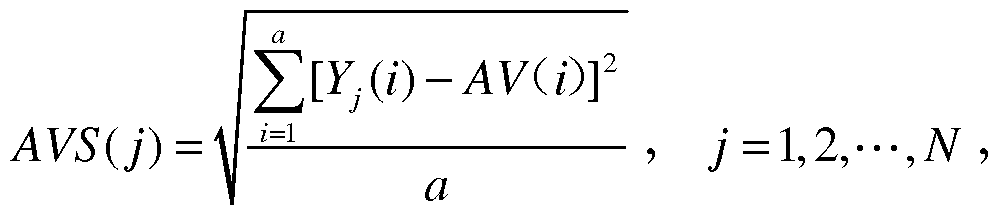
该 Ara( )为比例因子。 The Ara( ) is a scale factor.
步骤 603、 根据每个基 码本矢量到该平均矢量的距离, 产生每个 基石出码本矢量的调整矢量。 Step 603: Generate an adjustment vector of each codebook out code vector according to the distance of each base code vector to the average vector.
本实施例中, 可通过产生各个基础码本矢量每一维分量的调整矢 量, 来产生该基 码本矢量的调整矢量, 具体做法是: 设置该基 码本 矢量各维分量的调整量对应的一个或多个的关系矢量; 在产生该基础码 本矢量的每一维分量的调整量时, 将该码本矢量到所述平均矢量的距离 分别与该维分量的调整矢量对应的各个关系矢量相乘, 将得到的各个乘 积作为该码本矢量该维分量对应的各个调整量; 对得到与该码本矢量的 该维分量对应的各个乘积进行排序, 将每个乘积得到的序列号作为该乘 积对应的调整量的索引号。 In this embodiment, the adjustment vector of the base codebook vector may be generated by generating an adjustment vector for each dimension component of each basic codebook vector, and the specific method is: setting the adjustment amount of each dimension component of the base codebook vector One or more relationship vectors; when the adjustment amount of each dimension component of the base codebook vector is generated, each distance vector of the codebook vector to the average vector is corresponding to the adjustment vector of the dimension component Multiplying, each of the obtained products is used as each adjustment amount corresponding to the dimension component of the codebook vector; and each product corresponding to the dimension component of the codebook vector is obtained, and the serial number obtained by each product is used as the The index number of the adjustment amount corresponding to the product.
以第 个基 码本矢量为例,展开说明产生该第 个码本矢量的第 i 维分量的调整量的过程为:将 Ara( )作为第 j '个码本矢量调整量的基值, 设置比例因子, 以用于进一步对第 个码本矢量调整量的基值做调整。 设为第 j '个码本矢量的第 维分量 ^(0设置的关系矢量集合 {0, Al, -A1, Taking the first base codebook vector as an example, the process of generating the adjustment amount of the ith dimension component of the first codebook vector is as follows: Ara( ) is set as the base value of the jth codebook vector adjustment amount, and is set. The scaling factor is used to further adjust the base value of the first codebook vector adjustment amount. Set to the first dimension component of the j 'th codebook vector ^(0 sets the relation vector set {0, Al, -A1,
A2, -A2}, 那么 的调整量是集合 {0, AVS(j)x Al, -AVS(j)x Al, AVS(j)x A2,

图 6所示实施例提供了一种产生码本矢量的调整量的方法, 实际应 用中, 也可通过其他做法来产生码本矢量的调整量, 如最筒单的做法就 是随机产生各个码本矢量的调整量, 但是用这种做法得到的调整量, 对 码本矢量与待量化矢量之间的残差矢量进行量化处理, 所获得的编码效 果,显然没有采用图 6所示实施例中产生的调整量带来的编码效果稳定。 The embodiment shown in FIG. 6 provides a method for generating an adjustment amount of a codebook vector. In an actual application, the adjustment amount of the codebook vector may also be generated by other methods. For example, the most compact method is to randomly generate each codebook. The amount of adjustment of the vector, but the amount of adjustment obtained by this method, The residual vector between the codebook vector and the vector to be quantized is quantized, and the obtained encoding effect is obviously not stabilized by the adjustment effect caused by the adjustment amount generated in the embodiment shown in FIG. 6.
下面以对 ISF系数组成的 ISF矢量进行矢量量化为例, 详细说明本 发明实施例提供的图 1所示的矢量量化方法。 并且, 为便于比较本发明 实施例的矢量量化方法与 AMR-WB+的矢量量化方法的编码效果与量化 复杂度, 本发明实施例中, 也采用 46 个比特数进行编码, 并且设 ISF 矢量是 16维矢量, 由该 16维 ISF矢量对应的 ISF残差训练出的码本矢 量为 256个。 The vector quantization method shown in FIG. 1 provided by the embodiment of the present invention is described in detail below by taking vector quantization of the ISF vector composed of ISF coefficients as an example. In addition, in order to compare the coding effect and the quantization complexity of the vector quantization method and the AMR-WB+ vector quantization method of the embodiment of the present invention, in the embodiment of the present invention, the number of 46 bits is also used for encoding, and the ISF vector is 16 The dimension vector, the codebook vector trained by the ISF residual corresponding to the 16-dimensional ISF vector is 256.
基于图 6给出的产生码本矢量的调整量的方法, 图 7是本发明实施 例中产生 ISF残差码本矢量及各个码本矢量的调整量的流程图, 该流程 包括以下步骤: Based on the method for generating the adjustment amount of the codebook vector given in FIG. 6, FIG. 7 is a flowchart of generating the ISF residual codebook vector and the adjustment amount of each codebook vector in the embodiment of the present invention, and the flow includes the following steps:
步骤 701、 采用帧间预测计算 ISF矢量的 ISF残差。 Step 701: Calculate an ISF residual of the ISF vector by using inter prediction.
该步骤采用与现有量化 ISF矢量中, 计算 ISF残差相同的做法, 计 算出 ISF残差, 筒要说明这一计算过程如下: This step uses the same method as calculating the ISF residual in the existing quantized ISF vector to calculate the ISF residual. The calculation process is as follows:
定义 Z„为去均值 js/后的第 n帧 ISF 矢量s/„, 则预测的 ISF 残差为 R„, 其表达式为: The definition Z„ is the nth frame ISF vector s/„ after the mean value js/, then the predicted ISF residual is R„, and its expression is:
Zn = isfn - mean _ isf Z n = isf n - mean _ isf
Rn = Zn - Pn R n = Z n - P n
其中, Ρ„为第 n帧的预测 ISF矢量: Where ,„ is the predicted ISF vector for the nth frame:
Pn = MA X P n = MA X
其中 R 为前一帧量化后的 ISF残差, MA 为经验值, 一般取 1/3。 步骤 702、 训练出 16维 ISF残差的 256个码本矢量。 Where R is the quantized ISF residual of the previous frame, and MA is the empirical value, which is generally 1/3. Step 702: Train 256 codebook vectors of the 16-dimensional ISF residual.
该步骤中, 将待量化矢量作为已知量, 采用 LBG算法训练出与待 量化矢量对应的 N个码本矢量。 其中, LBG算法作为公知技术, 是一 种用于训练码本矢量的算法, 有关采用该算法训练码本矢量的详细过程 可参考相关文献资料。 实际应用中, 也可通过其他算法训练码本矢量。 In this step, the vector to be quantized is used as a known quantity, and the N codebook vectors corresponding to the vector to be quantized are trained by the LBG algorithm. Among them, the LBG algorithm is a well-known technology and is a An algorithm for training a codebook vector, and a detailed process for training a codebook vector using the algorithm can be referred to related literature. In practical applications, the codebook vector can also be trained by other algorithms.
训练出的每个码本矢量也是 a维矢量,β是大于或等于 1的正整数。 步骤 703、 计算 256个码本矢量的平均矢量。 Each codebook vector trained is also an a-dimensional vector, and β is a positive integer greater than or equal to one. Step 703: Calculate an average vector of 256 codebook vectors.
对该步骤的描述, 可参见上述步骤 502中的描述, 其中, Ν=256, 步骤 704、 计算 256个码本矢量中, 每个码本矢量到该平均矢量的 距离。 For a description of the step, refer to the description in the above step 502, where Ν=256, step 704, calculating the distance of each codebook vector to the average vector in 256 codebook vectors.
对该步骤的描述, 可参见上述步骤 503中的描述, 得到第 _ 个码本 矢量到该平均矢量的距离 Ara( )为: For a description of the step, refer to the description in step 503 above, and obtain the distance Ara( ) of the _th codebook vector to the average vector is:
AVS(j) 7 = 1, 2, · · · , 256AVS(j) 7 = 1, 2, · · · , 256
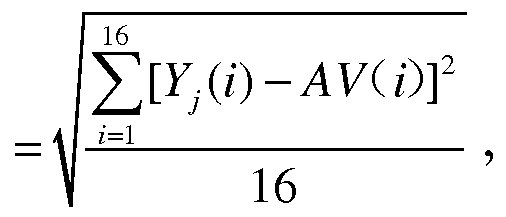
本实施例中, 一个码本矢量对应一个距离值 Ara( ) , 这个距离值将 作为码本矢量的调整量的基值, 实际应用中, 也可以计算出一个码本矢 量的多个基值, 但是, 将增加后续量化处理的计算量。 In this embodiment, a codebook vector corresponds to a distance value Ara( ), and the distance value is used as a base value of the adjustment amount of the codebook vector. In practical applications, a plurality of base values of a codebook vector may also be calculated. However, the amount of calculation of the subsequent quantization process will be increased.
步骤 705、 产生 256个码本矢量中, 每个码本矢量的每一维分量的 调整量。 Step 705: Generate an adjustment amount of each dimension component of each codebook vector in 256 codebook vectors.
本实施例中, 为每个码本矢量的第 1至 6维分量设置 7个调整量, 对应的比例因子是 0、 Al、 -Al、 Bl、 -Bl、 Cl、 -CI ; 为第 7至 13维分 量设置 5个调整量, 对应的比例因子是 0、 A2、 -A2、 B2、 -B2; 为第 14 至 16维设置 3个调整量, 对应的比例因子是 0、 A3、 -A3。 那么, 以第 j '个码本矢量为例,将步骤 705中得到的 Ara( )作为第 个码本矢量的每 维分量的调整量基值,所得到的第 j '个码本矢量各维分量的调整量 组 成的集合是: 对于第 1至 6维分量, 4=1,2,···, 7 , = 1,2 ··, 6 , In this embodiment, seven adjustment amounts are set for the first to sixth dimensional components of each codebook vector, and the corresponding scale factors are 0, Al, -Al, Bl, -Bl, Cl, -CI; The 13-dimensional component is set to 5 adjustment amounts, and the corresponding scale factors are 0, A2, -A2, B2, -B2; 3 adjustment amounts are set for the 14th to 16th dimensions, and the corresponding scale factors are 0, A3, -A3. Then, taking the j'th codebook vector as an example, the Ara() obtained in step 705 is used as the base value of the adjustment amount of each dimension component of the first codebook vector, and the obtained j'th codebook vector vectors are obtained. The set of component adjustments is: For the 1st to 6th dimensional components, 4=1, 2,···, 7 , = 1,2 ··, 6 ,
V(i,k)={0,AVS(j)xA1,-AVS(j)xA1,AVS(j)xB1,-AVS(j)xB1,AVS(j)xC1,-AVS(j)xC1} 其中, 代表 集合中, 各元素的序列号, 也是第 1至 6维分量 V(i,k)={0, AVS(j)xA 1 , -AVS(j)xA 1 , AVS(j)xB 1 , -AVS(j)xB 1 , AVS(j)xC 1 ,-AVS( j)xC 1 } where, representing the serial number of each element in the set, is also the first to sixth dimension components
对应的调整量的索引号。 The index number of the corresponding adjustment amount.
对于第 7至 13维分量, k' =l,2,-,5 , = 7,···,13, For the 7th to 13th dimensional components, k' = l, 2, -, 5, = 7, ··, 13,
V{i,Ji)={<d,AVS{j)xA2 -AVS{i)xA2,AVS{i)xB2 -AVS{j)xB2}; V{i,Ji=={<d, AVS{j)xA 2 -AVS{i)xA 2 , AVS{i)xB 2 -AVS{j)xB 2 };
其中, fc'代表 V( ')集合中, 各元素的序列号, 也是第 7至 13维分 Where fc' represents the serial number of each element in the V( ') set, which is also the 7th to 13th dimension
量对应的各个调整量的索引号。 The index number of each adjustment amount corresponding to the quantity.
对于第 14至 16维分量,

V(i,k")={0,AVS(j)xA3,-AVS(j)xA3}; V(i,k")={0, AVS(j)xA 3 , -AVS(j)xA 3 };
其中, fc'代表 V( ')集合中, 各元素的序列号, 也是第 14至 16维 分量对应的各个调整量的索引号。 Where fc' represents the serial number of each element in the V(') set, and is also the index number of each adjustment amount corresponding to the 14th to 16th-dimensional components.
另外, 本实施例中, 若所有比例因子均为 1, 那么得到的码本矢量 In addition, in this embodiment, if all the scale factors are 1, the obtained codebook vector is obtained.
每维分量的调整量是: V(i,k)={0,AVS(j),-AVS(j)} , k =1,2,3. = 1,···,16。 The amount of adjustment per dimension component is: V(i,k)={0, AVS(j), -AVS(j)}, k =1,2,3. = 1,···,16.
至此, 就得到 256个码本矢量及其调整矢量, 之后, 将利用这些码 At this point, we get 256 codebook vectors and their adjustment vectors, after which we will use these codes.
本矢量及对应的调整矢量, 量化 ISF残差。 This vector and the corresponding adjustment vector quantify the ISF residual.
基于图 7给出的产生 ISF残差码本矢量及各个码本矢量的调整量, 图 8是采用本发明实施例的矢量量化方法量化 ISF残差的流程图,其中, 利用 Ν个码本矢量及各码本矢量的调整量对待量化矢量进行量化处理, 得出量化待量化矢量的码本矢量与调整量的流程包括以下步骤: Based on the generation of the ISF residual codebook vector and the adjustment amount of each codebook vector, FIG. 8 is a flowchart of quantizing the ISF residual by using the vector quantization method according to the embodiment of the present invention, wherein one codebook vector is used. And the adjustment amount of each codebook vector is quantized, and the process of quantizing the codebook vector and the adjustment amount of the vector to be quantized includes the following steps:
步骤 801、 计算待量化矢量与 256个码本矢量中, 每个码本矢量及 Step 801: Calculate a vector to be quantized and 256 codebook vectors, and each codebook vector
该码本矢量的调整量之间的差值矢量。 The difference vector between the adjustment amounts of the codebook vector.
本实施例中, 待量化矢量是 ISF残差, 计算待量化矢量与 256个码 本矢量中, 每个码本矢量及该码本矢量的调整量之间的差值矢量为, 计 In this embodiment, the vector to be quantized is an ISF residual, and the vector to be quantized is calculated with 256 codes. In this vector, the difference vector between each codebook vector and the adjustment amount of the codebook vector is
算 ISF残差与 256个码本矢量中, 每个码本矢量之间的残差矢量。 Calculate the residual vector between each ISF residual and the 256 codebook vectors.
该步骤中得到的残差矢量也是 16维矢量, 这样的残差矢量有 256 The residual vector obtained in this step is also a 16-dimensional vector, such a residual vector has 256
个, ^!夺残差矢量表示为: res J '1 , ; =1,2,···, 256 , = 1,2,···,16。 , ^! The residual vector is expressed as: res J ' 1 , ; =1, 2, ···, 256 , = 1, 2, ···, 16.
步骤 802、依照设置码本矢量的调整量的模式,将 16维残差矢量分 Step 802: Divide the 16-dimensional residual vector according to the mode of setting the adjustment amount of the codebook vector
裂为 3个子矢量。 Split into 3 sub-vectors.
本实施例中, 依照步骤 705的描述中, 码本矢量的第 1至 6维分量 In this embodiment, according to the description of step 705, the first to sixth dimensional components of the codebook vector
对应的调整量, 第 7至 13维分量对应的调整量, 以及第 14至 16维分 Corresponding adjustment amount, adjustment amount corresponding to the 7th to 13th dimension components, and 14th to 16th dimension
量对应的调整量,将第 j个码本矢量对应的 16维残差矢量分裂为 3个子 The amount of adjustment corresponding to the quantity splits the 16-dimensional residual vector corresponding to the jth codebook vector into three sub-vectors.
矢量为: The vector is:
res J - 'Ι . ·> / = 1,2,···,6; res J - 'Ι . , / = 7,···,13; res J - 'Ι . ·> / =14,···,16。 Res J - ' Ι . ·> / = 1,2,···,6; res J - ' Ι . , / = 7,···,13; res J - ' Ι . ·> / =14,· ··, 16.
步骤 803、利用每个码本矢量的调整量,对残差矢量进行量化处理。 Step 803: Perform quantization processing on the residual vector by using the adjustment amount of each codebook vector.
本实施例中,利用 N个码本矢量及各码本矢量的调整量对待量化矢 量进行量化处理包括: 利用各码本矢量的调整量对待量化矢量与该码本 In this embodiment, the quantization process of the quantized vector by using the N codebook vectors and the adjustment amount of each codebook vector includes: treating the quantized vector and the codebook by using the adjustment amount of each codebook vector
矢量之间的残差矢量进行量化处理。 对残差矢量的量化过程为: 计算残 The residual vector between the vectors is quantized. The quantization process for the residual vector is:
差矢量的每一维分量与对应的码本矢量的同维分量的各个调整量之间 的绝对差值; 选出与残差矢量的每一维分量对应的最小绝对差值和对应 An absolute difference between each dimension component of the difference vector and each adjustment component of the same-dimensional component of the corresponding codebook vector; selecting a minimum absolute difference corresponding to each dimension component of the residual vector and corresponding
的调整量的索引号。 以量化 res J,. ',1 ,

计算 res J,. ',1的第 1维分量与 中

之间的绝对差值:

V(l,k)={0,AVS(j)xA1,-AVS(j)xA1,AVS(j)xB1,-AVS(j)xB1,AVS(j)xC1,-AVS(j)xC1} , 得到 7个绝对差值 选出其中的最小绝对差值 minE^ 并记录对 V(l,k)={0, AVS(j)xA 1 , -AVS(j)xA 1 , AVS(j)xB 1 , -AVS(j)xB 1 , AVS(j)xC 1 ,-AVS( j)xC 1 } , get 7 absolute differences, choose the smallest absolute difference minE^ and record the pair
应的 k值。
依照上述量化过程, 求出 re ,中, 第 1 至 6 维的最小绝对差值 minE ,

本实施例中, 计算每个残差矢量与最小绝对差值对应的调整量之间 的失真度的过程为: 对 256个残差矢量中的每个残差矢量, 先求出该残 差矢量的各维分量对应的最小绝对差值的平方值, 再将各维分量对应的 最小绝对差值的平方值进行求和, 将得到的求和结果作为与同一个码本 矢量对应的残差矢量与调整量之间的失真度, 残差矢量与失真度——对 应, 得到的失真度有 Ν个。 以计算 re^, ί· = 1,2,···,16与调整量之间的失 真度 为例, 该计算式为: In this embodiment, the process of calculating the degree of distortion between the adjustment amounts corresponding to each residual vector and the minimum absolute difference is: for each residual vector of the 256 residual vectors, the residual vector is first obtained. The square value of the minimum absolute difference corresponding to each dimension component, and then summing the square values of the minimum absolute difference corresponding to each dimension component, and using the obtained summation result as the residual vector corresponding to the same codebook vector Corresponding to the degree of distortion between the adjustment amount, the residual vector and the degree of distortion - corresponding to the degree of distortion obtained. For example, to calculate the degree of distortion between re ^, ί· = 1, 2, ···, 16 and the adjustment amount, the calculation formula is:
Ε] =∑ (min E )2 + (min )2 + ¾ (min E^. f , = 1, 2,… , 256 得到的失真度有 256个。 若设 El (min E. ,.)2 , 那么, 还

可根据 ISF残差对误差敏感程度的不同, 对 1、 2和 3 #文加权处理, 将该平方值乘以对应的加权系数, 得到加权后的失真度: Ε^Ε1 + Ε2/ +Ε3/β , 与 是加权系数, 为实数。 The weighted distortion can be obtained by multiplying the squared value by the corresponding weighting coefficient according to the sensitivity of the ISF residual to the error sensitivity: Ε^Ε1 + Ε2/ +Ε3/ β , and is the weighting coefficient, which is a real number.
步骤 805、 从 256个失真度中选出最小失真度, 将与该最小失真度 对应的码本矢量与调整量作为得出的量化待量化矢量的码本矢量与调 整量。 Step 805: Select a minimum distortion degree from the 256 distortion degrees, and use the codebook vector and the adjustment amount corresponding to the minimum distortion degree as the codebook vector and the adjustment amount of the obtained quantized to-be quantized vector.
本实施例中, 设 = 1+ 2/ + 3/^为最小失真度, 那么第 J '个码 本矢量就是量化待量化矢量的码本矢量, 为最佳码本矢量, 设 E1 中的 第 1 个 min ^对应的 为 2, 那么残差矢量第 1 维的量化调整量就是 AVS(j) x A , 是该残差矢量的第 1维的最佳调整量, 依次类推, 根据 1 得到残差矢量第 1至 6维的最佳调整量; 根据 E2, 得到残差矢量第 7 至 13维分量的最佳调整量; 根据 3 , 得到残差矢量第 14至 16维的最 佳调整量,得到 E1和 3根据得到其中残差矢量的第 1至 6维分量对应 的最佳调整量及对应的 值, 的量化调整量及对应的 ^值, 第 14至 16 维的量化调整量及对应的 k"。 In this embodiment, if = 1+ 2/ + 3/^ is the minimum distortion, then the J 'th codebook vector is the codebook vector for quantizing the vector to be quantized, which is the best codebook vector, and is set in E1. The first min ^ corresponds to 2, then the quantized adjustment amount of the first dimension of the residual vector is AVS(j) x A , which is the optimal adjustment amount of the first dimension of the residual vector, and so on. The optimal adjustment amount of the first to sixth dimensions of the residual vector; according to E2, the optimal adjustment amount of the 7th to 13th dimensional components of the residual vector is obtained; according to 3, the optimal adjustment amount of the residual vector 14th to 16th is obtained. Obtaining the quantization adjustment amount and the corresponding value of the optimal adjustment amount and the corresponding value corresponding to the first to sixth-dimensional components of the residual vector, E1 and 3, and the quantization adjustment amount and correspondence of the 14th to 16th dimensions. k".
步骤 806、 将与该最小失真度对应的调整量的索引号及码本矢量索 引号输出。 Step 806: Output an index number of the adjustment amount corresponding to the minimum distortion and a codebook vector index number.
本实施例中, 在得到 后, 那么相应地, 与该 Ε对应的第 j个码本 矢量是最佳码本矢量, 其索引号为 j 如步骤 805 的描述中提及的, 残 差矢量第 1维的量化调整量的索引号就是根据 1得到的第 1个 min ^对 应的 k=2, 依次类推, 得到残差矢量每一维分量的最佳调整量对应的索 引号。 In this embodiment, after obtaining, correspondingly, the jth codebook vector corresponding to the Ε is the best codebook vector, and the index number is j, as mentioned in the description of step 805, the residual vector is The index number of the one-dimensional quantization adjustment amount is k=2 corresponding to the first min^ obtained according to 1, and so on, and the index number corresponding to the optimal adjustment amount of each dimension component of the residual vector is obtained.
至此,采用本发明的矢量量化方法量化 ISF残差的过程结束,之后, 将最终得到的索引号作为编码结果, 传送到解码端。 按照编解码协议, 解码端根据索引号找到与待量化矢量对应的量化矢量, 得出合成语音信 需要说明的是, 在具体执行步骤 801时, 还可先对每个码本矢量的 每一维分量与该维分量对应的各个调整量分别求和, 然后计算待量化矢 量的同维分量与各个和值之间的绝对差值, 这样, 就能够直接得到步骤 803描述中的绝对差值, 然后可继续执行步骤 803之后的操作。 So far, the process of quantizing the ISF residual using the vector quantization method of the present invention ends, and then the finally obtained index number is transmitted as a coding result to the decoding end. According to the codec protocol, the decoding end finds the quantization vector corresponding to the vector to be quantized according to the index number, and obtains the synthesized voice signal. It should be noted that, when performing step 801, each dimension of each codebook vector may also be performed first. The components and the respective adjustment amounts corresponding to the dimension components are respectively summed, and then the absolute difference between the same-dimensional components of the vector to be quantized and the respective sum values is calculated, so that the absolute difference in the description of step 803 can be directly obtained, and then The operation after step 803 can be continued.
由于在对图像 /视频信号进行编码时,也可对信号进行采样,得到信 号序列, 并可由这些序列组成矢量, 因此, 本发明实施例提供的上述矢 量量化方法还适用于对图像 /视频信号编码过程。 Since the signal is sampled when the image/video signal is encoded, a signal sequence is obtained, and the vector can be composed of the sequences. Therefore, the above vector provided by the embodiment of the present invention The quantization method is also applicable to the encoding process of image/video signals.
下面对本发明实施例的矢量量化器进行详细说明。 The vector quantizer of the embodiment of the present invention will be described in detail below.
一种矢量量化器 10, 如图 9所示, 包括: A vector quantizer 10, as shown in Figure 9, includes:
矢量输入单元 11 , 用于获取待量化矢量; a vector input unit 11 , configured to acquire a vector to be quantized;
基础码本单元 12,用于提供基础码本矢量,所述基础码本矢量由若 干基 子矢量组成; 所述若干个基 子矢量中, 至少有一个二维或二维 以上的基 子矢量对应于一个调整矢量集合, 所述调整矢量集合包含 N 个与该基础子矢量同维度的调整矢量; 至少一个所述调整矢量集合满 足, N小于该调整矢量集合中全部调整矢量各维度的不同取值的全部可 能组合数; The base codebook unit 12 is configured to provide a base codebook vector, where the base codebook vector is composed of a plurality of base vector vectors; and at least one of the plurality of base vector vectors corresponds to an adjustment a vector set, the adjustment vector set includes N adjustment vectors of the same dimension as the basic sub-vector; at least one of the adjustment vector sets satisfies, N is smaller than all possible values of different values of all adjustment vectors in the adjustment vector set Combination number
调整矢量单元 13, 用于提供与基 码本单元 12提供的基 码本矢 量中的基 子矢量对应的调整矢量; The adjustment vector unit 13 is configured to provide an adjustment vector corresponding to the base vector in the base vector vector provided by the base unit 12;
量化单元 14,用于从基 码本单元 12和调整矢量单元 13获取基础 码本矢量和调整矢量, 将基 码本矢量和一个或一个以上与不同基础子 矢量对应的调整矢量的组合视为联合码本矢量, 根据联合码本矢量与矢 量输入单元 11 获取的待量化矢量的偏差, 从可能的联合码本矢量中选 择用于量化的联合码本矢量; The quantization unit 14 is configured to obtain a basic codebook vector and an adjustment vector from the base codebook unit 12 and the adjustment vector unit 13, and consider the combination of the base codebook vector and one or more adjustment vectors corresponding to different base subvectors as a joint. a codebook vector, selecting a joint codebook vector for quantization from a possible joint codebook vector according to a deviation of the joint codebook vector from the vector to be quantized obtained by the vector input unit 11;
量化输出单元 15, 用于获得与量化单元 14选择的联合码本矢量对 应的基础码本矢量的索引以及调整矢量的索引。 The quantization output unit 15 is for obtaining an index of the base codebook vector corresponding to the joint codebook vector selected by the quantization unit 14, and an index of the adjustment vector.
对应于实施例一中的搜索联合码本矢量的方法一, 本实施例中的量 化单元具体可采用如图 10所示的结构, 包括: Corresponding to the method 1 for searching the joint codebook vector in the first embodiment, the quantization unit in this embodiment may adopt the structure shown in FIG. 10, and includes:
残差计算单元 1411 ,用于计算所述待量化矢量与当前从所述基础码 本单元获取的基 码本矢量的差值矢量; 所述差值矢量由若干差值子矢 量组成, 差值子矢量的划分方式与基 子矢量的划分方式相同; a residual calculation unit 1411, configured to calculate a difference vector between the to-be-quantized vector and a base codebook vector currently acquired from the basic codebook unit; the difference vector is composed of a plurality of difference sub-vectors, and the difference is The division of the vector is the same as the division of the base vector;
残差量化单元 1412, 用于对于对应有调整矢量集合的基 子矢量, 根据调整矢量单元提供的该调整矢量集合中的调整矢量, 与对应的残差 计算单元 1411 得到的差值子矢量的偏差, 选择当前基 子矢量的最佳 调整矢量; a residual quantization unit 1412, configured to: for a base vector corresponding to the set of adjustment vectors, Selecting an optimal adjustment vector of the current base vector according to the deviation of the adjustment vector in the adjustment vector set provided by the adjustment vector unit and the difference sub-vector obtained by the corresponding residual calculation unit 1411;
偏差累计单元 1413, 用于累计残差量化单元 1412得到的各个最佳 调整矢量的偏差, 以及未对应调整矢量集合的基 子矢量与待量化矢量 相应部分的偏差, 作为与当前基 码本矢量对应的最佳联合码本矢量的 偏差; The deviation accumulating unit 1413 is configured to accumulate the deviations of the respective optimal adjustment vectors obtained by the residual quantization unit 1412, and the deviation of the base vector of the unadjusted adjustment vector set from the corresponding portion of the vector to be quantized, as the corresponding to the current base codebook vector. Deviation of the best joint codebook vector;
量化选择单元 1414, 用于比较偏差累计单元 1413得到的与各个基 础码本矢量对应的最佳联合码本矢量的偏差, 选择用于量化的联合码本 矢量。 The quantization selecting unit 1414 is configured to compare the deviation of the best joint codebook vector corresponding to each of the basic codebook vectors obtained by the deviation accumulating unit 1413, and select the joint codebook vector for quantization.
对应于实施例一中的搜索联合码本矢量的方法二, 本实施例中的量 化单元具体可采用如图 11所示的结构, 包括: Corresponding to the second method of searching for the joint codebook vector in the first embodiment, the quantization unit in this embodiment may adopt a structure as shown in FIG. 11, and includes:
联合矢量单元 1421 ,用于将当前从基础码本单元获取的基础码本矢 量与从调整矢量单元获取的调整矢量叠加, 生成联合码本矢量; The joint vector unit 1421 is configured to superimpose the base codebook vector currently acquired from the base codebook unit and the adjustment vector obtained from the adjustment vector unit to generate a joint codebook vector;
偏差计算单元 1422, 用于计算联合矢量单元 1421当前生成的联合 码本矢量与待量化矢量的偏差; The deviation calculating unit 1422 is configured to calculate a deviation between the joint codebook vector currently generated by the joint vector unit 1421 and the vector to be quantized;
比较选择单元 1423 , 用于比较偏差计算单元 1422得到的不同的联 合码本矢量与待量化矢量的偏差, 选择用于量化的联合码本矢量。 The comparison selecting unit 1423 is configured to compare the deviations of the different joint codebook vectors obtained by the deviation calculating unit 1422 from the vector to be quantized, and select the joint codebook vector for quantization.
本实施例矢量量化器可用于执行实施例一中描述的矢量量化方法。 实施例六、 一种矢量量化器 20, 如图 12所示, 包括: The vector quantizer of this embodiment can be used to perform the vector quantization method described in the first embodiment. Embodiment 6 A vector quantizer 20, as shown in FIG. 12, includes:
矢量输入单元 21 , 用于获取待量化矢量; a vector input unit 21, configured to acquire a vector to be quantized;
基础码本单元 22,用于提供基础码本矢量,所述基础码本矢量由若 干基 子矢量组成; 所述若干个基 子矢量中, 至少有一个二维或二维 以上的基 子矢量对应于一个调整矢量集合, 所述调整矢量集合包含 N 个与该基础子矢量同维度的调整矢量; 至少一个所述调整矢量集合满 足, N小于该调整矢量集合中全部调整矢量各维度的不同取值的全部可 能组合数; The base codebook unit 22 is configured to provide a base codebook vector, where the base codebook vector is composed of a plurality of base vector vectors; and at least one of the plurality of base vector vectors corresponds to an adjustment a vector set, the adjustment vector set includes N adjustment vectors of the same dimension as the basic sub-vector; at least one of the adjustment vector sets is full N, N is less than all possible combinations of different values of each dimension of all adjustment vectors in the set of adjustment vectors;
比例因子单元 23 , 用于提供与基石出码本单元 22当前提供的基础码 本矢量对应的比例因子; a scale factor unit 23, configured to provide a scale factor corresponding to a base codebook vector currently provided by the base code source unit 22;
调整矢量单元 24, 用于提供与基 码本单元 22提供的基 码本矢 量中的基 子矢量对应的调整矢量, 该调整矢量是与基 子矢量对应的 调整系数矢量和比例因子单元 23提供的比例因子的乘积; The adjustment vector unit 24 is configured to provide an adjustment vector corresponding to the base vector in the base codebook vector provided by the base codebook unit 22, the adjustment vector being an adjustment coefficient vector corresponding to the base vector and a scaling factor provided by the scale factor unit 23. Product of
量化单元 25 ,用于从基 码本单元 22和调整矢量单元 24获取基础 码本矢量和调整矢量, 将基 码本矢量和一个或一个以上与不同基础子 矢量对应的调整矢量的组合视为联合码本矢量, 根据联合码本矢量与所 述待量化矢量的偏差, 从可能的联合码本矢量中选择用于量化的联合码 本矢量; The quantization unit 25 is configured to obtain a basic codebook vector and an adjustment vector from the base codebook unit 22 and the adjustment vector unit 24, and consider the combination of the base codebook vector and one or more adjustment vectors corresponding to different base subvectors as a joint. a codebook vector, selecting a joint codebook vector for quantization from a possible joint codebook vector according to a deviation of the joint codebook vector from the to-be quantized vector;
量化输出单元 26, 用于获得与量化单元 24选择的联合码本矢量对 应的基础码本矢量的索引以及调整矢量的索引。 The quantization output unit 26 is configured to obtain an index of the base codebook vector corresponding to the joint codebook vector selected by the quantization unit 24 and an index of the adjustment vector.
本实施例矢量量化器可用于执行实施例二中描述的矢量量化方法。 实施例七、 一种矢量量化器 30, 如图 13所示, 包括: The vector quantizer of this embodiment can be used to perform the vector quantization method described in the second embodiment. Embodiment 7 A vector quantizer 30, as shown in FIG. 13, includes:
矢量输入单元 31 , 用于获取待量化矢量; a vector input unit 31, configured to acquire a vector to be quantized;
基础码本单元 32,用于提供基础码本矢量,所述基础码本矢量由若 干基 子矢量组成; 所述若干个基 子矢量中, 至少有一个二维或二维 以上的基 子矢量对应于一个调整矢量集合, 所述调整矢量集合包含 N 个与该基础子矢量同维度的调整矢量; 至少一个所述调整矢量集合满 足, N小于该调整矢量集合中全部调整矢量各维度的不同取值的全部可 能组合数; The base codebook unit 32 is configured to provide a base codebook vector, where the base codebook vector is composed of a plurality of base vector vectors; and at least one of the plurality of base vector vectors corresponds to an adjustment a vector set, the adjustment vector set includes N adjustment vectors of the same dimension as the basic sub-vector; at least one of the adjustment vector sets satisfies, N is smaller than all possible values of different values of all adjustment vectors in the adjustment vector set Combination number
调整矢量单元 33 , 包括, Adjust vector unit 33, including,
集合提供单元 331 ,用于提供与基础码本单元 32提供的基础子矢量 对应的关系矢量集合, 所述关系矢量集合为所述调整矢量集合或与所述 调整矢量集合具有函数对应关系, a set providing unit 331 for providing a basic sub-vector provided by the base codebook unit 32 Corresponding relationship vector set, the relationship vector set is the adjustment vector set or has a function correspondence relationship with the adjustment vector set,
调整生成单元 332, 用于搜索集合提供单元 331提供的关系矢量集 合, 根据从所述关系矢量集合中获取的关系矢量得到相应的调整矢量; 量化单元 34,用于从基 码本单元 32和调整矢量单元 33获取基础 码本矢量和调整矢量, 将基 码本矢量和一个或一个以上与不同基础子 矢量对应的调整矢量的组合视为联合码本矢量, 根据联合码本矢量与所 述待量化矢量的偏差, 从可能的联合码本矢量中选择用于量化的联合码 本矢量; The adjustment generating unit 332 is configured to search the set of relationship vectors provided by the set providing unit 331 to obtain a corresponding adjustment vector according to the relationship vector obtained from the set of relation vectors; and the quantization unit 34 is configured to adjust from the base code unit 32 and The vector unit 33 obtains a basic codebook vector and an adjustment vector, and considers a combination of the base codebook vector and one or more adjustment vectors corresponding to different base subvectors as a joint codebook vector, according to the joint codebook vector and the to-be quantized Vector deviation, selecting a joint codebook vector for quantization from possible joint codebook vectors;
量化输出单元 35 , 用于获得与量化单元 34选择的联合码本矢量对 应的基础码本矢量的索引以及调整矢量的索引, 该索引为与该调整矢量 对应的关系矢量在关系矢量集合中的序号。 The quantization output unit 35 is configured to obtain an index of a base codebook vector corresponding to the joint codebook vector selected by the quantization unit 34, and an index of the adjustment vector, where the index is a sequence number of the relationship vector corresponding to the adjustment vector in the relationship vector set .
本实施例矢量量化器可用于执行实施例三中描述的矢量量化方法。 实施例八、 一种矢量量化器 40, 如图 14所示, 包括: The vector quantizer of this embodiment can be used to perform the vector quantization method described in the third embodiment. Embodiment 8 A vector quantizer 40, as shown in FIG. 14, includes:
矢量输入单元 41 , 用于获取待量化矢量; a vector input unit 41, configured to acquire a vector to be quantized;
基础码本单元 42,用于提供基础码本矢量,所述基础码本矢量由若 干基础子矢量组成; 所述若干个基 子矢量中, 至少有一个二维或二维 以上的基 子矢量对应于一个调整矢量集合, 所述调整矢量集合包含 N 个与该基础子矢量同维度的调整矢量; 至少一个所述调整矢量集合满 足, N小于该调整矢量集合中全部调整矢量各维度的不同取值的全部可 能组合数; The base codebook unit 42 is configured to provide a base codebook vector, where the base codebook vector is composed of a plurality of basic sub-vectors; and at least one of the plurality of base vector vectors corresponds to one or more than two-dimensional base vectors And adjusting the vector set, where the adjustment vector set includes N adjustment vectors of the same dimension as the basic sub-vector; at least one of the adjustment vector sets is satisfied, and N is smaller than all the different values of all the adjustment vectors of the adjustment vector set. Possible combination number;
调整矢量单元 43 , 包括, Adjust vector unit 43 , including,
超量搜索单元 431 ,用于搜索与基础码本单元 42提供的基 子矢量 对应的关系矢量的各维度的不同取值的全部可能组合, The excess search unit 431 is configured to search for all possible combinations of different values of the dimensions of the relationship vector corresponding to the base vector provided by the base codebook unit 42,
矢量选择单元 432, 用于判断超量搜索单元 431当前获得的各维度 的取值组合是否为可选择的有效关系矢量, 若是则根据当前获得的有效 关系矢量获取调整矢量; 若否, 则控制超量搜索单元 431继续搜索直至 搜索完成; The vector selection unit 432 is configured to determine each dimension currently obtained by the excess search unit 431. Whether the combination of values is a selectable valid relationship vector, if yes, obtaining an adjustment vector according to the currently obtained valid relationship vector; if not, controlling the over-search unit 431 to continue searching until the search is completed;
量化单元 44,用于从基 码本单元 42和调整矢量单元 43获取基础 码本矢量和调整矢量, 将基 码本矢量和一个或一个以上与不同基础子 矢量对应的调整矢量的组合视为联合码本矢量, 根据联合码本矢量与所 述待量化矢量的偏差, 从可能的联合码本矢量中选择用于量化的联合码 本矢量; The quantization unit 44 is configured to obtain the basic codebook vector and the adjustment vector from the base codebook unit 42 and the adjustment vector unit 43, and consider the combination of the base codebook vector and one or more adjustment vectors corresponding to different base subvectors as a joint. a codebook vector, selecting a joint codebook vector for quantization from a possible joint codebook vector according to a deviation of the joint codebook vector from the to-be quantized vector;
量化输出单元 45 , 用于获得与量化单元 44选择的联合码本矢量对 应的基础码本矢量的索引以及调整矢量的索引, 该索引为与该调整矢量 对应的有效关系矢量在全部有效关系矢量中的序号。 The quantization output unit 45 is configured to obtain an index of a base codebook vector corresponding to the joint codebook vector selected by the quantization unit 44, and an index of the adjustment vector, where the index is an effective relationship vector corresponding to the adjustment vector in all valid relationship vectors. Serial number.
本实施例矢量量化器可用于执行实施例四中描述的矢量量化方法。 上述实施例七和实施例八中调整矢量单元的具体结构也可用于实 施例五和实施例六中。 The vector quantizer of this embodiment can be used to perform the vector quantization method described in the fourth embodiment. The specific structures of the adjustment vector unit in the above seventh embodiment and the eighth embodiment can also be used in the fifth embodiment and the sixth embodiment.
通过上述实施例可以看出, 本发明实施例采用由基 码本矢量与其 子矢量的调整矢量组合成的联合码本矢量对待量化矢量进行量化的方 法; 由于采用调整矢量对基 码本矢量进行调整, 有效扩大了基 码本 矢量的动态范围, 减小了失真度, 使得进行单级量化能够达到或超过多 级量化的效果, 有效降低码本存储量和量化计算量; 并且对基 码本矢 量的调整以调整矢量的形式进行, 使得能够充分利用待量化矢量减去基 础码本矢量后某些维度间依然存在的相关性来设计调整矢量, 达到以较 少的调整矢量数目实现较大的动态调整范围的目的, 同时由于利用了维 度间的相关性, 使得调整矢量数目较少, 有利于减小量化的计算量。 在 进一步采用由比例因子与调整系数矢量的乘积来获取调整矢量的方式 时, 由于调整矢量的取值与具体的 Ua相关, 不同的 Ua由相同的调整系 数矢量集合能够得到不同的调整矢量集合, 能够使得调整的效果更理 想, 且有效扩大了调整矢量的动态范围。 在进一步采用搜索关系矢量集 合的方式获取调整矢量时, 获取方式直接, 消耗的计算量较小。 若进一 步采用划分子集的方式来搜索关系矢量集合, 可将关系矢量分子集存 储, 在各个子集内部, 由于提供所各维度的全部取值组合, 因此可仅存 储各维度的不同取值, 不必存储组合方式, 可减少部分存储量。 在进一 步采用超量搜索的方式获取关系矢量时, 通过对组合有效性的判断来获 得对应的调整矢量, 由于不需要存储实际的有效关系矢量组合关系, 可 减少存储量。 As can be seen from the foregoing embodiment, the embodiment of the present invention adopts a method for quantizing a joint codebook vector that is a combination of a base codebook vector and an adjustment vector of a subvector thereof, and adjusts the base codebook vector by using an adjustment vector. , effectively expanding the dynamic range of the base codebook vector, reducing the degree of distortion, so that single-stage quantization can achieve or exceed the effect of multi-level quantization, effectively reducing the codebook storage amount and the quantization calculation amount; and the base codebook vector The adjustment is performed in the form of an adjustment vector, so that the adjustment vector can be designed by fully utilizing the correlation between the dimensions of the vector to be quantized and subtracting the basic codebook vector, so as to achieve a larger dynamic with a smaller number of adjustment vectors. The purpose of the adjustment range, and the use of the correlation between the dimensions, makes the number of adjustment vectors less, which is beneficial to reduce the amount of quantization calculation. When the method of obtaining the adjustment vector by the product of the scale factor and the adjustment coefficient vector is further adopted, since the value of the adjustment vector is related to the specific Ua, different Ua are determined by the same adjustment system. The number vector set can obtain different adjustment vector sets, which can make the adjustment effect more ideal, and effectively expand the dynamic range of the adjustment vector. When the adjustment vector is further acquired by using the search relationship vector set, the acquisition mode is direct, and the amount of calculation consumed is small. If the relation vector set is further searched by dividing the subset, the relation vector numerator set may be stored. Within each subset, since all the value combinations of the respective dimensions are provided, only different values of the respective dimensions may be stored. It is not necessary to store the combination method, which can reduce the amount of storage. When the relationship vector is further acquired by means of over-search, the corresponding adjustment vector is obtained by judging the validity of the combination. Since it is not necessary to store the actual effective relationship vector combination relationship, the storage amount can be reduced.
为具体说明本发明实施例的有益效果, 以下具体比较在量化宽带非 语音类信号 (Unvoiced ) 的 16维 ISF矢量时, 本方法与 ITU-T G.VBR 基线编码器方法的各种性能参数。 (ITU-T G.VBR基线编码器对宽带非 语音类信号所采用的矢量量化方法与 AMR-WB+中的 MSVQ类似,只是 在多级量化的过程中不进行矢量分裂。 ) 其中 "量化效果" 项为对 Unvoiced类总共 405336帧的 ISF系数进行量化, 对 NTT提供的 25种 语音、 2112个语音素材进行全面统计后给出。 To specifically illustrate the beneficial effects of embodiments of the present invention, the following compares various performance parameters of the method with the ITU-T G.VBR baseline encoder method when quantizing a 16-dimensional ISF vector of a wideband non-speech-like signal (Unvoiced). (The ITU-T G.VBR baseline coder uses a vector quantization method for wideband non-speech-like signals similar to MSVQ in AMR-WB+, except that vector splitting is not performed during multi-level quantization.) Where "quantization effect" The item quantifies the ISF coefficient of a total of 405,336 frames of the Unvoiced class, and gives a comprehensive statistics of 25 voices and 2,112 voice materials provided by NTT.
一、 ITU-T G.VBR基线编码器方法 I. ITU-T G.VBR baseline encoder method
基本设置: basic settings:
1、 共进行八级量化。 1. A total of eight levels of quantification.
2、 第一级根据加权均方误差从一级码本中选择 5个优选码本, 共 使用 64个 16维一级码本。 2. The first stage selects five preferred codebooks from the primary codebook based on the weighted mean square error, and uses a total of 64 16-dimensional primary codebooks.
3、 对每个优选码本, 依次用二〜八级码本矢量对上级量化的残差 进行量化, 最后从 5组结果中选择最终量化结果。 第二〜八级使用的 16 维码本数目依次为: 32、 16、 64、 64、 32、 32、 8。 3. For each preferred codebook, quantize the residual quantized by the second to eighth codebook vectors in turn, and finally select the final quantized result from the five sets of results. The number of 16-dimensional codebooks used in the second to eighth levels is: 32, 16, 64, 64, 32, 32, 8.
性能参数: 1、 编码匕特数: 6 + 5 + 4 + 6 + 6 + 5 + 5 + 3 = 40 t匕特。 Performance parameters: 1, coding 匕 special number: 6 + 5 + 4 + 6 + 6 + 5 + 5 + 3 = 40 t 匕 special.
2、 存储量: 16 (64 + 32 + 16 + 64 + 64 + 32 + 32 + 8) = 4992个浮点 数。 2. Storage: 16 (64 + 32 + 16 + 64 + 64 + 32 + 32 + 8) = 4992 floating point numbers.
3、 计算量: 加减法 21000次左右, 乘法 42000次左右。 3. Calculated amount: Addition and subtraction 21,000 times, multiplication 42,000 times.
4、 量化效果: 平均谱失真 0.975dB, 2.0~4.0dB占总数的 0.919%, 4. Quantitative effect: The average spectral distortion is 0.975dB, and 2.0~4.0dB accounts for 0.919% of the total.
> 4.0dB占 0.00715%。 > 4.0dB accounted for 0.00715%.
二、 本发明实施例的方案 Second, the solution of the embodiment of the present invention
基本设置: basic settings:
1、 共使用 57个 16维的基础码本矢量(分为五个基 子矢量)。 2、 每个基石出码本矢量对应一个比例因子。 1. A total of 57 16-dimensional base codebook vectors (divided into five base vectors) are used. 2. Each base code out vector corresponds to a scale factor.
3、 第一基 子矢量包含第 1 ~2维, 每维 7个独立变化的调整量。 3. The first base vector contains the 1st to 2nd dimensions, and the adjustment amount of 7 independent changes per dimension.
4、第二〜五基 子矢量分别依次包含第 3 ~5维、第 6~ 8维、第 9~ 12维、 第 13 - 16维, 第二〜五基 子矢量各自对应一个调整矢量集合, 每个调整矢量集合分为 3个子集, 每个子集中每维 3个独立变化的调整 量。 4. The second to fifth base vectors respectively include the 3rd to 5th, the 6th to 8th, the 9th to the 12th, and the 13th to the 16th, and the second to the fifth base vectors respectively correspond to one adjustment vector set, and each The adjustment vector set is divided into 3 subsets, and each subset has 3 independent changes per dimension.
性能参数: Performance parameters:
1、 编码比特数: 40比特。 因为总共有 57 χ 7 χ7 χ (3 χ 3 χ 3 χ 3)χ (3 χ 3 χ 3 χ 3) χ (3 χ 3 χ 3 χ 3 χ 3) χ (3 χ 3 χ 3 χ 3 χ 3) = 1082065425777 种组合, 而 40 比特总共允许有 2Λ40 = 1099511627776 种组合, 因此可 以用 40比特进行编码。 1. Number of coded bits: 40 bits. Because there are a total of 57 χ 7 χ 7 χ (3 χ 3 χ 3 χ 3) χ (3 χ 3 χ 3 χ 3) χ (3 χ 3 χ 3 χ 3 χ 3) χ (3 χ 3 χ 3 χ 3 χ 3 ) = 1082065425777 combinations, and 40 bits allow a total of 2 Λ 40 = 1099511627776 combinations, so you can encode with 40 bits.
2、 存储量: 16x 57 + 57+7 x 2+ 14x 3 x 3 = 1109个浮点数。 2. Storage: 16x 57 + 57+7 x 2+ 14x 3 x 3 = 1109 floating point numbers.
3、 计算量: 加减法 25000次左右, 乘法 7500次左右。 3. Calculation amount: Addition and subtraction 25000 times or so, multiplication 7500 times.
4、 量化效果: 平均谱失真 0.943dB, 2.0~4.0dB占总数的 1.031%, >4.0dB占 0.0054%。 4. Quantization effect: The average spectral distortion is 0.943dB, 2.0~4.0dB accounts for 1.031% of the total, and >4.0dB accounts for 0.0054%.
比较两种方法的性能参数可以看出, 在相同的编码比特数下, 本方 法无论是存储量、计算复杂度,还是量化效果都要优于 ITU-T G.VBR基 线编码器方法。 Comparing the performance parameters of the two methods, it can be seen that under the same number of coded bits, the party The method is superior to the ITU-T G.VBR baseline encoder method in terms of storage capacity, computational complexity, and quantization.
本发明实施例还基于上述本发明实施例提供的第一种矢量量化方 法, 提供一种矢量量化装置。 图 15 是该装置一个较佳实施例的结构示 意图, 该装置包括: 码本矢量提供单元、 调整量提供单元和量化单元, 其中, The embodiment of the present invention further provides a vector quantization apparatus based on the first vector quantization method provided by the foregoing embodiment of the present invention. Figure 15 is a block diagram showing a preferred embodiment of the apparatus, the apparatus comprising: a codebook vector providing unit, an adjustment amount providing unit, and a quantizing unit, wherein
码本矢量提供单元,用于将与待量化矢量对应的 N个码本矢量传送 给量化单元, N是大于或等于 1的正整数; a codebook vector providing unit, configured to transmit N codebook vectors corresponding to the vector to be quantized to the quantization unit, where N is a positive integer greater than or equal to 1;
调整量提供单元, 用于将各码本矢量的调整量传送给量化单元; 量化单元, 用于接收来自调整量提供单元的各个码本矢量的调整 量, 和来自码本矢量提供单元, 利用 N个码本矢量及各码本矢量的调整 量对待量化矢量进行量化处理, 得出量化待量化矢量的码本矢量与调整 量。 An adjustment amount providing unit, configured to transmit an adjustment amount of each codebook vector to the quantization unit; a quantization unit, configured to receive an adjustment amount of each codebook vector from the adjustment amount providing unit, and from the codebook vector providing unit, using N The codebook vector and the adjustment amount of each codebook vector are quantized by the quantized vector, and the codebook vector and the adjustment amount of the quantized vector to be quantized are obtained.
由于 N个码本矢量与各码本矢量的调整量可在矢量量化之前产生, 因此, 在进行矢量量化时, 可通过码本矢量提供单元 501与调整量提供 单元 502将矢量量化需要用到的码本矢量与调整量传送给量化单元 503。 Since the adjustment amounts of the N codebook vectors and the respective codebook vectors can be generated before the vector quantization, when the vector quantization is performed, the vector quantization unit 501 and the adjustment amount providing unit 502 can be used for the vector quantization. The codebook vector and the adjustment amount are transmitted to the quantization unit 503.
图 16是本发明矢量量化装置的另一个较佳实施例, 该装置进一步 包括: 调整量产生单元, 用于计算 N个码本矢量的平均矢量, N是大于 或等于 1的正整数; 计算每个码本矢量到该平均矢量的距离; 根据每个 码本矢量到该平均矢量的距离, 产生每个码本矢量的 1个或 1个以上的 调整量, 将产生的每个码本矢量的调整量传送给调整量提供单元。 Figure 16 is another preferred embodiment of the vector quantization apparatus of the present invention, the apparatus further comprising: an adjustment amount generating unit for calculating an average vector of N codebook vectors, N being a positive integer greater than or equal to 1; The distance from the codebook vector to the average vector; based on the distance from each codebook vector to the average vector, one or more adjustments of each codebook vector are generated, and each codebook vector to be generated is generated. The adjustment amount is transmitted to the adjustment amount supply unit.
图 17是本发明矢量量化装置的又一个较佳实施例的结构示意图, 该装置可基于图 16装置进一步包括: 残差矢量计算单元, 用于计算待 量化矢量与 N个码本矢量中, 每个码本矢量之间的残差矢量, 将每个码 本矢量之间的残差矢量传送给量化单元。 图 18是图 17量化单元的一个较佳实施例, 量化单元包括: 量化子 单元、 计算子单元和选择子单元, 其中, 17 is a schematic structural diagram of still another preferred embodiment of a vector quantization apparatus according to the present invention. The apparatus may further include: a residual vector calculation unit, configured to calculate a vector to be quantized and N codebook vectors, each of which is based on FIG. A residual vector between the codebook vectors, and a residual vector between each codebook vector is transmitted to the quantization unit. 18 is a preferred embodiment of the quantization unit of FIG. 17, the quantization unit includes: a quantization subunit, a calculation subunit, and a selection subunit, where
量化子单元, 用于接收来自调整量提供单元的每个码本矢量的调整 量, 和来自残差矢量计算单元的残差矢量, 计算每个残差矢量的每一维 分量与对应的码本矢量的同维分量的各个调整量之间的绝对差值; 选出 与残差矢量的每一维分量对应的最小绝对差值, 将与残差矢量的每一维 分量对应的最小绝对差值的计算结果传送给计算子单元; a quantization subunit, configured to receive an adjustment amount of each codebook vector from the adjustment amount providing unit, and a residual vector from the residual vector calculation unit, and calculate each dimension component of each residual vector and the corresponding codebook The absolute difference between the adjustments of the same-dimensional components of the vector; the minimum absolute difference corresponding to each dimension component of the residual vector is selected, and the minimum absolute difference corresponding to each dimension component of the residual vector is selected The calculation result is transmitted to the calculation subunit;
计算子单元, 用于接收来自量化子单元的与每个残差矢量的每一维 分量对应的最小绝对差值的计算结果, 计算该残差矢量的各维分量对应 的最小绝对差值的平方值, 再将各维分量对应的最小绝对差值的平方值 进行求和, 将得到的求和结果作为该残差矢量与调整量之间的失真度, 算出 N个残差矢量的 N个失真度, 将 N个失真度传送给选择子单元; 选择子单元, 用于接收来自计算子单元的 N个失真度,选出最小失 真度, 及与最小失真度对应的码本矢量与调整量, 将与最小失真度对应 的码本矢量与调整量输出。 a calculation subunit, configured to receive a calculation result of a minimum absolute difference value corresponding to each dimension component of each residual vector from the quantized subunit, and calculate a square of a minimum absolute difference corresponding to each dimension component of the residual vector The value is further summed with the square value of the minimum absolute difference corresponding to each dimension component, and the obtained summation result is used as the distortion degree between the residual vector and the adjustment amount, and N distortions of the N residual vectors are calculated. Degree, transmitting N distortions to the selection subunit; selecting a subunit for receiving N distortions from the calculation subunit, selecting a minimum distortion, and a codebook vector and an adjustment amount corresponding to the minimum distortion, The codebook vector corresponding to the minimum distortion is output with the adjustment amount.
图 19是矢量量化装置的又一个较佳实施例的结构示意图, 该装置 可基于图 17 进一步包括: 输出单元, 用于接收来自选择子单元的与最 小失真度对应的码本矢量与调整量, 将与最小失真度对应的码本矢量索 引号及与最小失真度对应的调整量的索引号输出。 FIG. 19 is a schematic structural diagram of still another preferred embodiment of a vector quantization apparatus. The apparatus may further include: an output unit, configured to receive a codebook vector and an adjustment amount corresponding to a minimum distortion degree from the selection subunit, according to FIG. The codebook vector index number corresponding to the minimum distortion and the index number of the adjustment amount corresponding to the minimum distortion are output.
为进一步检验本发明实施例给出的图 5所示矢量量化方法的性能, 对 AMR-WB+和本发明方法进行了语音质量客观评测,评测软件为国 际电信联盟远程通信标准化组织 (ITU-T )的 P.862客观评测标准 宽 带科感知语音质量( WB-PESQ ), 还有平均谱失真。 测试序列为第三 代合作伙伴计划 (3GPP ) 组织提供的 AMR-WB+的测试序列和视频 压缩标准 (AVS )提供的测试序列, 由 71 个测试序列组成, 其中包 括语音、 音乐、 语音背景音乐, 音乐背景语音等。 测试结果如下:In order to further test the performance of the vector quantization method shown in FIG. 5 given by the embodiment of the present invention, the voice quality is objectively evaluated for the AMR-WB+ and the method of the present invention, and the evaluation software is the International Telecommunication Union Telecommunication Standardization Organization (ITU-T). The P.862 objective evaluation standard broadband subject perceptual speech quality (WB-PESQ), as well as average spectral distortion. The test sequence is a test sequence provided by the AMR-WB+ test sequence and the Video Compression Standard (AVS) provided by the 3rd Generation Partnership Project (3GPP) organization, consisting of 71 test sequences, including Includes voice, music, background music, music background, and more. The test results are as follows:
1、 可感知语音质量 (PESQ ) 平均得分, AMR-WB+为 3.801 , 本发明为 3.874。在 71 个测试序列中 2 个码率( 10.4kbps和 24kbps ) 共 142 个测试项中, AMR-WB+ 获得优胜 ( PESQ 平均得分最高) 的优胜项占 47 项, 本方案的优胜项占 95 项。 1. Perceptual speech quality (PESQ) average score, AMR-WB+ is 3.801, and the present invention is 3.874. Among the 142 test items of 2 test rates ( 10.4 kbps and 24 kbps) in 71 test sequences, AMR-WB+ won 47 (the highest PESQ average score), and the winner of this program accounted for 95.
2、 平均谱失真, AMR-WB+的平均谱失真为 0.960156 , 其中 2 - 4dB 占 3.84% , >4db 占 0.095% ; 而本发明的平均谱失真为 0.878902, 其中 2 - 4dB 占 0.963% , > 4dB 占 0.00158% 2, the average spectral distortion, AMR-WB + average spectral distortion is 0.960156, of which 2 - 4dB accounted for 3.84%, > 4db accounted for 0.095%; and the average spectral distortion of the present invention is 0.878902, of which 2 - 4dB accounted for 0.963%, > 4dB Accounting for 0.00158%
参见表 1 , AMR-WB+的矢量量化方案一级量化用到 256、 256 个 码本矢量, 存储量为 256x ( 9+7 ) = 4096个浮点数; 二级量化用到 64、 128、 128、 32、 32 个码本矢量, 存储量为 64x3 + 128x3 + 128x3 + 32x3 + 32x4 = 1184 个浮点数, 因而总存储量是 4096 + 1184 = 5280 个浮点 数。 对应的乘法运算量为一级量化的遍历搜索 256个码本矢量, 从中找 出 4个最优的一级码本矢量, 然后搜索二级码本矢量, 搜索二级码本矢 量的过程中要遍历 4个最优的一级码本矢量和二级量化的 64、 128、 128、 32、 32 个码本矢量。 Referring to Table 1, the vector quantization scheme of AMR-WB+ uses 256, 256 codebook vectors for one-level quantization, and the storage capacity is 256x (9+7) = 4096 floating-point numbers; the second-level quantization is used for 64, 128, 128, 32, 32 codebook vectors, storage capacity is 64x3 + 128x3 + 128x3 + 32x3 + 32x4 = 1184 floating point numbers, so the total storage is 4096 + 1184 = 5280 floating point numbers. The corresponding multiplication operation is a first-level quantization traversal search for 256 codebook vectors, and four optimal first-order codebook vectors are found therefrom, and then the second-level codebook vector is searched, and the process of searching for the second-level codebook vector is required. Four optimal first-level codebook vectors and two-level quantized 64, 128, 128, 32, 32 codebook vectors are traversed.
与 AMR-WB+的矢量量化方案相比,采用本发明的矢量量化方法量 化 ISF残差时, 对 256个码本矢量用 8个比特进行编码, 对码本矢量的 调整量用 38 个比特进行编码。 在存储量方面, 本发明实施例中, 所需 要存储的是 256个码本矢量的存储量, 为 256x 16 = 4096个浮点, 再加 上 256个调整量基值, 存储量总共为 4096+256 = 4352个浮点数。 计算 量是乘法计算, 为遍历 256 个码本矢量所需要的计算量。 Compared with the vector quantization scheme of AMR-WB+, when the ISF residual is quantized by the vector quantization method of the present invention, 8 bits are encoded for 256 codebook vectors, and 38 bits are encoded for the adjustment of the codebook vector. . In terms of the amount of storage, in the embodiment of the present invention, the storage capacity of 256 codebook vectors needs to be stored, which is 256 x 16 = 4096 floating points, plus 256 adjustment amount base values, and the total storage amount is 4096+. 256 = 4352 floating point numbers. The computation is a multiplication calculation that is the amount of computation required to traverse 256 codebook vectors.
可见, 本发明实施例提供的技术方案在编码质量与矢量量化复杂度 上, 均具有明显的优势。 It can be seen that the technical solutions provided by the embodiments of the present invention have obvious advantages in coding quality and vector quantization complexity.
综上所述, 本发明实施例提供的上述技术方案通过利用与待量化矢 量对应的码本矢量, 以及这些码本矢量的调整量, 对待量化矢量进行量 化处理, 采用联合计算的做法, 在找出最佳调整量的同时, 找到与该最 佳调整量对应的最佳码本矢量, 使整个量化过程的失真度最小, 从而保 证较高的编码质量。其中,最佳调整量就是与最小失真度对应的调整量, 最佳码本矢量就是与该调整量对应的码本矢量。 同时, 本发明实施例提 供的技术方案利用码本矢量的调整量对码本矢量与待量化矢量之间的 残差矢量做量化处理, 不同于现有用多级码本矢量量化残差矢量的做 法, 因此能够减少码本矢量存储量, 且运算量只是遍历 N个码本矢量所 需要的计算量, 相比较现有遍历 N个一级码本矢量之后, 再需要遍历多 个二级码本矢量而言, 减少计算量。 因此, 本发明实施例提供的技术方 案, 在保证较高的编码质量的同时, 降低矢量量化的复杂度。 In summary, the foregoing technical solutions provided by the embodiments of the present invention utilize the vector to be quantized. The codebook vector corresponding to the quantity, and the adjustment amount of these codebook vectors, quantize the vector to be quantized, and adopt the joint calculation method to find the best adjustment amount and find the best corresponding to the optimal adjustment amount. The codebook vector minimizes the distortion of the entire quantization process, thereby ensuring a higher coding quality. The optimal adjustment amount is an adjustment amount corresponding to the minimum distortion degree, and the optimal codebook vector is a codebook vector corresponding to the adjustment amount. At the same time, the technical solution provided by the embodiment of the present invention quantizes the residual vector between the codebook vector and the vector to be quantized by using the adjustment amount of the codebook vector, which is different from the existing multi-level codebook vector quantization residual vector. Therefore, the codebook vector storage amount can be reduced, and the calculation amount is only the calculation amount required to traverse the N codebook vectors, and after traversing the N primary codebook vectors, it is necessary to traverse a plurality of secondary codebook vectors. In terms of, reduce the amount of calculation. Therefore, the technical solution provided by the embodiment of the present invention reduces the complexity of vector quantization while ensuring high coding quality.
以上对本发明实施例所提供的矢量量化方法及矢量量化器进行了 详细介绍, 本文中应用了具体个例对本发明的原理及实施方式进行了阐 述, 以上实施例的说明只是用于帮助理解本发明的方法及其核心思想; 同时, 对于本领域的一般技术人员, 依据本发明的思想, 在具体实施方 式及应用范围上均会有改变之处, 综上所述, 本说明书内容不应理解为 对本发明的限制。 The vector quantization method and the vector quantizer provided by the embodiments of the present invention are described in detail above. The principles and implementations of the present invention are described herein by using specific examples. The description of the above embodiments is only for helping to understand the present invention. The method and its core idea; at the same time, those skilled in the art, according to the idea of the present invention, there will be changes in the specific implementation and application scope. In summary, the content of the specification should not be understood as Limitations of the invention.
Claims
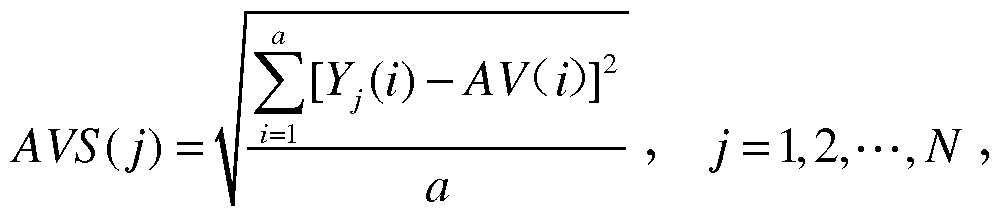
Priority Applications (3)
| Application Number | Priority Date | Filing Date | Title |
|---|---|---|---|
| EP07846024A EP2048787A4 (en) | 2006-12-05 | 2007-12-05 | Method and device for quantizing vector |
| JP2009536590A JP5006404B2 (en) | 2006-12-05 | 2007-12-05 | Vector quantizer |
| US12/273,201 US8335260B2 (en) | 2006-12-05 | 2008-11-18 | Method and device for vector quantization |
Applications Claiming Priority (4)
| Application Number | Priority Date | Filing Date | Title |
|---|---|---|---|
| CN2006101644552A CN101198041B (en) | 2006-12-05 | 2006-12-05 | Vector quantization method and device |
| CN200610164455.2 | 2006-12-05 | ||
| CN2007101305191A CN101345530B (en) | 2007-07-11 | 2007-07-11 | A vector quantization method and vector quantizer |
| CN200710130519.1 | 2007-07-11 |
Publications (1)
| Publication Number | Publication Date |
|---|---|
| WO2008067766A1 true WO2008067766A1 (en) | 2008-06-12 |
Family
ID=39491686
Family Applications (1)
| Application Number | Title | Priority Date | Filing Date |
|---|---|---|---|
| PCT/CN2007/071178 Ceased WO2008067766A1 (en) | 2006-12-05 | 2007-12-05 | Method and device for quantizing vector |
Country Status (5)
| Country | Link |
|---|---|
| US (1) | US8335260B2 (en) |
| EP (1) | EP2048787A4 (en) |
| JP (1) | JP5006404B2 (en) |
| KR (1) | KR101083291B1 (en) |
| WO (1) | WO2008067766A1 (en) |
Families Citing this family (7)
| Publication number | Priority date | Publication date | Assignee | Title |
|---|---|---|---|---|
| US7587314B2 (en) * | 2005-08-29 | 2009-09-08 | Nokia Corporation | Single-codebook vector quantization for multiple-rate applications |
| US20110051729A1 (en) * | 2009-08-28 | 2011-03-03 | Industrial Technology Research Institute and National Taiwan University | Methods and apparatuses relating to pseudo random network coding design |
| CN102195760A (en) | 2010-03-16 | 2011-09-21 | 松下电器产业株式会社 | Wireless communication system, base station, terminal and method for generating codebook |
| ES2758370T3 (en) | 2011-03-10 | 2020-05-05 | Ericsson Telefon Ab L M | Fill uncoded subvectors into transform encoded audio signals |
| TWI468934B (en) * | 2011-09-15 | 2015-01-11 | Hon Hai Prec Ind Co Ltd | Computer motherboard testing device and testing methof thereof |
| US9729215B2 (en) | 2014-06-23 | 2017-08-08 | Samsung Electronics Co., Ltd. | OFDM signal compression |
| CN117812263B (en) * | 2024-03-01 | 2024-05-07 | 博云视觉(北京)科技有限公司 | Multi-stage vector product quantization system and method for memory lightweight |
Citations (6)
| Publication number | Priority date | Publication date | Assignee | Title |
|---|---|---|---|---|
| US6009387A (en) | 1997-03-20 | 1999-12-28 | International Business Machines Corporation | System and method of compression/decompressing a speech signal by using split vector quantization and scalar quantization |
| US6148283A (en) | 1998-09-23 | 2000-11-14 | Qualcomm Inc. | Method and apparatus using multi-path multi-stage vector quantizer |
| US20030219167A1 (en) | 2002-05-23 | 2003-11-27 | Petri Pikkarainen | Method and system for forming HCVQ vector library |
| GB2405560A (en) * | 2003-08-27 | 2005-03-02 | Matsushita Electric Industrial Co Ltd | Vector quantization |
| JP2006295829A (en) * | 2005-04-14 | 2006-10-26 | Nippon Hoso Kyokai <Nhk> | Quantization apparatus, quantization program, and signal processing apparatus |
| US20070055509A1 (en) | 2005-08-29 | 2007-03-08 | Nokia Corporation | Single-codebook vector quantization for multiple-rate applications |
Family Cites Families (4)
| Publication number | Priority date | Publication date | Assignee | Title |
|---|---|---|---|---|
| JP3183944B2 (en) | 1992-04-24 | 2001-07-09 | オリンパス光学工業株式会社 | Audio coding device |
| US5398069A (en) * | 1993-03-26 | 1995-03-14 | Scientific Atlanta | Adaptive multi-stage vector quantization |
| CN1420487A (en) | 2002-12-19 | 2003-05-28 | 北京工业大学 | Method for quantizing one-step interpolation predicted vector of 1kb/s line spectral frequency parameter |
| GB2463050B (en) * | 2008-08-29 | 2010-12-08 | Toshiba Res Europ Ltd | Data compression method and apparatus |
-
2007
- 2007-12-05 EP EP07846024A patent/EP2048787A4/en not_active Ceased
- 2007-12-05 WO PCT/CN2007/071178 patent/WO2008067766A1/en not_active Ceased
- 2007-12-05 JP JP2009536590A patent/JP5006404B2/en active Active
- 2007-12-05 KR KR1020097005033A patent/KR101083291B1/en active Active
-
2008
- 2008-11-18 US US12/273,201 patent/US8335260B2/en active Active
Patent Citations (6)
| Publication number | Priority date | Publication date | Assignee | Title |
|---|---|---|---|---|
| US6009387A (en) | 1997-03-20 | 1999-12-28 | International Business Machines Corporation | System and method of compression/decompressing a speech signal by using split vector quantization and scalar quantization |
| US6148283A (en) | 1998-09-23 | 2000-11-14 | Qualcomm Inc. | Method and apparatus using multi-path multi-stage vector quantizer |
| US20030219167A1 (en) | 2002-05-23 | 2003-11-27 | Petri Pikkarainen | Method and system for forming HCVQ vector library |
| GB2405560A (en) * | 2003-08-27 | 2005-03-02 | Matsushita Electric Industrial Co Ltd | Vector quantization |
| JP2006295829A (en) * | 2005-04-14 | 2006-10-26 | Nippon Hoso Kyokai <Nhk> | Quantization apparatus, quantization program, and signal processing apparatus |
| US20070055509A1 (en) | 2005-08-29 | 2007-03-08 | Nokia Corporation | Single-codebook vector quantization for multiple-rate applications |
Non-Patent Citations (2)
| Title |
|---|
| IEEE TRANSACTION ON COMMUNICATIONS, vol. 36, no. 8, August 1988 (1988-08-01) |
| See also references of EP2048787A4 * |
Also Published As
| Publication number | Publication date |
|---|---|
| EP2048787A4 (en) | 2009-07-01 |
| JP5006404B2 (en) | 2012-08-22 |
| US20090074076A1 (en) | 2009-03-19 |
| US8335260B2 (en) | 2012-12-18 |
| JP2010509647A (en) | 2010-03-25 |
| EP2048787A1 (en) | 2009-04-15 |
| KR20090061628A (en) | 2009-06-16 |
| KR101083291B1 (en) | 2011-11-14 |
Similar Documents
| Publication | Publication Date | Title |
|---|---|---|
| CN102089810B (en) | Multi-reference LPC filter quantization and inverse quantization device and method | |
| KR101343267B1 (en) | Method and apparatus for audio coding and decoding using frequency segmentation | |
| CN101849258A (en) | Technique for encoding/decoding of codebook indices for quantized MDCT spectrum in scalable speech and audio codecs | |
| CN111968655B (en) | Signal encoding method and device and signal decoding method and device | |
| KR20080025404A (en) | Modification of codewords in dictionaries used for efficient coding of digital media spectrum data | |
| WO2008067766A1 (en) | Method and device for quantizing vector | |
| JP3344962B2 (en) | Audio signal encoding device and audio signal decoding device | |
| US8914280B2 (en) | Method and apparatus for encoding/decoding speech signal | |
| CN101609681B (en) | Encoding method, encoder, decoding method and decoder | |
| CN101198041B (en) | Vector quantization method and device | |
| Samuelsson | Waveform quantization of speech using Gaussian mixture models | |
| CN110709925B (en) | Method and apparatus for audio encoding or decoding | |
| CN101345530B (en) | A vector quantization method and vector quantizer | |
| CN110660400B (en) | Coding method, decoding method, coding device and decoding device for stereo signal | |
| CN101630510B (en) | Quick codebook searching method for LSP coefficient quantization in AMR speech coding | |
| JP5734519B2 (en) | Encoding method, encoding apparatus, decoding method, decoding apparatus, program, and recording medium | |
| JP5635213B2 (en) | Encoding method, encoding apparatus, decoding method, decoding apparatus, program, and recording medium | |
| JP3715417B2 (en) | Audio compression encoding apparatus, audio compression encoding method, and computer-readable recording medium storing a program for causing a computer to execute each step of the method | |
| Oshima et al. | Variable-length coding of ACELP gain using Entropy-Constrained VQ | |
| Lee et al. | Class-dependent and differential Huffman coding of compressed feature parameters for distributed speech recognition | |
| KR20130047630A (en) | Apparatus and method for coding signal in a communication system | |
| Abe et al. | Composite permutation coding with simple indexing for speech/audio codecs | |
| CODING | Chalmers University of Technology, SE-412 96 Goteborg, Sweden | |
| HK1153840B (en) | Multi-reference lpc filter quantization and inverse quantization device and method |
Legal Events
| Date | Code | Title | Description |
|---|---|---|---|
| 121 | Ep: the epo has been informed by wipo that ep was designated in this application |
Ref document number: 07846024 Country of ref document: EP Kind code of ref document: A1 |
|
| WWE | Wipo information: entry into national phase |
Ref document number: 2007846024 Country of ref document: EP |
|
| WWE | Wipo information: entry into national phase |
Ref document number: 1259/DELNP/2009 Country of ref document: IN |
|
| ENP | Entry into the national phase |
Ref document number: 2009536590 Country of ref document: JP Kind code of ref document: A |
|
| WWE | Wipo information: entry into national phase |
Ref document number: 1020097005033 Country of ref document: KR Ref document number: KR |
|
| NENP | Non-entry into the national phase |
Ref country code: DE |