WO2008045852A2 - Purification of streptococcus pneumoniae type 3 polysaccharides - Google Patents
Purification of streptococcus pneumoniae type 3 polysaccharides Download PDFInfo
- Publication number
- WO2008045852A2 WO2008045852A2 PCT/US2007/080768 US2007080768W WO2008045852A2 WO 2008045852 A2 WO2008045852 A2 WO 2008045852A2 US 2007080768 W US2007080768 W US 2007080768W WO 2008045852 A2 WO2008045852 A2 WO 2008045852A2
- Authority
- WO
- WIPO (PCT)
- Prior art keywords
- lysate
- centrate
- protein
- minutes
- serotype
- Prior art date
- Legal status (The legal status is an assumption and is not a legal conclusion. Google has not performed a legal analysis and makes no representation as to the accuracy of the status listed.)
- Ceased
Links
Classifications
-
- C—CHEMISTRY; METALLURGY
- C08—ORGANIC MACROMOLECULAR COMPOUNDS; THEIR PREPARATION OR CHEMICAL WORKING-UP; COMPOSITIONS BASED THEREON
- C08B—POLYSACCHARIDES; DERIVATIVES THEREOF
- C08B37/00—Preparation of polysaccharides not provided for in groups C08B1/00 - C08B35/00; Derivatives thereof
-
- C—CHEMISTRY; METALLURGY
- C12—BIOCHEMISTRY; BEER; SPIRITS; WINE; VINEGAR; MICROBIOLOGY; ENZYMOLOGY; MUTATION OR GENETIC ENGINEERING
- C12P—FERMENTATION OR ENZYME-USING PROCESSES TO SYNTHESISE A DESIRED CHEMICAL COMPOUND OR COMPOSITION OR TO SEPARATE OPTICAL ISOMERS FROM A RACEMIC MIXTURE
- C12P19/00—Preparation of compounds containing saccharide radicals
- C12P19/04—Polysaccharides, i.e. compounds containing more than five saccharide radicals attached to each other by glycosidic bonds
-
- A—HUMAN NECESSITIES
- A61—MEDICAL OR VETERINARY SCIENCE; HYGIENE
- A61K—PREPARATIONS FOR MEDICAL, DENTAL OR TOILETRY PURPOSES
- A61K31/00—Medicinal preparations containing organic active ingredients
- A61K31/70—Carbohydrates; Sugars; Derivatives thereof
- A61K31/715—Polysaccharides, i.e. having more than five saccharide radicals attached to each other by glycosidic linkages; Derivatives thereof, e.g. ethers, esters
-
- A—HUMAN NECESSITIES
- A61—MEDICAL OR VETERINARY SCIENCE; HYGIENE
- A61P—SPECIFIC THERAPEUTIC ACTIVITY OF CHEMICAL COMPOUNDS OR MEDICINAL PREPARATIONS
- A61P31/00—Antiinfectives, i.e. antibiotics, antiseptics, chemotherapeutics
- A61P31/04—Antibacterial agents
-
- Y—GENERAL TAGGING OF NEW TECHNOLOGICAL DEVELOPMENTS; GENERAL TAGGING OF CROSS-SECTIONAL TECHNOLOGIES SPANNING OVER SEVERAL SECTIONS OF THE IPC; TECHNICAL SUBJECTS COVERED BY FORMER USPC CROSS-REFERENCE ART COLLECTIONS [XRACs] AND DIGESTS
- Y10—TECHNICAL SUBJECTS COVERED BY FORMER USPC
- Y10S—TECHNICAL SUBJECTS COVERED BY FORMER USPC CROSS-REFERENCE ART COLLECTIONS [XRACs] AND DIGESTS
- Y10S424/00—Drug, bio-affecting and body treating compositions
- Y10S424/831—Drug, bio-affecting and body treating compositions involving capsular polysaccharide of bacterium, e.g. polyribosyl ribitol phosphate
Definitions
- the invention relates to improved methods for the reduction or removal of protein impurities from a complex cellular Streptococcus pneumoniae lysate or centrate comprising serotype 3 polysaccharides involving heating or pH adjustment steps.
- Streptococcus pneumoniae serotypes are grown to supply polysaccharides needed to produce the vaccine.
- the cells are grown in large fermentors with lysis induced at the end of the fermentation by addition of sodium deoxycholate (DOC) or an alternate lysing agent.
- DOC sodium deoxycholate
- the lysate broth is then harvested for downstream purification and the recovery of the capsular polysaccharide which surrounds the bacterial cells.
- the polysaccharide is included in the final vaccine product and confers immunity in the vaccine's target population to the selected Streptococcus pneumoniae serotypes.
- the cellular lysate produced in this process contains the target polysaccharide, it also contains large quantities of cellular debris including DNA, RNA, proteins, and residual media components.
- Traditional processing has involved a minimal pH reduction of the lysate to 6.6 by addition of acetic acid to help precipitate out the lysing agent and some of the impurities. This material is subjected to centrifugation followed by filtration to remove most of the solids down to a 0.45 ⁇ m nominal size.
- Such traditional processing methods have shown minimal reduction in impurities with subsequent difficulty in removing soluble proteins to meet purified polysaccharide specifications.
- the high burden of contaminating soluble protein has been particularly problematic within runs for certain serotypes.
- Some serotypes in particular Streptococcus pneumoniae Type 3, produce large and viscous polysaccharide chains (e.g., for Type 3, chains of glucose/glucuronic acid of 2-3 million Daltons) that are released into the growth medium upon cellular lysis. Its viscosity has made it difficult to filter after centrifugation, and, in such cases, protein removal through the purification process has been insufficient and has led to run failures.
- a cellular Streptococcus pneumoniae lysate comprising serotype 3 polysaccharides is heated for a time and at a temperature sufficient to denature proteins present in the lysate and cause their aggregation and precipitation.
- the method comprises the steps of: 1) heating the lysate to at least 60 0 C for at least 30 minutes to cause protein aggregation and precipitation; and 2) separating precipitants from the lysate; where a substantially purified serotype 3 polysaccharide-containing lysate is produced.
- the lysate is heated to about 60 0 C to about 70 0 C for about 30 to about 50 minutes.
- the lysate is heated to about 65°C for about 40 minutes.
- the separation step comprises filtering the lysate to remove precipitants using a membrane filter, particularly a 0.45 ⁇ m pore size membrane filter.
- the separation step comprises filtering the lysate to remove precipitants using a depth filter.
- the step of separating precipitants from the lysate comprises centrifuging the lysate to remove precipitants.
- a method is provided for reducing or removing protein impurities from a cellular Streptococcus pneumoniae lysate or centrate comprising serotype 3 polysaccharides that comprises a step involving pH adjustment of the lysate or centrate. In this embodiment, the pH adjustment step improves filterability.
- the pH of the lysate or centrate is increased to at least 8.0 prior to filtration, particularly to between about 8.0 to about 8.4 prior to filtration, and more particularly to about 8.2 prior to filtration.
- the filtration step comprises filtering the lysate or centrate using a membrane filter, particularly a 0.45 ⁇ m pore size membrane filter.
- the filtration step comprises filtering the lysate or centrate using a depth filter.
- a method for reducing or removing protein impurities from a cellular Streptococcus pneumoniae lysate comprising serotype 3 polysaccharides that comprises a lysate heating step combined with a step involving pH adjustment of the lysate or of a centrate produced by centrifugation of the lysate.
- the pH adjustment step improves filterability.
- the method comprises the steps of: 1) heating the lysate to at least 60 0 C for at least 30 minutes to cause protein aggregation and precipitation; 2) centrifuging the lysate and separating precipitated proteins from the lysate to produce a centrate; 3) increasing the pH of the centrate to at least 8.0; and 4) filtering the centrate; where a substantially purified serotype 3 polysaccharide - containing centrate is produced.
- the lysate is heated to about 60 0 C to about 70 0 C for about 30 to about 50 minutes prior to centrifugation, more particularly to about 60 0 C for about 40 minutes.
- the pH of the centrate is increased to between about 8.0 to about 8.4 prior to filtration, particularly about 8.2.
- the filtration step comprises filtering the lysate to remove precipitants using a membrane filter, more particularly a 0.45 ⁇ m pore size membrane filter.
- the filtration step comprises filtering the lysate to remove precipitants using a depth filter.
- a method for reducing or removing protein impurities from a cellular Streptococcus pneumoniae lysate or centrate comprising serotype 3 polysaccharides that comprises a pH adjustment step to cause protein aggregation and precipitation.
- the method comprises the steps of: 1) lowering the pH of said lysate to about 3.0 to about 5.0 to cause protein aggregation and precipitation; 2) centrifuging the lysate and separating precipitated proteins from the lysate to produce a centrate; 3) increasing the pH of the centrate to at least 8.0; and 4) filtering the centrate; where a substantially purified serotype 3 polysaccharide-containing centrate is produced.
- the pH of the lysate is lowered to about 3.0 prior to centrifugation. In another particular embodiment, the pH of the centrate is increased to between about 8.0 to about 8.4 prior to filtration, more particularly about 8.2.
- the pH adjustment step to cause protein aggregation and precipitation further comprises heating the lysate to at least 60 0 C for at least 30 minutes, more particularly to about 60 0 C to about 70 0 C for about 30 to about 50 minutes, and even more particularly to about 60 0 C for about 40 minutes.
- the filtration step comprises filtering the lysate to remove precipitants using a membrane filter, more particularly a 0.45 ⁇ m pore size membrane filter. In another embodiment, the filtration step comprises filtering the lysate to remove precipitants using a depth filter.
- Figure 1 shows polysaccharide yield from laboratory studies of various heating conditions and holding times for serotype 3 lysates. Data is shown as a percentage of values from unheated process samples to show relative percent protein losses of treated samples (100% is equivalent to no loss).
- Figure 2 shows protein yield from laboratory studies of various heating conditions and holding times for serotype 3 lysates. Data is shown as a percentage of values from unheated process samples to show relative percent protein losses of treated samples (100% is equivalent to no loss).
- Figure 3 shows an adjusted response graph of the effects of time (left) and temperature (right) on protein (top) and polysaccharide (PS, bottom) concentrations in serotype 3 lysates.
- Figure 4 shows a contour plot of total percent protein from serotype 3 lysates plotted by temperature and time conditions. The percentage of remaining soluble protein is shown in the curved bars on the graph. The range of 60°C-70°C for 30-50 minutes is highlighted by a box.
- Figure 5 shows SDS-PAGE gels showing soluble protein removal from heat treated cell lysate. Non-heat treated lanes are on the left (IPPPN3-007) and heat treated lanes are on the right (IPPPN3-011).
- Figure 6 shows a photograph comparing heat-treated (right) and non-heat treated (left) serotype 3 lysates following identical times for precipitate settling.
- PS polysaccharide
- Figure 8 shows a graph comparing the flow rate over time of serotype 3 centrate samples through depth filters as a function of centrate pH.
- Flow rate (y-axis) was measured by calculating a ratio for each minute of filtration in which the time in minutes was divided by the total weight in grams of centrate that had passed through the filter at that minute (the lower the ratio, the higher the flow rate).
- Centrate samples were adjusted to different pH levels (5.0 to 8.5) and pushed through the filters under different constant pressure conditions (5 to 20 pounds per square inch
- the present invention provides improved methods for the reduction or removal of protein impurities from a complex cellular Streptococcus pneumoniae lysate or centrate comprising serotype 3 polysaccharides involving steps relating to post-lysis heating or pH adjustment.
- the lysate is heated for a time and at a temperature sufficient to denature proteins present in the lysate and cause their aggregation and precipitation.
- the lysate, or a centrate produced by centrifugation of the lysate is pH adjusted to improve filterability or cause the aggregation and precipitation of proteins.
- heating and pH adjustment steps are combined to cause the aggregation and precipitation of proteins as well as to improve filterability of the lysates or centrates.
- Such methods allow for the production of substantially purified serotype 3 polysaccharide- containing lysates or centrates.
- the term "substantially purified serotype 3 polysaccharide - containing lysate” or “substantially purified serotype 3 polysaccharide-containing centrate” refers to a cellular Streptococcus pneumoniae serotype 3 lysate or centrate from which protein has been removed such that the relative protein concentration of the lysate or centrate is less than about 40%, about 35%, about 30%, about 25%, about 20%, about 15%, about 10%, about 5%, or about 1% protein compared to the concentration of protein in the lysate or centrate prior to protein removal.
- the present invention provides a method comprising a heating step for the reduction or removal of protein impurities from a cellular Streptococcus pneumoniae lysate comprising serotype 3 polysaccharides.
- the present invention provides a method for the reduction or removal of protein impurities from a cellular Streptococcus pneumoniae lysate comprising serotype 3 polysaccharides comprising the steps of: 1) heating the lysate to at least 50 0 C, at least 55°C, or at least 60 0 C for at least 15 or at least 30 minutes to cause protein aggregation and precipitation; and 2) separating precipitants from the lysate; where a substantially purified serotype 3 polysaccharide-containing lysate is produced.
- the lysate is heated to about 50 0 C to about 80 0 C for about 15 to about 60 minutes.
- the lysate is heated to between about 60 0 C to about 70 0 C for about 30 to about 50 minutes. In another particular embodiment, the lysate is heated to about 65°C for about 40 minutes. As described in more detail in the Experimental Section below, for heat stable serotype 3 polysaccharides, over 80% of protein has been removed by heating at 65°C for 40 minutes with minimal losses of polysaccharide.
- the separation step comprises centrifugation or filtration to remove or reduce protein from the lysate.
- the separation step comprises filtering the lysate to remove precipitants using a membrane filter, particularly a 0.45 ⁇ m pore size membrane filter.
- the separation step comprises filtering the lysate to remove precipitants using a depth filter.
- Filters typically used for high volume filtration processes such as the purification of serotype 3 polysaccharides include membrane (or surface) filters and depth filters.
- Membrane filters function primarily by size exclusion, in which all impurities in a solution to be filtered that are larger than the set pore size of the membrane filter are trapped on the surface of the filter.
- depth filters contain a fibrous or granular matrix with a random porous structure through which a solution to be filtered is passed, and function primarily through random adsorption and mechanical entrapment of impurities throughout the depth of the matrix.
- both membrane and depth filters may be used in combination, with the depth filter collecting larger impurities and the surface filter capturing smaller impurities.
- a method for reducing or removing protein impurities from a cellular Streptococcus pneumoniae lysate comprising serotype 3 polysaccharides or of a centrate produced by centrifugation of the lysate comprising a step involving pH adjustment of the lysate or centrate.
- the pH adjustment step improves filterability.
- filterability of a cellular Streptococcus pneumoniae lysate or centrate comprising serotype 3 polysaccharides refers to the ability to pass the lysate or centrate through a filter, such as a membrane or depth filter.
- Improved filterability of a lysate or centrate is therefore associated with, for example, increased flow rate of the lysate or centrate across a filter, reduced clogging of filters by the lysate or centrate, or reduced pressure required to pass a given volume of lysate or centrate across a filter.
- the methods of the present invention relate to the discovery that the filterability of this high molecular weight polysaccharide can be altered as a direct function of pH, and that increasing the pH of a lysate or centrate improves filterability without significant loss in polysaccharide serotype 3 molecular weight size or functionality.
- a method for reducing or removing protein impurities from a cellular Streptococcus pneumoniae lysate comprising serotype 3 polysaccharides or of a centrate produced by centrifugation of the lysate that comprises the step of increasing the pH of the centrate or lysate to at least 8.0 prior to filtration.
- the pH of the centrate or lysate is increased to about 8.0 to about 8.4 prior to filtration, more particularly about 8.2.
- Filtration following pH adjustment of the lysate or centrate may involve filtering the lysate or centrate using a membrane filter, particularly a 0.45 ⁇ m pore size membrane filter.
- filtering the lysate or centrate may involve using a depth filter.
- the method comprises the steps of: 1) heating the lysate to at least 50 0 C, at least 55°C, or at least 60 0 C for at least 15 or at least 30 minutes to cause protein aggregation and precipitation; 2) centrifuging the lysate and separating precipitated proteins from the lysate to produce a centrate; 3) increasing the pH of the centrate to at least 8.0; and 4) filtering the centrate; where a substantially purified serotype 3 polysaccharide-containing centrate is produced.
- the lysate is heated to about 50 0 C to about 80°C for about 15 to about 60 minutes prior to centrifugation.
- the lysate is heated to about 60 0 C to about 70 0 C for about 30 to about 50 minutes prior to centrifugation. In a further embodiment, the lysate is heated to about 65°C for about 40 minutes prior to centrifugation.
- the pH of the centrate is increased to about 8.0 to about 8.4 prior to filtration, more particularly about 8.2.
- the filtration step involves filtering the centrate using a membrane filter, particularly a 0.45 ⁇ m pore size membrane filter. In another embodiment, the filtration step comprises filtering the lysate to remove precipitants using a depth filter.
- a method for reducing or removing protein impurities from a cellular Streptococcus pneumoniae lysate or centrate comprising serotype 3 polysaccharides that comprises a pH adjustment step to cause protein aggregation and precipitation.
- the method comprises the steps of: 1) lowering the pH of said lysate to less than about 5.0, 4.5, 4.0, 3.5, or 3.0, or to about 3.0 to about 5.0 to cause protein aggregation and precipitation; 2) centrifuging the lysate and separating precipitated proteins from the lysate to produce a centrate; 3) increasing the pH of the centrate to at least 8.0; and 4) filtering the centrate; where a substantially purified serotype 3 polysaccharide-containing centrate is produced.
- the pH of the lysate is lowered to about 3.0 prior to centrifugation.
- the pH of the centrate is increased to between about 8.0 to about 8.4 prior to filtration, more particularly about 8.2.
- the filtration step comprises filtering the lysate to remove precipitants using a membrane filter, more particularly a 0.45 ⁇ m pore size membrane filter.
- the filtration step comprises filtering the lysate to remove precipitants using a depth filter.
- the method for reducing or removing protein impurities from a cellular Streptococcus pneumoniae lysate or centrate comprising serotype 3 polysaccharides that comprises a pH adjustment step to cause protein aggregation and precipitation further comprises heating the lysate to at least 50 0 C, at least 55°C, or at least 60 0 C for at least 15 or at least 30 minutes to cause protein aggregation and precipitation.
- the lysate is heated to about 50 0 C to about 80 0 C for about 15 to about 60 minutes prior to centrifugation.
- the lysate is heated to about 60 0 C to about 70 0 C for about 30 to about 50 minutes prior to centrifugation.
- the lysate is heated to about 65°C for about 40 minutes prior to centrifugation.
- Streptococcus pneumoniae Type 3 produces a very large and viscous polysaccharide which is released into the growth medium upon cellular lysis. This lysis is currently induced with sodium deoxycholate (DOC) at the end of the fermentation. Type 3 polysaccharide appears to be very stable over a wide temperature and pH range; however, its viscosity has made it difficult to filter after centrifugation, which has led to low recovery of cell free broth (CFB).
- CFB cell free broth
- Dodecyl Sulfate Polyacrylamide Gel Electrophoresis methods well known in the art (see, e.g., Walker, J. M. "The Protein Protocols Handbook” Totowa, NJ: Humana Press (2002)). Analysis of the gels was performed with the aid of a gel imaging system (UVP Imager with LabworksTM V.3 software, UVP Inc., Upland, CA) to interpret total band (lane) densities against a protein standard.
- a gel imaging system UVP Imager with LabworksTM V.3 software, UVP Inc., Upland, CA
- Figure 5 shows SDS-PAGE gels of soluble protein following testing of the heating step at pilot scale.
- the gel on the left shows results from a pilot scale fermentation batch (IPPPN3-007) without a heating step and shows intact protein levels throughout the recovery process (pre-pH, Post-pH, Post-Centrifugation, and Tank Post-pH adjustment).
- Test Post-pH adjustment refers to samples taken from a hold tank for the centrate following adjustment to a given pH level prior to filtration.
- a 100 kilodalton (KD) tangential flow purification ultrafiltration (UF) process was used to remove solutes smaller than 100 KD by gradually replacing the original suspension medium with a buffered solution using continuous circulation and filtration followed by concentration of the solution.
- KD kilodalton
- UF tangential flow purification ultrafiltration
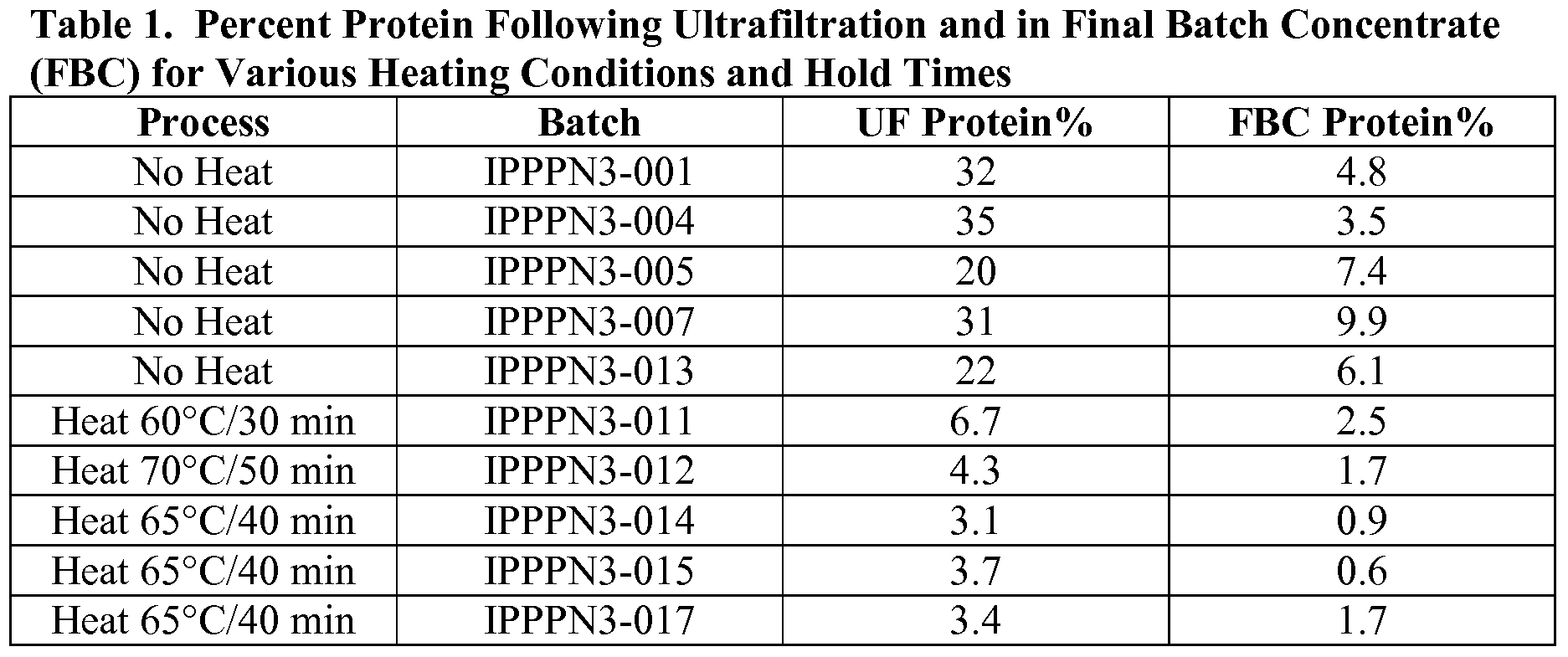
- the protein content of batch IPPPN3-007 was reported at 31% Protein/Polysaccharide on a w/w basis.
- Final protein level after the complete purification process was 9.9% (w/w against polysaccharide) resulting in failure of the batch to meet a Final Batch Concentrate (FBC) specification of ⁇ 5% protein.
- FBC Final Batch Concentrate
- a heating step with a hold of 60 0 C for 30 minutes was included after the lysate hold and prior to downstream processing.
- the protein level after IOOK UF filtration was 6.7%, and the FBC protein level was 2.5%, which passed the FBC drug intermediate specification.
- the implementation of the heating step also improved separation efficiency by increasing the aggregation of protein which allows for more efficient centrifugation.
- the effect of this step is illustrated in Figure 6, in which a photograph provides a comparison of non-heated (left) and heated (right) cellular lysate after an overnight non-agitated hold at ambient conditions. The media was noticeably clearer following heat treatment, reflecting greater aggregation and precipitation of protein.
- Streptococcus pneumoniae Type 3 is a large polysaccharide that is viscous in solution and fails to filter well under traditional processing conditions. Because of these failures, work was conducted to modify the filtration characteristics of this polysaccharide. Studies were therefore conducted to identify means for improving the filterability of serotype 3 polysaccharide solutions.
- Lysates were centrifuged and aliquoted into FalconTM tubes (BD Biosciences, Bedford, MA) in one of four conditions in which pH was adjusted using 3N NaOH (sodium hydroxide solution) as follows: 1) control (no pH- adjustment); 2) pH-adjustment to 7.0; 3) pH-adjustment to 8.0; and 4) pH-adjustment to 9.0. Centrates were then pushed through the 0.45 ⁇ m syringe filters with relative force required to filter about 3 mL of material.
- 3N NaOH sodium hydroxide solution
- FIG. 7 shows a graph of polysaccharide (PS) concentration, protein concentration, and relative filterability of serotype 3 centrates as a function of centrate pH.
- Polysaccharide concentration (mg/mL) and protein concentration (g/lOL) values are provided on the left y-axis.
- higher pH levels in all but one of the experimental runs were associated with improved centrate filterability.
- Pilot scale runs incorporating the pH adjustment step described above were then conducted (pilot scale runs listed below in Table 2). Seed bottles containing the Streptococcus pneumoniae Type 3 inoculum were grown in fermentors. The cells were chemically lysed and the lysate either centrifuged or heat treated prior to centrifugation. Following centrifugation, the pH was adjusted (except for run IPPPN3-015) and the lysate filtered through depth and 0.45 ⁇ m membrane filters prior to being sent downstream for purification. The number of filters required to process lysates from various runs was used as a measure of filterability (the lower the filterability, the more frequent the clogging of filters and the higher the number of filters required to process the lysates).
- Table 2 shows that only one depth and one membrane filter were required to process lysates from various runs adjusted to a different pH of 7.5 or higher, with or without heat treatment.
- run -015 the impact of a pH of 6.6 on filterability was assessed.
- three filter sets were required for processing of only 37 L. This result was obtained even in the presence of a heating step for protein removal within run -015.
- one set of filters processed the remaining 68 L.
Landscapes
- Health & Medical Sciences (AREA)
- Chemical & Material Sciences (AREA)
- Life Sciences & Earth Sciences (AREA)
- Organic Chemistry (AREA)
- General Health & Medical Sciences (AREA)
- Engineering & Computer Science (AREA)
- Wood Science & Technology (AREA)
- Zoology (AREA)
- Chemical Kinetics & Catalysis (AREA)
- Medicinal Chemistry (AREA)
- Pharmacology & Pharmacy (AREA)
- Biochemistry (AREA)
- Molecular Biology (AREA)
- General Chemical & Material Sciences (AREA)
- Animal Behavior & Ethology (AREA)
- Public Health (AREA)
- Veterinary Medicine (AREA)
- Bioinformatics & Cheminformatics (AREA)
- General Engineering & Computer Science (AREA)
- Microbiology (AREA)
- Genetics & Genomics (AREA)
- Biotechnology (AREA)
- Epidemiology (AREA)
- Materials Engineering (AREA)
- Polymers & Plastics (AREA)
- Communicable Diseases (AREA)
- Oncology (AREA)
- Nuclear Medicine, Radiotherapy & Molecular Imaging (AREA)
- Peptides Or Proteins (AREA)
- Preparation Of Compounds By Using Micro-Organisms (AREA)
- Polysaccharides And Polysaccharide Derivatives (AREA)
- Medicines Containing Antibodies Or Antigens For Use As Internal Diagnostic Agents (AREA)
- Micro-Organisms Or Cultivation Processes Thereof (AREA)
- Separation Using Semi-Permeable Membranes (AREA)
- Medicines Containing Material From Animals Or Micro-Organisms (AREA)
- Measuring Or Testing Involving Enzymes Or Micro-Organisms (AREA)
- Compounds Of Unknown Constitution (AREA)
Abstract
Description

Claims
Priority Applications (15)
| Application Number | Priority Date | Filing Date | Title |
|---|---|---|---|
| CN2007800378009A CN101522906B (en) | 2006-10-10 | 2007-10-09 | Purification of Streptococcus pneumoniae type 3 polysaccharide |
| MX2009003730A MX2009003730A (en) | 2006-10-10 | 2007-10-09 | Purification of streptococcus pneumoniae type 3 polysaccharides. |
| EP07843999A EP2074221B1 (en) | 2006-10-10 | 2007-10-09 | Improved methods for the separation of streptococcus pneumoniae type 3 polysaccharides |
| DK07843999.9T DK2074221T3 (en) | 2006-10-10 | 2007-10-09 | Improved methods for separating Streptococcus pneumoniae type 3 polysaccharides |
| DE602007007642T DE602007007642D1 (en) | 2006-10-10 | 2007-10-09 | IMPROVED METHODS OF SEPARATING STREPTOCOCCUS PNEUMONIAE-3 POLYSACCHARIDES |
| SI200730329T SI2074221T1 (en) | 2006-10-10 | 2007-10-09 | Improved methods for the separation of streptococcus pneumoniae type 3 polysaccharides |
| AU2007307800A AU2007307800C1 (en) | 2006-10-10 | 2007-10-09 | Purification of Streptococcus pneumoniae type 3 polysaccharides |
| BRPI0717834A BRPI0717834B8 (en) | 2006-10-10 | 2007-10-09 | purification of type 3 polysaccharides from streptococcus pneumoniae |
| JP2009532526A JP5260531B2 (en) | 2006-10-10 | 2007-10-09 | Purification of Streptococcus pneumoniae type 3 polysaccharide |
| PL07843999T PL2074221T3 (en) | 2006-10-10 | 2007-10-09 | Improved methods for the separation of streptococcus pneumoniae type 3 polysaccharides |
| CA2665169A CA2665169C (en) | 2006-10-10 | 2007-10-09 | Purification of streptococcus pneumoniae type 3 polysaccharides |
| AT07843999T ATE473289T1 (en) | 2006-10-10 | 2007-10-09 | IMPROVED METHODS FOR SEPARATION OF STREPTOCOCCUS PNEUMONIAE-3-POLYSACCHARIDES |
| BR122019021950A BR122019021950B8 (en) | 2006-10-10 | 2007-10-09 | methods for reducing or removing protein impurities from a streptococcus pneumoniae lysate or cell center comprising serotype 3 polysaccharides |
| IL197782A IL197782A (en) | 2006-10-10 | 2009-03-24 | Purification of streptococcus pneumoniae type 3 polysaccharides |
| IL233893A IL233893A (en) | 2006-10-10 | 2014-07-31 | Methods for the separation of streptococcus pneumoniae type 3 polysaccharides |
Applications Claiming Priority (2)
| Application Number | Priority Date | Filing Date | Title |
|---|---|---|---|
| US85066506P | 2006-10-10 | 2006-10-10 | |
| US60/850,665 | 2006-10-10 |
Publications (2)
| Publication Number | Publication Date |
|---|---|
| WO2008045852A2 true WO2008045852A2 (en) | 2008-04-17 |
| WO2008045852A3 WO2008045852A3 (en) | 2008-06-19 |
Family
ID=39156240
Family Applications (1)
| Application Number | Title | Priority Date | Filing Date |
|---|---|---|---|
| PCT/US2007/080768 Ceased WO2008045852A2 (en) | 2006-10-10 | 2007-10-09 | Purification of streptococcus pneumoniae type 3 polysaccharides |
Country Status (18)
| Country | Link |
|---|---|
| US (1) | US7659090B2 (en) |
| JP (1) | JP5260531B2 (en) |
| KR (1) | KR101467002B1 (en) |
| CN (2) | CN101522906B (en) |
| AT (1) | ATE473289T1 (en) |
| AU (1) | AU2007307800C1 (en) |
| BR (2) | BRPI0717834B8 (en) |
| CA (1) | CA2665169C (en) |
| CL (1) | CL2007002909A1 (en) |
| DE (1) | DE602007007642D1 (en) |
| DK (1) | DK2074221T3 (en) |
| ES (1) | ES2346929T3 (en) |
| IL (2) | IL197782A (en) |
| MX (1) | MX2009003730A (en) |
| PT (1) | PT2074221E (en) |
| RU (1) | RU2460539C2 (en) |
| WO (1) | WO2008045852A2 (en) |
| ZA (1) | ZA200902502B (en) |
Cited By (17)
| Publication number | Priority date | Publication date | Assignee | Title |
|---|---|---|---|---|
| US9205143B2 (en) | 2009-04-30 | 2015-12-08 | Coley Pharmaceutical Group Inc. | Pneumococcal vaccine and uses thereof |
| WO2016174683A1 (en) | 2015-04-28 | 2016-11-03 | Biological E Limited | Method for separation of protein and other impurities from microbial capsular polysaccharides |
| US10435433B2 (en) | 2017-07-05 | 2019-10-08 | Inventprise, Llc | Polysaccharide purification for vaccine production using lytic enzymes, tangential flow filtration, and multimode chromatography |
| US10702596B2 (en) | 2017-07-05 | 2020-07-07 | Inventprise, Llc | Polysaccharide purification for vaccine production using lytic enzymes, tangential flow filtration, and multimode chromatography |
| EP3789494A1 (en) * | 2019-09-06 | 2021-03-10 | Serum Institute of India Private Limited | Method for obtaining purified bacterial polysaccharides |
| US11090374B2 (en) | 2017-02-24 | 2021-08-17 | Merck Sharp & Dohme Corp. | Enhancing immunogenicity of Streptococcus pneumoniae polysaccharide-protein conjugates |
| US11116828B2 (en) | 2017-12-06 | 2021-09-14 | Merck Sharp & Dohme Corp. | Compositions comprising Streptococcus pneumoniae polysaccharide-protein conjugates and methods of use thereof |
| US11197921B2 (en) | 2017-01-31 | 2021-12-14 | Merck Sharp & Dohme Corp. | Methods for making polysaccharide-protein conjugates |
| WO2022084852A1 (en) * | 2020-10-22 | 2022-04-28 | Pfizer Inc. | Methods for purifying bacterial polysaccharides |
| US11389540B2 (en) | 2017-09-07 | 2022-07-19 | Merck Sharp & Dohme Llc | Pneumococcal polysaccharides and their use in immunogenic polysaccharide-carrier protein conjugates |
| US11395849B2 (en) | 2017-09-07 | 2022-07-26 | Merck Sharp & Dohme Llc | Pneumococcal polysaccharides and their use in immunogenic polysaccharide-carrier protein conjugates |
| US11642406B2 (en) | 2018-12-19 | 2023-05-09 | Merck Sharp & Dohme Llc | Compositions comprising Streptococcus pneumoniae polysaccharide-protein conjugates and methods of use thereof |
| US11896656B2 (en) | 2018-04-30 | 2024-02-13 | Merck Sharp & Dohme Llc | Methods for providing a homogenous solution of lyophilized mutant diptheria toxin in dimethylsulfoxide |
| US11951165B2 (en) | 2016-12-30 | 2024-04-09 | Vaxcyte, Inc. | Conjugated vaccine carrier proteins |
| US11992521B2 (en) | 2018-04-30 | 2024-05-28 | Merck Sharp & Dohme Llc | Methods for producing Streptococcus pneumoniae capsular polysaccharide carrier protein conjugates |
| US11998599B2 (en) | 2016-12-30 | 2024-06-04 | Vaxcyte, Inc. | Polypeptide-antigen conjugates with non-natural amino acids |
| US12144855B2 (en) | 2018-04-30 | 2024-11-19 | Merck Sharp & Dohme Llc | Methods for producing streptococcus pneumoniae capsular polysaccharide carrier protein conjugates from lyospheres |
Families Citing this family (57)
| Publication number | Priority date | Publication date | Assignee | Title |
|---|---|---|---|---|
| GB0822634D0 (en) | 2008-12-11 | 2009-01-21 | Novartis Ag | Meningitis vaccines |
| US8795689B2 (en) | 2008-12-18 | 2014-08-05 | Wyeth Llc | Method for controlling Streptococcus pneumoniae serotype 19A polysaccharide molecular weight |
| JP5789514B2 (en) | 2008-12-18 | 2015-10-07 | ワイス・エルエルシー | Method for controlling the molecular weight of Streptococcus pneumoniae polysaccharide using carbon dioxide |
| WO2010109324A1 (en) | 2009-03-24 | 2010-09-30 | Novartis Ag | Combinations of meningococcal factor h binding protein and pneumococcal saccharide conjugates |
| NZ595234A (en) | 2009-03-24 | 2013-12-20 | Novartis Ag | Adjuvanting meningococcal factor h binding protein |
| US10478483B2 (en) | 2010-06-25 | 2019-11-19 | Glaxosmithkline Biologicals Sa | Combinations of meningococcal factor H binding proteins |
| CN102094053B (en) * | 2010-11-26 | 2013-01-16 | 兰州生物制品研究所有限责任公司 | Method for purifying streptococcus penumoniae C polysaccharide |
| CA2828844C (en) | 2011-03-02 | 2020-07-14 | Novartis Ag | Combination vaccines with lower doses of antigen and/or adjuvant |
| BR112014016223A8 (en) | 2011-12-29 | 2017-07-04 | Novartis Ag | adjuvant combinations of meningococcal h-factor binding proteins |
| EP2822586A1 (en) | 2012-03-07 | 2015-01-14 | Novartis AG | Adjuvanted formulations of streptococcus pneumoniae antigens |
| CN104159603A (en) | 2012-03-08 | 2014-11-19 | 诺华股份有限公司 | Combination vaccines with tlr4 agonists |
| EP2892553A1 (en) | 2012-09-06 | 2015-07-15 | Novartis AG | Combination vaccines with serogroup b meningococcus and d/t/p |
| ES2651415T3 (en) | 2012-09-07 | 2018-01-26 | Sk Chemicals Co., Ltd. | Production method of a capsular polysaccharide that has a pneumococcal serotype |
| CA2894260A1 (en) | 2012-12-18 | 2014-06-26 | Glaxosmithkline Biologicals S.A. | Conjugates for protecting against diphtheria and/or tetanus |
| EP3607966A1 (en) | 2014-01-21 | 2020-02-12 | Pfizer Inc | Immunogenic compositions comprising conjugated capsular saccharide antigens and uses thereof |
| HRP20211288T1 (en) | 2014-01-21 | 2021-11-26 | Pfizer Inc. | Streptococcus pneumoniae capsular polysaccharides and conjugates thereof |
| BR112016015835B1 (en) | 2014-01-21 | 2023-12-26 | Pfizer Inc | PROCESS FOR PREPARING CONJUGATES COMPRISING CAPSULAR POLYSACCHARIDES OF STREPTOCOCCUS PNEUMONIAE |
| US11160855B2 (en) | 2014-01-21 | 2021-11-02 | Pfizer Inc. | Immunogenic compositions comprising conjugated capsular saccharide antigens and uses thereof |
| FI3244917T3 (en) | 2015-01-15 | 2023-05-25 | Pfizer | Immunogenic compositions for use in pneumococcal vaccines |
| KR102045663B1 (en) | 2015-05-04 | 2019-11-15 | 화이자 인코포레이티드 | Group B Streptococcus polysaccharide-protein conjugate, method of producing the conjugate, immunogenic composition comprising the conjugate, and use thereof |
| KR102225282B1 (en) | 2015-07-21 | 2021-03-10 | 화이자 인코포레이티드 | Immunogenic composition comprising conjugated capsular saccharide antigen, kit comprising same, and use thereof |
| WO2017085586A1 (en) | 2015-11-20 | 2017-05-26 | Pfizer Inc. | Immunogenic compositions for use in pneumococcal vaccines |
| CA3031797A1 (en) | 2016-08-05 | 2018-02-08 | Sanofi Pasteur, Inc. | Multivalent pneumococcal polysaccharide-protein conjugate composition |
| EP3493837B1 (en) | 2016-08-05 | 2022-08-31 | Sanofi Pasteur, Inc. | Multivalent pneumococcal polysaccharide-protein conjugate composition |
| US10751402B2 (en) | 2016-11-09 | 2020-08-25 | Pfizer Inc. | Immunogenic compositions and uses thereof |
| SI3570879T1 (en) | 2017-01-20 | 2022-06-30 | Pfizer Inc. | Immunogenic compositions for use in pneumococcal vaccines |
| AU2019215216B2 (en) | 2018-02-05 | 2025-04-17 | Sk Bioscience Co., Ltd. | Multivalent pneumococcal polysaccharide-protein conjugate composition |
| SG11202006387QA (en) | 2018-02-05 | 2020-07-29 | Sanofi Pasteur Inc | Multivalent pneumococcal polysaccharide-protein conjugate composition |
| CN112543649A (en) | 2018-07-04 | 2021-03-23 | Vaxcyte公司 | Improvements in immunogenic conjugates |
| WO2020010016A1 (en) | 2018-07-04 | 2020-01-09 | Sutrovax, Inc. | Self-adjuvanted immunogenic conjugates |
| WO2020121159A1 (en) | 2018-12-12 | 2020-06-18 | Pfizer Inc. | Immunogenic multiple hetero-antigen polysaccharide-protein conjugates and uses thereof |
| CA3136278A1 (en) | 2019-04-10 | 2020-10-15 | Pfizer Inc. | Immunogenic compositions comprising conjugated capsular saccharide antigens, kits comprising the same and uses thereof |
| MX2022001241A (en) | 2019-07-31 | 2022-04-20 | Sanofi Pasteur Inc | COMPOSITIONS OF MULTIVALENT PNEUMOCOCCAL POLYSACCHARIDE-PROTEIN CONJUGATES AND METHODS FOR USE THEREOF. |
| US20230085173A1 (en) * | 2020-02-21 | 2023-03-16 | Pfizer Inc. | Purification of saccharides |
| WO2021229604A1 (en) * | 2020-05-14 | 2021-11-18 | Serum Institute Of India Private Limited | Methods for simultaneous fragmentation and purification of bacterial polysaccharides |
| AU2021332183B2 (en) | 2020-08-26 | 2025-12-18 | Pfizer Inc. | Group B streptococcus polysaccharide-protein conjugates, methods for producing conjugates, immunogenic compositions comprising conjugates, and uses thereof |
| CA3200602A1 (en) | 2020-11-04 | 2022-05-12 | Pfizer Inc. | Immunogenic compositions for use in pneumococcal vaccines |
| CA3200968A1 (en) | 2020-11-10 | 2022-05-19 | Pfizer Inc. | Immunogenic compositions comprising conjugated capsular saccharide antigens and uses thereof |
| WO2022234416A1 (en) | 2021-05-03 | 2022-11-10 | Pfizer Inc. | Vaccination against pneumoccocal and covid-19 infections |
| WO2022234405A1 (en) | 2021-05-03 | 2022-11-10 | Pfizer Inc. | Vaccination against bacterial and betacoronavirus infections |
| EP4346893A2 (en) | 2021-05-28 | 2024-04-10 | Pfizer Inc. | Immunogenic compositions comprising conjugated capsular saccharide antigens and uses thereof |
| PE20240090A1 (en) | 2021-05-28 | 2024-01-16 | Pfizer | IMMUNOGENIC COMPOSITIONS COMPRISING CONJUGATED CAPSULAR SACCHARIDE ANTIGENS AND THEIR USES |
| CA3247998A1 (en) | 2022-01-13 | 2023-07-20 | Pfizer Inc. | Immunogenic compositions comprising conjugated capsular saccharide antigens and uses thereof |
| WO2024084397A1 (en) | 2022-10-19 | 2024-04-25 | Pfizer Inc. | Vaccination against pneumoccocal and covid-19 infections |
| WO2024110827A1 (en) | 2022-11-21 | 2024-05-30 | Pfizer Inc. | Methods for preparing conjugated capsular saccharide antigens and uses thereof |
| KR20250107930A (en) | 2022-11-22 | 2025-07-14 | 화이자 인코포레이티드 | Immunogenic composition comprising conjugated membrane saccharide antigen and use thereof |
| CN120513083A (en) | 2022-12-01 | 2025-08-19 | 辉瑞大药厂 | Streptococcus pneumoniae conjugate vaccine formulations |
| EP4661911A1 (en) | 2023-02-10 | 2025-12-17 | Pfizer Inc. | Immunogenic compositions comprising conjugated capsular saccharide antigens and uses thereof |
| WO2024201324A2 (en) | 2023-03-30 | 2024-10-03 | Pfizer Inc. | Immunogenic compositions comprising conjugated capsular saccharide antigens and uses thereof |
| KR20250169621A (en) | 2023-04-14 | 2025-12-03 | 화이자 인코포레이티드 | Immunogenic composition comprising conjugated membrane saccharide antigen and use thereof |
| WO2024224266A1 (en) | 2023-04-24 | 2024-10-31 | Pfizer Inc. | Immunogenic compositions comprising conjugated capsular saccharide antigens and uses thereof |
| WO2024241172A2 (en) | 2023-05-19 | 2024-11-28 | Glaxosmithkline Biologicals Sa | Methods for eliciting an immune response to respiratory syncycial virus and streptococcus pneumoniae infection |
| WO2025057078A1 (en) | 2023-09-14 | 2025-03-20 | Pfizer Inc. | Adjuvanted immunogenic compositions comprising conjugated pneumococcal capsular saccharide antigens and uses thereof |
| WO2025133971A1 (en) | 2023-12-23 | 2025-06-26 | Pfizer Inc. | Improved methods for producing bacterial capsular saccharide glycoconjugates |
| WO2025186705A2 (en) | 2024-03-06 | 2025-09-12 | Pfizer Inc. | Immunogenic compositions comprising conjugated capsular saccharide antigens and uses thereof |
| WO2025219908A2 (en) | 2024-04-19 | 2025-10-23 | Pfizer Inc. | Media and fermentation methods for polysaccharide production in bacterial cell culture |
| WO2025219904A1 (en) | 2024-04-19 | 2025-10-23 | Pfizer Inc. | Improved methods for producing glycoconjugates by reductive amination in aprotic solvent |
Citations (1)
| Publication number | Priority date | Publication date | Assignee | Title |
|---|---|---|---|---|
| US20060228381A1 (en) | 2005-04-08 | 2006-10-12 | Wyeth | Separation of contaminants from Streptococcus pneumoniae polysaccharide by pH manipulation |
Family Cites Families (7)
| Publication number | Priority date | Publication date | Assignee | Title |
|---|---|---|---|---|
| US4413057A (en) * | 1980-04-14 | 1983-11-01 | Merck & Co., Inc. | Group B streptococcal capsular polysaccharides |
| CA2059692C (en) * | 1991-01-28 | 2004-11-16 | Peter J. Kniskern | Pneumoccoccal polysaccharide conjugate vaccine |
| DE122009000054I1 (en) * | 1999-03-19 | 2009-12-31 | Glaxosmithkline Biolog Sa | VACCINE AGAINST BACTERIAL ANTIGENE |
| PT1268844E (en) * | 2000-03-16 | 2009-11-03 | Philadelphia Children Hospital | Modulating production of pneumococcal capsular polysaccharide |
| GB0115176D0 (en) * | 2001-06-20 | 2001-08-15 | Chiron Spa | Capular polysaccharide solubilisation and combination vaccines |
| US20050220777A1 (en) * | 2003-11-21 | 2005-10-06 | Stefan Roos | Selection of lactic acid bacteria enhancing the immune response against Streptococcus pneumoniae |
| JP5286089B2 (en) * | 2006-01-13 | 2013-09-11 | バクスター・インターナショナル・インコーポレイテッド | Method for purifying polysaccharides |
-
2007
- 2007-10-09 WO PCT/US2007/080768 patent/WO2008045852A2/en not_active Ceased
- 2007-10-09 CN CN2007800378009A patent/CN101522906B/en active Active
- 2007-10-09 DE DE602007007642T patent/DE602007007642D1/en active Active
- 2007-10-09 MX MX2009003730A patent/MX2009003730A/en active IP Right Grant
- 2007-10-09 DK DK07843999.9T patent/DK2074221T3/en active
- 2007-10-09 AT AT07843999T patent/ATE473289T1/en active
- 2007-10-09 PT PT07843999T patent/PT2074221E/en unknown
- 2007-10-09 CA CA2665169A patent/CA2665169C/en active Active
- 2007-10-09 AU AU2007307800A patent/AU2007307800C1/en active Active
- 2007-10-09 BR BRPI0717834A patent/BRPI0717834B8/en active IP Right Grant
- 2007-10-09 KR KR1020097009585A patent/KR101467002B1/en active Active
- 2007-10-09 US US11/869,206 patent/US7659090B2/en active Active
- 2007-10-09 ES ES07843999T patent/ES2346929T3/en active Active
- 2007-10-09 CN CN201210083999.1A patent/CN102648979B/en active Active
- 2007-10-09 RU RU2009112453/10A patent/RU2460539C2/en active
- 2007-10-09 BR BR122019021950A patent/BR122019021950B8/en active IP Right Grant
- 2007-10-09 JP JP2009532526A patent/JP5260531B2/en active Active
- 2007-10-09 CL CL200702909A patent/CL2007002909A1/en unknown
-
2009
- 2009-03-24 IL IL197782A patent/IL197782A/en active IP Right Grant
- 2009-04-09 ZA ZA200902502A patent/ZA200902502B/en unknown
-
2014
- 2014-07-31 IL IL233893A patent/IL233893A/en active IP Right Grant
Patent Citations (1)
| Publication number | Priority date | Publication date | Assignee | Title |
|---|---|---|---|---|
| US20060228381A1 (en) | 2005-04-08 | 2006-10-12 | Wyeth | Separation of contaminants from Streptococcus pneumoniae polysaccharide by pH manipulation |
Cited By (29)
| Publication number | Priority date | Publication date | Assignee | Title |
|---|---|---|---|---|
| US9205143B2 (en) | 2009-04-30 | 2015-12-08 | Coley Pharmaceutical Group Inc. | Pneumococcal vaccine and uses thereof |
| US10836839B2 (en) | 2015-04-28 | 2020-11-17 | Biological E Limited | Method for separation of protein and other impurities from microbial capsular polysaccharides |
| WO2016174683A1 (en) | 2015-04-28 | 2016-11-03 | Biological E Limited | Method for separation of protein and other impurities from microbial capsular polysaccharides |
| US11680111B2 (en) | 2015-04-28 | 2023-06-20 | Biological E Limited | Method for separation of protein and other impurities from microbial capsular polysaccharides |
| US11998599B2 (en) | 2016-12-30 | 2024-06-04 | Vaxcyte, Inc. | Polypeptide-antigen conjugates with non-natural amino acids |
| US11951165B2 (en) | 2016-12-30 | 2024-04-09 | Vaxcyte, Inc. | Conjugated vaccine carrier proteins |
| US11197921B2 (en) | 2017-01-31 | 2021-12-14 | Merck Sharp & Dohme Corp. | Methods for making polysaccharide-protein conjugates |
| US12059461B2 (en) | 2017-01-31 | 2024-08-13 | Merck Sharp & Dohme Corp. | Methods for making polysaccharide-protein conjugates |
| US11090374B2 (en) | 2017-02-24 | 2021-08-17 | Merck Sharp & Dohme Corp. | Enhancing immunogenicity of Streptococcus pneumoniae polysaccharide-protein conjugates |
| US12295998B2 (en) | 2017-02-24 | 2025-05-13 | Merck Sharp & Dohme Llc | Enhancing immunogenicity of Streptococcus pneumoniae polysaccharide-protein conjugates |
| US10702596B2 (en) | 2017-07-05 | 2020-07-07 | Inventprise, Llc | Polysaccharide purification for vaccine production using lytic enzymes, tangential flow filtration, and multimode chromatography |
| US10435433B2 (en) | 2017-07-05 | 2019-10-08 | Inventprise, Llc | Polysaccharide purification for vaccine production using lytic enzymes, tangential flow filtration, and multimode chromatography |
| US11395849B2 (en) | 2017-09-07 | 2022-07-26 | Merck Sharp & Dohme Llc | Pneumococcal polysaccharides and their use in immunogenic polysaccharide-carrier protein conjugates |
| US11389540B2 (en) | 2017-09-07 | 2022-07-19 | Merck Sharp & Dohme Llc | Pneumococcal polysaccharides and their use in immunogenic polysaccharide-carrier protein conjugates |
| US11759523B2 (en) | 2017-09-07 | 2023-09-19 | Merck Sharp & Dohme Llc | Pneumococcal polysaccharides and their use in immunogenic polysaccharide-carrier protein conjugates |
| US11759510B2 (en) | 2017-09-07 | 2023-09-19 | Merck, Sharp & Dohme LLC | Pneumococcal polysaccharides and their use in immunogenic polysaccharide-carrier protein conjugates |
| US11759511B2 (en) | 2017-09-07 | 2023-09-19 | Merck Sharp & Dohme Llc | Pneumococcal polysaccharides and their use in immunogenic polysaccharide-carrier protein conjugates |
| US11964023B2 (en) | 2017-09-07 | 2024-04-23 | Merck Sharp & Dohme Llc | Pneumococcal polysaccharides and their use in immunogenic polysaccharide-carrier protein conjugates |
| US11116828B2 (en) | 2017-12-06 | 2021-09-14 | Merck Sharp & Dohme Corp. | Compositions comprising Streptococcus pneumoniae polysaccharide-protein conjugates and methods of use thereof |
| US11850278B2 (en) | 2017-12-06 | 2023-12-26 | Merck Sharp & Dohme Llc | Compositions comprising Streptococcus pneumoniae polysaccharide-protein conjugates and methods of use thereof |
| US12097250B2 (en) | 2017-12-06 | 2024-09-24 | Merck Sharp & Dohme Llc | Compositions comprising Streptococcus pneumoniae polysaccharide-protein conjugates and methods of use thereof |
| US11896656B2 (en) | 2018-04-30 | 2024-02-13 | Merck Sharp & Dohme Llc | Methods for providing a homogenous solution of lyophilized mutant diptheria toxin in dimethylsulfoxide |
| US11992521B2 (en) | 2018-04-30 | 2024-05-28 | Merck Sharp & Dohme Llc | Methods for producing Streptococcus pneumoniae capsular polysaccharide carrier protein conjugates |
| US12144855B2 (en) | 2018-04-30 | 2024-11-19 | Merck Sharp & Dohme Llc | Methods for producing streptococcus pneumoniae capsular polysaccharide carrier protein conjugates from lyospheres |
| US12419943B2 (en) | 2018-04-30 | 2025-09-23 | Merck Sharp & Dohme Llc | Methods for producing Streptococcus pneumoniae capsular polysaccharide carrier protein conjugates |
| US11642406B2 (en) | 2018-12-19 | 2023-05-09 | Merck Sharp & Dohme Llc | Compositions comprising Streptococcus pneumoniae polysaccharide-protein conjugates and methods of use thereof |
| US12016914B2 (en) | 2018-12-19 | 2024-06-25 | Merck Sharp & Dohme Llc | Compositions comprising Streptococcus pneumoniae polysaccharide-protein conjugates and methods of use thereof |
| EP3789494A1 (en) * | 2019-09-06 | 2021-03-10 | Serum Institute of India Private Limited | Method for obtaining purified bacterial polysaccharides |
| WO2022084852A1 (en) * | 2020-10-22 | 2022-04-28 | Pfizer Inc. | Methods for purifying bacterial polysaccharides |
Also Published As
Similar Documents
| Publication | Publication Date | Title |
|---|---|---|
| CA2665169C (en) | Purification of streptococcus pneumoniae type 3 polysaccharides | |
| DE69737364T2 (en) | METHODS FOR VIRUS CLEANING | |
| KR102611970B1 (en) | Hyaluronic acid purification process | |
| CA1146862A (en) | Multivalent pneumococcal vaccine and preparation thereof | |
| CN101663327B (en) | Shortened purification process for the production of capsularstreptococcus pneumoniae polysaccharides | |
| AU2016364597A1 (en) | Method for producing botulinum toxin | |
| AU2013201631B2 (en) | Purification of Streptococcus pneumoniae type 3 polysaccharides | |
| EP2074221B1 (en) | Improved methods for the separation of streptococcus pneumoniae type 3 polysaccharides | |
| CN102911285A (en) | Process for refining group C/Y/W135 meningococcal polysaccharides | |
| DE3780843T2 (en) | INDUSTRIAL PROCESS FOR THE PRODUCTION OF RIBOSOMAL VACCINALS AND THE RIBOSOMAL VACCINES OBTAINED THEREFORE. | |
| HK1174836B (en) | Purification of streptococcus pneumoniae type 3 polysaccharides | |
| CN108017688B (en) | Purification method of target protein | |
| AU2023346659A1 (en) | Method for the purification of capsular polysaccharides | |
| RU2135208C1 (en) | Method of vi-antigen preparing | |
| Shaligram et al. | Membrane-Based Clarification of Polysaccharide Vaccines | |
| JPS6040831B2 (en) | Processing method for microbial culture solution | |
| CN120268229A (en) | Ultrafiltration method for pyrogen removal of qingkailing injection | |
| HK1141815B (en) | Shortened purification process for the production of capsular streptococcus pneumoniae polysaccharides |
Legal Events
| Date | Code | Title | Description |
|---|---|---|---|
| WWE | Wipo information: entry into national phase |
Ref document number: 200780037800.9 Country of ref document: CN |
|
| 121 | Ep: the epo has been informed by wipo that ep was designated in this application |
Ref document number: 07843999 Country of ref document: EP Kind code of ref document: A2 |
|
| WWE | Wipo information: entry into national phase |
Ref document number: 2665169 Country of ref document: CA |
|
| WWE | Wipo information: entry into national phase |
Ref document number: 2225/DELNP/2009 Country of ref document: IN Ref document number: 2007843999 Country of ref document: EP |
|
| WWE | Wipo information: entry into national phase |
Ref document number: 2007307800 Country of ref document: AU Ref document number: MX/A/2009/003730 Country of ref document: MX |
|
| ENP | Entry into the national phase |
Ref document number: 2009532526 Country of ref document: JP Kind code of ref document: A |
|
| NENP | Non-entry into the national phase |
Ref country code: DE |
|
| ENP | Entry into the national phase |
Ref document number: 2007307800 Country of ref document: AU Date of ref document: 20071009 Kind code of ref document: A |
|
| WWE | Wipo information: entry into national phase |
Ref document number: 1020097009585 Country of ref document: KR |
|
| ENP | Entry into the national phase |
Ref document number: 2009112453 Country of ref document: RU Kind code of ref document: A |
|
| ENP | Entry into the national phase |
Ref document number: PI0717834 Country of ref document: BR Kind code of ref document: A2 Effective date: 20090408 |
|
| WWE | Wipo information: entry into national phase |
Ref document number: 233893 Country of ref document: IL |