WO2008017820A1 - Perfume compositions - Google Patents
Perfume compositions Download PDFInfo
- Publication number
- WO2008017820A1 WO2008017820A1 PCT/GB2007/002980 GB2007002980W WO2008017820A1 WO 2008017820 A1 WO2008017820 A1 WO 2008017820A1 GB 2007002980 W GB2007002980 W GB 2007002980W WO 2008017820 A1 WO2008017820 A1 WO 2008017820A1
- Authority
- WO
- WIPO (PCT)
- Prior art keywords
- perfume
- methyl
- group
- ingredients
- methyloxy
- Prior art date
- Legal status (The legal status is an assumption and is not a legal conclusion. Google has not performed a legal analysis and makes no representation as to the accuracy of the status listed.)
- Ceased
Links
Classifications
-
- A—HUMAN NECESSITIES
- A01—AGRICULTURE; FORESTRY; ANIMAL HUSBANDRY; HUNTING; TRAPPING; FISHING
- A01K—ANIMAL HUSBANDRY; AVICULTURE; APICULTURE; PISCICULTURE; FISHING; REARING OR BREEDING ANIMALS, NOT OTHERWISE PROVIDED FOR; NEW BREEDS OF ANIMALS
- A01K1/00—Housing animals; Equipment therefor
- A01K1/015—Floor coverings, e.g. bedding-down sheets ; Stable floors
- A01K1/0152—Litter
-
- A—HUMAN NECESSITIES
- A61—MEDICAL OR VETERINARY SCIENCE; HYGIENE
- A61L—METHODS OR APPARATUS FOR STERILISING MATERIALS OR OBJECTS IN GENERAL; DISINFECTION, STERILISATION OR DEODORISATION OF AIR; CHEMICAL ASPECTS OF BANDAGES, DRESSINGS, ABSORBENT PADS OR SURGICAL ARTICLES; MATERIALS FOR BANDAGES, DRESSINGS, ABSORBENT PADS OR SURGICAL ARTICLES
- A61L15/00—Chemical aspects of, or use of materials for, bandages, dressings or absorbent pads
- A61L15/16—Bandages, dressings or absorbent pads for physiological fluids such as urine or blood, e.g. sanitary towels, tampons
- A61L15/20—Bandages, dressings or absorbent pads for physiological fluids such as urine or blood, e.g. sanitary towels, tampons containing organic materials
-
- A—HUMAN NECESSITIES
- A61—MEDICAL OR VETERINARY SCIENCE; HYGIENE
- A61L—METHODS OR APPARATUS FOR STERILISING MATERIALS OR OBJECTS IN GENERAL; DISINFECTION, STERILISATION OR DEODORISATION OF AIR; CHEMICAL ASPECTS OF BANDAGES, DRESSINGS, ABSORBENT PADS OR SURGICAL ARTICLES; MATERIALS FOR BANDAGES, DRESSINGS, ABSORBENT PADS OR SURGICAL ARTICLES
- A61L15/00—Chemical aspects of, or use of materials for, bandages, dressings or absorbent pads
- A61L15/16—Bandages, dressings or absorbent pads for physiological fluids such as urine or blood, e.g. sanitary towels, tampons
- A61L15/42—Use of materials characterised by their function or physical properties
- A61L15/46—Deodorants or malodour counteractants, e.g. to inhibit the formation of ammonia or bacteria
-
- A—HUMAN NECESSITIES
- A61—MEDICAL OR VETERINARY SCIENCE; HYGIENE
- A61L—METHODS OR APPARATUS FOR STERILISING MATERIALS OR OBJECTS IN GENERAL; DISINFECTION, STERILISATION OR DEODORISATION OF AIR; CHEMICAL ASPECTS OF BANDAGES, DRESSINGS, ABSORBENT PADS OR SURGICAL ARTICLES; MATERIALS FOR BANDAGES, DRESSINGS, ABSORBENT PADS OR SURGICAL ARTICLES
- A61L9/00—Disinfection, sterilisation or deodorisation of air
- A61L9/01—Deodorant compositions
-
- C—CHEMISTRY; METALLURGY
- C11—ANIMAL OR VEGETABLE OILS, FATS, FATTY SUBSTANCES OR WAXES; FATTY ACIDS THEREFROM; DETERGENTS; CANDLES
- C11B—PRODUCING, e.g. BY PRESSING RAW MATERIALS OR BY EXTRACTION FROM WASTE MATERIALS, REFINING OR PRESERVING FATS, FATTY SUBSTANCES, e.g. LANOLIN, FATTY OILS OR WAXES; ESSENTIAL OILS; PERFUMES
- C11B9/00—Essential oils; Perfumes
- C11B9/0007—Aliphatic compounds
- C11B9/0015—Aliphatic compounds containing oxygen as the only heteroatom
-
- C—CHEMISTRY; METALLURGY
- C11—ANIMAL OR VEGETABLE OILS, FATS, FATTY SUBSTANCES OR WAXES; FATTY ACIDS THEREFROM; DETERGENTS; CANDLES
- C11B—PRODUCING, e.g. BY PRESSING RAW MATERIALS OR BY EXTRACTION FROM WASTE MATERIALS, REFINING OR PRESERVING FATS, FATTY SUBSTANCES, e.g. LANOLIN, FATTY OILS OR WAXES; ESSENTIAL OILS; PERFUMES
- C11B9/00—Essential oils; Perfumes
- C11B9/0007—Aliphatic compounds
- C11B9/0015—Aliphatic compounds containing oxygen as the only heteroatom
- C11B9/0019—Aliphatic compounds containing oxygen as the only heteroatom carbocylic acids; Salts or esters thereof
-
- C—CHEMISTRY; METALLURGY
- C11—ANIMAL OR VEGETABLE OILS, FATS, FATTY SUBSTANCES OR WAXES; FATTY ACIDS THEREFROM; DETERGENTS; CANDLES
- C11B—PRODUCING, e.g. BY PRESSING RAW MATERIALS OR BY EXTRACTION FROM WASTE MATERIALS, REFINING OR PRESERVING FATS, FATTY SUBSTANCES, e.g. LANOLIN, FATTY OILS OR WAXES; ESSENTIAL OILS; PERFUMES
- C11B9/00—Essential oils; Perfumes
- C11B9/0026—Essential oils; Perfumes compounds containing an alicyclic ring not condensed with another ring
- C11B9/003—Essential oils; Perfumes compounds containing an alicyclic ring not condensed with another ring the ring containing less than six carbon atoms
-
- C—CHEMISTRY; METALLURGY
- C11—ANIMAL OR VEGETABLE OILS, FATS, FATTY SUBSTANCES OR WAXES; FATTY ACIDS THEREFROM; DETERGENTS; CANDLES
- C11B—PRODUCING, e.g. BY PRESSING RAW MATERIALS OR BY EXTRACTION FROM WASTE MATERIALS, REFINING OR PRESERVING FATS, FATTY SUBSTANCES, e.g. LANOLIN, FATTY OILS OR WAXES; ESSENTIAL OILS; PERFUMES
- C11B9/00—Essential oils; Perfumes
- C11B9/0026—Essential oils; Perfumes compounds containing an alicyclic ring not condensed with another ring
- C11B9/0034—Essential oils; Perfumes compounds containing an alicyclic ring not condensed with another ring the ring containing six carbon atoms
-
- C—CHEMISTRY; METALLURGY
- C11—ANIMAL OR VEGETABLE OILS, FATS, FATTY SUBSTANCES OR WAXES; FATTY ACIDS THEREFROM; DETERGENTS; CANDLES
- C11B—PRODUCING, e.g. BY PRESSING RAW MATERIALS OR BY EXTRACTION FROM WASTE MATERIALS, REFINING OR PRESERVING FATS, FATTY SUBSTANCES, e.g. LANOLIN, FATTY OILS OR WAXES; ESSENTIAL OILS; PERFUMES
- C11B9/00—Essential oils; Perfumes
- C11B9/0026—Essential oils; Perfumes compounds containing an alicyclic ring not condensed with another ring
- C11B9/0038—Essential oils; Perfumes compounds containing an alicyclic ring not condensed with another ring the ring containing more than six carbon atoms
-
- C—CHEMISTRY; METALLURGY
- C11—ANIMAL OR VEGETABLE OILS, FATS, FATTY SUBSTANCES OR WAXES; FATTY ACIDS THEREFROM; DETERGENTS; CANDLES
- C11B—PRODUCING, e.g. BY PRESSING RAW MATERIALS OR BY EXTRACTION FROM WASTE MATERIALS, REFINING OR PRESERVING FATS, FATTY SUBSTANCES, e.g. LANOLIN, FATTY OILS OR WAXES; ESSENTIAL OILS; PERFUMES
- C11B9/00—Essential oils; Perfumes
- C11B9/0061—Essential oils; Perfumes compounds containing a six-membered aromatic ring not condensed with another ring
-
- C—CHEMISTRY; METALLURGY
- C11—ANIMAL OR VEGETABLE OILS, FATS, FATTY SUBSTANCES OR WAXES; FATTY ACIDS THEREFROM; DETERGENTS; CANDLES
- C11B—PRODUCING, e.g. BY PRESSING RAW MATERIALS OR BY EXTRACTION FROM WASTE MATERIALS, REFINING OR PRESERVING FATS, FATTY SUBSTANCES, e.g. LANOLIN, FATTY OILS OR WAXES; ESSENTIAL OILS; PERFUMES
- C11B9/00—Essential oils; Perfumes
- C11B9/0069—Heterocyclic compounds
- C11B9/0073—Heterocyclic compounds containing only O or S as heteroatoms
- C11B9/0076—Heterocyclic compounds containing only O or S as heteroatoms the hetero rings containing less than six atoms
-
- C—CHEMISTRY; METALLURGY
- C11—ANIMAL OR VEGETABLE OILS, FATS, FATTY SUBSTANCES OR WAXES; FATTY ACIDS THEREFROM; DETERGENTS; CANDLES
- C11B—PRODUCING, e.g. BY PRESSING RAW MATERIALS OR BY EXTRACTION FROM WASTE MATERIALS, REFINING OR PRESERVING FATS, FATTY SUBSTANCES, e.g. LANOLIN, FATTY OILS OR WAXES; ESSENTIAL OILS; PERFUMES
- C11B9/00—Essential oils; Perfumes
- C11B9/0069—Heterocyclic compounds
- C11B9/0073—Heterocyclic compounds containing only O or S as heteroatoms
- C11B9/0084—Heterocyclic compounds containing only O or S as heteroatoms the hetero rings containing more than six atoms
-
- C—CHEMISTRY; METALLURGY
- C11—ANIMAL OR VEGETABLE OILS, FATS, FATTY SUBSTANCES OR WAXES; FATTY ACIDS THEREFROM; DETERGENTS; CANDLES
- C11B—PRODUCING, e.g. BY PRESSING RAW MATERIALS OR BY EXTRACTION FROM WASTE MATERIALS, REFINING OR PRESERVING FATS, FATTY SUBSTANCES, e.g. LANOLIN, FATTY OILS OR WAXES; ESSENTIAL OILS; PERFUMES
- C11B9/00—Essential oils; Perfumes
- C11B9/0069—Heterocyclic compounds
- C11B9/0073—Heterocyclic compounds containing only O or S as heteroatoms
- C11B9/0088—Spiro compounds
-
- A—HUMAN NECESSITIES
- A61—MEDICAL OR VETERINARY SCIENCE; HYGIENE
- A61L—METHODS OR APPARATUS FOR STERILISING MATERIALS OR OBJECTS IN GENERAL; DISINFECTION, STERILISATION OR DEODORISATION OF AIR; CHEMICAL ASPECTS OF BANDAGES, DRESSINGS, ABSORBENT PADS OR SURGICAL ARTICLES; MATERIALS FOR BANDAGES, DRESSINGS, ABSORBENT PADS OR SURGICAL ARTICLES
- A61L2300/00—Biologically active materials used in bandages, wound dressings, absorbent pads or medical devices
- A61L2300/20—Biologically active materials used in bandages, wound dressings, absorbent pads or medical devices containing or releasing organic materials
- A61L2300/216—Biologically active materials used in bandages, wound dressings, absorbent pads or medical devices containing or releasing organic materials with other specific functional groups, e.g. aldehydes, ketones, phenols, quaternary phosphonium groups
Definitions
- This invention relates to perfume compositions, to consumer products containing such perfume compositions, and to the use of such perfume compositions to provide deodourant effects including in particular inhibiting and ameliorating the odour of urine.
- the invention is particularly concerned with perfume compositions that inhibit the bacterial generation of ammonia from urea.
- Urine is a clear, transparent fluid that normally has an amber color, and when fresh is generally of low odour.
- the average amount of urine excreted by a human in 24 hours is about 1,200 cubic centimeters.
- Chemically, urine is mainly an aqueous solution of sodium chloride and organic substances such as urea and uric acid. Normally, it contains about 960 parts of water to 40 parts of solid matter. Many hundreds of different mineral salts and organic compounds are present in urine, albeit at trace levels for a significant proportion of these.
- the pH of normal urine is between 4.5 and 7.8, but usually it ranges between 5.0 and 6.0, due to obligatory excretion of acid produced every day.
- the major components of urine malodour are: ammonia, volatile fatty acids (primarily acetic, propionic, butyric, formic); volatile sulphur compounds e.g hydrogen sulfide (H 2 S) and methyl sulphides such as methyl mercaptan (CH 3 SH); other nitrogenous compounds such as indole, skatole, pyridine, pyrrole, ethylarnine; various other volatiles including benzyl alcohol, phenol, p-cresol, ethanol, methanol, acetone, methyl ethyl ketone, acetaldehyde, propionaldehyde, pentanone, heptanone, propanol, butanol, octanol.
- volatile fatty acids primarily acetic, propionic, butyric, formic
- volatile sulphur compounds e.g hydrogen sulfide (H 2 S) and methyl sulphides such as methyl
- odourous molecules are mainly produced as a result of the bacterial degradation of exogenous materials such as urea and uric acid found in urine, though trace levels of certain materials may reflect materials found in the diet or in the environment.
- the nitrogenous bases in particular ammonia, contribute significantly to the malodour recognised by most people from used diapers or other hygiene products such as adult incontinence products.
- This malodour arises at least partly from the bacterially mediated degradation of urea, from the metabolism of microorganisms present on the skin or from the urogenital tract, for example from the growth of Proteus and Micrococcus species.
- AU strains of Proteus spp. form the enzyme urease during their metabolism.
- Urease has the ability to rapidly break down urea (constituting about 2% of human urine) into ammonia causing unpleasant odour.
- the headspace composition above stale urine comprises a variety of materials, but the dominant malodour contributor under most conditions is invariably ammonia. Techniques that lead to reduction in the amount of ammonia present above urine are therefore of possible utility in product sectors associated with sanitation, hygiene, and incontinence. Several approaches are known in the art that address this need.
- Antimicrobial agents used in personal products are designed to reduce the population, inhibit the growth or diminish the metabolic activities of microorganisms associated closely with the body - on the surface of the skin, in mucosal surfaces, in the urogenital tract, etc.
- Typical agents of this nature include triclosan (2' ,4,4'-trichloro-2-hydroxydiphenyl ether) and zinc oxide which are well known to exert antimicrobial and deodourant effects.
- triclosan (2' ,4,4'-trichloro-2-hydroxydiphenyl ether)
- zinc oxide which are well known to exert antimicrobial and deodourant effects.
- the use of common deodourant actives results in a non-selective antimicrobial action exerted upon most of the skin's natural microflora.
- WO 2001/80915 relates to absorbent articles that comprise a cationic polysaccharide, preferably chitosan material, and silicate. These articles claim to deliver improved odour control performance (synergistic odour reduction) and improved fluid handling properties/absorption performance.
- WO 94/25077 relates to odour control through an absorbent article containing a boric acid/sodium tetraborate buffer.
- EP 509409 relates to malodour control though the design of an absorbent article containing a deodourizing blend of anhydrous, non-buffer blend of at least basic and pH neutral odour absorbing particles.
- US 6031147 discloses an absorbent product comprising a hydrogel-forming polymeric absorbent material and a surface-active agent such as ethoxylated sorbitan monooleate, having a hydrophilic/ lipophilic balance of less than about 12.
- WO 99/06078 describes absorbent materials containing cyclodextrin as an odour control material.
- WO 98/26808 describes odour control provided by a combination of a material that inhibits the formation of odour (and has at least one attribute selected from the group consisting of antimicrobial activity, urease inhibition activity, pH adjustment activity) and an odour-absorbing material for objectionable odour molecules selected from the group consisting of cyclodextrin, zeolite, activated carbon, kieselguhr, acid salt forming materials and mixtures thereof.
- the scent signal is provided by cyclodextrin/perfume inclusion complexes and/or matrix perfume microcapsules to assure the wearer that the product is working.
- WO 2000/51652 describes the use of oxidising agents such as a peroxyacid in combination with an odour-absorbing agent such as silica and/or zeolite.
- WO2003/051413 and WO 2003/051410 relate to a fibrous absorbent material or cellulose fibers treated with a carboxylic acid based odour control agent.
- WO 98/25562 describes a diaper design that contains perfume zones and microcapsules as release agents to provide odour control.
- Published application US 2003/072733 describes a process for absorbing moisture and/or malodour while providing a fragrance to the surrounding ambience.
- WO 2005/044320 relates to a dual purpose volatile substance controlling composition comprising a sorbent and a fragrance component designed to control malodours including those resulting from bodily fluids. The design involves volatile substance sorption directly linked to fragrance release.
- Perfumes may simply mask malodours.
- WO 2004/10325 describes sanitary absorbent articles comprising a non-aqueous volatile cooling agent such as menthyl lactate or perfume.
- WO 2004/108177 describes the incorporation of a starch- encapsulated accord into products that releases perfume to minimise odour.
- perfume compositions have been disclosed which exhibit effective deodourant action for specific malodours.
- WO 2000/01356 describes certain perfume components and compositions thereof, useful in reducing or preventing body malodour.
- the perfume components are described as inhibiting coryneform bacteria that are capable of catabolising fatty acids and are responsible for the production of short chain fatty acid malodour.
- the perfume components (or compositions thereof) in-use produce a deodourant effect.
- many of the deodourant perfumes disclosed in the art have relatively high odour intensities that are unsuitable for use in the sanitary or incontinence product sector, and/or are not effective in counteracting or inhibiting ammonia malodour.
- perfume compositions are capable of inhibiting the development of ammonia from urea at sub-minrmum inhibitory growth concentrations (MIC), and are effective in counteracting urine malodour in spite of exhibiting relatively low perfume odour intensities.
- MIC sub-minrmum inhibitory growth concentrations
- this invention provides a perfume composition that inhibits the formation of urine malodour, and is effective in ameliorating the perception of urine malodour if present.
- a perfume composition comprises between 10% and 30% in total by weight of perfume ingredients selected from two groups:
- Group A consisting of (3Z)-hex-3-enyl acetate; 3-(l,3-benzodioxol-5-yl)-2- methylpropanal; (3Z)-hex-3-en-l-ol; l-[4-(methyloxy)phenyl]ethanone; 3-methyl-5- phenylpentan-1-ol; 5-heptyldihydrofuran-2(3H)-one; phenylmethyl acetate; 2-(4- methylcyclohex-3 -en- 1 -yl)propan-2-ol ; (3E)-4-(2 , 6 , 6-trimethy Icy clohex-2-en- 1 -yl)but-3 -en- 2-one; (3E)-4-(2,6,6-trimethylcyclohex-l-en-l-yl)but-3-en-2-one; 4-hydroxy-3- (methyloxy)benzaldehyde ; 1 -methyl-3 -(
- Group B consisting of 2-phenylethanol; 3,7-dimethyloctan-3-ol (tetrahydro linalol), 2- (methyloxy)-4-[(lE)-prop-l-enyl]phenyl acetate; 4-(methyloxy); (2E)-l-(2,6,6- trimethylcyclohex-2-en-l-yl)but-2-en-l-one; perfume 4 being Bergamot AB8392 tm , (3E)-3- methyl-4-(2 , 6 , 6-trimethylcy clohex-2-en- l-yl)but-3 -en-2-one ; cy clopentadecanone ; cyclohexadecanolide; prop-2-enyl 3-cyclohexylpropanoate; 3-[3-(l- methylethyl)phenyl]butanal; (3Z)-hex-3-enyl methyl carbonate; (l-metliyl-2
- the invention in another aspect, relates to a method of preventing or ameliorating urine malodour comprising bringing into contact with urine or urine residues an effective amount of a perfume composition according to the invention.
- At least 0.3 wt % of a perfume ingredient must be present before it may be considered to contribute significantly towards the efficacy of the compositions, i.e. perfume ingredients present at concentrations below 0.3 wt % and ignored in the calculation of the number of Group A and Group B ingredients in the composition.
- Preferred perfume compositions comprise at least three Group A ingredients, more preferably at least four ingredients and most preferably at least six ingredients.
- a perfume composition is defined as a mixture of perfume ingredients, if desired mixed with or dissolved in a suitable solvent or solvents and/or mixed with a solid substrate.
- Perfume ingredients are well known to those skilled in the art, and include those mentioned, for example, in S. Arctander, Perfume and Flavor Chemicals (Montclair, NJ. , 1969), in S. Arctander, Perfume and Flavor Materials of Natural Origin (Elizabeth, NJ. , 1960) and in "Flavor and Fragrance Materials - 1991", Allured PubHshing Co. Wheaton, IU. USA.
- Perfume ingredients may include natural products such as extracts, essential oils, absolutes, resinoids, resins, concretes etc., and also synthetic substances such as hydrocarbons, alcohols, aldehydes, ketones, ethers, acids, esters, acetals, ketals, nitriles, etc., including saturated and unsaturated compounds, aliphatic, macrocyclic and heterocyclic compounds.
- references herein to the percentage by weight of perfume ingredients means relative to the total weight of perfume ingredients in the perfume composition and includes materials that are used within perfumery as vehicles or solvents for other perfume ingredients, for example dipropylene glycol, isopropyl myristate, benzyl benzoate, diethyl phthalate, triacetin and triethyl citrate.
- Perfumes constructed according to the above design provide effective urease inhibition without being overtly strongly antimicrobial (as indicated by tests described below) and also are able to counteract urine malodour olfactorily.
- the invention provides a perfumed consumer product comprising a perfume composition in accordance with the invention.
- a consumer product means comprises a solid, liquid or soft solid formulation especially for use in or on a substrate such as skin, hair (including fur), clothing or hard surface.
- Examples of such consumer products include bathroom and kitchen cleaners, carpet cleaners, polishes, personal body refreshers and deodourants, pet deodourants, in a variety of formats such as liquids (particularly as delivered by trigger sprays or aerosols), gels and powders, all of which are well known in the art.
- Another example of a consumer product relevant to the present invention is pet litter.
- the invention also covers use of a perfume composition according to the invention for the purpose of inhibiting urea breakdown to form ammonia. Preferred features of this aspect are as discussed below in connection with the perfume composition of the invention.
- a concomitant effect of the inhibition of ammonia production is that pH remains relatively constant, or at least the rate of increase of pH is much lower than in the absence of the perfume composition. Such pH control may be of indirect benefit in areas other than malodour management.
- the invention provides an article suitable for preventing or ameliorating urine malodour, comprising an effective amount of a perfume composition according to the invention.
- articles of manufacture include diapers, incontinence pads, hygienic body wipes, and catamenials including sanitary pads and sanitary towels.
- Perfume compositions of the invention may be incorporated into or onto such articles by any suitable means known in the art, for example by bringing them into contact with adsorbents present in such articles, although they be used in association with a wide variety of elements of such articles. It may sometimes be advantageous to encapsulate the perfumes of the invention prior to incorporation into such articles.
- Perfumes formulated to the guidelines described herein will maintain the pH of a urea- supplemented microbial suspension (as described below in Example 1) at a pH that is at least 1.2 pH units lower than that of a non-perfumed control. It is believed that this difference in pH is directly correlated to a decrease in ammonia production. It is highly desirable that the effect is achieved at sub-inhibitory growth levels. Two groups of perfume ingredients have been identified. Group A materials have the highest efficacy, but Group B may be used in place of a fraction of the Group A materials where this is desirable in order to achieve the right balance of hedonic properties, anti-microbial action and sensory- derived malodour counteraction.
- Group A ingredients are listed below, where names in parentheses represents equivalent names - either trivial names commonly used within the fragrance and flavour industry, or tradenames that are sources for the material cited.
- Group A Materials :
- Group B ingredients 2-phenylethanol (phenyl ethyl alcohol); 3 ,7-dimethyloctan-3-ol (tetrahy drolinalol); 2-(methyloxy)-4 ⁇ [(lE)-prop-l-enyl]phenyl acetate (isoeugenyl acetate);
- Oxacycloheptadecan-2-one (Silvanone 1 TM (G), cyclohexadecanolide); prop-2-enyl S-cyclohexylpropanoate (allyl cyclo hexyl propionate);
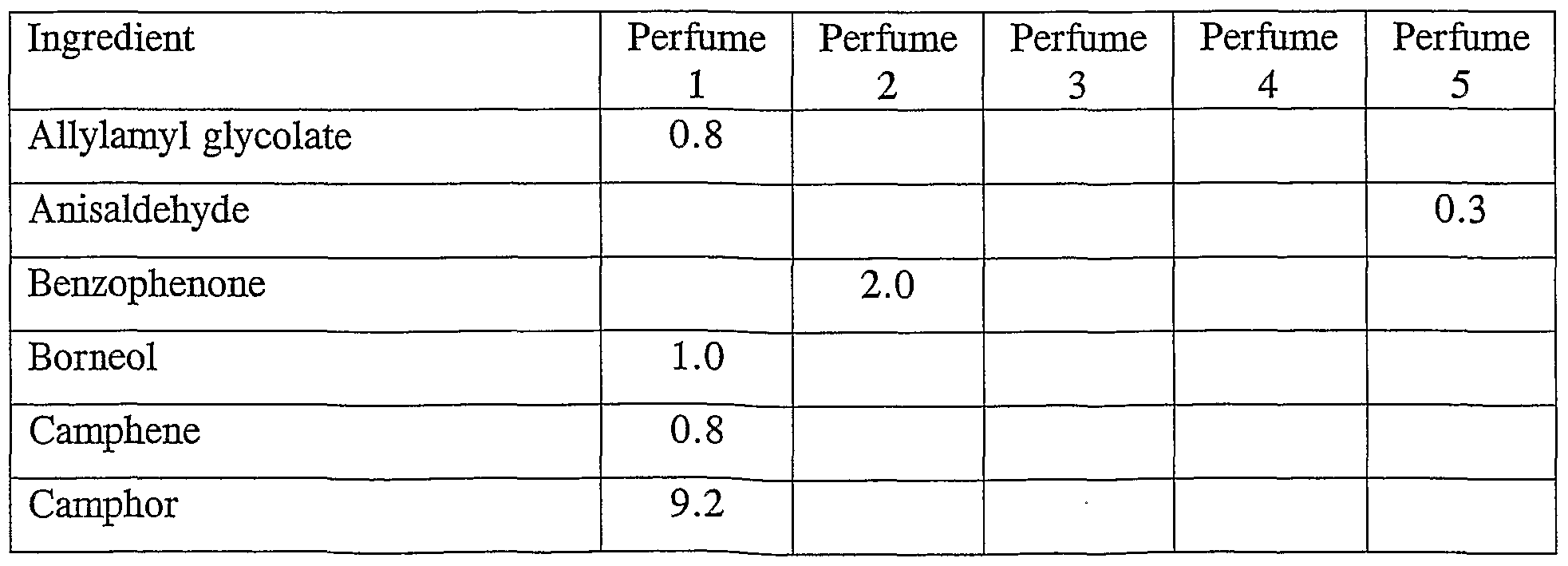
- perfumes 1 to 5 have the following compositions:
- Mefrosol is 3-methyl-5-phenylpentan-l-ol
- Hercolyn DE is a mixture of methyl dihydroabietate and tetrahydroabietate
- Particularly preferred Group A materials are:
- Example 1 MIC Estimation for fragrance and fragrance ingredients.
- the minimum inhibitory concentration of perfumes may be determined by the following method. Stock solutions (8% w/w) of perfume were prepared in sterile tryptone soya broth.
- Test ingredients were diluted in sterile TSB.
- A-H a standard, 96-well plastic microtitre plate
- Row H contained only TSB for use as a bacterial control to indicate the degree of turbidity resulting from bacterial growth in the absence of any test material.
- 200 ⁇ l of the initial dilution of ingredient was transferred to the 1st and 7th well of the appropriate row. All other test wells were filled with lOO ⁇ l of sterile TSB using an 8-channel micropipette.
- the microtitre plate reader (Thermo Multiskan Ascent) was preset to gently agitate the plates, to mix the contents. The absorbance at 540nm was used as a measure of turbidity resulting from bacterial growth. Both control (un-inoculated plate) and inoculated plates were read for each set of samples. The absorbance readings from the control plate were subtracted from the relevant inoculated plate readings thus removing turbidity due to perfume and possible colour changes during incubation. Thus the corrected readings generated were absorbances resulting from turbidity from bacterial growth. The MIC was taken as the concentration of ingredient required to inhibit growth so that the average change in absorbance during the incubation period was ⁇ 0.3.
- Example 2 Urease assay - estimation of fragrance and fragrance ingredients effect on ammonia production.
- SSR Medium 380ml distilled water, 364mg KH 2 PO 4 , 380mg Na 2 HPO 4 , 8g Urea, 40mg Yeast extract, 20ml 0.02% phenol red indicator, pH 6.8, solution filter sterilised.
- Culture Liquid culture of P. vulgaris NCTC4175 was prepared by adding loops of fresh culture from solid media (Tryptone Soya Agar) to sterile 0.1% special peptone solution. Absorbance of culture was adjusted to be OD610nm > 2.3
- Fragrances were aseptically prepared at 2500ppm in medium in duplicate (5ml volumes) using solubiliser Synperonic 91/10 at ratio of 1:2 fragrance: solubiliser.
- 5ml volumes of positive and negative controls were prepared. Positive controls and all test solutions were inoculated by adding 200 ⁇ l of prepared culture, mixed and incubated for 24 hours @ 37oC. No culture was added to the negative growth controls. Initially solutions were orange in colour. Urease activity can be noted by the production of a purple/red colour, indicating high pH resulting from ammonia production. The degree of urease activity /ammonia production was assessed by pH electrode.
- Fragrance formulations 3.2, 3.4, and 3.8 detailed in Table 1 were created following the creative guidelines of the present invention.
- Formulations, 3.1, 3.3, 3.5, 3.6 and 3.7 are comparatives that fall outside these guidelines. All examples bar numbers 3.5 and 3.6 meet the Urease Inhibition Assay target of a difference of 1.2 pH units compared to the positive control. However only Formulations 3.2, 3.4 and 3.8 achieve this effect at sub-MIC level.
- These three perfumes were also evaluated in a urine malodour test as described in example 3 of PCT/GB2007/001172 using malodour model A of example 1 therein. All three were found to be effective in reducing the perception of the urine malodour.
Landscapes
- Chemical & Material Sciences (AREA)
- Life Sciences & Earth Sciences (AREA)
- Engineering & Computer Science (AREA)
- Chemical Kinetics & Catalysis (AREA)
- Oil, Petroleum & Natural Gas (AREA)
- Wood Science & Technology (AREA)
- Organic Chemistry (AREA)
- Health & Medical Sciences (AREA)
- Epidemiology (AREA)
- Public Health (AREA)
- Veterinary Medicine (AREA)
- Animal Behavior & Ethology (AREA)
- General Health & Medical Sciences (AREA)
- Environmental Sciences (AREA)
- Hematology (AREA)
- Materials Engineering (AREA)
- Zoology (AREA)
- Animal Husbandry (AREA)
- Biodiversity & Conservation Biology (AREA)
- Fats And Perfumes (AREA)
- Cosmetics (AREA)
- Disinfection, Sterilisation Or Deodorisation Of Air (AREA)
Abstract
Description


Claims
Priority Applications (8)
| Application Number | Priority Date | Filing Date | Title |
|---|---|---|---|
| ES07804023T ES2395409T3 (en) | 2006-08-05 | 2007-08-03 | Perfume compositions |
| US12/375,756 US20090257974A1 (en) | 2006-08-05 | 2007-08-03 | Perfume Compositions |
| BRPI0715173A BRPI0715173B1 (en) | 2006-08-05 | 2007-08-03 | use of a perfume composition to inhibit ammonia formation from urea |
| EP20070804023 EP2049638B1 (en) | 2006-08-05 | 2007-08-03 | Perfume compositions |
| US13/651,899 US20130039876A1 (en) | 2006-08-05 | 2012-10-15 | Perfume Compositions |
| US13/651,958 US9011829B2 (en) | 2006-08-05 | 2012-10-15 | Perfume compositions |
| US14/548,858 US20150079017A1 (en) | 2006-08-05 | 2014-11-20 | Perfume Compositions |
| US14/658,871 US10722607B2 (en) | 2006-08-05 | 2015-03-16 | Perfume compositions |
Applications Claiming Priority (2)
| Application Number | Priority Date | Filing Date | Title |
|---|---|---|---|
| GB0615583.2 | 2006-08-05 | ||
| GB0615583A GB0615583D0 (en) | 2006-08-05 | 2006-08-05 | Perfume compositions |
Related Child Applications (3)
| Application Number | Title | Priority Date | Filing Date |
|---|---|---|---|
| US12/375,756 A-371-Of-International US20090257974A1 (en) | 2006-08-05 | 2007-08-03 | Perfume Compositions |
| US13/651,899 Division US20130039876A1 (en) | 2006-08-05 | 2012-10-15 | Perfume Compositions |
| US13/651,958 Continuation US9011829B2 (en) | 2006-08-05 | 2012-10-15 | Perfume compositions |
Publications (1)
| Publication Number | Publication Date |
|---|---|
| WO2008017820A1 true WO2008017820A1 (en) | 2008-02-14 |
Family
ID=37027299
Family Applications (1)
| Application Number | Title | Priority Date | Filing Date |
|---|---|---|---|
| PCT/GB2007/002980 Ceased WO2008017820A1 (en) | 2006-08-05 | 2007-08-03 | Perfume compositions |
Country Status (7)
| Country | Link |
|---|---|
| US (5) | US20090257974A1 (en) |
| EP (1) | EP2049638B1 (en) |
| CN (1) | CN101501169A (en) |
| BR (1) | BRPI0715173B1 (en) |
| ES (1) | ES2395409T3 (en) |
| GB (1) | GB0615583D0 (en) |
| WO (1) | WO2008017820A1 (en) |
Cited By (1)
| Publication number | Priority date | Publication date | Assignee | Title |
|---|---|---|---|---|
| WO2018050721A1 (en) * | 2016-09-14 | 2018-03-22 | Givaudan Sa | Fragrance compositions |
Families Citing this family (10)
| Publication number | Priority date | Publication date | Assignee | Title |
|---|---|---|---|---|
| GB0615583D0 (en) | 2006-08-05 | 2006-09-13 | Quest Int Serv Bv | Perfume compositions |
| GB0615580D0 (en) | 2006-08-05 | 2006-09-13 | Quest Int Serv Bv | Perfume compositions |
| EP2167621B1 (en) * | 2007-06-11 | 2017-10-11 | Givaudan SA | Organic compounds as odorants |
| US20110150814A1 (en) * | 2009-12-17 | 2011-06-23 | Ricky Ah-Man Woo | Malodor control composition having a mixture of volatile aldehydes and methods thereof |
| IN2015DN02645A (en) * | 2012-10-08 | 2015-09-18 | Dsm Ip Assets Bv | |
| DE102012221619A1 (en) * | 2012-11-27 | 2014-05-28 | Henkel Ag & Co. Kgaa | salicylates |
| JP6831674B2 (en) * | 2015-11-24 | 2021-02-17 | 花王株式会社 | Urine odor suppressant |
| WO2017090518A1 (en) * | 2015-11-24 | 2017-06-01 | 花王株式会社 | Urine odor suppressor |
| RU2725509C2 (en) * | 2016-01-28 | 2020-07-02 | Джонсон энд Джонсон Консьюмер Инк. | Perfume compositions |
| CN110022680B (en) * | 2016-08-05 | 2022-04-05 | 弗门尼舍有限公司 | Antimicrobial composition |
Citations (16)
| Publication number | Priority date | Publication date | Assignee | Title |
|---|---|---|---|---|
| US3185629A (en) * | 1958-02-11 | 1965-05-25 | Int Flavors & Fragrances Inc | Perfume oils containing 2-methyl-3-(3', 4'-methylenedioxyphenyl)-propanal |
| US5837671A (en) * | 1995-11-10 | 1998-11-17 | Givaudan-Roure (International) Sa | Organoleptic compound and composition |
| WO1998056889A1 (en) * | 1997-06-09 | 1998-12-17 | The Procter & Gamble Company | Food cleaning compositions containing cyclodextrin |
| US5942217A (en) * | 1997-06-09 | 1999-08-24 | The Procter & Gamble Company | Uncomplexed cyclodextrin compositions for odor control |
| US5990076A (en) * | 1997-09-09 | 1999-11-23 | Firemenich Sa | Benzodioxepinone and its use in perfumery |
| EP0965326A1 (en) * | 1998-06-15 | 1999-12-22 | The Procter & Gamble Company | Perfume compositions |
| EP1116788A1 (en) * | 2000-01-12 | 2001-07-18 | The Procter & Gamble Company | Pro-perfume composition |
| WO2001093814A2 (en) * | 2000-06-02 | 2001-12-13 | The Procter & Gamble Company | Fragrance compositions |
| WO2002049600A1 (en) * | 2000-12-20 | 2002-06-27 | Quest International B.V. | Perfume compositions |
| US20020192174A1 (en) * | 2001-03-23 | 2002-12-19 | Ken Kawakami | Perfume mixtures with increased odor intensity |
| JP2003147386A (en) * | 2001-11-09 | 2003-05-21 | Soda Aromatic Co Ltd | Fragrance composition and fragrant cosmetic comprising the same |
| EP1321508A2 (en) * | 2001-12-18 | 2003-06-25 | Takasago International Corporation | Fragrance composition containing 3-(3-Hexenyl)-2-cyclopentenone |
| WO2003088933A1 (en) * | 2002-04-15 | 2003-10-30 | Salvona, L.L.C. | Moisture triggered release systems comprising aroma ingredients providing fragrance burst in response to moisture |
| WO2004009749A1 (en) * | 2002-07-20 | 2004-01-29 | Givaudan Sa | Fragrance composition |
| WO2004098667A1 (en) * | 2003-05-09 | 2004-11-18 | Quest International Services B.V. | Control of body odours |
| WO2006095200A1 (en) * | 2005-03-10 | 2006-09-14 | Quest International Services B.V. | Perfume compositions |
Family Cites Families (51)
| Publication number | Priority date | Publication date | Assignee | Title |
|---|---|---|---|---|
| US588961A (en) | 1897-08-31 | Executrix of albert m | ||
| US3195629A (en) * | 1962-12-31 | 1965-07-20 | Pan American Petroleum Corp | Use of partially oxidized oil in a waterflooding process |
| US3945950A (en) | 1974-10-02 | 1976-03-23 | Universal Oil Products Company | Solid perfumed compositions of matter |
| US4113645A (en) | 1977-07-26 | 1978-09-12 | Polak's Frutal Works, Inc. | Bleach compositions containing perfume oils |
| US4548821A (en) | 1984-03-14 | 1985-10-22 | International Flavors & Fragrances Inc. | Flavoring with tertiary pentamethylindanol derivatives |
| US4740366A (en) | 1986-01-21 | 1988-04-26 | Church & Dwight Co., Inc. | Air deodorizer composition and method |
| US4808569A (en) | 1986-10-24 | 1989-02-28 | Gaf Corporation | Fragrance additive |
| US5089162A (en) | 1989-05-08 | 1992-02-18 | Lever Brothers Company, Division Of Conopco, Inc. | Cleaning compositions with bleach-stable colorant |
| GB9022147D0 (en) | 1990-10-11 | 1990-11-21 | Unilever Plc | Perfumed underarm hygiene products |
| AU1382492A (en) | 1991-04-15 | 1992-10-22 | Kimberly-Clark Corporation | An absorbent article containing an anhydrous deodorant |
| ZA928578B (en) | 1991-11-08 | 1994-05-06 | Quest Int | Perfume composition |
| US5260053A (en) | 1991-12-30 | 1993-11-09 | Tom's Of Maine | Herbal deodorant |
| CA2072914C (en) | 1992-03-27 | 2004-04-20 | James Richard Gross | Method for reducing malodor in absorbent products and products formed thereby |
| ES2089913T3 (en) | 1992-12-11 | 1996-10-01 | Quest Int | ESTERS OF DIMETILCICLOHEXANOCARBOXILICO ACID IN PERFUMERY. |
| IT1260656B (en) | 1993-04-23 | 1996-04-22 | P & G Spa | ABSORBENT ITEM INCLUDING A MATERIAL FOR THE CONTROL OF THE ODOR AND ITS USE. |
| DE4411664A1 (en) | 1994-04-05 | 1995-10-12 | Beiersdorf Ag | Novel deodorant and antimicrobial compositions for use in cosmetic or topical preparations |
| EP0805673A1 (en) | 1994-10-20 | 1997-11-12 | The Procter & Gamble Company | Personal treatment compositions and/or cosmetic compositions containing enduring perfume |
| JP3356242B2 (en) | 1995-03-08 | 2002-12-16 | 高砂香料工業株式会社 | (6E) Perfume containing 2,3-dihydrofarnesol |
| BR9607764A (en) | 1995-03-25 | 1999-01-19 | Quest Int | Fragrance compositions fragrance product and process for preparing a fragrance composition |
| KR20000016392A (en) | 1996-06-07 | 2000-03-25 | 레이서 제이코버스 코넬리스 | Absorbent article comprising a polyfunctionally substituted aromatic chelating agent for odour control |
| US5769833A (en) | 1996-12-12 | 1998-06-23 | Hasse; Margaret Henderson | Diaper having perfume zones |
| JP2000505692A (en) | 1996-12-17 | 2000-05-16 | ザ、プロクター、エンド、ギャンブル、カンパニー | Absorbent products with odor control system |
| US5919440A (en) * | 1997-05-05 | 1999-07-06 | Procter & Gamble Company | Personal care compositions containing an odor masking base |
| US5874073A (en) | 1997-05-05 | 1999-02-23 | Procter & Gamble | Styling shampoo compositions containing an odor masking base |
| US5874070A (en) | 1997-06-09 | 1999-02-23 | The Procter & Gamble Company | Compositions for reducing body odor |
| TW527191B (en) | 1997-07-09 | 2003-04-11 | Kao Corp | Hair treatment composition |
| EP0894502A1 (en) | 1997-07-30 | 1999-02-03 | The Procter & Gamble Company | Cyclodextrin-containing odour control material for absorbent articles |
| US6025186A (en) | 1997-08-14 | 2000-02-15 | Novo Nordisk A/S | Reduction of malodor |
| GB9814648D0 (en) | 1998-07-07 | 1998-09-02 | Quest Int | Sub-lethal perfumes |
| GB9814653D0 (en) | 1998-07-07 | 1998-09-02 | Quest Int | Method of reducing or preventing malodour |
| EP1140223B1 (en) | 1998-12-22 | 2004-08-04 | Quest International B.V. | Compositions and methods for the reduction of malodour |
| EP1034800A1 (en) | 1999-03-05 | 2000-09-13 | The Procter & Gamble Company | Articles having an odour control system comprising an oxidising agent and an odour absorbing agent |
| WO2001043784A2 (en) * | 1999-12-13 | 2001-06-21 | Haarmann & Reimer Gmbh | Odor neutralizers |
| US6403075B1 (en) | 2000-03-15 | 2002-06-11 | Dragoco Gerberding & Co. Ag | Odor suppression in ammonia-containing cosmetic products |
| US6372513B1 (en) | 2000-04-19 | 2002-04-16 | Ansys Technologies, Inc. | Device and process for lateral flow saliva testing |
| EP1190725A3 (en) | 2000-09-25 | 2003-01-29 | Givaudan SA | Process for maintaining fragrance perception in the presence of an absorbent material |
| EP1214878A1 (en) | 2000-12-15 | 2002-06-19 | The Procter & Gamble Company | Methods, compositions and articles for control of malodor produced by urea-containing body fluids |
| US6852904B2 (en) | 2001-12-18 | 2005-02-08 | Kimberly-Clark Worldwide, Inc. | Cellulose fibers treated with acidic odor control agents |
| US6767553B2 (en) | 2001-12-18 | 2004-07-27 | Kimberly-Clark Worldwide, Inc. | Natural fibers treated with acidic odor control/binder systems |
| DE10210124A1 (en) * | 2002-03-08 | 2003-09-18 | Basf Ag | Polymer mixtures with improved odor control |
| JP2003277246A (en) | 2002-03-22 | 2003-10-02 | Takasago Internatl Corp | Deodorant composition |
| JP3714305B2 (en) | 2002-07-11 | 2005-11-09 | ダイキン工業株式会社 | Refrigeration apparatus and refrigerant charging method for refrigeration apparatus |
| AU2003247971A1 (en) | 2002-07-22 | 2004-02-09 | Contivo, Inc. | Method and system for transforming semantically related documents |
| JP3947149B2 (en) | 2002-10-28 | 2007-07-18 | 高砂香料工業株式会社 | Deodorant composition |
| US20040241333A1 (en) | 2003-05-30 | 2004-12-02 | The Procter & Gamble Company | Composition and process for coating a substrate |
| US20040266302A1 (en) | 2003-06-30 | 2004-12-30 | Disalvo Anthony L. | Absorbent article having odor control properties |
| US7234648B2 (en) | 2003-10-31 | 2007-06-26 | The Procter And Gamble Company | Volatile substance-controlling composition |
| ATE411820T1 (en) | 2004-05-12 | 2008-11-15 | Quest Int Serv Bv | ODOR REDUCING COMPOSITIONS |
| US7585833B2 (en) * | 2005-02-17 | 2009-09-08 | Givaudan Fragrances Corporation | Malodor covering perfumery |
| GB0615580D0 (en) | 2006-08-05 | 2006-09-13 | Quest Int Serv Bv | Perfume compositions |
| GB0615583D0 (en) | 2006-08-05 | 2006-09-13 | Quest Int Serv Bv | Perfume compositions |
-
2006
- 2006-08-05 GB GB0615583A patent/GB0615583D0/en not_active Ceased
-
2007
- 2007-08-03 US US12/375,756 patent/US20090257974A1/en not_active Abandoned
- 2007-08-03 BR BRPI0715173A patent/BRPI0715173B1/en active IP Right Grant
- 2007-08-03 WO PCT/GB2007/002980 patent/WO2008017820A1/en not_active Ceased
- 2007-08-03 CN CNA2007800293072A patent/CN101501169A/en active Pending
- 2007-08-03 EP EP20070804023 patent/EP2049638B1/en active Active
- 2007-08-03 ES ES07804023T patent/ES2395409T3/en active Active
-
2012
- 2012-10-15 US US13/651,899 patent/US20130039876A1/en not_active Abandoned
- 2012-10-15 US US13/651,958 patent/US9011829B2/en active Active
-
2014
- 2014-11-20 US US14/548,858 patent/US20150079017A1/en not_active Abandoned
-
2015
- 2015-03-16 US US14/658,871 patent/US10722607B2/en active Active
Patent Citations (16)
| Publication number | Priority date | Publication date | Assignee | Title |
|---|---|---|---|---|
| US3185629A (en) * | 1958-02-11 | 1965-05-25 | Int Flavors & Fragrances Inc | Perfume oils containing 2-methyl-3-(3', 4'-methylenedioxyphenyl)-propanal |
| US5837671A (en) * | 1995-11-10 | 1998-11-17 | Givaudan-Roure (International) Sa | Organoleptic compound and composition |
| WO1998056889A1 (en) * | 1997-06-09 | 1998-12-17 | The Procter & Gamble Company | Food cleaning compositions containing cyclodextrin |
| US5942217A (en) * | 1997-06-09 | 1999-08-24 | The Procter & Gamble Company | Uncomplexed cyclodextrin compositions for odor control |
| US5990076A (en) * | 1997-09-09 | 1999-11-23 | Firemenich Sa | Benzodioxepinone and its use in perfumery |
| EP0965326A1 (en) * | 1998-06-15 | 1999-12-22 | The Procter & Gamble Company | Perfume compositions |
| EP1116788A1 (en) * | 2000-01-12 | 2001-07-18 | The Procter & Gamble Company | Pro-perfume composition |
| WO2001093814A2 (en) * | 2000-06-02 | 2001-12-13 | The Procter & Gamble Company | Fragrance compositions |
| WO2002049600A1 (en) * | 2000-12-20 | 2002-06-27 | Quest International B.V. | Perfume compositions |
| US20020192174A1 (en) * | 2001-03-23 | 2002-12-19 | Ken Kawakami | Perfume mixtures with increased odor intensity |
| JP2003147386A (en) * | 2001-11-09 | 2003-05-21 | Soda Aromatic Co Ltd | Fragrance composition and fragrant cosmetic comprising the same |
| EP1321508A2 (en) * | 2001-12-18 | 2003-06-25 | Takasago International Corporation | Fragrance composition containing 3-(3-Hexenyl)-2-cyclopentenone |
| WO2003088933A1 (en) * | 2002-04-15 | 2003-10-30 | Salvona, L.L.C. | Moisture triggered release systems comprising aroma ingredients providing fragrance burst in response to moisture |
| WO2004009749A1 (en) * | 2002-07-20 | 2004-01-29 | Givaudan Sa | Fragrance composition |
| WO2004098667A1 (en) * | 2003-05-09 | 2004-11-18 | Quest International Services B.V. | Control of body odours |
| WO2006095200A1 (en) * | 2005-03-10 | 2006-09-14 | Quest International Services B.V. | Perfume compositions |
Non-Patent Citations (4)
| Title |
|---|
| "Flavor and Fragrance Materials", 1991, ALLURED PUBLISHING CO. |
| DATABASE WPI Week 200377, Derwent World Patents Index; AN 2003-818322, XP002461159 * |
| S. ARCTANDER: "Perfume and Flavor Chemicals", 1969 |
| S. ARCTANDER: "Perfume and Flavor Materials of Natural Origin", 1960, ELIZABETH |
Cited By (4)
| Publication number | Priority date | Publication date | Assignee | Title |
|---|---|---|---|---|
| WO2018050721A1 (en) * | 2016-09-14 | 2018-03-22 | Givaudan Sa | Fragrance compositions |
| KR20190053889A (en) * | 2016-09-14 | 2019-05-20 | 지보당 에스아 | Perfume composition |
| US10982173B2 (en) | 2016-09-14 | 2021-04-20 | Givaudan Sa | Fragrance compositions |
| KR102584922B1 (en) | 2016-09-14 | 2023-10-04 | 지보당 에스아 | Fragrance composition |
Also Published As
| Publication number | Publication date |
|---|---|
| US20150079017A1 (en) | 2015-03-19 |
| US20090257974A1 (en) | 2009-10-15 |
| BRPI0715173B1 (en) | 2017-06-06 |
| US10722607B2 (en) | 2020-07-28 |
| EP2049638A1 (en) | 2009-04-22 |
| US20130039876A1 (en) | 2013-02-14 |
| ES2395409T3 (en) | 2013-02-12 |
| US20150182656A1 (en) | 2015-07-02 |
| US9011829B2 (en) | 2015-04-21 |
| BRPI0715173A8 (en) | 2017-01-24 |
| GB0615583D0 (en) | 2006-09-13 |
| CN101501169A (en) | 2009-08-05 |
| BRPI0715173A2 (en) | 2015-02-18 |
| EP2049638B1 (en) | 2012-10-03 |
| US20130039877A1 (en) | 2013-02-14 |
Similar Documents
| Publication | Publication Date | Title |
|---|---|---|
| US9011829B2 (en) | Perfume compositions | |
| US8821847B2 (en) | Perfume compositions | |
| CN101802189B (en) | Beta-glucuronidase inhibitor | |
| JP2008036434A (en) | Fragrance composition for preventing generation of malodor based on indole and method of use thereof | |
| WO2019008089A1 (en) | 2,4-disubstituted pyridines as malodor counteracting ingredients | |
| JP2010246905A (en) | Composition for suppressing urine odor production | |
| US8580728B2 (en) | Use of fragrance compositions for the prevention of the development of indole base malodours from fecal and urine based soils | |
| JP6581778B2 (en) | Urine odor deodorant | |
| JP5806716B2 (en) | β-glucuronidase inhibitor | |
| JP6843749B2 (en) | Macrocyclic ketone as a component that counteracts bad odors | |
| JP2009148326A (en) | Urinary odor production inhibitor | |
| JP2010227130A (en) | β-glucuronidase inhibitor | |
| JP2010220641A (en) | β-glucuronidase inhibitor | |
| Makin et al. | Deodorant ingredients | |
| US20240390544A1 (en) | 2,4-disubstituted pyridines as malodor counteracting ingredients | |
| JP5806714B2 (en) | β-glucuronidase inhibitor | |
| JP2013255834A (en) | β-GLUCURONIDASE INHIBITORY AGENT |
Legal Events
| Date | Code | Title | Description |
|---|---|---|---|
| WWE | Wipo information: entry into national phase |
Ref document number: 200780029307.2 Country of ref document: CN |
|
| 121 | Ep: the epo has been informed by wipo that ep was designated in this application |
Ref document number: 07804023 Country of ref document: EP Kind code of ref document: A1 |
|
| WWE | Wipo information: entry into national phase |
Ref document number: 2007804023 Country of ref document: EP |
|
| NENP | Non-entry into the national phase |
Ref country code: DE |
|
| WWE | Wipo information: entry into national phase |
Ref document number: 12375756 Country of ref document: US |
|
| WWE | Wipo information: entry into national phase |
Ref document number: 1230/CHENP/2009 Country of ref document: IN |
|
| NENP | Non-entry into the national phase |
Ref country code: RU |
|
| ENP | Entry into the national phase |
Ref document number: PI0715173 Country of ref document: BR Kind code of ref document: A2 Effective date: 20090204 |