WO2008004900A1 - Production of ultrapure epa and polar lipids from largely heterotrophic culture - Google Patents
Production of ultrapure epa and polar lipids from largely heterotrophic culture Download PDFInfo
- Publication number
- WO2008004900A1 WO2008004900A1 PCT/NZ2007/000172 NZ2007000172W WO2008004900A1 WO 2008004900 A1 WO2008004900 A1 WO 2008004900A1 NZ 2007000172 W NZ2007000172 W NZ 2007000172W WO 2008004900 A1 WO2008004900 A1 WO 2008004900A1
- Authority
- WO
- WIPO (PCT)
- Prior art keywords
- epa
- composition
- disorders
- rich
- polar
- Prior art date
- Legal status (The legal status is an assumption and is not a legal conclusion. Google has not performed a legal analysis and makes no representation as to the accuracy of the status listed.)
- Ceased
Links
Classifications
-
- A—HUMAN NECESSITIES
- A61—MEDICAL OR VETERINARY SCIENCE; HYGIENE
- A61K—PREPARATIONS FOR MEDICAL, DENTAL OR TOILETRY PURPOSES
- A61K31/00—Medicinal preparations containing organic active ingredients
- A61K31/185—Acids; Anhydrides, halides or salts thereof, e.g. sulfur acids, imidic, hydrazonic or hydroximic acids
- A61K31/19—Carboxylic acids, e.g. valproic acid
- A61K31/20—Carboxylic acids, e.g. valproic acid having a carboxyl group bound to a chain of seven or more carbon atoms, e.g. stearic, palmitic, arachidic acids
- A61K31/202—Carboxylic acids, e.g. valproic acid having a carboxyl group bound to a chain of seven or more carbon atoms, e.g. stearic, palmitic, arachidic acids having three or more double bonds, e.g. linolenic
-
- A—HUMAN NECESSITIES
- A23—FOODS OR FOODSTUFFS; TREATMENT THEREOF, NOT COVERED BY OTHER CLASSES
- A23L—FOODS, FOODSTUFFS OR NON-ALCOHOLIC BEVERAGES, NOT OTHERWISE PROVIDED FOR; PREPARATION OR TREATMENT THEREOF
- A23L33/00—Modifying nutritive qualities of foods; Dietetic products; Preparation or treatment thereof
- A23L33/10—Modifying nutritive qualities of foods; Dietetic products; Preparation or treatment thereof using additives
- A23L33/115—Fatty acids or derivatives thereof; Fats or oils
- A23L33/12—Fatty acids or derivatives thereof
-
- A—HUMAN NECESSITIES
- A61—MEDICAL OR VETERINARY SCIENCE; HYGIENE
- A61P—SPECIFIC THERAPEUTIC ACTIVITY OF CHEMICAL COMPOUNDS OR MEDICINAL PREPARATIONS
- A61P1/00—Drugs for disorders of the alimentary tract or the digestive system
- A61P1/04—Drugs for disorders of the alimentary tract or the digestive system for ulcers, gastritis or reflux esophagitis, e.g. antacids, inhibitors of acid secretion, mucosal protectants
-
- A—HUMAN NECESSITIES
- A61—MEDICAL OR VETERINARY SCIENCE; HYGIENE
- A61P—SPECIFIC THERAPEUTIC ACTIVITY OF CHEMICAL COMPOUNDS OR MEDICINAL PREPARATIONS
- A61P1/00—Drugs for disorders of the alimentary tract or the digestive system
- A61P1/14—Prodigestives, e.g. acids, enzymes, appetite stimulants, antidyspeptics, tonics, antiflatulents
-
- A—HUMAN NECESSITIES
- A61—MEDICAL OR VETERINARY SCIENCE; HYGIENE
- A61P—SPECIFIC THERAPEUTIC ACTIVITY OF CHEMICAL COMPOUNDS OR MEDICINAL PREPARATIONS
- A61P11/00—Drugs for disorders of the respiratory system
-
- A—HUMAN NECESSITIES
- A61—MEDICAL OR VETERINARY SCIENCE; HYGIENE
- A61P—SPECIFIC THERAPEUTIC ACTIVITY OF CHEMICAL COMPOUNDS OR MEDICINAL PREPARATIONS
- A61P13/00—Drugs for disorders of the urinary system
- A61P13/02—Drugs for disorders of the urinary system of urine or of the urinary tract, e.g. urine acidifiers
-
- A—HUMAN NECESSITIES
- A61—MEDICAL OR VETERINARY SCIENCE; HYGIENE
- A61P—SPECIFIC THERAPEUTIC ACTIVITY OF CHEMICAL COMPOUNDS OR MEDICINAL PREPARATIONS
- A61P13/00—Drugs for disorders of the urinary system
- A61P13/08—Drugs for disorders of the urinary system of the prostate
-
- A—HUMAN NECESSITIES
- A61—MEDICAL OR VETERINARY SCIENCE; HYGIENE
- A61P—SPECIFIC THERAPEUTIC ACTIVITY OF CHEMICAL COMPOUNDS OR MEDICINAL PREPARATIONS
- A61P13/00—Drugs for disorders of the urinary system
- A61P13/12—Drugs for disorders of the urinary system of the kidneys
-
- A—HUMAN NECESSITIES
- A61—MEDICAL OR VETERINARY SCIENCE; HYGIENE
- A61P—SPECIFIC THERAPEUTIC ACTIVITY OF CHEMICAL COMPOUNDS OR MEDICINAL PREPARATIONS
- A61P15/00—Drugs for genital or sexual disorders; Contraceptives
-
- A—HUMAN NECESSITIES
- A61—MEDICAL OR VETERINARY SCIENCE; HYGIENE
- A61P—SPECIFIC THERAPEUTIC ACTIVITY OF CHEMICAL COMPOUNDS OR MEDICINAL PREPARATIONS
- A61P15/00—Drugs for genital or sexual disorders; Contraceptives
- A61P15/10—Drugs for genital or sexual disorders; Contraceptives for impotence
-
- A—HUMAN NECESSITIES
- A61—MEDICAL OR VETERINARY SCIENCE; HYGIENE
- A61P—SPECIFIC THERAPEUTIC ACTIVITY OF CHEMICAL COMPOUNDS OR MEDICINAL PREPARATIONS
- A61P17/00—Drugs for dermatological disorders
-
- A—HUMAN NECESSITIES
- A61—MEDICAL OR VETERINARY SCIENCE; HYGIENE
- A61P—SPECIFIC THERAPEUTIC ACTIVITY OF CHEMICAL COMPOUNDS OR MEDICINAL PREPARATIONS
- A61P17/00—Drugs for dermatological disorders
- A61P17/02—Drugs for dermatological disorders for treating wounds, ulcers, burns, scars, keloids, or the like
-
- A—HUMAN NECESSITIES
- A61—MEDICAL OR VETERINARY SCIENCE; HYGIENE
- A61P—SPECIFIC THERAPEUTIC ACTIVITY OF CHEMICAL COMPOUNDS OR MEDICINAL PREPARATIONS
- A61P17/00—Drugs for dermatological disorders
- A61P17/14—Drugs for dermatological disorders for baldness or alopecia
-
- A—HUMAN NECESSITIES
- A61—MEDICAL OR VETERINARY SCIENCE; HYGIENE
- A61P—SPECIFIC THERAPEUTIC ACTIVITY OF CHEMICAL COMPOUNDS OR MEDICINAL PREPARATIONS
- A61P19/00—Drugs for skeletal disorders
- A61P19/02—Drugs for skeletal disorders for joint disorders, e.g. arthritis, arthrosis
-
- A—HUMAN NECESSITIES
- A61—MEDICAL OR VETERINARY SCIENCE; HYGIENE
- A61P—SPECIFIC THERAPEUTIC ACTIVITY OF CHEMICAL COMPOUNDS OR MEDICINAL PREPARATIONS
- A61P19/00—Drugs for skeletal disorders
- A61P19/08—Drugs for skeletal disorders for bone diseases, e.g. rachitism, Paget's disease
- A61P19/10—Drugs for skeletal disorders for bone diseases, e.g. rachitism, Paget's disease for osteoporosis
-
- A—HUMAN NECESSITIES
- A61—MEDICAL OR VETERINARY SCIENCE; HYGIENE
- A61P—SPECIFIC THERAPEUTIC ACTIVITY OF CHEMICAL COMPOUNDS OR MEDICINAL PREPARATIONS
- A61P21/00—Drugs for disorders of the muscular or neuromuscular system
-
- A—HUMAN NECESSITIES
- A61—MEDICAL OR VETERINARY SCIENCE; HYGIENE
- A61P—SPECIFIC THERAPEUTIC ACTIVITY OF CHEMICAL COMPOUNDS OR MEDICINAL PREPARATIONS
- A61P25/00—Drugs for disorders of the nervous system
-
- A—HUMAN NECESSITIES
- A61—MEDICAL OR VETERINARY SCIENCE; HYGIENE
- A61P—SPECIFIC THERAPEUTIC ACTIVITY OF CHEMICAL COMPOUNDS OR MEDICINAL PREPARATIONS
- A61P25/00—Drugs for disorders of the nervous system
- A61P25/14—Drugs for disorders of the nervous system for treating abnormal movements, e.g. chorea, dyskinesia
-
- A—HUMAN NECESSITIES
- A61—MEDICAL OR VETERINARY SCIENCE; HYGIENE
- A61P—SPECIFIC THERAPEUTIC ACTIVITY OF CHEMICAL COMPOUNDS OR MEDICINAL PREPARATIONS
- A61P25/00—Drugs for disorders of the nervous system
- A61P25/14—Drugs for disorders of the nervous system for treating abnormal movements, e.g. chorea, dyskinesia
- A61P25/16—Anti-Parkinson drugs
-
- A—HUMAN NECESSITIES
- A61—MEDICAL OR VETERINARY SCIENCE; HYGIENE
- A61P—SPECIFIC THERAPEUTIC ACTIVITY OF CHEMICAL COMPOUNDS OR MEDICINAL PREPARATIONS
- A61P25/00—Drugs for disorders of the nervous system
- A61P25/24—Antidepressants
-
- A—HUMAN NECESSITIES
- A61—MEDICAL OR VETERINARY SCIENCE; HYGIENE
- A61P—SPECIFIC THERAPEUTIC ACTIVITY OF CHEMICAL COMPOUNDS OR MEDICINAL PREPARATIONS
- A61P25/00—Drugs for disorders of the nervous system
- A61P25/28—Drugs for disorders of the nervous system for treating neurodegenerative disorders of the central nervous system, e.g. nootropic agents, cognition enhancers, drugs for treating Alzheimer's disease or other forms of dementia
-
- A—HUMAN NECESSITIES
- A61—MEDICAL OR VETERINARY SCIENCE; HYGIENE
- A61P—SPECIFIC THERAPEUTIC ACTIVITY OF CHEMICAL COMPOUNDS OR MEDICINAL PREPARATIONS
- A61P27/00—Drugs for disorders of the senses
- A61P27/02—Ophthalmic agents
-
- A—HUMAN NECESSITIES
- A61—MEDICAL OR VETERINARY SCIENCE; HYGIENE
- A61P—SPECIFIC THERAPEUTIC ACTIVITY OF CHEMICAL COMPOUNDS OR MEDICINAL PREPARATIONS
- A61P29/00—Non-central analgesic, antipyretic or antiinflammatory agents, e.g. antirheumatic agents; Non-steroidal antiinflammatory drugs [NSAID]
-
- A—HUMAN NECESSITIES
- A61—MEDICAL OR VETERINARY SCIENCE; HYGIENE
- A61P—SPECIFIC THERAPEUTIC ACTIVITY OF CHEMICAL COMPOUNDS OR MEDICINAL PREPARATIONS
- A61P3/00—Drugs for disorders of the metabolism
- A61P3/04—Anorexiants; Antiobesity agents
-
- A—HUMAN NECESSITIES
- A61—MEDICAL OR VETERINARY SCIENCE; HYGIENE
- A61P—SPECIFIC THERAPEUTIC ACTIVITY OF CHEMICAL COMPOUNDS OR MEDICINAL PREPARATIONS
- A61P3/00—Drugs for disorders of the metabolism
- A61P3/08—Drugs for disorders of the metabolism for glucose homeostasis
- A61P3/10—Drugs for disorders of the metabolism for glucose homeostasis for hyperglycaemia, e.g. antidiabetics
-
- A—HUMAN NECESSITIES
- A61—MEDICAL OR VETERINARY SCIENCE; HYGIENE
- A61P—SPECIFIC THERAPEUTIC ACTIVITY OF CHEMICAL COMPOUNDS OR MEDICINAL PREPARATIONS
- A61P35/00—Antineoplastic agents
-
- A—HUMAN NECESSITIES
- A61—MEDICAL OR VETERINARY SCIENCE; HYGIENE
- A61P—SPECIFIC THERAPEUTIC ACTIVITY OF CHEMICAL COMPOUNDS OR MEDICINAL PREPARATIONS
- A61P37/00—Drugs for immunological or allergic disorders
-
- A—HUMAN NECESSITIES
- A61—MEDICAL OR VETERINARY SCIENCE; HYGIENE
- A61P—SPECIFIC THERAPEUTIC ACTIVITY OF CHEMICAL COMPOUNDS OR MEDICINAL PREPARATIONS
- A61P37/00—Drugs for immunological or allergic disorders
- A61P37/02—Immunomodulators
- A61P37/06—Immunosuppressants, e.g. drugs for graft rejection
-
- A—HUMAN NECESSITIES
- A61—MEDICAL OR VETERINARY SCIENCE; HYGIENE
- A61P—SPECIFIC THERAPEUTIC ACTIVITY OF CHEMICAL COMPOUNDS OR MEDICINAL PREPARATIONS
- A61P43/00—Drugs for specific purposes, not provided for in groups A61P1/00-A61P41/00
-
- A—HUMAN NECESSITIES
- A61—MEDICAL OR VETERINARY SCIENCE; HYGIENE
- A61P—SPECIFIC THERAPEUTIC ACTIVITY OF CHEMICAL COMPOUNDS OR MEDICINAL PREPARATIONS
- A61P9/00—Drugs for disorders of the cardiovascular system
-
- A—HUMAN NECESSITIES
- A61—MEDICAL OR VETERINARY SCIENCE; HYGIENE
- A61P—SPECIFIC THERAPEUTIC ACTIVITY OF CHEMICAL COMPOUNDS OR MEDICINAL PREPARATIONS
- A61P9/00—Drugs for disorders of the cardiovascular system
- A61P9/12—Antihypertensives
-
- C—CHEMISTRY; METALLURGY
- C12—BIOCHEMISTRY; BEER; SPIRITS; WINE; VINEGAR; MICROBIOLOGY; ENZYMOLOGY; MUTATION OR GENETIC ENGINEERING
- C12P—FERMENTATION OR ENZYME-USING PROCESSES TO SYNTHESISE A DESIRED CHEMICAL COMPOUND OR COMPOSITION OR TO SEPARATE OPTICAL ISOMERS FROM A RACEMIC MIXTURE
- C12P7/00—Preparation of oxygen-containing organic compounds
- C12P7/64—Fats; Fatty oils; Ester-type waxes; Higher fatty acids, i.e. having at least seven carbon atoms in an unbroken chain bound to a carboxyl group; Oxidised oils or fats
- C12P7/6409—Fatty acids
- C12P7/6427—Polyunsaturated fatty acids [PUFA], i.e. having two or more double bonds in their backbone
- C12P7/6432—Eicosapentaenoic acids [EPA]
-
- C—CHEMISTRY; METALLURGY
- C12—BIOCHEMISTRY; BEER; SPIRITS; WINE; VINEGAR; MICROBIOLOGY; ENZYMOLOGY; MUTATION OR GENETIC ENGINEERING
- C12P—FERMENTATION OR ENZYME-USING PROCESSES TO SYNTHESISE A DESIRED CHEMICAL COMPOUND OR COMPOSITION OR TO SEPARATE OPTICAL ISOMERS FROM A RACEMIC MIXTURE
- C12P7/00—Preparation of oxygen-containing organic compounds
- C12P7/64—Fats; Fatty oils; Ester-type waxes; Higher fatty acids, i.e. having at least seven carbon atoms in an unbroken chain bound to a carboxyl group; Oxidised oils or fats
- C12P7/6436—Fatty acid esters
- C12P7/6445—Glycerides
- C12P7/6458—Glycerides by transesterification, e.g. interesterification, ester interchange, alcoholysis or acidolysis
-
- C—CHEMISTRY; METALLURGY
- C12—BIOCHEMISTRY; BEER; SPIRITS; WINE; VINEGAR; MICROBIOLOGY; ENZYMOLOGY; MUTATION OR GENETIC ENGINEERING
- C12P—FERMENTATION OR ENZYME-USING PROCESSES TO SYNTHESISE A DESIRED CHEMICAL COMPOUND OR COMPOSITION OR TO SEPARATE OPTICAL ISOMERS FROM A RACEMIC MIXTURE
- C12P7/00—Preparation of oxygen-containing organic compounds
- C12P7/64—Fats; Fatty oils; Ester-type waxes; Higher fatty acids, i.e. having at least seven carbon atoms in an unbroken chain bound to a carboxyl group; Oxidised oils or fats
- C12P7/6436—Fatty acid esters
- C12P7/6445—Glycerides
- C12P7/6472—Glycerides containing polyunsaturated fatty acid [PUFA] residues, i.e. having two or more double bonds in their backbone
-
- A—HUMAN NECESSITIES
- A23—FOODS OR FOODSTUFFS; TREATMENT THEREOF, NOT COVERED BY OTHER CLASSES
- A23V—INDEXING SCHEME RELATING TO FOODS, FOODSTUFFS OR NON-ALCOHOLIC BEVERAGES AND LACTIC OR PROPIONIC ACID BACTERIA USED IN FOODSTUFFS OR FOOD PREPARATION
- A23V2002/00—Food compositions, function of food ingredients or processes for food or foodstuffs
Definitions
- This invention relates to lipid compositions synthesized by single-cell organisms, to the manufacture and some applications of omega-3 highly unsaturated fatty acids and to pharmaceutical substances, and in particular to novel therapeutic, dietary and health-food compositions.
- Alpha linolenic acid is an omega-3 fatty acid with eighteen carbon atoms and three double bonds.
- Arachidonic acid is an omega-6 fatty acid with twenty carbon atoms and four double bonds.
- Diacyl galactolipids are galactolipids with both Sn1 and Sn2 occupied by fatty acid molecules.
- Digalactosyl galactolipids are those where two galactose molecules are attached.
- Docosopentaenoic acid is an omega-3 fatty acid with twenty-two carbon atoms and five double bonds.
- Docosahexanoic acid is an omega-3 fatty acid with twenty-two carbon atoms and six double bonds.
- Eicosapentaenoic acid is an omega-3 fatty acid with twenty carbon atoms and five double bonds.
- Effective amount means: an amount sufficient to cause a desired result when administered.
- Nutraceutical is any substance that is a food or a part of a food and provides medical or health benefits, including the prevention and treatment of disease.
- the EPA composition is substantially free of those materials herein defined as "undesired”.
- An EPA composition according to this definition of purity may include only 1 to 10% EPA
- EPA e.g. 60-90% EPA; the remainder may include galactolipids or components thereof, or added pharmaceutically acceptable excipients, anti-oxidants, adsorbents, flavours, and the like.
- compositions comprising around 90% of EPA or more by weight and simultaneously a ratio of EPA to any individual undesired molecule of at least around 90 to 1.
- Undesired molecules or materials are defined as those that may diminish the desired beneficial health effect of EPA-rich compositions when co-consumed. These include molecules that may diminish the desired effect through actions which may be antagonistic, competitive, block, reverse, mediate, synergise or otherwise alter the desired beneficial health effect of EPA when consumed in an effective (or clinically relevant) amount.
- undesired molecules are to include structurally or functionally similar molecules including fatty acids, docosohexae ⁇ oic acid (DHA), arachidonic acid (AA), 18:4 n-3, 18:3 n-3, 18:2 n-6 and other omega-3 and 6 fatty acids in general.
- DHA docosohexae ⁇ oic acid
- AA arachidonic acid
- AA is a precursor of EPA.
- EPA-rich means that the composition includes more than 1% of EPA as dry weight.
- EPA productivity means the amount of EPA which can be produced per unit cost.
- a proxy measure for productivity in largely heterotrophic cultures of microalgae culture is often taken as the combined effect of yield, growth rate, cell density, nutrient utilisation efficiency, and dilution rate.
- Fatty acid compositions include - ethyl esters, salts, free fatty acids, methyl esters, and other alcohol esters of fatty acids, and combinatorial lipids.
- Galactolipids are comprised of a glycerol backbone with at least two separate molecules attached; at least one of which is a fatty acid and the other is. either one or two molecules of galactose (in mono or disaccharide form) bonded by, in the case of the fatty acid or fatty acids, an ester link or rarely an ether link and in the case of the galactose or galactoses an ether link in all cases. At least one galactose is present and normally attached to the Sn3 position of glycerol. The galactose is always in pyranose form.
- a second and rarely a third galactose molecule is attached by beta-d-3-pyranosyl bonds to the preceding galactose molecule.
- Positions are labeled according to a convention based on an original stereospecific structure (see table 1 showing the 1.3 isomer of the DGMG galactolipid class containing an EPA molecule ' acylated in the Sn1. Normally when only one fatty acid molecule is attached it occupies the Sn1 position. However, occasionally one fatty acid may be attached in the Sn2 position while the Sn1 position remains unoccupied. This may be referred to as a lyso derivative.
- Gamma linolenic acid is an omega-6 fatty acid with eighteen carbon atoms and four double bonds.
- Heterotrophic culture means a culture of organisms for which the sole energy source is derived from supplied nutrients (the major nutrient group for energy metabolism) which is usually a form or forms of organic carbon (e.g. glucose, acetate).
- supplied nutrients the major nutrient group for energy metabolism
- organic carbon e.g. glucose, acetate
- Largely (or partially) heterotrophic culture means a mixotrophic culture of organisms for which the major energy source is derived from supplied nutrients (the major nutrient group for energy metabolism) which is usually a form or forms of organic carbon (e.g. glucose, acetate) and the minor energy source for energy metabolism is light.
- Linoleic acid is an omega-6 fatty acid with eighteen carbon atoms and two double bonds.
- Monoacyl galactolipids are galactolipids with only one position occupied by a fatty acid. In a monoacyl galactolipid the fatty acid molecule is attached either at position Sn1 or Sn2.
- Monogalactosyl galactolipids are those with only one galactose molecule attached.
- Neutral lipids are those lipids contained in an organism which can be isolated through the use of non-polar solvents and include mono- di- and triacylglycerols
- Photosynthetic lipids are those polar lipids whose production can be significantly altered via the addition of light to a largely heterotrphic culture of microorganisms. These may occur within the chloroplast as is predominantly the case with galactolipids or may also be associated with other cell organelles as is predominantly the case with phospholipids.
- Polar lipids are those lipids contained in an organism which can be isolated through the use of polar solvents and include phospholipids and galactolipids
- Photosynthetically active average irradiance inside a culture is the amount of electromagnetic radiation between wavelengths 400nm and 700nm incident on a culture averaged over all positions in the culture vessel and over time.
- Stearidonic acid is an omega-3 fatty acid with eighteen carbon atoms and four double bonds.
- Sub-photosynthetic exposure means an exposure to light whereby the combination of intensity and exposure time is equal or less than around the equivalent of a continuous illumination of 1 to about 10 micromol photons per square meter per second.
- Omega-3 fatty acid is a fatty acid with the first double bond three carbon atoms from the n-methyl end of the 85 molecule.
- Omega-6 fatty acid is a fatty acid with the first double bond six carbon atoms from the n-methyl end of the molecule.
- LA linoleic acid 90 18:3 n-3 or ALA: alpha linolenic acid
- LPC Lysophosphatidylcholine 100 n-3: omega-3 n-6: omega-6 n-3 HUFA: omega-3 highly unsaturated fatty acid
- n-3 HUFA highly unsaturated fatty acids
- human dietary supplementation studies incorporating relatively pure forms of the n-3 HUFA eicosapentaenoic acid (EPA) have suggested this nutrient may promote health and ameliorate or 125 even reverse the effects of a range of common diseases, including but not limited to certain forms of cardiovascular disease and depression (Yokoyama et al., Lancet 369:1062-1063. 2007; Peet & Horrobin Arch. Gen. Psych. 59(10) 913-9 2002).
- the therapeutic effect of dietary supplementation with concentrated forms of EPA are dependent to some extent on purity.
- High purity dose forms have an advantage in terms of increased bioavailability. 130
- the desired effects of EPA are limited or even reversed by the co-consumption of undesired molecules; (as herein defined) in particular docosohexaenoic acid (DHA); also AA and other omega-3 and 6 fatty acids in general. Therefore to enable effective pharmaceutical or therapeutic use of EPA, high purity dose forms, free of the undesired molecules, are required.
- DHA docosohexaenoic acid
- Mixotrophic production systems have been proposed for production of EPA-rich microorganisms. These provide a proportion of the energy for growth in the form of organic carbon supplied to the culture medium.
- An advantage of mixotrophy includes higher productivities than are achiecable with solely photosynthetic production and potentially also lower the overall requirement for light.
- a disadvantage of the addition of organic carbon sources to outdoor photobioreactor cultures is the creation of an additional contamination risk by presenting a substrate for growth of non-photosynthetic contaminating organisms.
- the fatty acid composition of certain EPA-rich microalgae contain low proportions of fatty acids with structural similarity to EPA. Together with the generally less complex fatty acid composition of microalgae 200 this may offer advantages in terms of purification over fish oil.
- lipids may be accumulated in the form of triglyceride, a lipid class not utilized extensively in lipid membrane structure.
- EPA-rich triglycerides are of potential therapeutic value. EPA may be recovered from triglcerides and 210 further purified via an array of conventional and emerging techniques. Processes designed to extract, concentrate or purify EPA-rich lipid or fatty acid compositions from triglycerides however may be disadvantaged by the presence of a relatively high level and wide range of undesirable fatty acid molecules, and a low level of stereospecificity in terms of the location of EPA within the triglycerides.
- Certain polar lipid classes produced in cultures of microalgae are relatively rich in EPA. At the same time 215 some of these lipid classes may exhibit a high degree of stereospecificty in terms of the location of EPA within the class and its isomers. This concentration of EPA in a predictable manner in particular lipid classes provides an additional opportunity to sequester undesirable molecules in unused fractions during a purification process. In addition certain lipid classes produced by cultures of microalgae may also have therapeutic value in their own right.
- Microalgae produce two major types of polar lipids;- phospholipids and glycolipids. All these major polar lipid classes comprise a glycerol backbone with three positions conventionally labeled Sn 1-3. Phospho and 230 galacto lipid classes are categorised respectively according to phosphate- and galactose-containing functional groups which are attached to the glycerol backbone usually at the Sn-3 position. Fatty acids are acylated at one or more positions 1-2. Isometric forms of these lipid classes arise from acylation patterns where not all available positions are occupied by fatty acids or where a functional group is attached at an alternative position. 235
- Galactolipids are produced predominantly in the chloroplast and are a structural component of the photosynthetic membrane, Galactolipids are one of the most polar of all the lipid classes; there is a substantial difference in charge distribution over the molecule because of the polar nature of the one or more galactose moieties that are attached to the glycerol backbone, providing spacialiy separated centres 240 of positive and negative charge.
- galactolipids have found application as emulsifying agents and have been proposed as drug delivery conjugates.
- galactolipids leads to a number of useful opportunities, including but without limitation to potential advantageous routes for extraction and purification of galactolipids and galactolipid fatty acids, formulation of galactolipids and galactolipid fatty acids into 245 foods, functional foods, beverages, pharmaceutical and industrial compositions, delivery of galactolipids and galactolipid fatty acid nutritional and therapeutic products in a bioavailable form, as well as advantageous therapeutic effects and mechanisms of action their use may promote.
- Phospholipids are major structural components of cellular membranes.
- Phosopholipids both within and external to the chloroplast are expected to play a number of important roles in relaton to the physiological response of microorganisms to light. Or example it has been proposed that fatty acids located in cytoplasmic phospholipids classes are a reservoir for incorporation into chloroplastic lipids during production of photosynthetic membranes. The polar nature of phospholipids among other physiochemical properties presents a number of useful
- Certain phosopholipids including PC are known be absorbed differentially in mammals which could be turned to a therapeutic advantage. Work on absorption of galactolipids in particular MGDG in mammals is limited.
- Winget (US 5767095) describes in detail a range of extraction and concentration techniques used to recover particular lipid classes, including relatively pure galactolipids containing EPA, from a number of photosynthetically produced microalga including those of the diatom genus Chlorella,
- PE phosphatidylethanolamine
- a number of prior art publications disclose the use of enzymes to liberate lipids and arrive at concentrated 320 and purified lipid and fatty acid containing compositions from fish oil and other starting materials.
- the inventors appreciate that various lipases and phospholipases are capable of dis-assembling lipids.
- a variety of solvent-based extraction systems and crystallisation techniques have been disclosed that favour extraction of lipids of a particular class or fatty acids of a particular chain length or degree of unsaturation.
- These enzymes which may include lipases and proteases are known to act preferentially on 325 different substrates.
- lipases for example, enzymes are expected to some degree to be specific for lipid class, fatty acid, and the position of the fatty acid within the lipid class.
- the activity and preference of enzymes can be altered by altering environmental conditions such as temperature, and via the addition of cofactors and techniques such as immobilization.
- a common analytical technique used to estimate the localisation of fatty acids at different positions in the 330 lipid structure is to expose a fatty acid class to a lipase capable of selectively hydrolysing fatty acids located in a particular position. It follows that the common general knowledge of those skilled in the art includes the recognition that both the proportion of lipids and the localisation of target fatty acids as well as co- localisation or lack thereof of undesired acids within lipid reservoirs of a biological material constitute critical aspects in a purification process at an analytical scale. To our knowledge however no previous authors
- Winget teaches use of topically applied MGDG-EPA compositions in the prevention and treatment of inflammation, but does not disclose application of lipase-type or indeed any enzymes.
- Bruno et a/ 340 disclose that the galactolipid classes MGDG, DGDG and SQDG obtained from thermophilic blue-green algae have in-vivo anti-inflammatory activities in a croton-oil induced mouse ear inflammatory response.
- any of the n- 3 HUFAs were present .
- the present invention provides novel methods for obtaining EPA-rich compositions that provide the public with a useful choice.
- the present invention provides compositions including EPA-rich galactolipids and highly purified EPA-rich fatty acid compositions that provide the public with a useful amount of therapeutic, prophylactic, or dietary EPA, or at least provides the public with a useful choice.
- the invention provides a process for obtaining an eicosapentaenoic acid (EPA)-rich composition for therapeutic or prophylactic use, wherein the process employs a culture of micro-organisms of a type selected for a capability of largely heterotrophic growth, and a capability of production of EPA, and a capability of photosynthetic lipid production; the process including a culture phase in which cells are grown under conditions in which organic carbon is used as an energy source; the conditions including use
- EPA eicosapentaenoic acid
- the invention provides a process as previously described in this section wherein the culture of micro-organisms comprises identified microalgae, funghi or bacteria.
- the micro-organisms are comprised of the marine single-celled diatom known as Nitzschia laevis, University of Texas microalgal collection UTEX 2047.
- the micro-organisms comprises a strain of micro-organism selected, when under 365 culture conditions, for an improved yield of recoverable polar lipids having molecules which include at least one side chain bearing EPA.
- the micro-organisms accumulate galactolipids rich in EPA concentrated at the Sn1 position within the galactolipid or like classes.
- micro-organisms are capable of accumulating commercially useful quantities of polar 370 lipids, including galactolipids rich in EPA at the same time as exhibiting high EPA productivity in general, including the EPA found in triglycerides.
- the EPA-rich lipid classes contained in the total lipid fraction include without limitation one or more of the following: MGDG; MGMG; DGDG; DGMG; non-galactosyl polar lipids including PC and PG; neutral lipids including monacylglycerol, diacylglycerol, triacylglycerol; .
- the culture is capable under managed conditions of producing a proportion of its total dry weight as fatty acids; the proportion lying in the range of between 5 and 80 %.
- the culture is capable under managed conditions of producing a proportion of its total fatty acids as EPA; the proportion (by dry weights) lying in the range of between 1 and 80 %.
- the culture is capable under controlled conditions of producing 25% to 60% of total fatty acids as fatty acids contained in polar lipids; more
- the proportion is more than 30%, more preferably over 40% and even more preferably over 50%.
- the organic carbon component is fed incrementally over time, according to the future predicted growth of the culture in a period of 4 to 24 hours.
- the culture is capable under controlled conditions of producing 5 to 40% of total fatty acids as fatty acids contained in galactolipids; more preferably the proportion is more than 10%, more preferably 385 over 20% and even more preferably over 30%.
- the culture is capable under controlled conditions of producing 40 to 70% of EPA as EPA contained in polar lipids (as distinct from neutral lipids; more preferably the proportion is more than 50%, more preferably over 60%.
- the invention provides an EPA-rich composition derived from a culture as 390 previously described in this section, wherein the EPA-rich compositions are obtained by a harvesting process including the steps of: harvesting cells from the culture medium at a selected time; heat or otherwise killing the cells to denature endogenous enzymes; forming the cells into a cake of biomass;
- the invention provides an EPA-rich composition derived from a process as previously described in this section, wherein the method includes a procedure in which EPA is hydrolysed from a polar EPA-rich lipid class obtained from the polar EPA-rich lipid fraction using the steps of: presenting the polar lipid as a substrate to at least one enzyme capable of cleaving EPA from the Sn1 position and
- EPA composition intended for use as a therapeutic composition or for prophylactic use.
- the enzymic process uses at least one enzyme selected from the range of lipases, phospholipases and gaiactolipases.
- the enzyme is affixed to a surface.
- the recovery of fractions having a relatively high EPA purity and an increasing yield is 410 accomplished by matching the enzymic release of fatty acids over time with a series of recovery steps in a continuous or multistage batch extraction process.
- the addition of materials including (without limitation), an alchohol, hexane or calcium chloride may assist enzymic release by removing products of the enzyme-catalysed reactions from proximity of the enzyme.
- physico-chemical fractionation of the polar lipid fraction may precede the application of one or more enzymes.
- galactolipids rich in EPA will be contained in preparations of the biomass of organisms.
- galactolipids rich in EPA will be contained in the total lipid fraction extracted from the 420 biomass of organisms from which fraction they may be subsequently separated from the total lipid fraction.
- the invention provides a first method for isolating useful products comprising the steps of.(a) taking a preparation of the biomass of the cultured organisms,
- lipid classes contained in the total lipid fraction including but not limited to one or 425 more of the following classes: MGDG; MGMG; DGDG; DGMG; SQDG ; non-galactosyl polar lipids including Pl 1 PE, LPC, PC and PG; neutral lipids including monacylglycerol, diacylglycerol, triacylglycerol;
- the EPA is concentrated in galactolipid classes which are the preferred substrate of and/or able to be made accessible to an enzyme capable of hydrolyzing one or more acyl bonds and thereby liberating the EPA contained within the galactolipid classes.
- EPA is concentrated within the diacyl galactolipid classes.
- EPA is concentrated within the monogalactosyldiacylgalactolipid (MGDG) class.
- MGDG monogalactosyldiacylgalactolipid
- the EPA-rich composition is processed after separation in order to further purify the composition, using known techniques though usefully not having to contend with DHA.
- the undesired molecules are not cleaved from the polar lipid, so that (for 435 example) the EPA composition is substantially free of DHA which remains acylated to the glycerol backbone.
- Preferred known techniques for separation include low temperature crystallisations, purification processes taking advantage of differential solubility of fatty acid esters or salts in various solvents including ionic solvents, precipitation using metal salts, the use of selectively permeable membranes, column 440 chromatography of fatty acids or their esters, supercritical fluid chromatography, urea addition crystallisation, fractional distillation, preparative HPLC, iodolactonization, and selective re-esterification by enzymes.
- the invention provides a composition derived from a process as previously described in this section, wherein the composition comprises 50-60% EPA, less than 5.5% arachidonic acid
- the composition comprises 50-60% EPA, less than 4.5% arachidonic acid and substantially no DHA. More preferably the composition comprises 50-60% EPA, less than 3.5% arachidonic acid and substantially no DHA . Even more preferably the composition comprises 50-60% EPA, less than 2.5% arachidonic acid and substantially no DHA.
- the invention provides a composition derived from a process as previously described in this section, wherein the
- composition comprises 50-60% EPA, less than 5.5% arachidonic acid and less than about 2% DHA.
- the composition comprises 50-60% EPA, less than 4.5% arachidonic acid and less than about 2% DHA. More preferably the composition comprises 50-60% EPA, less than 3.5% arachidonic acid and less than about 2% DHA . Even more preferably the composition comprises 50-60% EPA, less than 2.5% arachidonic acid and less than about 2% DHA
- the invention provides a composition derived from a process as previously described in this section, wherein the composition comprises 60-70% EPA 1 less than 4.5% arachidonic acid and substantially no DHA.
- the composition comprises 60-70% EPA, less than 3.5% arachidonic acid and substantially no DHA.
- the composition comprises 60-70% EPA, less than 2.5% arachidonic acid and substantially no DHA .
- the composition comprises 50-60% EPA, 460 less than 1.5% arachidonic acid and substantially no DHA
- the invention provides a composition derived from a process as previously described in this section, wherein the composition comprises 60-70% EPA, less than 4.5% arachidonic acid and and less than about 1.5% DHA.
- the composition comprises 60-70% EPA, less than 3.5% arachidonic acid and less than about 1.5% DHA. More preferably the composition comprises 60-70% EPA, 465 less than 2.5% arachidonic acid and less than about 1.5% DHA. Even more preferably the composition comprises 50-60% EPA, less than 1.5% arachidonic acid and less than about 1.5% DHA.
- the invention provides a composition derived from a process as previously described in this section, wherein the composition comprises between 95 and 99% EPA, less than 1% of arachidonic acid and less than about 0.5% of DHA.
- the invention provides a composition derived from a process as previously described in this section, wherein the composition comprises between 95 and 99% EPA, less than 0.5% of arachidonic acid and less than about 0.5% of DHA.
- the invention provides a composition derived from a process as previously described in this section, wherein the composition comprises between 95 and 99% EPA, less than 1% of 475 arachidonic acid and less than about 0.1 % of DHA.
- the invention provides a . composition derived from a process as previously described in this section, wherein the composition comprises between 95 and 99% EPA, less than 0.5% of arachidonic acid and less than about 0.1% of DHA.
- the invention provides a composition derived from a process as previously 480 described in this section, wherein the composition comprises between 99.6 and 99.9% EPA, less than 0.1% of arachidonic acid and less than 0.1% of DHA.
- the invention provides for use of a composition, as previously described in this section, in the manufacture of a medicament for treatment of a person affected by certain medical conditions or disorders including but not limited to those selected from diabetes (type I 1 and type II), 485 glycaemic disorders diabetes-associated hypertension, cancer, osteoarthritis, autoimmune diseases, rheumatoid arthritis, inflammatory and auto-immune diseases other than arthritis, respiratory diseases, neurological disorders, neurodegenerative disorders (including Huntington's disease, Parkinson's disease, Alzheimer's disease, schizophrenia, major depression, unipolar depression, bipolar depression, obsessive compulsive disorder, borderline personality disorder, post natal depression, organic brain damage, and
- traumatic brain injury 490 traumatic brain injury
- renal and urinary tract disorders cardiovascular disorders, cerebrovascular disorders, degenerative diseases of the eye, psychiatric disorders, reproductive disorders, visceral disorders, muscular disorders, metabolic disorders, prostatic hypertrophy and prostatitis, impotence and male infertility, mastalgia, male pattern baldness, osteoporosis, dermatological disorders, dyslexia and other learning disabilities, cancer cachexia, obesity, ulcerative colitis, Crohn's disease, anorexia nervosa,
- the invention provides a composition prepared as previously described in this section, wherein the composition is prepared in the form of a human dietary supplement for therapeutic or prophylactic use.
- the invention provides for use of a polar lipid, prepared as previously described in this section and including an effective amount of EPA in the manufacture of a medicament for use in treating the medical conditions or disorders as previously listed in this section.
- the polar lipid is formulated in order to provide a prophylactic, health or dietary daily health supplement including an amount in the range of from 0.1 to 50 grams of EPA.
- the amount is in the range of from 0.5 to 5 grams of EPA.
- the content of EPA in the relatively low purity composition is less than about 20% and the content of undesired molecules remains low even if the purity of the EPA is below 20%.
- the invention provides one or more relatively low purity EPA compositions which are nevertheless pharmaceutically effective owing to a substantially low level of undesired molecules in one or more lipid fractions.
- compositions having a high ratio of EPA to undesirable molecules which is currently restricted to highly purified EPA from fish oil, which is less accessible to the general population More preferably the amount is formulated so as to be suitable for repeated ingestion as a prophylactic, 520 health or dietary daily health supplement.
- the products when consumed are capable of promoting brain and mental health, cognition and behaviour.
- the products when consumed are capable of eliciting health promoting effects on any of the following non limiting list of body systems and tissues; auditory, appetite, arousal, balance, blood, bone, 525 bowel, cardiovascular, digestive, endocrine, enteric, emotional, gastric, hair, hepatic, immune, lymphatic, kineaesthetic, marrow, memory, metabolic, musculoskeletal, neurotransmitter, nasopharyngeal, pancreatic, musculoskeletal, reproductive, respiratory, ocular, oesophagal, olfactory, palate, pulmonary, proprioceptive, renal, skin, sleep, stomach, sensorimotor, skin, urinogenital, wound healing.
- the prophylactic, health or dietary supplement is formulated as a solid substance 530 compatible with direct ingestion by humans; the range of formulations including: a cake, a powder, granules, tablets, boluses, pills, capsules, lozenges or beads.
- the EPA is re-esterified or combined with polar lipids, or alternatively the EPA moiety is cleaved from the galactolipids and re-esterified into phospholipid fractions.
- More preferably intact or semi-intact polar lipids rich in EPA are capable of efficiently passing through 535 endothelial and other peripheral cell membranes in mammals.
- polar lipid fatty acids are incorporated into cell membranes within the mammal.
- the EPA-rich extracted polar lipids are encapsulated such that n-3 HUFAs and other PUFAs are protected from light including ultraviolet light in order to assist long-term stability.
- the EPA-rich extracted polar lipids are encapsulated such that n-3 HUFAs and other PUFAs are 545 protected from oxidative degradation.
- the EPA-rich extracted polar lipids (including galactolipids) will be released into the beverage from a temporary encapsulation shortly prior to consumption.
- a prophylactic, health or dietary supplement as previously described in this section wherein the health supplement is formulated as a substance selected from the range including: a solution, a suspension, a 550 solid mass, a powder, granules, or the like; the substance including an effective amount of an extracted galactolipid class rich in EPA and, when in use, is compatible with incorporation into a manufactured foodstuff.
- the residual whole cell content is utilized as a product in particular suitable for use as a food for mammals including monogastric and ruminant animals and/or aquaculture species including finfish and crustaceans; there being valuable residual compounds e.g. - sulpho galactolipids, carotenoids, other pigments, amino acids, and other fatty acids capable of serving as foods.
- a method for extracting EPA from a biomass derived from procedures whereby certain biomasses produced via the use of in vitro techniques accumulate commercially useful quantities of galactolipids rich in EPA at the same time as exhibiting high EPA productivity when grown under conditions according to those previously described in this section may commence by first removing undesired fatty acids or lipids with a relatively low EPA content, and later extracting the
- the present invention discloses a pharmaceutically pure composition of EPA 1 wherein the fatty acid composition of the composition preferably contains (a) about 80 to 100% EPA and (b) little or no other omega 3 or omega-6 fatty acids; such compounds being useful in the treatment of those medical conditions that respond to medication with EPA.
- the pharmaceutically pure composition of EPA is derived from galactolipids.
- compositions will contain EPA as at least 90% of total fatty acids in the composition and may be substantially pure EPA.
- the content of any one of the fatty acids selected from the non-limiting range of undesirable compounds including: DHA, AA, DPA, 18:4 n-3, 18:3 n-3, 18:2 n-6 is less than 2% of total fatty acids in the 575 composition and more preferably approaches zero.
- these EPA compositions will contain very low or undetectable levels of undesirable molecules which are either structurally similar to, or biologically related to, or antagonistic to the desired effects of EPA when administered to a mammal.
- the present invention includes a novel culture-related aspect, wherein polar lipids rich in EPA are co-produced together with neutral lipids in cultures that are largely heterotrophic in that they are mixotrophic cultures producing using significantly lower photosynthetically
- compositions that facilitate subsequent purification of EPA-rich lipid classes, or may be directly incorporated into novel 595 supplements rich in EPA.
- Galactolipids are incorporated as a major structural component of the membranes of chloroplasts.
- Other polar lipids including phosphatidyl choline (PC) are also involved in transfer of EPA to the chloroplasts.
- PC phosphatidyl choline
- the invention takes advantage of the 600 non-linear relationship between provision of light and subsequent production of photosynthetic lipids.
- the inventors are aware that the neutral fraction of lipids will also contain significant amounts of EPA. This material is likely to be of commercial value in itself and fatty acid derivatives thereof could be purified by traditional or emerging methods mentioned below to give an EPA product. Thus the present invention should be seen as an adjunct to neutral lipid production rather than a replacement.
- 610 of nutritient depletion in cultures in order to encourage particular types of polar lipid production Such induced deficiencies include phosphate deficiency which are expected to shift lipid production from phospho- to galacto-lipids.
- Silicate depletion in diatoms is also contemplated by the invention as a means of causing photosynthetic lipids to accumulate.
- the invention makes use of the specific molecular structures of certain polar lipids in certain organisms 615 under certain conditions in order to facilitate purification of EPA.
- the invention contemplates the use of particular enzymes having specific appetites such as stereospecificity in order to facilitate purification.
- the unique physiochemical properties of photosynthetic polar lipid classes produced including the polar nature of the galactolipid molecules, provides useful methods of administering EPA..
- the invention discloses formulations including the EPA and galactolipid-rich compositions and applications for the formulations.
- An "ideal enzyme" for use in the invention would be able to excise side chains from the glycerol backbone 650 of any polar lipid class if the side chain comprises a EPA. Whilst several lipases have been isolated that show selectivity for chain length we know of no cases where absolute specificity based on chain length has been demonstrated. None of these enzymes is currently available for industrial processes.
- the current specification discloses a method to produce a relatively pure EPA composition by exposing a microalgal biomass rich in galactolipid EPA to an enzyme.
- any enzymes used will be adsorbed on to a surface or otherwise retained within the process, in order to conserve supplies, by the use of techniques for handling enzymes that are well known in the art. It is also likely that optimisation of 675 working conditions for a selected enzyme will provide a significantly improved rate of attack and a more specific type of attack, as a result of exploitation of working conditions well known to those skilled in the art, such as concentration, pH, temperature, presence of salts, or the presence of competing compounds that inhibit undesired modes of action.
- the polar lipids can be either (A) isolated as particular types, or (B) used as one, collective
- a or B they may then be (i) used directly, (ii) further processed into EPA-rich fatty acid compositions by cleaving the fatty acids from the lipid species.
- a polar lipid fraction or fractions may be hydrolysed with a specific phospholipase (or other lipase), the released
- acceptors include: glycerol and alcohols including ethanol, propanol, iso-propanol, or long-chain alcohols (which will yield waxes).
- acceptors include: glycerol and alcohols including ethanol, propanol, iso-propanol, or long-chain alcohols (which will yield waxes).
- EPA may be transferred by a phospholipase, galactolipases, or other lipase on to a suitable carrier type molecule (such as phosphatidylcholine (PC)).
- a suitable carrier type molecule such as phosphatidylcholine (PC)
- PC phosphatidylcholine
- Typical applications include, for (i): production and use of ultra pure EPA and an active pharmaceutical ingredient (ii) production and use of non-pharmaceutical EPA-only therapeutic compositions (iii) production 690 and use of EPA-rich polar lipid containing foods, functional foods and food supplements, and (iv) production and use of whole-cell products for foods or food supplements.
- EXAMPLE 1 Mixotrophic batch cultures of N. /aev/s.
- Flasks are incubated in temperature- and light-controlled growth chambers by placing them on orbital shakers at around 200rpm to maintain the cells in suspension and aid in gas transfer between atmosphere and media. Temperature is maintained at 20 0 C.
- Light is provided at an average irradiance of photosynthetically active light in the culture of 40 ⁇ mol photons ⁇ v 2 s: 1 as measured by an Apogee quantum sensor digital pyranometer and
- Biomass dry weight is measured, using the pre-weighed glass fibre filter method as follows. A 10 ml sample is removed from a larger representative sample taken whilst stirring to achieve a broadly homogenous dispersion of cells and cell aggregates; culture flasks are generally sterilised with a Teflon-
- the 10 ml sample is placed in a centrifuge tube and spun at 3000 rpm in a Heraeus Sepatech Megafuge 1.0 with swing-out rotor for 4 min and the liquid decanted leaving a cell pellet.
- the cell pellet is washed with phosphate-buffered saline and re-centrifuged.
- a Sartorius glass fibre filter is washed by passing 1 litre of deionised water through the filter then dried overnight in a vacuum oven at 30 0 C prior to being weighed.
- the 10 ml sample is passed through the
- Cellular extract containing the lipids can be obtained by Folch extraction following the method of Bligh and
- Total fatty acid analyses of samples of cellular extract are obtained to identify the composition of the 740 cultured material. Addition of an internal standard such as C23:0 to the reaction allows measurement of the total fatty acid content of the cells.
- the method of fatty acid production entails a basic transesterification with 0.5M methoxide in methanol followed by an acidic transesterification using dry HCI in methanol. Fatty acid methyl esters are recovered by extracting with hexane and drying with sodium sulphate before analysis using gas chromatography. The sample is run on a 30m x 0.25mm ID Famewax (crossbond polyethylene
- Cellular extract is separated into polar and non-polar fractions using column chromatography. 0.5-2g of the cellular extract is dissolved in a small volume of diethyl ether and loaded onto a column containing 4Og silica gel (with a mesh size of 230-350) in diethyl ether. 1OmL of diethyl ether and 8OmL of chloroform is used to elute non-polar material including the triglycerides. Further addition of 1OmL chloroform:methanol (1 :1 v/v) and 8OmL methanol to the column elutes the polar material including galactolipids and
- Lipase based separation of fatty acids from specific positions within lipid molecules Lipase based separation of fatty acids from specific positions within lipid molecules.
- the 1 ,3 specific lipase and phospholipase A1 "Lecitase Ultra®” from Novozymes is used to cleave the fatty acids from the Sn-1 position of MGDG isolated in the manner described above. 5mg of MGDG is dissolved in 3mL of methanol whilst 12u of enzyme is dissolved in 3mL 1OmM citric acid buffer at pH6.0. These are 765 incubated together at 60 0 C for 5-15 minutes and after incubation the reaction could is washed 3 times with 2mL hexane to collect the free fatty acids produced.
- hexane washes are collected in a fresh tube with 3mL methanol and the mixture incubated at 50 0 C for 2 hours to produce Fatty acid methyl esters. At the end of this period the hexane layer is removed and concentrated before being analysed on a GC.
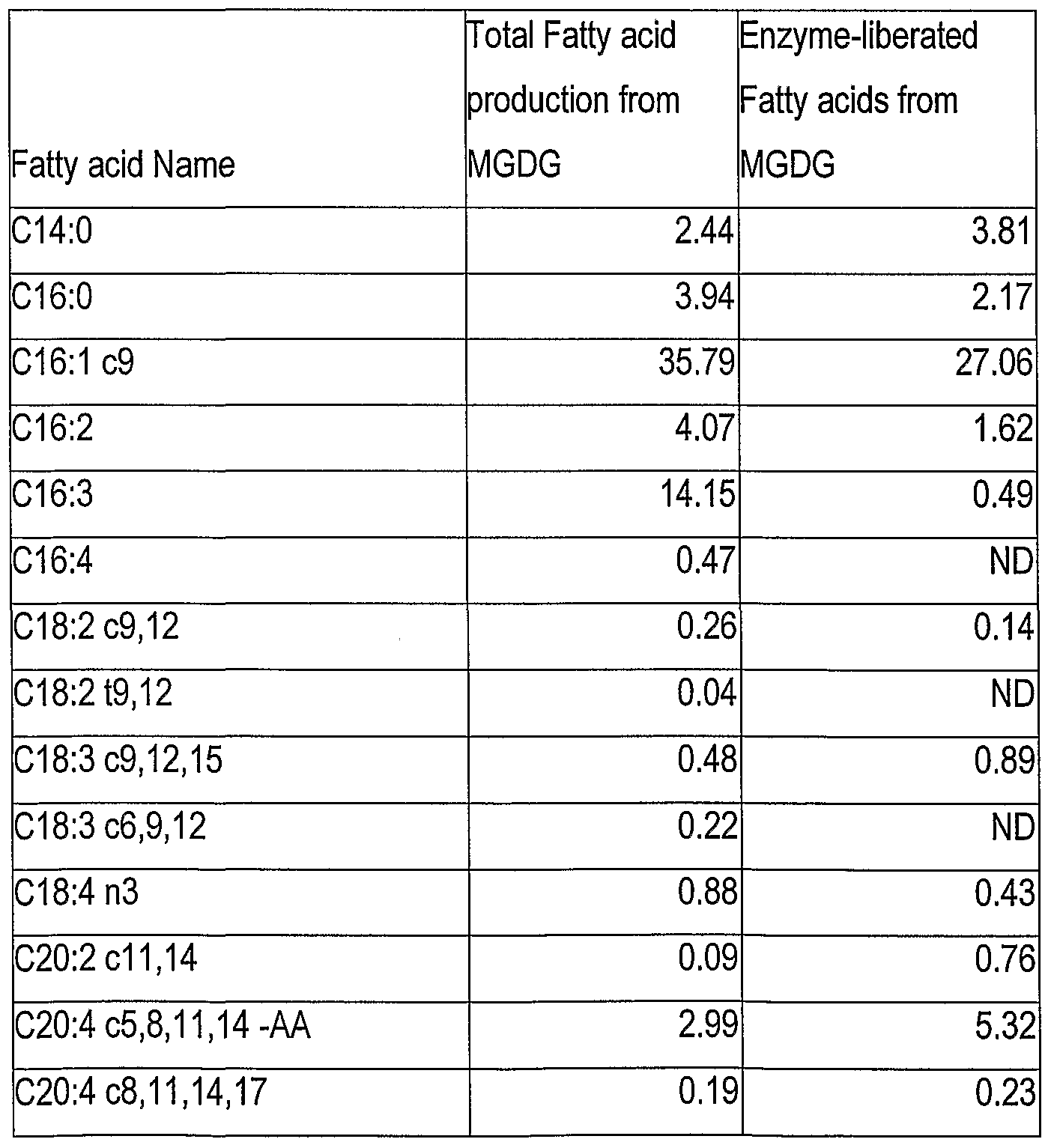
- Table 1 shows in the left hand column the total fatty acid profile of MGDG isolated using the method
- Table 1 Total and enzyme-hydrolysed fatty acids from MGDG. Figures are percentage of total fatty acids loaded on the GC. Please note that where results are expressed as "ND" ("not detected") the amount present was beyond the limits of detection of our instrument.
- the method allows significant increases in the polar lipid production of the organism to take place over that which is measured in a purely heterotrophic culture (where 75% or more of the fatty acids are seen in the non-polar fraction).
- Application of the enzyme in the present example provides for enrichment of EPA and the exclusion of DHA from the fatty acids recovered from the hydrosylate as compared to the total fatty acids of the MGDG fraction.
- EXAMPLE 2 Largely heterotrophic batch cultures of N. laevis .
- Flask cultures of N. laevis is produced according to the method of example one except that: 5-10 grams of 800 glucose is added over the course of the culture run. Light is provided at an average irradiance of photosynthetically active light in the culture of 10 ⁇ mol photons nr 2 s- 1 . Harvesting, separation and analysis techniques are all according to the method of example one.
- EXAMPLE 3 "Perfusion Culture" mode of culturing N. laevis including variation of nutrient(s) and/or 825 exposure to sub-photosynthetic light intensities.
- the vessel is internally lined with "Teflon®" and comprise a stirred, jacketed tank.
- the jacket is provided with hot or cold water as required in order to maintain an internal temperature of 20 0 C, as sensed by internal probes and
- a mechanical seal admits an impeller shaft of 19 mm diameter, having a 6-blade Rushton impeller at one end, placed near an air sparger, and a marine impellor 250 mm from the end.
- a 0.25 kW 3-phase 6-pole motor drives the shaft at between 100 and 900 revolutions per minute. Motor speed is controlled with a variable speed drive capable of receiving an analogue signal from the supervisory control device. Pressurised air (1.5 bar) is injected through a
- an immersed pH sensor Broadley-James Corporation, Irvine, CA
- a peristaltic pump for the addition of either alkali (as NaOH or KOH) or for the addition of acid (as HCI or Acetic acid) as required.
- Concentrations of nutrients including feed stocks that are sources of nitrogen, silicate, phosphorus, 845 glucose, and organic carbon (e.g. glucose) are separately controlled by feeding sterile stock solutions of desired concentrations aseptically through corresponding peristaltic pumps.
- Sterile basal media is also supplied to the vessel through an aseptic pump. Culture volume is monitored using a Kubler level sensor and input of basal media or nutrient controlled by the SCADA device.
- Precautions related to sterility include operations being conducted in a production environment equipped
- the vessel is inoculated by introducing a freshly growing culture through a previously steam-sterilised manifold in order to achieve an initial concentration of from 0.1 to 1 g per litre of cells in the vessel.
- Motive pressure for the transfer is provided through displacement of the inoculating culture with sterile air.
- An optical density probe is also be immersed in the tank in order to indicate the amount of biomass present in a culture
- the culture vessel is also be provided with one or more settling devices, which are external separating funnels into which cells within their medium may be pumped from time to time aseptically via the operation of a peristaltic pump. These devices function by allowing cell-containing media to be pumped into them to settle whilst at the same time permitting spent media, substantially free of cells to be removed in a
- the suspension rich in settled cells located at the bottom of the settling device is then pumped back into the culture vessel via the alternate operation of a second peristaltic pump.
- the reduction in total medium volume in the main culture vessel is made up with fresh media, so that excretory products can be taken out of the vessel and fresh nutrients added.
- the dimensions and volume of the settlers is optimised via deign methodologies well know to those skilled in the art to allow the total volume of the tank
- Means for providing light to the micro-algal cells during culture include one or more of: use of an optically translucent or transparent section of the vessel with a surface illuminated externally, insertion of light guides through ports from the exterior into the culture, insertion of a sterilisable light emitting device (e.g. fibre 875 optics, conventional bulbs or LEDs).
- Cells can be pumped of cells, using a peristaltic pump or the like, from within the culture medium outside and along tubes that are exposed to a light source. For instance a transparent flat panel vessel illuminated using artificial light is used. Relative amounts of time spent in the main vessel and the flat panel system determine the amount of light that the cells are exposed to.
- a low continuous level of exposure using, for example, light guides may be preferable to a high intermittent 880 exposure in an external system.
- cells may be pulsed intermittently with high intensity light so as to achieve an average low intensity over the period of the culture.
- a preferred method for the production of Nitzschia laevis is the use of low intensity light providing a photosynthetically active average irradiance in the culture of less than 40 micromol photons per square meter per second.
- Nitzschia laevis An even more preferred method for the production of Nitzschia laevis is the use of low intensity light providing a photosynthetically active average irradiance in the culture of 1-10 micromol photons per square meter per second.
- the biomass is harvested as a batch after 5 to 9 days of growth and subjected to extraction with supercritical dimethyl ether (DME).
- DME supercritical dimethyl ether
- Isolation of fatty acids from the Sn1 position of specific polar lipid classes is carried out by dissolving the lipid material in methanol and passing it through a column of immobilised Lecitase Ultra. Addition of hexane to the material flowing from the column isolates the fatty acids hydrolysed by the enzyme. These are then purified further as desired. Productivity of this system is between 5 and 50mg EPA per litre per hour. VARIATIONS
- the invention may rely on use of higher plants cells normal or transgenic organisms including but not limited to algae, fungi, and bacteria.
- a possible imporvement option involves growing micro-organisms for a period under conditions in which the media is depleted of either silicate or phosphate or both in order to cause the organisms to produce more polar galactolipids in their lipid membranes, which are subsequently extracted.
- the nutrient limitation is imposed on the culture over the last phase of growth prior to harvesting.
- the culture may be maintained under temperatures below the previously stated 20 degrees Celsius, and above the freezing point of the culture medium.
- the cooling is applied to the culture over the last phase before harvesting.
- a therapeutic composition containing less than (for example) 20% EPA yet having substantial absence of other potentially antagonistic molecules such as DHA AA etc. should not be just as effective as a 100% pure EPA oil (not counting esters).
- the drive to get substantially 100% purity could be re-expressed as a desire to have substantially none of the "undesired molecules" such as DHA. Therefore, 930 acceptance of (for example a 10 to 95% pure EPA) becomes a matter of satisfying the relevant regulatory authorities. The role of the inventors becomes a matter of exclusion of certain impurities.
- a therapeutic composition that delivers EPA in a relatively water-soluble form (or a stable emulsion in water) has substantial formulation advantages.
- a basis for making foods, food supplements, nutraceuticals, or therapeutic preparations that rely on the EPA held in polar lipid molecules is that on oral administration of polar lipids rich in EPA to a mammal leads to a significant proportion of their fatty acids being absorbed into the blood stream via enteric lymph vessels thereby bypassing first-pass liver metabolism and thus providing greater bioavailability of the EPA.
- polar nature of the lipids renders this form of EPA, which does not behave as in the same 940 manner as a fatty acid or ester or as a neutral lipid, easier to formulate and to administer.
- Polar lipids derived from microorganisms would not carry a fishy flavour of the type usually present in fish oil extracts.
- Galactolipids and certain phospholipids according to the invention are recognised to be of particular utility due to a combination of their high EPA content, low content of other potentially antagonistic molecules and undesirable fatty acids.
- An EPA-rich gaiactolipid that has been manufactured from a culture according to the invention may be prepared for storage, shipping and sale as a substance having one of a variety of physical forms such as a solution a suspension (feasible with water), or in a cake, a powder, granules, tablets, boluses, pills, 955 capsules, or beads.
- a powder the gaiactolipid may be bound to inert particles (such as of starch) or encapsulated by means well known to those skilled in the relevant arts.
- Means to restrict oxidation of the EPA may be included in packaging such as by sparging with nitrogen.
- microencapsulation for foods may be assisted with phospholipids (such as crude or purified lecithins) so that the EPA is protected
- the composition includes an effective amount of an extracted 960 gaiactolipid rich in EPA and is suitable for oral ingestion either directly or after a technical process of food preparation.
- a beverage may be a most preferred route since beverages are consumed by most people. Due to the vulnerability of n-3 HUFA and other PUFAs to 965 oxidative degradation it may be preferable to encapsulate the gaiactolipid such that it is protected from light especially sunlight, and released into the beverage shortly prior to consumption. Alternatively it may be desirable to sparge the liquid containing the gaiactolipid with an inert gas to prevent exposure of the EPA to oxygen. Carbon dioxide in carbonated beverages may assist dispersion of the gaiactolipid. Micelles may also hold dissolved carbon dioxide in the case of carbonated beverages and the composition of the micelle
- glycerol may be added to these beverage preparations to optimise the dispersion of the galactolipids and also to provide a more desirable mouth feel for the beverage.
- a water-free concentrate which would be made up by the user with water at or near the time of consumption may be distributed. Steps to minimise oxidation of the n-3 HUFA within the concentrate would have to be taken including the use of light-tight packaging, and
- Milk is a fairly universally consumed beverage and there are many processed variants of "plain" milk on sale.
- EPA-supplemented milk is made by adding an EPA-rich galactolipid during processing. The usual practice is to homogenize and pasteurize milk in a single process. In order to minimise exposure of the EPA to heat, the EPA-rich galactolipid is preferably added during or after cooling of the milk.
- Spreads may have EPA-rich materials included. Such spreads include the protein-rich type such as yeast extracts, or fat-based spreads such as aioli, butter and margarine, in which water is the dispersed phase. In manufacture, the galactolipid is added either to the fatty component or to the water component and the polar nature of the molecule assists in solubility. Spreads also include jams and jellies. The EPA-rich 985 galactolipid may be added to a jam in the form of an emulsion. More solid preparations include sweets and chocolates. The EPA-rich galactolipid may be added as a fat-soluble component during manufacture preferably after heating in order that the galactolipid is not exposed to heat.
- EPA-rich galactolipids may be added to ice cream, for example, along with selected long-chain fatty acid 990 molecules and optionally a phosphatidyl choline (PC) molecule as a carrier.
- PC phosphatidyl choline
- An alternative is to transfer the EPA on to a selected PC molecule using a selective galactolipase/phospholipase.
- Long-chain lyso- phosphatidylcholine is a possible suitable receptor having advantages in processing and in products. The product formed may be insoluble within the enzyme system which tends to drive the equation towards its formation.
- EPA-rich phosphatidylcholine isolated from the culture may be used.
- Whole-cell preparations which may be intact, partially hydrolysed, or lysed, may be incorporated directly into spread-type foods, baking products, processed meats or other food supplements either (i) as is, or (ii) after homogenisation (by shear or pressure) or (iii) controlled enzymatic or chemical hydrolysis to aid proteolysis.
- the whole cell will offer useful protein and generally high HUFA levels, even if some stripping of 1000 EPA has taken place.
- the preferred light levels (of up to about 80 ⁇ mol photons rrr 2 s- 1 if at a steady rate, or at a higher yet equivalent rate if intermittently provided) are cheaper to provide by artificial means than the level of full sunlight, or to provide if daylight is used
- a culture process for creating EPA from a largely heterotrophic organism that is relatively economical to manage, nourish and supply with energy in a large-scale manufacturing environment.
Landscapes
- Health & Medical Sciences (AREA)
- Chemical & Material Sciences (AREA)
- Organic Chemistry (AREA)
- Life Sciences & Earth Sciences (AREA)
- Engineering & Computer Science (AREA)
- General Health & Medical Sciences (AREA)
- Bioinformatics & Cheminformatics (AREA)
- General Chemical & Material Sciences (AREA)
- Chemical Kinetics & Catalysis (AREA)
- Public Health (AREA)
- Medicinal Chemistry (AREA)
- Pharmacology & Pharmacy (AREA)
- Animal Behavior & Ethology (AREA)
- Veterinary Medicine (AREA)
- Nuclear Medicine, Radiotherapy & Molecular Imaging (AREA)
- Zoology (AREA)
- Wood Science & Technology (AREA)
- Oil, Petroleum & Natural Gas (AREA)
- Neurology (AREA)
- Biomedical Technology (AREA)
- Neurosurgery (AREA)
- Genetics & Genomics (AREA)
- General Engineering & Computer Science (AREA)
- Biotechnology (AREA)
- Biochemistry (AREA)
- Microbiology (AREA)
- Immunology (AREA)
- Physical Education & Sports Medicine (AREA)
- Rheumatology (AREA)
- Diabetes (AREA)
- Orthopedic Medicine & Surgery (AREA)
- Nutrition Science (AREA)
- Endocrinology (AREA)
- Urology & Nephrology (AREA)
- Dermatology (AREA)
- Epidemiology (AREA)
- Food Science & Technology (AREA)
- Mycology (AREA)
- Polymers & Plastics (AREA)
- Reproductive Health (AREA)
Abstract
Description



Claims
Priority Applications (9)
| Application Number | Priority Date | Filing Date | Title |
|---|---|---|---|
| US12/307,532 US8877465B2 (en) | 2006-07-05 | 2007-07-05 | Production of ultrapure EPA and polar lipids from largely heterotrophic culture |
| CA2656311A CA2656311C (en) | 2006-07-05 | 2007-07-05 | Ultra pure epa and polar lipids produced in largely heterotrophic culture |
| EP07808670A EP2044208A4 (en) | 2006-07-05 | 2007-07-05 | Production of ultrapure epa and polar lipids from largely heterotrophic culture |
| AU2007270135A AU2007270135B9 (en) | 2006-07-05 | 2007-07-05 | Production of ultrapure EPA and polar lipids from largely heterotrophic culture |
| NZ573719A NZ573719A (en) | 2006-07-05 | 2007-07-05 | Production of ultrapure eicosapentaenoic acid and polar lipids from largely heterotrophic culture of nitzschia laevis |
| JP2009518026A JP5658876B2 (en) | 2006-07-05 | 2007-07-05 | Ultra high purity EPA and polar lipids produced in large-scale heterotrophic culture areas |
| NO20090531A NO20090531L (en) | 2006-07-05 | 2009-02-03 | Preparation of ultra EPA and polar lipids from predominantly heterotrophic cultures |
| US14/531,783 US20150057353A1 (en) | 2006-07-05 | 2014-11-03 | production of ultrapure EPA and polar lipids form largely heterotrophic culture |
| US15/444,027 US20170326090A1 (en) | 2006-07-05 | 2017-02-27 | Production of ultrapure epa and polar lipids from largely heterotrophic culture |
Applications Claiming Priority (2)
| Application Number | Priority Date | Filing Date | Title |
|---|---|---|---|
| NZ548339 | 2006-07-05 | ||
| NZ54833906 | 2006-07-05 |
Related Child Applications (2)
| Application Number | Title | Priority Date | Filing Date |
|---|---|---|---|
| US12/307,532 A-371-Of-International US8877465B2 (en) | 2006-07-05 | 2007-07-05 | Production of ultrapure EPA and polar lipids from largely heterotrophic culture |
| US14/531,783 Continuation US20150057353A1 (en) | 2006-07-05 | 2014-11-03 | production of ultrapure EPA and polar lipids form largely heterotrophic culture |
Publications (1)
| Publication Number | Publication Date |
|---|---|
| WO2008004900A1 true WO2008004900A1 (en) | 2008-01-10 |
Family
ID=38894787
Family Applications (1)
| Application Number | Title | Priority Date | Filing Date |
|---|---|---|---|
| PCT/NZ2007/000172 Ceased WO2008004900A1 (en) | 2006-07-05 | 2007-07-05 | Production of ultrapure epa and polar lipids from largely heterotrophic culture |
Country Status (8)
| Country | Link |
|---|---|
| US (3) | US8877465B2 (en) |
| EP (1) | EP2044208A4 (en) |
| JP (1) | JP5658876B2 (en) |
| AU (1) | AU2007270135B9 (en) |
| CA (1) | CA2656311C (en) |
| NO (1) | NO20090531L (en) |
| NZ (1) | NZ573719A (en) |
| WO (1) | WO2008004900A1 (en) |
Cited By (58)
| Publication number | Priority date | Publication date | Assignee | Title |
|---|---|---|---|---|
| WO2010147994A1 (en) * | 2009-06-15 | 2010-12-23 | Amarin Pharma, Inc. | Compositions and methods for lowering triglycerides without raising ldl-c levels in a subject on concomitant statin therapy |
| CN101613724B (en) * | 2009-07-28 | 2011-04-06 | 嘉吉烯王生物工程(湖北)有限公司 | Method for preparing arachidonic acid (ARA) by recycling fungal meal of Mortierella alpine |
| WO2011080503A3 (en) * | 2009-12-30 | 2011-08-25 | Equateq Limited | Simulated moving bed chromatographic separation process for the purification of polyunsaturated fatty acids |
| WO2011109724A1 (en) * | 2010-03-04 | 2011-09-09 | Amarin Pharma, Inc. | Compositions and methods for treating and/or preventing cardiovascular disease |
| WO2011155852A1 (en) | 2010-06-09 | 2011-12-15 | Photonz Corporation Limited | Compositions comprising eicosapentaenoic acid suitable for high purification |
| WO2012047120A1 (en) * | 2010-10-06 | 2012-04-12 | Photonz Corporation Limited | Heterotrophic microbial production of xanthophyll pigments |
| US8293728B2 (en) | 2009-02-10 | 2012-10-23 | Amarin Pharmaceuticals Ireland Limited | Methods of treating hypertriglyceridemia |
| US8298554B2 (en) | 2009-04-29 | 2012-10-30 | Amarin Pharmaceuticals Ireland Limited | Stable pharmaceutical composition and methods of using same |
| US8343753B2 (en) | 2007-11-01 | 2013-01-01 | Wake Forest University School Of Medicine | Compositions, methods, and kits for polyunsaturated fatty acids from microalgae |
| US8399226B2 (en) | 2009-06-16 | 2013-03-19 | E I Du Pont De Nemours And Company | High eicosapentaenoic acid oils from improved optimized strains of Yarrowia lipolytica |
| US8563608B2 (en) | 2009-04-29 | 2013-10-22 | Amarin Pharmaceuticals Ireland Limited | Methods for lowering triglycerides without raising LDL-C levels in a subject on concomitant statin therapy |
| AU2013204090B2 (en) * | 2009-12-30 | 2015-01-29 | Basf Pharma (Callanish) Limited | Simulated moving bed chromatographic separation process |
| NL2011472C2 (en) * | 2013-09-19 | 2015-03-23 | Univ Delft Tech | Storage compound production by phototrophic diatoms. |
| US9150816B2 (en) | 2013-12-11 | 2015-10-06 | Novasep Process Sas | Chromatographic method for the production of polyunsaturated fatty acids |
| CN104968404A (en) * | 2013-01-09 | 2015-10-07 | 巴斯夫制药(卡兰尼什)公司 | multi-step separation method |
| US9234157B2 (en) | 2011-07-06 | 2016-01-12 | Basf Pharma Callanish Limited | SMB process |
| US9260677B2 (en) | 2011-07-06 | 2016-02-16 | Basf Pharma Callanish Limited | SMB process |
| US9283201B2 (en) | 2013-03-14 | 2016-03-15 | Amarin Pharmaceuticals Ireland Limited | Compositions and methods for treating or preventing obesity in a subject in need thereof |
| CN105410925A (en) * | 2011-07-21 | 2016-03-23 | 帝斯曼知识产权资产管理有限公司 | Fatty acid compositions |
| US9315762B2 (en) | 2011-07-06 | 2016-04-19 | Basf Pharma Callanish Limited | SMB process for producing highly pure EPA from fish oil |
| US9347020B2 (en) | 2011-07-06 | 2016-05-24 | Basf Pharma Callanish Limited | Heated chromatographic separation process |
| US9370730B2 (en) | 2011-07-06 | 2016-06-21 | Basf Pharma Callanish Limited | SMB process |
| US9428711B2 (en) | 2013-05-07 | 2016-08-30 | Groupe Novasep | Chromatographic process for the production of highly purified polyunsaturated fatty acids |
| US9452151B2 (en) | 2013-02-06 | 2016-09-27 | Amarin Pharmaceuticals Ireland Limited | Methods of reducing apolipoprotein C-III |
| EP2934505A4 (en) * | 2012-12-24 | 2016-11-30 | Qualitas Health Ltd | EICOSAPENTAENOIC ACID FORMULATIONS (EPA) |
| US9585859B2 (en) | 2013-10-10 | 2017-03-07 | Amarin Pharmaceuticals Ireland Limited | Compositions and methods for lowering triglycerides without raising LDL-C levels in a subject on concomitant statin therapy |
| US9603826B2 (en) | 2012-06-29 | 2017-03-28 | Amarin Pharmaceuticals Ireland Limited | Methods of reducing the risk of a cardiovascular event in a subject on statin therapy |
| US9624492B2 (en) | 2013-02-13 | 2017-04-18 | Amarin Pharmaceuticals Ireland Limited | Compositions comprising eicosapentaenoic acid and mipomersen and methods of use thereof |
| US9629820B2 (en) | 2012-12-24 | 2017-04-25 | Qualitas Health, Ltd. | Eicosapentaenoic acid (EPA) formulations |
| US9662307B2 (en) | 2013-02-19 | 2017-05-30 | The Regents Of The University Of Colorado | Compositions comprising eicosapentaenoic acid and a hydroxyl compound and methods of use thereof |
| CN107099379A (en) * | 2017-06-09 | 2017-08-29 | 云南中烟工业有限责任公司 | A kind of Zimbabwe's pure tobacco oil for electronic cigarette |
| US9758756B2 (en) | 2012-11-09 | 2017-09-12 | Heliae Development Llc | Method of culturing microorganisms using phototrophic and mixotrophic culture conditions |
| US9814733B2 (en) | 2012-12-31 | 2017-11-14 | A,arin Pharmaceuticals Ireland Limited | Compositions comprising EPA and obeticholic acid and methods of use thereof |
| US9827219B2 (en) | 2012-01-06 | 2017-11-28 | Amarin Pharmaceuticals Ireland Limited | Compositions and methods for lowering levels of high-sensitivity C-reactive protein (HS-CRP) in a subject |
| US9879218B2 (en) | 2013-08-01 | 2018-01-30 | Fermentalg | Methods for the production of diatom biomass |
| US10123986B2 (en) | 2012-12-24 | 2018-11-13 | Qualitas Health, Ltd. | Eicosapentaenoic acid (EPA) formulations |
| US10172818B2 (en) | 2014-06-16 | 2019-01-08 | Amarin Pharmaceuticals Ireland Limited | Methods of reducing or preventing oxidation of small dense LDL or membrane polyunsaturated fatty acids |
| US10240120B2 (en) | 2012-11-09 | 2019-03-26 | Heliae Development Llc | Balanced mixotrophy method |
| US10314803B2 (en) | 2008-09-02 | 2019-06-11 | Amarin Pharmaceuticals Ireland Limited | Pharmaceutical composition comprising eicosapentaenoic acid and nicotinic acid and methods of using same |
| US10406130B2 (en) | 2016-03-15 | 2019-09-10 | Amarin Pharmaceuticals Ireland Limited | Methods of reducing or preventing oxidation of small dense LDL or membrane polyunsaturated fatty acids |
| US10493058B2 (en) | 2009-09-23 | 2019-12-03 | Amarin Pharmaceuticals Ireland Limited | Pharmaceutical composition comprising omega-3 fatty acid and hydroxy-derivative of a statin and methods of using same |
| US10537544B2 (en) | 2011-11-07 | 2020-01-21 | Amarin Pharmaceuticals Ireland Limited | Methods of treating hypertriglyceridemia |
| US10561631B2 (en) | 2014-06-11 | 2020-02-18 | Amarin Pharmaceuticals Ireland Limited | Methods of reducing RLP-C |
| WO2020053375A1 (en) | 2018-09-14 | 2020-03-19 | Fermentalg | Method for extracting an oil rich in polyunsaturated fatty acids (pufa) |
| US10668042B2 (en) | 2018-09-24 | 2020-06-02 | Amarin Pharmaceuticals Ireland Limited | Methods of reducing the risk of cardiovascular events in a subject |
| US10888539B2 (en) | 2013-09-04 | 2021-01-12 | Amarin Pharmaceuticals Ireland Limited | Methods of treating or preventing prostate cancer |
| US10966968B2 (en) | 2013-06-06 | 2021-04-06 | Amarin Pharmaceuticals Ireland Limited | Co-administration of rosiglitazone and eicosapentaenoic acid or a derivative thereof |
| US10966951B2 (en) | 2017-05-19 | 2021-04-06 | Amarin Pharmaceuticals Ireland Limited | Compositions and methods for lowering triglycerides in a subject having reduced kidney function |
| US10975031B2 (en) | 2014-01-07 | 2021-04-13 | Novasep Process | Method for purifying aromatic amino acids |
| US11058661B2 (en) | 2018-03-02 | 2021-07-13 | Amarin Pharmaceuticals Ireland Limited | Compositions and methods for lowering triglycerides in a subject on concomitant statin therapy and having hsCRP levels of at least about 2 mg/L |
| US11141399B2 (en) | 2012-12-31 | 2021-10-12 | Amarin Pharmaceuticals Ireland Limited | Methods of treating or preventing nonalcoholic steatohepatitis and/or primary biliary cirrhosis |
| US11179362B2 (en) | 2012-11-06 | 2021-11-23 | Amarin Pharmaceuticals Ireland Limited | Compositions and methods for lowering triglycerides without raising LDL-C levels in a subject on concomitant statin therapy |
| US11291643B2 (en) | 2011-11-07 | 2022-04-05 | Amarin Pharmaceuticals Ireland Limited | Methods of treating hypertriglyceridemia |
| US11547710B2 (en) | 2013-03-15 | 2023-01-10 | Amarin Pharmaceuticals Ireland Limited | Pharmaceutical composition comprising eicosapentaenoic acid and derivatives thereof and a statin |
| US11712428B2 (en) | 2010-11-29 | 2023-08-01 | Amarin Pharmaceuticals Ireland Limited | Low eructation composition and methods for treating and/or preventing cardiovascular disease in a subject with fish allergy/hypersensitivity |
| US11712429B2 (en) | 2010-11-29 | 2023-08-01 | Amarin Pharmaceuticals Ireland Limited | Low eructation composition and methods for treating and/or preventing cardiovascular disease in a subject with fish allergy/hypersensitivity |
| US11986452B2 (en) | 2021-04-21 | 2024-05-21 | Amarin Pharmaceuticals Ireland Limited | Methods of reducing the risk of heart failure |
| US12427134B2 (en) | 2019-11-12 | 2025-09-30 | Amarin Pharmaceuticals Ireland Limited | Methods of reducing the risk of cardiovascular events in a subject with atrial fibrillation and/or atrial flutter |
Families Citing this family (27)
| Publication number | Priority date | Publication date | Assignee | Title |
|---|---|---|---|---|
| RU2336307C2 (en) | 2000-01-19 | 2008-10-20 | Мартек Биосайнсис Корпорейшн | Method of obtaining lipids (versions) and lipids obtained by this method |
| CN102656261B (en) * | 2009-09-18 | 2015-07-01 | 菲科尔生物技术国际公司 | Microalgae fermentation using controlled illumination |
| CA2993690C (en) | 2010-01-19 | 2022-03-22 | Dsm Ip Assets B.V. | Eicosapentaenoic acid-producing microorganisms, fatty acid compositions, and methods of making and uses thereof |
| AR081558A1 (en) | 2010-06-01 | 2012-10-03 | Martek Biosciences Corp | EXTRACTION OF CELL LIPIDS AND PRODUCTS FROM THEM |
| FR2964667B1 (en) * | 2010-09-15 | 2014-08-22 | Fermentalg | PROCESS FOR THE CULTURE OF MIXOTROPHIC UNICELLULAR ALGAE IN THE PRESENCE OF DISCONTINUOUS LIGHT RATIO IN THE FORM OF FLASHS |
| US10479969B2 (en) | 2010-10-11 | 2019-11-19 | Phycoil Biotechnology International. Inc. | Utilization of wastewater for microalgal cultivation |
| CN103327982A (en) * | 2011-02-01 | 2013-09-25 | 日本水产株式会社 | Sexual function improving agent |
| WO2012103685A1 (en) * | 2011-02-01 | 2012-08-09 | Nippon Suisan Kaisha, Ltd. | Sexual function improving agent |
| KR20140007430A (en) * | 2011-02-11 | 2014-01-17 | 이 아이 듀폰 디 네모아 앤드 캄파니 | An eicosapentaenoic acid concentrate |
| FR2988098A1 (en) * | 2012-03-16 | 2013-09-20 | Fermentalg | PRODUCTION OF DOCOSAHEXAENOIC ACID IN MIXOTROPHE MODE BY NITZSCHIA |
| JPWO2013168310A1 (en) * | 2012-05-10 | 2015-12-24 | 国立大学法人京都大学 | Production method of oxo fatty acid and rare fatty acid |
| CA2916208A1 (en) | 2012-06-17 | 2013-12-27 | Matinas Biopharma, Inc. | Omega-3 pentaenoic acid compositions and methods of use |
| CA2894183A1 (en) * | 2012-12-06 | 2014-06-12 | Matinas Biopharma, Inc. | Omega-3 pentaenoic acid compositions and methods of use |
| MX2015011767A (en) * | 2013-03-15 | 2016-01-15 | Aurora Algae Inc | Compositions of crude algal oil. |
| US9445619B2 (en) * | 2013-03-15 | 2016-09-20 | Aurora Algae, Inc. | Compositions and methods for utilization of algal compounds |
| US8802880B1 (en) | 2013-05-07 | 2014-08-12 | Group Novasep | Chromatographic process for the production of highly purified polyunsaturated fatty acids |
| EP3083546B1 (en) | 2013-12-20 | 2022-03-02 | DSM IP Assets B.V. | Processes for obtaining microbial oil from microbial cells |
| BR112016014516B1 (en) | 2013-12-20 | 2022-02-22 | Dsm Ip Assets B.V | PROCESSES TO OBTAIN MICROBIAL OIL FROM MICROBIAL CELLS AND OIL |
| MX383112B (en) | 2013-12-20 | 2025-03-13 | Dsm Ip Assets Bv | PROCEDURES FOR OBTAINING MICROBIAL OIL FROM MICROBIAL CELLS. |
| AU2014369042B2 (en) | 2013-12-20 | 2020-04-30 | Dsm Ip Assets B.V. | Processes for obtaining microbial oil from microbial cells |
| BR112016014517B1 (en) | 2013-12-20 | 2022-06-28 | Dsm Ip Assets B.V. | PROCESS FOR OBTAINING A MICROBIAL OIL COMPRISING ONE OR MORE POLYUNSATURATED FATTY ACIDS FROM ONE OR MORE MICROBIAL CELLS |
| JP2015146788A (en) * | 2014-02-07 | 2015-08-20 | 三菱マテリアル株式会社 | Algae culture method and algae culture apparatus |
| KR102468244B1 (en) * | 2016-06-08 | 2022-11-17 | 스웨디시 알지 팩토리 에이비 | Diatom shells extracted from benthic phennate diatoms harvested in an industrial biofilm process |
| CN105912054B (en) * | 2016-06-24 | 2018-11-20 | 国网山东省电力公司聊城供电公司 | The temperature control system and its working method of a kind of oil chromatography on-line equipment cabinet and application |
| JP7395144B2 (en) * | 2019-04-05 | 2023-12-11 | 三菱重工機械システム株式会社 | Microalgae culture method and microalgae culture device |
| WO2021211990A1 (en) * | 2020-04-17 | 2021-10-21 | Wake Forest University | Lipid compositions and methods of preparation thereof |
| GB202016236D0 (en) * | 2020-10-13 | 2020-11-25 | Givaudan Sa | Composition |
Citations (7)
| Publication number | Priority date | Publication date | Assignee | Title |
|---|---|---|---|---|
| DE1969433U (en) * | 1967-04-14 | 1967-09-28 | Bernhard Dipl Ing Winkler | SIGNAGE ELEMENT. |
| JPS5946225A (en) * | 1982-09-09 | 1984-03-15 | Kogyo Kaihatsu Kenkyusho | Preparation of antiarteriosclerotic agent |
| JPH0297373A (en) * | 1988-09-30 | 1990-04-09 | Koujiyouen:Kk | Production of beer |
| JPH02145191A (en) * | 1988-11-29 | 1990-06-04 | Tosoh Corp | Method for separating highly unsaturated fatty acid from marine microorganism |
| WO1991014427A1 (en) * | 1990-03-21 | 1991-10-03 | Martek Corporation | Eicosapentaenoic acids and methods for their production |
| WO2004033698A2 (en) * | 2002-10-11 | 2004-04-22 | Suntory Limited | Process for producing microbial fat or oil having lowered unsaponifiable matter content and said fat or oil |
| WO2006085144A2 (en) * | 2004-10-15 | 2006-08-17 | Photonz Corporation Limited | Compositions containing high omega-3 and low saturated fatty acid levels |
Family Cites Families (14)
| Publication number | Priority date | Publication date | Assignee | Title |
|---|---|---|---|---|
| JPS6163624A (en) * | 1984-09-05 | 1986-04-01 | Nisshin Oil Mills Ltd:The | Production of glycolipid of high eicosapentaenoic acid content |
| JPH0297393A (en) | 1988-10-03 | 1990-04-09 | Sagami Chem Res Center | Production of phospholipid composition containing eicosapentaenoic acid using marine microorganism |
| WO1994024984A2 (en) * | 1993-04-30 | 1994-11-10 | Winget Rodner R | Anti-inflammatory compositions containing eicosapentaenoic acid bearing monogalactosyldiacylglycerol and methods relating thereto |
| GB9404483D0 (en) | 1994-03-08 | 1994-04-20 | Norsk Hydro As | Refining marine oil compositions |
| DE19629433A1 (en) | 1996-07-22 | 1998-01-29 | Hoechst Ag | Preparation containing omega-3 fatty acids from microorganisms as a prophylactic or therapeutic agent against parasitic diseases in animals |
| JP3836231B2 (en) * | 1997-10-17 | 2006-10-25 | 日本化学飼料株式会社 | Highly unsaturated fatty acid-containing oil obtained from scallop midgut gland and method for producing the same |
| AU2004235641B2 (en) | 1999-01-27 | 2006-09-14 | Amarin Neuroscience Limited | Highly purified ethyl EPA and other EPA derivatives for psychiatric and neurological disorders |
| CA2273570A1 (en) * | 1999-05-31 | 2000-11-30 | Jfs Envirohealth Ltd. | Concentration and purification of polyunsaturated fatty acid esters by distillation-enzymatic transesterification coupling |
| JP4170542B2 (en) * | 1999-11-18 | 2008-10-22 | 日油株式会社 | Process for producing highly unsaturated fatty acid derivative and high-purity eicosapentaenoic acid derivative |
| RU2336307C2 (en) * | 2000-01-19 | 2008-10-20 | Мартек Биосайнсис Корпорейшн | Method of obtaining lipids (versions) and lipids obtained by this method |
| CA2451116C (en) * | 2001-05-14 | 2013-04-09 | Martek Biosciences Corporation | Production and use of a polar lipid-rich fraction containing omega-3 and/or omega-6 highly unsaturated fatty acids from microbes, genetically modified plant seeds and marine organisms |
| GB0301701D0 (en) * | 2003-01-24 | 2003-02-26 | Ensay Ltd | Psoriasis and Eicosapentaenoic acid |
| US8557551B2 (en) * | 2004-09-10 | 2013-10-15 | Dsm Ip Assets B.V. | Compositions and methods for making and modifying oils |
| US20070225370A1 (en) * | 2006-03-21 | 2007-09-27 | Joar Opheim | Nutritional Compositions and Methods |
-
2007
- 2007-07-05 WO PCT/NZ2007/000172 patent/WO2008004900A1/en not_active Ceased
- 2007-07-05 CA CA2656311A patent/CA2656311C/en active Active
- 2007-07-05 US US12/307,532 patent/US8877465B2/en active Active
- 2007-07-05 AU AU2007270135A patent/AU2007270135B9/en active Active
- 2007-07-05 JP JP2009518026A patent/JP5658876B2/en not_active Expired - Fee Related
- 2007-07-05 EP EP07808670A patent/EP2044208A4/en not_active Withdrawn
- 2007-07-05 NZ NZ573719A patent/NZ573719A/en unknown
-
2009
- 2009-02-03 NO NO20090531A patent/NO20090531L/en not_active Application Discontinuation
-
2014
- 2014-11-03 US US14/531,783 patent/US20150057353A1/en not_active Abandoned
-
2017
- 2017-02-27 US US15/444,027 patent/US20170326090A1/en not_active Abandoned
Patent Citations (7)
| Publication number | Priority date | Publication date | Assignee | Title |
|---|---|---|---|---|
| DE1969433U (en) * | 1967-04-14 | 1967-09-28 | Bernhard Dipl Ing Winkler | SIGNAGE ELEMENT. |
| JPS5946225A (en) * | 1982-09-09 | 1984-03-15 | Kogyo Kaihatsu Kenkyusho | Preparation of antiarteriosclerotic agent |
| JPH0297373A (en) * | 1988-09-30 | 1990-04-09 | Koujiyouen:Kk | Production of beer |
| JPH02145191A (en) * | 1988-11-29 | 1990-06-04 | Tosoh Corp | Method for separating highly unsaturated fatty acid from marine microorganism |
| WO1991014427A1 (en) * | 1990-03-21 | 1991-10-03 | Martek Corporation | Eicosapentaenoic acids and methods for their production |
| WO2004033698A2 (en) * | 2002-10-11 | 2004-04-22 | Suntory Limited | Process for producing microbial fat or oil having lowered unsaponifiable matter content and said fat or oil |
| WO2006085144A2 (en) * | 2004-10-15 | 2006-08-17 | Photonz Corporation Limited | Compositions containing high omega-3 and low saturated fatty acid levels |
Non-Patent Citations (20)
| Title |
|---|
| BIOTECHNOLOGY ADVANCES, vol. 21, no. 4, July 2003 (2003-07-01), pages 273 - 294 * |
| BIOTECHNOLOGY AND BIOENGINEERING, vol. 68, no. 2, 20 April 2000 (2000-04-20), pages 173 - 183 * |
| BOTANICA MARINA, vol. 41, no. 6, November 1998 (1998-11-01), pages 553 - 558 * |
| CHINESE JOURNAL OF OCEANOLOGY AND LIMNOLOGY, vol. 16, no. SUPPL., 1998, pages 84 - 90 * |
| DATABASE BIOSIS [online] CHEN FENG: "Bioreactor technology for production of valuable algal products", XP008102153, Database accession no. (1999:342639) * |
| DATABASE BIOSIS [online] TAN CHOR KOON AND JOHNS M.R.: "Screening of diatoms for heterotrophic eicosapentaenoic acid production", XP008102152, Database accession no. (1996:427792) * |
| DATABASE BIOSIS [online] VAZHAPPILLY R. AND CHEN F.: "Heterotrophic production potential of omega-3 polyunsaturated fatty acids by microalgae and algae-like microorganisms", XP008102154, Database accession no. (1999:426279) * |
| DATABASE CAPLUS [online] LIU H.-T. ET AL.: "Application prospects and research advances in heterotrophic production of eicosapentaenoic acid by microalgae", XP008102320, Database accession no. (2004:903574) * |
| DATABASE MEDLINE [online] FERNANDEZ F.G. ET AL.: "Modelling of eicospentaenoic acid (EPA) production from Phaeodactylum tricornutum cultures in tubular photobioreactors. Effects of dilution rate, tube diameter, and solar irradiance", XP008102156, Database accession no. (2000:177525) * |
| DATABASE MEDLINE [online] WEN ZHI-YOU AND CHEN FENG: "Heterotrophic production of eicosapentaenoic acid by microalgae", XP008102155, Database accession no. (2003:439630) * |
| DATABASE WPI Week 198417, Derwent World Patents Index; Class B04, AN 1984-103987, XP008102145 * |
| DATABASE WPI Week 199020, Derwent World Patents Index; Class B05, AN 1990-152269, XP008102147 * |
| DATABASE WPI Week 199028, Derwent World Patents Index; Class D16, AN 1990-214251, XP008102149 * |
| DATABASE WPI Week 199142, Derwent World Patents Index; Class B05, AN 1991-310346, XP008102150 * |
| DATABASE WPI Week 199810, Derwent World Patents Index; Class B05, AN 1998-101721, XP008102146 * |
| DATABASE WPI Week 200432, Derwent World Patents Index; Class B05, AN 2004-348203, XP008102148 * |
| DATABASE WPI Week 200665, Derwent World Patents Index; Class B05, AN 2006-626660, XP008102151 * |
| JOURNAL OF APPLIED PHYCOLOGY, vol. 8, no. 1, 1996, pages 59 - 64 * |
| See also references of EP2044208A4 * |
| ZHONGGUO TIANRAN YAOWU, vol. 2, no. 4, 2004, pages 252 - 256 * |
Cited By (183)
| Publication number | Priority date | Publication date | Assignee | Title |
|---|---|---|---|---|
| US8343753B2 (en) | 2007-11-01 | 2013-01-01 | Wake Forest University School Of Medicine | Compositions, methods, and kits for polyunsaturated fatty acids from microalgae |
| US10314803B2 (en) | 2008-09-02 | 2019-06-11 | Amarin Pharmaceuticals Ireland Limited | Pharmaceutical composition comprising eicosapentaenoic acid and nicotinic acid and methods of using same |
| US8293728B2 (en) | 2009-02-10 | 2012-10-23 | Amarin Pharmaceuticals Ireland Limited | Methods of treating hypertriglyceridemia |
| US8431560B1 (en) | 2009-02-10 | 2013-04-30 | Amarin Pharmaceuticals Ireland Limited | Methods of treating hypertriglyceridemia |
| US8426399B2 (en) | 2009-02-10 | 2013-04-23 | Amarin Pharmaceuticals Ireland Limited | Methods of treating hypertriglyceridemia |
| US8415335B2 (en) | 2009-02-10 | 2013-04-09 | Amarin Pharmaceutical Ireland Limited | Methods of treating hypertriglyceridemia |
| US8367652B2 (en) | 2009-02-10 | 2013-02-05 | Amarin Pharmaceuticals Ireland Limited | Methods of treating hypertriglyceridemia |
| US8293727B2 (en) | 2009-02-10 | 2012-10-23 | Amarin Pharmaceuticals Ireland Limited | Methods of treating hypertriglyceridemia |
| US8399446B2 (en) | 2009-02-10 | 2013-03-19 | Amarin Pharmaceuticals Ireland Limited | Methods of treating hypertriglyceridemia |
| US8314086B2 (en) | 2009-02-10 | 2012-11-20 | Amarin Pharmaceuticals Ireland Limited | Methods of treating hypertriglyceridemia |
| US8318715B2 (en) | 2009-02-10 | 2012-11-27 | Amarin Pharmaceuticals Ireland Limited | Methods of treating hypertriglyceridemia |
| US8324195B2 (en) | 2009-02-10 | 2012-12-04 | Amarin Pharmaceuticals Ireland Limited | Methods of treating hypertriglyceridemia |
| US8377920B2 (en) | 2009-02-10 | 2013-02-19 | Amarin Pharmaceuticals Ireland Limited | Methods of treating hypertriglyceridemia |
| US8440650B1 (en) | 2009-02-10 | 2013-05-14 | Amarin Pharmaceuticals Ireland Limited | Methods of treating hypertriglyceridemia |
| US8357677B1 (en) | 2009-02-10 | 2013-01-22 | Amarin Pharmaceuticals Ireland Limited | Methods of treating hypertriglyceridemia |
| US10842766B2 (en) | 2009-04-29 | 2020-11-24 | Amarin Pharmaceuticals Ireland Limited | Stable pharmaceutical composition and methods of using same |
| US11400069B2 (en) | 2009-04-29 | 2022-08-02 | Amarin Pharmaceuticals Ireland Limited | Methods of treating mixed dyslipidemia |
| US8298554B2 (en) | 2009-04-29 | 2012-10-30 | Amarin Pharmaceuticals Ireland Limited | Stable pharmaceutical composition and methods of using same |
| US8617593B2 (en) | 2009-04-29 | 2013-12-31 | Amarin Pharmaceuticals Ireland Limited | Stable pharmaceutical composition and methods of using same |
| US10265287B2 (en) | 2009-04-29 | 2019-04-23 | Amarin Pharmaceuticals Ireland Limited | Methods of reducing triglycerides and LDL-C |
| US10449172B2 (en) | 2009-04-29 | 2019-10-22 | Amarin Pharmaceuticals Ireland Limited | Stable pharmaceutical composition and methods of using same |
| US10010517B2 (en) | 2009-04-29 | 2018-07-03 | Amarin Pharmaceuticals Ireland Limited | Stable pharmaceutical composition and methods of using same |
| US10624870B2 (en) | 2009-04-29 | 2020-04-21 | Amarin Pharmaceuticals Ireland Limited | Methods of treating mixed dyslipidemia |
| US9855237B2 (en) | 2009-04-29 | 2018-01-02 | Amarin Pharmaceuticals Ireland Limited | Methods of treating mixed dyslipidemia |
| US10792267B2 (en) | 2009-04-29 | 2020-10-06 | Amarin Pharmaceuticals Ireland Limited | Methods of treating mixed dyslipidemia |
| US8445003B2 (en) | 2009-04-29 | 2013-05-21 | Amarin Pharmaceuticals Ireland Limited | Stable pharmaceutical composition and methods of using same |
| US8445013B2 (en) | 2009-04-29 | 2013-05-21 | Amarin Pharmaceuticals Ireland Limited | Stable pharmaceutical composition and methods of using same |
| US8454994B2 (en) | 2009-04-29 | 2013-06-04 | Amarin Pharmaceuticals Ireland Limited | Stable pharmaceutical composition and methods of using same |
| US8563608B2 (en) | 2009-04-29 | 2013-10-22 | Amarin Pharmaceuticals Ireland Limited | Methods for lowering triglycerides without raising LDL-C levels in a subject on concomitant statin therapy |
| US10881632B2 (en) | 2009-04-29 | 2021-01-05 | Amarin Pharmaceuticals Ireland Limited | Stable pharmaceutical composition and methods of using same |
| US8613945B2 (en) | 2009-04-29 | 2013-12-24 | Amarin Pharmaceuticals Ireland Limited | Stable pharmaceutical composition and methods of using same |
| US10220013B2 (en) | 2009-04-29 | 2019-03-05 | Amarin Pharmaceuticals Ireland Limited | Methods of treating mixed dyslipidemia |
| US8618166B2 (en) | 2009-04-29 | 2013-12-31 | Amarin Pharmaceuticals Ireland Limited | Methods of treating mixed dyslipidemia |
| US8623406B2 (en) | 2009-04-29 | 2014-01-07 | Amarin Pharmaceuticals Ireland Limited | Stable pharmaceutical composition and methods of using same |
| US10888537B2 (en) | 2009-04-29 | 2021-01-12 | Amarin Pharmaceuticals Ireland Limited | Pharmaceutical compositions comprising omega-3 fatty acids |
| US8642077B2 (en) | 2009-04-29 | 2014-02-04 | Amarin Pharmaceuticals Ireland Limited | Stable pharmaceutical composition and methods of using same |
| US8663662B2 (en) | 2009-04-29 | 2014-03-04 | Amarin Pharma, Inc. | Stable pharmaceutical composition and methods of using same |
| US8691871B2 (en) | 2009-04-29 | 2014-04-08 | Amarin Pharmaceuticals Ireland Limited | Methods of treating mixed dyslipidemia |
| US10940131B2 (en) | 2009-04-29 | 2021-03-09 | Amarin Pharmaceuticals Ireland Limited | Methods of treating mixed dyslipidemia |
| US10987331B2 (en) | 2009-04-29 | 2021-04-27 | Amarin Pharmaceuticals Ireland Limited | Methods of treating mixed dyslipidemia |
| US11033523B2 (en) | 2009-04-29 | 2021-06-15 | Amarin Pharmaceuticals Ireland Limited | Pharmaceutical compositions comprising EPA and a cardiovascular agent and methods of using the same |
| US11103477B2 (en) | 2009-04-29 | 2021-08-31 | Amarin Pharmaceuticals Ireland Limited | Stable pharmaceutical composition and methods of using same |
| US11147787B2 (en) | 2009-04-29 | 2021-10-19 | Amarin Pharmaceuticals Ireland Limited | Stable pharmaceutical composition and methods of using same |
| US9056088B2 (en) | 2009-04-29 | 2015-06-16 | Amarin Pharmaceuticals Ireland Limited | Pharmaceutical compositions comprising fatty acids |
| US9060983B2 (en) | 2009-04-29 | 2015-06-23 | Amarin Pharmaceuticals Ireland Limited | Stable pharmaceutical composition and methods of using same |
| US9060982B2 (en) | 2009-04-29 | 2015-06-23 | Amarin Pharmaceuticals Ireland Limited | Stable pharmaceutical composition and methods of using same |
| US11154526B2 (en) | 2009-04-29 | 2021-10-26 | Amarin Pharmaceuticals Ireland Limited | Methods of treating mixed dyslipidemia |
| US9072715B2 (en) | 2009-04-29 | 2015-07-07 | Amarin Pharmaceuticals Ireland Limited | Stable pharmaceutical composition and methods of using same |
| US9138415B2 (en) | 2009-04-29 | 2015-09-22 | Amarin Pharmaceuticals Ireland Limited | Stable pharmaceutical composition and methods of using same |
| US11213504B2 (en) | 2009-04-29 | 2022-01-04 | Amarin Pharmaceuticals Ireland Limited | Stable pharmaceutical composition and methods of using same |
| US11690820B2 (en) | 2009-04-29 | 2023-07-04 | Amarin Pharmaceuticals Ireland Limited | Methods of treating mixed dyslipidemia |
| US9585856B2 (en) | 2009-04-29 | 2017-03-07 | Amarin Pharmaceuticals Ireland Limited | Stable pharmaceutical composition and methods of using same |
| WO2010147994A1 (en) * | 2009-06-15 | 2010-12-23 | Amarin Pharma, Inc. | Compositions and methods for lowering triglycerides without raising ldl-c levels in a subject on concomitant statin therapy |
| US12171738B2 (en) | 2009-06-15 | 2024-12-24 | Amarin Pharmaceuticals Ireland Limited | Compositions and methods for lowering triglycerides |
| US11464757B2 (en) | 2009-06-15 | 2022-10-11 | Amarin Pharmaceuticals Ireland Limited | Compositions and methods for lowering triglycerides |
| US8410086B2 (en) | 2009-06-15 | 2013-04-02 | Amarin Pharmaceuticals Ireland Limited | Compositions and methods for lowering triglycerides |
| US10842768B2 (en) | 2009-06-15 | 2020-11-24 | Amarin Pharmaceuticals Ireland Limited | Compositions and methods for lowering triglycerides |
| US11439618B2 (en) | 2009-06-15 | 2022-09-13 | Amarin Pharmaceuticals Ireland Limited | Compositions and methods for lowering triglycerides |
| US8710041B2 (en) | 2009-06-15 | 2014-04-29 | Amarin Pharmaceuticals Ireland Limited | Compositions and methods for lowering triglycerides in a subject on concomitant statin therapy |
| US8399226B2 (en) | 2009-06-16 | 2013-03-19 | E I Du Pont De Nemours And Company | High eicosapentaenoic acid oils from improved optimized strains of Yarrowia lipolytica |
| CN101613724B (en) * | 2009-07-28 | 2011-04-06 | 嘉吉烯王生物工程(湖北)有限公司 | Method for preparing arachidonic acid (ARA) by recycling fungal meal of Mortierella alpine |
| US10493058B2 (en) | 2009-09-23 | 2019-12-03 | Amarin Pharmaceuticals Ireland Limited | Pharmaceutical composition comprising omega-3 fatty acid and hydroxy-derivative of a statin and methods of using same |
| US11007173B2 (en) | 2009-09-23 | 2021-05-18 | Amarin Pharmaceuticals Ireland Limited | Pharmaceutical composition comprising omega-3 fatty acid and hydroxy-derivative of a statin and methods of using same |
| CN104974030A (en) * | 2009-12-30 | 2015-10-14 | 巴斯夫制药(卡兰尼什)公司 | Simulated Moving Bed Chromatographic Separation Process For The Purification Of Polyunsaturated Fatty Acids |
| AU2010338031B2 (en) * | 2009-12-30 | 2014-01-23 | Basf Pharma (Callanish) Limited | Simulated moving bed chromatographic separation process for the purification of polyunsaturated fatty acids |
| EP3865469A3 (en) * | 2009-12-30 | 2021-11-17 | BASF Pharma (Callanish) Limited | Polyunsaturated fatty acid compositions obtainable by a simulated moving bed chromatographic separation process |
| CN102811781B (en) * | 2009-12-30 | 2015-06-24 | 巴斯夫制药(卡兰尼什)公司 | Simulated Moving Bed Chromatographic Separation Method for Purification of Polyunsaturated Fatty Acids |
| US9790162B2 (en) | 2009-12-30 | 2017-10-17 | Basf Pharma (Callanish) Limited | Simulated moving bed chromatographic separation process |
| US20160016877A1 (en) * | 2009-12-30 | 2016-01-21 | Basf Pharma (Callanish) Limited | Simulated Moving Bed Chromatographic Separation Process |
| AU2013204090B2 (en) * | 2009-12-30 | 2015-01-29 | Basf Pharma (Callanish) Limited | Simulated moving bed chromatographic separation process |
| CN102811781A (en) * | 2009-12-30 | 2012-12-05 | 巴斯夫制药(卡兰尼什)公司 | Simulated Moving Bed Chromatographic Separation Method for Purification of Polyunsaturated Fatty Acids |
| RU2538981C2 (en) * | 2009-12-30 | 2015-01-10 | Басф Фарма (Калланиш) Лимитед | Simulated moving bed chromatographic separation method |
| WO2011080503A3 (en) * | 2009-12-30 | 2011-08-25 | Equateq Limited | Simulated moving bed chromatographic separation process for the purification of polyunsaturated fatty acids |
| EP2591778A1 (en) * | 2009-12-30 | 2013-05-15 | BASF Pharma (Callanish) Limited | Polyunsaturated fatty acid compositions obtainable by a simulated moving bed chromatographic separation process |
| RU2728825C2 (en) * | 2010-03-04 | 2020-07-31 | Амарин Фармасьютикалз Айрлэнд Лимитед (Апил) | Compositions and methods of treating and/or preventing cardiovascular disease |
| PH12018500843A1 (en) * | 2010-03-04 | 2019-02-27 | Amarin Pharma Inc | Compositions and methods for treating and/or preventing cardiovascular disease |
| WO2011109724A1 (en) * | 2010-03-04 | 2011-09-09 | Amarin Pharma, Inc. | Compositions and methods for treating and/or preventing cardiovascular disease |
| WO2011155852A1 (en) | 2010-06-09 | 2011-12-15 | Photonz Corporation Limited | Compositions comprising eicosapentaenoic acid suitable for high purification |
| EP2580342A4 (en) * | 2010-06-09 | 2013-11-13 | Photonz Corp Ltd | COMPOSITIONS COMPRISING EICOSAPENTAENOIC ACID USED FOR STRONG PURIFICATIONS |
| EP3527665A1 (en) | 2010-06-09 | 2019-08-21 | Fermentalg | Compositions comprising eicosapentaenoic acid suitable for high purification |
| WO2012047120A1 (en) * | 2010-10-06 | 2012-04-12 | Photonz Corporation Limited | Heterotrophic microbial production of xanthophyll pigments |
| US11712429B2 (en) | 2010-11-29 | 2023-08-01 | Amarin Pharmaceuticals Ireland Limited | Low eructation composition and methods for treating and/or preventing cardiovascular disease in a subject with fish allergy/hypersensitivity |
| US11712428B2 (en) | 2010-11-29 | 2023-08-01 | Amarin Pharmaceuticals Ireland Limited | Low eructation composition and methods for treating and/or preventing cardiovascular disease in a subject with fish allergy/hypersensitivity |
| US9260677B2 (en) | 2011-07-06 | 2016-02-16 | Basf Pharma Callanish Limited | SMB process |
| US9234157B2 (en) | 2011-07-06 | 2016-01-12 | Basf Pharma Callanish Limited | SMB process |
| US9315762B2 (en) | 2011-07-06 | 2016-04-19 | Basf Pharma Callanish Limited | SMB process for producing highly pure EPA from fish oil |
| US9370730B2 (en) | 2011-07-06 | 2016-06-21 | Basf Pharma Callanish Limited | SMB process |
| US9695382B2 (en) | 2011-07-06 | 2017-07-04 | Basf Pharma (Callanish) Limited | SMB process for producing highly pure EPA from fish oil |
| US9771542B2 (en) | 2011-07-06 | 2017-09-26 | Basf Pharma Callanish Ltd. | Heated chromatographic separation process |
| US9347020B2 (en) | 2011-07-06 | 2016-05-24 | Basf Pharma Callanish Limited | Heated chromatographic separation process |
| CN105410925A (en) * | 2011-07-21 | 2016-03-23 | 帝斯曼知识产权资产管理有限公司 | Fatty acid compositions |
| US10632094B2 (en) | 2011-11-07 | 2020-04-28 | Amarin Pharmaceuticals Ireland Limited | Methods of treating hypertriglyceridemia |
| US10537544B2 (en) | 2011-11-07 | 2020-01-21 | Amarin Pharmaceuticals Ireland Limited | Methods of treating hypertriglyceridemia |
| US11291643B2 (en) | 2011-11-07 | 2022-04-05 | Amarin Pharmaceuticals Ireland Limited | Methods of treating hypertriglyceridemia |
| US10973796B2 (en) | 2012-01-06 | 2021-04-13 | Amarin Pharmaceuticals Ireland Limited | Compositions and methods for lowering levels of high-sensitivity C-reactive protein (hs-CRP) in a subject |
| US9827219B2 (en) | 2012-01-06 | 2017-11-28 | Amarin Pharmaceuticals Ireland Limited | Compositions and methods for lowering levels of high-sensitivity C-reactive protein (HS-CRP) in a subject |
| US10555925B1 (en) | 2012-06-29 | 2020-02-11 | Amarin Pharmaceuticals Ireland Limited | Methods of reducing the risk of a cardiovascular event in a subject at risk for cardiovascular disease |
| US10383840B2 (en) | 2012-06-29 | 2019-08-20 | Amarin Pharmaceuticals Ireland Limited | Methods of reducing the risk of a cardiovascular event in a subject at risk for cardiovascular disease |
| US9918955B2 (en) | 2012-06-29 | 2018-03-20 | Amarin Pharmaceuticals Ireland Limited | Methods of reducing the risk of a cardiovascular event in a subject on statin therapy |
| US9918954B2 (en) | 2012-06-29 | 2018-03-20 | Amarin Pharmaceuticals Ireland Limited | Methods of reducing the risk of a cardiovascular event in a subject on statin therapy |
| US9693984B2 (en) | 2012-06-29 | 2017-07-04 | Amarin Pharmaceuticals Ireland Limited | Methods of reducing the risk of a cardiovascular event in a subject on statin therapy |
| US10576054B1 (en) | 2012-06-29 | 2020-03-03 | Amarin Pharmaceuticals Ireland Limited | Methods of reducing the risk of a cardiovascular event in a subject at risk for cardiovascular disease |
| US9603826B2 (en) | 2012-06-29 | 2017-03-28 | Amarin Pharmaceuticals Ireland Limited | Methods of reducing the risk of a cardiovascular event in a subject on statin therapy |
| US10278938B2 (en) | 2012-06-29 | 2019-05-07 | Amarin Pharmaceuticals Ireland Limited | Methods of reducing the risk of a cardiovascular event in a subject on statin therapy |
| US10278936B2 (en) | 2012-06-29 | 2019-05-07 | Amarin Pharmaceuticals Ireland Limited | Methods of reducing the risk of a cardiovascular event in a subject on statin therapy |
| US10278935B2 (en) | 2012-06-29 | 2019-05-07 | Amarin Pharmaceuticals Ireland Limited | Methods of reducing the risk of a cardiovascular event in a subject on statin therapy |
| US10278937B2 (en) | 2012-06-29 | 2019-05-07 | Amarin Pharmaceuticals Ireland Limited | Methods of reducing the risk of a cardiovascular event in a subject on statin therapy |
| US10278939B2 (en) | 2012-06-29 | 2019-05-07 | Amarin Pharmaceuticals Ireland Limited | Methods of reducing the risk of a cardiovascular event in a subject on statin therapy |
| US9610272B2 (en) | 2012-06-29 | 2017-04-04 | Amarin Pharmaceuticals Ireland Limited | Methods of reducing the risk of a cardiovascular event in a subject on statin therapy |
| US9623001B2 (en) | 2012-06-29 | 2017-04-18 | Amarin Pharmaceuticals Ireland Limited | Methods of reducing the risk of a cardiovascular event in a subject on statin therapy |
| US10568861B1 (en) | 2012-06-29 | 2020-02-25 | Amarin Pharmaceuticals Ireland Limited | Methods of reducing the risk of a cardiovascular event in a subject at risk for cardiovascular disease |
| US10792270B2 (en) | 2012-06-29 | 2020-10-06 | Amarin Pharmaceuticals Ireland Limited | Methods of reducing the risk of a cardiovascular event in a subject at risk for cardiovascular disease |
| US9693986B2 (en) | 2012-06-29 | 2017-07-04 | Amarin Pharmaceuticals Ireland Limited | Methods of reducing the risk of a cardiovascular event in a subject on statin therapy |
| US9693985B2 (en) | 2012-06-29 | 2017-07-04 | Amarin Pharmaceuticals Ireland Limited | Methods of reducing the risk of a cardiovascular event in a subject on statin therapy |
| US10894028B2 (en) | 2012-06-29 | 2021-01-19 | Amarin Pharmaceuticals Ireland Limited | Methods of reducing the risk of a cardiovascular event in a subject at risk for cardiovascular disease |
| US10555924B2 (en) | 2012-06-29 | 2020-02-11 | Amarin Pharmaceuticals Ireland Limited | Methods of reducing the risk of a cardiovascular event in a subject at risk for cardiovascular disease |
| US10016386B2 (en) | 2012-06-29 | 2018-07-10 | Amarin Pharmaceuticals Ireland Limited | Methods of reducing the risk of a cardiovascular event in a subject on statin therapy |
| US11179362B2 (en) | 2012-11-06 | 2021-11-23 | Amarin Pharmaceuticals Ireland Limited | Compositions and methods for lowering triglycerides without raising LDL-C levels in a subject on concomitant statin therapy |
| US11229618B2 (en) | 2012-11-06 | 2022-01-25 | Amarin Pharmaceuticals Ireland Limited | Compositions and methods for lowering triglycerides without raising LDL-C levels in a subject on concomitant statin therapy |
| US10240120B2 (en) | 2012-11-09 | 2019-03-26 | Heliae Development Llc | Balanced mixotrophy method |
| US9758756B2 (en) | 2012-11-09 | 2017-09-12 | Heliae Development Llc | Method of culturing microorganisms using phototrophic and mixotrophic culture conditions |
| US10039734B2 (en) | 2012-12-24 | 2018-08-07 | Qualitas Health, Ltd. | Eicosapentaenoic acid (EPA) formulations |
| US10123986B2 (en) | 2012-12-24 | 2018-11-13 | Qualitas Health, Ltd. | Eicosapentaenoic acid (EPA) formulations |
| US9629820B2 (en) | 2012-12-24 | 2017-04-25 | Qualitas Health, Ltd. | Eicosapentaenoic acid (EPA) formulations |
| EP2934505A4 (en) * | 2012-12-24 | 2016-11-30 | Qualitas Health Ltd | EICOSAPENTAENOIC ACID FORMULATIONS (EPA) |
| US11141399B2 (en) | 2012-12-31 | 2021-10-12 | Amarin Pharmaceuticals Ireland Limited | Methods of treating or preventing nonalcoholic steatohepatitis and/or primary biliary cirrhosis |
| US9814733B2 (en) | 2012-12-31 | 2017-11-14 | A,arin Pharmaceuticals Ireland Limited | Compositions comprising EPA and obeticholic acid and methods of use thereof |
| US10214475B2 (en) | 2013-01-09 | 2019-02-26 | Basf Pharma (Callanish) Limited | Multi-step separation process |
| US10723973B2 (en) | 2013-01-09 | 2020-07-28 | Basf Pharma (Callanish) Limited | Multi-step separation process |
| CN104968404B (en) * | 2013-01-09 | 2017-06-23 | 巴斯夫制药(卡兰尼什)公司 | multi-step separation method |
| US10179759B2 (en) | 2013-01-09 | 2019-01-15 | Basf Pharma (Callanish) Limited | Multi-step separation process |
| CN104968404A (en) * | 2013-01-09 | 2015-10-07 | 巴斯夫制药(卡兰尼什)公司 | multi-step separation method |
| US9694302B2 (en) | 2013-01-09 | 2017-07-04 | Basf Pharma (Callanish) Limited | Multi-step separation process |
| US10166209B2 (en) | 2013-02-06 | 2019-01-01 | Amarin Pharmaceuticals Ireland Limited | Methods of reducing apolipoprotein C-III |
| US10973797B2 (en) | 2013-02-06 | 2021-04-13 | Amarin Pharmaceuticals Ireland Limited | Methods of reducing apolipoprotein c-III |
| US11185525B2 (en) | 2013-02-06 | 2021-11-30 | Amarin Pharmaceuticals Ireland Limited | Methods of reducing apolipoprotein C-III |
| US9452151B2 (en) | 2013-02-06 | 2016-09-27 | Amarin Pharmaceuticals Ireland Limited | Methods of reducing apolipoprotein C-III |
| US10610508B2 (en) | 2013-02-06 | 2020-04-07 | Amarin Pharmaceuticals Ireland Limited | Methods of reducing apolipoprotein C-III |
| US10675263B2 (en) | 2013-02-06 | 2020-06-09 | Amarin Pharmaceuticals Ireland Limited | Methods of reducing apolipoprotein C-III |
| US10265290B2 (en) | 2013-02-06 | 2019-04-23 | Amarin Pharmaceuticals Ireland Limited | Methods of reducing apolipoprotein C-III |
| US9624492B2 (en) | 2013-02-13 | 2017-04-18 | Amarin Pharmaceuticals Ireland Limited | Compositions comprising eicosapentaenoic acid and mipomersen and methods of use thereof |
| US10851374B2 (en) | 2013-02-13 | 2020-12-01 | Amarin Pharmaceuticals Ireland Limited | Compositions comprising eicosapentaenoic acid and mipomersen and methods of use thereof |
| US10167467B2 (en) | 2013-02-13 | 2019-01-01 | Amarin Pharmaceuticals Ireland Limited | Compositions comprising eicosapentaenoic acid and mipomersen and methods of use thereof |
| US9855240B2 (en) | 2013-02-19 | 2018-01-02 | Amarin Pharmaceuticals Ireland Limited | Compositions comprising eicosapentaenoic acid and a hydroxyl compound and methods of use thereof |
| US9662307B2 (en) | 2013-02-19 | 2017-05-30 | The Regents Of The University Of Colorado | Compositions comprising eicosapentaenoic acid and a hydroxyl compound and methods of use thereof |
| US9283201B2 (en) | 2013-03-14 | 2016-03-15 | Amarin Pharmaceuticals Ireland Limited | Compositions and methods for treating or preventing obesity in a subject in need thereof |
| US10206898B2 (en) | 2013-03-14 | 2019-02-19 | Amarin Pharmaceuticals Ireland Limited | Compositions and methods for treating or preventing obesity in a subject in need thereof |
| US11547710B2 (en) | 2013-03-15 | 2023-01-10 | Amarin Pharmaceuticals Ireland Limited | Pharmaceutical composition comprising eicosapentaenoic acid and derivatives thereof and a statin |
| US9428711B2 (en) | 2013-05-07 | 2016-08-30 | Groupe Novasep | Chromatographic process for the production of highly purified polyunsaturated fatty acids |
| US10966968B2 (en) | 2013-06-06 | 2021-04-06 | Amarin Pharmaceuticals Ireland Limited | Co-administration of rosiglitazone and eicosapentaenoic acid or a derivative thereof |
| US9879218B2 (en) | 2013-08-01 | 2018-01-30 | Fermentalg | Methods for the production of diatom biomass |
| US10377983B2 (en) | 2013-08-01 | 2019-08-13 | Fermentalg | Methods for the production of diatom biomass |
| US10888539B2 (en) | 2013-09-04 | 2021-01-12 | Amarin Pharmaceuticals Ireland Limited | Methods of treating or preventing prostate cancer |
| WO2015041531A1 (en) | 2013-09-19 | 2015-03-26 | Technische Universiteit Delft | Storage compound production by phototrophic diatoms |
| NL2011472C2 (en) * | 2013-09-19 | 2015-03-23 | Univ Delft Tech | Storage compound production by phototrophic diatoms. |
| US11285127B2 (en) | 2013-10-10 | 2022-03-29 | Amarin Pharmaceuticals Ireland Limited | Compositions and methods for lowering triglycerides without raising LDL-C levels in a subject on concomitant statin therapy |
| US9585859B2 (en) | 2013-10-10 | 2017-03-07 | Amarin Pharmaceuticals Ireland Limited | Compositions and methods for lowering triglycerides without raising LDL-C levels in a subject on concomitant statin therapy |
| US10722485B2 (en) | 2013-10-10 | 2020-07-28 | Amarin Pharmaceuticals Ireland Limited | Compositions and methods for lowering triglycerides without raising LDL-C levels in a subject on concomitant statin therapy |
| US10292959B2 (en) | 2013-10-10 | 2019-05-21 | Amarin Pharmaceuticals Ireland Limited | Compositions and methods for lowering triglycerides without raising LDL-C levels in a subject on concomitant statin therapy |
| US9150816B2 (en) | 2013-12-11 | 2015-10-06 | Novasep Process Sas | Chromatographic method for the production of polyunsaturated fatty acids |
| US10975031B2 (en) | 2014-01-07 | 2021-04-13 | Novasep Process | Method for purifying aromatic amino acids |
| US11052063B2 (en) | 2014-06-11 | 2021-07-06 | Amarin Pharmaceuticals Ireland Limited | Methods of reducing RLP-C |
| US10561631B2 (en) | 2014-06-11 | 2020-02-18 | Amarin Pharmaceuticals Ireland Limited | Methods of reducing RLP-C |
| US10172818B2 (en) | 2014-06-16 | 2019-01-08 | Amarin Pharmaceuticals Ireland Limited | Methods of reducing or preventing oxidation of small dense LDL or membrane polyunsaturated fatty acids |
| US11446269B2 (en) | 2014-06-16 | 2022-09-20 | Amarin Pharmaceuticals Ireland Limited | Methods of reducing or preventing oxidation of small dense LDL or membrane polyunsaturated fatty acids |
| US10406130B2 (en) | 2016-03-15 | 2019-09-10 | Amarin Pharmaceuticals Ireland Limited | Methods of reducing or preventing oxidation of small dense LDL or membrane polyunsaturated fatty acids |
| US10842765B2 (en) | 2016-03-15 | 2020-11-24 | Amarin Pharmaceuticals Ireland Limited | Methods of reducing or preventing oxidation of small dense ldl or membrane polyunsaturated fatty acids |
| US10966951B2 (en) | 2017-05-19 | 2021-04-06 | Amarin Pharmaceuticals Ireland Limited | Compositions and methods for lowering triglycerides in a subject having reduced kidney function |
| CN107099379A (en) * | 2017-06-09 | 2017-08-29 | 云南中烟工业有限责任公司 | A kind of Zimbabwe's pure tobacco oil for electronic cigarette |
| US11058661B2 (en) | 2018-03-02 | 2021-07-13 | Amarin Pharmaceuticals Ireland Limited | Compositions and methods for lowering triglycerides in a subject on concomitant statin therapy and having hsCRP levels of at least about 2 mg/L |
| FR3085962A1 (en) | 2018-09-14 | 2020-03-20 | Fermentalg | PROCESS FOR EXTRACTING A RICH PUFA OIL |
| WO2020053375A1 (en) | 2018-09-14 | 2020-03-19 | Fermentalg | Method for extracting an oil rich in polyunsaturated fatty acids (pufa) |
| US11369582B2 (en) | 2018-09-24 | 2022-06-28 | Amarin Pharmaceuticals Ireland Limited | Methods of reducing the risk of cardiovascular events in a subject |
| US11298333B1 (en) | 2018-09-24 | 2022-04-12 | Amarin Pharmaceuticals Ireland Limited | Methods of reducing the risk of cardiovascular events in a subject |
| US10786478B2 (en) | 2018-09-24 | 2020-09-29 | Amarin Pharmaceuticals Ireland Limited | Methods of reducing the risk of cardiovascular events in a subject |
| US11000499B2 (en) | 2018-09-24 | 2021-05-11 | Amarin Pharmaceuticals Ireland Limited | Methods of reducing the risk of cardiovascular events in a subject |
| US11116742B2 (en) | 2018-09-24 | 2021-09-14 | Amarin Pharmaceuticals Ireland Limited | Methods of reducing the risk of cardiovascular events in a subject |
| US11116743B2 (en) | 2018-09-24 | 2021-09-14 | Amarin Pharmaceuticals Ireland Limited | Methods of reducing the risk of cardiovascular events in a subject |
| US11717504B2 (en) | 2018-09-24 | 2023-08-08 | Amarin Pharmaceuticals Ireland Limited | Methods of reducing the risk of cardiovascular events in a subject |
| US10668042B2 (en) | 2018-09-24 | 2020-06-02 | Amarin Pharmaceuticals Ireland Limited | Methods of reducing the risk of cardiovascular events in a subject |
| US12246003B2 (en) | 2018-09-24 | 2025-03-11 | Amarin Pharmaceuticals Ireland Limited | Methods of reducing the risk of cardiovascular events in a subject |
| US12427134B2 (en) | 2019-11-12 | 2025-09-30 | Amarin Pharmaceuticals Ireland Limited | Methods of reducing the risk of cardiovascular events in a subject with atrial fibrillation and/or atrial flutter |
| US11986452B2 (en) | 2021-04-21 | 2024-05-21 | Amarin Pharmaceuticals Ireland Limited | Methods of reducing the risk of heart failure |
Also Published As
| Publication number | Publication date |
|---|---|
| AU2007270135B9 (en) | 2013-06-27 |
| NZ573719A (en) | 2011-08-26 |
| US20170326090A1 (en) | 2017-11-16 |
| CA2656311A1 (en) | 2008-01-10 |
| US20150057353A1 (en) | 2015-02-26 |
| AU2007270135A1 (en) | 2008-01-10 |
| NO20090531L (en) | 2009-02-03 |
| EP2044208A1 (en) | 2009-04-08 |
| AU2007270135B2 (en) | 2013-06-20 |
| JP2009542205A (en) | 2009-12-03 |
| CA2656311C (en) | 2016-06-21 |
| EP2044208A4 (en) | 2012-02-22 |
| US20100069492A1 (en) | 2010-03-18 |
| US8877465B2 (en) | 2014-11-04 |
| JP5658876B2 (en) | 2015-01-28 |
Similar Documents
| Publication | Publication Date | Title |
|---|---|---|
| AU2007270135B2 (en) | Production of ultrapure EPA and polar lipids from largely heterotrophic culture | |
| Chen et al. | Microalgal polyunsaturated fatty acids: Hotspots and production techniques | |
| Bajpai et al. | Eicosapentaenoic acid (EPA) production from microorganisms: a review | |
| ES2362476T3 (en) | PROCESS TO PREPARE DOCOSAHEXANOIC ACID AND DOCOSAPENTANOIC ACID. | |
| KR101175773B1 (en) | Process for producing microbial fat or oil having lowered unsaponifiable matter content and said fat or oil | |
| JP4522257B2 (en) | Process for producing transesterified oil or fat or triglyceride | |
| US10844346B2 (en) | Compositions comprising eicosapentaenoic acid suitable for high purification | |
| AU2006208643A1 (en) | Method for producing a DHA-containing fatty acid composition | |
| CN105925627A (en) | Microbial oil and preparation method thereof | |
| JP4283351B2 (en) | Production method and use of novel oil and fat composition | |
| WO2001012780A1 (en) | Microorganism secreting out lipid and process for producing the lipid and lipid balls having the lipid encapsulating therein by using the microorganism | |
| JP2006061021A (en) | Method for producing triglyceride formed out of three residues of highly unsaturated fatty acid of one kind and utilization of the same | |
| KR20070122059A (en) | Phospholipid composition and method for preparing phospholipid composition | |
| Haraldsson et al. | PUFA production from marine sources for use in food | |
| Khosravi‐Darani et al. | Production of Single‐Cell Oil Containing Omega‐3 and Omega‐6 Fatty Acids | |
| ES2294956A1 (en) | MODIFIED ALCOXIGLICEROLES. | |
| JP2010042037A (en) | Method for producing triglyceride formed out of three residues of highly unsaturated fatty acid of one kind and utilization of the same |
Legal Events
| Date | Code | Title | Description |
|---|---|---|---|
| 121 | Ep: the epo has been informed by wipo that ep was designated in this application |
Ref document number: 07808670 Country of ref document: EP Kind code of ref document: A1 |
|
| WWE | Wipo information: entry into national phase |
Ref document number: 2007270135 Country of ref document: AU |
|
| WWE | Wipo information: entry into national phase |
Ref document number: 573719 Country of ref document: NZ |
|
| ENP | Entry into the national phase |
Ref document number: 2656311 Country of ref document: CA |
|
| WWE | Wipo information: entry into national phase |
Ref document number: 2009518026 Country of ref document: JP |
|
| NENP | Non-entry into the national phase |
Ref country code: DE |
|
| ENP | Entry into the national phase |
Ref document number: 2007270135 Country of ref document: AU Date of ref document: 20070705 Kind code of ref document: A |
|
| WWE | Wipo information: entry into national phase |
Ref document number: 2007808670 Country of ref document: EP |
|
| NENP | Non-entry into the national phase |
Ref country code: RU |
|
| WWE | Wipo information: entry into national phase |
Ref document number: 12307532 Country of ref document: US |