WO2007087785A1 - Iron-nickel alloy - Google Patents
Iron-nickel alloy Download PDFInfo
- Publication number
- WO2007087785A1 WO2007087785A1 PCT/DE2007/000141 DE2007000141W WO2007087785A1 WO 2007087785 A1 WO2007087785 A1 WO 2007087785A1 DE 2007000141 W DE2007000141 W DE 2007000141W WO 2007087785 A1 WO2007087785 A1 WO 2007087785A1
- Authority
- WO
- WIPO (PCT)
- Prior art keywords
- max
- alloy
- mass
- thermal expansion
- production
- Prior art date
- Legal status (The legal status is an assumption and is not a legal conclusion. Google has not performed a legal analysis and makes no representation as to the accuracy of the status listed.)
- Ceased
Links
Classifications
-
- C—CHEMISTRY; METALLURGY
- C22—METALLURGY; FERROUS OR NON-FERROUS ALLOYS; TREATMENT OF ALLOYS OR NON-FERROUS METALS
- C22C—ALLOYS
- C22C30/00—Alloys containing less than 50% by weight of each constituent
-
- C—CHEMISTRY; METALLURGY
- C21—METALLURGY OF IRON
- C21D—MODIFYING THE PHYSICAL STRUCTURE OF FERROUS METALS; GENERAL DEVICES FOR HEAT TREATMENT OF FERROUS OR NON-FERROUS METALS OR ALLOYS; MAKING METAL MALLEABLE, e.g. BY DECARBURISATION OR TEMPERING
- C21D6/00—Heat treatment of ferrous alloys
- C21D6/001—Heat treatment of ferrous alloys containing Ni
-
- C—CHEMISTRY; METALLURGY
- C21—METALLURGY OF IRON
- C21D—MODIFYING THE PHYSICAL STRUCTURE OF FERROUS METALS; GENERAL DEVICES FOR HEAT TREATMENT OF FERROUS OR NON-FERROUS METALS OR ALLOYS; MAKING METAL MALLEABLE, e.g. BY DECARBURISATION OR TEMPERING
- C21D6/00—Heat treatment of ferrous alloys
- C21D6/02—Hardening by precipitation
-
- C—CHEMISTRY; METALLURGY
- C22—METALLURGY; FERROUS OR NON-FERROUS ALLOYS; TREATMENT OF ALLOYS OR NON-FERROUS METALS
- C22C—ALLOYS
- C22C38/00—Ferrous alloys, e.g. steel alloys
- C22C38/02—Ferrous alloys, e.g. steel alloys containing silicon
-
- C—CHEMISTRY; METALLURGY
- C22—METALLURGY; FERROUS OR NON-FERROUS ALLOYS; TREATMENT OF ALLOYS OR NON-FERROUS METALS
- C22C—ALLOYS
- C22C38/00—Ferrous alloys, e.g. steel alloys
- C22C38/04—Ferrous alloys, e.g. steel alloys containing manganese
-
- C—CHEMISTRY; METALLURGY
- C22—METALLURGY; FERROUS OR NON-FERROUS ALLOYS; TREATMENT OF ALLOYS OR NON-FERROUS METALS
- C22C—ALLOYS
- C22C38/00—Ferrous alloys, e.g. steel alloys
- C22C38/06—Ferrous alloys, e.g. steel alloys containing aluminium
-
- C—CHEMISTRY; METALLURGY
- C22—METALLURGY; FERROUS OR NON-FERROUS ALLOYS; TREATMENT OF ALLOYS OR NON-FERROUS METALS
- C22C—ALLOYS
- C22C38/00—Ferrous alloys, e.g. steel alloys
- C22C38/08—Ferrous alloys, e.g. steel alloys containing nickel
-
- C—CHEMISTRY; METALLURGY
- C22—METALLURGY; FERROUS OR NON-FERROUS ALLOYS; TREATMENT OF ALLOYS OR NON-FERROUS METALS
- C22C—ALLOYS
- C22C38/00—Ferrous alloys, e.g. steel alloys
- C22C38/10—Ferrous alloys, e.g. steel alloys containing cobalt
- C22C38/105—Ferrous alloys, e.g. steel alloys containing cobalt containing Co and Ni
-
- C—CHEMISTRY; METALLURGY
- C22—METALLURGY; FERROUS OR NON-FERROUS ALLOYS; TREATMENT OF ALLOYS OR NON-FERROUS METALS
- C22C—ALLOYS
- C22C38/00—Ferrous alloys, e.g. steel alloys
- C22C38/12—Ferrous alloys, e.g. steel alloys containing tungsten, tantalum, molybdenum, vanadium, or niobium
-
- C—CHEMISTRY; METALLURGY
- C22—METALLURGY; FERROUS OR NON-FERROUS ALLOYS; TREATMENT OF ALLOYS OR NON-FERROUS METALS
- C22C—ALLOYS
- C22C38/00—Ferrous alloys, e.g. steel alloys
- C22C38/14—Ferrous alloys, e.g. steel alloys containing titanium or zirconium
Definitions
- the invention relates to a creep-resistant and low-expansion iron-nickel alloy with high mechanical strength.
- CFRP carbon fiber reinforced plastics
- JP-A 04180542 is a high-strength low-expansion alloy, the following composition (in mass%) can be taken: ⁇ 0.2% C, ⁇ 2.0% Si, ⁇ 2.0% Mn, 35 - 50% Ni, ⁇ 12 % Cr, 0.2-1.0% Al, 0.5-2.0% Ti, 2.0-6.0% Nb, balance Fe. If necessary, the following elements may be provided are: ⁇ 0.02% B and / or ⁇ 0.2% Zr.
- the alloy can be used, among other things, for metal molds for precision flat glass production.
- the invention is therefore based on the object to provide a novel alloy, which should also have a higher thermal resistance than the previously used Ni36 alloys in addition to a low coefficient of thermal expansion.
- Iron-nickel alloy with higher mechanical strength with (in% by mass)
- Remaining Fe and production-related admixtures which in the temperature range of 20 to 200 0 C a middle
- This object is alternatively achieved by a creep-resistant and low-expansion iron-nickel alloy with higher mechanical strength, with (in% by mass) Ni 37 to 41% C max. 0.1% Ti 2.0 to 3.5% Al 0.1 to 1, 5%
- alloy according to the invention can be provided for similar applications on the one hand cobalt-free and on the other hand with additions of defined cobalt contents.
- Alloys with cobalt are characterized by even lower coefficients of thermal expansion, but have the disadvantage that they are associated with an increased cost factor over cobalt-free alloys.
- the invention can meet the wishes of the mold makers, in particular in aircraft construction, for a low coefficient of thermal expansion, which is acceptable for the application, with simultaneously higher mechanical strength.
- the alloy has, according to a further aspect of the invention, the following composition (in% by mass): Ni 40.5 to 42% C 0.001 to 0.05% Ti 2.0 to 3.0% Al 0.1 to 0.8%
- Remaining Fe and production-related admixtures which in the temperature range of 20 to 200 ° C a
- Alloy is characterized by the following composition (in% by mass):
- an alloy with cobalt is to be used for the mold construction, it can be composed of the same (in mass%) according to a further aspect of the invention:
- Another alloy according to the invention has the following composition (in
- Ni + 1/2 is Co> 38.5 to ⁇ 43%, a mean in the temperature range of 20 to 200 0 C.
- Residual Fe and production-related admixtures satisfying the following condition
- Both the cobalt-free and the cobalt-containing alloy should preferably be used in CFRP mold making, in the form of sheet metal, strip or pipe material.
- the alloy as a wire, in particular as a welding filler material, for connecting the semi-finished products forming the mold.
- the alloy according to the invention should be used as a molded component for the production of CFRP aircraft parts, such as, for example, wings, fuselages or tail units.
- the molds are machined out as milled parts from thermoformed (forged or rolled) or cast solid material and subsequently annealed as needed.
- Table 1 shows the chemical composition of two examined cobalt-free laboratory melts compared to two prior art alloys Pemifer36.
- Table 2 compares cobalt-containing laboratory melts with a prior art Pernifer 36 alloy.
- the laboratory melts LB1018 to LB1025 were melted and cast in the block.
- the blocks were hot rolled to 12 mm plate thickness.
- One half each of the blocks was left at 12 mm and solution annealed.
- the second half was further rolled to 5.1 mm.
- Tables 3 / 3a and 4 / 4a show the mechanical properties on the one hand of the two and on the other hand of the six laboratory batches compared to the two Pernifer reference batches at room temperature.
- Table 3a Mechanical properties (cobalt-containing alloys) According to Table 4 / 4a, the mechanical properties of the two or six laboratory batches compared to Pernifer 36 are shown at room temperature in the solution-annealed and cured state and in the only cured state. Measurements were taken on cold-rolled samples of thickness 4.1 to 4.2 mm rolled in the states and solution annealed. The samples were cold rolled starting from hot rolled material, which was hot rolled from the 12 mm thick sheets.
- Table 5 / 5a shows the mechanical properties of the two or six laboratory batches compared to Pernifer 36 at room temperature in the solution annealed (1140 ° C / 3min) and cured state (732 ° C / 6h, top; 600 ° C / 16h) ., below). Measurements were taken on cold-rolled samples of thickness 4.1 to 4.2 mm rolled in the states and solution annealed. The samples were cold rolled starting from hot rolled material, which was hot rolled from the 12 mm thick sheets.
- Table 6 / 6a shows mean thermal expansion coefficient (20 to 200 0 C) in 10 "-6 / K) of the two or six laboratory batches compared to Pernifer 36 in various states:
- the yield strength R p0 , 2 in the case of LB batches is between 715 and 743 MPa.
- the tensile strength R m is between 801 and 813 MPa.
- the elongation values A 50 are 11%, the hardnesses HRB between 100 and 101.
- the highest strength values are achieved when the LB batches are cured eg at 732 ° C./1 h in the previously rolled state (ie without prior solution annealing) (Table 4, top).
- the LB batches reach values of the yield strength R p0i2 of 1197 to 1205 MPa and for the tensile strength R m values between 1286 and 1299 MPa.
- the expansion values are then only at 2 to 3%.
- the hardness HRB increases to values of 111 to 113.
- the mechanical properties in the "solution-annealed + cured" state are relevant Table 4, below, the associated values for a heat treatment of 1140 ° C / 3min + 732 ° C / 1 h are listed.
- the LB batches reach values of yield strength R p0 , 2 from 896 to 901 MPa and tensile strengths R m between 1125 and 1135 MPa.
- the alloys Pernifer 36 Mo So 2 and Pernifer 36 have significantly lower strength values.
- the lowering of the annealing temperature to 600 0 C the curing heat treatment reduces the strength values generally at the LB batches clearly at an annealing time of 16 h, in particular in the case of the tensile strength R m (s. Tab. 5, below).
- Table 6 shows the values of the mean thermal expansion coefficient CTE (20-100 ° C) for the alloys under consideration in the states considered.
- the chemical composition influences the Curie temperature and thus the break point temperature, above which the thermal expansion curve increases more steeply.
- Figure 1 shows expansion coefficient (CTE) 20-100 0 C and 20 - (. S Tab. 6) 200 0 C the LB batches in the state B, that is, hot rolled sheet 12 mm, solution + 1 h cured at 732 ° C, in Dependence on the Ni content of the laboratory melt.
- CTE expansion coefficient
- the charge LB 1018 with a Ni content of 40.65% has a lower coefficient of expansion than the batch LB 1019 with a Ni content of 41. 55%.
- a test melt with even lower Ni content Ni: 39.5%, Ti: 2.28%, Nb: 0.37%, Fe: residual, Al: 0.32%
- the optimum was about 41%. nickel is reached.
- the coefficient of thermal expansion between 20 0 C and 200 0 C the optimum shifts to slightly higher Ni content (-41, 5%).
- the yield point R p o, 2 in the case of LB batches is between 706 and 801 MPa.
- the lowest value is the batch LB 1025, the highest value is the batch LB 1021.
- the tensile strength R m is between 730 and 819 MPa (lowest value for LB 1025, highest value for LB 1020).
- the elongation values A 50 range between 11 and 15%, the hardnesses HRB between 97 and 100.
- the highest strength values can be achieved if the LB batches z. B. at 732 ° C / 1h in the previously rolled state (ie without previous solution annealing) are cured (Table 4a, above).
- the LB batches reach values of the yield strength R p0 , 2 of 1144 to 1185 MPa and for the tensile strength R m values between 1248 and 1308 MPa.
- the expansion values are then only at 3 to 6%.
- the hardness HRB increases to values of 111 to 114.
- the mechanical properties in the "solution-annealed + cured" state are relevant in Table 4a, below, the associated values for a heat treatment of 1140 ° C / 3min + 732 ° C / 1h are listed In this case, the LB batches reach values of yield strength R p0 , 2 of 899 to 986 MPa and tensile strengths R m between 1133 and 1183 MPa In this annealed condition, the alloys Pernifer 36 Mo So 2 and Pernifer 36 have significantly lower strength values.
- the lowering of the annealing temperature to 600 0 C the curing heat treatment reduces the strength values generally at the LB batches clearly at an annealing time of 16 h, in particular in the case of the tensile strength R m (s. Tab. 5, below).
- Table 6a shows the values of the mean thermal expansion coefficient CTE (20-100 ° C) for the tested alloys in the considered states. Good values are shown by e.g. LB1021 u. LB1023.
- the chemical composition influences the Curie temperature and thus the break point temperature, above which the thermal expansion curve increases more steeply.
- the coefficients of expansion are 20-100 ° C ( Figure 2) and 20-200 ° C ( Figure 3) of the 6 LB batches in the series with 4.1% and 5.1 Co contents, respectively % in state B (see Table 6a), ie hot-rolled 12 mm sheet, solution-treated + cured for 1 h at 732 ° C, depending on the Ni content of the laboratory melt.
- a minimum expansion coefficient in the T range between 20 and 100 0 C at about 38.5% Ni in the T range 20 - 200 0 C at 39.5% Ni shows.
- the coefficient of expansion for the three LB lots investigated decreases with decreasing Ni content.
- the T-range 20 - 200 0 C is interesting for use in mold making, since the curing of the CFK takes place at about 200 0 C.
- the differences in the coefficient of thermal expansion between the 4% Co and 5% Co-containing alloys is so small that, for reasons of cost, the alloys with the higher co-content can not be justified.
Landscapes
- Chemical & Material Sciences (AREA)
- Engineering & Computer Science (AREA)
- Materials Engineering (AREA)
- Mechanical Engineering (AREA)
- Metallurgy (AREA)
- Organic Chemistry (AREA)
- Physics & Mathematics (AREA)
- Thermal Sciences (AREA)
- Crystallography & Structural Chemistry (AREA)
- Heat Treatment Of Steel (AREA)
- Heat Treatment Of Sheet Steel (AREA)
- Heat Treatment Of Articles (AREA)
- Moulds For Moulding Plastics Or The Like (AREA)
- Turbine Rotor Nozzle Sealing (AREA)
- Soft Magnetic Materials (AREA)
Abstract
Description
Eisen-Nickel-Legierung Iron-nickel alloy
Die Erfindung betrifft eine kriechbeständige und ausdehnungsarme Eisen-Nickel- Legierung mit hoher mechanischer Festigkeit.The invention relates to a creep-resistant and low-expansion iron-nickel alloy with high mechanical strength.
In zunehmendem Maße werden Bauteile auch für sicherheitsrelevante Produkte, wie im Flugzeugbau, aus Kohlenfaser verstärkten Kunststoffen (CFK) hergestellt. Für die Produktion derartiger Bauteile werden großformatige Gestellunterlagen als Werkzeugformteile benötigt, wobei bis dato ausdehnungsarme Eisen-Nickel- Legierungen mit etwa 36 % Nickel (Ni36) verarbeitet werden.Increasingly, components for safety-related products, such as in aircraft, made of carbon fiber reinforced plastics (CFRP) produced. For the production of such components, large-format frame supports are required as tool moldings, with hitherto low-expansion iron-nickel alloys having about 36% nickel (Ni36) being processed.
Die bis dato eingesetzten Legierungen haben zwar einen Wärmeausdehnungskoeffizienten, der unterhalb von 2,0 x 10"6/K liegt, ihre mechanischen Eigenschaften werden jedoch als zu gering angesehen.Although the alloys used to date have a coefficient of thermal expansion below 2.0 × 10 -6 / K, their mechanical properties are considered too low.
Durch die US-A 5,688,471 ist eine hochfeste Legierung mit einem Ausdehnungskoeffizienten von höchsten 4,9 x 10"6m/m/°C bei 2040C bekannt geworden, die sich zusammensetzt aus (in Masse %) 40,5 bis 48 % Ni, 2 bis 3,7 % Nb, 0,75 bis 2 % Ti, höchstens 3,7 % Gesamtgehalt an Nb + Ta, 0 bis 1 % AI, 0 bis 0,1 % C, 0 bis 1 % Mn, 0 bis 1 % Si, 0 bis 1 % Cu, 0 bis 1 % Cr, 0 bis 5 % Co, 0 bis 0,01 % B, 0 bis 2 % W, 0 bis 2 % V, 0 bis 0,01 Gesamtgehalt an Mg + Ca + Ce, 0 bis 0,5 % Y und Seltenen Erden, 0 bis 0,1 % S, 0 bis 0,1 % P, 0 bis 0,1 % N und als Restmaterial Eisen und geringfügigen Verunreinigungen. Die Legierung soll zur Herstellung von Formen für Verbundwerkstoffe mit niedrigem Ausdehnungskoeffizienten, z.B. für Kohlefaser-Verbundwerkstoffe, oder zur Herstellung von Elektronikstreifen, aushärtbaren Leadframes bzw. Masken für Bildschirmröhren einsetzbar sein.Through US-A 5,688,471 a high strength alloy is known having an expansion coefficient of at most 4.9 x 10 "6 m / m / ° C at 204 0 C, which is composed of (in% by mass) from 40.5 to 48% Ni, 2 to 3.7% Nb, 0.75 to 2% Ti, at most 3.7% Total content of Nb + Ta, 0 to 1% Al, 0 to 0.1% C, 0 to 1% Mn, 0 to 1% Si, 0 to 1% Cu, 0 to 1% Cr, 0 to 5% Co, 0 to 0.01% B, 0 to 2% W, 0 to 2% V, 0 to 0.01 total content Mg + Ca + Ce, 0 to 0.5% Y and rare earths, 0 to 0.1% S, 0 to 0.1% P, 0 to 0.1% N and residual iron and minor impurities is intended to be used for the production of molds for composites with low expansion coefficients, for example for carbon fiber composites, or for the production of electronic strips, curable leadframes or masks for display tubes.
Der JP-A 04180542 ist eine hochfeste ausdehnungsarme Legierung, folgender Zusammensetzung (in Masse %) zu entnehmen: ≤ 0,2 % C, ≤ 2,0 % Si, < 2,0 % Mn, 35 - 50 % Ni, < 12 % Cr, 0,2 - 1 ,0 % AI, 0,5 - 2,0 % Ti, 2,0 - 6,0 % Nb, Rest Fe. Sofern notwendig können noch folgende Elemente vorgesehen werden: < 0,02 % B und/oder ≤ 0,2 % Zr. Die Legierung ist u. a. einsetzbar für Metallformen für die Präzisions-Flachglasherstellung.JP-A 04180542 is a high-strength low-expansion alloy, the following composition (in mass%) can be taken: ≤ 0.2% C, ≤ 2.0% Si, <2.0% Mn, 35 - 50% Ni, <12 % Cr, 0.2-1.0% Al, 0.5-2.0% Ti, 2.0-6.0% Nb, balance Fe. If necessary, the following elements may be provided are: <0.02% B and / or ≤ 0.2% Zr. The alloy can be used, among other things, for metal molds for precision flat glass production.
Neben einem niedrigen Wärmeausdehnungskoeffizienten wünschen insbesondere Formenbauer im Flugzeugbau eine verbesserte Legierung, die gegenüber Ni36 eine höhere mechanische Festigkeit aufweisen soll.In addition to a low coefficient of thermal expansion, mold makers in aircraft construction, in particular, would like an improved alloy which should have a higher mechanical strength compared to Ni36.
Der Erfindung liegt daher die Aufgabe zugrunde, eine neuartige Legierung bereitzustellen, die neben einem geringen Wärmeausdehnungskoeffizienten auch eine höhere mechanische Festigkeit als die bisher zum Einsatz gebrachten Ni36 Legierungen aufweisen soll.The invention is therefore based on the object to provide a novel alloy, which should also have a higher thermal resistance than the previously used Ni36 alloys in addition to a low coefficient of thermal expansion.
Diese Aufgabe wird gelöst durch eine kriechbeständige und ausdehnungsarmeThis problem is solved by a creep-resistant and low-expansion
Eisen-Nickel-Legierung mit höherer mechanischer Festigkeit, mit (in Masse %)Iron-nickel alloy with higher mechanical strength, with (in% by mass)
Ni 40 bis 43 %Ni 40 to 43%
C max. 0,1 %C max. 0.1%
Ti 2,0 bis 3,5 %Ti 2.0 to 3.5%
AI 0,1 bis 1,5 %AI 0.1 to 1.5%
Nb 0,1 bis 1,0 %Nb 0.1 to 1.0%
Mn 0,005 bis 0,8 %Mn 0.005 to 0.8%
Si 0,005 bis 0,6 %Si 0.005 to 0.6%
Co max. 0,5 %Co max. 0.5%
Rest Fe und herstellungsbedingte Beimengungen, die im Temperaturbereich von 20 bis 2000C einen mittlerenRemaining Fe and production-related admixtures, which in the temperature range of 20 to 200 0 C a middle
Wärmeausdehnungskoeffizienten < 5 x 10"6/K aufweist.Thermal expansion coefficient <5 x 10 "6 / K has.
Diese Aufgabe wird alternativ auch gelöst durch eine kriechbeständige und ausdehnungsarme Eisen-Nickel-Legierung mit höherer mechanischer Festigkeit, mit (in Masse %) Ni 37 bis 41 % C max. 0,1 % Ti 2,0 bis 3,5 % Al 0,1 bis 1 ,5 %This object is alternatively achieved by a creep-resistant and low-expansion iron-nickel alloy with higher mechanical strength, with (in% by mass) Ni 37 to 41% C max. 0.1% Ti 2.0 to 3.5% Al 0.1 to 1, 5%
Nb 0,1 bis 1 ,0 %Nb 0.1 to 1, 0%
Mn 0,005 bis 0,8 %Mn 0.005 to 0.8%
Si 0,005 bis 0,6 %Si 0.005 to 0.6%
Co 2,5 bis 5,5 %Co 2.5 to 5.5%
Rest Fe und herstelluπgsbedingte Beimengungen, die folgender Bedingung genügtRemaining Fe and production-related admixtures, the following condition is sufficient
Ni + Vz Co > 38 bis < 43,5 %, wobei die Legierung im Temperaturbereich von 20 bis 200°C einen mittleren Wärmeausdehnungskoeffizienten < 4 x 10"6/K aufweist.Ni + Vz Co> 38 to <43.5%, wherein the alloy in the temperature range of 20 to 200 ° C has a mean thermal expansion coefficient <4 x 10 "6 / K.
Vorteilhafte Weiterbildungen der alternativen einerseits kobaltfreien und andererseits kobalthaltigen Legierung sind den zugehörigen Unteransprüchen zu entnehmen.Advantageous developments of the alternative, on the one hand, cobalt-free and, on the other hand, cobalt-containing alloy can be found in the associated subclaims.
Die erfindungsgemäße Legierung kann für gleichartige Anwendungsfälle einerseits kobaltfrei und andererseits mit Zugaben definierter Kobaltgehalte vorgesehen sein. Legierungen mit Kobalt zeichnen sich durch noch geringere Wärmeausdehnungskoeffizienten aus, haben jedoch den Nachteil, dass sie gegenüber kobaltfreren Legierungen mit einem erhöhten Kostenfaktor einhergehen.The alloy according to the invention can be provided for similar applications on the one hand cobalt-free and on the other hand with additions of defined cobalt contents. Alloys with cobalt are characterized by even lower coefficients of thermal expansion, but have the disadvantage that they are associated with an increased cost factor over cobalt-free alloys.
Gegenüber bisher zum Einsatz gelangenden Legierungen auf Basis von Ni 36 kann mit den Erfindungsgegenständen den Wünschen der Formenbauer, insbesondere im Flugzeugbau, nach einem für den Anwendungsfall akzeptablen niedrigen Wärmeausdehnungskoeffizienten bei gleichzeitig höherer mechanischer Festigkeit nachgekommen werden.Compared with previously used alloys based on Ni 36, the invention can meet the wishes of the mold makers, in particular in aircraft construction, for a low coefficient of thermal expansion, which is acceptable for the application, with simultaneously higher mechanical strength.
Soll die Legierung kobaltfrei sein, weist sie, einem weiteren Gedanken der Erfindung gemäß, folgende Zusammensetzung (in Masse %) auf Ni 40,5 bis 42 % C 0,001 bis 0,05 % Ti 2,0 bis 3,0 % Al 0,1 bis 0,8 %If the alloy is to be cobalt-free, it has, according to a further aspect of the invention, the following composition (in% by mass): Ni 40.5 to 42% C 0.001 to 0.05% Ti 2.0 to 3.0% Al 0.1 to 0.8%
Nb 0,1 bis 0,6 %Nb 0.1 to 0.6%
Mn 0,005 bis 0,1 %Mn 0.005 to 0.1%
Si 0,005 bis 0,1 %Si 0.005 to 0.1%
Co max. 0,1 %Co max. 0.1%
Rest Fe und herstellungsbedingte Beimengungen, die im Temperaturbereich von 20 bis 200°C einenRemaining Fe and production-related admixtures, which in the temperature range of 20 to 200 ° C a
Wärmeausdehnungskoeffizienten < 4,5 x 10'6/K aufweist.Thermal expansion coefficient <4.5 x 10 '6 / K has.
Je nach Anwendungsfall können die Gehalte der genannten Legierungselemente zur Erzielung von Wärmeausdehnungskoeffizienten < 4,0 x 10"6/K, insbesondere <Depending on the application, the contents of said alloying elements to achieve thermal expansion coefficients <4.0 x 10 "6 / K, in particular <
3,5 x 10"6/K, in ihren Gehalten weiter eingeschränkt werden. Eine derartige3.5 x 10 "6 / K, in their contents further restricted
Legierung zeichnet sich durch folgende Zusammensetzung (in Masse %) aus:Alloy is characterized by the following composition (in% by mass):
Ni 41 bis 42 %Ni 41 to 42%
C 0,001 bis 0,02 %C 0.001 to 0.02%
Ti 2,0 bis 2,5 %Ti 2.0 to 2.5%
AI 0,1 bis 0,45 %AI 0.1 to 0.45%
Nb 0,1 bis 0,45 %Nb 0.1 to 0.45%
Mn 0,005 bis 0,05 %Mn 0.005 to 0.05%
Si 0,005 bis 0,05 %Si 0.005 to 0.05%
Co max. 0,05 %Co max. 0.05%
Rest Fe und herstellungsbedingte Beimengungen.Remaining Fe and production-related admixtures.
In folgender Tabelle sind die eher unerwünschten Begleitelemente mit ihrenIn the following table are the rather unwanted accompanying elements with their
Maximalgehalten angegeben (in Masse %):Maximum contents indicated (in mass%):
Cr max. 0,1 %Cr max. 0.1%
Mo max. 0,1 %Mo max. 0.1%
Cu max. 0,1 %Cu max. 0.1%
Mg max. 0,005 %Mg max. 0.005%
B max. 0,005 %B max. 0.005%
N max. 0,006 % O max. 0,003 %N max. 0.006% O max. 0.003%
S max. 0,005 %S max. 0.005%
P max. 0,008 %P max. 0.008%
Ca max. 0,005 %.Ca max. 0.005%.
Soll für den Formenbau eine Legierung mit Kobalt zum Einsatz gelangen, kann selbige, einem weiteren Gedanken der Erfindung gemäß, wie folgt zusammengesetzt sein (in Masse %):If an alloy with cobalt is to be used for the mold construction, it can be composed of the same (in mass%) according to a further aspect of the invention:
Ni 37,5 bis 40,5 %Ni 37.5 to 40.5%
C max. 0,1 %C max. 0.1%
Ti 2,0 bis 3,0 %Ti 2.0 to 3.0%
AI 0,1 bis 0,8 %AI 0.1 to 0.8%
Nb 0,1 bis 0,6 %Nb 0.1 to 0.6%
Mn 0,005 bis 0,1 %Mn 0.005 to 0.1%
Si 0,005 bis 0,1 %Si 0.005 to 0.1%
Co > 3,5 bis < 5,5 %Co> 3.5 to <5.5%
Rest Fe und herstellungsbedingte Beimengungen, die folgender Bedingung genügtRemaining Fe and production-related admixtures, the following condition is sufficient
Ni + V2 Co > 38 bis < 43 %, die im Temperaturbereich von 20 bis 2000C einen mittlerenNi + V 2 Co> 38 to <43%, which in the temperature range from 20 to 200 0 C a middle
Wärmeausdehnungskoeffizienten < 3,5 x 10"6/K aufweist.Thermal expansion coefficient <3.5 x 10 "6 / K has.
Eine weitere erfindungsgemäße Legierung weist folgende Zusammensetzung (inAnother alloy according to the invention has the following composition (in
Masse %) auf:Mass%) on:
Ni 38,0 bis 39,5 %Ni 38.0 to 39.5%
C 0,001 bis 0,05 %C 0.001 to 0.05%
Ti 2,0 bis 3,0 %Ti 2.0 to 3.0%
AI 0,1 bis 0,8 %AI 0.1 to 0.8%
Nb 0,1 bis 0,6 %Nb 0.1 to 0.6%
Mn 0,005 bis 0,1 %Mn 0.005 to 0.1%
Si 0,005 bis 0,1 % Co > 4 bis < 5,5 %Si 0.005 to 0.1% Co> 4 to <5.5%
Rest Fe und herstellungsbedingte Beimengungen, die folgender Bedingung genügtRemaining Fe and production-related admixtures, the following condition is sufficient
Ni + 1/2 Co > 38,5 bis < 43 %, die im Temperaturbereich von 20 bis 2000C einen mittlerenNi + 1/2 is Co> 38.5 to <43%, a mean in the temperature range of 20 to 200 0 C.
Wärmeausdehnungskoeffizienten < 3,5 x 10"6/K aufweist.Thermal expansion coefficient <3.5 x 10 "6 / K has.
Für besondere Anwendungsfälle, insbesondere zur Reduzierung desFor special applications, in particular for the reduction of
Wärmeausdehnungskoeffizienten in Bereiche < 3,2 x 10"6/K, insbesondere < 3,0 xThermal expansion coefficients in ranges <3.2 x 10 "6 / K, in particular <3.0 x
10"6/K, können einzelne der Elemente in ihren Gehalten wie folgt weiter eingeschränkt werden (in Masse %):10 "6 / K, some of the elements can be further restricted in their contents as follows (in% by mass):
Ni 38,0 bis 39,0 %Ni 38.0 to 39.0%
C 0,001 bis 0,02 %C 0.001 to 0.02%
Ti 2,0 bis 2,5 %Ti 2.0 to 2.5%
AI 0,1 bis 0,45 %AI 0.1 to 0.45%
Nb 0,1 bis 0,45 %Nb 0.1 to 0.45%
Mn 0,005 bis 0,05 %Mn 0.005 to 0.05%
Si 0,005 bis 0,5 %Si 0.005 to 0.5%
Co > 4 bis < 5,5 %Co> 4 to <5.5%
Rest Fe und herstellungsbedingte Beimengungen, die folgender Bedingung genügt,Residual Fe and production-related admixtures satisfying the following condition
Ni + 1/2 Co > 40 bis < 42 %.Ni + 1 / 2Co> 40 to <42%.
Für die Kobalt enthaltenden Legierungen sollen die Begleitelemente folgendeFor the cobalt-containing alloys, the accompanying elements should be the following
Max.-Gehalte nicht überschreiten (in Masse %):Do not exceed max. Contents (in mass%):
Cr max. 0,1 %Cr max. 0.1%
Mo max. 0,1 %Mo max. 0.1%
Cu max. 0,1 %Cu max. 0.1%
Mg max. 0,005 %Mg max. 0.005%
B max. 0,005 %B max. 0.005%
N max. 0,006 % O max. 0,003 %N max. 0.006% O max. 0.003%
S max. 0,005 %S max. 0.005%
P max. 0,008 %P max. 0.008%
Ca max. 0,005 %.Ca max. 0.005%.
Sowohl die kobaltfreie als auch die kobalthaltige Legierung soll bevorzugt im CFK- Formenbau eingesetzt werden, und zwar in Form von Blech-, Band- oder Rohrmaterial.Both the cobalt-free and the cobalt-containing alloy should preferably be used in CFRP mold making, in the form of sheet metal, strip or pipe material.
Ebenfalls denkbar ist die Verwendung der Legierung als Draht, insbesondere als Schweißzusatzwerkstoff, zur Verbindung der die Form bildenden Halbzeuge.Also conceivable is the use of the alloy as a wire, in particular as a welding filler material, for connecting the semi-finished products forming the mold.
Besonders vorteilhaft soll die erfindungsgemäße Legierung als Formbauteil zur Erzeugung von CFK-Flugzeugteilen, wie beispielsweise Tragflächen, Rumpfteilen oder Leitwerken eingesetzt werden.Particularly advantageously, the alloy according to the invention should be used as a molded component for the production of CFRP aircraft parts, such as, for example, wings, fuselages or tail units.
Auch ist denkbar, die Legierung nur für diejenigen Teile der Form zu verwenden, die mechanisch hoch belastet werden. Die weniger belasteten Teile werden dann in einer Legierung ausgeführt, die ein thermisches Ausdehnungsverhalten aufweist, das dem erfindungsgemäßen Werkstoff angepasst ist.It is also conceivable to use the alloy only for those parts of the mold which are subjected to high mechanical loading. The less loaded parts are then carried out in an alloy having a thermal expansion behavior, which is adapted to the material according to the invention.
Vorteilhafter Weise werden die Formen als Frästeile aus warmgeformtem (geschmiedetem oder gewalztem) oder gegossenem Massivmaterial herausgearbeitet und bedarfsweise anschließend geglüht.Advantageously, the molds are machined out as milled parts from thermoformed (forged or rolled) or cast solid material and subsequently annealed as needed.
Im Folgenden werden bevorzugte erfindungsgemäße Legierungen in Bezug auf ihre mechanischen Eigenschaften mit einer Legierung gemäß Stand der Technik verglichen.In the following, preferred alloys according to the invention are compared with respect to their mechanical properties with a prior art alloy.
Der folgenden Tabelle 1 ist die chemische Zusammensetzung von zwei untersuchten kobaltfreien Laborschmelzen im Vergleich zu zwei dem Stand der Technik zuzuordnenden Legierungen Pemifer36 zu entnehmen. The following Table 1 shows the chemical composition of two examined cobalt-free laboratory melts compared to two prior art alloys Pemifer36.

Tabelle 1Table 1
In Tabelle 2 werden kobalthaltige Laborschmelzen mit einer dem Stand der Technik zuzuordnenden Pernifer 36 Legierung verglichen. Table 2 compares cobalt-containing laboratory melts with a prior art Pernifer 36 alloy.
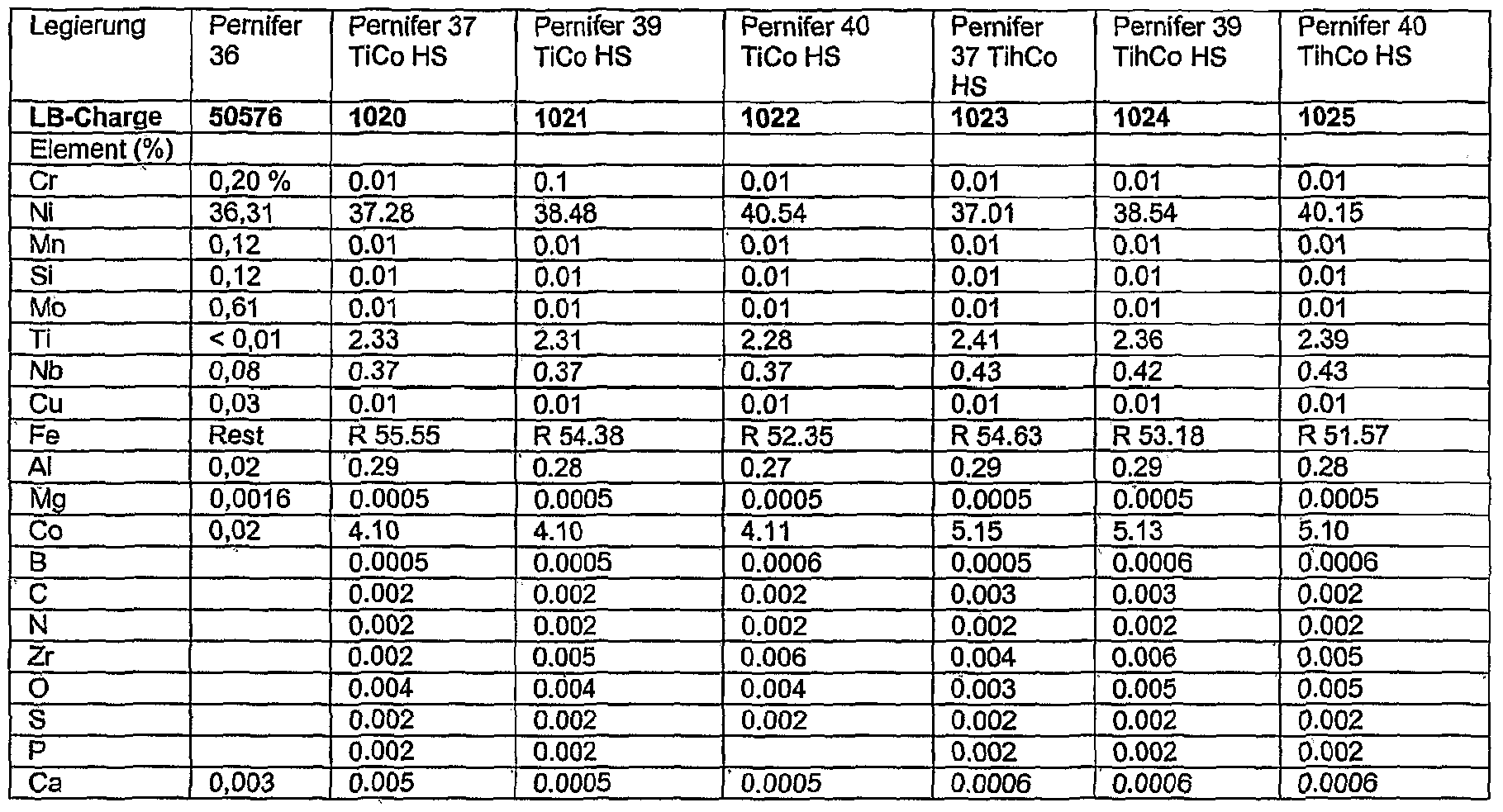
Tabelle 2Table 2
Die Laborschmelzen LB1018 bis LB1025 wurden geschmolzen und im Block vergossen. Die Blöcke wurden an 12 mm Blechstärke warm gewalzt. Jeweils eine Hälfte der Blöcke wurde an 12 mm belassen und lösungsgeglüht. Die zweite Hälfte wurde an 5,1 mm weiter gewalzt.The laboratory melts LB1018 to LB1025 were melted and cast in the block. The blocks were hot rolled to 12 mm plate thickness. One half each of the blocks was left at 12 mm and solution annealed. The second half was further rolled to 5.1 mm.
Die Tabellen 3/3a und 4/4a zeigen die mechanischen Eigenschaften einerseits der zwei und andererseits der sechs Laborchargen im Vergleich zu den beiden Pernifer-Vergleichschargen bei Raumtemperatur.Tables 3 / 3a and 4 / 4a show the mechanical properties on the one hand of the two and on the other hand of the six laboratory batches compared to the two Pernifer reference batches at room temperature.
Gemäß Tabelle 3/3a wurden Messwerte an kalt gewalztem Material der Dicke 4,1 bis 4,2 mm in den Zuständen gewalzt und lösungsgeglüht ermittelt. Die jeweiligen Proben wurden, ausgehend vom warmgewalzten Zustand, kalt gewalzt, welche aus den 12 mm dicken Blechen warm gewalzt wurden. According to Table 3 / 3a, measured values were cold-rolled and solution annealed on cold-rolled material with a thickness of 4.1 to 4.2 mm in the states. The respective samples were cold rolled, starting from the hot rolled state, which were hot rolled from the 12 mm thick sheets.

Tabelle 3a: Mechanische Eigenschaften (kobalthaltige Legierungen) Gemäß Tabelle 4/4a sind die mechanischen Eigenschaften der zwei bzw. sechs Laborchargen im Vergleich zu Pernifer 36 bei Raumtemperatur im lösungsgeglühten und ausgehärteten Zustand sowie im nur ausgehärteten Zustand dargestellt. Messwerte wurden ermittelt an kalt gewalzten Proben der Dicke 4,1 bis 4,2 mm in den Zuständen gewalzt und lösungsgeglüht. Die Proben wurden, ausgehend von warm gewalztem Material, kalt gewalzt, welche aus den 12 mm dicken Blechen warm gewalzt wurden.Table 3a: Mechanical properties (cobalt-containing alloys) According to Table 4 / 4a, the mechanical properties of the two or six laboratory batches compared to Pernifer 36 are shown at room temperature in the solution-annealed and cured state and in the only cured state. Measurements were taken on cold-rolled samples of thickness 4.1 to 4.2 mm rolled in the states and solution annealed. The samples were cold rolled starting from hot rolled material, which was hot rolled from the 12 mm thick sheets.

Tabelle 4: Mechanische Eigenschaften bei Raumtemperatur (kobaltfreie Legierungen) Table 4: Mechanical properties at room temperature (cobalt-free alloys)
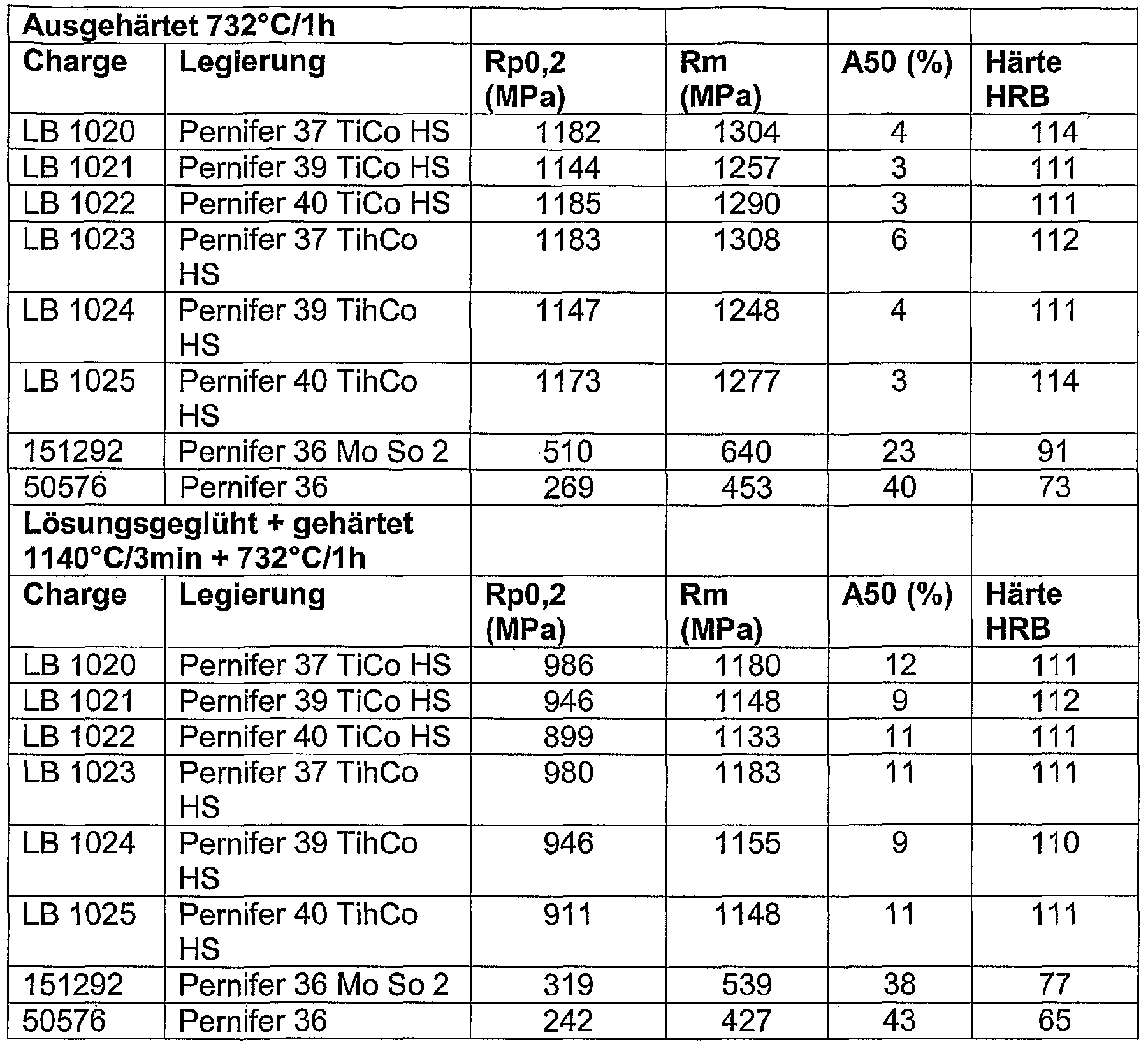
Tabelle 4a: Mechanische Eigenschaften bei Raumtemperatur (kobalthaltige Legierungen)Table 4a: Mechanical properties at room temperature (cobalt-containing alloys)
Tabelle 5/5a zeigt die mechanischen Eigenschaften der zwei bzw. sechs Laborchargen im Vergleich zu Pernifer 36 bei Raumtemperatur im lösungsgeglühten (1140°C/3min) und ausgehärteten Zustand (732°C/6 Std., oben; 600°C/16 Std., unten). Messwerte wurden ermittelt an kalt gewalzten Proben der Dicke 4,1 bis 4,2 mm in den Zuständen gewalzt und lösungsgeglüht. Die Proben wurden, ausgehend von warm gewalztem Material, kalt gewalzt, welche aus den 12 mm dicken Blechen warm gewalzt wurden. Table 5 / 5a shows the mechanical properties of the two or six laboratory batches compared to Pernifer 36 at room temperature in the solution annealed (1140 ° C / 3min) and cured state (732 ° C / 6h, top; 600 ° C / 16h) ., below). Measurements were taken on cold-rolled samples of thickness 4.1 to 4.2 mm rolled in the states and solution annealed. The samples were cold rolled starting from hot rolled material, which was hot rolled from the 12 mm thick sheets.

Tabelle 5: Mechanische Eigenschaften bei Raumtemperatur (kobaltfreie Legierungen) Table 5: Mechanical properties at room temperature (cobalt-free alloys)

Tabelle 5a: Mechanische Eigenschaften bei Raumtemperatur (kobalthaltige Legierungen)Table 5a: Mechanical properties at room temperature (cobalt-containing alloys)
Tabelle 6/6a zeigt mittlere Wärmeausdehnungskoeffizienten (20 bis 2000C) in 10" 6/K) der zwei bzw. sechs Laborschargen im Vergleich zu Pernifer 36 in verschiedenen Zuständen:Table 6 / 6a shows mean thermal expansion coefficient (20 to 200 0 C) in 10 "-6 / K) of the two or six laboratory batches compared to Pernifer 36 in various states:
A) warm gewalztes 12 mm dickes Blech, lösungsgeglüht B) warm gewalztes 12 mm dickes Blech, lösungsgeglüht und 1 Stunde bei 7320C ausgehärtet C1D1E1F) an 5 mm warm gewalzt (ausgehend vom 12 mm Blech), kalt an 4,15 mm gewalzt.A) Hot-rolled 12 mm thick sheet, solution B) Hot-rolled 12 mm thick sheet, solution treated and cured for 1 hour at 732 0 C. C 1 D 1 E 1 F) hot rolled to 5 mm (starting from 12 mm sheet), cold rolled to 4.15 mm.
C) ausgehärtet bei 732°C/1 Std.C) cured at 732 ° C / 1 hr.
D) lösungsgeglüht, 1140°C/3 min. und ausgehärtet 732°C/1 Std.D) solution annealed, 1140 ° C / 3 min. and cured 732 ° C / 1 hr.
E) lösungsgeglüht, 1140°C/3 min. und ausgehärtet 732°C/6 Std.E) solution annealed, 1140 ° C / 3 min. and cured 732 ° C / 6 hours
F) lösungsgeglüht, 1140°C/3 min. und ausgehärtet 600°C/16 Std.F) solution annealed, 1140 ° C / 3 min. and cured at 600 ° C / 16 hrs.

Tabelle 6a Diskussion der ErgebnisseTable 6a discussion of the results
A Kobaltfreie LegierungenA cobalt-free alloys
Im kalt gewalzten Zustand (Tab. 3, oben) liegt die Streckgrenze Rp0,2 im Fall der LB-Chargen zwischen 715 und 743 MPa. Die Zugfestigkeit Rm liegt zwischen 801 und 813 MPa. Die Dehnwerte A50 liegen bei 11 %, die Härten HRB zwischen 100 und 101.In the cold rolled state (Table 3, top), the yield strength R p0 , 2 in the case of LB batches is between 715 and 743 MPa. The tensile strength R m is between 801 and 813 MPa. The elongation values A 50 are 11%, the hardnesses HRB between 100 and 101.
Dagegen sind die mechanischen Festigkeitswerte im Fall von Pernifer 36 Mo So 2 niedriger (Rpo,2 = 693 MPa, R171 = 730 MPa) und bei Pernifer 36 deutlich niedriger (Rpo,2 = 558 MPa, Rm = 592%).In contrast, in the case of Pernifer 36 Mo So 2, the mechanical strength values are lower (R p o, 2 = 693 MPa, R 171 = 730 MPa) and significantly lower for Pernifer 36 (R p o, 2 = 558 MPa, R m = 592) %).
Im lösungsgeglühten Zustand (Tab. 3, unten) liegen die Werte der Streckgrenze zwischen 366 und 394 MPa im Fall der LB-Chargen, die Zugfestigkeiten Rm liegen zwischen 619 und 640 MPa. Entsprechend höher liegen die Dehnwerte bzw. niedriger die Härtewerte. Die Festigkeit von Pernifer 36 Mo So 2 ist im lösungsgeglühten Zustand niedriger (Rp0,2 = 327 MPa, Rm = 542 MPa) sowie die von Pernifer 36 deutlich niedriger (Rp0,2 = 255 MPa, Rm = 433 MPa).In the solution-annealed condition (Table 3, bottom), the values of the yield strength are between 366 and 394 MPa in the case of LB batches, the tensile strengths R m are between 619 and 640 MPa. Correspondingly higher are the elongation values or lower the hardness values. The strength of Pernifer 36 Mo So 2 is lower in the solution- annealed state (R p0 , 2 = 327 MPa, R m = 542 MPa) and that of Pernifer 36 is significantly lower (R p0 , 2 = 255 MPa, R m = 433 MPa) ,
Die höchsten Festigkeitswerte werden erzielt, wenn die LB-Chargen z.B. bei 732°C/1h im zuvor gewalzten Zustand (d.h. ohne vorherige Lösungsglühung) ausgehärtet werden (Tab. 4, oben). In diesem Fall erreichen die LB-Chargen Werte der Streckgrenze Rp0i2 von 1197 bis 1205 MPa und für die Zugfestigkeit Rm Werte zwischen 1286 und 1299 MPa. Die Dehnwerte liegen dann nur noch bei 2 bis 3%. Die Härte HRB steigt auf werte von 111 bis 113. Im gleichen Walz- und Glühzustand weisen die Legierungen Pernifer 36 Mo So 2 und Pernifer 36 wesentlich niedrigere Festigkeitswerte auf (Rpo,2 = 510 MPa bzw. 269 MPa; Rm = 640 MPa bzw. 453 MPa).The highest strength values are achieved when the LB batches are cured eg at 732 ° C./1 h in the previously rolled state (ie without prior solution annealing) (Table 4, top). In this case, the LB batches reach values of the yield strength R p0i2 of 1197 to 1205 MPa and for the tensile strength R m values between 1286 and 1299 MPa. The expansion values are then only at 2 to 3%. The hardness HRB increases to values of 111 to 113. In the same rolling and annealing state, the alloys Pernifer 36 Mo So 2 and Pernifer 36 have substantially lower strength values (R p o, 2 = 510 MPa and 269 MPa, R m = 640) MPa or 453 MPa).
Da zum Blechformen der lösungsgeglühte Zustand der geeignete ist, sind die mechanischen Eigenschaften im Zustand „lösungsgeglüht + gehärtet" relevant. In Tab. 4, unten sind die zugehörigen Werte für eine Wärmebehandlung von 1140°C/3min + 732°C/1 h aufgelistet. In diesem Fall erreichen die LB-Chargen Werte der Streckgrenze Rp0,2 von 896 bis 901 MPa und Zugfestigkeiten Rm zwischen 1125 und 1135 MPa. In diesem Glühzustand weisen die Legierungen Pernifer 36 Mo So 2 und Pernifer 36 deutlich niedrigere Festigkeitswerte auf.Since the solution-annealed state is suitable for sheet-metal forming, the mechanical properties in the "solution-annealed + cured" state are relevant Table 4, below, the associated values for a heat treatment of 1140 ° C / 3min + 732 ° C / 1 h are listed. In this case, the LB batches reach values of yield strength R p0 , 2 from 896 to 901 MPa and tensile strengths R m between 1125 and 1135 MPa. In this annealing condition, the alloys Pernifer 36 Mo So 2 and Pernifer 36 have significantly lower strength values.
Eine Verlängerung der Glühdauer auf 6h der härtenden Wärmebehandlung bei 732°C verändert die Festigkeitswerte (s. Tab. 5, oben) auf Bereiche Rpo,2 von 926 - 929 MPa und Zugfestigkeiten Rm zwischen 1142 und 1152 MPa. Auch hier weisen die Vergleichslegierungen deutlich niedrigere Festigkeitswerte auf.An extension of the annealing time to 6 h of the hardening heat treatment at 732 ° C. changes the strength values (see Table 5, top) to areas R p o, 2 of 926-929 MPa and tensile strengths R m between 1142 and 1152 MPa. Again, the comparative alloys have significantly lower strength values.
Die Erniedrigung der Glühtemperatur auf 6000C der härtenden Wärmebehandlung bei einer Glühdauer von 16h erniedrigt die Festigkeitswerte im Allgemeinen bei den LB-Chargen deutlicher, insbesondere im Fall der Zugfestigkeit Rm (s. Tab. 5, unten).The lowering of the annealing temperature to 600 0 C the curing heat treatment reduces the strength values generally at the LB batches clearly at an annealing time of 16 h, in particular in the case of the tensile strength R m (s. Tab. 5, below).
Tabelle 6 zeigt die Werte des mittleren Wärmeausdehnungskoeffizienten CTE(20- 100°C) für die untersuchten Legierungen in den betrachteten Zuständen.Table 6 shows the values of the mean thermal expansion coefficient CTE (20-100 ° C) for the alloys under consideration in the states considered.
Die chemische Zusammensetzung beeinflusst die Curie-Temperatur und damit die Knickpunkttemperatur, oberhalb der die Wärmeausdehnungskurve steiler ansteigt.The chemical composition influences the Curie temperature and thus the break point temperature, above which the thermal expansion curve increases more steeply.
Abbildung 1 zeigt Ausdehnungskoeffizienten (CTE) 20-1000C und 20 - 2000C der LB-Chargen im Zustand B (s. Tab. 6), d.h. warm gewalztes 12mm Blech, lösungsgeglüht + 1 h bei 732°C gehärtet, in Abhängigkeit vom Ni-Gehalt der Laborschmelze.Figure 1 shows expansion coefficient (CTE) 20-100 0 C and 20 - (. S Tab. 6) 200 0 C the LB batches in the state B, that is, hot rolled sheet 12 mm, solution + 1 h cured at 732 ° C, in Dependence on the Ni content of the laboratory melt.
Die Charge LB 1018 mit einem Ni-Gehalt von 40,65% weist einen niedrigeren Ausdehnungskoeffizienten auf als die Charge LB 1019 mit einem Ni-Gehalt von 41 ,55%. Eine Testschmelze mit noch geringerem Ni-Gehalt (Ni: 39,5%, Ti: 2,28%, Nb: 0,37%, Fe: Rest, AI: 0,32%) zeigte, dass das Optimum bei etwa 41% Nickel erreicht ist. Für den Wärmeausdehnungskoeffizienten zwischen 200C und 2000C verschiebt sich das Optimum zu etwas höherem Ni-Gehalt (-41 ,5%).The charge LB 1018 with a Ni content of 40.65% has a lower coefficient of expansion than the batch LB 1019 with a Ni content of 41. 55%. A test melt with even lower Ni content (Ni: 39.5%, Ti: 2.28%, Nb: 0.37%, Fe: residual, Al: 0.32%) showed that the optimum was about 41%. nickel is reached. For the coefficient of thermal expansion between 20 0 C and 200 0 C, the optimum shifts to slightly higher Ni content (-41, 5%).
B Kobalthaltige LegierungenB Cobalt-containing alloys
Im gewalzten Zustand (Tab. 3a, oben) liegt die Streckgrenze Rpo,2 im Fall der LB- Chargen zwischen 706 und 801 MPa. Den niedrigsten Wert weist die Charge LB 1025 auf, den höchsten Wert die Charge LB 1021. Die Zugfestigkeit Rm liegt zwischen 730 und 819 MPa (niedrigster Wert bei LB 1025, höchster Wert bei LB 1020). Die Dehnwerte A50 bewegen sich zwischen 11 und 15%, die Härten HRB zwischen 97 und 100.In the rolled state (Table 3a, top), the yield point R p o, 2 in the case of LB batches is between 706 and 801 MPa. The lowest value is the batch LB 1025, the highest value is the batch LB 1021. The tensile strength R m is between 730 and 819 MPa (lowest value for LB 1025, highest value for LB 1020). The elongation values A 50 range between 11 and 15%, the hardnesses HRB between 97 and 100.
Dagegen sind die mechanischen Festigkeitswerte im Fall von Pernifer 36 Mo So 2 niedriger (Rpo,2 = 693 MPa, Rm = 730 MPa) und bei Pernifer 36 deutlich niedriger (RPo,2 = 558 MPa, Rm = 592 MPa).In contrast, in the case of Pernifer 36 Mo So 2, the mechanical strength values are lower (R p o, 2 = 693 MPa, R m = 730 MPa) and significantly lower for Pernifer 36 (R P o, 2 = 558 MPa, R m = 592) MPa).
Im lösungsgeglühten Zustand (Tab. 3a, unten) liegen die Werte der Streckgrenze zwischen 401 und 453 MPa im Fall der LB-Chargen, die Zugfestigkeiten Rm liegen zwischen 645 und 680 MPa. Entsprechend höher liegen die Dehnwerte bzw. niedriger die Härtewerte. Die Festigkeit von Pernifer 36 Mo So 2 ist im lösungsgeglühten Zustand niedriger (Rp0,2 = 327 MPa, Rm = 542 MPa) sowie die von Pernifer 36 deutlich niedriger (Rp0,2 = 255 MPa, Rm = 433 MPa).In the solution-annealed condition (Table 3a, bottom), the values of the yield strength lie between 401 and 453 MPa in the case of LB batches, and the tensile strengths R m are between 645 and 680 MPa. Correspondingly higher are the elongation values or lower the hardness values. The strength of Pernifer 36 Mo So 2 is lower in the solution- annealed state (R p0 , 2 = 327 MPa, R m = 542 MPa) and that of Pernifer 36 is significantly lower (R p0 , 2 = 255 MPa, R m = 433 MPa) ,
Die höchsten Festigkeitswerte können erzielt werden, wenn die LB-Chargen z. B. bei 732°C/1h im zuvor gewalzten Zustand (d.h. ohne vorherige Lösungsglühung) ausgehärtet werden (Tab. 4a, oben). In diesem Fall erreichen die LB-Chargen Werte der Streckgrenze Rp0,2 von 1144 bis 1185 MPa und für die Zugfestigkeit Rm Werte zwischen 1248 und 1308 MPa. Die Dehnwerte liegen dann nur noch bei 3 bis 6%. Die Härte HRB steigt auf werte von 111 bis 114. Im gleichen Walz- und Glühzustand weisen die Legierungen Pernifer 36 Mo So 2 und Pernifer 36 wesentlich niedrigere Festigkeitswerte auf (Rpo,2 = 510 MPa bzw. 269 MPa; Rm = 640 MPa bzw. 453 MPa). Da zum Blechformen der lösungsgeglühte Zustand der geeignete ist, sind die mechanischen Eigenschaften im Zustand „lösungsgeglüht + gehärtet" relevant. In Tab. 4a, unten sind die zugehörigen Werte für eine Wärmebehandlung von 1140°C/3min + 732°C/1 h aufgelistet. In diesem Fall erreichen die LB-Chargen Werte der Streckgrenze Rp0,2 von 899 bis 986 MPa und Zugfestigkeiten Rm zwischen 1133 und 1183 MPa. In diesem Glühzustand weisen die Legierungen Pernifer 36 Mo So 2 und Pernifer 36 deutlich niedrigere Festigkeitswerte auf.The highest strength values can be achieved if the LB batches z. B. at 732 ° C / 1h in the previously rolled state (ie without previous solution annealing) are cured (Table 4a, above). In this case, the LB batches reach values of the yield strength R p0 , 2 of 1144 to 1185 MPa and for the tensile strength R m values between 1248 and 1308 MPa. The expansion values are then only at 3 to 6%. The hardness HRB increases to values of 111 to 114. In the same rolling and annealing state, the alloys Pernifer 36 Mo So 2 and Pernifer 36 have substantially lower strength values (R p o, 2 = 510 MPa and 269 MPa, R m = 640) MPa or 453 MPa). Since the solution-annealed state is suitable for sheet-metal forming, the mechanical properties in the "solution-annealed + cured" state are relevant In Table 4a, below, the associated values for a heat treatment of 1140 ° C / 3min + 732 ° C / 1h are listed In this case, the LB batches reach values of yield strength R p0 , 2 of 899 to 986 MPa and tensile strengths R m between 1133 and 1183 MPa In this annealed condition, the alloys Pernifer 36 Mo So 2 and Pernifer 36 have significantly lower strength values.
Eine Verlängerung der Glühdauer auf 6h der härtenden Wärmebehandlung bei 732°C verändert die Festigkeitswerte (s. Tab. 5a, oben) dergestalt, dass Werte der Streckgrenze Rp0,2 zwischen 916 und 950 MPa und Zugfestigkeiten Rm zwischen 1142 und 1179 MPa erreicht werden.An extension of the annealing time to 6 h of the hardening heat treatment at 732 ° C. changes the strength values (see Table 5a, above) such that values of the yield strength R p0 , 2 reach between 916 and 950 MPa and tensile strengths R m between 1142 and 1179 MPa become.
Die Erniedrigung der Glühtemperatur auf 6000C der härtenden Wärmebehandlung bei einer Glühdauer von 16h erniedrigt die Festigkeitswerte im Allgemeinen bei den LB-Chargen deutlicher, insbesondere im Fall der Zugfestigkeit Rm (s. Tab. 5a, unten).The lowering of the annealing temperature to 600 0 C the curing heat treatment reduces the strength values generally at the LB batches clearly at an annealing time of 16 h, in particular in the case of the tensile strength R m (s. Tab. 5, below).
In Tabelle 6a sind die Werte des mittleren Wärmeausdehnungskoeffizienten CTE(20-100°C) für die untersuchten Legierungen in den betrachteten Zuständen aufgeführt. Gute Werte zeigen z.B. LB1021 u. LB1023.Table 6a shows the values of the mean thermal expansion coefficient CTE (20-100 ° C) for the tested alloys in the considered states. Good values are shown by e.g. LB1021 u. LB1023.
Die chemische Zusammensetzung beeinflusst die Curie-Temperatur und damit die Knickpunkttemperatur, oberhalb der die Wärmeausdehnungskurve steiler ansteigt.The chemical composition influences the Curie temperature and thus the break point temperature, above which the thermal expansion curve increases more steeply.
In den Abbildungen 2 und 3 sind die Ausdehnungskoeffizienten 20 - 1000C (Abb. 2) und 20 - 2000C (Abb. 3) der 6 LB-Chargen in den Serien mit Co-Gehalten 4,1 % und 5,1 % im Zustand B (s. Tab. 6a), d.h. warm gewalztes 12 mm Blech, lösungsgeglüht + 1h bei 732°C gehärtet, in Abhängigkeit vom Ni-Gehalt der Laborschmelze dargestellt. Bei der Serie mit 4,1% Co zeigt sich ein minimaler Ausdehnungskoeffizient im T- Bereich zwischen 20 und 1000C bei etwa 38,5% Ni, im T-Bereich 20 - 2000C bei 39,5% Ni. Im Fall der Serie mit 5,1% Co fällt der Ausdehnungskoeffizient bei den drei untersuchten LB-Chargen mit abnehmendem Ni-Gehalt.In Figures 2 and 3, the coefficients of expansion are 20-100 ° C (Figure 2) and 20-200 ° C (Figure 3) of the 6 LB batches in the series with 4.1% and 5.1 Co contents, respectively % in state B (see Table 6a), ie hot-rolled 12 mm sheet, solution-treated + cured for 1 h at 732 ° C, depending on the Ni content of the laboratory melt. In the series with 4.1% Co, a minimum expansion coefficient in the T range between 20 and 100 0 C at about 38.5% Ni, in the T range 20 - 200 0 C at 39.5% Ni shows. In the case of the 5.1% Co series, the coefficient of expansion for the three LB lots investigated decreases with decreasing Ni content.
Insbesondere der T-Bereich 20 - 2000C ist interessant für die Anwendung im Formenbau, da das Aushärten des CFKs bei etwa 2000C erfolgt. Die Unterschiede im Wärmeausdehnungskoeffizienten zwischen den 4% Co- und 5% Co-haltigen Legierungen ist so gering, dass aus Kostengründen die Legierungen mit dem höhere Co-gehalt nicht zu rechtfertigen sind. In particular, the T-range 20 - 200 0 C is interesting for use in mold making, since the curing of the CFK takes place at about 200 0 C. The differences in the coefficient of thermal expansion between the 4% Co and 5% Co-containing alloys is so small that, for reasons of cost, the alloys with the higher co-content can not be justified.
Claims

Priority Applications (8)
| Application Number | Priority Date | Filing Date | Title |
|---|---|---|---|
| EP07721864A EP1979501B1 (en) | 2006-02-02 | 2007-01-26 | Iron-nickel alloy |
| US12/223,130 US8808475B2 (en) | 2006-02-02 | 2007-01-26 | Iron-nickel alloy |
| JP2008552671A JP5175225B2 (en) | 2006-02-02 | 2007-01-26 | Iron-nickel-alloy |
| CA2637790A CA2637790C (en) | 2006-02-02 | 2007-01-26 | Iron-nickel alloy |
| BRPI0707449A BRPI0707449B1 (en) | 2006-02-02 | 2007-01-26 | creep resistant iron-nickel alloy and alloy use |
| AT07721864T ATE462021T1 (en) | 2006-02-02 | 2007-01-26 | IRON-NICKEL ALLOY |
| DE502007003218T DE502007003218D1 (en) | 2006-02-02 | 2007-01-26 | IRON NICKEL ALLOY |
| CN2007800036976A CN101495663B (en) | 2006-02-02 | 2007-01-26 | Iron-nickel alloy |
Applications Claiming Priority (2)
| Application Number | Priority Date | Filing Date | Title |
|---|---|---|---|
| DE102006005250.1 | 2006-02-02 | ||
| DE102006005250A DE102006005250B4 (en) | 2006-02-02 | 2006-02-02 | Iron-nickel alloy |
Publications (1)
| Publication Number | Publication Date |
|---|---|
| WO2007087785A1 true WO2007087785A1 (en) | 2007-08-09 |
Family
ID=38016856
Family Applications (1)
| Application Number | Title | Priority Date | Filing Date |
|---|---|---|---|
| PCT/DE2007/000141 Ceased WO2007087785A1 (en) | 2006-02-02 | 2007-01-26 | Iron-nickel alloy |
Country Status (10)
| Country | Link |
|---|---|
| US (1) | US8808475B2 (en) |
| EP (1) | EP1979501B1 (en) |
| JP (1) | JP5175225B2 (en) |
| CN (2) | CN101495663B (en) |
| AT (1) | ATE462021T1 (en) |
| BR (1) | BRPI0707449B1 (en) |
| CA (1) | CA2637790C (en) |
| DE (2) | DE102006005250B4 (en) |
| ES (1) | ES2341048T3 (en) |
| WO (1) | WO2007087785A1 (en) |
Cited By (2)
| Publication number | Priority date | Publication date | Assignee | Title |
|---|---|---|---|---|
| WO2009135469A1 (en) * | 2008-05-08 | 2009-11-12 | Thyssenkrupp Vdm Gmbh | Iron-nickel alloy |
| WO2014118442A1 (en) * | 2013-02-01 | 2014-08-07 | Aperam | Welding wire for fe-36ni alloy |
Families Citing this family (18)
| Publication number | Priority date | Publication date | Assignee | Title |
|---|---|---|---|---|
| US10435780B2 (en) | 2009-06-11 | 2019-10-08 | Genius Solutions Engineering Company | Low CTE slush molds with textured surface, and method of making and using the same |
| GB2480625A (en) * | 2010-05-25 | 2011-11-30 | Advanced Composites Group Ltd | Mould tool comprising a foamed Ferrous/Nickel alloy |
| CN102888557B (en) * | 2011-07-18 | 2014-10-29 | 宝钢特钢有限公司 | High-strength and low-expansion coefficient alloy wire and manufacturing method thereof |
| CN103185058B (en) * | 2011-12-29 | 2015-04-08 | 财团法人金属工业研究发展中心 | Low thermal expansion screw |
| CN103084753B (en) * | 2013-01-23 | 2016-07-27 | 宝山钢铁股份有限公司 | A kind of ferronickel Precise Alloy welding wire |
| CN103074523B (en) * | 2013-01-31 | 2015-05-13 | 安徽工业大学 | Mould material for detecting high-temperature fatigue performance and preparation method of mould material |
| CN104630566B (en) * | 2015-02-06 | 2017-01-25 | 铜陵百荣新型材料铸件有限公司 | Ferro-nickel alloy and preparation method thereof |
| AU2016218315B2 (en) * | 2015-02-13 | 2018-02-08 | Cardiac Pacemakers, Inc. | Implantable electrode |
| US20190035744A1 (en) * | 2016-03-31 | 2019-01-31 | Tdk Corporation | Electronic circuit package using composite magnetic sealing material |
| US20190387615A1 (en) * | 2018-06-14 | 2019-12-19 | Microsoft Technology Licensing, Llc | Multi-layer interconnected electro-thermal system having a thermally non-expansive support for mounting positionally related sensor components |
| TWI805853B (en) * | 2018-09-27 | 2023-06-21 | 日商日鐵化學材料股份有限公司 | Metal mask material, manufacturing method and metal mask |
| CN113195763B (en) * | 2019-03-26 | 2022-02-18 | 日本铸造株式会社 | Low thermal expansion alloy excellent in low temperature stability and method for producing the same |
| CN111074181B (en) * | 2019-12-26 | 2021-01-15 | 东莞市振亮精密科技有限公司 | A 5G antenna mount and its forming method |
| CN112159942A (en) * | 2020-08-18 | 2021-01-01 | 重庆材料研究院有限公司 | Constant elasticity alloy for radiation-resistant sensor and preparation method thereof |
| CN112962033B (en) * | 2021-02-01 | 2021-11-19 | 山西太钢不锈钢股份有限公司 | High-strength invar alloy and processing method thereof |
| CN114633045A (en) * | 2022-04-01 | 2022-06-17 | 山西太钢不锈钢股份有限公司 | Welding material suitable for iron-nickel alloy welding and application thereof |
| CA3253930A1 (en) * | 2022-05-27 | 2023-11-30 | Aperam | Alliage pour la fabrication d'outillages destines a la fabrication de pieces aeronautiques realisees en materiau composite |
| JP7735246B2 (en) * | 2022-12-02 | 2025-09-08 | 日本鋳造株式会社 | Low thermal expansion alloy with excellent mechanical properties and method for producing same |
Citations (7)
| Publication number | Priority date | Publication date | Assignee | Title |
|---|---|---|---|---|
| US3971677A (en) * | 1974-09-20 | 1976-07-27 | The International Nickel Company, Inc. | Low expansion alloys |
| US5688471A (en) * | 1995-08-25 | 1997-11-18 | Inco Alloys International, Inc. | High strength low thermal expansion alloy |
| JPH10310845A (en) * | 1997-05-13 | 1998-11-24 | Tohoku Tokushuko Kk | High strength low thermal expansion alloy |
| JPH11293413A (en) * | 1998-04-13 | 1999-10-26 | Nippon Chuzo Kk | Member of ultraprecision equipment using alloy steel excellent in thermal shape stability and rigidity |
| EP1063304A1 (en) * | 1999-06-22 | 2000-12-27 | Imphy Ugine Precision | Masking device for a colour flat screen cathode ray tube comprising a supporting frame for planar mask and planar mask |
| WO2001007673A1 (en) * | 1999-07-22 | 2001-02-01 | Krupp Vdm Gmbh | Iron-nickel alloy with creep resistance and low thermal expansion |
| EP1156126A1 (en) * | 2001-01-24 | 2001-11-21 | Imphy Ugine Precision | Process for manufacturing an Fe-Ni alloy strip |
Family Cites Families (11)
| Publication number | Priority date | Publication date | Assignee | Title |
|---|---|---|---|---|
| US3331715A (en) * | 1959-10-16 | 1967-07-18 | Westinghouse Electric Corp | Damping alloys and members prepared therefrom |
| US3514284A (en) | 1966-06-08 | 1970-05-26 | Int Nickel Co | Age hardenable nickel-iron alloy for cryogenic service |
| GB1401259A (en) * | 1973-05-04 | 1975-07-16 | Int Nickel Ltd | Low expansion alloys |
| JPS5554548A (en) * | 1978-10-12 | 1980-04-21 | Daido Steel Co Ltd | High strength, low expansion alloy |
| JPH02298236A (en) * | 1989-05-12 | 1990-12-10 | Shinichi Enomoto | Low thermal expansion alloy |
| JPH04180542A (en) | 1990-11-14 | 1992-06-26 | Hitachi Metals Ltd | High strength material reduced in thermal expansion |
| US5425912A (en) * | 1994-07-07 | 1995-06-20 | Inco Alloys International, Inc. | Low expansion superalloy with improved toughness |
| DE19934400C2 (en) * | 1999-07-22 | 2001-07-19 | Krupp Vdm Gmbh | Use of a creep-resistant, low-expansion iron-nickel alloy |
| FR2807269B1 (en) * | 2000-03-31 | 2002-11-01 | Imphy Ugine Precision | MASKING DEVICE FOR FLAT SCREEN COLOR DISPLAY CATHODIC TUBE WITH SHADOW MASK TENSIONED IN FE-NI ALLOYS |
| FR2855185B1 (en) | 2003-05-21 | 2006-08-11 | Usinor | FE-NI ALLOY METAL WIRE HAVING HIGH MECHANICAL STRENGTH AND LOW THERMAL EXPANSION COEFFICIENT FOR HIGH VOLTAGE CABLES AND METHOD OF MANUFACTURE |
| JP4180542B2 (en) | 2004-05-27 | 2008-11-12 | 日本電信電話株式会社 | Shortest path selection method, node and multilayer network |
-
2006
- 2006-02-02 DE DE102006005250A patent/DE102006005250B4/en not_active Expired - Fee Related
-
2007
- 2007-01-26 ES ES07721864T patent/ES2341048T3/en active Active
- 2007-01-26 US US12/223,130 patent/US8808475B2/en active Active
- 2007-01-26 CN CN2007800036976A patent/CN101495663B/en active Active
- 2007-01-26 BR BRPI0707449A patent/BRPI0707449B1/en active IP Right Grant
- 2007-01-26 EP EP07721864A patent/EP1979501B1/en active Active
- 2007-01-26 DE DE502007003218T patent/DE502007003218D1/en active Active
- 2007-01-26 CN CN2012103955443A patent/CN102965570A/en active Pending
- 2007-01-26 CA CA2637790A patent/CA2637790C/en active Active
- 2007-01-26 WO PCT/DE2007/000141 patent/WO2007087785A1/en not_active Ceased
- 2007-01-26 AT AT07721864T patent/ATE462021T1/en active
- 2007-01-26 JP JP2008552671A patent/JP5175225B2/en active Active
Patent Citations (7)
| Publication number | Priority date | Publication date | Assignee | Title |
|---|---|---|---|---|
| US3971677A (en) * | 1974-09-20 | 1976-07-27 | The International Nickel Company, Inc. | Low expansion alloys |
| US5688471A (en) * | 1995-08-25 | 1997-11-18 | Inco Alloys International, Inc. | High strength low thermal expansion alloy |
| JPH10310845A (en) * | 1997-05-13 | 1998-11-24 | Tohoku Tokushuko Kk | High strength low thermal expansion alloy |
| JPH11293413A (en) * | 1998-04-13 | 1999-10-26 | Nippon Chuzo Kk | Member of ultraprecision equipment using alloy steel excellent in thermal shape stability and rigidity |
| EP1063304A1 (en) * | 1999-06-22 | 2000-12-27 | Imphy Ugine Precision | Masking device for a colour flat screen cathode ray tube comprising a supporting frame for planar mask and planar mask |
| WO2001007673A1 (en) * | 1999-07-22 | 2001-02-01 | Krupp Vdm Gmbh | Iron-nickel alloy with creep resistance and low thermal expansion |
| EP1156126A1 (en) * | 2001-01-24 | 2001-11-21 | Imphy Ugine Precision | Process for manufacturing an Fe-Ni alloy strip |
Non-Patent Citations (1)
| Title |
|---|
| J.R. DAVIS: "Nickel, Cobalt, and their alloys", 2000, ASM INTERNATIONAL, OHIO, XP002434631 * |
Cited By (5)
| Publication number | Priority date | Publication date | Assignee | Title |
|---|---|---|---|---|
| WO2009135469A1 (en) * | 2008-05-08 | 2009-11-12 | Thyssenkrupp Vdm Gmbh | Iron-nickel alloy |
| WO2014118442A1 (en) * | 2013-02-01 | 2014-08-07 | Aperam | Welding wire for fe-36ni alloy |
| KR20150110795A (en) * | 2013-02-01 | 2015-10-02 | 아뻬랑 | Welding wire for Fe-36Ni alloy |
| US10189120B2 (en) | 2013-02-01 | 2019-01-29 | Aperam | Welding wire for Fe—36Ni alloy |
| KR102069157B1 (en) | 2013-02-01 | 2020-01-22 | 아뻬랑 | Welding wire for Fe-36Ni alloy |
Also Published As
| Publication number | Publication date |
|---|---|
| DE102006005250B4 (en) | 2010-04-29 |
| DE502007003218D1 (en) | 2010-05-06 |
| BRPI0707449A2 (en) | 2011-05-03 |
| CN102965570A (en) | 2013-03-13 |
| CN101495663A (en) | 2009-07-29 |
| EP1979501B1 (en) | 2010-03-24 |
| BRPI0707449B1 (en) | 2015-09-08 |
| JP5175225B2 (en) | 2013-04-03 |
| EP1979501A1 (en) | 2008-10-15 |
| ATE462021T1 (en) | 2010-04-15 |
| CA2637790C (en) | 2013-10-22 |
| CN101495663B (en) | 2013-05-22 |
| ES2341048T3 (en) | 2010-06-14 |
| US20090047167A1 (en) | 2009-02-19 |
| JP2009525399A (en) | 2009-07-09 |
| DE102006005250A1 (en) | 2007-08-16 |
| US8808475B2 (en) | 2014-08-19 |
| CA2637790A1 (en) | 2007-08-09 |
Similar Documents
| Publication | Publication Date | Title |
|---|---|---|
| EP1979501B1 (en) | Iron-nickel alloy | |
| EP2956562B1 (en) | Nickel-cobalt alloy | |
| DE69230437T2 (en) | ELECTROCURABLE MARTENSITICAL STEEL | |
| EP3314031B1 (en) | High strength and easily reformable almg tape and method for producing the same | |
| DE60316212T2 (en) | Nickel-based alloy, hot-resistant spring made of this alloy and method of making this spring | |
| EP2480695B1 (en) | Method of manufactur an iron-chrome alloy. | |
| EP3825428B1 (en) | Die cast component and method for producing a die cast component | |
| EP2632628B1 (en) | Ni-fe-cr-mo alloy | |
| DE102017131218A1 (en) | A method of making an article from a maraging steel | |
| DE60020263T2 (en) | USE OF A DESIGN-HARDENED MARTENSITIC STAINLESS STEEL | |
| EP3102712B1 (en) | Hardened nickel-chromium-titanium-aluminum alloy with good wear resistance, creep resistance, corrosion resistance and workability | |
| DE102020106433A1 (en) | Nickel alloy with good corrosion resistance and high tensile strength as well as a process for the production of semi-finished products | |
| DE112021006352T5 (en) | METHOD FOR PRODUCING AN AUSTENITIC STAINLESS STEEL STRIP | |
| DE10320350B3 (en) | Soft magnetic iron-based alloy used as a material for magnetic bearings and rotors, e.g. in electric motors and in aircraft construction contains alloying additions of cobalt, vanadium and zirconium | |
| DE69106372T2 (en) | ALLOY WITH LOW THERMAL EXPANSION COEFFICIENT AND ITEM PRODUCED FROM IT. | |
| EP0570072B1 (en) | Method of producing a chromium-base alloy | |
| DE10159408B4 (en) | Fe-Cr-Ni-Al alloy having excellent oxidation resistance and high strength, and plate made of this alloy | |
| EP3412790A1 (en) | Precipitation hardening steel and use of such a steel for thermoforming tools | |
| DE69128293T2 (en) | Stainless steel | |
| DE1233148B (en) | Use of a martensite hardenable steel alloy for pressure and impact resistant objects | |
| DE1232759B (en) | Martensite-hardenable chrome-nickel steel | |
| EP1471160B1 (en) | Cold-worked Steel Object | |
| WO2016020519A1 (en) | High-strength and at the same time tough semifinished products and components of high-alloy steel, method for the production thereof and use | |
| EP2031080B1 (en) | High temperature alloy | |
| EP2154261B1 (en) | High temperature alloy |
Legal Events
| Date | Code | Title | Description |
|---|---|---|---|
| WWE | Wipo information: entry into national phase |
Ref document number: 200780003697.6 Country of ref document: CN |
|
| DPE2 | Request for preliminary examination filed before expiration of 19th month from priority date (pct application filed from 20040101) | ||
| 121 | Ep: the epo has been informed by wipo that ep was designated in this application | ||
| NENP | Non-entry into the national phase |
Ref country code: DE |
|
| WD | Withdrawal of designations after international publication |
Designated state(s): DE |
|
| WWE | Wipo information: entry into national phase |
Ref document number: 2007721864 Country of ref document: EP |
|
| WWE | Wipo information: entry into national phase |
Ref document number: 2637790 Country of ref document: CA |
|
| WWE | Wipo information: entry into national phase |
Ref document number: 2008552671 Country of ref document: JP |
|
| WWE | Wipo information: entry into national phase |
Ref document number: 12223130 Country of ref document: US |
|
| DPE2 | Request for preliminary examination filed before expiration of 19th month from priority date (pct application filed from 20040101) | ||
| WD | Withdrawal of designations after international publication |
Designated state(s): DE |
|
| ENP | Entry into the national phase |
Ref document number: PI0707449 Country of ref document: BR Kind code of ref document: A2 Effective date: 20080801 |