[go: up one dir, main page]

WO2007081571A2 - Cetp inhibitors - Google Patents

Cetp inhibitors Download PDF

Info

Publication number
WO2007081571A2
WO2007081571A2 PCT/US2006/049505 US2006049505W WO2007081571A2 WO 2007081571 A2 WO2007081571 A2 WO 2007081571A2 US 2006049505 W US2006049505 W US 2006049505W WO 2007081571 A2 WO2007081571 A2 WO 2007081571A2
Authority
WO
WIPO (PCT)
Prior art keywords
alkyl
optionally substituted
optionally
independently selected
phenyl
Prior art date
Legal status (The legal status is an assumption and is not a legal conclusion. Google has not performed a legal analysis and makes no representation as to the accuracy of the status listed.)
Ceased
Application number
PCT/US2006/049505
Other languages
French (fr)
Other versions
WO2007081571A3 (en
Inventor
Amjad Ali
Zhijian Lu
Peter J. Sinclair
Gayle E. Taylor
Christopher F. Thompson
Cameron J. Smith
Adrian A. Dowst
Yi-Heng Chen
Current Assignee (The listed assignees may be inaccurate. Google has not performed a legal analysis and makes no representation or warranty as to the accuracy of the list.)
Merck and Co Inc
Original Assignee
Merck and Co Inc
Priority date (The priority date is an assumption and is not a legal conclusion. Google has not performed a legal analysis and makes no representation as to the accuracy of the date listed.)
Filing date
Publication date
Application filed by Merck and Co Inc filed Critical Merck and Co Inc
Priority to EP06849193.5A priority Critical patent/EP1973889B1/en
Priority to CA002635010A priority patent/CA2635010A1/en
Priority to JP2008548752A priority patent/JP5199121B2/en
Priority to AU2006335110A priority patent/AU2006335110B2/en
Priority to US12/087,184 priority patent/US7781426B2/en
Publication of WO2007081571A2 publication Critical patent/WO2007081571A2/en
Publication of WO2007081571A3 publication Critical patent/WO2007081571A3/en
Anticipated expiration legal-status Critical
Ceased legal-status Critical Current

Links

Classifications

    • CCHEMISTRY; METALLURGY
    • C07ORGANIC CHEMISTRY
    • C07DHETEROCYCLIC COMPOUNDS
    • C07D263/00Heterocyclic compounds containing 1,3-oxazole or hydrogenated 1,3-oxazole rings
    • C07D263/02Heterocyclic compounds containing 1,3-oxazole or hydrogenated 1,3-oxazole rings not condensed with other rings
    • C07D263/08Heterocyclic compounds containing 1,3-oxazole or hydrogenated 1,3-oxazole rings not condensed with other rings having one double bond between ring members or between a ring member and a non-ring member
    • C07D263/16Heterocyclic compounds containing 1,3-oxazole or hydrogenated 1,3-oxazole rings not condensed with other rings having one double bond between ring members or between a ring member and a non-ring member with hetero atoms or with carbon atoms having three bonds to hetero atoms with at the most one bond to halogen, e.g. ester or nitrile radicals, directly attached to ring carbon atoms
    • C07D263/18Oxygen atoms
    • C07D263/20Oxygen atoms attached in position 2
    • AHUMAN NECESSITIES
    • A61MEDICAL OR VETERINARY SCIENCE; HYGIENE
    • A61PSPECIFIC THERAPEUTIC ACTIVITY OF CHEMICAL COMPOUNDS OR MEDICINAL PREPARATIONS
    • A61P3/00Drugs for disorders of the metabolism
    • A61P3/04Anorexiants; Antiobesity agents
    • AHUMAN NECESSITIES
    • A61MEDICAL OR VETERINARY SCIENCE; HYGIENE
    • A61PSPECIFIC THERAPEUTIC ACTIVITY OF CHEMICAL COMPOUNDS OR MEDICINAL PREPARATIONS
    • A61P3/00Drugs for disorders of the metabolism
    • A61P3/06Antihyperlipidemics
    • AHUMAN NECESSITIES
    • A61MEDICAL OR VETERINARY SCIENCE; HYGIENE
    • A61PSPECIFIC THERAPEUTIC ACTIVITY OF CHEMICAL COMPOUNDS OR MEDICINAL PREPARATIONS
    • A61P43/00Drugs for specific purposes, not provided for in groups A61P1/00-A61P41/00
    • AHUMAN NECESSITIES
    • A61MEDICAL OR VETERINARY SCIENCE; HYGIENE
    • A61PSPECIFIC THERAPEUTIC ACTIVITY OF CHEMICAL COMPOUNDS OR MEDICINAL PREPARATIONS
    • A61P9/00Drugs for disorders of the cardiovascular system
    • A61P9/10Drugs for disorders of the cardiovascular system for treating ischaemic or atherosclerotic diseases, e.g. antianginal drugs, coronary vasodilators, drugs for myocardial infarction, retinopathy, cerebrovascula insufficiency, renal arteriosclerosis
    • AHUMAN NECESSITIES
    • A61MEDICAL OR VETERINARY SCIENCE; HYGIENE
    • A61PSPECIFIC THERAPEUTIC ACTIVITY OF CHEMICAL COMPOUNDS OR MEDICINAL PREPARATIONS
    • A61P9/00Drugs for disorders of the cardiovascular system
    • A61P9/12Antihypertensives
    • CCHEMISTRY; METALLURGY
    • C07ORGANIC CHEMISTRY
    • C07DHETEROCYCLIC COMPOUNDS
    • C07D413/00Heterocyclic compounds containing two or more hetero rings, at least one ring having nitrogen and oxygen atoms as the only ring hetero atoms
    • C07D413/02Heterocyclic compounds containing two or more hetero rings, at least one ring having nitrogen and oxygen atoms as the only ring hetero atoms containing two hetero rings
    • C07D413/06Heterocyclic compounds containing two or more hetero rings, at least one ring having nitrogen and oxygen atoms as the only ring hetero atoms containing two hetero rings linked by a carbon chain containing only aliphatic carbon atoms
    • CCHEMISTRY; METALLURGY
    • C07ORGANIC CHEMISTRY
    • C07DHETEROCYCLIC COMPOUNDS
    • C07D413/00Heterocyclic compounds containing two or more hetero rings, at least one ring having nitrogen and oxygen atoms as the only ring hetero atoms
    • C07D413/02Heterocyclic compounds containing two or more hetero rings, at least one ring having nitrogen and oxygen atoms as the only ring hetero atoms containing two hetero rings
    • C07D413/10Heterocyclic compounds containing two or more hetero rings, at least one ring having nitrogen and oxygen atoms as the only ring hetero atoms containing two hetero rings linked by a carbon chain containing aromatic rings
    • CCHEMISTRY; METALLURGY
    • C07ORGANIC CHEMISTRY
    • C07DHETEROCYCLIC COMPOUNDS
    • C07D413/00Heterocyclic compounds containing two or more hetero rings, at least one ring having nitrogen and oxygen atoms as the only ring hetero atoms
    • C07D413/02Heterocyclic compounds containing two or more hetero rings, at least one ring having nitrogen and oxygen atoms as the only ring hetero atoms containing two hetero rings
    • C07D413/12Heterocyclic compounds containing two or more hetero rings, at least one ring having nitrogen and oxygen atoms as the only ring hetero atoms containing two hetero rings linked by a chain containing hetero atoms as chain links

Definitions

  • This invention relates to a class of chemical compounds that inhibit cholesterol ester transfer protein (CETP) and therefore have utility in raising HDL-C, lowering LDL-C, and in the treatment and prevention of atherosclerosis.
  • CETP cholesterol ester transfer protein
  • HMG-CoA Reductase inhibitors especially the statins
  • LDL-C Low Density Lipoprotein cholesterol
  • HDL-C High Density Lipoprotein cholesterol
  • cholesteryl ester transfer protein a plasma glycoprotein that catalyzes the movement of cholesteryl esters from HDL to the apoB containing lipoproteins, especially VLDL (see Hesler, C.B., et. al. (1987) Purification and characterization of human plasma cholesteryl ester transfer protein. J. Biol. Chem. 262(5), 2275-2282)).
  • CETP cholesteryl ester transfer protein
  • VLDL cholesteryl ester transfer protein
  • CETP plays a role in reverse cholesterol transport, the process whereby cholesterol is returned to the liver from peripheral tissues.
  • many animals do not possess CETP, including animals that have high HDL levels and are known to be resistant to coronary heart disease, such as rodents (see Guyard-Dangremont, V., et. al., (1998) Phospholipid and cholesteryl ester transfer activities in plasma from 14 vertebrate species. Relation to atherogenesis susceptibility, Comp. B ⁇ ochem. Physiol. B Biochem. MoI. Biol. 120(3), 517-525).
  • statins such as simvastatin (ZOCOR®) represent
  • statins only achieve a risk reduction of approximately one-third in the treatment and prevention of atherosclerosis and ensuing atherosclerotic disease events.
  • few pharmacologic therapies are available that favorably raise circulating levels of HDL-C.
  • Certain statins and some f ⁇ brates offer modest HDL-C gains.
  • Niacin which provides the most effective therapy for raising HDL-C that has been clinically documented, suffers from patient compliance issues, due in part to side effects such as - flushing.
  • An agent that safely and effectively raises HDL cholesterol levels can answer a significant, but as yet unmet medical need by offering a means of pharmacologic therapy that can significantly improve circulating lipid profiles through a mechanism that is complementary to existing therapies.
  • New classes of chemical compounds that inhibit CETP are being investigated at several pharmaceutical companies or are in clinical trials. No CETP inhibitors are currently being marketed. Clinical trials of torcetrapib were terminated because of an increase in mortality in patients who were taking torcetrapib in an outcomes study. New compounds are needed so that one or more pharmaceutical compounds can be found that are safe and effective.
  • the novel compounds described herein are very potent CETP inhibitors.
  • Compounds having Formula I including pharmaceutically acceptable salts of the compounds, are CETP inhibitors, having the utilities described below:
  • X is selected from the group consisting of -O-, -NH-, and -N(Ci-C5alkyl)-;
  • R and Rl are each independently selected from the group consisting of H, -C1-C5 alkyl, and halogen, wherein -C1-C5 alkyl is optionally substituted with 1-11 halogens;
  • R5 is selected from the group consisting of H, -OH, -C1-C5 alkyl, and halogen, wherein -C1-C5 alkyl is optionally substituted with 1-11 halogens;
  • B and R2 are each selected from the group consisting of Al and A2, wherein Al has the structure:
  • one of B and R2 is Al, and the other of B and R2 is A ⁇ , so that the compound of Formula I comprises one group Al and one group A2;
  • A3 is -(CRlORl l) q NR7R8 ;
  • A2 is selected from the group consisting of:
  • a benzoheterocyclic ring comprising a phenyl ring fused to a 5-6-membered heterocyclic ring having 1-2 heteroatoms independently selected from O, N, and S and optionally 1-2 double bonds;
  • R7 and R8 are joined to form a monocyclic 5-7-membered heterocycle optionally having 1-2 heteroatoms independently selected from N, O and S(O) x in addition to the N to which R7 and R ⁇ are connected or a bicyclic or tricyclic heterocycle having 5-16 atoms and optionally having 1-5 heteroatoms independently selected from N, O and S(O) x in addition to the N to which R7 and R8 are connected, said heterocycle being saturated, partly unsaturated or aromatic, said heterocycle being optionally substituted with (a) 1-5 substituent groups independently selected from halogen, -C1-C3 alkyl optionally substituted with 1-5 halogens, and -OC1-C3 alkyl optionally substituted with 1-5 halogens, and (b) optionally 1 substituent selected from -CO2H, -C ⁇ 2C ⁇ -C4alkyl, -CH2CO2H, -CH2CO2Ci-C4alkyl, -CH2CH2
  • RlO and Rl 1 are each independently selected from the group consisting of H and -C1-C5 alkyl, wherein -C1-C5 alkyl is optionally substituted with 1-11 halogens.
  • alkyl, alkenyl, and alkynyl groups can be either linear or branched, unless otherwise stated.
  • Alkyl means saturated carbon chains which may be linear or branched or combinations thereof, unless the carbon chain is defined otherwise.
  • alkyl groups include methyl, ethyl, propyl, isopropyl, butyl, sec- and tert-butyl, pentyl, hexyl, heptyl, octyl, nonyl, and the like.
  • Alkylene groups are alkyl groups that are difunctional rather than monofunctional. For example, methyl is an alkyl group and methylene (-CH2-) is the corresponding alkylene group.
  • alkenyl means carbon chains which contain at least one carbon-carbon double bond, and which may be linear or branched or combinations thereof. Examples of alkenyl include vinyl, allyl, isopropenyl, pentenyl, hexenyl, heptenyl, 1-propenyl, 2-butenyl, 2-methyl-2-butenyl, and the like.
  • Alkynyl means carbon chains which contain at least one carbon-carbon triple bond, and which may be linear or branched or combinations thereof. Examples of alkynyl include ethynyl, propargyl, 3-methyl-l-pentynyl, 2-heptynyl and the like.
  • Cycloalkyl means a saturated carbocyclic ring having from 3 to 8 carbon atoms, unless otherwise stated (e.g., cycloalkyl may be defined as having one or more double bonds). The term also includes a cycloalkyl ring fused to an aryl group. Examples of cycloalkyl include cyclopropyl, cyclopentyl, cyclohexyl, cycloheptyl, and the like. "Cycloalkenyl” means a non-aromatic carbocyclic ring having one or more double binds.
  • Aryl when used to describe a substituent or group in a structure means a monocyclic or bicyclic compound in which the rings are aromatic and which contains only carbon ring atoms.
  • aryl can also refer to an aryl group that is fused to a cycloalkyl or heterocycle. Preferred "aryls” are phenyl and naphthyl. Phenyl is generally the most preferred aryl group.
  • EDC is l-ethyl-3-(3-dimethylaminopropyl)carbodiimide.
  • Heterocyclyl means a fully or partially saturated or aromatic 5-6 membered ring containing 1-4 heteroatoms independently selected from N 3 S and O, unless otherwise stated.
  • Benzoheterocycle represents a phenyl ring fused to a 5-6-membered heterocyclic ring having 1-2 heteroatoms, each of which is O, N, or S, where the heterocyclic ring may be saturated or unsaturated. Examples include indole, benzofuran, 2,3-dihydrobenzofuran and quinoline.
  • DIPEA diisopropylethylamine
  • Halogen includes fluorine, chlorine, bromine and iodine.
  • HBT 1-Hydroxybenzotriazole.
  • EPAC is isopropyl acetate.
  • Weight amine is N,O-dimethylhydroxylamine.
  • composition as in pharmaceutical composition, is intended to encompass a product comprising the active ingredient(s), and the inert ingredient(s) that make up the carrier, as well as any product which results, directly or indirectly, from combination, complexation or aggregation of any two or more of the ingredients, or from dissociation of one or mo ⁇ e of the ingredients, or from other types of reactions or interactions of one or more of the ingredients.
  • pharmaceutical compositions of the present invention encompass any composition made by admixing a compound of the present invention and a pharmaceutically acceptable carrier.
  • the substituent "tetrazole” means a 2H-tetrazol-5-yl substituent group and tautomers thereof.
  • Compounds of Formula I may contain one or more asymmetric centers and can thus occur as racemates, racemic mixtures, single enantiomers, diastereomeric mixtures and individual diastereomers.
  • the present invention is meant to include all such isomeric forms of the compounds of Formula I and all mixtures of the compounds.
  • structures are shown with a stereochemical representation, other stereochemical structures are also included individually and collectively, such as enantiomers, diastereoisomers (where diastereomers are possible), and mixtures of the enantiomers and/or diastereomers, including racemic mixtures.
  • Some of the compounds described herein may contain olefinic double bonds, and unless specified otherwise, are meant to include both E and Z geometric isomers. Some of the compounds described herein may exist as tautomers. An example is a ketone and its enol form, known as keto-enol tautomers. The individual tautomers as well as mixtures thereof are encompassed with compounds of Formula I.
  • enantiomers and other compounds with chiral centers may be synthesized by stereospecific synthesis using optically pure starting materials and/or reagents of known configuration.
  • biphenyl and biaryl compounds herein are observed as mixtures of atropisomers (rotamers) in the ISIMR spectra.
  • the individual atropisomers as well as mixtures thereof are encompassed with the compounds of this invention.
  • salts refers to salts prepared from pharmaceutically acceptable non-toxic bases or acids including inorganic or organic bases and inorganic or organic acids.
  • Salts derived from inorganic bases include aluminum, ammonium, calcium, copper, ferric, ferrous, lithium, magnesium, manganic salts, manganous, potassium, sodium, zinc, and the like. Particularly preferred are the ammonium, calcium, magnesium, potassium, and sodium salts. Salts in the solid form may exist in more than one crystal structure, and may also be in the form of hydrates.
  • Salts derived from pharmaceutically acceptable organic non-toxic bases include salts of primary, secondary, and tertiary amines, substituted amines including naturally occurring substituted amines, cyclic amines, and basic ion exchange resins, such as arginine, betaine, caffeine, choline, N,N'- dibenzylethylenediamine, diethylamine, 2-diethylaminoethanol, 2-dimethylaminoethanol, ethanolamine, ethylenediamine, N-ethyl-morpholine, N-ethylpiperidine, glucamine, glucosamine, histidine, hydrabamine, isopropylamine, lysine, methylglucamine, morpholine, piperazine, piperidine, polyamine resins, procaine, purines, theobromine, triethylamine, trimethylamine, tripropylamine, tromethamine, and the like.
  • basic ion exchange resins such as
  • salts may be prepared from pharmaceutically acceptable non-toxic acids, including inorganic and organic acids.
  • acids include acetic, benzenesulfonic, benzoic, camphorsulfonic, citric, ethanesulfonic, fumaric, gluconic, glutamic, hydrobromic, hydrochloric, isethionic, lactic, maleic, malic, mandelic, methanesulfonic, mucic, nitric, pamoic, pantothenic, phosphoric, succinic, sulfuric, tartaric, p-toluenesulfonic acid, and the like.
  • Therapeutically active metabolites where the metabolites themselves fall within the scope of the claimed invention, are also compounds of the current invention.
  • Prodrugs which are compounds that are converted to the claimed compounds as they are being administered to a patient or after they have been administered to a patient, are also compounds of this invention.
  • Compounds of the current invention are potent inhibitors of CETP. They are therefore useful in treating diseases and conditions that are treated by inhibitors of CETP.
  • One aspect of the present invention provides a method for treating or reducing the risk of developing a disease or condition that may be treated or prevented by inhibition of CETP by administering a therapeutically effective amount of a compound of this invention to a patient in need of treatment.
  • a patient is a human or mammal, and is most often a human.
  • a "therapeutically effective amount” is the amount of compound that is effective in obtaining a desired clinical outcome in the treatment of a specific disease.
  • Diseases or conditions that may be treated with compounds of this invention, or which the patient may have a reduced risk of developing as a result of being treated with the compounds of this invention include: atherosclerosis, peripheral vascular disease, dyslipidemia, hyperbetalipoproteinemia, hypoalphalipoproteinemia, hypercholesterolemia, hypertriglyceridemia, familial-hypercholesterolemia, cardiovascular disorders, angina, ischemia, cardiac ischemia, stroke, myocardial infarction, reperfusion injury, angioplastic restenosis, hypertension, vascular complications of diabetes, obesity, endotoxemia, and metabolic syndrome.
  • the compounds of this invention are particularly effective in raising HDL-C and/or increasing the ratio of KCDL-C to LDL-C. They are effective in reducing LDL-C. These changes in HDL-C and LDL-C may be beneficial in treating atherosclerosis, reducing or reversing the development of atherosclerosis, reducing the risk of developing atherosclerosis, or preventing atherosclerosis.
  • Any suitable route of administration may be employed for providing a mammal, especially a human, with an effective dose of a compound of the present invention.
  • oral, rectal, topical, parenteral, ocular, pulmonary, nasal, and the like may be employed.
  • Dosage forms include tablets, troches, dispersions, suspensions, solutions, capsules, creams, ointments, aerosols, and the like.
  • compounds of Formula I are administered orally.
  • the effective dosage of active ingredient employed may vary depending on the particular compound employed, the mode of administration, the condition being treated and the severity of the condition being treated. Such dosage may be ascertained readily by a person skilled in the art.
  • a daily dosage of from about 0.01 milligram to about 100 milligram per kilogram of animal or human body weight, preferably given as a single daily dose or in divided doses two to six times a day, or in sustained release form.
  • the total daily dose will generally be from about 0.5 milligram to about 500 milligrams.
  • the dosage for an adult human may be as low as 0.1 mg.
  • the dosage regimen may be adjusted within this range or even outside of this range to provide the optimal therapeutic response.
  • Oral administration will usually be carried out using tablets.
  • Examples of doses in tablets are 0.5 mg, 1 mg, 2 mg, 5 mg, 10 mg, 25 mg, 50 mg, 100 mg, 250 mg, and 500 mg.
  • Other oral forms can also have the same dosages (e.g. capsules).
  • compositions which comprise a compound of Formula I and a pharmaceutically acceptable carrier.
  • the pharmaceutical compositions of the present invention comprise a compound of Formula I or a pharmaceutically acceptable salt as an active ingredient, as well as a pharmaceutically acceptable carrier and optionally other therapeutic ingredients.
  • pharmaceutically acceptable salts refers to salts prepared from pharmaceutically acceptable non-toxic bases or acids including inorganic bases or acids and organic bases or acids.
  • a pharmaceutical composition may also comprise a prodrug, or a pharmaceutically acceptable salt thereof, if a prodrug is administered.
  • Pharmaceutical compositions may also consist essentially of a compound of Formula I and a pharmaceutically acceptable carrier without other thereapeutic ingredients.
  • compositions include compositions suitable for oral, rectal, topical, parenteral (including subcutaneous, intramuscular, and intravenous), ocular (ophthalmic), pulmonary (nasal or buccal inhalation), or nasal administration, although the most suitable route in any given case will depend on the nature and severity of the conditions being treated and on the nature of the active ingredient. They may be conveniently presented in unit dosage form and prepared by any of the methods well-known in the art of pharmacy. In practical use, the compounds of Formula I can be combined as the active ingredient in intimate admixture with a pharmaceutical carrier according to conventional pharmaceutical compounding techniques.
  • the carrier may take a wide variety of forms depending on the form of preparation desired for administration, e.g., oral or parenteral (including intravenous).
  • any of the usual pharmaceutical media may be employed, such as, for example, water, glycols, oils, alcohols, flavoring agents, preservatives, coloring agents and the like in the case of oral liquid preparations, such as, for example, suspensions, elixirs and solutions; or carriers such as starches, sugars, microcrystalline cellulose, diluents, granulating agents, lubricants, binders, disintegrating agents and the like in the case of oral solid preparations such as, for example, powders, hard and soft capsules and tablets, with the solid oral preparations being preferred over the liquid preparations.
  • oral liquid preparations such as, for example, suspensions, elixirs and solutions
  • carriers such as starches, sugars, microcrystalline cellulose, diluents, granulating agents, lubricants, binders, disintegrating agents and the like in the case of oral solid preparations such as, for example, powders, hard and soft capsules and tablets, with the solid oral preparations being preferred over the liquid preparation
  • tablets and capsules represent the most advantageous oral dosage unit form in which case solid pharmaceutical carriers are obviously employed. If desired, tablets may be coated by standard aqueous or nonaqueous techniques. Such compositions and preparations should contain at least 0.1 percent of active compound. The percentage of active compound in these compositions may, of course, be varied and may conveniently be between about 2 percent to about 60 percent of the weight of the unit. The amount of active compound in such therapeutically useful compositions is such that an effective dosage will be obtained.
  • the active compounds can also be administered intranasally as, for example, liquid drops or spray.
  • the tablets, pills, capsules, and the like may also contain a binder such as gum tragacanth, acacia, corn starch or gelatin; excipients such as dicalcium phosphate; a disintegrating agent such as corn starch, potato starch, alginic acid; a lubricant such as magnesium stearate; and a sweetening agent such as sucrose, lactose or saccharin.
  • a dosage unit form is a capsule, it may contain, in addition to materials of the above type, a liquid carrier such as a fatty oil.
  • tablets may be coated with shellac, sugar or both.
  • a syrup or elixir may contain, in addition to the active ingredient, sucrose as a sweetening agent, methyl and propylparabens as preservatives, a dye and a flavoring such as cherry or orange flavor.
  • Compounds of formula I may also be administered parenterally. Solutions or suspensions of these active compounds can be prepared in water suitably mixed with a surfactant such as hydroxypropylcellulose. Dispersions can also be prepared in glycerol, liquid polyethylene glycols and mixtures thereof in oils.
  • the pharmaceutical forms suitable for injectable use include sterile aqueous solutions or dispersions and sterile powders for the extemporaneous preparation of sterile injectable solutions or dispersions.
  • the form must be sterile and must be fluid to the extent that easy syringability exists. It must be stable under the conditions of manufacture and storage and must be preserved against the contaminating action of microorganisms such as bacteria and fungi.
  • the carrier can be a solvent or dispersion medium containing, for example, water, ethanol, polyol (e.g. glycerol, propylene glycol and liquid polyethylene glycol), suitable mixtures thereof, and vegetable oils.
  • Compounds of the invention may be used in combination with other drugs that may also be useful in the treatment or amelioration of the diseases or conditions for which compounds of Formula I are useful.
  • Such other drugs may be administered, by a route and in an amount commonly used therefor, contemporaneously or sequentially with a compound of Formula I.
  • a pharmaceutical composition in unit dosage form containing such other drugs and the compound of Formula I is preferred.
  • the combination therapy also includes therapies in which the compound of Formula I and one or more other drugs are administered on different schedules.
  • the drugs When oral formulations are used, the drugs may be combined into a single combination tablet or other oral dosage form, or the drugs may be packaged together as separate tablets or other oral dosage forms. It is also contemplated that when used in combination with one or more other active ingredients, the compound of the present invention and the other active ingredients may be used in lower doses than when each is used singly. Accordingly, the pharmaceutical compositions of the present invention include those that contain one or more other active ingredients, in addition to a compound of Formula I.
  • HMG-CoA reductase inhibitors which are generally statins, including lovastatin, simvastatin, rosuvastatin, pravastatin, fluvastatin, atorvastatin, rivastatin, itavastatin, pravastatin, and other statins
  • bile acid sequestrants cholesterolestyramine, colestipol, dialkylaminoalkyl derivatives of a cross-linked dextran, Colestid®, LoCholest®
  • niacin and related compounds such as nicotinyl alcohol, nicotinamide, and nicotinic acid or a salt thereof,
  • PP ARa agonists which are generally statins, including lovastatin, simvastatin, rosuvastatin, pravastatin, fluvastatin, atorvastatin, rivastatin, itavastatin, pravastatin, and other statins
  • Preferred classes of therapeutic compounds that can be used with the compounds of this invention for use in improving a patient's lipid profile include one or both of statins and cholesterol absorption inhibitors- Particularly preferred are combinations of compounds of this invention with simvastatin, ezetimibe, or both simvastatin and ezetimibe. Also preferred are combinations of compounds of this invention with statins other than simvastatin, such as lovastatin, rosuvastatin, pravastatin, fluvastatin, atorvastatin, rivastatin, itavastatin, and ZD-4522.
  • compounds of this invention can be used with compounds that are useful for treating other diseases, such as diabetes, hypertension and obesity, as well as other anti-atherosclerostic compounds.
  • Such combinations may be used to treat one or more of such diseases as diabetes, obesity, atherosclerosis, and dyslipidemia, or more than one of the diseases associated with metabolic syndrome.
  • the combinations may exhibit synergistic activity in treating these disease, allowing for the possibility of administering reduced doses of active ingredients, such as doses that otherwise might be sub-therapeutic.
  • Examples of other active ingredients that may be administered in combination with a compound of this invention include, but are not limited to, compounds that are primarily anti-diabetic compounds, including: (a) PPAR gamma agonists and partial agonists, including glitazones and non-glitazones
  • PTP-IB protein tyrosine phosphatase- IB
  • DP-P/ dipeptidyl peptidase IV inhibitors, including vildagliptin, sitagliptin, and saxagliptin
  • insulin or insulin mimetics such as for example insulin lispro, insulin glargine, insulin zinc suspension, and inhaled insulin formulations;
  • sulfonylureas such as tolbutamide, glipizide, glimepiride, acetohexamide, chlorpropamide, glibenclamide, and related materials;
  • ⁇ -glucosidase inhibitors such as acarbose, adiposine; camiglibose; emiglitate; miglitol; voglibose; pradimicin-Q; and salbostatin;
  • PPAR ⁇ / ⁇ dual agonists such as muraglitazar, tesaglitazar, farglitazar, and naveglitazar
  • PPAR ⁇ agonists such as GW501516 and those disclosed in WO97/28149;
  • GLP-I GLP-I
  • GLP-I derivatives GLP-I analogs, such as exendins, such as for example exenatide (Byetta); and non-peptidyl GLP-I receptor agonists;
  • GIP-I GIP-I
  • N-sulfonylurea insulin secretogogues such as the meglitinides (e.g.nateglinide and rapeglinide).
  • antiobesity compounds including 5-HT(serotonin) inhibitors, neuropeptide Y5 (NPY5) inhibitors, melanocortin 4 receptor (Mc4r) agonists, cannabinoid receptor 1 (CB-I) antagonists/inverse agonists, and ⁇ 3 adrenergic receptor agonists. These are listed in more detail later in this section.
  • active ingredients also include active ingredients that are used to treat inflammatory conditions, such as aspirin, non-steroidal anti-inflammatory drugs, glucocorticoids, azulf ⁇ dine, and selective cyclooxygenase-2 (COX-2) inhibitors, including etoricoxib, celecox ⁇ b, rofecoxib, and Bextra.
  • active ingredients that are used to treat inflammatory conditions, such as aspirin, non-steroidal anti-inflammatory drugs, glucocorticoids, azulf ⁇ dine, and selective cyclooxygenase-2 (COX-2) inhibitors, including etoricoxib, celecox ⁇ b, rofecoxib, and Bextra.
  • COX-2 selective cyclooxygenase-2
  • Antihypertensive compounds may also be used advantageously in combination therapy with the compounds of this invention.
  • antihypertensive compounds examples include (1) angiotensin II antagonists, such as losartan; (2)angiotensin converting enzyme inhibitors (ACE inhibitors), such as enalapril and captopril; (3) calcium channel blockers such as nifedipine and diltiazam; and (4) endothelian antagonists.
  • angiotensin II antagonists such as losartan
  • ACE inhibitors angiotensin converting enzyme inhibitors
  • calcium channel blockers such as nifedipine and diltiazam
  • endothelian antagonists examples include (1) angiotensin II antagonists, such as losartan; (2)angiotensin converting enzyme inhibitors (ACE inhibitors), such as enalapril and captopril; (3) calcium channel blockers such as nifedipine and diltiazam; and (4) endothelian antagonists.
  • Anti-obesity compounds may be administered in combination with the compounds of this invention, including: (1) growth hormone secretagogues and growth hormone secretagogue receptor agonists/antagonists, such as NN703, hexarelin, and MK-0677; (2) protein tyrosine phosphatase-lB (PTP-IB) inhibitors; (3) cannabinoid receptor ligands, such as cannabinoid CBi receptor antagonists or inverse agonists, such as rimonabant (Sanofi Synthelabo), AMT-251, and SR-14778 and SR 141716A (Sanofi Synthelabo), SLV-319 (Solvay), BAY 65-2520 (Bayer); (4) anti-obesity serotonergic agents, such as fenfluramine, dexfenfluramine, phentermine, and sibutramine; (5) /33-adrenoreceptor agonists, such as AD9677/TAK67
  • pancreatic lipase inhibitors such as orlistat (Xenical®), Triton WRl 339, RHC80267, lipstatin, tetrahydrolipstatin, teasaponin, and diethylumbelliferyl phosphate
  • neuropeptide Yl antagonists such as BIBP3226, J-115814, BIBO 3304, LY-357897, CP-671906, and GI-264879A
  • neuropeptide Y5 antagonists such as GW-569180A, GW-594884A, GW-587081X, GW-548118X, FR226928, FR 240662, FR252384, 1229U91, GI-264879A, CGP71683A, LY-377897, PD-160170, SR-120562A, SR- 120819A and JCF-104; (9) melan
  • a patient having metabolic syndrome is characterized as having three or more symptoms selected from the following group of five symptoms: (1) abdominal obesity; (2) hypertriglyceridemia; (3) low high- density lipoprotein cholesterol (HDL); (4) high blood pressure; and (5) elevated fasting glucose, which may be in the range characteristic of Type 2 diabetes if the patient is also diabetic.
  • Each of these symptoms is defined clinically in the recently released Third Report of the National Cholesterol Education Program Expert Panel on Detection, Evaluation and Treatment of High Blood Cholesterol in Adults (Adult Treatment Panel m, or ATP HI), National Institutes of Health, 2001, NIH Publication No.
  • Patients with metabolic syndrome have an increased risk of developing the macrovascular and microvascular complications that are listed above, including atherosclerosis and coronary heart disease.
  • the combinations described above may ameliorate more than one symptom of metabolic syndrome concurrently (e.g. two symptoms, three symptoms, four symptoms, or all five of the symptoms).
  • Particles used in the assay were created from the following sources: Synthetic donor HDL particles containing DOPC (Dioleoyl Phosphatidyl Choline), BODIPY®-CE (Molecular Probes C- 3927), triolein (a triglyceride), and apoHDL were essentially created by probe sonication as described by Epps et al, but with the addition of a non-diffusable quencher molecule, dabcyl dicetylamide, in order to reduce background fluorescence. Dabcyl dicetylamide was made by heating dabcyl n-succinimide with dicetylamine in DMF at 95°C overnight in the presence of diisopropylamine catalyst.
  • DOPC Dioleoyl Phosphatidyl Choline
  • BODIPY®-CE Molecular Probes C- 3927
  • triolein a triglyceride
  • apoHDL a non-diffus
  • Native lipoproteins from human blood were used as acceptor particles. Particles having a density less than 1.063 g/ml were collected by ultracentrifugation. These particles include VLDL, IDL, and LDL. Particle concentrations were expressed in terms of protein concentration as determined by BCA assay (Pierce, USA). Particles were stored at 4°C until use.
  • Assays were performed in Dynex Microfluor 2 U-bottom black 96-well plates (Cat #7205).
  • An assay cocktail containing CETP, IX CETP buffer (50 mM Tris, pH 7.4, 100 mM NaCl, 1 mM EDTA), and half the final concentration of acceptor particles was prepared, and 100 ⁇ L of the assay cocktail was added to each well of the plate.
  • Test compounds in DMSO were added in a volume of 3 ⁇ L. The plate was mixed on a plate shaker and then incubated at 25 0 C for 1 hour.
  • a second assay cocktail containing donor particles, the remaining acceptor particles and IX CETP buffer was prepared. 47 ⁇ L of the second assay cocktail was added to the reaction wells to start the assay.
  • Assays were performed at 25°C in a final volume of 150 ⁇ L. Final concentrations of materials were: 5 ng/ ⁇ L donor particles, 30 ng/ ⁇ L acceptor particles (each expressed by protein content), IX CETP buffer, 0.8 nM recombinant human CETP (expressed in CHO cells and partially purified), and up to 2% DMSO when testing compounds.
  • Compounds of this invention have an IC50 value as measured using the assay described above of less than 50 ⁇ M.
  • Compounds preferably have an IC50 in the range of 5nM to lO ⁇ M, more preferably in the range of 5nM to i ⁇ M, even more preferably in the range of 5nM to 20OnM, and still more preferably in the range of 5nM to 10OnM.
  • Intermediates 1-2, 1 -3 and 1-4 utilized in the present invention can be purchased or prepared as shown in Scheme 1.
  • An appropriately substituted 2-haloaniline 1-1 where the halogen is preferably iodo or bromo is treated with CuCN in DMF at elevated temperature to afford the corresponding 2-cyanoaniline 1-2.
  • the nitrile can be prepared by treatment of 1-1 with KCN and CuI in the presence of a palladium (II) salt or in the presence of certain copper or nickel complexes ( See: Smith, M. B. and March, J. "March's Advanced Organic Chemistry", 5 th Ed., John Wiley and Sons, New York, pp. 867 (2001) and references therein).
  • Iodides 1-3 are prepared by treatment of 1-2 with isoamymitrite, n- pentylnitrite, t-butyl nitrite or the like in diiodomethane (see for example: Smith et al., J. Org. Chem. 55, 2543, (1990) and references cited therein).
  • the iodide can be prepared first by diazonium formation using isoamylnitrite, n-pentylnitrite, t-butyl nitrite, sodium nitrite, nitrous acid or the like followed by heating in the presence of an iodide salt such as copper iodide, sodium iodide, potassium iodide, tetrabutylammonium iodide or the like.
  • Hydrolysis of iodo-nitrile 1-3 is carried out using potassium hydroxide in isopropanol and water to afford the iodoacid 1-4.
  • Oxazolidinones 2-4 prepared as shown in Scheme 2, can be alkylated with benzyl bromide 1-6, which is prepared as shown in Scheme 1, using bases such as sodium hexamethyldisiliazide or sodium hydride in solvents like tetrahydrofuran, dimethoxyethane, diethyl ether or the like to afford products 3-1.
  • Compounds of the present invention 4-2 can be prepared as shown in Scheme 4.
  • Compound 3-1 prepared as shown in Scheme 3 can be treated with CuCN in DMF at elevated temperature to afford the corresponding nitrile 4-1.
  • the nitrile can be prepared by treatment of 3-1 with KCN and CuI in the presence of a palladium (H) salt or in the presence of certain copper or nickel complexes ( See: Smith, M. B. and March, J. "March's Advanced Organic Chemistry", 5 th Ed., John Wiley and Sons, New York, pp. 867 (2001) and references therein).
  • Nitrile 4-1 can be treated with PtO 2 and formic acid at elevated temperatures to produce aldehyde 4-2.
  • Aldehydes 4-2, prepared as shown in Scheme 4, can be transformed to alcohols 5-1 as shown in Scheme 5.
  • R 4 H 5 aldehyde 4-2 is treated with NaBH 4 in an alcoholic solvent, such as MeOH, EtOH, or the like.
  • an alcoholic solvent such as MeOH, EtOH, or the like.
  • aldehyde 4- 2 is treated with a Grignard reagent or organolithium in a solvent such as Et 2 O, THF, or the like.
  • a Grignard reagent or organolithium in a solvent such as Et 2 O, THF, or the like.
  • organozincs for the addition of Grignards and organolithiums as well as other reagents such as organozincs to aldehydes, see: Smith, M. B. and March, J. "March's Advanced Organic Chemistry", 5 m Ed., John Wiley and Sons, New York, pp. 1205-1213 (2001) and references therein.
  • Alcohols 5-1 can be transformed to bromides 5-2 using reagents such as triphenylphosphine and carbon tetrabromide in solvents such as dichloromethane or the like (see Smith, M. B. and March, J. "March's Advanced Organic Chemistry", 5* Ed., John Wiley and Sons, New York, pp. 518-519 (2001) and references therein).
  • Amines 6-1 and 6-2 can be prepared as shown in Scheme 6.
  • Aldehydes 4-2, prepared as shown in Scheme 4 can be treated with an amine (R 4 NH 2 or R 4 R 5 NH) in the presence of a reducing reagent, such as NaBH 3 CN or sodium triacetoxyborohydride or the like, in a solvent such as MeOH, methylene chloride, dichloroethane, or the like, with or without an acid additive, to produce amines 6-1 (see Smith, M. B. and March, J. "March's Advanced Organic Chemistry", 5 th Ed., John Wiley and Sons, New York, pp. 1187-1189 (2001) and references therein).
  • a reducing reagent such as NaBH 3 CN or sodium triacetoxyborohydride or the like
  • a reducing reagent such as NaBH 3 CN or sodium triacetoxyborohydride or the like
  • a solvent such as MeOH, methylene chloride, dichloroethane, or the like
  • 6-1 may be treated with an alkyl halide, preferably a bromide or iodide in a solvent such as acetonitrile, THF, or the like, to give 6-2 (see Smith, M. B. and March, J. "March's Advanced Organic Chemistry", 5 th Ed., John Wiley and Sons, New York, pp. 499-501 (2001) and references therein).
  • Amines 7-1 and 7-2 can be prepared as shown in Scheme 7.
  • Bromides 5-2, prepared as shown in Scheme 5, can be treated with an amine (R 5 NH 2 or R 5 R 6 NH) in a solvent such as acetonitrile or the like at room temperature or elevated temperatures with or without at tertiary base, such as DJPEA, Et 3 N or the like to produce amines 7-1 (see Smith, M. B. and March, J. "March's Advanced Organic Chemistry", 5 th Ed., John Wiley and Sons, New York, pp. 499-501 (2001) and references therein).
  • an alkyl halide preferably a bromide or iodide in a solvent such as acetonitrile, THF, or the like
  • Amines 8-3 can be treated with aldehydes, in the presence of a reducing agent such as NaBH 3 CN or sodium triacetoxyborohydride or the like, in a solvent such as MeOH, methylene chloride, dichloroethane , or the like, with or without an acid additive, to produce amines 8-4.
  • a second reaction can be carried out to produce compounds 8-5.
  • amines 8-4 may be treated with an alkyl halide or alkyl chloroformate, preferably a bromide or iodide in a solvent such as acetonitrile, THF, or the like to give 8-5.
  • an alkyl halide or alkyl chloroformate preferably a bromide or iodide in a solvent such as acetonitrile, THF, or the like to give 8-5.
  • Ketones 10-1 prepared according to known procedures or purchased commercially, can be converted to acids 10-2 by reaction with triethyl phosponoacetate in the presence of sodium ethoxide and ethanol or the like followed by reaction with palladium on carbon catalyst and ammonium formate.
  • Conversion to the benzyl ester 10-3 allows separation of the trans isomer which, is deprotected using palladium on carbon catalyst under hydrogen pressure to afford the trans acid 10-4.
  • Conversion to the amine 10-6 is carried out as described previously in Scheme 9.
  • Aryl fluoride X-2 can be heated with amine X-3 in the presence of bases such as potassium carbonate in solvents such as toluene or the like to afford pyridyl amine X-4.
  • bases such as potassium carbonate in solvents such as toluene or the like
  • pyridyl amine X-4 Reduction of aldehyde X-4 with reagents such as sodium borohydride in solvents such as MeOH, EtOH or the like affords pyridyl methyl alcohol X-5.
  • reagents such as thionyl chloride in CH 2 Cl 2 or the like affords pyridyl methyl chloride X-6.
  • Oxazolidinones X-7 prepared as shown in Scheme Y can be alkylated with pyridyl methyl chloride X-6 using bases such as potassium *-butoxide, sodium hexamethyldisiliazide or sodium hydride in solvents like DMF, tetrahydrofuran, dimethoxyethane, diethyl ether or the like to afford products X-8.
  • bases such as potassium *-butoxide, sodium hexamethyldisiliazide or sodium hydride in solvents like DMF, tetrahydrofuran, dimethoxyethane, diethyl ether or the like to afford products X-8.
  • pyridyl chloride X-IO Treatment of X-9 with triphosgene in the presence of bases such as diisopropylamine or the like in solvents such as CH 2 Cl 2 or the like affords pyridyl chloride X-IO.
  • Compound X-11 is prepared via a Suzuki or Stille reaction or variation thereof employing palladium catalyzed cross coupling of pyridyl chloride X-IO with an appropriately substituted alkyl-, aryl- or heteroaryl-boronic acid, -boronate ester or -trialkyl tin as described in Miyaua et al., Chem. Rev. 95, 2457 (1995) and references cited within and as described in Smith, M. B. and March, J.
  • Step A 2-( ⁇ (4£5R)-5-[3.5-bis(trifluoromethyl)phenyl1-4-methyl-2-oxo-l ,3-oxazolidin-3-yl)methvD-4- (trifluoromethvDbenzonitrile.
  • Step B 2-f ⁇ (4 ⁇ 5i?V5-r3.5-bisftrifluoromethviyhenyl1-4-methyl-2-oxo-l .3-oxazolidin-3-vUmethvD-4- (trifluoromethvDbenzaldehyde.
  • Step A (4S,5R)-5-r3,5-bis(trifluoromethyl > )phenyl1-3-[2-(hvdroxymethyl')-5-rtrifluoromethyl ' )benzyll-4- methyl-1.3-oxazolidin-2-one.
  • Step B (45,5Jt)-5-r3,5-bis(trifluoromethyl)phenyl1-3- r 2-fbrornornethyl ' )-5-(trifluoromethvnbenzv ⁇ -4- methyl-1.3-oxazolidin-2-one.
  • Step A (45',5i- ' )-5-[3,5-bis(trifluoromethyl)phenyl1-3-r2-(l-hvdroxypropyl')-5-(trifluoromethyl)benzyll-4- methyl-1 ,3-oxazolidm-2-one.
  • Step B (45',5i?V5-f3,5-bis(trifluoromethvnphenyll-3-r2-(l-bromopropyl)-5-(trifluoromethyl ' )benzyl1-4- methyl-1.3-oxazolidm-2-one.
  • Step A ethyl Urans- ⁇ -[( ethylamino ' tcarbonyll cyclohexyl ⁇ acetate
  • Step B ethyl(fra «s-4-r(ethylamino ' )methyncvclohexyUacetate
  • Step A 740 mg; 3.07 mmol
  • sodium borohydride 558 mg; 14.74 mmol
  • Acetic acid 845 mL
  • H 2 O 1.5 mL
  • Step A 4-(2-ethoxy-2-oxoethyl)cyclohexanecarboxylic acid.
  • Step B benzyl .ra «5-4-(2-ethoxy-2-oxoethyl')cvclohexanecarboxylate.
  • 96 g (0.448 mol) of 4-(2-ethoxy-2-oxoethyl)cyclohexanecarboxylic acid (mixture of cis and trans isomers) was dissolved in CH 2 Cl 2 (1 L).
  • oxalyl chloride 76 mL, 0.885 mol
  • Step C rraras-4-(2-ethoxy-2-oxoethyl)cyclohexanecarboxylic acid.
  • Step A ethyl r/r ⁇ »s-4-(hvdroxymethyl * )cvclohexyl]acetate.
  • Step B ethyl ffrans ⁇ -formylcvclohexyDacetate.
  • Step B (45,5i?)-5-[3,5-bis(trifluoromethyl)phenyl1-4-rnethyl-3-r2-nitro-5-ftrifluoromethoxy)benzyl1-l .3- oxazolidin-2-one
  • Step C (45 > ,5igV3-[2-amino-5-ftrifluoromethoxy')benzvn-5-r3.5-bis('trifluoromethvnphenvn-4-methyl- 1 ,3-oxazolidin-2-one
  • PtO 2 100 mg, 0.44 mmol
  • the reaction was placed under a H 2 atmosphere (balloon) and stirred vigorously. After 1 hour, the catalyst was removed by filtration, and the filtrate was concentrated. Purification of the residue by flash chromatography (5 to 40% EtOAc/hexanes) afforded (4 ⁇ S,5 ⁇ )-3-[2-amino-5-
  • Step B 2-Amino-l-r3,5-bis(trifluoromethv ⁇ phenyllpropan-l-ol
  • aqueous slurry was adjusted to pH 9-10 with 28% aq NH4OH, diluted with water (20 mL) and extracted with EtOAc (3 x 20 mL). The combined extracts were washed with brine (10 mL), dried (Na2SO4) and concentrated in vacuo to afford a mixture of threo- and erythro- 2-amino-l-[3,5- bis(trifluoromethyl)phenyl]propan-l-ol as colorless solid.
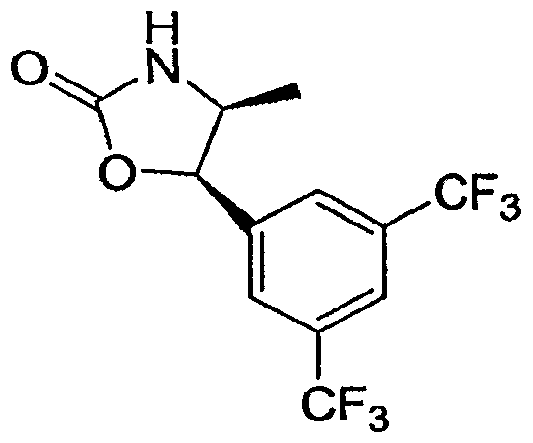
  • Step C 5-[3 ,5-Bis(trifluoromethyl)phenyl ' ]-4-methyl-l ,3-oxazolidm-2-one
  • This compound was separated into its two enantiomers (4S, 5R)-5-[3,5-bis(trifluoromethyl)phenyl]-4-methyl-l,3- oxazolidin-2-one and (4R, 5S)-5-[3,5-bistrifluoromethyl)phenyl]-4-methyl-l,3-oxazolidin-2-one using chiral HPLC (AS column, 20 x 250 mm, 15% /-PrOH in heptane).
  • the reaction was warmed to -20 0 C and stirred for 1 h.
  • the reaction was cooled to -78 0 C and a solution of 3- fluoropyridine (1.07 g, 11.0 mmol) in Et 2 ⁇ (5.5 mL) was added dropwise via cannula.
  • the reaction was warmed to -60 0 C and stirred for 1 h after which time a yellow precipitate appeared.
  • DMF (803 mg, 847 ⁇ L, 12.1 mmol) was added dropwise and the reaction was gradually warmed to -20 0 C over 4 h. Water (20 mL) was added and the mixture was extracted with Et 2 O (3 x 40 mL).
  • Step B ethyl (/r ⁇ ras ⁇ -irethyl ⁇ -foimylpyridm-S-vDaminoimethvUcvclohexyDacetate A mixture of 3-fluoropyridine-2-carbaldehyde (122.7 mg, 0.981 mmol), ethyl ⁇ trans-4-
  • Step C ethyl [trans-4-( lethyl[2-('hvdroxymethv ⁇ pyridin-3-yl ' lamino>methyl ' )cvclohexynacetate
  • Sodium borohydride (62.3 mg, 1.65 mmol) was added to a stirred solution of ethyl (trans-4- ⁇ [ethyl(2- formylpyridin-S-y ⁇ ammojmethyllcyclohexyOacetate (136.9 mg, 0.412 mmol) in EtOH (10 mL) at room temperature.
  • EtOH mL
  • Step D ethyl (fr ⁇ n5-4-(rr2-('chloromethyl) ⁇ yridin-3-vnfethyl')amino '
  • Thionyl chloride 470 mg, 288 ⁇ L, 3.95 mmol
  • ethyl [trans-4- ( ⁇ ethyl(2-(hydroxymethyl)pyridin-3-yl]amino ⁇ methyl)cyclohexyl]acetate 132.2 mg, 0.395 mmol
  • dry CH 2 Cl 2 (10 mL) at room temperature
  • Step E ethyl (trans-4-iU2-( jf4S.5R)-S-r3,5-bis(trifluoromethyl)phenyl1-4-methyl-2-oxo-l .3-oxazolidin- 3-yl) methy Dpyridin-3 -yll (ethyr)arnino "
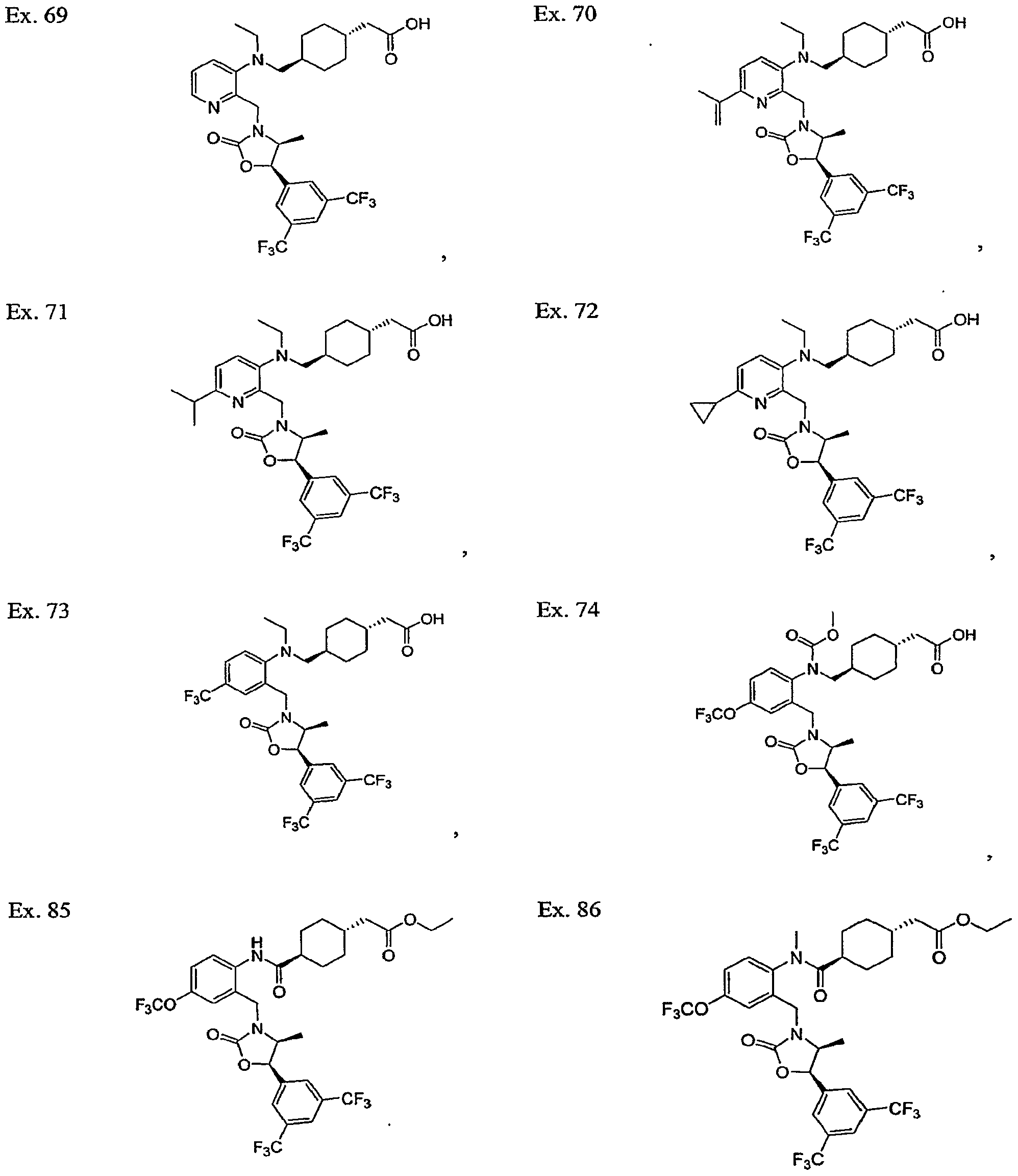
  • Step F (/r ⁇ «s')-4-(rr2-f((45'.5J?)-5-r3,5-bis(trifluoroinethyl)phenvn-4-methyl-2-oxo-L3-oxazolidin-3- yUmethyl)pyridm-3-yl1(ethyl)ammo1methv ⁇ cyclohexyl ' )acetic acid
  • Aqueous potassium hydroxide (4N, 100 ⁇ L) was added to a stirred solution of ethyl (trans-4- ⁇ [[2- ( ⁇ (46' 5 5R)-5-[3,5-bis(trifluorornethyl)phenyl]-4-methyl-2-oxo-l,3-oxazolidin-3-yl ⁇ methyl)pyridin-3- yl](ethyl)amino]methyl ⁇ cyclohexyl)acetate (8.0 mg, 0.0127 mmol) in EtOH (0.8 mL) and water(0.6 mL) at room temperature. A few extra drops of EtOH were added to re-dissolve the slight precipitate formed.
  • Step B ethyl f/r ⁇ /2.y-4-frr2-(f(4 1 S',5/?)-5-f3,5-bis(trifluoromethyl) ⁇ henyll-4-methyl-2-oxo-l,3-oxazolidin-
  • Triphosgene (360 mg, 1.21 mmol) and diisopropylamine (123 mg, 170 ⁇ L, 1.21 mol) were added successively to a stirred solution of ethyl (£r ⁇ 7zs-4- ⁇ [[2-( ⁇ (4S,5i?)-5-[3,5-bis(txifluoromethyl)phenyl]-4- methyl-2-oxo-l,3-oxazolidin-3-yl ⁇ methyl)-l-oxidopyridin-3-yl](ethyl)amino]niethyl ⁇ cyclohexyl)acetate (156.6 mg, 0.243 mmol) in dry CH 2 Cl 2 (9 mL) at -20 0 C under N 2 .
  • Step C ethyl ( ⁇ -([ ⁇ -( ⁇ M ⁇ .S ⁇ -S-fS.S-bisftrifluoromethvDphenylH-methyl ⁇ -oxo-l ⁇ -oxazolidin- 3 -yl ) methyl)-6-isopropenylpyridin-3 -yl] ( " ethyl)ammo]methyl ) cyclohexyDacetate
  • ethyl fr ⁇ n5-4- ⁇ [[2-( ⁇ (4S,5 ⁇ )-5-[3,5-bis(trifluoromethyl)phenyl]-4-methyl-2-oxo-l,3- oxazolidin-3-yl ⁇ methyl)-6-chloropyridin-3-yl](ethyl)amino]methyl ⁇ cyclohexyl)acetate, cyclopropylboronic acid and 1,1 '-bis(di-f-butylphosphinoferrocene) pali
  • Step D ( ⁇ «jr-4-irf2-(((4S,5R)-5-f3.5-bisftrifluoromethyl ' )phenyll-4-methyl-2-oxo-1.3-oxazolidin-3- yl> methyl V6-isopropenylpyridin-3 -yl] (ethyl)aminoimethyl I cvclohexyliacetic acid
  • Aqueous potassium hydroxide (4N, 100 ⁇ L) was added to a stirred solution of ethyl (fr ⁇ «ir-4- ⁇ [[2- ( ⁇ (45,5/?)-5-[3,5-bis(trifluoromethyl)phenyl]-4-methyl-2-oxo-l,3-oxazolidin-3-yl ⁇ methyl)-6- isopropenylpyridin-3-yl](ethyl)amino]methyl ⁇ cyclohexyl) acetate (7.3 mg, 0.0109 mmol) in EtOH (0.9
  • Step B f/rgn ⁇ -4- ⁇ rr2-ff(45'.5/?V5-[ ' 3.5-bisftrifluoromethvnphenyll-4-niethyl-2-oxo-1.3-oxazolidin-3- vUmethv ⁇ - ⁇ -isopropylpyridin-S-ylKethvDaminoimethvUcvclohexyDacetic acid
  • Aqueous potassium hydroxide (4N, 200 ⁇ L) was added to a stirred solution of ethyl (/ra «5-4- ⁇ [[2- ( ⁇ (4S,5i?)-5-[3,5-bis(trifluoromethyl)phenyl]-4-methyl-2-oxo-l,3-oxazolidin-3-yl ⁇ methyl)-6- isopropenylpyridin-3-yl](ethyl)amino]methyl ⁇ cyclohexyl)acetate (7.3 mg, 0.0109 mmol) in EtOH (2.8 mL) and water (0.65 mL) at room temperature.
  • Example 70 The following compounds were synthesized using methods analogous to those described in Example 70 from the aryl chloride described in Example 70, Step B and the corresponding alkyl boronic acid.
  • Step B ethyl rfr ⁇ wji'-4-(lethylf2-(hvdroxymethyl')-4-('trifluoromethv ⁇ phenyllamino> methvDcyclohexyllacetate
  • ethyl [?r ⁇ n5-4-( ⁇ ethyl[2-formyl-4-(trifluoromethyl)phenyl]amino ⁇ methyl)cyclohexyl]acetate (Step A; 153 mg; 0.38 mmol) in EtOH (1 mL) was added sodium borohydride (7.3 mg; 0.19 mmol). The reaction stirred at room temperature for 1 h and was concentrated in vacuo.
  • Step C ethyl ffr ⁇ «.y-4-frr2-(((4.S'.5 J R ' )-5-r3.5-bis(trifluoromethvnphenyl1-4-methyl-2-oxo-L3-oxazolidin- 3-yl>methyl)-4-ftrifluoromethyDphenvnfethvDaminolmethyl) cvclohexyDacetate
  • Step B 60 mg; 0.149 mmol
  • thionyl chloride (12.3 ⁇ L; 0.169 mmol) in toluene (300 ⁇ L) at 0°C.
  • Step D (fr ⁇ »5-4-(rr2-(l('45 > .5R ' )-5-r3.5-bis(trifluoromethyl ' )phenyll-4-methyl-2-oxo-K3-oxazolidin-3- vUmethvD- ⁇ -drifluoromethvDphenyliCethv ⁇ aminoimethvUcyclohexyl') acetic acid
  • ethyl (/ra «5-4- ⁇ [[2-( ⁇ (45,5i?)-5-[3,5-bis(triiluoromethyl)phenyl]-4-methyl-2-oxo- l,3-oxazolidin-3-yl ⁇ methyl)-4-(trifluoromethyl)phenyl](ethyl)amino] methyl ⁇ cyclohexyl)acetate (Step C; 29 mg; 0.042 mmol) in EtOH ( 2 mL) was added 4 M K
  • Step B ethyl f?r ⁇ m:-4-(rr2-f(f45.5i?V5-r3.5-bisftrifluoromethvnphenyl1-4-methyl-2-oxo-1.3-oxazolidin- 3 -yl ) methyl " )-4-(trifluoromethoxy)phenyl "
  • Step A 50 mg; 0.73 mmol) in CH 2 Cl 2 (3 mL) was added methyl chloroformate
  • the reaction stirred at 40°C for 24 h.
  • the reaction was diluted with EtOAc (25 mL) and washed successively with sat. NaHCO 3 , brine, IN HCl and brine (15 mL each), dried (MgSO 4 ), filtered and concentrated in vacuo.
  • Step C (trans-4- (IT2-( ((4£5RV5-r3.5-bisftrifluoromethyl)phenyl1-4-methyl-2-oxo-l ,3-oxazolidin-3- yUmethvD-4-ftrifluoromethoxy ⁇ phenylirmethoxyca ⁇ bonyl)aminolmetliyl> cvclohexyPacetic acid
  • the resultant mixture was stirred at 0 °C for 30 min prior to addition of iodomethane (58 ⁇ L; 0.931 mmol).
  • the reaction was stirred at room temperature for 14 h and quenched with H 2 O.
  • the reaction was partitioned between EtOAc (50 mL) and H 2 O (50 mL) and the aqueous layer was extracted with EtOAc (3 x 50 mL). The combined extracts were washed with brine (50 mL), dried (MgSO 4 ), filtered and concentrated in vacuo.

Landscapes

  • Organic Chemistry (AREA)
  • Chemical & Material Sciences (AREA)
  • Health & Medical Sciences (AREA)
  • Bioinformatics & Cheminformatics (AREA)
  • Engineering & Computer Science (AREA)
  • General Health & Medical Sciences (AREA)
  • Medicinal Chemistry (AREA)
  • Nuclear Medicine, Radiotherapy & Molecular Imaging (AREA)
  • General Chemical & Material Sciences (AREA)
  • Pharmacology & Pharmacy (AREA)
  • Life Sciences & Earth Sciences (AREA)
  • Animal Behavior & Ethology (AREA)
  • Chemical Kinetics & Catalysis (AREA)
  • Public Health (AREA)
  • Veterinary Medicine (AREA)
  • Obesity (AREA)
  • Cardiology (AREA)
  • Heart & Thoracic Surgery (AREA)
  • Diabetes (AREA)
  • Hematology (AREA)
  • Vascular Medicine (AREA)
  • Urology & Nephrology (AREA)
  • Child & Adolescent Psychology (AREA)
  • Pharmaceuticals Containing Other Organic And Inorganic Compounds (AREA)
  • Medicines That Contain Protein Lipid Enzymes And Other Medicines (AREA)
  • Heterocyclic Carbon Compounds Containing A Hetero Ring Having Nitrogen And Oxygen As The Only Ring Hetero Atoms (AREA)
  • Plural Heterocyclic Compounds (AREA)

Abstract

Compounds having the structure of Formula (I), including pharmaceutically acceptable salts of the compounds, are CETP inhibitors, and are useful for raising HDL-cholesterol, reducing LDL-cholesterol, and for treating or preventing atherosclerosis. In the compounds of Formula (I), B or R2 is a phenyl group which has an ortho amine or aminomethyl substituent which is further substituted, and the other of B or R2 is also a cyclic group.

Description

TITLE OF THE INVENTION CETP INHIBITORS
FIELD OF THE INVENTION This invention relates to a class of chemical compounds that inhibit cholesterol ester transfer protein (CETP) and therefore have utility in raising HDL-C, lowering LDL-C, and in the treatment and prevention of atherosclerosis.
BACKGROUND OF THE INVENTION Atherosclerosis and its clinical consequences, coronary heart disease (CHD), stroke and peripheral vascular disease, represent a truly enormous burden to the health care systems of the industrialized world. In the United States alone, approximately 13 million patients have been diagnosed with CHD, and greater than one half million deaths are attributed to CHD each year. Further, this toll is expected to grow over the next quarter century as an epidemic in obesity and diabetes continues to grow. It has long been recognized that in mammals, variations in circulating lipoprotein profiles correlate with the risk of atherosclerosis and CHD. The clinical success of HMG-CoA Reductase inhibitors, especially the statins, in reducing coronary events is based on the reduction of circulating Low Density Lipoprotein cholesterol (LDL-C), levels of which correlate directly with increased risk for atherosclerosis. More recently, epidemiologic studies have demonstrated an inverse relationship between High Density Lipoprotein cholesterol (HDL-C) levels and atherosclerosis, leading to the conclusion that low serum HDL-C levels are associated with an increased risk for CHD.
Metabolic control of lipoprotein levels is a complex and dynamic process involving many factors. One important metabolic control in man is the cholesteryl ester transfer protein (CETP), a plasma glycoprotein that catalyzes the movement of cholesteryl esters from HDL to the apoB containing lipoproteins, especially VLDL (see Hesler, C.B., et. al. (1987) Purification and characterization of human plasma cholesteryl ester transfer protein. J. Biol. Chem. 262(5), 2275-2282)). Under physiological conditions, the net reaction is a heteroexchange in which CETP carries triglyceride to HDL from the apoB lipoproteins and transports cholesterol ester from HDL to the apoBliprotein.
In humans, CETP plays a role in reverse cholesterol transport, the process whereby cholesterol is returned to the liver from peripheral tissues. Intriguingly, many animals do not possess CETP, including animals that have high HDL levels and are known to be resistant to coronary heart disease, such as rodents (see Guyard-Dangremont, V., et. al., (1998) Phospholipid and cholesteryl ester transfer activities in plasma from 14 vertebrate species. Relation to atherogenesis susceptibility, Comp. Bϊochem. Physiol. B Biochem. MoI. Biol. 120(3), 517-525). Numerous epidemiologic studies correlating the effects of natural variation in CETP activity with respect to coronary heart disease risk have been performed, including studies on a small number of known human null mutations (see Hirano, K.-L, Yamashita, S. and Matsuzawa, Y. (2000) Pros and cons of inhibiting cholesteryl ester transfer protein, Curr. Opin. Lipidol. 11(6), 589-596). These studies have clearly demonstrated an inverse correlation between plasma HDL-C concentration and CETP activity (see Inazu, A., et. al. (2000) Cholesteryl ester transfer protein and atherosclerosis, Curr. Opin. Lipidol. 11(4), 389-396), leading to the hypothesis that pharmacologic inhibition of CETP lipid transfer activity may be beneficial to humans by increasing levels of HDL-C while lowering those of LDL.
Despite the significant therapeutic advance that statins such as simvastatin (ZOCOR®) represent, statins only achieve a risk reduction of approximately one-third in the treatment and prevention of atherosclerosis and ensuing atherosclerotic disease events. Currently, few pharmacologic therapies are available that favorably raise circulating levels of HDL-C. Certain statins and some fϊbrates offer modest HDL-C gains. Niacin, which provides the most effective therapy for raising HDL-C that has been clinically documented, suffers from patient compliance issues, due in part to side effects such as - flushing. An agent that safely and effectively raises HDL cholesterol levels can answer a significant, but as yet unmet medical need by offering a means of pharmacologic therapy that can significantly improve circulating lipid profiles through a mechanism that is complementary to existing therapies. New classes of chemical compounds that inhibit CETP are being investigated at several pharmaceutical companies or are in clinical trials. No CETP inhibitors are currently being marketed. Clinical trials of torcetrapib were terminated because of an increase in mortality in patients who were taking torcetrapib in an outcomes study. New compounds are needed so that one or more pharmaceutical compounds can be found that are safe and effective. The novel compounds described herein are very potent CETP inhibitors.
SUMMARY OF THE INVENTION
Compounds having Formula I, including pharmaceutically acceptable salts of the compounds, are CETP inhibitors, having the utilities described below:
B
Figure imgf000003_0001
I
In the compounds of Formula I:
Y is selected from the group consisting of -C(=O)- and -(CRRl)-;
X is selected from the group consisting of -O-, -NH-, and -N(Ci-C5alkyl)-; Z is selected from the group consisting of -C(=O)- , -S(O)2-, and -C(=N-R9)-, wherein R.9 is selected from the group consisting of H, -CN, and Ci-Csalkyl optionally substituted with 1-11 halogens;
R and Rl are each independently selected from the group consisting of H, -C1-C5 alkyl, and halogen, wherein -C1-C5 alkyl is optionally substituted with 1-11 halogens;
R5 is selected from the group consisting of H, -OH, -C1-C5 alkyl, and halogen, wherein -C1-C5 alkyl is optionally substituted with 1-11 halogens;
B and R2 are each selected from the group consisting of Al and A2, wherein Al has the structure:
Figure imgf000004_0001
wherein one of the =CH- groups of the phenyl ring of Al that are optionally unsubstituted may optionally be replaced by =N-, so that Al comprises a a pyridine ring;
Wherein one of B and R2 is Al, and the other of B and R2 is A^, so that the compound of Formula I comprises one group Al and one group A2;
A3 is -(CRlORl l)qNR7R8 ;
A2 is selected from the group consisting of:
(a) an aromatic ring selected from phenyl and naphthyl; (b) a phenyl ring fused to a 5-7 membered non-aromatic cycloalkyl ring, which optionally comprises 1-2 double bonds;
(c) a 5-6-membered heterocyclic ring having 1-4 heteroatoms independently selected from N, S, O, and -N(O)-, and optionally also comprising 1-3 double bonds and a carbonyl group; (d) a benzoheterocyclic ring comprising a phenyl ring fused to a 5-6-membered heterocyclic ring having 1-2 heteroatoms independently selected from O, N, and S and optionally 1-2 double bonds; and
(e) a -C3-C8 cycloalkyl ring optionally having 1-3 double bonds; wherein A2 is optionally substituted with 1-5 substituent groups independently selected from Ra; Each Ra is independently selected from the group consisting of -Ci -Cs alkyl, -C2-C6 alkenyl, -C2-C6 alkynyl, -C3-C8 cycloalkyl optionally having 1-3 double bonds, -OCi-Cealkyl, -OC2-C6 alkenyl, -OC2-Cg alkynyl, -OC3-C8 cycloalkyl optionally having 1-3 double bonds, -C(=O)Cl-C6alkyl, -C(=O)C3-Cg cycloalkyl, -C(=O)H, -CO2H, -CO2Ci-C6alkyl, -C(=O)SCi-C6alkyl, -OH, -NR3R4, .
Figure imgf000005_0001
alkyl, -NR3C(O)NR3R4, -S(O)XCI-C6 alkyl, -S(O)yNR3R4, -NR3S(O)VNR3R4J halogen, -CN, -NO2, and a 5-6-membered heterocyclic ring having 1 -4 heteroatoms independently selected from N, S, and O, said heterocyclic ring optionally also comprising a carbonyl group and optionally also comprising 1-3 double bonds, wherein the point of attachment of said heterocyclic ring to the ring to which Ra is attached is a carbon atom, wherein said heterocyclic ring is optionally substituted with 1-5 substituent groups independently selected from halogen, -C1-C3 alkyl, and -OC1-C3 alkyl, wherein -C1-C3 alkyl and -OC1-C3 alkyl are optionally substituted with 1-7 halogens; wherein for compounds in which Ra is selected from the group consisting of -Ci-Cβ alkyl, -C2-C6 alkenyl, -C2-C6 alkynyl, -C3-C8 cycloalkyl optionally having 1-3 double bonds, -OCi- Cβalkyl, -OC2-C6 alkenyl, -OC2-C6 alkynyl, -OC3-C8 cycloalkyl optionally having 1-3 double bonds, -C(=O)Ci-C6alkyl, -C(=O)C3-Cs cycloalkyl, -Cθ2Ci-C6alkyl, -C(=O)SCi-C6alkyl, -NR3C(=O)OCI- Cβ alkyl, and -S(O)xCi-Cg alkyl, Ra is optionally substituted with 1-15 halogens and is optionally also substituted with 1-3 substituent groups independently selected from (a) -OH, (b) -CN, (c) -NR3R4, (d) -C3-C8 cycloalkyl optionally having 1-3 double bonds and optionally substituted with 1-15 halogens, (e) -OCl-C4alkyl optionally substituted with 1-9 halogens and optionally also substituted with 1-2 substituent groups independently selected from-OCi-C2 alkyl and phenyl, (f) -OC3-C8 cycloalkyl optionally having 1-3 double bonds and optionally substituted with 1-15 halogens, (g) -CO2H, (h) -C(=O)CH3, (i) -CO2Ci-C4alkyl which is optionally substituted with 1-9 halogens, and (j) phenyl which is optionally substituted with 1-3 groups independently selected from halogen, -CH3, -CF3, -OCH3, and -OCF3; p is an integer from 0-4; q is 0 or 1 ; x is 0, l, or 2; y is 1 or 2;
R3 and R4 are each independently selected from H, -C1-C5 alkyl, -C(=O)Ci-C5 alkyl and -S(O)yCi-C5 alkyl, wherein -C1-C5 alkyl in all instances is optionally substituted with 1-11 halogens;
R7 and R^ are each independently selected from the group consisting of H, -C1-C6 alkyl, -C2-C6 alkenyl, -C2-C6 alkynyl, -C(=O)Ci-C6alkyl, -CO2H, -CO2Cl-C6alkyl, -C3-C8 cycloalkyl which optionally comprises 1-2 double bonds, -C(=O)C3-C8 cycloalkyl which optionally comprises 1-2 double bonds, -C(=O)phenyl, -C(=O)NR3R4, -S(O)2Ci-C6 alkyl, and -S(O)2NR3R4, wherein -Ci-Cβ alkyl in all instances is optionally substituted with 1-11 halogens and is optionally also substituted with 1-2 substituents independently selected from -CO2H, -Cθ2Ci-C6alkyl which is optionally substituted with 1-11 halogens, -NR3R4, -OH, -C(=0)H-, a 5-7 membered heterocycle comprising 1-3 heteroatoms independently selected from N, O and S3 -C3-C8 cycloalkyl, and phenyl, wherein said -C3-C8 cycloalkyl and phenyl groups are optionally substituted with (a) 1-5 substituents independently selected from (i) halogen, (ii) -C1-C3 alkyl optionally substituted with 1-5 halogens, and (iii) -OC1-C3 alkyl optionally substituted with 1-5 halogens, and (b) optionally also 1-2 groups independently selected from -CO2H, -CO2Ci-C4alkyl, -CH2CO2H, -CH2CO2Ci-C4alkyl,
-CH2CH2CO2H, -CH2CH2CO2Ci-C4alkyl, -NR3R4, -CN, -NO2, -C(=O)NR3R4,
Figure imgf000006_0001
-S(O)2CI-C3 alkyl, and -C1-C5 alkyl substituted with 1-2 groups independently selected from -NR3R.4, -OH, -C(=O)H-, and a 5-7 membered heterocycle comprising 1-3 heteroatoms independently selected from N, O and S, and optionally also 1-5 halogens; wherein said 5-7 membered heterocycle in all uses as a substituent on -Ci-C6alkyl is optionally substituted with 1-5 substituents independently selected from halogen, -C1-C3 alkyl and -OC1-C3 alkyl, said -C1-C3 alkyl and -OC1-C3 alkyl being optionally substituted with 1-7 halogens; wherein when R? or R8 is -C3-C8 cycloalkyl which optionally comprises 1-2 double bonds, then said -C3-C8 cycloalkyl which optionally comprises 1-2 double bonds is optionally substituted with (a) 1-5 substituents independently selected from halogen, -C1-C3 alkyl optionally substituted with 1-5 halogen, and -OC1-C3 alkyl optionally substituted with 1-5 halogens, and (b) optionally also 1 group selected from -CO2H, -Cθ2Ci-C4alkyl, -CH2CO2H, -CH2CO2Ci-C4alkyl, -CH2CH2CO2H, -CH2CH2Cθ2Ci-C4alkyl, -C(=O)NR3R4J -CH2C(=O)NR3R4,
Figure imgf000006_0002
-CN, -NO2, and -S(O)2Ci-C3 alkyl; and when R7 or R§ is -C(=O)phenyl or -C(=O)C3-Cs cycloalkyl which optionally comprises 1-2 double bonds, said phenyl or cycloalkyl which optionally comprises 1-2 double bonds is optionally substituted with (a) 1-5 substituents independently selected from halogen, -C1-C3 alkyl optionally substituted with 1-5 halogens, and -OC1-C3 alkyl optionally substituted with 1-5 halogens, and (b) optionally also 1 group selected from -CO2H, -Cθ2Ci-C4alkyl, -CH2CO2H, -CH2CO2Ci-C4alkyl, -CH2CH2CO2H, -CH2CH2CO2Ci-C4alkyl, -C(=O)NR3R4J -CH2C(=O)NR3R4,
Figure imgf000006_0003
-CN, -NO2, and -S(O)2Cl-C3 alkyl; wherein alternatively R? and R8 are joined to form a monocyclic 5-7-membered heterocycle optionally having 1-2 heteroatoms independently selected from N, O and S(O)x in addition to the N to which R7 and R^ are connected or a bicyclic or tricyclic heterocycle having 5-16 atoms and optionally having 1-5 heteroatoms independently selected from N, O and S(O)x in addition to the N to which R7 and R8 are connected, said heterocycle being saturated, partly unsaturated or aromatic, said heterocycle being optionally substituted with (a) 1-5 substituent groups independently selected from halogen, -C1-C3 alkyl optionally substituted with 1-5 halogens, and -OC1-C3 alkyl optionally substituted with 1-5 halogens, and (b) optionally 1 substituent selected from -CO2H, -Cθ2Cχ-C4alkyl, -CH2CO2H, -CH2CO2Ci-C4alkyl, -CH2CH2CO2H, and -CH2CH2CO2Ci-C4alkyl; and
RlO and Rl 1 are each independently selected from the group consisting of H and -C1-C5 alkyl, wherein -C1-C5 alkyl is optionally substituted with 1-11 halogens.
In the compounds of Formula I and in subsequent compounds, alkyl, alkenyl, and alkynyl groups can be either linear or branched, unless otherwise stated.
DETAILED DESCRIPTION OF THE INVENTION
Many of the compounds of this invention have a structure in accordance with Formula Ia, written below, or a pharmaceutically acceptable salt thereof:
Definitions
"Ac" is acetyl, which is CH3C(=O)-.
"Alkyl" means saturated carbon chains which may be linear or branched or combinations thereof, unless the carbon chain is defined otherwise. Other groups having the prefix "alk", such as alkoxy and alkanoyl, also may be linear or branched or combinations thereof, unless the carbon chain is defined otherwise. Examples of alkyl groups include methyl, ethyl, propyl, isopropyl, butyl, sec- and tert-butyl, pentyl, hexyl, heptyl, octyl, nonyl, and the like.
"Alkylene" groups are alkyl groups that are difunctional rather than monofunctional. For example, methyl is an alkyl group and methylene (-CH2-) is the corresponding alkylene group.
"Alkenyl" means carbon chains which contain at least one carbon-carbon double bond, and which may be linear or branched or combinations thereof. Examples of alkenyl include vinyl, allyl, isopropenyl, pentenyl, hexenyl, heptenyl, 1-propenyl, 2-butenyl, 2-methyl-2-butenyl, and the like.
"Alkynyl" means carbon chains which contain at least one carbon-carbon triple bond, and which may be linear or branched or combinations thereof. Examples of alkynyl include ethynyl, propargyl, 3-methyl-l-pentynyl, 2-heptynyl and the like.
"Cycloalkyl" means a saturated carbocyclic ring having from 3 to 8 carbon atoms, unless otherwise stated (e.g., cycloalkyl may be defined as having one or more double bonds). The term also includes a cycloalkyl ring fused to an aryl group. Examples of cycloalkyl include cyclopropyl, cyclopentyl, cyclohexyl, cycloheptyl, and the like. "Cycloalkenyl" means a non-aromatic carbocyclic ring having one or more double binds. "Aryl" (and "arylene") when used to describe a substituent or group in a structure means a monocyclic or bicyclic compound in which the rings are aromatic and which contains only carbon ring atoms. The term "aryl" can also refer to an aryl group that is fused to a cycloalkyl or heterocycle. Preferred "aryls" are phenyl and naphthyl. Phenyl is generally the most preferred aryl group. "EDC" is l-ethyl-3-(3-dimethylaminopropyl)carbodiimide.
"Heterocyclyl," "heterocycle," and "heterocyclic" means a fully or partially saturated or aromatic 5-6 membered ring containing 1-4 heteroatoms independently selected from N3 S and O, unless otherwise stated.
"Benzoheterocycle" represents a phenyl ring fused to a 5-6-membered heterocyclic ring having 1-2 heteroatoms, each of which is O, N, or S, where the heterocyclic ring may be saturated or unsaturated. Examples include indole, benzofuran, 2,3-dihydrobenzofuran and quinoline.
"DIPEA" is diisopropylethylamine.
"Halogen" includes fluorine, chlorine, bromine and iodine.
"HOBT" is 1-Hydroxybenzotriazole. "EPAC" is isopropyl acetate.
"Me" represents methyl.
"Weinreb amine" is N,O-dimethylhydroxylamine.
The term "composition," as in pharmaceutical composition, is intended to encompass a product comprising the active ingredient(s), and the inert ingredient(s) that make up the carrier, as well as any product which results, directly or indirectly, from combination, complexation or aggregation of any two or more of the ingredients, or from dissociation of one or moτe of the ingredients, or from other types of reactions or interactions of one or more of the ingredients. Accordingly, the pharmaceutical compositions of the present invention encompass any composition made by admixing a compound of the present invention and a pharmaceutically acceptable carrier. The substituent "tetrazole" means a 2H-tetrazol-5-yl substituent group and tautomers thereof.
Optical Isomers - Diastereomers - Geometric Isomers - Tautomers
Compounds of Formula I may contain one or more asymmetric centers and can thus occur as racemates, racemic mixtures, single enantiomers, diastereomeric mixtures and individual diastereomers. The present invention is meant to include all such isomeric forms of the compounds of Formula I and all mixtures of the compounds. When structures are shown with a stereochemical representation, other stereochemical structures are also included individually and collectively, such as enantiomers, diastereoisomers (where diastereomers are possible), and mixtures of the enantiomers and/or diastereomers, including racemic mixtures.
Some of the compounds described herein may contain olefinic double bonds, and unless specified otherwise, are meant to include both E and Z geometric isomers. Some of the compounds described herein may exist as tautomers. An example is a ketone and its enol form, known as keto-enol tautomers. The individual tautomers as well as mixtures thereof are encompassed with compounds of Formula I.
Compounds of Formula I having one or more asymmetric centers may be separated into diastereoisomers, enantiomers, and the like by methods well known in the art.
Alternatively, enantiomers and other compounds with chiral centers may be synthesized by stereospecific synthesis using optically pure starting materials and/or reagents of known configuration.
Some of the biphenyl and biaryl compounds herein are observed as mixtures of atropisomers (rotamers) in the ISIMR spectra. The individual atropisomers as well as mixtures thereof are encompassed with the compounds of this invention.
Salts
The term "pharmaceutically acceptable salts" refers to salts prepared from pharmaceutically acceptable non-toxic bases or acids including inorganic or organic bases and inorganic or organic acids. Salts derived from inorganic bases include aluminum, ammonium, calcium, copper, ferric, ferrous, lithium, magnesium, manganic salts, manganous, potassium, sodium, zinc, and the like. Particularly preferred are the ammonium, calcium, magnesium, potassium, and sodium salts. Salts in the solid form may exist in more than one crystal structure, and may also be in the form of hydrates. Salts derived from pharmaceutically acceptable organic non-toxic bases include salts of primary, secondary, and tertiary amines, substituted amines including naturally occurring substituted amines, cyclic amines, and basic ion exchange resins, such as arginine, betaine, caffeine, choline, N,N'- dibenzylethylenediamine, diethylamine, 2-diethylaminoethanol, 2-dimethylaminoethanol, ethanolamine, ethylenediamine, N-ethyl-morpholine, N-ethylpiperidine, glucamine, glucosamine, histidine, hydrabamine, isopropylamine, lysine, methylglucamine, morpholine, piperazine, piperidine, polyamine resins, procaine, purines, theobromine, triethylamine, trimethylamine, tripropylamine, tromethamine, and the like.
When the compound of the present invention is basic, salts may be prepared from pharmaceutically acceptable non-toxic acids, including inorganic and organic acids. Such acids include acetic, benzenesulfonic, benzoic, camphorsulfonic, citric, ethanesulfonic, fumaric, gluconic, glutamic, hydrobromic, hydrochloric, isethionic, lactic, maleic, malic, mandelic, methanesulfonic, mucic, nitric, pamoic, pantothenic, phosphoric, succinic, sulfuric, tartaric, p-toluenesulfonic acid, and the like. Particularly preferred are citric, hydrobromic, hydrochloric, maleic, phosphoric, sulfuric, and tartaric acids. It will be understood that, as used herein, references to the compounds of Formula I are meant to also include the pharmaceutically acceptable salts. Metabolites — Prodrugs
Therapeutically active metabolites, where the metabolites themselves fall within the scope of the claimed invention, are also compounds of the current invention. Prodrugs, which are compounds that are converted to the claimed compounds as they are being administered to a patient or after they have been administered to a patient, are also compounds of this invention.
Utilities
Compounds of the current invention are potent inhibitors of CETP. They are therefore useful in treating diseases and conditions that are treated by inhibitors of CETP. One aspect of the present invention provides a method for treating or reducing the risk of developing a disease or condition that may be treated or prevented by inhibition of CETP by administering a therapeutically effective amount of a compound of this invention to a patient in need of treatment. A patient is a human or mammal, and is most often a human. A "therapeutically effective amount" is the amount of compound that is effective in obtaining a desired clinical outcome in the treatment of a specific disease.
Diseases or conditions that may be treated with compounds of this invention, or which the patient may have a reduced risk of developing as a result of being treated with the compounds of this invention, include: atherosclerosis, peripheral vascular disease, dyslipidemia, hyperbetalipoproteinemia, hypoalphalipoproteinemia, hypercholesterolemia, hypertriglyceridemia, familial-hypercholesterolemia, cardiovascular disorders, angina, ischemia, cardiac ischemia, stroke, myocardial infarction, reperfusion injury, angioplastic restenosis, hypertension, vascular complications of diabetes, obesity, endotoxemia, and metabolic syndrome.
The compounds of this invention are particularly effective in raising HDL-C and/or increasing the ratio of KCDL-C to LDL-C. They are effective in reducing LDL-C. These changes in HDL-C and LDL-C may be beneficial in treating atherosclerosis, reducing or reversing the development of atherosclerosis, reducing the risk of developing atherosclerosis, or preventing atherosclerosis.
Administration and Dose Ranges
Any suitable route of administration may be employed for providing a mammal, especially a human, with an effective dose of a compound of the present invention. For example, oral, rectal, topical, parenteral, ocular, pulmonary, nasal, and the like may be employed. Dosage forms include tablets, troches, dispersions, suspensions, solutions, capsules, creams, ointments, aerosols, and the like. Preferably compounds of Formula I are administered orally.
The effective dosage of active ingredient employed may vary depending on the particular compound employed, the mode of administration, the condition being treated and the severity of the condition being treated. Such dosage may be ascertained readily by a person skilled in the art. When treating the diseases for which compounds of Formula I are indicated, generally satisfactory results are obtained when the compounds of the present invention are administered at a daily dosage of from about 0.01 milligram to about 100 milligram per kilogram of animal or human body weight, preferably given as a single daily dose or in divided doses two to six times a day, or in sustained release form. In the case of a 70 kg adult human, the total daily dose will generally be from about 0.5 milligram to about 500 milligrams. For a particularly potent compound, the dosage for an adult human may be as low as 0.1 mg. The dosage regimen may be adjusted within this range or even outside of this range to provide the optimal therapeutic response.
Oral administration will usually be carried out using tablets. Examples of doses in tablets are 0.5 mg, 1 mg, 2 mg, 5 mg, 10 mg, 25 mg, 50 mg, 100 mg, 250 mg, and 500 mg. Other oral forms can also have the same dosages (e.g. capsules).
Pharmaceutical Compositions
Another aspect of the present invention provides pharmaceutical compositions which comprise a compound of Formula I and a pharmaceutically acceptable carrier. The pharmaceutical compositions of the present invention comprise a compound of Formula I or a pharmaceutically acceptable salt as an active ingredient, as well as a pharmaceutically acceptable carrier and optionally other therapeutic ingredients. The term "pharmaceutically acceptable salts" refers to salts prepared from pharmaceutically acceptable non-toxic bases or acids including inorganic bases or acids and organic bases or acids. A pharmaceutical composition may also comprise a prodrug, or a pharmaceutically acceptable salt thereof, if a prodrug is administered. Pharmaceutical compositions may also consist essentially of a compound of Formula I and a pharmaceutically acceptable carrier without other thereapeutic ingredients.
The compositions include compositions suitable for oral, rectal, topical, parenteral (including subcutaneous, intramuscular, and intravenous), ocular (ophthalmic), pulmonary (nasal or buccal inhalation), or nasal administration, although the most suitable route in any given case will depend on the nature and severity of the conditions being treated and on the nature of the active ingredient. They may be conveniently presented in unit dosage form and prepared by any of the methods well-known in the art of pharmacy. In practical use, the compounds of Formula I can be combined as the active ingredient in intimate admixture with a pharmaceutical carrier according to conventional pharmaceutical compounding techniques. The carrier may take a wide variety of forms depending on the form of preparation desired for administration, e.g., oral or parenteral (including intravenous). In preparing the compositions for oral dosage form, any of the usual pharmaceutical media may be employed, such as, for example, water, glycols, oils, alcohols, flavoring agents, preservatives, coloring agents and the like in the case of oral liquid preparations, such as, for example, suspensions, elixirs and solutions; or carriers such as starches, sugars, microcrystalline cellulose, diluents, granulating agents, lubricants, binders, disintegrating agents and the like in the case of oral solid preparations such as, for example, powders, hard and soft capsules and tablets, with the solid oral preparations being preferred over the liquid preparations.
Because of their ease of administration, tablets and capsules represent the most advantageous oral dosage unit form in which case solid pharmaceutical carriers are obviously employed. If desired, tablets may be coated by standard aqueous or nonaqueous techniques. Such compositions and preparations should contain at least 0.1 percent of active compound. The percentage of active compound in these compositions may, of course, be varied and may conveniently be between about 2 percent to about 60 percent of the weight of the unit. The amount of active compound in such therapeutically useful compositions is such that an effective dosage will be obtained. The active compounds can also be administered intranasally as, for example, liquid drops or spray.
The tablets, pills, capsules, and the like may also contain a binder such as gum tragacanth, acacia, corn starch or gelatin; excipients such as dicalcium phosphate; a disintegrating agent such as corn starch, potato starch, alginic acid; a lubricant such as magnesium stearate; and a sweetening agent such as sucrose, lactose or saccharin. When a dosage unit form is a capsule, it may contain, in addition to materials of the above type, a liquid carrier such as a fatty oil.
Various other materials may be present as coatings or to modify the physical form of the dosage unit. For instance, tablets may be coated with shellac, sugar or both. A syrup or elixir may contain, in addition to the active ingredient, sucrose as a sweetening agent, methyl and propylparabens as preservatives, a dye and a flavoring such as cherry or orange flavor. Compounds of formula I may also be administered parenterally. Solutions or suspensions of these active compounds can be prepared in water suitably mixed with a surfactant such as hydroxypropylcellulose. Dispersions can also be prepared in glycerol, liquid polyethylene glycols and mixtures thereof in oils. Under ordinary conditions of storage and use, these preparations contain a preservative to prevent the growth of microorganisms. The pharmaceutical forms suitable for injectable use include sterile aqueous solutions or dispersions and sterile powders for the extemporaneous preparation of sterile injectable solutions or dispersions. In all cases, the form must be sterile and must be fluid to the extent that easy syringability exists. It must be stable under the conditions of manufacture and storage and must be preserved against the contaminating action of microorganisms such as bacteria and fungi. The carrier can be a solvent or dispersion medium containing, for example, water, ethanol, polyol (e.g. glycerol, propylene glycol and liquid polyethylene glycol), suitable mixtures thereof, and vegetable oils.
Combination Therapy
Compounds of the invention (e.g. Formula I and Ia - Ij) may be used in combination with other drugs that may also be useful in the treatment or amelioration of the diseases or conditions for which compounds of Formula I are useful. Such other drugs may be administered, by a route and in an amount commonly used therefor, contemporaneously or sequentially with a compound of Formula I. When a compound of Formula I is used contemporaneously with one or more other drugs, a pharmaceutical composition in unit dosage form containing such other drugs and the compound of Formula I is preferred. However, the combination therapy also includes therapies in which the compound of Formula I and one or more other drugs are administered on different schedules. When oral formulations are used, the drugs may be combined into a single combination tablet or other oral dosage form, or the drugs may be packaged together as separate tablets or other oral dosage forms. It is also contemplated that when used in combination with one or more other active ingredients, the compound of the present invention and the other active ingredients may be used in lower doses than when each is used singly. Accordingly, the pharmaceutical compositions of the present invention include those that contain one or more other active ingredients, in addition to a compound of Formula I.
Examples of other active ingredients that may be administered in combination with a compound of this invention (e.g. Formula I), and either administered separately or in the same pharmaceutical composition, include, but are not limited to, other compounds which improve a patient's lipid profile, such as (i) HMG-CoA reductase inhibitors, (which are generally statins, including lovastatin, simvastatin, rosuvastatin, pravastatin, fluvastatin, atorvastatin, rivastatin, itavastatin, pravastatin, and other statins), (ii) bile acid sequestrants (cholestyramine, colestipol, dialkylaminoalkyl derivatives of a cross-linked dextran, Colestid®, LoCholest®, (iii) niacin and related compounds, such as nicotinyl alcohol, nicotinamide, and nicotinic acid or a salt thereof, (iv) PP ARa agonists, such as gemfibrozil and fenofibric acid derivatives (fibrates), including clofibrate, fenofibrate, bezafϊbrate, ciprofϊbrate, and etofϊbrate, (v) cholesterol absorption inhibitors, such as stanol esters, beta-sitosterol, sterol glycosides such as tiqueside; and azetidinones, such as ezetimibe, (vi) acyl CoAxholesterol acyltransferase (ACAT) inhibitors, such as avasimibe and melinamide, and including selective ACAT-I and ACAT-2 inhibitors and dual inhibitors, (vii) phenolic anti-oxidants, such as probucol, (viii) microsomal triglyceride transfer protein (MTP)/ ApoB secretion inhibitors, (ix) anti-oxidant vitamins, such as vitamins C and E and beta carotene, (x) thyromimetics, (xi) LDL (low density lipoprotein) receptor inducers, (xii) platelet aggregation inhibitors, for example glycoprotein Hb/UIa fibrinogen receptor antagonists and aspirin, (xiii) vitamin B12 (also known as cyanocobalamin), (xiv) folic acid or a pharmaceutically acceptable salt or ester thereof, such as the sodium salt and the methylglucamine salt, (xv) FXR and LXR ligands, including both inhibitors and agonists, (xvi) agents that enhance ABCAl gene expression, and (xvii) ileal bile acid transporters.
Preferred classes of therapeutic compounds that can be used with the compounds of this invention for use in improving a patient's lipid profile (i.e. raising HDL-C and lowering LDL-C) include one or both of statins and cholesterol absorption inhibitors- Particularly preferred are combinations of compounds of this invention with simvastatin, ezetimibe, or both simvastatin and ezetimibe. Also preferred are combinations of compounds of this invention with statins other than simvastatin, such as lovastatin, rosuvastatin, pravastatin, fluvastatin, atorvastatin, rivastatin, itavastatin, and ZD-4522. Finally compounds of this invention can be used with compounds that are useful for treating other diseases, such as diabetes, hypertension and obesity, as well as other anti-atherosclerostic compounds. Such combinations may be used to treat one or more of such diseases as diabetes, obesity, atherosclerosis, and dyslipidemia, or more than one of the diseases associated with metabolic syndrome. The combinations may exhibit synergistic activity in treating these disease, allowing for the possibility of administering reduced doses of active ingredients, such as doses that otherwise might be sub-therapeutic.
Examples of other active ingredients that may be administered in combination with a compound of this invention include, but are not limited to, compounds that are primarily anti-diabetic compounds, including: (a) PPAR gamma agonists and partial agonists, including glitazones and non-glitazones
(e.g. pioglitazone, englitazone, MCC-555, rosiglitazone, balaglitazone, netoglitazone, T-131, LY- 300512, and LY-818;
(b) biguanides such as metformin and phenformin;
(c) protein tyrosine phosphatase- IB (PTP-IB) inhibitors; (d) dipeptidyl peptidase IV (DP-P/) inhibitors, including vildagliptin, sitagliptin, and saxagliptin;
(e) insulin or insulin mimetics, such as for example insulin lispro, insulin glargine, insulin zinc suspension, and inhaled insulin formulations;
(f) sulfonylureas, such as tolbutamide, glipizide, glimepiride, acetohexamide, chlorpropamide, glibenclamide, and related materials;
(g) α-glucosidase inhibitors (such as acarbose, adiposine; camiglibose; emiglitate; miglitol; voglibose; pradimicin-Q; and salbostatin);
(h) PPARα/γ dual agonists, such as muraglitazar, tesaglitazar, farglitazar, and naveglitazar; (i) PPARδ agonists such as GW501516 and those disclosed in WO97/28149;
(j) glucagon receptor antagonists;
(k) GLP-I; GLP-I derivatives; GLP-I analogs, such as exendins, such as for example exenatide (Byetta); and non-peptidyl GLP-I receptor agonists;
(1) GIP-I; and (m) Non-sulfonylurea insulin secretogogues, such as the meglitinides (e.g.nateglinide and rapeglinide).
These other active ingredients that may be used in combination with the current invention also include antiobesity compounds, including 5-HT(serotonin) inhibitors, neuropeptide Y5 (NPY5) inhibitors, melanocortin 4 receptor (Mc4r) agonists, cannabinoid receptor 1 (CB-I) antagonists/inverse agonists, and β3 adrenergic receptor agonists. These are listed in more detail later in this section. These other active ingredients also include active ingredients that are used to treat inflammatory conditions, such as aspirin, non-steroidal anti-inflammatory drugs, glucocorticoids, azulfϊdine, and selective cyclooxygenase-2 (COX-2) inhibitors, including etoricoxib, celecoxϊb, rofecoxib, and Bextra. Antihypertensive compounds may also be used advantageously in combination therapy with the compounds of this invention. Examples of antihypertensive compounds that may be used with the compounds of this invention include (1) angiotensin II antagonists, such as losartan; (2)angiotensin converting enzyme inhibitors (ACE inhibitors), such as enalapril and captopril; (3) calcium channel blockers such as nifedipine and diltiazam; and (4) endothelian antagonists. Anti-obesity compounds may be administered in combination with the compounds of this invention, including: (1) growth hormone secretagogues and growth hormone secretagogue receptor agonists/antagonists, such as NN703, hexarelin, and MK-0677; (2) protein tyrosine phosphatase-lB (PTP-IB) inhibitors; (3) cannabinoid receptor ligands, such as cannabinoid CBi receptor antagonists or inverse agonists, such as rimonabant (Sanofi Synthelabo), AMT-251, and SR-14778 and SR 141716A (Sanofi Synthelabo), SLV-319 (Solvay), BAY 65-2520 (Bayer); (4) anti-obesity serotonergic agents, such as fenfluramine, dexfenfluramine, phentermine, and sibutramine; (5) /33-adrenoreceptor agonists, such as AD9677/TAK677 (Dainippon/Takeda), CL-316,243, SB 418790, BRL-37344, L-796568, BMS- 196085, BRL-35135A, CGP12177A, BTA-243, Trecadrine. Zeneca D7114, and SR 59119A; (6) pancreatic lipase inhibitors, such as orlistat (Xenical®), Triton WRl 339, RHC80267, lipstatin, tetrahydrolipstatin, teasaponin, and diethylumbelliferyl phosphate; (7) neuropeptide Yl antagonists, such as BIBP3226, J-115814, BIBO 3304, LY-357897, CP-671906, and GI-264879A; (8) neuropeptide Y5 antagonists, such as GW-569180A, GW-594884A, GW-587081X, GW-548118X, FR226928, FR 240662, FR252384, 1229U91, GI-264879A, CGP71683A, LY-377897, PD-160170, SR-120562A, SR- 120819A and JCF-104; (9) melanin-concentrating hormone (MCH) receptor antagonists; (10) melanin- concentrating hormone 1 receptor (MCHlR) antagonists, such as T-226296 (Takeda); (11) melanin- concentrating hormone 2 receptor (MCH2R) agonist/antagonists; (12) orexin-1 receptor antagonists, such as SB-334867-A; (13) melanocortin agonists, such as Melanotan II; (14) other Mc4r (melanocortin 4 receptor) agonists, such as CHIR86036 (Chiron), ME-10142, and ME-10145 (Melacure), CHIR86036 (Chiron); PT-141, and PT-14 (Palatin); (15) 5HT-2 agonists; (16) 5HT2C (serotonin receptor 2C) agonists, such as BVT933, DPCA37215, WAY161503, and R-1065; (17) galanin antagonists; (18) CCK agonists; (19) CCK-A (cholecystokinin -A) agonists, such as AR-R 15849, GI 181771, JMV-180, A- 71378, A-71623 and SR146131; (20) GLP-I agonists; (21) corticotropin-releasing hormone agonists; (22) histamine receptor-3 (H3) modulators; (23) histamine receptor-3 (H3) antagonists/inverse agonists, such as hioperamide. 3-(lH-imidazol-4-yl)propyl N-(4-pentenyl)carbamate, clobenpropit, iodophenpropit, imoproxifan, and GT2394 (Gliatech); (24) β-hydroxy steroid dehydrogenase-1 inhibitors (l lβ-HSD-1 inhibitors), such as BVT 3498 and, BVT 2733, (25) PDE (phosphodiesterase) inhibitors, such as theophylline, pentoxifylline, zaprinast, sildenafil, amrinone, milrinone, cilostamide, rolipram, and cilomilast; (26) phosphodiesterase-3B (PDE3B) inhibitors; (27) NE (norepinephrine) transport inhibitors, such as GW 320659, despiramine, talsupram, and nomifensine; (28) ghrelin receptor antagonists; (29) leptin, including recombinant human leptin (PEG-OB, Hoffman La Roche) and recombinant methionyl human leptin (Amgen); (30) leptin derivatives; (31) BRS3 (bombesin receptor subtype 3) agonists such as [D-Phe6,beta-Alal l,Phel3,Nlel4]Bn(6-14) and [D-Phe6,Phel3]Bn(6- 13)ρropylamide; (32) CNTF (Ciliary neurotrophic factors), such as GI-181771 (Glaxo-SmithKline), SR146131 (Sanofi Synthelabo), butabindide, PD170.292, and PD 149164 (Pfizer); (33) CNTF derivatives, such as axokine (Regeneron); (34) monoamine reuptake inhibitors, such as sibutramine; (35) UCP-I (uncoupling protein-1, 2, or 3) activators, such as phytanic acid, 4-[(E)-2-(5,6,7,8-tetrahydro- 5,5,8,8-tetramethyl-2-napthalenyl)-l-ρropenyl]benzoic acid (TTNPB), and retinoic acid; (36) thyroid hormone β agonists, such as KB-2611 (KaroBioBMS); (37) FAS (fatty acid synthase) inhibitors, such as Cerulenin and C75; (38) DGATl (diacylglycerol acyltransferase 1) inhibitors; (39) DGAT2 (diacylglycerol acyltransferase 2) inhibitors; (40) ACC2 (acetyl-CoA carboxylase-2) inhibitors; (41) glucocorticoid antagonists; (42) acyl-estrogens, such as oleoyl-estrone; (43) dicaτboxylate transporter inhibitors; (44) peptide YY, PYY 3-36, peptide YY analogs, derivatives, and fragments such as BIM- 43073D, BIM-43004C, (45) Neuropeptide Y2 (NPY2) receptor agonists such NPY3-36, N acetyl [Leu(28,31)] NPY 24-36, TASP-V, and cyclo-(28/32)-Ac-[Lys28-Glu32]-(25-36)-pNPY; (46) Neuropeptide Y4 (NPY4) agonists such as pancreatic peptide (PP); (47) Neuropeptide Yl (NPYl) antagonists such as BIBP3226, J-115814, BIBO 3304, LY-357897, CP-671906, and GI-264879A; (48) Opioid antagonists, such as nalmefene (Revex ®), 3-methoxynaltrexone, naloxone, and naltrexone; (49) glucose transporter inhibitors; (50) phosphate transporter inhibitors; (51) 5-HT (serotonin) inhibitors; (52) beta-blockers; (53) Neurokinin- 1 receptor antagonists (NK-I antagonists); (54) clobenzorex; (55) cloforex; (56) clominorex; (57) clortermine; (58) cyclexedrine; (59) dextroamphetamine; (60) diphemethoxidine, (61) N-ethylamphetamine; (62) fenbutrazate; (63) fenisorex; (64) fenproporex; (65) fludorex; (66) fluminorex; (67) furfurylmethylamphetamine; (68) levamfetamine; (69) levophacetoperane; (70) mefenorex; (71) metamfepramone; (72) methamphetamine; (73) norpseudoephedrine; (74) pentorex; (75) phendimetrazine; (76) phenmetrazine; (77) picilorex; (78) phytopharm 57; (79) zonisamide, (80) aminorex; (81) amphechloral; (82) amphetamine; (83) benzphetamine; and (84) chlorphentermine. The combination therapies described above which use the compounds of this invention may also be useful in the treatment of the metabolic syndrome. According to one widely used definition, a patient having metabolic syndrome is characterized as having three or more symptoms selected from the following group of five symptoms: (1) abdominal obesity; (2) hypertriglyceridemia; (3) low high- density lipoprotein cholesterol (HDL); (4) high blood pressure; and (5) elevated fasting glucose, which may be in the range characteristic of Type 2 diabetes if the patient is also diabetic. Each of these symptoms is defined clinically in the recently released Third Report of the National Cholesterol Education Program Expert Panel on Detection, Evaluation and Treatment of High Blood Cholesterol in Adults (Adult Treatment Panel m, or ATP HI), National Institutes of Health, 2001, NIH Publication No. 01-3670. Patients with metabolic syndrome have an increased risk of developing the macrovascular and microvascular complications that are listed above, including atherosclerosis and coronary heart disease. The combinations described above may ameliorate more than one symptom of metabolic syndrome concurrently (e.g. two symptoms, three symptoms, four symptoms, or all five of the symptoms).
CETP ASSAY
An in vitro continuous assay for determining ICso's to identify compounds that are CETP inhibitors was performed based on a modification of the method described by Epps et al. employing BODIPY®-CE as the cholesteryl ester lipid donor. See Epps et al.(1995) Method for measuring the activities of cholesteryl ester transfer protein (lipid transfer protein), Chem. Phys. Lipids. 77, 51-63. Particles used in the assay were created from the following sources: Synthetic donor HDL particles containing DOPC (Dioleoyl Phosphatidyl Choline), BODIPY®-CE (Molecular Probes C- 3927), triolein (a triglyceride), and apoHDL were essentially created by probe sonication as described by Epps et al, but with the addition of a non-diffusable quencher molecule, dabcyl dicetylamide, in order to reduce background fluorescence. Dabcyl dicetylamide was made by heating dabcyl n-succinimide with dicetylamine in DMF at 95°C overnight in the presence of diisopropylamine catalyst. Native lipoproteins from human blood were used as acceptor particles. Particles having a density less than 1.063 g/ml were collected by ultracentrifugation. These particles include VLDL, IDL, and LDL. Particle concentrations were expressed in terms of protein concentration as determined by BCA assay (Pierce, USA). Particles were stored at 4°C until use.
Assays were performed in Dynex Microfluor 2 U-bottom black 96-well plates (Cat #7205). An assay cocktail containing CETP, IX CETP buffer (50 mM Tris, pH 7.4, 100 mM NaCl, 1 mM EDTA), and half the final concentration of acceptor particles was prepared, and 100 μL of the assay cocktail was added to each well of the plate. Test compounds in DMSO were added in a volume of 3 μL. The plate was mixed on a plate shaker and then incubated at 25 0C for 1 hour. A second assay cocktail containing donor particles, the remaining acceptor particles and IX CETP buffer was prepared. 47 μL of the second assay cocktail was added to the reaction wells to start the assay. Assays were performed at 25°C in a final volume of 150 μL. Final concentrations of materials were: 5 ng/μL donor particles, 30 ng/μL acceptor particles (each expressed by protein content), IX CETP buffer, 0.8 nM recombinant human CETP (expressed in CHO cells and partially purified), and up to 2% DMSO when testing compounds. The assay was followed in a fluorescence plate reader (Molecular Devices Spectramax GeminiXS) set for a 45 minute kinetic run at 25°C which read the samples every 45 sec at Ex = 480 nm, Em = 511 nm, with a cutoff filter at 495 nm, photomultiplier tube setting of medium, calibration on, and 6 reads/well. Data was evaluated by obtaining an initial rate, expressed in relative fluorescence units per second, for the pseudolinear portion of the curve, often 0-500 or 1000 sec. Comparison of the rates of samples with inhibitors to an uninhibited (DMSO only) positive control yielded a percent inhibition. A plot of percent inhibition vs. log of inhibitor concentration, fit to a Sigmoidal 4 parameter equation was used to calculate IC50-
EXAMPLES
The following schemes and examples are provided so that the invention will be more fully appreciated and understood. Starting materials are made using known procedures or as shown below.
The examples should not be construed as limiting the invention in any way. The scope of the invention is defined by the appended claims. Compounds of this invention have an IC50 value as measured using the assay described above of less than 50μM. Compounds preferably have an IC50 in the range of 5nM to lOμM, more preferably in the range of 5nM to iμM, even more preferably in the range of 5nM to 20OnM, and still more preferably in the range of 5nM to 10OnM.
SCHEME 1
Figure imgf000018_0001
1-1 1-2 1-3
Figure imgf000018_0002
1-6
Intermediates 1-2, 1 -3 and 1-4 utilized in the present invention can be purchased or prepared as shown in Scheme 1. An appropriately substituted 2-haloaniline 1-1 where the halogen is preferably iodo or bromo is treated with CuCN in DMF at elevated temperature to afford the corresponding 2-cyanoaniline 1-2. Alternatively, the nitrile can be prepared by treatment of 1-1 with KCN and CuI in the presence of a palladium (II) salt or in the presence of certain copper or nickel complexes ( See: Smith, M. B. and March, J. "March's Advanced Organic Chemistry", 5th Ed., John Wiley and Sons, New York, pp. 867 (2001) and references therein). Iodides 1-3 are prepared by treatment of 1-2 with isoamymitrite, n- pentylnitrite, t-butyl nitrite or the like in diiodomethane (see for example: Smith et al., J. Org. Chem. 55, 2543, (1990) and references cited therein). Alternatively, the iodide can be prepared first by diazonium formation using isoamylnitrite, n-pentylnitrite, t-butyl nitrite, sodium nitrite, nitrous acid or the like followed by heating in the presence of an iodide salt such as copper iodide, sodium iodide, potassium iodide, tetrabutylammonium iodide or the like. Hydrolysis of iodo-nitrile 1-3 is carried out using potassium hydroxide in isopropanol and water to afford the iodoacid 1-4. Further reduction with borane, lithium aluminum hydride, lithium borohydride or the like in ether, tetrahydrofuran, dimethoxyethane or the like affords the 2-iodo alcohols 1-5. Intermediates 1-5 can be transformed into benzyl bromides 1-6 using reagents such as triphenylphosphine and carbon tetrabromide in solvents such as dichloromethane or the like (see Smith, M. B. and March, J. "March's Advanced Organic Chemistry", 5th Ed., John Wiley and Sons, New York, pp. 518-519 (2001) and references therein).
SCHEME 2
Figure imgf000019_0001
Intermediates 2-4 of the present invention can be prepared as shown in Scheme 2. Treatment of an N- carbamoyl-(N-methoxy-N-methyl)amide of an amino acid 2-1, which can be purchased or prepared by known methods, with a Grignard or other organometallic reagent such as an organolithium affords the corresponding ketone 2-2. Reduction of the ketone with sodium borohydride or zinc borohydride in alcoholic solvents or THF or the like or with other reducing agents such as phenyldimethyl silane in TFA affords alcohol 2-3 which can be cyclized to oxazolidinone 2-4 upon treatment with base such as KOH in solvents such as MeOH, EtOH or the like and THF, dioxane, dimethoxyethane or the like.
SCHEME 3
Figure imgf000020_0001
Compounds of the present invention 3-1 can be prepared as shown in Scheme 3. Oxazolidinones 2-4, prepared as shown in Scheme 2, can be alkylated with benzyl bromide 1-6, which is prepared as shown in Scheme 1, using bases such as sodium hexamethyldisiliazide or sodium hydride in solvents like tetrahydrofuran, dimethoxyethane, diethyl ether or the like to afford products 3-1.
SCHEME 4
Figure imgf000020_0002
Compounds of the present invention 4-2 can be prepared as shown in Scheme 4. Compound 3-1 , prepared as shown in Scheme 3 can be treated with CuCN in DMF at elevated temperature to afford the corresponding nitrile 4-1. Alternatively, the nitrile can be prepared by treatment of 3-1 with KCN and CuI in the presence of a palladium (H) salt or in the presence of certain copper or nickel complexes ( See: Smith, M. B. and March, J. "March's Advanced Organic Chemistry", 5th Ed., John Wiley and Sons, New York, pp. 867 (2001) and references therein). Nitrile 4-1 can be treated with PtO2 and formic acid at elevated temperatures to produce aldehyde 4-2. For alternative methods to convert nitriles to aldehydes, see: Smith, M. B. and March, J. "March's Advanced Organic Chemistry", 5th Ed., John Wiley and Sons, New York, pp. 1204-1205 (2001) and references therein.
SCHEME 5
Figure imgf000021_0001
Aldehydes 4-2, prepared as shown in Scheme 4, can be transformed to alcohols 5-1 as shown in Scheme 5. For the case in which R4 = H5 aldehyde 4-2 is treated with NaBH4 in an alcoholic solvent, such as MeOH, EtOH, or the like. For other methods to reduce aldehydes to primary alcohols, see: Smith, M. B. and March, J. "March's Advanced Organic Chemistry", 5th Ed., John Wiley and Sons, New York, pp. 1197-1203 (2001) and references therein. For the case in which R4 ≠H (i.e. alkyl, aryl, etc.), aldehyde 4- 2 is treated with a Grignard reagent or organolithium in a solvent such as Et2O, THF, or the like. For the addition of Grignards and organolithiums as well as other reagents such as organozincs to aldehydes, see: Smith, M. B. and March, J. "March's Advanced Organic Chemistry", 5m Ed., John Wiley and Sons, New York, pp. 1205-1213 (2001) and references therein. Alcohols 5-1 can be transformed to bromides 5-2 using reagents such as triphenylphosphine and carbon tetrabromide in solvents such as dichloromethane or the like (see Smith, M. B. and March, J. "March's Advanced Organic Chemistry", 5* Ed., John Wiley and Sons, New York, pp. 518-519 (2001) and references therein).
SCHEME 6
Figure imgf000021_0002
Amines 6-1 and 6-2 can be prepared as shown in Scheme 6. Aldehydes 4-2, prepared as shown in Scheme 4, can be treated with an amine (R4NH2 or R4R5NH) in the presence of a reducing reagent, such as NaBH3CN or sodium triacetoxyborohydride or the like, in a solvent such as MeOH, methylene chloride, dichloroethane, or the like, with or without an acid additive, to produce amines 6-1 (see Smith, M. B. and March, J. "March's Advanced Organic Chemistry", 5th Ed., John Wiley and Sons, New York, pp. 1187-1189 (2001) and references therein). For the case in which R5 = H, a second reaction can be carried out to produce compounds 6-2. Thus, for R5 = H, treatment of 6-1 with an an aldehyde or ketone in the presence of a reducing reagent, such as NaBH3CN or sodium triacetoxyborohydride or the like, in a solvent such as MeOH, methylene chloride, dichloroethane, or the like, with or without an acid additive, produces amines 6-2. Alternatively, 6-1 (where R5 = H) may be treated with an alkyl halide, preferably a bromide or iodide in a solvent such as acetonitrile, THF, or the like, to give 6-2 (see Smith, M. B. and March, J. "March's Advanced Organic Chemistry", 5th Ed., John Wiley and Sons, New York, pp. 499-501 (2001) and references therein).
SCHEME 7
Figure imgf000022_0001
Amines 7-1 and 7-2 can be prepared as shown in Scheme 7. Bromides 5-2, prepared as shown in Scheme 5, can be treated with an amine (R5NH2 or R5R6NH) in a solvent such as acetonitrile or the like at room temperature or elevated temperatures with or without at tertiary base, such as DJPEA, Et3N or the like to produce amines 7-1 (see Smith, M. B. and March, J. "March's Advanced Organic Chemistry", 5th Ed., John Wiley and Sons, New York, pp. 499-501 (2001) and references therein). For the case in which R6 = H, a second reaction can be carried out to produce compounds 7-2. Thus, for R6 = H, treatment of 7-1 with an aldehyde or ketone in the presence of a reducing reagent, such as NaBH3CN or sodium triacetoxyborohydride or the like, in a solvent such as MeOH, methylene chloride, dichloroethane, or the like, with or without an acid additive, produces amines 7-2 (see Smith, M. B. and March, J. "March's Advanced Organic Chemistry", 5th Ed., John Wiley and Sons, New York, pp. 1187-1189 (2001) and references therein). Alternatively, 7-1 (where R6 = H) may be treated with an alkyl halide, preferably a bromide or iodide in a solvent such as acetonitrile, THF, or the like, to give 7-2 (see Smith, M. B. and March, J. "March's Advanced Organic Chemistry", 5th Ed., John Wiley and Sons, New York, pp. 499- 501 (2001) and references therein).
Scheme 8
Figure imgf000023_0001
Compounds of the present invention can be prepared according to Scheme 8. Treatment of an appropriately substituted benzyl bromide, which can be purchased or prepared by known methods, with fuming nitric acid gave the appropriately substituted nitrobenzene 8-1. Oxazolidinones 2-4, prepared as shown in Scheme 2, can be alkylated with nitrobenzene 8-1, using bases such as sodium hexamethyldisiliazide or sodium hydride in solvents like tetrahydrofuran, dimethoxyethane, diethyl ether or the like to afford nitrobenzene 8-2. Reduction of the nitro group in 8-2 can be achieved with platinum oxide under hydrogen atmosphere to afford the amine 8-3. Alternative methods for the reduction of a nitro group to an amine can be found in "March's Advanced Organic Chemistry", 5th Ed., John "Wiley and Sons, New York, pp. 1552, 1558 (2001) and references therein. Amines 8-3 can be treated with aldehydes, in the presence of a reducing agent such as NaBH3CN or sodium triacetoxyborohydride or the like, in a solvent such as MeOH, methylene chloride, dichloroethane , or the like, with or without an acid additive, to produce amines 8-4. A second reaction can be carried out to produce compounds 8-5. Alternatively, amines 8-4 may be treated with an alkyl halide or alkyl chloroformate, preferably a bromide or iodide in a solvent such as acetonitrile, THF, or the like to give 8-5.
SCHEME 9
Figure imgf000024_0001
9-3
Compounds of the present invention can be prepared according to Scheme 9. Acids 9-1, prepared by known methods or purchased commercially, can be treated with oxalyl chloride and an appropriate amine in solvents such as methylene chloride or the like to afford amides 9-2. Reduction of amide 9-2 under standard conditions such as sodium borohydride in an alcohol solvent such as ethanol, methanol or the like affords amines 9-3. For alternative methods of reduction of amides see "March's Advanced Organic Chemistry", 5th Ed., John Wiley and Sons, New York, pp. 1549 (2001) and references therein.
Scheme 10
Figure imgf000025_0001
Compounds of the present invention 10-6 can be prepared according to Scheme 10. Ketones 10-1, prepared according to known procedures or purchased commercially, can be converted to acids 10-2 by reaction with triethyl phosponoacetate in the presence of sodium ethoxide and ethanol or the like followed by reaction with palladium on carbon catalyst and ammonium formate. Conversion to the benzyl ester 10-3 allows separation of the trans isomer which, is deprotected using palladium on carbon catalyst under hydrogen pressure to afford the trans acid 10-4. Conversion to the amine 10-6 is carried out as described previously in Scheme 9.
Scheme 11
Figure imgf000026_0001
Compounds of the present invention 11-5 can be prepared as shown in Scheme 11. Amine 10-6, prepared as described in Scheme 10, can be treated with aldehyde 11-1 in the presence of a weak base such as potassium carbonate or the like in solvents such as toluene, THF or the like to afford aldehydes 11-2. Reduction of aldehyde 11-2 can be performed with sodium borohydride in solvents such as methanol or the like to afford alcohol 11-3. Treatment of 11-3 with thionyl chloride in solvents such as toluene or the like affords chlorides 11-4 which can be alkylated with oxazolidinones 2-4 as described previously in Scheme 3. SCHEME 12
Figure imgf000027_0001
X-1 X-2 K2CO3 toluene, Δ
Figure imgf000027_0002
Intermediates of the present invention wherein R1, R2, R3, R4, and R5 are described in the claims can be prepared as shown in Scheme X. The pyridyl aldehyde X-2 can be obtained by metallation of an appropriately substituted fluoropyridine X-I3 which can be purchased or prepared by known methods, with bases such as that generated by treatment of l,4-diazobicyclo[2.2.2]-octane with n-butyl lithium followed by treatment with dimethylformamide or ethyl formate. Aryl fluoride X-2 can be heated with amine X-3 in the presence of bases such as potassium carbonate in solvents such as toluene or the like to afford pyridyl amine X-4. Reduction of aldehyde X-4 with reagents such as sodium borohydride in solvents such as MeOH, EtOH or the like affords pyridyl methyl alcohol X-5. Treatment of X-5 with reagents such as thionyl chloride in CH2Cl2 or the like affords pyridyl methyl chloride X-6. Oxazolidinones X-7, prepared as shown in Scheme Y can be alkylated with pyridyl methyl chloride X-6 using bases such as potassium *-butoxide, sodium hexamethyldisiliazide or sodium hydride in solvents like DMF, tetrahydrofuran, dimethoxyethane, diethyl ether or the like to afford products X-8. Oxidation of pyridine X-8 with oxidants such as rø-chloroperoxybenzoic acid or hydrogen peroxide in solvents such as CH2Cl2 or the like affords pyridine N-oxide X-9. Treatment of X-9 with triphosgene in the presence of bases such as diisopropylamine or the like in solvents such as CH2Cl2 or the like affords pyridyl chloride X-IO. Compound X-11 is prepared via a Suzuki or Stille reaction or variation thereof employing palladium catalyzed cross coupling of pyridyl chloride X-IO with an appropriately substituted alkyl-, aryl- or heteroaryl-boronic acid, -boronate ester or -trialkyl tin as described in Miyaua et al., Chem. Rev. 95, 2457 (1995) and references cited within and as described in Smith, M. B. and March, J. "March's Advanced Organic Chemistry", 5th Ed., John Wiley and Sons, New York, pp. 868-869 (2001) and references cited therein. Treatment of X-Il with bases such as aqueous sodium hydroxide, potassium hydroxide or the like in solvents such as MeOH, EtOH or the like affords carboxylic acid X-12.
SCHEME 13
Figure imgf000028_0001
The method shown above for attaching a piperidine ring to a phenyl of the ring system is generally applicable to other secondary amines, including cyclic amines, such as pyrrolidine and morpholine. INTERMEDIATE 1
Figure imgf000029_0001
(^SRl-S-rS^S-bis^fluoromethyπphenyll-S-ri-iodo-S-CtrifluoromethvDbenzyll^-methyl-l.S- oxazolidin-2-one.
(45,5i?)-5-[3,5-όw(trifluoromethyl)phenyl]-4-methyl-l,3-oxazolidin-2-one (Intermediate 17, 400 mg, 1.28 mmol) was treated with NaH (60% in oil, 128 mg, 3.2 mmol) and 2-(bromomethyl)-l-iodo-4- (trifluoromethyl)benzene (Intermediate 11, 466 mg, 1,28 mmol). The reaction was stirred at room temperature for 18 h. The reaction was quenched with H2O (1 mL) and partitioned between EtOAc (80 mL) and H2O (25 mL). The aqueous phase was re-extracted with EtOAc (2 x 20 mL) and the combined organic extracts were washed with brine (30 mL), dried (MgSθ4) and concentrated in vacuo to give the crude product. This was purified by flash silica-gel chromatography (0-30% EtOAc in hexanes gradient) to afford (4S',5i?)-5-[3,5-ό/5(trifluoromethyl)phenyl]-3-[2-iodo-5-(trifluoromethyl)benzyl]-4-methyl-l,3- oxazolidin-2-one as a white solid. LCMS = 598.0 (M+l)+. lH NMR (CDCI3, 500 MHz): δ 8.06 (d, J =
8.2 Hz, 1 H)3 7.93 (s, 1 H), 7.82 (s, 2 H), 7.61 (s, 1 H), 7.33 (dd, J= 8.2, 1.4 Hz, 1 H), 5.79 (d, J= 7.8 hz, 1 H), 4.91 (d, J= 16 Hz, 1 H)54.40 (d, J= 16 Hz, 1 H), 4.16-4.06 (m, 1 H), 0.83 (d, J= 6.4 Hz, 3 H).
INTERMEDIATE 2
Figure imgf000029_0002
2-({(4S.5-/?)-5-f3,5-bis(trifluoromethyl')phenvn-4-methyl-2-oxo-l,3-oxazolidin-3-vUmethyl>)-4- (trifluoromethyl)benzaldehvde.
Step A: 2-( {(4£5R)-5-[3.5-bis(trifluoromethyl)phenyl1-4-methyl-2-oxo-l ,3-oxazolidin-3-yl)methvD-4- (trifluoromethvDbenzonitrile.
To a solution of (45,5Λ)-5-[3,5-bis(trifluoromethyl)phenyl]-3-[2-iodo-5-(trifluoromethyl)benzyl3-4- methyl-l,3-oxazolidin-2-one (500 mg, 0.837 mmol) in DMF (7.5 mL) was added CuCN (150 mg, 1.67 mmol). The reaction was heated to 100 0C and stirred at that temperature for 14 hours. The reaction was then cooled to room temperature, diluted with EtOAc (200 mL), and washed with 100 mL of 2.5 M aqueous ammonia. The organic layer was washed with brine (75 mL) and then filtered through a plug of silica gel. The filtrate was concentrated, and the residue was purified by flash chromatography on silica gel (5 to 50% EtOAc/hexanes) to afford 2-({(4^,5i?)-5-[355-bis(trifluoromethyl)phenyl]-4-methyl-2-oxo- l,3-oxazolidin-3-yl}methyl)-4-(trifluoromethyl)benzonitrile. Ry= 0.29 (25% EtOAc/hexanes). LCMS = 497.0 (M+l)+. 1H NMR (CDCl3, 500 MHz) δ 7.91 (s, IH), 7.88 (s, IH), 7.86 (d, J= 8.2 Hz, IH), 7.79 (s, 2H), 7.74 (d, J= 8.2 Hz, IH), 5.78 (d, J= 7.8 Hz, IH), 4.93 (d, J= 16.1 Hz, IH), 4.53 (d, J= 15.8 Hz, IH), 4.23 (m, IH), 0.86 (d, J= 6.7 Hz, 3H).
Step B: 2-f { (4^5i?V5-r3.5-bisftrifluoromethviyhenyl1-4-methyl-2-oxo-l .3-oxazolidin-3-vUmethvD-4- (trifluoromethvDbenzaldehyde.
To a solution of 2-({(45,5i?)-5-[3,5-bis(trifluoromethyl)phenyl]-4-methyl-2-oxo-l,3-oxazolidin-3- yl}methyl)-4-(trifluoromethyl)benzonitrile (242.1 mg, 0.488 mmol) in 88% aqueous formic acid (5.86 mL) was added PtO2 (57 mg, 0.251 mmol). The reaction was heated to 60 0C. After 2 hours, additional PtO2 (57 mg, 0.251 mmol) was added. After 2 more hours, a third portion OfPtO2 (57 mg, 0.251 mmol) was added. Heating of the reaction at 600C was continued for 18 more hours, and then the reaction was cooled to room temperature. The catalyst was removed by filtration through celite with THF (50 mL). The filtrate was diluted with EtOAc (100 mL) and washed with H2O (2 x 50 mL), 1:1 saturated NaHCO3/brine (2 x 50 mL), and brine (50 mL). The organic layer was dried over Na2SO4, filtered, and concentrated. Purification of the residue by flash chromatography (5 to 35% EtOAc/hexanes) afforded 2-( {(4£5Λ)-5-[3,5-bis(trifluoromethyl)phenyl]-4-methyl-2-oxo-l ,3-oxazolidin-3-yl}methyl)-4-
(trifluoromethyl)benzaldehyde. R/= 0.23 (25% EtOAc/hexanes). LCMS = 500.0 (M+l)+. 1H NMR (CDC13, 500 MHz) δ 10.26 (s, IH), 7.79-8.02 (m, 6H), 5.74 (d, J= 8.1 Hz, IH), 5.08 (d, J= 16.5 Hz, IH), 4.91 (d, J= 16.7 Hz, IH), 4.18 (m, IH), 0.81 (d, J= 6.4 Hz, 3H).
INTERMEDIATE 3
Figure imgf000031_0001
(4£5i?y5-r3,5-bis(trifluoromethyl)phenyll-3-r2^ oxazolidin-2-one .
Step A: (4S,5R)-5-r3,5-bis(trifluoromethyl>)phenyl1-3-[2-(hvdroxymethyl')-5-rtrifluoromethyl')benzyll-4- methyl-1.3-oxazolidin-2-one.
To a 0° C solution of 2-({(4_S'.5JR)-5-[3,5-bis(trifluoromethyl)phenyl]-4-inethyl-2-oxo-l,3-oxazolidin-3- yl}methyl)-4-(trifluoromethyl)benzaldehyde (99.3 mg, 0.199 mmol) in MeOH (5 mL) was added excess NaBH4. The reaction was stirred for 30 minutes, and then quenched with saturated NH4Cl solution (10 mL), diluted with EtOAc (60 mL), and washed with brine (25 mL). The organic layer was dried over Na2SO4, filtered, and concentrated. Purification of the residue by flash chromatography on silica gel (10 to 50% EtOAc/hexanes) afforded (45,5Λ)-5-[3,5-bis(trifluorometliyl)phenyl3-3-[2-(hydroxymethyl)-5- (trifluoromethyl)benzyl]-4-methyl-l,3-oxazolidin-2-one. Ry= 0.54 (75% EtOAc/hexanes). LCMS = 502.1 (M+lf. 1H NMR (CDCl3, 500 MHz) δ 7.87 (s, IH)3 7.75 (s, 2H), 7.62 (s, 2H), 7.51 (s, IH), 5.79 (d, J= 8.0 Hz, IH), 5.06 (d, J = 15.5 Hz, IH), 4.83 (d, J= 5.1 Hz, 2H), 4.25 (d, J= 15.6 Hz, IH), 4.01-3.99 (m, IH), 0.79 (d, J= 6.6 Hz, 3H).
Step B: (45,5Jt)-5-r3,5-bis(trifluoromethyl)phenyl1-3-r2-fbrornornethyl')-5-(trifluoromethvnbenzvη-4- methyl-1.3-oxazolidin-2-one.
To a 0 0C solution of (45,5i?)-5-[3,5-bis(trifluoromethyl)phenyl]-3-[2-(hydroxymethyl)-5- (trifluoromethyl)benzyl]-4-methyl-l,3-oxazolidin-2-one (210 mg, 0.419 mmol) in CH2Cl2 (4 mL) was added CBr4 (292 mg, 0.880 mmol) and a solution of PPh3 (220 mg, 0.838 mmol) in CH2Cl2 (4 mL). The mixture was allowed to warm to room temperature, and, after 90 minutes had elapsed, it was concentrated on to silica gel. Purification of the residue by flash chromatography on silica gel (10 to 50% EtOAc/hexanes) afforded (45,5i?)-5-[3,5-bis(trifluoromethyl)phenyl3-3-[2-(bromomethyl)-5- (trifluoromethyl)benzyl]-4-methyl-l,3-oxazolidin-2-one. Rf= 0.10 (50% EtOAc/hexanes). LCMS = 564.0 (M+l)+. 1H NMR (CDCl3, 500 MHz) δ 7.88 (s, IH), 7.78 (s, 2H), 7.63-7.57 (m, 2H), 7.52 (s, IH), 5.79 (d, J= 8.0 Hz, IH), 5.09 (d, 7=15.8 Hz, IH), 4.61 (dd, J= 13.8, 10.5 Hz, 2H), 4.27 (d, J= 15.8 Hz, IH), 4.06-4.00 (m, IH), 0.82 (d, J= 6.4 Hz, 3H).
INTERMEDIATE 4
Figure imgf000032_0001
(4^5i?V5-r3.5-bisf1τifluoromethvDphenyl]-3-[2-(l-broτnopropyl')-5-(trifluoromethvπbenzyl1-4-methyl- 1.3-oxazolidin-2-one.
Step A: (45',5i-')-5-[3,5-bis(trifluoromethyl)phenyl1-3-r2-(l-hvdroxypropyl')-5-(trifluoromethyl)benzyll-4- methyl-1 ,3-oxazolidm-2-one.
To a -78 °C solution of 2-({(45,5JR)-5-[3,5-bis(trifluoromethyl)phenyl]-4-methyl-2-oxo-l,3-oxazolidin-3- yl}methyl)-4-(trifluoromethyl)benzaldehyde (230 mg, 0.461 mmol) in diethyl ether (5 mL) was added a solution of EtMgBr (230 μL, 0.691 mmol). The solution was stirred for 5 minutes, followed by a second addition of EtMgBr solution (230 μL, 0.691 mmol). After 5 minutes, the reaction was quenched with saturated NH4Cl solution (5 mL), diluted with EtOAc (60 mL), and washed with brine (30 mL). The organic layer was dried over Na2SO4, filtered, and concentrated. Purification of the residue by flash chromatography on silica gel (10 to 35% EtOAc/hexanes) afforded (4.?,5i?)-5-[3,5- bis(trifluoromethyl)phenyl]-3-[2-(l-hydroxyproρyl)-5-(trifluoromethyl)benzyl]-4-methyl-l,3-oxazolidin- 2-one. Ry= 0.14 (25% EtOAc/hexanes). LCMS = 512.1 (M+l-18)+. 1H NMR (CDCl3, 500 MHz, diastereomers present) 5 7.89-7.45 (ra, 6H), 5.69-6.65 (m, IH), 5.04-4.91 (m, IH), 4.27-4.18 (m, IH), 4.03-3.93 (m, IH), 2.87 (m, IH), 1.89-1.66 (m, 2H), 1.00-0.93 (m, 3H), 0.79-0.75 (m, 3H).
Step B: (45',5i?V5-f3,5-bis(trifluoromethvnphenyll-3-r2-(l-bromopropyl)-5-(trifluoromethyl')benzyl1-4- methyl-1.3-oxazolidm-2-one.
To a 0 °C solution of (4S,5Λ)-5-[3,5-bis(trifluoromethyl)phenyl]-3-[2-(l-hydroxypropyl)-5- (trifluoromethyl)benzyl]-4-methyl-l,3-oxazolidin-2-one (212.4 mg, 0.402 mmol) in CH2Cl2 (5 mL) was added CBr4 (333 mg, 1.00 mmol) and a solution OfPPh3 (250 mg, 0.956 mmol) in CH2Cl2 (5 mL). The reaction was allowed to warm to room temperature. After 72 hours, the reaction was concentrated and purified by flash chromatography (10 to 50% EtOAc/hexanes) to afford (4iS,5i?)-5-[3,5- bis(trifluoromethyl)phenyl]-3-[2-(l-bromopropyl)-5-(trifluoromethyl)ben2yl]-4-methyl-l,3-oxazolidin-2- one. LCMS = 594.1 (M+l)+. 1H NMR (CDCl3, 500 MHz) δ 7.89-7.46 (m, 6H), 5.81-5.69 (m, IH), 5.25- 4.97 (m, 2H), 4.36-3.83 (m, 2H), 2.46-2.34 (m, IH), 2.25-2.14 (m, IH), 1.29-1.01 (m, 3H), 0.83-0.78 (m, 3H).
INTERMEDIATE 5
Figure imgf000033_0001
methyl fra«s-4-rfethylamino)carbonvπcvclohexanecarboxylate
A stirred and cooled (0 0C ) solution of tfnms-4-(methoxycarbonγl)cyclohexanecarboxylic acid (0.500 g, 2.69 mmol) in CH2Cl2 (10 mL) was treated dropwise with a solution of oxalyl chloride (2.0 M in CH2Ck 1.58 mL, 3.15 mmol) and one drop of DMF, under an atmosphere of nitrogen. The reaction was stirred for 20 min at O0C, allowed to warm to room temperature and stirred for an additional 2h. The product was placed under high vacuo for 20 min, dissolved in THF (15 mL) and treated with diethylamine (2.0 M solution in THF, 1.37 mL, 2.73 mmol) and triethylamine (380 uL, 2.73 mmol). The reaction was stirred at room temperature for an additional 18 h. Saturated NH4Cl (1 mL) was added and the resultant mixture was partitioned between H2O (20 mL) and EtOAC (20 mL). The aqueous layer was re-extracted with EtOAc (3 x 20 mL) and the combined extracts were washed with brine (40 mL), dried (Na2SO4), filtered and concentrated in vacuo. The residue was purified by flash silica gel chromatography (0-25% EtOAc/hexanes gradient) to afford methyl frø/w-4-[(εthylamino)carbonyl] cyclohexanecarboxylate as a colorless oil. LCMS = 214.2 (M+l)+.
INTERMEDIATE 6
Figure imgf000033_0002
methyl ^rαws-4-rrethylamino)methvncvclohexanecarboxylate A stirred suspension of methyl /ra/zs-4-[(ethylamino)carbonyl] cyclohexanecarboxylate (Intermediate 5, 430 mg, 2.01 mmol) and NaBH4 in THF (10 mL) was treated with acetic acid (1.6 mL) and heated at reflux for 16 h an atmosphere of N2. The reaction was cooled to room temperature, quenched with H2O (1 mL) and diluted with IN NaOH (15 mL). The mixture was extracted with EtOAc (3x40 mL) and the combined extracts were washed with brine (40 mL), dried (MgSO4), filtered and concentrated in vacuo. The residue was purified by flash silica gel chromatography (0-25% EtOAc/hexanes gradient) to afford methyl fran^-4-[(ethylamino)methyl]cyclohexanecarboxylate as a clear oil. LCMS = 200.2 (M+)+. ^H NMR (CDC13, 500 MHz): δ 3.67 (s, 3H), 2.67-2.64 (q, J= 7.1 Hz, 2H), 2.49-2.46 (m, 2H), 2.28-2.24 (m,
IH)5 2.16-1.86 (m, 4H), 1.49-1.41 (m, 2H), 1.12 (t, /=5.5 Hz, 3H)3 1.03 (m, 2H).
INTERMEDIATE 7
Figure imgf000034_0001
ethyl UransΛ-\( ethyl amino)methyl]cvclohexyl > acetate
Step A: ethyl Urans-Λ-[( ethylamino'tcarbonyll cyclohexyl } acetate
To a stirred solution of /rα«s-4-(2-ethoxy-2-oxoethyl)-cyclohexanecarboxylic acid (Intermediate 6; 800 mg; 3.74 mmol) in CH2Cl2 (5 mL) was added oxalyl chloride (4.7 mL; 9.35 mmol), followed by a drop of DMF. After 3 h, the reaction was concentrated in vacuo, redissolved in THF (4 mL) and added dropwise to a stirred solution of ethylamine (2.0 M; 1.87 mL; 3.74 mmol) in THF (4 mL) at 0°C. Triethylamine (521 mL; 3.74 mmol) was added and the reaction stirred at 0°C for 1 h. The reaction was quenched with H2O (25 mL) and extracted with EtOAc (3 x 50 mL). The combined extracted were washed with H2O and brine (25 mL each), dried (Na2SO4), filtered and concentrated in vacuo. The residue was purified by flash silica gel chromatography (0-75% EtOAc/hexanes gradient) to afford ethyl {trans-4- [(ethylarnino)carbonyl]cyclohexyl} acetate as a white solid. LCMS = 242.2 (M+l)+. lH NMR (CDCl3, 500 MHz): δ 5.40 (s, 1 H), 4.14 (q, J = 7.1 Hz, 2 H), 3.33-3.28 (m, 2 H), 2.21 (d, J = 7.1 Hz, 2 H), 2.02 (tt, J= 12.2, 3.4 Hz, 1 H), 1.94-1.78 (m, 5 H), 1.51 (qd, J = 12.9, 3.2 Hz, 2 H), 1.27 (t, J= 7.1 Hz53 H), 1.15 (t, J= 7.3 Hz, 3 H), 1.07 (qd, J= 12.8, 3.2 hz, 2 H). Step B: ethyl(fra«s-4-r(ethylamino')methyncvclohexyUacetate A stirred suspension of ethyl {/rα«-f-4-[(ethylamino)carbonyl]cyclohexyl}acetate (Step A; 740 mg; 3.07 mmol) and sodium borohydride (558 mg; 14.74 mmol) in THF (6 mL) was heated at reflux. Acetic acid (845 mL) was added dropwise over 1 h and the resultant mixture was heated at reflux for 2 h more. The reaction was cooled in an ice bath and carefully quenched with H2O (1.5 mL). 1.5N NaOH (10 mL) was added and the reaction was extracted with EtOAc (3 x 50 mL). The combined extracts were washed with H2O and brine (25 mL each), dried (Na2SO4), filtered and concentrated in vacuo. The residue was redissolved in EtOH (4 mL) and 4N HCl(EtOAc) (0.9 mL) was added dropwise. The reaction stirred at room temperature for 14 h. The reaction was diluted with EtOAc (30 mL) and washed successively with 2N NaOH, H2O, and brine (15 mL each). The aqueous layers were re-extracted with EtOAc (2 x 25 mL) and the extracts were washed with brine (15 mL). The combined organic layers were dried (Na2SO4), filtered and concentrated in vacuo to afford ethyl {/rα«s-4-[(ethylamino)methyl]cyclohexyl} acetate as a yellow oil. LCMS = 228.3 (M+l)+. *H NMR (CDCl3, 500 MHz): δ 4.14 (q, J = 7.1 Hz5 2 H), 2.66 (q, J = 7.2 Hz, 2 H), 2.47 (d, J= 6.9 Hz, 2 H), 2.19 (d, J = 6.8 Hz, 2 H), 1.83-1.78 (m, 4 H), 1.59-1.52 (m, 2 H), 1.44-1.36 (m, 2 H), 1.27 (t, J = 7.1 Hz, 3 H), 1.13 (t, J= 7.2 Hz, 3 H), 1.03-0.97 (m, 2 H).
INTERMEDIATE 8
Figure imgf000035_0001
2-Iodo-5-ftrifluoromethyl)benzonitrile
To a solution of 2-amino-5-(trifluoromethyl)benzonitrile (15.1 g) and diiodomethane (24 mL) in acetonitrile (150 mL) at 35°C was added /-butyl nitrite (21 mL) dropwise. The reaction was maintained at approximately 35°C during the addition. The reaction was aged for 30 min and then heated to 600C for 30 minutes. The reaction mixture was cooled, diluted with ether and washed twice with water, twice with aqueous sodium bisulfite, water and then brine. The solution was dried over anhydrous MgSO4, filtered through a silica gel plug and then concentrated giving afford a red oil. The product was purified by silica gel chromatography eluting sequentially with hexanes, 3 : 1 hexanes/QB^Cl and 1 : 1 hexanes/CH2Cl2 to afford 2-iodo-5-(trifluoromethyl)benzonitrile. *H NMR (CDC13, 500 MHz) δ 8.10 (d,
J= 8.5 Hz, IHX 7.85 (d, J= 1.8 Hz, IH), 7.52 (dd, J= 8.5, 1.8 Hz, IH).
Figure imgf000035_0002
2-Iodo-5-ftrifluoromethyl')benzoic acid
Potassium hydroxide (3.78 g; 0.0673 mol) was added to a stirred solution of 2-iodo-5- (trifluoromethyl)benzonitrile (Intermediate 8; 4 g; 0.0135 mol) in a 1:1 isopropanol:H2θ solution (60 mL). The reaction was heated at reflux for 14 h and then partitioned between H2O (50 mL) and EtOAc (50 mL). The aqueous layer was extracted with EtOAc (5OmL) and acidified to pH 5 with 6N HCl. The aqueous layer was further extracted with EtOAc (4 x 50 mL) and the combined extracts were washed with brine (50 mL), dried over MgSθ4, filtered, and concentrated in vacuo to afford 2-iodo-5- (trifluoromethyl)benzoic acid as a yellow solid. LCMS = 317.0 (M+l)+. lH NMR (CDCI3, 500 MHz): δ 8.27 (d, J= 1.6 Hz, 1 H), 8.25 (d, J= 8.2 Hz, 1 H), 7.47 (dd, J= 8.2, 1.8 Hz, 1 H).
INTERMEDIATE 10
Figure imgf000036_0001
r2-Iodo-5-("trifluoromethyl)phenyl]methanol Borane-THF (1.0M solution in THF; 94 mL; 94 mmol) was added to a stirred solution of 2-iodo-5-
(trifluoromethyl)benzoic acid (Intermediate 9, 2.97g; 9.4 mmol) in THF (300 mL) at O0C under N2. The reaction was heated at reflux for 90 min and then carefully quenched with 6N HCl until no further gas evolution. The reaction was diluted with H2O (250 mL) and extracted with EtOAc (3 x 250 mL). The combined extracts were washed with brine (300 mL), dried over MgSθ4, filtered, and concentrated in ' vacuo. The crude material was purified by flash chromatography on silica gel (0-25% EtO Ac/hexanes gradient) to afford [2-iodo-5-(trifluoromethyl)phenyl]methanol as a white solid. LCMS = 285.0 (M - 17)+. lH NMR (CDCI3, 500 MHz): δ 7.97 (d, J= 8.3 Hz, 1 H), 7.79 (s, 1 H)5 7.28 (d, J= 8.4 Hz, 1 H),
4.75 (s, 2 H).
INTERMEDIATE 11
Figure imgf000036_0002
2-fBromomethyl V 1 -iodo-4-f trifluoromethvDbenzene Carbon tetrabromide (1.86 g; 5.6 mmol) and triphenylphosphine (1.47 g; 5.6 mmol) were added successively to a stirred solution of [2-iodo-5-(trifluoromethyl)phenyl]methanol (Intermediate 10, 1.13 g; 3.74 πunol) in CH2CI2 (25 mL) at 00C under N2. The reaction was stirred at room temperature for 48 h.
A second equivalent of carbon tetrabromide (1.2 g; 3.74 mmol) and triphenylphosphine (0.98 g; 3.74 mmol) was added and the reaction was stirred an additional 14 h. The solvent was removed in vacuo and the residue was purified by flash chromatography on silica gel (0-25% EtO Ac/hexanes gradient) to afford 2-(bromomethyl)-l-iodo-4-(trifluoromethyl)benzene as a clear oil. lH NMR (CDCI3, 500 MHz): δ 8.02
(d, J= 8.2 Hz, 1 H), 7.73 (d, J= 1.8 Hz, 1 H), 7.26 (dd, J= 8.3, 1.8 Hz, 1 H), 4.64 (s, 2 H). INTERMEDIATE 12
Figure imgf000037_0001
methyl frgw-s^-formylcvclohexanecarboxylate.
To a flask containing methyl Jrøns-Φζhydroxymethytycyclohexanecarboxylate (100 mg, 0.581 mmol) in CH2Cl2 (5.8 mL) at 0° C was added Dess-Martin periodinane (493 mg, 1.16 mmol). The reaction was allowed to warm to room temperature over an hour and then was diluted with EtOAc (60 mL), washed with saturated K2CO3 solution (3 x 40 mL) and brine (40 mL). The organic layer was dried over Na2SO4, filtered, and concentrated. Purification of the residue by flash chromatography on silica gel (0 to 25% EtOAc/hexanes) afforded methyl frøn.y-4-fbrmylcyclohexanecarboxylate. R/= 0.87 (25% EtOAc/hexanes). 1H NMR (CDCl3, 500 MHz) δ 9.63 (s, IH), 3.67 (s, 3H), 2.51-2.05 (m, 6H), 1.63-1.26 (m, 4H).
INTERMEDIATE 13
Figure imgf000037_0002
/raw^-4-f2-ethoxy-2-oxoethyl)cyclohexanecarboxylic acid- Step A: 4-(2-ethoxy-2-oxoethyl)cyclohexanecarboxylic acid.
A three liter round bottom flask was charged with ethyl (4-oxocyclohexyl)acetate (10Og, 0.588 mol) and ethanol (400 mL). Sodium hydroxide (25.8 g, 0.645 mol) was added, and the reaction was stirred at room temperature for 1 hour. Next, triethyl phosphonoacetate (128 mL, 0.645 mol) was added, and the reaction was then cooled to 0 0C. A solution of NaOEt in EtOH (21% solution, 242 mL) was added dropwise to the reaction over 1 hour. The reaction was warmed to room temperature and stirred for 1 hour. HOAc (84 mL) was added, followed by ammonium formate (74 g) and 5% Pd/C (10 g). The reaction was heated to 600C for 6 hours and then cooled to room temperature. The solids were filtered off and the filtrate was concentrated. The residue was taken up in EtOAc (2 L) and washed with IN HCl (2 x 500 mL), H2O (500 mL), and brine (500 mL). The organic layer was concentrated to an oil and azeotroped with toluene (2 L). The residue was purified by flash chromatography on silica gel (0 to 50% EtOAc/Hexanes containing 1% HOAc). This afforded 4-(2-ethoxy-2-oxoethyl)cyclohexanecarboxylic acid as a mixture of cis and trans isomers.
Step B: benzyl .ra«5-4-(2-ethoxy-2-oxoethyl')cvclohexanecarboxylate. 96 g (0.448 mol) of 4-(2-ethoxy-2-oxoethyl)cyclohexanecarboxylic acid (mixture of cis and trans isomers) was dissolved in CH2Cl2 (1 L). To this solution, oxalyl chloride (76 mL, 0.885 mol) was added dropwise. The reaction was stirred at room temperature for 2 hours and then concentrated. CH2Cl2 (1 L) was added to the residue and the solvent was stripped off. The process was repeated. Next, the residue was dissolved in CH2Cl2 (1 L) and Et3N (94 mL, 0.672 mol) was added. The solution was cooled to 10 0C and benzyl alcohol (56 mL, 0.537 mol) was added dropwise. The reaction was allowed to warm to room temperature and stir at room temperature for 12 hours. Next, the solvent was removed and toluene (1 L) was added. The volume of solvent was reduced to 500 mL and the solids were removed by filtration. The filtrate was concentrated and the residue was purified by flash chromatography on silica gel (0 to 20% EtOAc/heptanes) to afford benzyl /ra»5'-4-(2-ethoxy-2-oxoethyl)cyclohexanecarboxylate.
Step C: rraras-4-(2-ethoxy-2-oxoethyl)cyclohexanecarboxylic acid.
To a solution of benzyl /rα«5-4-(2-ethoxy-2-oxoethyl)cyclohexanecarboxylate (52.4 g, 0.172 mol) in MeOH (500 mL) was added 10% Pd/C (5 g). The reaction was hydrogentated at 40 psi for 1 hour and then the catalyst was removed by filtration. The filtrate was concentrated to afford frø«.s-4-(2-ethoxy-2- oxoethyl)cyclohexanecarboxylic acid. 1H NMR (CDCl3, 500 MHz) δ 4.12 (q, J = 7.1 Hz, 2H), 2.24 (m, IH), 2.19 (d, 7= 7.1 Hz, 2H), 1.98-2.04 (m, 2H), 1.81-1.87 (m, 2H), 1.77 (m, IH), 1.46 (qd, J= 13.0, 3.4 Hz, 2H), 1.24 (t, J= 7.1 Hz, 3H), 1.02 (qd, J = 13.0, 3.4 Hz, 2H).
INTERMEDIATE 14
Figure imgf000038_0001
ethyl ffraMs-4-formylcyclohexyl'tacetate.
Step A: ethyl r/rα»s-4-(hvdroxymethyl*)cvclohexyl]acetate. To a solution of /rαw5-4-(2-ethoxy-2-oxoethyl)cyclohexanecarboxylic acid (385.6 mg, 1.80 mmol) in
THF (20 mL) was added BH3 (2.7 mL of a IM solution in THF.2.70 mmol). After 2 hours, the reaction was quenched by careful addition OfH2O (10 mL). The mixture was extracted with EtOAc (80 mL) and the organic layer was washed with water and brine ( 20 mL each). The organic layer was dried over Na2SO4, filtered, and concentrated. Purification of the residue by flash chromatography on silica gel (5 to 60% EtOAc/hexanes) afforded ethyl [/ra«s-4-(hydroxymethyl)cyclohexyl]acetate. R/ = 0.26 (40% EtOAc/hexanes). 1H NMR (CDCl3, 600 MHz) δ 4.12 (q, J= 7.1 Hz, 2H), 3.45 (d, J= 6.5 Hz, 2H), 2.19 (d, J= 7.0 Hz, 2H), 1.72-1.82 (m, 5H)3 1.45 (m, IH), 1.25 (t, J= 7.1 Hz, 3H), 0.96-1.05 (m, 4H).
Step B: ethyl ffrans^-formylcvclohexyDacetate. To a 0 CC solution of ethyl [Jrαnj-4-(hydroxymethyl)cyclohexyl]acetate (102. 8 mg, 0.514 mmol) in
CH2Cl2 (6 mL) was added Dess-Martin periodinane. The reaction was warmed to room temperature and stirred for several hours. The reaction was then diluted with EtOAc (50 mL) and washed with IN NaOH and brine (15 mL each). The organic layer was dried over Na2SO4, filtered, and concentrated. Purification of the residue by flash chromatography on silica gel (5 to 25% EtOAc/hexanes) afforded ethyl (frø/«-4-formylcyclohexyl)acetate. Rf = 0.57 (40% EtOAc/hexanes). 1H NMR (CDCl3, 500 MHz) δ 9.61 (d, J= 1.4 Hz, IH), 4.13 (q, J= 7.1 Hz, 2H), 2.13-2.22 (m, 3H), 1.98-2.01 (m, 2H),1.87-1.91 (m, 2H), 1.77 (m, IH), 1.31 (qd, J= 13.0, 3.4 Hz, 2H), 1.25 (t, J= 7.1 Hz, 3H), 1.05 (qd, J= 13.0, 3.4 Hz, 2H).
INTERMEDIATE 15
Figure imgf000039_0001
2-fluoro-4-meth'yl-5-(trifluoromethyl)benzaldehvde.
To a -78 0C flask containing THF (7 mL) was added S-BuLi (10 mL of a 1.4 M solution in cyclohexane, 14.0 mmol). To this -78 0C solution was added a solution of 4-fluoro-2-methyl-l-
(trifluoromethyl)benzene (2.0 g, 11.23 mmol) in heptanes (7 mL) over 20 minutes. The reaction was stirred at -780C for 1 hour and then DMF (1.5 mL) was added. Next, IN HCl (30 mL) was added, and the reaction was warmed to room temperature and stirred for 10 minutes. The mixture was extracted with hexanes (75 mL) and the organic layer was washed with water and brine (20 mL each). The organic layer was dried over Na2SO4, filtered, and concentrated. Purification of the residue by flash chromatography on silica gel afforded 2-fluoro^-methyl-5-(trifluoromethyl) benzaldehyde. R/= 0.44 (15% EtOAc/hexanes). 1H NMR (CDCl3, 500 MHz) δ 10.31 (s, IH), 8.14 (d, J= 6.6 Hz, IH), 7.13 (d, J = 10.5 Hz, IH), 2.56 (d, J= 1.3 Hz, 3H).
INTERMEDIATE 16
Figure imgf000040_0001
(4^5i?)-3-r2-aτnino-5-ftrifluorornethoxy)benzyll-5-r3,5-bis(trifluoromethyl')phenyl1-4-methγl-l,3- oxazolidin-2-one. Step A: 2-(bromomethyl)-l-nitτo-4-(trifluoromethoxy')benzene
Fuming nitric acid (5 mL) was cooled to O0C and 3-(trifluoromethoxy)benzyl bromide (1 mL, 6.16 mmol) was added. After 15 minutes, the reaction was poured into ice water (100 mL) and extracted with EtOAc (200 mL). The organic layer was washed with water, saturated NaHCO3, and brine (75 mL each). The organic layer was dried over Na2SO4, filtered, and concentrated. Purification of the residue by flash chromatograpy on silica gel (0 to 15% EtOAc/hexanes) afforded 2-(bromomethyl)-l-nitro-4-
(trifluoromethoxy)benzene Ry= 0.54 (15% EtOAc/hexanes). 1HNMR (CDCl3, 500 MHz) δ 8.14 (d, J= 8.9 Hz, IH), 7.43 (m, IH), 7.31 (m, IH), 4.82 (s, 2H).
Step B: (45,5i?)-5-[3,5-bis(trifluoromethyl)phenyl1-4-rnethyl-3-r2-nitro-5-ftrifluoromethoxy)benzyl1-l .3- oxazolidin-2-one
To a solution of (45,5JR)-5-[3,5-bis(trifluoromethyl)phenyl]-4-methyl-l,3-oxazolidin-2-one (840 mg, 2.68 mmol) in DMA (25 mL) was added NaHMDS (2.68 mL of a IM solution in THF, 2.68 mmol). The reaction was stirred at room temperature for 5 minutes, and then 2-(bromomethyl)-l-nitro-4- (trifluoromethoxy)benzene (967 mg, 3.22 mmol) was added by cannula in DMA (5 mL). After 15 minutes, the reaction was poured into saturated NH4Cl (50 mL). The mixture was extracted with EtOAc (150 mL) and the organic layer was washed with water and brine (40 mL each). The organic layer was dried over Na2SO4, filtered, and concentrated. Purification of the residue by flash chromatography on silica gel (5 to 25% EtOAc/hexanes) afforded (45,5i?)-5-[3,5-bis(trifluoromethyl)phenyl]-4-methyl-3-[2- nitro-5-(trifluoromethoxy)benzyl]-l,3-oxazolidin-2-one. Ry = 0.10 (15% EtOAc/hexanes). LCMS = 533.2 (M+l)+. 1H NMR (CDCl3, 500 MHz) δ 8.16 (d, J= 8.9 Hz, IH), 7.92 (s, IH), 7.80 (s, 2H), 7.44 (s, IH), 7.33 (d, J= 8.9 Hz, IH), 5.78 (d, J= 7.8 Hz, IH), 4.94 (d, J = 17.0 Hz, IH), 4.79 (d, J= 16.9 Hz, IH), 4.25 (m, IH), 0.81(d, J= 6.1 Hz, 3H).
Step C: (45>,5igV3-[2-amino-5-ftrifluoromethoxy')benzvn-5-r3.5-bis('trifluoromethvnphenvn-4-methyl- 1 ,3-oxazolidin-2-one To a solution of (45'55JR)-5-[3,5-bis(trifluoromethyl)phenyl]-4-methyl-3-[2-nitro-5- (trifluoromethoxy)benzyl]-l,3-oxazolidin-2-one (1.07 g, 2.01 mmol) in EtOAc (30 mL) was added PtO2 (100 mg, 0.44 mmol). The reaction was placed under a H2 atmosphere (balloon) and stirred vigorously. After 1 hour, the catalyst was removed by filtration, and the filtrate was concentrated. Purification of the residue by flash chromatography (5 to 40% EtOAc/hexanes) afforded (4<S,5Λ)-3-[2-amino-5-
(trifluoromethoxy)benzyl]-5-[3,5-bis(trifluoromethyl)phenyl]-4-methyl-l ,3-oxazolidin-2-one. R/ = 0.45 (40% EtOAc/hexanes). LCMS = 503.2 (M+l)+. 1H NMR (CDCl3, 600 MHz) δ 7.89 (s, IH), 7.75 (s, 2H), 7.03 (dd, J = 8.7, 2.0 Hz, IH), 6.90 (d, J= 2.1 Hz, IH), 6.67 (d, J = 8.7 Hz, IH), 5.67 (d, J= 8.5 Hz, IH), 4.73 (d, J= 15.4 Hz, IH), 4.35 (bs, 2H), 4.09 (d, J= 15.4 Hz, IH), 4.04 (m, IH), 0.78 (d, J= 6.6 Hz, 3H).
INTERMEDIATE 17
Figure imgf000041_0001
f45'.5i-V5-[3.5-bis(trifluoromethyl")phenyl1-4-methyl-1.3-oxazolidin-2-one
Step A.1 -[3.S-BisCtrifluoromethyDphenvπ^-nitropropan- 1 -ol
A stirred solution of 3,5-bis(trifluoromethyl)benzaldehyde (1.0Og, 4.13 mmol) and nitroethane (1.13 g,
1.08 mL, 15.1 mmol) in absolute EtOH (20 mL) at 00C was treated with 10% aq. NaOH (m/v) (1.73 mL, 4.34 mmol), stirred for 1 h and treated with 2% aq. acetic acid (m/v) (13.0 mL, 4.32 mmol). The reaction was stirred for 1 h at room temperature then partitioned between water (50 mL) and EtOAc (50 mL).
The aqueous layer was extracted with EtOAc (2 x 50 mL) and the combined organic extracts were washed with saturated NaHCO3 (50 mL) and brine (50 mL), dried (Na2SO4) and concentrated in vacuo to afford a 1.5:1 mixture of threo- and erythro- l-[3,5-bis(trifluoromethyl)phenyl]-2-nitropropan-l-ol as a colorless oil. 1H NMR (CDCI3, 500 MHz) *Λreσ-diastereoisomer: δ 7.88 (br s, IH), 7.86 (br s, 2H), 5.22
(d, J= 8.4 Hz, IH), 4.77 (dq, J= 8.4, 6.9 Hz, IH), 3.03 (br s IH), 1.42 (d, J= 6.9 Hz, 3H), erythro- diastereoisomer: δ 7.90 (br s, IH), 7.86 (br s, 2H), 5.59 (d, J = 3.2 Hz, IH), 4.72 (dq, J= 3.2, 6.9 Hz, IH), 3.03 (br s IH), 1.50 (d, J= 6.9 Hz, 3H).
Step B. 2-Amino-l-r3,5-bis(trifluoromethvπphenyllpropan-l-ol
A suspension of Raney Nickel (50 mg) in a solution of a 1.5:1 mixture of threo- and erythro- l-[3,5- bis(trifluoromethyl)phenyl]-2-nitropropan-l-ol (50 mg, 0.158 mmol) in 30%(v/v) aqueous HCO2H (0.75 mL) and MeOH (10 iriL) was stirred overnight at room temperature under 15 psi of H2. The reaction mixture was filtered through a pad of Celite and the filtrate was concentrated in vacuo to remove the MeOH. The aqueous slurry was adjusted to pH 9-10 with 28% aq NH4OH, diluted with water (20 mL) and extracted with EtOAc (3 x 20 mL). The combined extracts were washed with brine (10 mL), dried (Na2SO4) and concentrated in vacuo to afford a mixture of threo- and erythro- 2-amino-l-[3,5- bis(trifluoromethyl)phenyl]propan-l-ol as colorless solid. LCMS calc. = 288.08; found = 288.1 (M+l)+. IH NMR (CDC13, 500 MHz) threo-diastereoisomer: δ 7.79 (br s, 3H), 4.35 (br s, IH), 3.25 (br s, IH), 2.59 (br s, 3H), 0.86 (d, J = 6.1 Hz, 3H), erythro-diastereoisomer: δ 7.79 (br s, 3H), 4.71 (br s, IH), 3.00 (br s, IH), 2.59 (br s, 3H), 1.06 (d, J = 5.0 Hz, 3H).
Step C. 5-[3 ,5-Bis(trifluoromethyl)phenyl']-4-methyl-l ,3-oxazolidm-2-one
Diisopropylethylamine (106 mg, 142 DL, 0.817 mmol) and triphosgene (20.2 mg, 0.068 mmol) were added successively to a stirred solution of 2-amino-l-(4-methylphenyl)ethanol (39.1 mg, 0.136 mmol) in dry CH2C12 (10 mL) at 00C under N2. The reaction was stirred at 00C for 1 h then concentrated in vacuo to a volume of about 5 mL. The mixture was diluted with water (50 mL) and extracted with EtOAc (3 x 50 mL). The combined organic extracts were dried (Na2SO4) and concentrated in vacuo to give the crude product. This was purified by flash chromatography (Si, 12 x 160 mm, 0-70% EtOAc in hexanes gradient) to afford /Are<?-5-[3,5-bis(trifluoromethyl)phenyl]-4-methyl-l,3-oxazolidin-2-one (17.5 mg) and erythro- 5-[3,5-bis(trifluoromethyl)phenyl]-4-methyl-l,3-oxazolidin-2-one (14.4 mg) as colorless solids. fλreo-diastereoisomer: Ry= 0.63 (50% EtOAc/hexanes). LCMS calc. = 314.06; found = 314.1 (M+l)+. lH NMR (CDCI3, 600 MHz) δ 7.90 (br s, IH), 7.83 (br s, 2H), 6.71 (br s, IH), 5.17 (d, J= 7.0 Hz, IH),
3.86 (br pentet, J= 6.2 Hz, IH), 1.48 (d, J= 6.2 Hz, IH). This compound was separated into its enantiomers (4R, 5R)-5-[3,5-bis(trifluoromethyl)phenyl]-4-methyl-l,3-oxazolidin-2-one and (4S, 5S)-5- [3,5-bistrifluoromethyl)phenyl]-4-methyl-l,3-oxazolidm-2-one using chiral HPLC (AS column, 20 x 250 mm, 20% /-PrOH in heptane), erytfzro-diastereoisomer: Ry= 0.38 (50% EtOAc/hexanes). LCMS calc. = 314.06; found = 314.1 (M+l)+. 1H NMR (CDCl3, 600 MHz) δ 7.90 (br s, IH), 7.79 (br s, 2H), 5.83 (d, J = 8.0 Hz, IH), 5.34 (br s, IH), 4.31 (br pentet, J= 7.0 Hz, IH)5 0.84 (d, /= 6.6 Hz, IH). This compound was separated into its two enantiomers (4S, 5R)-5-[3,5-bis(trifluoromethyl)phenyl]-4-methyl-l,3- oxazolidin-2-one and (4R, 5S)-5-[3,5-bistrifluoromethyl)phenyl]-4-methyl-l,3-oxazolidin-2-one using chiral HPLC (AS column, 20 x 250 mm, 15% /-PrOH in heptane).
EXAMPLE 1
Figure imgf000043_0001
(45,5/?V5-r3.S-bisriτifluoromethvnphenyll-3-r2-ffdiethylaminotoethyll- 5-ftrifluoromethvnbenzvη-4- methyl-1.3-oxazolidin-2-one.
To a solution of 2-({(41S',5i?)-5-[3,5-bis(trifluoroniethyl)phenyl]-4-niethyl-2-oxo-l33-oxazolidin-3- yl}methyl)-4-(trifluoromethyl)benzaldehyde (14.5 mg, 0.0291 mmol) in dichloroethane (300 μL) was added HNEt2 (4.6 μL, 0.0436 mmol), and NaBH(OAc)3 (9.2 mg, 0.0436 mmol). The reaction was stirred at room temperature for 18 hours and then diluted with EtOAc (10 mL) and washed with brine (5 mL). The organic layer was dried over Na2SO4, filtered, and concentrated. Purification of the residue by PTLC (50% EtOAc/hexanes) afforded (45,5i?)-5-[3,5-bis(trifluoromethyl)phenyl]-3-[2-[(diethylamino)methyl]- 5-(trifIuoromethyl)benzyl]-4-methyl-l,3-oxazolidin-2-one. Ry= 0.57 (50% EtOAc/hexanes). LCMS = 557.2 (M+l)+. 1H NMR (CDCl3, 500 MHz) δ 7.92 (s, IH)5 7.82 (s, 2H)5 7.55-7.52 (m, 3H), 5.76 (d, J= 8.0 Hz5 IH)5 5.03 (d5 J= 16.1 Hz5 IH)5 4.60 (d, J= 16.1 Hz, IH), 4.05-4.03 (m, IH)5 3.73 (d, J= 13.5 Hz5 IH)5 3.57 (d, J= 13.7 Hz, IH)5 2.75-2.56 (m, 4H)5 1.04 (bs5 6H), 0.80 (d, J= 6.4 Hz, 3H).
In a similar manner, the following compounds were synthesized:
Figure imgf000043_0002
Figure imgf000044_0001
Figure imgf000045_0001
EXAMPLE 7
Figure imgf000045_0002
(4.y.5J?V5-r3.S-bis(trifluoromethylVhenyll-3-f2-(fcvclobutyl(ethvnamino1methyn-S-
(trifluoromethyl)benzyl1^-methyl-l,3-oxazolidin-2-one.
To a solution of (4S,5R)-5-[3,5-bis(trifluoromethyl)phenyl]-3-[2-[(cyclobutylamino)methyl]-5-
(trifluoromethyl)benzyl]-4-πiethyl-l;3-oxazolidiii-2-one (3.6 mg, 6.5OxIO"3 mmol) in dichloroethane (300 μL) was added acetaldehyde (40 μL, 0.709 mmol) and NaBH(OAc)3 (excess). The reaction was stirred at room temperature for 2 hours and then diluted with EtOAc (10 mL) and washed with brine (5 mL). The organic layer was dried over Na2SO4, filtered, and concentrated. Purification of the residue by PTLC (25% EtOAc/hexanes) afforded (45,5i?)-5-[335-bis(trifluoromethyl)phenyl]-3-[2- {[cyclobutyl(ethyl)ammo)methyl}-5-(trifluoromethyl)ben2yl]-4-methyl-l,3-oxazolidin-2-one. Ry= 0.69 (25% EtOAc/hexanes). LCMS = 583.2 (M+l)+. 1H NMR (CDCl3, 500 MHz) δ 7.90 (s, IH), 7.80 (s, 2H), 7.54-7.52 (m, 3H), 5.74 (d, J= 8.0 Hz, IH), 4.99 (d, J= 16.1 Hz, IH), 4.65 (d, J = 16.2 Hz, IH), 4.04- 3.98 (m, IH), 3.64 (d, J= 13.9 Hz, IH), 3.47 (d, J= 13.9 Hz, IH), 3.18-3.12 (m, IH), 2.48-2.39 (m, 2H), 1.98-1.92 (m, 2H), 1.87-1.74 (m, 2H), 1.67-1.58 (m, 2H)3 0.90 (t, J= 7.2 Hz, 3H), 0.80 (d, J = 6.6 Hz, 3H).
EXAMPLE 8
Figure imgf000046_0001
f4S.5RV5-r3,5-bis(trifluoromethvπphenvn-4-methyl-3-r2-r('propylamino")methvn-5- (trifluoromethyl)benzyl1-l,3-oxazolidin-2-one (TFA salt").
To a solution of (45J5Λ)-5-[3,5-bis(trifluoromethyl)phenyl]-3-[2-(bromomethyl)-5- (trifluoromethyl)benzyl]-4-methyl-l,3-oxazolidin-2-one (27 mg, 0.0479 mmol) in MeCN (0.5 mL) was added «-PrNH2'HCl (5.5 mg, 0.0575 mmol) and /-Pr2NEt (20.8 μL, 0.120 mmol). The solution was heated at 800C for 16 hours. The reaction was then cooled to room temperature and purified by reverse- phase chromatography (C-18, 10 to 95% MeCN/water with 0.1% TFA). The fractions containing the desired product were lyophilized to afford (4S,5R)-5-[3,5-bis(trifluoromethyl)phenyl]-4-methyl-3-[2- [(propylamino)methyl]-5-(trifluoromethyl)benzyl]-l,3-oxazolidin-2-one (TFA salt). LCMS = 543.1 (M+l)+. 1H NMR (CDCl3, 500 MHz) δ 9.72 (s, 2H), 7.90 (s, IH), 7.76 (s, 2H), 7.72 (d, J= 6.9 Hz, IH), 7.56 (d, J = 6.4 Hz, IH), 7.49 (s, IH), 5.87 (d, J = 7.5 Hz, IH). 4.98 (d, J= 15.3 Hz, IH), 4.35-4.28 (m, 2H), 4.18 (m, 2H), 3.01 (bs, 2H), 1.75-1.60 (m, 2H), 0.96 (m, 3H), 0.90 (d, J= 5.5 Hz, 3H).
In a similar manner, the following compounds were synthesized:
Figure imgf000046_0002
Figure imgf000047_0001
EXAMPLE 11
Figure imgf000047_0002
ethyl ( trans-4-(ri'2-f(f4S,5RV5-r3,5-bisftrifluoromethyl')phenyll-4-methyl-2-oxo-l,3-oxa2θlidin-3- vUmethvD^-ftrifluoromethvDbenzyllCethvDaminoimethvUcyclohexyπacetate. To a solution of (41S'J5i?)-5-[3,5-bis(trifluoromethyl)phenyl]-3-[2-(bromomethyl)-5- (trifiuoromethyl)benzyl]-4-methyl-l,3-oxazolidin-2-one (50.4 mg, 0.0894 tnmol) in MeCN (1 mL) was added ethyl trans-4-[(ethylamino)methyl]cyclohexanecarboxylate (20 mg, 0.0894 mmol) and Z-Pr2NEt (240 μL, 0.179 mmol). The reaction was stirred at room temperature for 16 hours and then concentrated. Purification of the residue by PTLC (50% EtOAc/hexanes) afforded ethyl (^rαM5-4-{[[2-({(4,S'55i?)-5-[3,5-bis(trifluoromethyl)phenyl]-4-methyl-2-oxo-l,3-oxazolidin-3- yl}methyl)-4-(trifluoromethyl)benzyl](ethyl)amino]methyl}cyclohexyl)acetate. Rf= 0.42 (50% EtOAc/hexanes). LCMS = 711.3 (M+l)\ 1H NMR (CDCl3, 500 MHz) 5 7.89 (s, IH), 7.79 (s, 2H), 7.56- 7.52 (m, 2H), 7.48 (s, IH), 5.73 (d, J= 7.8 Hz, IH), 5.00 (d, J= 16.0 Hz, IH), 4.46 (d, J= 16.2 Hz, IH), 4.11 (q, J= 6.9 Hz, 2H), 4.04-3.98 (m, IH), 3.66-3.53 (m, 2H), 2.47 (q, J= 7.1 Hz, 2H), 2.19 (d, J= 7.1 Hz, 2H), 2.14 (d, J= 7.1 Hz, 2H), 1.80-1.64 (m, 5H), 1.38-1.32 (m, IH), 1.23 (t, J= 7.1 Hz, 3H), 0.99 (t, J= 7.1 Hz, 3H), 0.97-0.79 (m, 4H), 0.76 (d, J= 6.6 Hz, 3H).
In a similar manner, the following compound was synthesized:
Figure imgf000048_0002
EXAMPLE 13
Figure imgf000048_0001
(/r^ws-4-{rr2-("((4^.5-RV5-r3.5-bis(trifluoromethyl")phenyl1-4-methyl-2-oxo-13.-oxazolidm-3-vUmethyl)- 4-ftrifluoromethyl')benzyl](ethyl')amino1methyl)cvclohexyl')acetic acid. To a solution of ethyl (^α«5-4-{[[2-({(4-?,5R)-5-[3,5-bis(trifluorometliyl)phenyl]-4-methyl-2-oxo-l,3- oxazolidin-3-yl}methyl)-4-(trifluoromethyl)benzyl](ethyl)amino]methyl}cyclohexyl)acetate (51 mg, 0.0718 mmol) in EtOH (3 mL) and water (2 mL) was added 4 M KOH (500 μlS). The mixture was stirred at room temperature for 30 minutes and then water (1 mL) and MeOH (100 μL) were added. After an additional hour, the reaction was quenched with 1 N HCl (5 mL), diluted with EtOAc (20 mL) and washed with brine (10 mL). The organic layer was dried over Na2SO4, filtered, and concentrated. Purification of the residue by PTLC (50% EtOAc/hexanes with 1% AcOH) was followed by azeotroping of the product with toluene to afford (2lra«1s-4-{[[2-({(4-Sr,5/?)-5-[3,5-bis(trifluoromethyl)phenyl]-4- methyl-2-oxo-l,3-oxazolidin-3-yl}methyl)-4-(trifluoromethyl)benzyl](ethyl)amino]methyl} cyclohexyl)acetic acid. R7= 0.13 (50% EtOAc/hexanes with 1% AcOH). LCMS = 683.2 (M+l)+. 1H MMR (CDCl3, 500 MHz) δ 7.89 (s, IH), 7.79 (s, 2H), 7.61- 7.53 (m, 2H), 7.48 (s, IH), 5.74 (d, J = 7.8 Hz, IH), 5.00 (d, J= 16.4 Hz, IH), 4.44 (d, J= 16.2 Hz, IH), 4.04-3.98 (m, IH), 3.72-3.61 (m, 2H), 2.54- 2.53 (m, 2H), 2.23-2.19 (m, 4H), 1.82-1.76 (m, 4H), 1.72-1.64 (m, IH), 1.39-1.38 (m, IH), 1.04 (t, J= 6.8 Hz, 3H), 0.99-0.78 (m, 4H), 0.76 (d, J= 6.8 Hz, 3H).
In a similar manner, the following compounds were synthesized:
Figure imgf000049_0001
EXAMPLE 16
Figure imgf000050_0001
(^S/gVS-fS.S-bisCtrifluoromethvDphenyl'l^-methyl-S-ri-fl-pyrrolidin-l-ylpropylVS-
(1τifluoromethyl)benzyl'|-L3-oxazolidin-2-one.
To a solution of (45,5JR)-5-[3,5-bis(trifluoromethyl)phenyl]-3-[2-(l-bromopropyl)-5- (trifluoromethyl)benzyl]-4-methyl-l,3-oxazolidin-2-one (67.1 mg, 0.106 mmol) in MeCN (200 μL) was added pyrrolidine (1 mL, 12.0 mmol). The reaction was stirred at room temperature for 16 hours and then purified by reverse-phase chromatography (C-18, 10 to 95% MeCN/water with 0.1% TFA). The resulting solution was diluted with EtOAc (25 mL), washed with 1 M NaHCO3 (20 mL), extracted with EtOAc (25 mL), and washed with brine (20 mL). The organic layer was dried over Na2SO4, filtered, and concentrated. To the residue was added 200 μL CDCl3, which resulted in a mixture that was diluted with CH2Cl2 (20 mL) and water (5 mL), and washed with 1 M NaOH solution (5 mL). The organic layer was dried over Na2SO4, filtered, and concentrated to afford (45,5J?)-5-[3,5-bis(trifluoromethyl)phenyl3-4- methyl-3-[2-(l-pyrrolidin-l-ylpropyl)-5-(trifluoromethyl)benzyl]-l,3-oxazolidin-2-one. R/= 0.14 (25% EtOAc/hexanes). LCMS = 583.3 (M+l)+. 1H NMR (CDCl3, 500 MHz, diastereomers present) δ 7.94 (s, IH), 7.84 (s, 2H), 7.67-7.48 (m, 3H), 5.70-5.68 (m, IH), 5.08-4.96 (m, IH), 4.64-3.34 (m, IH)54.02-3.94 (m, IH), 3.48-3.39 (m, IH), 2.54-2.35 (m, 5H), 2.01-1.91 (m, IH), 1.76-1.72 (m, 4H), 0.79-0.77 (m, 3H), 0.72-0.66 (m, 3H).
This compound, (41S,5Λ)-5-[3,5-bis(trifluoromethyl)phenyl]-4-methyl-3-[2-(l-pyrrolidin-l-ylpropyl)-5- (trifluoromethyl)benzyl]-l,3-oxazolidin-2-one, was separated into two diastereomers by chiral HPLC (IA column, 2% /-PrOH/heptane).
In a similar manner, the following compounds were synthesized:
Figure imgf000051_0001
EXAMPLE 20
Figure imgf000052_0001
^S.SRVS-rS.S-bisftrifluoromethvπphenyl'l-S-rZ-d-rethylfisopropyπaminoipropyU-S- (trifluoromethyl)benzvI1-4-rnethyl-1.3-oxazolidin-2-one.
To a solution of (45,5i?)-5-[3,5-bis(trifluoromethyl)phenyl]-3-[2-[l-(isopropylamino)propyl]-5- (trifluoromethyl)benzyl]-4-methyl-l,3-oxazolidin-2-one (28.5 mg, 0.0500 mmol) in dichloroethane (1 mL) was added acetaldehyde (2 mL) and NaBH(OAc)3 (excess). The reaction was stirred at room temperature for 16 hours, and then diluted with EtOAc (10 mL) and washed with water and brine (5 mL each). The organic layer was dried over Na2SO4, filtered, and concentrated. Purification by PTLC (50% EtOAc/hexanes) afforded (^S^-S-fB^-bis^fluoromethylJphenylJ-S-p-ll-
[ethyl(isopropyl)amino]propyl}-5-(trifluoromethyl)benzyl]-4-methyl-l ,3-oxazolidin-2-one. R/= 0.53 (50% EtOAc/hexanes). LCMS = 599.3 (M+ 1)+. 1H NMR (CDCl3, 500 MHz) δ 7.90 (s, IH), 7.81 (s, 2H)3 7.56-7.49 (m, 3H), 5.78-5.74 (m, IH), 5.02 (d, J = 16.4 Hz, IH), 4.74-4.71 (m, IH), 4.07-4.04 (m, IH), 3.90-3.87 (m, IH), 2.89-2.85 (m, IH), 2.62-2.52 (m, 2H), 2.00-1.96 (m, IH), 1.79-1.72 (m, IH), 1.26- 0.69 (m, 15H).
EXAMPLE 21
Figure imgf000052_0002
(45,5RV5-[33-bisftrifluoromethyl)phenyl]-3-r2-(ethylammo)-5-(trifluoromethoxy^benzyl1-4-rnethyl-K3- oxazolidin-2-one
To a solution of (45,5i?)-3-[2-amiπo-5-(trifluoromethoxy)benzyl]-5-[3,5-bis(trifluoromethy])phenyl]-4- methyl-l,3-oxazolidin-2-one (80 mg, 0.159 mmol) in dichloroethane (1.6 mL) was added acetaldehyde (9 μL, 0.159 mmol) and NaBH(OAc)3 (67 mg, 0.318 mmol). The reaction was stirred at room temperature, and after 30 minutes acetaldehyde (4.5 μL, 0.80 mmol) was added. After an hour, additional acetaldehyde (4.5 μL, 0.80 mmol) was added. After an additional hour, the reaction was diluted with EtOAc (20 ml) and washed with saturated NH4Cl solution and brine (10 mL each). The organic layer was dried over Na2SO4, filtered, and concentrated. Purification of the residue by flash chromatography on silica gel (10 to 20% EtOAc/hexanes) afforded (45',5i?)-5-[3,5-bis(trifluoromethyl)ρhenyl]-3-[2- i (ethylamino)-5-(trifluoromethoxy)benzyl]-4-methyl-l,3-oxazolidin-2-one. Ry= 0.66 (25%
EtOAc/hexanes). LCMS = 531.2 (M+l)+. 1H NMR (CDCl3, 500 MHz) δ 7.88 (s, IH), 7.73 (s, 2H), 7.10 (dd, J= 2.1, 8.8 Hz, IH), 6.90 (d, J= 2.4 Hz, IH), 6.59 (d, J= 8.9 Hz, IH), 5.66 (d5 J= 8.4 Hz, IH), 4.81 (s, IH), 4.70 (d, J= 15.4 Hz, IH), 4.08 (d, J= 15.4 Hz, IH), 4.06-4.00 (m, IH), 3.20-3.13 (m, 2H), 1.32 (t, /= 7.1 Hz, 3H)7 0.78 (d, J= 6.6 Hz, 3H).
In a similar manner, the following compounds were synthesized:
Figure imgf000053_0001
Figure imgf000054_0001
Figure imgf000055_0001
Figure imgf000056_0001
EXAMPLE 31
Figure imgf000056_0002
(45',5RV5-r3,5-bisrtrifluoromethylVhenyl1-3424r4-f5,5-dimethyl-l,3-dioxan-2-yl)butyl](ethvnammo1-5-
(trifluoromethoxy)benzyll^→rnethyl-l,3-oxazolidin-2-one
To a solution of (45,5R)-5-[3,5-bis(trifluoromethyl)phenyl]-3-[2-(ethylamino)-5-
(trifluoromethoxy)benzyl]-4-methyl-l,3-oxazolidin-2-one (68.2 mg, 0.129 mmol) in dichloroethane (2 rnL) was added 4-(5,5-dimethyl-l,3-dioxan-2-yl)butanal (119 mg, 0.643 mmol) and NaBH(OAc)3 (136 mg, 0.643 mmol). The reaction was stirred at room temperature for 72 hours and then diluted with EtOAc (30 mL), quenched with saturated NH4Cl solution (10 mL), and washed with water and brine (10 mL each). The organic layer was dried over Na2SO4, filtered, and concentrated. Purification of the residue by flash chromatography on silica gel (0 to 25% EtOAc/hexanes) afforded (4£5i?)-5-[3,5- bis(trifluoromethyl)phenyl]-3-[2-[[4-(5,5-dimethyl-l,3-dioxan-2-yl)butyl](ethyl)amino]-5-
(trifluoromethoxy)benzyl]-4-methyl-l,3-oxazolidin-2-one. R7= 0.62 (25% EtOAc/hexanes). LCMS = 701.3 (M+l)+. 1H NMR (CDCl3, 500 MHz) δ 7.97 (s, IH), 7.85 (s, 2H), 7.23-7.19 (m, 3H)3 5.79 (d, J = 8.1 Hz, IH), 4.79 (d, J= 16.0 Hz, IH), 4.62 (d, J= 16.0 Hz, IH), 4.43 (t, J = 4.9 Hz, IH), 4.11-4.01 (m, IH)5 3.61 (d, J= 11.1 Hz, 2H), 3.44 (d, J= 10.8 Hz, 2H), 3.06-3.00 (m, 4H), 1.71-1.41 (m, 6H), 1.12 (s, 3H), 1.05-1.01 (t, J = 7.0 Hz3 3H), 0.77 (s, 3H), 0.74 (d, J = 6.6 Hz, 3H).
In a similar manner, the following compounds were synthesized:
Figure imgf000057_0001
Figure imgf000058_0001
EXAMPLE 38
Figure imgf000059_0001
methyl f 2-( i(ΛS,5R)-5 -\3 ,5-bisf 1τifluoromethvOphenv11-4-methyl-2-oxo- 1 ,3-oxazoIidin-3 -yl )methyl)-4- ftrifluoromethoxy)phenyl]isobutylcaτbamate.
To a solution of (45,5jf?)-5-[3:,5-bis(trifluoromethyl)plienyl]-3-[2-(isobutylamino)-5- (trifluoromethoxy)benzyl]-4-methyl-l,3-oxazolidin-2-one (25.6 mg, 0.0502 mmol) in CH2Cl2 (0.5 mL) was added methyl chloroformate (7.7 μL, 0.100 mmol), followed by EtN(Z-Pr)2 (70 μL, 0.402 mmol).. The reaction was stirred at room temperature for 24 hours, and then methyl chloroformate (7.7 μL, 0.100) and EtN(J-Pr)2 (70 μL, 0.402 mmol) were added. The reaction was stirred for 96 hours and then diluted with EtOAc (20 mL), and washed with saturated NaHCO3 solution, brine, and 1 N HCl (10 mL each). The organic layer was dried over Na2SO4, filtered, and concentrated. Purification of the residue by PTLC (25% EtOAc/hexanes) afforded methyl [2-({(45',5i?)-5-[3,5-bis(trifluoromethyl)phenyl]-4-methyl-2-oxo- l,3-oxazolidin-3-yl}methyl)-4-(trifluoromethoxy)phenyl]isobutylcarbamate. Ry= 0.29 (25% EtOAc/hexanes). LCMS = 617.3 (M+l)+. 1H NMR (CDCl3, 500 MHz) d 7.89-7.87 (m, IH), 7.78-7.76 (m, 2H), 7.24-7.17 (m, 3H), 5.73-5.71 (m, IH), 5.01-4.75 (m, 2H), 4.07-3.06 (m, 3H), 1.83-1.75 (m, IH), 1.27-1.21 (m, 3H), 0.99-0.91 (m, 6H), 0.70-0.68 (m, 3H).
In a similar manner, the following compounds were synthesized:
Figure imgf000059_0002
Figure imgf000060_0001
Figure imgf000061_0001
Figure imgf000062_0001
Figure imgf000063_0001
Figure imgf000064_0001
Figure imgf000065_0001
Figure imgf000066_0001
EXAMPLE 59
Figure imgf000066_0002
N42-(((4^JRV5-r3,5-bisftrifluoromethyl>phenyl1-4-methyl-2-oxo-l,3-oxazolidin-3-yl>methyl')-4-
(trifluoromethoxy)phenyl1-N-isobuτylmethanesulfonarnide.
To a solution of (4535/ϊ)-5-[3,5-bis(trifluoromethyl)ρhenyl]-3-[2-(isobutylamino)-5-
(trifluoromethoxy)benzyl]-4-methyl-l,3-oxazolidin-2-one (9.2 mg, 0.0165 mmol) in pyridine (300 μL) was added methanesulfonyl chloride (100 μL, 1.29 mmol) and excess 4-dimethylaminopyridme. The reaction was stirred at 65° C for 4 hours and then diluted with EtOAc (15 mL), and washed with 1 Ν HCl (2x 10 mL) and brine (10 mL). The organic layer was dried over Na2SO4, filtered, and concentrated. Purification of the residue by PTLC (60% EtOAc/hexanes) N-[2-({(4S',5i?)-5-[3,5- bis(trifluoromethyl)phenyl]-4-methyl-2-oxo-l,3-oxazolidin-3-yl}methyl)-4-(trifluoromethoxy)phenyl]-Λ/'- isobutylmethanesulfonamide. Rf= 0.25 (60% EtOAc/hexanes). LCMS = 637.4 (M+l)+. 1H ΝMR (CDCl3, 500 MHz) δ 7.91 (s, IH), 7.80 (s, 2H), 7.34-2.46 (m, 3H), 5.79-5.76 (m, IH), 4.90-4.58 (m, 2H), 4.19- 4.14 (m, IH), 3.51-3.46 (m, IH), 3.34-3.32 (m, IH), 2.97 (m, 3H), 1.25 (m, IH), 0.93-0.87 (m, 6H), 0.70- 0.66 (m, 3H). EXAMPLE 60
Figure imgf000067_0001
N-("2-f{("4^.5/?V5-f3.5-bisrtrifluoromethvπphenvn-4-methyl-2-oxo-1.3-oxazolidin-3-yl>methvπ-4- (trifluoromethoxy)phenyl]-N'-ethyl-N-isobutylurea.
To a solution of (^S^-S-CS^-bisCtrifluoromethy^phenylJ-S-tZ-Cisobutylamino)^- (trifluoromethoxy)benzyl]-4-methyl-l,3-oxazolidin-2-one (19.9 mg5 0.0357 mmol) in THF (350 /ιL) was added a 1 M solution of ΝaHMDS in THF (35.7 μL, 0.0357 mmol). The reaction was stirred at room temperature and, after 5 minutes, ethyl isocyanate (2.8 μL , 0.0357 mmol) was added. After an hour, a 1 M solution of ΝaHMDS in THF (35.7 μL, 0.0357 mmol) was added, followed by ethyl isocyanate (2.8 μL , 0.0357 mmol). After 10 minutes, a 1 M solution of ΝaHMDS in THF (35.7 μL, 0.0357 mmol) was added, followed by ethyl isocyanate (2.8 μL , 0.0357 mmol). After 5 minutes, the reaction was quenched with saturated NH4Cl solution (2 mL), diluted with EtOAc (15 mL), and washed with brine (5 mL). The organic layer was dried over Na2SO4, filtered, and concentrated. Purification of the residue by PTLC
(30% EtOAc/hexanes) afforded 7V-[2-({(45,5R)-5-[3,5-bis(trifluoromethyl)phenyl]-4-methyl-2-oxo-l,3- oxazolidin-3-yl}methyl)-4-(trifluoromethoxy)phenyl]-N'-ethyl-N-isobutylurea. Ry= 0.35 (30% EtOAc/hexanes). LCMS = 630.4 (M+l)+. 1H ΝMR (CDCl3, 500 MHz) δ 7.76 (s, 2H), 7.71 (s, IH), 7.08 (d, J = 8.7 Hz, 1 H), 6.92 (s, IH), 6.77 (d, J= 9.0 Hz, IH), 5.95 (d, J= 7.3 Hz, IH), 4.85-4.76 (m, 2H), 4.26 (d, J= 14.1 Hz, IH), 4.16 (d, J= 14.0 Hz, IH), 3.69-3.60 (m, 2 H), 3.23-3.17 (m, 2H), 1.89-1.86 (m, IH), 1.33 (d, J= 7.1 Hz, 3 H), 1.13 (t, J= 7.1 Hz, 3H), 0.85 (d, J= 6.6 Hz, 3H), 0.76 (d, J= 6.6 Hz, 3H).
EXAMPLE 61
Figure imgf000068_0001
JV-r2-({('45.5i?V5-f3.5-bis('tτifluoromethyl')phenyl1-4-methyl-2-oxo-1.3-oxazolidin-3-vUmethvD-4- (trifluoromethoxy')phenyl1-N-isobutyl-N'.N'-dimetliylurea. To a solution of (4S,5R)-5-[3,5-bis(trifluoromethyl)phenyl]-3-[2-(isobutylamino)-5-
(trifluρromethoxy)benzyl]-4-methyl-l,3-oxazolidin-2-one (21.8 mg, 0.0391 mmol) in THF (400 μL) was added a 1 M solution of ΝaHMDS in THF (39.1 μL, 0.0391 mmol), followed by a solution of dimethylaminocarbonyl chloride (3.58 μL, 0.0391) in ether (70 μL). After 10 minutes of stirring at room temperature, ΝaHMDS (18.5 μL, 0.0185 mmol) was added, followed by a solution of dimethylaminocarbonyl chloride (1.79 μL, 0.0185 mmol) in ether (40 μL). After 5 minutes, the reaction was quenched with saturated NH4Cl solution (2 mL), diluted with EtOAc (10 mL), and washed with brine (5 mL). The organic layer was dried over Na2SO4, filtered, and concentrated. Purification of the residue by PTLC (25% EtOAc/hexanes) afforded N-[2-({(45,5/?)-5-[3,5-bis(trifluoromethyl)phenyl]-4- methyl-2-oxo-l,3-oxazolidin-3-yl}methyl)-4-(trifluoromethoxy)phenyl]-iV-isobutyl-N'yΛ/I-dimethylurea. Ry = 0.33 (25% EtOAc/hexanes). LCMS = 630.4 (M+l)+. 1H NMR (CDCl3, 500 MHz) δ 7.75 (s, 2H), 7.71 (s, IH), 7.08 (dd, J= 8.7, 2.0 Hz, IH), 6.92 (d, J = 1.9 Hz, IH), 6.77 (d, J= 8.0 Hz, IH), 5.93 (d, J= 7.3 Hz, IH), 4.85-4.82 (m, IH), 4.27 (d, J= 14.0 Hz, IH), 4.15 (d, J= 14.2 Hz, IH), 3.64 (d, J= 7.4 Hz, 2H), 3.05 (s, 3H), 2.89 (s, 3H), 1.88-1.86 (m, IH), 1.36 (d, J= 7.1 Hz, 3H), 0.85 (d, J= 6.6 Hz, 3H), 0.75 (d, J = 6.6 Hz, 3H).
EXAMPLE 62
Figure imgf000069_0001
5-rr2-({(4S,5i?)-5-r3.5-bisftrifluoromethyl>pheπyl1-4-methyl-2-oxo-l,3-oxazolidin-3-vUmethvn-4- (tτifluoromethoxy)ρhenyl1(ethyl)amino1ρentanal. To a solution of (4,S,5Λ)-5-[3,5-bis(trifluoromethyl)phenyl]-3-[2-[[4-(5,5-dimethyl-l,3-dioxan-2- yl)butyl](ethyl)amino]-5-(trifluoromethoxy)benzyl]-4-methyl-l,3-oxazolidin-2-one (20 mg, 0.0286 mmol) in THF (3 iπL) and water (1 mL) was added /7-toluene sulfonic acid (excess). The reaction was stirred at room temperature for 16 hours, and then brought to reflux and stirred for 24 hours. The mixture was diluted with EtOAc (20 mL) and washed with saturated NaHCO3 solution and brine (10 mL each). The organic layer was dried over Na2SO4, filtered, and concentrated. Purification of the residue by PTLC (35% EtOAc/hexanes) afforded 5-[[2-({(45,5Λ)-5-[3,5-bis(trifluoromethyl)phenyl]-4-methyl-2-oxo-l ,3- oxazolidin-3-yl}methyl)-4-(trifluoromethoxy)phenyl](ethyl)amino]pentanaI. R/= 0.24 (35% EtOAc/hexanes). LCMS = 615.2 (M+l)+. 1H NMR (CDCI3, 500 MHz) δ 9.72 (s, IH), 7.89 (s, IH), 7.79 (s, 2H), 7.19-7.12 (m, 3H), 5.73 (d, J= 8.2 Hz, IH), 4.73 (d, J= 16.3 Hz, IH), 4.53 (d,J= 16.0 Hz, IH), 4.04-4.00 (m, IH), 2.95-2.85 (m, 4H), 2.42 (t, J= 7.1 Hz, 2H), 1.61-1.37 (m, 4H), 0.98 (t, J= 7.1 Hz, 3H), 0.67 (d, J= 6.6 Hz, 3H).
EXAMPLE 63
Figure imgf000069_0002
S-fP-dC^SRVS-fS^-bisftrifluoromethvnphenyli^-methyl^-oxo-l.S-oxazolidm-S-vUmethylM- (trifluoromethoxy^phenylifethyDaminoipentanoic acid.
To a solution of 5-[[2-({(4S55Λ)-5-[3,5-bis(trifluoromethyl)phenyl]-4-methyl-2-oxo-l,3-oxazolidin-3- yl}methyl)-4-(trifluoromethoxy)phenyl](ethyl)amino]pentanal (6.8 mg, 0.011 mmol) in THF (20 μL) and /-BuOH (60 μL) was added 2-methyl-2-butene (20 μL), followed by a solution OfNaClO2 (3.0 mg, 0.024 mmol) and NaH2PO4 (3.5 mg, 0.024 mmol) in water (25 μL). The reaction was stirred at room temperature for 30 minutes and then diluted with EtOAc (8 mL) and water (2 mL), acidified with 1 N HCl (2 mL), and washed with brine (5 mL). The organic layer was dried over Na2SO4, filtered, and concentrated. Purification of the residue by PTLC (EtOAc) afforded 5-[[2-({(4S,5R)-5-[3,5- bis(trifluoromethyl)phenyl]-4-methyl-2-oxo-l ,3-oxazolidin-3-yl} methyl)-4-
(trifluoromethoxy)phenyl](ethyl)amino]pentanoic acid. R7= 0.20 (EtOAc). LCMS = 631.3 (M+l)+. 1H NMR (CDCl3, 500 MHz) δ 7.88 (s, IH), 7.78 (s, 2H), 7.18-7.15 (m, 3H), 5.73 (d, J= 8.0 Hz, IH), 4.75 (d, J= 16.5 Hz, IH), 4.58 (m, IH), 4.03 (s, IH), 2.97 (m, 4H), 2.31 (t, J= 7.3 Hz, 2 H), 1.40-1.23 (m, 5H), 1.00 (t, J= 6.7 Hz, 3H), 0.69 (d, J= 6.4 Hz, 3H).
EXAMPLE 64
Figure imgf000070_0001
(fra«y-4-{rr2-({(45'.5ig)-5-r3,5-bis(triftuoromethyl')phenvn-4-methyl-2-oxo-l,3-oxazolidin-3-vUmethyl)- 4-ftrifluoromethoxy)phenyll(ethyl)ammotmethvUcvclohexyl')acetic acid.
To a solution of ethyl (fran-?-4-{[[2-({(45',5i2)-5-[3,5-bis(trifluoroniethyl)phenyl]-4-methyl-2-oxo-l,3- oxazolidin-3-yl}methyl)-4-(trifluoromethoxy)ρhenyl](ethyl)amino]methyl}cyclohexyl)acetate (29 mg> 0.0407 mmol) in EtOH (1 mL) was added 4 M KOH (100 μL). The reaction was stirred at room temperature for 30 minutes and 4 M KOH (100 μL) was added. After an additional 30 minutes 4 M KOH (100 μL) was added. After 30 min the reaction was quenched with 1 N HCl (1.5 mL) and then neutralized with saturated NaHCO3 solution. The mixture was extracted with EtOAc (2 x 20 mL) and washed with brine. The organic layer was dried over Na2SO4, filtered, and concentrated. Purification of the residue by PTLC (EtOAc + 1% AcOH) afforded (fra«5-4-{[[2-({(4,S,5R)-5-[355-bis(trifluoromethyl)phenyl]-4- methyl-2-oxo-l,3-oxazolidin-3-yl}methyl)-4(trifluoromethoxy)phenyl] (ethyl)ammo]inethyl}cyclohexyl) acetic acid. R7= 0.94 (EtOAc + 1% AcOH). LCMS = 685.3 (M+l)+. 1H NMR (CDCl3, 500 MHz) δ 7.91 (s, IH), 7.80 (s, 2H), 7.20-7.12 (m, 3H)3 5.76 (d, 7= 8.1 Hz, IH), 4.74 (d, 7= 16.3 Hz, IH), 4.59 (d, J = 16.3 Hz, IH), 4.04-4.00 (m, IH)5 2.97-2.75 (m, 4 H), 1.81-0.88 (m, 15H), 0.66 (d, J= 6.5 Hz, 3H).
In a similar manner, the following compounds were synthesized:
Figure imgf000071_0001
Figure imgf000072_0002
EXAMPLE 68
Figure imgf000072_0001
(4^5i?V5-r3.5-bisftrifluoromethvnphenyll-3-r2-r(r^α«5-4-(2- hvdroxyethyπcvclohexyllrnethylKpropyDaminoi-S-ftrifluorornethoxy'tbenzvπ^-methyl-l.S-oxazolidin-
2-one.
To a solution of (/rαns-4-{[[2-({(45,5i?)-5-[3,5-bis(trifluoromethyl)phenyl]-4-methyl-2-oxo-l,3- oxazolidin-3-yl}methyl)-4(trifluoromethoxy)phenyl](propyl)amino] methyl }cyclohexyl)acetic acid (8.8 mg, 0.0126 mmol) in THF (1 mL) was added a 1 M solution OfBH3 in THF (75 μL, 0.075 mmol). The reaction was stirred at room temperature for 2 hours and then quenched with water (5 mL), diluted with EtOAc (15 mL), and washed with brine (5 mL). The organic layer was dried over Na2SO4, filtered, and concentrated. Purification of the residue by flash chromatography on silica gel (10 to 50% EtOAc/hexanes) afforded (45',5i?)-5-[3,5-bis(trifluoromethyl)phenyl]-3-[2-[{[/rα«s-4-(2- hydroxyethyl)cyclohexyl]methyl}(propyl)amino]-5-(trifluoromethoxy)benzyl]-4-methyl-l,3-oxazolidin- 2-one. R7= 0.09 (25% EtOAc/hexanes). LCMS = 685.3 (M+l)+. 1H NMR (CDCl3, 500 MHz) δ 7.89 (s, IH), 7.78 (s, 2H), 7.16 (d, J= 8.9 Hz, 2H), 7.10 (d, J= 8.8 Hz, IH), 5.74 (d, J= 8.0 Hz, IH), 4.72 (d, J= 16.4 Hz, IH), 4.58 (d, J= 16.4 Hz, IH), 4.02-3.98 (m, IH), 3.66-3.64 (m, 2H), 2.77-2.73 (m, 4H), 1.77-0.81 (m, 17H), 0.64 (d, /= 6.6 Hz, 3H).
EXAMPLE 69
Figure imgf000073_0001
(frαwj'M-(rr2-rif4lS'.5ig')-5-r3.5-BisdτifluoromethvDphenyll-4-inethyl-2-oxo-1.3-oxazolidin-3- yπmethvDpyridin-3-yl]fethvDamino1methyl)cvclohexyDacetic acid Step A: 3-fluoropyridine-2-carbaldehyde ra-Butyl lithium (1.6 M in hexanes, 6.86 mL, 11.0 mmol) was added to a stirred solution of 1,4- diazobicyclo[2.2.2]-octane (1.23 g, 11.0 mmol) in dry Et2O (55 mL) at -780C under N2. The reaction was warmed to -200C and stirred for 1 h. The reaction was cooled to -78 0C and a solution of 3- fluoropyridine (1.07 g, 11.0 mmol) in Et2θ (5.5 mL) was added dropwise via cannula. The reaction was warmed to -600C and stirred for 1 h after which time a yellow precipitate appeared. DMF (803 mg, 847 μL, 12.1 mmol) was added dropwise and the reaction was gradually warmed to -20 0C over 4 h. Water (20 mL) was added and the mixture was extracted with Et2O (3 x 40 mL). The combined extracts were dried (Na2SO4) and concentrated in vacuo to give the crude product. This was purified by flash chromatography (Si, 25 x 160 mm, 0-60% EtOAc in hexanes gradient) to afford 3-fluoropyridine-2- carbaldehyde (152.3 mg, 11%). Ry= 0.23 (20% EtOAc/hexanes). LCMS calc. = 126.0; found = 125.9 (M+l)+. 1H NMR (500 MHz, CDCl3): δ 10.14 (d, J = 2.4 Hz, 1 H); 8.57 (m, 1 H); 7.57-7.53 (m, 2 H).
Step B: ethyl (/rαras^-irethyl^-foimylpyridm-S-vDaminoimethvUcvclohexyDacetate A mixture of 3-fluoropyridine-2-carbaldehyde (122.7 mg, 0.981 mmol), ethyl {trans-4-
[(ethylamino)methyl]cyclohexyl} acetate (202.7 mg, 0.892 mmol), potassium carbonate (369.7 mg, 2.67 mmol) and dry toluene (13 mL) was heated at reflux under N2 overnight. The reaction mixture was diluted with water (10 mL) and extracted with EtOAc (3 x 20 mL). The combined extracts were dried (Na2SO4) and concentrated in vacuo to give the crude product. This was purified by flash chromatography (Si, 12 x 160 mm, 0-50% EtOAc in hexanes gradient) to afford ethyl (trans-4-{[ethy\(2- foiTOylpyridin-3-yl)amino]methyl}cyclohexyl)acetate as a yellow oil. R/ = 0.79 (50% EtOAc/hexanes). LCMS calc. = 333.2; found = 333.3 (M+l)+. 1H NMR (600 MHz, CDCl3): 5 10.13 (s, 1 H); 8.29 (d, J= 4.1 Hz, 1 H); 7.41 (d, J= 8.5 Hz, 1 H); 7.29 (dd, J = 4.1, 8.4 Hz, 1 H); 4.08 (q, J= 7.1 Hz, 2 H); 3.26 (q, J= 7.0 Hz, 2 H); 3.05 (d, J= 7.1 Hz, 2 H); 2.12 (d, J= 6.9 Hz, 2 H); 1.71 (m, 4 H); 1.66 (m, I H); 1.41 (m, I H); 1.22-1.20 (t, J= 7.1 Hz,, 3 H); 1.06 (t, J= 7.1 Hz, 3 H); 0.91-0.82 (m, 4 H).
Step C: ethyl [trans-4-( lethyl[2-('hvdroxymethvπpyridin-3-yl'lamino>methyl')cvclohexynacetate Sodium borohydride (62.3 mg, 1.65 mmol) was added to a stirred solution of ethyl (trans-4-{[ethyl(2- formylpyridin-S-y^ammojmethyllcyclohexyOacetate (136.9 mg, 0.412 mmol) in EtOH (10 mL) at room temperature. The reaction was stirred at room temperature for 1 h, then diluted with water and most of the EtOH was removed in vacuo. The resulting aqueous slurry was extracted with EtOAc (3 x 20 mL) and the combined extracts were washed with brine (5 mL), dried (Na2SO4) and concentrated in vacuo to afford ethyl [/rαn5-4-({ethyl[2-(hydroxymethyl)pyridin-3-yl]amino}methyl)cyclohexyl]acetate. LCMS calc. = 335.2; found = 335.3 (M+l)+.
Step D: ethyl (frαn5-4-(rr2-('chloromethyl)ρyridin-3-vnfethyl')amino'|methvUcyclohexyl')acetate Thionyl chloride (470 mg, 288 μL, 3.95 mmol) was added to a stirred solution of ethyl [trans-4- ({ethyl(2-(hydroxymethyl)pyridin-3-yl]amino}methyl)cyclohexyl]acetate (132.2 mg, 0.395 mmol) in dry CH2Cl2 (10 mL) at room temperature. The reaction was stirred overnight at room temperature then quenched with pyridine (425 μL) and washed with water. The aqueous layer was extracted with CH2Cl2 (2 x 20 mL) an the combined extracts were dried (Na2SO4) and concentrated in vacuo to afford ethyl (^raw-4-{[[2-(chloromethyl)pyridin-3-yl](ethyl)amino]methyl}cyclohexyl)acetate. 1H NMR (500 MHz, CDCl3): δ 8.37 (dd, J= 1.2, 4.5 Hz, 1 H); 7.51 (dd, J= 1.4, 8.1Hz, 1 H); 7.23 (dd, J= 3.7, 8.3 Hz, 1 H); 4.86 (s, 2 H); 4.10 (q, J= 7.1 Hz, 2 H); 3.03 (q, J= 7.1 Hz, 2 H); 2.81 (J3 J= 7.1 Hz, 2 H); 2.14 (d, J= 6.8 Hz, 2 H); 1.80-1.67 (m, 5 H); 1.42-1.29 (m, 1 H); 1.23 (t, J= 7.1 Hz, 3 H); 0.99 (t, J= 7.1 Hz, 3 H); 0.94-0.86 (m, 4 H).
Step E: ethyl (trans-4-iU2-( jf4S.5R)-S-r3,5-bis(trifluoromethyl)phenyl1-4-methyl-2-oxo-l .3-oxazolidin- 3-yl) methy Dpyridin-3 -yll (ethyr)arnino"|methyl 1 cyclohexyDacetate
Potassium .-butoxide (55.3 mg, 0.493 mmol) was added to a stirred solution of (45,5.R)-S-[S, 5- bis(trifluoromethyl)phenyl]-4-methyl-l,3-oxazolidin-2-one (180.2 mg, 0.575 mmol) in dry DMF (5 mL) at room temperature under N2. The solution was stirred for 5 min at room temperature. A solution of ethyl (ira«-f-4-{[[2-(chloromethyl)pyridin-3-yl](ethyl)amino]methyl} cyclohexyl)acetate (145.0 mg, 0.411 mmol) in dry DMF (2 mL) was added via cannula and the reaction was stirred at room temperature for 3 h. Saturated aqueous NH4Cl (5 mL) and water (5 mL) were added and the mixture was extracted with EtOAc (3 x 20 mL). The combined extracts were dried (Na2SO4) and concentrated in vacuo to give the crude product. This was purified by flash chromatography (Si, 25 x 160 mm, 0-50% EtOAc in hexanes gradient) to afford ethyl (?rαn5-4-{[[2-({(45,5i?)-5-[3,5-bis(trifluoromethyl)phenyl]-4-methyl-2-oxo-l,3- oxazolidin-S-y^methy^pyridin-S-ylKethy^aminolmethyOcyclohexyOacetate. Ry= 0.77 (50% EtOAc/hexanes). LCMS calc. = 630.3; found = 630.3 (M+l)+. 1H NMR (600 MHz, CDCl3): δ 8.31 (dd, J= 1.3, 4.6 Hz, 1 H); 7.85 (s, 1 H); 7.80 (s, 2 H); 7.43 (dd, J= 1.3, 8.1 Hz, 1 H); 7.17 (dd, J = 4.7, 8.1 Hz, 1 H); 5.78 (d, J= 8.5 Hz, 1 H); 4.91 (d, J= 16.7 Hz, 1 H); 4.45 (d, J= 16.7 Hz, 1 H); 4.36-4.30 (m, 1 H); 4.06 (q, J= 7.1 Hz, 2 H); 2.96-2.90 (m, 2 H); 2.82-2.74 (m, 2 H); 2.11 (d, J= 6.8 Hz, 2 H); 1.80-1.75 (m, 2 H); 1.73-1.67 (m, 3 H); 1.30 (m, I H); 1.20 (t, J= 7.1 Hz, 3 H); 0.96 (t, J= 7.0 Hz, 3 H); 0.93-0.77 (m, 4 H); 0.66 (d, J= 6.7 Hz, 3 H).
Step F: (/rα«s')-4-(rr2-f((45'.5J?)-5-r3,5-bis(trifluoroinethyl)phenvn-4-methyl-2-oxo-L3-oxazolidin-3- yUmethyl)pyridm-3-yl1(ethyl)ammo1methvπcyclohexyl')acetic acid
Aqueous potassium hydroxide (4N, 100 μL) was added to a stirred solution of ethyl (trans-4-{[[2- ({(46'55R)-5-[3,5-bis(trifluorornethyl)phenyl]-4-methyl-2-oxo-l,3-oxazolidin-3-yl}methyl)pyridin-3- yl](ethyl)amino]methyl}cyclohexyl)acetate (8.0 mg, 0.0127 mmol) in EtOH (0.8 mL) and water(0.6 mL) at room temperature. A few extra drops of EtOH were added to re-dissolve the slight precipitate formed. After 7 h the reaction was acidified with 1 N HCl (5 mL) and extracted with EtOAc (20 mL). The pH was adjusted to 4-5 with 7.5 N aqueous KOH and the mixture was extracted with EtOAc (2 x 20 mL). The combined extracts were dried (Na2SO4) and concentrated in vacuo to afford the crude product. This was purified by flash chromatography (Si, 12 x 160 mm, 1% AcOH, 0-50% EtOAc in hexanes gradient) to afford (frα«5)-4-{[[2-({(4S,5Λ)-5-[3,5-bis(trifluoromethyl)phenyl]-4-methyl-2-oxo-l,3-oxazolidin-3- yl}methyl)pyridin-3-yl](ethyl)amino]methyl}cyclohexyl)acetic acid. R/ = 0.22 (1% AcOH, 1 :2 EtOAc/hexanes). LCMS calc. = 602.3; found = 602.3 (M+l)+. 1H NMR (600 MHz, CDCl3): δ 8.34 (d, J = 3.8 Hz, 1 H); 7.86 (s, 1 H); 7.80 (s, 2 H); 7.45 (d, J= 7.4 Hz, 1 H); 7.20 (dd, J= 4.7, 8.0 Hz, 1 H); 5.79 (d, J= 8.4 Hz, 1 H); 4.93 (d, J= 16.6 Hz, 1 H); 4.47 (d, J= 16.6 Hz, 1 H); 4.34-4.28 (m, 1 H); 2.99-2.89 (m, 2 H); 2.83-2.75 (m, 2 H); 2.15 (d, J= 6.2 Hz, 2 H); 1.82-1.64 (m, 5 H); 1.31 (m, 1 H); 1.25 (s, 2 H); 0.97 (t, J= 7.0 Hz, 3 H); 0.91-0.85 (m, 4 H); 0.66 (d, J= 6.6 Hz, 3 H).
EXAMPLE 70
Figure imgf000076_0001
Figure imgf000076_0002
6-isoproOenylpyridin-3-yl1(ethyl)ammo1methyl)cyclohexyr)acetic acid Step A: ethyl ("/rαM^-irrZ-fK^SJϊVS-rS^-bisftrifluoromethvπphenyll^-methyl^-oxo-l .3-oxazolidin- 3 -yl ) methyl)- 1 -oxidopyridin-3 -yll (ethyl")amino]methyl > cyclohexyDacetate
3-Chloroperbenzoic acid (77%, 120 mg, 0.486 mmol) was added to a solution of ethyl (frαn5-4-{[[2- ({(4-S',5R)-5-[3,5-bis(trifluoromethyl)phenyl]-4-methyl-2-oxo-l,3-oxazolidin-3-yl}methyl)pyridin-3- yl](ethyl)amino]methyl}cyclohexyl)acetate (152.9 mg, 0.243 mmol) in dry CH2Cl2 (10 mL) at 0 0C under N2. After 15 min at 0 0C, the reaction was stirred at room temperature for 5 h. The reaction mixture was diluted with CH2Cl2 (20 mL) and washed with saturated Na2SO3 (10 mL) and saturated K2CO3 (2 x 20 mL). The organic layers were dried (Na2SO4) and concentrated in vacuo to afford ethyl (frα/w-4-{[[2- ({(45,5J?)-5-[3:,5-bis(triiluoromethyl)phenyl]-4-methyl-2-oxo-l,3-oxazolidin-3-yl}inethyl)-l- oxidopyridin-3-yl](ethyl)ainino]methyl}cyclohexyl)acetate. LCMS calc. = 646.3; found = 646.3 (MH-I)+.
Step B: ethyl f/rα/2.y-4-frr2-(f(41S',5/?)-5-f3,5-bis(trifluoromethyl)ρhenyll-4-methyl-2-oxo-l,3-oxazolidin-
3-vUmethyl)-6-chloropyridin-3-yll(ethyl)amino1methvUcvclohexyπacetate
Triphosgene (360 mg, 1.21 mmol) and diisopropylamine (123 mg, 170 μL, 1.21 mol) were added successively to a stirred solution of ethyl (£rø7zs-4-{[[2-({(4S,5i?)-5-[3,5-bis(txifluoromethyl)phenyl]-4- methyl-2-oxo-l,3-oxazolidin-3-yl}methyl)-l-oxidopyridin-3-yl](ethyl)amino]niethyl}cyclohexyl)acetate (156.6 mg, 0.243 mmol) in dry CH2Cl2 (9 mL) at -20 0C under N2. The reaction was stirred at room temperature for 6 h. Additional triphosgene (360 mg, 1.21 mmol) and diisopropylamine (123 mg, 170 uL, 1.21 mmol) were added successively and the reaction was stirred at room temperature overnight. The reaction was diluted with saturated NaHCO3 (10 mL) and extracted with CH2Cl2 (3 x 20 mL). The combined extracts were dried (Na2SO4) and concentrated in vacuo to give the crude product. This was purified by flash chromatography (Si, 25 x 160 mm, 0-60% EtOAc in hexanes gradient) to afford ethyl (frαn^-4-{[[2-({(4-?,5i?)-5-[3,5-bis(trifluoromethyl)phenyl]-4-methyl-2-oxo-1.3-oxazolidin-3-yl}methyl)- 6-chloropyridin-3-yl](ethyl)amino]methyl}cyclohexyl)acetate. R1= 0.32 (20% EtOAc/hexanes). LCMS calc. = 664.2; found = 664.4 (M+l)+. 1H NMR (500 MHz, CDCl3): δ 7.87 (s, 1 H); 7.81 (s, 2 H); 7.41 (d, J= 8.4 Hz, 1 H); 7.19 (d, J = 8.4 Hz, 1 H); 5.83 (d, J= 8.4 Hz, 1 H); 4.97 (d, J= 16.9 Hz3 1 H); 4.47-4.43 (m, i H); 4.29 (d, J= 16.9 Hz, 1 H); 4.12-4.06 (m, 2 H); 2.98-2.88 (m, 2 H); 2.81-2.74 (m, 2 H); 2.13 (d, J= 6.8 Hz, 2 H); 1.84-1.68 (m, 5 H); 1.36-1.24 (m, 1 H); 1.22 (t, J= 7.1 Hz, 3 H); 0.99 (t, J= 7.0 Hz, 3 H); 0.95-0.81 (m, 4 H); 0.73 (d, J= 6.6 Hz, 3 H).
Step C: ethyl (^^^^-([^-({M^.S^-S-fS.S-bisftrifluoromethvDphenylH-methyl^-oxo-l^-oxazolidin- 3 -yl ) methyl)-6-isopropenylpyridin-3 -yl] ("ethyl)ammo]methyl ) cyclohexyDacetate A mixture of ethyl (frøn5-4-{[[2-({(4S,5Λ)-5-[3,5-bis(trifluoromethyl)phenyl]-4-methyl-2-oxo-l,3- oxazolidin-3-yl}methyl)-6-chloropyridin-3-yl](ethyl)amino]methyl} cyclohexyl)acetate, cyclopropylboronic acid and 1,1 '-bis(di-f-butylphosphinoferrocene) palladium dichloride in IN aqueous potassium carbonate and THF was heated at 85 0C in a sealed tube overnight. The reaction was diluted with water (10 mL) and extracted with EtOAc (3 x 20 mL). The combined extracts were dried (Na2SO4) and concentrated in vacuo to give the crude product. This was purified by flash chromatography (Si, 12 x 160 mm, 0-30% EtOAc in hexanes gradient) to afford ethyl (trans-4-{[[2-({(4S,5R)-5-[3,5- bis(trifluoromethyl)phenyl]-4-methyl-2-oxo-l,3-oxazolidin-3-yl}methyl)-6-isopropenylpyridin-3- yl](ethyl)amino]methyl}cyclohexyl)acetate. R7= 0.44 (20% EtOAc/hexanes). LCMS calc. = 670.3; found = 670.4 (M+l)+. 1H NMR (600 MHz, CDCl3): δ 7.87 (s, 1 H); 7.78 (s, 2 H); 7.40 (s, 2 H); 5.85 (s, 1 H); 5.75 (d, J= 8.6 Hz, 1 H); 5.25 (s, 1 H); 4.96 (d, J = 16.7 Hz, 1 H); 4.42-4.36 (m, 2 H); 4.08 (q, J= 7.1 Hz, 2 H); 2.98-2.92 (m, 2 H); 2.85 (dd, J= 6.5, 13.0 Hz, 1 H); 2.76 (dd, J= 7.5, 13.0 Hz, 1 H); 2.20 (s, 3 H); 2.12 (d, J= 6.8 Hz, 2 H); 1.83-1.65 (m, 5 H); 1.36-1.30 (m, 1 H); 1.22 (t, J= 7.1 Hz, 3 H); 0.99 (t, J= 7.0 Hz, 3 H); 0.95-0.83 (m, 4 H); 0.72 (d, J= 6.7 Hz, 3 H).
Step D: (^α«jr-4-irf2-(((4S,5R)-5-f3.5-bisftrifluoromethyl')phenyll-4-methyl-2-oxo-1.3-oxazolidin-3- yl> methyl V6-isopropenylpyridin-3 -yl] (ethyl)aminoimethyl I cvclohexyliacetic acid Aqueous potassium hydroxide (4N, 100 μL) was added to a stirred solution of ethyl (frα«ir-4-{[[2- ({(45,5/?)-5-[3,5-bis(trifluoromethyl)phenyl]-4-methyl-2-oxo-l,3-oxazolidin-3-yl}methyl)-6- isopropenylpyridin-3-yl](ethyl)amino]methyl}cyclohexyl) acetate (7.3 mg, 0.0109 mmol) in EtOH (0.9 mL) and water (0.35 mL) at room temperature. After 8 h the reaction was acidified to pH 5 with 1 N HCl and then diluted with brine (10 mL). The mixture was extracted with EtOAc (3 x 20 mL) and the combined extracts were dried (Na2SO4) and concentrated in vacuo to afford the crude product. This was purified by flash chromatography (Si, 12 x 160 mm, 1% AcOH, 0-65% EtOAc in hexanes gradient) to afford (^<3«_?)-4-{[[2-({(41S,5i?)-5-[3,5-bis(trifluoromethyl)phenyl]-4-methyl-2-oxo-l,3-oxazolidin-3- yl}methyl)pyridin-3-yl](ethyl)amino]methyl}cyclohexyl)acetic acid. R7 = 0.59 (1% AcOH, 1:2 EtOAc/hexanes). LCMS calc. = 642.3; found = 642.2 (M+l)+. 1H NMR (500 MHz, CDCl3): δ 7.87 (s, 1 H); 7.78 (s, 2 H); 7.40 (s, 2 H); 5.85 (s, 1 H); 5.75 (d, J= 8.6 Hz, 1 H); 5.25 (s, 1 H); 4.97 (d, J = 16.7 Hz, 1 H); 4.43-4.35 (m, 2 H); 2.98-2.90 (m, 2 H); 2.84 (dd, J= 8.5, 12.9 Hz, 1 H); 2.76 (dd, J= 7.4, 12.9 Hz5 I H); 2.20 (br s, 5 H); 1.80-1.64 (m, 5 H); 1.35-1.24 (m, 1 H); 0.99 (t, J= 7.0 Hz, 3 H); 0.95- 0.83 (m, 4 H); 0.72 (d, J = 6.6 Hz, 3 H).
EXAMPLE 71
Figure imgf000078_0001
(frarø^-lf[2-('((45>.5JgV5-r3.5-BisftrifluoromethylVhenyll^-methyl-2-oxo-13-oxazolidin-3-yl>rnethvπ- 6-isopropylpyridin-3-yl]fethyl)aminolmethvUcvclohexyl)acetic acid Step A: ethvU/rα7Z5'-4-([r2-fl(4^5J?)-5-f3,5-bis(trifluoromethyl')phenyll-4-methyl-2-oxo-l,3-oxazolidin- S-yllmethyD-ό-isopropylpyridiTi-S-ylifethvπamLinolmethvUcvclohexyDacetate
A suspension of 10% palladium on carbon (2.0 mg) in a solution of ethyl (irαπ_f-4-{[[2-({(45',5i?)-5-[3,5- bis^fluoromethy^phenylJ^-methyl^-oxo-ljS-oxazolidin-S-yljmethy^-β-isopropenylpyridin-S- yl](ethyl)amino]methyl}cyclohexyl)acetate (19.0 mg, 0.0284 mmol) in EtOAc (5 mL) was stirred under H2 (double balloon pressure) for 4 h. The reaction mixture was filtered through a plug of Celite and the filtrate was concentrated in vacuo to afford ethyl (-rαw.s-4-{[[2-({(4iS,5/?)-5-[3,5- bis(trifluoromethyl)phenyl]-4-methyl-2-oxo- 1 ,3 -oxazolidin-3 -yl } methyl)-6-isopropylpyridin-3 - yl](ethyl)amino]methyl}cyclohexyl)acetate as a colorless oil. LCMS calc. = 672.3; found = 672.3 (M+l)+. 1H NMR (600 MHz, CDCl3): δ 7.87 (s, 1 H); 7.78 (s, 2 H); 7.36 (d, J = 7.6 Hz, 1 H); 7.03 (d, J= 7.8 Hz, 1 H); 5.77 (d, J= 8.2 Hz, 1 H); 4.95 (d, J= 16.6 Hz, 1 H); 4.41-4.35 (m, 2 H); 4.08 (q, J = 7.1 Hz, 2 H); 3.01 (s, 1 H); 2.90 (s, 2 H); 2.79-2.71 (m, 2 H); 2.12 (d, J= 6.5 Hz, 2 H); 1.84-1.65 (m, 5 H); 1.30-1.20 (m, 10 H); 0.98-0.86 (m, 7 H); 0.71 (d, J= 6.3 Hz, 3 H).
Step B: f/rgn^-4-{rr2-ff(45'.5/?V5-['3.5-bisftrifluoromethvnphenyll-4-niethyl-2-oxo-1.3-oxazolidin-3- vUmethvπ-ό-isopropylpyridin-S-ylKethvDaminoimethvUcvclohexyDacetic acid
Aqueous potassium hydroxide (4N, 200 μL) was added to a stirred solution of ethyl (/ra«5-4-{[[2- ({(4S,5i?)-5-[3,5-bis(trifluoromethyl)phenyl]-4-methyl-2-oxo-l,3-oxazolidin-3-yl}methyl)-6- isopropenylpyridin-3-yl](ethyl)amino]methyl}cyclohexyl)acetate (7.3 mg, 0.0109 mmol) in EtOH (2.8 mL) and water (0.65 mL) at room temperature. After 8 h the reaction was acidified to pH 5 with 1 N HCl and then diluted with brine (10 mL). The mixture was extracted with EtOAc (3 x 20 mL) and the combined extracts were dried (Na2SO4) and concentrated in vacuo to afford the crude product. This was purified by flash chromatography (Si, 12 x 160 mm, 1% AcOH, 0-65% EtOAc in hexanes gradient) to afford (trans)-4- { [[2-( {(4S,5i?)-5-[3 ,5 -bis(trifluoromethyl)phenyl]-4-methyl-2-oxo- 1 ,3-oxazolidin-3- yl}methyl)pyridin-3-yl](ethyl)amino]methyl}cyclohexyl)acetic acid. Ry= 0.44 (1% AcOH, 1:2 EtOAc/hexanes). LCMS calc. = 644.3; found = 644.2 (M+l)+. 1H NMR (600 MHz, CDCl3): δ 7.87 (s, 1 H); 7.78 (s, 2 H); 7.36 (d, /= 8.3 Hz, 1 H); 7.03 (d, J= 8.3 Hz, 1 H); 5.77 (d, J= 8.6 Hz5 1 H); 4.95 (d, J= 16.7 Hz, 1 H); 4.42-4.36 (m, 2 H); 3.04-2.98 (m, 1 H); 2.95-2.83 (m, 2 H); 2.78-2.72 (m, 2 H); 2.16 (br s, 2 H); 1.83-1.65 (m, 5 H); 1.33-1.26 (m, 7 H); 0.96 (t, J= 7.1 Hz, 3 H); 0.94-0.86 (m, 4 H); 0.71 (d, J= 6.6 Hz, 3 H).
The following compounds were synthesized using methods analogous to those described in Example 70 from the aryl chloride described in Example 70, Step B and the corresponding alkyl boronic acid.
Figure imgf000079_0002
EXAMPLE 73
Figure imgf000079_0001
(^ra«5'^-{f["2-(|(4S,5R)-5-r3,5-bis(trifluoromethvnplienyl1-4-methyl-2-oxo-L3-oxazolidin-3-vUmethyl)- 4-ftrifluoromethyl)phenyl1(ethvDamino]methyUcvclohexyl) acetic acid
Figure imgf000080_0001
A stirred mixture of ethyl {/rαtts-4-[(ethylamino)methyl]cyclohexyl} acetate (Intermediate 7; 130 mg; 0.57 mmol), 2-fluoro-5-(trifluoromethyl)benzaldehyde (100 mg; 0.52 mmol) and potassium carbonate (215 mg; 1.56 mmol) in toluene (4 mL) was heated at reflux for 14 h. The reaction was washed with H2O and sat. KHSO4 (10 mL each) and the aqueous layers were re-extracted with toluene (10 mL). The combined orgainc layers were washed with brine (10 mL), dried (MgSO4), filtered and concentrated in vacuo to afford ethyl [trans-4-( {ethyl [2-formyl-4-(trifluoromethyl)phenyl] amino} methyl) cyclohexyl] acetate as a yellow oil. LCMS = 400.2 (M+l)+.
Step B: ethyl rfrαwji'-4-(lethylf2-(hvdroxymethyl')-4-('trifluoromethvπphenyllamino> methvDcyclohexyllacetate To a stirred solution of ethyl [?rαn5-4-({ethyl[2-formyl-4-(trifluoromethyl)phenyl]amino} methyl)cyclohexyl]acetate (Step A; 153 mg; 0.38 mmol) in EtOH (1 mL) was added sodium borohydride (7.3 mg; 0.19 mmol). The reaction stirred at room temperature for 1 h and was concentrated in vacuo. The residue was redissolved in EtOAc (10 mL) and washed with sat. NH4Cl (10 mL). The aqueous layer was re-extracted with EtOAc (2 x 10 mL) and the combined organic layers were washed with H2O and brine (10 mL each), dried (MgSO4), filtered and concentrated in vacuo. The residue was purified by flash silica gel chromatography (0-25% EtOAc/hexanes gradient) to afford ethyl [fran^-4-({ethyl[2-
(hydroxymethy^-^-ftrifluoromethy^phenylJaminolmethy^cyclohexy^acetate as a yellow oil. LCMS = 402.2 (M+l)+. lH NMR (CDCl3, 500 MHz): δ 7.56-7.54 (m, 2 H), 7.29-7.26 (m, 1 H), 4.85 (s, 2 H), 4.13 (q, J= 7.1 Hz, 2 H), 3.10-3.02 (m, 2 H), 2.91-2.85 (m, 2 H), 2.17 (d, J= 6.9 Hz, 2 H), 1.84-1.70 (m, 4 H), 1.57-1.44 (m, 2 H), 1.39-1.31 (m, 1 H), 1.26 (t, J= 7.1 Hz, 3 H), 1.08-1.04 (m, 3 H), 1.01-0.93 (m, 3 H).
Step C: ethyl ffrø«.y-4-frr2-(((4.S'.5JR')-5-r3.5-bis(trifluoromethvnphenyl1-4-methyl-2-oxo-L3-oxazolidin- 3-yl>methyl)-4-ftrifluoromethyDphenvnfethvDaminolmethyl) cvclohexyDacetate A solution of ethyl [trans-4-( {ethyl [2-(hydroxymethyl)-4-(trifluoromethyl)phenyl] amino}methyl)cyclohexyl]acetate (Step B; 60 mg; 0.149 mmol) in toluene (1 mL) was added dropwise to a stirred solution of thionyl chloride (12.3 μL; 0.169 mmol) in toluene (300 μL) at 0°C. The reaction stirred at room temperature for 1.5 h. Pyridine (27 mL) was added and the reaction was partitioned between toluene (10 mL) and H2O (10 mL). The aqueous layer was re-extracted with toluene (10 mL) and the combined organic layers were washed with brine (10 mL), dried (Na2SO4), filtered and concentrated in vacuo. The residue was dissolved in DMF (1 mL) and (45,5i?)-5-[3,5- bis(trifluoromethyl)phenyl]-4-methyl-l,3-oxazolidin-2-one (intermediate 17; 56 mg; 0.179 mmol) and potassium terf-butoxide (23.5 mg; 0.209 mmol) were added successively. The reaction stirred for 72 h and was quenched with sat. NH4Cl. The reaction was partitioned between sat. NH4Cl (10 mL) and EtOAc (10 mL). The aqueous layer was re-extracted with EtOAc (3 x 10 mL) and the combined organic layers were washed with brine (10 mL), dried (Na2SO4), filtered and concentrated in vacuo. The residue was purified by flash silica gel chromatography (0-20% EtOAc/hexanes gradient) and chiral HPLC (1.5% IP A/heptane; ChiralPak IA column) to afford ethyl (&røw-4-{[[2-({(4S,5Λ)-5-[3,5- bis(trifluoromethyl)phenyl]-4-methyl-2-oxo-l,3-oxazolidin-3-yl}methyl)-4-
(trifluoromethyl)phenyl](ethyl)amino]methyl}cyclohexyl)acetate as a clear glass. LCMS = 697.3 (M+l)+. IH NMR (CDCl3, 500 MHz): δ 7.92 (s, 1 H), 7.81 (s, 2 H), 7.65 (s, 1 H), 7.58 (d, J = 8.4 Hz, 1 H), 7.30-7.27 (m, 1 H)5 5.78 (d, J= 8.1 Hz3 1 H), 4.88 (d, J= 16.5 Hz, 1 H)5 4.74-4.69 (m, 1 H), 4.11 (q, J= 7.1 Hz, 2 H), 3.17-3.10 (m, 2 H), 3.05-2.97 (m, 2 H), 2.15 (d, J= 6.8 Hz, 2 H), 1.80-1.68 (m, 4 H), 1.66-1.50 (m, 1 H), 1.46-1.39 (m, 1 H), 1.25 (t, J= 7.1 Hz, 3 H), 1.07 (t, J= 7.0 Hz, 3 H), 1.03-0.85 (m, 4 H), 0.71 (d, J= 6.6 Hz, 3 H).
Step D: (frø»5-4-(rr2-(l('45>.5R')-5-r3.5-bis(trifluoromethyl')phenyll-4-methyl-2-oxo-K3-oxazolidin-3- vUmethvD-^-drifluoromethvDphenyliCethvπaminoimethvUcyclohexyl') acetic acid To a stirred solution of ethyl (/ra«5-4-{[[2-({(45,5i?)-5-[3,5-bis(triiluoromethyl)phenyl]-4-methyl-2-oxo- l,3-oxazolidin-3-yl}methyl)-4-(trifluoromethyl)phenyl](ethyl)amino] methyl}cyclohexyl)acetate (Step C; 29 mg; 0.042 mmol) in EtOH ( 2 mL) was added 4 M KOH (400 μL). The reaction was stirred for 90 min, neutralized with aq. citric acid and partitioned between EtOAc (10 mL) and H2O (10 mL). The aqueous layer was re-extracted with EtOAc (10 mL) and the combined organic layers were washed with brine (10 mL), dried (Na2SO4), filtered, and concentrated in vacuo. The residue was purified by preparatory silica gel chromatography (eluted with 2:1 Hexanes:EtOAc + 1% AcOH) to afford (.rαπs-4- {[[2-({(45,5i?)-5-[3,5-bis(trifluoromethyl)phenyl]-4-methyl-2-oxo-l ,3-oxazolidin-3-yl}methyl)-4- (trifluoromethyl)phenyl](ethyl)amino]methyl}cyclohexyl) acetic acid as a clear glass. LCMS = 669.2 (M+l)+. lH NMR (CDCl3, 500 MHz): δ 7.91 (s, 1 H), 7.80 (s, 2 H), 7.57 (s, 1 H), 7.52 (d, J= 8.3 Hz, 1 H), 7.22 (d, J= 8.5 Hz, 1 H), 5.77 (d, J= 8.0 Hz, 1 H), 4.79 (d, J= 16.2 Hz, 1 H), 4.57 (d, J= 16.2 Hz, 1 H), 4.02-3.99 (m, 1 H), 3.05-2.95 (m, 2 H), 2.93-2.84 (m, 2 H), 2.19 (d, J= 6.9 Hz, 2 H), 1.82-1.75 (m, 4 H), 1.74-1.68 (m, 1 H), 1.43-1.37 (m, 1 H), 1.01 (t, J= 7.0 Hz, 3 H), 0.99-0.88 (m, 4 H), 0.66 (d, J= 6.4 Hz, 3 H).
EXAMPLE 74
Figure imgf000082_0001
(trans-Λ- f \ \2-(U4S,5R)-5-\3 , 5 -bisftrifluoromethyDphenyl] ^-methyl^-oxo- 1 ,3 -oxazolidin-3 -yl > methyl)- 4-ftrifluoroinethoxy)phenyl1fmethoxycarbonyl')amino1methyl) cvclohexyDacetic acid Step A: ethyl |"/mns-4-({r2-(((45',5/?)-5-r3,5-bis('trifluoromethyl')phenyl"|-4-inethyl-2-oxo-1.3-oxazolidin- 3-yl > methvD-4-f trifluoromethoxy)phenyll amino ) methvPcvclohexyll acetate A stirred solution of (4iS,5i2)-3-[2-amino-5-(trifluoromethoxy)benzyl]-5-[3,5-bis(trifluoromethyl) phenyl]-4-methyl-l,3-oxazolidin-2-one (Intermediate 16; 820 mg; 1.63 mmol) and ethyl (trans-4- formylcvclohexyDacetate (Intermediate 14; 270 mg; 1.36 mmol) in toluene (8 mL) was heated at reflux for 3 h. The reaction was concentrated in vacuo and redissolved in EtOH (8 mL). Sodium borohydride (103 mg; 2.72 mmol) was added and the reaction stirred at room temperature for 14 h. The reaction was quenched with sat. NH4Cl and partitioned between EtOAc (25 mL) and H2O (25 mL). The aqueous layer was re-extracted with EtOAc (3 x 25 mL) and the combined organic layers were washed with brine (25 mL), dried (Na2SO4), filtered and concentrated in vacuo. The residue was purified by flash silica gel chromatography (0-25% EtOAc/hexanes gradient) to afford ethyl [^rαns-4-({[2-({(4S',5Λ)-5-[3,5- bis(trifluoromethyl)phenyl]-4-methyl-2-oxo-l,3-oxazolidin-3-yl}methyl)-4-
(trifluoromethoxy)ρhenyl]amino}methyl)cyclohexyl] acetate as a yellow gum. LCMS = 685.1 (M+l)+. lH NMR (CDCl3, 500 MHz): δ 7.89 (s, 1 H), 7.73 (s, 2 H), 7.13 (d, J= 8.7 Hz, 1 H), 6.92 (d. J= 2.3 Hz, 1 H), 6.72 (d, J = 9.0 Hz, 1 H), 5.66 (d, J= 8.2 Hz, 1 H), 4.74 (d, J= 15.6 Hz, 1 H), 4.14-4.02 (m, 4 H), 3.05-2.97 (m, 2 H), 2.19 (d, J = 6.9 Hz, 2 H), 1.96-1.90 (m, 2 H), 1.85-1.78 (m, 2 H),' 1.71-1.62(m, 1 H), 1.51-1,39 (m, 2 H), 1.25 (t, J= 7.1 Hz, 3 H), 1.12-1.03 (m, 3 H), 0.80 (d, J= 6.4 Hz, 3 H). Step B: ethyl f?rαm:-4-(rr2-f(f45.5i?V5-r3.5-bisftrifluoromethvnphenyl1-4-methyl-2-oxo-1.3-oxazolidin- 3 -yl ) methyl")-4-(trifluoromethoxy)phenyl"| fmethoxycarbonvBamino] methyl ) cvclohexyPacetate To a stirred solution of ethyl [/rawjf-4-({[2-({(45,5i?)-5-[3,5-bis(trifluoromethyl)phenyl]-4-methyl-2-oxo- l,3-oxazolidin-3-yl}methyl)-4-(trifluoromethoxy)phenyl]amiτio} methyl)cyclohexyl] acetate (Step A; 50 mg; 0.73 mmol) in CH2Cl2 (3 mL) was added methyl chloroformate (50 μL) followed by diisopropylethylamine (102 μL; 0.585 mmol). The reaction stirred at 40°C for 24 h. The reaction was diluted with EtOAc (25 mL) and washed successively with sat. NaHCO3, brine, IN HCl and brine (15 mL each), dried (MgSO4), filtered and concentrated in vacuo. The residue was purified by flash silica gel chromatography (0-25% EtOAc/hexanes gradient) and chiral HPLC (4% IP A/heptane; AD column) to afford ethyl (trans-4-{[[2-( {(45',5R)-5-[3,5-bis(trifluoromethyl)phenyl]-4-methyl-2-oxo-l ,3-oxazolidin- 3-yl}methyl)-4-(trifluoroinethoxy)phenyl] (methoxycarbonyl)amino]methyl}cyclohexyl)acetate as a clear glass. LCMS = 743.2 (M+l)+. lH NMR (CDCl3, 500 MHz): δ 7.90-7.85 (m, 1 H)5 7.78 (s, 1 H), 7.75 (s, 1 H), 7.27-7.17 (m, 3 H), 5.71 (d, J = 8.0 Hz, 1 H), 5.00-4.54 (m, 1 H), 4.12 (q, J= 7.1 Hz, 2 H), 4.10- 4.02 (m, 1 H), 3.98-3.82 (m, 2 H), 3.80-3.58 (m, 3 H), 3.14-3.00 (m, 1 H), 2.17 (d, J= 6.9 Hz, 2 H), 1.87- 1.66 (m, 4 H), 1.52-1.41 (m, 2 H), 1.25 (t, J = 7.1 Hz, 3 H), 1.13-0.94 (m, 4 H), 0.69 (d, J = 6.4 Hz, 3 H). Step C: (trans-4- (IT2-( ((4£5RV5-r3.5-bisftrifluoromethyl)phenyl1-4-methyl-2-oxo-l ,3-oxazolidin-3- yUmethvD-4-ftrifluoromethoxy^phenylirmethoxycaτbonyl)aminolmetliyl> cvclohexyPacetic acid To a stirred solution of ethyl (rrα«s-4-{[[2-({(45,5Λ)-5-[3,5-bis(trifluoromethyl)phenyl]-4-methyl-2-oxo- 1 ,3-oxazolidin-3-yl}methyl)-4-(trifluoromethoxy)phenyl]
(methoxycarbonyl)amino]methyl}cyclohexyl)acetate (Step C; 28 mg; 0.038 mmol) in EtOH ( 3 mL) was added 4 M KOH (400 μL). The reaction was stirred for 2.5 h, neutralized with aq. citric acid and partitioned between EtOAc (10 mL) and H2O (10 mL). The aqueous layer was re-extracted with EtOAc (10 mL) and the combined organic layers were washed with brine (10 mL), dried (Na2SO4), filtered, and concentrated in vacuo. The residue was purified by preparatory silica gel chromatography (eluted with 2:1 Hexanes:EtOAc + 1% AcOH) to afford (<rαπ5-4-{[[2-({(45',5Λ)-5-[3,5-bis(trifluoromethyl)phenyl]-4- methyl-2-oxo-l73-oxazolidin-3-yl}methyl)-4-
(trifluoromethoxy)phenyl](methoxycarbonyl)amino]methyl}cyclohexyl)acetic acid as a white solid. LCMS = 715.1 (M+l)+. lH NMR (CDCl3, 500 MHz): δ 7.92-7.88 (m, 1 H), 7.80 (s, 1 H), 7.77 (s, 1 H), 7.29-7.21 (m, 2 H), 7.19 (s, 1 H), 5.73 (d, J= 8.4 Hz, 1 H), 5.02-4.74 (m, 1 H), 4.16-3.61 (m, 6 H), 3.10- 3.03 (m, 1 H), 2.27 (d, J= 6.9 Hz, 2 H), 1.92-1.72 (m, 4 H), 1.54-1.44 (m, 2 H), 1.18-0.98 (m, 4 H), 0.71 (d, J= 6.4 Hz, 3 H).
In a similar manner the following compounds were synthesized:
Figure imgf000083_0001
Figure imgf000083_0002
Figure imgf000084_0001
EXAMPLE 85
Figure imgf000085_0001
ethyl Urans-4-( {f2-f{(4,S,5ifl-5-r3,5-bis(trifluoromethyl)phenyl1-4-methyl-2-oxo-l .3-oxazolidin-3- vBmethylM-ftrifluoromethoxylphenyliaminolcarbonyltevclohexyπacetate
A stirred solution of frα/ιs-4-(2-ethoxy-2-oxoethyl)-cyclohexanecarboxylic acid (1 g; 4.67 mmol) in anhydrous THF (25 mL) at 0 °C was treated dropwise with oxalyl chloride (1.02 mL; 11.68 mmol) followed by catalytic DMF (50 μL). The reaction was stirred at room temperature for 2 h, concentrated in vacuo, and the residue was redissolved in THF (25 mL). The resultant solution was cooled to 0 °C and treated with (4i_>,5i?)-3-[2-amino-5-(trifluoromethoxy)benzyl]-5-[3,5-bis(trifluoromethyl)phenyl]-4- methyl-l,3-oxazolidin-2-one (2.58 g; 5.14 mmol) and triethylamine (0.716 mL; 5.14 mmol). The reaction was stirred at room temperature for 1 h, quenched with water and partitioned between EtOAc (100 mL) and H2O (100 mL). The aqueous layer was extracted with EtOAc (3 x 100 mL) and the combined extracts were washed with brine (100 mL), dried (MgSO4), filtered and concentrated in vacuo. The residue was purified by flash silica gel chromatography, eluting with EtOAc/hexanes, to afford ethyl [/rα«5-4-({[2-({(4,S,5R)-5-[3,5-bis(trifluoromethyl)phenyl]-4-methyl-2-oxo-l,3-oxazolidin-3-yl}methyl)- 4-(trifluoromethoxy)phenyl]amino}carbonyl)cyclohexyl]acetate as an off-white solid. LCMS = 698.9 (M+l)+. lH NMR (CDCl3, 500 MHz): δ 8.94 (s, 1 H), 8.23 (d, J= 8.9 Hz, 1 H), 7.92 (s, 1 H), 7.73 (s, 2 H), 7.27-7.24 (m, 1 H), 7.02 (s, 1 H), 5.71 (d, J= 8.4 Hz, 1 H), 4.78 (d, J= 15.5 Hz, 1 H), 4.19-4.12 (m, 3 H), 4.07 (d, J= 15.6 Hz, 1 H), 2.43-2.37 (m, 1 H), 2.21 (d, J= 6.9 Hz, 2 H), 2.07-1.98 (m, 2 H), 1.93- 1.83 (m, 3 H), 1.67 (q, J= 12.6 Hz, 2 H), 1.26 (t, J= 7.2 Hz, 3 H), 1.19-1.11 (m, 2 H), 0.88 (d, J= 6.6 Hz, 3 H).
EXAMPLE 86
Figure imgf000086_0001
ethyl (fλ-α?i5'-4-ff|'2-«f45,5i?*)-5-f3,5-bis("trifluoromethyl')phenyll-4-methyl-2-oxo-l,3-oxazolidin-3- vUmethyl')-4-ftrifluoromethoxy')phenyll('niethyl')amino]carbonyl>cvclohexyl)acetate A stirred solution of ethyl [/r<2«5-4-({[2-({(45',5Λ)-5-[3,5-bis(trifluoromethyl)phenyl]-4-methyl-2-oxo- 1 ,3-oxazolidin-3-yl}methyl)-4-(trifluoromethoxy)phenyl]amino}carbonyl)cyclohexyl] acetate (500 mg; 0.716 mmol) in anhydrous THF (10 mL) was cooled to 0 °C and treated with sodium hydride (60% in oil; 31.5 mg; 0.788 mmol). The resultant mixture was stirred at 0 °C for 30 min prior to addition of iodomethane (58 μL; 0.931 mmol). The reaction was stirred at room temperature for 14 h and quenched with H2O. The reaction was partitioned between EtOAc (50 mL) and H2O (50 mL) and the aqueous layer was extracted with EtOAc (3 x 50 mL). The combined extracts were washed with brine (50 mL), dried (MgSO4), filtered and concentrated in vacuo. The residue was purified by flash silica gel chromatography, eluting with EtOAc/hexanes, and by chiral HPLC (chiralPak IA column, 10% 'PrOH/heptane) to afford ethyl (/ra«5-4-{[[2-({(45r,5Λ)-5-[3,5-bis(trifluoromethyl)phenyl]-4-methyl-2- oxo-1 ,3-oxazolidm-3-yl}methyl)-4-
(trifluoromethoxy)phenyl](methyl)amino]carbonyl}cyclohexyl)acetate as a clear oil. LCMS = 713.0
(M-H)+. lH NMR (CDCl3, 500 MHz, mixture of atropsiomers): δ 7.92 (s, 1 H), 7.80 (s, 1 H), 7.73 (s, 1 H), 7.29-7.20 (m, 2 H), 7.17-7.15 (m, 1 H), 5.66 (d, J= 8.3 Hz? 1 H), 4.95 (d, J= 14.8 Hz, 1 H), 4.22 (d, J= 16.7 Hz, 1 H), 4.14-4.06 (m, 2 H), 3.897 (d, J= 14.7 Hz, 1 H), 3.39 (s, 3 H), 2.70-2.63 (m, 1 H), 2.22- 2.18 (m, 1 H), 2.10-2.07 (m, 1 H), 2.00-1.52 (ms 8 H), 1.27-1.19 (m, 3 H), 1.16-1.08 (m, 1 H), 0.76-0.68 (m, 3 H).
EXAMPLE 87
Figure imgf000087_0001
ffrαrø^-{[r2-f{f4^.5RV5-r3.5-bisftrifluoromethvnphenyll-4-methyl-2-oxo-13-oxazolidin-3-vUmethyl)- 4-f1rifluoromethoxy)phenyl](methyl')aminolcarbonvUcvclohexyl')acetic acid
A stirred solution of ethyl (?ran^-4-{[[2-({(45',5i?)-5-[3,5-bis(trifluoroinethyl)phenyl]-4-methyl-2-oxo- l,3-oxazolidin-3-yl}methyl)-4-(trifluoromethoxy)phenyl](methyl)amino]carbonyl}cyclohexyl)acetate (100 mg; 0.14 mmol) in EtOH (10 mL) was treated dropwise with 4 M KOH (1 mL). The reaction was stirred at room temperature and quenched with 10% citric acid after 2.5 h. The reaction was partitioned between EtOAc (50 mL) and H2O (50 mL) and the aqueous layer was extracted with EtOAc (3 x 50 mL). The combined extracts were washed with brine (50 mL), dried (Na2SO4), filtered and concentrated in vacuo. The residue was purified by reverse-phase HPLC and the desired product was lyophilized to afford (frαrø-4-{[[2-({(45J5i?)-5-[355-bis(triiluoromethyl)phenyl]-4-methyl-2-oxo-l,3-oxazolidin-3- yl}methyl)-4-(trifluoromethoxy)phenyl](methyl)amino]carbonyl}cyclohexyl)acetic acid as a white solid. LCMS = 685.0 (M+l)+. lH NMR (CDCl3, 500 MHz, mixture of atropisomers): δ 7.92 (s, 1 H), 7.80 (s, 1 H), 7.74 (s, 1 H), 7.29-7.21 (m, 2 H), 7.17-7.15 (m, 1 H)5 5.67 (d, J= 8.2 Hz, 1 H), 4.96 (d, J= 14.7 Hz5 1 H), 4.22 (d, J= 16.5 Hz, 1 H)5 3.88 (d, J= 15.1 Hz, 1 H), 3.41 (s, 3 H), 2.73-2.66 (m, 1 H), 2.28-2.24 (m, 1 H), 2.15-2.12 (m, 1 H), 2.01-1.50 (m, 8 H), 1.18-1.10 (m, 1 H), 0.76-0.68 (m, 3 H).
EXAMPLE 88
Figure imgf000087_0002
ethyl (frαwg^-frf∑-fl^S.SRVS-fB.S-bisrtrifluoroTnethyBphenyll^-methyl^-oxo-l.B-oxazolidin-S- vUmethylM-ftrifluoromethoxy^phenylKethvπaminoicarbonvUcvclohexyπacetate Ethyl [έrans-4-( {[2-( ((45,5^-5-[S ,5-bis(trifluoromethyl)phenyl]-4-methyl-2-oxo-l ,3-oxazolidin-3- yl}methyl)-4-(trifluoromethoxy)phenyl]amino}carbonyl)cyclohexyl] acetate (637 mg; 0.913 mmol) was treated with sodium hydride (60% in oil; 40 mg; 1.0 mmol) and iodoethane (110 mL; 1.37 mmol) as described in EXAMPLE 86 to afford ethyl (rrø«_r-4-{[[2-({(45',5i?)-5-[3,5-bis(trifluoromethyl)phenyl]-4- methyl-2-oxo- 1 , 3-oxazolidin-3-yl } methyl)-4- (trifiuoromethoxy)phenyl](ethyl)amino]carbonyl}cyclohexyl)acetate as a yellow oil. LCMS = 727.0
(M+l)+. lH NMR (CDCl3, 500 MHz, mixture of atropisomers): δ 7.92 (s, 1 H), 7.80 (s, 1 H), 7.74 (s, 1 H), 7.28-7.22 (m, 1 H), 7.19-7.16 (m, 1 H), 7.14-7.11 (m, 1 H), 5.66 (d, J= 8.0 Hz, 1 H), 4.92 (d, J = 14.9 Hz, 1 H), 4.25 (d, 7= 16.9 Hz, 1 H), 4.23-4.05 (m, 4 H), 3.54-3.46 (m, 1 H), 3.08-3.0O (m, 1 H), 2.66- 2.58 (m, 1 H), 2.22-2.18 (m, 1 H), 2.09-2.06 (m, 1 H), 1.92-1.52 (m, 6 H), 1.26-1.12 (m, 7 H), 0.81-0.66 (in, 4 H).
EXAMPLE 89
Figure imgf000088_0001
(transΛ- { K2-( ((45,5 R)-S -[3 ,5-bis(trifluoromethyl)phenyl1-4-methyl-2-oxo-l .3-oxazolidin-3-yl) methylV 4-('trifluoromethoxy')phenyl1fethyl>)amino'{carbonyUcvclohexyl')acetic acid
Ethyl (^<3«_:-4-{[[2-({(45'55i?)-5-[3,5-bis(trifluoromethyl)phenyl]-4-methyl-2-oxo-l,3-oxazolidin-3- yl}methyl)-4-(trifluoromethoxy)phenyl](ethyl)amino] carbonyl}cyclohexyl)acetate (100 mg; 0.138 mmol) was treated with 4 M KOH (1 mL) as in EXAMPLE 87 to afford 0rαrø-4-{[[2-({(45,5Λ)-5-[3,5- bis(trifluoromethyl)phenyl]-4-methyl-2-oxo-l,3-oxazolidin-3-yl}methyl)-4- (trifluoromethoxy)phenyl](ethyl)amino]carbonyl}cyclohexyl)acetic acid as a white solid. LCMS = 699.0 (M+l)+. ^H NMR (Cuds, 500 MHz, mixture of atropisomers): δ 7.92 (s, 1 H), 7.80 (s, 1 H), 7.75 (s, 1 H), 7.29-7.22 (m, 1 H), 7.19-7.17 (m, 1 H), 7.15-7.11 (m, 1 H), 5.67 (d, J= 8.3 Hz, 1 H), 4.93 (d, J= 14.9 Hz, 1 H), 4.25-4.10 (m, 2 H), 3.91 (d, J= 14.9 Hz, 1 H), 3.54-3.46 (m, 1 H), 3.09-3.01 (m, 1 H), 2.68- 2.61 (m, 1 H), 2.27-2.24 (m, 1 H), 2.15-2.11 (m, 1 H), 1.96-1.51 (m, 6 H), 1.26-1.21 (m, 1 H), 1.17-1.12 (m, 3 H), 0.83-0.67 (m, 4 H).
EXAMPLE 90
Figure imgf000089_0001
(45,5R)-5-[3,5-bis(trifluoromefliyl)phenvη-3-|"2-(3,3-dimethylpiperidin-l-yl)-5-(trifluoromethyl)benzyl1- 4-methyl-l .3-oxazolidin-2-one
(4S,5i?)-5-[3,5-bis(trifluoromethyl)phenyl]-3-[2-iodo-5-(trifluoromethyl)benzyl]-4-methyl-l,3- oxazolidin-2-one (500 rag, 0.837 mmol), 3,3-dimeihylpiperidine (142.5 mg, 1.26 mmol), Bis(tri-t- butylphosphine)palladium (0) (43 mg, 0.084 mmol), cesium carbonate (685 mg, 2.10 mmol) and 1,4- dioxane (5 mL) were sealed in a microwave vessel. The reaction mixture was irradiated by microwave at 170 "C for 30 minutes. Reaction crude was purified by SiO2 to afford (45,5i?)-5-[3,5- bis(trifluoromethyl)phenyl]-3-[2-(3,3-dimethylpiperidin-l-yl)-5-(trifluoromethyl) benzyl]-4-methyl-l,3- oxazolidin-2-one. LCMS calc. = 582.19; found = 583.44 (M+l)+. lH NMR signals are doubled because of atropoisomerism 1H NMR (CDCl3, 500 MHz) δ 7.88 (s, IH), 7.77 (s, 2H), 7.58 (s, IH), 7.52 (d,J = 8.0 Hz, IH), 7.16 (d, J= 8.5 Hz, IH), 5.72 (d, J = 8.0 Hz, IH), 4.76 (d, J= 16 Hz, IH), 4.57 (d, J= 15.5 Hz, IH), 3.94 - 3.87 (m, IH), 2.84 (br s, IH), 2.68 (br s, IH), 2.63 (d, J= 11 Hz, IH), 2.52 (d, J = 11 Hz, IH), 1.81 (br s, IH), 1.71 (br s, IH), 1.38 (br s, 2H), 1.06 (s, 3H), 0.99 (s, 3H), 0.67, 0.66 (s, 3H).
The compounds in the following table were prepared as described in the preceding example.
Figure imgf000090_0001
Figure imgf000090_0003
EXAMPLE 96
Figure imgf000090_0002
(^SRVS-rS.S-bis^ifluoromethvnphenylM-rnethyl-S-fl-G-methylpiperidm-l-ylVS-nitrobenzyll-l.S- oxazolidin-2-one
(4S',5i?)-5-[3,5-bis(trifluoromethyl)phenyl]-3-(2-bromo-5-nitrobenzyl)-4-methyl-l,3-oxazolidin-2-one (42 mg, 0.083 mmol), 3-methylρiperidine (13 mg, 0.126 mmol), palladium(II) acetate (1.0 mg, 5%), (±)-2,2'- bis(diphenylphosphino)-l,r-binaphthalene (2.6 mg, 7.5 %), cesium carbonate (55 mg, 0.17 mmol) and THF (1 mL) were sealed in a microwave vessel. The reaction mixture was irradiated by microwave at 150 "C for 1 hour. Reaction crude was purified by SiO2 to afford (4S,5R)-5 -[3,5- bis(trifiuoromethyl)phenyl]-4-methyl-3-[2-(3-methylpiperidin-l-yl)-5-nitrobenzyl]-l,3-oxazolidin-2-one. LCMS calc. = 546.17; found = 546.23 (M+l)+. lH NMR signals are doubled because of atropoisomerism 1H NMR (CDCl3, 500 MHz) δ 8.22 (d, J= 2.5 Hz, IH), 8.16 (d, J= 3 Hz, 0.5H), 8.14 (d, J= 2.5 Hz, 0.5H), 7.89 (s, IH), 7.78 (s, 2H), 7.14 (d, J = 4 Hz, 0.5H), 7.12 (d, /= 4.0 Hz, 0.5H), 5.76 (d, J= 8 Hz, IH), 4.84 (d, J = 4.5 Hz, 0.5H), 4.81 (d, J= 4.5 Hz, 0.5H), 4.40 (d, J= 3.5 Hz, 0.5H), 4.36 (d, J= 3.5 Hz, 0.5H), 3.87 - 3.83 (m, IH), 7.14 (s, IH), 3.09 (s, 2H), 3.02 (d, J= 12.5 Hz, IH), 2.84 (t, J = 10 Hz, IH), 2.60 (t, J= 12.5 Hz, IH), 2.54 (t, J= 11 Hz, 0.5H), 2.33 (t, J= 11 Hz, IH), 1.16 - 1.07 (m, IH), 0.96 (d, J= 6.5 Hz, 0.5H), 0.94 (d, J= 6.5 Hz, 1.5H), 0.70 (s, 1.5H), 0.69 (s, 1.5H).
The compounds in the following table were prepared as described in the preceding example.
Figure imgf000091_0001
Figure imgf000091_0002
Figure imgf000092_0001

Claims

WHAT IS CLAIMED IS:
1. A compound having Formula I, or a pharmaceutically acceptable salt thereof, wherein
B
Figure imgf000093_0001
Y is selected from the group consisting of -C(=O)- and -(CRRl)-;
X is selected from the group consisting of -O-, -NH-, and -N(Cχ-C5alkyl)-;
Z is selected from the group consisting of -C(=O)- , -S(O)2-, and -C(=N-R9)-, wherein R9 is selected from the group consisting of H, -CN, and Ci-Csalkyl optionally substituted with 1-11 halogens;
R and Rl are each independently selected from the group consisting of H, -C1-C5 alkyl, and halogen, wherein -C1-C5 alkyl is optionally substituted with 1-11 halogens;
R5 is selected from the group consisting of H, -OH5 -C1-C5 alkyl, and halogen, wherein
-C1-C5 alkyl is optionally substituted with 1-11 halogens;
B and R2 are each selected from the group consisting of Al and A2, wherein Al has the structure:
Figure imgf000093_0002
wherein one of the =CH- groups of the phenyl ring of Al that are optionally unsubstituted may optionally be replaced by =N-, so that Al comprises a pyridine ring;
Wherein one of B and R2 is Al, and the other of B and R2 is A2, SO that the compound of Formula I comprises one group Al and one group A2;
A3 is -(CRlORl l)qNR7R8 ; A^ is selected from the group consisting of:
(a) an aromatic ring selected from phenyl and naphthyl;
(b) a phenyl ring fused to a 5-7 membered non-aromatic cycloalkyl ring, which optionally comprises 1-2 double bonds; (c) a 5-6-membered heterocyclic ring having 1-4 heteroatoms independently selected from N, S, O, and -N(O)-, and optionally also comprising 1-3 double bonds and a carbonyl group;
(d) a benzoheterocyclic ring comprising a phenyl ring fused to a 5-6-membered heterocyclic ring having 1-2 heteroatoms independently selected from O, N, and S and optionally 1-2 double bonds; and
(e)- a -C3-C8 cycloalkyl ring optionally having 1-3 double bonds; wherein A2 is optionally substituted with 1-5 substituent groups independently selected
Each Ra is independently selected from the group consisting of -Cχ-C6 alkyl, -C2-C6 alkenyl, -C2-C6 alkynyl, -C3-C8 cycloalkyl optionally having 1-3 double bonds, -OCl-Cgalkyl, -OC2-C6 alkenyl, -OC2-C6 alkynyl, -OC3-C8 cycloalkyl optionally having 1-3 double bonds, -C(=O)Ci-C6alkyl, -C(=O)C3-C8 cycloalkyl, -C(=O)H, -CO2H, -CO2Ci-C6alkyl, -C(=O)SCi-C6alkyU -OH, -NR3R4, - C(=O)NR3R4, -NR3C(=O)OCI-C6 alkyl, -NR3C(=O)NR3R4, -S(O)xCi-Ce alkyl, -S(O)yNR3R4, -NR3S(O)VNR3R4J halogen, -CN, -NO2, and a 5-6-membered heterocyclic ring having 1-4 heteroatoms independently selected from N, S, and O, said heterocyclic ring optionally also comprising a carbonyl group and optionally also comprising 1-3 double bonds, wherein the point of attachment of said heterocyclic ring to the ring to which Ra is attached is a carbon atom, wherein said heterocyclic ring is optionally substituted with 1-5 substituent groups independently selected from halogen, -C1-C3 alkyl, and -OC1-C3 alkyl, wherein -C1-C3 alkyl and -OC1-C3 alkyl are optionally substituted with 1-7 halogens; wherein for compounds in which Ra is selected from the group consisting of -Ci-Cg alkyl, -C2-Cg alkenyl, -C2-C6 alkynyl, -C3-C8 cycloalkyl optionally having 1-3 double bonds, -OCi- C6alkyl, -OC2-C6 alkenyl, -OC2-C6 alkynyl, -OC3-C8 cycloalkyl optionally having 1-3 double bonds, -C(=O)Ci-C6alkyl, -C(=O)C3-C8 cycloalkyl, -Cθ2Ci-C6alkyl, -C(=O)SCi-C6alkyl, -NR3C(=O)OCI- Ce alkyl, and -S(O)xCi-Cg alkyl, Ra is optionally substituted with 1-15 halogens and is optionally substituted with 1-3 substituent groups independently selected from (a) -OH, (b) -CN, (c) -NR3R4, (d) -C3-C8 cycloalkyl optionally having 1-3 double bonds and optionally substituted with 1-15 halogens, (e) -OCi-C4alkyl optionally substituted with 1-9 halogens and optionally substituted with 1-2 substituent groups independently selected from -OC1-C2 alkyl and phenyl, (f) -OC3-C8 cycloalkyl optionally having 1-3 double bonds and optionally substituted with 1-15 halogens, (g) -CO2H, (h) -C(=O)CH3, (i) -CO2Ci-C4alkyl which is optionally substituted with 1-9 halogens, and (j) phenyl which is optionally substituted with 1-3 groups independently selected from halogen, -CH3, -CF3, -OCH3, and -OCF3; p is an integer from 0-4; q is 0 or 1 ; x is O, 1, or 2; y is 1 or 2;
R3 and R4 are each independently selected from H, -C1-C5 alkyl, -C(=O)Ci-C5 alkyl and -S(O)yCi-C5 alkyl, wherein -C1-C5 alkyl in all instances is optionally substituted with 1-11 halogens;
I?? and R^ are each independently selected from the group consisting of H, -Ci-Cόalkyl, -C2-C6 alkenyl, -C2-C6 alkynyl, -C(=O)Ci-C6alkyl, -CO2H, -Cθ2Ci-C6alkyl, -C3-C8 cycloalkyl which optionally comprises 1-2 double bonds, -C(=O)C3-Cs cycloalkyl which optionally comprises 1-2 double bonds, -C(=O)phenyl, -C(=O)NR3R4, -S(O)2C 1 -Ce alkyl, and -S(O)2NR3R4, wherein -Ci-Cβ alkyl in all instances is optionally substituted with 1-11 halogens and is optionally substituted with 1-2 substituents independently selected from -CO2H, -CC^Ci-Cβalkyl which is optionally substituted with 1-11 halogens, -NR3R4} -OH, -C(=O)H~, a 5-7 membered heterocycle comprising 1-3 heteroatoms independently selected from N, O and S, -C3-C8 cycloalkyl, and phenyl, wherein said -C3-C8 cycloalkyl and phenyl groups are optionally substituted with (a) 1-5 substituents independently selected from (i) halogen, (ii) -C1-C3 alkyl optionally substituted with 1-5 halogens, and (iii) -OC1-C3 alkyl optionally substituted with 1-5 halogens, and (b) optionally 1-2 groups independently selected from -CO2H, -Cθ2Ci-C4alkyl, -CH2CO2H, -CH2CO2Ci-C4alkyl, -CH2CH2CO2H, -CH2CH2CO2Ci-C4alkyl, -NR3R4, -CN, -NO2, -C(=O)NR3R4 -CH2C(=O)NR3R4, -S(O)2CI-C3 alkyl, and -Cj-Cs alkyl optionally substituted with 1-2 groups independently selected from -NR3R4, -OH, -C(=O)H-, and a 5-7 membered heterocycle comprising 1-3 heteroatoms independently selected from N, O and S, and optionally 1-5 halogens; wherein said 5-7 membered heterocycle in all uses as a substituent on -Ci-Cg alkyl is optionally substituted with 1-5 substituents independently selected from halogen, -C1-C3 alkyl and -OC1-C3 alkyl, said -C 1-C3 alkyl and -OC1-C3 alkyl being optionally substituted with 1-7 halogens; wherein when R? or R^ is -C3-C8 cycloalkyl which optionally comprises 1-2 double bonds, then said -C3-C8 cycloalkyl which optionally comprises 1-2 double bonds is optionally substituted with (a) 1-5 substituents independently selected from halogen, -C1-C3 alkyl optionally substituted with 1-5 halogen, and -OC1-C3 alkyl optionally substituted with 1-5 halogens, and (b) optionally also 1 group selected from -CO2H, -CO2Ci-C4alkyl, -CH2CO2H, -CH2CO2Ci-C4alkyl, -CH2CH2CO2H, -CH2CH2CO2Ci-C4alkyl, -C(=O)NR3R4J -CH2C(=O)NR3R4, -CH2CH2C(=O)NR3R4, -CN, -NO2, and -S(O)2Ci-C3 alkyl; and when It? or RB is -C(=O)phenyl or -C(=O)C3-C8 cycloalkyl which optionally comprises 1-2 double bonds, said phenyl or cycloalkyl which optionally comprises 1-2 double bonds is optionally substituted with (a) 1-5 substituents independently selected from halogen, -C1-C3 alkyl optionally substituted with 1-5 halogens, and -OC1-C3 alkyl optionally substituted with 1-5 halogens, and (b) optionally 1 group selected from -CO2H, -Cθ2Ci-C4alkyl, -CH2CO2H, -CH2CO2Ci-C4alkyl, -CH2CH2CO2H3 -CH2CH2CO2C i-C4alkyl, -C(=O)NR3R4, -CH2C(=O)NR3R4,
Figure imgf000096_0001
.QN, -NO2, and -S(O)2Ci -C3 alkyl; wherein alternatively R7 and R^ are joined to form a monocyclic 5-7-membered heterocycle optionally having 1-2 heteroatoms independently selected from N, O and S(O)x in addition to the N to which R7 and R8 are connected or a bicyclic or tricyclic heterocycle having 5-16 atoms and optionally having 1-5 heteroatoms independently selected from N, O and S(O)x in addition to the N to which R7 and R^ are connected, said heterocycle being saturated, partly unsaturated or aromatic, said heterocycle being optionally substituted with (a) 1 -5 substituent groups independently selected from halogen, -C1-C3 alkyl optionally substituted with 1-5 halogens, and -OC1-C3 alkyl optionally substituted with 1-5 halogens and optionally one -OH group, and (b) optionally 1 substituent selected from -CO2H, -CO2Ci-C4alkyl, -CH2CO2H, -CH2CO2C i-C4alkyl, -CH2CH2CO2H, and
Figure imgf000096_0002
and
RlO and Rl 1 are each independently selected from the group consisting of H and -C1-C5 alkyl, wherein -C1-C5 alkyl is optionally substituted with 1-11 halogens.
2. The compound of Claim 1, which is selected from the group consisting of compounds having Formula Ia and Ib, or a pharmaceutically acceptable salt thereof:
Figure imgf000096_0003
Figure imgf000097_0001
Ib
3. The compound of Claim 1 , or a pharmaceutically acceptable salt thereof, wherein: Y is -(CRRl)-;
R, R5, and RlO are H;
Rl is selected from the group consisting of H and -C1-C2 alkyl;
Z is -C(=O>
X is -O-;
B is Al, and R2 is A2;
A^ is selected from the group consisting of phenyl, naphthyl, thienyl, imidazolyl, thiazolyl, pyrrolyl, pyrazolyl, 1,2,4-triazolyl, tetrazolyl, benzodioxolyl, pyridyl, N-oxido-pyridyl, pyridazinyl, pyrimidinyl, pyrazinyl, cyclopentyl, cyclohexyl, tetrahydropyranyl, benzothienyl, benzothienyl-S-oxide, and benzothienyl-S-dioxide, and is optionally substituted with 1-3 substituent groups independently selected from Ra;
p is an integer from 0-2; and
Each Ra is independently selected from the group consisting of -C1-C3 alkyl optionally substituted with 1-3 halogens, -OCi-C3alkyl optionally substituted with 1-3 halogens, -C2-C4 alkenyl, halogen, -CN, -NO2, C3-C6 cycloalkyl, and a 5-6-membered heterocyclic ring having 1 -4 heteroatoms independently selected from N, S, and O, said heterocyclic ring optionally also comprising a carbonyl group and optionally also comprising 1-3 double bonds, wherein the point of attachment of said heterocyclic ring to the ring to which Ra is attached is a carbon atom, wherein said heterocyclic ring and C3-C6 cycloalkyl are optionally substituted with 1-3 substituent groups independently selected from halogen, -CH3, -OCH3, -CF3, and -OCF3.
4. The compound of Claim 1, or a pharmaceutically acceptable salt thereof, wherein
A2 is selected from phenyl, pyridyl, and naphthyl, and is optionally substituted with 1-3 substituent groups independently selected from Ra.
5. The compound of Claim 3, or a pharmaceutically acceptable salt thereof, wherein
One of R7 and R^ is optionally H, and R7 and R^ are each independently selected from the group consisting of -C1-C6 alkyl, -C(=O)Ci-C6alkyl, -CO2H, -CC^Ci-Coalkyl, -C3-C6 cycloalkyl, -C(=O)C3-C6 cycloalkyl, -C(=O)phenyl, -C(=O)NR3R4) -S(O)2CI-C3 alkyl, and -S(O)2NR3R4, wherein -Cj-C6alkyl in all instances is optionally substituted with 1-3 F atoms and is optionally substituted with one substituent selected from -CO2H, -Cθ2Ci-C6alkyl which is optionally substituted with 1-3 F atoms, -NR3R45 -OH3 -C(=O)H-, a 5-6 membered heterocycle comprising 1-2 heteroatoms independently selected from N, O and S, -C3-C6 cycloalkyl, and phenyl, wherein said -C3- Ce cycloalkyl and phenyl groups are optionally substituted with (a) 1-2 substituents independently selected from (i) fluorine, (ii) -C1-C3 alkyl optionally substituted with 1-3 F atoms, and (iii) -OC1-C3 alkyl optionally substituted with 1-3 F atoms, and (b) optionally one group selected from -CO2H, -Cθ2Ci-C4alkyl, -CH2CO2H, -CH2CO2Ci-C4alkyl, -CH2CH2CO2H, -CH2CH2CO2Ci-C4alkyl, -NR3R4, _CN, -NO2, -C(=O)NR3R4, -CH2C(=O)NR3R4, -S(O^CI -C3 alkyl, and -C1-C5 alkyl optionally substituted with 1-2 groups independently selected from -NR3R4S -OH, -C(=O)H-S and a 5-6 membered heterocycle comprising 1-2 heteroatoms independently selected from N, O and S, and optionally 1-5 F atoms; wherein said 5-6 membered heterocycle in all uses as a substituent on -Ci -Co alkyl is optionally substituted with 1-3 substituents independently selected from F, -CH3s -CF^ ^ -OCH3, and -OCF3, wherein when R7 or Rβ is -C3-C6 cycloalkyl, said cycloalkyl is optionally substituted with (a) 1-5 substituents independently selected from F, -CH3s and -CF3; and (b) optionally 1 group selected from -CO2H, -CO2C1 -G/μilkyl, -CH2CO2H, -CH2CO2C 1 -Czμilkyl, -CH2CH2CO2H,
-CH2CH2Cθ2Ci-C4alkyl,
Figure imgf000098_0001
-CN, -NO2, and -S(O)2Ci-C3 alkyl; and when R7 or R§ is -C(=O)phenyl or -C(=O)C3-Cg cycloalkyl, said phenyl or cycloalkyl is optionally substituted with (a) 1-2 substituents independently selected from F, -CH33 -CF35 -OCH3, and -OCF3;, and (b) optionally 1 group selected from -CO2H, -CO2Ci-C4alkyl, -CH2CO2H,
-CH2CO2Ci-C4alkyl, -CH2CH2CO2H, -CH2CH2CO2Ci-C4alkyl, -C(=O)NR3R4, -CH2C(=O)NR3R4,
Figure imgf000098_0002
-CN, -NO2, and -S(O)2Ci-C3 alkyl; wherein alternatively R7 and RS are joined to form a monocyclic 5-7-membered heterocycle optionally having 1-2 heteroatoms independently selected from N, O and S(O)x in addition to the N to which R7 and R 8 are connected or a bicyclic heterocycle having 6-12 atoms and optionally having 1-2 heteroatoms independently selected from N, O and S(O)x in addition to the N to which R7 and R8 are connected, said heterocycle being optionally substituted with (a) 1-3 substituent groups independently selected from F, -CHs1 -CF33 -OCH3, and -OCF3; and (b) optionally 1 substituent selected from -CO2H, -CO2Ci-C4alkyl, -CH2CO2H, -CH2CO2Ci-C4alkyl, -CH2CH2CO2H, and -CH2CH2CO2Ci-C4alkyl.
6. The compound of Claim 5, or a pharmaceutically acceptable salt thereof, wherein R3 and R4 are each independently selected from H and Ci -Cβalkyl;
A2 is selected from phenyl and pyridyl, wherein A^ is optionally substituted with 1-3 groups independently selected from halogen, Ci-C3alkyl optionally substituted with 1-3 halogens, and -OCi-C3alkyl optionally substituted with 1-3 halogens; p is an integer from 0-2; and
Each Ra is selected from the group consisting of halogen, Ci-C3alkyl optionally substituted with 1-3 halogens, -OCi-C3alkyl optionally substituted with 1-3 halogens, C2-C4alkenyl, and C3-C6cycloalkyl.
7. A pharmaceutical composition comprising the compound of Claim 1, or a pharmaceutically acceptable salt thereof, and a pharmaceutically acceptable carrier.
8. The compound of Claim 1, which is selected from the group consisting of the following compounds, or a pharmaceutically acceptable salt thereof:
Figure imgf000099_0001
Figure imgf000100_0001
Figure imgf000101_0001
Figure imgf000102_0001
Figure imgf000103_0001
Figure imgf000104_0001
Figure imgf000105_0001
Figure imgf000106_0001
Figure imgf000107_0001
Figure imgf000108_0001
9. The compound of Claim 1, which is selected from the following compounds, or a pharmaceutically acceptable salt thereof:
Figure imgf000108_0002
wherein R1, R2, and R3 for each compound are defined as follows:
EXAMPLE R1 R2 R3
Figure imgf000109_0001
Figure imgf000109_0002
Figure imgf000109_0003
Figure imgf000109_0004
Figure imgf000110_0001
Figure imgf000110_0002
Figure imgf000110_0003
wherein R1 is selected from the group consisting of:
Figure imgf000111_0001
and
Figure imgf000111_0002
wherein R is selected from the group consisting of:
Figure imgf000111_0003
Figure imgf000112_0001
10. A method of treating atherosclerosis in a patient in need of treatment comprising the administration of a therapeutically effective amount of the compound of Claim 1 to said patient, or a pharmaceutically acceptable salt thereof.
- I l l -
11. A method of raising HDL-C in a patient in need of treatment comprising the administration of a therapeutically effective amount of the compound of Claim 1 to said patient, or a pharmaceutically acceptable salt thereof.
.
12. A method of lowering LDL-C in a patient in need of treatment comprising the administration of a therapeutically effective amount of the compound of Claim 1 to said patient, or a pharmaceutically acceptable salt thereof.
13. The use of the compound of Claim 1 or a pharmaceutically acceptable salt thereof for the manufacture of a medicament for the treatment of atherosclerosis.
14. A pharmaceutical composition comprising the compound of Claim 1 or a pharmaceutically acceptable salt thereof, a pharmaceutically acceptable carrier, and one or more active ingredients selected from the group consisting of: (i) HMG-CoA reductase inhibitors;
(ii) bile acid sequestrants;
(iii) niacin and related compounds;
(iv) PP ARa agonists;
(v) cholesterol absorption inhibitors; (vi) acyl CoAxholesterol acyltransferase (ACAT) inhibitors;
(vii) phenolic anti-oxidants;
(viii) microsomal triglyceride transfer protein (MTP)/ApoB secretion inhibitors;
(ix) anti-oxidant vitamins;
(x) thyromimetics; (xi) LDL (low density lipoprotein) receptor inducers;
(xii) platelet aggregation inhibitors;
(xiii) vitamin B 12 (also known as cyanocobalamin);
(xiv) folic acid or a pharmaceutically acceptable salt or ester thereof;
(xv) FXR and LXR ligands; (xvi) agents that enhance ABCAl gene expression; and
(xvii) ileal bile acid transporters.
PCT/US2006/049505 2005-12-30 2006-12-29 Cetp inhibitors Ceased WO2007081571A2 (en)

Priority Applications (5)

Application Number Priority Date Filing Date Title
EP06849193.5A EP1973889B1 (en) 2005-12-30 2006-12-29 Cetp inhibitors
CA002635010A CA2635010A1 (en) 2005-12-30 2006-12-29 Oxazolidinone derivatives as cetp inhibitors
JP2008548752A JP5199121B2 (en) 2005-12-30 2006-12-29 CETP inhibitor
AU2006335110A AU2006335110B2 (en) 2005-12-30 2006-12-29 CETP inhibitors
US12/087,184 US7781426B2 (en) 2005-12-30 2006-12-29 CETP inhibitors

Applications Claiming Priority (2)

Application Number Priority Date Filing Date Title
US75525105P 2005-12-30 2005-12-30
US60/755,251 2005-12-30

Publications (2)

Publication Number Publication Date
WO2007081571A2 true WO2007081571A2 (en) 2007-07-19
WO2007081571A3 WO2007081571A3 (en) 2008-04-24

Family

ID=38256812

Family Applications (1)

Application Number Title Priority Date Filing Date
PCT/US2006/049505 Ceased WO2007081571A2 (en) 2005-12-30 2006-12-29 Cetp inhibitors

Country Status (6)

Country Link
US (1) US7781426B2 (en)
EP (1) EP1973889B1 (en)
JP (1) JP5199121B2 (en)
AU (1) AU2006335110B2 (en)
CA (1) CA2635010A1 (en)
WO (1) WO2007081571A2 (en)

Cited By (34)

* Cited by examiner, † Cited by third party
Publication number Priority date Publication date Assignee Title
WO2009062371A1 (en) * 2007-10-15 2009-05-22 Shanghai Hengrui Pharmaceutical Co., Ltd. Carbamate derivatives, and the use as medicament
JP2009522291A (en) * 2005-12-30 2009-06-11 メルク エンド カムパニー インコーポレーテッド CETP inhibitor
WO2009027785A3 (en) * 2007-08-30 2009-09-17 Pfizer Products Inc. 1, 3-oxazole derivatives as cetp inhibitors
WO2010061621A1 (en) 2008-11-28 2010-06-03 興和株式会社 Method for manufacturing trans-{4-[(alkyl amino) methyl] cyclohexyl} acetic ester
US8114868B2 (en) 2008-07-25 2012-02-14 Boehringer Ingelheim International Gmbh Cyclic inhibitors of 11β-hydroxysteroid dehydrogenase 1
US8138178B2 (en) 2008-05-01 2012-03-20 Vitae Pharmaceuticals, Inc. Cyclic inhibitors of 11beta-hydroxysteroid dehydrogenase 1
US8202857B2 (en) 2008-02-11 2012-06-19 Vitae Pharmaceuticals, Inc. 1,3-oxazepan-2-one and 1,3-diazepan-2-one inhibitors of 11β-hydroxysteroid dehydrogenase 1
US8242111B2 (en) 2008-05-01 2012-08-14 Vitae Pharmaceuticals, Inc. Cyclic inhibitors of 11β-hydroxysteroid dehydrogenase 1
US8329897B2 (en) 2007-07-26 2012-12-11 Vitae Pharmaceuticals, Inc. Synthesis of inhibitors of 11β-hydroxysteroid dehydrogenase type 1
WO2013008164A2 (en) 2011-07-08 2013-01-17 Novartis Ag Method of treating atherosclerosis in high triglyceride subjects
US8440658B2 (en) 2007-12-11 2013-05-14 Vitae Pharmaceuticals, Inc. Cyclic urea inhibitors of 11β-hydroxysteroid dehydrogenase 1
US8497381B2 (en) 2008-02-25 2013-07-30 Panmira Pharmaceuticals, Llc Antagonists of prostaglandin D2 receptors
US8569292B2 (en) 2008-05-01 2013-10-29 Vitae Pharmaceuticals, Inc. Cyclic inhibitors of 11β-hydroxysteroid dehydrogenase 1
US8592410B2 (en) 2008-05-01 2013-11-26 Vitae Pharmaceuticals, Inc. Cyclic inhibitors of 11BETA-hydroxysteroid dehydrogenase 1
US8592409B2 (en) 2008-01-24 2013-11-26 Vitae Pharmaceuticals, Inc. Cyclic carbazate and semicarbazide inhibitors of 11β-hydroxysteroid dehydrogenase 1
US8598160B2 (en) 2008-02-15 2013-12-03 Vitae Pharmaceuticals, Inc. Cycloalkyl lactame derivatives as inhibitors of 11-beta-hydroxysteroid dehydrogenase 1
US8637505B2 (en) 2009-02-04 2014-01-28 Boehringer Ingelheim International Gmbh Cyclic inhibitors of 11beta-hydroxysteroid dehydrogenase 1
US8680093B2 (en) 2009-04-30 2014-03-25 Vitae Pharmaceuticals, Inc. Cyclic inhibitors of 11beta-hydroxysteroid dehydrogenase 1
US8680281B2 (en) 2008-01-07 2014-03-25 Vitae Pharmaceuticals, Inc. Lactam inhibitors of 11-β-hydroxysteroid dehydrogenase 1
US8765744B2 (en) 2010-06-25 2014-07-01 Boehringer Ingelheim International Gmbh Azaspirohexanones
CN103958484A (en) * 2012-07-19 2014-07-30 上海恒瑞医药有限公司 Oxazolidinone derivatives, their preparation method and their application in medicine
CN103958524A (en) * 2011-10-28 2014-07-30 默沙东公司 Fused bicyclic oxazolidinone CETP inhibitor
WO2014119947A1 (en) 2013-01-31 2014-08-07 Chong Kun Dang Pharmaceutical Corp. Biaryl- or heterocyclic biaryl-substituted cyclohexene derivative compounds as cetp inhibitors
US8835426B2 (en) 2007-02-26 2014-09-16 Vitae Pharmaceuticals, Inc. Cyclic urea and carbamate inhibitors of 11β-hydroxysteroid dehydrogenase 1
US8846613B2 (en) 2010-11-02 2014-09-30 Boehringer Ingelheim International Gmbh Pharmaceutical combinations for the treatment of metabolic disorders
US8846668B2 (en) 2008-07-25 2014-09-30 Vitae Pharmaceuticals, Inc. Inhibitors of 11beta-hydroxysteroid dehydrogenase 1
WO2014157994A1 (en) 2013-03-29 2014-10-02 Dong-A St Co.,Ltd Novel oxazolidinone derivative as cetp inhibitor, its preparation method, and pharmaceutical composition comprising the same
US8883778B2 (en) 2009-07-01 2014-11-11 Vitae Pharmaceuticals, Inc. Cyclic inhibitors of 11 beta-hydroxysteroid dehydrogenase 1
US8927539B2 (en) 2009-06-11 2015-01-06 Vitae Pharmaceuticals, Inc. Cyclic inhibitors of 11β-hydroxysteroid dehydrogenase 1 based on the 1,3-oxazinan-2-one structure
US8933072B2 (en) 2010-06-16 2015-01-13 Vitae Pharmaceuticals, Inc. Substituted 5-,6- and 7-membered heterocycles, medicaments containing such compounds, and their use
US9079861B2 (en) 2007-11-07 2015-07-14 Vitae Pharmaceuticals, Inc. Cyclic urea inhibitors of 11β-hydroxysteroid dehydrogenase 1
CN107405319A (en) * 2014-11-03 2017-11-28 希罗姆波尔蒂克斯有限责任公司 Antifibrinolysis compound
US10774053B2 (en) 2017-10-13 2020-09-15 Gilead Sciences, Inc. HIV protease inhibitors
US11318119B2 (en) 2019-04-17 2022-05-03 Gilead Sciences, Inc. HIV protease inhibitors

Families Citing this family (16)

* Cited by examiner, † Cited by third party
Publication number Priority date Publication date Assignee Title
DOP2005000123A (en) * 2004-07-02 2011-07-15 Merck Sharp & Dohme CETP INHIBITORS
JP5852662B2 (en) 2010-10-29 2016-02-03 メルク・シャープ・アンド・ドーム・コーポレーションMerck Sharp & Dohme Corp. Cyclic amine substituted oxazolidinone CETP inhibitors
ES2648788T3 (en) 2011-01-26 2018-01-08 Inserm - Institut National De La Santé Et De La Recherche Médicale Method to assess a subject's risk of having cardiovascular disease
WO2013066768A1 (en) * 2011-10-31 2013-05-10 Merck Sharp & Dohme Corp. Process for a cetp inhibitor
WO2014099836A1 (en) 2012-12-19 2014-06-26 Merck Sharp & Dohme Corp. Spirocyclic cetp inhibitors
US9376408B2 (en) 2012-12-20 2016-06-28 Merck Sharp & Dohme Corp. Therapeutic thiazolidinone compounds
WO2015017302A2 (en) 2013-07-30 2015-02-05 Merck Sharp & Dohme Corp. Bicyclic ureas and thiadiazolidine-1,1-dioxides as cetp inhibitors
WO2015054088A1 (en) 2013-10-10 2015-04-16 Merck Sharp & Dohme Corp. 3,3'-disubstituted indolines as inhibitors of cholesterol ester transfer protein
WO2015094932A1 (en) 2013-12-17 2015-06-25 Merck Sharp & Dohme Corp. Fused bicyclic isoxazolines as inhibitors of cholesterol ester transfer protein
EP3174537B1 (en) 2014-07-29 2021-06-23 Merck Sharp & Dohme Corp. Monocyclic isoxazolines as inhibitors of cholesterol ester transfer protein
TWI773657B (en) 2015-12-18 2022-08-11 美商亞德利克斯公司 Substituted 4-phenyl pyridine compounds as non-systemic tgr5 agonists
US12084472B2 (en) 2015-12-18 2024-09-10 Ardelyx, Inc. Substituted 4-phenyl pyridine compounds as non-systemic TGR5 agonists
WO2019043018A1 (en) 2017-08-29 2019-03-07 Dalcor Pharma Uk Ltd., Stockport Zug Branch Methods for treating or preventing cardiovascular disorders and lowering risk of cardiovascular events
BR112021002387A2 (en) 2018-08-09 2021-05-11 Dalcor Pharma Uk Ltd., Leatherhead, Zug Branch methods for delaying the occurrence of new-onset type 2 diabetes and for reducing the progression and treatment of type 2 diabetes
WO2020178443A1 (en) 2019-03-07 2020-09-10 Dalcor Pharma Uk Ltd., Leatherhead, Zug Branch Methods for treating or preventing heart failure and reducing risk of heart failure
WO2023004168A2 (en) * 2021-07-23 2023-01-26 University Of Health Sciences And Pharmacy In St. Louis Antihyperlipidemic activity of gut-restricted lxr inverse agonists

Family Cites Families (8)

* Cited by examiner, † Cited by third party
Publication number Priority date Publication date Assignee Title
US5559246A (en) 1990-10-15 1996-09-24 Pfizer Inc. Indole derivatives
WO1992007567A1 (en) * 1990-11-06 1992-05-14 Smithkline Beecham Corporation Imidazolidinone compounds
UA27467C2 (en) 1992-04-07 2000-09-15 Пфайзер Інк. INDOL DERIVATIVES AS 5-HT <sub> 1 </sub> AGONISTS AND INTERMEDIATES
DOP2005000123A (en) * 2004-07-02 2011-07-15 Merck Sharp & Dohme CETP INHIBITORS
US20060090792A1 (en) * 2004-11-02 2006-05-04 Richard Tamian Multiaxial vibration valve
JP2006265240A (en) * 2005-02-24 2006-10-05 Nippon Nohyaku Co Ltd Novel haloalkylsulfonanilide derivatives, herbicides and methods of use thereof
KR100890886B1 (en) * 2005-02-24 2009-03-31 니혼노야쿠가부시키가이샤 Novel haloalkylsulfonanilide derivative, herbicide, and method of use thereof
ATE516016T1 (en) 2005-12-05 2011-07-15 Merck Sharp & Dohme SELF-EMULSIFYING FORMULATIONS OF CETP INHIBITORS

Non-Patent Citations (3)

* Cited by examiner, † Cited by third party
Title
CURRO OPIN. LIPIDOL., vol. 11, no. 6, pages 589 - 596
INAZU, A.: "Cholesteryl ester transfer protein and atherosclerosis", CURR. OPIN. LIPIDOL., vol. 11, no. 4, 2000, pages 389 - 396
See also references of EP1973889A4

Cited By (55)

* Cited by examiner, † Cited by third party
Publication number Priority date Publication date Assignee Title
JP2009522291A (en) * 2005-12-30 2009-06-11 メルク エンド カムパニー インコーポレーテッド CETP inhibitor
US8835426B2 (en) 2007-02-26 2014-09-16 Vitae Pharmaceuticals, Inc. Cyclic urea and carbamate inhibitors of 11β-hydroxysteroid dehydrogenase 1
US8329897B2 (en) 2007-07-26 2012-12-11 Vitae Pharmaceuticals, Inc. Synthesis of inhibitors of 11β-hydroxysteroid dehydrogenase type 1
US8575156B2 (en) 2007-07-26 2013-11-05 Vitae Pharmaceuticals, Inc. Cyclic inhibitors of 11β-hydroxysteroid dehydrogenase 1
WO2009027785A3 (en) * 2007-08-30 2009-09-17 Pfizer Products Inc. 1, 3-oxazole derivatives as cetp inhibitors
WO2009062371A1 (en) * 2007-10-15 2009-05-22 Shanghai Hengrui Pharmaceutical Co., Ltd. Carbamate derivatives, and the use as medicament
US9079861B2 (en) 2007-11-07 2015-07-14 Vitae Pharmaceuticals, Inc. Cyclic urea inhibitors of 11β-hydroxysteroid dehydrogenase 1
US8748444B2 (en) 2007-12-11 2014-06-10 Vitae Pharmaceuticals, Inc. Cyclic urea inhibitors of 11β-hydroxysteroid dehydrogenase 1
US8440658B2 (en) 2007-12-11 2013-05-14 Vitae Pharmaceuticals, Inc. Cyclic urea inhibitors of 11β-hydroxysteroid dehydrogenase 1
US8680281B2 (en) 2008-01-07 2014-03-25 Vitae Pharmaceuticals, Inc. Lactam inhibitors of 11-β-hydroxysteroid dehydrogenase 1
US8592409B2 (en) 2008-01-24 2013-11-26 Vitae Pharmaceuticals, Inc. Cyclic carbazate and semicarbazide inhibitors of 11β-hydroxysteroid dehydrogenase 1
US8202857B2 (en) 2008-02-11 2012-06-19 Vitae Pharmaceuticals, Inc. 1,3-oxazepan-2-one and 1,3-diazepan-2-one inhibitors of 11β-hydroxysteroid dehydrogenase 1
US8598160B2 (en) 2008-02-15 2013-12-03 Vitae Pharmaceuticals, Inc. Cycloalkyl lactame derivatives as inhibitors of 11-beta-hydroxysteroid dehydrogenase 1
US8497381B2 (en) 2008-02-25 2013-07-30 Panmira Pharmaceuticals, Llc Antagonists of prostaglandin D2 receptors
US8242111B2 (en) 2008-05-01 2012-08-14 Vitae Pharmaceuticals, Inc. Cyclic inhibitors of 11β-hydroxysteroid dehydrogenase 1
US8569292B2 (en) 2008-05-01 2013-10-29 Vitae Pharmaceuticals, Inc. Cyclic inhibitors of 11β-hydroxysteroid dehydrogenase 1
US8138178B2 (en) 2008-05-01 2012-03-20 Vitae Pharmaceuticals, Inc. Cyclic inhibitors of 11beta-hydroxysteroid dehydrogenase 1
US8592410B2 (en) 2008-05-01 2013-11-26 Vitae Pharmaceuticals, Inc. Cyclic inhibitors of 11BETA-hydroxysteroid dehydrogenase 1
US8673899B2 (en) 2008-05-01 2014-03-18 Vitae Pharmaceuticals, Inc. Cyclic inhibitors of 11beta-hydroxysteroid dehydrogenase 1
US8846668B2 (en) 2008-07-25 2014-09-30 Vitae Pharmaceuticals, Inc. Inhibitors of 11beta-hydroxysteroid dehydrogenase 1
US8754076B2 (en) 2008-07-25 2014-06-17 Vitae Pharmaceuticals, Inc./Boehringer-Ingelheim Cyclic inhibitors of 11beta-hydroxysteroid dehydrogenase 1
US8114868B2 (en) 2008-07-25 2012-02-14 Boehringer Ingelheim International Gmbh Cyclic inhibitors of 11β-hydroxysteroid dehydrogenase 1
JP5478508B2 (en) * 2008-11-28 2014-04-23 興和株式会社 Process for producing trans- {4-[(alkylamino) methyl] cyclohexyl} acetate
CN102300839A (en) * 2008-11-28 2011-12-28 兴和株式会社 Method for manufacturing trans-{4-[(alkyl amino) methyl] cyclohexyl} acetic ester
WO2010061621A1 (en) 2008-11-28 2010-06-03 興和株式会社 Method for manufacturing trans-{4-[(alkyl amino) methyl] cyclohexyl} acetic ester
CN102300839B (en) * 2008-11-28 2014-12-10 兴和株式会社 Method For Manufacturing Trans-{4-[(alkyl Amino) Methyl] Cyclohexyl} Acetic Ester
US8841478B2 (en) 2008-11-28 2014-09-23 Kowa Company, Ltd. Method for preparing trans-{4-[(alkylamino) methyl]- cyclohexyl}acetic acid ester
US8637505B2 (en) 2009-02-04 2014-01-28 Boehringer Ingelheim International Gmbh Cyclic inhibitors of 11beta-hydroxysteroid dehydrogenase 1
US8680093B2 (en) 2009-04-30 2014-03-25 Vitae Pharmaceuticals, Inc. Cyclic inhibitors of 11beta-hydroxysteroid dehydrogenase 1
US8927539B2 (en) 2009-06-11 2015-01-06 Vitae Pharmaceuticals, Inc. Cyclic inhibitors of 11β-hydroxysteroid dehydrogenase 1 based on the 1,3-oxazinan-2-one structure
US8883778B2 (en) 2009-07-01 2014-11-11 Vitae Pharmaceuticals, Inc. Cyclic inhibitors of 11 beta-hydroxysteroid dehydrogenase 1
US9090605B2 (en) 2010-06-16 2015-07-28 Vitae Pharmaceuticals, Inc. Substituted 5-,6- and 7-membered heterocycles, medicaments containing such compounds, and their use
US8933072B2 (en) 2010-06-16 2015-01-13 Vitae Pharmaceuticals, Inc. Substituted 5-,6- and 7-membered heterocycles, medicaments containing such compounds, and their use
US8765744B2 (en) 2010-06-25 2014-07-01 Boehringer Ingelheim International Gmbh Azaspirohexanones
US8846613B2 (en) 2010-11-02 2014-09-30 Boehringer Ingelheim International Gmbh Pharmaceutical combinations for the treatment of metabolic disorders
WO2013008164A2 (en) 2011-07-08 2013-01-17 Novartis Ag Method of treating atherosclerosis in high triglyceride subjects
US9867811B2 (en) 2011-07-08 2018-01-16 Novartis Ag Method of treating atherosclerosis in high triglyceride subjects
KR20140056258A (en) * 2011-07-08 2014-05-09 노파르티스 아게 Method of treating atherosclerosis in high triglyceride subjects
CN103958524A (en) * 2011-10-28 2014-07-30 默沙东公司 Fused bicyclic oxazolidinone CETP inhibitor
US9346825B2 (en) 2011-10-28 2016-05-24 Merck Sharp & Dohme Corp. Fused bicyclic oxazolidinone CETP inhibitor
CN103958484B (en) * 2012-07-19 2015-11-25 上海恒瑞医药有限公司 Oxazolidinone derivatives, their preparation method and their application in medicine
CN103958484A (en) * 2012-07-19 2014-07-30 上海恒瑞医药有限公司 Oxazolidinone derivatives, their preparation method and their application in medicine
US9493430B2 (en) 2013-01-31 2016-11-15 Chong Kun Dang Pharmaceutical Corp. Biaryl- or heterocyclic biaryl-substituted cyclohexene derivative compounds as CETP inhibitors
WO2014119947A1 (en) 2013-01-31 2014-08-07 Chong Kun Dang Pharmaceutical Corp. Biaryl- or heterocyclic biaryl-substituted cyclohexene derivative compounds as cetp inhibitors
US9533977B2 (en) 2013-03-29 2017-01-03 Dong-A St Co., Ltd. Oxazolidinone derivative as CETP inhibitor, its preparation method, and pharmaceutical composition comprising the same
WO2014157994A1 (en) 2013-03-29 2014-10-02 Dong-A St Co.,Ltd Novel oxazolidinone derivative as cetp inhibitor, its preparation method, and pharmaceutical composition comprising the same
KR101599009B1 (en) * 2013-03-29 2016-03-14 동아에스티 주식회사 Novel oxazolidinone derivative as cetp inhibitors, its preparation method, and pharmaceutical composition comprising the same
KR20140119640A (en) * 2013-03-29 2014-10-10 동아에스티 주식회사 Novel oxazolidinone derivative as cetp inhibitors, its preparation method, and pharmaceutical composition comprising the same
CN105102454A (en) * 2013-03-29 2015-11-25 东亚St株式会社 Novel oxazolidinone derivative as cetp inhibitor, its preparation method, and pharmaceutical composition comprising the same
CN107405319A (en) * 2014-11-03 2017-11-28 希罗姆波尔蒂克斯有限责任公司 Antifibrinolysis compound
EP3215145A4 (en) * 2014-11-03 2018-07-11 Thromboltyics, LLC Antifibrinolytic compounds
US10202331B2 (en) 2014-11-03 2019-02-12 Thrombolytics, Llc Antifibrinolytic compounds
US10774053B2 (en) 2017-10-13 2020-09-15 Gilead Sciences, Inc. HIV protease inhibitors
US11352329B2 (en) 2017-10-13 2022-06-07 Gilead Sciences, Inc. HIV protease inhibitors
US11318119B2 (en) 2019-04-17 2022-05-03 Gilead Sciences, Inc. HIV protease inhibitors

Also Published As

Publication number Publication date
EP1973889B1 (en) 2016-08-24
US7781426B2 (en) 2010-08-24
AU2006335110A1 (en) 2007-07-19
WO2007081571A3 (en) 2008-04-24
EP1973889A4 (en) 2011-06-15
JP5199121B2 (en) 2013-05-15
EP1973889A2 (en) 2008-10-01
US20090075979A1 (en) 2009-03-19
CA2635010A1 (en) 2007-07-19
AU2006335110B2 (en) 2011-04-14
JP2009522293A (en) 2009-06-11

Similar Documents

Publication Publication Date Title
EP1973889B1 (en) Cetp inhibitors
AU2006335108B2 (en) CETP inhibitors
EP1973546B1 (en) Cholesteryl ester transfer protein inhibitors
EP2029560B1 (en) 1,3-oxazolidin-2-one derivatives useeful as cetp inhibitors
US20100167986A1 (en) Cholesteryl Ester Transfer Protein Inhibitors
WO2008156717A1 (en) Cetp inhibitors derived from benzoxazole arylamides
WO2008156718A1 (en) Cetp inhibitors derived from benzoxazole arylamides
WO2007047591A2 (en) Cetp inhibitors
MX2008008585A (en) 1, 3-oxazolidin-2-one derivatives useful as cetp inhibitors

Legal Events

Date Code Title Description
121 Ep: the epo has been informed by wipo that ep was designated in this application
WWE Wipo information: entry into national phase

Ref document number: 2006335110

Country of ref document: AU

WWE Wipo information: entry into national phase

Ref document number: 2635010

Country of ref document: CA

ENP Entry into the national phase

Ref document number: 2006335110

Country of ref document: AU

Date of ref document: 20061229

Kind code of ref document: A

WWE Wipo information: entry into national phase

Ref document number: 12087184

Country of ref document: US

WWE Wipo information: entry into national phase

Ref document number: 2008548752

Country of ref document: JP

NENP Non-entry into the national phase

Ref country code: DE

REEP Request for entry into the european phase

Ref document number: 2006849193

Country of ref document: EP

WWE Wipo information: entry into national phase

Ref document number: 2006849193

Country of ref document: EP