WO2007067168A1 - Watermarking encoded content - Google Patents
Watermarking encoded content Download PDFInfo
- Publication number
- WO2007067168A1 WO2007067168A1 PCT/US2005/043895 US2005043895W WO2007067168A1 WO 2007067168 A1 WO2007067168 A1 WO 2007067168A1 US 2005043895 W US2005043895 W US 2005043895W WO 2007067168 A1 WO2007067168 A1 WO 2007067168A1
- Authority
- WO
- WIPO (PCT)
- Prior art keywords
- watermark
- value
- encoded content
- alternative
- bits
- Prior art date
- Legal status (The legal status is an assumption and is not a legal conclusion. Google has not performed a legal analysis and makes no representation as to the accuracy of the status listed.)
- Ceased
Links
Classifications
-
- H—ELECTRICITY
- H04—ELECTRIC COMMUNICATION TECHNIQUE
- H04N—PICTORIAL COMMUNICATION, e.g. TELEVISION
- H04N21/00—Selective content distribution, e.g. interactive television or video on demand [VOD]
- H04N21/80—Generation or processing of content or additional data by content creator independently of the distribution process; Content per se
- H04N21/83—Generation or processing of protective or descriptive data associated with content; Content structuring
- H04N21/835—Generation of protective data, e.g. certificates
- H04N21/8358—Generation of protective data, e.g. certificates involving watermark
-
- G—PHYSICS
- G06—COMPUTING OR CALCULATING; COUNTING
- G06T—IMAGE DATA PROCESSING OR GENERATION, IN GENERAL
- G06T1/00—General purpose image data processing
- G06T1/0021—Image watermarking
- G06T1/0028—Adaptive watermarking, e.g. Human Visual System [HVS]-based watermarking
- G06T1/0035—Output size adaptive watermarking
-
- H—ELECTRICITY
- H04—ELECTRIC COMMUNICATION TECHNIQUE
- H04N—PICTORIAL COMMUNICATION, e.g. TELEVISION
- H04N1/00—Scanning, transmission or reproduction of documents or the like, e.g. facsimile transmission; Details thereof
- H04N1/32—Circuits or arrangements for control or supervision between transmitter and receiver or between image input and image output device, e.g. between a still-image camera and its memory or between a still-image camera and a printer device
- H04N1/32101—Display, printing, storage or transmission of additional information, e.g. ID code, date and time or title
- H04N1/32144—Display, printing, storage or transmission of additional information, e.g. ID code, date and time or title embedded in the image data, i.e. enclosed or integrated in the image, e.g. watermark, super-imposed logo or stamp
-
- H—ELECTRICITY
- H04—ELECTRIC COMMUNICATION TECHNIQUE
- H04N—PICTORIAL COMMUNICATION, e.g. TELEVISION
- H04N1/00—Scanning, transmission or reproduction of documents or the like, e.g. facsimile transmission; Details thereof
- H04N1/32—Circuits or arrangements for control or supervision between transmitter and receiver or between image input and image output device, e.g. between a still-image camera and its memory or between a still-image camera and a printer device
- H04N1/32101—Display, printing, storage or transmission of additional information, e.g. ID code, date and time or title
- H04N1/32144—Display, printing, storage or transmission of additional information, e.g. ID code, date and time or title embedded in the image data, i.e. enclosed or integrated in the image, e.g. watermark, super-imposed logo or stamp
- H04N1/32149—Methods relating to embedding, encoding, decoding, detection or retrieval operations
- H04N1/32154—Transform domain methods
- H04N1/32165—Transform domain methods using cosine transforms
-
- H—ELECTRICITY
- H04—ELECTRIC COMMUNICATION TECHNIQUE
- H04N—PICTORIAL COMMUNICATION, e.g. TELEVISION
- H04N1/00—Scanning, transmission or reproduction of documents or the like, e.g. facsimile transmission; Details thereof
- H04N1/32—Circuits or arrangements for control or supervision between transmitter and receiver or between image input and image output device, e.g. between a still-image camera and its memory or between a still-image camera and a printer device
- H04N1/32101—Display, printing, storage or transmission of additional information, e.g. ID code, date and time or title
- H04N1/32144—Display, printing, storage or transmission of additional information, e.g. ID code, date and time or title embedded in the image data, i.e. enclosed or integrated in the image, e.g. watermark, super-imposed logo or stamp
- H04N1/32149—Methods relating to embedding, encoding, decoding, detection or retrieval operations
- H04N1/32154—Transform domain methods
- H04N1/3217—Transform domain methods using wavelet transforms
-
- H—ELECTRICITY
- H04—ELECTRIC COMMUNICATION TECHNIQUE
- H04N—PICTORIAL COMMUNICATION, e.g. TELEVISION
- H04N1/00—Scanning, transmission or reproduction of documents or the like, e.g. facsimile transmission; Details thereof
- H04N1/32—Circuits or arrangements for control or supervision between transmitter and receiver or between image input and image output device, e.g. between a still-image camera and its memory or between a still-image camera and a printer device
- H04N1/32101—Display, printing, storage or transmission of additional information, e.g. ID code, date and time or title
- H04N1/32144—Display, printing, storage or transmission of additional information, e.g. ID code, date and time or title embedded in the image data, i.e. enclosed or integrated in the image, e.g. watermark, super-imposed logo or stamp
- H04N1/32149—Methods relating to embedding, encoding, decoding, detection or retrieval operations
- H04N1/32154—Transform domain methods
- H04N1/32187—Transform domain methods with selective or adaptive application of the additional information, e.g. in selected frequency coefficients
- H04N1/32192—Transform domain methods with selective or adaptive application of the additional information, e.g. in selected frequency coefficients according to calculated or estimated visibility of the additional information in the image
-
- H—ELECTRICITY
- H04—ELECTRIC COMMUNICATION TECHNIQUE
- H04N—PICTORIAL COMMUNICATION, e.g. TELEVISION
- H04N1/00—Scanning, transmission or reproduction of documents or the like, e.g. facsimile transmission; Details thereof
- H04N1/32—Circuits or arrangements for control or supervision between transmitter and receiver or between image input and image output device, e.g. between a still-image camera and its memory or between a still-image camera and a printer device
- H04N1/32101—Display, printing, storage or transmission of additional information, e.g. ID code, date and time or title
- H04N1/32144—Display, printing, storage or transmission of additional information, e.g. ID code, date and time or title embedded in the image data, i.e. enclosed or integrated in the image, e.g. watermark, super-imposed logo or stamp
- H04N1/32149—Methods relating to embedding, encoding, decoding, detection or retrieval operations
- H04N1/32267—Methods relating to embedding, encoding, decoding, detection or retrieval operations combined with processing of the image
- H04N1/32277—Compression
-
- H—ELECTRICITY
- H04—ELECTRIC COMMUNICATION TECHNIQUE
- H04N—PICTORIAL COMMUNICATION, e.g. TELEVISION
- H04N1/00—Scanning, transmission or reproduction of documents or the like, e.g. facsimile transmission; Details thereof
- H04N1/32—Circuits or arrangements for control or supervision between transmitter and receiver or between image input and image output device, e.g. between a still-image camera and its memory or between a still-image camera and a printer device
- H04N1/32101—Display, printing, storage or transmission of additional information, e.g. ID code, date and time or title
- H04N1/32144—Display, printing, storage or transmission of additional information, e.g. ID code, date and time or title embedded in the image data, i.e. enclosed or integrated in the image, e.g. watermark, super-imposed logo or stamp
- H04N1/32149—Methods relating to embedding, encoding, decoding, detection or retrieval operations
- H04N1/32336—Informed embedding, i.e. the original image being known for the encoding or decoding method
-
- H—ELECTRICITY
- H04—ELECTRIC COMMUNICATION TECHNIQUE
- H04N—PICTORIAL COMMUNICATION, e.g. TELEVISION
- H04N19/00—Methods or arrangements for coding, decoding, compressing or decompressing digital video signals
- H04N19/10—Methods or arrangements for coding, decoding, compressing or decompressing digital video signals using adaptive coding
- H04N19/102—Methods or arrangements for coding, decoding, compressing or decompressing digital video signals using adaptive coding characterised by the element, parameter or selection affected or controlled by the adaptive coding
- H04N19/129—Scanning of coding units, e.g. zig-zag scan of transform coefficients or flexible macroblock ordering [FMO]
-
- H—ELECTRICITY
- H04—ELECTRIC COMMUNICATION TECHNIQUE
- H04N—PICTORIAL COMMUNICATION, e.g. TELEVISION
- H04N19/00—Methods or arrangements for coding, decoding, compressing or decompressing digital video signals
- H04N19/10—Methods or arrangements for coding, decoding, compressing or decompressing digital video signals using adaptive coding
- H04N19/134—Methods or arrangements for coding, decoding, compressing or decompressing digital video signals using adaptive coding characterised by the element, parameter or criterion affecting or controlling the adaptive coding
- H04N19/154—Measured or subjectively estimated visual quality after decoding, e.g. measurement of distortion
-
- H—ELECTRICITY
- H04—ELECTRIC COMMUNICATION TECHNIQUE
- H04N—PICTORIAL COMMUNICATION, e.g. TELEVISION
- H04N19/00—Methods or arrangements for coding, decoding, compressing or decompressing digital video signals
- H04N19/10—Methods or arrangements for coding, decoding, compressing or decompressing digital video signals using adaptive coding
- H04N19/169—Methods or arrangements for coding, decoding, compressing or decompressing digital video signals using adaptive coding characterised by the coding unit, i.e. the structural portion or semantic portion of the video signal being the object or the subject of the adaptive coding
- H04N19/17—Methods or arrangements for coding, decoding, compressing or decompressing digital video signals using adaptive coding characterised by the coding unit, i.e. the structural portion or semantic portion of the video signal being the object or the subject of the adaptive coding the unit being an image region, e.g. an object
- H04N19/176—Methods or arrangements for coding, decoding, compressing or decompressing digital video signals using adaptive coding characterised by the coding unit, i.e. the structural portion or semantic portion of the video signal being the object or the subject of the adaptive coding the unit being an image region, e.g. an object the region being a block, e.g. a macroblock
-
- H—ELECTRICITY
- H04—ELECTRIC COMMUNICATION TECHNIQUE
- H04N—PICTORIAL COMMUNICATION, e.g. TELEVISION
- H04N19/00—Methods or arrangements for coding, decoding, compressing or decompressing digital video signals
- H04N19/10—Methods or arrangements for coding, decoding, compressing or decompressing digital video signals using adaptive coding
- H04N19/169—Methods or arrangements for coding, decoding, compressing or decompressing digital video signals using adaptive coding characterised by the coding unit, i.e. the structural portion or semantic portion of the video signal being the object or the subject of the adaptive coding
- H04N19/18—Methods or arrangements for coding, decoding, compressing or decompressing digital video signals using adaptive coding characterised by the coding unit, i.e. the structural portion or semantic portion of the video signal being the object or the subject of the adaptive coding the unit being a set of transform coefficients
-
- H—ELECTRICITY
- H04—ELECTRIC COMMUNICATION TECHNIQUE
- H04N—PICTORIAL COMMUNICATION, e.g. TELEVISION
- H04N19/00—Methods or arrangements for coding, decoding, compressing or decompressing digital video signals
- H04N19/46—Embedding additional information in the video signal during the compression process
- H04N19/467—Embedding additional information in the video signal during the compression process characterised by the embedded information being invisible, e.g. watermarking
-
- H—ELECTRICITY
- H04—ELECTRIC COMMUNICATION TECHNIQUE
- H04N—PICTORIAL COMMUNICATION, e.g. TELEVISION
- H04N19/00—Methods or arrangements for coding, decoding, compressing or decompressing digital video signals
- H04N19/48—Methods or arrangements for coding, decoding, compressing or decompressing digital video signals using compressed domain processing techniques other than decoding, e.g. modification of transform coefficients, variable length coding [VLC] data or run-length data
-
- H—ELECTRICITY
- H04—ELECTRIC COMMUNICATION TECHNIQUE
- H04N—PICTORIAL COMMUNICATION, e.g. TELEVISION
- H04N19/00—Methods or arrangements for coding, decoding, compressing or decompressing digital video signals
- H04N19/60—Methods or arrangements for coding, decoding, compressing or decompressing digital video signals using transform coding
- H04N19/61—Methods or arrangements for coding, decoding, compressing or decompressing digital video signals using transform coding in combination with predictive coding
-
- H—ELECTRICITY
- H04—ELECTRIC COMMUNICATION TECHNIQUE
- H04N—PICTORIAL COMMUNICATION, e.g. TELEVISION
- H04N19/00—Methods or arrangements for coding, decoding, compressing or decompressing digital video signals
- H04N19/90—Methods or arrangements for coding, decoding, compressing or decompressing digital video signals using coding techniques not provided for in groups H04N19/10-H04N19/85, e.g. fractals
- H04N19/91—Entropy coding, e.g. variable length coding [VLC] or arithmetic coding
-
- G—PHYSICS
- G06—COMPUTING OR CALCULATING; COUNTING
- G06T—IMAGE DATA PROCESSING OR GENERATION, IN GENERAL
- G06T2201/00—General purpose image data processing
- G06T2201/005—Image watermarking
- G06T2201/0051—Embedding of the watermark in the spatial domain
-
- G—PHYSICS
- G06—COMPUTING OR CALCULATING; COUNTING
- G06T—IMAGE DATA PROCESSING OR GENERATION, IN GENERAL
- G06T2201/00—General purpose image data processing
- G06T2201/005—Image watermarking
- G06T2201/0061—Embedding of the watermark in each block of the image, e.g. segmented watermarking
-
- G—PHYSICS
- G11—INFORMATION STORAGE
- G11B—INFORMATION STORAGE BASED ON RELATIVE MOVEMENT BETWEEN RECORD CARRIER AND TRANSDUCER
- G11B2220/00—Record carriers by type
- G11B2220/20—Disc-shaped record carriers
- G11B2220/25—Disc-shaped record carriers characterised in that the disc is based on a specific recording technology
- G11B2220/2508—Magnetic discs
- G11B2220/2516—Hard disks
-
- G—PHYSICS
- G11—INFORMATION STORAGE
- G11B—INFORMATION STORAGE BASED ON RELATIVE MOVEMENT BETWEEN RECORD CARRIER AND TRANSDUCER
- G11B2220/00—Record carriers by type
- G11B2220/20—Disc-shaped record carriers
- G11B2220/25—Disc-shaped record carriers characterised in that the disc is based on a specific recording technology
- G11B2220/2537—Optical discs
-
- G—PHYSICS
- G11—INFORMATION STORAGE
- G11B—INFORMATION STORAGE BASED ON RELATIVE MOVEMENT BETWEEN RECORD CARRIER AND TRANSDUCER
- G11B2220/00—Record carriers by type
- G11B2220/90—Tape-like record carriers
Definitions
- the present invention relates to digital watermarking and specifically, to embedding, removing/replacing and detecting digital watermarks in encoded content.
- Encoded content requires a "decoding" process in order to use the content.
- Some examples of encoded content include MPEG-I MPEG-2 H264/AVC, WMA, MPEG4, JPEG2000, MP3, PDF, Windows Word, Postscript, etc, and their encrypted versions.
- US 6,687,384 is an example for embedding data in syntax elements in a coded bit stream such as MPEG-I and MPEG-2. Such watermarks do not, however, survive format change or digital-analog conversion.
- Another prior art method for watermarking encoded content is to embed a watermark by adding noise to the DCT coefficients for MPEG encoded content.
- An example of this approach is described by F. Hartung and B. Girod in "Digital Watermarking of MPEG-2 Coded Video in the Bit Stream Domain", Proc. IEEE ICASSP, pp. 2621-4, April 1997. The method of Hartung and Girod does not use perceptual techniques.
- Conover describes a watermarking method within an MPEG compressed video bit stream by modifying some DCT coefficient in such a way that the entropy encoded length of these coefficients remain unchanged after modification.
- No specific watermark embedding methods are specified in Conover.
- the methods for selecting watermark sites in Conover are limited to the coefficients with 0 run- zero.
- the coefficients of Conover are in the high frequency domain.
- the method of Conover includes no preprocessing phase nor is there any "alternative value" for actual watermark insertion in the later phase described.
- the concept of generating and using "watermark units" is nowhere disclosed or taught in Conover.
- the prior art methods for watermarking encoded content does not have a pre-processor for producing "alternative values" for some parts of the encoded content.
- the prior art methods for watermarking encoded content exclude encoded content that is further masked, obfuscated, scrambled or encrypted (collectively “encrypted”).
- the present invention watermarks encoded content by embedding watermarks in selected locations in the encoded content. This is accomplished by replacing original values in the encoded content by their alternative values. Each original value may have one or more alternative values and each alternative value contains a watermark signal. Moreover, watermarks can be removed by replacing the alternative values with the original value, or by substituting one alternative value with another alternative value.
- the alternative values are identical in size to the original value, and replacement by any one of the alternative values creates an encoded content compliant with a defined format and does not introduce perceptual artifacts in the encoded content
- the alternative values may improve the quality of the encoded content.
- the original value may or may not be a valid value.
- the encoded content may not be a legitimate format.
- the original value is a valid value, without the replacement by the alternative value, the original value niay introduce the degradation of the encoded content.
- Each alternative value contains watermark signals. These watermark signals, either together with other watermark signals at other positions within the encoded content or by themselves, can have one or more units of information embedded. A unit of information consists of one or more bits.
- the data volume of the alternative values (defined by the data size per alternative value and the number of alternative values) must be small, compared to the data volume of encoded content.
- a localized encryption allows for a correspondence between the clear text and cipher text.
- a unit of clear text includes components cl,c2, ...en.
- the cipher text consists of cl ⁇ c2', ..., en' where ci' is the encrypted version of ci (1 ⁇ i ⁇ n).
- a simple example of localized encryption is to split the content into parts and encrypt each part separately. For example, in an extreme case, each coefficient or group of coefficients is encrypted separately.
- One category of encryption, which makes localized encryption possible, is selective encryption or partial encryption.
- selective encryption methods instead of treating content (audio or video) as binary data streams (also called “native encryption”), selective encryption methods "understand” the content syntax structure (e.g. MPEG-2 structure) and only selectively encrypt some parts of the content. Selective encryption occurs after compression. Encrypted content must not have commercial value, although part of content may be visible. Some selective encryption schemes may preserve the format, bit rate, and size of the encoded content that is not selectively encrypted. Other selective encryption schemes may increase bit rate or require a special decoder.
- content syntax structure e.g. MPEG-2 structure
- the selectively encrypted MPEG may be a valid MPEG stream.
- P and B frames in MPEG-2 are not valuable without knowledge of the corresponding I frames, large portions of MPEG video are still visible because of inter-frame correlation and mainly from unencrypted I-blocks in the P and B frames.
- Other selective encryption schemes include encryption of MPEG-2 headers and/or encryption of DCT coefficients.
- the DCT coefficients are divided into "DC coefficient" and "AC coefficients". DC coefficients are the coefficients with zero frequency in both dimensions, and AC coefficients are the remaining coefficients with non-zero frequencies. AU DC coefficients or partial values of AC coefficients of all I- blocks can be encrypted.
- a system and method for inserting a. watermark in encoded content are described including receiving encoded content, receiving at least one watermark unit and replacing directly a number of bits starting at a position with an alternative value, wherein the alternative value has embedded therein watermark signals.
- a apparatus and method for generating watermark units are also described including selecting a position where a value in encoded content is to be replaced by an alternative value and calculating the alternative value.
- a system and method for replacing a watermark in encoded content are also described including receiving encoded content, receiving at least one watermark unit and replacing a number of bits starting at a position in the encoded content with a value, wherein the value is specified in the at least one watermark unit and further wherein the position is specified in the at least one watermark unit.
- a system and method for inserting a watermark in encoded content including receiving encoded content, receiving at least one watermark unit, receiving a sequence of bits, wherein the sequence of bits comprises watermark payload information and performing one of replacing directly a number of bits starting at a position with an alternative value and leaving unchanged the number of bits starting at the position based on bit values of the sequence of bits of the watermark payload information and wherein the alternative value has embedded therein watermark signals.
- a system and method for watermark detection are also described including receiving at least one watermark unit, receiving watermarked content, retrieving a plurality of coefficient values from the watermarked content and retrieving bit values of the watermark from the coefficient values.
- Fig. 1 is a block diagram showing the workflow for the pre-processing for watermark embedding in accordance with the principles of the present invention.
- Fig. 2 depicts a watermark unit (U) of the present invention.
- Fig. 3 is flowchart of the method of watermark detection in accordance with the principles of the present invention.
- Fig. 4 is a block diagram of a playback device, which receives encoded content having watermark units embedded therein.
- Watermarking encoded content can be divided into three separate steps:
- encoded content can be replaced by alternative values containing watermark signals.
- alternative values which is the determination of the alternative values so that the alternative values have the same number of bits as the value the alternative values are to replace in the encoded content and such substitution will not cause perceptual changes to the content.
- these alternative values contain watermark signals.
- Watermark embedding/insertion which is the actual replacement of the value in the encoded content by one of the alternative values.
- the first two steps can be pre-processed.
- a set of watermark units (WUs) are produced.
- WUs contain all information for actually embedding/inserting a watermark.
- the watermark pre-processor takes encoded content as the input and a watermark key, and outputs a sequence of watermark units. In the case where only one alternative value is generated for each WU, a watermark payload may become an additional input to the pre-processor.
- These watermark units are integrated into the final content as meta data of the encoded content, as a separate channel multiplexed with the content, as steganographic data hidden in the syntax . elements or in the content, or as a separate file stored in the physical media (optical disc, tape, hard drive, etc.) or transmitted over a network (TCP/IP, satellite, etc.).
- the watermark payload information is embedded by selecting from among the alternative values in WUs.
- a WU has at least one alternative value.
- the first method is to embed single fixed watermark payload by replacing all original values in WUs by their alternative values.
- the second method allows for embedding various watermark payloads by switching between replacement or non-replacement for WUs. For example, a replacement indicates a positive bit value and non-replacement for the negative bit value.
- OOlOlOOl the original values in the first and second WU are not replaced, the original value in the third WU is replaced by its alternative value.
- each alternative value which contains a watermark signal that may represent a different information unit of watermark payload.
- the alternative value is selected for substitution based on the watermark payload. For example, to embed one bit in a WU, only two alternative values Vl and V2 are required. To embed a bit value '0', Vl is selected to replace the original value in the encoded content, and to embed a bit value T, V2 is selected. With two values Vl and V2 it is possible to express a O'- and a ' 1 '-bit. If there are four alternative values (Vl, V2 , V3 and V4) two bits information (i.e. '00', '01', '10' and '11') can be embedded. With more alternative values at one position, more bits can be embedded, which allows for a very efficient embedding of information.
- the watermark payload is typically received in the third step "Watermark Insertion". It can be stored in or calculated by a component external to the watermarking system.
- the watermark payload information is typically an identifier uniquely identifying the recipient, playback device (manufacturer, model and/or serial number), or date and time of the playback of the content.
- the difference between the original value, V, and its alternative values may be stored in WUs to potentially reduce the size of WUs. WUs can be further compressed. It is important that the WUs are protected against unauthorized access or modification, because with this information not only the watermarking system is vulnerable to various attacks but also it is easy for a hacker to insert fake watermarks, or alter or remove existing watermarks. If the WUs are stored and transmitted as steganographic (watermarking) data, the access can be controlled by a watermarking key. If the WUs are stored and transmitted over any another channel, it requires encryption of the WUs.
- the first and second steps can be performed as a pre-processing.
- the encoded content is not watermarked.
- the third step performs the watermark embedding by replacing some values in the encoded content with the alternative values specified in WUs.
- WUs can be encoded syntax elements such as package identification, headers, quantization table, Huffman table for entropy coding, encoded coefficients or encoded motion vectors.
- the WUs specify where the watermark signals (in alternative values) are embedded and what the possible watermark signals can be in these positions by selecting the appropriate alternative values.
- Fig. 1 is a block diagram showing the workflow for pre-processing of encoded content to generate WUs.
- Each WU is described by a vector (P, L, C, ⁇ V ⁇ , Vl, V2, ... Vn) where P is the position of the original value V that may be replaced in the future by an alternative value in the encoded content, L is the number of bits occupied by the original value V in the encoded content starting at P, C is a set of global positions of the coefficients (for example, the DCT or wavelet quantized coefficients) that are encoded in the L bits (in encoded content) with an entropy coding method.
- Entropy coding such as a Huffman coding is typically applied to the last stage of encoding to produce the encoded content.
- Vl, V2, ...Vn are valid alternative values of V and each of such values contain a watermark signal.
- Each coefficient position is represented by c(ch,f,b,co) where ch is the channel index, f is the frame index, b is the block index, and co is the coefficient index within the block for a unit of video content.
- An alternative value is valid, if, when this value replaces the current value it maintains format compliance and there are no perceptual effects on the content.
- Vl, V2, ...Vn occupy L bits as V does in the encoded content.
- ⁇ V ⁇ indicates that the original value is optional in the embedding/insertion process. The original value may be required in the watermark removal processes.
- An original value V may contain one or more coefficients in encoded form.
- WUs are generated, if the input is encoded content such as MPEG-2 or MPEG-4, the entropy coding, i.e. Variable Length Coding (VLC), first needs to be "undone" to access to coefficients, and then find the appropriate position and alternative values and store the original coefficient and these alternative values.
- VLC Variable Length Coding
- An alternative value Vi may correspond to the same coefficients as V does, but in some cases Vi may correspond to more or less coefficients than V does.
- a typical 8x8 block of quantized DCT coefficients in MPEG-2 is shown below. Most of the higher order coefficients have been quantized to 0. 12 34 0 2 0 0 0 0 0
- the sequence of DCT coefficients to be transmitted looks like: 123487160020000001000000
- the first DCT coefficient (12) is sent via a separate Huffman table.
- Run-Level parsing the remaining coefficients and associated runs of zeros are:
- VLC Variable Length Code
- VLC also called entropy codes
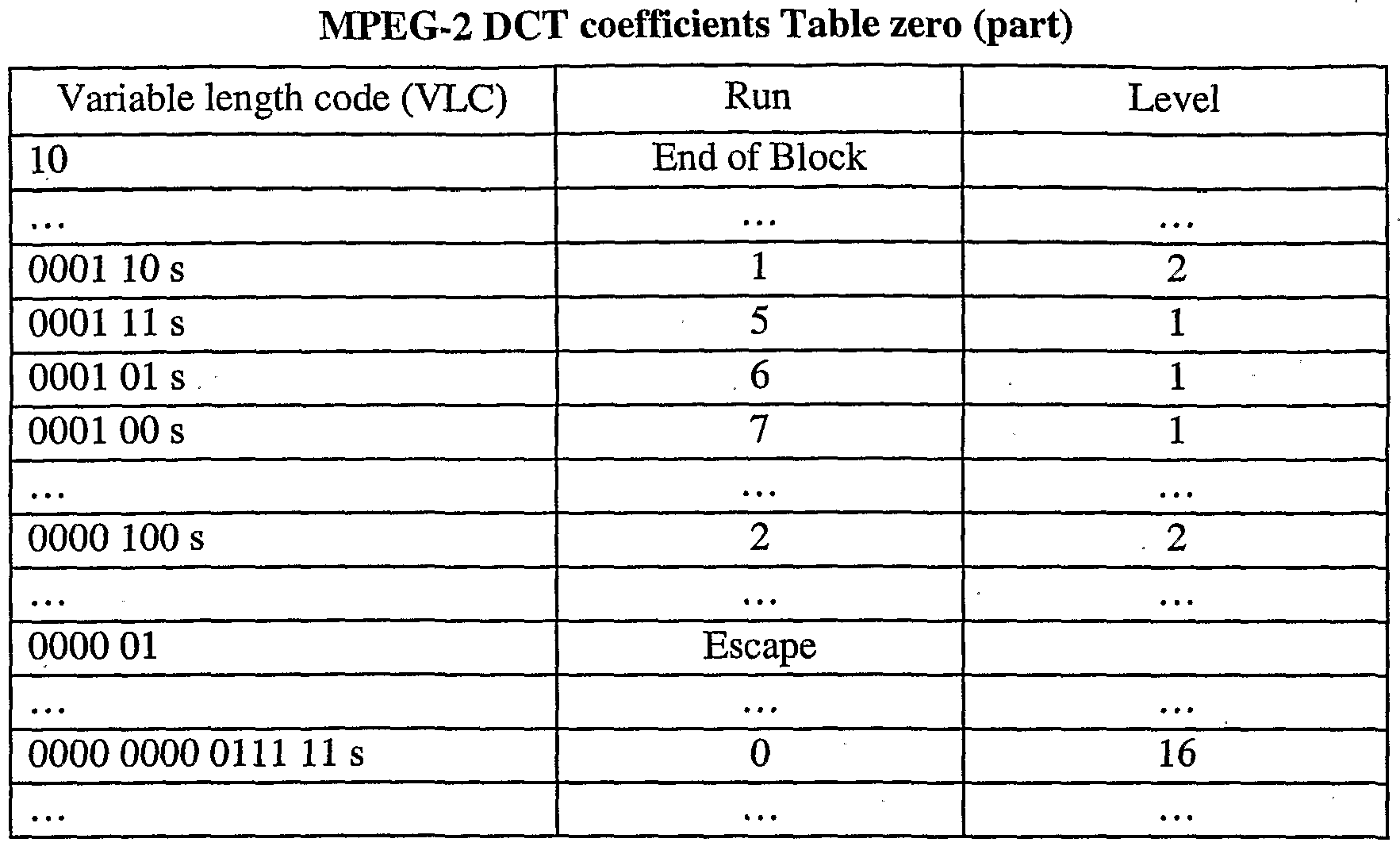
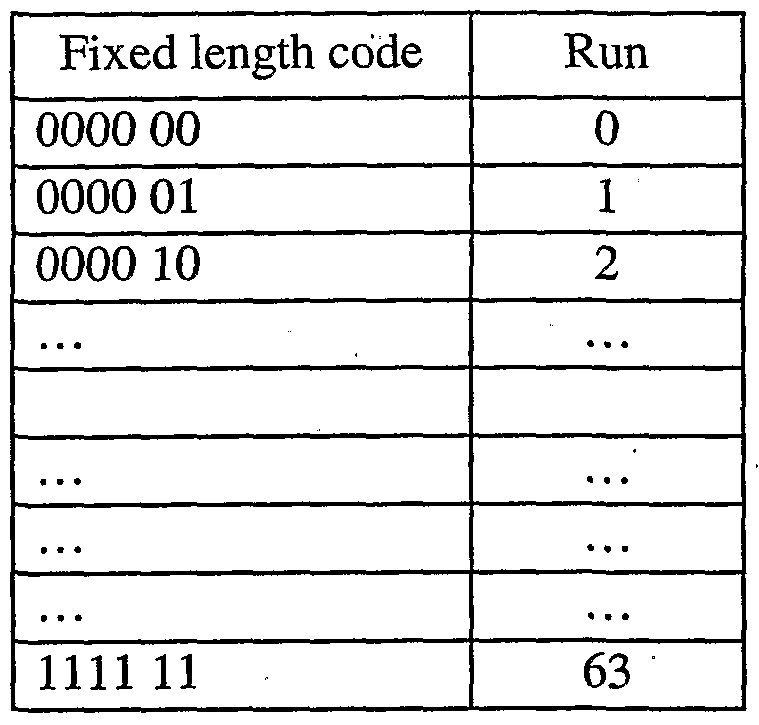
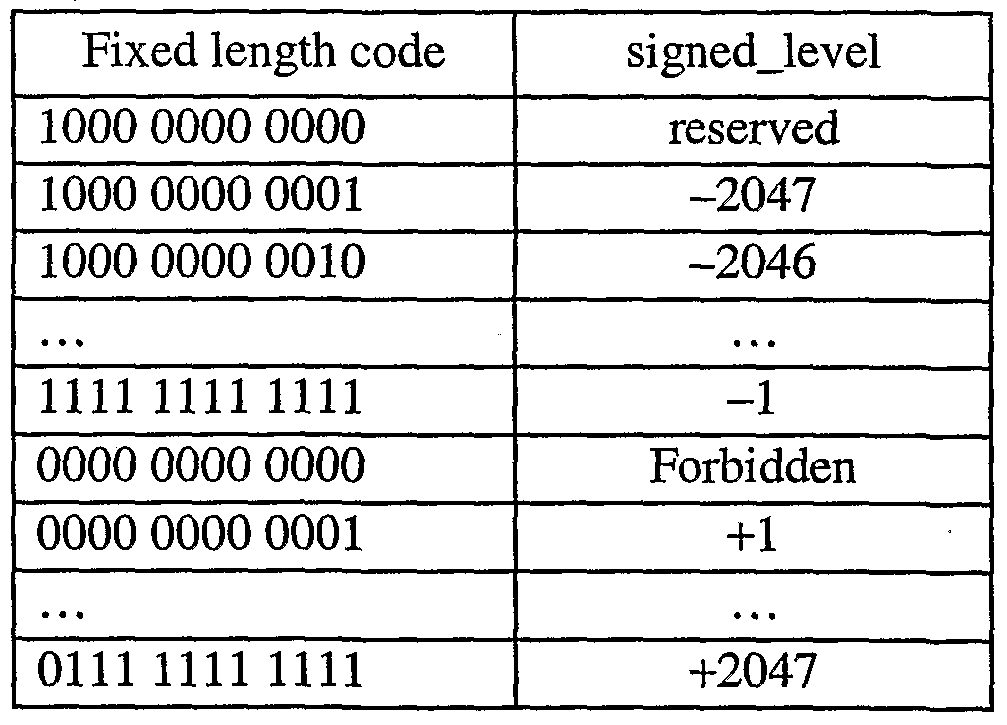
- the first and second DCT coefficients use a fixed length code to encode Run and Level according to the table "MPEG2 Encoding of run and level following an ESCAPE code", and the remaining DCT coefficients are coded according to "MPEG-2 DCT coefficients Table zero".
- the last VLC is a special "End of Block” code indicating the remaining coefficients in the block are 0.
- An alternative value can be any part of the above encoded bits. For example, one alternative value may consist of part of VLC, one or more consecutive VLCs, or one VLC plus part of next VLC.
- an alternative value consists of one VLC, which is the 5 th VLC:
- C consists of 7 coefficients as follows: c(f,ch,b,7), c(f,ch,b,8), ... c(f,ch,b,13) where f is the current frame index, ch is the current channel index and b is the current block index of this block in the example.
- 0001010 is the original value (V)
- 0001110 Vl
- 0001100 V2
- 0001000 V3
- a Run (R) and Level (L) pair represents a sequence of numbers beginning with R zeros followed by L.
- the alternative values above represent the following coefficients before entropy coding:
- V2 and V3 instead of coding seven coefficients in Vl, V2 encodes only 2 coefficients and V3 encodes 7 coefficients. If the first alternative value in the example WU is selected by the watermark inserter in the Step 3, this block will be changed to the following quantized DCT coefficients:
- encoded content is the content encoded with H.264 (MPEG4 Profile 10).
- MPEG4 Profile 10 MPEG4 Profile 10
- H264 supports both CAVLC (Context- Adaptive Variable Length Coding) and
- CABAC Context- Adaptive Binary Arithmetic Coding
- H264 may also use 4x4 DCT block
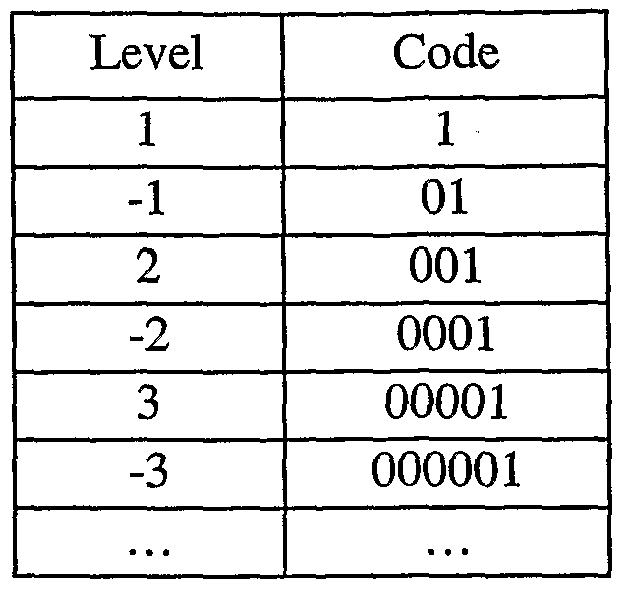
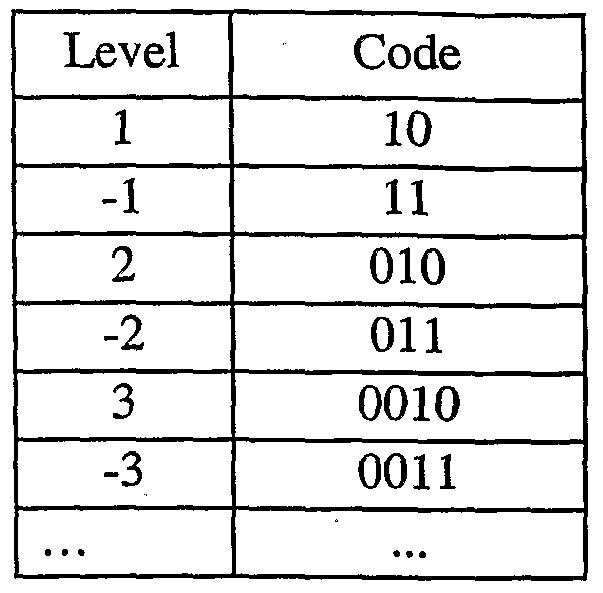
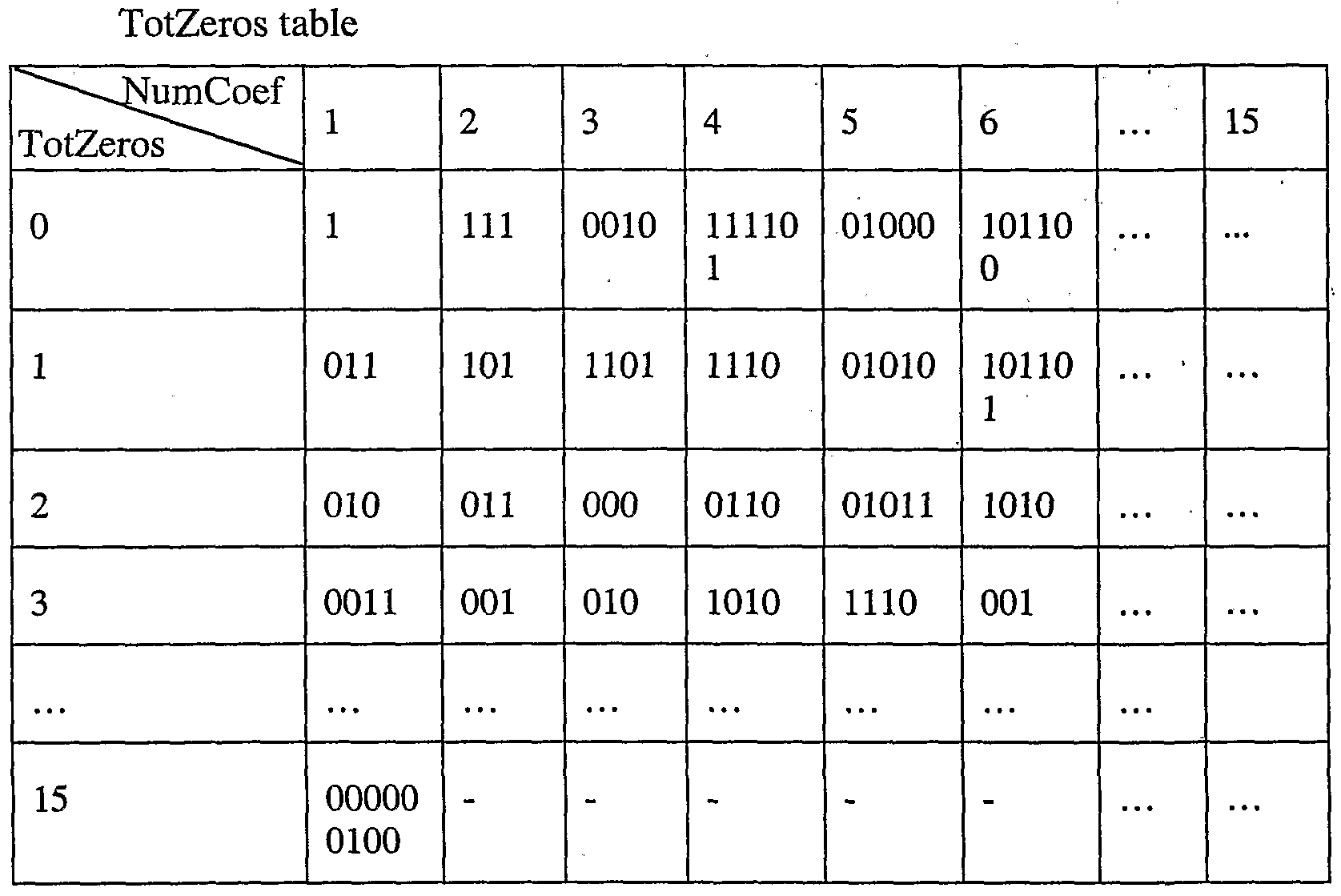
- CAVLC uses smaller VLC tables by coding levels and runs separately.
- VLC tables can be switched according to the context information.
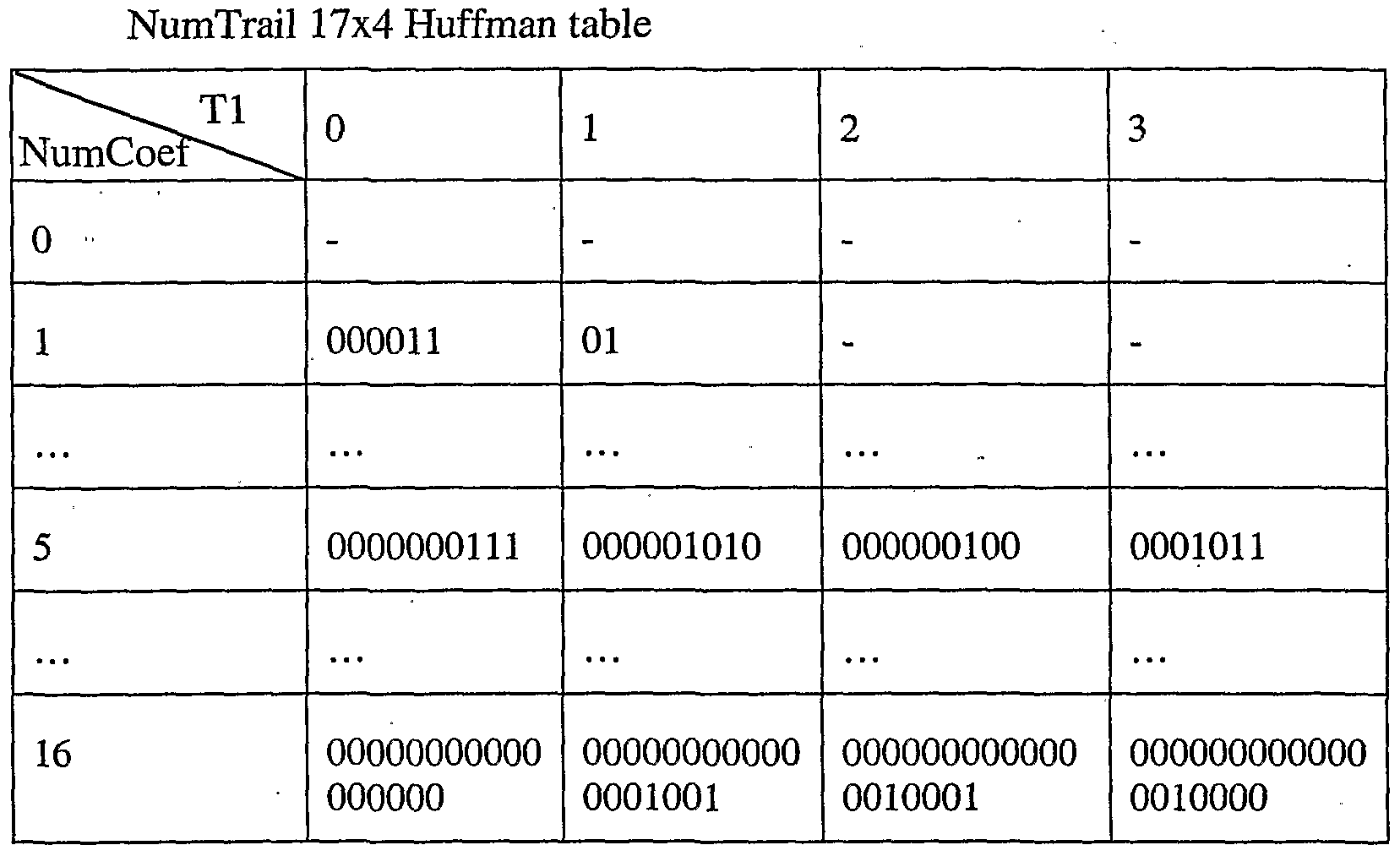
- an encoder may use a fixed NumTrail table (e.g. NumTrail Table 0), instead of a NumTrail table based on certain properties of neighborhood blocks.
- Another example is to use a fixed length code xxxxyyy to encode the number of non-zero (NumCoeff) and the number of trailing ones (Tl) for a 4x4 quantized DCT block where xxxx is for coding the number of non-zero (0-16) and yy is for coding the number of trailing ones (0...3).
- xxxx is for coding the number of non-zero (0-16)
- yy is for coding the number of trailing ones (0...3).
- One can also force an encoder to use 4x4 block only. In the following example, some of the above rules are applied for encoding a 4x4 block.
- CAVLC coding consists of the following five steps: a. Encoding the number of non-zero (NumCoeff) and the number of trailing ones (Tl): (5,3). The maximum number of Tl is limited to 3. These two numbers (NumCoef and Tl) are coded into the bits "0001011" by using a 17x4 Huffman table (see below) (NumCoef: 0-16, Tl: 0-3).
- the final encoded bits for this 4x4 block contain 25 bits: 0001011 1011 1 10010 1 1110 I 001101.
- One example of alternative values is the encoded bits of an entire encoded 4x4 block.
- Another example of alternative value can be the bits coding signs of trailing ones as described in the above step c). In such a case, changing the alternative value only changes the sign of trailing ones and therefore does not change the total bit length of the encoded block.
- JPEG2000 uses Digital Wavelet Transform (DWT).
- DWT Digital Wavelet Transform
- the DWT of a pixeled image is computed by the successive application of vertical and horizontal, low-pass and high-pass filters to the image pixels, where the resulting values are called 'wavelet coefficients'.
- a wavelet is an oscillating waveform that persists for only one or a few cycles.
- the low-pass only filtered wavelet coefficients of the previous iteration are decimated, then go through a low-pass vertical filter and a high-pass vertical filter, and the results of this process are passed through a low-pass horizontal and a high-pass horizontal filter.
- the resulting set of coefficients is grouped in four 'subbands', namely the LL, LH, HL and HH subbands. Each iteration corresponds to a certain 'layer' or 'level' of coefficients.
- the first layer of coefficients corresponds to the highest resolution level of the image, while the last layer corresponds to the lowest resolution level.
- One example of alternative value for JPEG2000 encoded picture is the encoded LL subband at a specific layer (e.g. the lowest resolution).
- a simple way to produce WUs is to use "trial and error" by performing the following steps for each WU: a) For each entropy code (e.g. a VLC in MPEG2), randomly select a value as a candidate for an alternative value. b) Determine if this candidate is a valid value by verifying the format compliance after substituting this candidate for the existing value. If not, go back to Step a). c) Check the perceptual changes after exchanging the existing value with this candidate.
- entropy code e.g. a VLC in MPEG2
- WUs can be produced with an exiting watermarking system that works in transform domain.
- the steps 1 and 2 can be performed in the following manner to select and produce WUs by scanning A and B until the following conditions are satisfied:
- PIa and P2a are the start position and end position of a plurality of consecutive encoded coefficients (their positions before entropy coding are noted as C) in the encoded content A
- PIb and P2b are the start position and end position of the same encoded coefficients in the encoded content B
- P2b- P2a and (P Ib-P Ia) must be equal (and are equal to length L)
- V is not available in this case
- Vl is the value from the position PIa to P2a in A
- V2 is the value from the position PIb to P2b in B.
- a bit of watermark payload is encoded as a relationship between two selected quantized coefficients in a middle frequency.
- a watermark unit P, L, C, V, Vl, V2, ...Vn
- V contains a plurality of consecutive encoded coefficients and there is at least one relationship (the kind/category of the relationships are predefined) between and/or among these coefficients. For example, if Cl, C2 are two consecutive encoded coefficients and a relationship exists C1>C2+T where T is a threshold which may be used to adjust the strength of the relationship, which in turn determine the watermark robustness.
- the coefficients can be modified to establish another relationship without perceptual change of the content.
- N watermark units To select N watermark units, repeat the above steps. Ideally the first N watermark units containing the most coefficients are selected so that most relationships can be potentially established within each watermark unit. In the referenced watermarking system, one relationship may represent one bit of watermark payload therefore the watermark unit with most relationships may have the highest capability of embedding more bits of watermark payload.
- a bit of watermark payload is encoded as a relationship between property values of two sets of pixel values, or DCT/wavelet coefficients.
- properties include the average luminance, average color histogram distribution, or energy in certain frequency subband.
- One principle of the present invention is to pre-process encoded content and generate alternative values containing watermarking signals. These alternative values will be later used to replace clearly defined parts of the encoded content.
- the existing watermarking systems can be applied to pre-processing (i.e. Step 1 and 2) and actual insertion (Step 3), new watermarking algorithms can be developed specially for this scheme.
- a simple and generic watermark detection method is to correlate the current coefficient in the watermarked content with the alternative values of a WU to find the alternative value having the best match to the current coefficient.
- the alternative values need to be decoded to coefficient values by using the corresponding entropy decoder.
- Each alternative value of a . WU may contain a watermark signal, which corresponds to watermark payload information. By finding the matched alternative values in all WUs, the watermark payload information can be retrieved.
- Watermark detection can be performed at multiple levels. At the first level, P, L and C elements of WUs are required. Assume the number of WUs is N. For each WU, obtain the coefficient values according to the global coefficient indexes C.
- Fig. 3 is a flowchart of the watermark detection process of the present invention.
- an index is initialized. 'N' watermark units are accepted/received at 310 and the suspect content is received at 315. The index is tested at 320 to determine if all watermarks have been processed/detected. If the index is greater than "N", the number of watermarks then the process is complete.
- the process proceeds to 325 where the coefficients are obtained.
- the bit values are retrieved according to the relationships between/among the coefficients.
- the index is incremented and the process proceeds to step 320. If very weak relationships are retrieved from a WU, it would be helpful to access the other elements V and Vl, V2, ...Vn of the WU in order to provide additional information to determine the relationship.
- a relationship can be better determined by correlating the current coefficients with the coefficients encoded in V, Vl, V2, ... and Vn. The highest correlation value is the correlation indicating the closest match between the current coefficient and one of V, Vl, V2, ... Vn. That is, the highest correlation between the current coefficients and the coefficients encoded in Vi (1 ⁇ i ⁇ n) indicates a match. For suspect content with serious attacks, the original content may be required for further analysis and correlation.
- WUs for delivering copyrighted content
- WUs recover the corrupted content prior to playback.
- the encoded content that is delivered to a playback/rendering device is explicitly corrupted either in the format/structure (invalid format) or in the content (degraded content).
- a decoder will not be able to decode it. If the corruptions are applied to the content, this content can be decoded and played but the corrupted portions of the content can have various visual artefacts such as noise, warning, and random patterns.
- a watermark can be removed if WUs are known, by simply restoring the content to the original value V in each WU.
- To overwrite an existing watermark in the encoded content one can simply select an appropriate value from Vl, V2, ...Vn in each WU according to the payload information to replace the value containing the existing watermark in the encoded content.
- a removable watermark is useful in some applications for supporting multi- generation watermarks.
- An example of multi-generation watermarks is to embed a forensic mark in each step of content post-production. To avoid accumulation of perceptual degradation potentially introduced by multiple watermarks, one may wish remove some or all previous watermarks before a new watermark is embedded.
- Fig. 4 shows an example of the watermark inserter in a playback device.
- the watermark inserter embeds a watermark by replacing some values/coefficients in the encoded content received by the devices with the alternative values specified in WUs.
- a replaceable watermark can also be useful for switching the states of copy protection for copyrighted content. For example, for a unit of content with a watermark information indicating "copy once", after one copy is made one may wish to change the watermark information from "copy once" to "no copy”.
- There are several approaches to avoid any potential conflict of multiple watermarks i.e. interfere between multiple watermarks).
- One approach is to use a unique subband for each generation of watermarks.
- Another approach is to select WUs with the positions that are different from the previous watermarks.
- the present invention may be implemented in various forms of hardware, software, firmware, special purpose processors, or a combination thereof.
- the present invention is implemented as a combination of hardware and software.
- the software is preferably implemented as an application program tangibly embodied on a program storage device.
- the application program may be uploaded to, and executed by, a machine comprising any suitable architecture.
- the machine is implemented on a computer platform having hardware such as one or more central processing units (CPU), a random access memory (RAM), and input/output (I/O) interface(s).
- CPU central processing units
- RAM random access memory
- I/O input/output
- the computer platform also includes an operating system and microinstruction code.
- various processes and functions described herein may either be part of the microinstruction code or part of the application program (or a combination thereof), which is executed via the operating system.
- various other peripheral devices may be connected to the computer platform such as an additional data storage device and a printing device.
Landscapes
- Engineering & Computer Science (AREA)
- Multimedia (AREA)
- Signal Processing (AREA)
- Physics & Mathematics (AREA)
- General Physics & Mathematics (AREA)
- Theoretical Computer Science (AREA)
- Computer Security & Cryptography (AREA)
- Compression Or Coding Systems Of Tv Signals (AREA)
- Editing Of Facsimile Originals (AREA)
- Image Processing (AREA)
Abstract
Description
Claims
Priority Applications (9)
| Application Number | Priority Date | Filing Date | Title |
|---|---|---|---|
| BRPI0520718-5A BRPI0520718A2 (en) | 2005-12-05 | 2005-12-05 | insert watermark into encoded content |
| EP05852953A EP1958430A1 (en) | 2005-12-05 | 2005-12-05 | Watermarking encoded content |
| JP2008544305A JP2009518945A (en) | 2005-12-05 | 2005-12-05 | Watermark encoded content |
| US12/085,253 US8144923B2 (en) | 2005-12-05 | 2005-12-05 | Watermarking encoded content |
| AU2005338930A AU2005338930B2 (en) | 2005-12-05 | 2005-12-05 | Watermarking encoded content |
| CN2005800522299A CN101326806B (en) | 2005-12-05 | 2005-12-05 | Method and system for inserting a watermark in encoded content |
| PCT/US2005/043895 WO2007067168A1 (en) | 2005-12-05 | 2005-12-05 | Watermarking encoded content |
| TW095145214A TWI439135B (en) | 2005-12-05 | 2006-12-05 | Watermarking encoded content |
| KR1020087013343A KR101273473B1 (en) | 2005-12-05 | 2008-06-02 | Watermarking Encoded Content |
Applications Claiming Priority (1)
| Application Number | Priority Date | Filing Date | Title |
|---|---|---|---|
| PCT/US2005/043895 WO2007067168A1 (en) | 2005-12-05 | 2005-12-05 | Watermarking encoded content |
Publications (1)
| Publication Number | Publication Date |
|---|---|
| WO2007067168A1 true WO2007067168A1 (en) | 2007-06-14 |
Family
ID=36691610
Family Applications (1)
| Application Number | Title | Priority Date | Filing Date |
|---|---|---|---|
| PCT/US2005/043895 Ceased WO2007067168A1 (en) | 2005-12-05 | 2005-12-05 | Watermarking encoded content |
Country Status (9)
| Country | Link |
|---|---|
| US (1) | US8144923B2 (en) |
| EP (1) | EP1958430A1 (en) |
| JP (1) | JP2009518945A (en) |
| KR (1) | KR101273473B1 (en) |
| CN (1) | CN101326806B (en) |
| AU (1) | AU2005338930B2 (en) |
| BR (1) | BRPI0520718A2 (en) |
| TW (1) | TWI439135B (en) |
| WO (1) | WO2007067168A1 (en) |
Cited By (15)
| Publication number | Priority date | Publication date | Assignee | Title |
|---|---|---|---|---|
| WO2010021694A1 (en) * | 2008-08-20 | 2010-02-25 | Thomson Licensing | Selection of watermarks for the watermarking of compressed video |
| WO2010021682A1 (en) * | 2008-08-19 | 2010-02-25 | Thomson Licensing | Cabac/avc compliant watermarking of syntax elements in compressed video |
| EP2257067A1 (en) * | 2009-05-29 | 2010-12-01 | Thomson Licensing | Method for inserting watermark assistance data in a bitstream, method of watermarking said bitstream, device implementing the method of watermarking and bitstream comprising the watermark assistance data |
| FR2951344A1 (en) * | 2009-10-14 | 2011-04-15 | Neotion | Method for marking video stream generated by encoder of digital TV receiver, involves selecting modifiable macroblocks in image, and replacing selected macroblocks by macroblocks coding identification or personalization information |
| JP2012500568A (en) * | 2008-08-19 | 2012-01-05 | トムソン ライセンシング | CABAC stream compliance |
| JP2012500569A (en) * | 2008-08-19 | 2012-01-05 | トムソン ライセンシング | Propagation map |
| EP2458890A1 (en) | 2010-11-29 | 2012-05-30 | Nagravision S.A. | Method to trace video content processed by a decoder |
| WO2012130287A1 (en) * | 2011-03-29 | 2012-10-04 | Irdeto Corporate B.V. | Content segmentation of watermarking |
| US8358703B2 (en) | 2007-03-23 | 2013-01-22 | Thomson Licensing | Modifying a coded bitstream |
| EP2600531A1 (en) * | 2011-12-01 | 2013-06-05 | Thomson Licensing | Method for determining a modifiable element in a coded bit-stream and associated device |
| US8515123B2 (en) | 2008-07-03 | 2013-08-20 | Verimatrix, Inc. | Efficient watermarking approaches of compressed media |
| US8588459B2 (en) | 2007-06-14 | 2013-11-19 | Thomson Licensing | Modifying a coded bitstream |
| US8948443B2 (en) | 2008-08-19 | 2015-02-03 | Thomson Licensing | Luminance evaluation |
| US9105091B2 (en) | 2010-02-09 | 2015-08-11 | Thomson Licensing | Watermark detection using a propagation map |
| US11611808B2 (en) | 2017-05-09 | 2023-03-21 | Verimatrix, Inc. | Systems and methods of preparing multiple video streams for assembly with digital watermarking |
Families Citing this family (36)
| Publication number | Priority date | Publication date | Assignee | Title |
|---|---|---|---|---|
| DE102005063136B3 (en) * | 2005-12-30 | 2007-07-05 | Siemens Ag | Marked data stream generating method for use in digital video data, involves displaying applicability of marked data stream section and localizing marked data stream section using marking information |
| JP5132672B2 (en) * | 2006-03-17 | 2013-01-30 | トムソン ライセンシング | System and method for processing content for later insertion of digital watermarks and other data |
| US8055708B2 (en) * | 2007-06-01 | 2011-11-08 | Microsoft Corporation | Multimedia spaces |
| US8085972B2 (en) * | 2008-07-03 | 2011-12-27 | Primax Electronics Ltd. | Protection method for preventing hard copy of document from being released or reproduced |
| JP2011082675A (en) * | 2009-10-05 | 2011-04-21 | Sony Corp | Apparatus and method for processing image signal, apparatus and method for displaying image, program therefor, and system for displaying image |
| US8548810B2 (en) * | 2009-11-04 | 2013-10-01 | Digimarc Corporation | Orchestrated encoding and decoding multimedia content having plural digital watermarks |
| US20110280434A1 (en) * | 2010-05-11 | 2011-11-17 | Rajesh Mamidwar | Method and system for watermakr insertin using video start codes |
| KR101808817B1 (en) * | 2010-12-06 | 2017-12-13 | 한국전자통신연구원 | Apparatus and method for forensic marking of digital contents |
| US8886945B2 (en) | 2010-12-17 | 2014-11-11 | Motorola Mobility Llc | System and method for conveying session information for use in forensic watermarking |
| US9767822B2 (en) * | 2011-02-07 | 2017-09-19 | Qualcomm Incorporated | Devices for encoding and decoding a watermarked signal |
| DK2697979T3 (en) * | 2011-04-15 | 2017-01-23 | Nagravision Sa | Method for identifying the origin of a security module in a pay-TV decoder system |
| EP2605536A1 (en) | 2011-12-13 | 2013-06-19 | Thomson Licensing | Device for generating watermark metadata, associated device for embedding watermark |
| US9066157B2 (en) * | 2012-02-28 | 2015-06-23 | Rogers Communications Inc. | Method and system for dynamically watermarking media |
| US10009663B1 (en) | 2012-08-02 | 2018-06-26 | Google Llc | Digital fingerprinting of live events for automatic detection |
| US9270515B1 (en) | 2012-08-15 | 2016-02-23 | Google Inc. | Identifying portions of a media stream |
| RU2517337C1 (en) * | 2012-10-25 | 2014-05-27 | Государственное казенное образовательное учреждение высшего профессионального образования Академия Федеральной службы охраны Российской Федерации (Академия ФСО России) | Method of embedding message in jpeg 2000 digital image |
| TWM487509U (en) * | 2013-06-19 | 2014-10-01 | 杜比實驗室特許公司 | Audio processing apparatus and electrical device |
| WO2015038475A1 (en) | 2013-09-12 | 2015-03-19 | Dolby Laboratories Licensing Corporation | Dynamic range control for a wide variety of playback environments |
| EP4379715A3 (en) | 2013-09-12 | 2024-08-21 | Dolby Laboratories Licensing Corporation | Loudness adjustment for downmixed audio content |
| US10424039B2 (en) * | 2013-09-27 | 2019-09-24 | Hewlett-Packard Development Company, L.P. | Digital watermarks |
| CN103686276A (en) * | 2013-12-04 | 2014-03-26 | 乐视致新电子科技(天津)有限公司 | A code value conflict avoidance system and method for an infrared remote control |
| US9946723B2 (en) * | 2014-06-02 | 2018-04-17 | Intel Corporation | Data embedding in run length encoded streams |
| US9858633B2 (en) | 2015-01-23 | 2018-01-02 | Sony Corporation | Model anti-collusion watermark |
| US9928561B2 (en) | 2015-05-29 | 2018-03-27 | Digimarc Corporation | Serialized digital watermarking for variable data printing |
| FR3038486A1 (en) * | 2015-06-30 | 2017-01-06 | Orange | METHOD AND DEVICE FOR GENERATING SIGNAL IN A NETWORK OF CONNECTED OBJECTS |
| GB201601793D0 (en) * | 2016-02-01 | 2016-03-16 | Nagravision Sa | Embedding watermarking data |
| US20190109710A1 (en) * | 2017-10-07 | 2019-04-11 | Arp-Ip Llc | System and method for randomizing hidden messages in digital files |
| CN110322385B (en) * | 2018-03-28 | 2021-08-24 | 浙江大学 | Watermark embedding and extraction method, device and electronic device |
| WO2019209027A1 (en) * | 2018-04-24 | 2019-10-31 | 리마 주식회사 | Method and system for detecting and tracking video copy |
| US10831869B2 (en) * | 2018-07-02 | 2020-11-10 | International Business Machines Corporation | Method for watermarking through format preserving encryption |
| US11095927B2 (en) * | 2019-02-22 | 2021-08-17 | The Nielsen Company (Us), Llc | Dynamic watermarking of media based on transport-stream metadata, to facilitate action by downstream entity |
| US11269976B2 (en) * | 2019-03-20 | 2022-03-08 | Saudi Arabian Oil Company | Apparatus and method for watermarking a call signal |
| RU2758666C1 (en) * | 2021-03-25 | 2021-11-01 | Публичное Акционерное Общество "Сбербанк России" (Пао Сбербанк) | Method and system for protection of digital information displayed on the screen of electronic apparatuses using dynamic digital tags |
| US12050670B2 (en) * | 2021-10-05 | 2024-07-30 | Synamedia Limited | Systems, devices, and methods for watermark embedding |
| CN113688601B (en) * | 2021-10-26 | 2022-02-22 | 北京凯睿数加科技有限公司 | Watermark generation method and device based on form, electronic equipment and computer medium |
| US12093405B2 (en) | 2022-02-14 | 2024-09-17 | Hiwin Technologies Corp. | Method and system for automatically loading parameters, and client-end server thereof |
Citations (1)
| Publication number | Priority date | Publication date | Assignee | Title |
|---|---|---|---|---|
| US20020085737A1 (en) * | 2001-01-02 | 2002-07-04 | Matsushita Electric Industrial Co., Ltd. | Apparatus and method for embedding watermark information in compressed image data, and apparatus and method for retrieving watermark information from compressed image data having watermark information embedded therein |
Family Cites Families (17)
| Publication number | Priority date | Publication date | Assignee | Title |
|---|---|---|---|---|
| DE19521969C1 (en) * | 1995-06-16 | 1997-02-27 | Fraunhofer Ges Forschung | Method for marking binary coded data sets |
| KR100323441B1 (en) * | 1997-08-20 | 2002-06-20 | 윤종용 | Mpeg2 motion picture coding/decoding system |
| US6373960B1 (en) * | 1998-01-06 | 2002-04-16 | Pixel Tools Corporation | Embedding watermarks into compressed video data |
| JP3698901B2 (en) | 1998-12-03 | 2005-09-21 | 株式会社日立製作所 | Information embedding method and apparatus |
| PL342815A1 (en) * | 1999-01-13 | 2001-07-02 | Koninkl Philips Electronics Nv | Placement of supplementary data in an encoded signal |
| US6687384B1 (en) * | 2000-03-27 | 2004-02-03 | Sarnoff Corporation | Method and apparatus for embedding data in encoded digital bitstreams |
| TW532039B (en) | 2001-01-05 | 2003-05-11 | Jen-Cheng Jang | Robust gray-level watermark embedding and retrieving technique |
| GB2377109B (en) | 2001-06-28 | 2003-12-03 | Motorola Inc | Video/image communication with watermarking |
| US7386146B2 (en) * | 2001-09-13 | 2008-06-10 | Canon Kabushiki Kaisha | Insertion of a message in a sequence of digital images |
| CN1592917B (en) * | 2001-11-23 | 2012-09-05 | 塞沃路森公司 | Watermark embedding |
| US7515730B2 (en) * | 2001-12-13 | 2009-04-07 | Digimarc Corporation | Progressive image quality control using watermarking |
| SI2765708T1 (en) * | 2002-03-27 | 2016-11-30 | Panasonic Intellectual Property Corporation Of America | Variable length encoding and decoding system and variable length encoding and decoding method |
| JP3782369B2 (en) * | 2002-04-05 | 2006-06-07 | 株式会社日立製作所 | Storage device, content distribution system, and content distribution method |
| US7003131B2 (en) * | 2002-07-09 | 2006-02-21 | Kaleidescape, Inc. | Watermarking and fingerprinting digital content using alternative blocks to embed information |
| CN100409343C (en) * | 2003-02-21 | 2008-08-06 | 艾利森电话股份有限公司 | Method of Embedding and Detecting Watermark in Digital Audio Signal |
| US7257234B2 (en) * | 2003-08-14 | 2007-08-14 | Microsoft Corporation | Watermark-based goods authentication |
| WO2005050415A1 (en) * | 2003-10-31 | 2005-06-02 | Telefonaktiebolaget Lm Ericsson (Publ) | Method and devices for the control of the usage of content |
-
2005
- 2005-12-05 BR BRPI0520718-5A patent/BRPI0520718A2/en not_active IP Right Cessation
- 2005-12-05 EP EP05852953A patent/EP1958430A1/en not_active Ceased
- 2005-12-05 US US12/085,253 patent/US8144923B2/en active Active
- 2005-12-05 WO PCT/US2005/043895 patent/WO2007067168A1/en not_active Ceased
- 2005-12-05 JP JP2008544305A patent/JP2009518945A/en active Pending
- 2005-12-05 CN CN2005800522299A patent/CN101326806B/en not_active Expired - Lifetime
- 2005-12-05 AU AU2005338930A patent/AU2005338930B2/en not_active Ceased
-
2006
- 2006-12-05 TW TW095145214A patent/TWI439135B/en not_active IP Right Cessation
-
2008
- 2008-06-02 KR KR1020087013343A patent/KR101273473B1/en not_active Expired - Lifetime
Patent Citations (1)
| Publication number | Priority date | Publication date | Assignee | Title |
|---|---|---|---|---|
| US20020085737A1 (en) * | 2001-01-02 | 2002-07-04 | Matsushita Electric Industrial Co., Ltd. | Apparatus and method for embedding watermark information in compressed image data, and apparatus and method for retrieving watermark information from compressed image data having watermark information embedded therein |
Non-Patent Citations (3)
| Title |
|---|
| HUNG-HSUN LIU ET AL: "REAL TIME DIGITAL VIDEO WATERMARKING FOR DIGITAL RIGHTS MANAGEMENT VIA MODIFICATION OF VLCS", PARALLEL AND DISTRIBUTED SYSTEMS, 2005. PROCEEDINGS. 11TH INTERNATIONAL CONFERENCE ON FUKUOKA, JAPAN 20-22 JULY 2005, PISCATAWAY, NJ, USA,IEEE, 20 July 2005 (2005-07-20), pages 295 - 299, XP010852832, ISBN: 0-7695-2281-5 * |
| See also references of EP1958430A1 * |
| ZHENG LIU ET AL: "Direct Fingerprinting on Multicasting Compressed Video", MULTIMEDIA MODELLING CONFERENCE, 2004. MMM 2005. PROCEEDINGS OF THE 11TH INTERNATIONAL HONOLULU, HI, USA 12-14 JAN. 2005, PISCATAWAY, NJ, USA,IEEE, 12 January 2005 (2005-01-12), pages 76 - 83, XP010765640, ISBN: 0-7695-2164-9 * |
Cited By (34)
| Publication number | Priority date | Publication date | Assignee | Title |
|---|---|---|---|---|
| US8358703B2 (en) | 2007-03-23 | 2013-01-22 | Thomson Licensing | Modifying a coded bitstream |
| US9299120B2 (en) | 2007-03-23 | 2016-03-29 | Thomson Licensing Llc | Modifying a coded bitstream |
| KR101518999B1 (en) | 2007-06-14 | 2015-05-12 | 톰슨 라이센싱 | Modifying a coded bitstream |
| US8588459B2 (en) | 2007-06-14 | 2013-11-19 | Thomson Licensing | Modifying a coded bitstream |
| US8995711B2 (en) | 2008-07-03 | 2015-03-31 | Verimatrix, Inc. | Efficient watermarking approaches of compressed media |
| US8515123B2 (en) | 2008-07-03 | 2013-08-20 | Verimatrix, Inc. | Efficient watermarking approaches of compressed media |
| JP2012500569A (en) * | 2008-08-19 | 2012-01-05 | トムソン ライセンシング | Propagation map |
| JP2012500568A (en) * | 2008-08-19 | 2012-01-05 | トムソン ライセンシング | CABAC stream compliance |
| CN102187672B (en) * | 2008-08-19 | 2014-05-28 | 汤姆森特许公司 | Cabac/avc compliant watermarking of syntax elements in compressed video |
| US8948443B2 (en) | 2008-08-19 | 2015-02-03 | Thomson Licensing | Luminance evaluation |
| WO2010021682A1 (en) * | 2008-08-19 | 2010-02-25 | Thomson Licensing | Cabac/avc compliant watermarking of syntax elements in compressed video |
| US9113231B2 (en) | 2008-08-19 | 2015-08-18 | Thomson Licensing | Changeable block list |
| JP2012500565A (en) * | 2008-08-19 | 2012-01-05 | トムソン ライセンシング | CABAC / AVC compliant watermarking of syntax elements in compressed video |
| US8594366B2 (en) | 2008-08-19 | 2013-11-26 | Thomson Licensing | Context-based adaptive binary arithmetic coding (CABAC) video stream compliance |
| US9042455B2 (en) | 2008-08-19 | 2015-05-26 | Thomson Licensing | Propagation map |
| KR20110048524A (en) * | 2008-08-20 | 2011-05-11 | 톰슨 라이센싱 | Selection of watermarks for watermarking compressed video |
| JP2012500567A (en) * | 2008-08-20 | 2012-01-05 | トムソン ライセンシング | Select a watermark for watermarking compressed video |
| WO2010021694A1 (en) * | 2008-08-20 | 2010-02-25 | Thomson Licensing | Selection of watermarks for the watermarking of compressed video |
| JP2014099904A (en) * | 2008-08-20 | 2014-05-29 | Thomson Licensing | Selection of watermarks for watermark processing in compressed video |
| US8824727B2 (en) | 2008-08-20 | 2014-09-02 | Thomson Licensing | Selection of watermarks for the watermarking of compressed video |
| US8462982B2 (en) | 2009-05-29 | 2013-06-11 | Thomson Licensing | Method for inserting watermark assistance data in a bitstream and bitstream comprising the watermark assistance data |
| EP2257068A3 (en) * | 2009-05-29 | 2011-06-01 | Thomson Licensing | Method for inserting watermark assistance data in a bitstream and bitstream comprising the watermark assistance data |
| EP2257067A1 (en) * | 2009-05-29 | 2010-12-01 | Thomson Licensing | Method for inserting watermark assistance data in a bitstream, method of watermarking said bitstream, device implementing the method of watermarking and bitstream comprising the watermark assistance data |
| FR2951344A1 (en) * | 2009-10-14 | 2011-04-15 | Neotion | Method for marking video stream generated by encoder of digital TV receiver, involves selecting modifiable macroblocks in image, and replacing selected macroblocks by macroblocks coding identification or personalization information |
| US9105091B2 (en) | 2010-02-09 | 2015-08-11 | Thomson Licensing | Watermark detection using a propagation map |
| US8712113B2 (en) | 2010-11-29 | 2014-04-29 | Nagravision S.A. | Method to trace video content processed by a decoder |
| US8842892B2 (en) | 2010-11-29 | 2014-09-23 | Nagravision S.A. | Method to trace video content processed by a decoder |
| EP2458890A1 (en) | 2010-11-29 | 2012-05-30 | Nagravision S.A. | Method to trace video content processed by a decoder |
| CN103891282A (en) * | 2011-03-29 | 2014-06-25 | 耶德托公司 | Content segmentation of watermarking |
| WO2012130287A1 (en) * | 2011-03-29 | 2012-10-04 | Irdeto Corporate B.V. | Content segmentation of watermarking |
| US9288057B2 (en) | 2011-03-29 | 2016-03-15 | Irdeto B.V. | Content segmentation of watermarking |
| WO2013079632A1 (en) * | 2011-12-01 | 2013-06-06 | Thomson Licensing | Method for determining a modifiable element in a coded bit-stream and associated device |
| EP2600531A1 (en) * | 2011-12-01 | 2013-06-05 | Thomson Licensing | Method for determining a modifiable element in a coded bit-stream and associated device |
| US11611808B2 (en) | 2017-05-09 | 2023-03-21 | Verimatrix, Inc. | Systems and methods of preparing multiple video streams for assembly with digital watermarking |
Also Published As
| Publication number | Publication date |
|---|---|
| AU2005338930A1 (en) | 2007-06-14 |
| BRPI0520718A2 (en) | 2009-05-26 |
| EP1958430A1 (en) | 2008-08-20 |
| AU2005338930B2 (en) | 2010-12-09 |
| US20090080689A1 (en) | 2009-03-26 |
| US8144923B2 (en) | 2012-03-27 |
| KR20080075853A (en) | 2008-08-19 |
| KR101273473B1 (en) | 2013-06-14 |
| CN101326806A (en) | 2008-12-17 |
| TWI439135B (en) | 2014-05-21 |
| TW200746828A (en) | 2007-12-16 |
| CN101326806B (en) | 2011-10-19 |
| JP2009518945A (en) | 2009-05-07 |
Similar Documents
| Publication | Publication Date | Title |
|---|---|---|
| US8144923B2 (en) | Watermarking encoded content | |
| EP0928110B1 (en) | Image signal processing for electronic watermarking | |
| Liu et al. | High-performance JPEG steganography using complementary embedding strategy | |
| JP2004163855A (en) | Electronic watermark embedding method, and encoder and decoder capable of utilizing such method | |
| CN101663690A (en) | video watermarking | |
| WO2002060182A1 (en) | Watermarking a compressed information signal | |
| JP2002325170A (en) | Image processing apparatus and method, program code, and storage medium | |
| Lu et al. | Real-time MPEG2 video watermarking in the VLC domain | |
| JP2004221715A (en) | Electronic watermark embedding method, and encoder and decoder capable of utilizing the method | |
| Zou et al. | H. 264 stream replacement watermarking with CABAC encoding | |
| Zou et al. | H. 264/AVC stream replacement technique for video watermarking | |
| US7418110B2 (en) | Method and apparatus for compressed-domain watermarking | |
| Wong et al. | Data hiding technique in JPEG compressed domain | |
| RU2434356C2 (en) | Creating watermarks in coded information content | |
| Li et al. | A reversible data hiding scheme for JPEG images | |
| Zou et al. | H. 264/AVC substitution watermarking: a CAVLC example | |
| JP5571756B2 (en) | Watermark encoded content | |
| US11308572B1 (en) | Method and system for invisible watermarking of images and video | |
| EP1743296B1 (en) | Watermarking a compressed information signal | |
| MX2008006995A (en) | Watermarking encoded content | |
| US7583850B2 (en) | Image-processing apparatus and method | |
| Simitopoulos et al. | Fast MPEG watermarking for copyright protection | |
| Su | Information hiding in digital images: watermarking and steganography | |
| CN102036072A (en) | Method and system for watermark detection | |
| Goudia et al. | Joint trellis-coded quantization watermarking for JPEG2000 images |
Legal Events
| Date | Code | Title | Description |
|---|---|---|---|
| WWE | Wipo information: entry into national phase |
Ref document number: 200580052229.9 Country of ref document: CN |
|
| 121 | Ep: the epo has been informed by wipo that ep was designated in this application | ||
| WWE | Wipo information: entry into national phase |
Ref document number: 12085253 Country of ref document: US |
|
| WWE | Wipo information: entry into national phase |
Ref document number: 4519/DELNP/2008 Country of ref document: IN |
|
| WWE | Wipo information: entry into national phase |
Ref document number: 2005338930 Country of ref document: AU |
|
| WWE | Wipo information: entry into national phase |
Ref document number: MX/a/2008/006995 Country of ref document: MX |
|
| WWE | Wipo information: entry into national phase |
Ref document number: 1020087013343 Country of ref document: KR |
|
| WWE | Wipo information: entry into national phase |
Ref document number: 2008544305 Country of ref document: JP |
|
| NENP | Non-entry into the national phase |
Ref country code: DE |
|
| REEP | Request for entry into the european phase |
Ref document number: 2005852953 Country of ref document: EP |
|
| WWE | Wipo information: entry into national phase |
Ref document number: 2005852953 Country of ref document: EP |
|
| ENP | Entry into the national phase |
Ref document number: 2005338930 Country of ref document: AU Date of ref document: 20051205 Kind code of ref document: A |
|
| WWE | Wipo information: entry into national phase |
Ref document number: 2008127313 Country of ref document: RU |
|
| ENP | Entry into the national phase |
Ref document number: PI0520718 Country of ref document: BR Kind code of ref document: A2 |