WO2007022642A2 - Anti-inflammatory molecules and their uses - Google Patents
Anti-inflammatory molecules and their uses Download PDFInfo
- Publication number
- WO2007022642A2 WO2007022642A2 PCT/CA2006/001409 CA2006001409W WO2007022642A2 WO 2007022642 A2 WO2007022642 A2 WO 2007022642A2 CA 2006001409 W CA2006001409 W CA 2006001409W WO 2007022642 A2 WO2007022642 A2 WO 2007022642A2
- Authority
- WO
- WIPO (PCT)
- Prior art keywords
- oligonucleotide
- formulation
- sequence
- nucleotides
- inflammatory
- Prior art date
- Legal status (The legal status is an assumption and is not a legal conclusion. Google has not performed a legal analysis and makes no representation as to the accuracy of the status listed.)
- Ceased
Links
Classifications
-
- A—HUMAN NECESSITIES
- A61—MEDICAL OR VETERINARY SCIENCE; HYGIENE
- A61K—PREPARATIONS FOR MEDICAL, DENTAL OR TOILETRY PURPOSES
- A61K31/00—Medicinal preparations containing organic active ingredients
- A61K31/70—Carbohydrates; Sugars; Derivatives thereof
- A61K31/7088—Compounds having three or more nucleosides or nucleotides
-
- A—HUMAN NECESSITIES
- A61—MEDICAL OR VETERINARY SCIENCE; HYGIENE
- A61K—PREPARATIONS FOR MEDICAL, DENTAL OR TOILETRY PURPOSES
- A61K31/00—Medicinal preparations containing organic active ingredients
- A61K31/70—Carbohydrates; Sugars; Derivatives thereof
- A61K31/7088—Compounds having three or more nucleosides or nucleotides
- A61K31/713—Double-stranded nucleic acids or oligonucleotides
-
- A—HUMAN NECESSITIES
- A61—MEDICAL OR VETERINARY SCIENCE; HYGIENE
- A61P—SPECIFIC THERAPEUTIC ACTIVITY OF CHEMICAL COMPOUNDS OR MEDICINAL PREPARATIONS
- A61P29/00—Non-central analgesic, antipyretic or antiinflammatory agents, e.g. antirheumatic agents; Non-steroidal antiinflammatory drugs [NSAID]
-
- Y—GENERAL TAGGING OF NEW TECHNOLOGICAL DEVELOPMENTS; GENERAL TAGGING OF CROSS-SECTIONAL TECHNOLOGIES SPANNING OVER SEVERAL SECTIONS OF THE IPC; TECHNICAL SUBJECTS COVERED BY FORMER USPC CROSS-REFERENCE ART COLLECTIONS [XRACs] AND DIGESTS
- Y02—TECHNOLOGIES OR APPLICATIONS FOR MITIGATION OR ADAPTATION AGAINST CLIMATE CHANGE
- Y02A—TECHNOLOGIES FOR ADAPTATION TO CLIMATE CHANGE
- Y02A50/00—TECHNOLOGIES FOR ADAPTATION TO CLIMATE CHANGE in human health protection, e.g. against extreme weather
- Y02A50/30—Against vector-borne diseases, e.g. mosquito-borne, fly-borne, tick-borne or waterborne diseases whose impact is exacerbated by climate change
Definitions
- the invention relates to oligonucleotides acting predominantly by a sequence independent mode of action for the treatment of inflammatory diseases.
- the invention also relates to oligonucleotides and their use as therapeutic agents, and more particularly for their use in methods of treatment and formulations for the treatment of inflammatory diseases.
- Inflammation is an important component of host protection, and is a composite reaction including successive events in response to an injury which may be infectious or non-infectious. Inflammation involves a variety of events on the cellular, molecular and physiological levels. These events may include one or many of the following events: vasodilatation; increased vascular permeability; extravasation of plasma leading to interstitial edema; chemotaxis of neutrophils, macrophages and lymphocytes; cytokine production; production of acute phase reactants; leukocytosis; fever; increased metabolic rate; hypoalbuminemia; activation of complement; and stimulation of antibody production.
- inflammation is associated, without limitation, with many diseases or disorders such as neurodegenerative diseases, rheumatoid arthritis, inflammatory bowel disease, psoriasis, eczema, lupus, diabetes, multiple sclerosis, interstitial cystitis, chronic obstructive pulmonary disease (COPD), cystic fibrosis, migraine systemic inflammatory response syndrome (SIRS), asthma, ulcerative colitis, diabetes associated nephropathy and retinopathy, infectious diseases, uveitis, cataract, as well as various cardiovascular disorders.
- diseases or disorders such as neurodegenerative diseases, rheumatoid arthritis, inflammatory bowel disease, psoriasis, eczema, lupus, diabetes, multiple sclerosis, interstitial cystitis, chronic obstructive pulmonary disease (COPD), cystic fibrosis, migraine systemic inflammatory response syndrome (SIRS), asthma, ulcerative colitis, diabetes associated nephropathy and retinopathy, infectious
- T helper (Th) type 2 cytokines particularly interleukin (IL)-4, IL-5, and IL- 13 are taught be important in the development of the condition.
- Cytokine TNF-alpha and extracellular matrix protein ICAM-I are also involved in asthma response.
- Rheumatoid arthritis displays increased concentrations of TNF- ⁇ as a central proinflammatory mediator, increased concentrations of IL-I, IL-6, TNF- ⁇ , GM-CSF, IL-8 and RANTES.
- MS Multiple Sclerosis
- ICAM-I brain endothelium and astrocytes expression of ICAM-I is increased in MS.
- cytokine network in psoriatic lesions that consists of elevated levels of TNF-alpha, several interleukins (IL-I, IL-2, IL-6, IL-8, IL-12 [ ⁇ 40 subunit], IL- 17, IL- 19 and IL-23) and chemokines.
- Inflammatory bowel disease includes a variety of inflammatory disease such as Crohn's disease and ulcerative colitis and is mediated by cytokines (e.g. IL-4, IL-5, IL-IO) and other factors such as ICAM-I.
- Cytokines and other factors mediate or are involved in metabolic diseases and conditions such as diabetes, obesity and the metabolic syndrome.
- Pro-inflammatory cytokines such as IL-6 and TNF-alpha are considered to be involved in the pathogenesis of insulin resistance, type 2 diabetes.
- cytokines such as IL- l ⁇ and interferon-gamma mediate pancreatic islet ⁇ -cell apoptosis and necrosis, leading to loss of insulin secretory capacity.
- a metabolic disorder for example obesity
- cytokines can be associated with cytokines and be dependent on the establishment of a chronic, pro-inflammatory state in patients which is derived in part from the activity of the cytokines IL- l ⁇ , IL-6 and TNF-alpha.
- PS ODNs antisense phosphorothioate oligodeoxynucleotides
- Antisense PS-ONs targeting human intercellular adhesion molecule-1 (ICAM- 1) mRNA were described for the treatment of Crohn's disease and ulcerative colitis (Yu et al, 2003, Antisense Nucleic Acid Drug Dev 13: 57-66; van Deventer et al, 2004, Gut 53: 1646-1651).
- IL-4 inhibition does not decrease experimental asthma in mice, but results in partial, but significant, improvement of persistent asthma (Borish et al, 2001, J Allergy Clin Immunol, 107(6): 963-970).
- anti-IL5 antibodies have resulted in marked decrease in eosinophilic responses in humans, but no improvement in asthma.
- the invention relates to oligonucleotides (ONs) acting predominantly by a sequence independent mode of action for the treatment of inflammatory diseases.
- the invention also relates to ONs and their use as therapeutic agents, and more particularly for their use in methods of treatment and formulations for the treatment of inflammatory diseases.
- an anti-inflammatory oligonucleotide formulation comprising at least one oligonucleotide, said oligonucleotide having an anti-inflammatory activity, and said activity occuring by a sequence independent mode of action.
- Another object of the present invention is to provide an oligonucleotide formulation, wherein said oligonucleotide is at least 15, 20, 25, 30, 35, 40, 45, 50, 60 or 80 nucleotides in length.
- the oligonucleotide formulation comprises an oligonucleotide which is 20-30, 30-40, 40-50, 50-60, 60-70, or 70-80 nucleotides in length.
- the oligonucleotide formulation comprises an oligonucleotide having a sequence not complementary to any equal length portion of a genomic sequence.
- the genomic sequence is of human origin. Most preferably, the genomic sequence is of non-human animal origin.
- the oligonucleotide used in the formulation comprises at least 10 contiguous nucleotides of randomer sequence, more preferably 20 nucleotides of randomer sequence, 30 nucleotides of randomer sequence, 40 nucleotides of randomer sequence or more preferably is a randomer oligonucleotide.
- the oligonucleotide of the formulation comprises a homopolymer sequence of at least 10 contiguous A nucleotides, 10 contiguous T nucleotides, 10 contiguous U nucleotides, 10 contiguous G nucleotides, 10 contiguous I nucleotide analogs and/or 10 contiguous C nucleotides.
- the oligonucleotide comprised in the oligonucleotide formulation is a homopolymer of C nucleotides.
- the oligonucleotide formulation comprises an oligonucleotide having a polyAT sequence at least 10 nucleotides in length; a polyAC sequence at least 10 nucleotides in length; a polyAG sequence at least 10 nucleotides in length; a polyAU sequence at least 10 nucleotides in length; a polyAI sequence at least 10 nucleotides in length; a polyGC sequence at least 10 nucleotides in length; a polyGT sequence at least 10 nucleotides in length; a polyGU sequence at least 10 nucleotides in length; a polyGI sequence at least 10 nucleotides in length; a polyCT sequence at least 10 nucleotides in length; a polyCU sequence at least 10 nucleotides in length; a polyCI sequence at least 10 nucleotides in length; a polyTI sequence at least 10 nucleotides in length; a polyTU sequence at least 10 nucleotides in
- the oligonucleotide formulation comprises an oligonucleotide having at least one phosphodiester linkage.
- the oligonucleotide formulation comprises an oligonucleotide having at least one ribonucleotide.
- the oligonucleotide formulation comprises an oligonucleotide having at least one modification to its chemical structure, more preferably at least two different modifications to its chemical structure.
- an oligonucleotide formulation comprising an oligonucleotide having at least one sulfur modification.
- the oligonucleotide formulation comprises an oligonucleotide having at least one phosphorothioated linkage; at least one phosphorodithioated linkage; and/or at least one boranophosphate linkage.
- the oligonucleotide formulation comprises an oligonucleotide having at least one sulfur modified nucleobase moiety, one sulfur modified ribose moiety, one T modification to the ribose moiety, one 2'-O alkyl modified ribose moiety, one 2'-0 methyl modified ribose, one 2'-methoxyethyl modified ribose, and/or one 2'-FANA modified ribose.
- the oligonucleotide formulation comprises an oligonucleotide having at least one methylphosphonate linkage.
- the oligonucleotide formulation comprises an oligonucleotide having at least one portion consisting of glycol nucleic acid (GNA) with an acyclic propylene glycol phosphorothioate backbone.
- the oligonucleotide formulation comprises an oligonucleotide having at least one locked nucleic acid portion.
- the oligonucleotide formulation comprises an oligonucleotide having at least one phosphorodiamidate morpholino portion.
- the oligonucleotide formulation comprises an oligonucleotide having at least one abasic nucleic acid.
- the oligonucleotide formulation comprises an oligonucleotide having a linker to form a concatemer of two or more oligonucleotide sequences.
- the oligonucleotide formulation of the present invention comprises an oligonucleotide linked or conjugated at one or more nucleotide residues, to a molecule modifying the characteristics of the oligonucleotide to obtain one or more characteristics selected from the group consisting of higher stability, lower serum interaction, higher cellular uptake, an improved ability to be formulated, a detectable signal, higher anti-ocular angiogenesis activity, better pharmacokinetic properties, specific tissue distribution and lower toxicity.
- the oligonucleotide formulation comprises an oligonucleotide linked or conjugated to a PEG molecule; and/or linked or conjugated to a cholesterol molecule.
- the oligonucleotide formulation comprises a double stranded oligonucleotide.
- the oligonucleotide formulation comprises an oligonucleotide having at least one base which is capable of hybridizing via non- Watson-Crick interactions.
- the oligonucleotide formulation comprises an oligonucleotide having a portion complementary to a genome.
- the oligonucleotide formulation comprises an oligonucleotide that binds to one or more cytokine protein. [0041] In a further embodiment, the oligonucleotide formulation comprises an oligonucleotide that interacts with one or more cellular components, wherein said interaction resulting in inhibition of a protein activity or expression.
- the oligonucleotide formulation comprises an oligonucleotide wherein at least a portion of the sequence of said oligonucleotide is derived from a genome.
- the oligonucleotide formulation comprises an oligonucleotide having at least a portion of its sequence derived from a genome and has an anti-inflammatory activity that predominantly occurs by a sequence independent mode of action.
- the oligonucleotide formulation lowers inflammation associated with an inflammatory disease.
- the inflammatory disease is asthma, rheumatoid arthritis, inflammatory bowel disease, psoriasis, multiple sclerosis, diabetes, eczema and/or interstitial cystitis.
- the oligonucleotide of the formulation has 90%, preferably 80%, more preferably 75% identity with the genomic sequence.
- the oligonucleotide formulation of the present invention comprises a mixture of at least two different oligonucleotides. More preferably, the oligonucleotide formulation of the present invention comprises a mixture of at least ten different oligonucleotides, at least 100 different oligonucleotides, at least 1000 different oligonucleotides or at least 10 6 different oligonucleotides.
- an anti-inflammatory pharmaceutical composition comprising a therapeutically effective amount of at least one pharmacologically acceptable anti-inflammatory oligonucleotide formulation described herein and a pharmaceutically acceptable carrier.
- the anti-inflammatory pharmaceutical composition is adapted for delivery by a mode selected from the group consisting of topical ocular administration, oral ingestion, inhalation, subcutaneous injection, intramuscular injection, intrathecal injection, intracerebral injection, by enema, skin topical administration, vaginal administration and intravenous injection.
- the anti-inflammatory pharmaceutical composition further comprises a delivery system.
- the anti-inflammatory pharmaceutical composition further comprises at least one other anti-inflammatory drug.
- the anti-inflammatory pharmaceutical composition further comprises a non-nucleotidic anti-inflammatory drug.
- the anti-inflammatory pharmaceutical composition further comprises an agent selected from the group consisting of an anti-inflammatory antisense, a siRNA and a sequence-specific aptamer oligonucleotide.
- the anti-inflammatory pharmaceutical composition further comprises an anti-inflammatory RNAi-inducing oligonucleotide.
- a method for the prophylaxis or treatment of an inflammatory disease in a subject comprising administering to a subject in need of such treatment a therapeutically effective amount of at least one pharmacologically acceptable anti-inflammatory oligonucleotide, oligonucleotide formulation, oligonucleotide mixture, or anti-inflammatory pharmaceutical composition described herein.
- the inflammatory disease is asthma, rheumatoid arthritis, inflammatory bowel disease, psoriasis, multiple sclerosis, diabetes, eczema and interstitial cystitis, and said subject is a human, more preferably a non-human subject.
- the present invention it is provided a use of a therapeutically effective amount of at least one pharmacologically acceptable anti-inflammatory oligonucleotide formulation, or anti-inflammatory pharmaceutical composition described herein for the prophylaxis or treatment of an inflammatory disease in a subject.
- the inflammatory disease is asthma, rheumatoid arthritis, inflammatory bowel disease, psoriasis, multiple sclerosis, diabetes, eczema and interstitial cystitis
- said subject is a human, more preferably a non-human subject.
- the present invention is concerned with the identification and use of antiinflammatory ONs that act by a sequence independent mechanism, and includes the discovery that the anti-inflammatory activity is greater for larger ONs and for ONs with sulfur modification.
- ONs have been tested for anti-inflammatory activity.
- antisense ONs are typically sequence-specific and target intracellular mRNA and are about 16-25 nucleotides in length.
- the anti-inflammatory effect of randomer ONs is sequence independent. Considering the volumes and concentrations of ONs used in the present invention, it is theoretically impossible that a particular sequence is present at more than 1 copy in the mixture. This means than there can be no antisense or sequence-specific aptameric effect in these ONs randomers. In all examples, should the inflammatory diseases inhibition effect be caused by the sequence- specificity of the ONs, such effect would thus have to be caused by only one molecule, a result that does not appear possible. For example, for an ON randomer 40 bases in length, any particular sequence in the population would theoretically represent only 1/4 40 or 1/8.27X10 "25 of the total fraction.
- ONs can have an anti-inflammatory activity by binding to cytokines involved in inflammation or to other proteins and receptors involved in inflammation and therefore preventing, inhibiting or reversing inflammation.
- ONs have the capacity to treat animals, including humans, suffering from inflammatory diseases including cytokine-related diseases. Therefore to test this hypothesis, a sulfur modified ON was selected to be tested in an obesity cytokine-related in vivo model. Results show that ON administration resulted in inhibition of obesity markers showing that ONs can be used as therapeutic agent or in method of treatment for an inflammatory disease.
- cytokine and other proteins Some conditions are modulated by cytokine and other proteins.
- a compound could target calcitonin or calcitonin gene-related peptide which triggers modification leading to migraine including modifying the level of cytokines.
- Calcitonins are known to be composed of a amphipathic alpha-helical portion that could be binding site for ONs of this invention.
- a compound could target cytokines and other proteins involved in cataract such as interleukin 6 and alpha-crystallin.
- the alpha-crystallin protein is known to be composed in part of amphipathic structures and could be a target for ONs of this invention.
- ONs with different chemical modifications.
- a modification of the ON such as, but not limited to, a phosphorothioate modification or other sulfur modifications, appears to be beneficial for anti-inflammatory activity.
- Such sulfur modifications may include without restriction mono and diphosphorothioation of the phosphodiester linkage, 4' or 5' thiolation of the uracil moiety, 5' thiolation of the cytidine moiety, 2' or 4' thiolation of the thymine moiety, 6' thiolation of the guanine moiety, sulfur modifications to any other nucleobase moiety and sulfur modifications to the ribose moiety of any nucleotide or combinations of any of the above mentioned modifications.
- ONs may have more than one sulfur substitution on each nucleotide, which can potentially increase the activity.
- any single or multiple sulfur substitution may be combined with other modifications known to improve properties of ONs.
- ONs of this invention may also have chemical modifications including without restriction: any 2' ribose modification including 2'-0 methyl, 2'-fluorine, 2'-FANA, 2'-methoxyethyl, locked nucleic acids, methylphosphonates, boraophosphates and phosphorodiamidate morpholino oligomers.
- ONs may have a structure of or comprise a portion consisting of glycol nucleic acid (GNA) with an acyclic propylene glycol phosphodi ester backbone capable of forming stable antiparallel duplexes following the Watson-Crick base pairing rules (Zhang et al, 2005, J. Am. Chem. Soc. 127(12): 4174- 4175).
- GNAs may comprise phosphorothioate linkages or other appropriate modifications as described above.
- One aspect of the invention provides an anti -inflammatory ON targeting inflammatory diseases.
- Such an ON comprises at least one active ON and is adapted for use as an anti-inflammatory agent.
- ONs of this invention may be in the form of a formulation targeting cytokines involved in inflammatory diseases.
- a formulation comprises at least one active ON and is adapted for use as an anti-inflammatory agent.
- the ONs of this invention may be in the form of a pharmaceutical composition useful for treating (or prophylaxis of) inflammatory diseases, which may be approved by a regulatory agency for use in humans or in non- human animals, and/or against a particular disease.
- a pharmaceutical composition comprises at least one therapeutically active ON and is adapted for use as an antiinflammatory agent.
- This pharmaceutical composition may include physiologically and/or pharmaceutically acceptable carriers. The characteristics of the carrier may depend on the route of administration.
- the pharmaceutical composition of the invention may also contain other active factors and/or agents which enhance activity.
- the invention provides a method for the prophylaxis or treatment of an inflammatory diseases in a subject by administering to a subject in need of such treatment a therapeutically effective amount of at least one pharmacologically acceptable ON as described herein, e.g., a sequence independent ON at least 6 nucleotides, at least 10 nucleotides in length, or a pharmaceutical composition or formulation containing such ON.
- a pharmacologically acceptable ON as described herein, e.g., a sequence independent ON at least 6 nucleotides, at least 10 nucleotides in length, or a pharmaceutical composition or formulation containing such ON.
- the inflammation is related to a disease or condition indicated herein as related to an inflammatory disease
- the subject is a type of subject as indicated herein, e.g., human, non-human animal, non- human mammal, bird, fish and the like
- the treatment is for an inflammatory disease or disease with a cytokines-related etiology, e.g., a disease as indicated above in the Background section.
- the anti-inflammatory ON, ON formulation, ON pharmaceutical composition or ON method of treatment described herein prevent, reverse or inhibit cytokine activity which is involved in the inflammatory response.
- the anti-inflammatory disease ON, ON formulation, ON pharmaceutical composition or ON method of treatment described herein may be administered therapeutically or prophylactically to treat inflammatory diseases associated with cytokine activity.
- the ONs of the invention may act to ameliorate the course of an inflammatory disease by mechanisms including, without limitation, blocking cytokine binding to their corresponding receptors.
- the anti-inflammatory disease ON, ON formulation, ON pharmaceutical composition or ON method of treatment described herein may be administered therapeutically or prophylactically to treat diseases associated with inflammation.
- the inflammatory diseases targeted by ONs, formulations thereof, pharmaceutical compositions thereof or methods of treatment thereof described herein are asthma, rheumatoid arthritis, ulcerative colitis, inflammatory bowel disease, psoriasis, eczema, lupus, type I diabetes, multiple sclerosis, interstitial cystitis, chronic obstructive pulmonary disease (COPD), cystic fibrosis and migraine.
- the inflammatory diseases targeted by ONs, formulations thereof, pharmaceutical compositions thereof or methods of treatment thereof can be diseases or conditions mediated by or related to cytokines.
- cytokine-mediated or cytokine-related diseases include, without limitations, rheumatoid arthritis, osteoarthritis, Crohn's disease, ulcerative colitis, psoriatic arthritis, traumatic arthritis, rubella arthritis, inflammatory bowel disease, multiple sclerosis, psoriasis, graft versus host disease, systemic lupus erythematosus, toxic shock syndrome, irritable bowel syndrome, muscle degeneration, allograft rejections, pancreatitis, insulinitis, glomerulonephritis, diabetic nephropathy, renal fibrosis, chronic renal failure, gout, leprosy, acute synovitis, Reiter's syndrome, gouty arthritis, Behcet's disease, spondylitis, endometriosis
- cytokine mediated or cytokine-related diseases are stroke, chronic heart failure, endotoxemia, reperfusion injury, ischemia reperfusion, myocardial ischemia, restenosis, thrombosis, angiogenesis, coronary heart disease, coronary artery disease, acute coronary syndrome, Takayasu arteritis, cardiac failure such as heart failure, cardiomyopathy, myocarditis, vasculitis, vascular restenosis, valvular disease or coronary artery bypass; hypercholesteremia, diseases or conditions related to blood coagulation or fibrinolysis, such as for example, acute venous thrombosis, pulmonary embolism, thrombosis during pregnancy, hemorrhagic skin necrosis, acute or chronic disseminated intravascular coagulation (DIC), clot formation from surgery, long bed rest or long periods of immobilization, venous thrombosis, fulminant meningococcemia, acute thrombotic strokes, acute coronary
- cytokine-mediated or cytokine-related conditions are allergic conjunctivitis, uveitis, glaucoma, cataract, optic neuritis, retinal ischemia, diabetic retinopathy, laser induced optic damage, or surgery or trauma- induced proliferative vitreoretinopathy.
- Cytokine-mediated or cytokine-related diseases further include allergic rhinitis, asthma, adult respiratory distress syndrome, chronic pulmonary inflammation, chronic obstructive pulmonary disease, emphysema, bronchitis, mucus hypersecretion, silicosis, SARS infection and respiratory tract inflammation.
- cytokine-mediated or cytokine-related diseases are Guillain-Barre syndrome, Parkinson's disease, Huntington's disease, Alzheimer's disease, amyotrophic lateral sclerosis, multiple sclerosis and other demyelinating diseases, viral and bacterial meningitis, CNS trauma, spinal cord injury, seizures, convulsions, olivopontocerebellar atrophy, AIDS dementia complex, MERRF and MELAS syndromes, Leber's disease, Wernicke's encephalophathy, Rett syndrome, homocysteinuria, hyperprolinemia, hyperhomocysteinemia, nonketotic hyperglycinemia, hydroxybutyric aminoaciduria, sulfite oxidase deficiency, combined systems disease, lead encephalopathy, Tourett's syndrome, hepatic
- the cytokine-mediated or cytokine-related diseases include bone resorption diseases, osteopetrosis, osteoporosis, or osteoarthritis. Also included are diabetes, systemic cachexia, cachexia secondary to infection or malignancy, cachexia secondary to acquired immune deficiency syndrome (AIDS), obesity, anorexia or bulimia nervosa.
- AIDS acquired immune deficiency syndrome
- the cytokine-mediated or cytokine-related disease can be sepsis, HIV, HCV, malaria, infectious arthritis, leishmaniasis, Lyme disease, cancer, including but not limited to breast cancer, colon cancer, lung cancer, prostatic cancer, multiple myeloma, acute myelogenous leukemia, myelodysplastic syndrome, non-Hodgkins lymphoma, or follicular lymphoma, Castleman's disease, or drug resistance.
- the inflammatory diseases targeted by ONs, formulation, pharmaceutical composition or method of treatment of the present invention could be particularly useful for the prevention and/or treatment of diseases of the lungs/airways/nose, such as cystic fibrosis, asthma, allergy, chronic obstructive lung disease, pulmonary fibrosis, chronic cough and mucus production, the adult respiratory distress syndrome, general inflammation, inflammatory diseases, cancer, pathogen infections (e.g. sinusitis, respiratory syncytial virus or other viral respiratory tract infection), or any diseases of the respiratory system.
- diseases of the lungs/airways/nose such as cystic fibrosis, asthma, allergy, chronic obstructive lung disease, pulmonary fibrosis, chronic cough and mucus production, the adult respiratory distress syndrome, general inflammation, inflammatory diseases, cancer, pathogen infections (e.g. sinusitis, respiratory syncytial virus or other viral respiratory tract infection), or any diseases of the respiratory system.
- the present invention involves the discovery that oligonucleotides (ONs), e.g., oligodeoxynucleotides (ODNs), including modified oligonucleotides, can have a therapeutic application through a sequence independent mode of action. It is not necessary for the oligonucleotide to be complementary to any sequence or to have a particular distribution of nucleotides in order to have activity. Such an oligonucleotide can even be prepared as a randomer, such that there will be at most a few copies of any particular sequence in a preparation, e.g., in a 15 micromole randomer preparation 32 or more nucleotides in length.
- ONs oligonucleotides
- ODNs oligodeoxynucleotides
- modified oligonucleotides can have a therapeutic application through a sequence independent mode of action. It is not necessary for the oligonucleotide to be complementary to any sequence or to have a particular distribution
- oligonucleotide agents that can have activity against diseases and conditions described herein. Such agents are particularly advantageous in view of the limited therapeutic options currently available.
- the ONs, e.g., ODNs, of the present invention are useful in therapy for treating or preventing diseases and conditions described herein.
- Such treatments are applicable to many types of patients and treatments, including, for example, the prophylaxis or treatment of diseases and conditions described herein.
- a first aspect of the invention concerns oligonucleotides, e.g., purified oligonucleotides, where the activity occurs principally by a sequence independent (e.g., non-sequence complementary or non-sequence dependant aptameric activity) mode of action, and formulations containing such oligonucleotides.
- sequence independent e.g., non-sequence complementary or non-sequence dependant aptameric activity
- Oligonucleotides useful in the present invention can be of various lengths, e.g., at least 6, more preferably 10, 14, 15, 20, 21, 22, 23, 24, 25, 26, 27, 28, 29, 30, 31, 32, 33, 34, 35, 36, 37, 38, 39, 40, 41, 42, 43, 44, 45, 50, 60, 70, 80, 90, 100, 110, 120, 140, 160, or more nucleotides in length.
- the oligonucleotide can be in a range, e.g., a range defined by taking any two of the preceding listed values as inclusive end points of the range, for example 10-20, 20-30, 20-40, 30-40, 30-50, 40-50, 40-60, 40-80, 50- 60, 50-70, 60-70, 70-80, 60-120, and 80-120 nucleotides.
- a minimum length or length range is combined with any other of the oligonucleotide specifications listed herein for the present oligonucleotides.
- the nucleotide can include various modifications, e.g., stabilizing modifications, and thus can include at least one modification in the phosphodiester linkage and/or on the sugar, and/or on the base.
- the oligonucleotide can include one or more phosphorothioate linkages, phosphorodithioate linkages, and/or methylphosphonate linkages.
- Different chemically compatible modified linkages can be combined, e.g., modifications where the synthesis conditions are chemically compatible.
- the oligonucleotides can include phosphodiester linkages, e.g., include at least one phosphodiester linkage, or at least 5, 10, 20, 30% or more phosphodiester linkages.
- oligonucleotide has modified linkages throughout, e.g., phosphorothioate; has a 3'- and/or 5'-cap; includes a terminal 3 '-5' linkage; the oligonucleotide is or includes a concatemer consisting of two or more oligonucleotide sequences joined by a linker(s).
- the present invention further provides an oligonucleotide, wherein said oligonucleotide is linked or conjugated at one or more nucleotide residues, to a molecule modifying the characteristics of the oligonucleotide to obtain one or more characteristics selected from the group consisting of higher stability, lower serum interaction, higher cellular uptake, higher protein interaction, an improved ability to be formulated for delivery, a detectable signal, higher activity, better pharmacokinetic properties, specific tissue distribution, lower toxicity.
- the oligonucleotide of the present invention includes at least 10, 20, 30, 40, 50, 60, 70, 80, 90, 95, or 100% modified linkages, e.g., phosphorothioate, phosphorodithioate, and/or methylphosphonate.
- modified linkages e.g., phosphorothioate, phosphorodithioate, and/or methylphosphonate.
- at least 10, 20, 30, 40, 50, 60, 70, 80, 90, or 95%, or all of the nucleotides are modified at the 2'-position of the ribose, e.g., 2'-OMe, 2'-F,
- modified linkages are combined with 2 '-modifications in oligonucleotides, for example, at least 30% modified linkages and at least 30% T- modifications; or respectively at least 40% and 40%, at least 50% and 50%, at least 60% and 60%, at least 70% and 70%, at least 80% and 80%, at least 90% and 90%, 100% and 100%.
- the oligonucleotide includes at least 30, 40, 50, 60, 70, 80, 90, or 100% modified linkages and at least 30, 40, 50, 60, 70, 80, 90, or 100% 2 '-modifications where embodiments include each combination of listed modified linkage percentage and 2 '-modification percentage (e.g., at least 50% modified linkage and at least 80% 2 '-modifications, and at least 80% modified linkages and 100% 2 '-modifications).
- the modified linkages are phosphorothioate linkages; the modified linkages are phosphorodithioate linkages; the 2 '-modifications are 2'-OMe; the 2 '-modifications are 2'-fiuoro; the 2 '-modifications are a combination of 2'-OMe and 2'-fluoro; the modified linkages are phosphorothioate linkages and the 2'- modifications are 2'-OMe; the modified linkages are phosphorothioate linkages and the 2 '-modifications are 2'-fluoro; the modified linkages are phosphorodithioate linkages and the 2 '-modifications are 2'-OMe; the modified linkages are phosphorodithioate linkages and the 2 '-modifications are 2'-OMe; the modified linkages are phosphorodithioate linkages and the 2 '-modifications are 2'-fluoro; the modified linkages are phosphorodithioate linkages and the
- the oligonucleotide is at least 15, 20, 25, 30, 35, 40, 50, 60, 70, 80, 90, 100, 110, or 120 nucleotides in length, or is in a length range defined by taking any two of the specified lengths as inclusive endpoints of the range.
- the oligonucleotide includes at least 1, 2, 3, or 4 ribonucleotides, or at least 10, 20, 30, 40, 50, 60, 70, 80, 90%, or even 100% ribonucleotides.
- the oligonucleotide includes non-nucleotide groups in the chain (i.e., form part of the chain backbone) and/or as side chain moieties, e.g., 1, 2, 3, 4, 5, 6, 7, 8, 9, 10, or even more, or up to 5, 10, 20% or more of the chain moieties and/or side chain moieties.
- the oligonucleotide is free of self-complementary sequences longer than 5, 8, 10, 15, 20, 25, 30 nucleotides; the oligonucleotide is free of catalytic activity, e.g., cleavage activity against RNA; the oligonucleotide does not induce an RNAi mechanism.
- the oligonucleotide binds protein involved in a disease or condition described in the present invention ; the sequence of the oligonucleotide (or a portion thereof, e.g., at least 20, 30, 40, 50, 60, 70% or more) is derived from a genome; the activity of an oligonucleotide with a sequence derived from a genome is not superior to a randomer oligonucleotide or a random oligonucleotide of the same length; the oligonucleotide includes a portion complementary to a genome sequence and a portion not complementary to a genome sequence; unless otherwise indicated, the sequence of the oligonucleotide includes A(x), C(x), G(x), T(x), U(x), I(x), AC(x), AG(x), AT(x), AU(x), CG(x), CT(x), CU(x), GT(x), GU(x), TU(
- the oligonucleotide is at least 15, 20, 25, 29, 30, 32, 34, 35, 36, 38, 40, 45, 46, 50, 60, 70, 80, 90, 100, 110, 120, 140, or 160 nucleotides in length or is in a range defined by taking any two of the listed values as inclusive endpoints, or the length of the specified repeat sequence is at least a length or in a length range just specified);
- the oligonucleotide includes a combination of repeat sequences (e.g., repeat sequences as specified above), including, for example, each combination of the above monomer and/or dimer repeats taken 2, 3, or 4 at a time;
- the oligonucleotide is single stranded (RNA or DNA);
- the oligonucleotide is double stranded (RNA or DNA);
- the oligonucleotide includes at least one Gquartet or CpG portion;
- the oligonucleotide includes a portion complementary to a
- phosphorothioated ONs containing only (or at least primarily) pyrimidine nucleotides, including cytosine and/or thymidine and/or other pyrimidines are resistant to low pH and polycytosine oligonucleotides showed increased resistance to a number of nucleases, thereby providing two important characteristics for oral administration of an ON.
- the oligonucleotide has at least 80, 90, or 95, or 100% modified internucleotidic linkages (e.g., phosphorothioate or phosphorodithioate) and the pyrimidine content is more than 50%, more than 60%, more than 70%, more than 80%, more than 90%, or 100%, i.e.; is a pyrimidine oligonucleotide or the cytosine content is more than 50%, more than 60%, more than 70%, more than 80%, more than 90% or 100% i.e. is a polycytosine oligonucleotide.
- modified internucleotidic linkages e.g., phosphorothioate or phosphorodithioate
- the length is at least 29, 30, 32, 34, 36, 38, 40, 45, 50, 60, 70, or 80 nucleotides, or is in a range of 20-28, 25-35, 29-40, 30-40, 35-45, 40-50, 45-55, 50- 60, 55-65, 60-70, 65-75, or 70-80, or is in a range defined by taking any two of the listed values as inclusive endpoints of the range.
- the oligonucleotide is at least 50, 60, 70, 80, or 90% cytosine; at least 50, 60, 70, 80, or 90% thymidine (and may have a total pyrimidine content as listed above).
- the oligonucleotide contains a listed percentage of either cytosine or thymidine, and the remainders of the pyrimidine nucleotides are of cytosine and thymidine. Also in certain embodiments, the oligonucleotide includes at least 10, 12, 14, 16, 18, 20, 25, 30, 35, 40, or more contiguous pyrimidine nucleotides, e.g., as C nucleotides, T nucleotides, or CT dinucleotide pairs.
- the pyrimidine oligonucleotide consists only of pyrimidine nucleotides; includes at least 1, 2, 3, 4, 5, 6, 7, 8, 9, or 10 non-pyrimidine moieties; includes 1-5, 6-10, 11-15, or at least 16 non-pyrimidine backbone moieties; includes at least one, 1-20, 1-5, 6-10, 11-15, or 16-20 non-nucleotide moieties; includes at least one, 1-20, 1-5, 6-10, 11-15, or 16-20 purine nucleotides.
- the linkages between such moieties or between such moieties and nucleotides are at least 25, 35, 50, 70, 90, or 100 % as resistant to acidic conditions as PS linkages in a 40mer polyC oligonucleotide as evaluated by gel electrophoresis under conditions appropriate for the size and chemistry of the oligonucleotide.
- Oligonucleotides can also be used in combinations, e.g., as a mixture. Such combinations or mixtures can include, for example, at least 2, 3, 4, 5, 10, 20, 50, 100, 1000, 10000, 100,000, 1,000,000, or more different oligonucleotides, e.g., any combination of oligonucleotides are described herein. Such combinations or mixtures can, for example, be different sequences and/or different lengths and/or different modifications and/or different linked or conjugated molecules. In particular embodiments of such combinations or mixtures, a plurality of oligonucleotides have a minimum length or are in a length range as specified above for oligonucleotides. In a particular embodiment of such combinations or mixtures, at least one, a plurality, or each of the oligonucleotides can have any of the other properties specified herein for individual oligonucleotides (which can also be in any consistent combination).
- the sequence of the oligonucleotide is not perfectly complementary to any equal length portion of the a genome sequence, or has less than 95, 90, 80, 70, 60, or 50% complementarity to any equal length portion of the genomic sequence, the oligonucleotide sequence does not consist essentially of polyA, polyC, polyG, polyT, Gquartet, or a TG-rich sequence.
- the term "TG-rich" indicates that the sequence of the oligonucleotide consists of at least 50 percent T and G nucleotides, or if so specified, at least 60, 70, 80, 90, or 95% T and G, or even 100%.
- the invention provides a mixture of oligonucleotides that includes at least two different oligonucleotides as described herein, e.g., at least 2, 3, 4, 5, 7, 10, 50, 100, 1000, 10,000, 100,000, 1,000,000, or even more.
- oligonucleotide includes at least 20 linked nucleotides.
- the oligonucleotide may also include additional, non-nucleotide moieties, which may form part of the backbone of the oligonucleotide chain. Unless otherwise indicated, when non-nucleotide moieties are present in the backbone, at least 10 of the linked nucleotides are contiguous.
- sequence independent mode of action indicates that the particular biological activity is not dependent on a particular oligonucleotide sequence in the oligonucleotide.
- the activity does not depend on sequence dependent hybridization such as with antisense activity, or a particular sequence resulting in a sequence dependent aptameric interaction.
- non-sequence complementary mode of action indicates that the mechanism by which the material exhibits an effect is not due to hybridization of complementary nucleic acid sequences, e.g., an antisense effect.
- sequence complementary mode of action means that the effect of a material involves hybridization of complementary nucleic acid sequences or sequence specific aptameric interaction.
- sequence complementary mode of action means that the activity of the oligonucleotide satisfies at least one of the 3 tests provided herein.
- the oligonucleotide satisfies test 1, test 2 and test 3; the oligonucleotide satisfies a combination of two of the tests, i.e., tests 1 & 2, tests 1 & 3 or tests 2 & 3; the oligonucleotide satisfies all of tests 1, 2, and 3. Those tests are described in Example 7 herein below.
- a related aspect concerns an oligonucleotide randomer or randomer formulation that contains at least one randomer, where the activity of the randomer occurs principally by a sequence independent, e.g., non-sequence complementary mode of action.
- a randomer formulation can, for example, include a mixture of randomers of different lengths, e.g., at least 2, 3, 5, 10, or more different lengths, or other mixtures as described herein.
- the phrase "derived from a genome” indicates that a particular sequence has a nucleotide base sequence that has at least 70% identity to a genomic nucleotide sequence or its complement (e.g., is the same as or complementary to a genomic sequence), or is a corresponding RNA sequence.
- the term indicates that the sequence is at least 70% identical to a genomic sequence of a particular gene involved in a disease or condition against which the oligonucleotide is directed, or to its complementary sequence.
- the identity is at most 90%, preferably 80%, more preferably 75%.
- Genome can be from an animal, e.g. a human, from a microorganism, e.g. a virus, a bacteria, a parasite, or from plant.
- the invention also provides an pharmaceutical composition that includes a therapeutically effective amount of a pharmacologically acceptable, oligonucleotide or mixture of oligonucleotides as described herein, e.g., at least 6 nucleotides, more preferably 10 nucleotides in length or other length as listed herein, where the activity of the oligonucleotide occurs principally by a sequence independent, e.g., non-sequence complementary or non-sequence dependent aptamer, mode of action, and a pharmaceutically acceptable carrier.
- a sequence independent e.g., non-sequence complementary or non-sequence dependent aptamer, mode of action
- a pharmaceutically acceptable carrier e.g., a pharmaceutically acceptable carrier.
- the oligonucleotide or a combination or mixture of oligonucleotides is as specified above for individual oligonucleotides or combinations or mixtures of oligonucleotides.
- the pharmaceutical compositions are approved for administration to a human, or a non-human animal such as a non-human primate.
- the pharmaceutical composition can be formulated for delivery by a mode selected from the group consisting of oral ingestion, oral mucosal delivery, intranasal drops or spray, intraocular injection, subconjonctival injection, eye drops, ear drops, by inhalation, intratracheal injection or spray, intrabronchial injection or spray, intrapleural injection, intraperitoneal injection perfusion or irrigation, intrathecal injection or perfusion, intracranial injection or perfusion, intramuscular injection, intravenous injection or perfusion, intraarterial injection or perfusion, intralymphatic injection or perfusion, subcutaneous injection or perfusion, intradermal injection, topical skin application, by organ perfusion, by topical application during surgery, intratumoral injection, topical application, gastric injection perfusion or irrigation, enteral injection or perfusion, colonic injection perfusion or irrigation, rectal injection perfusion or irrigation, by rectal suppository or enema, by urethral suppository or injection, intravesical injection perfusion or irrigation
- the composition includes a delivery system, e.g., targeted to specific cells or tissues; a liposomal formulation, another drug, e.g., a non- nucleotide polymer, an antisense molecule, a siRNA, or a small molecule drug.
- a delivery system e.g., targeted to specific cells or tissues
- a liposomal formulation e.g., another drug, e.g., a non- nucleotide polymer, an antisense molecule, a siRNA, or a small molecule drug.
- the oligonucleotide, oligonucleotide preparation, oligonucleotide formulation, or pharmaceutical composition has an in vitro IC 50 or EC 5O of 10, 5, 2, 1, 0.50, 0.20, 0.10, 0.09, 0.08, 0.07, 0.75, 0.06, 0.05, 0.045, 0.04, 0.035, 0.03, 0.025, 0.02, 0.015, or 0.01 ⁇ M or less.
- the pharmaceutical composition contains at least one polypyrimidine oligonucleotide as described herein.
- a composition is adapted for delivery to an acidic in vivo site, e.g., oral delivery or vaginal delivery.
- the term "acidic site” means a site that has a pH of less than 7. Examples include the stomach (pH generally 1-2), the vagina (pH generally 4-5 but may be lower), and to a lesser degree, the skin (pH generally 4-6).
- the phrase "adapted for oral delivery" and like terms indicate that the composition is sufficiently resistant to acidic pH to allow oral administration without a clinically excessive loss of activity, e.g., an excessive first pass loss due to stomach acidity of less than 50% (or is indicated, less than 40%, 30%, 20%, 10%, or 5%).
- small molecule means that the molecular weight of the molecule is 1500 daltons or less. In some cases, the molecular weight is 1000, 800, 600, 500, or 400 daltons or less.
- the invention provides a kit that includes at least one oligonucleotide, oligonucleotide mixture, oligonucleotide formulation, or pharmaceutical composition that includes such oligonucleotide, oligonucleotide mixture, or oligonucleotide formulation in a labeled package, where the activity of the oligonucleotide occurs principally by a sequence independent e.g., non-sequence complementary or non-sequence dependent aptameric, mode of action and the label on the package indicates that the oligonucleotide can be used against at least one disease or condition.
- a sequence independent e.g., non-sequence complementary or non-sequence dependent aptameric, mode of action indicates that the oligonucleotide can be used against at least one disease or condition.
- the kit includes a pharmaceutical composition that includes at least one oligonucleotide as described herein.
- the kit contains a mixture of at least two different oligonucleotides.
- the oligonucleotide is adapted for in vivo use in an animal and/or the label indicates that the oligonucleotide or composition is acceptable and/or approved for use in an animal; the animal is a mammal, such as human, or a non-human mammal such as bovine, porcine, a ruminant, ovine, or equine; the animal is a non-human animal; the animal is a bird, the kit is approved by a regulatory agency such as the U.S. Food and Drug Administration or equivalent agency for use in an animal, e.g., a human.
- the different random oligonucleotides comprises randomers of different lengths; the random oligonucleotides can have different sequences or can have sequence in common, such as the sequence of the shortest oligonucleotides of the plurality; and/or the different random oligonucleotides comprise a plurality of oligonucleotides comprising a randomer segment at least 5 nucleotides in length or the different random oligonucleotides include a plurality of randomers of different lengths.
- Other oligonucleotides e.g., as described herein oligonucleotides, can be tested in a particular system.
- the invention provides a method for the prophylaxis or treatment in a subject by administering to a subject in need of such treatment a therapeutically effective amount of at least one pharmacologically acceptable oligonucleotide as described herein, e.g., a sequence independent oligonucleotide at least 6 nucleotides in length, more preferably 10 nucleotides in length, or a pharmaceutical composition or formulation or mixture containing such oligonucleotide(s).
- a sequence independent oligonucleotide at least 6 nucleotides in length, more preferably 10 nucleotides in length, or a pharmaceutical composition or formulation or mixture containing such oligonucleotide(s).
- the invention provides use of at least one pharmacologically acceptable oligonucleotide for the prophylaxis or treatment in a subject as described herein, e.g., a sequence independent oligonucleotide at least 6 nucleotides, more preferably 10 nucleotides in length, or an pharmaceutical composition or formulation or mixture containing such oligonucleotide(s).
- a sequence independent oligonucleotide at least 6 nucleotides, more preferably 10 nucleotides in length, or an pharmaceutical composition or formulation or mixture containing such oligonucleotide(s).
- the invention provides a method for the prophylaxis or treatment of an inflammatory disease in an acidic environment in a subject, comprising administering to a subject in need of such a treatment a therapeutically effective amount of at least one pharmacologically acceptable pharmaceutical composition of the invention, said composition being adapted for administration to an acidic in vivo site.
- the invention provides a use of at least one pharmacologically acceptable pharmaceutical composition of the invention for the prophylaxis or treatment in an acidic environment in a subject, said composition being adapted for administration to an acidic in vivo site.
- the oligonucleotide is a polypyrimidine oligonucleotide (or a formulation or pharmaceutical composition containing such polypyrimidine oligonucleotide), which may be adapted for oral or vaginal administration, e.g., as described herein.
- terapéuticaally effective amount refers to an amount that is sufficient to effect a therapeutically or prophylactically significant reduction of a disease or condition when administered to a typical subject of the intended type.
- oligonucleotide, formulation, or composition typically the oligonucleotide, formulation, or composition should be administered in a therapeutically effective amount.
- the oligonucleotide(s) having a sequence independent mode of action is not associated with a transfection agent; the oligonucleotide ⁇ ) having a sequence independent mode of action is not encapsulated in liposomes and/or non-liposomal lipid particles.
- the oligonucleotide(s) having a sequence independent mode of action is in a pharmaceutical composition or is administered in conjunction with (concurrently or sequentially) an oligonucleotide that acts principally by a sequence dependent mode of action, e.g., antisense oligonucleotide or siRNA, where the oligonucleotide(s) having a sequence dependent mode of action can be associated with a transfection agent and/or encapsulated in liposomes and/or non-liposomal lipid particles.
- a sequence dependent mode of action e.g., antisense oligonucleotide or siRNA
- the invention provides a polymer mix that includes at least one oligonucleotide and at least one non-nucleotide polymer.
- the oligonucleotide is as described herein for oligonucleotides and/or the polymer is as described herein or otherwise known in the art or subsequently identified.
- the invention provides an oligonucleotide randomer, where the randomer is at least 6 nucleotides in length, at least 10 nucleotides in length.
- the randomer has a length as specified above for oligonucleotides; the randomer includes at least one phosphorothioate linkage, the randomer includes at least one phosphorodithioate linkage or other modification as listed herein; the randomer oligonucleotides include at least one non-randomer segment (such as a segment complementary to a selected nucleic acid sequence), which can have a length as specified above for oligonucleotides; the randomer is in a preparation or pool of preparations containing at least 5, 10, 15, 20, 50, 100, 200, 500, or 700 ⁇ mol, 1, 5, 7, 10, 20, 50, 100, 200, 500, or 700 mmol, or 1 mole of randomer, or a range defined by taking any two different values from the preceding as inclusive end
- oligonucleotide means oligodeoxynucleotide or oligodeoxyribonucleotide or oligoribonucleotide.
- oligonucleotide refers to an oligomer or polymer of ribonucleic acid (RNA) and/or deoxyribonucleic acid (DNA) and/or analogs thereof. This term includes oligonucleotides composed of naturally- occurring nucleobases, sugars and covalent internucleoside (backbone) linkages as well as oligonucleotides having non-naturally-occurring portions.
- Oligonucleotides that include backbone and/or other modifications can also be referred to as oligonucleosides. Except otherwise specified, oligonucleotide definition includes homopolymers, heteropolymers, randomers, random sequence oligonucleotides, genomic-derived sequence oligonucleotides and oligonucleotides purified from natural sources.
- sequence independent activity indicates that the mechanism by which the material exhibits an anti-inflammatory effect is not due to hybridization of complementary nucleic acid sequences, e.g., an antisense effect, and it is not due to a sequence-specific aptameric activity.
- a “sequence dependant mode of action or activity” means that the anti-inflammatory effect of a material involves hybridization of complementary nucleic acid sequences or involves a sequence-specific aptameric interaction.
- anti-inflammatory means treating, inhibiting, reverting, curing, or preventing an inflammatory disease.
- An anti-inflammatory compound can be used to treat a disease whose etiology is based on inflammation or a disease displaying inflammation as a symptom.
- inflammatory disease means a disease involving unwanted inflammation or unwanted immune reaction. Inflammation disease and inflammatory disease terms can be used interchangeably.
- the term inflammatory disease also include without limitation auto-immune disease, asthma, rheumatoid arthritis, inflammatory bowel disease, interstitial cystitis, psoriasis, ulcerative colitis, diabetes, cataract and uveitis.
- antiinflammatory ONs refers to an effect due to the presence of ONs or other material in treating, inhibiting, stopping, reverting, curing or preventing an inflammatory disease in cells, systems or organisms.
- antiinflammatory ONs will have anti-inflammatory activity against multiple diseases.
- anti-inflammatory oligonucleotide formulation refers to a preparation that includes at least one anti-inflammatory oligonucleotide that is adapted for use as an anti-inflammatory agent.
- the formulation includes the ON or ONs, and can contain other materials that do not interfere with their use as an anti-inflammatory agents in vivo. Such other materials can include without restriction diluents, excipients, carrier materials, delivery systems and/or other anti-inflammatory materials.
- composition refers to an anti- inflammatory ON formulation that includes a physiologically or pharmaceutically acceptable carrier or excipient. Such compositions can also include other components that do not make the composition unsuitable for administration to a desired subject, e.g., a human.
- the phrase "adapted for use as an anti-inflammatory agent" indicates that the material exhibits an anti-inflammatory effect and does not include any component or material that makes it unsuitable for use in inhibiting such disease in an in vivo system, e.g., for administering to a subject such as a human subject.
- the term "subject" refers to a living higher organism, including, for example, animals such as mammals, e.g., humans, non-human primates and non-human animals.
- the term "randomer” is intended to mean a single stranded nucleic acid polymer, modified or not, having degenerate sequences at every position, such as NNNNNNNNNN.
- Each degenerate nucleotide position actually exists as a random population of the five naturally occurring bases on the nucleotide (adenine, guanine, cytosine, thymine, and uracil) at this particular position, resulting in a completely degenerate pool of ONs of the same size but having no sequence identity as a population.
- Randomers can also include nucleobases which do not occur naturally including without restriction hypoxanthine, xanthosine, imidazole, 2-aminopurines or 5- nitroindole.
- the term randomer can apply to a sequence or a portion of a sequence.
- degenerate means that a sequence is made of a mix of nucleotides.
- a completely degenerate sequence means that A, C, G, and T (or other nucleobases) are randomly used at each position of the sequence and nucleotide position are identified by N (see randomer definition).
- a degenerate sequence means also that at least two nucleobases are randomly used at each position of the sequence. Degenerate can apply to a sequence, a portion of a sequence or one nucleotide position in a sequence.
- the term "delivery system” refers to a component or components that, when combined with an ON as described herein, facilitates the transfer of ONs inside cells, increases the amount of ONs that contact the intended location in vivo, and/or extends the duration of its presence at the target or increases its circulating lifetime in vivo, e.g., by at least 10, 20, 50, or 100%, or even more as compared to the amount and/or duration in the absence of the delivery system.
- the term delivery system also means encapsulation system or encapsulation reagent.
- To encapsulate ONs means to put in contact an ON with a delivery system or an encapsulation reagent.
- An ON in contact with a delivery system can be referred to as an "encapsulated ON".
- terapéuticaally effective amount refers to an amount that is sufficient to effect a therapeutically or prophylactically significant reduction of inflammatory diseases when administered to a typical subject of the intended type.
- an anti-inflammatory ON typically the ON, formulation, or composition should be administered in a therapeutically effective amount.
- oligonucleotides having each linkage phosphorothioated and each ribonucleotide modified at the 2 '-position of the ribose may have anti-inflammatory activity but do not trigger RNase H activity, a property desirable for traditional antisense ONs but completely dispensable for the activity described in this present invention.
- Results demonstrate that modifications at the 2'-position of each ribose of PS-ONs renders the ON more resistant to nucleases in comparison with a PS-ON comprising the same modifications but only at both ends (gapmer). Gapmers are preferentially used in the antisense technology. Nuclease resistance of PS-ONs including modifications at the 2'-position of each ribose could display beneficial properties, such as improved pharmacokinetics and/or oral availability.
- PS-ONs that include modifications at the 2' -position of each ribose show desirable characteristics
- PS-ONs with substantial numbers of modifications at the 2'-position of ribose could also display desirable characteristics, e.g., modification at least 50 % of the riboses and more preferably 80% or even more.
- modified ONs may be useful in this invention.
- Such modified ONs include, for example, ONs containing modified backbones or non-natural internucleoside linkages.
- ONs having modified backbones include those that retain a phosphorus atom in the backbone and those that do not have a phosphorus atom in the backbone.
- Such modified ON backbones include, for example, phosphorothioates, chiral phosphorothioates, phosphorodithioates, phosphotriesters aminoalkylphosphotri-esters, methyl and other alkyl phosphonates including 3'-alkylene phosphonates, 5'-alkylene phosphonates and chiral phosphonates, phosphinates, phosphoramidates including 3'- amino phosphoramidate and aminoalkylphosphoramidates, thionophosphoramidates, thionoalkylphosphonates, thionoalkylphosphotriesters, selenophosphates, carboranyl phosphate and borano-phosphates having normal 3'-5' linkages, 2'-5' linked analogs of these, and those having inverted polarity wherein one or more internucleotide linkages is a 3' to 3', 5 ' to 5' or 2' to 2' linkage.
- Oligonucleotides having inverted polarity typically include a single 3' to 3' linkage at the 3 '-most intemucleotide linkage i.e. a single inverted nucleoside residue which may be abasic (the nucleobase is missing or has a hydroxyl group in place thereof).
- Various salts, mixed salts and free acid forms are also included.
- Some exemplary modified ON backbones that do not include a phosphodiester linkage have backbones that are formed by short chain alkyl or cycloalkyl internucleoside linkages, mixed heteroatom and alkyl or cycloalkyl internucleoside linkages, or one or more short chain heteroatomic or heterocyclic internucleoside linkages.
- morpholino linkages formed in part from the sugar portion of a nucleoside
- siloxane backbones sulfide, sulfoxide and sulfone backbones
- formacetyl and thioformacetyl backbones methylene formacetyl and thioformacetyl backbones
- riboacetyl backbones alkene containing backbones; sulfamate backbones; methyleneamino and methylenehydrazino backbones; sulfonate and sulfonamide backbones; amide backbones; and others having mixed N, 0, S and CH 2 component parts.
- Modified ONs may also contain one or more substituted sugar moieties.
- such oligonucleotides can include one of the following 2 '-modifications: OH; F; O— , S-, or N-alkyl; O— , S-, or N-alkenyl; 0—, S— or N-alkynyl; or O-alkyl-0- alkyl, wherein the alkyl, alkenyl and alkynyl may be substituted or unsubstituted Ci to Cio alkyl or C 2 to Cj 0 alkenyl and alkynyl, or 2'-O-(O-carboran-l-yl)methyl.
- Particular examples are O[(CH 2 ) n O] m CH 3 , O(CH 2 ) ⁇ OCH 3 , O(CH 2 ) n NH 2 , O(CH 2 ) n CH 3 , O(CH 2 ) n ONH 2 , and O(CH 2 ) n ON [(CH 2 ) n CH 3 )] 2 , where n and m are from 1 to 10.
- exemplary ONs include one of the following 2' -modifications: Ci to Cio lower alkyl, substituted lower alkyl, alkenyl, alkynyl, alkaryl, aralkyl, O-alkaryl or O-aralkyl, SH, SCH 3 , OCN, Cl, Br, CN, CF 3 .
- OCF 3 SOCH 3 , SO 2 CH 3 , ONO 2 , NO 2 , N 3 , NH 2 , heterocycloalkyl, heterocycloalkaryl, aminoalkylamino, polyalkylamino, substituted silyl, a reporter group, an intercalator, a group for improving the pharmacokinetic properties of an ON, or a group for improving the pharmacodynamic properties of an ON.
- Examples include 2'-methoxyethoxy (2'-O — CH 2 CH 2 OCH 3 , also known as 2'-O- (2-methoxyethyl) or 2'-MOE) (Martin et al, 1995, HeIv. Chim.
- Acta, 78: 486-504 i.e., an alkoxyalkoxy group; 2'-dimethy-laminooxyethoxy, i.e., a O(CH 2 ) 2 ON(CH 3 ) 2 group, also known as 2'-DMAOE; and 2'-dimethylaminoethoxyethoxy (also known as 2'-O- dimethylaminoethoxyethyl or 2'-DMAEOE), i.e., 2'-O— CH 2 - O— CH 2 - N(CH 2 ) 2 .
- 2'-dimethy-laminooxyethoxy i.e., a O(CH 2 ) 2 ON(CH 3 ) 2 group, also known as 2'-DMAOE
- 2'-dimethylaminoethoxyethoxy also known as 2'-O- dimethylaminoethoxyethyl or 2'-DMAEOE
- LNAs Locked Nucleic Acids
- the linkage can be a methylene ( — CH 2 — ) ⁇ group bridging the 2' oxygen atom and the 4' carbon atom wherein n is 1 or 2.
- LNAs and preparation thereof are described in international patent application publication Nos WO 98/39352 and WO 99/14226, which are incorporated herein by reference in their entireties.
- modifications include sulfur-nitrogen bridge modifications, such as locked nucleic acid as described in Oram et al. (2001, Curr. Opin. MoI. Ther. 3: 239- 243.
- ONs may also have sugar mimetics such as cyclobutyl moieties in place of the pentofuranosyl sugar.
- Exemplary U.S. patents describing the preparation of such modified sugar structures include, for example, U.S.
- Still other modifications include an ON concatemer consisting of multiple ON sequences joined by a linker(s).
- the linker may, for example, consist of modified nucleotides or non-nucleotide units.
- the linker provides flexibility to the ON concatemer. Use of such ON concatemers can provide a facile method to synthesize a final molecule, by joining smaller ON building blocks to obtain the desired length.
- a 12 carbon linker C 12 phosphoramidite
- nucleobases include the purine bases adenine (A) and guanine (G), and the pyrimidine bases thymine (T), cytosine (C) and uracil (U). ONs may also include base modifications or substitutions.
- Additional modified bases include tricyclic pyrimidines such as phenoxazine cytidine(lH- pyrimido[5,4-b][l,4]benzoxazin-2(3H)-one), phenothiazine cytidine (lH-pyrimido[5,4- b][l,4]benzothiazin-2(3H)-one), G-clamps such as a substituted phenoxazine cytidine (e.g.
- Modified bases may also include those in which the purine or pyrimidine base is replaced with other heterocycles, for example 7-deaza-adenine, 7-deazaguanosine, 2-aminopyridine and 2-pyridone. Further nucleobases include those described in U.S.
- Another modification includes phosphorodithioate linkages. Knowing that phosphorodithioate ONs (PS2-ONs) and PS-ONs have a similar binding affinity to proteins (Tonkinson et al., 1994, Antisense Res. Dev. 4: 269-278; Cheng et al., 1997, J. MoI. Recogn. 10: 101-107) and knowing that a possible mechanism of action of ONs is binding to protein involved in inflammatory diseases, it could be desirable to include phosphorodithioate linkages on the anti-inflammatory ONs described in this invention.
- ONs prepared by conventional methods consist of a mixture of diastereomers by virtue of the asymmetry around the phosphorus atom involved in the internucleotide linkage. This may affect the stability of the binding between ONs and targets such as proteins involved in inflammatory diseases. Previous data showed that protein binding is significantly stereo-dependent (Yu et al.). Thus, using stereodefined or stereo-enriched ONs could improve their protein binding properties and improve their anti-inflammatory efficacy.
- modified oligonucleotides containing phosphorothioate or dithioate linkages may also contain one or more substituted sugar moieties particularly modifications at the sugar moieties including, without restriction, 2'-ethyl, 2'-ethoxy, 2'-methoxy, 2'-aminopropoxy, T- allyl, 2'-fluoro, 2'-pentyl, 2'-propyl, 2'-dimethylaminooxyethoxy, and T- dimethylaminoethoxyethoxy.
- the 2'-modification may be in the arabino (up) position or ribo (down) position.
- a preferred 2'-arabino modification is 2'-fluoro. Similar modifications may also be made at other positions on the ON, particularly the 3' position of the sugar on the 3' terminal nucleotide or in 2 '-5' linked oligonucleotides and the 5' position of 5' terminal nucleotide. ONs may also have sugar mimetics such as cyclobutyl moieties in place of the pentofuranosyl sugar. Moreover ONs may have a structure of or comprise a portion consisting of glycol nucleic acid (GNA) with an acyclic propylene glycol phosphodiester backbone (Zhang et aL, 2005, J. Am. Chem. Soc. 127(12): 4174-5). Such GNA may comprise phosphorothioate linkages and may comprise only pyrimidine bases.
- GNA glycol nucleic acid
- Such GNA may comprise phosphorothioate linkages and may comprise only pyrimidine bases.
- the present oligonucleotides can be prepared in an ON formulation or pharmaceutical composition.
- the present ONs may also be mixed, encapsulated, conjugated or otherwise associated with other molecules, molecule structures or mixtures of compounds, as for example, liposomes, receptor targeted molecules, oral, rectal, topical or other formulations, for assisting in uptake, distribution and/or absorption.
- Exemplary United States patents that describe the preparation of such uptake, distribution and/or absorption assisting formulations include, for example, U.S.
- the ONs, formulations, and compositions of the invention include any pharmaceutically acceptable salts, esters, or salts of such esters, or any other compound which, upon administration to an animal including a human, is capable of providing (directly or indirectly) the biologically active metabolite or residue thereof. Accordingly, for example, the disclosure is also drawn to prodrugs and pharmaceutically acceptable salts of the compounds of the invention, pharmaceutically acceptable salts of such prodrugs, and other bioequivalents.
- prodrug indicates a therapeutic agent that is prepared in an inactive form that is converted to an active form (i.e., drug) within the body or cells thereof by the action of endogenous enzymes or other chemicals and/or conditions.
- prodrug versions of the present oligonucleotides are prepared as SATE [(S-acetyl-2-thioethyl) phosphate] derivatives according to the methods disclosed in Gosselin et al. (International patent application publication No WO 93/24510) and in Imbach et al. (International patent application publication No WO 94/26764 and U.S. patent No. 5,770,713), which are hereby incorporated by reference in their entireties.
- pharmaceutically acceptable salts refers to physiologically and pharmaceutically acceptable salts of the present compounds: i.e., salts that retain the desired biological activity of the parent compound and do not impart undesired toxicological effects thereto. Many such pharmaceutically acceptable salts are known and can be used in the present invention.
- useful examples of pharmaceutically acceptable salts include but are not limited to salts formed with cations such as sodium, potassium, ammonium, magnesium, calcium, polyamines such as spermine and spermidine, etc.; acid addition salts formed with inorganic acids, for example hydrochloric acid, hydrobromic acid, sulfuric acid, phosphoric acid, nitric acid and the like; salts formed with organic acids such as, for example, acetic acid, oxalic acid, tartaric acid, succinic acid, maleic acid, fumaric acid, gluconic acid, citric acid, malic acid, ascorbic acid, benzoic acid, tannic acid, palmitic acid, alginic acid, polyglutamic acid, naphthalenesulfonic acid, methanesulfonic acid, p-toluenesulfonic acid, naphthalenedisulfonic acid, polygalacturonic acid, and the like; and salts formed from element
- the present invention also includes pharmaceutical compositions and formulations which contain the anti-inflammatory ONs of the invention.
- compositions and formulations include topical (including ophthalmic and to mucous membranes including vaginal and rectal delivery); pulmonary, e.g., by inhalation or insufflations of powders or aerosols, including by nebulizer; intratracheal; intracerebral; by intracerebral implant, intranasal; epidermal and transdermal; oral; or parenteral.
- Parenteral administration includes intravenous, intraarterial, subcutaneous, intraperitoneal or intramuscular injection or infusion.
- compositions and formulations for administration may include transdermal patches, ointments, lotions, creams, gels, drops, suppositories, sprays, liquids and powders.
- Conventional pharmaceutical carriers, aqueous, powder or oily bases, thickeners and the like may be necessary or desirable.
- Other formulations include those in which the ONs of the invention are in mixed with a topical delivery agent such as lipids, liposomes, fatty acids, fatty acid esters, steroids, chelating agents and surfactants.
- Preferred lipids and liposomes include neutral (e.g.
- ONs may be encapsulated within liposomes or may form complexes thereto, in particular to cationic liposomes. Alternatively, ONs may be complexed to lipids, in particular to cationic lipids.
- Preferred fatty acids and esters include but are not limited to arachidonic acid, oleic acid, eicosanoic acid, lauric acid, caprylic acid, capric acid, myristic acid, palmitic acid, stearic acid, linoleic acid, linolenic acid, dicaprate, tricaprate, monoolein, dilaurin, glyceryl 1 -monocaprate, 1 - dodecylazacycloheptan-2-one, an acyl carnitine, an acylcholine, or a C) -I o alkyl ester (e.g.
- compositions and formulations for oral administration include powders or granules, microparticulates, nanoparticulates, suspensions or solutions in water or nonaqueous media, capsules, gel capsules, sachets, tablets or minitablets. Thickeners, flavoring agents, diluents, emulsifiers, dispersing aids or binders may be desirable.
- Preferred oral formulations are those in which oligonucleotides of the invention are administered in conjunction with one or more penetration enhancers surfactants and chelators.
- Exemplary surfactants include fatty acids and/or esters or salts thereof, bile acids and/or salts thereof.
- Exemplary bile acids/salts include chenodeoxycholic acid (CDCA) and ursodeoxychenedeoxycholic acid (UDCA), cholic acid, dehydrocholic acid, deoxycholic acid, glucholic acid, glycholic acid, glycodeoxycholic acid, taurocholic acid, taurodeoxycholic acid, sodium tauro-24,25-dihydro-fusidate, sodium glycodihydrofusidate.
- Exemplary fatty acids include arachidonic acid, undecanoic acid, oleic acid, lauric acid, caprylic acid, capric acid, myristic acid, palmitic acid, stearic acid, linoleic acid, linolenic acid, dicaprate, tricaprate, monoolein, dilaurin, glyceryl 1- monocaprate, l-dodecylazacycloheptan-2-one, an acylcarnitine, an acylcholine, or a monoglyceride, a diglyceride or a pharmaceutically acceptable salt thereof (e.g. sodium).
- penetration enhancers for example, fatty acids/salts in combination with bile acids/salts.
- a particularly preferred combination is the sodium salt of lauric acid, capric acid and UDCA.
- Further exemplary penetration enhancers include polyoxyethylene-9-lauryl ether, polyoxyethylene-20-cetyl ether. Oligonucleotides of the invention may be delivered orally in granular form including sprayed dried particles, or complexed to form micro or nanoparticles.
- ON complexing agents include poly-amino acids; polyimines; polyacrylates; polyalkylacrylates, polyoxethanes, polyalkylcyanoacrylates; cationized gelatins, albumins, starches, acrylates, polyethyleneglycols (PEG) and starches; polyalkylcyanoacrylates; DEAE- derivatized polyimines, pollulans, celluloses, and starches.
- Particularly advantageous complexing agents include chitosan, N-trimethytchitosan, poly-L-lysine, polyhistidine, polyorithine, polyspermines, protamine, polyvinylpyridine, polythiodiethylamino- methylethylene P(TDAE), polyaminostyrene (e.g.
- PEG polyethyleneglycol
- compositions and formulations for parenteral administration may include sterile aqueous solutions which may also contain buffers, diluents and other suitable additives such as, but not limited to, penetration enhancers, carrier compounds and other pharmaceutically acceptable carriers or excipients.
- compositions of the present invention include, but are not limited to, solutions, emulsions, and liposome-containing formulations. These compositions may be generated from a variety of components that include, but are not limited to, preformed liquids, self-emulsifying solids and self-emulsifying semisolids.
- compositions of the present invention may be prepared according to conventional techniques well known in the pharmaceutical industry. Such techniques include the step of bringing into association the active ingredients with the pharmaceutical carrier(s) or excipient(s). In general the formulations are prepared by uniformly and intimately bringing into association the active ingredients with liquid carriers or finely divided solid carriers or both, and then, if necessary, shaking the product.
- compositions of the present invention may be formulated into any of many possible dosage forms such as, but not limited to, tablets, capsules, gel capsules, liquid syrups, soft gels, suppositories, and enemas.
- the compositions of the present invention may also be formulated as suspensions in aqueous, non-aqueous or mixed media.
- Aqueous suspensions may further contain substances which increase the viscosity of the suspension including, for example, sodium carboxymethylcellulose, sorbitol and/or dextran.
- the suspension may also contain stabilizers.
- the pharmaceutical compositions may be formulated and used as foams.
- Pharmaceutical foams include formulations such as, but not limited to, emulsions, microemulsions, creams, jellies and liposomes. While basically similar in nature these formulations vary in the components and the consistency of the final product.
- the preparation of such compositions and formulations is generally known to those skilled in the pharmaceutical and formulation arts and may be applied to the formulation of the compositions of the present invention.
- the formulations and compositions of the present invention may be prepared and formulated as emulsions.
- Emulsions are typically heterogenous systems of one liquid dispersed in another in the form of droplets usually exceeding 0.1 ⁇ m in diameter (Idson, in Pharmaceutical Dosage Forms, Lieberman, Rieger and Banker (lids.), 1988, Marcel Dekker, Inc., New York, N. Y., volume 1, p. 199; Rosoff, in Pharmaceutical Dosage Forms, Lieberman, Rieger and Banker (Eds.), 1988, Marcel Dekker, Inc., New York, N. Y., Volume 1, p.
- Emulsions are often biphasic systems comprising of two immiscible liquid phases intimately mixed and dispersed with each other.
- emulsions may be either water-in-oil (w/o) or of the oil-in- water (o/w) variety.
- Emulsions may contain additional components in addition to the dispersed phases and the active drug which may be present as a solution in either the aqueous phase, oily phase or itself as a separate phase. Pharmaceutical excipients such as emulsifiers, stabilizers, dyes, and anti-oxidants may also be present in emulsions as needed.
- compositions may also be multiple emulsions that are comprised of more than two phases such as, for example, in the case of oil-in- water-in-oil (o/w/o) and water-in-oil-in-water (w/o/w) emulsions.
- Such complex formulations often provide certain advantages that simple binary emulsions do not.
- Multiple emulsions in which individual oil droplets of an o/w emulsion enclose small water droplets constitute a w/o/w emulsion.
- a system of oil droplets enclosed in globules of water stabilized in an oily continuous provides an o/w/o emulsion.
- Emulsions are characterized by little or no thermodynamic stability. Often, the dispersed or discontinuous phase of the emulsion is well dispersed into the external or continuous phase and maintained in this form through the means of emulsifiers or the viscosity of the formulation. Either of the phases of the emulsion may be a semisolid or a solid, as is the case of emulsion-style ointment bases and creams. Other means of stabilizing emulsions entail the use of emulsifiers that may be incorporated into either phase of the emulsion.
- Emulsifiers may broadly be classified into four categories: synthetic surfactants, naturally occurring emulsifiers, absorption bases, and finely dispersed solids (Idson, in Pharmaceutical Dosage Forms, Lieberman, Rieger and Banker (Eds.), 1988, Marcel Dekker, Inc., New York, N. Y., volume 1, p. 199).
- Synthetic surfactants also known as surface active agents, have found wide applicability in the formulation of emulsions and have been reviewed in the literature (Rieger, in Pharmaceutical Dosage Forms, Lieberman, Rieger and Banker (Eds.), 1988, Marcel Dekker, Inc., New York, N. Y., volume 1, p. 285; Idson, in Pharmaceutical Dosage Forms, Lieberman, Rieger and Banker (Eds.), Marcel Dekker, Inc., New York, N. Y., 1988, volume 1, p. 199).
- Surfactants are typically amphiphilic and comprise a hydrophilic and a hydrophobic portion.
- HLB hydrophile/lipophile balance
- surfactants may be classified into different classes based on the nature of the hydrophilic group: non-ionic, anionic, cationic and amphoteric (Rieger, in Pharmaceutical Dosage Forms, Lieberman, Rieger and Banker (Eds.), 1988, Marcel Dekker, Inc., New York, N.Y., volume 1, p. 285).
- Naturally occurring emulsifiers used in emulsion formulations include lanolin, beeswax, phosphatides, lecithin and acacia.
- Absorption bases possess hydrophilic properties such that they can soak up water to form w/o emulsions yet retain their semisolid consistencies, such as anhydrous lanolin and hydrophilic petrolatum. Finely divided solids have also been used as good emulsifiers especially in combination with surfactants and in viscous preparations.
- polar inorganic solids such as heavy metal hydroxides, nonswelling clays such as bentonite, attapulgite, hectorite, kaolin, montmorillonite, colloidal aluminum silicate and colloidal magnesium aluminum silicate, pigments and nonpolar solids such as carbon or glyceryl tristearate.
- non-emulsifying materials are also included in emulsion formulations and contribute to the properties of emulsions.
- Hydrophilic colloids or hydrocolloids include naturally occurring gums and synthetic polymers such as polysaccharides (for example, acacia, agar, alginic acid, carrageenan, guar gum, karaya gum, and tragacanth), cellulose derivatives (for example, carboxymethylcellulose and carboxypropylcellulose), and synthetic polymers (for example, carbomers, cellulose ethers, and carboxyvinyl polymers). These disperse or swell in water to form colloidal solutions that stabilize emulsions by forming strong inter-facial films around the dispersed-phase droplets and by increasing the viscosity of the external phase.
- polysaccharides for example, acacia, agar, alginic acid, carrageenan, guar gum, karaya gum, and tragacanth
- cellulose derivatives for example, carboxymethylcellulose and carboxypropylcellulose
- synthetic polymers for example, carbomers, cellulose ethers,
- emulsions often contain a number of ingredients such as carbohydrates, proteins, sterols and phosphatides that may readily support the growth of microbes, these formulations often incorporate preservatives.
- preservatives included in emulsion formulations include methyl paraben, propyl paraben, quaternary ammonium salts, benzalkonium chloride, esters of p-hydroxybenzoic acid, and boric acid.
- Antioxidants are also commonly added to emulsion formulations to prevent deterioration of the formulation.
- Antioxidants used may be free radical scavengers such as tocopherols, alkyl gallates, butylated hydroxyanisole, butylated hydroxytoluene, or reducing agents such as ascorbic acid and sodium metabisulfite, and antioxidant synergists such as citric acid, tartaric acid, and lecithin.
- free radical scavengers such as tocopherols, alkyl gallates, butylated hydroxyanisole, butylated hydroxytoluene, or reducing agents such as ascorbic acid and sodium metabisulfite
- antioxidant synergists such as citric acid, tartaric acid, and lecithin.
- Emulsion formulations for oral delivery have been very widely used because of reasons of ease of formulation, efficacy from an absorption and bioavailability standpoint (Rosoff, in Pharmaceutical Dosage Forms, Lieberman, Rieger and Banker (Eds.), 1988, Marcel Dekker, Inc., New York, N.Y., volume 1, p.
- the compositions of ONs are formulated as microemulsions.
- a microemulsion may be defined as a system of water, oil and amphiphile which is a single optically isotropic and thermodynamically stable liquid solution (Rosoff, in Pharmaceutical Dosage Forms, Lieberman, Rieger and Banker (Eds.), 1988, Marcel Dekker, Inc., New York, N.Y., volume 1, p. 245).
- micro-emulsions are systems that are prepared by first dispersing oil in an aqueous surfactant solution and then adding a sufficient amount of a fourth component, generally an intermediate chain-length alcohol to form a transparent system.
- microemulsions have also been described as thermodynamically stable, isotropically clear dispersions of two immiscible liquids that are stabilized by interfacial films of surface-active molecules (Leung and Shah, in: Controlled Release of Drugs: Polymers and Aggregate Systems, Rosoff, M., Ed., 1989, VCH Publishers, New York, pages 185- 215).
- Microemulsions commonly are prepared via a combination of three to five components that include oil, water, surfactant, cosurfactant and electrolyte.
- microemulsion is of the water-in-oil (w/o) or an oil-in- water (o/w) type is dependent on the properties of the oil and surfactant used and on the structure and geometric packing of the polar heads and hydrocarbon tails of the surfactant molecules (Schott, in Remington 's Pharmaceutical Sciences, Mack Publishing Co., Easton, Pa., 1985, p. 271).
- microemulsions offer the advantage of solubilizing water- insoluble drugs in a formulation of thermodynamically stable droplets that are formed spontaneously.
- Surfactants used in the preparation of microemulsions include, but are not limited to, ionic surfactants, non-ionic surfactants, Brij 96, polyoxyethylene oleyl ethers, polyglycerol fatty acid esters, tetraglycerol monolaurate (ML31O), tetraglycerol monooleate (MO310), hexaglycerol monooleate (PO310), hexaglycerol pentaoleate (PO500), decaglycerol monocaprate (MCA750), decaglycerol monooleate (MO750), decaglycerol sequioleate (SO750), decaglycerol decaoleate (DA0750), alone or in combination with cosurfactants.
- ionic surfactants non-ionic surfactants
- Brij 96 polyoxyethylene oleyl ethers
- polyglycerol fatty acid esters tetraglycerol monolaurate (ML31
- the cosurfactant usually a short-chain alcohol such as ethanol, 1-propanol, and 1-butanol, serves to increase the interfacial fluidity by penetrating into the surfactant film and consequently creating a disordered film because of the void space generated among surfactant molecules.
- Microemulsions may, however, be prepared without the use of cosurfactants and alcohol-free self-emulsifying microemulsion systems are known in the art.
- the aqueous phase may typically be, but is not limited to, water, an aqueous solution of the drug, glycerol, PEG300, PEG400, polyglycerols, propylene glycols, and derivatives of ethylene glycol.
- the oil phase may include, but is not limited to, materials such as Captex 300, Captex 355, Capmul MCM, fatty acid esters, medium chain (C8-C12) mono, di, and tri-glycerides, polyoxyethylated glyceryl fatty acid esters, fatty alcohols, polyglycolized glycerides, saturated polyglycolized C8-C10 glycerides, vegetable oils and silicone oil.
- materials such as Captex 300, Captex 355, Capmul MCM, fatty acid esters, medium chain (C8-C12) mono, di, and tri-glycerides, polyoxyethylated glyceryl fatty acid esters, fatty alcohols, polyglycolized glycerides, saturated polyglycolized C8-C10 glycerides, vegetable oils and silicone oil.
- Microemulsions are particularly of interest from the standpoint of drug solubilization and the enhanced absorption of drugs.
- Lipid based microemulsions both o/w and w/o have been proposed to enhance the oral bioavailability of drugs, including peptides (Constantinides et al., 1994, Pharmaceutical Research, 11 : 1385-1390; Ritschet, 1993, Methi. Find. Exp. Clin. PharmacoL, 13, 205).
- Micro-emulsions afford advantages of improved drug solubilization, protection of drug from enzymatic hydrolysis, possible enhancement of drug absorption due to surfactant-induced alterations in membrane fluidity and permeability, ease of preparation, ease of oral administration over solid dosage forms, improved clinical potency, and decreased toxicity (Constantinides et al; Ho et al., 1996, J. Pharm., 85: 138-143). Often microemulsions may form spontaneously when their components are brought together at ambient temperature. This may be particularly advantageous when formulating thermolabile drugs, peptides or oligonucleotides. Microemulsions have also been effective in the transdermal delivery of active components in both cosmetic and pharmaceutical applications. It is expected that the microemulsion compositions and formulations of the present invention will facilitate the increased systemic absorption of ONs and nucleic acids from the gastrointestinal tract.
- Microemulsions of the present invention may also contain additional components and additives such as sorbitan monostearate (Grill 3), Labrasol, and penetration enhancers to improve the properties of the formulation and to enhance the absorption of the oligonucleotides and nucleic acids of the present invention.
- Penetration enhancers used in the microemulsions of the present invention may be classified as belonging to one of five broad categories: surfactants, fatty acids, bile salts, chelating agents, and non-chelating non-surfactants (Lee et al., 1992, Critical Reviews in Therapeutic Drug Carrier Systems, p. 92).
- liposome refers to a vesicle composed of amphiphilic lipids arranged in a spherical bilayer or bilayers, i.e., liposomes are unilamellar or multilamellar vesicles which have a membrane formed from a lipophilic material and an aqueous interior.
- the aqueous portion typically contains the composition to be delivered.
- lipid vesicles In order to cross intact mammalian skin, lipid vesicles must pass through a series of fine pores, each with a diameter less than 50 nm, under the influence of a suitable transdermal gradient. Therefore, it is desirable to use a liposome which is highly deformable and able to pass through such fine pores. Additional factors for liposomes include the lipid surface charge, and the aqueous volume of the liposomes.
- liposomes obtained from natural phospholipids are biocompatible and biodegradable; liposomes can incorporate a wide range of water and lipid soluble drugs; liposomes can protect encapsulated drugs in their internal compartments from metabolism and degradation (Rosoff, in Pharmaceutical Dosage Forms, Lieberman, Rieger and Banker (Eds.), 1988, Marcel Dekker, Inc., New York, N.Y., volume 1, p. 245).
- liposomes present several advantages over other formulations. Such advantages include reduced side-effects related to high systemic absorption of the administered drug, increased accumulation of the administered drug at the desired target.
- liposomal composition includes phospholipids other than naturally-derived phosphatidylcholine.
- Neutral liposome compositions can be formed from dimyristoyl phosphatidylcholine (DMPC) or dipalmitoyl phosphatidylcholine (DPPC).
- Anionic liposome compositions generally are formed from dimyristoyl phosphatidylglycerol, while anionic fusogenic liposomes are formed primarily from dioleoyl phosphatidylethanolamine (DOPE).
- DOPE dioleoyl phosphatidylethanolamine
- Another type of liposomal composition is formed from phosphatidylcholine (PC) such as, for example, soybean PC, and egg PC.
- PC phosphatidylcholine
- Another type is formed from mixtures of phospholipid and/or phosphatidylcholine and/or cholesterol.
- Liposomes also include "sterically stabilized" liposomes, a term which, as used herein, refers to liposomes comprising one or more specialized lipids that, when incorporated into liposomes, result in enhanced circulation lifetimes relative to liposomes lacking such specialized lipids.
- sterically stabilized liposomes are those in which part of the vesicle- forming lipid portion of the liposome include one or more glycolipids, such as monosialoganglioside G M I , or is derivatized with one or more hydrophilic polymers, such as a polyethylene glycol (PEG) moiety.
- PEG polyethylene glycol
- Liposomes that include lipids derivatized with one or more hydrophilic polymers, and methods of preparation are described, for example, in Sunamoto et al., 1980, Bull. Chem. Soc. Jpn., 53, 2778 (a nonionic detergent, 2C] 2 15G, that contains a PEG moiety); Ilium et al., 1984, FEBS Lett., 167, 79 (hydrophilic coating of polystyrene particles with polymeric glycols); Sears, U.S.
- patent Nos 4,426,330 and 4,534, 899 synthetic phospholipids modified by the attachment of carboxylic groups of polyalkylene glycols (e.g., PEG)); Klibanov et al, 1990, FEBS Lett, 268, 235 (phosphatidylethanolamine (PE) derivatized with PEG or PEG stearate); Blume et ah, 1990, Biochimica et Biophysica Acta, 1029, 91 (PEG-derivatized phospholipids, e.g., DSPE-PEG, formed from the combination of distearoylphosphatidylethanolamine (DSPE) and PEG); Fisher, European Patent No EP 0 445 131 Bl and International patent application publication No WO 90/04384 (covalently bound PEG moieties on liposome external surface); Woodle et al., U.S.
- Liposomes that include nucleic acids have been described, for example, in Thierry et al, International patent application publication No WO 96/40062 (methods for encapsulating high molecular weight nucleic acids in liposomes); Tagawa et al, U.S. patent No 5,264,221 (protein-bonded liposomes containing RNA); Rahman et al., U.S. patent No. 5,665,710 (methods of encapsulating oligodeoxynucleotides in liposomes); Love et ah, International patent application publication No WO 97/04787 (liposomes that include antisense oligonucleotides).
- Transfersomes are highly deformable lipid aggregates which are attractive for drug delivery vehicles (Cevc et al., 1998, Biochim Biophys Acta. 1368(2): 201-15.) Transfersomes may be described as lipid droplets which are so highly deformable that they can penetrate through pores which are smaller than the droplet. Transfersomes are adaptable to the environment in which they are used, for example, they are shape adaptive, self-repairing, frequently reach their targets without fragmenting, and often self-loading. Transfersomes can be made, for example, by adding surface edge-activators, usually surfactants, to a standard liposomal composition.
- HLB hydrophile/lipophile balance
- Nonionic surfactants are widely used in pharmaceutical and cosmetic products and are usable over a wide range of pH values, and with typical HLB values from 2 to about 18 depending on structure.
- Nonionic surfactants include nonionic esters such as ethylene glycol esters, propylene glycol esters, glyceryl esters, polyglyceryl esters, sorbitan esters, sucrose esters, and ethoxylated esters; and nonionic alkanolamides and ethers such as fatty alcohol ethoxylates, propoxylated alcohols, and ethoxylated/propoxylated block polymers are also included in this class.
- the polyoxyethylene surfactants are the most commonly used members of the nonionic surfactant class.
- Anionic surfactants include carboxylates such as soaps, acyl lactylates, acyl amides of amino acids, esters of sulfuric acid such as alkyl sulfates and ethoxylated alkyl sulfates, sulfonates such as alkyl benzene sulfonates, acyl isothionates, acyl laurates and sulfosuccinates, and phosphates.
- the alkyl sulfates and soaps are the most commonly used anionic surfactants.
- Cationic surfactants include quaternary ammonium salts and ethoxylated amines, with the quaternary ammonium salts used most often.
- Amphoteric surfactants include acrylic acid derivatives, substituted alkylamides, N-alkylbetaines and phosphatides.
- penetration enhancers are used in or with a composition to increase the delivery of nucleic acids, particularly ONs across membranes of animals.
- Most drugs are present in solution in both ionized and nonionized forms. However, usually only lipid soluble or lipophilic drugs readily cross cell membranes. It has been discovered that even non-lipophilic drugs may cross cell membranes if the membrane to be crossed is treated with a penetration enhancer. In addition to aiding the diffusion of non-lipophilic drugs across cell membranes, penetration enhancers also enhance the permeability of lipophilic drugs.
- Penetration enhancers may be classified as belonging to one of five broad categories, i.e., surfactants, fatty acids, bile salts, chelating agents, and non-chelating nonsurfactants (Lee et al., 1991, Critical Reviews in Therapeutic Drug Carrier Systems, p.92). Each of these classes of penetration enhancers is described below in greater detail.
- surfactants are chemical entities which, when dissolved in an aqueous solution, reduce the surface tension of the solution or the interfacial tension between the aqueous solution and another liquid, with the result that absorption of ONs through the mucosa is enhanced.
- penetration enhancers include, for example, sodium lauryl sulfate, polyoxyethylene-9-lauryl ether and polyoxyethylene-20-cetyl ether, as described in Lee et al. (1991, Critical Reviews in Therapeutic Drug Carrier Systems, p.92); and perfluorochemical emulsions, such as FC-43 as described in Takahashi et al. (1988, J. Pharm. Pharmacol, 1988, 40, 252), each of which is incorporated herein by reference in its entirety.
- Various fatty acids and their derivatives which act as penetration enhancers include, for example, oleic acid, lauric acid, capric acid (n-decanoic acid), myristic acid, palmitic acid, stearic acid, linoleic acid, linolenic acid, dicaprate, tricaprate, monoolein (1-monooleoyl-rac-glycerol), dilaurin, caprylic acid, arachidonic acid, glycerol 1- monocaprate, l-dodecylazacycloheptan-2-one, acylcarnitines, acylcholines, Ci -10 alkyl esters thereof (e.g., methyl, isopropyl and t-butyl), and mono- and diglycerides thereof ⁇ i.e., oleate, laurate, caprate, myristate, palmitate, stearate, linoleate, etc.) (Lee e
- bile salts include any of the naturally occurring components of bile as well as any of their synthetic derivatives.
- the bile salts of the invention include, for example, cholic acid (or its pharmaceutically acceptable sodium salt, sodium cholate), dehydrocholic acid (sodium dehydrocholate), deoxycholic acid (sodium deoxycholate), glucholic acid (sodium glucholate), glycholic acid (sodium glycocholate), glycodeoxycholic acid (sodium glycodeoxycholate), taurocholic acid (sodium taurocholate), taurodeoxycholic acid (sodium taurodeoxycholate), chenodeoxycholic acid (sodium chenodeoxycholate), ursodeoxycholic acid (UDCA), sodium tauro-24,25-dihydro-fusidate (STDHF), sodium glycodihydrofusidate and polyoxyethylene-9-lauryl ether (POE) (Lee et al., 1991, Critical Reviews in Therapeutic Drug Carrier Systems, page 92; Swinyard, Chapter 39 In: Remington 's Pharmaceutical Sciences
- chelating agents can be regarded as compounds that remove metallic ions from solution by forming complexes therewith, with the result that absorption of ONs through the mucosa is enhanced.
- chelating agents have the added advantage of also serving as DNase inhibitors, as most characterized DNA nucleases require a divalent metal ion for catalysis and are thus inhibited by chelating agents (Jarrett, 1993, Chromatogr., 618: 315-339).
- chelating agents include disodium ethyl enediaminetetraacetate (EDTA), citric acid, salicylates (e.g., sodium salicylate, 5-methoxysalicylate and homovanilate), N-acyl derivatives of collagen, laureth-9 and N-amino acyl derivatives of beta-diketones (enamines)(Lee et al., 1991, Critical Reviews in Therapeutic Drug Carrier Systems, page 92; Muranishi, 1990, Critical Reviews in Therapeutic Drug Carrier Systems, 7: 1-33; Buur et al., 1990, J. Control ReL, 14: 43-51).
- EDTA disodium ethyl enediaminetetraacetate
- citric acid e.g., sodium salicylate, 5-methoxysalicylate and homovanilate
- salicylates e.g., sodium salicylate, 5-methoxysalicylate and homovanilate
- N-acyl derivatives of collagen e.g.,
- non-chelating non-surfactant penetration enhancing compounds are compounds that do not demonstrate significant chelating agent or surfactant activity, but still enhance absorption of oligonucleotides through the alimentary mucosa (Muranishi, 1990, Critical Reviews in Therapeutic Drug Carrier Systems, 7: 1-33).
- penetration enhancers examples include unsaturated cyclic ureas, 1-alkyl- and 1 -alkenylazacyclo-alkanone derivatives (Lee et al., 1991, Critical Reviews in Therapeutic Drug Carrier Systems, page 92); and nonsteroidal antiinflammatory agents such as diclofenac sodium, indomethacin and phenylbutazone (Yamashita et al, 1987, J. Pharm. Pharmacol., 39: 621-626).
- nucleic acids include glycols such as ethylene glycol and propylene glycol, pyrrols such as 2-pyrrol, azones, and terpenes such as limonene and menthone.
- glycols such as ethylene glycol and propylene glycol
- pyrrols such as 2-pyrrol
- azones such as 2-pyrrol
- terpenes such as limonene and menthone.
- compositions of the present invention also incorporate carrier compounds in the formulation.
- carrier compound or “carrier” can refer to a nucleic acid, or analog thereof, which is inert (i.e., does not possess biological activity per se) but is recognized as a nucleic acid by in vivo processes that reduce the bioavailability of a nucleic acid having biological activity by, for example, degrading the biologically active nucleic acid or promoting its removal from circulation.
- carrier compound can refer to a nucleic acid, or analog thereof, which is inert (i.e., does not possess biological activity per se) but is recognized as a nucleic acid by in vivo processes that reduce the bioavailability of a nucleic acid having biological activity by, for example, degrading the biologically active nucleic acid or promoting its removal from circulation.
- the coadministration of a nucleic acid and a carrier compound often with an excess of the latter substance, can result in a substantial reduction of the amount of nucleic acid recovered in the liver, kidney
- the recovery of a partially phosphorothioated ON in hepatic tissue can be reduced when it is coadministered with polyinosinic acid, dextran sulfate, polycytidic acid or 4-acetamido- 4'isothiocyano-stilbene-2,2-disulfonic acid (Miyao et al., 1995, AntisenseRes. Dev., 5: 115-121; Takakura et al, 1996, Antisense & Nucl Acid Drug Dev., 6: 177-183; each of which is incorporated herein by reference in its entirety).
- a “pharmaceutical carrier” or “excipient” is a pharmaceutically acceptable solvent, suspending agent or any other pharmacologically inert vehicle for delivering one or more nucleic acids to an animal, and is typically liquid or solid.
- a pharmaceutical carrier is generally selected to provide for the desired bulk, consistency, etc., when combined with a nucleic acid and the other components of a given pharmaceutical composition, in view of the intended administration mode.
- Typical pharmaceutical carriers include, but are not limited to, binding agents (e.g., pregelatinized maize starch, polyvinylpyrrolidone or hydroxypropyl methylcellulose, etc.); fillers (e.g., lactose and other sugars, microcrystalline cellulose, pectin, gelatin, calcium sulfate, ethyl cellulose, polyacrylates or calcium hydrogen phosphate, etc.); lubricants (e.g., magnesium stearate, talc, silica, colloidal silicon dioxide, stearic acid, metallic stearates, hydrogenated vegetable oils, corn starch, polyethylene glycols, sodium benzoate, sodium acetate, etc.); disintegrants (e.g., starch, sodium starch glycotate, etc.); and wetting agents (e.g., sodium lauryl sulphate, etc.).
- binding agents e.g., pregelatinized maize starch, polyvinylpyrrolidone or hydroxyprop
- compositions of the present invention can also be used to formulate the compositions of the present invention.
- suitable pharmaceutically acceptable carriers include, but are not limited to, water, salt solutions, alcohols, polyethylene glycols, gelatin, lactose, amylose, magnesium stearate, talc, silicic acid, viscous paraffin, hydroxymethylcellulose, polyvinylpyrrolidone and the like.
- Formulations for topical administration of nucleic acids may include sterile and non-sterile aqueous solutions, non-aqueous solutions in common solvents such as alcohols, or solutions of the nucleic acids in liquid or solid oil bases.
- the solutions may also contain buffers, diluents and other suitable additives.
- Pharmaceutically acceptable organic or inorganic excipients suitable for non-parenteral administration which do not deleteriously react with nucleic acids can be used.
- compositions may additionally contain other components conventionally found in pharmaceutical compositions, at their art-established usage levels.
- the compositions may contain additional, compatible, pharmaceutically-active materials such as, for example, antipruritics, astringents, local anesthetics or anti-inflammatory agents, or may contain additional materials useful in physically formulating various dosage forms of the compositions of the present invention, such as dyes, flavoring agents, preservatives, antioxidants, opacifiers, thickening agents and stabilizers.
- additional materials useful in physically formulating various dosage forms of the compositions of the present invention such as dyes, flavoring agents, preservatives, antioxidants, opacifiers, thickening agents and stabilizers.
- auxiliary agents e.g.
- Aqueous suspensions may contain substances which increase the viscosity of the suspension including, for example, sodium carboxymethylcellulose, sorbitol and/or dextran, and/or stabilizers.
- pharmaceutical compositions containing (a) one or more anti-inflammatory ONs and (b) one or more other agents used which function by similar or different mechanisms.
- agents include any cytokine inhibitors providing a beneficial therapeutic effect, particularly an additive or over-additive effect or an overall reduction of side effects of therapy.
- Oligonucleotides including antisense, siRNA and sequence specific aptamers targeting inflammation may be used as such agents.
- Non-steroid anti-inflammatory drugs which are widely used for the treatment of inflammation, pain and fever, may be used.
- NSAIDS include acetaminophen, aspirin, ibuprofen, choline magnesium salicylate, choline salicylate, diclofenac, diflunisal, etodolac, fenoprofen calcium, flurbiprofen, indomethacin, ketoprofen, carprofen, indoprofen, ketorolac tromethamine, magnesium salicylate, meclofenamate sodium, mefenamic acid, oxaprozin, piroxicam, sodium salicylate, sulindac, tolmetin, meloxicam, rofecoxib, celecoxib, etoricoxib, valdecoxib, nabumetone, naproxen, lomoxicam, nimesulide, indoprofen, remifenzone
- Angiogenesis inhibitors may be used, such as compounds directed against VEGF, taxol, pentoxyfylline and thalidomide.
- Biological agents can be used, such as etanercept, infliximab, alefacept, adalimumab, efalizumab, anakinra, IL-IRA, alpha-interferon, interferon beta 1 -B, CTLA-4, and other antibodies or receptor constructs directed against TNF-alpha, IL1-6, LFA-I, and C5.
- steroids can be used, such as glucocorticoids, and vitamin D3 and analogs thereof (cholecalciferols).
- Steroids include budesonide, dexamethasone, fluocinonide, hydrocortisone, betamethasone, halobetasol (ulobetasol), methylprednisolone, prednisolone, clobetasone, deflazacort, fluocinolone acetonide, fluticasone, triamcinolone acetonide, mometasone and diflucortolone.
- vitamin D3 derivatives are calcipotriol, tacalcitol, maxacalcitol, and tacalitol, the calciotropic hormones, lalpha,2-dihydroxyvitamin D3, and parathyroid hormone- related peptide.
- immunomodulatory, immunosuppressive or cytostatic drugs can be used.
- exemplary agents include hydroxychloroquine, D-penicillamine, sulfasalazine, auranofin, gold sodium thiomalate, minocycline, dapsone, chlorambucil, mercaptopurine, tacrolimus, sirolimus, pimecrolimus, mycophenolate mofetil, cyclosporine, leflunomide, methotrexate, azathioprine, cyclophosphamide, macrolid, ascomycin, hydroxyurea, 6-thioguanine; alefacept, leflunomide, infliximab, etanercept, efalizumab, anti-CD4, anti-CD25, peptide T, LFA3TIP, ICAM-I ISIS 2302, DAB.sub.389, CTLA-4Ig, anti-CD80, for example IDEC-114 or ABX-IL8,
- agents or therapies which act on specific targets are suitable. These include, for example, inhibitors of protein tyrosine kinases (PTKs) such as epidermal growth factor receptor (EGFR), E-selectin inhibitors, and therapies widely used for psoriasis such as anthralin, coal tar, phototherapies including ultraviolet B (UVB) or psoralen ultraviolet A (PUVA), photodynamic therapy and laser therapy.
- PTKs protein tyrosine kinases
- EGFR epidermal growth factor receptor
- E-selectin inhibitors and therapies widely used for psoriasis such as anthralin, coal tar, phototherapies including ultraviolet B (UVB) or psoralen ultraviolet A (PUVA), photodynamic therapy and laser therapy.
- Retinoids therapy can also be used as active ingredient A.
- ONs of this invention used in the pharmaceutical composition or formulation or to practice a method of treating a human or an animal can be carried out in a variety of conventional ways for example using ocular, oral, subcutaneous, intravenous, intraperitoneal, intramuscular, intrathecal, intracerebral, by intracerebral implant, intranasal, by inhalation, by enema, transdermal, sublingual and dermal routes.
- the pharmaceutical composition or ON formulation of the invention may further contain other drugs for the treatment of inflammatory diseases.
- additional factors and/or agents may be included in the pharmaceutical composition, for example, to produce a synergistic effect with the ONs of the invention.
- anti-inflammatory ONs demonstrating low, preferably the lowest possible, homology with the human (or other subject organism's) genome is designed.
- One goal is to obtain an ON that will show the lowest toxicity due to interactions with human or animal genome sequence(s) and/or mRNAs.
- the first step is to produce the desired length sequence of the ON, e.g., by aligning nucleotides A, C, G, T/U in a random fashion, manually or, more commonly, using a computer program.
- the second step is to compare the ON sequence with a library of human sequences such as GenBank and/or the Ensemble Human Genome Database.
- the sequence generation and comparison can be performed repetitively, if desired, to identify a sequence or sequences having a desired low homology level with the subject genome. It is desirable for the ON sequence to have the lowest homology possible with the entire genome, while also minimizing self interaction.
- the last step is to test the ON in an assay to measure anti-inflammatory activity.
- sequence independent ON sequence portion(s) is/are coupled with antisense sequence portion(s) to increase the activity of the final ON.
- the non-specific portion of the ON is described in the present invention.
- the antisense portion can be complementary to an inflammatory gene mRNA or to other genes important for the progression of inflammatory diseases.
- sequence independent sequence portion(s) is/are coupled with a G-rich motif ON portion(s) to improve the activity of the final ON.
- the nonspecific portion of the ON is described in the present invention.
- the G-rich motif portion can, as non-limiting examples, include, CpG, Gquartet, and/or CG that are described in the literature as stimulators of the immune system.
- an ON composed of one or more types of non- Watson-Crick nucleotides/nucleosides.
- Such ONs can mimic PS-ONs and other modifications with some of the following characteristics similar to PS-ONs: a) the total charge; b) the space between the units; c) the length of the chain; d) a net dipole with accumulation of negative charge on one side; e) the ability to bind to proteins; f) the ability to be used with delivery systems; h) an acceptable therapeutic index; i) an antiinflammatory activity.
- the ON can have a phosphorothioate backbone but is not limited to it.
- Another approach is to use a polymer mimicking the activity of ONs described in the present invention to obtain inhibition of inflammatory diseases activity.
- anionic polymers were shown to bind to proteins. These polymers belong to several classes: (1) sulfate esters of polysaccharides (dextrin and dextran sulfates; cellulose sulfate); (2) polymers containing sulfonated benzene or naphthalene rings and naphthalene sulfonate polymers; (3) polycarboxylates (acrylic acid polymers); and acetyl phthaloyl cellulose (Neurath et al., 2002 BMC Infect Dis 2 ⁇ 21); and (4) abasic ONs (Takeshita et al, 1987, J.
- the anti-inflammatory polymer may preferably be a polyanion displaying similar space between its units as compared to a PS-ON. Also to mimic the effect of an ON, the anti-inflammatory polymer may display a similar hydrophobicity than PS-ON.
- Example 1 Sulfur modified ONs interact with various cytokines.
- ⁇ mP is a dimensionless unit describing the relative extent of fluorescence polarization.
- Anti-inflammatory sulfur-modified ONs with increased pH resistance, lower serum protein binding and superior nuclease resistance are provided.
- a phosphorothioate randomer labeled at the 3' end with FITC (the bait) is diluted to 2nM in assay buffer (1OmM Tris, pH7.2, 8OmM NaCl, 1OmM EDTA, 10OmM ⁇ -mercaptoethanol and 1% TweenTM 20).
- This oligo is then mixed with the appropriate amount of non heat-inactivated fetal bovine serum (FBS).
- FBS non heat-inactivated fetal bovine serum
- the complexes are challenged with various unlabelled randomers to assess their ability to displace the bait from its complex. Displaced bait is measured by fluorescence polarization. The displacement curve was used to determine Kd.
- pH resistance was determined by incubation of randomers in phosphate buffered saline (PBS) adjusted to the appropriate pH with HCl, 24 hours after incubation, samples were neutralized with IM TRIS, pH 7.4 and run on denaturing acrylamide gels and visualized following ethidium bromide (EtBr) staining.
- PBS phosphate buffered saline
- REP 2024 (SEQ ID NO: 24; which has 2'-0 methyl modifications at the 4 riboses at each end of the molecule) showed the same resistance profile as its parent molecule REP 2006 (SEQ ID NO: 6), being sensitive to Sl nuclease degradation while 2107 (SEQ ID NO: 103; fully 2'-0 methyl modified) was resistant to this enzyme.
- Anti-inflammatory sulfur modified polypyriinidine ONs exhibit acid and nuclease resistance.
- the phosphorothioated 40mer ONs containing only the pyrimidine nucleotides cytosine (polyC, REP 2031 ; SEQ ID NO: 31) or thymidine (polyT, REP 2030; SEQ ID NO: 30) or the polyTC heteropolymer (REP 2056; SEQ ID NO: 52) had equivalent acid resistance compared to the fully 2'-O-methylated randomers whether phosphorothioated (REP 2107; SEQ ID NO: 103) or not (REP 2086; SEQ ID NO: 83).
- phosphorothioated oligonucleotides containing only the purine nucleotide adenosine (polyA, REP 2029; SEQ ID NO: 29) or any adenosine or guanosine nucleotides (REP 2033, 2055, 2057; SEQ ID NO: 33, 51, 53) showed no greater acid resistance compared to unmodified DNA.
- high pyrimidine nucleotide content of an ON is advantageous to provide resistance to low pH resistance and high cytosine content is advantageous to provide improved nuclease resistance.
- the pyrimidine content of such an oligonucleotide is more than 50%, more than 60%, or more than 70%, or more than 80%, or more than 90%, or 100%.
- Cytokine and other factors interaction is dependent on ON length and sulfur modification.
- Example 5 Sulfur modified ONs are amenable to aerosolization.
- AGI all glass impinger
- MMAD mass median aerodynamic diameter
- REP 2006 (SEQ ID NO: 6) readily formed an aerosol which excellent characteristics for lung deposition, with MMAD > 2 ⁇ m and a very high proportion of REP 2006 (SEQ ID NO: 6) partitioned into particles less than 4.7 ⁇ M in diameter.
- sulfur modified ONs are amenable to aerosolization showing application in upper respiratory tract and lung inflammation diseases such as asthma.
- Example 6 Sulfur modified ONs in vivo treatment.
- X the number of bases on each end of the oligo to be made degenerate (but having the same chemistry as the candidate ON)
- X must be equal to or greater than 4
- the anti-inflammatory activity of the candidate and partially degenerate ON shall be determined by the cell free binding activity to cytokines described herein.
- IC 50 values for binding (K d ) or activity
- IC 50 of the candidate ON shall be compared to its degenerate counterpart. If the IC 50 of the partially degenerate ON is less than 5-fold greater than the original candidate ON (based on minimum triplicate measurements, standard deviation not to exceed 15% of mean) then the ON shall be deemed to have sequence independent activity.
- This test serves to compare the anti-inflammatory efficacy of a candidate ON with the anti-inflammatory efficacy of a randomer ON of equivalent size and chemistry.
- the anti -inflammatory activity of the candidate and partially degenerate ON shall be determined by the cell free binding activity to cytokin protein or peptides using the assays described herein.
- IC 50 values binding (Kj) or activity
- IC 50 values shall be generated using a minimum of seven concentrations of compound, with three or more points in the linear range of the dose response curve.
- the IC 50 of the candidate ON shall be compared to an ON randomer of equivalent size and chemistry. If the IC 50 of the ON randomer is less than 5-fold greater than the candidate ON (based on minimum triplicate measurements, standard deviation not to exceed 15% of mean) then the candidate ON shall be deemed to have sequence-independent activity.
- sequence-independent anti-inflammatory activity of ONs occurs outside the cell.
- ONs are not readily cell permeable, they must be delivered across the cell membrane by an appropriate carrier to have antisense activity in an in vitro context.
- the anti-inflammatory activity of antisense ONs by definition is dependent on delivery inside cells for activity. If a particular sequence-specific candidate ON has in vitro anti-inflammatory activity when used naked, it must benefit from the sequence-independent properties of ONs described in this invention.
- the activity of the candidate ON shall be assessed using a cell based assay for cytokine activity accepted by the pharmaceutical industry and assessing the activity of one of the cytokines described herein as interacting with REP 2006 (SEQ ID NO: 6).
- the anti-inflammatory (anti-cytokine) activity of the naked candidate ON shall be compared to that of the encapsulated (for transfection) candidate ON (using identical candidate ON concentrations in both naked and encapsulated conditions).
- the activity shall be measured by a dose response curve with not less than 7 concentrations, at least 3 of which fall in the linear range which includes the 50% inhibition of inflammatory (cytokine) activity.
- the IC 50 (the concentration which reduces inflammatory (cytokine) activity by 50%) shall be calculated by linear regression of the linear range of the dose response curve as defined above. If the IC 50 of the naked candidate ON is less than 5 fold greater than that of the encapsulated candidate ON, then the activity of the candidate ON shall be deemed to have sequence-independent activity. Thresholds used in these tests
- the thresholds described in tests 1, 2 and 3 above are the default thresholds. If specifically indicated, other thresholds can be used in the comparison of tests described above. Thus for example, if specifically indicated, the threshold for determining whether an ON is acting with sequence-independent activity can be any of 10-fold, 8- fold, 6-fold, 5-fold, 4-fold, 3-fold, 2-fold, 1.5-fold, or equal.
- the ON can be required to satisfy two or more at a default threshold, or if specifically indicated, at another threshold(s) as indicated above.
- Example 8 In vivo treatment of an inflammatory cytokine-related disease with an ON.
- cytokines e.g IL- l ⁇ , IL-6 and TNF- ⁇
- their direct interaction with these cytokines was examined by fluorescence polarization and their ability to prevent the development of such disease in hamsters fed a high fructose diet was measured.
- the interaction of fluorescent ONs with cytokines IL- l ⁇ , IL-6 and TNF- ⁇ involved in metabolic diseases was tested. Data reported in Example 1 demonstrate that ONs can interact with these cytokines involved in the pro-inflammatory state associated with the development of metabolic diseases.
- eWAT epydidymal white adipose tissue
- ONs can have a therapeutic activity in the preventing the activity of an inflammatory disease such as a cytokine- related disease metabolic disease and be used in formulations, pharmaceutical compositions and methods of treatment.
Landscapes
- Health & Medical Sciences (AREA)
- Life Sciences & Earth Sciences (AREA)
- Chemical & Material Sciences (AREA)
- General Health & Medical Sciences (AREA)
- Veterinary Medicine (AREA)
- Pharmacology & Pharmacy (AREA)
- Medicinal Chemistry (AREA)
- Animal Behavior & Ethology (AREA)
- Public Health (AREA)
- Molecular Biology (AREA)
- Epidemiology (AREA)
- Pain & Pain Management (AREA)
- Rheumatology (AREA)
- Chemical Kinetics & Catalysis (AREA)
- General Chemical & Material Sciences (AREA)
- Nuclear Medicine, Radiotherapy & Molecular Imaging (AREA)
- Organic Chemistry (AREA)
- Biochemistry (AREA)
- Pharmaceuticals Containing Other Organic And Inorganic Compounds (AREA)
Abstract
The invention relates to oligonucleotides acting predominantly by a sequence independent mode of action for the treatment of inflammatory diseases. The invention also relates to oligonucleotides and their use as therapeutic agents, and more particularly for their use in methods of treatment and formulations for the treatment of inflammatory diseases.
Description
ANTI-INFLAMMATORY MOLECULES AND THEIR USES
FIELD OF THE INVENTION
[0001] The invention relates to oligonucleotides acting predominantly by a sequence independent mode of action for the treatment of inflammatory diseases. The invention also relates to oligonucleotides and their use as therapeutic agents, and more particularly for their use in methods of treatment and formulations for the treatment of inflammatory diseases.
BACKGROUND OF THE INVENTION
[0002] Inflammation is an important component of host protection, and is a composite reaction including successive events in response to an injury which may be infectious or non-infectious. Inflammation involves a variety of events on the cellular, molecular and physiological levels. These events may include one or many of the following events: vasodilatation; increased vascular permeability; extravasation of plasma leading to interstitial edema; chemotaxis of neutrophils, macrophages and lymphocytes; cytokine production; production of acute phase reactants; leukocytosis; fever; increased metabolic rate; hypoalbuminemia; activation of complement; and stimulation of antibody production. However, inflammation is associated, without limitation, with many diseases or disorders such as neurodegenerative diseases, rheumatoid arthritis, inflammatory bowel disease, psoriasis, eczema, lupus, diabetes, multiple sclerosis, interstitial cystitis, chronic obstructive pulmonary disease (COPD), cystic fibrosis, migraine systemic inflammatory response syndrome (SIRS), asthma, ulcerative colitis, diabetes associated nephropathy and retinopathy, infectious diseases, uveitis, cataract, as well as various cardiovascular disorders.
[0003] Many inflammatory diseases or conditions are related or mediated by cytokines and other factors such as ICAM-I . For example, in asthma, T helper (Th) type 2 cytokines, particularly interleukin (IL)-4, IL-5, and IL- 13 are taught be important in the development of the condition. Cytokine TNF-alpha and extracellular matrix protein ICAM-I are also involved in asthma response. Rheumatoid arthritis displays increased concentrations of TNF-α as a central proinflammatory mediator, increased concentrations of IL-I, IL-6, TNF-α, GM-CSF, IL-8 and RANTES. In Multiple
Sclerosis (MS), elevated TNF-α concentrations in serum and cerebral spinal fluid are found. Also, brain endothelium and astrocytes expression of ICAM-I is increased in MS. There is a complex cytokine network in psoriatic lesions that consists of elevated levels of TNF-alpha, several interleukins (IL-I, IL-2, IL-6, IL-8, IL-12 [ρ40 subunit], IL- 17, IL- 19 and IL-23) and chemokines. Inflammatory bowel disease includes a variety of inflammatory disease such as Crohn's disease and ulcerative colitis and is mediated by cytokines (e.g. IL-4, IL-5, IL-IO) and other factors such as ICAM-I.
[0004] Cytokines and other factors mediate or are involved in metabolic diseases and conditions such as diabetes, obesity and the metabolic syndrome. Pro-inflammatory cytokines such as IL-6 and TNF-alpha are considered to be involved in the pathogenesis of insulin resistance, type 2 diabetes. In type 1 diabetes, cytokines such as IL- lβ and interferon-gamma mediate pancreatic islet β-cell apoptosis and necrosis, leading to loss of insulin secretory capacity. The development of a metabolic disorder, for example obesity, can be associated with cytokines and be dependent on the establishment of a chronic, pro-inflammatory state in patients which is derived in part from the activity of the cytokines IL- lβ, IL-6 and TNF-alpha.
[0005] The use of antisense oligonucleotides (ONs) in the treatment of inflammatory diseases has been described in the scientific literature.
[0006] Local administration of antisense phosphorothioate oligodeoxynucleotides (PS ODNs) to the c-kit ligand, stem cell factor, showed suppression of airway inflammation and IL-4 production in a murine model of asthma (Finotto et al., 2001, J Allergy Clin Immunol 107: 279-286).
[0007] An antisense PS ODN against beta(c) caused inhibition of beta(c) mRNA expression and of immunoreactive cells within the lungs of Brown Norway (BN) rats when injected intratracheally; and demonstrated the potential utility of a topical antisense approach targeting beta(c) for the treatment of asthma (Allakhverdi et al. , 2002, Am J Respir Crit Care Med 165: 1015-1021).
[0008] Antisense ONs against IL-4 cytokine mRNA have been tested for the modulation of allergic inflammation response in nasal mucosa (Fiset et al, 2003, J Allergy Clin Immunol 111 : 580-586).
[0009] Ball and coll. (2003) suggested the use of respirable antisense PS ODNs against the adenosine A(I) receptor to treat patients with asthma and allergic disorders (Ball et al, 2003, Am J Pharmacogenomics 3: 97-106).
[0010] Potential antisense targets were described for proriasis or the treatment of psoriatic lesions, in particular those associated with inflammation (ICAM-I, IL-2 and - 8), proliferation (IGF-IR, EGF) and hyperangiogenesis (VEGF) (White et al, 2004, Expert Opin Biol Ther 4: 75-81).
[0011] Antisense PS-ONs targeting human intercellular adhesion molecule-1 (ICAM- 1) mRNA were described for the treatment of Crohn's disease and ulcerative colitis (Yu et al, 2003, Antisense Nucleic Acid Drug Dev 13: 57-66; van Deventer et al, 2004, Gut 53: 1646-1651).
[0012] Many inflammatory diseases have multifactorial causes. For example, IL-4 inhibition does not decrease experimental asthma in mice, but results in partial, but significant, improvement of persistent asthma (Borish et al, 2001, J Allergy Clin Immunol, 107(6): 963-970). Additionally, anti-IL5 antibodies have resulted in marked decrease in eosinophilic responses in humans, but no improvement in asthma. These findings suggest that directing an inhibitory approach to a single target or pathway is unlikely to lead to complete remission of inflammatory disease in all affected individuals.
[0013] There are available therapies for treatment of inflammatory diseases but they can be associated with side effects and treatment failure. Thus, there is a need for compounds, methods of treatment and formulations to treat, prevent or control inflammatory diseases. It would also be desirable to have agents which could simultaneously target multiple pathways involved in inflammation. It would be useful to have sequence independent ONs that could be used to treat inflammatory diseases.
SUMMARY OF THE INVENTION
[0014] The invention relates to oligonucleotides (ONs) acting predominantly by a sequence independent mode of action for the treatment of inflammatory diseases. The invention also relates to ONs and their use as therapeutic agents, and more particularly
for their use in methods of treatment and formulations for the treatment of inflammatory diseases.
[0015] According to the present invention, there is provided an anti-inflammatory oligonucleotide formulation comprising at least one oligonucleotide, said oligonucleotide having an anti-inflammatory activity, and said activity occuring by a sequence independent mode of action.
[0016] Another object of the present invention is to provide an oligonucleotide formulation, wherein said oligonucleotide is at least 15, 20, 25, 30, 35, 40, 45, 50, 60 or 80 nucleotides in length.
[0017] In one embodiment of the present invention, the oligonucleotide formulation comprises an oligonucleotide which is 20-30, 30-40, 40-50, 50-60, 60-70, or 70-80 nucleotides in length.
[0018] Preferably, the oligonucleotide formulation comprises an oligonucleotide having a sequence not complementary to any equal length portion of a genomic sequence. Preferably, the genomic sequence is of human origin. Most preferably, the genomic sequence is of non-human animal origin.
[0019] In accordance with the present invention, the oligonucleotide used in the formulation comprises at least 10 contiguous nucleotides of randomer sequence, more preferably 20 nucleotides of randomer sequence, 30 nucleotides of randomer sequence, 40 nucleotides of randomer sequence or more preferably is a randomer oligonucleotide.
[0020] In a further embodiment, the oligonucleotide of the formulation comprises a homopolymer sequence of at least 10 contiguous A nucleotides, 10 contiguous T nucleotides, 10 contiguous U nucleotides, 10 contiguous G nucleotides, 10 contiguous I nucleotide analogs and/or 10 contiguous C nucleotides.
[0021] Preferably, the oligonucleotide comprised in the oligonucleotide formulation is a homopolymer of C nucleotides.
[0022] In another embodiment of the present invention, the oligonucleotide formulation comprises an oligonucleotide having a polyAT sequence at least 10 nucleotides in length; a polyAC sequence at least 10 nucleotides in length; a polyAG sequence at least 10 nucleotides in length; a polyAU sequence at least 10 nucleotides in
length; a polyAI sequence at least 10 nucleotides in length; a polyGC sequence at least 10 nucleotides in length; a polyGT sequence at least 10 nucleotides in length; a polyGU sequence at least 10 nucleotides in length; a polyGI sequence at least 10 nucleotides in length; a polyCT sequence at least 10 nucleotides in length; a polyCU sequence at least 10 nucleotides in length; a polyCI sequence at least 10 nucleotides in length; a polyTI sequence at least 10 nucleotides in length; a polyTU sequence at least 10 nucleotides in length; or a polyUI sequence at least 10 nucleotides in length.
[0023] In a further embodiment, the oligonucleotide formulation comprises an oligonucleotide having at least one phosphodiester linkage.
[0024] In a further embodiment, the oligonucleotide formulation comprises an oligonucleotide having at least one ribonucleotide.
[0025] Preferably, the oligonucleotide formulation comprises an oligonucleotide having at least one modification to its chemical structure, more preferably at least two different modifications to its chemical structure.
[0026] In accordance to the present invention, there is also provided an oligonucleotide formulation comprising an oligonucleotide having at least one sulfur modification.
[0027] Preferably, the oligonucleotide formulation comprises an oligonucleotide having at least one phosphorothioated linkage; at least one phosphorodithioated linkage; and/or at least one boranophosphate linkage.
[0028] In a further embodiment, the oligonucleotide formulation comprises an oligonucleotide having at least one sulfur modified nucleobase moiety, one sulfur modified ribose moiety, one T modification to the ribose moiety, one 2'-O alkyl modified ribose moiety, one 2'-0 methyl modified ribose, one 2'-methoxyethyl modified ribose, and/or one 2'-FANA modified ribose.
[0029] In a further embodiment, the oligonucleotide formulation comprises an oligonucleotide having at least one methylphosphonate linkage.
[0030] In a further embodiment, the oligonucleotide formulation comprises an oligonucleotide having at least one portion consisting of glycol nucleic acid (GNA) with an acyclic propylene glycol phosphorothioate backbone.
[0031] In a further embodiment, the oligonucleotide formulation comprises an oligonucleotide having at least one locked nucleic acid portion.
[0032] In another embodiment, the oligonucleotide formulation comprises an oligonucleotide having at least one phosphorodiamidate morpholino portion.
[0033] In another embodiment, the oligonucleotide formulation comprises an oligonucleotide having at least one abasic nucleic acid.
[0034] In a further embodiment, the oligonucleotide formulation comprises an oligonucleotide having a linker to form a concatemer of two or more oligonucleotide sequences.
[0035] According to the present invention, the oligonucleotide formulation of the present invention comprises an oligonucleotide linked or conjugated at one or more nucleotide residues, to a molecule modifying the characteristics of the oligonucleotide to obtain one or more characteristics selected from the group consisting of higher stability, lower serum interaction, higher cellular uptake, an improved ability to be formulated, a detectable signal, higher anti-ocular angiogenesis activity, better pharmacokinetic properties, specific tissue distribution and lower toxicity.
[0036] In a further embodiment, the oligonucleotide formulation comprises an oligonucleotide linked or conjugated to a PEG molecule; and/or linked or conjugated to a cholesterol molecule.
[0037] In a further embodiment, the oligonucleotide formulation comprises a double stranded oligonucleotide.
[0038] In another embodiment, the oligonucleotide formulation comprises an oligonucleotide having at least one base which is capable of hybridizing via non- Watson-Crick interactions.
[0039] According to an embodiment of the present invention, the oligonucleotide formulation comprises an oligonucleotide having a portion complementary to a genome.
[0040] In a further embodiment, the oligonucleotide formulation comprises an oligonucleotide that binds to one or more cytokine protein.
[0041] In a further embodiment, the oligonucleotide formulation comprises an oligonucleotide that interacts with one or more cellular components, wherein said interaction resulting in inhibition of a protein activity or expression.
[0042] In one embodiment of the present invention, the oligonucleotide formulation comprises an oligonucleotide wherein at least a portion of the sequence of said oligonucleotide is derived from a genome.
[0043] In a further embodiment, the oligonucleotide formulation comprises an oligonucleotide having at least a portion of its sequence derived from a genome and has an anti-inflammatory activity that predominantly occurs by a sequence independent mode of action.
[0044] In another embodiment of the present invention, the oligonucleotide formulation lowers inflammation associated with an inflammatory disease.
[0045] In a further embodiment, the inflammatory disease is asthma, rheumatoid arthritis, inflammatory bowel disease, psoriasis, multiple sclerosis, diabetes, eczema and/or interstitial cystitis.
[0046] In another embodiment, the oligonucleotide of the formulation has 90%, preferably 80%, more preferably 75% identity with the genomic sequence.
[0047] In a further embodiment, the oligonucleotide formulation of the present invention comprises a mixture of at least two different oligonucleotides. More preferably, the oligonucleotide formulation of the present invention comprises a mixture of at least ten different oligonucleotides, at least 100 different oligonucleotides, at least 1000 different oligonucleotides or at least 106 different oligonucleotides.
[0048] In a further embodiment, it is provided an anti-inflammatory pharmaceutical composition comprising a therapeutically effective amount of at least one pharmacologically acceptable anti-inflammatory oligonucleotide formulation described herein and a pharmaceutically acceptable carrier.
[0049] In another embodiment, the anti-inflammatory pharmaceutical composition is adapted for delivery by a mode selected from the group consisting of topical ocular administration, oral ingestion, inhalation, subcutaneous injection, intramuscular
injection, intrathecal injection, intracerebral injection, by enema, skin topical administration, vaginal administration and intravenous injection.
[0050] In a further embodiment, the anti-inflammatory pharmaceutical composition further comprises a delivery system.
[0051] In a further embodiment, the anti-inflammatory pharmaceutical composition further comprises at least one other anti-inflammatory drug.
[0052] In a further embodiment, the anti-inflammatory pharmaceutical composition further comprises a non-nucleotidic anti-inflammatory drug.
[0053] In a further embodiment, the anti-inflammatory pharmaceutical composition further comprises an agent selected from the group consisting of an anti-inflammatory antisense, a siRNA and a sequence-specific aptamer oligonucleotide.
[0054] In a further embodiment, the anti-inflammatory pharmaceutical composition further comprises an anti-inflammatory RNAi-inducing oligonucleotide.
[0055] According to the present invention, it is provided a method for the prophylaxis or treatment of an inflammatory disease in a subject, comprising administering to a subject in need of such treatment a therapeutically effective amount of at least one pharmacologically acceptable anti-inflammatory oligonucleotide, oligonucleotide formulation, oligonucleotide mixture, or anti-inflammatory pharmaceutical composition described herein.
[0056] In a further embodiment, the inflammatory disease is asthma, rheumatoid arthritis, inflammatory bowel disease, psoriasis, multiple sclerosis, diabetes, eczema and interstitial cystitis, and said subject is a human, more preferably a non-human subject.
[0057] According to the present invention, it is provided a use of a therapeutically effective amount of at least one pharmacologically acceptable anti-inflammatory oligonucleotide formulation, or anti-inflammatory pharmaceutical composition described herein for the prophylaxis or treatment of an inflammatory disease in a subject.
[0058] In a further embodiment, the inflammatory disease is asthma, rheumatoid arthritis, inflammatory bowel disease, psoriasis, multiple sclerosis, diabetes, eczema and interstitial cystitis, and said subject is a human, more preferably a non-human subject.
DETAILED DESCRIPTION OF THE PREFERRED EMBODIMENT
[0059] The present invention is concerned with the identification and use of antiinflammatory ONs that act by a sequence independent mechanism, and includes the discovery that the anti-inflammatory activity is greater for larger ONs and for ONs with sulfur modification.
[0060] As described in the prior art, ONs have been tested for anti-inflammatory activity. However, such antisense ONs are typically sequence-specific and target intracellular mRNA and are about 16-25 nucleotides in length.
[0061] In one embodiment of the present invention, the anti-inflammatory effect of randomer ONs is sequence independent. Considering the volumes and concentrations of ONs used in the present invention, it is theoretically impossible that a particular sequence is present at more than 1 copy in the mixture. This means than there can be no antisense or sequence-specific aptameric effect in these ONs randomers. In all examples, should the inflammatory diseases inhibition effect be caused by the sequence- specificity of the ONs, such effect would thus have to be caused by only one molecule, a result that does not appear possible. For example, for an ON randomer 40 bases in length, any particular sequence in the population would theoretically represent only 1/440 or 1/8.27X10"25 of the total fraction. Given that 1 mole = 6.022X10²³ molecules, and the fact that our largest synthesis is currently done at the 15 micromole scale, all possible sequences will not be present and also, each sequence is present most probably as only one copy. Of course, one skilled in the art applying the teaching of the present invention could also use sequence specific ONs, but utilize the sequence independent activity discovered in the present invention. Accordingly, the present invention is not to be restricted to non-sequence complementary ONs, but disclaims what has been disclosed in the prior art regarding sequence-specific antisense ONs for treating inflammatory diseases.
[0062] According to the discussion above and the data reported herein, ONs have potential therapeutic activity against many types of targets or diseases involving inflammation. Therefore to test this hypothesis, sulfur modified ON randomers were selected to be tested in vitro for binding to cytokines known to be involved in inflammatory diseases. It is disclosed that degenerate PS-ONs interact with cytokines and that this interaction is sequence independent, and dependent on chemical (i.e. sulfur) modification. One further embodiment of the present invention is that ONs can have an anti-inflammatory activity by binding to cytokines involved in inflammation or to other proteins and receptors involved in inflammation and therefore preventing, inhibiting or reversing inflammation.
[0063] According to the present invention, ONs have the capacity to treat animals, including humans, suffering from inflammatory diseases including cytokine-related diseases. Therefore to test this hypothesis, a sulfur modified ON was selected to be tested in an obesity cytokine-related in vivo model. Results show that ON administration resulted in inhibition of obesity markers showing that ONs can be used as therapeutic agent or in method of treatment for an inflammatory disease.
[0064] Some conditions are modulated by cytokine and other proteins. A compound could target calcitonin or calcitonin gene-related peptide which triggers modification leading to migraine including modifying the level of cytokines. Calcitonins are known to be composed of a amphipathic alpha-helical portion that could be binding site for ONs of this invention. A compound could target cytokines and other proteins involved in cataract such as interleukin 6 and alpha-crystallin. The alpha-crystallin protein is known to be composed in part of amphipathic structures and could be a target for ONs of this invention.
[0065] One skilled in the art applying the teaching of the present invention could also use ONs with different chemical modifications. A modification of the ON, such as, but not limited to, a phosphorothioate modification or other sulfur modifications, appears to be beneficial for anti-inflammatory activity. Such sulfur modifications may include without restriction mono and diphosphorothioation of the phosphodiester linkage, 4' or 5' thiolation of the uracil moiety, 5' thiolation of the cytidine moiety, 2' or 4' thiolation of the thymine moiety, 6' thiolation of the guanine moiety, sulfur modifications to any
other nucleobase moiety and sulfur modifications to the ribose moiety of any nucleotide or combinations of any of the above mentioned modifications. Moreover, ONs may have more than one sulfur substitution on each nucleotide, which can potentially increase the activity. Finally, any single or multiple sulfur substitution may be combined with other modifications known to improve properties of ONs. ONs of this invention may also have chemical modifications including without restriction: any 2' ribose modification including 2'-0 methyl, 2'-fluorine, 2'-FANA, 2'-methoxyethyl, locked nucleic acids, methylphosphonates, boraophosphates and phosphorodiamidate morpholino oligomers. Moreover ONs may have a structure of or comprise a portion consisting of glycol nucleic acid (GNA) with an acyclic propylene glycol phosphodi ester backbone capable of forming stable antiparallel duplexes following the Watson-Crick base pairing rules (Zhang et al, 2005, J. Am. Chem. Soc. 127(12): 4174- 4175). Such GNAs may comprise phosphorothioate linkages or other appropriate modifications as described above.
[0066] One aspect of the invention provides an anti -inflammatory ON targeting inflammatory diseases. Such an ON comprises at least one active ON and is adapted for use as an anti-inflammatory agent.
[0067] In another aspect, ONs of this invention may be in the form of a formulation targeting cytokines involved in inflammatory diseases. Such a formulation comprises at least one active ON and is adapted for use as an anti-inflammatory agent.
[0068] In another aspect, the ONs of this invention may be in the form of a pharmaceutical composition useful for treating (or prophylaxis of) inflammatory diseases, which may be approved by a regulatory agency for use in humans or in non- human animals, and/or against a particular disease. Such a pharmaceutical composition comprises at least one therapeutically active ON and is adapted for use as an antiinflammatory agent. This pharmaceutical composition may include physiologically and/or pharmaceutically acceptable carriers. The characteristics of the carrier may depend on the route of administration. The pharmaceutical composition of the invention may also contain other active factors and/or agents which enhance activity.
[0069] In yet another aspect, the invention provides a method for the prophylaxis or treatment of an inflammatory diseases in a subject by administering to a subject in need
of such treatment a therapeutically effective amount of at least one pharmacologically acceptable ON as described herein, e.g., a sequence independent ON at least 6 nucleotides, at least 10 nucleotides in length, or a pharmaceutical composition or formulation containing such ON. In particular embodiments the inflammation is related to a disease or condition indicated herein as related to an inflammatory disease; the subject is a type of subject as indicated herein, e.g., human, non-human animal, non- human mammal, bird, fish and the like; the treatment is for an inflammatory disease or disease with a cytokines-related etiology, e.g., a disease as indicated above in the Background section.
[0070] In a particular embodiment, the anti-inflammatory ON, ON formulation, ON pharmaceutical composition or ON method of treatment described herein prevent, reverse or inhibit cytokine activity which is involved in the inflammatory response.
[0071] In a yet another particular embodiment, the anti-inflammatory disease ON, ON formulation, ON pharmaceutical composition or ON method of treatment described herein may be administered therapeutically or prophylactically to treat inflammatory diseases associated with cytokine activity. The ONs of the invention may act to ameliorate the course of an inflammatory disease by mechanisms including, without limitation, blocking cytokine binding to their corresponding receptors.
[0072] In a yet another embodiment, the anti-inflammatory disease ON, ON formulation, ON pharmaceutical composition or ON method of treatment described herein may be administered therapeutically or prophylactically to treat diseases associated with inflammation.
[0073] In particular embodiments, the inflammatory diseases targeted by ONs, formulations thereof, pharmaceutical compositions thereof or methods of treatment thereof described herein are asthma, rheumatoid arthritis, ulcerative colitis, inflammatory bowel disease, psoriasis, eczema, lupus, type I diabetes, multiple sclerosis, interstitial cystitis, chronic obstructive pulmonary disease (COPD), cystic fibrosis and migraine.
[0074] In particular embodiments, the inflammatory diseases targeted by ONs, formulations thereof, pharmaceutical compositions thereof or methods of treatment
thereof can be diseases or conditions mediated by or related to cytokines. Such cytokine-mediated or cytokine-related diseases include, without limitations, rheumatoid arthritis, osteoarthritis, Crohn's disease, ulcerative colitis, psoriatic arthritis, traumatic arthritis, rubella arthritis, inflammatory bowel disease, multiple sclerosis, psoriasis, graft versus host disease, systemic lupus erythematosus, toxic shock syndrome, irritable bowel syndrome, muscle degeneration, allograft rejections, pancreatitis, insulinitis, glomerulonephritis, diabetic nephropathy, renal fibrosis, chronic renal failure, gout, leprosy, acute synovitis, Reiter's syndrome, gouty arthritis, Behcet's disease, spondylitis, endometriosis, non-articular inflammatory conditions, such as intervertebral disk syndrome conditions, bursitis, tendonitis, tenosynovitis or fibromyalgic syndrome, acute or chronic pain, including but not limited to neurological pain, neuropathies, polyneuropathies, diabetes-related polyneuropathies, trauma, migraine, tension and cluster headache, Horton's disease, varicose ulcers, neuralgias, musculoskeletal pain, osteo-traumatic pain, fractures, algodystrophy, spondylarthritis, fibromyalgia, phantom limb pain, back pain, vertebral pain, post-surgery pain, herniated intervertebral disc- induced sciatica, cancer-related pain, vascular pain, visceral pain, childbirth, or HIV- related pain. Other cytokine mediated or cytokine-related diseases are stroke, chronic heart failure, endotoxemia, reperfusion injury, ischemia reperfusion, myocardial ischemia, restenosis, thrombosis, angiogenesis, coronary heart disease, coronary artery disease, acute coronary syndrome, Takayasu arteritis, cardiac failure such as heart failure, cardiomyopathy, myocarditis, vasculitis, vascular restenosis, valvular disease or coronary artery bypass; hypercholesteremia, diseases or conditions related to blood coagulation or fibrinolysis, such as for example, acute venous thrombosis, pulmonary embolism, thrombosis during pregnancy, hemorrhagic skin necrosis, acute or chronic disseminated intravascular coagulation (DIC), clot formation from surgery, long bed rest or long periods of immobilization, venous thrombosis, fulminant meningococcemia, acute thrombotic strokes, acute coronary occlusion, acute peripheral arterial occlusion, massive pulmonary embolism, axillary vein thrombosis, massive iliofemoral vein thrombosis, occluded arterial or venous cannulae, cardiomyopathy, venoocclusive disease of the liver, hypotension, decreased cardiac output, decreased vascular resistance, pulmonary hypertension, diminished lung compliance, leukopenia or thrombocytopenia; or atherosclerosis. Yet others cytokine-mediated or cytokine-related conditions are allergic conjunctivitis, uveitis, glaucoma, cataract, optic neuritis, retinal
ischemia, diabetic retinopathy, laser induced optic damage, or surgery or trauma- induced proliferative vitreoretinopathy. Cytokine-mediated or cytokine-related diseases further include allergic rhinitis, asthma, adult respiratory distress syndrome, chronic pulmonary inflammation, chronic obstructive pulmonary disease, emphysema, bronchitis, mucus hypersecretion, silicosis, SARS infection and respiratory tract inflammation. Also included are psoriasis, eczema, atopic dermatitis, contact dermatitis, or acne. Yet other cytokine-mediated or cytokine-related diseases are Guillain-Barre syndrome, Parkinson's disease, Huntington's disease, Alzheimer's disease, amyotrophic lateral sclerosis, multiple sclerosis and other demyelinating diseases, viral and bacterial meningitis, CNS trauma, spinal cord injury, seizures, convulsions, olivopontocerebellar atrophy, AIDS dementia complex, MERRF and MELAS syndromes, Leber's disease, Wernicke's encephalophathy, Rett syndrome, homocysteinuria, hyperprolinemia, hyperhomocysteinemia, nonketotic hyperglycinemia, hydroxybutyric aminoaciduria, sulfite oxidase deficiency, combined systems disease, lead encephalopathy, Tourett's syndrome, hepatic encephalopathy, drug addiction, drug tolerance, drug dependency, depression, anxiety and schizophrenia, aneurism, or epilepsy. In another aspect of the invention, the cytokine-mediated or cytokine-related diseases include bone resorption diseases, osteopetrosis, osteoporosis, or osteoarthritis. Also included are diabetes, systemic cachexia, cachexia secondary to infection or malignancy, cachexia secondary to acquired immune deficiency syndrome (AIDS), obesity, anorexia or bulimia nervosa. Additionally, the cytokine-mediated or cytokine-related disease can be sepsis, HIV, HCV, malaria, infectious arthritis, leishmaniasis, Lyme disease, cancer, including but not limited to breast cancer, colon cancer, lung cancer, prostatic cancer, multiple myeloma, acute myelogenous leukemia, myelodysplastic syndrome, non-Hodgkins lymphoma, or follicular lymphoma, Castleman's disease, or drug resistance.
[0075] More precisely, the inflammatory diseases targeted by ONs, formulation, pharmaceutical composition or method of treatment of the present invention could be particularly useful for the prevention and/or treatment of diseases of the lungs/airways/nose, such as cystic fibrosis, asthma, allergy, chronic obstructive lung disease, pulmonary fibrosis, chronic cough and mucus production, the adult respiratory distress syndrome, general inflammation, inflammatory diseases, cancer, pathogen
infections (e.g. sinusitis, respiratory syncytial virus or other viral respiratory tract infection), or any diseases of the respiratory system.
[0076] The present invention involves the discovery that oligonucleotides (ONs), e.g., oligodeoxynucleotides (ODNs), including modified oligonucleotides, can have a therapeutic application through a sequence independent mode of action. It is not necessary for the oligonucleotide to be complementary to any sequence or to have a particular distribution of nucleotides in order to have activity. Such an oligonucleotide can even be prepared as a randomer, such that there will be at most a few copies of any particular sequence in a preparation, e.g., in a 15 micromole randomer preparation 32 or more nucleotides in length.
[0077] In addition, it is disclosed that different length oligonucleotides have different activity. For example, present results indicate that the length of oligonucleotide that produces maximal effect when modified with sulfur linkages is typically in the range of 30-120 nucleotides but not restricted to these length. In view of the present discoveries concerning properties of oligonucleotides, this invention provides oligonucleotide agents that can have activity against diseases and conditions described herein. Such agents are particularly advantageous in view of the limited therapeutic options currently available.
[0078] Therefore, the ONs, e.g., ODNs, of the present invention are useful in therapy for treating or preventing diseases and conditions described herein. Such treatments are applicable to many types of patients and treatments, including, for example, the prophylaxis or treatment of diseases and conditions described herein.
[0079] A first aspect of the invention concerns oligonucleotides, e.g., purified oligonucleotides, where the activity occurs principally by a sequence independent (e.g., non-sequence complementary or non-sequence dependant aptameric activity) mode of action, and formulations containing such oligonucleotides.
[0080] Oligonucleotides useful in the present invention can be of various lengths, e.g., at least 6, more preferably 10, 14, 15, 20, 21, 22, 23, 24, 25, 26, 27, 28, 29, 30, 31, 32, 33, 34, 35, 36, 37, 38, 39, 40, 41, 42, 43, 44, 45, 50, 60, 70, 80, 90, 100, 110, 120, 140, 160, or more nucleotides in length. Likewise, the oligonucleotide can be in a range, e.g.,
a range defined by taking any two of the preceding listed values as inclusive end points of the range, for example 10-20, 20-30, 20-40, 30-40, 30-50, 40-50, 40-60, 40-80, 50- 60, 50-70, 60-70, 70-80, 60-120, and 80-120 nucleotides. In a particular embodiment, a minimum length or length range is combined with any other of the oligonucleotide specifications listed herein for the present oligonucleotides.
[0081] The nucleotide can include various modifications, e.g., stabilizing modifications, and thus can include at least one modification in the phosphodiester linkage and/or on the sugar, and/or on the base. For example, the oligonucleotide can include one or more phosphorothioate linkages, phosphorodithioate linkages, and/or methylphosphonate linkages. Different chemically compatible modified linkages can be combined, e.g., modifications where the synthesis conditions are chemically compatible. While modified linkages are useful, the oligonucleotides can include phosphodiester linkages, e.g., include at least one phosphodiester linkage, or at least 5, 10, 20, 30% or more phosphodiester linkages. Additional useful modifications include, without restriction, modifications at the 2'-position of the sugar, such as 2'-O-alkyl modifications such as 2'-O-methyl modifications, 2'-amino modifications, 2'-halo modifications such as 2'-fiuoro; acyclic nucleotide analogs. Other modifications are also known in the art and can be used. In particular embodiments, the oligonucleotide has modified linkages throughout, e.g., phosphorothioate; has a 3'- and/or 5'-cap; includes a terminal 3 '-5' linkage; the oligonucleotide is or includes a concatemer consisting of two or more oligonucleotide sequences joined by a linker(s).
[0082] The present invention further provides an oligonucleotide, wherein said oligonucleotide is linked or conjugated at one or more nucleotide residues, to a molecule modifying the characteristics of the oligonucleotide to obtain one or more characteristics selected from the group consisting of higher stability, lower serum interaction, higher cellular uptake, higher protein interaction, an improved ability to be formulated for delivery, a detectable signal, higher activity, better pharmacokinetic properties, specific tissue distribution, lower toxicity.
[0083] In a further embodiment, the oligonucleotide of the present invention includes at least 10, 20, 30, 40, 50, 60, 70, 80, 90, 95, or 100% modified linkages, e.g., phosphorothioate, phosphorodithioate, and/or methylphosphonate.
[0084] In a certain embodiment, at least 10, 20, 30, 40, 50, 60, 70, 80, 90, or 95%, or all of the nucleotides are modified at the 2'-position of the ribose, e.g., 2'-OMe, 2'-F,
2 '-amino.
[0085] In another embodiment, modified linkages are combined with 2 '-modifications in oligonucleotides, for example, at least 30% modified linkages and at least 30% T- modifications; or respectively at least 40% and 40%, at least 50% and 50%, at least 60% and 60%, at least 70% and 70%, at least 80% and 80%, at least 90% and 90%, 100% and 100%. In a particular embodiment, the oligonucleotide includes at least 30, 40, 50, 60, 70, 80, 90, or 100% modified linkages and at least 30, 40, 50, 60, 70, 80, 90, or 100% 2 '-modifications where embodiments include each combination of listed modified linkage percentage and 2 '-modification percentage (e.g., at least 50% modified linkage and at least 80% 2 '-modifications, and at least 80% modified linkages and 100% 2 '-modifications). In a particular embodiment, in each of the combinations percentages described, the modified linkages are phosphorothioate linkages; the modified linkages are phosphorodithioate linkages; the 2 '-modifications are 2'-OMe; the 2 '-modifications are 2'-fiuoro; the 2 '-modifications are a combination of 2'-OMe and 2'-fluoro; the modified linkages are phosphorothioate linkages and the 2'- modifications are 2'-OMe; the modified linkages are phosphorothioate linkages and the 2 '-modifications are 2'-fluoro; the modified linkages are phosphorodithioate linkages and the 2 '-modifications are 2'-OMe; the modified linkages are phosphorodithioate linkages and the 2 '-modifications are 2'-fluoro; the modified linkages are phosphorodithioate linkages and the 2 '-modifications are a combination of 2'-OMe and 2'-fluoro. In a certain embodiment of the oligonucleotides as described herein that combine a particular percentage of modified linkages and a particular percentage of 2'- modifications, the oligonucleotide is at least 15, 20, 25, 30, 35, 40, 50, 60, 70, 80, 90, 100, 110, or 120 nucleotides in length, or is in a length range defined by taking any two of the specified lengths as inclusive endpoints of the range.
[0086] In a certain embodiment, all but 1, 2, 3, 4, 5, 6, 7, 8, 9, or 10 of the internucleotidic linkages and/or 2'-positions of the ribose moiety are modified, e.g., with linkages modified with phosphorothioate, phosphorodithioate, or methylphosphonate linkages and/or 2'-OMe, 2'-F, and/or 2 '-amino modifications of the ribose moiety.
[0087] In another embodiment, the oligonucleotide includes at least 1, 2, 3, or 4 ribonucleotides, or at least 10, 20, 30, 40, 50, 60, 70, 80, 90%, or even 100% ribonucleotides.
[0088] In a particular embodiment, the oligonucleotide includes non-nucleotide groups in the chain (i.e., form part of the chain backbone) and/or as side chain moieties, e.g., 1, 2, 3, 4, 5, 6, 7, 8, 9, 10, or even more, or up to 5, 10, 20% or more of the chain moieties and/or side chain moieties.
[0089] In another embodiment, the oligonucleotide is free of self-complementary sequences longer than 5, 8, 10, 15, 20, 25, 30 nucleotides; the oligonucleotide is free of catalytic activity, e.g., cleavage activity against RNA; the oligonucleotide does not induce an RNAi mechanism.
[0090] In a particular embodiment, the oligonucleotide binds protein involved in a disease or condition described in the present invention ; the sequence of the oligonucleotide (or a portion thereof, e.g., at least 20, 30, 40, 50, 60, 70% or more) is derived from a genome; the activity of an oligonucleotide with a sequence derived from a genome is not superior to a randomer oligonucleotide or a random oligonucleotide of the same length; the oligonucleotide includes a portion complementary to a genome sequence and a portion not complementary to a genome sequence; unless otherwise indicated, the sequence of the oligonucleotide includes A(x), C(x), G(x), T(x), U(x), I(x), AC(x), AG(x), AT(x), AU(x), CG(x), CT(x), CU(x), GT(x), GU(x), TU(x), AI(x), IC(x), IG(x), IT(x) IU(x) where x is 2, 3, 4, 5, 6, ... 60 ... 120 (in particular embodiments the oligonucleotide is at least 15, 20, 25, 29, 30, 32, 34, 35, 36, 38, 40, 45, 46, 50, 60, 70, 80, 90, 100, 110, 120, 140, or 160 nucleotides in length or is in a range defined by taking any two of the listed values as inclusive endpoints, or the length of the specified repeat sequence is at least a length or in a length range just specified); the oligonucleotide includes a combination of repeat sequences (e.g., repeat sequences as specified above), including, for example, each combination of the above monomer and/or dimer repeats taken 2, 3, or 4 at a time; the oligonucleotide is single stranded (RNA or DNA); the oligonucleotide is double stranded (RNA or DNA); the oligonucleotide includes at least one Gquartet or CpG portion; the oligonucleotide includes a portion complementary to a mRNA and is at least 29, 37, or 38 nucleotides in
length (or other length as specified above); the oligonucleotide includes at least one non-Watson-Crick oligonucleotide and/or at least one nucleotide that participates in non-Watson-Crick binding with another nucleotide and/or at least one nucleotide that cannot form base pairs with other nucleotides; the oligonucleotide is a random oligonucleotide, the oligonucleotide is a random er or includes a randomer portion, e.g., a randomer portion that has a length of at least 5, 10, 15, 20, 25, 30, 35, 40 or more contiguous oligonucleotides or a length as specified above for oligonucleotide length or at least 10, 20, 30, 40, 50, 60, 70, 80, 90% or all the nucleotides are randomer; the oligonucleotide is linked or conjugated at one or more nucleotide residues to a molecule that modifies the characteristics of the oligonucleotide, e.g. to provide higher stability (such as stability in serum or stability in a particular solution), lower serum interaction, higher cellular uptake, higher protein interaction, improved ability to be formulated for delivery, a detectable signal, improved pharmacokinetic properties, specific tissue distribution, and/or lower toxicity.
[0091] It was also discovered that phosphorothioated ONs containing only (or at least primarily) pyrimidine nucleotides, including cytosine and/or thymidine and/or other pyrimidines are resistant to low pH and polycytosine oligonucleotides showed increased resistance to a number of nucleases, thereby providing two important characteristics for oral administration of an ON. Thus, in a certain embodiment, the oligonucleotide has at least 80, 90, or 95, or 100% modified internucleotidic linkages (e.g., phosphorothioate or phosphorodithioate) and the pyrimidine content is more than 50%, more than 60%, more than 70%, more than 80%, more than 90%, or 100%, i.e.; is a pyrimidine oligonucleotide or the cytosine content is more than 50%, more than 60%, more than 70%, more than 80%, more than 90% or 100% i.e. is a polycytosine oligonucleotide. In a certain embodiment, the length is at least 29, 30, 32, 34, 36, 38, 40, 45, 50, 60, 70, or 80 nucleotides, or is in a range of 20-28, 25-35, 29-40, 30-40, 35-45, 40-50, 45-55, 50- 60, 55-65, 60-70, 65-75, or 70-80, or is in a range defined by taking any two of the listed values as inclusive endpoints of the range. In a particular embodiment, the oligonucleotide is at least 50, 60, 70, 80, or 90% cytosine; at least 50, 60, 70, 80, or 90% thymidine (and may have a total pyrimidine content as listed above). In a particular embodiment, the oligonucleotide contains a listed percentage of either cytosine or thymidine, and the remainders of the pyrimidine nucleotides are of cytosine and
thymidine. Also in certain embodiments, the oligonucleotide includes at least 10, 12, 14, 16, 18, 20, 25, 30, 35, 40, or more contiguous pyrimidine nucleotides, e.g., as C nucleotides, T nucleotides, or CT dinucleotide pairs. In a certain embodiment, the pyrimidine oligonucleotide consists only of pyrimidine nucleotides; includes at least 1, 2, 3, 4, 5, 6, 7, 8, 9, or 10 non-pyrimidine moieties; includes 1-5, 6-10, 11-15, or at least 16 non-pyrimidine backbone moieties; includes at least one, 1-20, 1-5, 6-10, 11-15, or 16-20 non-nucleotide moieties; includes at least one, 1-20, 1-5, 6-10, 11-15, or 16-20 purine nucleotides. Preferably, in embodiments in which non-nucleotide moieties are present, the linkages between such moieties or between such moieties and nucleotides are at least 25, 35, 50, 70, 90, or 100 % as resistant to acidic conditions as PS linkages in a 40mer polyC oligonucleotide as evaluated by gel electrophoresis under conditions appropriate for the size and chemistry of the oligonucleotide.
[0092] Oligonucleotides can also be used in combinations, e.g., as a mixture. Such combinations or mixtures can include, for example, at least 2, 3, 4, 5, 10, 20, 50, 100, 1000, 10000, 100,000, 1,000,000, or more different oligonucleotides, e.g., any combination of oligonucleotides are described herein. Such combinations or mixtures can, for example, be different sequences and/or different lengths and/or different modifications and/or different linked or conjugated molecules. In particular embodiments of such combinations or mixtures, a plurality of oligonucleotides have a minimum length or are in a length range as specified above for oligonucleotides. In a particular embodiment of such combinations or mixtures, at least one, a plurality, or each of the oligonucleotides can have any of the other properties specified herein for individual oligonucleotides (which can also be in any consistent combination).
[0093] In another embodiment, the sequence of the oligonucleotide is not perfectly complementary to any equal length portion of the a genome sequence, or has less than 95, 90, 80, 70, 60, or 50% complementarity to any equal length portion of the genomic sequence, the oligonucleotide sequence does not consist essentially of polyA, polyC, polyG, polyT, Gquartet, or a TG-rich sequence.
[0094] As used in connection with the present oligonucleotides, the term "TG-rich" indicates that the sequence of the oligonucleotide consists of at least 50 percent T and G nucleotides, or if so specified, at least 60, 70, 80, 90, or 95% T and G, or even 100%.
[0095] In a related aspect, the invention provides a mixture of oligonucleotides that includes at least two different oligonucleotides as described herein, e.g., at least 2, 3, 4, 5, 7, 10, 50, 100, 1000, 10,000, 100,000, 1,000,000, or even more.
[0096] Specification of particular lengths for oligonucleotides, e.g., at least 20 nucleotides in length, means that the oligonucleotide includes at least 20 linked nucleotides. Unless clearly indicated to the contrary, the oligonucleotide may also include additional, non-nucleotide moieties, which may form part of the backbone of the oligonucleotide chain. Unless otherwise indicated, when non-nucleotide moieties are present in the backbone, at least 10 of the linked nucleotides are contiguous.
[0097] As used herein in connection with the action of an oligonucleotide, "sequence independent mode of action" indicates that the particular biological activity is not dependent on a particular oligonucleotide sequence in the oligonucleotide. For example, the activity does not depend on sequence dependent hybridization such as with antisense activity, or a particular sequence resulting in a sequence dependent aptameric interaction. Similarly, the phrase "non-sequence complementary mode of action" indicates that the mechanism by which the material exhibits an effect is not due to hybridization of complementary nucleic acid sequences, e.g., an antisense effect. Conversely, a "sequence complementary mode of action" means that the effect of a material involves hybridization of complementary nucleic acid sequences or sequence specific aptameric interaction. Thus, indicating that the activity of a material is due to a sequence independent mode of action" or that the activity is "not primarily due to a sequence complementary mode of action" means that the activity of the oligonucleotide satisfies at least one of the 3 tests provided herein. In a particular embodiment, the oligonucleotide satisfies test 1, test 2 and test 3; the oligonucleotide satisfies a combination of two of the tests, i.e., tests 1 & 2, tests 1 & 3 or tests 2 & 3; the oligonucleotide satisfies all of tests 1, 2, and 3. Those tests are described in Example 7 herein below.
[0098] A related aspect concerns an oligonucleotide randomer or randomer formulation that contains at least one randomer, where the activity of the randomer occurs principally by a sequence independent, e.g., non-sequence complementary mode of action. Such a randomer formulation can, for example, include a mixture of
randomers of different lengths, e.g., at least 2, 3, 5, 10, or more different lengths, or other mixtures as described herein.
[0099] The phrase "derived from a genome" indicates that a particular sequence has a nucleotide base sequence that has at least 70% identity to a genomic nucleotide sequence or its complement (e.g., is the same as or complementary to a genomic sequence), or is a corresponding RNA sequence. In a particular embodiment of the present invention, the term indicates that the sequence is at least 70% identical to a genomic sequence of a particular gene involved in a disease or condition against which the oligonucleotide is directed, or to its complementary sequence. In a particular embodiment, the identity is at most 90%, preferably 80%, more preferably 75%. Genome can be from an animal, e.g. a human, from a microorganism, e.g. a virus, a bacteria, a parasite, or from plant.
[0100] The invention also provides an pharmaceutical composition that includes a therapeutically effective amount of a pharmacologically acceptable, oligonucleotide or mixture of oligonucleotides as described herein, e.g., at least 6 nucleotides, more preferably 10 nucleotides in length or other length as listed herein, where the activity of the oligonucleotide occurs principally by a sequence independent, e.g., non-sequence complementary or non-sequence dependent aptamer, mode of action, and a pharmaceutically acceptable carrier. In a particular embodiment, the oligonucleotide or a combination or mixture of oligonucleotides is as specified above for individual oligonucleotides or combinations or mixtures of oligonucleotides. In a particular embodiment, the pharmaceutical compositions are approved for administration to a human, or a non-human animal such as a non-human primate.
[0101] In a particular embodiment, the pharmaceutical composition can be formulated for delivery by a mode selected from the group consisting of oral ingestion, oral mucosal delivery, intranasal drops or spray, intraocular injection, subconjonctival injection, eye drops, ear drops, by inhalation, intratracheal injection or spray, intrabronchial injection or spray, intrapleural injection, intraperitoneal injection perfusion or irrigation, intrathecal injection or perfusion, intracranial injection or perfusion, intramuscular injection, intravenous injection or perfusion, intraarterial injection or perfusion, intralymphatic injection or perfusion, subcutaneous injection or
perfusion, intradermal injection, topical skin application, by organ perfusion, by topical application during surgery, intratumoral injection, topical application, gastric injection perfusion or irrigation, enteral injection or perfusion, colonic injection perfusion or irrigation, rectal injection perfusion or irrigation, by rectal suppository or enema, by urethral suppository or injection, intravesical injection perfusion or irrigation, or intraarticular injection
[0102] In a particular embodiment, the composition includes a delivery system, e.g., targeted to specific cells or tissues; a liposomal formulation, another drug, e.g., a non- nucleotide polymer, an antisense molecule, a siRNA, or a small molecule drug.
[0103] In a particular embodiment, the oligonucleotide, oligonucleotide preparation, oligonucleotide formulation, or pharmaceutical composition has an in vitro IC50 or EC5O of 10, 5, 2, 1, 0.50, 0.20, 0.10, 0.09, 0.08, 0.07, 0.75, 0.06, 0.05, 0.045, 0.04, 0.035, 0.03, 0.025, 0.02, 0.015, or 0.01 μM or less.
[0104] In a particular embodiment, the pharmaceutical composition contains at least one polypyrimidine oligonucleotide as described herein. In view of the resistance to low pH discovered for polypyrimidine oligonucleotides; in a certain embodiment, such a composition is adapted for delivery to an acidic in vivo site, e.g., oral delivery or vaginal delivery.
[0105] As used in relation to in vivo administration of the present oligonucleotides and compositions, the term "acidic site" means a site that has a pH of less than 7. Examples include the stomach (pH generally 1-2), the vagina (pH generally 4-5 but may be lower), and to a lesser degree, the skin (pH generally 4-6).
[0106] As used herein, the phrase "adapted for oral delivery" and like terms indicate that the composition is sufficiently resistant to acidic pH to allow oral administration without a clinically excessive loss of activity, e.g., an excessive first pass loss due to stomach acidity of less than 50% (or is indicated, less than 40%, 30%, 20%, 10%, or 5%).
[0107] As used herein in connection with agents and drugs or test compounds, the term "small molecule" means that the molecular weight of the molecule is 1500 daltons
or less. In some cases, the molecular weight is 1000, 800, 600, 500, or 400 daltons or less.
[0108] In another aspect, the invention provides a kit that includes at least one oligonucleotide, oligonucleotide mixture, oligonucleotide formulation, or pharmaceutical composition that includes such oligonucleotide, oligonucleotide mixture, or oligonucleotide formulation in a labeled package, where the activity of the oligonucleotide occurs principally by a sequence independent e.g., non-sequence complementary or non-sequence dependent aptameric, mode of action and the label on the package indicates that the oligonucleotide can be used against at least one disease or condition.
[0109] In a particular embodiment, the kit includes a pharmaceutical composition that includes at least one oligonucleotide as described herein. In one embodiment, the kit contains a mixture of at least two different oligonucleotides. In one embodiment, the oligonucleotide is adapted for in vivo use in an animal and/or the label indicates that the oligonucleotide or composition is acceptable and/or approved for use in an animal; the animal is a mammal, such as human, or a non-human mammal such as bovine, porcine, a ruminant, ovine, or equine; the animal is a non-human animal; the animal is a bird, the kit is approved by a regulatory agency such as the U.S. Food and Drug Administration or equivalent agency for use in an animal, e.g., a human.
[0110] In a particular embodiment, the different random oligonucleotides comprises randomers of different lengths; the random oligonucleotides can have different sequences or can have sequence in common, such as the sequence of the shortest oligonucleotides of the plurality; and/or the different random oligonucleotides comprise a plurality of oligonucleotides comprising a randomer segment at least 5 nucleotides in length or the different random oligonucleotides include a plurality of randomers of different lengths. Other oligonucleotides, e.g., as described herein oligonucleotides, can be tested in a particular system.
[0111] In yet another aspect, the invention provides a method for the prophylaxis or treatment in a subject by administering to a subject in need of such treatment a therapeutically effective amount of at least one pharmacologically acceptable oligonucleotide as described herein, e.g., a sequence independent oligonucleotide at
least 6 nucleotides in length, more preferably 10 nucleotides in length, or a pharmaceutical composition or formulation or mixture containing such oligonucleotide(s). In a further embodiment, the invention provides use of at least one pharmacologically acceptable oligonucleotide for the prophylaxis or treatment in a subject as described herein, e.g., a sequence independent oligonucleotide at least 6 nucleotides, more preferably 10 nucleotides in length, or an pharmaceutical composition or formulation or mixture containing such oligonucleotide(s).
[0112] In yet another aspect, the invention provides a method for the prophylaxis or treatment of an inflammatory disease in an acidic environment in a subject, comprising administering to a subject in need of such a treatment a therapeutically effective amount of at least one pharmacologically acceptable pharmaceutical composition of the invention, said composition being adapted for administration to an acidic in vivo site.
[0113] In yet another aspect, the invention provides a use of at least one pharmacologically acceptable pharmaceutical composition of the invention for the prophylaxis or treatment in an acidic environment in a subject, said composition being adapted for administration to an acidic in vivo site.
[0114] In a particular embodiment, the oligonucleotide is a polypyrimidine oligonucleotide (or a formulation or pharmaceutical composition containing such polypyrimidine oligonucleotide), which may be adapted for oral or vaginal administration, e.g., as described herein.
[0115] The term "therapeutically effective amount" refers to an amount that is sufficient to effect a therapeutically or prophylactically significant reduction of a disease or condition when administered to a typical subject of the intended type. In aspects involving administration of an oligonucleotide to a subject, typically the oligonucleotide, formulation, or composition should be administered in a therapeutically effective amount.
[0116] In a certain embodiment involving oligonucleotide formulations, pharmaceutical compositions, treatment and prophylactic methods and/or treatment and prophylactic uses described herein, the oligonucleotide(s) having a sequence independent mode of action is not associated with a transfection agent; the
oligonucleotide^) having a sequence independent mode of action is not encapsulated in liposomes and/or non-liposomal lipid particles. In a further embodiment, the oligonucleotide(s) having a sequence independent mode of action is in a pharmaceutical composition or is administered in conjunction with (concurrently or sequentially) an oligonucleotide that acts principally by a sequence dependent mode of action, e.g., antisense oligonucleotide or siRNA, where the oligonucleotide(s) having a sequence dependent mode of action can be associated with a transfection agent and/or encapsulated in liposomes and/or non-liposomal lipid particles.
[0117] In yet another aspect, the invention provides a polymer mix that includes at least one oligonucleotide and at least one non-nucleotide polymer. In particular embodiments, the oligonucleotide is as described herein for oligonucleotides and/or the polymer is as described herein or otherwise known in the art or subsequently identified.
[0118] In yet another aspect, the invention provides an oligonucleotide randomer, where the randomer is at least 6 nucleotides in length, at least 10 nucleotides in length. In a particular embodiment, the randomer has a length as specified above for oligonucleotides; the randomer includes at least one phosphorothioate linkage, the randomer includes at least one phosphorodithioate linkage or other modification as listed herein; the randomer oligonucleotides include at least one non-randomer segment (such as a segment complementary to a selected nucleic acid sequence), which can have a length as specified above for oligonucleotides; the randomer is in a preparation or pool of preparations containing at least 5, 10, 15, 20, 50, 100, 200, 500, or 700 μmol, 1, 5, 7, 10, 20, 50, 100, 200, 500, or 700 mmol, or 1 mole of randomer, or a range defined by taking any two different values from the preceding as inclusive end points, or is synthesized at one of the listed scales or scale ranges.
[0119] In connection with modifying characteristics of an oligonucleotide by linking or conjugating with another molecule or moiety, the modifications in the characteristics are evaluated relatively to the same oligonucleotide without the linked or conjugated molecule or moiety.
[0120] In the context of the present invention, unless specifically limited or specified the term "oligonucleotide (ON)" means oligodeoxynucleotide or oligodeoxyribonucleotide or oligoribonucleotide. Thus, "oligonucleotide" refers to an
oligomer or polymer of ribonucleic acid (RNA) and/or deoxyribonucleic acid (DNA) and/or analogs thereof. This term includes oligonucleotides composed of naturally- occurring nucleobases, sugars and covalent internucleoside (backbone) linkages as well as oligonucleotides having non-naturally-occurring portions. Examples of modifications that can be used are described herein. Oligonucleotides that include backbone and/or other modifications can also be referred to as oligonucleosides. Except otherwise specified, oligonucleotide definition includes homopolymers, heteropolymers, randomers, random sequence oligonucleotides, genomic-derived sequence oligonucleotides and oligonucleotides purified from natural sources.
[0121] As used herein in connection with the anti-inflammatory action of a material, the phrase "sequence independent activity" or "sequence independent mode of action" indicates that the mechanism by which the material exhibits an anti-inflammatory effect is not due to hybridization of complementary nucleic acid sequences, e.g., an antisense effect, and it is not due to a sequence-specific aptameric activity. Conversely, a "sequence dependant mode of action or activity" means that the anti-inflammatory effect of a material involves hybridization of complementary nucleic acid sequences or involves a sequence-specific aptameric interaction.
[0122] As used herein the term "anti-inflammatory" means treating, inhibiting, reverting, curing, or preventing an inflammatory disease. An anti-inflammatory compound can be used to treat a disease whose etiology is based on inflammation or a disease displaying inflammation as a symptom.
[0123] As used herein the term "inflammatory disease" means a disease involving unwanted inflammation or unwanted immune reaction. Inflammation disease and inflammatory disease terms can be used interchangeably. The term inflammatory disease also include without limitation auto-immune disease, asthma, rheumatoid arthritis, inflammatory bowel disease, interstitial cystitis, psoriasis, ulcerative colitis, diabetes, cataract and uveitis.
[0124] As used herein in connection with ONs or other materials, the term "antiinflammatory" refers to an effect due to the presence of ONs or other material in treating, inhibiting, stopping, reverting, curing or preventing an inflammatory disease in
cells, systems or organisms. In certain embodiments of the present invention, antiinflammatory ONs will have anti-inflammatory activity against multiple diseases.
[0125] The term "anti-inflammatory oligonucleotide formulation" refers to a preparation that includes at least one anti-inflammatory oligonucleotide that is adapted for use as an anti-inflammatory agent. The formulation includes the ON or ONs, and can contain other materials that do not interfere with their use as an anti-inflammatory agents in vivo. Such other materials can include without restriction diluents, excipients, carrier materials, delivery systems and/or other anti-inflammatory materials.
[0126] As used herein, the term "pharmaceutical composition" refers to an anti- inflammatory ON formulation that includes a physiologically or pharmaceutically acceptable carrier or excipient. Such compositions can also include other components that do not make the composition unsuitable for administration to a desired subject, e.g., a human.
[0127] As used in connection with an anti-inflammatory formulation, pharmaceutical composition, or other material, the phrase "adapted for use as an anti-inflammatory agent" indicates that the material exhibits an anti-inflammatory effect and does not include any component or material that makes it unsuitable for use in inhibiting such disease in an in vivo system, e.g., for administering to a subject such as a human subject.
[0128] As used herein in connection with administration of an anti-inflammatory material, the term "subject" refers to a living higher organism, including, for example, animals such as mammals, e.g., humans, non-human primates and non-human animals.
[0129] In the present invention, the term "randomer" is intended to mean a single stranded nucleic acid polymer, modified or not, having degenerate sequences at every position, such as NNNNNNNNNN. Each degenerate nucleotide position actually exists as a random population of the five naturally occurring bases on the nucleotide (adenine, guanine, cytosine, thymine, and uracil) at this particular position, resulting in a completely degenerate pool of ONs of the same size but having no sequence identity as a population. Randomers can also include nucleobases which do not occur naturally including without restriction hypoxanthine, xanthosine, imidazole, 2-aminopurines or 5- nitroindole. The term randomer can apply to a sequence or a portion of a sequence.
[0130] In the present invention, the term degenerate means that a sequence is made of a mix of nucleotides. A completely degenerate sequence means that A, C, G, and T (or other nucleobases) are randomly used at each position of the sequence and nucleotide position are identified by N (see randomer definition). A degenerate sequence means also that at least two nucleobases are randomly used at each position of the sequence. Degenerate can apply to a sequence, a portion of a sequence or one nucleotide position in a sequence.
[0131] As used herein, the term "delivery system" refers to a component or components that, when combined with an ON as described herein, facilitates the transfer of ONs inside cells, increases the amount of ONs that contact the intended location in vivo, and/or extends the duration of its presence at the target or increases its circulating lifetime in vivo, e.g., by at least 10, 20, 50, or 100%, or even more as compared to the amount and/or duration in the absence of the delivery system. The term delivery system also means encapsulation system or encapsulation reagent. To encapsulate ONs means to put in contact an ON with a delivery system or an encapsulation reagent. An ON in contact with a delivery system can be referred to as an "encapsulated ON".
[0132] The term "therapeutically effective amount" refers to an amount that is sufficient to effect a therapeutically or prophylactically significant reduction of inflammatory diseases when administered to a typical subject of the intended type. In aspects involving administration of an anti-inflammatory ON to a subject, typically the ON, formulation, or composition should be administered in a therapeutically effective amount.
Phosphorothioation and V sugar modification
[0133] The incorporation of phosphorothioate linkages and ribonucleotide modifications, including 2'-O-methyl and other T sugar modifications, into oligonucleotides of this invention, may be useful for improving characteristics of sequence-independent anti-inflammatory oligonucleotides. Results demonstrate that modification at the 2'-position of each ribose reduces the general interaction of the PS- ONs with serum proteins and renders them significantly more resistant to low pH. These properties promise to increase the pharmacokinetic performance and reduce the toxic side effects normally seen with PS-ONs. For example, their pH resistance makes them
more suitable for oral delivery. Also their lowered interaction with serum proteins promises to improve their pharmacokinetic behaviour without affecting their antiinflammatory activity. Thus, oligonucleotides having each linkage phosphorothioated and each ribonucleotide modified at the 2 '-position of the ribose, e.g., 2'-O-methyl modifications, may have anti-inflammatory activity but do not trigger RNase H activity, a property desirable for traditional antisense ONs but completely dispensable for the activity described in this present invention. Results also demonstrate that modifications at the 2'-position of each ribose of PS-ONs renders the ON more resistant to nucleases in comparison with a PS-ON comprising the same modifications but only at both ends (gapmer). Gapmers are preferentially used in the antisense technology. Nuclease resistance of PS-ONs including modifications at the 2'-position of each ribose could display beneficial properties, such as improved pharmacokinetics and/or oral availability.
[0134] In addition, while PS-ONs that include modifications at the 2' -position of each ribose show desirable characteristics, PS-ONs with substantial numbers of modifications at the 2'-position of ribose could also display desirable characteristics, e.g., modification at least 50 % of the riboses and more preferably 80% or even more.
Oligonucleotide Modifications and Synthesis
[0135] As indicated herein, modified ONs may be useful in this invention. Such modified ONs include, for example, ONs containing modified backbones or non-natural internucleoside linkages. ONs having modified backbones include those that retain a phosphorus atom in the backbone and those that do not have a phosphorus atom in the backbone.
[0136] Such modified ON backbones include, for example, phosphorothioates, chiral phosphorothioates, phosphorodithioates, phosphotriesters aminoalkylphosphotri-esters, methyl and other alkyl phosphonates including 3'-alkylene phosphonates, 5'-alkylene phosphonates and chiral phosphonates, phosphinates, phosphoramidates including 3'- amino phosphoramidate and aminoalkylphosphoramidates, thionophosphoramidates, thionoalkylphosphonates, thionoalkylphosphotriesters, selenophosphates, carboranyl phosphate and borano-phosphates having normal 3'-5' linkages, 2'-5' linked analogs of these, and those having inverted polarity wherein one or more internucleotide linkages
is a 3' to 3', 5 ' to 5' or 2' to 2' linkage. Oligonucleotides having inverted polarity typically include a single 3' to 3' linkage at the 3 '-most intemucleotide linkage i.e. a single inverted nucleoside residue which may be abasic (the nucleobase is missing or has a hydroxyl group in place thereof). Various salts, mixed salts and free acid forms are also included.
[0137] Preparation of oligonucleotides with phosphorus-containing linkages as indicated above are described, for example, in U.S. patents Nos. 3,687,808; 4,469,863; 4,476,301; 5,023,243; 5,177,196; 5,188,897; 5,264,423; 5,276,019; 5,278,302; 5,286,717; 5,321,131; 5,399,676; 5,405,939; 5,453,496; 5,455,233; 5,466,677; 5,476,925; 5,519,126; 5,536,821; 5,541,306; 5,550,111; 5,563,253; 5,571,799; 5,587,361; 5,194,599; 5,565,555; 5,527,899; 5,721,218; 5,672,697 and 5,625,050, each of which is incorporated by reference herein in its entirety.
[0138] Some exemplary modified ON backbones that do not include a phosphodiester linkage have backbones that are formed by short chain alkyl or cycloalkyl internucleoside linkages, mixed heteroatom and alkyl or cycloalkyl internucleoside linkages, or one or more short chain heteroatomic or heterocyclic internucleoside linkages. These include those having morpholino linkages (formed in part from the sugar portion of a nucleoside); siloxane backbones; sulfide, sulfoxide and sulfone backbones; formacetyl and thioformacetyl backbones; methylene formacetyl and thioformacetyl backbones; riboacetyl backbones; alkene containing backbones; sulfamate backbones; methyleneamino and methylenehydrazino backbones; sulfonate and sulfonamide backbones; amide backbones; and others having mixed N, 0, S and CH2 component parts. Particularly advantageous are backbone linkages that include one or more charged moieties. Examples of U.S. patents describing the preparation of the preceding oligonucleotides include U.S. patents Nos. 5,034,506; 5,166,315; 5,185,444; 5,214,134; 5,216,141; 5,235,033; 5,264,562; 5,264,564; 5,405,938; 5,434,257; 5,466,677; 5,470,967; 5,489, 677; 5,541,307; 5,561,225; 5,596,086; 5,602,240; 5,610,289; 5,602,240; 5,608,046; 5,610,289; 5,618,704; 5,623,070; 5,663,312; 5,633,360; 5,677,437; 5,792,608; 5,646,269 and 5,677,439, each of which is incorporated by reference herein in its entirety.
[0139] Modified ONs may also contain one or more substituted sugar moieties. For example, such oligonucleotides can include one of the following 2 '-modifications: OH; F; O— , S-, or N-alkyl; O— , S-, or N-alkenyl; 0—, S— or N-alkynyl; or O-alkyl-0- alkyl, wherein the alkyl, alkenyl and alkynyl may be substituted or unsubstituted Ci to Cio alkyl or C2 to Cj0 alkenyl and alkynyl, or 2'-O-(O-carboran-l-yl)methyl. Particular examples are O[(CH2)nO]mCH3, O(CH2)~OCH3, O(CH2)nNH2, O(CH2)nCH3, O(CH2)nONH2, and O(CH2)nON [(CH2)nCH3)]2, where n and m are from 1 to 10. Other exemplary ONs include one of the following 2' -modifications: Ci to Cio lower alkyl, substituted lower alkyl, alkenyl, alkynyl, alkaryl, aralkyl, O-alkaryl or O-aralkyl, SH, SCH3, OCN, Cl, Br, CN, CF3. OCF3, SOCH3, SO2CH3, ONO2, NO2, N3, NH2, heterocycloalkyl, heterocycloalkaryl, aminoalkylamino, polyalkylamino, substituted silyl, a reporter group, an intercalator, a group for improving the pharmacokinetic properties of an ON, or a group for improving the pharmacodynamic properties of an ON. Examples include 2'-methoxyethoxy (2'-O — CH2CH2OCH3, also known as 2'-O- (2-methoxyethyl) or 2'-MOE) (Martin et al, 1995, HeIv. Chim. Acta, 78: 486-504) i.e., an alkoxyalkoxy group; 2'-dimethy-laminooxyethoxy, i.e., a O(CH2)2ON(CH3)2 group, also known as 2'-DMAOE; and 2'-dimethylaminoethoxyethoxy (also known as 2'-O- dimethylaminoethoxyethyl or 2'-DMAEOE), i.e., 2'-O— CH2- O— CH2- N(CH2)2.
[0140] Other modifications include Locked Nucleic Acids (LNAs) in which the T- hydroxyl group is linked to the 3' or 4' carbon atom of the sugar ring thereby forming a bicyclic sugar moiety. The linkage can be a methylene ( — CH2 — )~ group bridging the 2' oxygen atom and the 4' carbon atom wherein n is 1 or 2. LNAs and preparation thereof are described in international patent application publication Nos WO 98/39352 and WO 99/14226, which are incorporated herein by reference in their entireties.
[0141] Other modifications include sulfur-nitrogen bridge modifications, such as locked nucleic acid as described in Oram et al. (2001, Curr. Opin. MoI. Ther. 3: 239- 243.
[0142] Other modifications include 2'-methoxy (2'-0-CH3), 2'-methoxyethyl (2'O- CH2-CH3), 2'-ethyl, 2'-ethoxy, 2'-aminopropoxy (2'-OCH2CH2CH2NH2), 2'-allyl (T- CH2-CH-CH2), 2'-O-allyl (2'-0-CH2-CH=CH2) and 2'-fluoro (2'-F).
[0143] The 2 '-modification may be in the arabino (up) position or ribo (down) position. Similar modifications may also be made at other positions on the ON, particularly the 3' position of the sugar on the 3' terminal nucleotide or in 2 '-5' linked oligonucleotides and the 5' position of the 5' terminal nucleotide. ONs may also have sugar mimetics such as cyclobutyl moieties in place of the pentofuranosyl sugar. Exemplary U.S. patents describing the preparation of such modified sugar structures include, for example, U.S. patents Nos 4,981,957; 5,118,800; 5,319,080; 5,359,044; 5,393, 878; 5,446,137; 5,466,786; 5,514,785; 5,519,134; 5,567, 811; 5,576,427; 5,591,722; 5,597,909; 5,610,300; 5,627, 053; 5,639,873; 5,646,265; 5,658,873; 5,670,633; 5,792, 747; and 5,700,920, each of which is incorporated by reference herein in its entirety.
[0144] Still other modifications include an ON concatemer consisting of multiple ON sequences joined by a linker(s). The linker may, for example, consist of modified nucleotides or non-nucleotide units. In some embodiments, the linker provides flexibility to the ON concatemer. Use of such ON concatemers can provide a facile method to synthesize a final molecule, by joining smaller ON building blocks to obtain the desired length. For example, a 12 carbon linker (C 12 phosphoramidite) can be used to join two or more ON concatemers and provide length, stability, and flexibility.
[0145] As used herein, "unmodified" or "natural" bases (nucleobases) include the purine bases adenine (A) and guanine (G), and the pyrimidine bases thymine (T), cytosine (C) and uracil (U). ONs may also include base modifications or substitutions. Modified bases include other synthetic and naturally-occurring bases such as 5- methylcytosine (5-me-C), 5-hydroxymethyl cytosine, xanthine, hypoxanthine, 2- aminoadenine, 6-methyl and other alkyl derivatives of adenine and guanine, 2-propyl and other alkyl derivatives of adenine and guanine, 2-thiouracil, 2-thiothymine and 2- thiocytosine, 5-halouracil and cytosine, 5-propynyl( — C=C — CH3) uracil and cytosine and other alkynyl derivatives of pyrimidine bases, 6-azo uracil, cytosine and thymine, 5- uracil (pseudouracil), 4-thiouracil, 8-halo, 8-amino, 8-thiol, 8-thioalkyl, 8-hydroxyl and other 8-substituted adenines and guanines, 5-halo particularly 5-bromo, 5- trifluoromethyl and other 5-substituted uracils and cytosines, 7-methylguanine and 7- methyladenine, 2-F-adenine, 2-amino-adenine, 8-azaguanine and 8-azaadenine, 7- deazaguanine and 7-deazaadenine and 3-deazaguanine and 3-deazaadenine. Additional
modified bases include tricyclic pyrimidines such as phenoxazine cytidine(lH- pyrimido[5,4-b][l,4]benzoxazin-2(3H)-one), phenothiazine cytidine (lH-pyrimido[5,4- b][l,4]benzothiazin-2(3H)-one), G-clamps such as a substituted phenoxazine cytidine (e.g. 9-(2-aminoethoxy)-H-pyrimido [5,4-b][l,4]benzoxazin-2(3H)-one), carbazole cytidine (2H-pyrimido[4,5-b]indol-2-one), pyridoindole cytidine (H- pyrido[3',2':4,5]pyrrolo[2,3-d]pyrimidin-2-one). Modified bases may also include those in which the purine or pyrimidine base is replaced with other heterocycles, for example 7-deaza-adenine, 7-deazaguanosine, 2-aminopyridine and 2-pyridone. Further nucleobases include those described in U.S. patent No 3,687,808, those disclosed in The Concise Encyclopedia Of Polymer Science And Engineering, pages 858-859, Kroschwitz, J. I., ed. John Wiley & Sons, 1990, those disclosed by Englisch et al, Angewandte Chemie, International Edition, 1991, 30, 613, and those disclosed by Sanghvi, Chapter 15, Antisense Research and Applications, pages 289-302, Crooke, S. T. and Lebleu, B., ed., CRC Press, 1993.
[0146] Another modification includes phosphorodithioate linkages. Knowing that phosphorodithioate ONs (PS2-ONs) and PS-ONs have a similar binding affinity to proteins (Tonkinson et al., 1994, Antisense Res. Dev. 4: 269-278; Cheng et al., 1997, J. MoI. Recogn. 10: 101-107) and knowing that a possible mechanism of action of ONs is binding to protein involved in inflammatory diseases, it could be desirable to include phosphorodithioate linkages on the anti-inflammatory ONs described in this invention.
[0147] Another approach to modify ONs is to produce stereodefined or stereo- enriched ONs as described in Yu et al. (2000, Bioorg. Med. Chem. 8: 275-284) and in Inagawa et al. (2002, FEBS Lett. 25: 48-52). ONs prepared by conventional methods consist of a mixture of diastereomers by virtue of the asymmetry around the phosphorus atom involved in the internucleotide linkage. This may affect the stability of the binding between ONs and targets such as proteins involved in inflammatory diseases. Previous data showed that protein binding is significantly stereo-dependent (Yu et al.). Thus, using stereodefined or stereo-enriched ONs could improve their protein binding properties and improve their anti-inflammatory efficacy.
[0148] The incorporation of modifications such as those described above can be utilized in many different incorporation patterns and levels. That is, a particular
modification need not be included at each nucleotide or linkage in an ON, and different modifications can be utilized in combination in a single ON, or even on a single nucleotide.
[0149] As examples and in accordance with the description above, modified oligonucleotides containing phosphorothioate or dithioate linkages may also contain one or more substituted sugar moieties particularly modifications at the sugar moieties including, without restriction, 2'-ethyl, 2'-ethoxy, 2'-methoxy, 2'-aminopropoxy, T- allyl, 2'-fluoro, 2'-pentyl, 2'-propyl, 2'-dimethylaminooxyethoxy, and T- dimethylaminoethoxyethoxy. The 2'-modification may be in the arabino (up) position or ribo (down) position. A preferred 2'-arabino modification is 2'-fluoro. Similar modifications may also be made at other positions on the ON, particularly the 3' position of the sugar on the 3' terminal nucleotide or in 2 '-5' linked oligonucleotides and the 5' position of 5' terminal nucleotide. ONs may also have sugar mimetics such as cyclobutyl moieties in place of the pentofuranosyl sugar. Moreover ONs may have a structure of or comprise a portion consisting of glycol nucleic acid (GNA) with an acyclic propylene glycol phosphodiester backbone (Zhang et aL, 2005, J. Am. Chem. Soc. 127(12): 4174-5). Such GNA may comprise phosphorothioate linkages and may comprise only pyrimidine bases.
Oligonucleotide Formulations and Pharmaceutical Compositions
[0150] The present oligonucleotides can be prepared in an ON formulation or pharmaceutical composition. Thus, the present ONs may also be mixed, encapsulated, conjugated or otherwise associated with other molecules, molecule structures or mixtures of compounds, as for example, liposomes, receptor targeted molecules, oral, rectal, topical or other formulations, for assisting in uptake, distribution and/or absorption. Exemplary United States patents that describe the preparation of such uptake, distribution and/or absorption assisting formulations include, for example, U.S. patents Nos 5,108,921; 5,354,844; 5,416,016; 5,459,127; 5,521,291; 5,543,158; 5,547,932; 5,583,020; 5,591,721; 4,426,330; 4,534,899; 5,013,556; 5,108,921; 5,213,804; 5,227,170; 5,264,221; 5,356,633; 5,395,619; 5,416,016; 5,417,978; 5,462,854; 5,469,854; 5,512,295; 5,527,528; 5,534,259; 5,543,152; 5,556,948;
5,580,575; and 5,595,756, each of which is incorporated herein by reference in its entirety.
[0151] The ONs, formulations, and compositions of the invention include any pharmaceutically acceptable salts, esters, or salts of such esters, or any other compound which, upon administration to an animal including a human, is capable of providing (directly or indirectly) the biologically active metabolite or residue thereof. Accordingly, for example, the disclosure is also drawn to prodrugs and pharmaceutically acceptable salts of the compounds of the invention, pharmaceutically acceptable salts of such prodrugs, and other bioequivalents.
[0152] The term "prodrug" indicates a therapeutic agent that is prepared in an inactive form that is converted to an active form (i.e., drug) within the body or cells thereof by the action of endogenous enzymes or other chemicals and/or conditions. In a particular embodiment, prodrug versions of the present oligonucleotides are prepared as SATE [(S-acetyl-2-thioethyl) phosphate] derivatives according to the methods disclosed in Gosselin et al. (International patent application publication No WO 93/24510) and in Imbach et al. (International patent application publication No WO 94/26764 and U.S. patent No. 5,770,713), which are hereby incorporated by reference in their entireties.
[0153] The term "pharmaceutically acceptable salts" refers to physiologically and pharmaceutically acceptable salts of the present compounds: i.e., salts that retain the desired biological activity of the parent compound and do not impart undesired toxicological effects thereto. Many such pharmaceutically acceptable salts are known and can be used in the present invention.
[0154] For ONs, useful examples of pharmaceutically acceptable salts include but are not limited to salts formed with cations such as sodium, potassium, ammonium, magnesium, calcium, polyamines such as spermine and spermidine, etc.; acid addition salts formed with inorganic acids, for example hydrochloric acid, hydrobromic acid, sulfuric acid, phosphoric acid, nitric acid and the like; salts formed with organic acids such as, for example, acetic acid, oxalic acid, tartaric acid, succinic acid, maleic acid, fumaric acid, gluconic acid, citric acid, malic acid, ascorbic acid, benzoic acid, tannic acid, palmitic acid, alginic acid, polyglutamic acid, naphthalenesulfonic acid, methanesulfonic acid, p-toluenesulfonic acid, naphthalenedisulfonic acid,
polygalacturonic acid, and the like; and salts formed from elemental anions such as chlorine, bromine, and iodine.
[0155] The present invention also includes pharmaceutical compositions and formulations which contain the anti-inflammatory ONs of the invention.
[0156] Examples of administrations of those compositions and formulations include topical (including ophthalmic and to mucous membranes including vaginal and rectal delivery); pulmonary, e.g., by inhalation or insufflations of powders or aerosols, including by nebulizer; intratracheal; intracerebral; by intracerebral implant, intranasal; epidermal and transdermal; oral; or parenteral. Parenteral administration includes intravenous, intraarterial, subcutaneous, intraperitoneal or intramuscular injection or infusion.
[0157] Pharmaceutical compositions and formulations for administration may include transdermal patches, ointments, lotions, creams, gels, drops, suppositories, sprays, liquids and powders. Conventional pharmaceutical carriers, aqueous, powder or oily bases, thickeners and the like may be necessary or desirable. Other formulations include those in which the ONs of the invention are in mixed with a topical delivery agent such as lipids, liposomes, fatty acids, fatty acid esters, steroids, chelating agents and surfactants. Preferred lipids and liposomes include neutral (e.g. dioleoylphosphatidyl DOPE ethanolamine, dimyristoylphosphatidyl choline DMPC, distearolyphosphatidyl choline) negative (e.g. dimyristoylphosphatidyl glycerol DMPG) and cationic (e.g. dioleoyltetramethylaminopropyl DOTAP, dioleoylphosphatidyl ethanolamine DOTMA) and other delivering agents or molecules. ONs may be encapsulated within liposomes or may form complexes thereto, in particular to cationic liposomes. Alternatively, ONs may be complexed to lipids, in particular to cationic lipids. Preferred fatty acids and esters include but are not limited to arachidonic acid, oleic acid, eicosanoic acid, lauric acid, caprylic acid, capric acid, myristic acid, palmitic acid, stearic acid, linoleic acid, linolenic acid, dicaprate, tricaprate, monoolein, dilaurin, glyceryl 1 -monocaprate, 1 - dodecylazacycloheptan-2-one, an acyl carnitine, an acylcholine, or a C)-Io alkyl ester (e.g. isopropylmyristate IPM), monoglyceride, diglyceride or pharmaceutically acceptable salt thereof.
[0158] Compositions and formulations for oral administration include powders or granules, microparticulates, nanoparticulates, suspensions or solutions in water or nonaqueous media, capsules, gel capsules, sachets, tablets or minitablets. Thickeners, flavoring agents, diluents, emulsifiers, dispersing aids or binders may be desirable. Preferred oral formulations are those in which oligonucleotides of the invention are administered in conjunction with one or more penetration enhancers surfactants and chelators. Exemplary surfactants include fatty acids and/or esters or salts thereof, bile acids and/or salts thereof. Exemplary bile acids/salts include chenodeoxycholic acid (CDCA) and ursodeoxychenedeoxycholic acid (UDCA), cholic acid, dehydrocholic acid, deoxycholic acid, glucholic acid, glycholic acid, glycodeoxycholic acid, taurocholic acid, taurodeoxycholic acid, sodium tauro-24,25-dihydro-fusidate, sodium glycodihydrofusidate. Exemplary fatty acids include arachidonic acid, undecanoic acid, oleic acid, lauric acid, caprylic acid, capric acid, myristic acid, palmitic acid, stearic acid, linoleic acid, linolenic acid, dicaprate, tricaprate, monoolein, dilaurin, glyceryl 1- monocaprate, l-dodecylazacycloheptan-2-one, an acylcarnitine, an acylcholine, or a monoglyceride, a diglyceride or a pharmaceutically acceptable salt thereof (e.g. sodium). Also preferred are combinations of penetration enhancers, for example, fatty acids/salts in combination with bile acids/salts. A particularly preferred combination is the sodium salt of lauric acid, capric acid and UDCA. Further exemplary penetration enhancers include polyoxyethylene-9-lauryl ether, polyoxyethylene-20-cetyl ether. Oligonucleotides of the invention may be delivered orally in granular form including sprayed dried particles, or complexed to form micro or nanoparticles. ON complexing agents include poly-amino acids; polyimines; polyacrylates; polyalkylacrylates, polyoxethanes, polyalkylcyanoacrylates; cationized gelatins, albumins, starches, acrylates, polyethyleneglycols (PEG) and starches; polyalkylcyanoacrylates; DEAE- derivatized polyimines, pollulans, celluloses, and starches. Particularly advantageous complexing agents include chitosan, N-trimethytchitosan, poly-L-lysine, polyhistidine, polyorithine, polyspermines, protamine, polyvinylpyridine, polythiodiethylamino- methylethylene P(TDAE), polyaminostyrene (e.g. p-amino), poly(methylcyanoacrylate), poly(ethylcyanoacrylate), poly(butylcyanoacrylate), poly(isobutylcyanoacrylate), poly(isohexylcynaoacrylate), DEAE-methacrylate, DEAE-hexylacrylate, DEAE- acrylamide, DEAE-albumin and DEAE-dextran, polymethylacrylate, polyhexylacrylate,
poly(D,L-lactic acid), poly(DL-lactic-co-glycolic acid (PLGA), alginate, and polyethyleneglycol (PEG).
[0159] Compositions and formulations for parenteral administration may include sterile aqueous solutions which may also contain buffers, diluents and other suitable additives such as, but not limited to, penetration enhancers, carrier compounds and other pharmaceutically acceptable carriers or excipients.
[0160] Pharmaceutical compositions of the present invention include, but are not limited to, solutions, emulsions, and liposome-containing formulations. These compositions may be generated from a variety of components that include, but are not limited to, preformed liquids, self-emulsifying solids and self-emulsifying semisolids.
[0161] The pharmaceutical formulations of the present invention, which may conveniently be presented in unit dosage form, may be prepared according to conventional techniques well known in the pharmaceutical industry. Such techniques include the step of bringing into association the active ingredients with the pharmaceutical carrier(s) or excipient(s). In general the formulations are prepared by uniformly and intimately bringing into association the active ingredients with liquid carriers or finely divided solid carriers or both, and then, if necessary, shaking the product.
[0162] The compositions of the present invention may be formulated into any of many possible dosage forms such as, but not limited to, tablets, capsules, gel capsules, liquid syrups, soft gels, suppositories, and enemas. The compositions of the present invention may also be formulated as suspensions in aqueous, non-aqueous or mixed media. Aqueous suspensions may further contain substances which increase the viscosity of the suspension including, for example, sodium carboxymethylcellulose, sorbitol and/or dextran. The suspension may also contain stabilizers.
[0163] In one embodiment of the present invention the pharmaceutical compositions may be formulated and used as foams. Pharmaceutical foams include formulations such as, but not limited to, emulsions, microemulsions, creams, jellies and liposomes. While basically similar in nature these formulations vary in the components and the consistency of the final product. The preparation of such compositions and formulations
is generally known to those skilled in the pharmaceutical and formulation arts and may be applied to the formulation of the compositions of the present invention.
Emulsions
[0164] The formulations and compositions of the present invention may be prepared and formulated as emulsions. Emulsions are typically heterogenous systems of one liquid dispersed in another in the form of droplets usually exceeding 0.1 μm in diameter (Idson, in Pharmaceutical Dosage Forms, Lieberman, Rieger and Banker (lids.), 1988, Marcel Dekker, Inc., New York, N. Y., volume 1, p. 199; Rosoff, in Pharmaceutical Dosage Forms, Lieberman, Rieger and Banker (Eds.), 1988, Marcel Dekker, Inc., New York, N. Y., Volume 1, p. 245; Block in Pharmaceutical Dosage Forms, Lieberman, Rieger and Banker (Eds.), 1988, Marcel Dekker, Inc., New York, N.Y., volume 2, p. 335; Higuchi et at., in Remington 's Pharmaceutical Sciences, Mack Publishing Co., Easton, Pa., 1985, p. 301). Emulsions are often biphasic systems comprising of two immiscible liquid phases intimately mixed and dispersed with each other. In general, emulsions may be either water-in-oil (w/o) or of the oil-in- water (o/w) variety. When an aqueous phase is finely divided into and dispersed as minute droplets into a bulk oily phase the resulting composition is called a water-in-oil (w/o) emulsion. Alternatively, when an oily phase is finely divided into and dispersed as minute droplets into a bulk aqueous phase the resulting composition is called an oil-in-water (o/w) emulsion. Emulsions may contain additional components in addition to the dispersed phases and the active drug which may be present as a solution in either the aqueous phase, oily phase or itself as a separate phase. Pharmaceutical excipients such as emulsifiers, stabilizers, dyes, and anti-oxidants may also be present in emulsions as needed. Pharmaceutical emulsions may also be multiple emulsions that are comprised of more than two phases such as, for example, in the case of oil-in- water-in-oil (o/w/o) and water-in-oil-in-water (w/o/w) emulsions. Such complex formulations often provide certain advantages that simple binary emulsions do not. Multiple emulsions in which individual oil droplets of an o/w emulsion enclose small water droplets constitute a w/o/w emulsion. Likewise a system of oil droplets enclosed in globules of water stabilized in an oily continuous provides an o/w/o emulsion.
[0165] Emulsions are characterized by little or no thermodynamic stability. Often, the dispersed or discontinuous phase of the emulsion is well dispersed into the external or continuous phase and maintained in this form through the means of emulsifiers or the viscosity of the formulation. Either of the phases of the emulsion may be a semisolid or a solid, as is the case of emulsion-style ointment bases and creams. Other means of stabilizing emulsions entail the use of emulsifiers that may be incorporated into either phase of the emulsion. Emulsifiers may broadly be classified into four categories: synthetic surfactants, naturally occurring emulsifiers, absorption bases, and finely dispersed solids (Idson, in Pharmaceutical Dosage Forms, Lieberman, Rieger and Banker (Eds.), 1988, Marcel Dekker, Inc., New York, N. Y., volume 1, p. 199).
[0166] Synthetic surfactants, also known as surface active agents, have found wide applicability in the formulation of emulsions and have been reviewed in the literature (Rieger, in Pharmaceutical Dosage Forms, Lieberman, Rieger and Banker (Eds.), 1988, Marcel Dekker, Inc., New York, N. Y., volume 1, p. 285; Idson, in Pharmaceutical Dosage Forms, Lieberman, Rieger and Banker (Eds.), Marcel Dekker, Inc., New York, N. Y., 1988, volume 1, p. 199). Surfactants are typically amphiphilic and comprise a hydrophilic and a hydrophobic portion. The ratio of the hydrophilic to the hydrophobic nature of the surfactant has been termed the hydrophile/lipophile balance (HLB) and is a valuable tool in categorizing and selecting surfactants in the preparation of formulations. Surfactants may be classified into different classes based on the nature of the hydrophilic group: non-ionic, anionic, cationic and amphoteric (Rieger, in Pharmaceutical Dosage Forms, Lieberman, Rieger and Banker (Eds.), 1988, Marcel Dekker, Inc., New York, N.Y., volume 1, p. 285).
[0167] Naturally occurring emulsifiers used in emulsion formulations include lanolin, beeswax, phosphatides, lecithin and acacia. Absorption bases possess hydrophilic properties such that they can soak up water to form w/o emulsions yet retain their semisolid consistencies, such as anhydrous lanolin and hydrophilic petrolatum. Finely divided solids have also been used as good emulsifiers especially in combination with surfactants and in viscous preparations. These include polar inorganic solids, such as heavy metal hydroxides, nonswelling clays such as bentonite, attapulgite, hectorite, kaolin, montmorillonite, colloidal aluminum silicate and colloidal magnesium aluminum silicate, pigments and nonpolar solids such as carbon or glyceryl tristearate.
[0168] Large varieties of non-emulsifying materials are also included in emulsion formulations and contribute to the properties of emulsions. These include fats, oils, waxes, fatty acids, fatty alcohols, fatty esters, humectants, hydrophilic colloids, preservatives and antioxidants (Block, in Pharmaceutical Dosage Forms, Lieberman, Rieger and Banker (Eds.), 1988, Marcel Dekker, Inc., New York, N.Y., volume 1, p. 335; Idson, in Pharmaceutical Dosage Forms, Lieberman, Rieger and Banker (Eds.), 1988, Marcel Dekker, Inc., New York, N. Y., volume 1, p. 199).
[0169] Hydrophilic colloids or hydrocolloids include naturally occurring gums and synthetic polymers such as polysaccharides (for example, acacia, agar, alginic acid, carrageenan, guar gum, karaya gum, and tragacanth), cellulose derivatives (for example, carboxymethylcellulose and carboxypropylcellulose), and synthetic polymers (for example, carbomers, cellulose ethers, and carboxyvinyl polymers). These disperse or swell in water to form colloidal solutions that stabilize emulsions by forming strong inter-facial films around the dispersed-phase droplets and by increasing the viscosity of the external phase.
[0170] Since emulsions often contain a number of ingredients such as carbohydrates, proteins, sterols and phosphatides that may readily support the growth of microbes, these formulations often incorporate preservatives. Commonly used preservatives included in emulsion formulations include methyl paraben, propyl paraben, quaternary ammonium salts, benzalkonium chloride, esters of p-hydroxybenzoic acid, and boric acid. Antioxidants are also commonly added to emulsion formulations to prevent deterioration of the formulation. Antioxidants used may be free radical scavengers such as tocopherols, alkyl gallates, butylated hydroxyanisole, butylated hydroxytoluene, or reducing agents such as ascorbic acid and sodium metabisulfite, and antioxidant synergists such as citric acid, tartaric acid, and lecithin.
[0171] The applications of emulsion formulations via dermatological, oral and parenteral routes and methods for their manufacture have been reviewed in the literature (Idson, in Pharmaceutical Dosage Forms, Lieberman, Rieger and Banker (Eds.), 1988, Marcel Dekker, Inc., New York, N.Y., volume 1, p. 199). Emulsion formulations for oral delivery have been very widely used because of reasons of ease of formulation, efficacy from an absorption and bioavailability standpoint (Rosoff, in Pharmaceutical
Dosage Forms, Lieberman, Rieger and Banker (Eds.), 1988, Marcel Dekker, Inc., New York, N.Y., volume 1, p. 245; Idson, in Pharmaceutical Dosage Forms, Lieberman, Rieger and Banker (Eds.), 1988, Marcel Dekker, Inc., New York, N.Y., volume 1, p. 199). Mineral-oil base laxatives, oil-soluble vitamins and high fat nutritive preparations are among the materials that have commonly been administered orally as o/w emulsions.
[0172] In one embodiment of the present invention, the compositions of ONs are formulated as microemulsions. A microemulsion may be defined as a system of water, oil and amphiphile which is a single optically isotropic and thermodynamically stable liquid solution (Rosoff, in Pharmaceutical Dosage Forms, Lieberman, Rieger and Banker (Eds.), 1988, Marcel Dekker, Inc., New York, N.Y., volume 1, p. 245). Typically micro-emulsions are systems that are prepared by first dispersing oil in an aqueous surfactant solution and then adding a sufficient amount of a fourth component, generally an intermediate chain-length alcohol to form a transparent system. Therefore, microemulsions have also been described as thermodynamically stable, isotropically clear dispersions of two immiscible liquids that are stabilized by interfacial films of surface-active molecules (Leung and Shah, in: Controlled Release of Drugs: Polymers and Aggregate Systems, Rosoff, M., Ed., 1989, VCH Publishers, New York, pages 185- 215). Microemulsions commonly are prepared via a combination of three to five components that include oil, water, surfactant, cosurfactant and electrolyte. Whether the microemulsion is of the water-in-oil (w/o) or an oil-in- water (o/w) type is dependent on the properties of the oil and surfactant used and on the structure and geometric packing of the polar heads and hydrocarbon tails of the surfactant molecules (Schott, in Remington 's Pharmaceutical Sciences, Mack Publishing Co., Easton, Pa., 1985, p. 271).
[0173] The phenomenological approach utilizing phase diagrams has been extensively studied and has yielded a comprehensive knowledge, to one skilled in the art, of how to formulate microemulsions (Rosoff, in Pharmaceutical Dosage Forms, Lieberman, Rieger and Banker (Eds.), 1988, Marcel Dekker, Inc., New York, N. Y., volume 1, p. 245; Block, in Pharmaceutical Dosage Forms, Lieberman, Rieger and Banker (Eds.), 1988, Marcel Dekker, Inc., New York, N. Y., volume 1, p. 335). Compared to conventional emulsions, microemulsions offer the advantage of solubilizing water-
insoluble drugs in a formulation of thermodynamically stable droplets that are formed spontaneously.
[0174] Surfactants used in the preparation of microemulsions include, but are not limited to, ionic surfactants, non-ionic surfactants, Brij 96, polyoxyethylene oleyl ethers, polyglycerol fatty acid esters, tetraglycerol monolaurate (ML31O), tetraglycerol monooleate (MO310), hexaglycerol monooleate (PO310), hexaglycerol pentaoleate (PO500), decaglycerol monocaprate (MCA750), decaglycerol monooleate (MO750), decaglycerol sequioleate (SO750), decaglycerol decaoleate (DA0750), alone or in combination with cosurfactants. The cosurfactant, usually a short-chain alcohol such as ethanol, 1-propanol, and 1-butanol, serves to increase the interfacial fluidity by penetrating into the surfactant film and consequently creating a disordered film because of the void space generated among surfactant molecules. Microemulsions may, however, be prepared without the use of cosurfactants and alcohol-free self-emulsifying microemulsion systems are known in the art. The aqueous phase may typically be, but is not limited to, water, an aqueous solution of the drug, glycerol, PEG300, PEG400, polyglycerols, propylene glycols, and derivatives of ethylene glycol. The oil phase may include, but is not limited to, materials such as Captex 300, Captex 355, Capmul MCM, fatty acid esters, medium chain (C8-C12) mono, di, and tri-glycerides, polyoxyethylated glyceryl fatty acid esters, fatty alcohols, polyglycolized glycerides, saturated polyglycolized C8-C10 glycerides, vegetable oils and silicone oil.
[0175] Microemulsions are particularly of interest from the standpoint of drug solubilization and the enhanced absorption of drugs. Lipid based microemulsions (both o/w and w/o) have been proposed to enhance the oral bioavailability of drugs, including peptides (Constantinides et al., 1994, Pharmaceutical Research, 11 : 1385-1390; Ritschet, 1993, Methi. Find. Exp. Clin. PharmacoL, 13, 205). Micro-emulsions afford advantages of improved drug solubilization, protection of drug from enzymatic hydrolysis, possible enhancement of drug absorption due to surfactant-induced alterations in membrane fluidity and permeability, ease of preparation, ease of oral administration over solid dosage forms, improved clinical potency, and decreased toxicity (Constantinides et al; Ho et al., 1996, J. Pharm., 85: 138-143). Often microemulsions may form spontaneously when their components are brought together at ambient temperature. This may be particularly advantageous when formulating
thermolabile drugs, peptides or oligonucleotides. Microemulsions have also been effective in the transdermal delivery of active components in both cosmetic and pharmaceutical applications. It is expected that the microemulsion compositions and formulations of the present invention will facilitate the increased systemic absorption of ONs and nucleic acids from the gastrointestinal tract.
[0176] Microemulsions of the present invention may also contain additional components and additives such as sorbitan monostearate (Grill 3), Labrasol, and penetration enhancers to improve the properties of the formulation and to enhance the absorption of the oligonucleotides and nucleic acids of the present invention. Penetration enhancers used in the microemulsions of the present invention may be classified as belonging to one of five broad categories: surfactants, fatty acids, bile salts, chelating agents, and non-chelating non-surfactants (Lee et al., 1992, Critical Reviews in Therapeutic Drug Carrier Systems, p. 92).
Liposomes
10177] There are many organized surfactant structures besides microemulsions that have been studied and used for the formulation of drugs. These include monolayers, micelles, bilayers and vesicles. Vesicles offer specificity and extended duration of action for drug delivery. Thus, as used herein, the term "liposome" refers to a vesicle composed of amphiphilic lipids arranged in a spherical bilayer or bilayers, i.e., liposomes are unilamellar or multilamellar vesicles which have a membrane formed from a lipophilic material and an aqueous interior. The aqueous portion typically contains the composition to be delivered. In order to cross intact mammalian skin, lipid vesicles must pass through a series of fine pores, each with a diameter less than 50 nm, under the influence of a suitable transdermal gradient. Therefore, it is desirable to use a liposome which is highly deformable and able to pass through such fine pores. Additional factors for liposomes include the lipid surface charge, and the aqueous volume of the liposomes.
[0178] Further advantages of liposomes include liposomes obtained from natural phospholipids are biocompatible and biodegradable; liposomes can incorporate a wide range of water and lipid soluble drugs; liposomes can protect encapsulated drugs in their internal compartments from metabolism and degradation (Rosoff, in Pharmaceutical
Dosage Forms, Lieberman, Rieger and Banker (Eds.), 1988, Marcel Dekker, Inc., New York, N.Y., volume 1, p. 245).
[0179] For topical administration, there is evidence that liposomes present several advantages over other formulations. Such advantages include reduced side-effects related to high systemic absorption of the administered drug, increased accumulation of the administered drug at the desired target.
[0180] One major type of liposomal composition includes phospholipids other than naturally-derived phosphatidylcholine. Neutral liposome compositions, for example, can be formed from dimyristoyl phosphatidylcholine (DMPC) or dipalmitoyl phosphatidylcholine (DPPC). Anionic liposome compositions generally are formed from dimyristoyl phosphatidylglycerol, while anionic fusogenic liposomes are formed primarily from dioleoyl phosphatidylethanolamine (DOPE). Another type of liposomal composition is formed from phosphatidylcholine (PC) such as, for example, soybean PC, and egg PC. Another type is formed from mixtures of phospholipid and/or phosphatidylcholine and/or cholesterol.
[0181] Liposomes also include "sterically stabilized" liposomes, a term which, as used herein, refers to liposomes comprising one or more specialized lipids that, when incorporated into liposomes, result in enhanced circulation lifetimes relative to liposomes lacking such specialized lipids. Examples of sterically stabilized liposomes are those in which part of the vesicle- forming lipid portion of the liposome include one or more glycolipids, such as monosialoganglioside GM I, or is derivatized with one or more hydrophilic polymers, such as a polyethylene glycol (PEG) moiety. Without being bound by any particular theory, it is believed that for sterically stabilized liposomes containing gangliosides, sphingomyelin, or PEG-derivatized lipids, the increase in circulation half-life of these sterically stabilized liposomes is due to a reduced uptake into cells of the reticuloendothelial system (RES) (Allen et al, 1987, FEBS Lett., 223, 42; Wu et al., 1993, Cancer Research, 53, 3765).
[0182] Various liposomes that include one or more glycolipids have been reported in Papahadjopoulos et al., 1987, Ann. N.Y. Acad. ScL, 507, 64 (monosiatoganglioside GM I, galactocerebroside sulfate and phosphatidylinositol); Gabizon et al., 1988, Proc. Natl. Acad. ScL USA., 85, 6949; Allen et al., US patent No. 4,837,028 and International
patent application publication No WO 88/04924 (sphingomyelin and the ganglioside GMI or a galactocerebroside sulfate ester); Webb et al, U.S. patent No 5,543,152 (sphingomyelin); Lim et al, International patent application publication No WO 97/13499 (1 ,2-sn-dimyristoylphosphatidylcholine).
[0183] Liposomes that include lipids derivatized with one or more hydrophilic polymers, and methods of preparation are described, for example, in Sunamoto et al., 1980, Bull. Chem. Soc. Jpn., 53, 2778 (a nonionic detergent, 2C]215G, that contains a PEG moiety); Ilium et al., 1984, FEBS Lett., 167, 79 (hydrophilic coating of polystyrene particles with polymeric glycols); Sears, U.S. patent Nos 4,426,330 and 4,534, 899 (synthetic phospholipids modified by the attachment of carboxylic groups of polyalkylene glycols (e.g., PEG)); Klibanov et al, 1990, FEBS Lett, 268, 235 (phosphatidylethanolamine (PE) derivatized with PEG or PEG stearate); Blume et ah, 1990, Biochimica et Biophysica Acta, 1029, 91 (PEG-derivatized phospholipids, e.g., DSPE-PEG, formed from the combination of distearoylphosphatidylethanolamine (DSPE) and PEG); Fisher, European Patent No EP 0 445 131 Bl and International patent application publication No WO 90/04384 (covalently bound PEG moieties on liposome external surface); Woodle et al., U.S. patent Nos 5,013,556 and 5,356,633, and Martin et al, U.S. patent No. 5,213,804 and European Patent No EP 0 496 813 Bl (liposome compositions containing 1-20 mole percent of PE derivatized with PEG); Martin et ah, International patent application publication No WO 91/05545 and U.S. patent No 5,225,212 and in Zalipsky et al, International patent application publication No WO 94/20073 (liposomes containing a number of other lipid-polymer conjugates); Choi et al, International patent application publication No WO 96/10391 (liposomes that include PEG-modified ceramide lipids); Miyazaki et al, U.S. patent No 5,540,935, and Tagawa et al, U.S. patent No 5,556,948 (PEG-containing liposomes that can be further derivatized with functional moieties on their surfaces).
[0184] Liposomes that include nucleic acids have been described, for example, in Thierry et al, International patent application publication No WO 96/40062 (methods for encapsulating high molecular weight nucleic acids in liposomes); Tagawa et al, U.S. patent No 5,264,221 (protein-bonded liposomes containing RNA); Rahman et al., U.S. patent No. 5,665,710 (methods of encapsulating oligodeoxynucleotides in
liposomes); Love et ah, International patent application publication No WO 97/04787 (liposomes that include antisense oligonucleotides).
[0185] Another type of liposome, transfersomes are highly deformable lipid aggregates which are attractive for drug delivery vehicles (Cevc et al., 1998, Biochim Biophys Acta. 1368(2): 201-15.) Transfersomes may be described as lipid droplets which are so highly deformable that they can penetrate through pores which are smaller than the droplet. Transfersomes are adaptable to the environment in which they are used, for example, they are shape adaptive, self-repairing, frequently reach their targets without fragmenting, and often self-loading. Transfersomes can be made, for example, by adding surface edge-activators, usually surfactants, to a standard liposomal composition.
Surfactants
[0186] Surfactants are widely used in formulations such as emulsions (including microemulsions) and liposomes. The most common way of classifying and ranking the properties of the many different types of surfactants, both natural and synthetic, is by the use of the hydrophile/lipophile balance (HLB). The nature of the hydrophilic group (also known as the "head") provides the most useful means for categorizing the different surfactants used in formulations (Rieger, in Pharmaceutical Dosage Forms, Marcel Dekker, Inc., New York, N.Y., 1988, p. 285).
[0187] If the surfactant molecule is not ionized, it is classified as a nonionic surfactant. Nonionic surfactants are widely used in pharmaceutical and cosmetic products and are usable over a wide range of pH values, and with typical HLB values from 2 to about 18 depending on structure. Nonionic surfactants include nonionic esters such as ethylene glycol esters, propylene glycol esters, glyceryl esters, polyglyceryl esters, sorbitan esters, sucrose esters, and ethoxylated esters; and nonionic alkanolamides and ethers such as fatty alcohol ethoxylates, propoxylated alcohols, and ethoxylated/propoxylated block polymers are also included in this class. The polyoxyethylene surfactants are the most commonly used members of the nonionic surfactant class.
[0188] Surfactant molecules that carry a negative charge when dissolved or dispersed in water are classified as anionic. Anionic surfactants include carboxylates such as
soaps, acyl lactylates, acyl amides of amino acids, esters of sulfuric acid such as alkyl sulfates and ethoxylated alkyl sulfates, sulfonates such as alkyl benzene sulfonates, acyl isothionates, acyl laurates and sulfosuccinates, and phosphates. The alkyl sulfates and soaps are the most commonly used anionic surfactants.
[0189] Surfactant molecules that carry a positive charge when dissolved or dispersed in water are classified as cationic. Cationic surfactants include quaternary ammonium salts and ethoxylated amines, with the quaternary ammonium salts used most often.
[0190] Surfactant molecules that can carry either a positive or negative charge are classified as amphoteric. Amphoteric surfactants include acrylic acid derivatives, substituted alkylamides, N-alkylbetaines and phosphatides.
[0191] The use of surfactants in drug products, formulations and in emulsions has been reviewed in Rieger, in Pharmaceutical Dosage Forms, Marcel Dekker, Inc., New York, N.Y., 1988, p. 285).
Penetration Enhancers
[0192] In another embodiment, penetration enhancers are used in or with a composition to increase the delivery of nucleic acids, particularly ONs across membranes of animals. Most drugs are present in solution in both ionized and nonionized forms. However, usually only lipid soluble or lipophilic drugs readily cross cell membranes. It has been discovered that even non-lipophilic drugs may cross cell membranes if the membrane to be crossed is treated with a penetration enhancer. In addition to aiding the diffusion of non-lipophilic drugs across cell membranes, penetration enhancers also enhance the permeability of lipophilic drugs.
[0193] Penetration enhancers may be classified as belonging to one of five broad categories, i.e., surfactants, fatty acids, bile salts, chelating agents, and non-chelating nonsurfactants (Lee et al., 1991, Critical Reviews in Therapeutic Drug Carrier Systems, p.92). Each of these classes of penetration enhancers is described below in greater detail.
[0194] In connection with the present invention, surfactants (or "surface-active agents") are chemical entities which, when dissolved in an aqueous solution, reduce the
surface tension of the solution or the interfacial tension between the aqueous solution and another liquid, with the result that absorption of ONs through the mucosa is enhanced. These penetration enhancers include, for example, sodium lauryl sulfate, polyoxyethylene-9-lauryl ether and polyoxyethylene-20-cetyl ether, as described in Lee et al. (1991, Critical Reviews in Therapeutic Drug Carrier Systems, p.92); and perfluorochemical emulsions, such as FC-43 as described in Takahashi et al. (1988, J. Pharm. Pharmacol, 1988, 40, 252), each of which is incorporated herein by reference in its entirety.
[0195] Various fatty acids and their derivatives which act as penetration enhancers include, for example, oleic acid, lauric acid, capric acid (n-decanoic acid), myristic acid, palmitic acid, stearic acid, linoleic acid, linolenic acid, dicaprate, tricaprate, monoolein (1-monooleoyl-rac-glycerol), dilaurin, caprylic acid, arachidonic acid, glycerol 1- monocaprate, l-dodecylazacycloheptan-2-one, acylcarnitines, acylcholines, Ci-10 alkyl esters thereof (e.g., methyl, isopropyl and t-butyl), and mono- and diglycerides thereof {i.e., oleate, laurate, caprate, myristate, palmitate, stearate, linoleate, etc.) (Lee et al., 1991, Critical Reviews in Therapeutic Drug Carrier Systems, p.92; Muranishi, 1990, Critical Reviews in Therapeutic Drug Carrier Systems, 7, 1 -33 ; El Hariri et al., 1992, J. Pharm. Pharmacol, 44: 651-654; each of which is incorporated herein by reference in its entirety).
[0196] The physiological role of bile includes the facilitation of dispersion and absorption of lipids and fat-soluble vitamins (Brunton, Chapter 38 in: Goodman & Gilman's The Pharmacological Basis of Therapeutics, 9th Ed., Hardman et al. Eds., McGraw-Hill, New York, 1996, pp. 934-935). Various natural bile salts, and their synthetic derivatives, act as penetration enhancers. Thus the term "bile salts" includes any of the naturally occurring components of bile as well as any of their synthetic derivatives. The bile salts of the invention include, for example, cholic acid (or its pharmaceutically acceptable sodium salt, sodium cholate), dehydrocholic acid (sodium dehydrocholate), deoxycholic acid (sodium deoxycholate), glucholic acid (sodium glucholate), glycholic acid (sodium glycocholate), glycodeoxycholic acid (sodium glycodeoxycholate), taurocholic acid (sodium taurocholate), taurodeoxycholic acid (sodium taurodeoxycholate), chenodeoxycholic acid (sodium chenodeoxycholate), ursodeoxycholic acid (UDCA), sodium tauro-24,25-dihydro-fusidate (STDHF), sodium
glycodihydrofusidate and polyoxyethylene-9-lauryl ether (POE) (Lee et al., 1991, Critical Reviews in Therapeutic Drug Carrier Systems, page 92; Swinyard, Chapter 39 In: Remington 's Pharmaceutical Sciences, 18th Ed., Gennaro, ed., Mack Publishing Co., Easton, Pa., 1990, pages 782-783; Muranishi, 1990, Critical Reviews in Therapeutic Drug Carrier Systems, 7: 1-33; Yamamoto et al., 1992, J. Pharm. Exp. Ther., 263, 25; Yamashita et al., 1990, J. Pharm:. ScL, 19: 579-583).
[0197] In the present context, chelating agents can be regarded as compounds that remove metallic ions from solution by forming complexes therewith, with the result that absorption of ONs through the mucosa is enhanced. With regards to their use as penetration enhancers in the present invention, chelating agents have the added advantage of also serving as DNase inhibitors, as most characterized DNA nucleases require a divalent metal ion for catalysis and are thus inhibited by chelating agents (Jarrett, 1993, Chromatogr., 618: 315-339). Without limitation, chelating agents include disodium ethyl enediaminetetraacetate (EDTA), citric acid, salicylates (e.g., sodium salicylate, 5-methoxysalicylate and homovanilate), N-acyl derivatives of collagen, laureth-9 and N-amino acyl derivatives of beta-diketones (enamines)(Lee et al., 1991, Critical Reviews in Therapeutic Drug Carrier Systems, page 92; Muranishi, 1990, Critical Reviews in Therapeutic Drug Carrier Systems, 7: 1-33; Buur et al., 1990, J. Control ReL, 14: 43-51).
[0198] As used herein, non-chelating non-surfactant penetration enhancing compounds are compounds that do not demonstrate significant chelating agent or surfactant activity, but still enhance absorption of oligonucleotides through the alimentary mucosa (Muranishi, 1990, Critical Reviews in Therapeutic Drug Carrier Systems, 7: 1-33). Examples of such penetration enhancers include unsaturated cyclic ureas, 1-alkyl- and 1 -alkenylazacyclo-alkanone derivatives (Lee et al., 1991, Critical Reviews in Therapeutic Drug Carrier Systems, page 92); and nonsteroidal antiinflammatory agents such as diclofenac sodium, indomethacin and phenylbutazone (Yamashita et al, 1987, J. Pharm. Pharmacol., 39: 621-626).
[0199] Other agents may be utilized to enhance the penetration of the administered nucleic acids, including glycols such as ethylene glycol and propylene glycol, pyrrols such as 2-pyrrol, azones, and terpenes such as limonene and menthone.
Carriers
[0200] Certain compositions of the present invention also incorporate carrier compounds in the formulation. As used herein, "carrier compound" or "carrier" can refer to a nucleic acid, or analog thereof, which is inert (i.e., does not possess biological activity per se) but is recognized as a nucleic acid by in vivo processes that reduce the bioavailability of a nucleic acid having biological activity by, for example, degrading the biologically active nucleic acid or promoting its removal from circulation. The coadministration of a nucleic acid and a carrier compound, often with an excess of the latter substance, can result in a substantial reduction of the amount of nucleic acid recovered in the liver, kidney or other extracirculatory reservoirs. For example, the recovery of a partially phosphorothioated ON in hepatic tissue can be reduced when it is coadministered with polyinosinic acid, dextran sulfate, polycytidic acid or 4-acetamido- 4'isothiocyano-stilbene-2,2-disulfonic acid (Miyao et al., 1995, AntisenseRes. Dev., 5: 115-121; Takakura et al, 1996, Antisense & Nucl Acid Drug Dev., 6: 177-183; each of which is incorporated herein by reference in its entirety).
Excipients
[0201] In contrast to a carrier compound, a "pharmaceutical carrier" or "excipient" is a pharmaceutically acceptable solvent, suspending agent or any other pharmacologically inert vehicle for delivering one or more nucleic acids to an animal, and is typically liquid or solid. A pharmaceutical carrier is generally selected to provide for the desired bulk, consistency, etc., when combined with a nucleic acid and the other components of a given pharmaceutical composition, in view of the intended administration mode. Typical pharmaceutical carriers include, but are not limited to, binding agents (e.g., pregelatinized maize starch, polyvinylpyrrolidone or hydroxypropyl methylcellulose, etc.); fillers (e.g., lactose and other sugars, microcrystalline cellulose, pectin, gelatin, calcium sulfate, ethyl cellulose, polyacrylates or calcium hydrogen phosphate, etc.); lubricants (e.g., magnesium stearate, talc, silica, colloidal silicon dioxide, stearic acid, metallic stearates, hydrogenated vegetable oils, corn starch, polyethylene glycols, sodium benzoate, sodium acetate, etc.); disintegrants (e.g., starch, sodium starch glycotate, etc.); and wetting agents (e.g., sodium lauryl sulphate, etc.).
[0202] Pharmaceutically acceptable organic or inorganic excipients suitable for non- parenteral administration which do not deleteriously react with nucleic acids can also be used to formulate the compositions of the present invention. Suitable pharmaceutically acceptable carriers include, but are not limited to, water, salt solutions, alcohols, polyethylene glycols, gelatin, lactose, amylose, magnesium stearate, talc, silicic acid, viscous paraffin, hydroxymethylcellulose, polyvinylpyrrolidone and the like.
[0203] Formulations for topical administration of nucleic acids may include sterile and non-sterile aqueous solutions, non-aqueous solutions in common solvents such as alcohols, or solutions of the nucleic acids in liquid or solid oil bases. The solutions may also contain buffers, diluents and other suitable additives. Pharmaceutically acceptable organic or inorganic excipients suitable for non-parenteral administration which do not deleteriously react with nucleic acids can be used.
Other Pharmaceutical Composition Components
[0204] The present compositions may additionally contain other components conventionally found in pharmaceutical compositions, at their art-established usage levels. Thus, for example, the compositions may contain additional, compatible, pharmaceutically-active materials such as, for example, antipruritics, astringents, local anesthetics or anti-inflammatory agents, or may contain additional materials useful in physically formulating various dosage forms of the compositions of the present invention, such as dyes, flavoring agents, preservatives, antioxidants, opacifiers, thickening agents and stabilizers. However, such materials, when added, should not unduly interfere with the biological activities of the components of the compositions of the present invention. The formulations can be sterilized and, if desired, mixed with auxiliary agents, e.g. , lubricants, preservatives, stabilizers, wetting agents, emulsifiers, salts for influencing osmotic pressure, buffers, colorings, flavorings and/or aromatic substances and the like which do not deleteriously interact with the nucleic acid(s) of the formulation.
[0205] Aqueous suspensions may contain substances which increase the viscosity of the suspension including, for example, sodium carboxymethylcellulose, sorbitol and/or dextran, and/or stabilizers.
[0206] In a certain embodiment of the invention, it is provided pharmaceutical compositions containing (a) one or more anti-inflammatory ONs and (b) one or more other agents used which function by similar or different mechanisms. Examples of such agents include any cytokine inhibitors providing a beneficial therapeutic effect, particularly an additive or over-additive effect or an overall reduction of side effects of therapy. Oligonucleotides including antisense, siRNA and sequence specific aptamers targeting inflammation may be used as such agents. Non-steroid anti-inflammatory drugs (NSAIDs), which are widely used for the treatment of inflammation, pain and fever, may be used. Such NSAIDS include acetaminophen, aspirin, ibuprofen, choline magnesium salicylate, choline salicylate, diclofenac, diflunisal, etodolac, fenoprofen calcium, flurbiprofen, indomethacin, ketoprofen, carprofen, indoprofen, ketorolac tromethamine, magnesium salicylate, meclofenamate sodium, mefenamic acid, oxaprozin, piroxicam, sodium salicylate, sulindac, tolmetin, meloxicam, rofecoxib, celecoxib, etoricoxib, valdecoxib, nabumetone, naproxen, lomoxicam, nimesulide, indoprofen, remifenzone, salsalate, tiaprofenic acid, flosulide, and the like. Angiogenesis inhibitors may be used, such as compounds directed against VEGF, taxol, pentoxyfylline and thalidomide. Biological agents can be used, such as etanercept, infliximab, alefacept, adalimumab, efalizumab, anakinra, IL-IRA, alpha-interferon, interferon beta 1 -B, CTLA-4, and other antibodies or receptor constructs directed against TNF-alpha, IL1-6, LFA-I, and C5. Also steroids can be used, such as glucocorticoids, and vitamin D3 and analogs thereof (cholecalciferols). Steroids include budesonide, dexamethasone, fluocinonide, hydrocortisone, betamethasone, halobetasol (ulobetasol), methylprednisolone, prednisolone, clobetasone, deflazacort, fluocinolone acetonide, fluticasone, triamcinolone acetonide, mometasone and diflucortolone. Among vitamin D3 derivatives are calcipotriol, tacalcitol, maxacalcitol, and tacalitol, the calciotropic hormones, lalpha,2-dihydroxyvitamin D3, and parathyroid hormone- related peptide. Many types of immunomodulatory, immunosuppressive or cytostatic drugs can be used. Exemplary agents include hydroxychloroquine, D-penicillamine, sulfasalazine, auranofin, gold sodium thiomalate, minocycline, dapsone, chlorambucil, mercaptopurine, tacrolimus, sirolimus, pimecrolimus, mycophenolate mofetil, cyclosporine, leflunomide, methotrexate, azathioprine, cyclophosphamide, macrolid, ascomycin, hydroxyurea, 6-thioguanine; alefacept, leflunomide, infliximab, etanercept, efalizumab, anti-CD4, anti-CD25, peptide T, LFA3TIP, ICAM-I ISIS 2302,
DAB.sub.389, CTLA-4Ig, anti-CD80, for example IDEC-114 or ABX-IL8, DAB-IL-2, IL-IO, anti-TAC, basiliximab and daclizumab. In addition, agents or therapies which act on specific targets are suitable. These include, for example, inhibitors of protein tyrosine kinases (PTKs) such as epidermal growth factor receptor (EGFR), E-selectin inhibitors, and therapies widely used for psoriasis such as anthralin, coal tar, phototherapies including ultraviolet B (UVB) or psoralen ultraviolet A (PUVA), photodynamic therapy and laser therapy. Retinoids therapy can also be used as active ingredient A. Thus, for example, bexarotene, acitretin, etretinate and tazarotene, and hydroxyurea, 6- thioguanine and phototherapies are suitable active ingredients. Also useful are small molecule inhibitors directed against enzymes involved in signal transduction pathways or to cell adhesion molecules like LFA-I or ICAM-I .
[0207] Administration of ONs of this invention used in the pharmaceutical composition or formulation or to practice a method of treating a human or an animal can be carried out in a variety of conventional ways for example using ocular, oral, subcutaneous, intravenous, intraperitoneal, intramuscular, intrathecal, intracerebral, by intracerebral implant, intranasal, by inhalation, by enema, transdermal, sublingual and dermal routes.
[0208] The pharmaceutical composition or ON formulation of the invention may further contain other drugs for the treatment of inflammatory diseases. Such additional factors and/or agents may be included in the pharmaceutical composition, for example, to produce a synergistic effect with the ONs of the invention.
[0209] In another approach, anti-inflammatory ONs demonstrating low, preferably the lowest possible, homology with the human (or other subject organism's) genome is designed. One goal is to obtain an ON that will show the lowest toxicity due to interactions with human or animal genome sequence(s) and/or mRNAs. The first step is to produce the desired length sequence of the ON, e.g., by aligning nucleotides A, C, G, T/U in a random fashion, manually or, more commonly, using a computer program. The second step is to compare the ON sequence with a library of human sequences such as GenBank and/or the Ensemble Human Genome Database. The sequence generation and comparison can be performed repetitively, if desired, to identify a sequence or sequences having a desired low homology level with the subject genome. It is desirable
for the ON sequence to have the lowest homology possible with the entire genome, while also minimizing self interaction. The last step is to test the ON in an assay to measure anti-inflammatory activity.
[0210] In another approach, sequence independent ON sequence portion(s) is/are coupled with antisense sequence portion(s) to increase the activity of the final ON. The non-specific portion of the ON is described in the present invention. The antisense portion can be complementary to an inflammatory gene mRNA or to other genes important for the progression of inflammatory diseases.
[0211] In another approach, sequence independent sequence portion(s) is/are coupled with a G-rich motif ON portion(s) to improve the activity of the final ON. The nonspecific portion of the ON is described in the present invention. The G-rich motif portion can, as non-limiting examples, include, CpG, Gquartet, and/or CG that are described in the literature as stimulators of the immune system.
[0212] Another approach is to use an ON composed of one or more types of non- Watson-Crick nucleotides/nucleosides. Such ONs can mimic PS-ONs and other modifications with some of the following characteristics similar to PS-ONs: a) the total charge; b) the space between the units; c) the length of the chain; d) a net dipole with accumulation of negative charge on one side; e) the ability to bind to proteins; f) the ability to be used with delivery systems; h) an acceptable therapeutic index; i) an antiinflammatory activity. The ON can have a phosphorothioate backbone but is not limited to it. Examples of non-Watson-Crick nucleotides/nucleosides are described in Kool (2002, Ace. Chem. Res. 35: 936-943) and Takeshita et al., (1987, J. Biol. Chem. 262: 10171-10179) where ONs containing synthetic abasic sites are described.
[0213] Another approach is to use a polymer mimicking the activity of ONs described in the present invention to obtain inhibition of inflammatory diseases activity. As described in the literature, several anionic polymers were shown to bind to proteins. These polymers belong to several classes: (1) sulfate esters of polysaccharides (dextrin and dextran sulfates; cellulose sulfate); (2) polymers containing sulfonated benzene or naphthalene rings and naphthalene sulfonate polymers; (3) polycarboxylates (acrylic acid polymers); and acetyl phthaloyl cellulose (Neurath et al., 2002 BMC Infect Dis 2 ■21); and (4) abasic ONs (Takeshita et al, 1987, J. Biol. Chem. 262: 10171-10179).
Other examples of non-nucleotide protein binding polymers are described in the literature. The polymers described herein can mimic ONs described in this invention and may have some or all of the following characteristics similar to ONs: a) the length of the chain; b) a net dipole with accumulation of negative charge on one side; c) the ability to bind to proteins; d) the ability to be encapsulated by a delivery system; e) an acceptable therapeutic index; and f) an anti-inflammatory activity. In order to mimic the effect of an ON, the anti-inflammatory polymer may preferably be a polyanion displaying similar space between its units as compared to a PS-ON. Also to mimic the effect of an ON, the anti-inflammatory polymer may display a similar hydrophobicity than PS-ON.
[0214] ONs, without limitation, that can be used in this invention are listed in the following:
Table 1 List of ONs


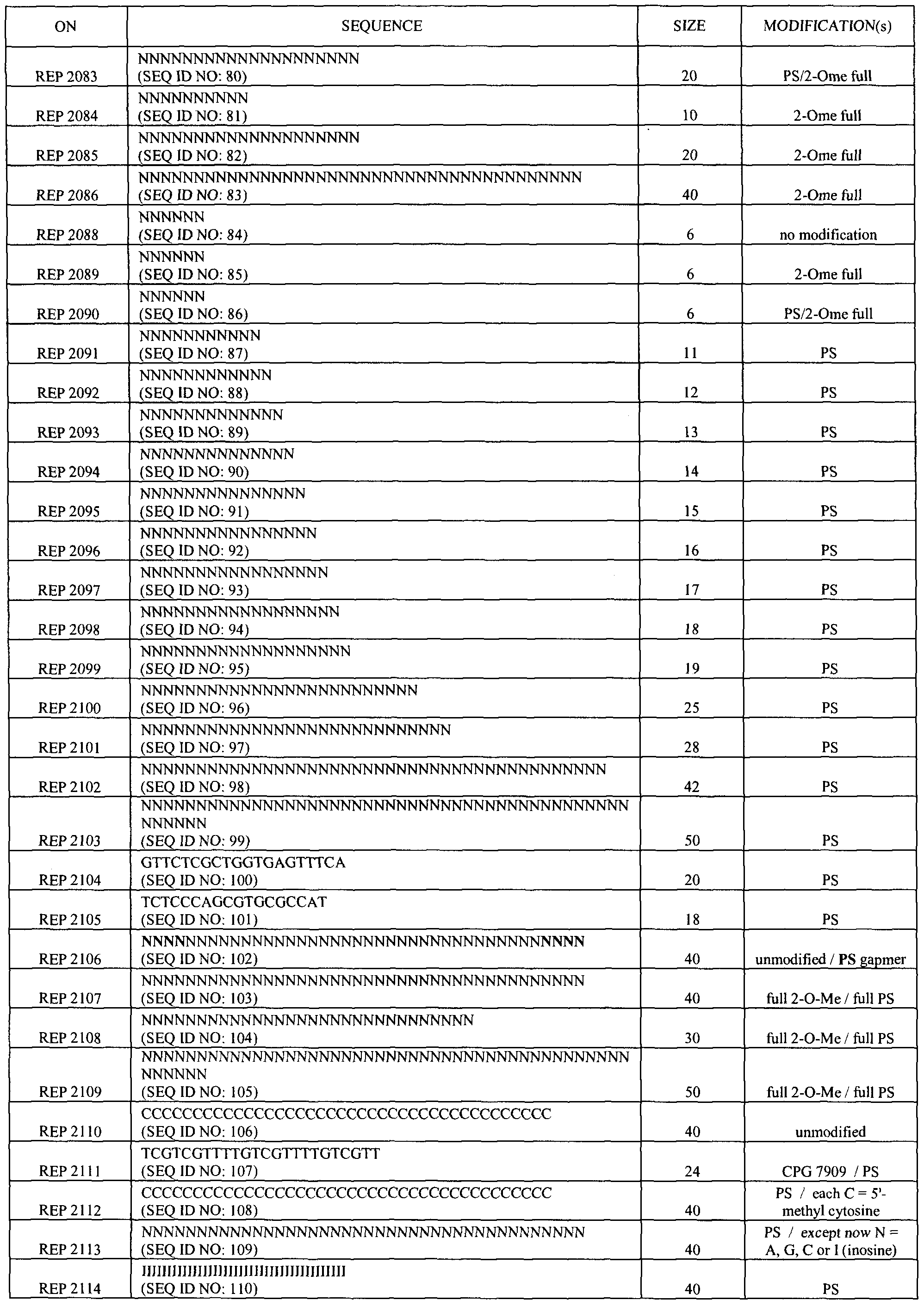

[0215] The present invention would be readily understood by referring to the following examples which are given to illustrate the invention rather then to limits its scope.
Example 1 Sulfur modified ONs interact with various cytokines.
[0216] To examine the interaction of sulphur modified ONs with various cytokines, a completely degenerate (randomer) 40mer phosphorothioated ON (REP 2006; SEQ ID NO: 6) or a 40mer deoxycytidine phosphorothioated ON (REP 2031 ; SEQ ID NO: 31) was fluorescently labeled at the 3' end (REP 2006-FL or REP 2031-FL). The interaction of these ONs with various recombinant or immunopurifϊed human cytokines in solution (at O.lug/ul) was measured by fluorescence polarization (Table 2). Here, larger increases in the ΔmP (increase in mP from the baseline value seen with REP 2006-FL in the absence of cytokines) indicate stronger interactions and a ΔmP of zero indicates no
interaction. The mP is a dimensionless unit describing the relative extent of fluorescence polarization.
Table 2 REP 2006 and REP 2031 cytokine interaction as measured by fluorescence polarization

NT = not tested
[0217] These results show the interaction of ONs with all of the cytokines tested; some interactions were stronger than others and the strength of these interactions were not simply a function of the cytokine molecular weight. These results suggest that sulfur modified ONs could be useful in the treatment of inflammatory diseases and cytokine- related diseases and conditions.
Example 2
Anti-inflammatory sulfur-modified ONs with increased pH resistance, lower serum protein binding and superior nuclease resistance.
[0218] It is disclosed herein the effect of combining unmodified linkages, phosphorothioate linkages, 2'-0 methyl modified riboses and unmodified ribonucleotides on the serum protein interaction and chemical stability of a 40 base randomer ON, that can be used as a anti-inflammatory agent.
[0219] All randomers were prepared using standard solid phase, batch synthesis at the University of Calgary Core DNA Services lab on a 1 or 15 uM synthesis scale, deprotected and desalted on a 50cm Sephadex G-25 column.
[0220] To determine serum protein interaction, a phosphorothioate randomer labeled at the 3' end with FITC (the bait) is diluted to 2nM in assay buffer (1OmM Tris, pH7.2, 8OmM NaCl, 1OmM EDTA, 10OmM β-mercaptoethanol and 1% Tween™ 20). This oligo is then mixed with the appropriate amount of non heat-inactivated fetal bovine serum (FBS). Following randomer-FBS interaction, the complexes are challenged with various unlabelled randomers to assess their ability to displace the bait from its complex. Displaced bait is measured by fluorescence polarization. The displacement curve was used to determine Kd.
[0221] pH resistance was determined by incubation of randomers in phosphate buffered saline (PBS) adjusted to the appropriate pH with HCl, 24 hours after incubation, samples were neutralized with IM TRIS, pH 7.4 and run on denaturing acrylamide gels and visualized following ethidium bromide (EtBr) staining.
[0222] For these experiments, we compared the behaviours of different modified ON randomers: REP 2006 (SEQ ID NO: 6), REP 2024 (SEQ ID NO: 24), REP 2107 (SEQ ID NO: 103), REP 2086 (SEQ ID NO: 83) and REP 2060 (SEQ ID NO: 56).
[0223] The relative affinity of these ON randomers for serum proteins was determined as described above. The results of these experiments are showed in Table 3 and Table 4 that REP 2107 (SEQ ID NO: 103) has a lower affinity to serum proteins than REP 2006 (SEQ ID NO: 6) or REP 2024 (SEQ ID NO: 24; Table 3 in this example) and that there was no interaction detected between REP 2086 (SEQ ID NO: 83) and serum proteins. Moreover, at saturation of competition, REP 2107 (SEQ ID NO: 103) was less effective at displacing bound bait than REP 2006 (SEQ ID NO: 6) or REP 2024 (SEQ ID NO: 24; Table 4 in this example).
Table 3 Serum protein affinity of various randomers.

Table 4 Displacement of bait randomer at saturation.

[0224] The pH stability of these randomers in the range of pH 1 to pH 7 over 24 hours of incubation at 37 0C was also tested. While REP 2006 (SEQ ID NO: 6) and REP 2024 (SEQ ID NO: 24) showed significant degradation at pH 3 and complete degradation at pH 2.5, REP 2107, 2086 and 2060 (SEQ ID NO: 103, 83 and 56) were completely stable at pH 1 after 24h of incubation.
[0225] It is demonstrated herein that the incorporation of 2'-O methyl modifications in a sulfured-modified PS-ON randomers lowers serum protein binding and improve low pH resistance. The fully 2'-O-methylated, fully phosphorothioated randomer (REP 2107; SEQ ID NO: 103) has a weaker interaction with serum proteins and shows a significantly increased resistance to low pH induced hydrolysis.
[0226] The ability of 40mer randomers of various chemistries were assessed for their ability to resist degradation by various nucleases for 4 hours at 37 deg C (results shown in Table 5). While most ON chemistries exhibited resistance to more than one nuclease, only REP 2107 (SEQ ID NO: 103) was resistant to all four nucleases tested. It is
important to note that REP 2024 (SEQ ID NO: 24; which has 2'-0 methyl modifications at the 4 riboses at each end of the molecule) showed the same resistance profile as its parent molecule REP 2006 (SEQ ID NO: 6), being sensitive to Sl nuclease degradation while 2107 (SEQ ID NO: 103; fully 2'-0 methyl modified) was resistant to this enzyme. These results suggest that fully 2'-O methyl modified and fully sulfured ON will be the most effective of the tested oligonucleotides in resisting degradation by nucleases.
Table 5 Resistance to various nucleases by different randomer chemistries.

Example 3
Anti-inflammatory sulfur modified polypyriinidine ONs exhibit acid and nuclease resistance.
[0227] To determine the extent of acid resistance of ONs that can be used as antiinflammatory agents, various 40 base ONs having different chemistries and/or sequences are incubated in PBS buffered to different pH values for 24 hours at 37 0C. The degradation of these ONs was assessed by urea-polyacrylamide gel electrophoresis (Table 6).
[0228] The results show that randomer ONs (containing both pyrimidine and purine nucleotides) are resistant to acidic pH only when they were fully 2'-0-methylated. The
data indicates that even partially 2'-O-methylated ONs (gapmers, REP 2024; SEQ ID NO: 24) do not display any significant increase in acid resistance compared to fully phosphorothioated ONs. Even fully phosphorothioated randomers show no increased pH resistance compared to unmodified ONs. In contrast, it was noted that the phosphorothioated 40mer ONs containing only the pyrimidine nucleotides cytosine (polyC, REP 2031 ; SEQ ID NO: 31) or thymidine (polyT, REP 2030; SEQ ID NO: 30) or the polyTC heteropolymer (REP 2056; SEQ ID NO: 52) had equivalent acid resistance compared to the fully 2'-O-methylated randomers whether phosphorothioated (REP 2107; SEQ ID NO: 103) or not (REP 2086; SEQ ID NO: 83). Contrary to the results for the polypyrimidine oligonucleotides, phosphorothioated oligonucleotides containing only the purine nucleotide adenosine (polyA, REP 2029; SEQ ID NO: 29) or any adenosine or guanosine nucleotides (REP 2033, 2055, 2057; SEQ ID NO: 33, 51, 53) showed no greater acid resistance compared to unmodified DNA.
[0229] These results are significant because the preferred way described in the prior art to achieve greater acid resistance compared to phosphorothioated ONs was to add T- O-methyl modifications (or other 2'-ribose modifications) or other modifications. The present data demonstrates that the 2'-O-methyl ribose modification or other 2'-ribose modifications are not required if the ON is a polypyrimidine (i.e. contains only pyrimidine nucleotides, e.g. homopolymers of cytosine or thymidine or a heteropolymer of cytosines and thymidines) to achieve pH resistance. The presence of purines (A or G) even in the presence of pyrimidines, can render ONs acid labile.
Table 6 Acid stability of various 40mer ONs.

+++ = no degradation, ++ = less than 5-% degradation, -/+ = more than 90% degradation, - = completely degraded.
[0230] To determine the extent of ON nucleotide composition and modifications on nuclease resistance, various 40 base ONs having different nucleotide compositions and modifications were incubated in the presence of various endo and exonucleases for 4 hours at 37 0C. The degradation of these ONs was assessed by urea-polyacryamide gel electrophoresis.
[0231] The results of these studies showed that randomer ONs were resistant to all four enzymes tested (phosphodiesterase II, Sigma; Sl nuclease, Fermentas; Bal31, New England Biolabs; and exonuclease 1, New England Biolabs) only when they were fully phosphorothioated and fully 2'-O -methylated (Table 7). Omission of any of these modifications in randomers resulted in increased sensitivity to one or more of the nucleases tested. It was noted that the fully phosphorothioated, partially 2'-O - methylated randomer (REP 2024; SEQ ID NO: 24) was equivalent in nuclease resistance to REP 2006 (SEQ ID NO: 6), indicated that 2'-O- methylation may be
required on each nucleotide of a phosphorothioated ON to achieve the optimal nuclease resistance. However, it was noted that the phosphorothioated 40mer polypyrimidine poly cytosine (poly C, REP 2031; SEQ ID NO: 31) had equivalent nuclease resistance compared to the fully phosphorothioated, fully 2'0 methylated randomer (REP 2107; SEQ ID NO: 103).
[0232] These results are significant because the prior art teaches that the preferred way to enhance nuclease resistance of phosphorothioated ONs is to add 2'-0 -methyl modifications, other T- ribose modifications, or other modifications. This new data demonstrates that the 2'-O-methyl modification or other 2 '-ribose modifications or any other modifications are not required to enhance nuclease resistance if the ON is fully phosphorothioated and consists of a homopolymer of cytosines.
Table 7 Nuclease resistance of various 40mer ONs.

PII = phosphodiesterase II, Sl = Sl nuclease, Exol = Exonuclease 1. - = complete degredation, ++++ = no degredation, PS = phosphorothioate, 2'OMe = 2'-O-methyl modification of the ribose.
[0233] These results demonstrate that sulfur modified ONs containing only pyrimidine nucleotides, including cytosine and/or thymidine and/or other pyrimidines are resistant to low pH and phosphorothioated ONs containing only cytosine nucleotides exhibit superior nuclease resistance, two important characteristics for oral administration of an ON. Thus, high pyrimidine nucleotide content of an ON is advantageous to provide resistance to low pH resistance and high cytosine content is advantageous to provide improved nuclease resistance. For example, in certain embodiments, the pyrimidine content of such an oligonucleotide is more than 50%, more than 60%, or more than 70%, or more than 80%, or more than 90%, or 100%. Furthermore, these results show the potential of a method of treatment using oral administration of a therapeutically effective amount of at least one pharmacologically acceptable ON composed of pyrimidine nucleotides. These results also show the potential of ONs containing high levels of pyrimidine nucleotides as a component of an ON formulation.
Example 4
Cytokine and other factors interaction is dependent on ON length and sulfur modification.
[0234] The effects of various lengths and chemical modifications of randomers (Table 8) on the strength of their interaction (kd) with IL-4 or increase in fluorescence polarization with a single concentration (0,025 μg/μl) of purified human IL-23 or ICAM-I were assessed using the methodology described herein. It was observed that in general the binding to IL-4, IL-23 and ICAM-I was more potent as the length of the randomer increased. It was also noted that randomers which were not sulfur modified (phosphorothioated) but stabilized by the presence of a 2'-O-methyl group on each ribose (REP 2086; SEQ ID NO: 83) had a much weaker interaction with IL-4, IL-23 and ICAM-I, implying that sulfur modification (i.e. phosphorothioation) enhances the affinity of the ON to cytokines and other factors.
Table 8 Interaction of various randomers with IL-4, IL-23 and ICAM-I.

NT = not tested
[0235] Since it is demonstrated that sulfur modified ONs interact with a broad spectrum of cytokines, this length and sulfur requirement for high affinity binding with IL-4 , IL-23 and ICAM-I is also likely to be the case for the other cytokines and other factors implicated in inflammatory diseases described herein. Moreover, since it has been demonstrated that phosphorothioation increases the hydrophobicity of oligonucleotides, this data further suggests that any modification which increases the hydrophobicity of oligonucleotides will be beneficial for cytokine and other factors interaction.
Example 5 Sulfur modified ONs are amenable to aerosolization.
[0236] To determine if sulfur modified ONs could be aerosolized, a 40mer fully degenerate phosphorothioate modified ON (REP 2006; SEQ ID NO: 6) was dissolved in water and an aerosol was generated from this solution using a nebulizer which was subsequently analyzed for its aerosol characteristics (Table 9).
Table 9 Aerosol characteristics of REP 2006 (SEQ ID NO: 6)

AGI = all glass impinger;
MMAD = mass median aerodynamic diameter;
GSD = geometric standard deviation
[0237] REP 2006 (SEQ ID NO: 6) readily formed an aerosol which excellent characteristics for lung deposition, with MMAD > 2 μm and a very high proportion of REP 2006 (SEQ ID NO: 6) partitioned into particles less than 4.7 μM in diameter. Thus sulfur modified ONs are amenable to aerosolization showing application in upper respiratory tract and lung inflammation diseases such as asthma.
Example 6 Sulfur modified ONs in vivo treatment.
[0238] To determine if sulfur modified ONs can be used in an in vivo treatment, a 40mer fully degenerate phosphorothioate modified ON (REP 2006; SEQ ID NO: 6) was administered to different animals via different routes of administration.
Table 10 Tolerated doses of REP 2006 (SEQ ID NO: 6) in rodents.

[0239] These results demonstrate that sulfure modified ONs are well tolerated in rodents and may also be a well tolerated in humans showing the use of ONs in therapeutic formulations, pharmaceutical compositions and method of treatments.
Example 7
Tests for Determining if an oligonucleotide has sequence-independent anti- inflammatory activity.
[0240] It was shown herein that sulfur modified ONs have anti-inflammatory activity. Moreover, it was shown that the activity of such ONs are sequence-independent. Of course any one skilled in the art could prepare sequence-specific ONs, for example an antisense ON targeting a mRNA of an inflammation-related gene and incorporating sulfur or other modifications. However such an ON would have benefited from the ON modifications described herein and the fact that it was demonstrated herein that the activity of such a modified ON is sequence independent and size dependent. An ON shall be considered to have sequence-independent activity if it meets the criteria of any one of the 2 tests outlined below. An ON having a reasonable part of its function due to a sequence-independent activity shall be considered to benefit from the inventions described herein.
TEST#1
Effect of partial degeneracy of a candidate ON on its anti-inflammatory efficacy [0241] This test serves to measure the anti-inflammatory activity of a candidate ON sequence when part of its sequence is made degenerate. If the degenerate version of the candidate ON having the same chemistry retains its activity as described below, it is deemed to have sequence-independent activity. Candidate ONs will be made degenerate according to the following rule:
L = the number of bases in the candidate ON
X = the number of bases on each end of the oligo to be made degenerate (but having the same chemistry as the candidate ON)
If L is even, then X=integer (L/4)
If L is odd, then X=integer ((L+l)/4)
X must be equal to or greater than 4
[0242] The anti-inflammatory activity of the candidate and partially degenerate ON shall be determined by the cell free binding activity to cytokines described herein. IC50 values (for binding (Kd) or activity) shall be generated using a minimum of seven concentrations of compound, with three or more points in the linear range of the dose response curve. Using these tests, the IC50 of the candidate ON shall be compared to its degenerate counterpart. If the IC50 of the partially degenerate ON is less than 5-fold greater than the original candidate ON (based on minimum triplicate measurements, standard deviation not to exceed 15% of mean) then the ON shall be deemed to have sequence independent activity.
TEST #2
Comparison of anti-inflammatory activity of a candidate ON with an ON randomer. [0243] This test serves to compare the anti-inflammatory efficacy of a candidate ON with the anti-inflammatory efficacy of a randomer ON of equivalent size and chemistry. The anti -inflammatory activity of the candidate and partially degenerate ON shall be determined by the cell free binding activity to cytokin protein or peptides using the assays described herein. IC50 values (binding (Kj) or activity) shall be generated using a
minimum of seven concentrations of compound, with three or more points in the linear range of the dose response curve. Using this test, the IC50 of the candidate ON shall be compared to an ON randomer of equivalent size and chemistry. If the IC50 of the ON randomer is less than 5-fold greater than the candidate ON (based on minimum triplicate measurements, standard deviation not to exceed 15% of mean) then the candidate ON shall be deemed to have sequence-independent activity.
Test #3
Extracellular anti-inflammatory activity of a candidate ON.
[0244] The sequence-independent anti-inflammatory activity of ONs occurs outside the cell. The state of the art in ON technology teaches that, since ONs are not readily cell permeable, they must be delivered across the cell membrane by an appropriate carrier to have antisense activity in an in vitro context. Thus, the anti-inflammatory activity of antisense ONs by definition is dependent on delivery inside cells for activity. If a particular sequence-specific candidate ON has in vitro anti-inflammatory activity when used naked, it must benefit from the sequence-independent properties of ONs described in this invention.
[0245] The activity of the candidate ON shall be assessed using a cell based assay for cytokine activity accepted by the pharmaceutical industry and assessing the activity of one of the cytokines described herein as interacting with REP 2006 (SEQ ID NO: 6). Using this assay, the anti-inflammatory (anti-cytokine) activity of the naked candidate ON shall be compared to that of the encapsulated (for transfection) candidate ON (using identical candidate ON concentrations in both naked and encapsulated conditions). The activity shall be measured by a dose response curve with not less than 7 concentrations, at least 3 of which fall in the linear range which includes the 50% inhibition of inflammatory (cytokine) activity. The IC50 (the concentration which reduces inflammatory (cytokine) activity by 50%) shall be calculated by linear regression of the linear range of the dose response curve as defined above. If the IC50 of the naked candidate ON is less than 5 fold greater than that of the encapsulated candidate ON, then the activity of the candidate ON shall be deemed to have sequence-independent activity.
Thresholds used in these tests
[0246] The purpose of these tests are to determine by a reasonable analysis, if ONs benefit from or utilize the sequence-independent anti-inflammatory properties of ONs which were described herein and is acting with sequence-independent activity. Of course anyone skilled in the art will realize that, given the inherent variability of all testing methodologies, especially anti-inflammatory testing methods, a determination of differences in anti-inflammatory activity between two compounds may not be reliably concluded if the threshold is set at a 2 or 3 fold differences between the activities of said compounds. This is due to the fact that variations from experiment to experiment with the same compound in these assays can yield IC50 which vary in this range. Thus, to be reasonably certain that real differences between the activities of two compounds (e.g. two ONs) exist, a threshold of at least a 5-fold difference between the IC50 of said compounds was set. This threshold ensures the reliability of the assessment of the above mentioned tests.
[0247] The thresholds described in tests 1, 2 and 3 above are the default thresholds. If specifically indicated, other thresholds can be used in the comparison of tests described above. Thus for example, if specifically indicated, the threshold for determining whether an ON is acting with sequence-independent activity can be any of 10-fold, 8- fold, 6-fold, 5-fold, 4-fold, 3-fold, 2-fold, 1.5-fold, or equal.
[0248] Similarly, though the default is that satisfying any one of the above 3 tests is sufficient, if specifically indicated, the ON can be required to satisfy two or more at a default threshold, or if specifically indicated, at another threshold(s) as indicated above.
Example 8 In vivo treatment of an inflammatory cytokine-related disease with an ON.
[0249] To see if ONs could have a therapeutic activity in lowering the proinflammatory activity of cytokines (e.g IL- lβ, IL-6 and TNF-α) associated with proinflammatory state in some inflammatory cytokine-related metabolic diseases, their direct interaction with these cytokines was examined by fluorescence polarization and their ability to prevent the development of such disease in hamsters fed a high fructose diet was measured.
[0250] The interaction of fluorescent ONs with cytokines IL- lβ, IL-6 and TNF-α involved in metabolic diseases was tested. Data reported in Example 1 demonstrate that ONs can interact with these cytokines involved in the pro-inflammatory state associated with the development of metabolic diseases.
[0251] Furthermore, to see if ONs could prevent the onset of an inflammatory cytokine-related disease in hamsters fed a high fructose (HF) diet, REP 2031 (SEQ ID NO: 31), a 40mer fully phosphorothioated oligodeoxycytidylic acid was administered to animals on a HF diet by intraperitoneal injection 3 times a week for 4 weeks. Parameters relating to the inflammatory cytokine-related disease were monitored.
Table 11 Effects of REP 2031 (SEQ ID NO: 31) in HF fed hamsters.

[0252] These results show that ON administration resulted in inhibition of weight gain and of increased adipose tissue (eWAT) content. Thus ONs can have a therapeutic activity in the preventing the activity of an inflammatory disease such as a cytokine- related disease metabolic disease and be used in formulations, pharmaceutical compositions and methods of treatment.
Claims
1. An anti-inflammatory oligonucleotide formulation comprising at least one oligonucleotide, wherein said oligonucleotide has an anti-inflammatory activity, said activity occurring by a sequence independent mode of action.
2. The oligonucleotide formulation of claim 1, wherein said oligonucleotide is at least 15 nucleotides in length.
3. The oligonucleotide formulation of claim 1 or 2, wherein said oligonucleotide is at least 20 nucleotides in length.
4. The oligonucleotide formulation of any one of claims 1 -3, wherein said oligonucleotide is at least 25 nucleotides in length.
5. The oligonucleotide formulation of any one of claims 1-4, wherein said oligonucleotide is at least 30 nucleotides in length.
6. The oligonucleotide formulation of any one of claims 1-5, wherein said oligonucleotide is at least 35 nucleotides in length.
7. The oligonucleotide formulation of any one claims 1-6, wherein said oligonucleotide is at least 40 nucleotides in length.
8. The oligonucleotide formulation of any one of claims 1-7, wherein said oligonucleotide is at least 45 nucleotides in length.
9. The oligonucleotide formulation of any one of claims 1-8, wherein said oligonucleotide is at least 50 nucleotides in length.
10. The oligonucleotide formulation of any one of claims 1-9, wherein said oligonucleotide is at least 60 nucleotides in length.
11. The oligonucleotide formulation of any one of claims 1-10, wherein said oligonucleotide is at least 80 nucleotides in length.
12. The oligonucleotide formulation of any one of claims 1, 3-5, wherein said oligonucleotide is 20-30 nucleotides in length.
13. The oligonucleotide formulation of any one of claims 1, 5-7, wherein said oligonucleotide is 30-40 nucleotides in length.
14. The oligonucleotide formulation of any one of claims 1, 7-9, wherein said oligonucleotide is 40-50 nucleotides in length.
15. The oligonucleotide formulation of any one of claims 1, 9-10, wherein said oligonucleotide is 50-60 nucleotides in length.
16. The oligonucleotide formulation of claim 1 or 10, wherein said oligonucleotide is 60-70 nucleotides in length.
17. The oligonucleotide formulation of claim 1 or 11, wherein said oligonucleotide is 70-80 nucleotides in length.
18. The oligonucleotide formulation of any one of claims 1-17, wherein said oligonucleotide is not complementary to any equal length portion of a genomic sequence.
19. The oligonucleotide formulation of any one of claims 1-18, wherein said oligonucleotide has a sequence not complementary to any equal length portion of the genomic sequence of a human.
20. The oligonucleotide formulation of any one of claims 1-18, wherein said oligonucleotide has a sequence not complementary to any equal length portion of the genomic sequence of a non-human animal.
21. The oligonucleotide formulation of any one of claims 1 -20, wherein said oligonucleotide comprises at least 10 contiguous nucleotides of random er sequence.
22. The oligonucleotide formulation of any one of claims 1-21, wherein said oligonucleotide comprises at least 20 contiguous nucleotides of randomer sequence.
23. The oligonucleotide formulation of any one of claims 1-22, wherein said oligonucleotide comprises at least 30 contiguous nucleotides of randomer sequence.
24. The oligonucleotide formulation of any one of claims 1 -23 , wherein said oligonucleotide comprises at least 40 contiguous nucleotides of randomer sequence.
25. The oligonucleotide formulation of any one of claims 1-24, wherein said oligonucleotide is a randomer oligonucleotide.
26. The oligonucleotide formulation of any of claims 1-25, wherein said oligonucleotide comprises a homopolymer sequence of at least 10 contiguous A nucleotides.
27. The oligonucleotide formulation of any one of claims 1-25, wherein said oligonucleotide comprises a homopolymer sequence of at least 10 contiguous T nucleotides.
28. The oligonucleotide formulation of any one of claims 1 -25, wherein said oligonucleotide comprises a homopolymer sequence of at least 10 contiguous U nucleotides.
29. The oligonucleotide formulation of any of one claims 1-25, wherein said oligonucleotide comprises a homopolymer sequence of at least 10 contiguous G nucleotides.
30. The oligonucleotide formulation of any one of claims 1-25, wherein said oligonucleotide comprises a homopolymer sequence of at least 10 contiguous I nucleotide analogs.
31. The oligonucleotide formulation of any one of claims 1 -25, wherein said oligonucleotide comprises a homopolymer sequence of at least 10 contiguous C nucleotides.
32. The oligonucleotide formulation of any one of claims 1 -25, wherein said oligonucleotide is a homopolymer of C nucleotides.
33. The oligonucleotide formulation of any one of claims 1-25, wherein said oligonucleotide comprises a polyAT sequence at least 10 nucleotides in length.
34. The oligonucleotide formulation of any one of claims 1 -25, wherein said oligonucleotide comprises a polyAC sequence at least 10 nucleotides in length.
35. The oligonucleotide formulation of any one of claims 1-25, wherein said oligonucleotide comprises a polyAG sequence at least 10 nucleotides in length.
36. The oligonucleotide formulation of any one of claims 1-25, wherein said oligonucleotide comprises a polyAU sequence at least 10 nucleotides in length.
37. The oligonucleotide formulation of any of claims 1 -25, wherein said oligonucleotide comprises a polyAI sequence at least 10 nucleotides in length.
38. The oligonucleotide formulation of any one of claims 1-25, wherein said oligonucleotide comprises a polyGC sequence at least 10 nucleotides in length.
39. The oligonucleotide formulation of any one of claims 1-25, wherein said oligonucleotide comprises a polyGT sequence at least 10 nucleotides in length.
40. The oligonucleotide formulation of any one of claims 1 -25, wherein said oligonucleotide comprises a polyGU sequence at least 10 nucleotides in length.
41. The oligonucleotide formulation of any one of claims 1-25, wherein said oligonucleotide comprises a polyGI sequence at least 10 nucleotides in length.
42. The oligonucleotide formulation of any one of claims 1 -25, wherein said oligonucleotide comprises a polyCT sequence at least 10 nucleotides in length.
43. The oligonucleotide formulation of any one of claims 1 -25, wherein said oligonucleotide comprises a polyCU sequence at least 10 nucleotides in length.
44. The oligonucleotide formulation of any one of claims 1 -25, wherein said oligonucleotide comprises a polyCI sequence at least 10 nucleotides in length.
45. The oligonucleotide formulation of any one of claims 1-25, wherein said oligonucleotide comprises a polyTI sequence at least 10 nucleotides in length.
46. The oligonucleotide formulation of any one of claims 1-25, wherein said oligonucleotide comprises a polyTU sequence at least 10 nucleotides in length.
47. The oligonucleotide formulation of any one of claims 1-25, wherein said oligonucleotide comprises a polyUI sequence at least 10 nucleotides in length.
48. The oligonucleotide formulation of any one of claims 1-47, wherein said oligonucleotide comprises at least one phosphodiester linkage.
49. The oligonucleotide formulation of any one of claims 1 -48, wherein said oligonucleotide comprises at least one ribonucleotide.
50. The oligonucleotide formulation of any one of claims 1-49, wherein said oligonucleotide comprises at least one modification to its chemical structure.
51. The oligonucleotide formulation of any one of claims 1 -49, wherein said oligonucleotide comprises at least two different modifications to its chemical structure.
52. The oligonucleotide formulation of claim 51 , wherein said one of at least two different modifications is a sulfur modification.
53. The oligonucleotide formulation of claim 51 or 52, wherein said one of at least two different modifications is a phosphorothioated linkage.
54. The oligonucleotide formulation of any one of claims 51 -53, wherein said one of at least two different modifications is a phosphorodithioated linkage.
55. The oligonucleotide formulation of any one of claims 51-54, wherein said one of at least two different modifications is a boranophosphate linkage.
56. The oligonucleotide formulation of any one of claims 51-55, wherein said one of at least two different modifications is a sulfur modified nucleobase moiety.
57. The oligonucleotide formulation of any one of claims 51-56, wherein said one of at least two different modifications is a sulfur modified ribose moiety.
58. The oligonucleotide formulation of any one of claims 1 -57, wherein said oligonucleotide comprises at least one 2' modification to the ribose moiety.
59. The oligonucleotide formulation of claim 58, wherein said one 2' modification to the ribose moiety is a 2'-O alkyl modified ribose moiety.
60. The oligonucleotide formulation of claim 58 or 59, wherein said one 2' modification to the ribose moiety is a 2'-0 methyl modified ribose.
61. The oligonucleotide formulation of any one of claims 58-60, wherein said one 2' modification to the ribose moiety is a 2'-methoxyethyl modified ribose.
62. The oligonucleotide formulation of any one of claims 58-61, wherein said one 2' modification to the ribose moiety is a 2'-FANA modified ribose.
63. The oligonucleotide formulation of any one of claims 1 -62, wherein said oligonucleotide comprises at least one methylphosphonate linkage.
64. The oligonucleotide formulation of any one of claims 1 -63 , wherein said oligonucleotide comprises at least one portion consisting of glycol nucleic acid (GNA) with an acyclic propylene glycol phosphorothioate backbone.
65. The oligonucleotide formulation of any one of claims 1-64, wherein said oligonucleotide comprises at least one locked nucleic acid portion.
66. The oligonucleotide formulation of any one of claims 1-65, wherein said oligonucleotide comprises at least one phosphorodiamidate morpholino portion.
67. The oligonucleotide formulation of any one of claims 1 -66, wherein said oligonucleotides comprises at least one abasic nucleic acid.
68. The oligonucleotide formulation of any one of claims 1-67, wherein said oligonucleotide comprises a linker to form a concatemer of two or more oligonucleotide sequences.
69. The oligonucleotide formulation of any of claims 1 -68, wherein said oligonucleotide is linked or conjugated at one or more nucleotide residues, to a molecule modifying the characteristics of the oligonucleotide to obtain one or more characteristics selected from the group consisting of higher stability, lower serum interaction, higher cellular uptake, improved ability to be formulated, detectable signal, higher anti-inflammatory activity, better pharmacokinetic properties, specific tissue distribution and lower toxicity.
70. The oligonucleotide formulation of claim 69, wherein said oligonucleotide is linked or conjugated to a PEG molecule.
71. The oligonucleotide formulation of claim 69 or 70, wherein said oligonucleotide is linked or conjugated to a cholesterol molecule.
72. The oligonucleotide formulation of any one of claims 1 -20 and 26-71 , wherein said oligonucleotide is double stranded.
73. The oligonucleotide formulation of any one of claims 1 -72, wherein said oligonucleotide comprises at least one base which is capable of hybridizing via non- Watson-Crick interactions.
74. The oligonucleotide formulation of any one of claims 1-17, 21-24, 26-31 and 33- 73, wherein said oligonucleotide comprises a portion complementary to a genome.
75. The oligonucleotide formulation of any one of claims 1 -74, wherein said oligonucleotide binds to one or more cytokine protein.
76. The oligonucleotide formulation of any one of claims 1 -75, wherein said oligonucleotide interacts with one or more cellular components, wherein said interaction results in inhibition of a protein activity or expression.
77. The oligonucleotide formulation of any one of claims 1 - 17, 21 -24, 26-31 and 33-
76, wherein at least a portion of the sequence of said oligonucleotide is derived from a genome.
78. The oligonucleotide formulation of any one of claims 1-17, 21-24, 26-31 and 33-
77, wherein at least a portion of the sequence of said oligonucleotide is derived from a genome and has an anti-inflammatory activity that occurs by a sequence independent mode of action.
79. The oligonucleotide formulation of claims 1-78, wherein said oligonucleotide formulation lowers inflammation associated with an inflammatory disease.
80. The oligonucleotide formulation of claim 79, wherein said inflammatory disease is asthma.
81. The oligonucleotide formulation of claim 79, wherein said inflammatory disease is rheumatoid arthritis.
82. The oligonucleotide formulation of claim 79, wherein said inflammatory disease is inflammatory bowel disease.
83. The oligonucleotide formulation of claim 79, wherein said inflammatory disease is psoriasis.
84. The oligonucleotide formulation of claim 79, said inflammatory disease is multiple sclerosis.
85. The oligonucleotide formulation of claim 79, wherein said inflammatory disease is diabetes.
86. The oligonucleotide formulation of claim 79, wherein said inflammatory disease is eczema.
87. The oligonucleotide formulation of claim 79, wherein said inflammatory disease is interstitial cystitis.
88. The oligonucleotide formulation of any one of claims 1-17, 21-24, 26-31 and 33- 87, wherein said oligonucleotide has 90% identity with a genomic sequence.
89. The oligonucleotide formulation of any one of claims 1-17, 21-24, 26-31 and 33- 87, wherein said oligonucleotide has 80% identity with a genomic sequence.
90. The oligonucleotide formulation of any one of claims 1-17, 21-24, 26-31 and 33- 87, wherein said oligonucleotide has 75% identity with a genomic sequence.
91. The oligonucleotide formulation of any one of claims 1-90, comprising a mixture of at least two different anti-inflammatory oligonucleotides.
92. The oligonucleotide formulation of any one of claims 1-91, comprising a mixture of at least ten different anti-inflammatory oligonucleotides.
93. The oligonucleotide formulation of any one of claims 1 -92, comprising a mixture of at least 100 different anti-inflammatory oligonucleotides.
94. The oligonucleotide formulation of any one of claims 1 -93, comprising a mixture of at least 1000 different anti-inflammatory oligonucleotides.
95. The oligonucleotide formulation of any one of claims 1-94, comprising a mixture of at least 106 different anti-inflammatory oligonucleotides.
96. An anti-inflammatory pharmaceutical composition comprising a therapeutically effective amount of at least one pharmacologically acceptable anti-inflammatory oligonucleotide formulation according to any one of claims 1 to 95, and a pharmaceutically acceptable carrier.
97. The anti-inflammatory pharmaceutical composition of claim 96, adapted for delivery by a mode selected from the group consisting of ocular administration, oral ingestion, inhalation, subcutaneous injection, intramuscular injection, intrathecal injection, intracerebral injection, by enema, skin topical administration, vaginal administration and intravenous injection.
98. The anti-inflammatory pharmaceutical composition of claim 96 or 97, wherein said composition further comprises a delivery system.
99. The anti-inflammatory pharmaceutical composition of any one of claims 96-98, wherein said composition further comprises at least one other anti-inflammatory drug.
100. The anti-inflammatory pharmaceutical composition of any one of claims 96-99, wherein said composition further comprises a non-nucleotidic anti-inflammatory drug.
101. The anti-inflammatory pharmaceutical composition of any one of claims 96- 100, wherein said composition further comprises an agent selected from the group consisting of an anti-inflammatory antisense, a siRNA and a sequence-specific aptamer oligonucleotide.
102. The anti-inflammatory pharmaceutical composition of any one of claims 96- 101 , wherein said composition further comprises an anti-inflammatory RNAi-inducing oligonucleotide.
103. A method for the prophylaxis or treatment of an inflammatory disease in a subject, comprising administering to a subject in need of such treatment a therapeutically effective amount of at least one pharmacologically acceptable antiinflammatory oligonucleotide formulation according to any one of claims 1-95 or anti-inflammatory pharmaceutical composition according to any one of claims 96- 102.
104. The method of claim 103, wherein said inflammatory disease is asthma.
105. The method of claim 103 , wherein said inflammatory disease is rheumatoid arthritis.
106. The method of claim 103, wherein said inflammatory disease is inflammatory bowel disease.
107. The method of claim 103, wherein said inflammatory disease is interstitial cystitis.
108. The method of claim 103 , wherein said inflammatory disease is psoriasis.
109. The method of claim 103, wherein said inflammatory disease is multiple sclerosis.
110. The method of claim 103 , wherein said inflammatory disease is diabetes.
111. The method of claim 103, wherein said inflammatory disease is eczema.
112. The method of any one of claims 103- 111 , wherein said subject is a human.
113. The method of any one of claims 103 - 111 , wherein said subj ect is a non-human subject.
114. Use of a therapeutically effective amount of at least one pharmacologically acceptable anti-inflammatory oligonucleotide formulation of any one of claims 1 -95 or anti-inflammatory pharmaceutical composition according to any one of claims 96-102 for the prophylaxis or treatment of an inflammatory diseases in a subject.
115. The use of claim 114, wherein said inflammatory disease is asthma.
116. The use of claim 114, wherein said inflammatory disease is rheumatoid arthritis.
117. The use of claim 114, wherein said inflammatory disease is inflammatory bowel disease.
118. The use of claim 114, wherein said inflammatory disease is interstitial cystitis.
119. The use of claim 114, wherein said inflammatory disease is psoriasis.
120. The use of claim 114, wherein said inflammatory disease is multiple sclerosis.
121. The use of claim 114, wherein said inflammatory disease is diabetes.
122. The use of claim 114, wherein said inflammatory disease is eczema.
123. The use of any one of claims 114-122, wherein said subject is a human.
124. The use of any one of claims 114-122, wherein said subject is a non-human subject.
Applications Claiming Priority (2)
| Application Number | Priority Date | Filing Date | Title |
|---|---|---|---|
| US71094705P | 2005-08-25 | 2005-08-25 | |
| US60/710,947 | 2005-08-25 |
Publications (2)
| Publication Number | Publication Date |
|---|---|
| WO2007022642A2 true WO2007022642A2 (en) | 2007-03-01 |
| WO2007022642A3 WO2007022642A3 (en) | 2007-11-08 |
Family
ID=37771961
Family Applications (1)
| Application Number | Title | Priority Date | Filing Date |
|---|---|---|---|
| PCT/CA2006/001409 Ceased WO2007022642A2 (en) | 2005-08-25 | 2006-08-25 | Anti-inflammatory molecules and their uses |
Country Status (1)
| Country | Link |
|---|---|
| WO (1) | WO2007022642A2 (en) |
Cited By (7)
| Publication number | Priority date | Publication date | Assignee | Title |
|---|---|---|---|---|
| EP1942911A4 (en) * | 2005-09-29 | 2009-08-19 | Replicor Inc | Therapeutic molecules and their uses |
| US7700757B2 (en) | 2003-04-02 | 2010-04-20 | Giuliani Internaitonal Limited | Antisense oligonucleotides (ODN) against Smad7 and uses in medical field thereof |
| US20110098456A1 (en) * | 2007-10-09 | 2011-04-28 | Eugen Uhlmann | Immune stimulatory oligonucleotide analogs containing modified sugar moieties |
| US20120045796A1 (en) * | 2010-04-30 | 2012-02-23 | Satterfield Brent C | Nucleic acid hotstart technology |
| WO2013170386A1 (en) * | 2012-05-18 | 2013-11-21 | Replicor Inc. | Oligonucleotide chelate complex-polypeptide compositions and methods |
| US11166976B2 (en) | 2018-11-08 | 2021-11-09 | Aligos Therapeutics, Inc. | S-antigen transport inhibiting oligonucleotide polymers and methods |
| CN113874383A (en) * | 2019-03-13 | 2021-12-31 | 朴东辉 | Oligonucleotides with anti-inflammatory activity |
Family Cites Families (4)
| Publication number | Priority date | Publication date | Assignee | Title |
|---|---|---|---|---|
| US5545626A (en) * | 1994-01-19 | 1996-08-13 | The Trustees Of Columbia University In The City Of New York | Method of treating glaucoma with oligonucleotides |
| US6211349B1 (en) * | 1998-12-30 | 2001-04-03 | Oligos Etc., Inc. | Protonated/acidified nucleic acids and methods of use |
| BR0314236A (en) * | 2002-09-13 | 2005-08-09 | Replicor Inc | Oligonucleotide formulation, pharmaceutical composition, kit, antiviral compound, preparation of oligonucleotide and methods for selection of an antiviral oligonucleotide for use as an antiviral agent, for prophylaxis or treatment of a viral infection in a patient, for prophylactic treatment of cancer caused by oncoviruses. for identifying a compound that alters the binding of an oligonucleotide to at least one viral component, for purifying oligonucleotide binding to at least one viral component and for enriching oligonucleotides from an oligonucleotide cluster |
| US20070123480A1 (en) * | 2003-09-11 | 2007-05-31 | Replicor Inc. | Oligonucleotides targeting prion diseases |
-
2006
- 2006-08-25 WO PCT/CA2006/001409 patent/WO2007022642A2/en not_active Ceased
Cited By (29)
| Publication number | Priority date | Publication date | Assignee | Title |
|---|---|---|---|---|
| US9382541B2 (en) | 2003-04-02 | 2016-07-05 | Nogra Pharma Limited | Antisense oligonucleotides (ODN) against SMAD7 and uses thereof in medical field |
| US10036022B2 (en) | 2003-04-02 | 2018-07-31 | Nogra Pharma Limited | Antisense oligonucleotides (ODN) against Smad7 and uses thereof in medical field |
| US7807818B2 (en) | 2003-04-02 | 2010-10-05 | Giuliani International Limited | Antisense oligonucleotides (ODN) against Smad7 and uses thereof in medical field |
| US10738309B2 (en) | 2003-04-02 | 2020-08-11 | Nogra Pharma Limited | Antisense oligonucleotides (ODN) against SMAD7 and uses thereof in medical field |
| US8106182B2 (en) | 2003-04-02 | 2012-01-31 | Giuliani International Limited | Antisense oligonucleotides (ODN) against Smad7 and uses thereof in medical field |
| US10633660B2 (en) | 2003-04-02 | 2020-04-28 | Nogra Pharma Limited | Antisense oligonucleotides (ODN) against SMAD7 and uses thereof in medical field |
| US9951334B2 (en) | 2003-04-02 | 2018-04-24 | Nogra Pharma Limited | Antisense oligonucleotides (ODN) against SMAD7 and uses thereof in medical field |
| US8648186B2 (en) | 2003-04-02 | 2014-02-11 | Nogra Pharma Limited | Antisense oligonucleotides (ODN) against SMAD7 and uses thereof in medical field |
| US8907078B2 (en) | 2003-04-02 | 2014-12-09 | Nogra Pharma Limited | Antisense oligonucleotides (ODN) against SMAD7 and uses thereof in medical field |
| US9605264B2 (en) | 2003-04-02 | 2017-03-28 | Nogra Pharma Limited | Antisense oligonucleotides (ODN) against Smad7 and uses thereof in medical field |
| US9006418B2 (en) | 2003-04-02 | 2015-04-14 | Nogra Pharma Limited | Antisense oligonucleotides (ODN) against Smad7 and uses thereof in medical field |
| US9096854B1 (en) | 2003-04-02 | 2015-08-04 | Nogra Pharma Limited | Antisense oligonucleotides (ODN) against SMAD7 and uses thereof in medical field |
| US9518264B2 (en) | 2003-04-02 | 2016-12-13 | Nogra Pharma Limited | Antisense oligonucleotides (ODN) against SMAD7 and uses thereof in medical field |
| US9279126B2 (en) | 2003-04-02 | 2016-03-08 | Nogra Pharma Limited | Antisense oligonucleotides (ODN) against SMAD7 and uses thereof in medical field |
| US7700757B2 (en) | 2003-04-02 | 2010-04-20 | Giuliani Internaitonal Limited | Antisense oligonucleotides (ODN) against Smad7 and uses in medical field thereof |
| EP1942911A4 (en) * | 2005-09-29 | 2009-08-19 | Replicor Inc | Therapeutic molecules and their uses |
| US20110098456A1 (en) * | 2007-10-09 | 2011-04-28 | Eugen Uhlmann | Immune stimulatory oligonucleotide analogs containing modified sugar moieties |
| US9186399B2 (en) * | 2007-10-09 | 2015-11-17 | AdiutTide Pharmaceuticals GmbH | Immune stimulatory oligonucleotide analogs containing modified sugar moieties |
| US20120045796A1 (en) * | 2010-04-30 | 2012-02-23 | Satterfield Brent C | Nucleic acid hotstart technology |
| US9410189B2 (en) * | 2010-04-30 | 2016-08-09 | Co-Diagnostics, Inc. | Methods of preventing non-specific reactions of nucleotide sequences |
| CN104349793A (en) * | 2012-05-18 | 2015-02-11 | 里普利科股份有限公司 | Oligonucleotide chelate complex-polypeptide compositions and methods |
| AU2013262416B2 (en) * | 2012-05-18 | 2017-05-11 | Replicor Inc. | Oligonucleotide chelate complex-polypeptide compositions and methods |
| CN104349793B (en) * | 2012-05-18 | 2017-11-10 | 里普利科股份有限公司 | Oligonucleotide Chelate-Polypeptide Compositions and Methods |
| US9492506B2 (en) | 2012-05-18 | 2016-11-15 | Replicor Inc. | Oligonucleotide chelate complex—polypeptide compositions and methods |
| WO2013170386A1 (en) * | 2012-05-18 | 2013-11-21 | Replicor Inc. | Oligonucleotide chelate complex-polypeptide compositions and methods |
| EA035967B1 (en) * | 2012-05-18 | 2020-09-07 | Репликор Инк. | Compositions for treating hepatitis b comprising oligonucleotide chelate complexes |
| US11166976B2 (en) | 2018-11-08 | 2021-11-09 | Aligos Therapeutics, Inc. | S-antigen transport inhibiting oligonucleotide polymers and methods |
| CN113874383A (en) * | 2019-03-13 | 2021-12-31 | 朴东辉 | Oligonucleotides with anti-inflammatory activity |
| EP3939987A4 (en) * | 2019-03-13 | 2023-02-08 | Cartiprime Co., Ltd. | Oligonucleotide having anti-inflammatory activity |
Also Published As
| Publication number | Publication date |
|---|---|
| WO2007022642A3 (en) | 2007-11-08 |
Similar Documents
| Publication | Publication Date | Title |
|---|---|---|
| TWI727917B (en) | TMPRSS6 iRNA COMPOSITIONS AND METHODS OF USE THEREOF | |
| ES2543004T3 (en) | Compositions and methods to inhibit the expression of transthyretin | |
| US8772260B2 (en) | Methods for inhibiting expression of connective tissue growth factor | |
| ES2640260T3 (en) | Compositions and methods to inhibit gene expression alas1 | |
| JP2019089799A (en) | siRNA THERAPY FOR TRANSTHYRETIN (TTR) RELATED OCULAR AMYLOIDOSIS | |
| CA2873833A1 (en) | Compositions and methods for inhibiting expression of eg5 gene | |
| TW201831685A (en) | Method for treating or preventing TTR-related diseases using a thyroxine transporter (TTR) iRNA composition | |
| KR20180095843A (en) | Methods and compositions for the treatment of Serpinc1-related disorders | |
| JP2017071616A (en) | Lipid formulated composition and method for inhibiting expression of transthyretin (ttr) | |
| JP2011517676A (en) | Compositions and methods for mediating RNA interference in vivo | |
| KR20090083338A (en) | Regulating NSAI of SCAAP and their therapeutic uses | |
| WO2007022642A2 (en) | Anti-inflammatory molecules and their uses | |
| WO2006122409A1 (en) | Antimicrobial molecules and their uses | |
| WO2006119643A1 (en) | Anti-ocular angiogenesis molecules and their uses | |
| US6921812B1 (en) | Methods of modulating pharmacokinetics of oligonucleotides | |
| WO2006130949A1 (en) | Anti amyloid-related disease molecules and their uses | |
| US20090215873A1 (en) | Therapeutic Molecules and their Uses | |
| WO2003004603A2 (en) | Methods of modulating pharmacokinetics of oligonucleotides | |
| CN117561334A (en) | Human chromosome 9 open reading frame 72 (C9ORF72) iRNA pharmaceutical composition and method of use thereof | |
| US20030176385A1 (en) | Antisense modulation of protein expression | |
| WO2003070160A2 (en) | Antisense modulation of protein expression | |
| AU2002315517A1 (en) | Methods of modulating pharmacokinetics of oligonucleotides |
Legal Events
| Date | Code | Title | Description |
|---|---|---|---|
| 121 | Ep: the epo has been informed by wipo that ep was designated in this application | ||
| NENP | Non-entry into the national phase |
Ref country code: DE |
|
| 122 | Ep: pct application non-entry in european phase |
Ref document number: 06790588 Country of ref document: EP Kind code of ref document: A2 |