WO2006126655A1 - Radio transmitting apparatus, radio receiving apparatus and radio transmitting method - Google Patents
Radio transmitting apparatus, radio receiving apparatus and radio transmitting method Download PDFInfo
- Publication number
- WO2006126655A1 WO2006126655A1 PCT/JP2006/310498 JP2006310498W WO2006126655A1 WO 2006126655 A1 WO2006126655 A1 WO 2006126655A1 JP 2006310498 W JP2006310498 W JP 2006310498W WO 2006126655 A1 WO2006126655 A1 WO 2006126655A1
- Authority
- WO
- WIPO (PCT)
- Prior art keywords
- transmission
- information
- mode
- stream
- unit
- Prior art date
- Legal status (The legal status is an assumption and is not a legal conclusion. Google has not performed a legal analysis and makes no representation as to the accuracy of the status listed.)
- Ceased
Links
Classifications
-
- H—ELECTRICITY
- H04—ELECTRIC COMMUNICATION TECHNIQUE
- H04B—TRANSMISSION
- H04B7/00—Radio transmission systems, i.e. using radiation field
- H04B7/02—Diversity systems; Multi-antenna system, i.e. transmission or reception using multiple antennas
- H04B7/04—Diversity systems; Multi-antenna system, i.e. transmission or reception using multiple antennas using two or more spaced independent antennas
- H04B7/06—Diversity systems; Multi-antenna system, i.e. transmission or reception using multiple antennas using two or more spaced independent antennas at the transmitting station
- H04B7/0686—Hybrid systems, i.e. switching and simultaneous transmission
- H04B7/0689—Hybrid systems, i.e. switching and simultaneous transmission using different transmission schemes, at least one of them being a diversity transmission scheme
-
- H—ELECTRICITY
- H04—ELECTRIC COMMUNICATION TECHNIQUE
- H04B—TRANSMISSION
- H04B7/00—Radio transmission systems, i.e. using radiation field
- H04B7/02—Diversity systems; Multi-antenna system, i.e. transmission or reception using multiple antennas
- H04B7/04—Diversity systems; Multi-antenna system, i.e. transmission or reception using multiple antennas using two or more spaced independent antennas
- H04B7/0413—MIMO systems
- H04B7/0417—Feedback systems
-
- H—ELECTRICITY
- H04—ELECTRIC COMMUNICATION TECHNIQUE
- H04B—TRANSMISSION
- H04B7/00—Radio transmission systems, i.e. using radiation field
- H04B7/02—Diversity systems; Multi-antenna system, i.e. transmission or reception using multiple antennas
- H04B7/04—Diversity systems; Multi-antenna system, i.e. transmission or reception using multiple antennas using two or more spaced independent antennas
- H04B7/06—Diversity systems; Multi-antenna system, i.e. transmission or reception using multiple antennas using two or more spaced independent antennas at the transmitting station
- H04B7/0613—Diversity systems; Multi-antenna system, i.e. transmission or reception using multiple antennas using two or more spaced independent antennas at the transmitting station using simultaneous transmission
- H04B7/0615—Diversity systems; Multi-antenna system, i.e. transmission or reception using multiple antennas using two or more spaced independent antennas at the transmitting station using simultaneous transmission of weighted versions of same signal
- H04B7/0619—Diversity systems; Multi-antenna system, i.e. transmission or reception using multiple antennas using two or more spaced independent antennas at the transmitting station using simultaneous transmission of weighted versions of same signal using feedback from receiving side
- H04B7/0621—Feedback content
- H04B7/063—Parameters other than those covered in groups H04B7/0623 - H04B7/0634, e.g. channel matrix rank or transmit mode selection
-
- H—ELECTRICITY
- H04—ELECTRIC COMMUNICATION TECHNIQUE
- H04B—TRANSMISSION
- H04B7/00—Radio transmission systems, i.e. using radiation field
- H04B7/02—Diversity systems; Multi-antenna system, i.e. transmission or reception using multiple antennas
- H04B7/04—Diversity systems; Multi-antenna system, i.e. transmission or reception using multiple antennas using two or more spaced independent antennas
- H04B7/06—Diversity systems; Multi-antenna system, i.e. transmission or reception using multiple antennas using two or more spaced independent antennas at the transmitting station
- H04B7/0613—Diversity systems; Multi-antenna system, i.e. transmission or reception using multiple antennas using two or more spaced independent antennas at the transmitting station using simultaneous transmission
- H04B7/0615—Diversity systems; Multi-antenna system, i.e. transmission or reception using multiple antennas using two or more spaced independent antennas at the transmitting station using simultaneous transmission of weighted versions of same signal
- H04B7/0619—Diversity systems; Multi-antenna system, i.e. transmission or reception using multiple antennas using two or more spaced independent antennas at the transmitting station using simultaneous transmission of weighted versions of same signal using feedback from receiving side
- H04B7/0621—Feedback content
- H04B7/0632—Channel quality parameters, e.g. channel quality indicator [CQI]
-
- H—ELECTRICITY
- H04—ELECTRIC COMMUNICATION TECHNIQUE
- H04L—TRANSMISSION OF DIGITAL INFORMATION, e.g. TELEGRAPHIC COMMUNICATION
- H04L1/00—Arrangements for detecting or preventing errors in the information received
- H04L1/0001—Systems modifying transmission characteristics according to link quality, e.g. power backoff
- H04L1/0002—Systems modifying transmission characteristics according to link quality, e.g. power backoff by adapting the transmission rate
-
- H—ELECTRICITY
- H04—ELECTRIC COMMUNICATION TECHNIQUE
- H04L—TRANSMISSION OF DIGITAL INFORMATION, e.g. TELEGRAPHIC COMMUNICATION
- H04L1/00—Arrangements for detecting or preventing errors in the information received
- H04L1/0001—Systems modifying transmission characteristics according to link quality, e.g. power backoff
- H04L1/0015—Systems modifying transmission characteristics according to link quality, e.g. power backoff characterised by the adaptation strategy
-
- H—ELECTRICITY
- H04—ELECTRIC COMMUNICATION TECHNIQUE
- H04L—TRANSMISSION OF DIGITAL INFORMATION, e.g. TELEGRAPHIC COMMUNICATION
- H04L1/00—Arrangements for detecting or preventing errors in the information received
- H04L1/0001—Systems modifying transmission characteristics according to link quality, e.g. power backoff
- H04L1/0015—Systems modifying transmission characteristics according to link quality, e.g. power backoff characterised by the adaptation strategy
- H04L1/0016—Systems modifying transmission characteristics according to link quality, e.g. power backoff characterised by the adaptation strategy involving special memory structures, e.g. look-up tables
-
- H—ELECTRICITY
- H04—ELECTRIC COMMUNICATION TECHNIQUE
- H04L—TRANSMISSION OF DIGITAL INFORMATION, e.g. TELEGRAPHIC COMMUNICATION
- H04L1/00—Arrangements for detecting or preventing errors in the information received
- H04L1/12—Arrangements for detecting or preventing errors in the information received by using return channel
- H04L1/16—Arrangements for detecting or preventing errors in the information received by using return channel in which the return channel carries supervisory signals, e.g. repetition request signals
- H04L1/18—Automatic repetition systems, e.g. Van Duuren systems
- H04L1/1867—Arrangements specially adapted for the transmitter end
-
- H—ELECTRICITY
- H04—ELECTRIC COMMUNICATION TECHNIQUE
- H04B—TRANSMISSION
- H04B7/00—Radio transmission systems, i.e. using radiation field
- H04B7/02—Diversity systems; Multi-antenna system, i.e. transmission or reception using multiple antennas
- H04B7/04—Diversity systems; Multi-antenna system, i.e. transmission or reception using multiple antennas using two or more spaced independent antennas
- H04B7/0413—MIMO systems
- H04B7/0426—Power distribution
- H04B7/043—Power distribution using best eigenmode, e.g. beam forming or beam steering
-
- H—ELECTRICITY
- H04—ELECTRIC COMMUNICATION TECHNIQUE
- H04B—TRANSMISSION
- H04B7/00—Radio transmission systems, i.e. using radiation field
- H04B7/02—Diversity systems; Multi-antenna system, i.e. transmission or reception using multiple antennas
- H04B7/04—Diversity systems; Multi-antenna system, i.e. transmission or reception using multiple antennas using two or more spaced independent antennas
- H04B7/0413—MIMO systems
- H04B7/0426—Power distribution
- H04B7/0434—Power distribution using multiple eigenmodes
Definitions
- Wireless transmission device Wireless reception device, and wireless transmission method
- the present invention relates to a wireless transmission device, a wireless reception device, and a wireless transmission method in a MIMO (Multi-Input Multi-Output) system that transmits information using an array antenna for both transmission and reception.
- MIMO Multi-Input Multi-Output
- Non-Patent Document 1 discloses a (4, 2) MIMO system using D-TxAA (Double-Transmit antenna array) transmission. This MIMO system is described below using Fig. 1.
- a MIMO system composed of X transmit antennas and Y receive antennas
- the (4, 2) MIMO system in FIG. 1 performs wireless communication between a wireless transmission device 1800 including transmission antennas 1801 to 1804 and a wireless reception device 1820 including reception antennas 1821 and 1822. Between these transmission antennas and reception antennas, propagation paths 1831 and 1832 through which transmission signals are propagated are formed.
- Radio transmission apparatus 1800 multiplies transmission weights by spreading sections 1807 and 1809 that perform spreading and scramble processing on streams 1865 and 1866 generated by first and second stream generation sections 1805 and 1806, respectively.
- Transmission weight multipliers 1811 to 1814 that generate and output a transmission weight multiplication signal, and a transmission unit 1840 having transmission RF units 1841 to 1844 corresponding to each of the transmission antennas.
- a transmission control unit 1890 that performs modulation control of the second stream generation units 1805 and 1806 and transmission weight control in the spread Z weight multiplication unit 1810.
- first and second stream generation sections 1805 and 1806 are used to generate a bit sequence stream generated by error correction code section, interleave section, and data mapping section (not shown). Then, error correction code ⁇ is performed, interleaving processing that is bit rearrangement is performed, and two streams 1865 and 1866 that are subjected to data mapping processing that is data modulation such as QPSK and 16QAM are output.
- the modulation level is determined according to propagation channel information (hereinafter referred to as “CQI information”) 1896 notified from feedback information reception section (hereinafter referred to as “FB information reception section”) 1891 of transmission control section 1890. Is done.
- CQI information propagation channel information
- FB information reception section feedback information reception section
- spreading sections 1807 and 1809 convert the two streams 1865 and 1866, which are symbol sequence streams, into a plurality of chip sequence streams using the spreading code and scramble code, and code-multiplex them. Further, in transmission section 1840, pilot signals are added to the output of each transmission weight multiplier in a pilot signal multiplexing section and transmission RF section (not shown), and then converted into a radio signal by predetermined modulation.
- This system transmits stream 1865 using transmitting antennas 1801 and 1802, and stream 1866 using antennas 1803 and 1804!
- the combination of transmitting antennas 1801 and 1802 is referred to as subgroup 1 (hereinafter referred to as “SG1”)
- the combination of antennas 1803 and 1804 is referred to as subgroup 2 (hereinafter referred to as “SG2” t).
- Radio receiving apparatus 1820 and feedback section 1823 generate feedback weights and provide feedback information 1897 having CQI information, which is propagation channel information, first eigenvector, and second eigenvector information, to radio transmitting apparatus 1800 side.
- a reception control unit 1824 provided with a feedback information transmission unit (hereinafter referred to as “FB information transmission unit”) 1892.
- Radio receiving apparatus 1820 separates the spatially multiplexed received signal by despreading.
- the eigenvalue decomposition is performed on the channel correlation matrix for each of SG1 and SG2, and transmission is performed using the first eigenvector as the transmission weight. . Therefore, the FB information transmission unit 1892 generates transmission weight information and CQI information used for SG1 and SG2.
- a transmission weight and reception weight calculation method used in SG1 will be described.
- the transmission characteristics of the transmission signal propagation path composed of the transmission antennas 1801 and 1802, the reception antennas 1821 and 1822, and the propagation path 1831 through which the transmission signal is transmitted are generally expressed by a matrix called a channel matrix. . If this channel matrix is H (SG1) , it is expressed as shown in Equation (1).
- Equation (2) H in the upper right of (SG1) is an operator that performs complex conjugate on the corresponding matrix.
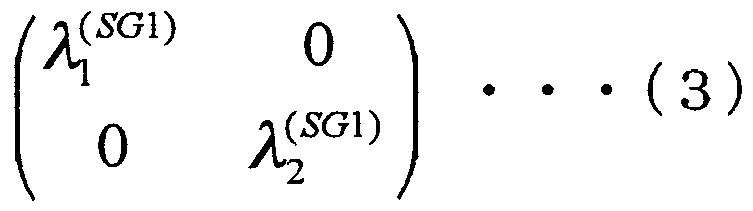
- Equation (2) is an eigenvalue matrix of Equation (3) in which all elements other than the diagonal of the matrix are 0, and a weight matrix of Equation (4) and Equation (4) ) And the complex conjugate matrix of the weight matrix can be expressed as in equation (5).
- Equation (6) can be divided into a part relating to the first eigenvalue (Equation (7)) and a part relating to the second eigenvalue (Equation (8)).
- Equation (11) the matrix of Equation (12), respectively.
- Equation (9) is the SGI transmission weight using the first eigenvalue.
- the complex conjugate of Eq. (9) multiplied by the complex conjugate of Eq. (1) is used as the receive weight corresponding to SG1 using the first eigenvalue.
- the SG1 transmission weight can be re-expressed as shown in equation (13), and the corresponding reception weight can be expressed as as in equation (14).
- a channel matrix indicating transmission characteristics of a transmission signal propagation path composed of transmission antennas 1803 and 1804, reception antennas 1821 and 1822, and propagation path 1832 is expressed by Expression (17), It can be derived by the same procedure as the procedure for obtaining the above equations (2) to (16).
- the SG2 transmission weight using the first eigenvalue is shown in Equation (18), and the corresponding reception weight is shown in Equation (19).
- the SG2 transmission weight using the second eigenvalue is shown in Equation (20), and the corresponding reception weight is shown in Equation (21).
- the derived SGI and SG2 transmission weight information is returned to the FB information reception unit 1891.
- the FB information reception unit 1891 transmits each transmission to the spread Z weight multiplication unit 1810 based on this information. Transmit transmission weight information 1895 to be multiplied with the signal emitted from the antenna.
- Spreading Z weight multiplication section 1810 branches the signal input from spreading section 1807 into two branches, and in multiplier 1811 corresponding to transmission antenna 1801, the left side element of equation (13) is the transmission queue.
- Multiplier 1812 that multiplies as an eight and corresponds to transmission antenna 1802 multiplies the right side element of equation (13) as a transmission weight.
- multiplier 1813 corresponding to transmission antenna 1803 multiplies the left side element of equation (18) as a transmission weight
- transmission antenna 1804 In the multiplier 1814 corresponding to, the right side element of the equation (18) is multiplied as a transmission weight.
- Radio receiving apparatus 1820 separates and restores streams 1865 and 1866 by multiplying the spatially multiplexed received signal by a reception weight and further performing despreading processing.
- the transmission weights obtained from the first and second eigenvalues are respectively multiplied for two streams, and transmission is performed using two transmission antennas.
- Eigenmode transmission is known.
- Non-Patent Document 1 3GPP TR25.876, "Multi-Input Multi-Output in UTRA"
- radio transmission apparatus 1800 and radio reception apparatus 1820 in the MIMO system described above there is a large difference in the reception quality of stream 1865 and stream 1866, for example, reception SI NR, eigenvalues of channel correlation matrix, and the like.
- reception SI NR reception SI NR
- eigenvalues of channel correlation matrix eigenvalues of channel correlation matrix
- An object of the present invention is to provide a wireless transmission device, a wireless reception device, and a wireless transmission method that improve the detection accuracy of a stream in D-TxAA.
- the wireless transmission device of the present invention is based on a plurality of transmission antennas and information on which communication partner power is also fed back, so that eigenmode transmission using a plurality of the transmission antennas or a double-transmit antenna array mode is performed. It adopts a configuration comprising transmission mode determination means for determining any transmission mode of transmission and transmission means for switching to the determined transmission mode and transmitting each stream.
- the radio reception apparatus of the present invention includes, based on a propagation environment, transmission mode determination means for determining a transmission mode of eigenmode transmission using a plurality of transmission antennas or Double-Transmit Antenna Array mode transmission, And a feedback means for feeding back the determined transmission mode to a communication partner.
- the wireless transmission method of the present invention is based on the information fed back to the other party's communication power, and the transmission mode is either one of eigenmode transmission using a plurality of transmission antennas or double-transmit antenna array mode transmission. And a transmission step for transmitting each stream by switching to the determined transmission mode.
- FIG. 1 is a conceptual diagram illustrating device configurations of a conventional wireless transmission device and a wireless reception device.
- FIG. 2 is a block diagram showing configurations of a radio transmission apparatus and a radio reception apparatus in the MIMO system according to Embodiment 1 of the present invention.
- FIG. 3 is a detailed configuration diagram of a transmission control unit of the radio transmission apparatus according to Embodiment 1 of the present invention.
- FIG. 4 is a detailed configuration diagram of a reception unit of the radio reception apparatus according to Embodiment 1 of the present invention.
- FIG. 5 is a detailed configuration diagram of a reception control unit of the radio reception apparatus according to Embodiment 1 of the present invention.
- FIG. 6A is a flowchart of transmission mode selection using a method of selecting on the basis of eigenvalues of subgroups in the wireless transmission device according to Embodiment 1 of the present invention.
- FIG. 6B is a flowchart of transmission mode selection using a method of selecting based on SINR in the wireless transmission apparatus according to Embodiment 1 of the present invention.
- FIG. 7 is a sequence diagram showing a control procedure between the wireless transmission device and the wireless reception device according to Embodiment 1 of the present invention.
- FIG. 8 is a block diagram showing a configuration of a radio transmission apparatus and a radio reception apparatus in a MIMO system according to Embodiment 2 of the present invention.
- FIG. 9 is a detailed configuration diagram of a transmission control unit of a radio transmission apparatus according to Embodiment 2 of the present invention.
- FIG. 10 is a detailed configuration diagram of a reception unit of a radio reception apparatus according to Embodiment 2 of the present invention.
- FIG. 11 is a detailed configuration diagram of a reception control unit of a radio reception apparatus according to Embodiment 2 of the present invention.
- FIG. 12 shows a control procedure between the radio transmission apparatus and radio reception apparatus according to Embodiment 2 of the present invention.
- FIG. 13 is an explanatory diagram of a feedback format used for transmission / reception between the wireless transmission device and the wireless reception device according to Embodiment 2 of the present invention.
- FIG. 14 is a block diagram showing configurations of a radio transmission apparatus and a radio reception apparatus in a MIMO system according to Embodiment 3 of the present invention.
- FIG. 15 is a detailed configuration diagram of a transmission control section of a radio transmission apparatus according to Embodiment 3 of the present invention.
- FIG. 16 is a detailed configuration diagram of a reception section of a radio reception apparatus according to Embodiment 3 of the present invention.
- FIG. 17 is a detailed configuration diagram of a reception control unit of a radio reception apparatus according to Embodiment 3 of the present invention.
- FIG. 18 is a retransmission used for transmission / reception between the radio transmission apparatus and radio reception apparatus according to Embodiment 3 of the present invention. Illustration of rearrangement table
- FIG. 2 is a block diagram showing configurations of radio transmitting apparatus 10 and radio receiving apparatus 20 in the MIMO system according to Embodiment 1 of the present invention.
- the second system spread Z-weight multiplication unit 105, multiplexing unit 120, transmission mode switching unit 102, CQI information 1 896, and transmission weight information 1895 which transmits a transmission mode switching signal other than FB information reception.
- the transmission control unit 190 further includes a transmission unit 191 and a feedforward information transmission unit (hereinafter referred to as “FF information transmission unit”) 192.
- FF information transmission unit feedforward information transmission unit
- the wireless reception device 20 transmits the channel matrix as feedback information 197.
- the feedforward information 198 is sent from the FB information transmission unit 193 and the FF information transmission unit 192.
- Receiving control section 24 having a feed forward information receiving section (hereinafter referred to as “FF information receiving section”) 194, and receiving section 23 performing despreading processing, demodulation processing, etc. based on feed forward information 198 Have
- the second spreading Z weight multiplying section 105, spreading sections 107 and 109, and transmission weight multiplication signals obtained by multiplying the outputs of the spreading sections 107 and 109 by a predetermined transmission weight, are transmitted to the corresponding transmitting antennas 1801 to 801.
- 1804 includes transmission weight multipliers 111 to 114 that transmit the signals to each of them.
- multiplier 111 corresponding to transmission antenna 1801 multiplies the left side element of equation (15) as a transmission weight. Also, in multiplier 112 corresponding to transmission antenna 1802, the right side element of equation (15) is multiplied as a transmission weight.
- multiplier 113 corresponding to transmission antenna 1803 multiplies the left side element of equation (20) as a transmission weight. Further, in the multiplier 114 corresponding to the transmission antenna 1804, the right side element of the equation (20) is multiplied as the transmission weight.
- spreading section 1807 and transmission weight multipliers 1811 and 1812 have a function of generating a MIMO channel beam using the first eigenvalue by SG 1, so This is called a transmission beam signal generation unit.
- Spreading section 1809 and transmission weight multipliers 18 13 and 1814 have a function of generating a MIMO channel beam using the first eigenvalue by SG2, and are therefore referred to as a second transmission beam signal generation section.
- spreading section 107 and transmission weight multipliers 111 and 112 have a function of generating a MIMO channel beam using the second eigenvalue by SG1, so that the third transmission beam signal generation section and Call.
- Spreading unit 109 and transmission weight multipliers 113 and 114 have a function of generating a MIMO channel beam using the second eigenvalue by SG2, and are therefore referred to as a fourth transmission beam signal generation unit.
- Multiplexer 120 includes transmission signals from transmission weight multipliers 1811 to 1814 of first-system spread Z-weight multiplier 1810 and transmission weight multipliers of the corresponding second-system spread Z-weight multiplier 105.
- a multiplexed signal obtained by multiplexing the output signals from 111 to 114 is sent to each of the corresponding transmission units 1841 to 1844.
- the transmission mode switching unit 102 receives the transmission mode switching signal 195 output from the FB information receiving unit 191 and receives the first stream 1865 and the second stream HJ— so that a predetermined transmission mode is established.
- 1866 is switched to a predetermined one of the diffusion units 1807, 1809, 107, 109 and output.
- FIG. 3 is a detailed configuration diagram of the transmission control unit 190.
- the transmission control unit 190 includes an FB information reception unit 191 and an FF information transmission unit 192.
- the FB information reception unit 191 receives the feedback information 197 from the reception control unit 24 and demodulates the channel matrix information. Based on the channel matrix information output from the feedback information demodulation unit 261 and the feedback information demodulation unit 261, the channel matrix A channel matrix acquisition unit 262 for acquiring transmission / reception weights, a transmission / reception weight calculation unit 263 for calculating transmission / reception weights based on the acquired channel matrix, and a MIMO transmission mode determination unit 207.
- the FF information transmission unit 192 includes a CQI determination unit 264 that determines CQI information 1896 based on the reception weight information output from the transmission / reception weight calculation unit 263, and feedforward information 198 including reception weight information and CQI information. And a feedforward information generation unit 265 for sending the message to the reception control unit 24.
- FIG. 4 is a detailed configuration diagram of the receiving unit 23.
- the receiving unit 23 is connected to the receiving antennas 1821 and 1822, and includes an RF receiving unit 302, a despread stream separating unit 305, a MIMO demodulating unit 306, and a demodulating unit 307.
- the RF receiver 302 after down-converting the RF signals 1804 and 1805 received by the antennas 1821 and 1822, respectively, extracts the pilot signal 121 in the frame by a pilot signal extraction unit (not shown), Send to FB information receiver 191. Also, the signal from which pilot signal 121 has been removed is sent to despread stream separation section 305.
- despread stream demultiplexing section 305 despread signal obtained by multiplying the signal output from RF receiving section 302 by the spreading code and scramble code based on CQI information 119 from FF information receiving section 194 3010 and 3011 are output to the MIMO demodulator 306.
- the despread stream separation unit 305 also functions as a stream separation by a spread code.
- the MIMO demodulation unit 306 is responsible for stream separation, so the despread stream separation unit 305 scrambles the code. Only the multiplication of is performed. In this case, even if the spreading code is multiplied, it can be demodulated without any problem.
- MIMO demodulation section 306 performs stream demodulation on despread signals 3010 and 3011 output from despread stream separation section 305 based on reception weight information 118 from FF information reception section 194.
- Stream demodulated signals 3012 and 3013 are output to demodulating section 307.
- eigenmode transmission it also functions as a stream separation function for the first and second eigenbeams.
- stream demodulated signals 3012 and 30 13 output from MIMO demodulator 306 are processed by a data mapping unit (not shown) based on CQI information 119 from FF information receiver 194. Based on the CQI information 119 from the FF information receiving unit 194, the demapping process is performed, and then the dingering unit and the error correcting decoding unit (not shown) perform the dingering process and the error correcting decoding process, and the received streams 3001 and 3002 are Output.
- FIG. 5 is a detailed configuration diagram of the reception control unit 24.
- the reception control unit 24 includes an FB information transmission unit 193 and an FF information reception unit 194.
- the FB information transmission unit 193 includes a channel estimation unit 403 that estimates channel matrix information based on the pilot signal 121 output from the RF reception unit 302.
- the FF information receiving unit 194 includes a feedforward information demodulating unit 404 that extracts the CQI information 119 and the reception weight information 118 from the feedforward information 198 sent from the FF information transmitting unit 192 and sends it to the receiving unit 23.
- D—TxAA mode transmission is selected, and the transmission antennas 1801 and 1802 are used!
- the transmission node 1831 uses the stream 1865 power.
- the transmission antennas 1803 and 1804 use the transmission path 1832. It is assumed that the stream 1866 is transmitted to the wireless reception device 20. That is, transmission mode switching section 102 outputs first stream 1865 to spreading section 1807 on the first system spread Z weight multiplication section 1810 side, and second stream 1866 is sent to the first system spread Z weight multiplication section 1810. Is output to the diffusion unit 1809 on the side.
- the FB information receiving unit 191 of the transmitter 10 indicates that the reception quality of the stream 1866 has deteriorated from the feedback information 197 which is channel matrix information sent from the FB information transmitting unit 193 of the radio receiving device 20.
- a transmission mode switching signal 195 is output to transmission mode switching section 102.
- transmission mode switching section 102 In response to transmission mode switching signal 195 output from FB information receiving section 191, transmission mode switching section 102 converts second stream 1866 into the first system spreading Z weight multiplying section 1 810 side spreading. Switched from the unit 1809 to the diffusion unit 107 on the second system diffusion Z-weight multiplication unit 105 side.
- Spreading section 107 performs the same spreading processing and scramble processing as that performed by spreading section 1809 on input stream 1866, and transmission weight multiplication section 111 of second-system spreading Z weight multiplication section 105 112, the transmission weight is multiplied. For this, a transmission weight different from the transmission weight used in the spread Z weight multiplication unit 1810 of the first system is used. That is, the transmission weight (Equation (15)) using the second eigenvalue of the channel correlation matrix of Equation (2) is used as the transmission weight.
- the stream transmitted using the first eigenvector (Equation (9)) of the channel correlation matrix of Equation (2) as the transmission weight is called the first eigenbeam of SG1
- the second eigenvector (Equation (13) ) Is used as the transmission weight and the stream transmitted is called the second eigenbeam of SG1.
- the channel matrix uses the first eigenvector (equation (18)) of the channel correlation matrix of Equation (17) as the transmission weight, and the stream transmitted is called the SG2 first eigenbeam, and the second eigenvector.
- the stream transmitted using (Equation (20)) as the transmission weight is called the second unique beam of SG2.
- transmission is performed using the first eigenbeam of SG1 by transmitting antennas 1801 and 1802.
- the stream 1865 is transmitted to the radio receiver 20 via the path 1831, and the stream 1 866 is transmitted to the radio receiver 20 by using the second eigenbeam of SG1 by the same transmission antennas 1801 and 1802.
- the data is transmitted to the radio receiver 20 side through a transmission path different from the transmission path 1832.
- the reception unit 191 detects that the reception quality of the stream 1865 has deteriorated from the channel matrix information sent from the FB information transmission unit 193 of the wireless reception device 20, and switches from D-TxAA mode transmission to eigenmode transmission.
- the transmission mode switching signal 195 is output to the transmission mode switching unit 102.
- Transmission mode switching section 102 receives transmission mode switching signal 195 output from FB information receiving section 191 and converts first stream 1865 into first system spreading Z weight multiplying section 18 10 side spreading section. Switch from 1807 to diffusion unit 109 on the second system diffusion Z-weight multiplication unit 105 side.
- Spreading section 109 performs the same spreading processing and scramble processing as that performed by spreading section 1807 on input stream 1865. Then, after the signal from spreading section 109 is divided into two, multiplication section 113 corresponding to transmission antenna 1803 multiplies the left side element of equation (20) as a transmission weight, and multiplier 114 corresponding to transmission antenna 1804 Then, the right side element of Expression (20) is multiplied as a transmission weight.
- stream 1866 is transmitted to radio receiver 20 via transmission path 1832 using the first eigen beam of SG2 by transmitting antennas 1803 and 1804, and stream 1 865 is transmitted to the same transmitting antenna 1803.
- the signal is transmitted to the radio receiver 20 side via a transmission path 22 that is substantially the same as the transmission path 1832 and a transmission path different from the transmission path 1831.
- the transmission mode selection flow in MIMO transmission mode determination section 207 will be described using FIG. 6A.
- the selection is based on the eigenvalues of each subgroup. The flow to be selected will be described.
- step S501 the correlation matrix of each SG channel matrix is decomposed into eigenvalues, and the first eigenvalues of SG1 (SG1) and SG2 ⁇ 1 (SG2) which is an eigenvalue of 1 is obtained (step S501).
- step S501 comparison is made between ⁇ 1 (SG1) and ⁇ 1 (SG2), and it is determined whether or not a relationship of ⁇ 1 (SGI)> ⁇ 1 (SG2) is satisfied (step S502).
- step S502 if the relationship of ⁇ 1 (SGI)> ⁇ 1 (SG2) is satisfied, ⁇ 2 (SGI) that is the second eigenvalue of SG1 and ⁇ that is the first eigenvalue of SG2 Comparison with 1 (SG2) is performed, and it is determined whether or not the relationship ⁇ 1 (SG2) + ⁇ > ⁇ 2 (SG1) is satisfied.
- ⁇ is a parameter that can adjust the transmission mode selection frequency, and is a predetermined value determined according to the channel state. Basically, increasing ⁇ makes it easier to select D- ⁇ mode transmission, and decreasing it makes it easier to select eigenmode transmission. (Step S50 3).
- step S504 when the relationship of ⁇ 1 (SG2) + ⁇ > ⁇ 2 (SG1) is established, the unique transmission mode using SG1 is selected (step S504). On the other hand, if the relationship ⁇ 1 (SG2) + ⁇ > ⁇ 2 (SG1) is not established in step S503, D-TxAA mode transmission is selected (step S505).
- ⁇ 1 (SGI)> ⁇ 1 (SG2) is not established in step S502
- ⁇ 1 (SGI) that is the first eigenvalue of SG1 and the second eigenvalue of SG2
- ⁇ is a parameter that can adjust the transmission mode selection frequency, and is a predetermined value determined according to the channel state. Basically, increasing j8 makes it easier to select D— ⁇ mode transmission, and reducing j8 makes it easier to select eigenmode transmission (step S506).
- step S505 select D—TxAA mode transmission (step S505), and ⁇ 1 (SGI) + ⁇ > ⁇ 2 (SG2) If this relationship is not established, the unique transmission mode using SG2 is selected (step S507).
- FIG. 6B is a flow for selecting a MIMO transmission mode based on SINR.
- the flow to select the MIMO transmission mode based on SINR first calculate the SINR of each SG, that is, SINR (SGl), which is the SINR of SG1, and SINR (SG2), which is the SINR of SG2 (step S510). .
- SINR SINR
- y is a parameter that can adjust the transmission mode selection frequency, and is a predetermined value that is determined according to the channel state. Increasing y makes D ⁇ mode transmission easier to select, and decreasing it selects eigenmode transmission. It becomes easy to be done.
- step S512 it is further determined whether or not the relationship SI NR (SGl)> SINR (SG2) is satisfied. At this time, if the relationship SINR (SGl)> SINR (SG2) is satisfied, the specific transmission mode using SG1 is selected (step S513). On the other hand, if the relationship SINR (SGI)> SINR (SG2) is satisfied in step S512, the specific transmission mode using SG2 is selected (step S514).
- step S511 if the relationship I SINR (SGI)-SINR (SG2)
- the transmission mode selection flow in the wireless transmission device 10 has been described above.
- FIG. 7 is a sequence diagram illustrating a control procedure between the wireless transmission device 10 and the wireless reception device 20.
- the radio reception apparatus 20 has a pilot channel 630 and a data channel 640. Here, a control procedure between the radio transmission apparatus 10, the pilot channel 630, and the data channel 640 is shown.
- Radio transmitting apparatus 10 receives the feedback signal, demodulates the channel matrix of the feedback signal power (sequence S611), calculates the eigenvalue, eigenvector, and transmission / reception weight by eigenvalue decomposition of the correlation matrix of the channel matrix. (Sequence S612). Next, calculate Based on the eigenvalues determined, the MIMO transmission mode and CQI are determined (sequence S613). Furthermore, feedback information, MIMO transmission mode information, transmission / reception weight information, and CQI information are generated (sequence S614), and transmission processing such as error correction coding, mapping, MIMO multiplexing, and pilot signal addition is performed. (Sequence S615).
- radio transmitting apparatus 10 transmits a pilot signal to pilot channel 630 (sequence S616), and transmits a data signal and a feedforward signal to data channel 640 (sequence S617). . Thereafter, a feedback signal is received from data channel 640 (sequence S618), and the feedback information power also demodulates the channel matrix (sequence S619). Thereafter, in wireless transmission device 10, sequence S611 also repeats sequence S619 until communication is completed.
- Pilot channel 630 of radio receiving apparatus 20 receives the pilot signal transmitted from radio transmitting apparatus 10 (sequence S631), and performs channel estimation for each receiving antenna based on the received pilot signal (sequence S632). ), And sends the estimated channel matrix information to data channel 640 (sequence S633). Thereafter, in pilot channel 630, sequence S631 to sequence S633 are repeated until communication is completed.
- Data channel 640 of radio receiving apparatus 20 receives the data signal transmitted from radio transmitting apparatus 10 and the feedforward signal (sequence S641), and demodulates the MIMO transmission mode information from the feedforward information ( Sequence S642). After that, channel matrix information transmitted from the pilot channel 630 is received (sequence S643), a channel matrix is obtained (sequence S644), feedback information and a channel matrix are generated (sequence S645), and then MIMO demodulation is performed. Then, reception processing such as despreading, demapping and error correction decoding is performed (sequence S646). Then, feedback information including channel matrix information newly estimated for the channel is transmitted to radio transmitting apparatus 10 (sequence S647). Thereafter, in the data channel 640, the sequence S641 also repeats the sequence S647 until the communication is completed.
- the transmission mode switching unit 102 switches to the D-TxAA mode transmission power to the first or second eigenmode transmission according to the propagation environment, or the first or second Switches to the second eigenmode transmission power D—TxAA mode transmission, so that the MIMO channel beam with poor detection accuracy is changed to the MIMO channel beam with high detection accuracy for the radio receiver 20 of the communication partner.
- the transmission quality can be changed and transmitted, and the reception quality in the radio reception apparatus 20 can be improved.
- the channel matrix is transmitted as feedback information 197 from the FB information transmitting unit 193 on the radio receiving device 20 side to the FB information receiving unit 191 on the radio transmitting device 10 side, and the FB information receiving unit 191 provides feedback.
- a channel matrix is acquired from information 197, transmission weight information 1895 is generated, and transmission mode switching signal 195 is transmitted to transmission mode switching section 102 by MIMO transmission mode determination section 207 according to a predetermined transmission mode selection flow. Therefore, in D-TxAA transmission, for example, a vehicle or the like enters the middle of the transmission path and the transmission environment changes greatly, and the reception quality of the stream 18 66 transmitted by the transmission path 1832 is transmitted by the transmission path 1831.
- the transmission mode switching unit 102 transmits the transmission mode output from the FB information receiving unit 191. Receiving a de-switching signal 195, as eigenmode transmission is achieved, to switch outputs a second stream 1866 input to the spreading unit 109.
- the first stream 1865 is transmitted to the radio receiver 20 side via the transmission path 1831 using the first eigenbeam of SG1 by the transmission antennas 1801 and 1802, and the second stream 1866 is transmitted.
- Is transmitted to the wireless receiver 20 side via the transmission path 21 that is almost the same as the transmission path 1831 and through a transmission path that is different from the transmission path 1832 by using the second unique beam of SG1 with the same transmission antennas 1801 and 1802. can do.
- FIG. 8 is a block diagram showing configurations of radio transmitting apparatus 70 and radio receiving apparatus 720 in the MIMO system according to Embodiment 2 of the present invention.
- feedback information 197 which is channel sequence information is fed back from reception control unit 24 to transmission control unit 190, and transmission control unit 190 transmits transmission mode switching signal 195 and transmission based on feedback information 197.
- Weight information 1895 and CQI information 1896 are determined.
- the reception control unit 724 determines the transmission mode switching signal 195, the transmission weight information 1895, and the CQI information 1896, and feedback information including these information.
- Information 797 is fed back to the transmission control unit 790. Therefore, configurations and operations of transmission control section 790, reception section 723, and reception control section 724 that are different from those in Embodiment 1 will be described.
- FIG. 9 is a detailed configuration diagram of transmission control section 790.
- the transmission control unit 790 includes an FB information reception unit 791 and an FF information transmission unit 792.
- FB information receiving section 791 has feedback information demodulating section 761 that receives feedback information 797 from reception control section 724, demodulates and outputs a signal including transmission mode switching signal 195, transmission weight information 1895, and CQI information 1896.
- a channel matrix acquisition unit 262 that acquires a channel matrix
- a transmission / reception weight calculation unit 263 that calculates transmission / reception weights based on the acquired channel matrix
- MIMO transmission mode determination V which does not have the part 207.
- the FF information transmission unit 792 includes a CQI determination unit 864 that also extracts and outputs CQI information 1896 from the signal power having CQI information 1896 output from the feedback information demodulation unit 761, and feedforward information 798 having CQI information.
- a feed-forward information generation unit 865 for sending to the reception control unit 724.
- CQI determination section 864 does not determine CQI information 1896 based on reception weight information output from transmission weight calculation section 263.
- the CQI information 1896 is extracted from the signal having the CQI information 1896 output from the demodulator 761 and output, and the feedforward information generator 865 is configured to transmit feedforward information 798 including only the CQI information.
- FIG. 10 is a detailed configuration diagram of the receiving unit 723.
- the receiving unit 723 is connected to the receiving antennas 1821 and 1 822, and includes an RF receiving unit 302, a despread stream separating unit 305, a MIMO demodulating unit 306, and a demodulating unit 307.
- the RF reception unit 302 down-converts the RF signals 1804 and 1805 received by the antennas 1821 and 1822, respectively, and then extracts and transmits the pilot signal 121 in the frame by a pilot signal extraction unit (not shown).
- the signal from which the signal 121 is removed is sent to the despread stream separation unit 305, which is the same as the reception unit 23 of the first embodiment.
- the despread stream unit 305 and the demodulating unit 307 are provided for the signal from which the pilot signal 121 output from the RF receiving unit 302 has been removed.
- despread signals 3010 and 3011 multiplied by the spreading code and scramble code are output to the MIMO demodulator 306, and the MIMO demodulator 306 separates the despread stream.
- the despread signals 3010 and 3011 output from the unit 305 are stream-demodulated based on the MIMO demodulation signal 740 from the FB information transmission unit 793, and the stream demodulated signals 3012 and 3013 are demodulated to the demodulation unit 307.
- the demodulator 307 outputs the stream demodulated signals 3012 and 3013 output from the MIMO demodulator 306 to the data mapping unit (not shown) based on the CQI information 119 from the FF information receiver 794.
- the point of being configured to perform the demapping processing is different from the receiving unit 23 of the first embodiment.
- FIG. 11 is a detailed configuration diagram of reception control section 724.
- the reception control unit 724 includes an FB information transmission unit 793 and an FF information reception unit 794.
- the FB information transmission unit 793 includes a reception quality measurement unit 1001 and a MIMO transmission mode determination unit 1002 in addition to the channel estimation unit 403 that estimates channel matrix information based on the pilot signal 121 output from the RF reception unit 302.
- Reception quality measurement section 1001 also obtains a channel correlation matrix for the channel matrix information output from channel estimation section 403, further performs eigenvalue decomposition on the channel correlation matrix to calculate eigenvalues and eigenvectors, and MIMO transmission mode Determiner 1002 and CQI determiner 264 outputs. Receive SINR estimation is also performed.
- MIMO transmission mode determination section 1002 selects a MIMO transmission mode according to the MIMO transmission mode selection flow described in Embodiment 1, and stores selected MIMO transmission mode information 1081 in MIMO demodulation parameter buffer section 1005. Output. Also, the eigenvalue and eigenvector information from the reception quality measurement unit 1001 and the MIMO transmission mode information 1081 are output to the transmission / reception weight calculation unit 1003.
- Transmission / reception weight calculation section 1003 calculates transmission / reception weights based on eigenvalues and eigenvector information, and outputs reception weight information 1080 to MIMO demodulation parameter buffer section 1005. Also, transmission weight information and MIMO transmission mode information are output to feedback information generation section 1004. [0094] CQI determining section 264 determines CQI information 1083 based on the eigenvalue or the received SINR information, and outputs it to feedback information generating section 1004.
- Feedback information generating section 1004 generates feedback information 797 having the received MIMO transmission mode information, transmission weight information, and CQI information, and sends it to FB information receiving section 791.
- the MIMO demodulation parameter buffer unit 1005 outputs a MIMO demodulation signal 740 having MIMO transmission mode information 1081 and transmission weight information 1080 to the MIMO demodulation unit 306, and also uses the MIMO transmission mode information 1081 used.
- the transmission weight information 1080 is buffered until new MIMO transmission mode information 1081 and transmission weight information 1080 are input.
- FF information receiving section 794 extracts CQI information 119 from feedforward information 798 sent from FF information transmitting section 792 and sends it out.
- FIG. 12 is a sequence diagram illustrating a control procedure between the wireless transmission device 70 and the wireless reception device 720.
- Radio receiving apparatus 720 has pilot channel 1130 and data channel 1140. Here, a control procedure between the wireless transmission device 70, the pilot channel 1130, and the data channel 1140 is shown.
- feedback information including MIMO transmission mode information, transmission weight information, and CQI information is transmitted from the data channel 1140 of the wireless reception device 720 to the wireless transmission device 70.
- MIMO transmission mode information including MIMO transmission mode information, transmission weight information, and CQI information
- CQI information is transmitted from the data channel 1140 of the wireless reception device 720 to the wireless transmission device 70.
- FIG. Will be explained.
- Radio transmission apparatus 70 demodulates MIMO transmission mode information, transmission weight information, and CQI information from received feedback information (sequence SI 111), and performs error correction coding, interleaving, data mapping, spreading, etc. After performing the transmission process (sequence S1112), the transmission weight according to the MIMO transmission mode is multiplied. Stream transmission is also performed during eigenmode transmission (sequence S1113). Thereafter, a pilot signal is added (sequence S 1114), and the pilot signal is transmitted to pilot channel 1130 (sequence S 1115). o) Then, a feedforward signal having a data signal and CQI information is transmitted to the data channel 1 140 (sequence S 1116).
- sequence S1118 a feedback signal transmitted from data channel 1140 is received (sequence S1118), and MIMO transmission mode information, CQI information, and transmission weight information are demodulated (sequence S1119). Thereafter, in wireless transmission device 70, sequence S 1111 also repeats sequence S 1119 until communication is completed.
- Pilot channel 1130 of radio receiving apparatus 720 receives a pilot signal transmitted from radio transmitting apparatus 70 (sequence S1131), and also performs channel estimation on the obtained pilot signal power to calculate a channel matrix (sequence). S 1132). Next, from the obtained channel matrix information, a channel correlation matrix is obtained and eigenvalue decomposition is performed to calculate eigenvalue and eigenvector information. Here, reception SINR measurement may be performed (sequence S 1133). Then, using the eigenvalue and eigenvector information, the transmission mode, transmission weight, and CQI are determined (sequence S 1134), and the transmission mode information, transmission weight information, and CQI information are sent to data channel 1140 (sequence S1135). . Thereafter, in pilot channel 1130, sequence S1131 to sequence S1135 are repeated until communication is completed.
- Data channel 1140 of wireless receiver 720 receives the data signal and feedforward signal transmitted from wireless transmitter 70 (sequence S 1141), and demodulates CQI information from the feedforward information (sequence S 1142). Thereafter, MIMO demodulation, despreading processing, demapping processing, and error correction decoding are performed using the CQI information, and the received signal is decoded (sequence S 1143). Then, upon receiving Ml MO transmission mode information, transmission weight information, and CQI information transmitted from pilot channel 1130 (sequence S 1144), a new feedback signal including these information is generated (sequence S 1145), Output to the wireless transmission device 70 (sequence S1146). Thereafter, in data channel 1140, sequence S1141 to sequence S1146 are repeated until communication is completed.
- FIG. 13 (a) shows a conventional feedback format
- FIGS. 13 (b) to (d) show the feedback format of the present invention, and three types of transmission modes.
- the feedback format 1200 of the conventional system in Fig. 13 (a) includes an information unit 1201 having information of transmission weights Wl, 1 (SG1) to be multiplied to the stream 1865 radiated from the transmission antenna 1801 of SG1.
- the stream 1866 radiated from the transmission antenna 1802 of SG1 should be multiplied by the information part 1202 having information of the transmission weight W1, 2 (SG1) to be multiplied by the stream 186 5 and the stream 1866 radiated from the transmission antenna 1803 of SG2
- each weight information is quantized with 8 bits, a total of 32 bits of information is fed back to the radio transmitter 70 side.
- the feedback format of the present invention shown in (b) is the feedback format 1210 used in D-TxAA mode transmission.
- This format consists of a 2-bit indicator section 1211 for instructing D-TxAA mode transmission added to the conventional system feedback format 1200! /
- the feedback format of the present invention shown in FIG. 13 (c) is the feedback format 1220 used in the specific transmission mode using SG1.
- This format includes information including information on the transmission weight Wl, 1 (SG1) to be multiplied by the stream 1865 radiated from the transmission antenna 1801 of SG1 and the 2-bit indicator portion 1221 for indicating the specific transmission mode.
- Information stream 1223 having information of transmission weight W1, 2 (SG1) to be multiplied by stream 1865 radiated from SG1 transmit antenna 1802, and stream 1866 radiated from SG2 transmit antenna 1803
- Information section 1224 having information on power transmission weight W2, 1 (SG1) and information section 1225 having information on transmission weight W2, 2 (SG 1) to be multiplied by stream 1866 radiated from SG2 transmission antenna 1804 It consists of
- the feedback format of the present invention shown in Fig. 13 (d) is the feedback format 1230 used in the specific transmission mode using SG2.
- This format consists of a 2-bit indicator 1231 for indicating the specific transmission mode, and the SG2 transmit antenna 18 Stream 1865 radiated from 03, information part 1232 having information of transmission weight Wl, 1 (SG2) to be multiplied, and transmission weight W1, 2 (SG2) to be multiplied to stream 1865 radiated from SG2 transmission antenna 1804 )
- Information part 1233 having information of SG2)
- information part 1234 having information of transmission weight W2, 1 (SG2) to be multiplied by the transmitted stream 1866 of SG2 and SG2 transmission antenna 1804
- an information section 1235 having information of transmission weights W2, 2 (SG2) to be multiplied by the stream 1866.
- the capacity of the feedback information is more than when transmitting channel matrix information. Less.
- the transmission capacity can be shortened because the information capacity is small, so that the frequency of errors in transmission feedback information acquisition can be reduced, and wireless communication can be reduced. Since the number of retransmissions in the transmission device 70 can be reduced, the reception quality can be further improved.
- FIG. 14 is a block diagram showing configurations of radio transmitting apparatus 130 and radio receiving apparatus 1320 in the MIMO system according to Embodiment 3 of the present invention.
- a powerful force that does not consider anything about the transmission mode switching at the time of retransmission.
- the third embodiment refer to the mapping table of the retransmission stream to the FF information receiving unit 1394 and the FB information receiving unit 1391. And switching the transmission mode during retransmission according to a predetermined procedure . Therefore, the configuration and operation of transmission control section 1390, reception section 1323, and reception control section 1324 that are different from those in Embodiment 2 will be described.
- FIG. 15 is a detailed configuration diagram of the transmission control unit 1390.
- the transmission control unit 1390 includes an FB information reception unit 1391 and an FF information transmission unit 1392.
- FB information receiving section 1391 receives feedback information 1397 from FB information transmitting section 1393, and demodulates and outputs a signal including transmission weight information, the number of retransmissions, ACKZNACK information, and CQI information.
- a retransmission stream mapping table reference unit 1401 that receives the number of times and ACKZNACK information and transmits a transmission mode switching signal 195 according to a predetermined procedure.
- the FF information transmission unit 1392 has the same configuration as the FF information transmission unit 792 of the second embodiment. That is, feedback information demodulating section 1461 further demodulates the number of retransmissions and ACKZNACK information in addition to the conventional information, and outputs the demodulated information to retransmission stream mapping table reference section 1 401. Different from 790.
- Retransmission stream mapping table reference section 1401 receives the number of retransmissions and ACKZNACK information 1412, and selects a transmission mode by referring to a retransmission rearrangement table described later. At this time, if the eigenvalue transmission mode is selected, the CQI of each stream is derived based on the first and second eigenvalues in each subgroup, and the subgroup with the higher total data rate is selected.
- FIG. 16 is a detailed configuration diagram of the receiving unit 1323.
- the difference from the receiving unit 723 in the second embodiment is that the despread signals 3010 and 3011 output from the despread stream separating unit 305 are streamed based on the MIMO demodulation signal 740 from the FB information transmitting unit 793.
- the MIMO demodulator 306 that performs demodulation, a stream is generated based on the selected transmission mode information 1519 output from the FF information receiver 1391 in addition to the MIMO demodulation signal 740 from the FB information transmitter 1393.
- the latter part has a CRC checker 1520.
- Likelihood combiner 1510 calculates the likelihood of the retransmission stream for MIMO demodulator 1506 outputs 3012 and 3013, and performs likelihood combining with the NACK decision stream stored inside Then, likelihood combined signals 1541 and 1542 are output to demodulation section 307.
- CRC check section 1520 receives demodulation section outputs 1543 and 1544, checks whether there is an error in the decoded encoded sequence, and sends CRC check result information 1530 to reception control section 13 24.
- the stream 1547 and 1548 that have undergone CRC check are output.
- FIG. 17 is a detailed configuration diagram of the reception control unit 1324.
- the reception control unit 1324 includes an FB information transmission unit 1393 and an FF information reception unit 1394.
- the difference from reception control unit 724 of Embodiment 2 is that FB information transmission unit 1393 has ACKZNACK generation unit 1630 added, and feedback information including transmission weight information, MIMO transmission mode information, and CQI information 7 97
- the feedback information generation unit 1004 that generates feedback information is used, and the FF information reception unit 1394 uses the retransmission stream mapping table.
- Reference section 1601 has been added, and instead of feedforward information demodulating section 1207 that generates CQI information 119 from feedforward information 798, the number of retransmissions and feedback information 1398 having ACKZNACK information are added to CQI information 119. Using the feedforward information demodulator 16 07 that outputs the number of retransmissions and ACKZNACK information. That is the point.
- ACKZNACK generating section 1630 generates the number of retransmissions and ACKZNACK information 1631 based on CRC check result information 1530, and outputs the generated information to feedback information generating section 1004.
- Feedback information generating section 1004 transmits feedback information 1397 having transmission weight information, CQI information, the number of retransmissions, and ACKZNACK information.
- Feedforward information demodulation section 1607 outputs the number of retransmissions and ACKZNAC K information to retransmission stream mapping table reference section 1601 in addition to CQI information 119 from feedforward information 1398 sent from FF information transmission section 1392 To do.
- retransmission stream mapping table reference section 1601 selects a transmission mode by referring to a retransmission rearrangement table described later, and performs selective transmission.
- the mode information 15 19 is output to the MIMO demodulator 1506.
- radio transmitting apparatus 130 and MIMO in the MIMO system according to Embodiment 3 of the present invention In addition, the configuration of the wireless reception device 1320 and the operation thereof have been described.
- FIG. 18 (a).
- a retransmission method using a retransmission rearrangement table for performing equal allocation will be described.
- FIG. 18 (a) shows the first stream and second stream for the first to sixth transmissions when the received quality of SG2 is worse than the received quality of SG1. Each transmission mode is shown.
- the first transmission mode performs D—TxAA mode transmission with SG1, that is, transmission antennas 1 801 and 1802, and SG2, that is, transmission antennas 1803 and 1804.
- the second transmission mode that performs D-TxAA mode transmission
- the third transmission mode that performs eigenmode transmission using the second eigenvalue by SG1
- the eigenvalue that uses the first eigenvalue by SG1.
- This is the fourth transmission mode for mode transmission.
- the transmission mode of the first stream for the first transmission is “SG1”, that is, the first transmission mode
- the transmission mode of the second stream is “SG2”, that is, the second transmission mode.
- the re-transmission method using the re-transmission rearrangement table for performing equal allocation is used, but the arrangement that preferentially allocates D-TxAA mode transmission.
- Fig. 18 (b) shows an arrangement table for preferentially allocating D-TxAA mode transmission.
- This table shows the transmission modes of the first stream and the second stream for the first transmission to the sixth transmission when the reception quality of SG2 is worse than the reception quality of SG1.
- the third transmission mode that performs eigenmode transmission using the eigenvalue of 2
- the fourth transmission mode that performs eigenmode transmission using the first eigenvalue by SG1.
- the first stream transmission mode for the third transmission is “first eigenbeam” or fourth transmission mode
- the second stream transmission mode is “second eigenbeam” or third transmission. This is the transmission mode.
- Fig. 18 (c) shows an arrangement table in which eigenmode transmission is preferentially assigned.
- This table shows the transmission modes of the 1st stream and 2nd stream for the 1st transmission to the 6th transmission when the reception quality of SG2 is worse than the reception quality of SG1, respectively.
- a third transmission mode that performs eigenmode transmission using the eigenvalue of 2
- a fourth transmission mode that performs eigenmode transmission using the first eigenvalue by SG1.
- the transmission mode of the first stream for the second transmission Is the “first eigenbeam” or fourth transmission mode
- the transmission mode of the second stream is the “second eigenbeam” or third transmission mode.
- the MIMO transmission mode is changed for each retransmission.
- the MIMO transmission mode fed back as in Embodiment 1 or Embodiment 2 A method of determining the MIMO transmission mode based on the above may be used. In this case, it is necessary to map the streams to subgroups so that the reception quality of stream 1 and stream 2 is uniform. For example, when eigenmode transmission continues twice, stream 1 transmits stream 1 as the first eigenbeam, and the second time transmits stream 2 as the first eigenbeam.
- stream 1 will send TxAA with SG1 for the first time, TxAA will be sent with SG2 for the second time, or stream 1 will be TxAA sent with SG 2 for the first time. Transmits TxAA in SG2.
- retransmission stream mapping table reference section 1401 is provided in FB information reception section 1391, and retransmission rearrangement that performs equal allocation at the time of retransmission
- the transmission mode switching signal 195 generated based on the table is sent to the transmission mode switching unit 102, the transmission mode is switched, and the feed forward information 1398 including the number of retransmissions information is sent from the FF information transmitting unit 1392 to the FF information receiving unit 1394 Sends to the.
- retransmission stream mapping table reference section 1601 is provided in FB information transmission section 1393, and when performing MIMO demodulation during retransmission, retransmission stream mapping table reference section 1601 provides feedforward information.
- the selected transmission mode information 1519 is generated based on the retransmission number information and the retransmission rearrangement table, sent to the MIMO demodulator 1506, and re-demodulated, whereby the first stream 1865 and the second stream Since the reception quality of the stream 1866 can be made uniform, the reception quality can be further improved.
- each functional block used in the description of each of the above embodiments is typically realized as an LSI which is an integrated circuit. These may be individually made into one chip, or may be made into one chip so as to include a part or all of them.
- LSI small cell integrated circuit
- IC system LSI
- super LSI super LSI
- ultra LSI ultra LSI
- the method of circuit integration is not limited to LSI's, and implementation using dedicated circuitry or general-purpose processors is also possible.
- An FPGA Field Programmable Gate Array
- a reconfigurable 'processor that can reconfigure the connection and settings of circuit cells inside the LSI may be used.
- the radio transmission apparatus, radio reception apparatus, and radio transmission method according to the present invention can improve the detection accuracy of a stream in D-TxAA, and can be applied to, for example, a MIMO system.
Landscapes
- Engineering & Computer Science (AREA)
- Computer Networks & Wireless Communication (AREA)
- Signal Processing (AREA)
- Quality & Reliability (AREA)
- Physics & Mathematics (AREA)
- Mathematical Physics (AREA)
- Radio Transmission System (AREA)
- Mobile Radio Communication Systems (AREA)
Abstract
Description
明 細 書 Specification
無線送信装置、無線受信装置及び無線送信方法 Wireless transmission device, wireless reception device, and wireless transmission method
技術分野 Technical field
[0001] 本発明は、送受信の双方にアレーアンテナを用いて情報伝送を行う MIMO (Multi -Input Multi- Output)システムにおける無線送信装置、無線受信装置及び無線送信 方法に関する。 The present invention relates to a wireless transmission device, a wireless reception device, and a wireless transmission method in a MIMO (Multi-Input Multi-Output) system that transmits information using an array antenna for both transmission and reception.
背景技術 Background art
[0002] 非特許文献 1には、 D-TxAA (Double-Transmit antenna array)送信を用いる(4 , 2) MIMOシステムが開示されている。以下、この MIMOシステムについて、図 1を 用いて説明する。 [0002] Non-Patent Document 1 discloses a (4, 2) MIMO system using D-TxAA (Double-Transmit antenna array) transmission. This MIMO system is described below using Fig. 1.
[0003] ここで、 X本の送信アンテナと Y本の受信アンテナ力 構成される MIMOシステムを [0003] Here, a MIMO system composed of X transmit antennas and Y receive antennas
(X, Y) MIMOシステムと表現する。図 1の(4, 2) MIMOシステムは、送信アンテナ 1801〜1804を備える無線送信装置 1800と、受信アンテナ 1821、 1822を備える 無線受信装置 1820との間で無線通信を行う。これらの送信アンテナ及び受信アンテ ナ間には、伝送信号が伝搬される伝搬路 1831、 1832が形成される。 Expressed as (X, Y) MIMO system. The (4, 2) MIMO system in FIG. 1 performs wireless communication between a wireless transmission device 1800 including transmission antennas 1801 to 1804 and a wireless reception device 1820 including reception antennas 1821 and 1822. Between these transmission antennas and reception antennas, propagation paths 1831 and 1832 through which transmission signals are propagated are formed.
[0004] 無線送信装置 1800は、第 1、第 2のストリーム生成部 1805、 1806にて生成された ストリーム 1865、 1866に対して拡散及びスクランブル処理を施す拡散部 1807、 18 09と送信ウェイトを乗算して送信ウェイト乗算信号を生成出力する送信ウェイト乗算 器 1811〜1814とを有する拡散 Zウェイト乗算部 1810と、送信アンテナ各々に対応 する送信 RF部 1841〜 1844とを有する送信部 1840と、第 1、第 2のストリーム生成 部 1805、 1806の変調制御及び拡散 Zウェイト乗算部 1810における送信ウェイト制 御を行う送信制御部 1890と、を有する。 [0004] Radio transmission apparatus 1800 multiplies transmission weights by spreading sections 1807 and 1809 that perform spreading and scramble processing on streams 1865 and 1866 generated by first and second stream generation sections 1805 and 1806, respectively. Transmission weight multipliers 1811 to 1814 that generate and output a transmission weight multiplication signal, and a transmission unit 1840 having transmission RF units 1841 to 1844 corresponding to each of the transmission antennas. A transmission control unit 1890 that performs modulation control of the second stream generation units 1805 and 1806 and transmission weight control in the spread Z weight multiplication unit 1810.
[0005] 無線送信装置 1800では、第 1、第 2のストリーム生成部 1805、 1806にて、図示し ない誤り訂正符号ィ匕部、インターリーブ部、データマッピング部により、生成したビット 系列のストリームに対して誤り訂正符号ィ匕を実施し、ビットの並び替えであるインター リーブ処理を施し、 QPSK、 16QAMなどのデータ変調であるデータマッピング処理 が施された 2つのストリーム 1865、 1866が出力される。 [0006] ここで、変調レベルは送信制御部 1890のフィードバック情報受信部(以下、「FB情 報受信部」という) 1891から通知される伝搬チャネル情報(以下、「CQI情報」という) 1896に従って決定される。そして、拡散部 1807、 1809にて、拡散コード及びスクラ ンブルコードを用いて、シンボル系列ストリームである 2つのストリーム 1865、 1866を 複数のチップ系列ストリームに変換して、コード多重する。さらに、送信部 1840では、 図示しないパイロット信号多重部、送信 RF部にて、各送信ウェイト乗算器出力に対し て、パイロット信号を付加した後、所定の変調により無線信号への変換処理が施され る。 [0005] In wireless transmission apparatus 1800, first and second stream generation sections 1805 and 1806 are used to generate a bit sequence stream generated by error correction code section, interleave section, and data mapping section (not shown). Then, error correction code 匕 is performed, interleaving processing that is bit rearrangement is performed, and two streams 1865 and 1866 that are subjected to data mapping processing that is data modulation such as QPSK and 16QAM are output. Here, the modulation level is determined according to propagation channel information (hereinafter referred to as “CQI information”) 1896 notified from feedback information reception section (hereinafter referred to as “FB information reception section”) 1891 of transmission control section 1890. Is done. Then, spreading sections 1807 and 1809 convert the two streams 1865 and 1866, which are symbol sequence streams, into a plurality of chip sequence streams using the spreading code and scramble code, and code-multiplex them. Further, in transmission section 1840, pilot signals are added to the output of each transmission weight multiplier in a pilot signal multiplexing section and transmission RF section (not shown), and then converted into a radio signal by predetermined modulation. The
[0007] このシステムは、送信アンテナ 1801と 1802を用いてストリーム 1865を、アンテナ 1 803と 1804を用! /、てストリーム 1866を送信する。ここで、送信アンテナ 1801と 1802 の組合せをサブグループ 1 (以下、「SG1」という)、アンテナ 1803と 1804の組合せを サブグループ 2 (以下、「SG2」 t 、う)と称することとする。 [0007] This system transmits stream 1865 using transmitting antennas 1801 and 1802, and stream 1866 using antennas 1803 and 1804! Here, the combination of transmitting antennas 1801 and 1802 is referred to as subgroup 1 (hereinafter referred to as “SG1”), and the combination of antennas 1803 and 1804 is referred to as subgroup 2 (hereinafter referred to as “SG2” t).
[0008] 無線受信装置 1820は、受信部 1823と、送受信ウェイトを生成し伝搬チャネル情報 である CQI情報と第 1固有ベクトル、第 2固有ベクトル情報とを有するフィードバック情 報 1897を無線送信装置 1800側にフィードバックするフィードバック情報送信部(以 下、「FB情報送信部」という) 1892を備える受信制御部 1824とを有する構成となつ ている。また、無線受信装置 1820では、空間多重された受信信号を逆拡散すること により分離する。 [0008] Radio receiving apparatus 1820 and feedback section 1823 generate feedback weights and provide feedback information 1897 having CQI information, which is propagation channel information, first eigenvector, and second eigenvector information, to radio transmitting apparatus 1800 side. And a reception control unit 1824 provided with a feedback information transmission unit (hereinafter referred to as “FB information transmission unit”) 1892. Radio receiving apparatus 1820 separates the spatially multiplexed received signal by despreading.
[0009] 上記 D—TxAAモード伝送を用いる(4, 2) MIMOシステムでは、 SG1と SG2のそ れぞれに対してチャネル相関行列を固有値分解し、第 1固有ベクトルを送信ウェイト として用いて送信する。そこで、 FB情報送信部 1892にて、 SG1、 SG2に用いる送信 ウェイト情報及び CQI情報が生成される。 [0009] In the (4, 2) MIMO system using D-TxAA mode transmission, the eigenvalue decomposition is performed on the channel correlation matrix for each of SG1 and SG2, and transmission is performed using the first eigenvector as the transmission weight. . Therefore, the FB information transmission unit 1892 generates transmission weight information and CQI information used for SG1 and SG2.
[0010] SG1で用いる送信ウェイトと受信ウェイトの算出方法について述べる。送信アンテナ 1801、 1802と受信アンテナ 1821、 1822と該送受信アンテナ間の伝送信号が伝搬 される伝搬路 1831とで構成される伝送信号伝搬路の伝送特性は、一般にチャネル 行列と呼ばれる行列で表現される。このチャネル行列を、 H(SG1)とすると式(1)のよう に表現される。 [0010] A transmission weight and reception weight calculation method used in SG1 will be described. The transmission characteristics of the transmission signal propagation path composed of the transmission antennas 1801 and 1802, the reception antennas 1821 and 1822, and the propagation path 1831 through which the transmission signal is transmitted are generally expressed by a matrix called a channel matrix. . If this channel matrix is H (SG1) , it is expressed as shown in Equation (1).
[数 1] H j 送信ウェイトと受信ウェイトは、この式(1)で表されるチャネル行列の相関、つまり、 式 (2)チャネル相関行列を固有値分解することにより算出される。式 (2)で、 (SG1) の右上についている Hは対応する行列に対して複素共役を行う演算子である。 [Number 1] The H j transmission weight and the reception weight are calculated by eigenvalue decomposition of the correlation of the channel matrix expressed by Equation (1), that is, Equation (2). In equation (2), H in the upper right of (SG1) is an operator that performs complex conjugate on the corresponding matrix.
[数 2] [Equation 2]
H(SG1) H(SG1) · · - ( 2 ) 式(2)は、行列の対角線以外の要素が全て 0となる式(3)の固有値行列と式 (4)の ウェイト行列と式 (4)のウェイト行列の複素共役行列とを用いて、式 (5)の様に表現で きる。 H (SG1) H (SG1) · ·-(2) Equation (2) is an eigenvalue matrix of Equation (3) in which all elements other than the diagonal of the matrix are 0, and a weight matrix of Equation (4) and Equation (4) ) And the complex conjugate matrix of the weight matrix can be expressed as in equation (5).
[数 3]
[数 4] [Equation 4]
(5G1) „ASG\) (5G1) „ASG \)
w W 2 ( 4 ) w W 2 (4)
[数 5]

式(5)において、両辺の右側に式 (4)のウェイト行列を掛け、両辺の左側に式 (4) のウェイト行列の複素共役行列を掛けると、式 (6)となり、右辺が固有値行列だけとな る。 In equation (5), multiplying the right side of both sides by the weight matrix of equation (4) and multiplying the left side of both sides by the complex conjugate matrix of the weight matrix of equation (4) yields equation (6), and the right side is only the eigenvalue matrix. It becomes.
[数 6]

式 (6)は第 1の固有値に係る部分 (式 (7))と、第 2の固有値に係る部分 (式 (8))と に分けることができる。 Equation (6) can be divided into a part relating to the first eigenvalue (Equation (7)) and a part relating to the second eigenvalue (Equation (8)).
[数 7]

[数 8]

ここで、式(9)の行列、式(10)の行列は、それぞれ式(11)、式(12)と表現すること ができる。 Here, the matrix of Equation (9) and the matrix of Equation (10) can be expressed as Equation (11) and Equation (12), respectively.
[数 9] [Equation 9]
(^σΐ) (^ σΐ)
W (9) W (9)
[数 10] [Equation 10]
W G1). · · - (10) W G1) .
[数 11]

[数 12]

[0016] 式(7)の左辺において、最後の行列(式(9))が第 1の固有値を用いた SGIの送信 ウェイトとして、前から 2つ目までの行列(式(13))つまり、式(1)のチャネル行列の複 素共役に式 (9)の複素共役を掛けたものが、第 1の固有値を用いた SG1に対応する 受信ゥヱイトとして、それぞれ用いられることになる。 [0016] On the left side of Equation (7), the last matrix (Equation (9)) is the SGI transmission weight using the first eigenvalue. The complex conjugate of Eq. (9) multiplied by the complex conjugate of Eq. (1) is used as the receive weight corresponding to SG1 using the first eigenvalue.
[0017] 上記 SG1の送信ウェイトは式(13)の様に表現し直し、それに対応する受信ウェイト は式(14)の様に表現し直すことができる。 [0017] The SG1 transmission weight can be re-expressed as shown in equation (13), and the corresponding reception weight can be expressed as as in equation (14).
[数 13]

[数 14]

[0018] さらに、式(8)から第 2の固有値を用いた SG1の送信ウェイトは式(15)で、それに 対応する受信ウェイトは式(16)で表される。 [0018] Furthermore, the transmission weight of SG1 using the second eigenvalue from equation (8) is represented by equation (15), and the corresponding reception weight is represented by equation (16).
[数 15] w ) =«^ · · ·(15) [Equation 15] w) = «^ · · · (15 )
[数 16] [Equation 16]
(H(.G1)W(,G1)^ · · . ( 1 6 ) ( H (.G1) W (, G1) ^ ... (1 6)
[0019] また、送信アンテナ 1803、 1804と受信アンテナ 1821、 1822と伝搬路 1832とで 構成される伝送信号伝搬路の伝送特性を示すチャネル行列は、式( 17)で表され、 上式 (2)〜上式(16)を求めた手順と同様の手順により導出することができる。第 1の 固有値を用いた SG2の送信ウェイトを式(18)に、それに対応する受信ウェイトを式( 19)に示す。さらに、第 2の固有値を用いた SG2の送信ウェイトを式(20)に、それに 対応する受信ウェイトを式 (21)に示す。 [0019] Further, a channel matrix indicating transmission characteristics of a transmission signal propagation path composed of transmission antennas 1803 and 1804, reception antennas 1821 and 1822, and propagation path 1832 is expressed by Expression (17), It can be derived by the same procedure as the procedure for obtaining the above equations (2) to (16). The SG2 transmission weight using the first eigenvalue is shown in Equation (18), and the corresponding reception weight is shown in Equation (19). Furthermore, the SG2 transmission weight using the second eigenvalue is shown in Equation (20), and the corresponding reception weight is shown in Equation (21).
[数 17]
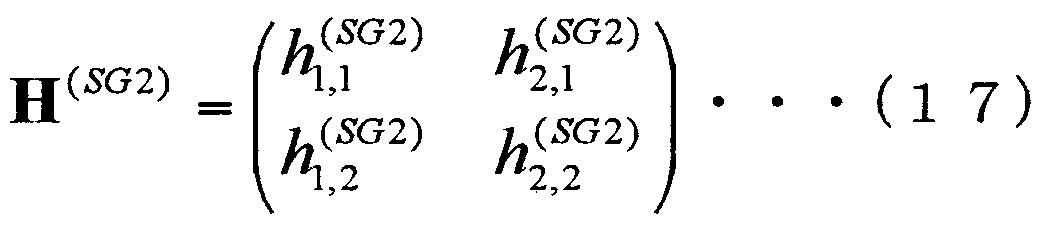
[数 18]

[数 19]

[数 20] [Equation 20]
(SG2) (SG2) (SG2)、 (SG2) (SG2) (SG2),
W = (w 2,1 W 22,.22 - W = (w 2,1 W 22, .22-
[数 21] [Number 21]
H( (5G2) w (5G2)Yi . . . 2 1 ) H ( (5G2) w (5G2) Y i ... 2 1)
[0020] 次に、導出された SGI及び SG2の送信ウェイト情報は、 FB情報受信部 1891に帰 還され、 FB情報受信部 1891では、この情報を基に拡散 Zウェイト乗算部 1810へ、 各送信アンテナから放出される信号に対して乗算すべき送信ウェイト情報 1895を送 出する。 [0020] Next, the derived SGI and SG2 transmission weight information is returned to the FB information reception unit 1891. The FB information reception unit 1891 transmits each transmission to the spread Z weight multiplication unit 1810 based on this information. Transmit transmission weight information 1895 to be multiplied with the signal emitted from the antenna.
[0021] 拡散 Zウェイト乗算部 1810では、拡散部 1807からの信号入力に対して 2分岐した 後、送信アンテナ 1801に対応する乗算器 1811では、式(13)の左側要素が送信ゥ エイトとして乗算され、送信アンテナ 1802に対応する乗算器 1812では、式(13)の 右側要素が送信ウェイトとして乗算される。 [0021] Spreading Z weight multiplication section 1810 branches the signal input from spreading section 1807 into two branches, and in multiplier 1811 corresponding to transmission antenna 1801, the left side element of equation (13) is the transmission queue. Multiplier 1812 that multiplies as an eight and corresponds to transmission antenna 1802 multiplies the right side element of equation (13) as a transmission weight.
[0022] また、拡散部 1809からの信号入力に対して 2分岐した後、送信アンテナ 1803に対 応する乗算器 1813では、式(18)の左側要素が送信ウェイトとして乗算され、送信ァ ンテナ 1804に対応する乗算器 1814では、式(18)の右側要素が送信ウェイトとして 乗算される。 [0022] Further, after bifurcating the signal input from spreading section 1809, multiplier 1813 corresponding to transmission antenna 1803 multiplies the left side element of equation (18) as a transmission weight, and transmission antenna 1804 In the multiplier 1814 corresponding to, the right side element of the equation (18) is multiplied as a transmission weight.
[0023] 無線受信装置 1820では、空間多重された受信信号に受信ウェイトを乗算し、さら に逆拡散処理を施すことによりストリーム 1865、 1866の分離、復元を行っている。 [0023] Radio receiving apparatus 1820 separates and restores streams 1865 and 1866 by multiplying the spatially multiplexed received signal by a reception weight and further performing despreading processing.
[0024] また、上記方法とは別に、 MIMOシステムの送信方法としては、 2つのストリームに 対して、それぞれ第 1、第 2の固有値から求まる送信ウェイト乗算し、 2つの送信アン テナを用いて伝送する固有モード伝送が知られて 、る。 [0024] In addition to the above method, as a transmission method of the MIMO system, the transmission weights obtained from the first and second eigenvalues are respectively multiplied for two streams, and transmission is performed using two transmission antennas. Eigenmode transmission is known.
非特許文献 1 : 3GPP TR25.876, "Multi-Input Multi-Output in UTRA" Non-Patent Document 1: 3GPP TR25.876, "Multi-Input Multi-Output in UTRA"
発明の開示 Disclosure of the invention
発明が解決しょうとする課題 Problems to be solved by the invention
[0025] し力しながら、上述した MIMOシステムにおける無線送信装置 1800及び無線受信 装置 1820においては、ストリーム 1865とストリーム 1866の受信品質、例えば受信 SI NR、チャネル相関行列の固有値などに大きな差が生じる場合、受信品質の悪いスト リームに対して逆拡散を実施しても、受信品質の良いストリームの干渉を十分に低減 できなくなり、結果として、受信品質の悪いストリームを精度よく検出することができな いという問題がある。 However, in radio transmission apparatus 1800 and radio reception apparatus 1820 in the MIMO system described above, there is a large difference in the reception quality of stream 1865 and stream 1866, for example, reception SI NR, eigenvalues of channel correlation matrix, and the like. In this case, even if despreading is performed on a stream with poor reception quality, the interference of streams with good reception quality cannot be sufficiently reduced, and as a result, streams with poor reception quality cannot be detected accurately. There is a problem.
[0026] 本発明の目的は、 D—TxAAにおけるストリームの検出精度を改善する無線送信 装置、無線受信装置及び無線送信方法を提供することである。 An object of the present invention is to provide a wireless transmission device, a wireless reception device, and a wireless transmission method that improve the detection accuracy of a stream in D-TxAA.
課題を解決するための手段 Means for solving the problem
[0027] 本発明の無線送信装置は、複数の送信アンテナと、通信相手力もフィードバックさ れた情報に基づ 、て、複数の前記送信アンテナを用いた固有モード伝送又は Doubl e- Transmit Antenna Arrayモード伝送のいずれかの送信モードを決定する送信モー ド決定手段と、決定された前記送信モードに切り替えて各ストリームを送信する送信 手段と、を具備する構成を採る。 [0028] 本発明の無線受信装置は、伝搬環境に基づいて、複数の送信アンテナを用いた 固有モード伝送又は Double-Transmit Antenna Arrayモード伝送のいずれかの送信 モードを決定する送信モード決定手段と、決定された前記送信モードを通信相手に フィードバックするフィードバック手段と、を具備する構成を採る。 [0027] The wireless transmission device of the present invention is based on a plurality of transmission antennas and information on which communication partner power is also fed back, so that eigenmode transmission using a plurality of the transmission antennas or a double-transmit antenna array mode is performed. It adopts a configuration comprising transmission mode determination means for determining any transmission mode of transmission and transmission means for switching to the determined transmission mode and transmitting each stream. [0028] The radio reception apparatus of the present invention includes, based on a propagation environment, transmission mode determination means for determining a transmission mode of eigenmode transmission using a plurality of transmission antennas or Double-Transmit Antenna Array mode transmission, And a feedback means for feeding back the determined transmission mode to a communication partner.
[0029] 本発明の無線送信方法は、通信相手力もフィードバックされた情報に基づいて、複 数の送信アンテナを用いた固有モード伝送又は Double-Transmit Antenna Arrayモ ード伝送の 、ずれかの送信モードを決定する送信モード決定工程と、決定された前 記送信モードに切り替えて各ストリームを送信する送信工程と、を具備するようにした 発明の効果 [0029] The wireless transmission method of the present invention is based on the information fed back to the other party's communication power, and the transmission mode is either one of eigenmode transmission using a plurality of transmission antennas or double-transmit antenna array mode transmission. And a transmission step for transmitting each stream by switching to the determined transmission mode.
[0030] 本発明によれば、 D—TxAAにおけるストリームの検出精度を改善することができる 図面の簡単な説明 [0030] According to the present invention, it is possible to improve the detection accuracy of a stream in D-TxAA.
[0031] [図 1]従来の無線送信装置と無線受信装置の装置構成を説明する概念図 FIG. 1 is a conceptual diagram illustrating device configurations of a conventional wireless transmission device and a wireless reception device.
[図 2]本発明の実施の形態 1に係る MIMOシステムにおける無線送信装置と無線受 信装置の構成を示すブロック図 FIG. 2 is a block diagram showing configurations of a radio transmission apparatus and a radio reception apparatus in the MIMO system according to Embodiment 1 of the present invention.
[図 3]本発明の実施の形態 1に係る無線送信装置の送信制御部の詳細構成図 FIG. 3 is a detailed configuration diagram of a transmission control unit of the radio transmission apparatus according to Embodiment 1 of the present invention.
[図 4]本発明の実施の形態 1に係る無線受信装置の受信部の詳細構成図 FIG. 4 is a detailed configuration diagram of a reception unit of the radio reception apparatus according to Embodiment 1 of the present invention.
[図 5]本発明の実施の形態 1に係る無線受信装置の受信制御部の詳細構成図 FIG. 5 is a detailed configuration diagram of a reception control unit of the radio reception apparatus according to Embodiment 1 of the present invention.
[図 6A]本発明の実施の形態 1に係る無線送信装置におけるサブグループの固有値 を基準に選択する方法を用いた送信モード選択のフロー図 FIG. 6A is a flowchart of transmission mode selection using a method of selecting on the basis of eigenvalues of subgroups in the wireless transmission device according to Embodiment 1 of the present invention.
[図 6B]本発明の実施の形態 1に係る無線送信装置における SINRを基準に選択する 方法を用いた送信モード選択のフロー図 FIG. 6B is a flowchart of transmission mode selection using a method of selecting based on SINR in the wireless transmission apparatus according to Embodiment 1 of the present invention.
[図 7]本発明の実施の形態 1に係る無線送信装置と無線受信装置間の制御手順を示 すシーケンス図 FIG. 7 is a sequence diagram showing a control procedure between the wireless transmission device and the wireless reception device according to Embodiment 1 of the present invention.
[図 8]本発明の実施の形態 2に係る MIMOシステムにおける無線送信装置と無線受 信装置の構成を示すブロック図 FIG. 8 is a block diagram showing a configuration of a radio transmission apparatus and a radio reception apparatus in a MIMO system according to Embodiment 2 of the present invention.
[図 9]本発明の実施の形態 2に係る無線送信装置の送信制御部の詳細構成図 [図 10]本発明の実施の形態 2に係る無線受信装置の受信部の詳細構成図 FIG. 9 is a detailed configuration diagram of a transmission control unit of a radio transmission apparatus according to Embodiment 2 of the present invention. FIG. 10 is a detailed configuration diagram of a reception unit of a radio reception apparatus according to Embodiment 2 of the present invention.
[図 11]本発明の実施の形態 2に係る無線受信装置の受信制御部の詳細構成図 [図 12]本発明の実施の形態 2に係る無線送信装置と無線受信装置間の制御手順を 示すシーケンス図 FIG. 11 is a detailed configuration diagram of a reception control unit of a radio reception apparatus according to Embodiment 2 of the present invention. FIG. 12 shows a control procedure between the radio transmission apparatus and radio reception apparatus according to Embodiment 2 of the present invention. Sequence Diagram
[図 13]本発明の実施の形態 2に係る無線送信装置と無線受信装置の送受信に用い られるフィードバックフォーマットの説明図 FIG. 13 is an explanatory diagram of a feedback format used for transmission / reception between the wireless transmission device and the wireless reception device according to Embodiment 2 of the present invention.
[図 14]本発明の実施の形態 3に係る MIMOシステムにおける無線送信装置と無線受 信装置の構成を示すブロック図 FIG. 14 is a block diagram showing configurations of a radio transmission apparatus and a radio reception apparatus in a MIMO system according to Embodiment 3 of the present invention.
[図 15]本発明の実施の形態 3に係る無線送信装置の送信制御部の詳細構成図 [図 16]本発明の実施の形態 3に係る無線受信装置の受信部の詳細構成図 FIG. 15 is a detailed configuration diagram of a transmission control section of a radio transmission apparatus according to Embodiment 3 of the present invention. FIG. 16 is a detailed configuration diagram of a reception section of a radio reception apparatus according to Embodiment 3 of the present invention.
[図 17]本発明の実施の形態 3に係る無線受信装置の受信制御部の詳細構成図 [図 18]本発明の実施の形態 3に係る無線送信装置と無線受信装置の送受信に用い られる再送リアレンジメントテーブルの説明図 FIG. 17 is a detailed configuration diagram of a reception control unit of a radio reception apparatus according to Embodiment 3 of the present invention. FIG. 18 is a retransmission used for transmission / reception between the radio transmission apparatus and radio reception apparatus according to Embodiment 3 of the present invention. Illustration of rearrangement table
発明を実施するための最良の形態 BEST MODE FOR CARRYING OUT THE INVENTION
[0032] 以下、本発明の実施の形態について、図面を参照して詳細に説明する。ただし、実 施の形態において、同一機能を有する構成には同一符号を付し、重複する説明は 省略する。 Hereinafter, embodiments of the present invention will be described in detail with reference to the drawings. However, in the embodiments, configurations having the same functions are denoted by the same reference numerals, and redundant descriptions are omitted.
[0033] (実施の形態 1) [Embodiment 1]
図 2は、本発明の実施の形態 1に係る MIMOシステムにおける無線送信装置 10及 び無線受信装置 20の構成を示すブロック図である。この図において、第 2系統の拡 散 Zウェイト乗算部 105と、多重部 120と、送信モード切り替え部 102と、 CQI情報 1 896、送信ウェイト情報 1895以外に送信モード切り替え信号を送出する FB情報受 信部 191とフィードフォワード情報送信部(以下、「FF情報送信部」という) 192とを有 する送信制御部 190とをさらに有する。ここで、説明を簡単にするため、無線送信装 置 10側の拡散 Zウェイト乗算部 1810を第 1系統の拡散 Zウェイト乗算部 1810と呼 び換免ることとする。 FIG. 2 is a block diagram showing configurations of radio transmitting apparatus 10 and radio receiving apparatus 20 in the MIMO system according to Embodiment 1 of the present invention. In this figure, the second system spread Z-weight multiplication unit 105, multiplexing unit 120, transmission mode switching unit 102, CQI information 1 896, and transmission weight information 1895, which transmits a transmission mode switching signal other than FB information reception. The transmission control unit 190 further includes a transmission unit 191 and a feedforward information transmission unit (hereinafter referred to as “FF information transmission unit”) 192. Here, in order to simplify the explanation, it is assumed that the spread Z weight multiplication unit 1810 on the wireless transmission device 10 side is referred to as the first system spread Z weight multiplication unit 1810.
[0034] また、無線受信装置 20は、チャネル行列をフィードバック情報 197として送出する F B情報送信部 193と FF情報送信部 192より送られてくるフィードフォワード情報 198 を受けるフィードフォワード情報受信部 (以下、「FF情報受信部」という) 194とを有す る受信制御部 24と、フィードフォワード情報 198を基に逆拡散処理、復調処理等を 行う受信部 23とを有する。 [0034] Also, the wireless reception device 20 transmits the channel matrix as feedback information 197. The feedforward information 198 is sent from the FB information transmission unit 193 and the FF information transmission unit 192. Receiving control section 24 having a feed forward information receiving section (hereinafter referred to as “FF information receiving section”) 194, and receiving section 23 performing despreading processing, demodulation processing, etc. based on feed forward information 198 Have
[0035] 第 2の拡散 Zウェイト乗算部 105は、拡散部 107、 109と、該拡散部 107、 109出力 に所定の送信ウェイトを乗算した送信ウェイト乗算信号を、対応する該送信アンテナ 1 801〜 1804各々に向けて送出する送信ウェイト乗算器 111〜 114とを有する。 [0035] The second spreading Z weight multiplying section 105, spreading sections 107 and 109, and transmission weight multiplication signals obtained by multiplying the outputs of the spreading sections 107 and 109 by a predetermined transmission weight, are transmitted to the corresponding transmitting antennas 1801 to 801. 1804 includes transmission weight multipliers 111 to 114 that transmit the signals to each of them.
[0036] 拡散部 107からの信号入力が 2分岐された後、送信アンテナ 1801に対応する乗算 器 111では、式(15)の左側要素が送信ウェイトとして乗算される。また、送信アンテ ナ 1802に対応する乗算器 112では、式(15)の右側要素が送信ウェイトとして乗算さ れる。 [0036] After the signal input from spreading section 107 is branched into two, multiplier 111 corresponding to transmission antenna 1801 multiplies the left side element of equation (15) as a transmission weight. Also, in multiplier 112 corresponding to transmission antenna 1802, the right side element of equation (15) is multiplied as a transmission weight.
[0037] 一方、拡散部 109からの信号入力が 2分岐された後、送信アンテナ 1803に対応す る乗算器 113では、式 (20)の左側要素が送信ウェイトとして乗算される。また、送信 アンテナ 1804に対応する乗算器 114では、式(20)の右側要素が送信ウェイトとして 乗算される。 [0037] On the other hand, after the signal input from spreading section 109 is branched into two, multiplier 113 corresponding to transmission antenna 1803 multiplies the left side element of equation (20) as a transmission weight. Further, in the multiplier 114 corresponding to the transmission antenna 1804, the right side element of the equation (20) is multiplied as the transmission weight.
[0038] なお、図示していないが、拡散部 1807と送信ウェイト乗算器 1811、 1812とは、 SG 1により第 1の固有値を用いた MIMOチャネルビームを生成する機能を有することか ら、第 1の送信ビーム信号生成部と呼ぶ。また、拡散部 1809と送信ウェイト乗算器 18 13、 1814とは、 SG2により第 1の固有値を用いた MIMOチャネルビームを生成する 機能を有することから、第 2の送信ビーム信号生成部と呼ぶ。 Although not shown, spreading section 1807 and transmission weight multipliers 1811 and 1812 have a function of generating a MIMO channel beam using the first eigenvalue by SG 1, so This is called a transmission beam signal generation unit. Spreading section 1809 and transmission weight multipliers 18 13 and 1814 have a function of generating a MIMO channel beam using the first eigenvalue by SG2, and are therefore referred to as a second transmission beam signal generation section.
[0039] 同様に、拡散部 107と送信ウェイト乗算器 111、 112とは、 SG1により第 2の固有値 を用いた MIMOチャネルビームを生成する機能を有することから、第 3の送信ビーム 信号生成部と呼ぶ。また、拡散部 109と送信ウェイト乗算器 113、 114とは、 SG2によ り第 2の固有値を用いた MIMOチャネルビームを生成する機能を有することから、第 4の送信ビーム信号生成部と呼ぶ。 Similarly, spreading section 107 and transmission weight multipliers 111 and 112 have a function of generating a MIMO channel beam using the second eigenvalue by SG1, so that the third transmission beam signal generation section and Call. Spreading unit 109 and transmission weight multipliers 113 and 114 have a function of generating a MIMO channel beam using the second eigenvalue by SG2, and are therefore referred to as a fourth transmission beam signal generation unit.
[0040] 多重部 120は、第 1系統の拡散 Zウェイト乗算部 1810の送信ウエイト乗算器 1811 〜1814からの出力信号と、対応する第 2系統の拡散 Zウェイト乗算部 105の送信ゥ エイト乗算器 111〜 114からの出力信号とを各々多重した多重信号を、対応する送 信部 1841〜1844の各々に送出する。 [0041] 送信モード切り替え部 102は、 FB情報受信部 191から出力される送信モード切り 替え信号 195を受けて、所定の送信モードとなるように、第 1のストリーム 1865と第 2 のス HJ—ム 1866を拡散部 1807、 1809、 107、 109の内、所定のものへ切り替え出 力する。 Multiplexer 120 includes transmission signals from transmission weight multipliers 1811 to 1814 of first-system spread Z-weight multiplier 1810 and transmission weight multipliers of the corresponding second-system spread Z-weight multiplier 105. A multiplexed signal obtained by multiplexing the output signals from 111 to 114 is sent to each of the corresponding transmission units 1841 to 1844. [0041] The transmission mode switching unit 102 receives the transmission mode switching signal 195 output from the FB information receiving unit 191 and receives the first stream 1865 and the second stream HJ— so that a predetermined transmission mode is established. 1866 is switched to a predetermined one of the diffusion units 1807, 1809, 107, 109 and output.
[0042] 図 3は、送信制御部 190の詳細構成図である。送信制御部 190は、 FB情報受信部 191と、 FF情報送信部 192とを備える。 FB情報受信部 191は、受信制御部 24から のフィードバック情報 197を受けてチャネル行列情報を復調するフィードバック情報 復調部 261と、フィードバック情報復調部 261から出力されるチャネル行列情報を基 に、チャネル行列を取得するチャネル行列取得部 262と、取得されたチャネル行列を 基に送受信ウェイトを算出する送受信ウェイト算出部 263と、 MIMO送信モード決定 部 207とを有する。 FIG. 3 is a detailed configuration diagram of the transmission control unit 190. The transmission control unit 190 includes an FB information reception unit 191 and an FF information transmission unit 192. The FB information reception unit 191 receives the feedback information 197 from the reception control unit 24 and demodulates the channel matrix information. Based on the channel matrix information output from the feedback information demodulation unit 261 and the feedback information demodulation unit 261, the channel matrix A channel matrix acquisition unit 262 for acquiring transmission / reception weights, a transmission / reception weight calculation unit 263 for calculating transmission / reception weights based on the acquired channel matrix, and a MIMO transmission mode determination unit 207.
[0043] FF情報送信部 192は、送受信ウェイト算出部 263から出力された受信ウェイト情報 を基に CQI情報 1896を決定する CQI決定部 264と、受信ウェイト情報と CQI情報と を有するフィードフォワード情報 198を受信制御部 24に送出するフィードフォワード 情報生成部 265とを有する。 The FF information transmission unit 192 includes a CQI determination unit 264 that determines CQI information 1896 based on the reception weight information output from the transmission / reception weight calculation unit 263, and feedforward information 198 including reception weight information and CQI information. And a feedforward information generation unit 265 for sending the message to the reception control unit 24.
[0044] 図 4は、受信部 23の詳細構成図である。受信部 23は、受信アンテナ 1821、 1822 と接続されており、 RF受信部 302と、逆拡散ストリーム分離部 305と、 MIMO復調部 306と、復調部 307とを有する構成となっている。 FIG. 4 is a detailed configuration diagram of the receiving unit 23. The receiving unit 23 is connected to the receiving antennas 1821 and 1822, and includes an RF receiving unit 302, a despread stream separating unit 305, a MIMO demodulating unit 306, and a demodulating unit 307.
[0045] RF受信咅 302では、アンテナ 1821、 1822で受けた RF信号 1804、 1805を、そ れぞれダウンコンバートした後、図示しないパイロット信号抽出部によりフレーム内の ノ ィロット信号 121を抽出し、 FB情報受信部 191に送出する。また、パイロット信号 1 21を取り除いた信号を逆拡散ストリーム分離部 305に送出する。 [0045] The RF receiver 302, after down-converting the RF signals 1804 and 1805 received by the antennas 1821 and 1822, respectively, extracts the pilot signal 121 in the frame by a pilot signal extraction unit (not shown), Send to FB information receiver 191. Also, the signal from which pilot signal 121 has been removed is sent to despread stream separation section 305.
[0046] 逆拡散ストリーム分離部 305では、 RF受信部 302から出力された信号に対して、 F F情報受信部 194からの CQI情報 119を基に、拡散コードとスクランブルコードを乗 算した逆拡散信号 3010、 3011を MIMO復調部 306に出力する。 [0046] Despread stream demultiplexing section 305 despread signal obtained by multiplying the signal output from RF receiving section 302 by the spreading code and scramble code based on CQI information 119 from FF information receiving section 194 3010 and 3011 are output to the MIMO demodulator 306.
[0047] なお、 D— TxAAモード送信では、この逆拡散ストリーム分離部 305は拡散コード によるストリーム分離の機能も担う。ところが、固有モード伝送では、ストリーム分離は MIMO復調部 306が担うため、逆拡散ストリーム分離部 305ではスクランブルコード の乗算のみを実施する。この場合、拡散コードを乗算しても問題なく復調できる。 [0047] Note that, in D-TxAA mode transmission, the despread stream separation unit 305 also functions as a stream separation by a spread code. However, in eigenmode transmission, the MIMO demodulation unit 306 is responsible for stream separation, so the despread stream separation unit 305 scrambles the code. Only the multiplication of is performed. In this case, even if the spreading code is multiplied, it can be demodulated without any problem.
[0048] MIMO復調部 306では、逆拡散ストリーム分離部 305から出力された逆拡散信号 3010、 3011に対して、 FF情報受信部 194からの受信ウェイト情報 118を基に、スト リーム復調を実施し、ストリーム復調信号 3012、 3013を復調部 307に出力する。ま た、固有モード伝送の場合、第 1固有ビームと第 2固有ビームのストリーム分離機能も 担う。 [0048] MIMO demodulation section 306 performs stream demodulation on despread signals 3010 and 3011 output from despread stream separation section 305 based on reception weight information 118 from FF information reception section 194. Stream demodulated signals 3012 and 3013 are output to demodulating section 307. In the case of eigenmode transmission, it also functions as a stream separation function for the first and second eigenbeams.
[0049] 復調部 307では、 MIMO復調部 306から出力されたストリーム復調信号 3012、 30 13に対して、 FF情報受信部 194からの CQI情報 119を基に、図示しないデータマツ ビング部にて、 FF情報受信部 194からの CQI情報 119を基に、デマッピング処理を 実施した後、図示しないディンタリーブ部と誤り訂正復号部とによりディンタリーブ処 理と誤り訂正復号処理を行い、受信ストリーム 3001、 3002を出力する。 In demodulator 307, stream demodulated signals 3012 and 30 13 output from MIMO demodulator 306 are processed by a data mapping unit (not shown) based on CQI information 119 from FF information receiver 194. Based on the CQI information 119 from the FF information receiving unit 194, the demapping process is performed, and then the dingering unit and the error correcting decoding unit (not shown) perform the dingering process and the error correcting decoding process, and the received streams 3001 and 3002 are Output.
[0050] 図 5は、受信制御部 24の詳細構成図である。受信制御部 24は、 FB情報送信部 19 3と、 FF情報受信部 194とを備える。 FB情報送信部 193は、 RF受信部 302から出 力されるパイロット信号 121を基に、チャネル行列情報を推定するチャネル推定部 40 3を有する。 FF情報受信部 194は、 FF情報送信部 192から送られてくるフィードフォ ワード情報 198から CQI情報 119と受信ウェイト情報 118を抽出し、受信部 23に送出 するフィードフォワード情報復調部 404を有する。 FIG. 5 is a detailed configuration diagram of the reception control unit 24. The reception control unit 24 includes an FB information transmission unit 193 and an FF information reception unit 194. The FB information transmission unit 193 includes a channel estimation unit 403 that estimates channel matrix information based on the pilot signal 121 output from the RF reception unit 302. The FF information receiving unit 194 includes a feedforward information demodulating unit 404 that extracts the CQI information 119 and the reception weight information 118 from the feedforward information 198 sent from the FF information transmitting unit 192 and sends it to the receiving unit 23.
[0051] 以上のように構成された MIMOシステムにおける無線送信装置 10及び無線受信 装置 20について、図 2〜図 5を用いてその動作を説明する。 [0051] Operations of the wireless transmission device 10 and the wireless reception device 20 in the MIMO system configured as described above will be described with reference to FIGS.
[0052] 図 2において、最初、 D—TxAAモード伝送が選択されており、送信アンテナ 1801 、 1802を用!ヽて伝送ノ ス 1831によりストリーム 1865力 送信アンテナ 1803、 1804 を用いて伝送パス 1832によりストリーム 1866が、無線受信装置 20に伝送されてい たとする。つまり、送信モード切り替え部 102は、第 1のストリーム 1865を第 1系統の 拡散 Zウェイト乗算部 1810側の拡散部 1807に出力し、第 2のストリーム 1866を第 1 系統の拡散 Zウェイト乗算部 1810側の拡散部 1809に出力している。 [0052] In FIG. 2, first, D—TxAA mode transmission is selected, and the transmission antennas 1801 and 1802 are used! The transmission node 1831 uses the stream 1865 power. The transmission antennas 1803 and 1804 use the transmission path 1832. It is assumed that the stream 1866 is transmitted to the wireless reception device 20. That is, transmission mode switching section 102 outputs first stream 1865 to spreading section 1807 on the first system spread Z weight multiplication section 1810 side, and second stream 1866 is sent to the first system spread Z weight multiplication section 1810. Is output to the diffusion unit 1809 on the side.
[0053] ところが、通信中に、伝送パス 1832の途中に車両等が入り込み伝送環境が大きく 変化し、伝送パス 1832により伝送されるストリーム 1866の受信品質が伝送パス 183 1により伝送されるストリーム 1865の受信品質と比較して劣悪となる場合が生じる。こ のような環境下で D—TxAAモード伝送を実施すると、ストリーム 1866を検出するこ とが困難となる。この時、送信機 10の FB情報受信部 191は、無線受信装置 20の FB 情報送信部 193から送られてくるチャネル行列情報であるフィードバック情報 197か ら、ストリーム 1866の受信品質が劣化したことを検出し、 D—TxAAモード伝送から 固有モード伝送に切り替えるために、送信モード切り替え信号 195を送信モード切り 替え部 102に向けて出力する。 However, during communication, a vehicle or the like enters the middle of the transmission path 1832 and the transmission environment changes greatly, and the reception quality of the stream 1866 transmitted by the transmission path 1832 is the same as that of the stream 1865 transmitted by the transmission path 183 1. In some cases, it is worse than the reception quality. This If D-TxAA mode transmission is performed in such an environment, it will be difficult to detect stream 1866. At this time, the FB information receiving unit 191 of the transmitter 10 indicates that the reception quality of the stream 1866 has deteriorated from the feedback information 197 which is channel matrix information sent from the FB information transmitting unit 193 of the radio receiving device 20. In order to detect and switch from D-TxAA mode transmission to eigenmode transmission, a transmission mode switching signal 195 is output to transmission mode switching section 102.
[0054] 送信モード切り替え部 102では、 FB情報受信部 191から出力される送信モード切 り替え信号 195を受けて、第 2のストリーム 1866を第 1系統の拡散 Zウェイト乗算部 1 810側の拡散部 1809から第 2系統の拡散 Zウェイト乗算部 105側の拡散部 107に 切り替え出力する。 In response to transmission mode switching signal 195 output from FB information receiving section 191, transmission mode switching section 102 converts second stream 1866 into the first system spreading Z weight multiplying section 1 810 side spreading. Switched from the unit 1809 to the diffusion unit 107 on the second system diffusion Z-weight multiplication unit 105 side.
[0055] 拡散部 107では、入力されたストリーム 1866に対して拡散部 1809で行われるのと 同じ拡散処理とスクランブル処理が施され、第 2系統の拡散 Zウェイト乗算部 105の 送信ウェイト乗算部 111、 112にて送信ウェイトが乗算される。これには、第 1系統の 拡散 Zウェイト乗算部 1810で用いられた送信ウェイトとは異なる送信ウェイトが用い られる。つまり、式(2)のチャネル相関行列の第 2固有値を用いた送信ウェイト (式(1 5) )を送信ウェイトに用いるのである。 [0055] Spreading section 107 performs the same spreading processing and scramble processing as that performed by spreading section 1809 on input stream 1866, and transmission weight multiplication section 111 of second-system spreading Z weight multiplication section 105 112, the transmission weight is multiplied. For this, a transmission weight different from the transmission weight used in the spread Z weight multiplication unit 1810 of the first system is used. That is, the transmission weight (Equation (15)) using the second eigenvalue of the channel correlation matrix of Equation (2) is used as the transmission weight.
[0056] 以後、式(2)のチャネル相関行列の第 1固有ベクトル (式(9) )を送信ウェイトに用い て送信するストリームを SG1の第 1固有ビームと呼び、第 2固有ベクトル (式(13) )を 送信ウェイトに用いて送信するストリームを SG1の第 2固有ビームと呼ぶことにする。 [0056] Hereinafter, the stream transmitted using the first eigenvector (Equation (9)) of the channel correlation matrix of Equation (2) as the transmission weight is called the first eigenbeam of SG1, and the second eigenvector (Equation (13) ) Is used as the transmission weight and the stream transmitted is called the second eigenbeam of SG1.
[0057] 同様に、チャネル行列は式(17)のチャネル相関行列の第 1固有ベクトル(式(18) ) を送信ウェイトに用いて送信するストリームを SG2の第 1固有ビームと呼び、第 2固有 ベクトル (式(20) )を送信ウェイトに用いて送信するストリームを SG2の第 2固有ビー ムと呼ぶことにする。 [0057] Similarly, the channel matrix uses the first eigenvector (equation (18)) of the channel correlation matrix of Equation (17) as the transmission weight, and the stream transmitted is called the SG2 first eigenbeam, and the second eigenvector. The stream transmitted using (Equation (20)) as the transmission weight is called the second unique beam of SG2.
[0058] 第 2系統の拡散 Zウェイト乗算部 105では、拡散部 107からの信号を 2分岐した後 、送信アンテナ 1801に対応する乗算部 111では、式(15)の左側要素が送信ウェイ トとして乗算され、送信アンテナ 1802に対応する乗算器 112では、式(15)の右側要 素が送信ウェイトとして乗算される。 [0058] After spreading the signal from spreading section 107 into two in spreading Z weight multiplication section 105 of the second system, in multiplication section 111 corresponding to transmission antenna 1801, the left side element of equation (15) is used as the transmission weight. Multiplier 112 corresponding to transmission antenna 1802 is multiplied by the right side element of equation (15) as a transmission weight.
[0059] これにより、送信アンテナ 1801、 1802により SG1の第 1固有ビームを用いて、伝送 パス 1831を介してストリーム 1865を無線受信装置 20側に伝送したまま、ストリーム 1 866を同じ送信アンテナ 1801、 1802により SG1の第 2固有ビームを用いることで、 伝送パス 1831とほぼ同じ伝送パス 21を介し、伝送パス 1832とは異なる伝送パスに て無線受信装置 20側に伝送する。 [0059] As a result, transmission is performed using the first eigenbeam of SG1 by transmitting antennas 1801 and 1802. The stream 1865 is transmitted to the radio receiver 20 via the path 1831, and the stream 1 866 is transmitted to the radio receiver 20 by using the second eigenbeam of SG1 by the same transmission antennas 1801 and 1802. Then, the data is transmitted to the radio receiver 20 side through a transmission path different from the transmission path 1832.
[0060] 逆に、伝送パス 1831により伝送されるストリーム 1865の受信品質が伝送パス 183 2により伝送されるストリーム 1866の受信品質と比較して劣悪となる場合は、無線送 信装置 10の FB情報受信部 191は、無線受信装置 20の FB情報送信部 193から送 られてくるチャネル行列情報から、ストリーム 1865の受信品質が劣化したことを検出 し、 D—TxAAモード伝送から固有モード伝送に切り替えるために、送信モード切り 替え信号 195を送信モード切り替え部 102に向けて出力する。 [0060] On the contrary, if the reception quality of the stream 1865 transmitted by the transmission path 1831 is inferior to the reception quality of the stream 1866 transmitted by the transmission path 183 2, the FB information of the wireless transmission device 10 The reception unit 191 detects that the reception quality of the stream 1865 has deteriorated from the channel matrix information sent from the FB information transmission unit 193 of the wireless reception device 20, and switches from D-TxAA mode transmission to eigenmode transmission. In addition, the transmission mode switching signal 195 is output to the transmission mode switching unit 102.
[0061] 送信モード切り替え部 102は、 FB情報受信部 191から出力される送信モード切り 替え信号 195を受けて、第 1のストリーム 1865を第 1系統の拡散 Zウェイト乗算部 18 10側の拡散部 1807から第 2系統の拡散 Zウェイト乗算部 105側の拡散部 109に切 り替え出力する。 [0061] Transmission mode switching section 102 receives transmission mode switching signal 195 output from FB information receiving section 191 and converts first stream 1865 into first system spreading Z weight multiplying section 18 10 side spreading section. Switch from 1807 to diffusion unit 109 on the second system diffusion Z-weight multiplication unit 105 side.
[0062] 拡散部 109では、入力されたストリーム 1865に対して拡散部 1807で行われるのと 同じ拡散処理とスクランブル処理が施される。そして、拡散部 109からの信号が 2分 岐された後、送信アンテナ 1803に対応する乗算部 113では、式(20)の左側要素が 送信ウェイトとして乗算され、送信アンテナ 1804に対応する乗算器 114では、式(20 )の右側要素が送信ウェイトとして乗算される。 [0062] Spreading section 109 performs the same spreading processing and scramble processing as that performed by spreading section 1807 on input stream 1865. Then, after the signal from spreading section 109 is divided into two, multiplication section 113 corresponding to transmission antenna 1803 multiplies the left side element of equation (20) as a transmission weight, and multiplier 114 corresponding to transmission antenna 1804 Then, the right side element of Expression (20) is multiplied as a transmission weight.
[0063] これにより、送信アンテナ 1803、 1804により SG2の第 1固有ビームを用いて、伝送 パス 1832を介してストリーム 1866を無線受信装置 20側に伝送したまま、ストリーム 1 865を同じ送信アンテナ 1803と 1804とにより SG2の第 2固有ビームを用いることで、 伝送パス 1832とほぼ同じ伝送パス 22を介し、伝送パス 1831とは異なる伝送パスに て無線受信装置 20側に伝送する。 [0063] Thus, stream 1866 is transmitted to radio receiver 20 via transmission path 1832 using the first eigen beam of SG2 by transmitting antennas 1803 and 1804, and stream 1 865 is transmitted to the same transmitting antenna 1803. By using the second eigen beam of SG2 in accordance with 1804, the signal is transmitted to the radio receiver 20 side via a transmission path 22 that is substantially the same as the transmission path 1832 and a transmission path different from the transmission path 1831.
[0064] 以上、無線送信装置 10及び無線受信装置 20の構成、それらの動作について説明 した。 [0064] The configurations and operations of the wireless transmission device 10 and the wireless reception device 20 have been described above.
[0065] 次に、図 6Aを用いて、 MIMO送信モード決定部 207における、送信モード選択フ ローについて説明する。本実施の形態では、各サブグループの固有値を基準に選 択するフローについて説明する。 Next, the transmission mode selection flow in MIMO transmission mode determination section 207 will be described using FIG. 6A. In this embodiment, the selection is based on the eigenvalues of each subgroup. The flow to be selected will be described.
[0066] 図 6Aの固有値を基準として MIMO送信モードを選択するフローでは、まず各 SG のチャネル行列の相関行列を固有値分解し、 SG1の第 1の固有値である λ 1 (SG1) と SG2の第 1の固有値である λ 1 (SG2)を求める(ステップ S501)。次に、 λ 1 (SG1 )と λ 1 (SG2)との比較を行い、 λ 1 (SGI) > λ 1 (SG2)、なる関係を満たすかどう か判断する (ステップ S502)。 [0066] In the flow for selecting the MIMO transmission mode based on the eigenvalues in Fig. 6A, first, the correlation matrix of each SG channel matrix is decomposed into eigenvalues, and the first eigenvalues of SG1 (SG1) and SG2 Λ 1 (SG2) which is an eigenvalue of 1 is obtained (step S501). Next, comparison is made between λ 1 (SG1) and λ 1 (SG2), and it is determined whether or not a relationship of λ 1 (SGI)> λ 1 (SG2) is satisfied (step S502).
[0067] ステップ S502にて、 λ 1 (SGI) > λ 1 (SG2)、なる関係が成立する場合は、さらに SG1の第 2固有値である λ 2 (SGI)と SG2の第 1固有値である λ 1 (SG2)との比較 を行い、 λ 1 (SG2) + α > λ 2 (SG1)、なる関係が満たされるかどうか判断する。伹 し、 αは送信モード選択頻度を調整できるパラメータであり、チャネル状態に応じて 決定される所定値である。基本的には、 αを大きくすると D— ΤχΑΑモード伝送が選 択されやすくなり、小さくすると固有モード伝送が選択されやすくなる。(ステップ S50 3)。そして、 λ 1 (SG2) + α > λ 2 (SG1)、なる関係が成立する場合は、 SG1を用 いた固有送信モードを選択する(ステップ S504)。一方、ステップ S503において、 λ 1 (SG2) + α > λ 2 (SG1)、なる関係が成立しない場合は D—TxAAモード伝送を 選択する (ステップ S 505)。 [0067] In step S502, if the relationship of λ 1 (SGI)> λ 1 (SG2) is satisfied, λ 2 (SGI) that is the second eigenvalue of SG1 and λ that is the first eigenvalue of SG2 Comparison with 1 (SG2) is performed, and it is determined whether or not the relationship λ 1 (SG2) + α> λ 2 (SG1) is satisfied. Here, α is a parameter that can adjust the transmission mode selection frequency, and is a predetermined value determined according to the channel state. Basically, increasing α makes it easier to select D- ΤχΑΑ mode transmission, and decreasing it makes it easier to select eigenmode transmission. (Step S50 3). Then, when the relationship of λ 1 (SG2) + α> λ 2 (SG1) is established, the unique transmission mode using SG1 is selected (step S504). On the other hand, if the relationship λ 1 (SG2) + α> λ 2 (SG1) is not established in step S503, D-TxAA mode transmission is selected (step S505).
[0068] 一方、ステップ S502にて、 λ 1 (SGI) > λ 1 (SG2)、なる関係が成立しない場合 は、さらに SG1の第 1固有値である λ 1 (SGI)と SG2の第 2固有値である λ 2 (SG2) との比較を行い、 λ 1 (SGI) + β > λ 2 (SG2)、なる関係が満たされるかどうか判断 する。但し、 βは送信モード選択頻度を調整できるパラメータであり、チャネル状態に 応じて決定される所定値である。基本的には、 j8を大きくすると D— ΤχΑΑモード伝 送が選択されやすくなり、小さくすると固有モード伝送が選択されやすくなる (ステツ プ S506)。そして、 λ 1 (SGI) + β > λ 2 (SG2)、なる関係が成立する場合は、 D— TxAAモード伝送を選択し (ステップ S505)、 λ 1 (SGI) + β > λ 2 (SG2)、なる関 係が成立しない場合は、 SG2を用いた固有送信モードを選択する (ステップ S507)。 [0068] On the other hand, if the relationship of λ 1 (SGI)> λ 1 (SG2) is not established in step S502, λ 1 (SGI) that is the first eigenvalue of SG1 and the second eigenvalue of SG2 A comparison with a certain λ 2 (SG2) is made, and it is determined whether or not the relationship λ 1 (SGI) + β> λ 2 (SG2) is satisfied. However, β is a parameter that can adjust the transmission mode selection frequency, and is a predetermined value determined according to the channel state. Basically, increasing j8 makes it easier to select D—ΤχΑΑ mode transmission, and reducing j8 makes it easier to select eigenmode transmission (step S506). If the relationship λ 1 (SGI) + β> λ 2 (SG2) holds, select D—TxAA mode transmission (step S505), and λ 1 (SGI) + β> λ 2 (SG2) If this relationship is not established, the unique transmission mode using SG2 is selected (step S507).
[0069] なお、本実施の形態では、各サブグループの固有値を基準に選択するフローを用 いている力 以下に示すように、 SINRを基準として MIMO送信モードを選択するフ ローを用いてもよい。 [0070] 図 6Bは、 SINRを基準として MIMO送信モードを選択するフローである。 SINRを 基準として MIMO送信モードを選択するフローでは、まず各 SGの SINR、つまり、 S G1の SINRである SINR (SGl)と SG2の SINRである SINR(SG2)を算出する(ステ ップ S510)。次に、算出した SINRが、 | SINR (SGI) - SINR (SG2) | > γ、なる 関係 (但し、 | |は絶対値を示す)を満たす力どうか判断する (ステップ S511)。但し 、 yは送信モード選択頻度を調整できるパラメータであり、チャネル状態に応じて決 定される所定値であり、 yを大きくすると D ΤχΑΑモード伝送が選択されやすくなり 、小さくすると固有モード伝送が選択されやすくなる。 [0069] In the present embodiment, a force that uses a flow that is selected based on the eigenvalues of each subgroup may be used, as shown below, a flow that selects a MIMO transmission mode based on SINR. . FIG. 6B is a flow for selecting a MIMO transmission mode based on SINR. In the flow to select the MIMO transmission mode based on SINR, first calculate the SINR of each SG, that is, SINR (SGl), which is the SINR of SG1, and SINR (SG2), which is the SINR of SG2 (step S510). . Next, it is determined whether or not the calculated SINR satisfies the following relationship: | SINR (SGI)-SINR (SG2) |> γ (where | | indicates an absolute value) (step S511). However, y is a parameter that can adjust the transmission mode selection frequency, and is a predetermined value that is determined according to the channel state. Increasing y makes D ΤχΑΑ mode transmission easier to select, and decreasing it selects eigenmode transmission. It becomes easy to be done.
[0071] I SINR(SGl) SINR(SG2) | > γ、なる関係が満たされる場合は、さらに、 SI NR (SGl) > SINR (SG2)なる関係を満たすかどうか判断する(ステップ S512)。こ の時、 SINR (SGl) > SINR (SG2)なる関係を満たしている場合は、 SG1を用いた 固有送信モードを選択する(ステップ S 513)。一方、ステップ S512において、 SINR (SGI) > SINR (SG2)なる関係が満たされて ヽな 、場合は SG2を用いた固有送信 モードを選択する(ステップ S 514)。 [0071] If the relationship I SINR (SGl) SINR (SG2) |> γ is satisfied, it is further determined whether or not the relationship SI NR (SGl)> SINR (SG2) is satisfied (step S512). At this time, if the relationship SINR (SGl)> SINR (SG2) is satisfied, the specific transmission mode using SG1 is selected (step S513). On the other hand, if the relationship SINR (SGI)> SINR (SG2) is satisfied in step S512, the specific transmission mode using SG2 is selected (step S514).
[0072] 一方、ステップ S511にて、 I SINR (SGI) - SINR (SG2) | > γ、なる関係が満 たされて!/ヽな 、場合は、 D— ΤχΑΑモード伝送を選択する (ステップ S515)。 [0072] On the other hand, in step S511, if the relationship I SINR (SGI)-SINR (SG2) |> γ is satisfied! / ヽ, select D—ΤχΑΑ mode transmission (step S515). ).
[0073] 以上、無線送信装置 10における、送信モード選択フローについて説明した。 The transmission mode selection flow in the wireless transmission device 10 has been described above.
[0074] 次に、無線送信装置 10及び無線受信装置 20間の制御手順について説明する。 Next, a control procedure between the wireless transmission device 10 and the wireless reception device 20 will be described.
図 7は、無線送信装置 10及び無線受信装置 20間の制御手順を示すシーケンス図で ある。無線受信装置 20は、パイロットチャネル 630と、データチャネル 640とを有して おり、ここでは、無線送信装置 10とパイロットチャネル 630及びデータチャネル 640 間の制御手順を示すものとする。 FIG. 7 is a sequence diagram illustrating a control procedure between the wireless transmission device 10 and the wireless reception device 20. The radio reception apparatus 20 has a pilot channel 630 and a data channel 640. Here, a control procedure between the radio transmission apparatus 10, the pilot channel 630, and the data channel 640 is shown.
[0075] 起動時には、無線受信装置 20のデータチャネル 640から、チャネル行列情報を有 するフィードバック信号が無線送信装置 10に送出されるものとし、図 7では、定常時 の説明を行う。 [0075] At the time of activation, it is assumed that a feedback signal having channel matrix information is transmitted from the data channel 640 of the wireless reception device 20 to the wireless transmission device 10, and FIG.
[0076] 無線送信装置 10では、該フィードバック信号を受けて、フィードバック信号力もチヤ ネル行列を復調し (シーケンス S611)、チャネル行列の相関行列を固有値分解して 、固有値と固有ベクトルと送受信ウェイトを算出する(シーケンス S612)。次に、算出 した固有値を基に、 MIMO送信モードと、 CQIを決定する(シーケンス S613)。さら に、フィードバック情報と、 MIMO送信モード情報と、送受信ウェイト情報と、 CQI情 報を生成し (シーケンス S614)、誤り訂正符号化、マッピング、 MIMO多重及びパイ ロット信号の付加などの送信処理を行う(シーケンス S615)。 Radio transmitting apparatus 10 receives the feedback signal, demodulates the channel matrix of the feedback signal power (sequence S611), calculates the eigenvalue, eigenvector, and transmission / reception weight by eigenvalue decomposition of the correlation matrix of the channel matrix. (Sequence S612). Next, calculate Based on the eigenvalues determined, the MIMO transmission mode and CQI are determined (sequence S613). Furthermore, feedback information, MIMO transmission mode information, transmission / reception weight information, and CQI information are generated (sequence S614), and transmission processing such as error correction coding, mapping, MIMO multiplexing, and pilot signal addition is performed. (Sequence S615).
[0077] 該送信処理を行った後、無線送信装置 10は、パイロット信号をパイロットチャネル 6 30に送出し(シーケンス S616)、データ信号とフィードフォワード信号とをデータチヤ ネル 640に送出する(シーケンス S617)。その後、データチャネル 640からフィードバ ック信号を受信し (シーケンス S618)、フィードバック情報力もチャネル行列を復調す る(シーケンス S619)。その後、無線送信装置 10では、通信が終了するまでシーケ ンス S611力もシーケンス S619を繰り返す。 [0077] After performing the transmission processing, radio transmitting apparatus 10 transmits a pilot signal to pilot channel 630 (sequence S616), and transmits a data signal and a feedforward signal to data channel 640 (sequence S617). . Thereafter, a feedback signal is received from data channel 640 (sequence S618), and the feedback information power also demodulates the channel matrix (sequence S619). Thereafter, in wireless transmission device 10, sequence S611 also repeats sequence S619 until communication is completed.
[0078] 無線受信装置 20のパイロットチャネル 630では、無線送信装置 10から送信される パイロット信号を受信し (シーケンス S631)、受け取ったパイロット信号を基に、受信 アンテナ毎のチャネル推定を行い(シーケンス S632)、推定したチャネル行列情報を データチャネル 640に送出する(シーケンス S633)。その後、パイロットチャネル 630 では、通信が終了するまでシーケンス S631からシーケンス S633を繰り返す。 [0078] Pilot channel 630 of radio receiving apparatus 20 receives the pilot signal transmitted from radio transmitting apparatus 10 (sequence S631), and performs channel estimation for each receiving antenna based on the received pilot signal (sequence S632). ), And sends the estimated channel matrix information to data channel 640 (sequence S633). Thereafter, in pilot channel 630, sequence S631 to sequence S633 are repeated until communication is completed.
[0079] 無線受信装置 20のデータチャネル 640では、無線送信装置 10から送信されるデ ータ信号と、フィードフォワード信号と受信し (シーケンス S641)、フィードフォワード 情報から MIMO送信モード情報を復調する(シーケンス S642)。その後、ノ ィロット チャネル 630から送出されたチャネル行列情報を受け取り(シーケンス S643)、チヤ ネル行列を取得し(シーケンス S644)、さらに、フィードバック情報と、チャネル行列を 生成 (シーケンス S645)した後、 MIMO復調と、逆拡散と、デマッピング及び誤り訂 正復号などの受信処理を行う(シーケンス S646)。そして、新たにチャネル推定され たチャネル行列情報を有するフィードバック情報を無線送信装置 10に送出する(シ 一ケンス S647)。その後、データチャネル 640では、通信が終了するまでシーケンス S641力もシーケンス S647を繰り返す。 [0079] Data channel 640 of radio receiving apparatus 20 receives the data signal transmitted from radio transmitting apparatus 10 and the feedforward signal (sequence S641), and demodulates the MIMO transmission mode information from the feedforward information ( Sequence S642). After that, channel matrix information transmitted from the pilot channel 630 is received (sequence S643), a channel matrix is obtained (sequence S644), feedback information and a channel matrix are generated (sequence S645), and then MIMO demodulation is performed. Then, reception processing such as despreading, demapping and error correction decoding is performed (sequence S646). Then, feedback information including channel matrix information newly estimated for the channel is transmitted to radio transmitting apparatus 10 (sequence S647). Thereafter, in the data channel 640, the sequence S641 also repeats the sequence S647 until the communication is completed.
[0080] 以上、無線送信装置 10及び無線受信装置 20間の制御手順について説明した。 The control procedure between the wireless transmission device 10 and the wireless reception device 20 has been described above.
[0081] 上記構成により、伝搬環境に応じて、送信モード切り替え部 102が D— TxAAモー ド伝送力 第 1或いは第 2の固有モード伝送に切り替えを行うことで、或いは第 1或い は第 2の固有モード伝送力 D— TxAAモード伝送に切り替えを行うことで、通信相 手方の無線受信装置 20に対して、検出精度の悪い MIMOチャネルビームを、検出 精度の良い MIMOチャネルビームに変更して送出することができ、無線受信装置 20 における受信品質を改善することができる。 [0081] With the above configuration, the transmission mode switching unit 102 switches to the D-TxAA mode transmission power to the first or second eigenmode transmission according to the propagation environment, or the first or second Switches to the second eigenmode transmission power D—TxAA mode transmission, so that the MIMO channel beam with poor detection accuracy is changed to the MIMO channel beam with high detection accuracy for the radio receiver 20 of the communication partner. The transmission quality can be changed and transmitted, and the reception quality in the radio reception apparatus 20 can be improved.
[0082] つまり、無線受信装置 20側の FB情報送信部 193からチャネル行列がフィードバッ ク情報 197として無線送信装置 10側の FB情報受信部 191に送出され、 FB情報受 信部 191では、フィードバック情報 197からチャネル行列を取得し、送信ウェイト情報 1895を生成すると共に、 MIMO送信モード決定部 207にて、所定の送信モード選 択フローにより送信モード切り替え信号 195を送信モード切り替え部 102に送出する 構成となっているので、 D— TxAA伝送において、例えば、伝送パスの途中に車両 等が入り込み伝送環境が大きく変化し、伝送パス 1832により伝送されるストリーム 18 66の受信品質が伝送パス 1831により伝送されるストリーム 1865の受信品質と比較 して劣悪となる場合には、送信モード切り替え部 102は、 FB情報受信部 191から出 力される送信モード切り替え信号 195を受けて、固有モード伝送が達成されるように 、第 2のストリーム 1866入力を拡散部 109へ切り替え出力する。 That is, the channel matrix is transmitted as feedback information 197 from the FB information transmitting unit 193 on the radio receiving device 20 side to the FB information receiving unit 191 on the radio transmitting device 10 side, and the FB information receiving unit 191 provides feedback. A channel matrix is acquired from information 197, transmission weight information 1895 is generated, and transmission mode switching signal 195 is transmitted to transmission mode switching section 102 by MIMO transmission mode determination section 207 according to a predetermined transmission mode selection flow. Therefore, in D-TxAA transmission, for example, a vehicle or the like enters the middle of the transmission path and the transmission environment changes greatly, and the reception quality of the stream 18 66 transmitted by the transmission path 1832 is transmitted by the transmission path 1831. When the transmission quality is worse than the reception quality of the stream 1865, the transmission mode switching unit 102 transmits the transmission mode output from the FB information receiving unit 191. Receiving a de-switching signal 195, as eigenmode transmission is achieved, to switch outputs a second stream 1866 input to the spreading unit 109.
[0083] これにより、第 1のストリーム 1865を送信アンテナ 1801と 1802とにより SG1の第 1 固有ビームを用いて、伝送パス 1831を介して無線受信装置 20側に伝送したまま、 第 2のストリーム 1866を同じ送信アンテナ 1801と 1802とにより SG1の第 2固有ビー ムを用いることで、伝送パス 1831とほぼ同じ伝送パス 21を介し、伝送パス 1832とは 異なる伝送パスにて無線受信装置 20側に伝送することができる。 As a result, the first stream 1865 is transmitted to the radio receiver 20 side via the transmission path 1831 using the first eigenbeam of SG1 by the transmission antennas 1801 and 1802, and the second stream 1866 is transmitted. Is transmitted to the wireless receiver 20 side via the transmission path 21 that is almost the same as the transmission path 1831 and through a transmission path that is different from the transmission path 1832 by using the second unique beam of SG1 with the same transmission antennas 1801 and 1802. can do.
[0084] (実施の形態 2) [0084] (Embodiment 2)
図 8は、本発明の実施の形態 2に係る MIMOシステムにおける無線送信装置 70及 び無線受信装置 720の構成を示すブロック図である。実施の形態 1では、チャネル行 列情報であるフィードバック情報 197を受信制御部 24から送信制御部 190にフィー ドバックし、送信制御部 190はこのフィードバック情報 197を基に送信モード切替信 号 195、送信ウェイト情報 1895及び CQI情報 1896を決定している。これに対し、実 施の形態 2では、受信制御部 724がこれらの送信モード切り替え信号 195、送信ゥェ イト情報 1895及び CQI情報 1896を決定し、これらの情報を有するフィードバック情 報 797を送信制御部 790にフィードバックする。よって、実施の形態 1と異なる送信制 御部 790と、受信部 723と、受信制御部 724の構成と動作について説明する。 FIG. 8 is a block diagram showing configurations of radio transmitting apparatus 70 and radio receiving apparatus 720 in the MIMO system according to Embodiment 2 of the present invention. In Embodiment 1, feedback information 197 which is channel sequence information is fed back from reception control unit 24 to transmission control unit 190, and transmission control unit 190 transmits transmission mode switching signal 195 and transmission based on feedback information 197. Weight information 1895 and CQI information 1896 are determined. On the other hand, in the second embodiment, the reception control unit 724 determines the transmission mode switching signal 195, the transmission weight information 1895, and the CQI information 1896, and feedback information including these information. Information 797 is fed back to the transmission control unit 790. Therefore, configurations and operations of transmission control section 790, reception section 723, and reception control section 724 that are different from those in Embodiment 1 will be described.
[0085] 図 9は、送信制御部 790の詳細構成図である。送信制御部 790は、 FB情報受信部 791と、 FF情報送信部 792とを備える。 FB情報受信部 791は、受信制御部 724から のフィードバック情報 797を受けて、送信モード切り替え信号 195、送信ウェイト情報 1895及び CQI情報 1896を含む信号を復調し、出力するフィードバック情報復調部 761を有する。実施の形態 1の FB情報受信部 191と比較すると、チャネル行列を取 得するチャネル行列取得部 262と、取得されたチャネル行列を基に送受信ウェイトを 算出する送受信ウェイト算出部 263と、 MIMO送信モード決定部 207とを有していな V、構成である。 FIG. 9 is a detailed configuration diagram of transmission control section 790. The transmission control unit 790 includes an FB information reception unit 791 and an FF information transmission unit 792. FB information receiving section 791 has feedback information demodulating section 761 that receives feedback information 797 from reception control section 724, demodulates and outputs a signal including transmission mode switching signal 195, transmission weight information 1895, and CQI information 1896. . Compared with the FB information receiving unit 191 of Embodiment 1, a channel matrix acquisition unit 262 that acquires a channel matrix, a transmission / reception weight calculation unit 263 that calculates transmission / reception weights based on the acquired channel matrix, and MIMO transmission mode determination V, which does not have the part 207.
[0086] FF情報送信部 792は、フィードバック情報復調部 761から出力される CQI情報 18 96を有する信号力も CQI情報 1896を抽出、出力する CQI決定部 864と、 CQI情報 を有するフィードフォワード情報 798を受信制御部 724に送出するフィードフォワード 情報生成部 865とを有する。 [0086] The FF information transmission unit 792 includes a CQI determination unit 864 that also extracts and outputs CQI information 1896 from the signal power having CQI information 1896 output from the feedback information demodulation unit 761, and feedforward information 798 having CQI information. A feed-forward information generation unit 865 for sending to the reception control unit 724.
[0087] 実施の形態 1の FB情報送信部 192と比較すると、送信ウェイト算出部 263から出力 された受信ウェイト情報を基に CQI情報 1896を決定するのではなぐ CQI決定部 86 4は、フィードバック情報復調部 761から出力される CQI情報 1896を有する信号から CQI情報 1896を抽出、出力し、フィードフォワード情報生成部 865は、 CQI情報の みを含むフィードフォワード情報 798を送出する構成となっている。 Compared with FB information transmission section 192 of Embodiment 1, CQI determination section 864 does not determine CQI information 1896 based on reception weight information output from transmission weight calculation section 263. The CQI information 1896 is extracted from the signal having the CQI information 1896 output from the demodulator 761 and output, and the feedforward information generator 865 is configured to transmit feedforward information 798 including only the CQI information.
[0088] 図 10は、受信部 723の詳細構成図である。受信部 723は、受信アンテナ 1821、 1 822と接続されており、 RF受信部 302と、逆拡散ストリーム分離部 305と、 MIMO復 調部 306と、復調部 307とを有する構成となっており、 RF受信部 302では、アンテナ 1821、 1822で受けた RF信号 1804、 1805を、それぞれダウンコンバートした後、図 示しないパイロット信号抽出部により、フレーム内のノ ィロット信号 121を抽出し送出 すると共に、パイロット信号 121を取り除いた信号を逆拡散ストリーム分離部 305に送 出している点は実施の形態 1の受信部 23と同じである。 FIG. 10 is a detailed configuration diagram of the receiving unit 723. The receiving unit 723 is connected to the receiving antennas 1821 and 1 822, and includes an RF receiving unit 302, a despread stream separating unit 305, a MIMO demodulating unit 306, and a demodulating unit 307. The RF reception unit 302 down-converts the RF signals 1804 and 1805 received by the antennas 1821 and 1822, respectively, and then extracts and transmits the pilot signal 121 in the frame by a pilot signal extraction unit (not shown). The signal from which the signal 121 is removed is sent to the despread stream separation unit 305, which is the same as the reception unit 23 of the first embodiment.
[0089] ところが、逆拡散ストリーム分離部 305では、 RF受信部 302から出力されたパイロッ ト信号 121が取り除かれた信号に対して、逆拡散ストリーム部 305と復調部 307とが、 FF情報受信部 794から送出された CQI情報 119を基に、拡散コードとスクランブル コードを乗算した逆拡散信号 3010、 3011を MIMO復調部 306〖こ出力し、 MIMO 復調部 306では、逆拡散ストリーム分離部 305から出力された逆拡散信号 3010、 30 11に対して、 FB情報送信部 793からの MIMO復調用信号 740を基に、ストリーム復 調を実施し、ストリーム復調信号 3012、 3013を復調部 307に出力し、復調部 307で は、 MIMO復調部 306から出力されたストリーム復調信号 3012、 3013に対して、図 示しないデータマッピング部にて、 FF情報受信部 794からの CQI情報 119を基に、 デマッピング処理を実施する構成となっている点が実施の形態 1の受信部 23とは異 なる。 However, in the despread stream separating unit 305, the despread stream unit 305 and the demodulating unit 307 are provided for the signal from which the pilot signal 121 output from the RF receiving unit 302 has been removed. Based on the CQI information 119 sent from the FF information receiver 794, despread signals 3010 and 3011 multiplied by the spreading code and scramble code are output to the MIMO demodulator 306, and the MIMO demodulator 306 separates the despread stream. The despread signals 3010 and 3011 output from the unit 305 are stream-demodulated based on the MIMO demodulation signal 740 from the FB information transmission unit 793, and the stream demodulated signals 3012 and 3013 are demodulated to the demodulation unit 307. The demodulator 307 outputs the stream demodulated signals 3012 and 3013 output from the MIMO demodulator 306 to the data mapping unit (not shown) based on the CQI information 119 from the FF information receiver 794. The point of being configured to perform the demapping processing is different from the receiving unit 23 of the first embodiment.
[0090] 図 11は、受信制御部 724の詳細構成図である。受信制御部 724は、 FB情報送信 部 793と、 FF情報受信部 794とを備える。 FB情報送信部 793は、 RF受信部 302か ら出力されるパイロット信号 121を基に、チャネル行列情報を推定するチャネル推定 部 403の他に、受信品質測定部 1001と、 MIMO送信モード決定部 1002と、送受 信ウェイト算出部 1003と、フィードバック情報生成部 1004と、 MIMO復調用パラメ一 タバッファ部 1005と、 CQI決定部 264とを有する。 FIG. 11 is a detailed configuration diagram of reception control section 724. The reception control unit 724 includes an FB information transmission unit 793 and an FF information reception unit 794. The FB information transmission unit 793 includes a reception quality measurement unit 1001 and a MIMO transmission mode determination unit 1002 in addition to the channel estimation unit 403 that estimates channel matrix information based on the pilot signal 121 output from the RF reception unit 302. A transmission / reception weight calculation unit 1003, a feedback information generation unit 1004, a MIMO demodulation parameter buffer unit 1005, and a CQI determination unit 264.
[0091] 受信品質測定部 1001では、チャネル推定部 403から出力されるチャネル行列情 報力もチャネル相関行列を求め、さらにチャネル相関行列を固有値分解して、固有 値及び固有ベクトルを算出し、 MIMO送信モード決定部 1002と CQI決定部 264〖こ 出力する。また、受信 SINR推定も実施する。 [0091] Reception quality measurement section 1001 also obtains a channel correlation matrix for the channel matrix information output from channel estimation section 403, further performs eigenvalue decomposition on the channel correlation matrix to calculate eigenvalues and eigenvectors, and MIMO transmission mode Determiner 1002 and CQI determiner 264 outputs. Receive SINR estimation is also performed.
[0092] MIMO送信モード決定部 1002では、実施の形態 1で説明した MIMO送信モード 選択フローに従って、 MIMO送信モードを選択し、選択された MIMO送信モード情 報 1081を MIMO復調用パラメータバッファ部 1005に出力する。また、受信品質測 定部 1001からの固有値及び固有ベクトル情報と MIMO送信モード情報 1081とを 送受信ウェイト算出部 1003に出力する。 [0092] MIMO transmission mode determination section 1002 selects a MIMO transmission mode according to the MIMO transmission mode selection flow described in Embodiment 1, and stores selected MIMO transmission mode information 1081 in MIMO demodulation parameter buffer section 1005. Output. Also, the eigenvalue and eigenvector information from the reception quality measurement unit 1001 and the MIMO transmission mode information 1081 are output to the transmission / reception weight calculation unit 1003.
[0093] 送受信ウェイト算出部 1003では、固有値及び固有ベクトル情報を基に送受信ゥェ イトを算出し、受信ウェイト情報 1080を MIMO復調用パラメータバッファ部 1005に 出力する。また、送信ウェイト情報と MIMO送信モード情報とをフィードバック情報生 成部 1004に出力する。 [0094] CQI決定部 264では、固有値或いは受信 SINR情報を基に CQI情報 1083を決定 し、フィードバック情報生成部 1004に出力する。 Transmission / reception weight calculation section 1003 calculates transmission / reception weights based on eigenvalues and eigenvector information, and outputs reception weight information 1080 to MIMO demodulation parameter buffer section 1005. Also, transmission weight information and MIMO transmission mode information are output to feedback information generation section 1004. [0094] CQI determining section 264 determines CQI information 1083 based on the eigenvalue or the received SINR information, and outputs it to feedback information generating section 1004.
[0095] フィードバック情報生成部 1004では、受け取った MIMO送信モード情報、送信ゥ エイト情報、 CQI情報を有するフィードバック情報 797を生成し、 FB情報受信部 791 に向けて送出する。 Feedback information generating section 1004 generates feedback information 797 having the received MIMO transmission mode information, transmission weight information, and CQI information, and sends it to FB information receiving section 791.
[0096] MIMO復調用パラメータバッファ部 1005では、 MIMO送信モード情報 1081と、 送信ウェイト情報 1080とを有する MIMO復調用信号 740を MIMO復調部 306へ出 力すると共に、使用した MIMO送信モード情報 1081と送信ウェイト情報 1080とを、 新しい MIMO送信モード情報 1081と送信ウェイト情報 1080が入力されるまで、パッ ファする。 [0096] The MIMO demodulation parameter buffer unit 1005 outputs a MIMO demodulation signal 740 having MIMO transmission mode information 1081 and transmission weight information 1080 to the MIMO demodulation unit 306, and also uses the MIMO transmission mode information 1081 used. The transmission weight information 1080 is buffered until new MIMO transmission mode information 1081 and transmission weight information 1080 are input.
[0097] FF情報受信部 794では、 FF情報送信部 792から送られてくるフィードフォワード情 報 798から CQI情報 119を抽出し送出する。 [0097] FF information receiving section 794 extracts CQI information 119 from feedforward information 798 sent from FF information transmitting section 792 and sends it out.
[0098] 以上、無線送信装置 70及び無線受信装置 720の構成、それらの動作にっ 、て説 明した。 The configuration and operation of the wireless transmission device 70 and the wireless reception device 720 have been described above.
[0099] 次に、無線送信装置 70及び無線受信装置 720間の制御手順について説明する。 Next, a control procedure between the wireless transmission device 70 and the wireless reception device 720 will be described.
図 12は、無線送信装置 70及び無線受信装置 720間の制御手順を示すシーケンス 図である。無線受信装置 720は、パイロットチャネル 1130と、データチャネル 1140と を有している。ここでは、無線送信装置 70とパイロットチャネル 1130及びデータチヤ ネル 1140間の制御手順を示すものとする。 FIG. 12 is a sequence diagram illustrating a control procedure between the wireless transmission device 70 and the wireless reception device 720. Radio receiving apparatus 720 has pilot channel 1130 and data channel 1140. Here, a control procedure between the wireless transmission device 70, the pilot channel 1130, and the data channel 1140 is shown.
[0100] 起動時には、無線受信装置 720のデータチャネル 1140から、 MIMO送信モード 情報、送信ウェイト情報及び CQI情報を有するフィードバック情報が無線送信装置 7 0に送出されるものとし、図 12では、定常時の説明を行う。 [0100] At start-up, feedback information including MIMO transmission mode information, transmission weight information, and CQI information is transmitted from the data channel 1140 of the wireless reception device 720 to the wireless transmission device 70. In FIG. Will be explained.
[0101] 無線送信装置 70では、受け取ったフィードバック情報から、 MIMO送信モード情 報、送信ウェイト情報、 CQI情報を復調し (シーケンス SI 111)、誤り訂正符号化、ィ ンターリーブ、データマッピング、拡散等の送信処理を施した (シーケンス S1112)後 、 MIMO送信モードに応じた送信ウェイトを乗算する。固有モード伝送の時は、ストリ ーム多重も実施する(シーケンス S1113)。その後、パイロット信号を付加(シーケンス S 1114)し、パイロット信号をパイロットチャネル 1130に送信する(シーケンス S 1115 ) oそして、データ信号と CQI情報を有するフィードフォワード信号をデータチャネル 1 140に送出する(シーケンス S 1116)。 [0101] Radio transmission apparatus 70 demodulates MIMO transmission mode information, transmission weight information, and CQI information from received feedback information (sequence SI 111), and performs error correction coding, interleaving, data mapping, spreading, etc. After performing the transmission process (sequence S1112), the transmission weight according to the MIMO transmission mode is multiplied. Stream transmission is also performed during eigenmode transmission (sequence S1113). Thereafter, a pilot signal is added (sequence S 1114), and the pilot signal is transmitted to pilot channel 1130 (sequence S 1115). o) Then, a feedforward signal having a data signal and CQI information is transmitted to the data channel 1 140 (sequence S 1116).
[0102] その後、データチャネル 1140から送られてくるフィードバック信号を受信し (シーケ ンス S1118)、 MIMO送信モード情報、 CQI情報、送信ウェイト情報を復調する(シ 一ケンス S1119)。その後、無線送信装置 70では、通信が終了するまでシーケンス S 1111力もシーケンス S 1119を繰り返す。 [0102] Thereafter, a feedback signal transmitted from data channel 1140 is received (sequence S1118), and MIMO transmission mode information, CQI information, and transmission weight information are demodulated (sequence S1119). Thereafter, in wireless transmission device 70, sequence S 1111 also repeats sequence S 1119 until communication is completed.
[0103] 無線受信装置 720のパイロットチャネル 1130では、無線送信装置 70から送信され るパイロット信号を受信し (シーケンス S 1131)、得られたパイロット信号力もチャネル 推定を行い、チャネル行列を算出する(シーケンス S 1132)。次に、得られたチヤネ ル行列情報から、チャネル相関行列を求めて固有値分解し、固有値と固有ベクトル 情報を算出する。ここでは、受信 SINR測定を行ってもよい(シーケンス S 1133)。そ して、固有値と固有ベクトル情報を用いて、送信モードと送信ウェイト及び CQIを決定 し (シーケンス S 1134)、送信モード情報と送信ウェイト情報と CQI情報とをデータチ ャネル 1140に送出する(シーケンス S1135)。その後、パイロットチャネル 1130では 、通信が終了するまでシーケンス S 1131からシーケンス S1135を繰り返す。 [0103] Pilot channel 1130 of radio receiving apparatus 720 receives a pilot signal transmitted from radio transmitting apparatus 70 (sequence S1131), and also performs channel estimation on the obtained pilot signal power to calculate a channel matrix (sequence). S 1132). Next, from the obtained channel matrix information, a channel correlation matrix is obtained and eigenvalue decomposition is performed to calculate eigenvalue and eigenvector information. Here, reception SINR measurement may be performed (sequence S 1133). Then, using the eigenvalue and eigenvector information, the transmission mode, transmission weight, and CQI are determined (sequence S 1134), and the transmission mode information, transmission weight information, and CQI information are sent to data channel 1140 (sequence S1135). . Thereafter, in pilot channel 1130, sequence S1131 to sequence S1135 are repeated until communication is completed.
[0104] 無線受信装置 720のデータチャネル 1140では、無線送信装置 70から送信される データ信号とフィードフォワード信号とを受けて(シーケンス S 1141)、フィードフォヮ ード情報より CQI情報を復調する(シーケンス S 1142)。その後、 CQI情報を用いて MIMO復調、逆拡散処理、デマッピング処理及び誤り訂正復号を実施し、受信信号 を復号する(シーケンス S 1143)。そして、パイロットチャネル 1130より送出される Ml MO送信モード情報、送信ウェイト情報、 CQI情報を受けて (シーケンス S 1144)、こ れらの情報を有する新たなフィードバック信号を生成し (シーケンス S 1145)、無線送 信装置 70に向けて出力する(シーケンス S1146)。その後、データチャネル 1140で は、通信が終了するまでシーケンス S1141からシーケンス S1146を繰り返す。 [0104] Data channel 1140 of wireless receiver 720 receives the data signal and feedforward signal transmitted from wireless transmitter 70 (sequence S 1141), and demodulates CQI information from the feedforward information (sequence S 1142). Thereafter, MIMO demodulation, despreading processing, demapping processing, and error correction decoding are performed using the CQI information, and the received signal is decoded (sequence S 1143). Then, upon receiving Ml MO transmission mode information, transmission weight information, and CQI information transmitted from pilot channel 1130 (sequence S 1144), a new feedback signal including these information is generated (sequence S 1145), Output to the wireless transmission device 70 (sequence S1146). Thereafter, in data channel 1140, sequence S1141 to sequence S1146 are repeated until communication is completed.
[0105] 以上、無線送信装置 70及び無線受信装置 720間の制御手順について説明した。 [0105] The control procedure between the wireless transmission device 70 and the wireless reception device 720 has been described above.
[0106] 次に、フィードバック信号に用いられるフィードバックフォーマットについて図 13を用 いて説明する。以下では、説明を簡単にするため、送信ウェイトの量子化ビット数を振 幅 3ビット、位相 5ビット、合計 8ビットとする。 [0107] 図 13 (a)は、従来のフィードバックフォーマット、図 13 (b)〜(d)は本発明のフィード バックフォーマットを、さらに 3タイプの伝送モードについて示したものである。 Next, the feedback format used for the feedback signal will be described with reference to FIG. In the following, for the sake of simplicity, the number of transmission weight quantization bits is assumed to be 8 bits, 3 bits in amplitude and 5 bits in phase. FIG. 13 (a) shows a conventional feedback format, FIGS. 13 (b) to (d) show the feedback format of the present invention, and three types of transmission modes.
[0108] 図 13 (a)の従来システムのフィードバックフォーマット 1200は、 SG1の送信アンテ ナ 1801から放射されるストリーム 1865に乗算すべき送信ウェイト Wl, 1 (SG1)の情 報を有する情報部 1201と、 SG1の送信アンテナ 1802から放射されるストリーム 186 5に乗算すべき送信ウェイト W1, 2 (SG1)の情報を有する情報部 1202と、 SG2の送 信アンテナ 1803から放射されるストリーム 1866に乗算すべき送信ウェイト Wl, 1 (S G2)の情報を有する情報部 1203と、 SG2の送信アンテナ 1804から放射されるストリ ーム 1866に乗算すべき送信ウェイト W1 , 2 (SG2)の情報を有する情報部 1204とで 構成されており、各ウェイト情報を 8ビットで量子化すると、合計で 32ビットの情報を無 線送信装置 70側にフィードバックして 、た。 [0108] The feedback format 1200 of the conventional system in Fig. 13 (a) includes an information unit 1201 having information of transmission weights Wl, 1 (SG1) to be multiplied to the stream 1865 radiated from the transmission antenna 1801 of SG1. The stream 1866 radiated from the transmission antenna 1802 of SG1 should be multiplied by the information part 1202 having information of the transmission weight W1, 2 (SG1) to be multiplied by the stream 186 5 and the stream 1866 radiated from the transmission antenna 1803 of SG2 An information part 1203 having information of transmission weights Wl, 1 (SG2) and an information part 1204 having information of transmission weights W1, 2 (SG2) to be multiplied by the stream 1866 radiated from the transmission antenna 1804 of SG2 When each weight information is quantized with 8 bits, a total of 32 bits of information is fed back to the radio transmitter 70 side.
[0109] 013 (b)に示す本発明のフィードバックフォーマットは、 D—TxAAモード伝送で用 いられるフィードバックフォーマット 1210である。このフォーマットは、 D—TxAAモー ド伝送を指示するための 2ビットのインジケータ部 1211を、従来システムのフィードバ ックフォーマット 1200に付カ卩した構成として!/、る。 [0109] The feedback format of the present invention shown in (b) is the feedback format 1210 used in D-TxAA mode transmission. This format consists of a 2-bit indicator section 1211 for instructing D-TxAA mode transmission added to the conventional system feedback format 1200! /
[0110] 図 13 (c)に示す本発明のフィードバックフォーマットは、 SG1を用いた固有伝送モ ードで用いられるフィードバックフォーマット 1220である。このフォーマットは、固有伝 送モードを指示するための 2ビットのインジケータ部 1221と、 SG1の送信アンテナ 18 01から放射されるストリーム 1865に乗算すべき送信ウェイト Wl, 1 (SG1)の情報を 有する情報部 1222と、 SG1の送信アンテナ 1802から放射されるストリーム 1865に 乗算すべき送信ウェイト W1, 2 (SG1)の情報を有する情報部 1223と、 SG2の送信 アンテナ 1803から放射されるストリーム 1866に乗算すべき送信ウェイト W2, 1 (SG1 )の情報を有する情報部 1224と、 SG2の送信アンテナ 1804から放射されるストリー ム 1866に乗算すべき送信ウェイト W2, 2 (SG 1)の情報を有する情報部 1225とで構 成される。 [0110] The feedback format of the present invention shown in FIG. 13 (c) is the feedback format 1220 used in the specific transmission mode using SG1. This format includes information including information on the transmission weight Wl, 1 (SG1) to be multiplied by the stream 1865 radiated from the transmission antenna 1801 of SG1 and the 2-bit indicator portion 1221 for indicating the specific transmission mode. Unit 1222, information stream 1223 having information of transmission weight W1, 2 (SG1) to be multiplied by stream 1865 radiated from SG1 transmit antenna 1802, and stream 1866 radiated from SG2 transmit antenna 1803 Information section 1224 having information on power transmission weight W2, 1 (SG1) and information section 1225 having information on transmission weight W2, 2 (SG 1) to be multiplied by stream 1866 radiated from SG2 transmission antenna 1804 It consists of
[0111] 図 13 (d)に示す本発明のフィードバックフォーマットは、 SG2を用いた固有伝送モ ードで用いられるフィードバックフォーマット 1230である。このフォーマットは、固有伝 送モードを指示するための 2ビットのインジケータ部 1231と、 SG2の送信アンテナ 18 03から放射されるストリーム 1865に乗算すべき送信ウェイト Wl, 1 (SG2)の情報を 有する情報部 1232と、 SG2の送信アンテナ 1804から放射されるストリーム 1865に 乗算すべき送信ウェイト W1, 2 (SG2)の情報を有する情報部 1233と、 SG2の送信 アンテナ 1804力 放射されるストリーム 1866に乗算すべき送信ウェイト W2, 1 (SG2 )の情報を有する情報部 1234と、 SG2の送信アンテナ 1804から放射されるストリー ム 1866に乗算すべき送信ウェイト W2, 2 (SG2)の情報を有する情報部 1235とで構 成される。 [0111] The feedback format of the present invention shown in Fig. 13 (d) is the feedback format 1230 used in the specific transmission mode using SG2. This format consists of a 2-bit indicator 1231 for indicating the specific transmission mode, and the SG2 transmit antenna 18 Stream 1865 radiated from 03, information part 1232 having information of transmission weight Wl, 1 (SG2) to be multiplied, and transmission weight W1, 2 (SG2) to be multiplied to stream 1865 radiated from SG2 transmission antenna 1804 ) Information part 1233 having information of SG2), information part 1234 having information of transmission weight W2, 1 (SG2) to be multiplied by the transmitted stream 1866 of SG2 and SG2 transmission antenna 1804 And an information section 1235 having information of transmission weights W2, 2 (SG2) to be multiplied by the stream 1866.
[0112] 本発明のフィードバックフォーマット (b)〜(d)では、各ウェイト情報を 8ビットで量子 化すると、合計で 34ビットの情報の 2ビット増加しただけのフィードバックフォーマット を無線送信装置 70側にフィードバックするだけでよぐ全体のフィードバック情報容 量は従来のフィードバックフォーマットの場合とほとんど変わらないと考えることができ る。 [0112] In the feedback formats (b) to (d) of the present invention, when each weight information is quantized with 8 bits, a feedback format in which only a total of 34 bits of information is increased by 2 bits is transmitted to the wireless transmission device 70 side. It can be considered that the total amount of feedback information just by providing feedback is almost the same as in the conventional feedback format.
[0113] このように実施の形態 2によれば、無線受信装置 720側の FB情報送信部 793にて 、チャネル推定部 403から出力されるチャネル行列を基に、 MIMO送信モード情報 、送信ウェイト情報、受信ウェイト情報及び CQI情報を決定し、これらの情報を有する フィードバック情報 797を無線送信装置 70の FB情報受信部 791にフィードバックす ることにより、フィードバック情報の容量がチャネル行列情報を伝送する場合よりも少 なくする。これによりフィードバック情報の伝送途中での情報損失が起こった場合でも 、情報容量が少ないことにより、伝送時間が短時間で済むため、伝送フィードバック 情報取得における誤りの頻度を低減することができ、また無線送信装置 70における 再送回数を低減させることができるので、さらなる受信品質の改善を図ることができる [0113] Thus, according to Embodiment 2, in FB information transmission section 793 on radio receiving apparatus 720 side, based on the channel matrix output from channel estimation section 403, MIMO transmission mode information and transmission weight information By determining feedback weight information and CQI information and feeding back feedback information 797 having such information to the FB information receiving unit 791 of the wireless transmission device 70, the capacity of the feedback information is more than when transmitting channel matrix information. Less. As a result, even if an information loss occurs during the transmission of feedback information, the transmission capacity can be shortened because the information capacity is small, so that the frequency of errors in transmission feedback information acquisition can be reduced, and wireless communication can be reduced. Since the number of retransmissions in the transmission device 70 can be reduced, the reception quality can be further improved.
[0114] (実施の形態 3) [0114] (Embodiment 3)
図 14は、本発明の実施の形態 3に係る MIMOシステムにおける無線送信装置 13 0及び無線受信装置 1320の構成を示すブロック図である。実施の形態 2では、再送 時における送信モード切替えについては何も考慮していな力つた力 実施の形態 3 では、 FF情報受信部 1394と FB情報受信部 1391とに再送ストリームのマッピングテ 一ブル参照部を設け、再送時における送信モード切替えを所定の手順に従って行う 。よって、実施の形態 2と異なる送信制御部 1390と、受信部 1323と、受信制御部 13 24の構成と動作にっ 、て説明する。 FIG. 14 is a block diagram showing configurations of radio transmitting apparatus 130 and radio receiving apparatus 1320 in the MIMO system according to Embodiment 3 of the present invention. In the second embodiment, a powerful force that does not consider anything about the transmission mode switching at the time of retransmission. In the third embodiment, refer to the mapping table of the retransmission stream to the FF information receiving unit 1394 and the FB information receiving unit 1391. And switching the transmission mode during retransmission according to a predetermined procedure . Therefore, the configuration and operation of transmission control section 1390, reception section 1323, and reception control section 1324 that are different from those in Embodiment 2 will be described.
[0115] 図 15は、送信制御部 1390の詳細構成図である。送信制御部 1390は、 FB情報受 信部 1391と、 FF情報送信部 1392とを備える。 FB情報受信部 1391は、 FB情報送 信部 1393からのフィードバック情報 1397を受けて、送信ウェイト情報、再送回数及 び ACKZNACK情報、 CQI情報を含む信号を復調し出力するフィードバック情報 復調部と、再送回数及び ACKZNACK情報を受けて、所定の手順に従って送信モ ード切り替え信号 195を送出する再送ストリームマッピングテーブル参照部 1401とを 有する。 FIG. 15 is a detailed configuration diagram of the transmission control unit 1390. The transmission control unit 1390 includes an FB information reception unit 1391 and an FF information transmission unit 1392. FB information receiving section 1391 receives feedback information 1397 from FB information transmitting section 1393, and demodulates and outputs a signal including transmission weight information, the number of retransmissions, ACKZNACK information, and CQI information. A retransmission stream mapping table reference unit 1401 that receives the number of times and ACKZNACK information and transmits a transmission mode switching signal 195 according to a predetermined procedure.
[0116] FF情報送信部 1392は実施の形態 2の FF情報送信部 792と同じ構成となっている 。つまり、フィードバック情報復調部 1461では、従来の情報に加えて、さらに再送回 数及び ACKZNACK情報が復調され、再送ストリームマッピングテーブル参照部 1 401に出力されている点が実施の形態 2の送信制御部 790と異なる。 [0116] The FF information transmission unit 1392 has the same configuration as the FF information transmission unit 792 of the second embodiment. That is, feedback information demodulating section 1461 further demodulates the number of retransmissions and ACKZNACK information in addition to the conventional information, and outputs the demodulated information to retransmission stream mapping table reference section 1 401. Different from 790.
[0117] 再送ストリームマッピングテーブル参照部 1401では、再送回数及び ACKZNAC K情報 1412を受け、後述する再送リアレンジメントテーブルを参照して送信モードを 選択する。この時、固有値伝送モードが選択された場合は、各サブグループで第 1 及び 2固有値を基に各ストリームの CQIを導出し、総データレートが高くなる方のサブ グループを選択する。 [0117] Retransmission stream mapping table reference section 1401 receives the number of retransmissions and ACKZNACK information 1412, and selects a transmission mode by referring to a retransmission rearrangement table described later. At this time, if the eigenvalue transmission mode is selected, the CQI of each stream is derived based on the first and second eigenvalues in each subgroup, and the subgroup with the higher total data rate is selected.
[0118] 図 16は、受信部 1323の詳細構成図である。実施の形態 2の受信部 723と異なる のは、逆拡散ストリーム分離部 305から出力された逆拡散信号 3010、 3011に対して 、 FB情報送信部 793からの MIMO復調用信号 740を基に、ストリーム復調を実施す る MIMO復調部 306の替わりに、 FB情報送信部 1393からの MIMO復調用信号 7 40に加えて、 FF情報受信部 1391から出力された選択送信モード情報 1519とを基 に、ストリーム復調を実施する MIMO復調部 1506を有し、さら〖こ、この MIMO復調 部 1506の後段に尤度合成部 1510を追加した後、復調部 307に接続して 、る点と、 さらに復調部 307の後段に CRC検査部 1520を有している点である。 FIG. 16 is a detailed configuration diagram of the receiving unit 1323. The difference from the receiving unit 723 in the second embodiment is that the despread signals 3010 and 3011 output from the despread stream separating unit 305 are streamed based on the MIMO demodulation signal 740 from the FB information transmitting unit 793. Instead of the MIMO demodulator 306 that performs demodulation, a stream is generated based on the selected transmission mode information 1519 output from the FF information receiver 1391 in addition to the MIMO demodulation signal 740 from the FB information transmitter 1393. A demodulator 1506 for performing demodulation; and further adding a likelihood synthesizer 1510 after the MIMO demodulator 1506 and then connecting to the demodulator 307; The latter part has a CRC checker 1520.
[0119] 尤度合成部 1510では、 MIMO復調部 1506出力 3012、 3013に対して、再送スト リームの尤度を算出し、内部に保管してある NACK判定ストリームと尤度合成を実施 し、尤度合成信号 1541、 1542を復調部 307に出力する。 [0119] Likelihood combiner 1510 calculates the likelihood of the retransmission stream for MIMO demodulator 1506 outputs 3012 and 3013, and performs likelihood combining with the NACK decision stream stored inside Then, likelihood combined signals 1541 and 1542 are output to demodulation section 307.
[0120] CRC検査部 1520では、復調部出力 1543、 1544を受けて、復号した符号化系列 に誤りがあるかどうかのチェックを実施し、 CRC検査結果情報 1530を受信制御部 13 24に向けて送出すると共に、 CRC検査を行ったストリーム 1547、 1548を出力する。 [0120] CRC check section 1520 receives demodulation section outputs 1543 and 1544, checks whether there is an error in the decoded encoded sequence, and sends CRC check result information 1530 to reception control section 13 24. The stream 1547 and 1548 that have undergone CRC check are output.
[0121] 図 17は、受信制御部 1324の詳細構成図である。受信制御部 1324は、 FB情報送 信部 1393と、 FF情報受信部 1394とを備える。実施の形態 2の受信制御部 724と異 なるのは、 FB情報送信部 1393にて、 ACKZNACK生成部 1630が追加されており 、送信ウェイト情報、 MIMO送信モード情報、 CQI情報を有するフィードバック情報 7 97を生成するフィードバック情報生成部 1004に替えて、従来信号にさらに再送回数 及び ACKZNACK情報を有するフィードバック情報 1397を生成するフィードバック 情報生成部 1004を用い、 FF情報受信部 1394にて、再送ストリームマッピングテー ブル参照部 1601が追加されており、フィードフォワード情報 798から CQI情報 119を 生成するフィードフォワード情報復調部 1207に替えて、従来信号にさらに再送回数 及び ACKZNACK情報を有するフィードバック情報 1398から CQI情報 119に加え て、再送回数及び ACKZNACK情報を出力するフィードフォワード情報復調部 16 07を用いている点である。 FIG. 17 is a detailed configuration diagram of the reception control unit 1324. The reception control unit 1324 includes an FB information transmission unit 1393 and an FF information reception unit 1394. The difference from reception control unit 724 of Embodiment 2 is that FB information transmission unit 1393 has ACKZNACK generation unit 1630 added, and feedback information including transmission weight information, MIMO transmission mode information, and CQI information 7 97 In place of the feedback information generation unit 1004 that generates the feedback information, the feedback information generation unit 1004 that generates feedback information 1397 further including the number of retransmissions and ACKZNACK information in the conventional signal is used, and the FF information reception unit 1394 uses the retransmission stream mapping table. Reference section 1601 has been added, and instead of feedforward information demodulating section 1207 that generates CQI information 119 from feedforward information 798, the number of retransmissions and feedback information 1398 having ACKZNACK information are added to CQI information 119. Using the feedforward information demodulator 16 07 that outputs the number of retransmissions and ACKZNACK information. That is the point.
[0122] ACKZNACK生成部 1630では、 CRC検査結果情報 1530を基に再送回数及び ACKZNACK情報 1631を生成し、フィードバック情報生成部 1004に出力する。 [0122] ACKZNACK generating section 1630 generates the number of retransmissions and ACKZNACK information 1631 based on CRC check result information 1530, and outputs the generated information to feedback information generating section 1004.
[0123] フィードバック情報生成部 1004では、送信ウェイト情報、 CQI情報、再送回数及び ACKZNACK情報を有するフィードバック情報 1397を送出する。 [0123] Feedback information generating section 1004 transmits feedback information 1397 having transmission weight information, CQI information, the number of retransmissions, and ACKZNACK information.
[0124] フィードフォワード情報復調部 1607では、 FF情報送信部 1392から送られてくるフ イードフォワード情報 1398から CQI情報 119に加えて、再送回数及び ACKZNAC K情報を再送ストリームマッピングテーブル参照部 1601に出力する。 [0124] Feedforward information demodulation section 1607 outputs the number of retransmissions and ACKZNAC K information to retransmission stream mapping table reference section 1601 in addition to CQI information 119 from feedforward information 1398 sent from FF information transmission section 1392 To do.
[0125] 再送ストリームマッピングテーブル参照部 1601ではフィードフォワード情報復調部 1607から出力される再送回数及び ACKZNACK情報 1618を基に、後述する再 送リアレンジメントテーブルを参照して送信モードを選択し、選択送信モード情報 15 19を MIMO復調部 1506に出力する。 [0125] Based on the number of retransmissions and ACKZNACK information 1618 output from feedforward information demodulation section 1607, retransmission stream mapping table reference section 1601 selects a transmission mode by referring to a retransmission rearrangement table described later, and performs selective transmission. The mode information 15 19 is output to the MIMO demodulator 1506.
[0126] 以上、本発明の実施の形態 3に係る MIMOシステムにおける無線送信装置 130及 び無線受信装置 1320の構成、それらの動作について説明した。 [0126] As described above, radio transmitting apparatus 130 and MIMO in the MIMO system according to Embodiment 3 of the present invention In addition, the configuration of the wireless reception device 1320 and the operation thereof have been described.
[0127] 次に、図 18 (a)を用いて、再送リアレンジメントテーブルを用いた再送方法につい て説明する。本実施の形態では、均等割り当てを行う再送リアレンジメントテーブルを 用いた再送方法にっ 、て説明する。 Next, a retransmission method using a retransmission rearrangement table will be described using FIG. 18 (a). In this embodiment, a retransmission method using a retransmission rearrangement table for performing equal allocation will be described.
[0128] 図 18 (a)のテーブルは、 SG2の受信品質が SG1の受信品質よりも悪い時の第 1回 目の伝送〜第 6回目の伝送に対する、第 1のストリームと第 2のストリームの伝送モー ドをそれぞれ示している。 [0128] The table in Fig. 18 (a) shows the first stream and second stream for the first to sixth transmissions when the received quality of SG2 is worse than the received quality of SG1. Each transmission mode is shown.
[0129] 伝送モードの種類としては、 4種類の伝送モードがあり、 SG1つまり送信アンテナ 1 801と 1802とにより D—TxAAモード伝送を行う第 1の伝送モードと、 SG2つまり送 信アンテナ 1803と 1804とにより D—TxAAモード伝送を行う第 2の伝送モードと、 S G1により第 2の固有値を用いた固有モード伝送を行う第 3の伝送モードと、 SG1によ り第 1の固有値を用いた固有モード伝送を行う第 4の伝送モードである。例えば、第 1 回目の伝送に対する第 1のストリームの伝送モードは、 "SG1"つまり第 1の伝送モー ドとなり、第 2のストリームの伝送モードは、 "SG2"つまり第 2の伝送モードとなる。 [0129] There are four types of transmission modes. The first transmission mode performs D—TxAA mode transmission with SG1, that is, transmission antennas 1 801 and 1802, and SG2, that is, transmission antennas 1803 and 1804. The second transmission mode that performs D-TxAA mode transmission, the third transmission mode that performs eigenmode transmission using the second eigenvalue by SG1, and the eigenvalue that uses the first eigenvalue by SG1. This is the fourth transmission mode for mode transmission. For example, the transmission mode of the first stream for the first transmission is “SG1”, that is, the first transmission mode, and the transmission mode of the second stream is “SG2”, that is, the second transmission mode.
[0130] 図 18 (a)の均等割り当てを行うアレンジメントテーブルに基づいて、再送を行った場 合、奇数回目の送信では D—TxAAモード伝送を、偶数回目の送信では固有モード 伝送を実施しており、第 1のストリームと第 2のストリームの受信品質が均一となる。す なわち、奇数回目の送信では第 1のストリームが、偶数回目の送信では第 2のストリー ムの受信品質がそれぞれ良くなるようにストリームがマッピングされている。 [0130] When retransmission is performed based on the arrangement table that performs equal allocation in Fig. 18 (a), D-TxAA mode transmission is performed for odd-numbered transmissions, and eigenmode transmission is performed for even-numbered transmissions. Therefore, the reception quality of the first stream and the second stream is uniform. That is, the stream is mapped so that the reception quality of the first stream is improved in the odd-numbered transmission and the second stream is improved in the even-numbered transmission.
[0131] なお、図示していないが、 SG1の受信品質が SG2の受信品質よりも悪い時は、図 1 8 (a)のテーブルにおいて、 "SG1"が" SG2"に"第 1の固有ビーム"が"第 2の固有ビ ーム"に書き換えられたテーブルが用いられる。対応関係は図 18 (a)のテーブルと反 対になるが、この場合、奇数回目の送信では第 2のストリームが、偶数回目の送信で は第 1のストリームの受信品質がそれぞれ良くなるようにストリームがマッピングされて いる点が異なる力 結果的には図 18 (a)と同様に、第 1のストリームと第 2のストリーム の受信品質が均一となる。 [0131] Although not shown, when the received quality of SG1 is worse than the received quality of SG2, in the table of Fig. 18 (a), "SG1" is changed to "SG2". A table rewritten as "second unique beam" is used. The correspondence relationship is opposite to the table in Fig. 18 (a). In this case, the reception quality of the second stream is improved for odd transmissions and the first stream is improved for even transmissions. The different power that the streams are mapped As a result, as in Fig. 18 (a), the reception quality of the first and second streams is uniform.
[0132] なお、本実施の形態では均等割り当てを行う再送リアレンジメントテーブルを用いた 再送方法を用いて 、るが、 D— TxAAモード伝送を優先的に割り当てるアレンジメン トテーブルを用いた再送方法、あるいは、固有モード伝送を優先的に割り当てるァレ ンジメントテーブルを用いた再送方法を用いてもょ 、。 [0132] In the present embodiment, the re-transmission method using the re-transmission rearrangement table for performing equal allocation is used, but the arrangement that preferentially allocates D-TxAA mode transmission. You can use a retransmission method that uses a data table or a retransmission method that uses an assignment table that assigns eigenmode transmission with priority.
[0133] 図 18 (b)は D—TxAAモード伝送を優先的に割り当てるアレンジメントテーブルを 示している。このテーブルは、 SG2の受信品質が SG1の受信品質よりも悪い時の第 1回目の伝送〜第 6回目の伝送に対する、第 1のストリームと第 2のストリームの伝送 モードをそれぞれ示している。伝送モードの種類としては、 4種類の伝送モードがあり 、 SG1により D—TxAAモード伝送を行う第 1の伝送モードと、 SG2により D—TxAA モード伝送を行う第 2の伝送モードと、 SG1により第 2の固有値を用いた固有モード 伝送を行う第 3の伝送モードと、 SG1により第 1の固有値を用いた固有モード伝送を 行う第 4の伝送モードである。例えば、第 3回目の伝送に対する第 1のストリーム伝送 モードは、 "第 1の固有ビーム"つまり第 4の伝送モードとなり、第 2のストリームの伝送 モードは、 "第 2の固有ビーム"つまり第 3の伝送モードとなる。 [0133] Fig. 18 (b) shows an arrangement table for preferentially allocating D-TxAA mode transmission. This table shows the transmission modes of the first stream and the second stream for the first transmission to the sixth transmission when the reception quality of SG2 is worse than the reception quality of SG1. There are four types of transmission modes: the first transmission mode that performs D-TxAA mode transmission by SG1, the second transmission mode that performs D-TxAA mode transmission by SG2, and the first transmission mode by SG1. The third transmission mode that performs eigenmode transmission using the eigenvalue of 2 and the fourth transmission mode that performs eigenmode transmission using the first eigenvalue by SG1. For example, the first stream transmission mode for the third transmission is “first eigenbeam” or fourth transmission mode, and the second stream transmission mode is “second eigenbeam” or third transmission. This is the transmission mode.
[0134] 図 18 (b)の D—TxAAモード伝送を優先的に割り当てるアレンジメントテーブルに 基づいて、再送を行った場合は、 D— TxAAモード伝送が優先的に実施されるように ストリームがマッピングされて 、る。 [0134] When retransmission is performed based on the arrangement table that preferentially allocates D—TxAA mode transmission in FIG. 18B, the stream is mapped so that D—TxAA mode transmission is preferentially performed. And
[0135] なお、図示していないが、 SG1の受信品質が SG2の受信品質よりも悪い時は、図 1 8 (b)のテーブルにおいて、 "SG1"が" SG2"に"第 1の固有ビーム"が"第 2の固有ビ ーム"に書き換えられたテーブルが用いられる。対応関係は図 18 (b)のテーブルと反 対になるが、この場合も図 18 (b)と同様に、 D— TxAAモード伝送が優先的に実施さ れるようにストリームがマッピングされている。 [0135] Although not shown, when the reception quality of SG1 is worse than the reception quality of SG2, in the table of Fig. 18 (b), "SG1" is changed to "SG2" and the first eigenbeam A table rewritten as "second unique beam" is used. The correspondence is opposite to the table in Fig. 18 (b), but in this case as well, as in Fig. 18 (b), the stream is mapped so that D-TxAA mode transmission is preferentially performed.
[0136] 図 18 (c)は固有モード伝送を優先的に割り当てるアレンジメントテーブルを示して いる。このテーブルは、 SG2の受信品質が SG1の受信品質よりも悪い時の第 1回目 の伝送〜第 6回目の伝送に対する、第 1のストリームと第 2のストリームの伝送モード をそれぞれ示している。伝送モードの種類としては、 4種類の伝送モードがあり、 SG1 により D—TxAAモード伝送を行う第 1の伝送モードと、 SG2により D—TxAAモード 伝送を行う第 2の伝送モードと、 SG1により第 2の固有値を用いた固有モード伝送を 行う第 3の伝送モードと、 SG1により第 1の固有値を用いた固有モード伝送を行う第 4 の伝送モードである。例えば、第 2回目の伝送に対する第 1のストリームの伝送モード は、 "第 1の固有ビーム"つまり第 4の伝送モードとなり、第 2のストリームの伝送モード は、 "第 2の固有ビーム"つまり第 3の伝送モードとなる。 [0136] Fig. 18 (c) shows an arrangement table in which eigenmode transmission is preferentially assigned. This table shows the transmission modes of the 1st stream and 2nd stream for the 1st transmission to the 6th transmission when the reception quality of SG2 is worse than the reception quality of SG1, respectively. There are four types of transmission modes: the first transmission mode that performs D-TxAA mode transmission by SG1, the second transmission mode that performs D-TxAA mode transmission by SG2, and the first transmission mode by SG1. A third transmission mode that performs eigenmode transmission using the eigenvalue of 2, and a fourth transmission mode that performs eigenmode transmission using the first eigenvalue by SG1. For example, the transmission mode of the first stream for the second transmission Is the “first eigenbeam” or fourth transmission mode, and the transmission mode of the second stream is the “second eigenbeam” or third transmission mode.
[0137] 図 18 (c)の固有モード伝送を優先的に割り当てるアレンジメントテーブルに基づい て、再送を行った場合は、固有モード伝送が優先的に実施されるようにストリームが マッピングされている。 [0137] When retransmission is performed based on the arrangement table preferentially allocating eigenmode transmission in Fig. 18 (c), the stream is mapped so that eigenmode transmission is preferentially performed.
[0138] なお、図示していないが、 SG1の受信品質が SG2の受信品質よりも悪い時は、図 1 8 (c)のテーブルにおいて、 "SG1"が" SG2"に"第 1の固有ビーム"が"第 2の固有ビ ーム"に書き換えられたテーブルが用いられる。対応関係は図 18 (c)のテーブルと反 対になるが、この場合も、固有モード伝送が優先的に実施されるようにストリームがマ ッビングされている。 [0138] Although not shown, when the reception quality of SG1 is worse than the reception quality of SG2, "SG1" is changed to "SG2" in the table of Fig. 18 (c). A table rewritten as "second unique beam" is used. The correspondence is opposite to the table in Fig. 18 (c), but in this case as well, the stream is mapped so that eigenmode transmission is preferentially performed.
[0139] なお、ここでは、予め決められた再送リアレンジメントテーブルを参照して、再送毎 に MIMO送信モードを変更した力 実施の形態 1または実施の形態 2のようにフィー ドバックされる MIMO送信モードを基に MIMO送信モードを決定する方法を用いて もよい。この場合、ストリーム 1とストリーム 2の受信品質が均一となるようにストリームを サブグループにマッピングする必要がある。例えば、固有モード伝送が 2回続く場合 、 1回目はストリーム 1を第 1固有ビーム送信し、 2回目はストリーム 2を第 1固有ビーム 送信する。また、 D— TxAAモード伝送が 2回続く場合、 1回目はストリーム 1を SG1 で TxAA送信し、 2回目は SG2で TxAA送信するか或いは 1回目はストリーム 1を SG 2で TxAA送信し、 2回目は SG2で TxAA送信する。 [0139] Here, referring to a predetermined retransmission rearrangement table, the MIMO transmission mode is changed for each retransmission. The MIMO transmission mode fed back as in Embodiment 1 or Embodiment 2 A method of determining the MIMO transmission mode based on the above may be used. In this case, it is necessary to map the streams to subgroups so that the reception quality of stream 1 and stream 2 is uniform. For example, when eigenmode transmission continues twice, stream 1 transmits stream 1 as the first eigenbeam, and the second time transmits stream 2 as the first eigenbeam. Also, if D-TxAA mode transmission continues twice, stream 1 will send TxAA with SG1 for the first time, TxAA will be sent with SG2 for the second time, or stream 1 will be TxAA sent with SG 2 for the first time. Transmits TxAA in SG2.
[0140] 以上、再送リアレンジメントテーブルを用いた再送方法について説明した。 [0140] The retransmission method using the retransmission rearrangement table has been described above.
[0141] このように実施の形態 3によれば、無線送信装置 130側では、 FB情報受信部 139 1に再送ストリームマッピングテーブル参照部 1401を設け、再送時においては、均等 割り当てを行う再送リアレンジメントテーブルを基に生成した送信モード切替信号 19 5を送信モード切替部 102に送出し、送信モード切替えを行い、 FF情報送信部 139 2より再送回数情報を含むフィードフォワード情報 1398を FF情報受信部 1394に向 けて送出する。一方、無線受信装置 1320側では、 FB情報送信部 1393に再送ストリ ームマッピングテーブル参照部 1601を設け、再送時における MIMO復調を行うに 当たり、再送ストリームマッピングテーブル参照部 1601にて、フィードフォワード情報 として送られてきた再送回数情報と、再送リアレンジメントテーブルとを基に選択送信 モード情報 1519を生成し、 MIMO復調部 1506に送出して再復調することにより、 第 1のストリーム 1865と第 2のストリーム 1866の受信品質を均一とすることができるの で、さらなる受信品質の改善を図ることができる。 [0141] Thus, according to Embodiment 3, on radio transmission apparatus 130 side, retransmission stream mapping table reference section 1401 is provided in FB information reception section 1391, and retransmission rearrangement that performs equal allocation at the time of retransmission The transmission mode switching signal 195 generated based on the table is sent to the transmission mode switching unit 102, the transmission mode is switched, and the feed forward information 1398 including the number of retransmissions information is sent from the FF information transmitting unit 1392 to the FF information receiving unit 1394 Sends to the. On the other hand, on the side of radio reception apparatus 1320, retransmission stream mapping table reference section 1601 is provided in FB information transmission section 1393, and when performing MIMO demodulation during retransmission, retransmission stream mapping table reference section 1601 provides feedforward information. As a result, the selected transmission mode information 1519 is generated based on the retransmission number information and the retransmission rearrangement table, sent to the MIMO demodulator 1506, and re-demodulated, whereby the first stream 1865 and the second stream Since the reception quality of the stream 1866 can be made uniform, the reception quality can be further improved.
[0142] なお、上記各実施の形態では、本発明をノヽードウエアで構成する場合を例にとって 説明したが、本発明はソフトウェアで実現することも可能である。 Note that although cases have been described with the above embodiment as examples where the present invention is configured with nodeware, the present invention can also be implemented with software.
[0143] また、上記各実施の形態の説明に用いた各機能ブロックは、典型的には集積回路 である LSIとして実現される。これらは個別に 1チップ化されてもよいし、一部または全 てを含むように 1チップィ匕されてもよい。ここでは、 LSIとした力 集積度の違いにより、[0143] Also, each functional block used in the description of each of the above embodiments is typically realized as an LSI which is an integrated circuit. These may be individually made into one chip, or may be made into one chip so as to include a part or all of them. Here, due to the difference in the power integration of LSI,
IC、システム LSI、スーパー LSI、ウルトラ LSIと呼称されることもある。 Sometimes called IC, system LSI, super LSI, or ultra LSI.
[0144] また、集積回路化の手法は LSIに限るものではなぐ専用回路または汎用プロセッ サで実現してもよい。 LSI製造後に、プログラムすることが可能な FPGA (Field Progra mmable Gate Array)や、 LSI内部の回路セルの接続や設定を再構成可能なリコンフ ィギユラブル'プロセッサーを利用してもよい。 [0144] Further, the method of circuit integration is not limited to LSI's, and implementation using dedicated circuitry or general-purpose processors is also possible. An FPGA (Field Programmable Gate Array) that can be programmed after LSI manufacturing, or a reconfigurable 'processor that can reconfigure the connection and settings of circuit cells inside the LSI may be used.
[0145] さらには、半導体技術の進歩または派生する別技術により LSIに置き換わる集積回 路化の技術が登場すれば、当然、その技術を用いて機能ブロックの集積ィ匕を行って もよい。バイオ技術の適応等が可能性としてありえる。 [0145] Further, if integrated circuit technology that replaces LSI appears as a result of the advancement of semiconductor technology or a derivative other technology, it is naturally also possible to carry out function block integration using that technology. Biotechnology can be applied.
[0146] 本明糸田書 ίま、 2005年 5月 25曰出願の特願 2005— 152094に基づくものである。 [0146] Based on Japanese Patent Application No. 2005-152094 filed on 25 May 2005.
この内容は全てここに含めておく。 All this content is included here.
産業上の利用可能性 Industrial applicability
[0147] 本発明にかかる無線送信装置、無線受信装置及び無線送信方法は、 D-TxAA におけるストリームの検出精度を改善することができ、例えば、 MIMOシステムに適 用できる。 [0147] The radio transmission apparatus, radio reception apparatus, and radio transmission method according to the present invention can improve the detection accuracy of a stream in D-TxAA, and can be applied to, for example, a MIMO system.
Claims
Priority Applications (3)
| Application Number | Priority Date | Filing Date | Title |
|---|---|---|---|
| US11/915,375 US20090093265A1 (en) | 2005-05-25 | 2006-05-25 | Radio transmitting apparatus, radio receiving apparatus and radio transmitting method |
| JP2007517903A JPWO2006126655A1 (en) | 2005-05-25 | 2006-05-25 | Wireless transmission device, wireless reception device, and wireless transmission method |
| EP06746877A EP1879317A1 (en) | 2005-05-25 | 2006-05-25 | Radio transmitting apparatus, radio receiving apparatus and radio transmitting method |
Applications Claiming Priority (2)
| Application Number | Priority Date | Filing Date | Title |
|---|---|---|---|
| JP2005-152094 | 2005-05-25 | ||
| JP2005152094 | 2005-05-25 |
Publications (1)
| Publication Number | Publication Date |
|---|---|
| WO2006126655A1 true WO2006126655A1 (en) | 2006-11-30 |
Family
ID=37452078
Family Applications (1)
| Application Number | Title | Priority Date | Filing Date |
|---|---|---|---|
| PCT/JP2006/310498 Ceased WO2006126655A1 (en) | 2005-05-25 | 2006-05-25 | Radio transmitting apparatus, radio receiving apparatus and radio transmitting method |
Country Status (5)
| Country | Link |
|---|---|
| US (1) | US20090093265A1 (en) |
| EP (1) | EP1879317A1 (en) |
| JP (1) | JPWO2006126655A1 (en) |
| CN (1) | CN101185271A (en) |
| WO (1) | WO2006126655A1 (en) |
Cited By (6)
| Publication number | Priority date | Publication date | Assignee | Title |
|---|---|---|---|---|
| WO2008023330A3 (en) * | 2006-08-22 | 2008-07-10 | Koninkl Philips Electronics Nv | Methods for transmitting data in a mobile system and radio stations therefor |
| JP2009038447A (en) * | 2007-07-31 | 2009-02-19 | Nec Corp | Radio communication system, device, method, and program |
| WO2009034516A3 (en) * | 2007-09-10 | 2009-05-22 | Nokia Corp | Changing hardware settings based on data preamble |
| JP2010525736A (en) * | 2007-04-26 | 2010-07-22 | テレフオンアクチーボラゲット エル エム エリクソン(パブル) | Multiple-input multiple-output communication system with reduced feedback |
| JP2011124635A (en) * | 2009-12-08 | 2011-06-23 | Kddi Corp | Channel information compression device and method, channel information expansion device and method, computer program, receiver, transmitter |
| JP2014529267A (en) * | 2012-03-29 | 2014-10-30 | エヌイーシー(チャイナ)カンパニー, リミテッドNEC(China)Co.,Ltd. | Method and apparatus for link adaptation in an encoded MIMO system |
Families Citing this family (27)
| Publication number | Priority date | Publication date | Assignee | Title |
|---|---|---|---|---|
| JP3679075B2 (en) * | 2002-09-13 | 2005-08-03 | 松下電器産業株式会社 | Radio transmission apparatus and radio transmission method |
| EP2076989A2 (en) * | 2006-10-02 | 2009-07-08 | Interdigital Technology Corporation | Method and apparatus for encoding both channel quality indicator and precoding control information bits |
| ES2738311T3 (en) | 2006-10-31 | 2020-01-21 | Ericsson Telefon Ab L M | Telecommunications system and error control in such a system |
| US8314736B2 (en) | 2008-03-31 | 2012-11-20 | Golba Llc | Determining the position of a mobile device using the characteristics of received signals and a reference database |
| WO2008155733A2 (en) * | 2007-06-18 | 2008-12-24 | Nokia Corporation | Acknowledgement aided space domain user scheduling for multi-user mimo |
| US8892161B2 (en) * | 2008-01-18 | 2014-11-18 | Huawei Technologies Co., Inc. | Radio communication system and method using spatial diversity and spatial multiplexing modes |
| US8331867B2 (en) * | 2008-01-30 | 2012-12-11 | Kyocera Corporation | Wireless communication system, wireless communication apparatus and communication control method |
| JP5009826B2 (en) * | 2008-01-30 | 2012-08-22 | 京セラ株式会社 | Wireless communication system, wireless communication apparatus, and communication control method |
| US8085721B2 (en) * | 2008-03-10 | 2011-12-27 | Elektrobit Wireless Communications Oy | Adaptive transmission method and a base station using the method |
| WO2009120118A1 (en) * | 2008-03-25 | 2009-10-01 | Telefonaktiebolaget Lm Ericsson (Publ) | Methods and devices for multiple modulated data streams signaling |
| US7800541B2 (en) | 2008-03-31 | 2010-09-21 | Golba Llc | Methods and systems for determining the location of an electronic device |
| US9829560B2 (en) | 2008-03-31 | 2017-11-28 | Golba Llc | Determining the position of a mobile device using the characteristics of received signals and a reference database |
| US8639270B2 (en) | 2010-08-06 | 2014-01-28 | Golba Llc | Method and system for device positioning utilizing distributed transceivers with array processing |
| US8340206B2 (en) * | 2009-07-16 | 2012-12-25 | Tti Inventions D Llc | System for MIMO spatial adaptivity in dynamic environments |
| US8270602B1 (en) | 2009-08-13 | 2012-09-18 | Sandia Corporation | Communication systems, transceivers, and methods for generating data based on channel characteristics |
| CN101640561B (en) * | 2009-09-02 | 2013-04-24 | 华为技术有限公司 | Method for processing transfer mode switching, device and base station thereof |
| WO2012003627A1 (en) | 2010-07-06 | 2012-01-12 | Huawei Technologies Co., Ltd. | Method for communicating with a user equipment using plurality of transmit antennas |
| US20130095747A1 (en) | 2011-10-17 | 2013-04-18 | Mehran Moshfeghi | Method and system for a repeater network that utilizes distributed transceivers with array processing |
| JP2014027626A (en) * | 2012-07-30 | 2014-02-06 | Sharp Corp | Communication system, communication method, base station device, and mobile station device |
| US9548805B2 (en) | 2012-08-08 | 2017-01-17 | Golba Llc | Method and system for optimizing communication in leaky wave distributed transceiver environments |
| US10321332B2 (en) | 2017-05-30 | 2019-06-11 | Movandi Corporation | Non-line-of-sight (NLOS) coverage for millimeter wave communication |
| US10484078B2 (en) | 2017-07-11 | 2019-11-19 | Movandi Corporation | Reconfigurable and modular active repeater device |
| US10348371B2 (en) | 2017-12-07 | 2019-07-09 | Movandi Corporation | Optimized multi-beam antenna array network with an extended radio frequency range |
| US10090887B1 (en) | 2017-12-08 | 2018-10-02 | Movandi Corporation | Controlled power transmission in radio frequency (RF) device network |
| US10862559B2 (en) | 2017-12-08 | 2020-12-08 | Movandi Corporation | Signal cancellation in radio frequency (RF) device network |
| US10637159B2 (en) | 2018-02-26 | 2020-04-28 | Movandi Corporation | Waveguide antenna element-based beam forming phased array antenna system for millimeter wave communication |
| US11088457B2 (en) | 2018-02-26 | 2021-08-10 | Silicon Valley Bank | Waveguide antenna element based beam forming phased array antenna system for millimeter wave communication |
Citations (3)
| Publication number | Priority date | Publication date | Assignee | Title |
|---|---|---|---|---|
| WO2004040833A1 (en) * | 2002-10-31 | 2004-05-13 | Mitsubishi Denki Kabushiki Kaisha | Dynamic power control for space time diversity transmit antenna pairs |
| JP2005039807A (en) * | 2003-06-30 | 2005-02-10 | Matsushita Electric Ind Co Ltd | Transmission method, transmission apparatus, and communication system |
| JP2005152094A (en) | 2003-11-21 | 2005-06-16 | Terumo Corp | Catheter |
Family Cites Families (12)
| Publication number | Priority date | Publication date | Assignee | Title |
|---|---|---|---|---|
| US6028562A (en) * | 1997-07-31 | 2000-02-22 | Ems Technologies, Inc. | Dual polarized slotted array antenna |
| US20020131393A1 (en) * | 1997-08-12 | 2002-09-19 | Andrew Baldridge | Graphic user interface for a radio location determination system |
| US7139324B1 (en) * | 2000-06-02 | 2006-11-21 | Nokia Networks Oy | Closed loop feedback system for improved down link performance |
| US20020193146A1 (en) * | 2001-06-06 | 2002-12-19 | Mark Wallace | Method and apparatus for antenna diversity in a wireless communication system |
| JP4212976B2 (en) * | 2003-07-23 | 2009-01-21 | 富士通株式会社 | MIMO wireless communication system and wireless communication apparatus |
| US7684507B2 (en) * | 2004-04-13 | 2010-03-23 | Intel Corporation | Method and apparatus to select coding mode |
| US7564814B2 (en) * | 2004-05-07 | 2009-07-21 | Qualcomm, Incorporated | Transmission mode and rate selection for a wireless communication system |
| EP1988603A1 (en) * | 2004-05-17 | 2008-11-05 | Sensis Corporation | A line-replaceable transmit/receive unit for multi-band active arrays |
| EP1780924A1 (en) * | 2005-10-31 | 2007-05-02 | Siemens Aktiengesellschaft | Method to determine the number of data streams to be used in a MIMO system |
| US7720030B2 (en) * | 2006-02-28 | 2010-05-18 | Intel Corporation | Techniques for explicit feedback delay measurement |
| US8626080B2 (en) * | 2008-03-11 | 2014-01-07 | Intel Corporation | Bidirectional iterative beam forming |
| US8761834B2 (en) * | 2008-12-31 | 2014-06-24 | Motorola Mobility Llc | Method and apparatus for antenna selection and power control in a multiple input multiple output wireless communication system |
-
2006
- 2006-05-25 WO PCT/JP2006/310498 patent/WO2006126655A1/en not_active Ceased
- 2006-05-25 JP JP2007517903A patent/JPWO2006126655A1/en active Pending
- 2006-05-25 CN CNA200680018286XA patent/CN101185271A/en active Pending
- 2006-05-25 EP EP06746877A patent/EP1879317A1/en not_active Withdrawn
- 2006-05-25 US US11/915,375 patent/US20090093265A1/en not_active Abandoned
Patent Citations (3)
| Publication number | Priority date | Publication date | Assignee | Title |
|---|---|---|---|---|
| WO2004040833A1 (en) * | 2002-10-31 | 2004-05-13 | Mitsubishi Denki Kabushiki Kaisha | Dynamic power control for space time diversity transmit antenna pairs |
| JP2005039807A (en) * | 2003-06-30 | 2005-02-10 | Matsushita Electric Ind Co Ltd | Transmission method, transmission apparatus, and communication system |
| JP2005152094A (en) | 2003-11-21 | 2005-06-16 | Terumo Corp | Catheter |
Non-Patent Citations (1)
| Title |
|---|
| "3rd Generation Partnership Project; Technical Specification Group Radio Access Network; Multiple-Input Multiple-Output in UTRA", 3GPP TR 25.876 V1.7.0, August 2004 (2004-08-01), pages 31 - 32, XP003003955, Retrieved from the Internet <URL:http://www.3gpp.org/ftp/Specs/archive/25_series/25.876/25876-170.zip> * |
Cited By (10)
| Publication number | Priority date | Publication date | Assignee | Title |
|---|---|---|---|---|
| WO2008023330A3 (en) * | 2006-08-22 | 2008-07-10 | Koninkl Philips Electronics Nv | Methods for transmitting data in a mobile system and radio stations therefor |
| US8675508B2 (en) | 2006-08-22 | 2014-03-18 | Koninklijke Philips N.V. | Methods for transmitting data in a mobile system and radio stations therefor |
| US10205579B2 (en) | 2006-08-22 | 2019-02-12 | Koninklijke Philips N.V. | Methods for transmitting data in a mobile system and radio stations therefor |
| JP2010525736A (en) * | 2007-04-26 | 2010-07-22 | テレフオンアクチーボラゲット エル エム エリクソン(パブル) | Multiple-input multiple-output communication system with reduced feedback |
| JP2009038447A (en) * | 2007-07-31 | 2009-02-19 | Nec Corp | Radio communication system, device, method, and program |
| WO2009034516A3 (en) * | 2007-09-10 | 2009-05-22 | Nokia Corp | Changing hardware settings based on data preamble |
| US8170420B2 (en) | 2007-09-10 | 2012-05-01 | Nokia Corporation | Changing hardware settings based on data preamble |
| JP2011124635A (en) * | 2009-12-08 | 2011-06-23 | Kddi Corp | Channel information compression device and method, channel information expansion device and method, computer program, receiver, transmitter |
| US8638845B2 (en) | 2009-12-08 | 2014-01-28 | Kddi Corporation | Channel state information compressing apparatus and method, channel state information expanding apparatus and method, computer programs, receiver, and transmitter |
| JP2014529267A (en) * | 2012-03-29 | 2014-10-30 | エヌイーシー(チャイナ)カンパニー, リミテッドNEC(China)Co.,Ltd. | Method and apparatus for link adaptation in an encoded MIMO system |
Also Published As
| Publication number | Publication date |
|---|---|
| JPWO2006126655A1 (en) | 2008-12-25 |
| US20090093265A1 (en) | 2009-04-09 |
| EP1879317A1 (en) | 2008-01-16 |
| CN101185271A (en) | 2008-05-21 |
Similar Documents
| Publication | Publication Date | Title |
|---|---|---|
| WO2006126655A1 (en) | Radio transmitting apparatus, radio receiving apparatus and radio transmitting method | |
| RU2439803C1 (en) | Wireless transmission method, wireless transmitter, wireless receiver | |
| US8683284B2 (en) | Receiving apparatus and method | |
| JP5038318B2 (en) | Network controlled feedback for MIMO systems | |
| JP5400104B2 (en) | Data transmission / reception apparatus and method in mobile communication system using multi-antenna | |
| TW578395B (en) | Radio communication system | |
| JP4898786B2 (en) | Wireless communication terminal device and wireless communication base station device | |
| KR101525057B1 (en) | Method for reporting weight coefficient in mimo mobile communication system and base station and user device appropriate for use of the method | |
| JP4281963B2 (en) | Improved multiple input / output system and method for wireless communication | |
| WO2006075577A1 (en) | Multi-antenna communication method and multi-antenna communication apparatus | |
| JP4464836B2 (en) | Communication method for multi-antenna communication apparatus and multi-antenna communication apparatus | |
| US20100238818A1 (en) | Wireless communication mobile station apparatus and communication quality information generating method | |
| JPWO2006095904A1 (en) | Retransmission method, radio receiving apparatus, and multi-antenna radio communication system | |
| JP4926051B2 (en) | Transmitting apparatus, receiving apparatus, and spatial multiplexing number control method | |
| JPWO2007004490A1 (en) | Transmitting apparatus, receiving apparatus, and communication method | |
| JP5121368B2 (en) | Receiver | |
| KR101274871B1 (en) | Method and apparatus for transceiving data in a multi antenna system of closed loop scheme | |
| CN103259573B (en) | Wireless transmission method, wireless transmitter and wireless receiver | |
| US20050232341A1 (en) | Apparatus and method for canceling an interference signal in a mobile communication system using multiple antennas | |
| CN103152084B (en) | Wireless transmission method, wireless transmitter and wireless receiver | |
| CN102098089B (en) | Wireless transmission method, wireless transmitter and wireless receiver | |
| RU2414059C2 (en) | Wireless transmission method, wireless transmitter, wireless receiver | |
| JP4546220B2 (en) | Multi-antenna communication apparatus and cell selection method | |
| KR20060132149A (en) | Apparatus and method for supporting cooperative multiplexing in multiple antenna systems | |
| CN103152089A (en) | Wireless transmission method, wireless transmitter and wireless receiver |
Legal Events
| Date | Code | Title | Description |
|---|---|---|---|
| WWE | Wipo information: entry into national phase |
Ref document number: 200680018286.X Country of ref document: CN |
|
| 121 | Ep: the epo has been informed by wipo that ep was designated in this application | ||
| WWE | Wipo information: entry into national phase |
Ref document number: 2007517903 Country of ref document: JP |
|
| WWE | Wipo information: entry into national phase |
Ref document number: 11915375 Country of ref document: US |
|
| WWE | Wipo information: entry into national phase |
Ref document number: 2006746877 Country of ref document: EP |
|
| NENP | Non-entry into the national phase |
Ref country code: DE |
|
| NENP | Non-entry into the national phase |
Ref country code: RU |
|
| WWP | Wipo information: published in national office |
Ref document number: 2006746877 Country of ref document: EP |