WO2006099943A1 - Amide-substituted 8-n-benzimidazoles, method for the production thereof, and use of the same as medicaments - Google Patents
Amide-substituted 8-n-benzimidazoles, method for the production thereof, and use of the same as medicaments Download PDFInfo
- Publication number
- WO2006099943A1 WO2006099943A1 PCT/EP2006/002058 EP2006002058W WO2006099943A1 WO 2006099943 A1 WO2006099943 A1 WO 2006099943A1 EP 2006002058 W EP2006002058 W EP 2006002058W WO 2006099943 A1 WO2006099943 A1 WO 2006099943A1
- Authority
- WO
- WIPO (PCT)
- Prior art keywords
- alkyl
- aryl
- alkylene
- cycloalkyl
- heterocyclyl
- Prior art date
- Legal status (The legal status is an assumption and is not a legal conclusion. Google has not performed a legal analysis and makes no representation as to the accuracy of the status listed.)
- Ceased
Links
Classifications
-
- C—CHEMISTRY; METALLURGY
- C07—ORGANIC CHEMISTRY
- C07D—HETEROCYCLIC COMPOUNDS
- C07D401/00—Heterocyclic compounds containing two or more hetero rings, having nitrogen atoms as the only ring hetero atoms, at least one ring being a six-membered ring with only one nitrogen atom
- C07D401/02—Heterocyclic compounds containing two or more hetero rings, having nitrogen atoms as the only ring hetero atoms, at least one ring being a six-membered ring with only one nitrogen atom containing two hetero rings
- C07D401/04—Heterocyclic compounds containing two or more hetero rings, having nitrogen atoms as the only ring hetero atoms, at least one ring being a six-membered ring with only one nitrogen atom containing two hetero rings directly linked by a ring-member-to-ring-member bond
-
- A—HUMAN NECESSITIES
- A61—MEDICAL OR VETERINARY SCIENCE; HYGIENE
- A61P—SPECIFIC THERAPEUTIC ACTIVITY OF CHEMICAL COMPOUNDS OR MEDICINAL PREPARATIONS
- A61P3/00—Drugs for disorders of the metabolism
- A61P3/06—Antihyperlipidemics
-
- A—HUMAN NECESSITIES
- A61—MEDICAL OR VETERINARY SCIENCE; HYGIENE
- A61P—SPECIFIC THERAPEUTIC ACTIVITY OF CHEMICAL COMPOUNDS OR MEDICINAL PREPARATIONS
- A61P3/00—Drugs for disorders of the metabolism
- A61P3/08—Drugs for disorders of the metabolism for glucose homeostasis
- A61P3/10—Drugs for disorders of the metabolism for glucose homeostasis for hyperglycaemia, e.g. antidiabetics
-
- A—HUMAN NECESSITIES
- A61—MEDICAL OR VETERINARY SCIENCE; HYGIENE
- A61P—SPECIFIC THERAPEUTIC ACTIVITY OF CHEMICAL COMPOUNDS OR MEDICINAL PREPARATIONS
- A61P9/00—Drugs for disorders of the cardiovascular system
- A61P9/10—Drugs for disorders of the cardiovascular system for treating ischaemic or atherosclerotic diseases, e.g. antianginal drugs, coronary vasodilators, drugs for myocardial infarction, retinopathy, cerebrovascula insufficiency, renal arteriosclerosis
-
- C—CHEMISTRY; METALLURGY
- C07—ORGANIC CHEMISTRY
- C07D—HETEROCYCLIC COMPOUNDS
- C07D401/00—Heterocyclic compounds containing two or more hetero rings, having nitrogen atoms as the only ring hetero atoms, at least one ring being a six-membered ring with only one nitrogen atom
- C07D401/14—Heterocyclic compounds containing two or more hetero rings, having nitrogen atoms as the only ring hetero atoms, at least one ring being a six-membered ring with only one nitrogen atom containing three or more hetero rings
Definitions
- the invention relates to amide-substituted 8-N-benzimidazoles and their physiologically acceptable salts and physiologically functional derivatives.
- EP 1069124 describes 2-benzimidazolylamines as ORL-I receptor agonists.
- WO 97/12615 describes benzimidazole derivatives as 15-LO inhibitors.
- WO 02/04425 describes structure-like virus polymerase inhibitors.
- WO 02/46168 describes benzimidazole derivatives for the treatment of Alzheimer's disease.
- the invention had the object of providing compounds that develop a therapeutically useful blood sugar lowering effect. These compounds should be particularly suitable for the treatment of diabetes.
- the invention therefore relates to compounds of the formula I,
- R 20 is H, (C 1 -C 3 ) -alkyl, where (C 1 -C 3 ) -alkyl is mono- or polysubstituted by
- R21 (C! -C3) alkyl, said (Ci-C 3) alkyl mono- or polysubstituted by CN,
- Heterocyclyl radicals may be mono- or polysubstituted with F, Cl, Br, I, CN, NO 2, SH, OH, CF 3, (C ⁇ C 6) - alkyl, 0- (C 1 -Ce) -AUCyI or S- (C 1 -Ce) -AUCyI; wherein the meanings of unsubstituted phenyl and unsubstituted benzyl are excluded from the radical R21;
- R 3 (C 1 -Ce) -AUCyI, (C 3 -C 7 ) -cycloalkyl, (C 3 -C 7 ) -cycloalkyl- (C 1 -C 3 ) -alkyl, phenyl,
- alkenyl, alkynyl, aryl, heterocyclyl and alkylene-aryl radicals may be mono- or polysubstituted with F, Cl, Br, I, CN, NO 2 , OH, (C 1 -Ce) - AUCyI, -CF 3, -OCF 3, OR7, NR7R8, NR7CONR7R8, COR7, OCOR7, OCOOR7, COOR7, CONR7R8 or OCONR7R8;
- radical R3 the meanings unsubstituted phenyl and unsubstituted pyridyl and phenyl and pyridyl each substituted with F, Cl, Br, I, OH, or (C 1 -Co) -alkyl are excluded;
- R 7, R 8 are each independently H 5 (C 1 -C 6) -alkyl, -CF 3 , (C 3 -C 10 ) -cycloalkyl, (C 6 -C 10 ) -aryl, heterocyclyl, (C 1 -C 6 ) -alkylene-CONR 9 R 10 , CONR9R10, (dC 6 ) -alkylene
- R 9, R 10, independently of one another, are H, (C 1 -C 6 ) -alkyl, (C 1 -C 6 ) -alkylene- (C 6 -C 10 ) -aryl, - (C 6 -C 10 ) -aryl, heterocyclyl or ( CrC 6 ) -alkylene heterocyclyl;
- R 12 (C r C 6 ) alkyl, -CF 3 , (C 3 -C 10 ) -cycloalkyl, (C 6 -C 10 ) -aryl, heterocyclyl, (C 1 -C 6 ) -alkylene-CONR9R10, CONR9R10, ( C 1 -C 6 ) - alkylene-COOR 9, COOR 9, COR 9,
- R 4, R 5 independently of one another are H, (C 1 -C 6 ) -alkyl or (C 3 -C 8 ) -cycloalkyl, where (C 1 -)
- C 6 ) -alkyl or (C 3 -C 8 ) -cycloalkyl may be substituted with F, Cl, Br, I, CN, aryl, heterocyclyl, NH 2 , NH (dC 6 ) -alkyl, N ((C 1 - C 6 ) -alkyl) 2 , OH, O (C 1 -C 6 ) -alkyl, O-aryl, OHeteroaryl, S (C 1 -Co) -ABLY, S (O) (C 1 -Ce) -AUCyI or S ( O) 2 (C 1 -C 6 ) -acyl, where these alkyl groups may in turn be substituted by F, Cl, Br or I;
- R 1 is H, F, Cl, Br, I, (C r C6) alkyl, (C 3 -C 8) -cycloalkyl, NH 2, NH (Ci-C6) alkyl,
- n 0, 1 or 2; and their physiologically acceptable salts.
- R 21 is (C 3 -C 10 ) -cycloalkyl, Phenyl, (C r C6) -alkylene- (C 6 -C 1 o) -pyridyl, wherein the cycloalkyl, aryl and pyridyl radicals may be mono- or polysubstituted with F, Cl, Br, I, CN , NO 2 , SH 5 OH, CF 3 , (C 1 -C 6 ) -acyl, O-CQ-QO-alkyl or S- (C 1 -Ce) -AUCyI; wherein the meanings of unsubstituted phenyl and unsubstituted benzyl are excluded from the radical R21;
- R 3 is (C 1 -C 6 ) -alkyl, (C 3 -Cy) -CyClOaUCyI, (C 3 -C 7 ) -cycloalkyl- (C 1 -C 3 ) -alkyl, phenyl,
- radical R3 the meanings unsubstituted phenyl and unsubstituted pyridyl and phenyl and pyridyl each substituted with F, Cl, Br, I, OH, or (Q-C ⁇ alkyl excluded;
- R 7, R 8 independently of one another are H, (C 1 -C 6) -AUCyI, -CF 3 , (C 3 -C 10 ) -cycloalkyl, (C 6 -C 10 ) -
- R9, RIO each independently H, (C 1 -Ce) -alkyl, (C 1 -C 6) - AIkylen- (C 6 -C 1 o) aryl, - (C 6 - C 1O) -ATyI, heterocyclyl, or (C 1 -C 6 ) -alkylene heterocyclyl;
- R12 (Ci-C 6) -A] alkyl, -CF 3, (C 3 -C 10) cycloalkyl, (C 6 -C 10) -aryl, heterocyclyl, (C 1 -C 6) - alkylene-CONR9R10, CONR9R10, (C 1 -C 6 ) -alkylene-COOR9, COOR9, COR9,
- R 4, R 5 independently of one another are H, (C 1 -C 6 ) -alkyl or (C 3 -C 8 ) -cycloalkyl, where (C 1 -)
- C 6 ) -alkyl or (C 3 -C 8 ) -cycloalkyl may be substituted with F, Cl, Br, I, CN, aryl, heterocyclyl, NH 2 , NH (C 1 -Ce) -AUCyI, Nt (C 1 -ce) -alkyl) 2, OH 5 0 (Ci-C 6) - alkyl, O-aryl, OHeteroaryl, S (C 1 -C 6) - alkyl, S (O) (C r C6) alkyl or S ( O) 2 (C 1 -C 6 ) -alkyl, where these alkyl groups may in turn be substituted by F, Cl, Br or I;
- R 1 is H, F, Cl, Br, I, (C r C6) alkyl, (C 3 -C 8) -cycloalkyl, NH 2, NH (CrC 6) alkyl,
- n 0, 1 or 2;
- R21 (C 3 -C 10) cycloalkyl, (f QC O-alkylene ⁇ Ce-C ⁇ aryl, phenyl, (C r C6) alkylene-
- R 3 is independently (C 2 -C 10 ) alkenyl or (C 1 -C 6 ) alkylene (C 6 -C 10 ) aryl, wherein the
- Alkenyl and (C 1 -C 6 ) -alkylene (C 6 -C 1 0) -aryl radicals may be mono- or polysubstituted by F, Cl, Br;
- R 21 (C 3 -C 10 ) -cycloalkyl, benzyl, pyridyl, phenyl, where the alkyl, cycloalkyl and benzyl radicals may be monosubstituted or polysubstituted by F, Cl, Br, I, CN, NO 2 , SH, OH, (C 1 -Ce) -AlkVl, 0- (C 1 -C 6 ) -alkyl or S- (C 1 -Ce) -AlkVl; wherein the meanings of unsubstituted phenyl and unsubstituted benzyl are excluded from the radical R21;
- R 3 is independently (C 2 -C 10 ) alkenyl or (C 1 -C 6 ) alkylene (C 6 -C 10 ) aryl, wherein the
- Alkenyl and (C 1 -Co) -AUCyIeU- (Co-C 1O) -ATyI radicals may be mono- or polysubstituted by F, Cl, Br;
- the invention relates to compounds of the formula I, in the form of their racemates, racemic mixtures and pure enantiomers, and to their diastereomers and mixtures thereof.
- radicals or substituents can occur several times in the compounds of the formula I, they may all independently of one another have the meanings indicated and be identical or different.
- Suitable pharmaceutically acceptable salts are particularly suitable for medical applications because of their higher water solubility compared to the starting or basic compounds. These salts must have a pharmaceutically acceptable anion or cation.
- Suitable pharmaceutically acceptable acid addition salts of the compounds according to the invention are salts of inorganic acids, such as hydrochloric acid, hydrobromic acid, phosphoric acid, metaphosphoric acid, nitric acid and sulfuric acid, and also organic acids, such as, for example, acetic acid, benzenesulfonic, benzoic, citric, ethanesulfonic, fumaric acid.
- Suitable pharmaceutically acceptable basic salts are ammonium salts, alkali metal salts (such as sodium and potassium salts), alkaline earth salts (such as magnesium and calcium salts), trometamol (2-amino-2-hydroxymethyl-l, 3-propanediol), diethanolamine, lysine, or ethylenediamine.
- Salts with a pharmaceutically acceptable Am on ' likewise belong within the framework of the invention as useful intermediates for preparing or purifying pharmaceutically acceptable salts and / or therapeutic non-for use in, for example in vitro applications.
- physiologically functional derivative refers to any physiologically acceptable derivative of a compound of formula I, e.g. an ester which, when administered to a mammal, e.g. humans, is able to form (directly or indirectly) a compound of formula I or an active metabolite thereof.
- the physiologically functional derivatives also include prodrugs of the compounds according to the invention.
- prodrugs can be metabolized in vivo to a compound of the invention. These prodrugs may or may not be effective.
- the compounds of the invention may also be in various polymorphic forms, e.g. as amorphous and crystalline polymorphic forms. All polymorphic forms of the compounds of the invention are within the scope of the invention and are a further aspect of the invention.
- alkyl radical is meant a straight or branched hydrocarbon chain having one or more carbons, e.g. Methyl, ethyl, iso-propyl, tert-butyl, hexyl.
- the alkyl radicals may be monosubstituted or polysubstituted by suitable groups, such as: F, Cl, Br, I 5 CF 3 , NO 2 , N 3 , CN, COOH, COO (C 1 -C 6 ) AUCyI, CONH 2 , CONH (C 1 -C 6 ) AlKVl, CONt (C 1 -C 6 ) alkyl] 2) cycloalkyl, (C 2 -C 6 ) alkenyl, (C 2 -C 6 ) alkynyl, O- (C 1 -C 6 ) - alkyl, O-CO- (C 1 -Ce) -AlkVl, 0-CO- (C 1 -Ce) -ATyI, O-CO- (C 1 -C 6 ) -heterocycle; PO 3 H 2 , SO 3 H, SO 2 -NH 2 , SO 2 NH (C 1 -Ce) -Allyl
- An acenyl radical is understood to mean a straight-chain or branched hydrocarbon chain having two or more carbons and one or more double bonds, such as, for example, vinyl, allyl, pentenyl, 2-methyl-but-2-en-4-yl.
- the alkenyl radicals may be monosubstituted or polysubstituted by suitable groups, such as: F, Cl, Br, I, CF 3 , NO 2 , N 3 , CN, COOH, COO (C 1 -C 6 ) alkyl, CONH 2 , CONH (Ci-C6) alkyl, CONt (C 1 -C 6) AIlCyI] 2, cycloalkyl, (C 2 -C 6) alkenyl, (C 2 -C 6) -alkynyl, 0- (C 1 -Co) -AUCyI, O-C0- (Ci-C 6 ) -alkyl, 0-CO- (C 1 -Ce) -ATyI, O-CO- (C 1 -C 6 ) -heterocycle; PO 3 H 2 , SO 3 H, SO 2 -NH 2 , SO 2 NH (C 1 -C 6 ) -alkyl, SO 2 N [
- N (heterocycle) -CO-N ((CrCe) -AUcyl) -aryl, N (aryl) -CO-N- (aryl) 2 , N (heterocycle) -CO-N- (aryl) 2 , aryl, O- (CH 2 ) n -aryl and O- (CH 2 ) n -heterocycle, where n O-6, where the aryl radical or heterocyclic radical may be monosubstituted to trisubstituted by F, Cl, Br, I, OH, CF 3 , NO 2 , CN, OCF 3 , 0- (C 1 -Ce) -AUCyI, (C 1 -C 6 ) -alkyl, NH 2 , NH (C 1 -Ce) -AUCyI, N (( dC 6 ) - alkyl) 2 , SO 2 -CH 3 , COOH, COO- (C 1
- alkynyl radical is understood as meaning a straight-chain or branched hydrocarbon chain having two or more carbons and one or more triple bonds, such as, for example, ethynyl, propynyl, butynyl, hexynyl.
- the AIMnylreste may be substituted one or more times with suitable groups, such as: F, Cl, Br, I, CF 3 , NO 2 , N 3 , CN 5 COOH, COO (C 1 -C 6 ) AUCyI, CONH 2 , CONH (C 1 -C 6 ) alkyl, CONf (C 1 -C 6 ) Al kVl] 2 , cycloalkyl, (C 2 -C 6 ) alkenyl, (C 2 -C 6 ) alkynyl, O- (C 1 -Ce ) -AUCyI, O-CO- (C 1 -Ce) -AUCyI, 0-CO- (C 1 -Co) -ATyI, 0-CO- (C rC ⁇ heterocycle; PO 3 H 2, SO 3 H, SO 2 -NH 2 , SO 2 NH (C 1 -Co) -AUCyI, SO 2 Nt (C 1 -C
- N (heterocycle) -CO-N ((C 1 -C 6) -acyl) -aryl, N (aryl) -CO-N- (aryl) 2 , N (heterocyclic) -CO-N- (aryl) 2 , aryl , O- (CH 2 ) n -aryl and O- (CH 2 ) n -heterocycle, where n O-6, where the aryl radical or heterocyclic radical may be monosubstituted to trisubstituted with F 5 Cl, Br, I, OH, CF 3 , NO 2 , CN, OCF 3 , 0- (C 1 -Cg) -alkyl, (C 1 - Ce) -Alk 7 I, NH 2 , NH (C 1 -C 6 ) -alkyl, NC (C 1 -C 6 ) -alkyl) 2 , SO 2 -CH 3 , COOH, COO- (C
- aryl radical is understood as meaning a phenyl, naphthyl, biphenyl, tetrahydronaphthyl, alpha- or beta-tetralonic, indanyl or indan-1-onyl radical.
- the aryl radicals may be monosubstituted or polysubstituted by suitable groups, such as: F, Cl, Br, I, CF 3 , NO 2 , N 3 , CN, COOH, COO (C 1 -C 6 ) AUCyI, CONH 2 , CONH (C 1 -C 6 ) AlCl yI, CON [(C r C 6 ) alkyl] 2, cycloalkyl, (C 2 -C 6 ) alkenyl, (C 2 -C 6 ) alkynyl, O- (C 1 -Ce ) -AuCyI, O-CO- (dC 6 ) -alkyl, 0-CO- (C 1 -Ce) -ATyI, O-CO- (C 1 -C 6 ) -heterocycle; PO 3 H 2, SO 3 H, SO 2 -NH 2, SO 2 NH (C jC 6) -alkyl, SO 2 Nt (
- C ( NH) (NH 2 ), NH 2 , NH- (C 1 -Ce) -AUCyI, NH-CO- (C 1 -Ce) -alkyl, NH-COO- (C 1 -Ce) -alkyl, NH-CO-aryl, NH-CO-heterocycle, NH-COO-aryl, NH-COO-heterocycle, NH-CO-NH- (C 1 -Ce) -alkyl, NH-CO-NH-aryl, NH-CO-NH-heterocycle, N ⁇ C 1 -Ce) -AlkVl) - CO- (C 1 -C 6 ) -alkyl , Nt (C 1 -Ce) -AUCyI) -COO- (C 1 -Ce) -AUCyI, ⁇ (C 1 -Ce) -Alkyl) -CO-Aryl, N (
- a cycloalkyl radical is to be understood as meaning a ring system containing one or more rings which is saturated or partially unsaturated (having one or two double bonds), which is composed exclusively of carbon atoms, e.g. Cyclopropyl, cyclopentyl, cyclopentenyl, cyclohexyl or adamantyl.
- the cycloalkyl radicals may be mono- or polysubstituted by suitable groups, such as: F, Cl, Br, I, CF 3 , NO 2 , N 3 , CN, COOH, COO (C 1 -C 6 ) alkyl, CONH 2 , CONH (C 1 -C 6 ) alkyl, CONt (C 1 -C 6 ) acyl] 2 , cycloalkyl, (C 2 -C 6 ) alkenyl, (C 2 -C 6 ) alkynyl, O- (C 1 -C 6 ) -alkyl, 0-C0- (C r C 6 ) -alkyl, 0-CO- (C 1 -Ce) -ArVl, O-CO- (C r C 6 ) -heterocycle;
- suitable groups such as: F, Cl, Br, I, CF 3 , NO 2 , N 3 , CN, COOH, COO (C
- Heterocyclyl, heterocycle or heterocyclic radical are understood as meaning rings and ring systems which, in addition to carbon, also contain heteroatoms, such as, for example, nitrogen, oxygen or sulfur. Furthermore, ring systems also belong to this definition, wherein the
- Heterocyclic or the heterocyclic radical is fused with benzene nuclei.
- the heterocycle or the heterocyclic radical may be aromatic, saturated aliphatic or partially unsaturated aliphatic.
- heterocyclyl radicals or "heterocyclic radicals" are acridinyl, azocinyl,
- Pyridyl is both 2-, 3- and 4-pyridyl.
- Thienyl is both 2- and 3-thienyl.
- Furyl is both 2- and 3-furyl.
- N-oxides of these compounds e.g. l-oxy-2-, 3- or 4-pyridyl.
- heterocyclic rings or heterocyclic radicals may be monosubstituted or polysubstituted by suitable groups, for example: F, Cl, Br, I, CF 3 , NO 2 , N 3 , CN, COOH, COO (C r C 6 ) alkyl, CONH 2 , CONH (C 1 -C 6 ) AlClyI, CONt (C 1 -C 6 ) AUCyI] 2 , cycloalkyl, (C 2 -C 6 ) -alkenyl, (C 2 -C 6 ) -alkynyl, O- ( C 1 -Co) -Allyl, O-CO- (C 1 -Ce) -AUCyI, O-CO- (C 1 -C 6 ) -aryl, O-C0- (C 1 -C 6 ) -heterocycle; PO 3 H 2 , SO 3 H, SO 2 -NH 2 , SO 2 NH (C 1 -Ce
- the compound (s) of the formula (I) can also be administered in combination with other active substances.
- the daily dose is in the range of 0.3 mg to 100 mg (typically 3 mg and 50 mg) per day per kilogram of body weight, eg 3-10 mg / kg / day.
- an intravenous dose may range from 0.3 mg to 1.0 mg / kg, which may conveniently be administered as an infusion of 10 ng to 100 ng per kilogram per minute.
- Suitable infusion solutions for these purposes may include, for example, from 0.1 ng to 10 mg, typically from 1 ng to 10 ng per milliliter.
- Single doses may contain, for example, from 1 mg to 10 g of the active ingredient.
- injectable ampoules, and orally available single dose formulations such as tablets or capsules, may contain, for example, from 1.0 to 1000 mg, typically from 10 to 600 mg.
- the compounds according to formula I can themselves be used as compound, but they are preferably with a tolerable carrier in the form of a pharmaceutical Composition before.
- the carrier must, of course, be compatible in the sense that it is compatible with the other ingredients of the composition and is not harmful to the patient.
- the carrier may be a solid or a liquid, or both, and is preferably formulated with the compound as a single dose, for example, as a tablet, which may contain from 0.05% to 95% by weight of the active ingredient.
- Other pharmaceutically active substances may likewise be present, including further compounds of the formula I.
- the pharmaceutical compositions according to the invention can be prepared by one of the known pharmaceutical methods, which essentially consist in mixing the ingredients with pharmacologically acceptable carriers and / or excipients ,
- compositions according to the invention are those which are suitable for oral, rectal, topical, peroral (eg sublingual) and parenteral (eg subcutaneous, intramuscular, intradermal or intravenous) administration, although the most suitable mode of administration in each individual case is the nature and severity of the disease condition to be treated and on the nature of the particular compound used in accordance with formula I is dependent.
- coated formulations and coated slow release formulations are within the scope of the invention.
- Suitable pharmaceutical compounds for oral administration may be in separate units, such as capsules, cachets, lozenges or tablets, each containing a certain amount of the compound of formula I; as a powder or granules; as a solution or suspension in an aqueous or non-aqueous liquid; or as an oil-in-water or water-in-oil emulsion.
- these compositions may be prepared by any suitable pharmaceutical method comprising a step of contacting the active ingredient and the carrier (which may consist of one or more additional ingredients).
- the compositions are prepared by uniformly and homogeneously mixing the active ingredient with a liquid and / or finely divided solid carrier, after which Product is molded if necessary.
- a tablet can be made by compressing or molding a powder or granules of the compound, optionally with one or more additional ingredients.
- Compressed tablets can be prepared by tableting the compound in free-flowing form, such as a powder or granules, optionally mixed with a binder, lubricant, inert diluent and / or surfactant / dispersant in a suitable machine.
- Molded tablets may be prepared by shaping the powdered compound moistened with an inert liquid diluent in a suitable machine.
- compositions suitable for peroral (sublingual) administration include lozenges containing a compound of formula I with a flavor, usually sucrose and gum arabic or tragacanth, and lozenges containing the compound in an inert base such as gelatin and glycerol or sucrose and gum arabic.
- Suitable pharmaceutical compositions for parenteral administration preferably comprise sterile aqueous preparations of a compound according to formula I which are preferably isotonic with the blood of the intended recipient. These preparations are preferably administered intravenously, although the administration may also be subcutaneous, intramuscular or intradermal as an injection. These preparations may preferably be prepared by mixing the compound with water and rendering the resulting solution sterile and isotonic with the blood. Injectable compositions of the invention generally contain from 0.1% to 5% by weight of the active compound.
- Suitable pharmaceutical compositions for rectal administration are preferably as single dose suppositories. These can be prepared by mixing a compound according to formula I with one or more conventional solid carriers, for example cocoa butter, and shaping the resulting mixture.
- Suitable pharmaceutical compositions for topical application to the skin are preferably as an ointment, cream, lotion, paste, spray, aerosol or oil.
- a carrier For example, petrolatum, lanolin, polyethylene glycols, alcohols and combinations of two or more of these substances may be used.
- the active ingredient is generally present at a level of from 0.1% to 15% by weight of the composition, for example from 0.5% to 2%.
- Suitable pharmaceutical compositions for transdermal applications may exist as single patches suitable for long-term close contact with the epidermis of the patient. Such patches suitably contain the active ingredient in an optionally buffered aqueous solution, dissolved and / or dispersed in an adhesive or dispersed in a polymer.
- a suitable active ingredient concentration is about 1% to 35%, preferably about 3% to 15%.
- the active ingredient can be released by electrotransport or iontophoresis as described, for example, in Pharmaceutical Research, 2 (6): 318 (1986).
- the compounds of the formula I can be administered alone, but also in combination with other active substances.
- active ingredients for the combination preparations are suitable:
- Antidiabetics include insulin and insulin derivatives, such as Lantus ® (see www.lantus.com) or Apidra ®, fast-acting insulins (see US No. 6,221,633), GLP-I derivatives such as those described in WO 98/08871 of Novo Nordisk A / S, as well as orally active hypoglycemic agents.
- insulin derivatives such as Lantus ® (see www.lantus.com) or Apidra ®, fast-acting insulins (see US No. 6,221,633), GLP-I derivatives such as those described in WO 98/08871 of Novo Nordisk A / S, as well as orally active hypoglycemic agents.
- PPAR peroxi
- the compounds of formula I are administered in combination with a cholesterol resorption inhibitor, e.g. Ezetimibe, Tiqueside, Pamaqueside, or with a compound as described in PCT / EP 2004/00269, WO 2004/000804, WO 2004/000803, WO 2004/000805, EP 0114531, US 6,498,156 described.
- a cholesterol resorption inhibitor e.g. Ezetimibe, Tiqueside, Pamaqueside
- the compounds of formula I are administered in combination with a PPAR gamma agonist, e.g. Rosiglitazone, pioglitazone, JTT-501, Gl 262570.
- a PPAR gamma agonist e.g. Rosiglitazone, pioglitazone, JTT-501, Gl 262570.
- the compounds of formula I in combination with PPAR alfa agonist such as e.g. GW 9578, GW 7647.
- a mixed PPAR alfa / gamma agonist such as GW 1536, AVE 8042, AVE 8134, AVE 0847, or as described in WO 00/64888, WO 00/64876, DE10142734.4.
- the compounds of formula I in combination with a fibrate e.g. Fenofibrate, clofibrate, bezafibrate.
- MTP Microsomal triglyceride transfer protein
- the compounds of formula I are used in combination with bile acid resorption inhibitor (see, for example, US 6,245,744 or US 6,221,897), e.g. HMR 1741 administered.
- CETP cholesteryl ester transfer protein
- the compounds of formula I are used in combination with a polymeric bile acid adsorber, e.g. Cholestyramine, colesevelam.
- a polymeric bile acid adsorber e.g. Cholestyramine, colesevelam.
- LDL Low Density Lipids
- ACAT acyl-coenzyme Axholesterol acyltransferase
- the compounds of formula I are administered in combination with an antioxidant, such as OPC-14117. In one embodiment of the invention, the compounds of formula I are administered in combination with a lipoprotein lipase inhibitor such as NO-1886.
- the compounds of formula I are used in combination with an ATP citrate lyase inhibitor, e.g. SB-204990 administered.
- the compounds of formula I are administered in combination with a squalene synthetase inhibitor, e.g. BMS-188494.
- a squalene synthetase inhibitor e.g. BMS-188494.
- the compounds of formula I in combination with a lipoprotein (a) antagonist, e.g. CI-1027 or nicotinic acid.
- a lipoprotein (a) antagonist e.g. CI-1027 or nicotinic acid.
- the compounds of formula I are administered in combination with a lipase inhibitor, e.g. Orlistat, administered.
- a lipase inhibitor e.g. Orlistat
- the compounds of the formula I are administered in combination with insulin.
- the compounds of formula I are used in combination with a sulfonylurea, e.g. Tolbutamide, glibenclamide, glipizide or glimepiride. In one embodiment, the compounds of formula I are used in combination with a biguanide, e.g. Metformin, administered.
- a sulfonylurea e.g. Tolbutamide, glibenclamide, glipizide or glimepiride.
- a biguanide e.g. Metformin
- the compounds of formula I are used in combination with a meglitinide, e.g. Repaglinide, administered.
- the compounds of formula I are used in combination with a thiazolidinedione, e.g. Troglitazone, ciglitazone, pioglitazone, rosiglitazone or those described in WO 97/41097 by Dr. med. Reddy's Research Foundation disclosed compounds, particularly 5 - [[4- [(3,4-dihydro-3-methyl-4-oxo-2-quinazolinylmethoxy) phenyl] methyl] -2,4-thiazolidinedione.
- a thiazolidinedione e.g. Troglitazone, ciglitazone, pioglitazone, rosiglitazone or those described in WO 97/41097 by Dr. med. Reddy's Research Foundation disclosed compounds, particularly 5 - [[4- [(3,4-dihydro-3-methyl-4-oxo-2-quinazolinylmethoxy) phenyl]
- the compounds of formula I are administered in combination with an ⁇ -glucosidase inhibitor, such as miglitol or acarbose.
- an ⁇ -glucosidase inhibitor such as miglitol or acarbose.
- the compounds of formula I in combination with adenosine Al agonists such as. B. those described in WO 2004/003002 administered.
- the compounds of formula I are administered in combination with an active agent which acts on the ATP-dependent potassium channel of the beta cells, e.g. Tolbutamide, glibenclamide, glipizide, glimepiride or repaglinide.
- an active agent which acts on the ATP-dependent potassium channel of the beta cells, e.g. Tolbutamide, glibenclamide, glipizide, glimepiride or repaglinide.
- the compounds of the formula I are used in combination with more than one of the abovementioned compounds, e.g. in combination with a sulphonylurea and metformin, a sulphonylurea and acarbose, repaglinide and metformin, insulin and a sulphonylurea, insulin and metformin, insulin and troglitazone, insulin and lovastatin, etc.
- the compounds of the formula I are administered in combination with CART modulators (see “Cocaine-amphetamine-regulated transcript-influenced transient influenza energy metabolism, anxiety and gastric emptying in mice” Asakawa, A, et al., M .: Hormones and
- the further active ingredient is leptin; see, e.g. "Perspectives in the therapeutic use of leptin", Salvador, Javier; Gomez-Ambrosi,
- the other active ingredient is dexamphetamine or amphetamine.
- the other active ingredient is fenfluramine or dexfenfluramine.
- the other active ingredient is sibutramine.
- the other active substance is orlistat. In one embodiment, the other active ingredient is mazindol or phentermine.
- the other active ingredient is rimonabant.
- the compounds of formula I in combination with bulking agents preferably insoluble bulking agents
- bulking agents preferably insoluble bulking agents
- Caromax is a carob-containing product of the company. Nutrinova, Nutrition Specialties & Food üigredients GmbH, Industriepark availability, 65926 Frankfurt / Main)).
- Combination with Caromax ® is possible in one preparation or by separate administration of compounds of the formula I and Caromax ®.
- Caromax 11 can also be administered in the form of foods such as baked goods or cereal bars.
- the compounds of the formula I can be prepared by reacting suitable starting materials of the formula II in which X is a leaving group such as chlorine, bromine, iodine, sulfonyloxy, sulfinyl or sulfoxyl, and R30 is an ester or an amide, with a compound of the formula IV if appropriate in the presence of suitable bases and in suitable solvents.
- X is a leaving group such as chlorine, bromine, iodine, sulfonyloxy, sulfinyl or sulfoxyl
- R30 is an ester or an amide
- Suitable halogenating agents may be exemplified
- Halogens such as chlorine and bromine, N-bromosuccinimide, phosphorus pentachloride or
- Presence of a catalyst can be produced.
- amines IV The synthesis of the amines IV can be carried out by literature methods. Some derivatives of formula IV, such as piperidin-3-ylamines, are available commercially.
- esters or amides CO-R30 can be converted into the amides CO-NR20R21 by methods known from the literature.
- the compounds of the formula I are distinguished by favorable effects on the lipid and carbohydrate metabolism, in particular they lower the blood sugar level and are suitable for the treatment of type 2 diabetes, insulin resistance, dyslipidaemias and the metabolic syndrome / syndrome X. Furthermore, the compounds are suitable for the prophylaxis and treatment of arteriosclerotic phenomena.
- the compounds may be used alone or in combination with other blood sugar lowering agents.
- the compounds act as DPP-IV (dipeptidyl peptidase rV) inhibitors and are also useful in the treatment of disorders of sensation and other psychiatric indications such as depression, anxiety, anxiety disorders, schizophrenia and the treatment of disorders associated with the circadian rhythm Weight loss in mammals, for the treatment of immune disorders and for the treatment of substance abuse.
- H-Ala-Pro-AFC (15 ⁇ M final concentration) in Tris / HCl (40 mM, pH 7.4), total volume 0.2 ml
- the reaction was carried out at room temperature for various periods of time (typically 10 minutes) and stopped at the end of the reaction by adding 20 ⁇ l of ZnCl 2 (1 M).
- the conversion of H-Ala-Pro-AFC was determined fluorimetrically by measuring the emission at 535 nm after excitation at 405 nm. In the case of inhibitors, the added buffer volume was adjusted to maintain a total volume of the test mixture of 200 ⁇ l.
- IC 50 values for inhibitors were determined by varying the inhibitor concentrations at the stated substrate concentration of 15 ⁇ M.
- Kj and K n values were enst Werende variation of substrate and inhibitor concentration as described (Dixon, M. and Webb, EC (1979) Enzymes, third edition, pp. 47-206, Academic Press) determined.
- the values for K m , IC 50 and K; were calculated using a commercially available software package (Leatherbarrow, RJ. (1992) GraFit Version 3.0, Erithacus Software Ltd. Staines, UK).
- Precipitate is suction filtered and dried in vacuo at 4O 0 C.
Landscapes
- Organic Chemistry (AREA)
- Chemical & Material Sciences (AREA)
- Health & Medical Sciences (AREA)
- Engineering & Computer Science (AREA)
- Diabetes (AREA)
- Bioinformatics & Cheminformatics (AREA)
- Medicinal Chemistry (AREA)
- Life Sciences & Earth Sciences (AREA)
- Veterinary Medicine (AREA)
- Public Health (AREA)
- Chemical Kinetics & Catalysis (AREA)
- General Chemical & Material Sciences (AREA)
- General Health & Medical Sciences (AREA)
- Nuclear Medicine, Radiotherapy & Molecular Imaging (AREA)
- Pharmacology & Pharmacy (AREA)
- Animal Behavior & Ethology (AREA)
- Obesity (AREA)
- Hematology (AREA)
- Endocrinology (AREA)
- Emergency Medicine (AREA)
- Urology & Nephrology (AREA)
- Vascular Medicine (AREA)
- Cardiology (AREA)
- Heart & Thoracic Surgery (AREA)
- Pharmaceuticals Containing Other Organic And Inorganic Compounds (AREA)
- Plural Heterocyclic Compounds (AREA)
Abstract
Description
Beschreibungdescription
Amid substituierte 8-N-Benzimidazole, Verfahren zu ihrer Herstellung und ihre Verwendung als ArzneimittelAmide-substituted 8-N-benzimidazoles, process for their preparation and their use as pharmaceuticals
Die Erfindung betrifft Amid substituierte 8-N-Benzimidazole sowie deren physiologisch verträgliche Salze und physiologisch funktionelle Derivate.The invention relates to amide-substituted 8-N-benzimidazoles and their physiologically acceptable salts and physiologically functional derivatives.
EP 1069124 beschreibt 2-Benzimdazolylamine als ORL-I Rezeptor Agonisten. WO 97/12615 beschreibt Benzimidazolderivate als 15-LO Inhibitoren. WO 02/04425 beschreibt strukturähnliche Virus Polymerase Inhibitoren. WO 02/46168 beschreibt Benzimidazolderivate zur Behandlung der Alzheimer Krankheit.EP 1069124 describes 2-benzimidazolylamines as ORL-I receptor agonists. WO 97/12615 describes benzimidazole derivatives as 15-LO inhibitors. WO 02/04425 describes structure-like virus polymerase inhibitors. WO 02/46168 describes benzimidazole derivatives for the treatment of Alzheimer's disease.
Der Erfindung lag die Aufgabe zugrunde, Verbindungen zur Verfügung zu stellen, die eine therapeutisch verwertbare Blutzucker senkende Wirkung entfalten. Diese Verbindungen sollen sich insbesonders zur Behandlung von Diabetes eignen.The invention had the object of providing compounds that develop a therapeutically useful blood sugar lowering effect. These compounds should be particularly suitable for the treatment of diabetes.
Die Erfindung betrifft daher Verbindungen der Formel I,The invention therefore relates to compounds of the formula I,
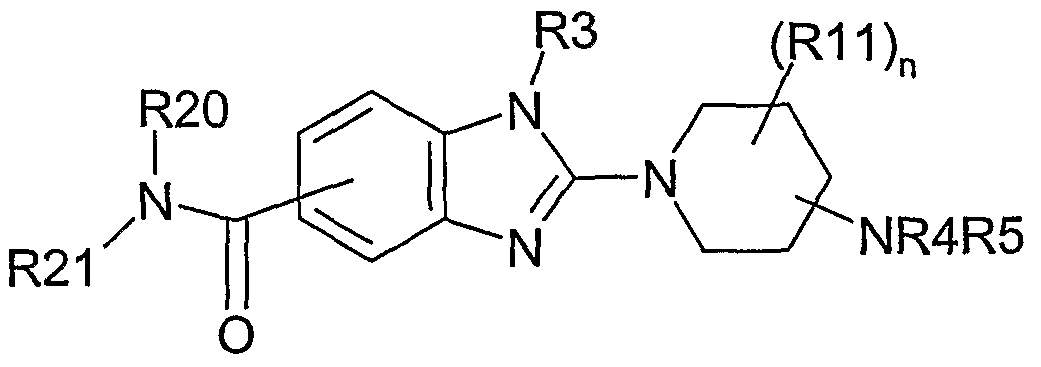
worin bedeutenin which mean
R20 H, (Ci-C3)-Alkyl, wobei (Ci-C3)-Alkyl ein- oder mehrfach substituiert ist mitR 20 is H, (C 1 -C 3 ) -alkyl, where (C 1 -C 3 ) -alkyl is mono- or polysubstituted by
CN, NO2, SH, OH, (Ci-C6)-Alkyl. O-(C1-C6)-Alkyl oder S-(C1-C6)- Alkyl; (C4-C6)-Alkyl, wobei (C4-Co)-AIkVl ein- oder mehrfach substituiert ist mit F, Cl, Br, I, CN, NO2, SH, OH, CF3, (C1-Co)-AIkVl, 0-(C1-Ce)-AIkVl oder S-(C1-C6)- Alkyl; (C7-C10)-Alkyls (C3-Cio)-Cycloalkyl, (C2-C10)-Alkenyl, (C2-C10)-Alkinyl, (C6- Cio)-Aryl, Heterocyclyl, (C1-C6)-Alkylen-(C6-C10)-Aryl, wobei (CrC^-Alkylen- (C6-C10)-Aryl (CrC6)-Alkylen-(C6-C10)-Heterocyclyl oder S(O)2-Aryl, wobei die Alkyl-, Cycloalkyl-, Alkenyl-, Alkinyl-, Alkylen-, Aryl- und Heterocyclyl- Reste ein- oder mehrfach substituiert sein können mit F, Cl, Br, I, CN, NO2, SH,CN, NO 2 , SH, OH, (C 1 -C 6 ) -alkyl. O- (C 1 -C 6 ) alkyl or S (C 1 -C 6 ) alkyl; (C 4 -C 6 ) -alkyl, where (C 4 -C 10) -alkyl is mono- or polysubstituted by F, Cl, Br, I, CN, NO 2 , SH, OH, CF 3 , (C 1 - Co) -AlkVl, 0- (C 1 -Ce) -AlkVl or S- (C 1 -C 6 ) - alkyl; (C 7 -C 10 ) -alkyl s (C 3 -C 10 ) -cycloalkyl, (C 2 -C 10 ) -alkenyl, (C 2 -C 10 ) -alkynyl, (C 6 -C 10 ) -aryl, heterocyclyl, (C 1 -C 6) alkylene- (C6-C10) aryl, with (CrC ^ alkylene- (C 6 -C 10) aryl (CrC 6) alkylene- (C 6 -C 10) - Heterocyclyl or S (O) 2 -aryl, wherein the alkyl, cycloalkyl, alkenyl, alkynyl, alkylene, aryl and heterocyclyl radicals may be mono- or polysubstituted with F, Cl, Br, I, CN , NO 2 , SH,
OH5 CF3, (C1-Co)-AUCyI, 0-(Ci -C6)- Alkyl oder S-(C!-C6)-Alkyl; (! C-C6) - OH 5 CF 3, (C 1 -Co) -AUCyI, 0- (Ci-C6) alkyl or S- alkyl;
R21 (C!-C3)-Alkyl, wobei (Ci-C3)-Alkyl ein- oder mehrfach substituiert ist mit CN,R21 (C! -C3) alkyl, said (Ci-C 3) alkyl mono- or polysubstituted by CN,
NO2, SH, OH, (d-C6)-AIkyl, 0-(C1 -C6)- Alkyl oder S-(C1 -C6)-Alkyl; (C4-C6)-Alkyl, wobei (C4-C6)-Alkyl ein- oder mehrfach substituiert ist mit F, Cl,NO 2 , SH, OH, (dC 6 ) alkyl, 0- (C 1 -C 6 ) alkyl or S- (C 1 -C 6 ) alkyl; (C 4 -C 6 ) -alkyl, where (C 4 -C 6 ) -alkyl is monosubstituted or polysubstituted by F, Cl,
Br, I, CN, NO2, SH, OH, CF3, (C1-Ce)-AUCyI, O-(CrC6)-Alkyl oder S-(C1-C6)- Alkyl, (C7-C10)-Alkyl, (C3-C10)-Cycloalkyl, (C2-C10)- Alkenyl, (C2-C10)- Alkinyl, (C6-C10)-Aryl, Heterocyclyl, (C1-C6)-Alkylen-(C6-C10)-Aryl, wobei (C1-C6)- AUCyIeU-(C6-C1 o)-Aryl (Ci-C6)-Alkylen-(C6-C10)-Heterocyclyl oder S(O)2-Aryl, wobei die Alkyl-, Cycloalkyl-, Alkenyl-, Alkinyl-, Alkylen-, Aryl- undBr, I, CN, NO 2 , SH, OH, CF 3 , (C 1 -Ce) -AUCyI, O- (C r C 6 ) alkyl or S- (C 1 -C 6 ) alkyl, (C 7 -C 10) alkyl, (C 3 -C 10) cycloalkyl, (C 2 -C 10) - alkenyl, (C 2 -C 10) - alkynyl, (C 6 -C 10) -aryl, heterocyclyl, (C 1 -C 6) alkylene- (C 6 -C 10) -aryl, where (C 1 -C 6) - AUCyIeU- (C 6 -C 1 o) aryl (Ci-C 6) alkylene (C 6 -C 10 ) -heterocyclyl or S (O) 2 -aryl, wherein the alkyl, cycloalkyl, alkenyl, alkynyl, alkylene, aryl and
Heterocyclyl-Reste ein- oder mehrfach substituiert sein können mit F, Cl, Br, I, CN, NO2, SH, OH, CF3, (C ^C6)- Alkyl, 0-(C1-Ce)-AUCyI oder S-(C1-Ce)-AUCyI; wobei von dem Rest R21 die Bedeutungen unsubstituiertes Phenyl und unsubstituiertes Benzyl ausgenommen sind;Heterocyclyl radicals may be mono- or polysubstituted with F, Cl, Br, I, CN, NO 2, SH, OH, CF 3, (C ^ C 6) - alkyl, 0- (C 1 -Ce) -AUCyI or S- (C 1 -Ce) -AUCyI; wherein the meanings of unsubstituted phenyl and unsubstituted benzyl are excluded from the radical R21;
R3 (C1-Ce)-AUCyI, (C3-C7)-Cycloalkyl, (C3-C7)-Cycloalkyl-(C1-C3)-alkyl, Phenyl,R 3 (C 1 -Ce) -AUCyI, (C 3 -C 7 ) -cycloalkyl, (C 3 -C 7 ) -cycloalkyl- (C 1 -C 3 ) -alkyl, phenyl,
Pyridyl, wobei die Alkyl, Cycloalkyl, Cycloalkyl-alkyl, Phenyl und Pyridylreste ein oder mehrfach mit CN, NO2, -CF3, -OCF3, OR12, NR7R8, NR7CONR7R8, COR7, OCOR7, OCOOR7, COOR7, CONR7R8 oder OCONR7R8 substituiert sind;Pyridyl, wherein the alkyl, cycloalkyl, cycloalkyl-alkyl, phenyl and pyridyl radicals substituted one or more times with CN, NO 2 , -CF 3 , -OCF 3 , OR 12, NR7R8, NR7CONR7R8, COR7, OCOR7, OCOOR7, COOR7, CONR7R8 or OCONR7R8 substituted are;
(C2-Ci0)-Alkenyl, (C2-C10)-Alkinyl, (C6-C10)- Aryl, Heterocyclyl, oder (C1-C6)- Alkylen-(C6-C10)-Aryl, wobei die Alkenyl-, Alkinyl-, Aryl, Heterocyclyl- und Alkylen- Aryl Reste ein- oder mehrfach substituiert sein können mit F, Cl, Br, I, CN, NO2, OH, (C1-Ce)-AUCyI, -CF3, -OCF3, OR7, NR7R8, NR7CONR7R8, COR7, OCOR7, OCOOR7, COOR7, CONR7R8 oder OCONR7R8;(C 2 -C 0) -alkenyl, (C 2 -C 10) -alkynyl, (C 6 -C 10) - aryl, heterocyclyl, or (C 1 -C 6) - alkylene- (C 6 -C 10) -Aryl, where the alkenyl, alkynyl, aryl, heterocyclyl and alkylene-aryl radicals may be mono- or polysubstituted with F, Cl, Br, I, CN, NO 2 , OH, (C 1 -Ce) - AUCyI, -CF 3, -OCF 3, OR7, NR7R8, NR7CONR7R8, COR7, OCOR7, OCOOR7, COOR7, CONR7R8 or OCONR7R8;
wobei von dem Rest R3 die Bedeutungen unsubstituiertes Phenyl und unsubstituiertes Pyridyl sowie Phenyl und Pyridyl jeweils substituiert mit F, Cl, Br, I, OH, oder (C1-Co)-AIlCyI ausgenommen sind;where of the radical R3 the meanings unsubstituted phenyl and unsubstituted pyridyl and phenyl and pyridyl each substituted with F, Cl, Br, I, OH, or (C 1 -Co) -alkyl are excluded;
R7, R8 unabhängig voneinander H5 (C1-Co)-AIlCyI, -CF3, (C3-C10)-Cycloalkyl, (C6-C10)- Aryl, Heterocyclyl, (d-C6)-Alkylen-CONR9R10, CONR9R10, (d-C6)-Alkylen-R 7, R 8 are each independently H 5 (C 1 -C 6) -alkyl, -CF 3 , (C 3 -C 10 ) -cycloalkyl, (C 6 -C 10 ) -aryl, heterocyclyl, (C 1 -C 6 ) -alkylene-CONR 9 R 10 , CONR9R10, (dC 6 ) -alkylene
COOR9, COOR9, COR9, (C1-C6)-Alkylen-COR9, (d-C6)-AUcylen-OR9, (C1- C6)-Alkylen-NR9R10, (C1-Ce)-AUCyIen-SRg, (C1-C6)-Alkylen-S(O)R9, (CrC6)- Alkylen-S(O)2R9, S(O)R9, S(O)2R9, (C1-C4)-Alkylen-(C6-Ci0)-Aryl oder (C1- C4)-Alkylen-Heterocyclyl;COOR 9, COOR 9, COR 9, (C 1 -C 6) -alkylene-COR 9, (6 dC) -AUcylen-OR9, (C 1 - C 6) -alkylene-NR9R10, (C 1 -Ce) -AUCyIe n SRG , (C 1 -C 6) alkylene-S (O) R9, (C r C6) - alkylene-S (O) 2 R9, S (O) R9, S (O) 2 R9, (C 1 - C 4) -alkylene- (C 6 -C 0) aryl or (C 1 - C 4) -alkylene-heterocyclyl;
R9, RIO unabhängig voneinander H, (C1-Co)-AIlCyI, (C1-C6)-Alkylen-(C6-C10)-Aryl, -(C6- C10)-Aryl, Heterocyclyl oder (CrC6)-Alkylen-Heterocyclyl;R 9, R 10, independently of one another, are H, (C 1 -C 6 ) -alkyl, (C 1 -C 6 ) -alkylene- (C 6 -C 10 ) -aryl, - (C 6 -C 10 ) -aryl, heterocyclyl or ( CrC 6 ) -alkylene heterocyclyl;
R12 (CrC6)-Alkyl, -CF3, (C3-Cio)-Cycloalkyl, (C6-C10)- Aryl, Heterocyclyl, (C1-C6)- Alkylen-CONR9R10, CONR9R10, (C1-C6)- Alkylen-COOR9, COOR9, COR9, R 12 (C r C 6 ) alkyl, -CF 3 , (C 3 -C 10 ) -cycloalkyl, (C 6 -C 10 ) -aryl, heterocyclyl, (C 1 -C 6 ) -alkylene-CONR9R10, CONR9R10, ( C 1 -C 6 ) - alkylene-COOR 9, COOR 9, COR 9,
(d-C6)-Alkylen-COR9, (d-C6)-Alkylen-OR9, (CrC6)-Alkylen-NR9R10, (C1- C6)-Alkylen-SR9, (C1-C6)- Alkylen-S(O)R9, (C1-C6)-Alkylen-S(O)2R9, S(O)R9, S(O)2R9, (C2-C4)-Alkylen-(C6-Ci0)-Aryl oder (d-C4)-Alkylen-Heterocyclyl;(dC 6) -alkylene-COR 9, (dC 6) -alkylene-OR9, (C r C 6) -alkylene-NR9R10, (C 1 - C 6) -alkylene-SR9, (C 1 -C 6) - alkylene -S (O) R 9, (C 1 -C 6 ) alkylene-S (O) 2 R 9, S (O) R 9, S (O) 2 R 9, (C 2 -C 4 ) alkylene (C 6 -C 4 ) Ci 0 ) -aryl or (dC 4 ) -alkylene heterocyclyl;
R4, R5 unabhängig voneinander H, (d-C6)-Alkyl oder (C3-C8)-Cykloalkyl, wobei (C1-R 4, R 5 independently of one another are H, (C 1 -C 6 ) -alkyl or (C 3 -C 8 ) -cycloalkyl, where (C 1 -)
C6)-Alkyl oder (C3-C8)-Cykloalkyl substitiuert sein können mit F, Cl, Br, I, CN, Aryl, Heterocyclyl, NH2, NH(d-C6)-Alkyl, N((C1-C6)-Alkyl)2, OH, 0(C1-C6)- Alkyl, OAryl, OHeteroaryl, S(C1-Co)-AUCyI, S(O)(C1-Ce)-AUCyI oder S(O)2(C1- C6)-AUcyl, wobei diese Alkylgruppen wiederum mit F, Cl, Br oder I substituiert sein können;C 6 ) -alkyl or (C 3 -C 8 ) -cycloalkyl may be substituted with F, Cl, Br, I, CN, aryl, heterocyclyl, NH 2 , NH (dC 6 ) -alkyl, N ((C 1 - C 6 ) -alkyl) 2 , OH, O (C 1 -C 6 ) -alkyl, O-aryl, OHeteroaryl, S (C 1 -Co) -ABLY, S (O) (C 1 -Ce) -AUCyI or S ( O) 2 (C 1 -C 6 ) -acyl, where these alkyl groups may in turn be substituted by F, Cl, Br or I;
Rl 1 H, F, Cl, Br, I, (CrC6)-Alkyl, (C3-C8)-Cycloalkyl, NH2, NH(Ci -C6)-Alkyl,R 1 is H, F, Cl, Br, I, (C r C6) alkyl, (C 3 -C 8) -cycloalkyl, NH 2, NH (Ci-C6) alkyl,
NH(C3-C7)-Cycloalkyl, N((Ci-C6)-Alkyl)2 oder O-(d-C6)-Alkyl, wobei die Alkylgruppen ein- oder mehrfach mit F, Cl, Br oder I substituiert sein können;NH (C 3 -C 7 ) -cycloalkyl, N ((C 1 -C 6 ) -alkyl) 2 or O- (C 1 -C 6 ) -alkyl, where the alkyl groups are monosubstituted or polysubstituted by F, Cl, Br or I. can;
n 0, 1 oder 2; sowie deren physiologisch verträglichen Salze.n is 0, 1 or 2; and their physiologically acceptable salts.
Bevorzugt sind Verbindungen der Formel I, worin ein oder mehrere Reste die folgende Bedeutung haben:Preference is given to compounds of the formula I in which one or more radicals have the following meaning:
R20 H;R20 H;
R21 (C3-C10)-Cycloalkyl,

R3 (C1 -C6)-Alkyl, (C3-Cy)-CyClOaUCyI, (C3-C7)-Cycloalkyl-(Ci-C3)-alkyl, Phenyl,R 3 is (C 1 -C 6 ) -alkyl, (C 3 -Cy) -CyClOaUCyI, (C 3 -C 7 ) -cycloalkyl- (C 1 -C 3 ) -alkyl, phenyl,
Pyridyl, wobei die AUcyl, Cycloalkyl, Cycloalkyl-alkyl, Phenyl und Pyridylreste ein oder mehrfach mit CN5 NO2, -CF3, -OCF3, OR12, NR7R8, NR7CONR7R8, COR7, OCOR7, OCOOR7, COOR7, CONR7R8 oder OCONR7R8 substituiert sind;Pyridyl, wherein the AUcyl, cycloalkyl, cycloalkyl-alkyl, phenyl and pyridyl substituted one or more times with CN 5 NO 2 , -CF 3 , -OCF 3 , OR 12, NR7R8, NR7CONR7R8, COR7, OCOR7, OCOOR7, COOR7, CONR7R8 or OCONR7R8 substituted are;
(C2-C10)-Alkenyl, (C2-C10)-Alkinyl, (C6-C10)- Aryl, Heterocyclyl, oder (C1-C6)- Alkylen^Cö-C^-Aryl, wobei die Alkenyl-, AUcinyl-, Aryl, Heterocyclyl- und AUcylen-Aryl Reste ein- oder mehrfach substituiert sein können mit F, Cl, Br, I, CN, NO2, OH, (C1-Ce)-AIkVl, -CF3, -OCF3, OR7, NR7R8, NR7CONR7R8, COR7, OCOR7, OCOOR7, COOR7, CONR7R8 oder OCONR7R8;(C 2 -C 10) alkenyl, (C 2 -C 10) -alkynyl, (C 6 -C 10) - aryl, heterocyclyl, or (C 1 -C 6) - alkylene ^ C ^ -aryl ö -C in which the alkenyl, AUcinyl, aryl, heterocyclyl and acyl-aryl radicals may be monosubstituted or polysubstituted by F, Cl, Br, I, CN, NO 2 , OH, (C 1 -C 6) -alkyl, -CF 3, -OCF 3, OR7, NR7R8, NR7CONR7R8, COR7, OCOR7, OCOOR7, COOR7, CONR7R8 or OCONR7R8;
wobei von dem Rest R3 die Bedeutungen unsubstituiertes Phenyl und unsubstituiertes Pyridyl sowie Phenyl und Pyridyl jeweils substituiert mit F, Cl, Br, I, OH, oder (Q-C^-Alkyl ausgenommen sind;where of the radical R3, the meanings unsubstituted phenyl and unsubstituted pyridyl and phenyl and pyridyl each substituted with F, Cl, Br, I, OH, or (Q-C ^ alkyl excluded;
R7, R8 unabhängig voneinander H, (C1-Ce)-AUCyI, -CF3, (C3-C10)-Cycloalkyl, (C6-C10)-R 7, R 8 independently of one another are H, (C 1 -C 6) -AUCyI, -CF 3 , (C 3 -C 10 ) -cycloalkyl, (C 6 -C 10 ) -
Aryl, Heterocyclyl, (Ci-C6)-AUcylen-CONR9R10, CONR9R10, (C1-Ce)-AUCyIen- COOR9, COOR9, COR9, (Ci-C6)-Alkylen-COR9, (C1-C6)-Alkylen-OR95 (C1- C6)-Alkylen-NR9R10, (CrC6)-Alkylen-SR95 (C1-C6)-Alkylen-S(O)R9, (C1-C6)- AUcylen-S(O)2R9, S(0)R9, S(O)2R9, (C1-C4)-Alkylen-(C6-C10)-Aryl oder (C1- C4)-Alkylen-Heterocyclyl;Aryl, heterocyclyl, (C 1 -C 6 ) -acyl-CONR 9 R 10, CONR 9 R 10, (C 1 -Ce) -UCLEY n - COOR 9, COOR 9, COR 9, (Ci-C 6) -alkylene-COR 9, (C 1 -C 6) -alkylene-OR9 5 (C 1 - C 6) -alkylene-NR9R10, (C r C6) alkylene- SR9 5 (C 1 -C 6) alkylene-S (O) R9, (C 1 -C 6) - AUcylen-S (O) 2 R9, S (0) R9, S (O) 2 R9, (C C 1 -C 4 ) -alkylene (C 6 -C 10 ) -aryl or (C 1 -C 4 ) -alkylene heterocyclyl;
R9, RIO unabhängig voneinander H, (C1-Ce)-AIlCyI, (C1-C6)- AIkylen-(C6-C1o)-Aryl, -(C6- C1O)-ATyI, Heterocyclyl oder (C1-C6)-Alkylen-Heterocyclyl;R9, RIO each independently H, (C 1 -Ce) -alkyl, (C 1 -C 6) - AIkylen- (C 6 -C 1 o) aryl, - (C 6 - C 1O) -ATyI, heterocyclyl, or (C 1 -C 6 ) -alkylene heterocyclyl;
R12 (Ci-C6)-A]kyl, -CF3, (C3-C10)-Cycloalkyl, (C6-C10)-Aryl, Heterocyclyl, (C1-C6)- Alkylen-CONR9R10, CONR9R10, (C1-C6)-Alkylen-COOR9, COOR9, COR9,R12 (Ci-C 6) -A] alkyl, -CF 3, (C 3 -C 10) cycloalkyl, (C 6 -C 10) -aryl, heterocyclyl, (C 1 -C 6) - alkylene-CONR9R10, CONR9R10, (C 1 -C 6 ) -alkylene-COOR9, COOR9, COR9,
(C1-C6)-Alkylen-COR9, (C1-C6)-Alkylen-OR9, (C1-C6)- Alkylen-NR9R10, (C1- C6)-Alkylen-SR9, (C1-C6)-Alkylen-S(O)R9, (Ci-C6)-Alkylen-S(O)2R9, S(O)R9, S(O)2R9, (C2-C4)-Alkylen-(C6-C10)-Aryl oder (CrC4)-Alkylen-Heterocyclyl;(C 1 -C 6) -alkylene-COR 9, (C 1 -C 6) -alkylene-OR9, (C 1 -C 6) - alkylene-NR9R10, (C 1 - C 6) -alkylene-SR9, (C 1 -C 6) alkylene-S (O) R9, (Ci-C 6) -alkylene-S (O) 2 R9, S (O) R9, S (O) 2 R9, (C 2 -C 4) -Alkylene- (C 6 -C 10 ) -aryl or (C 1 -C 4 ) -alkylene-heterocyclyl;
R4, R5 unabhängig voneinander H, (C1-C6)-Alkyl oder (C3-C8)-Cykloalkyl, wobei (C1-R 4, R 5 independently of one another are H, (C 1 -C 6 ) -alkyl or (C 3 -C 8 ) -cycloalkyl, where (C 1 -)
C6)-Alkyl oder (C3-C8)-Cykloalkyl substitiuert sein können mit F, Cl, Br, I, CN, Aryl, Heterocyclyl, NH2, NH(C1-Ce)-AUCyI, Nt(C1-Ce)-AIlCyI)2, OH5 0(Ci-C6)- Alkyl, OAryl, OHeteroaryl, S(C1 -C6)- Alkyl, S(O)(CrC6)-Alkyl oder S(O)2(Ci- C6)-Alkyl, wobei diese Alkylgruppen wiederum mit F, Cl, Br oder I substituiert sein können;C 6 ) -alkyl or (C 3 -C 8 ) -cycloalkyl may be substituted with F, Cl, Br, I, CN, aryl, heterocyclyl, NH 2 , NH (C 1 -Ce) -AUCyI, Nt (C 1 -ce) -alkyl) 2, OH 5 0 (Ci-C 6) - alkyl, O-aryl, OHeteroaryl, S (C 1 -C 6) - alkyl, S (O) (C r C6) alkyl or S ( O) 2 (C 1 -C 6 ) -alkyl, where these alkyl groups may in turn be substituted by F, Cl, Br or I;
Rl 1 H, F, Cl, Br, I, (CrC6)-Alkyl, (C3-C8)-Cycloalkyl, NH2, NH(CrC6)-Alkyl,R 1 is H, F, Cl, Br, I, (C r C6) alkyl, (C 3 -C 8) -cycloalkyl, NH 2, NH (CrC 6) alkyl,
NH(C3-C7)-Cycloalkyl, N(^1-Ce)-AUCyI)2 oder O-(Ci-C6)-Alkyl, wobei die Alkylgruppen ein- oder mehrfach mit F, Cl, Br oder I substituiert sein können;NH (C 3 -C 7 ) -cycloalkyl, N (^ 1 -Ce) -AUCyI) 2 or O- (C 1 -C 6 ) -alkyl, where the alkyl groups are monosubstituted or polysubstituted by F, Cl, Br or I. could be;
n 0, 1 oder 2;n is 0, 1 or 2;
sowie deren physiologisch verträglichen Salze.and their physiologically acceptable salts.
Besonders bevorzugt sind Verbindungen der Formel I, worin ein oder mehrere Reste die folgende Bedeutung haben: R20 H;Particular preference is given to compounds of the formula I in which one or more radicals have the following meaning: R20 H;
R21 (C3-C10)-Cycloalkyl, (Q-CfO-Alkylen^Ce-C^-Aryl, Phenyl, (CrC6)-Alkylen-R21 (C 3 -C 10) cycloalkyl, (f QC O-alkylene ^ Ce-C ^ aryl, phenyl, (C r C6) alkylene-
(C6-C io)-Pyridyl, wobei die Cycloalkyl-, Aryl- und Pyridyl-Reste ein- oder mehrfach substituiert sein können mit F, Cl, Br, I, CN, NO2, SH, OH, CF3, (C1-(C 6 -C 10) pyridyl, where the cycloalkyl, aryl and pyridyl radicals may be mono- or polysubstituted with F, Cl, Br, I, CN, NO 2 , SH, OH, CF 3 , ( C 1 -
C6)-Alkyl, O-(CrC6)-Alkyl oder S-(C1-C6)-Alkyl; wobei von dem Rest R21 die Bedeutungen unsubstituiertes Phenyl und unsubstituiertes Benzyl ausgenommen sind;C 6 ) alkyl, O- (C r C 6 ) -alkyl or S- (C 1 -C 6 ) -alkyl; wherein the meanings of unsubstituted phenyl and unsubstituted benzyl are excluded from the radical R21;
R3 unabhängig (C2-C 10)-Alkenyl oder (C1-C6)-AIkylen-(C6-C10)-Aryl, wobei dieR 3 is independently (C 2 -C 10 ) alkenyl or (C 1 -C 6 ) alkylene (C 6 -C 10 ) aryl, wherein the
Alkenyl- und (C1-C6)-Alkylen-(C6-C1o)-Aryl Reste ein- oder mehrfach substituiert sein können mit F, Cl, Br;Alkenyl and (C 1 -C 6 ) -alkylene (C 6 -C 1 0) -aryl radicals may be mono- or polysubstituted by F, Cl, Br;
R4, R5 H;R4, R5 H;
n 0;n 0;
sowie deren physiologisch verträglichen Salze.and their physiologically acceptable salts.
Ganz besonders bevorzugt sind Verbindungen der Formel I, worin ein oder mehrere Reste die folgende Bedeutung haben:Very particular preference is given to compounds of the formula I in which one or more radicals have the following meaning:
R20 H;R20 H;
R21 (C3-C10)-Cycloalkyl, Benzyl, Pyridyl, Phenyl, wobei die Alkyl-, Cycloalkyl-, und Benzyl-Reste ein- oder mehrfach substituiert sein können mit F, Cl, Br, I, CN, NO2, SH, OH, (C1-Ce)-AIkVl, 0-(C i-C6)-Alkyl oder S-(C1-Ce)-AIkVl; wobei von dem Rest R21 die Bedeutungen unsubstituiertes Phenyl und unsubstituiertes Benzyl ausgenommen sind; R3 unabhängig (C2-C10)- Alkenyl oder (C1-C6)-Alkylen-(C6-C10)-Aryl, wobei dieR 21 (C 3 -C 10 ) -cycloalkyl, benzyl, pyridyl, phenyl, where the alkyl, cycloalkyl and benzyl radicals may be monosubstituted or polysubstituted by F, Cl, Br, I, CN, NO 2 , SH, OH, (C 1 -Ce) -AlkVl, 0- (C 1 -C 6 ) -alkyl or S- (C 1 -Ce) -AlkVl; wherein the meanings of unsubstituted phenyl and unsubstituted benzyl are excluded from the radical R21; R 3 is independently (C 2 -C 10 ) alkenyl or (C 1 -C 6 ) alkylene (C 6 -C 10 ) aryl, wherein the
Alkenyl- und (C1-Co)-AUCyIeU-(Co-C1O)-ATyI Reste ein- oder mehrfach substituiert sein können mit F, Cl, Br;Alkenyl and (C 1 -Co) -AUCyIeU- (Co-C 1O) -ATyI radicals may be mono- or polysubstituted by F, Cl, Br;
R4, R5 H;R4, R5 H;
n 0;n 0;
sowie deren physiologisch verträglichen Salze.and their physiologically acceptable salts.
Die Erfindung bezieht sich auf Verbindungen der Formel I, in Form ihrer Razemate, razemischen Mischungen und reinen Enantiomeren sowie auf ihre Diastereomeren und Mischungen davon.The invention relates to compounds of the formula I, in the form of their racemates, racemic mixtures and pure enantiomers, and to their diastereomers and mixtures thereof.
Können Reste oder Substituenten mehrfach in den Verbindungen der Formel I auftreten, so können sie alle unabhängig voneinander die angegebenen Bedeutungen haben und gleich oder verschieden sein.If radicals or substituents can occur several times in the compounds of the formula I, they may all independently of one another have the meanings indicated and be identical or different.
Pharmazeutisch verträgliche Salze sind aufgrund ihrer höheren Wasserlöslichkeit gegenüber den Ausgangs- bzw. Basisverbindungen besonders geeignet für medizinische Anwendungen. Diese Salze müssen ein pharmazeutisch verträgliches Anion oder Kation aufweisen. Geeignete pharmazeutisch verträgliche Säureadditionssalze der erfindungsgemäßen Verbindungen sind Salze anorganischer Säuren, wie Salzsäure, Bromwasserstoff-, Phosphor-, Metaphosphor-, Salpeter- und Schwefelsäure sowie organischer Säuren, wie z.B. Essigsäure, Benzolsulfon-, Benzoe-, Zitronen-, Ethansulfon-, Fumar-, Glucon-, Glykol-, Isethion-, Milch-, Lactobion-, Malein-, Äpfel-, Methansulfon-, Bernstein-, p-Toluolsulfon- und Weinsäure. Geeignete pharmazeutisch verträgliche basische Salze sind Ammoniumsalze, Alkalimetallsalze (wie Natrium- und Kaliumsalze), Erdalkalisalze (wie Magnesium- und Calciumsalze), Trometamol (2-Amino-2-hydroxymethyl-l,3-propandiol), Diethanolamin, Lysin, oder Ethylendiamin. Salze mit einem nicht pharmazeutisch verträglichen Am'on, wie zum Beispiel Trifluoracetat, gehören ebenfalls in den Rahmen der Erfindung als nützliche Zwischenprodukte für die Herstellung oder Reinigung pharmazeutisch verträglicher Salze und/oder für die Verwendung in nicht-therapeutischen, zum Beispiel in-vitro-Anwendungen.Pharmaceutically acceptable salts are particularly suitable for medical applications because of their higher water solubility compared to the starting or basic compounds. These salts must have a pharmaceutically acceptable anion or cation. Suitable pharmaceutically acceptable acid addition salts of the compounds according to the invention are salts of inorganic acids, such as hydrochloric acid, hydrobromic acid, phosphoric acid, metaphosphoric acid, nitric acid and sulfuric acid, and also organic acids, such as, for example, acetic acid, benzenesulfonic, benzoic, citric, ethanesulfonic, fumaric acid. , Gluconic, glycolic, isethionic, lactic, lactobionic, maleic, malic, methanesulfonic, succinic, p-toluenesulfonic and tartaric acids. Suitable pharmaceutically acceptable basic salts are ammonium salts, alkali metal salts (such as sodium and potassium salts), alkaline earth salts (such as magnesium and calcium salts), trometamol (2-amino-2-hydroxymethyl-l, 3-propanediol), diethanolamine, lysine, or ethylenediamine. Salts with a pharmaceutically acceptable Am on ', for example, trifluoroacetate likewise belong within the framework of the invention as useful intermediates for preparing or purifying pharmaceutically acceptable salts and / or therapeutic non-for use in, for example in vitro applications.
Der hier verwendete Begriff "physiologisch funktionelles Derivat" bezeichnet jedes physiologisch verträgliche Derivat einer erfindungsgemäßen Verbindung der Formel I, z.B. einen Ester, der bei Verabreichung an einen Säuger, wie z.B. den Menschen, in der Lage ist, (direkt oder indirekt) eine Verbindung der Formel I oder einen aktiven Metaboliten hiervon zu bilden.As used herein, the term "physiologically functional derivative" refers to any physiologically acceptable derivative of a compound of formula I, e.g. an ester which, when administered to a mammal, e.g. humans, is able to form (directly or indirectly) a compound of formula I or an active metabolite thereof.
Zu den physiologisch funktionellen Derivaten zählen auch Prodrugs der erfindungsgemäßen Verbindungen. Solche Prodrugs können in vivo zu einer erfindungsgemäßen Verbindung metabolisiert werden. Diese Prodrugs können selbst wirksam sein oder nicht.The physiologically functional derivatives also include prodrugs of the compounds according to the invention. Such prodrugs can be metabolized in vivo to a compound of the invention. These prodrugs may or may not be effective.
Die erfindungsgemäßen Verbindungen können auch in verschiedenen polymorphen Formen vorliegen, z.B. als amorphe und kristalline polymorphe Formen. Alle polymorphen Formen der erfindungsgemäßen Verbindungen gehören in den Rahmen der Erfindung und sind ein weiterer Aspekt der Erfindung.The compounds of the invention may also be in various polymorphic forms, e.g. as amorphous and crystalline polymorphic forms. All polymorphic forms of the compounds of the invention are within the scope of the invention and are a further aspect of the invention.
Nachfolgend beziehen sich alle Verweise auf "Verbindung(en) gemäß Formel I" auf Verbin- dung(en) der Formel I wie vorstehend beschrieben, sowie ihre Salze, Solvate und physiologisch funktionellen Derivate wie hierin beschrieben.Hereinafter, all references to "compound (s) according to formula I" refer to compound (s) of formula I as described above, as well as their salts, solvates and physiologically functional derivatives as described herein.
Unter einem Alkylrest wird eine geradkettige oder verzweigte Kohlenwasserstoffkette mit einem oder mehreren Kohlenstoffen verstanden, wie z.B. Methyl, Ethyl, iso-Propyl, tert.-Butyl, Hexyl.By an alkyl radical is meant a straight or branched hydrocarbon chain having one or more carbons, e.g. Methyl, ethyl, iso-propyl, tert-butyl, hexyl.
Die Alkylreste können ein oder mehrfach mit geeigneten Gruppen substituiert sein, wie z.B.: F, Cl, Br, I5 CF3, NO2, N3, CN, COOH, COO(C1-C6)AUCyI, CONH2, CONH(C1-C6)AIkVl, CONt(C1 -C6)Alkyl]2) Cycloalkyl, (C2-C6)-Alkenyl, (C2-C6)- Alkinyl, 0-(C1-C6)- Alkyl, O-CO- (C1-Ce)-AIkVl, 0-CO-(C1-Ce)-ATyI, O-CO-(C1-C6)-Heterocyclus; PO3H2, SO3H, SO2-NH2, SO2NH(C1-Ce)-AIlCyI, SO2Nt(C1-Ce)-AIlCyI]2 , S-(C1-Ce)-AIlCyI, S- (CH2)n-Aryl, S-(CH2)n-Heterocyclus, SO-(C1-Co)-AIlCyI, SO-(CH2)π-Aryl, SO-(CH2)n- Heterocyclus, SO2-(C1-Ce)-AIlCyI, SO2-(CH2)n-Aryl5 SO2-(CH2)n-Heterocyclus, SO2-NH(CH2)n- Aryl, SO2-NH(CH2)n-Heterocyclus, SO2-N((CrC6)-Alkyl)(CH2)n-Aryl, SO2-N((C1-C6)- Alkyl)(CH2)n-Heterocyclus, SO2-N((CH2)n-Aryl)2, SO2-N((CH2)n-Heterocyclus)2 wobei n = O - 6 sein kann und der Arylrest oder Heterocyclische Rest bis zu zweifach mit F, Cl, Br, OH, CF3, NO2, CN, OCF3, 0-(C1-Ce)-AUCyI5 (CrC6)-Alkyl oder NH2 substituiert sein kann; C(=NH)(NH2), NH2, NH-(C1-C6)- Alkyl, N((Ci-C6)-Alkyl)2, NH-CO-(C rC6)-Alkyl, NH-COO- (C1-Ce)-AIkVl, NH-CO- Aryl, NH-CO-Heterocyclus, NH-COO-Aryl, NH-COO-Heterocyclus, NH-CO-NH-(C1-C6)-Alkyl, NH-CO-NH-Aryl, NH-CO-NH-Heterocyclus, N((Ci-C6)-Alkyl)- CO-(C1-Ce)-AUCyI, N(^1-Ce)-AUCyI)-COO-(C1-Ce)-AuCyI, NaC1-Ce)-AUCyI)-CO-ATyI, N((d- C6)-Alkyl)-CO-Heterocyclus, N((Ci-C6)-Alkyl)-COO-Aryl, N((C1-C6)-Alkyl)-COO- Heterocyclus, N((C1-C6)- A^yI)-CO-NH-(C1-C6)- Alkyl), NaC1-Ce)-AUCyI)-CO-NH-ATyI, N((C1-C6)-Alkyl)-CO-NH-Heterocyclus, N((Ci-C6)-Alkyl)-CO-N((Ci-C6)-Alkyl)2, NaC1-C6)- Alkyl)-CO-N((CrCe)-Alkyl)-Aryl, Nt(C1-C6)- AUCyI)-CO-NaC1-C6)- Alkyl)-Heterocyclus, NaC1-Ce)-AUCyI)-CO-N-(ATyI)2, N((CI-C6)-Alkyl)-CO-N-(Heterocyclus)2, N(ATyI)-CO-(C1- C6)-Alkyl, N(Heterocyclus)-CO-(C1-C6)-Alkyl, N(ATyI)-COO-(C1-Ce)-AIlCyI, N(Heterocyclus)- COO-(C1-C6)- Alkyl, N(Aryl)-CO-Aryl, N(Heterocyclus)-CO-Aryl, N(Aryl)-COO-Aryl, N(HCtCrOCyClUs)-COO-ATyI5 N(ATyI)-CO-NH-(C1-Ce)-AUCyI), N(HeIeTOCyClUs)-CO-NH-(C1- C6)-Alkyl), N(Aryl)-CO-NH-Aryl, N(Heterocyclus)-CO-NH-Aryl, N(Aryl)-CO-N((C1 -C6)- Alkyl)2, N(Heterocyclus)-CO-N((C1-Ce)-Alkyl)2, N(Aryl)-CO-N((C1-C6)-AUcyl)-Aryl, N(Heterocyclus)-CO-N((C1-Ce)-Alkyl)-Aryl, N(Aryl)-CO-N-(Aryl)2, N(Heterocyclus)-CO-N- (Aryl)2, Aryl, O-(CH2)n-Aryl und O-(CH2)n-Heterocyclus, wobei n = O - 6 sein kann, wobei der Arylrest oder Heterocyclische Rest ein bis 3 -fach substituiert sein kann mit F, Cl, Br, I, OH, CF3, NO2, CN, OCF3, 0-(C1-Ce)-AUCyI, (C1-Ce)-AUCyI, NH2, NH(C1-Ce)-AUCyI, NaC1-C6)- Alkyl)2, SO2-CH3, COOH, COO-(C i-C6)-Alkyl oder CONH2.The alkyl radicals may be monosubstituted or polysubstituted by suitable groups, such as: F, Cl, Br, I 5 CF 3 , NO 2 , N 3 , CN, COOH, COO (C 1 -C 6 ) AUCyI, CONH 2 , CONH (C 1 -C 6 ) AlKVl, CONt (C 1 -C 6 ) alkyl] 2) cycloalkyl, (C 2 -C 6 ) alkenyl, (C 2 -C 6 ) alkynyl, O- (C 1 -C 6 ) - alkyl, O-CO- (C 1 -Ce) -AlkVl, 0-CO- (C 1 -Ce) -ATyI, O-CO- (C 1 -C 6 ) -heterocycle; PO 3 H 2 , SO 3 H, SO 2 -NH 2 , SO 2 NH (C 1 -Ce) -Allyl, SO 2 Nt (C 1 -Ce) -Allyl] 2 , S- (C 1 -Ce) - AIlCyI, S- (CH 2 ) n -aryl, S- (CH 2 ) n -heterocycle, SO- (C 1 -Co) -alkyl, SO- (CH 2 ) π -aryl, SO- (CH 2 ) n - heterocycle, SO 2 - (C 1 -Ce) -alkyl, SO 2 - (CH 2 ) n -aryl 5 SO 2 - (CH 2 ) n -heterocycle, SO 2 -NH (CH 2 ) n - aryl, SO 2 -NH (CH 2) n heterocycle, SO 2 -N ((CrC 6) alkyl) (CH 2) n -aryl, SO 2 -N ((C 1 -C 6) - alkyl) (CH 2) n -heterocycle, SO 2 -N ((CH 2 ) n -aryl) 2 , SO 2 -N ((CH 2 ) n -heterocycle) 2 where n = O-6 and the aryl radical or heterocyclic radical can be up to twice (C 1 -Ce) -AUCyI 5 (C r C6) -alkyl or NH 2 may be substituted with F, Cl, Br, OH, CF 3, NO 2, CN, OCF 3, 0-; C (= NH) (NH 2), NH 2, NH- (C 1 -C 6) - alkyl, N ((Ci-C 6) -alkyl) 2, NH-CO- (C r C6) alkyl , NH-COO- (C 1 -Ce) -AlkVl, NH-CO-aryl, NH-CO heterocycle, NH-COO-aryl, NH-COO heterocycle, NH-CO-NH- (C 1 -C 6 ) -Alkyl, NH-CO-NH-aryl, NH-CO-NH-heterocycle, N ((Ci-C 6 ) -alkyl) - CO- (C 1 -Ce) -AUCyI, N (^ 1 -Ce) -AUCyI) -COO- (C 1 -Ce) -AuCyI, NaC 1 -Ce) -AUCyI) -CO-ATyI, N ((C 1 -C 6 ) -alkyl) -CO-heterocycle, N ((Ci-C 6) -alkyl) -COO-aryl, N ((C 1 -C 6) alkyl) -COO- heterocycle, N ((C 1 -C 6) - A ^ yI) -CO-NH- (C 1 - C 6 ) -alkyl), NaC 1 -Ce) -AUCyI) -CO-NH-ATyI, N ((C 1 -C 6 ) -alkyl) -CO-NH-heterocycle, N ((C 1 -C 6 ) - alkyl) -CO-N ((Ci-C 6) alkyl) 2, NaC 1 -C 6) - alkyl) -CO-N ((C r Ce) alkyl) aryl, Nt (C 1 -C 6 ) - AUCyI) -CO-NaC 1 -C 6 ) - alkyl) -heterocycle, NaC 1 -Ce) -AUCyI) -CO-N- (ATyI) 2 , N ((C 1 -C 6 ) -alkyl) - CO-N- (heterocycle) 2, N (ATyI) -CO- (C 1 - C 6) -alkyl, N (heterocycle) -CO- (C 1 -C 6) -alkyl, N (ATyI) -COO- (C 1 -C 6 ) -alkyl, N (heterocyclic) -COO- (C 1 -C 6 ) -alkyl, N (aryl) -CO-aryl, N (heterocycle) -CO-aryl, N (aryl ) -COO-aryl, N (HCtCrOCyClUs) -COO-ATyI 5 N (ATyI) -CO-NH- (C 1 -Ce) -AUCyI), N (HeIeTOCyClUs) -CO-NH- (C 1 -C 6 ) -Alkyl), N (aryl) -CO-NH-aryl, N (heterocyclic) -CO-NH-aryl, N (aryl) -CO-N ((C 1 -C 6 ) -alkyl) 2 , N (heterocycle ) -CO-N ((C 1 -C 6) alkyl) 2 , N (aryl) -CO-N ((C 1 -C 6 ) -acyl) -aryl, N (heterocycle) -CO-N ((C 1- Ce) -alkyl) -aryl, N (aryl) -CO-N- (aryl) 2 , N (heterocycle) -CO-N- (aryl) 2 , aryl, O- (CH 2 ) n -aryl and O- (CH 2 ) n -heterocycle, where n = O-6, where the aryl radical or heterocyclic radical can be substituted one to three times by F, Cl, Br, I, OH, CF 3 , NO 2 , CN, OCF 3 , 0- (C 1 -Ce) -AUCyI, (C 1 -Ce) -AUCyI, NH 2 , NH (C 1 -Ce) -AUCyI, NaC 1 -C 6 ) -alkyl) 2 , SO 2 -CH 3 , COOH, COO- (C 1 -C 6 ) -alkyl or CONH 2 .
Unter einem AUcenylrest wird eine geradkettige oder verzweigte Kohlenwasserstoffkette mit zwei oder mehreren Kohlenstoffen sowie einer oder mehreren Doppelbindungen verstanden, wie z.B. Vinyl, Allyl, Pentenyl, 2-Methyl-but-2-en-4-yl.
Die Alkenylreste können ein oder mehrfach mit geeigneten Gruppen substituiert sein, wie z.B.: F, Cl, Br, I, CF3, NO2, N3, CN, COOH, COO(C1 -C6) Alkyl, CONH2, CONH(Ci -C6) Alkyl, CONt(C1-C6)AIlCyI]2, Cycloalkyl, (C2-C6)-Alkenyl, (C2-C6)-Alkinyl, 0-(C1-Co)-AUCyI, 0-C0- (Ci-C6)-Alkyl, 0-CO-(C1-Ce)-ATyI, O-CO-(C1-C6)-Heterocyclus; PO3H2, SO3H, SO2-NH2, SO2NH(C1 -C6)- Alkyl, SO2N[(C1-C6)-Alkyl]2 , S-(CrC6)-Alkyl, S- (CH2)n-Aryl, S-(CH2)n-Heterocyclus, SO-(d-C6)-Alkyl, SO-(CH2)n-Aryl, SO-(CH2)n- Heterocyclus, SO2-(C1-C6)-Alkyl, SO2-(CH2)n-Aryl, SO2-(CH2)n-Heterocyclus, SO2-NH(CH2)n- Aryl, SO2-NH(CH2)n-Heterocyclus, SO2-N((Cj-C6)-Alkyl)(CH2)n-Aryl, SO2-N((CrC6)- Alkyl)(CH2)n-Heterocyclus, SO2-N((CH2)n-Aryl)2, SO2-N((CH2)n-Heterocyclus)2 wobei n = O - 6 sein kann und der Arylrest oder Heterocyclische Rest bis zu zweifach mit F, Cl, Br, OH, CF3, NO2, CN, OCF3, 0-(C1-Ce)-AUCyI, (C1-Ce)-AUCyI oder NH2 substituiert sein kann; C(=NH)(NH2), NH2, NH-(C1-Ce)-AUCyI, NaC1-Ce)-AUCyI)2, NH-CO-(C1-C6)-Alkyl, NH-COO-

N(Heterocyclus)-CO-N((CrCe)-AUcyl)-Aryl, N(Aryl)-CO-N-(Aryl)2, N(Heterocyclus)-CO-N- (Aryl)2, Aryl, O-(CH2)n-Aryl und O-(CH2)n-Heterocyclus, wobei n = O - 6 sein kann, wobei der Arylrest oder Heterocyclische Rest ein bis 3-fach substituiert sein kann mit F, Cl, Br, I, OH, CF3, NO2, CN, OCF3, 0-(C1-Ce)-AUCyI, (C1 -C6)- Alkyl, NH2, NH(C1-Ce)-AUCyI, N((d-C6)- Alkyl)2, SO2-CH3, COOH, COO-(C1-Ce)-AUCyI oder CONH2. Unter einem Alkinylrest wird eine geradkettige oder verzweigte Kohlenwasserstoffkette mit zwei oder mehreren Kohlenstoffen sowie einer oder mehreren Dreifachbindungen verstanden, wie z.B. Ethinyl, Propinyl, Butinyl, Hexinyl.N (heterocycle) -CO-N ((CrCe) -AUcyl) -aryl, N (aryl) -CO-N- (aryl) 2 , N (heterocycle) -CO-N- (aryl) 2 , aryl, O- (CH 2 ) n -aryl and O- (CH 2 ) n -heterocycle, where n = O-6, where the aryl radical or heterocyclic radical may be monosubstituted to trisubstituted by F, Cl, Br, I, OH, CF 3 , NO 2 , CN, OCF 3 , 0- (C 1 -Ce) -AUCyI, (C 1 -C 6 ) -alkyl, NH 2 , NH (C 1 -Ce) -AUCyI, N (( dC 6 ) - alkyl) 2 , SO 2 -CH 3 , COOH, COO- (C 1 -Ce) -AUCyI or CONH 2 . An alkynyl radical is understood as meaning a straight-chain or branched hydrocarbon chain having two or more carbons and one or more triple bonds, such as, for example, ethynyl, propynyl, butynyl, hexynyl.
Die AIMnylreste können ein oder mehrfach mit geeigneten Gruppen substituiert sein, wie z.B.: F, Cl, Br, I, CF3, NO2, N3, CN5 COOH, COO(C1-C6)AUCyI, CONH2, CONH(C1-C6)Alkyl, CONf(C1-C6)AIkVl]2, Cycloalkyl, (C2-C6)-Alkenyl, (C2-C6)-Alkinyl, 0-(C1-Ce)-AUCyI, O-CO- (C1-Ce)-AUCyI, 0-CO-(C1-Co)-ATyI, 0-CO-(C rC^-Heterocyclus; PO3H2, SO3H, SO2-NH2, SO2NH(C1-Co)-AUCyI, SO2Nt(C1-Ce)-AUCyI]2 , S-(C1-Ce)-AIkVl, S- (CH2)n-Aryl, S-(CH2)n-Heterocyclus, SO-(C1-Ce)-AIkVl, SO-(CH2)n-Aryl, SO-(CH2)n- Heterocyclus, SO2-(C1-Ce)-AUCyI, SO2-(CH2)n-Aryl, SO2-(CH2)n-Heterocyclus, SO2-NH(CH2)n- Aryl, SO2-NH(CH2)n-Heterocyclus, SO2-N((C1-C6)-AUcyl)(CH2)n-Aryl, SO2-N((d-C6)- Alkyl)(CH2)n-Heterocyclus, SO2-N((CH2)n-Aryl)2, SO2-N((CH2)„-Heterocyclus)2 wobei n = O - 6 sein kann und der Arylrest oder Heterocyclische Rest bis zu zweifach mit F, Cl, Br, OH, CF3, NO2, CN, OCF3, O-(Cj-C6)-Alkyl, (C1-Ce)-AUCyI oder NH2 substituiert sein kann; CC=NH)(NH2), NH2, NH-(C1-Ce)-AUCyI, Nt(C1-Ce)-AUCyI)2, NH-CO-(C1-Ce)-AUCyI, NH-COO- (C1-Ce)-AUCyI, NH-CO-Aryl, NH-CO-Heterocyclus, NH-COO-Aryl, NH-COO-Heterocyclus, NH-CO-NH-(C1-Ce)-AUCyI, NH-CO-NH-Aryl, NH-CO-NH-Heterocyclus, N((CrC6)-Alkyl)- CO-(C1-Ce)-AIkVl, Nt(C1-Co)-AIkVl)-COO-(C1-Ce)-AUCyI, N((C1-C6)-Alkyl)-CO-Aryl, NC(C1- C6)-AUcyl)-CO-Heterocyclus, N((C1-Ce)-Aücyl)-COO-Aryl, N((C1-Ce)-Alkyl)-COO- Heterocyclus, N((C1-C6)-Alkyl)-CO-NH-(C1-Ce)-Alkyl), N((C1-Ce)-Alkyl)-CO-NH-Aryl, N((C1-C6)-AUcyl)-CO-NH-Heterocyclus, N((C1-Ce)-AUcyl)-CO-N((C1-Ce)-AUcyl)2, N((C1-C6)- Alkyl)-CO-N((C1-Ce)-Alkyl)-Aryl, N((Ci-Ce)-AUcyl)-CO-N((C1-C6)-AUcyl)-Heterocyclus, N(CC1-Ce)-AUCyI)-CO-N-(ATyI)2, N((C1-C6)-Alkyl)-CO-N-(Heterocyclus)2, N(ATyI)-CO-(C1- C6)-AUcyl, N(Heterocyclus)-CO-(CrC6)-AUcyl, N(ATyI)-COO-(C1-Ce)-AIlCyI, N(Heterocyclus)- COO-(Ci-C6)-Aücyl, N(Aryl)-CO-Aryl, N(Heterocyclus)-CO-Aryl, N(Aryl)-COO-Aryl, N(HCtCrOCyClUs)-COO-ATyI5 N(ATyI)-CO-NH-(C1-Ce)-AUCyI), N(HBtCrOCyClUs)-CO-NH-(C1- C6)-Alkyl), N(Aryl)-CO-NH-Aryl, N(Heterocyclus)-CO-NH-Aryl, N(ATyI)-CO-NaC1-C6)- AUcyl)2, N(Heterocyclus)-CO-N((CrC6)-AUcyl)2, N(Aryl)-CO-N((C J-Ce)-AUCyI)-ATyI,The AIMnylreste may be substituted one or more times with suitable groups, such as: F, Cl, Br, I, CF 3 , NO 2 , N 3 , CN 5 COOH, COO (C 1 -C 6 ) AUCyI, CONH 2 , CONH (C 1 -C 6 ) alkyl, CONf (C 1 -C 6 ) Al kVl] 2 , cycloalkyl, (C 2 -C 6 ) alkenyl, (C 2 -C 6 ) alkynyl, O- (C 1 -Ce ) -AUCyI, O-CO- (C 1 -Ce) -AUCyI, 0-CO- (C 1 -Co) -ATyI, 0-CO- (C rC ^ heterocycle; PO 3 H 2, SO 3 H, SO 2 -NH 2 , SO 2 NH (C 1 -Co) -AUCyI, SO 2 Nt (C 1 -Ce) -AUCyI] 2 , S- (C 1 -Ce) -AlkVl, S- (CH 2 ) n -Aryl, S- (CH 2 ) n -heterocycle, SO- (C 1 -Ce) -AlkVl, SO- (CH 2 ) n -aryl, SO- (CH 2 ) n -heterocycle, SO 2 - (C 1 -Ce) -AUCyI, SO 2 - (CH 2 ) n -aryl, SO 2 - (CH 2 ) n -heterocycle, SO 2 -NH (CH 2 ) n - aryl, SO 2 -NH (CH 2 ) n - Heterocycle, SO 2 -N ((C 1 -C 6 ) -acyl) (CH 2 ) n -aryl, SO 2 -N ((dC 6 ) -alkyl) (CH 2 ) n -heterocycle, SO 2 -N ( (CH 2 ) n -aryl) 2 , SO 2 -N ((CH 2 ) "- heterocycle) 2 where n = O-6 and the aryl radical or heterocyclic radical can be up to twice with F, Cl, Br, OH, CF 3 , NO 2 , CN, OCF 3 , O- (Cj-C 6 ) alkyl, (C 1 -Ce) -AUCyI or NH 2 may be substituted; CC = NH) (NH 2 ), NH 2 , NH- (C 1 -Ce) -AUCyI, Nt (C 1 -Ce) -AUCyI) 2 , NH-CO- (C 1 -Ce) -AUCyI, NH- COO- (C 1 -Ce) -AUCyI, NH-CO-aryl, NH-CO-heterocycle, NH-COO-aryl, NH-COO-heterocycle, NH-CO-NH- (C 1 -Ce) -AUCyI, NH-CO-NH-aryl, NH-CO-NH-heterocycle, N ((C r C6) alkyl) - CO- (C 1 -Ce) -alkyl, Nt (C1-CO) -alkyl) - COO- (C 1 -Ce) -AUCyI, N ((C 1 -C 6) -alkyl) -CO-aryl, NC (C 1 - C 6) -AUcyl) -CO-heterocycle, N ((C 1 - Ce) -acyl) -COO-aryl, N ((C 1 -C 6 ) -alkyl) -COO-heterocycle, N ((C 1 -C 6 ) -alkyl) -CO-NH- (C 1 -Ce) - Alkyl), N ((C 1 -C 6 ) alkyl) -CO-NH-aryl, N ((C 1 -C 6 ) -AUcyl) -CO-NH-heterocycle, N ((C 1 -C 6) -acyl ) -CO-N ((C 1 -Ce) -acyl) 2 , N ((C 1 -C 6 ) -alkyl) -CO-N ((C 1 -C 6 ) -alkyl) -aryl, N ((Ci -Ce) -AUcyl) -CO-N ((C 1 -C 6 ) -acyl) -heterocycle, N (CC 1 -Ce) -AUCyI) -CO-N- (ATyI) 2 , N ((C 1 - C 6 ) alkyl) -CO-N- (heterocycle) 2 , N (ATyI) -CO- (C 1 -C 6 ) -acyl, N (heterocyclic) -CO- (C r C 6 ) -AUcyl, N (ATyI) -COO- (C 1 -Ce) -alkyl, N (heterocyclic) -COO- (C 1 -C 6 ) -acyl, N (aryl) -CO-aryl, N (heterocycle) -CO-aryl, N (aryl) -COO-A ryl, N (HCtCrOCyClUs) -COO-ATyI 5 N (ATyI) -CO-NH- (C 1 -Ce) -AUCyI), N (HBtCrOCyClUs) -CO-NH- (C 1 -C 6 ) -alkyl), N (aryl) -CO-NH-aryl, N (heterocyclic) -CO-NH-aryl, N (ATyI) -CO-NaC 1 -C 6 ) - AUcyl) 2 , N (heterocycle) -CO-N (( C r C 6 ) -AUcyl) 2 , N (aryl) -CO-N ((C J-Ce) -AUCyI) -ATyI,
N(Heterocyclus)-CO-N((C1-Ce)-AUcyl)-Aryl, N(Aryl)-CO-N-(Aryl)2, N(Heterocyclus)-CO-N- (Aryl)2, Aryl, O-(CH2)n-Aryl und O-(CH2)n-Heterocyclus, wobei n = O - 6 sein kann, wobei der Arylrest oder Heterocyclische Rest ein bis 3-fach substituiert sein kann mit F5 Cl, Br, I, OH, CF3, NO2, CN, OCF3, 0-(C1-Cg)-AIlCyI, (C1-Ce)-AIk7I, NH2, NH(C1 -C6)- AlkyL NC(C1-C6)- Alkyl)2, SO2-CH3, COOH, COO-(C1 -C6)-Alkyl oder CONH2.N (heterocycle) -CO-N ((C 1 -C 6) -acyl) -aryl, N (aryl) -CO-N- (aryl) 2 , N (heterocyclic) -CO-N- (aryl) 2 , aryl , O- (CH 2 ) n -aryl and O- (CH 2 ) n -heterocycle, where n = O-6, where the aryl radical or heterocyclic radical may be monosubstituted to trisubstituted with F 5 Cl, Br, I, OH, CF 3 , NO 2 , CN, OCF 3 , 0- (C 1 -Cg) -alkyl, (C 1 - Ce) -Alk 7 I, NH 2 , NH (C 1 -C 6 ) -alkyl, NC (C 1 -C 6 ) -alkyl) 2 , SO 2 -CH 3 , COOH, COO- (C 1 -C 6 ) Alkyl or CONH 2 .
Unter einem Arylrest wird ein Phenyl, Naphthyl-, Biphenyl-, Tetrahydronaphthyl-, alpha- oder beta-Tetralon-, Indanyl- oder Indan-1-on-ylrest verstanden.An aryl radical is understood as meaning a phenyl, naphthyl, biphenyl, tetrahydronaphthyl, alpha- or beta-tetralonic, indanyl or indan-1-onyl radical.
Die Arylreste können ein oder mehrfach mit geeigneten Gruppen substituiert sein, wie z.B.: F, Cl, Br, I, CF3, NO2, N3, CN, COOH, COO(C1-C6)AUCyI, CONH2, CONH(C1-C6)AIlCyI, CON[(CrC6)Alkyl]2> Cycloalkyl, (C2-C6)-Alkenyl, (C2-C6)-Alkinyl, 0-(C1-Ce)-AuCyI, O-CO- (d-C6)-Alkyl, 0-CO-(C1-Ce)-ATyI, 0-CO-(C1 -C6)-Heterocyclus; PO3H2, SO3H, SO2-NH2, S O2NH(C j-C6)-Alkyl, SO2Nt(C1 -C6)-Alkyl]2 , S-(C1-Ce)-AIkVl, S- (CH2)n-Aryl, S-(CH2)n-Heterocyclus, SO-(C1-Ce)-AUCyI, SO-(CH2)n-Aryl, SO-(CH2)n-The aryl radicals may be monosubstituted or polysubstituted by suitable groups, such as: F, Cl, Br, I, CF 3 , NO 2 , N 3 , CN, COOH, COO (C 1 -C 6 ) AUCyI, CONH 2 , CONH (C 1 -C 6 ) AlCl yI, CON [(C r C 6 ) alkyl] 2, cycloalkyl, (C 2 -C 6 ) alkenyl, (C 2 -C 6 ) alkynyl, O- (C 1 -Ce ) -AuCyI, O-CO- (dC 6 ) -alkyl, 0-CO- (C 1 -Ce) -ATyI, O-CO- (C 1 -C 6 ) -heterocycle; PO 3 H 2, SO 3 H, SO 2 -NH 2, SO 2 NH (C jC 6) -alkyl, SO 2 Nt (C 1 -C 6) alkyl] 2, S- (C 1 -Ce) - AIkVl, S- (CH 2 ) n -aryl, S- (CH 2 ) n -heterocycle, SO- (C 1 -Ce) -AUCyI, SO- (CH 2 ) n -aryl, SO- (CH 2 ) n -
Heterocyclus, SO2-(C1-Ce)-AUCyI, SO2-(CH2)n-Aryl, SO2-(CH2)n-Heterocyclus, SO2-NH(CH2)n- Aryl, SO2-NH(CH2)n-Heterocyclus, SO2-N((C1-C6)-Alkyl)(CH2)n-Aryl, SO2-N^C1-C6)- Alkyl)(CH2)„-Heterocyclus, SO2-N((CH2)„-Aryl)2, SO2-N((CH2)n-Heterocyclus)2 wobei n = O - 6 sein kann und der Arylrest oder Heterocyclische Rest bis zu zweifach mit F, Cl, Br, OH, CF3, NO2, CN, OCF3, O-(CrC6)-Alkyl, (CrC6)-Alkyl oder NH2 substituiert sein kann;Heterocycle, SO 2 - (C 1 -Ce) -AUCyI, SO 2 - (CH 2 ) n -aryl, SO 2 - (CH 2 ) n -heterocycle, SO 2 -NH (CH 2 ) n - aryl, SO 2 -NH (CH 2 ) n -heterocycle, SO 2 -N ((C 1 -C 6 ) -alkyl) (CH 2 ) n -aryl, SO 2 -N ^ C 1 -C 6 -alkyl) (CH 2 ) "- heterocycle, SO 2 -N ((CH 2 )" - aryl) 2 , SO 2 -N ((CH 2 ) n -heterocycle) 2 where n = O-6 and the aryl radical or heterocyclic radical up to may be substituted twice with F, Cl, Br, OH, CF 3 , NO 2 , CN, OCF 3 , O- (C r C 6 ) -alkyl, (C r C 6 ) -alkyl or NH 2 ;
C(=NH)(NH2), NH2, NH-(C1-Ce)-AUCyI,

Heterocyclus, NaC1-Ce)-AIkYl)-CO-NH-(C1-Ce)-AIkYl), N((C1-Ce)-AUcyl)-CO-NH-Aryl, N((C1-C6)-Alkyl)-CO-NH-Heterocyclus, N((C1-Ce)-AUcyl)-CO-N((C1-C6)-Alkyl)2, N((C1-C6)- Alkyl)-CO-N((C1-C6)-Alkyl)-Aryl, N((C1-C6)-Alkyl)-CO-N((C1-C6)-Alkyl)-Heterocyclus,

Unter einem Cycloalkylrest wird ein einen oder mehrere Ringe enthaltendes Ringssystem, welches gesättigt oder partiell ungesättigt (mit einer oder zwei Doppelbindungen) vorliegt, verstanden, das ausschließlich aus Kohlenstoffatomen aufgebaut ist, wie z.B. Cyclopropyl, Cyclopentyl, Cyclopentenyl, Cyclohexyl oder Adamantyl.A cycloalkyl radical is to be understood as meaning a ring system containing one or more rings which is saturated or partially unsaturated (having one or two double bonds), which is composed exclusively of carbon atoms, e.g. Cyclopropyl, cyclopentyl, cyclopentenyl, cyclohexyl or adamantyl.
Die Cycloalkylreste können ein oder mehrfach mit geeigneten Gruppen substituiert sein, wie z.B.: F, Cl, Br, I, CF3, NO2, N3, CN, COOH, COO(C1 -C6) Alkyl, CONH2, CONH(C1 -C6) Alkyl, CONt(C1-C6)AUCyI]2, Cycloalkyl, (C2-C6)-Alkenyl, (C2-C6)-Alkinyl, 0-(C1 -C6)- Alkyl, 0-C0- (CrC6)-Alkyl, 0-CO-(C1-Ce)-ArVl, O-CO-(CrC6)-Heterocyclus;The cycloalkyl radicals may be mono- or polysubstituted by suitable groups, such as: F, Cl, Br, I, CF 3 , NO 2 , N 3 , CN, COOH, COO (C 1 -C 6 ) alkyl, CONH 2 , CONH (C 1 -C 6 ) alkyl, CONt (C 1 -C 6 ) acyl] 2 , cycloalkyl, (C 2 -C 6 ) alkenyl, (C 2 -C 6 ) alkynyl, O- (C 1 -C 6 ) -alkyl, 0-C0- (C r C 6 ) -alkyl, 0-CO- (C 1 -Ce) -ArVl, O-CO- (C r C 6 ) -heterocycle;
PO3H2, SO3H, SO2-NH2, SO2NH(C1-C6)-Alkyl, SO2Nf(C1 -C6)- Alkyl]2 , S-(C1 -C6)-Alkyl, S- (CH2)n-Aryl, S-(CH2)n-Heterocyclus, SO-(C1-Ce)-AUCyI, SO-(CH2)n-Aryl, SO-(CH2)n- Heterocyclus, SO2-(Ci -C6)-Alkyl, SO2-(CH2)n-Aryl, SO2-(CH2)n-Heterocyclus, SO2-NH(CH2)n- Aryl, SO2-NH(CH2)n-Heterocyclus, SO2-N((C1-C6)-AIkyl)(CH2)n-Aryl, SO2-N^C1-C6)- Alkyl)(CH2)„-Heterocyclus, SO2-N((CH2)n-Aryl)2, SO2-N((CH2)n-Heterocyclus)2 wobei n = O - 6 sein kann und der Arylrest oder Heterocyclische Rest bis zu zweifach mit F, Cl, Br, OH, CF3, NO2, CN, OCF3, 0-(C1-Co)-AIkVl, (CrC6)-Alkyl oder NH2 substituiert sein kann; C(=NH)(NH2), NH2, NH-(C1-C6)-Alkyl,


N((C1-Ce)-Alkyl)-CO-NH-Heterocyclus, N((C1-Ce)-Alkyl)-CO-N((C1-C6)-Alkyl)25 N((CrC6)- Alkyl)-CO-N((C1-C6)-Alkyl)-Aryl, N((Ci-C6)-Alkyl)-CO-N((CrC6)-Alkyl)-Heterocyclus, N(CC1-C6)- Alkyl)-CO-N-(Aryl)2, N((C1-C6)-Alkyl)-CO-N-(Heterocyclus)2, N(Aryl)-CO-(C1- C6)-Alkyl, N(Heterocyclus)-CO-(CrC6)-Alkyl, N(ATyI)-COO-(C1 -C6)- Alkyl, N(Heterocyclus> COO-(C1-C6)-Alkyl, N(Aryl)-CO-Aryl, N(Heterocyclus)-CO-Aryl, N(Aryl)-COO-Aryl, N(Heterocyclus)-COO-Aryl5 N(Aryl)-CO-NH-(C1-C6)-Alkyl), N(Heterocyclus)-CO-NH-(C1- C6)-Alkyl), N(Aryl)-CO-NH-Aryl, N(Heterocyclus)-CO-NH-Aryl, N(Aryl)-CO-N((d-C6)- Alkyl)2, N(Heterocyclus)-CO-N((C1-C6)-Alkyl)2, N(Aryl)-CO-N((C1-C6)-Alkyl)-Aryl, N(Heterocyclus)-CO-N((C1-C6)-Alkyl)-Aryl, N(Aryl)-CO-N-(Aryl)2, N(Heterocyclus)-CO-N- (Aryl)2, Aryl, O-(CH2)n-Aryl und O-(CH2)n-Heterocyclus, wobei n = O - 6 sein kann, wobei der Arylrest oder Heterocyclische Rest ein bis 3-fach substituiert sein kann mit F, Cl, Br, I, OH, CF3, NO2, CN, OCF3, ©-(Q-C^-Alkyl, (C1-Co)-AUCyI, NH2, NH(C !-C6)- Alkyl, Nt(C1-C6)- Alkyl)2, SO2-CH3, COOH, COO-(Ci-C6)-Alkyl oder CONH2.N ((C 1 -Ce) alkyl) -CO-NH-heterocycle, N ((C 1 -Ce) -alkyl) -CO-N ((C 1 -C 6) -alkyl) 25 N ((C r C 6) - alkyl) -CO-N ((C 1 -C 6) -alkyl) -aryl, N ((Ci-C 6) -alkyl) -CO-N ((C r C6) alkyl) - heterocycle N (CC 1 -C 6 ) -alkyl) -CO-N- (aryl) 2 , N ((C 1 -C 6 ) -alkyl) -CO-N- (heterocycle) 2 , N (aryl) -CO- (C 1 - C 6) -alkyl, N (heterocycle) -CO- (CrC 6) alkyl, N (ATyI) -COO- (C 1 -C 6) - alkyl, N (heterocycle> COO- (C 1 -C 6 ) alkyl, N (aryl) -CO-aryl, N (heterocyclic) -CO-aryl, N (aryl) -COO-aryl, N (heterocyclic) -COO-aryl, 5 N (aryl) -CO- NH- (C 1 -C 6) alkyl), N (heterocycle) -CO-NH- (C 1 - C 6) alkyl), N (aryl) -CO-NH-aryl, N (heterocycle) -CO -NH-aryl, N (aryl) -CO-N ((dC 6 ) -alkyl) 2 , N (heterocyclic) -CO-N ((C 1 -C 6 ) -alkyl) 2 , N (aryl) -CO -N ((C 1 -C 6 ) -alkyl) -aryl, N (heterocyclic) -CO-N ((C 1 -C 6 ) -alkyl) -aryl, N (aryl) -CO-N- (aryl) 2 , N (heterocyclic) -CO-N- (aryl) 2 , aryl, O- (CH 2 ) n -aryl and O- (CH 2 ) n -heterocycle, where n = O-6, where the aryl radical or heterocyclic radical may be monosubstituted to trisubstituted by F, Cl, Br, I, OH, CF 3 , NO 2 , CN, OCF 3 , © - (Q 1 -C 4 -alkyl, (C 1 -C 6) -alkyl, NH 2, NH (C 6 -C!) - alkyl, Nt (C1-C6) - alkyl) 2, SO 2 -CH 3, COOH, COO- (Ci-C 6) -alkyl or CONH 2 ,
Unter Heterocyclyl, Heterocyclus bzw. heterocyclischer Rest werden Ringe und Ringsysteme verstanden, die außer Kohlenstoff noch Heteroatome, wie zum Beispiel Stickstoff, Sauerstoff oder Schwefel enthalten. Ferner gehören auch Ringsysteme zu dieser Definition, worin derHeterocyclyl, heterocycle or heterocyclic radical are understood as meaning rings and ring systems which, in addition to carbon, also contain heteroatoms, such as, for example, nitrogen, oxygen or sulfur. Furthermore, ring systems also belong to this definition, wherein the
Heterocylus bzw. der heterocyclische Rest mit Benzolkernen kondensiert ist. Der Heterocyclus bzw. der heterocyclische Rest kann aromatisch, gesättigt aliphatisch oder teilweise ungesättigt aliphatisch sein.Heterocyclic or the heterocyclic radical is fused with benzene nuclei. The heterocycle or the heterocyclic radical may be aromatic, saturated aliphatic or partially unsaturated aliphatic.
Geeignete Heterocyclyl-Reste, bzw. "Heterocyclische Reste" sind Acridinyl, Azocinyl,Suitable heterocyclyl radicals or "heterocyclic radicals" are acridinyl, azocinyl,
Benzimidazolyl, Benzofuryl, Benzothienyl, Benzothiophenyl, Benzoxazolyl, Benzthiazolyl, Benztriazolyl, Benztetrazolyl, Benzisoxazolyl, Benzisothiazolyl, Benzimidazalinyl, Carbazolyl, 4aH-Carbazolyl, Carbolinyl, Chinazolinyl, Chinolmyl, 4H-Chinolizinyl, Chinoxalinyl, Chinuclidinyl, Chromanyl, Chromenyl, Cinnolinyl, Decahydrochinolinyl, 2H, 6H- 1,5,2- Dithiazinyl, Dihydrofu.ro[2,3-b]-Tetrahydrofuran, Furyl, Furazanyl, Imidazolidinyl, Imidazolinyl, Imidazolyl, 1H-Indazolyl, Lidolinyl, Indolizinyl, Indolyl, 3H-Indolyl, Isobenzofuranyl, Isochromanyl, Isoindazolyl, Isoindolinyl, Isoindolyl, Isochinolinyl (Benzimidazolyl), Isothiazolyl, Isoxazolyl, Morpholinyl, Naphthyridinyl, Octahydroisochinolinyl, Oxadiazolyl, 1,2,3-Oxadiazolyl, 1,2,4-Oxadiazolyl, 1,2,5-Oxadiazolyl, 1,3,4-Oxadiazolyl, Oxazolidinyl, Oxazolyl, Oxazolidinyl, Pyrimidinyl, Phenanthridinyl, Phenanthrolinyl, Phenazinyl, Phenothiazinyl, Phenoxathiinyl, Phenoxazinyl, Phthalazinyl, Piperazinyl, Piperidinyl, Pteridinyl, Purynyl, Pyranyl, Pyrazinyl, Pyroazolidinyl, Pyrazolinyl, Pyrazolyl, Pyridazinyl, Pyridooxazole, Pyridoimidazole, Pyridothiazole, Pyridinyl, Pyridyl, Pyrimidinyl, Pyrrolidinyl, Pyrrolinyl, 2H-Pyrrolyl, PyrrolyL Tetrahydrofuranyl, Tetrahydroisochinolinyl, Tetrahydrochinolinyl, 6H-1,2,5-Thiadazinyl, Thiazolyl, 1,2,3- Thiadiazolyl, 1,2,4-Thiadiazolyl, 1,2,5-Thiadiazolyl, 1,3,4-Thiadiazolyl, Thienyl, Triazolyl, Tetrazolyl und Xanthenyl.Benzimidazolyl, benzofuryl, benzothienyl, benzothiophenyl, benzoxazolyl, benzthiazolyl, benztriazolyl, benztetrazolyl, benzisoxazolyl, benzisothiazolyl, benzimidazalinyl, carbazolyl, 4aH-carbazolyl, carbolinyl, quinazolinyl, quinolmyl, 4H-quinolizinyl, quinoxalinyl, quinuclidinyl, chromanyl, chromenyl, cinnolinyl, decahydroquinolinyl, 2H, 6H-1,5,2-dithiazinyl, dihydrofu.ro [2,3-b] tetrahydrofuran, furyl, furazanyl, imidazolidinyl, imidazolinyl, imidazolyl, 1H-indazolyl, lidolinyl, indolizinyl, indolyl, 3H-indolyl, isobenzofuranyl , Isochromanyl, isoindazolyl, isoindolinyl, isoindolyl, isoquinolinyl (benzimidazolyl), isothiazolyl, isoxazolyl, morpholinyl, naphthyridinyl, octahydroisoquinolinyl, oxadiazolyl, 1,2,3-oxadiazolyl, 1,2,4-oxadiazolyl, 1,2,5-oxadiazolyl, 1,3,4-oxadiazolyl, oxazolidinyl, oxazolyl, oxazolidinyl, pyrimidinyl, phenanthridinyl, phenanthrolinyl, phenazinyl, phenothiazinyl, phenoxathiinyl, phenoxazinyl, phthalazinyl, piperazinyl, piperidinyl, pteridinyl, purynyl, pyra nyl, pyrazinyl, pyroazolidinyl, pyrazolinyl, Pyrazolyl, pyridazinyl, pyridooxazoles, pyridoimidazoles, pyridothiazoles, pyridinyl, pyridyl, pyrimidinyl, pyrrolidinyl, pyrrolinyl, 2H-pyrrolyl, pyrrolyL, tetrahydrofuranyl, tetrahydroisoquinolinyl, tetrahydroquinolinyl, 6H-1,2,5-thiadazinyl, thiazolyl, 1,2,3-thiadiazolyl , 1,2,4-thiadiazolyl, 1,2,5-thiadiazolyl, 1,3,4-thiadiazolyl, thienyl, triazolyl, tetrazolyl and xanthenyl.
Pyridyl steht sowohl für 2-, 3- als auch 4-Pyridyl. Thienyl steht sowohl für 2- als auch 3- Thienyl. Furyl steht sowohl für 2- als auch 3-Furyl.Pyridyl is both 2-, 3- and 4-pyridyl. Thienyl is both 2- and 3-thienyl. Furyl is both 2- and 3-furyl.
Umfasst sind weiterhin die entsprechenden N-Oxide dieser Verbindungen, also z.B. l-Oxy-2-, 3- oder 4-Pyridyl.Also included are the corresponding N-oxides of these compounds, e.g. l-oxy-2-, 3- or 4-pyridyl.
Umfasst sind weiterhin ein oder mehrfach benzoannelierte Derivate dieser Heterocyclen.Also included are one or more benzoannelated derivatives of these heterocycles.
Die Heterocyclischen Ringe bzw. Heterocyclische Reste können ein oder mehrfach mit geeigneten Gruppen substituiert sein, wie z.B: F, Cl, Br, I, CF3, NO2, N3, CN, COOH, COO(CrC6)Alkyl, CONH2, CONH(C1-C6)AIlCyI, CONt(C1-C6)AUCyI]2, Cycloalkyl, (C2-C6)- Alkenyl, (C2-C6)-Alkinyl, 0-(C1-Co)-AIlCyI, 0-CO-(C1-Ce)-AUCyI, 0-CO-(C1 -C6)- Aryl, 0-C0- (C i -C6)-Heterocyclus ; PO3H2, SO3H, SO2-NH2, SO2NH(C1-Ce)-AuCyI, SO2Nt(C1-Ce)-AIlCyI]2 , S-(C1-Co)-AUCyI, S- (CH2)n-Aryl, S-(CH2)n-Heterocyclus, SO-(C1-Ce)-AUCyI, SO-(CH2)n-Aryl, SO-(CH2)n- Heterocyclus, SO2-(C1-Ce)-AIkVl, SO2-(CH2)n-Aryl, SO2-(CH2)n-Heterocyclus, SO2-NH(CH2)n- Aryl, SO2-NH(CH2)n-Heterocyclus, SO2-N((C1-C6)-Alkyl)(CH2)n-Aryl, SO2-N((d-C6)- Alkyl)(CH2)n-Heterocyclus, SO2-N((CH2)n-Aryl)2, SO2-N((CH2)n-Heterocyclus)2 wobei n = O - 6 sein kann und der Arylrest oder Heterocyclische Rest bis zu zweifach mit F, Cl, Br, OH, CF3, NO2, CN, OCF3, 0-(C1-Ce)-AUCyI, (C1-Co)-AUCyI oder NH2 substituiert sein kann; C(=NH)(NH2), NH2, NH-(C1-Ce)-AUCyI, N((C1-C6)-Alkyl)2, NH-CO-(C1-Ce)-AUCyI, NH-COO- (C1-Ce)-AIkVl, NH-CO-Aryl, NH-CO-Heterocyclus, NH-COO-Aryl, NH-COO-Heterocyclus, NH-CO-NH-(C1-Ce)-AUCyI, NH-CO-NH-Aryl, NH-CO-NH-Heterocyclus, NaC1-Ce)-AUCyI)- CO-(Ci-Ce)-Alkyl, ^(C1-Ce)-AUCyI)-COO-(C1-Ce)-AUCyI, N((C !-Ce)-AUCyI)-CO-ATyI, N((CX- C6)-Alkyl)-CO-Heterocyclus, ^(C1-Ce)-AUCyI)-COO-ATyI, NaC1-Ce)-AUCyI)-COO- Heterocyclus, NaC1-Ce)-AUCyI)-CO-NH-(Cj-Ce)-AUCyI), N((d -C6)- Alkyl)-CO-NH- Aryl, N((C1-C6)-Alkyl)-CO-NH-Heterocyclus, N((Ci-C6)-Alkyl)-CO-N((C1-C6)-Alkyl)25 N(CC1-C6)- Alkyl)-CO-N((C1-C6)-Alkyl)-Aryl, N((Ci-C6)-Alkyl)-CO-N((C1-C6)-Alkyl)-Heterocyclus, NC(C1-Ce)-AUCyI)-CO-N-(ATyI)2, N((C1-C6)-Alkyl)-CO-N-(HeterocycIus)2, N(ATyI)-CO-(C1- C6)-Alkyl, N(Heterocyclus)-CO-(CrC6)-Alkyl, N(ArVl)-COO-(C1 -C6)- Alkyl, N(Heterocyclus)- COO^CrC^-Alkyl, N(Aryl)-CO-Aryl, N(Heterocyclus)-CO-Aryl, N(Aryl)-COO-Aryl,The heterocyclic rings or heterocyclic radicals may be monosubstituted or polysubstituted by suitable groups, for example: F, Cl, Br, I, CF 3 , NO 2 , N 3 , CN, COOH, COO (C r C 6 ) alkyl, CONH 2 , CONH (C 1 -C 6 ) AlClyI, CONt (C 1 -C 6 ) AUCyI] 2 , cycloalkyl, (C 2 -C 6 ) -alkenyl, (C 2 -C 6 ) -alkynyl, O- ( C 1 -Co) -Allyl, O-CO- (C 1 -Ce) -AUCyI, O-CO- (C 1 -C 6 ) -aryl, O-C0- (C 1 -C 6 ) -heterocycle; PO 3 H 2 , SO 3 H, SO 2 -NH 2 , SO 2 NH (C 1 -Ce) -AuCyI, SO 2 Nt (C 1 -Ce) -Allyl] 2 , S- (C 1 -Co) - AUCyI, S- (CH 2 ) n -aryl, S- (CH 2 ) n -heterocycle, SO- (C 1 -Ce) -AUCyI, SO- (CH 2 ) n -aryl, SO- (CH 2 ) n - heterocycle, SO 2 - (C 1 -Ce) -AlkVl, SO 2 - (CH 2 ) n -aryl, SO 2 - (CH 2 ) n -heterocycle, SO 2 -NH (CH 2 ) n - aryl, SO 2 -NH (CH 2 ) n -heterocycle, SO 2 -N ((C 1 -C 6 ) -alkyl) (CH 2 ) n -aryl, SO 2 -N ((dC 6 ) -alkyl) (CH 2 ) n -heterocycle, SO 2 -N ((CH 2 ) n -aryl) 2 , SO 2 -N ((CH 2 ) n -heterocycle) 2 where n = O-6 and the aryl radical or heterocyclic radical can be up to twice with F, Cl, Br, OH, CF 3 , NO 2 , CN, OCF 3 , 0- (C 1 -Ce) -AUCyI, (C 1 -Co) -AUCyI or NH 2 may be substituted; C (= NH) (NH 2 ), NH 2 , NH- (C 1 -Ce) -AUCyI, N ((C 1 -C 6 ) alkyl) 2 , NH-CO- (C 1 -Ce) -AUCyI , NH-COO- (C 1 -Ce) -AlkVl, NH-CO-aryl, NH-CO heterocycle, NH-COO-aryl, NH-COO heterocycle, NH-CO-NH- (C 1 -Ce) -AUCyI, NH-CO-NH-aryl, NH-CO-NH-heterocycle, NaC 1 -Ce) -AUCyI) - CO- (Ci-Ce) -alkyl, ^ (C 1 -Ce) -AUCyI) -COO - (C 1 -Ce) -AUCyI, N -CO-ATyI, N ((C -Ce) -AUCyI!) ((C X - C 6) -alkyl) -CO-heterocycle, ^ (C 1 -Ce) -AUCyI) -COO-ATyI, NaC 1 -Ce) -AUCyI) -COO heterocycle, NaC 1 -Ce) -AUCyI) -CO-NH- (Cj-Ce) -AUCyI), N ((d -C 6 ) - alkyl) -CO-NH-aryl, N ((C 1 -C 6) alkyl) -CO-NH-heterocycle, N ((Ci-C 6) -alkyl) -CO-N ((C 1 -C 6) -alkyl) 25 N (CC 1 -C 6) - alkyl) -CO-N ((C 1 -C 6) -alkyl) -aryl, N ((Ci-C 6) -alkyl) -CO-N ((C 1 -C 6) alkyl ) -Heterocycle, NC (C 1 -Ce) -AUCyI) -CO-N- (ATyI) 2 , N ((C 1 -C 6 ) -alkyl) -CO-N- (heterocycIus) 2 , N (ATyI) -CO- (C 1 - C 6) -alkyl, N (heterocycle) -CO- (CrC 6) alkyl, N (-aryl) -COO- (C 1 -C 6) - alkyl, N (heterocycle) - COO C 1 -C 4 -alkyl, N (aryl) -CO-aryl, N (heterocyclic) -CO-aryl, N (aryl) -COO-aryl,
N(Heterocyclus)-COO-Aryl, N(Aryl)-CO-NH-(C1-C6)-Alkyl)J N(HCtCrOCyClUs)-CO-NH-(C1- C6)-Alkyl), N(Aryl)-CO-NH-Aryl, N(Heterocyclus)-CO-NH-Aryl, ^AryO-CO-^^rCe)- Alkyl)2, N(Heterocyclus)-CO-N((CrC6)-Alkyl)2, N(Aryl)-CO-N((CrC6)-Alkyl)-Aryl, N(Heterocyclus)-CO-N((C1-C6)-Alkyl)-Aryl, N(Aryl)-CO-N-(Aryl)25 N(Heterocyclus)-CO-N- (Aryl)2, Aryl, O-(CH2)n-Aryl und O-(CH2)n-Heterocyclus, wobei n = O — 6 sein kann, wobei der Arylrest oder Heterocyclische Rest ein bis 3-fach substituiert sein kann mit F, Cl, Br, I, OH, CF3, NO2, CN, OCF3, O-(C1-C6)-Alkyl, (C1-Cs)-AIk^, NH2, NH(C1-Ce)-AIlCyI, N(Cd-C6)- Alkyl)2, SO2-CH3, COOH, COO-(CrC6)-Alkyl oder CONH2.N (heterocyclic) -COO-aryl, N (aryl) -CO-NH- (C 1 -C 6 ) -alkyl) J N (HCtCrOCyClUs) -CO-NH- (C 1 -C 6 ) -alkyl), N (Aryl) -CO-NH-aryl, N (heterocyclic) -CO-NH-aryl, ^ AryO-CO- ^^ rCe) -alkyl) 2 , N (heterocycle) -CO-N ((CrC 6 ) -alkyl ) 2, N (aryl) -CO-N ((C r C6) -alkyl) -aryl, N (heterocycle) -CO-N ((C 1 -C 6) -alkyl) -aryl, N (aryl) -CO-N- (aryl) 25 N (heterocycle) -CO-N- (aryl) 2 , aryl, O- (CH 2 ) n -aryl and O- (CH 2 ) n -heterocycle, where n = 0 - 6, where the aryl radical or heterocyclic radical can be monosubstituted to trisubstituted by F, Cl, Br, I, OH, CF 3 , NO 2 , CN, OCF 3 , O- (C 1 -C 6 ) - alkyl, (C 1 -Cs) -AIk ^, NH 2, NH (C 1 -Ce) -alkyl, N (Cd-C6) - alkyl) 2, SO 2 -CH 3, COOH, COO- (C r C 6 ) alkyl or CONH 2 .
Die Verbindung(en) der Formel (I) können auch in Kombination mit weiteren Wirkstoffen verabreicht werden.The compound (s) of the formula (I) can also be administered in combination with other active substances.
Die Menge einer Verbindung gemäß Formel I, die erforderlich ist, um den gewünschten biologischen Effekt zu erreichen, ist abhängig von einer Reihe von Faktoren, z.B. der ge- wählten spezifischen Verbindung, der beabsichtigten Verwendung, der Art der Verabreichung und dem klinischen Zustand des Patienten. Ln allgemeinen liegt die Tagesdosis im Bereich von 0,3 mg bis 100 mg (typischerweise von 3 mg und 50 mg) pro Tag pro Kilogramm Körpergewicht, z.B. 3-10 mg/kg/Tag. Eine intravenöse Dosis kann z.B. im Bereich von 0,3 mg bis 1,0 mg/kg liegen, die geeigneterweise als Infusion von 10 ng bis 100 ng pro Kilogramm pro Minute verabreicht werden kann. Geeignete Infusionslösungen für diese Zwecke können z.B. von 0,1 ng bis 10 mg, typischerweise von 1 ng bis 10 ng pro Milliliter, enthalten. Einzeldosen können z.B. von 1 mg bis 10 g des Wirkstoffs enthalten. Somit können Ampullen für Injektionen beispielsweise von 1 mg bis 100 mg, und oral veräbreichbare Einzeldosisformulierungen, wie zum Beispiel Tabletten oder Kapseln, können beispielsweise von 1,0 bis 1000 mg, typischerweise von 10 bis 600 mg enthalten. Zur Therapie der oben genannten Zustände können die Verbindungen gemäß Formel I selbst als Verbindung verwendet werden, vorzugsweise liegen sie jedoch mit einem verträglichen Träger in Form einer pharmazeutischen Zusammensetzung vor. Der Träger muss natürlich verträglich sein, in dem Sinne, dass er mit den anderen Bestandteilen der Zusammensetzung kompatibel und nicht gesundheitsschädlich für den Patienten ist. Der Träger kann ein Feststoff oder eine Flüssigkeit oder beides sein und wird vorzugsweise mit der Verbindung als Einzeldosis formuliert, beispielsweise als Tablette, die von 0,05% bis 95 Gew.-% des Wirkstoffs enthalten kann. Weitere pharmazeutisch aktive Substanzen können ebenfalls vorhanden sein, einschließlich weiterer Verbindungen gemäß Formel I. Die erfindungsgemäßen pharmazeutischen Zusammensetzungen können nach einer der bekannten pharmazeutischen Methoden hergestellt werden, die im wesentlichen darin bestehen, dass die Bestandteile mit pharmakologisch verträglichen Träger- und/oder Hilfsstoffen gemischt werden.The amount of a compound of Formula I required to achieve the desired biological effect is dependent upon a number of factors, eg, the specific compound selected, the intended use, the mode of administration, and the clinical condition of the patient , In general, the daily dose is in the range of 0.3 mg to 100 mg (typically 3 mg and 50 mg) per day per kilogram of body weight, eg 3-10 mg / kg / day. For example, an intravenous dose may range from 0.3 mg to 1.0 mg / kg, which may conveniently be administered as an infusion of 10 ng to 100 ng per kilogram per minute. Suitable infusion solutions for these purposes may include, for example, from 0.1 ng to 10 mg, typically from 1 ng to 10 ng per milliliter. Single doses may contain, for example, from 1 mg to 10 g of the active ingredient. Thus, for example, from 1 mg to 100 mg, injectable ampoules, and orally available single dose formulations, such as tablets or capsules, may contain, for example, from 1.0 to 1000 mg, typically from 10 to 600 mg. For the therapy of the abovementioned conditions, the compounds according to formula I can themselves be used as compound, but they are preferably with a tolerable carrier in the form of a pharmaceutical Composition before. The carrier must, of course, be compatible in the sense that it is compatible with the other ingredients of the composition and is not harmful to the patient. The carrier may be a solid or a liquid, or both, and is preferably formulated with the compound as a single dose, for example, as a tablet, which may contain from 0.05% to 95% by weight of the active ingredient. Other pharmaceutically active substances may likewise be present, including further compounds of the formula I. The pharmaceutical compositions according to the invention can be prepared by one of the known pharmaceutical methods, which essentially consist in mixing the ingredients with pharmacologically acceptable carriers and / or excipients ,
Erfindungsgemäße pharmazeutische Zusammensetzungen sind solche, die für orale, rektale, topische, perorale (z.B. sublinguale) und parenterale (z.B. subkutane, intramuskuläre, intradermale oder intravenöse) Verabreichung geeignet sind, wenngleich die geeignetste Verabrei- chungsweise in jedem Einzelfall von der Art und Schwere des zu behandelnden Zustandes und von der Art der jeweils verwendeten Verbindung gemäß Formel I abhängig ist. Auch dragierte Formulierungen und dragierte Retardformulierungen gehören in den Rahmen der Erfindung. Bevorzugt sind säure- und magensaftresistente Formulierungen. Geeignete magensaftresistente Beschichtungen umfassen Celluloseacetatphthalat, Poylvinylacetatphthalat, Hydroxypropylmethylcellulosephthalat und anionische Polymere von Methacrylsäure und Methacrylsäuremethylester.Pharmaceutical compositions according to the invention are those which are suitable for oral, rectal, topical, peroral (eg sublingual) and parenteral (eg subcutaneous, intramuscular, intradermal or intravenous) administration, although the most suitable mode of administration in each individual case is the nature and severity of the disease condition to be treated and on the nature of the particular compound used in accordance with formula I is dependent. Also coated formulations and coated slow release formulations are within the scope of the invention. Preference is given to acid and enteric formulations. Suitable enteric coatings include cellulose acetate phthalate, polyvinyl acetate phthalate, hydroxypropylmethylcellulose phthalate and anionic polymers of methacrylic acid and methyl methacrylate.
Geeignete pharmazeutische Verbindungen für die orale Verabreichung können in separaten Einheiten vorliegen, wie zum Beispiel Kapseln, Oblatenkapseln, Lutschtabletten oder Tablet- ten, die jeweils eine bestimmte Menge der Verbindung gemäß Formel I enthalten; als Pulver oder Granulate; als Lösung oder Suspension in einer wässrigen oder nicht-wässrigen Flüssigkeit; oder als eine Öl-in- Wasser- oder Wasser-in-Öl-Emulsion. Diese Zusammensetzungen können, wie bereits erwähnt, nach jeder geeigneten pharmazeutischen Methode zubereitet werden, die einen Schritt umfasst, bei dem der Wirkstoff und der Träger (der aus einem oder mehreren zusätzlichen Bestandteilen bestehen kann) in Kontakt gebracht werden. Im allgemeinen werden die Zusammensetzungen durch gleichmäßiges und homogenes Vermischen des Wirkstoffs mit einem flüssigen und/oder feinverteilten festen Träger hergestellt, wonach das Produkt, falls erforderlich, geformt wird. So kann beispielsweise eine Tablette hergestellt werden, indem ein Pulver oder Granulat der Verbindung verpresst oder geformt wird, gegebenenfalls mit einem oder mehreren zusätzlichen Bestandteilen. Gepresste Tabletten können durch tablettieren der Verbindung in frei fließender Form, wie beispielsweise einem Pulver oder Granulat, gegebenenfalls gemischt mit einem Bindemittel, Gleitmittel, inertem Verdünner und/oder einem (mehreren) oberflächenaktiven/dispergierenden Mittel in einer geeigneten Maschine hergestellt werden. Geformte Tabletten können durch Formen der pulverförmigen, mit einem inerten flüssigen Verdünnungsmittel befeuchteten Verbindung in einer geeigneten Maschine hergestellt werden.Suitable pharmaceutical compounds for oral administration may be in separate units, such as capsules, cachets, lozenges or tablets, each containing a certain amount of the compound of formula I; as a powder or granules; as a solution or suspension in an aqueous or non-aqueous liquid; or as an oil-in-water or water-in-oil emulsion. As already mentioned, these compositions may be prepared by any suitable pharmaceutical method comprising a step of contacting the active ingredient and the carrier (which may consist of one or more additional ingredients). In general, the compositions are prepared by uniformly and homogeneously mixing the active ingredient with a liquid and / or finely divided solid carrier, after which Product is molded if necessary. For example, a tablet can be made by compressing or molding a powder or granules of the compound, optionally with one or more additional ingredients. Compressed tablets can be prepared by tableting the compound in free-flowing form, such as a powder or granules, optionally mixed with a binder, lubricant, inert diluent and / or surfactant / dispersant in a suitable machine. Molded tablets may be prepared by shaping the powdered compound moistened with an inert liquid diluent in a suitable machine.
Pharmazeutische Zusammensetzungen, die für eine perorale (sublinguale) Verabreichung geeignet sind, umfassen Lutschtabletten, die eine Verbindung gemäß Formel I mit einem Geschmacksstoff enthalten, üblicherweise Saccharose und Gummi arabicum oder Tragant, und Pastillen, die die Verbindung in einer inerten Basis wie Gelatine und Glycerin oder Saccharose und Gummi arabicum umfassen.Pharmaceutical compositions suitable for peroral (sublingual) administration include lozenges containing a compound of formula I with a flavor, usually sucrose and gum arabic or tragacanth, and lozenges containing the compound in an inert base such as gelatin and glycerol or sucrose and gum arabic.
Geeignete pharmazeutische Zusammensetzungen für die parenterale Verabreichung umfassen vorzugsweise sterile wässrige Zubereitungen einer Verbindung gemäß Formel I, die vorzugsweise isotonisch mit dem Blut des vorgesehenen Empfängers sind. Diese Zubereitungen werden vorzugsweise intravenös verabreicht, wenngleich die Verabreichung auch subkutan, intramuskulär oder intradermal als Injektion erfolgen kann. Diese Zubereitungen können vorzugsweise hergestellt werden, indem die Verbindung mit Wasser gemischt wird und die erhaltene Lösung steril und mit dem Blut isotonisch gemacht wird. Injizierbare erfindungsgemäße Zusammensetzungen enthalten im allgemeinen von 0,1 bis 5 Gew.-% der aktiven Verbindung.Suitable pharmaceutical compositions for parenteral administration preferably comprise sterile aqueous preparations of a compound according to formula I which are preferably isotonic with the blood of the intended recipient. These preparations are preferably administered intravenously, although the administration may also be subcutaneous, intramuscular or intradermal as an injection. These preparations may preferably be prepared by mixing the compound with water and rendering the resulting solution sterile and isotonic with the blood. Injectable compositions of the invention generally contain from 0.1% to 5% by weight of the active compound.
Geeignete pharmazeutische Zusammensetzungen für die rektale Verabreichung liegen vorzugsweise als Einzeldosis-Zäpfchen vor. Diese können hergestellt werden, indem man eine Verbindung gemäß Formel I mit einem oder mehreren herkömmlichen festen Trägern, beispielsweise Kakaobutter, mischt und das entstehende Gemisch in Form bringt.Suitable pharmaceutical compositions for rectal administration are preferably as single dose suppositories. These can be prepared by mixing a compound according to formula I with one or more conventional solid carriers, for example cocoa butter, and shaping the resulting mixture.
Geeignete pharmazeutische Zusammensetzungen für die topische Anwendung auf der Haut liegen vorzugsweise als Salbe, Creme, Lotion, Paste, Spray, Aerosol oder Öl vor. Als Träger können Vaseline, Lanolin, Polyethylenglykole, Alkohole und Kombinationen von zwei oder mehreren dieser Substanzen verwendet werden. Der Wirkstoff ist im allgemeinen in einer Konzentration von 0,1 bis 15 Gew.-% der Zusammensetzung vorhanden, beispielsweise von 0,5 bis 2%.Suitable pharmaceutical compositions for topical application to the skin are preferably as an ointment, cream, lotion, paste, spray, aerosol or oil. As a carrier For example, petrolatum, lanolin, polyethylene glycols, alcohols and combinations of two or more of these substances may be used. The active ingredient is generally present at a level of from 0.1% to 15% by weight of the composition, for example from 0.5% to 2%.
Auch eine transdermale Verabreichung ist möglich. Geeignete pharmazeutische Zusammensetzungen für transdermale Anwendungen können als einzelne Pflaster vorliegen, die für einen langzeitigen engen Kontakt mit der Epidermis des Patienten geeignet sind. Solche Pflaster enthalten geeigneterweise den Wirkstoff in einer gegebenenfalls gepufferten wässrigen Lösung, gelöst und/oder dispergiert in einem Haftmittel oder dispergiert in einem Polymer. Eine geeignete Wirkstoff-Konzentration beträgt ca. 1% bis 35%, vorzugsweise ca. 3% bis 15%. Als eine besondere Möglichkeit kann der Wirkstoff, wie beispielsweise in Pharmaceutical Research, 2(6): 318 (1986) beschrieben, durch Elektrotransport oder Iontophorese freigesetzt werden.Transdermal administration is also possible. Suitable pharmaceutical compositions for transdermal applications may exist as single patches suitable for long-term close contact with the epidermis of the patient. Such patches suitably contain the active ingredient in an optionally buffered aqueous solution, dissolved and / or dispersed in an adhesive or dispersed in a polymer. A suitable active ingredient concentration is about 1% to 35%, preferably about 3% to 15%. As a particular possibility, the active ingredient can be released by electrotransport or iontophoresis as described, for example, in Pharmaceutical Research, 2 (6): 318 (1986).
Die Verbindungen der Formel I können allein, aber oder auch in Kombination mit weiteren Wirkstoffen verabreicht werden. Als weitere Wirkstoffe für die Kombinationspräparate sind geeignet:The compounds of the formula I can be administered alone, but also in combination with other active substances. As further active ingredients for the combination preparations are suitable:
Alle Antidiabetika, die in der Roten Liste 2005, Kapitel 12 genannt sind. Sie können mit den erfindungsgemäßen Verbindungen der Formel I insbesondere zur synergistischen Wirkungsverbesserung kombiniert werden. Die Verabreichung der Wirkstoffkombination kann entweder durch getrennte Gabe der Wirkstoffe an den Patienten oder in Form von Kombinationspräparaten, worin mehrere Wirkstoffe in einer pharmazeutischen Zubereitung vorliegen, erfolgen. Die meisten der nachfolgend aufgeführten Wirkstoffe sind in USP Dictionary of USAN and International Drag Names, US Pharmacopeia, Rockville 2001, offenbart.All antidiabetic medicines mentioned in the Red List 2005, chapter 12. They can be combined with the compounds of the formula I according to the invention in particular for the synergistic effect improvement. The administration of the active ingredient combination can be carried out either by separate administration of the active ingredients to the patient or in the form of combination preparations in which several active ingredients are present in a pharmaceutical preparation. Most of the drugs listed below are disclosed in USP Dictionary of USAN and International Drag Names, US Pharmacopeia, Rockville 2001.
Antidiabetika umfassen Insulin und Insulinderivate, wie z.B. Lantus® (siehe www.lantus.com) oder Apidra®, schnell wirkende Insuline (siehe US 6,221,633), GLP-I -Derivate wie z.B. diejenigen die in WO 98/08871 von Novo Nordisk A/S offenbart wurden, sowie oral wirksame hypoglykämische Wirkstoffe. Die oral wirksamen hypoglykämischen Wirkstoffe umfassen vorzugsweise Sulfonylharnstoffe, Biguanidine, Meglitinide, Oxadiazolidindione, Thiazolidindione, Glukosidase-Inhibitoren, Glukagon- Antagonisten, GLP-1-Agonisten, Kaliumkanalöffher, wie z.B. diejenigen, die in WO 97/26265 und WO 99/03861 von Novo Nordisk A/S offenbart wurden, Insulin-Sensitizer, Inhibitoren von Leberenzymen, die an der Stimulation der Glukoneogenese und/oder Glykogenolyse beteiligt sind, Modulatoren der Glukoseaumahme, den Fettstoffwechsel verändernde Verbindungen wie antihyperlipidämische Wirkstoffe und antilipidämische Wirkstoffe, Verbindungen, die die Nahrungsmitteleinnahme verringern, PPAR- und PXR- Agonisten und Wirkstoffe, die auf den ATP-abhängigen Kaliumkanal der Betazellen wirken (PPAR = peroxisome proliferator activated receptor, PXR = pregnane X receptor, ATP = adenosine triphosphat).Antidiabetics include insulin and insulin derivatives, such as Lantus ® (see www.lantus.com) or Apidra ®, fast-acting insulins (see US No. 6,221,633), GLP-I derivatives such as those described in WO 98/08871 of Novo Nordisk A / S, as well as orally active hypoglycemic agents. The orally active hypoglycemic agents preferably include sulfonylureas, biguanidines, meglitinides, oxadiazolidinediones, thiazolidinediones, glucosidase inhibitors, glucagon antagonists, GLP-1 agonists, potassium channel openers such as those described in WO 97/26265 and WO 99/03861 of Novo Nordisk A / S, insulin sensitizers, inhibitors of liver enzymes involved in the stimulation of gluconeogenesis and / or glycogenolysis, modulators of glucose uptake, lipid metabolism altering compounds such as antihyperlipidemic agents and antilipidemic agents, compounds that reduce food intake, PPAR and PXR agonists and drugs that act on the ATP-dependent potassium channel of beta cells (PPAR = peroxisome proliferator activated receptor, PXR = pregnane X receptor, ATP = adenosine triphosphate).
Bei einer Ausführungsform der Erfindung werden die Verbindungen der Formel I in Kombination mit einem HMGCoA-Reduktase Inhibitor wie Simvastatin, Fluvastatin, Pravastatin, Lovastatin, Atorvastatin, Cerivastatin, Rosuvastatin verabreicht (HMGCoA = 3- hydroxy-3-methylglutaryl Coenzyme A).In one embodiment of the invention, the compounds of the formula I are administered in combination with an HMGCoA reductase inhibitor such as simvastatin, fluvastatin, pravastatin, lovastatin, atorvastatin, cerivastatin, rosuvastatin (HMGCoA = 3-hydroxy-3-methylglutaryl coenzyme A).
Bei einer Ausführungsform der Erfindung werden die Verbindungen der Formel I in Kombination mit einem Cholesterinresorptionsinliibitor, wie z.B. Ezetimibe, Tiqueside, Pamaqueside, oder mit einer Verbindung, wie in PCT/EP 2004/00269, WO 2004/000804, WO 2004/000803, WO 2004/000805, EP 0114531, US 6,498,156 beschrieben, verabreicht.In one embodiment of the invention, the compounds of formula I are administered in combination with a cholesterol resorption inhibitor, e.g. Ezetimibe, Tiqueside, Pamaqueside, or with a compound as described in PCT / EP 2004/00269, WO 2004/000804, WO 2004/000803, WO 2004/000805, EP 0114531, US 6,498,156 described.
Bei einer Ausführungsform der Erfindung werden die Verbindungen der Formel I in Kombination mit einem PPAR gamma Agonist, wie z.B. Rosiglitazon, Pioglitazon, JTT-501, Gl 262570, verabreicht.In one embodiment of the invention, the compounds of formula I are administered in combination with a PPAR gamma agonist, e.g. Rosiglitazone, pioglitazone, JTT-501, Gl 262570.
Bei einer Ausführungsform der Erfindung werden die Verbindungen der Formel I in Kombination mit PPAR alfa Agonist, wie z.B. GW 9578, GW 7647, verabreicht.In one embodiment of the invention, the compounds of formula I in combination with PPAR alfa agonist, such as e.g. GW 9578, GW 7647.
Bei einer Ausführungsform der Erfindung werden die Verbindungen der Formel I inIn one embodiment of the invention, the compounds of the formula I in
Kombination mit einem gemischten PPAR alfa/gamma Agonisten, wie z.B. GW 1536, AVE 8042, AVE 8134, AVE 0847, oder wie in WO 00/64888, WO 00/64876, DE10142734.4 beschrieben verabreicht.Combination with a mixed PPAR alfa / gamma agonist such as GW 1536, AVE 8042, AVE 8134, AVE 0847, or as described in WO 00/64888, WO 00/64876, DE10142734.4.
Bei einer Ausruhrungsform der Erfindung werden die Verbindungen der Formel I in Kombination mit einem Fibrat, wie z.B. Fenofibrat, Clofibrat, Bezafibrat, verabreicht.In one embodiment of the invention, the compounds of formula I in combination with a fibrate, e.g. Fenofibrate, clofibrate, bezafibrate.
Bei einer Ausruhrungsform der Erfindung werden die Verbindungen der Formel I in Kombination mit einem MTP-Inhibitor, wie z.B. Implitapide , BMS-201038, R-103757, verabreicht (MTP = Microsomal triglyceride transfer protein).In one embodiment of the invention, the compounds of formula I are administered in combination with an MTP inhibitor, e.g. Implitapide, BMS-201038, R-103757, administered (MTP = Microsomal triglyceride transfer protein).
Bei einer Ausruhrungsform der Erfindung werden die Verbindungen der Formel I in Kombination mit Gallensäureresorptionsinhibitor (siehe z.B. US 6,245,744 oder US 6,221,897), wie z.B. HMR 1741, verabreicht.In one embodiment of the invention, the compounds of formula I are used in combination with bile acid resorption inhibitor (see, for example, US 6,245,744 or US 6,221,897), e.g. HMR 1741 administered.
Bei einer Ausruhrungsform der Erfindung werden die Verbindungen der Formel I inIn one embodiment of the invention, the compounds of the formula I are described in
Kombination mit einem CETP-Inhibitor, wie z.B. JTT-705 , verabreicht (CETP = cholesteryl ester transfer protein).Combination with a CETP inhibitor, e.g. JTT-705 administered (CETP = cholesteryl ester transfer protein).
Bei einer Ausführungsform der Erfindung werden die Verbindungen der Formel I in Kombination mit einem polymeren Gallensäureadsorber, wie z.B. Cholestyramin, Colesevelam, verabreicht.In one embodiment of the invention, the compounds of formula I are used in combination with a polymeric bile acid adsorber, e.g. Cholestyramine, colesevelam.
Bei einer Ausführungsform der Erfindung werden die Verbindungen der Formel I in Kombination mit einem LDL-Rezeptorinducer (siehe US 6,342,512), wie z.B. HMRl 171, HMRl 586, verabreicht (LDL = Low Density Lipids).In one embodiment of the invention, the compounds of formula I are used in combination with an LDL receptor inducer (see US 6,342,512), e.g. HMRI 171, HMRI 586 administered (LDL = Low Density Lipids).
Bei einer Ausführungsform der Erfindung werden die Verbindungen der Formel I in Kombination mit einem ACAT-Inhibitor, wie z.B. Avasimibe, verabreicht (ACAT = acyl-Co- enzyme Axholesterol acyltransferase).In one embodiment of the invention, the compounds of formula I are administered in combination with an ACAT inhibitor, e.g. Avasimibe, administered (ACAT = acyl-coenzyme Axholesterol acyltransferase).
Bei einer Ausführungsform der Erfindung werden die Verbindungen der Formel I in Kombination mit einem Antioxidans, wie z.B. OPC- 14117, verabreicht. Bei einer Ausführungsform der Erfindung werden die Verbindungen der Formel I in Kombination mit einem Lipoprotein-Lipase Inhibitor, wie z.B. NO-1886, verabreicht.In one embodiment of the invention, the compounds of formula I are administered in combination with an antioxidant, such as OPC-14117. In one embodiment of the invention, the compounds of formula I are administered in combination with a lipoprotein lipase inhibitor such as NO-1886.
Bei einer Ausführungsform der Erfindung werden die Verbindungen der Formel I in Kombination mit einem ATP-Citrat-Lyase Inhibitor, wie z.B. SB-204990, verabreicht.In one embodiment of the invention, the compounds of formula I are used in combination with an ATP citrate lyase inhibitor, e.g. SB-204990 administered.
Bei einer Ausführungsform der Erfindung werden die Verbindungen der Formel I in Kombination mit einem Squalen Synthetase Inhibitor, wie z.B. BMS-188494, verabreicht.In one embodiment of the invention, the compounds of formula I are administered in combination with a squalene synthetase inhibitor, e.g. BMS-188494.
Bei einer Ausführungsform der Erfindung werden die Verbindungen der Formel I in Kombination mit einem Lipoprotein(a) antagonist, wie z.B. CI-1027 oder Nicotinsäure, verabreicht.In one embodiment of the invention, the compounds of formula I in combination with a lipoprotein (a) antagonist, e.g. CI-1027 or nicotinic acid.
Bei einer Ausführungsform der Erfindung werden die Verbindungen der Formel I in Kombination mit einem Lipase Inhibitor, wie z.B. Orlistat, verabreicht.In one embodiment of the invention, the compounds of formula I are administered in combination with a lipase inhibitor, e.g. Orlistat, administered.
Bei einer Ausführungsform der Erfindung werden die Verbindungen der Formel I in Kombination mit Insulin verabreicht.In one embodiment of the invention, the compounds of the formula I are administered in combination with insulin.
Bei einer Ausführungsform werden die Verbindungen der Formel I in Kombination mit einem Sulfonylharnstoff, wie z.B. Tolbutamid, Glibenclamid, Glipizid oder Glimepirid verabreicht. Bei einer Ausführungsform werden die Verbindungen der Formel I in Kombination mit einem Biguanid, wie z.B. Metformin, verabreicht.In one embodiment, the compounds of formula I are used in combination with a sulfonylurea, e.g. Tolbutamide, glibenclamide, glipizide or glimepiride. In one embodiment, the compounds of formula I are used in combination with a biguanide, e.g. Metformin, administered.
Bei wieder einer Ausführungsform werden die Verbindungen der Formel I in Kombination mit einem Meglitinid, wie z.B. Repaglinid, verabreicht.In yet another embodiment, the compounds of formula I are used in combination with a meglitinide, e.g. Repaglinide, administered.
Bei einer Ausführungsform werden die Verbindungen der Formel I in Kombination mit einem Thiazolidindion, wie z.B. Troglitazon, Ciglitazon, Pioglitazon, Rosiglitazon oder den in WO 97/41097 von Dr. Reddy's Research Foundation offenbarten Verbindungen, insbesondere 5-[[4- [(3,4-Dihydro-3-methyl-4-oxo-2-chinazolinylmethoxi]phenyl]methyl]-2,4-thiazolidindion, verabreicht.In one embodiment, the compounds of formula I are used in combination with a thiazolidinedione, e.g. Troglitazone, ciglitazone, pioglitazone, rosiglitazone or those described in WO 97/41097 by Dr. med. Reddy's Research Foundation disclosed compounds, particularly 5 - [[4- [(3,4-dihydro-3-methyl-4-oxo-2-quinazolinylmethoxy) phenyl] methyl] -2,4-thiazolidinedione.
Bei einer Ausführungsform werden die Verbindungen der Formel I in Kombination mit einem α-Glukosidase-Inhibitor, wie z.B. Miglitol oder Acarbose, verabreicht. Bei einer Ausführungsforni werden die Verbindungen der Formel I in Kombination mit einem Adenosin Al Agonisten, wie z. B. solchen, die in der WO 2004/003002 beschrieben sind, verabreicht.In one embodiment, the compounds of formula I are administered in combination with an α-glucosidase inhibitor, such as miglitol or acarbose. In one embodiment, the compounds of formula I in combination with adenosine Al agonists, such as. B. those described in WO 2004/003002 administered.
Bei einer Ausfuhrungsform werden die Verbindungen der Formel I in Kombination mit einem Wirkstoff verabreicht, der auf den ATP-abhängigen Kaliumkanal der Betazellen wirkt, wie z.B . Tolbutamid, Glibenclamid, Glipizid, Glimepirid oder Repaglinid.In one embodiment, the compounds of formula I are administered in combination with an active agent which acts on the ATP-dependent potassium channel of the beta cells, e.g. Tolbutamide, glibenclamide, glipizide, glimepiride or repaglinide.
Bei einer Ausfuhrungsform werden die Verbindungen der Formel I in Kombination mit mehr als einer der vorstehend genannten Verbindungen, z.B. in Kombination mit einem Sulfonylharnstoff und Metformin, einem Sulfonylharnstoff und Acarbose, Repaglinid und Metformin, Insulin und einem Sulfonylharnstoff, Insulin und Metformin, Insulin und Troglitazon, Insulin und Lovastatin, etc. verabreicht.In one embodiment, the compounds of the formula I are used in combination with more than one of the abovementioned compounds, e.g. in combination with a sulphonylurea and metformin, a sulphonylurea and acarbose, repaglinide and metformin, insulin and a sulphonylurea, insulin and metformin, insulin and troglitazone, insulin and lovastatin, etc.
Bei einer weiteren Ausführungsform werden die Verbindungen der Formel I in Kombination mit CART-Modulatoren (siehe "Cocaine-amphetamine-regulated transcript influences energy metabolism, anxiety and gastric emptying in mice" Asakawa, A, et al., M.: Hormone andIn a further embodiment, the compounds of the formula I are administered in combination with CART modulators (see "Cocaine-amphetamine-regulated transcript-influenced transient influenza energy metabolism, anxiety and gastric emptying in mice" Asakawa, A, et al., M .: Hormones and
Metabolie Research (2001), 33(9), 554-558), NPY-Antagonisten (NPY = Neuropeptid Y, z.B. Naphthalin-l-sulfonsäure-{4-[(4-ammo-quinazolin-2-ylamino)-methyl]-cyclohexymiethyl}- amid Hydrochlorid (CGP 71683A)), MC4-Agonisten (MC4 = Melanocortin 4 reeeptor, z.B. 1- Amino- 1 ,2,3 ,4-tetrahydro-naphthalin-2-carbonsäure [2-(3 a-b enzyl-2-methyl-3 -oxo- 2,3,3a,4,6,7-hexahydro-pyrazolo[4,3-c]pyridm-5-yl)-l-(4-chloro-phenyl)-2-oxo-ethyl]-amid; (WO 01/91752)) , Orexin-Antagonisten (z.B. l-(2-Methyl-benzoxazol-6-yl)-3- [l,5]naphthyridin-4-yl-hamstoff Hydrochlorid (SB-334867-A)), H3-Agonisten (H3 = Histamin Rezeptor, z.B. 3-Cyclohexyl-l-(4,4-dimethyl-l,4,6,7-tetrahydro-imidazo[4,5-c]pyridin-5-yl)- propan-1-on Oxalsäuresalz (WO 00/63208)); TNF-Agonisten (TNF = Tumor Necrosis Factor), CRF- Antagonisten (CRF = corticotropin releasing factor, z.B. [2-Methyl-9-(2,4,6-trimethyl- phenyl)-9H-l,3,9-triaza-fluoren-4-yl]-diρropyl-amin (WO 00/66585)), CRF BP-Antagonisten (CRF-BP = corticotropin releasing factor -binding protein, z.B. Urocortin), Urocortin- Agonisten, /33-Agonisten (z.B. l-(4-Chloro-3-methanesulfonyhnethyl-ρhenyl)-2-[2-(2,3- dimethyl-lH-indol-6-yloxi)-ethylamino]-ethanol Hydrochlorid (WO 01/83451)), CBl (Cannabinoid Rezeptor 1) Rezeptor Antagonisten (zB. Rimonäbant oder die in WO 02/28346 genannten Wirkstoffe, MSH (Melanocyt-stimulierendes Hormon)-Agonisten, CCK-A (CCK-A = cholecystokinin-A) Agonisten (z.B. {2-[4-(4-Chloro-2,5-dimethoxi-ρhenyl)-5-(2-cyclohexyl- ethyl)-thiazol-2-ylcarbamoyl]-5,7-dimethyl-indol-l-yl}-essigsäure Trifluoressigsäuresalz (WO 99/15525)), Serotonin- Wiederaufiiahme-Inhibitoren (z.B. Dexfenfluramine), gemischte Sertonin- und noradrenerge Verbindungen (z.B. WO 00/71549), 5HT-Agonisten (Serotoninmimetika), z.B. l-(3-Eώyl-benzofuran-7-yl)-piperazin Oxalsäuresalz (WO 01/09111), Bombesin-Agonisten, Galanin- Antagonisten, Wachstumshormon (z.B. humanes Wachstumshormon), Wachstumshormon freisetzende Verbindungen (6-Benzyloxi-l-(2- düsopropylamino-ethylcarbamoyl)-3,4-dihydro-lH-isochinolin-2-carbonsäuretertiärbutylester (WO 01/85695)), TRH-Agonisten (TRH = TSH Releasing Hormone; TSH = thyroid- stimulating hormone; thyrotropin ), siehe z.B. EP 0462 884 entkoppelnde Protein 2- oder 3- Modulatoren, Leptinagonisten (siehe z.B. Lee, Daniel W.; Leinung, Matthew C; Rozhavskaya- Arena, Marina; Grasso, Patricia. Leptin agonists as a potential approach to the treatment of obesity. Drugs of the Future (2001), 26(9), 873-881), DA-Agonisten (DA = Dopamine Autoreceptor, wie z.B. Bromocriptin, Doprexin), Lipase/Amylase-Inhibitoren (z.B. WO 00/40569), PPAR-Modulatoren (z.B. WO 00/78312), RXR- (RXR = Retinoid X Receptor) Modulatoren oder TR-/3- Agonisten verabreicht.Metabolie Research (2001), 33 (9), 554-558), NPY antagonists (NPY = neuropeptide Y, eg naphthalene-l-sulfonic acid {4 - [(4-ammo-quinazolin-2-ylamino) -methyl] cyclohexymiethyl} -amide hydrochloride (CGP 71683A)), MC4 agonists (MC4 = melanocortin 4 reeeptor, eg 1-amino-1,2,3,4-tetrahydro-naphthalene-2-carboxylic acid [2- (3-enzyl) 2-methyl-3-oxo-2,3,3a, 4,6,7-hexahydro-pyrazolo [4,3-c] pyridm-5-yl) -1- (4-chloro-phenyl) -2-oxo -ethyl] -amide; (WO 01/91752)), orexin antagonists (eg 1- (2-methyl-benzoxazol-6-yl) -3- [l, 5] -naphthyridin-4-yl-urea hydrochloride (SB -334867-A)), H3 agonists (H3 = histamine receptor, eg 3-cyclohexyl-l- (4,4-dimethyl-1,4,6,7-tetrahydro-imidazo [4,5-c] pyridine) 5-yl) propan-1-one oxalic acid salt (WO 00/63208)); Tumor Necrosis Factor (TNF) agonists, CRF antagonists (CRF = corticotropin releasing factor, eg [2-methyl-9- (2,4,6-trimethylphenyl) -9H-l, 3,9-triaza -fluoren-4-yl] -diρropyl-amine (WO 00/66585)), CRF BP antagonists (CRF-BP = corticotropin releasing factor binding protein, eg urocortin), urocortin agonists, / 33 agonists (eg - (4-chloro-3-methanesulfonyhnethyl-2-phenyl) -2- [2- (2,3-dimethyl-1H-indol-6-yloxy) -ethyl-amino] -ethanol hydrochloride (WO 01/83451)), CBI (cannabinoid Receptor 1) receptor antagonists (eg rimonabant or the active substances mentioned in WO 02/28346, MSH (melanocyte stimulating hormone) agonists, CCK-A (CCK-A = cholecystokinin A) agonists (eg {2- [4-] (4-chloro-2,5-dimethoxy-ρhenyl) -5- (2-cyclohexyl- ethyl) -thiazol-2-ylcarbamoyl] -5,7-dimethyl-indol-1-yl} -acetic acid trifluoroacetic acid salt (WO 99/15525)), serotonin reuptake inhibitors (eg dexfenfluramine), mixed sertonine and noradrenergic compounds ( eg WO 00/71549), 5HT agonists (serotonin mimetics), eg 1- (3-ethyl-benzofuran-7-yl) -piperazine oxalic acid salt (WO 01/09111), bombesin agonists, galanin antagonists, growth hormone (eg human Growth hormone), growth hormone releasing compounds (6-benzyloxy-1- (2-diisopropylamino-ethylcarbamoyl) -3,4-dihydro-1H-isoquinoline-2-carboxylic acid tert-butyl ester (WO 01/85695)), TRH agonists (TRH = TSH releasing Hormones, thyroid stimulating hormones (TSH), thyrotrophin), see eg EP 0462 884 decoupling protein 2- or 3-modulators, leptin agonists (see eg Lee, Daniel W., Leinung, Matthew C; Rozhavskaya Arena, Marina; Grasso, Patricia Leptin agonists as a potential approach to the treatment of obesity, Drugs of the Future (2001), 26 (9), 873-881), DA agonists (DA = Dopamine autoreceptor, such as bromocriptine, doprexin), lipase / amylase inhibitors (eg, WO 00/40569), PPAR modulators (eg, WO 00/78312), RXR (RXR = retinoid X receptor) modulators, or TR- / 3 - administered agonists.
Bei einer Ausführungsform der Erfindung ist der weitere Wirkstoff Leptin; siehe z.B. "Perspectives in the therapeutic use of leptin", Salvador, Javier; Gomez-Ambrosi,In one embodiment of the invention, the further active ingredient is leptin; see, e.g. "Perspectives in the therapeutic use of leptin", Salvador, Javier; Gomez-Ambrosi,
Javier; Fruhbeck, Gema, Expert Opinion on Pharmacotherapy (2001), 2(10), 1615-1622.Javier; Fruhbeck, Gema, Expert Opinion on Pharmacotherapy (2001), 2 (10), 1615-1622.
Bei einer Ausführungsform ist der weitere Wirkstoff Dexamphetamin oder Amphetamin.In one embodiment, the other active ingredient is dexamphetamine or amphetamine.
Bei einer Ausführungsform ist der weitere Wirkstoff Fenfluramin oder Dexfenfluramin.In one embodiment, the other active ingredient is fenfluramine or dexfenfluramine.
Bei noch einer Ausführungsform ist der weitere Wirkstoff Sibutramin.In yet another embodiment, the other active ingredient is sibutramine.
Bei einer Ausfuhrungsform ist der weitere Wirkstoff Orlistat. Bei einer Ausführungsform ist der weitere Wirkstoff Mazindol oder Phentermin.In one embodiment, the other active substance is orlistat. In one embodiment, the other active ingredient is mazindol or phentermine.
Bei einer weiteren Ausführungsform ist der weitere Wirkstoff Rimonabant.In another embodiment, the other active ingredient is rimonabant.
Bei einer Ausführungsform werden die Verbindungen der Formel I in Kombination mit Ballaststoffen, vorzugsweise unlöslichen Ballaststoffen (siehe z.B. Carob/ Caromax® (Zunft H J; et al., Carob pulp preparation for treatment of hypercholesterolemia, ADVANCES IN THERAPY (2001 Sep-Oct), 18(5), 230-6.); Caromax ist ein Carob enthaltendes Produkt der Fa. Nutrinova, Nutrition Specialties & Food üigredients GmbH, Industriepark Höchst, 65926 Frankfurt / Main)) verabreicht. Die Kombination mit Caromax® kann in einer Zubereitung erfolgen, oder durch getrennte Gabe von Verbindungen der Formel I und Caromax®. Caromax11 kann dabei auch in Form von Lebensmitteln, wie z.B. in Backwaren oder Müslϊriegeln, verabreicht werden.In one embodiment, the compounds of formula I in combination with bulking agents, preferably insoluble bulking agents (see, for example, carob / Caromax ® (Zunft HJ; et al, Carob pulp preparation for treatment of hypercholesterolemia, ADVANCES IN THERAPY (2001 Sep-Oct). 18 (5), 230-6.); Caromax is a carob-containing product of the company. Nutrinova, Nutrition Specialties & Food üigredients GmbH, Industriepark Höchst, 65926 Frankfurt / Main)). Combination with Caromax ® is possible in one preparation or by separate administration of compounds of the formula I and Caromax ®. Caromax 11 can also be administered in the form of foods such as baked goods or cereal bars.
Es versteht sich, dass jede geeignete Kombination der erfindungsgemäßen Verbindungen mit einer oder mehreren der vorstehend genannten Verbindungen und wahlweise einer oder mehreren weiteren pharmakologisch wirksamen Substanzen als unter den Schutzbereich der vorliegenden Erfindung fallend angesehen wird. It is understood that any suitable combination of the compounds of the present invention with one or more of the foregoing compounds and optionally one or more other pharmacologically active substances is considered to fall within the scope of the present invention.


In den Fällen, wo R4 und R5 gleichzeitig Wasserstoff bedeutet, kann es zweckmäßig sein, denIn cases where R4 and R5 are simultaneously hydrogen, it may be appropriate to use the
Rest IV in an der Stickstofffunktion geschützter Form einzusetzen und die Schutzgruppe nach erfolgter Reaktion mit II wieder abzuspalten. Solche geeignete Schutzgruppen und dieUse residue IV in a form protected on the nitrogen function and remove the protective group again after reaction with II. Such suitable protecting groups and the
Verfahren der Einführung und Abspaltung sind bekannt (Siehe: Theodora W. Greene and PeterMethods of introduction and splitting are known (See: Theodora W. Greene and Peter
G. M. Wuts, Protective Groups in Organic Synthesis, 3rd Edition, John Wiley & Sons, Inc.,G. M. Wuts, Protective Groups in Organic Synthesis, 3rd Edition, John Wiley & Sons, Inc.
New York, 1999)New York, 1999)
Die Halogenverbindungen der Formel II können nach bekannten Verfahren wie beispielsweise durch Halogenierung der entsprechenden H-, Hydroxy- oder Thio-Verbindung (Formel II, X =The halogen compounds of the formula II can be prepared by known processes, for example by halogenation of the corresponding H, hydroxy or thio compound (formula II, X =
H, OH oder SH) erhalten werden. Geeignete Halogenierungsmittel können beispielhaftH, OH or SH). Suitable halogenating agents may be exemplified
Halogene, wie Chlor und Brom, N-Bromsuccinimid, Phosphorpentachlorid oderHalogens such as chlorine and bromine, N-bromosuccinimide, phosphorus pentachloride or
Phosphoroxychlorid sein.Phosphorus oxychloride.
Die Synthese von Verbindungen der Formel II ist in der Literatur beschrieben. Sie können beispielsweise durch Kondensation von substituierten Diaminobenzolderivaten mit Aldehyden in Gegenwart eines Oxidationsmitteln (z.B. Luftsauerstoff, Sauerstoff, Iod, Oxone, Chinonen,The synthesis of compounds of formula II is described in the literature. For example, they may be prepared by condensation of substituted diaminobenzene derivatives with aldehydes in the presence of an oxidizing agent (e.g., atmospheric oxygen, oxygen, iodine, oxones, quinones,
Peroxiden, usw.) oder alternativ mit Carbonsäuren, Nitrilen oder Amiden ohne oder inPeroxides, etc.) or alternatively with carboxylic acids, nitriles or amides without or in
Gegenwart eines Katalysators hergestellt werden.Presence of a catalyst can be produced.
Die Synthese der Amine IV kann nach literaturbekannten Verfahren erfolgen. Einige Derivate der Formel IV, wie zum Beispiel Piperidin-3-ylamine, sind kommerziell erhältlich.The synthesis of the amines IV can be carried out by literature methods. Some derivatives of formula IV, such as piperidin-3-ylamines, are available commercially.
Die Ester oder Amide CO-R30 können nach literaturbekannten Methoden in die Amide CO- NR20R21 überfuhrt werden.The esters or amides CO-R30 can be converted into the amides CO-NR20R21 by methods known from the literature.
Die nachfolgend aufgeführten tabellarischen Beispiele dienen zur Erläuterung der Erfindung, ohne diese jedoch einzuschränken. The following tabulated examples serve to illustrate the invention, but without limiting it.
Tabellel:Sheetl:


Die Verbindungen der Formel I zeichnen sich durch günstige Wirkungen auf den Lipid- und Kohlenhydratstoffwechsel aus, sie senken insbesondere den Blutzuckerspiegel und sind zur Behandlung von Typ 2 Diabetes, von Insulinresistenz, von Dyslipidämien und des metabolischen Syndroms / Syndrom X geeignet. Weiterhin sind die Verbindungen zur Prophylaxe und Behandlung von arteriosklerotischen Erscheinungen geeignet. Die Verbindungen können allein oder in Kombination mit weiteren Blutzucker senkenden Wirkstoffen eingesetzt werden. Die Verbindungen wirken als DPP-IV (Dipeptidyl Peptidase rV) Inhibitoren und eignen sich auch zur Behandlung von Störungen des Empfindens und anderer psychiatrischen Indikationen, wie zum Beispiel Depressionen, Angstzuständen, Angstneurosen, Schizophrenie sowie zur Behandlung von Störungen assoziiert mit dem zirkadianen Rhythmus, zur Gewichtsreduktion bei Säugetieren, zur Behandlung von Immunstörungen und zur Behandlung von Drogenmissbrauch.The compounds of the formula I are distinguished by favorable effects on the lipid and carbohydrate metabolism, in particular they lower the blood sugar level and are suitable for the treatment of type 2 diabetes, insulin resistance, dyslipidaemias and the metabolic syndrome / syndrome X. Furthermore, the compounds are suitable for the prophylaxis and treatment of arteriosclerotic phenomena. The compounds may be used alone or in combination with other blood sugar lowering agents. The compounds act as DPP-IV (dipeptidyl peptidase rV) inhibitors and are also useful in the treatment of disorders of sensation and other psychiatric indications such as depression, anxiety, anxiety disorders, schizophrenia and the treatment of disorders associated with the circadian rhythm Weight loss in mammals, for the treatment of immune disorders and for the treatment of substance abuse.
Weiterhin eignen sie sich zur Behandlung von Krebs, Arthritis, Osteoarthritis, Osteoporose, Schlafstörungen, Schlaf Apnoe, weiblicher und männlicher Sexualstörungen, Entzündungen, Akne, Pigmentierung der Haut, Störungen des Steroidstoffwechsels, Hautkrankheiten, Psoriasis, Mykosen, neurodegenerativer Krankheiten, Multiple Sklerose und Alzheimer- Krankheit.They are also useful in the treatment of cancer, arthritis, osteoarthritis, osteoporosis, sleep disorders, sleep apnea, female and male sexual disorders, inflammation, acne, skin pigmentation, steroid metabolism disorders, skin diseases, psoriasis, mycoses, neurodegenerative diseases, multiple sclerosis and Alzheimer's disease - Illness.
Die Wirksamkeit der Verbindungen wurde wie folgt getestet:The effectiveness of the compounds was tested as follows:
Messung der DPP-IV Aktivität:Measurement of DPP-IV activity:
Material:Material:
DPP-IV aus Schweineniere (Sigma, München)DPP-IV from pig kidney (Sigma, Munich)
H-Ala-Pro-AFC (Bachern, Weil am Rhein)H-Ala-Pro-AFC (Bachern, Weil am Rhein)
Testbedingungen:Test conditions:
DPP-IV (1 mU/ml, Endkonzentration)DPP-IV (1 mU / ml, final concentration)
H-Ala-Pro-AFC (15 μM Endkonzentration) in Tris/HCl (40 mM, pH 7.4), Gesamtvolumen 0,2 ml Die Reaktion wurde bei Raumtemperatur für unterschiedliche Zeiträume (typischerweise 10 Minuten) durchgeführt und am Ende der Reaktion durch Zugabe von 20 μl ZnCl2 (1 M) gestoppt. Der Umsatz von H-Ala-Pro-AFC wurde fluorimetrisch durch Messung der Emission bei 535 nm nach Anregung bei 405 nm bestimmt. Im Falle der Zugäbe von Inhibitoren wurde das zugegebene Puffervolumen so angepasst, dass ein Gesamtvolumen der Testmischung von 200 μl eingehalten wurde.H-Ala-Pro-AFC (15 μM final concentration) in Tris / HCl (40 mM, pH 7.4), total volume 0.2 ml The reaction was carried out at room temperature for various periods of time (typically 10 minutes) and stopped at the end of the reaction by adding 20 μl of ZnCl 2 (1 M). The conversion of H-Ala-Pro-AFC was determined fluorimetrically by measuring the emission at 535 nm after excitation at 405 nm. In the case of inhibitors, the added buffer volume was adjusted to maintain a total volume of the test mixture of 200 μl.
IC50 Werte für Inhibitoren wurden durch Variation der Inhibitorkonzentrationen bei der angegebenen Substratkonzentration von 15 μM bestimmt. Kj und Kn, Werte wurden durch enstsprechende Variation von Substrat- und Inhibitorkonzentration wie beschrieben (Dixon, M. and Webb, E.C.(1979) Enzymes , third edition, pp. 47-206, Academic Press) ermittelt. Die Werte für Km, IC5O and K; wurden mit einem kommerziell erhältlichen Software-Paket errechnet (Leatherbarrow, RJ. (1992) GraFit Version 3.0, Erithacus Software Ltd. Staines, U.K.).IC 50 values for inhibitors were determined by varying the inhibitor concentrations at the stated substrate concentration of 15 μM. Kj and K n, values were enstsprechende variation of substrate and inhibitor concentration as described (Dixon, M. and Webb, EC (1979) Enzymes, third edition, pp. 47-206, Academic Press) determined. The values for K m , IC 50 and K; were calculated using a commercially available software package (Leatherbarrow, RJ. (1992) GraFit Version 3.0, Erithacus Software Ltd. Staines, UK).
Tabelle 2: Biologische Aktivität der Beispiele:Table 2: Biological activity of the examples:
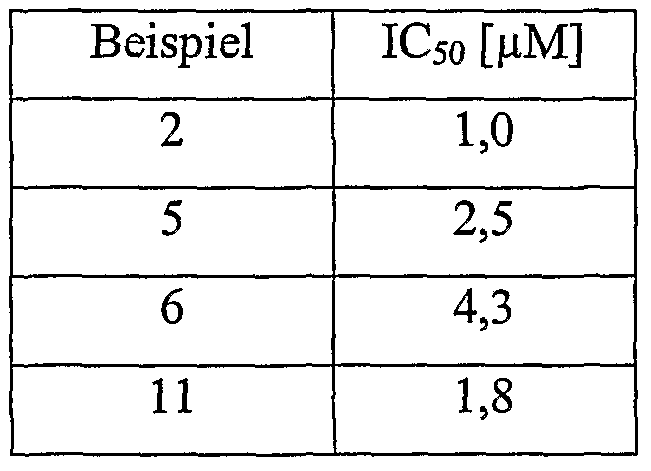
Aus der Tabelle ist abzulesen, dass die Verbindungen der Formel I die Aktivität der DPP-IV (Dipeptidyl Peptidase IV) hemmen und dadurch zur Senkung des Blutzuckerspiegels gut geeignet sind.From the table it can be seen that the compounds of the formula I inhibit the activity of DPP-IV (dipeptidyl peptidase IV) and are therefore well suited for lowering the blood sugar level.
Nachfolgend wird die Herstellung einiger Ausführungsbeispiele detailliert beschrieben, die übrigen Verbindungen der Formel I wurden analog erhalten: Beispiel 1The preparation of some embodiments is described in detail below, the remaining compounds of the formula I were obtained analogously: example 1
R-2-(3-Ammo-piperidin-l-yl)-l-(4-fluoro-benzyl)-lH-benzimidazole-6-carbonsäure-4-chlor- benzylamid HydrochloridR-2- (3-aminopiperidin-1-yl) -1- (4-fluorobenzyl) -1H-benzimidazole-6-carboxylic acid 4-chloro-benzylamide hydrochloride
a) 2-Hydroxi-lH-benzimidazole-5-carbonsäure-methylestera) methyl 2-hydroxy-1H-benzimidazole-5-carboxylate
Zur Lösung von 5 g 3,4-Diammo-benzoesäure-methylester in 10 ml N-Methylpyrrolidon wird die Lösung von 5,9 g Carbonyldiimidazol in 10 ml N-Methylpyrrolidon getropft und die Mischung 2 Stunden auf 1000C erwärmt. Nach dem Abkühlen auf 600C wurden 5 ml Methanol zugetropft und anschließend die Mischung bei Raumtemperatur mit 150 ml Wasser verrührt, der Niederschlag abgesaugt, mit Isopropanol gewaschen und im Vakuum getrocknet. Ausbeute: 4,0 g Fp.: 3120CTo dissolve 5 g of methyl 3,4-diammo-benzoate in 10 ml of N-methylpyrrolidone, the solution of 5.9 g of carbonyldiimidazole in 10 ml of N-methylpyrrolidone is added dropwise and the mixture is heated to 100 ° C. for 2 hours. After cooling to 60 0 C 5 ml of methanol were added dropwise and then the mixture was stirred at room temperature with 150 ml of water, the precipitate was filtered off with suction, washed with isopropanol and dried in vacuo. Yield: 4.0 g m.p .: 312 ° C.
b) 2-Chlor-lH-benzimidazol-5-carbonsäure-methylester 3,9 g 2-Hydroxi-lH-benzimidazol-5-carbonsäure-methylester und 50 ml Phosphoroxichlorid werden 6 Stunden bei 1000C gerührt. Der resultierende dicke Brei wird nach dem Erkalten vorsichtig in 500 ml Eiswasser eingerührt und der Feststoff nach einer Stunde abgesaugt, mitb) 2-chloro-lH-benzimidazole-5-carboxylic acid methylester 3.9 g of 2-hydroxy-lH-benzimidazole-5-carboxylic acid methylester and 50 ml of phosphorus oxychloride are stirred for 6 hours at 100 0 C. The resulting thick pulp is stirred gently after cooling in 500 ml of ice water and the solid was sucked off after one hour, with
Wasser gewaschen und im Vakuum getrocknet.Washed water and dried in vacuo.
Ausbeute: 4,3 g Fp.: 276°CYield: 4.3 g. M.p .: 276 ° C
c) Gemisch aus 2-ChIor-l-(4-fluor-benzyl)-lH-benzimidazol-6-carbonsäure-methylester und 2-c) Mixture of methyl 2-chloro-1- (4-fluoro-benzyl) -lH-benzimidazole-6-carboxylate and 2-
Chlor- 1 -(4-fluor-benzyl)- lH-benzimidazol-5-carbonsäure-methylesterChloro-1 - (4-fluoro-benzyl) - lH-benzimidazole-5-carboxylic acid methyl ester
4,3 g 2-Chlor-lH-benzimidazol-6-carbonsäure-methylester werden in 15 ml N-4.3 g of methyl 2-chloro-1H-benzimidazole-6-carboxylate are dissolved in 15 ml of N-
Methylpyrrolidon gelöst, mit 4,2 g Pottasche versetzt und 60 Minuten bei Raumtemperatur gerührt. Dann werden 4,86 g 4-Fluorbenzylbromid zugefügt und die Mischung 4 Stunden beiMethylpyrrolidone dissolved, mixed with 4.2 g of potash and stirred for 60 minutes at room temperature. Then 4.86 g of 4-fluorobenzylbromide are added and the mixture is allowed to stand for 4 hours
700C gerührt, abgekühlt und mit 50 ml Wasser und 10 ml Eisessig verrührt. Der Feststoff wird abgesaugt und im Vakuum getrocknet.70 0 C stirred, cooled and stirred with 50 ml of water and 10 ml of glacial acetic acid. The solid is filtered off with suction and dried in vacuo.
Ausbeute: 4,0 g Fp. HarzYield: 4.0 g. Mp. Resin
d) Gemisch von R-2-(3-tert-Butoxycarbonylamino-piperidin-l-yl)-l-(4-fluor-benzyl)-lH- benzimidazol-6-carbonsäure-methylester und 2-(3-tert-Butoxycarbonylamino-piperidin-l-yl)-l - (4-fluor-benzyl)-lH-benzimidazol-5-carbonsäure-methylester Das Gemisch aus 2-Chlor-l-(4-fluor-benzyl)-lH-benzimidazol-6-carbonsäure-methylester und 2-Chlor-l-(4-fluoro-benzyl)-lH-benzimidazol-5-carbonsäure-methylester (insgesamt 2 g), 15 ml N-Methylpyrrolidon, 3 ml Triethylamin und 2,5 g R-Piperidin-3-yl-carbaminsäure-tert- butylester wird 6 Stunden auf 100°C erhitzt. Nach dem Erkaltenlassen wird die Mischung mit 50 ml Wasser versetzt und verrührt. Vom halbfesten Niederschlag wird abdekantiert, erneut in 5 ml Methanol aufgenommen und wieder mit 30 ml Wasser gefällt und verrührt. Der Feststoff wird abgesaugt und im Vakuum getrocknet. Ausbeute: 2,1 g Fp.: Harzd) Mixture of R-2- (3-tert-Butoxycarbonylamino-piperidin-1-yl) -1- (4-fluoro-benzyl) -lH-benzimidazole-6-carboxylic acid methyl ester and 2- (3-tert-butoxycarbonylamino -piperidin-1-yl) -1- (4-fluoro-benzyl) -lH-benzimidazole-5-carboxylic acid methyl ester The mixture of 2-chloro-l- (4-fluoro-benzyl) -lH-benzimidazole-6-carboxylic acid methyl ester and 2-chloro-l- (4-fluoro-benzyl) -lH-benzimidazole-5-carboxylic acid methyl ester (Total 2 g), 15 ml of N-methylpyrrolidone, 3 ml of triethylamine and 2.5 g of R-piperidin-3-yl-carbamic acid tert-butyl ester is heated to 100 ° C for 6 hours. After cooling, the mixture is mixed with 50 ml of water and stirred. From the semi-solid precipitate is decanted off, taken up again in 5 ml of methanol and again precipitated with 30 ml of water and stirred. The solid is filtered off with suction and dried in vacuo. Yield: 2.1 g mp. Resin
e) R-2-(3 -tert-Butoxycarbonylamino-piperidin- 1 -yl)- 1 -(4-fluor-benzyl)- lH-benzimidazol-6- carbonsäuree) R-2- (3-tert-Butoxycarbonylaminopiperidin-1-yl) -1- (4-fluorobenzyl) -1H-benzimidazole-6-carboxylic acid
Das Gemisch von insgesamt 2 g R-2-(3-tert-Butoxycarbonylamino-piperidin-l-yl)-l-(4-fluor- benzyl)-lH-benzimidazol-6-carbonsäure-methylester und R-2-(3-tert-Butoxycarbonylammo- piperidin- 1 -yl)- 1 -(4-fluor-benzyl)- 1 H-benzimidazol-5 -carbonsäure-methylester wird im Lösemittelgemisch von 10 ml Methanol, 20 ml Wasser und 10 ml Tetrahydrofuran mit 500 mg Lithiumhydroxid versetzt und 24 Stunden bei Raumtemperatur gerührt. Nach Zugabe von 2 ml Eisessig wurden die flüchtigen Anteile im Vakuum entfernt, der Rückstand mit Wasser verrührt und der Feststoff abgesaugt und anschließend säulenchromatografisch (Kieselgel, Laufmittel: Methylenchlorid: Isopropanol = 94:6) getrennt, wobei das 5-Isomere zuerst eruiert wird. Ausbeute: 980 mg Fp.: HarzThe mixture of a total of 2 g of methyl R-2- (3-tert-butoxycarbonylamino-piperidin-1-yl) -1- (4-fluoro-benzyl) -lH-benzimidazole-6-carboxylate and R-2- (3 -tert-Butoxycarbonylammopiperidin- 1 -yl) - 1 - (4-fluoro-benzyl) - 1 H-benzimidazole-5-carboxylic acid methyl ester in the solvent mixture of 10 ml of methanol, 20 ml of water and 10 ml of tetrahydrofuran with 500 mg Lithium hydroxide and stirred for 24 hours at room temperature. After addition of 2 ml of glacial acetic acid, the volatiles were removed in vacuo, the residue was stirred with water and the solid was filtered off with suction and then separated by column chromatography (silica gel, eluent: methylene chloride: isopropanol = 94: 6), the 5-isomer is first determined. Yield: 980 mg mp: resin
f) R-{l-[6-(4-Chloro-benzylcarbamoyl)-l-(4-fluoro-benzyl)-lH-benzimidazol-2-yl]-piperidin-f) R {1- [6- (4-chlorobenzylcarbamoyl) -1- (4-fluorobenzyl) -1H-benzimidazol-2-yl] piperidine
3-yl} -carbaminsäure-tert-butylester (F-34529-074)3-yl} -carbamic acid tert-butyl ester (F-34529-074)
Die Lösung von 50 mg R-2-(3-tert-Butoxycarbonylamino-piperidin-l-yl)-l-(4-fluor-benzyl)- lH-benzimidazol-6-carbonsäure in 1 ,5 ml Dimethylformamid wurde nacheinander mit 40,6 mgThe solution of 50 mg of R-2- (3-tert-butoxycarbonylamino-piperidin-1-yl) -1- (4-fluoro-benzyl) -1H-benzimidazole-6-carboxylic acid in 1.5 ml of dimethylformamide was added successively with 40 , 6 mg
HATU, 18 μl Triethylamin und 14 μl 4-Chlorbenzylamin versetzt und über Nacht beiHATU, 18 ul triethylamine and 14 ul 4-chlorobenzylamine and overnight
Raumtemperatur gerührt. Die Mischung wurde dann mit 5 ml Wasser verdünnt und derRoom temperature stirred. The mixture was then diluted with 5 ml of water and the
Niederschlag abgesaugt und im Vakuum bei 4O0C getrocknet.Precipitate is suction filtered and dried in vacuo at 4O 0 C.
Ausbeute: 30 mg Fp.: HarzYield: 30 mg mp: resin
g) R-2-(3-Amino-piperidin-l-yl)-l-(4-fluoro-benzyl)-lH-benzimidazole-6-carbonsäure-4-chlor- benzylamid Hydrochlorid (F-34529-083) Die Lösung von 63 mg {l-[6-(4-Chlor-benzyl)-carbamoyl-l-(4-fluor-benzyl)-lH-benzimidazol- 2-yl]-piperidin-3-yl}-carbaminsäure-tert-butylester in 1 ml Essigester wird mit 0,2 ml einer gesättigten HCl-Lösung in Essigsäureethylester versetzt und über Nacht bei Raumtemperatur stehen gelassen. Die flüchtigen Anteile wurden am Rotationsverdampfer abgezogen und der Rückstand in wenig Methylenchlorid gelöst und mit Diisopropylether ausgefallt. Der Feststoff wurde abgesaugt und im Vakuum bei 40°C getrocknet. Ausbeute: 15 mg Fp.: 197,1°C g) R-2- (3-Amino-piperidin-1-yl) -1- (4-fluorobenzyl) -1H-benzimidazole-6-carboxylic acid 4-chloro-benzylamide hydrochloride (F-34529-083) The solution of 63 mg of {1- [6- (4-chloro-benzyl) -carbamoyl-1- (4-fluoro-benzyl) -lH-benzimidazol-2-yl] -piperidin-3-yl} -carbamic acid tert Butyl ester in 1 ml of ethyl acetate is treated with 0.2 ml of a saturated HCl solution in ethyl acetate and allowed to stand overnight at room temperature. The volatiles were stripped off on a rotary evaporator and the residue was dissolved in a little methylene chloride and precipitated with diisopropyl ether. The solid was filtered off with suction and dried in vacuo at 40.degree. Yield: 15 mg mp .: 197.1 ° C
Claims

Priority Applications (10)
| Application Number | Priority Date | Filing Date | Title |
|---|---|---|---|
| BRPI0609407-4A BRPI0609407A2 (en) | 2005-03-19 | 2006-03-07 | process for producing 8-n-substituted amide benzimidazoles and using them as medicaments |
| AU2006226640A AU2006226640A1 (en) | 2005-03-19 | 2006-03-07 | Amide-substituted 8-N-benzimidazoles, method for the production thereof, and use of the same as medicaments |
| EP06723257A EP1863790B1 (en) | 2005-03-19 | 2006-03-07 | Amide-substituted 8-n-benzimidazoles, method for the production thereof, and use of the same as medicaments |
| MX2007011123A MX2007011123A (en) | 2005-03-19 | 2006-03-07 | Amide-substituted 8-n-benzimidazoles, method for the production thereof, and use of the same as medicaments. |
| CA002602241A CA2602241A1 (en) | 2005-03-19 | 2006-03-07 | Amide-substituted 8-n-benzimidazoles, method for the production thereof, and use of the same as medicaments |
| JP2008501197A JP2008533067A (en) | 2005-03-19 | 2006-03-07 | Amide-substituted 8-N-benzimidazole, process for producing the same, and use as a medicament |
| AT06723257T ATE457310T1 (en) | 2005-03-19 | 2006-03-07 | AMIDE SUBSTITUTED 8-N-BENZIMIDAZOLES, METHOD FOR THEIR PRODUCTION AND THEIR USE AS A MEDICINAL PRODUCT |
| DE502006006107T DE502006006107D1 (en) | 2005-03-19 | 2006-03-07 | AMID SUBSTITUTED 8-N-BENZIMIDAZOLE, METHOD FOR THE PRODUCTION THEREOF AND THEIR USE AS A MEDICAMENT |
| IL185808A IL185808A0 (en) | 2005-03-19 | 2007-09-06 | Amide-substituted 8-n-benzimidazoles, metohd for the production thereof, and use of the same as medicaments |
| US11/854,578 US8163774B2 (en) | 2005-03-19 | 2007-09-13 | Amide-substituted 8-N-benzimidazoles, method for the production thereof, and use of the same as medicaments |
Applications Claiming Priority (2)
| Application Number | Priority Date | Filing Date | Title |
|---|---|---|---|
| DE102005012874.2 | 2005-03-19 | ||
| DE102005012874A DE102005012874A1 (en) | 2005-03-19 | 2005-03-19 | Amide-substituted 8-N-benzimidazoles, process for their preparation and their use as pharmaceuticals |
Related Child Applications (1)
| Application Number | Title | Priority Date | Filing Date |
|---|---|---|---|
| US11/854,578 Continuation US8163774B2 (en) | 2005-03-19 | 2007-09-13 | Amide-substituted 8-N-benzimidazoles, method for the production thereof, and use of the same as medicaments |
Publications (2)
| Publication Number | Publication Date |
|---|---|
| WO2006099943A1 true WO2006099943A1 (en) | 2006-09-28 |
| WO2006099943A8 WO2006099943A8 (en) | 2006-11-09 |
Family
ID=36691854
Family Applications (1)
| Application Number | Title | Priority Date | Filing Date |
|---|---|---|---|
| PCT/EP2006/002058 Ceased WO2006099943A1 (en) | 2005-03-19 | 2006-03-07 | Amide-substituted 8-n-benzimidazoles, method for the production thereof, and use of the same as medicaments |
Country Status (11)
| Country | Link |
|---|---|
| US (1) | US8163774B2 (en) |
| EP (1) | EP1863790B1 (en) |
| JP (1) | JP2008533067A (en) |
| AT (1) | ATE457310T1 (en) |
| AU (1) | AU2006226640A1 (en) |
| BR (1) | BRPI0609407A2 (en) |
| CA (1) | CA2602241A1 (en) |
| DE (2) | DE102005012874A1 (en) |
| IL (1) | IL185808A0 (en) |
| MX (1) | MX2007011123A (en) |
| WO (1) | WO2006099943A1 (en) |
Cited By (20)
| Publication number | Priority date | Publication date | Assignee | Title |
|---|---|---|---|---|
| WO2009021740A2 (en) | 2007-08-15 | 2009-02-19 | Sanofis-Aventis | Substituted tetrahydronaphthalenes, process for the preparation thereof and the use thereof as medicaments |
| WO2010003624A2 (en) | 2008-07-09 | 2010-01-14 | Sanofi-Aventis | Heterocyclic compounds, processes for their preparation, medicaments comprising these compounds, and the use thereof |
| WO2010068601A1 (en) | 2008-12-08 | 2010-06-17 | Sanofi-Aventis | A crystalline heteroaromatic fluoroglycoside hydrate, processes for making, methods of use and pharmaceutical compositions thereof |
| WO2011023754A1 (en) | 2009-08-26 | 2011-03-03 | Sanofi-Aventis | Novel crystalline heteroaromatic fluoroglycoside hydrates, pharmaceuticals comprising these compounds and their use |
| WO2011107494A1 (en) | 2010-03-03 | 2011-09-09 | Sanofi | Novel aromatic glycoside derivatives, medicaments containing said compounds, and the use thereof |
| WO2011157827A1 (en) | 2010-06-18 | 2011-12-22 | Sanofi | Azolopyridin-3-one derivatives as inhibitors of lipases and phospholipases |
| WO2011161030A1 (en) | 2010-06-21 | 2011-12-29 | Sanofi | Heterocyclic substituted methoxyphenyl derivatives having an oxo group, method for producing same, and use thereof as gpr40 receptor modulators |
| WO2012004269A1 (en) | 2010-07-05 | 2012-01-12 | Sanofi | (2-aryloxy-acetylamino)-phenyl-propionic acid derivatives, method for producing same and use thereof as pharmaceuticals |
| WO2012004270A1 (en) | 2010-07-05 | 2012-01-12 | Sanofi | Spirocyclically substituted 1,3-propane dioxide derivatives, methods for the production thereof and use of the same as medicament |
| WO2012010413A1 (en) | 2010-07-05 | 2012-01-26 | Sanofi | Aryloxy-alkylene substituted hydroxyphenyl hexynoic acids, methods for the production thereof and use of the same as medicament |
| WO2012120055A1 (en) | 2011-03-08 | 2012-09-13 | Sanofi | Di- and tri-substituted oxathiazine derivates, method for the production thereof, use thereof as medicine and drug containing said derivatives and use thereof |
| WO2012120053A1 (en) | 2011-03-08 | 2012-09-13 | Sanofi | Branched oxathiazine derivatives, method for the production thereof, use thereof as medicine and drug containing said derivatives and use thereof |
| WO2012120056A1 (en) | 2011-03-08 | 2012-09-13 | Sanofi | Tetrasubstituted oxathiazine derivatives, method for producing them, their use as medicine and drug containing said derivatives and the use thereof |
| WO2012120054A1 (en) | 2011-03-08 | 2012-09-13 | Sanofi | Di- and tri-substituted oxathiazine derivates, method for the production thereof, use thereof as medicine and drug containing said derivatives and use thereof |
| WO2012120052A1 (en) | 2011-03-08 | 2012-09-13 | Sanofi | Oxathiazine derivatives substituted with carbocycles or heterocycles, method for producing same, drugs containing said compounds, and use thereof |
| WO2013037390A1 (en) | 2011-09-12 | 2013-03-21 | Sanofi | 6-(4-hydroxy-phenyl)-3-styryl-1h-pyrazolo[3,4-b]pyridine-4-carboxylic acid amide derivatives as kinase inhibitors |
| WO2013045413A1 (en) | 2011-09-27 | 2013-04-04 | Sanofi | 6-(4-hydroxy-phenyl)-3-alkyl-1h-pyrazolo[3,4-b]pyridine-4-carboxylic acid amide derivatives as kinase inhibitors |
| WO2014064215A1 (en) | 2012-10-24 | 2014-05-01 | INSERM (Institut National de la Santé et de la Recherche Médicale) | TPL2 KINASE INHIBITORS FOR PREVENTING OR TREATING DIABETES AND FOR PROMOTING β-CELL SURVIVAL |
| WO2016151018A1 (en) | 2015-03-24 | 2016-09-29 | INSERM (Institut National de la Santé et de la Recherche Médicale) | Method and pharmaceutical composition for use in the treatment of diabetes |
| US12084453B2 (en) | 2021-12-10 | 2024-09-10 | Incyte Corporation | Bicyclic amines as CDK12 inhibitors |
Families Citing this family (8)
| Publication number | Priority date | Publication date | Assignee | Title |
|---|---|---|---|---|
| JP2010500300A (en) | 2006-08-08 | 2010-01-07 | サノフィ−アベンティス | Arylaminoaryl-alkyl-substituted imidazolidine-2,4-diones, processes for their preparation, agents containing these compounds, and uses thereof |
| DE102007005045B4 (en) | 2007-01-26 | 2008-12-18 | Sanofi-Aventis | Phenothiazine derivatives, process for their preparation and their use as medicines |
| WO2012120051A1 (en) | 2011-03-08 | 2012-09-13 | Sanofi | Benzyl-oxathiazine derivates substituted with adamantane or noradamantane, medicaments containing said compounds and use thereof |
| EP2683701B1 (en) | 2011-03-08 | 2014-12-24 | Sanofi | Oxathiazine derivatives substituted with benzyl or heteromethylene groups, method for their preparation, their usage as medicament, medicament containing same and its use |
| WO2012120057A1 (en) | 2011-03-08 | 2012-09-13 | Sanofi | Novel substituted phenyl-oxathiazine derivatives, method for producing them, drugs containing said compounds and the use thereof |
| EP2683702B1 (en) | 2011-03-08 | 2014-12-24 | Sanofi | New substituted phenyl oxathiazine derivatives, method for their manufacture, medicines containing these compounds and their application |
| US10501421B1 (en) | 2017-01-27 | 2019-12-10 | Vanderbilt University | Substituted benzimidazoles as modulators of Ras signaling |
| IL273839B (en) * | 2017-10-19 | 2022-09-01 | Amgen Inc | Benzimidazole derivatives and their uses |
Citations (3)
| Publication number | Priority date | Publication date | Assignee | Title |
|---|---|---|---|---|
| EP1069124A1 (en) * | 1999-07-16 | 2001-01-17 | Pfizer Inc. | 2-Benzimidazolylamine compounds as ORL1-receptor agonists |
| WO2002048152A2 (en) * | 2000-12-12 | 2002-06-20 | Neurogen Corporation | Spiro[isobenzofuran-1,4'-piperidin]-3-ones and 3h-spiroisobenzofuran-1,4'-piperidines |
| WO2003104233A1 (en) * | 2002-06-07 | 2003-12-18 | Altana Pharma Ag | 4,5-dihydro-imidazo (4,5,1-ij) quinolin-6-ones derivatives and their use as poly (adp-ribosyl) transferase (parp) inhibitors |
Family Cites Families (4)
| Publication number | Priority date | Publication date | Assignee | Title |
|---|---|---|---|---|
| US6025372A (en) * | 1997-04-04 | 2000-02-15 | Merck & Co., Inc. | Somatostatin agonists |
| HU0301154D0 (en) * | 2003-04-28 | 2003-07-28 | Hideg Kalman Dr | Pharmaceutical composition |
| US7728026B2 (en) * | 2005-04-11 | 2010-06-01 | Abbott Laboratories, Inc. | 2-substituted-1 h-benzimidazile-4-carboxamides are PARP inhibitors |
| WO2007069053A1 (en) * | 2005-12-14 | 2007-06-21 | Pfizer Products Inc. | Benzimidazole antagonists of the h-3 receptor |
-
2005
- 2005-03-19 DE DE102005012874A patent/DE102005012874A1/en not_active Withdrawn
-
2006
- 2006-03-07 MX MX2007011123A patent/MX2007011123A/en not_active Application Discontinuation
- 2006-03-07 BR BRPI0609407-4A patent/BRPI0609407A2/en not_active Application Discontinuation
- 2006-03-07 CA CA002602241A patent/CA2602241A1/en not_active Abandoned
- 2006-03-07 JP JP2008501197A patent/JP2008533067A/en not_active Abandoned
- 2006-03-07 WO PCT/EP2006/002058 patent/WO2006099943A1/en not_active Ceased
- 2006-03-07 EP EP06723257A patent/EP1863790B1/en not_active Not-in-force
- 2006-03-07 DE DE502006006107T patent/DE502006006107D1/en active Active
- 2006-03-07 AT AT06723257T patent/ATE457310T1/en active
- 2006-03-07 AU AU2006226640A patent/AU2006226640A1/en not_active Abandoned
-
2007
- 2007-09-06 IL IL185808A patent/IL185808A0/en unknown
- 2007-09-13 US US11/854,578 patent/US8163774B2/en not_active Expired - Fee Related
Patent Citations (3)
| Publication number | Priority date | Publication date | Assignee | Title |
|---|---|---|---|---|
| EP1069124A1 (en) * | 1999-07-16 | 2001-01-17 | Pfizer Inc. | 2-Benzimidazolylamine compounds as ORL1-receptor agonists |
| WO2002048152A2 (en) * | 2000-12-12 | 2002-06-20 | Neurogen Corporation | Spiro[isobenzofuran-1,4'-piperidin]-3-ones and 3h-spiroisobenzofuran-1,4'-piperidines |
| WO2003104233A1 (en) * | 2002-06-07 | 2003-12-18 | Altana Pharma Ag | 4,5-dihydro-imidazo (4,5,1-ij) quinolin-6-ones derivatives and their use as poly (adp-ribosyl) transferase (parp) inhibitors |
Cited By (20)
| Publication number | Priority date | Publication date | Assignee | Title |
|---|---|---|---|---|
| WO2009021740A2 (en) | 2007-08-15 | 2009-02-19 | Sanofis-Aventis | Substituted tetrahydronaphthalenes, process for the preparation thereof and the use thereof as medicaments |
| WO2010003624A2 (en) | 2008-07-09 | 2010-01-14 | Sanofi-Aventis | Heterocyclic compounds, processes for their preparation, medicaments comprising these compounds, and the use thereof |
| WO2010068601A1 (en) | 2008-12-08 | 2010-06-17 | Sanofi-Aventis | A crystalline heteroaromatic fluoroglycoside hydrate, processes for making, methods of use and pharmaceutical compositions thereof |
| WO2011023754A1 (en) | 2009-08-26 | 2011-03-03 | Sanofi-Aventis | Novel crystalline heteroaromatic fluoroglycoside hydrates, pharmaceuticals comprising these compounds and their use |
| WO2011107494A1 (en) | 2010-03-03 | 2011-09-09 | Sanofi | Novel aromatic glycoside derivatives, medicaments containing said compounds, and the use thereof |
| WO2011157827A1 (en) | 2010-06-18 | 2011-12-22 | Sanofi | Azolopyridin-3-one derivatives as inhibitors of lipases and phospholipases |
| WO2011161030A1 (en) | 2010-06-21 | 2011-12-29 | Sanofi | Heterocyclic substituted methoxyphenyl derivatives having an oxo group, method for producing same, and use thereof as gpr40 receptor modulators |
| WO2012004269A1 (en) | 2010-07-05 | 2012-01-12 | Sanofi | (2-aryloxy-acetylamino)-phenyl-propionic acid derivatives, method for producing same and use thereof as pharmaceuticals |
| WO2012004270A1 (en) | 2010-07-05 | 2012-01-12 | Sanofi | Spirocyclically substituted 1,3-propane dioxide derivatives, methods for the production thereof and use of the same as medicament |
| WO2012010413A1 (en) | 2010-07-05 | 2012-01-26 | Sanofi | Aryloxy-alkylene substituted hydroxyphenyl hexynoic acids, methods for the production thereof and use of the same as medicament |
| WO2012120055A1 (en) | 2011-03-08 | 2012-09-13 | Sanofi | Di- and tri-substituted oxathiazine derivates, method for the production thereof, use thereof as medicine and drug containing said derivatives and use thereof |
| WO2012120053A1 (en) | 2011-03-08 | 2012-09-13 | Sanofi | Branched oxathiazine derivatives, method for the production thereof, use thereof as medicine and drug containing said derivatives and use thereof |
| WO2012120056A1 (en) | 2011-03-08 | 2012-09-13 | Sanofi | Tetrasubstituted oxathiazine derivatives, method for producing them, their use as medicine and drug containing said derivatives and the use thereof |
| WO2012120054A1 (en) | 2011-03-08 | 2012-09-13 | Sanofi | Di- and tri-substituted oxathiazine derivates, method for the production thereof, use thereof as medicine and drug containing said derivatives and use thereof |
| WO2012120052A1 (en) | 2011-03-08 | 2012-09-13 | Sanofi | Oxathiazine derivatives substituted with carbocycles or heterocycles, method for producing same, drugs containing said compounds, and use thereof |
| WO2013037390A1 (en) | 2011-09-12 | 2013-03-21 | Sanofi | 6-(4-hydroxy-phenyl)-3-styryl-1h-pyrazolo[3,4-b]pyridine-4-carboxylic acid amide derivatives as kinase inhibitors |
| WO2013045413A1 (en) | 2011-09-27 | 2013-04-04 | Sanofi | 6-(4-hydroxy-phenyl)-3-alkyl-1h-pyrazolo[3,4-b]pyridine-4-carboxylic acid amide derivatives as kinase inhibitors |
| WO2014064215A1 (en) | 2012-10-24 | 2014-05-01 | INSERM (Institut National de la Santé et de la Recherche Médicale) | TPL2 KINASE INHIBITORS FOR PREVENTING OR TREATING DIABETES AND FOR PROMOTING β-CELL SURVIVAL |
| WO2016151018A1 (en) | 2015-03-24 | 2016-09-29 | INSERM (Institut National de la Santé et de la Recherche Médicale) | Method and pharmaceutical composition for use in the treatment of diabetes |
| US12084453B2 (en) | 2021-12-10 | 2024-09-10 | Incyte Corporation | Bicyclic amines as CDK12 inhibitors |
Also Published As
| Publication number | Publication date |
|---|---|
| EP1863790A1 (en) | 2007-12-12 |
| IL185808A0 (en) | 2008-01-06 |
| WO2006099943A8 (en) | 2006-11-09 |
| EP1863790B1 (en) | 2010-02-10 |
| JP2008533067A (en) | 2008-08-21 |
| US20080090868A1 (en) | 2008-04-17 |
| AU2006226640A1 (en) | 2006-09-28 |
| DE502006006107D1 (en) | 2010-03-25 |
| ATE457310T1 (en) | 2010-02-15 |
| BRPI0609407A2 (en) | 2010-04-06 |
| CA2602241A1 (en) | 2006-09-28 |
| DE102005012874A1 (en) | 2006-09-21 |
| US8163774B2 (en) | 2012-04-24 |
| MX2007011123A (en) | 2007-11-13 |
Similar Documents
| Publication | Publication Date | Title |
|---|---|---|
| EP1863790B1 (en) | Amide-substituted 8-n-benzimidazoles, method for the production thereof, and use of the same as medicaments | |
| EP1863789B1 (en) | Aminocarbonyl-substituted 8-n-benzimidazoles, method for their production and their use as medicaments | |
| EP1651649B1 (en) | Novel cyanopyrrolidides, methods for the production thereof, and use of the same as medication | |
| EP1776372A1 (en) | Substituted, bicyclic 8-pyrrolidinoxanthines, method for the production thereof and their use as medicaments | |
| EP1778690B1 (en) | Substituted 8-aminoalkoxi-xanthines, method for the production thereof and use thereof as medicaments | |
| DE10333935A1 (en) | New bicyclic cyano-heterocycles, process for their preparation and their use as pharmaceuticals | |
| EP1874737B1 (en) | Substituted 2-aminoalkylthio-benzimidazoles and use thereof for reducing blood sugar levels | |
| DE102004038268A1 (en) | Substituted, bicyclic 8-pyrrolidino-xanthines, process for their preparation and their use as medicaments | |
| DE102004037554A1 (en) | Substituted 8-aminoalkylthio-xanthines, process for their preparation and their use as medicaments | |
| DE102004038269A1 (en) | Substituted bicyclic 8-piperidino-xanthines, process for their preparation and their use as pharmaceuticals | |
| EP1720870B1 (en) | Heterocyclically substituted 7-amino-4-quinolone-3-carboxylic acid derivatives, method for the production thereof and their use as medicaments | |
| DE102004004971B3 (en) | Cycloalkyl substituted 7-amino-4-quinolone-3-carboxylic acid derivatives, process for their preparation and their use as Arnzeimittel | |
| EP1863488B1 (en) | Use of amino-substituted 8-n-benzimidazoles | |
| EP1863817B1 (en) | Substituted, bicyclic 8-pyrrolidino-benzimidazoles, method for their production and their use as medicaments | |
| DE10335092B3 (en) | Substituted benzoylureido-o-benzoylamides, process for their preparation and their use | |
| DE102004060041A1 (en) | Use of substituted cyclopropane acid derivative having dopamine receptor ligand activity to e.g. treat metabolic syndrome; reduce lipid in the plasma; lower free fatty acid in the plasma; and treat diabetic dyslipidemia |
Legal Events
| Date | Code | Title | Description |
|---|---|---|---|
| 121 | Ep: the epo has been informed by wipo that ep was designated in this application | ||
| WWE | Wipo information: entry into national phase |
Ref document number: 2006723257 Country of ref document: EP |
|
| WWE | Wipo information: entry into national phase |
Ref document number: 185808 Country of ref document: IL |
|
| WWE | Wipo information: entry into national phase |
Ref document number: MX/a/2007/011123 Country of ref document: MX |
|
| WWE | Wipo information: entry into national phase |
Ref document number: 11854578 Country of ref document: US |
|
| WWE | Wipo information: entry into national phase |
Ref document number: 2006226640 Country of ref document: AU Ref document number: 2008501197 Country of ref document: JP Ref document number: 2602241 Country of ref document: CA |
|
| NENP | Non-entry into the national phase |
Ref country code: DE |
|
| ENP | Entry into the national phase |
Ref document number: 2006226640 Country of ref document: AU Date of ref document: 20060307 Kind code of ref document: A |
|
| WWP | Wipo information: published in national office |
Ref document number: 2006226640 Country of ref document: AU |
|
| NENP | Non-entry into the national phase |
Ref country code: RU |
|
| WWW | Wipo information: withdrawn in national office |
Country of ref document: RU |
|
| WWP | Wipo information: published in national office |
Ref document number: 2006723257 Country of ref document: EP |
|
| WWP | Wipo information: published in national office |
Ref document number: 11854578 Country of ref document: US |
|
| ENP | Entry into the national phase |
Ref document number: PI0609407 Country of ref document: BR Kind code of ref document: A2 |