WO2006097625A1 - Novel imidazo[1,5-a]pyridine derivatives, method for preparing same and pharmaceutical compositions containing same - Google Patents
Novel imidazo[1,5-a]pyridine derivatives, method for preparing same and pharmaceutical compositions containing same Download PDFInfo
- Publication number
- WO2006097625A1 WO2006097625A1 PCT/FR2006/000567 FR2006000567W WO2006097625A1 WO 2006097625 A1 WO2006097625 A1 WO 2006097625A1 FR 2006000567 W FR2006000567 W FR 2006000567W WO 2006097625 A1 WO2006097625 A1 WO 2006097625A1
- Authority
- WO
- WIPO (PCT)
- Prior art keywords
- formula
- radical
- compounds
- sub
- coor
- Prior art date
- Legal status (The legal status is an assumption and is not a legal conclusion. Google has not performed a legal analysis and makes no representation as to the accuracy of the status listed.)
- Ceased
Links
- 0 CC1(*)C=C[n]2c(C(c3cc(*)c(*)cc3)=O)nc(*)c2C=C1 Chemical compound CC1(*)C=C[n]2c(C(c3cc(*)c(*)cc3)=O)nc(*)c2C=C1 0.000 description 7
Classifications
-
- C—CHEMISTRY; METALLURGY
- C07—ORGANIC CHEMISTRY
- C07D—HETEROCYCLIC COMPOUNDS
- C07D471/00—Heterocyclic compounds containing nitrogen atoms as the only ring hetero atoms in the condensed system, at least one ring being a six-membered ring with one nitrogen atom, not provided for by groups C07D451/00 - C07D463/00
- C07D471/02—Heterocyclic compounds containing nitrogen atoms as the only ring hetero atoms in the condensed system, at least one ring being a six-membered ring with one nitrogen atom, not provided for by groups C07D451/00 - C07D463/00 in which the condensed system contains two hetero rings
- C07D471/04—Ortho-condensed systems
-
- A—HUMAN NECESSITIES
- A61—MEDICAL OR VETERINARY SCIENCE; HYGIENE
- A61K—PREPARATIONS FOR MEDICAL, DENTAL OR TOILETRY PURPOSES
- A61K31/00—Medicinal preparations containing organic active ingredients
- A61K31/33—Heterocyclic compounds
- A61K31/395—Heterocyclic compounds having nitrogen as a ring hetero atom, e.g. guanethidine or rifamycins
- A61K31/435—Heterocyclic compounds having nitrogen as a ring hetero atom, e.g. guanethidine or rifamycins having six-membered rings with one nitrogen as the only ring hetero atom
- A61K31/4353—Heterocyclic compounds having nitrogen as a ring hetero atom, e.g. guanethidine or rifamycins having six-membered rings with one nitrogen as the only ring hetero atom ortho- or peri-condensed with heterocyclic ring systems
- A61K31/437—Heterocyclic compounds having nitrogen as a ring hetero atom, e.g. guanethidine or rifamycins having six-membered rings with one nitrogen as the only ring hetero atom ortho- or peri-condensed with heterocyclic ring systems the heterocyclic ring system containing a five-membered ring having nitrogen as a ring hetero atom, e.g. indolizine, beta-carboline
-
- A—HUMAN NECESSITIES
- A61—MEDICAL OR VETERINARY SCIENCE; HYGIENE
- A61P—SPECIFIC THERAPEUTIC ACTIVITY OF CHEMICAL COMPOUNDS OR MEDICINAL PREPARATIONS
- A61P1/00—Drugs for disorders of the alimentary tract or the digestive system
- A61P1/04—Drugs for disorders of the alimentary tract or the digestive system for ulcers, gastritis or reflux esophagitis, e.g. antacids, inhibitors of acid secretion, mucosal protectants
-
- A—HUMAN NECESSITIES
- A61—MEDICAL OR VETERINARY SCIENCE; HYGIENE
- A61P—SPECIFIC THERAPEUTIC ACTIVITY OF CHEMICAL COMPOUNDS OR MEDICINAL PREPARATIONS
- A61P19/00—Drugs for skeletal disorders
-
- A—HUMAN NECESSITIES
- A61—MEDICAL OR VETERINARY SCIENCE; HYGIENE
- A61P—SPECIFIC THERAPEUTIC ACTIVITY OF CHEMICAL COMPOUNDS OR MEDICINAL PREPARATIONS
- A61P19/00—Drugs for skeletal disorders
- A61P19/02—Drugs for skeletal disorders for joint disorders, e.g. arthritis, arthrosis
-
- A—HUMAN NECESSITIES
- A61—MEDICAL OR VETERINARY SCIENCE; HYGIENE
- A61P—SPECIFIC THERAPEUTIC ACTIVITY OF CHEMICAL COMPOUNDS OR MEDICINAL PREPARATIONS
- A61P19/00—Drugs for skeletal disorders
- A61P19/08—Drugs for skeletal disorders for bone diseases, e.g. rachitism, Paget's disease
-
- A—HUMAN NECESSITIES
- A61—MEDICAL OR VETERINARY SCIENCE; HYGIENE
- A61P—SPECIFIC THERAPEUTIC ACTIVITY OF CHEMICAL COMPOUNDS OR MEDICINAL PREPARATIONS
- A61P27/00—Drugs for disorders of the senses
-
- A—HUMAN NECESSITIES
- A61—MEDICAL OR VETERINARY SCIENCE; HYGIENE
- A61P—SPECIFIC THERAPEUTIC ACTIVITY OF CHEMICAL COMPOUNDS OR MEDICINAL PREPARATIONS
- A61P27/00—Drugs for disorders of the senses
- A61P27/02—Ophthalmic agents
-
- A—HUMAN NECESSITIES
- A61—MEDICAL OR VETERINARY SCIENCE; HYGIENE
- A61P—SPECIFIC THERAPEUTIC ACTIVITY OF CHEMICAL COMPOUNDS OR MEDICINAL PREPARATIONS
- A61P29/00—Non-central analgesic, antipyretic or antiinflammatory agents, e.g. antirheumatic agents; Non-steroidal antiinflammatory drugs [NSAID]
-
- A—HUMAN NECESSITIES
- A61—MEDICAL OR VETERINARY SCIENCE; HYGIENE
- A61P—SPECIFIC THERAPEUTIC ACTIVITY OF CHEMICAL COMPOUNDS OR MEDICINAL PREPARATIONS
- A61P3/00—Drugs for disorders of the metabolism
-
- A—HUMAN NECESSITIES
- A61—MEDICAL OR VETERINARY SCIENCE; HYGIENE
- A61P—SPECIFIC THERAPEUTIC ACTIVITY OF CHEMICAL COMPOUNDS OR MEDICINAL PREPARATIONS
- A61P3/00—Drugs for disorders of the metabolism
- A61P3/04—Anorexiants; Antiobesity agents
-
- A—HUMAN NECESSITIES
- A61—MEDICAL OR VETERINARY SCIENCE; HYGIENE
- A61P—SPECIFIC THERAPEUTIC ACTIVITY OF CHEMICAL COMPOUNDS OR MEDICINAL PREPARATIONS
- A61P3/00—Drugs for disorders of the metabolism
- A61P3/08—Drugs for disorders of the metabolism for glucose homeostasis
- A61P3/10—Drugs for disorders of the metabolism for glucose homeostasis for hyperglycaemia, e.g. antidiabetics
-
- A—HUMAN NECESSITIES
- A61—MEDICAL OR VETERINARY SCIENCE; HYGIENE
- A61P—SPECIFIC THERAPEUTIC ACTIVITY OF CHEMICAL COMPOUNDS OR MEDICINAL PREPARATIONS
- A61P35/00—Antineoplastic agents
-
- A—HUMAN NECESSITIES
- A61—MEDICAL OR VETERINARY SCIENCE; HYGIENE
- A61P—SPECIFIC THERAPEUTIC ACTIVITY OF CHEMICAL COMPOUNDS OR MEDICINAL PREPARATIONS
- A61P35/00—Antineoplastic agents
- A61P35/02—Antineoplastic agents specific for leukemia
-
- A—HUMAN NECESSITIES
- A61—MEDICAL OR VETERINARY SCIENCE; HYGIENE
- A61P—SPECIFIC THERAPEUTIC ACTIVITY OF CHEMICAL COMPOUNDS OR MEDICINAL PREPARATIONS
- A61P35/00—Antineoplastic agents
- A61P35/04—Antineoplastic agents specific for metastasis
-
- A—HUMAN NECESSITIES
- A61—MEDICAL OR VETERINARY SCIENCE; HYGIENE
- A61P—SPECIFIC THERAPEUTIC ACTIVITY OF CHEMICAL COMPOUNDS OR MEDICINAL PREPARATIONS
- A61P37/00—Drugs for immunological or allergic disorders
-
- A—HUMAN NECESSITIES
- A61—MEDICAL OR VETERINARY SCIENCE; HYGIENE
- A61P—SPECIFIC THERAPEUTIC ACTIVITY OF CHEMICAL COMPOUNDS OR MEDICINAL PREPARATIONS
- A61P43/00—Drugs for specific purposes, not provided for in groups A61P1/00-A61P41/00
-
- A—HUMAN NECESSITIES
- A61—MEDICAL OR VETERINARY SCIENCE; HYGIENE
- A61P—SPECIFIC THERAPEUTIC ACTIVITY OF CHEMICAL COMPOUNDS OR MEDICINAL PREPARATIONS
- A61P9/00—Drugs for disorders of the cardiovascular system
-
- A—HUMAN NECESSITIES
- A61—MEDICAL OR VETERINARY SCIENCE; HYGIENE
- A61P—SPECIFIC THERAPEUTIC ACTIVITY OF CHEMICAL COMPOUNDS OR MEDICINAL PREPARATIONS
- A61P9/00—Drugs for disorders of the cardiovascular system
- A61P9/04—Inotropic agents, i.e. stimulants of cardiac contraction; Drugs for heart failure
-
- A—HUMAN NECESSITIES
- A61—MEDICAL OR VETERINARY SCIENCE; HYGIENE
- A61P—SPECIFIC THERAPEUTIC ACTIVITY OF CHEMICAL COMPOUNDS OR MEDICINAL PREPARATIONS
- A61P9/00—Drugs for disorders of the cardiovascular system
- A61P9/10—Drugs for disorders of the cardiovascular system for treating ischaemic or atherosclerotic diseases, e.g. antianginal drugs, coronary vasodilators, drugs for myocardial infarction, retinopathy, cerebrovascula insufficiency, renal arteriosclerosis
-
- A—HUMAN NECESSITIES
- A61—MEDICAL OR VETERINARY SCIENCE; HYGIENE
- A61P—SPECIFIC THERAPEUTIC ACTIVITY OF CHEMICAL COMPOUNDS OR MEDICINAL PREPARATIONS
- A61P9/00—Drugs for disorders of the cardiovascular system
- A61P9/14—Vasoprotectives; Antihaemorrhoidals; Drugs for varicose therapy; Capillary stabilisers
Definitions
- Novel imidazo [1,5-a] pyridine derivatives process for their preparation and pharmaceutical compositions containing them
- the present invention relates to novel imidazo [1,5-a] pyridine derivatives, inhibitors of FGFs (Fibroblast Growth Factor), their process of preparation and the pharmaceutical compositions containing them.
- FGFs are a family of polypeptides synthesized by a large number of cells during embryonic development and by adult tissue cells under various pathological conditions.
- Indolizine derivatives, antagonists of FGF binding to their receptors are described in international patent applications WO 03/084956 and WO 2005/028476.
- R present at positions 5, 6, 7 or 8 of rimidazo [1,5-a] pyridine, represents a hydrogen atom, a halogen atom, an alkyl radical of 1 to 5 carbon atoms, a hydroxy radical, an alkoxy radical of 1 to 5 carbon atoms, a radical -COOR 6 or a radical of formula:
- AlIc represents an alkyl radical or an allcylene radical of 1 to 5 carbon atoms
- n represents an integer of 1 to 5
- M represents an integer of 0 to 4,
- R 4 and R 5 represent, independently of one another, a hydrogen atom, an alkyl radical of 1 to 5 carbon atoms or a benzyl radical,
- R 6 represents a hydrogen atom or an alkyl radical of 1 to 5 carbon atoms
- R 7 represents a hydrogen atom, an alkyl radical of 1 to 5 carbon atoms or a radical of formula:
- Ph represents a phenyl radical optionally substituted with one or more groups chosen from halogen atoms, alkoxy radicals of 1 to 5 carbon atoms and radicals -COOR 6 , where R 6 is as defined above;
- R 1 represents a hydrogen atom, a halogen atom, a cyano radical, a -COOR 6 radical or a radical of formula:
- a phenyl radical optionally substituted with one or more groups chosen from halogen atoms, alkyl radicals of 1 to 5 carbon atoms, alkoxy radicals of 1 to 5 carbon atoms and -COOR 6 radicals,
- a 5-membered heteroaryl radical comprising a heteroatom chosen from a sulfur atom, an oxygen atom or a nitrogen atom and optionally comprising a second nitrogen atom, said heteroaryl being optionally substituted with one or more selected groups; among the halogen atoms, alkyl radicals of 1 to 5 carbon atoms, alkoxy radicals of 1 to 5 carbon atoms and -COOR 6 radicals, or a 6-membered heteroaryl radical having 1 or 2 carbon atoms.
- R 2 and R 3 represent, independently of one another, a hydroxyl radical, an alkoxy radical of 1 to 5 carbon atoms, an amino radical, a radical -COOR 6 , a nitro radical or a radical of formula:
- R 2 and R 3 together with the carbon atoms of the phenyl ring to which they are attached together form a six-membered carbon ring having one nitrogen atom and another heteroatom such as oxygen.
- the compounds of formula I may exist in the form of bases or salified by acids or bases, in particular pharmaceutically acceptable acids or bases. Such addition salts are also part of the invention.
- the compounds according to the invention may also exist in the form of hydrates or solvates, namely in the form of associations or combinations with one or more water molecules or with a solvent. Such hydrates and solvates are also part of the invention.
- an alkyl radical a saturated aliphatic radical, linear or branched, may contain from 1 to 5 carbon atoms.
- alkyl radical a saturated aliphatic radical, linear or branched, may contain from 1 to 5 carbon atoms.
- an alkylene radical an alkyl radical as defined above, which is saturated, linear or branched, and which is divalent.
- alkylene radicals an alkyl radical as defined above, which is saturated, linear or branched, and which is divalent.
- an alkoxy radical an -O-alkyl radical in which the alkyl group is as previously defined and can comprise from 1 to 5 carbon atoms.
- alkoxy radicals an -O-alkyl radical in which the alkyl group is as previously defined and can comprise from 1 to 5 carbon atoms.
- halogen atom a fluorine, a chlorine, a bromine or an iodine
- a heteroatom a nitrogen, oxygen or sulfur atom
- a 5-membered heteroaryl radical a cyclic aromatic radical comprising 5 members and having a heteroatom as defined above, and optionally a second heteroatom being a nitrogen atom, said aromatic radical being optionally substituted.
- a thienyl, furyl and pyrrolyl radical By way of example, mention may be made of a thienyl, furyl and pyrrolyl radical; and
- a 6-membered heteroaryl radical a cyclic aromatic radical comprising 6 ring members and having 1 or 2 nitrogen atoms, optionally substituted.
- a pyridinyl radical By way of example, mention may be made of a pyridinyl radical.
- R present at positions 6, 7 or 8 of rimidazo [1,5-a] pyridine, represents a hydrogen atom, an alkyl radical of 1 to 5 carbon atoms, an alkoxy radical of 1 to 5 carbon atoms, carbon, a hydroxyl radical, a radical -COOR 6 or a radical of formula:
- R 1 represents a hydrogen atom, a halogen atom, a cyano radical, a -COOR 6 radical or a radical of formula:
- a phenyl radical optionally substituted by one or two groups chosen from halogen atoms, alkoxy radicals of 1 to 5 carbon atoms and -COOR 6 radicals;
- R 2 and R 3 represent, independently of one another, an alkoxy radical of 1 to 5 carbon atoms, a radical -COOR 6 , an amino radical, a nitro radical or a radical of formula:
- R 7 represents a hydrogen atom, an alkyl radical of 1 to 5 carbon atoms or a radical of formula -Alk-OR 6 or -CH 2 -Ph.
- R present on positions 6, 7 or 8 of rimidazo [1,5-a] pyridine, represents a hydrogen atom, an alkoxy radical of 1 to 5 carbon atoms, a hydroxyl radical, a radical -COOR 6 or a radical of formula:
- R 1 represents a hydrogen atom, a halogen atom, a cyano radical, a -COOR 6 radical or a radical of formula:
- a phenyl radical optionally substituted with one or two groups chosen from halogen atoms, alkoxy radicals of 1 to 5 carbon atoms and -COOR 6 radicals,
- a heteroaryl radical chosen from thienyl, furyl and pyrrolyl radicals said heteroaryl being optionally substituted by one or two groups chosen from alkoxy radicals of 1 to 5 carbon atoms and radicals -COOR 6 , or A pyridinyl radical optionally substituted by one or two groups chosen from alkoxy radicals of 1 to 5 carbon atoms and radicals -COOR 6 ; in which Alk, Ph, R 4 and R 6 are as defined above;
- R 2 and R 3 represent independently of each other an alkoxy radical of 1 to 5 carbon atoms, a radical -COOR 6 , a nitro radical, an amino radical, or a radical of formula -NH-CO- Alk, -NH-CO-Ph or -NH-SO 2 AIk; in which AIk, Ph and R 6 are as defined in the foregoing.
- R 2 represents an alkoxy radical of 1 to 5 carbon atoms or a radical -COOR 6 , where R 6 is as defined in the foregoing.
- R 3 represents a nitro radical, an amino radical or a radical of formula -NH-CO-Alk, NH-CO-Ph or -NH-SO 2 AIk, where AlIc and Ph are as defined in the foregoing.
- R 3 represents an amino radical.
- R present at positions 6, 7 or 8 of rimidazo [1,5-a] pyridine, represents a hydrogen atom, a hydroxyl radical, a -COOR 6 radical or a radical of formula:
- R 7 represents a hydrogen atom, an alkyl radical of 1 to 5 carbon atoms or a radical of formula -AIk-OR 6 , and Alk, R 4 , R 5 and R 6 are as defined above;
- R 1 represents a hydrogen atom, a halogen atom, a -COOR 6 radical or a radical of formula:
- a phenyl radical optionally substituted with one or two groups chosen from halogen atoms, alkoxy radicals of 1 to 5 carbon atoms and radicals -COOR 6 , or
- a thienyl radical optionally substituted with one or two groups chosen from alkoxy radicals of 1 to 5 carbon atoms and radicals -COOR 6 , wherein Ph and R 6 are as defined above;
- R 2 represents an alkoxy radical of 1 to 5 carbon atoms or a radical -COOR 6 , where R 6 is as defined in the foregoing;
- R 3 represents an amino radical
- the compounds of formula I will be named Ia, Ib, Ic, Id, Ie, If, Ig, Ih, Ii, Ij, Ile, Is, Im, In, Io, Ip, Iq, Ir, It, Iu, Iv, Iw, Ix, Iy, Iz and Iz 1 .
- the present invention also relates to a process for the preparation of the compounds of formula I characterized in that:
- R is as defined for the compound of formula I, but R is different from a radical capable of reacting with the compounds of formula III, such as a hydroxyl radical, a carboxy radical or a radical -NEl 4 Rs, and R is different from an -NH-CO 2 R 6 radical or a -CONR 4 R 5 radical, R 1 advantageously representing a hydrogen atom,
- X represents a halogen atom and R 2 and R 3 represent, independently of one another, an alkoxy radical of 1 to 5 carbon atoms, a nitro radical or a radical -COOR 6 , where R 6 represents a alkyl radical of 1 to 5 carbon atoms, to obtain:
- the compounds of formula Id can then be subjected to an alkylation, acylation or sulphonylation reaction to obtain the compounds of formula Ig:
- R and R 1 are as defined for the compound of formula Id and R 2 or R 3 represents a radical -NR 4 R 5 , -NHCOAUc, -NHCO 2 AlIc or -NHSO 2 AIk;
- the compounds of formula Ie can then be subjected to a coupling reaction after activation of the carboxy function with, for example, the reagent BOP [benzotriazol-1-yloxytris (dimethylamino) phosphonium hexafluorophosphate] in the presence of a base such as triethylamine, according to the procedure described in Tetrahedron Letters; (1975), 14, 1219-1222, then adding an amine of formula HNR 4 R 5 or hydroxylamine to obtain the compounds of formula Di:
- R and R 1 are as defined for the compounds of formula Ie and R 2 or R 3 represents a -CONR 4 R 5 or -CONHOH radical;
- X represents a halogen atom and R 2 'and R 3 ' together with the carbon atoms of the phenyl ring to which they are attached form a six-membered carbon ring having one nitrogen atom and another heteroatom such as oxygen,
- R and R 1 are as defined for the compound of formula II and R 6 is as defined for the compound of formula I,
- R and R 1 are as defined for the compounds of formula II, R 2 represents a radical -COOH and R 3 represents a radical -NH 2 ;
- R, R 2 and R 3 are as defined for the compound of formula I (when R 2 and R 3 together do not form a heteroaryl) and R 1 represents a bromine atom
- the compounds of formula Ii for which R is different from a bromine atom or an iodine atom can then be subjected, in the presence of a palladium catalyst, to a ligand and a base:
- R, R 2 and R 3 are as defined for compounds of formula Ii and R 1 represents an -NH 2 radical
- R, R 2 and R 3 are as defined for compounds of formula Ii and R 1 represents a radical -CN,
- R, R 2 and R 3 are as defined for the compounds of formula Ik and R 1 represents a -CONH 2 radical
- the compounds of formula Ik are subjected to a Pinner reaction [The Chemistry of Amidines and ⁇ nidates; Patai, S., Ed .; J. Wiley and Sons: New York, (1975); 385-489] with a primary alcohol such as methanol or ethanol in the presence of hydrochloric gas to give the corresponding imidoester, which by acid hydrolysis leads to the compounds of formula In:
- R, R 2 and R 3 are as defined for compounds of formula Ik and R 1 represents a radical -CO 2 AUc,
- R, R 2 and R 3 are as defined for compounds of formula Ik and R 1 represents a radical -CO 2 H,
- R, R 2 and R 3 are as defined for the compound of formula Ii and R 1 represents a substituted phenyl radical or an optionally substituted 5- or 6-membered heteroaryl;
- R, R 2 and R 3 are as defined for the compounds of formula Ij and R 1 represents a radical -NHCOAlk, -NHCO 2 Alk, -NHSO 2 Alk, -NHCOPh or -NHCOCF 3 , in which Alk and Ph are as defined for the compound of formula I,
- R 1 represents an -NHCOCF 3 radical which can themselves be subjected to an alkylation reaction and then to deprotection, optionally followed by another alkylation reaction, to obtain the compounds of formula Iq:
- R, R 2 , R 3 are as defined for compounds of formula Ij and R 4 and R 5 are as defined for the compound of formula I;
- R 1 , R 2 , R 3 are as defined for compounds of formula Ir and R represents a radical -COOH,
- R is a -CONH-CH (R 7 ) - (CH 2 ) m -COOR 6 radical, where R 5 represents an Alk radical as defined for the compounds of formula I
- these compounds may be saponified to obtain the compounds of formula Iu where R is a radical -CONH-CH (R 7 ) - (CH 2 ) m -COOR 6 , where R 6 represents a hydrogen atom and R 1 , R 2 and R 3 are as defined previously,
- R 1 , R 2 , R 3 are as defined for compounds of formula It and R represents an -NHCO 2 Alk radical
- R 1 , R 2 , R 3 are as defined for compounds of formula Iw and R is -NHCOAlk or -NHSO 2 AlIc;
- R represents an -Obenzyl radical and R 1 , R 2 and R 3 are as defined in the compounds of formula I, to a debenzylation reaction, for example by reaction of hydrazine hydrate in a protic solvent such as methanol, in the presence of palladium on charcoal, to obtain the compounds of formula Iz:
- R 1 , R 2 and R 3 are as defined for the compounds of formula Iy and R represents a hydroxyl radical, and when R 2 or R 3 represents a nitro function, compounds of formula Id in which R 2 or R 3 represents an NH 2 radical and R 1 is as defined in the compounds of formula I,
- the compounds of formula Iz can then be subjected to a selective O-alkylation reaction by action at ambient temperature of an alkyl halide in a polar solvent such as dimethylformamide, in the presence of an alkaline carbonate, to obtain the compounds Iz 'formula
- R 1 , R 2 , R 3 are as defined for compounds of formula Iz,
- R is an -O-Alk-COOR 6 radical, where R 6 represents an Alk radical as defined for the compounds of formula I
- these compounds may be saponified to obtain the compounds of formula I 'where R is a radical - 0-AlIc-COOR 6 , where R 6 represents a hydrogen atom and R 1 , R 2 , R 3 are as defined above.
- R 6 represents a radical - 0-AlIc-COOR 6
- R 6 represents a hydrogen atom
- R 1 , R 2 , R 3 are as defined above.
- the compounds of formula I according to the present invention are potent antagonists of FGF-I and -2. Their abilities to inhibit both the formation of new vessels from differentiated endothelial cells and to block the differentiation of adult human CD34 + CD 133+ bone marrow cells into endothelial cells have been demonstrated in vitro. In addition, their ability to inhibit pathological angiogenesis has been demonstrated in vivo. Moreover, it has been demonstrated that the compounds of formula I are potent antagonists of the FGF-I receptor.
- FGF receptors are significantly involved via autocrine, paracrine or juxtacrine secretions in Deregulation of the stimulation of the growth of cancer cells.
- FGF receptors affect tumor angiogenesis, which plays a major role in both tumor growth and metastasizing phenomena.
- Angiogenesis is a process of generating new capillaries from preexisting vessels or by mobilizing and differentiating bone marrow cells.
- endothelial cells and mobilization of angioblasts from the bone marrow are observed in neovascularization processes of tumors.
- growth factors stimulate endothelial proliferation, and in particular the FGF-I or ⁇ -FGF receptor and the FGF-2 or b-FGF receptor. Both of these factors induce proliferation, migration and production of proteases by endothelial cells in culture and neovascularization in vivo.
- ⁇ -FGF and b-FGF receptors interact with endothelial cells via two classes of receptors, high affinity receptors with tyrosine kinase activity (FGFs) and low affinity heparan sulfate proteoglycan (HSPGs) receptors. located on the surface of cells and in extracellular matrices. While the paracrine role of these two factors on endothelial cells is widely described, a-FGF and b-FGF could also intervene on these cells through an autocrine process. Thus, ⁇ -FGF and ⁇ -FGF and their receptors represent highly relevant targets for therapies aimed at inhibiting angiogenesis processes (Keshet E, Ben-Sasson SA, J.
- A-FGF and b-FGF play an important role in the growth and maintenance of prostate cells. It has been shown both in animal models and in humans that an alteration of the cellular response to these factors plays a key role in the progression of prostate cancer. Indeed, in these pathologies one records at the same time a increased production of ⁇ -FGF and ⁇ -FGF by fibroblasts and endothelial cells present in the tumor and increased expression of FGF receptors on tumor cells. Thus a paracrine stimulation of the prostate cancer cells takes place, and this process would be a major component of this pathology.
- a compound having FGF receptor antagonist activity such as the compounds of the present invention may be a therapy of choice in these pathologies (Giri D, Ropiquet F., Clin.Cancer Res., (1999), 71, ⁇ p5- 1063; DoIl JA, Erasmusr FK, Crawford SE, MR Pins, Campbell SC, Bouck NP., Prostate, (2001), vol 305, pp 49-293).
- ⁇ -FGF and ⁇ -FGF and their FGFR receptors are associated with these factors.
- a compound having an FGFR receptor antagonistic activity may represent a therapy of choice in these pathologies (Vercoutter-Edouart AS, Czeszak X, Withpin M, Lemoine J, Boilly B, Bourhis X and al, Exp.Cell Res., (2001), 262, pp59-68).
- Cancerous melanomas are tumors that frequently induce metastases and are highly resistant to different chemotherapy treatments.
- the processes of angio genesis play a preponderant role in the progression of a cancerous melanoma.
- the probability of metastasis increases very strongly with the increase in vascularization of the primary tumor.
- Melanoma cells produce and secrete various angiogenic factors including ⁇ -FGF and b-FGF.
- an inhibition of the cellular effect of these two factors by the soluble FGF-I RECEPTOR blocks in vitro the proliferation and the survival of the melanoma tumor cells and blocks the tumor progression in vivo.
- a compound having an FGF receptor antagonist activity such as the compounds of the present invention may represent a therapy of choice in these pathologies (Rofstad EK, Halsor EF, Cancer Res., (2000), Yayon A, Ma YS, Safran M , Klagsbrun M, Halaban R., Oncogene, (1997), vol 14, pp 2999-3009).
- Glioma cells produce in vitro and in vivo a-FGF and b-FGF and have on their surface different FGF receptors. This suggests that these two factors by an autocrine and paracrine effect play a pivotal role in the progression of this type of tumor. In addition, like most solid tumors, the progression of gliomas and their ability to induce metastases, is highly dependent on angiogenic processes in the primary tumor. Antisense of the FGF-I receptor has also been shown to block the proliferation of human astrocytomas. In addition, naphthalenesulfonate derivatives are disclosed to inhibit the cellular effects of ⁇ -FGF and ⁇ -FGF in vitro and angio-genesis induced by these growth factors in vivo.
- a compound having an ⁇ -FGF and / or b-FGF antagonist activity and / or FGF receptors may be a therapy of choice in these pathologies (Yamada SM, Yamaguchi F, Brown R , Berger MS, Morrison RS, GUa, (1999), 76, pp28-66, Auguste P, Gdrsel DB, Lemire S, Reimers D, Cuevas P, Carceller F et al., Cancer Res., (2001), 26, pp 61-1717).
- b-FGF has been detected in many lymphoblastic and hematopoietic tumor cell lines. FGF receptors are also present on the majority of these lines suggesting a possible autocrine cellular effect of ⁇ -FGF and b-FGF inducing the proliferation of these cells. Moreover it has been reported that the angiogenesis of the bone marrow by paracrine effects correlated with the progression of some of these pathologies.
- CLL chronic lymphocytic leukemia
- Bcl2 anti-apoptotic protein
- the levels of b-FGF measured in these cells correlate very well with the clinical stage of disease progression and resistance to chemotherapy applied in this pathology (fludarabine).
- a compound having FGF receptor antagonist activity may be a therapy of choice either alone or in combination with fludarabine or other active products in this pathology (Thomas DA, Giles FJ, Cortes J, Albitar M, Kantarjian HM., Acta Haematol, (2001), vol. 207, pplO6-190; Gabrilove JL, Oncologist, (2001), vol. 6, ⁇ 4-7).
- Proliferation and migration of vascular smooth muscle cells contribute to intimal hypertrophy of the arteries and thus play a prominent role in atherosclerosis and restenosis after angioplasty and endoarterectomy.
- a chimeric FGF2 protein bound to a molecule such as saporin inhibits the proliferation of vascular smooth muscle cells in vitro and intimal hypertrophy in vivo (Epstein CE, Siegall CB, Biro S, Fu YM, FitzGerald D., Circulation, (1991)). 87, pp84-778, Waltenberger J., Circulation, (1997) pp96-4083).
- FGF receptor antagonists such as the compounds of the present invention represent a therapy of choice, either alone or in combination with antagonistic compounds of other growth factors involved in such pathologies as PDGF, in the treatment of pathologies related to the proliferation of vascular smooth muscle cells such as atherosclerosis, post-angioplasty restenosis or following the placement of endovascular prostheses (stents) or coronary artery bypass grafts.
- Cardiac hypertrophy occurs in response to ventricular wall stress induced by overload in terms of pressure or volume.
- This overload can be the consequence of many pathophysiological conditions such as hypertension, AC (aortic coarctation), myocardial infarction, and various vascular disorders.
- pathophysiological conditions such as hypertension, AC (aortic coarctation), myocardial infarction, and various vascular disorders.
- the consequences of this pathology are morphological, molecular and functional changes such as hypertrophy of cardiac myocytes, accumulation of matrix proteins and re-expression of fetal genes.
- B-FGF is involved in this pathology.
- the addition of b-FGF to newborn rat cardiomyocyte cultures modifies the profile of the genes corresponding to the contractile proteins leading to a fetal-type gene profile.
- rat myocytes show a hypertrophic response under the effect of b-FGF, this response being blocked by anti-b-FGF neutralizing antibodies.
- b-FGF is the major stimulating factor of cardiac myocyte hypertrophy in this pathology (Schultz JeJ, Witt SA, Nieman ML , Reiser PJ, Engle SJ, Zhou M et al, J Clin Invest, (1999), vol 19, ⁇ l04-709).
- a compound such as the compounds of the present invention, possessing FGF receptor antagonist activity represents a therapy of choice in the treatment of heart failure and any other pathology associated with degeneration of cardiac tissue.
- This treatment could be carried out alone or in combination with current treatments (beta-blockers, diuretics, angiotensin antagonists, anti-arrhythmic drugs, calcium antagonists, antithrombotics, etc.).
- vascular disorders due to diabetes are characterized by impaired vascular reactivity and blood flow, hyperpermeability, exacerbated proliferative response, and increased matrix protein deposition. More specifically, a-FGF and b-FGF are present in the pre-retinal membranes of patients with diabetic retinopathies, in the membranes of the underlying capillaries and in the vitreous humor of patients suffering from proliferative retinopathies.
- a soluble FGF receptor capable of binding both ⁇ -FGF and b-FGF is developed in diabetic vascular disorders (Tilton RG, Dixon RAF, Brock TA, Exp Opin. Invest Drugs, (1997)). 84, pp6-1671).
- a compound such as the compounds of formula I possessing an FGF receptor antagonist activity represents a therapy of choice either alone or in combination with antagonistic compounds of other growth factors involved in these pathologies such as VEGF.
- RA Rheumatoid arthritis
- angiogenesis is a key factor in bone formation (osteophytes) thus contributing to the progression of the disease.
- the innervation of the new vessels can also contribute to the chronic pain associated with this pathology (Walsh DA., Curr Opin Rheumatol, 2004 Sep; 16 (5): 609-15).
- the compounds according to the invention represent a therapy of choice in this pathology
- IBD inflammatory bowel disease
- UC ulcerative colitis
- CD Crohn's disease
- Circulating and local levels of important b-FGF were measured in patients with these conditions (Kanazawa S, Tsunoda T, Onuma E, Majima T, Kagiyama M, Kkuchi K., American Journal of Gastroenterology, (2001), vol 28, pp 96-822, Thorn M, Raab Y, Larsson A, Gerdin B, Hallgren R., Scandinavian Journal of Gastroenterology, (2000), 12, pp35-408).
- the compounds of the invention exhibiting significant anti-angiogenic activity in an inflammatory angiogenesis model represent a therapy of choice in these pathologies.
- the FGF-I, -2 and -3 receptors are involved in the processes of chronogenesis and osteogenesis. Mutations leading to the expression of always activated FGFRs have been linked to a large number of human genetic diseases resulting in skeletal malformations such as the Pfeiffer, Crouzon, Apert, Jackson-Weiss and Bear-Stevenson cutis gyrata syndromes. Some of these mutations affecting the FGF-3 receptor more particularly lead to achondroplasia (ACH), hypochondroplasia (HCH) and TD (Thanatophoric dysplasia); ACH being the most common form of dwarfism.
- ACH achondroplasia
- HH hypochondroplasia
- TD Teratophoric dysplasia
- the sustained activation of these receptors is carried out by dimerization of the receptor in the absence of ligand (Chen L., Adar R., Yang X. Monsonego EO, LI C, Hauschka P. V, Yagon A. and Deng CX, (1999), The Journal of Clin Invest, 104, 11, pp 1517-1525).
- dimerization of the receptor in the absence of ligand
- the compounds of the invention Having an antagonistic activity of the binding of b-FGF to the FGF receptor and thus inhibiting dimerization of the receptor represent a therapy of choice in these pathologies.
- adipose tissue is one of the few tissues that in adults can develop or regress. This tissue is highly vascularized and a dense network of micro-vessels surrounds each adipocyte.
- the compounds of the present invention find their application in the treatment of any carcinoma with a high degree of vascularization (lung, breast, prostate, esophagus) or inducing metastases (colon, stomach melanoma) or being sensitive to ⁇ -FGF or to ⁇ -FGF in an autocrine manner or finally in pathologies such as lymphomas and leukemias.
- vascularization lung, breast, prostate, esophagus
- metastases colon, stomach melanoma
- ⁇ -FGF colon, stomach melanoma
- pathologies such as lymphomas and leukemias.
- the compounds according to the invention also find application in the treatment of cardiovascular diseases such as atherosclerosis, post-angioplasty restenosis in the treatment of diseases related to complications arising from the placement of endovascular prostheses and / or coronary artery bypass grafts or other vascular grafts and cardiac hypertrophy or vascular complications of diabetes such as diabetic retinopathies.
- cardiovascular diseases such as atherosclerosis, post-angioplasty restenosis
- the compounds according to the invention also find application in the treatment of chronic inflammatory diseases such as rheumatoid arthritis or IBD.
- the compounds according to the invention can be used in the treatment of achondroplasia (ACH), hypochondroplasia (HCH) and TD (Thanatophoric dysplasia), as well
- the products according to the invention also find application in the treatment of macular degeneration, especially age-related macular degeneration (or AMD).
- AMD age-related macular degeneration
- a major feature of vision loss in adults is neovascularization and consecutive hemorrhages that cause significant functional disorders in the eye and result in early blindness.
- Recently, the study of the mechanisms involved in ocular neovascularization phenomena has made it possible to demonstrate the involvement of pro-angiogenic factors in these pathologies.
- the products according to the invention also make it possible to modulate the neovascularization of the choroid.
- the products of the invention can be used in the treatment or prevention of thrombocytopenia due in particular to anti-cancer chemotherapy. It has been demonstrated that the products of the invention can improve the levels of circulating platelets during chemotherapy.
- the invention relates to medicaments which comprise a compound of formula I, or an addition salt thereof to a pharmaceutically acceptable acid or base, or a hydrate or a solvate of the compound of formula I.
- the present invention relates to pharmaceutical compositions comprising, as active principle, a compound of formula I according to the invention.
- These pharmaceutical compositions contain an effective dose of at least one compound according to the invention, or a pharmaceutically acceptable salt, a hydrate or solvate of said compound, as well as at least one pharmaceutically acceptable excipient.
- Said excipients are chosen according to the pharmaceutical form and the desired mode of administration (for example the oral, sublingual, subcutaneous, intramuscular, intravenous, transdermal, transmucosal, local or rectal routes), among the usual excipients which are known to the patient. 'Man of the trade.
- compositions according to the present invention are preferably administered orally.
- the active ingredients can be administered in unit dosage form, in admixture with conventional pharmaceutical carriers.
- suitable unit dosage forms include, for example, optionally scored tablets, capsules, powders, granules and oral solutions or suspensions.
- a unitary form of administration of a compound according to the invention in tablet form may comprise the following components: Compound according to the invention 50.0 mg
- the present invention also relates to a pharmaceutical composition as defined above, as a medicament.
- the present invention also relates to the use of a compound of formula I, as defined above, for the preparation of a medicament useful in the treatment of diseases requiring modulation of FGF's.
- the subject of the present invention is also the use of a compound of formula I, as defined above, for the preparation of a medicament useful in the treatment of cancers, in particular carcinomas having a high degree of vascularization such as Lung, breast, prostate and esophageal carcinomas, metastases-inducing cancers such as colon cancer and stomach cancer, melanomas, gliomas, lymphomas, and leukemias.
- carcinomas having a high degree of vascularization such as Lung, breast, prostate and esophageal carcinomas
- metastases-inducing cancers such as colon cancer and stomach cancer
- melanomas gliomas, lymphomas, and leukemias.
- a compound of formula I according to the present invention may be administered alone or in combination with one or more compound (s) possessing anti-angiogenic activity or with one or more cytotoxic compound (s) (chemotherapy), or in combination thereof. combination with radiation treatment.
- the present invention also relates to the use of a compound of formula I, as defined above, in combination with one or more anti-cancer active principle (s) and / or with radiotherapy.
- the present invention also relates to the use of a compound of formula I, as defined above, for the preparation of a medicament useful in the treatment of cardiovascular diseases such as atherosclerosis, post-angioplasty restenosis, Diseases associated with complications arising from the placement of endovascular prostheses and / or coronary bypass grafts or other vascular grafts of cardiac hypertrophy, or vascular complications of diabetes such as diabetic retinopathies.
- cardiovascular diseases such as atherosclerosis, post-angioplasty restenosis, Diseases associated with complications arising from the placement of endovascular prostheses and / or coronary bypass grafts or other vascular grafts of cardiac hypertrophy, or vascular complications of diabetes such as diabetic retinopathies.
- the present invention also relates to the use of a compound of formula I, as defined above, for the preparation of a medicament useful in the treatment of chronic inflammatory diseases such as rheumatoid arthritis or EBD.
- the present invention also relates to the use of a compound of formula I, as defined above, for the preparation of a medicament useful in the treatment of osteoarthritis, achondroplasia (ACH), hypochondroplasia (HCH ) and TD (Thanatophoric dysplasia).
- the present invention also relates to the use of a compound of formula I as defined above for the preparation of a medicament useful in the treatment of obesity.
- the present invention also relates to the use of a compound of formula I, as defined above, for the preparation of a medicament useful in the treatment of macular degeneration, such as age-related macular degeneration. (AMD).
- AMD age-related macular degeneration.
- compositions according to the invention for oral administration, contain recommended doses of 0.01 to 700 mg. There may be special cases where higher or lower dosages are appropriate; such dosages are not outside the scope of the invention. According to the usual practice, the dosage appropriate to each patient is determined by the physician according to the mode of administration, the age, the weight and the response of the patient, as well as the degree of progression of the disease.
- the present invention also relates to a method of treatment of the pathologies indicated above which comprises the administration to a patient of an effective dose of a compound according to the invention, or one of its pharmaceutically acceptable salts or hydrates or solvates.
- BOP benzotriazol-1-yloxy-tris (dimethylamino) -phosphonium hexafluorophosphate.
- MS Mass Spectrometry, measured on an AGILENT MSD1 apparatus. PREPARATIONS OF SYNTHETIC INTERMEDIATES
- the reaction medium is poured into water and extracted with ethyl acetate.
- the organic phase is decanted, washed with a saturated aqueous solution of sodium chloride, dried over sodium sulfate and concentrated under reduced pressure.
- the product is purified by filtration on a silica bed, eluting with a mixture of dichloromethane and methanol (98-2). After evaporation, 580 mg of a beige powder is obtained.
- Melting point 77 ° C; 1 H NMR (DMSO-C6): 1.59 (9H, s); 7.71 (lH, d); 7.36 (lH, s); 7.58 (lH, d); 8.56 (lH, s); 9.03 (lH, s)
- Step A 4- (benzyloxy) -2- (chloromethyl) pyridine
- Step B 1- [4- (benzyloxy) pyridin-2-yl] methanamine
- This compound is prepared according to the same procedure as in Preparation II (step C) from 2.8 g (13.25 mmol) of 1- [3- (benzyloxy) pyridin-2-yl] methanam [described in Inorg. Chem. ; (2003), 42 (14), 4401] by formylation with formic acid followed by cyclization by reaction of phosphoryl chloride. 1.74 g of a brown oil are obtained.
- the organic phase is decanted, washed with a saturated aqueous solution of sodium chloride, dried over sodium sulfate and concentrated under reduced pressure.
- the residue is purified by column chromatography on silica gel, eluting with a mixture of dichloromethane-acetone (99-1). 0.618 g of an orange solid is collected.
- This compound is prepared according to the same method as that described in Example 78 by acylation of 1.2 g (3.44 mmol) of (1-aminoimidazo [1,5-a] pyrid-3-yl) (3-methoxy) hydrochloride. 4-nitrophenyl) methanone with trifluoroacetic anhydride in 1,2-dichloroethane in the presence of triethylamine. 1.08 g of a yellow solid are obtained.
- This compound is obtained by proceeding according to the preparation described in Example 195 by saponification of 3- ⁇ 3- [3-methoxy-4- [propionylamino] benzoyl] imidazo [1,5-a] pyridin-1-one.
- methyl benzoate obtained in Example 191 with 1N sodium hydroxide.
- a yellow solid is collected which is salified in the form of sodium salt, 2.4 H 2 O.
- NBS plates plain NBS 96 well solid white CORNING 3600 are coated with 100 ⁇ l of 0.1% gelatin per well, 2 hours at 37 ° C. At the end of the incubation, the coating is removed, the plates are rinsed and dried well. 100 ⁇ l of binding buffer (40 mM Bis Tris Buffer pH 7.0) are dispensed into the plates.
- binding buffer 40 mM Bis Tris Buffer pH 7.0
- Dilutions of the compounds of the invention are distributed in the wells at the rate of 10 .mu.l / well.
- 10 .mu.l / well of b-FGF AMERSHAM ARM 35050
- 10 .mu.l / well of FGF R .alpha. III R & D Systems 658 FR
- 10 ⁇ l / well of 125 I-bFGF Dupont NEN NEX 268 - specific activity> 70 ⁇ Ci
- 50 ⁇ l / well of SPA beads AMERSHAM RPQN 00019
- the plate is read in a MIBROBETA TRILUX radioactivity counter (: WALLAC - PERIONELMER)
- the compounds of the invention have demonstrated a specific activity of between 10 -7 M and 10 -9 M.
- Example 198 Effects of the compounds of the formula I on the proliferation of HUVECs versus
- FCS fetal calf serum
- 0% FCS fetal calf serum
- FCS + 30 ng / ml were used as the negative control.
- b-FGF or 10 ng / ml of ⁇ -FGF is then incubated for 24 hours at 37 ° C. in the presence of 5% CO 2 .
- the compounds of the invention demonstrated a specific activity of between 10 -5 M and 10 -9 M.
- the compounds of the invention demonstrated a specific activity of between 10 -7 M etlO 'Mr.
- Angiogenesis is required for the development of chronic inflammatory diseases such as rheumatoid arthritis, IBD, but also for the development of solid tumors.
- the formation of new vessels not only allows the infusion of pathological tissues but also the transport of cytokines responsible for establishing the chronicity of the disease.
- the model described by Colville-Nash P et al (JPET, 1995, vol 274 n ° 3, ppl463-1472) makes it possible to study pharmacological agents capable of modulating the appearance of angiogenesis.
- mice approximately 25 g non-consanguineous white mice, are anesthetized with pentobarbital sodium (60 mg / kg, Sanofi Nutrition Santé animale) intraperitoneally.
- a pocket of air is created on the back of the mouse by injecting 3 ml of air subcutaneously.
- the animals After waking, the animals are generally treated by gavage and receive an injection of 0.5 ml of Freund's adjuvant (Sigma) with 0.1% croton oil (Sigma) in the bag.
- Freund's adjuvant Sigma
- croton oil Sigma
- mice Seven days later, the mice are again anesthetized and placed on a hot plate at 40 ° C.
- One ml of carmine red (5% in 10% gelatin - Aldrich Chemicals) is injected into the vein of the tail.
- the animals are then put at 4 ° C for 2-3 hours.
- the skins are then removed and dried for 48 hours in an oven at 56 ° C. Dry tissues are weighed and placed in 1.8 ml of digestive buffer (dithiothreitol 2 mM, Na 2 HPO 4 2OmM, 1 mM EDTA, papain 12U / ml) for 24 hours.
- the dye is then dissolved in 0.2 ml of 5M NaOH.
- the skins are centrifuged at 2000 g for 10 minutes.
- the supernatants are filtered through 0.2 ⁇ m cellulose acetate membranes.
- the filtrates are read in a spectrophotometer at 492 nm. against a standard range of carmine red.
- the compounds of the invention are active orally at doses of 0.1 to 30 mg / kg.
- the animals are treated by gavage. After 5 days the mice are again anesthetized and the skin of the lower back is removed, at this stage the qualitative vascularization of the granuloma is evaluated (scored) and the granulomas are photographed. A DNA assay in the granulomas is then performed to quantify the cellularity of the granuloma. For this, the isolated granulomas are digested with collagenase (3 mg / ml) overnight at 37 ° C. After centrifugation at 850 g for 10 min, the supernatant is discarded and the pellet is redissolved in 1.2 ml of PBS buffer containing 1 mM CaCl 2 , 1 mM MgCl 2 and 5 mM glucose.
- the amount of DNA present is measured using a kit (Cyquant-GR®, Molecular Probe) according to the supplier's instructions. The results are expressed in mean values ( ⁇ sem). The differences between the groups are tested with an ANOVA followed by a Dunnet test whose reference group is the "solvent control" group.
- granulomas are collected with muscle and skin, fixed overnight in a 10% formaldehyde solution and embedded in paraffin (Embedder Leica®). The granulomas are then cut with a microtome (Leica) and stained with Mason's Trichrome stain. The neovascularization of the granulomas is then evaluated. The vascularization levels are between a value of 0 and 5.
- the compounds of the invention are active orally at doses of 0.1 to 30 mg / kg.
- mice of approximately 20 g are anesthetized with pentobarbital sodium (60 mg / kg, Sanofi Nutrition Santé animale) intraperitoneally. Tumors are established by subcutaneous injection on the back of mouse Lewis Lung cells at 2 cells / mouse. After 5 days, the mice are treated daily by gavage. The tumor size is measured twice a week for 21 days and the tumor volume is calculated using the formula: [ ⁇ / 6 ( ⁇ 1 x ⁇ 2 x ⁇ 2 )], where O 1 is the largest diameter and ⁇ 2 represents the smallest diameter.
- Thrombocytopenia remains a pathology for which there are few effective treatments other than transfusion of platelet concentrates and thrombopoietin (Kaushansky, K. New Eng JMed (1998), 339, pp746-754).
- Anti-cancer chemotherapy is one of the major causes of thrombocytopenia.
- One of the chemotherapy agents, carboplatin has been widely used to induce thrombocytopenia in mice and thus be able to characterize the effect of compounds capable of improving platelet levels such as thrombopoietin (Hokom MM et al, Blood ( 1995), 86, ⁇ 4486-4492).
- the compounds according to the invention or their solvent are administered orally for 5 days starting treatment 7 days before the administration of carboplatin.
- the experiments are performed on batches comprising 10-12 mice and the results are averaged + standard error. Under these conditions, the compounds of the invention increase the level of circulating platelets at doses of 0.1 to 30 mg / kg.
- a major feature of ocular transparency loss is neovascularization and consecutive hemorrhages that cause significant functional disorders in the eye and result in early blindness. Recently, the study of the mechanisms involved in ocular neovascularization phenomena has made it possible to demonstrate the involvement of pro-angiogenic factors in these pathologies.
- the laser-induced choroidal neoangiogenesis model described by Rakic JM et al. in Invest Ophthalmol Screw Sd. (2003) Jul: 44 (7). pp3186-3193) makes it possible to study pharmacological agents capable of modulating the neovascularization of the choroid.
- the mice are anesthetized by intraperitoneal injection of Avertin TM.
- the two pupils are dilated with a topical application of 1% tropicamide and three lesions are made around the optical disc using an argon laser (532 nm; "spot size" 50 ⁇ m; duration 0.05 sec; 400 mW).
- the optical disk is then covered with a lens.
- mice 14 days later, the mice are sacrificed and the eyes enucleated and fixed in a buffer containing 3.5% of Formalin TM, coated in Tissue TeK TM (Miles Laboratories, Naperville, Illinois) and frozen in liquid nitrogen so as to be able to achieve sections with a cryostat.
- Formalin TM coated in Tissue TeK TM (Miles Laboratories, Naperville, Illinois) and frozen in liquid nitrogen so as to be able to achieve sections with a cryostat.
- the quantification of choroidal neovascularization was performed by a quantitative morphometric study to evaluate the thickness of the neovessels present at the choroid level, using an image analysis system. assisted by a computer (Olympus Micro Image version 3.0 for Windows 95 / NT, Olympus Optical CO.
- Neovascularization is estimated by the ratio (B / C) of the thickness of the pigmented layer of the choroid at the lesion (B) to the thickness of the same pigmented layer in a region adjacent to the lesion ( VS). The results are expressed in mean values ( ⁇ sem). The differences between the treated and control groups are tested with ANOVA followed by a Dunnet test whose reference group is the "solvent control" group.
- the compounds of the invention are active orally at doses of 0.1 to 30 mg / kg.
Landscapes
- Health & Medical Sciences (AREA)
- Chemical & Material Sciences (AREA)
- Organic Chemistry (AREA)
- Medicinal Chemistry (AREA)
- Veterinary Medicine (AREA)
- Public Health (AREA)
- General Health & Medical Sciences (AREA)
- Animal Behavior & Ethology (AREA)
- Life Sciences & Earth Sciences (AREA)
- Pharmacology & Pharmacy (AREA)
- General Chemical & Material Sciences (AREA)
- Chemical Kinetics & Catalysis (AREA)
- Nuclear Medicine, Radiotherapy & Molecular Imaging (AREA)
- Bioinformatics & Cheminformatics (AREA)
- Engineering & Computer Science (AREA)
- Diabetes (AREA)
- Cardiology (AREA)
- Heart & Thoracic Surgery (AREA)
- Physical Education & Sports Medicine (AREA)
- Hematology (AREA)
- Obesity (AREA)
- Rheumatology (AREA)
- Immunology (AREA)
- Oncology (AREA)
- Vascular Medicine (AREA)
- Orthopedic Medicine & Surgery (AREA)
- Pain & Pain Management (AREA)
- Hospice & Palliative Care (AREA)
- Ophthalmology & Optometry (AREA)
- Child & Adolescent Psychology (AREA)
- Endocrinology (AREA)
- Emergency Medicine (AREA)
- Urology & Nephrology (AREA)
- Epidemiology (AREA)
- Pharmaceuticals Containing Other Organic And Inorganic Compounds (AREA)
- Nitrogen Condensed Heterocyclic Rings (AREA)
- Medicines That Contain Protein Lipid Enzymes And Other Medicines (AREA)
- Pyridine Compounds (AREA)
Abstract
Description
Nouveaux dérivés d'imidazo[l,5-a]pyridines, leur procédé de préparation et les compositions pharmaceutiques les contenant. Novel imidazo [1,5-a] pyridine derivatives, process for their preparation and pharmaceutical compositions containing them
La présente invention a pour objet de nouveaux dérivés d'imidazo[l,5-a]pyridines, inhibiteurs des FGFs (Fibroblast Growth Factor), leur procédé de préparation et les compositions pharmaceutiques les contenant.The present invention relates to novel imidazo [1,5-a] pyridine derivatives, inhibitors of FGFs (Fibroblast Growth Factor), their process of preparation and the pharmaceutical compositions containing them.
Les FGFs sont une famille de polypeptides synthétisés par un grand nombre de cellules lors du développement embryonnaire et par des cellules des tissus adultes dans diverses conditions pathologiques.FGFs are a family of polypeptides synthesized by a large number of cells during embryonic development and by adult tissue cells under various pathological conditions.
On connaît certains dérivés de naphtyridine diamines et des urées correspondantes qui sont des inhibiteurs sélectifs de FGF-I (Batley B. et al., Life Sciences, (1998), vol. 62 n°2, ppl43-150 ; Thompson A. et al., J Med. Chem., (2000), vol. 43, pp4200-4211).Certain naphthyridine diamine derivatives and corresponding ureas which are selective inhibitors of FGF-I are known (Batley B. et al., Life Sciences, (1998), Vol 62 No. 2, ppl43-150, Thompson A. et al. al., J Med Chem, (2000), vol 43, pp4200-4211).
Des dérivés d'indolizine, antagonistes de la liaison des FGFs à leurs récepteurs sont décrits dans les demandes de brevets internationales WO 03/084956 et WO 2005/028476.Indolizine derivatives, antagonists of FGF binding to their receptors are described in international patent applications WO 03/084956 and WO 2005/028476.
Il a été maintenant trouvé que des composés, dérivés d'imidazo[l,5-a]pyridines, présente une puissante activité antagoniste de la liaison des FGFs à leurs récepteurs, ainsi qu'une très bonne activité in vivo. En effet et de manière surprenante, dans les modèles in vivo chez la souris, la dose de 10 mg/kg nous permet d'obtenir une activité maximale des composés. Cet effet n'était obtenu qu'à la dose de 50 mg/kg avec la série indolizine décrite dans les demandes de brevets internationales WO 03/084956 et WO 2005/028476. Ainsi, la présente invention a pour objet des nouveaux dérivés d'imidazo[l,5- a]pyridines de formule I :It has now been found that compounds derived from imidazo [1,5-a] pyridines exhibit potent antagonistic activity of FGF binding to their receptors as well as very good activity in vivo. Indeed and surprisingly, in the in vivo models in the mouse, the dose of 10 mg / kg allows us to obtain maximum activity of the compounds. This effect was only obtained at the dose of 50 mg / kg with the indolizine series described in international patent applications WO 03/084956 and WO 2005/028476. Thus, the present invention relates to new imidazo [1,5-a] pyridines derivatives of formula I:

dans laquelle :in which :
• R, présent sur les positions 5, 6, 7 ou 8 de rimidazo[l,5-a]pyridine, représente un atome d'hydrogène, un atome d'halogène, un radical alkyle de 1 à 5 atomes de carbone, un radical hydroxy, un radical alcoxy de 1 à 5 atomes de carbone, un radical -COOR6 ou un radical de formule :R, present at positions 5, 6, 7 or 8 of rimidazo [1,5-a] pyridine, represents a hydrogen atom, a halogen atom, an alkyl radical of 1 to 5 carbon atoms, a hydroxy radical, an alkoxy radical of 1 to 5 carbon atoms, a radical -COOR 6 or a radical of formula:
• -NR4R5 • -NR 4 R 5
• -NH-SO2-AlIc• -NH-SO 2 -AlIc
• -NH-CO-AUc • -NR6-CO2-AlIc• -NH-CO-AUc • -NR 6 -CO 2 -AlIc
• -0-AIk-COOR6 • -0-AIk-COOR 6
• -0-AIk-NR4R5 . -O-(CH2)n-Ph • -CO-NR4R5, ou• -0-AIk-NR 4 R 5 . -O- (CH 2 ) n -Ph • -CO-NR 4 R 5 , or
• -CO-NH-CH(R7)-(CH2)m-COOR6 dans lesquels :-CO-NH-CH (R 7 ) - (CH 2 ) m -COOR 6 in which:
• AlIc représente un radical alkyle ou un radical allcylène de 1 à 5 atomes de carbone, • n représente un nombre entier de 1 à 5,AlIc represents an alkyl radical or an allcylene radical of 1 to 5 carbon atoms, n represents an integer of 1 to 5,
• m représente un nombre entier de O à 4,M represents an integer of 0 to 4,
• R4 et R5 représentent indépendamment l'un de l'autre un atome d'hydrogène, un radical alkyle de 1 à 5 atomes de carbone ou un radical benzyle,R 4 and R 5 represent, independently of one another, a hydrogen atom, an alkyl radical of 1 to 5 carbon atoms or a benzyl radical,
• R6 représente un atome d'hydrogène ou un radical alkyle de 1 à 5 atomes de carbone,R 6 represents a hydrogen atom or an alkyl radical of 1 to 5 carbon atoms,
• R7 représente un atome d'hydrogène, un radical alkyle de 1 à 5 atomes de carbone ou un radical de formule :R 7 represents a hydrogen atom, an alkyl radical of 1 to 5 carbon atoms or a radical of formula:
• -AIk-CONR4R5 • -AIk-CONR 4 R 5
• -AIk-OR6 • -AlIc-NR4R5 • -Alk-OR 6 • -AlIc-NR 4 R 5
• -Ph, ou• -Ph, or
• -CH2Ph, et• -CH 2 Ph, and
• Ph représente un radical phényle éventuellement substitué par un ou plusieurs groupes choisis parmi les atomes d'halogène, les radicaux alcoxy de 1 à 5 atomes de carbone et les radicaux -COOR6, où R6 est tel que défini ci-dessus ;Ph represents a phenyl radical optionally substituted with one or more groups chosen from halogen atoms, alkoxy radicals of 1 to 5 carbon atoms and radicals -COOR 6 , where R 6 is as defined above;
• Ri représente un atome d'hydrogène, un atome d'halogène, un radical cyano, un radical -COOR6 ou un radical de formule :R 1 represents a hydrogen atom, a halogen atom, a cyano radical, a -COOR 6 radical or a radical of formula:
• -NR4R5 • -NH-SO2-AIk• -NR 4 R 5 • -NH-SO 2 -Alk
• -NH-CO-CF3 • -NH-CO-CF 3
• -NH-CO-Ph• -NH-CO-Ph
• -NH-CO-AIk• -NH-CO-AIk
• -NH-CO2-AlIc • -CONR4R5 • un radical phényle éventuellement substitué par un ou plusieurs groupes choisis parmi les atomes d'halogène, les radicaux alkyles de 1 à 5 atomes de carbone, les radicaux alcoxy de 1 à 5 atomes de carbone et les radicaux -COOR6,• -NH-CO 2 -AlIc • -CONR 4 R 5 A phenyl radical optionally substituted with one or more groups chosen from halogen atoms, alkyl radicals of 1 to 5 carbon atoms, alkoxy radicals of 1 to 5 carbon atoms and -COOR 6 radicals,
• un radical hétéroaryle à 5 chaînons comportant un hétéroatome choisi parmi un atome de soufre, un atome d'oxygène ou un atome d'azote, et comportant éventuellement un second atome d'azote, ledit hétéroaryle étant éventuellement substitué par un ou plusieurs groupes choisis parmi les atomes d'halogène, les radicaux alkyles de 1 à 5 atomes de carbone, les radicaux alcoxy de 1 à 5 atomes de carbone et les radicaux -COOR6, ou « un radical hétéroaryle à 6 chaînons comportant 1 ou 2 atomes d'azote et étant éventuellement substitué par un ou plusieurs groupes choisis parmi les atomes d'halogène, les radicaux alkyles de 1 à 5 atomes de carbone, les radicaux alcoxy de 1 à 5 atomes de carbone et les radicaux -COOR6, dans lesquels AIk, Ph, R4, R5 et R6 sont tels que définis dans ce qui précède ;A 5-membered heteroaryl radical comprising a heteroatom chosen from a sulfur atom, an oxygen atom or a nitrogen atom and optionally comprising a second nitrogen atom, said heteroaryl being optionally substituted with one or more selected groups; among the halogen atoms, alkyl radicals of 1 to 5 carbon atoms, alkoxy radicals of 1 to 5 carbon atoms and -COOR 6 radicals, or a 6-membered heteroaryl radical having 1 or 2 carbon atoms. nitrogen and being optionally substituted by one or more groups selected from halogen atoms, alkyl radicals of 1 to 5 carbon atoms, alkoxy radicals of 1 to 5 carbon atoms and -COOR 6 radicals, in which Alk, Ph, R 4 , R 5 and R 6 are as defined above;
• R2 et R3 représentent indépendamment l'un de l'autre un radical hydroxy, un radical alcoxy de 1 à 5 atomes de carbone, un radical amino, un radical -COOR6, un radical nitro ou un radical de formule :R 2 and R 3 represent, independently of one another, a hydroxyl radical, an alkoxy radical of 1 to 5 carbon atoms, an amino radical, a radical -COOR 6 , a nitro radical or a radical of formula:
• - NR4R5 • -NH-CO-AIk• - NR 4 R 5 • -NH-CO-AIk
• -NH-CO-Ph• -NH-CO-Ph
• -NH-CO2-AIk• -NH-CO 2 -AIk
• -NH-SO2-AIk• -NH-SO 2 -Alk
• -CO-NR4R55 Ou • -CO-NHOH dans lesquels AIk, Ph, R4, R5 et R6 sont tels que définis dans ce qui précède ;-CO-NR 4 R 55 or -CO-NHOH in which Alk, Ph, R 4 , R 5 and R 6 are as defined in the foregoing;
ou bien R2 et R3 forment ensemble, avec les atomes de carbone du noyau phényle auquel ils sont rattachés, un cycle carboné à 6 chaînons, comportant un atome d'azote et un autre hétéroatome tel que l'oxygène.or R 2 and R 3 together with the carbon atoms of the phenyl ring to which they are attached together form a six-membered carbon ring having one nitrogen atom and another heteroatom such as oxygen.
Les composés de formule I peuvent exister à l'état de bases ou salifiés par des acides ou des bases, notamment des acides ou des bases pharmaceutiquement acceptables. De tels sels d'addition font également partie de l'invention. Les composés selon l'invention peuvent également exister sous forme d'hydrates ou de solvats, à savoir sous forme d'associations ou de combinaisons avec une ou plusieurs molécules d'eau ou avec un solvant. De tels hydrates et solvats font également partie de l'invention.The compounds of formula I may exist in the form of bases or salified by acids or bases, in particular pharmaceutically acceptable acids or bases. Such addition salts are also part of the invention. The compounds according to the invention may also exist in the form of hydrates or solvates, namely in the form of associations or combinations with one or more water molecules or with a solvent. Such hydrates and solvates are also part of the invention.
Dans le cadre de la présente invention, on entend par : - un radical alkyle : un radical aliphatique saturé, linéaire ou ramifié, pouvant comporter de 1 à 5 atomes de carbone. A titre d'exemple, on peut citer les radicaux méthyle, éthyle, n-propyle, isopropyle, n-butyle, isobutyle, tertbutyle, 2,2-diméthylpropyle;In the context of the present invention, the term: an alkyl radical: a saturated aliphatic radical, linear or branched, may contain from 1 to 5 carbon atoms. By way of example, mention may be made of methyl, ethyl, n-propyl, isopropyl, n-butyl, isobutyl, tert-butyl and 2,2-dimethylpropyl radicals;
- un radical alkylène : un radicale alkyle tel que précédemment défini, qui est saturé, linéaire ou ramifié, et qui est divalent. A titre d'exemple, on peut citer les radicaux méthylène, éthylène et propylène ;an alkylene radical: an alkyl radical as defined above, which is saturated, linear or branched, and which is divalent. By way of example, mention may be made of methylene, ethylene and propylene radicals;
- un radical alcoxy : un radical -O-alkyle où le groupe alkyle est tel que précédemment défini et peut comporter de 1 à 5 atomes de carbone. A titre d'exemple, on peut citer les radicaux méthoxy, éthoxy et propoxy ;an alkoxy radical: an -O-alkyl radical in which the alkyl group is as previously defined and can comprise from 1 to 5 carbon atoms. By way of example, mention may be made of methoxy, ethoxy and propoxy radicals;
- un atome d'halogène : un fluor, un chlore, un brome ou un iode ; - un hétéroatome : un atome d'azote, d'oxygène ou de soufre ;a halogen atom: a fluorine, a chlorine, a bromine or an iodine; a heteroatom: a nitrogen, oxygen or sulfur atom;
- un radical hétéroaryle à 5 chaînons : un radical aromatique cyclique comprenant 5 chaînons et comportant un hétéroatome tel que précédemment défini, ainsi éventuellement qu'un second hétéroatome étant un atome d'azote, le dit radical aromatique étant éventuellement substitué. A titre d'exemple, on peut citer un radical thiènyle, furyle et pyrrolyle ; et- A 5-membered heteroaryl radical: a cyclic aromatic radical comprising 5 members and having a heteroatom as defined above, and optionally a second heteroatom being a nitrogen atom, said aromatic radical being optionally substituted. By way of example, mention may be made of a thienyl, furyl and pyrrolyl radical; and
- un radical hétéroaryle à 6 chaînons : un radical aromatique cyclique comprenant 6 chaînons et comportant 1 ou 2 atomes d'azote, éventuellement substitué. A titre d'exemple, on peut citer un radical pyridinyle.a 6-membered heteroaryl radical: a cyclic aromatic radical comprising 6 ring members and having 1 or 2 nitrogen atoms, optionally substituted. By way of example, mention may be made of a pyridinyl radical.
Parmi les composés objets de l'invention, on peut citer un second groupe de composés de formule I dans laquelle :Among the compounds that are subjects of the invention, there may be mentioned a second group of compounds of formula I in which:
• R, présent sur les positions 6, 7 ou 8 de rimidazo[l,5-a]pyridine, représente un atome d'hydrogène, un radical alkyle de 1 à 5 atomes de carbone, un radical alcoxy de 1 à 5 atomes de carbone, un radical hydroxy, un radical -COOR6 ou un radical de formule :R, present at positions 6, 7 or 8 of rimidazo [1,5-a] pyridine, represents a hydrogen atom, an alkyl radical of 1 to 5 carbon atoms, an alkoxy radical of 1 to 5 carbon atoms, carbon, a hydroxyl radical, a radical -COOR 6 or a radical of formula:
• -NR4R5 • -NR 4 R 5
• -NH-SO2-AIk• -NH-SO 2 -Alk
• -NH-CO-AIk• -NH-CO-AIk
• -NR6-CO2-AUc • -0-AIk-COOR6 • -NR 6 -CO 2 -AUc • -0-AIk-COOR 6
• -0-AIk-NR4R5 • -0-AIk-NR 4 R 5
• -0-CH2-Ph • -CO-NR4R5, ou• -0-CH 2 -Ph • -CO-NR 4 R 5 , or
• -CO-NH-CH(R7)-(CH2)m-COOR6 dans lesquels AIk, Ph, R4, R5, R6, R7 et m sont tels que définis dans ce qui précède ;-CO-NH-CH (R 7 ) - (CH 2 ) m -COOR 6 in which Alk, Ph, R 4 , R 5 , R 6 , R 7 and m are as defined in the foregoing;
• Ri représente un atome d'hydrogène, un atome d'halogène, un radical cyano, un radical -COOR6 ou un radical de formule :R 1 represents a hydrogen atom, a halogen atom, a cyano radical, a -COOR 6 radical or a radical of formula:
• -NR4R5 • -NR 4 R 5
• -NH-SO2-AUc• -NH-SO 2 -AUc
• -NH-CO-CF3 • -NH-CO-Ph• -NH-CO-CF 3 • -NH-CO-Ph
• -NH-CO-AIk• -NH-CO-AIk
• -CO-NR4R5 • -CO-NR 4 R 5
• un radical phényle éventuellement substitué par un ou deux groupes choisis parmi les atomes d'halogène, les radicaux alcoxy de 1 à 5 atomes de carbone et les radicaux -COOR6 ;A phenyl radical optionally substituted by one or two groups chosen from halogen atoms, alkoxy radicals of 1 to 5 carbon atoms and -COOR 6 radicals;
• un radical hétéroaryle à 5 chaînons comportant un hétéroatome choisi parmi un atome de soufre, un atome d'oxygène ou un atome d'azote, et comportant éventuellement un second atome d'azote, ledit hétéroaryle étant éventuellement substitué par un ou deux groupes choisis parmi les atomes d'halogène, les radicaux alkyles de 1 à 5 atomes de carbone, les radicaux alcoxy de 1 à 5 atomes de carbone et les radicaux -COOR6, ouA 5-membered heteroaryl radical containing a heteroatom chosen from a sulfur atom, an oxygen atom or a nitrogen atom and optionally comprising a second nitrogen atom, said heteroaryl being optionally substituted with one or two selected groups; among the halogen atoms, the alkyl radicals of 1 to 5 carbon atoms, the alkoxy radicals of 1 to 5 carbon atoms and the radicals -COOR 6 , or
• un radical hétéroaryle à 6 chaînons comportant 1 ou 2 atomes d'azote et étant éventuellement substitué par un ou deux groupes choisis parmi les atomes d'halogène, les radicaux alkyles de 1 à 5 atomes de carbone, les radicaux alcoxy de 1 à 5 atomes de carbone et les radicaux -COOR6, où AIk, Ph et R6 sont tels que définis dans ce qui précède ;A 6-membered heteroaryl radical containing 1 or 2 nitrogen atoms and being optionally substituted by one or two groups selected from halogen atoms, alkyl radicals of 1 to 5 carbon atoms, alkoxy radicals of 1 to 5; carbon atoms and radicals -COOR 6 , where Alk, Ph and R 6 are as defined above;
• R2 et R3 représentent indépendamment l'un de l'autre un radical alcoxy de 1 à 5 atomes de carbone, un radical -COOR6, un radical amino, un radical nitro ou un radical de formule :R 2 and R 3 represent, independently of one another, an alkoxy radical of 1 to 5 carbon atoms, a radical -COOR 6 , an amino radical, a nitro radical or a radical of formula:
• -NR4R5 • -NR 4 R 5
• -NH-CO-AIk• -NH-CO-AIk
• -NH-CO-Ph• -NH-CO-Ph
• -NH-SO2-AIk dans lesquels AIk, Ph, R4, R5 et R6 sont tels que définis dans ce qui précède. Parmi ce second groupe de composés selon l'invention, on peut notamment citer ceux dans lesquels R7 représente un atome d'hydrogène, un radical alkyle de 1 à 5 atomes de carbone ou un radical de formule -AIk-OR6 ou -CH2-Ph.-NH-SO 2 -Alk in which Alk, Ph, R 4 , R 5 and R 6 are as defined in the foregoing. Among this second group of compounds according to the invention, mention may especially be made of those in which R 7 represents a hydrogen atom, an alkyl radical of 1 to 5 carbon atoms or a radical of formula -Alk-OR 6 or -CH 2 -Ph.
Parmi ce second groupe de composés selon l'invention, on peut également citer ceux dans lesquels m = 0 ou 1.Among this second group of compounds according to the invention, mention may also be made of those in which m = 0 or 1.
Parmi les composés objets de l'invention, on peut citer un troisième groupe de composés de formule I dans laquelle :Among the compounds that are the subject of the invention, there may be mentioned a third group of compounds of formula I in which:
• R, présent sur les positions 6, 7 ou 8 de rimidazo[l,5-a]pyridine, représente un atome d'hydrogène, un radical alcoxy de 1 à 5 atomes de carbone, un radical hydroxy, un radical -COOR6 ou un radical de formule :R, present on positions 6, 7 or 8 of rimidazo [1,5-a] pyridine, represents a hydrogen atom, an alkoxy radical of 1 to 5 carbon atoms, a hydroxyl radical, a radical -COOR 6 or a radical of formula:
• -NR4R5 • -NH-SO2-AIk• -NR 4 R 5 • -NH-SO 2 -Alk
• -NH-CO-AIk• -NH-CO-AIk
• -NR6-CO2-AIk• -NR 6 -CO 2 -AIk
• -0-AIk-COOR6 • -0-AIk-COOR 6
• -CO-NR4R55 OU • -CO-NH-CH(R7)-(CH2)m-COOR6 dans lesquels m représente O ou 1, R7 représente un atome d'hydrogène, un radical alkyle de 1 à 5 atomes de carbone ou un radical de formule -AIk-OR6 ou -CH2-Ph, et AIk, R4, R5 et R6 sont tels que définis dans ce qui précède ;Or -CO-NR 4 R 55 OR -CO-NH-CH (R 7 ) - (CH 2 ) m -COOR 6 in which m represents O or 1, R 7 represents a hydrogen atom, an alkyl radical of 1 to 5 carbon atoms or a radical of formula -AIk-OR 6 or -CH 2 -Ph, and Alk, R 4 , R 5 and R 6 are as defined above;
• Ri représente un atome d'hydrogène, un atome d'halogène, un radical cyano, un radical -COOR6 ou un radical de formule :R 1 represents a hydrogen atom, a halogen atom, a cyano radical, a -COOR 6 radical or a radical of formula:
• -NR4R5 • -NR 4 R 5
• -NH-SO2-AlIc• -NH-SO 2 -AlIc
• -NH-CO-Ph • -NH-CO-AIk• -NH-CO-Ph • -NH-CO-AIk
• un radical phényle éventuellement substitué par un ou deux groupes choisis parmi les atomes d'halogène, les radicaux alcoxy de 1 à 5 atomes de carbone et les radicaux -COOR6,A phenyl radical optionally substituted with one or two groups chosen from halogen atoms, alkoxy radicals of 1 to 5 carbon atoms and -COOR 6 radicals,
• un radical hétéroaryle choisi parmi les radicaux thiényle, furyle et pyrrolyle, le dit hétéroaryle étant éventuellement substitué par un ou deux groupes choisis parmi les radicaux alcoxy de 1 à 5 atomes de carbone et les radicaux -COOR6, ou • un radical pyridinyle éventuellement substitué par un ou deux groupes choisis parmi les radicaux alcoxy de 1 à 5 atomes de carbone et les radicaux -COOR6 ; dans lesquels AIk, Ph, R4 et R6 sont tels que définis dans ce qui précède ;A heteroaryl radical chosen from thienyl, furyl and pyrrolyl radicals, said heteroaryl being optionally substituted by one or two groups chosen from alkoxy radicals of 1 to 5 carbon atoms and radicals -COOR 6 , or A pyridinyl radical optionally substituted by one or two groups chosen from alkoxy radicals of 1 to 5 carbon atoms and radicals -COOR 6 ; in which Alk, Ph, R 4 and R 6 are as defined above;
• R2 et R3 représentent indépendamment l'un de l'autre un radical alcoxy de 1 à 5 atomes de carbone, un radical -COOR6, un radical nitro, un radical amino, ou un radical de formule -NH-CO-AIk, -NH-CO-Ph ou -NH-SO2AIk ; dans lesquels AIk, Ph et R6 sont tels que définis dans ce qui précède.R 2 and R 3 represent independently of each other an alkoxy radical of 1 to 5 carbon atoms, a radical -COOR 6 , a nitro radical, an amino radical, or a radical of formula -NH-CO- Alk, -NH-CO-Ph or -NH-SO 2 AIk; in which AIk, Ph and R 6 are as defined in the foregoing.
Parmi l'ensemble des composés de formule I selon l'invention tels que définis ci-avant, on peut notamment citer ceux dans lesquels R2 représente un radical alcoxy de 1 à 5 atomes de carbone ou un radical -COOR6, où R6 est tel que défini dans ce qui précède.Among all the compounds of formula I according to the invention as defined above, mention may especially be made of those in which R 2 represents an alkoxy radical of 1 to 5 carbon atoms or a radical -COOR 6 , where R 6 is as defined in the foregoing.
Parmi l'ensemble des composés de formule I selon l'invention tels que définis ci-avant, on peut encore citer ceux dans lesquels R3 représente un radical nitro, un radical amino ou un radical de formule -NH-CO-AIk, -NH-CO-Ph ou -NH-SO2AIk, où AlIc et Ph sont tels que définis dans ce qui précède. Avantageusement, R3 représente un radical amino.Among all the compounds of formula I according to the invention as defined above, mention may also be made of those in which R 3 represents a nitro radical, an amino radical or a radical of formula -NH-CO-Alk, NH-CO-Ph or -NH-SO 2 AIk, where AlIc and Ph are as defined in the foregoing. Advantageously, R 3 represents an amino radical.
Parmi les composés objets de l'invention, on peut citer un quatrième groupe de composés de formule I dans laquelle :Among the compounds which are subjects of the invention, there may be mentioned a fourth group of compounds of formula I in which:
• R, présent sur les positions 6, 7 ou 8 de rimidazo[l,5-a]pyridine, représente un atome d'hydrogène, un radical hydroxy, un radical -COOR6 ou un radical de formule :R, present at positions 6, 7 or 8 of rimidazo [1,5-a] pyridine, represents a hydrogen atom, a hydroxyl radical, a -COOR 6 radical or a radical of formula:
• -0-AIk-COOR6 • -CO-NR4R55 Ou• -0-AIk-COOR 6 • -CO-NR 4 R 55 Or
• -CO-NH-CH(R7)-COOR6 dans lesquels R7 représente un atome d'hydrogène, un radical alkyle de 1 à 5 atomes de carbone ou un radical de formule -AIk-OR6, et AIk, R4, R5 et R6 sont tels que définis dans ce qui précède ; • Ri représente un atome d'hydrogène, un atome d'halogène, un radical -COOR6 ou un radical de formule :-CO-NH-CH (R 7 ) -COOR 6 in which R 7 represents a hydrogen atom, an alkyl radical of 1 to 5 carbon atoms or a radical of formula -AIk-OR 6 , and Alk, R 4 , R 5 and R 6 are as defined above; R 1 represents a hydrogen atom, a halogen atom, a -COOR 6 radical or a radical of formula:
• -NH-CO-Ph• -NH-CO-Ph
• un radical phényle éventuellement substitué par un ou deux groupes choisis parmi les atomes d'halogène, les radicaux alcoxy de 1 à 5 atomes de carbone et les radicaux -COOR6, ouA phenyl radical optionally substituted with one or two groups chosen from halogen atoms, alkoxy radicals of 1 to 5 carbon atoms and radicals -COOR 6 , or
• un radical thiényle éventuellement substitué par un ou deux groupes choisis parmi les radicaux alcoxy de 1 à 5 atomes de carbone et les radicaux -COOR6, dans lesquels Ph et R6 sont tels que définis dans ce qui précède ;A thienyl radical optionally substituted with one or two groups chosen from alkoxy radicals of 1 to 5 carbon atoms and radicals -COOR 6 , wherein Ph and R 6 are as defined above;
• R2 représente un radical alcoxy de 1 à 5 atomes de carbone ou un radical -COOR6, où R6 est tel que défini dans ce qui précède ; etR 2 represents an alkoxy radical of 1 to 5 carbon atoms or a radical -COOR 6 , where R 6 is as defined in the foregoing; and
• R3 représente un radical amino.• R 3 represents an amino radical.
Parmi les composés objets de l'invention, on peut notamment citer les composés suivants :Among the compounds that are the subject of the invention, mention may be made especially of the following compounds:
- acide 2-amino-5-{(imidazo[l,5-a]pyridin-3-yl)carbonyl}benzoïque ;2-amino-5 - {(imidazo [1,5-a] pyridin-3-yl) carbonyl} benzoic acid;
- acide 2-amino-5{[l-(4-méthoxyphényl)imidazo[l,5-a]pyridin-3- yl]carbonyl}benzoïque;2-amino-5- {[1- (4-methoxyphenyl) imidazo [1,5-a] pyridin-3-yl] carbonyl} benzoic acid;
- acide 2-amino-5 {[l-(3-mémoxyphényl)imidazo[l,5-a]pyridin-3- yl]carbonyl}benzoïque;2-amino-5- {[1- (3-methoxyphenyl) imidazo [1,5-a] pyridin-3-yl] carbonyl} benzoic acid;
- (4-amiiio-3-méthoxyphényl)(l-bromoimidazo[l,5-a]pyridin-3-yl)méthanone ;(4-Amino-3-methoxyphenyl) (1-bromoimidazo [1,5-a] pyridin-3-yl) methanone;
- acide 3-(4-amino-3-méthoxybenzoyl)imidazo [l,5-a]pyridine-8-carboxylique ; - acide 5-[3-(4-amino-3-méthoxybenzoyl)imidazo [l,5-a]pyridin-l-yl)]thiophène-2- carboxylique ;3- (4-amino-3-methoxybenzoyl) imidazo [1,5-a] pyridine-8-carboxylic acid; 5- [3- (4-amino-3-methoxybenzoyl) imidazo [1,5-a] pyridin-1-yl)] thiophene-2-carboxylic acid;
- acide 3-(4-amino-3-méthoxybenzoyl)imidazo [l,5-a]pyridine-l-carboxylique ;3- (4-amino-3-methoxybenzoyl) imidazo [1,5-a] pyridine-1-carboxylic acid;
- N-[3-(4-amino-3-mémoxybenzoyl)imidazo [l,5-a]pyridin-l-yl]-3- méthoxybenzamide ; - acide 3-(4-amino-3-méthoxybenzoyl)imidazo [l,5-a]pyridine-6-carboxylique ;N- [3- (4-amino-3-methoxybenzoyl) imidazo [1,5-a] pyridin-1-yl] -3-methoxybenzamide; 3- (4-amino-3-methoxybenzoyl) imidazo [1,5-a] pyridine-6-carboxylic acid;
- acide 3-(4-amino-3-méthoxybenzoyl)imidazo [l,5-a]pyridine-7-carboxylique.3- (4-amino-3-methoxybenzoyl) imidazo [1,5-a] pyridine-7-carboxylic acid.
- acide 3-[3-(4-amino-3-méthoxybenzoyl)imidazo[ 1 ,5-a]pyridin- 1 -yljbenzoïque3- [3- (4-Amino-3-methoxybenzoyl) imidazo [1,5-a] pyridin-1-yl] benzoic acid
- (4-amino-3-méthoxyphényl)[ 1 -(3-fluorophényl)imidazo[ 1 ,5-a]pyridin-3-yl]méthanone- (4-amino-3-methoxyphenyl) [1- (3-fluorophenyl) imidazo [1,5-a] pyridin-3-yl] methanone
- acide 3-{3-(4-amino-3-méthoxybenzoyl)-7-[(méthylamino)carbonyl]imidazo[l,5-a] pyridin-l-yl}benzoïque3- {3- (4-Amino-3-methoxybenzoyl) -7 - [(methylamino) carbonyl] imidazo [1,5-a] pyridin-1-yl} benzoic acid
- (4-amino-3-méthoxyphényl)(8-hydroxyimidazo [l,5-a]pyridin-3-yl)méthanone- (4-amino-3-methoxyphenyl) (8-hydroxyimidazo [1,5-a] pyridin-3-yl) methanone
- (4-amino-3-méthoxyphényl)(7-hydroxyimidazo [l,5-a]pyridin-3-yl)méthanone- (4-amino-3-methoxyphenyl) (7-hydroxyimidazo [1,5-a] pyridin-3-yl) methanone
- acide{[3-(4-amino-3-méthoxybenzoyl)imidazo[l,5-a] pyridin-7-yl]oxy} acétique{[3- (4-Amino-3-methoxybenzoyl) imidazo [1,5-a] pyridin-7-yl] oxy} acetic acid
- acide 3-(4-amino-3-méthoxybenzoyl)-l-(3-méthoxypliényl)imidazo[l,5-a] pyridine-7- carboxylique3- (4-Amino-3-methoxybenzoyl) -1- (3-methoxy-penenyl) imidazo [1,5-a] pyridine-7-carboxylic acid
- N- {[3-(4-amino-3-méthoxybenzoyl)imidazo [l,5-a]pyridin-7-yl]carbonyl}-D-alaninate de méthyleMethyl N- {[3- (4-amino-3-methoxybenzoyl) imidazo [1,5-a] pyridin-7-yl] carbonyl} -D-alaninate
- N-{[3-(4-amino-3-méthoxybenzoyl)imidazo [l,5-a]pyridin-6-yl]carbonyl}-L-sérine.N - {[3- (4-amino-3-methoxybenzoyl) imidazo [1,5-a] pyridin-6-yl] carbonyl} -L-serine.
Dans ce qui suit, selon les significations des différentes substitutions R, R1, R2 etIn what follows, according to the meanings of the different substitutions R, R 1 , R 2 and
R3, les composés de formule I seront nommés Ia, Ib, Ic, Id, Ie, If, Ig, Ih, Ii, Ij, Ile, Is, Im, In, Io, Ip, Iq, Ir, It, Iu, Iv, Iw, Ix, Iy, Iz et Iz1. La présente invention concerne également un procédé de préparation des composés de formule I caractérisé en ce que :R 3 , the compounds of formula I will be named Ia, Ib, Ic, Id, Ie, If, Ig, Ih, Ii, Ij, Ile, Is, Im, In, Io, Ip, Iq, Ir, It, Iu, Iv, Iw, Ix, Iy, Iz and Iz 1 . The present invention also relates to a process for the preparation of the compounds of formula I characterized in that:
A) on condense le composé de formule II :A) the compound of formula II is condensed:

(H)(H)
dans laquelle R est tel que défini pour le composé de formule I, mais R est différent d'un radical susceptible de réagir avec les composés de formule III, tel qu'un radical hydroxy, un radical carboxy ou un radical -NEl4Rs, et R est différent d'un radical -NH-CO2R6 ou d'un radical -CONR4R5, R1 représentant avantageusement un atome d'hydrogène,in which R is as defined for the compound of formula I, but R is different from a radical capable of reacting with the compounds of formula III, such as a hydroxyl radical, a carboxy radical or a radical -NEl 4 Rs, and R is different from an -NH-CO 2 R 6 radical or a -CONR 4 R 5 radical, R 1 advantageously representing a hydrogen atom,
avec le composé de formule III :with the compound of formula III:
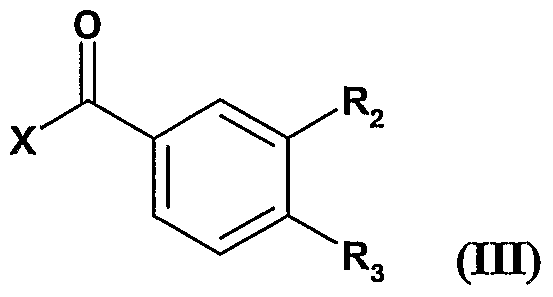
dans laquelle X représente un atome d'halogène et R2 et R3 représentent indépendamment l'un de l'autre un radical alcoxy de 1 à 5 atomes de carbone, un radical nitro ou un radical -COOR6, où R6 représente un radical alkyle de 1 à 5 atomes de carbone, pour obtenir :in which X represents a halogen atom and R 2 and R 3 represent, independently of one another, an alkoxy radical of 1 to 5 carbon atoms, a nitro radical or a radical -COOR 6 , where R 6 represents a alkyl radical of 1 to 5 carbon atoms, to obtain:
- les composés de formule Ia, qui sont des composés de formule I dans laquelle R2 ou R3 représente un radical nitro, oucompounds of formula Ia, which are compounds of formula I in which R 2 or R 3 represents a nitro radical, or
- les composés de formule Ib3 qui sont des composés de formule I dans laquelle R2 ou R3 représente un radical -COOR6, où R6 représente un radical alkyle de 1 à 5 atomes de carbone,the compounds of formula Ib 3 which are compounds of formula I in which R 2 or R 3 represents a radical -COOR 6 , where R 6 represents an alkyl radical of 1 to 5 carbon atoms,
et ensuite : a) on soumet les composés de formule Ia à une réaction de réduction pour obtenir les composés de formule Id :
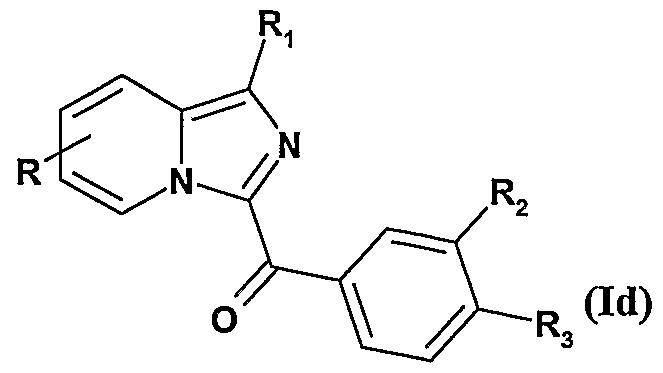
Composés de formule (T) où R2 ou R3 = NH2 dans laquelle R et R1 sont tels que définis pour le composé de formule Ia et R2 ou R3 représente un radical amino ;Compounds of formula (T) wherein R 2 or R 3 = NH 2 in which R and R 1 are as defined for the compound of formula Ia and R 2 or R 3 represents an amino radical;
les composés de formule Id peuvent ensuite être soumis à une réaction d'alkylation, d'acylation ou de sulfonylation pour obtenir les composés de formule Ig :the compounds of formula Id can then be subjected to an alkylation, acylation or sulphonylation reaction to obtain the compounds of formula Ig:

Composés de formule (I) où R2 ou R3 = NR4R5, NHCO-AIk, NHCO2-AIk ou NHSO2-AIkCompounds of formula (I) wherein R 2 or R 3 = NR 4 R 5 , NHCO-Alk, NHCO 2 -Alk or NHSO 2 -Alk
dans laquelle R et R1 sont tels que définis pour le composé de formule Id et R2 ou R3 représente un radical -NR4R5, -NHCOAUc, -NHCO2AlIc ou -NHSO2AIk ;in which R and R 1 are as defined for the compound of formula Id and R 2 or R 3 represents a radical -NR 4 R 5 , -NHCOAUc, -NHCO 2 AlIc or -NHSO 2 AIk;
b) ou on soumet les composés de formule Ib à une réaction de saponification pour obtenir les composés de formule Ie :b) or subjecting the compounds of formula Ib to a saponification reaction to obtain the compounds of formula Ie:

Composés de formule (T) où R2 ou R3 = CO2HCompounds of formula (T) where R 2 or R 3 = CO 2 H
dans laquelle R et R1 sont tels que définis pour le composé de formule Ib et R2 ou R3 représente un radical carboxy, les composés de formule Ie peuvent ensuite être soumis à une réaction de couplage après activation de la fonction carboxy avec par exemple le réactif BOP [hexafluorophosphate de benzotriazol-1-yloxytris (diméthylamino)phosρhonium] en présence d'une base telle que la triéthylamine, selon le mode opératoire décrit dans Tetrahedron Letters ; (1975), 14, 1219-1222, puis ajout d'une aminé de formule HNR4R5 ou de l'hydroxylamine pour obtenir les composés de formule Di :in which R and R 1 are as defined for the compound of formula Ib and R 2 or R 3 represents a carboxy radical, the compounds of formula Ie can then be subjected to a coupling reaction after activation of the carboxy function with, for example, the reagent BOP [benzotriazol-1-yloxytris (dimethylamino) phosphonium hexafluorophosphate] in the presence of a base such as triethylamine, according to the procedure described in Tetrahedron Letters; (1975), 14, 1219-1222, then adding an amine of formula HNR 4 R 5 or hydroxylamine to obtain the compounds of formula Di:
Composés de formule (I) où R2 ou R3 = CONR4R5 ou CONHOHCompounds of formula (I) wherein R 2 or R 3 = CONR 4 R 5 or CONHOH
dans laquelle R et R1 sont tels que définis pour les composés de formule Ie et R2 ou R3 représente un radical -CONR4R5 ou -CONHOH ;in which R and R 1 are as defined for the compounds of formula Ie and R 2 or R 3 represents a -CONR 4 R 5 or -CONHOH radical;
OUOR
B) on condense le composé de formule II tel que précédemment défini au point A) avec le composé de formule III' :B) the compound of formula II as previously defined in point A) is condensed with the compound of formula III ':

(HI')(III ')
dans laquelle X représente un atome d'halogène et R2' et R3' forment ensemble, avec les atomes de carbone du noyau phényle auquel ils sont rattachés, un cycle carboné à 6 chaînons, comportant un atome d'azote et un autre hétéroatome tel que l'oxygène,wherein X represents a halogen atom and R 2 'and R 3 ' together with the carbon atoms of the phenyl ring to which they are attached form a six-membered carbon ring having one nitrogen atom and another heteroatom such as oxygen,
pour obtenir les composés de formule Ic :
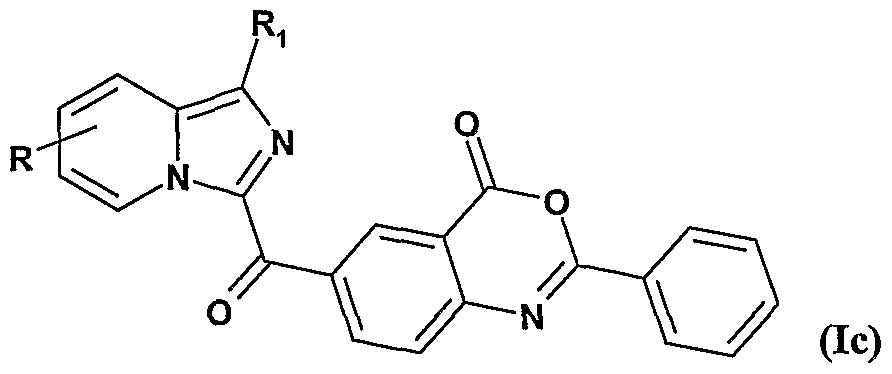
dans laquelle R et R1 sont tels que définis pour le composé de formule II,in which R and R 1 are as defined for the compound of formula II,
lesdits composés de formule Ic étant ensuite soumis à une réaction d'alcoolyse pour donner les composés de formule If qui suit :said compounds of formula Ic being then subjected to an alcoholysis reaction to give the compounds of formula If which follows:

les composés If peuvent ensuite être saponifiés pour obtenir les composés de formules Id ou Ie, dans lesquelles R et R1 sont tels que définis pour les composés de formule II, R2 représente un radical -COOH et R3 représente un radical -NH2 ;the compounds If may then be saponified to obtain the compounds of formula Id or Ie, in which R and R 1 are as defined for the compounds of formula II, R 2 represents a radical -COOH and R 3 represents a radical -NH 2 ;
OUOR
C) on soumet le composé de formule I dans lequel R1 représente un atome d'hydrogène, tel qu'obtenu précédemment au point A), à une réaction de bromation pour obtenir les composés de formule B. :C) subjecting the compound of formula I wherein R 1 represents a hydrogen atom, as obtained previously at point A), to a bromination reaction to obtain compounds of formula B:

dans laquelle R, R2 et R3 sont tels que définis pour le composé de formule I (lorsque R2 et R3 ne forment pas ensemble un hétéroaryle) et R1 représente un atome de brome, les composés de formule Ii pour lesquels R est différent d'un atome de brome ou d'un atome d'iode peuvent ensuite être soumis, en présence d'un catalyseur au palladium, d'un ligand et d'une base :in which R, R 2 and R 3 are as defined for the compound of formula I (when R 2 and R 3 together do not form a heteroaryl) and R 1 represents a bromine atom, the compounds of formula Ii for which R is different from a bromine atom or an iodine atom can then be subjected, in the presence of a palladium catalyst, to a ligand and a base:
a) soit à une réaction d'imination avec la benzophénone imine selon les conditions de réaction décrite dans Tetrahedron. ; (2003), 59(22), 3925-3936, suivie d'une réaction d'hydrolyse acide, pour obtenir les composés de formule Ij :a) either an imination reaction with benzophenone imine according to the reaction conditions described in Tetrahedron. ; (2003), 59 (22), 3925-3936, followed by an acid hydrolysis reaction, to obtain the compounds of formula Ij:

dans laquelle R, R2 et R3 sont tels que définis pour les composés de formule Ii et R1 représente un radical -NH2,in which R, R 2 and R 3 are as defined for compounds of formula Ii and R 1 represents an -NH 2 radical,
b) soit à une réaction de cyanation avec du cyanure de zinc selon les conditions de réaction décrite dans J Med. Chem. ; (2003), 46, 265-283, pour obtenir les composés de formule Ik:or (b) a cyanation reaction with zinc cyanide according to the reaction conditions described in J Med. Chem. ; (2003), 46, 265-283, to obtain the compounds of formula Ik:

dans laquelle R, R2 et R3 sont tels que définis pour les composés de formule Ii et R1 représente un radical -CN,in which R, R 2 and R 3 are as defined for compounds of formula Ii and R 1 represents a radical -CN,
- les composés de formule Ik peuvent ensuite être soumis à une réaction d'hydrolyse basique, afin d'obtenir les composés de formule Im :
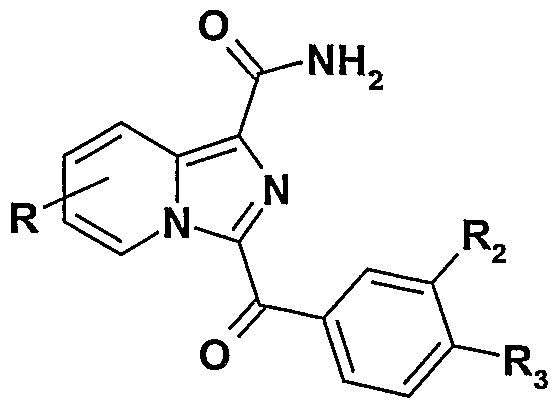
(Im)(Im)
dans laquelle R, R2 et R3 sont tels que définis pour les composés de formule Ik et R1 représente un radical -CONH2,in which R, R 2 and R 3 are as defined for the compounds of formula Ik and R 1 represents a -CONH 2 radical,
- ou bien encore, les composés de formule Ik sont soumis à une réaction de Pinner [The Chemistry of Amidines and ϋnidates ; Patai, S., Ed. ; J. Wiley and Sons : New York, (1975) ; 385-489] avec un alcool primaire tel que le méthanol ou l'éthanol en présence de gaz chlorhydrique pour conduire à l'imidoester correspondant, qui par hydrolyse acide conduit aux composés de formule In :or alternatively, the compounds of formula Ik are subjected to a Pinner reaction [The Chemistry of Amidines and ϋnidates; Patai, S., Ed .; J. Wiley and Sons: New York, (1975); 385-489] with a primary alcohol such as methanol or ethanol in the presence of hydrochloric gas to give the corresponding imidoester, which by acid hydrolysis leads to the compounds of formula In:

(In)(In)
dans laquelle R, R2 et R3 sont tels que définis pour les composés de formule Ik et R1 représente un radical -CO2AUc,in which R, R 2 and R 3 are as defined for compounds of formula Ik and R 1 represents a radical -CO 2 AUc,
les composés de formule In pouvant eux-même être soumis à une réaction de saponification pour obtenir les composés de formule Io :the compounds of formula In which can themselves be subjected to a saponification reaction to obtain the compounds of formula Io:
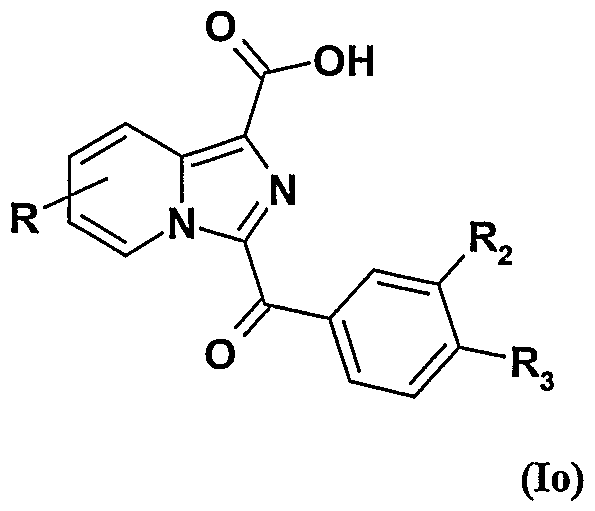
c) soit à une réaction de Suzuki selon les conditions décrites dans Synth. Commun. ; (1981), Vol. 11, p513 avec des dérivés phénylboroniques ou hétéroarylboroniques pour obtenir les composés de formule Is :or c) to a Suzuki reaction according to the conditions described in Synth. Common. ; (1981), Vol. 11, p513 with phenylboronic or heteroarylboronic derivatives to obtain the compounds of formula Is:
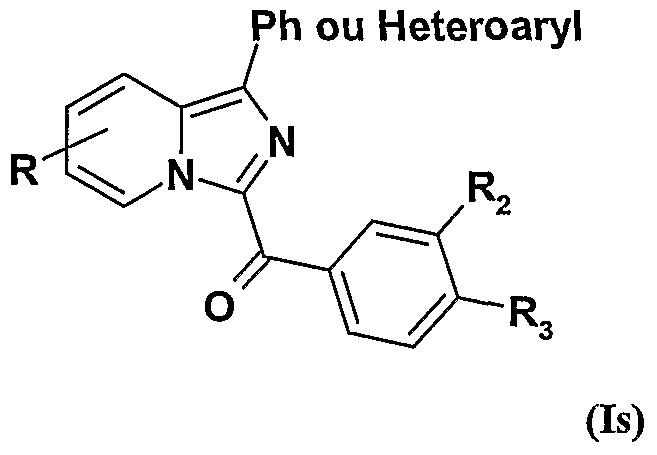
dans laquelle R, R2 et R3 sont tels que définis pour le composé de formule Ii et R1 représente un radical phényle substitué ou un hétéroaryle à 5 ou 6 chainons éventuellement substitué ;wherein R, R 2 and R 3 are as defined for the compound of formula Ii and R 1 represents a substituted phenyl radical or an optionally substituted 5- or 6-membered heteroaryl;
OUOR
D) on soumet les composés de formule Ij dans lequel R1 représente un radical amino à une réaction d'acylation ou de sulfonylation, pour obtenir les composés de formule Ip :D) the compounds of formula Ij in which R 1 represents an amino radical are subjected to an acylation or sulfonylation reaction, to obtain the compounds of formula Ip:

Composés de formule (I) où R1= NHCO-AIk, NHCO-Ph, NHCOCF3, NHCO2-AIk ou NHSO2-AIkCompounds of formula (I) wherein R 1 = NHCO-Alk, NHCO-Ph, NHCOCF 3 , NHCO 2 -Alk or NHSO 2 -Alk
dans laquelle R, R2 et R3 sont tels que définis pour les composés de formule Ij et R1 représente un radical -NHCOAIk, -NHCO2AIk, -NHSO2AIk, -NHCOPh ou -NHCOCF3, dans lesquels AIk et Ph sont tels que définis pour le composé de formule I,in which R, R 2 and R 3 are as defined for the compounds of formula Ij and R 1 represents a radical -NHCOAlk, -NHCO 2 Alk, -NHSO 2 Alk, -NHCOPh or -NHCOCF 3 , in which Alk and Ph are as defined for the compound of formula I,
les composés de formule Ip dans laquelle R1 représente un radical -NHCOCF3 pouvant eux-mêmes être soumis à une réaction d'alkylation puis de déprotection, éventuellement suivie d'une autre réaction d'alkylation, pour obtenir les composés de formule Iq :the compounds of formula Ip in which R 1 represents an -NHCOCF 3 radical which can themselves be subjected to an alkylation reaction and then to deprotection, optionally followed by another alkylation reaction, to obtain the compounds of formula Iq:

(iq)(Ic)
dans laquelle R, R2, R3 sont tels que définis pour les composés de formule Ij et R4 et R5 sont tels que définis pour le composé de formule I ;wherein R, R 2 , R 3 are as defined for compounds of formula Ij and R 4 and R 5 are as defined for the compound of formula I;
OUOR
E) on soumet les composés de formule Ir, dans laquelle R représente un radical -CO2R6 et R6 représente un radical AIk, tels qu'obtenus précédemment au point A) (à savoir par acylation des composés de formule (II), où R = -COOAIk, avec les composés de formule (HI)), à une réaction d'hydrolyse acide ou basique pour obtenir les composés de formule It :E) the compounds of formula Ir, in which R represents a radical -CO 2 R 6 and R 6 represents a radical AIk, as obtained previously in point A) (ie by acylation of the compounds of formula (II) where R = -COOAlk, with the compounds of formula (HI)), to an acidic or basic hydrolysis reaction to obtain compounds of formula It:

dans laquelle R1, R2, R3 sont tels que définis pour les composés de formule Ir et R représente un radical -COOH,in which R 1 , R 2 , R 3 are as defined for compounds of formula Ir and R represents a radical -COOH,
les composés de formule It peuvent ensuite être soumis :the compounds of formula It can then be subjected:
a) soit à une réaction de couplage après activation de la fonction carboxy avec par exemple le réactif BOP [hexafluorophosphate de benzotriazol-1-yloxytrisa) either a coupling reaction after activation of the carboxy function with, for example, the reagent BOP [benzotriazol-1-yloxytris hexafluorophosphate]
(diméthylamino)phosphonium] en présence d'une base telle que la triéthylamine selon le mode opératoire décrit dans Tetrahedron Letters ; (1975), 14, 1219-1222, puis ajout d'une aminé de formule HNR4R5 ou d'une aminé de formule H2N-CH(R7)-(CH2)m-COOR6 où R6 représente un radical AIk, pour obtenir les composés de formule Iu :(dimethylamino) phosphonium] in the presence of a base such as triethylamine according to the procedure described in Tetrahedron Letters; (1975), 14, 1219-1222, and then added a an amine of formula HNR 4 R 5 or of an amine of formula H 2 N-CH (R 7 ) - (CH 2 ) m -COOR 6 in which R 6 represents an Alk radical, to obtain the compounds of formula Iu:

Composés de formule (I) où R= CONR4R5 ou CONH-CH(R7MCH2)In-CO2R6 dans laquelle R1, R2, R3 sont tels que définis pour les composés de formule It,Compounds of formula (I) wherein R = CONR 4 R 5 or CONH-CH (R 7 MCH 2 ) In-CO 2 R 6 in which R 1 , R 2 and R 3 are as defined for compounds of formula It,
et lorsque R est un radical -CONH-CH(R7)-(CH2)m-COOR6, où R5 représente un radical AIk tel que défini pour les composés de formule I, ces composés peuvent être saponifiés pour obtenir les composés de formule Iu où R est un radical -CONH-CH(R7)- (CH2)m-COORô, où R6 représente un atome d'hydrogène et R1, R2, R3 sont tels que définis précédemment,and when R is a -CONH-CH (R 7 ) - (CH 2 ) m -COOR 6 radical, where R 5 represents an Alk radical as defined for the compounds of formula I, these compounds may be saponified to obtain the compounds of formula Iu where R is a radical -CONH-CH (R 7 ) - (CH 2 ) m -COOR 6 , where R 6 represents a hydrogen atom and R 1 , R 2 and R 3 are as defined previously,
b) soit être soumis à un réarrangement de Curtius selon le mode opératoire décrit dans Synthesis ; (1990), 295-299 par action de diphénylphosphorylazide en présence de triéthylamine à reflux dans un solvant inerte tel que le toluène puis ajout d'un alcool de formule AIk-OH pour obtenir les composés de formule Iv :b) be subjected to a Curtius rearrangement according to the procedure described in Synthesis; (1990), 295-299 by the action of diphenylphosphorylazide in the presence of triethylamine under reflux in an inert solvent such as toluene and then adding an alcohol of formula AIk-OH to obtain the compounds of formula IV:
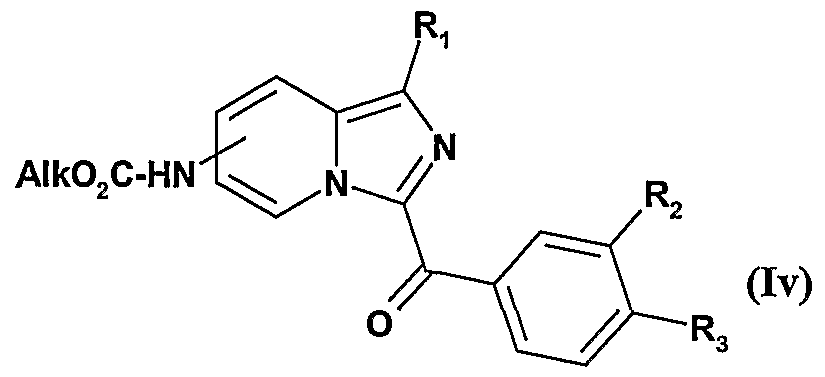
dans laquelle R1, R2, R3 sont tels que définis pour les composés de formule It et R représente un radical -NHCO2AIk,in which R 1 , R 2 , R 3 are as defined for compounds of formula It and R represents an -NHCO 2 Alk radical,
les composés de formule Iv dans lesquels R représente un radical -NH-CO2-AIk, où AIk représente un radical -tBu, peuvent ensuite conduire aux composés de formule Iw, dans laquelle R1, R2, R3, R41R5 sont tels que définis pour le composé de formule I :
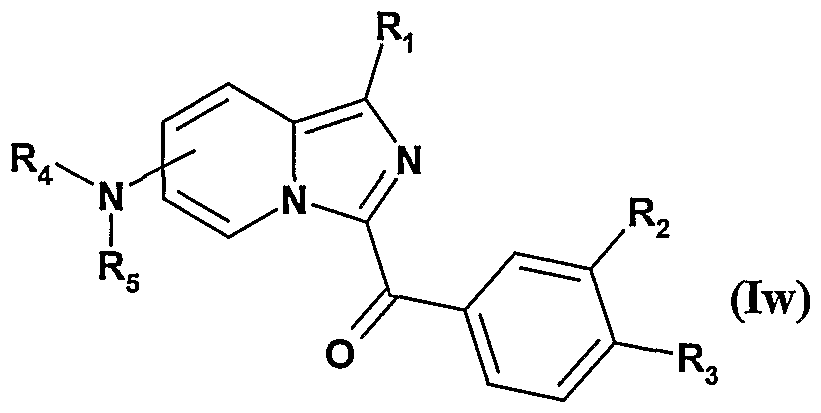
- par déprotection en milieu acide on obtient les composés de formule Iw où R représente un radical -NH2,by deprotection in an acid medium, the compounds of formula Iw where R represents an -NH 2 radical,
- par alkylation suivi d'une déprotection et d'une éventuelle deuxième alkylation on peut obtenir les composés de formule Iw où R représente un radical -NR4R5,by alkylation followed by deprotection and a possible second alkylation, the compounds of formula Iw where R represents a radical -NR 4 R 5 can be obtained,
les composés de formule Iw où R représente un radical -NH2 peuvent ensuite être soit acylés, soit sulfonylés, pour obtenir les composés de formule Ix :the compounds of formula Iw where R represents an -NH 2 radical can then be either acylated or sulphonylated, to obtain the compounds of formula Ix:

OUOR
F) on soumet les composés de formule Iy :F) the compounds of formula Iy are subjected to:

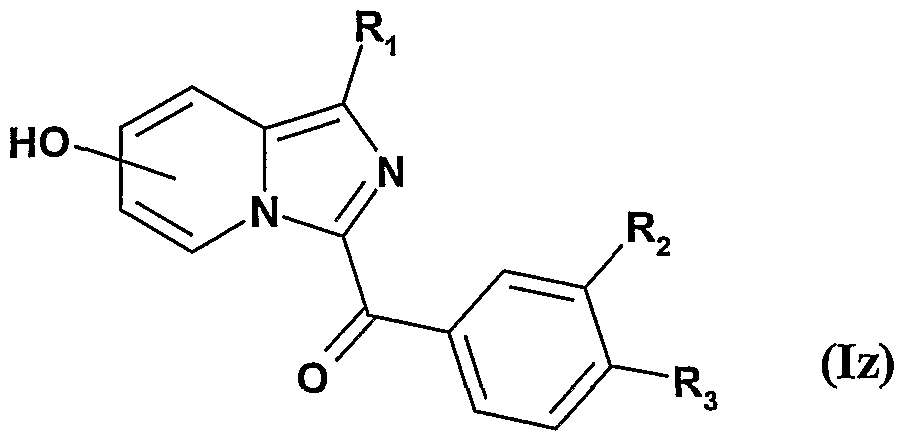
dans laquelle R1, R2 et R3 sont tels que définis pour les composés de formule Iy et R représente un radical hydroxy, et lorsque R2 ou R3 représente une fonction nitro on obtient les composés de formule Id dans laquelle R2 ou R3 représente un radical NH2 et R1 est tel que défini dans les composés de formule I,in which R 1 , R 2 and R 3 are as defined for the compounds of formula Iy and R represents a hydroxyl radical, and when R 2 or R 3 represents a nitro function, compounds of formula Id in which R 2 or R 3 represents an NH 2 radical and R 1 is as defined in the compounds of formula I,
les composés de formule Iz peuvent ensuite être soumis à une réaction de O-alkylation sélective par action à température ambiante d'un halogénure d'alkyle dans un solvant polaire tel que le diméthylformamide, en présence d'un carbonate alcalin, pour obtenir les composés de formule Iz'the compounds of formula Iz can then be subjected to a selective O-alkylation reaction by action at ambient temperature of an alkyl halide in a polar solvent such as dimethylformamide, in the presence of an alkaline carbonate, to obtain the compounds Iz 'formula

Composé de formule I où : R = O-Alk, O-CCH^-Ph, Q-AIk-NR4R5 ou Q-AIk-CO2R6 A compound of formula I wherein: R = O-Alk, O-CCH 3 -Ph, Q-Alk-NR 4 R 5 or Q-Alk-CO 2 R 6
dans laquelle R1, R2, R3 sont tels que définis pour les composés de formule Iz ,wherein R 1 , R 2 , R 3 are as defined for compounds of formula Iz,
et lorsque R est un radical -0-AIk-COOR6, où R6 représente un radical AIk tel que défini pour les composés de formule I, ces composés peuvent être saponifiés pour obtenir les composés de formule Iz' où R est un radical -0-AlIc-COOR6, où R6 représente un atome d'hydrogène et R1, R2, R3 sont tels que définis précédemment. L'Homme du métier saura utiliser les différentes réactions telles que décrites précédemment et illustrées dans les schémas 1 à 6 qui suivent, pour obtenir le composé de formule I en tenant compte des différents radicaux situés sur la molécule et susceptibles de réagir.and when R is an -O-Alk-COOR 6 radical, where R 6 represents an Alk radical as defined for the compounds of formula I, these compounds may be saponified to obtain the compounds of formula I 'where R is a radical - 0-AlIc-COOR 6 , where R 6 represents a hydrogen atom and R 1 , R 2 , R 3 are as defined above. Those skilled in the art will know how to use the various reactions as described above and illustrated in the following diagrams 1 to 6, to obtain the compound of formula I taking into account the different radicals located on the molecule and capable of reacting.
Dans les schémas 1 à 6, les composés de départ et les réactifs, quand leur mode de préparation n'est pas décrit, sont disponibles dans le commerce ou décrits dans la littérature, ou bien peuvent être préparés selon des méthodes qui y sont décrites ou qui sont connues de l'Homme du métier.In Schemes 1 to 6, the starting compounds and reagents, when their method of preparation is not described, are commercially available or described in the literature, or may be prepared according to methods described therein or which are known to those skilled in the art.
Les différentes alternatives A, B, C, D, E ou F précédemment décrites sont représentées respectivement par les schémas 1, 2, 3, 4, 5 et 6 qui suivent. The various alternatives A, B, C, D, E or F previously described are represented respectively by diagrams 1, 2, 3, 4, 5 and 6 which follow.
Schéma 1Diagram 1
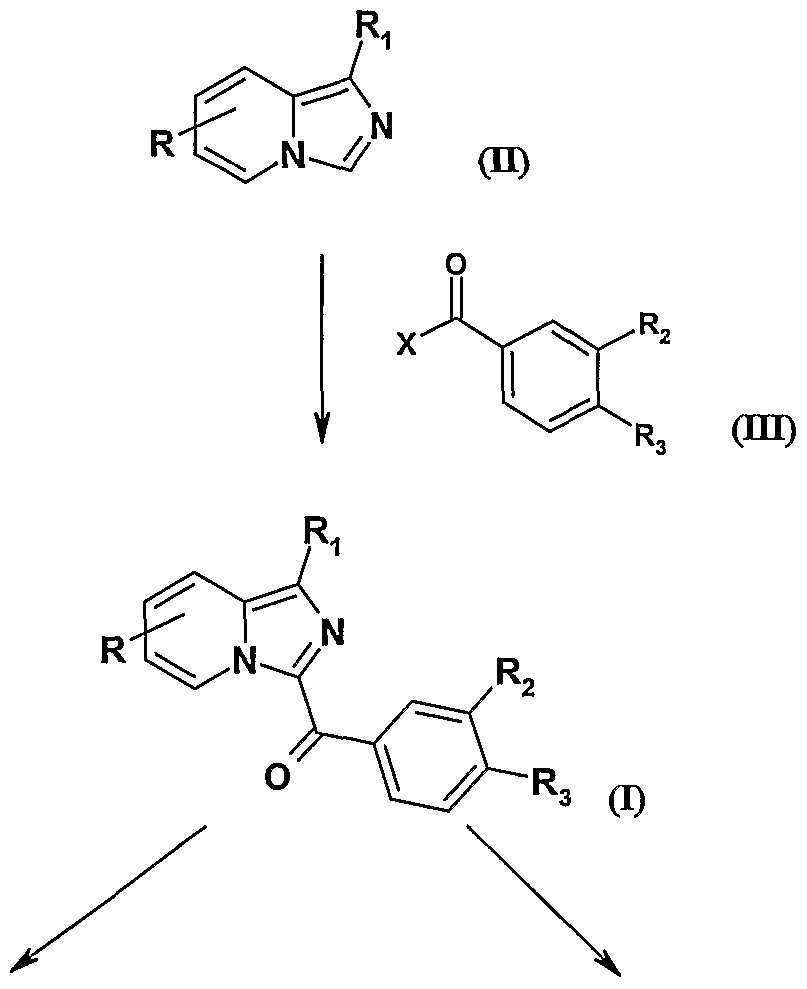
Composé de formule (Ta) : Composé de formule (Ib) :Compound of formula (Ta): Compound of formula (Ib):
Composé de formule (T) où Composé de formule (T) oùCompound of formula (T) wherein Compound of formula (T) where
R2 ou R3 = -NO2 R2 ou R3 = -CO2R6 avec R6 = AIkR 2 or R 3 = -NO 2 R 2 or R 3 = -CO 2 R 6 with R 6 = AIk
REDUCTIONREDUCTION
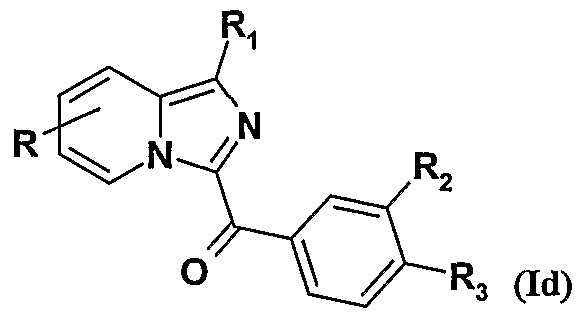

Composé de formule (I) où : Composé de formule (I) où : R2 ou R3 = -NH2 R2 ou R3 = -CO2R6 avec R6 = HCompound of formula (I) wherein: Compound of formula (I) wherein: R 2 or R 3 = -NH 2 R 2 or R 3 = -CO 2 R 6 with R 6 = H
ALKYLATION ou ACYLATION COUPLAGE ou SULFONYLATIONALKYLATION or ACYLATION COUPLING or SULFONYLATION

Composé de formule I où : Composé de formule I où :A compound of formula I wherein: A compound of formula I wherein:
R2 ou R3 = -NR4R5 , -NHCOAIk , R2 ou R3 = -CONR4R5 ou -CONHOHR 2 or R 3 = -NR 4 R 5 , -NHCOAlk, R 2 or R 3 = -CONR 4 R 5 or -CONHOH
NHCO2AIk ou NHSO2AIk Schéma 2NHCO 2 AIk or NHSO 2 AIk Figure 2
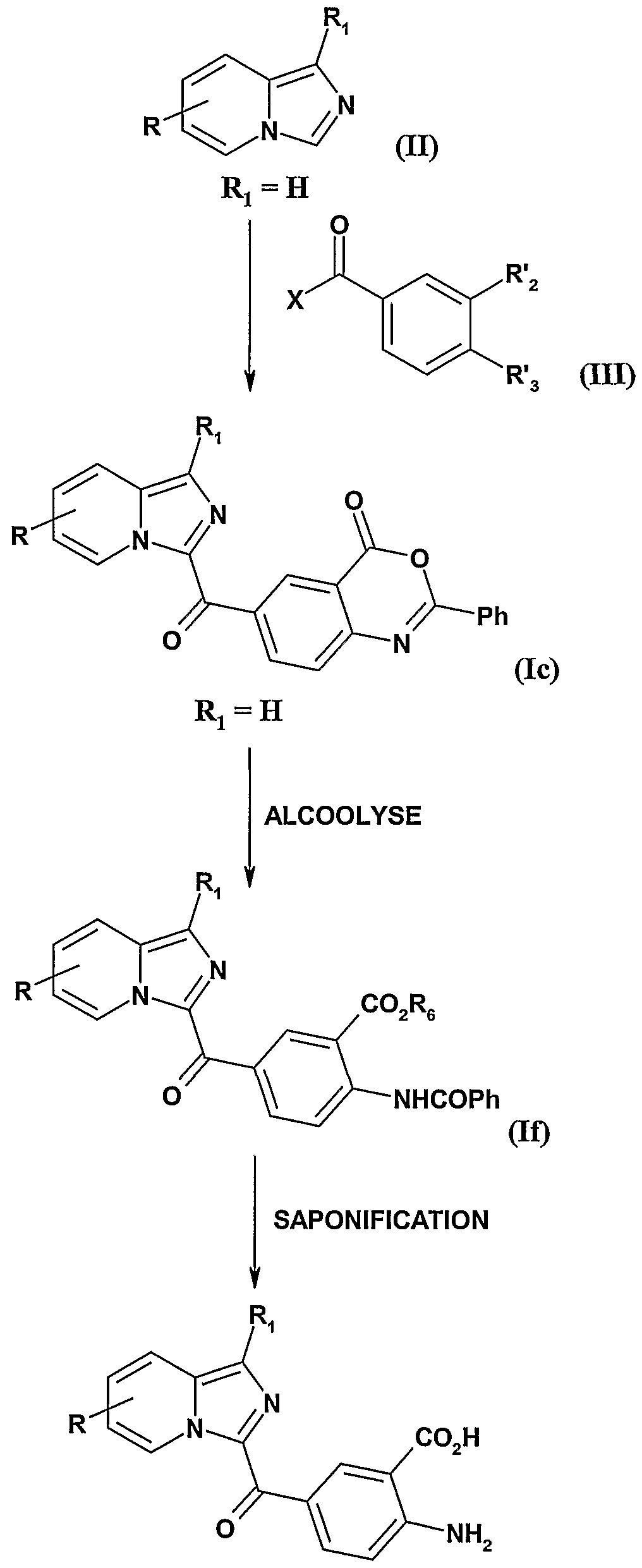
Composés de formule (Id) ou (Ie) où R2=CO2HCtR3=NH2 Schéma 3Compounds of formula (Id) or (Ie) where R 2 = CO 2 HCtR 3 = NH 2 Figure 3

Composé de formule I où :Compound of formula I wherein:
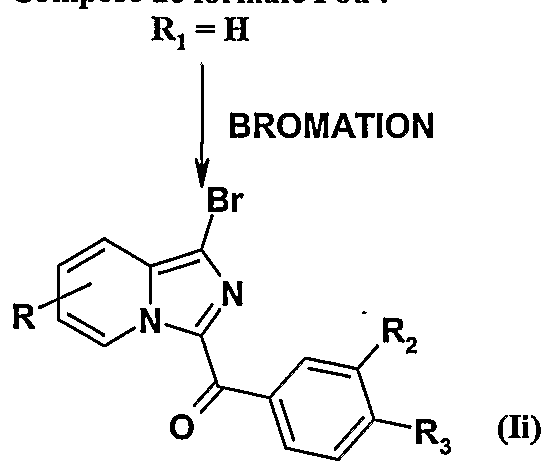
Composé de formule I où :Compound of formula I wherein:
II

Composé de formule I où : Composé de formule I où : Composé de formule I où : R1 = NH2 R1 = CN R1 = Ph ou HétéroarylA compound of formula I wherein: A compound of formula I wherein: A compound of formula I wherein R 1 = NH 2 R 1 = CN R 1 = Ph or Heteroaryl
: AIk: AIk

Composé de formule I où : R1 = CO2R6 SVeC R6 = H Schéma 4Compound of formula I wherein: R 1 = CO 2 R 6 SVeC R 6 = H Figure 4

Composé de formule I où : R1 = NH2 A compound of formula I wherein: R 1 = NH 2
ACYLATION ou SULFONYLATIONACYLATION or SULFONYLATION

Composé de formule I où : R1 = NHCOAIk, NHCOPh, NHCOCF3 , NHCO2Alk ou NHSO2AIRA compound of formula I wherein: R 1 = NHCOAlk, NHCOPh, NHCOCF 3 , NHCO2Alk or NHSO2AIR
quand R1 = NHCOCF3 when R 1 = NHCOCF 3
ALKYLATION puis DEPROTECTION suivi éventuellement d'une 2ème ALKYLATIONALKYLATION then DEPROTECTION followed by a second ALKYLATION

Composé de formule I où : R1 = NR4R5 Schéma 5Compound of formula I wherein: R 1 = NR 4 R 5 Figure 5

Composés de formule (I) où R = CO2R6 avec R6 = HCompounds of formula (I) where R = CO 2 R 6 with R 6 = H

Composés de formule (I) où Composés de formule (I) où R = CONR4R5 ou CONH-CH(R7MCH2)In-CO2R6 Compounds of formula (I) wherein Compounds of formula (I) wherein R = CONR 4 R 5 or CONH-CH (R 7 MCH 2 ) In-CO 2 R 6
et 24mo and 2 4mo
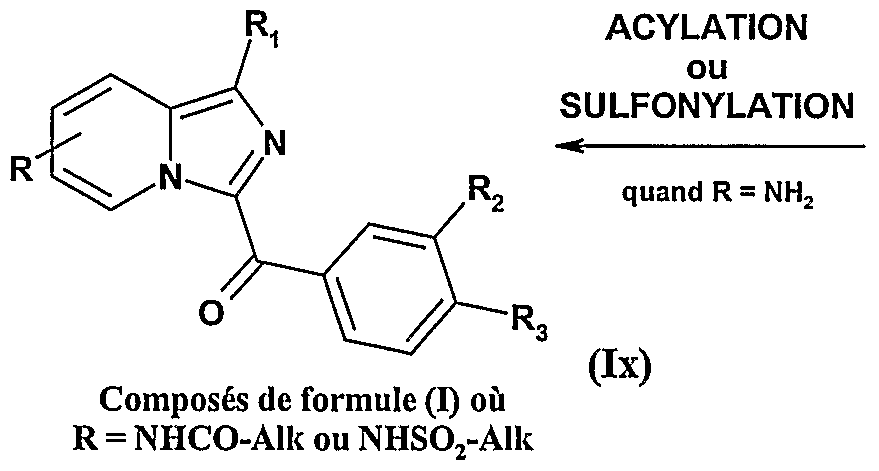


Composé de formule I où R = OBnCompound of formula I wherein R = OBn
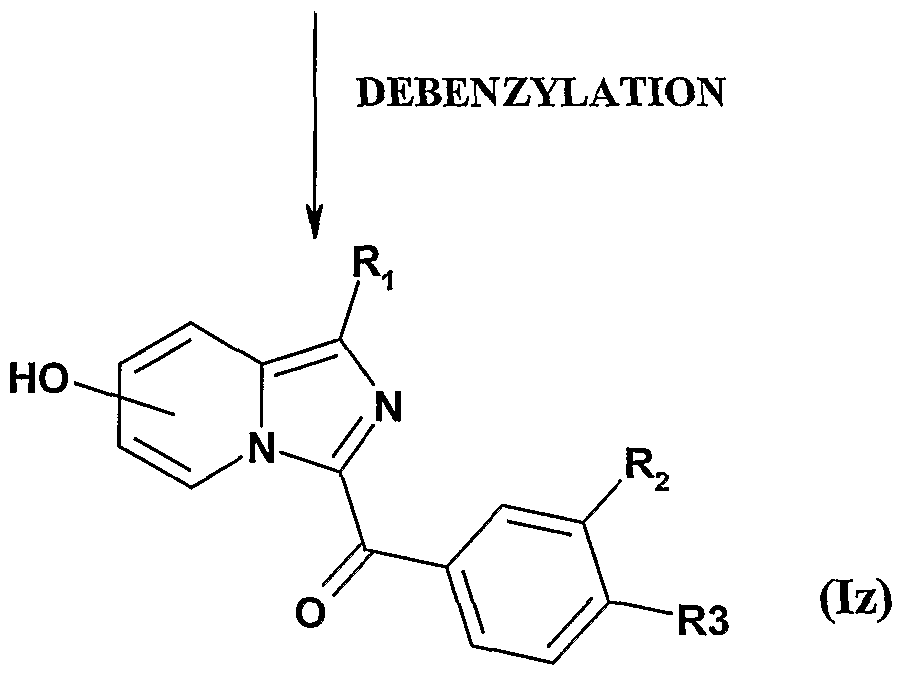
Composé de formule I où : R = OHCompound of formula I where: R = OH
O-ALKYLATIONO-ALKYLATION
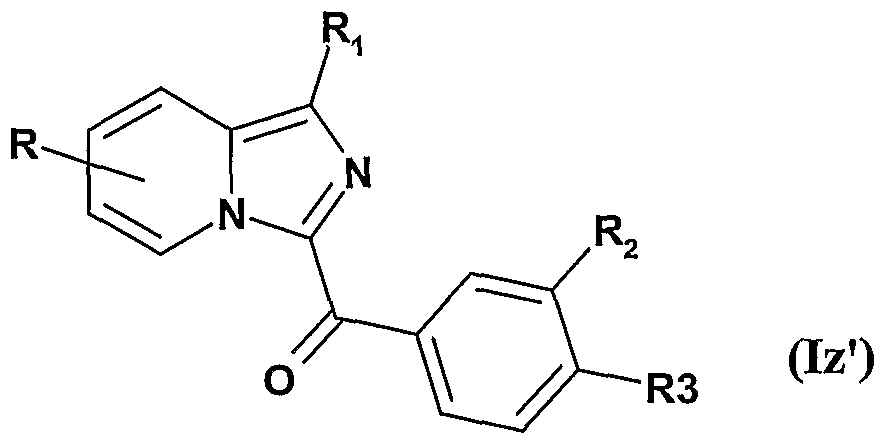
Composé de formule I où : R = O-AIk, O-(CH2)n-Ph, Q-AIk-NR4R5 ou 0-AIk-CO2R6 Les composés de formule II, notamment lorsque R1 = H, sont obtenus par des méthodes connues dans la littérature à partir des 2-aminométhylpyridines convenablement substituées, selon le schéma réactionnel suivant, décrit dans J Client. Soc. ; (1955), 2834- 2836 :A compound of formula I wherein R = O-Alk, O- (CH 2 ) n -Ph, Q-Alk-NR 4 R 5 or O-Alk-CO 2 R 6 The compounds of formula II, especially when R 1 = H, are obtained by methods known in the literature from 2-aminomethylpyridines suitably substituted, according to the following reaction scheme, described in J Client. Soc. ; (1955), 2834-2836:
FORMYLATION CYCLISATION


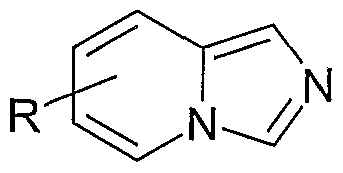
On peut aussi citer trois demandes de brevets décrivant la synthèse d'imidazo[l,5- a]pyridines : WO 03/070732, WO 04/064836 et WO 04/046133There may also be mentioned three patent applications describing the synthesis of imidazo [1,5-a] pyridines: WO 03/070732, WO 04/064836 and WO 04/046133
Les composés de formule III dans laquelle R2 et R3, identiques ou différents, ont les mêmes définitions que pour les composés de formule Ia ou Ib et X représente un atome de chlore sont obtenus par action du chlorure de thionyle sur les acides benzoïques correspondants, qui sont commerciaux ou décrits dans la littérature.The compounds of formula III in which R 2 and R 3 , which are identical or different, have the same definitions as for the compounds of formula Ia or Ib and X represents a chlorine atom are obtained by the action of thionyl chloride on the corresponding benzoic acids , which are commercial or described in the literature.
Les composés de formule III' dans laquelle R2 et R3 forment ensemble, avec les atomes de carbone du noyau phényle auquel ils sont rattachés, un cycle carboné à 6 chaînons comportant un atome d'azote et un autre hétéroatome tel que l'oxygène et X représente un atome de chlore, peuvent être obtenus par action du chlorure de thionyle sur les acides correspondants décrits dans la littérature. On peut citer par exemple l'acide 4-oxo-2-phényl- 4H-3,l-benzoxazine-6-carboxyrique, préparé selon la méthode décrite dans le brevet français FR2333511, qui par traitement avec le chlorure de thionyle conduit au chlorure d'acide correspondant, lequel est utilisé pour acyler les composés de formule II et donner les composés de formule Ic.The compounds of formula III 'in which R 2 and R 3 together with the carbon atoms of the phenyl ring to which they are attached form a six-membered carbon ring containing a nitrogen atom and another heteroatom such as oxygen and X represents a chlorine atom, can be obtained by the action of thionyl chloride on the corresponding acids described in the literature. There may be mentioned, for example, 4-oxo-2-phenyl-4H-3,1-benzoxazine-6-carboxylic acid, prepared according to the method described in French Patent FR 2,333,311, which, by treatment with thionyl chloride, leads to chloride. corresponding acid, which is used to acylate the compounds of formula II and give the compounds of formula Ic.
Les composés de la formule I selon la présente invention sont des antagonistes puissants de FGF-I et -2. Leurs capacités d'inhiber à la fois la formation de nouveaux vaisseaux à partir de cellules endothéliales différenciées et de bloquer la différentiation de cellules de moelle osseuse humaine adulte CD34+ CD 133+ en cellules endothéliales ont été démontrées in vitro. De plus, leur capacité à inhiber l'angiogénèse pathologique a été démontrée in vivo. Par ailleurs, il a été démontré que les composés de formule I sont des antagonistes puissants du récepteur FGF-I.The compounds of formula I according to the present invention are potent antagonists of FGF-I and -2. Their abilities to inhibit both the formation of new vessels from differentiated endothelial cells and to block the differentiation of adult human CD34 + CD 133+ bone marrow cells into endothelial cells have been demonstrated in vitro. In addition, their ability to inhibit pathological angiogenesis has been demonstrated in vivo. Moreover, it has been demonstrated that the compounds of formula I are potent antagonists of the FGF-I receptor.
De manière générale, les récepteurs FGFs sont impliqués de façon importante par l'intermédiaire de sécrétions autocrines, paracrines ou juxtacrines dans les phénomènes de dérégulation de la stimulation de la croissance des cellules cancéreuses. De plus, les récepteurs FGFs affectent l'angiogénèse tumorale qui joue un rôle prépondérant à la fois sur la croissance de la tumeur mais aussi sur les phénomènes de métastasisation.In general, FGF receptors are significantly involved via autocrine, paracrine or juxtacrine secretions in Deregulation of the stimulation of the growth of cancer cells. In addition, FGF receptors affect tumor angiogenesis, which plays a major role in both tumor growth and metastasizing phenomena.
L'angiogénèse est un processus de génération de nouveaux vaisseaux capillaires à partir de vaisseaux préexistants ou par mobilisation et différentiation de cellules de la moelle osseuse. Ainsi, à la fois une prolifération incontrôlée des cellules endothéliales et une mobilisation d'angioblastes à partir de la moelle osseuse sont observées dans les processus de néo-vascularisation des tumeurs. Il a été montré in vitro et in vivo que plusieurs facteurs de croissance stimulent la prolifération endothéliale, et notamment le récepteur FGF-I ou a- FGF et le récepteur FGF-2 ou b-FGF. Ces deux facteurs induisent la prolifération, la migration et la production de protéases par les cellules endothéliales en culture et la néo- vascularisation in vivo. Les récepteurs a-FGF et b-FGF interagissent avec les cellules endothéliales par l'intermédiaire de deux classes de récepteurs, les récepteurs de haute affinité à activité tyrosine kinase (FGFs) et les récepteurs de basse affinité de type héparane sulfate protéoglycane (HSPGs) situés à la surface des cellules et dans les matrices extracellulaires. Alors que le rôle paracrine de ces deux facteurs sur les cellules endothéliales est largement décrit, les a-FGF et b-FGF pourraient également intervenir sur ces cellules à travers un processus autocrine. Ainsi, les a-FGF et b-FGF et leurs récepteurs représentent des cibles très pertinentes pour les thérapies visant à inhiber les processus d'angiogénèse (Keshet E, Ben-Sasson SA.,. J. Clin. Invest, (1999), vol. 501, pplO4-1497 ; Presta M, Rusnati M, Dell'Era P, Tanghetti E, Urbinati C, Giuliani R et al, New York: Plénum Publishers, (2000), pp7-34, Billottet C, Janji B, Thiery J.P., Jouanneau J, Oncogene, (2002) vol. 21, pp8128-8139).Angiogenesis is a process of generating new capillaries from preexisting vessels or by mobilizing and differentiating bone marrow cells. Thus, both uncontrolled proliferation of endothelial cells and mobilization of angioblasts from the bone marrow are observed in neovascularization processes of tumors. It has been shown in vitro and in vivo that several growth factors stimulate endothelial proliferation, and in particular the FGF-I or α-FGF receptor and the FGF-2 or b-FGF receptor. Both of these factors induce proliferation, migration and production of proteases by endothelial cells in culture and neovascularization in vivo. Α-FGF and b-FGF receptors interact with endothelial cells via two classes of receptors, high affinity receptors with tyrosine kinase activity (FGFs) and low affinity heparan sulfate proteoglycan (HSPGs) receptors. located on the surface of cells and in extracellular matrices. While the paracrine role of these two factors on endothelial cells is widely described, a-FGF and b-FGF could also intervene on these cells through an autocrine process. Thus, α-FGF and β-FGF and their receptors represent highly relevant targets for therapies aimed at inhibiting angiogenesis processes (Keshet E, Ben-Sasson SA, J. Clin Invest, (1999), 501, pplO4-1497, Presta M, Rusnati M, Dell'Era P, Tanghetti E, Urbinati C, Giuliani R et al, New York: Plenum Publishers, (2000), pp7-34, Billottet C, Janji B, Thiery JP, Jouanneau J, Oncogene, (2002) 21, pp8128-8139).
Par ailleurs, des études systématiques visant à déterminer l'expression due aux a-FGF et b-FGF et de leurs récepteurs (FGFs) sur différents types de cellules tumorales mettent en évidence qu'une réponse cellulaire à ces deux facteurs est fonctionnelle dans une grande majorité de lignées tumorales humaines étudiées. Ces résultats supportent l'hypothèse qu'un antagoniste des a-FGF et b-FGF pourrait également inhiber la prolifération des cellules tumorales (Chandler LA, Sosnowski BA, Greenlees L, Aukerman SL, Baird A, Pierce GF., Int.J.Cancer, (1999), vol. 58, pp81-451).In addition, systematic studies to determine the expression due to α-FGF and b-FGF and their receptors (FGFs) on different types of tumor cells demonstrate that a cellular response to these two factors is functional in a vast majority of human tumor lines studied. These results support the hypothesis that an α-FGF and β-FGF antagonist could also inhibit the proliferation of tumor cells (Chandler LA, Sosnowski BA, Greenlees L, Aukerman SL, Baird A, Pierce GF., Int.J. Cancer, (1999), Vol 58, pp81-451).
Les a-FGF et b-FGF jouent un rôle important dans la croissance et le maintien des cellules de la prostate. Il a été montré à la fois dans des modèles animaux et chez l'homme qu'une altération de la réponse cellulaire à ces facteurs joue un rôle primordial dans la progression du cancer de la prostate. En effet dans ces pathologies on enregistre à la fois une augmentation de la production des a-FGF et b-FGF par les fibroblastes et les cellules endothéliales présentes au niveau de la tumeur et une augmentation de l'expression des récepteurs FGFs sur les cellules tumorales. Ainsi une stimulation paracrine des cellules cancéreuses de la prostate s'opère, et ce processus serait un composant majeur de cette pathologie. Un composé possédant une activité antagoniste des récepteurs FGFs tels que les composés de la présente invention peut représenter une thérapie de choix dans ces pathologies (Giri D, Ropiquet F., Clin.Cancer Res., (1999), vol. 71, ρp5-1063 ; DoIl JA, Reiher FK, Crawford SE, Pins MR, Campbell SC, Bouck NP., Prostate, (2001), vol. 305, pp 49-293).A-FGF and b-FGF play an important role in the growth and maintenance of prostate cells. It has been shown both in animal models and in humans that an alteration of the cellular response to these factors plays a key role in the progression of prostate cancer. Indeed, in these pathologies one records at the same time a increased production of α-FGF and β-FGF by fibroblasts and endothelial cells present in the tumor and increased expression of FGF receptors on tumor cells. Thus a paracrine stimulation of the prostate cancer cells takes place, and this process would be a major component of this pathology. A compound having FGF receptor antagonist activity such as the compounds of the present invention may be a therapy of choice in these pathologies (Giri D, Ropiquet F., Clin.Cancer Res., (1999), 71, ρp5- 1063; DoIl JA, Reiher FK, Crawford SE, MR Pins, Campbell SC, Bouck NP., Prostate, (2001), vol 305, pp 49-293).
Plusieurs travaux montrent la présence de a-FGF et b-FGF et de leurs récepteurs FGFRs à la fois dans les lignées tumorales humaines du sein (notamment MCF7) et dans des biopsies de tumeurs. Ces facteurs seraient responsables dans cette pathologie de l'apparition de phénotype très agressif et induisant une forte métastasisation. Ainsi un composé possédant une activité antagoniste des récepteurs FGFRs, comme les composés de la formule I, peut représenter une thérapie de choix dans ces pathologies (Vercoutter-Edouart A-S, Czeszak X, Crépin M, Lemoine J, Boilly B, Le Bourhis X et al, Exp.Cell Res., (2001), vol. 262, pp59-68).Several studies show the presence of α-FGF and β-FGF and their FGFR receptors in both human breast tumor lines (including MCF7) and in tumor biopsies. These factors would be responsible in this pathology of the appearance of very aggressive phenotype and inducing a strong metastasization. Thus a compound having an FGFR receptor antagonistic activity, such as the compounds of formula I, may represent a therapy of choice in these pathologies (Vercoutter-Edouart AS, Czeszak X, Crépin M, Lemoine J, Boilly B, Bourhis X and al, Exp.Cell Res., (2001), 262, pp59-68).
Les mélanomes cancéreux sont des tumeurs qui induisent avec une fréquence importante des métastases et qui sont très résistantes aux différents traitements de chimiothérapie. Les processus d'angio genèse joue un rôle prépondérant dans la progression d'un mélanome cancéreux. De plus, il a été montré que la probabilité d'apparition de métastases augmente très fortement avec l'augmentation de la vascularisation de la tumeur primaire. Les cellules de mélanomes produisent et sécrètent différents facteurs angiogéniques dont le a-FGF et le b-FGF. Par ailleurs, il a été montré qu'une inhibition de l'effet cellulaire de ces deux facteurs par le RÉCEPTEUR FGF-I soluble bloque in vitro la prolifération et la survie des cellules tumorales de mélanome et bloque in vivo la progression tumorale. Ainsi un composé possédant une activité antagoniste des récepteurs FGFs comme les composés de la présente invention peut représenter une thérapie de choix dans ces pathologies (Rofstad EK, Halsor EF., Cancer Res., (2000) ; Yayon A, Ma Y-S, Safran M, Klagsbrun M, Halaban R., Oncogene, (1997), vol. 14, pp 2999-3009).Cancerous melanomas are tumors that frequently induce metastases and are highly resistant to different chemotherapy treatments. The processes of angio genesis play a preponderant role in the progression of a cancerous melanoma. In addition, it has been shown that the probability of metastasis increases very strongly with the increase in vascularization of the primary tumor. Melanoma cells produce and secrete various angiogenic factors including α-FGF and b-FGF. Moreover, it has been shown that an inhibition of the cellular effect of these two factors by the soluble FGF-I RECEPTOR blocks in vitro the proliferation and the survival of the melanoma tumor cells and blocks the tumor progression in vivo. Thus, a compound having an FGF receptor antagonist activity such as the compounds of the present invention may represent a therapy of choice in these pathologies (Rofstad EK, Halsor EF, Cancer Res., (2000), Yayon A, Ma YS, Safran M , Klagsbrun M, Halaban R., Oncogene, (1997), vol 14, pp 2999-3009).
Les cellules de gliome produisent in vitro et in vivo du a-FGF et du b-FGF et possèdent à leur surface, différents récepteurs FGFs. Cela suggère donc que ces deux facteurs par un effet autocrine et paracrine jouent un rôle pivotai dans la progression de ce type de tumeur. De plus, comme la plupart des tumeurs solides, la progression des gliomes et leur capacité à induire des métastases, est très dépendante des processus angiogéniques dans la tumeur primaire. H a également été montré que des antisens du récepteur FGF-I bloquent la prolifération d'astrocytomes humains. De plus, des dérivés des naphthalenesulfonates sont décrites pour inhiber les effets cellulaires des a-FGF et b-FGF in vitro et l'angio genèse induite par ces facteurs de croissance in vivo. Une injection intracérébrale de ces composés induit une augmentation très significative de l'apoptose et une diminution importante de l'angiogénèse se traduisant par une régression considérable de gliomes chez le rat. Ainsi un composé possédant une activité antagoniste des a-FGF et / ou b-FGF et / ou des récepteurs FGFs, comme les composés de la présente invention, peut représenter une thérapie de choix dans ces pathologies (Yamada SM, Yamaguchi F, Brown R, Berger MS, Morrison RS, GUa , (1999), vol. 76, pp28-66 ; Auguste P, Gϋrsel DB, Lemière S, Reimers D, Cuevas P, Carceller F et al., Cancer Res., (2001), vol. 26, pp 61- 1717).Glioma cells produce in vitro and in vivo a-FGF and b-FGF and have on their surface different FGF receptors. This suggests that these two factors by an autocrine and paracrine effect play a pivotal role in the progression of this type of tumor. In addition, like most solid tumors, the progression of gliomas and their ability to induce metastases, is highly dependent on angiogenic processes in the primary tumor. Antisense of the FGF-I receptor has also been shown to block the proliferation of human astrocytomas. In addition, naphthalenesulfonate derivatives are disclosed to inhibit the cellular effects of α-FGF and β-FGF in vitro and angio-genesis induced by these growth factors in vivo. Intracerebral injection of these compounds induces a very significant increase in apoptosis and a significant decrease in angiogenesis resulting in a considerable regression of gliomas in the rat. Thus a compound having an α-FGF and / or b-FGF antagonist activity and / or FGF receptors, such as the compounds of the present invention, may be a therapy of choice in these pathologies (Yamada SM, Yamaguchi F, Brown R , Berger MS, Morrison RS, GUa, (1999), 76, pp28-66, Auguste P, Gdrsel DB, Lemire S, Reimers D, Cuevas P, Carceller F et al., Cancer Res., (2001), 26, pp 61-1717).
Plus récemment le rôle potentiel d'agents pro angiogéniques dans les leucémies et lymphomes a été documenté. En effet de manière générale il a été rapporté que des clones cellulaires dans ces pathologies peuvent être soit détruits naturellement par le système immunitaire soit basculer dans un phénotype angiogénique qui favorise leur survie puis leur prolifération. Ce changement de phénotype est induit par une sur expression de facteurs angiogéniques notamment par les macrophages et / ou une mobilisation de ces facteurs à partir de la matrice extracellulaire (Thomas DA, Giles FJ, Cortes J, Albitar M, Kantarjian HM., Acta Haematol, (2001), vol. 207, ppl06-190). Parmi les facteurs angiogéniques, le b- FGF a été détecté dans de nombreuses lignées cellulaires tumorales lymphoblastiques et hématopoiétiques. Les récepteurs FGFs sont également présents sur la majorité de ces lignées suggérant un possible effet cellulaire autocrine des a-FGF et b-FGF induisant la prolifération de ces cellules. Par ailleurs il a été rapporté que l'angiogénèse de la moelle osseuse par des effets paracrines était corrélée à la progression de certaines de ces pathologies.More recently, the potential role of pro-angiogenic agents in leukemias and lymphomas has been documented. Indeed in general it has been reported that cell clones in these pathologies can either be destroyed naturally by the immune system or switch into an angiogenic phenotype that promotes their survival and proliferation. This change in phenotype is induced by an expression of angiogenic factors, in particular by macrophages and / or a mobilization of these factors from the extracellular matrix (Thomas DA, Giles FJ, Cortes J, Albitar M, Kantarjian HM., Acta Haematol , (2001), 207, ppl06-190). Among the angiogenic factors, b-FGF has been detected in many lymphoblastic and hematopoietic tumor cell lines. FGF receptors are also present on the majority of these lines suggesting a possible autocrine cellular effect of α-FGF and b-FGF inducing the proliferation of these cells. Moreover it has been reported that the angiogenesis of the bone marrow by paracrine effects correlated with the progression of some of these pathologies.
De manière plus particulière il a été montré dans les cellules CLL (chronic lymphocytic leukemia) que le b-FGF induit une augmentation de l'expression de protéine anti apoptotique (Bcl2) conduisant à une augmentation de la survie de ces cellules et participe donc de manière importante à leur cancérisation. De plus, les taux de b-FGF mesurés dans ces cellules sont très bien corrélés avec le stade d'avancement clinique de la maladie et la résistance à la chimiothérapie appliquée dans cette pathologie (fludarabine). Ainsi, un composé possédant une activité antagoniste des récepteurs FGFs, comme les composés de la présente invention, peut représenter une thérapie de choix soit seul soit en association avec la fludarabine ou d'autres produits actifs dans cette pathologie (Thomas DA, Giles FJ, Cortes J, Albitar M, Kantarjian HM., Acta Haematol, (2001), vol. 207, pplO6- 190 ; Gabrilove JL, Oncologist, (2001), vol. 6, ρρ4-7).More particularly, it has been shown in CLL (chronic lymphocytic leukemia) cells that b-FGF induces an increase in the expression of anti-apoptotic protein (Bcl2) leading to an increase in the survival of these cells and therefore participates in important way to their cancerization. In addition, the levels of b-FGF measured in these cells correlate very well with the clinical stage of disease progression and resistance to chemotherapy applied in this pathology (fludarabine). Thus, a compound having FGF receptor antagonist activity, such as the compounds of the present invention, may be a therapy of choice either alone or in combination with fludarabine or other active products in this pathology (Thomas DA, Giles FJ, Cortes J, Albitar M, Kantarjian HM., Acta Haematol, (2001), vol. 207, pplO6-190; Gabrilove JL, Oncologist, (2001), vol. 6, ρρ4-7).
Il existe une corrélation entre le processus d'angiogénèse de la moelle osseuse et les "extramedullar disease" dans les CML (chronic myelomonocytic leukemia). Différentes études démontrent que l'inhibition de l'angiogénèse, en particulier par un composé possédant une activité antagoniste des récepteurs FGFs, pourrait représenter une thérapeutique de choix dans cette pathologie.There is a correlation between the process of angiogenesis of bone marrow and extramedullar disease in CML (chronic myelomonocytic leukemia). Various studies demonstrate that the inhibition of angiogenesis, in particular by a compound having an FGF receptor antagonistic activity, could represent a therapeutic of choice in this pathology.
La prolifération et la migration de cellules musculaires lisses vasculaires contribuent à l'hypertrophie intimale des artères et joue ainsi un rôle prépondérant dans l'athérosclérose et dans la resténose après angioplastie et endoarterectomie.Proliferation and migration of vascular smooth muscle cells contribute to intimal hypertrophy of the arteries and thus play a prominent role in atherosclerosis and restenosis after angioplasty and endoarterectomy.
Des études in vivo montrent, après lésion de la carotide par "balloon injury", une production locale de a-FGF et de b-FGF. Dans ce même modèle un anticorps neutralisant anti FGF2 inhibe la prolifération des cellules musculaires lisses vasculaires et diminue ainsi l'hypertrophie intimale.In vivo studies show, after carotid injury by "balloon injury", local production of α-FGF and b-FGF. In this same model, an anti-FGF2 neutralizing antibody inhibits the proliferation of vascular smooth muscle cells and thus reduces intimal hypertrophy.
Une protéine chimérique FGF2 liée à une molécule telle que la saporine inhibe la prolifération des cellules musculaires lisses vasculaires in vitro et l'hypertrophie intimale in vivo (Epstein CE, Siegall CB, Biro S, Fu YM, FitzGerald D., Circulation, (1991), vol. 87, pp84-778 ; Waltenberger J., Circulation, (1997), pp96-4083).A chimeric FGF2 protein bound to a molecule such as saporin inhibits the proliferation of vascular smooth muscle cells in vitro and intimal hypertrophy in vivo (Epstein CE, Siegall CB, Biro S, Fu YM, FitzGerald D., Circulation, (1991)). 87, pp84-778, Waltenberger J., Circulation, (1997) pp96-4083).
Ainsi, les antagonistes des récepteurs FGFs, tels que les composés de la présente invention représentent une thérapie de choix, soit seul, soit en association avec des composés antagonistes d'autres facteurs de croissance impliqués dans ces pathologies comme le PDGF, dans le traitement des pathologies liées à la prolifération des cellules musculaires lisses vasculaires telles que l'athérosclérose, la resténose post-angioplastie ou suite à la pose de prothèses endovasculaires (stents) ou lors de pontages aorto-coronariens.Thus, FGF receptor antagonists, such as the compounds of the present invention represent a therapy of choice, either alone or in combination with antagonistic compounds of other growth factors involved in such pathologies as PDGF, in the treatment of pathologies related to the proliferation of vascular smooth muscle cells such as atherosclerosis, post-angioplasty restenosis or following the placement of endovascular prostheses (stents) or coronary artery bypass grafts.
L'hypertrophie cardiaque intervient en réponse à un stress de la paroi ventriculaire induit par une surcharge en terme de pression ou de volume. Cette surcharge peut être la conséquence de nombreux états physio pathologiques comme l'hypertension, l'AC (aortic coarctation), l'infarctus du myocarde, et différents troubles vasculaires. Les conséquences de cette pathologie sont des changements morphologiques, moléculaires et fonctionnels comme l'hypertrophie des myocytes cardiaques, l'accumulation de protéines matricielles et la réexpression de gènes fœtaux. Le b-FGF est impliqué dans cette pathologie. En effet l'addition de b-FGF à des cultures de cardiomyocytes de rat nouveau-né modifie le profil des gènes correspondants aux protéines contractiles conduisant à un profil de gènes de type foetaux. De manière complémentaire des myocytes de rat adulte montrent une réponse hypertrophique sous l'effet du b-FGF, cette réponse étant bloquée par des anticorps neutralisants anti b-FGF. Des expériences réalisées in vivo sur des souris transgéniques "knock-out" pour le b-FGF, montrent que le b-FGF est le facteur stimulant majeur de l'hypertrophie des myocyte cardiaque dans cette pathologie (Schultz JeJ, Witt SA, Nieman ML, Reiser PJ, Engle SJ, Zhou M et al, J. Clin. Invest, (1999), vol. 19, ρρl04-709).Cardiac hypertrophy occurs in response to ventricular wall stress induced by overload in terms of pressure or volume. This overload can be the consequence of many pathophysiological conditions such as hypertension, AC (aortic coarctation), myocardial infarction, and various vascular disorders. The consequences of this pathology are morphological, molecular and functional changes such as hypertrophy of cardiac myocytes, accumulation of matrix proteins and re-expression of fetal genes. B-FGF is involved in this pathology. In fact, the addition of b-FGF to newborn rat cardiomyocyte cultures modifies the profile of the genes corresponding to the contractile proteins leading to a fetal-type gene profile. Complementarily, adult rat myocytes show a hypertrophic response under the effect of b-FGF, this response being blocked by anti-b-FGF neutralizing antibodies. In vivo experiments on knock-out transgenic mice for b-FGF show that b-FGF is the major stimulating factor of cardiac myocyte hypertrophy in this pathology (Schultz JeJ, Witt SA, Nieman ML , Reiser PJ, Engle SJ, Zhou M et al, J Clin Invest, (1999), vol 19, ρρl04-709).
Ainsi un composé, comme les composés de la présente invention, possédant une activité antagoniste des récepteurs FGFs représente une thérapie de choix dans le traitement de l'insuffisance cardiaque et toute autre pathologie associée à une dégénérescence du tissu cardiaque. Ce traitement pourrait être réalisé seul ou en association avec les traitements courants (beta-bloquants, diurétiques, antagonistes d'angiotensine, antiarrythmiques, anti- calciques, anti-thrombotiques etc ..)Thus a compound, such as the compounds of the present invention, possessing FGF receptor antagonist activity represents a therapy of choice in the treatment of heart failure and any other pathology associated with degeneration of cardiac tissue. This treatment could be carried out alone or in combination with current treatments (beta-blockers, diuretics, angiotensin antagonists, anti-arrhythmic drugs, calcium antagonists, antithrombotics, etc.).
Les troubles vasculaires dus au diabète se caractérisent par une altération de la réactivité vasculaire et du flux sanguin, une hyperperméabilité, une réponse proliférative exacerbée et une augmentation des dépôts de protéines matricielles. De manière plus précise le a-FGF et le b-FGF sont présents dans les membranes pré rétiniennes de patients ayant des rétinopathies diabétiques, dans les membranes des capillaires sous jacents et dans l'humeur vitrée de malades souffrants de rétinopathies prolifératives. Un récepteur du FGF soluble capable de lier à la fois le a-FGF et le b-FGF est développé dans les troubles vasculaires liés au diabète (Tilton RG, Dixon RAF, Brock TA., Exp. Opin. Invest. Drugs, (1997), vol. 84, pp6-1671). Ainsi un composé comme les composés de formule I possédant une activité antagoniste des récepteurs FGFs représente une thérapie de choix soit seul soit en association avec des composés antagonistes d'autres facteurs de croissance impliqués dans ces pathologies comme le VEGF.Vascular disorders due to diabetes are characterized by impaired vascular reactivity and blood flow, hyperpermeability, exacerbated proliferative response, and increased matrix protein deposition. More specifically, a-FGF and b-FGF are present in the pre-retinal membranes of patients with diabetic retinopathies, in the membranes of the underlying capillaries and in the vitreous humor of patients suffering from proliferative retinopathies. A soluble FGF receptor capable of binding both α-FGF and b-FGF is developed in diabetic vascular disorders (Tilton RG, Dixon RAF, Brock TA, Exp Opin. Invest Drugs, (1997)). 84, pp6-1671). Thus a compound such as the compounds of formula I possessing an FGF receptor antagonist activity represents a therapy of choice either alone or in combination with antagonistic compounds of other growth factors involved in these pathologies such as VEGF.
L'arthrite rhumatoïde (RA) est une maladie chronique avec une étiologie inconnue.Rheumatoid arthritis (RA) is a chronic disease with an unknown etiology.
Alors qu'elle affecte de nombreux organes, la forme la plus sévère de RA est une inflammation synoviale des articulations progressive aboutissant à la destruction. L'angiogénèse semble affecter de manière importante la progression de cette pathologie. Ainsi le a-FGF et le b-FGF ont été détectés dans le tissu synovial et dans le fluide articulaire de patients atteints de RA, indiquant que ce facteur de croissance intervient dans l'initiation et / ou la progression de cette pathologie. Dans des modèles de AIA (adjuvant-induced model of arthritis) chez le rat, il a été montré que la sur-expression de b-FGF augmente la sévérité de la maladie alors qu'un anticorps neutralisant anti b-FGF bloque la progression de la RA (Yamashita A, Yonemitsu Y, Okano S, Nakagawa K, Nakashima Y, Irisa T et al, J.Immunol, (2002), vol. 57, pp 168-450 ; Manabe N, Oda H, Nakamura K, Kuga Y, Uchida S, Kawaguchi H, Rheumatol, (1999), vol. 20, pp38-714). Ainsi les composés selon l'invention représentent une thérapie de choix dans cette pathologie. II a été également décrit que les taux de facteurs de croissance ayant une activité pro angiogénique tels les FGFl et 2 étaient fortement augmentés dans le liquide synovial de patients atteint d'ostéoarthrite. Dans ce type de pathologie on enregistre une modification importante de la balance entre les facteurs pro et anti angiogènes induisant la formation de nouveaux vaisseaux. Et par voie de conséquence la vascularisation de structures non vascularisée tels que les cartilages articulaires ou les disques inter vertébraux. Ainsi, l'angiogenèse représente un facteur clef dans la formation osseuse (ostéophytes) contribuant ainsi à la progression de la maladie. De manière complémentaire, l'innervation des nouveaux vaisseaux peut également contribuer aux douleurs chroniques associées à cette pathologie (Walsh DA., Curr Opin Rheumatol. 2004 Sep;16(5):609-15) Ainsi les composés selon l'invention représentent une thérapie de choix dans cette pathologieWhile it affects many organs, the most severe form of RA is synovial inflammation of the progressive joints leading to destruction. Angiogenesis seems to significantly affect the progression of this pathology. Thus, α-FGF and b-FGF were detected in the synovial tissue and in the joint fluid of RA patients, indicating that this growth factor is involved in the initiation and / or progression of this pathology. In AIA (adjuvant-induced model of arthritis) models in rats, overexpression of b-FGF has been shown to increase the severity of the disease, whereas anti-b-FGF neutralizing antibody blocks the progression of the disease. RA (Yamashita A, Yonemitsu Y, Okano S, Nakagawa K, Nakashima Y, Irisa T et al, J. Immunol, (2002), 57, pp 168-450, Manabe N, Oda H, Nakamura K, Kuga Y, Uchida S, Kawaguchi H, Rheumatol, (1999), Vol 20, pp38-714). Thus the compounds according to the invention represent a therapy of choice in this pathology. It has also been reported that levels of growth factors having pro-angiogenic activity such as FGF1 and 2 were greatly increased in the synovial fluid of patients with osteoarthritis. In this type of pathology there is a significant change in the balance between pro and anti angiogenic factors inducing the formation of new vessels. And consequently the vascularization of non-vascularized structures such as articular cartilage or intervertebral discs. Thus, angiogenesis is a key factor in bone formation (osteophytes) thus contributing to the progression of the disease. In a complementary manner, the innervation of the new vessels can also contribute to the chronic pain associated with this pathology (Walsh DA., Curr Opin Rheumatol, 2004 Sep; 16 (5): 609-15). Thus, the compounds according to the invention represent a therapy of choice in this pathology
Les IBD (inflammatory bowel disease) comprennent deux formes de maladies inflammatoires chroniques de l'intestin : les UC (ulcerative colitis) et la maladie de Crohn's (CD). Les IBD sont caractérisées par une dysfonction immunitaire se traduisant par une production inappropriée de cytokines inflammatoires induisant l'établissement d'un système micro-vasculaire local. Cette angiogénèse d'origine inflammatoire a pour conséquence une ischémie intestinale induite par vasoconstriction. Des taux circulants et locaux de b-FGF importants ont été mesurés chez des patients atteints de ces pathologies (Kanazawa S, Tsunoda T, Onuma E, Majima T, Kagiyama M, Kkuchi K., American Journal of Gastroenterology, (2001), vol. 28, pp 96-822 ; Thorn M, Raab Y, Larsson A, Gerdin B, Hallgren R., Scandinavian Journal of Gastroenterology, (2000), vol. 12, pp35-408). Les composés de l'invention présentant une activité anti angiogénique importante dans un modèle d'angiogénèse inflammatoire représentent une thérapie de choix dans ces pathologies.IBD (inflammatory bowel disease) includes two forms of inflammatory bowel disease: UC (ulcerative colitis) and Crohn's disease (CD). IBD is characterized by immune dysfunction resulting in inappropriate production of inflammatory cytokines inducing the establishment of a local microvascular system. This angiogenesis of inflammatory origin results in intestinal ischaemia induced by vasoconstriction. Circulating and local levels of important b-FGF were measured in patients with these conditions (Kanazawa S, Tsunoda T, Onuma E, Majima T, Kagiyama M, Kkuchi K., American Journal of Gastroenterology, (2001), vol 28, pp 96-822, Thorn M, Raab Y, Larsson A, Gerdin B, Hallgren R., Scandinavian Journal of Gastroenterology, (2000), 12, pp35-408). The compounds of the invention exhibiting significant anti-angiogenic activity in an inflammatory angiogenesis model represent a therapy of choice in these pathologies.
Les récepteurs FGF-I, -2 et -3 sont impliqués dans les processus de chrono genèse et osteogénèse. Des mutations conduisant à l'expression de FGFRs toujours activés ont été reliées à un grand nombre de maladies génétiques humaines se traduisant par des malformations du squelette comme les syndromes de Pfeiffer, Crouzon, Apert, Jackson- Weiss et Bear-Stevenson cutis gyrata. Certaines de ces mutations affectant plus particulièrement le récepteur FGF-3 conduisent notamment à des achondroplasies (ACH), des hypochondroplasies (HCH) et des TD (Thanatophoric dysplasia); ACH étant la forme la plus courante de nanisme. D'un point de vue biochimique l'activation soutenue de ces récepteurs s'effectue par une dimérisation du récepteur en absence de ligand (Chen L., Adar R. , Yang X. Monsonego E.O., LI C, Hauschka P. V, Yagon A. and Deng C.X., (1999), The Journ. Of Clin. Invest, vol. 104, n° 11, pp 1517-1525). Ainsi les composés de l'invention présentant une activité antagoniste de la liaison du b-FGF au récepteur FGF et inhibant ainsi la dimérisation du récepteur représentent une thérapie de choix dans ces pathologies.The FGF-I, -2 and -3 receptors are involved in the processes of chronogenesis and osteogenesis. Mutations leading to the expression of always activated FGFRs have been linked to a large number of human genetic diseases resulting in skeletal malformations such as the Pfeiffer, Crouzon, Apert, Jackson-Weiss and Bear-Stevenson cutis gyrata syndromes. Some of these mutations affecting the FGF-3 receptor more particularly lead to achondroplasia (ACH), hypochondroplasia (HCH) and TD (Thanatophoric dysplasia); ACH being the most common form of dwarfism. From a biochemical point of view, the sustained activation of these receptors is carried out by dimerization of the receptor in the absence of ligand (Chen L., Adar R., Yang X. Monsonego EO, LI C, Hauschka P. V, Yagon A. and Deng CX, (1999), The Journal of Clin Invest, 104, 11, pp 1517-1525). Thus the compounds of the invention Having an antagonistic activity of the binding of b-FGF to the FGF receptor and thus inhibiting dimerization of the receptor represent a therapy of choice in these pathologies.
Par ailleurs on connaît que le tissu adipeux est un des rares tissus qui chez l'adulte peut se développer ou régresser. Ce tissu est très vascularisé et un réseau très dense de micro vaisseaux entoure chaque adipocyte. Ces observations ont conduit à tester l'effet d'agent anti angiogéniques sur le développement du tissu adipeux chez l'adulte. Ainsi il apparaît que dans des modèles pharmacologiques chez la souris ob/ob, l'inhibition de l'angiogenèse se traduit par une perte significative de poids des souris (Rupnick MA et al, (2002), PNAS, vol. 99, n°16, pp 10730-10735). Ainsi un composé antagoniste des récepteurs FGFs possédant une activité anti angiogénique puissante peuvent représenter une thérapie de choix dans les pathologies liées à l'obésité.Moreover, it is known that adipose tissue is one of the few tissues that in adults can develop or regress. This tissue is highly vascularized and a dense network of micro-vessels surrounds each adipocyte. These observations led to test the effect of anti-angiogenic agent on the development of adipose tissue in adults. Thus, it appears that in pharmacological models in the ob / ob mouse, the inhibition of angiogenesis results in a significant loss of weight of the mice (Rupnick MA et al., (2002), PNAS, vol. 16, pp. 10730-10735). Thus, an FGF receptor antagonist compound having potent anti-angiogenic activity may be a therapy of choice in obesity-related conditions.
Grâce à leur faible toxicité et leurs propriétés pharmacologiques et biologiques, les composés de la présente invention trouvent leur application dans le traitement de tout carcinome ayant un degré de vascularisation important (poumon, sein, prostate, œsophage) ou induisant des métastases (colon, estomac, mélanome) ou étant sensibles au a-FGF ou au b-FGF de manière autocrine ou enfin dans des pathologies de type lymphomes et leucémies. Ces composés représentent une thérapie de choix soit seul soit en association avec une chimiothérapie adaptée. Les composés selon l'invention trouvent également leur application dans le traitement de maladies cardiovasculaires comme l'athérosclérose, la resténose post angioplastie dans le traitement des maladies liés aux complications apparaissant suite à la pose de prothèses endovasculaires et/ou de pontages aorto-coronariens ou d'autres greffes vasculaires et l'hypertrophie cardiaque ou de complications vasculaires du diabète comme les rétinopathies diabétiques. Les composés selon l'invention trouvent également leur application dans le traitement de maladies inflammatoires chroniques comme l'arthrite rhumatoïde ou les IBD. Enfin les composés selon l'invention peuvent être utilisés dans le traitement des achondroplasies (ACH), des hypochondroplasies (HCH) et des TD (Thanatophoric dysplasia), comme également dans le traitement de l'obésité.Due to their low toxicity and their pharmacological and biological properties, the compounds of the present invention find their application in the treatment of any carcinoma with a high degree of vascularization (lung, breast, prostate, esophagus) or inducing metastases (colon, stomach melanoma) or being sensitive to α-FGF or to β-FGF in an autocrine manner or finally in pathologies such as lymphomas and leukemias. These compounds represent a therapy of choice either alone or in combination with appropriate chemotherapy. The compounds according to the invention also find application in the treatment of cardiovascular diseases such as atherosclerosis, post-angioplasty restenosis in the treatment of diseases related to complications arising from the placement of endovascular prostheses and / or coronary artery bypass grafts or other vascular grafts and cardiac hypertrophy or vascular complications of diabetes such as diabetic retinopathies. The compounds according to the invention also find application in the treatment of chronic inflammatory diseases such as rheumatoid arthritis or IBD. Finally, the compounds according to the invention can be used in the treatment of achondroplasia (ACH), hypochondroplasia (HCH) and TD (Thanatophoric dysplasia), as well as in the treatment of obesity.
Les produits selon l'invention trouvent également leur application dans le traitement de la dégénérescence maculaire, notamment la dégénérescence maculaire liée à l'âge (ou DMLA). Un caractère majeur de la perte de la vision chez l'adulte est la néo-vascularisation et les hémorragies consécutives qui causent des désordres fonctionnels importants au niveau de l'œil et qui se traduisent par une cécité précoce. Récemment, l'étude des mécanismes impliqués dans les phénomènes de néo-vascularisation oculaire a permis de mettre en évidence l'implication de facteur pro-angiogéniques dans ces pathologies. En mettant en œuvre un modèle de néoangiogenèse choroidienne induite par laser il a été possible de confirmer que les produits selon l'invention permettent également de moduler la néo- vascularisation de la choroïde.The products according to the invention also find application in the treatment of macular degeneration, especially age-related macular degeneration (or AMD). A major feature of vision loss in adults is neovascularization and consecutive hemorrhages that cause significant functional disorders in the eye and result in early blindness. Recently, the study of the mechanisms involved in ocular neovascularization phenomena has made it possible to demonstrate the involvement of pro-angiogenic factors in these pathologies. By putting It is possible to confirm that the products according to the invention also make it possible to modulate the neovascularization of the choroid.
Par ailleurs, les produits de l'invention peuvent être utilisés dans le traitement ou la prévention des thrombopénies dues notamment à une chimiothérapie anti-cancéreuse. Il a été en effet démontré que les produits de l'invention peuvent améliorer les taux des plaquettes circulantes lors d'une chimiothérapie.Furthermore, the products of the invention can be used in the treatment or prevention of thrombocytopenia due in particular to anti-cancer chemotherapy. It has been demonstrated that the products of the invention can improve the levels of circulating platelets during chemotherapy.
Ainsi, selon un autre de ses aspects, l'invention a pour objet des médicaments qui comprennent un composé de formule I, ou un sel d'addition de ce dernier à un acide ou à une base pharmaceutiquement acceptable, ou encore un hydrate ou un solvat du composé de formule I.Thus, according to another of its aspects, the invention relates to medicaments which comprise a compound of formula I, or an addition salt thereof to a pharmaceutically acceptable acid or base, or a hydrate or a solvate of the compound of formula I.
Selon un autre de ses aspects, la présente invention concerne des compositions pharmaceutiques comprenant, en tant que principe actif, un composé de formule I selon l'invention. Ces compositions pharmaceutiques contiennent une dose efficace d'au moins un composé selon l'invention, ou un sel pharmaceutiquement acceptable, un hydrate ou solvat dudit composé, ainsi qu'au moins un excipient pharmaceutiquement acceptable. Lesdits excipients sont choisis selon la forme pharmaceutique et le mode d'administration souhaité (par exemple les voies orale, sublinguale, sous-cutanée, intramusculaire, intraveineuse, transdermique, transmuqueux, locale ou rectale), parmi les excipients habituels qui sont connus de l'Homme du métier.According to another of its aspects, the present invention relates to pharmaceutical compositions comprising, as active principle, a compound of formula I according to the invention. These pharmaceutical compositions contain an effective dose of at least one compound according to the invention, or a pharmaceutically acceptable salt, a hydrate or solvate of said compound, as well as at least one pharmaceutically acceptable excipient. Said excipients are chosen according to the pharmaceutical form and the desired mode of administration (for example the oral, sublingual, subcutaneous, intramuscular, intravenous, transdermal, transmucosal, local or rectal routes), among the usual excipients which are known to the patient. 'Man of the trade.
Les compositions pharmaceutiques selon la présente invention sont administrées de préférence par voie orale.The pharmaceutical compositions according to the present invention are preferably administered orally.
Dans les compositions pharmaceutiques de la présente invention pour l'administration orale, les principes actifs peuvent être administrés sous forme unitaire d'administration, en mélange avec des supports pharmaceutiques classiques. Les formes unitaires d'administration appropriées comprennent par exemple les comprimés éventuellement sécables, les gélules, les poudres, les granules et les solutions ou suspensions orales.In the pharmaceutical compositions of the present invention for oral administration, the active ingredients can be administered in unit dosage form, in admixture with conventional pharmaceutical carriers. Suitable unit dosage forms include, for example, optionally scored tablets, capsules, powders, granules and oral solutions or suspensions.
A titre d'exemple, une forme unitaire d'administration d'un composé selon l'invention sous forme de comprimé peut comprendre les composants suivants : Composé selon l'invention 50,0 mgBy way of example, a unitary form of administration of a compound according to the invention in tablet form may comprise the following components: Compound according to the invention 50.0 mg
Mannitol 223,75 mgMannitol 223.75 mg
Croscaramellose sodique 6,0 mgCroscaramellose sodium 6.0 mg
Amidon de maïs 15,0 mg Hydroxypropyl-méthylcellulose 2,25 mgCorn starch 15.0 mg Hydroxypropyl methylcellulose 2.25 mg
Stéarate de magnésium 3,0 mgMagnesium stearate 3.0 mg
La présente invention concerne également une composition pharmaceutique telle que définie plus haut, en tant que médicament. La présente invention a également pour objet l'utilisation d'un composé de formule I, tel que défini plus haut, pour la préparation d'un médicament utile dans le traitement des maladies nécessitant une modulation des FGF 's.The present invention also relates to a pharmaceutical composition as defined above, as a medicament. The present invention also relates to the use of a compound of formula I, as defined above, for the preparation of a medicament useful in the treatment of diseases requiring modulation of FGF's.
La présente invention a également pour objet l'utilisation d'un composé de formule I, tel que défini plus haut, pour la préparation d'un médicament utile dans le traitement des cancers, notamment des carcinomes ayant un degré de vascularisation important tels que les carcinomes de poumon, sein, prostate et œsophage, des cancers induisant des métastases tels que le cancer du colon et le cancer de l'estomac, des mélanomes, des gliomes, des lymphomes, et des leucémies.The subject of the present invention is also the use of a compound of formula I, as defined above, for the preparation of a medicament useful in the treatment of cancers, in particular carcinomas having a high degree of vascularization such as Lung, breast, prostate and esophageal carcinomas, metastases-inducing cancers such as colon cancer and stomach cancer, melanomas, gliomas, lymphomas, and leukemias.
Un composé de formule I selon la présente invention peut être administré seul ou en association avec un ou plusieurs composé(s) possédant une activité anti-angiogène ou avec un ou plusieurs composé(s) cytotoxique(s) (chimiothérapie), ou encore en association avec un traitement par des radiations. Ainsi, la présente invention a également pour objet l'utilisation d'un composé de formule I, tel que défini plus haut, en association avec un ou plusieurs principe(s) actif(s) anticancéreux et/ou avec une radiothérapie. La présente invention a également pour objet l'utilisation d'un composé de formule I, tel que défini plus haut, pour la préparation d'un médicament utile dans le traitement de maladies cardiovasculaires telles que l'athérosclérose, la resténose post angioplastie, des maladies liés aux complications apparaissant suite à la pose de prothèses endovasculaires et/ou de pontages aorto-coronariens ou d'autres greffes vasculaires de l'hypertrophie cardiaque, ou des complications vasculaires du diabète comme les rétinopathies diabétiques. La présente invention a également pour objet l'utilisation d'un composé de formule I, tel que défini plus haut, pour la préparation d'un médicament utile dans le traitement de maladies inflammatoires chroniques comme l'arthrite rhumatoïde ou les EBD.A compound of formula I according to the present invention may be administered alone or in combination with one or more compound (s) possessing anti-angiogenic activity or with one or more cytotoxic compound (s) (chemotherapy), or in combination thereof. combination with radiation treatment. Thus, the present invention also relates to the use of a compound of formula I, as defined above, in combination with one or more anti-cancer active principle (s) and / or with radiotherapy. The present invention also relates to the use of a compound of formula I, as defined above, for the preparation of a medicament useful in the treatment of cardiovascular diseases such as atherosclerosis, post-angioplasty restenosis, Diseases associated with complications arising from the placement of endovascular prostheses and / or coronary bypass grafts or other vascular grafts of cardiac hypertrophy, or vascular complications of diabetes such as diabetic retinopathies. The present invention also relates to the use of a compound of formula I, as defined above, for the preparation of a medicament useful in the treatment of chronic inflammatory diseases such as rheumatoid arthritis or EBD.
La présente invention a également pour objet l'utilisation d'un composé de formule I, tel que défini plus haut, pour la préparation d'un médicament utile dans le traitement de l'ostéoarthrite, des achondroplasies (ACH), des hypochondroplasies (HCH) et des TD (Thanatophoric dysplasia). La présente invention a également pour objet l'utilisation d'un composé de formule I, tel que défini plus haut pour la préparation d'un médicament utile dans le traitement de l'obésité.The present invention also relates to the use of a compound of formula I, as defined above, for the preparation of a medicament useful in the treatment of osteoarthritis, achondroplasia (ACH), hypochondroplasia (HCH ) and TD (Thanatophoric dysplasia). The present invention also relates to the use of a compound of formula I as defined above for the preparation of a medicament useful in the treatment of obesity.
La présente invention a également pour objet l'utilisation d'un composé de formule I, tel que défini plus haut, pour la préparation d'un médicament utile dans le traitement de la dégénérescence maculaire, tel que la dégénérescence maculaire liée à l'âge (DMLA).The present invention also relates to the use of a compound of formula I, as defined above, for the preparation of a medicament useful in the treatment of macular degeneration, such as age-related macular degeneration. (AMD).
Les compositions selon l'invention, pour une administration orale, contiennent des doses recommandées de 0,01 à 700 mg. Il peut y avoir des cas particuliers où des dosages plus élevés ou plus faibles sont appropriés ; de tels dosages ne sortent pas du cadre de l'invention. Selon la pratique habituelle, le dosage approprié à chaque patient est déterminé par le médecin selon le mode d'administration, l'âge, le poids et la réponse du patient, ainsi que selon le degré de progression de la maladie.The compositions according to the invention, for oral administration, contain recommended doses of 0.01 to 700 mg. There may be special cases where higher or lower dosages are appropriate; such dosages are not outside the scope of the invention. According to the usual practice, the dosage appropriate to each patient is determined by the physician according to the mode of administration, the age, the weight and the response of the patient, as well as the degree of progression of the disease.
La présente invention, selon un autre de ses aspects, concerne également une méthode de traitement des pathologies ci-dessus indiquées qui comprend l'administration, à un patient, d'une dose efficace d'un composé selon l'invention, ou un de ses sels pharmaceutiquement acceptables ou hydrates ou solvats.The present invention, according to another of its aspects, also relates to a method of treatment of the pathologies indicated above which comprises the administration to a patient of an effective dose of a compound according to the invention, or one of its pharmaceutically acceptable salts or hydrates or solvates.
Les exemples suivants décrivent la préparation de certains composés conformes à l'invention. Ces exemples ne sont pas limitatifs et ne font qu'illustrer la présente invention.The following examples describe the preparation of certain compounds according to the invention. These examples are not limiting and only illustrate the present invention.
Les produits et intermédiaires, lorsque leur préparation n'est pas explicitée, sont connus dans la littérature ou commerciaux. Certains intermédiaires utiles pour la préparation des composés de formule I peuvent également servir en tant que produits finaux de formule I, ainsi qu'il apparaîtra dans les exemples donnés ci-après. De façon similaire, certains composés de formule I de l'invention peuvent servir en tant qu'intermédiaires utiles pour la préparation d'autres composés de formule I selon l'invention.Products and intermediates, when their preparation is not explicit, are known in the literature or commercial. Certain intermediates useful for the preparation of the compounds of the formula I may also serve as final products of the formula I, as will become apparent from the examples given hereinafter. Similarly, certain compounds of formula I of the invention may serve as useful intermediates for the preparation of other compounds of formula I according to the invention.
Dans ce qui suit : - BOC : te/t-butyloxycarbonyle.In what follows: BOC: tert-butyloxycarbonyl.
- BOP: benzotriazol-l-yloxy-tris(diméthylamino)-phosphonium hexafluorophosphate.BOP: benzotriazol-1-yloxy-tris (dimethylamino) -phosphonium hexafluorophosphate.
- DMSO : diméthylsulfoxyde.DMSO: dimethylsulfoxide.
- Les RMN ont été mesurées sur des appareils de BRUKER Avance 250MHz, 300MHz et 400MHz.- NMRs were measured on BRUKER Avance devices 250MHz, 300MHz and 400MHz.
- Les points de fusion ont été mesurés sur un appareil BUCHI type B-540.- The melting points were measured on a BUCHI type B-540 apparatus.
- M.S. : Spectrométrie de Masse, mesurée sur un appareil AGILENT MSDl. PREPARATIONS D'INTERMEDIAIRES DE SYNTHESEMS: Mass Spectrometry, measured on an AGILENT MSD1 apparatus. PREPARATIONS OF SYNTHETIC INTERMEDIATES
Préparation I Synthèse d'imidazo[l,5-a]pyridine-6-carboxyIate de tert-butylePreparation I Synthesis of tert-butyl Imidazo [1,5-a] pyridine-6-carboxyate
A 570mg (3,52 mmoles) d'acide imidazo[l,5-a]pyridine-6-carboxylique [décrit dans Bioorg. Med. Chem. Lett. ; (2002), 12(3), 465-470] dans un mélange de 5ml de diméthylformamide et de 5ml de toluène, on ajoute 3.37ml (14,06 mmoles) de N5N- diméthylformamide di tert-butylacétate et chauffe à 90°C pendant 6 heures. On ajoute à nouveau au milieu réactionnel 3,37ml (14,06 mmoles) de N,N-diméthylformamide di tert- butylacétate et chauffe à 9O0C 4 heures de plus. Le milieu réactionnel est versé sur de l'eau et extrait à l'acétate d'éthyle. La phase organique est décantée, lavée par une solution aqueuse saturée de chlorure de sodium, séchée sur sulfate de sodium et concentrée sous pression réduite. Le produit est purifié par filtration sur lit de silice en éluant avec un mélange de dichlorométhane et de méthanol (98-2). Après évaporation, on obtient 580mg d'une poudre beige. Point de fusion : 77°C; RMN-1H (DMSO-cfô) : l,59(9H,s); 7,71(lH,d); 7,36(lH,s); 7,58(lH,d); 8,56(lH,s); 9,03(lH,s)To 570 mg (3.52 mmol) of imidazo [1,5-a] pyridine-6-carboxylic acid [described in Bioorg. Med. Chem. Lett. ; (2002), 12 (3), 465-470] in a mixture of 5 ml of dimethylformamide and 5 ml of toluene, 3.37 ml (14.06 mmol) of N 5 N -dimethylformamide di tert-butylacetate are added and heated to 90.degree. ° C for 6 hours. 3.37 ml (14.06 mmol) of N, N-dimethylformamide di tert-butylacetate are added again to the reaction medium and the mixture is heated at 90 ° C. for 4 hours more. The reaction medium is poured into water and extracted with ethyl acetate. The organic phase is decanted, washed with a saturated aqueous solution of sodium chloride, dried over sodium sulfate and concentrated under reduced pressure. The product is purified by filtration on a silica bed, eluting with a mixture of dichloromethane and methanol (98-2). After evaporation, 580 mg of a beige powder is obtained. Melting point: 77 ° C; 1 H NMR (DMSO-C6): 1.59 (9H, s); 7.71 (lH, d); 7.36 (lH, s); 7.58 (lH, d); 8.56 (lH, s); 9.03 (lH, s)
Préparation II Synthèse de 7-(benzyIoxy)imidazo[l,5-a]pyridinePreparation II Synthesis of 7- (benzyloxy) imidazo [1,5-a] pyridine
Etape A 4-(benzyIoxy)-2-(chlorométhyl)pyridineStep A 4- (benzyloxy) -2- (chloromethyl) pyridine
A 2g (9.29 mmoles) de [4-(benzyloxy)pyridin-2-yl]méthanol [décrit dans J Org. Chem. ; (1996), 61(8), 2624] dans 46ml de dichlorométhane, on ajoute 1,76ml (24,16 mmoles) de chlorure de thionyle. Le milieu réactionnel est agité à température ambiante pendant 18 heures puis concentré sous pression réduite. Le résidu obtenu est repris par une solution aqueuse saturée de carbonate de sodium puis extraite au dichlorométhane. La phase organique est séchée sur sulfate de sodium puis concentrée sous pression réduite. On recueille 2,1g d'une huile marron. Spectrométrie de Masse (ModeES+) : MH+=234To 2 g (9.29 mmol) of [4- (benzyloxy) pyridin-2-yl] methanol [described in Org. Chem. ; (1996), 61 (8), 2624] in 46 ml of dichloromethane, 1.76 ml (24.16 mmol) of thionyl chloride are added. The reaction medium is stirred at ambient temperature for 18 hours and then concentrated under reduced pressure. The residue obtained is taken up in a saturated aqueous solution of sodium carbonate and then extracted with dichloromethane. The organic phase is dried over sodium sulfate and then concentrated under reduced pressure. 2.1 g of a brown oil are collected. Mass Spectrometry (ModeES +): MH + = 234
Etape B l-[4-(benzyIoxy)pyridin-2-yI]méthanamineStep B 1- [4- (benzyloxy) pyridin-2-yl] methanamine
A 2,1g (8,99 mmoles) de 4-(benzyloxy)-2-(chlorométhyl)pyridine (décrit à l'étape A) dans 60ml de dichlométhane, on ajoute 1,5g (10,78 mmoles) d'hexaméthylène tétramine puisTo 2.1 g (8.99 mmol) of 4- (benzyloxy) -2- (chloromethyl) pyridine (described in step A) in 60 ml of dichloromethane, 1.5 g (10.78 mmol) of hexamethylene is added. tetramine then
1,3g d'iodure de sodium. Le milieu réactionnel est chauffé au reflux pendant 12 heures puis concentré sous pression réduite. Le résidu obtenu est repris par 45ml de méthanol. On ajoute 7,5ml (89,90 mmoles) d'une solution d'acide chlorhydrique 12N. Le milieu réactionnel est chauffé à reflux pendant 16 heures. Après ajout d'éther éthylique, le précipité obtenu est filtré puis repris par une solution aqueuse saturée de carbonate de sodium. La phase aqueuse est extraite à l'acétate d'éthyle, séchée sur sulfate de sodium puis concentrée sous pression réduite. On recueille 1,1g d'une huile beige. Spectrométrie de Masse (ModeES+) : MH+=2151.3 g of sodium iodide. The reaction medium is refluxed for 12 hours and then concentrated under reduced pressure. The residue obtained is taken up in 45 ml of methanol. We add 7.5 ml (89.90 mmol) of a 12N hydrochloric acid solution. The reaction medium is refluxed for 16 hours. After addition of ethyl ether, the precipitate obtained is filtered and then taken up in a saturated aqueous solution of sodium carbonate. The aqueous phase is extracted with ethyl acetate, dried over sodium sulfate and then concentrated under reduced pressure. 1.1 g of a beige oil are collected. Mass Spectrometry (ModeES +): MH + = 215
Etape CStep C
0.7g (3,27 mmoles) de l-[4-(benzyloxy)pyridin-2-yl]méthanamine (décrit à l'étape B) dans 16ml d'acide formique sont chauffés à reflux pendant 5 heures. Le milieu réactionnel est concentré sous pression réduite. Le résidu obtenu est repris dans 7ml de 1,2 dichloroéthane .On ajoute 0.6ml (6.54 mmoles) de chlorure de phosphoryle dissous dans0.7 g (3.27 mmol) of 1- [4- (benzyloxy) pyridin-2-yl] methanamine (described in step B) in 16 ml of formic acid are refluxed for 5 hours. The reaction medium is concentrated under reduced pressure. The residue obtained is taken up in 7 ml of 1,2-dichloroethane. 0.6 ml (6.54 mmol) of phosphoryl chloride dissolved in
7ml de 1,2-dichloroéthane. Après 4 heures de chauffage au reflux, le milieu réactionnel est concentré sous pression réduite puis repris dans du dichlorométhane. La phase organique est lavée par une solution aqueuse saturée en hydrogénocarbonate de sodium, séchée sur sulfate de sodium et concentrée sous pression réduite. On recueille 0.97g d'une huile marron.7ml of 1,2-dichloroethane. After heating for 4 hours under reflux, the reaction medium is concentrated under reduced pressure and then taken up in dichloromethane. The organic phase is washed with saturated aqueous sodium hydrogen carbonate solution, dried over sodium sulphate and concentrated under reduced pressure. 0.97g of a brown oil is collected.
Spectrométrie de Masse (ModeES+) : MH+=225 ; RMN-1H (DMSO-έfô) : 5,092(2H, s); 6,44-6,47(1H, m); 7,O7(1H, m); 7,08(1H, s); 7,37-7,49(5H, m); 8,17(1H, s); 8,23- 8,27(1H, m)Mass Spectrometry (ModeES +): MH + = 225; 1 H NMR (DMSO-δfo): 5.092 (2H, s); 6.44-6.47 (1H, m); 7.07 (1H, m); 7.08 (1H, s); 7.37-7.49 (5H, m); 8.17 (1H, s); 8.23- 8.27 (1H, m)
Préparation IIIPreparation III
Synthèse de 8-(benzyloxy)imidazo[l,5-a]pyridineSynthesis of 8- (benzyloxy) imidazo [1,5-a] pyridine
Ce composé est préparé selon le même mode opératoire que dans la préparation II (étape C) à partir de 2.8g (13.25 mmoles) de l-[3-(benzyloxy)pyridin-2-yl]méthanamme [décrit dans Inorg. Chem. ; (2003), 42(14), 4401] par formylation avec l'acide formique puis cyclisation par réaction du chlorure de phosphoryle. On obtient 1,74g d'une huile marron.This compound is prepared according to the same procedure as in Preparation II (step C) from 2.8 g (13.25 mmol) of 1- [3- (benzyloxy) pyridin-2-yl] methanam [described in Inorg. Chem. ; (2003), 42 (14), 4401] by formylation with formic acid followed by cyclization by reaction of phosphoryl chloride. 1.74 g of a brown oil are obtained.
Spectrométrie de Masse (ModeES+) : MH+=225 ; RMN-1H (DMSO-J6) : 5.26(2H,s); 6.21-6.28(lH,m); 6.55-6.60(lH,m); 7.28-7.52(6H,m); 7.96-7.99(lH,m);Mass Spectrometry (ModeES +): MH + = 225; 1 H NMR (DMSO-D6): 5.26 (2H, s); 6.21-6.28 (lH, m); 6.55-6.60 (lH, m); 7.28-7.52 (6H, m); 7.96-7.99 (lH, m);
8.35(lH,s)8.35 (lH, s)
EXEMPLESEXAMPLES
Exemple 1 (Imidazo[l,5-a]pyridin-3-yI)(3-méthoxy-4-nitrophényl)méthanone A 3g (0,025 mole) d'imidazo[l,5-a]pyridine [décrit dans J. Chem. Soc. ; (1955),Example 1 (Imidazo [1,5-a] pyridin-3-yl) (3-methoxy-4-nitrophenyl) methanone A 3g (0.025 mole) imidazo [1,5-a] pyridine [described in J. Chem . Soc. ; (1955),
2834-2836] dissous dans 100ml de 1,2-dichloroéthane, on ajoute 11,5g (0,053 mole) de chlorure de 3-méthoxy-4-nitrobenzoyle et 7,8ml (0,056 mole) de triéthylamine. On agite à température ambiante pendant 2 heures. Le milieu réactionnel est concentré sous pression réduite puis repris dans du dichlorométhane et une solution aqueuse saturée de bicarbonate de sodium. La phase organique est décantée, lavée par une solution aqueuse saturée de chlorure de sodium, séchée sur sulfate de sodium et concentrée sous pression réduite. Le résidu est repris au dichlorométhane et purifié par filtration sur un lit de gel de silice. Après évaporation, on recueille 7,1g d'un solide jaune. Point de fusion : 1830C ; RMN-1H (DMSO- d6) : 4,01(3H, s); 7,35-7,40((1H, m); 7,47-7,54(1H, m); 7,97(1H, s); 8,06-8,11(3H, m); 8,15(1H, s); 9,77(1H, d).2834-2836] dissolved in 100 ml of 1,2-dichloroethane, 11.5 g (0.053 mole) of 3-methoxy-4-nitrobenzoyl chloride and 7.8 ml (0.056 mole) of triethylamine are added. We shake to room temperature for 2 hours. The reaction medium is concentrated under reduced pressure and then taken up in dichloromethane and a saturated aqueous solution of sodium bicarbonate. The organic phase is decanted, washed with a saturated aqueous solution of sodium chloride, dried over sodium sulfate and concentrated under reduced pressure. The residue is taken up in dichloromethane and purified by filtration on a bed of silica gel. After evaporation, 7.1 g of a yellow solid are collected. Melting point: 183 ° C .; 1 H NMR (DMSO-d6): 4.01 (3H, s); 7.35-7.40 ((1H, m), 7.47-7.54 (1H, m), 7.97 (1H, s), 8.06-8.11 (3H, m); , (1H, s), 9.77 (1H, d).
Exemple 2 à 4Example 2 to 4
En procédant selon la procédure décrite à l'exemple 1, on synthétise les composés de formule Ia décrits dans le tableau I ci-dessous par acylation des imidazo[l,5-a]pyridines convenablement substituées (décrites dans les demandes de brevet internationales WO 04/046133 et WO 03/070732), avec le chlorure de 3-méthoxy-4-nitrobenzoyle.By proceeding according to the procedure described in Example 1, the compounds of formula Ia described in Table I below are synthesized by acylation of suitably substituted imidazo [1,5-a] pyridines (described in international patent applications WO 04/046133 and WO 03/070732), with 3-methoxy-4-nitrobenzoyl chloride.
TABLEAU ITABLE I
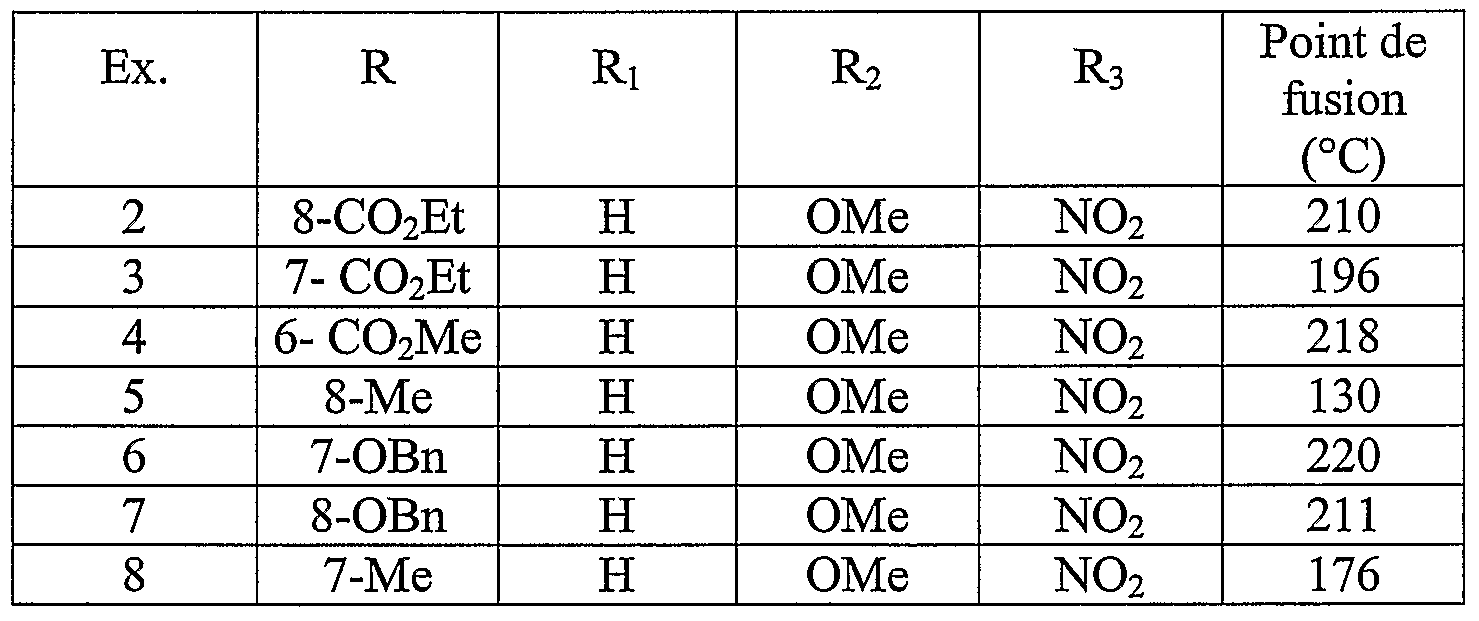
Les RMN des exemples 2 à 8 du TABLEAU I sont présentées dans le TABLEAU F ci-dessous :The NMRs of Examples 2 to 8 of TABLE I are presented in TABLE F below:
TABLEAU !'BOARD !'
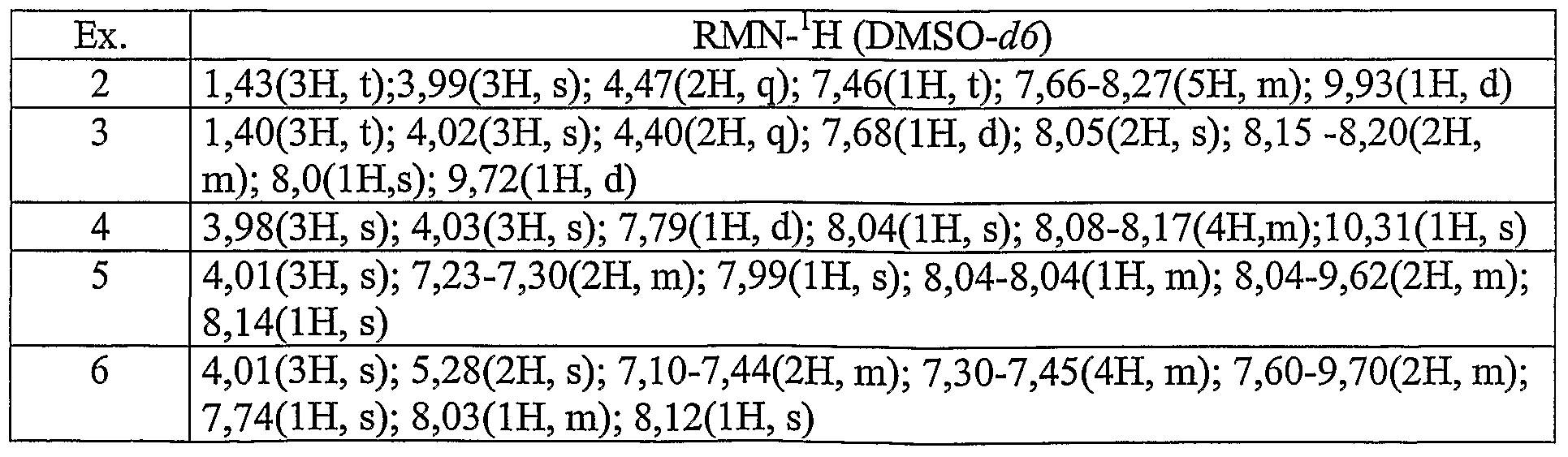

Exemple 9Example 9
5- [(imidazo [1 ,5-a] pyridin-3-yl)carb onyl] -2-nitr o-b enzoate de méthyle A 1,3g (0,011 mole) d'imidazo[l,5-a]pyridine [décrit dans J. Chem. Soc. ; (1955),5- [Methyl imidazo [1,5-a] pyridin-3-yl) carbonyl] -2-nitrobenzoate A 1.3g (0.011 mol) imidazo [1,5-a] pyridine [described in J. Chem. Soc. ; (1955),
2834-2836] dissous dans 100ml de 1,2-dichloroéthane, on ajoute 5,6g (0,023 mole) de 5- (chlorocarbonyl)-2-nitrobenzoate de méthyle et 3,4ml (0,024 mole) de triéthylamine. On agite à température ambiante pendant 4 heures. Le milieu réactionnel est concentré sous pression réduite puis repris dans du dichlorométhane et une solution aqueuse saturée de bicarbonate de sodium. La phase organique est décantée, lavée par une solution aqueuse saturée de chlorure de sodium, séchée sur sulfate de sodium et concentrée sous pression réduite. Le produit est purifié par chromatographie colonne sur gel de silice en éluant au dichlorométhane. Après évaporation, on recueille 3,1g d'un solide jaune. Point de fusion : 1510C ; RMN-1H (DMSO-Jd) : 3,92(3H, s); 7,39-7,42(1H, m); 7,5O-7,54(1H, m); 8,00(1H, s); 8,10(1H, d); 8,25(1H, d); 8,69(1H, d); 8.76(1H, s); 9,78(1H, d)2834-2836] dissolved in 100 ml of 1,2-dichloroethane, 5.6 g (0.023 mole) of methyl 5- (chlorocarbonyl) -2-nitrobenzoate and 3.4 ml (0.024 mole) of triethylamine are added. Stir at room temperature for 4 hours. The reaction medium is concentrated under reduced pressure and then taken up in dichloromethane and a saturated aqueous solution of sodium bicarbonate. The organic phase is decanted, washed with a saturated aqueous solution of sodium chloride, dried over sodium sulfate and concentrated under reduced pressure. The product is purified by column chromatography on silica gel, eluting with dichloromethane. After evaporation, 3.1 g of a yellow solid are collected. Melting point: 151 0 C; 1 H NMR (DMSO-Jd): 3.92 (3H, s); 7.39-7.42 (1H, m); 7.5O-7.54 (1H, m); 8.00 (1H, s); 8.10 (1H, d); 8.25 (1H, d); 8.69 (1H, d); 8.76 (1H, s); 9.78 (1H, d)
Exemple 10Example 10
3-[3-(méthoxycarbonyl)-4-nitrobenzoyl]imidazo[l,5-a]pyridine-6-carboxylate de tert-bntyle Ce composé est obtenu selon le même procédé que celui décrit dans l'exemple 9 par benzoylation de rimidazo[l,5-a]pyridine-6-carboxylate de tert-butyle par le 5- (chlorocarbonyl)-2-nitrobenzoate de méthyle en présence de triéthylamine. On obtient un solide jaune. Point de fusion : 17O0C ; RMN-1H (DMSO-J6) : l,63(9H,s); 3,89(3H,s);This compound is obtained according to the same process as that described in Example 9 by benzoylation of rimidazo [0102] tert-butyl [1,5-a] pyridine-6-carboxylate with methyl 5- (chlorocarbonyl) -2-nitrobenzoate in the presence of triethylamine. A yellow solid is obtained. Melting point: 17O 0 C; 1 H NMR (DMSO-D6): 1.63 (9H, s); 3.89 (3H, s);
7,76(lH,d); 8,05(lH,s); 8,12(lH,d); 8,26(lH,d); 8,70(lH,d); 8,77(lH,s); 10,25(lH,s)7.76 (lH, d); 8.05 (lH, s); 8.12 (lH, d); 8.26 (lH, d); 8.70 (lH, d); 8.77 (lH, s); 10.25 (lH, s)
Exemple 11Example 11
Acide 3-[3-(métb.oxycarbonyl)-4-nitrobenzoyI]imidazo[l,5-a]pyridme-6- carboxylique3- [3- (Methoxycarbonyl) -4-nitrobenzoyl] imidazo [1,5-a] pyridin-6-carboxylic acid
A 610mg (1.43 mmole) de 3-[3-(méthoxycarbonyl)-4-nitrobenzoyl]iniidazo[l,5- a]pyridine-6-carboxylate de tert-butyle dans 2ml de dichlorométhane on ajoute 2.13 mlTo 610 mg (1.43 mmol) of tert-butyl 3- [3- (methoxycarbonyl) -4-nitrobenzoyl] iniidazo [1,5-a] pyridine-6-carboxylate in 2 ml of dichloromethane is added 2.13 ml.
(28.68 mmoles) d'acide trifluoroacétique et agite à température ambiante pendant 5 heures.(28.68 mmol) of trifluoroacetic acid and stirred at room temperature for 5 hours.
Le milieu réactionnel est concentré sous pression réduite, puis le résidu obtenu est repris à l'acétone. Le précipité formé est filtré, lavé à l'acétone et séché. On obtient 450mg d'une poudre jaune. Point de fusion : 29O0C ; RMN-1H (DMSO-J6) : 3,90(3H,s); 7,78(lH,d); 8,04(lH,s); 8,12(lH,d); 8,26(lH,d); 8,68 (lH,d); 8,75(lH,s); 10,26(lH,s)The reaction medium is concentrated under reduced pressure and the residue obtained is taken up in acetone. The precipitate formed is filtered, washed with acetone and dried. We get 450mg of a yellow powder. Melting point: 29O 0 C; 1 H NMR (DMSO-D6): 3.90 (3H, s); 7.78 (lH, d); 8.04 (lH, s); 8.12 (lH, d); 8.26 (lH, d); 8.68 (1H, d); 8.75 (lH, s); 10.26 (lH, s)
Exemple 12 5-({6-[(tert-butoxycarbonyl)amino]imidazo[l,5-a]pyridiii-3-yl}carbonyl)-2- nitrobenzoate de méthyleExample 12 Methyl 5 - ({6 - [(tert-butoxycarbonyl) amino] imidazo [1,5-a] pyridin-3-yl} carbonyl) -2-nitrobenzoate
A 430mg (1.16 mmole) d'acide 3-[3-(méthoxycarbonyl)-4-nitrobenzoyl]irnidazo[l,5- a]pyridine-6-carboxylique dans 20ml de toluène, on ajoute 0.55ml (3.96 mmoles) de triéthylamine et 1.07ml de tert.butanol puis 0.31ml (1.40 mmole) de diphénylphosphoryl azide. Le milieu réactionnel est chauffé à 110°C pendant 3 heures puis refroidi à température ambiante. On ajoute de l'eau et une solution aqueuse saturée en bicarbonate de sodium puis extrait à l'acétate d'éthyle. La phase organique est décantée, lavée avec une solution aqueuse saturée en chlorure de sodium puis séchée sur sulfate de sodium et concentrée sous pression réduite. Le produit est purifié par chromatographie colonne sur gel de silice en éluant avec un mélange de dichlorométhane et de méthanol (98-2). On obtient 480mg d'un solide orangé. Point de fusion : 182°C ; RMN-1H (OMSO-d6) : l,55(9H,s); 3,92(3H,s); 7,45(lH,d); 7,90(lH,s); 7,99(lH,d); 8,24(lH,d); 8,67(lH,d); 8,76(lH,s); 9,89(lH,s)To 430 mg (1.16 mmol) of 3- [3- (methoxycarbonyl) -4-nitrobenzoyl] imidazo [1,5-a] pyridine-6-carboxylic acid in 20 ml of toluene, 0.55 ml (3.96 mmol) of triethylamine is added. and 1.07 ml of tert.butanol and then 0.31 ml (1.40 mmol) of diphenylphosphoryl azide. The reaction medium is heated at 110 ° C. for 3 hours and then cooled to ambient temperature. Water and a saturated aqueous solution of sodium bicarbonate are added and then extracted with ethyl acetate. The organic phase is decanted, washed with a saturated aqueous solution of sodium chloride and then dried over sodium sulfate and concentrated under reduced pressure. The product is purified by column chromatography on silica gel, eluting with a mixture of dichloromethane and methanol (98-2). 480 mg of an orange solid are obtained. Melting point: 182 ° C; 1 H NMR (OMSO-d6): 1.55 (9H, s); 3.92 (3H, s); 7.45 (lH, d); 7.90 (lH, s); 7.99 (lH, d); 8.24 (lH, d); 8.67 (lH, d); 8.76 (lH, s); 9.89 (lH, s)
Exemple 13 [6-(ter^-butoxycarbonylamino)imidazo[l,5-a]pyridin-3-yI](3-méthoxy-4- nitrophényl) méthanoneExample 13 [6- (tert-Butoxycarbonylamino) imidazo [1,5-a] pyridin-3-yl] (3-methoxy-4-nitrophenyl) methanone
Ce composé est obtenu selon le même procédé que celui décrit dans l'exemple 12 précédent par réarrangement de Curtius à partir de l'acide 3-(3-méthoxy-4- nitrobenzoyl)imidazo[l,5-a] pyridine-6-carboxylique avec le diphénylphosphoryl azide en présence de tert.butanol. On obtient un solide jaune. Point de fusion : 2000C ; RMN-1H (DMSO-J6) : l,54(9H,s); 4,02(3H,s); 7,42(lH,d); 7,87(lH,s); 8,ll-7,87(3H,m); 8,15(lH,s); 9,87(lH,s)This compound is obtained according to the same process as that described in the preceding Example 12 by rearrangement of Curtius from 3- (3-methoxy-4-nitrobenzoyl) imidazo [1,5-a] pyridine-6- acid. carboxylic acid with diphenylphosphoryl azide in the presence of tert.butanol. A yellow solid is obtained. Melting point: 200 ° C. 1 H NMR (DMSO-D6): 1.54 (9H, s); 4.02 (3H, s); 7.42 (lH, d); 7.87 (lH, s); 8, ll-7.87 (3H, m); 8.15 (lH, s); 9.87 (lH, s)
Exemple 14 5-({6-[(tert-butoxycarbonyl)(méthyl)amino]imidazo[l,5-a]pyridin-3- yl}carbonyl)-2-nitrobenzoate de méthyleExample 14 Methyl 5 - ({6 - [(tert-butoxycarbonyl) (methyl) amino] imidazo [1,5-a] pyridin-3-yl} carbonyl) -2-nitrobenzoate
A 53.9mg (1.35 mmole) d'hydrure de sodium (à 60% en dispersion dans l'huile) dans 2ml de diméthylformamide on ajoute 540mg (1.23 mmole) de 5-({6-[(tert- butoxycarbonyl)amino]imidazo[l,5-a]pyridin-3-yl}carbonyl)-2-nitrobenzoate de méthyle dans 10ml de diméthylformamide et agite 30 minutes à température ambiante, puis ajoute 84μl (1.35 mmole) d'iodure de méthyle et laisse agiter à température ambiante une nuit. On acidifie à pH = 4 avec une solution aqueuse d'hydrogénosulfate de potassium et extrait à l'acétate d'éthyle. La phase organique est lavée avec une solution aqueuse saturée en chlorure de sodium puis séchée sur sulfate de sodium et concentrée sous pression réduite. Le produit est purifié par filtration sur lit de silice en éluant au dichlorométhane. On obtient 475mg d'une poudre orangée. Point de fusion : 55°C ; RMN-1H (DMSO- d6) : l,46(9H,s); 3,33(3H,s); 3,92(3H,s); 7,57(lH,d); 7,98(lH,s); 8,06 (lH,d); 8,25(lH,d); 8,68(lH,d); 8,76(lH,s); 9,77(lH,s)To 53.9 mg (1.35 mmol) of sodium hydride (60% dispersed in oil) in 2 ml of dimethylformamide 540 mg (1.23 mmol) of 5 - ({6 - [(tert-butoxycarbonyl) amino] imidazo are added. Methyl [1,5-a] pyridin-3-yl} carbonyl) -2-nitrobenzoate in 10 ml of dimethylformamide and stirred for 30 minutes at room temperature, then 84 μl (1.35 mmol) of methyl iodide are added and the mixture is stirred at room temperature. ambient one night. It is acidified to pH = 4 with an aqueous solution of potassium hydrogen sulphate and extracted with ethyl acetate. The organic phase is washed with a saturated aqueous solution of sodium chloride and then dried over sodium sulphate and concentrated under reduced pressure. The product is purified by filtration on a silica bed, eluting with dichloromethane. 475 mg of an orange powder are obtained. Melting point: 55 ° C; 1 H NMR (DMSO-d6): 1.46 (9H, s); 3.33 (3H, s); 3.92 (3H, s); 7.57 (lH, d); 7.98 (lH, s); 8.06 (1H, d); 8.25 (lH, d); 8.68 (lH, d); 8.76 (lH, s); 9.77 (lH, s)
Exemple 15Example 15
5-{[6-(méthylamino)imidazo[l,5-a]pyridin-3-yl]carbonyl}-2-nitrobenzoate de méthyleMethyl 5 - {[6- (methylamino) imidazo [1,5-a] pyridin-3-yl] carbonyl} -2-nitrobenzoate
A 460mg (1.01 mmole) de 5-({6-[(tert-butoxycarbonyl)(méthyl)amino]imidazo[l,5- a]pyridin-3-yl}carbonyl)-2-nitrobenzoate de méthyle dans 5ml de dichlorométhane on ajouteTo 460 mg (1.01 mmol) of methyl 5 - ({6 - [(tert-butoxycarbonyl) (methyl) amino] imidazo [1,5-a] pyridin-3-yl} carbonyl) -2-nitrobenzoate in 5 ml of dichloromethane we add
1.3ml d'acide trifluoroacétique et agite à température ambiante une nuit. Le milieu réactionnel est concentré sous pression réduite. Le résidu est repris à l'eau et basifié avec une solution aqueuse saturée en bicarbonate de sodium puis extrait au dichlorométhane. La phase organique est lavée avec une solution aqueuse saturée en chlorure de sodium puis séchée sur sulfate de sodium et concentrée sous pression réduite. On obtient 350mg d'une poudre rouge. Point de fusion : 183°C ; RMN-1H (DMSO-Jd) : 2,79(3H,d); 3,90(3H,s);1.3 ml of trifluoroacetic acid and stirred at room temperature overnight. The reaction medium is concentrated under reduced pressure. The residue is taken up in water and basified with a saturated aqueous solution of sodium bicarbonate and then extracted with dichloromethane. The organic phase is washed with a saturated aqueous solution of sodium chloride and then dried over sodium sulphate and concentrated under reduced pressure. 350 mg of a red powder is obtained. Melting point: 183 ° C; 1 H NMR (DMSO-Jd): 2.79 (3H, d); 3.90 (3H, s);
7,H(lH,d); 7,77(lH,s); 7,82(lH,d); 8,31(lH,d); 8,66(lH,d); 8,75(lH,s); 9,01(lH,s)7, H (lH, d); 7.77 (lH, s); 7.82 (lH, d); 8.31 (lH, d); 8.66 (lH, d); 8.75 (lH, s); 9.01 (lH, s)
Exemple 16Example 16
(6-aminoimidazo[l,5-a]pyridin-3-yl)(3-méthoxy-4-nitrophényl)méthanone(6-aminoimidazo [l, 5-a] pyridin-3-yl) (3-methoxy-4-nitrophenyl) methanone
Ce composé est obtenu selon le même procédé que celui décrit dans l'exemple 15 précédent par déprotection de l'aminé du composé [6-(tert- butoxycarbonylamino)imidazo[l,5-a]pyridin-3-yl](3-méthoxy-4-nitrophényl) méthanone avec l'acide trifluoroacétique. On obtient un solide jaune qui est salifié sous forme de chlorhydrate. Point de fusion : 2520C ; RMN-1H (OMSO-d6) : 4,01(3H,s); 7,14(lH,d); 7,79(lH,s); 7,87(lH,d) ; 7,97-8,01(2H,m); 8,13(lH,s); 9,41(lH,s)This compound is obtained according to the same process as that described in the preceding example by deprotection of the amine of the compound [6- (tert-butoxycarbonylamino) imidazo [1,5-a] pyridin-3-yl] (3- methoxy-4-nitrophenyl) methanone with trifluoroacetic acid. A yellow solid is obtained which is salified in the form of hydrochloride. Melting point: 252 ° C .; 1 H NMR (OMSO-d6): 4.01 (3H, s); 7.14 (lH, d); 7.79 (lH, s); 7.87 (1H, d); 7.97 to 8.01 (2H, m); 8.13 (lH, s); 9.41 (lH, s)
Exemple 17Example 17
N-[3-(3-méthoxy-4-nitrobenzoyl)imidazo[l,5-a]pyridin-6-yl]méthane sulfonamideN- [3- (3-methoxy-4-nitrobenzoyl) imidazo [1,5-a] pyridin-6-yl] methanesulfonamide
A 0.40g (1.15 mmole) de chlorhydrate de (6-aminoimidazo[l,5-a]pyridin-3-yl)(3- méthoxy-4-nitrophényl)méthanone dans 10ml de pyridine refroidi à 5°C, on ajoute 0.107ml (1.38 mmole) de chlorure de mésyle puis laisse revenir à température ambiante et agite 18 heures. Le milieu est repris par 130ml d'acide chlorhydrique IN et extrait à l'acétate d'éthyle.To 0.40 g (1.15 mmol) of (6-aminoimidazo [1,5-a] pyridin-3-yl) (3-methoxy-4-nitrophenyl) methanone hydrochloride in 10 ml of pyridine cooled to 5 ° C., 0.107 is added. ml (1.38 mmol) of mesyl chloride and then allowed to return to room temperature and stirred 18 hours. The medium is taken up in 130 ml of 1N hydrochloric acid and extracted with ethyl acetate.
La phase organique est lavée avec une solution aqueuse saturée en chlorure de sodium puis séchée sur sulfate de sodium et concentrée sous pression réduite. Le résidu est repris à l'éther isopropylique, filtré, lavé à l'éther isopropylique puis séché. On obtient 411mg d'un solide jaune. Point de fusion : 2490C ; RMN-1H (DMSO-J6) : 3,14(3H,s); 4,02(3H,s); 7,39(lH,d); 7,94(lH,s); 8,02-8,1 l(3H,m); 8,13(lH,s); 9,88(lH,s)The organic phase is washed with a saturated aqueous solution of sodium chloride then dried over sodium sulfate and concentrated under reduced pressure. The residue is taken up in isopropyl ether, filtered, washed with isopropyl ether and then dried. 411 mg of a yellow solid are obtained. Melting point: 249 ° C .; 1 H NMR (DMSO-D6): 3.14 (3H, s); 4.02 (3H, s); 7.39 (lH, d); 7.94 (lH, s); 8.02-8.1 l (3H, m); 8.13 (lH, s); 9.88 (lH, s)
Exemple 18Example 18
N-[3-(3-méthoxy-4-nitrobenzoyl)imidazo[l,5-a]pyridin-6-yl]acétamideN- [3- (3-methoxy-4-nitrobenzoyl) imidazo [l, 5-a] pyridin-6-yl] acetamide
A 0.50g (1.43 rnmole) de chlorhydrate de (6-aminoimidazo[l,5-a]pyridin-3-yl)(3- méthoxy-4-nitrophényl)méthanone dans 25ml de 1.2-dichloroéthane refroidi à 5°C, on ajoute 1.29ml (9.29 mmoles) de triéthylamine puis 0.51ml (7.15 mmoles) de chlorure d'acétyle puis laisse revenir à température ambiante et agite 18 heures. Le milieu est repris par de l'eau, basifié avec une solution de bicarbonate de sodium et extrait au dichlorométhane. La phase organique est lavée avec une solution aqueuse saturée en chlorure de sodium puis séchée sur sulfate de sodium et concentrée sous pression réduite. Le produit est purifié par chromatographie colonne sur gel de silice en éluant avec un mélange de dichlorométhane et d'acétone(90-10). On obtient 316mg d'un solide jaune. Point de fusion : 257°C ; RMN-1H ÇDMSO-d6) : 2,15(3H,s); 4,01(3H,s); 7,45(lH,d); 7,92(lH,s);To 0.50 g (1.43 mmol) of (6-aminoimidazo [1,5-a] pyridin-3-yl) (3-methoxy-4-nitrophenyl) methanone hydrochloride in 25 ml of 1,2-dichloroethane cooled to 5 ° C. 1.29 ml (9.29 mmol) of triethylamine and then 0.51 ml (7.15 mmol) of acetyl chloride are added and the mixture is allowed to return to ambient temperature and stirred for 18 hours. The medium is taken up in water, basified with sodium bicarbonate solution and extracted with dichloromethane. The organic phase is washed with a saturated aqueous solution of sodium chloride and then dried over sodium sulphate and concentrated under reduced pressure. The product is purified by column chromatography on silica gel, eluting with a mixture of dichloromethane and acetone (90-10). 316 mg of a yellow solid are obtained. Melting point: 257 ° C; 1 H NMR (CDMSO-d6): 2.15 (3H, s); 4.01 (3H, s); 7.45 (lH, d); 7.92 (lH, s);
8,00-8,06(3H,m); 8,13(lH,s); 10,62(lH,s)8.00 to 8.06 (3H, m); 8.13 (lH, s); 10.62 (lH, s)
Exemple 19Example 19
2-(benzoylamino)-5-[(imidazo[l,5-a]pyridine-3-yl)carbonyl]benzoate de méthyleMethyl 2- (benzoylamino) -5 - [(imidazo [1,5-a] pyridin-3-yl) carbonyl] benzoate
A 1,97g (0,017 mole) d'imidazo[l,5-a]ρyridine [décrit dans J. Chem. Soc. ; (1955), 2834-2836] dans 100ml d'acétonitrile, on ajoute 5,2ml (0,037 mole) de triéthylamine puis sous atmosphère d'azote à 0°C 10g (0,035 mole) de chlorure de 4-oxo-2-phényl-4H-3,l- benzoxazine-6-carbonyle. Après 22 heures d'agitation à température ambiante, le milieu réactionnel est filtré. Le résidu obtenu est lavé à l'acétate d'éthyle, à l'eau, à l'acétone puis séché. A 9,75g (0,026 mole) du solide jaune obtenu précédemment, dans 50ml de méthanol et 50ml de ΛζN-diméthylformamide, on ajoute 0,32g (2,65 mmoles) de N1N- diméthylpyridine-4-amine. Après 22 heures de chauffage au reflux, le milieu réactionnel est filtré. Le résidu est lavé à l'eau puis séché. Le produit est purifié par chromatographie colonne sur gel de silice en éluant avec un mélange de dichlorométhane et de méthanol (99,9-0,1). On obtient 3,67g d'un solide jaune. Point de fusion : 218°C ; RMN-1H (CDC13) : 4,05(3H, s); 7,08-7,09(1H, m); 7,27-7,29(1H, m); 7,57-7,60(3H5 m); 7,76-7,81(2H, m);To 1.97 g (0.017 mole) of imidazo [1,5-a] pyridine [described in J. Chem. Soc. ; (1955), 2834-2836] in 100 ml of acetonitrile is added 5.2 ml (0.037 mole) of triethylamine and then under a nitrogen atmosphere at 0 ° C 10 g (0.035 mole) of 4-oxo-2-phenyl chloride -4H-3,1-benzoxazine-6-carbonyl. After stirring for 22 hours at ambient temperature, the reaction medium is filtered. The residue obtained is washed with ethyl acetate, with water, with acetone and then dried. A 9.75 g (0.026 mol) of the yellow solid obtained above in 50ml of methanol and 50ml of ΛζN-dimethylformamide was added 0.32 g (2.65 mmol) of N 1 N- dimethylpyridine-4-amine. After heating for 22 hours under reflux, the reaction medium is filtered. The residue is washed with water and then dried. The product is purified by column chromatography on silica gel, eluting with a mixture of dichloromethane and methanol (99.9-0.1). 3.67 g of a yellow solid are obtained. Melting point: 218 ° C; 1 H NMR (CDCl3): 4.05 (3H, s); 7.08-7.09 (1H, m); 7.27-7.29 (1H, m); 7.57-7.60 (3H 5 m); 7.76-7.81 (2H, m);
8,12(2H, d); 8,78(1H, d); 9,15(1H, d); 9,28(1H, s); 9,88(1H, d) Exemple 20 (l-bromoimidazo[l,5-a]pyridin-3-yl)(3-méthoxy-4-nitrophényl)méthanone8.12 (2H, d); 8.78 (1H, d); 9.15 (1H, d); 9.28 (1H, s); 9.88 (1H, d) Example 20 (1-Bromoimidazo [1,5-a] pyridin-3-yl) (3-methoxy-4-nitrophenyl) methanone
A 9,8g (0,033 mole) de (imidazo[l,5-a]ρyridin-3-yl)(3-méthoxy-4- nitrophényl)méthanone obtenu à l'exemple 1, dans 170ml de chloroforme, on ajoute 3,51g (0,043 mole) d'acétate de sodium puis goutte à goutte une solution de 1,85ml (0,036 mole) de brome dans 15ml de chloroforme en maintenant le milieu à température ambiante. L'introduction terminée, on agite 1 heure de plus à la même température. Le milieu réactionnel est versé sur une solution aqueuse saturée de bicarbonate de sodium et extrait au dichlorométhane. La phase organique est décantée, lavée avec une solution aqueuse de chlorure de sodium, séchée sur sulfate de sodium et concentrée sous pression réduite. Le résidu est repris dans un mélange toluène-dichlorométhane puis purifié par filtration sur un lit de gel de silice en éluant avec du toluène. Après évaporation, on recueille 7,71g d'un solide jaune. Point de fusion : 189°C ; RMN-1H (CDC13) : 4,10(3H, s) ; 7,23-7,29(1H, m); 7,41-7,46(1H, m); 7,78(1H, d); 7,96 (IH, d) ; 8,14-8,20(2H, m) ; 9,9O(1H, d)To 9.8 g (0.033 mol) of (imidazo [1,5-a] pyridin-3-yl) (3-methoxy-4-nitrophenyl) methanone obtained in Example 1, in 170 ml of chloroform, 3, 51 g (0.043 mol) of sodium acetate and then dropwise a solution of 1.85 ml (0.036 mol) of bromine in 15 ml of chloroform while maintaining the medium at room temperature. When the introduction is complete, the mixture is agitated an additional hour at the same temperature. The reaction medium is poured into a saturated aqueous solution of sodium bicarbonate and extracted with dichloromethane. The organic phase is decanted, washed with an aqueous solution of sodium chloride, dried over sodium sulfate and concentrated under reduced pressure. The residue is taken up in a toluene-dichloromethane mixture and then purified by filtration on a bed of silica gel, eluting with toluene. After evaporation, 7.71 g of a yellow solid are collected. Melting point: 189 ° C; 1 H NMR (CDCl3): 4.10 (3H, s); 7.23-7.29 (1H, m); 7.41-7.46 (1H, m); 7.78 (1H, d); 7.96 (1H, d); 8.14-8.20 (2H, m); 9.9O (1H, d)
Exemples 21 à 24Examples 21 to 24
En procédant comme la préparation décrite à l'exemple 20, on synthétise les composés de formule Ii décrits dans le tableau II ci dessous par bromation des composés de formule I (avec Rl = H) en présence de brome et d'acétate de sodium.Proceeding as the preparation described in Example 20, the compounds of formula Ii described in Table II below are synthesized by bromination of the compounds of formula I (with R1 = H) in the presence of bromine and sodium acetate.
TABLEAU IITABLE II

Les RMN des exemples 21 à 24 du TABLEAU II sont présentées dans le TABLEAU IF ci- dessous :The NMRs of Examples 21 to 24 of TABLE II are presented in Table IF below:
TABLEAU IFTABLE IF
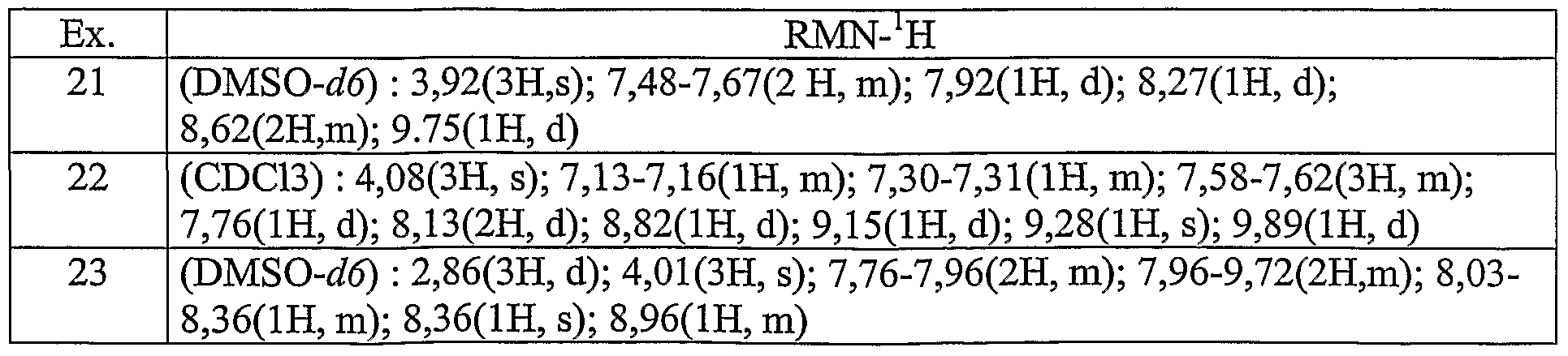
Exemple 25Example 25
(3-méthoxy-4-nitrophényl)[l-(4-méthoxyphényl)imidazo[l,5-a]pyridin-3- yljméthanone A 0,850g (0,023 mole) de (l-bromoimidazo[l,5-a]pyridin-3-yl)(3-methoxy-4- nitroρhenyl)méthanone obtenu à l'exemple 20, dans 30 ml de dioxanne, sous atmosphère d'argon, on ajoute 0,447g (0,003 mole) d'acide 4-méthoxyphénylboronique, 2,24g (0,009 mole) de K3PO4-H2O puis 0,131g (0,011 mole) de tétralds(triphénylphosphine)palladium(0). On chauffe à reflux pendant 1 heure. Le milieu réactionnel est versé sur de l'eau et extrait à l'acétate d'éthyle. La phase organique est décantée, lavée avec une solution aqueuse saturée de chlorure de sodium, séchée sur sulfate de sodium et concentrée sous pression réduite. Le produit est purifié par filtration sur gel de silice en éluant avec un mélange dichlorométhane- cyclohexane(2-l) puis au dichlorométhane. Après évaporation, on recueille 0,850g d'un solide orange. Point de fusion : 185°C ; RMN-1H ÇDMSO-d6) : 3,85(3H, s); 4,06(3H, s); 7,12(2H, d); 7,41-7,44(lH,m); 7,54-7,58 (lH,m); 7,95(2H, d); 8,08-8,10(2H, m); 8,34(1H, d); 8,36(1H, s); 9,81 (IH, d)(3-Methoxy-4-nitrophenyl) [1- (4-methoxyphenyl) imidazo [1,5-a] pyridin-3-yl] methanone A 0.850 g (0.023 mole) (1-bromoimidazo [1,5-a] pyridin -3-yl) (3-methoxy-4-nitro-phenyl) methanone obtained in Example 20, in 30 ml of dioxane, under argon atmosphere, 0.447 g (0.003 mol) of 4-methoxyphenylboronic acid, 2 24 g (0.009 moles) of K 3 PO 4 -H 2 O and then 0.131 g (0.011 moles) of tetralds (triphenylphosphine) palladium (0). Refluxed for 1 hour. The reaction medium is poured into water and extracted with ethyl acetate. The organic phase is decanted, washed with a saturated aqueous solution of sodium chloride, dried over sodium sulfate and concentrated under reduced pressure. The product is purified by filtration on silica gel, eluting with a dichloromethane-cyclohexane (2-1) mixture and then with dichloromethane. After evaporation, 0.850 g of an orange solid is collected. Melting point: 185 ° C; 1 H NMR (CDMSO-d6): 3.85 (3H, s); 4.06 (3H, s); 7.12 (2H, d); 7.41 to 7.44 (lH, m); 7.54-7.58 (1H, m); 7.95 (2H, d); 8.08-8.10 (2H, m); 8.34 (1H, d); 8.36 (1H, s); 9.81 (IH, d)
Exemple 26 à 58Example 26 to 58
En procédant selon la préparation décrite à l'exemple 25, on synthétise les composés de formules Is, décrits dans le tableau III ci dessous, par couplage de type Suzuki des composés bromes de formule générale Ii, avec des dérivés phénylboroniques ou hétéroarylboroniques en faisant varier les conditions expérimentales (catalyseurs, ligands, bases) selon les composés à obtenir.By proceeding according to the preparation described in Example 25, the compounds of formulas Is, described in Table III below, are synthesized by Suzuki-type coupling of the brominated compounds of general formula Ii with phenylboronic or heteroarylboronic derivatives by varying them. the experimental conditions (catalysts, ligands, bases) according to the compounds to be obtained.
TABLEAU IIITABLE III


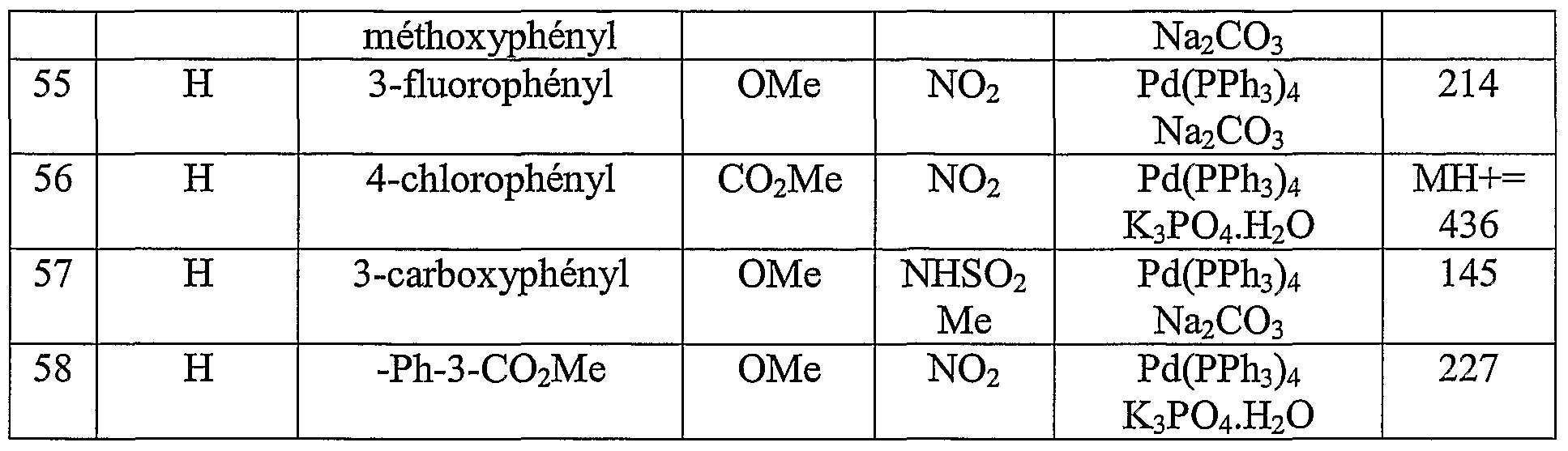
*on utilise les dérivés pinacol boronates au lieu des acides boroniques correspondants. BOC = fert-butoxycarbonylethe pinacol boronate derivatives are used instead of the corresponding boronic acids. BOC = Fert -butoxycarbonyl
Les RMN des exemples 26 à 58 du TABLEAU III sont présentées dans le TABLEAU III' ci-dessous :The NMRs of Examples 26 to 58 of TABLE III are presented in TABLE III below:
TABLEAU El'TABLE El '


Exemple 59 3-(3-méthoxy-4-nitrobenzoyl)imidazo[l,5-a]pyridine-6-carboxamideExample 59 3- (3-Methoxy-4-nitrobenzoyl) imidazo [1,5-a] pyridine-6-carboxamide
A 0,346g (1,01 mmole) de l'acide 3-(3-méthoxy-4-nitrobenzoyl)imidazo[l,5- a]pyridine-6-carboxylique obtenu à l'exemple 182 dans 10ml de N,N-diméthylformamide, on ajoute 0,16ml (l,12mmole) de triéthylamine puis 0,49g (1,12 mmole) de BOP. Le milieu réactionnel est agité pendant 30 minutes à température ambiante puis on ajoute 1,35ml d'une solution d'ammoniac IN dans le tétxahydrofurane et agite à température ambiante 18 heures. Le précipité formé est filtré puis lavé à l'eau. On recueille 0,25g d'un solide jaune. Point de fusion : 289°C ; RMN-1H (DMSO-d6) : 4,02(3H, s); 7,82(1H, d); 7,98(1H, s); 8,06-8, 10(3H, m); 8,15(lH,s); 10,21(lH,s).To 0.346 g (1.01 mmol) of 3- (3-methoxy-4-nitrobenzoyl) imidazo [1,5-a] pyridine-6-carboxylic acid obtained in Example 182 in 10 ml of N, N- dimethylformamide, 0.16 ml (1.12 mmol) of triethylamine and then 0.49 g (1.12 mmol) of BOP are added. The reaction medium is stirred for 30 minutes at room temperature and then 1.35 ml of a 1N ammonia solution in tetxahydrofuran and stirred at room temperature for 18 hours. The precipitate formed is filtered and washed with water. 0.25 g of a yellow solid is collected. Melting point: 289 ° C; 1 H NMR (DMSO-d6): 4.02 (3H, s); 7.82 (1H, d); 7.98 (1H, s); 8.06-8.10 (3H, m); 8.15 (lH, s); 10.21 (lH, s).
Exemples 60 à 69Examples 60 to 69
En procédant selon la préparation décrite à l'exemple 59, on synthétise les composés de formule générale Iu décrits dans le tableau IV ci-dessous par couplage peptidique de l'acide 3-(3-méthoxy-4-nitrobenzoyl)imidazo[l,5-a]pyridine-6-carboxylique obtenu à l'exemple 182 ou de l'acide 3-(3-méthoxy-4-nitrobenzoyl)imidazo[l,5-a]pyridine-7- carboxylique obtenu à l'exemple 184, avec des aminés ou des esters d'aminoacides en présence de BOP comme réactif de couplage.By proceeding according to the preparation described in Example 59, the compounds of general formula Iu described in Table IV below are synthesized by peptide coupling of 3- (3-methoxy-4-nitrobenzoyl) imidazo [1, 5-a] pyridine-6-carboxylic acid obtained in Example 182 or 3- (3-methoxy-4-nitrobenzoyl) imidazo [1,5-a] pyridine-7-carboxylic acid obtained in Example 184 , with amines or amino acid esters in the presence of BOP as a coupling reagent.
TABLEAU IVTABLE IV

Les RMN des exemples 60 à 69 du TABLEAU IV sont présentées dans le tableau IV' ci-dessous :The NMRs of Examples 60 to 69 of TABLE IV are shown in Table IV below:
TABLEAU IV'TABLE IV '

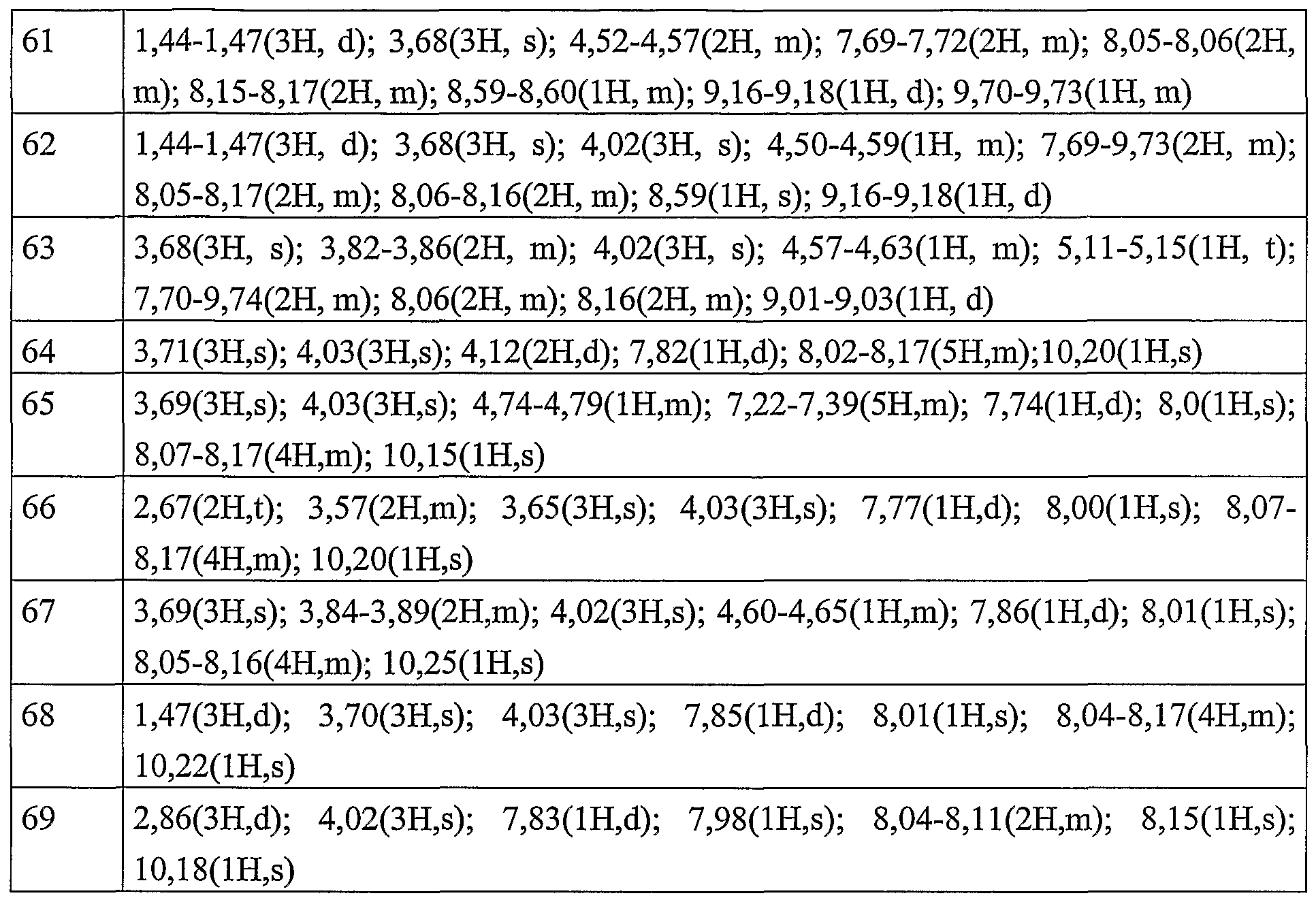
Exemple 70Example 70
3~(3-méthoxy-4~nitrobenzoyl)-N,N-diméthylimidazo[l,5-a]pyridine-8- carboxamide3 - (3-Methoxy-4-nitrobenzoyl) -N, N-dimethylimidazo [1,5-a] pyridine-8-carboxamide
A 0,318g (0,88 mmole) de l'acide 3-(3-méthoxy-4-nitrobenzoyl)imidazo[l,5- a]pyridine-8-carboxylique obtenu à l'exemple 183, dans 10ml de dichlorométhane, on ajoute 0,17ml (2,36 mmoles) de chlorure de thionyle puis 30μl de N,N-diméthylformamide. On chauffe à reflux 2 heures. Le milieu réactionnel est concentré sous pression réduite. Le résidu obtenu est ajouté à 5ml d'une solution de diméthylamine 2N dans le tétrahydrofurane. Après agitation 18h à température ambiante, le milieu réactionnel est concentré sous pression réduite. Le résidu est repris dans le dichlorométhane. La phase organique est lavée avec une solution aqueuse IN d'acide chlorhydrique puis une solution aqueuse saturée de chlorure de sodium, séchée sur sulfate de sodium et concentrée sous pression réduite. Le résidu est purifié par chromatographie colonne sur gel de silice en éluant avec du dichlorométhane puis un mélange de dichlorométhane-méthanol (99-1). On recueille 0,19g d'un solide jaune. Point de fusion : 1760C ; RMN-1H (DMSO-d6) : 4,02(3H, s); 7,39(1H, t); 7,53(1H, d); 7,83(1H, s); 8,0-8,12(3H, m); 9.75(1H, d) Exemples 71 à 740.318 g (0.88 mmol) of 3- (3-methoxy-4-nitrobenzoyl) imidazo [1,5-a] pyridine-8-carboxylic acid, obtained in Example 183, in 10 ml of dichloromethane, 0.17 ml (2.36 mmol) of thionyl chloride and then 30 μl of N, N-dimethylformamide are added. Refluxed for 2 hours. The reaction medium is concentrated under reduced pressure. The residue obtained is added to 5 ml of a solution of 2N dimethylamine in tetrahydrofuran. After stirring for 18 h at room temperature, the reaction medium is concentrated under reduced pressure. The residue is taken up in dichloromethane. The organic phase is washed with a 1 N aqueous solution of hydrochloric acid and then with a saturated aqueous solution of sodium chloride, dried over sodium sulphate and concentrated under reduced pressure. The residue is purified by column chromatography on silica gel, eluting with dichloromethane and then a mixture of dichloromethane-methanol (99-1). 0.19 g of a yellow solid is collected. Melting point: 176 ° C .; 1 H NMR (DMSO-d6): 4.02 (3H, s); 7.39 (1H, t); 7.53 (1H, d); 7.83 (1H, s); 8.0-8.12 (3H, m); 9.75 (1H, d) Examples 71 to 74
En procédant selon la préparation décrite à l'exemple 70, on synthétise les composés de formule générale Iu décrits dans le tableau V ci-dessous, par couplage de la fonction acide des composés de formule It avec l'aminé correspondante.By proceeding according to the preparation described in Example 70, the compounds of general formula Iu described in Table V below are synthesized by coupling the acid function of the compounds of formula It with the corresponding amine.
TABLEAU VTABLE V

Les RMN des exemples 71 à 74 du tableau V sont présentées dans le tableau V'ci- dessous :The NMRs of Examples 71 to 74 of Table V are shown in Table V below:
TABLEAU VTABLE V
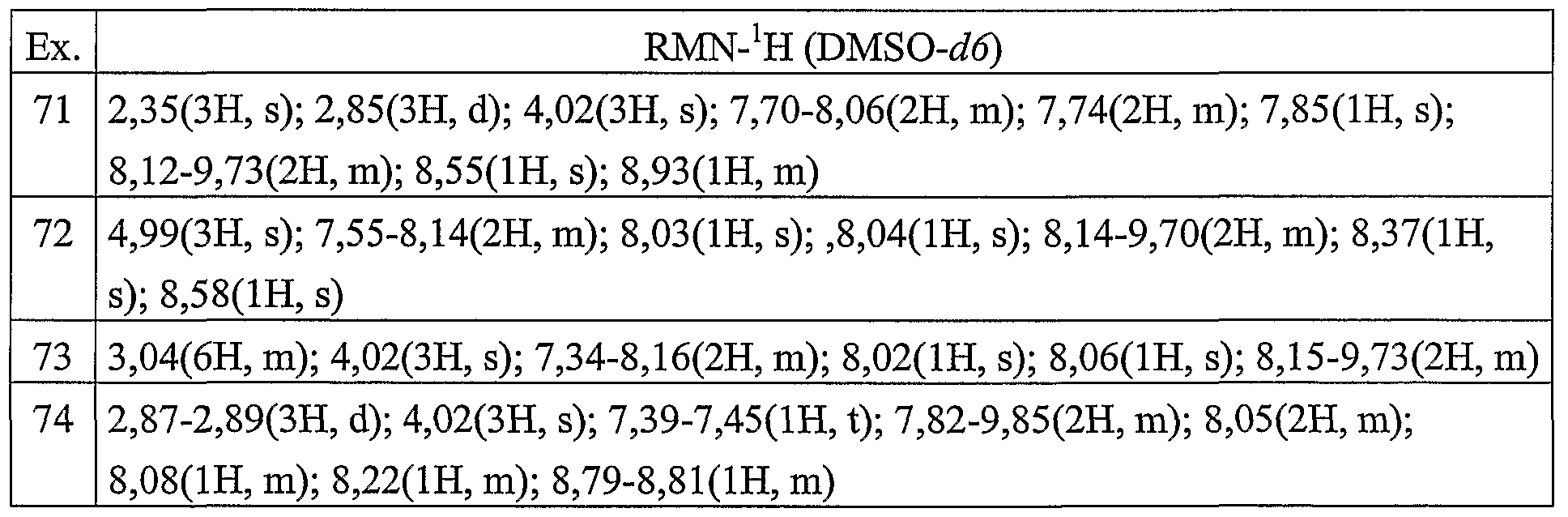
Exemple 75Example 75
3-(3~méthoxy-4-nitrobenzoyl) imidazo[l,5-a]pyridine-l-carbonitrile3- (3-methoxy-4-nitrobenzoyl) imidazo [1,5-a] pyridine-1-carbonitrile
A 6,94g (18,45 mmoles) de (l-bromoimidazo[l,5-a]pyridin-3-yl)(3-méthoxy-4- nitrophényl)méthanone obtenu à l'exemple 20, dans 160ml de N,N-diméthylformamide, on ajoute sous atmosphère d'azote 2,17g (18,48 mmoles) de cyanure de zinc puis 1,07g (0,93 mmole) de tétrakis(triphénylphosphine)palladium(0). Le milieu réactionnel est chauffé à 90°C pendant 17h. Le précipité obtenu est filtré, lavé à l'eau puis avec une solution aqueuse saturée de bicarbonate de sodium et à l'eau. Après séchage on recueille 5,9g d'un solide jaune. Point de fusion : 2190C ; RMN-1H (DMSO-J6) : 4,01(3H, s); 7,53-7,55(1H, m); 7,76- 7,81(1H, m); 7,95-8,01(2H, m); 8,O8(1H, d); 8,19(1H, d); 9,70(1H, d)To 6.94 g (18.45 mmol) of (1-bromoimidazo [1,5-a] pyridin-3-yl) (3-methoxy-4-nitrophenyl) methanone obtained in Example 20, in 160 ml of N, N-dimethylformamide, 2.17 g (18.48 mmol) of zinc cyanide and then 1.07 g (0.93 mmol) of tetrakis (triphenylphosphine) palladium (0) were added under a nitrogen atmosphere. The reaction medium is heated at 90 ° C for 17h. The precipitate obtained is filtered, washed with water and then with a saturated aqueous solution of sodium bicarbonate and with water. After drying, 5.9 g of a solid are collected. yellow. Melting point: 219 ° C .; 1 H NMR (DMSO-D6): 4.01 (3H, s); 7.53-7.55 (1H, m); 7.76-7.81 (1H, m); 7.95-8.01 (2H, m); 8.88 (1H, d); 8.19 (1H, d); 9.70 (1H, d)
Exemple 76 (l-aminoimidazo[l,5-a]pyridin-3-yl)(3-méthoxy-4-nitrophényl)méthanoneExample 76 (1-aminoimidazo [1,5-a] pyridin-3-yl) (3-methoxy-4-nitrophenyl) methanone
A 5g (13,29 mmoles) de (l-bromoimidazo[l,5-a]pyridin-3-yl)(3-méthoxy-4- nitrophényl)méthanone obtenu à l'exemple 20, dans 66ml de N,N-diméthylformamide, on ajoute sous atmosphère d'azote 8,67g (26,61 mmoles) de carbonate de césium puis 4,5ml (26,82 mmoles) de benzophénone imine. Après agitation pendant 30 minutes on ajoute 1,66g (2,67 mmoles) de 2,2'-Bis(diphénylphosphino)-l,r-binaphtyl puis 1,22g (1,33 mmole) de tris(dibeπzelidèneacétone)dipalladium(0). Le milieu réactionnel est chauffé pendant 3 heures puis concentré sous pression réduite. Le résidu est repris par un mélange de dichlorométhane et d'eau. La phase organique est décantée, séchée sur sulfate de sodium, concentrée sous pression réduite. Le résidu est repris dans 250ml de tétrahydrofurane et ajoute 135ml d'une solution aqueuse d'acide chlorhydrique 2N. Après une heure d'agitation à température ambiante, le milieu réactionnel est concentré sous pression réduite. Le résidu solide obtenu est repris à l'acétone, filtré, lavé à l'acétone puis à l'éther éthylique et séché. On recueille 3,43g d'un solide marron. Point de fusion : 2140C ; RMN-1H (DMSO-Jd) : 4,02(3H, s) ; 7,29-7,36(2H, m); 7,96-8,04(2H, m); 8,11(1H, d); 8,16(1H, s); 9,78(1H, d)To 5 g (13.29 mmol) of (1-bromoimidazo [1,5-a] pyridin-3-yl) (3-methoxy-4-nitrophenyl) methanone obtained in Example 20, in 66 ml of N, N- dimethylformamide, 8.67 g (26.61 mmol) of cesium carbonate and 4.5 ml (26.82 mmol) of benzophenone imine are added under a nitrogen atmosphere. After stirring for 30 minutes, 1.66 g (2.67 mmol) of 2,2'-bis (diphenylphosphino) -1,1'-binaphthyl and then 1.22 g (1.33 mmol) of tris (dibeπzelideneacetone) dipalladium (0 ). The reaction medium is heated for 3 hours and then concentrated under reduced pressure. The residue is taken up in a mixture of dichloromethane and water. The organic phase is decanted, dried over sodium sulfate, concentrated under reduced pressure. The residue is taken up in 250 ml of tetrahydrofuran and 135 ml of a 2N aqueous hydrochloric acid solution are added. After stirring for one hour at room temperature, the reaction medium is concentrated under reduced pressure. The solid residue obtained is taken up in acetone, filtered, washed with acetone and then with ethyl ether and dried. 3.43 g of a brown solid are collected. Melting point: 214 0 C; 1 H NMR (DMSO-Jd): 4.02 (3H, s); 7.29-7.36 (2H, m); 7.96-8.04 (2H, m); 8.11 (1H, d); 8.16 (1H, s); 9.78 (1H, d)
Exemple 77Example 77
3-méthoxy-N-[3-(3-méthoxy-4-nitrobenzoyl)imidazo[l,5-a]pyridin-l- yljbenzamide3-Methoxy-N- [3- (3-methoxy-4-nitrobenzoyl) imidazo [1,5-a] pyridin-1-yl] benzamide
A 0,8g (2,29 mmoles) d'acide 3-méthoxybenzoïque dans 20ml d'acétonitrile, on ajoute, sous atmosphère d'azote, 0,78ml (5,05 mmoles) de triéthylamine puis 1,17g (2,65 mmoles) de BOP. Après agitation pendant 30 minutes à température ambiante on ajoute 0,8g (2,29 mmoles) de (l-aminoimidazo[l,5-a]pyridin-3-yl)(3-méthoxy-4-nitrophényl)méthanone obtenu à l'exemple 76, puis chauffe à 800C pendant 20 heures. Le milieu réactionnel est repris par un mélange d'eau et d'acétate d'éthyle. La phase organique est décantée, lavée par une solution aqueuse saturée de chlorure de sodium, séchée sur sulfate de sodium et concentrée sous pression réduite. Le résidu est purifié par chromatographie colonne sur gel de silice en éluant avec un mélange de dichlorométhane-acétone (99-1). On recueille 0,618g d'un solide orangé. Point de fusion : 1670C ; RMN-1H (DMSO-d6) : 3,87(3H, s) ; 4,02(3H, s); 7,21(1H, d); 7,41-7,49(3H, m); 7,63-7,66(2H, m); 7,95-8,10(3H, m); 8,H(IH, s); 9,8O(1H, d) Exemple 78 N-[3-(3-méthoxy-4-nitrobenzoyl)imidazo[l,5-a]pyridin-l-yl]acétamideTo 0.8 g (2.29 mmol) of 3-methoxybenzoic acid in 20 ml of acetonitrile, 0.78 ml (5.05 mmol) of triethylamine and then 1.17 g (2.65 g) are added under a nitrogen atmosphere. mmoles) of BOP. After stirring for 30 minutes at room temperature, 0.8 g (2.29 mmol) of (1-aminoimidazo [1,5-a] pyridin-3-yl) (3-methoxy-4-nitrophenyl) methanone, obtained at room temperature, are added. Example 76, then heated at 80 ° C. for 20 hours. The reaction medium is taken up in a mixture of water and ethyl acetate. The organic phase is decanted, washed with a saturated aqueous solution of sodium chloride, dried over sodium sulfate and concentrated under reduced pressure. The residue is purified by column chromatography on silica gel, eluting with a mixture of dichloromethane-acetone (99-1). 0.618 g of an orange solid is collected. Melting point: 167 ° C .; 1 H NMR (DMSO-d6): 3.87 (3H, s); 4.02 (3H, s); 7.21 (1H, d); 7.41-7.49 (3H, m); 7.63-7.66 (2H, m); 7.95-8.10 (3H, m); 8, H (1H, s); 9.8O (1H, d) Example 78 N- [3- (3-methoxy-4-nitrobenzoyl) imidazo [1,5-a] pyridin-1-yl] acetamide
A 0,8g (2,56 mmoles) de (l-aminoimidazo[l,5-a]pyridin-3-yl)(3-niéthoxy-4- nitrophényl)méthanone obtenu à l'exemple 76 dans 20ml de 1,2-dichloroéthane, on ajoute sous atmosphère d'azote 0,54ml (3,84 mmoles) de triéthylamine puis 0,21ml (2,95 mmoles) de chlorure d'acétyle. Le milieu réactionnel est agité à température ambiante pendant 16 heures puis repris par un mélange de dichlorométhane et d'eau. La phase organique est décantée, séchée sur sulfate de sodium et concentrée sous pression réduite. Le résidu obtenu est purifié par chromatographie colonne sur gel de silice en éluant avec un mélange de dichlorométhane-acétone (94-6). On recueille 0,523g d'un solide orange. Point de fusion :To 0.8 g (2.56 mmol) of (1-aminoimidazo [1,5-a] pyridin-3-yl) (3-methoxy-4-nitrophenyl) methanone obtained in Example 76 in 20 ml of 1.2 -dichloroethane, 0.54 ml (3.84 mmol) of triethylamine and then 0.21 ml (2.95 mmol) of acetyl chloride are added under a nitrogen atmosphere. The reaction medium is stirred at ambient temperature for 16 hours and then taken up in a mixture of dichloromethane and water. The organic phase is decanted, dried over sodium sulphate and concentrated under reduced pressure. The residue obtained is purified by column chromatography on silica gel, eluting with a mixture of dichloromethane-acetone (94-6). 0.523 g of an orange solid is collected. Fusion point :
256°C ; RMN-1H (OMSO-d6) : 2,14(3H, s); 4,02(3H, s); 7,34-7,44(2H, m); 7,94-8,08(3H, m); 8,O9(1H, s); 9,75(1H, d)256 ° C; 1 H NMR (OMSO-d6): 2.14 (3H, s); 4.02 (3H, s); 7.34-7.44 (2H, m); 7.94-8.08 (3H, m); 8.99 (1H, s); 9.75 (1H, d)
Exemple 79 (3-méthoxy-4-nitrophényI)[l-(méthyIamino)imidazo[l,5-a]pyridin-3- yl]méthanoneExample 79 (3-Methoxy-4-nitrophenyl) [1- (methylamino) imidazo [1,5-a] pyridin-3-yl] methanone
ETAPE ASTEP A
2,2,2-trifluoro-iV-[3-(3-méthoxy-4-nitrobenzoyl)imidazo[l,5-a]pyridiii-l- yl]acétamide2,2,2-trifluoro-N- [3- (3-methoxy-4-nitrobenzoyl) imidazo [1,5-a] pyridin-1-yl] acetamide
Ce composé est préparé selon le même procédé que celui décrit dans l'exemple 78 par acylation de 1.2g (3.44 mmoles) de chlorhydrate de (l-aminoimidazo[l,5-a]pyridm-3- yl)(3-méthoxy-4-nitrophényl)méthanone par l'anhydride trifluoroacétique dans le 1,2- dichloroéthane en présence de triéthylamine. On obtient 1.08g d'un solide jaune. Point de fusion : 2280C ; RMN-1H (DMSO-rfό) : 4,03(3H,s); 7,43-7,47(lH,m); 7,517,55(lH,m); 7,93-7,99(2H,m); 8,04-8, ll(2H,m); 9,76(lH,d)This compound is prepared according to the same method as that described in Example 78 by acylation of 1.2 g (3.44 mmol) of (1-aminoimidazo [1,5-a] pyrid-3-yl) (3-methoxy) hydrochloride. 4-nitrophenyl) methanone with trifluoroacetic anhydride in 1,2-dichloroethane in the presence of triethylamine. 1.08 g of a yellow solid are obtained. Melting point: 228 ° C .; 1 H NMR (DMSO-rfό): 4.03 (3H, s); 7.43 to 7.47 (lH, m); 7,517,55 (lH, m); 7.93 to 7.99 (2H, m); 8.04-8.11 (2H, m); 9.76 (lH, d)
ETAPE BSTEP B
A une solution de 1.03g (2.52 mmoles) de 2,2,2-trifluoro-N-[3-(3-méthoxy-4- nitrobenzoyl)imidazo[l,5-a]ρyridin-l-yl]acétamide dans 35ml de diméthylformamide on ajoute à 0°C 0.121g (3.03 mmoles) d'hydrure de sodium (en dispersion à 60% dans l'huile). Le milieu réactionnel est agité 1 heure à cette température puis on ajoute 0.189ml (3.03 mmoles) d'iodure de méthyle. L'introduction terminée on laisse revenir à température ambiante et agite 20 heures. On ajoute 20ml de méthanol puis 0.523g (3.78 mmoles) de carbonate de potassium et agite 2 heures à température ambiante. Le milieu réactionnel est versé sur de l'eau et extrait au dichlorométhane. La phase organique est décantée, lavée à l'eau, séchée sur sulfate de sodium et concentrée sous pression réduite. On obtient 0.86g d'un solide rouge qui est salifié sous forme de chlorhydrate. On obtient 625mg d'un solide rouge. Point de fusion : 208°C ; RMN-1H (DMSO-d6) : 3,00(3H,s); 4,04(3H,s); 7,33- 7,36(2H,m); 7,99-8,09(3H,m); 8,59(lH,s); 9,89(lH,d)To a solution of 1.03 g (2.52 mmol) of 2,2,2-trifluoro-N- [3- (3-methoxy-4-nitrobenzoyl) imidazo [1,5-a] pyridin-1-yl] acetamide in 35ml 0.121 g (3.03 mmol) of sodium hydride (as a 60% dispersion in oil) are added at 0 ° C. at 0 ° C. The reaction medium is stirred for 1 hour at this temperature and then 0.189 ml (3.03 mmol) of methyl iodide are added. The finished introduction is allowed to return to ambient temperature and stirred for 20 hours. 20 ml of methanol then 0.523 g (3.78 mmol) of potassium carbonate and stirred for 2 hours at room temperature. The reaction medium is poured into water and extracted with dichloromethane. The organic phase is decanted, washed with water, dried over sodium sulfate and concentrated under reduced pressure. We get 0.86g a red solid that is salified as hydrochloride. We obtain 625mg of a red solid. Melting point: 208 ° C; 1 H NMR (DMSO-d6): 3.00 (3H, s); 4.04 (3H, s); 7.33-7.36 (2H, m); 7.99 to 8.09 (3H, m); 8.59 (lH, s); 9.89 (lH, d)
Exemple 80 iV-[3-(3-inéthoxy-4-nitrobenzoyl)imidazo[l,5-a]pyridm-l- yljméthanesulfonamideExample 80 N- [3- (3-Inethoxy-4-nitrobenzoyl) imidazo [1,5-a] pyrid-1-yl] methanesulfonamide
A 0,473g (1.36 mmole) de chlorhydrate de (l-aminoimidazo[l,5-a]pyridin-3-yl)(3- méthoxy-4-nitrophényl)méthanone obtenu à l'exemple 76 dans 14ml de pyridine, on ajoute sous atmosphère d'azote à une température de 50C 116μl (1.49 mmole) de chlorure de mésyle. L'introduction terminée, on laisse revenir à température ambiante et agite trente minutes. Le milieu réactrionnel est versé sur 95ml d'acide chlorhydrique 2N et extrait à l'acétate d'éthyle. La phase organique est lavée à l'eau, décantée, séchée sur sulfate de sodium et concentrée sous pression réduite. Le résidu solide obtenu est repris à l'éther isopropylique, filtré lavé à l'éther isopropylique puis séché. On recueille 0,40g d'un solide orange. Point de fusion : 231°C ; RMN-1H (OMSO-d6) : 3,24(3H, s); 4,02(3H, s); 7,40- 7,44(1H, m); 7,49-7,53(1H, m); 7,88-7,92(lH,d);8,00-8,07(2H,m); 8,26(lH,s); 9,75(lH,d)0.473 g (1.36 mmol) of (1-aminoimidazo [1,5-a] pyridin-3-yl) (3-methoxy-4-nitrophenyl) methanone hydrochloride obtained in Example 76 in 14 ml of pyridine are added. under a nitrogen atmosphere at a temperature of 50 ° C., 116 μl (1.49 mmol) of mesyl chloride. When the introduction is complete, the mixture is allowed to return to ambient temperature and stirred for thirty minutes. The reaction medium is poured into 95 ml of 2N hydrochloric acid and extracted with ethyl acetate. The organic phase is washed with water, decanted, dried over sodium sulfate and concentrated under reduced pressure. The solid residue obtained is taken up in isopropyl ether, filtered, washed with isopropyl ether and then dried. 0.40 g of an orange solid is collected. Melting point: 231 ° C; 1 H NMR (OMSO-d6): 3.24 (3H, s); 4.02 (3H, s); 7.40-7.44 (1H, m); 7.49-7.53 (1H, m); 7.88 to 7.92 (lH, d); 8.00 to 8.07 (2H, m); 8.26 (lH, s); 9.75 (lH, d)
Exemple 81 (4-amino-3-méthoxyphényl)[l-(4-méthoxyphényI)imidazo[l,5-a]pyridin-3- yl]méthanoneExample 81 (4-amino-3-methoxyphenyl) [1- (4-methoxyphenyl) imidazo [1,5-a] pyridin-3-yl] methanone
A 0,835g (2,07 mmoles) de (3-méthoxy-4-nitroρhényl)[l-(4- méthoxyphényl)imidazo[l,5-a]pyridin-3-yl]méthanone obtenu à l'exemple 25, dans 30ml de dioxanne et 10ml d'éthanol, on ajoute 0,167g de Pd/C à 10% puis 2,1ml (21 mmoles) de cyclohexène et chauffe à reflux 7 heures. Le milieu réactionnel est refroidi, filtré sur talc. Le filtrat est concentré sous pression réduite. Le produit est purifié par chromatographie colonne sur gel de silice en éluant avec un mélange de toluène-acétate d'éthyle (97-3). On obtient 0,760g d'un solide jaune. Le produit est salifié par dissolution de la poudre précédemment obtenue dans l'acétone puis ajout de 3,8ml (2,6 équivalents) d'acide chlorhydrique IN dans l'éther éthylique. Après addition d'éther éthylique, le précipité obtenu est filtré, lavé à l'éther éthylique puis séché. On recueille 0,553 g d'un solide jaune sous forme de chlorhydrate. Point de fusion : 232°C; RMN-1H (DMSO-d6) : 3,85(3H, s); 3,94(3H, s); 6,95(1H, d); 7,10-7,26(3H, m); 7,36-7,40(1H, m); 7,96(2H, d); 7,98-8,25(3H, m); 9,76(1H, d) Exemples 82 à 95To 0.835 g (2.07 mmol) of (3-methoxy-4-nitro-phenyl) [1- (4-methoxyphenyl) imidazo [1,5-a] pyridin-3-yl] -methanone obtained in Example 25, in 30 ml of dioxane and 10 ml of ethanol are added 0.167 g of 10% Pd / C and then 2.1 ml (21 mmol) of cyclohexene and refluxed for 7 hours. The reaction medium is cooled and filtered on talc. The filtrate is concentrated under reduced pressure. The product is purified by column chromatography on silica gel eluting with a mixture of toluene-ethyl acetate (97-3). 0.760 g of a yellow solid are obtained. The product is salified by dissolving the previously obtained powder in acetone and then adding 3.8 ml (2.6 equivalents) of 1N hydrochloric acid in ethyl ether. After addition of ethyl ether, the precipitate obtained is filtered, washed with ethyl ether and then dried. 0.553 g of a yellow solid in the form of hydrochloride is collected. Melting point: 232 ° C; 1 H NMR (DMSO-d6): 3.85 (3H, s); 3.94 (3H, s); 6.95 (1H, d); 7.10-7.26 (3H, m); 7.36-7.40 (1H, m); 7.96 (2H, d); 7.98-8.25 (3H, m); 9.76 (1H, d) Examples 82 to 95
En procédant selon la préparation décrite à l'exemple 81, on synthétise les composés de formule générale Id décrits dans le tableau VI ci dessous, par réduction de la fonction nitro des composés de formule Ia avec le cyclohexène en présence de Pd/C à 10% comme catalyseur.By proceeding according to the preparation described in Example 81, the compounds of general formula Id described in Table VI below are synthesized by reducing the nitro function of the compounds of formula Ia with cyclohexene in the presence of Pd / C at 10 ° C. as a catalyst.
TABLEAU VITABLE VI

Les RMN des exemples 82 à 95 du TABLEAU VI sont présentées dans leThe NMRs of Examples 82 to 95 of TABLE VI are presented in
TABLEAU VI' ci-dessous :TABLE VI 'below:
TABLEAU VFTABLE VF


Exemple 96Example 96
(4-amino-3-inéthoxyphényl)[l-(lH-pyrrol-2-yI)iinidazo[l,5-a]pyridin-3- yljméthanone(4-amino-3-methoxyphenyl) [1- (1H-pyrrol-2-yl) imidazo [1,5-a] pyridin-3-yl] methanone
A 0,480g (0,001 mole) de 2-[3-(3-méthoxy-4-nitrobenzoyl)imidazo[l,5-a]pyridm-l- yl]pyrrole-l-carboxylate de tert-butyl obtenu à l'exemple 38, en solution dans un mélange de 13ml d'eau et 7ml d'éthanol, on ajoute 1,78ml d'acide acétique et 0,209g de fer. On chauffe à 70°C pendant 7 heures puis on laisse revenir à température ambiante et verse le milieu réactionnel sur une solution aqueuse de soude IN et extrait au dichlorométhane. La phase organique est décantée, séchée sur sulfate de sodium puis concentrée sous pression réduite. Le produit est purifié par chromatographie colonne sur gel de silice en éluant avec du toluène puis un mélange de toluène-acétate d'éthyle (90-10). On obtient 200mg d'une huile marron qui est salifiée sous forme de chlorhydrate. On obtient 60mg d'un solide rouge. Point de fusion : 136°C ; RMN-1H (DMSO-Jό) : 3,91(3H, s); 6,21(1H, m); 6,68(1H, m); 6,81(1H, d); 6,9O(1H, m); 7,17-7,33(2H, m); 7,98(1H, s); 8,15(1H, d); 8,38(1H, d); 9,73(1H3 d)0.480 g (0.001 mole) of tert-butyl 2- [3- (3-methoxy-4-nitrobenzoyl) imidazo [1,5-a] pyrid-1-yl] pyrrole-1-carboxylate obtained in the example 38, dissolved in a mixture of 13 ml of water and 7 ml of ethanol, 1.78 ml of acetic acid and 0.209 g of iron are added. The mixture is heated at 70 ° C. for 7 hours and is then allowed to return to ambient temperature and the reaction medium is poured into an aqueous solution of 1N sodium hydroxide and extracted with dichloromethane. The organic phase is decanted, dried over sodium sulfate and then concentrated under reduced pressure. The product is purified by column chromatography on silica gel eluting with toluene and then a mixture of toluene-ethyl acetate (90-10). 200 mg of a brown oil which is salified in the form of hydrochloride is obtained. 60mg of a red solid is obtained. Point melting point: 136 ° C .; 1 H NMR (DMSO-Jό): 3.91 (3H, s); 6.21 (1H, m); 6.68 (1H, m); 6.81 (1H, d); 6.9O (1H, m); 7.17-7.33 (2H, m); 7.98 (1H, s); 8.15 (1H, d); 8.38 (1H, d); 9.73 (1H 3 d)
Exemples 97 à 119 En procédant selon la préparation décrite à l'exemple 96, on synthétise les composés de formule générale Id décrits dans le tableau VII ci dessous, par réduction de la fonction nitro des composés de formule Ia avec le fer et l'acide acétique.Examples 97 to 119 Proceeding according to the preparation described in Example 96, the compounds of general formula Id described in Table VII below are synthesized by reducing the nitro function of the compounds of formula Ia with iron and the acid. acetic.
TABLEAU VIITABLE VII
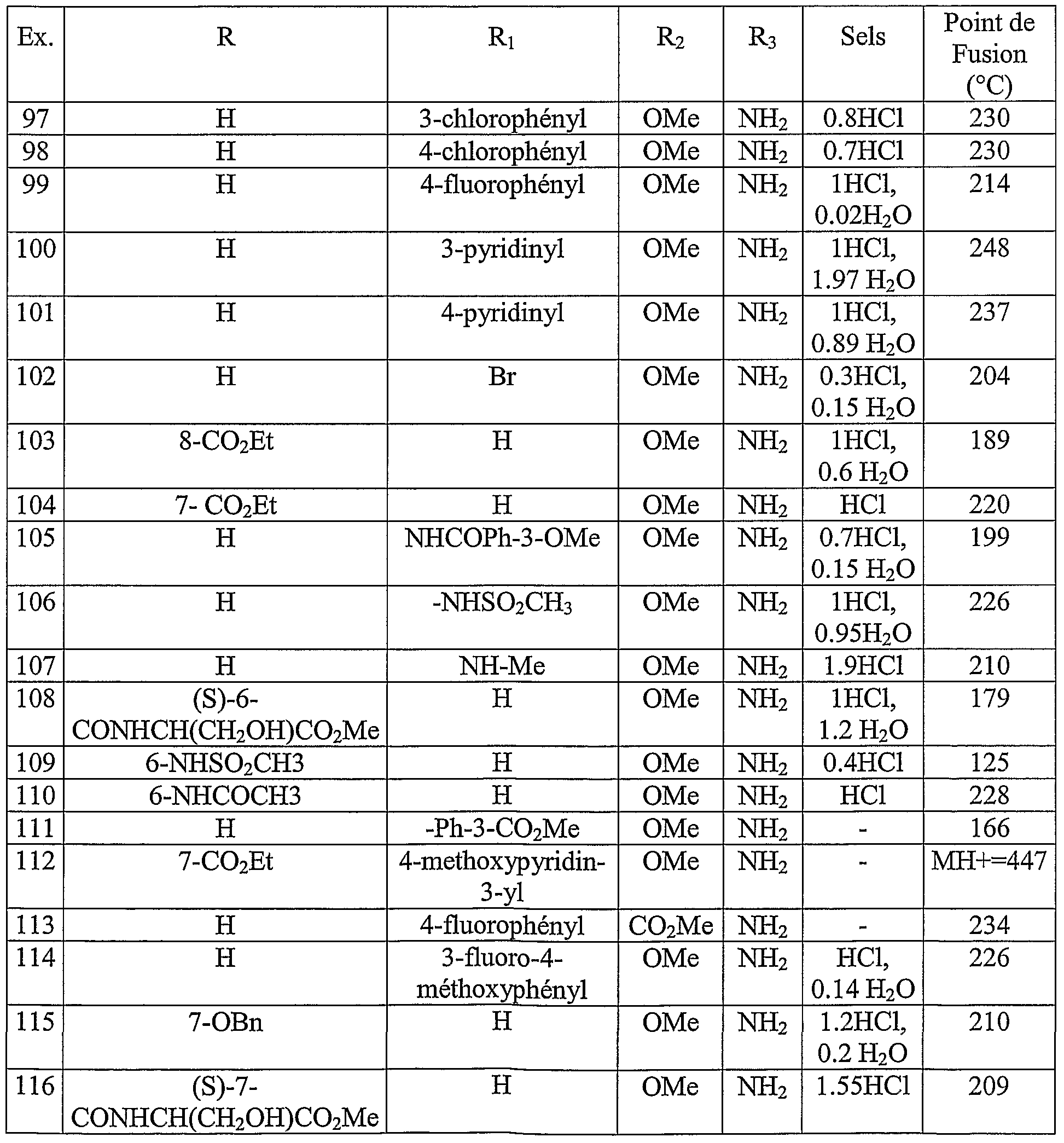

Les RMN des exemples 97 à 119 du TABLEAU VII sont présentées dans le TABLEAU VIF ci-dessous :The NMRs of Examples 97 to 119 of TABLE VII are presented in TABLE VIF below:
TABLEAU VIFTABLE VIF


Exemple 120Example 120
(4-amino-3-méthoxyphényl)[l-(3-méthoxyphényl)imidazo[l,5-a]pyridin-3- yl]méthanone(4-amino-3-methoxyphenyl) [1- (3-methoxyphenyl) imidazo [1,5-a] pyridin-3-yl] methanone
A 0,441g (1 mmole) de (3-mémoxy-4-nitrophényl)[l-(3~ méthoxyphényl)imidazo[l,5-a]pyridin-3-yl]méthanone obtenu à l'exemple 34, dans 10ml de méthanol, on ajoute 0,117g de Pd/C à 10% puis 0,27ml (5,47 mmoles) d'hydrate d'hydrazine. On chauffe à 70°C 3 heures. Le milieu réactionnel est filtré sur talc et le catalyseur est lavé au méthanol. Le filtrat est concentré sous pression réduite. Le résidu est repris au dichlorométhane et lave avec une solution aqueuse saturée de chlorure de sodium puis sèche sur sulfate de sodium. Après concentration sous pression réduite, le résidu est purifié par chromatographie colonne sur gel de silice en éluant au dichlorométhane. On recueille 0,354g d'une mousse jaune. Le produit est salifié par ajout d'acide chlorhydrique IN dans l'éther éthylique. Après addition d'éther éthylique, le précipité est filtré, lavé à l'éther éthylique puis séché. On recueille un solide jaune sous forme de chlorhydrate. Point de fusion : 210°C ; RMN-1H (DMSO-J6) : 3,86(3H, s); 3,92(3H, s); 6,88(1H, d); 6,99(1H, d); 7,22(1H, t)-7,40-7,60(5H, m); 8,14-8,27(3H, m); 9,75(1H, d)To 0.441 g (1 mmol) of (3-methoxy-4-nitrophenyl) [1- (3-methoxyphenyl) imidazo [1,5-a] pyridin-3-yl] methanone obtained in Example 34, in 10 ml of methanol, 0.117 g of 10% Pd / C and then 0.27 ml (5.47 mmol) of hydrazine hydrate are added. The mixture is heated at 70 ° C. for 3 hours. The reaction medium is filtered on talc and the catalyst is washed with methanol. The filtrate is concentrated under reduced pressure. The residue is taken up in dichloromethane and washed with a saturated aqueous solution of sodium chloride and then dried over sodium sulfate. After concentration under reduced pressure, the residue is purified by column chromatography on silica gel, eluting with dichloromethane. 0.354 g of a yellow foam is collected. The product is salified by adding 1N hydrochloric acid in ethyl ether. After addition of ethyl ether, the precipitate is filtered, washed with ethyl ether and then dried. A yellow solid is collected in the hydrochloride form. Point melting point: 210 ° C .; 1 H NMR (DMSO-D6): 3.86 (3H, s); 3.92 (3H, s); 6.88 (1H, d); 6.99 (1H, d); 7.22 (1H, t) -7.40-7.60 (5H, m); 8.14-8.27 (3H, m); 9.75 (1H, d)
Exemples 121 à 148Examples 121 to 148
En procédant selon la préparation décrite à l'exemple 120, on synthétise les composés de formule générale Id décrits dans le tableau VIII ci dessous, par réduction de la fonction nitro des composés de formule Ia avec l'hydrate d'hydrazine en présence de Pd/C à 10% comme catalyseur.By proceeding according to the preparation described in Example 120, the compounds of general formula Id described in Table VIII below are synthesized by reducing the nitro function of the compounds of formula Ia with hydrazine hydrate in the presence of Pd. / C at 10% as catalyst.
TABLEAU VIIITABLE VIII


*ester méthylique en R3 saponifié lors de l'hydrogénation* R 3 saponified methyl ester during hydrogenation
Les RMN des exemples 121 à 148 du TABLEAU VIII sont présentées dans le TABLEAU VIIF ci-dessous :The NMRs of Examples 121 to 148 of TABLE VIII are presented in TABLE VIIF below:
TABLEAU VIIFTABLE VIIF
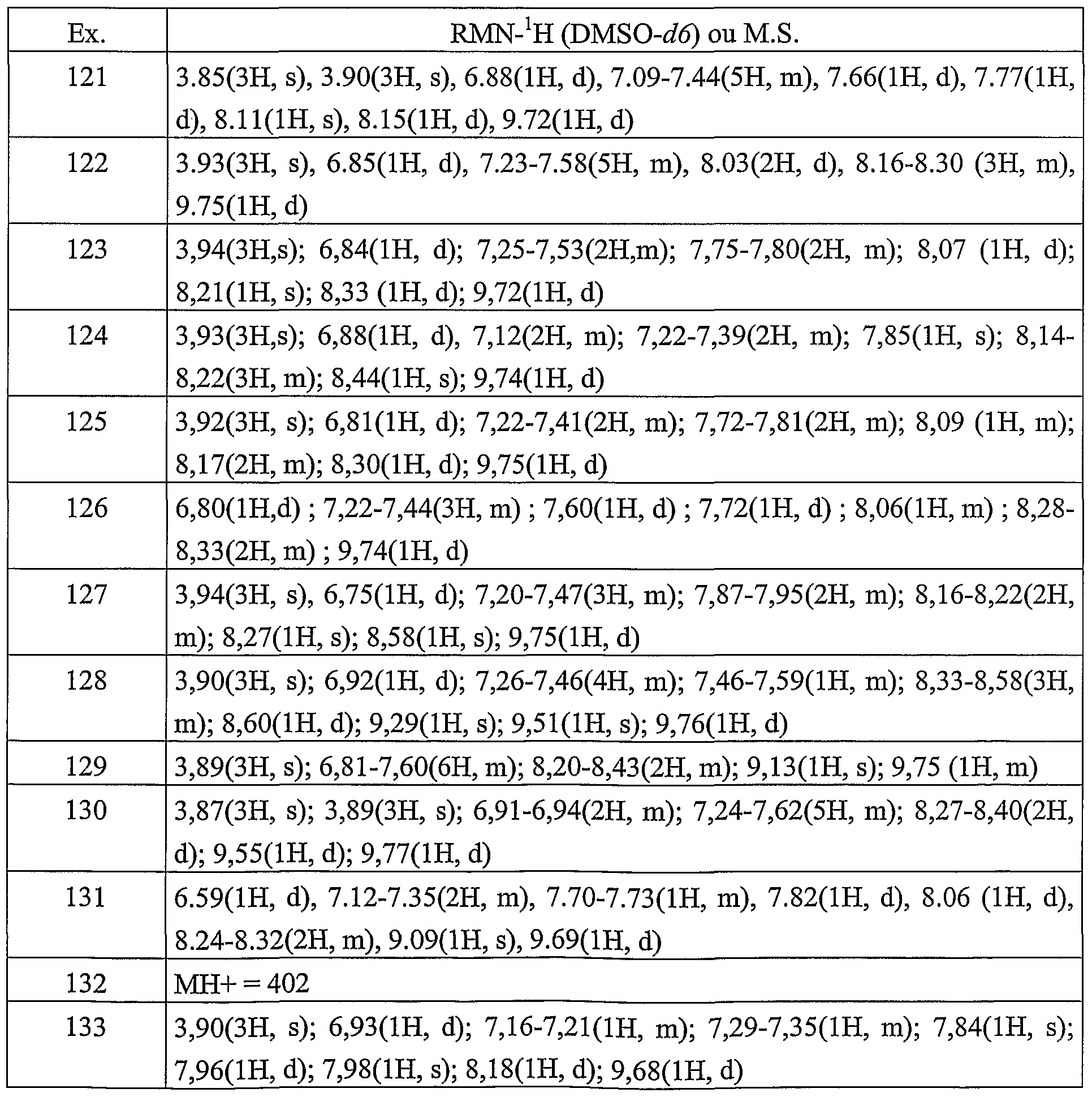

Exemple 149 3-(4-amino-3-méthoxybenzoyl)imidazo[l,5-a]pyridine-l-carboxamideExample 149 3- (4-Amino-3-methoxybenzoyl) imidazo [1,5-a] pyridine-1-carboxamide
A 0,5g (1,7 mmole) de 3-(4-amino-3-méthoxybenzoyl)imidazo[l,5-a]pyridine-l- carbonitrile obtenu à l'exemple 85 dans 50ml d'éthanol, sous atmosphère d'azote, on ajoute 4,4ml (26,4 mmoles) d'une solution aqueuse de soude 6N. Après 2 heures de chauffage au reflux, le milieu réactionnel est concentré sous pression réduite. Le résidu obtenu est lavé à l'eau, à l'acétone à l'éther éthylique puis séché. On recueille Q, AAl g d'un solide jaune. Le produit est salifié par ajout d'une solution d'acide chlorhydrique IN dans l'éther éthylique. On obtient 0,310g d'un solide jaune. Point de fusion : 241°C ; RMN-1H (DMSO-d6) : 3,89(3H, s) ; 6,7A(IR, d); 7,24-7,27(1H, m); 7,45-7,49(1H, m); 7,88(1H, s); 8,33(1H, d); 8,42(1H, d); 9,65(1H, d)0.5 g (1.7 mmol) of 3- (4-amino-3-methoxybenzoyl) imidazo [1,5-a] pyridine-1-carbonitrile obtained in Example 85 in 50 ml of ethanol, under an atmosphere of nitrogen, we add 4.4 ml (26.4 mmol) of a 6N aqueous sodium hydroxide solution. After refluxing for 2 hours, the reaction medium is concentrated under reduced pressure. The residue obtained is washed with water, with acetone in ethyl ether and then dried. Q, AAl g of a yellow solid is collected. The product is salified by adding a solution of 1N hydrochloric acid in ethyl ether. 0.310 g of a yellow solid is obtained. Melting point: 241 ° C; 1 H NMR (DMSO-d6): 3.89 (3H, s); 6.7A (IR, d); 7.24-7.27 (1H, m); 7.45-7.49 (1H, m); 7.88 (1H, s); 8.33 (1H, d); 8.42 (1H, d); 9.65 (1H, d)
Exemple 150 3-(4-amino-3-méthoxybenzoyl)imidazo[l,5-a]pyridine-l-carboxylate de méthyleExample 150 Methyl 3- (4-amino-3-methoxybenzoyl) imidazo [1,5-a] pyridine-1-carboxylate
A 20ml d'une solution de méthanol saturée en acide chlorhydrique à une température de 5°C on ajoute 0,61g (2,09 mmoles) de 3-(4-amino-3-méthoxybenzoyl)imidazo[l,5- a]pyridine-l-carbonitrile obtenu à l'exemple 85, puis laisse revenir à température ambiante et agite 17 heures. Le milieu réactionnel est concentré sous pression réduite. Le résidu est repris dans 14ml d'une solution aqueuse d'acide chlorhydrique IN puis chauffé à 700C pendant 5h. Le milieu réactionnel est basifié avec du bicarbonate de sodium et extrait avec un mélange d'acétate d'éthyle et de tétrahydrofurane. La phase organique est lavée à l'eau, séchée sur sulfate de sodium, concentrée sous pression réduite. Le résidu obtenu est repris au dichlorométhane puis filtré sur un lit de gel de silice en éluant avec un mélange de dichlorométhane-méthanol (99,8-0,2). On recueille 0,3g d'une mousse jaune. Point de fusion : 63°C ; RMN-1H (DMSO-dό) : 3,87(3H, s) ; 3,92(3H, s); 6,73(1H, d); 7,27-7,32(1H, m); 7,57-7,62(1H, m); 7,91(1H, s); 8,14(1H, d); 8,30(1H, d); 9,62(1H, d)To 20 ml of a solution of methanol saturated with hydrochloric acid at a temperature of 5 ° C. is added 0.61 g (2.09 mmol) of 3- (4-amino-3-methoxybenzoyl) imidazo [1,5-a] pyridine-1-carbonitrile obtained in Example 85, then allowed to return to room temperature and stirred 17 hours. The reaction medium is concentrated under reduced pressure. The residue is taken up in 14 ml of an aqueous solution of 1N hydrochloric acid and then heated at 70 ° C. for 5 hours. The reaction medium is basified with sodium bicarbonate and extracted with a mixture of ethyl acetate and tetrahydrofuran. The organic phase is washed with water, dried over sodium sulphate and concentrated under reduced pressure. The residue obtained is taken up in dichloromethane and then filtered on a bed of silica gel, eluting with a mixture of dichloromethane-methanol (99.8-0.2). 0.3 g of a yellow foam is collected. Melting point: 63 ° C; 1 H NMR (DMSO-dό): 3.87 (3H, s); 3.92 (3H, s); 6.73 (1H, d); 7.27-7.32 (1H, m); 7.57-7.62 (1H, m); 7.91 (1H, s); 8.14 (1H, d); 8.30 (1H, d); 9.62 (1H, d)
Exemple 151 Acide 2-amino-5-{[l-(3-méthoxyphényI)imidazo[l,5-a]pyridin-3- yl]carbonyl}benzoïqueExample 151 2-Amino-5 - {[1- (3-methoxyphenyl) imidazo [1,5-a] pyridin-3-yl] carbonyl} benzoic acid
A 0,650g (l,62mmoles) de 2-amino-5-{[l-(3-methoxyphényl)imidazo[l,5-a]pyridin- 3-yl]carbonyl}benzoate de méthyle obtenu à l'exemple 130, en solution dans 30ml de dioxanne on ajoute 4,05ml (8,1 mmoles) d'une solution aqueuse de soude 2N. On chauffe le milieu réactionnel à 6O0C pendant 2 heures puis on laisse revenir à température ambiante. On concentre sous pression réduite. Le résidu est repris dans le dichlorométhane. La phase organique est lavée avec une solution aqueuse d'acide chlorhydrique IN, séchée sur sulfate de sodium puis concentrée sous pression réduite. Le résidu est purifié par chromatographie colonne sur gel de silice en éluant avec un mélange dichlorométhane-méthanol (99-1). Les 167mg de solide orange obtenu sont salifiés sous forme de sel de sodium, 0,98 H2O. Point de fusion : 257°C ; RMN-1H (DMSO-d6) : 3,89(3H, s); 6,64(1H, d); 6,95(1H, d); 7,14- 7,40(3H, m); 7,44-7,60 (2H, m); 8,22(1H, d); 8,32(1H, d); 9,12(1H, s); 9,69(1H, d) Exemples 152 à 1610.650 g (1.62 mmol) of methyl 2-amino-5 - {[1- (3-methoxyphenyl) imidazo [1,5-a] pyridin-3-yl] carbonyl} benzoate obtained in Example 130, in solution in 30 ml of dioxane is added 4.05 ml (8.1 mmol) of a 2N aqueous sodium hydroxide solution. The reaction medium is heated at 60 ° C. for 2 hours and then allowed to return to ambient temperature. Concentrated under reduced pressure. The residue is taken up in dichloromethane. The organic phase is washed with a 1N aqueous hydrochloric acid solution, dried over sodium sulfate and then concentrated under reduced pressure. The residue is purified by column chromatography on silica gel, eluting with a dichloromethane-methanol (99-1) mixture. The 167 mg of orange solid obtained is salified in the form of sodium salt, 0.98 H 2 O. Melting point: 257 ° C .; 1 H NMR (DMSO-d6): 3.89 (3H, s); 6.64 (1H, d); 6.95 (1H, d); 7.14-7.40 (3H, m); 7.44-7.60 (2H, m); 8.22 (1H, d); 8.32 (1H, d); 9.12 (1H, s); 9.69 (1H, d) Examples 152 to 161
En procédant selon la préparation décrite à l'exemple 151, on synthétise les composés de formule générale Ie décrits dans le tableau IX ci dessous, par saponification de la fonction ester présente sur les substituants R2 ou R3 des composés de formule IbBy proceeding according to the preparation described in Example 151, the compounds of general formula Ie described in Table IX below are synthesized by saponification of the ester function present on the substituents R 2 or R 3 of the compounds of formula Ib
TABLEAU IXTABLE IX
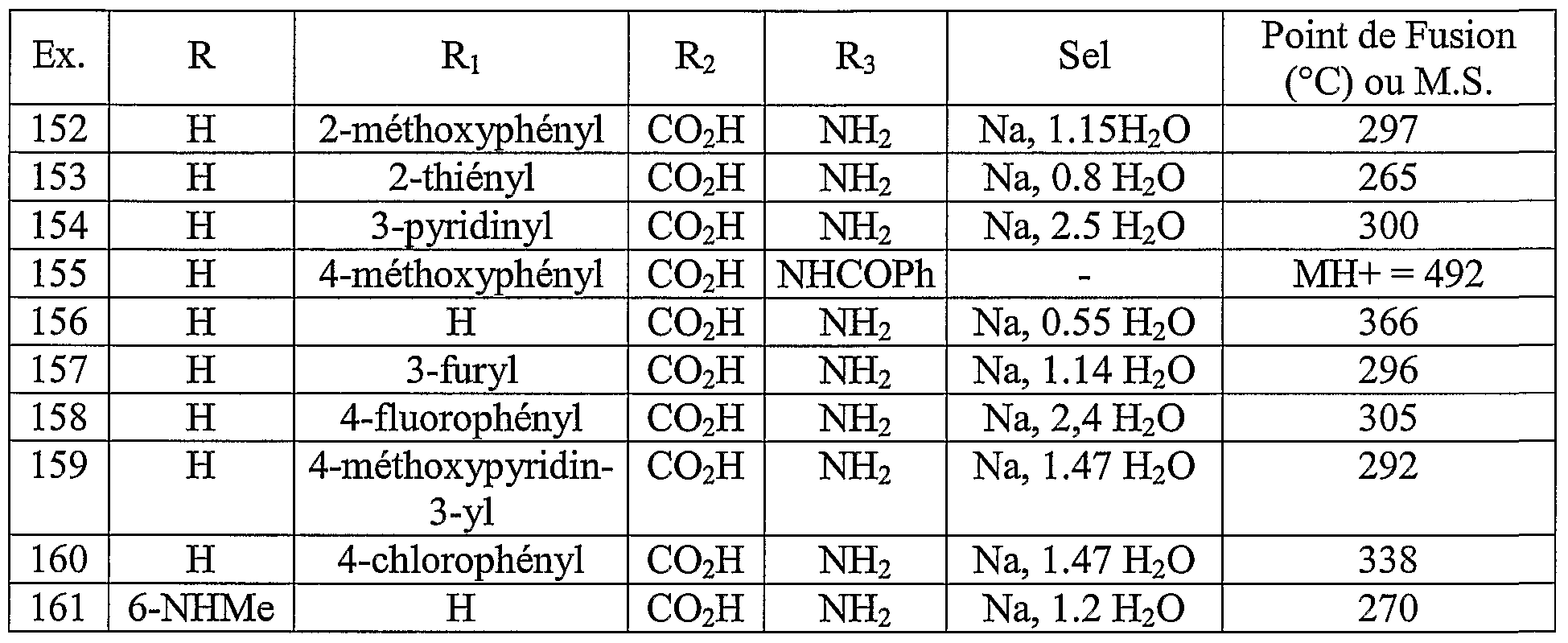
Les RMN des exemples 152 à 161 du TABLEAU IX sont présentées dans le tableau IX' ci-dessous :The NMRs of Examples 152 to 161 of TABLE IX are presented in Table IX 'below:
TABLEAU IX'TABLE IX '
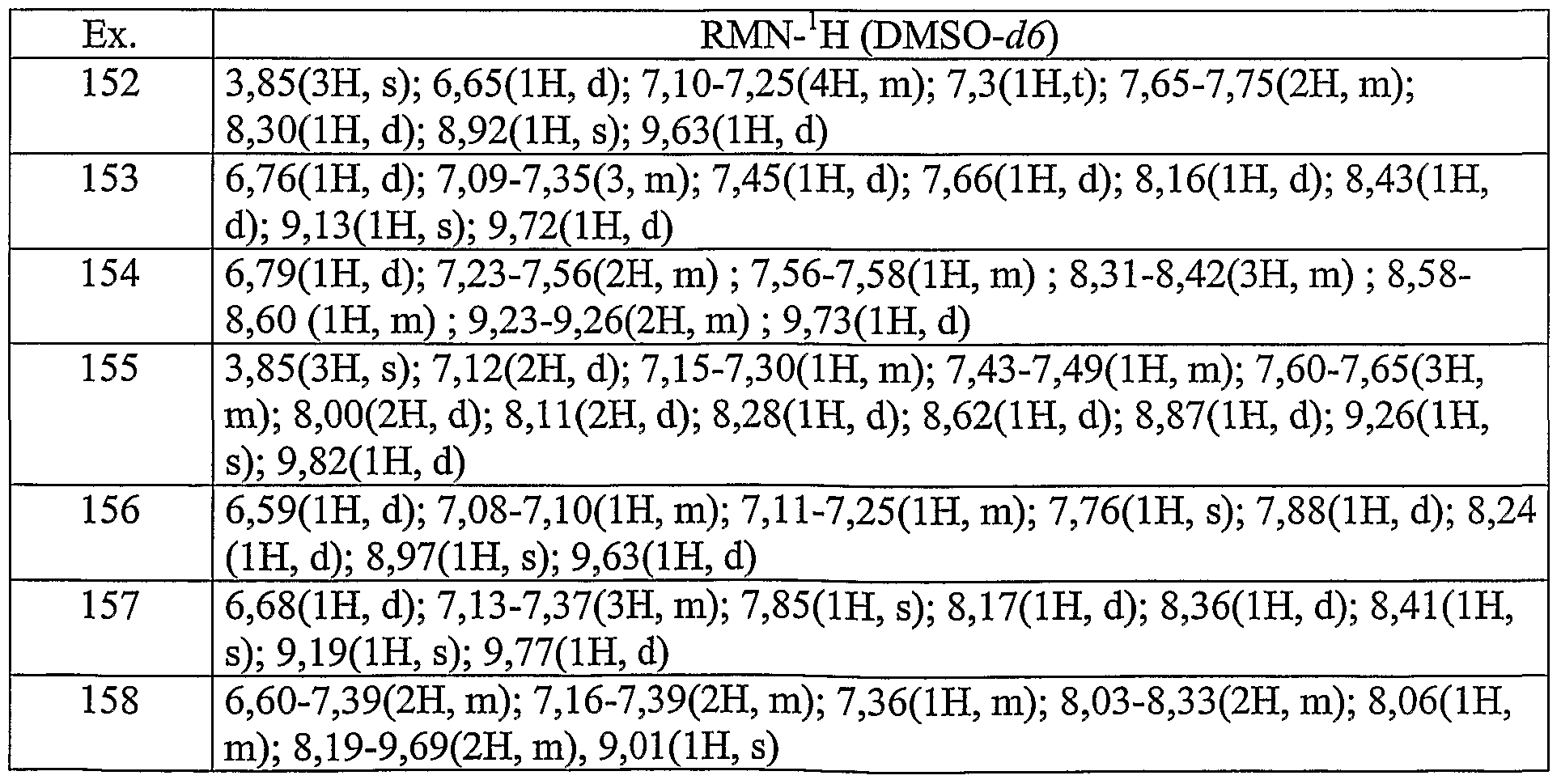

Exemple 162Example 162
Acide 2-ammo-5-{[l-(4-méthoxyphényl)imidazo[l,5-a]pyridin-3- yl] carbonyl}benzoïque A 0,259g (0,5mmole) de l'acide 2-benzoylamino-5-{[l-(4- méthoxyphényl)imidazo[l,5-a]pyridin-3-yl]carbonyl}benzoïque obtenu à l'exemple 155, en solution dans 25ml de dioxanne, on ajoute 1,2g de soude en pastilles. On chauffe à reflux pendant 48 heures. On laisse le milieu réactionnel revenir à température ambiante. Le milieu est repris avec du dioxanne puis acidifié avec de l'hydrogénosulfate de potassium. Le précipité formé est filtré puis rincé à l'eau et séché. On recueille 0.162g d'un solide jaune qui est salifié sous forme de sel de sodium, 1,15 H2O. Point de fusion : 296°C ; RMN-1H (DMSO-Jd) : 3,85(3H, s); 6,63(1H, d); 7,09-7,17(3H, m); 7,28-7,35(1H, m); 7,96(2H, d); 8,17(1H, d); 8,34(1H, d); 9,O4(1H, s); 9,69(1H, d)2-Amino-5 - {[1- (4-methoxyphenyl) imidazo [1,5-a] pyridin-3-yl] carbonyl} benzoic acid A 0.259 g (0.5 mmol) of 2-benzoylamino-5-acid - {[1- (4-methoxyphenyl) imidazo [1,5-a] pyridin-3-yl] carbonyl} benzoic acid obtained in Example 155, dissolved in 25 ml of dioxane, 1.2 g of pellet soda are added . Refluxed for 48 hours. The reaction medium is allowed to return to room temperature. The medium is taken up with dioxane and then acidified with potassium hydrogen sulphate. The precipitate formed is filtered, then rinsed with water and dried. 0.162 g of a yellow solid which is salified in the form of sodium salt, 1.15 H 2 O is collected. Melting point: 296 ° C .; 1 H NMR (DMSO-Jd): 3.85 (3H, s); 6.63 (1H, d); 7.09-7.17 (3H, m); 7.28-7.35 (1H, m); 7.96 (2H, d); 8.17 (1H, d); 8.34 (1H, d); 9, O4 (1H, s); 9.69 (1H, d)
Exemple 163Example 163
Acide 3-(4-amino-3-méthoxybenzoyl)imidazo[l,5-a]pyridine-l-carboxyIique3- (4-Amino-3-methoxybenzoyl) imidazo [1,5-a] pyridine-1-carboxylic acid
A 0,272g (0,84 mmole) de 3-(4-amino-3-méthoxybenzoyl)imidazo[l,5-a]pyridine-l- carboxylate de méthyle obtenu à l'exemple 150, dans 12ml d'un mélange (1/1) de dioxanne et de méthanol, on ajoute 1,67ml (1,67 mmole) d'une solution aqueuse de soude IN. Après 2 heures de chauffage à reflux, le milieu réactionnel est concentré sous pression réduite. Le résidu est repris dans l'eau puis acidifié avec 0,239g (1,7 mmole) d'hydrogénosulfate de potassium. Le précipité formé est filtré lavé à l'eau, l'éther éthylique, séché. On recueille 0.22g d'un solide orange qui est salifié sous forme d'un sel de sodium, 2,55 H2O. Point de fusion : 2260C ; RMN-1H (DMSO-J6) : 3,86(3H, s); 6,71(1H, d); 7,06-7,11(1H, m); 7,24- 7,3O(1H, m); 7,89(1H, s); 8,34(1H, d); 8,59(1H, d); 9,63(1H, d)0.272 g (0.84 mmol) of methyl 3- (4-amino-3-methoxybenzoyl) imidazo [1,5-a] pyridine-1-carboxylate obtained in Example 150, in 12 ml of a mixture ( 1/1) of dioxane and methanol, 1.67 ml (1.67 mmol) of an aqueous solution of 1N sodium hydroxide are added. After heating for 2 hours under reflux, the reaction medium is concentrated under reduced pressure. The residue is taken up in water and then acidified with 0.239 g (1.7 mmol) of potassium hydrogen sulphate. The precipitate formed is filtered and washed with water, the ethyl ether is dried. 0.22 g of an orange solid which is salified in the form of a sodium salt, 2.55 H 2 O is collected. Melting point: 226 ° C. 1 H NMR (DMSO-D6): 3.86 (3H, s); 6.71 (1H, d); 7.06-7.11 (1H, m); 7.24-7.3O (1H, m); 7.89 (1H, s); 8.34 (1H, d); 8.59 (1H, d); 9.63 (1H, d)
Exemple 164Example 164
Acide 3-(4-amino-3~méthoxybenzoyl)imidazo[l,5-a]pyridine-6-carboxylique3- (4-Amino-3-methoxybenzoyl) imidazo [1,5-a] pyridine-6-carboxylic acid
A 300mg (0.92 mmole) de 3-(4-amino-3-méthoxybenzoyl)imidazo[l,5-a]pyridine-6- carboxylate de méthyle obtenu à l'exemple 83, dans 15ml d'un mélange (5/5/5) de dioxanne, dichlorométhane et de méthanol, on ajoute 1,51ml (1,51 mmole) d'une solution aqueuse de soude IN. Le milieu réactionnel est agité une nuit à température ambiante puis concentré sous pression réduite. Le résidu est dissout dans l'eau, lave à l'acétate d'éthyle puis acidifie la phase aqueuse avec 1,5ml d'acide chlorhydrique IN. Le précipité formé est filtré, lavé à l'eau puis séché. On recueille 346mg d'un solide jaune qui est salifié sous forme de sel de sodium, 0,7H2O. Point de fusion : 306°C ; RMN-1H (DMSO-J6) : 3,87(3H, s); 6,72(1H, d); 7,70- 7,78(3H, m); 7,96(1H, s); 8,18(1H, d); 10,09(1H, s)To 300 mg (0.92 mmol) of methyl 3- (4-amino-3-methoxybenzoyl) imidazo [1,5-a] pyridine-6-carboxylate obtained in Example 83, in 15 ml of a mixture (5/5 (5) dioxane, dichloromethane and methanol, 1.51 ml (1.51 mmol) of a 1N aqueous sodium hydroxide solution are added. The reaction medium is stirred overnight at room temperature and then concentrated under reduced pressure. The residue is dissolved in water, washed with ethyl acetate and the aqueous phase is acidified with 1.5 ml of 1N hydrochloric acid. The precipitate formed is filtered, washed with water and then dried. 346 mg of a yellow solid which is salified in the form of sodium salt, 0.7H 2 O are collected. Melting point: 306 ° C .; 1 H NMR (DMSO-D6): 3.87 (3H, s); 6.72 (1H, d); 7.70-7.78 (3H, m); 7.96 (1H, s); 8.18 (1H, d); 10.09 (1H, s)
Exemples 165 à 181Examples 165 to 181
En procédant selon la préparation décrite à l'exemple 164, on synthétise les composés de formule générale Id décrits dans le tableau X ci dessous par saponification de la fonction ester présente sur le substituant R.By proceeding according to the preparation described in Example 164, the compounds of general formula Id described in Table X below are synthesized by saponification of the ester function present on the substituent R.
TABLEAU XPAINTINGS
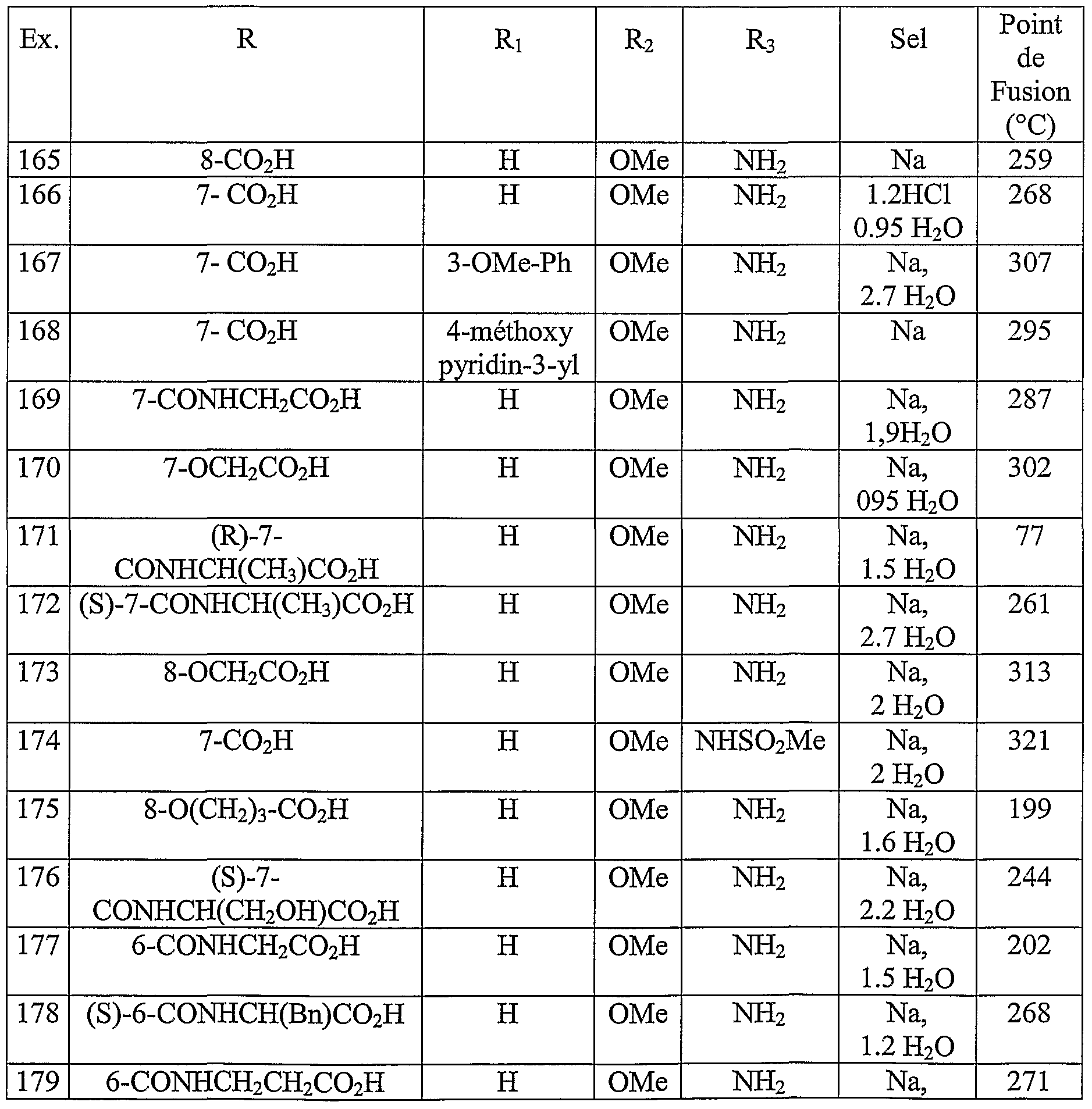

Les RMN des exemples 165 à 181 du TABLEAU X sont présentées dans le tableau X' ci-dessous :The NMRs of Examples 165 to 181 of TABLE X are presented in Table X 'below:
TABLEAU X'PAINTINGS'

Exemplel82Exemplel82
Acide 3-(3-méthoxy-4-nitrobenzoyl)imidazo[l,5-a]pyridine-6-carboxylique3- (3-Methoxy-4-nitrobenzoyl) imidazo [1,5-a] pyridine-6-carboxylic acid
A 530mg (1,49 mmole) de 3-(3-méthoxy-4-nitrobenzoyl)imidazo[l,5-a]pyridine-6- carboxylate de méthyle obtenu à l'exemple 4, dans un mélange de 20ml de dioxane et de 10ml de méthanol, on ajoute 1,64ml (1,64 mmole) d'une solution aqueuse de soude IN. Le milieu réactionnel est chauffé à 60°C pendant 3 heures puis concentré sous pression réduite. Le résidu est repris à l'eau et la phase aqueuse obtenue est lavée au dichlorométhane puis neutralisée par ajout de 1,64ml d'acide chlorhydrique IN. Le précipité formé est filtré, lavé à l'eau puis séché. On recueille 405mg d'un solide jaune. Point de fusion : 313°C ; RMN-1H (DMSO-Jό) : 4,01(3H, s) ; 7,78(1H, d); 7,98(1H, s); 8,06-8,10(3H, m); 8,15(1H, s); 1O,28(1H, s)To 530 mg (1.49 mmol) of methyl 3- (3-methoxy-4-nitrobenzoyl) imidazo [1,5-a] pyridine-6-carboxylate obtained in Example 4, in a mixture of 20 ml of dioxane and 10 ml of methanol is added 1.64 ml (1.64 mmol) of an aqueous solution of 1N sodium hydroxide. The reaction medium is heated at 60 ° C. for 3 hours and then concentrated under reduced pressure. The residue is taken up in water and the aqueous phase obtained is washed with dichloromethane and then neutralized by addition of 1.64 ml of 1N hydrochloric acid. The precipitate formed is filtered, washed with water and then dried. 405mg of a yellow solid is collected. Melting point: 313 ° C; 1 H NMR (DMSO-Jό): 4.01 (3H, s); 7.78 (1H, d); 7.98 (1H, s); 8.06-8.10 (3H, m); 8.15 (1H, s); 1O, 28 (1H, s)
Exemples 183 à 184Examples 183 to 184
En procédant selon la préparation décrite à l'exemple 182, on synthétise les composés de formule générale It décrits dans le tableau XI ci dessous par saponification de la fonction ester présente sur le substituant R.By proceeding according to the preparation described in Example 182, the compounds of general formula II described in Table XI below are synthesized by saponification of the ester function present on the substituent R.
TABLEAU XITABLE XI

Les RMN des exemples 183 à 184 du TABLEAU XI sont présentées dans le TABLEAU XF ci-dessous :The NMRs of Examples 183 to 184 of TABLE XI are presented in TABLE XF below:
TABLEAU XTTABLE XT

A 0.22g (0.76 mmole) du (4-amino-3-méthoxyphényl)(8-hydroxyimidazo[l,5- a]pyridin-3-yl)méthanone obtenu à l'exemple 147, dans 5 ml de DMF on ajoute 0.79g (2,43mmoles) de carbonate de césium puis 0.05ml (0.84mmole) de iodure de méthyle. Le milieu réactionnel est agité à température ambiante pendant 4 heures. Après ajout d'une solution saturée en hydrogenocarbonate de sodium, le milieu réactionnel est extrait à l'acétate d'éthyle. La phase organique obtenue est séchée sur sulfate de sodium, concentrée sous pression réduite. Le résidu est purifié par chromatographie colonne sur gel de silice en éluant au dichlorométhane. On recueille 0.2g d'un solide jaune orangé. Point de fusion : 229°C ; RMN-1H (CDCl3) : 3,86(3H, s); 4,01(3H, s); 5,80(2H, m); 6,69(1H, m); 6,69- 6,72(1H, m); 7,O3-7,O9(1H, t); 7,78(1H, s); 7,92(1H, s); 8,24(1H, m); 9,25-9,28(1H, m)To 0.22 g (0.76 mmol) of (4-amino-3-methoxyphenyl) (8-hydroxyimidazo [1,5-a] pyridin-3-yl) methanone obtained in Example 147, in 5 ml of DMF, 0.79 is added. g (2.43 mmol) of cesium carbonate and then 0.05 ml (0.84 mmol) of methyl iodide. The reaction medium is stirred at ambient temperature for 4 hours. After addition of a saturated solution of sodium hydrogencarbonate, the reaction medium is extracted with ethyl acetate. The organic phase obtained is dried over sodium sulfate and concentrated under reduced pressure. The residue is purified by column chromatography on silica gel, eluting with dichloromethane. 0.2 g of an orange-yellow solid is collected. Melting point: 229 ° C; 1 H NMR (CDCl 3 ): 3.86 (3H, s); 4.01 (3H, s); 5.80 (2H, m); 6.69 (1H, m); 6.69-6.72 (1H, m); 7, O3-7, O9 (1H, t); 7.78 (1H, s); 7.92 (1H, s); 8.24 (1H, m); 9.25-9.28 (1H, m)
Exemples 186 à 189 En procédant selon la préparation décrite à l'exemple 185, on synthétise les composés de formule générale Iz' décrits dans le tableau XII ci-dessous par O-alkylation des composés de formule générale Iz en présence d'un carbonate alcalin et de l'halogénure correspondant:Examples 186 to 189 Proceeding according to the preparation described in Example 185, the compounds of general formula Iz 'described in Table XII below are synthesized by O-alkylation of compounds of general formula Iz in the presence of an alkaline carbonate. and the corresponding halide:
TABLEAU XIITABLE XII

Les RMN des exemples 186 à 189 du TABLEAU XII sont présentées dans le tableau XII' ci-dessous :The NMRs of Examples 186 to 189 of TABLE XII are presented in Table XII 'below:
TABLEAU XII'TABLE XII '

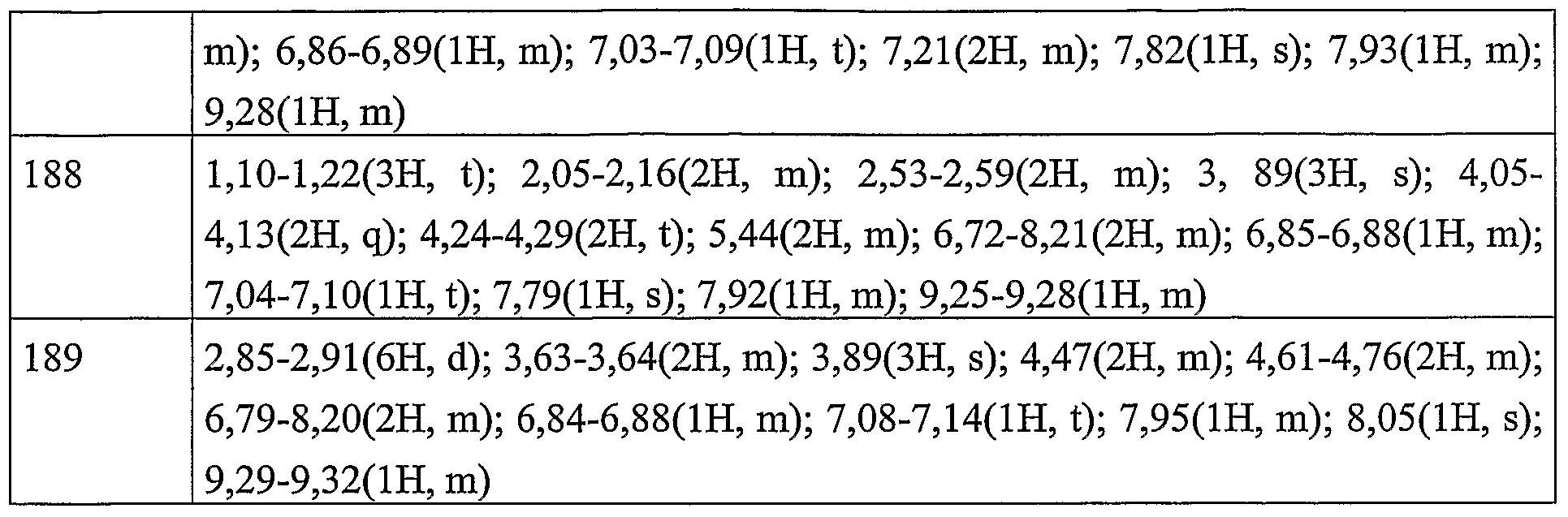
Exemple 190Example 190
3-(3-{3-méthoxy-4-[(propyIsuIfonyl)aminobenzoyI}imidazo[l,5-a]pyridi-l- yl)benzoate de méthyleMethyl 3- (3- {3-methoxy-4 - [(propylsulfonyl) aminobenzoyl} imidazo [1,5-a] pyrid-1-yl) benzoate
A 0.5g (1.24mmole) de 3-[3-(4-amino-3-méthoxybenzoyl)imidazo[l,5-a]pyridin-l- yljbenzoate de méthyle obtenu à l'exemple 111 dans 6ml de pyridine on ajoute 0.17ml (1.5mmole) de chlorure de 1-propanesulfonyle. Le milieu réactionnel est agité à température ambiante pendant 18h puis concentré sous pression réduite. Le résidu obtenu est repris au dichlorométhane. La phase organique obtenue est lavée à l'eau, séchée sur sulfate de sodium, concentrée sous pression réduite. Le résidu obtenu est purifié par chromatographie colonne sur gel de silice en éluant au dichlorométhane. On recueille 0.34g d'une huile jaune. MS+ : 508 ; RMN-1H (DMSO-Jd) : 0,96-l,01(3H, t); 1,74-1,81(2H. m); 3,16-3,19(2H, m); 3,92(3H, s); 4,00(3H, s); 7,33-7,73(2H, m; 7,38-7,51(1H, m); 7,53-7,96(2H, m); 8,03- 8,30(2H, m); 8,33-9,85(2H, m); 8,38(1H, s); 8,63(1H, s); 9,25(1H, m)0.5 g (1.24 mmol) of methyl 3- [3- (4-amino-3-methoxybenzoyl) imidazo [1,5-a] pyridin-1-yl] benzoate obtained in Example III in 6 ml of pyridine are added 0.17. ml (1.5mmol) of 1-propanesulfonyl chloride. The reaction medium is stirred at ambient temperature for 18 h and then concentrated under reduced pressure. The residue obtained is taken up in dichloromethane. The organic phase obtained is washed with water, dried over sodium sulfate and concentrated under reduced pressure. The residue obtained is purified by column chromatography on silica gel, eluting with dichloromethane. 0.34 g of a yellow oil is collected. MS +: 508; 1 H NMR (DMSO-Jd): 0.96-1.01 (3H, t); 1.74-1.81 (2H, m); 3.16-3.19 (2H, m); 3.92 (3H, s); 4.00 (3H, s); 7.33-7.73 (2H, m; 7.38-7.51 (1H, m); 7.53-7.96 (2H, m); 8.03-8.30 (2H, m); 8.33-9.85 (2H, m), 8.38 (1H, s), 8.63 (1H, s), 9.25 (1H, m);
Exemples 191 à 194Examples 191 to 194
En procédant selon la préparation décrite à l'exemple 190, on synthétise les composés de formule générale Ig décrits dans le tableau XIII ci-dessous par sulfonylation ou acylation des composés de formule générale Id:By proceeding according to the preparation described in Example 190, the compounds of general formula Ig described in Table XIII below are synthesized by sulphonylation or acylation of the compounds of general formula Id:
TABLEAU XiπTABLE Xiπ
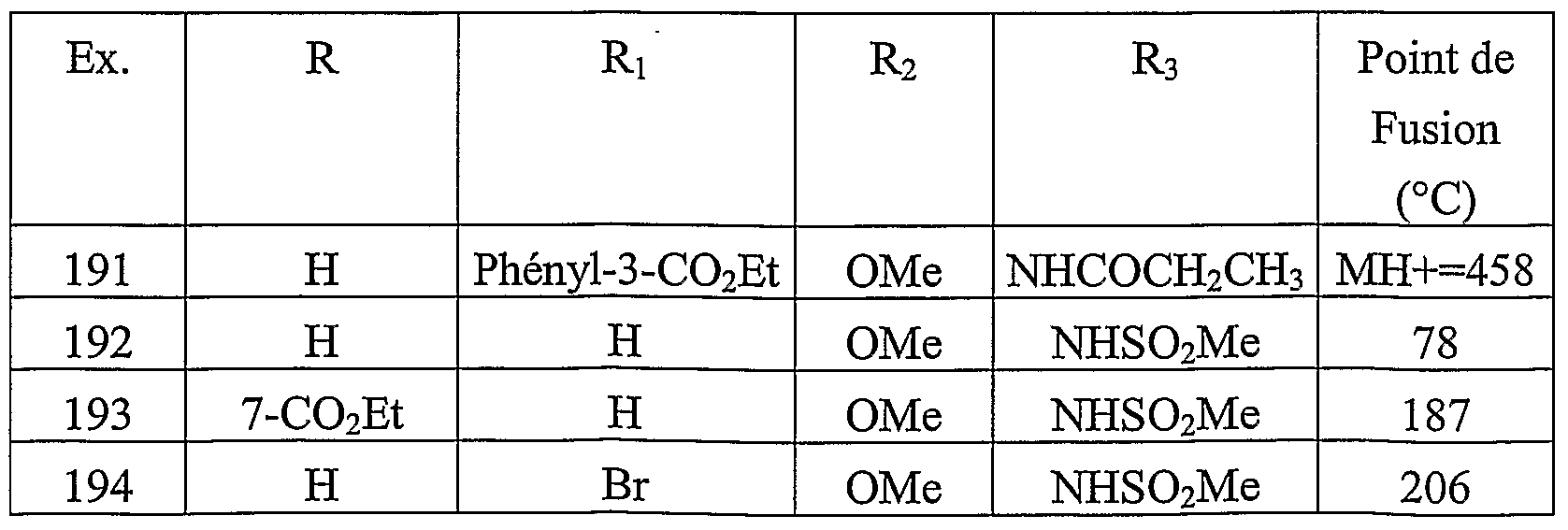
TABLEAU Xm1 TABLE Xm 1

Exemple 195Example 195
Acide 3-(3-{3-méthoxy-4-[(propylsuIfonyI)amino]benzoyl}imidazo[l,5- a]pyridin-l-yl)benzoïque3- (3- {3-Methoxy-4 - [(propylsulfonyl) amino] benzoyl} imidazo [1,5-a] pyridin-1-yl) benzoic acid
A 0.34g (OJmmole) de 3-(3-{3-méthoxy-4-[(propylsulfonyl)amino]benzoyl}imidazo [l,5-a]pyridin-l-yl)benzoate de méthyle obtenu à l'exemple 190 dans 20ml de méthanol on ajoute 1.4ml d'une solution aqueuse IN de soude. Le milieu réactionnel est chauffé à 70°C pendant 3 heures puis concentré sous pression réduite. Le résidu est repris à l'eau et la phase aqueuse obtenue est lavée au dichlorométhane, neutralisée par ajout de 1,4ml d'acide chlorhydrique IN puis extraite au dichlorométhane. La phase organique obtenue est séchée sur sulfate de sodium, concentrée sous pression réduite. On recueille 0.19g d'un solide jaune qui est salifié sous forme de sel de sodium, 2,1 H2O. Point de fusion : 145°C ; RMN-1H (DMSO-cfô) : 0,96-l,01(3H, t); 1,71-1,83(2H, m); 3,16-3,19(2H, m); 4,00(3H, s); 7,33- 7,70(2H, m); 7,36-7,38(1H, m); 7,52-7,97(2H, m); 8,04-8,07(2H, m); 8,27-9,85(2H, m); 8,44(1H, s); 8,64(1H, s); 9,25(1H, m)To 0.34 g (0 mmol) of methyl 3- (3- {3-methoxy-4 - [(propylsulfonyl) amino] benzoyl} imidazo [1,5-a] pyridin-1-yl) benzoate obtained in Example 190 in 20 ml of methanol is added 1.4 ml of 1N aqueous sodium hydroxide solution. The reaction medium is heated at 70 ° C. for 3 hours and then concentrated under reduced pressure. The residue is taken up in water and the aqueous phase obtained is washed with dichloromethane, neutralized by adding 1.4 ml of 1N hydrochloric acid and then extracted with dichloromethane. The organic phase obtained is dried over sodium sulfate and concentrated under reduced pressure. 0.19 g of a yellow solid which is salified in the form of sodium salt, 2.1 H 2 O are collected. Melting point: 145 ° C .; 1 H NMR (DMSO-C6): 0.96-1.01 (3H, t); 1.71-1.83 (2H, m); 3.16-3.19 (2H, m); 4.00 (3H, s); 7.33-7.70 (2H, m); 7.36-7.38 (1H, m); 7.52-7.97 (2H, m); 8.04-8.07 (2H, m); 8.27-9.85 (2H, m); 8.44 (1H, s); 8.64 (1H, s); 9.25 (1H, m)
Exemple 196Example 196
Acide 3-{3-[3-méthoxy-4-[propionylamino]benzoyl]imidazo[l,5-a]pyridin-l-yl} benzoïque3- {3- [3-Methoxy-4- [propionylamino] benzoyl] imidazo [1,5-a] pyridin-1-yl} benzoic acid
Ce composé est obtenu en procédant selon la préparation décrite dans l'exemple 195 par saponification du 3-{3-[3-méthoxy-4-[propionylamino]benzoyl]imidazo[l,5-a]pyridin-l- yl} benzoate de méthyle obtenu à l'exemple 191 avec de la soude IN. On recueille un solide jaune qui est salifié sous forme de sel de sodium, 2.4 H2O. Point de fusion : 145°C ; RMN- 1H (DMSO-Jd) : l,08-l,24(3H, t); 2,46-2,51(2H5 m); 4,03(3H, s); 7,30-7,55(3H, m); 7,88- 8,38(6H, m); 8,43(1H, m); 8, 6O(1H, m); 9,4O(1H, m); 9,45(1H, m); 9,95(1H, m)This compound is obtained by proceeding according to the preparation described in Example 195 by saponification of 3- {3- [3-methoxy-4- [propionylamino] benzoyl] imidazo [1,5-a] pyridin-1-one. methyl benzoate obtained in Example 191 with 1N sodium hydroxide. A yellow solid is collected which is salified in the form of sodium salt, 2.4 H 2 O. Melting point: 145 ° C; 1 H NMR (DMSO-Jd): 1.81-1.24 (3H, t); 2.46 to 2.51 (2H 5 m); 4.03 (3H, s); 7.30-7.55 (3H, m); 7.88-8.38 (6H, m); 8.43 (1H, m); 8.60 (1H, m); 9.4o (1H, m); 9.45 (1H, m); 9.95 (1H, m)
Exemple 197Example 197
Etude de Ia liaison 125I - b-FGF au Récepteur purifié FGF R α IHc par méthode de scintillation de proximitéStudy of 125 I-b-FGF binding to the purified FGF R α IHc receptor by proximity scintillation method
Des plaques NBS (NBS plate 96 well solid white CORNING 3600) sont coatées avec 100 μl de gélatine 0.1 % par puit, 2 heures à 37°C. Au terme de l'incubation, on élimine le coating, on rince et on sèche bien les plaques. On distribue 100 μl de tampon de binding (Tampon Bis Tris 40 mM pH 7.0) dans les plaques.NBS plates (plain NBS 96 well solid white CORNING 3600) are coated with 100 μl of 0.1% gelatin per well, 2 hours at 37 ° C. At the end of the incubation, the coating is removed, the plates are rinsed and dried well. 100 μl of binding buffer (40 mM Bis Tris Buffer pH 7.0) are dispensed into the plates.
Les dilutions des composés de l'invention sont réparties dans les puits à raison de 10 μl / puit. On distribue ensuite 10 μl / puit de b-FGF (AMERSHAM ARM 35050) et 10 μl / puit de FGF R α III c (R&D Systems 658 FR). On ajoute après 10 μl / puit de 125I - bFGF (Dupont NEN NEX 268 - Activité spécifique > 70 μCi) et 50 μl / puit des billes SPA (AMERSHAM RPQN 00019). On agite quelques secondes la plaque et on l'incube 60 minutes à 37°C et à l'abri de la lumière.Dilutions of the compounds of the invention are distributed in the wells at the rate of 10 .mu.l / well. 10 .mu.l / well of b-FGF (AMERSHAM ARM 35050) and 10 .mu.l / well of FGF R .alpha. III (R & D Systems 658 FR) are then dispensed. 10 μl / well of 125 I-bFGF (Dupont NEN NEX 268 - specific activity> 70 μCi) and 50 μl / well of SPA beads (AMERSHAM RPQN 00019) are added. The plate is stirred for a few seconds and incubated for 60 minutes at 37 ° C. and protected from light.
Au terme de l'incubation, la plaque est lue dans un compteur de radioactivité MIBROBETA TRILUX (: WALLAC - PERIONELMER)At the end of the incubation, the plate is read in a MIBROBETA TRILUX radioactivity counter (: WALLAC - PERIONELMER)
Les composés de l'invention ont démontré une activité spécifique comprise entre 10"7M et 10"9M.The compounds of the invention have demonstrated a specific activity of between 10 -7 M and 10 -9 M.
Exemple 198 Effets des composés de la formule I sur la prolifération d'HUVECs versusExample 198 Effects of the compounds of the formula I on the proliferation of HUVECs versus
30 ng/ml de b-FGF ou 10 ng/ml de a-FGF30 ng / ml b-FGF or 10 ng / ml a-FGF
Coater les plaques 24 puits (FALCON PRIMARIA) avec 200 μl d'une solution de fibronectine (50 μg / ml préparée dans du PBS) / puits.Coat the 24-well plates (FALCON PRIMARIA) with 200 μl of a solution of fibronectin (50 μg / ml prepared in PBS) / well.
Ensemencer à raison de 30000 cellules / ml / puit dans un milieu RPMI 1640 + 10 % SVF + 1 % Glutamine + mélange Héparine-ECGF (HE).Inoculate at 30000 cells / ml / well in RPMI 1640 medium + 10% FCS + 1% Glutamine + Heparin-ECGF (HE) mixture.
Incuber à 37 °C, 5 % CO2 le temps que les cellules adhèrent.Incubate at 37 ° C, 5% CO2 until the cells adhere.
Dissoudre les produits et préparer des solutions dans le DMSO / milieu réactionnel ayant une concentration finale de 1 μM final à 10"7M.Dissolve the products and prepare solutions in DMSO / reaction medium with a final concentration of 1 μM final at 10 "7 M.
Après adhésion des cellules pendant 6 heures à 37°C en présence de 5% CO2, le milieu est remplacé par du RPMI 1640 0.1 % SVF + Glutamine +HE.After adhesion of the cells for 6 hours at 37 ° C. in the presence of 5% CO 2 , the medium is replaced by RPMI 1640 0.1% FCS + Glutamine + HE.
Pour la dérivatisation, on utilise comme contrôle négatif 0.1 % SVF, comme contrôle positif 0 % SVF et comme témoin 0.1 % SVF + 30 ng/ml de b-FGF ou 10 ng/ml de a-FGF. On incube ensuite 24 heures à 37 °C en présence de 5 % CO2.For the derivatization, 0.1% FCS as a negative control, 0% FCS and 0.1% FCS + 30 ng / ml were used as the negative control. b-FGF or 10 ng / ml of α-FGF. It is then incubated for 24 hours at 37 ° C. in the presence of 5% CO 2 .
Le deuxième jour les cellules sont rincées par 1 ml de PBS et 200μl de trypsine, puis elles sont récupérées dans l'isoton. On procède à la numération (n> 9μm) Dans ce test de prolifération des cellules endothéliales induite par le b-FGF ou le a-On the second day the cells are rinsed with 1 ml of PBS and 200 μl of trypsin, and then they are recovered in the isoton. Counting (n> 9μm) was performed in this endothelial cell proliferation assay induced by b-FGF or α-
FGF, les composés de l'invention ont démontré une activité spécifique comprise entre 10"5M et 10"9M.FGF, the compounds of the invention demonstrated a specific activity of between 10 -5 M and 10 -9 M.
Exemple 199 MODELE D'ANGIOGENESE IN-VITROExample 199 IN-VITRO ANGIOGENESE MODEL
Préparer les gels en distribuant dans chaque puits de chamberslide (Biocoat Cellware rat tail collagen, Type I, 8-well culturesides: Becton Dickinson 354630) 160 μl de matrigel dilué au 1/6 (Growth factor reduced Matrigel: Becton Dickinson 356230) dans du collagenPrepare the gels by dispensing into each well of chamberslide (Biocoat Cellware rat tail collagen, Type I, 8-well cultureside: Becton Dickinson 354630) 160 μl of Matrigel diluted 1/6 (Growth factor reduced Matrigel: Becton Dickinson 356230) in collagen
(Rat Tail Collagène, type I: Becton Dickinson 354236). Laisser gélifier pendant 1 heure à 37°C.(Rat Tail Collagen, Type I: Becton Dickinson 354236). Allow to gel for 1 hour at 37 ° C.
Ensemencer les cellules endothéliales veineuses humaines (HUVEC ref:C-015-10C - cascade Biologics, DSfC) ou artérielles de porc (PAEC) à 15.103 cellules/puits dans 400 μl de milieu EBM (Clonetics C3121) + 2% FBS + hEGF 10 μg/ml pour les HUVEC et DMEM +Inoculate human venous endothelial cells (HUVEC ref: C-015-10C - Biologics cascade, DSfC) or pork arterial (PAEC) at 15.10 3 cells / well in 400 μl of EBM medium (Clonetics C3121) + 2% FBS + hEGF 10 μg / ml for HUVEC and DMEM +
3% SVF + Glutamine 2 mM + Sodium pyruvate 1 mM + Acides Aminés Non Essentiels 1% (GIBCO) pour les PAEC.3% FCS + 2mM Glutamine + 1mM Sodium Pyruvate + 1% Non-Essential Amino Acids (GIBCO) for PAECs.
Stimuler avec le b-FGF (TEBU/Peprotech) 10 ng/ml ou le a-FGF (TEBU/Peprotech) 10 ng/ml en présence ou non des produits de l'invention pendant 24h à 37°C en présence de 5% CO2.Stimulate with b-FGF (TEBU / Peprotech) 10 ng / ml or a-FGF (TEBU / Peprotech) 10 ng / ml in the presence or absence of the products of the invention for 24h at 37 ° C. in the presence of 5% CO 2 .
Après 24 heures, fixer les cellules et colorer la lame au trichrome de Masson avant observation au microscope objectif X4 et analyse d'image (BIOCOM- logiciel Visiolab 2000).After 24 hours, fix the cells and stain the slide with Masson trichrome before observation with an X4 objective microscope and image analysis (BIOCOM-Visiolab 2000 software).
Pour le test d'angiogénèse in vitro induite par le b-FGF ou le a-FGF, les composés de l'invention ont démontré une activité spécifique comprise entre 10'7M etlO' M.For testing angiogenesis in vitro induced by b-FGF or a-FGF, the compounds of the invention demonstrated a specific activity of between 10 -7 M etlO 'Mr.
Exemple 200Example 200
Modèle d'angiogénèse inflammatoire chez la sourisModel of inflammatory angiogenesis in mice
L'angiogenèse est requise pour le développement des maladies inflammatoires chroniques comme rarthrite rhumatoïde, les IBD, mais aussi pour le développement des tumeurs solides. La formation de nouveaux vaisseaux permet non seulement la perfusion des tissus pathologiques mais également le transport de cytokines responsables de l'établissement de la chronicité de la maladie. Le modèle décrit par Colville-Nash P et al (D. JPET., 1995, vol 274 n°3, ppl463- 1472) permet d'étudier des agents pharmacologiques susceptibles de moduler l'apparition de l'angiogenèse.Angiogenesis is required for the development of chronic inflammatory diseases such as rheumatoid arthritis, IBD, but also for the development of solid tumors. The formation of new vessels not only allows the infusion of pathological tissues but also the transport of cytokines responsible for establishing the chronicity of the disease. The model described by Colville-Nash P et al (JPET, 1995, vol 274 n ° 3, ppl463-1472) makes it possible to study pharmacological agents capable of modulating the appearance of angiogenesis.
Les animaux, souris blanches non consanguines de 25 g environ sont anesthésiés avec du pentobarbital sodique (60 mg/kg ; Sanofi Nutrition Santé animale) par voie intrapéritonéale.The animals, approximately 25 g non-consanguineous white mice, are anesthetized with pentobarbital sodium (60 mg / kg, Sanofi Nutrition Santé animale) intraperitoneally.
Une poche d'air est créée sur le dos de la souris par injection de 3 ml d'air en sous- cutanée.A pocket of air is created on the back of the mouse by injecting 3 ml of air subcutaneously.
Après le réveil, les animaux reçoivent un traitement en général par gavage et reçoivent une injection de 0.5 ml d'adjuvant de Freund (Sigma) avec 0.1 % d'huile de croton (Sigma) dans la poche.After waking, the animals are generally treated by gavage and receive an injection of 0.5 ml of Freund's adjuvant (Sigma) with 0.1% croton oil (Sigma) in the bag.
Sept jours après, les souris sont à nouveau anesthésiées et placées sur une plaque chauffante à 40°C. Un ml de rouge carmin (5% dans 10 % de gélatine - Aldrich Chemicals) est injecté à la veine de la queue. Les animaux sont ensuite mis à 4°C pendant 2-3 heures. Les peaux sont ensuite prélevées et mises à sécher pendant 48 heures dans une étuve à 56°C. Les tissus secs sont pesés et mis dans 1.8 ml de tampon digestif (dithiothreitol 2 mM, Na2HPO4 2OmM, EDTA 1 mM, papaïne 12U/ml) pendant 24 heures.Seven days later, the mice are again anesthetized and placed on a hot plate at 40 ° C. One ml of carmine red (5% in 10% gelatin - Aldrich Chemicals) is injected into the vein of the tail. The animals are then put at 4 ° C for 2-3 hours. The skins are then removed and dried for 48 hours in an oven at 56 ° C. Dry tissues are weighed and placed in 1.8 ml of digestive buffer (dithiothreitol 2 mM, Na 2 HPO 4 2OmM, 1 mM EDTA, papain 12U / ml) for 24 hours.
Le colorant est alors dissous dans 0.2 ml de NaOH 5M. Les peaux sont centrifugées à 2000g pendant 10 mn. Les surnageants sont filtrés sur membranes d'acétate de cellulose 0.2 μm. Les filtrats sont lus dans un spectrophotomètre à 492 nm. contre une gamme étalon de rouge carmin.The dye is then dissolved in 0.2 ml of 5M NaOH. The skins are centrifuged at 2000 g for 10 minutes. The supernatants are filtered through 0.2 μm cellulose acetate membranes. The filtrates are read in a spectrophotometer at 492 nm. against a standard range of carmine red.
Deux paramètres sont étudiés : le poids sec du granulome et la quantité de colorant après digestion des tissus.Two parameters are studied: the dry weight of the granuloma and the amount of dye after digestion of the tissues.
Les résultats sont exprimés en valeurs moyennes (± sem). Les différences entre les groupes sont testées avec une ANOVA suivie d'un test de Dunnet dont le groupe de référence est le groupe "témoin solvant".The results are expressed in mean values (± sem). The differences between the groups are tested with an ANOVA followed by a Dunnet test whose reference group is the "solvent control" group.
Les composés de l'invention sont actifs par voie orale à des doses de 0.1 à 30 mg/kg.The compounds of the invention are active orally at doses of 0.1 to 30 mg / kg.
Exemple 201 Modèle d'angiogenèse MATRIGEL chez la sourisExample 201 MATRIGEL Angiogenesis Model in the Mouse
Le modèle décrit par Passaniti and al. (Laboratory Investigation (1992) 67 (4) pp519-524) permet d'étudier des agents pharmacologiques susceptibles de moduler l'apparition de l'angiogenèse spécifiquement induite par le bFGF. A du Matrigel (Beckton Dickinson) maintenu sous forme liquide à 40C est ajouté du FGF2 (Peprotecch) à raison de 300 ng/ml. Après homogénéisation, le mélange (0.5ml) est injecté par voie sous-cutanée dans le bas du dos de souris noires femelles(C57/B16) de 20g environ préalablement anesthésiées avec du pentobarbital sodique (60 mg/kg ; Sanofi Nutrition Santé animale) par 16 voie intrapéritonéale. Les animaux sont traités par gavage. Après 5 jours les souris sont à nouveau anesthésiées et la peau du bas du dos est prélevée, à ce stade, les différences qualitatives de vascularisation du granulome sont évaluées (scorées) et les granulomes sont photographiés. Un dosage de DNA dans les granulomes est ensuite effectué pour quantifier la cellularité de celui-ci. Pour cela, les granulomes isolés sont digérés par de la collagénase (3mg/ml) toute une nuit à 37°C. Après centrifugation à 850 g durant 10 min, le surnageant est écarté et le culot est remis en solution dans 1.2 ml de tampon PBS contenant 1 mM CaCl2, 1 mM MgCl2 et 5 mM de glucose. La quantité de DNA présente est mesurée à l'aide d'un kit (Cyquant-GR®, Molecular probe) suivant les instructions du fournisseur. Les résultats sont exprimés en valeurs moyennes (± sem). Les différences entre les groupes sont testées avec une ANOVA suivie d'un test de Dunnet dont le groupe de référence est le groupe "témoin solvant".The model described by Passaniti et al. (Laboratory Investigation (1992) 67 (4) pp519-524) makes it possible to study pharmacological agents capable of modulating the appearance of angiogenesis specifically induced by bFGF. A Matrigel (Beckton Dickinson) maintained in liquid form at 4 0 C is added FGF2 (Peprotecch) at a rate of 300 ng / ml. After homogenization, the mixture (0.5 ml) is injected subcutaneously into the lower back of female black mice (C57 / B16) of approximately 20 g previously anesthetized with pentobarbital sodium (60 mg / kg, Sanofi Nutrition Santé animale) by 16 intraperitoneal route. The animals are treated by gavage. After 5 days the mice are again anesthetized and the skin of the lower back is removed, at this stage the qualitative vascularization of the granuloma is evaluated (scored) and the granulomas are photographed. A DNA assay in the granulomas is then performed to quantify the cellularity of the granuloma. For this, the isolated granulomas are digested with collagenase (3 mg / ml) overnight at 37 ° C. After centrifugation at 850 g for 10 min, the supernatant is discarded and the pellet is redissolved in 1.2 ml of PBS buffer containing 1 mM CaCl 2 , 1 mM MgCl 2 and 5 mM glucose. The amount of DNA present is measured using a kit (Cyquant-GR®, Molecular Probe) according to the supplier's instructions. The results are expressed in mean values (± sem). The differences between the groups are tested with an ANOVA followed by a Dunnet test whose reference group is the "solvent control" group.
Pour les études histologiques, les granulomes sont prélevés avec le muscle et la peau, fixés une nuit dans une solution de formaldéhyde à 10% et inclus dans de la paraffine (Embedder Leica®). Les granulomes sont ensuite coupés à l'aide d'un microtome (Leica) et colorés avec le colorant Trichrome de Mason. La néo vascularisation des granulomes est alors évaluée. Les niveaux de vascularisation sont compris entre une valeur 0 et 5.For histological studies, granulomas are collected with muscle and skin, fixed overnight in a 10% formaldehyde solution and embedded in paraffin (Embedder Leica®). The granulomas are then cut with a microtome (Leica) and stained with Mason's Trichrome stain. The neovascularization of the granulomas is then evaluated. The vascularization levels are between a value of 0 and 5.
Les composés de l'invention sont actifs par voie orale à des doses de 0.1 à 30 mg/kg.The compounds of the invention are active orally at doses of 0.1 to 30 mg / kg.
Exemple 202Example 202
Modèle d'angiogenèse tumorale chez la sourisModel of tumor angiogenesis in mice
Ce modèle permet d'étudier des agents pharmacologiques susceptibles de moduler l'apparition de l'angiogenèse spécifiquement induite par le développement tumoral. Des souris C56/B16 de 20g environ sont anesthésiées avec du pentobarbital sodique (60 mg/kg ; Sanofi Nutrition Santé animale) par voie intrapéritonéale. Les tumeurs sont établies par injection sous cutanée sur le dos de cellules Lewis Lung de souris à raison de 2 10 cellules/souris. Après 5 jours, les souris sont traitées tous les jours par gavage. La taille des tumeurs est mesurée 2 fois par semaine durant 21 jours et le volume tumoral est calculé en utilisant la formule : [π/6(ω1 x ω2 x ω2)], où O1 représente le plus grand diamètre et ω2 représente le plus petit diamètre.This model makes it possible to study pharmacological agents capable of modulating the appearance of angiogenesis specifically induced by tumor development. C56 / B16 mice of approximately 20 g are anesthetized with pentobarbital sodium (60 mg / kg, Sanofi Nutrition Santé animale) intraperitoneally. Tumors are established by subcutaneous injection on the back of mouse Lewis Lung cells at 2 cells / mouse. After 5 days, the mice are treated daily by gavage. The tumor size is measured twice a week for 21 days and the tumor volume is calculated using the formula: [π / 6 (ω 1 x ω 2 x ω 2 )], where O 1 is the largest diameter and ω 2 represents the smallest diameter.
Les résultats sont exprimés en valeurs moyennes (± sem). Les différences entre les groupes sont testées avec une ANOVA suivie d'un test de Dunnet dont le groupe de référence est le groupe "témoin solvant". Les composés de l'invention sont actifs par voie orale à des doses de 0.1 à 30 mg/kg. Exemple 203The results are expressed in mean values (± sem). The differences between the groups are tested with an ANOVA followed by a Dunnet test whose reference group is the "solvent control" group. The compounds of the invention are active orally at doses of 0.1 to 30 mg / kg. Example 203
Effet sur la thrombopénieEffect on thrombocytopenia
La thrombopénie reste une pathologie pour laquelle il existe peu de traitements efficaces à part la transfusion de concentrés plaquettaires et la thrombopoïétine (Kaushansky, K. New Eng JMed (1998), 339, pp746-754).Thrombocytopenia remains a pathology for which there are few effective treatments other than transfusion of platelet concentrates and thrombopoietin (Kaushansky, K. New Eng JMed (1998), 339, pp746-754).
La chimiothérapie anti-cancéreuse constitue une des causes majeures de thrombopénie. Un des agents de chimiothérapie, le carboplatine, a été largement utilisé pour induire une thrombopénie chez la souris et pouvoir ainsi caractériser l'effet de composés capables d'améliorer le taux de plaquettes comme par exemple la thrombopoïétine (Hokom MM et al, Blood (1995), 86, ρρ4486-4492).Anti-cancer chemotherapy is one of the major causes of thrombocytopenia. One of the chemotherapy agents, carboplatin, has been widely used to induce thrombocytopenia in mice and thus be able to characterize the effect of compounds capable of improving platelet levels such as thrombopoietin (Hokom MM et al, Blood ( 1995), 86, ρρ4486-4492).
150 mg/kg de carboplatine ont été administrés par voie intrapéritonéale à des souris balbC ayant un poids de 20g. Un prélèvement sanguin est effectué périodiquement par ponction rétro-orbitale et le taux de plaquettes circulantes est déterminé par un automate d'hématologie (MS9™ de Melet-Schloesing Laboratoires, Cergy-Pontoise, France). Dans ces conditions, on observe une thrombopénie réversible avec un nadir situé 9 à 10 jours après l' administration de carboplatine (diminution du taux de plaquettes circulantes de 50-150 mg / kg of carboplatin was administered intraperitoneally to BalbC mice weighing 20 g. A blood sample is taken periodically by retro-orbital puncture and the level of circulating platelets is determined by a hematology automaton (MS9 ™ from Melet-Schloesing Laboratories, Cergy-Pontoise, France). Under these conditions, reversible thrombocytopenia was observed with nadir 9 to 10 days after carboplatin administration (decreased circulating platelet count by 50%).
%).%).
Les composés selon l'invention ou leur solvant (un blanc - témoin) sont administrés par voie orale pendant 5 jours en commençant le traitement 7 jours avant l'administration de carboplatine. Les expériences sont effectuées sur des lots comprenant 10-12 souris et les résultats sont exprimés en moyenne + erreur standard. Dans ces conditions, les composés de l'invention augmentent le taux de plaquettes circulantes à des doses de 0.1 à 30 mg/kg.The compounds according to the invention or their solvent (a blank control) are administered orally for 5 days starting treatment 7 days before the administration of carboplatin. The experiments are performed on batches comprising 10-12 mice and the results are averaged + standard error. Under these conditions, the compounds of the invention increase the level of circulating platelets at doses of 0.1 to 30 mg / kg.
Exemple 204 Modèle de CNV (choroïdal neo vascularization) induite par laser argon chez la sourisExample 204 Argon Laser-induced CNV (choroidal neo vascularization) model in mice
Un caractère majeur de la perte de transparence oculaire est la néo-vascularisation et les hémorragies consécutives qui causent des désordres fonctionnels importants au niveau de l'œil et qui se traduisent par une cécité précoce. Récemment, l'étude des mécanismes impliqués dans les phénomènes de néo-vascularisation oculaire a permis de mettre en évidence l'implication de facteur pro-angiogéniques dans ces pathologies.A major feature of ocular transparency loss is neovascularization and consecutive hemorrhages that cause significant functional disorders in the eye and result in early blindness. Recently, the study of the mechanisms involved in ocular neovascularization phenomena has made it possible to demonstrate the involvement of pro-angiogenic factors in these pathologies.
Le modèle de néo-angiogenèse choroïdienne induite par laser décrit par Rakic JM et al. dans Invest Ophthalmol Vis Sd. (2003) Jul:44(7). pp3186-3193) permet d'étudier des agents pharmacologiques susceptibles de moduler la néo-vascularisation de la choroïde. Les souris sont anesthésiées par injection intrapéritonéale d'Avertin™. Les deux pupilles sont dilatées avec une solution à 1% de tropicamide en application topique, et trois lésions sont réalisées autour du disque optique à l'aide d'un laser argon (532 nm; diamètre "spot size" 50 μm; durée 0.05 sec; 400 mW). Le disque optique est ensuite recouvert d'une lentille.The laser-induced choroidal neoangiogenesis model described by Rakic JM et al. in Invest Ophthalmol Screw Sd. (2003) Jul: 44 (7). pp3186-3193) makes it possible to study pharmacological agents capable of modulating the neovascularization of the choroid. The mice are anesthetized by intraperitoneal injection of Avertin ™. The two pupils are dilated with a topical application of 1% tropicamide and three lesions are made around the optical disc using an argon laser (532 nm; "spot size" 50 μm; duration 0.05 sec; 400 mW). The optical disk is then covered with a lens.
14 jours après, les souris sont sacrifiées et les yeux énucléés et fixés dans un tampon contenant 3.5% de Formalin™, enrobés dans du Tissue TeK™ (Miles Laboratories, Naperville, Illinois) et congeler dans l'azote liquide de manière à pouvoir réaliser des coupes à l'aide d'un cryostat.14 days later, the mice are sacrificed and the eyes enucleated and fixed in a buffer containing 3.5% of Formalin ™, coated in Tissue TeK ™ (Miles Laboratories, Naperville, Illinois) and frozen in liquid nitrogen so as to be able to achieve sections with a cryostat.
La quantification de la néo-vascularisation choroïdienne a été réalisée par une étude morphométrique quantitative permettant d'évaluer l'épaisseur du réseaux de néo-vaisseaux présents au niveau de la choroïde, à l'aide d'un système d'analyse d'image assisté par un ordinateur (Olympus Micro Image version 3.0 for Windows 95/NT, Olympus Optical CO.The quantification of choroidal neovascularization was performed by a quantitative morphometric study to evaluate the thickness of the neovessels present at the choroid level, using an image analysis system. assisted by a computer (Olympus Micro Image version 3.0 for Windows 95 / NT, Olympus Optical CO.
Europe GmBH).Europe GmBH).
La néo-vascularisation est estimée par le rapport (B/C) de l'épaisseur de la couche pigmentée de la choroïde au niveau de la lésion (B) à l'épaisseur de cette même couche pigmentée dans une région adjacente à la lésion (C). Les résultats sont exprimés en valeurs moyennes (± sem). Les différences entre les groupes traités et les groupes contrôle sont testées avec une ANOVA suivi d'un test Dunnet dont le groupe de référence est le groupe "témoin solvant".Neovascularization is estimated by the ratio (B / C) of the thickness of the pigmented layer of the choroid at the lesion (B) to the thickness of the same pigmented layer in a region adjacent to the lesion ( VS). The results are expressed in mean values (± sem). The differences between the treated and control groups are tested with ANOVA followed by a Dunnet test whose reference group is the "solvent control" group.
Les composés de l'invention sont actifs par voie orale à des doses de 0.1 à 30 mg/kg. The compounds of the invention are active orally at doses of 0.1 to 30 mg / kg.
Claims
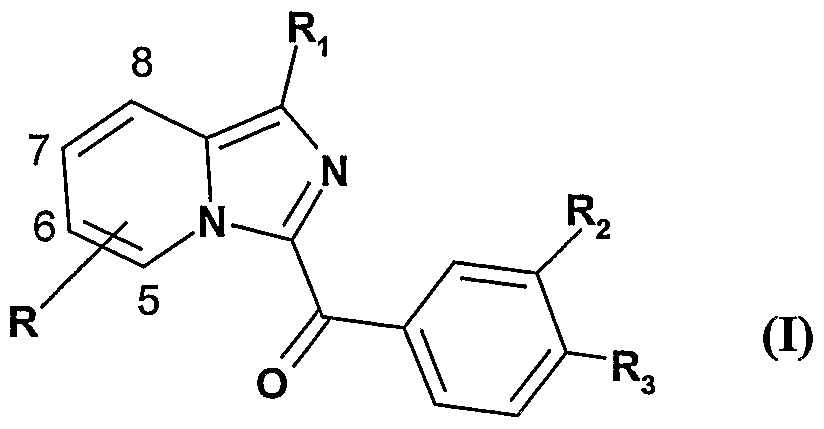


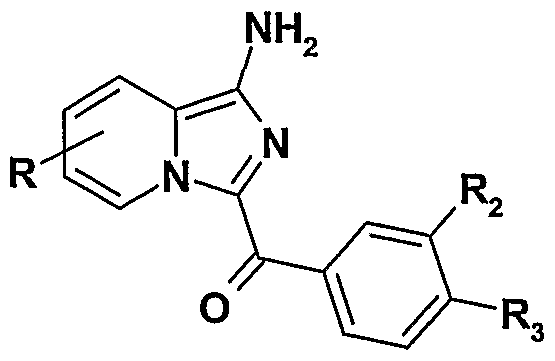


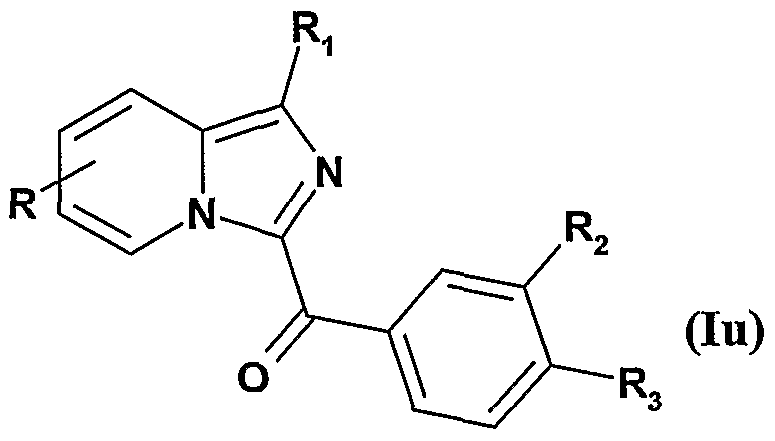
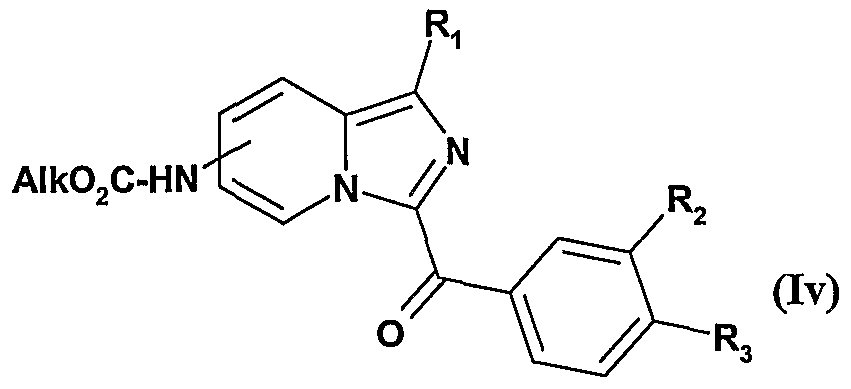


Priority Applications (18)
| Application Number | Priority Date | Filing Date | Title |
|---|---|---|---|
| MX2007011361A MX2007011361A (en) | 2005-03-16 | 2006-03-15 | Novel imidazo[1,5-a]pyridine derivatives, method for preparing same and pharmaceutical compositions containing same. |
| NZ561205A NZ561205A (en) | 2005-03-16 | 2006-03-15 | Novel imidazo[1,5-A]pyridine derivatives, method for preparing same and pharmaceutical compositions containing same |
| EP06726093A EP1861403B1 (en) | 2005-03-16 | 2006-03-15 | Novel imidazo[1,5-a]pyridine derivatives, method for preparing same and pharmaceutical compositions containing same |
| ES06726093T ES2386643T3 (en) | 2005-03-16 | 2006-03-15 | New derivatives of imidazo [1,5-A] pyridines, their preparation process and the pharmaceutical compositions containing them |
| BRPI0607589-4A BRPI0607589A2 (en) | 2005-03-16 | 2006-03-15 | imidazo [1,5-a] pyridines derivatives, their preparation process and the pharmaceutical compositions containing them |
| JP2008501368A JP5007295B2 (en) | 2005-03-16 | 2006-03-15 | Novel imidazo [1,5-a] pyridine derivatives, methods for preparing the derivatives and pharmaceutical compositions containing the derivatives |
| DK06726093.5T DK1861403T3 (en) | 2005-03-16 | 2006-03-15 | New imidazole [1,5-a] pyridine derivatives, processes for their preparation and pharmaceutical compositions containing them |
| SI200631369T SI1861403T1 (en) | 2005-03-16 | 2006-03-15 | Novel imidazo[1,5-a]pyridine derivatives, method for preparing same and pharmaceutical compositions containing same |
| KR1020077021179A KR101278374B1 (en) | 2005-03-16 | 2006-03-15 | Novel imidazo[1,5-a]pyridine derivatives, method for preparing same and pharmaceutical compositions containing same |
| CA2599643A CA2599643C (en) | 2005-03-16 | 2006-03-15 | Novel imidazo[1,5-a]pyridine derivatives, method for preparing same and pharmaceutical compositions containing same |
| EA200701991A EA013408B1 (en) | 2005-03-16 | 2006-03-15 | Imidazo[1,5-a]pyridine derivatives, method for preparing same and pharmaceutical compositions containing same |
| AT06726093T ATE556074T1 (en) | 2005-03-16 | 2006-03-15 | NEW IMIDAZOÄ1,5-AÜPYRIDINE DERIVATIVES, METHOD FOR THE PRODUCTION THEREOF AND PHARMACEUTICAL COMPOSITIONS CONTAINING SAME |
| AU2006224466A AU2006224466B2 (en) | 2005-03-16 | 2006-03-15 | Novel imidazo(1,5-a)pyridine derivatives, method for preparing same and pharmaceutical compositions containing same |
| PL06726093T PL1861403T3 (en) | 2005-03-16 | 2006-03-15 | Novel imidazo[1,5-a]pyridine derivatives, method for preparing same and pharmaceutical compositions containing same |
| IL185611A IL185611A (en) | 2005-03-16 | 2007-08-30 | 3-(phenylcarbonyl) imidazo[1,5-a]pyridine derivatives, processes for preparing same and pharmaceutical compositions containing same |
| US11/855,549 US8008321B2 (en) | 2005-03-16 | 2007-09-14 | Imidazo[1,5-a] pyridine derivatives, method for preparing same and pharmaceutical compositions containing same |
| NO20075169A NO20075169L (en) | 2005-03-16 | 2007-10-10 | New imidazo (1,5-A) ornamental derivatives, process for preparation and pharmaceutical compositions containing the same. |
| US13/020,883 US8633216B2 (en) | 2005-03-16 | 2011-02-04 | Imidazo[1,5-a]pyridine derivatives, method for preparing same and pharmaceutical compositions containing same |
Applications Claiming Priority (2)
| Application Number | Priority Date | Filing Date | Title |
|---|---|---|---|
| FR0502590 | 2005-03-16 | ||
| FR0502590A FR2883286B1 (en) | 2005-03-16 | 2005-03-16 | NOVEL IMIDAZO [1,5-a] PYRIDINE DERIVATIVES, INHIBITORS OF FGFs, PROCESS FOR THEIR PREPARATION AND PHARMACEUTICAL COMPOSITIONS CONTAINING SAME |
Related Child Applications (1)
| Application Number | Title | Priority Date | Filing Date |
|---|---|---|---|
| US11/855,549 Continuation US8008321B2 (en) | 2005-03-16 | 2007-09-14 | Imidazo[1,5-a] pyridine derivatives, method for preparing same and pharmaceutical compositions containing same |
Publications (1)
| Publication Number | Publication Date |
|---|---|
| WO2006097625A1 true WO2006097625A1 (en) | 2006-09-21 |
Family
ID=35276198
Family Applications (1)
| Application Number | Title | Priority Date | Filing Date |
|---|---|---|---|
| PCT/FR2006/000567 Ceased WO2006097625A1 (en) | 2005-03-16 | 2006-03-15 | Novel imidazo[1,5-a]pyridine derivatives, method for preparing same and pharmaceutical compositions containing same |
Country Status (24)
| Country | Link |
|---|---|
| US (2) | US8008321B2 (en) |
| EP (1) | EP1861403B1 (en) |
| JP (1) | JP5007295B2 (en) |
| KR (1) | KR101278374B1 (en) |
| CN (2) | CN101160309A (en) |
| AT (1) | ATE556074T1 (en) |
| AU (1) | AU2006224466B2 (en) |
| BR (1) | BRPI0607589A2 (en) |
| CA (1) | CA2599643C (en) |
| CY (1) | CY1112997T1 (en) |
| DK (1) | DK1861403T3 (en) |
| EA (1) | EA013408B1 (en) |
| ES (1) | ES2386643T3 (en) |
| FR (1) | FR2883286B1 (en) |
| IL (1) | IL185611A (en) |
| MA (1) | MA29716B1 (en) |
| MX (1) | MX2007011361A (en) |
| NO (1) | NO20075169L (en) |
| NZ (1) | NZ561205A (en) |
| PL (1) | PL1861403T3 (en) |
| PT (1) | PT1861403E (en) |
| SI (1) | SI1861403T1 (en) |
| WO (1) | WO2006097625A1 (en) |
| ZA (1) | ZA200707901B (en) |
Cited By (18)
| Publication number | Priority date | Publication date | Assignee | Title |
|---|---|---|---|---|
| WO2007113235A1 (en) * | 2006-03-31 | 2007-10-11 | Speedel Experimenta Ag | Process for preparing 6,7-dihydro-5h-imidazo[1,5-a]pyridin-8-one |
| WO2009123316A1 (en) * | 2008-04-04 | 2009-10-08 | 武田薬品工業株式会社 | Heterocyclic derivative and use thereof |
| JP2010523668A (en) * | 2007-04-10 | 2010-07-15 | ハー・ルンドベック・アクチエゼルスカベット | Heteroarylamide analogs as P2X7 antagonists |
| US7803810B2 (en) | 2007-03-09 | 2010-09-28 | Probiodrug Ag | Inhibitors |
| WO2010108665A1 (en) | 2009-03-24 | 2010-09-30 | Life & Brain Gmbh | Promotion of neuronal integration in neural stem cell grafts |
| WO2012004731A1 (en) | 2010-07-06 | 2012-01-12 | Sanofi | Indolizine derivatives, process for the preparation thereof and therapeutic use thereof |
| WO2012004732A1 (en) | 2010-07-06 | 2012-01-12 | Sanofi | Imidazopyridine derivatives, process for the preparation thereof and therapeutic use thereof |
| FR2985185A1 (en) * | 2012-01-04 | 2013-07-05 | Sanofi Sa | THERAPEUTIC USE OF IMIDAZOPYRIDINE DERIVATIVES |
| WO2014005150A1 (en) * | 2012-06-29 | 2014-01-03 | Novartis Ag | Crystalline forms of l-(2-((lr,3s,5r)-3-( (2 -fluoro-3 - (trifluoromethoxy) phenyl) carbamoyl) - 2 -azabicycl o [3.1.0] hexan- 2 -yl) - 2 -oxoethyl) - 5 -methyl - 1h - pyrazolo [3, 4 -c] pyridine - 3 - carboxami de and salts thereof |
| US8933099B2 (en) | 2013-02-20 | 2015-01-13 | Eisai R&D Management Co., Ltd. | Monocyclic pyridine derivative |
| WO2015089218A1 (en) | 2013-12-10 | 2015-06-18 | David Wustrow | Monocyclic pyrimidine/pyridine compounds as inhibitors of p97 complex |
| US9549366B2 (en) | 2011-07-01 | 2017-01-17 | Nokie Technologies Oy | Method and apparatus for providing network access to a connecting apparatus |
| US9951047B2 (en) | 2014-08-18 | 2018-04-24 | Eisai R&D Management Co., Ltd. | Salt of monocyclic pyridine derivative and crystal thereof |
| US11219619B2 (en) | 2018-03-28 | 2022-01-11 | Eisai R&D Management Co., Ltd. | Therapeutic agent for hepatocellular carcinoma |
| US11274108B2 (en) | 2015-07-20 | 2022-03-15 | Genzyme Corporation | Colony stimulating factor-1 receptor (CSF-1R) inhibitors |
| US11530216B2 (en) | 2020-12-23 | 2022-12-20 | Genzyme Corporation | Deuterated colony stimulating factor-1 receptor (CSF-1R) inhibitors |
| US12364690B2 (en) | 2015-03-25 | 2025-07-22 | National Cancer Center | Therapeutic agent for bile duct cancer |
| US12414945B2 (en) | 2015-12-17 | 2025-09-16 | Eisai R&D Management Co., Ltd. | Therapeutic agent for breast cancer |
Families Citing this family (8)
| Publication number | Priority date | Publication date | Assignee | Title |
|---|---|---|---|---|
| FR2967412B1 (en) * | 2010-11-17 | 2012-12-14 | Sanofi Aventis | NOVEL INDOLIZINE DERIVATIVES, THEIR PREPARATION AND THEIR THERAPEUTIC APPLICATION |
| JP6232630B2 (en) * | 2013-03-10 | 2017-11-22 | 国立大学法人名古屋大学 | Bone system disease drug and use thereof |
| CN103910643B (en) * | 2014-04-23 | 2015-07-15 | 温州大学 | Anti-cancer activity ketone derivative as well as synthetic method and application thereof |
| FR3022244B1 (en) * | 2014-06-17 | 2016-07-01 | Centre Nat De La Rech Scient (Cnrs) | USE OF A NEW 3-ARYL-4-CATECHOL-PYRROLE-N-PROPANOL COMPOUND AND DERIVATIVES THEREOF FOR THE TREATMENT OF CANCER AND PATHOLOGIES ASSOCIATED WITH EXCESSIVE ANGIOGENESIS |
| CN110483437B (en) * | 2018-05-14 | 2022-12-06 | 嘉兴维眸生物科技有限公司 | Five-membered ring-containing compound and preparation and application thereof |
| CN110183442A (en) * | 2019-06-06 | 2019-08-30 | 无锡合全药业有限公司 | A kind of synthetic method of 1-(carbethoxyl group) imidazo [1,5] pyridine-6- carboxylic acid |
| CN113735849B (en) * | 2021-07-22 | 2022-10-11 | 安徽中医药大学 | 1-Cyanoimidazo[1,5-a]pyridine compounds and synthesis method thereof |
| CN113603687A (en) * | 2021-08-02 | 2021-11-05 | 北京工业大学 | Novel method for synthesizing cyano-substituted imidazo [1,5-a ] pyridine |
Citations (1)
| Publication number | Priority date | Publication date | Assignee | Title |
|---|---|---|---|---|
| WO2003084956A1 (en) * | 2002-04-04 | 2003-10-16 | Sanofi-Aventis | Novel 1,2,3-substituted indolizine derivatives, inhibitors of fgfs, method for making same and pharmaceutical compositions containing same |
Family Cites Families (2)
| Publication number | Priority date | Publication date | Assignee | Title |
|---|---|---|---|---|
| US5738647A (en) * | 1996-09-27 | 1998-04-14 | Becton Dickinson And Company | User activated iontophoretic device and method for activating same |
| FR2896247B1 (en) * | 2006-01-13 | 2008-02-29 | Sanofi Aventis Sa | FGFS RECEPTOR AGONISTIC DIMERS (FGFRS), PREPARATION METHOD AND THERAPEUTIC USE THEREOF |
-
2005
- 2005-03-16 FR FR0502590A patent/FR2883286B1/en not_active Expired - Fee Related
-
2006
- 2006-03-15 ZA ZA200707901A patent/ZA200707901B/en unknown
- 2006-03-15 ES ES06726093T patent/ES2386643T3/en active Active
- 2006-03-15 AU AU2006224466A patent/AU2006224466B2/en not_active Ceased
- 2006-03-15 CN CNA2006800126910A patent/CN101160309A/en active Pending
- 2006-03-15 CN CN2010105440758A patent/CN102050821A/en active Pending
- 2006-03-15 NZ NZ561205A patent/NZ561205A/en not_active IP Right Cessation
- 2006-03-15 AT AT06726093T patent/ATE556074T1/en active
- 2006-03-15 EA EA200701991A patent/EA013408B1/en not_active IP Right Cessation
- 2006-03-15 CA CA2599643A patent/CA2599643C/en not_active Expired - Fee Related
- 2006-03-15 PT PT06726093T patent/PT1861403E/en unknown
- 2006-03-15 PL PL06726093T patent/PL1861403T3/en unknown
- 2006-03-15 JP JP2008501368A patent/JP5007295B2/en active Active
- 2006-03-15 SI SI200631369T patent/SI1861403T1/en unknown
- 2006-03-15 BR BRPI0607589-4A patent/BRPI0607589A2/en not_active IP Right Cessation
- 2006-03-15 EP EP06726093A patent/EP1861403B1/en active Active
- 2006-03-15 WO PCT/FR2006/000567 patent/WO2006097625A1/en not_active Ceased
- 2006-03-15 KR KR1020077021179A patent/KR101278374B1/en not_active Expired - Fee Related
- 2006-03-15 DK DK06726093.5T patent/DK1861403T3/en active
- 2006-03-15 MX MX2007011361A patent/MX2007011361A/en active IP Right Grant
-
2007
- 2007-08-30 IL IL185611A patent/IL185611A/en not_active IP Right Cessation
- 2007-09-14 US US11/855,549 patent/US8008321B2/en active Active
- 2007-09-26 MA MA30249A patent/MA29716B1/en unknown
- 2007-10-10 NO NO20075169A patent/NO20075169L/en not_active Application Discontinuation
-
2011
- 2011-02-04 US US13/020,883 patent/US8633216B2/en active Active
-
2012
- 2012-08-02 CY CY20121100690T patent/CY1112997T1/en unknown
Patent Citations (1)
| Publication number | Priority date | Publication date | Assignee | Title |
|---|---|---|---|---|
| WO2003084956A1 (en) * | 2002-04-04 | 2003-10-16 | Sanofi-Aventis | Novel 1,2,3-substituted indolizine derivatives, inhibitors of fgfs, method for making same and pharmaceutical compositions containing same |
Non-Patent Citations (1)
| Title |
|---|
| THOMPSON A M ET AL: "3-(3,5-DIMETHOXYPHENYL)-1,6-NAPHTHYRIDINE-2,7-DIAMINES AND REALTED 2-UREA DERIVATIVES ARE POTENT AND SELECTIVE INHIBITORS OF THE FGF RECEPTOR-1 TYROSINE KINASE", JOURNAL OF MEDICINAL CHEMISTRY, AMERICAN CHEMICAL SOCIETY. WASHINGTON, US, vol. 22, no. 43, 2000, pages 4200 - 4211, XP002951686, ISSN: 0022-2623 * |
Cited By (35)
| Publication number | Priority date | Publication date | Assignee | Title |
|---|---|---|---|---|
| WO2007113235A1 (en) * | 2006-03-31 | 2007-10-11 | Speedel Experimenta Ag | Process for preparing 6,7-dihydro-5h-imidazo[1,5-a]pyridin-8-one |
| US7803810B2 (en) | 2007-03-09 | 2010-09-28 | Probiodrug Ag | Inhibitors |
| JP2010523668A (en) * | 2007-04-10 | 2010-07-15 | ハー・ルンドベック・アクチエゼルスカベット | Heteroarylamide analogs as P2X7 antagonists |
| US8580812B2 (en) | 2007-04-10 | 2013-11-12 | H. Lundbeck A/S | Heteroaryl amide analogues as P2X7 antagonists |
| US8461348B2 (en) | 2008-04-04 | 2013-06-11 | Takeda Pharmaceutical Company Limited | Heterocyclic derivative and use thereof |
| WO2009123316A1 (en) * | 2008-04-04 | 2009-10-08 | 武田薬品工業株式会社 | Heterocyclic derivative and use thereof |
| EP2264017A4 (en) * | 2008-04-04 | 2011-07-27 | Takeda Pharmaceutical | HETEROCYCLIC DERIVATIVE AND USE THEREOF |
| WO2010108665A1 (en) | 2009-03-24 | 2010-09-30 | Life & Brain Gmbh | Promotion of neuronal integration in neural stem cell grafts |
| US8859544B2 (en) | 2010-07-06 | 2014-10-14 | Sanofi | Indolizine derivatives, process for the preparation thereof and therapeutic use thereof |
| EA022690B1 (en) * | 2010-07-06 | 2016-02-29 | Санофи | IMIDAZOPIRIDINE DERIVATIVES, METHOD FOR THEIR PRODUCTION AND THERAPEUTIC USE |
| KR101820548B1 (en) * | 2010-07-06 | 2018-01-19 | 사노피 | Imidazopyridine derivatives, process for the preparation thereof and therapeutic use thereof |
| WO2012004732A1 (en) | 2010-07-06 | 2012-01-12 | Sanofi | Imidazopyridine derivatives, process for the preparation thereof and therapeutic use thereof |
| US9452164B2 (en) | 2010-07-06 | 2016-09-27 | Sanofi | Imidazopyridine derivatives, process for preparation thereof and therapeutic use thereof |
| US8759344B2 (en) | 2010-07-06 | 2014-06-24 | Sanofi | Imidazopyridine derivatives, process for preparation thereof and therapeutic use thereof |
| FR2962437A1 (en) * | 2010-07-06 | 2012-01-13 | Sanofi Aventis | IMIDAZOPYRIDINE DERIVATIVES, PROCESS FOR PREPARING THEM AND THEIR THERAPEUTIC APPLICATION |
| WO2012004731A1 (en) | 2010-07-06 | 2012-01-12 | Sanofi | Indolizine derivatives, process for the preparation thereof and therapeutic use thereof |
| AU2011275427B2 (en) * | 2010-07-06 | 2016-04-21 | Sanofi | Imidazopyridine derivatives, process for the preparation thereof and therapeutic use thereof |
| US9549366B2 (en) | 2011-07-01 | 2017-01-17 | Nokie Technologies Oy | Method and apparatus for providing network access to a connecting apparatus |
| KR20140107667A (en) * | 2012-01-04 | 2014-09-04 | 사노피 | Therapeutic use of imidazopyridine derivatives |
| KR102046196B1 (en) | 2012-01-04 | 2019-11-18 | 사노피 | Therapeutic use of imidazopyridine derivatives |
| WO2013102860A1 (en) | 2012-01-04 | 2013-07-11 | Sanofi | Therapeutic use of imidazopyridine derivatives |
| AU2013207082B2 (en) * | 2012-01-04 | 2017-06-15 | Sanofi | Therapeutic use of imidazopyridine derivatives |
| EA027058B1 (en) * | 2012-01-04 | 2017-06-30 | Санофи | Therapeutic use of imidazopyridine derivatives |
| US9732078B2 (en) | 2012-01-04 | 2017-08-15 | Sanofi | Therapeutic use of imidazopyridine derivatives |
| FR2985185A1 (en) * | 2012-01-04 | 2013-07-05 | Sanofi Sa | THERAPEUTIC USE OF IMIDAZOPYRIDINE DERIVATIVES |
| WO2014005150A1 (en) * | 2012-06-29 | 2014-01-03 | Novartis Ag | Crystalline forms of l-(2-((lr,3s,5r)-3-( (2 -fluoro-3 - (trifluoromethoxy) phenyl) carbamoyl) - 2 -azabicycl o [3.1.0] hexan- 2 -yl) - 2 -oxoethyl) - 5 -methyl - 1h - pyrazolo [3, 4 -c] pyridine - 3 - carboxami de and salts thereof |
| US8933099B2 (en) | 2013-02-20 | 2015-01-13 | Eisai R&D Management Co., Ltd. | Monocyclic pyridine derivative |
| WO2015089218A1 (en) | 2013-12-10 | 2015-06-18 | David Wustrow | Monocyclic pyrimidine/pyridine compounds as inhibitors of p97 complex |
| US9951047B2 (en) | 2014-08-18 | 2018-04-24 | Eisai R&D Management Co., Ltd. | Salt of monocyclic pyridine derivative and crystal thereof |
| US12364690B2 (en) | 2015-03-25 | 2025-07-22 | National Cancer Center | Therapeutic agent for bile duct cancer |
| US11274108B2 (en) | 2015-07-20 | 2022-03-15 | Genzyme Corporation | Colony stimulating factor-1 receptor (CSF-1R) inhibitors |
| US12503477B2 (en) | 2015-07-20 | 2025-12-23 | Genzyme Corporation | Colony stimulating factor-1 receptor (CSF-1R) inhibitors |
| US12414945B2 (en) | 2015-12-17 | 2025-09-16 | Eisai R&D Management Co., Ltd. | Therapeutic agent for breast cancer |
| US11219619B2 (en) | 2018-03-28 | 2022-01-11 | Eisai R&D Management Co., Ltd. | Therapeutic agent for hepatocellular carcinoma |
| US11530216B2 (en) | 2020-12-23 | 2022-12-20 | Genzyme Corporation | Deuterated colony stimulating factor-1 receptor (CSF-1R) inhibitors |
Also Published As
Similar Documents
| Publication | Publication Date | Title |
|---|---|---|
| EP1861403B1 (en) | Novel imidazo[1,5-a]pyridine derivatives, method for preparing same and pharmaceutical compositions containing same | |
| FR2962437A1 (en) | IMIDAZOPYRIDINE DERIVATIVES, PROCESS FOR PREPARING THEM AND THEIR THERAPEUTIC APPLICATION | |
| EP1495023B1 (en) | Novel 1,2,3-substituted indolizine derivatives, inhibitors of fgfs, method for making same and pharmaceutical compositions containing same | |
| CA2633057C (en) | Fgf-peceptor agonist dimeric compounds | |
| FR2962438A1 (en) | INDOLIZINE DERIVATIVES, PREPARATION METHODS AND THERAPEUTIC APPLICATION | |
| FR2984325A1 (en) | PYRAZOLOPYRIDINE DERIVATIVES, PROCESS FOR PREPARING THEM AND THEIR THERAPEUTIC APPLICATION | |
| KR20140114375A (en) | Fgf receptor(fgfr) agonist dimeric compounds, process for the preparation thereof and therapeutic use thereof | |
| WO2005028476A1 (en) | Substituted indolizine 1,2,3,6,7,8 derivatives, fgfs inhibitors, a method for the preparation thereof and pharmaceutical compositions containing said derivatives | |
| HK1121738A (en) | Novel imidazo[1,5-a]pyridine derivatives, method for preparing same and pharmaceutical compositions containing same |
Legal Events
| Date | Code | Title | Description |
|---|---|---|---|
| 121 | Ep: the epo has been informed by wipo that ep was designated in this application | ||
| WWE | Wipo information: entry into national phase |
Ref document number: 185611 Country of ref document: IL |
|
| WWE | Wipo information: entry into national phase |
Ref document number: 2599643 Country of ref document: CA |
|
| WWE | Wipo information: entry into national phase |
Ref document number: DZP2007000553 Country of ref document: DZ |
|
| WWE | Wipo information: entry into national phase |
Ref document number: 561205 Country of ref document: NZ Ref document number: 3270/KOLNP/2007 Country of ref document: IN |
|
| WWE | Wipo information: entry into national phase |
Ref document number: 2006224466 Country of ref document: AU |
|
| WWE | Wipo information: entry into national phase |
Ref document number: 12007501984 Country of ref document: PH |
|
| WWE | Wipo information: entry into national phase |
Ref document number: 2006726093 Country of ref document: EP Ref document number: 07094731 Country of ref document: CO |
|
| WWE | Wipo information: entry into national phase |
Ref document number: MX/a/2007/011361 Country of ref document: MX Ref document number: 2008501368 Country of ref document: JP Ref document number: 11855549 Country of ref document: US Ref document number: 1020077021179 Country of ref document: KR |
|
| NENP | Non-entry into the national phase |
Ref country code: DE |
|
| ENP | Entry into the national phase |
Ref document number: 2006224466 Country of ref document: AU Date of ref document: 20060315 Kind code of ref document: A |
|
| WWP | Wipo information: published in national office |
Ref document number: 2006224466 Country of ref document: AU |
|
| NENP | Non-entry into the national phase |
Ref country code: RU |
|
| WWE | Wipo information: entry into national phase |
Ref document number: 200680012691.0 Country of ref document: CN Ref document number: 1200702139 Country of ref document: VN |
|
| WWW | Wipo information: withdrawn in national office |
Ref document number: RU |
|
| WWE | Wipo information: entry into national phase |
Ref document number: 200701991 Country of ref document: EA |
|
| WWP | Wipo information: published in national office |
Ref document number: 2006726093 Country of ref document: EP |
|
| WWP | Wipo information: published in national office |
Ref document number: 11855549 Country of ref document: US |
|
| ENP | Entry into the national phase |
Ref document number: PI0607589 Country of ref document: BR Kind code of ref document: A2 |