WO2006093048A1 - Rubber composition and pneumatic tire using same - Google Patents
Rubber composition and pneumatic tire using same Download PDFInfo
- Publication number
- WO2006093048A1 WO2006093048A1 PCT/JP2006/303429 JP2006303429W WO2006093048A1 WO 2006093048 A1 WO2006093048 A1 WO 2006093048A1 JP 2006303429 W JP2006303429 W JP 2006303429W WO 2006093048 A1 WO2006093048 A1 WO 2006093048A1
- Authority
- WO
- WIPO (PCT)
- Prior art keywords
- compound
- rubber composition
- group
- copolymer
- rubber
- Prior art date
- Legal status (The legal status is an assumption and is not a legal conclusion. Google has not performed a legal analysis and makes no representation as to the accuracy of the status listed.)
- Ceased
Links
Classifications
-
- B—PERFORMING OPERATIONS; TRANSPORTING
- B60—VEHICLES IN GENERAL
- B60C—VEHICLE TYRES; TYRE INFLATION; TYRE CHANGING; CONNECTING VALVES TO INFLATABLE ELASTIC BODIES IN GENERAL; DEVICES OR ARRANGEMENTS RELATED TO TYRES
- B60C1/00—Tyres characterised by the chemical composition or the physical arrangement or mixture of the composition
- B60C1/0016—Compositions of the tread
-
- C—CHEMISTRY; METALLURGY
- C08—ORGANIC MACROMOLECULAR COMPOUNDS; THEIR PREPARATION OR CHEMICAL WORKING-UP; COMPOSITIONS BASED THEREON
- C08C—TREATMENT OR CHEMICAL MODIFICATION OF RUBBERS
- C08C19/00—Chemical modification of rubber
- C08C19/30—Addition of a reagent which reacts with a hetero atom or a group containing hetero atoms of the macromolecule
- C08C19/42—Addition of a reagent which reacts with a hetero atom or a group containing hetero atoms of the macromolecule reacting with metals or metal-containing groups
- C08C19/44—Addition of a reagent which reacts with a hetero atom or a group containing hetero atoms of the macromolecule reacting with metals or metal-containing groups of polymers containing metal atoms exclusively at one or both ends of the skeleton
-
- C—CHEMISTRY; METALLURGY
- C08—ORGANIC MACROMOLECULAR COMPOUNDS; THEIR PREPARATION OR CHEMICAL WORKING-UP; COMPOSITIONS BASED THEREON
- C08K—Use of inorganic or non-macromolecular organic substances as compounding ingredients
- C08K3/00—Use of inorganic substances as compounding ingredients
- C08K3/02—Elements
- C08K3/04—Carbon
-
- C—CHEMISTRY; METALLURGY
- C08—ORGANIC MACROMOLECULAR COMPOUNDS; THEIR PREPARATION OR CHEMICAL WORKING-UP; COMPOSITIONS BASED THEREON
- C08K—Use of inorganic or non-macromolecular organic substances as compounding ingredients
- C08K3/00—Use of inorganic substances as compounding ingredients
- C08K3/34—Silicon-containing compounds
- C08K3/36—Silica
-
- C—CHEMISTRY; METALLURGY
- C08—ORGANIC MACROMOLECULAR COMPOUNDS; THEIR PREPARATION OR CHEMICAL WORKING-UP; COMPOSITIONS BASED THEREON
- C08L—COMPOSITIONS OF MACROMOLECULAR COMPOUNDS
- C08L15/00—Compositions of rubber derivatives
-
- C—CHEMISTRY; METALLURGY
- C08—ORGANIC MACROMOLECULAR COMPOUNDS; THEIR PREPARATION OR CHEMICAL WORKING-UP; COMPOSITIONS BASED THEREON
- C08L—COMPOSITIONS OF MACROMOLECULAR COMPOUNDS
- C08L25/00—Compositions of, homopolymers or copolymers of compounds having one or more unsaturated aliphatic radicals, each having only one carbon-to-carbon double bond, and at least one being terminated by an aromatic carbocyclic ring; Compositions of derivatives of such polymers
- C08L25/02—Homopolymers or copolymers of hydrocarbons
- C08L25/04—Homopolymers or copolymers of styrene
- C08L25/08—Copolymers of styrene
- C08L25/10—Copolymers of styrene with conjugated dienes
-
- C—CHEMISTRY; METALLURGY
- C08—ORGANIC MACROMOLECULAR COMPOUNDS; THEIR PREPARATION OR CHEMICAL WORKING-UP; COMPOSITIONS BASED THEREON
- C08L—COMPOSITIONS OF MACROMOLECULAR COMPOUNDS
- C08L7/00—Compositions of natural rubber
-
- C—CHEMISTRY; METALLURGY
- C08—ORGANIC MACROMOLECULAR COMPOUNDS; THEIR PREPARATION OR CHEMICAL WORKING-UP; COMPOSITIONS BASED THEREON
- C08L—COMPOSITIONS OF MACROMOLECULAR COMPOUNDS
- C08L9/00—Compositions of homopolymers or copolymers of conjugated diene hydrocarbons
-
- C—CHEMISTRY; METALLURGY
- C08—ORGANIC MACROMOLECULAR COMPOUNDS; THEIR PREPARATION OR CHEMICAL WORKING-UP; COMPOSITIONS BASED THEREON
- C08L—COMPOSITIONS OF MACROMOLECULAR COMPOUNDS
- C08L9/00—Compositions of homopolymers or copolymers of conjugated diene hydrocarbons
- C08L9/06—Copolymers with styrene
-
- Y—GENERAL TAGGING OF NEW TECHNOLOGICAL DEVELOPMENTS; GENERAL TAGGING OF CROSS-SECTIONAL TECHNOLOGIES SPANNING OVER SEVERAL SECTIONS OF THE IPC; TECHNICAL SUBJECTS COVERED BY FORMER USPC CROSS-REFERENCE ART COLLECTIONS [XRACs] AND DIGESTS
- Y10—TECHNICAL SUBJECTS COVERED BY FORMER USPC
- Y10T—TECHNICAL SUBJECTS COVERED BY FORMER US CLASSIFICATION
- Y10T152/00—Resilient tires and wheels
- Y10T152/10—Tires, resilient
- Y10T152/10495—Pneumatic tire or inner tube
Definitions
- the present invention relates to a rubber composition and a pneumatic tire using the rubber composition in at least a contact portion of a tread portion, and particularly has a high storage elastic modulus (G ') and a small loss tangent (tan ⁇ ).
- the present invention relates to a rubber composition.
- the rubber composition contains bismaleimide ( ⁇ ) and a reactive group for the rubber component and a filler.
- ⁇ bismaleimide
- the storage modulus (G ′) of the rubber composition can be improved, but the loss tangent (tan ⁇ ) of the rubber composition is substantially the same, and the rubber composition The low exothermic property of the product cannot be improved sufficiently.
- an object of the present invention is to solve the above-mentioned problems of the prior art and provide a rubber composition having a high storage elastic modulus (G ') and a small loss tangent (tan ⁇ ).
- Another object of the present invention is to provide a pneumatic tire in which a strong rubber composition is used for at least the ground contact portion of the tread portion.
- the rubber composition of the present invention has an aromatic vinyl compound content of 5 to 80 masses with respect to 100 mass parts of a rubber component that has at least one of natural rubber and synthetic gen-based rubber.
- a low molecular weight fragrance having at least one functional group with a polystyrene-concentrated weight average molecular weight of 5,000 to 500,000 as measured by gel permeation chromatography.
- Group vinyl compound Conjugated compound copolymer (ii) 2 to 60 parts by mass are blended.
- the low molecular weight aromatic bur compound-conjugate compound copolymer ( ⁇ ) is modified with a tin-containing compound, a silicon-containing compound, or a nitrogen-containing compound. Is preferred.
- the functional group of the low molecular weight aromatic vinyl compound conjugated diene compound copolymer ( ⁇ ) is a tin-containing functional group, a kale-containing functional group or a nitrogen-containing functional group. It is a group.
- the rubber component ( ⁇ ⁇ ) is styrene-butadiene copolymer rubber (SBR).
- SBR styrene-butadiene copolymer rubber
- the storage elastic modulus (G ′) is improved by adding the low molecular weight copolymer ( ⁇ ) and loss tangent (tan The effect of reducing ⁇ ) becomes significant.
- the aromatic vinyl compound in the low molecular weight aromatic vinyl compound-conjugated genie compound copolymer ( ⁇ ) is styrene.
- the conjugated Jen compound in the low molecular weight aromatic vinyl compound conjugated gen compound copolymer ( ⁇ ) is 1,3-butadiene.
- the rubber composition of the present invention preferably further contains 30 to 90 parts by mass of a filler with respect to 100 parts by mass of the rubber component (ii).
- the workability of the rubber composition is good, and the vulcanized rubber obtained by vulcanizing the rubber composition has sufficiently high fracture characteristics and wear resistance.
- the filler is carbon black and soot or silica.
- the total amount of the low-molecular-weight aromatic vinyl compound, the conjugated-gen compound copolymer ( ⁇ ) and the softening agent is the rubber component ( ⁇ ) 100. 2 to 80 parts by mass with respect to parts by mass.
- the vulcanized rubber obtained by vulcanizing the rubber composition has sufficiently high fracture characteristics!
- the low-molecular-weight aromatic beryl compound monoconjugate compound copolymer ( ⁇ ) has a weight average molecular weight in terms of polystyrene measured by gel permeation chromatography of 20,000 to It is preferable that it is 400,000. It is more preferable that it is 50,000 to 400,000.
- the low-molecular-weight aromatic beryl complex compound-conjugate compound copolymer ( ⁇ ) is a polystyrene measured by gel permeation chromatography before introducing a functional group.
- the converted weight average molecular weight is preferably 5,000 to 200,000, more preferably 20,000 to 150,000, and even more preferably 50,000 to 150,000.
- the low-molecular-weight aromatic beryl complex compound-conjugate compound copolymer ( ⁇ ) has a glass transition point (Tg) force of C or less.
- the low molecular weight aromatic vinyl compound conjugated diene compound copolymer (B) is polymerized using an organic alkali metal compound or a rare earth metal compound.
- organic alkali metal compound Rulithium is preferred.
- the nitrogen-containing functional group of the low-molecular-weight aromatic beryl complex-conjugate compound copolymer (B) includes a substituted or unsubstituted amino group, an amide Group, imino group, imidazole group, nitryl group and pyridyl group are preferred:
- R 1 is each independently an alkyl group having 1 to 12 carbon atoms, a cycloalkyl group, or an aralkyl group
- R 2 represents an alkylene group having 3 to 16 methylene groups, a substituted alkylene group, an oxyalkylene group or an ⁇ -alkylamino-alkylene group], and a cyclic amino group represented by These nitrogen-containing functional groups are used in rubber compositions containing various fillers such as carbon black, silica, aluminum hydroxide, etc., and the storage elastic modulus of any rubber composition with a high filler dispersion effect. Loss tangent (tan ⁇ ) can be greatly reduced while (G ′) is significantly improved.
- the pneumatic tire of the present invention is characterized in that the rubber composition is used in at least a contact portion of a tread portion.
- a low molecular weight liquid aromatic vinyl compound having a specific aromatic vinyl compound amount, a vinyl bond amount, and a weight average molecular weight and having at least one functional group—conjugated conjugate combination.
- a rubber composition having a high storage elastic modulus (G ′) and a small loss tangent (tan ⁇ ) using the product copolymer can be provided. Further, it is possible to provide a pneumatic tire in which a strong rubber composition is used for at least the ground contact portion of the tread portion.
- the rubber composition of the present invention is an aromatic compound based on 100 parts by mass of a rubber component ( ⁇ ) that is at least one of natural rubber and synthetic gen-based rubber.
- the vinyl compound content is 5 to 80% by mass
- the vinyl bond content of the conjugation compound portion is 5 to 80% by mass
- the polystyrene-converted weight average molecular weight measured by gel permeation chromatography is 5,000 to 500,000
- at least one functional Low molecular weight aromatic vinyl compound having a group Conjugated compound copolymer (B) 2 to 60 parts by mass are blended.
- the amount of aromatic vinyl compound is 5 to 80% by mass, and the amount of vinyl bond in the conjugated diene compound portion is 5 to 80% by mass, instead of a softener such as aroma oil.
- Polystyrene conversion weight average molecular weight measured by gel permeation chromatography low molecular weight aromatic vinyl compound of 000 to 500,000 Conjugated compound copolymer is blended into rubber composition to deteriorate workability of rubber composition It was found that the loss tangent (tan ⁇ ) can be reduced while improving the storage modulus (G ') without any problem, but by modifying the powerful low molecular weight aromatic vinyl compound conjugated conjugated copolymer. By using the obtained copolymer ( ⁇ ) having one or more functional groups, the loss tangent (tan ⁇ ) can be further reduced while further improving the storage elastic modulus (G ′).
- the rubber component ( ⁇ ) of the rubber composition of the present invention is at least one of natural rubber (NR) and synthetic rubber, and the rubber component ( ⁇ ) includes unmodified rubber and modified rubber. Any of rubber may be used.
- the synthetic rubber those synthesized by emulsion polymerization or solution polymerization are preferable.
- Specific examples of the synthetic gen rubber include polyisoprene rubber (IR), styrene-butadiene copolymer rubber (SBR), polybutadiene rubber (BR), ethylene-propylene-gen rubber (EPDM), chloroprene rubber ( CR), halogenated butyl rubber, Atari mouth-little-butadiene rubber (NBR), and the like.
- the rubber component (Alpha) natural rubber, polyisoprene rubber, styrene - butadiene copolymer rubber, polybutadiene rubber was Sigma preferred, 50 wt 0/0 or styrene-butadiene copolymerization of the rubber component (Alpha) More preferably, it is a united rubber. If it is 50 mass 0/0 or more force S styrene-butadiene copolymer rubber of the rubber component (Alpha), the low-molecular weight aromatic vinyl compound - conjugated diene compound copolymer (beta) storage modulus by blending the The improvement effect of (G ′) and the reduction effect of loss tangent (tan ⁇ ) become remarkable.
- the said rubber component may be used individually by 1 type, and may blend and use 2 or more types.
- the rubber component ( ⁇ ) has a glass transition temperature (Tg). -60 ° C or higher is preferred!
- the rubber composition of the present invention aromatic Binirui ⁇ amount is 5 to 80 mass 0/0, a conjugated Jeni spoon Gobutsu Bulle binding amount force to 80% by weight of the portion was measured by gel permeation chromatography A polystyrene-reduced weight average molecular weight of 5,000 to 500,000 and a low molecular weight aromatic vinyl compound conjugated diene compound copolymer (B) having at least one functional group is added to 2 to 100 parts by mass of the rubber component (A). Contains 60 parts by weight.
- the low-molecular-weight aromatic vinyl compound conjugate-gen compound copolymer (B) needs to have an aromatic beluie compound weight of -80 mass%. Beyond binding amount force ⁇ mass 0/0 or less than 80 weight 0/0 of an aromatic vinyl compound, and the reduction of the increase and loss tangent of the storage modulus of the rubber composition (G ') (tan ⁇ ) sufficiently Cannot be compatible.
- the low molecular weight aromatic vinyl compound conjugated gen compound copolymer ( ⁇ ) is required to have a vinyl bond content of 5 to 80% by mass in the conjugated gen compound portion. Beyond vinyl less bond content force mass 0/0 or 80 weight percent of the conjugated diene compound portion, be sufficiently compatible with each reduction of improving the loss tangent of the storage modulus of the rubber composition (G ') (tan ⁇ ) I can't.
- the low molecular weight aromatic vinyl compound-conjugate compound copolymer ( ⁇ ) has a polystyrene equivalent weight average molecular weight of 5,000 to 500,000, preferably 20,000 to 400,000, preferably 50,000 to 400,000. More preferably it is. If the weight average molecular weight is less than 5,000, the storage elastic modulus (G ′) of the rubber composition tends to decrease and the loss tangent (tan ⁇ ) of the rubber composition tends to increase, whereas if it exceeds 500,000, the rubber The workability of the composition is reduced.
- the low molecular weight aromatic vinyl compound-conjugate compound copolymer ( ⁇ ) preferably has a polystyrene-converted weight average molecular weight of 5,000 to 200,000 as measured by gel permeation chromatography before introducing a functional group. More preferred is 20,000 to 150,000, and even more preferred is 50,000 to 150,000. In this case, the weight average molecular weight after the introduction of the functional group should be in the range of 5,000 to 500,000 to store the rubber composition. It is easy to improve the efficiency factor (G ′), reduce the loss tangent (tan ⁇ ), and ensure workability.
- the low molecular weight aromatic vinyl compound-conjugated conjugated compound copolymer ( ⁇ ) is obtained by using (1) a monomeric aromatic vinyl compound and a conjugated Jen compound using a polymerization initiator.
- An aromatic bur compound having a polymerization active site and a conjugate conjugate compound copolymer are produced by copolymerization, and then modifying the polymerization active site with various modifiers; or (2) an aromatic fragrance as a monomer. It can be obtained by a method of copolymerizing an aromatic vinyl compound and a conjugated diene compound using a polymerization initiator having a functional group.
- the aromatic bur compound-conjugated conjugated compound copolymer having a polymerization active site may be produced by cation polymerization or may be produced by coordination polymerization.
- the aromatic vinyl compound include styrene, ⁇ -methyl styrene, m-methyl styrene, p-tert-butyl styrene, oc-methyl styrene, chloromethyl styrene, butyltoluene and the like.
- styrene Is preferred.
- examples of the conjugation compound include 1,3-butadiene, isoprene, 1,3-pentadiene, 2,3-dimethylbutadiene, and among these, 1,3-butadiene is preferable.
- Aromatic vinyl compound having a polymerization active site by cation polymerization, conjugate conjugate compound When producing a copolymer, it is preferable to use an organic alkali metal compound as the polymerization initiator. More preferably, it is used.
- the lithium compound include hydrocarbyl lithium and lithium amide compound. When hydrocarbyllithium is used as the polymerization initiator, a copolymer having a hydrocarbyl group at the polymerization initiation terminal and the other terminal being a polymerization active site is obtained.
- a lithium amide compound when used as the polymerization initiator, a copolymer having a nitrogen-containing functional group at the polymerization initiation terminal and the other terminal being a polymerization active site is obtained, and the copolymer is a modifier. Even if it is not modified, it can be used as the low molecular weight copolymer (B) in the present invention.
- the amount of the organic alkali metal compound used as the polymerization initiator is preferably in the range of 0.2 to 20 mmol per 100 g of monomer.
- the hydrocarbyl lithium includes ethyl lithium, n-propyl lithium, isopropyl lithium, n-butyl lithium, sec-butyl lithium, tert-octyl lithium, n-decyl lithium, phenol lithium, 2-naphthyl lithium, 2-butyl-phenol lithium, 4- Examples include phenol-butyllithium, cyclohexyllithium, cyclopentyllithium, and the reaction product of diisopropylbenzene and butyllithium.
- ethyllithium, n-propyllithium, isopropyllithium, n Alkyllithium such as -butyllithium, sec-butyllithium, tert-octyllithium and n-decyllithium is preferred, and n-butyllithium is particularly preferred.
- examples of the lithium amide compound include lithium hexamethylene imide, lithium pyrrolidide, lithium piperidide, lithium heptamethylene imide, lithium dodecamethylene imide, lithium dimethylamide, lithium jetyl amide, lithium Dipropylamide, Lithium dibutylamide, Lithium dihexylamide, Lithium diheptylamide, Lithium dioctylamide, Lithymdi-2-ethylhexylamide, Lithium didecylamide, Lithium-N-methylbiperazide, Lithium ethylpropylamide, Lithium ethylbutyramide Lithium methyl butyramide, lithium ethyl benzylamide, lithium methyl phenethyl amide, etc., among these, lithium hexamethylene imide, lithium pyrrolidide, etc. Lithium hexamethylene imide and lithium pyrrolidide are
- the lithium amide compound is represented by the formula: Li AM [wherein AM is a substituted amino group represented by the above formula (I) or a cyclic amino group represented by the formula (II)]
- AM is a substituted amino group represented by the above formula (I) or a cyclic amino group represented by the formula (II)
- at least one nitrogen-containing functional group selected from the group consisting of a substituted amino group represented by the formula (I) and a cyclic amino group represented by the formula (II) is introduced.
- a low molecular weight aromatic vinyl compound conjugated diene compound copolymer (B) is obtained.
- R 1 is an alkyl group having 1 to 12 carbon atoms, a cycloalkyl group or an aralkyl group, and specifically includes a methyl group, an ethyl group, a butyl group, an octyl group, a cyclo Preferred examples include a hexyl group, a 3-phenyl-1-propyl group, and an isobutyl group.
- R 1 may be the same or different.
- R 2 is an alkylene group having 3 to 16 methylene groups, a substituted alkylene group, an oxyalkylene group or an N-alkylamino-alkylene group.
- the substituted alkylene group includes a mono- to octa-substituted alkylene group. Examples thereof include a linear or branched alkyl group having 1 to 12 primes, a cycloalkyl group, a bicycloalkyl group, an aryl group and an aralkyl group.
- R 2 examples include a trimethylene group, a tetramethylene group, a hexamethylene group, an oxydiethylene group, an N-alkylazadiethylene group, a dodecamethylene group, and a hexadecamethylene group.
- the lithium amide compound may be preliminarily prepared for the reaction of secondary amine and lithium compound, and may be used in the polymerization reaction, or may be produced in a polymerization system.
- secondary amines include dimethylamine, jetylamine, dibutylamine, dioctylamine, dicyclohexylamine, diisobutylamine, and the like, as well as azacycloheptane (ie, hexamethylenemine), 2- (
- Examples include cyclic amines such as 3-azabicyclo [4.4.0] decane.
- the above hydrocarbyl lithium can be used as the lithium compound.
- a method for producing an aromatic vinyl compound-conjugated diene compound copolymer by aion polymerization using the above organic alkali metal compound or the like as a polymerization initiator is not particularly limited.
- a copolymer can be produced by polymerizing a mixture of a conjugated conjugated compound and an aromatic conjugated compound in a highly inert hydrocarbon solvent.
- hydrocarbon solvents that are inert to the polymerization reaction include propane, n-butane, isobutane, n-pentane, isopentane, n-hexane, cyclohexane, propene, 1-butene, isobutene, and trans.
- the above-described polymerization may be carried out in the presence of a randomizer.
- the randomizer can control the microstructure of the conjugated diene compound portion of the copolymer, and more specifically controls the vinyl bond amount of the conjugated diene compound portion of the copolymer, It has operations such as randomizing the conjugated diene compound unit and the aromatic vinyl compound unit in the polymer.
- the randomizers include dimethoxybenzene, tetrahydrofuran, dimethoxetane, diethylene glycol dibutyl ether, diethylene glycol dimethyl ether, bistetrahydrofurylpropane, triethylamine, pyridine, N-methylmorpholine, ⁇ , ⁇ , ⁇ ', ⁇ '-tetramethyl. Examples thereof include ethylenediamine, 1,2-dipiberidinoethane, potassium t-amylate, potassium-butoxide, sodium-amylate and the like.
- the amount of these randomizers used is preferably in the range of 0.01 to 100 molar equivalents per mole of polymerization initiator.
- the above-described polymerization is preferably carried out by solution polymerization.
- the concentration of the monomer in the polymerization reaction solution is preferably in the range of 5 to 50% by mass, and preferably in the range of 10 to 30% by mass. The range is even better.
- the content of the aromatic vinyl compound in the mixture of the conjugated diene compound and the aromatic vinyl compound is preferably in the range of 5 to 80% by mass.
- the aromatic copolymer of the target copolymer (B) is preferred. It can be suitably selected according to the amount of Louis compound.
- the polymerization mode is not particularly limited, and may be a batch type or a continuous type.
- the polymerization temperature of the above-mentioned polymerization is preferably in the range of 0 to 150 ° C, more preferably in the range of 20 to 130 ° C.
- the polymerization can be carried out under generated pressure, but it is usually preferred to carry out the polymerization under a pressure sufficient to keep the monomer used in a substantially liquid phase.
- a rare earth metal compound and a complex compound of a rare earth metal compound and a Lewis base are selected.
- rare earth metal compounds include rare earth element carboxylates, alkoxides, J3-diketone complexes, phosphates and phosphites
- Lewis bases include acetylylacetone, tetrahydrofuran, pyridine. , ⁇ , ⁇ -dimethylformamide, thiophene, diphenyl ether, triethylamine, organic phosphorus compounds, monovalent or divalent alcohols, and the like.
- the rare earth element of the rare earth metal compound lanthanum, neodymium, praseodymium, samarium and gadolinium are preferable. Among these, neodymium is particularly preferable.
- the component (a) specifically, neodymium tri-2-ethylhexanoate, a complex compound of it with acetylacetone, neodymium trineodecanoate, and a complex of acetylylacetone with it. Compound, neodymium tri-n-butoxide and the like. These components ( a ) may be used alone or in combination of two or more.
- the component (b) used in the coordination polymerization is selected from organoaluminum compounds.
- organoaluminum compounds specifically, a trihydrocarbyl alcohol represented by the formula: R A1
- R is independently a hydrocarbon group having 1 to 30 carbon atoms
- hydrocarbyl aluminoxane compounds having a hydrocarbon group having 1 to 30 carbon atoms and the like.
- the organic aluminum compound include trialkylaluminum, dialkylaluminum hydride, alkylaluminum dihydride, alkylaluminoxane, and the like. These compounds may be used alone or in combination of two or more.
- the component (c) used in the coordination polymerization is a compound having a hydrolyzable halogen or a complex compound of these with a Lewis base; an organic halide having a tertiary alkyl halide, benzyl halide or aryl halide. ; Non-coordinating key-on and counter-cation forces.
- the powerful component (c) include alkylaluminum chloride, dialkylaluminum chloride, silicon tetrachloride, tin tetrachloride, Complexes of lead with alcohols and other Lewis bases, magnesium chloride with alcohols and other Lewis bases, benzyl chloride, t-butyl chloride, benzyl bromide, t-butyl bromide, trifluorocarbon tetrakis (penta And fluorophore borate). These components (C) may be used alone or in combination of two or more.
- the polymerization initiator may contain the same conjugated Jene compound and Z or aromatic vinyl ester as the polymerization monomer, if necessary. It may be preliminarily prepared using a compound. Further, a part or all of the component (a) or the component (c) may be supported on an inert solid.
- the amount of each of the above components can be set as appropriate, but usually the component (a) is 0.001 to 0.5 mmol per 100 g of the monomer.
- the molar ratio (b) component Z (a) component is preferably 5 to 1000, and (c) component Z (a) component is preferably 0.5 to 10! / ,.
- the polymerization temperature in the coordination polymerization is preferably in the range of -80 to 150 ° C, more preferably in the range of -20 to 120 ° C.
- a hydrocarbon solvent inert to the reaction exemplified in the above-described polymerization can be used, and the monomer concentration in the reaction solution is also determined in the case of the polymerization. It is the same.
- the reaction pressure in coordination polymerization is the same as in the case of ion polymerization, and the raw materials used in the reaction are substantially free of reaction inhibitors such as water, oxygen, carbon dioxide, and peptidic compounds. It is desirable to remove them.
- the modifier used is preferably a nitrogen-containing compound, a silicon-containing compound or a tin-containing compound.
- a nitrogen-containing functional group, a silicon-containing functional group, or a tin-containing functional group can be introduced by a modification reaction.
- the nitrogen-containing compound that can be used as the modifier preferably has a substituted or unsubstituted amino group, amide group, imino group, imidazole group, nitryl group, or pyridyl group. .
- Suitable nitrogen-containing compounds as the modifier include diphenylmethane diisocyanate, crude MDI, trimethylhexamethylene diisocyanate, tolylene diisocyanate and other isocyanate compounds, 4- (dimethylamino) ) Benzophenone, 4- (Jetylamino) benzophenone, 4-dimethylaminobenzylidene phosphorus, 4-dimethylaminobenzylidene butylamine, dimethylimidazolidinone, N-methylpyrrolidone and the like.
- A is (thio) epoxy, (thio) incyanate, (thio) ketone, (thio) aldehyde, imine, amide, isocyanuric acid triester, (thio) carboxylic acid hydrocarbyl ester, (thio) carboxylic acid Metal salt, carboxylic acid anhydride, carboxylic acid halide, carbonate dicarbyl carbyl ester, cyclic tertiary amine, acyclic tertiary amine, nitrile, pyridine, sulfide and multisulfide
- At least one functional group selected R 3 is a single bond or a divalent inert hydrocarbon group;
- R 4 and R 5 are each independently a monovalent aliphatic hydrocarbon group or carbon number of 1 to 20 carbon atoms.
- n is an integer from 0 to 2; if OR 5 there is a plurality, the plurality of OR 5 may be also different / ⁇ in mutually the same! Also active proto in the molecule And O - ⁇ unsalted hydrocarbylene Ruo silane I ⁇ it was represented by the included such ⁇ ] and partial condensates thereof, and the following formula (IV):
- R 6 and R 7 are each independently a monovalent aliphatic hydrocarbon group having 1 to 20 carbon atoms or a monovalent aromatic hydrocarbon group having 6 to 18 carbon atoms; p is 0 be ⁇ 2 integer; If oR 7 there are multiple, different and multiple oR 7 is each, at best; active proton and O is in also molecular - in, Do included ⁇ unsalted)
- the hydrocarbyloxysilane compounds represented and their partial condensates are also preferred.
- imine includes ketimine, aldimine, and amidine
- (thio) carboxylic acid ester includes unsaturated carboxylic acid esters such as acrylate and metatalylate.
- Acyclic tertiary amines include ⁇ , ⁇ -disubstituted aromatic amines such as ⁇ , ⁇ -disubstituted aline, and cyclic tertiary amines are (thio) ethers as part of the ring. Can be included.
- the metal of the metal salt of (thio) carboxylic acid include alkali metals, alkali earth metals, Al, Sn, and Zn.
- the divalent inert hydrocarbon group in R 3 is preferably an alkylene group having 1 to 20 carbon atoms.
- the alkylene group may be linear, branched, or cyclic. A straight chain is preferred.
- Examples of the linear alkylene group include a methylene group, an ethylene group, a trimethylene group, a tetramethylene group, a pentamethylene group, a hexamethylene group, an otamethylene group, a decamethylene group, and a dodecamethylene group.
- R 4 and R 5 are each an alkyl group having 1 to 20 carbon atoms, an alkyl group having 2 to 18 carbon atoms, an aryl group having 6 to 18 carbon atoms, or an aralkyl group having 7 to 18 carbon atoms.
- the alkyl group and the alkenyl group may be linear, branched, or cyclic. For example, methyl group, ethyl group, n-propyl group, isopropyl group, n-butyl group, isobutyl group.
- the aryl group may have a substituent such as a lower alkyl group on the aromatic ring, and examples thereof include a phenyl group, a tolyl group, a xylyl group, and a naphthyl group.
- the aralkyl group may have a substituent such as a lower alkyl group on the aromatic ring, and examples thereof include a benzyl group, a phenethyl group, and a naphthylmethyl group.
- n is an integer of 0 to 0. 0 force S is preferable, and it is necessary that this molecule does not have an active proton and an onium salt.
- hydrocarbyloxysilane compound represented by the formula (III) examples include (thio) epoxy group-containing hydrocarbyloxysilane compounds such as 2-glycidchichetiltrimethoxysilane and 2-glycidchichetilil.
- Reethoxysilane (2-glycidoxychetyl) methyldimethoxysilane, 3-glycidoxypropyltrimethoxysilane, 3-glycidoxypropyltriethoxysilane, (3-glycidoxypropynole) methinoresinmethoxysilane, 2- (3,4-epoxycyclohexenole) ethinoretrimethoxysilane, 2- (3,4-epoxycyclohexenole) ethinoretriethoxysilane, 2- (3,4-epoxycyclohexenole) Ethynole (methinole) dimethoxysilane and compounds in which the epoxy group in these compounds is replaced by a thioepoxy group Of these, 3-glycidoxypropyltrimethoxysilane and 3-glycidoxypropyltriethoxysilane are particularly preferred.
- N- (l-methylpropylidene) -3- (triethoxysilyl) -1-propane Min and Nyu- (1,3-dimethyl-butylidene) -3- (triethoxysilyl) - 1-flop port Panamin is particularly preferred.
- imine (amidine) group-containing compounds include 1- [3- (triethoxysilyl) propyl] -4,5-dihydroimidazole, 1- [3- (trimethoxysilyl) propyl] -4,5-dihydroimidazole, ⁇ - (3-triethoxysilylpropyl) -4,5-dihydroimidazole, ⁇ - (3-isopropoxysilylpropyl) -4,5-dihydroimidazole, ⁇ - (3-methyl Ethoxysilylpropyl) -4,5-dihydroimidazole and the like, among which ⁇ - (3-triethoxysilylpropyl) -4,5-dihydroimidazole is preferred!
- the carboxylic acid ester group-containing compound includes 3-methacryloyloxypropyl triethoxysilane, 3-methacryloyloxypropyltrimethoxysilane, 3-methacryloyloxypropylmethyl jetoxysilane, 3 -Methacryloyloxypropyltriisopropoxysilane and the like, among which 3-methacryloyloxypropyltrimethoxysilane is preferred.
- the isocyanate group-containing compounds include 3-isocyanatopropyltrimethoxysilane, 3-isocyanatopropyltriethoxysilane, 3-isocyanatopropylmethyljetoxysilane, 3-isocyanatopropyltrisilane. Examples include isopropoxysilane, among which 3-isocyanatopropyltriethoxysilane is preferred!
- examples of the carboxylic acid anhydride-containing compound include 3-triethoxysilylpropyl succinic acid anhydride, 3-trimethoxysilylpropyl succinic acid anhydride, 3-methyljetoxysilyl polypyrusuccinic acid anhydride, and the like. Among these, 3-triethoxysilylpropylco Succinic anhydride is preferred.
- the cyclic tertiary amine group-containing hydrocarbyloxysilane compounds include 3- (1-hexamethyleneimino) propyl (triethoxy) silane, 3- (1-hexamethyleneimino) propyl (trimethoxy).
- examples of the hydrocarbyloxysilane compound containing an acyclic tertiary amine group include 3-dimethylaminopropyl (triethoxy) silane, 3-dimethylaminopropyl (trimethoxy) silane, and 3-jetylaminopropyl.
- Triethoxy silane 3-jetylaminopropyl (trimethoxy) silane, 2-dimethylaminoethyl (triethoxy) silane, 2-dimethylaminoethyl (trimethoxy) silane, 3-dimethylaminopropyl (diethoxy) methylsilane, 3 -Dibutylaminopropyl (triethoxy) silane and the like can be mentioned, and among these, 3-jetylaminopropyl (triethoxy) silane and 3-dimethylaminopropyl (triethoxy) silane are preferable.
- hydrocarbyloxysilane compounds include 2- (trimethoxysilylethyl) pyridine, 2- (triethoxysilylethyl) pyridine, 2-cianoethyltriethoxysilane, and the like. Can be mentioned.
- hydrocarbyloxysilane compound of formula (III) may be used alone or in combination of two or more.
- a partial condensate of the above hydrocarbyloxysilane compound can also be used.
- R 6 and R 7 are! /, Respectively, as described for R 4 and in Formula (III) above.
- Examples of the hydrocarbyloxysilane compound represented by the formula (IV) include tetramethoxysilane, tetraethoxysilane, tetra-n-propoxysilane, tetraisopropoxysilane, and tetra-n-butoxysilane.
- hydrocarbyloxysilane compound of formula (IV) may be used singly or in combination of two or more. Also, partial condensates of these hydrocarbyloxysilane compounds can be used.
- a coupling agent represented by By modifying with a coupling agent of the formula (V), the cold flow resistance of the copolymer (B) can be improved.
- the copolymer (B) obtained by modifying with a coupling agent of the formula (V) has at least one tin-carbon bond or silicon carbon bond.
- R 8 of the [0069] formula (V) specifically, a methyl group, Echiru group, n- butyl group, neophyl group, cyclohexyl group cyclo, n - Okuchiru group and hexyl group to 2- Echiru Can be mentioned.
- Specific examples of the coupling agent of formula (V) include SnCl, R 8 SnCl, R 8 SnCl, R 8 SnCl, SiCl, R
- the modification reaction of the polymerization active site by the modifier is preferably performed by a solution reaction.
- the solution may contain a monomer used at the time of polymerization.
- the reaction of denaturation reaction The format is not particularly limited, and may be a batch type or a continuous type.
- the reaction temperature of the modification reaction is not particularly limited as long as the reaction proceeds, and the reaction temperature of the polymerization reaction may be employed as it is.
- the amount of modifier used is preferably in the range of 0.25 to 3.0 mol, more preferably in the range of 0.5 to 1.5 mol, relative to 1 mol of the polymerization initiator used for the production of the copolymer.
- the reaction solution containing the copolymer (B) is dried to separate the copolymer (B)
- the obtained copolymer (B) is used as the rubber component.
- the reaction solution containing the copolymer (B) may be mixed with the rubber cement of the rubber component (A) in a solution state and then dried to dry the rubber component (A) and the copolymer. You can get a mixture of polymer (B)!
- the rubber composition of the present invention preferably further contains 30 to 90 parts by mass of a filler with respect to 100 parts by mass of the rubber component (A). If the blending amount of the filler is less than 30 parts by mass, the fracture characteristics and wear resistance of the vulcanized rubber are not sufficient, whereas if it exceeds 90 parts by mass, the workability tends to be poor.
- the filler carbon black and silica are preferable.
- the carbon black is preferably FEF, SRF, HAF, ISAF or SAF grade, more preferably HAF, ISAF or SAF grade.
- the silica is more preferably wet silica, which is preferably wet silica or dry silica.
- the rubber composition of the present invention may further contain a softening agent.
- the softening agent include process oils such as paraffin oil, naphthenic oil, and aroma oil. From the viewpoint of fracture characteristics and wear resistance, aroma oil is preferred from the viewpoint of low heat build-up and low temperature characteristics. Are preferably naphthenic oils and paraffin oils.
- the amount of the softening agent is not particularly limited, but the total amount of the low molecular weight copolymer (B) and the softening agent is 2 to 100 parts by mass with respect to 100 parts by mass of the rubber component (A). It is preferable to add 80 parts by mass. When the total amount of the low molecular weight copolymer (B) and the softening agent exceeds 80 parts by mass, the fracture characteristics of the vulcanized rubber tend to deteriorate.
- the rubber composition of the present invention includes the rubber component (A), a low molecular weight aromatic vinyl compound co-polymer (B), a filler, a softener, and a rubber industry.
- a rubber industry for example, an anti-aging agent, a silane coupling agent, a vulcanization accelerator, a vulcanization accelerator, a vulcanizer, and the like, which are usually used in the above, are appropriately selected within a range that does not impair the object of the present invention.
- the rubber composition is prepared by blending the rubber component (A) with the low molecular weight copolymer (B) and various binders appropriately selected as necessary, kneading, heating, extruding, and the like. Can be manufactured.
- the pneumatic tire of the present invention is characterized in that the rubber composition is used for at least a ground contact portion of a tread portion.
- a tire using the rubber composition in at least the ground contact portion of the tread portion is excellent in fuel efficiency and driving stability.
- the pneumatic tire of the present invention can be produced according to a conventional method with no particular limitation except that the above rubber composition is used for at least the ground contact portion of the tread portion.
- an inert gas such as nitrogen, argon, helium, etc. can be used in addition to normal or air with adjusted oxygen partial pressure.
- BHT 2,6-di-butyl-p-taresol
- microstructure and bound styrene content The microstructure of the polymer was determined by the infrared method (Morero method), and the amount of bound styrene of the polymer was determined from the integral ratio of the 1 HN MR spectrum.
- a rubber composition having the formulation shown in Table 3 or Table 4 was prepared using the above-mentioned copolymers ( ⁇ -1) to ( ⁇ -15) or aroma oil, and further the rubber composition was vulcanized at 160 ° C. for 15 minutes to obtain a vulcanized rubber, and the storage elastic modulus (G ′) and loss tangent (tan ⁇ ) of the vulcanized rubber were measured by the following methods. The results are shown in Tables 5-8.
- the storage elastic modulus (G ') and loss tangent (tan ⁇ ) were measured at a temperature of 50 ° C, a frequency of 15 Hz, and a strain of 5% using a rheometrics viscoelasticity measuring device. Aromamy oil was used in each table. Rubber composition (ie, rubber composition of Comparative Example 1 in Table 5, rubber thread and composition of Comparative Example 3 in Table 6, rubber thread and composition of Comparative Example 5 in Table 7, and rubber composition in Table 8) The storage elastic modulus (G ′) and loss tangent (tan ⁇ ) of the rubber composition of Comparative Example 7 were each expressed as an index. For storage elastic modulus (G '), the larger the index value, the higher the storage elastic modulus, while for loss tangent (tan ⁇ ), the smaller the index value, the better the low exothermicity. .
- Tables 5 to 6 show the JSR ⁇ # 1500 '' or S-SBR synthesized by the following method and the types of SBR used.
- a cyclohexane solution of butadiene (16%) and a cyclohexane solution of styrene (21%) are mixed with 40 g of butadiene monomer and 10 g of styrene monomer. Then, add 0.12 mmol of 2,2-ditetrahydrofurylpropane, add 0.24 mmol of n-butyllithium (BuLi), and then polymerize in a hot water bath at 50 ° C for 1.5 hours. . The polymerization conversion rate is almost 100%.
- N SA nitrogen adsorption specific surface area
- Tables 7 and 8 show the types of aromy oil or liquid SBR used [Copolymers (B-5) to (B-15)].
- the rubber composition of the example using (B-4) has a storage elastic modulus (G ′) significantly higher than that of the rubber composition of Comparative Example 1 and Comparative Example 3 using aroma oil. It can be seen that the loss tangent (tan ⁇ ) has been greatly reduced. Further, the rubber yarns and compositions of Comparative Example 2 and Comparative Example 4 using an unmodified copolymer ( ⁇ -5) were compared with the rubber compositions of Comparative Examples 1 and 3 using aroma oil. Although the storage elastic modulus (G ′) is high and the loss tangent (tan ⁇ ) is small, the storage elastic modulus (G ′) is low and the loss tangent (tan ⁇ ) is lower than that of the rubber composition of the example. Was great.
- Example 15 Copolymer ( ⁇ -12) 133 87
- the rubber compositions of Comparative Example 6 and Comparative Example 8 using the unmodified copolymer ( ⁇ -5) were more than the rubber compositions of Comparative Examples 5 and 7 using aromatic oil.
- the storage elastic modulus (G ′) is high and the loss tangent (tan ⁇ ) is small, the storage elastic modulus (G ′) is low and the loss tangent (tan ⁇ ) is large compared to the rubber compositions of the examples. I got it.
- Example 9 and Example 19 using the copolymer (19-6) obtained by modification with tin tetrachloride were blended using carbon black as a filler. Although the loss tangent (tan ⁇ ) is small, the compound C using silica as a filler has a large loss tangent (tan ⁇ ). The elastic modulus (G ') was low and the loss tangent (tan ⁇ ) was strong.
Landscapes
- Chemical & Material Sciences (AREA)
- Health & Medical Sciences (AREA)
- Chemical Kinetics & Catalysis (AREA)
- Medicinal Chemistry (AREA)
- Polymers & Plastics (AREA)
- Organic Chemistry (AREA)
- Engineering & Computer Science (AREA)
- Mechanical Engineering (AREA)
- General Chemical & Material Sciences (AREA)
- Compositions Of Macromolecular Compounds (AREA)
- Tires In General (AREA)
Abstract
Description
明 細 書 Specification
ゴム組成物及びそれを用いた空気入りタイヤ Rubber composition and pneumatic tire using the same
技術分野 Technical field
[0001] 本発明は、ゴム組成物及び該ゴム組成物をトレッド部の少なくとも接地部分に用い た空気入りタイヤに関し、特に貯蔵弾性率 (G')が高く且つ損失正接 (tan δ )が小さ いゴム組成物に関するものである。 [0001] The present invention relates to a rubber composition and a pneumatic tire using the rubber composition in at least a contact portion of a tread portion, and particularly has a high storage elastic modulus (G ') and a small loss tangent (tan δ). The present invention relates to a rubber composition.
背景技術 Background art
[0002] 近年、環境問題への関心の高まりに伴う世界的な二酸ィ匕炭素排出規制の動きに関 連して、 自動車の低燃費化に対する要求が強まりつつある。このような要求に対応す るため、タイヤ性能についても転がり抵抗の低減が求められている。ここで、タイヤの 転がり抵抗を減少させる手法としては、タイヤのトレッド部に適用するゴム組成物とし てより損失正接 (tan δ )が低い低発熱性のゴム組成物を用いることが有効である。 [0002] In recent years, there has been an increasing demand for lower fuel consumption of automobiles in connection with the global movement of regulations on carbon dioxide and carbon dioxide emissions that are accompanied by increased interest in environmental issues. In order to meet such demands, reduction of rolling resistance is also required for tire performance. Here, as a method for reducing the rolling resistance of the tire, it is effective to use a rubber composition having a low exothermic property having a lower loss tangent (tan δ) as a rubber composition applied to the tread portion of the tire.
[0003] 一方、タイヤのトレッド部に適用するゴム組成物としては、貯蔵弾性率 (G')が高い ゴム組成物が好適であるため、損失正接 (tan δ )が低く且つ貯蔵弾性率 (G')が高い ゴム組成物が求められている。これに対し、ゴム組成物の貯蔵弾性率 (G')を向上さ せる手段としては、ゴム組成物に配合するカーボンブラックの配合量を増量する手法 や、特開 2002— 121326号公報に記載のような Ν,Ν'-(4,4'-ジフヱ-ルメタン)-ビス マレイミド等の特定構造のビスマレイミド (ΒΜΙ)を配合する技術や、特開 2003— 17 6378号公報に記載のようなポリエチレングリコールジマレエート(PEGM)等のゴム 成分に対する反応基と充填剤に対する吸着基とを併せ持つ化合物を配合する技術 が知られている。 [0003] On the other hand, as a rubber composition to be applied to the tread portion of a tire, a rubber composition having a high storage elastic modulus (G ') is suitable. Therefore, the loss tangent (tan δ) is low and the storage elastic modulus (G A rubber composition having a high ') is required. On the other hand, as means for improving the storage elastic modulus (G ′) of the rubber composition, a method of increasing the amount of carbon black compounded in the rubber composition, or the method described in JP-A-2002-121326, is disclosed. Such as Ν, Ν '-(4,4'-difluoromethane) -bismaleimide, and the like, and a polyethylene as described in JP-A-2003-176378 A technique for blending a compound having both a reactive group for a rubber component and an adsorbing group for a filler, such as glycol dimaleate (PEGM), is known.
発明の開示 Disclosure of the invention
[0004] し力しながら、ゴム組成物中のカーボンブラックの配合量を増量した場合、ゴム組成 物の貯蔵弾性率 (G')を向上させることができるものの、同時にゴム組成物の損失正 接 (tan δ )が上昇して、ゴム組成物の低発熱性が低下してしまい、更には、ゴム組成 物のム一-一粘度が上昇して、加工性が低下する問題がある。 [0004] When the blending amount of carbon black in the rubber composition is increased, the storage elastic modulus (G ') of the rubber composition can be improved, but at the same time, the loss tangent of the rubber composition is increased. As (tan δ) increases, the low exothermic property of the rubber composition decreases, and further, the rubber viscosity of the rubber composition increases and the processability decreases.
[0005] また、ゴム組成物にビスマレイミド (ΒΜΙ)やゴム成分に対する反応基及び充填剤に 対する吸着基を有する化合物を配合した場合、ゴム組成物の貯蔵弾性率 (G')を向 上させることができるものの、ゴム組成物の損失正接 (tan δ )は略同等であり、ゴム組 成物の低発熱性を十分に改良することができな 、。 [0005] Further, the rubber composition contains bismaleimide (ΒΜΙ) and a reactive group for the rubber component and a filler. When a compound having an adsorbing group is compounded, the storage modulus (G ′) of the rubber composition can be improved, but the loss tangent (tan δ) of the rubber composition is substantially the same, and the rubber composition The low exothermic property of the product cannot be improved sufficiently.
[0006] そこで、本発明の目的は、上記従来技術の問題を解決し、貯蔵弾性率 (G')が高く 且つ損失正接 (tan δ )が小さいゴム組成物を提供することにある。また、本発明の他 の目的は、力かるゴム組成物をトレッド部の少なくとも接地部分に用いた空気入りタイ ャを提供することにある。 [0006] Accordingly, an object of the present invention is to solve the above-mentioned problems of the prior art and provide a rubber composition having a high storage elastic modulus (G ') and a small loss tangent (tan δ). Another object of the present invention is to provide a pneumatic tire in which a strong rubber composition is used for at least the ground contact portion of the tread portion.
[0007] 本発明者らは、上記目的を達成するために鋭意検討した結果、ゴム組成物に一般 に用いられて ヽるァロマオイル等の軟化剤に代えて、特定の芳香族ビニル化合物量 、ビニル結合量及び重量平均分子量を有し、少なくとも一つの官能基を有する比較 的低分子量の芳香族ビニル化合物 共役ジェン化合物共重合体を用 ヽることで、ゴ ム組成物の貯蔵弾性率 (G')が大幅に向上させつつ、損失正接 (tan δ )を大幅に低 減できることを見出し、本発明を完成させるに至った。 [0007] As a result of diligent investigations to achieve the above object, the present inventors have found that instead of a softener such as aroma oil generally used in rubber compositions, a specific amount of aromatic vinyl compound, vinyl By using a comparatively low molecular weight aromatic vinyl compound conjugated-gen compound copolymer having a binding amount and a weight average molecular weight and having at least one functional group, the storage modulus (G ′ ) Has been greatly improved and the loss tangent (tan δ) can be greatly reduced, and the present invention has been completed.
[0008] 即ち、本発明のゴム組成物は、天然ゴム及び合成ジェン系ゴムの内の少なくとも一 種力もなるゴム成分 (Α) 100質量部に対して、芳香族ビニル化合物量が 5〜80質量% で、共役ジェン化合物部分のビュル結合量が 5〜80質量%で、ゲル浸透クロマトダラ フィ一で測定したポリスチレン換算重量平均分子量が 5,000〜500,000で且つ少なくと も一つの官能基を有する低分子量芳香族ビニル化合物 共役ジェン化合物共重合 体 (Β) 2〜60質量部を配合してなることを特徴とする。 [0008] That is, the rubber composition of the present invention has an aromatic vinyl compound content of 5 to 80 masses with respect to 100 mass parts of a rubber component that has at least one of natural rubber and synthetic gen-based rubber. A low molecular weight fragrance having at least one functional group with a polystyrene-concentrated weight average molecular weight of 5,000 to 500,000 as measured by gel permeation chromatography. Group vinyl compound Conjugated compound copolymer (ii) 2 to 60 parts by mass are blended.
[0009] 本発明のゴム組成物において、前記低分子量芳香族ビュル化合物一共役ジェン 化合物共重合体 (Β)は、スズ含有化合物、ケィ素含有化合物又は窒素含有化合物 で変性されたものであることが好まし 、。 [0009] In the rubber composition of the present invention, the low molecular weight aromatic bur compound-conjugate compound copolymer (化合物) is modified with a tin-containing compound, a silicon-containing compound, or a nitrogen-containing compound. Is preferred.
[0010] 本発明のゴム組成物の好適例においては、前記低分子量芳香族ビニル化合物 共役ジェン化合物共重合体 (Β)の官能基が、スズ含有官能基、ケィ素含有官能基 又は窒素含有官能基である。 [0010] In a preferred example of the rubber composition of the present invention, the functional group of the low molecular weight aromatic vinyl compound conjugated diene compound copolymer (Β) is a tin-containing functional group, a kale-containing functional group or a nitrogen-containing functional group. It is a group.
[0011] 本発明のゴム組成物の他の好適例においては、前記ゴム成分 (Α)の 50質量%以 上がスチレン ブタジエン共重合体ゴム(SBR)である。この場合、上記低分子量の 共重合体 (Β)を配合することによる貯蔵弾性率 (G')の向上効果及び損失正接 (tan δ )の低減効果が顕著となる。 In another preferable example of the rubber composition of the present invention, 50% by mass or more of the rubber component (ゴ ム) is styrene-butadiene copolymer rubber (SBR). In this case, the storage elastic modulus (G ′) is improved by adding the low molecular weight copolymer (Β) and loss tangent (tan The effect of reducing δ) becomes significant.
[0012] 本発明のゴム組成物の他の好適例においては、前記低分子量芳香族ビニル化合 物—共役ジェンィ匕合物共重合体 (Β)中の芳香族ビニルイ匕合物がスチレンである。 In another preferred embodiment of the rubber composition of the present invention, the aromatic vinyl compound in the low molecular weight aromatic vinyl compound-conjugated genie compound copolymer (匕) is styrene.
[0013] 本発明のゴム組成物の他の好適例においては、前記低分子量芳香族ビニル化合 物 共役ジェン化合物共重合体 (Β)中の共役ジェンィ匕合物が 1,3-ブタジエンであ る。 [0013] In another preferable example of the rubber composition of the present invention, the conjugated Jen compound in the low molecular weight aromatic vinyl compound conjugated gen compound copolymer (Β) is 1,3-butadiene. .
[0014] 本発明のゴム組成物は、更に、前記ゴム成分 (Α) 100質量部に対して、充填剤を 30 〜90質量部含有することが好ましい。この場合、ゴム組成物の作業性が良好である 上、該ゴム組成物を加硫して得られる加硫ゴムの破壊特性及び耐摩耗性が十分に 高い。ここで、前記充填剤がカーボンブラック及び Ζ又はシリカであることが更に好ま しい。 [0014] The rubber composition of the present invention preferably further contains 30 to 90 parts by mass of a filler with respect to 100 parts by mass of the rubber component (ii). In this case, the workability of the rubber composition is good, and the vulcanized rubber obtained by vulcanizing the rubber composition has sufficiently high fracture characteristics and wear resistance. Here, it is more preferable that the filler is carbon black and soot or silica.
[0015] 本発明のゴム組成物の他の好適例においては、前記低分子量芳香族ビニル化合 物 共役ジェン化合物共重合体 (Β)及び軟化剤の総配合量が、前記ゴム成分 (Α) 100質量部に対して 2〜80質量部である。この場合、ゴム組成物を加硫して得られる 加硫ゴムの破壊特性が十分に高!、。 [0015] In another preferred embodiment of the rubber composition of the present invention, the total amount of the low-molecular-weight aromatic vinyl compound, the conjugated-gen compound copolymer (Β) and the softening agent is the rubber component (Α) 100. 2 to 80 parts by mass with respect to parts by mass. In this case, the vulcanized rubber obtained by vulcanizing the rubber composition has sufficiently high fracture characteristics!
[0016] 本発明のゴム組成物において、前記低分子量芳香族ビ-ルイ匕合物一共役ジェン 化合物共重合体 (Β)は、ゲル浸透クロマトグラフィーで測定したポリスチレン換算重 量平均分子量が 20,000〜400,000であることが好ましぐ 50,000〜400,000であること が更に好ましい。 [0016] In the rubber composition of the present invention, the low-molecular-weight aromatic beryl compound monoconjugate compound copolymer (Β) has a weight average molecular weight in terms of polystyrene measured by gel permeation chromatography of 20,000 to It is preferable that it is 400,000. It is more preferable that it is 50,000 to 400,000.
[0017] 本発明のゴム組成物において、前記低分子量芳香族ビ-ルイ匕合物一共役ジェン 化合物共重合体 (Β)は、官能基を導入する前のゲル浸透クロマトグラフィーで測定し たポリスチレン換算重量平均分子量が 5,000〜200,000であることが好ましぐ 20,000 〜150,000であることが更に好ましぐ 50,000〜150,000であることがより一層好ましい。 [0017] In the rubber composition of the present invention, the low-molecular-weight aromatic beryl complex compound-conjugate compound copolymer (Β) is a polystyrene measured by gel permeation chromatography before introducing a functional group. The converted weight average molecular weight is preferably 5,000 to 200,000, more preferably 20,000 to 150,000, and even more preferably 50,000 to 150,000.
[0018] 本発明のゴム組成物において、前記低分子量芳香族ビ-ルイ匕合物一共役ジェン 化合物共重合体 (Β)は、ガラス転移点 (Tg)力 C以下であることが好ま 、。 In the rubber composition of the present invention, it is preferable that the low-molecular-weight aromatic beryl complex compound-conjugate compound copolymer (Β) has a glass transition point (Tg) force of C or less.
[0019] 本発明のゴム組成物の好適例においては、前記低分子量芳香族ビニル化合物 共役ジェン化合物共重合体 (B)が有機アルカリ金属化合物又は希土類金属化合物 を用いて重合したものである。ここで、前記有機アルカリ金属化合物としては、アルキ ルリチウムが好ましい。 [0019] In a preferred example of the rubber composition of the present invention, the low molecular weight aromatic vinyl compound conjugated diene compound copolymer (B) is polymerized using an organic alkali metal compound or a rare earth metal compound. Here, as the organic alkali metal compound, Rulithium is preferred.
[0020] 本発明のゴム組成物において、前記低分子量芳香族ビ-ルイ匕合物一共役ジェン 化合物共重合体 (B)の窒素含有官能基としては、置換若しくは非置換のアミノ基、ァ ミド基、イミノ基、イミダゾール基、二トリル基及びピリジル基が好ましぐ下記式 (I) :

[式中、 R1は、それぞれ独立して炭素数 1〜12のアルキル基、シクロアルキル基又は ァラルキル基である]で表される置換アミノ基、及び下記式 (II):

[式中、 R2は、 3〜16のメチレン基を有するアルキレン基、置換アルキレン基、ォキシ アルキレン基又は Ν-アルキルァミノ-アルキレン基を示す]で表される環状アミノ基が 更に好ましい。これらの窒素含有官能基は、カーボンブラック、シリカ、水酸化アルミ -ゥム等の種々の充填剤を配合したゴム組成物において充填剤分散効果が高ぐあ らゆる配合のゴム組成物の貯蔵弾性率 (G')を大幅に向上させつつ、損失正接 (tan δ )を大幅に低減できる。 [Wherein, R 2 represents an alkylene group having 3 to 16 methylene groups, a substituted alkylene group, an oxyalkylene group or an Ν-alkylamino-alkylene group], and a cyclic amino group represented by These nitrogen-containing functional groups are used in rubber compositions containing various fillers such as carbon black, silica, aluminum hydroxide, etc., and the storage elastic modulus of any rubber composition with a high filler dispersion effect. Loss tangent (tan δ) can be greatly reduced while (G ′) is significantly improved.
[0021] また、本発明の空気入りタイヤは、上記ゴム組成物を、トレッド部の少なくとも接地部 分に用いたことを特徴とする。 [0021] Further, the pneumatic tire of the present invention is characterized in that the rubber composition is used in at least a contact portion of a tread portion.
[0022] 本発明によれば、特定の芳香族ビニル化合物量、ビニル結合量及び重量平均分 子量を有し、少なくとも一つの官能基を有する低分子量の液状芳香族ビニル化合物 —共役ジェンィ匕合物共重合体を用いた、貯蔵弾性率 (G')が高く且つ損失正接 (tan δ )が小さいゴム組成物を提供することができる。また、力かるゴム組成物をトレッド部 の少なくとも接地部分に用いた空気入りタイヤを提供することができる。 [0022] According to the present invention, a low molecular weight liquid aromatic vinyl compound having a specific aromatic vinyl compound amount, a vinyl bond amount, and a weight average molecular weight and having at least one functional group—conjugated conjugate combination. A rubber composition having a high storage elastic modulus (G ′) and a small loss tangent (tan δ) using the product copolymer can be provided. Further, it is possible to provide a pneumatic tire in which a strong rubber composition is used for at least the ground contact portion of the tread portion.
発明を実施するための最良の形態 BEST MODE FOR CARRYING OUT THE INVENTION
[0023] 以下に、本発明を詳細に説明する。本発明のゴム組成物は、天然ゴム及び合成ジ ェン系ゴムの内の少なくとも一種力もなるゴム成分 (Α) 100質量部に対して、芳香族 ビニル化合物量が 5〜80質量%で、共役ジェン化合物部分のビニル結合量が 5〜80 質量%で、ゲル浸透クロマトグラフィーで測定したポリスチレン換算重量平均分子量 力 5,000〜500,000であり、少なくとも一つの官能基を有する低分子量芳香族ビニル 化合物 共役ジェン化合物共重合体 (B) 2〜60質量部を配合してなる。 [0023] The present invention is described in detail below. The rubber composition of the present invention is an aromatic compound based on 100 parts by mass of a rubber component (Α) that is at least one of natural rubber and synthetic gen-based rubber. The vinyl compound content is 5 to 80% by mass, the vinyl bond content of the conjugation compound portion is 5 to 80% by mass, the polystyrene-converted weight average molecular weight measured by gel permeation chromatography is 5,000 to 500,000, and at least one functional Low molecular weight aromatic vinyl compound having a group Conjugated compound copolymer (B) 2 to 60 parts by mass are blended.
[0024] 本発明者らが検討したところ、ァロマオイル等の軟化剤に代えて、芳香族ビニルイ匕 合物量が 5〜80質量%で、共役ジェン化合物部分のビニル結合量が 5〜80質量%で 、ゲル浸透クロマトグラフィーで測定したポリスチレン換算重量平均分子量力 , 000〜 500,000の低分子量芳香族ビニル化合物 共役ジェン化合物共重合体をゴム組成 物に配合することで、ゴム組成物の作業性を悪化させること無ぐ貯蔵弾性率 (G')を 向上させつつ、損失正接 (tan δ )を低減できることが分ったが、力かる低分子量芳香 族ビニル化合物 共役ジェンィ匕合物共重合体を変性して得た一つ以上の官能基を 有する共重合体 (Β)を用いることで、貯蔵弾性率 (G')を更に向上させつつ、損失正 接 (tan δ )を更に低減することができる。 [0024] As a result of studies by the present inventors, the amount of aromatic vinyl compound is 5 to 80% by mass, and the amount of vinyl bond in the conjugated diene compound portion is 5 to 80% by mass, instead of a softener such as aroma oil. Polystyrene conversion weight average molecular weight measured by gel permeation chromatography, low molecular weight aromatic vinyl compound of 000 to 500,000 Conjugated compound copolymer is blended into rubber composition to deteriorate workability of rubber composition It was found that the loss tangent (tan δ) can be reduced while improving the storage modulus (G ') without any problem, but by modifying the powerful low molecular weight aromatic vinyl compound conjugated conjugated copolymer. By using the obtained copolymer (Β) having one or more functional groups, the loss tangent (tan δ) can be further reduced while further improving the storage elastic modulus (G ′).
[0025] 本発明のゴム組成物のゴム成分 (Α)は、天然ゴム(NR)及び合成ジェン系ゴムの 内の少なくとも一種力もなり、該ゴム成分 (Α)としては、未変性のゴム及び変性ゴムの いずれを用いてもよい。ここで、合成ジェン系ゴムとしては、乳化重合又は溶液重合 で合成されたものが好ましい。また、上記合成ジェン系ゴムとして、具体的には、ポリ イソプレンゴム(IR)、スチレン一ブタジエン共重合体ゴム(SBR)、ポリブタジエンゴム (BR)、エチレン一プロピレン一ジェンゴム(EPDM)、クロロプレンゴム(CR)、ハロゲ ン化ブチルゴム、アタリ口-リトル—ブタジエンゴム(NBR)等が挙げられる。上記ゴム 成分 (Α)としては、天然ゴム、ポリイソプレンゴム、スチレン—ブタジエン共重合体ゴム 、ポリブタジエンゴムが好ましぐまた、上記ゴム成分 (Α)の 50質量0 /0以上がスチレン ブタジエン共重合体ゴムであることが更に好まし 、。ゴム成分 (Α)の 50質量0 /0以上 力 Sスチレン ブタジエン共重合体ゴムである場合、上記低分子量芳香族ビニル化合 物―共役ジェン化合物共重合体 (Β)を配合することによる貯蔵弾性率 (G')の向上 効果及び損失正接 (tan δ )の低減効果が顕著となる。なお、上記ゴム成分は、一種 単独で用いてもよいし、二種以上をブレンドして用いてもよい。また、ゴム組成物の耐 摩耗性及び耐熱性の観点から、上記ゴム成分 (Α)としては、ガラス転移温度 (Tg)が - 60°C以上のものが好まし!、。 [0025] The rubber component (Α) of the rubber composition of the present invention is at least one of natural rubber (NR) and synthetic rubber, and the rubber component (Α) includes unmodified rubber and modified rubber. Any of rubber may be used. Here, as the synthetic rubber, those synthesized by emulsion polymerization or solution polymerization are preferable. Specific examples of the synthetic gen rubber include polyisoprene rubber (IR), styrene-butadiene copolymer rubber (SBR), polybutadiene rubber (BR), ethylene-propylene-gen rubber (EPDM), chloroprene rubber ( CR), halogenated butyl rubber, Atari mouth-little-butadiene rubber (NBR), and the like. As the rubber component (Alpha), natural rubber, polyisoprene rubber, styrene - butadiene copolymer rubber, polybutadiene rubber was Sigma preferred, 50 wt 0/0 or styrene-butadiene copolymerization of the rubber component (Alpha) More preferably, it is a united rubber. If it is 50 mass 0/0 or more force S styrene-butadiene copolymer rubber of the rubber component (Alpha), the low-molecular weight aromatic vinyl compound - conjugated diene compound copolymer (beta) storage modulus by blending the The improvement effect of (G ′) and the reduction effect of loss tangent (tan δ) become remarkable. In addition, the said rubber component may be used individually by 1 type, and may blend and use 2 or more types. In addition, from the viewpoint of wear resistance and heat resistance of the rubber composition, the rubber component (Α) has a glass transition temperature (Tg). -60 ° C or higher is preferred!
[0026] 本発明のゴム組成物は、芳香族ビニルイ匕合物量が 5〜80質量0 /0で、共役ジェンィ匕 合物部分のビュル結合量力 〜 80質量%で、ゲル浸透クロマトグラフィーで測定した ポリスチレン換算重量平均分子量が 5,000〜500,000であり、少なくとも一つの官能基 を有する低分子量芳香族ビニル化合物 共役ジェン化合物共重合体 (B)を上記ゴ ム成分 (A) 100質量部に対して 2〜60質量部含有する。低分子量芳香族ビニル化合 物 共役ジェン化合物共重合体 (B)の配合量力 ¾質量部未満では、ゴム組成物の 作業性が悪化し、 60質量部を超えると、加硫ゴムの破壊特性が低下する傾向がある [0026] The rubber composition of the present invention, aromatic Binirui匕合amount is 5 to 80 mass 0/0, a conjugated Jeni spoon Gobutsu Bulle binding amount force to 80% by weight of the portion was measured by gel permeation chromatography A polystyrene-reduced weight average molecular weight of 5,000 to 500,000 and a low molecular weight aromatic vinyl compound conjugated diene compound copolymer (B) having at least one functional group is added to 2 to 100 parts by mass of the rubber component (A). Contains 60 parts by weight. Low molecular weight aromatic vinyl compound Conjugated compound copolymer (B) compounding power If the amount is less than ¾ part by mass, the workability of the rubber composition deteriorates, and if it exceeds 60 parts by mass, the fracture characteristics of the vulcanized rubber deteriorate. Tend to
[0027] 上記低分子量芳香族ビニル化合物 共役ジェン化合物共重合体 (B)は、芳香族 ビ-ルイ匕合物量力 〜 80質量%であることを要する。芳香族ビニル化合物の結合量 力 ^質量0 /0未満又は 80質量0 /0を超えると、ゴム組成物の貯蔵弾性率 (G')の向上と損 失正接 (tan δ )の低減とを十分に両立することができない。 [0027] The low-molecular-weight aromatic vinyl compound conjugate-gen compound copolymer (B) needs to have an aromatic beluie compound weight of -80 mass%. Beyond binding amount force ^ mass 0/0 or less than 80 weight 0/0 of an aromatic vinyl compound, and the reduction of the increase and loss tangent of the storage modulus of the rubber composition (G ') (tan δ) sufficiently Cannot be compatible.
[0028] また、上記低分子量芳香族ビニル化合物 共役ジェン化合物共重合体 (Β)は、共 役ジェンィ匕合物部分のビニル結合量が 5〜80質量%であることを要する。共役ジェン 化合物部分のビニル結合量力 質量0 /0未満又は 80質量%を超えると、ゴム組成物の 貯蔵弾性率 (G')の向上と損失正接 (tan δ )の低減とを十分に両立することができな い。 [0028] Further, the low molecular weight aromatic vinyl compound conjugated gen compound copolymer (Β) is required to have a vinyl bond content of 5 to 80% by mass in the conjugated gen compound portion. Beyond vinyl less bond content force mass 0/0 or 80 weight percent of the conjugated diene compound portion, be sufficiently compatible with each reduction of improving the loss tangent of the storage modulus of the rubber composition (G ') (tan δ) I can't.
[0029] 更に、上記低分子量芳香族ビニル化合物一共役ジェン化合物共重合体 (Β)は、 ポリスチレン換算重量平均分子量が 5,000〜500,000であり、 20,000〜400,000である ことが好ましぐ 50,000〜400,000であることが更に好ましい。重量平均分子量が 5,000 未満では、ゴム組成物の貯蔵弾性率 (G')が低下すると共に、ゴム組成物の損失正 接 (tan δ )が上昇する傾向があり、一方、 500,000を超えると、ゴム組成物の作業性が 低下する。なお、上記低分子量芳香族ビニル化合物一共役ジェン化合物共重合体 (Β)は、官能基を導入する前のゲル浸透クロマトグラフィーで測定したポリスチレン換 算重量平均分子量が 5,000〜200,000であることが好ましぐ 20,000〜150,000である ことが更に好ましぐ 50,000〜150,000であることがより一層好ましい。この場合、官能 基導入後の重量平均分子量を 5,000〜500,000の範囲にして、ゴム組成物の貯蔵弹 性率 (G')の向上、損失正接 (tan δ )の低減、及び作業性の確保が容易となる。 [0029] Further, the low molecular weight aromatic vinyl compound-conjugate compound copolymer (Β) has a polystyrene equivalent weight average molecular weight of 5,000 to 500,000, preferably 20,000 to 400,000, preferably 50,000 to 400,000. More preferably it is. If the weight average molecular weight is less than 5,000, the storage elastic modulus (G ′) of the rubber composition tends to decrease and the loss tangent (tan δ) of the rubber composition tends to increase, whereas if it exceeds 500,000, the rubber The workability of the composition is reduced. The low molecular weight aromatic vinyl compound-conjugate compound copolymer (Β) preferably has a polystyrene-converted weight average molecular weight of 5,000 to 200,000 as measured by gel permeation chromatography before introducing a functional group. More preferred is 20,000 to 150,000, and even more preferred is 50,000 to 150,000. In this case, the weight average molecular weight after the introduction of the functional group should be in the range of 5,000 to 500,000 to store the rubber composition. It is easy to improve the efficiency factor (G ′), reduce the loss tangent (tan δ), and ensure workability.
[0030] 上記低分子量芳香族ビニル化合物一共役ジェン化合物共重合体 (Β)は、(1)単 量体である芳香族ビニルイ匕合物と共役ジェンィ匕合物とを重合開始剤を用いて共重 合させ、重合活性部位を有する芳香族ビュル化合物 共役ジェン化合物共重合体 を生成させた後、該重合活性部位を各種変性剤で変性する方法や、(2)単量体であ る芳香族ビニルイ匕合物と共役ジェンィ匕合物とを官能基を有する重合開始剤を用いて 共重合させる方法で得ることができる。ここで、重合活性部位を有する芳香族ビュル 化合物—共役ジェンィ匕合物共重合体は、ァ-オン重合により製造されたものであつ ても、配位重合により製造されたものであってもよい。また、芳香族ビニル化合物とし ては、スチレン、 ρ-メチルスチレン、 m-メチルスチレン、 p-tert-ブチルスチレン、 oc— メチルスチレン、クロロメチルスチレン、ビュルトルエン等が挙げられ、これらの中でも 、スチレンが好ましい。一方、共役ジェン化合物としては、 1 , 3-ブタジエン、イソプレ ン、 1 ,3-ペンタジェン、 2,3-ジメチルブタジエン等が挙げられ、これらの中でも、 1 ,3- ブタジエンが好ましい。 [0030] The low molecular weight aromatic vinyl compound-conjugated conjugated compound copolymer (化合物) is obtained by using (1) a monomeric aromatic vinyl compound and a conjugated Jen compound using a polymerization initiator. An aromatic bur compound having a polymerization active site and a conjugate conjugate compound copolymer are produced by copolymerization, and then modifying the polymerization active site with various modifiers; or (2) an aromatic fragrance as a monomer. It can be obtained by a method of copolymerizing an aromatic vinyl compound and a conjugated diene compound using a polymerization initiator having a functional group. Here, the aromatic bur compound-conjugated conjugated compound copolymer having a polymerization active site may be produced by cation polymerization or may be produced by coordination polymerization. . Examples of the aromatic vinyl compound include styrene, ρ-methyl styrene, m-methyl styrene, p-tert-butyl styrene, oc-methyl styrene, chloromethyl styrene, butyltoluene and the like. Among these, styrene Is preferred. On the other hand, examples of the conjugation compound include 1,3-butadiene, isoprene, 1,3-pentadiene, 2,3-dimethylbutadiene, and among these, 1,3-butadiene is preferable.
[0031] ァ-オン重合で重合活性部位を有する芳香族ビニル化合物 共役ジェンィ匕合物 共重合体を製造する場合、重合開始剤としては、有機アルカリ金属化合物を用いる ことが好ましぐリチウム化合物を用いることが更に好ましい。該リチウム化合物として は、ヒドロカルビルリチウム及びリチウムアミドィ匕合物等が挙げられる。重合開始剤とし てヒドロカルビルリチウムを用いる場合、重合開始末端にヒドロカルビル基を有し、他 方の末端が重合活性部位である共重合体が得られる。一方、重合開始剤としてリチ ゥムアミド化合物を用いる場合、重合開始末端に窒素含有官能基を有し、他方の末 端が重合活性部位である共重合体が得られ、該共重合体は、変性剤で変性しなくて も、本発明における低分子量共重合体 (B)として用いることができる。なお、重合開 始剤としての有機アルカリ金属化合物の使用量は、単量体 100g当り 0.2〜20mmolの 範囲が好ましい。 [0031] Aromatic vinyl compound having a polymerization active site by cation polymerization, conjugate conjugate compound When producing a copolymer, it is preferable to use an organic alkali metal compound as the polymerization initiator. More preferably, it is used. Examples of the lithium compound include hydrocarbyl lithium and lithium amide compound. When hydrocarbyllithium is used as the polymerization initiator, a copolymer having a hydrocarbyl group at the polymerization initiation terminal and the other terminal being a polymerization active site is obtained. On the other hand, when a lithium amide compound is used as the polymerization initiator, a copolymer having a nitrogen-containing functional group at the polymerization initiation terminal and the other terminal being a polymerization active site is obtained, and the copolymer is a modifier. Even if it is not modified, it can be used as the low molecular weight copolymer (B) in the present invention. The amount of the organic alkali metal compound used as the polymerization initiator is preferably in the range of 0.2 to 20 mmol per 100 g of monomer.
[0032] 上記ヒドロカルビルリチウムとしては、ェチルリチウム、 n-プロピルリチウム、イソプロ ピルリチウム、 n-ブチルリチウム、 sec-ブチルリチウム、 tert-ォクチルリチウム、 n-デシ ルリチウム、フエ-ルリチウム、 2-ナフチルリチウム、 2-ブチル -フエ-ルリチウム、 4- フエ-ル-ブチルリチウム、シクロへキシルリチウム、シクロペンチルリチウム、ジィソプ 口べ-ルベンゼンとブチルリチウムとの反応生成物等が挙げられ、これらの中でも、ェ チルリチウム、 n-プロピルリチウム、イソプロピルリチウム、 n-ブチルリチウム、 sec-ブ チルリチウム、 tert-ォクチルリチウム、 n-デシルリチウム等のアルキルリチウムが好ま しぐ n-ブチルリチウムが特に好ましい。 [0032] The hydrocarbyl lithium includes ethyl lithium, n-propyl lithium, isopropyl lithium, n-butyl lithium, sec-butyl lithium, tert-octyl lithium, n-decyl lithium, phenol lithium, 2-naphthyl lithium, 2-butyl-phenol lithium, 4- Examples include phenol-butyllithium, cyclohexyllithium, cyclopentyllithium, and the reaction product of diisopropylbenzene and butyllithium. Among these, ethyllithium, n-propyllithium, isopropyllithium, n Alkyllithium such as -butyllithium, sec-butyllithium, tert-octyllithium and n-decyllithium is preferred, and n-butyllithium is particularly preferred.
[0033] 一方、上記リチウムアミドィ匕合物としては、リチウムへキサメチレンイミド、リチウムピロ リジド、リチウムピペリジド、リチウムヘプタメチレンイミド、リチウムドデカメチレンイミド、 リチウムジメチルアミド、リチウムジェチルアミド、リチウムジプロピルアミド、リチウムジ ブチルアミド、リチウムジへキシルアミド、リチウムジヘプチルアミド、リチウムジォクチ ルアミド、リチムジ- 2-ェチルへキシルアミド、リチウムジデシルアミド、リチウム- N-メチ ルビペラジド、リチウムェチルプロピルアミド、リチウムェチルブチルアミド、リチウムメ チルブチルアミド、リチウムェチルベンジルアミド、リチウムメチルフエネチルアミド等 が挙げられ、これらの中でも、リチウムへキサメチレンイミド、リチウムピロリジド、リチウ ムピペリジド、リチウムヘプタメチレンイミド、リチウムドデカメチレンイミド等の環状のリ チウムアミドィ匕合物が好ましぐリチウムへキサメチレンイミド及びリチウムピロリジドが 特に好ましい。 On the other hand, examples of the lithium amide compound include lithium hexamethylene imide, lithium pyrrolidide, lithium piperidide, lithium heptamethylene imide, lithium dodecamethylene imide, lithium dimethylamide, lithium jetyl amide, lithium Dipropylamide, Lithium dibutylamide, Lithium dihexylamide, Lithium diheptylamide, Lithium dioctylamide, Lithymdi-2-ethylhexylamide, Lithium didecylamide, Lithium-N-methylbiperazide, Lithium ethylpropylamide, Lithium ethylbutyramide Lithium methyl butyramide, lithium ethyl benzylamide, lithium methyl phenethyl amide, etc., among these, lithium hexamethylene imide, lithium pyrrolidide, etc. Lithium hexamethylene imide and lithium pyrrolidide are particularly preferred, which are preferably cyclic lithium amide amide compounds such as lithium piperide, lithium heptamethylene imide and lithium dodecamethylene imide.
[0034] 上記リチウムアミド化合物として、式: Li AM [式中、 AMは、上記式 (I)で表される 置換アミノ基又は式 (II)で表される環状アミノ基である]で表されるリチウムアミド化合 物を用いることで、式 (I)で表される置換アミノ基及び式 (II)で表される環状アミノ基から なる群から選択される少なくとも一種の窒素含有官能基が導入された低分子量芳香 族ビニル化合物 共役ジェン化合物共重合体 (B)が得られる。 The lithium amide compound is represented by the formula: Li AM [wherein AM is a substituted amino group represented by the above formula (I) or a cyclic amino group represented by the formula (II)] By using the lithium amide compound, at least one nitrogen-containing functional group selected from the group consisting of a substituted amino group represented by the formula (I) and a cyclic amino group represented by the formula (II) is introduced. In addition, a low molecular weight aromatic vinyl compound conjugated diene compound copolymer (B) is obtained.
[0035] 式 (I)において、 R1は、炭素数 1〜12のアルキル基、シクロアルキル基又はァラルキ ル基であり、具体的には、メチル基、ェチル基、ブチル基、ォクチル基、シクロへキシ ル基、 3-フエ-ル -1-プロピル基及びイソブチル基等が好適に挙げられる。なお、 R1 は、それぞれ同じでも異なってもよい。 In the formula (I), R 1 is an alkyl group having 1 to 12 carbon atoms, a cycloalkyl group or an aralkyl group, and specifically includes a methyl group, an ethyl group, a butyl group, an octyl group, a cyclo Preferred examples include a hexyl group, a 3-phenyl-1-propyl group, and an isobutyl group. R 1 may be the same or different.
[0036] 式 (II)において、 R2は、 3〜16個のメチレン基を有するアルキレン基、置換アルキレ ン基、ォキシアルキレン基又は N-アルキルァミノ-アルキレン基である。ここで、置換 アルキレン基には、一置換から八置換のアルキレン基が含まれ、置換基としては、炭 素数 1〜12の鎖状若しくは分枝状アルキル基、シクロアルキル基、ビシクロアルキル 基、ァリール基及びァラルキル基が挙げられる。また、 R2として、具体的には、トリメチ レン基、テトラメチレン基、へキサメチレン基、ォキシジエチレン基、 N-アルキルァザ ジエチレン基、ドデカメチレン基及びへキサデカメチレン基等が好まし 、。 In the formula (II), R 2 is an alkylene group having 3 to 16 methylene groups, a substituted alkylene group, an oxyalkylene group or an N-alkylamino-alkylene group. Here, the substituted alkylene group includes a mono- to octa-substituted alkylene group. Examples thereof include a linear or branched alkyl group having 1 to 12 primes, a cycloalkyl group, a bicycloalkyl group, an aryl group and an aralkyl group. Specific examples of R 2 include a trimethylene group, a tetramethylene group, a hexamethylene group, an oxydiethylene group, an N-alkylazadiethylene group, a dodecamethylene group, and a hexadecamethylene group.
[0037] 上記リチウムアミドィ匕合物は、二級ァミンとリチウム化合物力も予備調製して重合反 応に用いてもよいが、重合系中で生成させてもよい。ここで、二級ァミンとしては、ジメ チルァミン、ジェチルァミン、ジブチルァミン、ジォクチルァミン、ジシクロへキシルアミ ン、ジイソブチルァミン等の他、ァザシクロヘプタン(即ち、へキサメチレンィミン)、 2-([0037] The lithium amide compound may be preliminarily prepared for the reaction of secondary amine and lithium compound, and may be used in the polymerization reaction, or may be produced in a polymerization system. Here, secondary amines include dimethylamine, jetylamine, dibutylamine, dioctylamine, dicyclohexylamine, diisobutylamine, and the like, as well as azacycloheptane (ie, hexamethylenemine), 2- (
2-ェチルへキシル)ピロリジン、 3- (2-プロピル)ピロリジン、 3,5-ビス (2-ェチルへキシ ル)ピぺリジン、 4-フエ-ルビペリジン、 7-デシル- 1-ァザシクロトリデカン、 3,3-ジメチ ル- 1-ァザシクロテトラデカン、 4-ドデシル- 1-ァザシクロオクタン、 4-(2-フエ-ルブ チル) -1-ァザシクロオクタン、 3-ェチル -5-シクロへキシル -1-ァザシクロヘプタン、 4 -へキシル -1-ァザシクロヘプタン、 9-イソァミル- 1-ァザシクロへプタデカン、 2-メチ ル- 1-ァザシクロヘプタデセ -9-ェン、 3-イソブチル -1-ァザシクロドデカン、 2-メチル -7-t-ブチル -1-ァザシクロドデカン、 5-ノ-ル -1-ァザシクロドデカン、 8-(4'-メチル フエ-ル)- 5-ペンチル- 3-ァザビシクロ [5.4.0]ゥンデカン、 1-ブチル -6-ァザビシク 口 [3.2.1]オクタン、 8-ェチル -3-ァザビシクロ [3.2.1]オクタン、 1-プロピル- 3-ァザビ シクロ [3.2.2]ノナン、 3-(t-ブチル )-7-ァザビシクロ [4.3.0]ノナン、 1,5,5-トリメチル-2-Ethylhexyl) pyrrolidine, 3- (2-propyl) pyrrolidine, 3,5-bis (2-ethylhexyl) piperidine, 4-phenylbiperidine, 7-decyl-1-azacyclotri Decane, 3,3-dimethyl-1-azacyclotetradecane, 4-dodecyl-1-azacyclooctane, 4- (2-phenylbutyl) -1-azacyclooctane, 3-ethyl-5 -Cyclohexyl-1-azacycloheptane, 4-hexyl-1-azacycloheptane, 9-isoamyl-1-azacycloheptadecane, 2-methyl-1-azacycloheptadece-9- , 3-isobutyl-1-azacyclododecane, 2-methyl-7-t-butyl-1-azacyclododecane, 5-nor-1-azacyclododecane, 8- (4'- Methyl phenol) -5-pentyl-3-azabicyclo [5.4.0] undecane, 1-butyl-6-azabisic mouth [3.2.1] octane, 8-ethyl-3-azabicyclo [3.2.1] octane, 1 -Propi - 3- Azabi cyclo [3.2.2] nonane, 3- (t-butyl) -7-Azabishikuro [4.3.0] nonane, 1,5,5-trimethyl -
3-ァザビシクロ [4.4.0]デカン等の環状ァミンが挙げられる。一方、リチウム化合物とし ては、上記ヒドロカルビルリチウムを用いることができる。 Examples include cyclic amines such as 3-azabicyclo [4.4.0] decane. On the other hand, the above hydrocarbyl lithium can be used as the lithium compound.
[0038] 上記有機アルカリ金属化合物等を重合開始剤として、ァ-オン重合により芳香族ビ ニル化合物―共役ジェンィ匕合物共重合体を製造する方法としては、特に制限はなく 、例えば、重合反応に不活性な炭化水素溶媒中で、共役ジェンィ匕合物と芳香族ビ- ルイ匕合物との混合物を重合させることで共重合体を製造することができる。ここで、重 合反応に不活性な炭化水素溶媒としては、プロパン、 n-ブタン、イソブタン、 n-ペン タン、イソペンタン、 n-へキサン、シクロへキサン、プロペン、 1-ブテン、イソブテン、ト ランス- 2-ブテン、シス- 2-ブテン、 1-ペンテン、 2-ペンテン、 1-へキセン、 2-へキセ ン、ベンゼン、トルエン、キシレン、ェチルベンゼン等が挙げられる。これらは単独で 用いてもよぐ二種以上を混合して用いてもよい。 [0038] A method for producing an aromatic vinyl compound-conjugated diene compound copolymer by aion polymerization using the above organic alkali metal compound or the like as a polymerization initiator is not particularly limited. A copolymer can be produced by polymerizing a mixture of a conjugated conjugated compound and an aromatic conjugated compound in a highly inert hydrocarbon solvent. Here, hydrocarbon solvents that are inert to the polymerization reaction include propane, n-butane, isobutane, n-pentane, isopentane, n-hexane, cyclohexane, propene, 1-butene, isobutene, and trans. -2-Butene, cis-2-butene, 1-pentene, 2-pentene, 1-hexene, 2-hexene, benzene, toluene, xylene, ethylbenzene, etc. These alone Two or more kinds may be used in combination.
[0039] 上記ァ-オン重合は、ランダマイザ一の存在下で実施してもよい。該ランダマイザ 一は、共重合体の共役ジェンィ匕合物部分のミクロ構造を制御することができ、より具 体的には、共重合体の共役ジェン化合物部分のビニル結合量を制御したり、共重合 体中の共役ジェンィ匕合物単位と芳香族ビニル化合物単位とをランダム化する等の作 用を有する。上記ランダマイザ一としては、ジメトキシベンゼン、テトラヒドロフラン、ジメ トキシェタン、ジエチレングリコールジブチルエーテル、ジエチレングリコールジメチル エーテル、ビステトラヒドロフリルプロパン、トリエチルァミン、ピリジン、 N-メチルモル ホリン、 Ν,Ν,Ν',Ν'-テトラメチルエチレンジァミン、 1,2-ジピベリジノエタン、カリウム- t-アミレート、カリウム- -ブトキシド、ナトリウム- -アミレート等が挙げられる。これらラ ンダマイザ一の使用量は、重合開始剤 1モル当り 0.01〜100モル当量の範囲が好まし い。 [0039] The above-described polymerization may be carried out in the presence of a randomizer. The randomizer can control the microstructure of the conjugated diene compound portion of the copolymer, and more specifically controls the vinyl bond amount of the conjugated diene compound portion of the copolymer, It has operations such as randomizing the conjugated diene compound unit and the aromatic vinyl compound unit in the polymer. The randomizers include dimethoxybenzene, tetrahydrofuran, dimethoxetane, diethylene glycol dibutyl ether, diethylene glycol dimethyl ether, bistetrahydrofurylpropane, triethylamine, pyridine, N-methylmorpholine, Ν, Ν, Ν ', Ν'-tetramethyl. Examples thereof include ethylenediamine, 1,2-dipiberidinoethane, potassium t-amylate, potassium-butoxide, sodium-amylate and the like. The amount of these randomizers used is preferably in the range of 0.01 to 100 molar equivalents per mole of polymerization initiator.
[0040] 上記ァ-オン重合は、溶液重合で実施することが好ましぐ重合反応溶液中の上記 単量体の濃度は、 5〜50質量%の範囲が好ましぐ 10〜30質量%の範囲が更に好ま しい。なお、共役ジェン化合物と芳香族ビニル化合物との混合物中の芳香族ビニル 化合物の含有率は、 5〜80質量%の範囲が好ましぐ 目的とする共重合体 (B)の芳 香族ビ-ルイ匕合物量に応じて適宜選択することができる。また、重合形式は特に限 定されず、回分式でも連続式でもよい。 [0040] The above-described polymerization is preferably carried out by solution polymerization. The concentration of the monomer in the polymerization reaction solution is preferably in the range of 5 to 50% by mass, and preferably in the range of 10 to 30% by mass. The range is even better. The content of the aromatic vinyl compound in the mixture of the conjugated diene compound and the aromatic vinyl compound is preferably in the range of 5 to 80% by mass. The aromatic copolymer of the target copolymer (B) is preferred. It can be suitably selected according to the amount of Louis compound. Further, the polymerization mode is not particularly limited, and may be a batch type or a continuous type.
[0041] 上記ァ-オン重合の重合温度は、 0〜150°Cの範囲が好ましぐ 20〜130°Cの範囲 が更に好ましい。また、該重合は、発生圧力下で実施できるが、通常は、使用する単 量体を実質的に液相に保つのに十分な圧力下で行うことが好ましい。ここで、重合反 応を発生圧力より高い圧力下で実施する場合、反応系を不活性ガスで加圧すること が好ましい。また、重合に使用する単量体、重合開始剤、溶媒等の原材料は、水、酸 素、二酸化炭素、プロトン性ィヒ合物等の反応阻害物質を予め除去したものを用いる ことが好ましい。 [0041] The polymerization temperature of the above-mentioned polymerization is preferably in the range of 0 to 150 ° C, more preferably in the range of 20 to 130 ° C. The polymerization can be carried out under generated pressure, but it is usually preferred to carry out the polymerization under a pressure sufficient to keep the monomer used in a substantially liquid phase. Here, when the polymerization reaction is carried out under a pressure higher than the generated pressure, it is preferable to pressurize the reaction system with an inert gas. In addition, it is preferable to use raw materials such as monomers, polymerization initiators, and solvents used for polymerization from which reaction inhibitors such as water, oxygen, carbon dioxide, and protic compounds have been removed in advance.
[0042] 一方、配位重合で重合活性部位を有する芳香族ビニルイ匕合物 共役ジェン化合 物共重合体を製造する場合、重合開始剤としては、希土類金属化合物を用いること が好ましぐ下記 (a)成分、(b)成分、(c)成分を組み合わせて用いることが更に好ま しい。 [0042] On the other hand, in the case of producing an aromatic vinyl compound having a polymerization active site and a conjugate conjugated compound copolymer by coordination polymerization, it is preferable to use a rare earth metal compound as a polymerization initiator, It is more preferable to use a), (b) and (c) in combination. That's right.
[0043] 上記配位重合に用いる(a)成分は、希土類金属化合物、及び希土類金属化合物と ルイス塩基との錯ィ匕合物等力も選択される。ここで、希土類金属化合物としては、希 土類元素のカルボン酸塩、アルコキサイド、 J3 -ジケトン錯体、リン酸塩及び亜リン酸 塩等が挙げられ、ルイス塩基としては、ァセチルアセトン、テトラヒドロフラン、ピリジン 、 Ν,Ν-ジメチルホルムアミド、チォフェン、ジフエ-ルエーテル、トリエチルァミン、有 機リン化合物、 1価又は 2価のアルコール等が挙げられる。上記希土類金属化合物 の希土類元素としては、ランタン、ネオジム、プラセオジム、サマリウム、ガドリニウムが 好ましぐこれらの中でも、ネオジムが特に好ましい。また、(a)成分として、具体的に は、ネオジムトリ- 2-ェチルへキサノエート,それとァセチルアセトンとの錯ィ匕合物,ネ オジムトリネオデカノエート,それとァセチルアセトンとの錯ィ匕合物,ネオジムトリ n-ブ トキシド等が挙げられる。これら (a)成分は一種単独で用いても、二種以上を混合し て用いてもよい。 [0043] As the component (a) used for the coordination polymerization, a rare earth metal compound and a complex compound of a rare earth metal compound and a Lewis base are selected. Here, examples of rare earth metal compounds include rare earth element carboxylates, alkoxides, J3-diketone complexes, phosphates and phosphites, and Lewis bases include acetylylacetone, tetrahydrofuran, pyridine. , Ν, Ν-dimethylformamide, thiophene, diphenyl ether, triethylamine, organic phosphorus compounds, monovalent or divalent alcohols, and the like. As the rare earth element of the rare earth metal compound, lanthanum, neodymium, praseodymium, samarium and gadolinium are preferable. Among these, neodymium is particularly preferable. As the component (a), specifically, neodymium tri-2-ethylhexanoate, a complex compound of it with acetylacetone, neodymium trineodecanoate, and a complex of acetylylacetone with it. Compound, neodymium tri-n-butoxide and the like. These components ( a ) may be used alone or in combination of two or more.
[0044] 上記配位重合に用いる (b)成分は、有機アルミニウム化合物から選択される。該有 機アルミニウム化合物として、具体的には、式: R A1で表されるトリヒドロカルビルアル [0044] The component (b) used in the coordination polymerization is selected from organoaluminum compounds. As the organic aluminum compound, specifically, a trihydrocarbyl alcohol represented by the formula: R A1
3 Three
ミニゥム化合物、式: R A1H又は RA1Hで表されるヒドロカルビルアルミニウム水素化 Hydrocarbyl aluminum hydrogenation represented by the minimum compound, formula: R A1H or RA1H
2 2 twenty two
物 (式中、 Rは、それぞれ独立して炭素数 1〜30の炭化水素基である)、炭素数 1〜3 0の炭化水素基をもつヒドロカルビルアルミノキサンィ匕合物等が挙げられる。該有機ァ ルミ-ゥム化合物として、具体的には、トリアルキルアルミニウム,ジアルキルアルミ- ゥムヒドリド,アルキルアルミニウムジヒドリド,アルキルアルミノキサン等が挙げられる。 これらの化合物は一種単独で用いても、二種以上を混合して用いてもよい。なお、(b )成分としては、アルミノキサンと他の有機アルミニウム化合物とを併用することが好ま しい。 (Wherein R is independently a hydrocarbon group having 1 to 30 carbon atoms), hydrocarbyl aluminoxane compounds having a hydrocarbon group having 1 to 30 carbon atoms, and the like. Specific examples of the organic aluminum compound include trialkylaluminum, dialkylaluminum hydride, alkylaluminum dihydride, alkylaluminoxane, and the like. These compounds may be used alone or in combination of two or more. As the component (b), it is preferable to use aluminoxane in combination with another organoaluminum compound.
[0045] 上記配位重合に用いる(c)成分は、加水分解可能なハロゲンを有する化合物又は これらとルイス塩基の錯ィ匕合物;三級アルキルハライド、ベンジルハライド又はァリル ハライドを有する有機ハロゲン化物;非配位性ァ-オン及び対カチオン力 なるィォ ン性ィ匕合物等力 選択される。力かる(c)成分として、具体的には、アルキルアルミ- ゥムニ塩化物、ジアルキルアルミニウム塩化物、四塩化ケィ素、四塩化スズ、塩化亜 鉛とアルコール等のルイス塩基との錯体、塩化マグネシウムとアルコール等のルイス 塩基との錯体、塩ィ匕ベンジル,塩化 t-ブチル,臭化ベンジル,臭化 t-ブチル、トリフエ 二ルカルボ-ゥムテトラキス (ペンタフルォロフエ-ル)ボレート等が挙げられる。これら (C)成分は一種単独で用いても、二種以上を混合して用いてもよ!、。 [0045] The component (c) used in the coordination polymerization is a compound having a hydrolyzable halogen or a complex compound of these with a Lewis base; an organic halide having a tertiary alkyl halide, benzyl halide or aryl halide. ; Non-coordinating key-on and counter-cation forces. Specific examples of the powerful component (c) include alkylaluminum chloride, dialkylaluminum chloride, silicon tetrachloride, tin tetrachloride, Complexes of lead with alcohols and other Lewis bases, magnesium chloride with alcohols and other Lewis bases, benzyl chloride, t-butyl chloride, benzyl bromide, t-butyl bromide, trifluorocarbon tetrakis (penta And fluorophore borate). These components (C) may be used alone or in combination of two or more.
[0046] 上記重合開始剤は、上記の(a) , (b) , (c)成分以外に、必要に応じて、重合用単 量体と同じ共役ジェンィ匕合物及び Z又は芳香族ビニルイ匕合物を用いて予備的に調 製してもよい。また、(a)成分又は (c)成分の一部又は全部を不活性な固体上に担持 して用いてもよい。上記各成分の使用量は、適宜設定することができるが、通常、(a) 成分は単量体 100g当たり 0.001〜0.5mmolである。また、モル比で (b)成分 Z (a)成分 は 5〜1000、(c)成分 Z (a)成分は 0.5〜10の範囲が好まし!/、。 [0046] In addition to the above components (a), (b), (c), the polymerization initiator may contain the same conjugated Jene compound and Z or aromatic vinyl ester as the polymerization monomer, if necessary. It may be preliminarily prepared using a compound. Further, a part or all of the component (a) or the component (c) may be supported on an inert solid. The amount of each of the above components can be set as appropriate, but usually the component (a) is 0.001 to 0.5 mmol per 100 g of the monomer. In addition, the molar ratio (b) component Z (a) component is preferably 5 to 1000, and (c) component Z (a) component is preferably 0.5 to 10! / ,.
[0047] 上記配位重合における重合温度は、 -80〜150°Cの範囲が好ましぐ -20〜120°Cの 範囲が更に好ましい。また、配位重合に用いる溶媒としては、上述のァ-オン重合で 例示した反応に不活性な炭化水素溶媒を用いることができ、反応溶液中の単量体の 濃度もァ-オン重合の場合と同様である。更に、配位重合における反応圧力もァ- オン重合の場合と同様であり、反応に使用する原材料も、水、酸素、二酸化炭素、プ 口トン性ィ匕合物等の反応阻害物質を実質的に除去したものが望ましい。 [0047] The polymerization temperature in the coordination polymerization is preferably in the range of -80 to 150 ° C, more preferably in the range of -20 to 120 ° C. Further, as the solvent used for the coordination polymerization, a hydrocarbon solvent inert to the reaction exemplified in the above-described polymerization can be used, and the monomer concentration in the reaction solution is also determined in the case of the polymerization. It is the same. Furthermore, the reaction pressure in coordination polymerization is the same as in the case of ion polymerization, and the raw materials used in the reaction are substantially free of reaction inhibitors such as water, oxygen, carbon dioxide, and peptidic compounds. It is desirable to remove them.
[0048] 上記重合活性部位を有する共重合体の重合活性部位を変性剤で変性するにあた つて、使用する変性剤としては、窒素含有化合物、ケィ素含有化合物及びスズ含有 化合物が好ましい。この場合、変性反応により、窒素含有官能基、ケィ素含有官能基 又はスズ含有官能基を導入することができる。 [0048] When the polymerization active site of the copolymer having a polymerization active site is modified with a modifier, the modifier used is preferably a nitrogen-containing compound, a silicon-containing compound or a tin-containing compound. In this case, a nitrogen-containing functional group, a silicon-containing functional group, or a tin-containing functional group can be introduced by a modification reaction.
[0049] 上記変性剤として用いることができる窒素含有ィ匕合物は、置換若しくは非置換のァ ミノ基、アミド基、イミノ基、イミダゾール基、二トリル基又はピリジル基を有することが好 ましい。該変性剤として好適な窒素含有化合物としては、ジフエニルメタンジイソシァ ネート、クルード MDI、トリメチルへキサメチレンジイソシァネート、トリレンジイソシァネ ート等のイソシァネートイ匕合物, 4- (ジメチルァミノ)ベンゾフエノン、 4- (ジェチルァミノ) ベンゾフエノン、 4-ジメチルァミノベンジリデンァ-リン、 4-ジメチルァミノべンジリデン ブチルァミン、ジメチルイミダゾリジノン、 N-メチルピロリドン等が挙げられる。 [0049] The nitrogen-containing compound that can be used as the modifier preferably has a substituted or unsubstituted amino group, amide group, imino group, imidazole group, nitryl group, or pyridyl group. . Suitable nitrogen-containing compounds as the modifier include diphenylmethane diisocyanate, crude MDI, trimethylhexamethylene diisocyanate, tolylene diisocyanate and other isocyanate compounds, 4- (dimethylamino) ) Benzophenone, 4- (Jetylamino) benzophenone, 4-dimethylaminobenzylidene phosphorus, 4-dimethylaminobenzylidene butylamine, dimethylimidazolidinone, N-methylpyrrolidone and the like.
[0050] また、上記変性剤として用いることができるケィ素含有ィ匕合物としては、下記式 (III): A― R3 \ [0050] Further, as the key compound containing compound that can be used as the modifier, the following formula (III): A― R 3 \
si—— (OR5) 3_n · · · (m) si—— (OR 5 ) 3 _ n · · · (m)
[式中、 Aは (チォ)エポキシ、(チォ)インシァネート、(チォ)ケトン、(チォ)アルデヒド、ィ ミン、アミド、イソシァヌル酸トリエステル、(チォ)カルボン酸ヒドロカルビルエステル、( チォ)カルボン酸の金属塩、カルボン酸無水物、カルボン酸ハロゲン化物、炭酸ジヒド 口カルビルエステル、環状三級ァミン、非環状三級ァミン、二トリル、ピリジン、スルフィ ド及びマルチスルフイドの中力 選ばれる少なくとも一種の官能基を有する一価の基 で; R3は単結合又は二価の不活性炭化水素基で; R4及び R5は、それぞれ独立に炭 素数 1〜20の一価の脂肪族炭化水素基又は炭素数 6〜18の一価の芳香族炭化水 素基で; nは 0〜2の整数であり; OR5が複数ある場合、複数の OR5はたがいに同一で も異なって!/ヽてもよく;また分子中には活性プロトン及びォ-ゥム塩は含まれな ヽ]で 表されるヒドロカルビルォキシシランィ匕合物及びその部分縮合物、並びに、下記式 (I V) : [Wherein A is (thio) epoxy, (thio) incyanate, (thio) ketone, (thio) aldehyde, imine, amide, isocyanuric acid triester, (thio) carboxylic acid hydrocarbyl ester, (thio) carboxylic acid Metal salt, carboxylic acid anhydride, carboxylic acid halide, carbonate dicarbyl carbyl ester, cyclic tertiary amine, acyclic tertiary amine, nitrile, pyridine, sulfide and multisulfide At least one functional group selected R 3 is a single bond or a divalent inert hydrocarbon group; R 4 and R 5 are each independently a monovalent aliphatic hydrocarbon group or carbon number of 1 to 20 carbon atoms. in 6-18 monovalent aromatic hydrocarbon group; n is an integer from 0 to 2; if OR 5 there is a plurality, the plurality of OR 5 may be also different /ヽin mutually the same! Also active proto in the molecule And O - © unsalted hydrocarbylene Ruo silane I 匕合 it was represented by the included such ヽ] and partial condensates thereof, and the following formula (IV):
R6 -Si -(OR7) · · · (IV) R 6 -Si-(OR 7 )
P 4 - p P 4-p
(式中、 R6及び R7は、それぞれ独立して炭素数 1〜20の一価の脂肪族炭化水素基 又は炭素数 6〜18の一価の芳香族炭化水素基であり; pは 0〜2の整数であり; OR7 が複数ある場合、複数の OR7はたがいに同一でも異なって 、てもよく;また分子中に は活性プロトン及びォ-ゥム塩は含まれな 、)で表されるヒドロカルビルォキシシラン 化合物及びその部分縮物も好まし ヽ。 Wherein R 6 and R 7 are each independently a monovalent aliphatic hydrocarbon group having 1 to 20 carbon atoms or a monovalent aromatic hydrocarbon group having 6 to 18 carbon atoms; p is 0 be ~ 2 integer; If oR 7 there are multiple, different and multiple oR 7 is each, at best; active proton and O is in also molecular - in, Do included © unsalted) The hydrocarbyloxysilane compounds represented and their partial condensates are also preferred.
[0051] 式 (III)において、 Aにおける官能基の中で、イミンはケチミン、アルジミン、アミジンを 包含し、(チォ)カルボン酸エステルは、アタリレートやメタタリレート等の不飽和カルボ ン酸エステルを包含し、非環状三級アミンは、 Ν,Ν-二置換ァ-リン等の Ν,Ν-二置 換芳香族アミンを包含し、また環状三級アミンは、環の一部として (チォ)エーテルを含 むことができる。また、(チォ)カルボン酸の金属塩の金属としては、アルカリ金属、アル カリ土類金属、 Al、 Sn、 Zn等を挙げることができる。 [0051] In the formula (III), among the functional groups in A, imine includes ketimine, aldimine, and amidine, and (thio) carboxylic acid ester includes unsaturated carboxylic acid esters such as acrylate and metatalylate. Acyclic tertiary amines include Ν, Ν-disubstituted aromatic amines such as Ν, Ν-disubstituted aline, and cyclic tertiary amines are (thio) ethers as part of the ring. Can be included. Examples of the metal of the metal salt of (thio) carboxylic acid include alkali metals, alkali earth metals, Al, Sn, and Zn.
[0052] R3のうちの二価の不活性炭化水素基としては、炭素数 1〜20のアルキレン基が好 ましい。該アルキレン基は直鎖状,枝分かれ状,環状のいずれであってもよいが、特 に直鎖状のものが好適である。該直鎖状アルキレン基としては、メチレン基,エチレン 基,トリメチレン基,テトラメチレン基,ペンタメチレン基,へキサメチレン基,オタタメチ レン基,デカメチレン基,ドデカメチレン基等が挙げられる。 [0052] The divalent inert hydrocarbon group in R 3 is preferably an alkylene group having 1 to 20 carbon atoms. The alkylene group may be linear, branched, or cyclic. A straight chain is preferred. Examples of the linear alkylene group include a methylene group, an ethylene group, a trimethylene group, a tetramethylene group, a pentamethylene group, a hexamethylene group, an otamethylene group, a decamethylene group, and a dodecamethylene group.
[0053] また、 R4及び R5としては、炭素数 1〜20のアルキル基,炭素数 2〜18のァルケ-ル 基,炭素数 6〜18のァリール基,炭素数 7〜18のァラルキル基等が挙げられる。ここ で、上記アルキル基及びァルケ-ル基は直鎖状,枝分かれ状,環状のいずれであつ てもよく、例えば、メチル基,ェチル基, n-プロピル基,イソプロピル基, n-ブチル基, イソブチル基, sec-ブチル基, tert-ブチル基,ペンチル基,へキシル基,ォクチル基 ,デシル基,ドデシル基,シクロペンチル基,シクロへキシル基,ビュル基,プロぺ- ル基,ァリル基,へキセ-ル基,オタテュル基,シクロペンテ-ル基,シクロへキセ- ル基等が挙げられる。また、上記ァリール基は、芳香環上に低級アルキル基等の置 換基を有していてもよぐ例えば、フエ-ル基,トリル基,キシリル基,ナフチル基等が 挙げられる。更に、上記ァラルキル基は、芳香環上に低級アルキル基等の置換基を 有していてもよぐ例えば、ベンジル基,フエネチル基,ナフチルメチル基等が挙げら れる。 [0053] Further, R 4 and R 5 are each an alkyl group having 1 to 20 carbon atoms, an alkyl group having 2 to 18 carbon atoms, an aryl group having 6 to 18 carbon atoms, or an aralkyl group having 7 to 18 carbon atoms. Etc. Here, the alkyl group and the alkenyl group may be linear, branched, or cyclic. For example, methyl group, ethyl group, n-propyl group, isopropyl group, n-butyl group, isobutyl group. Group, sec-butyl group, tert-butyl group, pentyl group, hexyl group, octyl group, decyl group, dodecyl group, cyclopentyl group, cyclohexyl group, butyl group, propylene group, aryl group, hexyl group -L group, otatur group, cyclopentyl group, cyclohexyl group and the like. The aryl group may have a substituent such as a lower alkyl group on the aromatic ring, and examples thereof include a phenyl group, a tolyl group, a xylyl group, and a naphthyl group. Furthermore, the aralkyl group may have a substituent such as a lower alkyl group on the aromatic ring, and examples thereof include a benzyl group, a phenethyl group, and a naphthylmethyl group.
[0054] 式 (III)において、 nは 0〜2の整数である力 0力 S好ましく、また、この分子中には活 性プロトン及びォ-ゥム塩を有しないことが必要である。 [0054] In the formula (III), n is an integer of 0 to 0. 0 force S is preferable, and it is necessary that this molecule does not have an active proton and an onium salt.
[0055] 式 (III)で表されるヒドロカルビルォキシシラン化合物としては、例えば (チォ)エポキシ 基含有ヒドロカルビルォキシシラン化合物として、 2-グリシドキシェチルトリメトキシシラ ン、 2-グリシドキシェチルトリエトキシシラン、(2-グリシドキシェチル)メチルジメトキシ シラン、 3-グリシドキシプロピルトリメトキシシラン、 3-グリシドキシプロピルトリエトキシ シラン、(3-グリシドキシプロピノレ)メチノレジメトキシシラン、 2-(3,4-エポキシシクロへキ シノレ)ェチノレトリメトキシシラン、 2-(3,4-エポキシシクロへキシノレ)ェチノレトリエトキシシ ラン、 2-(3,4-エポキシシクロへキシノレ)ェチノレ (メチノレ)ジメトキシシラン及びこれらの 化合物におけるエポキシ基をチォエポキシ基に置き換えたものを挙げることができる 力 これらの中でも、 3-グリシドキシプロピルトリメトキシシラン及び 3-グリシドキシプロ ピルトリエトキシシランが特に好まし 、。 [0055] Examples of the hydrocarbyloxysilane compound represented by the formula (III) include (thio) epoxy group-containing hydrocarbyloxysilane compounds such as 2-glycidchichetiltrimethoxysilane and 2-glycidchichetilil. Reethoxysilane, (2-glycidoxychetyl) methyldimethoxysilane, 3-glycidoxypropyltrimethoxysilane, 3-glycidoxypropyltriethoxysilane, (3-glycidoxypropynole) methinoresinmethoxysilane, 2- (3,4-epoxycyclohexenole) ethinoretrimethoxysilane, 2- (3,4-epoxycyclohexenole) ethinoretriethoxysilane, 2- (3,4-epoxycyclohexenole) Ethynole (methinole) dimethoxysilane and compounds in which the epoxy group in these compounds is replaced by a thioepoxy group Of these, 3-glycidoxypropyltrimethoxysilane and 3-glycidoxypropyltriethoxysilane are particularly preferred.
[0056] また、イミン基含有ヒドロカルビルォキシシランィ匕合物として、 Ν-(1 , 3-ジメチルブチ リデン )-3- (トリエトキシシリル)- 1-プロパンァミン, N-(l-メチルェチリデン) -3- (トリエト キシシリル)- 1-プロパンァミン, N-ェチリデン- 3- (トリエトキシシリル)- 1-プロパンアミ ン, N-(l-メチルプロピリデン) -3- (トリエトキシシリル)- 1-プロパンァミン, N- (4- Ν,Ν- ジメチルァミノベンジリデン)- 3- (トリエトキシシリル)- 1-プロパンァミン, Ν- (シクロへキ シリデン) -3- (トリエトキシシリル)- 1-プロパンァミン及びこれらのトリエトキシシリル化合 物に対応するトリメトキシシリルイ匕合物,メチルジェトキシシリルイ匕合物,ェチルジェト キシシリル化合物,メチルジメトキシシリルイ匕合物,ェチルジメトキシシリル化合物等を 挙げることができるが、これらの中でも、 N-(l-メチルプロピリデン) -3- (トリエトキシシリ ル)- 1-プロパンァミン及び Ν- (1,3-ジメチルブチリデン) -3- (トリエトキシシリル)- 1-プ 口パンァミンが特に好まし 、。 [0056] Further, as an imine group-containing hydrocarbyloxysilane compound, Ν- (1,3-dimethylbutyrate Ridene) -3- (triethoxysilyl) -1-propanamine, N- (l-methylethylidene) -3- (triethoxysilyl) -1-propanamine, N-ethylidene-3- (triethoxysilyl) -1-propanamine , N- (l-methylpropylidene) -3- (triethoxysilyl) -1-propanamine, N- (4-Ν, Ν-dimethylaminobenzylidene) -3- (triethoxysilyl) -1-propanamine, Ν- (Cyclohexylidene) -3- (triethoxysilyl) -1-propanamine and trimethoxysilyl compounds corresponding to these triethoxysilyl compounds, methyljetoxysilyl compounds, ethyljetoxysilyl Compounds, methyldimethoxysilyl compounds, ethyldimethoxysilyl compounds, and the like. Among these, N- (l-methylpropylidene) -3- (triethoxysilyl) -1-propane Min and Nyu- (1,3-dimethyl-butylidene) -3- (triethoxysilyl) - 1-flop port Panamin is particularly preferred.
[0057] 更に、ィミン (アミジン)基含有ィ匕合物としては、 1- [3- (トリエトキシシリル)プロピル]- 4, 5-ジヒドロイミダゾール, 1- [3- (トリメトキシシリル)プロピル]- 4,5-ジヒドロイミダゾール , Ν- (3-トリエトキシシリルプロピル)- 4, 5-ジヒドロイミダゾール, Ν- (3-イソプロポキシ シリルプロピル)- 4, 5-ジヒドロイミダゾール, Ν- (3-メチルジェトキシシリルプロピル)- 4 ,5-ジヒドロイミダゾール等が挙げられ、これらの中でも、 Ν-(3-トリエトキシシリルプロ ピル)- 4, 5-ジヒドロイミダゾールが好まし!/、。 [0057] Furthermore, imine (amidine) group-containing compounds include 1- [3- (triethoxysilyl) propyl] -4,5-dihydroimidazole, 1- [3- (trimethoxysilyl) propyl] -4,5-dihydroimidazole, Ν- (3-triethoxysilylpropyl) -4,5-dihydroimidazole, Ν- (3-isopropoxysilylpropyl) -4,5-dihydroimidazole, Ν- (3-methyl Ethoxysilylpropyl) -4,5-dihydroimidazole and the like, among which Ν- (3-triethoxysilylpropyl) -4,5-dihydroimidazole is preferred!
[0058] また更に、カルボン酸エステル基含有ィ匕合物としては、 3-メタクリロイロキシプロピル トリエトキシシラン、 3-メタクリロイロキシプロピルトリメトキシシラン、 3-メタクリロイロキシ プロピルメチルジェトキシシラン、 3-メタクリロイロキシプロピルトリイソプロポキシシラン などが挙げられ、これらの中でも、 3-メタクリロイロキシプロピルトリメトキシシランが好 ましい。 [0058] Still further, the carboxylic acid ester group-containing compound includes 3-methacryloyloxypropyl triethoxysilane, 3-methacryloyloxypropyltrimethoxysilane, 3-methacryloyloxypropylmethyl jetoxysilane, 3 -Methacryloyloxypropyltriisopropoxysilane and the like, among which 3-methacryloyloxypropyltrimethoxysilane is preferred.
[0059] また、イソシァネート基含有ィ匕合物としては、 3-イソシアナトプロピルトリメトキシシラ ン、 3-イソシアナトプロピルトリエトキシシラン、 3-イソシアナトプロピルメチルジェトキ シシラン、 3-イソシアナトプロピルトリイソプロポキシシランなどが挙げられ、これらの中 でも、 3-イソシアナトプロピルトリエトキシシランが好まし!/、。 [0059] The isocyanate group-containing compounds include 3-isocyanatopropyltrimethoxysilane, 3-isocyanatopropyltriethoxysilane, 3-isocyanatopropylmethyljetoxysilane, 3-isocyanatopropyltrisilane. Examples include isopropoxysilane, among which 3-isocyanatopropyltriethoxysilane is preferred!
[0060] 更に、カルボン酸無水物含有化合物としては、 3-トリエトキシシリルプロピルコハク 酸無水物、 3-トリメトキシシリルプロピルコハク酸無水物、 3-メチルジェトキシシリルプ 口ピルコハク酸無水物等が挙げられ、これらの中でも、 3-トリエトキシシリルプロピルコ ハク酸無水物が好ましい。 [0060] Further, examples of the carboxylic acid anhydride-containing compound include 3-triethoxysilylpropyl succinic acid anhydride, 3-trimethoxysilylpropyl succinic acid anhydride, 3-methyljetoxysilyl polypyrusuccinic acid anhydride, and the like. Among these, 3-triethoxysilylpropylco Succinic anhydride is preferred.
[0061] また、環状三級アミン基含有ヒドロカルビルォキシシラン化合物としては、 3-(1-へ キサメチレンィミノ)プロピル (トリエトキシ)シラン, 3-(1-へキサメチレンィミノ)プロピル( トリメトキシ)シラン,(1-へキサメチレンィミノ)メチル (トリメトキシ)シラン,(1-へキサメチ レンィミノ)メチル (トリエトキシ)シラン, 2- (1-へキサメチレンィミノ)ェチル (トリエトキシ) シラン, 2-(1-へキサメチレンィミノ)ェチル (トリメトキシ)シラン, 3-(1-ピロリジ -ル)プロ ピル (トリエトキシ)シラン, 3-(1-ピロリジ -ル)プロピル (トリメトキシ)シラン, 3-(1-ヘプタ メチレンィミノ)プロピル (トリエトキシ)シラン, 3-(1-ドデカメチレンィミノ)プロピル (トリエ トキシ)シラン, 3-(1-へキサメチレンィミノ)プロピル (ジエトキシ)メチルシラン, 3-(1-へ キサメチレンィミノ)プロピル (ジエトキシ)ェチルシラン, 3- [10- (トリエトキシシリル)デシ ル] -4-ォキサゾリン等が挙げられ、これらの中でも、 3-(1-へキサメチレンィミノ)プロピ ル (トリエトキシ)シラン及び (1-へキサメチレンィミノ)メチル (トリメトキシ)シランが好まし い。 [0061] The cyclic tertiary amine group-containing hydrocarbyloxysilane compounds include 3- (1-hexamethyleneimino) propyl (triethoxy) silane, 3- (1-hexamethyleneimino) propyl (trimethoxy). ) Silane, (1-hexamethyleneimino) methyl (trimethoxy) silane, (1-hexamethyleneimino) methyl (triethoxy) silane, 2- (1-hexamethyleneimino) ethyl (triethoxy) silane, 2- (1-hexamethyleneimino) ethyl (trimethoxy) silane, 3- (1-pyrrolidyl) propyl (triethoxy) silane, 3- (1-pyrrolidyl) propyl (trimethoxy) silane, 3- (1 -Hepta methyleneimino) propyl (triethoxy) silane, 3- (1-dodecamethyleneimino) propyl (triethoxy) silane, 3- (1-hexamethyleneimino) propyl (diethoxy) methylsilane, 3- (1-heSamethyleneimino) propyl (diethoxy) ethylsilane, 3- [10- (triethoxysilyl) decyl] -4-oxazoline, etc., among which 3- (1-hexamethyleneimino) propyl (triethoxy) Silane and (1-hexamethyleneimino) methyl (trimethoxy) silane are preferred.
[0062] 更に、非環状三級アミン基含有ヒドロカルビルォキシシラン化合物としては、 3-ジメ チルァミノプロピル (トリエトキシ)シラン, 3-ジメチルァミノプロピル (トリメトキシ)シラン, 3-ジェチルァミノプロピル (トリエトキシ)シラン, 3-ジェチルァミノプロピル (トリメトキシ) シラン, 2-ジメチルアミノエチル (トリエトキシ)シラン, 2-ジメチルアミノエチル (トリメトキ シ)シラン, 3-ジメチルァミノプロピル (ジエトキシ)メチルシラン, 3-ジブチルァミノプロ ピル (トリエトキシ)シラン等が挙げられ、これらの中でも、 3-ジェチルァミノプロピル (トリ エトキシ)シラン及び 3-ジメチルァミノプロピル (トリエトキシ)シランが好ましい。 [0062] Further, examples of the hydrocarbyloxysilane compound containing an acyclic tertiary amine group include 3-dimethylaminopropyl (triethoxy) silane, 3-dimethylaminopropyl (trimethoxy) silane, and 3-jetylaminopropyl. (Triethoxy) silane, 3-jetylaminopropyl (trimethoxy) silane, 2-dimethylaminoethyl (triethoxy) silane, 2-dimethylaminoethyl (trimethoxy) silane, 3-dimethylaminopropyl (diethoxy) methylsilane, 3 -Dibutylaminopropyl (triethoxy) silane and the like can be mentioned, and among these, 3-jetylaminopropyl (triethoxy) silane and 3-dimethylaminopropyl (triethoxy) silane are preferable.
[0063] また更に、その他のヒドロカルビルォキシシランィ匕合物としては、 2- (トリメトキシシリ ルェチル)ピリジン、 2- (トリエトキシシリルェチル)ピリジン、 2-シァノエチルトリエトキシ シラン等が挙げられる。 [0063] Further, other hydrocarbyloxysilane compounds include 2- (trimethoxysilylethyl) pyridine, 2- (triethoxysilylethyl) pyridine, 2-cianoethyltriethoxysilane, and the like. Can be mentioned.
[0064] 上記式 (III)のヒドロカルビルォキシシランィ匕合物は、一種を単独で用いてもよぐ二 種以上を組み合わせて用いてもよい。また、上記ヒドロカルビルォキシシラン化合物 の部分縮合物も用いることができる。 [0064] The hydrocarbyloxysilane compound of formula (III) may be used alone or in combination of two or more. A partial condensate of the above hydrocarbyloxysilane compound can also be used.
[0065] 式 (IV)にお!/、て、 R6及び R7につ!/、ては、それぞれ上記式 (III)における R4及び に ついて説明したとおりである。 [0066] 式 (IV)で表されるヒドロカルビルォキシシランィ匕合物としては、例えば、テトラメトキシ シラン、テトラエトキシシラン、テトラ- n-プロボキシシラン、テトライソプロボキシシラン、 テトラ- n-ブトキシシラン、テトライソブトキシシラン、テトラ- sec-ブトキシシラン、テトラ- 1 ert-ブトキシシラン、メチルトリメトキシシラン、メチルトリエトキシシラン、メチルトリプロ ポキシシラン、メチルトリイソプロポキシシラン、ェチルトリメトキシシラン、ェチルトリエト キシシラン、プロピルトリエトキシシラン、ブチルトリメトキシシラン、フエニルトリメトキシ シラン、フエニルトリエトキシシラン、ジメチルジメトキシシラン、メチルフエ二ルジメトキ シシラン、ビニルトリメトキシシラン、ビニルトリエトキシシラン、ジビニルジメトキシシラン 、ジビ-ルジェトキシシラン等が挙げられ、これらの中でも、テトラエトキシシランが特 に好ましい。 In Formula (IV),! /, R 6 and R 7 are! /, Respectively, as described for R 4 and in Formula (III) above. [0066] Examples of the hydrocarbyloxysilane compound represented by the formula (IV) include tetramethoxysilane, tetraethoxysilane, tetra-n-propoxysilane, tetraisopropoxysilane, and tetra-n-butoxysilane. , Tetraisobutoxysilane, tetra-sec-butoxysilane, tetra-1 ert-butoxysilane, methyltrimethoxysilane, methyltriethoxysilane, methyltripropoxysilane, methyltriisopropoxysilane, etyltrimethoxysilane, etyltriethoxysilane, Propyltriethoxysilane, butyltrimethoxysilane, phenyltrimethoxysilane, phenyltriethoxysilane, dimethyldimethoxysilane, methylphenyldimethoxysilane, vinyltrimethoxysilane, vinyltriethoxysilane, dibi Examples thereof include nildimethoxysilane and dibenzyljetoxysilane. Among these, tetraethoxysilane is particularly preferable.
[0067] 式 (IV)のヒドロカルビルォキシシランィ匕合物は、一種単独で用いてもよぐ二種以上 を組み合わせて用いてもよい。また、これらヒドロカルビルォキシシランィ匕合物の部分 縮合物を用いることもできる。 [0067] The hydrocarbyloxysilane compound of formula (IV) may be used singly or in combination of two or more. Also, partial condensates of these hydrocarbyloxysilane compounds can be used.
[0068] 上記変性剤としては、下記式 (V) : [0068] Examples of the modifier include the following formula (V):
R8 ZX · · · (V) R 8 ZX (V)
a b a b
[式中、 R8は、それぞれ独立して炭素数 1〜20のアルキル基、炭素数 3〜20のシクロ アルキル基、炭素数 6〜20のァリール基及び炭素数 7〜20のァラルキル基からなる 群から選択され; Zは、スズ又はケィ素であり; Xは、それぞれ独立して塩素又は臭素 であり; aは 0〜3で、 bは 1〜4で、但し、 a + b = 4である]で表されるカップリング剤も 好ましい。式 (V)のカップリング剤で変性することで、共重合体 (B)の耐コールドフロー 性を改良することができる。なお、式 (V)のカップリング剤で変性して得られる共重合 体 (B)は、少なくとも一種のスズー炭素結合又はケィ素 炭素結合を有する。 [In the formula, each R 8 independently comprises an alkyl group having 1 to 20 carbon atoms, a cycloalkyl group having 3 to 20 carbon atoms, an aryl group having 6 to 20 carbon atoms, and an aralkyl group having 7 to 20 carbon atoms. Selected from the group; Z is tin or silicon; X is independently chlorine or bromine; a is 0-3, b is 1-4, provided that a + b = 4 A coupling agent represented by By modifying with a coupling agent of the formula (V), the cold flow resistance of the copolymer (B) can be improved. The copolymer (B) obtained by modifying with a coupling agent of the formula (V) has at least one tin-carbon bond or silicon carbon bond.
[0069] 式 (V)の R8として、具体的には、メチル基、ェチル基、 n-ブチル基、ネオフィル基、シ クロへキシル基、 n-ォクチル基、 2-ェチルへキシル基等が挙げられる。また、式 (V)の カップジング剤として、具体的には、 SnCl、 R8SnCl、 R8 SnCl、 R8 SnCl, SiCl、 R As R 8 of the [0069] formula (V), specifically, a methyl group, Echiru group, n- butyl group, neophyl group, cyclohexyl group cyclo, n - Okuchiru group and hexyl group to 2- Echiru Can be mentioned. Specific examples of the coupling agent of formula (V) include SnCl, R 8 SnCl, R 8 SnCl, R 8 SnCl, SiCl, R
4 3 2 2 3 4 4 3 2 2 3 4
8SiCl、 R8 SiCl、 R8 SiCl等が好ましぐ SnCl及び SiClが特に好ましい。 8 SiCl, R 8 SiCl, R 8 SiCl and the like are preferred SnCl and SiCl are particularly preferred.
3 2 2 3 4 4 3 2 2 3 4 4
[0070] 上記変性剤による重合活性部位の変性反応は、溶液反応で行うことが好ましぐ該 溶液中には、重合時に使用した単量体が含まれていてもよい。また、変性反応の反 応形式は特に制限されず、バッチ式でも連続式でもよい。更に、変性反応の反応温 度は、反応が進行する限り特に限定されず、重合反応の反応温度をそのまま採用し てもよい。なお、変性剤の使用量は、共重合体の製造に使用した重合開始剤 lmolに 対し、 0.25〜3.0molの範囲が好ましぐ 0.5〜1.5molの範囲が更に好ましい。 [0070] The modification reaction of the polymerization active site by the modifier is preferably performed by a solution reaction. The solution may contain a monomer used at the time of polymerization. In addition, the reaction of denaturation reaction The format is not particularly limited, and may be a batch type or a continuous type. Furthermore, the reaction temperature of the modification reaction is not particularly limited as long as the reaction proceeds, and the reaction temperature of the polymerization reaction may be employed as it is. The amount of modifier used is preferably in the range of 0.25 to 3.0 mol, more preferably in the range of 0.5 to 1.5 mol, relative to 1 mol of the polymerization initiator used for the production of the copolymer.
[0071] 本発明にお 、ては、上記共重合体 (B)を含む反応溶液を乾燥して共重合体 (B)を 分離した後、得られた共重合体 (B)を上記ゴム成分 (A)に配合してもよいし、共重合 体 (B)を含む反応溶液を上記ゴム成分 (A)のゴムセメントに溶液状態で混合した後、 乾燥して、ゴム成分 (A)及び共重合体 (B)の混合物を得てもよ!、。 In the present invention, after the reaction solution containing the copolymer (B) is dried to separate the copolymer (B), the obtained copolymer (B) is used as the rubber component. The reaction solution containing the copolymer (B) may be mixed with the rubber cement of the rubber component (A) in a solution state and then dried to dry the rubber component (A) and the copolymer. You can get a mixture of polymer (B)!
[0072] 本発明のゴム組成物は、更に充填剤を上記ゴム成分 (A) 100質量部に対して 30〜9 0質量部含有することが好ましい。充填剤の配合量が 30質量部未満では、加硫ゴム の破壊特性及び耐摩耗性が十分でなぐ一方、 90質量部を超えると、作業性が悪ィ匕 する傾向がある。ここで、充填剤としては、カーボンブラック及びシリカが好ましい。な お、カーボンブラックとしては、 FEF, SRF, HAF, ISAF, SAFグレードのものが好 ましぐ HAF, ISAF, SAFグレードのものが更に好ましい。一方、シリカとしては、湿 式シリカ及び乾式シリカ等が好ましぐ湿式シリカが更に好ましい。これら補強性の充 填剤は、一種単独で用いてもよいし、二種以上を混合して用いてもよい。 [0072] The rubber composition of the present invention preferably further contains 30 to 90 parts by mass of a filler with respect to 100 parts by mass of the rubber component (A). If the blending amount of the filler is less than 30 parts by mass, the fracture characteristics and wear resistance of the vulcanized rubber are not sufficient, whereas if it exceeds 90 parts by mass, the workability tends to be poor. Here, as the filler, carbon black and silica are preferable. The carbon black is preferably FEF, SRF, HAF, ISAF or SAF grade, more preferably HAF, ISAF or SAF grade. On the other hand, the silica is more preferably wet silica, which is preferably wet silica or dry silica. These reinforcing fillers may be used alone or in a combination of two or more.
[0073] 本発明のゴム組成物は、更に軟化剤を含んでもよい。ここで、軟化剤としては、パラ フィンオイル、ナフテン系オイル、ァロマオイル等のプロセスオイルが挙げられ、破壊 特性及び耐摩耗性の観点からは、ァロマオイルが好ましぐ低発熱性及び低温特性 の観点からは、ナフテン系オイル及びパラフィンオイルが好ましい。上記軟化剤の配 合量は、特に限定されるものではないが、上記低分子量共重合体 (B)及び軟化剤の 総配合量が、上記ゴム成分 (A) 100質量部に対して 2〜80質量部となるように配合す ることが好ま U、。上記低分子量の共重合体 (B)及び軟化剤の総配合量が 80質量 部を超えると、加硫ゴムの破壊特性が低下する傾向がある。 [0073] The rubber composition of the present invention may further contain a softening agent. Here, examples of the softening agent include process oils such as paraffin oil, naphthenic oil, and aroma oil. From the viewpoint of fracture characteristics and wear resistance, aroma oil is preferred from the viewpoint of low heat build-up and low temperature characteristics. Are preferably naphthenic oils and paraffin oils. The amount of the softening agent is not particularly limited, but the total amount of the low molecular weight copolymer (B) and the softening agent is 2 to 100 parts by mass with respect to 100 parts by mass of the rubber component (A). It is preferable to add 80 parts by mass. When the total amount of the low molecular weight copolymer (B) and the softening agent exceeds 80 parts by mass, the fracture characteristics of the vulcanized rubber tend to deteriorate.
[0074] 本発明のゴム組成物には、上記ゴム成分 (A)、低分子量芳香族ビニル化合物一共 役ジェンィ匕合物共重合体 (B)、充填剤、軟化剤の他に、ゴム工業界で通常使用され る配合剤、例えば、老化防止剤、シランカップリング剤、加硫促進剤、加硫促進助剤 、加硫剤等を、本発明の目的を害しない範囲内で適宜選択して配合することができ る。これら配合剤としては、市販品を好適に使用することができる。上記ゴム組成物は 、ゴム成分 (A)に、低分子量の共重合体 (B)と、必要に応じて適宜選択した各種配 合剤とを配合して、混練り、熱入れ、押出等することにより製造することができる。 [0074] The rubber composition of the present invention includes the rubber component (A), a low molecular weight aromatic vinyl compound co-polymer (B), a filler, a softener, and a rubber industry. For example, an anti-aging agent, a silane coupling agent, a vulcanization accelerator, a vulcanization accelerator, a vulcanizer, and the like, which are usually used in the above, are appropriately selected within a range that does not impair the object of the present invention. Can be blended The As these compounding agents, commercially available products can be suitably used. The rubber composition is prepared by blending the rubber component (A) with the low molecular weight copolymer (B) and various binders appropriately selected as necessary, kneading, heating, extruding, and the like. Can be manufactured.
[0075] 本発明の空気入りタイヤは、上記ゴム組成物をトレッド部の少なくとも接地部分に用 V、たことを特徴とする。上記ゴム組成物をトレッド部の少なくとも接地部分に用いたタ ィャは、低燃費性及び操縦安定性に優れる。なお、本発明の空気入りタイヤは、上 述のゴム組成物をトレッド部の少なくとも接地部分に用いる以外特に制限は無ぐ常 法に従って製造することができる。また、該タイヤに充填する気体としては、通常の或 いは酸素分圧を調整した空気の他、窒素、アルゴン、ヘリウム等の不活性ガスを用い ることがでさる。 [0075] The pneumatic tire of the present invention is characterized in that the rubber composition is used for at least a ground contact portion of a tread portion. A tire using the rubber composition in at least the ground contact portion of the tread portion is excellent in fuel efficiency and driving stability. The pneumatic tire of the present invention can be produced according to a conventional method with no particular limitation except that the above rubber composition is used for at least the ground contact portion of the tread portion. As the gas filled in the tire, an inert gas such as nitrogen, argon, helium, etc. can be used in addition to normal or air with adjusted oxygen partial pressure.
[0076] [実施例] [0076] [Example]
以下に、実施例を挙げて本発明を更に詳しく説明するが、本発明は下記の実施例 に何ら限定されるものではな 、。 Hereinafter, the present invention will be described in more detail with reference to examples. However, the present invention is not limited to the following examples.
[0077] <共重合体 (B)製造例 1〜4> [0077] <Copolymer (B) Production Examples 1 to 4>
乾燥し、窒素置換した 800mLの耐圧ガラス容器に、シクロへキサン 300g、 1,3-ブタ ジェン 40g、スチレン 13g、ジテトラヒドロフリルプロパン 0.90mmolを加え、更に n-ブ チルリチウム(n-BuLi) 0.90mmolをカ卩えた後、 50°Cで 2時間重合反応を行った。この 際の重合転化率は、ほぼ 100%であった。次に、重合反応系に、変性剤として表 1〖こ 示す変性剤を表 1に示す量速やかに加え、更に 50°Cで 30分間変性反応を行った。 その後、重合反応系に、 2,6-ジ- -ブチル -p -タレゾール(BHT)のイソプロパノール 溶液 (BHT濃度: 5質量%) 0.5mLを加えて、重合反応を停止させ、更に常法に従つ て乾燥して共合体 (B-1)〜 (B-4)を得た。 In a dry, nitrogen-substituted 800 mL pressure-resistant glass container, add 300 g of cyclohexane, 40 g of 1,3-butadiene, 13 g of styrene, and 0.90 mmol of ditetrahydrofurylpropane, and then add n- butyllithium ( n -BuLi) 0.90. After adding mmol, polymerization reaction was carried out at 50 ° C for 2 hours. The polymerization conversion rate at this time was almost 100%. Next, the modifier shown in Table 1 as a modifier was quickly added to the polymerization reaction system in the amount shown in Table 1, and a modification reaction was further performed at 50 ° C. for 30 minutes. Thereafter, 0.5 mL of an isopropanol solution (BHT concentration: 5 mass%) of 2,6-di-butyl-p-taresol (BHT) was added to the polymerization reaction system to stop the polymerization reaction, and further according to a conventional method. Then, dried to obtain Copolymers (B-1) to (B-4).
[0078] <共重合体 (B-5)の製造法 > [0078] <Production Method of Copolymer (B-5)>
乾燥し、窒素置換した 800mLの耐圧ガラス容器に、シクロへキサン 300g、 1,3-ブタ ジェン 40g、スチレン 13g、ジテトラヒドロフリルプロパン 0.90mmolを加え、更に n-ブ チルリチウム(n-BuLi) 0.90mmolをカ卩えた後、 50°Cで 2時間重合反応を行った。この 際の重合転化率は、ほぼ 100%であった。その後、重合反応系に、 2,6-ジ -t-ブチル -p -タレゾール(BHT)のイソプロパノール溶液(BHT濃度: 5質量0 /0) 0.5mLをカ卩えて 、重合反応を停止させ、更に常法に従って乾燥して共重合体 (B- 5)を得た。 In a dry, nitrogen-substituted 800 mL pressure-resistant glass container, add 300 g of cyclohexane, 40 g of 1,3-butadiene, 13 g of styrene, and 0.90 mmol of ditetrahydrofurylpropane, and then add n- butyllithium ( n -BuLi) 0.90. After adding mmol, polymerization reaction was carried out at 50 ° C for 2 hours. The polymerization conversion rate at this time was almost 100%. Thereafter, the polymerization reaction system, 2,6-di -t- butyl -p - isopropanol solution of Tarezoru (BHT) (BHT concentration: 5 mass 0/0) mosquitoes to 0.5mL卩forte Then, the polymerization reaction was stopped and further dried according to a conventional method to obtain a copolymer (B-5).
[0079] <共重合体(B-6)、(B-8)〜(B-13)の製造法 > [0079] <Method for producing copolymers (B-6) and (B-8) to (B-13)>
乾燥し、窒素置換した 800mLの耐圧ガラス容器に、シクロへキサン 300g、 1,3-ブタ ジェン 40g、スチレン 13g、ジテトラヒドロフリルプロパン 0.90mmolを加え、更に n-ブ チルリチウム(n-BuLi) 0.90mmolをカ卩えた後、 50°Cで 2時間重合反応を行った。この 際の重合転化率は、ほぼ 100%であった。次に、重合反応系に、変性剤として表 2に 示す変性剤を表 2に示す量速やかに加え、更に 50°Cで 30分間変性反応を行った。 その後、重合反応系に、 2,6-ジ- -ブチル -p -タレゾール(BHT)のイソプロパノール 溶液 (BHT濃度: 5質量%) 0.5mLを加えて、重合反応を停止させ、更に常法に従つ て乾燥して共重合体 (B-6)、 (B-8)、 (B-9)、 (B-10)、 (B-l l)、 (B-12)、 (B-13) を得た。 To an 800 mL pressure-resistant glass container that has been dried and purged with nitrogen, add 300 g of cyclohexane, 40 g of 1,3-butadiene, 13 g of styrene, 0.90 mmol of ditetrahydrofurylpropane, and then add n- butyllithium ( n -BuLi) 0.90 After adding mmol, polymerization reaction was carried out at 50 ° C for 2 hours. The polymerization conversion rate at this time was almost 100%. Next, the modifier shown in Table 2 was quickly added to the polymerization reaction system in the amount shown in Table 2, and the modification reaction was further performed at 50 ° C for 30 minutes. Thereafter, 0.5 mL of an isopropanol solution (BHT concentration: 5% by mass) of 2,6-di-butyl-p-taresol (BHT) was added to the polymerization reaction system to stop the polymerization reaction, and further according to a conventional method. And dried to obtain copolymers (B-6), (B-8), (B-9), (B-10), (Bl l), (B-12), and (B-13). It was.
[0080] <共重合体 (B-7)の製造法 > [0080] <Production method of copolymer (B-7)>
重合開始剤として、 n-ブチルリチウム (n-BuLi)に代えて、インサイチューで調製し たリチウムへキサメチレンイミド [HMI— Li;へキサメチレンィミン(HMI) Zリチウム(Li )モル比 = 0.9]をリチウム当量で 0.90mmol用いる以外は、上記共重合体 (B_5)と同 様にして、共重合体 (B- 7)を得た。 As a polymerization initiator, in place of n-butyllithium (n-BuLi), lithium hexamethyleneimide prepared in situ [HMI-Li; hexamethylenemine (HMI) Z lithium (Li) molar ratio = A copolymer (B-7) was obtained in the same manner as the copolymer (B_5) except that 0.9] was used at 0.90 mmol in terms of lithium.
[0081] <共重合体(B-14)〜(B-15)の製造法 > <Method for producing copolymers (B-14) to (B-15)>
重合開始剤として、 n-ブチルリチウム (n-BuLi)に代えて、インサイチューで調製し たリチウムへキサメチレンイミド [HMI— Li;へキサメチレンィミン(HMI) Zリチウム(Li )モル比 = 0.9]をリチウム当量で 0.90mmol用いる以外は、上記共重合体(B-6)、 (B- 8)〜(B-13)と同様にして、共重合体 (B-14)〜(B-15)を得た。 As a polymerization initiator, in place of n-butyllithium (n-BuLi), lithium hexamethyleneimide prepared in situ [HMI-Li; hexamethylenemine (HMI) Z lithium (Li) molar ratio = 0.9] is used in the same manner as the copolymers (B-6) and (B-8) to (B-13) except that 0.90 mmol in terms of lithium is used, and the copolymers (B-14) to (B- 15) was obtained.
[0082] 上記のようにして製造した共合体 (B- 1)〜(B-15)の重量平均分子量 (Mw)、ミク 口構造、結合スチレン量を下記の方法で測定した。結果を表 1及び表 2に示す。 [0082] The weight average molecular weight (Mw), mouth structure, and bound styrene content of the copolymers (B-1) to (B-15) produced as described above were measured by the following methods. The results are shown in Tables 1 and 2.
[0083] (1)重量平均分子量(Mw) [0083] (1) Weight average molecular weight (Mw)
ゲルパーミエーシヨンクロマトグラフィー [GPC:東ソー製 HLC - 8020、カラム:東ソ 一製 GMH— XL (2本直列)、検出器:示差屈折率計 (RI) ]で単分散ポリスチレンを 基準として、各重合体のポリスチレン換算の重量平均分子量 (Mw)を求めた。 Gel permeation chromatography [GPC: Tosoh HLC-8020, column: Tosohichi GMH-XL (two in series), detector: differential refractometer (RI)] The weight average molecular weight (Mw) in terms of polystyrene of the polymer was determined.
[0084] (2)ミクロ構造及び結合スチレン量 重合体のミクロ構造を赤外法 (モレロ法)で求め、重合体の結合スチレン量を1 H-N MRスペクトルの積分比より求めた。 [0084] (2) Microstructure and bound styrene content The microstructure of the polymer was determined by the infrared method (Morero method), and the amount of bound styrene of the polymer was determined from the integral ratio of the 1 HN MR spectrum.
表■[ Table ■ [

*1 テトラエトキシシラン. * 1 Tetraethoxysilane.
*2 N- (1,3-ジメチルブチリデン) -3- (トリエトキシシリル)- 1-プロパンァミン. * 2 N- (1,3-Dimethylbutylidene) -3- (triethoxysilyl) -1-propanamine.
表 2 Table 2
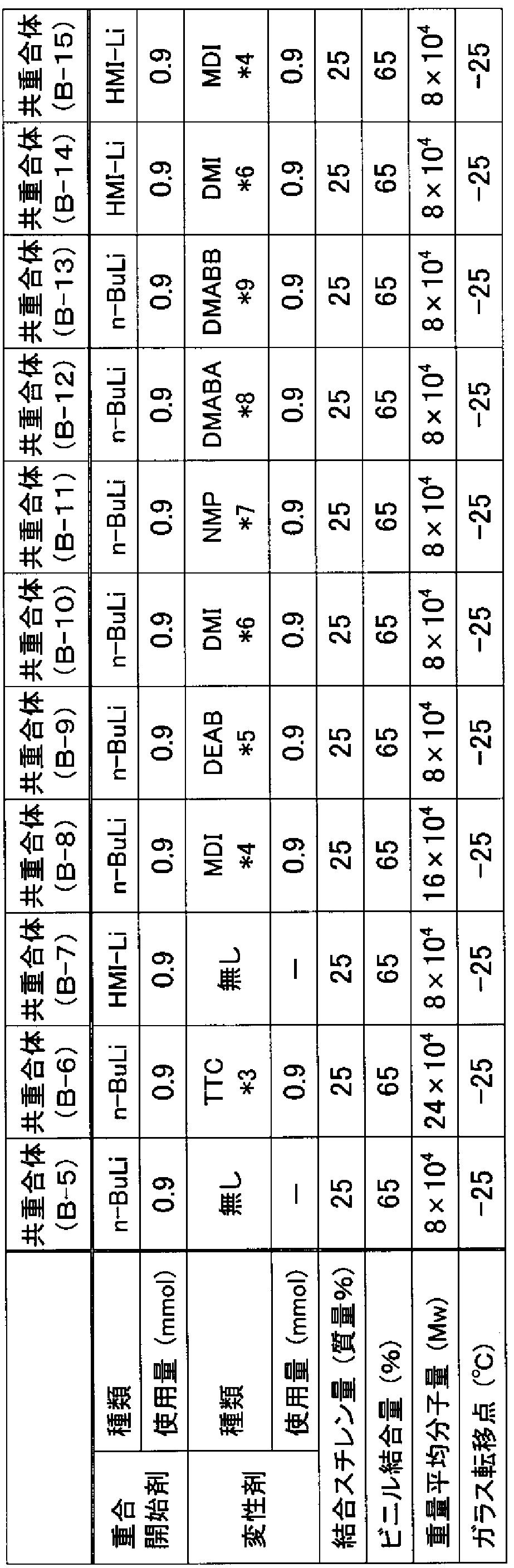
§5 [0088] *3 四塩化スズ. §Five [0088] * 3 Tin tetrachloride.
*4 クルード MDI, 日本ポリウレタン製 MR400. * 4 Crude MDI, Nippon Polyurethane MR400.
*5 Ν,Ν'-ジェチルァミノべンゾフエノン. * 5 Ν, Ν'-Jetylamino Benzofuenone.
*6 ジメチルイミダゾリジノン. * 6 Dimethylimidazolidinone.
*7 Ν-メチルピロリドン. * 7 Ν-Methylpyrrolidone.
*8 4-ジメチルァミノベンジリデンァ-リン. * 8 4-Dimethylaminobenzylidene phosphorus.
*9 4-ジメチルァミノべンジリデンプチルァミン. * 9 4-Dimethylaminobenzylideneptylamine.
[0089] 次に、上記共合体 (Β- 1)〜(Β-15)又はァロマオイルを用いて、表 3又は表 4に示 す配合処方のゴム組成物を調製し、更に、該ゴム組成物を 160°Cで 15分間加硫して 加硫ゴムを得、該加硫ゴムの貯蔵弾性率 (G')及び損失正接 (tan δ )を下記の方法 で測定した。結果を表 5〜表 8に示す。 [0089] Next, a rubber composition having the formulation shown in Table 3 or Table 4 was prepared using the above-mentioned copolymers (Β-1) to (Β-15) or aroma oil, and further the rubber composition Was vulcanized at 160 ° C. for 15 minutes to obtain a vulcanized rubber, and the storage elastic modulus (G ′) and loss tangent (tan δ) of the vulcanized rubber were measured by the following methods. The results are shown in Tables 5-8.
[0090] (3)貯蔵弾性率 (G')及び損失正接 (tan δ ) [0090] (3) Storage elastic modulus (G ') and loss tangent (tan δ)
レオメトリックス社製の粘弾性測定装置を用いて、温度 50°C、周波数 15Hz、歪 5%で 貯蔵弾性率 (G')及び損失正接 (tan δ )を測定し、各表においてァロマイオイルを用 いたゴム組成物(即ち、表 5においては比較例 1のゴム組成物、表 6においては比較 例 3のゴム糸且成物、表 7においては比較例 5のゴム糸且成物、表 8においては比較例 7 のゴム組成物)の貯蔵弾性率 (G')及び損失正接 (tan δ )をそれぞれ 100として指数 表示した。貯蔵弾性率 (G')については、指数値が大きい程、貯蔵弾性率が高いこと を示し、一方、損失正接 (tan δ )については、指数値が小さい程、低発熱性に優れる ことを示す。 The storage elastic modulus (G ') and loss tangent (tan δ) were measured at a temperature of 50 ° C, a frequency of 15 Hz, and a strain of 5% using a rheometrics viscoelasticity measuring device. Aromamy oil was used in each table. Rubber composition (ie, rubber composition of Comparative Example 1 in Table 5, rubber thread and composition of Comparative Example 3 in Table 6, rubber thread and composition of Comparative Example 5 in Table 7, and rubber composition in Table 8) The storage elastic modulus (G ′) and loss tangent (tan δ) of the rubber composition of Comparative Example 7 were each expressed as an index. For storage elastic modulus (G '), the larger the index value, the higher the storage elastic modulus, while for loss tangent (tan δ), the smaller the index value, the better the low exothermicity. .
(質量部) (Parts by mass)
配合 A Formula A
SBR *10 100 SBR * 10 100
カーボンブラック *11 27 Carbon black * 11 27
シリカ *12 27 Silica * 12 27
シランカップリング剤 *13 2.5 Silane coupling agent * 13 2.5
ァロマオイル又は共合体(B) +14 15 Aroma oil or coalescence (B) +14 15
ス亍アリン酸 2 Suaric acid 2
老化防止剤 6C *15 1 Anti-aging agent 6C * 15 1
亜鉛華 3 Zinc flower 3
加硫促進剤 DPG +16 0.8 Vulcanization accelerator DPG +16 0.8
加硫促進剤 DM *17 1 Vulcanization accelerator DM * 17 1
加硫促進剤 NS *18 1 Vulcanization accelerator NS * 18 1
硫黄 1.5 Sulfur 1.5
[0092] *10 JSR社製「# 1500」又は下記の方法で合成した S-SBR,使用した SBRの種類 を表 5〜表 6に示す. [0092] * 10 Tables 5 to 6 show the JSR `` # 1500 '' or S-SBR synthesized by the following method and the types of SBR used.
(S-SBR合成法) (S-SBR synthesis method)
乾燥し、窒素置換された 800mLの耐圧ガラス容器に、ブタジエンのシクロへキサン 溶液(16%)、スチレンのシクロへキサン溶液(21%)を、ブタジエン単量体 40g、スチレ ン単量体 10gとなるように注入し、 2,2-ジテトラヒドロフリルプロパン 0.12ミリモルを注入 し、これに、 n-ブチルリチウム(BuLi) 0.24ミリモルをカ卩えた後、 50°Cの温水浴中で 1.5 時間重合する。重合転ィ匕率はほぼ 100%である。この後、重合系に、更に、 2,6-ジ -t -ブチル- p-タレゾール(BHT)のイソプロパノール 5重量0 /0溶液 0.5mLを添カ卩し、反応 を停止させる。その後、常法に従い乾燥することにより、 S-SBRを得る。得られた S-S BRは、結合スチレン量が 25質量%で、ビュル結合量が 60%であった。 In an 800 mL pressure-resistant glass container that has been dried and purged with nitrogen, a cyclohexane solution of butadiene (16%) and a cyclohexane solution of styrene (21%) are mixed with 40 g of butadiene monomer and 10 g of styrene monomer. Then, add 0.12 mmol of 2,2-ditetrahydrofurylpropane, add 0.24 mmol of n-butyllithium (BuLi), and then polymerize in a hot water bath at 50 ° C for 1.5 hours. . The polymerization conversion rate is almost 100%. Thereafter, the polymerization system, further, 2,6-di -t - butyl - p-to添Ka卩isopropanol 5 weight 0/0 solution 0.5mL of Tarezoru (BHT), to stop the reaction. Then, S-SBR is obtained by drying according to a conventional method. The obtained SS BR had a bound styrene content of 25% by mass and a bull bond content of 60%.
[0093] *11 東海カーボン (株)製,商標:シースト KH (N339) . [0093] * 11 Tokai Carbon Co., Ltd., Trademark: Seast KH (N339).
*12 日本シリカ工業 (株)製,商標:二プシル AQ. * 12 Nippon Silica Kogyo Co., Ltd., Trademark: Nipsil AQ.
*13 デグサ社製,商標 Si69,ビス (3-トリエトキシシリルプロピル)テトラスルフイド. *14 ァロマイオイル又は使用した共合体 (B-1)〜(B-5)の種類を表 5〜表 6に示す. *15 N- (1,3-ジメチルブチル)- Ν'-フエ-ル- p-フエ-レンジァミン. *16 ジフエ二ノレグァニジン. * 13 Degussa, trademark Si69, bis (3-triethoxysilylpropyl) tetrasulfide. * 14 The types of alomy oil or copolymers (B-1) to (B-5) used are shown in Tables 5 to 6. * 15 N- (1,3-Dimethylbutyl) -Ν'-Phenol-p-Phenylenediamine. * 16 Diphenylenoguanidine.
*17 * 17
*18 N-t-ブチル -2-ベンゾチアジルスルフェンアミド. * 18 N-t-butyl-2-benzothiazylsulfenamide.
[0094] 表 4 [0094] Table 4
(質量部) (Mass)

[0095] *12、 *13、 *15、 *16、 *17、 *18は、表 3に同じ. [0095] * 12, * 13, * 15, * 16, * 17, * 18 are the same as in Table 3.
*19 JSR社製「# 1500」. * 19 JSR `` # 1500 ''.
*20 ISAF,窒素吸着比表面積(N SA * 20 ISAF, nitrogen adsorption specific surface area (N SA
2 ) = lllmVg. 2) = lllmVg.
*21 ァロマイオイル又は使用した液状 SBR [共重合体 (B- 5)〜(B-15) ]の種類を 表 7及び表 8に示す. * 21 Tables 7 and 8 show the types of aromy oil or liquid SBR used [Copolymers (B-5) to (B-15)].
[0096] 表 5 [0096] Table 5
ゴム組成物の配合処方は上記配合 Aに従う The formulation of the rubber composition follows the above formulation A
SBR(*10)として、 JSR社製「# 1 500」を使用 比較例 1 比較例 2 実施例 1 実施例 2 実施例 3 実施例 4 ァロマイオイル又は使用 ァロマ 共重合体 共合体 共合体 共合体 共合体 した共合体 (B)の種類 オイル (Β-5) (Β-1 ) (Β-2) (Β-3) (Β-4) 貯蔵弾性率 (G') [指数] 100 1 15 130 128 125 122 損失正接 (tan (5 ) [指数] 100 93 88 90 83 80 [0097] 表 6 JSR “# 1 500” is used as SBR (* 10) Comparative Example 1 Comparative Example 2 Example 1 Example 2 Example 3 Example 4 Aromamy oil or used Aroma copolymer Copolymer Copolymer Copolymer Copolymer Copolymer Type (B) Oil (Β-5) (Β-1) (Β-2) (Β-3) (Β-4) Storage modulus (G ') [Index] 100 1 15 130 128 125 122 Loss tangent (tan (5) [index] 100 93 88 90 83 80 [0097] Table 6

[0098] 表 5及び表 6から、ァロマオイルに代えて少なくとも一つの官能基を有する共重合体 [0098] From Table 5 and Table 6, a copolymer having at least one functional group instead of aroma oil
(B-1) (B-4)を用いた実施例のゴム組成物は、ァロマオイルを用いた比較例 1及 び比較例 3のゴム組成物よりも、貯蔵弾性率 (G')が大幅に向上している上、損失正 接 (tan δ )も大幅に低減されていることが分る。また、未変性の共重合体 (Β-5)を用 V、た比較例 2及び比較例 4のゴム糸且成物は、ァロマオイルを用いた比較例 1及び比 較例 3のゴム組成物よりも、貯蔵弾性率 (G')が高く且つ損失正接 (tan δ )が小さいも のの、実施例のゴム組成物に比べて、貯蔵弾性率 (G')が低く且つ損失正接 (tan δ ) が大き力つた。 (B-1) The rubber composition of the example using (B-4) has a storage elastic modulus (G ′) significantly higher than that of the rubber composition of Comparative Example 1 and Comparative Example 3 using aroma oil. It can be seen that the loss tangent (tan δ) has been greatly reduced. Further, the rubber yarns and compositions of Comparative Example 2 and Comparative Example 4 using an unmodified copolymer (Β-5) were compared with the rubber compositions of Comparative Examples 1 and 3 using aroma oil. Although the storage elastic modulus (G ′) is high and the loss tangent (tan δ) is small, the storage elastic modulus (G ′) is low and the loss tangent (tan δ) is lower than that of the rubber composition of the example. Was great.
[0099] [0099]
ゴム組成物の配合処方は上記配合 Β (含力一ボンブラック)に従う The formulation of the rubber composition follows the above formula 配合
ァロマイオイル又は使用し 貯蔵弾性率 損失正接 た共重合体 (Β)の種類 (G') [指数] (tand) [指数] 比較例 5 ァロマイオイル 100 100 Aromamy oil or storage modulus Loss tangent copolymer (Β) type (G ') [index] (tand) [index] Comparative Example 5 Aromamy oil 100 100
比較例 6 共重合体 (Β-5) 120 93 Comparative Example 6 Copolymer (Β-5) 120 93
実施例 9 共重合体 (Β-6) 135 86 Example 9 Copolymer (Β-6) 135 86
実施例 10 共重合体 (Β-7) 137 88 Example 10 Copolymer (Β-7) 137 88
実施例 11 共重合体 (Β-8) 136 84 Example 11 Copolymer (Β-8) 136 84
実施例 12 共重合体 (Β- 9) 134 88 Example 12 Copolymer (Β-9) 134 88
実施例 13 共重合体 (Β-10) 140 82 Example 13 Copolymer (Β-10) 140 82
実施例 14 共重合体 (Β-11) 136 89 Example 14 Copolymer (Β-11) 136 89
実施例 15 共重合体 (Β-12) 133 87 Example 15 Copolymer (Β-12) 133 87
実施例 16 共重合体 (Β-13) 130 90 Example 16 Copolymer (Β-13) 130 90
実施例 17 共重合体 (Β- 14) 140 78 Example 17 Copolymer (Β-14) 140 78
実施例 18 共重合体 (Β-15) 139 80 [0100] 表 8 Example 18 Copolymer (Β-15) 139 80 [0100] Table 8

[0101] 表 7及び表 8から、ァロマオイルに代えて窒素含有官能基を一つ以上有する共重 合体(B-7)〜(B-15)を用いた実施例 10〜18及び 20〜28のゴム組成物は、ァロマ オイルを用いた比較例 5及び比較例 7のゴム組成物よりも、貯蔵弾性率 (G')が大幅 に向上している上、損失正接 (tan δ )も大幅に低減されていることが分る。 [0101] From Tables 7 and 8, in Examples 10-18 and 20-28 using copolymers (B-7) to (B-15) having one or more nitrogen-containing functional groups instead of arroma oil The rubber composition has a significantly improved storage elastic modulus (G ′) and significantly reduced loss tangent (tan δ) compared to the rubber compositions of Comparative Examples 5 and 7 using aroma oil. You can see that it is.
[0102] また、未変性の共重合体 (Β-5)を用いた比較例 6及び比較例 8のゴム組成物は、 ァロマオイルを用いた比較例 5及び比較例 7のゴム組成物よりも、貯蔵弾性率 (G')が 高く且つ損失正接 (tan δ )が小さいものの、実施例のゴム組成物に比べて、貯蔵弹 性率 (G')が低く且つ損失正接 (tan δ )が大き力つた。 [0102] Further, the rubber compositions of Comparative Example 6 and Comparative Example 8 using the unmodified copolymer (Β-5) were more than the rubber compositions of Comparative Examples 5 and 7 using aromatic oil. Although the storage elastic modulus (G ′) is high and the loss tangent (tan δ) is small, the storage elastic modulus (G ′) is low and the loss tangent (tan δ) is large compared to the rubber compositions of the examples. I got it.
[0103] なお、四塩化スズで変性して得た共重合体 (Β-6)を用いた実施例 9及び実施例 19 のゴム組成物は、充填剤としてカーボンブラックを用いた配合 Βでは、損失正接 (tan δ )が小さいものの、充填剤としてシリカを用いた配合 Cでは、損失正接 (tan δ )が大 きぐまた、実施例 10〜18及び 20〜28のゴム組成物に比べて、貯蔵弾性率 (G')が 低く且つ損失正接 (tan δ )が大き力つた。 [0103] The rubber compositions of Example 9 and Example 19 using the copolymer (19-6) obtained by modification with tin tetrachloride were blended using carbon black as a filler. Although the loss tangent (tan δ) is small, the compound C using silica as a filler has a large loss tangent (tan δ). The elastic modulus (G ') was low and the loss tangent (tan δ) was strong.
Claims

Priority Applications (3)
| Application Number | Priority Date | Filing Date | Title |
|---|---|---|---|
| US11/817,573 US8030406B2 (en) | 2005-03-04 | 2006-02-23 | Rubber composition and pneumatic tire using the same |
| EP06714568A EP1854838B1 (en) | 2005-03-04 | 2006-02-24 | Rubber composition and pneumatic tire using same |
| ES06714568T ES2381396T3 (en) | 2005-03-04 | 2006-02-24 | Composition of rubber and tire that uses the same |
Applications Claiming Priority (4)
| Application Number | Priority Date | Filing Date | Title |
|---|---|---|---|
| JP2005-060634 | 2005-03-04 | ||
| JP2005060634A JP4846250B2 (en) | 2005-03-04 | 2005-03-04 | Rubber composition and pneumatic tire using the same |
| JP2005228035A JP4902974B2 (en) | 2005-08-05 | 2005-08-05 | Rubber composition and pneumatic tire using the same |
| JP2005-228035 | 2005-08-05 |
Publications (1)
| Publication Number | Publication Date |
|---|---|
| WO2006093048A1 true WO2006093048A1 (en) | 2006-09-08 |
Family
ID=36941079
Family Applications (1)
| Application Number | Title | Priority Date | Filing Date |
|---|---|---|---|
| PCT/JP2006/303429 Ceased WO2006093048A1 (en) | 2005-03-04 | 2006-02-24 | Rubber composition and pneumatic tire using same |
Country Status (5)
| Country | Link |
|---|---|
| US (1) | US8030406B2 (en) |
| EP (1) | EP1854838B1 (en) |
| KR (1) | KR20070117625A (en) |
| ES (1) | ES2381396T3 (en) |
| WO (1) | WO2006093048A1 (en) |
Cited By (4)
| Publication number | Priority date | Publication date | Assignee | Title |
|---|---|---|---|---|
| JP2008285555A (en) * | 2007-05-16 | 2008-11-27 | Bridgestone Corp | Rubber composition and pneumatic tire using the same |
| US20100006199A1 (en) * | 2006-09-04 | 2010-01-14 | Bridgestone Corporation | Rubber composition and pneumatic tire using the same |
| EP2119742A4 (en) * | 2007-03-06 | 2012-01-18 | Bridgestone Corp | RUBBER AND PNEUMATIC COMPOSITION COMPRISING THE SAME |
| CN102369238B (en) * | 2009-06-26 | 2015-04-01 | 株式会社普利司通 | Rubber composition and tire comprising the same |
Families Citing this family (22)
| Publication number | Priority date | Publication date | Assignee | Title |
|---|---|---|---|---|
| JP5291858B2 (en) * | 2004-03-16 | 2013-09-18 | 株式会社ブリヂストン | Rubber composition and pneumatic tire using the same |
| US7771556B2 (en) | 2005-07-01 | 2010-08-10 | Nordson Corporation | Apparatus and process to apply adhesive during labeling operations |
| CN101765632B (en) | 2007-06-11 | 2012-10-17 | 株式会社普利司通 | Rubber composition and tire using the same |
| US20090203826A1 (en) * | 2008-02-13 | 2009-08-13 | Michael Joseph Rachita | Methods of making siloxy-imine functionalized rubbery polymers and uses thereof in rubber compositions for tires |
| US8022159B2 (en) | 2008-11-24 | 2011-09-20 | The Goodyear Tire & Rubber Company | Terminating compounds, polymers, and their uses in rubber compositions and tires |
| JP5316459B2 (en) * | 2010-03-30 | 2013-10-16 | 住友化学株式会社 | Conjugated diene polymer, conjugated diene polymer composition, and method for producing conjugated diene polymer |
| US8367765B2 (en) * | 2010-08-11 | 2013-02-05 | Sumitomo Chemical Company, Limited | Conjugated diene-based polymer, conjugated diene-based polymer composition, and process for producing conjugated diene-based polymer |
| US8334339B2 (en) * | 2010-08-11 | 2012-12-18 | Sumitomo Chemical Co., Ltd. | Conjugated diene-based polymer, conjugated diene-based polymer composition, and process for producing conjugated diene-based polymer |
| TWI428357B (en) * | 2010-12-31 | 2014-03-01 | Chi Mei Corp | Conjugated diene-vinyl aromatic hydrocarbon copolymer and manufacturing method of the same |
| TWI413648B (en) * | 2010-12-31 | 2013-11-01 | Chi Mei Corp | Conjugated diene-vinyl aromatic hydrocarbon copolymer and manufacturing method of the same |
| RU2603370C2 (en) | 2011-08-03 | 2016-11-27 | Сумитомо Раббер Индастриз, Лтд. | Rubber mixture and pneumatic tyre |
| EP2749593B1 (en) | 2011-11-24 | 2016-09-21 | Sumitomo Rubber Industries, Ltd. | Rubber composition and pneumatic tire |
| KR20140097220A (en) | 2011-11-24 | 2014-08-06 | 스미토모 고무 고교 가부시키가이샤 | Rubber composition, and pneumatic tire |
| CN103946302B (en) | 2011-11-24 | 2018-05-15 | 住友橡胶工业株式会社 | Rubber composition and pneumatic tire |
| CN106916351B (en) * | 2011-12-26 | 2018-05-22 | 住友橡胶工业株式会社 | Rubber composition and pneumatic tire |
| WO2013099325A1 (en) | 2011-12-26 | 2013-07-04 | 住友ゴム工業株式会社 | Rubber composition and pneumatic tire |
| RU2500700C2 (en) * | 2012-01-18 | 2013-12-10 | Сергей Николаевич Горшков | Hydrophilic plasticine |
| WO2013183743A1 (en) | 2012-06-08 | 2013-12-12 | 住友ゴム工業株式会社 | Tread rubber composition and pneumatic tire |
| KR20170032319A (en) | 2014-07-14 | 2017-03-22 | 트린세오 유럽 게엠베하 | Aminosilyl-substituted diarylethene compounds for anionic polymerisation |
| DE102015210421A1 (en) | 2015-06-08 | 2016-12-08 | Continental Reifen Deutschland Gmbh | Rubber compound and vehicle tires |
| DE102015210424A1 (en) | 2015-06-08 | 2016-12-08 | Continental Reifen Deutschland Gmbh | Rubber compound and vehicle tires |
| EP3851485B1 (en) * | 2019-09-03 | 2023-06-28 | LG Chem, Ltd. | Rubber composition and molded article manufactured therefrom |
Citations (7)
| Publication number | Priority date | Publication date | Assignee | Title |
|---|---|---|---|---|
| JPS58167633A (en) * | 1982-03-26 | 1983-10-03 | Japan Synthetic Rubber Co Ltd | Branched styrene-butadiene copolymer rubber composition |
| JPH0665418A (en) * | 1991-10-08 | 1994-03-08 | Yokohama Rubber Co Ltd:The | Rubber composition for tire tread |
| WO1996016118A1 (en) * | 1994-11-24 | 1996-05-30 | Nippon Zeon Co., Ltd. | Diene rubber, process for producing the same, and rubber composition |
| WO1997048766A1 (en) * | 1996-06-20 | 1997-12-24 | The Yokohama Rubber Co., Ltd. | Processes for producing rubber composition |
| JP2001114970A (en) * | 1999-10-19 | 2001-04-24 | Jsr Corp | Diolefin polymer composition, method for producing the same, and rubber composition for vulcanization |
| JP2002179729A (en) * | 2000-12-15 | 2002-06-26 | Bridgestone Corp | Polymer and rubber composition using the same |
| JP2005146115A (en) * | 2003-11-14 | 2005-06-09 | Sumitomo Rubber Ind Ltd | Tire tread rubber composition |
Family Cites Families (11)
| Publication number | Priority date | Publication date | Assignee | Title |
|---|---|---|---|---|
| JPS62501806A (en) | 1985-01-22 | 1987-07-16 | デイジタル イクイプメント コ−ポレ−シヨン | perpendicular magnetic recording construct |
| US5227431A (en) | 1991-04-12 | 1993-07-13 | Bridgestone/Firestone, Inc. | Diene polymers and copolymers jumped by partial crosslinking and terminated with a substituted imine |
| JP3354642B2 (en) | 1993-08-11 | 2002-12-09 | 横浜ゴム株式会社 | Rubber composition for tire tread |
| JP2999128B2 (en) | 1994-09-02 | 2000-01-17 | 横浜ゴム株式会社 | Pneumatic tire |
| EP0818478B1 (en) | 1995-03-30 | 2004-08-11 | Zeon Corporation | Styrene-isoprene-butadiene copolymer rubber and process for the production thereof |
| JP3886059B2 (en) | 1996-04-09 | 2007-02-28 | 日本ゼオン株式会社 | Block copolymer, method for producing the same, and rubber composition |
| JP2002121326A (en) | 2000-10-19 | 2002-04-23 | Bridgestone Corp | Rubber composition and tire using the same |
| JP3902107B2 (en) | 2001-10-05 | 2007-04-04 | 株式会社ブリヂストン | Rubber composition |
| EP1318172B1 (en) | 2001-12-06 | 2006-06-14 | The Goodyear Tire & Rubber Company | Pneumatic tire having a rubber component containing a tin/amino functionalized rubber and an inversion carbon black |
| US7262254B2 (en) * | 2004-09-23 | 2007-08-28 | The Goodyear Tire & Rubber Company | Tire with low volatile alcohol emission rubber tread with compositional limitations |
| US20080103261A1 (en) * | 2006-10-25 | 2008-05-01 | Bridgestone Corporation | Process for producing modified conjugated diene based polymer, modified conjugated diene based polymer produced by the process, rubber composition, and tire |
-
2006
- 2006-02-23 US US11/817,573 patent/US8030406B2/en not_active Expired - Fee Related
- 2006-02-24 WO PCT/JP2006/303429 patent/WO2006093048A1/en not_active Ceased
- 2006-02-24 KR KR1020077022563A patent/KR20070117625A/en not_active Ceased
- 2006-02-24 EP EP06714568A patent/EP1854838B1/en not_active Not-in-force
- 2006-02-24 ES ES06714568T patent/ES2381396T3/en active Active
Patent Citations (7)
| Publication number | Priority date | Publication date | Assignee | Title |
|---|---|---|---|---|
| JPS58167633A (en) * | 1982-03-26 | 1983-10-03 | Japan Synthetic Rubber Co Ltd | Branched styrene-butadiene copolymer rubber composition |
| JPH0665418A (en) * | 1991-10-08 | 1994-03-08 | Yokohama Rubber Co Ltd:The | Rubber composition for tire tread |
| WO1996016118A1 (en) * | 1994-11-24 | 1996-05-30 | Nippon Zeon Co., Ltd. | Diene rubber, process for producing the same, and rubber composition |
| WO1997048766A1 (en) * | 1996-06-20 | 1997-12-24 | The Yokohama Rubber Co., Ltd. | Processes for producing rubber composition |
| JP2001114970A (en) * | 1999-10-19 | 2001-04-24 | Jsr Corp | Diolefin polymer composition, method for producing the same, and rubber composition for vulcanization |
| JP2002179729A (en) * | 2000-12-15 | 2002-06-26 | Bridgestone Corp | Polymer and rubber composition using the same |
| JP2005146115A (en) * | 2003-11-14 | 2005-06-09 | Sumitomo Rubber Ind Ltd | Tire tread rubber composition |
Cited By (6)
| Publication number | Priority date | Publication date | Assignee | Title |
|---|---|---|---|---|
| US20100006199A1 (en) * | 2006-09-04 | 2010-01-14 | Bridgestone Corporation | Rubber composition and pneumatic tire using the same |
| US8580885B2 (en) * | 2006-09-04 | 2013-11-12 | Bridgestone Corporation | Rubber composition and pneumatic tire using the same |
| EP2119742A4 (en) * | 2007-03-06 | 2012-01-18 | Bridgestone Corp | RUBBER AND PNEUMATIC COMPOSITION COMPRISING THE SAME |
| US9879129B2 (en) | 2007-03-06 | 2018-01-30 | Bridgestone Corporation | Rubber compostion and pneumatic tire using the same |
| JP2008285555A (en) * | 2007-05-16 | 2008-11-27 | Bridgestone Corp | Rubber composition and pneumatic tire using the same |
| CN102369238B (en) * | 2009-06-26 | 2015-04-01 | 株式会社普利司通 | Rubber composition and tire comprising the same |
Also Published As
| Publication number | Publication date |
|---|---|
| US20080289740A1 (en) | 2008-11-27 |
| US8030406B2 (en) | 2011-10-04 |
| ES2381396T3 (en) | 2012-05-25 |
| EP1854838B1 (en) | 2012-02-08 |
| KR20070117625A (en) | 2007-12-12 |
| EP1854838A1 (en) | 2007-11-14 |
| EP1854838A4 (en) | 2009-04-08 |
Similar Documents
| Publication | Publication Date | Title |
|---|---|---|
| JP4911904B2 (en) | Rubber composition and tire using the same | |
| JP5350577B2 (en) | Rubber composition and tire using the same | |
| WO2006093048A1 (en) | Rubber composition and pneumatic tire using same | |
| US6369167B1 (en) | Polymer, process for making the polymer, and rubber composition using the polymer | |
| JP4111590B2 (en) | Method for producing polymer, obtained polymer, and rubber composition using the same | |
| WO2008029814A1 (en) | Rubber composition and pneumatic tire using the same | |
| JP5193623B2 (en) | Rubber composition and pneumatic tire using the same | |
| WO2006098103A1 (en) | Rubber composition and pneumatic tire using the same | |
| JP5399619B2 (en) | Rubber composition and pneumatic tire using the same | |
| US7868081B2 (en) | Rubber composition and tire using same | |
| JP4801827B2 (en) | Polymer, process for producing the same, and rubber composition using the same | |
| JP4846250B2 (en) | Rubber composition and pneumatic tire using the same | |
| JP2006274049A (en) | Rubber composition and pneumatic tire using the same | |
| JP2008063364A (en) | Rubber composition and pneumatic tire using the same | |
| EP3006493A1 (en) | Rubber composition and pneumatic tire | |
| JP4902974B2 (en) | Rubber composition and pneumatic tire using the same | |
| EP3006227B1 (en) | Rubber composition and pneumatic tire | |
| JP4628009B2 (en) | Rubber composition and tire using the same | |
| JP5160077B2 (en) | Pneumatic tire | |
| JP2006274046A (en) | Rubber composition and pneumatic tire using the same | |
| US20240132706A1 (en) | Rubber composition for tires and tire | |
| JP2008127402A (en) | Pneumatic tire | |
| JP2008239936A (en) | Rubber composition and pneumatic tire using the same |
Legal Events
| Date | Code | Title | Description |
|---|---|---|---|
| WWE | Wipo information: entry into national phase |
Ref document number: 200680012827.8 Country of ref document: CN |
|
| 121 | Ep: the epo has been informed by wipo that ep was designated in this application | ||
| NENP | Non-entry into the national phase |
Ref country code: DE |
|
| WWE | Wipo information: entry into national phase |
Ref document number: 2006714568 Country of ref document: EP |
|
| WWE | Wipo information: entry into national phase |
Ref document number: 11817573 Country of ref document: US |
|
| WWE | Wipo information: entry into national phase |
Ref document number: 1020077022563 Country of ref document: KR |
|
| NENP | Non-entry into the national phase |
Ref country code: RU |
|
| WWP | Wipo information: published in national office |
Ref document number: 2006714568 Country of ref document: EP |