WO2006092411A1 - 5,6-dialkyl-7-amino-azolopyrimidines, methods for the production thereof, use thereof for controlling harmful fungi, and substances containing the same - Google Patents
5,6-dialkyl-7-amino-azolopyrimidines, methods for the production thereof, use thereof for controlling harmful fungi, and substances containing the sameInfo
- Publication number
- WO2006092411A1 WO2006092411A1 PCT/EP2006/060361 EP2006060361W WO2006092411A1 WO 2006092411 A1 WO2006092411 A1 WO 2006092411A1 EP 2006060361 W EP2006060361 W EP 2006060361W WO 2006092411 A1 WO2006092411 A1 WO 2006092411A1
- Authority
- WO
- WIPO (PCT)
- Prior art keywords
- formula
- ethyl
- methyl
- compounds
- pyrimidin
- Prior art date
- Legal status (The legal status is an assumption and is not a legal conclusion. Google has not performed a legal analysis and makes no representation as to the accuracy of the status listed.)
- Ceased
Links
Classifications
-
- C—CHEMISTRY; METALLURGY
- C07—ORGANIC CHEMISTRY
- C07D—HETEROCYCLIC COMPOUNDS
- C07D487/00—Heterocyclic compounds containing nitrogen atoms as the only ring hetero atoms in the condensed system, not provided for by groups C07D451/00 - C07D477/00
- C07D487/02—Heterocyclic compounds containing nitrogen atoms as the only ring hetero atoms in the condensed system, not provided for by groups C07D451/00 - C07D477/00 in which the condensed system contains two hetero rings
- C07D487/04—Ortho-condensed systems
Definitions
- A is N or CH
- the compounds of the invention can be obtained in various ways.
- the compounds according to the invention are obtained by reacting substituted ⁇ -keto esters of the formula II with an aminoazole of the formula III to give 7-hydroxyazolopyrimidines of the formula IV.
- the variables in formulas II and IV have the meanings as for formula I and the group R in formula II means C 1 -C 4 -alkyl, for practical reasons, methyl, ethyl or propyl is preferred therein.
- the bases are generally used in catalytic amounts, but they can also be used equimolar, in excess or optionally as a solvent.
- the condensation products of the formula IV thus obtained usually precipitate out of the reaction solutions in pure form and, after washing with the same solvent or with water and subsequent drying with halogenating agents, in particular chlorinating or brominating agents, are the compounds of the formula V in the Hal for chlorine or bromine, in particular chlorine, reacted.
- the reaction is preferably with chlorinating agents such as phosphorus oxychloride, thionyl onylchlorid or Sulfuryichlorid at 50 0 C to 150 0 C, preferably in excess phosphorus oxytrichloride at reflux temperature. After evaporation of the excess Phosphoroxitrichlorids the residue is treated with ice water optionally with the addition of a water-immiscible solvent.
- Alkyl saturated, straight-chain or mono- or di-branched hydrocarbon radicals having 1 to 4, or 5 to 12 carbon atoms, for example d-Ce-alkyl, such as methyl, ethyl, propyl, 1-methylethyl, butyl, 1-methyl-propyl, 2 Methylpropyl, 1, 1-dimethylethyl, n-pen tyl, 1-methylbutyl, 2-methylbutyl, 3-methylbutyl, 2,2-dimethylpropyl, 1-ethylpropyl, hexyl, 1, 1-dimethylpropyl, 1, 2-dimethylpropyl, 1-methylpentyl, 2-methylpentyl, 3-methylpentyl, 4-methylpentyl, 1, 1-dimethylbutyl, 1, 2-dimethylbutyl, 1, 3-dimethylbutyl, 2,2-dimethylbutyl, 2,3-dimethylbutyl, 3,3-dimethylbutylene, 1 Ethy
- One embodiment of the compounds according to the invention relates to compounds I in which A is CH. These compounds correspond to formula 1.1:
- Cercospora species on corn, soybeans, rice and sugar beet e.g., C. beticula on sugar beet
- formulations are: 1. Products for dilution in water
- the active ingredients 20 parts by weight of the active ingredients are comminuted with the addition of 10 parts by weight of dispersants and wetting agents and 70 parts by weight of water or an organic solvent in a stirred ball mill to a fine active substance suspension. Dilution in water results in a stable suspension of the active ingredient.
- the active ingredient content in the formulation is 20% by weight.
- Water-dispersible and water-soluble granules 50 parts by weight of the active compounds are finely ground with the addition of 50 parts by weight of dispersing and wetting agents and prepared by means of industrial equipment (for example extrusion, spray tower, fluidized bed) as water-dispersible or water-soluble granules. Dilution in water results in a stable dispersion or solution of the active ingredient.
- the formulation has an active ingredient content of 50% by weight.
- Pluro- nic RPE 2035 ® and Genapol B ® Alcohol ethoxylates, eg. As Lutensol XP 80 ®; and sodium dioctylsulfosuccinate, e. B. Leophen RA ®.
- bitertanol bromuconazoles, cyproconazole, difenoconazole, diniconazole, enilconazole, epoxiconazole, fenbuconazole, flusilazole, fluquinconazole, flutriol, hexaconazole, imibenconazole, ipconazole, metconazole, myclobutanil, penconazole, propiconazole, prothioconazole, simeconazole, tebuconazole, tetracona - zole, triadimenol, triadimefon, triticonazole;
- - imidazoles cyazofamide, imazalil, pefurazoate, prochloraz, triflumizole;
- Example 1e 5-Ethyl-2-methyl-6- (3,5,5-trimethyl-hexyl) - [1, 2,4] triazolo [1,5-a] pyrimidin-7-ylamine
Landscapes
- Chemical & Material Sciences (AREA)
- Organic Chemistry (AREA)
- Agricultural Chemicals And Associated Chemicals (AREA)
- Nitrogen Condensed Heterocyclic Rings (AREA)
Abstract
Description
5,6-Dialkyl-7-amino-azolopyrimidine, Verfahren zu ihrer Herstellung und ihre Verwendung zur Bekämpfung von Schadpilzen sowie sie enthaltende Mittel5,6-dialkyl-7-amino-azolopyrimidines, process for their preparation and their use for controlling harmful fungi and agents containing them
Beschreibungdescription
Die vorliegende Erfindung betrifft 5,6-Dialkyl-7-amino-azolopyrimidine der Formel IThe present invention relates to 5,6-dialkyl-7-amino-azolopyrimidines of the formula I.

R1 C5-C-I2-AIkVl oder C5-Ci4-Alkoxyalkyl, wobei die aliphatischen Gruppen durch eine bis drei der folgenden Gruppen substituiert sein können:R 1 is C 5 -C-I2 -alkyl or C 5 -C 4 alkoxyalkyl, where the aliphatic groups may be substituted by one to three of the following groups:
Cyano, Nitro, Hydroxy, C3-C6-Cycloalkyl, CrC6-Alkylthio und NRaRb;Cyano, nitro, hydroxy, C 3 -C 6 cycloalkyl, C r C 6 alkylthio and NR a R b ;
Ra, Rb Wasserstoff oder C1-C6-AIkVl;R a , R b are hydrogen or C 1 -C 6 -alkyl;
R2 CHRXCH3, Cyclopropyl, CH=CH2 oder CH2CH=CH2;R 2 CHR X CH 3 , cyclopropyl, CH = CH 2 or CH 2 CH = CH 2 ;
Rx Wasserstoff, CH3, CH2CH3 oder Halogenmethyl;R x is hydrogen, CH 3 , CH 2 CH 3 or halomethyl;
A N oder CH;A is N or CH;
R3 CH3, wenn A für CH steht zusätzlich Wasserstoff.R 3 CH 3 , when A is CH additionally hydrogen.
Außerdem betrifft die Erfindung Verfahren zur Herstellung dieser Verbindungen, sie enthaltende Mittel sowie ihre Verwendung zur Bekämpfung von pflanzenpathogenen Schadpilzen.In addition, the invention relates to processes for the preparation of these compounds, compositions containing them and their use for controlling phytopathogenic harmful fungi.
In GB 1 148 629 werden 5,6-Dialkyl-7-amino-triazolo- und -pyrazolopyrimidine allge- mein vorgeschlagen. Aus EP-A 141 317 sind einzelne fungizid wirksame 5,6-Dialkyl-7- amino-triazolo- und -pyrazolopyrimidine bekannt. Ihre Wirkung ist jedoch in vielen Fällen nicht zufriedenstellend. Davon ausgehend, liegt der vorliegenden Erfindung die Aufgabe zugrunde, Verbindungen mit verbesserter Wirkung und/oder verbreitertem Wirkungsspektrum bereitzustellen.In GB 1 148 629, 5,6-dialkyl-7-amino-triazolo- and -pyrazolopyrimidines are generally proposed. EP-A 141 317 discloses individual fungicidally active 5,6-dialkyl-7-amino-triazolo- and -pyrazolopyrimidines. However, their effect is in many cases unsatisfactory. On this basis, the object of the present invention is to provide compounds with improved activity and / or broadened spectrum of activity.
Demgemäss wurden die eingangs definierten Verbindungen gefunden. Des weiteren wurden Verfahren und Zwischenprodukte zu ihrer Herstellung, sie enthaltende Mittel sowie Verfahren zur Bekämpfung von Schadpilzen unter Verwendung der Verbindungen I gefunden. Die Verbindungen der Formel I unterscheiden sich von den aus den oben genannten Schriften durch die spezielle Ausgestaltung des Substituenten in der 5-Position des Azolopyrimidin-Gerüstes.Accordingly, the compounds defined above were found. Furthermore, processes and intermediates for their preparation, agents containing them and methods for controlling harmful fungi using the compounds I have been found. The compounds of the formula I differ from those mentioned above by the specific embodiment of the substituent in the 5-position of the azolopyrimidine skeleton.
Die Verbindungen der Formel I weisen eine gegenüber den bekannten Verbindungen erhöhte Wirksamkeit gegen Schadpilze auf.The compounds of the formula I have an over the known compounds increased activity against harmful fungi.
Die erfindungsgemäßen Verbindungen können auf verschiedenen Wegen erhalten werden. Vorteilhaft werden die erfindungsgemäßen Verbindungen erhalten, indem man substituierte ß-Ketoestem der Formel Il mit einem Aminoazol der Formel III zu 7-Hy- droxyazolopyrimidinen der Formel IV umsetzt. Die Variablen in Formeln Il und IV haben die Bedeutungen wie für Formel I und die Gruppe R in Formel Il bedeutet C1-C4- Alkyl, aus praktischen Gründen ist Methyl, Ethyl oder Propyl darin bevorzugt.The compounds of the invention can be obtained in various ways. Advantageously, the compounds according to the invention are obtained by reacting substituted β-keto esters of the formula II with an aminoazole of the formula III to give 7-hydroxyazolopyrimidines of the formula IV. The variables in formulas II and IV have the meanings as for formula I and the group R in formula II means C 1 -C 4 -alkyl, for practical reasons, methyl, ethyl or propyl is preferred therein.

Die Verbindungen der Formel IV sind neu.The compounds of formula IV are new.
Die Umsetzung der substituierten ß-Ketoester der Formel Il mit den Aminoazolen der Formel III kann in Gegenwart oder Abwesenheit von Lösungsmitteln durchgeführt wer- den. Vorteilhaft ist es, solche Lösungsmittel zu verwenden, gegenüber denen die Einsatzstoffe weitgehend inert sind und in denen sie ganz oder teilweise löslich sind. Als Lösungsmittel kommen insbesondere Alkohole wie Ethanol, Propanole, Butanole, Glykole oder Glykolmonoether, Diethylenglykole oder deren Monoether, aromatische Kohlenwasserstoffe, wie Toluol, Benzol oder Mesitylen, Amide wie Dimethylformamid, Diethylformamid, Dibutylformamid, N,N-Dimethylacetamid, niedere Alkansäuren wie Ameisensäure, Essigsäure, Propionsäure oder Basen, wie Alkalimetall- und Erdalkalimetallhydroxide, Alkalimetall- und Erdalkalimetalloxide, Alkalimetall- und Erdalkalimetallhydride, Alkalimetallamide, Alkalimetall- und Erdalkalimetallcarbonate sowie Alkali- metallhydrogencarbonate, metallorganische Verbindungen, insbesondere Alkalimetal- lalkyle, Alkylmagnesiumhalogenide sowie Alkalimetall- und Erdalkalimetallalkoholate und Dimethoxymagnesium, außerdem organische Basen, z.B. tertiäre Amine wie Tri- methylamin, Triethylamin, Tri-isopropylethylamin, Tributylamin und N-Methylpiperidin, N-Methylmorpholin, Pyridin, substituierte Pyridine wie Collidin, Lutidin und 4-Dimethyl- aminopyridin sowie bicyclische Amine und Mischungen dieser Lösungsmittel mit Was- ser in Frage. Als Katalysatoren kommen Basen, wie voranstehend genannt, oder Säuren, wie Sulfonsäuren oder Mineralsäuren in Frage. Besonders bevorzugt wird die Umsetzung ohne Lösungsmittel oder in Chlorbenzol, XyIoI, Dimethylsulfoxid, N-Methyl- pyrrolidon durchgeführt. Besonders bevorzugte Basen sind tertiäre Amine wie Tri- isopropylethylamin, Tributylamin, N-Methylmorpholin oder N-Methylpiperidin. Die Temperaturen liegen zwischen 50 und 300°C, vorzugsweise bei 50 bis 180cC, wenn in Lösung gearbeitet wird [vgl. EP-A 770 615; Adv. Het. Chem. Bd. 57, S. 81ff. (1993)].The reaction of the substituted .beta.-keto esters of the formula II with the aminoazoles of the formula III can be carried out in the presence or absence of solvents. It is advantageous to use those solvents to which the starting materials are largely inert and in which they are completely or partially soluble. The solvents used are, in particular, alcohols such as ethanol, propanols, butanols, glycols or glycol monoethers, diethylene glycols or their monoethers, aromatic hydrocarbons such as toluene, benzene or mesitylene, amides such as dimethylformamide, diethylformamide, dibutylformamide, N, N-dimethylacetamide, lower alkanoic acids such as formic acid, Acetic acid, propionic acid or bases, such as alkali metal and alkaline earth metal hydroxides, alkali metal and alkaline earth metal oxides, alkali metal and alkaline earth metal hydrides, alkali metal amides, alkali metal and alkaline earth metal carbonates and alkali metal hydrogencarbonates, organometallic compounds, in particular alkali metal alkyls, alkyl magnesium halides and alkali metal and alkaline earth metal alkoxides and dimethoxy magnesium, also organic bases, for example tertiary amines such as trimethylamine, triethylamine, triisopropylethylamine, tributylamine and N-methylpiperidine, N-methylmorpholine, pyridine, substituted pyridines such as collidine, lutidine and 4-di Methyl-aminopyridine and bicyclic amines and mixtures of these solvents with water in question. Suitable catalysts are bases, as mentioned above, or acids, such as sulfonic acids or mineral acids. The reaction is particularly preferably carried out without a solvent or in chlorobenzene, xylene, dimethyl sulfoxide, N-methylpyrrolidone. Particularly preferred bases are tertiary amines such as tri- isopropylethylamine, tributylamine, N-methylmorpholine or N-methylpiperidine. The temperatures are between 50 and 300 ° C, preferably at 50 to 180 c C, when working in solution [cp. EP-A 770 615; Adv. Het. Chem. Vol. 57, p. 81ff. (1993)].
Die Basen werden im allgemeinen in katalytischen Mengen eingesetzt, sie können aber auch äquimolar, im Überschuss oder gegebenenfalls als Lösungsmittel verwendet werden.The bases are generally used in catalytic amounts, but they can also be used equimolar, in excess or optionally as a solvent.

Die neuen 7-Amino-azolo[1 ,5-a]-pyrimidine werden gegebenenfalls nach Verdampfen des Lösungsmittels durch Digerieren in Wasser als kristalline Verbindungen isoliert.The new 7-amino-azolo [1, 5-a] -pyrimidines are optionally isolated after evaporation of the solvent by trituration in water as crystalline compounds.
Die ß-Ketoester der Formel Il können hergestellt werden wie in Organic Synthesis Coli. Vol. 1 , S. 248 beschrieben, bzw. sind kommerziell erhältlich.The β-keto esters of formula II can be prepared as in Organic Synthesis Coli. Vol. 1, p. 248, or are commercially available.
Die Zwischenprodukte der Formel V sind neu.The intermediates of formula V are new.
Alternativ können die neuen Verbindungen der Formel I erhalten werden, indem man substituierte Acylcyanide der Formel VI, in der R1 und R2 die oben angegebenen Be- deutungen haben, mit einem Aminoazol der Formel III umsetzt.Alternatively, the novel compounds of the formula I can be obtained by reacting substituted acyl cyanides of the formula VI, in which R 1 and R 2 have the meanings indicated above, with an aminoazole of the formula III.

Die neuen 7-Aminoazolo[1 ,5-a]-pyrimidine der Formel I werden gegebenenfalls nach Verdampfen des Lösungsmittels oder Verdünnen mit Wasser als kristalline Verbindun- gen isoliert.The new 7-aminoazolo [1, 5-a] -pyrimidines of the formula I are optionally isolated after evaporation of the solvent or dilution with water as crystalline compounds.
Die für die Herstellung der 7-Amino-azolo[1 ,5-a]-pyrimidine benötigten substituierten Alkylcyanide der Formel VI sind teilweise bekannt oder können nach bekannten Methoden aus Alkylcyaniden und Carbonsäureestern mit starken Basen, z.B. Alkalihydri- den, Alkalimetallalkoholaten, Alkaliamiden oder Metallalkylen, hergestellt werden (vgl.: J. Amer. Chem. Soc. Bd. 73, (1951) S. 3766).The substituted alkyl cyanides of formula VI required for the preparation of the 7-amino-azolo [1,5-a] -pyrimidines are known in part or may be prepared by known methods from alkyl cyanides and carboxylic acid esters with strong bases, e.g. Alkali hydrides, alkali metal alcoholates, alkali metal amides or metal alkyls are prepared (see: J. Amer., Chem. Soc., Vol. 73, (1951), p. 3766).
Sofern einzelne Verbindungen I nicht auf den voranstehend beschriebenen Wegen zugänglich sind, können sie durch Derivatisierung anderer Verbindungen I hergestellt werden.If individual compounds I are not accessible in the above-described ways, they can be prepared by derivatization of other compounds I.
Sofern bei der Synthese Isomerengemische anfallen, ist im allgemeinen jedoch eine Trennung nicht unbedingt erforderlich, da sich die einzelnen Isomere teilweise während der Aufbereitung für die Anwendung oder bei der Anwendung (z.B. unter Licht-, Säure- oder Baseneinwirkung) ineinander umwandeln können. Entsprechende Umwandlungen können auch nach der Anwendung, beispielsweise bei der Behandlung von Pflanzen in der behandelten Pflanze oder im zu bekämpfenden Schadpilz erfolgen.However, unless isomeric mixtures are involved in the synthesis, separation is not necessarily required because the individual isomers can partially interconvert during processing for application or application (e.g., under light, acid, or base action). Corresponding conversions can also take place after use, for example in the treatment of plants in the treated plant or in the harmful fungus to be controlled.
Bei den in den vorstehenden Formeln angegebenen Definitionen der Symbole wurden Sammelbegriffe verwendet, die allgemein repräsentativ für die folgenden Substituenten stehen:In the definitions of the symbols given in the above formulas, collective terms have been used that are generally representative of the following substituents:
Halogen: Fluor, Chlor, Brom und Jod;Halogen: fluorine, chlorine, bromine and iodine;
Alkyl: gesättigte, geradkettige oder ein- oder zweifach verzweigte Kohlenwasserstoffreste mit 1 bis 4, oder 5 bis 12 Kohlenstoffatomen, z.B. d-Ce-Alkyl wie Methyl, Ethyl, Propyl, 1-Methylethyl, Butyl, 1-Methyl-propyl, 2-Methylpropyl, 1 ,1-Dimethylethyl, n-Pen- tyl, 1-Methylbutyl, 2-Methylbutyl, 3-Methylbutyl, 2,2-Di-methylpropyl, 1-Ethylpropyl, He- xyl, 1 ,1-Dimethylpropyl, 1 ,2-Dimethylpropyl, 1-MethylpentyI, 2-Methylpentyl, 3-Methyl- pentyl, 4-Methylpentyl, 1 ,1-Dimethylbutyl, 1 ,2-Dimethylbutyl, 1 ,3-DimethyIbutyl, 2,2-Di- methylbutyl, 2,3-Dimethylbutyl, 3,3-Dimethylbutyi, 1-Ethylbutyl, 2-EthyIbutyl, 1 ,1 ,2-Tri- methylpropyl, 1,2,2-Trimethylpropyl, 1-Ethyl-1-methylpropyl und 1-Ethyl-2-methyl- propyl;Alkyl: saturated, straight-chain or mono- or di-branched hydrocarbon radicals having 1 to 4, or 5 to 12 carbon atoms, for example d-Ce-alkyl, such as methyl, ethyl, propyl, 1-methylethyl, butyl, 1-methyl-propyl, 2 Methylpropyl, 1, 1-dimethylethyl, n-pen tyl, 1-methylbutyl, 2-methylbutyl, 3-methylbutyl, 2,2-dimethylpropyl, 1-ethylpropyl, hexyl, 1, 1-dimethylpropyl, 1, 2-dimethylpropyl, 1-methylpentyl, 2-methylpentyl, 3-methylpentyl, 4-methylpentyl, 1, 1-dimethylbutyl, 1, 2-dimethylbutyl, 1, 3-dimethylbutyl, 2,2-dimethylbutyl, 2,3-dimethylbutyl, 3,3-dimethylbutylene, 1 Ethyl butyl, 2-ethylbutyl, 1, 1, 2-trimethylpropyl, 1,2,2-trimethylpropyl, 1-ethyl-1-methylpropyl and 1-ethyl-2-methylpropyl;
Halogenmethyl: Methylgruppe, in der teilweise oder vollständig die Wasserstoffatome durch Halogenatome wie vorstehend genannt ersetzt sein können: insbesondere Chlormethyl, Brommethyl, Dichlormethyl, Trichlormethyl, Fluormethyl, Difluormethyl, Trifluormethyl, Chlorfluormethyl, Dichlorfluormethyl, Chlordifluormethyl;Halomethyl: methyl group in which partially or completely the hydrogen atoms may be replaced by halogen atoms as mentioned above: in particular chloromethyl, bromomethyl, dichloromethyl, trichloromethyl, fluoromethyl, difluoromethyl, trifluoromethyl, chlorofluoromethyl, dichlorofluoromethyl, chlorodifluoromethyl;
Cycloalkyl: mono- oder bicyclische, gesättigte Kohlenwasserstoffgruppen mit 3 bis 6 Kohlenstoffringgliedern, wie Cyclopropyl, Cyclobutyl, Cyclopentyl und Cyclohexyl;Cycloalkyl: mono- or bicyclic saturated hydrocarbon groups having 3 to 6 carbon ring members such as cyclopropyl, cyclobutyl, cyclopentyl and cyclohexyl;
Alkoxyalkyl: gesättigte, geradkettige oder ein-, zwei- oder dreifach verzweigte Kohlenwasserstoffkette, die durch ein Sauerstoffatom unterbrochen ist, z. B. C5-C12-Alkoxy- alkyl: Kohlenwasserstoffkette wie voranstehend beschreiben mit 5 bis 12 Kohlenstoffatomen, die durch ein Sauerstoffatom an beliebiger Stelle unterbrochen sein kann, wie Propoxy-ethyl, Butoxy-ethyl, Pentoxy-ethyl, Hexyloxy-ethyl, Heptyloxy-ethyl, Octyloxy- ethyl, Nonyloxy-ethyl, 3-(3-Ethyl-hexyloxy)-ethyl, 3-(2,4,4-Trimethyl-pentyloxy)-ethyl, 3-(1-Ethyl-3-methyl-butoxy)-ethyl, Ethoxy-propyl, Propoxy-propyl, Butoxy-propyl, Pen- toxy-propyl, Hexyloxy-propyl, Heptyloxy-propyl, Octyloxy-propyl, Nonyloxy-propyl, 3-(3-Ethyl-hexyloxy)-propyl, 3-(2,4,4-Trimethyl-pentyloxy)-propyl, 3-(1 -Ethyl-3-methyl- butoxy)-propyl, Ethoxy-butyl, Propoxy-butyl, Butoxy-butyl, Pentoxy-butyl, Hexyloxy- butyl, Heptyloxy-butyl, Octyloxy-butyl, Nonyloxy-butyl, 3-(3-Ethyl-hexyloxy)-butyl, 3-(2,4,4-Trimethyl-pentyloxy)-butyl, 3-(1 -Ethyl-3-methyl-butoxy)-butyl, Methoxy-pentyl, Ethoxy-pentyl, Propoxy-pentyl, Butoxy-pentyl, Pentoxy-pentyl, Hexyloxy-pentyl, Heptyl- oxy-pentyl, 3-(3-Methyl-hexyloxy)-pentyl, 3-(2,4-Dimethyl-pentyloxy)-pentyl, 3-(1-Ethyl- 3-methyl-butoxy)-pentyl;Alkoxyalkyl: saturated, straight-chain or mono-, di- or tri-branched hydrocarbon chain which is interrupted by an oxygen atom, for. B. C 5 -C 12 alkoxyalkyl: hydrocarbon chain as described above having 5 to 12 carbon atoms, which may be interrupted by an oxygen atom at any position, such as propoxy-ethyl, butoxy-ethyl, pentoxy-ethyl, hexyloxy-ethyl, Heptyloxyethyl, octyloxyethyl, nonyloxyethyl, 3- (3-ethyl-hexyloxy) -ethyl, 3- (2,4,4-trimethyl-pentyloxy) -ethyl, 3- (1-ethyl-3-methyl -butoxy) -ethyl, ethoxy-propyl, propoxy-propyl, butoxy-propyl, pentoxy-propyl, hexyloxy-propyl, heptyloxy-propyl, octyloxy-propyl, nonyloxy-propyl, 3- (3-ethyl-hexyloxy) - propyl, 3- (2,4,4-trimethyl-pentyloxy) -propyl, 3- (1-ethyl-3-methyl-butoxy) -propyl, ethoxy-butyl, propoxy-butyl, butoxy-butyl, pentoxy-butyl, Hexyloxy-butyl, heptyloxy-butyl, octyloxy-butyl, nonyloxy-butyl, 3- (3-ethyl-hexyloxy) -butyl, 3- (2,4,4-trimethyl-pentyloxy) -butyl, 3- (1-ethyl 3-methyl-butoxy) -butyl, methoxy-pentyl, ethoxy-pentyl, propoxy-pentyl, butoxy-pentyl, pentoxy-pentyl, hexyloxy-pentyl, heptyl-oxy-pentyl, 3- (3-methyl-hexyloxy) -pentyl, 3- (2,4-dimethyl-pentyloxy) -pentyl, 3- (1-ethyl-3-methyl-butoxy) -pentyl;
In dem Umfang der vorliegenden Erfindung sind die (R)- und (S)-Isomere und die Ra- zemate von Verbindungen der Formel I eingeschlossen, die chirale Zentren aufweisen.Included within the scope of the present invention are the (R) and (S) isomers and the racemates of compounds of formula I having chiral centers.
Im Hinblick auf ihre bestimmungsgemäße Verwendung der Azolopyrimidine der Formel I sind die folgenden Bedeutungen der Substituenten, und zwar jeweils für sich allein oder in Kombination, besonders bevorzugt:With regard to their intended use of the azolopyrimidines of the formula I, the following meanings of the substituents, in each case alone or in combination, are particularly preferred:
Verbindungen I werden bevorzugt, in denen die Gruppe R1 maximal 12 Kohlenstoff- atome aufweist. Die Alkylgruppen in R1 in Formel I stellen bevorzugt unverzweigte oder ein-, zwei-, drei- oder mehrfach verzweigte, insbesondere eine unverzweigte Alkylgruppe dar.Compounds I are preferred in which the group R 1 has a maximum of 12 carbon atoms. The alkyl groups in R 1 in formula I are preferably unbranched or mono-, di-, tri- or poly-branched, in particular unbranched, alkyl groups.
Die Alkoxyalkylgruppen in R1 in Formel I stellen bevorzugt C3-Ci 2-Alkoxyethyl oder, insbesondere, C2-Cn-Alkoxypropylgruppen dar.Represent the alkoxyalkyl groups in R 1 in formula I preferably C 3 -C 2 alkoxyethyl or, in particular, C 2 -CN Alkoxypropylgruppen represents.
Daneben werden Verbindungen der Formel I bevorzugt, die in R1 am σ-Kohlenstoff- atom eine Verzweigung aufweisen. Sie werden durch Formel Ia beschrieben:In addition, preference is given to compounds of the formula I which have a branch in R 1 on the σ-carbon atom. They are described by formula Ia:

Sofern R1 eine durch Cyano substituierte Alkylgruppe darstellt, steht die Cyanogruppe bevorzugt am endständigen Kohlenstoffatom.If R 1 represents a cyano-substituted alkyl group, the cyano group is preferably on the terminal carbon atom.
Bevorzugt sind Verbindungen I, in denen R1 für eine unverzweigte oder ein-, zwei-, drei- oder mehrfach verzweigte C5-C12-Alkylgruppe steht, die keine weiteren Substi- tuenten trägt.Preference is given to compounds I in which R 1 is an unbranched or mono-, di-, tri- or poly-branched C 5 -C 12 -alkyl group which carries no further substituents.
In einer Ausgestaltung der erfindungsgemäßen Verbindungen I steht R1 für C5-Ci2- Alkyl oder CrCu-Alkoxy-Ci-Cn-alkyl, wobei die Gesamtzahl der Kohlenstoffatome bevorzugt einen Wert von 5 bis 12 aufweist. Hierbei sind C2-C9-Alkoxy-propyl-Gruppen besonders bevorzugt.In one embodiment of the compounds I of the invention R 1 is 5 -C 2 to C - alkyl or CrCu-alkoxy-Ci-Cn-alkyl, wherein the total number of carbon atoms preferably has a value of 5 to 12 has. Here, C 2 -C 9 -alkoxy-propyl groups are particularly preferred.
Besonders bevorzugt sind Verbindungen I, in denen R1 für n-Pentyl, 1-Methylbutyl, 2-Methylbutyl, 3-Methylbutyl, 2,2-Di-methylpropyl, 1-Ethylpropyl, n-Hexyl, 1 ,1-Dimethyl- propyl, 1 ,2-DimethyIpropyl, 1-Methylpentyl, 2-Methylpentyl, 3-Methylpentyl, 4-Methyl- pentyl, 1 ,1-Dimethylbutyl, 1 ,2-Dimethylbutyl, 1 ,3-Dimethylbutyl, 2,2-Dimethylbutyl, 2,3-Dimethylbutyl, 3,3-Dimethylbutyl, 1-Ethylbutyl, 2-Ethylbutyl, 1,1,2-TrimethyIpropyl, 1 ,2,2-Trimethylpropyl, 1-Ethyl-1-methylpropyl oder 1-Ethyl-2-methylpropyl steht.Particular preference is given to compounds I in which R 1 is n-pentyl, 1-methylbutyl, 2-methylbutyl, 3-methylbutyl, 2,2-dimethylpropyl, 1-ethylpropyl, n-hexyl, 1, 1-dimethylpropyl , 1, 2-dimethylpropyl, 1-methylpentyl, 2-methylpentyl, 3-methylpentyl, 4-methylpentyl, 1, 1-dimethylbutyl, 1, 2-dimethylbutyl, 1, 3-dimethylbutyl, 2,2-dimethylbutyl, 2 , 3-dimethylbutyl, 3,3-dimethylbutyl, 1-ethylbutyl, 2-ethylbutyl, 1,1,2-trimethylpropyl, 1,2,2-trimethylpropyl, 1-ethyl-1-methylpropyl or 1-ethyl-2-methylpropyl stands.
Daneben sind Verbindungen der Formel I bevorzugt, in denen R1 für n-Heptyl, 1-Me- thylhexyl, n-Octyl, 1-Methylheptyl, n-Nonyl, 1-Methyloctyl, 3,5,5-Trimethylhexyl, n-Decyl, 1-Methylnonyl, n-Undecyl, 1-Methyldecyl, n-Dodecyl und 1-Methylundecyl steht.In addition, preference is given to compounds of the formula I in which R 1 is n-heptyl, 1-methylhexyl, n-octyl, 1-methylheptyl, n-nonyl, 1-methyloctyl, 3,5,5-trimethylhexyl, n-decyl , 1-methylnonyl, n-undecyl, 1-methyldecyl, n-dodecyl and 1-methylundecyl.
In einer bevorzugten Ausgestaltung der erfindungsgemäßen Verbindungen I steht R2 für Ethyl. In einer weiteren Ausgestaltung der erfindungsgemäßen Verbindungen I steht R3 für Methyl.In a preferred embodiment of the compounds I according to the invention R 2 is ethyl. In a further embodiment of the compounds I according to the invention, R 3 is methyl.
In einer weiteren Ausgestaltung der erfindungsgemäßen Verbindungen I steht R3 für Wasserstoff.In a further embodiment of the compounds I according to the invention R 3 is hydrogen.
Eine Ausgestaltung der erfindungsgemäßen Verbindungen betrifft Verbindungen I, in denen A für CH steht. Diese Verbindungen entsprechen Formel 1.1:One embodiment of the compounds according to the invention relates to compounds I in which A is CH. These compounds correspond to formula 1.1:

Eine andere Ausgestaltung der erfindungsgemäßen Verbindungen betrifft Verbindungen I, in denen A für N steht. Diese Verbindungen entsprechen Formel 1.2:Another embodiment of the compounds according to the invention relates to compounds I in which A is N. These compounds correspond to formula 1.2:

Insbesondere sind im Hinblick auf ihre Verwendung die in den folgenden Tabellen zusammengestellten Verbindungen I bevorzugt. Die in den Tabellen für einen Substituen- ten genannten Gruppen stellen außerdem für sich betrachtet, unabhängig von der Kombination, in der sie genannt sind, eine besonders bevorzugte Ausgestaltung des betreffenden Substituenten dar.In particular, with regard to their use, the compounds I compiled in the following tables are preferred. The groups mentioned in the tables for a substituent also individually, independently of the combination in which they are mentioned, represent a particularly preferred embodiment of the relevant substituent.
Tabelle 1Table 1
Verbindungen der Formel 1.1 , in denen R1 für eine Verbindung jeweils einer Zeile derCompounds of the formula 1.1, in which R 1 is a compound of one line each of the compounds
Tabelle A entspricht und R2 Ethyl und R3 Wasserstoff bedeutetTable A corresponds and R 2 is ethyl and R 3 is hydrogen
Tabelle 2Table 2
Verbindungen der Formel 1.1 , in denen R1 für eine Verbindung jeweils einer Zeile der Tabelle A entspricht und R2 iso-Propyl und R3 Wasserstoff bedeutetCompounds of the formula 1.1 in which R 1 for each compound corresponds to one row of Table A and R 2 is isopropyl and R 3 is hydrogen
Tabelle 3 Verbindungen der Formel 1.1, in denen R1 für eine Verbindung jeweils einer Zeile der Tabelle A entspricht und R2 1-Methyl-propyl und R3 Wasserstoff bedeutetTable 3 Compounds of the formula 1.1, in which R 1 for each compound corresponds to one row of Table A and R 2 is 1-methyl-propyl and R 3 is hydrogen
Tabelle 4Table 4
Verbindungen der Formel 1.1, in denen R1 für eine Verbindung jeweils einer Zeile der Tabelle A entspricht und R2 Ethenyl und R3 Wasserstoff bedeutet Tabelle 5Compounds of the formula 1.1, in which R 1 for a compound corresponds in each case to one row of Table A and R 2 is ethenyl and R 3 is hydrogen Table 5
Verbindungen der Formel 1.1, in denen R1 für eine Verbindung jeweils einer Zeile derCompounds of the formula 1.1, in which R 1 is a compound of one line each of the compounds
Tabelle A entspricht und R2 AIIyI und R3 Wasserstoff bedeutetTable A and R 2 AIIyI and R 3 is hydrogen
Tabelle 6Table 6
Verbindungen der Formel 1.1, in denen R1 für eine Verbindung jeweils einer Zeile der Tabelle A entspricht und R2 Cyclopropyl und R3 Wasserstoff bedeutet.Compounds of the formula 1.1, in which R 1 for each compound corresponds to one row of Table A and R 2 is cyclopropyl and R 3 is hydrogen.
Tabelle 7 Verbindungen der Formel 1.1, in denen R1 für eine Verbindung jeweils einer Zeile der Tabelle A entspricht und R2 Ethyl und R3 Methyl bedeutetTable 7 Compounds of the formula 1.1, in which R 1 for each compound corresponds to one row of Table A and R 2 is ethyl and R 3 is methyl
Tabelle 8Table 8
Verbindungen der Formel 1.1, in denen R1 für eine Verbindung jeweils einer Zeile der Tabelle A entspricht und R2 iso-Propyl und R3 Methyl bedeutetCompounds of the formula 1.1 in which R 1 for each compound corresponds to one line of Table A and R 2 isopropyl and R 3 is methyl
Tabelle 9Table 9
Verbindungen der Formel 1.1, in denen R1 für eine Verbindung jeweils einer Zeile der Tabelle A entspricht und R2 1-Methyl-propyl und R3 Methyl bedeutetCompounds of the formula 1.1 in which R 1 for each compound corresponds to one line of Table A and R 2 is 1-methyl-propyl and R 3 is methyl
Tabelle 10Table 10
Verbindungen der Formel 1.1 , in denen R1 für eine Verbindung jeweils einer Zeile derCompounds of the formula 1.1, in which R 1 is a compound of one line each of the compounds
Tabelle A entspricht und R2 Ethenyl und R3 Methyl bedeutetTable A corresponds and R 2 is ethenyl and R 3 is methyl
Tabelle 11Table 11
Verbindungen der Formel 1.1, in denen R1 für eine Verbindung jeweils einer Zeile der Tabelle A entspricht und R2 AIIyI und R3 Methyl bedeutetCompounds of the formula 1.1, in which R 1 for a compound corresponds in each case to one row of Table A and R 2 is AIIyI and R 3 is methyl
Tabelle 12 Verbindungen der Formel 1.1 , in denen R1 für eine Verbindung jeweils einer Zeile der Tabelle A entspricht und R2 Cyclopropyl und R3 Methyl bedeutet.Table 12 Compounds of the formula 1.1, in which R 1 for each compound corresponds to one row of Table A and R 2 is cyclopropyl and R 3 is methyl.
Tabelle 13Table 13
Verbindungen der Formel I.2, in denen R1 für eine Verbindung jeweils einer Zeile der Tabelle A entspricht und R2 Ethyl bedeutetCompounds of the formula I.2, in which R 1 for each compound corresponds to one line of Table A and R 2 is ethyl
Tabelle 14Table 14
Verbindungen der Formel 1.2, in denen R1 für eine Verbindung jeweils einer Zeile der Tabelle A entspricht und R2 iso-Propyl bedeutet Tabelle 15Compounds of the formula 1.2 in which R 1 for each compound corresponds to one line of Table A and R 2 is isopropyl Table 15
Verbindungen der Formel 1.2, in denen R1 für eine Verbindung jeweils einer Zeile derCompounds of the formula 1.2, in which R 1 is a compound of one row each of the
Tabelle A entspricht und R2 1-Methyl-propyl bedeutetTable A and R 2 represents 1-methyl-propyl
Tabelle 16Table 16
Verbindungen der Formel 1.2, in denen R1 für eine Verbindung jeweils einer Zeile der Tabelle A entspricht und R2 Ethenyl bedeutetCompounds of the formula 1.2, in which R 1 for each compound corresponds to one line of Table A and R 2 is ethenyl
Tabelle 17 Verbindungen der Formel 1.2, in denen R1 für eine Verbindung jeweils einer Zeile der Tabelle A entspricht und R2 AIIyI bedeutetTable 17 Compounds of the formula 1.2, in which R 1 for each compound corresponds to one row of Table A and R 2 is AIIyI
Tabelle 18Table 18
Verbindungen der Formel 1.2, in denen R1 für eine Verbindung jeweils einer Zeile der Tabelle A entspricht und R2 Cyclopropyl bedeutet.Compounds of the formula 1.2, in which R 1 for each compound corresponds to one line of Table A and R 2 is cyclopropyl.
Tabelle ATable A


Die Verbindungen I eignen sich als Fungizide. Sie zeichnen sich aus durch eine hervorragende Wirksamkeit gegen ein breites Spektrum von pflanzen pathogenen Pilzen aus der Klasse der Ascomyceten, Deuteromyceten, Oomyceten und Basidiomyceten, insbesondere aus der Klasse der Oomyceten. Sie sind zum Teil systemisch wirksam und können im Pflanzenschutz als Blatt-, Beiz- und Bodenfungizide eingesetzt werden.The compounds I are suitable as fungicides. They are distinguished by an outstanding activity against a broad spectrum of plant pathogenic fungi from the classes of the Ascomycetes, Deuteromycetes, Oomycetes and Basidiomycetes, in particular from the class of the Oomycetes. They are partially systemically effective and can be used in crop protection as foliar, pickling and soil fungicides.
Besondere Bedeutung haben sie für die Bekämpfung einer Vielzahl von Pilzen an verschiedenen Kulturpflanzen wie Weizen, Roggen, Gerste, Hafer, Reis, Mais, Gras, Ba- nanen, Baumwolle, Soja, Kaffee, Zuckerrohr, Wein, Obst- und Zierpflanzen und Gemüsepflanzen wie Gurken, Bohnen, Tomaten, Kartoffeln und Kürbissen, sowie an den Samen dieser Pflanzen.They are particularly important for the control of a large number of fungi on various crops such as wheat, rye, barley, oats, rice, maize, grass, bananas, cotton, soy, coffee, sugar cane, wine, fruit and ornamental plants and vegetables such as Cucumbers, beans, tomatoes, potatoes and pumpkins, as well as the seeds of these plants.
Speziell eignen sie sich zur Bekämpfung folgender Pflanzenkrankheiten: - Alternaria Arten an Gemüse, Raps, Zuckerrüben und Obst und ReisSpecifically, they are suitable for controlling the following plant diseases: Alternaria species on vegetables, rapeseed, sugar beets and fruits and rice
(z.B. A. solani oder A. alternata an Kartoffel und anderen Pflanzen),(e.g. A. solani or A. alternata on potato and other plants),
- Aphanomyces Arten an Zuckerrüben und Gemüse,- Aphanomyces species of sugar beet and vegetables,
Bipolaris- und Drechslera Arten an Mais, Getreide, Reis und Rasen (z.B. D. teres an Gerste, D. tritci-repentis an Weizen), - Blumeria graminis (Echter Mehltau) an Getreide,Bipolaris and Drechslera species on corn, cereals, rice and turf (e.g., D. teres on barley, D. tritci-repentis on wheat), - Blumeria graminis (powdery mildew) on cereals,
- Botrytis cinerea (Grauschimmel) an Erdbeeren, Gemüse, Blumen und Weinreben,- Botrytis cinerea (gray mold) on strawberries, vegetables, flowers and vines,
Bremia lactucae an Salat,Bremia lactucae on salad,
Cercospora Arten an Mais, Sojabohnen, Reis und Zuckerrüben (z.B. C. beticula an Zuckerrüben),Cercospora species on corn, soybeans, rice and sugar beet (e.g., C. beticula on sugar beet),
Cochliobolus Arten an Mais, Getreide, Reis (z.B. Cochliobolus sativus an Getreide, Cochliobolus miyabeanus an Reis), Colletotricum Arten an Sojabohnen, Baumwolle und anderen Pflanzen (z.B. C. acutatum an verschiedenen Pflanzen), - Exserohilum Arten an Mais,Cochliobolus species on corn, cereals, rice (eg Cochliobolus sativus on cereals, Cochliobolus miyabeanus on rice), Colletotricum species on soybeans, cotton and other plants (eg C. acutatum on different plants), - Exserohilum species on maize,
- Erysiphe cichoracearumunά Sphaerotheca fuliginea an Gurkengewächsen,- Erysiphe cichoracearumunά Sphaerotheca fuliginea on cucurbits,
- Fusahum und Verticillium Arten (z.B. V. dahliae) an verschiedenen Pflanzen (z.B. F. graminearum an Weizen), - Gaeumanomyces graminis an Getreide,Fusahum and Verticillium species (e.g., V. dahliae) on various plants (e.g., F. graminearum on wheat), - Gaeumanomyces graminis on cereals,
- Gibberella Arten an Getreide und Reis (z.B. Gibberella fujikuroi an Reis), Grainstaining complex an Reis,Gibberella species on cereals and rice (e.g., Gibberella fujikuroi on rice), Grainstaining complex on rice,
Helminthosporium Arten (z.B. H. graminicola) an Mais und Reis,Helminthosporium species (e.g., H. graminicola) on corn and rice,
- Michrodochium nivale an Getreide, - Mycosphaerella Arten an Getreide, Bananen und Erdnüssen (M. graminicola an- Michrodochium nivale on cereals, - Mycosphaerella species on cereals, bananas and peanuts (M. graminicola an
Weizen, M. fijiesis an Banane),Wheat, M. fijiesis to banana),
- Phakopsara pachyrhizi und Phakopsara meibomiae an Sojabohnen,- Phakopsara pachyrhizi and Phakopsara meibomiae on soybeans,
- Phomopsis Arten an Sojabohnen, Sonnenblumen und Weinreben (P. viticola an Weinreben, P. helianthii an Sonnenblumen), - Phytophthora infestans an Kartoffeln und Tomaten,- Phomopsis species on soybeans, sunflowers and vines (P. viticola on vines, P. helianthii on sunflowers), - Phytophthora infestans on potatoes and tomatoes,
- Plasmopara viticola an Weinreben,- Plasmopara viticola on vines,
- Podosphaera leucotricha an Apfel,- Podosphaera leucotricha on apple,
- Pseudocercosporella herpotrichoides an Getreide,- Pseudocercosporella herpotrichoides on cereals,
- Pseudoperonospora Arten an Hopfen und Gurkengewächsen (z.B. P. cubenis an Gurke),Pseudoperonospora species on hops and cucurbits (e.g., P. cubenis on cucumber),
- Puccinia Arten an Getreide, Mais und Spargel (P. triticina und P. striformis an Weizen, P. asparagi an Spargel),- Puccinia species on cereals, maize and asparagus (P. triticina and P. striformis on wheat, P. asparagi on asparagus),
- Pyrenophora Arten an Getreide,- Pyrenophora species on cereals,
- Pyricularia oryzae, Corticium sasakii, Sarocladium oryzae, S.attenuatum, Entyloma oryzae an Reis,- Pyricularia oryzae, Corticium sasakii, Sarocladium oryzae, S.atumuatum, Entyloma oryzae on rice,
- Pyricularia grisea an Rasen und Getreide,- Pyricularia grisea on grass and cereals,
- Pythium spp. an Rasen, Reis, Mais, Baumwolle, Raps, Sonnenblumen, Zuckerrüben, Gemüse und anderen Pflanzen,- Pythium spp. on grass, rice, corn, cotton, oilseed rape, sunflowers, sugar beets, vegetables and other plants,
- Rhizoctonia-Arten (z.B. R. solani) an Baumwolle, Reis, Kartoffeln, Rasen, Mais, Raps, Kartoffeln, Zuckerrüben, Gemüse und anderen Pflanzen,Rhizoctonia species (e.g., R. solani) on cotton, rice, potatoes, turf, corn, oilseed rape, potatoes, sugar beets, vegetables and other plants,
Sclerotinia Arten (z.B. S. sclerotiorum) an Raps, Sonnenblumen und anderen Pflanzen,Sclerotinia species (e.g., S. sclerotiorum) on oilseed rape, sunflowers and other plants,
- Septoria tritici und Stagonospora nodorum an Weizen, Erysiphe (syn. Uncinulanecator) an Weinrebe, - Setospaeria Arten an Mais und Rasen,- Septoria tritici and Stagonospora nodorum on wheat, Erysiphe (syn. Uncinulanecator) on grapevine, - Setospaeria species on maize and turf,
- Sphacelotheca reilinia an Mais,- Sphacelotheca reilinia on corn,
- Thievaliopsis Arten an Sojabohnen und Baumwolle, Tilletia Arten an Getreide,- Thievaliopsis species on soybeans and cotton, Tilletia species on cereals,
- Ustilago Arten an Getreide, Mais und Zuckerrübe und - Venturia Arten (Schorf) an Apfel und Birne (z.B. V. inaequalis an Apfel). Insbesondere eignen sie sich zur Bekämpfung von Schadpilzen aus der Klasse der Oomyceten, wie Peronospora-Aύen, Phytophthora-Aάen, Plasmopara viticola und Pseudoperonospora-Aύen .- Ustilago species on cereals, maize and sugar beet and - Venturia species (scab) on apple and pear (eg V. inaequalis on apple). In particular, they are suitable for controlling harmful fungi from the class Oomycetes, such as Peronospora Aύen, Phytophthora Aάen, Plasmopara viticola and Pseudoperonospora Aύen.
Die Verbindungen I eignen sich außerdem zur Bekämpfung von Schadpilzen im Materialschutz (z.B. Holz, Papier, Dispersionen für den Anstrich, Fasern bzw. Gewebe) und im Vorratsschutz. Im Holzschutz finden insbesondere folgende Schadpilze Beachtung: Ascomyceten wie Ophiostoma spp., Ceratocystis spp., Aureobasidium pullulans, ScIe- rophoma spp., Chaetomium spp., Humicola spp., Petriella spp., Trichurus spp.; Basidi- omyceten wie Coniophora spp., Coriolus spp., Gloeophyllum spp., Lentinus spp., Pleu- rotus spp., Porta spp., Serpula spp. und Tyromyces spp., Deuteromyceten wie Aspergillus spp., Cladosportum spp., Penicillium spp., Trtchoderma spp., Alternaria spp., Paecilomyces spp. und Zygomyceten wie Mucor spp., darüber hinaus im Material- schutz folgende Hefepilze: Candida spp. und Saccharomyces cerevisae.The compounds I are also suitable for controlling harmful fungi in the protection of materials (for example wood, paper, paint dispersions, fibers or fabrics) and in the protection of stored products. In wood preservation, particular attention is paid to the following harmful fungi: ascomycetes such as Ophiostoma spp., Ceratocystis spp., Aureobasidium pullulans, Sciophoma spp., Chaetomium spp., Humicola spp., Petriella spp., Trichurus spp .; Basidiomycetes such as Coniophora spp., Coriolus spp., Gloeophyllum spp., Lentinus spp., Pleu- rotus spp., Porta spp., Serpula spp. and Tyromyces spp., Deuteromycetes such as Aspergillus spp., Cladosportum spp., Penicillium spp., Trtchoderma spp., Alternaria spp., Paecilomyces spp. and zygomycetes such as Mucor spp., and moreover, in the protection of materials, the following yeast fungi: Candida spp. and Saccharomyces cerevisae.
Die Verbindungen I werden angewendet, indem man die Pilze oder die vor Pilzbefall zu schützenden Pflanzen, Saatgüter, Materialien oder den Erdboden mit einer fungizid wirksamen Menge der Wirkstoffe behandelt. Die Anwendung kann sowohl vor als auch nach der Infektion der Materialien, Pflanzen oder Samen durch die Pilze erfolgen.The compounds I are used by treating the fungi or the plants, seeds, materials or the soil to be protected against fungal attack with a fungicidally effective amount of the active ingredients. The application can be done both before and after the infection of the materials, plants or seeds by the fungi.
Die fungiziden Mittel enthalten im allgemeinen zwischen 0,1 und 95, vorzugsweise zwischen 0,5 und 90 Gew.-% Wirkstoff.The fungicidal compositions generally contain between 0.1 and 95, preferably between 0.5 and 90 wt .-% of active ingredient.
Die Aufwandmengen liegen bei der Anwendung im Pflanzenschutz je nach Art des gewünschten Effektes zwischen 0,01 und 2,0 kg Wirkstoff pro ha.The application rates in the application in crop protection, depending on the nature of the desired effect between 0.01 and 2.0 kg of active ingredient per ha.
Bei der Saatgutbehandlung werden im allgemeinen Wirkstoffmengen von 1 bis 1000 g/100 kg, vorzugsweise 5 bis 100 g/100 kg Saatgut benötigt.In the seed treatment, in general, amounts of active ingredient of 1 to 1000 g / 100 kg, preferably 5 to 100 g / 100 kg of seed are needed.
Bei der Anwendung im Material- bzw. Vorratsschutz richtet sich die Aufwandmenge an Wirkstoff nach der Art des Einsatzgebietes und des gewünschten Effekts. Übliche Aufwandmengen sind im Materialschutz beispielsweise 0,001 g bis 2 kg, vorzugsweise 0,005 g bis 1 kg Wirkstoff pro Qubikmeter behandelten Materials.When used in material or storage protection, the application rate of active ingredient depends on the type of application and the desired effect. Usual application rates are, for example, from 0.001 g to 2 kg, preferably from 0.005 g to 1 kg of active ingredient per cubic meter of material treated in the material protection.
Die Verbindungen der Formel I können in verschiedenen Kristallmodifikationen vorliegen, die sich in der biologischen Wirksamkeit unterscheiden können. Sie sind ebenfalls Gegenstand der vorliegenden Erfindung.The compounds of the formula I can be present in various crystal modifications, which may differ in their biological activity. They are also the subject of the present invention.
Die Verbindungen I können in die üblichen Formulierungen überführt werden, z.B. Lö- sungen, Emulsionen, Suspensionen, Stäube, Pulver, Pasten und Granulate. Die An- wendungsform richtet sich nach dem jeweiligen Verwendungszweck; sie soll in jedem Fall eine feine und gleichmäßige Verteilung der erfindungsgemäßen Verbindung gewährleisten.The compounds I can be converted into the customary formulations, for example solutions, emulsions, suspensions, dusts, powders, pastes and granules. The application form depends on the respective purpose; It should in any case ensure a fine and uniform distribution of the compound according to the invention.
Die Formulierungen werden in bekannter Weise hergestellt, z.B. durch Verstrecken des Wirkstoffs mit Lösungsmitteln und/oder Trägerstoffen, gewünschtenfalls unter Verwendung von Emulgiermitteln und Dispergiermitteln. Als Lösungsmittel / Hilfsstoffe kommen dafür im wesentlichen in Betracht:The formulations are prepared in a known manner, e.g. by stretching the active ingredient with solvents and / or carriers, if desired using emulsifiers and dispersants. Suitable solvents / auxiliaries are essentially:
- Wasser, aromatische Lösungsmittel (z.B. Solvesso Produkte, XyIoI), Paraffine (z.B. Erdölfraktionen), Alkohole (z.B. Methanol, Butanol, Pentanol, Benzylalkohol), Keto- ne (z.B. Cyclohexanon, gamma-Butryolacton), Pyrrolidone (NMP, NOP), Acetate (Glykoldiacetat), Glykole, Dimethylfettsäureamide, Fettsäuren und Fettsäureester. Grundsätzlich können auch Lösungsmittelgemische verwendet werden,- water, aromatic solvents (eg Solvesso products, xylene), paraffins (eg petroleum fractions), alcohols (eg methanol, butanol, pentanol, benzyl alcohol), ketones (eg cyclohexanone, gamma-butyrolactone), pyrrolidones (NMP, NOP), Acetates (glycol diacetate), glycols, dimethyl fatty acid amides, fatty acids and fatty acid esters. In principle, solvent mixtures can also be used
- Trägerstoffe wie natürliche Gesteinsmehle (z.B. Kaoline, Tonerden, Talkum, Kreide) und synthetische Gesteinsmehle (z.B. hochdisperse Kieselsäure, Silikate); Emulgiermittel wie nichtionogene und anionische Emulgatoren (z.B. Polyoxyethylen- Fettalkohol-Ether, Alkylsulfonate und Arylsulfonate) und Dispergiermittel wie Lignin- Sulfitablaugen und Methylcellulose.Excipients such as ground natural minerals (e.g., kaolins, clays, talc, chalk) and ground synthetic minerals (e.g., fumed silica, silicates); Emulsifiers such as nonionic and anionic emulsifiers (e.g., polyoxyethylene fatty alcohol ethers, alkyl sulfonates and aryl sulfonates) and dispersants such as lignin liquors and methyl cellulose.
Als oberflächenaktive Stoffe kommen Alkali-, Erdalkali-, Ammoniumsalze von Ligninsul- fonsäure, Naphthalinsulfonsäure, Phenolsulfonsäure, Dibutylnaphthalinsulfonsäure, Alkylarylsulfonate, Alkylsulfate, Alkylsulfonate, Fettalkoholsulfate, Fettsäuren und sulfa- tierte Fettalkoholglykolether zum Einsatz, ferner Kondensationsprodukte von sulfonier- tem Naphthalin und Naphthalinderivaten mit Formaldehyd, Kondensationsprodukte des Naphthalins bzw. der Naphtalinsulfonsäure mit Phenol und Formaldehyd, Polyoxyethy- lenoctylphenolether, ethoxyliertes Isooctylphenol, Octylphenol, Nonylphenol, Alkylphe- nolpolyglykolether, Tributylphenylpolyglykolether, Tristerylphenylpolyglykolether, Alkyl- arylpolyetheralkohole, Alkohol- und Fettalkoholethylenoxid-Kondensate, ethoxyliertes Rizinusöl, Polyoxyethylenalkylether, ethoxyliertes Polyoxypropylen, Laurylalkoholpoly- glykoletheracetal, Sorbitester, Ligninsulfitablaugen und Methylcellulose in Betracht.The surface-active substances used are alkali metal, alkaline earth metal, ammonium salts of lignin sulfonic acid, naphthalenesulfonic acid, phenolsulfonic acid, dibutylnaphthalenesulfonic acid, alkylarylsulfonates, alkyl sulfates, alkyl sulfonates, fatty alcohol sulfates, fatty acids and sulfated fatty alcohol glycol ethers, and condensation products of sulfonated naphthalene and naphthalene derivatives with formaldehyde , Condensation products of naphthalene or naphthalenesulfonic acid with phenol and formaldehyde, polyoxyethylene octylphenol ether, ethoxylated isooctylphenol, octylphenol, nonylphenol, alkylphenol polyglycol ethers, tributylphenyl polyglycol ethers, tristerylphenyl polyglycol ethers, alkylaryl polyether alcohols, alcohol and fatty alcohol ethylene oxide condensates, ethoxylated castor oil, polyoxyethylene alkyl ethers, ethoxylated polyoxypropylene , Laurylalkoholpoly- glycol ether acetal, sorbitol esters, Ligninsulfitablaugen and methyl cellulose into consideration.
Zur Herstellung von direkt versprühbaren Lösungen, Emulsionen, Pasten oder Öldis- persionen kommen Mineralölfraktionen von mittlerem bis hohem Siedepunkt, wie Kero- sin oder Dieselöl, ferner Kohlenteeröle sowie Öle pflanzlichen oder tierischen Ur- Sprungs, aliphatische, cyclische und aromatische Kohlenwasserstoffe, z.B. Toluol, Xy- lol, Paraffin, Tetrahydronaphthalin, alkylierte Naphthaline oder deren Derivate, Methanol, Ethanol, Propanol, Butanol, Cyclohexanol, Cyclohexanon, Isophoron, stark polare Lösungsmittel, z.B. Dimethylsulfoxid, N-Methylpyrrolidon oder Wasser in Betracht.For the preparation of directly sprayable solutions, emulsions, pastes or oil dispersions, there are mineral oil fractions of medium to high boiling point, such as kerosine or diesel oil, coal tar oils and oils of vegetable or animal origin, aliphatic, cyclic and aromatic hydrocarbons, e.g. Toluene, xylene, paraffin, tetrahydronaphthalene, alkylated naphthalenes or their derivatives, methanol, ethanol, propanol, butanol, cyclohexanol, cyclohexanone, isophorone, strong polar solvents, e.g. Dimethylsulfoxide, N-methylpyrrolidone or water into consideration.
Pulver-, Streu- und Stäubemittel können durch Mischen oder gemeinsames Vermählen der wirksamen Substanzen mit einem festen Trägerstoff hergestellt werden. Granulate, z.B. Umhüllungs-, Imprägnierungs- und Homogengranulate, können durch Bindung der Wirkstoffe an feste Trägerstoffe hergestellt werden. Feste Trägerstoffe sind z.B. Mineralerden, wie Kieselgele, Silikate, Talkum, Kaolin, Attaclay, Kalkstein, Kalk, Kreide, Bolus, Löß, Ton, Dolomit, Diatomeenerde, Calcium- und Magnesiumsulfat, Magnesiumoxid, gemahlene Kunststoffe, Düngemittel, wie z.B. Ammoniumsulfat, Ammoniumphosphat, Ammoniumnitrat, Harnstoffe und pflanzliche Produkte, wie Getreidemehl, Baumrinden-, Holz- und Nußschalenmehl, Cellulosepulver und andere feste Trägerstoffe.Powders, dispersants and dusts may be prepared by mixing or co-grinding the active substances with a solid carrier. Granules, for example coated, impregnated and homogeneous granules, can be prepared by binding the active compounds to solid carriers. Solid carriers are, for example, mineral earths, such as silica gels, silicates, talc, kaolin, Attaclay, limestone, lime, chalk, bolus, loess, clay, dolomite, diatomaceous earth, calcium and magnesium sulfate, magnesium oxide, ground plastics, fertilizers, such as ammonium sulfate, ammonium phosphate , Ammonium nitrate, ureas and vegetable products such as cereal flour, bark, wood and nutshell flour, cellulose powder and other solid carriers.
Die Formulierungen enthalten im allgemeinen zwischen 0,01 und 95 Gew.-%, vorzugsweise zwischen 0,1 und 90 Gew.-% des Wirkstoffs. Die Wirkstoffe werden dabei in einer Reinheit von 90% bis 100%, vorzugsweise 95% bis 100% (nach NMR-Spektrum) eingesetzt.The formulations generally contain between 0.01 and 95 wt .-%, preferably between 0.1 and 90 wt .-% of the active ingredient. The active ingredients are used in a purity of 90% to 100%, preferably 95% to 100% (according to NMR spectrum).
Beispiele für Formulierungen sind: 1. Produkte zur Verdünnung in WasserExamples of formulations are: 1. Products for dilution in water
A Wasserlösliche Konzentrate (SL, LS)A Water-soluble concentrates (SL, LS)
10 Gew.-Teile der Wirkstoffe werden mit 90 Gew.-Teilen Wasser oder einem wasser- löslichen Lösungsmittel gelöst. Alternativ werden Netzmittel oder andere Hilfsmittel zugefügt. Bei der Verdünnung in Wasser löst sich der Wirkstoff. Man erhält auf diese Weise eine Formulierung mit 10 Gew.-% Wirkstoffgehalt.10 parts by weight of the active ingredients are dissolved with 90 parts by weight of water or a water-soluble solvent. Alternatively, wetting agents or other adjuvants are added. When diluted in water, the active ingredient dissolves. This gives a formulation with 10 wt .-% active ingredient content.
B Dispergierbare Konzentrate (DC) 20 Gew.-Teile der Wirkstoffe werden in 70 Gew.-Teilen Cyclohexanon unter Zusatz von 10 Gew.-Teilen eines Dispergiermittels z.B. Polyvinylpyrrolidon gelöst. Bei Verdünnung in Wasser ergibt sich eine Dispersion. Der Wirkstoffgehalt beträgt 20 Gew.-%B Dispersible Concentrates (DC) 20 parts by weight of the active compounds are dissolved in 70 parts by weight of cyclohexanone with the addition of 10 parts by weight of a dispersant, e.g. Polyvinylpyrrolidone dissolved. Dilution in water gives a dispersion. The active ingredient content is 20% by weight
C Emulgierbare Konzentrate (EC) 15 Gew.-Teile der Wirkstoffe werden in 75 Gew.-Teilen XyIoI unter Zusatz von Ca- Dodecylbenzolsulfonat und Ricinusölethoxylat (jeweils 5 Gew.-Teile) gelöst. Bei der Verdünnung in Wasser ergibt sich eine Emulsion. Die Formulierung hat 15 Gew.-% Wirkstoffgehalt.C. Emulsifiable Concentrates (EC) 15 parts by weight of the active compounds are dissolved in 75 parts by weight of xylene with addition of calcium dodecylbenzenesulfonate and castor oil ethoxylate (in each case 5 parts by weight). Dilution in water results in an emulsion. The formulation has 15% by weight active ingredient content.
D Emulsionen (EW, EO, ES)D emulsions (EW, EO, ES)
25 Gew.-Teile der Wirkstoffe werden in 35 Gew.-Teile XyIoI unter Zusatz von Ca- Dodecylbenzolsulfonat und Ricinusölethoxylat (jeweils 5 Gew.-Teile) gelöst. Diese Mischung wird mittels einer Emulgiermaschine (z.B. Ultraturax) in 30 Gew.Teile Wasser gegeben und zu einer homogenen Emulsion gebracht. Bei der Verdünnung in Wasser ergibt sich eine Emulsion. Die Formulierung hat einen Wirkstoffgehalt von 25 Gew.-%. E Suspensionen (SC, OD, FS)25 parts by weight of the active compounds are dissolved in 35 parts by weight of xylene with addition of calcium dodecylbenzenesulfonate and castor oil ethoxylate (in each case 5 parts by weight). This mixture is added by means of an emulsifying machine (eg Ultraturax) in 30 parts by weight of water and brought to a homogeneous emulsion. Dilution in water results in an emulsion. The formulation has an active ingredient content of 25% by weight. E suspensions (SC, OD, FS)
20 Gew.-Teile der Wirkstoffe werden unter Zusatz von 10 Gew.-Teilen Dispergier- und Netzmitteln und 70 Gew.-Teilen Wasser oder einem organischen Lösungsmittel in einer Rührwerkskugelmühle zu einer feinen Wirkstoffsuspension zerkleinert. Bei der Verdünnung in Wasser ergibt sich eine stabile Suspension des Wirkstoffs. Der Wirkstoffgehalt in der Formulierung beträgt 20 Gew.-% .20 parts by weight of the active ingredients are comminuted with the addition of 10 parts by weight of dispersants and wetting agents and 70 parts by weight of water or an organic solvent in a stirred ball mill to a fine active substance suspension. Dilution in water results in a stable suspension of the active ingredient. The active ingredient content in the formulation is 20% by weight.
F Wasserdispergierbare und wasserlösliche Granulate (WG, SG) 50 Gew.-Teile der Wirkstoffe werden unter Zusatz von 50 Gew-Teilen Dispergier- und Netzmitteln fein gemahlen und mittels technischer Geräte (z.B. Extrusion, Sprühturm, Wirbelschicht) als wasserdispergierbare oder wasserlösliche Granulate hergestellt. Bei der Verdünnung in Wasser ergibt sich eine stabile Dispersion oder Lösung des Wirkstoffs. Die Formulierung hat einen Wirkstoffgehalt von 50 Gew.-%.F Water-dispersible and water-soluble granules (WG, SG) 50 parts by weight of the active compounds are finely ground with the addition of 50 parts by weight of dispersing and wetting agents and prepared by means of industrial equipment (for example extrusion, spray tower, fluidized bed) as water-dispersible or water-soluble granules. Dilution in water results in a stable dispersion or solution of the active ingredient. The formulation has an active ingredient content of 50% by weight.
G Wasserdispergierbare und wasserlösliche Pulver (WP, SP, SS, WS)G Water-dispersible and water-soluble powders (WP, SP, SS, WS)
75 Gew.-Teile der Wirkstoffe werden unter Zusatz von 25 Gew.-Teilen Dispergier- und Netzmitteln sowie Kieselsäuregel in einer Rotor-Strator Mühle vermählen. Bei der Verdünnung in Wasser ergibt sich eine stabile Dispersion oder Lösung des Wirkstoffs. Der Wirkstoffgehalt der Formulierung beträgt 75 Gew.-%.75 parts by weight of the active ingredients are ground with the addition of 25 parts by weight of dispersing and wetting agents and silica gel in a rotor-Strator mill. Dilution in water results in a stable dispersion or solution of the active ingredient. The active ingredient content of the formulation is 75% by weight.
H GelformulierungenH gel formulations
In einer Kugelmühle werden 20 Gew.-Teile der Wirkstoffe, 10 Gew.-Teile Dispergiermittel, 1Gew.-Teil Geliermittel und 70 Gew.-Teile Wasser oder eines organischen Lösungsmittels zu einer feinen Suspension vermählen. Bei der Verdünnung mit Wasser ergibt sich eine stabile Suspension mit 20 Gew.-% Wirkstoffgehalt.In a ball mill, 20 parts by weight of the active ingredients, 10 parts by weight of dispersant, 1 part by weight of gelling agent and 70 parts by weight of water or an organic solvent are ground to a fine suspension. Dilution with water results in a stable suspension with 20% by weight active ingredient content.
2. Produkte für die Direktapplikation2. Products for direct application
I Stäube (DP, DS) 5 Gew.-Teile der Wirkstoffe werden fein gemahlen und mit 95 Gew.-Teilen feinteiligem Kaolin innig vermischt. Man erhält dadurch ein Stäubemittel mit 5 Gew.-% Wirkstoffgehalt.I dusts (DP, DS) 5 parts by weight of the active ingredients are finely ground and intimately mixed with 95 parts by weight of finely divided kaolin. This gives a dust with 5 wt .-% active ingredient content.
J Granulate (GR, FG, GG, MG) 0,5 Gew-Teile der Wirkstoffe werden fein gemahlen und mit 99,5 Gewichtsteilen Trägerstoffe verbunden. Gängige Verfahren sind dabei die Extrusion, die Sprühtrocknung oder die Wirbelschicht. Man erhält dadurch ein Granulat für die Direktapplikation mit 0,5 Gew.-% Wirkstoffgehalt.J Granules (GR, FG, GG, MG) 0.5 parts by weight of the active ingredients are finely ground and combined with 99.5 parts by weight of carriers. Common processes are extrusion, spray drying or fluidized bed. This gives a granulate for direct application with 0.5 wt .-% active ingredient content.
K ULV- Lösungen (UL)K ULV solutions (UL)
10 Gew.-Teile der Wirkstoffe werden in 90 Gew.-Teilen eines organischen Lösungsmit- tel z.B. XyIoI gelöst. Dadurch erhält man ein Produkt für die Direktapplikation mit 10 Gew.-% Wirkstoffgehalt.10 parts by weight of the active compounds are dissolved in 90 parts by weight of an organic solvent. tel eg XyIoI solved. This gives a product for direct application with 10 wt .-% active ingredient content.
Für die Saatgutbehandlung werden üblicherweise wasserlösliche Konzentrate (LS), Suspensionen (FS), Stäube (DS), wasserdispergierbare und wasserlösliche Pulver (WS, SS), Emulsionen (ES), emulgierbare Konzentrate (EC) und Gelformulierungen (GF) verwendet. Diese Formulierungen können auf das Saatgut unverdünnt oder, bevorzugt, verdünnt angewendet werden. Die Anwendung kann vor der Aussaat erfolgen.For seed treatment, water-soluble concentrates (LS), suspensions (FS), dusts (DS), water-dispersible and water-soluble powders (WS, SS), emulsions (ES), emulsifiable concentrates (EC) and gel formulations (GF) are usually used. These formulations can be applied to the seed undiluted or, preferably, diluted. The application can be done before sowing.
Die Wirkstoffe können als solche, in Form ihrer Formulierungen oder den daraus bereiteten Anwendungsformen, z.B. in Form von direkt versprühbaren Lösungen, Pulvern, Suspensionen oder Dispersionen, Emulsionen, Öldispersionen, Pasten, Stäubemitteln, Streumitteln, Granulaten durch Versprühen, Vernebeln, Verstäuben, Verstreuen oder Gießen angewendet werden. Die Anwendungsformen richten sich ganz nach den Ver- wendungszwecken; sie sollten in jedem Fall möglichst die feinste Verteilung der erfindungsgemäßen Wirkstoffe gewährleisten.The active compounds may be used as such, in the form of their formulations or the forms of use prepared therefrom, e.g. in the form of directly sprayable solutions, powders, suspensions or dispersions, emulsions, oil dispersions, pastes, dusts, litter, granules by spraying, misting, dusting, scattering or pouring. The forms of application depend entirely on the purposes of use; In any case, they should ensure the finest possible distribution of the active compounds according to the invention.
Wässrige Anwendungsformen können aus Emulsionskonzentraten, Pasten oder netzbaren Pulvern (Spritzpulver, Öldispersionen) durch Zusatz von Wasser bereitet wer- den. Zur Herstellung von Emulsionen, Pasten oder Öldispersionen können die Substanzen als solche oder in einem Öl oder Lösungsmittel gelöst, mittels Netz-, Haft-, Dispergier- oder Emulgiermitttel in Wasser homogenisiert werden. Es können aber auch aus wirksamer Substanz Netz-, Haft-, Dispergier- oder Emulgiermittel und eventuell Lösungsmittel oder Öl bestehende Konzentrate hergestellt werden, die zur Ver- dünnung mit Wasser geeignet sind.Aqueous application forms can be prepared from emulsion concentrates, pastes or wettable powders (spray powders, oil dispersions) by addition of water. For the preparation of emulsions, pastes or oil dispersions, the substances, as such or dissolved in an oil or solvent, can be homogenized in water by means of wetter, tackifier, dispersant or emulsifier. However, it is also possible to prepare concentrates which are active substance, adhesion, dispersant or emulsifier and, if appropriate, solvent or oil, concentrates which are suitable for dilution with water.
Die Wirkstoffkonzentrationen in den anwendungsfertigen Zubereitungen können in größeren Bereichen variiert werden. Im allgemeinen liegen sie zwischen 0,0001 und 10%, vorzugsweise zwischen 0,01 und 1%.The active compound concentrations in the ready-to-use preparations can be varied within wide ranges. In general, they are between 0.0001 and 10%, preferably between 0.01 and 1%.
Die Wirkstoffe können auch mit gutem Erfolg im Ultra-Low-Volume-Verfahren (ULV) verwendet werden, wobei es möglich ist, Formulierungen mit mehr als 95 Gew.-% Wirkstoff oder sogar den Wirkstoff ohne Zusätze auszubringen.The active ingredients can also be used with great success in the ultra-low-volume (ULV) process, it being possible to apply formulations containing more than 95% by weight of active ingredient or even the active ingredient without additives.
Zu den Wirkstoffen können Öle verschiedenen Typs, Netzmittel, Adjuvante, Herbizide, Fungizide, andere Schädlingsbekämpfungsmittel, Bakterizide, gegebenenfalls auch erst unmittelbar vor der Anwendung (Tankmix), zugesetzt werden. Diese Mittel können zu den erfindungsgemäßen Mitteln im Gewichtsverhältnis 1:100 bis 100:1 , bevorzugt 1 :10 bis 10:1 zugemischt werden. Als Adjuvants in diesem Sinne kommen insbesondere in Frage: organisch modifizierte Polysiloxane, z.B. Break Thru S 240®; Alkoholalkoxylate, z. B. Atplus 245®, Atplus MBA 1303®, Plurafac LF 300® und Lutensol ON 30®; EO-PO-BIockpolymerisate, z. B. Pluro- nic RPE 2035® und Genapol B®; Alkoholethoxylate, z. B. Lutensol XP 80®; und Natri- umdioctylsulfosuccinat, z. B. Leophen RA®.To the active ingredients oils of various types, wetting agents, adjuvants, herbicides, fungicides, other pesticides, bactericides, possibly also just immediately before use (tank mix), are added. These agents can be added to the compositions according to the invention in a weight ratio of 1: 100 to 100: 1, preferably 1:10 to 10: 1. As adjuvants in this sense are in particular: organically modified polysiloxanes, eg Break Thru S 240 ® ; Alcohol alkoxylates, eg. As Atplus 245 ®, Atplus MBA 1303 ®, Plurafac LF 300 ® and Lutensol ON 30 ®; EO-PO block polymers, eg. B. Pluro- nic RPE 2035 ® and Genapol B ®; Alcohol ethoxylates, eg. As Lutensol XP 80 ®; and sodium dioctylsulfosuccinate, e. B. Leophen RA ®.
Die erfindungsgemäßen Mittel können in der Anwendungsform als Fungizide auch zusammen mit anderen Wirkstoffen vorliegen, der z.B. mit Herbiziden, Insektiziden, Wachstumsregulatoren, Fungiziden oder auch mit Düngemitteln. Beim Vermischen der Verbindungen I bzw. der sie enthaltenden Mittel mit einem oder mehreren weiteren Wirkstoffen, insbesondere Fungiziden kann beispielsweise in vielen Fällen das Wirkungsspektrum verbreitert oder Resistenzentwicklungen vorgebeugt werden. In vielen Fällen erhält man dabei synergistische Effekte.The agents according to the invention, in the form of application as fungicides, may also be present together with other active substances, e.g. with herbicides, insecticides, growth regulators, fungicides or with fertilizers. When mixing the compounds I or the agents containing them with one or more further active compounds, in particular fungicides, for example, in many cases the spectrum of activity can be widened or resistance developments can be prevented. In many cases, synergistic effects are obtained.
Die folgende Liste von Fungiziden, mit denen die erfindungsgemäßen Verbindungen gemeinsam angewendet werden können, soll die Kombinationsmöglichkeiten erläutern, nicht aber einschränken:The following list of fungicides with which the compounds according to the invention can be used together is intended to illustrate, but not limit, the possible combinations.
Strobilurine Azoxystrobin, Dimoxystrobin, Enestroburin, Fluoxastrobin, Kresoxim-methyl, Metomi- nostrobin, Picoxystrobin, Pyraclostrobin, Trifloxystrobin, Orysastrobin, (2-Chlor-5-[1-(3- methyl-benzyloxyimino)-ethyl]-benzyl)-carbaminsäuremethylester, (2-Chlor-5-[1-(6- methyl-pyridin-2-ylmethoxyimino)-ethyl]-benzyl)-carbaminsäuremethyl ester, 2-(ortho- (2,5-Dimethylphenyl-oxymethylen)phenyl)-3-methoxy-acrylsäuremethylester;Strobilurins azoxystrobin, dimoxystrobin, enestroburin, fluoxastrobin, kresoxim-methyl, metominostrobin, picoxystrobin, pyraclostrobin, trifloxystrobin, orysastrobin, (2-chloro-5- [1- (3-methyl-benzyloxyimino) -ethyl] -benzyl) -carbamic acid methyl ester , (2-Chloro-5- [1- (6-methylpyridin-2-ylmethoxyimino) ethyl] benzyl) -carbamic acid methyl ester, 2- (ortho- (2,5-dimethylphenyl-oxymethylene) phenyl) -3 methoxy-methyl acrylate;
Carbonsäureamidecarboxamides
- Carbonsäureanilide: Benalaxyl, Benodanil, Boscalid, Carboxin, Mepronil, Fenfuram, Fenhexamid, Flutolanil, Furametpyr, Metalaxyl, Ofurace, Oxadixyl, Oxycarboxin, Penthiopyrad, Thifluzamide, Tiadinil, 4-Difluormethyl-2-methyl-thiazol-5-carbon- säure-(4'-brom-biphenyl-2-yl)-amid, 4-Difluormethyl-2-methyl-thiazoI-5-carbonsäure-- Carboxylic acid anilides: Benalaxyl, Benodanil, Boscalid, Carboxin, Mepronil, Fenfuram, Fenhexamid, Flutolanil, Furametpyr, Metalaxyl, Ofurace, Oxadixyl, Oxycarboxin, Penthiopyrad, Thifluzamide, Tiadinil, 4-Difluoromethyl-2-methyl-thiazole-5-carboxylic acid - (4'-bromo-biphenyl-2-yl) -amide, 4-difluoromethyl-2-methyl-thiazol-5-carboxylic acid
(4'-trifluormethyl-biphenyl-2-yl)-amid, 4-Difluormethyl-2-methyl-thiazol-5-carbon- säure-(4'-chlor-3'-fluor-biphenyl-2-yl)-amid, 3-Difluormethyl-1-methyl-pyrazol-4-car- bonsäure-(3',4'-dichlor-4-fluor-biphenyl-2-yl)-amid, 3,4-Dichlor-isothiazol-5-carbon- säure-(2-cyano-phenyl)-amid; - Carbonsäuremorpholide: Dimethomorph, Flumorph;(4'-trifluoromethyl-biphenyl-2-yl) -amide, 4-difluoromethyl-2-methyl-thiazole-5-carboxylic acid (4'-chloro-3'-fluoro-biphenyl-2-yl) -amide , 3-Difluoromethyl-1-methyl-pyrazole-4-carboxylic acid (3 ', 4'-dichloro-4-fluoro-biphenyl-2-yl) -amide, 3,4-dichloro-isothiazole-5-carbon - acid (2-cyano-phenyl) -amide; - Carboxylic acid morpholides: Dimethomorph, Flumorph;
- Benzoesäureamide: Flumetover, Fluopicolide (Picobenzamid), Zoxamide;Benzoic acid amides: flumetover, fluopicolide (picobenzamide), zoxamide;
- Sonstige Carbonsäureamide: Carpropamid, Diclocymet, Mandipropamid, N-(2-(4-[3- (4-Chlor-phenyl)-prop-2-inyloxy]-3-methoxy-phenyl)-ethyl)-2-methansulfonylamino- 3-methyl-butyramid, N-(2-(4-[3-(4-Chlor-phenyl)-prop-2-inyloxy]-3-methoxy-phenyl)- ethyl)-2-ethansulfonylamino-3-methyl-butyramid; AzoleOther carboxamides: carpropamide, diclocymet, mandipropamide, N- (2- (4- [3- (4-chloro-phenyl) -prop-2-ynyloxy] -3-methoxyphenyl) -ethyl) -2-methanesulfonylamino 3-methyl-butyramide, N- (2- (4- [3- (4-chloro-phenyl) -prop-2-ynyloxy] -3-methoxy-phenyl) -ethyl) -2-ethanesulfonyl-amino-3-methyl- butyramide; azoles
- Triazole: Bitertanol, Bromuconazole, Cyproconazole, Difenoconazole, Diniconazole, Enilconazole, Epoxiconazole, Fenbuconazole, Flusilazole, Fluquinconazole, Flutria- fol, Hexaconazol, Imibenconazole, Ipconazole, Metconazol, Myclobutanil, Pencona- zole, Propiconazole, Prothioconazole, Simeconazole, Tebuconazole, Tetracona- zole, Triadimenol, Triadimefon, Triticonazole;- triazoles: bitertanol, bromuconazoles, cyproconazole, difenoconazole, diniconazole, enilconazole, epoxiconazole, fenbuconazole, flusilazole, fluquinconazole, flutriol, hexaconazole, imibenconazole, ipconazole, metconazole, myclobutanil, penconazole, propiconazole, prothioconazole, simeconazole, tebuconazole, tetracona - zole, triadimenol, triadimefon, triticonazole;
- Imidazole: Cyazofamid, Imazalil, Pefurazoate, Prochloraz, Triflumizole;- imidazoles: cyazofamide, imazalil, pefurazoate, prochloraz, triflumizole;
- Benzimidazole: Benomyl, Carbendazim, Fuberidazole, Thiabendazole;Benzimidazoles: benomyl, carbendazim, fuberidazole, thiabendazole;
- Sonstige: Ethaboxam, Etridiazole, Hymexazole;- Other: Ethaboxam, Etridiazole, Hymexazole;
Stickstoffhaltige HeterocyclylverbindungenNitrogen-containing heterocyclyl compounds
- Pyridine: Fluazinam, Pyrifenox, 3-[5-(4-Chlor-phenyl)-2,3-dimethyi-isoxazolidin-3-yl]- pyridin;- pyridines: fluazinam, pyrifenox, 3- [5- (4-chloro-phenyl) -2,3-dimethyi-isoxazolidin-3-yl] -pyridine;
- Pyrimidine: Bupirimate, Cyprodinil, Ferimzone, Fenarimol, Mepanipyrim, Nuarimol, Pyrimethanil;Pyrimidines: bupirimate, cyprodinil, ferimzone, fenarimol, mepanipyrim, nuarimol, pyrimethanil;
- Piperazine: Triforine;- piperazines: triforins;
- Pyrrole: Fludioxonil, Fenpiclonil;- Pyrroles: fludioxonil, fenpiclonil;
- Morpholine: Aldimorph, Dodemorph, Fenpropimorph, Tridemorph;- Morpholines: aldimorph, dodemorph, fenpropimorph, tridemorph;
- Dicarboximide: Iprodione, Procymidone, Vinclozolin; - sonstige: Acibenzolar-S-methyl, Anilazin, Captan, Captafol, Dazomet, Diclomezine, Fenoxanil, Folpet, Fenpropidin, Famoxadone, Fenamidone, Octhilinone, Probena- zole, Proquinazid, Pyroquilon, Quinoxyfen, Tricyclazole, 5-Chlor-7-(4-methyl-piperi- din-1-yl)-6-(2,4,6-trifluor-phenyl)-[1 ,2,4]triazolo[1 ,5-a]pyrimidin, 2-Butoxy-6-iodo-3- propyi-chromen-4-on, 3-(3-Brom-6-fluoro-2-methyl-indol-1-sulfonyl)-[1,2,4]triazol-1- sulfonsäuredimethylamid;Dicarboximides: iprodione, procymidone, vinclozolin; - Other: acibenzolar-S-methyl, anilazine, captan, captafol, dazomet, diclomethine, fenoxanil, folpet, fenpropidin, famoxadone, fenamidone, octhilinone, probenazole, proquinazide, pyroquilon, quinoxyfen, tricyclazole, 5-chloro-7- ( 4-methyl-piperidin-1-yl) -6- (2,4,6-trifluorophenyl) - [1,2,4] triazolo [1,5-a] pyrimidine, 2-butoxy-6- iodo-3-propyl-chromene-4-one, 3- (3-bromo-6-fluoro-2-methylindole-1-sulfonyl) - [1,2,4] triazole-1-sulfonic acid dimethylamide;
Carbamate und DithiocarbamateCarbamates and dithiocarbamates
- Dithiocarbamate: Ferbam, Mancozeb, Maneb, Metiram, Metam, Propineb, Thiram, Zineb, Ziram; - Carbamate: Diethofencarb, Flubenthiavalicarb, Iprovalicarb, Propamocarb,Dithiocarbamates: Ferbam, Mancozeb, Maneb, Metiram, Metam, Propineb, Thiram, Zineb, Ziram; Carbamates: diethofencarb, flubenthiavalicarb, iprovalicarb, propamocarb,
3-(4-Chlor-phenyl)-3-(2-isopropoxycarbonylamino-3-methyl-butyrylamino)-propion- säuremethylester, N-(1 -(1 -(4-cyanophenyl)ethansulfonyl)-but-2-yl) carbaminsäure- (4-fluorphenyl)ester;Methyl 3- (4-chlorophenyl) -3- (2-isopropoxycarbonylamino-3-methylbutyrylamino) propionate, N- (1- (1 - (4-cyanophenyl) ethanesulfonyl) -but-2-yl) carbamic acid (4-fluorophenyl) ester;
Sonstige FungizideOther fungicides
- Guanidine: Dodine, Iminoctadine, Guazatine;- guanidines: dodine, iminoctadine, guazatine;
- Antibiotika: Kasugamycin, Polyoxine, Streptomycin, Validamycin A;- Antibiotics: Kasugamycin, Polyoxins, Streptomycin, Validamycin A;
- Organometallverbindungen: Fentin Salze;Organometallic compounds: fentin salts;
- Schwefelhaltige Heterocyclylverbindungen: Isoprothiolane, Dithianon; - Organophosphorverbindungen: Edifenphos, Fosetyl, Fosetyi-aluminium, Iprobenfos, Pyrazophos, Tolclofos-methyl, Phosphorige Säure und ihre Salze; - Organochlorverbindungen: Thiophanate Methyl, Chlorothalonil, Dichlofluanid, To- lylfluanid, Flusulfamide, Phthalide, Hexachlorbenzene, Pencycuron, Quintozene;Sulfur-containing heterocyclyl compounds: isoprothiolanes, dithianone; Organophosphorus compounds: edifenphos, fosetyl, Fosetyi-aluminum, Iprobenfos, pyrazophos, tolclofos-methyl, phosphorous acid and their salts; Organochlorine compounds: thiophanates methyl, chlorothalonil, dichlofluanid, toluylfluanid, flusulfamides, phthalides, hexachlorobenzene, pencycuron, quintozene;
- Nitrophenylderivate: Binapacryl, Dinocap, Dinobuton;Nitrophenyl derivatives: binapacryl, dinocap, dinobuton;
- Anorganische Wirkstoffe: Bordeaux Brühe, Kupferacetat, Kupferhydroxid, Kupfer- oxychlorid, basisches Kupfersulfat, Schwefel;- Inorganic active substances: Bordeaux broth, copper acetate, copper hydroxide, copper oxychloride, basic copper sulphate, sulfur;
- Sonstige: Spiroxamine, Cyflufenamid, Cymoxanil, Metrafenone.- Other: Spiroxamine, Cyflufenamid, Cymoxanil, Metrafenone.
Synthesebeispielesynthesis Examples
Die in den nachstehenden Synthesebeispielen wiedergegebenen Vorschriften wurden unter entsprechender Abwandlung der Ausgangsverbindungen zur Gewinnung weiterer Verbindungen I benutzt. Die so erhaltenen Verbindungen sind in der anschließenden Tabelle mit physikalischen Angaben aufgeführt.The instructions given in the Synthesis Examples below were used with appropriate modification of the starting compounds to obtain further compounds I. The compounds thus obtained are listed in the following table with physical data.
Beispiel 1 : Herstellung vonExample 1: Preparation of
5-Ethyl-2-methyl-6-(3,5,5-trimethyl-hexyl)-[1 ,2,4]triazolo[1 ,5-a]pyrimidin-7-ylamin [1-1]5-Ethyl-2-methyl-6- (3,5,5-trimethyl-hexyl) - [1, 2,4] triazolo [1,5-a] pyrimidin-7-ylamine [1-1]
Beispiel 1a: 5,7,7-Trimethyl-2-propionyl-oct-2-ensäuremethylesterExample 1a: 5,7,7-Trimethyl-2-propionyl-oct-2-enoic acid methyl ester
Zu einer Lösung von 14,2 g 3,5,5-Trimethylhexanal und 5 Tropfen Piperidin in 100 ml Ethanol wurden bei etwa 00C 13,0 g 3-Oxovaleriansäuremethylester getropft und zwei Stunden gerührt. Dann wurde das Lösungsmittel abdestilliert und der Rückstand (25g eines hellgelben Öls) ohne weitere Reinigung in die nächste Stufe eingesetzt.To a solution of 14.2 g of 3,5,5-trimethylhexanal and 5 drops of piperidine in 100 ml of ethanol were added dropwise at about 0 0 C 13.0 g of methyl 3-oxovalerate and stirred for two hours. Then the solvent was distilled off and the residue (25 g of a pale yellow oil) was used without further purification in the next stage.
Beispiel 1 b: 5,7,7-Trimethyl-2-propionyl-octansäuremethylesterExample 1 b: 5,7,7-trimethyl-2-propionyl-octanoic acid methyl ester
Eine Lösung von 25,0 g des Reaktionsprodukts aus Beispiel 1a wurde mit 0,3 g 10%igem Palladium auf Aktivkohle in 150 ml Ethanol 10 Std. unter einem Wasserstoffdruck von 10 bar bei 700C hydriert. Dann wurde der Katalysator abfiltriert, mit Ethanol gewaschen und das Eluat vom Lösungsmittel befreit. Es blieben 24,7 g der Titelverbindung als hellgelbes Öl zurück.A solution of 25.0 g of the reaction product of Example 1a was hydrogenated with 0.3 g of 10% palladium on activated charcoal in 150 ml of ethanol for 10 hours under a hydrogen pressure of 10 bar at 70 0 C. Then the catalyst was filtered off, washed with ethanol and the eluate was freed from the solvent. There remained 24.7 g of the title compound as a light yellow oil.
1H-NMR (CDCI3): δ = 0,9 (s, 9H); 0,9 (d, 3H); 1 ,1 (t,3H); 1,0 - 1,3 (m, 4H); 1 ,5 (m, br., 1 H); 1 ,8 - 1.9 (m, 2H); 2,45 - 2,6 (m, 2H); 3.4 (t, 1 H); 3.7 (s, 3H). 1 H-NMR (CDCl 3 ): δ = 0.9 (s, 9H); 0.9 (d, 3H); 1, 1 (t, 3H); 1.0-1.3 (m, 4H); 1, 5 (m, br., 1H); 1, 8 - 1.9 (m, 2H); 2.45 - 2.6 (m, 2H); 3.4 (t, 1H); 3.7 (s, 3H).
Beispiel 1c: 5-Ethyl-2-methyl-6-(3,5,5-trimethyl-hexyl)-[1 ,2,4]triazolo[1 ,5-a]pyrimidin-7-olExample 1c: 5-Ethyl-2-methyl-6- (3,5,5-trimethyl-hexyl) - [1, 2,4] triazolo [1,5-a] pyrimidin-7-ol
Eine Lösung von 3,6 g des Ketoesters aus Beispiel 1 b, 1 ,0 g 3-Amino-5-methyl-4H- 1 ,2,4-triazol und 0,38 g p-Toluolsulfonsäure in Mesitylen wurde 3,5 Std. bei 1700C gerührt, wobei etwas Lösungsmittel abdestillierte. Dann wurde das restliche Mesitylen im Vakuum abdestilliert, der Rückstand in Dichlormethan aufgenommen, mit ges. NaHCO3 Lösung, Wasser und ges. NaCI-Lösung gewaschen und vom Lösungsmittel befreit. Es blieben 0,98 g der Titelverbindung vom Fp. 183 - 185°C zurück.A solution of 3.6 g of the ketoester from Example 1 b, 1, 0 g of 3-amino-5-methyl-4H-1, 2,4-triazole and 0.38 g of p-toluenesulfonic acid in mesitylene was 3.5 hours Stirred at 170 0 C, with some of the solvent distilled off. Then the remaining mesitylene was distilled off in vacuo, the residue taken up in dichloromethane, washed with sat. NaHCO 3 Solution, water and sat. NaCl solution and freed from the solvent. There remained 0.98 g of the title compound, mp. 183 - 185 ° C back.
Beispiel 1d: 7-Chlor-5-ethyl-2-methyl-6-(3,5,5-trimethyl-hexyl)-[1 I2,4]triazolo[1 ,5-a]pyrimidinExample 1d: 7-Chloro-5-ethyl-2-methyl-6- (3,5,5-trimethyl-hexyl) - [1 I 2,4] triazolo [1,5-a] pyrimidine
Eine Lösung von 0,98 g des Hydroxytriazolopyrimidins aus Beispiel 1c in 10 ml Phosphoroxychlorid wurde 3,5 Std. refluxiert. Dann wurde das überschüssige Phosphoroxychlorid abdestilliert, der Rückstand in Dichlormethan aufgenommen und in Wasser eingerührt. Nach Phasentrennung wurde die organische Phase mit gesätt. NaHCO3-Lsg., Wasser und gesätt. NaCI-Lsg. gewaschen, dann getrocknet und vom Lösungsmittel befreit. Es blieben 0,95 g der Titelverbindung als gelbes Öl zurück.A solution of 0.98 g of the hydroxytriazolopyrimidine from Example 1c in 10 ml of phosphorus oxychloride was refluxed for 3.5 hours. Then, the excess phosphorus oxychloride was distilled off, the residue taken up in dichloromethane and stirred into water. After phase separation, the organic phase was washed with sat. NaHCO 3 sol., Water and sat. NaCl solution. washed, then dried and freed from the solvent. There remained 0.95 g of the title compound as a yellow oil.
1H-NMR (CDCI3): δ = 0,9 (s, 9H); 1 ,1 (d, 3H); 1 ,2 (dd, 1 H); 1 ,3 (dd, 1 H); 1 ,4 (t, 3H); 1 ,35 - 1 ,45 (m, 1 H); 1 ,5 - 1 ,6 (m, 1 H); 1 ,7 (m, br., 1 H); 2,6 (s, 3H); 2,7 - 2,9 (m, 2H); 3,0 (q, 2H). 1 H-NMR (CDCl 3 ): δ = 0.9 (s, 9H); 1, 1 (d, 3H); 1, 2 (dd, 1H); 1, 3 (dd, 1H); 1, 4 (t, 3H); 1, 35-1, 45 (m, 1H); 1, 5 - 1, 6 (m, 1H); 1, 7 (m, br., 1H); 2.6 (s, 3H); 2.7 - 2.9 (m, 2H); 3.0 (q, 2H).
Beispiel 1e: 5-Ethyl-2-methyl-6-(3,5,5-trimethyl-hexyl)-[1 ,2,4]triazolo[1 ,5-a]pyrimidin-7-ylaminExample 1e: 5-Ethyl-2-methyl-6- (3,5,5-trimethyl-hexyl) - [1, 2,4] triazolo [1,5-a] pyrimidin-7-ylamine
Eine Lösung von 1 ,0 g des Triazolopyrimidins aus Beispiel 1d wurde in 50 ml 1 ,4-Di- oxan mit 1 ,5 ml (flüssigem) Ammoniak 48 Std. bei 1300C im Autoklaven unter Eigendruck gerührt. Nach Entspannung wurde das Reaktionsgemisch vom Lösungsmittel befreit und der Rückstand mit Wasser-Essigsäureethylester-Gemisch aufgenommen. Nach Phasentrennung wurde die wässrige Phase mit Essigsäureethylester extrahiert. Die vereinigten organischen Phasen wurden mit Wasser und ges. NaCI-Lsg. gewaschen, dann getrocknet und vom Lösungsmittel befreit. Der Rückstand wurde in Methyl tert.-Butylether (MtBE) digeriert. Es kristallisierten 0,46 g der Titelverbindung vom Fp. 180-1810C aus.A solution of 1, 0 g of the triazolopyrimidine of Example 1d was stirred in 50 ml of 1, 4-di- oxan with 1, 5 ml (liquid) ammonia 48 hr. At 130 0 C in an autoclave under autogenous pressure. After relaxation, the reaction mixture was freed from the solvent and the residue taken up with water-ethyl acetate mixture. After phase separation, the aqueous phase was extracted with ethyl acetate. The combined organic phases were washed with water and sat. NaCl solution. washed, then dried and freed from the solvent. The residue was digested in methyl tert-butyl ether (MtBE). There were crystallized from 0.46 g of the title compound of mp. 180-181 0 C from.
Tabelle I - Verbindungen der Formel ITable I - Compounds of the formula I
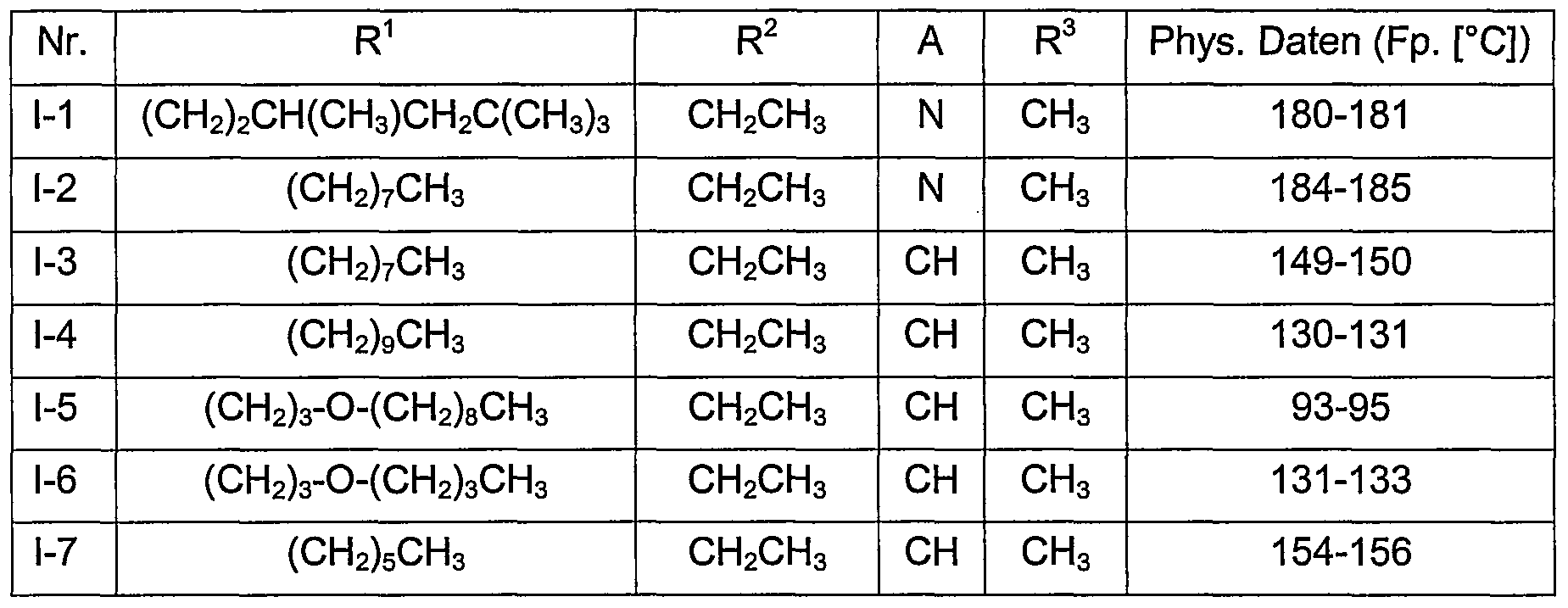

Beispiele für die Wirkung gegen SchadpilzeExamples of the effect against harmful fungi
Die fungizide Wirkung der Verbindungen der Formel I ließ sich durch die folgenden Versuche zeigen:The fungicidal activity of the compounds of the formula I was demonstrated by the following experiments:
Die Wirkstoffe wurden als eine Stammlösung aufbereitet mit 25 mg Wirkstoff, welcher mit einem Gemisch aus Aceton und/oder DMSO und dem Emulgator Uniperol® EL (Netzmittel mit Emulgier- und Dispergierwirkung auf der Basis ethoxylierter Alkylpheno- Ie) im Volumen-Verhältnis Lösungsmittel-Emulgator von 99 zu 1 ad 10 ml aufgefüllt wurde. Anschließend wurde ad 100 ml mit Wasser aufgefüllt. Diese Stammlösung wurde mit dem beschriebenen Lösungsmittel-Emulgator-Wasser Gemisch zu der unten angegeben Wirkstoffkonzentration verdünnt.The active compounds were prepared as a stock solution with 25 mg of active ingredient, which with a mixture of acetone and / or DMSO and the emulsifier Uniperol® EL (wetting agent with emulsifying and dispersing on the basis of ethoxylated alkylphenol Ie) in the volume ratio solvent-emulsifier from 99 to 1 ad 10 ml. It was then made up to 100 ml with water. This stock solution was diluted with the described solvent-emulsifier-water mixture to the drug concentration given below.
Anwendungsbeispiel 1 - Wirksamkeit gegen Rebenperonospora verursacht durch Plasmopara viticolaUse Example 1 - Efficacy against vine peronospora caused by Plasmopara viticola
Blätter von Topfreben wurden mit wässriger Suspension, enthaltend 250 ppm Wirkstoff, bis zur Tropfnässe besprüht. Am folgenden Tag wurden die Unterseiten der Blätter mit einer wässrigen Sporangienaufschwemmung von Plasmopara viticola inokuliert. Danach wurden die Reben zunächst für 48 Stunden in einer wasserdampfgesättigten Kammer bei 240C und anschließend für 5 Tage im Gewächshaus bei Temperaturen zwischen 20 und 3O0C aufgestellt. Nach dieser Zeit wurden die Pflanzen zur Beschleunigung des Sporangienträgerausbruchs abermals für 16 Stunden in eine feuchte Kammer gestellt. Dann wurde das Ausmaß der Befallsentwicklung auf den Blattunterseiten visuell ermittelt.Leaves of pot fry were sprayed to drip point with aqueous suspension containing 250 ppm of active ingredient. The following day, the undersurfaces of the leaves were inoculated with an aqueous sporangia suspension of Plasmopara viticola. Thereafter, the vines were first set up for 48 hours in a water vapor-saturated chamber at 24 0 C and then for 5 days in the greenhouse at temperatures between 20 and 30 0 C. After this time, the plants were again placed in a humid chamber for 16 hours to accelerate the sporangiopathic outbreak. Then the extent of infestation on the undersides of the leaves was visually determined.
In diesem Test zeigten die mit 250 ppm der Wirkstoffe 1-1 , 1-3 bis I-5, 1-9, 1-10, bzw. 1-11 behandelten Pflanzen keinen oder maximal 5 % Befall, während die unbehandelten Pflanzen zu 100 % befallen waren. Der Vergleich mit dem nächsten Stand der Technik zeigte folgende Ergebnisse:In this test, the plants treated with 250 ppm of the active compounds 1-1, 1-3 to I-5, 1-9, 1-10, and 1-11, respectively, showed no or at most 5% infestation, whereas the untreated plants had 100% % were affected. The comparison with the closest prior art showed the following results:

Anwendungsbeispiel 2 - Aktivität gegen die Krautfäule an Tomaten verursacht durch Phytophthora infestans bei drei Tagen protektiver BehandlungUse Example 2 - Activity against tomato late blight caused by Phytophthora infestans at three days of protective treatment
Blätter von getopften Tomatenpflanzen wurden mit einer wässriger Suspension in der unten angegebenen Wirkstoffkonzentration bis zur Tropfnässe besprüht. Nach drei Tagen wurden die Blätter mit einer wässrigen Sporangienaufschwemmung von Phytophthora infestans infiziert. Anschließend wurden die Pflanzen in einer wasserdampf-gesättigten Kammer bei Temperaturen zwischen 18 und 2O0C aufgestellt. Nach 6 Tagen hatte sich die Krautfäule auf den unbehandelten, jedoch infizierten Kontrollpflanzen so stark entwickelt, dass der Befall visuell in % ermittelt werden konnte.Leaves of potted tomato plants were sprayed to drip point with an aqueous suspension in the drug concentration below. After three days, the leaves were infected with an aqueous sporangia suspension of Phytophthora infestans. Subsequently, the plants were placed in a water vapor-saturated chamber at temperatures between 18 and 2O 0 C. After 6 days, the late blight on the untreated but infected control plants had developed so strongly that the infestation could be determined visually in%.
In diesem Test zeigten die mit 250 ppm des Wirkstoffs I-2 behandelten Pflanzen 3 % Befall, während die unbehandelten Pflanzen zu 90 % befallen waren. In this test, the plants treated with 250 ppm of the active ingredient I-2 showed 3% infestation, while the untreated plants were 90% infected.
Claims


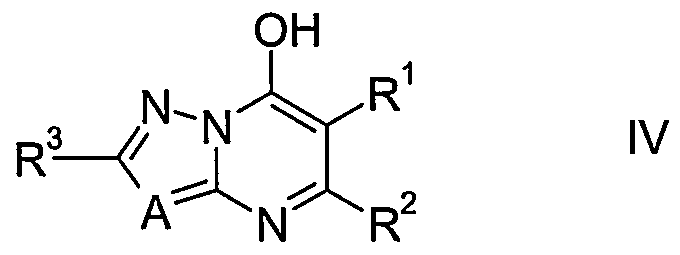


Priority Applications (4)
| Application Number | Priority Date | Filing Date | Title |
|---|---|---|---|
| US11/885,360 US20080207455A1 (en) | 2005-03-01 | 2006-03-01 | 5,6-Dialkyl-7-Aminoazolopyrimidines, Their Preparation and Their Use for Controlling Harmful Fungi, and Compositions Comprising These Compounds |
| BRPI0607498A BRPI0607498A2 (en) | 2005-03-01 | 2006-03-01 | compounds, process for preparing same, agent, seed, and process for combating phytopathogenic harmful fungi |
| JP2007557500A JP2008532944A (en) | 2005-03-01 | 2006-03-01 | 5,6-dialkyl-7-aminoazolopyrimidines, processes for their preparation, their use for controlling harmful fungi, and substances containing these compounds |
| EP06708582A EP1856118A1 (en) | 2005-03-01 | 2006-03-01 | 5,6-dialkyl-7-amino-azolopyrimidines, methods for the production thereof, use thereof for controlling harmful fungi, and substances containing the same |
Applications Claiming Priority (2)
| Application Number | Priority Date | Filing Date | Title |
|---|---|---|---|
| DE102005009883.5 | 2005-03-01 | ||
| DE102005009883 | 2005-03-01 |
Publications (1)
| Publication Number | Publication Date |
|---|---|
| WO2006092411A1 true WO2006092411A1 (en) | 2006-09-08 |
Family
ID=36626696
Family Applications (1)
| Application Number | Title | Priority Date | Filing Date |
|---|---|---|---|
| PCT/EP2006/060361 Ceased WO2006092411A1 (en) | 2005-03-01 | 2006-03-01 | 5,6-dialkyl-7-amino-azolopyrimidines, methods for the production thereof, use thereof for controlling harmful fungi, and substances containing the same |
Country Status (7)
| Country | Link |
|---|---|
| US (1) | US20080207455A1 (en) |
| EP (1) | EP1856118A1 (en) |
| JP (1) | JP2008532944A (en) |
| CN (1) | CN101119999A (en) |
| BR (1) | BRPI0607498A2 (en) |
| TW (1) | TW200640927A (en) |
| WO (1) | WO2006092411A1 (en) |
Cited By (2)
| Publication number | Priority date | Publication date | Assignee | Title |
|---|---|---|---|---|
| US8211828B2 (en) | 2007-01-19 | 2012-07-03 | Basf Se | Fungicidal mixtures of 1-methylpyrazol-4-ylcarboxanilides and azolopyrimidinylamines |
| US9078447B2 (en) | 2007-09-20 | 2015-07-14 | Bayer Cropscience Lp | Combinations comprising a fungicidal strain and an active compound |
Families Citing this family (2)
| Publication number | Priority date | Publication date | Assignee | Title |
|---|---|---|---|---|
| JP2008531653A (en) * | 2005-03-01 | 2008-08-14 | ビーエーエスエフ ソシエタス・ヨーロピア | 5,6-dialkyl-7-aminoazolopyrimidines, their preparation and their use for controlling harmful fungi, and compositions containing these compounds |
| US20100093531A1 (en) * | 2007-01-30 | 2010-04-15 | Christine Habicher | Pesticidal Mixtures Based on Azolopyrimidinylamines Derivatives and Insecticides |
Citations (4)
| Publication number | Priority date | Publication date | Assignee | Title |
|---|---|---|---|---|
| EP0414317A2 (en) * | 1989-08-24 | 1991-02-27 | Philips Patentverwaltung GmbH | Inverter device |
| WO2005087771A2 (en) * | 2004-03-10 | 2005-09-22 | Basf Aktiengesellschaft | 5,6-dialkyl-7-amino-triazolopyrimidines, method for their production, their use for controlling pathogenic fungi and agents containing said compounds |
| WO2005087772A1 (en) * | 2004-03-10 | 2005-09-22 | Basf Aktiengesellschaft | 5,6-dialkyl-7-amino-triazolopyrimidines, method for their production, their use for controlling pathogenic fungi and agents containing said compounds |
| WO2005087773A1 (en) * | 2004-03-10 | 2005-09-22 | Basf Aktiengesellschaft | 5,6-dialkyl-7-amino-triazolopyrimidines, method for their production, their use for controlling pathogenic fungi and agents containing said compounds |
Family Cites Families (6)
| Publication number | Priority date | Publication date | Assignee | Title |
|---|---|---|---|---|
| US2444606A (en) * | 1945-12-15 | 1948-07-06 | Gen Aniline & Film Corp | Stabilizers for photographic emulsions |
| DE3338292A1 (en) * | 1983-10-21 | 1985-05-02 | Basf Ag, 6700 Ludwigshafen | 7-AMINO-AZOLO (1,5-A) -PYRIMIDINE AND FUNGICIDES CONTAINING THEM |
| RU2147584C1 (en) * | 1995-10-27 | 2000-04-20 | Американ Цианамид Компани | Method of synthesis of dihaloidazolopyrimidines and method of synthesis of dihydroxyazolopyrimidines |
| EP1856120A1 (en) * | 2005-03-01 | 2007-11-21 | Basf Aktiengesellschaft | 5,6-dialkyl-7-amino-azolopyrimidines, method for their production, their use for controlling pathogenic fungi and agents containing said compounds |
| WO2006092412A1 (en) * | 2005-03-01 | 2006-09-08 | Basf Aktiengesellschaft | 5,6-dialkyl-7-amino-azolopyrimidines, method for their production, their use for controlling pathogenic fungi and agents containing said compounds |
| WO2006092428A2 (en) * | 2005-03-02 | 2006-09-08 | Basf Aktiengesellschaft | 2-substituted 7-amino-azolopyrimidine, a method for the production and use thereof for controlling pathogenic fungi and agents containing said compound |
-
2006
- 2006-03-01 BR BRPI0607498A patent/BRPI0607498A2/en not_active IP Right Cessation
- 2006-03-01 JP JP2007557500A patent/JP2008532944A/en not_active Withdrawn
- 2006-03-01 US US11/885,360 patent/US20080207455A1/en not_active Abandoned
- 2006-03-01 TW TW095106804A patent/TW200640927A/en unknown
- 2006-03-01 WO PCT/EP2006/060361 patent/WO2006092411A1/en not_active Ceased
- 2006-03-01 CN CNA200680005112XA patent/CN101119999A/en active Pending
- 2006-03-01 EP EP06708582A patent/EP1856118A1/en not_active Withdrawn
Patent Citations (4)
| Publication number | Priority date | Publication date | Assignee | Title |
|---|---|---|---|---|
| EP0414317A2 (en) * | 1989-08-24 | 1991-02-27 | Philips Patentverwaltung GmbH | Inverter device |
| WO2005087771A2 (en) * | 2004-03-10 | 2005-09-22 | Basf Aktiengesellschaft | 5,6-dialkyl-7-amino-triazolopyrimidines, method for their production, their use for controlling pathogenic fungi and agents containing said compounds |
| WO2005087772A1 (en) * | 2004-03-10 | 2005-09-22 | Basf Aktiengesellschaft | 5,6-dialkyl-7-amino-triazolopyrimidines, method for their production, their use for controlling pathogenic fungi and agents containing said compounds |
| WO2005087773A1 (en) * | 2004-03-10 | 2005-09-22 | Basf Aktiengesellschaft | 5,6-dialkyl-7-amino-triazolopyrimidines, method for their production, their use for controlling pathogenic fungi and agents containing said compounds |
Cited By (2)
| Publication number | Priority date | Publication date | Assignee | Title |
|---|---|---|---|---|
| US8211828B2 (en) | 2007-01-19 | 2012-07-03 | Basf Se | Fungicidal mixtures of 1-methylpyrazol-4-ylcarboxanilides and azolopyrimidinylamines |
| US9078447B2 (en) | 2007-09-20 | 2015-07-14 | Bayer Cropscience Lp | Combinations comprising a fungicidal strain and an active compound |
Also Published As
| Publication number | Publication date |
|---|---|
| TW200640927A (en) | 2006-12-01 |
| BRPI0607498A2 (en) | 2016-11-01 |
| EP1856118A1 (en) | 2007-11-21 |
| CN101119999A (en) | 2008-02-06 |
| US20080207455A1 (en) | 2008-08-28 |
| JP2008532944A (en) | 2008-08-21 |
Similar Documents
| Publication | Publication Date | Title |
|---|---|---|
| EP1853608A1 (en) | 5-alkoxyalkyl-6-alkyl-7-amino-azolopyrimidines, method for their production, their use for controlling pathogenic fungi and agents containing said substances | |
| EP1856055B1 (en) | Pyrazole carboxylic acid anilides, method for the production thereof and agents containing them for controlling pathogenic fungi | |
| EP1725560B1 (en) | 5,6-dialkyl-7-amino-triazolopyrimidines, method for their production, their use for controlling pathogenic fungi and agents containing said compounds | |
| EP1725561B1 (en) | 5,6-dialkyl-7-amino-triazolopyrimidines, method for their production, their use for controlling pathogenic fungi and agents containing said compounds | |
| EP1856122A2 (en) | 2-substituted 7-amino-azolopyrimidine, a method for the production and use thereof for controlling pathogenic fungi and agents containing said compound | |
| EP1725559A2 (en) | 5,6-dialkyl-7-amino-triazolopyrimidines, method for their production, their use for controlling pathogenic fungi and agents containing said compounds | |
| WO2006094994A1 (en) | Use of 4-aminopyrimidines for the prevention of fungal pests novel 4-aminopyrimidines method for production thereof and agents comprising the same | |
| EP2035414A1 (en) | Azolylmethyloxiranes, their use for controlling phytopathogenic fungi and compositions comprising them | |
| EP1881964A1 (en) | Pyrazolocarboxamides as fungicides | |
| EP1876899A2 (en) | Use of 5-alkyl-6-phenylalkyl-7-amino-azolopyrimidines, novel azolopyrimidines, methods for the production thereof, and agents containing the same | |
| WO2007101871A1 (en) | Substituted imidazolopyrimidines, method for the production thereof and use thereof for controlling parasitic fungi and agents containing the latter | |
| EP1856119A1 (en) | 5,6-dialkyl-7-amino-azolopyrimidines, method for their production, their use for controlling pathogenic fungi and agents containing said compounds | |
| EP1856118A1 (en) | 5,6-dialkyl-7-amino-azolopyrimidines, methods for the production thereof, use thereof for controlling harmful fungi, and substances containing the same | |
| EP1856120A1 (en) | 5,6-dialkyl-7-amino-azolopyrimidines, method for their production, their use for controlling pathogenic fungi and agents containing said compounds | |
| EP1910373A1 (en) | Fungicide 6-phenyl-triazolopyrimidinyl amines | |
| EP1613633A1 (en) | 7-alkinylamino-triazolopyrimidines, methods for the production and use thereof to combat harmful fungi and agents containing said compounds | |
| EP1856121A1 (en) | 5,6-dialkyl-7-amino-azolopyrimidines, method for their production, their use for controlling pathogenic fungi and agents containing said compounds | |
| EP1910372A1 (en) | Fungicidal 5-alkyl-6-phenylpyrazolopyrimidin-7-ylamines | |
| EP1915376B1 (en) | 6-phenyl-pyrazolopyrimidine-7-ylamine fungicides | |
| EP1910371A1 (en) | Fungicidal 5-methyl-6-phenylpyrazolopyrimidin-7-ylamines | |
| EP1909580A1 (en) | Fungicide 5-methyl-6-phenyl-triazolopyrimidinyl amines | |
| WO2007048734A1 (en) | Use of 5-aminopyrazoles for controlling plant-pathogenic fungi, novel 5-aminopyrazoles, method for their production and agents containing said compounds | |
| WO2006122933A1 (en) | Thiazole carboxylic acid anilides | |
| WO2007048733A1 (en) | Use of 5-aminopyrazoles for controlling plant-pathogenic fungi, novel 5-aminopyrazoles, method for their production and agents containing said compounds | |
| WO2007099092A1 (en) | SUBSTITUTED 6-PHENYL-7-AMINO[1,2,4]-TRIAZOLO[1,5-a]PYRIMIDINES AND THEIR USE FOR CONTROLLING PATHOGENIC FUNGI |
Legal Events
| Date | Code | Title | Description |
|---|---|---|---|
| 121 | Ep: the epo has been informed by wipo that ep was designated in this application | ||
| WWE | Wipo information: entry into national phase |
Ref document number: 2006708582 Country of ref document: EP |
|
| WWE | Wipo information: entry into national phase |
Ref document number: 200680005112.X Country of ref document: CN |
|
| WWE | Wipo information: entry into national phase |
Ref document number: 3161/KOLNP/2007 Country of ref document: IN |
|
| WWE | Wipo information: entry into national phase |
Ref document number: 11885360 Country of ref document: US Ref document number: 2007557500 Country of ref document: JP |
|
| NENP | Non-entry into the national phase |
Ref country code: DE |
|
| NENP | Non-entry into the national phase |
Ref country code: RU |
|
| WWW | Wipo information: withdrawn in national office |
Ref document number: RU |
|
| WWP | Wipo information: published in national office |
Ref document number: 2006708582 Country of ref document: EP |
|
| ENP | Entry into the national phase |
Ref document number: PI0607498 Country of ref document: BR Kind code of ref document: A2 Effective date: 20070830 |