WO2006091957A2 - Selected textile medium for transfer printing - Google Patents
Selected textile medium for transfer printing Download PDFInfo
- Publication number
- WO2006091957A2 WO2006091957A2 PCT/US2006/006973 US2006006973W WO2006091957A2 WO 2006091957 A2 WO2006091957 A2 WO 2006091957A2 US 2006006973 W US2006006973 W US 2006006973W WO 2006091957 A2 WO2006091957 A2 WO 2006091957A2
- Authority
- WO
- WIPO (PCT)
- Prior art keywords
- disperse dye
- disperse
- inkjet inks
- transfer
- ink
- Prior art date
- Legal status (The legal status is an assumption and is not a legal conclusion. Google has not performed a legal analysis and makes no representation as to the accuracy of the status listed.)
- Ceased
Links
Classifications
-
- B—PERFORMING OPERATIONS; TRANSPORTING
- B41—PRINTING; LINING MACHINES; TYPEWRITERS; STAMPS
- B41J—TYPEWRITERS; SELECTIVE PRINTING MECHANISMS, i.e. MECHANISMS PRINTING OTHERWISE THAN FROM A FORME; CORRECTION OF TYPOGRAPHICAL ERRORS
- B41J2/00—Typewriters or selective printing mechanisms characterised by the printing or marking process for which they are designed
- B41J2/005—Typewriters or selective printing mechanisms characterised by the printing or marking process for which they are designed characterised by bringing liquid or particles selectively into contact with a printing material
- B41J2/0057—Typewriters or selective printing mechanisms characterised by the printing or marking process for which they are designed characterised by bringing liquid or particles selectively into contact with a printing material where an intermediate transfer member receives the ink before transferring it on the printing material
-
- B—PERFORMING OPERATIONS; TRANSPORTING
- B41—PRINTING; LINING MACHINES; TYPEWRITERS; STAMPS
- B41M—PRINTING, DUPLICATING, MARKING, OR COPYING PROCESSES; COLOUR PRINTING
- B41M5/00—Duplicating or marking methods; Sheet materials for use therein
- B41M5/025—Duplicating or marking methods; Sheet materials for use therein by transferring ink from the master sheet
- B41M5/0256—Duplicating or marking methods; Sheet materials for use therein by transferring ink from the master sheet the transferable ink pattern being obtained by means of a computer driven printer, e.g. an ink jet or laser printer, or by electrographic means
-
- D—TEXTILES; PAPER
- D06—TREATMENT OF TEXTILES OR THE LIKE; LAUNDERING; FLEXIBLE MATERIALS NOT OTHERWISE PROVIDED FOR
- D06P—DYEING OR PRINTING TEXTILES; DYEING LEATHER, FURS OR SOLID MACROMOLECULAR SUBSTANCES IN ANY FORM
- D06P5/00—Other features in dyeing or printing textiles, or dyeing leather, furs, or solid macromolecular substances in any form
- D06P5/003—Transfer printing
-
- D—TEXTILES; PAPER
- D06—TREATMENT OF TEXTILES OR THE LIKE; LAUNDERING; FLEXIBLE MATERIALS NOT OTHERWISE PROVIDED FOR
- D06P—DYEING OR PRINTING TEXTILES; DYEING LEATHER, FURS OR SOLID MACROMOLECULAR SUBSTANCES IN ANY FORM
- D06P5/00—Other features in dyeing or printing textiles, or dyeing leather, furs, or solid macromolecular substances in any form
- D06P5/30—Ink jet printing
-
- B—PERFORMING OPERATIONS; TRANSPORTING
- B41—PRINTING; LINING MACHINES; TYPEWRITERS; STAMPS
- B41M—PRINTING, DUPLICATING, MARKING, OR COPYING PROCESSES; COLOUR PRINTING
- B41M5/00—Duplicating or marking methods; Sheet materials for use therein
- B41M5/025—Duplicating or marking methods; Sheet materials for use therein by transferring ink from the master sheet
- B41M5/035—Duplicating or marking methods; Sheet materials for use therein by transferring ink from the master sheet by sublimation or volatilisation of pre-printed design, e.g. sublistatic
- B41M5/0355—Duplicating or marking methods; Sheet materials for use therein by transferring ink from the master sheet by sublimation or volatilisation of pre-printed design, e.g. sublistatic characterised by the macromolecular coating or impregnation used to obtain dye receptive properties
-
- B—PERFORMING OPERATIONS; TRANSPORTING
- B41—PRINTING; LINING MACHINES; TYPEWRITERS; STAMPS
- B41M—PRINTING, DUPLICATING, MARKING, OR COPYING PROCESSES; COLOUR PRINTING
- B41M5/00—Duplicating or marking methods; Sheet materials for use therein
- B41M5/025—Duplicating or marking methods; Sheet materials for use therein by transferring ink from the master sheet
- B41M5/035—Duplicating or marking methods; Sheet materials for use therein by transferring ink from the master sheet by sublimation or volatilisation of pre-printed design, e.g. sublistatic
- B41M5/0358—Duplicating or marking methods; Sheet materials for use therein by transferring ink from the master sheet by sublimation or volatilisation of pre-printed design, e.g. sublistatic characterised by the mechanisms or artifacts to obtain the transfer, e.g. the heating means, the pressure means or the transport means
Definitions
- This invention pertains to a selected textile medium for transfer printing. It further pertains to the use of the textile medium for transferring images to three- dimensional objects.
- the aqueous inkjet inks used are disperse dye inks which are optimally used with the selected textile medium.
- Digital printing methods such as inkjet printing are becoming increasingly important for the printing of textiles and offer a number of potential benefits over conventional printing methods such as screen printing.
- Digital printing eliminates the set up expense associated with screen preparation and can potentially enable cost-effective short run production.
- InkJet printing furthermore allows visual effects such as tonal gradients and infinite pattern repeat sizes that cannot be practically achieved with a screen printing process.
- the intermediate transfer sheet is generally categorized as a substrate, which may be paper or it may be another material, that will facilitate and withstand the transfer temperature, and will also facilitate bonding of the ink layer to the substrate.
- the predominantly used material is paper or treated papers which are well suited for transferring an image to a two-dimensional object such as a textile, more specifically a tee shirt.
- the paper or coated paper is not well suited for transferring the image to a three-dimensional object.
- the colorants used in transfer printing inks are disperse dyes which have proven to be especially useful for printing on hydrophobic fibers such as polyesters, cellulose acetate, etc. The initial choice of dye is often suggested by those disperse dyes used in screen printing.
- the optimum ink for this transfer printing is a disperse dye ink since such an ink can be transferred from the textile to the final printed object.
- a transfer printing method for creating an image on an object comprising the steps of:
- the transfer medium is a textile transfer medium that is a knitted or woven fabric comprising fibers consisting essentially of fibers selected from the group consisting of cotton, linen, ramie, viscose, lyocell, polyamide, polyolefin, polyacrylonitrile, aramid and elastene fibers, and blends of two or more thereof.
- the printer is loaded with a disperse dye ink set comprising at least two disperse dye inkjet inks suitable for printing onto the transfer medium, one of the at least two disperse dye inkjet inks being the first disperse dye ink, and another of the at least two disperse dye inkjet inks being a second disperse dye ink containing a second disperse dye having a second activation temperature; and wherein the temperature conditions are at or above the higher of the first and second activation temperatures.
- the printer is loaded with a disperse dye ink set comprising at least three disperse dye inkjet inks suitable for printing onto the transfer medium, one of the at least three disperse dye inkjet inks being the first disperse dye ink, another of the at least three disperse dye inkjet inks being the second disperse dye ink, and another of the at least three disperse dye inkjet inks being a third disperse dye inkjet ink containing a third disperse dye having a third activation temperature; and wherein the temperature conditions are at or above the higher of the first, second and third activation temperatures.
- one ink should preferably be cyan in color, another magenta in color and another yellow in color.
- the printer is loaded with a disperse dye ink set comprising at least four disperse dye inkjet inks suitable for printing onto the transfer medium, one of the at least four disperse dye inkjet inks being the first disperse dye ink, another of the at least four disperse dye inkjet inks being the second disperse dye ink, another of the at least four disperse dye inkjet inks being the third disperse dye ink, and another of the at least four disperse dye inkjet inks being a fourth disperse dye inkjet ink containing a fourth disperse dye having a fourth activation temperature; and wherein the temperature conditions are at or above the higher of the first, second, third and fourth activation temperatures.
- one ink should preferably be cyan in color, another magenta in color, another yellow in color, and another black in color.
- transfer printing is in a general sense well known to those of ordinary skill in the art, as exemplified by the numerous incorporated references listed above.
- the present invention is directed to using a specified textile transfer medium that can take advantage of various emerging features of the digital printing ink jet industry, and further provide a transfer medium that would be adaptable to the transfer to both two- and three-dimensional objects.
- the preferred application for using the selected textiles for transfer printing is for image transfer to three-dimensional objects.
- certain textiles can be optimally used, particularly knitted or woven textiles, and particularly those containing fibers selected from the group consisting of cotton, linen, ramie, viscose, lyocell, polyamide, polyolefin, polyacrylonitrile, aramid and elastene fibers, and blends of two or more of these fibers.
- aramid fibers include Kevlar® and Nomex® (E. I. du Pont de Nemours and Company, Wilmington, Delaware USA).
- the disperse dyes chosen for these selected textiles have low substantivity for these fibers, and are the selected textile/disperse dye combinations are well matched for this transfer printing.
- the choice of which textile to use as the transfer medium will depend on several factors, including the textile/ink combination that leads to both the most resolved image, but also the image which has the most color. Also the textile/ink combination is chosen to match the final image transfer requirements.
- the preferred textile for the transfer printing is a knitted or woven textile containing cotton or cotton blends with fibers selected from the group consisting of linen, ramie, viscose, lyocell, polyamide, polyolefin, polyacrylonitrile, aramid and elastene fibers.
- the flexibility of these selected textiles relative to paper can be described as draping, that is the selected textiles can conform to new shapes.
- the textiles can be optimally chosen relative to the final image transfer requirements. For example, a cotton fabric might have another more stretchable fiber woven or knitted with the cotton such that the fabric would have stretching properties. Thus, after an image is printed onto this cotton blend it could be stretched to cover a three-dimensional object for an ideal arrangement for the final transfer of the image from the printed textile to the final imaged object.
- any ink jet printer can be used to print the image onto the selected textile. Because of the flexibility of the textile, those printers which have design features that manage the use of the textiles would be preferred printers. Examples of these printers include the DuPontTM ArtistriTM 2020 digital textile printing system (E. I. du Pont de Nemours and Company, Wilmington, Delaware USA), and the printer system described in US6742869 (the disclosure of which is incorporated by reference herein in its entirety for all purposes as if fully set forth).
- the preferred inks for the transfer printing with these selected textiles are those containing disperse dyes as the colorant. These provide an optimum performance in printing onto the selected textiles, but also are effective for the transfer of the image during the final image transfer step.
- CMY dyes While all disperse dyes can be used, the preferred list of CMY dyes include:
- a disperse black dye is often a combination of several disperse dyes to produce a black color.
- the ink set may further comprise one or more "gamut-expanding" inks, including different colored inks such as an orange ink, a green ink, a red ink and/or a blue ink, and combinations of full strength and light strengths inks such as light cyan, light magenta and light black.
- Gamut-expanding inks including different colored inks such as an orange ink, a green ink, a red ink and/or a blue ink, and combinations of full strength and light strengths inks such as light cyan, light magenta and light black.
- the DuPontTM ArtistriTM 2020 digital printing system has commercially available disperse dye inks and ink sets that are suitable for use in the present invention.
- the temperature at which the image is transferred to the final object is typical for transfer printing with disperse dye inks.
- the range of suitable transfer temperatures and times is generally from about 150 to about 275°C, for from about 0.5 minutes to about 5 minutes.
- a more preferred temperature range is from about 180 to about 220 0 C, and a more preferred time range is for from about 0.75 minutes to about 2 minutes. Transfer can be further assisted by applying vacuum during the transfer process.
- the selected textile/disperse dye combination provides a printed image on the selected textile that can be used to create images on three-dimensional surfaces. For example, it would be possible for an artist take a drawing or painting, or a photographer take a photograph, scan it with digital scanning process, then convert the image to a digital file that can be printed by a digital printer. The artist/photographer could use software to invert the image so that a positive image would be printed on the final three-dimensional object. Then the digital ink jet printer would create the image on the selected transfer medium and then this printed medium would be conformed to the final three-dimensional object surface. The transfer step would occur and the selected transfer medium removed leaving the image on the three-dimensional object.
- the press was a platen press, assembled for the purpose of precisely controlling temperature and pressure.
- the platen press was comprised of two parallel 6" square platens with embedded resistive heating elements that could be set to maintain a desired platen temperature.
- the platens were fixed in a mutually parallel position to a pneumatic press that could press the platens together at a desired pressure by means of adjustable air pressure. Care was taken to be sure the platens were aligned so as to apply equal pressure across the entire work piece being fused. The effective area of the platen could be reduced, as needed, by inserting a spacer (made, for example from silicone rubber) of appropriate dimensions to allow operation on smaller work pieces.
- a spacer made, for example from silicone rubber
- Table I shows the measured data. The press was used in at setting that lead to no significant pressure of the platens for this image transfer step.
- the K/S difference between the printed and the transfer textile shows that the colored square was much less colored when the image was transferred. For example, for black the transferred value of 4.2888 is much less than the 16.619 for the printed transfer media.
- the K/S is calculated at the maximum absorbance. Similar printing on polyester with different transfer temperatures and times resulted in similar poorer results.
- the cotton entries were done on the printed transfer medium, and the poly(ester) entries are for the polyester textile after the image was transferred at 200 0 C for 2 minutes.
- the image on the polyester was dramatically improved by the transfer from the cotton to the polyester.
- This example is identical to Example 1 except the transfer temperature was 200 0 C for 4 minutes.
- Example 2 shows the excellent transfer of the images at 200 0 C for 4 minutes.
- Example 3 Color Results
- Example 3 shows the excellent transfer of the images at 215°C for 2 minutes.
- This example is identical to Example 1 except the transfer temperature was 215° C for 4 minutes.
- Example 4 shows the excellent transfer of the images at 215°C for 4 minutes.
Landscapes
- Engineering & Computer Science (AREA)
- Textile Engineering (AREA)
- General Engineering & Computer Science (AREA)
- Coloring (AREA)
- Ink Jet (AREA)
- Ink Jet Recording Methods And Recording Media Thereof (AREA)
- Inks, Pencil-Leads, Or Crayons (AREA)
- Treatment Of Fiber Materials (AREA)
Abstract
This invention pertains to a method of transfer printing, in particular to a method of utilizing an inkjet printer and one or more disperse dye inkjet inks to print a transfer image onto a selected textile transfer medium, then transfer the transfer image from the transfer medium to an object to create an image on the object.
Description
TITLE
SELECTED TEXTILE MEDIUM FOR TRANSFER PRINTING
FIELD OF THE INVENTION
This invention pertains to a selected textile medium for transfer printing. It further pertains to the use of the textile medium for transferring images to three- dimensional objects. The aqueous inkjet inks used are disperse dye inks which are optimally used with the selected textile medium.
BACKGROUND OF THE INVENTION
Digital printing methods such as inkjet printing are becoming increasingly important for the printing of textiles and offer a number of potential benefits over conventional printing methods such as screen printing. Digital printing eliminates the set up expense associated with screen preparation and can potentially enable cost-effective short run production. InkJet printing furthermore allows visual effects such as tonal gradients and infinite pattern repeat sizes that cannot be practically achieved with a screen printing process.
One use of digital printing methods is to prepare printed images that can be utilized for transfer printing. In this process an image is printed onto an intermediate transfer sheet, and then the image is transferred to another surface by applying heat to the intermediate transfer sheet. Inks that achieve this purpose are often characterized as heat sensitive, dye diffusion or sublimation inks. US5830263, US6840614, US6386696, US6357870, US6200668, US6402313 and US5488907 (the disclosures of which are incorporated by reference herein in their entirety for all purposes as if fully set forth) describe various aspects of transfer printing.
The intermediate transfer sheet is generally categorized as a substrate, which may be paper or it may be another material, that will facilitate and withstand the transfer temperature, and will also facilitate bonding of the ink layer to the substrate. The predominantly used material is paper or treated papers which are well suited for transferring an image to a two-dimensional object such as a textile, more specifically a tee shirt. However, the paper or coated paper is not well suited for transferring the image to a three-dimensional object.
Among the colorants used in transfer printing inks are disperse dyes which have proven to be especially useful for printing on hydrophobic fibers such as polyesters, cellulose acetate, etc. The initial choice of dye is often suggested by those disperse dyes used in screen printing. However, the need for specific disperse dye systems for digital printing of textiles require multiple levels of optimizing ink properties such as jettability, stability, shelf storage, color properties, etc. The color intensity of a digitally printed textile needs to be improved for full adoption of this printing option for textiles.
There is thus still need in the art for selected textile intermediate substrates that can be used for transfer printing. The optimum ink for this transfer printing is a disperse dye ink since such an ink can be transferred from the textile to the final printed object.
SUMMARY OF THE INVENTION
In accordance with one aspect of the present invention, there is provided a transfer printing method for creating an image on an object, comprising the steps of:
(a) providing an inkjet printer that is responsive to digital data signals;
(b) loading the inkjet printer with a transfer medium to be printed;
(c) loading the inkjet printer with a first disperse dye inkjet ink suitable for printing onto the transfer medium, the first disperse dye ink containing a first disperse dye having a first activation temperature;
(d) printing onto the transfer medium using the first disperse dye inkjet ink in response to the digital data signals to create a disperse dye printed transfer image of the image on the transfer medium; and
(e) applying the printed transfer medium onto the object under temperature conditions at or above the first activation temperature, for a time sufficient to effectively transfer the disperse dye printed transfer image from the transfer medium to the object to create the image on the object,
wherein the transfer medium is a textile transfer medium that is a knitted or woven fabric comprising fibers consisting essentially of fibers selected from the
group consisting of cotton, linen, ramie, viscose, lyocell, polyamide, polyolefin, polyacrylonitrile, aramid and elastene fibers, and blends of two or more thereof.
Preferably, the printer is loaded with a disperse dye ink set comprising at least two disperse dye inkjet inks suitable for printing onto the transfer medium, one of the at least two disperse dye inkjet inks being the first disperse dye ink, and another of the at least two disperse dye inkjet inks being a second disperse dye ink containing a second disperse dye having a second activation temperature; and wherein the temperature conditions are at or above the higher of the first and second activation temperatures.
More preferably, the printer is loaded with a disperse dye ink set comprising at least three disperse dye inkjet inks suitable for printing onto the transfer medium, one of the at least three disperse dye inkjet inks being the first disperse dye ink, another of the at least three disperse dye inkjet inks being the second disperse dye ink, and another of the at least three disperse dye inkjet inks being a third disperse dye inkjet ink containing a third disperse dye having a third activation temperature; and wherein the temperature conditions are at or above the higher of the first, second and third activation temperatures. When three inks are used, one ink should preferably be cyan in color, another magenta in color and another yellow in color.
In another preferred embodiment the printer is loaded with a disperse dye ink set comprising at least four disperse dye inkjet inks suitable for printing onto the transfer medium, one of the at least four disperse dye inkjet inks being the first disperse dye ink, another of the at least four disperse dye inkjet inks being the second disperse dye ink, another of the at least four disperse dye inkjet inks being the third disperse dye ink, and another of the at least four disperse dye inkjet inks being a fourth disperse dye inkjet ink containing a fourth disperse dye having a fourth activation temperature; and wherein the temperature conditions are at or above the higher of the first, second, third and fourth activation temperatures. In this embodiment, one ink should preferably be cyan in color, another magenta in color, another yellow in color, and another black in color.
These and other features and advantages of the present invention will be more readily understood by those of ordinary skill in the art from a reading of the following detailed description. It is to be appreciated that certain features of the
invention which are, for clarity, described above and below in the context of separate embodiments, may also be provided in combination in a single embodiment. Conversely, various features of the invention that are, for brevity, described in the context of a single embodiment, may also be provided separately or in any subcombination. In addition, references in the singular may also include the plural (for example, "a" and "an" may refer to one, or one or more) unless the context specifically states otherwise.
DETAILED DESCRIPTION OF THE PREFERRED EMBODIMENTS
As indicted previously, transfer printing is in a general sense well known to those of ordinary skill in the art, as exemplified by the numerous incorporated references listed above.
The present invention is directed to using a specified textile transfer medium that can take advantage of various emerging features of the digital printing ink jet industry, and further provide a transfer medium that would be adaptable to the transfer to both two- and three-dimensional objects. The preferred application for using the selected textiles for transfer printing is for image transfer to three-dimensional objects.
Most of the transfer medium development for the transfer printing has focused on paper and adding coatings to that paper to make the paper more receptive to the initially printed image (see previously incorporated US6200668). This focus on paper and the coated paper has lead to relatively inflexible transfer media that is not well suited to transfer printing to three-dimensional objects. The paper chemicals added to the paper make it a better medium for printing by reducing the wicking of the ink jet ink into or on the fibers of the paper; however, these chemicals also make the paper less flexible and less suited for printing three-dimensional objects.
Thus, a different substrate for transfer printing is needed. One of the criteria needed for an effective transfer medium is that it must retain the image that is digitally printed. The ink cannot wick, or otherwise spread the ink jet printed dots as that would lead to a less resolved image. If the initially printed image has lost any of its resolution, this cannot be recovered when the image is transferred under the influence of heat to the final printed product. Many textiles, including those based on polyester and cellulose triacetate fibers, will not suitably
retain an image and/or will not permit the disperse dye in the image to suitably transfer when exposed to post treatment.
After careful evaluation, it has been determined that certain textiles can be optimally used, particularly knitted or woven textiles, and particularly those containing fibers selected from the group consisting of cotton, linen, ramie, viscose, lyocell, polyamide, polyolefin, polyacrylonitrile, aramid and elastene fibers, and blends of two or more of these fibers. Examples of the aramid fibers include Kevlar® and Nomex® (E. I. du Pont de Nemours and Company, Wilmington, Delaware USA).
The disperse dyes chosen for these selected textiles have low substantivity for these fibers, and are the selected textile/disperse dye combinations are well matched for this transfer printing.
The choice of which textile to use as the transfer medium will depend on several factors, including the textile/ink combination that leads to both the most resolved image, but also the image which has the most color. Also the textile/ink combination is chosen to match the final image transfer requirements.
The preferred textile for the transfer printing is a knitted or woven textile containing cotton or cotton blends with fibers selected from the group consisting of linen, ramie, viscose, lyocell, polyamide, polyolefin, polyacrylonitrile, aramid and elastene fibers.
The flexibility of these selected textiles relative to paper can be described as draping, that is the selected textiles can conform to new shapes. The textiles can be optimally chosen relative to the final image transfer requirements. For example, a cotton fabric might have another more stretchable fiber woven or knitted with the cotton such that the fabric would have stretching properties. Thus, after an image is printed onto this cotton blend it could be stretched to cover a three-dimensional object for an ideal arrangement for the final transfer of the image from the printed textile to the final imaged object.
Any ink jet printer can be used to print the image onto the selected textile. Because of the flexibility of the textile, those printers which have design features that manage the use of the textiles would be preferred printers. Examples of these printers include the DuPont™ Artistri™ 2020 digital textile printing system
(E. I. du Pont de Nemours and Company, Wilmington, Delaware USA), and the printer system described in US6742869 (the disclosure of which is incorporated by reference herein in its entirety for all purposes as if fully set forth).
The preferred inks for the transfer printing with these selected textiles are those containing disperse dyes as the colorant. These provide an optimum performance in printing onto the selected textiles, but also are effective for the transfer of the image during the final image transfer step.
While all disperse dyes can be used, the preferred list of CMY dyes include:
Cyan - Disperse Blue 60;
Magenta - Disperse Red 5, 75, 76, 86, 91 , 92, 121 , 127, 132, 145, 159, 164, 179, 184, 189, 191 , 229, 258, 343, 152 and 167:1 ; and
Yellow - Disperse Yellow 5, 27, 33, 42, 50, 54, 59, 79, 83, 98, 100, 114, 122, 139, 140, 160, 199, 201 , 204, 206, 224 and 231.
A disperse black dye is often a combination of several disperse dyes to produce a black color.
In addition to CYMK inks, the ink set may further comprise one or more "gamut-expanding" inks, including different colored inks such as an orange ink, a green ink, a red ink and/or a blue ink, and combinations of full strength and light strengths inks such as light cyan, light magenta and light black. These "gamut- expanding" inks are particularly useful in textile printing for simulating the color gamut of analog screen printing, such as disclosed in previously incorporated US20030128246.
The DuPont™ Artistri™ 2020 digital printing system has commercially available disperse dye inks and ink sets that are suitable for use in the present invention.
The temperature at which the image is transferred to the final object is typical for transfer printing with disperse dye inks. The range of suitable transfer temperatures and times is generally from about 150 to about 275°C, for from about 0.5 minutes to about 5 minutes. A more preferred temperature range is from about 180 to about 2200C, and a more preferred time range is for from
about 0.75 minutes to about 2 minutes. Transfer can be further assisted by applying vacuum during the transfer process.
The selected textile/disperse dye combination provides a printed image on the selected textile that can be used to create images on three-dimensional surfaces. For example, it would be possible for an artist take a drawing or painting, or a photographer take a photograph, scan it with digital scanning process, then convert the image to a digital file that can be printed by a digital printer. The artist/photographer could use software to invert the image so that a positive image would be printed on the final three-dimensional object. Then the digital ink jet printer would create the image on the selected transfer medium and then this printed medium would be conformed to the final three-dimensional object surface. The transfer step would occur and the selected transfer medium removed leaving the image on the three-dimensional object.
There are no particular limitations on the materials of the three- dimensional object as long as it can withstand the temperatures required to transfer the image.
EXAMPLES
All of the examples were printed using the DuPont™ Artistri™ 2020 digital textile printing system, and the commercial disperse dye inks sold by DuPont for this printer. The inks used were the ink set from the Dupont™ Artistri™ Ink, D700 Series - Disperse Dye Ink.
Comparative Example 1
Colored squares were printed onto a polyester fabric 730H, described as a Jersey Knit Polyester supplied by Testfabrics Inc. of West Pittstown, PA. The color of the printed squares was measured, then the colored square image on the initial polyester was transferred to another polyester fabric by pressing at 2000C for 2 minutes. The color was measured on a hand held X-Rite spectrophotometer using D65 illuminant, 10° standard observer, and the specular component of reflection was included. The press was a platen press, assembled for the purpose of precisely controlling temperature and pressure. The platen press was comprised of two parallel 6" square platens with embedded resistive heating elements that could be set to maintain a desired platen temperature. The platens
were fixed in a mutually parallel position to a pneumatic press that could press the platens together at a desired pressure by means of adjustable air pressure. Care was taken to be sure the platens were aligned so as to apply equal pressure across the entire work piece being fused. The effective area of the platen could be reduced, as needed, by inserting a spacer (made, for example from silicone rubber) of appropriate dimensions to allow operation on smaller work pieces.
Table I shows the measured data. The press was used in at setting that lead to no significant pressure of the platens for this image transfer step.
Table I Comparative Example 1 Color Results

The K/S difference between the printed and the transfer textile shows that the colored square was much less colored when the image was transferred. For example, for black the transferred value of 4.2888 is much less than the 16.619 for the printed transfer media. The K/S is calculated at the maximum absorbance.
Similar printing on polyester with different transfer temperatures and times resulted in similar poorer results.
Example 1
In a manner to Comparative Example I, cotton was printed and then transferred to a polyester textile. The results are shown in Table Il
Table Il Example 1 Color Results

The cotton entries were done on the printed transfer medium, and the poly(ester) entries are for the polyester textile after the image was transferred at 2000C for 2 minutes. The image on the polyester was dramatically improved by the transfer from the cotton to the polyester.
Example 2
This example is identical to Example 1 except the transfer temperature was 2000C for 4 minutes.
Table 3: Example 2 Color Results
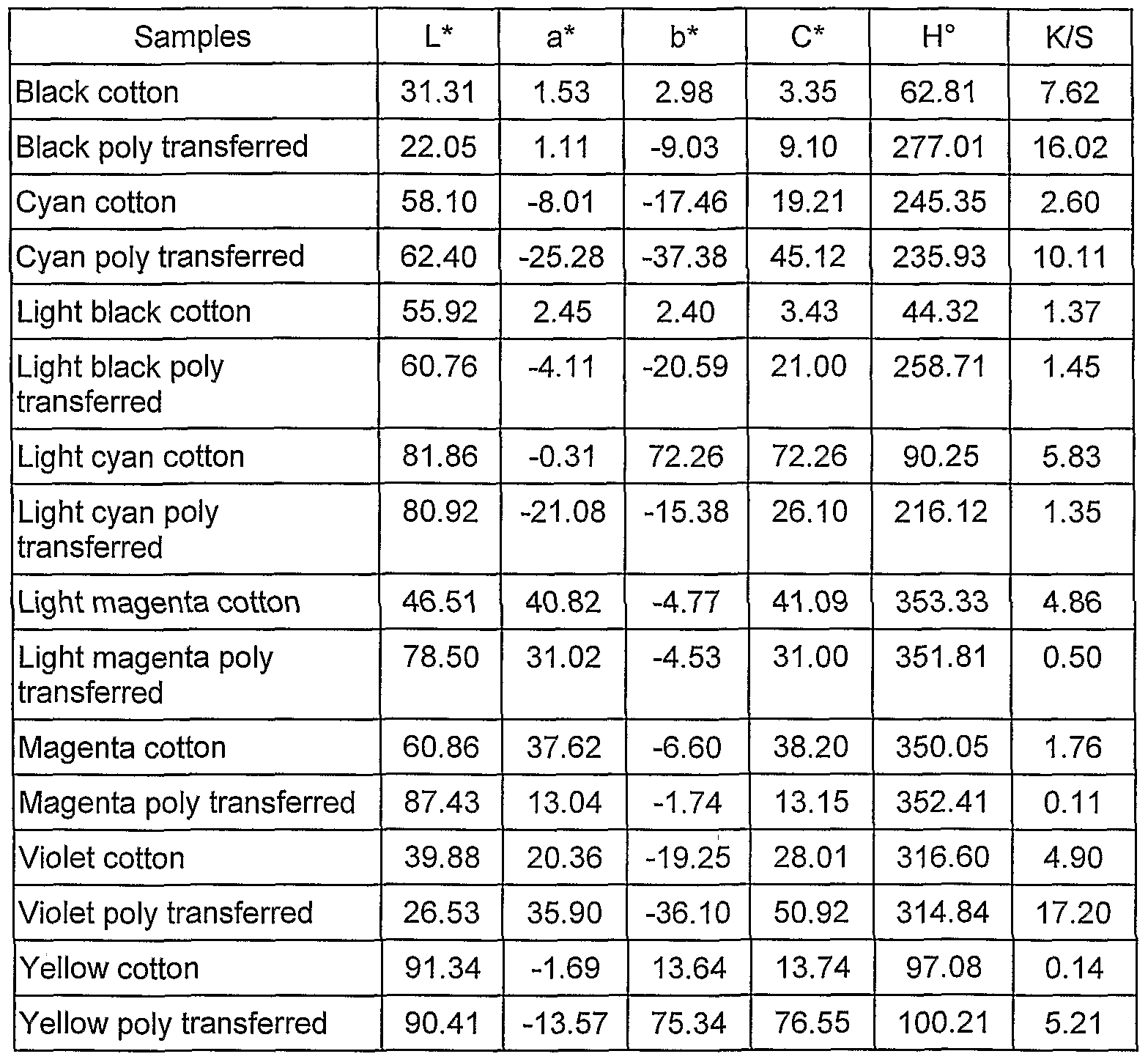
Example 2 shows the excellent transfer of the images at 2000C for 4 minutes.
Example 3
This example is identical to Example 1 except the transfer temperature was 2150C for 2 minutes.
Table 4: Example 3 Color Results

Example 3 shows the excellent transfer of the images at 215°C for 2 minutes.
Example 4
This example is identical to Example 1 except the transfer temperature was 215° C for 4 minutes.
Table 5: Example 4 Color Results

Example 4 shows the excellent transfer of the images at 215°C for 4 minutes.
Claims
1. A transfer printing method for creating an image on an object, comprising the steps of:
(a) providing an inkjet printer that is responsive to digital data signals;
(b) loading the inkjet printer with a transfer medium to be printed;
(c) loading the inkjet printer with a first disperse dye inkjet ink suitable for printing onto the transfer medium, the first disperse dye ink containing a first disperse dye having a first activation temperature;
(d) printing onto the transfer medium using the first disperse dye inkjet ink in response to the digital data signals to create a disperse dye printed transfer image of the image on the transfer medium; and
(e) applying the printed transfer medium onto the object under temperature conditions at or above the first activation temperature, for a time sufficient to effectively transfer the disperse dye printed transfer image from the transfer medium to the object to create the image on the object,
wherein the transfer medium is a textile transfer medium that is a knitted or woven fabric comprising fibers consisting essentially of fibers selected from the group consisting of cotton, linen, ramie, viscose, lyocell, polyamide, polyolefin, polyacrylonitrile, aramid and elastene fibers, and blends of two or more thereof.
2. The method of claim 1 , wherein the printer is loaded with a disperse dye ink set comprising at least two disperse dye inkjet inks suitable for printing onto the transfer medium, one of the at least two disperse dye inkjet inks being the first disperse dye ink, and another of the at least two disperse dye inkjet inks being a second disperse dye ink containing a second disperse dye having a second activation temperature; and wherein the temperature conditions are at or above the higher of the first and second activation temperatures.
3. The method of claim 2, wherein the printer is loaded with a disperse dye ink set comprising at least three disperse dye inkjet inks suitable for printing onto the transfer medium, one of the at least three disperse dye inkjet inks being the first disperse dye ink, another of the at least three disperse dye inkjet inks being the second disperse dye ink, and another of the at least three disperse dye inkjet inks being a third disperse dye inkjet ink containing a third disperse dye having a third activation temperature; and wherein the temperature conditions are at or above the higher of the first, second and third activation temperatures.
4. The method of claim 3, wherein one of the first, second or third disperse inkjet inks is cyan in color; another of the first, second or third disperse inkjet inks is magenta in color; and another of the first, second or third disperse inkjet inks is yellow in color.
5. The method of claim 3, wherein the printer is loaded with a disperse dye ink set comprising at least four disperse dye inkjet inks suitable for printing onto the transfer medium, one of the at least four disperse dye inkjet inks being the first disperse dye ink, another of the at least four disperse dye inkjet inks being the second disperse dye ink, another of the at least four disperse dye inkjet inks being the third disperse dye ink, and another of the at least four disperse dye inkjet inks being a fourth disperse dye inkjet ink containing a fourth disperse dye having a fourth activation temperature; and wherein the temperature conditions are at or above the higher of the first, second, third and fourth activation temperatures.
6. The method of claim 5, wherein one of the first, second, third or fourth disperse inkjet inks is cyan in color; another of the first, second, third or fourth disperse inkjet inks is magenta in color; another of the first, second, third or fourth disperse inkjet inks is yellow in color, and another of the first, second, third or fourth disperse inkjet inks is black in color.
7. The method of any one of claims 1-6, wherein the temperature conditions are from about 1500C to about 2750C, for from about 0.5 to about 5 minutes.
8. The method of claim 7, wherein the temperature conditions are from about 180°C to about 2200C, for from about 0.75 to about 2 minutes.
9. The method of any one of claims 1-8, wherein the object is a three- dimensional object.
10. The method of any one of claims 1-9, wherein the object is a polyester object.
11. The method of any one of claims 1 -10, wherein the textile transfer medium is selected from the group consisting of a knitted or woven cotton fabric, and a knitted or woven cotton blend with one or more fibers selected from the group consisting of linen, ramie, viscose, lyocell, polyamide, polyolefin, polyacrylonitrile, aramid and elastene fibers.
Priority Applications (2)
| Application Number | Priority Date | Filing Date | Title |
|---|---|---|---|
| EP06736315A EP1851059A2 (en) | 2005-02-24 | 2006-02-24 | Selected textile medium for transfer printing |
| JP2007557240A JP2008532794A (en) | 2005-02-24 | 2006-02-24 | Selected fiber media for transfer printing |
Applications Claiming Priority (2)
| Application Number | Priority Date | Filing Date | Title |
|---|---|---|---|
| US65602205P | 2005-02-24 | 2005-02-24 | |
| US60/656,022 | 2005-02-24 |
Publications (2)
| Publication Number | Publication Date |
|---|---|
| WO2006091957A2 true WO2006091957A2 (en) | 2006-08-31 |
| WO2006091957A3 WO2006091957A3 (en) | 2007-02-15 |
Family
ID=36928127
Family Applications (1)
| Application Number | Title | Priority Date | Filing Date |
|---|---|---|---|
| PCT/US2006/006973 Ceased WO2006091957A2 (en) | 2005-02-24 | 2006-02-24 | Selected textile medium for transfer printing |
Country Status (4)
| Country | Link |
|---|---|
| US (1) | US20060185099A1 (en) |
| EP (1) | EP1851059A2 (en) |
| JP (1) | JP2008532794A (en) |
| WO (1) | WO2006091957A2 (en) |
Cited By (32)
| Publication number | Priority date | Publication date | Assignee | Title |
|---|---|---|---|---|
| WO2007016608A3 (en) * | 2005-08-04 | 2007-05-31 | Du Pont | Inkjet ink set |
| US9643403B2 (en) | 2012-03-05 | 2017-05-09 | Landa Corporation Ltd. | Printing system |
| JP2018103627A (en) * | 2012-03-05 | 2018-07-05 | ランダ コーポレイション リミテッド | Printing system |
| US10179447B2 (en) | 2012-03-05 | 2019-01-15 | Landa Corporation Ltd. | Digital printing system |
| US10195843B2 (en) | 2012-03-05 | 2019-02-05 | Landa Corporation Ltd | Digital printing process |
| US10201968B2 (en) | 2012-03-15 | 2019-02-12 | Landa Corporation Ltd. | Endless flexible belt for a printing system |
| US10226920B2 (en) | 2015-04-14 | 2019-03-12 | Landa Corporation Ltd. | Apparatus for threading an intermediate transfer member of a printing system |
| US10266711B2 (en) | 2012-03-05 | 2019-04-23 | Landa Corporation Ltd. | Ink film constructions |
| US10300690B2 (en) | 2012-03-05 | 2019-05-28 | Landa Corporation Ltd. | Ink film constructions |
| US10434761B2 (en) | 2012-03-05 | 2019-10-08 | Landa Corporation Ltd. | Digital printing process |
| US10518526B2 (en) | 2012-03-05 | 2019-12-31 | Landa Corporation Ltd. | Apparatus and method for control or monitoring a printing system |
| US10596804B2 (en) | 2015-03-20 | 2020-03-24 | Landa Corporation Ltd. | Indirect printing system |
| US10632740B2 (en) | 2010-04-23 | 2020-04-28 | Landa Corporation Ltd. | Digital printing process |
| US10642198B2 (en) | 2012-03-05 | 2020-05-05 | Landa Corporation Ltd. | Intermediate transfer members for use with indirect printing systems and protonatable intermediate transfer members for use with indirect printing systems |
| US10759953B2 (en) | 2013-09-11 | 2020-09-01 | Landa Corporation Ltd. | Ink formulations and film constructions thereof |
| US10889128B2 (en) | 2016-05-30 | 2021-01-12 | Landa Corporation Ltd. | Intermediate transfer member |
| US10926532B2 (en) | 2017-10-19 | 2021-02-23 | Landa Corporation Ltd. | Endless flexible belt for a printing system |
| US10933661B2 (en) | 2016-05-30 | 2021-03-02 | Landa Corporation Ltd. | Digital printing process |
| US10994528B1 (en) | 2018-08-02 | 2021-05-04 | Landa Corporation Ltd. | Digital printing system with flexible intermediate transfer member |
| US11267239B2 (en) | 2017-11-19 | 2022-03-08 | Landa Corporation Ltd. | Digital printing system |
| US11318734B2 (en) | 2018-10-08 | 2022-05-03 | Landa Corporation Ltd. | Friction reduction means for printing systems and method |
| US11321028B2 (en) | 2019-12-11 | 2022-05-03 | Landa Corporation Ltd. | Correcting registration errors in digital printing |
| US11465426B2 (en) | 2018-06-26 | 2022-10-11 | Landa Corporation Ltd. | Intermediate transfer member for a digital printing system |
| US11511536B2 (en) | 2017-11-27 | 2022-11-29 | Landa Corporation Ltd. | Calibration of runout error in a digital printing system |
| US11679615B2 (en) | 2017-12-07 | 2023-06-20 | Landa Corporation Ltd. | Digital printing process and method |
| US11707943B2 (en) | 2017-12-06 | 2023-07-25 | Landa Corporation Ltd. | Method and apparatus for digital printing |
| US11787170B2 (en) | 2018-12-24 | 2023-10-17 | Landa Corporation Ltd. | Digital printing system |
| US11833813B2 (en) | 2019-11-25 | 2023-12-05 | Landa Corporation Ltd. | Drying ink in digital printing using infrared radiation |
| US12001902B2 (en) | 2018-08-13 | 2024-06-04 | Landa Corporation Ltd. | Correcting distortions in digital printing by implanting dummy pixels in a digital image |
| US12011920B2 (en) | 2019-12-29 | 2024-06-18 | Landa Corporation Ltd. | Printing method and system |
| US12358277B2 (en) | 2019-03-31 | 2025-07-15 | Landa Corporation Ltd. | Systems and methods for preventing or minimizing printing defects in printing processes |
| US12430453B2 (en) | 2021-02-02 | 2025-09-30 | Landa Corporation Ltd. | Mitigating distortions in printed images |
Families Citing this family (4)
| Publication number | Priority date | Publication date | Assignee | Title |
|---|---|---|---|---|
| US7223300B2 (en) * | 2005-10-19 | 2007-05-29 | E. I. Du Pont De Nemours And Company | Inkjet ink set |
| JP6040959B2 (en) * | 2014-05-20 | 2016-12-07 | セイコーエプソン株式会社 | Inkjet ink set for sublimation transfer, dyed product and method for producing the same |
| JP2015218292A (en) * | 2014-05-20 | 2015-12-07 | セイコーエプソン株式会社 | Inkjet ink set for sublimation transfer, and dyed material and production method of the dyed material |
| KR102544177B1 (en) * | 2021-03-25 | 2023-06-16 | (주)아셈스 | Melange Fabric Using Multicolored Thread Made by Waterless Dyeing Method Using Vacuum Transference Way |
Family Cites Families (16)
| Publication number | Priority date | Publication date | Assignee | Title |
|---|---|---|---|---|
| US5488907C1 (en) * | 1990-07-09 | 2001-11-27 | Sawgrass Systems Inc | Permanent heat activated transfer printing process and composition |
| JP2952134B2 (en) * | 1993-07-09 | 1999-09-20 | キヤノン株式会社 | Ink jet printing method and printed matter |
| US5640180A (en) * | 1994-03-08 | 1997-06-17 | Sawgrass Systems, Inc. | Low energy heat activated transfer printing process |
| US6673503B2 (en) * | 1994-11-07 | 2004-01-06 | Barbara Wagner | Energy activated electrographic printing process |
| US6402313B1 (en) * | 1998-05-06 | 2002-06-11 | Sawgrass Systems, Inc. | Substrate reactive printing process |
| US6348939B1 (en) * | 1999-05-28 | 2002-02-19 | Sawgrass Systems, Inc. | Digital printable reactive dye and process |
| US5718793A (en) * | 1995-02-28 | 1998-02-17 | Canon Kabushiki Kaisha | Image forming process and printed article |
| DE19530284C2 (en) * | 1995-08-17 | 2000-12-14 | Heidelberger Druckmasch Ag | Ink transfer methods and apparatus |
| JP3327782B2 (en) * | 1996-04-30 | 2002-09-24 | キヤノン株式会社 | Transfer medium for ink jet recording, transfer method using the same, and transferred fabric |
| JPH1154746A (en) * | 1997-07-31 | 1999-02-26 | Toyota Motor Corp | Insulated gate semiconductor device and method of manufacturing the same |
| DE19930995A1 (en) * | 1998-07-08 | 2000-01-13 | Ciba Sc Holding Ag | Ink-jet printing on textile, especially cellulose, e.g. cotton or viscose rayon |
| US6357870B1 (en) * | 2000-10-10 | 2002-03-19 | Lexmark International, Inc. | Intermediate transfer medium coating solution and method of ink jet printing using coating solution |
| EP1433308A2 (en) * | 2001-10-04 | 2004-06-30 | E.I. Du Pont De Nemours And Company | Ink jet printing |
| US6524419B1 (en) * | 2001-11-30 | 2003-02-25 | Brunswick Bowling & Billiards Corporation | Method and apparatus for making and/or decorating bowling balls and the like |
| JP2004223956A (en) * | 2003-01-24 | 2004-08-12 | Fuji Photo Film Co Ltd | Transfer medium for inkjet recording and method for forming image |
| US7785764B2 (en) * | 2004-02-10 | 2010-08-31 | Williams Scott A | Image transfer material and heat transfer process using the same |
-
2006
- 2006-02-24 WO PCT/US2006/006973 patent/WO2006091957A2/en not_active Ceased
- 2006-02-24 EP EP06736315A patent/EP1851059A2/en not_active Withdrawn
- 2006-02-24 JP JP2007557240A patent/JP2008532794A/en active Pending
- 2006-02-24 US US11/361,577 patent/US20060185099A1/en not_active Abandoned
Cited By (36)
| Publication number | Priority date | Publication date | Assignee | Title |
|---|---|---|---|---|
| US7442243B2 (en) | 2005-08-04 | 2008-10-28 | E.I. Du Pont De Nemours And Company | Inkjet ink set |
| WO2007016608A3 (en) * | 2005-08-04 | 2007-05-31 | Du Pont | Inkjet ink set |
| US10632740B2 (en) | 2010-04-23 | 2020-04-28 | Landa Corporation Ltd. | Digital printing process |
| JP2018103627A (en) * | 2012-03-05 | 2018-07-05 | ランダ コーポレイション リミテッド | Printing system |
| US9914316B2 (en) | 2012-03-05 | 2018-03-13 | Landa Corporation Ltd. | Printing system |
| US10179447B2 (en) | 2012-03-05 | 2019-01-15 | Landa Corporation Ltd. | Digital printing system |
| US10195843B2 (en) | 2012-03-05 | 2019-02-05 | Landa Corporation Ltd | Digital printing process |
| US9643403B2 (en) | 2012-03-05 | 2017-05-09 | Landa Corporation Ltd. | Printing system |
| US10266711B2 (en) | 2012-03-05 | 2019-04-23 | Landa Corporation Ltd. | Ink film constructions |
| US10300690B2 (en) | 2012-03-05 | 2019-05-28 | Landa Corporation Ltd. | Ink film constructions |
| US10357985B2 (en) | 2012-03-05 | 2019-07-23 | Landa Corporation Ltd. | Printing system |
| US10357963B2 (en) | 2012-03-05 | 2019-07-23 | Landa Corporation Ltd. | Digital printing process |
| US10434761B2 (en) | 2012-03-05 | 2019-10-08 | Landa Corporation Ltd. | Digital printing process |
| US10518526B2 (en) | 2012-03-05 | 2019-12-31 | Landa Corporation Ltd. | Apparatus and method for control or monitoring a printing system |
| US10642198B2 (en) | 2012-03-05 | 2020-05-05 | Landa Corporation Ltd. | Intermediate transfer members for use with indirect printing systems and protonatable intermediate transfer members for use with indirect printing systems |
| US10201968B2 (en) | 2012-03-15 | 2019-02-12 | Landa Corporation Ltd. | Endless flexible belt for a printing system |
| US10759953B2 (en) | 2013-09-11 | 2020-09-01 | Landa Corporation Ltd. | Ink formulations and film constructions thereof |
| US10596804B2 (en) | 2015-03-20 | 2020-03-24 | Landa Corporation Ltd. | Indirect printing system |
| US10226920B2 (en) | 2015-04-14 | 2019-03-12 | Landa Corporation Ltd. | Apparatus for threading an intermediate transfer member of a printing system |
| US10889128B2 (en) | 2016-05-30 | 2021-01-12 | Landa Corporation Ltd. | Intermediate transfer member |
| US10933661B2 (en) | 2016-05-30 | 2021-03-02 | Landa Corporation Ltd. | Digital printing process |
| US10926532B2 (en) | 2017-10-19 | 2021-02-23 | Landa Corporation Ltd. | Endless flexible belt for a printing system |
| US11267239B2 (en) | 2017-11-19 | 2022-03-08 | Landa Corporation Ltd. | Digital printing system |
| US11511536B2 (en) | 2017-11-27 | 2022-11-29 | Landa Corporation Ltd. | Calibration of runout error in a digital printing system |
| US11707943B2 (en) | 2017-12-06 | 2023-07-25 | Landa Corporation Ltd. | Method and apparatus for digital printing |
| US11679615B2 (en) | 2017-12-07 | 2023-06-20 | Landa Corporation Ltd. | Digital printing process and method |
| US11465426B2 (en) | 2018-06-26 | 2022-10-11 | Landa Corporation Ltd. | Intermediate transfer member for a digital printing system |
| US10994528B1 (en) | 2018-08-02 | 2021-05-04 | Landa Corporation Ltd. | Digital printing system with flexible intermediate transfer member |
| US12001902B2 (en) | 2018-08-13 | 2024-06-04 | Landa Corporation Ltd. | Correcting distortions in digital printing by implanting dummy pixels in a digital image |
| US11318734B2 (en) | 2018-10-08 | 2022-05-03 | Landa Corporation Ltd. | Friction reduction means for printing systems and method |
| US11787170B2 (en) | 2018-12-24 | 2023-10-17 | Landa Corporation Ltd. | Digital printing system |
| US12358277B2 (en) | 2019-03-31 | 2025-07-15 | Landa Corporation Ltd. | Systems and methods for preventing or minimizing printing defects in printing processes |
| US11833813B2 (en) | 2019-11-25 | 2023-12-05 | Landa Corporation Ltd. | Drying ink in digital printing using infrared radiation |
| US11321028B2 (en) | 2019-12-11 | 2022-05-03 | Landa Corporation Ltd. | Correcting registration errors in digital printing |
| US12011920B2 (en) | 2019-12-29 | 2024-06-18 | Landa Corporation Ltd. | Printing method and system |
| US12430453B2 (en) | 2021-02-02 | 2025-09-30 | Landa Corporation Ltd. | Mitigating distortions in printed images |
Also Published As
| Publication number | Publication date |
|---|---|
| US20060185099A1 (en) | 2006-08-24 |
| JP2008532794A (en) | 2008-08-21 |
| EP1851059A2 (en) | 2007-11-07 |
| WO2006091957A3 (en) | 2007-02-15 |
Similar Documents
| Publication | Publication Date | Title |
|---|---|---|
| US20060185099A1 (en) | Selected textile medium for transfer printing | |
| CA2182985C (en) | Method of printing a multiple color image using heat sensitive inks and applying a polymer surface preparation material to a substrate | |
| US6540345B1 (en) | Transfer printing process | |
| US8735320B2 (en) | Method of transfer printing using white toner | |
| US7134749B2 (en) | Method for image printing on a dark textile piece | |
| US5575877A (en) | Printing method of applying a polymer surface preparation material to a substrate | |
| US5431501A (en) | Printing method of surface coating a substrate | |
| CA2641268A1 (en) | Image receiver media and printing process | |
| JP2018020519A (en) | Printed medium manufacturing method, printed medium manufacturing device and ink | |
| JP4438420B2 (en) | Inkjet ink set for printing | |
| WO2002071108A1 (en) | Ink for dyeing plastic lens and method for dyeing plastic lens using the ink | |
| JP2007063697A (en) | Sash product and method for producing the same | |
| JP2003185982A (en) | Method of dyeing plastic lens and ink for dyeing plastic lens used for this method | |
| US8879116B2 (en) | Hollow dot printing apparatus and methods | |
| Fashandi | Digital printing of acrylic fabric with cationic dyes using conventional inkjet printer | |
| EP2082358A2 (en) | Hollow dot printing apparatus and methods | |
| Work | Substrate developments in fine art media | |
| US20240300254A1 (en) | Dye sublimation printing processes | |
| JP2010083129A (en) | Sublimation type thermal transfer ribbon | |
| JP6018689B1 (en) | Printing fabric manufacturing method and printing fabric manufacturing system | |
| JP3870330B2 (en) | Inkjet recording sheet | |
| JPH11512359A (en) | Improvements in transfer printing | |
| JP4102082B2 (en) | Plastic dyeing substrate and plastic dyeing method using the same | |
| JP2021129726A (en) | Bag skin material, bag skin material manufacturing method and bag | |
| KR20050082825A (en) | Hot-adhesive sublimation media for inkjet printer |
Legal Events
| Date | Code | Title | Description |
|---|---|---|---|
| WWE | Wipo information: entry into national phase |
Ref document number: 2007557240 Country of ref document: JP |
|
| NENP | Non-entry into the national phase |
Ref country code: DE |
|
| WWE | Wipo information: entry into national phase |
Ref document number: 2006736315 Country of ref document: EP |