WO2006056958A2 - Method and system for adjusting the light setting for a multi-color light source - Google Patents
Method and system for adjusting the light setting for a multi-color light source Download PDFInfo
- Publication number
- WO2006056958A2 WO2006056958A2 PCT/IB2005/053896 IB2005053896W WO2006056958A2 WO 2006056958 A2 WO2006056958 A2 WO 2006056958A2 IB 2005053896 W IB2005053896 W IB 2005053896W WO 2006056958 A2 WO2006056958 A2 WO 2006056958A2
- Authority
- WO
- WIPO (PCT)
- Prior art keywords
- setting
- hue
- bbl
- chroma
- color
- Prior art date
- Legal status (The legal status is an assumption and is not a legal conclusion. Google has not performed a legal analysis and makes no representation as to the accuracy of the status listed.)
- Ceased
Links
Classifications
-
- H—ELECTRICITY
- H05—ELECTRIC TECHNIQUES NOT OTHERWISE PROVIDED FOR
- H05B—ELECTRIC HEATING; ELECTRIC LIGHT SOURCES NOT OTHERWISE PROVIDED FOR; CIRCUIT ARRANGEMENTS FOR ELECTRIC LIGHT SOURCES, IN GENERAL
- H05B45/00—Circuit arrangements for operating light-emitting diodes [LED]
- H05B45/20—Controlling the colour of the light
-
- H—ELECTRICITY
- H05—ELECTRIC TECHNIQUES NOT OTHERWISE PROVIDED FOR
- H05B—ELECTRIC HEATING; ELECTRIC LIGHT SOURCES NOT OTHERWISE PROVIDED FOR; CIRCUIT ARRANGEMENTS FOR ELECTRIC LIGHT SOURCES, IN GENERAL
- H05B47/00—Circuit arrangements for operating light sources in general, i.e. where the type of light source is not relevant
- H05B47/10—Controlling the light source
-
- H—ELECTRICITY
- H05—ELECTRIC TECHNIQUES NOT OTHERWISE PROVIDED FOR
- H05B—ELECTRIC HEATING; ELECTRIC LIGHT SOURCES NOT OTHERWISE PROVIDED FOR; CIRCUIT ARRANGEMENTS FOR ELECTRIC LIGHT SOURCES, IN GENERAL
- H05B47/00—Circuit arrangements for operating light sources in general, i.e. where the type of light source is not relevant
- H05B47/10—Controlling the light source
- H05B47/175—Controlling the light source by remote control
- H05B47/19—Controlling the light source by remote control via wireless transmission
Definitions
- the present inventions relates to a method for adjusting the light setting for a multi-color light source, which method comprises receiving input from a user related to at least one of white color, hue, and chroma, and adjusting white color, hue, and chroma of the light source in accordance with the user input.
- the present invention also relates to a corresponding system and computer program product.
- a method for adjusting the light settings for a multi-color light source is disclosed in the document "Hue & chroma colour setting method" published at IP.COM under number IPCOM 00029468D.
- the document discloses a method comprising three steps for adjusting the light settings.
- the wanted white color is selected.
- the white color is selected from the black radiation curve or the black body locus (BBL), from warm white to cold white.
- BBL is a line of points in a chromaticity diagram (e.g. the CIE chromaticity diagram) corresponding to colors emitted from a black body at different temperatures.
- the wanted color or hue is selected. This is the color that is added to the chosen white color.
- the selected color can be regarded as a selected angle of a vector starting from the selected white color point on the BBL.
- the wanted chroma is selected. This is the saturation or amount of the color already chosen.
- the chroma is determined by the length of the vector in the CIE chromaticity diagram.
- IPCOM 00029468D has some drawbacks.
- the color setting is "disabled” or "inactive”, i.e. there will be no change in output of the multi- color light source when the color is adjusted.
- the white color setting is "inactive”, i.e. adjusting the white color will have no effect on the output of the multi-color light source.
- adjustment of the white color will not result in a perceivable different color.
- adjustment of the saturation when no color is selected will result in erroneous operation, since there is no color selected for which saturation can be adjusted.
- a method by way of introduction further comprising automatically changing a current hue and chroma level when the user input is received.
- the invention is based on the understanding that by automatically changing a current hue and chroma level when the user input is received, i.e. when one of white color, hue, and chroma is to be set, it is possible to render the subsequent adjustment in setting perceivable for the user, which facilitates the adjustment of the light source.
- the light source will always react in a similar way when an illogical command is given, which also facilitates the adjustment of the light source.
- the method further comprises the step(s) of determining whether the current setting is perceivably on the black body locus (BBL), i.e. if the current setting of white color, hue, and chroma results in light output that corresponds to a position along the black body locus (BBL) of for example the CIE chromaticity diagram, and, if this is the case, automatically setting a predetermined hue and chroma level off the BBL when user input related to one of hue and chroma is received.
- BBL black body locus
- a setting "perceivably" on the BBL should be construed as meaning that the color setting is either on the BBL, or close enough to the BBL so that there is no perceivable color difference in output from the light source for the human eye compared to a position actually on the BBL.
- the step of automatically setting a predetermined hue and chroma level is performed only if the current color setting has been perceivably on the BBL for a predetermined time.
- a default jump to the predetermined hue and chroma level when a user adjusts the settings so that the setting "accidentally" crosses the BBL, is avoided.
- the above mentioned predetermined hue and chroma level corresponds to a moderate green color. Green color is advantageous since blue and yellow can be added by moving along the BBL (in context of the CIE chromaticity diagram). Alternatively, purple color can for example be used.
- the method further comprises the step(s) of determining whether the current setting is perceivably on the black body locus (BBL), and, if this is not the case, automatically shifting the setting to the BBL when user input related to white color is received.
- BBL black body locus
- the deiault jump involves jumping to a certain predetermined position on the BBL, i.e. setting a predetermined color temperature, for example 4000 Kelvin. It should be noted that if the current setting already is perceivably on the BBL, the adjustment of white color will be executed without any jump to the BBL.
- a system for adjusting the light setting for a multi-color light source which system comprises means for receiving input from a user related to at least one of white color, hue, and chroma, means for adjusting white color, hue, and chroma of the light source in accordance with the user input, and means for automatically changing a current hue and chroma level when the user input is received.
- Fig. 1 is a schematic view of a system for adjusting the light setting for a multi-color light source according to one embodiment of the invention
- Fig. 2 shows a default jump to a predetermined hue and chroma level according to one embodiment of the invention in the context of the CIE chromaticity diagram
- Fig. 3 shows a default jump to the BBL according to one embodiment of the invention in the context of the CIE chromaticity diagram
- Fig. 4 is a flow chart of a method for adjusting the light setting for a multi ⁇ color light source according to one embodiment of the invention.
- Fig. 1 shows a system 10 for adjusting the light setting for a multi-color light source 11 according to one embodiment of the invention.
- the system 10 comprises a first device, here a remote control 12, and a second device 14, which comprises means 28 for receiving user input instructions via the remote control 12 and means 34 for adjusting white color, hue, and chroma of the output of the multi-color light source 11 based on the received user input.
- the remote control 12 is equipped with means for input of user instructions.
- the user input means is constituted by a plurality of two-toggle knobs 16, 18, 20, 22 corresponding to dim- level, white color, hue (color), and chroma (saturation), respectively.
- actuating a certain knob results in a decrease/increase or change of the setting in question.
- the remote control 12 is in communication with the second device 14, preferably via a wireless link 24, such as IR.
- the remote control 12 can further be equipped with means 26 for storing and/or retrieving of certain color settings, i.e. certain combinations of white color, hue, and chroma. These setting can be default preset settings and/or settings manually stored by the user.
- the basic operation of the system 10 is similar to the method disclosed in IPCOM 00029468D discussed above.
- adjustment of white color corresponds to a movement along the black body locus (BBL)
- the selected color can be regarded as the angle of a vector starting from the selected white color point on the BBL, and the saturation or amount of color is determined by the length of the vector.
- the second device 14 further comprises means 30 for determining whether the current color setting is perceivably on the BBL, and means 32 for automatically setting a certain color setting when user input is received.
- the means 30, 32, and 34 can for example be implemented in the driver and software of the light source.
- step Sl When a user is about to adjust the hue or chroma setting, i.e. when he or she initially actuates either of the hue knobs 20 or the chroma knobs 22, it is first determined (step Sl, fig. 4) that it is hue or chroma that is selected, after which the determining means 30 determines (step S2a) whether the current color setting of the light source corresponds to a position perceivably on the black body locus (BBL). If this is the case, a predetermined hue and chroma level is automatically set (step S3a).
- the predetermined position 42 corresponds to a moderate green color. If the determining means 30 determines that the current setting corresponds to a position already perceivably off the BBL, such as position 44, subsequent activation of the hue or chroma knobs will result in normal adjustment of hue or chroma level without any preceding automatic jump to the predetermined setting (position 42).
- the automatic default jump is preferably only made if the chosen color setting has been on the (perceivable) BBL for a certain time (for example 1 minute).
- a default jump to the predetermined hue and chroma level when a user adjusts the settings so that the setting "accidentally" crosses the BBL, is avoided.
- Determining whether the current setting is perceivably on the BBL can for example be performed by determining the current color coordinates of the light source based on the chosen hue and chroma level, and calculate the difference between these coordinates and the known coordinates of the trajectory of the BBL. If the difference is smaller than a predetermined threshold, the current setting is perceivably on the BBL.
- step Sl determines whether the current color setting is perceivably on the BBL. If this is not the case, the setting is automatically shifted to the BBL (step S3b). Thus, there is a jump from a setting off the BBL to a setting on the BBL. Preferably, the setting is shifted to a certain predetermined position on the BBL. This is illustrated in fig. 3 as a movement from a position 50 off the BBL to a position 52 on the BBL.
- the predetermined position 52 corresponds to a color temperature of about 4000 K.
- the determining means 30 determines that the current setting corresponds to a position already perceivably on the BBL, such as position 54, subsequent activation of the white color knobs will result in normal adjustment of the white color without any preceding automatic jump to a setting on the BBL (such as position 52).
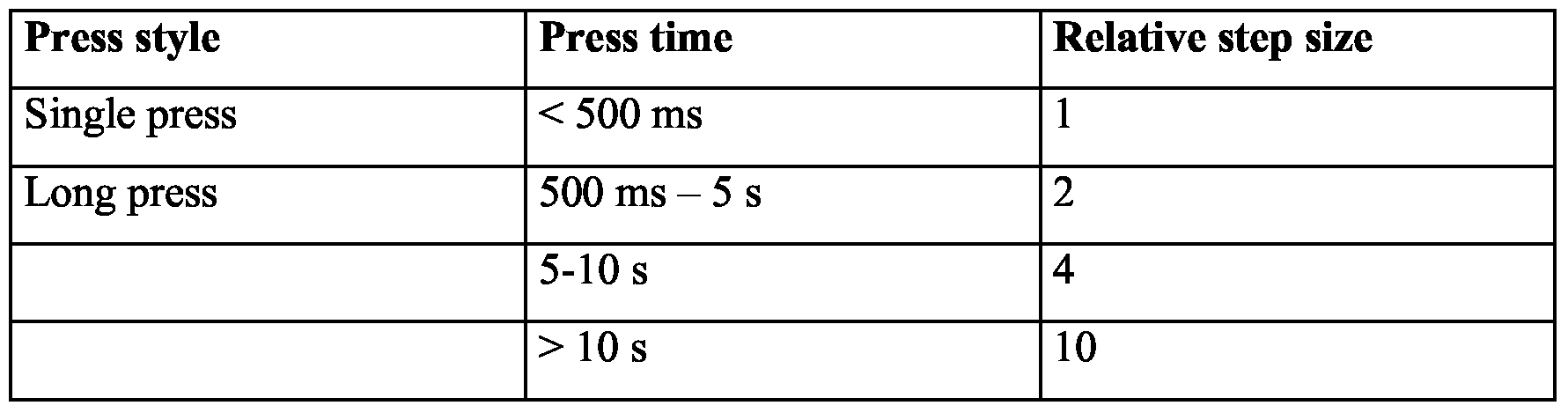
- the means 16, 18, 20, 22 for input of user instructions of the remote control are so adapted that the activation of certain knob for a prolonged time results in an increased rate of change for the setting at issue.
- the rate of change is slow.
- the rate of increase of color temperature is accelerated.
- An example of an acceleration scheme can be found in table 1 below. The acceleration scheme is applicable to all toggle knobs 16, 18, 20, 22 of the remote control 12.
- the invention is not limited to the embodiments described above. Those skilled in the art will recognize that variations and modifications can be made without departing from the scope of the invention as claimed in the accompanying claims.
- the first device can be incorporate in the second device, or vice versa.
- the method and system according to the present invention is applicable to all multi-color light sources that are user adjustable, such as LEDs, fluorescent light sources, etc.
- the light source 11 can alternatively be external of the second device 14 shown in fig. 1.
Landscapes
- Engineering & Computer Science (AREA)
- Computer Networks & Wireless Communication (AREA)
- Circuit Arrangement For Electric Light Sources In General (AREA)
- Exposure Or Original Feeding In Electrophotography (AREA)
- Arrangement Of Elements, Cooling, Sealing, Or The Like Of Lighting Devices (AREA)
- Non-Portable Lighting Devices Or Systems Thereof (AREA)
Abstract
Description
Claims
Priority Applications (7)
| Application Number | Priority Date | Filing Date | Title |
|---|---|---|---|
| JP2007542477A JP5329091B2 (en) | 2004-11-29 | 2005-11-24 | Method and system for adjusting the light settings of a multicolor light source |
| CN2005800408753A CN101065997B (en) | 2004-11-29 | 2005-11-24 | Method and system for adjusting the light setting for a multi-color light source |
| KR1020077014805A KR101329258B1 (en) | 2004-11-29 | 2005-11-24 | Method and system for adjusting the light setting for a multi-color light source |
| US11/719,882 US20090168415A1 (en) | 2004-11-29 | 2005-11-24 | Method and system for adjusting the light setting for a multi-color light source |
| DE602005026161T DE602005026161D1 (en) | 2004-11-29 | 2005-11-24 | METHOD AND SYSTEM FOR ADJUSTING LIGHT ADJUSTMENT FOR A MULTICOLORING SOURCE |
| AT05826628T ATE497344T1 (en) | 2004-11-29 | 2005-11-24 | METHOD AND SYSTEM FOR ADJUSTING THE LIGHT SETTING FOR A MULTI-COLOR LIGHT SOURCE |
| EP05826628A EP1820373B1 (en) | 2004-11-29 | 2005-11-24 | Method and system for adjusting the light setting for a multi-color light source |
Applications Claiming Priority (2)
| Application Number | Priority Date | Filing Date | Title |
|---|---|---|---|
| EP04106126.8 | 2004-11-29 | ||
| EP04106126 | 2004-11-29 |
Publications (2)
| Publication Number | Publication Date |
|---|---|
| WO2006056958A2 true WO2006056958A2 (en) | 2006-06-01 |
| WO2006056958A3 WO2006056958A3 (en) | 2006-08-10 |
Family
ID=36102976
Family Applications (1)
| Application Number | Title | Priority Date | Filing Date |
|---|---|---|---|
| PCT/IB2005/053896 Ceased WO2006056958A2 (en) | 2004-11-29 | 2005-11-24 | Method and system for adjusting the light setting for a multi-color light source |
Country Status (9)
| Country | Link |
|---|---|
| US (1) | US20090168415A1 (en) |
| EP (1) | EP1820373B1 (en) |
| JP (1) | JP5329091B2 (en) |
| KR (1) | KR101329258B1 (en) |
| CN (1) | CN101065997B (en) |
| AT (1) | ATE497344T1 (en) |
| DE (1) | DE602005026161D1 (en) |
| TW (1) | TWI463915B (en) |
| WO (1) | WO2006056958A2 (en) |
Cited By (3)
| Publication number | Priority date | Publication date | Assignee | Title |
|---|---|---|---|---|
| WO2009024903A2 (en) | 2007-08-17 | 2009-02-26 | Koninklijke Philips Electronics N.V. | Device and method for dynamically changing color |
| WO2010078863A1 (en) * | 2009-01-09 | 2010-07-15 | E:Cue Control Gmbh | Method for controlling a lighting system |
| JP2010527501A (en) * | 2007-05-16 | 2010-08-12 | コーニンクレッカ フィリップス エレクトロニクス エヌ ヴィ | Button-based color navigation method and apparatus in an illumination or viewing angle system |
Families Citing this family (33)
| Publication number | Priority date | Publication date | Assignee | Title |
|---|---|---|---|---|
| US20050259424A1 (en) | 2004-05-18 | 2005-11-24 | Zampini Thomas L Ii | Collimating and controlling light produced by light emitting diodes |
| US7766511B2 (en) | 2006-04-24 | 2010-08-03 | Integrated Illumination Systems | LED light fixture |
| US7729941B2 (en) | 2006-11-17 | 2010-06-01 | Integrated Illumination Systems, Inc. | Apparatus and method of using lighting systems to enhance brand recognition |
| US8013538B2 (en) | 2007-01-26 | 2011-09-06 | Integrated Illumination Systems, Inc. | TRI-light |
| US8742686B2 (en) | 2007-09-24 | 2014-06-03 | Integrated Illumination Systems, Inc. | Systems and methods for providing an OEM level networked lighting system |
| US9207385B2 (en) | 2008-05-06 | 2015-12-08 | Qd Vision, Inc. | Lighting systems and devices including same |
| WO2009137053A1 (en) | 2008-05-06 | 2009-11-12 | Qd Vision, Inc. | Optical components, systems including an optical component, and devices |
| JP2011524064A (en) | 2008-05-06 | 2011-08-25 | キユーデイー・ビジヨン・インコーポレーテツド | Solid state lighting device containing quantum confined semiconductor nanoparticles |
| US8255487B2 (en) | 2008-05-16 | 2012-08-28 | Integrated Illumination Systems, Inc. | Systems and methods for communicating in a lighting network |
| US8585245B2 (en) | 2009-04-23 | 2013-11-19 | Integrated Illumination Systems, Inc. | Systems and methods for sealing a lighting fixture |
| WO2011020098A1 (en) | 2009-08-14 | 2011-02-17 | Qd Vision, Inc. | Lighting devices, an optical component for a lighting device, and methods |
| WO2011092625A1 (en) | 2010-01-28 | 2011-08-04 | Koninklijke Philips Electronics N.V. | Method and system for emphasizing object color |
| US9066381B2 (en) | 2011-03-16 | 2015-06-23 | Integrated Illumination Systems, Inc. | System and method for low level dimming |
| US9967940B2 (en) | 2011-05-05 | 2018-05-08 | Integrated Illumination Systems, Inc. | Systems and methods for active thermal management |
| US9521725B2 (en) | 2011-07-26 | 2016-12-13 | Hunter Industries, Inc. | Systems and methods for providing power and data to lighting devices |
| US20150237700A1 (en) | 2011-07-26 | 2015-08-20 | Hunter Industries, Inc. | Systems and methods to control color and brightness of lighting devices |
| US8710770B2 (en) | 2011-07-26 | 2014-04-29 | Hunter Industries, Inc. | Systems and methods for providing power and data to lighting devices |
| US11917740B2 (en) | 2011-07-26 | 2024-02-27 | Hunter Industries, Inc. | Systems and methods for providing power and data to devices |
| US10874003B2 (en) | 2011-07-26 | 2020-12-22 | Hunter Industries, Inc. | Systems and methods for providing power and data to devices |
| US9609720B2 (en) | 2011-07-26 | 2017-03-28 | Hunter Industries, Inc. | Systems and methods for providing power and data to lighting devices |
| US8894437B2 (en) | 2012-07-19 | 2014-11-25 | Integrated Illumination Systems, Inc. | Systems and methods for connector enabling vertical removal |
| CN102858072B (en) * | 2012-09-28 | 2014-12-17 | 北京半导体照明科技促进中心 | Lighting control method and system |
| US9379578B2 (en) | 2012-11-19 | 2016-06-28 | Integrated Illumination Systems, Inc. | Systems and methods for multi-state power management |
| US9420665B2 (en) | 2012-12-28 | 2016-08-16 | Integration Illumination Systems, Inc. | Systems and methods for continuous adjustment of reference signal to control chip |
| US9485814B2 (en) | 2013-01-04 | 2016-11-01 | Integrated Illumination Systems, Inc. | Systems and methods for a hysteresis based driver using a LED as a voltage reference |
| US10228711B2 (en) | 2015-05-26 | 2019-03-12 | Hunter Industries, Inc. | Decoder systems and methods for irrigation control |
| US10918030B2 (en) | 2015-05-26 | 2021-02-16 | Hunter Industries, Inc. | Decoder systems and methods for irrigation control |
| US10030844B2 (en) | 2015-05-29 | 2018-07-24 | Integrated Illumination Systems, Inc. | Systems, methods and apparatus for illumination using asymmetrical optics |
| US10060599B2 (en) | 2015-05-29 | 2018-08-28 | Integrated Illumination Systems, Inc. | Systems, methods and apparatus for programmable light fixtures |
| EP3367659A1 (en) * | 2017-02-28 | 2018-08-29 | Thomson Licensing | Hue changing color gamut mapping |
| US11312333B1 (en) * | 2021-12-07 | 2022-04-26 | Feniex Industries | Emergency vehicle multicolor light device locking system |
| US12416908B2 (en) | 2022-12-29 | 2025-09-16 | Integrated Illumination Systems, Inc. | Systems and methods for manufacturing light fixtures |
| US12297996B2 (en) | 2023-02-16 | 2025-05-13 | Integrated Illumination Systems, Inc. | Cove light fixture with hidden integrated air return |
Family Cites Families (12)
| Publication number | Priority date | Publication date | Assignee | Title |
|---|---|---|---|---|
| JPH05174979A (en) * | 1991-12-19 | 1993-07-13 | Matsushita Electric Works Ltd | Lighting control device |
| JP3384572B2 (en) * | 1992-07-31 | 2003-03-10 | 松下電工株式会社 | Variable color temperature lighting system |
| JP3329863B2 (en) * | 1992-12-09 | 2002-09-30 | 松下電工株式会社 | Color mixing method |
| GB2282723A (en) * | 1993-06-08 | 1995-04-12 | Ray Knight | Twin axis colour balance control |
| JP3430657B2 (en) * | 1994-08-26 | 2003-07-28 | 松下電工株式会社 | Lighting equipment |
| JPH10323475A (en) * | 1997-05-23 | 1998-12-08 | Brother Ind Ltd | Programmable electronic sewing machine |
| US20030133292A1 (en) * | 1999-11-18 | 2003-07-17 | Mueller George G. | Methods and apparatus for generating and modulating white light illumination conditions |
| PT1610593E (en) * | 1999-11-18 | 2015-10-23 | Philips Lighting North America Corp | WHITE LIGHT GENERATION WITH LIGHT-EMITTING DIGITS HAVING DIFFERENT SPECTROS |
| CN1165183C (en) * | 2000-05-15 | 2004-09-01 | 北京北达华彩科技有限公司 | Adaptive chroma compensation method and compensator |
| US20040264193A1 (en) * | 2001-08-23 | 2004-12-30 | Yukiyasu Okumura | Color temperature-regulable led light |
| EP1502483B1 (en) * | 2002-05-09 | 2008-12-03 | Philips Solid-State Lighting Solutions, Inc. | Led dimming controller |
| US7075225B2 (en) * | 2003-06-27 | 2006-07-11 | Tajul Arosh Baroky | White light emitting device |
-
2005
- 2005-11-24 WO PCT/IB2005/053896 patent/WO2006056958A2/en not_active Ceased
- 2005-11-24 EP EP05826628A patent/EP1820373B1/en not_active Expired - Lifetime
- 2005-11-24 KR KR1020077014805A patent/KR101329258B1/en not_active Expired - Lifetime
- 2005-11-24 DE DE602005026161T patent/DE602005026161D1/en not_active Expired - Lifetime
- 2005-11-24 US US11/719,882 patent/US20090168415A1/en not_active Abandoned
- 2005-11-24 CN CN2005800408753A patent/CN101065997B/en not_active Expired - Lifetime
- 2005-11-24 JP JP2007542477A patent/JP5329091B2/en not_active Expired - Lifetime
- 2005-11-24 AT AT05826628T patent/ATE497344T1/en not_active IP Right Cessation
- 2005-11-25 TW TW094141604A patent/TWI463915B/en not_active IP Right Cessation
Cited By (6)
| Publication number | Priority date | Publication date | Assignee | Title |
|---|---|---|---|---|
| JP2010527501A (en) * | 2007-05-16 | 2010-08-12 | コーニンクレッカ フィリップス エレクトロニクス エヌ ヴィ | Button-based color navigation method and apparatus in an illumination or viewing angle system |
| WO2009024903A2 (en) | 2007-08-17 | 2009-02-26 | Koninklijke Philips Electronics N.V. | Device and method for dynamically changing color |
| WO2009024903A3 (en) * | 2007-08-17 | 2009-04-30 | Koninkl Philips Electronics Nv | Device and method for dynamically changing color |
| JP2010537367A (en) * | 2007-08-17 | 2010-12-02 | コーニンクレッカ フィリップス エレクトロニクス エヌ ヴィ | Device and method for dynamically changing colors |
| WO2010078863A1 (en) * | 2009-01-09 | 2010-07-15 | E:Cue Control Gmbh | Method for controlling a lighting system |
| US8638235B2 (en) | 2009-01-09 | 2014-01-28 | Traxon Technologies Europe Gmbh | Method for controlling a lighting system |
Also Published As
| Publication number | Publication date |
|---|---|
| CN101065997A (en) | 2007-10-31 |
| US20090168415A1 (en) | 2009-07-02 |
| JP2008522358A (en) | 2008-06-26 |
| WO2006056958A3 (en) | 2006-08-10 |
| DE602005026161D1 (en) | 2011-03-10 |
| KR101329258B1 (en) | 2013-11-14 |
| EP1820373B1 (en) | 2011-01-26 |
| TWI463915B (en) | 2014-12-01 |
| KR20070098833A (en) | 2007-10-05 |
| TW200633593A (en) | 2006-09-16 |
| EP1820373A2 (en) | 2007-08-22 |
| CN101065997B (en) | 2013-01-30 |
| JP5329091B2 (en) | 2013-10-30 |
| ATE497344T1 (en) | 2011-02-15 |
Similar Documents
| Publication | Publication Date | Title |
|---|---|---|
| EP1820373B1 (en) | Method and system for adjusting the light setting for a multi-color light source | |
| US10187952B2 (en) | Method for controlling a tunable white fixture using a single handle | |
| EP2672785A2 (en) | Illumination controller and illumination system including same | |
| EP3876678B1 (en) | Automatic maximum brightness color matching implementation method for color lamp, and color modulation method and system | |
| EP4408125A3 (en) | Configuring color control for lighting devices | |
| KR20080068846A (en) | Variable color control method, color output controller, variable color illumination system, and computer program module | |
| US20130093361A1 (en) | Method for Operating a Semiconductor Lighting Device and Color Control Device for Carrying Out the Method | |
| CN112888114B (en) | Bluetooth intelligent car lamp system and control method thereof | |
| MX2011006732A (en) | An ambience lighting system for a display device and a method of operating such an ambience lighting system. | |
| US20210357111A1 (en) | Communicating with and controlling load control systems | |
| CA2960262C (en) | Method for controlling a tunable white fixture using multiple handles | |
| JP2008521193A (en) | Multidimensional control of lighting parameters | |
| US11083063B2 (en) | Control device, illumination device, and program for control device | |
| CN105050252B (en) | The control method and device of three color breath lights | |
| CN108433187A (en) | Electronic cigarette control method, electronic cigarette and computer storage media | |
| US20150108921A1 (en) | Tunable lighting system | |
| TWI836076B (en) | User control modality for led color tuning | |
| JP2007250350A (en) | Continuously variable color temperature illumination device and continuously variable color temperature illumination method | |
| CN105263222A (en) | Method of adjusting change in color and brightness of intelligent lamp by use of mechanical switch | |
| JP7612901B2 (en) | Lighting Control Device | |
| US20240007755A1 (en) | Method of supplemental lighting for shoot and electronic device | |
| KR100877802B1 (en) | LED remote control unit |
Legal Events
| Date | Code | Title | Description |
|---|---|---|---|
| AK | Designated states |
Kind code of ref document: A2 Designated state(s): AE AG AL AM AT AU AZ BA BB BG BR BW BY BZ CA CH CN CO CR CU CZ DE DK DM DZ EC EE EG ES FI GB GD GE GH GM HR HU ID IL IN IS JP KE KG KM KN KP KR KZ LC LK LR LS LT LU LV LY MA MD MG MK MN MW MX MZ NA NG NI NO NZ OM PG PH PL PT RO RU SC SD SE SG SK SL SM SY TJ TM TN TR TT TZ UA UG US UZ VC VN YU ZA ZM ZW |
|
| AL | Designated countries for regional patents |
Kind code of ref document: A2 Designated state(s): BW GH GM KE LS MW MZ NA SD SL SZ TZ UG ZM ZW AM AZ BY KG KZ MD RU TJ TM AT BE BG CH CY CZ DE DK EE ES FI FR GB GR HU IE IS IT LT LU LV MC NL PL PT RO SE SI SK TR BF BJ CF CG CI CM GA GN GQ GW ML MR NE SN TD TG |
|
| 121 | Ep: the epo has been informed by wipo that ep was designated in this application | ||
| WWE | Wipo information: entry into national phase |
Ref document number: 2005826628 Country of ref document: EP |
|
| WWE | Wipo information: entry into national phase |
Ref document number: 11719882 Country of ref document: US |
|
| WWE | Wipo information: entry into national phase |
Ref document number: 2007542477 Country of ref document: JP |
|
| WWE | Wipo information: entry into national phase |
Ref document number: 200580040875.3 Country of ref document: CN |
|
| NENP | Non-entry into the national phase |
Ref country code: DE |
|
| WWE | Wipo information: entry into national phase |
Ref document number: 1020077014805 Country of ref document: KR |
|
| WWP | Wipo information: published in national office |
Ref document number: 2005826628 Country of ref document: EP |