WO2006024487A1 - AMIDE DERIVATIVES OF 7-AMINO-3-PHENYL-DIHYDROPYRIMIDO [4,5-d]PYRIMIDINONES, THEIR MANUFACTURE AND USE AS PHARMACEUTICAL AGENTS - Google Patents
AMIDE DERIVATIVES OF 7-AMINO-3-PHENYL-DIHYDROPYRIMIDO [4,5-d]PYRIMIDINONES, THEIR MANUFACTURE AND USE AS PHARMACEUTICAL AGENTS Download PDFInfo
- Publication number
- WO2006024487A1 WO2006024487A1 PCT/EP2005/009322 EP2005009322W WO2006024487A1 WO 2006024487 A1 WO2006024487 A1 WO 2006024487A1 EP 2005009322 W EP2005009322 W EP 2005009322W WO 2006024487 A1 WO2006024487 A1 WO 2006024487A1
- Authority
- WO
- WIPO (PCT)
- Prior art keywords
- phenyl
- methyl
- amino
- dihydro
- pyrimido
- Prior art date
- Legal status (The legal status is an assumption and is not a legal conclusion. Google has not performed a legal analysis and makes no representation as to the accuracy of the status listed.)
- Ceased
Links
- 0 CN(c1nc(S(C)(=O)=O)ncc1CN1c2c(*)ccc(N)c2)C1=O Chemical compound CN(c1nc(S(C)(=O)=O)ncc1CN1c2c(*)ccc(N)c2)C1=O 0.000 description 2
Classifications
-
- C—CHEMISTRY; METALLURGY
- C07—ORGANIC CHEMISTRY
- C07D—HETEROCYCLIC COMPOUNDS
- C07D487/00—Heterocyclic compounds containing nitrogen atoms as the only ring hetero atoms in the condensed system, not provided for by groups C07D451/00 - C07D477/00
- C07D487/02—Heterocyclic compounds containing nitrogen atoms as the only ring hetero atoms in the condensed system, not provided for by groups C07D451/00 - C07D477/00 in which the condensed system contains two hetero rings
- C07D487/04—Ortho-condensed systems
-
- A—HUMAN NECESSITIES
- A61—MEDICAL OR VETERINARY SCIENCE; HYGIENE
- A61K—PREPARATIONS FOR MEDICAL, DENTAL OR TOILETRY PURPOSES
- A61K31/00—Medicinal preparations containing organic active ingredients
- A61K31/33—Heterocyclic compounds
- A61K31/395—Heterocyclic compounds having nitrogen as a ring hetero atom, e.g. guanethidine or rifamycins
- A61K31/495—Heterocyclic compounds having nitrogen as a ring hetero atom, e.g. guanethidine or rifamycins having six-membered rings with two or more nitrogen atoms as the only ring heteroatoms, e.g. piperazine or tetrazines
- A61K31/505—Pyrimidines; Hydrogenated pyrimidines, e.g. trimethoprim
- A61K31/519—Pyrimidines; Hydrogenated pyrimidines, e.g. trimethoprim ortho- or peri-condensed with heterocyclic rings
-
- A—HUMAN NECESSITIES
- A61—MEDICAL OR VETERINARY SCIENCE; HYGIENE
- A61P—SPECIFIC THERAPEUTIC ACTIVITY OF CHEMICAL COMPOUNDS OR MEDICINAL PREPARATIONS
- A61P11/00—Drugs for disorders of the respiratory system
- A61P11/06—Antiasthmatics
-
- A—HUMAN NECESSITIES
- A61—MEDICAL OR VETERINARY SCIENCE; HYGIENE
- A61P—SPECIFIC THERAPEUTIC ACTIVITY OF CHEMICAL COMPOUNDS OR MEDICINAL PREPARATIONS
- A61P19/00—Drugs for skeletal disorders
-
- A—HUMAN NECESSITIES
- A61—MEDICAL OR VETERINARY SCIENCE; HYGIENE
- A61P—SPECIFIC THERAPEUTIC ACTIVITY OF CHEMICAL COMPOUNDS OR MEDICINAL PREPARATIONS
- A61P25/00—Drugs for disorders of the nervous system
-
- A—HUMAN NECESSITIES
- A61—MEDICAL OR VETERINARY SCIENCE; HYGIENE
- A61P—SPECIFIC THERAPEUTIC ACTIVITY OF CHEMICAL COMPOUNDS OR MEDICINAL PREPARATIONS
- A61P29/00—Non-central analgesic, antipyretic or antiinflammatory agents, e.g. antirheumatic agents; Non-steroidal antiinflammatory drugs [NSAID]
-
- A—HUMAN NECESSITIES
- A61—MEDICAL OR VETERINARY SCIENCE; HYGIENE
- A61P—SPECIFIC THERAPEUTIC ACTIVITY OF CHEMICAL COMPOUNDS OR MEDICINAL PREPARATIONS
- A61P35/00—Antineoplastic agents
-
- A—HUMAN NECESSITIES
- A61—MEDICAL OR VETERINARY SCIENCE; HYGIENE
- A61P—SPECIFIC THERAPEUTIC ACTIVITY OF CHEMICAL COMPOUNDS OR MEDICINAL PREPARATIONS
- A61P43/00—Drugs for specific purposes, not provided for in groups A61P1/00-A61P41/00
Definitions
- the present invention relates to novel amide derivatives of 7-amino-3-phenyl dihydropyrimido[4,5-d]pyrimidinones, to a process for their manufacture, medicaments containing them and their manufacture as well as the use of these compounds as pharmaceutically active agents.
- WO 01/29042 and WO 01/29041 disclose alkylamino-substituted dihydropyrimido[4,5- djpyrimidinone derivatives with p38 inhibitory activity.
- WO 99/61444 describes dihydropyrimido[4,5-d]pyrimidinones, substituted with aryl and heteroarylamines, sulfides, sulfoxides and sulfones as inhibitors for cyclin-dependent kinases (cdks) and tyrosine kinases.
- Aryl and heteroarylamine substituted dihydropyrimido[4,5-d]pyrimidinones are also described in WO 00/24744 as inhibitors of T-cell tyrosine kinase p56 c .
- Further dihydropyrimido[4,5-d]pyrimidinones with tyrosine kinase inhibitory activity are described in WO 04/18472, WO 04/41821, WO 04/41822, WO 04/41823, and WO 04/11465.
- R 1 is hydrogen; fluorine; chlorine; or (CrC 3 )alkyl, said alkyl being optionally substituted one or several times with halogen;
- Q is alkylene or alkenylene; n is 0 or 1;
- R 2 is cycloalkyl, aryl or heteroaryl said aryl or heteroaryl being optionally substituted one or two times by phenyl, pyridyl; pyrrolyl or indolyl; and all aromatic groups being optionally substituted one to three times by -CN; -CHO; -OH; -O-alkyl; -NH 2 ; -NH-alkyl; -alkyl-NH 2 ; alkyl; halogen; piperidinyl; piperazinyl; N-methyl-piperazinyl; morpholinyl;
- the compounds according to this invention show activity as protein kinase inhibitors, in particular src family tyrosine kinase inhibitors, and may therefore be useful for the treatment of diseases mediated by said tyrosine kinases.
- the family of tyrosine kinases plays an important role in the regulation of cell signaling and cell proliferation by phosphorylating tyrosine residues of peptides and proteins. Inappropriate activation of tyrosine kinases is known to be involved in a variety of disease states including inflammatory, immunological, CNS disorders, or oncological disorders, or bone diseases. See for example Susva, M., et al., Trends Pharmacol. Sci. 21 (2000) 489-495; Biscardi, J.S., et al., Adv. Cancer Res. 76 (2000)
- Compounds of the present invention maybe used as active agents in the prevention and therapy of, for example, transplant rejection, inflammatory bowel syndrome, rheumatoid arthritis, psoriasis, restenosis, allergic asthma, Alzheimer's disease, Parkinson, stroke, osteoporosis, benign hyperplasias and cancer such as colorectal, breast, lung, prostate, pancreatic, gastric, bladder, ovarian, melanoma, neuroblastoma, cervical, kidney or renal cancers, leukemias or lymphomas, or in the manufacture of corresponding medicaments.
- transplant rejection inflammatory bowel syndrome
- rheumatoid arthritis psoriasis
- restenosis allergic asthma
- Alzheimer's disease Parkinson
- osteoporosis benign hyperplasias and cancer
- benign hyperplasias and cancer such as colorectal, breast, lung, prostate, pancreatic, gastric, bladder, ovarian, melanoma, neuroblastoma, cervical, kidney or renal cancer
- Objects of the present invention are the compounds of formula I and pharmaceutically acceptable salts and their enantiomeric forms, the preparation of the above-mentioned compounds, medicaments containing them and their manufacture as well as the use of the above-mentioned compounds in the control or prevention of illnesses, especially of illnesses and disorders as mentioned above or in the manufacture of corresponding medicaments.
- alkyl as used herein means a saturated, straight-chain or branched-chain hydrocarbon containing from 1 to 6, preferably from 1 to 3, carbon atoms, such as methyl, ethyl, n-propyl, isopropyl, n-butyl, 2-butyl, t-butyl.
- alkyl group is optionally substituted with one or several halogen atoms, it is substituted preferably with fluorine or chlorine, especially fluorine.
- fluorine or chlorine especially fluorine.
- examples are difiuoromethyl, trifluoromethyl, 2,2,2-triflouro-ethyl, perfluoro-ethyl and the like.
- halogen as used herein means fluorine, chlorine and bromine, preferably fluorine or chlorine, especially chlorine.
- cycloalkyl as used herein means a monocyclic saturated hydrocarbon ring with 3 to 7, preferably 5 to 7, ring atoms.
- examples of such cycloalkyl groups include cyclopropyl, cyclobutyl, cyclopentyl, cyclohexyl and cycloheptyl, preferably cyclohexyl or cycloheptyl.
- aryl as used herein means a monocyclic or bicyclic aromatic hydrocarbon ring with 6 to 10 ring atoms, such as phenyl, 1-naphthyl or 2-napthtyl.
- heteroaryl as used herein means a mono- or bicyclic aromatic ring with 5 to 10 ring atoms, which contains up to 3, preferably 1 or 2 heteroatoms selected independently from N, O or S and the remaining ring atoms being carbon atoms.
- heteroaryl groups include pyrrolyl, thiophenyl, furyl, thiazolyl, oxazolyl, isoxazolyl, pyrazolyl, imidazolyl; pyridyl, pyrimidinyl, pyrazinyl, pyridazinyl, indolyl, benzothiophenyl, benzo thiazolyl, benzoxazolyl, benzimidazolyl, quinolyl, isoquinolyl and the like, especially isoxazolyl, pyrazolyl, pyridyl, indolyl or benzothiophenyl.
- alkylene as used herein means a saturated, straight- chain or branched- chain, preferably straight- chain hydrocarbon containing from 1 to 5, preferably from 1 to 3, carbon atoms, such as methylene, ethylene, trimethylene; tetramethylene, pentamethylene, methylmethylene, 1-methyl-ethylene, 2-methyl- ethylene, 1-ethyl-efhylene, 2-ethyl-ethylene, 1 -propyl-ethylene, 2-propyl-ethylene,
- alkenylene as used herein means an unsaturated, straight- chain or branched-chain, preferably straight-chain hydrocarbon containing from 2 to 6, preferably from 2 to 3, carbon atoms. Examples of such "alkenylenes" are vinylene
- R 1 is chlorine
- a preferred embodiment of the invention are the compounds according to formula I, wherein
- R 2 is cycloalkyl, aryl or heteroaryl said aryl or heteroaryl being optionally substituted one or two times by phenyl, pyridyl; pyrrolyl or indolyl; and all aromatic groups being optionally substituted one to three times by
- -CN -CHO; -OH; -O-alkyl; -NH 2 ; -NH-alkyl; -alkyl-NH 2 ; alkyl; halogen; piperidinyl; piperazinyl; N-methyl-piperazinyl or morpholinyl;
- a preferred embodiment of the invention are the compounds according to formula I, wherein
- n O.
- a preferred embodiment of the invention are the compounds according to formula I, wherein
- n 0;
- R 2 is cycloalkyl, aryl or heteroaryl said aryl or heteroaryl being optionally substituted one or two times by phenyl, pyridyl; pyrrolyl or indolyl; and all aromatic groups being optionally substituted one to three times by -CN; -CHO; -OH; -O-alkyl; -NH 2 ; -NH-alkyl; -alkyl-NH 2 ; alkyl; halogen; piperidinyl; piperazinyl; N-methyl-piperazinyl or morpholinyl;
- n 1.
- a preferred embodiment of the invention are the compounds according to formula I, wherein
- n 1;
- R 2 is cycloalkyl, aryl or heteroaryl said aryl or heteroaryl being optionally substituted one or two times by phenyl, pyridyl; pyrrolyl or indolyl; and all aromatic groups being optionally substituted one to three times by
- -CN -CHO; -OH; -O-alkyl; -NH 2 ; -NH-alkyl; -alkyl-NH 2 ; alkyl; halogen; piperidinyl; piperazinyl; N-methyl-piperazinyl or morpholinyl;
- a preferred embodiment of the invention are the compounds according to formula I, wherein
- R 2 is cycloalkyl
- Such compounds are for example:
- Cyclohexanecarboxylic acid (4-chloro-3- ⁇ 7-amino-l-methyl-2-oxo-l,4-dihydro- 2H-pyrimido[4,5-d]pyrimidin-3-yl ⁇ -phenyl)-amide; compound with acetic acid; and
- Cycloheptanecarboxylic acid (4-chloro-3- ⁇ 7-amino-l-methyl-2-oxo-l,4-dihydro- 2H-pyrimido[4,5-d]pyrimidin-3-yl ⁇ -phenyl)-amide; compound with acetic acid.
- R 2 is aryl, said aryl being optionally substituted one or two times by phenyl, pyridyl; pyrrolyl or indolyl; and all aromatic groups being optionally substituted one to three times by -CN; -CHO; -OH; -O-alkyl; -NH 2 ; -NH-alkyl; -alkyl-NH 2 ; alkyl; halogen; piperidinyl; piperazinyl; N-methyl-piperazinyl or morpholinyl.
- Still another preferred embodiment of the invention are the compounds according to formula I, wherein
- n 0;
- R 2 is phenyl, said phenyl being substituted one or two times by phenyl or pyridyl; and all aromatic groups being optionally substituted one to three times by -CN; -CHO; -OH; -O-alkyl; -NH 2 ; -NH-alkyl; -alkyl-NH 2 ; alkyl or halogen.
- Such compounds are for example: Biphenyl-4-carboxylic acid (4-chloro-3- ⁇ 7-amino-l-methyl-2-oxo-l,4-dihydro- 2H-pyrimido[4,5-d]pyrimidin-3-yl ⁇ -phenyl) -amide; and .
- Biphenyl-2-carboxylic acid (4-chloro-3- ⁇ 7-amino-l-methyl-2-oxo-l,4-dihydro- 2H-pyrimido[4,5-d]pyrimidin-3-yl ⁇ -phenyl)-amide; compound with acetic acid; and
- Biphenyl-3-carboxylic acid (4-chloro-3- ⁇ 7-amino-l-methyl-2-oxo-l,4-dihydro- 2H-py ⁇ imido[4,5-d]pyrimidin-3-yl ⁇ -phenyl)-amide; compound with acetic acid; and
- Such compounds are for example:
- Still another preferred embodiment of the invention are the compounds according to formula I, wherein
- n 0;
- R 2 is phenyl said phenyl being substituted one time by phenyl; and all phenyl groups being substituted one time by 2-dimethylamino- ethoxy; 1-carbamoyl-ethylsulfanyl; N-methyl-piperazinylmethyl; N- acetyl-piperazinylmethyl or morpholinylmethyl.
- Such compounds are for example:
- -CN -CHO; -OH; -O-alkyl; -NH2; -NH-alkyl; -alkyl-NH2; alkyl or halogen.
- Such a compound is for example:
- Such compounds are for example:
- Still another preferred embodiment of the invention are the compounds according to formula I, wherein
- Q is alkylene; n is 1; and R 2 is phenyl, said phenyl being optionally substituted one to three times by -CN;
- Still another preferred embodiment of the invention are the compounds according to formula I, wherein
- Q is alkenylene; n is 1; and R 2 is phenyl, said phenyl being optionally substituted one to three times by -CN; -CHO; -OH; -O-alkyl; NH 2 ; -NH-alkyl or halogen.
- Such a compound is for example:
- Still another preferred embodiment of the invention are the compounds according to formula I, wherein
- Such a compound is for example:
- n 0;
- R 2 is pyridyl; isoxazolyl or pyrazolyl; and said is pyridyl; isoxazolyl or pyrazolyl one or two times by phenyl or pyridyl; and all aromatic groups being optionally substituted one to three times by -CN; -CHO; -OH; -O-alkyl; -NH 2 ; -NH-alkyl; -alkyl-NH 2 ; alkyl or halogen.
- Still another preferred embodiment of the invention are the compounds according to formula I, wherein
- n 0;
- R 2 is indolyl or benzothiophenyl; and said indolyl or benzothiophenyl being optionally substituted one to three times by -CN; -CHO; -OH; -O-alkyl; -NH 2 ; -NH-alkyl; -alkyl-
- Such a compound is for example:
- Benzo[b]thiophene-2-carboxylic acid (4-chloro-3- ⁇ 7-amino-l-methyl-2-oxo-l,4- dihydro-2H-pyrimido[4,5-d]pyrimidin-3-yl ⁇ -phenyl) -amide.
- Still another preferred embodiment of the invention are the compounds according to formula I, wherein
- Q is alkylene; n is 1; and R 2 is pyridyl; said pyridyl being optionally substituted one or two times by -CN; -CHO; -OH; -O-alkyl; -NH 2 ; -NH-alkyl; -alkyl-NH 2 ; alkyl or halogen.
- Such compounds are for example:
- Still another preferred embodiment of the invention are the compounds according to formula I, wherein
- Q is alkenylene; n is 1; and R 2 is pyridyl; said pyridyl being optionally substituted one or two times by -CN; -CHO; -OH; -O-alkyl; -NH 2 ; -NH-alkyl; -alkyl-NH 2 ; alkyl or halogen.
- Such a compound is for example: N-[3-(7-Amino-l-methyl-2-oxo-l,4-dihydro-2H-pyrimido[4,5-d]pyrimidin-3-yl)- 4-chloro-phenyl]-3-pyridin-2-yl-acrylamide.
- Still another embodiment of the invention is a process for the manufacture of the compounds according to this invention. Said compounds can be prepared
- R 2 has the meaning given herein before
- R 3 has the meaning given herein before
- the compounds of formula I, or a pharmaceutically acceptable salt thereof, which are subject of the present invention may be prepared by any process known to be applicable to the preparation of chemically-related compounds. Such processes, when used to prepare a 7-amino-3-phenyl dihydropyrimido[4,5-d]pyrimidinone derivative of the formula I, or a pharmaceutically-acceptable salt thereof, are illustrated by the following representative schemes and examples in which, unless otherwise stated, R 1 , R 2 , and R 3 have the significance defined hereinbefore.
- Necessary starting materials may be obtained by standard procedures of organic chemistry. The preparation of such starting materials is described within the accompanying examples. Alternatively necessary starting materials are obtainable by analogous procedures to those illustrated which are within the ordinary skill of an organic chemist.
- the compounds of formula I can be prepared from 4-chloro-2-methylsulfanyl- pyrimidine-5-carboxylic acid ethyl ester, which is known from WO 04/41823, according to schemes 1, 2, and 3, wherein R 1 , R 2 , and R 3 have the significance given above.
- 4-Methylamino-2-methylsulfanylpyrimidine-5-carboxylic acid ethyl ester was prepared from 4-chloro-2-methylsulfanyl-pyrimidine-5-carboxylic acid ethyl ester and methylamine in tetrahydrofuran (THF) under basic conditions with triethylamine at temperatures between 5 0 C and room temperature (RT).
- THF tetrahydrofuran
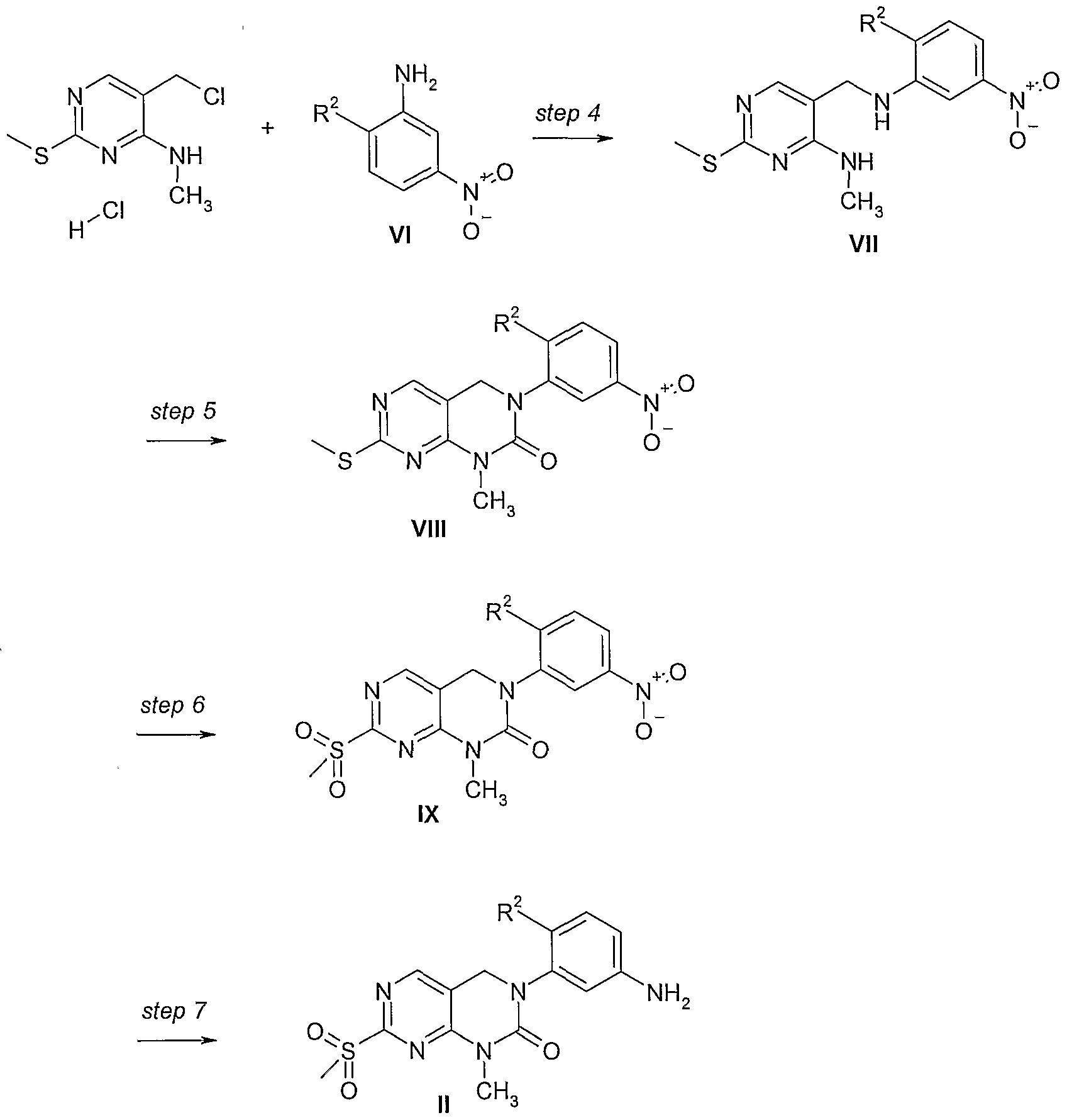
- Compounds of formula VIII can be prepared from compounds of formula VII by treatment with l,r-carbonyldiimidazole and potassium carbonate (K 2 COs) at a temperature range from 0 0 C to 180 0 C in acetonitrile or in solvents of similar polarity such as dimethyl formamide (DMF) or tetrahydrofuran (THF).
- K 2 COs potassium carbonate
- a temperature range from 0 0 C to 180 0 C in acetonitrile or in solvents of similar polarity such as dimethyl formamide (DMF) or tetrahydrofuran (THF).
- DMF dimethyl formamide
- THF tetrahydrofuran
- sodium hydride in dimethyl formamide/tetrahydrofuran can be used.
- a methylthio group can be converted into the suitable leaving group by oxidation to the sulfoxide.
- Compounds of formula VIII are converted to compounds of formula IX with 3-chloroperoxybenzoic acid (mCPBA) as oxidizing reagent in an inert solvent such as dichloromethane (CHaCl 2 ), THF or NMP at a temperature range from O 0 C to 150 0 C to give compounds of formula (IX).
- mCPBA 3-chloroperoxybenzoic acid
- the compounds of formula IX are reduced to compounds of formula II by hydrogenation using deactivated Pd(CaCO3)/C or other Pd catalysts.
- the reduction takes place at a temperature range between 0 0 C and 150 0 C in inert solvents such as THF, CH 2 Cl 2 , or NMP .
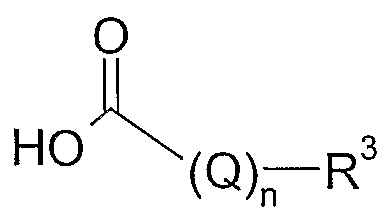
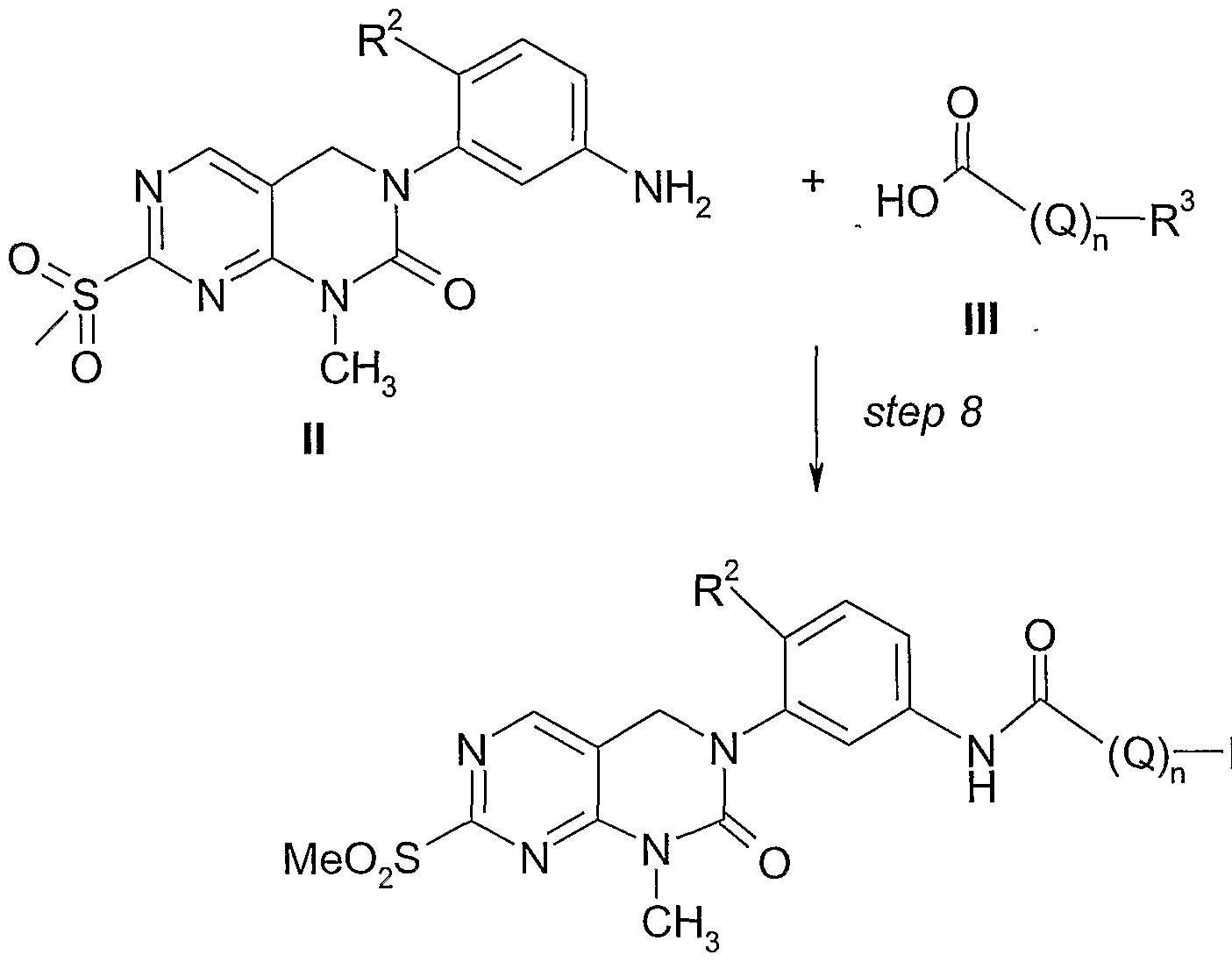
- amides of formula IV are coupled to carboxylic acids of formula III to give the amides of formula IV.
- Common reagents for the activation of carboxylic acid were used such as e.g. l-(3-dimethylaminopropyl)-3-ethylcarbodiimide hydrochloride (EDCI), N.N'-dicydohexylcarbod ⁇ mide (DCC), 1-hydroxybenzotriazole (HOBT), N,N'-carbonyldiimidazole (CDI), and 4-(4,6-dimethoxy-[l,3,5]triazin-2yl)-4- methyl-morpholin-4-ium chloride (DMTMM) in inert solvents such as THF, CH 2 Cl 2 , or NMP or in polar solvents such methanol (MeOH) or even water.
- EDCI l-(3-dimethylaminopropyl)-3-ethylcarbodiimide hydrochloride
- DMAP dimethylaminopyridine
- Another method of activation is the preparation of the corresponding acid chlorides.
- the condensation reaction may be carried out under basic conditions, e.g. in the presence of triethylamine, N,N-diisopropylethylamine (Hunig base).
- Some acids bearing functional groups which were not stable under the reaction conditions were protected with standard protection groups such as t-butoxycarbonyl (Boc) or benzyloxycarbonyl .
- the compounds of formula IV are transformed into compounds of formula I by treatment with ammonia.
- One method consists of autoclaving a solution of compound IV and liquid ammonia and stirring at a temperature range of -20 - 100
- An alternative method comprises of treatment of a solution of compound IV with an aqueous solution of ammonia under a continuous flow of gaseous ammonia.
- Certain side chains in R 3 may require protection during the reaction sequences.
- standard protection and deprotection procedures being well known in the art may be applied.
- primary a * nd secondary amines can be applied in t-butoxycarbonyl ( Boc ) or benzyloxycarbonyl protected form and the protecting group can be removed as a last reaction step by treatment with an acid like HCl or TFA.
- the compounds of the general formula I can contain one or several chiral centers and can then be present in a racemic or in an optically active form.
- the racemates can be separated according to known methods into the enantiomers. For instance, diastereomeric salts which can be separated by crystallization are formed from the racemic mixtures by reaction with an optically active acid such as e.g. D- or L- tartaric acid, mandelic acid, malic acid, lactic acid or camphorsulfonic acid.
- an optically active acid such as e.g. D- or L- tartaric acid, mandelic acid, malic acid, lactic acid or camphorsulfonic acid.
- the compounds according to the present invention may exist in the form of their pharmaceutically acceptable salts.
- pharmaceutically acceptable salt refers to conventional acid-addition salts or base-addition salts that retain the biological effectiveness and properties of the compounds of formula I and are formed from suitable non-toxic organic or inorganic acids or organic or inorganic bases.
- Acid- addition salts include for example those derived from inorganic acids such as hydrochloric acid, hydrobromic acid, hydroiodic acid, sulfuric acid, sulfamic acid, phosphoric acid and nitric acid, and those derived from organic acids such as p- toluenesulfonic acid, salicylic acid, methanesulfonic acid, oxalic acid, succinic acid, citric acid, malic acid, lactic acid, fumaric acid, and the like.
- Base-addition salts include those derived from ammonium, potassium, sodium and, quaternary ammonium hydroxides, such as for example, tetramethylammonium hydroxide.
- the chemical modification of a pharmaceutical compound into a salt is a technique well known to pharmaceutical chemists in order to obtain improved physical and chemical stability, hygroscopicity, flowability and solubility of compounds. It is for example described in Stahl, P. H., and Wermuth, G., (editors), Handbook of Pharmaceutical Salts, Verlag Helvetica Chimica Acta (VHCA), Zurich, (2002) or Bastin, RJ., et al., Organic Proc. Res. Dev.4 (2000) 427-435.
- the compounds according to this invention and their pharmaceutically acceptable salts can be used as medicaments, e.g. in the form of pharmaceutical preparations.
- the pharmaceutical preparations can be administered orally, e.g. in the form of tablets, coated tablets, dragees, hard and soft gelatine capsules, solutions, emulsions or suspensions.
- the administration can, however, also be effected rectally, e.g. in the form of suppositories, or parenterally, e.g. in the form of injection solutions.
- the above-mentioned pharmaceutical preparations can be obtained by processing the compounds according to this invention with pharmaceutically inert, inorganic or organic carriers.
- Lactose, corn starch or derivatives thereof, talc, stearic acids or its salts and the like can be used, for example, as such carriers for tablets, coated tablets, dragees and hard gelatine capsules.
- Suitable carriers for soft gelatine capsules are, for example, vegetable oils, waxes, fats, semi-solid and liquid polyols and the like. Depending on the nature of the active substance no carriers are, however, usually required in the case of soft gelatine capsules.
- Suitable carriers for the production of solutions and syrups are, for example, water, polyols, glycerol, vegetable oil and the like.
- Suitable carriers for suppositories are, for example, natural or hardened oils, waxes, fats, semi-liquid or liquid polyols and the like.
- the pharmaceutical preparations can, moreover, contain preservatives, solubilizers, stabilizers, wetting agents, emulsifiers, sweeteners, colorants, flavorants, salts for varying the osmotic pressure, buffers, masking agents or antioxidants. They can also contain still other therapeutically valuable substances.
- a pharmaceutical preparation is obtained by using the following procedure:
- the above described preparation procedure yields micro-suspensions of the compounds of formula I with particle sizes between 1 and 10 ⁇ m.
- the suspensions are suitable for oral applications and can be used in the in vivo pharmacokinetic testings.
- Inhibitor max. 25 ⁇ M min. 0.42 nM
- Eu-labelled phosphotyrosine antibody - for Lck Cisbio Mab PT66-K
- Peptides Ro: NH 2 -A-E-E-E-I-Y-G-E-F-E-A-K-K-K-K-CONH 2 , and
- Jal33-Ro Jal33-G-Aminoca ⁇ rylic acid-A-E-E-I-Y-G-E-F-E-
- Jal33 is LightCycler- Red 640-N-hydroxy succinimide ester
- both peptides were synthesized by an optimized solid phase peptide synthesis protocol (Merrifield, Fed. Proc. Fed. Amer. Soc. Exp. Biol. 21 (1962) 412) on a Zinsser SMP350 peptide synthesizer.
- the peptide was assembled on 160 mg (22.8 ⁇ mol scale) of a Rink-Linker modified polystyrene solid phase by repeatedly conjugating an twenty fold excess of amino acids each protected by temporary piperidine labile Fmoc- and permanent acid labile tert- Bu-, BOC- and O-tert-Bu-groups depending on the side chain function.
- the substrate sequence AEEEIYGEFEAKKKK was N- terminal additionally mounted with the spacer amino acids
- Upstate Lck (p56 lck , active), Upstate Src (p60 c"src , partially purified) were purchased from UBI, Upstate Biotech, Inc. .
- Time-resolved Fluorescence Assay Reader: Perkin Elmer, Wallac Viktor 1420-040 multilabel counter; Liquid handling system: Beckman Coulter, Biomek 2000.
- ATP 4-(2-hydroxyethyl)-l-piperazineethanesulfonic acid (HEPES) were purchased from Roche Molecular Biochemicals, MgCl 2 and MnCl 2 were purchased from Merck Eurolab, Tris(2-carboxyethyl)phosphine hydrochloride (TCEP ) was purchased from Pierce, 384 Well low volume fluorescence plates was purchased from Falcon.
- HEP 4-(2-hydroxyethyl)-l-piperazineethanesulfonic acid
- MgCl 2 and MnCl 2 were purchased from Merck Eurolab
- the enzyme is pre-incubated for 15 min. at 15°C in aqueous solution with corresponding amounts of inhibitors according to this invention. Then the phosphorylation reaction is started by adding a reaction mixture, containing ATP, Peptide and PT66, and subsequent shaking. The proceeding of this reaction is immediately monitored using time resolved fluorescence spectroscopy in a suitable well plate reader.
- the ICsQ-values can be obtained from the reaction rates by using a non-linear curve fit (XLfit software (ID Business Solution Ltd., Guilford, Surrey, UK))
- Medicaments containing a compound of the present invention or a pharmaceutically acceptable salt thereof and a therapeutically inert carrier are also an object of the present invention, as is a process for their production, which comprises bringing one or more compounds of the present invention and/or pharmaceutically acceptable salts and, if desired, one or more other therapeutically valuable substances into a galenical administration form together with one or more therapeutically inert carriers.
- the compounds of the present invention as well as their pharmaceutically acceptable salts are useful in the control or prevention of illnesses. Based on their tyrosine kinase inhibition and their antiproliferative activity, said compounds are useful for the treatment of diseases such as cancer in humans or animals and for the production of corresponding medicaments.
- the dosage depends on various factors such as manner of administration, species, age and/ or individual state of health.
- the reaction mixture was stirred for 24 h under nitrogen.
- the reaction was quenched by extraction with 100 mL of an aqueous solution of potassium carbonate.
- the phases were separated, the aqueous phase was extracted with dichloromethane, and the combined organic phases were dried over sodium sulfate and evaporated.
- the crude product was purified by flash chromatography on silica gel (n-heptane/ ethyl acetate (EtOAc)) to give the title product in 28 % yield.
- the organic phase was dried, evaporated and purified by flash chromatography on silica, using a gradient from dichloromethane to dichloromethane/ methanol (60/1) to dichloromethane/ methanol/concentrated ammonia (60/1/0,2).
- VHCA Helvetica Chimica Acta
Landscapes
- Health & Medical Sciences (AREA)
- Chemical & Material Sciences (AREA)
- Organic Chemistry (AREA)
- Veterinary Medicine (AREA)
- Medicinal Chemistry (AREA)
- Pharmacology & Pharmacy (AREA)
- Life Sciences & Earth Sciences (AREA)
- Animal Behavior & Ethology (AREA)
- General Health & Medical Sciences (AREA)
- Public Health (AREA)
- Nuclear Medicine, Radiotherapy & Molecular Imaging (AREA)
- General Chemical & Material Sciences (AREA)
- Chemical Kinetics & Catalysis (AREA)
- Bioinformatics & Cheminformatics (AREA)
- Engineering & Computer Science (AREA)
- Pulmonology (AREA)
- Pain & Pain Management (AREA)
- Rheumatology (AREA)
- Biomedical Technology (AREA)
- Neurology (AREA)
- Neurosurgery (AREA)
- Physical Education & Sports Medicine (AREA)
- Epidemiology (AREA)
- Pharmaceuticals Containing Other Organic And Inorganic Compounds (AREA)
- Nitrogen Condensed Heterocyclic Rings (AREA)
Abstract
Description






Claims


Priority Applications (7)
| Application Number | Priority Date | Filing Date | Title |
|---|---|---|---|
| BRPI0514750-6A BRPI0514750A (en) | 2004-08-31 | 2005-08-30 | 7-amino-3-phenyl-dihydropyrime [4,5-d] pyrimidinones amide derivatives, their manufacture and use as protein kinase inhibitors |
| CA002576924A CA2576924A1 (en) | 2004-08-31 | 2005-08-30 | Amide derivatives of 7-amino-3-phenyl-dihydropyrimido [4,5-d]pyrimidinones, their manufacture and use as pharmaceutical agents |
| JP2007526402A JP2008509964A (en) | 2004-08-31 | 2005-08-30 | Amide derivatives of 7-amino-3-phenyl-dihydropyrimido [4,5-D] pyrimidinone, their preparation and use as protein kinase inhibitors |
| EP05789389A EP1789417A1 (en) | 2004-08-31 | 2005-08-30 | AMIDE DERIVATIVES OF 7-AMINO-3-PHENYL-DIHYDROPYRIMIDO [4,5-d]PYRIMIDINONES, THEIR MANUFACTURE AND USE AS PHARMACEUTICAL AGENTS |
| AU2005279337A AU2005279337A1 (en) | 2004-08-31 | 2005-08-30 | Amide derivatives of 7-amino-3-phenyl-dihydropyrimido [4,5-d]pyrimidinones, their manufacture and use as pharmaceutical agents |
| MX2007002089A MX2007002089A (en) | 2004-08-31 | 2005-08-30 | Amide derivatives of 7-amino-3-phenyl-dihydropyrimido [4,5-d]pyrimidinones, their manufacture and use as pharmaceutical agents. |
| US11/660,197 US7494993B2 (en) | 2004-08-31 | 2005-08-30 | Amide derivatives of 7-amino-3-phenyl-dihydropyrimido[4,5-d]pyrimidinones, their manufacture and use as pharmaceutical agents |
Applications Claiming Priority (2)
| Application Number | Priority Date | Filing Date | Title |
|---|---|---|---|
| EP04020597 | 2004-08-31 | ||
| EP04020597.3 | 2004-08-31 |
Publications (1)
| Publication Number | Publication Date |
|---|---|
| WO2006024487A1 true WO2006024487A1 (en) | 2006-03-09 |
Family
ID=34926358
Family Applications (1)
| Application Number | Title | Priority Date | Filing Date |
|---|---|---|---|
| PCT/EP2005/009322 Ceased WO2006024487A1 (en) | 2004-08-31 | 2005-08-30 | AMIDE DERIVATIVES OF 7-AMINO-3-PHENYL-DIHYDROPYRIMIDO [4,5-d]PYRIMIDINONES, THEIR MANUFACTURE AND USE AS PHARMACEUTICAL AGENTS |
Country Status (11)
| Country | Link |
|---|---|
| US (1) | US7494993B2 (en) |
| EP (1) | EP1789417A1 (en) |
| JP (1) | JP2008509964A (en) |
| KR (1) | KR100853974B1 (en) |
| CN (1) | CN1984914A (en) |
| AU (1) | AU2005279337A1 (en) |
| BR (1) | BRPI0514750A (en) |
| CA (1) | CA2576924A1 (en) |
| MX (1) | MX2007002089A (en) |
| RU (1) | RU2007111758A (en) |
| WO (1) | WO2006024487A1 (en) |
Cited By (28)
| Publication number | Priority date | Publication date | Assignee | Title |
|---|---|---|---|---|
| US9266892B2 (en) | 2012-12-19 | 2016-02-23 | Incyte Holdings Corporation | Fused pyrazoles as FGFR inhibitors |
| US9321786B2 (en) | 2013-03-15 | 2016-04-26 | Celgene Avilomics Research, Inc. | Heteroaryl compounds and uses thereof |
| US9388185B2 (en) | 2012-08-10 | 2016-07-12 | Incyte Holdings Corporation | Substituted pyrrolo[2,3-b]pyrazines as FGFR inhibitors |
| US9533984B2 (en) | 2013-04-19 | 2017-01-03 | Incyte Holdings Corporation | Bicyclic heterocycles as FGFR inhibitors |
| US9533954B2 (en) | 2010-12-22 | 2017-01-03 | Incyte Corporation | Substituted imidazopyridazines and benzimidazoles as inhibitors of FGFR3 |
| US9580423B2 (en) | 2015-02-20 | 2017-02-28 | Incyte Corporation | Bicyclic heterocycles as FGFR4 inhibitors |
| US9611267B2 (en) | 2012-06-13 | 2017-04-04 | Incyte Holdings Corporation | Substituted tricyclic compounds as FGFR inhibitors |
| US9663524B2 (en) | 2013-03-15 | 2017-05-30 | Celgene Car Llc | Substituted pyrido[2,3-d]pyrimidines as protein kinase inhibitors |
| US9708318B2 (en) | 2015-02-20 | 2017-07-18 | Incyte Corporation | Bicyclic heterocycles as FGFR4 inhibitors |
| KR101818130B1 (en) | 2016-08-09 | 2018-01-12 | 한국과학기술연구원 | Therapeutic Agent of Acute Myeloid Leukemia containing 1,3,7-trisubstituted 3,4-dihydropyrimido[4,5-d]pyrimidine derivatives |
| US9890156B2 (en) | 2015-02-20 | 2018-02-13 | Incyte Corporation | Bicyclic heterocycles as FGFR4 inhibitors |
| US10065966B2 (en) | 2013-03-15 | 2018-09-04 | Celgene Car Llc | Substituted pyrido[2,3-d]pyrimidines as inhibitors of protein kinases |
| US10611762B2 (en) | 2017-05-26 | 2020-04-07 | Incyte Corporation | Crystalline forms of a FGFR inhibitor and processes for preparing the same |
| US10851105B2 (en) | 2014-10-22 | 2020-12-01 | Incyte Corporation | Bicyclic heterocycles as FGFR4 inhibitors |
| US11174257B2 (en) | 2018-05-04 | 2021-11-16 | Incyte Corporation | Salts of an FGFR inhibitor |
| US11407750B2 (en) | 2019-12-04 | 2022-08-09 | Incyte Corporation | Derivatives of an FGFR inhibitor |
| US11466004B2 (en) | 2018-05-04 | 2022-10-11 | Incyte Corporation | Solid forms of an FGFR inhibitor and processes for preparing the same |
| US11566028B2 (en) | 2019-10-16 | 2023-01-31 | Incyte Corporation | Bicyclic heterocycles as FGFR inhibitors |
| US11591329B2 (en) | 2019-07-09 | 2023-02-28 | Incyte Corporation | Bicyclic heterocycles as FGFR inhibitors |
| US11607416B2 (en) | 2019-10-14 | 2023-03-21 | Incyte Corporation | Bicyclic heterocycles as FGFR inhibitors |
| US11628162B2 (en) | 2019-03-08 | 2023-04-18 | Incyte Corporation | Methods of treating cancer with an FGFR inhibitor |
| US11897891B2 (en) | 2019-12-04 | 2024-02-13 | Incyte Corporation | Tricyclic heterocycles as FGFR inhibitors |
| US11939331B2 (en) | 2021-06-09 | 2024-03-26 | Incyte Corporation | Tricyclic heterocycles as FGFR inhibitors |
| US12012409B2 (en) | 2020-01-15 | 2024-06-18 | Incyte Corporation | Bicyclic heterocycles as FGFR inhibitors |
| EP4092029A4 (en) * | 2020-01-15 | 2024-06-19 | Korea Institute of Science and Technology | 7-AMINO-3,4-DIHYDROPYRIMIDOPYRIMIDIN-2-ONE DERIVATIVE HAVING INHIBITORY ACTIVITY AGAINST PROTEIN KINASES AND THERAPEUTIC PHARMACEUTICAL COMPOSITION COMPRISING THE SAME |
| US12065494B2 (en) | 2021-04-12 | 2024-08-20 | Incyte Corporation | Combination therapy comprising an FGFR inhibitor and a Nectin-4 targeting agent |
| US12122767B2 (en) | 2019-10-01 | 2024-10-22 | Incyte Corporation | Bicyclic heterocycles as FGFR inhibitors |
| US12428420B2 (en) | 2021-06-09 | 2025-09-30 | Incyte Corporation | Tricyclic heterocycles as FGFR inhibitors |
Families Citing this family (1)
| Publication number | Priority date | Publication date | Assignee | Title |
|---|---|---|---|---|
| SG10201805807PA (en) | 2012-06-26 | 2018-08-30 | Del Mar Pharmaceuticals | Methods for treating tyrosine-kinase-inhibitor-resistant malignancies in patients with genetic polymorphisms or ahi1 dysregulations or mutations employing dianhydrogalactitol, diacetyldianhydrogalactitol, dibromodulcitol, or analogs or derivatives thereof |
Citations (2)
| Publication number | Priority date | Publication date | Assignee | Title |
|---|---|---|---|---|
| WO2004011465A1 (en) * | 2002-07-25 | 2004-02-05 | Warner-Lambert Company Llc | Kinase inhibitors |
| WO2004041823A1 (en) * | 2002-11-04 | 2004-05-21 | F. Hoffmann-La Roche Ag | Novel amino-substituted dihydropyrimido[4,5-d]pyrimidinone derivatives, their manufacture and use as pharmaceutical agents |
Family Cites Families (7)
| Publication number | Priority date | Publication date | Assignee | Title |
|---|---|---|---|---|
| KR20010043829A (en) | 1998-05-26 | 2001-05-25 | 로즈 암스트롱, 크리스틴 에이. 트러트웨인 | Bicyclic Pyrimidines and Bicyclic 3,4-Dihydropyrimidines as Inhibitors of Cellular Proliferation |
| HRP20010274A2 (en) * | 1998-10-23 | 2002-06-30 | Hoffmann La Roche | Bicyclic nitrogen heterocycles |
| WO2001029042A1 (en) | 1999-10-21 | 2001-04-26 | F. Hoffmann-La Roche Ag | Heteroalkylamino-substituted bicyclic nitrogen heterocycles as inhibitors of p38 protein kinase |
| KR100537241B1 (en) | 1999-10-21 | 2005-12-19 | 에프. 호프만-라 로슈 아게 | Alkylamino substituted bicyclic nitrogen heterocycles as inhibitors of p38 protein kinase |
| US7084270B2 (en) | 2002-08-14 | 2006-08-01 | Hoffman-La Roche Inc. | Pyrimido compounds having antiproliferative activity |
| US7129351B2 (en) | 2002-11-04 | 2006-10-31 | Hoffmann-La Roche Inc. | Pyrimido compounds having antiproliferative activity |
| MXPA06001098A (en) * | 2003-07-29 | 2006-04-24 | Irm Llc | Compounds and compositions as protein kinase inhibitors. |
-
2005
- 2005-08-30 MX MX2007002089A patent/MX2007002089A/en active IP Right Grant
- 2005-08-30 CN CNA2005800232690A patent/CN1984914A/en active Pending
- 2005-08-30 JP JP2007526402A patent/JP2008509964A/en active Pending
- 2005-08-30 WO PCT/EP2005/009322 patent/WO2006024487A1/en not_active Ceased
- 2005-08-30 KR KR1020077004573A patent/KR100853974B1/en not_active Expired - Fee Related
- 2005-08-30 BR BRPI0514750-6A patent/BRPI0514750A/en not_active IP Right Cessation
- 2005-08-30 EP EP05789389A patent/EP1789417A1/en not_active Withdrawn
- 2005-08-30 AU AU2005279337A patent/AU2005279337A1/en not_active Abandoned
- 2005-08-30 RU RU2007111758/04A patent/RU2007111758A/en not_active Application Discontinuation
- 2005-08-30 CA CA002576924A patent/CA2576924A1/en not_active Abandoned
- 2005-08-30 US US11/660,197 patent/US7494993B2/en not_active Expired - Fee Related
Patent Citations (2)
| Publication number | Priority date | Publication date | Assignee | Title |
|---|---|---|---|---|
| WO2004011465A1 (en) * | 2002-07-25 | 2004-02-05 | Warner-Lambert Company Llc | Kinase inhibitors |
| WO2004041823A1 (en) * | 2002-11-04 | 2004-05-21 | F. Hoffmann-La Roche Ag | Novel amino-substituted dihydropyrimido[4,5-d]pyrimidinone derivatives, their manufacture and use as pharmaceutical agents |
Cited By (57)
| Publication number | Priority date | Publication date | Assignee | Title |
|---|---|---|---|---|
| US9533954B2 (en) | 2010-12-22 | 2017-01-03 | Incyte Corporation | Substituted imidazopyridazines and benzimidazoles as inhibitors of FGFR3 |
| US10813930B2 (en) | 2010-12-22 | 2020-10-27 | Incyte Corporation | Substituted imidazopyridazines and benzimidazoles as inhibitors of FGFR3 |
| US10213427B2 (en) | 2010-12-22 | 2019-02-26 | Incyte Corporation | Substituted imidazopyridazines and benzimidazoles as inhibitors of FGFR3 |
| US11053246B2 (en) | 2012-06-13 | 2021-07-06 | Incyte Corporation | Substituted tricyclic compounds as FGFR inhibitors |
| US11840534B2 (en) | 2012-06-13 | 2023-12-12 | Incyte Corporation | Substituted tricyclic compounds as FGFR inhibitors |
| US12534463B2 (en) | 2012-06-13 | 2026-01-27 | Incyte Corporation | Substituted tricyclic compounds as FGFR inhibitors |
| US9611267B2 (en) | 2012-06-13 | 2017-04-04 | Incyte Holdings Corporation | Substituted tricyclic compounds as FGFR inhibitors |
| US10131667B2 (en) | 2012-06-13 | 2018-11-20 | Incyte Corporation | Substituted tricyclic compounds as FGFR inhibitors |
| US9388185B2 (en) | 2012-08-10 | 2016-07-12 | Incyte Holdings Corporation | Substituted pyrrolo[2,3-b]pyrazines as FGFR inhibitors |
| US9745311B2 (en) | 2012-08-10 | 2017-08-29 | Incyte Corporation | Substituted pyrrolo[2,3-b]pyrazines as FGFR inhibitors |
| US9266892B2 (en) | 2012-12-19 | 2016-02-23 | Incyte Holdings Corporation | Fused pyrazoles as FGFR inhibitors |
| US10189794B2 (en) | 2013-03-15 | 2019-01-29 | Celgene Car Llc | Heteroaryl compounds and uses thereof |
| US10618902B2 (en) | 2013-03-15 | 2020-04-14 | Celgene Car Llc | Substituted pyrido[2,3-d]pyrimidines as inhibitors of protein kinases |
| US10065966B2 (en) | 2013-03-15 | 2018-09-04 | Celgene Car Llc | Substituted pyrido[2,3-d]pyrimidines as inhibitors of protein kinases |
| US9663524B2 (en) | 2013-03-15 | 2017-05-30 | Celgene Car Llc | Substituted pyrido[2,3-d]pyrimidines as protein kinase inhibitors |
| US9695132B2 (en) | 2013-03-15 | 2017-07-04 | Celgene Car Llc | Heteroaryl compounds and uses thereof |
| US9321786B2 (en) | 2013-03-15 | 2016-04-26 | Celgene Avilomics Research, Inc. | Heteroaryl compounds and uses thereof |
| US10774052B2 (en) | 2013-03-15 | 2020-09-15 | Celgene Car Llc | Heteroaryl compounds and uses thereof |
| US11530214B2 (en) | 2013-04-19 | 2022-12-20 | Incyte Holdings Corporation | Bicyclic heterocycles as FGFR inhibitors |
| US10947230B2 (en) | 2013-04-19 | 2021-03-16 | Incyte Corporation | Bicyclic heterocycles as FGFR inhibitors |
| US10040790B2 (en) | 2013-04-19 | 2018-08-07 | Incyte Holdings Corporation | Bicyclic heterocycles as FGFR inhibitors |
| US9533984B2 (en) | 2013-04-19 | 2017-01-03 | Incyte Holdings Corporation | Bicyclic heterocycles as FGFR inhibitors |
| US10450313B2 (en) | 2013-04-19 | 2019-10-22 | Incyte Holdings Corporation | Bicyclic heterocycles as FGFR inhibitors |
| US10851105B2 (en) | 2014-10-22 | 2020-12-01 | Incyte Corporation | Bicyclic heterocycles as FGFR4 inhibitors |
| US9890156B2 (en) | 2015-02-20 | 2018-02-13 | Incyte Corporation | Bicyclic heterocycles as FGFR4 inhibitors |
| US11014923B2 (en) | 2015-02-20 | 2021-05-25 | Incyte Corporation | Bicyclic heterocycles as FGFR4 inhibitors |
| US10738048B2 (en) | 2015-02-20 | 2020-08-11 | Incyte Corporation | Bicyclic heterocycles as FGFR4 inhibitors |
| US9801889B2 (en) | 2015-02-20 | 2017-10-31 | Incyte Corporation | Bicyclic heterocycles as FGFR4 inhibitors |
| US10251892B2 (en) | 2015-02-20 | 2019-04-09 | Incyte Corporation | Bicyclic heterocycles as FGFR4 inhibitors |
| US10214528B2 (en) | 2015-02-20 | 2019-02-26 | Incyte Corporation | Bicyclic heterocycles as FGFR4 inhibitors |
| US10016438B2 (en) | 2015-02-20 | 2018-07-10 | Incyte Corporation | Bicyclic heterocycles as FGFR4 inhibitors |
| US11667635B2 (en) | 2015-02-20 | 2023-06-06 | Incyte Corporation | Bicyclic heterocycles as FGFR4 inhibitors |
| US9708318B2 (en) | 2015-02-20 | 2017-07-18 | Incyte Corporation | Bicyclic heterocycles as FGFR4 inhibitors |
| US11173162B2 (en) | 2015-02-20 | 2021-11-16 | Incyte Corporation | Bicyclic heterocycles as FGFR4 inhibitors |
| US9580423B2 (en) | 2015-02-20 | 2017-02-28 | Incyte Corporation | Bicyclic heterocycles as FGFR4 inhibitors |
| US10632126B2 (en) | 2015-02-20 | 2020-04-28 | Incyte Corporation | Bicyclic heterocycles as FGFR4 inhibitors |
| KR101818130B1 (en) | 2016-08-09 | 2018-01-12 | 한국과학기술연구원 | Therapeutic Agent of Acute Myeloid Leukemia containing 1,3,7-trisubstituted 3,4-dihydropyrimido[4,5-d]pyrimidine derivatives |
| US11472801B2 (en) | 2017-05-26 | 2022-10-18 | Incyte Corporation | Crystalline forms of a FGFR inhibitor and processes for preparing the same |
| US10611762B2 (en) | 2017-05-26 | 2020-04-07 | Incyte Corporation | Crystalline forms of a FGFR inhibitor and processes for preparing the same |
| US12024517B2 (en) | 2018-05-04 | 2024-07-02 | Incyte Corporation | Salts of an FGFR inhibitor |
| US11174257B2 (en) | 2018-05-04 | 2021-11-16 | Incyte Corporation | Salts of an FGFR inhibitor |
| US12473286B2 (en) | 2018-05-04 | 2025-11-18 | Incyte Corporation | Salts of an FGFR inhibitor |
| US11466004B2 (en) | 2018-05-04 | 2022-10-11 | Incyte Corporation | Solid forms of an FGFR inhibitor and processes for preparing the same |
| US11628162B2 (en) | 2019-03-08 | 2023-04-18 | Incyte Corporation | Methods of treating cancer with an FGFR inhibitor |
| US11591329B2 (en) | 2019-07-09 | 2023-02-28 | Incyte Corporation | Bicyclic heterocycles as FGFR inhibitors |
| US12122767B2 (en) | 2019-10-01 | 2024-10-22 | Incyte Corporation | Bicyclic heterocycles as FGFR inhibitors |
| US12083124B2 (en) | 2019-10-14 | 2024-09-10 | Incyte Corporation | Bicyclic heterocycles as FGFR inhibitors |
| US11607416B2 (en) | 2019-10-14 | 2023-03-21 | Incyte Corporation | Bicyclic heterocycles as FGFR inhibitors |
| US11566028B2 (en) | 2019-10-16 | 2023-01-31 | Incyte Corporation | Bicyclic heterocycles as FGFR inhibitors |
| US11407750B2 (en) | 2019-12-04 | 2022-08-09 | Incyte Corporation | Derivatives of an FGFR inhibitor |
| US11897891B2 (en) | 2019-12-04 | 2024-02-13 | Incyte Corporation | Tricyclic heterocycles as FGFR inhibitors |
| US12168660B2 (en) | 2019-12-04 | 2024-12-17 | Incyte Corporation | Derivatives of an FGFR inhibitor |
| US12012409B2 (en) | 2020-01-15 | 2024-06-18 | Incyte Corporation | Bicyclic heterocycles as FGFR inhibitors |
| EP4092029A4 (en) * | 2020-01-15 | 2024-06-19 | Korea Institute of Science and Technology | 7-AMINO-3,4-DIHYDROPYRIMIDOPYRIMIDIN-2-ONE DERIVATIVE HAVING INHIBITORY ACTIVITY AGAINST PROTEIN KINASES AND THERAPEUTIC PHARMACEUTICAL COMPOSITION COMPRISING THE SAME |
| US12065494B2 (en) | 2021-04-12 | 2024-08-20 | Incyte Corporation | Combination therapy comprising an FGFR inhibitor and a Nectin-4 targeting agent |
| US11939331B2 (en) | 2021-06-09 | 2024-03-26 | Incyte Corporation | Tricyclic heterocycles as FGFR inhibitors |
| US12428420B2 (en) | 2021-06-09 | 2025-09-30 | Incyte Corporation | Tricyclic heterocycles as FGFR inhibitors |
Also Published As
| Publication number | Publication date |
|---|---|
| US7494993B2 (en) | 2009-02-24 |
| KR20070039608A (en) | 2007-04-12 |
| KR100853974B1 (en) | 2008-08-25 |
| AU2005279337A1 (en) | 2006-03-09 |
| JP2008509964A (en) | 2008-04-03 |
| RU2007111758A (en) | 2008-10-10 |
| MX2007002089A (en) | 2007-03-29 |
| US20080032970A1 (en) | 2008-02-07 |
| BRPI0514750A (en) | 2008-06-24 |
| CN1984914A (en) | 2007-06-20 |
| EP1789417A1 (en) | 2007-05-30 |
| CA2576924A1 (en) | 2006-03-09 |
Similar Documents
| Publication | Publication Date | Title |
|---|---|---|
| EP1789416B1 (en) | Amide derivatives of 3-phenyl dihydropyrimido[4,5-d]pyrimidinones, their manufacture and use as pharmaceutical agents | |
| US7494993B2 (en) | Amide derivatives of 7-amino-3-phenyl-dihydropyrimido[4,5-d]pyrimidinones, their manufacture and use as pharmaceutical agents | |
| US20030186982A1 (en) | Methods for the preparation of pyrrolotriazine compounds useful as kinase inhibitors | |
| CN107848987B (en) | Method for producing nitrogen-containing heterocyclic compounds and intermediates thereof | |
| US20090247518A1 (en) | 6-(2-alkyl-phenyl)-pyrido[2,3-d]pyrimidines useful as protein kinase inhibitors | |
| CA2559196A1 (en) | Novel dichloro-phenyl-pyrido [2,3-d] pyrimidine derivates, their manufacture and use as pharmaceutical agents | |
| CN119343334A (en) | Methods of making KRAS G12C inhibitors | |
| Ahn et al. | Solid-phase synthetic method for N-alkyl-4-alkylamino-6-arylthieno [3, 2-d] pyrimidine-2-carboxamide derivatives | |
| WO2023230236A1 (en) | Process for preparing jak inhibitors and intermediates thereof | |
| EP2611810A1 (en) | Substituted tetrahydropyrrolopyrazine derivatives | |
| HK1245268B (en) | Production method for nitrogen-containing heterocyclic compound, and intermediate of said nitrogen-containing heterocyclic compound | |
| MXPA06010186A (en) | Novel dichloro-phenyl-pyrido [2,3-d]pyrimidine derivates, their manufacture and use as pharmaceutical agents |
Legal Events
| Date | Code | Title | Description |
|---|---|---|---|
| AK | Designated states |
Kind code of ref document: A1 Designated state(s): AE AG AL AM AT AU AZ BA BB BG BR BW BY BZ CA CH CN CO CR CU CZ DE DK DM DZ EC EE EG ES FI GB GD GE GH GM HR HU ID IL IN IS JP KE KG KM KP KR KZ LC LK LR LS LT LU LV MA MD MG MK MN MW MX MZ NA NG NI NO NZ OM PG PH PL PT RO RU SC SD SE SG SK SL SM SY TJ TM TN TR TT TZ UA UG US UZ VC VN YU ZA ZM ZW |
|
| AL | Designated countries for regional patents |
Kind code of ref document: A1 Designated state(s): BW GH GM KE LS MW MZ NA SD SL SZ TZ UG ZM ZW AM AZ BY KG KZ MD RU TJ TM AT BE BG CH CY CZ DE DK EE ES FI FR GB GR HU IE IS IT LT LU LV MC NL PL PT RO SE SI SK TR BF BJ CF CG CI CM GA GN GQ GW ML MR NE SN TD TG |
|
| 121 | Ep: the epo has been informed by wipo that ep was designated in this application | ||
| DPE1 | Request for preliminary examination filed after expiration of 19th month from priority date (pct application filed from 20040101) | ||
| WWE | Wipo information: entry into national phase |
Ref document number: 200580023269.0 Country of ref document: CN |
|
| WWE | Wipo information: entry into national phase |
Ref document number: 2576924 Country of ref document: CA Ref document number: 2005279337 Country of ref document: AU |
|
| WWE | Wipo information: entry into national phase |
Ref document number: 11660197 Country of ref document: US |
|
| WWE | Wipo information: entry into national phase |
Ref document number: 2007526402 Country of ref document: JP |
|
| WWE | Wipo information: entry into national phase |
Ref document number: 2005789389 Country of ref document: EP |
|
| WWE | Wipo information: entry into national phase |
Ref document number: MX/a/2007/002089 Country of ref document: MX |
|
| WWE | Wipo information: entry into national phase |
Ref document number: 1020077004573 Country of ref document: KR |
|
| WWE | Wipo information: entry into national phase |
Ref document number: 862/CHENP/2007 Country of ref document: IN |
|
| ENP | Entry into the national phase |
Ref document number: 2005279337 Country of ref document: AU Date of ref document: 20050830 Kind code of ref document: A |
|
| NENP | Non-entry into the national phase |
Ref country code: DE |
|
| WWP | Wipo information: published in national office |
Ref document number: 2005279337 Country of ref document: AU |
|
| WWE | Wipo information: entry into national phase |
Ref document number: 2007111758 Country of ref document: RU |
|
| WWP | Wipo information: published in national office |
Ref document number: 1020077004573 Country of ref document: KR |
|
| WWP | Wipo information: published in national office |
Ref document number: 2005789389 Country of ref document: EP |
|
| WWP | Wipo information: published in national office |
Ref document number: 11660197 Country of ref document: US |
|
| ENP | Entry into the national phase |
Ref document number: PI0514750 Country of ref document: BR |