WO2006015514A1 - An inductive keyboard of the portable terminal and the controlling method thereof - Google Patents
An inductive keyboard of the portable terminal and the controlling method thereof Download PDFInfo
- Publication number
- WO2006015514A1 WO2006015514A1 PCT/CN2004/000936 CN2004000936W WO2006015514A1 WO 2006015514 A1 WO2006015514 A1 WO 2006015514A1 CN 2004000936 W CN2004000936 W CN 2004000936W WO 2006015514 A1 WO2006015514 A1 WO 2006015514A1
- Authority
- WO
- WIPO (PCT)
- Prior art keywords
- portable terminal
- keyboard
- sensing unit
- inductive
- sensing
- Prior art date
- Legal status (The legal status is an assumption and is not a legal conclusion. Google has not performed a legal analysis and makes no representation as to the accuracy of the status listed.)
- Ceased
Links
Classifications
-
- G—PHYSICS
- G06—COMPUTING OR CALCULATING; COUNTING
- G06F—ELECTRIC DIGITAL DATA PROCESSING
- G06F3/00—Input arrangements for transferring data to be processed into a form capable of being handled by the computer; Output arrangements for transferring data from processing unit to output unit, e.g. interface arrangements
- G06F3/01—Input arrangements or combined input and output arrangements for interaction between user and computer
- G06F3/02—Input arrangements using manually operated switches, e.g. using keyboards or dials
- G06F3/0202—Constructional details or processes of manufacture of the input device
- G06F3/021—Arrangements integrating additional peripherals in a keyboard, e.g. card or barcode reader, optical scanner
- G06F3/0213—Arrangements providing an integrated pointing device in a keyboard, e.g. trackball, mini-joystick
-
- G—PHYSICS
- G06—COMPUTING OR CALCULATING; COUNTING
- G06F—ELECTRIC DIGITAL DATA PROCESSING
- G06F3/00—Input arrangements for transferring data to be processed into a form capable of being handled by the computer; Output arrangements for transferring data from processing unit to output unit, e.g. interface arrangements
- G06F3/01—Input arrangements or combined input and output arrangements for interaction between user and computer
- G06F3/03—Arrangements for converting the position or the displacement of a member into a coded form
- G06F3/041—Digitisers, e.g. for touch screens or touch pads, characterised by the transducing means
- G06F3/044—Digitisers, e.g. for touch screens or touch pads, characterised by the transducing means by capacitive means
- G06F3/0446—Digitisers, e.g. for touch screens or touch pads, characterised by the transducing means by capacitive means using a grid-like structure of electrodes in at least two directions, e.g. using row and column electrodes
-
- G—PHYSICS
- G06—COMPUTING OR CALCULATING; COUNTING
- G06F—ELECTRIC DIGITAL DATA PROCESSING
- G06F3/00—Input arrangements for transferring data to be processed into a form capable of being handled by the computer; Output arrangements for transferring data from processing unit to output unit, e.g. interface arrangements
- G06F3/01—Input arrangements or combined input and output arrangements for interaction between user and computer
- G06F3/03—Arrangements for converting the position or the displacement of a member into a coded form
- G06F3/041—Digitisers, e.g. for touch screens or touch pads, characterised by the transducing means
- G06F3/045—Digitisers, e.g. for touch screens or touch pads, characterised by the transducing means using resistive elements, e.g. a single continuous surface or two parallel surfaces put in contact
-
- G—PHYSICS
- G06—COMPUTING OR CALCULATING; COUNTING
- G06F—ELECTRIC DIGITAL DATA PROCESSING
- G06F3/00—Input arrangements for transferring data to be processed into a form capable of being handled by the computer; Output arrangements for transferring data from processing unit to output unit, e.g. interface arrangements
- G06F3/01—Input arrangements or combined input and output arrangements for interaction between user and computer
- G06F3/03—Arrangements for converting the position or the displacement of a member into a coded form
- G06F3/041—Digitisers, e.g. for touch screens or touch pads, characterised by the transducing means
- G06F3/046—Digitisers, e.g. for touch screens or touch pads, characterised by the transducing means by electromagnetic means
-
- H—ELECTRICITY
- H03—ELECTRONIC CIRCUITRY
- H03K—PULSE TECHNIQUE
- H03K17/00—Electronic switching or gating, i.e. not by contact-making and –breaking
- H03K17/94—Electronic switching or gating, i.e. not by contact-making and –breaking characterised by the way in which the control signals are generated
- H03K17/965—Switches controlled by moving an element forming part of the switch
- H03K17/967—Switches controlled by moving an element forming part of the switch having a plurality of control members, e.g. keyboard
-
- H—ELECTRICITY
- H04—ELECTRIC COMMUNICATION TECHNIQUE
- H04M—TELEPHONIC COMMUNICATION
- H04M1/00—Substation equipment, e.g. for use by subscribers
- H04M1/02—Constructional features of telephone sets
- H04M1/23—Construction or mounting of dials or of equivalent devices; Means for facilitating the use thereof
-
- H—ELECTRICITY
- H04—ELECTRIC COMMUNICATION TECHNIQUE
- H04M—TELEPHONIC COMMUNICATION
- H04M1/00—Substation equipment, e.g. for use by subscribers
- H04M1/72—Mobile telephones; Cordless telephones, i.e. devices for establishing wireless links to base stations without route selection
- H04M1/724—User interfaces specially adapted for cordless or mobile telephones
- H04M1/72469—User interfaces specially adapted for cordless or mobile telephones for operating the device by selecting functions from two or more displayed items, e.g. menus or icons
-
- G—PHYSICS
- G06—COMPUTING OR CALCULATING; COUNTING
- G06F—ELECTRIC DIGITAL DATA PROCESSING
- G06F3/00—Input arrangements for transferring data to be processed into a form capable of being handled by the computer; Output arrangements for transferring data from processing unit to output unit, e.g. interface arrangements
- G06F3/01—Input arrangements or combined input and output arrangements for interaction between user and computer
- G06F3/03—Arrangements for converting the position or the displacement of a member into a coded form
- G06F3/041—Digitisers, e.g. for touch screens or touch pads, characterised by the transducing means
- G06F3/044—Digitisers, e.g. for touch screens or touch pads, characterised by the transducing means by capacitive means
- G06F3/0448—Details of the electrode shape, e.g. for enhancing the detection of touches, for generating specific electric field shapes, for enhancing display quality
-
- H—ELECTRICITY
- H03—ELECTRONIC CIRCUITRY
- H03K—PULSE TECHNIQUE
- H03K17/00—Electronic switching or gating, i.e. not by contact-making and –breaking
- H03K17/94—Electronic switching or gating, i.e. not by contact-making and –breaking characterised by the way in which the control signals are generated
- H03K17/96—Touch switches
- H03K2017/9602—Touch switches characterised by the type or shape of the sensing electrodes
-
- H—ELECTRICITY
- H04—ELECTRIC COMMUNICATION TECHNIQUE
- H04M—TELEPHONIC COMMUNICATION
- H04M1/00—Substation equipment, e.g. for use by subscribers
- H04M1/02—Constructional features of telephone sets
- H04M1/23—Construction or mounting of dials or of equivalent devices; Means for facilitating the use thereof
- H04M1/233—Construction or mounting of dials or of equivalent devices; Means for facilitating the use thereof including a pointing device, e.g. roller key, track ball, rocker switch or joystick
-
- H—ELECTRICITY
- H04—ELECTRIC COMMUNICATION TECHNIQUE
- H04M—TELEPHONIC COMMUNICATION
- H04M1/00—Substation equipment, e.g. for use by subscribers
- H04M1/26—Devices for calling a subscriber
- H04M1/27—Devices whereby a plurality of signals may be stored simultaneously
- H04M1/274—Devices whereby a plurality of signals may be stored simultaneously with provision for storing more than one subscriber number at a time, e.g. using toothed disc
- H04M1/2745—Devices whereby a plurality of signals may be stored simultaneously with provision for storing more than one subscriber number at a time, e.g. using toothed disc using static electronic memories, e.g. chips
- H04M1/27467—Methods of retrieving data
- H04M1/2747—Scrolling on a display
-
- H—ELECTRICITY
- H04—ELECTRIC COMMUNICATION TECHNIQUE
- H04M—TELEPHONIC COMMUNICATION
- H04M2250/00—Details of telephonic subscriber devices
- H04M2250/22—Details of telephonic subscriber devices including a touch pad, a touch sensor or a touch detector
Definitions
- the present invention relates to the field of electronic technology, and in particular to a user interface device, and more particularly to an inductive keyboard for a portable terminal and a control method thereof.
- the traditional mobile phone is mainly based on the call, which is relatively simple for the user interface device.
- the mobile phone keypad based on the electromechanical switch principle can meet the requirements very well.
- This keyboard usually includes "0-9" ten digit/letter buttons and several function keys.
- a resilient cap is arranged under the button, and when the button is pressed, the conductive layer of the elastic cap contacts and turns on the electrical switch. After the button is pressed, the elastic cap automatically springs back to the original position to form a tactile feedback, prompting the user that the button action has been completed.
- a touch screen with handwriting recognition function is also applied to the mobile phone to input text.
- the two popular touch screens are a resistive touch screen and a capacitive touch screen.
- the resistive touch screen is composed of a deformable resistive film and a fixed resistive film, and is separated by air.
- the working principle is as follows: When the touch screen is touched with a pen or a finger, the upper layer resistor is deformed by pressure and contacts the lower layer resistor, and the lower layer resistive film can sense the position of the pen or the finger.
- the second type is capacitive touch screen technology.
- the working principle of the capacitive touch screen is basically the same as that of the resistive touch screen.
- the touch screen a new user interface device, solves the problem of text input.
- the user interface is also touch-sensitive. To view the desired items, simply click on the " ⁇ item displayed on the touch screen with the stylus. But when the entries are many When it is not possible to display on one screen, flipping the screen is convenient by pressing the traditional four-way navigation button based on the electromechanical switch principle. However, in order to keep the shape of the mobile phone small, most of these mobile phone designs have only one touch screen and the key keyboard is omitted.
- the touch screen can also be used to display a virtual keyboard. In this design, the user needs to click the virtual button displayed on the touch screen to dial.
- the virtual keyboard does not provide tactile feedback, and the user usually feels inconvenient to use and is prone to errors.
- mobile phones that have both a touch screen and a button keyboard. Such a mobile phone is inevitably bulky and inconvenient to carry. In short, the touch screen is difficult to meet the requirements of dialing calls, text input, information viewing, and miniaturization at the same time.
- US2003025679, EP1197835 discloses a similar user interface device that improves the design of both a touchpad and a keypad.
- the touchpad is mounted directly under the keypad.
- the function of the keypad is reserved, and the dialing call is convenient.
- the non-contact touchpad provides handwriting recognition to input text on the phone
- the contactless touchpad provides a mouse-like function.
- the cursor can be controlled to move on the display. Because of the miniaturization requirements of the mobile phone, the touchpad area cannot be large, so it is not convenient to move the cursor on the touchpad to perform scrolling selection of menu items.
- the contactless touchpad is very thin and does not increase the size of the phone.
- the combination of the touchpad and the keyboard mechanism is not easy in engineering implementation.
- a hole is correspondingly made on the touch panel, so that when the button is pressed, the mechanical button of the button can smoothly pass through the touch panel to press the elastic cap.
- the key keyboard design of each mobile phone is not the same, resulting in a holed touchpad that needs to be different for each mobile phone, resulting in increased processing complexity and production costs.
- the non-contact type touch panel is composed of a plurality of X-directional wires and Y-directional wires, and the X-directional wires and the Y-directional wires are bent near each hole, and the performance of the non-contact type touch panel is greatly affected by nonlinearity, each type
- the difference in the keyboard design of the mobile phone causes the curvature of the X-directional wire and the Y-directional wire of the non-contact type touch panel, and the line spacing to be different.
- offset OFFSET
- the non-contact touch panel IC becomes It is complicated and even needs to be different for each mobile phone, resulting in increased processing complexity and production costs.
- the non-contact type touch panel needs to use a transparent material, thereby causing further increase in processing complexity and production cost.
- a similar user interface device is disclosed in US2003095096, W003088176, which enables the linear scrolling of menu items by scrolling on a closed circular position sensing device, thereby facilitating quick viewing of a large number of entries.
- a user interface device does not have a button function, and has nothing to do with the operation of the button, and application on the mobile phone increases the size and cost, which is not realistic.
- the object of the present invention is to provide an inductive keyboard for a portable terminal and a control method thereof, and to maintain the original appearance structure of the mobile phone while providing a scrolling view selection function of the menu item, without losing the original mobile phone digital keyboard.
- the function is to provide an inductive keyboard for a portable terminal and a control method thereof, and to maintain the original appearance structure of the mobile phone while providing a scrolling view selection function of the menu item, without losing the original mobile phone digital keyboard.
- An inductive keyboard for a portable terminal wherein at least one sensing unit is disposed in a keyboard area of the portable terminal to form a sensing surface;
- the microprocessor of the portable terminal processes the multi-dimensional coordinate data generated by the motion trajectory and converts it into a movement of the cursor on the display device of the portable terminal, thereby controlling the scrolling of the menu item, and pressing the button to select the desired menu item
- the sensing unit includes a capacitor, that is, the sensing unit generates multi-dimensional coordinate data by measuring a change in capacitance.
- the sensing unit includes a resistor, that is, the sensing unit generates multi-dimensional coordinate data by measuring a change in resistance.
- the sensing unit includes an inductor, that is, the sensing unit generates multi-dimensional coordinate data by measuring a change in inductance.
- the sensing unit includes an impedance, that is, the sensing unit measures the impedance change Generate multidimensional coordinate data.
- the sensing unit is coupled to at least one button of the portable terminal keyboard.
- the sensing unit is coupled to at least one button of the portable terminal keyboard to: couple the sensing unit circuit to the portable terminal keyboard circuit.
- the coupling of the sensing unit to at least one of the keys of the portable terminal keyboard means that the sensing unit mechanical member is coupled to a plurality of key mechanical members of the portable terminal keyboard.
- the sensing units are distributed in the same plane.
- the sensing units are distributed in different planes.
- the sensing unit is made of a conductive material.
- a mechanical groove is provided on the sensing surface to guide a motion trajectory of the sensor.
- the mechanical groove is an approximately closed circle, and the motion trajectory of the sensor is guided to be a continuous approximate closed circle.
- the mechanical slot has a tactile feedback function.
- the sensing unit is disposed on a surface of the keyboard button of the portable terminal and below a surface between the button and the button on the keyboard to form a sensing surface.
- the sensing unit is printed in a shape suitable for printing into a sensing block in the area of the keyboard.
- the sensing unit is printed as a rectangle, a circle, an ellipse, a triangle, a polygon, or a shape suitable for printing into a sensing block in the keyboard area.
- a sensing unit of the same or different shape is selected to be printed as a lattice network of sensing units in the keyboard area.
- Each sensing unit is a node in the lattice network.
- the sensitivity of the sensing surface depends on the density of the lattice network.
- the keyboard area has a backlight.
- the portable terminal generates an audible feedback when the cursor moves on the display device of the portable terminal, thereby causing scrolling of the menu item.
- the portable terminal is a mobile phone.
- the present invention also provides a method for controlling an inductive keyboard of a portable terminal, wherein at least one sensing unit is disposed in a keyboard area of the portable terminal to form a sensing surface;
- the microprocessor of the portable terminal processes the multi-dimensional coordinate data generated by the motion trajectory and converts it into a movement of the cursor on the display device of the portable terminal, thereby controlling the scrolling of the menu item; pressing the button selects the desired menu item.
- the number of scroll bars of the menu item depends on the change in the motion trajectory.
- the motion trajectory is approximately linear.
- the motion trajectory is non-linear.
- the motion trajectory is approximately continuous closed circular.
- the motion trajectory is approximately continuous spiral.
- the scrolling of the menu items is linear.
- the scrolling of the menu items is non-linear.
- the scrolling speed of the menu item is a function of the speed of the motion track.
- the scrolling speed of the menu item is a function of the motion trajectory acceleration.
- At least some of the menu items appear on the display at the same time.
- a menu item in the menu item that appears simultaneously on the display screen is marked differently on the display screen.
- An approximately closed circular mechanical groove is disposed on the sensing surface to guide the motion trajectory of the sensing object to a continuous approximately closed circular shape.
- An advantageous effect of the present invention is to provide an inductive keyboard for a portable terminal and a control method thereof, and to maintain the original appearance structure of the mobile phone while providing a scrolling view selection function of the menu item, without losing the original digital keyboard of the mobile phone
- FIG. 1 is a block diagram showing the structure of a portable terminal of the present invention
- 2 is a schematic plan view of an inductive keyboard formed by an electric 'capacitive sensing unit matrix according to the present invention
- FIG. 3a is a schematic diagram of a printed pattern of a capacitive sensing unit applied to a mobile phone according to the present invention
- FIG. 3b is a capacitive type of the present invention applied to a mobile phone
- FIG. 3 is a schematic diagram of a printed pattern of a capacitive sensing unit applied to a mobile phone according to the present invention
- FIG. 4 is a schematic view showing an anatomical surface of the sensing keyboard formed by a capacitive sensing unit according to the present invention
- FIG. 6 is a schematic diagram of a mobile phone sensing keyboard design including a closed circular mechanical slot according to the present invention
- FIG. 7 is a schematic diagram of a capacitive sensing unit matrix and a fully electrical coupling circuit according to the present invention
- the schematic diagram of the microprocessor circuit connection is a schematic diagram of the microprocessor circuit connection.
- the present invention provides an inductive keyboard for a portable terminal and a control method therefor
- Fig. 1 is a block diagram of a portable terminal structure according to the present invention.
- the portable terminal includes a microprocessor (MPU) 100, a memory 120, an inductive keyboard 140, a fully electrically coupled circuit 150, a display 130 and a communication interface 110.
- Display device 130 is used to display characters, menu items, and various information.
- Communication interface 110 can be any device that includes a transceiver structure through which a user can communicate with other portable terminals or networks, such as communication interface 110 having a transceiver can communicate with a wireless communication network.
- FIG. 7 is a schematic diagram showing the connection of a capacitive sensing unit matrix and a fully electrically coupled circuit and a microprocessor circuit.
- each capacitive sensing unit 210 is printed on a printed circuit board with a conductive material.
- each of the capacitive sensing units may be formed in a specific pattern by a pair of metal copper wires that are not in contact with each other.
- a coupling capacitor is formed between the pair of wires that are not in contact with each other, and each of the capacitive sensing units is connected to two mutually perpendicular wires, X and Y wires.
- An example of a 9 x 7 dot matrix is shown in Fig. 2.
- the capacitive sensing cell dot matrix can also have other specifications, which will not be described in detail herein.
- 3a, 3b, and 3c are schematic views of three capacitive sensing unit printing patterns applied to a mobile phone according to the present invention; the structures of the three patterns can be applied in various forms. The three printed patterns have better conduction characteristics and coupling capacitance.
- the capacitive sensing unit can also have other forms of patterns, which will not be described in detail herein.
- Each of the capacitive sensing units in the present invention prints the pattern shown in the cost map, thus forming a dot matrix network of the capacitive sensing unit of the present invention. Under normal conditions, two wires made of a conductive material are not connected.
- the mechanical component is formed on the dot matrix formed by the capacitive sensing unit to form an inductive keyboard, and only a part of the capacitive sensing unit is required to be a mechanical member characterized by a resilient cap.
- the upper surface of these mechanical components is printed with numbers and letter symbols to form the sensing keys.
- FIG. 4 is a schematic diagram showing an anatomical surface of the inductive keyboard formed by the capacitive sensing unit 210.
- the inner surface of the elastic cap 440 is printed with a conductive layer which is electrically connected to each of the capacitive sensing units on the printed circuit board (PCB) 400 and conducts the X and Y directions of the capacitive sensing unit.
- PCB printed circuit board
- the fully electrically coupled circuit can report the capacitance value of each sensing unit of the microprocessor (MCU) by scanning.
- MCU microprocessor
- FIG. 5 is a schematic diagram of a mobile phone sensing keyboard design including an inductive navigation function key; wherein the mobile phone includes: a cursor up and down movement track 501, a finger rotation track 502, a delete/cancel key 503, a selection/confirmation key 5G4, a number/ Letter key 505, finger up and down translation track 506, finger left The right translation track 507, the touch sensitive keyboard 508, the rotation slot 509, the power on key 510, and the current cursor prompt 511.
- the function of the navigation function key is realized by various sliding actions of the finger on the sensing keyboard.
- the trajectory of a linear sliding motion can be expressed by a linear equation:
- (X., Y.;) is the starting point coordinate of the finger
- ( ⁇ ., ⁇ .) can be arbitrarily selected, that is, the scribe line can start from any point.
- V x , Vy is the velocity component of the linear sliding.
- the scribing speed can be calculated from the trajectory of the line.
- the trajectory actually consists of a series of point coordinates: at the selected time t. , t l5 , ...trich, record the coordinates of the contact., Y.), (x l3 ), ( ⁇ 2 , ⁇ 2 ), ...
- the left panning speed can be calculated according to the trajectory of the line, the method is the same as the right panning, but the upper shift:
- the speed calculation method for up and down translation is the same as the left and right translation.
- the display of the mobile phone in FIG. 5 displays each entry of the mobile phone book, and the current cursor prompts the entry 3, that is, the name 3.
- the motion trajectory is calculated by the microprocessor 100 according to the above equation, and the lower translation is determined, and converted into a linear movement of the cursor, and the cursor moves downward in turn, and the moving speed of the cursor is the translation speed under the scribe line.
- V m f (Vn).
- FIG. 5 is a closed circular mechanical slot center with a button, the whole is separately distributed with other sensing keys.
- Figure 6 is a schematic diagram of a mobile phone sensing keyboard design of the closed circular mechanical slot of the present invention; wherein the mobile phone includes : Cursor up and down movement track 601, delete/cancel key 602, number/letter key 603, touch sensitive keyboard 604, rotation slot 605, finger rotation track 606, power on key 607, current cursor prompt 608.
- the closed circular mechanical groove is set between the digital/alphanumeric sensing keys, which saves the area of the sensing keyboard and saves the size of the mobile phone.
- the scribing track is a circle. It is more convenient to use the angular coordinate system here, for example, when the contact coordinates are ( , Yi), then:
- the processor 100 calculates the circumferential rotation based on the above equation and converts it into a linear movement of the cursor. If it rotates clockwise, the cursor moves downwards in turn. If it rotates counterclockwise, the cursor moves upwards in turn.
- the button of the center of the closed circular mechanical slot can be pressed to realize the function of selecting/confirming, for example, all the items cannot be displayed on one screen, and the turning function automatically turns the page, for example, clockwise rotation, the cursor is sequentially downward.
- the entry of the page moves, such as turning counterclockwise, and the cursor moves to the entry of the previous page in turn. Since the finger rotation can be continuously performed, it is convenient to view a large number of items by moving the cursor by the present invention as compared with the manner of pressing the conventional four-direction navigation key a plurality of times. At the same time, based on the speed or acceleration of the finger rotation, the cursor can be moved quickly, making it easier to quickly view a large number of items.
- the beneficial effects of the present invention are that, while providing the menu item 'scroll viewing selection function, the original appearance structure of the mobile phone is maintained, the original function of the mobile phone digital keyboard is not lost, and the raw material cost of the mobile phone is reduced.
- An inductive keyboard for a portable terminal characterized in that at least one sensing unit is disposed in a keyboard area of the portable terminal to form a sensing surface;
- the microprocessor of the portable terminal processes the multi-dimensional coordinate data generated by the motion trajectory and converts it into a movement of the cursor on the display device of the portable terminal, thereby controlling the scrolling of the menu item; pressing the button selects the desired menu item.
- the sensing unit comprises a capacitor, that is, the sensing unit generates multidimensional coordinate data by measuring a change in capacitance.
- the inductive keyboard for a portable terminal according to claim 1, wherein the sensing unit comprises a resistor, that is, the sensing unit generates multidimensional coordinate data by measuring a change in resistance.
- the sensing unit comprises an inductance, that is, the sensing unit generates multidimensional coordinate data by measuring a change in inductance.
- the inductive keyboard for a portable terminal wherein the sensing unit includes an impedance, that is, the sensing unit generates multidimensional coordinate data by measuring a change in impedance.
- the sensing unit and the at least one button of the portable terminal keyboard are coupled to: the sensing unit mechanical member and the portable terminal keyboard The plurality of button mechanical members are coupled.
- the inductive keyboard for a portable terminal according to claim 1, wherein the sensing unit is disposed on a surface of a keyboard button of the portable terminal and a surface between the button and the button on the keyboard, thereby forming Sensing surface.
- the inductive keyboard for a portable terminal wherein the sensing unit is printed in a rectangular shape, a circular shape, an elliptical shape, a triangular shape, a polygonal shape, or is adapted to be printed on a keyboard area.
- the inside becomes the shape of a sensing block.
- the inductive keyboard for a portable terminal according to claim 17 wherein a sensing unit of the same or different shape is selected to be printed as a dot matrix of the sensing unit in the keyboard area.
- a sensing unit of the same or different shape is selected to be printed as a dot matrix of the sensing unit in the keyboard area.
- each sensing unit is a node in the dot matrix network.
- the inductive keyboard for a portable terminal wherein the sensitivity of the sensing surface depends on the density of the dot matrix.
- a method of controlling a touch panel of a portable terminal characterized in that at least one sensing unit is disposed in a keyboard area of the portable terminal to form a sensing surface;
- the microprocessor of the portable terminal processes the multi-dimensional coordinate data generated by the motion trajectory and converts it into a movement of the cursor on the display device of the portable terminal, thereby controlling the scrolling of the menu item; pressing the button selects the desired menu item.
- IPC7 H04M1/00 H04M1/02 G06K11/00 G06K11/02 G06K11/16 G08C21/00 G09G5/00
- Search documents other than the minimum documents included in the search field Electronic databases that are consulted at the time of international search (the name of the database, and the search term used (if used))
- IPC International Patent Classification
- IPC7 H04M1/00 H04M1/02 G06K11/00 G06K11/02 G06K11/16 G08C21/00 G09G5/00
- the present invention relates to the field of electronic technology, and in particular to a user interface device, and more particularly to an inductive keyboard for a portable terminal and a control method thereof.
- the traditional mobile phone is mainly based on the call, which is relatively simple for the user interface device.
- the mobile phone keypad based on the electromechanical switch principle can meet the requirements very well.
- This keyboard usually includes "0-9" ten digit/letter buttons and several function keys.
- a resilient cap is arranged under the button, and when the button is pressed, the conductive layer of the elastic cap contacts and turns on the electrical switch. After the button is pressed, the elastic cap automatically springs back to the original position to form a tactile feedback, prompting the user that the button action has been completed.
- the electromechanical switch technology used in the keyboard has been perfected, easy to implement, and reliable in performance.
- mobile phone intelligence and information more and more mobile phone text input and storage information has put forward new requirements for user interface devices. It is very difficult to input text on a traditional mobile phone keypad, especially to input non-letter text like Chinese.
- mobile phone book entries such as new mobile phones having a capacity of 500 or even 1000 phone book entries, it has become inconvenient to view the required entries by pressing a conventional four-way navigation key based on the electromechanical switch principle.
- a variety of new user interface devices are applied to mobile phones, such as touch screens with handwriting recognition functionality: applications are applied to mobile phones to input text.
- the two popular touch displays are a resistive touch screen and a capacitive touch screen.
- the resistive touch screen is composed of a deformable resistive film and a fixed resistive film, and is separated by air.
- the working principle is as follows: When the touch screen is touched with a pen or a finger, the upper layer resistor is deformed by pressure and contacts the lower layer resistor, and the lower layer resistive film can sense the position of the pen or the finger.
- the second type is capacitive touch screen technology.
- the working principle of the capacitive touch screen is basically the same as that of the resistive touch rhinoceros. It is mainly used when applying pressure to the substrate through the stylus.
- the new user interface device of the touch screen solves the problem of text input.
- the user interface is also touch-sensitive. To view the desired items, simply click on the item displayed on the touch screen with the stylus. However, when there are many items that cannot be displayed on one screen, it is convenient to scroll through the traditional four-way navigation keys based on the electromechanical switch principle. However, in order to keep the shape of the phone small, most of these phones have only one touch screen and the keyboard is omitted.
- the touch screen can also be used to display a virtual keyboard. In this design, the user needs to click the virtual button displayed on the touch screen to dial.
- the virtual keyboard does not provide tactile feedback, and the user often finds it inconvenient to use and is prone to erroneous operations.
- US2003025679, EP1197835 discloses a similar user interface device that improves the design of both a touchpad and a keypad.
- the touchpad is mounted directly under the keypad.
- the function of the keypad is reserved, and the dialing call is convenient.
- the non-contact touchpad provides handwriting recognition to input text on the phone
- the contactless touchpad provides a mouse-like function.
- the cursor can be controlled to move on the display. Because of the miniaturization requirements of the mobile phone, the touchpad area cannot be large, so it is not convenient to move the cursor on the touchpad to perform scrolling selection of menu items.
- the contactless touchpad is very thin and does not increase the size of the phone.
- the combination of the touchpad and the keyboard mechanism is not easy in engineering implementation.
- a hole is correspondingly made on the touch panel, so that when the button is pressed, the mechanical button of the button can smoothly pass through the touch panel to press the elastic cap.
- the key keyboard design of each mobile phone is not the same, resulting in a holed touchpad that needs to be different for each mobile phone, resulting in increased processing complexity and production costs.
- the non-contact touch panel is composed of a plurality of X-directional wires and Y-directional wires, and the X-directional wires and the Y-directional wires are bent near each hole, and the performance of the non-contact touch panel is greatly affected by nonlinearity, each
- the difference in the keyboard design of the mobile phone causes the curvature of the X-directional wire and the Y-directional wire of the non-contact type touch panel, and the line spacing to be different.
- offset OFFSET
- the non-contact touch panel IC becomes It is complicated and even needs to be different for each mobile phone, resulting in increased processing complexity and production costs.
- the non-contact type touch panel needs to use a transparent material, thereby causing further increase in processing complexity and production cost.
- a similar user interface device is disclosed in US 2003095096, No. 3,088,176, which enables the linear scrolling of menu items by scrolling on a closed circular position sensing device, thereby facilitating quick viewing of a large number of entries.
- a user interface device does not have a button function, and has nothing to do with the operation of the button, and application on the mobile phone increases the size and cost, which is not realistic.
- the object of the present invention is to provide an inductive keyboard for a portable terminal and a control method thereof, and to maintain the original appearance structure of the mobile phone while providing a scrolling view selection function of the menu item, without losing the original mobile phone digital keyboard.
- the function is to provide an inductive keyboard for a portable terminal and a control method thereof, and to maintain the original appearance structure of the mobile phone while providing a scrolling view selection function of the menu item, without losing the original mobile phone digital keyboard.
- An inductive keyboard for a portable terminal wherein at least one sensing unit is disposed in a keyboard area of the portable terminal to form a sensing surface;
- the microprocessor of the portable terminal processes the multi-dimensional coordinate data generated by the motion trajectory and converts it into a movement of the cursor on the display device of the portable terminal, thereby controlling the scrolling of the menu item, and pressing the button to select the desired menu item
- the sensing unit includes a capacitor, that is, the sensing unit generates multi-dimensional coordinate data by measuring a change in capacitance.
- the sensing unit includes a resistor, that is, the sensing unit generates multi-dimensional coordinate data by measuring a change in resistance.
- the sensing unit includes an inductor, that is, the sensing unit generates multi-dimensional coordinate data by measuring a change in inductance.
- the sensing unit includes an impedance, that is, the sensing unit measures the impedance change
- the sensing unit is coupled to at least one button of the portable terminal keyboard.
- the sensing unit is coupled to at least one button of the portable terminal keyboard to: couple the sensing unit circuit to the portable terminal keyboard circuit.
- the coupling of the sensing unit to at least one of the keys of the portable terminal keyboard means that the sensing unit mechanical member is coupled to a plurality of key mechanical members of the portable terminal keyboard.
- the sensing units are distributed in the same plane.
- the sensing units are distributed in different planes.
- the sensing unit is widely constructed of a conductive material.
- a mechanical groove is provided on the sensing surface to guide a motion trajectory of the sensor.
- the mechanical groove is an approximately closed circle, and the motion trajectory of the sensor is guided to be a continuous approximate closed circle.
- the mechanical slot has a tactile feedback function.
- the sensing unit is disposed on a surface of the keyboard button of the portable terminal and below a surface between the button and the button on the keyboard to form a sensing surface.
- the sensing unit is printed in a shape suitable for printing into a sensing block in the area of the keyboard.
- the sensing unit is printed as a rectangle, a circle, an ellipse, a triangle, a polygon, or a shape suitable for printing into a sensing block in the keyboard area.
- a sensing unit of the same or different shape is selected to be printed as a lattice network of sensing units in the keyboard area.
- Each sensing unit is a node in the lattice network.
- the sensitivity of the sensing surface depends on the density of the lattice network.
- the keyboard area has a backlight.
- the portable terminal generates an audible feedback when the cursor moves on the display device of the portable terminal, thereby causing scrolling of the menu item.
- the portable terminal is a mobile phone.
- the present invention also provides a method for controlling an inductive keyboard of a portable terminal, wherein at least one sensing unit is disposed in a keyboard area of the portable terminal to form a sensing surface;
- the microprocessor of the portable terminal processes the multi-dimensional coordinate data generated by the motion trajectory and converts it into a movement of the cursor on the display device of the portable terminal, thereby controlling the scrolling of the menu item; pressing the button selects the desired menu item.
- the number of scroll bars of the menu item depends on the change in the motion trajectory.
- the trajectory of the movement is approximately linear.
- the motion trajectory is non-linear.
- the motion trajectory is approximately continuous closed circular.
- the motion trajectory is approximately continuous spiral.
- the scrolling of the menu items is linear.
- the scrolling of the menu items is non-linear.
- the scrolling speed of the menu item is a function of the speed of the motion track.
- the scrolling speed of the menu item is a function of the motion trajectory acceleration.
- At least some of the menu items appear on the display at the same time.
- a menu item in the menu item that appears simultaneously on the display screen is marked differently on the display screen.
- An approximately closed circular mechanical groove is disposed on the sensing surface to guide the motion trajectory of the sensing object to a continuous approximately closed circular shape.
- An advantageous effect of the present invention is to provide an inductive keyboard for a portable terminal and a control method thereof, and to maintain the original appearance structure of the mobile phone while providing a scrolling view selection function of the menu item, without losing the original digital keyboard of the mobile phone
- FIG. 1 is a block diagram showing the structure of a portable terminal of the present invention
- 1 is a schematic plan view showing a sensing keyboard formed by a matrix of a capacitive sensing unit according to the present invention
- FIG. 3a is a schematic diagram of a printed pattern of a capacitive sensing unit applied to a mobile phone according to the present invention
- FIG. 3b is a schematic diagram of a capacitive sensing unit applied to a mobile phone according to the present invention
- FIG. 3 is a schematic diagram of a printed pattern of a capacitive sensing unit applied to a mobile phone according to the present invention
- FIG. 4 is a schematic view showing an anatomical surface of the sensing keyboard formed by a capacitive sensing unit according to the present invention
- FIG. 6 is a schematic diagram of a mobile phone sensing keyboard design including a closed circular mechanical slot according to the present invention
- FIG. 7 is a schematic diagram of a capacitive sensing unit matrix and a fully electrically coupled circuit and micro processing according to the present invention
- Schematic diagram of the circuit connection
- the present invention provides an inductive keyboard for a portable terminal and a control method therefor
- Fig. 1 is a block diagram of a portable terminal structure according to the present invention.
- the portable terminal includes a microprocessor (MPU) 100, a memory 120, an inductive keyboard 140, a fully electrically coupled circuit 150, a display 130 and a communication interface 110.
- Display device 130 is used to display characters, menu items, and various information.
- Communication interface 110 can be any device that includes a transceiver structure through which a user can communicate with other portable terminals or networks, such as communication interface 110 having a transceiver can communicate with a wireless communication network.
- FIG. 7 is a schematic diagram showing the connection of a capacitive sensing unit matrix and a fully electrically coupled circuit and a microprocessor circuit.
- each capacitive sensing unit 210 is printed on a printed circuit board with a conductive material.
- each of the capacitive sensing units may be formed in a specific pattern by a pair of metal copper wires that are not in contact with each other.
- a coupling capacitor is formed between the pair of wires that do not contact each other, and each of the capacitive sensing units is connected to two mutually perpendicular wires, X and Y wires.
- An example of a 9 x 7 dot matrix is shown in Fig. 2.
- the capacitive sensing cell dot matrix can also have other specifications, which will not be described in detail herein.
- 3a, 3b, and 3c are schematic views of three capacitive sensing unit printing patterns applied to a mobile phone according to the present invention; the structures of the three patterns can be applied in various forms. The three printed patterns have better conduction characteristics and coupling capacitance.
- the capacitive sensing unit can also have other forms of patterns, which will not be described in detail herein.
- Each of the capacitive sensing units in the present invention prints the pattern shown in the cost map, thus forming a dot matrix network of the capacitive sensing unit of the present invention. Under normal conditions, two wires made of a conductive material are not connected.
- the mechanical component is formed on the dot matrix formed by the capacitive sensing unit to form an inductive keyboard, and only a part of the capacitive sensing unit is required to be a mechanical member characterized by a resilient cap.
- the upper surface of these mechanical components is printed with numbers and letter symbols to form the sensing keys.
- FIG. 4 is a schematic diagram showing an anatomical surface of the inductive keyboard formed by the capacitive sensing unit 210.
- the inner surface of the elastic cap 440 is printed with a conductive layer, and the conductive layer is electrically connected to each of the capacitive sensing units that are in contact with the printed circuit board (PCB) 400 and turns on the X- and Y-directional wires of the capacitive sensing unit. .
- PCB printed circuit board
- the fully electrically coupled circuit can report the capacitance value of each sensing unit of the microprocessor (MCU) by scanning.
- MCU microprocessor
- FIG. 5 is a schematic diagram of a design of a mobile phone sensing keyboard including an inductive navigation function key; wherein the mobile phone includes: a cursor up and down movement track 501, a finger rotation track 502, a delete/cancel key 503, a selection/confirmation key 504, a number/ Letter key 505, finger up and down translation track 506, finger left The right translation track 507, the touch sensitive keyboard 508, the rotation slot 509, the power on key 510, and the current cursor prompt 511.
- the function of the navigation function key is realized by various sliding actions of the finger on the sensing keyboard.
- the trajectory of a linear sliding motion can be expressed by a linear equation:
- (X., Yo) is the starting point coordinate of the finger
- ( ⁇ ., ⁇ ) can be arbitrarily selected, that is, the scribe line can start from any point.
- ⁇ ⁇ , ⁇ ⁇ 5 is the velocity component of the linear sliding.
- the scribing speed can be calculated from the trajectory of the line.
- the trajectory actually consists of a series of point coordinates: at the selected time t. , t l5 t 2 , ... t formula, record the coordinates of the contact (X., Yo), (X l5 YJ , (X 2 , ⁇ , ... (X n , YJ.
- the left panning speed can be calculated according to the trajectory of the line, the method is the same as the right panning, but the upper shift:
- the speed calculation method for up and down translation is the same as the left and right translation.
- the display of the mobile phone in FIG. 5 displays each entry of the mobile phone book, and the current cursor prompts the entry 3, that is, the name 3.
- the motion trajectory is calculated by the microprocessor 1GG according to the above equation, and the lower translation is determined, and converted into a linear movement of the cursor, and the cursor moves downward in turn, and the moving speed of the cursor is the translation speed of the scribe line.
- V ra f (V ).
- FIG. 5 is a closed circular mechanical slot center with a button, the whole is distributed separately from other sensing keys.
- Figure 6 is a schematic diagram of a mobile phone sensing keyboard design of the closed circular mechanical slot of the present invention; wherein the mobile phone includes : Cursor up and down movement track 601, delete/cancel key 602, number/letter key 603, touch sensitive keyboard 604, rotation slot 605, finger rotation track 606, power on key 607, current cursor prompt 608.
- the closed circular mechanical groove is set between the digital/alphanumeric sensing keys, which saves the area of the sensing keyboard and saves the size of the mobile phone.
- the scribing track is a circle. It is more convenient to use the angular coordinate system here, for example, when the contact coordinates are ( , Yi), then:
- the processor 100 calculates the circumferential rotation based on the above equation and converts it into a linear movement of the cursor. If it rotates clockwise, the cursor moves down in turn. If it rotates counterclockwise, the cursor moves up in turn.
- the cursor movement speed is a function of the angular velocity of rotation: V, corpse f ( ⁇ ).
- the button of the center of the closed circular mechanical slot can be pressed to realize the function of selecting/confirming, for example, all the items cannot be displayed on one screen, and the turning function automatically turns the page, for example, clockwise rotation, the cursor is sequentially downward.
- the entry of the page moves, such as turning counterclockwise, and the cursor moves to the entry of the previous page in turn. Since the finger rotation can be continuously performed, it is convenient to view a large number of items by moving the cursor by the present invention as compared with the manner of pressing the conventional four-direction navigation key a plurality of times. At the same time, based on the speed or acceleration of the finger rotation, the cursor can be moved quickly, making it easier to quickly view a large number of items.
- the beneficial effects of the present invention are that, while providing the menu item 'scroll viewing selection function, the original appearance structure of the mobile phone is maintained, the original function of the mobile phone digital keyboard is not lost, and the raw material cost of the mobile phone is reduced.
Landscapes
- Engineering & Computer Science (AREA)
- General Engineering & Computer Science (AREA)
- Theoretical Computer Science (AREA)
- Human Computer Interaction (AREA)
- Physics & Mathematics (AREA)
- General Physics & Mathematics (AREA)
- Signal Processing (AREA)
- Electromagnetism (AREA)
- Computer Networks & Wireless Communication (AREA)
- Telephone Set Structure (AREA)
- Telephone Function (AREA)
- Position Input By Displaying (AREA)
- Input From Keyboards Or The Like (AREA)
Abstract
Description
一种用子便携式终端的感应式键盘及其控制方法 Inductive keyboard using sub-portable terminal and control method thereof
技术领域 Technical field
本发明涉及电子技术领域,特别涉及用户界面装置,具体的讲是一种用 于便携式终端的感应式键盘及其控制方法。 The present invention relates to the field of electronic technology, and in particular to a user interface device, and more particularly to an inductive keyboard for a portable terminal and a control method thereof.
背景技术 Background technique
随着通信技术的发展, 手机作为便携式终端的一种,已经成为深受大众 欢迎的通信工具。 手机随着用户的需要正向着小型化, 人性化, 多样化,智 能化和信息化发展。传统的手机主要以通话为主,这对用户界面装置的要求 相对简单,基于机电开关原理的手机按键键盘已能很好的满足要求。这种键 盘通常包括 "0-9" 十个数字 /字母按键,及若干个功能键。 按键下方设置有 弹性帽,当按键被按下后,弹性帽的导电层接触并接通电开关。按键按压动作 收起来后弹性帽自动弹回原位,形成触觉反馈,提示使用者按键动作已完成。 键盘使用的 电开关技术已臻完善,易于实现,性能可靠。然而随着手机智能 化和信息化的发展,手机文字输入以及存储的信息越来越多,这对用户界面 装置提出了新的要求。而在传统手机按键键盘上输入文字尤其是输入像中文 这样的非字母的文字是件非常困难的事。 随着手机电话本条目的迅速增加, 例如具有 500,甚至 1000个电话本条目容量的新型手机变得普遍,通过按压 基于机电开关原理的传统四方向导航键查看所需的条目变得很不方便。 With the development of communication technology, mobile phones, as a kind of portable terminals, have become popular communication tools. With the needs of users, mobile phones are becoming more miniaturized, humanized, diversified, intelligent and informative. The traditional mobile phone is mainly based on the call, which is relatively simple for the user interface device. The mobile phone keypad based on the electromechanical switch principle can meet the requirements very well. This keyboard usually includes "0-9" ten digit/letter buttons and several function keys. A resilient cap is arranged under the button, and when the button is pressed, the conductive layer of the elastic cap contacts and turns on the electrical switch. After the button is pressed, the elastic cap automatically springs back to the original position to form a tactile feedback, prompting the user that the button action has been completed. The electrical switch technology used in the keyboard has been perfected, easy to implement and reliable. However, with the development of mobile phone intelligence and information, more and more mobile phone text input and storage information has put forward new requirements for user interface devices. It is very difficult to input text on a traditional mobile phone keypad, especially to input non-letter text like Chinese. With the rapid increase in mobile phone book entries, such as new mobile phones having a capacity of 500 or even 1000 phone book entries, it has become inconvenient to view the required entries by pressing a conventional four-way navigation key based on the electromechanical switch principle.
各种新型的用户界面装置被应用到手机上, 例如具有手写识别功能的 触摸屏也皮应用在手机上来输入文字。目前比较流行的两种触摸屏分别为电 阻式触摸屏和电容式触摸屏,电阻式触摸屏是由一层可变形的电阻薄膜和一 层固定的电阻薄膜构成, 中间由空气相隔离。 其工作原理是: 当用笔或手指 接触触摸屏时,上层电阻受压变形并与下层电阻接触, 下层电阻薄膜就能感 应出笔或手指的位置。第二种是电容式触摸屏技术, 电容式触摸屏的工作原 理与电阻式触摸屏基本一样, 它主要是通过手写笔向基板施加压力时, 电容 值的改变来定位手写笔的位置。触摸屏这种新型的用户界面装置很好的解决 了文字输入的问题, 用户界面也是触摸式的, 查看所需的条目只需用手写 笔点一下触摸屏上显示的这"^条目。不过当条目很多,无法在一屏显示时,翻 屏还是通过按压基于机电开关原理的传统四方向导航键方便一些。 然而,为 了保持手机外形的小巧,大多数这类手机设计中只有一个触摸屏而省略了按 键键盘。 触摸屏上也可以用来显示一个虚拟键盘, 这样的设计, 用户就需要 点击在触摸屏上显示的虛拟按键来拨号。虚拟键盘没有提供触觉反馈, 用户 通常会觉得使用起来不方便, 并容易产生错误操作。 也有一些手机既有触摸 屏又有按键键盘, 这样的手机难免体积大, 携带不方便。 总之,触摸屏难以 同时很好的满足拨号通话, 文字输入, 信息查看,及小型化的要求。 Various new types of user interface devices are applied to the mobile phone, for example, a touch screen with handwriting recognition function is also applied to the mobile phone to input text. At present, the two popular touch screens are a resistive touch screen and a capacitive touch screen. The resistive touch screen is composed of a deformable resistive film and a fixed resistive film, and is separated by air. The working principle is as follows: When the touch screen is touched with a pen or a finger, the upper layer resistor is deformed by pressure and contacts the lower layer resistor, and the lower layer resistive film can sense the position of the pen or the finger. The second type is capacitive touch screen technology. The working principle of the capacitive touch screen is basically the same as that of the resistive touch screen. It is mainly used when applying pressure to the substrate through the stylus. A change in value to position the stylus. The touch screen, a new user interface device, solves the problem of text input. The user interface is also touch-sensitive. To view the desired items, simply click on the "^ item displayed on the touch screen with the stylus. But when the entries are many When it is not possible to display on one screen, flipping the screen is convenient by pressing the traditional four-way navigation button based on the electromechanical switch principle. However, in order to keep the shape of the mobile phone small, most of these mobile phone designs have only one touch screen and the key keyboard is omitted. The touch screen can also be used to display a virtual keyboard. In this design, the user needs to click the virtual button displayed on the touch screen to dial. The virtual keyboard does not provide tactile feedback, and the user usually feels inconvenient to use and is prone to errors. There are also some mobile phones that have both a touch screen and a button keyboard. Such a mobile phone is inevitably bulky and inconvenient to carry. In short, the touch screen is difficult to meet the requirements of dialing calls, text input, information viewing, and miniaturization at the same time.
US2003025679, EP1197835公开了类似的用户界面装置,对同时具有触 摸板及按键键盘的设计加以改进。 触摸板被直接装在按键键盘下面。 按键 键盘的功能保留,拨号通话很方便, 同时非接触式触摸板可提供手写识别功 能在手机上来输入文字, 而且非接触式触摸板可提供类似鼠标的功能。 当手 指在非接触式触摸板上滑动时,可控制光标在显示屏上移动。 因为手机小型 化的要求,触摸板面积不能很大, 这样在触摸板上移动光标进行菜单条目的 滚动查看选择并不方便。 非接触式触摸板很薄,并不增加手机外形体积, 不 过将触摸板与键盘机械的结合在一起在工程实现上却不容易。为了按键键盘 的机电开关得以工作,针对每一个按键,在触摸板上都要相应的打一个孔,这 样按压按键时,按键的机械拄才可以顺利穿过触摸板从而压动弹性帽。 但是 每一款手机的按键键盘设计并不相同 , 造成有孔的触摸板需要针对每一款 手机都不一样,从而造成加工复杂度及生产成本的增加。非接触式触摸板是 由数条 X方向导线及 Y方向导线組成, X方向导线及 Y方向导线在每一孔 附近要弯曲,非接触式触摸板的性能受非线性影响很大,每一款手机的键盘 设计的不同造成非接触式触摸板的 X方向导线及 Y方向导线的弯曲度,及线 间距都不同。 为了通过补偿 (OFFSET)解决上述问题,非接触式触摸板 IC变 得复杂,甚至需要针对每一款手机都不一样, 从而造成加工复杂度及生产成 本的增加。 为了解决按键键盘背光的问题, 非接触式触摸板需要使用透明材 料,从而造成加工复杂度及生产成本的进一步增加。 US2003025679, EP1197835 discloses a similar user interface device that improves the design of both a touchpad and a keypad. The touchpad is mounted directly under the keypad. The function of the keypad is reserved, and the dialing call is convenient. The non-contact touchpad provides handwriting recognition to input text on the phone, and the contactless touchpad provides a mouse-like function. When the finger slides on the contactless touchpad, the cursor can be controlled to move on the display. Because of the miniaturization requirements of the mobile phone, the touchpad area cannot be large, so it is not convenient to move the cursor on the touchpad to perform scrolling selection of menu items. The contactless touchpad is very thin and does not increase the size of the phone. However, the combination of the touchpad and the keyboard mechanism is not easy in engineering implementation. In order to work on the electromechanical switch of the button keyboard, for each button, a hole is correspondingly made on the touch panel, so that when the button is pressed, the mechanical button of the button can smoothly pass through the touch panel to press the elastic cap. However, the key keyboard design of each mobile phone is not the same, resulting in a holed touchpad that needs to be different for each mobile phone, resulting in increased processing complexity and production costs. The non-contact type touch panel is composed of a plurality of X-directional wires and Y-directional wires, and the X-directional wires and the Y-directional wires are bent near each hole, and the performance of the non-contact type touch panel is greatly affected by nonlinearity, each type The difference in the keyboard design of the mobile phone causes the curvature of the X-directional wire and the Y-directional wire of the non-contact type touch panel, and the line spacing to be different. In order to solve the above problem by offset (OFFSET), the non-contact touch panel IC becomes It is complicated and even needs to be different for each mobile phone, resulting in increased processing complexity and production costs. In order to solve the problem of the backlight of the key keyboard, the non-contact type touch panel needs to use a transparent material, thereby causing further increase in processing complexity and production cost.
US2003095096, W003088176 公开了类似的用户界面装置,手指通过在 一种封闭的圆形位置感应装置上的滚动,实现菜单条目的线性滚动,从而方 便大量条目的快速查看。 不过这种用户界面装置不具有按键功能, 并与按键 的操作无关, 在手机上应用会增大体积和成本, 并不现实。 A similar user interface device is disclosed in US2003095096, W003088176, which enables the linear scrolling of menu items by scrolling on a closed circular position sensing device, thereby facilitating quick viewing of a large number of entries. However, such a user interface device does not have a button function, and has nothing to do with the operation of the button, and application on the mobile phone increases the size and cost, which is not realistic.
发明内容 Summary of the invention
本发明的目的在于,提供一种用于便携式终端的感应式键盘及其控制方 法,并且在提供菜单条目滚动查看选择功能的同时,保持手机原有的外形结 构, 也不失掉手机数字键盘原有的功能。 The object of the present invention is to provide an inductive keyboard for a portable terminal and a control method thereof, and to maintain the original appearance structure of the mobile phone while providing a scrolling view selection function of the menu item, without losing the original mobile phone digital keyboard. The function.
本发明的技术方案为: The technical solution of the present invention is:
一种用于便携式终端的感应式键盘,将至少一个感应单元设置在所述便 携式终端的键盘区域形成感应面; An inductive keyboard for a portable terminal, wherein at least one sensing unit is disposed in a keyboard area of the portable terminal to form a sensing surface;
采用一感应物在所述的感庶面上滑动, 从而使所述感应物的运动轨 ¾¾过 感应单元产生多维坐标数据; Using a sensor to slide on the sensing surface, so that the moving track of the sensing object generates multi-dimensional coordinate data through the sensing unit;
便携式终端的微处理器对所述运动轨迹产生的多维坐标数据进行处理, 并转化为光标在便携式终端的显示装置上的移动, 从而控制菜单条目的滚 动,按压按键选择所需菜单条目 The microprocessor of the portable terminal processes the multi-dimensional coordinate data generated by the motion trajectory and converts it into a movement of the cursor on the display device of the portable terminal, thereby controlling the scrolling of the menu item, and pressing the button to select the desired menu item
所述的感应单元包括电容, 即所述的感应单元是通过测量电容的变化 产生多维坐标数据。 The sensing unit includes a capacitor, that is, the sensing unit generates multi-dimensional coordinate data by measuring a change in capacitance.
所述的感应单元包括电阻, 即所述的感应单元是通过测量电阻的变化 产生多维坐标数据。 The sensing unit includes a resistor, that is, the sensing unit generates multi-dimensional coordinate data by measuring a change in resistance.
所述的感应单元包括电感, 即所述的感应单元是通过测量电感的变化 产生多维坐标数据。 The sensing unit includes an inductor, that is, the sensing unit generates multi-dimensional coordinate data by measuring a change in inductance.
所述的感应单元包括阻抗, 即所述的感应单元是通过测量阻抗的变化 产生多维坐标数据。 The sensing unit includes an impedance, that is, the sensing unit measures the impedance change Generate multidimensional coordinate data.
所述的感应单元与便携式终端键盘的至少一个按键相耦合。 The sensing unit is coupled to at least one button of the portable terminal keyboard.
所述的感应单元与便携式终端键盘的至少一个按键相耦合指的是: 将 所述的感应单元电路与便携式终端键盘电路相耦合。 The sensing unit is coupled to at least one button of the portable terminal keyboard to: couple the sensing unit circuit to the portable terminal keyboard circuit.
所述的感应单元与便携式终端键盘的至少一个按键相耦合指的是:将所 述的感应单元机械构件与便携式终端键盘的复数个按键机械构件相耦合。 The coupling of the sensing unit to at least one of the keys of the portable terminal keyboard means that the sensing unit mechanical member is coupled to a plurality of key mechanical members of the portable terminal keyboard.
所述的感应单元分布在同一平面。 The sensing units are distributed in the same plane.
所述的感应单元分布在不同平面。 The sensing units are distributed in different planes.
所述的感应单元为导电材质构成。 The sensing unit is made of a conductive material.
在所述感应面上设置机械槽引导所述感应物的运动轨迹。 A mechanical groove is provided on the sensing surface to guide a motion trajectory of the sensor.
所述机械槽为近似封闭圆形, 引导所述感应物的运动轨迹为连续近似 封闭圆形。 The mechanical groove is an approximately closed circle, and the motion trajectory of the sensor is guided to be a continuous approximate closed circle.
所述机械槽具有触觉反馈功能。 The mechanical slot has a tactile feedback function.
将所述的感应单元设置在便携式终端键盘按键的表面和键盘上按键与 按键之间的表面以下, 从而形成感应面。 The sensing unit is disposed on a surface of the keyboard button of the portable terminal and below a surface between the button and the button on the keyboard to form a sensing surface.
所述的感应单元被印制成适合印制在键盘区域内成为一感应块的形状。 所述的感应单元被印制成矩形、 圆形、 椭圆形、 三角形、 多边形、 或适 合印制在键盘区域内成为一感应块的形状。 The sensing unit is printed in a shape suitable for printing into a sensing block in the area of the keyboard. The sensing unit is printed as a rectangle, a circle, an ellipse, a triangle, a polygon, or a shape suitable for printing into a sensing block in the keyboard area.
选取相同或不同形状的感应单元在所述的键盘区域内印刷成感应单元 的点阵网。 A sensing unit of the same or different shape is selected to be printed as a lattice network of sensing units in the keyboard area.
每个感应单元是所述点阵网中的节点。 Each sensing unit is a node in the lattice network.
所述的感应面的灵敏度取决于所述点阵网的密度。 The sensitivity of the sensing surface depends on the density of the lattice network.
所述的键盘区域具有背光。 The keyboard area has a backlight.
当光标在便携式终端的显示装置上移动, 从而导致菜单条目的滚动时, 便携式终端产生声音反馈。 The portable terminal generates an audible feedback when the cursor moves on the display device of the portable terminal, thereby causing scrolling of the menu item.
所述的便携式终端为手机。 本发明还提供了一种控制便携式终端感应式键盘的方法,将至少一个感 应单元设置在便携式终端键盘区域形成感应面; The portable terminal is a mobile phone. The present invention also provides a method for controlling an inductive keyboard of a portable terminal, wherein at least one sensing unit is disposed in a keyboard area of the portable terminal to form a sensing surface;
采用一感应物在所述的感应面上滑动, 从而使所述感应物的运动轨迹通过 感应单元产生多维坐标数据; Using a sensor to slide on the sensing surface, so that the motion track of the sensor generates multi-dimensional coordinate data through the sensing unit;
便携式终端的微处理器对所述运动轨迹产生的多维坐标数据进行处理, 并转化为光标在便携式终端的显示装置上的移动, 从而控制菜单条目的滚 动;按压按键选择所需菜单条目。 The microprocessor of the portable terminal processes the multi-dimensional coordinate data generated by the motion trajectory and converts it into a movement of the cursor on the display device of the portable terminal, thereby controlling the scrolling of the menu item; pressing the button selects the desired menu item.
所述的菜单条目的滚动条数取决于运动轨迹的变化。 The number of scroll bars of the menu item depends on the change in the motion trajectory.
所述的运动轨迹近似线性。 The motion trajectory is approximately linear.
所述的运动轨迹是非线性的。 The motion trajectory is non-linear.
所述的运动轨迹近似连续封闭圆形。 The motion trajectory is approximately continuous closed circular.
所述的运动轨迹近似连续螺旋形。 The motion trajectory is approximately continuous spiral.
所述的菜单条目的滚动是线性的。 The scrolling of the menu items is linear.
所述的菜单条目的滚动是非线性的。 The scrolling of the menu items is non-linear.
所述的菜单条目的滚动速度是运动轨迹速度的函数。 The scrolling speed of the menu item is a function of the speed of the motion track.
所述的菜单条目的滚动速度是运动轨迹加速度的函数。 The scrolling speed of the menu item is a function of the motion trajectory acceleration.
至少部分菜单条目同时出现在显示屏上。 At least some of the menu items appear on the display at the same time.
所述同时出现在显示屏上的菜单条目中的一个菜单条目在显示屏上被 标示与众不同。 A menu item in the menu item that appears simultaneously on the display screen is marked differently on the display screen.
在所述感应面上设置近似封闭圓形的机械槽, 从而引导所述感应物的 运动轨迹为连续近似封闭圓形。 An approximately closed circular mechanical groove is disposed on the sensing surface to guide the motion trajectory of the sensing object to a continuous approximately closed circular shape.
本发明的有益效果在于,提供一种用于便携式终端的感应式键盘及其控 制方法,并且在提供菜单条目滚动查看选择功能的同时,保持手机原有的外 形结构, 也不失掉手机数字键盘原有的功能。 An advantageous effect of the present invention is to provide an inductive keyboard for a portable terminal and a control method thereof, and to maintain the original appearance structure of the mobile phone while providing a scrolling view selection function of the menu item, without losing the original digital keyboard of the mobile phone Some features.
附图说明 DRAWINGS
图 1为本发明的便携式终端结构的块图; 图 2为本发明通过电'容式感应单元矩阵形成感应键盘的平面示意图; 图 3a为本发明应用于手机的电容式感应单元印刷图案示意图之一; 图 3b为本发明应用于手机的电容式感应单元印刷图案示意图之二; 图 3c为本发明应用于手机的电容式感应单元印刷图案示意图之三; 图 4为本发明通过电容式感应单元形成感应键盘的解剖面示意图; 图 5为本发明一种包含感应导航功能键的手机感应键盘设计示意图; 图 6为本发明一种包^ 闭圆形机械槽的手机感应键盘设计示意图; 图 7 为本发明电容式感应单元矩阵与完全电耦合电路及微处理器电路 连接示意图。 1 is a block diagram showing the structure of a portable terminal of the present invention; 2 is a schematic plan view of an inductive keyboard formed by an electric 'capacitive sensing unit matrix according to the present invention; FIG. 3a is a schematic diagram of a printed pattern of a capacitive sensing unit applied to a mobile phone according to the present invention; FIG. 3b is a capacitive type of the present invention applied to a mobile phone; FIG. 3 is a schematic diagram of a printed pattern of a capacitive sensing unit applied to a mobile phone according to the present invention; FIG. 4 is a schematic view showing an anatomical surface of the sensing keyboard formed by a capacitive sensing unit according to the present invention; FIG. 6 is a schematic diagram of a mobile phone sensing keyboard design including a closed circular mechanical slot according to the present invention; FIG. 7 is a schematic diagram of a capacitive sensing unit matrix and a fully electrical coupling circuit according to the present invention; And the schematic diagram of the microprocessor circuit connection.
具体实施方式 detailed description
下面结合附图说明本发明的具体实施方式: The specific embodiments of the present invention are described below with reference to the accompanying drawings:
本发明提供了一种用于便携式终端的感应键盘及其控制方法,图 1为本 发明所述例如便携式终端结构的块图。便携式终端包含一个微处理器(MPU ) 100, 一个存储器 120 , —个感应键盘 140 , —个完全电耦合电路 150, —个 显示器 130及一个通信接口 110。 显示装置 130用来显示字符, 菜单条目及 各种信息。通信接口 110可以是任何包括有收发器结构的装置,用户可以通 过该通信接口 110和其他便携式终端或是网络进行通信,例如具有收发器的 通信接口 110可以与无线通信网络进行通信。图 7中示出了电容式感应单元 矩阵与完全电耦合电路及微处理器电路连接示意图。 The present invention provides an inductive keyboard for a portable terminal and a control method therefor, and Fig. 1 is a block diagram of a portable terminal structure according to the present invention. The portable terminal includes a microprocessor (MPU) 100, a memory 120, an inductive keyboard 140, a fully electrically coupled circuit 150, a display 130 and a communication interface 110. Display device 130 is used to display characters, menu items, and various information. Communication interface 110 can be any device that includes a transceiver structure through which a user can communicate with other portable terminals or networks, such as communication interface 110 having a transceiver can communicate with a wireless communication network. FIG. 7 is a schematic diagram showing the connection of a capacitive sensing unit matrix and a fully electrically coupled circuit and a microprocessor circuit.
图 2为本发明通过电容式感应单元矩阵形成感应键盘的平面示意图;每 个电容式感应单元 210是用能够导电的材料印制在印刷电路板上。例如每个 电容式感应单元可由一对互不接触的金属铜线按照特定图案构成。 这一对 互不接触的导线之间形成耦合电容, 每一个电容式感应单元各连接两条相 互垂直的导线, X和 Y方向的导线。 图 2中表示了一例 9 x 7的点阵, 当然, 所述的电容式感应单元点阵也可以有其他规格, 在这里就不再详细描述了。 2 is a schematic plan view showing a sensing keyboard formed by a matrix of capacitive sensing units according to the present invention; each capacitive sensing unit 210 is printed on a printed circuit board with a conductive material. For example, each of the capacitive sensing units may be formed in a specific pattern by a pair of metal copper wires that are not in contact with each other. A coupling capacitor is formed between the pair of wires that are not in contact with each other, and each of the capacitive sensing units is connected to two mutually perpendicular wires, X and Y wires. An example of a 9 x 7 dot matrix is shown in Fig. 2. Of course, the capacitive sensing cell dot matrix can also have other specifications, which will not be described in detail herein.
X和 Y 方向的导线在点阵的节点处是不接通的, 这可以通过在节点处, X 和 Y方向的导线之间印上绝缘层,从而使 X和 Υ方向的导线在点阵的节点处 不接通, 也可以在印刷电路板上打洞连线的方式实现, 这种方式是成熟的 印刷电路板制造现有技术, 在此就不详述了。 图 3a , 图 3b, 图 3c分别为 本发明应用于手机的三种电容式感应单元印刷图案的示意图; 这三种图案 的结构可以有多种形式的应用。该三种印刷图案会有比较好的导通特性及耦 合电容。 当然, 所述的电容式感应单元也可以有其他形式图案, 在这里就不 再详细描述了。本发明中的每一个电容式感应单元都印刷成本图所显示的图 案, 这样就形成了本发明所述的电容式感应单元的点阵网。 在正常情况下, 两条由导电材料构成的电线是不接通的。 The wires in the X and Y directions are not connected at the nodes of the lattice, which can be passed at the node, X An insulating layer is printed between the wires in the Y direction, so that the wires in the X and Υ directions are not connected at the nodes of the lattice, and the holes can be connected on the printed circuit board. This is mature. The prior art of printed circuit board fabrication is not described in detail herein. 3a, 3b, and 3c are schematic views of three capacitive sensing unit printing patterns applied to a mobile phone according to the present invention; the structures of the three patterns can be applied in various forms. The three printed patterns have better conduction characteristics and coupling capacitance. Of course, the capacitive sensing unit can also have other forms of patterns, which will not be described in detail herein. Each of the capacitive sensing units in the present invention prints the pattern shown in the cost map, thus forming a dot matrix network of the capacitive sensing unit of the present invention. Under normal conditions, two wires made of a conductive material are not connected.
在电容式感应单元形成的点阵网上加上机械构件形成感应键盘,只需部 分电容式感应单元被加以弹性帽为特点的机械构件。 这些机械构件的上表 面印有数字和字母符号从而形成感应键。具体方案如图 4所示, 图 4为本发 '明通过电容式感应单元 210形成感应键盘的解剖面示意图。当手指向下按压 ^¾机械表面 430上的按键时, 按键的机械柱 420相下挤压弹性帽 440, 对 手指形成阻力。 弹性帽 440内表面印有导电层,导电层与印刷电路板(PCB ) 400 上每一个接触到的电容式感应单元形成电连接并导通该电容式感应单 元的 X和 Y方向的导线。 通过扫描,完全电耦合电路 150及微处理器 100判 定此按键被按, 并执行相应功能。 当手指松开时, 弹性帽 440的弹性带动机 械柱 420将按键弹回原位, 使之具有触觉反馈。 The mechanical component is formed on the dot matrix formed by the capacitive sensing unit to form an inductive keyboard, and only a part of the capacitive sensing unit is required to be a mechanical member characterized by a resilient cap. The upper surface of these mechanical components is printed with numbers and letter symbols to form the sensing keys. The specific scheme is shown in FIG. 4. FIG. 4 is a schematic diagram showing an anatomical surface of the inductive keyboard formed by the capacitive sensing unit 210. When the finger presses down the button on the mechanical surface 430, the mechanical column 420 of the button presses the elastic cap 440 down to form a resistance to the finger. The inner surface of the elastic cap 440 is printed with a conductive layer which is electrically connected to each of the capacitive sensing units on the printed circuit board (PCB) 400 and conducts the X and Y directions of the capacitive sensing unit. By scanning, the fully electrically coupled circuit 150 and the microprocessor 100 determine that the button is pressed and perform the corresponding function. When the finger is released, the elastic band of the resilient cap 440 pushes the button back to its original position for tactile feedback.
当手指在感应键盘上滑动时, 通过扫描, 完全电耦合电路可以报告微处 理器(MCU)每一个感应单元的电容值大小。 通过计算每一个感应单元的电容 值变化,.再计算出变化的重心, 即可定出在每一时刻的手指位置, 从而使 手指的运动轨迹通过感应单元产生多维坐标数据。 When the finger slides on the sensing keyboard, the fully electrically coupled circuit can report the capacitance value of each sensing unit of the microprocessor (MCU) by scanning. By calculating the change in the capacitance value of each sensing unit, and then calculating the center of gravity of the change, the position of the finger at each moment can be determined, so that the motion trajectory of the finger generates multidimensional coordinate data through the sensing unit.
图 5为本发明一种包含感应导航功能键的手机感应键盘设计示意图; 其 中, 该手机包括: 光标上下移动轨迹 501 , 手指转动轨迹 502 , 删除 /取消键 503, 选择 /确认键 5G4, 数字 /字母键 505 , 手指上下平移轨迹 506, 手指左 右平移轨迹 507, 触摸感应键盘 508, 转动槽 509, 电源开关键 510, 当前光 标提示 511。 通过手指在感应键盘各种滑动动作实现导航功能键的功能。 直 线滑动动作的运动轨迹可以用直线方程表示: FIG. 5 is a schematic diagram of a mobile phone sensing keyboard design including an inductive navigation function key; wherein the mobile phone includes: a cursor up and down movement track 501, a finger rotation track 502, a delete/cancel key 503, a selection/confirmation key 5G4, a number/ Letter key 505, finger up and down translation track 506, finger left The right translation track 507, the touch sensitive keyboard 508, the rotation slot 509, the power on key 510, and the current cursor prompt 511. The function of the navigation function key is realized by various sliding actions of the finger on the sensing keyboard. The trajectory of a linear sliding motion can be expressed by a linear equation:
X=X0+Vxt, X=X 0 +V x t,
Y=Y0+Vyto Y=Y 0 +V y t o
其中(X。, Y。;)为手指起始点坐标, (Χ。, Υ。)可任意取值, 即划线可以从任 意点开始。 Vx, Vy, 为直线滑动的速度分量。 Where (X., Y.;) is the starting point coordinate of the finger, (Χ., Υ.) can be arbitrarily selected, that is, the scribe line can start from any point. V x , Vy, is the velocity component of the linear sliding.
右平移: Right pan:

Y-Y。 vy=o YY. v y =o
划线速度可根据线的轨迹计算出。轨迹实际上由一系列点坐标构成: 在 选定时刻 t。, tl5 , ...t„, 记录触点的坐标 。, Y。), (xl3 ), (χ2, Υ2), ...The scribing speed can be calculated from the trajectory of the line. The trajectory actually consists of a series of point coordinates: at the selected time t. , t l5 , ...t„, record the coordinates of the contact., Y.), (x l3 ), (χ 2 , Υ 2 ), ...
(Χη, ΥΗ)。 理论上, 平移要求


左平移:

左平移划线速度可根据线的轨迹计算出, 方法同右平移情况一样, 但 上平移: The left panning speed can be calculated according to the trajectory of the line, the method is the same as the right panning, but the upper shift:
X=Xo Vx =0 X=Xo V x =0
Y=Y„ +Vyt Vy>0 Y=Y„ +V y t V y >0
下平移: Down pan:
X=X。 Vx =0 Y=Yo +Vyt Vy <0 X=X. V x =0 Y=Yo +V y t V y <0
上下平移的速度计算方法与左右平移相同。 当 τ方向的偏离度在允许 范围内, 可认为划线垂直方向速度 V按下式计算: V^V^ (Y -Yi-J / it i-ti-O , i=l, 2, ...n。 The speed calculation method for up and down translation is the same as the left and right translation. When the deviation of the τ direction is within the allowable range, the vertical velocity V of the scribe line can be considered as follows: V^V^ (Y -Yi-J / it i-ti-O , i=l, 2, .. .n.
以导航功能键下平移功能为例,图 5中手机的显示屏显示手机电话本的 各个条目, 当前的光标提示条目 3, 即姓名 3。 当手指在感应键盘向下滑动 时,运动轨迹通过微处理器 100根据上述方程式计算, 判定下平移, 并转换 为光标的线性移动, 光标依次向下移动, 光标移动速度是划线下平移速度的 函数: Vm=f (Vn)。 最后光标停在欲查看的条目上, 此时任意按压一按键, 即 可选择这一条目,进入姓名条目的细节, 例如, 姓名, 电话, 等等, 如所 有条目无法在一屏显示, 下平移功能自动翻页, 下平移光标继续向下移动至 下页的条目, 导航功能键的上平移, 左右平移功能工作方式类似, 在此就不 详述。 Taking the pan function of the navigation function key as an example, the display of the mobile phone in FIG. 5 displays each entry of the mobile phone book, and the current cursor prompts the entry 3, that is, the name 3. When the finger slides down on the sensing keyboard, the motion trajectory is calculated by the microprocessor 100 according to the above equation, and the lower translation is determined, and converted into a linear movement of the cursor, and the cursor moves downward in turn, and the moving speed of the cursor is the translation speed under the scribe line. Function: V m =f (Vn). Finally, the cursor stops at the item you want to view. At this time, press any button to select this item and enter the details of the name item, for example, name, phone, etc., such as all items cannot be displayed on one screen, The function automatically flips the page, and the lower panning cursor continues to move down to the next page. The navigation function keys are up and down, and the left and right panning functions work similarly, and are not detailed here.
连续转动功能感应键可通过在感应键盘上设置圓形机械槽实现。 图 5 的封闭圆形机械槽中心有一按键, 整体是与其他感应键分开分布的., 图 6 为本发明一种包 ^#闭圓形机械槽的手机感应键盘设计示意图; 其中, 该手 机包括: 光标上下移动轨迹 601, 删除 /取消键 602, 数字 /字母键 603, 触 摸感应键盘 604, 转动槽 605 , 手指转动轨迹 606 , 电源开关键 607, 当前光 标提示 608。 封闭圆形机械槽被设置在数字 /字母感应键之间, 从而更加节 省感应键盘的面积, 节省手机的体积。 Continuously rotating the function sensing button can be achieved by setting a circular mechanical slot on the sensing keyboard. Figure 5 is a closed circular mechanical slot center with a button, the whole is separately distributed with other sensing keys. Figure 6 is a schematic diagram of a mobile phone sensing keyboard design of the closed circular mechanical slot of the present invention; wherein the mobile phone includes : Cursor up and down movement track 601, delete/cancel key 602, number/letter key 603, touch sensitive keyboard 604, rotation slot 605, finger rotation track 606, power on key 607, current cursor prompt 608. The closed circular mechanical groove is set between the digital/alphanumeric sensing keys, which saves the area of the sensing keyboard and saves the size of the mobile phone.
当手指在感应键盘的封闭圓形机械槽内连续转动时, 划线轨迹为圓周。 这里转用角坐标系更方便, 如在时刻 触点坐标为( , Yi), 则: When the finger is continuously rotated in the closed circular mechanical slot of the inductive keyboard, the scribing track is a circle. It is more convenient to use the angular coordinate system here, for example, when the contact coordinates are ( , Yi), then:
半径 Rp Xi2+Yi2)1/2,Radius Rp Xi 2 +Yi 2 ) 1/2 ,

角速度 Φ尸 (Ψί- i-i)/(ti-ti.i) , Angular velocity Φ corpse (Ψί- i-i)/(ti-ti.i)
当手指在感应键盘的封闭圓形机械槽内连续转动时, 运动轨迹通过微 处理器 100根据上述方程式计算, 判定圆周转动, 并转换为光标的线性移动。 如顺时针转动, 则光标依次向下移动,如反时针转动, 则光标依次向上移动, 光标移动速度是转动角速度的函数: Vm=f (Φ )。 最后光标停在欲查看的条 目上, 此时任意按压一按键, 即可选择这一条目,进入姓名条目的细节, 例 如, 姓名, 电话, 等等。 在图 5的设计上, 可按压封闭圆形机械槽中心的按 键实现选择 /确认的功能, 如所有条目无法在一屏显示,转动功能自动翻页, 如顺时针转动, 则光标依次向下一页的条目移动,如反时针转动, 则光标依 次向上一页的条目移动。 因为手指转动可连续进行,与多次按压传统四方向 导航键的方式相比,通过本发明移动光标进行大量条目的查看变得方便。 同 时基于手指转动的速度或加速度, 光标可快速移动, 使大量条目的快速查看 变得更加方便。 When the finger continuously rotates in the closed circular mechanical slot of the inductive keyboard, the motion trajectory passes through the micro The processor 100 calculates the circumferential rotation based on the above equation and converts it into a linear movement of the cursor. If it rotates clockwise, the cursor moves downwards in turn. If it rotates counterclockwise, the cursor moves upwards in turn. The cursor movement speed is a function of the angular velocity of rotation: V m = f (Φ ). Finally, the cursor stops at the item you want to view. At this time, press any button to select this item and enter the details of the name item, for example, name, phone, etc. In the design of Fig. 5, the button of the center of the closed circular mechanical slot can be pressed to realize the function of selecting/confirming, for example, all the items cannot be displayed on one screen, and the turning function automatically turns the page, for example, clockwise rotation, the cursor is sequentially downward. The entry of the page moves, such as turning counterclockwise, and the cursor moves to the entry of the previous page in turn. Since the finger rotation can be continuously performed, it is convenient to view a large number of items by moving the cursor by the present invention as compared with the manner of pressing the conventional four-direction navigation key a plurality of times. At the same time, based on the speed or acceleration of the finger rotation, the cursor can be moved quickly, making it easier to quickly view a large number of items.
本发明的有益效果在于,在提供菜单条目'滚动查看选择功能的同时,保 持手机原有的外形结构,也不失掉手机数字键盘原有的功能,并且降低手机 的原材料成本。 The beneficial effects of the present invention are that, while providing the menu item 'scroll viewing selection function, the original appearance structure of the mobile phone is maintained, the original function of the mobile phone digital keyboard is not lost, and the raw material cost of the mobile phone is reduced.
以上具体实施方式仅用于说明本发明而非用于限定本发明。 The above specific embodiments are merely illustrative of the invention and are not intended to limit the invention.
权 利 要 求 Rights request
1. 一种用于便携式终端的感应式键盘, 其特征在于, 将至少一个感应 单元设置在所述便携式终端的键盘区域形成感应面; An inductive keyboard for a portable terminal, characterized in that at least one sensing unit is disposed in a keyboard area of the portable terminal to form a sensing surface;
采用一感应物在所述的感应面上滑动, 从而使所述感应物的运动轨 过 感应单元产生多维坐标数据; Using a sensor to slide on the sensing surface, so that the moving track of the sensing object generates multi-dimensional coordinate data through the sensing unit;
便携式终端的微处理器对所述运动轨迹产生的多维坐标数据进行处理, 并转化为光标在便携式终端的显示装置上的移动, 从而控制菜单条目的滚 动;按压按键选择所需菜单条目。 The microprocessor of the portable terminal processes the multi-dimensional coordinate data generated by the motion trajectory and converts it into a movement of the cursor on the display device of the portable terminal, thereby controlling the scrolling of the menu item; pressing the button selects the desired menu item.
2. 根据权利要求 1所述的用于便携式终端的感应式键盘, 所述的感应 单元包括电容, 即所述的感应单元是通过测量电容的变化产生多维坐标数 据。 2. The inductive keyboard for a portable terminal according to claim 1, wherein the sensing unit comprises a capacitor, that is, the sensing unit generates multidimensional coordinate data by measuring a change in capacitance.
3. 根据权利要求 1所述的用于便携式终端的感应式键盘, 所述的感应 单元包括电阻, 即所述的感应单元是通过测量电阻的变化产生多维坐标数 据。 3. The inductive keyboard for a portable terminal according to claim 1, wherein the sensing unit comprises a resistor, that is, the sensing unit generates multidimensional coordinate data by measuring a change in resistance.
4. 根据权利要求 1所述的用于便携式终端的感应式键盘, 所述的感应 单元包括电感, 即所述的感应单元是通过测量电感的变化产生多维坐标数 据。 4. The inductive keyboard for a portable terminal according to claim 1, wherein the sensing unit comprises an inductance, that is, the sensing unit generates multidimensional coordinate data by measuring a change in inductance.
5. 根据权利要求 1所述的用于便携式终端的感应式键盘, 所述的感应 单元包括阻抗, 即所述的感应单元是通过测量阻抗的变化产生多维坐标数 据。 ' The inductive keyboard for a portable terminal according to claim 1, wherein the sensing unit includes an impedance, that is, the sensing unit generates multidimensional coordinate data by measuring a change in impedance. '
6. 根据权利要求 1所述的用于便携式终端的感应式键盘, 所述的感应 单元与便携式终端键盘的至少一个按键相耦合。 6. The inductive keyboard for a portable terminal according to claim 1, wherein the sensing unit is coupled to at least one button of the portable terminal keyboard.
7. 根据权利要求 6所述的用于便携式终端的感应式键盘, 且所述的感 应单元与便携式终端键盘的至少一个按键相耦合指的是: 将所述的感应单 元电路与便携式终端键盘电路相耦合。 8. 根据权利要求 6所述的用于便携式终端的感应式键盘, 且所述的感 应单元与便携式终端键盘的至少一个按键相耦合指的是:将所述的感应单元 机械构件与便携式终端键盘的复数个按键机械构件相耦合。 7. The inductive keyboard for a portable terminal according to claim 6, wherein the sensing unit and the at least one button of the portable terminal keyboard are coupled to: the sensing unit circuit and the portable terminal keyboard circuit Coupling. 8. The inductive keyboard for a portable terminal according to claim 6, wherein the sensing unit and the at least one button of the portable terminal keyboard are coupled to: the sensing unit mechanical member and the portable terminal keyboard The plurality of button mechanical members are coupled.
9. 根据权利要求 1所述的用于便携式终端的感应式键盘, 其特征在于, 所述的感应单元分布在同一平面。 9. The inductive keyboard for a portable terminal according to claim 1, wherein the sensing units are distributed in the same plane.
10. 根据权利要求 1所述的用于便携式终端的感应式键盘, 其特征在于, 所述的感应单元分布在不同平面。 10. The inductive keyboard for a portable terminal according to claim 1, wherein the sensing units are distributed in different planes.
11. 根据权利要求 1所述的用于便携式终端的感应式键盘, 其特征在于, 所述的感应单元为导电材质构成。 11. The inductive keyboard for a portable terminal according to claim 1, wherein the sensing unit is made of a conductive material.
12. 根据权利要求 1所述的用于便携式终端的感应式键盘, 在所述感应 面上设置机械槽引导所述感应物的运动轨迹。 12. The inductive keyboard for a portable terminal according to claim 1, wherein a mechanical groove is provided on the sensing surface to guide a motion trajectory of the sensor.
13. 根据权利要求 12所述的用于便携式终端的感应式键盘, 所述机械 槽为近似封闭圆形, ·引导所述感应物的运动轨迹为连续近似封闭圆形。 13. The inductive keyboard for a portable terminal according to claim 12, wherein the mechanical groove is an approximately closed circle, and the motion trajectory for guiding the object is a continuous approximately closed circle.
14. 根据权利要求 12所述的用于便携式终端的感应式键盘, 所述机械槽 具有触觉反馈功能。 14. The inductive keyboard for a portable terminal according to claim 12, wherein the mechanical slot has a tactile feedback function.
15. 根据权利要求 1所述的用于便携式终端的感应式键盘,其特征在于, 将所述的感应单元设置在便携式终端键盘按键的表面和键盘上按键与按键 之间的表面以下, 从而形成感应面。 The inductive keyboard for a portable terminal according to claim 1, wherein the sensing unit is disposed on a surface of a keyboard button of the portable terminal and a surface between the button and the button on the keyboard, thereby forming Sensing surface.
16. 根据权利要求 15所述的用于便携式终端的感应式键盘, 其特征在 于, 所述的感应单元被印制成适合印制在键盘区域内成为一感应块的形状。 16. The inductive keyboard for a portable terminal according to claim 15, wherein said sensing unit is printed in a shape suitable for printing into a sensing block in a keyboard area.
17. 根据权利要求 16所述的用于便携式终端的感应式键盘, 其特征在 于, 所述的感应单元被印制成矩形、 圆形、 椭圆形、 三角形、 多边形、 或适 合印制在键盘区域内成为一感应块的形状。 17. The inductive keyboard for a portable terminal according to claim 16, wherein the sensing unit is printed in a rectangular shape, a circular shape, an elliptical shape, a triangular shape, a polygonal shape, or is adapted to be printed on a keyboard area. The inside becomes the shape of a sensing block.
18. 根据权利要求 17所述的用于便携式终端的感应式键盘, 其特征在 于,选取相同或不同形状的感应单元在所述的键盘区域内印刷成感应单元的 点阵网。 19.根据权利要求 18所述的用于便携式终端的感应式键盘,其特征在于, 每个感应单元是所述点阵网中的节点。 18. The inductive keyboard for a portable terminal according to claim 17, wherein a sensing unit of the same or different shape is selected to be printed as a dot matrix of the sensing unit in the keyboard area. The inductive keyboard for a portable terminal according to claim 18, wherein each sensing unit is a node in the dot matrix network.
20.根据权利要求 18所述的用于便携式终端的感应式键盘,其特征在于, 所述的感应面的灵敏度取决于所述点阵网的密度。 The inductive keyboard for a portable terminal according to claim 18, wherein the sensitivity of the sensing surface depends on the density of the dot matrix.
21. 根据权利要求 1所述的用于便携式终端的感应式键盘, 其特征在于, 所述的键盘区域具有背光。 21. The inductive keyboard for a portable terminal according to claim 1, wherein the keyboard area has a backlight.
22. 根据权利要求 1所述的用于便携式终端的感应式键盘, 其特征在于, 当光标在便携式终端的显示装置上移动, 从而导致菜单条目的滚动时, 便携 式终端产生声音反馈。 22. The inductive keyboard for a portable terminal according to claim 1, wherein the portable terminal generates an audible feedback when the cursor moves on the display device of the portable terminal, thereby causing scrolling of the menu item.
23. 根据权利要求 1所述的用于便携式终端的感应式键盘, 其特征在于, 所述的便携式终端为手机。 23. The inductive keyboard for a portable terminal according to claim 1, wherein the portable terminal is a mobile phone.
24. —种控制便携式终端感应式键盘的方法, 其特征在于, 将至少一个 感应单元设置在便携式终端键盘区域形成感应面; 24. A method of controlling a touch panel of a portable terminal, characterized in that at least one sensing unit is disposed in a keyboard area of the portable terminal to form a sensing surface;
采用一感应物在所述的感应面上滑动, 从而使所述感应物的运动轨 ¾1过 感应单元产生多维坐标数据; Using a sensor to slide on the sensing surface, so that the moving track of the sensing object generates multi-dimensional coordinate data through the sensing unit;
便携式终端的微处理器对所述运动轨迹产生的多维坐标数据进行处理, 并转化为光标在便携式终端的显示装置上的移动, 从而控制菜单条目的滚 动;按压按键选择所需菜单条目。 The microprocessor of the portable terminal processes the multi-dimensional coordinate data generated by the motion trajectory and converts it into a movement of the cursor on the display device of the portable terminal, thereby controlling the scrolling of the menu item; pressing the button selects the desired menu item.
25. 根据权利要求 24所述的方法, 其特征在于, 所述的菜单条目的滚 动条数取决于运动轨迹的变化。 25. The method according to claim 24, wherein the number of scroll bars of the menu item is dependent on a change in a motion trajectory.
26. 根据权利要求 24所述的方法, 其特征在于, 所述的运动轨迹近似 线性。 26. The method of claim 24 wherein said motion trajectory is approximately linear.
27. 根据权利要求 24所述的方法, 其特征在于, 所述的运动轨迹是非 线性的。 27. The method of claim 24 wherein said motion trajectory is non-linear.
28. 根据权利要求 24所述的方法, 其特征在于, 所述的运动轨迹近似 连续封闭圓形。 29. 根据权利要求 24所述的方法, 其特征在于, 所述的运动轨迹近似 连续螺旋形。 28. The method of claim 24, wherein the motion trajectory approximates a continuous closed circle. 29. The method of claim 24 wherein said motion trajectory is approximately continuous spiral.
30. 根据权利要求 24所述的方法, 其特征在于, 所述的菜单条目的滚 动是线性的。 30. The method of claim 24, wherein the scrolling of the menu item is linear.
31. 根据权利要求 24所述的方法, 其特征在于, 所述的菜单条目的滚 动是非线性的。 31. The method of claim 24, wherein the scrolling of the menu item is non-linear.
32. 根据权利要求 24所述的方法, 其特征在于, 所述的菜单条目的滚 动速度是运动轨迹速度的函数。 32. The method of claim 24, wherein the scrolling speed of the menu item is a function of a moving trajectory speed.
33. 根据权利要求 24所述的方法, 其特征在于, 所述的菜单条目的滚 动速度是运动轨迹加速度的函数。 33. The method of claim 24 wherein the scrolling speed of the menu item is a function of motion trajectory acceleration.
34. 根据权利要求 24所述的方法, 其特征在于, 至少部分菜单条目同时 出现在显示屏上。 34. The method of claim 24, wherein at least some of the menu items appear simultaneously on the display screen.
35. 根据权利要求 34所述的方法, 其特征在于, 所述同时出现在显示屏 上的菜单条目中的一个菜单条目在显示屏上被标示与众不同。 35. The method of claim 34, wherein one of the menu items that are simultaneously present on the display screen is marked differently on the display screen.
36. 根据权利要求 24所述的方法, 其特征在于, 在所述感应面上设置 近似封闭圓形的机械槽, 从而引导所述感应物的运动轨迹为连续近似封闭 圆形。 36. The method according to claim 24, wherein a mechanical groove of approximately closed circular shape is disposed on the sensing surface, thereby guiding a motion trajectory of the sensing object to be a continuous approximately closed circular shape.
130 130
显示器 皋 Display 皋
100 110 100 110
150 150
完全电耦合电路 微处理器 通信接口 玄 摸感应键盘 Fully electrically coupled circuit microprocessor communication interface
140 140
存储器 Memory
120 图 1 z 120 Figure 1 z

9£6/3/000sosi:l£ 9£6/3/000sosi: l£

4/7 4/7
430430

5/7 5/7

6/7 6/7
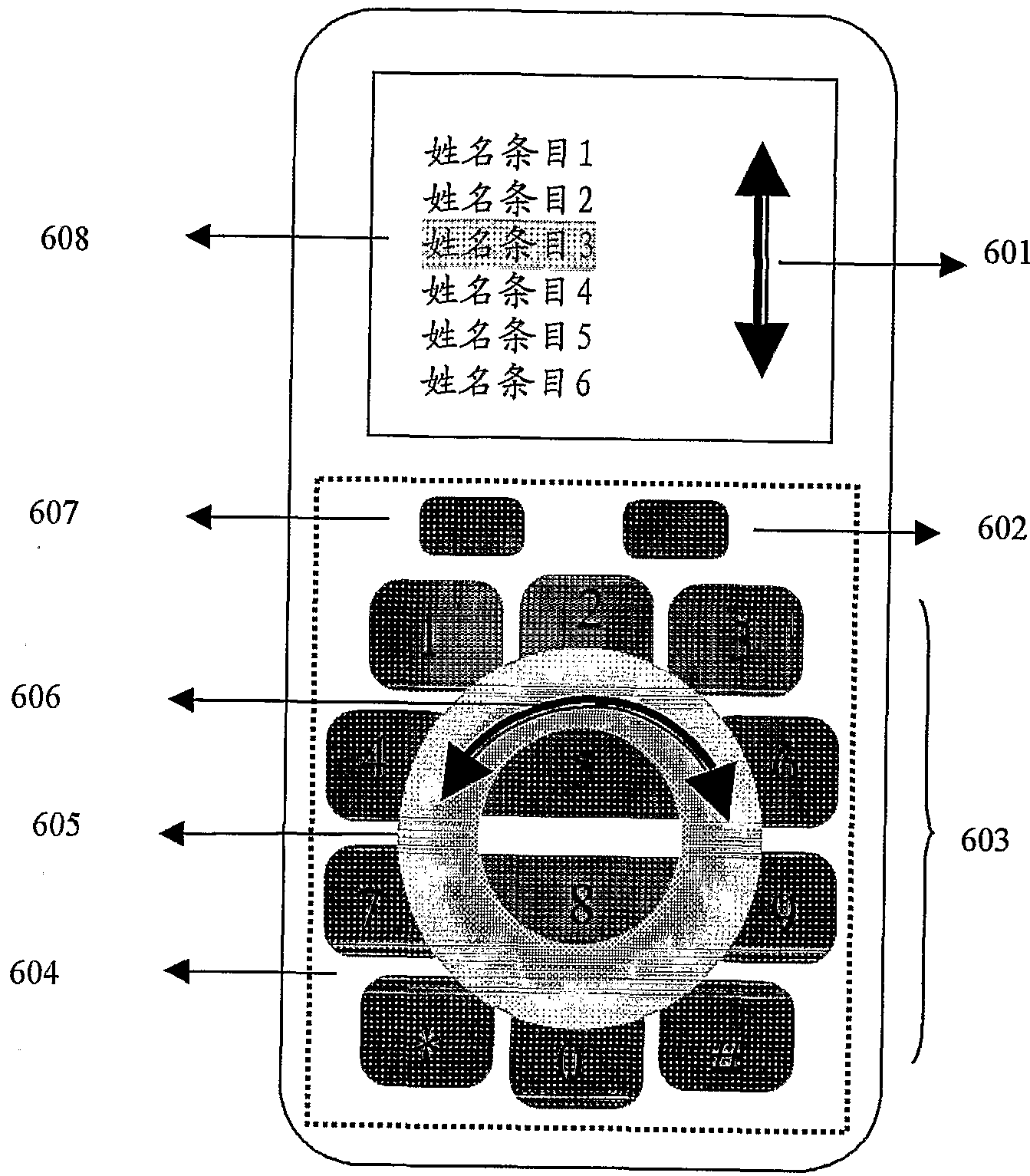
图 6

国际 ®索报舌 PCT/CN2004/000936 International ® Cable PCT/CN2004/000936
A. 主题的分类 A. Classification of topics
IPC7: H04M1/02 IPC7: H04M1/02
按照国际专利分类表 (IPC)或者同时按照国家分类和 IPC两种分类 According to the International Patent Classification Table (IPC) or both national classification and IPC classification
B.检索领域 B. Search field
检索的最低限度文献 (标明分类系统和分类号) Minimum document retrieved (indicate classification system and classification number)
IPC7: H04M1/00 H04M1/02 G06K11/00 G06K11/02 G06K11/16 G08C21/00 G09G5/00 IPC7: H04M1/00 H04M1/02 G06K11/00 G06K11/02 G06K11/16 G08C21/00 G09G5/00
GQ6F3/00 G06F3/02 G06F3/023 GQ6F3/00 G06F3/02 G06F3/023
包含在检索领域中的除最低限度文献以外的检索文献 在国际检索时査阅的电子数据库 (数据库的名称, 和使用的检索词 (如使用)) Search documents other than the minimum documents included in the search field. Electronic databases that are consulted at the time of international search (the name of the database, and the search term used (if used))
CNPAT PAJ WPI EPODOC CNPAT PAJ WPI EPODOC
触摸 屏 板 感应 传感 坐标 光标 Touch panel induction sensing coordinates cursor
touch screen? pad panel key button sens+ loop coordinate? cursor? Touch screen? pad panel key button sens+ loop coordinate? cursor?
C.相关文件 C. Related documents
类 型 * 引用文件, 必要时, 指明相关段落 相关的权利要求 Type * Reference file, if necessary, indicate relevant paragraphs Related claims
X EP, A2, 1197835 (Nokia Corporation) 17.04月 2002 ( 17.04.02) 1、 5-8、 15-17、 21-24 说明书第 2栏 0017—第 4栏 0023, 附图 1—6 X EP, A2, 1197835 (Nokia Corporation) 17.04 Month 2002 ( 17.04.02) 1, 5-8, 15-17, 21-24 Manual Column 2 0017 - Column 4 0023, Figure 1-6
Y 2-4、 9-14、 18-20、 25-36 Y 2-4, 9-14, 18-20, 25-36
US, A1 , 20030048257 (NOKIA MOBILE PHONES Ltd) US, A1, 20030048257 (NOKIA MOBILE PHONES Ltd)
Y 13.03月 2003 ( 13.03.03) 2-4 Y 13.03 month 2003 ( 13.03.03) 2-4
说明书第 2百笫 0017 Manual 2nd 笫 0017
CN, Y, 2567694 (台均实业有限公司) 9-11、 18-20 CN, Y, 2567694 (Taijun Industrial Co., Ltd.) 9-11, 18-20
Y Y
20.08月 2003 (20.08.03 ) 20.08 month 2003 (20.08.03)
说明书第 9页第 15行一第 10页第 7行、 附图 3—7 Page 9 page 15 of the manual, page 10, line 7, Figure 3-7
Y WO, A1 , 03088176 (SYNAPTIC,INC) 23.10月 2003 (23.10.03 ) 12-14、 25-36 Y WO, A1 , 03088176 (SYNAPTIC, INC) 23. October 2003 (23.10.03 ) 12-14, 25-36
说明书第 8页第 20行一第 29页第 13行, 附图 1—44 其余文件在 C栏的续页中列出; 因 见同族专利附件。 Page 8 of the manual, page 20, page 29, line 13, Figure 1-44 The remaining documents are listed on the continuation of column C ; see the same family patent attachment.
* 引用文件的具体类型: "T" 在申请日或优先权日之后公布, 与申请不相抵触, 但为了 * The specific type of reference document: "T" is published after the application date or priority date, and does not contradict the application, but
"A" 认为不特别相关的表示了现有技术一般状态的文件 理解发明之理论或原理的在后文件 "A" A document that is not particularly relevant and represents the general state of the art. A later document that understands the theory or principle of the invention.
"E" 在国际申请曰的 公; «m申请 IJ "X" 特别相关的文件, 单独考虑该文件, 认定要求保护的 "E" in the international application of the public; «m application IJ "X" special related documents, consider the file separately, identify the required protection
"L" 可能对优先权要求构成怀疑的文件, 或为确定另一篇 发明不是新颖的或不具有创造性 "L" may be a document that raises doubts about the priority claim, or to determine that another invention is not novel or creative
引用文件的公布日而引用的或者因其他特殊理由而引 "Y" 特别相关的文件, 当该文件与另一篇或者多篇该类文件 用的文件 结合并且这种结合对于本领域技术人员为显而易见时, A document that is specifically referenced by reference to the publication date of the document or for other special reasons, when the document is combined with another document or documents for such documentation and such a combination is Obviously,
"0" 涉及口头公开、 使用、 展览或其他方式公开的文件 要求保护的发明不具有创造性 "0" documents relating to oral disclosure, use, exhibition or other means of disclosure. The claimed invention is not inventive.
"P" 公布日先于国际申请日但迟于所要求的优先权日的文件 "&" 同族专利的文件 "P" Document dated on the international filing date but later than the requested priority date "&"

PCT/ISA/210表 (第 2页)(2005年 4月) 关于同族专利的信息 PCT/ISA/210 (page 2) (April 2005) Information about the same family patent
检索报告中引用的 公布日期 同族专利 公布日期 专利文件 Date of publication cited in the search report Family patent Date of publication Patent document
EP, A2, 1197835 14.04.02 GB, A, 2367530 10.04.02 EP, A2, 1197835 14.04.02 GB, A, 2367530 10.04.02
JP, A, 2002196856 12.07.02 US, Al , 2002049070 25.04.02 JP, A, 2002196856 12.07.02 US, Al , 2002049070 25.04.02
US, Al , 20030048257 13.03.03 无 US, Al , 20030048257 13.03.03 None
CN, Y, 2567694 20.08.03 无 CN, Y, 2567694 20.08.03 None
WO, Al , 03088176 23.10.03 AU, Al , 2003226049 27.10.03 WO, Al, 03088176 23.10.03 AU, Al , 2003226049 27.10.03
EP, Al , 1500062 26.01.05 US, Al , 2004252109 16.12.04 EP, Al, 1500062 26.01.05 US, Al , 2004252109 16.12.04
PCT/ISA/210表 (同族专利附件) (2005年' 4月) International application No. PCT/ISA/210 (Common patent annex) (April 2005) International application No.
INTERNATIONAL SEARCH REPORT INTERNATIONAL SEARCH REPORT
PCT/CN2004/000936PCT/CN2004/000936
A. CLASSIFICATION OF SUBJECT MATTER A. CLASSIFICATION OF SUBJECT MATTER
IPC7: H04M1/02 IPC7: H04M1/02
According to International Patent Classification (IPC) or to both national classification and IPC According to International Patent Classification (IPC) or to both national classification and IPC
B. FIELDS SEARCHED B. FIELDS SEARCHED
Minimum documentation searched (classification system followed by classification symbols) Minimum documentation searched (classification system followed by classification symbols)
IPC7: H04M1/00 H04M1/02 G06K11/00 G06K11/02 G06K11/16 G08C21/00 G09G5/00 IPC7: H04M1/00 H04M1/02 G06K11/00 G06K11/02 G06K11/16 G08C21/00 G09G5/00
G06F3/00 G06F3/02 G06F3/023 G06F3/00 G06F3/02 G06F3/023
Documentation searched other than minimum documentation to the extent that such documents are included in the fields searched Documentation searched other than minimum documentation to the extent that such documents are included in the fields searched
Electronic data base consulted during the international search (name of data base and, where practicable, search terms used) Electronic data base consulted during the international search (name of data base and, where practicable, search terms used)
CNPAT PAJ WPI EPODOC CNPAT PAJ WPI EPODOC
touch screen? pad panel key button sens+ loop coordinate? cursor? Touch screen? pad panel key button sens+ loop coordinate? cursor?
C. DOCUMENTS CONSIDERED TO BE RELEVANT C. DOCUMENTS CONSIDERED TO BE RELEVANT

□ Further documents are listed in the continuation of Box C. ¾ See patent family annex. □ Further documents are listed in the continuation of Box C. 3⁄4 See patent family annex.
* Special categories of cited documents: : " later document published after the international filing date or priority date and not in conflict with the application but* Special categories of compliant documents: : " later document published after the international filing date or priority date and not in conflict with the application but
"A" document defining the general state of the art which is not cited to understand the principle or theory underlying the considered to be of particular relevance invention "A" document defining the general state of the art which is not cited to understand the principle or theory underlying the considered to be
:Έ" earlier application or patent but published on or after the "X" document of particular relevance; the claimed invention international filing date cannot be considered novel or cannot be considered to involve an inventive step when the document is taken alone : "the application of patent but published on or after the "X" document of particular relevance; the claimed invention international filing date cannot be considered novel or cannot be considered to engage an engaging step when the document is taken alone
"L" document which may throw doubts on priority claim (S) or "L" document which may throw doubts on priority claim (S) or
"Y" document of particular relevance; the claimed invention which is cited to establish the publication date of another "Y" document of particular relevance; the claimed invention which is cited to establish the publication date of another
cannot be considered to involve an inventive step when the citation or other special reason (as specified) document is combined with one or more other such Can not be considered to involve an involved step when the citation or other special reason (as specified) document is combined with one or more other such
;Ό" document referring to an oral disclosure, use, exhibition or documents, such combination being obvious to a person other means skilled in the art ; Ό "document referring to an oral disclosure, use, exhibition or documents, such combination being obvious to a person other means skilled in the art
:tP" document published prior to the international filing date "&" document member of the same patent family :t P" document published prior to the international filing date "&" document member of the same patent family
but later than the priority date claimed But later than the priority date claimed

Form PCT/ISA/210 (second sheet) (April 2005) INTERNATIONAL SEARCH REPORT International application No. Form PCT/ISA/210 (second sheet) (April 2005) INTERNATIONAL SEARCH REPORT International application No.
Information on patent family members Information on patent family members
PCT/CN2004/000936 PCT/CN2004/000936
Patent Documents referred Publication Date Patent Family Publication Date in the Report Patent Documents referred Publication Date Patent Family Publication Date in the Report
BP, A2, 1197835 14.04.02 GB, A, 2367530 10.04.02 BP, A2, 1197835 14.04.02 GB, A, 2367530 10.04.02
JP, A, 2002196856 12.07.02 US, Al , 2002049070 25.04.02 JP, A, 2002196856 12.07.02 US, Al , 2002049070 25.04.02
US, Al , 20030048257 13.03.03 None US, Al, 20030048257 13.03.03 None
CN, Y, 2567694 20.08.03 None CN, Y, 2567694 20.08.03 None
WO, Al , 03088176 23.10.03 AU, Al , 2003226049 27.10.03 WO, Al, 03088176 23.10.03 AU, Al , 2003226049 27.10.03
EP, Al , 1500062 26.01.05 US, Al , 2004252109 16.12.04 EP, Al, 1500062 26.01.05 US, Al , 2004252109 16.12.04
Form PCT/ISA 1210 (patent family annex) (April 2005) 一种用于便携式终端的感应式键盘及其控制方法 Form PCT/ISA 1210 (patent family annex) (April 2005) Inductive keyboard for portable terminal and control method thereof
技术领域 Technical field
本发明涉及电子技术领域,特别涉及用户界面装置,具体的讲是一种用 于便携式终端的感应式键盘及其控制方法。 The present invention relates to the field of electronic technology, and in particular to a user interface device, and more particularly to an inductive keyboard for a portable terminal and a control method thereof.
背景技术 Background technique
随着通信技术的发展, 手机作为便携式终端的一种,已经成为深受大众 欢迎的通信工具。 手机随着用户的需要正向着小型化, 人性化, 多样化,智 能化和信息化发展。传统的手机主要以通话为主,这对用户界面装置的要求 相对简单,基于机电开关原理的手机按键键盘已能很好的满足要求。这种键 盘通常包括 "0-9" 十个数字 /字母按键,及若干个功能键。 按键下方设置有 弹性帽,当按键被按下后,弹性帽的导电层接触并接通电开关。按键按压动作 收起来后弹性帽自动弹回原位,形成触觉反馈,提示使用者按键动作已完成。 键盘使用的机电开关技术已臻完善,易于实现,性能可靠。然而随着手机智能 化和信息化的发展,手机文字输入以及存储的信息越来越多,这对用户界面 装置提出了新的要求。而在传统手机按键键盘上输入文字尤其是输入像中文 这样的非字母的文字是件非常困难的事。 随着手机电话本条目的迅速增加, 例如具有 500,甚至 1000个电话本条目容量的新型手机变得普遍,通过按压 基于机电开关原理的传统四方向导航键查看所需的条目变得很不方便。 With the development of communication technology, mobile phones, as a kind of portable terminals, have become popular communication tools. With the needs of users, mobile phones are becoming more miniaturized, humanized, diversified, intelligent and informative. The traditional mobile phone is mainly based on the call, which is relatively simple for the user interface device. The mobile phone keypad based on the electromechanical switch principle can meet the requirements very well. This keyboard usually includes "0-9" ten digit/letter buttons and several function keys. A resilient cap is arranged under the button, and when the button is pressed, the conductive layer of the elastic cap contacts and turns on the electrical switch. After the button is pressed, the elastic cap automatically springs back to the original position to form a tactile feedback, prompting the user that the button action has been completed. The electromechanical switch technology used in the keyboard has been perfected, easy to implement, and reliable in performance. However, with the development of mobile phone intelligence and information, more and more mobile phone text input and storage information has put forward new requirements for user interface devices. It is very difficult to input text on a traditional mobile phone keypad, especially to input non-letter text like Chinese. With the rapid increase in mobile phone book entries, such as new mobile phones having a capacity of 500 or even 1000 phone book entries, it has become inconvenient to view the required entries by pressing a conventional four-way navigation key based on the electromechanical switch principle.
各种新型的用户界面装置被应用到手机上, 例如具有手写识别功能的 触摸屏也祐:应用在手机上来输入文字。目前比较流行的两种触摸展分别为电 阻式触摸屏和电容式触摸屏,电阻式触摸屏是由一层可变形的电阻薄膜和一 层固定的电阻薄膜构成, 中间由空气相隔离。 其工作原理是: 当用笔或手指 接触触摸屏时,上层电阻受压变形并与下层电阻接触, 下层电阻薄膜就能感 应出笔或手指的位置。第二种是电容式触摸屏技术, 电容式触摸屏的工作原 理与电阻式触摸犀基本一样, 它主要是通过手写笔向基板施加压力时, 电容 A variety of new user interface devices are applied to mobile phones, such as touch screens with handwriting recognition functionality: applications are applied to mobile phones to input text. At present, the two popular touch displays are a resistive touch screen and a capacitive touch screen. The resistive touch screen is composed of a deformable resistive film and a fixed resistive film, and is separated by air. The working principle is as follows: When the touch screen is touched with a pen or a finger, the upper layer resistor is deformed by pressure and contacts the lower layer resistor, and the lower layer resistive film can sense the position of the pen or the finger. The second type is capacitive touch screen technology. The working principle of the capacitive touch screen is basically the same as that of the resistive touch rhinoceros. It is mainly used when applying pressure to the substrate through the stylus.
1 值的改变来定位手写笔的位置。触摸屏这种新型的用户界面装置艮好的解决 了文字输入的问题, 用户界面也是触摸式的, 查看所需的条目只需用手写 笔点一下触摸屏上显示的这一条目。不过当条目很多,无法在一屏显示时,翻 屏还是通过按压基于机电开关原理的传统四方向导航键方便一些。 然而,为 了保持手机外形的小巧,大多数这类手机设计中只有一个触摸屏而省略了按 键键盘。 触摸屏上也可以用来显示一个虚拟键盘, 这样的设计, 用户就需要 点击在触摸屏上显示的虚拟按键来拨号。虚拟键盘没有提供触觉反馈, 用户 通常会觉得使用起来不方便, 并容易产生错误操作。 也有一些手机既有触摸 屏又有按键键盘, 这样的手机难免体积大, 携带不方便。 总之,触摸屏难以 同时很好的满足拨号通话, 文字输入, 信息查看,及小型化的要求。 1 A change in value to position the stylus. The new user interface device of the touch screen solves the problem of text input. The user interface is also touch-sensitive. To view the desired items, simply click on the item displayed on the touch screen with the stylus. However, when there are many items that cannot be displayed on one screen, it is convenient to scroll through the traditional four-way navigation keys based on the electromechanical switch principle. However, in order to keep the shape of the phone small, most of these phones have only one touch screen and the keyboard is omitted. The touch screen can also be used to display a virtual keyboard. In this design, the user needs to click the virtual button displayed on the touch screen to dial. The virtual keyboard does not provide tactile feedback, and the user often finds it inconvenient to use and is prone to erroneous operations. There are also some mobile phones that have both a touch screen and a button keyboard. Such a mobile phone is inevitably bulky and inconvenient to carry. In short, the touch screen is difficult to meet the requirements of dial-up calls, text input, information viewing, and miniaturization.
US2003025679, EP1197835公开了类似的用户界面装置,对同时具有触 摸板及按键键盘的设计加以改进。 触摸板被直接装在按键键盘下面。 按键 键盘的功能保留,拨号通话很方便, 同时非接触式触摸板可提供手写识别功 能在手机上来输入文字, 而且非接触式触摸板可提供类似鼠标的功能。 当手 指在非接触式触摸板上滑动时,可控制光标在显示屏上移动。 因为手机小型 化的要求,触摸板面积不能很大, 这样在触摸板上移动光标进行菜单条目的 滚动查看选择并不方便。 非接触式触摸板很薄,并不增加手机外形体积, 不 过将触摸板与键盘机械的结合在一起在工程实现上却不容易。为了按键键盘 的机电开关得以工作,针对每一个按键,在触摸板上都要相应的打一个孔,这 样按压按键时,按键的机械拄才可以顺利穿过触摸板从而压动弹性帽。 但是 每一款手机的按键键盘设计并不相同, 造成有孔的触摸板需要针对每一款 手机都不一样,从而造成加工复杂度及生产成本的增加。非接触式触摸板是 由数条 X方向导线及 Y方向导线组成, X方向导线及 Y方向导线在每一孔 附近要弯曲, 非接触式触摸板的性能受非线性影响很大,每一款手机的键盘 设计的不同造成非接触式触摸板的 X方向导线及 Y方向导线的弯曲度,及线 间距都不同。 为了通过补偿 (OFFSET)解决上述问题,非接触式触摸板 IC变 得复杂,甚至需要针对每一款手机都不一样, 从而造成加工复杂度及生产成 本的增加。 为了解决按键键盘背光的问题, 非接触式触摸板需要使用透明材 料,从而造成加工复杂度及生产成本的进一步增加。 US2003025679, EP1197835 discloses a similar user interface device that improves the design of both a touchpad and a keypad. The touchpad is mounted directly under the keypad. The function of the keypad is reserved, and the dialing call is convenient. The non-contact touchpad provides handwriting recognition to input text on the phone, and the contactless touchpad provides a mouse-like function. When the finger slides on the contactless touchpad, the cursor can be controlled to move on the display. Because of the miniaturization requirements of the mobile phone, the touchpad area cannot be large, so it is not convenient to move the cursor on the touchpad to perform scrolling selection of menu items. The contactless touchpad is very thin and does not increase the size of the phone. However, the combination of the touchpad and the keyboard mechanism is not easy in engineering implementation. In order to work on the electromechanical switch of the button keyboard, for each button, a hole is correspondingly made on the touch panel, so that when the button is pressed, the mechanical button of the button can smoothly pass through the touch panel to press the elastic cap. However, the key keyboard design of each mobile phone is not the same, resulting in a holed touchpad that needs to be different for each mobile phone, resulting in increased processing complexity and production costs. The non-contact touch panel is composed of a plurality of X-directional wires and Y-directional wires, and the X-directional wires and the Y-directional wires are bent near each hole, and the performance of the non-contact touch panel is greatly affected by nonlinearity, each The difference in the keyboard design of the mobile phone causes the curvature of the X-directional wire and the Y-directional wire of the non-contact type touch panel, and the line spacing to be different. In order to solve the above problem by offset (OFFSET), the non-contact touch panel IC becomes It is complicated and even needs to be different for each mobile phone, resulting in increased processing complexity and production costs. In order to solve the problem of the backlight of the key keyboard, the non-contact type touch panel needs to use a transparent material, thereby causing further increase in processing complexity and production cost.
US2003095096, 爾 3088176 公开了类似的用户界面装置,手指通过在 一种封闭的圆形位置感应装置上的滚动,实现菜单条目的线性滚动,从而方 便大量条目的快速查看。 不过这种用户界面装置不具有按键功能, 并与按键 的操作无关, 在手机上应用会增大体积和成本, 并不现实。 A similar user interface device is disclosed in US 2003095096, No. 3,088,176, which enables the linear scrolling of menu items by scrolling on a closed circular position sensing device, thereby facilitating quick viewing of a large number of entries. However, such a user interface device does not have a button function, and has nothing to do with the operation of the button, and application on the mobile phone increases the size and cost, which is not realistic.
发明内容 Summary of the invention
本发明的目的在于,提供一种用于便携式终端的感应式键盘及其控制方 法,并且在提供菜单条目滚动查看选择功能的同时,保持手机原有的外形结 构, 也不失掉手机数字键盘原有的功能。 The object of the present invention is to provide an inductive keyboard for a portable terminal and a control method thereof, and to maintain the original appearance structure of the mobile phone while providing a scrolling view selection function of the menu item, without losing the original mobile phone digital keyboard. The function.
本发明的技术方案为: The technical solution of the present invention is:
一种用于便携式终端的感应式键盘,将至少一个感应单元设置在所述便 携式终端的键盘区域形成感应面; An inductive keyboard for a portable terminal, wherein at least one sensing unit is disposed in a keyboard area of the portable terminal to form a sensing surface;
采用一感应物在所述的感应面上滑动, 从而使所述感应物的运动轨 ¾1过 感应单元产生多维坐标数据; Using a sensor to slide on the sensing surface, so that the moving track of the sensing object generates multi-dimensional coordinate data through the sensing unit;
便携式终端的微处理器对所述运动轨迹产生的多维坐标数据进行处理, 并转化为光标在便携式终端的显示装置上的移动, 从而控制菜单条目的滚 动,按压按键选择所需菜单条目 The microprocessor of the portable terminal processes the multi-dimensional coordinate data generated by the motion trajectory and converts it into a movement of the cursor on the display device of the portable terminal, thereby controlling the scrolling of the menu item, and pressing the button to select the desired menu item
所述的感应单元包括电容, 即所述的感应单元是通过测量电容的变化 产生多维坐标数据。 The sensing unit includes a capacitor, that is, the sensing unit generates multi-dimensional coordinate data by measuring a change in capacitance.
所述的感应单元包括电阻, 即所述的感应单元是通过测量电阻的变化 产生多维坐标数据。 The sensing unit includes a resistor, that is, the sensing unit generates multi-dimensional coordinate data by measuring a change in resistance.
所述的感应单元包括电感, 即所述的感应单元是通过测量电感的变化 产生多维坐标数据。 The sensing unit includes an inductor, that is, the sensing unit generates multi-dimensional coordinate data by measuring a change in inductance.
所述的感应单元包括阻抗, 即所述的感应单元是通过测量阻抗的变化 The sensing unit includes an impedance, that is, the sensing unit measures the impedance change
3 产生多维坐标数据。 3 Generate multidimensional coordinate data.
所述的感应单元与便携式终端键盘的至少一个按键相耦合。 The sensing unit is coupled to at least one button of the portable terminal keyboard.
所述的感应单元与便携式终端键盘的至少一个按键相耦合指的是: 将 所述的感应单元电路与便携式终端键盘电路相耦合。 The sensing unit is coupled to at least one button of the portable terminal keyboard to: couple the sensing unit circuit to the portable terminal keyboard circuit.
所述的感应单元与便携式终端键盘的至少一个按键相耦合指的是:将所 述的感应单元机械构件与便携式终端键盘的复数个按键机械构件相耦合。 The coupling of the sensing unit to at least one of the keys of the portable terminal keyboard means that the sensing unit mechanical member is coupled to a plurality of key mechanical members of the portable terminal keyboard.
所述的感应单元分布在同一平面。 The sensing units are distributed in the same plane.
所述的感应单元分布在不同平面。 The sensing units are distributed in different planes.
所述的感应单元为导电材廣构成。 The sensing unit is widely constructed of a conductive material.
在所述感应面上设置机械槽引导所述感应物的运动轨迹。 A mechanical groove is provided on the sensing surface to guide a motion trajectory of the sensor.
所述机械槽为近似封闭圆形, 引导所述感应物的运动轨迹为连续近似 封闭圆形。 The mechanical groove is an approximately closed circle, and the motion trajectory of the sensor is guided to be a continuous approximate closed circle.
所述机械槽具有触觉反馈功能。 The mechanical slot has a tactile feedback function.
将所述的感应单元设置在便携式终端键盘按键的表面和键盘上按键与 按键之间的表面以下, 从而形成感应面。 The sensing unit is disposed on a surface of the keyboard button of the portable terminal and below a surface between the button and the button on the keyboard to form a sensing surface.
所述的感应单元被印制成适合印制在键盘区域内成为一感应块的形状。 所述的感应单元被印制成矩形、 圆形、 椭圆形、 三角形、 多边形、 或适 合印制在键盘区域内成为一感应块的形状。 The sensing unit is printed in a shape suitable for printing into a sensing block in the area of the keyboard. The sensing unit is printed as a rectangle, a circle, an ellipse, a triangle, a polygon, or a shape suitable for printing into a sensing block in the keyboard area.
选取相同或不同形状的感应单元在所述的键盘区域内印刷成感应单元 的点阵网。 A sensing unit of the same or different shape is selected to be printed as a lattice network of sensing units in the keyboard area.
每个感应单元是所述点阵网中的节点。 Each sensing unit is a node in the lattice network.
所述的感应面的灵敏度取决于所述点阵网的密度。 The sensitivity of the sensing surface depends on the density of the lattice network.
所述的键盘区域具有背光。 The keyboard area has a backlight.
当光标在便携式终端的显示装置上移动, 从而导致菜单条目的滚动时, 便携式终端产生声音反馈。 The portable terminal generates an audible feedback when the cursor moves on the display device of the portable terminal, thereby causing scrolling of the menu item.
所述的便携式终端为手机。 本发明还提供了一种控制便携式终端感应式键盘的方法,将至少一个感 应单元设置在便携式终端键盘区域形成感应面; The portable terminal is a mobile phone. The present invention also provides a method for controlling an inductive keyboard of a portable terminal, wherein at least one sensing unit is disposed in a keyboard area of the portable terminal to form a sensing surface;
采用一感应物在所述的感应面上滑动, 从而使所述感应物的运动轨 ¾1过 感应单元产生多维坐标数据; Using a sensor to slide on the sensing surface, so that the moving track of the sensing object generates multi-dimensional coordinate data through the sensing unit;
便携式终端的微处理器对所述运动轨迹产生的多维坐标数据进行处理, 并转化为光标在便携式终端的显示装置上的移动, 从而控制菜单条目的滚 动;按压按键选择所需菜单条目。 The microprocessor of the portable terminal processes the multi-dimensional coordinate data generated by the motion trajectory and converts it into a movement of the cursor on the display device of the portable terminal, thereby controlling the scrolling of the menu item; pressing the button selects the desired menu item.
所述的菜单条目的滚动条数取决于运动轨迹的变化。 The number of scroll bars of the menu item depends on the change in the motion trajectory.
所迷的运动轨迹近似线性。 The trajectory of the movement is approximately linear.
所述的运动轨迹是非线性的。 The motion trajectory is non-linear.
所述的运动轨迹近似连续封闭圆形。 The motion trajectory is approximately continuous closed circular.
所述的运动轨迹近似连续螺旋形。 The motion trajectory is approximately continuous spiral.
所述的菜单条目的滚动是线性的。 The scrolling of the menu items is linear.
所述的菜单条目的滚动是非线性的。 The scrolling of the menu items is non-linear.
所述的菜单条目的滚动速度是运动轨迹速度的函数。 The scrolling speed of the menu item is a function of the speed of the motion track.
所述的菜单条目的滚动速度是运动轨迹加速度的函数。 The scrolling speed of the menu item is a function of the motion trajectory acceleration.
至少部分菜单条目同时出现在显示屏上。 At least some of the menu items appear on the display at the same time.
所述同时出现在显示屏上的菜单条目中的一个菜单条目在显示屏上被 标示与众不同。 A menu item in the menu item that appears simultaneously on the display screen is marked differently on the display screen.
在所述感应面上设置近似封闭圓形的机械槽, 从而引导所述感应物的 运动轨迹为连续近似封闭圆形。 An approximately closed circular mechanical groove is disposed on the sensing surface to guide the motion trajectory of the sensing object to a continuous approximately closed circular shape.
本发明的有益效果在于,提供一种用于便携式终端的感应式键盘及其控 制方法,并且在提供菜单条目滚动查看选择功能的同时,保持手机原有的外 形结构, 也不失掉手机数字键盘原有的功能。 An advantageous effect of the present invention is to provide an inductive keyboard for a portable terminal and a control method thereof, and to maintain the original appearance structure of the mobile phone while providing a scrolling view selection function of the menu item, without losing the original digital keyboard of the mobile phone Some features.
附图说明 DRAWINGS
图 1为本发明的便携式终端结构的块图; 图 1为本发明通过电容式感应单元矩阵形成感应键盘的平面示意图; 图 3a为本发明应用于手机的电容式感应单元印刷图案示意图之一; 图 3b为本发明应用于手机的电容式感应单元印刷图案示意图之二; 图 3c为本发明应用于手机的电容式感应单元印刷图案示意图之三; 图 4为本发明通过电容式感应单元形成感应键盘的解剖面示意图; 图 5为本发明一种包含感应导航功能键的手机感应键盘设计示意图; 图 6为本发明一种包含封闭圆形机械槽的手机感应键盘设计示意图; 图 7 为本发明电容式感应单元矩阵与完全电耦合电路及微处理器电路 连接示意图。 1 is a block diagram showing the structure of a portable terminal of the present invention; 1 is a schematic plan view showing a sensing keyboard formed by a matrix of a capacitive sensing unit according to the present invention; FIG. 3a is a schematic diagram of a printed pattern of a capacitive sensing unit applied to a mobile phone according to the present invention; FIG. 3b is a schematic diagram of a capacitive sensing unit applied to a mobile phone according to the present invention; FIG. 3 is a schematic diagram of a printed pattern of a capacitive sensing unit applied to a mobile phone according to the present invention; FIG. 4 is a schematic view showing an anatomical surface of the sensing keyboard formed by a capacitive sensing unit according to the present invention; FIG. 6 is a schematic diagram of a mobile phone sensing keyboard design including a closed circular mechanical slot according to the present invention; FIG. 7 is a schematic diagram of a capacitive sensing unit matrix and a fully electrically coupled circuit and micro processing according to the present invention; Schematic diagram of the circuit connection.
具体实施方式 detailed description
下面结合附图说明本发明的具体实施方式: The specific embodiments of the present invention are described below with reference to the accompanying drawings:
本发明提供了一种用于便携式终端的感应键盘及其控制方法,图 1为本 发明所述例如便携式终端结构的块图。便携式终端包含一个微处理器(MPU ) 100, —个存储器 120, 一个感应键盘 140, —个完全电耦合电路 150, 一个 显示器 130及一个通信接口 110。 显示装置 130用来显示字符, 菜单条目及 各种信息。通信接口 110可以是任何包括有收发器结构的装置,用户可以通 过该通信接口 110和其他便携式终端或是网络进行通信,例如具有收发器的 通信接口 110可以与无线通信网絡进行通信。图 7中示出了电容式感应单元 矩阵与完全电耦合电路及微处理器电路连接示意图。 The present invention provides an inductive keyboard for a portable terminal and a control method therefor, and Fig. 1 is a block diagram of a portable terminal structure according to the present invention. The portable terminal includes a microprocessor (MPU) 100, a memory 120, an inductive keyboard 140, a fully electrically coupled circuit 150, a display 130 and a communication interface 110. Display device 130 is used to display characters, menu items, and various information. Communication interface 110 can be any device that includes a transceiver structure through which a user can communicate with other portable terminals or networks, such as communication interface 110 having a transceiver can communicate with a wireless communication network. FIG. 7 is a schematic diagram showing the connection of a capacitive sensing unit matrix and a fully electrically coupled circuit and a microprocessor circuit.
图 2为本发明通过电容式感应单元矩阵形成感应键盘的平面示意图;每 个电容式感应单元 210是用能够导电的材料印制在印刷电路板上。例如每个 电容式感应单元可由一对互不接触的金属铜线按照特定图案构成。 这一对 互不接触的导线之间形成耦合电容, 每一个电容式感应单元各连接两条相 互垂直的导线, X和 Y方向的导线。 图 2中表示了一例 9 x 7的点阵, 当然, 所述的电容式感应单元点阵也可以有其他规格, 在这里就不再详细描述了。 X和 Y 方向的导线在点阵的节点处是不接通的, 这可以通过在节点处, X 和 Y方向的导线之间印上绝缘层,从而使 X和 Υ方向的导线在点阵的节点处 不接通, 也可以在印刷电路板上打洞连线的方式实现, 这种方式是成熟的 印刷电路板制造现有技术, 在此就不详述了。 图 3a , 图 3b, 图 3c分别为 本发明应用于手机的三种电容式感应单元印刷图案的示意图; 这三种图案 的结构可以有多种形式的应用。该三种印刷图案会有比较好的导通特性及禺 合电容。 当然, 所述的电容式感应单元也可以有其他形式图案, 在这里就不 再详细描述了。本发明中的每一个电容式感应单元都印刷成本图所显示的图 案, 这样就形成了本发明所述的电容式感应单元的点阵网。 在正常情况下, 两条由导电材料构成的电线是不接通的。 2 is a schematic plan view showing a sensing keyboard formed by a matrix of capacitive sensing units according to the present invention; each capacitive sensing unit 210 is printed on a printed circuit board with a conductive material. For example, each of the capacitive sensing units may be formed in a specific pattern by a pair of metal copper wires that are not in contact with each other. A coupling capacitor is formed between the pair of wires that do not contact each other, and each of the capacitive sensing units is connected to two mutually perpendicular wires, X and Y wires. An example of a 9 x 7 dot matrix is shown in Fig. 2. Of course, the capacitive sensing cell dot matrix can also have other specifications, which will not be described in detail herein. The wires in the X and Y directions are not connected at the nodes of the lattice, which can be passed at the node, X An insulating layer is printed between the wires in the Y direction, so that the wires in the X and Υ directions are not connected at the nodes of the lattice, and the holes can be connected on the printed circuit board. This is mature. The prior art of printed circuit board fabrication is not described in detail herein. 3a, 3b, and 3c are schematic views of three capacitive sensing unit printing patterns applied to a mobile phone according to the present invention; the structures of the three patterns can be applied in various forms. The three printed patterns have better conduction characteristics and coupling capacitance. Of course, the capacitive sensing unit can also have other forms of patterns, which will not be described in detail herein. Each of the capacitive sensing units in the present invention prints the pattern shown in the cost map, thus forming a dot matrix network of the capacitive sensing unit of the present invention. Under normal conditions, two wires made of a conductive material are not connected.
在电容式感应单元形成的点阵网上加上机械构件形成感应键盘,只需部 分电容式感应单元被加以弹性帽为特点的机械构件。 这些机械构件的上表 面印有数字和字母符号从而形成感应键。具体方案如图 4所示, 图 4为本发 '明通过电容式感应单元 210形成感应键盘的解剖面示意图。当手指向下按压 机械表面 430上的按键时, 4 建的机械柱 420相下挤压弹性帽 440, 对 手指形成阻力。 弹性帽 440内表面印有导电层,导电层与印刷电路板(PCB ) 400 上每一个接触到的电容式感应单元形成电连接并导通该电容式感应单' 元的 X和 Y方向的导线。 通过扫描,完全电耦合电路 150及微处理器 100判 定此按键被按, 并执行相应功能。 当手指松开时, 弹性帽 440的弹性带动机 械柱 420将按键弹回原位, 使之具有触觉反馈。 The mechanical component is formed on the dot matrix formed by the capacitive sensing unit to form an inductive keyboard, and only a part of the capacitive sensing unit is required to be a mechanical member characterized by a resilient cap. The upper surface of these mechanical components is printed with numbers and letter symbols to form the sensing keys. The specific scheme is shown in FIG. 4. FIG. 4 is a schematic diagram showing an anatomical surface of the inductive keyboard formed by the capacitive sensing unit 210. When the finger presses down on the button on the mechanical surface 430, the mechanical column 420 is pressed down against the elastic cap 440 to form a resistance to the finger. The inner surface of the elastic cap 440 is printed with a conductive layer, and the conductive layer is electrically connected to each of the capacitive sensing units that are in contact with the printed circuit board (PCB) 400 and turns on the X- and Y-directional wires of the capacitive sensing unit. . By scanning, the fully electrically coupled circuit 150 and the microprocessor 100 determine that the button is pressed and perform the corresponding function. When the finger is released, the elastic band of the resilient cap 440 pushes the button back to its original position for tactile feedback.
当手指在感应键盘上滑动时, 通过扫描, 完全电耦合电路可以报告微处 理器 (MCU)每一个感应单元的电容值大小。 通过计算每一个感应单元的电容 值变化,.再计算出变化的重心, 即可定出在每一时刻的手指位置, 从而使 手指的运动轨迹通过感应单元产生多维坐标数据。 When the finger slides on the sensing keyboard, the fully electrically coupled circuit can report the capacitance value of each sensing unit of the microprocessor (MCU) by scanning. By calculating the change in the capacitance value of each sensing unit, and then calculating the center of gravity of the change, the position of the finger at each moment can be determined, so that the motion trajectory of the finger generates multidimensional coordinate data through the sensing unit.
图 5为本发明一种包含感应导航功能键的手机感应键盘设计示意图; 其 中, 该手机包括: 光标上下移动轨迹 501 , 手指转动轨迹 502 , 删除 /取消键 503, 选择 /确认键 504, 数字 /字母键 505 , 手指上下平移轨迹 506 , 手指左 右平移轨迹 507, 触摸感应键盘 508, 转动槽 509, 电源开关键 510, 当前光 标提示 511。 通过手指在感应键盘各种滑动动作实现导航功能键的功能。 直 线滑动动作的运动轨迹可以用直线方程表示: FIG. 5 is a schematic diagram of a design of a mobile phone sensing keyboard including an inductive navigation function key; wherein the mobile phone includes: a cursor up and down movement track 501, a finger rotation track 502, a delete/cancel key 503, a selection/confirmation key 504, a number/ Letter key 505, finger up and down translation track 506, finger left The right translation track 507, the touch sensitive keyboard 508, the rotation slot 509, the power on key 510, and the current cursor prompt 511. The function of the navigation function key is realized by various sliding actions of the finger on the sensing keyboard. The trajectory of a linear sliding motion can be expressed by a linear equation:
X=X0+Vxt, X=X 0 +V x t,
Y=Y0+Vyto Y=Y 0 +V y t o
其中(X。, Yo )为手指起始点坐标, (Χ。, Υο )可任意取值, 即划线可以从任 意点开始。 νχ, νϊ5 为直线滑动的速度分量。 Where (X., Yo) is the starting point coordinate of the finger, (Χ., Υο ) can be arbitrarily selected, that is, the scribe line can start from any point. ν χ , ν ϊ5 is the velocity component of the linear sliding.
右平移: Right pan:

Y=Y。 vy=o Y=Y. v y =o
划线速度可根据线的轨迹计算出。轨迹实际上由一系列点坐标构成: 在 选定时刻 t。, tl5 t2, ... t„, 记录触点的坐标 (X。, Yo) , (Xl5 YJ , (X2, Ώ, ... (Xn, YJ。 理论上, 平移要求 = .J Y Y。, 实际轨迹在 Υ方向会有小 的偏离, 但当 I Yi-Yi— i I « I I -i I 时, 可认为划线只有 X方向速度分量 Vix, 即按下式计算:

左平移: Left pan:
X=X0+Vxt Vx<0 X=X 0 +V x t V x <0
Y=Yo Vy =0 Y=Yo V y =0
左平移划线速度可根据线的轨迹计算出, 方法同右平移情况一样, 但 上平移: The left panning speed can be calculated according to the trajectory of the line, the method is the same as the right panning, but the upper shift:
X=Xo vx=o X=Xo v x =o
Y=Yo +Vyt Vy>0 Y=Yo +V y t V y >0
下平移: Down pan:
. X=X。 Vx=0 Y=Yo +Vyt Vy<0 . X=X. V x =0 Y=Yo +V y t V y <0
上下平移的速度计算方法与左右平移相同。 当 X方向的偏离度在允许 范围内, 可认为划线垂直方向速度 V按下式计算:

以导航功能键下平移功能为例,图 5中手机的显示屏显示手机电话本的 各个条目, 当前的光标提示条目 3, 即姓名 3。 当手指在感应键盘向下滑动 时,运动轨迹通过微处理器 1GG根据上述方程式计算, 判定下平移, 并转换 为光标的线性移动, 光标依次向下移动, 光标移动速度是划线下平移速度的 函数: Vra=f (V )。 最后光标停在欲查看的条目上, 此时任意按压一按键, 即 可选择这一条目,进入姓名条目的细节, 例如, 姓名, 电话, 等等, 如所 有条目无法在一屏显示, 下平移功能自动翻页, 下平移光标继续向下移动至 下页的条目, 导航功能键的上平移, 左右平移功能工作方式类似, 在此就不 详述。 Taking the pan function of the navigation function key as an example, the display of the mobile phone in FIG. 5 displays each entry of the mobile phone book, and the current cursor prompts the entry 3, that is, the name 3. When the finger slides down on the sensing keyboard, the motion trajectory is calculated by the microprocessor 1GG according to the above equation, and the lower translation is determined, and converted into a linear movement of the cursor, and the cursor moves downward in turn, and the moving speed of the cursor is the translation speed of the scribe line. Function: V ra =f (V ). Finally, the cursor stops at the item you want to view. At this time, press any button to select this item and enter the details of the name item, for example, name, phone, etc., such as all items cannot be displayed on one screen, The function automatically flips the page, and the lower panning cursor continues to move down to the next page. The navigation function keys are up and down, and the left and right panning functions work similarly, and are not detailed here.
连续转动功能感应键可通过在感应键盘上设置圆形机械槽实现,。 . 图 5 的封闭圆形机械槽中心有一按键, 整体是与其他感应键分开分布的., 图 6 为本发明一种包^ 闭圓形机械槽的手机感应键盘设计示意图; 其中, 该手 机包括: 光标上下移动轨迹 601, 删除 /取消键 602, 数字 /字母键 603, 触 摸感应键盘 604, 转动槽 605, 手指转动轨迹 606, 电源开关键 607, 当前光 标提示 608。 封闭圆形机械槽被设置在数字 /字母感应键之间, 从而更加节 省感应键盘的面积, .节省手机的体积。 Continuous rotation of the function sensing button can be achieved by setting a circular mechanical slot on the inductive keyboard. Figure 5 is a closed circular mechanical slot center with a button, the whole is distributed separately from other sensing keys. Figure 6 is a schematic diagram of a mobile phone sensing keyboard design of the closed circular mechanical slot of the present invention; wherein the mobile phone includes : Cursor up and down movement track 601, delete/cancel key 602, number/letter key 603, touch sensitive keyboard 604, rotation slot 605, finger rotation track 606, power on key 607, current cursor prompt 608. The closed circular mechanical groove is set between the digital/alphanumeric sensing keys, which saves the area of the sensing keyboard and saves the size of the mobile phone.
当手指在感应键盘的封闭圆形机械槽内连续转动时, 划线轨迹为圆周。 这里转用角坐标系更方便, 如在时刻 触点坐标为( , Yi), 则: When the finger is continuously rotated in the closed circular mechanical slot of the inductive keyboard, the scribing track is a circle. It is more convenient to use the angular coordinate system here, for example, when the contact coordinates are ( , Yi), then:
半径 =(Χ +Υ )1/2, Radius = (Χ +Υ ) 1/2 ,
COS i=XiRi?由此反演算出夹角 farcc^XiRi), Ψί-尸 arcos^w/Rw), 角速度 Φ尸 (Ψι- uVCti-ti.!), COS i=XiR i? From this inversion, calculate the angle farcc^XiRi), Ψί-corpus arcos^w/Rw), angular velocity Φ corpse (Ψι- uVCti-ti.!),
当手指在感应键盘的封闭圓形机械槽内连续转动时, 运动轨迹通过微 处理器 100根据上述方程式计算, 判定圆周转动, 并转换为光标的线性移动。 如顺时针转动, 则光标依次向下移动,如反时针转动, 则光标依次向上移动, 光标移动速度是转动角速度的函数: V,尸 f (Φί)。 最后光标停在欲查看的条 目上, 此时任意按压一按键, 即可选择这一条目,进入姓名条目的细节, 例 如, 姓名, 电话, 等等。 在图 5的设计上, 可按压封闭圆形机械槽中心的按 键实现选择 /确认的功能, 如所有条目无法在一屏显示,转动功能自动翻页, 如顺时针转动, 则光标依次向下一页的条目移动,如反时针转动, 则光标依 次向上一页的条目移动。 因为手指转动可连续进行,与多次按压传统四方向 导航键的方式相比,通过本发明移动光标进行大量条目的查看变得方便。 同 时基于手指转动的速度或加速度, 光标可快速移动, 使大量条目的快速查看 变得更加方便。 When the finger continuously rotates in the closed circular mechanical slot of the inductive keyboard, the motion trajectory passes through the micro The processor 100 calculates the circumferential rotation based on the above equation and converts it into a linear movement of the cursor. If it rotates clockwise, the cursor moves down in turn. If it rotates counterclockwise, the cursor moves up in turn. The cursor movement speed is a function of the angular velocity of rotation: V, corpse f (Φί). Finally, the cursor stops at the item you want to view. At this time, press any button to select this item and enter the details of the name item, for example, name, phone, etc. In the design of Fig. 5, the button of the center of the closed circular mechanical slot can be pressed to realize the function of selecting/confirming, for example, all the items cannot be displayed on one screen, and the turning function automatically turns the page, for example, clockwise rotation, the cursor is sequentially downward. The entry of the page moves, such as turning counterclockwise, and the cursor moves to the entry of the previous page in turn. Since the finger rotation can be continuously performed, it is convenient to view a large number of items by moving the cursor by the present invention as compared with the manner of pressing the conventional four-direction navigation key a plurality of times. At the same time, based on the speed or acceleration of the finger rotation, the cursor can be moved quickly, making it easier to quickly view a large number of items.
本发明的有益效果在于,在提供菜单条目'滚动查看选择功能的同时,保 持手机原有的外形结构,也不失掉手机数字键盘原有的功能,并且降低手机 的原材料成本。 The beneficial effects of the present invention are that, while providing the menu item 'scroll viewing selection function, the original appearance structure of the mobile phone is maintained, the original function of the mobile phone digital keyboard is not lost, and the raw material cost of the mobile phone is reduced.
以上具体实施方式仅用于说明本发明而非用于限定本发明。 The above specific embodiments are merely illustrative of the invention and are not intended to limit the invention.
10 10
Claims
Priority Applications (3)
| Application Number | Priority Date | Filing Date | Title |
|---|---|---|---|
| PCT/CN2004/000936 WO2006015514A1 (en) | 2004-08-12 | 2004-08-12 | An inductive keyboard of the portable terminal and the controlling method thereof |
| CNB2004800435811A CN100508532C (en) | 2004-08-12 | 2004-08-12 | Induction type keyboard for portable terminal and control method thereof |
| US11/659,918 US20070252729A1 (en) | 2004-08-12 | 2004-08-12 | Sensing Keypad of Portable Terminal and the Controlling Method |
Applications Claiming Priority (1)
| Application Number | Priority Date | Filing Date | Title |
|---|---|---|---|
| PCT/CN2004/000936 WO2006015514A1 (en) | 2004-08-12 | 2004-08-12 | An inductive keyboard of the portable terminal and the controlling method thereof |
Publications (1)
| Publication Number | Publication Date |
|---|---|
| WO2006015514A1 true WO2006015514A1 (en) | 2006-02-16 |
Family
ID=35839118
Family Applications (1)
| Application Number | Title | Priority Date | Filing Date |
|---|---|---|---|
| PCT/CN2004/000936 Ceased WO2006015514A1 (en) | 2004-08-12 | 2004-08-12 | An inductive keyboard of the portable terminal and the controlling method thereof |
Country Status (3)
| Country | Link |
|---|---|
| US (1) | US20070252729A1 (en) |
| CN (1) | CN100508532C (en) |
| WO (1) | WO2006015514A1 (en) |
Cited By (7)
| Publication number | Priority date | Publication date | Assignee | Title |
|---|---|---|---|---|
| WO2008054878A1 (en) * | 2006-11-02 | 2008-05-08 | Sony Ericsson Mobile Communications Ab | Electronic device with keypad assembly |
| WO2007124955A3 (en) * | 2006-05-01 | 2008-05-29 | Ident Technology Ag | Haptic input device |
| WO2008076502A3 (en) * | 2006-12-18 | 2008-10-09 | Motorola Inc | Methods, devices, and user interfaces incorporating a touch sensor with a keypad |
| EP2073508A1 (en) * | 2007-12-21 | 2009-06-24 | Telefonaktiebolaget LM Ericsson (publ) | A portable electronic apparatus, and a method of controlling a user interface thereof |
| EP1841188A3 (en) * | 2006-03-30 | 2011-12-14 | LG Electronics Inc. | Terminal equipped with touch-wheel and method for entering command in the terminal |
| EP2115556A4 (en) * | 2007-02-27 | 2012-06-27 | Motorola Mobility Inc | Adaptable user interface and mechanism for a portable electronic device |
| US8839154B2 (en) | 2008-12-31 | 2014-09-16 | Nokia Corporation | Enhanced zooming functionality |
Families Citing this family (15)
| Publication number | Priority date | Publication date | Assignee | Title |
|---|---|---|---|---|
| US20080129552A1 (en) * | 2003-10-31 | 2008-06-05 | Iota Wireless Llc | Concurrent data entry for a portable device |
| EP1678654A4 (en) * | 2003-10-31 | 2008-07-02 | Iota Wireless Llc | Concurrent data entry for a portable device |
| WO2006015515A1 (en) * | 2004-08-12 | 2006-02-16 | Dong Li | A user interface device, method and the portable terminal thereof |
| US9569088B2 (en) * | 2007-09-04 | 2017-02-14 | Lg Electronics Inc. | Scrolling method of mobile terminal |
| US20100073203A1 (en) * | 2008-09-23 | 2010-03-25 | Burrell Iv James W | WORLDs SMALLEST KEYBOARD AND CONTROL MEANS |
| US9069388B2 (en) * | 2008-10-31 | 2015-06-30 | Nokia Corporation | Keypad apparatus |
| KR101582876B1 (en) * | 2009-03-31 | 2016-01-07 | 엘지전자 주식회사 | a portable terminal and a method of menu control using the portable terminal |
| EP2237140B1 (en) * | 2009-03-31 | 2018-12-26 | Lg Electronics Inc. | Mobile terminal and controlling method thereof |
| US20110199387A1 (en) * | 2009-11-24 | 2011-08-18 | John David Newton | Activating Features on an Imaging Device Based on Manipulations |
| WO2011069152A2 (en) * | 2009-12-04 | 2011-06-09 | Next Holdings Limited | Imaging methods and systems for position detection |
| TWI479383B (en) * | 2012-10-11 | 2015-04-01 | Touchplus Information Corp | Touch panel device |
| EP2778858A1 (en) * | 2013-03-14 | 2014-09-17 | BlackBerry Limited | Electronic device including touch-sensitive keyboard and method of controlling same |
| US9465446B2 (en) | 2013-03-14 | 2016-10-11 | Blackberry Limited | Electronic device including mechanical keyboard having touch sensors for detecting touches and actuation of mechanical keys |
| JP2015055925A (en) * | 2013-09-10 | 2015-03-23 | ソニー株式会社 | Sensor device, method of manufacturing sensor device, display apparatus, and input apparatus |
| CN105867687A (en) * | 2016-03-29 | 2016-08-17 | 京东方科技集团股份有限公司 | Touch control panel and display device |
Citations (4)
| Publication number | Priority date | Publication date | Assignee | Title |
|---|---|---|---|---|
| EP1197835A2 (en) * | 2000-10-03 | 2002-04-17 | Nokia Corporation | User interface device |
| US20030048257A1 (en) * | 2001-09-06 | 2003-03-13 | Nokia Mobile Phones Ltd. | Telephone set having a touch pad device |
| CN2567694Y (en) * | 2002-09-16 | 2003-08-20 | 台均实业有限公司 | Touch control display with built-in wire grid electromagnetic induction layer |
| WO2003088176A1 (en) * | 2002-04-11 | 2003-10-23 | Synaptics, Inc. | Closed-loop sensor on a solid-state object position detector |
-
2004
- 2004-08-12 WO PCT/CN2004/000936 patent/WO2006015514A1/en not_active Ceased
- 2004-08-12 CN CNB2004800435811A patent/CN100508532C/en not_active Expired - Fee Related
- 2004-08-12 US US11/659,918 patent/US20070252729A1/en not_active Abandoned
Patent Citations (4)
| Publication number | Priority date | Publication date | Assignee | Title |
|---|---|---|---|---|
| EP1197835A2 (en) * | 2000-10-03 | 2002-04-17 | Nokia Corporation | User interface device |
| US20030048257A1 (en) * | 2001-09-06 | 2003-03-13 | Nokia Mobile Phones Ltd. | Telephone set having a touch pad device |
| WO2003088176A1 (en) * | 2002-04-11 | 2003-10-23 | Synaptics, Inc. | Closed-loop sensor on a solid-state object position detector |
| CN2567694Y (en) * | 2002-09-16 | 2003-08-20 | 台均实业有限公司 | Touch control display with built-in wire grid electromagnetic induction layer |
Cited By (10)
| Publication number | Priority date | Publication date | Assignee | Title |
|---|---|---|---|---|
| EP1841188A3 (en) * | 2006-03-30 | 2011-12-14 | LG Electronics Inc. | Terminal equipped with touch-wheel and method for entering command in the terminal |
| WO2007124955A3 (en) * | 2006-05-01 | 2008-05-29 | Ident Technology Ag | Haptic input device |
| WO2008054878A1 (en) * | 2006-11-02 | 2008-05-08 | Sony Ericsson Mobile Communications Ab | Electronic device with keypad assembly |
| WO2008076502A3 (en) * | 2006-12-18 | 2008-10-09 | Motorola Inc | Methods, devices, and user interfaces incorporating a touch sensor with a keypad |
| EP2115556A4 (en) * | 2007-02-27 | 2012-06-27 | Motorola Mobility Inc | Adaptable user interface and mechanism for a portable electronic device |
| EP2073508A1 (en) * | 2007-12-21 | 2009-06-24 | Telefonaktiebolaget LM Ericsson (publ) | A portable electronic apparatus, and a method of controlling a user interface thereof |
| WO2009080765A1 (en) * | 2007-12-21 | 2009-07-02 | Telefonaktiebolaget Lm Ericsson (Publ) | A portable electronic apparatus, and a method of controlling a user interface thereof |
| US8351992B2 (en) | 2007-12-21 | 2013-01-08 | Telefonaktiebolaget Lm Ericsson (Publ) | Portable electronic apparatus, and a method of controlling a user interface thereof |
| US9026180B2 (en) | 2007-12-21 | 2015-05-05 | Unwired Planet, Llc | Portable electronic apparatus, and a method of controlling a user interface thereof |
| US8839154B2 (en) | 2008-12-31 | 2014-09-16 | Nokia Corporation | Enhanced zooming functionality |
Also Published As
| Publication number | Publication date |
|---|---|
| CN1989758A (en) | 2007-06-27 |
| CN100508532C (en) | 2009-07-01 |
| US20070252729A1 (en) | 2007-11-01 |
Similar Documents
| Publication | Publication Date | Title |
|---|---|---|
| WO2006015514A1 (en) | An inductive keyboard of the portable terminal and the controlling method thereof | |
| EP2073508B1 (en) | A portable electronic apparatus, and a method of controlling a user interface thereof | |
| US7808487B2 (en) | System for disposing a proximity sensitive touchpad behind a mobile phone keymat | |
| US20050091431A1 (en) | Portable communication devices | |
| US20050125570A1 (en) | Portable communication devices | |
| EP3190482B1 (en) | Electronic device, character input module and method for selecting characters thereof | |
| EA011269B1 (en) | Active keyboard system for handheld electronic devices | |
| BRPI0710716A2 (en) | electronic device with a user interface for symbol input; method for entering symbol in an electronic device with a display; and computer program product | |
| US20100053104A1 (en) | User interface method | |
| JPH11195353A (en) | Communication terminal | |
| US20080088487A1 (en) | Hand Writing Input Method And Device For Portable Terminal | |
| CN202013532U (en) | Portable terminal | |
| KR20140037320A (en) | Mobile terminal | |
| TW201020876A (en) | Electronic apparatus and touch input method thereof | |
| US20050134576A1 (en) | Handheld electronic device with touch control input module | |
| JP2004199361A (en) | Electronic equipment | |
| US20070040812A1 (en) | Internet phone integrated with touchpad functions | |
| JP2006067341A (en) | Mobile device | |
| CN100508533C (en) | User interface device and portable terminal thereof | |
| JP2004220536A (en) | Input device for information processor | |
| CN2758855Y (en) | Induction keyboard for portable terminal | |
| CN100492261C (en) | Inductive switch type user interface device and portable terminal thereof | |
| CN101211224A (en) | Hand held electronic appliance cursor movement and multifunctional operation method and apparatus | |
| JP2002318640A (en) | Small electronic equipment | |
| JP2004157760A (en) | Portable information processing device |
Legal Events
| Date | Code | Title | Description |
|---|---|---|---|
| AK | Designated states |
Kind code of ref document: A1 Designated state(s): AE AG AL AM AT AU AZ BA BB BG BR BW BY BZ CA CH CN CO CR CU CZ DE DK DM DZ EC EE EG ES FI GB GD GE GH GM HR HU ID IL IN IS JP KE KG KP KR KZ LC LK LR LS LT LU LV MA MD MG MK MN MW MX MZ NA NI NO NZ OM PG PH PL PT RO RU SC SD SE SG SK SL SY TJ TM TN TR TT TZ UA UG US UZ VC VN YU ZA ZM ZW |
|
| AL | Designated countries for regional patents |
Kind code of ref document: A1 Designated state(s): GM KE LS MW MZ NA SD SL SZ TZ UG ZM ZW AM AZ BY KG KZ MD RU TJ TM AT BE BG CH CY CZ DE DK EE ES FI FR GB GR HU IE IT LU MC NL PL PT RO SE SI SK TR BF BJ CF CG CI CM GA GN GQ GW ML MR NE SN TD TG |
|
| 121 | Ep: the epo has been informed by wipo that ep was designated in this application | ||
| WWE | Wipo information: entry into national phase |
Ref document number: 200480043581.1 Country of ref document: CN |
|
| WWE | Wipo information: entry into national phase |
Ref document number: 11659918 Country of ref document: US |
|
| NENP | Non-entry into the national phase |
Ref country code: DE |
|
| 122 | Ep: pct application non-entry in european phase | ||
| WWP | Wipo information: published in national office |
Ref document number: 11659918 Country of ref document: US |