WO2006007981A1 - Active substances for increasing pathogenic defence in plants and methods for the detection thereof - Google Patents
Active substances for increasing pathogenic defence in plants and methods for the detection thereof Download PDFInfo
- Publication number
- WO2006007981A1 WO2006007981A1 PCT/EP2005/007344 EP2005007344W WO2006007981A1 WO 2006007981 A1 WO2006007981 A1 WO 2006007981A1 EP 2005007344 W EP2005007344 W EP 2005007344W WO 2006007981 A1 WO2006007981 A1 WO 2006007981A1
- Authority
- WO
- WIPO (PCT)
- Prior art keywords
- plant
- proteins
- plants
- compounds
- pathogen
- Prior art date
- Legal status (The legal status is an assumption and is not a legal conclusion. Google has not performed a legal analysis and makes no representation as to the accuracy of the status listed.)
- Ceased
Links
- LPVVTHQFIVXMEZ-UHFFFAOYSA-N CCOC(C(C(OCC)=O)Oc(cc1)c2ncccc2c1Cl)=O Chemical compound CCOC(C(C(OCC)=O)Oc(cc1)c2ncccc2c1Cl)=O LPVVTHQFIVXMEZ-UHFFFAOYSA-N 0.000 description 1
- BZMWJLRKOIRLSU-UHFFFAOYSA-N NC(c1ccc(C(F)(F)F)nc1O)=O Chemical compound NC(c1ccc(C(F)(F)F)nc1O)=O BZMWJLRKOIRLSU-UHFFFAOYSA-N 0.000 description 1
Classifications
-
- C—CHEMISTRY; METALLURGY
- C12—BIOCHEMISTRY; BEER; SPIRITS; WINE; VINEGAR; MICROBIOLOGY; ENZYMOLOGY; MUTATION OR GENETIC ENGINEERING
- C12Q—MEASURING OR TESTING PROCESSES INVOLVING ENZYMES, NUCLEIC ACIDS OR MICROORGANISMS; COMPOSITIONS OR TEST PAPERS THEREFOR; PROCESSES OF PREPARING SUCH COMPOSITIONS; CONDITION-RESPONSIVE CONTROL IN MICROBIOLOGICAL OR ENZYMOLOGICAL PROCESSES
- C12Q1/00—Measuring or testing processes involving enzymes, nucleic acids or microorganisms; Compositions therefor; Processes of preparing such compositions
- C12Q1/25—Measuring or testing processes involving enzymes, nucleic acids or microorganisms; Compositions therefor; Processes of preparing such compositions involving enzymes not classifiable in groups C12Q1/26 - C12Q1/66
-
- C—CHEMISTRY; METALLURGY
- C12—BIOCHEMISTRY; BEER; SPIRITS; WINE; VINEGAR; MICROBIOLOGY; ENZYMOLOGY; MUTATION OR GENETIC ENGINEERING
- C12Q—MEASURING OR TESTING PROCESSES INVOLVING ENZYMES, NUCLEIC ACIDS OR MICROORGANISMS; COMPOSITIONS OR TEST PAPERS THEREFOR; PROCESSES OF PREPARING SUCH COMPOSITIONS; CONDITION-RESPONSIVE CONTROL IN MICROBIOLOGICAL OR ENZYMOLOGICAL PROCESSES
- C12Q1/00—Measuring or testing processes involving enzymes, nucleic acids or microorganisms; Compositions therefor; Processes of preparing such compositions
- C12Q1/68—Measuring or testing processes involving enzymes, nucleic acids or microorganisms; Compositions therefor; Processes of preparing such compositions involving nucleic acids
- C12Q1/6876—Nucleic acid products used in the analysis of nucleic acids, e.g. primers or probes
- C12Q1/6888—Nucleic acid products used in the analysis of nucleic acids, e.g. primers or probes for detection or identification of organisms
- C12Q1/6895—Nucleic acid products used in the analysis of nucleic acids, e.g. primers or probes for detection or identification of organisms for plants, fungi or algae
-
- G—PHYSICS
- G01—MEASURING; TESTING
- G01N—INVESTIGATING OR ANALYSING MATERIALS BY DETERMINING THEIR CHEMICAL OR PHYSICAL PROPERTIES
- G01N33/00—Investigating or analysing materials by specific methods not covered by groups G01N1/00 - G01N31/00
- G01N33/48—Biological material, e.g. blood, urine; Haemocytometers
- G01N33/50—Chemical analysis of biological material, e.g. blood, urine; Testing involving biospecific ligand binding methods; Immunological testing
- G01N33/5097—Chemical analysis of biological material, e.g. blood, urine; Testing involving biospecific ligand binding methods; Immunological testing involving plant cells
-
- C—CHEMISTRY; METALLURGY
- C12—BIOCHEMISTRY; BEER; SPIRITS; WINE; VINEGAR; MICROBIOLOGY; ENZYMOLOGY; MUTATION OR GENETIC ENGINEERING
- C12Q—MEASURING OR TESTING PROCESSES INVOLVING ENZYMES, NUCLEIC ACIDS OR MICROORGANISMS; COMPOSITIONS OR TEST PAPERS THEREFOR; PROCESSES OF PREPARING SUCH COMPOSITIONS; CONDITION-RESPONSIVE CONTROL IN MICROBIOLOGICAL OR ENZYMOLOGICAL PROCESSES
- C12Q2600/00—Oligonucleotides characterized by their use
- C12Q2600/136—Screening for pharmacological compounds
-
- C—CHEMISTRY; METALLURGY
- C12—BIOCHEMISTRY; BEER; SPIRITS; WINE; VINEGAR; MICROBIOLOGY; ENZYMOLOGY; MUTATION OR GENETIC ENGINEERING
- C12Q—MEASURING OR TESTING PROCESSES INVOLVING ENZYMES, NUCLEIC ACIDS OR MICROORGANISMS; COMPOSITIONS OR TEST PAPERS THEREFOR; PROCESSES OF PREPARING SUCH COMPOSITIONS; CONDITION-RESPONSIVE CONTROL IN MICROBIOLOGICAL OR ENZYMOLOGICAL PROCESSES
- C12Q2600/00—Oligonucleotides characterized by their use
- C12Q2600/158—Expression markers
Definitions
- the invention relates to a method for finding the pathogen defense of plant-inducing compounds, wherein the increase in the expression of single or multiple plant endogenous genes from the group of Jasmonklarebiosynthese, plant proteinase inhibitors, plant xylanase inibitors, plant PR proteins (pathogen-related proteins ) and herbal chitinases are considered indicative of the induction, and the use of these compounds alone or in combination with already known against phytotathogens specifically and directly effective compounds, wherein the application can be carried out either simultaneously or at different times.
- pathogen-derived signal substances serve as inducers of plant signal transduction chains, which ultimately lead to the formation of directed against the stressors defense molecules.
- These may be, for example, (a) low molecular weight substances such as phytoalexins, (b) non-enzymatic proteins such as "pathogen-related proteins” (PR proteins), (c) enzymatic proteins such as chitinases, glucanases, or (d) specific inhibitors of essential proteins, such as protease inhibitors, xylanase inhibitors, which directly attack the pathogen, or its Inhibiting proliferation (Dangl and Jones, 2001, Nature 411: 826-833; Kessler and Baldwin, 2003, Annual Review of Plant Biology, 53: 299-328).
- HR hypersensitive response
- a known synthetic product which assumes one of the salicylic acid similar function and can provide a protective effect against phytopathogenic fungi, bacteria and viruses, benzothiadiazole (trade name Bion ®) [Achuo et al, 2004 Plant Pathology 53 (1):. 65-72 ].
- Other compounds belonging to the group of oxylipins, such as jasmonic acid, and the protective mechanisms triggered by them are particularly effective against noxious insects [Walling, 2000, J Plant Growth Regul. 19, 195-216].
- cDNA complementary DNA
- RNA complementary DNA
- the cDNA may correspond either to the total RNA length, or but represent only a partial sequence of serving as a matrix RNA.
- cluster analysis means the aggregation of the determined individual data by means of a computer program developed therefor, wherein groups of genes which code for proteins with a similar function or genes with a similar expression pattern are summarized Achieving hierarchical minimization of the complex data pattern, which can be presented in the form of a dendrogram
- the cluster analysis allows the classification of received data records to be classified, which goes far beyond the mere accumulation of unrelated data.
- DNA chip refers to a carrier whose base material consists, for example, of glass or nylon, on whose base material DNA fragments are fixed the application of DNA, for example, by (a) a photolithographic method (DNA is synthesized directly on the array support), (b) a microspotting method (externally synthesized oligonucleotides or PCR products are applied to the support and covalently bound), or (c ) by a Microspraying method (externally synthesized oligonucleotides or PCR products are sprayed with an inkjet printer without contact on the carrier) can be done (R.
- a DNA chip representing genomic sequences of an organism is called a "genomic DNA chip”.
- the evaluation of the measured values obtained with the aid of these DNA chips is referred to as "DNA chip analysis”.
- DNA-chip hybridization means the mating of two single stranded complementary nucleic acid molecules, wherein one of the base-pairing molecule partner is localized as DNA (deoxyribonucleic acid) on the DNA chip in preferably covalently bonded form, while the other in the form of RNA (ribonucleic acid) or the corresponding cDNA (complementary DNA) is in solution.
- the hybridization of the bound and unbound nucleic acids takes place on the DNA chip in aqueous buffer solution, optionally under additional denaturing conditions, such as in the presence of dimethyl sulfoxide, at temperatures of 30-60 0 C, preferably 40-50 0 C, more preferably at 45 ° C for 10-20 hours, preferably for 14-18 hours, more preferably for 16 hours with constant movement.
- the hybridization conditions can be realized constantly, for example in a hybridization oven. By default, movements of 60 rpm (rounds p_er minute, revolutions per minute) are realized in such a hybridization oven.
- EST Sequence means a short sequence of 200-500 bases or base pairs.
- expression pattern means of DNA-chip technology
- expression values are obtained by direct calculation with the corresponding signals obtained by using a synonymous chip hybridized with an untreated control plant.
- total RNA describes the possible representation of various plant endogenous RNA groups that may be present in a plant cell, such as cytoplasmic rRNA (ribosomal RNA), cytoplasmic tRNA (transfer RNA), due to the digestion procedure used, cytoplasmic mRNA (messenger RNA), as well as their respective nuclear precursors, ctRNA (chloroplastidäre RNA) and mtRNA (mitochondrial RNA), but it also includes RNA molecules that may be derived from exogenous organisms, such as viruses, or parasitic bacteria and fungi ,
- crops refers to crops used as plants for the production of food, feed or for technical purposes.
- safety refers to a chemical compound which is not of plant-derived origin and which abolishes or reduces the phytotoxic properties of a pesticide to crops without the pesticides having activity against harmful organisms such as weeds, bacteria, viruses and Mushrooms is significantly reduced.
- the present invention relates to a method for finding a plant pathogen-defense-inducing compound, wherein the increase in the transcription or expression of individual or several plant endogenous genes from the group of jasmonic acid biosynthesis, plant proteinase inhibitors, plant xylanase inhibitors, plant PR Proteins (pathogen-related proteins) and plant chitinases are evaluated as an indication of induction.
- the present invention particularly relates to a method for finding compounds which induce the transcription of the genes coding for plant-endogenous pathogen-defense enzymes, characterized in that: a) test plants are brought into contact with a suitable amount of the test substance or substances, b) control plants, under otherwise identical conditions as test plants under a), are not brought into contact with the test substance or substances, c) RNA is extracted from the test and control plants, d) the RNA is labeled either directly radioactively or non-radioactively, or the RNA is radiolabeled or non-radioactively labeled with simultaneous enzymatic transcription into the corresponding cDNA, or else the resulting, unlabelled cDNA is enzymatically transcribed into a corresponding radioactive or nonradioactive labeled cRNA, e) a plant DNA sequences containing F) expression profiles of the genes for the expression of Jasmonklabiosynthese, plant proteinase inhibitors, plant xylanase inhibitors, plant PR proteins
- the enzymatic rewriting of the cDNA obtained into a cRNA is to be regarded as a preferred method step, since a further amplification of the hybridization probe can be achieved thereby.
- the labeling by means of non-radioactive nucleotides, particularly preferably the labeling by means of biotinylated UTP and / or CTP, the detection being carried out following the hybridization reaction carried out by binding of streptavidin-phycoerythrin as fluorophore and the biotinylated cRNA.
- the preferred subject matter of the present invention is a process which complies with the abovementioned processes a) -h), wherein
- Oxophytodienoate Reductase (EC 1.3.1.42), the allene-oxide cyclase, the
- Peroxidase (EC 1.11.1.7), a protein that has significant homologies to
- compared to an untreated control plant for example by a factor of 2 or more, preferably by a factor of 2-100, preferably 2-20, more preferably 2-10, most preferably 2-5, is increased, wherein the increase in the altered expression profiles of the individual genes can be independently in the different previously specified size ranges.
- the present invention is further the use of certain DNA microarrays based on genetic information from plants, preferably genetic information from crops, particularly preferably from useful plants such as barley, corn, wheat, rice, oats, rapeseed, sugar beet for finding be used by altered gene expression patterns.
- plants preferably genetic information from crops, particularly preferably from useful plants such as barley, corn, wheat, rice, oats, rapeseed, sugar beet for finding be used by altered gene expression patterns.
- useful plants such as barley, corn, wheat, rice, oats, rapeseed, sugar beet for finding be used by altered gene expression patterns.
- Another object of the present invention is also the use of the compounds which are positive with the aforementioned method, i. with regard to their inductive effect on genes of jasmonic acid biosynthesis, plant proteinase inhibitors, plant PR proteins (pathogen-related proteins) and / or plant chitinases, have been identified as agents for increasing the stress tolerance and / or pathogen resistance in crops.
- the present invention therefore also provides the use of compounds which in plants, directly or indirectly, for example by a signal transduction chain, contribute to increasing the resistance to phytopathogenic organisms, such as, for example, insects, fungi, bacteria or viruses, where at least one gene, preferably several genes for proteins from the group of proteins of Jasmonklarebiosynthese, plant proteinase inhibitors, plant xylanase inibitors, plant PR proteins (pathogen-related proteins) and / or plant chitinases, an increased expression profile.
- phytopathogenic organisms such as, for example, insects, fungi, bacteria or viruses
- at least one gene preferably several genes for proteins from the group of proteins of Jasmonklabiosynthese, plant proteinase inhibitors, plant xylanase inibitors, plant PR proteins (pathogen-related proteins) and / or plant chitinases, an increased expression profile.
- safeners such as, for example, mefenpyr-dimethyl, mefenpyr-diethyl, mefenpyr analogs, isoxadifen-ethyl, cloquintocet-mexyl, cloquintocet derivatives, and also pyridinecarboxamide.
- the present invention therefore also provides a process for the protection of crop plants in crops against phytopathogenic organisms, especially insects, fungi, bacteria and viruses by application of the with the help of the DNA array, considering the expression profiles of the genes of Jasmonklarebiosynthese, plant proteinase inhibitors , plant xylanase inhibitors, plant PR proteins (pathogen-related proteins) and / or plant chitinases identified compounds. Very particular preference is given to protection against phytopathogenic organisms and, in particular, against insects, especially against sucking insects.
- the present invention is therefore also the use of those by the screening by means of a DNA array, considering the expression profiles of the genes of Jasmonklabiosynthese, plant proteinase inhibitors, plant xylanase inhibitors, plant PR proteins (pathogen-related proteins) and / or plant chitinases identified in combination with already known compounds which are specifically and directly active against phytotathogens, for example the combination of mefenpyr derivatives (such as, for example, the compound listed in "The Pesticide Manual, 13 th Edition, 2003" under No.
- insecticides acting directly on the harmful organism more preferably with an insecticide from the group of Ketoenole or the group of nitromethylene / nitroimines, or the use of isoxadifen derivatives (such as those listed in "The Pesticide Manual, 13 th Edition, 2003" under No. 478) with insecticides acting directly on the harmful organism, wherein the application
- insecticide acting directly on the harmful organism may be administered either before or after application of the compound identified by the DNA array described herein, with subsequent application of the insecticide directly affecting the harmful organism is preferred.
- Barley plants (variety Baronesse) were grown in pots with soil (diameter 10 cm) for 10 days in a climatic chamber under defined light, humidity and temperature conditions (white light, 70% humidity, 24 0 C). At the time of spray application, the seedlings had a size of about 15 cm.
- RNA samples were harvested snap frozen in liquid nitrogen and stored until processing at -8O 0 C.
- the preparation of the labeled RNA probes for the DNA-chip hybridization was carried out according to the protocols (Expression Analysis, Technical Manual) of the company Affymetrix (Affymetrix Inc., 3380 Central Expressway, Santa Clara, CA, USA). From 500 mg of the harvested leaves, total RNA was first isolated. 10 ⁇ g total RNA were used for first and second strand cDNA synthesis. The cDNA was amplified with T7 polymerase and simultaneously labeled with biotin-UTP.
- this biotinylated cDNA were used for the hybridization of the barley genome array (Gene Chip Barleyi, Order No .: 511012) by Affymetrix.
- This DNA microarray contains DNA sequences from 22840 genes, which are composed of a total of 400,000 EST sequences. Subsequently, the DNA microarrays were washed in the Affymetrix Fluidics Station, stained with streptavidin / phycoerythrin (Molecular Probes, P / N S-866) and scanned with the Agilent Gene Scanner (Agilent). The obtained fluorescence data were analyzed with the Microarray Suite 5 software from Affymetrix.
- the compilation of gene groups from certain metabolic pathways and signal transduction chains was carried out by key word search in the provided by Affymetrix annotation of genes, as well as blast analysis (homology comparisons) of the DNA target sequences, ie identified on the DNA chip positive (by Change of the expression profile identified) sequence, with functionally characterized gene sequences from other, preferably plant organisms.
- the "Probe Set” number can annotate the best possible corresponding known sequence from others using a blast analysis
- the sample Sef number corresponds to the respective DNA chip position of the
- the sample Sef number can annotate the best possible corresponding known sequence from others using a blast analysis
- the induction patterns derived from these tables which are directly represented by the expression values obtained, show characteristic differences between safeners and resistance inducers, with the effect on isobasone biosynthesis most pronounced in isoxadifen.
- the expression patterns found allow the discovery of substances with a similar signature and suggest the conclusion of a similar effect of these substances in the activation of plant pathogen defense.
- Barley plants (variety Baronesse) were grown as described in Example 1 and treated after 10 days with 150 g a.i./ha isoxadifen-ethyl (S 3) or blind formulation by spray application. The experiments were carried out in replicas of 10 pots each.
- the aphid populations on the safener-treated plants were reduced by an average of 50% on the 7-day controls and by 70% on average after 14 days.
- Barley plants (variety Baronesse) were grown according to the conditions described in Example 1 and by spray application with safener
- the plant leaves were after treatment at different times
- OPDA oxophytodienoate
- OPDA oxophytodienoate
- OPDA oxophytodienoate
- JA jasmonate
- S 3 isoxadifen-ethyl
Landscapes
- Life Sciences & Earth Sciences (AREA)
- Chemical & Material Sciences (AREA)
- Health & Medical Sciences (AREA)
- Engineering & Computer Science (AREA)
- Immunology (AREA)
- Analytical Chemistry (AREA)
- Organic Chemistry (AREA)
- Proteomics, Peptides & Aminoacids (AREA)
- Molecular Biology (AREA)
- Biotechnology (AREA)
- Zoology (AREA)
- Wood Science & Technology (AREA)
- Physics & Mathematics (AREA)
- Biochemistry (AREA)
- General Health & Medical Sciences (AREA)
- Microbiology (AREA)
- Hematology (AREA)
- Urology & Nephrology (AREA)
- Biomedical Technology (AREA)
- Botany (AREA)
- Biophysics (AREA)
- Bioinformatics & Cheminformatics (AREA)
- General Engineering & Computer Science (AREA)
- Genetics & Genomics (AREA)
- Cell Biology (AREA)
- Food Science & Technology (AREA)
- Medicinal Chemistry (AREA)
- General Physics & Mathematics (AREA)
- Pathology (AREA)
- Mycology (AREA)
- Agricultural Chemicals And Associated Chemicals (AREA)
- Measuring Or Testing Involving Enzymes Or Micro-Organisms (AREA)
- Breeding Of Plants And Reproduction By Means Of Culturing (AREA)
- Investigating Or Analysing Biological Materials (AREA)
- Enzymes And Modification Thereof (AREA)
Abstract
Description
Wirkstoffe zur Steigerung der Pathogenabwehr in Pflanzen und Methoden zu ihrer AuffindungActive ingredients for increasing pathogen defense in plants and methods for their detection
Die Erfindung betrifft ein Verfahren zum Auffinden von die Pathogenabwehr von Pflanzen induzierenden Verbindungen, wobei die Steigerung der Expression einzelner oder mehrerer pflanzenendogener Gene aus der Gruppe der Jasmonsäurebiosynthese, pflanzlicher Proteinase-Inhibitoren, pflanzlicher Xylanase- Inibitoren, pflanzlicher PR-Proteine (pathogen-related proteins) und pflanzlicher Chitinasen als Indiz für die Induktion betrachtet wird, sowie die Verwendung dieser Verbindungen allein oder in Kombination mit bereits bekannten gegenüber Phytotathogenen spezifisch und direkt wirksamen Verbindungen, wobei die Applikation entweder gleichzeitig oder zeitlich versetzt erfolgen kann.The invention relates to a method for finding the pathogen defense of plant-inducing compounds, wherein the increase in the expression of single or multiple plant endogenous genes from the group of Jasmonsäurebiosynthese, plant proteinase inhibitors, plant xylanase inibitors, plant PR proteins (pathogen-related proteins ) and herbal chitinases are considered indicative of the induction, and the use of these compounds alone or in combination with already known against phytotathogens specifically and directly effective compounds, wherein the application can be carried out either simultaneously or at different times.
Es ist bekannt, daß Pflanzen auf natürliche Stressbedingungen, wie beispielsweise Kälte, Hitze, Trockenheit, Verwundung, Pathogenbefall (Viren, Bakterien, Pilze, Insekten) etc. aber auch auf Herbizide mit spezifischen oder unspezifischen Abwehrmechanismen reagieren [Pflanzenbiochemie, S. 393-462 , Spektrum Akademischer Verlag, Heidelberg, Berlin, Oxford, Hans W. Heldt, 1996.; Biochemistry and Molecular Biology of Plants, S. 1102-1203, American Society of Plant Physiologists, Rockville, Maryland, eds. Buchanan, Gruissem, Jones, 2000]. Dabei dienen z.B. durch Verwundung entstandene Zellwandbestandteile oder spezifische vom Pathogen stammende Signalsubstanzen als Induktoren pflanzlicher Signaltransduktionsketten, die am Ende zur Bildung von gegen den Stressfaktor gerichteten Abwehrmolekülen führen. Hierbei kann es sich beispielsweise um (a) niedermolekulare Substanzen, wie z.B. Phytoalexine, (b) nicht-enzymatische Proteine, wie z.B. „Pathogen-related proteins" (PR-Proteine), (c) enzymatische Proteine, wie beispielsweise Chitinasen, Glucanasen, oder (d) um spezifische Inhibitoren essentieller Proteine, wie beispielsweise um Protease-Inhibitoren, Xylanase-Inhibitoren, handeln, welche das Pathogen direkt angreifen oder seine Proliferation behindern (Dangl and Jones, 2001 , Nature 411 : 826-833; Kessler and Baldwin, 2003, Annual Review of Plant Biology, 53: 299-328).It is known that plants react to natural stress conditions, such as, for example, cold, heat, dryness, wounding, pathogen infestation (viruses, bacteria, fungi, insects), etc., but also to herbicides with specific or nonspecific defense mechanisms [Pflanzenbiochemie, pp. 393-462 , Spektrum Akademischer Verlag, Heidelberg, Berlin, Oxford, Hans W. Heldt, 1996; Biochemistry and Molecular Biology of Plants, pp. 1102-1203, American Society of Plant Physiologists, Rockville, Maryland, eds. Buchanan, Gruissem, Jones, 2000]. In this case, for example caused by wounding cell wall components or specific pathogen-derived signal substances serve as inducers of plant signal transduction chains, which ultimately lead to the formation of directed against the stressors defense molecules. These may be, for example, (a) low molecular weight substances such as phytoalexins, (b) non-enzymatic proteins such as "pathogen-related proteins" (PR proteins), (c) enzymatic proteins such as chitinases, glucanases, or (d) specific inhibitors of essential proteins, such as protease inhibitors, xylanase inhibitors, which directly attack the pathogen, or its Inhibiting proliferation (Dangl and Jones, 2001, Nature 411: 826-833; Kessler and Baldwin, 2003, Annual Review of Plant Biology, 53: 299-328).
Ein zusätzlicher Abwehrmechanismus ist die sogenannte hypersensitive Reaktion (HR), die über oxidativen Stress vermittelt wird und zum Absterben von Pflanzengewebe im Bereich eines Infektionsherdes führt, wodurch eine Ausbreitung von Pflanzenpathogenen, die auf lebende Zellen angewiesen sind, verhindert wird [Pennazio, 1995, New Microbiol. 18, S. 229-240].An additional defense mechanism is the so-called hypersensitive response (HR), which is mediated by oxidative stress and leads to the death of plant tissue in the area of an infection, thereby preventing the spread of plant pathogens that rely on living cells [Pennazio, 1995, New Microbiol. 18, pp. 229-240].
Im weiteren Verlauf einer Infektion werden durch pflanzeneigene Botenstoffe Signale in nicht befallene Gewebe weitergegeben, die auch dort zur Auslösung von Abwehrreaktionen führen und die Entstehung von Sekundärinfektionen behindern (Systemic acquired resistance, SAR) [Ryals et al., 1996, The Plant Cell 8: 1809- 1819].In the further course of an infection signals are transmitted by non-infested tissues by plant-derived messenger substances, which also lead there to trigger defense reactions and hinder the development of secondary infections (systemic acquired resistance, SAR) [Ryals et al., 1996, The Plant Cell 8: 1809-1819].
Eine Reihe von pflanzenendogenen Signalstoffen, die in die Stresstoleranz bzw. die Pathogenabwehr involviert sind, sind bereits bekannt. Zu nennen sind hier beispielsweise Salicylsäure, Benzoesäure, Jasmonsäure oder Ethylen [Biochemistry and Molecular Biology of Plants, S. 850-929, American Society of Plant Physiologists, Rockville, Maryland, eds. Buchanan, Gruissem, Jones, 2000]. Einige dieser Substanzen oder deren stabile synthetische Derivate und abgeleitete Strukturen sind auch bei externer Applikation auf Pflanzen oder Saatgutbeizung wirksam und aktivieren Abwehrreaktionen, die eine erhöhte Stress- bzw. Pathogentoleranz der Pflanze zur Folge haben [Sembdner, and Parthier, 1993, Ann. Rev. Plant Physiol. Plant Mol. Biol. 44: 569-589]. Die Salicylat-vermittelte Abwehr richtet sich besonders gegen phytopathogene Pilze, Bakterien und Viren [Ryals et al., 1996, The Plant Cell 8: 1809-1819].A number of plant endogenous signaling substances involved in stress tolerance and pathogen defense are already known. These include, for example, salicylic acid, benzoic acid, jasmonic acid or ethylene [Biochemistry and Molecular Biology of Plants, pp. 850-929, American Society of Plant Physiologists, Rockville, Maryland, eds. Buchanan, Gruissem, Jones, 2000]. Some of these substances or their stable synthetic derivatives and derived structures are also effective when applied externally to plants or seed dressing and activate defense reactions that result in increased stress tolerance or pathogen tolerance of the plant [Sembdner, and Parthier, 1993, Ann. Rev. Plant Physiol. Plant Mol. Biol. 44: 569-589]. The salicylate-mediated defense is particularly directed against phytopathogenic fungi, bacteria and viruses [Ryals et al., 1996, The Plant Cell 8: 1809-1819].
Ein bekanntes synthetisches Produkt, das eine der Salicylsäure vergleichbare Funktion übernimmt und eine Schutzwirkung gegen phytopathogene Pilze, Bakterien und Viren vermitteln kann, ist Benzothiadiazol (Handelsname Bion®) [Achuo et al., 2004, Plant Pathology 53 (1): 65-72]. Andere Verbindungen, die in die Gruppe der Oxylipine gehören, wie z.B. Jasmonsäure, und die durch sie ausgelösten Schutzmechanismen sind besonders gegen Schadinsekten wirksam [Walling, 2000, J Plant Growth Regul. 19, 195-216] .A known synthetic product, which assumes one of the salicylic acid similar function and can provide a protective effect against phytopathogenic fungi, bacteria and viruses, benzothiadiazole (trade name Bion ®) [Achuo et al, 2004 Plant Pathology 53 (1):. 65-72 ]. Other compounds belonging to the group of oxylipins, such as jasmonic acid, and the protective mechanisms triggered by them are particularly effective against noxious insects [Walling, 2000, J Plant Growth Regul. 19, 195-216].
Somit ist bekannt, daß Pflanzen über mehrere endogene Reaktionsmechanismen verfügen, die eine wirksame Abwehr gegenüber verschiedensten Schadorganismen und/oder natürlichen abiotischen Stress bewirken können. Eine Voraussage darüber, welche Abwehrreaktionen gezielt durch Anwendung von Wirkstoffen hervorgerufen werden können, war bisher jedoch nicht bekannt.Thus, it is known that plants have several endogenous reaction mechanisms that can effect effective defense against a variety of harmful organisms and / or natural abiotic stress. However, a prediction as to which defense reactions can be specifically induced by the use of active ingredients has not been known to date.
Es besteht somit ein Bedarf nach einer Methode zum gezielten Auffinden molekularer Aktivatoren pflanzenendogener Abwehrmechanismen gegenüber Schadorganismen und/oder natürlichen abiotischen Stress (wie beispielsweise Hitze, Kälte, Trockenheit, Salinität, sowie Säuren-/und Basenbelastung) wodurch neuartige Wirkstoffe aufgefunden, neue Eigenschaften bekannter, aber andersartig wirkender Wirkstoffe identifiziert, oder aber bereits bekannte Moleküle oder Leitstrukturen auf die Verwendung als Induktoren der pflanzenendogenen Abwehrmechanismen optimiert werden können.There is thus a need for a method for the targeted finding of molecular activators plant endogenous defense mechanisms against harmful organisms and / or natural abiotic stress (such as heat, cold, drought, salinity, as well as acid and base load) whereby novel active ingredients found new properties known. but identically acting active ingredients identified, or already known molecules or lead structures can be optimized for use as inducers of plant-endogenous defense mechanisms.
Definitionen nachfolgend verwendeter BegriffeDefinitions of terms used below
Der Begriff „Blast-Analysen" (Blast = Basic Local Alignment Search Tool)", wie hier verwendet, beschreibt die Verwendung geeigneter Computer-Programme zur Klassifikation und zum Auffinden potentiell homologer Sequenzen (Altschul et al., J. Mol. Biol. 1990, 215: 403-410), wobei ein Vergleich (Alignment) zwischen einer Suchsequenz (query sequence) und allen Sequenzen einer oder mehrerer Datenbanken unter Vorgabe einer gewünschten Übereinstimmung in Form eines „Signifkanz-Kriteriums" (scoring function), erfolgt (R. Rauhut, Bioinformatik, S 38- 107, Verlag Wiley-VCH Verlag GmbH, Weinheim, 2001). Der Begriff „cDNA" (complementary DNA), wie hier verwendet, beschreibt einen DNA-Einzelstrang, der zu einer RNA komplementär, und der durch eine enzymatische reverse Transkription in vitro synthetisiert wird. Die cDNA kann entweder der gesamten RNA-Länge entsprechen, oder aber nur eine Teilsequenz der als Matrix dienenden RNA darstellen.The term "blast analysis" (Blast = Basic Local Alignment Search Tool) as used herein describes the use of suitable computer programs for classifying and finding potentially homologous sequences (Altschul et al., J. Mol. Biol. 1990 , 215: 403-410), wherein a comparison (alignment) between a query sequence and all sequences of one or more databases under specification of a desired match in the form of a "scoring function", (R. Rauhut, bioinformatics, S 38-107, published by Wiley-VCH Verlag GmbH, Weinheim, 2001). The term "cDNA" (complementary DNA), as used herein, describes a DNA single strand that is complementary to an RNA and that is synthesized by enzymatic reverse transcription in vitro, The cDNA may correspond either to the total RNA length, or but represent only a partial sequence of serving as a matrix RNA.
Der Begriff „Cluster-Analyse", wie hier verwendet, bedeutet die Zusammenfassung der ermittelten Einzeldaten mittels eines hierfür entwickelten Computerprogramms, wobei Gruppen von Genen, die für Proteine mit ähnlicher Funktion kodieren, oder aber Gene mit ähnlichem Expressionsmuster zusammenfassend dargestellt werden. Hierdurch wird eine hierarchische Minimierung des komplexen Datenmusters erreicht, die in Form eines Dendrograms dargestellt werden kann. Die Cluster- Analyse ermöglicht die klassifizierende Bewertung der erhaltenen Datensätze, die deutlich über die bloße Akkumulierung beziehungsloser Daten hinausgeht.The term "cluster analysis" as used herein means the aggregation of the determined individual data by means of a computer program developed therefor, wherein groups of genes which code for proteins with a similar function or genes with a similar expression pattern are summarized Achieving hierarchical minimization of the complex data pattern, which can be presented in the form of a dendrogram The cluster analysis allows the classification of received data records to be classified, which goes far beyond the mere accumulation of unrelated data.
Unter den Begriffen „DNA-Chip", „DNA-Array" und „DNA-Microarray", die hier synonym verwendet werden, wird ein Träger bezeichnet dessen Grundmaterial beispielsweise aus Glas oder Nylon besteht, auf dessen Grundmaterial DNA- Fragmente fixiert sind, wobei die Aufbringung der DNA beispielsweise durch (a) ein photolithographisches Verfahren (DNA wird direkt auf dem Arrayträger synthetisiert), (b) ein Microspotting-Verfahren (extern synthetisierte Oligonukleotide oder PCR- Produkte werden auf den Träger appliziert und kovalent gebunden), oder (c) durch eine Microspraying-Verfahren (extern synthetisierte Oligonukleotide oder PCR- Produkte werden mit einem Tintenstrahldrucker berührungsfrei auf den Träger gesprüht) erfolgen kann (R. Rauhut, Bioinformatik, S 197-199, Verlag Wiley-VCH Verlag GmbH, Weinheim, 2001 ). Ein DNA-Chip, der genomische Sequenzen eines Organismus representiert, wird als „genomischer DNA-Chip" bezeichnet. Die Auswertung der mit Hilfe dieser DNA-Chips" erhaltenen Meßwerte wird als „DNA- Chip-Analyse" bezeichnet.The terms "DNA chip", "DNA array" and "DNA microarray", which are used interchangeably herein, refers to a carrier whose base material consists, for example, of glass or nylon, on whose base material DNA fragments are fixed the application of DNA, for example, by (a) a photolithographic method (DNA is synthesized directly on the array support), (b) a microspotting method (externally synthesized oligonucleotides or PCR products are applied to the support and covalently bound), or (c ) by a Microspraying method (externally synthesized oligonucleotides or PCR products are sprayed with an inkjet printer without contact on the carrier) can be done (R. Rauhut, Bioinformatics, S 197-199, Verlag Wiley-VCH Verlag GmbH, Weinheim, 2001). A DNA chip representing genomic sequences of an organism is called a "genomic DNA chip". The evaluation of the measured values obtained with the aid of these DNA chips is referred to as "DNA chip analysis".
Der Begriff „DNA-Chip-Hybridisierung", wie hier verwendet, bedeutet die Paarung zweier einzelstränger, komplementärer Nukleinsäuremoleküle, wobei eines der basenpaarenden Molekülpartner als DNA (Desoxribonukleinsäure) auf dem DNA- Chip in bevorzugt kovalent gebundener Form lokalisiert ist, während der andere in Form der RNA (Ribonukleinsäure) oder der hierzu korrespondierenden cDNA (komplementäre DNA) in Lösung vorliegt. Die Hybridisierung der gebundenen und nicht gebundenen Nukleinsäuren erfolgt auf dem DNA-Chip in wäßriger Pufferlösung, gegebenenfalls unter zusätzlich denaturierenden Bedingungen, wie beispielsweise in Gegenwart von Dimethylsulfoxid, bei Temperaturen von 30-600C, bevorzugt 40-500C, besonders bevorzugt bei 45°C für 10-20 Stunden, bevorzugt für 14-18 Stunden, besonders bevorzugt für 16 Stunden unter ständiger Bewegung. Die Hygbridisierungsbedingungen können konstant beispielsweise in einem Hybridisierungsofen realisiert werden. Standardmäßig werden in einem solchen Hybridisierungsofen Bewegungen von 60 rpm (rounds p_er minute, Umdrehungen pro Minute) realisiert.The term "DNA-chip hybridization" as used herein means the mating of two single stranded complementary nucleic acid molecules, wherein one of the base-pairing molecule partner is localized as DNA (deoxyribonucleic acid) on the DNA chip in preferably covalently bonded form, while the other in the form of RNA (ribonucleic acid) or the corresponding cDNA (complementary DNA) is in solution. The hybridization of the bound and unbound nucleic acids takes place on the DNA chip in aqueous buffer solution, optionally under additional denaturing conditions, such as in the presence of dimethyl sulfoxide, at temperatures of 30-60 0 C, preferably 40-50 0 C, more preferably at 45 ° C for 10-20 hours, preferably for 14-18 hours, more preferably for 16 hours with constant movement. The hybridization conditions can be realized constantly, for example in a hybridization oven. By default, movements of 60 rpm (rounds p_er minute, revolutions per minute) are realized in such a hybridization oven.
Die mit dem Begriff „EST-Sequenz" (Expressed Sequence Tag) bezeichnete Nukleinsäuresequenz, wie hier verwendet, bedeutet eine kurze Sequenz von 200- 500 Basen oder Basenpaaren.The nucleic acid sequence referred to as "EST Sequence" as used herein means a short sequence of 200-500 bases or base pairs.
Die synonym gebrauchten Begriffe „Expressionsmuster", „Induktionsmuster" bzw. „Expressionsprofil", wie hier verwendet, beschreiben die zeitlich differenzierte und/oder gewebespezifische Expression der pflanzlichen mRNA, wobei das Muster direkt durch die erzeugte Intensität des Hybridisierungssignals der aus der Pflanze erhaltenen RNA oder deren korrespondierender cDNA mit Hilfe der DNA-Chip- Technologie erhalten wird. Die gemessenen „Expressionswerte" ergeben sich durch direkte Verrechnung mit den korrespondierenden Signalen, die durch Verwendung eines synonymen Chips unter Hybridisierung mit einer nicht behandelten Kontrollpflanze erhalten werden.The terms "expression pattern", "induction pattern" or "expression profile" as used herein describe the time-differentiated and / or tissue-specific expression of the plant mRNA, the pattern being directly determined by the generated intensity of the hybridization signal of the RNA obtained from the plant or their corresponding cDNA is obtained by means of DNA-chip technology The measured "expression values" are obtained by direct calculation with the corresponding signals obtained by using a synonymous chip hybridized with an untreated control plant.
Der Begriff „Expressionszustand" der durch das vorgenommene „Gene Expression Profiling" erhalten wird, wie hier verwendet, beschreibt die gesamte erfaßte Transkriptionsaktivität zellulärer Gene, die mit Hilfe eines DNA-Chips gemessen wird. Der Begriff „Gesamt-RNA", wie hier verwendet, beschreibt die aufgrund des angewendeten Aufschlußverfahrens mögliche Repräsentanz verschiedener pflanzenendogener RNA-Gruppen, die in einer Pflanzenzelle vorliegen können, wie beispielsweise, cytoplasmatische rRNA (ribosomale RNA), cytoplasmatische tRNA (transfer RNA), cytoplasmatische mRNA (messenger RNA), sowie deren jeweilige nucleäre Vorläufer, ctRNA (chloroplastidäre RNA) und mtRNA (mitochondriale RNA), sie umfaßt aber auch RNA-Moleküle, die von exogenen Organismen stammen können, wie beispielsweise von Viren, oder parasitierenden Bakterien und Pilzen.The term "expression state" obtained by the "gene expression profiling" as used herein describes the total detected transcriptional activity of cellular genes measured by means of a DNA chip. The term "total RNA" as used herein describes the possible representation of various plant endogenous RNA groups that may be present in a plant cell, such as cytoplasmic rRNA (ribosomal RNA), cytoplasmic tRNA (transfer RNA), due to the digestion procedure used, cytoplasmic mRNA (messenger RNA), as well as their respective nuclear precursors, ctRNA (chloroplastidäre RNA) and mtRNA (mitochondrial RNA), but it also includes RNA molecules that may be derived from exogenous organisms, such as viruses, or parasitic bacteria and fungi ,
Der Begriff „Nutzpflanzen", wie hier verwendet, bezeichnet Kulturpflanzen, die als Pflanzen für die Gewinnung von Nahrungsmitteln, Futtermitteln oder für technische Zwecke eingesetzt werden.The term "crops" as used herein refers to crops used as plants for the production of food, feed or for technical purposes.
Der Begriff „Safener", wie hier verwendet, bezeichnet eine chemische Verbindung, die nicht pflanzenendogenen Ursprungs ist, und die die phytotoxischen Eigenschaften eines Pestizids gegenüber Nutzpflanzen aufhebt oder verringert, ohne daß die Pestizide Wirkung gegenüber Schadorganismen, wie beispielsweise Unkräutern, Bakterien, Viren und Pilzen wesentlich vermindert wird.The term "safener" as used herein refers to a chemical compound which is not of plant-derived origin and which abolishes or reduces the phytotoxic properties of a pesticide to crops without the pesticides having activity against harmful organisms such as weeds, bacteria, viruses and Mushrooms is significantly reduced.
Gegenstand der vorliegenden Erfindung ist ein Verfahren zum Auffinden einer die Pathogenabwehr von Pflanzen induzierenden Verbindung, wobei die Steigerung der Transkription bzw. Expression einzelner oder mehrerer, pflanzenendogener Gene aus der Gruppe der Jasmonsäurebiosynthese, pflanzlicher Proteinase-Inhibitoren, pflanzlicher Xylanase-Inibitoren, pflanzlicher PR-Proteine (pathogen-related proteins) und pflanzlicher Chitinasen als Indiz für die Induktion bewertet wird.The present invention relates to a method for finding a plant pathogen-defense-inducing compound, wherein the increase in the transcription or expression of individual or several plant endogenous genes from the group of jasmonic acid biosynthesis, plant proteinase inhibitors, plant xylanase inhibitors, plant PR Proteins (pathogen-related proteins) and plant chitinases are evaluated as an indication of induction.
Gegenstand der vorliegenden Erfindung ist im besonderen ein Verfahren zum Auffinden von Verbindungen, die die Transkription der für pflanzenendogene Enzyme der Pathogenabwehr kodierenden Gene induzieren, dadurch gekennzeichnet, daß: a) Testpflanzen mit einer geeigneten Menge der Testsubstanz oder den Testsubstanzen in Kontakt gebracht werden, b) Kontrollpflanzen, unter ansonsten gleichen Bedingungen wie Testpflanzen unter a), nicht mit der oder den Testsubstanzen in Kontakt gebracht werden, c) RNA aus den Test- und Kontrollpflanzen extrahiert wird, d) die RNA entweder direkt radioaktiv oder nicht radioaktiv markiert wird, oder aber die RNA unter gleichzeitiger enzymatischer Umschreibung in die korrespondierende cDNA radioaktiv oder nicht-radioaktiv markiert wird, oder aber die erhaltene, nicht markierte cDNA enzymatisch in eine korrespondierende radioaktive oder nicht-radioaktive markierte cRNA umgeschrieben wird, e) ein pflanzliche DNA-Sequenzen enthaltender DNA-Array mit den gemäß Schritt d) erhaltenen Substanzen hybridisiert wird, f) Expressionsprofile der Gene für die Expression der Jasmonsäurebiosynthese, pflanzlicher Proteinase-Inhibitoren, pflanzlicher Xylanase-Inhibitoren, pflanzlicher PR-Proteine (pathogen-related proteins) und/oder pflanzlicher Chitinasen vergleichend für die gemäß a) und b) getesteten Pflanzen erstellt werden, g) eine Quantifizierung der gemäß f) gemessenen Expressionsunterschiede erfolgt, h) eine abschließende Systematisierung der gemäß g) zugeordneten Expressionsprofile durch Cluster-Analyse erfolgt.The present invention particularly relates to a method for finding compounds which induce the transcription of the genes coding for plant-endogenous pathogen-defense enzymes, characterized in that: a) test plants are brought into contact with a suitable amount of the test substance or substances, b) control plants, under otherwise identical conditions as test plants under a), are not brought into contact with the test substance or substances, c) RNA is extracted from the test and control plants, d) the RNA is labeled either directly radioactively or non-radioactively, or the RNA is radiolabeled or non-radioactively labeled with simultaneous enzymatic transcription into the corresponding cDNA, or else the resulting, unlabelled cDNA is enzymatically transcribed into a corresponding radioactive or nonradioactive labeled cRNA, e) a plant DNA sequences containing F) expression profiles of the genes for the expression of Jasmonsäurebiosynthese, plant proteinase inhibitors, plant xylanase inhibitors, plant PR proteins (pathogen-related proteins) and / or plant chitinases Comparative for the Pfla tested according to a) and b) g) a quantification of the differences in expression measured according to f) takes place, h) a final systematization of the expression profiles assigned according to g) takes place by cluster analysis.
Im Fall des zuvor genannten Schritts d) ist die enzymatische Umschreibung der erhaltenen cDNA in eine cRNA als bevorzugter Verfahrensschritt anzusehen, da hierdurch eine nochmalige Amplifikation der Hybridisierungsprobe erreicht werden kann. Ebenso bevorzugt ist die Markierung mittels nicht radioaktiver Nukleotide, besonders bevorzugt die Markierung mittels biotinyliertem UTP und/oder CTP, wobei der Nachweis im Anschluß an die erfolgte Hybridisierungsreaktion durch Bindung von Streptavidin-Phycoerythrin als Fluorophor and die biotinylierte cRNA erfolgt. Ein Nachweis der spezifischen Phycoerythrin-Fluoreszenz, die als Grundlage für die Quantifizierung der gemessenen Expressionsunterschiede dient, erfolgt im Anschluß an die Hybridisierung mit Hilfe eines Laser-Scanners. Bevorzugter Gegenstand der vorliegenden Erfindung ist ein Verfahren unter Einhalten der zuvor genannten Verfahrensabläufe a) - h), wobeiIn the case of the abovementioned step d), the enzymatic rewriting of the cDNA obtained into a cRNA is to be regarded as a preferred method step, since a further amplification of the hybridization probe can be achieved thereby. Likewise preferred is the labeling by means of non-radioactive nucleotides, particularly preferably the labeling by means of biotinylated UTP and / or CTP, the detection being carried out following the hybridization reaction carried out by binding of streptavidin-phycoerythrin as fluorophore and the biotinylated cRNA. Detection of the specific phycoerythrin fluorescence, which serves as the basis for the quantification of the measured differences in expression, takes place following hybridization with the aid of a laser scanner. The preferred subject matter of the present invention is a process which complies with the abovementioned processes a) -h), wherein
(i) das Expressionsprofil eines Gens des Lipase-like Proteins, der 12-(i) the expression profile of a gene of the lipase-like protein, the 12-
Oxophytodienoate Reductase (EC 1.3.1.42), der Allene-oxide Cyclase, derOxophytodienoate Reductase (EC 1.3.1.42), the allene-oxide cyclase, the
12-oxophytodienoic acid Reductase, und/oder (ii) das Expressionsprofil eines Gens eines pflanzlichen Proteinase-Inhibitors, der signifikante Homologien zum Proteinase-Inhibitor mit dem Eintrag in der PIR-12-oxophytodienoic acid reductase, and / or (ii) the expression profile of a gene of a plant proteinase inhibitor, which has significant homologies to the proteinase inhibitor with the entry in the PIR
Proteindatenbank S71555 aufweist, und/oder (iii) das Expressionsprofil eines Gens eines pflanzlichen Xylanase InhibitorProtein database S71555, and / or (iii) the expression profile of a gene of a plant xylanase inhibitor
Proteins, und/ oder (iv) das Expressionsprofil eines Gens der pflanzlichen pathogen-induziertenProtein, and / or (iv) the expression profile of a plant pathogen-induced gene
Peroxidase (EC 1.11.1.7), einem Protein, das signifikante Homologien zumPeroxidase (EC 1.11.1.7), a protein that has significant homologies to
Pathogen Related (PR) protein der PIR-Proteindatenbank mit der NummerPathogen Related (PR) protein of the PIR protein database numbered
T06168 aus Gerste aufweist, und/oder (v) das Expressionsprofil eines Gens der pflanzlichen ChitinaseBarley T06168, and / or (v) the expression profile of a plant chitinase gene
gegenüber einer unbehandelten Kontrollpflanze beispielsweise um den Faktor 2 oder mehr, vorzugsweise um den Faktor 2-100, bevorzugt 2-20, besonders bevorzugt 2-10, ganz besonders bevorzugt 2-5, erhöht ist, wobei die Steigerung der geänderten Expressionsprofile der einzelnen Gene unabhängig voneinander in den unterschiedlichen zuvor benannten Größenbereichen liegen kann.compared to an untreated control plant, for example by a factor of 2 or more, preferably by a factor of 2-100, preferably 2-20, more preferably 2-10, most preferably 2-5, is increased, wherein the increase in the altered expression profiles of the individual genes can be independently in the different previously specified size ranges.
Gegenstand der vorliegenden Erfindung ist weiter die Verwendung bestimmter DNA- Microarrays, die auf der Basis genetischer Informationen aus Pflanzen, bevorzugt genetischer Information aus Nutzpflanzen, besonders bevorzugt aus Nutzpflanzen wie beispielsweise aus Gerste, Mais, Weizen, Reis, Hafer, Raps, Zuckerrübe zur Auffindung von geänderten Genexpressionsmustern benutzt werden. Dabei werden die relativen Veränderungen der Genmuster für Gene der Jasmonsäurebiosynthese, pflanzlicher Proteinase-Inhibitoren, pflanzlicher Xylanase-Inibitoren, pflanzlicher PR- Proteine (pathogen-related proteins) und/oder pflanzlicher Chitinasen in mit den zu testenden Verbindungen behandelten Pflanzen im Vergleich zu unbehandelten Kontrollpflanzen betrachtet.The present invention is further the use of certain DNA microarrays based on genetic information from plants, preferably genetic information from crops, particularly preferably from useful plants such as barley, corn, wheat, rice, oats, rapeseed, sugar beet for finding be used by altered gene expression patterns. The relative changes of the gene pattern for genes of Jasmonsäurebiosynthese, plant proteinase inhibitors, plant xylanase inhibitors, plant PR proteins (pathogen-related proteins) and / or plant chitinases in with the zu tested compounds compared to untreated control plants considered.
Weiterer Gegenstand der vorliegenden Erfindung ist auch die Verwendung der Verbindungen, die mit dem zuvor genannten Verfahren positiv, d.h. expressionssteigemd hinsichtlich ihrer induktiven Wirkung auf Gene der Jasmonsäurebiosynthese, pflanzlicher Proteinase-Inhibitoren, pflanzlicher PR- Proteine (pathogen-related proteins) und/oder pflanzlicher Chitinasen , identifiziert wurden, als Wirkstoffe zur Steigerung der Stresstoleranz und/oder Pathogenabwehr bei Nutzpflanzen.Another object of the present invention is also the use of the compounds which are positive with the aforementioned method, i. with regard to their inductive effect on genes of jasmonic acid biosynthesis, plant proteinase inhibitors, plant PR proteins (pathogen-related proteins) and / or plant chitinases, have been identified as agents for increasing the stress tolerance and / or pathogen resistance in crops.
Gegenstand der vorliegenden Erfindung ist daher auch die Verwendung von Verbindungen, die in Pflanzen, direkt oder indirekt, wie beispielsweise durch eine Signaltransduktionskette, zur Steigerung der Abwehrkraft gegenüber phytopathogenen Organismen, wie beispielsweise Insekten, Pilze, Bakterien oder Viren beitragen, wobei mindestens ein Gen, bevorzugt mehrere Gene die für Proteine aus der Gruppe der Proteine der Jasmonsäurebiosynthese, pflanzlicher Proteinase-Inhibitoren, pflanzlicher Xylanase-Inibitoren, pflanzlicher PR-Proteine (pathogen-related proteins) und/oder pflanzlicher Chitinasen, ein gesteigertes Expressionsprofil aufweist.The present invention therefore also provides the use of compounds which in plants, directly or indirectly, for example by a signal transduction chain, contribute to increasing the resistance to phytopathogenic organisms, such as, for example, insects, fungi, bacteria or viruses, where at least one gene, preferably several genes for proteins from the group of proteins of Jasmonsäurebiosynthese, plant proteinase inhibitors, plant xylanase inibitors, plant PR proteins (pathogen-related proteins) and / or plant chitinases, an increased expression profile.
Bevorzugt sind hierbei solche Verbindungen, die in ihrer Verwendung als sogenannte Safener bereits im Pflanzenschutz bekannt sind, wie beispielsweise, Mefenpyr-dimethyl, Mefenpyr-diethyl, Mefenpyr-Analoga, Isoxadifen-ethyl, Cloquintocet-mexyl, Cloquintocet-Derivate, sowie Pyridincarboxamid.Preference is given here to those compounds which are already known in crop protection in their use as so-called safeners, such as, for example, mefenpyr-dimethyl, mefenpyr-diethyl, mefenpyr analogs, isoxadifen-ethyl, cloquintocet-mexyl, cloquintocet derivatives, and also pyridinecarboxamide.
Durch Applikation der zuvor genannten Verbindungen können Nutzpflanzen effektiv gegen phytopathogene Organismen (Insekten, Pilze, Bakterien, Viren) geschützt werden, was sich z.B. auch in höheren Erträgen niederschlägt. Vorteilhaft gegenüber Wirkstoffen, welche direkt gegen diese Organismen gerichtet sind, ist, daß Nützlinge geschont werden, da sie die entsprechenden Abwehrreaktionen nicht auslösen können. Gegenstand der vorliegenden Erfindung ist daher auch ein Verfahren zum Schutz von Nutzpflanzen in Nutzpflanzenkulturen gegen phytopathogene Organismen, besonders gegenüber Insekten, Pilzen, Bakterien und Viren durch Applikation der mit Hilfe des DNA-Arrays unter Betrachtung der Expressionsprofile der Gene der Jasmonsäurebiosynthese, pflanzlicher Proteinase-Inhibitoren, pflanzlicher Xylanase- Inibitoren, pflanzlicher PR-Proteine (pathogen-related proteins) und/oder pflanzlicher Chitinasen identifizierten Verbindungen. Ganz besonders bevorzugt ist der Schutz gegenüber phytopathogenen Organismen und hierbei im besonderen gegenüber Insekten, ganz besonders gegenüber saugenden Insekten.By applying the compounds mentioned above, crops can be effectively protected against phytopathogenic organisms (insects, fungi, bacteria, viruses), which is reflected for example in higher yields. An advantage over active ingredients which are directed directly against these organisms is that beneficials are spared because they can not trigger the corresponding defense reactions. The present invention therefore also provides a process for the protection of crop plants in crops against phytopathogenic organisms, especially insects, fungi, bacteria and viruses by application of the with the help of the DNA array, considering the expression profiles of the genes of Jasmonsäurebiosynthese, plant proteinase inhibitors , plant xylanase inhibitors, plant PR proteins (pathogen-related proteins) and / or plant chitinases identified compounds. Very particular preference is given to protection against phytopathogenic organisms and, in particular, against insects, especially against sucking insects.
Die genannten, durch die mit Hilfe der DNA-Arrays erfaßten Verbindungen, wie auch beispielsweise durch bereits als Safener bekannte Verbindungen, ausgelösten Mechanismen führen auch zu Synergieeffekten zwischen diesen Verbindungen und weiteren spezifisch und direkt gegen Phytopathogene wirksame Verbindungen, wie beispielsweise Insektizide und Fungizide, besonders in gemeinsamer oder zeitlich versetzter Applikation mit Insektiziden und Fungiziden, vor allem mit Insektiziden, wie z.B. Verbindungen aus der Gruppe der Ketoenole [z.B. in EP 528156; EP 596298] oder Agonisten bzw. Antagonisten des nicotinergen Acetylcholinrezeptors. Letztere Verbindungen werden zum Teil unter dem Begriff Nitromehtylene oder Nitroimine und mit diesen verwandte Verbindungen zusammengefasste (z.B. in EP 464830).The said, by the detected with the aid of the DNA arrays compounds, as well as, for example, by already known as safener compounds triggered mechanisms also lead to synergy between these compounds and other specifically and directly against phytopathogenic compounds, such as insecticides and fungicides, especially in a combined or staggered application with insecticides and fungicides, especially with insecticides, such as Compounds from the group of ketoenols [e.g. in EP 528156; EP 596298] or agonists or antagonists of the nicotinic acetylcholine receptor. The latter compounds are referred to in part by the term nitromethylenes or nitroimines and compounds related thereto (e.g., in EP 464830).
Gegenstand der vorliegenden Erfindung ist daher auch der Verwendung von den durch das Screening mittels eines DNA-Arrays unter Betrachtung der Expressionsprofile der Gene der Jasmonsäurebiosynthese, pflanzlicher Proteinase- Inhibitoren, pflanzlicher Xylanase-Inibitoren, pflanzlicher PR-Proteine (pathogen- related proteins) und/oder pflanzlicher Chitinasen identifizierten Verbindungen in Kombination mit bereits bekannten, gegenüber Phytotathogenen spezifisch und direkt wirksamen Verbindungen, wie beispielsweise die Kombination von Mefenpyr- Derivaten (wie beispielsweise die im „The Pesticide Manual, 13th Edition, 2003" unter Nr. 506 aufgeführte Verbindung) mit direkt auf den Schadorganismus wirkenden Insektiziden, besonders bevorzugt mit einem Insektizid aus der Gruppe der Ketoenole oder der Gruppe der Nitromethylene/Nitroimine, oder die Verwendung von Isoxadifen-Derivaten (wie beispielsweise die im „The Pesticide Manual, 13th Edition, 2003" unter Nr. 478 aufgeführte Verbindung) mit direkt auf den Schadorganismus wirkenden Insektiziden, wobei die Applikation entweder gleichzeitig oder zeitlich versetzt erfolgen kann. Bei nicht gleichzeitig erfolgender Applikation kann das direkt auf den Schadorganismus wirkende Insektizid entweder vor oder nach Applikation der mittels des hier beschriebenen DNA-Arrays identifizierten Verbindung appliziert werden, wobei eine subsequentielle Applikation des direkt auf den Schadorganismus wirkenden Insektizids bevorzugt ist.The present invention is therefore also the use of those by the screening by means of a DNA array, considering the expression profiles of the genes of Jasmonsäurebiosynthese, plant proteinase inhibitors, plant xylanase inhibitors, plant PR proteins (pathogen-related proteins) and / or plant chitinases identified in combination with already known compounds which are specifically and directly active against phytotathogens, for example the combination of mefenpyr derivatives (such as, for example, the compound listed in "The Pesticide Manual, 13 th Edition, 2003" under No. 506) with insecticides acting directly on the harmful organism, more preferably with an insecticide from the group of Ketoenole or the group of nitromethylene / nitroimines, or the use of isoxadifen derivatives (such as those listed in "The Pesticide Manual, 13 th Edition, 2003" under No. 478) with insecticides acting directly on the harmful organism, wherein the application In the case of non-simultaneous application, the insecticide acting directly on the harmful organism may be administered either before or after application of the compound identified by the DNA array described herein, with subsequent application of the insecticide directly affecting the harmful organism is preferred.
Die folgenden Beispiele beschreiben die Erfindung im einzelnen.The following examples describe the invention in detail.
Beispiel 1example 1
Nachweis der Wirkung von Safenern auf Abwehrmechanismen in Pflanzen durch Gene Expression Profiling (GEP):Demonstration of the effect of safeners on defense mechanisms in plants by Gene Expression Profiling (GEP):
Gerstepflanzen (Varietät Baronesse) wurden in Töpfen mit Erde (Durchmesser. 10 cm) für 10 Tage in einer Klimakammer unter definierten Licht-, Feuchtigkeits- und Temperaturbedingungen (Weißlicht, 70 % Luftfeuchtigkeit, 240C) angezogen. Zum Zeitpunkt der Spritzapplikation hatten die Keimlinge eine Größe von ca. 15 cm. Als Testsubstanzen wurden in diesem Beispiel sich strukturell deutlich unterscheidende Moleküle ausgewählt, für die eine starke Safener-Wirkung belegt ist, sowie andere Moleküle mit aus der Literatur bekannter Wirkung auf die pflanzliche Stress- und Pathogentoleranz (Tabelle 1 ). Die Substanzen wurden als Stammlösungen in DMSO (Dimethylsulfoxid) mit c = 10 mg/ml angesetzt. Daraus wurden Verdünnungen in Wasser mit 0,2 % Agrotin (enthält Polyvinylalkohiol, Silikone, Polysacchararide und pH-Regulatoren, Hersteller Bayer CropScience AG, Monheim, Deutschland), als Netzmittel entsprechend den in der Tabelle angegebenen Aufwandmengen hergestellt. Die Flüssigkeitsmenge der Spritzapplikation betrug 800 μl pro Topf entsprechend 800 l/ha. Auf 800 μl Spritzbrühe wurden noch 16 μl EC-Vormischung : Diacetonalkohol = 1 :6 als Formulierungshilfsstoffe hinzugefügt. Die in der Tabelle 1 aufgeführten Substanzen wurden mittels einer pneumatischen Spritzpistole auf die Blätter aufgebracht. Es wurden jeweils 2 Substanzdosierungen gespritzt und alle Versuche in Replikaten ausgeführt (2 Töpfe pro Substanz). Als Kontrollen wurden Spritzungen mit Blindformulierung ohne Wirkstoff durchgeführt. Nach 6 h wurden die Blätter geerntet in Flüssig-Stickstoff schockgefroren und bis zur Aufarbeitung bei -8O0C gelagert. Die Herstellung der markierten RNA-Sonden für die DNA-Chip-Hybridisierung erfolgte nach den Protokollen (Expression Analysis, Technical Manual) der Firma Affymetrix (Affymetrix Inc., 3380 Central Expressway, Santa Clara, CA, USA). Aus je 500 mg der geernteten Blätter wurde zunächst Gesamt-RNA isoliert. Je 10 μg Gesamt-RNA wurden für die Erst- und Zweitstrang cDNA-Synthese verwendet. Die cDNA wurde mit T7-Polymerase amplifiziert und dabei gleichzeitig mit Biotin-UTP markiert. Je 20 μg dieser biotinylierten cDNA wurden für die Hybridiserung des Gerste Genom-Arrays ( Gene Chip Barleyi , Best.-Nr.: 511012) von Affymetrix eingesetzt. Dieser DNA-Microarray enthält DNA-Sequenzen von 22840 Genen, die aus insgesamt 400000 EST-Sequenzen zusammengesetzt sind. Anschließend wurden die DNA-Microarrays in der Affymetrix Fluidics Station gewaschen, mit Streptavidin/ Phycoerythrin (Molecular Probes, P/N S-866) gefärbt und mit dem zugehörigen Agilent Laser Scanner (Agilent Gene Array Scanner) gescannt. Die erhaltenen Fluoreszendaten wurden mit der Software Microarray Suite 5 von Affymetrix analysiert. Nach erfolgter Qualitätskontrolle wurden alle DNA-Chip- Analysen in einer Datenbank gespeichert. Zur Ermittlung von relativen Expressionswerten für Gene (Induktions-, Repressionsfaktoren) wurden Test- und Kontroll-Chips miteinander verglichen und die in der Affymetrix-Software vorgegebenen Signifikanz-Kriterien zugrunde gelegt. Die beiden biologischen Replikate eines Experiments wurden mit je 2 Kontroll-Chips (Blindformulierung) verglichen und die erhaltenen je 4 Expressionswerte pro Gen durch Medianberechnung gemittelt. Diese Mediane sind als Induktionsfaktoren in den Ergebnistabellen angegeben. Ähnlichkeitsvergleiche von Expressionsprofilen verschiedener Experimente und Cluster-Analysen wurden mit der Software GeneMaths 1.5 von Applied Maths (Applied Maths, Keistraat 120, 9830 Sint- Martens-Latem, Belgium) durchgeführt. Die Zusammenstellung von Gengruppen aus bestimmten Stoffwechselwegen und Signaltransduktionsketten erfolgte durch Key Word-Suche in den von Affymetrix mitgelieferten Annotationen der Gene, sowie durch Blast-Analysen (Homologievergleiche) der DNA-Target-Sequenzen, d.h. der auf dem DNA-Chip identifizierten positiven (durch Änderung des Expressionsprofils identifizierten) Sequenz, mit funktionell charakterisierten Gensequenzen aus anderen, bevorzugt pflanzlichen Organismen.Barley plants (variety Baronesse) were grown in pots with soil (diameter 10 cm) for 10 days in a climatic chamber under defined light, humidity and temperature conditions (white light, 70% humidity, 24 0 C). At the time of spray application, the seedlings had a size of about 15 cm. As test substances, in this example, structurally distinct molecules were selected for which a strong safener effect is proven, as well as other molecules with known from the literature effect on the plant stress and pathogen tolerance (Table 1). The substances were prepared as stock solutions in DMSO (dimethyl sulfoxide) with c = 10 mg / ml. From this, dilutions in water with 0.2% agrotin (containing polyvinyl alcohol, silicones, polysaccharides and pH regulators, manufacturer Bayer CropScience AG, Monheim, Germany) were prepared as wetting agents according to the application rates indicated in the table. The amount of liquid spray application was 800 ul per pot corresponding to 800 l / ha. To 800 ul spray mixture was still 16 ul EC premix: diacetone = 1: 6 as Added formulation excipients. The substances listed in Table 1 were applied to the sheets by means of a pneumatic spray gun. In each case 2 substance doses were injected and all experiments carried out in replicates (2 pots per substance). As controls, sprays were carried out with blind formulation without active ingredient. After 6 h, the leaves were harvested snap frozen in liquid nitrogen and stored until processing at -8O 0 C. The preparation of the labeled RNA probes for the DNA-chip hybridization was carried out according to the protocols (Expression Analysis, Technical Manual) of the company Affymetrix (Affymetrix Inc., 3380 Central Expressway, Santa Clara, CA, USA). From 500 mg of the harvested leaves, total RNA was first isolated. 10 μg total RNA were used for first and second strand cDNA synthesis. The cDNA was amplified with T7 polymerase and simultaneously labeled with biotin-UTP. In each case 20 μg of this biotinylated cDNA were used for the hybridization of the barley genome array (Gene Chip Barleyi, Order No .: 511012) by Affymetrix. This DNA microarray contains DNA sequences from 22840 genes, which are composed of a total of 400,000 EST sequences. Subsequently, the DNA microarrays were washed in the Affymetrix Fluidics Station, stained with streptavidin / phycoerythrin (Molecular Probes, P / N S-866) and scanned with the Agilent Gene Scanner (Agilent). The obtained fluorescence data were analyzed with the Microarray Suite 5 software from Affymetrix. After quality control, all DNA chip analyzes were stored in a database. In order to determine relative expression values for genes (induction, repression factors), test and control chips were compared with one another and the significance criteria specified in the Affymetrix software were used. The two biological replicates of an experiment were each compared with 2 control chips (blank formulation) and the resulting 4 expression values per gene were averaged by median calculation. These medians are given as induction factors in the result tables. Similarity comparisons of expression profiles of various experiments and cluster analyzes were carried out with the Applied Maths GeneMaths 1.5 software (Applied Maths, Keistraat 120, 9830 Sint-Martens-Latem, Belgium). The compilation of gene groups from certain metabolic pathways and signal transduction chains was carried out by key word search in the provided by Affymetrix annotation of genes, as well as blast analysis (homology comparisons) of the DNA target sequences, ie identified on the DNA chip positive (by Change of the expression profile identified) sequence, with functionally characterized gene sequences from other, preferably plant organisms.
Tabelle 1Table 1

Strukturformeln der verwendeten Testsubstanzen gemäß obiger Tabelle 1 :Structural formulas of the test substances used according to Table 1 above:
(S1 )


(S3) (S4)(S3) (S4)
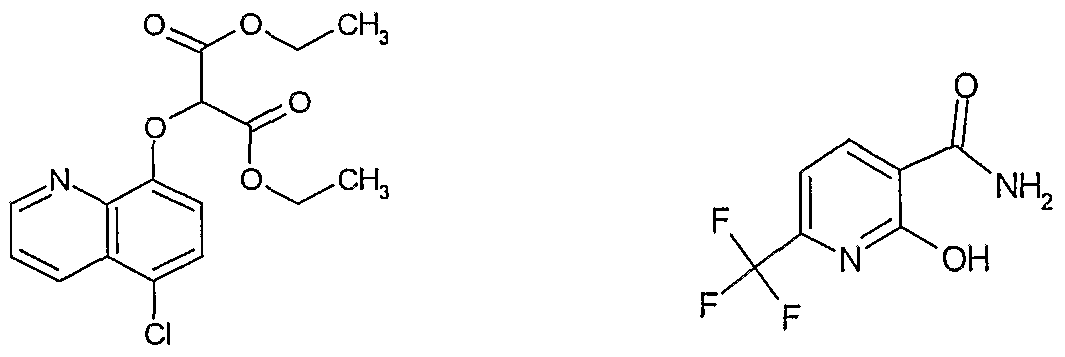
(S5) (S6)(S5) (S6)

(S7) (S8) (S9) (S10)(S7) (S8) (S9) (S10)
Eine Durchsicht von Gengruppen aus Signaltransduktionsketten und Stoffwechselwegen, die mit Stresstoleranz und Pathogenabwehr in Zusammenhang stehen, ergab u.a. eine starke Induktion von Genen für Protease- und Xylanase- Inhibitoren und Genen der Jasmonsäurebiosynthese (Tabelle 2a), sowie Genen für PR-Proteine und Chitinasen (Tabelle 2b), für eine Gruppe von Verbindungen, für die bisher eine Wirkung als Safener (S1-S6) bekannt ist. Tabelle 2aA review of gene groups from signal transduction chains and metabolic pathways associated with stress tolerance and pathogen defense revealed, among others, a strong induction of genes for protease and xylanase inhibitors and jasmonic acid biosynthesis genes (Table 2a), as well as genes for PR proteins and chitinases ( Table 2b), for a group of compounds for which an effect as safener (S1-S6) has hitherto been known. Table 2a
„Probe Set" Nummer S1 S2 S3 S4 S5 S6 S7 S8 S9 S10"Sample Set" Number S1 S2 S3 S4 S5 S6 S7 S8 S9 S10
1.1 Contig2631_at 1.00 1.00 97. 68 1.00 1.00 1.00 1.00 1.00 1.00 1.001.1 Contig2631_e 1.00 1.00 97. 68 1.00 1.00 1.00 1.00 1.00 1.00 1.00
1.2 HI02E21u_s_at 1.00 1.00 40.79 1.00 1.00 1.00 1.00 1.00 3.03 4.661.2 HI02E21u_s_at 1.00 1.00 40.79 1.00 1.00 1.00 1.00 1.00 3.03 4.66
1.3 Contig3097_at 1.00 1.00 8.51 1.00 1.00 1.00 1.00 2.11 1.00 1.001.3 Contig3097_e 1.00 1.00 8.51 1.00 1.00 1.00 1.00 2.11 1.00 1.00
1.4 Contig5146_at 7.73 4.47 4.50 4.72 5.35 6.77 1.00 1.00 1.00 1.001.4 Contig5146_at 7.73 4.47 4.50 4.72 5.35 6.77 1.00 1.00 1.00 1.00
1.5 Contig 4986_at 1.00 1.00 3.76 1.00 1.00 1.00 1.00 1.00 1.00 1.001.5 Contig 4986_at 1.00 1.00 3.76 1.00 1.00 1.00 1.00 1.00 1.00 1.00
1.6 HV_Ceb00201.6 HV_Ceb0020
D05r2_s_at 1.00 1.00 3.68 1.00 1.00 1.00 1.00 1.00 1.00 1.00D05r2_s_at 1.00 1.00 3.68 1.00 1.00 1.00 1.00 1.00 1.00 1.00
1.7 Contig6194_a_at 12.91 4.14 3.25 2.17 2.81 3.16 1.00 1.00 1.00 1.001.7 Contig6194_a_at 12.91 4.14 3.25 2.17 2.81 3.16 1.00 1.00 1.00 1.00
1.8 Contig9556_at 1.00 1.00 3.03 1.00 1.00 1.00 1.00 1.00 1.00 1.001.8 Contig9556_at 1.00 1.00 3.03 1.00 1.00 1.00 1.00 1.00 1.00 1.00
1.9 Contig 15_a_at 0.35 1.00 2.97 1.00 0.46 1.00 1.00 1.00 1.00 1.001.9 Contig 15_a_at 0.35 1.00 2.97 1.00 0.46 1.00 1.00 1.00 1.00 1.00
1.10 Contig 1736_at 1.00 1.00 2.91 1.00 1.00 1.00 1.00 1.00 1.00 1.001.10 Contig 1736_at 1.00 1.00 2.91 1.00 1.00 1.00 1.00 1.00 1.00 1.00
1.11 Contig 12574_at 0.50 1.00 2.81 1.00 1.00 1.00 1.00 2.11 1.00 1.001.11 Contig 12574_a 0.50 1.00 2.81 1.00 1.00 1.00 1.00 2.11 1.00 1.00
1.12 Contig6611_at 1.00 1.00 2.41 1.00 1.00 1.00 2.31 3.61 2.00 2.381.12 Contig6611_at 1.00 1.00 2.41 1.00 1.00 1.00 2.31 3.61 2.00 2.38
1.13 Contig 10030_at 1.00 1.00 2.25 1.00 1.00 1.00 1.00 1.00 1.00 1.001.13 Contig 10030_at 1.00 1.00 2.25 1.00 1.00 1.00 1.00 1.00 1.00 1.00
1.14 Contig2305_at 1.00 1.00 2.14 1.00 1.00 1.00 41.07 81.57 12.55 18.131.14 Contig2305_at 1.00 1.00 2.14 1.00 1.00 1.00 41.07 81.57 12.55 18.13
1.15 Contig 1737_at 1.00 1.00 1.00 1.00 , 1.00 1.00 1.00 1.00 1.00 1.001.15 Contig 1737_at 1.00 1.00 1.00 1.00, 1.00 1.00 1.00 1.00 1.00 1.00
1.16 Contig 3096_s_at 1.00 1.00 1.00 1.00 1.00 1.00 2.06 2.68 1.00 1.001.16 Contig 3096_s_at 1.00 1.00 1.00 1.00 1.00 1.00 2.06 2.68 1.00 1.00
1.17 Contig 13413_at 1.00 1.00 1.00 1.00 1.00 1.00 1.00 2.17 1.00 1.001.17 Contig 13413_at 1.00 1.00 1.00 1.00 1.00 1.00 1.00 2.17 1.00 1.00
1.18 Contig2326_s_at 2.31 1.00 1.00 2.45 1.00 1.00 1.00 1.00 1.00 1.001.18 Contig2326_s_at 2.31 1.00 1.00 2.45 1.00 1.00 1.00 1.00 1.00 1.00
1.19 Contig2330_x_at 4.03 2.39 1.00 2.83 1.00 2.55 1.00 1.00 1.00 1.001.19 Contig2330_x_at 4.03 2.39 1.00 2.83 1.00 2.55 1.00 1.00 1.00 1.00
1.20 Contig2337_at 4.89 1.00 1.00 1.00 1.00 1.00 1.00 1.00 1.00 1.001.20 Contig2337_at 4.89 1.00 1.00 1.00 1.00 1.00 1.00 1.00 1.00 1.00
2.1 Contig2088_s_at 1.00 1.00 4.26 1.00 1.00 1.00 4.79 7.36 2.36 2.412.1 Contig2088_s_at 1.00 1.00 4.26 1.00 1.00 1.00 4.79 7.36 2.36 2.41
2.2 Contig34_s__at 1.00 1.00 1.00 1.00 1.00 1.00 4.50 3.68 1.00 2.082.2 Contig34_s__at 1.00 1.00 1.00 1.00 1.00 1.00 4.50 3.68 1.00 2.08
2.3 Contig88_x__at 1.00 1.00 4.53 1.00 1.00 1.00 21.86 22.94 4.59 4.412.3 Contig88_x__at 1.00 1.00 4.53 1.00 1.00 1.00 21.86 22.94 4.59 4.41
2.4 HD07M22r_s_at 6.32 1.00 2.71 1.00 7.84 5.10 1.00 1.00 1.00 1.002.4 HD07M22r_s_at 6.32 1.00 2.71 1.00 7.84 5.10 1.00 1.00 1.00 1.00
3.1 Contig8905_at 3.10 2.53 2.99 2.73 3.01 2.45 1.00 1.00 2.53 1.003.1 Contig8905_at 3.10 2.53 2.99 2.73 3.01 2.45 1.00 1.00 2.53 1.00
Gemessene Expressionswerte (x-fach über dem Wert der unbehandelten Kontrolle) für:Measured expression values (x times above the value of the untreated control) for:
(a) Gene der pflanzlichen Jasmonsäurebiosynthese (1.1 - 1.20)(a) Genes of Plant Jasmonic Acid Biosynthesis (1.1 - 1.20)
(b) Gene, die für pflanzliche Proteinase-Inhibitoren codieren (2.1 - 2.4)(b) Genes Encoding Herbal Proteinase Inhibitors (2.1-2.4)
(c) Gen, das für einen pflanzlichen Xylanase-Inhibitor codiert (3.1) Die „Probe Set"-Nummer entspricht der jeweiligen DNA-Chip-Position des(c) gene encoding a plant xylanase inhibitor (3.1) The "Probe Set" number corresponds to the respective DNA chip position of the
Affymetrix-Chips.Affymetrix chips.
Der „Probe Set"-Nummer kann mit Hilfe einer Blast-Analyse die bestmögliche korrespondierende bekannte Sequenz aus anderen annotiertenThe "Probe Set" number can annotate the best possible corresponding known sequence from others using a blast analysis
Sequenzdatenbanken zugeordnet werden. Diese gemäß Blast-Analyse aufgeführtenSequence databases are assigned. These are listed according to blast analysis
Daten sind nachfolgend aufgeführt.Data is listed below.
„Probe Set"-Nummer korrespondierende Sequenz mit annotierter Funktion, aus allgemein zugänglicher DNA oder Proteindatenbank"Probe Set" number Corresponding sequence with annotated function, from publicly available DNA or protein database
1.1 Lipase-like Protein (Oryza sativa; japonica cultivar group)1.1 lipase-like protein (Oryza sativa; japonica cultivar group)
1.2 Lipoxygenase (EC 1.13.11.12) barley gbAAB708651.2 Lipoxygenase (EC 1.13.11.12) barley gbAAB70865
1.3 Allene oxide synthase (Horedeum vulgäre subsp. vulgäre)1.3 Allene oxide synthase (Horedeum vulgare subsp. Vulgaris)
1.4 Probable 12-oxophytodienoate reductase (EC 1.3.1.42)1.4 Probable 12-oxophytodienoate reductase (EC 1.3.1.42)
1.5 Allene oxide cyclase (Oryza sativa; japonica cultivar group)1.5 Allene oxide cyclase (Oryza sativa; japonica cultivar group)
1.6 Allene oxide cyclase (Oryza sativa; japonica cultivar group)1.6 Allene oxide cyclase (Oryza sativa; japonica cultivar group)
1.7 12-oxophytodienoic acid reductase (Oryza sativa)1.7 12-oxophytodienoic acid reductase (Oryza sativa)
1.8 12-oxophytodienoate reductase 3 (Lycopersicon esculentum)1.8 12-oxophytodienoate reductase 3 (Lycopersicon esculentum)
1.9 GDSL-motif lipase/hydrolase-like protein, At5g55050.11.9 GDSL-motif lipase / hydrolase-like protein, At5g55050.1
1.10 Lipoxygenase 1 pir T05941 (EC 1.13.11.12) barley1.10 Lipoxygenase 1 pir T05941 (EC 1.13.11.12) barley
1.11 Putative lipoxygenase (Oryza sativa, japonica cultivar group)1.11 Putative lipoxygenase (Oryza sativa, japonica cultivar group)
1.12 Similar to lipases (Arabidopsis thaliana; gb AAM20450.11.12 Similar to lipases (Arabidopsis thaliana; gb AAM20450.1
1.13 Putative lipase homolog (Oryza sativa; japonica cultivar group)1.13 Putative lipase homologue (Oryza sativa; japonica cultivar group)
1.14 Methyljasmonate inducible lipoxygenase gbAAC12951.11.14 Methyl jasmonate inducible lipoxygenase gbAAC12951.1
1.15 Probable lipoxygenase gbAAB60715.11.15 Probable lipoxygenase gbAAB60715.1
1.16 Allen oxide synthase (Hordeum vulgäre subsp. vulgäre)1.16 Allen oxides synthase (Hordeum vulgare subsp. Vulgaris)
1.17 Similar to lipases (Arabidopsis thaliana; gb AAM20450.1 )1.17 Similar to lipases (Arabidopsis thaliana; gb AAM20450.1)
1.18 12-oxophytodienoic acid reductase (Oryza sativa)1.18 12-oxophytodienoic acid reductase (Oryza sativa)
1.19 12-oxophytodienoic acid reductase (Oryza sativa)1.19 12-oxophytodienoic acid reductase (Oryza sativa)
1.20 12-oxophytodienoate reductase (OPR1 ) At1 g76680.1 „Probe Set"-Nummer korrespondierende Sequenz mit annotierter Funktion, aus allgemein zugänglicher DNA oder Proteindatenbank1.20 12-oxophytodienoate reductase (OPR1) At1 g76680.1 "Probe Set" number Corresponding sequence with annotated function, from publicly available DNA or protein database
2.1 Bowman-Birk type trypsin inhibitor2.1 Bowman-Birk type trypsin inhibitor
2.2 Putative Proteinase inhibitor (Hordeum vulgäre subsp. vulgäre)2.2 Putative proteinase inhibitor (Hordeum vulgare subsp. Vulgaris)
2.3 Putative Proteinase inhibitor (Hordeum vulgäre subsp. vulgäre)2.3 Putative proteinase inhibitor (Hordeum vulgare subsp. Vulgaris)
2.4 Proteinase-Inhibitor (pir S71555, barley)2.4 Proteinase inhibitor (pir S71555, barley)
3.1 Xylanase inhibitor protein (Triticum aestivum)3.1 xylanase inhibitor protein (Triticum aestivum)
Tabelle 2bTable 2b
„Probe Set"- Nummer S1 S2 S3 S4 S5 S6 S7 S8 S9 S10"Sample Set" - number S1 S2 S3 S4 S5 S6 S7 S8 S9 S10
4.1 Contig2118_at 8.69 1.00 4.86 1.00 2.33 2.20 1 .00 1.00 1 .00 1.004.1 Contig2118_at 8.69 1.00 4.86 1.00 2.33 2.20 1 .00 1.00 1 .00 1.00
4.2 Contig5369_at 2.35 1.00 4.76 1.00 1.00 1.00 1 .00 1.00 1 .00 1.004.2 Contig5369_at 2.35 1.00 4.76 1.00 1.00 1.00 1 .00 1.00 1 .00 1.00
4.3 Contig5607_s_at 18.64 15.56 13.36 18.38 8.75 9.99 1 .00 1.00 1 .00 1.004.3 Contig5607_s_at 18.64 15.56 13.36 18.38 8.75 9.99 1 .00 1.00 1 .00 1.00
5.1 Contig2990_at 4.17 1.00 2.77 1.00 1.00 1.00 1. 00 1.00 2. 39 1.005.1 Contig2990_at 4.17 1.00 2.77 1.00 1.00 1.00 1.00 1.00 2. 39 1.00
5.2 Contig2992_s_at 6.50 1.00 2.19 1.00 3.12 2.27 1. 00 1.00 2. 14 1.005.2 Contig2992_s_at 6.50 1.00 2.19 1.00 3.12 2.27 1.00 1.00 2. 14 1.00
5.3 Contig5023_at 9.51 3.18 1.00 1.00 2.73 1.00 1. 00 1.00 4. 56 1.005.3 Contig5023_at 9.51 3.18 1.00 1.00 2.73 1.00 1.00 1.00 4. 56 1.00
Gemessene Expressionswerte (x-fach über dem Wert der unbehandelten Kontrolle) fürMeasured expression values (x-fold above the value of the untreated control) for
(a) Gene, die für pflanzliche PR-Proteine codieren (4.1 - 4.3)(a) Genes Encoding Plant PR Proteins (4.1 - 4.3)
(b) Gene, die für pflanzliche Chitinasen codieren (5.1 - 5.3)(b) Genes encoding plant chitinases (5.1 - 5.3)
Die „Probe Sef-Nummer entspricht der jeweiligen DNA-Chip-Position desThe sample Sef number corresponds to the respective DNA chip position of the
Affymetrix-Chips.Affymetrix chips.
Der „Probe Sef-Nummer kann mit Hilfe einer Blast-Analyse die bestmögliche korrespondierende bekannte Sequenz aus anderen annotiertenThe sample Sef number can annotate the best possible corresponding known sequence from others using a blast analysis
Seqeunzdatenbanken zugeordnet werden. Diese gemäß Blast-Analyse aufgeführtenBe assigned to Seqeunzdatenbanken. These are listed according to blast analysis
Daten sind nachfolgend aufgeführt. „Probe Set"- Nummer korrespondierende Sequenz mit annotierter Funktion, aus allgemein zugänglicher DNA oder ProteindatenbankData is listed below. "Probe Set" - Number corresponding sequence with annotated function, from generally available DNA or protein database
4.1 Peroxidase (EC 1.11.1.7), pathogen-induced (barley)4.1 peroxidase (EC 1.11.1.7), pathogen-induced (barley)
4.2 Pathogen related protein; (Oryza sativa; gbAAL74406.1)4.2 pathogen related protein; (Oryza sativa; gbAAL74406.1)
4.3 Pathogen-related protein (barely; PirT06168)4.3 Pathogen-related protein (barely; PirT06168)
5.1 Chitinase (EC 3.2.1.14) (Barley; embCAA55344.1 )5.1 chitinase (EC 3.2.1.14) (Barley; embCAA55344.1)
5.2 Chitinase (EC 3.2.1.14) (Barley; embCAA55344.1)5.2 Chitinase (EC 3.2.1.14) (Barley; embCAA55344.1)
5.3 Class III chitinase (Oryza sativa subsp. japonica; gbAAM08773.1 )5.3 Class III chitinase (Oryza sativa subsp. Japonica; gbAAM08773.1)
Die aus diesen Tabellen abgeleiteten Induktionsmuster, die direkt durch die erhaltenen Expressionswerte dargestellt werden, zeigen charakteristische Unterschiede zwischen Safenern und Resistenzinduktoren, wobei die Wirkung auf die Jasmonsäure-Biosynthese beim Isoxadifen am stärksten ausgeprägt ist. Die gefundenen Expressionsmuster erlauben das Auffinden von Substanzen mit einer ähnlichen Signatur und legen den Schluß auf eine gleichartige Wirkung dieser Substanzen in der Aktivierung der pflanzlichen Pathogenabwehr nahe.The induction patterns derived from these tables, which are directly represented by the expression values obtained, show characteristic differences between safeners and resistance inducers, with the effect on isobasone biosynthesis most pronounced in isoxadifen. The expression patterns found allow the discovery of substances with a similar signature and suggest the conclusion of a similar effect of these substances in the activation of plant pathogen defense.
Beispiel 2Example 2
Abstoßende Wirkung von Safener-behandelten Pflanzen auf phvtopathogene Insekten:Repulsive effect of safener-treated plants on phytopathogenic insects:
Gerstepflanzen (Sorte Baronesse) wurden wie in Beispiel 1 beschrieben angezogen und nach 10 Tagen mit 150 g a.i./ha Isoxadifen-ethyl (S 3) bzw. Blindformulierung durch Spritzapplikation behandelt. Die Versuche wurden in Replikaten von je 10 Töpfen durchgeführt.Barley plants (variety Baronesse) were grown as described in Example 1 and treated after 10 days with 150 g a.i./ha isoxadifen-ethyl (S 3) or blind formulation by spray application. The experiments were carried out in replicas of 10 pots each.
Alle Töpfe wurden 6 h bzw. 24 h nach Substanzapplikation mit einer Population der phytopathogenen Blattlaus Rhopalosiphum padi gleichmäßig beimpft. Die Versuche wurden nach 7 Tagen und 14 Tagen durch Auszählen der an den Blättern befindlichen Tiere ausgewertet.All pots were inoculated evenly 6 h or 24 h after substance administration with a population of the phytopathogenic aphid Rhopalosiphum padi. The experiments were evaluated after 7 days and 14 days by counting the animals on the leaves.
Die Blattlauspopulationen waren auf den Safener-behandelten Pflanzen gegenüber den Kontrollen nach 7 Tagen um durchschnittlich 50 % und nach 14 Tagen um durchschnittlich 70 % reduziert.The aphid populations on the safener-treated plants were reduced by an average of 50% on the 7-day controls and by 70% on average after 14 days.
Eine direkte Toxizität von Isoxadifen-ethyl (S3) gegen Blattläuse konnte im Sachez-Direct toxicity of isoxadifen-ethyl (S3) to aphids
Test ohne Pflanzen nicht nachgewiesen werden.Test without plants can not be proven.
Beispiel 3Example 3
Nachweis von erhöhtem Oxophytodienoat (OPDA) - und Jasmonat (JA) -Detection of elevated oxophytodienoate (OPDA) - and jasmonate (JA) -
Konzentrationen in Isoxadifen-behandelten PflanzenConcentrations in isoxadifen-treated plants
Gerstepflanzen (Varietät Baronesse) wurden gemäß den in in Beispiel 1 beschriebenen Konditionen angezogen und durch Spritzapplikation mit SafenerBarley plants (variety Baronesse) were grown according to the conditions described in Example 1 and by spray application with safener
Isoxadifen-ethyl (S 3) behandelt.Isoxadifen-ethyl (S 3) treated.
Die Aufwandmengen waren wie folgt gewählt:The application rates were chosen as follows:
(1) 30 [g a.i./ha] ; (2) 150 [g a.i./ha] ; (3) Blindformulierung (kein Wirkstoff)(1) 30 [g.a./ha]; (2) 150 [g.a./ha]; (3) blind formulation (no active ingredient)
Die Pflanzenblätter wurden nach der Behandlung zu verschiedenen ZeitpunktenThe plant leaves were after treatment at different times
(h=Stunden) geerntet, und zwar nach 1h, 2h, 4h, 6h, 12h, 24h und 48h. Alle Proben waren jeweils als Replikate von 3 Töpfen angelegt.(h = hours), after 1h, 2h, 4h, 6h, 12h, 24h and 48h. All samples were each designed as replicates of 3 pots.
Die Aufarbeitung der Octadecanoide und Jasmonate aus den Blättern wurde nach einer in der Literatur beschriebenen Methode durchgeführt (Müller A, Düchting P undThe workup of the octadecanoids and jasmonates from the leaves was carried out according to a method described in the literature (Müller A, Düchting P and
Weiler EW (2002), A multiplex GC-MS / MS technique for the sensitive and quantitative single-run analysis of acidic phytohormones and related Compounds, and its application to Arabidopsis thaliana. Planta, 216, 44-56).Weiler EW (2002), A multiplex GC-MS / MS technique for the sensitive and quantitative single-run analysis of acidic phytohormones and related compounds, and its application to Arabidopsis thaliana. Planta, 216, 44-56).
Für jeden Messpunkt wurden 300mg Pflanzenmaterial extrahiert.300mg of plant material was extracted for each measurement point.
Zur internen Standardisierung wurden 50 pmol [13C]2-JA undFor internal standardization, 50 pmol [ 13 C] 2-JA and
100 pmol [17,17,17,18,18-2H]-CiS-OPDA eingesetzt. Die Aufreinigung der Extrakte erfolgte über Aminopropyl-Anionenaustausch-Chromatographie in selbst hergestellten Miniatur-Festphasenaustauscher-Säulen. Die Ergebnisse sind in den Tabellen 3a bis 3d dargestellt, wobei angegebenen Werte jeweils Mittelwerte aus den 3 Replikaten darstellen.100 pmol [17,17,17,18,18- 2 H] -cis-OPDA used. The purification of the extracts was carried out by aminopropyl anion exchange chromatography in self-made miniature solid-phase exchange columns. The results are shown in Tables 3a to 3d, where indicated values represent mean values from the three replicates.
Tabelle 3aTable 3a
Gemessene Oxophytodienoat (OPDA)-Konzentration in pmol/g BlattgewebeMeasured oxophytodienoate (OPDA) concentration in pmol / g leaf tissue
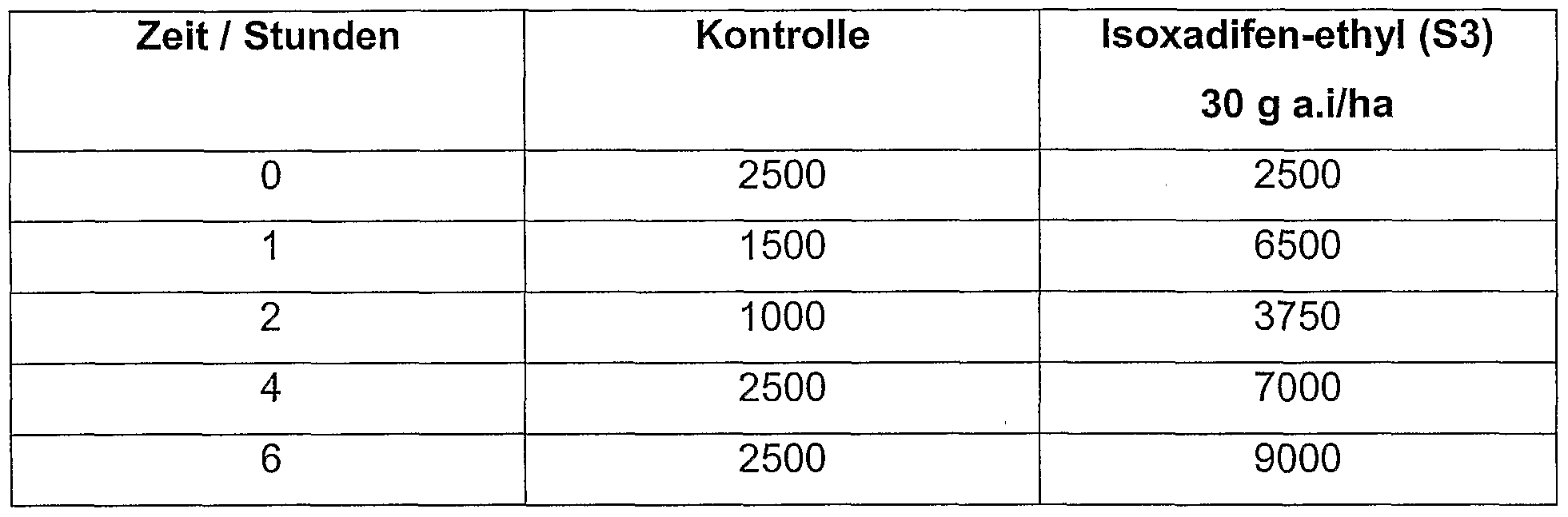
Tabelle 3 bTable 3 b
Gemessene Oxophytodienoat (OPDA)-Konzentration in pmol/g BlattgewebeMeasured oxophytodienoate (OPDA) concentration in pmol / g leaf tissue

Gemessene Jasmonat (JA)-Konzentration in pmol/g BlattgewebeMeasured jasmonate (JA) concentration in pmol / g leaf tissue

Tabelle 3 dTable 3 d
Gemessene Jasmonat (JA)-Konzentration in pmol/g BlattgewebeMeasured jasmonate (JA) concentration in pmol / g leaf tissue

Die Konzentrationen an Oxophytodienoat (OPDA)Jagen im Bereich von 1800-9000 pmol/g Blattgewebe, bei Jasmonat (JA) im Bereich von 70-800 pmol/g Blattgewebe. Nach Behandlung mit Isoxadifen-ethyl (S 3) konnte ein deutlicher Anstieg der Konzentrationen von beiden Substanzen bis auf das ca. 5 fache der Werte in den Blindformulierungsproben ohne Wirkstoff gemessen werden. The concentrations of oxophytodienoate (OPDA) hunt in the range of 1800-9000 pmol / g leaf tissue, in jasmonate (JA) in the range of 70-800 pmol / g leaf tissue. After treatment with isoxadifen-ethyl (S 3), a significant increase in the concentrations of both substances to about 5 times the values in the blank formulation samples without active ingredient could be measured.
Claims
Priority Applications (10)
| Application Number | Priority Date | Filing Date | Title |
|---|---|---|---|
| CA2575404A CA2575404C (en) | 2004-07-20 | 2005-07-07 | Active substances for increasing pathogenic defence in plants and methods for the detection thereof |
| EP05762739.0A EP1771576B1 (en) | 2004-07-20 | 2005-07-07 | Active substances for increasing pathogenic defence in plants and methods for the detection thereof |
| CN200580023479XA CN1985008B (en) | 2004-07-20 | 2005-07-07 | Active substances for increasing pathogenic defence in plants and methods for the detection thereof |
| PL05762739T PL1771576T3 (en) | 2004-07-20 | 2005-07-07 | Active substances for enhancing the control of pathogens in plants and methods of their detection |
| AU2005263440A AU2005263440B2 (en) | 2004-07-20 | 2005-07-07 | Active substances for increasing pathogenic defence in plants and methods for the detection thereof |
| JP2007521835A JP5408875B2 (en) | 2004-07-20 | 2005-07-07 | Active substances that increase plant pathogen defense and methods for their detection |
| US11/632,825 US20070265164A1 (en) | 2004-07-20 | 2005-07-07 | Active Substances for Increasing Pathogenic Defense in Plants and Methods for the Detection Thereof |
| ES05762739.0T ES2440472T3 (en) | 2004-07-20 | 2005-07-07 | Active principles for increasing defense against pathogens in plants and procedures for their detection |
| IL180572A IL180572A0 (en) | 2004-07-20 | 2007-01-04 | Active ingredients for enhancing pathogen defense in plants, and methods of finding them |
| US14/037,119 US20140094363A1 (en) | 2004-07-20 | 2013-09-25 | Active Substance for Increasing Pathogenic Defense in Plants and Methods for the Defection Thereof |
Applications Claiming Priority (2)
| Application Number | Priority Date | Filing Date | Title |
|---|---|---|---|
| DE102004035137A DE102004035137A1 (en) | 2004-07-20 | 2004-07-20 | Active ingredients for increasing pathogen defense in plants and methods for their detection |
| DE102004035137.6 | 2004-07-20 |
Related Child Applications (2)
| Application Number | Title | Priority Date | Filing Date |
|---|---|---|---|
| US11/632,825 A-371-Of-International US20070265164A1 (en) | 2004-07-20 | 2005-07-07 | Active Substances for Increasing Pathogenic Defense in Plants and Methods for the Detection Thereof |
| US14/037,119 Division US20140094363A1 (en) | 2004-07-20 | 2013-09-25 | Active Substance for Increasing Pathogenic Defense in Plants and Methods for the Defection Thereof |
Publications (1)
| Publication Number | Publication Date |
|---|---|
| WO2006007981A1 true WO2006007981A1 (en) | 2006-01-26 |
Family
ID=34979873
Family Applications (1)
| Application Number | Title | Priority Date | Filing Date |
|---|---|---|---|
| PCT/EP2005/007344 Ceased WO2006007981A1 (en) | 2004-07-20 | 2005-07-07 | Active substances for increasing pathogenic defence in plants and methods for the detection thereof |
Country Status (14)
| Country | Link |
|---|---|
| US (2) | US20070265164A1 (en) |
| EP (1) | EP1771576B1 (en) |
| JP (1) | JP5408875B2 (en) |
| KR (1) | KR20070105958A (en) |
| CN (1) | CN1985008B (en) |
| AR (1) | AR049723A1 (en) |
| AU (1) | AU2005263440B2 (en) |
| CA (1) | CA2575404C (en) |
| DE (1) | DE102004035137A1 (en) |
| ES (1) | ES2440472T3 (en) |
| IL (1) | IL180572A0 (en) |
| PL (1) | PL1771576T3 (en) |
| TW (1) | TW200617177A (en) |
| WO (1) | WO2006007981A1 (en) |
Cited By (39)
| Publication number | Priority date | Publication date | Assignee | Title |
|---|---|---|---|---|
| EP1987717A1 (en) * | 2007-04-30 | 2008-11-05 | Bayer CropScience AG | Pyridon carboxamides, agents containing these but not impacting useful plants and method for their manufacture and application |
| EP1987718A1 (en) * | 2007-04-30 | 2008-11-05 | Bayer CropScience AG | Utilisation of pyridine-2-oxy-3-carbon amides as safener |
| EP2052607A1 (en) | 2007-10-24 | 2009-04-29 | Bayer CropScience AG | Herbicide combination |
| EP2052616A1 (en) | 2007-10-24 | 2009-04-29 | Bayer CropScience AG | Herbicide safener combination |
| EP2052608A1 (en) | 2007-10-24 | 2009-04-29 | Bayer CropScience AG | Herbicide combination |
| EP2052610A1 (en) | 2007-10-24 | 2009-04-29 | Bayer CropScience AG | Herbicide combination |
| EP2052614A1 (en) | 2007-10-24 | 2009-04-29 | Bayer CropScience AG | Herbicide combination |
| EP2052612A1 (en) | 2007-10-24 | 2009-04-29 | Bayer CropScience AG | Herbicide combination |
| EP2052609A1 (en) | 2007-10-24 | 2009-04-29 | Bayer CropScience AG | Herbicide combination |
| EP2052611A1 (en) | 2007-10-24 | 2009-04-29 | Bayer CropScience AG | Herbicide combination |
| EP2052603A1 (en) | 2007-10-24 | 2009-04-29 | Bayer CropScience AG | Application of 2-lodo-N-[(4-methoxy-6-methyl-1,3,5-triazin-2-yl)carbamoyl] benzol sulphonamide and/or its salts for inhibiting unwanted plant growth in selected agricultural crop cultures or non-cultivated land |
| EP2052615A1 (en) | 2007-10-24 | 2009-04-29 | Bayer CropScience AG | Herbicide combination |
| EP2052613A1 (en) | 2007-10-24 | 2009-04-29 | Bayer CropScience AG | Herbicide combination |
| EP2052606A1 (en) | 2007-10-24 | 2009-04-29 | Bayer CropScience AG | Herbicide combination |
| EP2052604A1 (en) | 2007-10-24 | 2009-04-29 | Bayer CropScience AG | Salts of 2-lodo-N-[(4-methoxy-6-methyl-1,3,5-triazin-2-yl)carbamoyl] benzol sulphonamide, method for its manufacture and its application as herbicide and plant growth regulator |
| EP2103216A1 (en) | 2008-03-19 | 2009-09-23 | Bayer CropScience AG | Selected salts from 3-(5,6-dihydro-1,4,2-dioxazin-3-yl)-N-[(4,6-dimethoxypyrimidin-2-yl)carbamoyl] pyridine-2-sulfonamide, methods for their production and their usage as herbicides and plant growth regulators |
| EP2135865A1 (en) | 2008-06-17 | 2009-12-23 | Bayer CropScience AG | Substituted 1-(diazinyl)pyrazol-4-yl acetic acids, method for their production and their use as herbicides and plant growth regulators |
| WO2010003444A2 (en) | 2008-07-09 | 2010-01-14 | Bayer Cropscience Ag | Plant growth regulator |
| EP2194052A1 (en) | 2008-12-06 | 2010-06-09 | Bayer CropScience AG | Substituted 1.(1-thiazolyl)- and 1-(isothiazolyl)pyrazol-4-yl acetic acids, method for their production and their use as herbicides and plant growth regulators |
| WO2011073098A1 (en) | 2009-12-15 | 2011-06-23 | Bayer Cropscience Ag | 1-(heteroaryl)-pyrazol-4-yl-acetic acids, method for the production thereof, and the use thereof as herbicides and plant growth regulators |
| WO2011076877A1 (en) | 2009-12-23 | 2011-06-30 | Bayer Cropscience Ag | Plants tolerant to hppd inhibitor herbicides |
| WO2011076882A1 (en) | 2009-12-23 | 2011-06-30 | Bayer Cropscience Ag | Plants tolerant to hppd inhibitor herbicides |
| WO2011076889A1 (en) | 2009-12-23 | 2011-06-30 | Bayer Cropscience Ag | Plants tolerant to hppd inhibitor herbicides |
| WO2011076885A1 (en) | 2009-12-23 | 2011-06-30 | Bayer Cropscience Ag | Plants tolerant to hppd inhibitor herbicides |
| WO2011076892A1 (en) | 2009-12-23 | 2011-06-30 | Bayer Cropscience Ag | Plants tolerant to hppd inhibitor herbicides |
| WO2011107445A1 (en) | 2010-03-04 | 2011-09-09 | Bayer Cropscience Ag | Hydrate and anhydrous crystal form of the sodium salt of 2-iodo-n-[(4-methoxy-6-methyl-1,3,5-triazin-2-yl)carbamoyl]benzenesulfonamide, process for preparation thereof and use thereof as herbicides and plant growth regulators |
| WO2012029539A1 (en) * | 2010-08-31 | 2012-03-08 | Tokyo University Of Science Educational Foundation Administrative Organization | Method of screening for plant defense activators, plant defense activators, and method of enhancing immune response |
| WO2012126764A1 (en) | 2011-03-18 | 2012-09-27 | Bayer Cropscience Ag | Substituted 4-cyan-3-(2,6-difluorophenyl)-4-phenylbutanoates, method for the production thereof and use thereof as herbicides and plant growth regulators |
| WO2012126765A1 (en) | 2011-03-18 | 2012-09-27 | Bayer Cropscience Ag | Substituted (3r,4r)-4-cyan-3,4-diphenylbutanoates, method for the production thereof and use thereof as herbicides and plant growth regulators |
| WO2012130684A1 (en) | 2011-03-25 | 2012-10-04 | Bayer Cropscience Ag | Use of n-(1,2,5-oxadiazol-3-yl)benzamides for controlling unwanted plants in areas of transgenic crop plants being tolerant to hppd inhibitor herbicides |
| WO2012130685A1 (en) | 2011-03-25 | 2012-10-04 | Bayer Cropscience Ag | Use of n-(tetrazol-4-yl)- or n-(triazol-3-yl)arylcarboxamides or their salts for controlling unwanted plants in areas of transgenic crop plants being tolerant to hppd inhibitor herbicides |
| WO2013010882A2 (en) | 2011-07-15 | 2013-01-24 | Bayer Intellectual Property Gmbh | 2,3-diphenyl-valeronitrile derivatives, method for the production thereof and use thereof as herbicides and plant growth regulators |
| WO2013037958A1 (en) | 2011-09-16 | 2013-03-21 | Bayer Intellectual Property Gmbh | Use of phenylpyrazolin-3-carboxylates for improving plant yield |
| WO2013037956A1 (en) | 2011-09-16 | 2013-03-21 | Bayer Intellectual Property Gmbh | Use of 5-phenyl- or 5-benzyl-2 isoxazoline-3 carboxylates for improving plant yield |
| WO2013064462A1 (en) | 2011-10-31 | 2013-05-10 | Bayer Intellectual Property Gmbh | Substituted 4-cyano-3-phenyl-4-(pyridin-3-yl)butanoates, processes for preparation thereof and use thereof as herbicides and plant growth regulators |
| WO2013092500A1 (en) | 2011-12-19 | 2013-06-27 | Bayer Intellectual Property Gmbh | Substituted 4-cyan-3-phenyl-4-(pyridine-3-yl)butanoates, processes for preparation thereof and use thereof as herbicides and plant growth regulators. |
| WO2014195253A1 (en) | 2013-06-07 | 2014-12-11 | Bayer Cropscience Ag | Substituted 5-hydroxy-2,3-diphenylpentanonitrile derivatives, processes for their preparation and their use as herbicides and/or plant growth regulators |
| WO2015004040A1 (en) * | 2013-07-09 | 2015-01-15 | Bayer Cropscience Ag | Use of selected pyridone carboxamides or salts thereof as active substances against abiotic plant stress |
| US9963431B2 (en) | 2013-03-05 | 2018-05-08 | Bayer Cropscience Ag | Use of quinoline derivatives for improving plant yield |
Families Citing this family (5)
| Publication number | Priority date | Publication date | Assignee | Title |
|---|---|---|---|---|
| CN101591384B (en) * | 2008-08-28 | 2012-05-23 | 江苏省中国科学院植物研究所 | Lycoris plant protein (LrPR4) resistant to blast fungus and its encoding gene and application |
| CA2799436A1 (en) | 2010-05-28 | 2011-12-01 | Jon Frederick Fobes | Methods for identifying compositions that alter wildtype expression of genes and proteins in a plant cell |
| EP2592931A4 (en) * | 2010-07-13 | 2013-12-11 | Syngenta Participations Ag | PHYTOPROTECTIVE COMPOSITIONS AND METHODS FOR REDUCING MYCOTOXINS |
| CN112725364B (en) * | 2020-03-31 | 2021-12-03 | 湖南农业大学 | OPR gene for regulating and controlling rape fatty acid and expression vector and application thereof |
| CN119913190B (en) * | 2023-10-30 | 2025-10-17 | 中国农业大学 | Application of OPR-7S protein and its encoding gene in regulating lodging resistance in wheat |
Citations (5)
| Publication number | Priority date | Publication date | Assignee | Title |
|---|---|---|---|---|
| EP0464830A1 (en) | 1990-07-06 | 1992-01-08 | Agro-Kanesho Co., Ltd. | Organophosphorus compounds, method for preparing same and insecticides, acaricides and nematocides containing same |
| EP0528156A1 (en) | 1991-07-16 | 1993-02-24 | Bayer Ag | 3-Aryl-4-hydroxy-delta3-dihydrofuranone and 3-aryl-4-hydroxy-delta3-dihydrothiophenone derivatives |
| EP0596298A2 (en) | 1992-10-28 | 1994-05-11 | Bayer Ag | 5-Spirosubstituted 1-H-3-aryl-pyrrolidin-2,4-dione derivatives as herbicides, insecticides and acaricides |
| WO1998000023A2 (en) * | 1996-07-01 | 1998-01-08 | Zeneca Limited | Plant protection method |
| EP1013767A1 (en) * | 1998-12-22 | 2000-06-28 | American Cyanamid Company | Method of screening for agrochemicals |
Family Cites Families (7)
| Publication number | Priority date | Publication date | Assignee | Title |
|---|---|---|---|---|
| AU687383B2 (en) * | 1993-06-02 | 1998-02-26 | Bayer Corporation | Combined use of chemicals and microbials in cockroach control |
| DE19901943A1 (en) * | 1999-01-20 | 2000-07-27 | Bayer Ag | Use of 2,3-dihydro-2-oxo-5,5-tetramethylene-3-(2,4,6-trimethylphenyl)-4-furyl 3,3-dimethylbutanoate to control whitefly |
| RU2351132C2 (en) * | 2001-01-31 | 2009-04-10 | Байер Кропсайенс Аг | Herbicide-antidote combination and method of killing weeds in crops |
| DE10146590A1 (en) * | 2001-09-21 | 2003-04-10 | Bayer Cropscience Ag | Selective herbicides based on substituted thien-3-yl-sulfonylamino (thio) carbonyl-triazolin (thi) ones and safeners |
| MXPA05006211A (en) * | 2002-12-13 | 2005-08-19 | Bayer Cropscience Gmbh | Oil suspension concentrate. |
| DE10258867A1 (en) * | 2002-12-17 | 2004-07-08 | Bayer Cropscience Gmbh | Microemulsion concentrates |
| KR20050114652A (en) * | 2003-03-13 | 2005-12-06 | 바스프 악티엔게젤샤프트 | Synergistically acting herbicidal mixtures |
-
2004
- 2004-07-20 DE DE102004035137A patent/DE102004035137A1/en not_active Withdrawn
-
2005
- 2005-07-07 CN CN200580023479XA patent/CN1985008B/en not_active Expired - Fee Related
- 2005-07-07 US US11/632,825 patent/US20070265164A1/en not_active Abandoned
- 2005-07-07 ES ES05762739.0T patent/ES2440472T3/en not_active Expired - Lifetime
- 2005-07-07 KR KR1020077001054A patent/KR20070105958A/en not_active Withdrawn
- 2005-07-07 AU AU2005263440A patent/AU2005263440B2/en not_active Ceased
- 2005-07-07 EP EP05762739.0A patent/EP1771576B1/en not_active Expired - Lifetime
- 2005-07-07 CA CA2575404A patent/CA2575404C/en not_active Expired - Fee Related
- 2005-07-07 JP JP2007521835A patent/JP5408875B2/en not_active Expired - Fee Related
- 2005-07-07 PL PL05762739T patent/PL1771576T3/en unknown
- 2005-07-07 WO PCT/EP2005/007344 patent/WO2006007981A1/en not_active Ceased
- 2005-07-18 AR ARP050102963A patent/AR049723A1/en unknown
- 2005-07-19 TW TW094124353A patent/TW200617177A/en unknown
-
2007
- 2007-01-04 IL IL180572A patent/IL180572A0/en unknown
-
2013
- 2013-09-25 US US14/037,119 patent/US20140094363A1/en not_active Abandoned
Patent Citations (5)
| Publication number | Priority date | Publication date | Assignee | Title |
|---|---|---|---|---|
| EP0464830A1 (en) | 1990-07-06 | 1992-01-08 | Agro-Kanesho Co., Ltd. | Organophosphorus compounds, method for preparing same and insecticides, acaricides and nematocides containing same |
| EP0528156A1 (en) | 1991-07-16 | 1993-02-24 | Bayer Ag | 3-Aryl-4-hydroxy-delta3-dihydrofuranone and 3-aryl-4-hydroxy-delta3-dihydrothiophenone derivatives |
| EP0596298A2 (en) | 1992-10-28 | 1994-05-11 | Bayer Ag | 5-Spirosubstituted 1-H-3-aryl-pyrrolidin-2,4-dione derivatives as herbicides, insecticides and acaricides |
| WO1998000023A2 (en) * | 1996-07-01 | 1998-01-08 | Zeneca Limited | Plant protection method |
| EP1013767A1 (en) * | 1998-12-22 | 2000-06-28 | American Cyanamid Company | Method of screening for agrochemicals |
Non-Patent Citations (19)
| Title |
|---|
| "Biochemistry and Molecular Biology of Plants", 2000, AMERICAN SOCIETY OF PLANT PHYSIOLOGISTS, pages: 850 - 929 |
| "Pflanzenbiochemie", SPEKTRUM AKADEMISCHER VERLAG, pages: 393 - 462 |
| "The Pesticide Manual", 2003 |
| ACHUO ET AL., PLANT PATHOLOGY, vol. 53, no. 1, 2004, pages 65 - 72 |
| ALTSCHUL ET AL., J. MOL. BIOL., vol. 215, 1990, pages 403 - 410 |
| DANGL; JONES, NATURE, vol. 411, 2001, pages 826 - 833 |
| FEUSSNER I ET AL: "Induction of a new lipoxygenase form of cucumber leaves by salicylic acid or 2,6-dichloroisonicotinic acid", BOTANICA ACTA, STUTTGART, DE, vol. 110, 1997, pages 101 - 108, XP002105415, ISSN: 0932-8629 * |
| GÖRLACH J ET AL: "Benzothiadiazole, a novel class of inducers of systemic acquired resistance, activates gene expression and disease resistance in wheat", PLANT CELL, AMERICAN SOCIETY OF PLANT PHYSIOLOGISTS, ROCKVILLE, MD, US, vol. 8, no. 4, April 1996 (1996-04-01), pages 629 - 643, XP002105413, ISSN: 1040-4651 * |
| HANS W. HELDT: "Biochemistry and Molecular Biology of Plants", 1996, AMERICAN SOCIETY OF PLANT PHYSIOLOGISTS, pages: 1102 - 1203 |
| KESSLER; BALDWIN, ANNUAL REVIEW OF PLANT BIOLOGY, vol. 53, 2003, pages 299 - 328 |
| MÜLLER A; DÜCHTING P; WEILER EW: "A multiplex GC-MS / MS technique for the sensitive and quantitative single-run analysis of acidic phytohormones and related compounds, and its application to Arabidopsis thaliana", PLANTA, vol. 216, 2002, pages 44 - 56 |
| PENNAZIO, NEW MICROBIOL., vol. 18, 1995, pages 229 - 240 |
| R. RAUHUT: "Bioinformatik", 2001, VERLAG WILEY-VCH VERLAG GMBH, pages: 197 - 199 |
| R. RAUHUT: "Bioinformatik", 2001, VERLAG WILEY-VCH VERLAG GMBH, pages: 38 - 107 |
| RYALS ET AL., THE PLANT CELL, vol. 8, 1996, pages 1809 - 1819 |
| SCHENK P M ET AL: "Coordinated plant defense responses in Arabidopsis revealed by microarray analysis", PROCEEDINGS OF THE NATIONAL ACADEMY OF SCIENCES OF USA, NATIONAL ACADEMY OF SCIENCE, WASHINGTON, DC, US, vol. 97, no. 21, 10 October 2000 (2000-10-10), pages 11655 - 11660, XP002153163, ISSN: 0027-8424 * |
| SEMBDNER; PARTHIER, ANN. REV. PLANT PHYSIOL. PLANT MOL. BIOL., vol. 44, 1993, pages 569 - 589 |
| WALLING, J PLANT GROWTH REGUL., vol. 19, 2000, pages 195 - 216 |
| ZHU-SALZMAN KEYAN ET AL: "Transcriptional regulation of sorghum defense determinants against a phloem-feeding aphid.", PLANT PHYSIOLOGY. JAN 2004, vol. 134, no. 1, January 2004 (2004-01-01), pages 420 - 431, XP002348850, ISSN: 0032-0889 * |
Cited By (50)
| Publication number | Priority date | Publication date | Assignee | Title |
|---|---|---|---|---|
| KR101527981B1 (en) * | 2007-04-30 | 2015-06-10 | 바이엘 인텔렉쳐 프로퍼티 게엠베하 | Pyridonecoxyamide, a crop protection agent containing the same, a process for producing the same, and uses thereof |
| EP1987718A1 (en) * | 2007-04-30 | 2008-11-05 | Bayer CropScience AG | Utilisation of pyridine-2-oxy-3-carbon amides as safener |
| WO2008131861A1 (en) * | 2007-04-30 | 2008-11-06 | Bayer Cropscience Ag | Use of pyridine-2-oxy-3-carbonamides as safeners |
| WO2008131860A3 (en) * | 2007-04-30 | 2009-09-03 | Bayer Cropscience Ag | Pyridonecarboxamides crop protection agents containing the same method for production and use thereof |
| JP2010524985A (en) * | 2007-04-30 | 2010-07-22 | バイエル・クロツプサイエンス・アクチエンゲゼルシヤフト | Pyridonecarboxamide, crop protection agent containing the same, method for producing the same and use thereof |
| AU2008243451B2 (en) * | 2007-04-30 | 2014-10-02 | Bayer Intellectual Property Gmbh | Pyridonecarboxamides crop protection agents containing the same method for production and use thereof |
| EA020453B1 (en) * | 2007-04-30 | 2014-11-28 | Байер Кропсайенс Аг | Pyridonecarboxamides and use thereof, crop protection agents, a method for protecting useful plants against phytotoxic side effects of agrochemicals, a method for the selective control of harmful plants in crops of useful plants |
| US9102623B2 (en) | 2007-04-30 | 2015-08-11 | Bayer Cropscience Ag | Pyridinecarboxamides, useful-plant-protecting composition comprising them and processes for their preparation and their use |
| EP1987717A1 (en) * | 2007-04-30 | 2008-11-05 | Bayer CropScience AG | Pyridon carboxamides, agents containing these but not impacting useful plants and method for their manufacture and application |
| EP2052612A1 (en) | 2007-10-24 | 2009-04-29 | Bayer CropScience AG | Herbicide combination |
| EP2052606A1 (en) | 2007-10-24 | 2009-04-29 | Bayer CropScience AG | Herbicide combination |
| EP2052614A1 (en) | 2007-10-24 | 2009-04-29 | Bayer CropScience AG | Herbicide combination |
| EP2052608A1 (en) | 2007-10-24 | 2009-04-29 | Bayer CropScience AG | Herbicide combination |
| EP2052609A1 (en) | 2007-10-24 | 2009-04-29 | Bayer CropScience AG | Herbicide combination |
| EP2052611A1 (en) | 2007-10-24 | 2009-04-29 | Bayer CropScience AG | Herbicide combination |
| EP2052603A1 (en) | 2007-10-24 | 2009-04-29 | Bayer CropScience AG | Application of 2-lodo-N-[(4-methoxy-6-methyl-1,3,5-triazin-2-yl)carbamoyl] benzol sulphonamide and/or its salts for inhibiting unwanted plant growth in selected agricultural crop cultures or non-cultivated land |
| EP2052615A1 (en) | 2007-10-24 | 2009-04-29 | Bayer CropScience AG | Herbicide combination |
| EP2052613A1 (en) | 2007-10-24 | 2009-04-29 | Bayer CropScience AG | Herbicide combination |
| EP2052610A1 (en) | 2007-10-24 | 2009-04-29 | Bayer CropScience AG | Herbicide combination |
| EP2052604A1 (en) | 2007-10-24 | 2009-04-29 | Bayer CropScience AG | Salts of 2-lodo-N-[(4-methoxy-6-methyl-1,3,5-triazin-2-yl)carbamoyl] benzol sulphonamide, method for its manufacture and its application as herbicide and plant growth regulator |
| EP2052607A1 (en) | 2007-10-24 | 2009-04-29 | Bayer CropScience AG | Herbicide combination |
| EP2052616A1 (en) | 2007-10-24 | 2009-04-29 | Bayer CropScience AG | Herbicide safener combination |
| EP2103216A1 (en) | 2008-03-19 | 2009-09-23 | Bayer CropScience AG | Selected salts from 3-(5,6-dihydro-1,4,2-dioxazin-3-yl)-N-[(4,6-dimethoxypyrimidin-2-yl)carbamoyl] pyridine-2-sulfonamide, methods for their production and their usage as herbicides and plant growth regulators |
| EP2135865A1 (en) | 2008-06-17 | 2009-12-23 | Bayer CropScience AG | Substituted 1-(diazinyl)pyrazol-4-yl acetic acids, method for their production and their use as herbicides and plant growth regulators |
| WO2010003444A2 (en) | 2008-07-09 | 2010-01-14 | Bayer Cropscience Ag | Plant growth regulator |
| EP2145537A1 (en) | 2008-07-09 | 2010-01-20 | Bayer CropScience AG | Plant growth regulator |
| US9232791B2 (en) | 2008-07-09 | 2016-01-12 | Bayer Intellectual Property Gmbh | Plant growth regulator |
| EP2194052A1 (en) | 2008-12-06 | 2010-06-09 | Bayer CropScience AG | Substituted 1.(1-thiazolyl)- and 1-(isothiazolyl)pyrazol-4-yl acetic acids, method for their production and their use as herbicides and plant growth regulators |
| WO2011073098A1 (en) | 2009-12-15 | 2011-06-23 | Bayer Cropscience Ag | 1-(heteroaryl)-pyrazol-4-yl-acetic acids, method for the production thereof, and the use thereof as herbicides and plant growth regulators |
| WO2011076889A1 (en) | 2009-12-23 | 2011-06-30 | Bayer Cropscience Ag | Plants tolerant to hppd inhibitor herbicides |
| WO2011076885A1 (en) | 2009-12-23 | 2011-06-30 | Bayer Cropscience Ag | Plants tolerant to hppd inhibitor herbicides |
| WO2011076892A1 (en) | 2009-12-23 | 2011-06-30 | Bayer Cropscience Ag | Plants tolerant to hppd inhibitor herbicides |
| WO2011076877A1 (en) | 2009-12-23 | 2011-06-30 | Bayer Cropscience Ag | Plants tolerant to hppd inhibitor herbicides |
| WO2011076882A1 (en) | 2009-12-23 | 2011-06-30 | Bayer Cropscience Ag | Plants tolerant to hppd inhibitor herbicides |
| WO2011107445A1 (en) | 2010-03-04 | 2011-09-09 | Bayer Cropscience Ag | Hydrate and anhydrous crystal form of the sodium salt of 2-iodo-n-[(4-methoxy-6-methyl-1,3,5-triazin-2-yl)carbamoyl]benzenesulfonamide, process for preparation thereof and use thereof as herbicides and plant growth regulators |
| WO2012029539A1 (en) * | 2010-08-31 | 2012-03-08 | Tokyo University Of Science Educational Foundation Administrative Organization | Method of screening for plant defense activators, plant defense activators, and method of enhancing immune response |
| US9739767B2 (en) | 2010-08-31 | 2017-08-22 | Tokyo University Of Science Foundation | Method of screening for plant defense activators, plant defense activators, and method of enhancing immune response |
| WO2012126765A1 (en) | 2011-03-18 | 2012-09-27 | Bayer Cropscience Ag | Substituted (3r,4r)-4-cyan-3,4-diphenylbutanoates, method for the production thereof and use thereof as herbicides and plant growth regulators |
| US9049863B2 (en) | 2011-03-18 | 2015-06-09 | Bayer Intellectual Property Gmbh | Substituted (3R,4R)-4-cyan-3,4-diphenylbutanoates, method for the production thereof and use thereof as herbicides and plant growth regulators |
| WO2012126764A1 (en) | 2011-03-18 | 2012-09-27 | Bayer Cropscience Ag | Substituted 4-cyan-3-(2,6-difluorophenyl)-4-phenylbutanoates, method for the production thereof and use thereof as herbicides and plant growth regulators |
| WO2012130685A1 (en) | 2011-03-25 | 2012-10-04 | Bayer Cropscience Ag | Use of n-(tetrazol-4-yl)- or n-(triazol-3-yl)arylcarboxamides or their salts for controlling unwanted plants in areas of transgenic crop plants being tolerant to hppd inhibitor herbicides |
| WO2012130684A1 (en) | 2011-03-25 | 2012-10-04 | Bayer Cropscience Ag | Use of n-(1,2,5-oxadiazol-3-yl)benzamides for controlling unwanted plants in areas of transgenic crop plants being tolerant to hppd inhibitor herbicides |
| WO2013010882A2 (en) | 2011-07-15 | 2013-01-24 | Bayer Intellectual Property Gmbh | 2,3-diphenyl-valeronitrile derivatives, method for the production thereof and use thereof as herbicides and plant growth regulators |
| WO2013037956A1 (en) | 2011-09-16 | 2013-03-21 | Bayer Intellectual Property Gmbh | Use of 5-phenyl- or 5-benzyl-2 isoxazoline-3 carboxylates for improving plant yield |
| WO2013037958A1 (en) | 2011-09-16 | 2013-03-21 | Bayer Intellectual Property Gmbh | Use of phenylpyrazolin-3-carboxylates for improving plant yield |
| WO2013064462A1 (en) | 2011-10-31 | 2013-05-10 | Bayer Intellectual Property Gmbh | Substituted 4-cyano-3-phenyl-4-(pyridin-3-yl)butanoates, processes for preparation thereof and use thereof as herbicides and plant growth regulators |
| WO2013092500A1 (en) | 2011-12-19 | 2013-06-27 | Bayer Intellectual Property Gmbh | Substituted 4-cyan-3-phenyl-4-(pyridine-3-yl)butanoates, processes for preparation thereof and use thereof as herbicides and plant growth regulators. |
| US9963431B2 (en) | 2013-03-05 | 2018-05-08 | Bayer Cropscience Ag | Use of quinoline derivatives for improving plant yield |
| WO2014195253A1 (en) | 2013-06-07 | 2014-12-11 | Bayer Cropscience Ag | Substituted 5-hydroxy-2,3-diphenylpentanonitrile derivatives, processes for their preparation and their use as herbicides and/or plant growth regulators |
| WO2015004040A1 (en) * | 2013-07-09 | 2015-01-15 | Bayer Cropscience Ag | Use of selected pyridone carboxamides or salts thereof as active substances against abiotic plant stress |
Also Published As
| Publication number | Publication date |
|---|---|
| CN1985008B (en) | 2012-02-29 |
| US20070265164A1 (en) | 2007-11-15 |
| EP1771576B1 (en) | 2013-10-16 |
| IL180572A0 (en) | 2007-06-03 |
| ES2440472T3 (en) | 2014-01-29 |
| CN1985008A (en) | 2007-06-20 |
| AR049723A1 (en) | 2006-08-30 |
| JP2008506398A (en) | 2008-03-06 |
| AU2005263440B2 (en) | 2011-09-22 |
| KR20070105958A (en) | 2007-10-31 |
| DE102004035137A1 (en) | 2006-02-16 |
| AU2005263440A1 (en) | 2006-01-26 |
| TW200617177A (en) | 2006-06-01 |
| US20140094363A1 (en) | 2014-04-03 |
| JP5408875B2 (en) | 2014-02-05 |
| PL1771576T3 (en) | 2014-03-31 |
| EP1771576A1 (en) | 2007-04-11 |
| CA2575404C (en) | 2016-02-16 |
| CA2575404A1 (en) | 2006-01-26 |
Similar Documents
| Publication | Publication Date | Title |
|---|---|---|
| EP1771576B1 (en) | Active substances for increasing pathogenic defence in plants and methods for the detection thereof | |
| Hormaza et al. | Identification of a RAPD marker linked to sex determination in Pistacia vera using bulked segregant analysis | |
| EP2289310B1 (en) | Active ingredients for increasing a plant's yield in relation to drought and/or heat-stress | |
| EP2087351B1 (en) | Methods to utilize invertebrate chemosensory proteins for industrial and commercial uses | |
| Liu et al. | Physiology and defense responses of wheat to the infestation of different cereal aphids | |
| Cenkci et al. | Evaluation of 2, 4-D and Dicamba genotoxicity in bean seedlings using comet and RAPD assays | |
| Quesada-Ocampo et al. | Susceptibility of maize to stalk rot caused by Fusarium graminearum deoxynivalenol and zearalenone mutants | |
| EP1940229A2 (en) | Plant pathogenic defence increase | |
| Lüttge et al. | Mineral nutrition: aluminium | |
| Venter et al. | Potassium phosphate induces tolerance against the Russian wheat aphid (Diuraphis noxia, Homoptera: Aphididae) in wheat | |
| EP1490505B1 (en) | Tryptophan aminotransferase, indole-3-pyruvate decarboxylase and indole-3-acetaldehyde oxidase as novel targets for herbicides | |
| DumalasoVá et al. | Reaction of Spring Wheat Cultivars to Common Bunt Caused | |
| EP1224328B1 (en) | Genetic biosensors using chemiluminescence | |
| Yazid et al. | Efficacy of fungal antagonists against aflatoxins, ochratoxin A, and fumonisins at different pathogen: antagonist inoculum ratios on grain corn agar and grain corn kernel | |
| DE602004003489T2 (en) | HYBRID TOPOISOMERASES AND ITS USE | |
| Utermark | Ecological role of mycotoxin zearalenone in interactions among fungi and its enzymatic detoxification | |
| Schoenmakers | Aflatoxin in maize from North and South Zambia 2018-2019 | |
| KR20230002766A (en) | Nucleic acids that interact with endocrine disruptor receptors and their uses | |
| Down | Crook root disease of watercress: investigations into zoospore attraction, diagnostics, and phylogeny | |
| DE10204843A1 (en) | New nucleic acid from Arabidopsis thaliana, useful e.g. for detecting the presence or expression of corresponding genes, involved in metabolism and detoxification | |
| Pasquer et al. | Effects of Plant Protection Compounds on Wheat Gene Expression | |
| Ortiz | Molecular characterization of MADS-box transcription factors and analysis of field population diversity in the maize pathogen Fusarium verticillioides | |
| DE10221953A1 (en) | Detection of analytes, especially xenobiotics, comprises evaluating their effect on Caenorhabditis elegans gene expression | |
| Neamah et al. | Study Of The G-Virulent Gene And The Activation Of The Pr-1b Gene In The Plant's Defense Against Sclerotinia Sclerotiorum Sr7 Under Greenhouse Conditions | |
| Cierlik | Regulation of callose synthases and beta-1, 3-glucanases during aphid infestation on barley cv. Clipper |
Legal Events
| Date | Code | Title | Description |
|---|---|---|---|
| AK | Designated states |
Kind code of ref document: A1 Designated state(s): AE AG AL AM AT AU AZ BA BB BG BR BW BY BZ CA CH CN CO CR CU CZ DK DM DZ EC EE EG ES FI GB GD GE GH GM HR HU ID IL IN IS JP KE KG KM KP KR KZ LC LK LR LS LT LU LV MA MD MG MK MN MW MX MZ NA NG NI NO NZ OM PG PH PL PT RO RU SC SD SE SG SK SL SM SY TJ TM TN TR TT TZ UA UG US UZ VC VN YU ZA ZM ZW |
|
| AL | Designated countries for regional patents |
Kind code of ref document: A1 Designated state(s): BW GH GM KE LS MW MZ NA SD SL SZ TZ UG ZM ZW AM AZ BY KG KZ MD RU TJ TM AT BE BG CH CY CZ DE DK EE ES FI FR GB GR HU IE IS IT LT LU LV MC NL PL PT RO SE SI SK TR BF BJ CF CG CI CM GA GN GQ GW ML MR NE SN TD TG |
|
| DPEN | Request for preliminary examination filed prior to expiration of 19th month from priority date (pct application filed from 20040101) | ||
| WWE | Wipo information: entry into national phase |
Ref document number: 2005762739 Country of ref document: EP |
|
| WWE | Wipo information: entry into national phase |
Ref document number: 180572 Country of ref document: IL |
|
| WWE | Wipo information: entry into national phase |
Ref document number: 200580023479.X Country of ref document: CN |
|
| WWE | Wipo information: entry into national phase |
Ref document number: 1020077001054 Country of ref document: KR |
|
| WWE | Wipo information: entry into national phase |
Ref document number: 552684 Country of ref document: NZ |
|
| WWE | Wipo information: entry into national phase |
Ref document number: 2575404 Country of ref document: CA Ref document number: 2007521835 Country of ref document: JP Ref document number: 2005263440 Country of ref document: AU |
|
| ENP | Entry into the national phase |
Ref document number: 2005263440 Country of ref document: AU Date of ref document: 20050707 Kind code of ref document: A |
|
| WWP | Wipo information: published in national office |
Ref document number: 2005263440 Country of ref document: AU |
|
| WWP | Wipo information: published in national office |
Ref document number: 2005762739 Country of ref document: EP |
|
| WWE | Wipo information: entry into national phase |
Ref document number: 11632825 Country of ref document: US |
|
| WWP | Wipo information: published in national office |
Ref document number: 11632825 Country of ref document: US |