WO2004079740A1 - Method for recording on optical recording medium and apparatus using the same - Google Patents
Method for recording on optical recording medium and apparatus using the same Download PDFInfo
- Publication number
- WO2004079740A1 WO2004079740A1 PCT/KR2003/002597 KR0302597W WO2004079740A1 WO 2004079740 A1 WO2004079740 A1 WO 2004079740A1 KR 0302597 W KR0302597 W KR 0302597W WO 2004079740 A1 WO2004079740 A1 WO 2004079740A1
- Authority
- WO
- WIPO (PCT)
- Prior art keywords
- recording medium
- area
- optical recording
- information
- recording
- Prior art date
- Legal status (The legal status is an assumption and is not a legal conclusion. Google has not performed a legal analysis and makes no representation as to the accuracy of the status listed.)
- Ceased
Links
Classifications
-
- G—PHYSICS
- G11—INFORMATION STORAGE
- G11B—INFORMATION STORAGE BASED ON RELATIVE MOVEMENT BETWEEN RECORD CARRIER AND TRANSDUCER
- G11B20/00—Signal processing not specific to the method of recording or reproducing; Circuits therefor
- G11B20/10—Digital recording or reproducing
- G11B20/18—Error detection or correction; Testing, e.g. of drop-outs
- G11B20/1883—Methods for assignment of alternate areas for defective areas
-
- G—PHYSICS
- G11—INFORMATION STORAGE
- G11B—INFORMATION STORAGE BASED ON RELATIVE MOVEMENT BETWEEN RECORD CARRIER AND TRANSDUCER
- G11B7/00—Recording or reproducing by optical means, e.g. recording using a thermal beam of optical radiation by modifying optical properties or the physical structure, reproducing using an optical beam at lower power by sensing optical properties; Record carriers therefor
- G11B7/004—Recording, reproducing or erasing methods; Read, write or erase circuits therefor
-
- G—PHYSICS
- G11—INFORMATION STORAGE
- G11B—INFORMATION STORAGE BASED ON RELATIVE MOVEMENT BETWEEN RECORD CARRIER AND TRANSDUCER
- G11B20/00—Signal processing not specific to the method of recording or reproducing; Circuits therefor
- G11B20/10—Digital recording or reproducing
- G11B20/12—Formatting, e.g. arrangement of data block or words on the record carriers
- G11B20/1217—Formatting, e.g. arrangement of data block or words on the record carriers on discs
-
- G—PHYSICS
- G11—INFORMATION STORAGE
- G11B—INFORMATION STORAGE BASED ON RELATIVE MOVEMENT BETWEEN RECORD CARRIER AND TRANSDUCER
- G11B27/00—Editing; Indexing; Addressing; Timing or synchronising; Monitoring; Measuring tape travel
- G11B27/10—Indexing; Addressing; Timing or synchronising; Measuring tape travel
- G11B27/19—Indexing; Addressing; Timing or synchronising; Measuring tape travel by using information detectable on the record carrier
- G11B27/28—Indexing; Addressing; Timing or synchronising; Measuring tape travel by using information detectable on the record carrier by using information signals recorded by the same method as the main recording
- G11B27/32—Indexing; Addressing; Timing or synchronising; Measuring tape travel by using information detectable on the record carrier by using information signals recorded by the same method as the main recording on separate auxiliary tracks of the same or an auxiliary record carrier
- G11B27/327—Table of contents
- G11B27/329—Table of contents on a disc [VTOC]
-
- G—PHYSICS
- G11—INFORMATION STORAGE
- G11B—INFORMATION STORAGE BASED ON RELATIVE MOVEMENT BETWEEN RECORD CARRIER AND TRANSDUCER
- G11B7/00—Recording or reproducing by optical means, e.g. recording using a thermal beam of optical radiation by modifying optical properties or the physical structure, reproducing using an optical beam at lower power by sensing optical properties; Record carriers therefor
- G11B7/004—Recording, reproducing or erasing methods; Read, write or erase circuits therefor
- G11B7/0045—Recording
-
- G—PHYSICS
- G11—INFORMATION STORAGE
- G11B—INFORMATION STORAGE BASED ON RELATIVE MOVEMENT BETWEEN RECORD CARRIER AND TRANSDUCER
- G11B7/00—Recording or reproducing by optical means, e.g. recording using a thermal beam of optical radiation by modifying optical properties or the physical structure, reproducing using an optical beam at lower power by sensing optical properties; Record carriers therefor
- G11B7/007—Arrangement of the information on the record carrier, e.g. form of tracks, actual track shape, e.g. wobbled, or cross-section, e.g. v-shaped; Sequential information structures, e.g. sectoring or header formats within a track
-
- G—PHYSICS
- G11—INFORMATION STORAGE
- G11B—INFORMATION STORAGE BASED ON RELATIVE MOVEMENT BETWEEN RECORD CARRIER AND TRANSDUCER
- G11B20/00—Signal processing not specific to the method of recording or reproducing; Circuits therefor
- G11B20/10—Digital recording or reproducing
- G11B2020/10898—Overwriting or replacing recorded data
- G11B2020/10907—Overwriting or replacing recorded data using pseudo-overwriting, i.e. virtually or logically overwriting data on WORM media by remapping recorded blocks to alternate areas
-
- G—PHYSICS
- G11—INFORMATION STORAGE
- G11B—INFORMATION STORAGE BASED ON RELATIVE MOVEMENT BETWEEN RECORD CARRIER AND TRANSDUCER
- G11B20/00—Signal processing not specific to the method of recording or reproducing; Circuits therefor
- G11B20/10—Digital recording or reproducing
- G11B20/12—Formatting, e.g. arrangement of data block or words on the record carriers
- G11B2020/1264—Formatting, e.g. arrangement of data block or words on the record carriers wherein the formatting concerns a specific kind of data
- G11B2020/1288—Formatting by padding empty spaces with dummy data, e.g. writing zeroes or random data when de-icing optical discs
-
- G—PHYSICS
- G11—INFORMATION STORAGE
- G11B—INFORMATION STORAGE BASED ON RELATIVE MOVEMENT BETWEEN RECORD CARRIER AND TRANSDUCER
- G11B20/00—Signal processing not specific to the method of recording or reproducing; Circuits therefor
- G11B20/10—Digital recording or reproducing
- G11B20/18—Error detection or correction; Testing, e.g. of drop-outs
- G11B2020/1873—Temporary defect structures for write-once discs, e.g. TDDS, TDMA or TDFL
-
- G—PHYSICS
- G11—INFORMATION STORAGE
- G11B—INFORMATION STORAGE BASED ON RELATIVE MOVEMENT BETWEEN RECORD CARRIER AND TRANSDUCER
- G11B2220/00—Record carriers by type
- G11B2220/20—Disc-shaped record carriers
-
- G—PHYSICS
- G11—INFORMATION STORAGE
- G11B—INFORMATION STORAGE BASED ON RELATIVE MOVEMENT BETWEEN RECORD CARRIER AND TRANSDUCER
- G11B2220/00—Record carriers by type
- G11B2220/20—Disc-shaped record carriers
- G11B2220/25—Disc-shaped record carriers characterised in that the disc is based on a specific recording technology
- G11B2220/2537—Optical discs
- G11B2220/2541—Blu-ray discs; Blue laser DVR discs
-
- G—PHYSICS
- G11—INFORMATION STORAGE
- G11B—INFORMATION STORAGE BASED ON RELATIVE MOVEMENT BETWEEN RECORD CARRIER AND TRANSDUCER
- G11B7/00—Recording or reproducing by optical means, e.g. recording using a thermal beam of optical radiation by modifying optical properties or the physical structure, reproducing using an optical beam at lower power by sensing optical properties; Record carriers therefor
- G11B7/007—Arrangement of the information on the record carrier, e.g. form of tracks, actual track shape, e.g. wobbled, or cross-section, e.g. v-shaped; Sequential information structures, e.g. sectoring or header formats within a track
- G11B7/00736—Auxiliary data, e.g. lead-in, lead-out, Power Calibration Area [PCA], Burst Cutting Area [BCA], control information
Definitions
- the present invention relates to optical recording media, and more particularly, to a method and apparatus for recording on an optical recording medium, such as a write-once Blu-ray disc (BD-WO), in which recording on the disc in a random mode is managed by recording management information including a space bitmap (SBM) to enable a selective performance of a logical overwrite (LOW) operation.
- an optical recording medium such as a write-once Blu-ray disc (BD-WO)
- BD-WO write-once Blu-ray disc
- SBM space bitmap
- LOW logical overwrite
- Data recording devices and media using optical read/write means have generally been categorized according to their writing capability or flexibility.
- read-only optical recording media there are those using CD-ROM and DVD-ROM formats, which have no write capability.
- disc standards that allow multiple write operations to be freely performed, there are CD-RW, DVD-RAM, DVD-RW, and DVD+RW types, which are rewritable compact discs and digital versatile discs.
- WORM-type discs are adopted for use as data storage devices requiring large storage capacity. Such discs, however, have limited recording flexibility and are for use in write-once read-many applications. These include CD-R and DVD-R types, which are recordable compact discs and digital versatile discs.
- a new type of high-density DVD known as a Blu-ray disc, which is a large-capacity optical disc for recording high-quality audio and video data using a blue-violet laser
- the Blu-ray disc adopts a rewritable disc format known as BD-RE.
- Standards for the Blu-ray disc also include those for a write-once optical disc known as a BD-WO disc.
- surface imperfections and defects are generated during their manufacture, handling, or use. Accordingly, a method for managing the defective areas is used during a data recording operation, so that data reproduction can be carried out normally.
- an optical disc recording/reproducing device 100 for use with an optical recording medium 102, such as a BD-RE or BD-WO formatted disc, receives a data/command input from a host (or controller) 200.
- the optical disc recording/reproducing device 100 is provided with an optical pickup 104 for writing/reading data to/from an inserted optical recording medium, a pickup servo 106 for controlling the optical pickup to achieving proper tracking and to maintain a controlled distance with respect to the surface of the optical recording medium, a data processor 108 for processing data to and from the optical pickup by restoring to a desired signal value a reproduction signal received from the optical pickup or by modulating a recording signal received from the host for transfer to the disc, an interface 110 for transferring data between the host and the recording/reproducing device, a microcomputer 112 for controlling the recording/reproducing device, and a memory 114 for storing a program and for temporarily storing various information including defect management information and data.
- the optical pickup 104 reads data stored (or written) on a disc, providing a data signal input to the data processor 108 for reproduction processing and output, and writes data onto specified areas of the disc using a write signal output from the data processor.
- the optical disc recording/reproducing device 100 receives a data stream (or an encoded analog signal) and outputs the write signal to the optical pickup 104 in accordance with a commands input via the host 200 and the program stored in the memory 114 and executed by the microcomputer 112. Referring to FIG. 2, showing the structure of the recording area of a disc having one recording layer, a BD-RE type disc for use with the device of FIG. 1 is divided into assigned areas.
- the assigned areas essentially comprise a data area set between a lead-in area (LIA) and a lead-out area (LOA).
- the data area includes an inner spare area (ISA) adjacent the lead-in area and an outer spare area (OSA) adjacent the lead-out area.
- the optical disc recording/reproducing device 100 processes input data from a host 200 and writes the data onto an optical disc in clusters corresponding to an error correction code block unit. If during a write operation the existence of a defective area is detected in the data area, the optical disc recording/reproducing device 100 carries out a series of replacement write operations to write a data cluster corresponding to the detected defective area in one of the two spare areas (shown in the example of FIG. 2 as the ISA). Therefore, by writing a data cluster of a defective area in a spare area instead of the defective area, the data can be read and reproduced from the spare area, thus preventing the occurrence of writing errors even when an optical disc exhibits defects in the data area and thereby assuring data security and data integrity.
- position information is recorded as defect management information in a plurality of defect management areas or DMAs, including DMA1 and DMA2 provided in the lead-in area and DMA3 and DMA4 provided in the lead-out area.
- the position information includes cluster location information relating to a defective area, its replacement area, and the like and enables the defective areas to be managed during a recording or reproducing stage.
- BD-RE disc since rewriting is possible in any recording area of the disc, the entire disc can be freely used irrespective of recording mode. Thus, disc management in a BD-RE disc is relatively unproblematic. Meanwhile, BD-WO disc has no rewrite capability, so disc management presents a greater challenge since data recording may be performed only once in any specified area of the disc.
- the present invention is directed to a method for recording on an optical recording medium, and an apparatus using the same, that substantially obviate one or more of the problems due to limitations and disadvantages of the related art.
- An object of the present invention which has been devised to solve the foregoing problem, lies in providing a method and apparatus for recording on an optical recording medium, such as a BD-WO disc, by which record status information of the disc can be recorded and managed in a random recording mode and by which a determination can be made as to performance of logical overwriting in accordance with the disc's record status.
- an optical recording medium such as a BD-WO disc
- a method for recording on an optical recording medium comprising a step of recording management information in a management area of the optical recording medium, the management information including record status information indicating whether a recording operation has been performed for a predetermined area of the optical recording medium, and update information indicating whether the record status information is to be continuously managed.
- a method for recording on an optical recording medium comprising steps of: recording management information in a management area of the optical recording medium, the management information including record status information indicating a recorded/non-recorded status for a predetermined area of the optical recording medium, and update information indicating whether the record status information is to be continuously managed; reading the recorded management information; and determining, based on the update information, whether to update the record status information.
- a method for recording on an optical recording medium comprising steps of: recording management information in a management area of the optical recording medium, the management information including record status information indicating a recorded/non-recorded status for a predetermined area of the optical recording medium; and performing a logical overwrite operation when the record status information indicates a recorded status for the predetermined area.
- an apparatus for recording on and reproducing from an optical recording medium comprising: a host for requesting recording data on a predetermined area of a data area of the recording medium; and a recording/reproducing device for processing management information of the recording medium, the management information including information indicating a recorded-non/recorded status of the predetermined area, wherein said recording/reproducing device determines a record status of the predetermined area based on the record status information and determines whether the record status information is to be updated, to perform a replacement-recording operation to record the data of the predetermined area elsewhere in the data area if it is determined that the predetermined area is a recorded area and that the record status information is to be updated.
- an optical recording medium comprising: at least one recording layer having a plurality of assigned areas for recording, the assigned areas including a management area, wherein management information is recorded in the management area, the management information including record status information indicating whether a recording operation has been performed for a predetermined area of the optical recording medium, and update information indicating whether the record status information is to be continuously managed.
- FIG. 1 is a block diagram of an optical disc recording/reproducing system of a related art
- FIG. 2 is a diagram illustrating a method for managing a defective area of a rewritable optical recording medium, such as a BD-RE disc, for use in the system of FIG. 1;
- FIG. 3 is a diagram of a write-once optical recording medium, such as a BD-WO disc, illustrating a method of recording management information according to the present invention
- FIG. 4 is a diagram of sample recording stages of a TDFL of FIG. 3;
- FIG. 5 is a diagram of an SBM of FIG. 3;
- FIG. 6 is a diagram of a sample set of SBM update flags included in a TDDS of FIG. 3;
- FIG. 7 is a diagram illustrating one mode of operation in recording on an optical recording medium, for explaining the relationship between the SBM-on/ off function and the performance of logical overwriting according to the present invention
- FIG. 8 is a diagram illustrating another mode of operation in recording on an optical recording medium, for explaining the relationship between the SBM-on/off function and the performance of logical overwriting according to the present invention
- FIG. 9 is a diagram of an optical recording medium having multiple recording layers according to the present invention.
- an overwrite operation is a repeated recording in a specified area of a rewritable recording medium, and as such, is an inherent characteristic of the rewritable optical disc.
- a write-once type disc however, if an already recorded area exists in the data area, it is physically impossible to perform an overwrite function on the area due to the inherent characteristics of such a disc. Therefore, the present invention makes use of logical overwriting (LOW), in distinction from "physical" overwriting. That is, upon determining a status of use (i.e., recorded or non-recorded) of each of a plurality of assigned areas of the disc, the logical overwriting according to the present invention is performed for a specified area of the disc, as necessary.
- LOW logical overwriting
- SBM space bitmap
- TDMA temporary defect management area
- the present invention also adopts an SBM-on/off function, whereby continuous management (updating) of the SBM is enabled or disabled for an instance of recording on a specified area of the disc, according to a user operation, the manufacturer's design, or a host command.
- the status of the SBM-on/off function is determined for each assigned area of the disc based on SBM update information, which controls SBM-updating for the corresponding area.
- the update information is determined according to first and second embodiments of the present invention.
- a BD-WO disc adopting the method of the present invention includes in addition to the areas of a BD-RE disc a TDMA comprised of a TDMA1 arranged in an inner spare area (ISA0) and a TDMA2 arranged in an outer spare area (OSAO).
- a TDMA comprised of a TDMA1 arranged in an inner spare area (ISA0) and a TDMA2 arranged in an outer spare area (OSAO).
- replacement data corresponding to a defective area is recorded in the ISA0 and/ or OSAO, following the same procedure as defect management performed in the BD-RE disc.
- Disc management information is recorded in the TDMA.
- disc management information is information related to managing the defective area together with other management information necessary for implementing the present invention, namely, SBM update information.
- a defect management area typically includes a plurality of areas for each recording layer, for example, DMA1, DMA2, DMA3, and DMA4.
- DMA1 DMA2, DMA3, and DMA4
- the TDMA1 of the disc shown in FIG. 3 has a fixed size within the LIA0, while the TDMA2 has a size relative to the size of the LOA0.
- Disc management information is recorded as necessary in each of the above TDMAs in a recording unit defined as one cluster comprised of 32 sectors.
- the disc management information according to the present invention includes a temporary defect list (TDFL), a space bitmap (SBM) determining a record status of the disc, and a temporary disc definition structure (TDDS) updated for each instance of recording.
- TDFL temporary defect list
- SBM space bitmap
- TDDS temporary disc definition structure
- the TDDS information is prepared cluster by cluster, which is the minimum recording unit, and is recorded together with each update of the TDFL or SBM, to include information related to a recording status in addition to general disc management information.
- cluster which is the minimum recording unit, and is recorded together with each update of the TDFL or SBM, to include information related to a recording status in addition to general disc management information.
- a TDFL and TDDS pair or an SBM and TDDS pair is recorded in the TDMA for each update, such that a plurality of such pairs may be recorded as necessary, each TDFL and TDDS pair occupying j clusters and each SBM and TDDS pair occupying one cluster, with the TDDS making up the last sector of either pair.
- updated TDDS information can be confirmed by reading one end of the recorded area in the TDMA.
- the same facilitated TDDS confirmation could be achieved by placing the TDDS in sector 0.
- FIG. 4 illustrates the method of recording a TDFL of FIG. 3 according to the present invention.
- the TDFL is a list of information for managing a series of steps for substituting (replacement-recording) a defective area of the data area with the spare area and, in the case of a single layer, occupies one to four clusters (1 ⁇ j ⁇ 4) depending on the size of the defect list.
- each instance of updating the TDFL results in another TDFL and TDDS pair being recorded in the TDMA.
- a second updating to add a third defect entry would produce a TDFL having the third defect entry recorded in addition to the previous two, resulting in a TDFL consisting of Defect Entries 1, 2, and 3.
- the next TDFL results from the performance of a third updating, to record an updated TDFL consisting of Defect Entries 1, 2, 3, and 4.
- the SBM of FIG. 3 is used in determining a status of use of the disc and contains information applicable to the entire recording area of the disc.
- One bit of the SBM is allocated for each cluster to express whether the corresponding cluster is a recorded area or a non-recorded area.
- the recorded area may be determined by a bit value of "lb" and a non-recorded area may be determined by a bit value of "Ob,” or vice versa. Accordingly, by reading the SBM, the recorded areas and non-recorded areas of the whole disc can be recognized.
- the method of the present invention enables the recorded area or areas and the non-recorded area or areas to be recognized by a simple reading of the SBM and enables the record status of each area of the disc to be determined regardless of the sequence of recording, that is, even when recording is performed in non-sequential manner as in a random recording mode. Therefore, if information is to be freely recorded on a write-once optical disc, SBM management is necessary.
- the SBM is composed of three main fields, including a header enabling recognition of the SBM, data describing the SBM itself, and a terminator designating an end of the SBM.
- the header includes recording layer information nominating the recording layer, i.e., L0 or LI, so that the current SBM of every area of a multiple layer disc can be designated.
- the SBM is prepared (i.e., recorded) according to each area of the disc, whether a single layer disc or a multiple layer disc, and includes start position information, i.e., the first physical sector number of the start cluster, length information, bitmap data, and a reserved field.
- start position information i.e., the first physical sector number of the start cluster, length information, bitmap data, and a reserved field.
- the TDDS is updated whenever there is a change to the record status of a specified area per recording layer and whenever the desired recording calls for updating.
- a determination as to whether the SBM is to be updated for a given area can be performed as needed by a user, a disc manufacturer, or a host/controller (hereinafter referred to as the host).
- the status of the SBM-on/off function is determined by the SBM information, which is comprised of the start position information and the length information of a given area of the disc.
- SBM-on condition for an area enables SBM-updating for the area.
- SBM-updating is performed using the area's bitmap data, which is applied according to the stored values of the start position and length of the corresponding area.
- the start position information and length information of the area are set to a specified value, e.g., set to zero.
- the SBM-on/off function according to the present invention quickly adapts to a diverse range of requests of the host. For example, if real-time recording on a BD-WO disc is desired, defect management is not performed. Thus, the spare area is not used for replacement-recording, and SBM-updating of the spare area is not required. In such a case, only the user data area would be continuously managed, with no SBM-updating being performed in any other area.
- the SBM-on/off function may be used to perform the SBM-updating of the user data area only, whereby SBM-updating is disabled for all other areas (i.e., areas other than those to be updated) by setting to zero the start position information and the length information of each area that is not to be updated.
- the present invention is not limited to any one example of applying the SBM-on/off function according to assigned areas of a disc, such as the above example, and that the SBM-on/off function of the present invention is adaptively selectable, to enable the system designer to program any desired combination of SBM-on states versus SBM-off states according to a predetermined assignment of disc areas.
- the status of the SBM-on/off function is determined by a set of SBM update flags recorded in the TDDS, with one SBM update flag allotted for each assigned area of a disc.
- the SBM update flags may be applied in association with the start position information and length information for each area (per the first embodiment) or may be applied independently.
- the SBM update flags may be represented by one byte so that, in a dual layer disc divided into eight areas, one bit may be allocated to each area. Thus, one of two values would be assigned to each area to indicate the status of the area, i.e., whether or not the area is to be updated.
- FIG. 6 which is an example of the SBM update flags of the TDDS
- a "0b" value is recorded in areas to be updated continuously
- a "lb” value is recorded in areas where no updating is to be performed.
- flag bits b2 and b5 are both "on” and flag bits bO, bl, b3, b4, b6, and b7 are all "off.”
- the flags are read to determine whether to update the SBM of a specified area of the disc.
- the recorded disc management information contained in a TDDS of FIG. 3 also includes the first physical sector numbers of each of the latest TDFL and the latest SBM.
- the first physical sector numbers of the latest TDFL and SBM are included so that their respective positions can be ascertained by reading the TDDS, to detect currently known defective areas and a status of use of the disc.
- the first physical sector number is the address of the leading sector in the corresponding cluster and typically occupies four bytes
- the latest TDFL or SBM is that containing the most recently updated information.
- the disc management information recorded in the TDDS further includes the first physical sector number of a usable (available) cluster for optimum power calibration (OPC), which is used by the optical disc recording/ reproducing device to perform a test write and read operation to determine the most efficient laser power setting for recording, and as such, is always needed.
- OPC optimum power calibration
- the first physical sector number of a usable OPC cluster is included, irrespective of the status (on or off) of the SBM-updating, to accommodate cases where SBM-updating is enabled for the user data area only, in which case the OPC cluster, being located outside the user data area (e.g., in the LIA0), would be excluded from SBM-updating.
- the OPC cluster By always recording this information in the TDDS, the OPC cluster can be accessed whenever necessary, even if SBM-updating is disabled for the corresponding area.
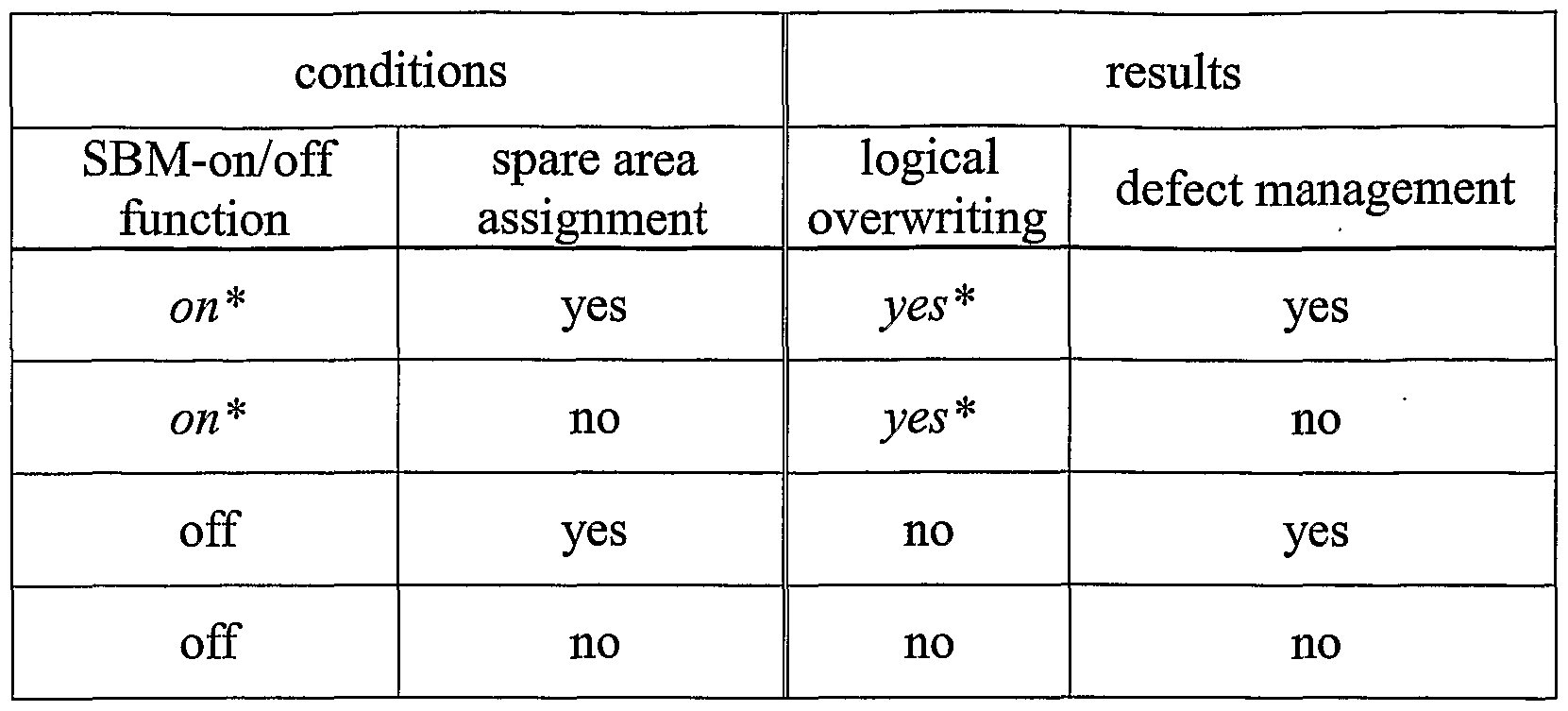
- FIGS. 7 and 8 respectively illustrate modes of operation in recording on a write-once optical recording medium, such as a BD-WO disc, for explaining the relationship between the SBM-on/off function and the performance of logical overwriting according to the present invention.
- a write-once optical recording medium such as a BD-WO disc
- FIGS. 7 and 8 respectively illustrate modes of operation in recording on a write-once optical recording medium, such as a BD-WO disc, for explaining the relationship between the SBM-on/off function and the performance of logical overwriting according to the present invention.
- the example of FIG. 7 considers a disc format in which the size of the spare area is fixed regardless of recording operations
- FIG. 8 considers a disc format in which the size of the spare area is adaptable according to data recording operations.
- a recording command from the host requests data recording on an area A-B as shown in FIGS. 7 and 8, which is an already recorded area
- a replacement recording operation for the data is needed, whereby the desired data is recorded in an alternative area within the data area, i.e., in a replacement area A'-B', using a logical overwrite operation according to the present invention.
- the host can command the recording irrespective of whether the specified area of the disc is actually recorded already, even in the case of a write-once optical disc, so that the write-once optical disc can, through logical overwriting, simulate the capabilities of a rewritable optical disc.
- the first step is a reading of the SBM to confirm that the area's status of use, i.e., already recorded. If "overwriting" is requested, the data is replacement-recorded within the data area in the replacement area A'-B', and the corresponding defect management information is recorded in the TDMA as the TDFL information, to complete the desired recording command. Accordingly, if the host desires a reproduction of the A-B data of a disc recorded as above, the optical disc recording/reproducing device refers to the recorded defect management information and reproduces the data stored in area A'-B' instead of the data stored in area A-B.
- the logical overwriting can be performed only when the SBM update flag is in an "on” state, so as to be continuously updated.
- the "logical overwrite” replacement-recorded data i.e., the LOW data, is therefore recorded in the user data area, preferably at the end of the user data area.
- the availability (“yes” or “no") of an assigned spare area determines whether defect management is permitted, but the SBM update flag ("on" or “off”) determines whether logical overwriting is permitted.
- logical overwriting can be performed only when both conditions are met, i.e., with SBM-on/off function enabled, i.e., set to "on” so as to be continuously updated, and an assigned spare area is available.
- the spare area is used for the LOW data as well as for recording a replacement cluster during defect management of the disc.
- record status is confirmed only when the SBM-on/off function is "on,” and logical overwriting is performed only when an assigned spare area exists.
- FIG. 9 illustrates the SBM-on/off function according to a preferred embodiment of the present invention.
- the SBM-on/off function is determined with respect to each of a plurality of assigned areas of an optical disc having plurality of recording layers L0 and LI, each of which includes an inner area, an inner spare area, a user area, an outer spare area, and an outer area.
- the inner area of the first recording layer L0 becomes the lead-in area
- the inner area of the second recording layer LI becomes the lead-out area.
- the ISA1 has a size of p*256 clusters, where 1 ⁇ p 64
- the OSA1 has a size of qx256 clusters, where 1 ⁇ q ⁇ 32.
- the start position and recording direction of each area are shown for a preferred scheme offering efficient recording. It should be noted, however, that the start position of each area is determined according to its recording direction and that changing the recording direction of any area would change the start position of the area accordingly.
- the optical disc recording/reproducing device 100 shown in FIG. 1 when an optical recording medium such as a BD-WO disc is inserted into the device, all of the existing disc management information is first read out and stored in the memory 114 for use during the disc's recording and/or reproducing operations. Thus, the SBM and SBM update flag are included in the stored disc management information. With a command from the host 200 to record data in a specified area of the disc, the area's positional information, i.e., the start position and length information, is input to the optical disc recording/reproducing device 100 along with the data to be recorded.
- the area's positional information i.e., the start position and length information
- the microcomputer 112 receives the recording command, and according to the positional information, determines whether the area to undergo recording is a recorded area or a non-recorded area based on the disc management information stored in the memory 114. The microcomputer 112 then determines whether to update the SBM of the specified area based on the area's record status. If the area is one where the SBM-on/off function is "on" and has an already recorded status, replacement-recording for a defective area would be performed elsewhere in the data area, as in FIGS. 7 and 8, and then the SBM is updated.
- one or the other or both of the SBM information (specifically, the start.position information and length information) and the SBM update flag may be stored in the memory 114 of the above apparatus according to the present invention, to be accessed and used during operation as necessary. In doing so, the method according to each of the first and second embodiments can be implemented, either separately or jointly, as desired.
- record status information of an optical recording medium such as a dual layer BD-WO disc can be recorded and managed in a random recording mode and then a determination can be made as to performance of logical overwriting in accordance with the disc's record status.
- the disclosure of the present invention can be used as a unified standard for write-once optical recording media, which is even compatible with rewritable optical recording media, to provide a more efficient method for the management of defective areas during data recording on a write-once optical recording medium and thereby provide enhanced data security and data integrity.
- the SBM-on/off function with respect to each area of an optical disc can be selectively applied in response to any request from a host.
- a write-once disc can simulate the characteristics of a rewriteable disc through a logical overwrite operation, whereby the data of a defective area is replacement- recorded.
- the replacement-recording is performed in either the management area or the user data area, to enable adaptation to successive versions of the medium.
Landscapes
- Engineering & Computer Science (AREA)
- Signal Processing (AREA)
- Optical Recording Or Reproduction (AREA)
- Signal Processing For Digital Recording And Reproducing (AREA)
- Management Or Editing Of Information On Record Carriers (AREA)
Abstract
Description

Claims
Priority Applications (4)
| Application Number | Priority Date | Filing Date | Title |
|---|---|---|---|
| JP2004569135A JP4658614B2 (en) | 2003-03-04 | 2003-11-27 | Recording method and apparatus for optical recording medium |
| AU2003282449A AU2003282449A1 (en) | 2003-03-04 | 2003-11-27 | Method for recording on optical recording medium and apparatus using the same |
| BRPI0318160A BRPI0318160B1 (en) | 2003-03-04 | 2003-11-27 | method for recording on optical recording medium, apparatus for recording on and reproducing optical recording medium and optical recording medium |
| EP03774352.3A EP1604366B1 (en) | 2003-03-04 | 2003-11-27 | Method for recording on optical recording medium, apparatus using the same and the optical recording medium |
Applications Claiming Priority (4)
| Application Number | Priority Date | Filing Date | Title |
|---|---|---|---|
| KR20030013327 | 2003-03-04 | ||
| KR10-2003-0013327 | 2003-03-04 | ||
| KR20030015932 | 2003-03-14 | ||
| KR10-2003-0015932 | 2003-03-14 |
Publications (1)
| Publication Number | Publication Date |
|---|---|
| WO2004079740A1 true WO2004079740A1 (en) | 2004-09-16 |
Family
ID=36383846
Family Applications (1)
| Application Number | Title | Priority Date | Filing Date |
|---|---|---|---|
| PCT/KR2003/002597 Ceased WO2004079740A1 (en) | 2003-03-04 | 2003-11-27 | Method for recording on optical recording medium and apparatus using the same |
Country Status (8)
| Country | Link |
|---|---|
| US (2) | US7554891B2 (en) |
| EP (1) | EP1604366B1 (en) |
| JP (2) | JP4658614B2 (en) |
| KR (1) | KR100991788B1 (en) |
| AU (1) | AU2003282449A1 (en) |
| BR (1) | BRPI0318160B1 (en) |
| TW (1) | TWI273559B (en) |
| WO (1) | WO2004079740A1 (en) |
Cited By (44)
| Publication number | Priority date | Publication date | Assignee | Title |
|---|---|---|---|---|
| WO2004081936A1 (en) | 2003-03-12 | 2004-09-23 | Sony Corporation | Recording medium, recording device, reproduction device, recording method, and reproduction method |
| WO2004097813A1 (en) | 2003-04-26 | 2004-11-11 | Samsung Electronics Co. Ltd. | Method of and drive for recording medium defect management, and defect managed recording medium |
| WO2004100156A1 (en) | 2003-05-09 | 2004-11-18 | Lg Electronics Inc. | Recording medium having data structure for managing at least a data area of the recording medium and recording and reproducing methods and apparatuses |
| KR100874489B1 (en) * | 2004-08-03 | 2008-12-18 | 파이오니아 가부시키가이샤 | Information recording medium, information recording apparatus and information recording method |
| US7477581B2 (en) | 2003-02-25 | 2009-01-13 | Lg Electronics Inc. | Defect management method for optical recording medium and optical recording medium using the same |
| US7478288B2 (en) | 2004-08-02 | 2009-01-13 | Lg Electronics, Inc. | Method and apparatus for recording data on and reproducing data from a recording medium and the recording medium |
| US7483355B2 (en) | 2003-10-20 | 2009-01-27 | Lg Electronics Inc. | Write-once optical disc, and method and apparatus for recording/reproducing data on/from the optical disc |
| US7483349B2 (en) | 2002-09-30 | 2009-01-27 | Lg Electronics Inc. | Write-once type optical disc, and method and apparatus for managing defective areas on write-once type optical disc using TDMA information |
| US7489604B2 (en) | 2002-09-26 | 2009-02-10 | Lg Electronics Inc. | Write-once type optical disc, and method and apparatus for managing defective areas on write-once type optical disc |
| US7500137B2 (en) | 2004-09-14 | 2009-03-03 | Lg Electronics Inc. | Recording medium, and method and apparatus of recording and reproducing data on the same |
| US7499383B2 (en) | 2003-02-21 | 2009-03-03 | Lg Electronics Inc. | Write-once optical disc and method for managing spare area thereof |
| US7502289B2 (en) | 2003-04-26 | 2009-03-10 | Samsung Electronics Co., Ltd. | Method of and drive for recording medium defect management, and defect managed recording medium |
| US7502288B2 (en) | 2004-06-23 | 2009-03-10 | Lg Electronics Inc. | Method and apparatus for overwriting data on recording-medium and the recording medium |
| US7506109B2 (en) | 2003-05-09 | 2009-03-17 | Lg Electronics Inc. | Recording medium having data structure for managing at least a data area of the recording medium and recording and reproducing methods and apparatuses |
| US7516273B2 (en) | 2003-09-08 | 2009-04-07 | Lg Electronics Inc. | Write-once optical disc and method for recording management information thereon |
| US7532551B2 (en) | 2002-09-26 | 2009-05-12 | Lg Electronics Inc. | Method for managing defective area on write-once optical recording medium, and optical recording medium using the same |
| US7532548B2 (en) | 2002-12-11 | 2009-05-12 | Lg Electronics Inc. | Method and apparatus for managing overwrite on an optical disc write once |
| US7539100B2 (en) | 2003-07-15 | 2009-05-26 | Lg Electronics Inc. | Optical recording medium, method of managing defective area thereof, recording method thereof, and recording/reproducing apparatus thereof |
| US7542389B2 (en) | 2003-07-14 | 2009-06-02 | Lg Electronics Inc. | Write-once optical disc, method and apparatus for recording management information on write-once optical disc |
| US7570557B2 (en) | 2004-06-08 | 2009-08-04 | Lg Electronics, Inc. | Method and apparatus for recording management information on a recording medium and the recording medium |
| US7570559B2 (en) | 2003-08-05 | 2009-08-04 | Lg Electronics Inc. | Write-once optical disc, and method and apparatus for recording/reproducing management information on/from optical disc |
| US7573792B2 (en) | 2003-07-15 | 2009-08-11 | Lg Electronics Inc. | Write-once optical disc, and method and apparatus for recording management information thereon |
| US7613085B2 (en) | 2003-01-14 | 2009-11-03 | Lg Electronics Inc. | Method and apparatus for managing defective area on recording medium, and recording medium using the same |
| US7624299B2 (en) | 2003-02-25 | 2009-11-24 | Lg Electronics Inc. | Write-once optical disc, and method and apparatus for recording management information on write-once optical disc |
| US7630283B2 (en) | 2002-09-26 | 2009-12-08 | Lg Electronics Inc. | Optical disc, method and apparatus for managing a defective area on an optical disc of write once type |
| US7639581B2 (en) | 2003-03-24 | 2009-12-29 | Samsung Electronics Co., Ltd. | Method of overwriting data in write-once information storage medium and data recording and/or reproducing apparatus for write-once information storage medium |
| US7643390B2 (en) | 2003-02-21 | 2010-01-05 | Lg Electronics Inc. | Write-once optical recording medium and defect management information management method thereof |
| US7663997B2 (en) | 2003-05-09 | 2010-02-16 | Lg Electronics, Inc. | Write once optical disc, and method and apparatus for recovering disc management information from the write once optical disc |
| US7668054B2 (en) | 2002-12-11 | 2010-02-23 | Lg Electronics Inc. | Method of managing overwrite and method of recording management information on an optical disc write once |
| US7672204B2 (en) | 2003-01-27 | 2010-03-02 | Lg Electronics Inc. | Optical disc, method and apparatus for managing a defective area on an optical disc |
| US7672208B2 (en) | 2003-08-05 | 2010-03-02 | Lg Electronics Inc. | Write-once optical disc, and method and apparatus for recording/playback management information on/from optical disc |
| US7684293B2 (en) | 2003-05-09 | 2010-03-23 | Lg Electronics Inc. | Write once optical disc, and method and apparatus for recovering disc management information from the write once optical disc |
| US7701823B2 (en) | 2002-09-30 | 2010-04-20 | Lg Electronics Inc. | Write-once optical disc, and method and apparatus for recording management information on write-once optical disc |
| US7764581B2 (en) | 2003-02-17 | 2010-07-27 | Lg Electronics Inc. | Write-once optical disc, and method and apparatus for allocating spare area on write-once optical disc |
| US7813243B2 (en) | 2003-01-11 | 2010-10-12 | Lg Electronics Inc. | Optical disc of write once type, method, and apparatus for managing defect information on the optical disc |
| US7826320B2 (en) | 2003-03-04 | 2010-11-02 | Lg Electronics Inc. | Method and apparatus for recording or reproducing on or from optical medium using SBM information |
| US7849372B2 (en) | 2003-03-13 | 2010-12-07 | Lg Electronics Inc. | Write-once recording medium and defective area management method and apparatus for write-once recording medium |
| US7911900B2 (en) | 2003-09-08 | 2011-03-22 | Lg Electronics Inc. | Write-once optical disc, and method and apparatus for recording management information on the write-once optical disc |
| EP1527451A4 (en) * | 2003-06-13 | 2011-05-11 | Sony Corp | METHOD AND APPARATUS FOR RECORDING AND / OR REPRODUCING |
| EP1606805A4 (en) * | 2003-03-24 | 2011-11-02 | Samsung Electronics Co Ltd | METHOD FOR OVERRADING DATA ON A SINGLE WRITE MEDIUM AND APPARATUS FOR RECORDING AND / OR REPRODUCING DATA THEREOF |
| EP2405434A3 (en) * | 2003-03-03 | 2012-02-01 | Samsung Electronics Co., Ltd. | Method and apparatus for managing disc defect and disc therefor |
| US8296529B2 (en) | 2003-09-08 | 2012-10-23 | Lg Electronics Inc. | Write-once optical disc and method for recording management information thereon |
| RU2471255C2 (en) * | 2004-11-12 | 2012-12-27 | Самсунг Электроникс Ко., Лтд. | Information medium, device for recording/reproduction and method of recording/reproduction |
| RU2491661C2 (en) * | 2004-12-15 | 2013-08-27 | Самсунг Электроникс Ко., Лтд. | Device for reproducing data from data storage medium |
Families Citing this family (40)
| Publication number | Priority date | Publication date | Assignee | Title |
|---|---|---|---|---|
| US6465253B1 (en) * | 1994-09-08 | 2002-10-15 | Genvec, Inc. | Vectors and methods for gene transfer to cells |
| US7385889B2 (en) * | 2003-03-03 | 2008-06-10 | Samsung Electronics Co., Ltd. | Method and apparatus for managing disc defect using temporary DFL and temporary DDS including drive and disc information disc with temporary DFL and temporary DDS |
| JP4026519B2 (en) * | 2003-03-12 | 2007-12-26 | ソニー株式会社 | Recording medium, recording apparatus, reproducing apparatus, recording method, reproducing method |
| EP1702324A1 (en) * | 2004-01-05 | 2006-09-20 | Samsung Electronics Co, Ltd | Optical recording medium, apparatus for recording/reproducing data on/from optical recording medium and method of recording/reproducing data on/from optical recording medium |
| KR100584613B1 (en) * | 2004-02-06 | 2006-06-01 | 삼성전자주식회사 | Data recording apparatus, method thereof, data reproducing apparatus, method thereof and recording disc once |
| TWI351603B (en) * | 2004-02-12 | 2011-11-01 | Pioneer Corp | Information recording medium, information recordin |
| RU2329551C2 (en) * | 2004-02-14 | 2008-07-20 | Самсунг Электроникс Ко., Лтд. | Method and device for data writing to writable disc and respective writable disc |
| KR100584614B1 (en) * | 2004-02-14 | 2006-06-01 | 삼성전자주식회사 | Apparatus and method for data recording in write- once disc, and writ-once disc therefor |
| EP1735781B1 (en) * | 2004-03-18 | 2013-07-17 | LG Electronics, Inc. | Apparatus and method for recording and/or reproducing data to/from recording medium |
| TWI381374B (en) * | 2004-03-18 | 2013-01-01 | Lg Electronics Inc | Recording medium with overlapping segment information thereon and apparatus and methods for forming, recording, and reproducing the recording medium |
| TWI386923B (en) * | 2004-03-18 | 2013-02-21 | Lg Electronics Inc | Recording medium with segment information thereon and apparatus and methods for forming, recording, and reproducing the recording medium |
| US7970988B2 (en) * | 2004-03-19 | 2011-06-28 | Lg Electronics Inc. | Recording medium with status information thereon which changes upon reformatting and apparatus and methods for forming, recording, and reproducing the recording medium |
| MXPA06010669A (en) * | 2004-03-19 | 2006-12-19 | Lg Electronics Inc | Recording medium with physical access control (pac) cluster thereon and apparatus and methods for forming, recording, and reproducing the recording medium. |
| AU2004317315B2 (en) * | 2004-03-19 | 2009-11-19 | Lg Electronics Inc. | Recording medium with physical access control (PAC) information thereon and apparatus and methods for forming, recording, and reproducing the recording medium |
| JP4638906B2 (en) * | 2004-03-23 | 2011-02-23 | エルジー エレクトロニクス インコーポレイティド | Recording medium and method and apparatus for recording / reproducing data on / from the recording medium |
| JP4424211B2 (en) | 2004-04-09 | 2010-03-03 | 日本ビクター株式会社 | Information recording medium recording method and recording apparatus |
| JP2005322337A (en) * | 2004-05-10 | 2005-11-17 | Pioneer Electronic Corp | Information recording medium, device and method for recording for the same, device and method for reproducing for the same, computer program for recording or reproducing control, and data structure including control signal |
| TW200603112A (en) | 2004-05-25 | 2006-01-16 | Nec Corp | Optical disc recording system |
| KR20060046157A (en) * | 2004-06-21 | 2006-05-17 | 엘지전자 주식회사 | Recording medium and method and apparatus for reformatting the recording medium |
| KR20060046445A (en) * | 2004-07-22 | 2006-05-17 | 엘지전자 주식회사 | Recording medium and method for controlling recording and reproducing of data and methods for recording and reproducing data |
| KR100667758B1 (en) * | 2004-07-30 | 2007-01-11 | 삼성전자주식회사 | Information storage media, recording / reproducing apparatus, and recording / reproducing method |
| EP1789961B1 (en) | 2004-09-13 | 2010-06-16 | LG Electronics Inc. | Recording medium, and method and apparatus for recording data in the recording medium |
| KR101053616B1 (en) * | 2004-09-13 | 2011-08-03 | 엘지전자 주식회사 | Recording medium, recording method and recording apparatus of recording medium |
| WO2006030812A1 (en) * | 2004-09-17 | 2006-03-23 | Pioneer Corporation | Information recording medium, information recording device and method, information reproducing device and method, and computer program |
| JP4713140B2 (en) * | 2004-12-13 | 2011-06-29 | 株式会社日立製作所 | Digital data recording method, recording apparatus and reproducing apparatus |
| KR20060082513A (en) * | 2005-01-12 | 2006-07-19 | 엘지전자 주식회사 | Recording medium and recording method and recording apparatus of recording medium |
| KR20060092543A (en) * | 2005-02-18 | 2006-08-23 | 삼성전자주식회사 | Information storage media, recording / reproducing apparatus, and recording / reproducing method |
| KR20060099710A (en) * | 2005-03-14 | 2006-09-20 | 삼성전자주식회사 | Information storage medium, recording apparatus and recording method thereof |
| KR20060099709A (en) * | 2005-03-14 | 2006-09-20 | 삼성전자주식회사 | Information storage media, recording / reproducing apparatus, and recording / reproducing method thereof |
| KR20070003511A (en) * | 2005-06-30 | 2007-01-05 | 엘지전자 주식회사 | Recording medium and recording medium recording / reproducing method and apparatus |
| CN101297360A (en) * | 2005-10-27 | 2008-10-29 | 皇家飞利浦电子股份有限公司 | Optical record carrier comprising an indication area for indicating whether a recordable area is completely recorded, and apparatus for use with such a record carrier |
| JP4419986B2 (en) * | 2006-05-08 | 2010-02-24 | ソニー株式会社 | Data recording apparatus, data recording method, and computer program |
| JP4925446B2 (en) * | 2006-05-18 | 2012-04-25 | パナソニック株式会社 | Stream data recording method and stream data recording apparatus |
| CN102016993B (en) * | 2009-01-06 | 2014-05-14 | 松下电器产业株式会社 | Write-once information recording medium, information recording device and method, information reproducing device and method |
| WO2010079578A1 (en) * | 2009-01-07 | 2010-07-15 | パナソニック株式会社 | Write-once information recording medium, information recording apparatus, information recording method, information reproducing apparatus, and information reproducing method |
| KR101636873B1 (en) * | 2009-04-14 | 2016-07-07 | 삼성전자주식회사 | Information storage medium, recording reproducing apparatus, recording reproducing method |
| KR20110029307A (en) * | 2009-09-15 | 2011-03-23 | 엘지전자 주식회사 | Recording media, data recording methods, and data recording devices |
| US8266374B2 (en) * | 2009-09-18 | 2012-09-11 | Mediatek Inc. | Method of identifying physical characteristic information of optical disc and related controller thereof |
| KR101636875B1 (en) | 2009-10-26 | 2016-07-06 | 삼성전자주식회사 | Information storage medium, recording reproducing apparatus, recording reproducing method |
| KR20130037547A (en) * | 2011-10-06 | 2013-04-16 | 삼성전자주식회사 | Recording medium reproducing apparatus and method for reproducing recording medium thereof |
Citations (5)
| Publication number | Priority date | Publication date | Assignee | Title |
|---|---|---|---|---|
| US4807205A (en) * | 1985-11-29 | 1989-02-21 | Michel Picard | Process for writing with updating and reading informations on a non-erasable support organized into sectors |
| US5448728A (en) | 1991-08-08 | 1995-09-05 | Sharp Kabushiki Kaisha | Storage medium control system for controlling a write-once read-many storage medium |
| US5475820A (en) | 1990-09-17 | 1995-12-12 | Hewlett-Packard Company | Method for using one of two storage directories only after the other directory is full for write management in a disk device |
| WO1996030902A1 (en) | 1995-03-31 | 1996-10-03 | International Business Machines Corporation | Spare and calibration sector management for optical worm media |
| US20020136164A1 (en) * | 2000-02-15 | 2002-09-26 | Kazuma Fukuda | Communication system, communication method, transmitting terminal and receiving terminal |
Family Cites Families (202)
| Publication number | Priority date | Publication date | Assignee | Title |
|---|---|---|---|---|
| JPS58194143A (en) | 1982-05-07 | 1983-11-12 | Hitachi Ltd | Recording and reproducing system of data |
| US5247494A (en) | 1984-06-08 | 1993-09-21 | Matsushita Electric Industrial Co. Ltd. | Method for recording and reproducing information on and from an optical disk having a read-only recorded zone and a writable and readable zone using a spot laser light |
| JP2635023B2 (en) | 1985-05-02 | 1997-07-30 | 株式会社日立製作所 | Label writing method for file data |
| US5040110A (en) | 1987-10-30 | 1991-08-13 | Matsushita Electric Industrial Co., Ltd. | Write once read many optical disc storage system having directory for storing virtual address and corresponding up-to-date sector address |
| JPH01128266A (en) | 1987-11-13 | 1989-05-19 | Pioneer Electron Corp | Method for controlling drive device for writable disk |
| EP0325823A1 (en) | 1988-01-26 | 1989-08-02 | Laserdrive Ltd. | Data storage system |
| JPH0223417A (en) | 1988-07-13 | 1990-01-25 | Matsushita Electric Ind Co Ltd | Information recording method and information recording medium |
| US4963866A (en) | 1989-03-27 | 1990-10-16 | Digital Recorders, Inc. | Multi channel digital random access recorder-player |
| JPH087981B2 (en) | 1989-08-30 | 1996-01-29 | 日本ビクター株式会社 | Additional type write-once information recording medium and information management method thereof |
| JPH0428061A (en) | 1990-05-24 | 1992-01-30 | Matsushita Electric Ind Co Ltd | Information recording media and information recording and reproducing devices |
| WO1991019290A1 (en) | 1990-05-25 | 1991-12-12 | Hitachi, Ltd. | Optical information recording/reproducing device using pit edge recording system |
| JP2776006B2 (en) | 1990-07-06 | 1998-07-16 | 松下電器産業株式会社 | Information recording / reproducing device |
| US5043967A (en) | 1990-08-20 | 1991-08-27 | International Business Machines Corporation | Structured data storage method and medium |
| US5319626A (en) | 1990-08-27 | 1994-06-07 | Mitsubishi Electric Corporation | Method for rewriting defect management areas on optical disk according to ECMA standard |
| US5303198A (en) | 1990-09-28 | 1994-04-12 | Fuji Photo Film Co., Ltd. | Method of recording data in memory card having EEPROM and memory card system using the same |
| JPH04141867A (en) | 1990-10-03 | 1992-05-15 | Canon Inc | File managing method |
| JPH04172662A (en) | 1990-11-05 | 1992-06-19 | Matsushita Graphic Commun Syst Inc | Managing method for defect of memory medium |
| JP2887949B2 (en) | 1991-06-27 | 1999-05-10 | 松下電器産業株式会社 | Information recording / reproducing device, information reproducing device, DMA recording method and DMA verification method |
| US5235585A (en) | 1991-09-11 | 1993-08-10 | International Business Machines | Reassigning defective sectors on a disk |
| US6347051B2 (en) | 1991-11-26 | 2002-02-12 | Hitachi, Ltd. | Storage device employing a flash memory |
| JP3039099B2 (en) | 1992-02-14 | 2000-05-08 | ソニー株式会社 | Optical disk recording apparatus and method |
| JPH05313980A (en) | 1992-05-07 | 1993-11-26 | Olympus Optical Co Ltd | Information recording method |
| WO1994003891A1 (en) | 1992-07-31 | 1994-02-17 | Sony Corporation | Device and method for disc recording |
| US5473753A (en) | 1992-10-30 | 1995-12-05 | Intel Corporation | Method of managing defects in flash disk memories |
| US5687397A (en) | 1993-02-26 | 1997-11-11 | Sony Corporation | System for expansion of data storage medium to store user data |
| JP3453843B2 (en) | 1993-06-08 | 2003-10-06 | ソニー株式会社 | Disk unit |
| JPH0773602A (en) | 1993-09-02 | 1995-03-17 | Fujitsu Ltd | Optical disk device |
| JP3333613B2 (en) | 1993-12-07 | 2002-10-15 | 株式会社日立製作所 | Optical information recording medium, optical information recording / reproducing method, and optical information recording / reproducing apparatus |
| US5495466A (en) | 1994-01-10 | 1996-02-27 | Eastman Kodak Company | Write verification in an optical recording system by sensing mark formation while writing |
| JP3558306B2 (en) * | 1994-07-26 | 2004-08-25 | パイオニア株式会社 | Multilayer recording disk and recording / reproducing system using the same |
| JP3530231B2 (en) | 1994-08-05 | 2004-05-24 | 株式会社リコー | Replacement processing method in information storage device |
| JP3232945B2 (en) | 1994-08-22 | 2001-11-26 | セイコーエプソン株式会社 | Preprocessing method and input / output device |
| US5650881A (en) | 1994-11-02 | 1997-07-22 | Texas Instruments Incorporated | Support post architecture for micromechanical devices |
| US5740435A (en) | 1994-10-31 | 1998-04-14 | Sony Corporation | Data management apparatus and method for managing data of variable lengths recorded on a record medium |
| JPH08147110A (en) * | 1994-11-18 | 1996-06-07 | Sony Corp | Data recording medium management method, data recording medium management device, and data recording medium |
| JPH08153858A (en) | 1994-11-29 | 1996-06-11 | Nec Corp | Manufacture of semiconductor device |
| JP2915307B2 (en) | 1994-12-19 | 1999-07-05 | 株式会社日立製作所 | Information recording control method for optical disk |
| US5715221A (en) | 1995-04-21 | 1998-02-03 | Matsushita Electric Industrial | Method for managing defects in an information recording medium, and a device and information recording medium using said method |
| CZ296443B6 (en) * | 1995-11-10 | 2006-03-15 | Sony Corporation | Information processing method and apparatus for making the same |
| US5900010A (en) | 1996-03-05 | 1999-05-04 | Sony Corporation | Apparatus for recording magneto-optic disks |
| JPH09259576A (en) | 1996-03-25 | 1997-10-03 | Toshiba Corp | Information recording disc with multiple management areas |
| JPH09259537A (en) | 1996-03-25 | 1997-10-03 | Toshiba Corp | Information recording disc with spare area |
| GB9620877D0 (en) | 1996-10-07 | 1996-11-27 | Solvay Interox Ltd | Metal surface treatment |
| US5805536A (en) | 1996-11-07 | 1998-09-08 | Eastman Kodak Company | Method for bandwidth reduction in writeable optical data storage apparatus |
| JP3050375B2 (en) | 1997-03-12 | 2000-06-12 | インターナショナル・ビジネス・マシーンズ・コーポレイション | Disk drive device and disk drive error recovery method |
| JPH10283653A (en) | 1997-04-04 | 1998-10-23 | Victor Co Of Japan Ltd | Optical information recording and reproducing device and optical recording medium |
| JPH10289537A (en) | 1997-04-11 | 1998-10-27 | Sony Corp | Digital data recording method and digital data recording medium |
| KR100239118B1 (en) | 1997-05-21 | 2000-01-15 | 구자홍 | Optical disk having variable margin region rate and variably setting method of margin region rate on disk |
| JPH117505A (en) | 1997-06-17 | 1999-01-12 | Fujitsu Ltd | Card type storage media |
| JP3488603B2 (en) | 1997-09-16 | 2004-01-19 | 株式会社東芝 | Copy protection system using digital watermark |
| JP3855390B2 (en) | 1997-09-16 | 2006-12-06 | ソニー株式会社 | Recording apparatus, recording method, and disk-shaped recording medium |
| CA2670077C (en) * | 1997-09-17 | 2010-09-21 | Panasonic Corporation | A recording apparatus, computer-readable recording medium, file management system and optical disc for recording video objects |
| JP3707222B2 (en) | 1997-12-18 | 2005-10-19 | 三菱電機株式会社 | Optical disc, optical disc processing apparatus, and optical disc processing method |
| JPH11242850A (en) * | 1998-02-25 | 1999-09-07 | Hitachi Ltd | Real-time data recording method |
| KR100292093B1 (en) | 1998-03-02 | 2001-06-01 | 구자홍 | Method and apparatus for generating defective area manager material of recording medium and optical recording medium |
| KR100354739B1 (en) | 1998-04-20 | 2003-02-19 | 삼성전자 주식회사 | Recording media storing defect menagement information for recording real time data and defect management method therefor |
| RU2192673C2 (en) | 1998-04-20 | 2002-11-10 | Самсунг Электроникс Ко., Лтд. | Record medium for data storage (alternatives), method for handling defects, and method for real- time data recording |
| EP0957477A3 (en) | 1998-05-15 | 2003-11-05 | Matsushita Electric Industrial Co., Ltd. | Optical information recording medium, recording and reproducing method therefor and optical information recording and reproduction apparatus |
| JPH11338782A (en) | 1998-05-27 | 1999-12-10 | Oki Electric Ind Co Ltd | Storage device and its defective sector substituting method |
| US6765853B1 (en) | 1998-06-15 | 2004-07-20 | Samsung Electronics Co., Ltd. | Recording medium for storing write protection information and write protection method thereof |
| JP2000040305A (en) | 1998-07-21 | 2000-02-08 | Fujitsu Ltd | Recording medium and storage device |
| WO2000007185A1 (en) | 1998-07-28 | 2000-02-10 | Lg Electronics Inc. | Method and apparatus of recording data in the optical recording medium |
| GB2356735B (en) | 1998-08-05 | 2002-01-02 | Mitsubishi Electric Corp | Method of managing defects in an optical disk, an optical disk device and an optical disk |
| US6414923B1 (en) | 1998-08-17 | 2002-07-02 | Lg Electronics Inc. | Recording/reproducing method of optical recording medium |
| US6788631B1 (en) | 1998-09-02 | 2004-09-07 | Lc Electronics Inc. | Optical recording medium having recording capacity information and method for indicating recording capacity |
| KR100459161B1 (en) | 1998-11-20 | 2005-01-15 | 엘지전자 주식회사 | optical recording medium and method for assigning spare area and for managing defect area of optical recording medium |
| KR100442236B1 (en) | 1998-09-07 | 2004-10-14 | 엘지전자 주식회사 | Method for searching available good spare block of optical recording medium |
| AU5449799A (en) | 1998-09-10 | 2000-04-03 | Matsushita Electric Industrial Co., Ltd. | Optical information recording medium, method of manufacture thereof, and method of recording and reproduction |
| JP3243220B2 (en) | 1998-09-14 | 2002-01-07 | 株式会社東芝 | Replacement processing method |
| JP2000099401A (en) | 1998-09-22 | 2000-04-07 | Sony Corp | Recording medium, recording method and recording device |
| AU5758999A (en) | 1998-09-25 | 2000-04-17 | Matsushita Electric Industrial Co., Ltd. | Information recording medium, information recording/reproducing method, and information recording/reproducing device |
| KR100421845B1 (en) | 1998-09-26 | 2004-04-17 | 엘지전자 주식회사 | optical recording medium and method for managing a defective area |
| KR100677066B1 (en) | 1998-10-10 | 2007-02-01 | 삼성전자주식회사 | How do I allocate free disk and free space for defect management? |
| DE69900577T2 (en) | 1998-10-22 | 2002-08-01 | Matsushita Electric Industrial Co., Ltd. | Information recording medium and method and device for error management thereon |
| JP2000195178A (en) | 1998-10-22 | 2000-07-14 | Matsushita Electric Ind Co Ltd | Information recording medium, defect management method and defect management device |
| US6466532B1 (en) | 1998-11-10 | 2002-10-15 | Samsung Electronics Co., Ltd. | Recording medium having spare area for defect management and information on defect management, and method and apparatus of allocating spare area and managing defects |
| US6542450B1 (en) | 1998-11-11 | 2003-04-01 | Lg Electronics Inc. | Method for assigning spare area in optical recording medium |
| KR100451718B1 (en) | 1999-01-13 | 2004-10-08 | 엘지전자 주식회사 | Optical recording medium and method for managing defect area and method for controlling record/playback of it |
| KR100459162B1 (en) | 1999-01-23 | 2004-12-03 | 엘지전자 주식회사 | Optical recording medium and method for formatting of the same |
| US6842580B1 (en) | 1999-01-27 | 2005-01-11 | Matsushita Electric Industrial Co., Ltd. | Real-time recording/reproduction on an information recording medium including a defective region |
| US6581167B1 (en) | 1999-02-01 | 2003-06-17 | Matsushita Electric Industrial Co., Ltd. | Information recording medium, information recording method and information recording/reproduction system |
| JP3206657B2 (en) | 1999-02-05 | 2001-09-10 | 日本電気株式会社 | Replacement processing method and information recording / reproducing device |
| MY122279A (en) | 1999-03-03 | 2006-04-29 | Sony Corp | Nonvolatile memory and nonvolatile memory reproducing apparatus |
| US6160778A (en) | 1999-03-08 | 2000-12-12 | Matsushita Electric Industrial Co., Ltd. | Information recording medium, information recording method, information recording apparatus and information reproducing apparatus |
| US6615363B1 (en) | 1999-03-19 | 2003-09-02 | Hitachi Maxell, Ltd. | Optical disk and method of recording on the same |
| JP3856980B2 (en) | 1999-03-31 | 2006-12-13 | 株式会社東芝 | Information recording / reproducing device |
| WO2001048753A1 (en) | 1999-12-28 | 2001-07-05 | Mitsubishi Chemical Corporation | Rewritable phase change optical disk partly having rom region and data recording and erasing methods for optical disk |
| KR100544175B1 (en) | 1999-05-08 | 2006-01-23 | 삼성전자주식회사 | Recording medium and defect area processing method for storing linking type information |
| JP2001023317A (en) | 1999-07-02 | 2001-01-26 | Nec Corp | Optical disk recording and reproducing method, device therefor and medium storing optical disk recording and reproducing program |
| EP1650750B1 (en) | 1999-07-15 | 2009-07-01 | Panasonic Corporation | Recording method for optical recording medium |
| JP2001069440A (en) | 1999-08-30 | 2001-03-16 | Sanyo Electric Co Ltd | Driver |
| DK1141956T3 (en) | 1999-09-23 | 2008-08-11 | Koninkl Philips Electronics Nv | Procedure for direct writing or reading files on a disc-like recording medium |
| JP3170499B1 (en) | 1999-09-30 | 2001-05-28 | 松下電器産業株式会社 | Information recording medium, recording method and reproducing method therefor, system control unit therefor, information recording apparatus and information reproducing apparatus |
| KR100561329B1 (en) | 1999-09-30 | 2006-03-16 | 마쯔시다덴기산교 가부시키가이샤 | Information recording media and system controller |
| JP2001110168A (en) | 1999-10-13 | 2001-04-20 | Ricoh Co Ltd | Information recording / reproducing apparatus, information recording / reproducing method, and computer-readable recording medium recording information recording / reproducing program |
| US7340153B2 (en) | 2000-01-11 | 2008-03-04 | Hitachi, Ltd. | Apparatus and method for recording and reproducing information |
| KR100647368B1 (en) | 2000-01-26 | 2006-11-17 | 엘지전자 주식회사 | Formatting method of optical recording medium |
| US7072256B2 (en) | 2000-03-08 | 2006-07-04 | Matsushita Electric Industrial Co., Ltd. | Information recording medium, information recording method and information reproduction method |
| JP3915368B2 (en) | 2000-03-31 | 2007-05-16 | 株式会社日立製作所 | Information recording / reproducing apparatus and recording / reproducing method thereof |
| US6804797B2 (en) | 2000-04-08 | 2004-10-12 | Samsung Electronics, Co., Ltd. | Method of verifying defect management area information of disc and test apparatus for performing the same |
| US6714502B2 (en) | 2000-04-08 | 2004-03-30 | Samsung Electronics Co., Ltd | Method of verifying defect management area information of optical disc and apparatus for performing the same |
| US7477833B2 (en) | 2000-04-21 | 2009-01-13 | Sony Corporation | Information processing apparatus and method, program, and recorded medium specifying particular picture characteristics |
| JP3835977B2 (en) | 2000-04-25 | 2006-10-18 | 富士通株式会社 | Disc type recording medium format processing method, disc type recording medium, and information recording / reproducing apparatus using the same |
| EP1436700A2 (en) | 2000-05-30 | 2004-07-14 | DPHI Aquisitions, Inc. | Defect management system for write-once storage disk |
| KR100746262B1 (en) | 2000-06-06 | 2007-08-03 | 코닌클리케 필립스 일렉트로닉스 엔.브이. | Method and apparatus for immediately writing or reading a file on a disc shaped record carrier |
| JP2001351334A (en) | 2000-06-08 | 2001-12-21 | Sony Corp | Optical recording medium and data recording / reproducing apparatus for recording / reproducing data on / from optical recording medium |
| JP2001357623A (en) | 2000-06-16 | 2001-12-26 | Victor Co Of Japan Ltd | Information processor |
| JP2002015507A (en) | 2000-06-30 | 2002-01-18 | Sony Corp | Data recording method and disk device |
| JP2002042448A (en) | 2000-07-26 | 2002-02-08 | Pioneer Electronic Corp | INFORMATION EDITING APPARATUS, INFORMATION EDITING METHOD, AND INFORMATION RECORDING MEDIUM WITH EDIT CONTROL PROGRAM RECORDED ON COMPUTER |
| JP4843894B2 (en) | 2000-07-31 | 2011-12-21 | ソニー株式会社 | Data recording method, data output method, and data recording and / or reproducing method |
| JP2002056619A (en) | 2000-08-08 | 2002-02-22 | Sony Corp | Disk drive device and data storage method |
| JP3898430B2 (en) | 2000-09-18 | 2007-03-28 | 株式会社日立製作所 | Optical recording apparatus and optical disk used therefor |
| TW497098B (en) | 2000-11-04 | 2002-08-01 | Li-Shin Jou | Optical recording medium and recording method |
| JP3945165B2 (en) | 2001-01-15 | 2007-07-18 | セイコーエプソン株式会社 | Text data processing device |
| US20020099950A1 (en) | 2001-01-22 | 2002-07-25 | Smith Kenneth K. | Method of maintaining integrity of an instruction or data set |
| JP4407063B2 (en) | 2001-02-19 | 2010-02-03 | パナソニック株式会社 | Defect management information playback device |
| JP4037617B2 (en) | 2001-03-16 | 2008-01-23 | 株式会社東芝 | Defect search method |
| US7023775B2 (en) | 2001-03-22 | 2006-04-04 | Matsushita Electric Industrial Co., Ltd. | Recording apparatus and method, and reproduction apparatus and method for recording data to or reproducing data from a write once type information recording medium, and write once type information recording medium |
| JP3971117B2 (en) | 2001-03-22 | 2007-09-05 | 株式会社東芝 | Information recording medium, information recording apparatus, information recording method, information reproducing apparatus, and information reproducing method |
| JP2002288937A (en) | 2001-03-22 | 2002-10-04 | Toshiba Corp | Information recording medium, information recording device, information recording method, information reproducing device, information reproducing method |
| JP2002352522A (en) | 2001-03-22 | 2002-12-06 | Matsushita Electric Ind Co Ltd | Recording method, reproducing method, recording device, reproducing device, and information recording medium |
| JP2002298360A (en) | 2001-03-30 | 2002-10-11 | Canon Inc | Information recording method and information recording device on information recording medium |
| US7092334B2 (en) | 2001-04-12 | 2006-08-15 | Hitachi-Lg Data Storage Korea, Inc. | Method of detecting a defect area of a disk |
| TWI235927B (en) | 2001-04-25 | 2005-07-11 | Koninkl Philips Electronics Nv | Methods and devices for recording or reading files on/from a sequential medium and sequential medium |
| JP2002329321A (en) | 2001-04-27 | 2002-11-15 | Sony Corp | Recording device and playback device |
| US6766418B1 (en) | 2001-04-30 | 2004-07-20 | Emc Corporation | Methods and apparatus for accessing data using a cache |
| JP2002334527A (en) | 2001-05-11 | 2002-11-22 | Matsushita Electric Ind Co Ltd | Disk memory device, disk memory device failure determination method, and recording medium |
| JP2003016737A (en) | 2001-07-02 | 2003-01-17 | Nec Microsystems Ltd | Optical disk unit, program and method for managing data |
| JP2003208759A (en) * | 2001-08-02 | 2003-07-25 | Matsushita Electric Ind Co Ltd | Information recording medium, information recording method, information recording device, information reproducing method, and information reproducing device |
| JP3925144B2 (en) | 2001-10-12 | 2007-06-06 | 株式会社日立製作所 | Recording method and recording medium |
| JP2003151216A (en) | 2001-11-12 | 2003-05-23 | Hitachi Ltd | Information recording method and information recording device |
| TWI245279B (en) | 2001-11-20 | 2005-12-11 | Lite On It Corp | Method for dynamically adjusting the writing speed of a CD drive |
| JP4100913B2 (en) | 2002-01-15 | 2008-06-11 | 株式会社リコー | Information reproduction apparatus, data management information acquisition method, data management information acquisition program, storage medium, and reproduction system |
| MXPA04006947A (en) | 2002-01-18 | 2004-12-06 | Koninkl Philips Electronics Nv | Optical data storage medium and use of such medium. |
| US7123556B2 (en) | 2002-01-22 | 2006-10-17 | Matsushita Electric Industrial Co., Ltd. | Multi-layered information recording medium with spare defect management areas |
| CN101308689A (en) | 2002-01-22 | 2008-11-19 | 松下电器产业株式会社 | Multilayer information recording medium, information recording device, and recording method |
| JP4078198B2 (en) | 2002-01-31 | 2008-04-23 | 松下電器産業株式会社 | Information recording medium and defect management area position determination method |
| US6835974B2 (en) | 2002-03-14 | 2004-12-28 | Jeng-Jye Shau | Three dimensional integrated circuits using sub-micron thin-film diodes |
| KR20100023058A (en) | 2002-03-20 | 2010-03-03 | 파나소닉 주식회사 | Information recording medium, recording apparatus, reproduction apparatus, integrated circuit and computer program allowing for updating of a defect list |
| JP2003276843A (en) | 2002-03-25 | 2003-10-02 | Mitsui Chemicals Inc | Carrier device and method for solid substance |
| KR20030082262A (en) | 2002-04-17 | 2003-10-22 | 삼성전자주식회사 | Apparatus and method for changing write speed of optical writing media during writing |
| US7027059B2 (en) | 2002-05-30 | 2006-04-11 | Intel Corporation | Dynamically constructed rasterizers |
| JP2004014088A (en) | 2002-06-11 | 2004-01-15 | Sony Corp | Disk recording medium, recording method, disk drive device |
| JP4279515B2 (en) * | 2002-06-25 | 2009-06-17 | 株式会社日立グローバルストレージテクノロジーズ | Recording / playback device |
| TWI248067B (en) | 2002-07-04 | 2006-01-21 | Mediatek Inc | Method for managing spare blocks of optical disk |
| EP1540648A4 (en) | 2002-08-03 | 2008-12-24 | Samsung Electronics Co Ltd | INFORMATION STORAGE MEDIUM AND RECORDING AND / OR REPRODUCING METHOD RELATING THERETO |
| TWI294622B (en) | 2002-08-12 | 2008-03-11 | Samsung Electronics Co Ltd | Disc with tdds and tdfl, and method and apparatus for managing defect in the same |
| KR20040015425A (en) | 2002-08-12 | 2004-02-19 | 삼성전자주식회사 | High density recording medium for write-once adapting to a defect management, method of managing a defect and apparatus thereof |
| US6826140B2 (en) | 2002-08-26 | 2004-11-30 | Bae Systems Information And Electronic Systems Integration Inc | Multichannel digital recording system with multi-user detection |
| KR100888591B1 (en) | 2002-09-10 | 2009-03-16 | 삼성전자주식회사 | Spare area allocation method, device and disk thereof |
| KR100891107B1 (en) | 2002-09-10 | 2009-03-30 | 삼성전자주식회사 | Fault information management method and device |
| KR100964688B1 (en) | 2002-09-26 | 2010-06-21 | 엘지전자 주식회사 | Method and apparatus for managing defective areas on optical discs and writeable optical discs |
| US7233550B2 (en) | 2002-09-30 | 2007-06-19 | Lg Electronics Inc. | Write-once optical disc, and method and apparatus for recording management information on write-once optical disc |
| KR20040028469A (en) | 2002-09-30 | 2004-04-03 | 엘지전자 주식회사 | Method for managing a defect area on optical disc write once |
| JP2004127471A (en) | 2002-10-07 | 2004-04-22 | Pioneer Electronic Corp | Recording device and its control method, and reproducing device |
| KR100739673B1 (en) | 2002-10-10 | 2007-07-13 | 삼성전자주식회사 | How to Manage Defects Using Temporary Defect Management Area |
| KR100667749B1 (en) | 2002-10-18 | 2007-01-11 | 삼성전자주식회사 | Fault management method using temporary defect management area, device and its disks |
| JP4606693B2 (en) | 2002-11-22 | 2011-01-05 | ソニー株式会社 | Optical disc, recording device, playback device, recording method, playback method |
| EP1579443A1 (en) | 2002-12-11 | 2005-09-28 | LG Electronics Inc. | Method and apparatus for managing overwrite on an optical disc write once |
| WO2004053874A1 (en) | 2002-12-11 | 2004-06-24 | Lg Electronics Inc. | Method of managing overwrite and method of recording management information on an optical disc write once |
| CN101930758A (en) | 2002-12-25 | 2010-12-29 | 松下电器产业株式会社 | Write once read many information recording medium, information recording method, information reproducing method, information recording apparatus, and information reproducing apparatus |
| JP4224391B2 (en) | 2002-12-25 | 2009-02-12 | パナソニック株式会社 | Write-once information recording medium, information recording method, information reproducing method, information recording apparatus, and information reproducing apparatus |
| US7372788B2 (en) | 2003-01-14 | 2008-05-13 | Lg Electronics Inc. | Method for managing defective area on write-once optical recording medium, and optical recording medium using the same |
| TWI314315B (en) | 2003-01-27 | 2009-09-01 | Lg Electronics Inc | Optical disc of write once type, method, and apparatus for managing defect information on the optical disc |
| US7672204B2 (en) | 2003-01-27 | 2010-03-02 | Lg Electronics Inc. | Optical disc, method and apparatus for managing a defective area on an optical disc |
| JP4110000B2 (en) | 2003-01-28 | 2008-07-02 | 株式会社ルネサステクノロジ | Storage device |
| KR101051000B1 (en) | 2003-02-19 | 2011-07-26 | 엘지전자 주식회사 | High Density Optical Discs and the Illegal Copy Determination Method |
| US7643390B2 (en) | 2003-02-21 | 2010-01-05 | Lg Electronics Inc. | Write-once optical recording medium and defect management information management method thereof |
| US7675828B2 (en) * | 2003-02-25 | 2010-03-09 | Lg Electronics Inc. | Recording medium having data structure for managing at least a data area of the recording medium and recording and reproducing methods and apparatuses |
| US7188271B2 (en) | 2003-02-25 | 2007-03-06 | Lg Electronics Inc. | Write-once optical disc, and method and apparatus for recording management information on write-once optical disc |
| US7869315B2 (en) | 2003-02-28 | 2011-01-11 | Samsung Electronics Co., Ltd. | Write-once optical disc having update area and access area |
| US7385889B2 (en) | 2003-03-03 | 2008-06-10 | Samsung Electronics Co., Ltd. | Method and apparatus for managing disc defect using temporary DFL and temporary DDS including drive and disc information disc with temporary DFL and temporary DDS |
| CN100557606C (en) | 2003-03-03 | 2009-11-04 | 皇家飞利浦电子股份有限公司 | Method and apparatus for finding a string |
| EP1604366B1 (en) | 2003-03-04 | 2014-01-15 | LG Electronics Inc. | Method for recording on optical recording medium, apparatus using the same and the optical recording medium |
| WO2004079731A1 (en) | 2003-03-08 | 2004-09-16 | Samsung Electronics Co., Ltd. | Method and apparatus for preserving data-recording status of a write-once recording medium, and write-once recording medium therefor |
| JP4026518B2 (en) | 2003-03-12 | 2007-12-26 | ソニー株式会社 | Recording medium, recording apparatus, and recording method |
| JP4026519B2 (en) | 2003-03-12 | 2007-12-26 | ソニー株式会社 | Recording medium, recording apparatus, reproducing apparatus, recording method, reproducing method |
| JP4026517B2 (en) * | 2003-03-12 | 2007-12-26 | ソニー株式会社 | Recording medium, recording apparatus, and recording method |
| TWI328805B (en) | 2003-03-13 | 2010-08-11 | Lg Electronics Inc | Write-once recording medium and defective area management method and apparatus for write-once recording medium |
| MXPA05009731A (en) | 2003-03-13 | 2005-11-04 | Samsung Electronics Co Ltd | Write once disc, method of managing data area of write once disc, and apparatus and method for reproducing data therefor. |
| US7313066B2 (en) | 2003-03-13 | 2007-12-25 | Samsung Electronics Co., Ltd. | Write once disc allowing management of data area, method of managing the data area, and method for reproducing data from write once disc |
| RU2005127337A (en) | 2003-03-13 | 2006-02-10 | Самсунг Электроникс Ко. Лтд. (Kr) | ONE-TIME RECORDED DISC, METHOD FOR DISTRIBUTING A DATA AREA FOR ONE-RECORDED DISC, DEVICE AND METHOD FOR PLAYING DATA FROM SUCH A DISC |
| RU2297679C2 (en) | 2003-03-17 | 2007-04-20 | Пайонир Корпорейшн | One-pass recordable carrier, device and method for recording the one-pass recordable carrier and device and method for reproduction of one-pass record from carrier |
| KR100739681B1 (en) | 2003-03-24 | 2007-07-13 | 삼성전자주식회사 | Method of overwriting in write-once information storage medium |
| CN101373625B (en) * | 2003-04-14 | 2012-12-19 | 皇家飞利浦电子股份有限公司 | Device for and method of recording information |
| CN1774732A (en) | 2003-04-15 | 2006-05-17 | Ds音特普莱斯株式会社 | An instruction plate and signage using photo luminescent porcelain enamel |
| US8184513B2 (en) | 2003-04-15 | 2012-05-22 | Samsung Electronics Co., Ltd. | Recording/reproducing method, recording/reproducing apparatus, optical recording medium, and computer readable recording medium having recorded thereon program for the recording/reproducing method |
| KR100739675B1 (en) * | 2003-04-26 | 2007-07-13 | 삼성전자주식회사 | Method of managing defect in recording medium, recording medium drive device and the recording medium therefor |
| WO2004100155A1 (en) | 2003-05-09 | 2004-11-18 | Lg Electronics Inc. | Recording medium having data structure for managing at least a data area of the recording medium and recording and reproducing methods and apparatuses |
| TW200501119A (en) | 2003-05-09 | 2005-01-01 | Lg Electronics Inc | Recording medium having data structure for managing at least a data area of the recording medium and recording and reproducing methods and apparatuses |
| JP3861856B2 (en) | 2003-06-13 | 2006-12-27 | ソニー株式会社 | Recording / reproducing apparatus and recording / reproducing method |
| US8223607B2 (en) | 2003-07-04 | 2012-07-17 | Lg Electronics Inc. | Method and apparatus for managing a overwrite recording on optical disc write once |
| KR100971381B1 (en) | 2003-07-08 | 2010-07-20 | 파나소닉 주식회사 | Recordable recording medium, reproduction method and recording method |
| DE602004020992D1 (en) | 2003-07-14 | 2009-06-18 | Lg Electronics Inc | A write-once optical data carrier, method and apparatus for recording administrative information on a write-once optical data carrier |
| KR20050009031A (en) | 2003-07-15 | 2005-01-24 | 엘지전자 주식회사 | Method for recording management information on optical disc write once |
| US7313065B2 (en) | 2003-08-05 | 2007-12-25 | Lg Electronics Inc. | Write-once optical disc, and method and apparatus for recording/reproducing management information on/from optical disc |
| JP4145749B2 (en) | 2003-08-12 | 2008-09-03 | パイオニア株式会社 | Information recording medium, recording apparatus and recording method for information recording medium, reproducing apparatus and reproducing method for information recording medium, computer program for recording or reproduction control, and data structure including control signal |
| RU2453933C2 (en) | 2003-08-21 | 2012-06-20 | Конинклейке Филипс Электроникс Н.В. | Method of recording information onto multilayer recording medium and recording medium for use with said method |
| WO2005024792A2 (en) | 2003-09-08 | 2005-03-17 | Lg Electronics Inc. | Write-once optical disc, and method and apparatus for management information thereon |
| MXPA06002620A (en) | 2003-09-08 | 2006-06-05 | Lg Electronics Inc | Write-once optical disc and method for recording management information thereon. |
| WO2005024793A2 (en) | 2003-09-08 | 2005-03-17 | Lg Electronics Inc. | Write-once optical disc, and method and apparatus for recording management information thereon |
| US7073570B2 (en) * | 2003-09-22 | 2006-07-11 | Visteon Global Technologies, Inc. | Automotive heat exchanger |
-
2003
- 2003-11-27 EP EP03774352.3A patent/EP1604366B1/en not_active Expired - Lifetime
- 2003-11-27 AU AU2003282449A patent/AU2003282449A1/en not_active Abandoned
- 2003-11-27 WO PCT/KR2003/002597 patent/WO2004079740A1/en not_active Ceased
- 2003-11-27 JP JP2004569135A patent/JP4658614B2/en not_active Expired - Lifetime
- 2003-11-27 KR KR1020057016529A patent/KR100991788B1/en not_active Expired - Fee Related
- 2003-11-27 BR BRPI0318160A patent/BRPI0318160B1/en not_active IP Right Cessation
- 2003-12-05 TW TW092134454A patent/TWI273559B/en not_active IP Right Cessation
- 2003-12-23 US US10/744,214 patent/US7554891B2/en not_active Expired - Lifetime
-
2009
- 2009-06-23 US US12/490,224 patent/US7826320B2/en not_active Expired - Lifetime
- 2009-10-26 JP JP2009245393A patent/JP4904387B2/en not_active Expired - Fee Related
Patent Citations (5)
| Publication number | Priority date | Publication date | Assignee | Title |
|---|---|---|---|---|
| US4807205A (en) * | 1985-11-29 | 1989-02-21 | Michel Picard | Process for writing with updating and reading informations on a non-erasable support organized into sectors |
| US5475820A (en) | 1990-09-17 | 1995-12-12 | Hewlett-Packard Company | Method for using one of two storage directories only after the other directory is full for write management in a disk device |
| US5448728A (en) | 1991-08-08 | 1995-09-05 | Sharp Kabushiki Kaisha | Storage medium control system for controlling a write-once read-many storage medium |
| WO1996030902A1 (en) | 1995-03-31 | 1996-10-03 | International Business Machines Corporation | Spare and calibration sector management for optical worm media |
| US20020136164A1 (en) * | 2000-02-15 | 2002-09-26 | Kazuma Fukuda | Communication system, communication method, transmitting terminal and receiving terminal |
Cited By (72)
| Publication number | Priority date | Publication date | Assignee | Title |
|---|---|---|---|---|
| US7630283B2 (en) | 2002-09-26 | 2009-12-08 | Lg Electronics Inc. | Optical disc, method and apparatus for managing a defective area on an optical disc of write once type |
| US7992057B2 (en) | 2002-09-26 | 2011-08-02 | Lg Electronics Inc. | Write-once type optical disc, and method and apparatus for managing defective areas on write-once type optical disc |
| US7489604B2 (en) | 2002-09-26 | 2009-02-10 | Lg Electronics Inc. | Write-once type optical disc, and method and apparatus for managing defective areas on write-once type optical disc |
| US7532551B2 (en) | 2002-09-26 | 2009-05-12 | Lg Electronics Inc. | Method for managing defective area on write-once optical recording medium, and optical recording medium using the same |
| US7701823B2 (en) | 2002-09-30 | 2010-04-20 | Lg Electronics Inc. | Write-once optical disc, and method and apparatus for recording management information on write-once optical disc |
| US7911904B2 (en) | 2002-09-30 | 2011-03-22 | Lg Electronics, Inc. | Write-once optical disc, and method and apparatus for recording management information on write-once optical disc |
| US8045430B2 (en) | 2002-09-30 | 2011-10-25 | Lg Electronics Inc. | Write-once type optical disc, and method and apparatus for managing defective areas on write-once type optical disc using TDMA information |
| US7483349B2 (en) | 2002-09-30 | 2009-01-27 | Lg Electronics Inc. | Write-once type optical disc, and method and apparatus for managing defective areas on write-once type optical disc using TDMA information |
| US7668054B2 (en) | 2002-12-11 | 2010-02-23 | Lg Electronics Inc. | Method of managing overwrite and method of recording management information on an optical disc write once |
| US7936649B2 (en) | 2002-12-11 | 2011-05-03 | Lg Electronics Inc. | Method of managing overwrite and method of recording management information on an optical disc write once |
| US7532548B2 (en) | 2002-12-11 | 2009-05-12 | Lg Electronics Inc. | Method and apparatus for managing overwrite on an optical disc write once |
| US7813243B2 (en) | 2003-01-11 | 2010-10-12 | Lg Electronics Inc. | Optical disc of write once type, method, and apparatus for managing defect information on the optical disc |
| US7613085B2 (en) | 2003-01-14 | 2009-11-03 | Lg Electronics Inc. | Method and apparatus for managing defective area on recording medium, and recording medium using the same |
| US8072853B2 (en) | 2003-01-27 | 2011-12-06 | Lg Electronics Inc. | Optical disc of write once type, method, and apparatus for managing defect information on the optical disc |
| US7672204B2 (en) | 2003-01-27 | 2010-03-02 | Lg Electronics Inc. | Optical disc, method and apparatus for managing a defective area on an optical disc |
| US7764581B2 (en) | 2003-02-17 | 2010-07-27 | Lg Electronics Inc. | Write-once optical disc, and method and apparatus for allocating spare area on write-once optical disc |
| US7499383B2 (en) | 2003-02-21 | 2009-03-03 | Lg Electronics Inc. | Write-once optical disc and method for managing spare area thereof |
| US7929391B2 (en) | 2003-02-21 | 2011-04-19 | Lg Electronics Inc. | Write-once optical recording medium and defect management information management method thereof |
| US7944783B2 (en) | 2003-02-21 | 2011-05-17 | Lg Electronics Inc. | Write-once optical disc and method for managing spare area thereof |
| US7643390B2 (en) | 2003-02-21 | 2010-01-05 | Lg Electronics Inc. | Write-once optical recording medium and defect management information management method thereof |
| US7477581B2 (en) | 2003-02-25 | 2009-01-13 | Lg Electronics Inc. | Defect management method for optical recording medium and optical recording medium using the same |
| US7624299B2 (en) | 2003-02-25 | 2009-11-24 | Lg Electronics Inc. | Write-once optical disc, and method and apparatus for recording management information on write-once optical disc |
| EP2405434A3 (en) * | 2003-03-03 | 2012-02-01 | Samsung Electronics Co., Ltd. | Method and apparatus for managing disc defect and disc therefor |
| US7826320B2 (en) | 2003-03-04 | 2010-11-02 | Lg Electronics Inc. | Method and apparatus for recording or reproducing on or from optical medium using SBM information |
| EP1603131A4 (en) * | 2003-03-12 | 2010-02-17 | Sony Corp | MEDIUM, RECORDING DEVICE AND METHOD, REPRODUCTION DEVICE AND METHOD |
| US8295138B2 (en) | 2003-03-12 | 2012-10-23 | Sony Corporation | Recording medium, recording apparatus, reproduction apparatus, recording method and reproduction method |
| US8036079B2 (en) | 2003-03-12 | 2011-10-11 | Sony Corporation | Recording medium, recording apparatus, reproduction apparatus, recording method and reproduction method |
| WO2004081936A1 (en) | 2003-03-12 | 2004-09-23 | Sony Corporation | Recording medium, recording device, reproduction device, recording method, and reproduction method |
| US7849372B2 (en) | 2003-03-13 | 2010-12-07 | Lg Electronics Inc. | Write-once recording medium and defective area management method and apparatus for write-once recording medium |
| US7639581B2 (en) | 2003-03-24 | 2009-12-29 | Samsung Electronics Co., Ltd. | Method of overwriting data in write-once information storage medium and data recording and/or reproducing apparatus for write-once information storage medium |
| EP1606805A4 (en) * | 2003-03-24 | 2011-11-02 | Samsung Electronics Co Ltd | METHOD FOR OVERRADING DATA ON A SINGLE WRITE MEDIUM AND APPARATUS FOR RECORDING AND / OR REPRODUCING DATA THEREOF |
| US7800994B2 (en) | 2003-03-24 | 2010-09-21 | Samsung Electronics, Co., Ltd. | Method of overwriting data in write-once information storage medium and data recording and/or reproducing apparatus for write-once information storage medium |
| US7502289B2 (en) | 2003-04-26 | 2009-03-10 | Samsung Electronics Co., Ltd. | Method of and drive for recording medium defect management, and defect managed recording medium |
| US7502290B2 (en) | 2003-04-26 | 2009-03-10 | Samsung Electronics Co., Ltd. | Method of and drive for recording medium defect management, and defect managed recording medium |
| EP2144234A1 (en) | 2003-04-26 | 2010-01-13 | Samsung Electronics Co., Ltd. | Method of recording medium defect management |
| WO2004097813A1 (en) | 2003-04-26 | 2004-11-11 | Samsung Electronics Co. Ltd. | Method of and drive for recording medium defect management, and defect managed recording medium |
| US7606125B2 (en) | 2003-04-26 | 2009-10-20 | Samsung Electronics Co., Ltd. | Method of and drive for recording medium defect management, and defect managed recording medium |
| EP1618561A4 (en) * | 2003-04-26 | 2008-08-20 | Samsung Electronics Co Ltd | PILOT AND METHOD FOR RECORDING DEFECT MANAGEMENT OF A MEDIUM, AND DEFECTIVE RECORDING MEDIUM |
| EP1623422A1 (en) * | 2003-05-09 | 2006-02-08 | LG Electronics Inc. | Recording medium having data structure for managing at least a data area of the recording medium and recording and reproducing methods and apparatuses |
| US7620782B2 (en) | 2003-05-09 | 2009-11-17 | Lg Electronics Inc. | Recording medium having data structure for managing at least a data area of the recording medium and recording and reproducing methods and apparatuses |
| US7684293B2 (en) | 2003-05-09 | 2010-03-23 | Lg Electronics Inc. | Write once optical disc, and method and apparatus for recovering disc management information from the write once optical disc |
| US7506109B2 (en) | 2003-05-09 | 2009-03-17 | Lg Electronics Inc. | Recording medium having data structure for managing at least a data area of the recording medium and recording and reproducing methods and apparatuses |
| AU2004237019B2 (en) * | 2003-05-09 | 2010-06-10 | Lg Electronics Inc. | Recording medium having data structure for managing at least a data area of the recording medium and recording and reproducing methods and apparatuses |
| US7663997B2 (en) | 2003-05-09 | 2010-02-16 | Lg Electronics, Inc. | Write once optical disc, and method and apparatus for recovering disc management information from the write once optical disc |
| US8107336B2 (en) | 2003-05-09 | 2012-01-31 | Lg Electronics Inc. | Write once optical disc, and method and apparatus for recovering disc management information from the write once optical disc |
| WO2004100156A1 (en) | 2003-05-09 | 2004-11-18 | Lg Electronics Inc. | Recording medium having data structure for managing at least a data area of the recording medium and recording and reproducing methods and apparatuses |
| US7522501B2 (en) | 2003-05-09 | 2009-04-21 | Lg Electronics Inc. | Recording, reproducing and product for management of data having a temporary defect management area containing at least one pointer |
| EP1527451A4 (en) * | 2003-06-13 | 2011-05-11 | Sony Corp | METHOD AND APPARATUS FOR RECORDING AND / OR REPRODUCING |
| US7542389B2 (en) | 2003-07-14 | 2009-06-02 | Lg Electronics Inc. | Write-once optical disc, method and apparatus for recording management information on write-once optical disc |
| US7539100B2 (en) | 2003-07-15 | 2009-05-26 | Lg Electronics Inc. | Optical recording medium, method of managing defective area thereof, recording method thereof, and recording/reproducing apparatus thereof |
| US7573792B2 (en) | 2003-07-15 | 2009-08-11 | Lg Electronics Inc. | Write-once optical disc, and method and apparatus for recording management information thereon |
| US8054718B2 (en) | 2003-07-15 | 2011-11-08 | Lg Electronics Inc. | Write-once optical disc, and method and apparatus for recording management information thereon |
| US7952972B2 (en) | 2003-08-05 | 2011-05-31 | Lg Electronics Inc. | Write-once optical disc, and method and apparatus for recording/playback management information on/from optical disc |
| US7898918B2 (en) | 2003-08-05 | 2011-03-01 | Lg Electronics Inc. | Write-once optical disc, and method and apparatus for recording/reproducing management information on/from optical disc |
| US7911905B2 (en) | 2003-08-05 | 2011-03-22 | Lg Electronics Inc. | Write-once optical disc, and method and apparatus for recording/reproducing management information on/from optical disc |
| US7570559B2 (en) | 2003-08-05 | 2009-08-04 | Lg Electronics Inc. | Write-once optical disc, and method and apparatus for recording/reproducing management information on/from optical disc |
| US7672208B2 (en) | 2003-08-05 | 2010-03-02 | Lg Electronics Inc. | Write-once optical disc, and method and apparatus for recording/playback management information on/from optical disc |
| US7911900B2 (en) | 2003-09-08 | 2011-03-22 | Lg Electronics Inc. | Write-once optical disc, and method and apparatus for recording management information on the write-once optical disc |
| US7516273B2 (en) | 2003-09-08 | 2009-04-07 | Lg Electronics Inc. | Write-once optical disc and method for recording management information thereon |
| US7783829B2 (en) | 2003-09-08 | 2010-08-24 | Lg Electronics Inc. | Write-once optical disc and method for recording management information thereon |
| US8296529B2 (en) | 2003-09-08 | 2012-10-23 | Lg Electronics Inc. | Write-once optical disc and method for recording management information thereon |
| US8134896B2 (en) | 2003-10-20 | 2012-03-13 | Lg Electronics Inc. | Write-once optical disc, and method and apparatus for recording/reproducing data on/from the optical disc |
| US7483355B2 (en) | 2003-10-20 | 2009-01-27 | Lg Electronics Inc. | Write-once optical disc, and method and apparatus for recording/reproducing data on/from the optical disc |
| US7570557B2 (en) | 2004-06-08 | 2009-08-04 | Lg Electronics, Inc. | Method and apparatus for recording management information on a recording medium and the recording medium |
| US7502288B2 (en) | 2004-06-23 | 2009-03-10 | Lg Electronics Inc. | Method and apparatus for overwriting data on recording-medium and the recording medium |
| US7478288B2 (en) | 2004-08-02 | 2009-01-13 | Lg Electronics, Inc. | Method and apparatus for recording data on and reproducing data from a recording medium and the recording medium |
| US7594147B2 (en) | 2004-08-02 | 2009-09-22 | Lg Electronics, Inc. | Method and apparatus for recording data on and reproducing data from a recording medium and the recording medium |
| KR100874489B1 (en) * | 2004-08-03 | 2008-12-18 | 파이오니아 가부시키가이샤 | Information recording medium, information recording apparatus and information recording method |
| US7500137B2 (en) | 2004-09-14 | 2009-03-03 | Lg Electronics Inc. | Recording medium, and method and apparatus of recording and reproducing data on the same |
| RU2471255C2 (en) * | 2004-11-12 | 2012-12-27 | Самсунг Электроникс Ко., Лтд. | Information medium, device for recording/reproduction and method of recording/reproduction |
| US8433860B2 (en) | 2004-11-12 | 2013-04-30 | Samsung Electronics Co., Ltd. | Information storage medium, recording/reproducing apparatus, and recording/reproducing method |
| RU2491661C2 (en) * | 2004-12-15 | 2013-08-27 | Самсунг Электроникс Ко., Лтд. | Device for reproducing data from data storage medium |
Also Published As
| Publication number | Publication date |
|---|---|
| BRPI0318160B1 (en) | 2016-05-31 |
| EP1604366A1 (en) | 2005-12-14 |
| EP1604366B1 (en) | 2014-01-15 |
| JP4658614B2 (en) | 2011-03-23 |
| US20090257328A1 (en) | 2009-10-15 |
| TWI273559B (en) | 2007-02-11 |
| BR0318160A (en) | 2006-02-21 |
| TW200417997A (en) | 2004-09-16 |
| KR20050109532A (en) | 2005-11-21 |
| JP4904387B2 (en) | 2012-03-28 |
| JP2010020897A (en) | 2010-01-28 |
| US7826320B2 (en) | 2010-11-02 |
| AU2003282449A1 (en) | 2004-09-28 |
| KR100991788B1 (en) | 2010-11-03 |
| JP2006514390A (en) | 2006-04-27 |
| US7554891B2 (en) | 2009-06-30 |
| US20040174793A1 (en) | 2004-09-09 |
Similar Documents
| Publication | Publication Date | Title |
|---|---|---|
| EP1604366B1 (en) | Method for recording on optical recording medium, apparatus using the same and the optical recording medium | |
| CN1333390C (en) | Method and device for managing defective areas of optical disc | |
| CN100385512C (en) | Write-once optical recording medium and method for managing defect management information thereof | |
| CN100543844C (en) | Defect area management method and device | |
| US7952972B2 (en) | Write-once optical disc, and method and apparatus for recording/playback management information on/from optical disc | |
| US7911905B2 (en) | Write-once optical disc, and method and apparatus for recording/reproducing management information on/from optical disc | |
| JP2006512699A (en) | Method and apparatus for recording management information on an optical disc that can be recorded only once and an optical disc that can be recorded only once | |
| AU2004282813A1 (en) | Write-once optical disc, and method and apparatus for recording/reproducing data on/from the optical disc | |
| AU2005251636B2 (en) | Method and apparatus for recording management information on a recording medium and the recording medium | |
| CN100517491C (en) | Method of recording on optical recording medium and apparatus using the same | |
| MXPA06014121A (en) | Method and apparatus for recording management information on a recording medium and the recording medium | |
| HK1124952B (en) | Write-once optical disc, and method and apparatus for recording/playback management information on/from optical disc | |
| KR20080025843A (en) | Recording medium, recording medium recording and reproducing method |
Legal Events
| Date | Code | Title | Description |
|---|---|---|---|
| AK | Designated states |
Kind code of ref document: A1 Designated state(s): AE AG AL AM AT AU AZ BA BB BG BR BW BY BZ CA CH CN CO CR CU CZ DE DK DM DZ EC EE EG ES FI GB GD GE GH GM HR HU ID IL IN IS JP KE KG KP KR KZ LC LK LR LS LT LU LV MA MD MG MK MN MW MX MZ NI NO NZ OM PG PH PL PT RO RU SC SD SE SG SK SL SY TJ TM TN TR TT TZ UA UG UZ VC VN YU ZA ZM ZW |
|
| AL | Designated countries for regional patents |
Kind code of ref document: A1 Designated state(s): BW GH GM KE LS MW MZ SD SL SZ TZ UG ZM ZW AM AZ BY KG KZ MD RU TJ TM AT BE BG CH CY CZ DE DK EE ES FI FR GB GR HU IE IT LU MC NL PT RO SE SI SK TR BF BJ CF CG CI CM GA GN GQ GW ML MR NE SN TD TG |
|
| 121 | Ep: the epo has been informed by wipo that ep was designated in this application | ||
| WWE | Wipo information: entry into national phase |
Ref document number: 1719/KOLNP/2005 Country of ref document: IN |
|
| WWE | Wipo information: entry into national phase |
Ref document number: 1020057016529 Country of ref document: KR Ref document number: 2004569135 Country of ref document: JP Ref document number: 20038B01029 Country of ref document: CN |
|
| WWE | Wipo information: entry into national phase |
Ref document number: 2003774352 Country of ref document: EP |
|
| WWP | Wipo information: published in national office |
Ref document number: 1020057016529 Country of ref document: KR |
|
| WWP | Wipo information: published in national office |
Ref document number: 2003774352 Country of ref document: EP |
|
| ENP | Entry into the national phase |
Ref document number: PI0318160 Country of ref document: BR |