[go: up one dir, main page]

WO2003091442A1 - Improved chimeric glycoproteins and pseudotyped lentiviral vectors - Google Patents

Improved chimeric glycoproteins and pseudotyped lentiviral vectors Download PDF

Info

Publication number
WO2003091442A1
WO2003091442A1 PCT/IB2003/001597 IB0301597W WO03091442A1 WO 2003091442 A1 WO2003091442 A1 WO 2003091442A1 IB 0301597 W IB0301597 W IB 0301597W WO 03091442 A1 WO03091442 A1 WO 03091442A1
Authority
WO
WIPO (PCT)
Prior art keywords
cell
cells
vector
vectors
human
Prior art date
Legal status (The legal status is an assumption and is not a legal conclusion. Google has not performed a legal analysis and makes no representation as to the accuracy of the status listed.)
Ceased
Application number
PCT/IB2003/001597
Other languages
French (fr)
Inventor
Didier Trono
Francios-Loic Cosset
Virginie Sandrin
Bertrand Boson
Didier Negre
Patrick Salmon
Current Assignee (The listed assignees may be inaccurate. Google has not performed a legal analysis and makes no representation or warranty as to the accuracy of the list.)
Institut Clayton de la Recherche
Institut National de la Sante et de la Recherche Medicale INSERM
Original Assignee
Institut Clayton de la Recherche
Institut National de la Sante et de la Recherche Medicale INSERM
Priority date (The priority date is an assumption and is not a legal conclusion. Google has not performed a legal analysis and makes no representation as to the accuracy of the date listed.)
Filing date
Publication date
Priority to JP2003587970A priority Critical patent/JP4343708B2/en
Priority to AU2003226598A priority patent/AU2003226598A1/en
Priority to KR1020047017296A priority patent/KR101002955B1/en
Priority to CA2484166A priority patent/CA2484166C/en
Priority to US10/512,474 priority patent/US8338168B2/en
Priority to EP03747185A priority patent/EP1499736B1/en
Application filed by Institut Clayton de la Recherche, Institut National de la Sante et de la Recherche Medicale INSERM filed Critical Institut Clayton de la Recherche
Priority to HK05106240.0A priority patent/HK1073479B/en
Priority to DK03747185T priority patent/DK1499736T3/en
Priority to DE60326444T priority patent/DE60326444D1/en
Publication of WO2003091442A1 publication Critical patent/WO2003091442A1/en
Anticipated expiration legal-status Critical
Priority to US13/676,852 priority patent/US9090908B2/en
Ceased legal-status Critical Current

Links

Classifications

    • CCHEMISTRY; METALLURGY
    • C07ORGANIC CHEMISTRY
    • C07KPEPTIDES
    • C07K19/00Hybrid peptides, i.e. peptides covalently bound to nucleic acids, or non-covalently bound protein-protein complexes
    • CCHEMISTRY; METALLURGY
    • C12BIOCHEMISTRY; BEER; SPIRITS; WINE; VINEGAR; MICROBIOLOGY; ENZYMOLOGY; MUTATION OR GENETIC ENGINEERING
    • C12NMICROORGANISMS OR ENZYMES; COMPOSITIONS THEREOF; PROPAGATING, PRESERVING, OR MAINTAINING MICROORGANISMS; MUTATION OR GENETIC ENGINEERING; CULTURE MEDIA
    • C12N15/00Mutation or genetic engineering; DNA or RNA concerning genetic engineering, vectors, e.g. plasmids, or their isolation, preparation or purification; Use of hosts therefor
    • C12N15/09Recombinant DNA-technology
    • C12N15/63Introduction of foreign genetic material using vectors; Vectors; Use of hosts therefor; Regulation of expression
    • C12N15/79Vectors or expression systems specially adapted for eukaryotic hosts
    • C12N15/85Vectors or expression systems specially adapted for eukaryotic hosts for animal cells
    • C12N15/86Viral vectors
    • AHUMAN NECESSITIES
    • A61MEDICAL OR VETERINARY SCIENCE; HYGIENE
    • A61PSPECIFIC THERAPEUTIC ACTIVITY OF CHEMICAL COMPOUNDS OR MEDICINAL PREPARATIONS
    • A61P35/00Antineoplastic agents
    • AHUMAN NECESSITIES
    • A61MEDICAL OR VETERINARY SCIENCE; HYGIENE
    • A61PSPECIFIC THERAPEUTIC ACTIVITY OF CHEMICAL COMPOUNDS OR MEDICINAL PREPARATIONS
    • A61P43/00Drugs for specific purposes, not provided for in groups A61P1/00-A61P41/00
    • AHUMAN NECESSITIES
    • A61MEDICAL OR VETERINARY SCIENCE; HYGIENE
    • A61PSPECIFIC THERAPEUTIC ACTIVITY OF CHEMICAL COMPOUNDS OR MEDICINAL PREPARATIONS
    • A61P7/00Drugs for disorders of the blood or the extracellular fluid
    • CCHEMISTRY; METALLURGY
    • C07ORGANIC CHEMISTRY
    • C07KPEPTIDES
    • C07K14/00Peptides having more than 20 amino acids; Gastrins; Somatostatins; Melanotropins; Derivatives thereof
    • C07K14/005Peptides having more than 20 amino acids; Gastrins; Somatostatins; Melanotropins; Derivatives thereof from viruses
    • CCHEMISTRY; METALLURGY
    • C07ORGANIC CHEMISTRY
    • C07KPEPTIDES
    • C07K14/00Peptides having more than 20 amino acids; Gastrins; Somatostatins; Melanotropins; Derivatives thereof
    • C07K14/005Peptides having more than 20 amino acids; Gastrins; Somatostatins; Melanotropins; Derivatives thereof from viruses
    • C07K14/08RNA viruses
    • C07K14/15Retroviridae, e.g. bovine leukaemia virus, feline leukaemia virus human T-cell leukaemia-lymphoma virus
    • CCHEMISTRY; METALLURGY
    • C12BIOCHEMISTRY; BEER; SPIRITS; WINE; VINEGAR; MICROBIOLOGY; ENZYMOLOGY; MUTATION OR GENETIC ENGINEERING
    • C12NMICROORGANISMS OR ENZYMES; COMPOSITIONS THEREOF; PROPAGATING, PRESERVING, OR MAINTAINING MICROORGANISMS; MUTATION OR GENETIC ENGINEERING; CULTURE MEDIA
    • C12N15/00Mutation or genetic engineering; DNA or RNA concerning genetic engineering, vectors, e.g. plasmids, or their isolation, preparation or purification; Use of hosts therefor
    • C12N15/09Recombinant DNA-technology
    • C12N15/11DNA or RNA fragments; Modified forms thereof; Non-coding nucleic acids having a biological activity
    • C12N15/62DNA sequences coding for fusion proteins
    • AHUMAN NECESSITIES
    • A61MEDICAL OR VETERINARY SCIENCE; HYGIENE
    • A61KPREPARATIONS FOR MEDICAL, DENTAL OR TOILETRY PURPOSES
    • A61K48/00Medicinal preparations containing genetic material which is inserted into cells of the living body to treat genetic diseases; Gene therapy
    • CCHEMISTRY; METALLURGY
    • C07ORGANIC CHEMISTRY
    • C07KPEPTIDES
    • C07K2319/00Fusion polypeptide
    • CCHEMISTRY; METALLURGY
    • C07ORGANIC CHEMISTRY
    • C07KPEPTIDES
    • C07K2319/00Fusion polypeptide
    • C07K2319/01Fusion polypeptide containing a localisation/targetting motif
    • C07K2319/03Fusion polypeptide containing a localisation/targetting motif containing a transmembrane segment
    • CCHEMISTRY; METALLURGY
    • C12BIOCHEMISTRY; BEER; SPIRITS; WINE; VINEGAR; MICROBIOLOGY; ENZYMOLOGY; MUTATION OR GENETIC ENGINEERING
    • C12NMICROORGANISMS OR ENZYMES; COMPOSITIONS THEREOF; PROPAGATING, PRESERVING, OR MAINTAINING MICROORGANISMS; MUTATION OR GENETIC ENGINEERING; CULTURE MEDIA
    • C12N2510/00Genetically modified cells
    • C12N2510/02Cells for production
    • CCHEMISTRY; METALLURGY
    • C12BIOCHEMISTRY; BEER; SPIRITS; WINE; VINEGAR; MICROBIOLOGY; ENZYMOLOGY; MUTATION OR GENETIC ENGINEERING
    • C12NMICROORGANISMS OR ENZYMES; COMPOSITIONS THEREOF; PROPAGATING, PRESERVING, OR MAINTAINING MICROORGANISMS; MUTATION OR GENETIC ENGINEERING; CULTURE MEDIA
    • C12N2740/00Reverse transcribing RNA viruses
    • C12N2740/00011Details
    • C12N2740/10011Retroviridae
    • C12N2740/13011Gammaretrovirus, e.g. murine leukeamia virus
    • C12N2740/13022New viral proteins or individual genes, new structural or functional aspects of known viral proteins or genes
    • CCHEMISTRY; METALLURGY
    • C12BIOCHEMISTRY; BEER; SPIRITS; WINE; VINEGAR; MICROBIOLOGY; ENZYMOLOGY; MUTATION OR GENETIC ENGINEERING
    • C12NMICROORGANISMS OR ENZYMES; COMPOSITIONS THEREOF; PROPAGATING, PRESERVING, OR MAINTAINING MICROORGANISMS; MUTATION OR GENETIC ENGINEERING; CULTURE MEDIA
    • C12N2740/00Reverse transcribing RNA viruses
    • C12N2740/00011Details
    • C12N2740/10011Retroviridae
    • C12N2740/13011Gammaretrovirus, e.g. murine leukeamia virus
    • C12N2740/13041Use of virus, viral particle or viral elements as a vector
    • C12N2740/13043Use of virus, viral particle or viral elements as a vector viral genome or elements thereof as genetic vector
    • CCHEMISTRY; METALLURGY
    • C12BIOCHEMISTRY; BEER; SPIRITS; WINE; VINEGAR; MICROBIOLOGY; ENZYMOLOGY; MUTATION OR GENETIC ENGINEERING
    • C12NMICROORGANISMS OR ENZYMES; COMPOSITIONS THEREOF; PROPAGATING, PRESERVING, OR MAINTAINING MICROORGANISMS; MUTATION OR GENETIC ENGINEERING; CULTURE MEDIA
    • C12N2740/00Reverse transcribing RNA viruses
    • C12N2740/00011Details
    • C12N2740/10011Retroviridae
    • C12N2740/15011Lentivirus, not HIV, e.g. FIV, SIV
    • C12N2740/15041Use of virus, viral particle or viral elements as a vector
    • C12N2740/15043Use of virus, viral particle or viral elements as a vector viral genome or elements thereof as genetic vector
    • CCHEMISTRY; METALLURGY
    • C12BIOCHEMISTRY; BEER; SPIRITS; WINE; VINEGAR; MICROBIOLOGY; ENZYMOLOGY; MUTATION OR GENETIC ENGINEERING
    • C12NMICROORGANISMS OR ENZYMES; COMPOSITIONS THEREOF; PROPAGATING, PRESERVING, OR MAINTAINING MICROORGANISMS; MUTATION OR GENETIC ENGINEERING; CULTURE MEDIA
    • C12N2740/00Reverse transcribing RNA viruses
    • C12N2740/00011Details
    • C12N2740/10011Retroviridae
    • C12N2740/15011Lentivirus, not HIV, e.g. FIV, SIV
    • C12N2740/15041Use of virus, viral particle or viral elements as a vector
    • C12N2740/15045Special targeting system for viral vectors
    • CCHEMISTRY; METALLURGY
    • C12BIOCHEMISTRY; BEER; SPIRITS; WINE; VINEGAR; MICROBIOLOGY; ENZYMOLOGY; MUTATION OR GENETIC ENGINEERING
    • C12NMICROORGANISMS OR ENZYMES; COMPOSITIONS THEREOF; PROPAGATING, PRESERVING, OR MAINTAINING MICROORGANISMS; MUTATION OR GENETIC ENGINEERING; CULTURE MEDIA
    • C12N2810/00Vectors comprising a targeting moiety
    • C12N2810/50Vectors comprising as targeting moiety peptide derived from defined protein
    • C12N2810/60Vectors comprising as targeting moiety peptide derived from defined protein from viruses
    • CCHEMISTRY; METALLURGY
    • C12BIOCHEMISTRY; BEER; SPIRITS; WINE; VINEGAR; MICROBIOLOGY; ENZYMOLOGY; MUTATION OR GENETIC ENGINEERING
    • C12NMICROORGANISMS OR ENZYMES; COMPOSITIONS THEREOF; PROPAGATING, PRESERVING, OR MAINTAINING MICROORGANISMS; MUTATION OR GENETIC ENGINEERING; CULTURE MEDIA
    • C12N2830/00Vector systems having a special element relevant for transcription
    • C12N2830/50Vector systems having a special element relevant for transcription regulating RNA stability, not being an intron, e.g. poly A signal
    • CCHEMISTRY; METALLURGY
    • C12BIOCHEMISTRY; BEER; SPIRITS; WINE; VINEGAR; MICROBIOLOGY; ENZYMOLOGY; MUTATION OR GENETIC ENGINEERING
    • C12NMICROORGANISMS OR ENZYMES; COMPOSITIONS THEREOF; PROPAGATING, PRESERVING, OR MAINTAINING MICROORGANISMS; MUTATION OR GENETIC ENGINEERING; CULTURE MEDIA
    • C12N7/00Viruses; Bacteriophages; Compositions thereof; Preparation or purification thereof
    • C12N7/04Inactivation or attenuation; Producing viral sub-units
    • C12N7/045Pseudoviral particles; Non infectious pseudovirions, e.g. genetically engineered

Definitions

  • the present invention relates to chimeric glycoproteins and improved lentiviral vectors pseudotyped with those glycoproteins, methods and compositions for making such glycoproteins and vectors, and methods of in vitro and in vivo transduction of cells with such vectors.
  • the improved compositions and vectors are of particular utility for in vivo gene transfer applications..
  • Vectors derived from retroviruses offer particularly flexible properties in gene transfer applications given the numerous possible associations of various viral surface glycoproteins (determining cell tropism) with different types of viral cores (determining genome replication and integration) 1 .
  • association ofthe VSN-G glycoprotein with viral cores derived from lentiviruses results in vector pseudotypes that have broad tropism and can integrate into non-prohferatmg target cells . They have proved useful for the transduction of several cell types ex vivo and in vivo '1 .
  • NSV-G-pseudotyped vectors are rapidly inactivated by human serum 24 and this might impose a limitation on the use of NSN-G as a glycoprotein to pseudotype vectors for systemic gene delivery.
  • Lentiviral vectors derived from simian immunodeficiency virus (SIN) have been generated in several laboratories 1 , including our own 25 . Characterization of these vectors has indicated that they are similar to those derived from human immunodeficiency virus (HIN-1) with respect to the insertion of trans genes in non-proliferating cells, although SIV vectors perform better than HTV-1 vectors in simian cells .
  • the present invention is directed to chimeric and mutant glycoproteins for use in making pseudotyped viral vector particles.
  • the chimeric glycoprotein comprises a cytoplasmic tail domain derived from MLV-A and a transmembrane and extracellular domain derived from feline endogenous virus RD114.
  • the glycoproteins incorporate minimal modifications that allow efficient pseudotype formation with lentivirus-based vectors.
  • Specific embodiments include glycoproteins comprising cleavage sites within the cytoplasmic tail domain compatible with the retroviral core protease ofthe retroviral vector that is to be pseudotyped with the altered glycoprotein.
  • modifications are introduced into a stretch of 8 amino- acids, which encompass a stubstrate for the viral core protease and whose cleavage is critical for the fusogenicity ofthe viral glycoprotein. These modifications allow pseudotyping with either oncoretro viral or with different lentiviral cores.
  • a further embodiment ofthe invention is a method for matching the amino acid sequence ofthe cytoplasmic tail of chimeric and mutant glycoproteins with the proteases of retroviral cores, resulting in dramatically improved glycoprotein assembly on those cores.
  • the invention also encompasses nucleic acid constructs encoding such glycoproteins.
  • the nucleic acid comprises the sequence of SEQ ID NO: 1.
  • the construct is an expression construct suitable for expression the glycoproteins such that they are incorporated into recombinant viral vector particles.
  • the invention comprises a cell transfected with such nucleic acid constructs.
  • One embodiment ofthe invention comprises a vector particle comprising a chimeric glycoprotein wherein the chimeric glycoprotein comprises a cytoplasmic tail domain derived from MLV-A and a transmembrane and extracellular domain derived from feline endogenous virus RD114.
  • the vector particle is a pseudotyped vector particle.
  • the vector particle further comprises a recombinant viral vector construct.
  • the vector particle comprises a vector construct wherein the vector construct is derived from a retrovirus or lentivirus.
  • the vector construct is derived from SIN or HIN.
  • the vector particle comprises a vector construct, which further comprises a transgene.
  • the transgene is a marker or reporter gene.
  • the transgene is a green fluorescent protein (GFP).
  • GFP green fluorescent protein
  • the transgene is a therapeutic gene.
  • the transgene is an oncogene or a proto- oncogene.
  • the transgene is a drug susceptibilty gene.
  • the method further comprises the step of providing retronectin in an amount sufficient to enhance transduction.
  • the cells are transduced in vitro.
  • the cells are transduced in vivo.
  • the cells are vertebrate cells, primate cells, or human cells.
  • the cells are also contemplated to be CD34+ or PBL cells.
  • Another embodiment ofthe method encompasses a cell transduced by the method.
  • Another embodiment comprises contacting the cell with a vector particle made in accordance with the methods ofthe invention and under conditions to effect the transduction of the cell by the recombinant vector.
  • the cell is specifically contemplated to be a human cell, which includes a hematopoietic stem cell or a human CD34+ cell.
  • the cell is treated to stimulate cell proliferation without substantial loss of stem cell pluripotency.
  • the cell is transduced in vivo or in vitro.
  • the transduced cell is introduced into an animal subject.
  • the animal subject is a human subject in a preferred embodiment.
  • a typical example of ex vivo gene therapy encompassed by the invention is a patient suffering from chronic granulatous disease (CGD), whose CD34 + cells can be isolated from the bone marrow or the peripheral blood and transduced ex vivo with a lentivector expressing the gp91phox gene before reimplantation.
  • CCD chronic granulatous disease
  • SCID severe combined immunodeficiency
  • the inventors contemplate a similar approach, using vector constructs ofthe invention expressing the gene defective in the patient, for example, the gene encoding the common gamma chain of the Interleukin receptor.
  • the present inventors contemplate intracellular immunization, wherein cells are rendered resistant to the HIV virus through the introduction of antiviral genes.
  • targets ofthe vectors ofthe invention include hematopoietic progenitors, peripheral blood CD4 + T cells, and monocytes.
  • similar intracellular immumzation methods can be used for other viral infections as well.
  • tumor cells or antigen presenting cells such as dendritic cells will be genetically engineered with the lentivectors of the invention.
  • some transgenes that may be used in the lentivector constructs of the invention are those that can inhibit, and/or kill, and/or prevent the proliferation, and/or mediate the apoptosis of, the cancer/tumor cell and/or genes such as TNF.
  • the vector particles described herein may also be used in vivo, by direct injection into the blood or into a specific organ.
  • intracerebral injection of lentivectors expressing the Glial Cell Derived Nerve Growth Factor (GDNF) can be used for the treatment of Parkinson's disease.
  • intraportal injection of a lentivector expressing coagulation factor VIII for the correction of hemophilia A is envisioned.
  • intravenous or intramuscular injection of a lentivector ofthe present invention expressing the dystrophin gene for the treatment of Duchenne Muscular Dystrophy is envisioned.
  • FIG. 1A Generation of SIVmac251-derived vectors.
  • FIG. IB SIVmac251 was used to derive constructs encoding the packaging functions and constructs carrying the transfer vector. Expression constructs expressing various viral glycoproteins (GP) were also designed. The filled boxes represent the viral genes. The open boxes show the czs-acting sequences.
  • LTR long terminal repeat
  • CMV human cytomegalovirus immediate-early promoter
  • PBS primer binding site
  • MSD major splice donor site
  • packaging sequence
  • RRE Rev-responsive element
  • P HMG 3-hydroxy-3-methylglutaryl coenzyme A reductase (HMG) promoter
  • polyA polyadenylation site
  • SD splice donor site
  • SA splice acceptor site
  • SV40 simian virus 40 early promoter.
  • Vector particles were produced by co-transfection of plasmids harboring the packaging functions, the viral glycoproteins and the transfer vector into 293T cells. The supematants of transfected cells were collected during transient expression, concentrated by ultracentrifugation, and used for target cell transduction.
  • FIG. 2A Infectious titers of SIVmac-derived vectors pseudotyped with different viral glycoproteins.
  • Vectors carrying the GFP marker gene were generated with the indicated GPs of retroviral or non-retroviral (stars) origins.
  • EboV Ebola virus
  • FPV-HA hemagglutinin of fowl plague virus
  • GALV gibbon ape leukemia virus
  • MLV-A amphotropic murine leukemia virus
  • LCMV lymphocytic choriomeningitis virus
  • VSV vesicular stomatitis virus.
  • TE671 target cells were infected with dilutions of non-concentrated vector preparations and the percentage of GFP-positive cells was determined 3 days post-infection. Infectious titers were calculated as GFP i.u./ml.
  • vector producer cells expressing the FPV-HA were treated with 2U of Clostridium perfringens neuraminidase (Sigma- Aldrich, France) for 24 hrs to induce the release of HA-pseudotyped particles from the surface of producer cells (FPV-HA + NA).
  • FIG. 2B Schematic representation of the RD114/TR chimeric GP in which the cytoplasmic domain ofthe RD114 glycoprotein was replaced with that ofthe MLV-A GP. The sequences ofthe three topological domains, ectodomain, transmembrane and cytoplasmic tail, are shown. The GALV/TR chimeric GP was modified in a similar manner.
  • FIG. 2C Incorporation of RD114 and RDl 14/TR GPs in virions was assessed in immunoblots of SIV vector particles pelleted through 20% sucrose cushions, using anti-RDl 14 SU and anti-CA antibodies. The position ofthe molecular weight markers is shown (kDa)
  • FIG. 3A Characterization of pseudotyped SIV-based vector stocks. Infectious titers of SrVmac-based vector stocks pseudotyped with the indicated GPs and concentrated by ultracentrifugation. The mean titers ⁇ SD from nine individual experiments performed on TE671 target cells are shown.
  • FIG. 3B (B) Detection of physical particles was performed by immunoblotting of representative purified vector stocks using anti-SIV-CA (capsid) antibodies.
  • FIG. 4A Stability of pseudotyped SIV-vector virions in human sera.
  • Infectious pseudotyped SIV-vector particles (50,000 GFP i.u. in 50 ⁇ l of suspension buffer) were mixed with 50 ⁇ l of fresh (dashed bars) or heat-inactivated (black bars) human sera.
  • virions were mixed with 50 ⁇ l of heat-inactivated fetal calf serum (FCS).
  • FCS heat-inactivated fetal calf serum
  • Virion/sera mixtures were incubated at 37°C for one hr and then used to transduce TE671 target cells. Values show the titers of primate sera-incubated virions relative to the titers ofthe same virions incubated in FCS (%).
  • the results of experiments performed with sera of three different individual donors are shown.
  • the experiments with human serum #659 were performed in triplicate and are displayed as mean values ⁇ SD.
  • FIG. 4B Stability of pseudotyped SIV-vector virions in macaque sera.
  • Infectious pseudotyped SIV-vector particles (50,000 GFP i.u. in 50 ⁇ l of suspension buffer) were mixed with 50 ⁇ l of fresh (dashed bars) or heat-inactivated (black bars) macaque sera.
  • virions were mixed with 50 ⁇ l of heat-inactivated fetal calf serum (FCS).
  • FCS heat-inactivated fetal calf serum
  • Virion/sera mixtures were incubated at 37°C for one hr and then used to transduce TE671 target cells. Values show the titers of primate sera-incubated virions relative to the titers ofthe same virions incubated in FCS (%).
  • the results of experiments performed with sera of three different individual donors are shown.
  • the experiments with human serum #659 were performed in triplicate and are displayed as mean values ⁇ SD.
  • FIG. 5A Transduction of human and macaque CD34 + cells.
  • CD34 + cells derived from human mobilized blood were pre-stimulated by overnight incubation with TPO and were transduced for 16 hrs at different multiplicities of infection (MOIs) with SIV-vectors pseudotyped with VSV-G (triangles), MLV-A GP (closed circles), GALV/TR GP (open circles) or RD114/TR GP (closed squares).
  • MOIs multiplicities of infection
  • transductions were performed in duplicate: in the absence or in the presence of CH-296 retronectin polypeptides coated on the plates.
  • FIG. 5B Transduction of human and macaque CD34 + cells.
  • CD34 + cells derived from cynomolgus macaque bone marrow were pre-stimulated by overnight incubation with TPO and were transduced for 16 hrs at different multiplicities of infection (MOIs) with SIV-vectors pseudotyped with VSV-G (triangles), MLV-A GP (closed circles), GALV/TR GP (open circles) or RD114/TR GP (closed squares).
  • MOIs multiplicities of infection
  • SIV-vectors pseudotyped with VSV-G triangles
  • MLV-A GP closed circles
  • GALV/TR GP open circles
  • RD114/TR GP closed squares
  • FIG. 6A Transduction of human peripheral blood lymphocytes.
  • Peripheral blood lymphocytes (PBLs) of human origins were transduced with the indicated SIV-vector pseudotypes at different multiplicities of infection (MOIs).
  • Human PBLs were activated with soluble anti-CD3 and anti-CD28 antibodies for 24 hours.
  • Macaque PBLs were activated with concanavalin A and rhIL2 for 2 days prior to infection.
  • Activated PBLs were infected for 4 hrs with STV vectors pseudotyped with VSV-G (triangles), MLV-A GP (closed circles), GALV/TR GP (open circles) or RDl 14/TR GP (closed squares).
  • Infected cells were washed in PBS, grown in PBL culture medium and transduction efficiency was assessed five days post-infection.
  • the results of experiments performed with PBLs from different donors are shown, as well as the statistical analyses ofthe maximal transduction efficiencies of at least four experiments performed with PBLs derived from different donors and stocks of pseudotyped vectors.
  • FIG. 6B Transduction of macaque peripheral blood lymphocytes.
  • Peripheral blood lymphocytes (PBLs) of cynomolgus macaque origins were transduced with the indicated SIN- vector pseudotypes at different multiplicities of infection (MOIs).
  • Human PBLs were activated with soluble anti-CD3 and anti-CD28 antibodies for 24 hours.
  • Macaque PBLs were activated with concanavalin A and rhIL2 for 2 days prior to infection.
  • Activated PBLs were infected for 4 hrs with SIN vectors pseudotyped with NSN-G (triangles), MLN-A GP (closed circles), GALN/TR GP (open circles) or RDl 14/TR GP (closed squares). Infected cells were washed in PBS, grown in PBL culture medium and transduction efficiency was assessed five days post- infection. The results of experiments performed with PBLs from different donors are shown, as well as the statistical analyses ofthe maximal transduction efficiencies of at least four experiments performed with PBLs derived from different donors and stocks of pseudotyped vectors.
  • FIG. 7A Representation of RDl 14 GP cytoplasmic-tail mutants. Alignment ofthe TM subunits ofthe RDl 14 GP with the TMs of type C (MLN-A) or type D (Mason-Pfizer monkey virus - MPMN) mammalian retrovirus Env glycoproteins. (:) shows the identical amino- acids in the TMs of MLN-A and MPMN relative to that of RDl 14. conserveed amino-acids such as I, L or N for aliphatic residues; K or R for positively charged residues and D or E for negatively charged residues are highlighted. The transmembrane domain (M) ofthe different GPs is boxed.
  • M transmembrane domain
  • the cytoplasmic tail is formed of two segments: the tail (T) ofthe mature GP found on virions after removal ofthe GP carboxy-terminal end (R) by the viral core protease.
  • the protease cleavage sites (boxed) and the YXXL endocytosis motif (underlined) are shown in the different GPs.
  • FIG. 7B Sequences ofthe carboxy-terminal ends that were modified in RDl 14 GP are underlined for each mutant. Only the transmembrane domains ofthe different chimeric GPs is boxed. (*) shows the position ofthe premature stop codon inserted in the RDRless chimeric GP. (') represents the position of cleavage mediated by the viral core protease.
  • FIG. 8 Results of syncytia assays.
  • Cell-cell fusogenicity of the GP chimeras determined by counting the number of syncytia in transfected cells seeded in 2 cm 2 wells. Mock- transfected cells (no GP) were used to determine the background number of syncytia (substracted here). The data represent the results of three independent experiments.
  • FIG. 9 A Infectivity of vector pseudotypes. Infectivity of MLV vectors pseudotyped with the indicated GP mutants as GFP i.u. ml.
  • the graph shows the mean ⁇ SD of four independent experiments. Results obtained with vectors pseudotyped with either the MLV-A GP or with VSV-G are also shown, for comparison.
  • FIG. 9B Infectivity of vector pseudotypes. Infectivity of SIV vectors pseudotyped with the indicated GP mutants as GFP i.uJml. The graph shows the mean ⁇ SD of four independent experiments. Results obtained with vectors pseudotyped with either the MLV-A GP or with VSV-G are also shown, for comparison.
  • RD114/TR-pseudotyped vectors show augmented transduction of human and macaque primary blood lymphocytes and CD34 + cells.
  • RDl 14 GP mutants that bear alterations in their transmembrane domains and/or cytoplasmic tails can modulate pseudotype formation either with MLV, SIV or HTV-l viral core particles.
  • a cleavage site compatible with the retroviral core protease must be present in the cytoplasmic tail ofthe RDl 14 GP to enable efficient pseudotyping. While incompatibility ofthe cleavage site with the MLV protease alters infectivity of pseudotyped virions but not GP incorporation on MLV cores, compatibility ofthe cleavage site with the lentiviral protease conditions both GP incorporation and infectivity of pseudotyped lentiviral cores.
  • the cytoplasmic tail of the RDl 14 GP controls cell-cell and virus-cell fusogenicity.
  • the cytoplasmic tail is of central importance in the processes that regulate both viral assembly and fusogenicity.
  • the cytoplasmic tail of these GPs is a structural motif that contains a carboxy-terminal peptide, named R, which harbours a tyrosine endocytosis signal - YXXL - (5), and whose cleavage by the viral protease strongly modulates the properties ofthe GP.
  • the R peptide is thought to interact i) with the adaptin complex ofthe cellular endocytosis machinery, ii) with the carboxy-terminal end ofthe mature GP found in virions (domain T ofthe cytoplasmic tail in Fig. 1A) and iii) with virion internal proteins (1, 8, 13, 14, 17, 19, 43). Characterisation of mutants ofthe RDl 14 glycoprotein (this report) indicates the existence of related signals carried by its cytoplasmic tail.
  • the RD ⁇ YXXL mutant GPs in which the YXXL motif was disrupted by point mutagenesis, leads to increased cell-cell fusion most likely via increased cell surface expression, as suggested by studies of others using distinct onco-retroviral and lentiviral glycoproteins (1, 8, 13).
  • mutations that increased cell-cell fusogenicity and/or cell-surface expression may not necessarily enhance viral incorporation and/or viral infectivity, as inferred by the characterisation ofthe RDRless, RDPrMLV, RDP ⁇ S ⁇ V RQAG , RDPrHIV and RD ⁇ YXXL mutant GPs.
  • our data indicate that the infectivity of pseudotyped vectors depends on the compatibility between the - modified - cytoplasmic tails of RDl 14 GP and the type of viral core.
  • RDl 14 GP mutants that bear several mutations in the cytoplasmic tail, e.g., RDPrMLV, RDP ⁇ SIV R QA G and RDPrHIN mutants may have enhanced cytotoxicity because ofthe loss of fusion inhibitory control by their mutated cytoplasmic tails.
  • cytoplasmic tail ofthe RDl 14 glycoprotein resultsed in up to 10 fold increased viral incorporation (Fig. 4), demonstrating that the cytoplasmic tail ofthe RDl 14 GP contains determinants of incompatibility with the lentiviral core.
  • compatibility could be restored by introducing changes in the specificity ofthe cleavage site of its cytoplasmic tail.
  • changes may have induced structural modifications ofthe cytoplasmic tail that resulted in optimised interactions with SIN core, for example, by reducing steric incompatibilities with the SIV matrix proteins.
  • the presence of few active lentiviral protease in the vicinity ofthe viral assembly site may then cleave the cytoplasmic tails of these GP in a manner dependent on their compatibility with the cleavage site harboured by their CT. This would result in removal ofthe R peptide and thus in elimination of incompatibility determinants that prevented incorporation on the lentiviral cores.
  • the tailored GPs may then be incorporated on lentiviral particles possibly following a passive mechanism of incorporation.
  • Viruses of many types have formed the basis for vectors. Virus infection involves the introduction of the viral genome into the host cell. That property is co-opted for use as a gene delivery vehicle in viral based vectors.
  • the viruses used are often derived from pathogenic viral species that already have many of the necessary traits and abilities to transfect cells. However, not all viruses will successfully transfect all cell types at all stages ofthe cell cycle.
  • viral genomes are often modified to enhance their utility and effectiveness for introducing foreign gene constructs (transgenes) or other nucleic acids. At the same time, modifications may be introduced that reduce or eliminate their ability to cause disease.
  • Lentiviruses are a subgroup of retroviruses that can infect nondividing cells owing to the karyophilic properties of their preintegration complex, which allow for its active import through the nucleopore.
  • lentiviral vectors derived from human immunodeficiency virus type 1 can mediate the efficient delivery, integration and long-term expression of transgenes into non-mitotic cells both in vitro and in vivo (Naldini et al, 1996a; Naldini et al, 1996b; Blomer et al, 1997).
  • HIV-based vectors can efficiently transduce human CD34 + hematopoietic cells in the absence of cytokine stimulation (Akkina et al, 1996; Sutton et al, 1998; Uchida et al, 1998; Miyoshi et al, 1999; Case etal, 1999), and these cells are capable of long-term engraftment in NOD/SCID mice (Miyoshi et al, 1999).
  • bone marrow from these primary recipients can repopulate secondary mice with transduced cells, confirming the lentivector-mediated genetic modification of very primitive hematopoietic precursors, most probably bonafide stem cells.
  • lentiviral vectors provide a previously unexplored basis for the study of hematopoiesis and similar phenomena, and for the gene therapy of inherited and acquired disorders via the genetic modification of human stem cells (HCLs).
  • RNA molecule that also contains all the necessary cis- acting elements carries all the coding sequences. Biosafety of a vector production system is therefore best achieved by distributing the sequences encoding its various components over as many independent units as possible, to maximize the number of crossovers that would be required to re-create an RCR.
  • Lentivector particles are generated by co-expressing the virion packaging elements and the vector genome in host producer cells, e.g. 293 human embryonic kidney cells.
  • host producer cells e.g. 293 human embryonic kidney cells.
  • the core and enzymatic components of the virion come from HIV-1, while the envelope protein is derived from a heterologous virus, most often VSV.
  • the genomic complexity of HIV where a whole set of genes encodes virulence factors essential for pathogenesis but dispensable for transferring the virus genetic cargo, substantially aids the development of clinically acceptable vector systems.
  • Multiply attentuated packaging systems typically now comprise only three of the nine genes of HIV-1 : gag, encoding the virion main structural proteins, pol, responsible for the retrovirus-specific enzymes, and rev, which encodes a post-transcriptional regulator necessary for efficient gag and pol expression (Dull, et al, 1998). From such an extensively deleted packaging system, the parental virus cannot be reconstituted, since some 60% of its genome has been completely eliminated. In one version of an HIV-based packaging system, Gag/Pol, Rev, VSV G and the vector are produced from four separate DNA units. Also, the overlap between vector and helper sequences has been reduced to a few tens of nucleotides so that opportunities for homologous recombination are minimized.
  • HIV type 1 (HIV-1) based vector particles may be generated by co-expressing the virion packaging elements and the vector genome in a so-called producer cell, e.g. 293T human enbryonic kidney cells. These cells may be transiently transfected with a number of plasmids. Typically from three to four plasmids are employed, but the number may be greater depending upon the degree to which the lentiviral components are broken up into separate units. Generally, one plasmid encodes the core and enzymatic components of the virion, derived from HIV-1. This plasmid is termed the packaging plasmid.
  • Another plasmid encodes the envelope protein(s), most commonly the G protein of vesicular stomatitis virus (VSV G) because of its high stability and broad tropism.
  • This plasmid may be termed the envelope expression plasmid.
  • Yet another plasmid encodes the genome to be transferred to the target cell, that is, the vector itself, and is called the transfer vector. Recombinant viruses with titers of several millions of transducing units per milliliter (TU/ml) can be generated by this technique and variants thereof. After ultracentrifugation concentrated stocks of approximately 10 9 TU/ml can be obtained.
  • the vector itself is the only genetic material transferred to the target cells. It typically comprises the transgene cassette flanked by cis-acting elements necessary for its encapsidation, reverse transcription, nuclear import and integration.
  • lentiviral vectors have been made that are "self-inactivating" in that they lose the transcriptional capacity ofthe viral long terminal repeat (LTR) once transferred to target cells (Zufferey, et al. 1998). This modification further reduces the risk of emergence of replication competent recombinants (RCR) and avoids problems linked to promoter interference.
  • Protein incorporation on retroviruses is not specific to the homologous viral glycoproteins.
  • Over 40 different host cell-derived proteins have been identified on the exterior of HIN-1 viral particles, including major histocompatibility complex class I (MHC-I) and MHC-II molecules, adhesion molecules, co-stimulation molecules and complement control proteins 48 .
  • MHC-I major histocompatibility complex class I
  • MHC-II MHC-II molecules
  • adhesion molecules adhesion molecules
  • co-stimulation molecules and complement control proteins 48 proteins that can be incorporated into retrovirus particles and mediate infectivity 49 .
  • This process known as pseudotyping, allows retroviral vectors to transduce a broader range of cells and tissues.
  • Engineering of lentiviral vectors with the NSN-G glycoprotein exemplifies the ability of a heterologous glycoprotein to extend the tropism of a vector 2 .
  • the env gene can be derived from any virus, including retroviruses.
  • retro viral-derived env genes include, but are not limited to: Moloney murine leukemia virus (MoMuLN or MMLN), Harvey murine sarcoma virus (HaMuSN or HSN), murine mammary tumor virus (MuMTN or MMTN), gibbon ape leukemia virus (GaLN or GALN), human immunodeficiency virus (HIN) and Rous sarcoma virus (RSN).
  • Other env genes such as Vesicular stomatitis virus (VSV) protein G (VSV G), that of hepatitis viruses and of influenza also can be used.
  • VSV Vesicular stomatitis virus
  • VSV G Vesicular stomatitis virus
  • VSV G protein is a desirable env gene because VSV G confers broad host range on the recombinant virus, VSV G can be deleterious to the host cell, e.g. the packaging cell.
  • an inducible promoter system may be employed so that VSV G expression can be regulated to minimize host toxicity when VSV G is expression is not required.
  • the tetracycline-regulated gene expression system of Gossen & Bujard, (1992) can be employed to provide for inducible expression of VSV G when tetracycline is withdrawn from the transferred cell.
  • the tet/NP16 transactivator is present on a first vector and the NSN G coding sequence is cloned downstream from a promoter controlled by tet operator sequences on another vector.
  • the vector providing the viral env nucleic acid sequence is associated operably with regulatory sequences, e.g., a promoter or enhancer.
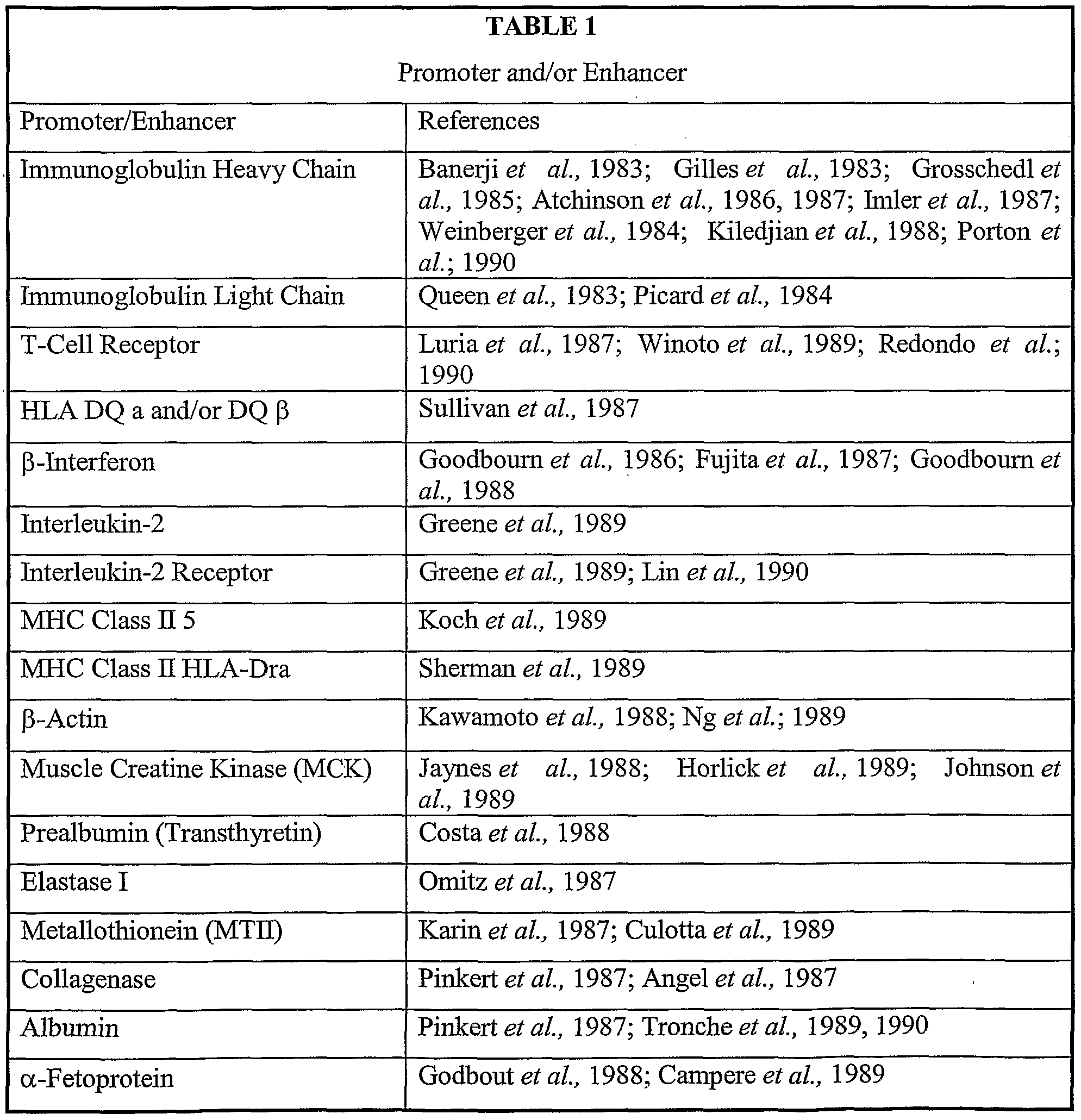
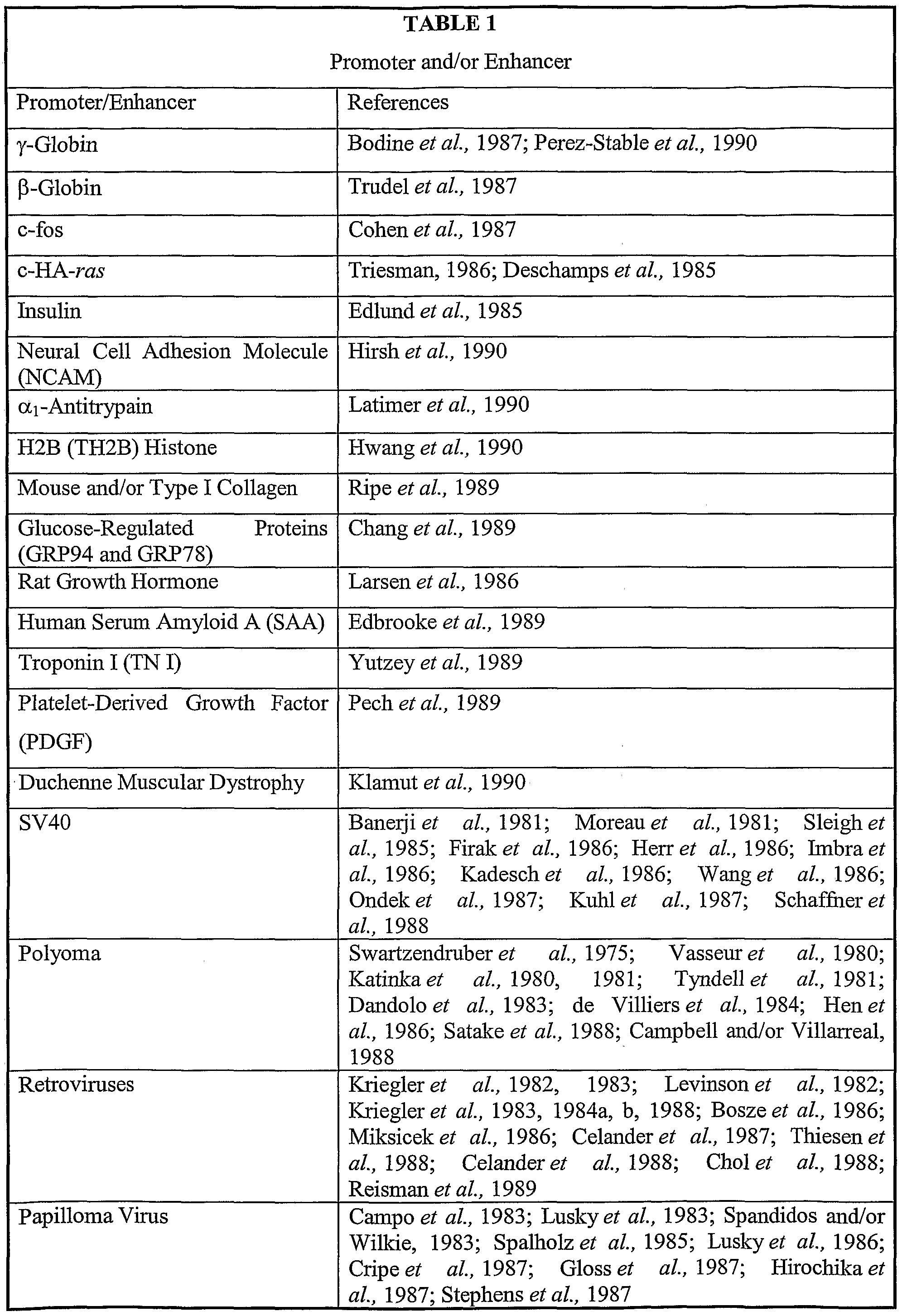
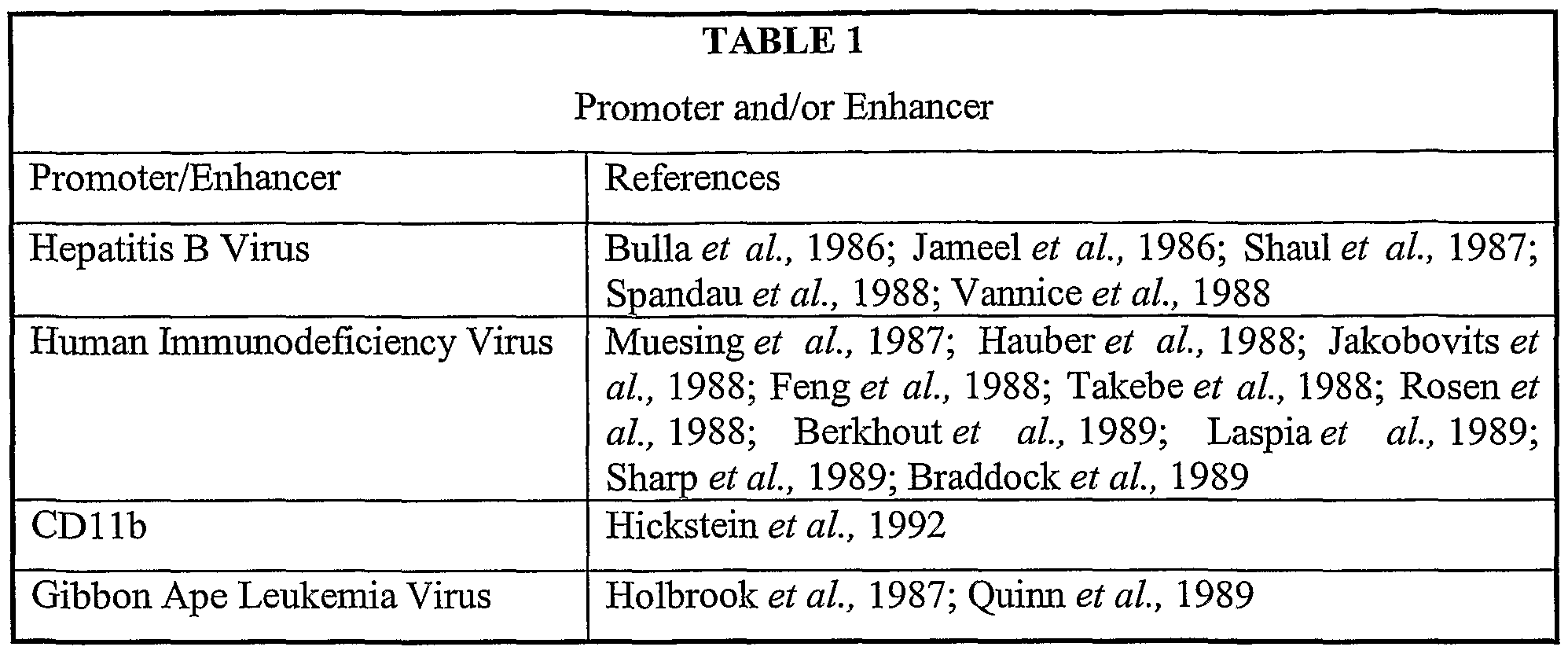
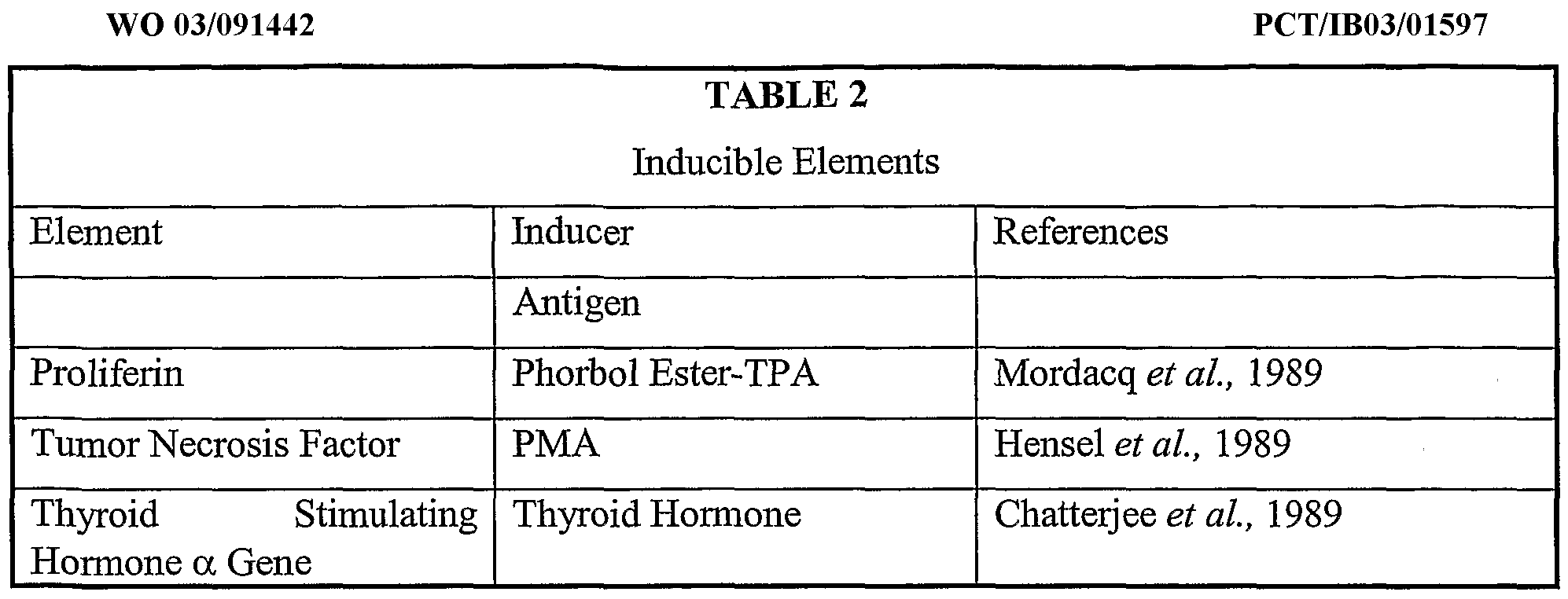
  • the regulatory sequence can be any eukaryotic promoter or enhancer, including for example, EFl ⁇ , PGK, the Moloney murine leukemia virus promoter-enhancer element, the human cytomegalovirus enhancer, the vaccinia P7.5 promoter or the like (also see examples listed in Tables 1 and 2 below).
  • the promoter-enhancer elements are located within or adjacent to the LTR sequences.
  • the regulatory sequence is one which is not endogenous to the lentivirus from which the vector is being constructed.
  • the SIV regulatory sequence found in the SIV LTR would be replaced by a regulatory element which does not originate from SIN.
  • an antibody or a particular ligand for targeting to a receptor of a particular cell-type.
  • the vector By inserting a sequence (including a regulatory region) of interest into the viral vector, along with another gene which encodes the ligand for a receptor on a specific target cell, for example, the vector is now target-specific.
  • Retroviral vectors can be made target-specific by inserting, for example, a glycolipid or a protein. Targeting often is accomplished by using an antigen-binding portion of an antibody or a recombinant antibody-type molecule, such as a single chain antibody, to target the retroviral vector.
  • the passive model of GP incorporation implies non-obligatory interactions between the pseudotyping glycoprotein and the viral core, provided that the former is sufficiently abundant at the site of virus budding 51 and that its cytoplasmic tail does not bear determinants that are sterically incompatible with viral assembly or virion morphology 49 , hi this respect, heterologous GPs harboring short cytoplasmic tails such as those of FPV, LCMV and VSV (Fig. 2) are likely to be incorporated on lentiviral particles via a passive mechanism.
  • pseudotyping of lentiviral core particles with the glycoproteins of type C and D mammalian retroviruses involves an alternative pathway of assembly 14 .
  • the GPs of some of these retroviruses like the GALV and the RDl 14 viruses, have been shown to harbor in their cytoplasmic tail a determinant that restricts incorporation on lentiviral cores 8,14 .
  • the relatively short cytoplasmic tails of type C/D mammalian retrovirus GPs of about 30-40 amino-acid-long, harbor a 15-20 amino-acid-long carboxy-terminal peptide, named R for MLVs, whose cleavage by the homologous viral core protease is required to activate the fusion potential ofthe glycoprotein " .
  • R for MLVs a 15-20 amino-acid-long carboxy-terminal peptide
  • VSV-G-pseudotyped lentiviral vectors have proved useful to transduce several cell types in vivo or in vitro 3'7 . Yet their high sensitivity to human 24 and non-human primate (Fig. 4) complement may preclude their utility for in vivo systemic administration. In contrast to VSV-G pseudotypes, vectors generated with retroviral glycoproteins were stable in human and macaque sera, with RD114/TR-pseudotyped SIV vectors being constantly resistant to human sera, suggesting that the latter vectors could be particularly suitable for systemic gene delivery (Fig. 4).
  • Retroviruses produced by human cells are usually resistant in human serum 34 ' 36 , with the exception of VSV-G-pseudotyped vectors 24 .
  • onco-retroviral vectors coated with MLV GPs and produced by human cells were differentially sensitive to complement inactivation in sera from non-human Old World primates in a manner that correlated with increasing evolutionary distance from humans .
  • VSV-G-pseudotyped lentiviral vectors may not be suitable for particular gene transfer applications where cell type-specific gene delivery would be required. More selective tropisms could be achieved by taking advantage ofthe natural tropisms of glycoproteins derived from some membrane-enveloped viruses or, alternatively, by engineering the host-range of incorporation-competent GPs (e.g., MLV, GALV/TR or FPV-HA) 65 ' 66 .
  • MLV, GALV/TR or FPV-HA incorporation-competent GPs
  • surface glycoproteins derived from viruses that cause lung infection and infect via the airway epithelia like Ebola virus or Influenza virus, may prove useful for gene therapy ofthe human airway 10 .
  • lentiviral vector pseudotypes might not always retain the host range ofthe parental viruses from which the pseudotyping glycoproteins were derived.
  • the glycoprotein ofthe Mokola virus, a neurotropic lyssavirus efficiently pseudotypes HIV-1 vectors 12
  • the pseudotyped vectors do not reproduce the specific neurotropism ofthe parental virus 9 .
  • CH-296 retronectin fragment enhances infection may involve the co-localization of retroviral particles and target cells 43 , owing to the property of CH-296 to bind both the cell surface, through its attachment to ⁇ 4/5 ⁇ ⁇ integrins, and the viral glycoprotein, through a high-affinity hep arm II domain 42 .
  • alternative explanations, involving inhibition of apoptosis and stimulation of cell division, have been proposed 67 , our results are in favor ofthe former mechanism since differential effects of CH-296 were detected according to the type of glycoprotein used to pseudotype the lentiviral core particles.
  • Proteins ofthe extra-cellular matrix such as heparan sulfate proteoglycans, play a major role in the initial steps of infection and perhaps are more important to mediate viral/cell attachment than the viral receptors themselves, that primarily serve to trigger membrane fusion 69 ' 70 .
  • Motifs that differentially influence binding to extra-cellular matrix proteins have been identified in glycoproteins of several enveloped viruses 71 ' 72 . They may be particularly efficient in the RDl 14 glycoprotein and stimulate CH-296-mediated attachment to cells.
  • RDl 14/TR-pseudotyped SIV vectors very efficiently transduced human and macaque PBLs (Fig. 6), in the absence of retronectin. Indeed, in these cells, there was a striking difference in the transduction efficiencies observed with vectors pseudotyped with either VSV-G or MLV- A GP and those coated with RDl 14/TR GP. The reasons for this discrepancy may lie in difference in expression ofthe receptors for these GPs. Alternatively these results may not necessarily involve differences in receptor density and/or initial virus/receptor interaction parameters.
  • transduction efficiency does not correlate with the level of receptor expression 17,73 but rather establish the importance of post-binding events such as receptor clustering, membrane fusion mechanism, site of fusion, uncoating and migration of the viral particle from the site of uncoating and the nucleus 74,75 . It can therefore be surmised that, for transduction of PBLs with SIV vectors, the RDl 14 receptor modulates post-binding events in a more efficient fashion than the VSV-G or MLV-A receptors.
  • Cells may be transduced in vivo or in vitro, depending on the ultimate application. Even in the context of human gene therapy, such as gene therapy of human stem cells, one may transduce the stem cell in vivo or, alternatively, transduce in vitro followed by infusion of the transduced stem cell into a human subject.
  • the human stem cell can be removed from a human, e.g., a human patient, using methods well known to those of skill in the art and transduced as noted above. The transduced stem cells are then reintroduced into the same or a different human.
  • the treatment is typically carried out by intravenous administration ofthe vector.
  • the vector particles are incubated with the cells using a dose generally in the order of between 1 to 50 multiplicities of infection (MOI) which also corresponds to lxl 0 5 to 50xl0 5 transducing units ofthe viral vector per 10 5 cells.
  • MOI multiplicities of infection
  • This of course includes amount of vector corresponding to 1, 2, 3, 4, 5, 6, 7, 8 , 9, 10, 15, 20, 25, 30, 35, 40, 45, and 50 MOI.
  • the amount of vector may be expressed in terms of HeLa transducing units (TU).
  • Other routes for vector administration include intrarterially, endoscopically, intralesionally, percutaneously, subcutaneously, intramuscular, intrathecally, intraorbitally, intradermally, intraperitoneally, transtracheally, subcuticularly, by intrastemal injection, by inhalation or intranasal spraying, by endotracheal route and the like.
  • the expression vector can be delivered by direct injection into the tumor or into the tumor vasculature.
  • the terms “cell,” “cell line,” and “cell culture” may be used interchangeably. All of these terms also include their progeny, which is any and all subsequent generations. It is understood that all progeny may not be identical due to deliberate or inadvertent mutations.
  • "host cell” refers to a prokaryotic or eukaryotic cell, and it includes any transformable organisms that is capable of replicating a vector and/or expressing a heterologous nucleic acid encoded by the vectors of this invention.
  • a host cell can, and has been, used as a recipient for vectors.
  • a host cell may be "transfected” or “transformed,” which refers to a process by which exogenous nucleic acid is transferred or introduced into the host cell.
  • a transformed cell includes the primary subject cell and its progeny.
  • the terms “engineered” and “recombinant” cells or host cells are intended to refer to a cell into which an exogenous nucleic acid sequence, such as, for example, a lentivector ofthe invention bearing a therapeutic gene construct, has been introduced. Therefore, recombinant cells are distinguishable from naturally occurring cells which do not contain a recombinantly introduced nucleic acid.
  • RNAs or proteinaceous sequences may be co-expressed with other selected RNAs or proteinaceous sequences in the same host cell. Co-expression may be achieved by co-transfecting the host cell with two or more distinct recombinant vectors. Alternatively, a single recombinant vector may be constructed to include multiple distinct coding regions for RNAs, which could then be expressed in host cells transfected with the single vector.
  • Host cells may be derived from prokaryotes or eukaryotes, depending upon whether the desired result is replication of the vector or expression of part or all of the vector-encoded nucleic acid sequences. Numerous cell lines and cultures are available for use as a host cell, and they can be obtained through the American Type Culture Collection (ATCC), which is an organization that serves as an archive for living cultures and genetic materials. Some examples of host cells used in this invention include but are not limited to virus packaging cells, virus producer cells, 293T cells, human hematopoietic progenitor cells, human hematopoietic stem cells, CD34 + cells CD4 + cells, and the like.
  • A. Tissues and Cells include but are not limited to virus packaging cells, virus producer cells, 293T cells, human hematopoietic progenitor cells, human hematopoietic stem cells, CD34 + cells CD4 + cells, and the like.
  • the invention is not limited to any one particular cell type and that one may use the lentiviral vectors and methods of the invention for the expression of transgenes in many cell types.
  • cell types contemplated include terminally differentiated cells such as neurons, lung cells, muscle cells, liver cells, pancreatic cells, endothelial cells, cardiac cells, skin cells, bone marrow stromal cells, ear and eye cells.
  • stem cells and progenitor cells such as pancreatic ductal cells, neural precursors, and mesodermal stem cells are also contemplated.
  • the more preferred lentivectors ofthe present invention have highly desirable features that permit the high level expression of transgenes in human progenitor cells while meeting human biosafety requirements.
  • virus particles For the production of virus particles, one may employ any cell that is compatible with the expression of lentiviral Gag and Pol genes, or any cell that can be engineered to support such expression.
  • producer cells such as 293T cells, TE 671 and HT1080 cells may be used.
  • the lentivectors of the invention will be particularly useful in the transduction of human hematopoietic progenitor cell or a hematopoietic stem cell, obtained either from the bone marrow, the peripheral blood or the umbilical cord blood, as well as in the tranduction of a CD4 + T cell, a peripheral blood B or T lymphocyte cell, a peripheral blood mononuclear cell, a dendritic cell, and a monocytic cell.
  • Particularly preferred targets are CD34 cells.
  • a tissue may comprise a host cell or cells to be transformed or contacted with a nucleic acid delivery composition and/or an additional agent.
  • the tissue may be part or separated from an organism.
  • a tissue and its constituent cells may comprise, but is not limited to, blood (e.g., hematopoietic cells (such as human hematopoietic progenitor cells, human hematopoietic stem cells, CD34 + cells CD4 + cells), lymphocytes and other blood lineage cells), bone marrow, brain, stem cells, blood vessel, liver, lung, bone, breast, cartilage, cervix, colon, cornea, embryonic, endometrium, endothelial, epithelial, esophagus, facia, fibroblast, follicular, ganglion cells, glial cells, goblet cells, kidney, lymph node, muscle, neuron, ovaries, pancreas, peripheral blood, prostate, skin, skin, small intestine, spleen, stomach, teste
  • the host cell or tissue may be comprised in at least one organism.
  • the organism may be, human, primate or murine.
  • the organism may be any eukaryote or even a prokayote (e.g., a eubacteria, an archaea), as would be understood by one of ordinary skill in the art.
  • Some lentivectors ofthe invention may employ control sequences that allow them to be replicated and/or expressed in both prokaryotic and eukaryotic cells.
  • One of skill in the art would further understand the conditions under which to incubate all of the above described host cells to maintain them and to permit replication of a vector.
  • a cell in need thereof with a lentiviral vector comprising a therapeutic gene.
  • the cell will further be in an organism such as a human in need of the gene therapy.
  • the routes of administration will vary, naturally, with the location and nature of the disease, and include, e.g., intravenous, intrarterial, intradermal, transdermal, intramuscular, intranasal, subcutaneous, percutaneous, intratracheal, intraperitoneal, intratumoral, perfusion and lavage.
  • the cells will also sometimes be isolated from the organisms, exposed to the lentivector ex vivo, and reimplanted afterwards.
  • Injection of lentiviral nucleic acid constructs of the invention may be delivered by syringe or any other method used for injection of a solution, as long as the expression construct can pass through the particular gauge of needle required for injection.
  • a novel needleless injection system has recently been described (U.S. Patent 5,846,233) having a nozzle defining an ampule chamber for holding the solution and an energy device for pushing the solution out ofthe nozzle to the site of delivery.
  • a syringe system has also been described for use in gene therapy that permits multiple injections of predetermined quantities of a solution precisely at any depth (U.S. Patent 5,846,225).
  • Solutions of the nucleic acids as free base or pharmacologically acceptable salts may be prepared in water suitably mixed with a surfactant, such as hydroxypropylcellulose. Dispersions may also be prepared in glycerol, liquid polyethylene glycols, and mixtures thereof and in oils. Under ordinary conditions of storage and use, these preparations contain a preservative to prevent the growth of microorganisms.
  • the pharmaceutical forms suitable for injectable use include sterile aqueous solutions or dispersions and sterile powders for the extemporaneous preparation of sterile injectable solutions or dispersions (U.S. Patent 5,466,468). h all cases the form must be sterile and must be fluid to the extent that easy syringability exists.
  • the carrier can be a solvent or dispersion medium containing, for example, water, ethanol, polyol (e.g., glycerol, propylene glycol, and liquid polyethylene glycol, and the like), suitable mixtures thereof, and/or vegetable oils.
  • polyol e.g., glycerol, propylene glycol, and liquid polyethylene glycol, and the like
  • suitable mixtures thereof e.g., glycerol, propylene glycol, and liquid polyethylene glycol, and the like
  • vegetable oils e.g., glycerol, propylene glycol, and liquid polyethylene glycol, and the like
  • Proper fluidity may be maintained, for example, by the use of a coating, such as lecithin, by the maintenance of the required particle size in the case of dispersion and by the use of surfactants.
  • the prevention of the action of microorganisms can be brought about by various antibacterial and antifungal agents, for example, parabens, chlorobutanol, phenol, sorbic acid, thimerosal, and the like.
  • isotonic agents for example, sugars or sodium chloride.
  • Prolonged absorption ofthe injectable compositions can be brought about by the use in the compositions of agents delaying absorption, for example, aluminum monostearate and gelatin.
  • aqueous solutions For parenteral administration in an aqueous solution, for example, the solution should be suitably buffered if necessary and the liquid diluent first rendered isotonic with sufficient saline or glucose.
  • aqueous solutions are especially suitable for intravenous, intraarterial, intramuscular, subcutaneous, intratumoral and intraperitoneal administration, hi this connection, sterile aqueous media that can be employed will be known to those of skill in the art in light of the present disclosure.
  • one dosage may be dissolved in 1 ml of isotonic NaCI solution and either added to 1000 ml of hypodermoclysis fluid or injected at the proposed site of infusion, (see for example, "Remington's Pharmaceutical Sciences” 15th Edition, pages 1035-1038 and 1570-1580).
  • Some variation in dosage will necessarily occur depending on the condition of the subject being treated.
  • the person responsible for administration will, in any event, determine the appropriate dose for the individual subject.
  • preparations should meet sterility, pyrogenicity, general safety and purity standards as required by FDA Office of Biologies standards.
  • Sterile injectable solutions are prepared by incorporating the active compounds in the required amount in the appropriate solvent with various of the other ingredients enumerated above, as required, followed by filtered sterilization.
  • dispersions are prepared by incorporating the various sterilized active ingredients into a sterile vehicle which contains the basic dispersion medium and the required other ingredients from those enumerated above.
  • the preferred methods of preparation are vacuum-drying and freeze-drying techniques which yield a powder of the active ingredient plus any additional desired ingredient from a previously sterile-filtered solution thereof.
  • compositions disclosed herein may be formulated in a neutral or salt form.
  • Pharmaceutically-acceptable salts include the acid addition salts and which are formed with inorganic acids such as, for example, hydrochloric or phosphoric acids, or such organic acids as acetic, oxalic, tartaric, mandelic, and the like. Salts formed with the free carboxyl groups can also be derived from inorganic bases such as, for example, sodium, potassium, ammonium, calcium, or ferric hydroxides, and such organic bases as isopropylamine, trimethylamine, histidine, procaine and the like.
  • solutions Upon formulation, solutions will be administered in a manner compatible with the dosage formulation and in such amount as is therapeutically effective.
  • the formulations are easily administered in a variety of dosage forms such as mjectable solutions, drug release capsules and the like.
  • carrier includes any and all solvents, dispersion media, vehicles, coatings, diluents, antibacterial and antifungal agents, isotonic and absorption delaying agents, buffers, carrier solutions, suspensions, colloids, and the like.
  • carrier includes any and all solvents, dispersion media, vehicles, coatings, diluents, antibacterial and antifungal agents, isotonic and absorption delaying agents, buffers, carrier solutions, suspensions, colloids, and the like.
  • the use of such media and agents for pharmaceutical active substances is well known in the art. Except insofar as any conventional media or agent is incompatible with the active ingredient, its use in the therapeutic compositions is contemplated. Supplementary active ingredients can also be incorporated into the compositions.
  • phrases "pharmaceutically-acceptable” or “pharmacologically-acceptable” refers to molecular entities and compositions that do not produce an allergic or similar untoward reaction when administered to a human.
  • the preparation of an aqueous composition that contains a protein as an active ingredient is well understood in the art.
  • such compositions are prepared as injectables, either as liquid solutions or suspensions; solid forms suitable for solution in, or suspension in, liquid prior to injection can also be prepared.
  • the terms "contacted” and “exposed,” when applied to a cell, are used herein to describe the process by which a therapeutic lentiviral vector is delivered to a target cell.
  • the volume to be administered will be about 4-10 ml (preferably 10 ml), while for tumors of ⁇ 4 cm, a volume of about 1-3 ml will be used (preferably 3 ml).
  • Multiple injections delivered as single dose comprise about 0.1 to about 0.5 ml volumes.
  • the viral particles may advantageously be contacted by administering multiple injections to the tumor, spaced at approximately 1 cm intervals. Systemic administration is preferred for conditions such as hematological malignancies.
  • Continuous administration also may be applied where appropriate. Delivery via syringe or catherization is preferred. Such continuous perfusion may take place for a period from about 1-2 hours, to about 2-6 hours, to about 6-12 hours, to about 12-24 hours, to about 1-2 days, to about 1-2 wk or longer following the initiation of treatment. Generally, the dose of the therapeutic composition via continuous perfusion will be equivalent to that given by a single or multiple injections, adjusted over a period of time during which the perfusion occurs.
  • Treatment regimens may vary as well, and often depend on type of disease and location of diseased tissue, and factors such as the health and the age ofthe patient.
  • the clinician will be best suited to make such decisions based on the known efficacy and toxicity (if any) of the therapeutic formulations based on lentiviral vectors ofthe present invention.
  • a unit dose is defined as containing a predetermined-quantity of the therapeutic composition comprising a lentiviral vector of the present invention.
  • the quantity to be administered, and the particular route and formulation, are within the skill of those in the clinical arts.
  • a unit dose need not be administered as a single injection but may comprise continuous infusion over a set period of time.
  • Unit dose of the present invention may conveniently be described in terms of transducing units (T.U.) of lentivector, as defined by tittering the vector on a cell line such as HeLa or 293.
  • Unit doses range from 10 3 , 10 4 , 10 5 , 10 6 , 10 7 , 10 s , 10 9 , 10 10 , 10 11 , 10 12 , 10 13 T.U. and higher. 8.
  • One embodiment of the present invention is to transfer nucleic acids encoding a therapeutic gene, especially a gene that provides therapy for hematopoietic and lympho- hematopoietic disorders, such as the inherited or acquired disorders described above.
  • the nucleic acids encode a full-length, substantially full-length, or functional equivalent form of such a gene. These genes may be known as transgenes.
  • the lentivectors of the present invention may be employed to deliver any transgene that one desires, depending on the application.
  • a transgene that will confer a desirable function on such cells including, for example, globin genes, hematopoietic growth factors, which include erythropoietin (EPO), the interleukins (such as h ⁇ terleukin-1 (IL-1), h ⁇ terleukin-2 (IL-2), Interleukin-3 (IL-3), Interleukin-6 (IL-6), Interleukin-12 (IL-12), etc.) and the colony- stimulating factors (such as granulocyte colony-stimulating factor, granulocyte/macrophage colony-stimulating factor, or stem-cell colony-stimulating factor), the platelet-specific integrin ⁇ llb ⁇ , multidrug resistance genes, the gp91 or gp 47 genes that are defective in
  • a principal application ofthe present invention will be to provide for vectors that deliver desired transgenes to hematopoietic cells for a number of possible reasons. This might include, but of course not be limited to, the treatment of myelosupression and neutropenias which may be caused as a result of chemotherapy or immunosupressive therapy or infections such as AIDS, genetic disorders, cancers and the like.
  • Exemplary genetic disorders of hematopoietic cells include sickle cell anemia, thalassemias, hemaglobinopathies, Glanzmann thrombasthenia, rysosomal storage disorders (such as Fabry disease, Gaucher disease, Niemann-Pick disease, and Wiskott-Aldrich syndrome), severe combined immunodeficiency syndromes (SCID), as well as diseases resulting from the lack of systemic production of a secreted protein, for example, coagulation factor VIII and/or IX.
  • rysosomal storage disorders such as Fabry disease, Gaucher disease, Niemann-Pick disease, and Wiskott-Aldrich syndrome
  • SCID severe combined immunodeficiency syndromes
  • transgenes such as globin genes, hematopoietic growth factors, which include erythropoietin (EPO), the interleukins (especially Interleukin-1, Interleukin-2, h ⁇ terleukin-3, Interleukin-6, Interleukin-12, etc.) and the colony- stimulating factors (such as granulocyte colony-stimulating factor, granulocyte/macrophage colony-stimulating factor, or stem-cell colony-stimulating factor), the platelet-specific integrin llb ⁇ , multidrug resistance genes, the gp91 or gp 47 genes which are defective in patients with chronic granulomatous disease (CGD), antiviral genes rendering cells resistant to infections with pathogens such as human immunodeficiency virus, genes coding for blood coagulation factors VIII or IX which are mutated in hemophiliacs, ligands involved in T cell-mediated immune responses such as T cell antigen receptor
  • EPO erythrop
  • Exemplary cancers are those of hematopoietic origin, for example, arising from myeloid, lymphoid or erythroid lineages, or precursor cells thereof.
  • Exemplary myeloid disorders include, but are not limited to, acute promyeloid leukemia (APML), acute myelogenous leukemia (AML) and chronic myelogenous leukemia (CML).
  • APML acute promyeloid leukemia
  • AML acute myelogenous leukemia
  • CML chronic myelogenous leukemia
  • Lymphoid malignancies which may be treated utilizing the lentivectors of the present invention include, but are not limited to acute lymphoblastic leukemia (ALL) which includes B-lineage ALL and T-lineage ALL, chronic lymphocytic leukemia (CLL), prolymphocytic leukemia (PLL), hairy cell leukemia (HLL) and Waldenstrom's macroglobulinemia (WM).
  • ALL acute lymphoblastic leukemia
  • CLL chronic lymphocytic leukemia
  • PLL prolymphocytic leukemia
  • HLL hairy cell leukemia
  • WM Waldenstrom's macroglobulinemia
  • malignant lymphomas contemplated as candidates for treatment utilizing the lentiviral vectors of the present invention include, but are not limited to non-Hodgkin lymphoma and variants thereof, peripheral T-cell lymphomas, adult T-cell leukemia/lymphoma (ATL), cutaneous T-cell lymphoma (CTCL), large granular lymphocytic leukemia (LGF) and Hodgkin's disease.
  • the treatment of a hematopoietic and lympho-hematopoietic disorder involves the administration of a lentiviral vector of the invention comprising a therapeutic nucleic acid expression construct to a cell of hematopoietic origin.
  • a lentiviral vector of the invention comprising a therapeutic nucleic acid expression construct for the manufacture of a medicament intended for the treatment of a hematopoietic and lympho-hematopoietic disorder is also within the scope of the invention. It is contemplated that the hematopoietic cells take up the construct and express the therapeutic polypeptide encoded by nucleic acid, thereby restoring the cells normal phenotype.
  • a nucleic acid may be made by any technique known to one of ordinary skill in the art.
  • Non-limiting examples of synthetic nucleic acid, particularly a synthetic oligonucleotide include a nucleic acid made by in vitro chemical synthesis using phosphotriester, phosphite or phosphoramidite chemistry and solid phase teclmiques such as described in EP 266,032, or via deoxynucleoside H-phosphonate intermediates as described by Froehler et al, 1986, and U.S. Patent Serial No. 5,705,629.
  • a non-limiting example of enzymatically produced nucleic acid include one produced by enzymes in amplification reactions such as PCRTM (see for example, U.S.
  • a non-limiting example of a biologically produced nucleic acid includes recombinant nucleic acid production in living cells (see for example, Sambrook et al. 2000).
  • a nucleic acid may be purified on polyacrylamide gels, cesium chloride centrifugation gradients, or by any other means known to one of ordinary skill in the art (see for example, Sambrook et al. 2000).
  • nucleic acid will generally refer to at least one molecule or strand of DNA
  • RNA or a derivative or mimic thereof comprising at least one nucleobase, such as, for example, a naturally occurring purine or pyrimidine base found in DNA (e.g., adenine "A,” guanine “G,” thymine “T,” and cytosine “C”) or RNA (e.g. A, G, uracil “U,” and C).
  • nucleobase such as, for example, a naturally occurring purine or pyrimidine base found in DNA (e.g., adenine "A,” guanine “G,” thymine “T,” and cytosine “C”) or RNA (e.g. A, G, uracil “U,” and C).
  • nucleic acid encompasses the terms “oligonucleotide” and “polynucleotide.”
  • oligonucleotide refers to at least one molecule of between about 3 and about 100 nucleobases in length.
  • polynucleotide refers to at least one molecule of greater than about 100 nucleobases in length. These definitions generally refer to at least one single-stranded molecule, but in specific embodiments will also encompass at least one additional strand that is partially, substantially or fully complementary to the at least one single-stranded molecule.
  • a nucleic acid may encompass at least one double-stranded molecule or at least one triple-stranded molecule that comprises one or more complementary strand(s) or "complement(s)" of a particular sequence comprising a strand ofthe molecule.
  • a "gene” refers to a nucleic acid that is transcribed.
  • a "gene segment” is a nucleic acid segment of a gene.
  • the gene includes regulatory sequences involved in transcription, or message production or composition.
  • the gene comprises transcribed sequences that encode for a protein, polypeptide or peptide.
  • the gene comprises a nucleic acid, and/or encodes a polypeptide or peptide-coding sequences of a gene that is defective or mutated in a hematopoietic and lympho-hematopoietic disorder.
  • an "isolated gene” may comprise transcribed nucleic acid(s), regulatory sequences, coding sequences, or the like, isolated substantially away from other such sequences, such as other naturally occurring genes, regulatory sequences, polypeptide or peptide encoding sequences, etc.
  • the term “gene” is used for simplicity to refer to a nucleic acid comprising a nucleotide sequence that is transcribed, and the complement thereof.
  • the transcribed nucleotide sequence comprises at least one functional protein, polypeptide and/or peptide encoding unit.
  • this functional term "gene” includes both genomic sequences, RNA or cDNA sequences, or smaller engineered nucleic acid segments, including nucleic acid segments of a non-transcribed part of a gene, including but not limited to the non-transcribed promoter or enhancer regions of a gene. Smaller engineered gene nucleic acid segments may express, or may be adapted to express using nucleic acid manipulation technology, proteins, polypeptides, domains, peptides, fusion proteins, mutants and/or such like. Thus, a "truncated gene” refers to a nucleic acid sequence that is missing a stretch of contiguous nucleic acid residues.
  • nucleic acid segments may be designed based on a particular nucleic acid sequence, and maybe of any length. By assigning numeric values to a sequence, for example, the first residue is 1, the second residue is 2, etc., an algorithm defining all nucleic acid segments can be created:
  • n is an integer from 1 to the last number of the sequence and y is the length of the nucleic acid segment minus one, where n + y does not exceed the last number of the sequence.
  • the nucleic acid segments correspond to bases 1 to 10, 2 to 11, 3 to 12 ... and/or so on.
  • the nucleic acid segments correspond to bases 1 to 15, 2 to 16, 3 to 17 ... and/or so on.
  • the nucleic segments correspond to bases 1 to 20, 2 to 21, 3 to 22 ... and/or so on.
  • nucleic acid(s) of the present invention may be combined with other nucleic acid sequences, including but not limited to, promoters, enhancers, polyadenylation signals, restriction enzyme sites, multiple cloning sites, coding segments, and the like, to create one or more nucleic acid construct(s).
  • the overall length may vary considerably between nucleic acid constructs.
  • a nucleic acid segment of almost any length may be employed, with the total length preferably being limited by the ease of preparation or use in the intended recombinant nucleic acid protocol.
  • vector is used to refer to a carrier nucleic acid molecule into which a nucleic acid sequence can be inserted for introduction into a cell where it can be replicated.
  • Vectors of the present invention are lentivirus based as described above and in other parts of the specification.
  • the nucleic acid molecules carried by the vectors of the invention encode therapeutic genes and will be used for carrying out gene-therapies.
  • One of skill in the art would be well equipped to construct such a therapeutic vector through standard recombinant techniques (see, for example, Maniatis et al, 1988 and Ausubel et al, 1994).
  • expression vector refers to any type of genetic construct comprising a nucleic acid coding for a RNA capable of being transcribed. In some cases, RNA molecules are then translated into a protein, polypeptide, or peptide. In other cases, these sequences are not translated, for example, in the production of antisense molecules or ribozymes.
  • Expression vectors can contain a variety of "control sequences,” which refer to nucleic acid sequences necessary for the transcription and possibly translation of an operably linked coding sequence in a particular host cell. In addition to control sequences that govern transcription and translation, vectors and expression vectors may contain nucleic acid sequences that serve other functions as well and are described below.
  • Vectors of the present invention can include a multiple cloning site (MCS), which is a nucleic acid region that contains multiple restriction enzyme sites, any of which can be used in conjunction with standard recombinant technology to digest the vector (see, for example, Carbonelli et al, 1999, Levenson et al, 1998, and Cocea, 1997) "Restriction enzyme digestion” refers to catalytic cleavage of a nucleic acid molecule with an enzyme that functions only at specific locations in a nucleic acid molecule. Many of these restriction enzymes are commercially available. Use of such enzymes is widely understood by those of skill in the art.
  • MCS multiple cloning site
  • a vector is linearized or fragmented using a restriction enzyme that cuts within the MCS to enable exogenous sequences to be ligated to the vector.
  • "Ligation” refers to the process of forming phosphodiester bonds between two nucleic acid fragments, which may or may not be contiguous with each other. Techniques involving restriction enzymes and ligation reactions are well known to those of skill in the art of recombinant technology.
  • RNA molecules will undergo RNA splicing to remove introns from the primary transcripts.
  • Vectors containing genomic eukaryotic sequences may require donor and/or acceptor splicing sites to ensure proper processing of the transcript for protein expression (see, for example, Chandler et al, 1997)
  • the vectors or constructs of the present invention will generally comprise at least one termination signal.
  • a “termination signal” or “terminator” is comprised of the DNA sequences involved in specific termination of an RNA transcript by an RNA polymerase. Thus, in certain embodiments a termination signal that ends the production of an RNA transcript is contemplated. A terminator may be necessary in vivo to achieve desirable message levels.
  • the terminator region may also comprise specific DNA sequences that permit site-specific cleavage of the new transcript so as to expose a polyadenylation site. This signals a specialized endogenous polymerase to add a stretch of about 200 A residues (poly A) to the 3' end of the transcript. RNA molecules modified with this polyA tail appear to more stable and are translated more efficiently.
  • that terminator comprises a signal for the cleavage of the RNA, and it is more preferred that the terminator signal promotes polyadenylation ofthe message.
  • the terminator and/or polyadenylation site elements can serve to enhance message levels and to minimize read through from the cassette into other sequences.
  • Terminators contemplated for use in the invention include any known terminator of transcription described herein or known to one of ordinary skill in the art, including but not limited to, for example, the termination sequences of genes, such as for example the bovine growth hormone terminator or viral termination sequences, such as for example the SV40 terminator.
  • the termination signal may be a lack of franscribable or translatable sequence, such as due to a sequence truncation.
  • polyadenylation signal In eukaryotic gene expression, one will typically include a polyadenylation signal to effect proper polyadenylation of the transcript.
  • the nature of the polyadenylation signal is not believed to be crucial to the successful practice of the invention, and any such sequence may be employed.
  • Some examples include the SV40 polyadenylation signal or the bovine growth hormone polyadenylation signal, convenient and known to function well in various target cells. Polyadenylation may increase the stability of the transcript or may facilitate cytoplasmic transport.
  • a vector of the invention may contain one or more origins of replication sites (often termed "ori"), which is a specific nucleic acid sequence at which replication is initiated.
  • ori origins of replication sites
  • ARS autonomously replicating sequence
  • cells transduced with the lentivectors of the present invention may be identified in vitro or in vivo by including a marker in the expression vector.
  • markers would confer an identifiable change to the transduced cell permitting easy identification of cells containing the expression vector.
  • a selectable marker is one that confers a property that allows for selection.
  • a positive selectable marker is one in which the presence of the marker allows for its selection, while a negative selectable marker is one in which its presence prevents its selection.
  • An example of a positive selectable marker is a drug resistance marker.
  • a drug selection marker aids in the cloning and identification of transformants
  • genetic constructs that confer resistance to neomycin, puromycin, hygromycin, DHFR, GPT, zeocin and histidinol are useful selectable markers.
  • other types of markers including screenable markers such as GFP, whose basis is colorimetric analysis, are also contemplated.
  • screenable enzymes such as herpes simplex virus thymidine kinase (tk) or chloramphenicol acetyltransferase (CAT) may be utilized.
  • a “promoter” is a control sequence that is a region of a nucleic acid sequence at which initiation and rate of transcription are controlled. It may contain genetic elements at which regulatory proteins and molecules may bind, such as RNA polymerase and other transcription factors, to initiate the specific transcription a nucleic acid sequence.
  • the phrases "operatively positioned,” “operatively linked,” “under control,” and “under transcriptional control” mean that a promoter is in a correct functional location and/or orientation in relation to a nucleic acid sequence to control transcriptional initiation and/or expression of that sequence.
  • a promoter generally comprises a sequence that functions to position the start site for RNA synthesis.
  • the best known example of this is the TATA box, but in some promoters lacking a TATA box, such as, for example, the promoter for the mammalian terminal deoxynucleotidyl transferase gene and the promoter for the SV40 late genes, a discrete element overlying the start site itself helps to fix the place of initiation. Additional promoter elements regulate the frequency of transcriptional initiation. Typically, these are located in the region 30-110 bp upstream ofthe start site, although a number of promoters have been shown to contain functional elements downstream ofthe start site as well.
  • a coding sequence "under the control of a promoter, one positions the 5' end of the transcription initiation site of the transcriptional reading frame "downstream" of (i.e., 3' of) the chosen promoter.
  • the "upstream” promoter stimulates transcription ofthe DNA and promotes expression ofthe encoded RNA.
  • promoter elements frequently are flexible, so that promoter function is preserved when elements are inverted or moved relative to one another.
  • the spacing between promoter elements can be increased to 50 bp apart before activity begins to decline.
  • individual elements can function either cooperatively or independently to activate transcription.
  • a promoter may or may not be used in conjunction with an "enhancer,” which refers to a cz ' s-acting regulatory sequence involved in the transcriptional activation of a nucleic acid sequence.
  • a promoter may be one naturally associated with a nucleic acid sequence, as may be obtained by isolating the 5' non-coding sequences located upstream ofthe coding segment and/or exon. Such a promoter can be referred to as "endogenous.”
  • an enhancer may be one naturally associated with a nucleic acid sequence, located either downstream or upstream of that sequence.
  • certain advantages will be gained by positioning the coding nucleic acid segment under the control of a recombinant or heterologous promoter, which refers to a promoter that is not normally associated with a nucleic acid sequence in its natural environment.
  • a recombinant or heterologous enhancer refers also to an enhancer not normally associated with a nucleic acid sequence in its natural environment.
  • promoters or enhancers may include promoters or enhancers of other genes, and promoters or enhancers isolated from any other virus, or prokaryotic or eukaryotic cell, and promoters or enhancers not "naturally occurring," i.e., containing different elements of different transcriptional regulatory regions, and/or mutations that alter expression.
  • promoters that are most commonly used in recombinant DNA construction include the ⁇ -lactamase (penicillinase), lactose and tryptophan (trp) promoter systems.
  • sequences may be produced using recombinant cloning and/or nucleic acid amplification technology, including PCRTM, in connection with the compositions disclosed herein (see U.S. Patents 4,683,202 and 5,928,906,).
  • control sequences that direct transcription and/or expression of sequences within non-nuclear organelles such as mitochondria, chloroplasts, and the like, can be employed as well.
  • Control sequences comprising promoters, enhancers and other locus or transcription controlling/modulating elements are also referred to as "transcriptional cassettes".
  • promoter and/or enhancer that effectively directs the expression of the DNA segment in the organelle, cell type, tissue, organ, or organism chosen for expression.
  • Those of skill in the art of molecular biology generally know the use of promoters, enhancers, and cell type combinations for protein expression, (see, for example Sambrook et al, 2000).
  • the promoters employed may be constitutive, tissue-specific, inducible, and/or useful under the appropriate conditions to direct high level expression of the introduced DNA segment, such as is advantageous for gene therapy or for applications such as the large- scale production of recombinant proteins and/or peptides.
  • the promoter may be heterologous or endogenous.
  • Eukaryotic cells can support cytoplasmic transcription from certain bacterial promoters if the appropriate bacterial polymerase is provided, either as part of the delivery complex or as an additional genetic expression construct.
  • Tables 1 lists non-limiting examples of elements/promoters that may be employed, in the context of the present invention, to regulate the expression of a RNA.
  • Table 2 provides non- limiting examples of inducible elements, which are regions of a nucleic acid sequence that can be activated in response to a specific stimulus.
  • tissue-specific promoters or elements as well as assays to characterize their activity, is well known to those of skill in the art.
  • Non-limiting examples of such regions include the human LIMK2 gene (Nomoto et al, 1999), the somatostatin receptor 2 gene (Kraus et al, 1998), murine epididymal retinoic acid-binding gene (Lareyre et al, 1999), human CD4 (Zhao-Emonet et al, 1998), mouse alpha2 (XI) collagen (Tsumaki, et al, 1998), D1A dopamine receptor gene (Lee, et al, 1997), insulin-like growth factor II (Wu t al, 1997), and human platelet endothelial cell adhesion molecule-1 (Almendro et al, 1996).
  • the lentiviral vectors of the present invention are designed, primarily, to transform cells with a therapeutic gene under the control of regulated eukaryotic promoters.
  • a promoter/enhancer combination as per the Eukaryotic Promoter Data Base EPDB
  • a tissue-specific promoter for cancer gene therapy or the targeting of tumors may be employed with the lentiviral vectors of the present invention for treatment of cancers, especially hematological cancers.
  • promoters and enhancers that control the transcription of protein encoding genes in eukaryotic cells are composed of multiple genetic elements.
  • the cellular machinery is able to gather and integrate the regulatory information conveyed by each element, allowing different genes to evolve distinct, often complex patterns of transcriptional regulation.
  • Activation or repression of the promoter and enhancer elements may be had through contacting those elements with the appropriate transcriptional activators or repressors, such as those described in FIG. IB for the gp91-phox promoter and disclosed in Luo and Skalnik (1996) J. Biol. Chem. 271:18203-210, and Luo and Skalnik (1996) J. Biol. Chem. 271:23445-23451.
  • the activity of Ihterferon-gamma in modulating the transcription and expression of the expression cassette is an example of how such promoter or enhancer elements and the factors that interact with them may be employed in the practice ofthe present invention.
  • Enhancers were originally detected as genetic elements that increased transcription from a promoter located at a distant position on the same molecule of DNA. This ability to act over a large distance had little precedent in classic studies of prokaryotic transcriptional regulation. Subsequent work showed that regions of DNA with enhancer activity are organized much like promoters. That is, they are composed of many individual elements, each of which binds to one or more transcriptional proteins. See, for example, the model for the regulation ofthe gp91-phox promoter presented in FIG. IB.
  • Exemplary enhancers contemplated in the present invention are the DNAase HyperSensitive elements and their homologs described by Lien LL, Lee Y, Orkin SH, (1997) "Regulation of the myeloid-cell-expressed human gp91-phox gene as studied by transfer of yeast artificial chromosome clones into embryonic stem cells: suppression of a variegated cellular pattern of expression requires a full complement of distant cis elements," Mol Cell Biol. 17(4):2279-90. Under the influence of these enhancer elements, gene expression may be higher (due to enhancer activity HS) and less variegated (due to silencer activity of HS).
  • Analogs ofthe HS elements of gp91-phox are active in other promoter-enhancer systems. See, for example, May C, Rivella S, Callegari J, Heller G, Gaensler KM, Luzzatto L, Sadelain M, (2000) Therapeutic haemoglobin synthesis in beta-thalassaemic mice expressing lentivirus- encoded human beta-globin. Nature 406(6791):82-6, where analogous beta-globin HS elements were included into lentivector upstream of beta-globin promoter to drive expression of beta- globin cDNA.
  • Promoters and enhancers have the same general function of activating transcription in the cell. They are often overlapping and contiguous, often seeming to have a very similar modular organization. Taken together, these considerations suggest that enhancers and promoters are homologous entities and that the transcriptional activator proteins bound to these sequences may interact with the cellular transcriptional machinery in fundamentally the same way.
  • the basic distinction between enhancers and promoters is operational. An enhancer region as a whole must be able to stimulate transcription at a distance; this need not be true of a promoter region or its component elements. On the other hand, a promoter must have one or more elements that direct initiation of RNA synthesis at a particular site and in a particular orientation, whereas enhancers lack these specificities. Aside from this operational distinction, enhancers and promoters are very similar entities. Constructs of elements that control transcription and expression may therefore be comprised of various elements arranged so as to provide means of control of enhanced utility and operation.
  • a signal that may prove useful is a polyadenylation signal (hGH, BGH, SV40).
  • IRES internal ribosome binding sites
  • IRES elements are used to create multigene, or polycistronic, messages. IRES elements are able to bypass the ribosome scanning model of 5 '-methylated cap- dependent translation and begin translation at internal sites (Pelletier and Sonenberg, 1988). IRES elements from two members of the picornavirus family (polio and encephalomyocarditis) have been described (Pelletier and Sonenberg, 1988), as well as an IRES from a mammalian message (Macejak and Sarnow, 1991). IRES elements can be linked to heterologous open reading frames.
  • each open reading frame can be transcribed together, each separated by an IRES, creating polycistronic messages.
  • IRES element By virtue ofthe IRES element, each open reading frame is accessible to ribosomes for efficient translation. Multiple genes can be efficiently expressed using a single promoter/enhancer to transcribe a single message.
  • promoters are DNA elements that when positioned functionally upstream of a gene leads to the expression of that gene.
  • Most transgenes that will be transformed using the lentiviral vectors of the present invention are functionally positioned downstream of a promoter element.
  • a specific initiation signal also may be required for efficient translation of coding sequences. These signals include the ATG initiation codon or adjacent sequences. Exogenous translational control signals, including the ATG initiation codon, may need to be provided. One of ordinary skill in the art would readily be capable of determining this and providing the necessary signals. It is well known that the initiation codon must be "in-frame" with the reading frame of the desired coding sequence to ensure translation of the entire insert. The exogenous translational control signals and initiation codons can be either natural or synthetic. The efficiency of expression may be enhanced by the inclusion of appropriate transcription enhancer elements.
  • SEQ ID NO: 1 provides the nucleotide sequence of []
  • SEQ ID NO:2 provides the amino acid sequence of []
  • SEQ ID NO:3 provides the nucleotide sequence of []
  • SEQ ID NO:4 provides the amino acid sequence of [].
  • the 293T human embryo kidney cell line (ATCC CRL-1573) and the TE671 human rhabdomyosarcoma cell line (ATCC CRL-8805) were grown in DMEM (Life Technologies, France) supplemented with 10% fetal calf serum (FCS).
  • CD34 + cells Human and cynomolgus macaque (Macaca fascicularis) CD34 + cells were obtained from mobilized blood and bone marrow samples, respectively, as described previously 26"28 . CD34 + cells were recovered after Ficoll-Paque (Pharmacia, Sweden) gradient centrifugation and were purified with anti-CD34 M450 Dynabeads (Dynal, Norway). CD34 + cell purity was over 95%.
  • PBMCs peripheral blood mononuclear cells
  • PBLs Peripheral blood lymphocytes
  • Anti-RDl 14 GP was a goat antiserum raised against the RDl 14 gp70 envelope glycoprotein (SU), used diluted to 1/5,000 for Western Blots.
  • Anti-SIV CA NIH AIDS Research and Reference Reagent Program, USA
  • Anti-MLV CA (ViroMed Biosafety Labs, USA) was a goat antiserum raised against the Rausher leukemia virus (RLV) p30 capsid protein (CA), used diluted to 1/10,000 for Western Blots.
  • the pSIN-12 packaging plasmid (Fig. 1) is a derivative of pSIN8 25 and expresses the SINmac251 gag-pol genes under control of the hCMV promoter and an HIV-1 rev gene expression unit into which the two exons of rev have been fused and placed under control ofthe 3-hydroxy-3-methylglutaryl co enzyme A reductase (HMG) promoter, HMG intron I and the SV40 polyadenylation sequences.
  • the pSIV-Tl + plasmid 30 encodes a packaging-competent SJVmac251 -based vector that expresses the enhanced green fluorescent protein (GFP) marker gene under control ofthe CMV promoter (Fig. 1).
  • GFP enhanced green fluorescent protein
  • the pSIV-Tl + plasmid encodes a packaging-competent SINmac251 -based vector that expresses the enhanced green fluorescent protein (GFP) marker gene under control of the CMN promoter.
  • GFP green fluorescent protein
  • VSV vesicular stomatitis virus
  • EboV the glycoprotein of the Zaire strain of Ebola Virus
  • FPV fowl plague virus
  • GLV gibbon ape leukemia virus
  • All glycoproteins were expressed under control of the same exacting signals: CMV promoter, rabbit ⁇ -globin intron II and polyadenylation sequences (Fig. 1).
  • phCMV-G was used as a backbone to express the glycoproteins derived from the feline endogenous virus RDl 14 (Genbank X87829 34 ) and the 4070A strain of amphotropic MLN (MLN-A 35 ).
  • the phCMN-RD114 expression vector, expressing the RDl 14 virus envelope glycoprotein (RDl 14 GP), and the phCMN-GALN construct were further modified to express the RDl 14/TR (Fig. 2B) and GALV/TR 8,13 ' 15 chimeric glycoproteins carrying the MLV-A GP cytoplasmic tail.
  • the phCMV-RD expression vector expressing the RDl 14 virus envelope glycoprotein (RDl 14 GP), was further modified to generate a series of mutants that harbour modifications in the RDl 14 GP transmembrane domain (TMD) and/or cytoplasmic tail (CT). All subsequent constructs were generated by PCR-mediated and oligonucleotide site-directed mutagenesis (details and sequences are available upon request) and cloned in the phCMN-RD plasmid. The amino-acid sequences of the carboxy-terminal portions of the mutant RDl 14 GPs are shown in Fig. 7.
  • the HeLa cells used for the fusion assay were stable transfectants of either a ⁇ - galactosidase gene (LacZ) under the control of the HIN-1 long terminal repeat (LTR), whose expression is Tat-dependent (HeLaCD4LTRLacZ cells), or were constitutively expressing the Tat protein of HIN-1 (Hela-Tat cells), as described previously (9). Envelope-mediated fusion was quantified essentially as described previously (9, 16). In this assay, the HIV-1 LTR-driven expression of ⁇ -galactosidase is transactivated by the Tat protein upon fusion of envelope- expressing cells with receptor-bearing indicator cells.
  • LTR long terminal repeat
  • HeLaCD4LTRLacZ cells constitutively expressing the Tat protein of HIN-1
  • Pseudotyped SIN-derived vectors were generated as previously described 25 by transient transfection of 293T cells.
  • the pSIN-Tl + vector construct (8.1 ⁇ g), the pSIV-12 packaging construct (8.1 ⁇ g), and the viral glycoprotein-expression construct (2.7 ⁇ g) were used to co- transfect 293T cells seeded the day before in 10 cm plates.
  • the medium (12 ml plate) was replaced 16 hrs after transfection, and supernatant was harvested 24 hrs later.
  • Concentration of the vector particles was performed by pelleting the virions in 26-ml ultracentrifugation tubes, which were spun for one hr at 32,000 rpm at 4°C in a 70Ti Beckman rotor. Viral pellets were resuspended in serum-free DMEM supplemented with 1% bovine serum albumin (BSA) in 1/100 ofthe initial volume ofthe viral supernatant, aliquoted and stored at -80°C.
  • Pseudotyped MLV-derived vectors were generated in a similar manner by transient transfection of the pTG5349 MLV packaging construct (8.1 ⁇ g), of the pTG13077 MLV vector construct (8.1 ⁇ g) and of the glycoprotein-expressing construct (2.7 ⁇ g). Plasmid DNAs were transfected into 2.5xl0 6 293T cells seeded the day before in 10 cm plates using a calcium- phosphate transfection protocol (Clontech, France) according to the manufacturer's recommendations. The medium (8 ml/plate) was replaced 16 hrs after transfection, and supernatant was harvested 24 hrs later and filtered through 0.45 ⁇ m-pore-sized membranes.
  • Virus producer cells were lysed in a 20 mM Tris-HCl buffer (pH 6.5) containing 1% Triton-XlOO, 0.05% SDS (sodium dodecyl-sulfate), 5 mg/ml sodium deoxycholate, 150 mM NaCI, and 1 mM PMSF. Ly sates were incubated for 10 min at 4°C and were centrifuged for 5 min at 13,000xg to pellet the nuclei. Supematants were then frozen at -80°C until further analysis.
  • Tris-HCl buffer pH 6.5
  • SDS sodium dodecyl-sulfate
  • 5 mg/ml sodium deoxycholate 150 mM NaCI
  • PMSF 1 mM PMSF
  • Purified virus samples were obtained by ultracentrifugation of viral supematants (8 ml) through a 1.5-ml 20% sucrose cushion in a SW41 Beckman Rotor (25,000 rpm, 2.5 hrs, 4°C). Viral pellets were suspended in 100 ⁇ l of PBS, and frozen at -80°C.
  • Samples (30 ⁇ g for cell lysates, or 20 ⁇ l for purified viruses) were mixed 5:1 (vohvol) in a 375 mM Tris-HCl (pH 6.8) buffer containing 6% SDS, 30% ⁇ -mercapto-ethanol, 10% glycerol, and 0.06% bromophenol blue, boiled for 5 min, then run on 9% SDS-PAGE. After protein transfer onto nitrocellulose filters, immunostaining was performed in TBS (Tris-base saline, pH 7.4) with 10% milk powder and 0.1% TWEEN.
  • TBS Tris-base saline, pH 7.4
  • the blots were probed with the relevant antibody and developed using HRPO-conjugated Ig (immunoglobulins) raised against the species of each primary antibody (DAKO, UK) and an enhanced chemiluminescence kit (Amersham Life Science).
  • virus producer cells were starved in cysteine- and methionine-free culture medium for 1 h and labeled at 37°C for 16 hrs in 3 ml of cysteine- and methionine-free DMEM containing 100 ⁇ Ci of 35 S-cysteine and 35 S-methionine (ICN) per ml and 2% dialysed fetal calf serum. Cells were lysed and immunoprecipitated as previously described (9) with a goat anti-RDl 14 SU serum.
  • the supernatant of virus producer cells were harvested and filtered through a 0.45-mm-pore-size filter. Supematants were ultracentrifuged on a 2-ml 20% sucrose cushion for 2 hrs at 30,000 rpm in an SW41 rotor (Beckman). The pellets were lysed by adding 150 ml of lysis buffer (50 mM Tris HCI (pH 7.5), 15 mM NaCI, 5 mM MgC12, 5 mM KCI, 1% Triton X-100, 0.5% sodium deoxycholate).
  • lysis buffer 50 mM Tris HCI (pH 7.5), 15 mM NaCI, 5 mM MgC12, 5 mM KCI, 1% Triton X-100, 0.5% sodium deoxycholate.
  • lysate was preserved and electrophoresed as such for a crude analysis of the virus protein content by western-blotting, whereas the remaining lysate was submitted to immunoprecipitation with anti-RDl 14 SU antibodies, hnmunoprecipitates were electrophoresed in sodium dodecyl sulfate (SDS)-12% polyacrylamide gels under reducing conditions to dissociate the co-immunoprocipitated TM GP subunit from the SU.
  • SDS sodium dodecyl sulfate
  • TE671 target cells were seeded at a density of 3x10 5 cells per well in 6-well plates one day prior transduction. Serial dilutions of vector preparations were added to the cells in the presence of 6 ⁇ g/ml of polybrene, and the cultures were incubated for 4 hrs at 37°C. The vector- containing medium was then replaced with normal culture medium and the cells were incubated for 72 hrs at 37°C. The transduction efficiency, determined as the percentage of GFP-positive cells, was measured by FACS analysis following individualisation of the transduced cells in trypsine and their re-suspension in PBS.
  • CD34 + cells were incubated overnight in 12-well plates at 2x10 6 cells/well in 2 ml of StemSpan SFEM medium supplemented with antibiotics (StemCell Technologies, Meylan, France) and with 10 ng/ml of thrombopoietin (TPO; Peprotech Inc, London, UK).
  • Pre-activated CD34 + cells were then seeded in 96-well plates (10 4 /well) and were transduced with the pseudotyped vectors in a total volume of 200 ⁇ l StemSpan medium containing TPO and 6 ⁇ g/ml of polybrene.
  • Variable multiplicities of infection determined using TE671 target cells, were applied to the target cells and were in the range of 0.5 to 60 infectious particles/target cell.
  • Transduction in retronectin-coated wells CH-296; Takara Shuzo, Japan was performed using the same protocol in 96-well plates pre-coated for 2 hrs with 8 ⁇ g retronectin/well.
  • CD34 + cells were washed, suspended in 400 ⁇ l of StemSpan medium supplemented with 10% fetal calf serum (Life Technologies, France), with antibiotics, and with 10 ng/ml of Flt3-L, TPO, and stem cell factor (SCF) for 3 days.
  • GFP expression was analyzed by FACS analysis 5 days post-infection.
  • Human and macaque PBLs were pre-activated for 24 hr before infection as described previously by adding 1 ⁇ g of anti-CD3 (HIT3a, Pharmingen) and anti-CD28 (CD28.2, Pharmingen) antibodies to 1 ml of medium containing 2xl0 6 human PBLs 29 or by adding 5 ng/ml of concanavalin A and 10 ng/ml of IL2 to 2xl0 6 macaque PBLs 37 .
  • 10 5 activated PBLs were mixed with the pseudotyped vectors in a total volume of 1 ml of PBL medium supplemented with 6 ⁇ g/ml of polybrene, for 4 hrs at 37°C. After infection, cells were washed in PBS and incubated at 37°C for 5 days in RPMI-1640 (Life Technologies, France) supplemented with IL2 until transduction efficiency was determined by FACS analysis.
  • Example 1 Ability of different viral glycoproteins to pseudotype an SIV vector.
  • glycoproteins were derived from type C mammalian retroviruses, such as the Env GPs of the feline endogenous retrovirus RDl 14, the amphotropic murine leukemia virus (MLV-A), the MLV-10A1 and the gibbon ape leukemia virus (GALV), or from membrane-enveloped viruses, such as the fowl plague virus (FPV hemagglutinin - FPV-HA), the lymphocytic choriomeningitis virus (LCMV), Ebola virus (EboV), and vesicular stomatitis virus (VSV) GPs.
  • type C mammalian retroviruses such as the Env GPs of the feline endogenous retrovirus RDl 14, the amphotropic murine leukemia virus (MLV-A), the MLV-10A1 and the gibbon ape leukemia virus (GALV), or from membrane-enveloped viruses, such as the fowl plague virus (FPV
  • Pseudotyped SIN vectors were generated by transient expression in 293 T cells transfected with three plasmids (Fig. 1) encoding the SIN viral core proteins, an SIN-based transfer vector harboring the GFP marker gene, and the different GPs.
  • Infection assays on TE671 human rhabdomyosarcoma cells indicated that titers higher than 10 5 i.u./ml were obtained for vectors generated with the GPs of VSV, LCMV, MLV-A and MLV-10A1 (Fig. 2A).
  • vectors generated with the GPs of EboV and FPV had low titers, of less than 5xl0 3 i.u./ml.
  • SJN vectors generated with the GPs of GALV and RDl 14 had intermediate titers, between 10 4 and 5xl0 4 i.u./ml. These relative differences in infectivity of the pseudotyped vectors were reproduced on other target cells such as 293T cells (data not shown), suggesting that determination of the infectious titers on TE671 cells reflected the capacity of the different GPs to pseudotype SIN cores.
  • the infectious titers obtained with SIN vectors generated with the GPs of FPN, GALN and RDl 14 were surprisingly low in comparison to those achieved with MLN vectors pseudotyped with the same glycoproteins ' ' . Since budding of lentiviral core particles is not dependent on the expression of viral glycoproteins , this suggested that the virions could not efficiently incorporate these GPs or, alternatively, that they could not egress from producer cells after GP assembly. Indeed, when vector-producer cells expressing the FPN-HA were treated with neuraminidase, infectivity of HA-pseudotyped vectors was strongly increased by up to 100 fold (Fig. 2A).
  • cytoplasmic tail of mammalian type C retroviruses bears elements that control the formation and/or infectivity of pseudotypes with primate lentiviruses 8,13"15 . Since the MLN-A GP efficiently pseudotypes lentiviral vectors (Fig. 2A), we hypothesized that its cytoplasmic tail should contain all the elements required for optimal GP incorporation on lentiviral particles. Indeed, replacement of the cytoplasmic tail of RDl 14 (Fig. 2B) and GALN GPs with that of MLN-A GP resulted in strongly increased incorporation of either glycoprotein on lentiviral cores, as shown in Fig.
  • GALN/TR and RDl 14/TR preserved the host-range of the initial glycoproteins, as assessed on receptor-interference assays (data not shown), and conferred 25 fold increased titers to the SIN vectors (Fig. 2A).
  • Example 2 Characterization of pseudotyped SIV-based vector stocks.
  • vectors pseudotyped with FPN-HA, VSV-G or with the GALV/TR, RDl 14/TR, MLV-A and LCMV glycoproteins were very efficiently concentrated, allowing recovery of more than 80%, on average, of the infectious particles after a 100-fold concentration of the physical particles (data not shown).
  • vectors pseudotyped with the FPV-HA and LCMV glycoproteins failed to transduce the primary hematopoietic cells tested here (i.e., PBLs and CD34 + cells; data not shown), they were not analyzed further. Infectious titers of the concentrated stocks of vectors pseudotyped with the remaining glycoproteins (i.e., MLV-A, GALV/TR, RDl 14/TR and VSV-
  • Example 3 Stability of vector pseudotypes in primate sera.
  • Vectors suitable for in vivo gene delivery should be stable at 37°C and should retain high infectivity in primate sera.
  • the stability of the vector pseudotypes was therefore determined by comparing titers of viral particles incubated for one hour at 37°C versus 4°C.
  • Lentiviral vectors pseudotyped with RDl 14/TR GP or VSV-G were stable at 37°C, with more than 85% of the vector particles remaining infectious after incubation at 37°C (data not shown).
  • vectors pseudotyped with MLV-A and GALV/TR GPs lost more than 75% of infectivity following incubation at 37°C (data not shown), suggesting that the latter GPs incorporated into lentiviral core particles were temperature-sensitive.
  • the stability of the pseudotyped vectors in human and cynomolgus macaque sera was evaluated.
  • the same quantities of pseudotyped infectious particles were mixed with fresh primate sera at a ratio of 50/50 (v/v) and incubated for one hr at 37°C.
  • Heat-inactivated primate sera as well as fetal calf serum (FCS) were used as controls.
  • FCS fetal calf serum
  • the results represented as the percentages of residual infectivity after incubation in fresh or heat-inactivated primate sera relative to the infectivity of FCS-incubated virions (100%), are shown in Fig. 4.
  • the VSV-G- pseudotyped vectors were inactivated by both human and macaque sera, resulting in more than 90% degradation of viral particles.
  • Vectors pseudotyped with the retroviral glycoproteins were significantly more resistant in human sera, although their levels of resistance were variable according to the serum sample tested and the type of retroviral GP.
  • Vectors pseudotyped with MLV-A glycoproteins were stable in human serum but were relatively sensitive to inactivation by macaque serum.
  • Vectors coated with GALV/TR GP displayed variable levels of stability in human and macaque sera.
  • lentiviral vectors pseudotyped with the RDl 14/TR GP exhibited complete stability in all human sera tested (Fig. 4A) and presented good stability in macaque sera (Fig. 4B).
  • Example 4 Transduction of human and macaque primary hematopoietic cells.
  • the retronectin also enhanced the transduction efficiency of vectors pseudotyped with GALV/TR and MLV-A GPs, yet with a much lower magnitude compared to vectors pseudotyped with RD114/TR GP (Fig. 5A).
  • the percentages of GFP + cells steadily increased for the different vector pseudotypes until reaching plateaus.
  • the MOIs required for reaching these plateaus varied with the vector pseudotype.
  • the plateaus of transduction were quickly reached at MOIs of less than 5 infectious particles per cell for lentiviral vectors pseudotyped with VSV-G, with MLV-A GP or with GALV/TR GP (Fig. 6A).
  • the threshold MOI necessary to reach a plateau with RDl 14/TR GP-pseudotyped virions was of about 5-10 infectious particles per cell (Fig. 6A).
  • the maximal transduction levels also varied with the vector pseudotype tested.
  • This somewhat low level of transduction is in agreement with our previous results 26 obtained with a VSV-G-pseudotyped HIV-1 -derived vector of the same generation and design as the SIV-T1 + vector used in this report.
  • much higher levels of transduction, reaching 50-75%, were achieved with vectors pseudotyped with the RDl 14/TR chimeric GP (55.04% ⁇ 11,74%; n 4).
  • RDl 14/TR glycoprotein was particularly potent to allow transduction of primate CD34 + cells and PBLs with pseudotyped SJN vectors, although the RDl 14/TR GP-pseudotyped SIN vectors required the retronectin CH-296 fragment for optimal transduction of short-term stimulated CD34 + cells.
  • Example 5 Design of RDl 14 GP cytoplasmic-tail mutants.
  • the feline endogenous virus RDl 14 is a type C mammalian retrovirus (32).
  • its GP is typical of that of simian type D retroviruses (28), with which it shares the same cell surface receptor, RDR (31, 38), and bears significant homology with the GP of MPMN (Mason-Pfizer monkey virus), in the TM subunit, in particular (Fig. 7).
  • MPMN Mel-Pfizer monkey virus
  • transmembrane domain and/or cytoplasmic tail of mammalian type C retroviruses bear elements that control formation and/or infectivity of pseudotypes with HIN-1 vectors (4, 34, 36).
  • Such elements might possibly influence the infectivity of viral particles at different levels: i) cellular co-localisation ofthe GP and viral cores necessary for viral assembly, ii) GP interactions with viral core proteins that condition GP incorporation, and iii) activation of GP fusogenicity through cleavage of its cytoplasmic tail by the retroviral protease during or shortly after virion budding.
  • the RDRless GP was a truncated version of RDl 14 GP and was generated by insertion of a stop codon at a position corresponding to a putative cleavage site of its CT (see below).
  • the cytoplasmic tails of the other mutants, RDP ⁇ SIVAR L M, RDPrSINRQAG and RDPrHTV contained substrates for the SlVmac or HIV-1 core proteases, which were respectively derived from cleavage sites found in the Gag proteins of SINmac251 or of HIN-1.
  • mutant RD ⁇ YXXL was designed to evaluate the importance of a putative tyrosine endocytosis motif carried by the RDl 14 CT, which might influence GP localisation, cell-surface expression and/or fusogenicity.
  • the influence of this motif has been well characterised for other retroviral GPs (1, 13, 19).
  • Production of all GP mutants was achieved using identical expression-vectors under control of a CMV promoter.
  • 293 producer cells were co-transfected with plasmids encoding the components of vector particles, i.e., the viral core proteins, the transfer vector and either of the different GPs. o variations in the quantities of either core proteins or GPs were detected, as monitored by immuno-blotting of cell lysates using anti-RDl 14 SU antibodies (data not shown).
  • Example 6 Modifications of the RDl 14 GP cytoplasmic tail alter cell-cell fusogenicity.
  • the other RDl 14 chimeric GPs induced variable levels of syncytia. Maximal cytopathic effects were noticed for the RDPrHIV and RDRless mutants. With the exception of mutant RDPrSINARL M which was as fusogenic than the unmodified RDl 14 GP, the other chimeras (RD ⁇ YXXL, RDPrMLV, and RDP ⁇ SIV R Q AG ) induced the formation of syncytia at levels higher than those obtained with the wild-type RDl 14 GP (Fig. 8). Altered cell-cell fusogenicity was intrinsically linked to modifications ofthe RDl 14 GP and was not influenced by interaction with the other viral components present in the transfected cells.
  • Example 7 Modifications of the RD114 GP cytoplasmic tail modulate pseudotyping of lentiviral or onco-retroviral vectors.
  • the capacity ofthe RDl 14 GP mutants to pseudotype either SINmac251- or MLN-based vectors was determined comparatively to wild-type RDl 14 GP, MLN-A GP and NSV-G.
  • the infectivity of vectors generated in the presence of the different GPs was assessed using TE671 target cells (Fig. 9). Consistent with our previous results, the unmodified RDl 14 GP could well pseudotype MLV-based vectors (6), but not efficiently lentiviral-based vectors (35).
  • Both SIV and MLV vectors generated with the RD ⁇ YXXL GP mutant had 3 to 4 fold lower titres than vectors pseudotyped with unmodified RDl 14 GP (Fig. 9).
  • the RD/TR and RD/MTR chimeric GPs efficiently pseudotyped the SlV-based vectors, hi the case ofthe RD/TR mutant, this resulted in infectious titres higher than 10 6 i.uJml; i.e., up to 25 fold higher than those obtained with the wild-type RDl 14 GPs, and in the same range, if not higher, than infectious titres obtained with SJN vectors pseudotyped with MLV-A GP or VSV-G (Fig. 9B).
  • MLV-derived vectors generated with the same chimeric GPs displayed only up to a 2- fold increase of infectivity compared to vectors pseudotyped with wild-type RDl 14 GP, whose titres were aheady high (Fig. 9A). Since the cytoplasmic tail was the minimal domain modified in these RDl 14 GP chimeras that led to increased infectivity of pseudotyped lentiviral vectors, these data therefore suggested that the CT of MLV-A, rather than its TMD, harboured a component that facilitated pseudotype formation with SIV vectors. Investigation of further RDl 14 GP chimeras (Fig. 7B) established that this component was located in a region that encompassed a putative cleavage site in its cytoplasmic tail.
  • truncation of the RDl 14 GP by insertion of a premature stop codon resulted in high cell-cell fusogenic activity (Fig. 8), a phenotype similar to that of the R-truncated GP mutants of either type C or D mammalian retroviruses (2, 10, 30, 33).
  • sequence alignement of the cytoplasmic tail of RDl 14 GP with the CTs of several type C and type D mammalian retroviral GPs allowed to predict the position of a 8 amino-acid-long sequence - VHAMVLAQ - in the cytoplasmic tail of the RDl 14 GP that most likely formed a retroviral protease cleavage site (Fig.
  • Example 8 Modifications of the RD114 GP cytoplasmic tail alter viral incorporation.
  • Viral particles carrying either SIN or MLN cores were generated with the RDl 14 GP chimeras and were purified by ultracentrifugation through 20% sucrose cushions. Detection and quantification of both viral core proteins and glycoproteins were performed by immunoblotting ofthe purified virions using anti-CA or anti-RDl 14 GP antibodies and allowed to measure the densities of RDl 14 GP chimeras on the viral particles (Fig. 4). No GP could be detected in the pellets of ultracentrifuged supematants from producer cells that only expressed the glycoproteins in the absence of viral cores (Fig. 4), thus demonstrating the specificity of the signals obtained with the purified virions.
  • Lysates of virion-producer cells revealed similar quantities of both SU and TM glycoproteins, as expected. All mutant TM glycoproteins had the same electrophoretic mobility on gels (Fig. 5A and B), indicating that the majority ofthe CTs of the different TM species were not cleaved inside the producer cells. These results also confirmed that the modulation of the cell-cell fusogenicity of the mutant RDl 14 GPs was not dependent on processing of their TM proteins (Fig. 8) but, rather, was intrinsically linked to alteration ofthe structure or conformation of their cytoplasmic tails.
  • RDl 14 GP chimeras had similar intensities on the purified MLV viral cores, for both SU and TM subunits (Fig. 5 A). This result confirmed that modification of their cytoplasmic tails did not affect their incorporation on onco-retroviral cores (Fig. 4). However, processing of the incorporated TM glycoproteins was detected in a manner dependent on the type of RDl 14 GP chimera. Indeed, compared to the size of their TM proteins in cell lysates, the TM subunits of the unmodified RDl 14 GP and of the chimeric RDPrMLV and RD/TR chimeras were approximately 2 kDa shorter (Fig. 5).
  • Example 10 Modifications of the RD114 GP cytoplasmic tail do not affect GP localisation in lipid rafts.
  • Membranes of cells transfected with the different GP mutants were fractionated under these conditions and the GP content of the membrane fractions was analysed by westem-blot analysis (Fig. 6). Wild-type RDl 14 GP as well as cytoplasmic tail mutants appeared in the detergent-resistant fractions of the lysates of transfected cells, indicating that all GPs were targeted to rafts.
  • compositions and/or methods disclosed and claimed herein can be made and executed without undue experimentation in light of the present disclosure. While the compositions and methods of this invention have been described in terms of preferred embodiments, it will be apparent to those of skill in the art that variations may be applied to the compositions and/or methods and in the steps or in the sequence of steps ofthe method described herein without departing from the concept, spirit and scope of the invention. More specifically, it will be apparent that certain agents which are both chemically and physiologically related may be substituted for the agents described herein while the same or similar results would be achieved. All such similar substitutes and modifications apparent to those skilled in the art are deemed to be within the spirit, scope and concept of the invention as defined by the appended claims.
  • Lentiviral vectors pseudotyped with envelope glycoproteins derived from gibbon ape leukemia vims and murine leukemia vims 10A1. Virology. 2000;273:16-20
  • Lemoine FM High-level gene transfer to cord blood progenitors using gibbon ape leukemia virus pseudotyped retroviral vectors and an improved clinically applicable protocol.
  • Combe C Mehtali M, Moullier P, Darlix J-L, Cosset F-L. Characterization of novel safe lentiviral vectors derived from simian immunodeficiency virus (SINmac251) that efficiently transduce mature human dendritic cells. Gene Ther. 2000;7:1613-1623 26. Salmon P, Kindler N, Ducrey O, Chapuis B, Zubler RH, Trono D. High-level transgene expression in human hematopoietic progenitors and differentiated blood lineages after transduction with improved lentiviral vectors. Blood. 2000;96:3392-3398
  • Cosset F-L Takeuchi Y, Battini J, Weiss R, Collins M. High titer packaging cells producing recombinant retroviruses resistant to human serum. J. Virol. 1995;69:7430-7436
  • Fibronectin improves transduction of reconstituting hematopoietic stem cells by retroviral vectors: evidence of direct viral binding to chymotryptic carboxy-terminal fragments. Blood. 1996;88:855-862
  • CD34+ cells on fibronectin fragment CH-296 is inhibited by high concentrations of vector containing medium. J Gene Med. 2001;3:207-218
  • Retroviral pseudotypes produced by rescue of moloney murine leukemia vims vector by C-type, but not D-type, retroviruses. Virology. 1992a; 186:792-794
  • HIV-1 gag proteins diverse functions in the vims life cycle Virology. 251:1-15.
  • the RD114/simian type D retrovims receptor is a neutral amino acid transporter Proc Natl Acad Sci U S A. 96:2129-2134.
  • Lentiviral vectors pseudotyped with a modified RDl 14 envelope glycoprotein show increased stability in sera and augmented transduction of primary lymphocytes and CD34+ cells derived from human and non-human primates Blood, in press.
  • Type C retrovirus inactivation by human complement is determined by both the viral genome and producer cell J. Virol. 68:8001-8007.
  • Feline leukemia vims subgroup B uses the same cell surface receptor as gibbon ape leukemia vims J Virol. 66:1219-1222.
  • Pfizer monkey vims genome makes human immunodeficiency vims type 1 expression and replication Rev-independent," Proc. Natl. Acad. Sci. 91:1256-60, 1994. Brown, Tiley, Cullen, "Efficient polyadenylation within the human immunodeficiency vims type
  • Thyroid Hormone Alpha Gene by Thyroid Hormone Receptor Interaction Adjacent to the TATA
  • Prealbumin Gene Binds a Common Factor at One Site and a Liver-Specific Factor(s) at
  • Vims- 16 Contains an E2 Protein-Independent Enhancer Which is Specific for Cervical
  • HJV-1 HJV-1
  • HJN-2 HJN-2 mR ⁇ A Initiation Sites Mediates Transcriptional Activation by an HIN Trans- Activator
  • Jameel and Siddiqui "The Human Hepatitis B Virus Enhancer Requires Transacting Cellular
  • HIV-1 gag-pol gene J. Virol. 74:4839-52, 2000.
  • Kraus et al "Alternative promoter usage and tissue specific expression of the mouse somatostatin receptor 2 gene," FEBSLett., 428(3):165-170, 1998.
  • Kriegler and Botchan "A retrovirus LTR contains a new type of eukaryotic regulatory element,"

Landscapes

  • Health & Medical Sciences (AREA)
  • Life Sciences & Earth Sciences (AREA)
  • Chemical & Material Sciences (AREA)
  • Genetics & Genomics (AREA)
  • Organic Chemistry (AREA)
  • Engineering & Computer Science (AREA)
  • General Health & Medical Sciences (AREA)
  • Bioinformatics & Cheminformatics (AREA)
  • Biomedical Technology (AREA)
  • Biochemistry (AREA)
  • Molecular Biology (AREA)
  • General Engineering & Computer Science (AREA)
  • Wood Science & Technology (AREA)
  • Zoology (AREA)
  • Biotechnology (AREA)
  • Biophysics (AREA)
  • Virology (AREA)
  • Medicinal Chemistry (AREA)
  • Plant Pathology (AREA)
  • Microbiology (AREA)
  • Physics & Mathematics (AREA)
  • Proteomics, Peptides & Aminoacids (AREA)
  • Gastroenterology & Hepatology (AREA)
  • Pharmacology & Pharmacy (AREA)
  • Animal Behavior & Ethology (AREA)
  • Public Health (AREA)
  • Veterinary Medicine (AREA)
  • General Chemical & Material Sciences (AREA)
  • Chemical Kinetics & Catalysis (AREA)
  • Nuclear Medicine, Radiotherapy & Molecular Imaging (AREA)
  • Hematology (AREA)
  • Diabetes (AREA)
  • Immunology (AREA)
  • Oncology (AREA)
  • Micro-Organisms Or Cultivation Processes Thereof (AREA)
  • Peptides Or Proteins (AREA)
  • Medicines That Contain Protein Lipid Enzymes And Other Medicines (AREA)
  • Medicines Containing Material From Animals Or Micro-Organisms (AREA)
  • Preparation Of Compounds By Using Micro-Organisms (AREA)

Abstract

The present invention provides improved chimeric glycoproteins (GPs) and improved lentiviral vectors pseudotyped with those glycoproteins. Also provided are methods and compositions for making such glycoproteins and vectors, and improved methods of in vitro and in vivo transduction of cells with such vectors. Improved chimeric GPs encode the extracellular and transmembrane domains of GALV or RDl14 GPs fused to the cytoplasmic tail of MLV-A GP. Vectors pseudotyped with these GAL V /TR and RD 114/TR GP chimeras have significantly higher titers than vectors coated with the parental GPs. Additionally, RDl14/TR-pseudotyped vectors are efficiently concentrated and are resistant to inactivation induced by the complement of both human and macaque sera. RDl14 GP-pseudotyped lentiviral vectors have particular utility for in vivo gene transfer applications.

Description

DESCRIPTION
IMPROVED CHIMERIC GLYCOPROTEINS AND PSEUDOTYPED LENTIVIRAL
VECTORS
BACKGROUND OF THE INVENTION
1. Field of the Invention
The present invention relates to chimeric glycoproteins and improved lentiviral vectors pseudotyped with those glycoproteins, methods and compositions for making such glycoproteins and vectors, and methods of in vitro and in vivo transduction of cells with such vectors. The improved compositions and vectors are of particular utility for in vivo gene transfer applications..
2. Description of Related Art
Vectors derived from retroviruses offer particularly flexible properties in gene transfer applications given the numerous possible associations of various viral surface glycoproteins (determining cell tropism) with different types of viral cores (determining genome replication and integration)1. For example, association ofthe VSN-G glycoprotein with viral cores derived from lentiviruses results in vector pseudotypes that have broad tropism and can integrate into non-prohferatmg target cells . They have proved useful for the transduction of several cell types ex vivo and in vivo '1. Yet there is considerable interest in exploring the properties of lentiviral vectors pseudotyped with alternative viral glycoproteins8"15. This parameter is likely to modulate the physico-chemical properties ofthe vectors, their interaction with the host immune system and their host-range. Several studies have indeed shown that the transduction efficiency of target cells is dependent on the type of glycoprotein used to coat retroviral vectors16"21. Additionally, some in vivo gene transfer applications will require vectors that are targeted for specific cell entry and/or gene expression after systemic administration22. Due to the wide distribution of its receptor, a lipid component ofthe plasma membrane23, NSN-G pseudotypes may bind to the surface of all cells encountered after inoculation before reaching the target cells. Moreover, NSV-G-pseudotyped vectors are rapidly inactivated by human serum24 and this might impose a limitation on the use of NSN-G as a glycoprotein to pseudotype vectors for systemic gene delivery. Lentiviral vectors derived from simian immunodeficiency virus (SIN) have been generated in several laboratories1, including our own25. Characterization of these vectors has indicated that they are similar to those derived from human immunodeficiency virus (HIN-1) with respect to the insertion of trans genes in non-proliferating cells, although SIV vectors perform better than HTV-1 vectors in simian cells .
SUMMARY OF THE INVENTION
The present invention is directed to chimeric and mutant glycoproteins for use in making pseudotyped viral vector particles. In particular embodiments, the chimeric glycoprotein comprises a cytoplasmic tail domain derived from MLV-A and a transmembrane and extracellular domain derived from feline endogenous virus RD114.
In additional embodiments, the glycoproteins incorporate minimal modifications that allow efficient pseudotype formation with lentivirus-based vectors. Specific embodiments include glycoproteins comprising cleavage sites within the cytoplasmic tail domain compatible with the retroviral core protease ofthe retroviral vector that is to be pseudotyped with the altered glycoprotein. In particular embodiments, modifications are introduced into a stretch of 8 amino- acids, which encompass a stubstrate for the viral core protease and whose cleavage is critical for the fusogenicity ofthe viral glycoprotein. These modifications allow pseudotyping with either oncoretro viral or with different lentiviral cores.
conjunction with these embodiments, a further embodiment ofthe invention is a method for matching the amino acid sequence ofthe cytoplasmic tail of chimeric and mutant glycoproteins with the proteases of retroviral cores, resulting in dramatically improved glycoprotein assembly on those cores.
The invention also encompasses nucleic acid constructs encoding such glycoproteins. In a preferred embodiment, the nucleic acid comprises the sequence of SEQ ID NO: 1. In additional aspect, the construct is an expression construct suitable for expression the glycoproteins such that they are incorporated into recombinant viral vector particles. In an additional aspect, the invention comprises a cell transfected with such nucleic acid constructs.
One embodiment ofthe invention comprises a vector particle comprising a chimeric glycoprotein wherein the chimeric glycoprotein comprises a cytoplasmic tail domain derived from MLV-A and a transmembrane and extracellular domain derived from feline endogenous virus RD114. hi an additional aspect, the vector particle is a pseudotyped vector particle. In a further aspect, the vector particle further comprises a recombinant viral vector construct.
In another embodiment, the vector particle comprises a vector construct wherein the vector construct is derived from a retrovirus or lentivirus. In one aspect, the vector construct is derived from SIN or HIN.
hi another embodiment the vector particle comprises a vector construct, which further comprises a transgene. In one aspect, the transgene is a marker or reporter gene. In a particular embodiment, the transgene is a green fluorescent protein (GFP). In another aspect, the transgene is a therapeutic gene. In particular embodiments, the transgene is an oncogene or a proto- oncogene. h another particular embodiment, the transgene is a drug susceptibilty gene.
An additional embodiment ofthe present invention is a method of transducing cells comprising:
a) obtaining cells to be transduced;
b) obtaining a pseudotyped vector particle in accordance with claim 8; and
c) contacting the cells with the vector particle of (b) under conditions sufficient to result in transduction. In an additional embodiment, the method further comprises the step of providing retronectin in an amount sufficient to enhance transduction. In one aspect ofthe method the cells are transduced in vitro. In another, the cells are transduced in vivo. In further embodiment s, the cells are vertebrate cells, primate cells, or human cells. The cells are also contemplated to be CD34+ or PBL cells. Another embodiment ofthe method encompasses a cell transduced by the method.
Yet another embodiment is a method for producing a recombinant pseudotyped viral vector particle comprising:
(a) transfecting a cell with:
(i) at least one vector construct;
(ii) at least one packaging construct; and
(iii) an expression construct encoding a chimeric glycoprotein of claim 1 to yield a producer cell;
(c) culturing the producer cell in a medium; and
(d) separating the producer cell from the medium to recover the recombinant viral vector particle from the medium.
Another embodiment comprises contacting the cell with a vector particle made in accordance with the methods ofthe invention and under conditions to effect the transduction of the cell by the recombinant vector. The cell is specifically contemplated to be a human cell, which includes a hematopoietic stem cell or a human CD34+ cell. In an additional embodiment, the cell is treated to stimulate cell proliferation without substantial loss of stem cell pluripotency. In additional aspects, the cell is transduced in vivo or in vitro. In further embodiments, the transduced cell is introduced into an animal subject. The animal subject is a human subject in a preferred embodiment.
A typical example of ex vivo gene therapy encompassed by the invention is a patient suffering from chronic granulatous disease (CGD), whose CD34+ cells can be isolated from the bone marrow or the peripheral blood and transduced ex vivo with a lentivector expressing the gp91phox gene before reimplantation. In the case of patients suffering from severe combined immunodeficiency (SCID), the inventors contemplate a similar approach, using vector constructs ofthe invention expressing the gene defective in the patient, for example, the gene encoding the common gamma chain of the Interleukin receptor. For the genetic treatment of HIV infection, the present inventors contemplate intracellular immunization, wherein cells are rendered resistant to the HIV virus through the introduction of antiviral genes. In embodiments ofthe intracellular immunization for HIV, targets ofthe vectors ofthe invention include hematopoietic progenitors, peripheral blood CD4+ T cells, and monocytes. As will be recognized by the skilled artisan, similar intracellular immumzation methods can be used for other viral infections as well. For the immunotherapy of cancers, tumor cells or antigen presenting cells such as dendritic cells will be genetically engineered with the lentivectors of the invention. For cancer therapies some transgenes that may be used in the lentivector constructs of the invention are those that can inhibit, and/or kill, and/or prevent the proliferation, and/or mediate the apoptosis of, the cancer/tumor cell and/or genes such as TNF.
The vector particles described herein may also be used in vivo, by direct injection into the blood or into a specific organ. For example, in one embodiment intracerebral injection of lentivectors expressing the Glial Cell Derived Nerve Growth Factor (GDNF), can be used for the treatment of Parkinson's disease. In another example, intraportal injection of a lentivector expressing coagulation factor VIII for the correction of hemophilia A is envisioned. In yet another example, intravenous or intramuscular injection of a lentivector ofthe present invention expressing the dystrophin gene for the treatment of Duchenne Muscular Dystrophy is envisioned. Thus, one of ordinary skill in the art will appreciate the extensive use ofthe vector constructs and particles ofthe present invention in terms of gene therapies.
As used herein the specification or claim(s) when used in conjunction with the word "comprising", the words "a" or "an" may mean one or more than one. As used herein "another" may mean at least a second or more.
Other objects, features and advantages of the present invention will become apparent from the following detailed description. It should be understood, however, that the detailed description and the specific examples, while indicating preferred embodiments of the invention, are given by way of illustration only, since various changes and modifications within the spirit and scope of the invention will become apparent to those skilled in the art from this detailed description.
BRIEF DESCRIPTION OF THE DRAWINGS
The following drawings form part ofthe present specification and are included to further demonstrate certain aspects ofthe present invention. The invention may be better understood by reference to one or more of these drawings in combination with the detailed description of specific embodiments presented herein.
FIG. 1A. Generation of SIVmac251-derived vectors. The genome of an infectious molecular clone of SlVmac (SiNmac251).
FIG. IB. SIVmac251 was used to derive constructs encoding the packaging functions and constructs carrying the transfer vector. Expression constructs expressing various viral glycoproteins (GP) were also designed. The filled boxes represent the viral genes. The open boxes show the czs-acting sequences. LTR, long terminal repeat; CMV, human cytomegalovirus immediate-early promoter; PBS, primer binding site; MSD, major splice donor site; Ψ, packaging sequence; RRE, Rev-responsive element; PHMG, 3-hydroxy-3-methylglutaryl coenzyme A reductase (HMG) promoter; polyA, polyadenylation site; SD, splice donor site; SA, splice acceptor site; SV40, simian virus 40 early promoter. Vector particles were produced by co-transfection of plasmids harboring the packaging functions, the viral glycoproteins and the transfer vector into 293T cells. The supematants of transfected cells were collected during transient expression, concentrated by ultracentrifugation, and used for target cell transduction.
FIG. 2A. Infectious titers of SIVmac-derived vectors pseudotyped with different viral glycoproteins. Vectors carrying the GFP marker gene were generated with the indicated GPs of retroviral or non-retroviral (stars) origins. EboV, Ebola virus; FPV-HA, hemagglutinin of fowl plague virus; GALV, gibbon ape leukemia virus; MLV-A, amphotropic murine leukemia virus; LCMV, lymphocytic choriomeningitis virus; VSV, vesicular stomatitis virus. TE671 target cells were infected with dilutions of non-concentrated vector preparations and the percentage of GFP-positive cells was determined 3 days post-infection. Infectious titers were calculated as GFP i.u./ml. In duplicate experiments, vector producer cells expressing the FPV-HA were treated with 2U of Clostridium perfringens neuraminidase (Sigma- Aldrich, France) for 24 hrs to induce the release of HA-pseudotyped particles from the surface of producer cells (FPV-HA + NA).
FIG. 2B. Schematic representation ofthe RD114/TR chimeric GP in which the cytoplasmic domain ofthe RD114 glycoprotein was replaced with that ofthe MLV-A GP. The sequences ofthe three topological domains, ectodomain, transmembrane and cytoplasmic tail, are shown. The GALV/TR chimeric GP was modified in a similar manner.
FIG. 2C. Incorporation of RD114 and RDl 14/TR GPs in virions was assessed in immunoblots of SIV vector particles pelleted through 20% sucrose cushions, using anti-RDl 14 SU and anti-CA antibodies. The position ofthe molecular weight markers is shown (kDa)
FIG. 3A. Characterization of pseudotyped SIV-based vector stocks. Infectious titers of SrVmac-based vector stocks pseudotyped with the indicated GPs and concentrated by ultracentrifugation. The mean titers ± SD from nine individual experiments performed on TE671 target cells are shown.
FIG. 3B. (B) Detection of physical particles was performed by immunoblotting of representative purified vector stocks using anti-SIV-CA (capsid) antibodies.
FIG. 4A. Stability of pseudotyped SIV-vector virions in human sera. Infectious pseudotyped SIV-vector particles (50,000 GFP i.u. in 50 μl of suspension buffer) were mixed with 50 μl of fresh (dashed bars) or heat-inactivated (black bars) human sera. As a reference, virions were mixed with 50 μl of heat-inactivated fetal calf serum (FCS). Virion/sera mixtures were incubated at 37°C for one hr and then used to transduce TE671 target cells. Values show the titers of primate sera-incubated virions relative to the titers ofthe same virions incubated in FCS (%). The results of experiments performed with sera of three different individual donors are shown. The experiments with human serum #659 were performed in triplicate and are displayed as mean values ± SD.
FIG. 4B. Stability of pseudotyped SIV-vector virions in macaque sera. Infectious pseudotyped SIV-vector particles (50,000 GFP i.u. in 50 μl of suspension buffer) were mixed with 50 μl of fresh (dashed bars) or heat-inactivated (black bars) macaque sera. As a reference, virions were mixed with 50 μl of heat-inactivated fetal calf serum (FCS). Virion/sera mixtures were incubated at 37°C for one hr and then used to transduce TE671 target cells. Values show the titers of primate sera-incubated virions relative to the titers ofthe same virions incubated in FCS (%). The results of experiments performed with sera of three different individual donors are shown. The experiments with human serum #659 were performed in triplicate and are displayed as mean values ± SD.
FIG. 5A. Transduction of human and macaque CD34+ cells. CD34+ cells, derived from human mobilized blood were pre-stimulated by overnight incubation with TPO and were transduced for 16 hrs at different multiplicities of infection (MOIs) with SIV-vectors pseudotyped with VSV-G (triangles), MLV-A GP (closed circles), GALV/TR GP (open circles) or RD114/TR GP (closed squares). For each sample of CD34+ cells, transductions were performed in duplicate: in the absence or in the presence of CH-296 retronectin polypeptides coated on the plates. After infection, cells were washed in PBS and cultured in the presence of Flt3-L, TPO, and SCF for an additional 3 days until transduction efficiency was assessed. The dose-response curves of representative experiments are shown for the same batches of CD34+ cells as well as the statistical analyses ofthe maximal transduction efficiencies of at least four experiments performed with CD34+ cells derived from different donors and stocks of pseudotyped vectors.
FIG. 5B. Transduction of human and macaque CD34+ cells. CD34+ cells, derived from cynomolgus macaque bone marrow were pre-stimulated by overnight incubation with TPO and were transduced for 16 hrs at different multiplicities of infection (MOIs) with SIV-vectors pseudotyped with VSV-G (triangles), MLV-A GP (closed circles), GALV/TR GP (open circles) or RD114/TR GP (closed squares). For each sample of CD34+ cells, transductions were performed in duplicate: in the absence or in the presence of CH-296 retronectin polypeptides coated on the plates. After infection, cells were washed in PBS and cultured in the presence of Flt3-L, TPO, and SCF for an additional 3 days until transduction efficiency was assessed. The dose-response curves of representative experiments are shown for the same batches of CD34+ cells as well as the statistical analyses ofthe maximal transduction efficiencies of at least four experiments performed with CD34+ cells derived from different donors and stocks of pseudotyped vectors.
FIG. 6A. Transduction of human peripheral blood lymphocytes. Peripheral blood lymphocytes (PBLs) of human origins were transduced with the indicated SIV-vector pseudotypes at different multiplicities of infection (MOIs). Human PBLs were activated with soluble anti-CD3 and anti-CD28 antibodies for 24 hours. Macaque PBLs were activated with concanavalin A and rhIL2 for 2 days prior to infection. Activated PBLs were infected for 4 hrs with STV vectors pseudotyped with VSV-G (triangles), MLV-A GP (closed circles), GALV/TR GP (open circles) or RDl 14/TR GP (closed squares). Infected cells were washed in PBS, grown in PBL culture medium and transduction efficiency was assessed five days post-infection. The results of experiments performed with PBLs from different donors are shown, as well as the statistical analyses ofthe maximal transduction efficiencies of at least four experiments performed with PBLs derived from different donors and stocks of pseudotyped vectors.
FIG. 6B. Transduction of macaque peripheral blood lymphocytes. Peripheral blood lymphocytes (PBLs) of cynomolgus macaque origins were transduced with the indicated SIN- vector pseudotypes at different multiplicities of infection (MOIs). Human PBLs were activated with soluble anti-CD3 and anti-CD28 antibodies for 24 hours. Macaque PBLs were activated with concanavalin A and rhIL2 for 2 days prior to infection. Activated PBLs were infected for 4 hrs with SIN vectors pseudotyped with NSN-G (triangles), MLN-A GP (closed circles), GALN/TR GP (open circles) or RDl 14/TR GP (closed squares). Infected cells were washed in PBS, grown in PBL culture medium and transduction efficiency was assessed five days post- infection. The results of experiments performed with PBLs from different donors are shown, as well as the statistical analyses ofthe maximal transduction efficiencies of at least four experiments performed with PBLs derived from different donors and stocks of pseudotyped vectors.
FIG. 7A. Representation of RDl 14 GP cytoplasmic-tail mutants. Alignment ofthe TM subunits ofthe RDl 14 GP with the TMs of type C (MLN-A) or type D (Mason-Pfizer monkey virus - MPMN) mammalian retrovirus Env glycoproteins. (:) shows the identical amino- acids in the TMs of MLN-A and MPMN relative to that of RDl 14. Conserved amino-acids such as I, L or N for aliphatic residues; K or R for positively charged residues and D or E for negatively charged residues are highlighted. The transmembrane domain (M) ofthe different GPs is boxed. The cytoplasmic tail is formed of two segments: the tail (T) ofthe mature GP found on virions after removal ofthe GP carboxy-terminal end (R) by the viral core protease. The protease cleavage sites (boxed) and the YXXL endocytosis motif (underlined) are shown in the different GPs.
FIG. 7B. Sequences ofthe carboxy-terminal ends that were modified in RDl 14 GP are underlined for each mutant. Only the transmembrane domains ofthe different chimeric GPs is boxed. (*) shows the position ofthe premature stop codon inserted in the RDRless chimeric GP. (') represents the position of cleavage mediated by the viral core protease.
FIG. 8. Results of syncytia assays. Cell-cell fusogenicity of the GP chimeras determined by counting the number of syncytia in transfected cells seeded in 2 cm2 wells. Mock- transfected cells (no GP) were used to determine the background number of syncytia (substracted here). The data represent the results of three independent experiments.
FIG. 9 A. Infectivity of vector pseudotypes. Infectivity of MLV vectors pseudotyped with the indicated GP mutants as GFP i.u. ml. The graph shows the mean ± SD of four independent experiments. Results obtained with vectors pseudotyped with either the MLV-A GP or with VSV-G are also shown, for comparison.
FIG. 9B. Infectivity of vector pseudotypes. Infectivity of SIV vectors pseudotyped with the indicated GP mutants as GFP i.uJml. The graph shows the mean ± SD of four independent experiments. Results obtained with vectors pseudotyped with either the MLV-A GP or with VSV-G are also shown, for comparison.
DESCRIPTION OF ILLUSTRATIVE EMBODIMENTS
We have made chimeric GPs encoding the extracellular and transmembrane domains of GALV or RDl 14 GPs fused to the cytoplasmic tail (designated TR) of MLV-A GP. Surprisingly, STV-derived vectors pseudotyped with these GALV/TR and RDl 14/TR GP chimeras have significantly higher titers than vectors coated with the parental GPs. Additionally, RDl 14/TR-pseudotyped vectors are efficiently concentrated and are resistant to inactivation induced by the complement of both human and macaque sera. Modified RDl 14 GP- pseudotyped lentiviral vectors are therefore of particular value for in vivo gene transfer applications. Furthermore, as compared to vectors pseudotyped with other retroviral GPs or with VSV-G, RD114/TR-pseudotyped vectors show augmented transduction of human and macaque primary blood lymphocytes and CD34+ cells.
Furthermore, RDl 14 GP mutants that bear alterations in their transmembrane domains and/or cytoplasmic tails can modulate pseudotype formation either with MLV, SIV or HTV-l viral core particles. We demonstrate that a cleavage site compatible with the retroviral core protease must be present in the cytoplasmic tail ofthe RDl 14 GP to enable efficient pseudotyping. While incompatibility ofthe cleavage site with the MLV protease alters infectivity of pseudotyped virions but not GP incorporation on MLV cores, compatibility ofthe cleavage site with the lentiviral protease conditions both GP incorporation and infectivity of pseudotyped lentiviral cores. There is therefore a novel pathway of viral assembly whereby determinants harboured by the cytoplasmic tail of a GP that restrict its incorporation on lentiviral cores should be removed by the viral protease to allow GP incorporation and infectivity of pseudotyped virions.
1. The cytoplasmic tail of the RDl 14 GP controls cell-cell and virus-cell fusogenicity.
For type C and type D mammalian retrovirus GPs, the cytoplasmic tail is of central importance in the processes that regulate both viral assembly and fusogenicity. Several evidences establish its influence on glycoprotein localisation, cell surface density, cell-cell fusion, interaction/incorporation with heterologous or homologous viral cores and infectivity ofthe virions. The cytoplasmic tail of these GPs is a structural motif that contains a carboxy-terminal peptide, named R, which harbours a tyrosine endocytosis signal - YXXL - (5), and whose cleavage by the viral protease strongly modulates the properties ofthe GP. In the native form of the GP, before cleavage, the R peptide is thought to interact i) with the adaptin complex ofthe cellular endocytosis machinery, ii) with the carboxy-terminal end ofthe mature GP found in virions (domain T ofthe cytoplasmic tail in Fig. 1A) and iii) with virion internal proteins (1, 8, 13, 14, 17, 19, 43). Characterisation of mutants ofthe RDl 14 glycoprotein (this report) indicates the existence of related signals carried by its cytoplasmic tail. Thus, the RDΔYXXL mutant GPs, in which the YXXL motif was disrupted by point mutagenesis, leads to increased cell-cell fusion most likely via increased cell surface expression, as suggested by studies of others using distinct onco-retroviral and lentiviral glycoproteins (1, 8, 13). However mutations that increased cell-cell fusogenicity and/or cell-surface expression may not necessarily enhance viral incorporation and/or viral infectivity, as inferred by the characterisation ofthe RDRless, RDPrMLV, RDPΓSΓVRQAG, RDPrHIV and RDΔYXXL mutant GPs. Additionally, our data indicate that the infectivity of pseudotyped vectors depends on the compatibility between the - modified - cytoplasmic tails of RDl 14 GP and the type of viral core.
Several genetic evidences obtained with other type C and D mammalian retrovirus GPs indicate that the cytoplasmic tail in its uncleaved - cellular - form acts both as an intrinsic negative regulator of GP fusogenicity (2, 14, 17, 30, 33, 43) and as a partner ofthe matrix protein during virion assembly (2, 3). Results obtained with the CT mutants ofthe RDl 14 glycoprotein indicate that the fusion control ofthe latter GP is modulated by its cytoplasmic tail in a manner similar to that of type C and D glycoproteins. Indeed cleavage ofthe cytoplasmic tail was found essential to activate the fusion potential for several type C and D glycoproteins (2, 14, 30, 33), through a not yet defined mechanism. Lack of cleavage ofthe CT results in poorly fusogenic glycoproteins. Also, premature cleavage, achieved through the insertion of a stop codon at the position of cleavage, strongly enhances syncytia formation (2, 30, 33). Moreover our data directly confirm that the carboxy-terminal end ofthe RDl 14 GP must be cleaved during or after virion assembly to allow infectivity (Fig. 5). Additionally mutations in either the region that forms the mature cytoplasmic tail (domain T — Fig. IB) or in the R peptide alter the control of cell-cell fusion (14, 17, 43), most likely as a result of disruption ofthe structure and/or integrity of this cytoplasmic tail. Likewise RDl 14 GP mutants that bear several mutations in the cytoplasmic tail, e.g., RDPrMLV, RDPΓSIVRQAG and RDPrHIN mutants may have enhanced cytotoxicity because ofthe loss of fusion inhibitory control by their mutated cytoplasmic tails.
2. A novel pathway of pseudotype formation with lentiviral cores.
Modifications ofthe cytoplasmic tail ofthe RDl 14 GP had little effect on the incorporation ofthe RDl 14 GP chimeras on MLV cores, in contrast to lentiviral cores (Fig. 4). This indicated that onco-retroviral cores are more permissive than lentiviral cores for GP incorporation, or, alternatively, that determinants of incompatibility carried by the RDl 14 GP were restricted to lentiviral cores. However the infectivity ofthe pseudotyped MLV vector particles was greatly influenced by the type of cleavage site introduced in the cytoplasmic tail of the RDl 14 GP chimeras (Fig. 3). While the replacement ofthe RDl 14 GP cleavage site with that of MLV had not effect on infectivity, the insertion of lentiviral cleavage sites dramatically decreased infection. Consistent with the deficient processing ofthe cytoplasmic tails ofthe TM proteins of these latter mutants when incorporated on MLV core particles (Fig. 5A), these results suggested that the poor infectivity ofthe latter vector pseudotypes was due to lack of activation of fusion potential ofthe incorporated GP chimeras. For MLV GP, abolishing cleavage ofthe cytoplasmic tail, achieved through mutations ofthe cleavage site itself or ofthe viral protease, resulted in mutants that incorporated normal levels of GP but which were not infectious (33).
Interestingly, the low infectivity of SIN vectors pseudotyped with wild-type RDl 14 GP could not only be explained by incompatibility ofthe cleavage site of its cytoplasmic tail with the lentiviral core protease. Indeed, our data suggest that, in constrast to the MLN-A GP, the cytoplasmic tail ofthe unmodified RDl 14 glycoprotein may not allow optimal interactions with the lentiviral core, preventing an efficient incorporation ofthe latter GP (Fig. 4). Examination of the properties ofthe RDl 14 GP chimeras may provide a molecular basis for this negative interaction. Indeed replacement ofthe cytoplasmic tail ofthe RDl 14 glycoprotein with that of the incorporation-competent MLN-A GP, resulted in up to 10 fold increased viral incorporation (Fig. 4), demonstrating that the cytoplasmic tail ofthe RDl 14 GP contains determinants of incompatibility with the lentiviral core. Interestingly, compatibility could be restored by introducing changes in the specificity ofthe cleavage site of its cytoplasmic tail. One possibility is that such changes may have induced structural modifications ofthe cytoplasmic tail that resulted in optimised interactions with SIN core, for example, by reducing steric incompatibilities with the SIV matrix proteins. Yet, our data also suggest the alternative, nonexclusive, possibility that cleavage ofthe cytoplasmic tail could be associated to GP incorporation. Susbtitutions ofthe RDl 14 GP cleavage site with cleavage sites derived either from the cytoplasmic tail ofthe pseudotyping-conipetent MLV-A GP (mutant RDPrMLV) or from SIN Gag proteins (mutant RDPΓSIVRQAG) resulted in the enhancement of both incorporation on SIN core particles and of viral titers, with the exception ofthe RDPΓSΓVARLM GP mutant. In a recent related study, Cannon et al. found that the unmodified GALN GP was excluded from incorporation on HIV-1 cores (4). Truncation ofthe R peptide as well as replacement of either the GALN CT or of its cleavage site with the corresponding sequences derived from MLN-A resulted in both increased GP incorporation and viral titers (4), in good agreement with our data obtained with a distinct type of retroviral glycoprotein. Collectively these data therefore suggest that the infectivity of pseudotyped lentiviral vectors is the result of compatibility ofthe CT ofthe pseudotyping glycoprotein with the viral core and can be modulated through its cleavage by the viral core protease. While these assumptions should be confirmed by the direct assessment for cleavage ofthe cytoplasmic tail, we envisage the possibility of a link between cleavage ofthe cytoplasmic tail and GP incorporation on non- permissive cores. Despite the localisation of onco-retro virus glycoproteins in plasma membrane lipid rafts (29), where lentiviruses have been shown to imtiate budding (25), it is possible that the cytoplasmic tails of these uncleaved GPs are not compatible with the network of matrix proteins. The presence of few active lentiviral protease in the vicinity ofthe viral assembly site may then cleave the cytoplasmic tails of these GP in a manner dependent on their compatibility with the cleavage site harboured by their CT. This would result in removal ofthe R peptide and thus in elimination of incompatibility determinants that prevented incorporation on the lentiviral cores. The tailored GPs may then be incorporated on lentiviral particles possibly following a passive mechanism of incorporation.
3. Viral Vectors
Viruses of many types have formed the basis for vectors. Virus infection involves the introduction of the viral genome into the host cell. That property is co-opted for use as a gene delivery vehicle in viral based vectors. The viruses used are often derived from pathogenic viral species that already have many of the necessary traits and abilities to transfect cells. However, not all viruses will successfully transfect all cell types at all stages ofthe cell cycle. Thus, in the development of viral vectors, viral genomes are often modified to enhance their utility and effectiveness for introducing foreign gene constructs (transgenes) or other nucleic acids. At the same time, modifications may be introduced that reduce or eliminate their ability to cause disease.
Lentiviruses are a subgroup of retroviruses that can infect nondividing cells owing to the karyophilic properties of their preintegration complex, which allow for its active import through the nucleopore. Correspondingly, lentiviral vectors derived from human immunodeficiency virus type 1 (HIV-1) can mediate the efficient delivery, integration and long-term expression of transgenes into non-mitotic cells both in vitro and in vivo (Naldini et al, 1996a; Naldini et al, 1996b; Blomer et al, 1997). For example, HIV-based vectors can efficiently transduce human CD34+ hematopoietic cells in the absence of cytokine stimulation (Akkina et al, 1996; Sutton et al, 1998; Uchida et al, 1998; Miyoshi et al, 1999; Case etal, 1999), and these cells are capable of long-term engraftment in NOD/SCID mice (Miyoshi et al, 1999). Furthermore, bone marrow from these primary recipients can repopulate secondary mice with transduced cells, confirming the lentivector-mediated genetic modification of very primitive hematopoietic precursors, most probably bonafide stem cells. Since none ofthe other currently available gene delivery systems has such an ability, lentiviral vectors provide a previously unexplored basis for the study of hematopoiesis and similar phenomena, and for the gene therapy of inherited and acquired disorders via the genetic modification of human stem cells (HCLs).
This important capability is subject to significant biosafety concerns (Akkina et al, 1996; Sutton et al, 1998; Uchida et al, 1998). The accidental generation of replication-competent recombinants (RCRs) during the production of lentiviral vector stocks represents one of the major problems to be solved before lentiviral vectors can be considered for human gene therapy.
In the retroviral genome, a single RNA molecule that also contains all the necessary cis- acting elements carries all the coding sequences. Biosafety of a vector production system is therefore best achieved by distributing the sequences encoding its various components over as many independent units as possible, to maximize the number of crossovers that would be required to re-create an RCR. Lentivector particles are generated by co-expressing the virion packaging elements and the vector genome in host producer cells, e.g. 293 human embryonic kidney cells. In the case of HIV-1 -based vectors, the core and enzymatic components of the virion come from HIV-1, while the envelope protein is derived from a heterologous virus, most often VSV. The genomic complexity of HIV, where a whole set of genes encodes virulence factors essential for pathogenesis but dispensable for transferring the virus genetic cargo, substantially aids the development of clinically acceptable vector systems.
Multiply attentuated packaging systems typically now comprise only three of the nine genes of HIV-1 : gag, encoding the virion main structural proteins, pol, responsible for the retrovirus-specific enzymes, and rev, which encodes a post-transcriptional regulator necessary for efficient gag and pol expression (Dull, et al, 1998). From such an extensively deleted packaging system, the parental virus cannot be reconstituted, since some 60% of its genome has been completely eliminated. In one version of an HIV-based packaging system, Gag/Pol, Rev, VSV G and the vector are produced from four separate DNA units. Also, the overlap between vector and helper sequences has been reduced to a few tens of nucleotides so that opportunities for homologous recombination are minimized.
HIV type 1 (HIV-1) based vector particles may be generated by co-expressing the virion packaging elements and the vector genome in a so-called producer cell, e.g. 293T human enbryonic kidney cells. These cells may be transiently transfected with a number of plasmids. Typically from three to four plasmids are employed, but the number may be greater depending upon the degree to which the lentiviral components are broken up into separate units. Generally, one plasmid encodes the core and enzymatic components of the virion, derived from HIV-1. This plasmid is termed the packaging plasmid. Another plasmid encodes the envelope protein(s), most commonly the G protein of vesicular stomatitis virus (VSV G) because of its high stability and broad tropism. This plasmid may be termed the envelope expression plasmid. Yet another plasmid encodes the genome to be transferred to the target cell, that is, the vector itself, and is called the transfer vector. Recombinant viruses with titers of several millions of transducing units per milliliter (TU/ml) can be generated by this technique and variants thereof. After ultracentrifugation concentrated stocks of approximately 109 TU/ml can be obtained.
The vector itself is the only genetic material transferred to the target cells. It typically comprises the transgene cassette flanked by cis-acting elements necessary for its encapsidation, reverse transcription, nuclear import and integration. As has been previously done with oncoretroviral vectors, lentiviral vectors have been made that are "self-inactivating" in that they lose the transcriptional capacity ofthe viral long terminal repeat (LTR) once transferred to target cells (Zufferey, et al. 1998). This modification further reduces the risk of emergence of replication competent recombinants (RCR) and avoids problems linked to promoter interference.
4. Pseudotyping Viral Vectors
Protein incorporation on retroviruses is not specific to the homologous viral glycoproteins. Over 40 different host cell-derived proteins have been identified on the exterior of HIN-1 viral particles, including major histocompatibility complex class I (MHC-I) and MHC-II molecules, adhesion molecules, co-stimulation molecules and complement control proteins48. Additionally, many heterologous viral glycoproteins can be incorporated into retrovirus particles and mediate infectivity49. This process, known as pseudotyping, allows retroviral vectors to transduce a broader range of cells and tissues. Engineering of lentiviral vectors with the NSN-G glycoprotein exemplifies the ability of a heterologous glycoprotein to extend the tropism of a vector2. However, co-expression of a given glycoprotein (GPs) with a heterologous viral core will not necessarily give rise to highly infectious viral particles8'14'15'50.
The env gene can be derived from any virus, including retroviruses. Examples of retro viral-derived env genes include, but are not limited to: Moloney murine leukemia virus (MoMuLN or MMLN), Harvey murine sarcoma virus (HaMuSN or HSN), murine mammary tumor virus (MuMTN or MMTN), gibbon ape leukemia virus (GaLN or GALN), human immunodeficiency virus (HIN) and Rous sarcoma virus (RSN). Other env genes such as Vesicular stomatitis virus (VSV) protein G (VSV G), that of hepatitis viruses and of influenza also can be used.
While VSV G protein is a desirable env gene because VSV G confers broad host range on the recombinant virus, VSV G can be deleterious to the host cell, e.g. the packaging cell. Thus, when a gene such as that for VSV G is used, an inducible promoter system may be employed so that VSV G expression can be regulated to minimize host toxicity when VSV G is expression is not required. For example, the tetracycline-regulated gene expression system of Gossen & Bujard, (1992) can be employed to provide for inducible expression of VSV G when tetracycline is withdrawn from the transferred cell. Thus, the tet/NP16 transactivator is present on a first vector and the NSN G coding sequence is cloned downstream from a promoter controlled by tet operator sequences on another vector.
The vector providing the viral env nucleic acid sequence is associated operably with regulatory sequences, e.g., a promoter or enhancer. The regulatory sequence can be any eukaryotic promoter or enhancer, including for example, EFlα, PGK, the Moloney murine leukemia virus promoter-enhancer element, the human cytomegalovirus enhancer, the vaccinia P7.5 promoter or the like (also see examples listed in Tables 1 and 2 below). In some cases, such as the Moloney murine leukemia virus promoter-enhancer element, the promoter-enhancer elements are located within or adjacent to the LTR sequences. Preferably, the regulatory sequence is one which is not endogenous to the lentivirus from which the vector is being constructed. Thus, if the vector is being made from SIN, the SIV regulatory sequence found in the SIV LTR would be replaced by a regulatory element which does not originate from SIN.
One may further target the recombinant virus by linkage of the envelope protein with an antibody or a particular ligand for targeting to a receptor of a particular cell-type. By inserting a sequence (including a regulatory region) of interest into the viral vector, along with another gene which encodes the ligand for a receptor on a specific target cell, for example, the vector is now target-specific. Retroviral vectors can be made target-specific by inserting, for example, a glycolipid or a protein. Targeting often is accomplished by using an antigen-binding portion of an antibody or a recombinant antibody-type molecule, such as a single chain antibody, to target the retroviral vector.
Two types of mechanisms are thought to lead to assembly of homologous and heterologous, viral or cellular, glycoproteins on viral particles. The passive model of GP incorporation implies non-obligatory interactions between the pseudotyping glycoprotein and the viral core, provided that the former is sufficiently abundant at the site of virus budding51 and that its cytoplasmic tail does not bear determinants that are sterically incompatible with viral assembly or virion morphology49, hi this respect, heterologous GPs harboring short cytoplasmic tails such as those of FPV, LCMV and VSV (Fig. 2) are likely to be incorporated on lentiviral particles via a passive mechanism. On the other hand, in the active model of GP incorporation, interactions between the cytoplasmic tail ofthe pseudotyping glycoprotein and components of the virion core dictate assembly of viral particles. There is ample evidence in the literature to support the critical role of such interactions in viral assembly (reviewed in39'49), at least for lentiviruses52"55.
In a recent study we proposed that pseudotyping of lentiviral core particles with the glycoproteins of type C and D mammalian retroviruses involves an alternative pathway of assembly14. The GPs of some of these retroviruses, like the GALV and the RDl 14 viruses, have been shown to harbor in their cytoplasmic tail a determinant that restricts incorporation on lentiviral cores8,14. The relatively short cytoplasmic tails of type C/D mammalian retrovirus GPs, of about 30-40 amino-acid-long, harbor a 15-20 amino-acid-long carboxy-terminal peptide, named R for MLVs, whose cleavage by the homologous viral core protease is required to activate the fusion potential ofthe glycoprotein " . For pseudotype formation with homologous type C/D viral cores, lack of cleavage ofthe R peptide by the viral protease alters infectivity of pseudotyped virions but not GP incorporation14'56'58. In contrast, the compatibility ofthe cleavage site with the lentiviral protease affects both GP incorporation and infectivity of pseudotyped lentiviral cores particles14. Thus, a possible pathway of incorporation of these GPs on lentiviral cores may mvolve cleavage ofthe R peptide by active core protease at the site of virion assembly, resulting in removal ofthe cytoplasmic tail determinant that impaired pseudotyping. Based on these observations, we have generated efficient SIV-derived vectors pseudotyped with chimeric GPs derived from GALN8 and RDl 14 (Fig. 2). These mutant glycoproteins, named GALN/TR and RDl 14/TR (Fig. 2), respectively, harbor the cytoplasmic tail ofthe MLN-A GP whose cleavage site is compatible with the HIN-1 and SIV proteases. It is likely due to this property that they are efficiently incorporated on lentiviral particles (Fig. 2C).
5. Stability of lentiviral vector pseudotypes in primate sera.
VSV-G-pseudotyped lentiviral vectors have proved useful to transduce several cell types in vivo or in vitro3'7. Yet their high sensitivity to human24 and non-human primate (Fig. 4) complement may preclude their utility for in vivo systemic administration. In contrast to VSV-G pseudotypes, vectors generated with retroviral glycoproteins were stable in human and macaque sera, with RD114/TR-pseudotyped SIV vectors being constantly resistant to human sera, suggesting that the latter vectors could be particularly suitable for systemic gene delivery (Fig. 4). Several factors contribute in determining complement sensitivity and depend on: i) sera from different individuals, ii) type of producer cells34'36, iii) presence of α(l-3)galactose sugar epitope in glycoproteins " or iv) type of pseudotyping GP ' ' . Retroviruses produced by human cells are usually resistant in human serum34'36, with the exception of VSV-G-pseudotyped vectors24. However, in a recent study, it was found that onco-retroviral vectors coated with MLV GPs and produced by human cells were differentially sensitive to complement inactivation in sera from non-human Old World primates in a manner that correlated with increasing evolutionary distance from humans . Sensitivity to macaque sera resulted in more than 99% vector degradation . Thus, in apparent disagreement with these latter results obtained with onco- retroviral vectors, here we found that lentiviral vectors pseudotyped with retroviral GPs are relatively stable in macaque sera (Fig. 4B). A factor that could modulate response to sera and explain the discrepancy between onco-retroviral and lentiviral particles may be the incorporation ofthe CD46, CD55, and CD59 complement inhibitory molecules into lentiviral particles, as reported for HTV and STV48'64.
6. Transduction of primary cells with pseudotyped SIV vectors.
The broad tropism of VSV-G-pseudotyped lentiviral vectors may not be suitable for particular gene transfer applications where cell type-specific gene delivery would be required. More selective tropisms could be achieved by taking advantage ofthe natural tropisms of glycoproteins derived from some membrane-enveloped viruses or, alternatively, by engineering the host-range of incorporation-competent GPs (e.g., MLV, GALV/TR or FPV-HA)65'66. For instance, the use of surface glycoproteins derived from viruses that cause lung infection and infect via the airway epithelia, like Ebola virus or Influenza virus, may prove useful for gene therapy ofthe human airway10. Nevertheless, it should be noted that lentiviral vector pseudotypes might not always retain the host range ofthe parental viruses from which the pseudotyping glycoproteins were derived. For example, although the glycoprotein ofthe Mokola virus, a neurotropic lyssavirus, efficiently pseudotypes HIV-1 vectors12, the pseudotyped vectors do not reproduce the specific neurotropism ofthe parental virus9.
Recent reports have demonstrated that onco-retroviral vectors pseudotyped with the RDl 14 GP efficiently transduce human and canine CD34+ cells16"18'21. Transduced cells could repopulate NOD/SCID mice and dogs with an efficiency similar to that of non-transduced cells and displayed multilineage expression16"18. From these studies, it was suggested that, in human CD34+ cells, the "major barrier to gene transfer is at the receptor level and is not due to the quiescence ofthe target cells"18. We attempted to test this hypothesis with lentiviral vectors pseudotyped with the MLV-A, GALV/TR, RDl 14/TR and VSV-G glycoproteins. hi contrast to the former studies, we used conditions of infection that would minimize the influence of factors that may affect virus/receptor interactions and/or transduction, i.e., no reiterated infections, absence of retronectin or stromal cells and only minimal cytokine treatment. Thus, human CD34+ cells were transduced by a single and short virus/cell exposure under cytokine treatment that would not allow MLV vectors to transduce the CD34+ cells26. Because of these sub-optimal conditions, the maximal levels of gene transfer were relatively low; yet they allowed reliable comparison ofthe specific influence ofthe pseudotyping GPs in CD34 cells transduction. The best glycoproteins under these conditions were clearly the VSV-G and GALV/TR GPs (Fig. 5A). Compared to VSV-G, much lower transduction levels were achieved with vectors pseudotyped with the MLV-A and RDl 14/TR GPs. These results may reflect differences in the pattern of receptor expression on the CD34 cells for the different GPs and seem to contradict those previously reported with onco-retroviral vectors . However, in agreement with the previous studies " , the combined use ofthe RDl 14/TR GP and retronectin strongly increased transduction of human cells, allowing RDl 14/TR-pseudotyped lentiviral vectors to surpass those pseudotyped with VSV-G (Fig. 5). The mechanisms by which CH-296 retronectin fragment enhances infection may involve the co-localization of retroviral particles and target cells43, owing to the property of CH-296 to bind both the cell surface, through its attachment to α4/5βϊ integrins, and the viral glycoprotein, through a high-affinity hep arm II domain42. Although alternative explanations, involving inhibition of apoptosis and stimulation of cell division, have been proposed67, our results are in favor ofthe former mechanism since differential effects of CH-296 were detected according to the type of glycoprotein used to pseudotype the lentiviral core particles. Proteins ofthe extra-cellular matrix, such as heparan sulfate proteoglycans, play a major role in the initial steps of infection and perhaps are more important to mediate viral/cell attachment than the viral receptors themselves, that primarily serve to trigger membrane fusion69'70. Motifs that differentially influence binding to extra-cellular matrix proteins have been identified in glycoproteins of several enveloped viruses71'72. They may be particularly efficient in the RDl 14 glycoprotein and stimulate CH-296-mediated attachment to cells.
RDl 14/TR-pseudotyped SIV vectors very efficiently transduced human and macaque PBLs (Fig. 6), in the absence of retronectin. Indeed, in these cells, there was a striking difference in the transduction efficiencies observed with vectors pseudotyped with either VSV-G or MLV- A GP and those coated with RDl 14/TR GP. The reasons for this discrepancy may lie in difference in expression ofthe receptors for these GPs. Alternatively these results may not necessarily involve differences in receptor density and/or initial virus/receptor interaction parameters. Several reports have shown that transduction efficiency does not correlate with the level of receptor expression17,73 but rather establish the importance of post-binding events such as receptor clustering, membrane fusion mechanism, site of fusion, uncoating and migration of the viral particle from the site of uncoating and the nucleus74,75. It can therefore be surmised that, for transduction of PBLs with SIV vectors, the RDl 14 receptor modulates post-binding events in a more efficient fashion than the VSV-G or MLV-A receptors.
Cells may be transduced in vivo or in vitro, depending on the ultimate application. Even in the context of human gene therapy, such as gene therapy of human stem cells, one may transduce the stem cell in vivo or, alternatively, transduce in vitro followed by infusion of the transduced stem cell into a human subject. In one aspect of this embodiment, the human stem cell can be removed from a human, e.g., a human patient, using methods well known to those of skill in the art and transduced as noted above. The transduced stem cells are then reintroduced into the same or a different human.
Where a human subject is treated directly by introduction of the vector into the subject, the treatment is typically carried out by intravenous administration ofthe vector. When cells, for instance CD34+ cells, dendritic cells, peripheral blood cells or tumor cells are transduced ex vivo, the vector particles are incubated with the cells using a dose generally in the order of between 1 to 50 multiplicities of infection (MOI) which also corresponds to lxl 05 to 50xl05 transducing units ofthe viral vector per 105 cells. This of course includes amount of vector corresponding to 1, 2, 3, 4, 5, 6, 7, 8 , 9, 10, 15, 20, 25, 30, 35, 40, 45, and 50 MOI. Typically, the amount of vector may be expressed in terms of HeLa transducing units (TU). Other routes for vector administration include intrarterially, endoscopically, intralesionally, percutaneously, subcutaneously, intramuscular, intrathecally, intraorbitally, intradermally, intraperitoneally, transtracheally, subcuticularly, by intrastemal injection, by inhalation or intranasal spraying, by endotracheal route and the like. In embodiments concerning tumor/cancer therapies with the vectors ofthe invention the expression vector can be delivered by direct injection into the tumor or into the tumor vasculature. 7. Host Cells
As used herein, the terms "cell," "cell line," and "cell culture" may be used interchangeably. All of these terms also include their progeny, which is any and all subsequent generations. It is understood that all progeny may not be identical due to deliberate or inadvertent mutations. In the context of expressing a heterologous nucleic acid sequence, "host cell" refers to a prokaryotic or eukaryotic cell, and it includes any transformable organisms that is capable of replicating a vector and/or expressing a heterologous nucleic acid encoded by the vectors of this invention. A host cell can, and has been, used as a recipient for vectors. A host cell may be "transfected" or "transformed," which refers to a process by which exogenous nucleic acid is transferred or introduced into the host cell. A transformed cell includes the primary subject cell and its progeny. As used herein, the terms "engineered" and "recombinant" cells or host cells are intended to refer to a cell into which an exogenous nucleic acid sequence, such as, for example, a lentivector ofthe invention bearing a therapeutic gene construct, has been introduced. Therefore, recombinant cells are distinguishable from naturally occurring cells which do not contain a recombinantly introduced nucleic acid.
In certain embodiments, it is contemplated that RNAs or proteinaceous sequences may be co-expressed with other selected RNAs or proteinaceous sequences in the same host cell. Co-expression may be achieved by co-transfecting the host cell with two or more distinct recombinant vectors. Alternatively, a single recombinant vector may be constructed to include multiple distinct coding regions for RNAs, which could then be expressed in host cells transfected with the single vector.
Host cells may be derived from prokaryotes or eukaryotes, depending upon whether the desired result is replication of the vector or expression of part or all of the vector-encoded nucleic acid sequences. Numerous cell lines and cultures are available for use as a host cell, and they can be obtained through the American Type Culture Collection (ATCC), which is an organization that serves as an archive for living cultures and genetic materials. Some examples of host cells used in this invention include but are not limited to virus packaging cells, virus producer cells, 293T cells, human hematopoietic progenitor cells, human hematopoietic stem cells, CD34+ cells CD4+cells, and the like. A. Tissues and Cells
It will be understood by the skilled artisan that the invention is not limited to any one particular cell type and that one may use the lentiviral vectors and methods of the invention for the expression of transgenes in many cell types. Some examples of cell types contemplated include terminally differentiated cells such as neurons, lung cells, muscle cells, liver cells, pancreatic cells, endothelial cells, cardiac cells, skin cells, bone marrow stromal cells, ear and eye cells. Additionally, stem cells and progenitor cells such as pancreatic ductal cells, neural precursors, and mesodermal stem cells are also contemplated. Most notably, however, the more preferred lentivectors ofthe present invention have highly desirable features that permit the high level expression of transgenes in human progenitor cells while meeting human biosafety requirements.
For the production of virus particles, one may employ any cell that is compatible with the expression of lentiviral Gag and Pol genes, or any cell that can be engineered to support such expression. For example, producer cells such as 293T cells, TE 671 and HT1080 cells may be used.
Of course, as noted, the lentivectors of the invention will be particularly useful in the transduction of human hematopoietic progenitor cell or a hematopoietic stem cell, obtained either from the bone marrow, the peripheral blood or the umbilical cord blood, as well as in the tranduction of a CD4+ T cell, a peripheral blood B or T lymphocyte cell, a peripheral blood mononuclear cell, a dendritic cell, and a monocytic cell. Particularly preferred targets are CD34 cells.
A tissue may comprise a host cell or cells to be transformed or contacted with a nucleic acid delivery composition and/or an additional agent. The tissue may be part or separated from an organism. In certain embodiments, a tissue and its constituent cells may comprise, but is not limited to, blood (e.g., hematopoietic cells (such as human hematopoietic progenitor cells, human hematopoietic stem cells, CD34+ cells CD4+cells), lymphocytes and other blood lineage cells), bone marrow, brain, stem cells, blood vessel, liver, lung, bone, breast, cartilage, cervix, colon, cornea, embryonic, endometrium, endothelial, epithelial, esophagus, facia, fibroblast, follicular, ganglion cells, glial cells, goblet cells, kidney, lymph node, muscle, neuron, ovaries, pancreas, peripheral blood, prostate, skin, skin, small intestine, spleen, stomach, testes. B. Organisms
In certain embodiments, the host cell or tissue may be comprised in at least one organism. In certain embodiments, the organism may be, human, primate or murine. In other embodiments the organism may be any eukaryote or even a prokayote (e.g., a eubacteria, an archaea), as would be understood by one of ordinary skill in the art. Some lentivectors ofthe invention may employ control sequences that allow them to be replicated and/or expressed in both prokaryotic and eukaryotic cells. One of skill in the art would further understand the conditions under which to incubate all of the above described host cells to maintain them and to permit replication of a vector. Also understood and known are techniques and conditions that would allow large-scale production ofthe lentivectors ofthe invention, as well as production ofthe nucleic acids encoded by the lentivectors and their cognate polypeptides, proteins, or peptides some of which are therapeutic genes or proteins which will be used for gene therapies.
C. Injectable Compositions and Pharmaceutical Formulations
To achieve gene-therapy using the lentiviral vector compositions ofthe present invention, one would generally contact a cell in need thereof with a lentiviral vector comprising a therapeutic gene. The cell will further be in an organism such as a human in need of the gene therapy. The routes of administration will vary, naturally, with the location and nature of the disease, and include, e.g., intravenous, intrarterial, intradermal, transdermal, intramuscular, intranasal, subcutaneous, percutaneous, intratracheal, intraperitoneal, intratumoral, perfusion and lavage. The cells will also sometimes be isolated from the organisms, exposed to the lentivector ex vivo, and reimplanted afterwards.
Injection of lentiviral nucleic acid constructs of the invention may be delivered by syringe or any other method used for injection of a solution, as long as the expression construct can pass through the particular gauge of needle required for injection. A novel needleless injection system has recently been described (U.S. Patent 5,846,233) having a nozzle defining an ampule chamber for holding the solution and an energy device for pushing the solution out ofthe nozzle to the site of delivery. A syringe system has also been described for use in gene therapy that permits multiple injections of predetermined quantities of a solution precisely at any depth (U.S. Patent 5,846,225). Solutions of the nucleic acids as free base or pharmacologically acceptable salts may be prepared in water suitably mixed with a surfactant, such as hydroxypropylcellulose. Dispersions may also be prepared in glycerol, liquid polyethylene glycols, and mixtures thereof and in oils. Under ordinary conditions of storage and use, these preparations contain a preservative to prevent the growth of microorganisms. The pharmaceutical forms suitable for injectable use include sterile aqueous solutions or dispersions and sterile powders for the extemporaneous preparation of sterile injectable solutions or dispersions (U.S. Patent 5,466,468). h all cases the form must be sterile and must be fluid to the extent that easy syringability exists. It must be stable under the conditions of manufacture and storage and must be preserved against the contaminating action of microorganisms, such as bacteria and fungi. The carrier can be a solvent or dispersion medium containing, for example, water, ethanol, polyol (e.g., glycerol, propylene glycol, and liquid polyethylene glycol, and the like), suitable mixtures thereof, and/or vegetable oils. Proper fluidity may be maintained, for example, by the use of a coating, such as lecithin, by the maintenance of the required particle size in the case of dispersion and by the use of surfactants. The prevention of the action of microorganisms can be brought about by various antibacterial and antifungal agents, for example, parabens, chlorobutanol, phenol, sorbic acid, thimerosal, and the like. In many cases, it will be preferable to include isotonic agents, for example, sugars or sodium chloride. Prolonged absorption ofthe injectable compositions can be brought about by the use in the compositions of agents delaying absorption, for example, aluminum monostearate and gelatin.
For parenteral administration in an aqueous solution, for example, the solution should be suitably buffered if necessary and the liquid diluent first rendered isotonic with sufficient saline or glucose. These particular aqueous solutions are especially suitable for intravenous, intraarterial, intramuscular, subcutaneous, intratumoral and intraperitoneal administration, hi this connection, sterile aqueous media that can be employed will be known to those of skill in the art in light of the present disclosure. For example, one dosage may be dissolved in 1 ml of isotonic NaCI solution and either added to 1000 ml of hypodermoclysis fluid or injected at the proposed site of infusion, (see for example, "Remington's Pharmaceutical Sciences" 15th Edition, pages 1035-1038 and 1570-1580). Some variation in dosage will necessarily occur depending on the condition of the subject being treated. The person responsible for administration will, in any event, determine the appropriate dose for the individual subject. Moreover, for human administration, preparations should meet sterility, pyrogenicity, general safety and purity standards as required by FDA Office of Biologies standards. Sterile injectable solutions are prepared by incorporating the active compounds in the required amount in the appropriate solvent with various of the other ingredients enumerated above, as required, followed by filtered sterilization. Generally, dispersions are prepared by incorporating the various sterilized active ingredients into a sterile vehicle which contains the basic dispersion medium and the required other ingredients from those enumerated above. In the case of sterile powders for the preparation of sterile injectable solutions, the preferred methods of preparation are vacuum-drying and freeze-drying techniques which yield a powder of the active ingredient plus any additional desired ingredient from a previously sterile-filtered solution thereof.
The compositions disclosed herein may be formulated in a neutral or salt form. Pharmaceutically-acceptable salts, include the acid addition salts and which are formed with inorganic acids such as, for example, hydrochloric or phosphoric acids, or such organic acids as acetic, oxalic, tartaric, mandelic, and the like. Salts formed with the free carboxyl groups can also be derived from inorganic bases such as, for example, sodium, potassium, ammonium, calcium, or ferric hydroxides, and such organic bases as isopropylamine, trimethylamine, histidine, procaine and the like. Upon formulation, solutions will be administered in a manner compatible with the dosage formulation and in such amount as is therapeutically effective. The formulations are easily administered in a variety of dosage forms such as mjectable solutions, drug release capsules and the like.
As used herein, "carrier" includes any and all solvents, dispersion media, vehicles, coatings, diluents, antibacterial and antifungal agents, isotonic and absorption delaying agents, buffers, carrier solutions, suspensions, colloids, and the like. The use of such media and agents for pharmaceutical active substances is well known in the art. Except insofar as any conventional media or agent is incompatible with the active ingredient, its use in the therapeutic compositions is contemplated. Supplementary active ingredients can also be incorporated into the compositions.
The phrase "pharmaceutically-acceptable" or "pharmacologically-acceptable" refers to molecular entities and compositions that do not produce an allergic or similar untoward reaction when administered to a human. The preparation of an aqueous composition that contains a protein as an active ingredient is well understood in the art. Typically, such compositions are prepared as injectables, either as liquid solutions or suspensions; solid forms suitable for solution in, or suspension in, liquid prior to injection can also be prepared. The terms "contacted" and "exposed," when applied to a cell, are used herein to describe the process by which a therapeutic lentiviral vector is delivered to a target cell.
For gene-therapy to discrete, solid, accessible tumors, intratumoral injection, or injection into the tumor vasculature is specifically contemplated. Local, regional or systemic administration also may be appropriate. For tumors of >4 cm, the volume to be administered will be about 4-10 ml (preferably 10 ml), while for tumors of <4 cm, a volume of about 1-3 ml will be used (preferably 3 ml). Multiple injections delivered as single dose comprise about 0.1 to about 0.5 ml volumes. The viral particles may advantageously be contacted by administering multiple injections to the tumor, spaced at approximately 1 cm intervals. Systemic administration is preferred for conditions such as hematological malignancies.
Continuous administration also may be applied where appropriate. Delivery via syringe or catherization is preferred. Such continuous perfusion may take place for a period from about 1-2 hours, to about 2-6 hours, to about 6-12 hours, to about 12-24 hours, to about 1-2 days, to about 1-2 wk or longer following the initiation of treatment. Generally, the dose of the therapeutic composition via continuous perfusion will be equivalent to that given by a single or multiple injections, adjusted over a period of time during which the perfusion occurs.
Treatment regimens may vary as well, and often depend on type of disease and location of diseased tissue, and factors such as the health and the age ofthe patient. The clinician will be best suited to make such decisions based on the known efficacy and toxicity (if any) of the therapeutic formulations based on lentiviral vectors ofthe present invention.
The treatments may include various "unit doses." A unit dose is defined as containing a predetermined-quantity of the therapeutic composition comprising a lentiviral vector of the present invention. The quantity to be administered, and the particular route and formulation, are within the skill of those in the clinical arts. A unit dose need not be administered as a single injection but may comprise continuous infusion over a set period of time. Unit dose of the present invention may conveniently be described in terms of transducing units (T.U.) of lentivector, as defined by tittering the vector on a cell line such as HeLa or 293. Unit doses range from 103, 104, 105, 106, 107, 10s, 109, 1010, 1011, 1012, 1013 T.U. and higher. 8. Nucleic Acids
A. Transgenes and Disease treatments
One embodiment of the present invention is to transfer nucleic acids encoding a therapeutic gene, especially a gene that provides therapy for hematopoietic and lympho- hematopoietic disorders, such as the inherited or acquired disorders described above. In one embodiment the nucleic acids encode a full-length, substantially full-length, or functional equivalent form of such a gene. These genes may be known as transgenes.
It is believed that the lentivectors of the present invention may be employed to deliver any transgene that one desires, depending on the application. In the case of delivery to hematopoietic progenitor cells, one will typically select a transgene that will confer a desirable function on such cells, including, for example, globin genes, hematopoietic growth factors, which include erythropoietin (EPO), the interleukins (such as hιterleukin-1 (IL-1), hιterleukin-2 (IL-2), Interleukin-3 (IL-3), Interleukin-6 (IL-6), Interleukin-12 (IL-12), etc.) and the colony- stimulating factors (such as granulocyte colony-stimulating factor, granulocyte/macrophage colony-stimulating factor, or stem-cell colony-stimulating factor), the platelet-specific integrin αllbβ, multidrug resistance genes, the gp91 or gp 47 genes that are defective in patients with chronic granulomatous disease (CGD), antiviral genes rendering cells resistant to infections with pathogens such as human immunodeficiency virus, genes coding for blood coagulation factors VIII or IX which are mutated in hemophiliacs, ligands involved in T cell-mediated immune responses such as T cell antigen receptors, B cell antigen receptors (immunoglobulins), the interleukin receptor common γ chain, as well as combination of T and B cell antigen receptors alone or in combination with single chain antibodies such as ScFv, tumor necrosis factor (TNF), IL-2, IL-12, gamma interferon, CTLA4, B7 and the like, genes expressed in tumor cells such as Melana, MAGE genes (such as MAGE-1, MAGE-3), P198, P1A, gplOO etc.
A principal application ofthe present invention will be to provide for vectors that deliver desired transgenes to hematopoietic cells for a number of possible reasons. This might include, but of course not be limited to, the treatment of myelosupression and neutropenias which may be caused as a result of chemotherapy or immunosupressive therapy or infections such as AIDS, genetic disorders, cancers and the like. Exemplary genetic disorders of hematopoietic cells that are contemplated include sickle cell anemia, thalassemias, hemaglobinopathies, Glanzmann thrombasthenia, rysosomal storage disorders (such as Fabry disease, Gaucher disease, Niemann-Pick disease, and Wiskott-Aldrich syndrome), severe combined immunodeficiency syndromes (SCID), as well as diseases resulting from the lack of systemic production of a secreted protein, for example, coagulation factor VIII and/or IX. In such cases, one would desire to introduce transgenes such as globin genes, hematopoietic growth factors, which include erythropoietin (EPO), the interleukins (especially Interleukin-1, Interleukin-2, hιterleukin-3, Interleukin-6, Interleukin-12, etc.) and the colony- stimulating factors (such as granulocyte colony-stimulating factor, granulocyte/macrophage colony-stimulating factor, or stem-cell colony-stimulating factor), the platelet-specific integrin llbβ, multidrug resistance genes, the gp91 or gp 47 genes which are defective in patients with chronic granulomatous disease (CGD), antiviral genes rendering cells resistant to infections with pathogens such as human immunodeficiency virus, genes coding for blood coagulation factors VIII or IX which are mutated in hemophiliacs, ligands involved in T cell-mediated immune responses such as T cell antigen receptors, B cell antigen receptors (immunoglobulins), the interleukin receptor common γ chain, a combination of both T and B cell antigen receptors alone and/or in combination with single chain antibodies (ScFv), IL2, IL12, TNF, gamma interferon, CTLA4, B7 and the like, genes expressed in tumor cells such as Melana, MAGE genes (such as MAGE-1, MAGE-3), P198, P1A, gplOO etc.
Exemplary cancers are those of hematopoietic origin, for example, arising from myeloid, lymphoid or erythroid lineages, or precursor cells thereof. Exemplary myeloid disorders include, but are not limited to, acute promyeloid leukemia (APML), acute myelogenous leukemia (AML) and chronic myelogenous leukemia (CML). Lymphoid malignancies which may be treated utilizing the lentivectors of the present invention include, but are not limited to acute lymphoblastic leukemia (ALL) which includes B-lineage ALL and T-lineage ALL, chronic lymphocytic leukemia (CLL), prolymphocytic leukemia (PLL), hairy cell leukemia (HLL) and Waldenstrom's macroglobulinemia (WM). Additional forms of malignant lymphomas contemplated as candidates for treatment utilizing the lentiviral vectors of the present invention include, but are not limited to non-Hodgkin lymphoma and variants thereof, peripheral T-cell lymphomas, adult T-cell leukemia/lymphoma (ATL), cutaneous T-cell lymphoma (CTCL), large granular lymphocytic leukemia (LGF) and Hodgkin's disease.
Thus, in some embodiments of the present invention, the treatment of a hematopoietic and lympho-hematopoietic disorder involves the administration of a lentiviral vector of the invention comprising a therapeutic nucleic acid expression construct to a cell of hematopoietic origin. The use of a lentiviral vector of the invention comprising a therapeutic nucleic acid expression construct for the manufacture of a medicament intended for the treatment of a hematopoietic and lympho-hematopoietic disorder is also within the scope of the invention. It is contemplated that the hematopoietic cells take up the construct and express the therapeutic polypeptide encoded by nucleic acid, thereby restoring the cells normal phenotype.
A nucleic acid may be made by any technique known to one of ordinary skill in the art. Non-limiting examples of synthetic nucleic acid, particularly a synthetic oligonucleotide, include a nucleic acid made by in vitro chemical synthesis using phosphotriester, phosphite or phosphoramidite chemistry and solid phase teclmiques such as described in EP 266,032, or via deoxynucleoside H-phosphonate intermediates as described by Froehler et al, 1986, and U.S. Patent Serial No. 5,705,629. A non-limiting example of enzymatically produced nucleic acid include one produced by enzymes in amplification reactions such as PCR™ (see for example, U.S. Patent 4,683,202 and U.S. Patent 4,682,195) or the synthesis of ohgonucleotides described in U.S. Patent No. 5,645,897. A non-limiting example of a biologically produced nucleic acid includes recombinant nucleic acid production in living cells (see for example, Sambrook et al. 2000).
A nucleic acid may be purified on polyacrylamide gels, cesium chloride centrifugation gradients, or by any other means known to one of ordinary skill in the art (see for example, Sambrook et al. 2000).
The term "nucleic acid" will generally refer to at least one molecule or strand of DNA,
RNA or a derivative or mimic thereof, comprising at least one nucleobase, such as, for example, a naturally occurring purine or pyrimidine base found in DNA (e.g., adenine "A," guanine "G," thymine "T," and cytosine "C") or RNA (e.g. A, G, uracil "U," and C). The term "nucleic acid" encompasses the terms "oligonucleotide" and "polynucleotide." The term "oligonucleotide" refers to at least one molecule of between about 3 and about 100 nucleobases in length. The term "polynucleotide" refers to at least one molecule of greater than about 100 nucleobases in length. These definitions generally refer to at least one single-stranded molecule, but in specific embodiments will also encompass at least one additional strand that is partially, substantially or fully complementary to the at least one single-stranded molecule. Thus, a nucleic acid may encompass at least one double-stranded molecule or at least one triple-stranded molecule that comprises one or more complementary strand(s) or "complement(s)" of a particular sequence comprising a strand ofthe molecule. In certain embodiments, a "gene" refers to a nucleic acid that is transcribed. As used herein, a "gene segment" is a nucleic acid segment of a gene. In certain aspects, the gene includes regulatory sequences involved in transcription, or message production or composition. In particular embodiments, the gene comprises transcribed sequences that encode for a protein, polypeptide or peptide. In other particular aspects, the gene comprises a nucleic acid, and/or encodes a polypeptide or peptide-coding sequences of a gene that is defective or mutated in a hematopoietic and lympho-hematopoietic disorder. In keeping with the terminology described herein, an "isolated gene" may comprise transcribed nucleic acid(s), regulatory sequences, coding sequences, or the like, isolated substantially away from other such sequences, such as other naturally occurring genes, regulatory sequences, polypeptide or peptide encoding sequences, etc. In this respect, the term "gene" is used for simplicity to refer to a nucleic acid comprising a nucleotide sequence that is transcribed, and the complement thereof. In particular aspects, the transcribed nucleotide sequence comprises at least one functional protein, polypeptide and/or peptide encoding unit. As will be understood by those in the art, this functional term "gene" includes both genomic sequences, RNA or cDNA sequences, or smaller engineered nucleic acid segments, including nucleic acid segments of a non-transcribed part of a gene, including but not limited to the non-transcribed promoter or enhancer regions of a gene. Smaller engineered gene nucleic acid segments may express, or may be adapted to express using nucleic acid manipulation technology, proteins, polypeptides, domains, peptides, fusion proteins, mutants and/or such like. Thus, a "truncated gene" refers to a nucleic acid sequence that is missing a stretch of contiguous nucleic acid residues.
Various nucleic acid segments may be designed based on a particular nucleic acid sequence, and maybe of any length. By assigning numeric values to a sequence, for example, the first residue is 1, the second residue is 2, etc., an algorithm defining all nucleic acid segments can be created:
n to n + y
where n is an integer from 1 to the last number of the sequence and y is the length of the nucleic acid segment minus one, where n + y does not exceed the last number of the sequence. Thus, for a 10-mer, the nucleic acid segments correspond to bases 1 to 10, 2 to 11, 3 to 12 ... and/or so on. For a 15-mer, the nucleic acid segments correspond to bases 1 to 15, 2 to 16, 3 to 17 ... and/or so on. For a 20-mer, the nucleic segments correspond to bases 1 to 20, 2 to 21, 3 to 22 ... and/or so on. The nucleic acid(s) of the present invention, regardless of the length of the sequence itself, may be combined with other nucleic acid sequences, including but not limited to, promoters, enhancers, polyadenylation signals, restriction enzyme sites, multiple cloning sites, coding segments, and the like, to create one or more nucleic acid construct(s). The overall length may vary considerably between nucleic acid constructs. Thus, a nucleic acid segment of almost any length may be employed, with the total length preferably being limited by the ease of preparation or use in the intended recombinant nucleic acid protocol.
The term "vector" is used to refer to a carrier nucleic acid molecule into which a nucleic acid sequence can be inserted for introduction into a cell where it can be replicated. Vectors of the present invention are lentivirus based as described above and in other parts of the specification. The nucleic acid molecules carried by the vectors of the invention encode therapeutic genes and will be used for carrying out gene-therapies. One of skill in the art would be well equipped to construct such a therapeutic vector through standard recombinant techniques (see, for example, Maniatis et al, 1988 and Ausubel et al, 1994).
The term "expression vector" refers to any type of genetic construct comprising a nucleic acid coding for a RNA capable of being transcribed. In some cases, RNA molecules are then translated into a protein, polypeptide, or peptide. In other cases, these sequences are not translated, for example, in the production of antisense molecules or ribozymes. Expression vectors can contain a variety of "control sequences," which refer to nucleic acid sequences necessary for the transcription and possibly translation of an operably linked coding sequence in a particular host cell. In addition to control sequences that govern transcription and translation, vectors and expression vectors may contain nucleic acid sequences that serve other functions as well and are described below.
B. Multiple Cloning Sites
Vectors of the present invention can include a multiple cloning site (MCS), which is a nucleic acid region that contains multiple restriction enzyme sites, any of which can be used in conjunction with standard recombinant technology to digest the vector (see, for example, Carbonelli et al, 1999, Levenson et al, 1998, and Cocea, 1997) "Restriction enzyme digestion" refers to catalytic cleavage of a nucleic acid molecule with an enzyme that functions only at specific locations in a nucleic acid molecule. Many of these restriction enzymes are commercially available. Use of such enzymes is widely understood by those of skill in the art. Frequently, a vector is linearized or fragmented using a restriction enzyme that cuts within the MCS to enable exogenous sequences to be ligated to the vector. "Ligation" refers to the process of forming phosphodiester bonds between two nucleic acid fragments, which may or may not be contiguous with each other. Techniques involving restriction enzymes and ligation reactions are well known to those of skill in the art of recombinant technology.
C. Splicing Sites
Most transcribed eukaryotic RNA molecules will undergo RNA splicing to remove introns from the primary transcripts. Vectors containing genomic eukaryotic sequences may require donor and/or acceptor splicing sites to ensure proper processing of the transcript for protein expression (see, for example, Chandler et al, 1997)
D. Termination Signals
The vectors or constructs of the present invention will generally comprise at least one termination signal. A "termination signal" or "terminator" is comprised of the DNA sequences involved in specific termination of an RNA transcript by an RNA polymerase. Thus, in certain embodiments a termination signal that ends the production of an RNA transcript is contemplated. A terminator may be necessary in vivo to achieve desirable message levels.
In eukaryotic systems, the terminator region may also comprise specific DNA sequences that permit site-specific cleavage of the new transcript so as to expose a polyadenylation site. This signals a specialized endogenous polymerase to add a stretch of about 200 A residues (poly A) to the 3' end of the transcript. RNA molecules modified with this polyA tail appear to more stable and are translated more efficiently. Thus, in other embodiments involving eukaryotes, it is preferred that that terminator comprises a signal for the cleavage of the RNA, and it is more preferred that the terminator signal promotes polyadenylation ofthe message. The terminator and/or polyadenylation site elements can serve to enhance message levels and to minimize read through from the cassette into other sequences.
Terminators contemplated for use in the invention include any known terminator of transcription described herein or known to one of ordinary skill in the art, including but not limited to, for example, the termination sequences of genes, such as for example the bovine growth hormone terminator or viral termination sequences, such as for example the SV40 terminator. In certain embodiments, the termination signal may be a lack of franscribable or translatable sequence, such as due to a sequence truncation.
E. Polyadenylation Signals
In eukaryotic gene expression, one will typically include a polyadenylation signal to effect proper polyadenylation of the transcript. The nature of the polyadenylation signal is not believed to be crucial to the successful practice of the invention, and any such sequence may be employed. Some examples include the SV40 polyadenylation signal or the bovine growth hormone polyadenylation signal, convenient and known to function well in various target cells. Polyadenylation may increase the stability of the transcript or may facilitate cytoplasmic transport.
F. Origins of Replication
In order to propagate a vector of the invention in a host cell, it may contain one or more origins of replication sites (often termed "ori"), which is a specific nucleic acid sequence at which replication is initiated. Alternatively an autonomously replicating sequence (ARS) can be employed if the host cell is yeast.
G. Selectable and Screenable Markers
In certain embodiments of the invention, cells transduced with the lentivectors of the present invention may be identified in vitro or in vivo by including a marker in the expression vector. Such markers would confer an identifiable change to the transduced cell permitting easy identification of cells containing the expression vector. Generally, a selectable marker is one that confers a property that allows for selection. A positive selectable marker is one in which the presence of the marker allows for its selection, while a negative selectable marker is one in which its presence prevents its selection. An example of a positive selectable marker is a drug resistance marker.
Usually the inclusion of a drug selection marker aids in the cloning and identification of transformants, for example, genetic constructs that confer resistance to neomycin, puromycin, hygromycin, DHFR, GPT, zeocin and histidinol are useful selectable markers. In addition to markers conferring a phenotype that allows for the discrimination of transformants based on the implementation of conditions, other types of markers including screenable markers such as GFP, whose basis is colorimetric analysis, are also contemplated. Alternatively, screenable enzymes such as herpes simplex virus thymidine kinase (tk) or chloramphenicol acetyltransferase (CAT) may be utilized. One of skill in the art would also know how to employ immunologic markers, possibly in conjunction with FACS analysis. The marker used is not believed to be important, so long as it is capable of being expressed simultaneously with the nucleic acid encoding a gene product. Further examples of selectable and screenable markers are well known to one of skill in the art.
9. Promoters and Enhancers
A "promoter" is a control sequence that is a region of a nucleic acid sequence at which initiation and rate of transcription are controlled. It may contain genetic elements at which regulatory proteins and molecules may bind, such as RNA polymerase and other transcription factors, to initiate the specific transcription a nucleic acid sequence. The phrases "operatively positioned," "operatively linked," "under control," and "under transcriptional control" mean that a promoter is in a correct functional location and/or orientation in relation to a nucleic acid sequence to control transcriptional initiation and/or expression of that sequence.
A promoter generally comprises a sequence that functions to position the start site for RNA synthesis. The best known example of this is the TATA box, but in some promoters lacking a TATA box, such as, for example, the promoter for the mammalian terminal deoxynucleotidyl transferase gene and the promoter for the SV40 late genes, a discrete element overlying the start site itself helps to fix the place of initiation. Additional promoter elements regulate the frequency of transcriptional initiation. Typically, these are located in the region 30-110 bp upstream ofthe start site, although a number of promoters have been shown to contain functional elements downstream ofthe start site as well. To bring a coding sequence "under the control of a promoter, one positions the 5' end of the transcription initiation site of the transcriptional reading frame "downstream" of (i.e., 3' of) the chosen promoter. The "upstream" promoter stimulates transcription ofthe DNA and promotes expression ofthe encoded RNA.
The spacing between promoter elements frequently is flexible, so that promoter function is preserved when elements are inverted or moved relative to one another. In the tk promoter, the spacing between promoter elements can be increased to 50 bp apart before activity begins to decline. Depending on the promoter, it appears that individual elements can function either cooperatively or independently to activate transcription. A promoter may or may not be used in conjunction with an "enhancer," which refers to a cz's-acting regulatory sequence involved in the transcriptional activation of a nucleic acid sequence.
A promoter may be one naturally associated with a nucleic acid sequence, as may be obtained by isolating the 5' non-coding sequences located upstream ofthe coding segment and/or exon. Such a promoter can be referred to as "endogenous." Similarly, an enhancer may be one naturally associated with a nucleic acid sequence, located either downstream or upstream of that sequence. Alternatively, certain advantages will be gained by positioning the coding nucleic acid segment under the control of a recombinant or heterologous promoter, which refers to a promoter that is not normally associated with a nucleic acid sequence in its natural environment. A recombinant or heterologous enhancer refers also to an enhancer not normally associated with a nucleic acid sequence in its natural environment. Such promoters or enhancers may include promoters or enhancers of other genes, and promoters or enhancers isolated from any other virus, or prokaryotic or eukaryotic cell, and promoters or enhancers not "naturally occurring," i.e., containing different elements of different transcriptional regulatory regions, and/or mutations that alter expression. For example, promoters that are most commonly used in recombinant DNA construction include the β-lactamase (penicillinase), lactose and tryptophan (trp) promoter systems. In addition to producing nucleic acid sequences of promoters and enhancers synthetically, sequences may be produced using recombinant cloning and/or nucleic acid amplification technology, including PCR™, in connection with the compositions disclosed herein (see U.S. Patents 4,683,202 and 5,928,906,). Furthermore, it is contemplated the control sequences that direct transcription and/or expression of sequences within non-nuclear organelles such as mitochondria, chloroplasts, and the like, can be employed as well. Control sequences comprising promoters, enhancers and other locus or transcription controlling/modulating elements are also referred to as "transcriptional cassettes".
Naturally, it will be important to employ a promoter and/or enhancer that effectively directs the expression of the DNA segment in the organelle, cell type, tissue, organ, or organism chosen for expression. Those of skill in the art of molecular biology generally know the use of promoters, enhancers, and cell type combinations for protein expression, (see, for example Sambrook et al, 2000). The promoters employed may be constitutive, tissue-specific, inducible, and/or useful under the appropriate conditions to direct high level expression of the introduced DNA segment, such as is advantageous for gene therapy or for applications such as the large- scale production of recombinant proteins and/or peptides. The promoter may be heterologous or endogenous. Use of a T3, T7 or SP6 cytoplasmic expression system is another possible embodiment. Eukaryotic cells can support cytoplasmic transcription from certain bacterial promoters if the appropriate bacterial polymerase is provided, either as part of the delivery complex or as an additional genetic expression construct.
Tables 1 lists non-limiting examples of elements/promoters that may be employed, in the context of the present invention, to regulate the expression of a RNA. Table 2 provides non- limiting examples of inducible elements, which are regions of a nucleic acid sequence that can be activated in response to a specific stimulus.
Figure imgf000037_0001
Figure imgf000038_0001
Figure imgf000039_0001
Figure imgf000039_0002
Figure imgf000040_0001
The identity of tissue-specific promoters or elements, as well as assays to characterize their activity, is well known to those of skill in the art. Non-limiting examples of such regions include the human LIMK2 gene (Nomoto et al, 1999), the somatostatin receptor 2 gene (Kraus et al, 1998), murine epididymal retinoic acid-binding gene (Lareyre et al, 1999), human CD4 (Zhao-Emonet et al, 1998), mouse alpha2 (XI) collagen (Tsumaki, et al, 1998), D1A dopamine receptor gene (Lee, et al, 1997), insulin-like growth factor II (Wu t al, 1997), and human platelet endothelial cell adhesion molecule-1 (Almendro et al, 1996).
The lentiviral vectors of the present invention are designed, primarily, to transform cells with a therapeutic gene under the control of regulated eukaryotic promoters. Although the gp91- phox promoter is preferred, other promoter and regulatory signal elements as described in the Tables 1 and 2 above may also be used. Additionally any promoter/enhancer combination (as per the Eukaryotic Promoter Data Base EPDB) could also be used to drive expression of structural genes encoding the therapeutic gene of interest that is used in context with the lentiviral vectors of the present invention. Alternatively, a tissue-specific promoter for cancer gene therapy or the targeting of tumors may be employed with the lentiviral vectors of the present invention for treatment of cancers, especially hematological cancers.
Typically promoters and enhancers that control the transcription of protein encoding genes in eukaryotic cells are composed of multiple genetic elements. The cellular machinery is able to gather and integrate the regulatory information conveyed by each element, allowing different genes to evolve distinct, often complex patterns of transcriptional regulation. Activation or repression of the promoter and enhancer elements may be had through contacting those elements with the appropriate transcriptional activators or repressors, such as those described in FIG. IB for the gp91-phox promoter and disclosed in Luo and Skalnik (1996) J. Biol. Chem. 271:18203-210, and Luo and Skalnik (1996) J. Biol. Chem. 271:23445-23451. With respect to the gp91-phox promoter, the activity of Ihterferon-gamma in modulating the transcription and expression of the expression cassette is an example of how such promoter or enhancer elements and the factors that interact with them may be employed in the practice ofthe present invention.
Enhancers were originally detected as genetic elements that increased transcription from a promoter located at a distant position on the same molecule of DNA. This ability to act over a large distance had little precedent in classic studies of prokaryotic transcriptional regulation. Subsequent work showed that regions of DNA with enhancer activity are organized much like promoters. That is, they are composed of many individual elements, each of which binds to one or more transcriptional proteins. See, for example, the model for the regulation ofthe gp91-phox promoter presented in FIG. IB. Exemplary enhancers contemplated in the present invention are the DNAase HyperSensitive elements and their homologs described by Lien LL, Lee Y, Orkin SH, (1997) "Regulation of the myeloid-cell-expressed human gp91-phox gene as studied by transfer of yeast artificial chromosome clones into embryonic stem cells: suppression of a variegated cellular pattern of expression requires a full complement of distant cis elements," Mol Cell Biol. 17(4):2279-90. Under the influence of these enhancer elements, gene expression may be higher (due to enhancer activity HS) and less variegated (due to silencer activity of HS).
Analogs ofthe HS elements of gp91-phox are active in other promoter-enhancer systems. See, for example, May C, Rivella S, Callegari J, Heller G, Gaensler KM, Luzzatto L, Sadelain M, (2000) Therapeutic haemoglobin synthesis in beta-thalassaemic mice expressing lentivirus- encoded human beta-globin. Nature 406(6791):82-6, where analogous beta-globin HS elements were included into lentivector upstream of beta-globin promoter to drive expression of beta- globin cDNA.
Promoters and enhancers have the same general function of activating transcription in the cell. They are often overlapping and contiguous, often seeming to have a very similar modular organization. Taken together, these considerations suggest that enhancers and promoters are homologous entities and that the transcriptional activator proteins bound to these sequences may interact with the cellular transcriptional machinery in fundamentally the same way. The basic distinction between enhancers and promoters is operational. An enhancer region as a whole must be able to stimulate transcription at a distance; this need not be true of a promoter region or its component elements. On the other hand, a promoter must have one or more elements that direct initiation of RNA synthesis at a particular site and in a particular orientation, whereas enhancers lack these specificities. Aside from this operational distinction, enhancers and promoters are very similar entities. Constructs of elements that control transcription and expression may therefore be comprised of various elements arranged so as to provide means of control of enhanced utility and operation.
A signal that may prove useful is a polyadenylation signal (hGH, BGH, SV40). The use of internal ribosome binding sites (IRES) elements are used to create multigene, or polycistronic, messages. IRES elements are able to bypass the ribosome scanning model of 5 '-methylated cap- dependent translation and begin translation at internal sites (Pelletier and Sonenberg, 1988). IRES elements from two members of the picornavirus family (polio and encephalomyocarditis) have been described (Pelletier and Sonenberg, 1988), as well as an IRES from a mammalian message (Macejak and Sarnow, 1991). IRES elements can be linked to heterologous open reading frames. Multiple open reading frames can be transcribed together, each separated by an IRES, creating polycistronic messages. By virtue ofthe IRES element, each open reading frame is accessible to ribosomes for efficient translation. Multiple genes can be efficiently expressed using a single promoter/enhancer to transcribe a single message.
In any event, it will be understood that promoters are DNA elements that when positioned functionally upstream of a gene leads to the expression of that gene. Most transgenes that will be transformed using the lentiviral vectors of the present invention are functionally positioned downstream of a promoter element.
A specific initiation signal also may be required for efficient translation of coding sequences. These signals include the ATG initiation codon or adjacent sequences. Exogenous translational control signals, including the ATG initiation codon, may need to be provided. One of ordinary skill in the art would readily be capable of determining this and providing the necessary signals. It is well known that the initiation codon must be "in-frame" with the reading frame of the desired coding sequence to ensure translation of the entire insert. The exogenous translational control signals and initiation codons can be either natural or synthetic. The efficiency of expression may be enhanced by the inclusion of appropriate transcription enhancer elements.
10. Brief Description of the Sequence Listings
SEQ ID NO: 1 provides the nucleotide sequence of []
SEQ ID NO:2 provides the amino acid sequence of [] SEQ ID NO:3 provides the nucleotide sequence of []
SEQ ID NO:4 provides the amino acid sequence of [].
11. Examples
The following examples are included to demonstrate preferred embodiments of the invention. It should be appreciated by those of skill in the art that the techniques disclosed in the examples that follow represent techniques discovered by the inventor to function well in the practice of the invention, and thus can be considered to constitute preferred modes for its practice. However, those of skill in the art should, in light of the present disclosure, appreciate that many changes can be made in the specific embodiments which are disclosed and still obtain a like or similar result without departing from the spirit and scope ofthe invention.
A. Materials and Methodology Employed in Examples 1 - 10
1. Cells.
The 293T human embryo kidney cell line (ATCC CRL-1573) and the TE671 human rhabdomyosarcoma cell line (ATCC CRL-8805) were grown in DMEM (Life Technologies, France) supplemented with 10% fetal calf serum (FCS).
Human and cynomolgus macaque (Macaca fascicularis) CD34+ cells were obtained from mobilized blood and bone marrow samples, respectively, as described previously26"28. CD34+ cells were recovered after Ficoll-Paque (Pharmacia, Sweden) gradient centrifugation and were purified with anti-CD34 M450 Dynabeads (Dynal, Norway). CD34+ cell purity was over 95%.
Human and cynomolgus macaque peripheral blood mononuclear cells (PBMCs) were separated from fresh blood of healthy donors using a Ficoll-Hypaque/Percoll gradient (Pharmacia, Sweden), as described previously29. Peripheral blood lymphocytes (PBLs) were enriched from the PBMC fraction by overnight adherence at 37°C to remove adherent monocytes and were monitored for CD3 marker expression (75-85% were CD3+).
2. Antibodies
Anti-RDl 14 GP (ViroMed Biosafety Labs, USA) was a goat antiserum raised against the RDl 14 gp70 envelope glycoprotein (SU), used diluted to 1/5,000 for Western Blots. Anti-SIV CA (NIH AIDS Research and Reference Reagent Program, USA) was a mouse monoclonal antibody (2F12) raised against the SINmac251 ρ27 capsid protein (CA), used diluted to 1/500 for Western Blots. Anti-MLV CA (ViroMed Biosafety Labs, USA) was a goat antiserum raised against the Rausher leukemia virus (RLV) p30 capsid protein (CA), used diluted to 1/10,000 for Western Blots.
3. Packaging and transfer vector constructs.
The pSIN-12 packaging plasmid (Fig. 1) is a derivative of pSIN825 and expresses the SINmac251 gag-pol genes under control of the hCMV promoter and an HIV-1 rev gene expression unit into which the two exons of rev have been fused and placed under control ofthe 3-hydroxy-3-methylglutaryl co enzyme A reductase (HMG) promoter, HMG intron I and the SV40 polyadenylation sequences. The pSIV-Tl+ plasmid30 encodes a packaging-competent SJVmac251 -based vector that expresses the enhanced green fluorescent protein (GFP) marker gene under control ofthe CMV promoter (Fig. 1).
The pSIV-Tl+ plasmid encodes a packaging-competent SINmac251 -based vector that expresses the enhanced green fluorescent protein (GFP) marker gene under control of the CMN promoter. The pTG5349 murine leukemia virus (MLN) packaging plasmid and the pTG13077 plasmid, encoding an MLN-based vector containing a CMN-GFP internal transcriptional unit, were kindly provided by Transgene SA (Strasbourg, France).
4. Viral glycoprotein expression constructs.
The following plasmids, phCMV-G31, EboV-GP (kind gift of V. Volchkov), phCMV- HA32, phCMV-10Al33 and phCMV-GALV33 encode the vesicular stomatitis virus (VSV) G protein, the glycoprotein of the Zaire strain of Ebola Virus (EboV), the fowl plague virus (FPV) H7-HA hemagglutinin, the MLV-10A1 and the gibbon ape leukemia virus (GALV) envelope glycoproteins, respectively. All glycoproteins were expressed under control of the same exacting signals: CMV promoter, rabbit β-globin intron II and polyadenylation sequences (Fig. 1).
phCMV-G was used as a backbone to express the glycoproteins derived from the feline endogenous virus RDl 14 (Genbank X8782934) and the 4070A strain of amphotropic MLN (MLN-A35). The phCMN-RD114 expression vector, expressing the RDl 14 virus envelope glycoprotein (RDl 14 GP), and the phCMN-GALN construct were further modified to express the RDl 14/TR (Fig. 2B) and GALV/TR8,13'15 chimeric glycoproteins carrying the MLV-A GP cytoplasmic tail. The phCMV-RD expression vector, expressing the RDl 14 virus envelope glycoprotein (RDl 14 GP), was further modified to generate a series of mutants that harbour modifications in the RDl 14 GP transmembrane domain (TMD) and/or cytoplasmic tail (CT). All subsequent constructs were generated by PCR-mediated and oligonucleotide site-directed mutagenesis (details and sequences are available upon request) and cloned in the phCMN-RD plasmid. The amino-acid sequences of the carboxy-terminal portions of the mutant RDl 14 GPs are shown in Fig. 7.
5. Syncytia assays.
The HeLa cells used for the fusion assay were stable transfectants of either a β- galactosidase gene (LacZ) under the control of the HIN-1 long terminal repeat (LTR), whose expression is Tat-dependent (HeLaCD4LTRLacZ cells), or were constitutively expressing the Tat protein of HIN-1 (Hela-Tat cells), as described previously (9). Envelope-mediated fusion was quantified essentially as described previously (9, 16). In this assay, the HIV-1 LTR-driven expression of β-galactosidase is transactivated by the Tat protein upon fusion of envelope- expressing cells with receptor-bearing indicator cells. Twenty-four hours prior to transfection, 5xl04 HeLaCD4LTRLacZ cells were seeded per twelve- well plates. Viral glycoprotein expression constructs were transfected into the HeLa cells described above using a calcium- phosphate transfection protocol (Clontech, France) according to the manufacturer's recommendations using 1 μg of plasmid. 24 hours post-transfection, 105 indicator Hela-Tat cells were cocultivated with the viral glycoprotein-presenting cells for 36 to 48 hours. Cell-cell fusion was measured following fixation with 0.5% (weight/volume) glutaraldehyde in PBS (phosphate buffer saline), washed with PBS, and stained by incubation in a 5-bromo-4-chloro-3-indolyl-β- D-galactopyranoside (X-Gal) solution as described previously (9, 16). Blue syncytia, indicating fusion between the envelope-presenting and Tat-containing indicator cells, were counted regardless ofthe number of nuclei per syncytia.
6. Production of retroviral vectors.
Pseudotyped SIN-derived vectors were generated as previously described25 by transient transfection of 293T cells. The pSIN-Tl+ vector construct (8.1 μg), the pSIV-12 packaging construct (8.1 μg), and the viral glycoprotein-expression construct (2.7 μg) were used to co- transfect 293T cells seeded the day before in 10 cm plates. The medium (12 ml plate) was replaced 16 hrs after transfection, and supernatant was harvested 24 hrs later. Concentration of the vector particles was performed by pelleting the virions in 26-ml ultracentrifugation tubes, which were spun for one hr at 32,000 rpm at 4°C in a 70Ti Beckman rotor. Viral pellets were resuspended in serum-free DMEM supplemented with 1% bovine serum albumin (BSA) in 1/100 ofthe initial volume ofthe viral supernatant, aliquoted and stored at -80°C.
Pseudotyped MLV-derived vectors were generated in a similar manner by transient transfection of the pTG5349 MLV packaging construct (8.1 μg), of the pTG13077 MLV vector construct (8.1 μg) and of the glycoprotein-expressing construct (2.7 μg). Plasmid DNAs were transfected into 2.5xl06 293T cells seeded the day before in 10 cm plates using a calcium- phosphate transfection protocol (Clontech, France) according to the manufacturer's recommendations. The medium (8 ml/plate) was replaced 16 hrs after transfection, and supernatant was harvested 24 hrs later and filtered through 0.45 μm-pore-sized membranes.
7. Immunoblots and viral incorporation of the glycoproteins.
Virus producer cells were lysed in a 20 mM Tris-HCl buffer (pH 6.5) containing 1% Triton-XlOO, 0.05% SDS (sodium dodecyl-sulfate), 5 mg/ml sodium deoxycholate, 150 mM NaCI, and 1 mM PMSF. Ly sates were incubated for 10 min at 4°C and were centrifuged for 5 min at 13,000xg to pellet the nuclei. Supematants were then frozen at -80°C until further analysis. Purified virus samples were obtained by ultracentrifugation of viral supematants (8 ml) through a 1.5-ml 20% sucrose cushion in a SW41 Beckman Rotor (25,000 rpm, 2.5 hrs, 4°C). Viral pellets were suspended in 100 μl of PBS, and frozen at -80°C.
Samples (30 μg for cell lysates, or 20 μl for purified viruses) were mixed 5:1 (vohvol) in a 375 mM Tris-HCl (pH 6.8) buffer containing 6% SDS, 30% β-mercapto-ethanol, 10% glycerol, and 0.06% bromophenol blue, boiled for 5 min, then run on 9% SDS-PAGE. After protein transfer onto nitrocellulose filters, immunostaining was performed in TBS (Tris-base saline, pH 7.4) with 10% milk powder and 0.1% TWEEN. The blots were probed with the relevant antibody and developed using HRPO-conjugated Ig (immunoglobulins) raised against the species of each primary antibody (DAKO, UK) and an enhanced chemiluminescence kit (Amersham Life Science).
8. Metabolic labeling and immunoprecipitation.
Twelve hours after transfection with the different onco-retroviral or lentiviral vector component, virus producer cells were starved in cysteine- and methionine-free culture medium for 1 h and labeled at 37°C for 16 hrs in 3 ml of cysteine- and methionine-free DMEM containing 100 μCi of 35S-cysteine and 35S-methionine (ICN) per ml and 2% dialysed fetal calf serum. Cells were lysed and immunoprecipitated as previously described (9) with a goat anti-RDl 14 SU serum. For analyses ofthe processing ofthe cytoplamsic tail ofthe TM GP subunit, the supernatant of virus producer cells were harvested and filtered through a 0.45-mm-pore-size filter. Supematants were ultracentrifuged on a 2-ml 20% sucrose cushion for 2 hrs at 30,000 rpm in an SW41 rotor (Beckman). The pellets were lysed by adding 150 ml of lysis buffer (50 mM Tris HCI (pH 7.5), 15 mM NaCI, 5 mM MgC12, 5 mM KCI, 1% Triton X-100, 0.5% sodium deoxycholate). One- fifth of the lysate was preserved and electrophoresed as such for a crude analysis of the virus protein content by western-blotting, whereas the remaining lysate was submitted to immunoprecipitation with anti-RDl 14 SU antibodies, hnmunoprecipitates were electrophoresed in sodium dodecyl sulfate (SDS)-12% polyacrylamide gels under reducing conditions to dissociate the co-immunoprocipitated TM GP subunit from the SU.
9. Infection assays.
Determination of transduction efficiencies and infectious titers was performed as detailed previously25, using TE671 as target cells. Stability of vector pseudotypes in human or macaque sera was examined by titrating surviving viral particles after incubation in 1:1 mixtures (volume:volume) of virus preparations with fresh sera for 1 hr at 37°C, as previously described . Approximately 5xl04 GFP infectious units of pseudotyped vector particles were used per point. Sera were harvested from healthy blood donors and conditioned as published36. Stability of virions was determined as the percentage of infectivity of primate serum-treated viruses versus fetal calf serum-treated viruses. Heat-inactivated sera (56°C, 1 hr) were used as controls.
TE671 target cells were seeded at a density of 3x10⁵ cells per well in 6-well plates one day prior transduction. Serial dilutions of vector preparations were added to the cells in the presence of 6 μg/ml of polybrene, and the cultures were incubated for 4 hrs at 37°C. The vector- containing medium was then replaced with normal culture medium and the cells were incubated for 72 hrs at 37°C. The transduction efficiency, determined as the percentage of GFP-positive cells, was measured by FACS analysis following individualisation of the transduced cells in trypsine and their re-suspension in PBS. The infectious titres, provided as infectious units (i.u.)/ml, were calculated by using the formula : Titre = %inf x (3xl05 / 100) x d; where "d" is the dilution factor of the viral supernatant and "%inf" is the percentage of GFP-positive cells as determined by FACS analysis using dilutions ofthe viral supernatant that transduce between 1% and 5% of GFP-positive target cells. 10. Transduction of primary cells.
Purified CD34+ cells were incubated overnight in 12-well plates at 2x10⁶ cells/well in 2 ml of StemSpan SFEM medium supplemented with antibiotics (StemCell Technologies, Meylan, France) and with 10 ng/ml of thrombopoietin (TPO; Peprotech Inc, London, UK). Pre-activated CD34+ cells were then seeded in 96-well plates (104/well) and were transduced with the pseudotyped vectors in a total volume of 200 μl StemSpan medium containing TPO and 6 μg/ml of polybrene. Variable multiplicities of infection (MOIs), determined using TE671 target cells, were applied to the target cells and were in the range of 0.5 to 60 infectious particles/target cell. Transduction in retronectin-coated wells (CH-296; Takara Shuzo, Japan) was performed using the same protocol in 96-well plates pre-coated for 2 hrs with 8 μg retronectin/well. After 16 hours, CD34+ cells were washed, suspended in 400 μl of StemSpan medium supplemented with 10% fetal calf serum (Life Technologies, France), with antibiotics, and with 10 ng/ml of Flt3-L, TPO, and stem cell factor (SCF) for 3 days. GFP expression was analyzed by FACS analysis 5 days post-infection.
Human and macaque PBLs were pre-activated for 24 hr before infection as described previously by adding 1 μg of anti-CD3 (HIT3a, Pharmingen) and anti-CD28 (CD28.2, Pharmingen) antibodies to 1 ml of medium containing 2xl06 human PBLs29 or by adding 5 ng/ml of concanavalin A and 10 ng/ml of IL2 to 2xl06 macaque PBLs37. For transduction, 105 activated PBLs were mixed with the pseudotyped vectors in a total volume of 1 ml of PBL medium supplemented with 6 μg/ml of polybrene, for 4 hrs at 37°C. After infection, cells were washed in PBS and incubated at 37°C for 5 days in RPMI-1640 (Life Technologies, France) supplemented with IL2 until transduction efficiency was determined by FACS analysis.
B. Examples 1 - 10
Example 1 : Ability of different viral glycoproteins to pseudotype an SIV vector.
We examined a panel of viral glycoproteins (GPs) for their ability to pseudotype lentiviral vectors derived from simian immunodeficiency virus (SJNmac251). These glycoproteins were derived from type C mammalian retroviruses, such as the Env GPs of the feline endogenous retrovirus RDl 14, the amphotropic murine leukemia virus (MLV-A), the MLV-10A1 and the gibbon ape leukemia virus (GALV), or from membrane-enveloped viruses, such as the fowl plague virus (FPV hemagglutinin - FPV-HA), the lymphocytic choriomeningitis virus (LCMV), Ebola virus (EboV), and vesicular stomatitis virus (VSV) GPs. Pseudotyped SIN vectors were generated by transient expression in 293 T cells transfected with three plasmids (Fig. 1) encoding the SIN viral core proteins, an SIN-based transfer vector harboring the GFP marker gene, and the different GPs. Infection assays on TE671 human rhabdomyosarcoma cells indicated that titers higher than 105 i.u./ml were obtained for vectors generated with the GPs of VSV, LCMV, MLV-A and MLV-10A1 (Fig. 2A). In contrast, vectors generated with the GPs of EboV and FPV had low titers, of less than 5xl03 i.u./ml. SJN vectors generated with the GPs of GALV and RDl 14 had intermediate titers, between 104 and 5xl04 i.u./ml. These relative differences in infectivity of the pseudotyped vectors were reproduced on other target cells such as 293T cells (data not shown), suggesting that determination of the infectious titers on TE671 cells reflected the capacity of the different GPs to pseudotype SIN cores.
The infectious titers obtained with SIN vectors generated with the GPs of FPN, GALN and RDl 14 were surprisingly low in comparison to those achieved with MLN vectors pseudotyped with the same glycoproteins ' ' . Since budding of lentiviral core particles is not dependent on the expression of viral glycoproteins , this suggested that the virions could not efficiently incorporate these GPs or, alternatively, that they could not egress from producer cells after GP assembly. Indeed, when vector-producer cells expressing the FPN-HA were treated with neuraminidase, infectivity of HA-pseudotyped vectors was strongly increased by up to 100 fold (Fig. 2A). This enhancement correlated with a 50-fold increased production of viral particles in the supernatant of producer cells (data not shown). This was most likely induced by neuraminidase-mediated release of virions from the cell surface on which they were retained because of binding to sialic-acid-containing cell-surface molecules40,41. However, such a defect in virion egress could not explain the lack of infectivity of SIN vectors generated with the GALN and RDl 14 GPs since the titers of MLN vectors pseudotyped with the latter glycoproteins are generally high21,34. This suggested, rather, a defect at the level of GP incorporation on the lentiviral cores. Previous studies have indicated that the cytoplasmic tail of mammalian type C retroviruses bears elements that control the formation and/or infectivity of pseudotypes with primate lentiviruses8,13"15. Since the MLN-A GP efficiently pseudotypes lentiviral vectors (Fig. 2A), we hypothesized that its cytoplasmic tail should contain all the elements required for optimal GP incorporation on lentiviral particles. Indeed, replacement of the cytoplasmic tail of RDl 14 (Fig. 2B) and GALN GPs with that of MLN-A GP resulted in strongly increased incorporation of either glycoprotein on lentiviral cores, as shown in Fig. 2C for the RDl 14 GP and elsewhere for the GALN GP8,13,15. These chimeric GALN and RDl 14 GPs, named GALN/TR and RDl 14/TR, preserved the host-range of the initial glycoproteins, as assessed on receptor-interference assays (data not shown), and conferred 25 fold increased titers to the SIN vectors (Fig. 2A).
Example 2: Characterization of pseudotyped SIV-based vector stocks.
We sought to characterize the properties of vectors coated with the modified or unmodified viral glycoproteins that efficiently pseudotyped the SIV vector particles. The SIN vector pseudotypes were concentrated by ultracentrifugation, re-suspended in a storage buffer containing 1% BSA, aliquoted and stored at -80°C prior to infection assays. Although vectors coated with MLN-10A1 GP had fair titers before concentration, they were not used in the further analyses because they could not be efficiently concentrated (data not shown). In contrast, vectors pseudotyped with FPN-HA, VSV-G or with the GALV/TR, RDl 14/TR, MLV-A and LCMV glycoproteins were very efficiently concentrated, allowing recovery of more than 80%, on average, of the infectious particles after a 100-fold concentration of the physical particles (data not shown). As vectors pseudotyped with the FPV-HA and LCMV glycoproteins failed to transduce the primary hematopoietic cells tested here (i.e., PBLs and CD34+ cells; data not shown), they were not analyzed further. Infectious titers of the concentrated stocks of vectors pseudotyped with the remaining glycoproteins (i.e., MLV-A, GALV/TR, RDl 14/TR and VSV-
G) were determined using TE671 target cells and were in the range of 5xl06 for the less infectious pseudotypes, obtained with GALV/TR GP, to 1x10 i.u./ml for the most infectious one, obtained with VSV-G (Fig. 3A). Similar differences in titers between the vector pseudotypes were detected on other human adherent cell lines (data not shown). This indicated that titer determination using the highly permissive TE671 cells reflected the evaluation of the specific infectivity of pseudotyped vectors. Importantly, the number of infectious particles correlated with the presence of physical particles. As shown in Fig. 3B, within a given preparation of pseudotyped vectors, similar amounts of virion-associated capsid proteins were detected for the vector pseudotypes that gave the highest titers (VSV-G and MLV-A or
RDl 14/TR GPs). Lower amounts of physical particles were reproducibly detected for virions pseudotyped with GALV/TR GPs, in agreement with their lower titers (Fig. 3A). However, important differences in the absolute quantities of virion-associated capsid proteins were noticed when two independent vector preparations were compared, despite comparable infectious titers
(data not shown). Thus, to minimize artifacts due to differences in the quality of vectors stocks, each subsequent evaluation experiment was conducted using pseudotyped vectors generated concurrently. Moreover, since the detection of virion-associated capsid proteins did not appear to be a valid indicator of infectious particles and precluded comparison of results, normalization of the pseudotyped vector stocks was performed using titers determined on TE671 cells.
Example 3: Stability of vector pseudotypes in primate sera.
Vectors suitable for in vivo gene delivery should be stable at 37°C and should retain high infectivity in primate sera. The stability of the vector pseudotypes was therefore determined by comparing titers of viral particles incubated for one hour at 37°C versus 4°C. Lentiviral vectors pseudotyped with RDl 14/TR GP or VSV-G were stable at 37°C, with more than 85% of the vector particles remaining infectious after incubation at 37°C (data not shown). In comparison, vectors pseudotyped with MLV-A and GALV/TR GPs lost more than 75% of infectivity following incubation at 37°C (data not shown), suggesting that the latter GPs incorporated into lentiviral core particles were temperature-sensitive.
The stability of the pseudotyped vectors in human and cynomolgus macaque sera was evaluated. The same quantities of pseudotyped infectious particles were mixed with fresh primate sera at a ratio of 50/50 (v/v) and incubated for one hr at 37°C. Heat-inactivated primate sera as well as fetal calf serum (FCS) were used as controls. The results, represented as the percentages of residual infectivity after incubation in fresh or heat-inactivated primate sera relative to the infectivity of FCS-incubated virions (100%), are shown in Fig. 4. The VSV-G- pseudotyped vectors were inactivated by both human and macaque sera, resulting in more than 90% degradation of viral particles. Vectors pseudotyped with the retroviral glycoproteins were significantly more resistant in human sera, although their levels of resistance were variable according to the serum sample tested and the type of retroviral GP. Vectors pseudotyped with MLV-A glycoproteins were stable in human serum but were relatively sensitive to inactivation by macaque serum. Vectors coated with GALV/TR GP displayed variable levels of stability in human and macaque sera. In contrast, lentiviral vectors pseudotyped with the RDl 14/TR GP exhibited complete stability in all human sera tested (Fig. 4A) and presented good stability in macaque sera (Fig. 4B).
Example 4: Transduction of human and macaque primary hematopoietic cells.
We next compared the different vector pseudotypes for their capacity to transduce primary hematopoietic cells such as CD34+ cells and PBLs. Human CD34+ cells derived from mobilized blood were pre-activated overnight in serum-free medium supplemented with TPO and were transduced for 16 hours with a single-hit of SIN vectors pseudotyped with the MLN-A, GALN/TR, RDl 14/TR or NSN-G glycoproteins. Variable multiplicities of infection (MOIs), as determined using infectious titers assessed on TE671 cells, were used to transduce the CD34+ cells. Side-by-side transductions experiments were performed in the presence, or in the absence, of CH-296 retronectin fragment42"44. After infection, cells were grown for 5 days in the presence of low concentrations of TPO, SCF and Flt3-L. GFP expression was readily detected in the transduced cells by flow cytometry, allowing us to evaluate the influence of the MOIs and the pseudotyping GP on transduction efficiency (Fig. 5A). For transduction in the absence of retronectin, the percentage of GFP cells initially increased as a direct function of the MOI and the curves flattened at MOIs comprised between 2 and 20, reaching a maximum of 25% GFP+ cells. These moderate transduction efficiencies were likely due to the sub-optimal infection protocol, and specifically the single and short incubation of target cells with virions. In these experimental conditions, the most efficient vectors were those pseudotyped with the VSV-G glycoprotein (mean GFP+ cells: 24.75% ± 3.23%; n=5), although, at MOIs lower than 2, SIV vectors pseudotyped with GALV/TR and MLV-A GPs exhibited a transduction efficiency higher than that of VSV-G-pseudotyped vectors (see inset in Fig. 5A). However, at the most efficient MOIs tested, vectors generated with the MLV-A, GALV/TR and RDl 14/TR glycoproteins achieved 5 to 12-fold lower transduction efficiencies than VSV-G-pseudotypes (Fig. 5 A). The relatively low titers of vectors generated with the GALV/TR GP (Fig. 3A) did not allow transduction efficiency to be evaluated at high MOIs. Divergent results were obtained when infections of CD34+ cells were performed on retronectin-coated plates (Fig. 5A). Under these conditions, the VSV-G-pseudotyped vectors retained the same maximal transduction efficiency (24.56% ± 3.27% GFP+ cells; n=5) than in the absence of retronectin, in agreement with results of others45. In contrast, the RDl 14/TR-pseudotyped vectors exhibited a 10-fold increased transduction efficiency, reaching up to 65% GFP+ cells (mean: 51.30% ± 8.74%; n=5), indicating that the combined use of RDl 14/TR GP and retronectin synergistically enhanced infection. The retronectin also enhanced the transduction efficiency of vectors pseudotyped with GALV/TR and MLV-A GPs, yet with a much lower magnitude compared to vectors pseudotyped with RD114/TR GP (Fig. 5A).
We then transduced macaque CD34+ cells derived from bone marrow with the pseudotyped vectors (Fig. 5B). In the absence of retronectin, the best pseudotyping GP was VSV-G, allowing transduction of up to 26% GFP+ cells (21.7% ± 3.51%; n=5). SIV vectors pseudotyped with the GALV/TR and with the MLV-A GPs were the less efficient to transduce macaque CD34+ cells (maximal transduction efficiency of 3% GFP+ cells). Compared to vectors pseudotyped with VSV-G, the RDl 14/TR GP-pseudotyped vectors resulted in about 2-fold less efficient transduction (10.12% ± 1.26%, n=4). The presence of retronectin during transduction did not improve the efficiency of transduction by VSV-G-pseudotyped vectors (Fig. 5B). However, in a manner similar to transduction of the human CD34+ cells, retronectin enhanced transduction of macaque CD34+ cells by lentiviral vectors pseudotyped with MLV-A and RDl 14/TR GPs. Under these conditions, maximal levels of transduction of up to 30% GFP+ cells (24.23% ± 4,15%, n=5) could be obtained with RDl 14/TR-pseudotyped vectors (Fig. 5B).
We then determined the transduction efficiencies of the pseudotyped SIV vectors in human and macaque PBLs. PBLs, isolated from fresh blood, were incubated for 4 hours with the vectors in the absence of retronectin. Pre-activation ofthe PBLs for 24 hrs with soluble anti-CD3 and anti-CD28 antibodies was necessary for transduction with lentiviral vectors, as previously r\£ Q ft • reported ' ' . As a result of these experimental conditions that favored stimulation and survival of CD3+ cells, transduction of PBLs was oriented to T cells. GFP expression, determined at 5 days post-infection (Fig. 6), showed that transduction of the PBLs was dependent on the MOI. At low MOIs, the percentages of GFP+ cells steadily increased for the different vector pseudotypes until reaching plateaus. The MOIs required for reaching these plateaus varied with the vector pseudotype. The plateaus of transduction were quickly reached at MOIs of less than 5 infectious particles per cell for lentiviral vectors pseudotyped with VSV-G, with MLV-A GP or with GALV/TR GP (Fig. 6A). In contrast, the threshold MOI necessary to reach a plateau with RDl 14/TR GP-pseudotyped virions was of about 5-10 infectious particles per cell (Fig. 6A). Interestingly, the maximal transduction levels also varied with the vector pseudotype tested. VSV-G-pseudotyped vectors only transduced a maximum of 10-23% of T cells (mean: 16.87% ± 6.53%; n=4). This somewhat low level of transduction is in agreement with our previous results26 obtained with a VSV-G-pseudotyped HIV-1 -derived vector of the same generation and design as the SIV-T1+ vector used in this report. In contrast, much higher levels of transduction, reaching 50-75%, were achieved with vectors pseudotyped with the RDl 14/TR chimeric GP (55.04% ± 11,74%; n=4). Maximal transduction efficiencies obtained with the other pseudotyped vectors remained low although, as mentioned above, the low titers of vectors coated with the GALN/TR chimeric GP did not allow us to assay for MOIs higher than 2. Additionally, for some vector preparations, the transduction efficiency was found to decrease when high MOIs of MLN- A GP or GALN/TR GP-pseudotyped Sr vectors were used to transduce the human PBLs (Fig. 6A). This effect was probably due to competition for receptor binding induced by an excess of defective particles or by soluble GP "shed" from viral particles, as suggested in recent studies44,47. Similar results were obtained for transduction of macaque PBLs, although the threshold MOIs necessary to reach the plateaus of infection seemed higher than those necessary for human PBLs and the maximal levels of transduction were lower than those obtained with human PBLs (Fig. 6B). Transduction efficiencies obtained with vector particles pseudotyped with GALV/TR or MLV-A GPs remained very low (less than 4-12% GFP+ cells) and were found to decrease at MOIs higher than 1. In comparison to vectors pseudotyped with these latter GPs or with VSV-G (15.32%) ± 10,06%; n=4), PBL transduction with RDl 14/TR GP-pseudotyped vectors was facilitated. Up to 40% of GFP+ cells could be transduced (26.86% ± 8.07%; n=4) although higher transduction levels might clearly be expected when using MOIs superior to those applied in these experiments.
Altogether these results indicated that the RDl 14/TR glycoprotein was particularly potent to allow transduction of primate CD34+ cells and PBLs with pseudotyped SJN vectors, although the RDl 14/TR GP-pseudotyped SIN vectors required the retronectin CH-296 fragment for optimal transduction of short-term stimulated CD34+ cells.
Example 5: Design of RDl 14 GP cytoplasmic-tail mutants.
As determined by the morphology of its intracellular core particle, the feline endogenous virus RDl 14 is a type C mammalian retrovirus (32). However its GP is typical of that of simian type D retroviruses (28), with which it shares the same cell surface receptor, RDR (31, 38), and bears significant homology with the GP of MPMN (Mason-Pfizer monkey virus), in the TM subunit, in particular (Fig. 7). In a previous report, we have found that the RDl 14 feline endogenous virus glycoprotein did not allow efficient pseudotype formation with lentiviral cores (35). Here we sought to investigate the determinants ofthe RDl 14 GP that restrict pseudotyping with lentiviral vectors derived from SIN (simian immunodeficiency vims).
Recent studies have indicated that the transmembrane domain and/or cytoplasmic tail of mammalian type C retroviruses bear elements that control formation and/or infectivity of pseudotypes with HIN-1 vectors (4, 34, 36). Such elements might possibly influence the infectivity of viral particles at different levels: i) cellular co-localisation ofthe GP and viral cores necessary for viral assembly, ii) GP interactions with viral core proteins that condition GP incorporation, and iii) activation of GP fusogenicity through cleavage of its cytoplasmic tail by the retroviral protease during or shortly after virion budding. The GPs of both amphotropic MLN (MLN-A) and RDl 14 efficiently pseudotypes MLN core particles (6, 39). Therefore, since the GP of MLN-A also efficiently pseudotypes SIN viral cores (24, 35), we assumed that it should contain elements that optimally control the assembly and/or infectivity of SIN vector pseudotypes, in contrast to those carried by the RDl 14 GP. Thus, to define determinants that restrict the capacity of the RDl 14 GP to pseudotype lentiviral core particles, we generated a panel of RDl 14 GP mutants into which sub-regions derived from its trans-membrane domain (TMD) and/or its cytoplasmic tail (CT) were replaced by their counterparts derived from MLN- A GP (Fig. 7B). Mutant RD/TR was generated to address the importance of the MLV CT itself. Mutants RD/MTR and RD/eMTR carried the MLV TMD in addition to the MLV CT. The RDRless GP was a truncated version of RDl 14 GP and was generated by insertion of a stop codon at a position corresponding to a putative cleavage site of its CT (see below). Mutant RDPrMLV harbored replacement ofthe putative RDl 14 CT cleavage site with that of MLV GP. The cytoplasmic tails of the other mutants, RDPΓSIVARLM, RDPrSINRQAG and RDPrHTV, contained substrates for the SlVmac or HIV-1 core proteases, which were respectively derived from cleavage sites found in the Gag proteins of SINmac251 or of HIN-1. Finally, mutant RDΔYXXL was designed to evaluate the importance of a putative tyrosine endocytosis motif carried by the RDl 14 CT, which might influence GP localisation, cell-surface expression and/or fusogenicity. The influence of this motif has been well characterised for other retroviral GPs (1, 13, 19).
Production of all GP mutants was achieved using identical expression-vectors under control of a CMV promoter. 293 producer cells were co-transfected with plasmids encoding the components of vector particles, i.e., the viral core proteins, the transfer vector and either of the different GPs. o variations in the quantities of either core proteins or GPs were detected, as monitored by immuno-blotting of cell lysates using anti-RDl 14 SU antibodies (data not shown).
Example 6: Modifications of the RDl 14 GP cytoplasmic tail alter cell-cell fusogenicity.
Cultures of the GP-expressing cells showed formation of syncytia, whose incidence was found to depend on the type of mutation introduced in the cytoplasmic tail (Fig. 8). Compared to wild-type MLV-A GP, expression of the unmodified RDl 14 GP itself induced significant syncytia formation. This effect appeared to be caused by an inefficient control of GP fusogenicity by the RDl 14 CT since its substitution with that of MLV-A (mutants RD/TR, RD/MTR and RD/eMTR) significantly reduced the number of syncytia in the transfected cells to the levels detected with wild-type MLV-A GP (Fig. 8). The other RDl 14 chimeric GPs induced variable levels of syncytia. Maximal cytopathic effects were noticed for the RDPrHIV and RDRless mutants. With the exception of mutant RDPrSINARLM which was as fusogenic than the unmodified RDl 14 GP, the other chimeras (RDΔYXXL, RDPrMLV, and RDPΓSIVRQAG) induced the formation of syncytia at levels higher than those obtained with the wild-type RDl 14 GP (Fig. 8). Altered cell-cell fusogenicity was intrinsically linked to modifications ofthe RDl 14 GP and was not influenced by interaction with the other viral components present in the transfected cells. Indeed the same levels of syncytia were detected whether the cells expressed, or not, onco-retroviral or lentiviral core proteins (data not shown). Since no variation in GP- expression could be found for the different RDl 14 GP chimeras, these results established the role played by the RDl 14 GP cytoplasmic tail in the control of cell-cell fusogenicity. This CT- mediated fusion control was reminiscent of that of other mammalian type C and D retrovirus GPs, such as MLNs and MPMN (2, 30, 33). Sequence modification ofthe cytoplasmic tail ofthe RDl 14 glycoprotein most likely altered its fusion-inhibitory properties, at the instar of MLN-A GP (14, 17, 43). Thus, to minimise the cytopathic effects induced by modifications ofthe RDl 14 GP that could be counter-productive for the formation of viral particles, harvests of virions in the supematants of producer cells were performed shortly, i.e., 36 hrs after transfection.
Example 7: Modifications of the RD114 GP cytoplasmic tail modulate pseudotyping of lentiviral or onco-retroviral vectors.
The capacity ofthe RDl 14 GP mutants to pseudotype either SINmac251- or MLN-based vectors was determined comparatively to wild-type RDl 14 GP, MLN-A GP and NSV-G. The infectivity of vectors generated in the presence of the different GPs was assessed using TE671 target cells (Fig. 9). Consistent with our previous results, the unmodified RDl 14 GP could well pseudotype MLV-based vectors (6), but not efficiently lentiviral-based vectors (35). Both SIV and MLV vectors generated with the RDΔYXXL GP mutant had 3 to 4 fold lower titres than vectors pseudotyped with unmodified RDl 14 GP (Fig. 9). Titres of vectors generated with the hyperfusogenic mutant RDRless were also lower than those generated with wild-type RDl 14 GP, yet we could not rule out that the particularly strong cytopathic effect exerted by this mutant (Fig. 8) did not preclude the optimal formation of vector particles. Importantly, the RD/TR and RD/MTR chimeric GPs efficiently pseudotyped the SlV-based vectors, hi the case ofthe RD/TR mutant, this resulted in infectious titres higher than 106 i.uJml; i.e., up to 25 fold higher than those obtained with the wild-type RDl 14 GPs, and in the same range, if not higher, than infectious titres obtained with SJN vectors pseudotyped with MLV-A GP or VSV-G (Fig. 9B). In contrast, MLV-derived vectors generated with the same chimeric GPs displayed only up to a 2- fold increase of infectivity compared to vectors pseudotyped with wild-type RDl 14 GP, whose titres were aheady high (Fig. 9A). Since the cytoplasmic tail was the minimal domain modified in these RDl 14 GP chimeras that led to increased infectivity of pseudotyped lentiviral vectors, these data therefore suggested that the CT of MLV-A, rather than its TMD, harboured a component that facilitated pseudotype formation with SIV vectors. Investigation of further RDl 14 GP chimeras (Fig. 7B) established that this component was located in a region that encompassed a putative cleavage site in its cytoplasmic tail.
Niral protease-mediated removal of the C-terminal end from mammalian type C and D retroviruses TM proteins, called R peptide for MLVs, has been shown to be essential to activate their fusion functions (2, 30, 33). This carboxy-terminal processing of the TM proteins occurs during of after budding ofthe virions. Cleavage ofthe cytoplasmic tail and subsequent activation of fusogenicity has not been reported so far for the RDl 14 GP. Our results indicate that processing ofthe RDl 14 TM is also likely to be required in order to promote full fusion activity ofthe glycoprotein upon receptor binding. Indeed, truncation of the RDl 14 GP by insertion of a premature stop codon (mutant RDRless) resulted in high cell-cell fusogenic activity (Fig. 8), a phenotype similar to that of the R-truncated GP mutants of either type C or D mammalian retroviruses (2, 10, 30, 33). Moreover sequence alignement of the cytoplasmic tail of RDl 14 GP with the CTs of several type C and type D mammalian retroviral GPs allowed to predict the position of a 8 amino-acid-long sequence - VHAMVLAQ - in the cytoplasmic tail of the RDl 14 GP that most likely formed a retroviral protease cleavage site (Fig. 7A). Interestingly, replacement of this sequence by cleavage sites derived from the MLV CT (mutant RDPrMLV) or from SIV Gag proteins (mutants RDPrSINARLM and RDPrSINRQAG) resulted in up to 7 fold increased infectivity of SIN vector pseudotypes (Fig. 9B). Likewise, insertion of a cleavage site derived from HIN-1 Gag proteins (mutant RDPrHIN) selectively increased pseudotype formation with HIN-1 -based vectors (data not shown), but not with SJN-derived vectors (Fig. 9B). These results therefore indicated that this 8 amino-acids sequence contains an essential component that modulates pseudotype formation with lentiviral vector particles.
Very different results were obtained when the latter RDl 14 GP chimeras were used to pseudotype MLN vector particles (Fig. 9A). Although MLN vectors pseudotyped with the RDPrMLV mutant displayed similar or slighly increased infectivity compared to viral pseudotypes formed with the wild-type RDl 14 GP, RDl 14 chimeric GPs harbouring lentiviral cleavage sites (RDPΓSΓVARLM, RDPrSINRQAG and RDPrHIN) dramatically decreased the infectivity of the MLN pseudotyped vectors, by up to 20 fold (Fig. 9A). Thus the RDl 14 chimeras behaved differentially when they were associated to either lentiviral or onco-retroviral cores. Therefore these results strongly suggested that particular core/CTs interactions occurred in a virus type-specific manner and could control GP incorporation and/or processing of the cytoplasmic tail.
Example 8: Modifications of the RD114 GP cytoplasmic tail alter viral incorporation.
We then sought to determine whether modifications of the RDl 14 glycoprotein might affect its incorporation on viral particles. These experiments were conducted comparatively to unmodified RDl 14 GP on a subset of the GP mutants, RDPrMLV, RDPrSINARLM, RDPrSINRQAG and RD/TR, which did not induce syncytia formation in a too extensive manner (Fig. 8). Indeed, the high cell-cell fusogenic activity of the other mutants (RDPrHIN and RDRless) compromised the quality of the purified virion preparations by releasing cell debris in the producer cell supematants (data not shown). Viral particles carrying either SIN or MLN cores were generated with the RDl 14 GP chimeras and were purified by ultracentrifugation through 20% sucrose cushions. Detection and quantification of both viral core proteins and glycoproteins were performed by immunoblotting ofthe purified virions using anti-CA or anti-RDl 14 GP antibodies and allowed to measure the densities of RDl 14 GP chimeras on the viral particles (Fig. 4). No GP could be detected in the pellets of ultracentrifuged supematants from producer cells that only expressed the glycoproteins in the absence of viral cores (Fig. 4), thus demonstrating the specificity of the signals obtained with the purified virions. Compared to wild-type RDl 14 GP, the RDPΓSIVARLM GP mutant was equally well incorporated on SJV core particles, despite the increased infectivity conferred by this GP (Fig. 9B). In contrast, incorporation ofthe RDPrMLV, RDPΓSIVRQAG and RD/TR chimeric GPs on SIV vector particles was increased by 3 to 10 fold (Fig. 4), in agreement with the strongly enhanced titres obtained with these mutant GPs (FIG. 9B). Thus, these results indicated that incorporation of the RDl 14 GP chimeras on SIV cores particles and infectious titres ofthe pseudotyped vectors were correlated, although the case ofthe RDPrSINARLM GP mutant ruled out an absolute correlation.
Contrasting results were obtained for incorporation of the same GP chimeras on MLV core particles. Incorporation ofthe RD/TR GP chimera was weakly increased, by up to 2 fold (Fig. 4), consistent with the slightly enhanced viral titres obtained with this particular mutant (Fig. 9A). However, compared to unmodified RDl 14 GP, the RDPrMLV, RDPΓSTVARLM and RDPΓSIVRQAG GP mutants had similar densities on MLV particles (Fig. 4), despite the strongly reduced titres of the two latter GP chimeras on the pseudotyped MLV vectors (Fig. 9A). Therefore, on pseudotyped MLV cores, no correlation could be demonstrated between GP incorporation and infectivity. Example 9: Modifications of the RD114 GP cytoplasmic tail alter its cleavage in a viral core-dependent manner.
We then investigated whether the cytoplasmic tail of the RDl 14 GP chimeras was cleaved in pseudotyped MLN or SIN viral core particles. Transfected cells, producing either of the two types of pseudotyped virons, were radio-labelled with S-methionine and S-cysteine. Lysates of the virion-producer cells or of virions purified on 20% sucrose cushions were incubated with anti-RDl 14 SU antibodies. After immuno-precipitation of the glycoproteins, samples were reduced and denatured to allow dissociation ofthe TM proteins for the immuno-precipitated GP complexes and then analysed by SDS-PAGE (Fig. 5). Lysates of virion-producer cells revealed similar quantities of both SU and TM glycoproteins, as expected. All mutant TM glycoproteins had the same electrophoretic mobility on gels (Fig. 5A and B), indicating that the majority ofthe CTs of the different TM species were not cleaved inside the producer cells. These results also confirmed that the modulation of the cell-cell fusogenicity of the mutant RDl 14 GPs was not dependent on processing of their TM proteins (Fig. 8) but, rather, was intrinsically linked to alteration ofthe structure or conformation of their cytoplasmic tails.
The different RDl 14 GP chimeras had similar intensities on the purified MLV viral cores, for both SU and TM subunits (Fig. 5 A). This result confirmed that modification of their cytoplasmic tails did not affect their incorporation on onco-retroviral cores (Fig. 4). However, processing of the incorporated TM glycoproteins was detected in a manner dependent on the type of RDl 14 GP chimera. Indeed, compared to the size of their TM proteins in cell lysates, the TM subunits of the unmodified RDl 14 GP and of the chimeric RDPrMLV and RD/TR chimeras were approximately 2 kDa shorter (Fig. 5). This observation directly confirmed the genetic evidence for TM processing of the RDl 14 GP by the viral core protease. In contrast, only unprocessed TMs were detected on MLV cores for the RDPrSINARLM and RDPΓSIVRQAG GP mutants (Fig. 5A) that harbour lentiviral protease-specific cleavage sites (Fig. 7B). These results were in agreement with the strongly reduced infectivity of MLV vectors pseudotyped with the latter RDl 14 chimeric GPs (Fig. 9A) and confirmed that cleavage ofthe cytoplasmic tail ofthe RDl 14 GP is required to allow virion infection.
In contrast to MLV cores, variable quantities of both SU and TM glycoproteins were detected on SIV core particles (Fig. 5B) and were in agreement with the results of differential GP incorporation into virions (Fig. 4). In the case of the RDPΓSIVRQAG and RD/TR GP mutants whose SUs were readily incorporated on SIV particles, the TM proteins could be observed (Fig. 5B). Efficient processing of the cytoplasmic tails of the latter RDl 14 GP chimeras could be detected, in agreement with the results of infectivity of the SIV vector pseudotypes (Fig. 9B). The TM proteins ofthe unmodified RDl 14 GP and ofthe RDPrMLV and RDPΓSIVARLM mutant GPs were not easily detected under normal conditions of exposure ofthe gels, in agreement with the results of incorporation (Fig. 9B). Over-exposure ofthe gels revealed that the TM proteins of the latter GPs were processed (data not shown). This result explained the low infectious levels obtained with SIV vector particles generated with these latter GPs (Fig. 9B).
Example 10: Modifications of the RD114 GP cytoplasmic tail do not affect GP localisation in lipid rafts.
Recent reports have shown that lentiviruses may assemble and bud selectively from lipid rafts (18, 25, 26). Therefore one possibility to explain the differential incorporation ofthe RDl 14 GP mutants on pseudotyped SIN particles could be the variation of co-localisation of viral core components and glycoproteins at the viral assembly site as a result of modification ofthe RDl 14 GP cytoplasmic tail. Thus we investigated whether the RDl 14 GP might localise to lipid rafts and whether modification of its cytoplasmic tail may alter cellular localisation. Lipid rafts are resistant to nonionic detergents at low temperature and can be physically separated from the bulk of soluble membranes by sucrose gradient centrifugation. Membranes of cells transfected with the different GP mutants were fractionated under these conditions and the GP content of the membrane fractions was analysed by westem-blot analysis (Fig. 6). Wild-type RDl 14 GP as well as cytoplasmic tail mutants appeared in the detergent-resistant fractions of the lysates of transfected cells, indicating that all GPs were targeted to rafts.
All of the compositions and/or methods disclosed and claimed herein can be made and executed without undue experimentation in light of the present disclosure. While the compositions and methods of this invention have been described in terms of preferred embodiments, it will be apparent to those of skill in the art that variations may be applied to the compositions and/or methods and in the steps or in the sequence of steps ofthe method described herein without departing from the concept, spirit and scope of the invention. More specifically, it will be apparent that certain agents which are both chemically and physiologically related may be substituted for the agents described herein while the same or similar results would be achieved. All such similar substitutes and modifications apparent to those skilled in the art are deemed to be within the spirit, scope and concept of the invention as defined by the appended claims. REFERENCES
The following references, to the extent that they provide exemplary procedural or other details supplementary to those set forth herein, are specifically incorporated herein by reference.
U.S. Patent No. 4,682,195 U.S. Patent No. 4,683,202 U.S. Patent No. 5,466,468 U.S. Patent No. 5,645,897 U.S. Patent No. 5,686,279 U.S. Patent No. 5,705,629 U.S. Patent No. 5,846,225 U.S. Patent No. 5,846,233 U.S. Patent No. 5,925,565 U.S. Patent No. 5,928,906 U.S. Patent No. 5,935,819 U.S. Patent No. 5,994,136 U.S. Patent No. 6,013,516 U.S. Patent No. 6,136,597 EP 266,032
Superscript Numbered References:
1. Negre D, Duisit G, Mangeot P-E, Moullier P, Darlix J-L, Cosset F-L. Lentiviral vectors derived from simian immunodeficiency vims (SIN). In: Trono D, ed. Current Topics in Microbiology and Immunology. Vol. 261; 2002:53-74
2. Naldini L, Blomer U, Gallay P, Ory D, Mulligan R, Gage FH, Verma IM, Trono D. In vivo gene delivery and stable transduction of nondividing cells by a lentiviral vector. Science. 1996;272:263-267
3. Blomer U, Naldini L, Kafri T, Trono D, Verma IM, Gage FH. Highly efficient and sustained gene transfer in adult neurons with a lentiviral vector. J Virol. 1997;71:6641-6649
4. Kafri T, Blomer U, Peterson DA, Gage FH, Verma IM. Sustained expression of genes delivered directly into liver and muscle by lentiviral vectors. Nat Genet. 1997;17:314-317 5. Naldini L, Blomer U, Gage FH, Trono D, Verma IM. Efficient transfer, integration, and sustained long-term expression of the transgene in adult rat brains injected with a lentiviral vector. Proc Natl Acad Sci USA. 1996;93:11382-11388
6. Park F. Efficient lentiviral transduction of liver requires cell cycling in vivo. Nat Genet.
2000;24:49-52
7. Takahashi M, Miyoshi H, Verma DVI, Gage FH. Rescue from photoreceptor degeneration in the rd mouse by human immunodeficiency vims vector-mediated gene transfer. J Virol. 1999;73:7812-7816
8. Christodoulopoulos I, Cannon P. Sequences in the cytoplasmic tail of the gibbon ape leukemia virus envelope protein that prevent its incorporation into lentivirus vectors. J Virol. 2001;75:4129-4138
9. Desmaris N, Bosch A, Salaun C, Petit C, Prevost MC, Tordo N, Perrin P, Schwartz O, deRocquigny H, Heard JM. Production and neurotropism of lentivims vectors pseudotyped with lyssavirus envelope glycoproteins. Mol Ther. 2001;4:149-156
10. Kobinger GP, Weiner DJ, Yu QC, Wilson JM. Filovirus-pseudotyped lentiviral vector can efficiently and stably transduce airway epithelia in vivo. Nat Biotechnol. 2001;19:225- 230
11. Lewis BC, Chinnasamy N, Morgan RA, Varmus HE. Development of an Avian Leukosis-
Sarcoma Virus Subgroup A Pseudotyped Lentiviral Vector. J Virol. 2001;75:9339-9344
12. Mochizuki H, Schwartz JP, Tanaka K, Brady RO, Reiser J. High-Titer Human
Immunodeficiency Virus Type 1 -Based Vector Systems for Gene Delivery into Nondividing Cells. J. Virol. 1998;72:8873-8883
13. Salmon P, Negre D, Trono D, Cosset F-L. A chimeric GALV-derived envelope glycoprotein harboring the cytoplasmic tail of MLV envelope efficiently pseudotypes HJN-1 vectors. J Gen Med. 2000;2 (sup):23
14. Sandrin V, Boson B, Cosset F-L. Insertion of lentiviral protease substrates in the cytoplasmic tail of the feline endogenous vims RDl 14 glycoprotein enhances viral incorporation and infectivity of pseudotyped lentiviral vectors, in preparation. 2001
15. Stitz J, Buchholz C, Engelstadter M, Uckert W, Bloemer U, Schmitt I, Cichutek K.
Lentiviral vectors pseudotyped with envelope glycoproteins derived from gibbon ape leukemia vims and murine leukemia vims 10A1. Virology. 2000;273:16-20
16. Gatlin J, Melkus MW, Padgett A, Kelly PF, Garcia JV. Engraftment of ΝOD/SCID Mice with Human CD34+ Cells Transduced by Concentrated Oncoretroviral Vector Particles Pseudotyped with the Feline Endogenous Retrovirus (RDl 14) Envelope Protein. J. Virol. 2001;75:9995-9999
17. Goemer M, Horn PA, Peterson L, Kurre P, Storb R, Rasko JE, Kiem HP. Sustained multilineage gene persistence and expression in dogs transplanted with CD34(+) marrow cells transduced by RD114-pseudotype oncoretrovims vectors. Blood. 2001;98:2065- 2070
18. Kelly P, Vandergriff J, Nathwani A, Nienhuis A, Vanin E. Highly efficient gene transfer into cord blood nonobese diabetic/severe combined immunodeficiency repopulating cells by oncoretroviral vector particles pseudotyped with the feline endogenous retrovirus (RDl 14) envelope protein. Blood. 2000;96:1206-1214
19. Marandin A, Dubart A, Pflumio F, Cosset F-L, Cordette V, Chapel-Fernandes S, Coulombel
L, Vainchenker W, Louache F. Retroviral-mediated gene transfer into human CD34+/38- primitive cells capable of reconstituting long-term cultures in vitro and in nonobese diabetic-severe combined immunodeficiency mice in vivo. Human Gene Ther. 1998;9:1497-1511
20. Movassagh M, Desmyter C, Baillou C, Chapel-Fernandes S, Guigon M, Klatzmann D,
Lemoine FM. High-level gene transfer to cord blood progenitors using gibbon ape leukemia virus pseudotyped retroviral vectors and an improved clinically applicable protocol. Hum Gene Ther. 1998;9:225-234
21. Porter CD, Collins MKL, Tailor CS, Parker MH, Cosset F-L, Weiss RA, Takeuchi Y.
Comparison of efficiency of infection of human gene therapy target cells via four different retroviral receptors. Human Gene Therapy. 1996;7:913-919
22. Peng KW, Pham L, Ye H, Zufferey R, Trono D, Cosset F-L, Russell SJ. Organ distribution of gene expression after intravenous infusion of targeted and untargeted lentiviral vectors. Gene Therapy. 2001;8:1456-1463
23. Seganti L, Superti F, Girmenia C, Melucci L, Orsi N. Study of receptors for vesicular stomatitis vims in vertebrate and invertebrate cells. Microbiologica. 1986;9:259-267
24. DePolo NJ, Reed JD, Sheridan PL, Townsend K, Sauter SL, Jolly DJ, Dubensky TW. VSV-
G pseudotyped lentiviral vector particles produced in human cells are inactivated by human serum. Mol Ther. 2000;2:218-222
25. Negre D, Mangeot P, Duisit G, Blanchard S, Vidalain P, Leissner P, Winter A, Rabourdin-
Combe C, Mehtali M, Moullier P, Darlix J-L, Cosset F-L. Characterization of novel safe lentiviral vectors derived from simian immunodeficiency virus (SINmac251) that efficiently transduce mature human dendritic cells. Gene Ther. 2000;7:1613-1623 26. Salmon P, Kindler N, Ducrey O, Chapuis B, Zubler RH, Trono D. High-level transgene expression in human hematopoietic progenitors and differentiated blood lineages after transduction with improved lentiviral vectors. Blood. 2000;96:3392-3398
27. Salmon P, Arrighi JF, Piguet N, Chapuis B, Zubler RH, Trono D, Kindler N. Transduction of CD34+ cells with lentiviral vectors enables the production of large quantities of transgene-expressing immature and mature dendritic cells. J Gene Med. 2001;3:311-320
28. Thiebot H, Louache F, Naslin B, Revel Td, Νeildez O, Larghero J, Nainchenker W,
Dormont D, Grand RL. Early and persistent bone marrow hematopoiesis defect in simianhuman immunodeficiency vims-infected macaques despite efficient reduction of viremia by highly active antiretroviral therapy during primary infection. J Nirol. 2001;75:11594-11602
29. Maurice M, Nerhoeyen E, Salmon P, Trono D, Russell SJ, Cosset F-L. Efficient gene transfer into human primary blood lymphocytes by surface-engineered lentiviral vectors that display a T cell-activating polypeptide. Blood. 2002;99:in press
30. Mangeot P-E, Νegre D, Dubois B, Winter AJ, Leissner P, Methali M, Kaiserlian D, Cosset
F-L, Darlix J-L. Development of minimal lentiviral vectors derived from simian immunodeficiency vims (SIVmac251) and their use for the gene transfer in human dendritic cells. J Virol. 2000;74:8307-8315
31. Yee JK, Friedmann T, Bums JC. Generation of high-titer pseudotyped retroviral vectors with very broad host range. Methods Cell Biol. 1994;43:99-112
32. Hatziioannou T, Valsesia-Wittmann S, Russell S, Cosset F-L. Incorporation of fowl plague virus hemagglutinin into murine leukemia virus particles and analysis ofthe infectivity of the pseudotyped retroviruses. J Virol. 1998;72:5313-5317
33. Collins MKL, Weiss RA, Takeuchi Y, Cosset F-L. Expression systems. PCT/GB96/02061.
WO 97/08330. 1996
34. Cosset F-L, Takeuchi Y, Battini J, Weiss R, Collins M. High titer packaging cells producing recombinant retroviruses resistant to human serum. J. Virol. 1995;69:7430-7436
35. Ott D, Friedrich R, Rein A. Sequence analysis of amphotropic and 10A1 murine leukemia vims: close relationship to mink cell focus forming viruses. J Virol. 1990;64:757-766
36. Takeuchi Y, Cosset FL, Lachmann PJ, Okada H, Weiss RA, Collins MKL. Type C retrovirus inactivation by human complement is determined by both the viral genome and producer cell. J. Virol. 1994;68:8001-8007 37. Matheux F, Lauret E, Rousseau V, Larghero J, Boson B, Vaslin B, Cheret A, DeMaeyer E,
Dormont D, LeGrand R. Simian immunodeficiency vims resistance of macaques infused with interferon beta-engineered lymphocytes. J Gen Virol. 2000;81:2741-2750
38. Hatziioannou T, Delahaye E, Martin F, Russell SJ, Cosset F-L. Retroviral display of functional binding domains fused to the amino-terminus of influenza haemagglutinin. Human Gene Therapy. 1999;10:1533-1544
39. Freed EO. HIV-1 gag proteins: diverse functions in the vims life cycle. Virology.
1998;251:1-15
40. Bosch V, Kramer B, Pfeiffer T, Starck L, Steinhauer DA. Inhibition of release of lentivims particles with incorporated human influenza vims haemagglutinin by binding to sialic acid-containing cellular receptors. J Gen Virol. 2001;82:2485-2494
41. Wagner R, Wolff T, Herwig A, Pleschka S, Klenk HD. Interdependence of hemagglutinin glycosylation and neuraminidase as regulators of influenza vims growth: a study by reverse genetics. J Virol. 2000;74:6316-6323
42. Carstanjen D, Dutt P, Moritz T. Heparin inhibits retrovirus binding to fibronectin as well as retrovirus gene transfer on fibronectin fragments. J Virol. 2001;75:6218-6222
43. Moritz T, Dutt P, Xiao X, Carstanjen D, Vik T, Hanenberg H, Williams DA. Fibronectin improves transduction of reconstituting hematopoietic stem cells by retroviral vectors: evidence of direct viral binding to chymotryptic carboxy-terminal fragments. Blood. 1996;88:855-862
44. Relander T, Brim A, Hawley RG, Karlsson S, Richter J. Retroviral transduction of human
CD34+ cells on fibronectin fragment CH-296 is inhibited by high concentrations of vector containing medium. J Gene Med. 2001;3:207-218
45. Haas DL, Case SS, Crooks GM, Kohn DB. Critical factors influencing stable transduction of human CD34(+) cells with HIV-1-derived lentiviral vectors. Mol Ther. 2000;2:71-80
46. Dardalhon V, Herpers B, Noraz N, Pflumio F, Guetard D, Leveau C, Dubart-kupperschmitt
A, Charneau P, Taylor N. Lentivirus-mediated gene transfer in primary T cells is enhanced by a central DNA flap. Gene therapy. 2001;8:190-198
47. Slingsby JH, Baban D, Sutton J, Esapa M, Price T, Kingsman SM, Kingsman AJ, Slade A.
Analysis of 4070A envelope levels in retroviral preparations and effect on target cell transduction efficiency. Hum Gene Ther. 2000;11:1439-1451
48. Ott DE. Cellular proteins in HIV virions. Rev Med Virol. 1997;7:167-180 49. Swanstrom R, Wills JW. Synthesis, assembly, and processing of viral proteins. In: Coffin
JM, Hughes SH, Varmus HE, eds. Retroviruses. New York, USA: Cold Spring Harbor Laboratory Press; 1997:263-334
50. Takeuchi Y, Simpson G, Vile R, Weiss R, Collins M. Retroviral pseudotypes produced by rescue of moloney murine leukemia vims vector by C-type, but not D-type, retroviruses. Virology. 1992a; 186:792-794
51. Pickl WF, Pimentel-Muinos FX, Seed B. Lipid rafts and pseudotyping. J Virol.
2001;75:7175-7183
52. Cosson P. Direct interaction between the envelope and matrix proteins of HIV-1. The Embo
J. 1996;15:5783-5788
53. Murakami T, Freed EO. Genetic evidence for an interaction between human immunodeficiency vims type 1 matrix and alpha-helix 2 of the gp41 cytoplasmic tail. J Virol. 2000;74:3548-3554
54. Vincent MJ, Melsen LR, Martin AS, Compans RW. Intracellular interaction of simian immunodeficiency vims Gag and Env proteins. J Virol. 1999;73:8138-8144
55. Wyma DJ, Kotov A, Aiken C. Evidence for a stable interaction of gp41 with Pr55(Gag) in immature human immunodeficiency vims type 1 particles. J Virol. 2000;74:9381-9387
56. Brody BA, Rhee SS, Hunter E. Postassembly cleavage of a retroviral glycoprotein cytoplasmic domain removes a necessary incorporation signal and activates fusion activity. J Virol. 1994;68:4620-4627
57. Ragheb JA, Anderson WF. pH-independent murine leukemia vims ecotropic envelope- mediated cell fusion: Implications for the role of the R peptide and pl2E TM in viral entry. J Virol. 1994;68:3220-3231
58. Rein A, Mirro J, Haynes JG, Ernst SM, Nagashima K. Function of the cytoplasmic domain of a retroviral transmembrane protein: pl5E-p2E cleavage activates the membrane fusion capability ofthe murine leukemia vims env protein. J Virol. 1994;68:1773-1781
59. Galili U, Shohet SB, Kobrin E, Stults CL, Macher BA. Man, apes, and Old World monkeys differ from other mammals in the expression of alpha-galactosyl epitopes on nucleated cells. J Biol Chem. 1988;263:17755-17762
60. Rother RP, Fodor WL, Springhorn JP, Birks CW, Setter E, Sandrin MS, Squinto SP, Rollins
SA. A novel mechanism of retrovirus inactivation in human serum mediated by anti- alpha-galactosyl natural antibody. J Exp Med. 1995;182:1345-1355 61. Takeuchi Y, Porter C, Strahan K, Preece A, Gustafsson K, Cosset F-L, Weiss R, Collins M.
Sensitisation of cells and retroviruses to human serum by alpha(l-3) galactosyltransferase. Nature. 1996;379:85-88
62. Takeuchi Y, Liong SH, Bieniasz PD, Jager U, Porter CD, Friedman T, McClure MO, Weiss
RA. Sensitization of rhabdo-, lenti-, and spumaviruses to human serum by galactosyl(alphal-3)galactosylation. J Virol. 1997;71:6174-6178
63. DePolo NJ, Harkleroad CE, Bodner M, Watt AT, Anderson CG, Greengard JS, Murthy KK,
Jr TWD, Jolly DJ. The resistance of retroviral vectors produced from human cells to serum inactivation in vivo and in vitro is primate species dependent. J Virol. 1999;73:6708-6714
64. Montefiori DC, Cornell RJ, Zhou JY, Zhou JT, Hirsch VM, Johnson PR. Complement control proteins, CD46, CD55, and CD59, as common surface constituents of human and simian immunodeficiency viruses and possible targets for vaccine protection. Virology. 1994;205:82-92
65. Lavillette D, Russell SJ, Cosset F-L. Retargeting gene delivery by surface-engineered retroviral vector particles. Current Opinion in Biotechnology. 2001;12:461-466
66. Russell SJ, Cosset F-L. Modifying the Host Range Properties of Retroviral Vectors. Journal of Gene Medicine. 1999;1:300-311
67. Donahue RE, Sorrentino BP, Hawley RG, An DS, Chen IS, Wersto RP. Fibronectin fragment CH-296 inhibits apoptosis and enhances ex vivo gene transfer by murine retrovirus and human lentivirus vectors independent of viral tropism in nonhuman primate CD34+ cells. Mol Ther. 2001;3:359-367
68. Pizzato M, Marlow SA, Blair ED, Takeuchi Y. Initial binding of murine leukemia vims particles to cells does not require specific Env-receptor interaction. J Virol. 1999;73:8599-8611
69. Barnett AL, Cunningham JM. Receptor binding transforms the surface subunit of the mammalian C-type retrovirus envelope protein from an inhibitor to an activator of fusion. J Virol. 2001;75:9096-9105
70. Lavillette D, Ruggieri A, Boson B, Maurice M, Cosset F-L. Structural inter-relations between subdomains of the SU that regulate receptor-mediated transition between the fusion-inhibited and fusion-active conformations of the MLV glycoprotein. submitted. 2002 71. Jinno-Oue A, Oue M, Ruscetti SK. A unique heparin-binding domain in the envelope protein of the neuropathogenic PVC-211 murine leukemia virus may contribute to its brain capillary endothelial cell tropism. J Virol. 2001;75:12439-12445
72. Klimstra WB, Heidner HW, Johnston RE. The furin protease cleavage recognition sequence of Sindbis vims PE2 can mediate virion attachment to cell surface heparan sulfate. J Virol. 1999;73:6299-6306
73. Uckert W, Willimsky G, Pedersen FS, Blankenstein T, Pedersen L. RNA levels of human retrovirus receptors Pitl and Pit2 do not correlate with infectibility by three retroviral vector pseudotypes. Hum Gene Ther. 1998;9:2619-2627
74. Lavillette D, Boson B, Russell S, Cosset F-L. Membrane fusion by murine leukemia viruses is activated in cis or in trans by interactions of the receptor-binding domain with a conserved disulfide loop at the carboxy-terminus ofthe surface glycoproteins. J of Virol. 2001;75:3685-3695
75. Rodrigues P, Heard JM. Modulation of Phosphate Uptake and Amphotropic Murine
Leukemia Vims Entry by Posttranslational Modifications of PIT-2. J. Virol. 1999:3789- 3799 Numbered References in Parentheses:
1. Berlioz-Torrent, C, B. L. Shacklett, L. Erdtmann, L. Delamarre, I. Bouchaert, P. Sonigo, M. C. Dokhelar, and R. Benarous 1999. Interactions of the cytoplasmic domains of human and simian retroviral transmembrane proteins with components ofthe clathrin adaptor complexes modulate intracellular and cell surface expression of envelope glycoproteins J Virol. 73:1350-1361.
2. Brody, B. A., S. S. Rhee, and E. Hunter 1994. Postassembly cleavage of a retroviral glycoprotein cytoplasmic domain removes a necessary incorporation signal and activates fusion activity J Virol. 68:4620-4627.
3. Brody, B. A., S. S. Rhee, M. A. Sommerfelt, and E. Hunter 1992. A viral protease- mediated cleavage ofthe transmembrane glycoprotein of Mason-Pfizer monkey vims can be suppressed by mutations within the matrix protein Proc Natl Acad Sci U S A. 89:3443-7.
4. Christodoulopoulos, I., and P. Cannon 2001. Sequences in the cytoplasmic tail of the gibbon ape leukemia vims envelope protein that prevent its incorporation into lentivims vectors J Virol. 75:4129-38. 5. Collawn, J. F., A. Lai, D. Domingo, M. Fitch, S. Hatton, and I. S. Trowbridge 1993. YTRF is the conserved intemalization signal of the transferrin receptor, and a second YTRF signal at position 31-34 enhances endocytosis J Biol Chem. 268:21686-21692.
6. Cosset, F.-L., Y. Takeuchi, J. Battini, R. Weiss, and M. Collins 1995. High titer packaging cells producing recombinant retrovimses resistant to human serum J. Virol. 69:7430-7436.
7. Cosson, P. 1996. Direct interaction between the envelope and matrix proteins of HFV-l The Embo J. 15:5783-5788.
8. Delamarre, L., C. Pique, A. R. Rosenberg, V. Blot, M. P. Grange, I. L. Blanc, and M. C. Dokhelar 1999. The Y-S-L-I tyrosine-based motif in the cytoplasmic domain of the human T-cell leukemia vims type 1 envelope is essential for cell-to-cell transmission. J Virol. 73:9659-9663.
9. Denesvre, C, C. Carrington, A. Corbin, Y. Takeuchi, F.-L. Cosset, T. Schulz, M. Sitbon, and P. Sonigo 1996. TM domain swapping of murine leukemia vims and human T-cell leukemia virus envelopes confers different infectious abilities despite similar incorporation into virions J. Virol. 70:4380-4386.
10. Fielding, A., S. Chapel-Fernandes, M. Chadwick, F. Bullough, F.-L. Cosset, and S. Russell 2000. A hyperfusogenic Gibbon ape leukemia virus envelope glycoprotein: targeting of a cytotoxic gene by ligand display Human Gene Therapy. 11:817-826.
11. Freed, E. 0. 1998. HIV-1 gag proteins: diverse functions in the vims life cycle Virology. 251:1-15.
12. Freed, E. O., and M. A. Martin 1995. Virion incorporation of envelope glycoproteins with long but not short cytoplasmic tails is blocked by specific, single amino acid substitutions in the human immunodeficiency vims type 1 matrix J Virol. 69:1984-1989.
13. Grange, M., V. Blot, L. Delamarre, I. Bouchaert, A. Rocca, A. Dautry-Varsat, and M. Dokhelar 2000. Identification of two intracellular mechanisms leading to reduced expression of oncoretrovims envelope glycoproteins at the cell surface J Virol. 74:11734- 11743.
14. Januszeski, M. M., P. M. Cannon, D. Chen, Y. Rozenberg, and W. F. Anderson 1997. Functional analysis of the cytoplasmic tail of Moloney murine leukemia vims envelope protein J Virol. 71:3613-9.
15. Kiernan, R. E., and E. O. F. EO 1998. Cleavage of the murine leukemia vims transmembrane env protein by human immunodeficiency vims type 1 protease: transdominant inhibition by matrix mutations J Virol. 72:9621-7. 16. Kim, F. J., I. Seiliez, C. Denesvre, D. Lavillette, F.-L. Cosset, and M. Sitbon 2000. Definition of an amino-terminal domain of the human T-cell leukemia vims type 1 envelope surface unit which extends the fusogenic range of an ecofropic murine leukemia vims Journal of Biological Chemistry. 275:23417-20.
17. Li, M., C. Yang, and R. W. Compans 2001. Mutations in the cytoplasmic tail of murine leukemia virus envelope protein suppress fusion inhibition by R peptide J Virol. 75:2337- 44.
18. Lindwasser, O. W., and M. D. Resh 2001. Multimerization of human immunodeficiency vims type 1 Gag promotes its localization to barges, raft-like membrane microdomains J Virol. 75:7913-24.
19. Lodge, R., L. Delamarre, J. P. Lalonde, J. Alvarado, D. A. Sanders, M. C. Dokhelar, E. A. Cohen, and G. Lemay 1997. Two distinct oncomavirases harbor an intracytoplasmic tyrosine-based basolateral targeting signal in their viral envelope glycoprotein J Virol. 71:5696-702.
20. Mangeot, P.-E., D. Negre, B. Dubois, A. J. Winter, P. Leissner, M. Methali, D. Kaiserlian, F.-L. Cosset, and J.-L. Darlix 2000. Development of minimal lentiviral vectors derived from simian immunodeficiency virus (SINmac251) and their use for the gene transfer in human dendritic cells J Virol. 74:8307-8315.
21. Murakami, T., and E. O. Freed 2000. Genetic evidence for an interaction between human immunodeficiency vims type 1 matrix and alpha-helix 2 of the gp41 cytoplasmic tail J Virol. 74:3548-54.
22. Naldini, L., U. Blomer, P. Gallay, D. Ory, R. Mulligan, F. H. Gage, I. M. Verma, and D. Trono 1996. In vivo gene delivery and stable transduction of nondividing cells by a lentiviral vector Science. 272:263-267.
23. Negre, D., G. Duisit, P.-E. Mangeot, P. Moullier, J.-L. Darlix, and F.-L. Cosset 2002. Lentiviral vectors derived from simian immunodeficiency vims (SIV), p. 53-74. In D. Trono (ed.), Current Topics in Microbiology and Immunology, vol. 261.
24. Negre, D., P. Mangeot, G. Duisit, S. Blanchard, P. Vidalain, P. Leissner, A. Winter, C. Rabourdin-Combe, M. Mehtali, P. Moullier, J.-L. Darlix, and F.-L. Cosset 2000. Characterization of novel safe lentiviral vectors derived from simian immunodeficiency vims (STVmac251) that efficiently transduce mature human dendritic cells Gene Ther. 7:1613-1623. 25. Nguyen, D. H., and J. E. Hildreth 2000. Evidence for budding of human immunodeficiency vims type 1 selectively from glycolipid-enriched membrane lipid rafts J Virol. 74:3264-72.
26. Ono, A., and E. O. Freed 2001. Plasma membrane rafts play a critical role in HIN-1 assembly and release PΝAS. 98:13925-13930.
27. Ott, D., R. Friedrich, and A. Rein 1990. Sequence analysis of amphotropic and 10A1 murine leukemia vims: close relationship to mink cell focus forming viruses. J Nirol. 64:757-766.
28. Overbaugh, J., A. D. Miller, and M. V. Eiden 2001. Receptors and Entry Cofactors for Retrovimses Include Single and Multiple Transmembrane-Spanning Proteins as well as Newly Described Glycophosphatidylinositol-Anchored and Secreted Proteins Microbiol Mol Biol Rev. 65:371-89.
29. Pickl, W. F., F. X. Pimentel-Muinos, and B. Seed 2001. Lipid rafts and pseudotyping J Virol. 75:7175-83.
30. Ragheb, J. A., and W. F. Anderson 1994. pH-independent murine leukemia vims ecofropic envelope-mediated cell fusion: Implications for the role of the R peptide and pl2E TM in viral entry. J Virol. 68:3220-3231.
31. Rasko, J. E., J. L. Battini, R. J. Gottschalk, I. Mazo, and A. D. Miller 1999. The RD114/simian type D retrovims receptor is a neutral amino acid transporter Proc Natl Acad Sci U S A. 96:2129-2134.
32. Reeves, R. H., and S. J. O'Brien 1984. Molecular genetic characterisation ofthe RDl 14 gene family of endogenous feline retroviral sequences J.Nirol. 52:164-171.
33. Rein, A., J. Mirro, J. G. Haynes, S. M. Ernst, and K. Nagashima 1994. Function of the cytoplasmic domain of a retroviral transmembrane protein: pl5E-p2E cleavage activates the membrane fusion capability of the murine leukemia virus env protein J Virol. 68:1773-1781.
34. Salmon, P., D. Negre, D. Trono, and F.-L. Cosset 2000. A chimeric GALV-derived envelope glycoprotein harboring the cytoplasmic tail of MLV envelope efficiently pseudotypes HIV-1 vectors J Gen Med. 2 (sup):23.
35. Sandrin, V., B. Boson, P. Salmon, W. Gay, D. Νegre, R. L. Grand, D. Trono, and F.- L. Cosset 2002. Lentiviral vectors pseudotyped with a modified RDl 14 envelope glycoprotein show increased stability in sera and augmented transduction of primary lymphocytes and CD34+ cells derived from human and non-human primates Blood, in press. 36. Stitz, J., C. Buchholz, M. Engelstadter, W. Uckert, U. Bloemer, I. Schmitt, and K. Cichutek 2000. Lentiviral vectors pseudotyped with envelope glycoproteins derived from gibbon ape leukemia vims and murine leukemia vims 10A1 Virology. 273:16-20.
37. Swanstrom, R., and J. W. Wills 1997. Synthesis, assembly, and processing of viral proteins, p. 263-334. In J. M. Coffin, S. H. Hughes, and H. E. Varmus (eds), Retro viruses. Cold Spring Harbor Laboratory Press, New York, USA.
38. Tailor, C. S., A. Nouri, Y. Zhao, Y. Takeuchi, and D. Kabat 1999. A sodium- dependent neutral-amino-acid transporter mediates infections of feline and baboon endogenous retroviruses and simian type D retro viruses J Virol. 73:4470-4474.
39. Takeuchi, Y., F. L. Cosset, P. J. Lachmann, H. Okada, R. A. Weiss, and M. K. L. Collins 1994. Type C retrovirus inactivation by human complement is determined by both the viral genome and producer cell J. Virol. 68:8001-8007.
40. Takeuchi, Y., R. G. Vile, G. Simpson, B. O'Hara, M. K. L. Collins, and R. A. Weiss 1992b. Feline leukemia vims subgroup B uses the same cell surface receptor as gibbon ape leukemia vims J Virol. 66:1219-1222.
41. Vincent, M. J., L. R. Melsen, A. S. Martin, and R. W. Compans 1999. Intracellular interaction of simian immunodeficiency vims Gag and Env proteins J Virol. 73:8138-44.
42. Wyma, D. J., A. Kotov, and C. Aiken 2000. Evidence for a stable interaction of gp41 with Pr55(Gag) in immature human immunodeficiency vims type 1 particles J Virol. 74:9381-7.
43. Yang, C, and R. W. Compans 1997. Analysis of the murine leukemia vims R peptide: delineation of the molecular determinants which are important for its fusion inhibition activity J Virol. 71:8490-8496.
Yee, J. K., T. Friedmann, and J. C. Burns 1994. Generation of high-titer pseudotyped retroviral vectors with very broad host range Methods Cell Biol. 43:99-112.
Additional References:
Akkina, Walton, Chen, Li, Planelles, Chen, "High-efficiency gene transfer into CD34+ cells with a human immunodeficiency vims type 1 -based retroviral vector pseudotyped with vesicular stomatitis vims envelope glycoprotein G," J Virol, 70:2581-2585, 1996.
Almendro et al, "Cloning of the human platelet endothelial cell adhesion molecule- 1 promoter and its tissue-specific expression. Structural and functional characterization," J. Immunol, 157(12):5411-5421, 1996. An, Wersto, Agricola, Metzger, Lu, Amado, Chen, Donahue, "Marking and gene expression by a lentivirus vector in transplanted human and nonhuman primate CD34(+) cells," J. Virol,
74:1286-1295, 2000. Angel, Bauman, Stein, Dellus, Rahmsdorf, and Herrlich, "12-0-tetradecanoyl-phorbol- 13 -acetate
Induction of the Human Collagenase Gene is Mediated by an Inducible Enhancer
Element Located in the 5' Flanking Region," Mol. Cell. Biol, 7:2256, 1987a. Angel, hnagawa, Chiu, Stein, hnbra, Rahmsdorf, Jonat, Herrlich, and Karin, "Phorbol Ester- hiducible Genes Contain a Common cis Element Recognized by a TPA-Modulated
Trans-acting Factor," Cell, 49:729, 1987b Arrighi, Hauser, Chapuis, Zubler, Kindler, "Long-term culture of human CD34(+) progenitors with FLT3-ligand, thrombopoietin, and stem cell factor induces extensive amplification of a CD34(-)CD14(-) and CD34(-)CD14(+) dendritic cell precursor," Blood, 93:2244-
2252, 1999. Atchison and Perry, "Tandem Kappa Immunoglobulin Promoters are Equally Active in the
Presence of the Kappa Enhancer: Implications for Model of Enhancer Function," Cell,
46:253, 1986. Atchison and Perry, "The Role ofthe Kappa Enhancer and its Binding Factor NF-kappa B in the
Developmental Regulation of Kappa Gene Transcription," Cell, 48:121, 1987. Banerji et al, "Expression of a Beta-Globin Gene is Enhanced by Remote SV40 DNA
Sequences," Cell, 27:299, 1981. Banerji, Olson, and Schaffher, "A lymphocyte-specific cellular enhancer is located downstream ofthe joining region in immunoglobulin heavy-chain genes," Cell, 35:729, 1983. Berkhout, Silverman, and Jeang, "Tat Trans-activates the Human Immunodeficiency Vims
Through a Nascent RNA Target," Cell, 59:273, 1989. Bhatia, Bonnet, Kapp, Wang, Murdoch, Dick, "Quantitative analysis reveals expansion of human hematopoietic repopulating cells after short-term ex vivo culture," J. Exp. Med., 186:619-
624, 1997. Blanar, Baldwin, Flavell, and Sharp, "A gamma-interferon-induced factor that binds the interferon response sequence ofthe MHC class I gene, H-2Kb," EMBO J., 8:1139, 1989. Blomer, Naldini, Kafri, Trono, Verma, Gage, "Highly efficient and sustained gene transfer in adult neurons with a lentivirus vector," J Virol, 71:6641-6649, 1997. Bodine and Ley, "An enhancer element lies 3' to the human a gamma globin gene," EMBO J,
6:2997, 1987. Boshart, Weber, Jahn, Dorsch-Hasler, Fleckenstein, and Schaffher, "A very strong enhancer is located upstream of an immediate early gene of human cytomegalo virus," Cell, 41:521,
1985. Bosze, Thiesen, and Chamay, "A transcriptional enhancer with specificity for erythroid cells is located in the long terminal repeat of the friend murine leukemia vims," EMBO J.,
5:1615, 1986. Braddock, Chambers, Wilson, Esnouf, Adams, Kingsman, and Kingsman, "HIV-I Tat activates presynthesized RNA in the nucleus," Cell, 58:269, 1989. Bray, Prasad, Dubay, Hunter, Jeang, Rekosh, Hammarskjold, "A small element from the Mason-
Pfizer monkey vims genome makes human immunodeficiency vims type 1 expression and replication Rev-independent," Proc. Natl. Acad. Sci. 91:1256-60, 1994. Brown, Tiley, Cullen, "Efficient polyadenylation within the human immunodeficiency vims type
1 long terminal repeat requires flanking U3-specific sequences," J. Virol, 65:3340-3343,
1991. Bulla and Siddiqui, "The hepatitis B vims enhancer modulates transcription of the hepatitis B vims surface-antigen gene from an internal location," J. Virol, 62:1437, 1986. Campbell and Villarreal, "Functional analysis of the individual enhancer core sequences of polyoma virus: cell-specific uncoupling of DNA replication from transcription," Mol.
Cell. Biol, 8:1993, 1988. Campere and Tilghman, "Postnatal repression of the alpha-fetoprotein gene is enhancer independent," Genes and Dev., 3:537, 1989. Campo, Spandidos, Lang, Wilkie, "Transcriptional control signals in the genome of bovine papilloma vims type 1," Nature, 303:77, 1983. Carbonelli et al. "A plasmid vector for isolation of strong promoters in E. coli," FEMS
Microbiol Lett. 177(l):75-82, 1999. Case, Price, Jordan, Yu, Wang, Bauer, Haas, Xu, Stripecke, Naldini, Kohn, Crooks, "Stable transduction of quiescent CD34(+)CD38(-) human hematopoietic cells by HIN-1 based lentiviral vectors," Proc. Natl. Acad. Sci. USA, 96:2988-2993, 1999. Celander and Haseltine, "Glucocorticoid Regulation of Murine Leukemia Vims Transcription
Elements is Specified by Determinants Within the Viral Enhancer Region," J. Virology,
61:269, 1987. Celander, Hsu, and Haseltine, "Regulatory Elements Within the Murine Leukemia Vims
Enhancer Regions Mediate Glucocorticoid Responsiveness," J Virology, 62:1314, 1988. Chandler, Maler, and Yamamoto, "DNA Sequences Bound Specifically by Glucocorticoid
Receptor in vitro Render a Heterlogous Promoter Hormone Responsive in vivo," Cell,
33:489, 1983. Chandler et al, "RNA splicing specificity determined by the coordinated action of RNA recognition motifs in SR proteins," Proc NatlAcadSci USA. 94(8):3596-3601, 1997. Chang, Erwin, and Lee, "Glucose-regulated Protein (GRP94 and GRP78) Genes Share Common
Regulatory Domains and are Coordinately Regulated by Common Trans-acting Factors,"
Mol. Cell. Biol, 9:2153, 1989. Chameau, Mirambeau, Roux, Paulous, Buc, Clavel, "HIV-1 reverse transcription: a termination step at the center ofthe genome," J. Mol. Biol. 241:651-662, 1994. Chatterjee, Lee, Rentoumis, and Jameson, "Negative Regulation of the Thyroid-Stimulating
Hormone Alpha Gene by Thyroid Hormone: Receptor Interaction Adjacent to the TATA
Box," Proc Natl. Acad Sci. U.S.A., 86:9114, 1989. Chen and Okayama, "High-efficiency transformation of mammalian cells by plasmid DNA,"
Mol. Cell. Biol. 7:2745-2752, 1987 Cherrington and Ganem, "Regulation of polyadenylation in human immunodeficiency vims
(HIV): contributions of promoter proximity and upstream sequences," Embo. J., 11:1513-
1524, 1992. Choi, Chen, Kriegler, and Roninson, "An altered pattern of cross-resistance in multi-drag- resistant human cells results from spontaneous mutations in the mdr-1 (p-glycoprotein) gene," Cell, 53:519, 1988. Cocea, "Duplication of a region in the multiple cloning site of a plasmid vector to enhance cloning-mediated addition of restriction sites to a DNA fragment," Biotechniques,
23:814-816, 1997. Cohen, Walter, and Levinson, "A Repetitive Sequence Element 3' ofthe Human c-Ha-rasl Gene
Has Enhancer Activity," J. Cell. Physiol., 5:75, 1987. Corbeau, et al, PNAS (U.S.A.,) 93(24): 14070-14075, 1996. Costa, Lai, Grayson, and Darnell, "The Cell-Specific Enhancer of the Mouse Transthyretin
(Prealbumin) Gene Binds a Common Factor at One Site and a Liver-Specific Factor(s) at
Two Other Sites," Mol. Cell. Biol, 8:81, 1988. Cripe, Haugen, Turk, Tabatabai, Schmid, Durst, Gissmann, Roman, and Turek, "Transcriptional
Regulation of the Human Papilloma Vims- 16 E6-E7 Promoter by a Keratinocyte-
Dependent Enhancer, and by Viral E2 Trans-Activator and Repressor Gene Products:
Implications for Cervical Carcinogenesis," EMBOJ., 6:3745, 1987. Culotta and Hamer, "Fine Mapping of a Mouse Metallothionein Gene Metal-Response Element,"
Mol. Cell. Biol, 9:1376, 1989. Dandolo, Blangy, and Kamen, "Regulation of Polyma Viras Transcription in Murine Embryonal
Carcinoma Cells," J. Virology, 47:55, 1983. Das, Klaver, Klasens, van Wamel, "A conserved hairpin motif in the R-U5 region of the human immunodeficiency viras type 1 RNA genome is essential for replication," J Virol.
71:2346-2356. Dao, Hannum, Kohn, Nolta, "FLT3 ligand preserves the ability of human CD34+ progenitors to sustain long-term hematopoiesis in immune-deficient mice after ex vivo retroviral- mediated transduction," Blood, 89:446-456, 1997. Dao, Hashino, Kato, Nolta, "Adhesion to fibronectin maintains regenerative capacity during ex vivo, culture and transduction of human hematopoietic stem and progenitor cells," Blood,
92:4612-4621, 1998. Deschamps, Meijlink, and Verma, "Identification of a Transcriptional Enhancer Element
Upstream From the Proto-Oncogene Fos," Science, 230:1174, 1985. De Villiers, Schaffher, Tyndall, Lupton, and Kamen, "Polyoma Vims DNA Replication Requires an Enhancer," Nature, 312:242, 1984. DeZazzo, Kilpatrick, Imperiale, "Involvement of long terminal repeat U3 sequences overlapping the transcription control region in human immunodeficiency virus type 1 mRNA 3' end formation;' Mol. Cell. Biol, 11:1624-1630, 1991. Donello, Loeb, Hope, "Woodchuck hepatitis viras contains a tripartite posttranscriptional regulatory element," J Virol, 72:5085-5092, 1998. Dorrell, Gan, Pereira, Hawley, Dick, "Expansion of human cord blood CD34(+)CD38(-) cells in ex vivo culture during retroviral transduction without a corresponding increase in SCID repopulating cell (SRC) frequency: dissociation of SRC phenotype and function," Blood,
95:102-110, 2000. Dull, Zufferey, Kelly, Mandel, Nguyen, Trono, Naldini, "A third generation lentivims vector with a conditional packaging system," J. Virol, 72:8463-8471, 1998. Edbrooke, Burt, Cheshire, and Woo, "Identification of cis-acting sequences responsible for phorbol ester induction of human serum amyloid a gene expression via a nuclear-factor- kappa β-like transcription factor," Mol. Cell. Biol, 9:1908, 1989. Edlund, Walker, Barr, and Rutter, "Cell-specific expression of the rat insulin gene: evidence for role of two distinct 5' flanking elements," Science, 230:912, 1985. Fechheimer, Boylan, Parker, Sisken, Patel and Zimmer, "Transfection of mammalian cells with plasmid DNA by scrape loading and sonication loading," Proc Nat'l Acad. Sci. USA
84:8463-8467, 1987 Feng and Holland, "HTV-I Tat Trans-Activation Requires the Loop Sequence Within Tar,"
Nature, 334:6178, 1988. Firak and Subramanian, "Minimal Transcription Enhancer of Simian Viras 40 is a 74-Base-Pair
Sequence that Has Interacting Domains," Mol. Cell. Biol, 6:3667, 1986. Foecking and Hofstetter, "Powerful and Versatile Enhancer-Promoter Unit for Mammalian
Expression Vectors," Gene, 45(1):101-105, 1986. Froehler, Ng, Matteucci, "Synthesis of DNA via deoxynucleoside H-phosphonate intermediates." Nuc. Acids Res. 14:5399-407, 1986. Fujita, Shibuya, Hotta, Yamanishi, and Taniguchi, "Interferon-Beta Gene Regulation: Tandemly
Repeated Sequences of a Synthetic 6-bp Oligomer Function as a Vims-Inducible
Enhancer," Cell, 49:357, 1987. Gilles, Morris, Oi, and Tonegawa, "A tissue-specific transcription enhancer element is located in the major intron of a rearranged immunoglobulin heavy-chain gene," Cell, 33:717, 1983. Gilmartin, Fleming, Oetjen, "Activation of HIN-1 pre-mRΝA 3' processing in vitro requires both an upstream element and TAR," Embo. J., 11 :4419-4428, 1992. Gloss, Bernard, Seedorf, and Klock, "The Upstream Regulatory Region ofthe Human Papilloma
Vims- 16 Contains an E2 Protein-Independent Enhancer Which is Specific for Cervical
Carcinoma Cells and Regulated by Glucocorticoid Hormones," EMBO J., 6:3735, 1987. Godbout, Ingram, and Tilghman, "Fine-Structure Mapping of the Three Mouse Alpha-
Fetoprotein Gene Enhancers," Mol. Cell. Biol, 8:1169, 1988. Goodbourn, Burstein, and Maniatis, "The Human Beta-hiterferon Gene Enhancer is Under
Negative Control," Cell, 45:601, 1986. Goodbourn and Maniatis, "Overlapping Positive and Negative Regulatory Domains of the
Human β-Interferon Gene," Proc. Natl. Acad. Sci. USA, 85:1447, 1988. Gopal, "Gene transfer method for transient gene expression, stable transformation, and cotransformation of suspension cell cultures," Mol. Cell. Biol. 5:1188-1190, 1985. Gossen and Bujard, Proc. Natl. Acad. Sci., 89:5547-5551, 1992. Graham and Nan Der Eb, "A new technique for the assay of infectivity of human adenovims 5
DΝA," Virology 52:456-467, 1973 Greco and Dachs, "Gene directed enzyme/prodrug therapy of cancer: historical appraisal and future prospectives,"J Cell. Phys. 187: 22-36, 2001 Greene, Bohnlein, and Ballard, "HIV-1, and Normal T-Cell Growth: Transcriptional Strategies and Surprises," Immunology Today, 10:272, 1989 Grosschedl and Baltimore, "Cell-Type Specificity of Immunoglobulin Gene Expression is
Regulated by at Least Three DNA Sequence Elements," Cell, 41:885, 1985. Haslinger and Karin, "Upstream Promoter Element of the Human Metallothionein-II Gene Can
Act Like an Enhancer Element," Proc Natl. Acad. Sci. U.S.A., 82:8572, 1985. Hauber and Cullen, "Mutational Analysis of the Trans-Activiation-Responsive Region of the
Human Immunodeficiency Vims Type I Long Terminal Repeat," J. Virology, 62:673,
1988. Hen, Borrelli, Fromental, Sassone-Corsi, and Chambon, "A Mutated Polyoma Vims Enhancer
Which is Active in Undifferentiated Embryonal Carcinoma Cells is not Repressed by
Adenovirus-2 El A Products," Nature, 321:249, 1986. Hensel, Meichle, Pfizenmaier, and Kronke, "PMA-Responsive 5' Flanking Sequences of the
Human TNF Gene," Lymphokine Res., 8:347, 1989. Herr and Clarke, "The SV40 Enhancer is Composed of Multiple Functional Elements That Can
Compensate for One Another," Cell, 45:461, 1986. Hirochika, Browker, and Chow, "Enliancers and Trans-Acting E2 Transcriptional Factors of
Papilloma Viruses," J. Virol, 61:2599, 1987. Hirsch, Gaugler, Deagostini-Bauzin, Bally-Cuif, and Gordis, "Identification of Positive and
Negative Regulatory Elements Governing Cell-Type-Specific Expression of the Neural- Cell- Adhesion-Molecule Gene," Mol. Cel Biol., 10:1959, 1990. Holbrook, Gulino, and Ruscetti, "cis-Acting Transcriptional Regulatory Sequences in the Gibbon
Ape Leukemia Viras (GALV) Long Terminal Repeat," Virology, 157:211, 1987. Horlick and Benfield, "The upstream muscle-specific enhancer of the rat muscle creatine kinase gene is composed of multiple elements," Mol. Cell. Biol, 9:2396, 1989. Huang, Ostrowski, Berard, and Hagar, "Glucocorticoid regulation of the ha-musv p21 gene conferred by sequences from mouse mammary tumor vims," Cell, 27:245, 1981. Hug, Costas, Staeheli, Aebi, and Weissmann, "Organization of the Murine Mx Gene and
Characterization of its Interferon- and Vims-Inducible Promoter," Mol. Cell. Biol,
8:3065, 1988. Hwang, Lim, and Chae, "Characterization of the S-Phase-Specific Transcription Regulatory
Elements in a DNA-Replication-Independent Testis-Specific H2B (TH2B) Histone
Gene," M?/. Cell. Biol, 10:585, 1990. Imagawa, Chiu, and Karin, "Transcription Factor AP-2 Mediates induction by Two Different
Signal-Transduction Pathways: Protein Kinase C and cAMP," Cell, 51:251, 1987. Imbra and Karin, "Phorbol Ester Induces the Transcriptional Stimulatory Activity of the SV40
Enhancer," Nature, 323:555, 1986. Imler, Lemaire, Wasvlyk, and Waslyk, "Negative Regulation Contributes to Tissue Specificity of the Immunoglobulin Heavy-Chain Enhancer," Mol. Cell. Biol, 7:2558, 1987. Imperiale and Nevins, "Adeno virus 5 E2 Transcription Unit: an El A-hiducible Promoter with an
Essential Element that Functions Independently of Position or Orientation," Mol. Cell.
Biol, 4:875, 1984. Jakobovits, Smith, Jakobovits, and Capon, "A Discrete Element 3' of Human Immunodeficiency
Viras 1 (HJV-1) and HJN-2 mRΝA Initiation Sites Mediates Transcriptional Activation by an HIN Trans- Activator," Mol. Cell. Biol, 8:2555, 1988. Jameel and Siddiqui, "The Human Hepatitis B Virus Enhancer Requires Transacting Cellular
Factor(s) for Activity, " Mol. Cell. Biol, 6:710, 1986. Jaynes, Johnson, Buskin, Gartside, and Hauschka, "The Muscle Creatine Kinase Gene is
Regulated by Multiple Upstream Elements, Including a Muscle-Specific Enhancer," Mol.
Cell. Biol, 8:62, 1988. Johnson, Wold, and Hauschka, "Muscle creatine kinase sequence elements regulating skeletal and cardiac muscle expression in transgenic mice," Mol. Cell. Biol, 9:3393, 1989. Kadesch and Berg, "Effects of the Position of the Simian Viras 40 Enhancer on Expression of
Multiple Transcription Units in a Single Plasmid," Mol. Cell. Biol, 6:2593, 1986. Kafri, et al, "Sustained expression of genes delivered directly into liver and muscle by lentiviral vectors," Nat. Genetics, 17:314-317, 1997. Karin, Haslinger, Heguy, Dietlin, and Cooke, "Metal-Responsive Elements Act as Positive
Modulators of Human Metallothionein-IIA Enhancer Activity," Mol. Cell. Biol, 7:606,
1987. Katinka, Yaniv, Vasseur, and Blangy, "Expression of Polyoma Early Functions in Mouse
Embryonal Carcinoma Cells Depends on Sequence Rearrangements in the Beginning of the Late Region," Cell, 20:393, 1980. Kawamoto, Makino, Νiw, Sugiyama, Kimura, Anemura, Νakata, and Kakunaga, "Identification ofthe Human Beta-Actin Enhancer and its Binding Factor," Mol. Cell. Biol, 8:267, 1988. Kiledjian, Su, Kadesch, "Identification and characterization of two functional domains within the murine heavy-chain enhancer," Mol. Cell. Biol., 8:145, 1988. Klages, Zufferey, Trono, "A stable system for the high-titer production of multiply aattenuated lentiviral vectors," Mol. Ther. 2:170-176, 2000. Klamut, Gangopadyhay, Worton, and Ray, "Molecular and Functional Analysis of the Muscle- Specific Promoter Region of the Duchenne Muscular Dystrophy Gene," Mol. Cell. Biol,
10:193, 1990. Klein et al, "High- velocity microprojectiles for delivering nucleic acids into living cells,"
Nature, 327:70-73, 1987. Koch, Benoist, and Mathis, "Anatomy of a new β-cell-specific enhancer," Mol. Cell. Biol,
9:303, 1989. Kohn, Nolta, Weinthal, Banner, Yu, Lilley, Crooks, "Toward gene therapy for Gaucher disease,"
Hum. Gene Ther., 2:101-105, 1991. Kotsopoulou, Kim, Kingsman, Kingsman, Mitrophanous. "A Rev-independent human immunodeficiency virus type 1 (HTV-l)-based vector that exploits a codon-optimized
HIV-1 gag-pol gene," J. Virol. 74:4839-52, 2000. Kraus et al, "Alternative promoter usage and tissue specific expression of the mouse somatostatin receptor 2 gene," FEBSLett., 428(3):165-170, 1998. Kriegler and Botchan, "A retrovirus LTR contains a new type of eukaryotic regulatory element,"
In: Eukaryotic Viral Vectors, Gluzman (ed.), Cold Spring Harbor, Cold Spring Harbor
Laboratory, NY, 1982. Kriegler et al, "Promoter substitution and enhancer augmentation increases the penetrance ofthe sv40 a gene to levels comparable to that of the harvey murine sarcoma virus ras gene in morphologic transformation," In: Gene Expression, Alan Liss (Ed.), Hamer and
Rosenberg, New York, 1983. Kriegler et al, "Viral Integration and Early Gene Expression Both Affect the Efficiency of SV40
Transformation of Murine Cells: Biochemical and Biological Characterization of an
SV40 Retrovirus," In: Cancer Cells 2/Oncogenes and Viral Genes, Van de Woude et al.
(eds), Cold Spring Harbor, Cold Spring Harbor Laboratory, 1984. Kriegler, Perez, Defay, Albert and Liu, "A Novel Form of TNF/Cachectin Is a Cell-Surface
Cytotoxix Transmembrane Protein: Ramifications for the Complex Physiology of TNF,"
Cell, 53:45, 1988. Kuhl, De La Fuenta, Chaturvedi, Parinool, Ryals, Meyer, and Weissman, "Reversible Silencing of Enhancers by Sequences Derived From the Human IFN-alpha Promoter," Cell,
50:1057, 1987. Kunz, Zimmerman, Heisig, and Heinrich, "Identification ofthe Promoter Sequences Involved in the Interleukin-6-Dependent Expression of the Rat Alpha-2-Macroglobulin Gene," Nucl.
Acids Res., 11 :1121, 1989. Lareyre et al, "A 5-kilobase pair promoter fragment of the murine epididymal retinoic acid- binding protein gene drives the tissue-specific, cell-specific, and androgen-regulated expression of a foreign gene in the epididymis of transgenic mice," J Biol Chem.,
274(12):8282-8290, 1999. Larsen, Harney, and Moore, "Repression medaites cell-type-specific expression ofthe rat growth hormone gene," Proc Natl. Acad. Sci. USA., 83:8283, 1986. Laspia, Rice, and Mathews, "HIV-1 Tat protein increases transcriptional initiation and stabilizes elongation," Cell, 59:283, 1989. Latimer, Berger, and Baumann, "Highly conserved upstream regions of the alpha.. sub.1- antitrypsin gene in two mouse species govern liver-specific expression by different mechanisms," Mol. Cell. Biol, 10:760, 1990. Lee, Mulligan, Berg, and Ringold, "Glucocorticoids Regulate Expression of Dihydrofolate
Reductase cDNA in Mouse Mammary Tumor Viras Chimaeric Plasmids," Nature,
294:228, 1981. Lee et al, "Activation of beta3-adrenoceptors by exogenous dopamine to lower glucose uptake into rat adipocytes," j Auton Nerv Syst. 74(2-3): 86-90, 1997. Levenson et al, "Internal ribosomal entry site-containing retroviral vectors with green fluorescent protein and drug resistance markers," Human Gene Tlierapy, 9:1233-1236,
1998. Levinson, Khoury, VanDeWoude, and Grass, "Activation of SV40 Genome by 72-Base-Pair
Tandem Repeats of Moloney Sarcoma Viras," Nature, 295:79, 1982. Lewis and
Emerman, "Passage through mitosis is required for oncoretrovirases but not for the human immunodeficiency virus," J. Virol, 68:510-516, 1994. Lin, Cross, Halden, Dragos, Toledano, and Leonard, "Delineation of an enhancerlike positive regulatory element in the interleukin-2 receptor .alpha. -chain gene," Mol. Cell. Biol,
10:850, 1990. Luria, Gross, Horowitz, and Givol, "Promoter Enhancer Elements in the Rearranged Alpha- Chain Gene ofthe Human T-Cell Receptor," EMBO J., 6:3307, 1987. Lusky, Berg, Weiher, and Botchan, "Bovine Papilloma Virus Contains an Activator of Gene
Expression at the Distal End of the Early Transcription Unit," Mol. Cell. Biol. 3:1108,
1983. Lusky and Botchan, "Transient Replication of Bovine Papilloma Vims Type 1 Plasmids: cis and trans Requirements," Proc Natl. Acad. Sci. U.S.A., 83:3609, 1986. Majors and Varmus, "A Small Region of the Mouse Mammary Tumor Vims Long Terminal
Repeat Confers Glucocorticoid Hormone Regulation on a Linked Heterologous Gene,"
Proc. Natl. Acad. Sci. U.S.A., 80:5866, 1983. Marthas et al. J. Virol, 67:6047-6055, 1993. Mazurier, Moreau-Gaudry, Maguer-Satta, Salesse, Pigeonnier-Lagarde, Ged, Belloc, Lacombe,
Mahon, Reiffers, de Vemeuil, "Rapid analysis and efficient selection of human transduced primitive hematopoietic cells using the humanized S65T green fluorescent protein," Gene Ther., 5:556-562, 1998. McNeall, Sanchez, Gray, Chesterman, and Sleigh, "Hyperinducible Gene Expression From a
Metallotionein Promoter Containing Additional Metal-Responsive Elements," Gene,
76:81, 1989. Miksicek, Heber, Schmid, Danesch, Posseckert, Beato, and Schutz, "Glucocorticoid
Responsiveness of the Transcriptional Enhancer of Moloney Murine Sarcoma Viras,"
Cell, 46:203, 1986. Miyoshi, Smith, Mosier, Verma, Torbett, "Transduction of human CD34+ cells that mediate long-term engraftment of NOD/SCID mice by HIV vectors," Science, 283:682-686,
1999. Mizushima and Nagata, "pEF-BOS, a powerful mammalian expression vector," Nucleic Acids
Res., 18:5322, 1990. Mordacq and Linzer, "Co-localization of Elements Required for Phorbol Ester Stimulation and
Glucocorticoid Repression of Proliferin Gene Expression," Genes andDev., 3:760, 1989. Moreau, Hen, Wasylyk, Everett, Gaub, and Chambon, "The SV40 base-repair repeat has a striking effect on gene expression both in sv40 and other chimeric recombinants," Nucl
Acids Res., 9:6047, 1981. Muesing et al, Cell, 48:691, 1987. Naldini, Blomer, gallay, Ory, Mulligan, Gage, Verma, Trono, "In vivo gene delivery and stable transduction of nondividing cells by a lentiviral vector," Science, 212:263-261 , 1996a. Naldini, Blomer, Gage, Trono, Verma, "Efficient transfer, integration, and sustained long-term expression of the transgene in adult rat brains injected with a lentiviral vector," Proc.
Natl. Acad. Sci. USA, 93:11382-11388, 1996b. Naldini, "Lentiviruses as gene transfer agents for delivery to non-dividing cells," Curr. Opin.
Biotechnol 9:457-463, 1998. Ng, Gunning, Liu, Leavitt, and Kedes, "Regulation of the Human Beta-Actin Promoter by
Upstream and Intron Domains," Nuc. Acids Res., 17:601, 1989. Nomoto et al, "Cloning and characterization of the alternative promoter regions of the human
LIMK2 gene responsible for alternative transcripts with tissue-specific expression,"
Ge«e, 236(2):259-271, 1999. Omitz, Hammer, Davison, Brinster, and Palmiter, "Promoter and enhancer elements from the rat elastase i gene function independently of each other and of heterologous enhancers,"
Mol. Cell. Biol. 7:3466, 1987. Ondek, Sheppard, and Herr, "Discrete Elements Within the SV40 Enhancer Region Display
Different Cell-Specific Enhancer Activities," EMBO J, 6:1017, 1987. Ory et al, Proc. Natl. Acad. Sci., 93:11400-11406, 1996. Palmiter, Chen, and Brinster, "Differential regulation of metallothionein-thymidine kinase fusion genes in transgenic mice and their offspring," Cell, 29:701, 1982. Pech, Rao, Robbins, and Aaronson, "Functional identification of regulatory elements within the promoter region of platelet-derived growth factor 2," Mol. Cell. Biol, 9:396, 1989. Perez-Stable and Constantini, "Roles of fetal γ-globin promoter elements and the adult β-globin
3' enhancer in the stage-specific expression of globin genes," Mol. Cell. Biol, 10:1116,
1990. Piacibello, Sanavio, Severino, Dane, Gammaitoni, Fagioli, Perissinotto, Cavalloni, Kollet
Lapidot, Aglietta, "Engraftment in nonobese diabetic severe combined immunodeficient mice of human CD34(+) cord blood cells after ex vivo expansion: evidence for the amplification and self-renewal of repopulating stem cells," Blood, 93:3736-3749, 1999. Picard and Schaffner, "A Lymphocyte-Specific Enhancer in the Mouse Immunoglobulin Kappa
Gene," Nature, 307:83, 1984. Pinkert, Omitz, Brinster, and Palmiter, "An albumin enhancer located 10 kb upstream functions along with its promoter to direct efficient, liver-specific expression in transgenic mice,"
Genes andDev., 1:268, 1987. Ponta, Kennedy, Skroch, Hynes, and Groner, "Hormonal Response Region in the Mouse
Mammary Tumor Vims Long Terminal Repeat Can Be Dissociated From the Proviral
Promoter and Has Enhancer Properties," Proc. Natl. Acad. Sci. U.S.A., 82:1020, 1985. Porton, Zaller, Lieberson, and Eckhardt, "Immunoglobulin heavy-chain enhancer is required to maintain transfected .gamma.2a gene expression in a pre-b-cell line," Mol. Cell. Biol,
10:1076, 1990. Potter et al, "Enhancer-dependent expression of human k immunoglobulin genes introduced into mouse pre-B lymphocytes by electroporation," Proc Nat'l Acad. Sci. USA, 81:7161-7165,
1984. Queen and Baltimore, "Immunoglobulin Gene Transcription is Activated by Downstream
Sequence Elements," Cell, 35:741, 1983. Quinn, Farina, Gardner, Krutzsch, and Levens, "Multiple components are required for sequence recognition of the apl site in the gibbon ape leukemia virus enhancer," Mol. Cell. Biol,
9:4713, 1989. Redondo, Hata, Brocklehurst, and Krangel, "A T-Cell-Specific Transcriptional Enhancer Within the Human T-Cell Receptor .delta. Locus," Science, 247:1225, 1990. Resendez Jr., Wooden, and Lee, "Identification of highly conserved regulatory domains and protein-binding sites in the promoters of the rat and human genes encoding the stress- inducible 78-kilodalton glucose-regulated protein," Mol. Cell. Biol, 8:4579, 1988. Reisman and Rotter, "induced Expression From the Moloney Murine Leukemia Viras Long
Terminal Repeat During Differentiation of Human Myeloid Cells is Mediated Through its Transcriptional Enhancer," Mol. Cell. Biol, 9:3571, 1989. Remington's Pharmaceutical Sciences, 15th Ed., pages 1035-1038 and 1570-1580. Ripe, Lorenzen, Bremier, and Breindl, "Regulatory elements in the 5' flanking region and the first intron contribute to transcriptional control ofthe mouse alpha-1-type collagen gene,"
Mol. Cell. Biol, 9:2224, 1989. Rippe, Brenner and Leffert, "DNA-mediated gene transfer into adult rat hepatocytes in primary culture," Mol. Cell Biol, 10:689-695, 1990. Rittling, Coutinho, Amarm, and Kolbe, "AP-1/jun-binding Sites Mediate Serum Inducibihty of the Human Vimentin Promoter," Nuc. Acids Res., 17:1619, 1989. Roe, Reynolds, Yu, Brown, "Integration of murine leukemia viras DNA depends on mitosis,"
Embo. J., 12:2099-2108, 1993. Rosen, Sodroski, and Haseltine, "The location of cis-acting regulatory sequences in the human t- cell lymphotropic viras type III (HTLV-ll l/LAV) long terminal repeat," Cell, 41:813,
1988. Sakai, Helms, Carlstedt-Duke, Gustafsson, Rottman, and Yamamoto, "Hormone-Mediated
Repression: A Negative Glucocorticoid-Response Element From the Bovine Prolactin
Gene," Genes andDev., 2:1144, 1988. Sambrook, Fritsch, Maniatis, In: Molecular Cloning: A Laboratory Manual 2 rev.ed., Cold
Spring Harbor, Cold Spring Harbor Laboratory Press, 1(77): 19-17.29, 1989. Satake, Furukawa, and Ito, "Biological activities of ohgonucleotides spanning the f9 point mutation within the enhancer region of polyoma vims DNA," J. Virology, 62:970, 1988. Scharfmann, Axelrod, Nerma, "Long-term in vivo expression of retrovirus-mediated gene transfer in mouse fibroblast implants," Proc. Natl. Acad. Sci. USA, 88:4626-4630, 1991. Schaffher, Schirm, Muller-Baden, Wever, and Schaffher, "Redundancy of Information in
Enhancers as a Principle of Mammalian Transcription Control," J. Mol. Biol, 201:81,
1988. Schmid, Uittenbogaart, Keld, Giorgi, "A rapid method for measuring apoptosis and dual-color immunofluorescence by single laser flow cytometry," J. Immunol. Methods, 170:145-
157, 1994. Searle, Stuart, and Palmiter, "Building a metal-responsive promoter with synthetic regulatory elements," Mol. Cell. Biol, 5:1480, 1985. Sharp and Marciniak, "HIN Tar: an RΝA Enhancer?," Cell, 59:229, 1989. Shaul and Ben-Levy, "Multiple Nuclear Proteins in Liver Cells are Bound to Hepatitis B Vims
Enhancer Element and its Upstream Sequences," EMBO J., 6:1913, 1987. Sherman, Basta, Moore, Brown, and Ting, "Class II Box Consensus Sequences in the HLA-
DR.alpha. Gene: Transcriptional Function and interaction with Nuclear Proteins," Mol.
Cell. Biol.,9:50, 1989. Sleigh and Lockett, "SN40 Enhancer Activation During Retinoic-Acid-h duced Differentiation of F9 Embryonal Carcinoma Cells," J. EMBO, 4:3831, 1985. Spalholz, Yang, and Howley, "Transactivation of a Bovine Papilloma Virus Transcriptional
Regulatory Element by the E2 Gene Product," Cell, 42:183, 1985. Spandau and Lee, "Trans- Activation of Viral Enhancers by the Hepatitis B Vims X Protein," J.
Virology, 62:427, 1988. Spandidos and Wilkie, "Host-Specificities of Papilloma Virus, Moloney Murine Sarcoma Virus and Simian Viras 40 Enhancer Sequences," EMBO J., 2:1193, 1983. Stephens and Hentschel, "The Bovine Papilloma Virus Genome and its Uses as a Eukaryotic
Vector," Biochem. J., 248:1, 1987. Stuart, Searle, and Palmiter, "Identification of Multiple Metal Regulatory Elements in Mouse
Metallothionein-I Promoter by Assaying Synthetic Sequences," Nature, 317:828, 1985. Sullivan and Peterlin, "Transcriptional Enhancers in the HLA-DQ Subregion," Mol. Cell. Biol,
7:3315, 1987. Sutton, Reitsma, Uchida, Brown, "Transduction of human progenitor hematopoietic stem cells by human immunodeficiency viras type 1 -based vectors is cell cycle dependent," J.
Virol, 73:3649-3660, 1999. Sutton, Wu, Rigg, Bohnlein, Brown, "Human immunodeficiency viras type 1 vectors efficiently transduce human hematopoietic stem cells,""/. Virol, 72:5781-5788, 1998. Swartzendruber and Lehman, "Neoplastic Differentiation: Interaction of Simian Viras 40 and
Polyoma Virus with Murine Teratocarcinoma Cells," J Cell. Physiology, 85:179, 1975. Takebe, Seiki, Fujisawa, Hoy, Yokota, Arai, Yoshida, and Arai, "SRalpha. Promoter: An
Efficient and Versatile Mammalian cDNA Expression System Composed of the Simian
Virus 40 Early Promoter and the R-U5 Segment of Human T-Cell Leukemia Viras Type
1 Long Terminal Repeat," Mol. Cell. Biol, 8:466, 1988. Taylor and Kingston, "EIA Trans-Activation of Human HSP70 Gene Promoter Substitution
Mutants is Independent of the Composition of Upstream and TATA Elements," Mol.
Cell. Biol, 10:176, 1990. Taylor and Kingston, "Factor Substitution in a Human HSP70 Gene Promoter: TATA-
Dependent and TAT A-Independent Interactions," Mol. Cell Biol, 10:165, 1990. Taylor, Solomon, Weiner, Paucha, Bradley, and Kingston, "Stimulation of the Human Heat- Shock Protein 70 Promoter in vitro by Simian Vims 40 Large T Antigen," J. Biol. Chem.,
264:15160, 1989. Tavemier, Gheysen, Duerinck, Can Der Heyden, and Fiers, "Deletion Mapping of the Inducible
Promoter of Human IFN-beta Gene," Nature, 301:634, 1983. Thiesen, Bosze, Henry, and Chamay, "A DNA Element Responsible for the Different Tissue
Specificities of Friend and Moloney Retroviral Enhancers," J. Virology, 62:614, 1988. Tranche, Rollier, Bach, Weiss, and Yaniv, "The Rat Albumin Promoter: Cooperation with
Upstream Elements is Required When Binding of APF/HNF 1 to the Proximal Element is
Partially impaired by Mutation or Bacterial Methylation," Mol. Cell. Biol, 9:4759, 1989. Tranche, Rollier, Herbomel, Bach, Cereghini, Weiss, and Yaniv, "Anatomy of the Rat Albumin
Promoter," Mol. Biol. Med., 7:173, 1990. Tmdel and Constantini, "A 3' Enhancer Contributes to the Stage-Specific Expression of the human Beta-Globin Gene," Genes andDev., 6:954, 1987. Tsumaki et al, "Modular arrangement of cartilage- and neural tissue-specific cis-elements in the mouse alpha2(XI) collagen promoter," j Biol Chem. 273(36):22861-22864, 1998. Tur-Kaspa, Teicher, Levine, Skoultchi and Shafritz, "Use of electroporation to introduce biologically active foreign genes into primary rat hepatocytes," Mol. Cell Biol, 6:116-
718, 1986. Tyndall, La Mantia, Thacker, Favaloro, and Kamen, "A Region of the Polyoma Vims Genome
Between the Replication Origin and Late Protein-Coding Sequences is Required in cis for
Both Early Gene Expression and Viral DNA Replication," Nuc. Acids. Res., 9:6231,
1981. Uchida, Sutton, Friera, He, Reitsma, Chang, Veres, Scollay, Weissman, "HIV, but not murine leukemia viras, vectors mediate high efficiency gene transfer into freshly isolated G0/G1 human hematopoietic stem cells," Proc. Natl. Acad. Sci. USA, 95:11939-11944, 1998. Ueda, Tsuji, Yoshino, Ebihara, Yagasaki, Hisakawa, Mitsui, Manabe, Tanaka, Kobayashi, Ito,
Yasukawa, Nakahata, "Expansion of human NOD/SCID-repopulating cells by stem cell factor, Flk2/Flt3 ligand, thrombopoietin, IL-6, and soluble IL-6 receptor," J. Clin. Invest,
105:1013-1021, 2000. Unutmaz, Kewal, Ramani, Marmon, Liftman, "Cytokine signals are sufficient for HIV-1 infection of resting human T lymphocytes," J Exp. Med., 189:1735-1746, 1999. Valsamakis, Schek, Alwine, "Elements upstream of the AAUAAA within the human immunodeficiency viras polyadenylation signal are required for efficient polyadenylation in vitro;' Mol. Cell Biol, 12:3699-3705, 1992. Valsamakis, Zeichner, Carswell, Alwine, "The human immunodeficiency viras type 1 polyadenylylation signal: a 3' long terminal repeat element upstream of the AAUAAA necessary for efficient polyadenylylation," Proc. Natl. Acad. Sci. USA, 88:2108-2112,
1991. Vannice and Levinson, "Properties of the Human Hepatitis B Viras Enhancer: Position Effects and Cell-Type Nonspecificity," J. Virology, 62:1305, 1988. Vasseur, Kress, Montreau, and Blangy, "Isolation and Characterization of Polyoma Viras
Mutants Able to Develop in Multipotential Murine Embryonal Carcinoma Cells," Proc
Natl. Acad. Sci. U.S.A., 77:1068, 1980. Wang and Calame, "SV40 enhancer-binding factors are required at the establishment but not the maintenance step of enhancer-dependent transcriptional activation," Cell, 47:241, 1986. Watanabe et al, "Gene transfection of mouse primordial germ cells in vitro and analysis of their survival and growth control, Experimental Cell Research, 230:76-83, 1997. Weber, De Nilliers, and Schaffher, "An SN40 Εnhancer Trap" Incorporates Exogenous
Enhancers or Generates Enhancers From its Own Sequences," Cell, 36:983, 1984. Weinberger, Jat, and Sharp, "Localization of a Repressive Sequence Contributing to B-cell
Specificity in the Immunoglobulin Heavy-Chain Enhancer," Mol. Cell. Biol, 8:988,
1984. Winoto and Baltimore, "αβ -lineage-specific Expression of the α T-Cell Receptor Gene by
Nearby Silencers," Cell, 59:649, 1989. Wu et al, "Promoter-dependent tissue-specific expressive nature of imprinting gene, insulin-like growth factor II, in human tissues," Biochem Biophys Res Commun. 233(l):221-226,
1997. Wu, Wakefield, Liu, Xiao, Kralovics, Prchal, Kappes, "Development of a novel trans-lentiviral vector that affords predictable safety," Mol. Ther. 2:47-55, 2000. Yang, Burkholder, Roberts, Martinell and McCabe, "In vivo and in vitro gene transfer to mammalian somatic cells by particle bombardment," Proc Natl Acad Sci. USA, 87:9568-
9572, 1990. Yutzey, Kline, and Konieczny, "An Internal Regulatory Element Controls Troponin I Gene
Expression," Mol. Cell. Biol, 9:1397, 1989. Zennou, Petit, Guetard, Nerhbass, Mantagnier, Chameau, "HIN-1 genome nuclear import is mediated by a central DΝA flap," Cell 101:173-185, 2000. Zhao-Emonet et al, "The equine herpes viras 4 thymidine kinase is a better suicide gene than the human herpes virus 1 thymidine kinase," Gene Ther. 6(9): 1638-1642, 1999. Zufferey, Νagy, Mandel, Naldini, Trono, "Multiply attenuated lentiviral vector achieves efficient gene delivery in vivo " Nat. Biotechnol, 15:871-875, 1997. Zufferey, Dull, Mandel, Bukovsky, Quiroz, Naldini, Trono, "Self-inactivating lentivirus vector for safe and efficient in vivo gene delivery," J. Virol, 72:9873-9880, 1998. Zufferey, Donello, Trono, Hope, "Woodchuck hepatitis viras posttranscriptional regulatory element enhances expression of transgenes delivered by retroviral vectors," J. Virol,
73:2886-2892, 1999. Zufferey and Trono, Current Protocols in Neuroscience: unit 4.21: "High-titer production of lentiviral vectors," John Wiley & Sons, New York, 2000.

Claims

1. A chimeric glycoprotein, wherein the chimeric glycoprotein comprises a cytoplasmic tail domain derived from MLN-A and a fransmembrane and extracellular domain derived from feline endogenous viras RDl 14.
2. A nucleic acid encoding the chimeric glycoprotein of claim 1.
3. The nucleic acid of claim 2, wherein the nucleic acid comprises the sequence of SEQ ID NO: 1.
4. An expression construct comprising the nucleic acid of claim 2.
5. A cell transfected with the construct of claim 4.
6. A vector particle comprising the chimeric glycoprotein of claim 1.
7. The vector particle of claim 6, wherein the particle is a pseudotyped vector particle.
8. The vector particle of claim 6, further comprising a recombinant viral vector constmct.
9. The vector particle of claim 8, wherein the vector constmct is derived from a retrovirus or lentivirus.
10. The vector particle of claim 9, wherein the vector construct is derived from SIN.
11. The vector particle of claim 9, wherein the vector construct is derived from HJN.
12. The vector particle of claim 8, wherein the vector construct further comprises a transgene.
13. The vector particle of claim 12, wherein the transgene is a marker or reporter gene.
14. The vector particle of claim 13, wherein the transgene is a green fluorescent protein (GFP).
15. The lentiviral vector particle of claim 12, wherein the transgene is a therapeutic gene.
16. The vector particle of claim 15, wherein the transgene is an oncogene or a proto- oncogene.
17. The vector particle of claim 15, wherein the transgene is a drag susceptibilty gene.
18. A method of transducing cells comprising:
a) obtaining cells to be transduced; b) obtaining a pseudotyped vector particle in accordance with claim 8; and c) contacting the cells with the vector particle of (b) under conditions sufficient to result in transduction.
19. The method of claim 18, further comprising the step of providing retronectin in an amount sufficient to enhance transduction.
20. The method of claim 18, wherein the cells are transduced in vitro.
21. The method of claim 18, wherein the cells are transduced in vivo.
22. The method of claim 18, wherein the cells are vertebrate cells.
23. The method of claim 22, wherein the cells are primate cells.
24. The method of claim 22, wherein the cells are human cells.
25. The method of claim 18, wherein the cells are CD34+ or PBL cells.
26. A cell transduced by the method of claim 18.
27. A method for producing a recombinant pseudotyped viral vector particle comprising:
(a) transfecting a cell with:
(i) at least one vector constmct;
(ii) at least one packaging construct; and
(iii) an expression construct encoding a chimeric glycoprotein of claim 1 to yield a producer cell;
(c) culturing the producer cell in a medium; and
(d) separating the producer cell from the medium to recover the recombinant viral vector particle from the medium.
28. A method for transducing a cell comprising contacting the cell with a vector particle made in accordance with claim 27 and under conditions to effect the transduction ofthe cell by the recombinant vector.
29. The method of claim 28, wherein the cell is a human cell.
30. The method of claim 29, wherein the cell is a hematopoietic stem cell.
31. The method of claim 30, wherein the cell is a human CD34+ cell.
32. The method of claim 30, wherein the cell is treated to stimulate cell proliferation without substantial loss of stem cell pluripotency.
33. The method of claim 28, wherein the cell is transduced in vivo.
34. The method of claim 28, wherein the cell is transduced in vitro.
35. The method of claim 34, wherein the transduced cell is introduced into an animal subject.
36. The method of claim 35, wherein the subject is a human subject.
37. The use of a lentiviral vector in accordance with any one of claims 15 - 17 for the manufacture of a medicament intended for the treatment of a hematopoietic or lympho- hematopoietic disorder.
PCT/IB2003/001597 2002-04-26 2003-04-25 Improved chimeric glycoproteins and pseudotyped lentiviral vectors Ceased WO2003091442A1 (en)

Priority Applications (10)

Application Number Priority Date Filing Date Title
HK05106240.0A HK1073479B (en) 2002-04-26 2003-04-25 Improved chimeric glycoproteins and pseudotyped lentiviral vectors
AU2003226598A AU2003226598A1 (en) 2002-04-26 2003-04-25 Improved chimeric glycoproteins and pseudotyped lentiviral vectors
KR1020047017296A KR101002955B1 (en) 2002-04-26 2003-04-25 Improved chimeric glycoproteins and pseudotype lentiviral vectors
CA2484166A CA2484166C (en) 2002-04-26 2003-04-25 Improved chimeric glycoproteins and pseudotyped lentiviral vectors
US10/512,474 US8338168B2 (en) 2002-04-26 2003-04-25 Chimeric glycoproteins and pseudotyped lentiviral vectors
JP2003587970A JP4343708B2 (en) 2002-04-26 2003-04-25 Improved chimeric glycoproteins and typified lentiviruses
DE60326444T DE60326444D1 (en) 2002-04-26 2003-04-25 IMPROVED CHIMERIC GLYCOPROTEINS AND PSEUDOTYPIZED LENTIVIRAL VECTORS
EP03747185A EP1499736B1 (en) 2002-04-26 2003-04-25 Improved chimeric glycoproteins and pseudotyped lentiviral vectors
DK03747185T DK1499736T3 (en) 2002-04-26 2003-04-25 Enhanced chimeric glycoproteins and pseudotyped lentoviral vectors
US13/676,852 US9090908B2 (en) 2002-04-26 2012-11-14 Chimeric glycoproteins and pseudotyped lentiviral vectors

Applications Claiming Priority (2)

Application Number Priority Date Filing Date Title
US37565402P 2002-04-26 2002-04-26
US60/375,654 2002-04-26

Related Child Applications (2)

Application Number Title Priority Date Filing Date
US10/512,474 A-371-Of-International US8338168B2 (en) 2002-04-26 2003-04-25 Chimeric glycoproteins and pseudotyped lentiviral vectors
US13/676,852 Division US9090908B2 (en) 2002-04-26 2012-11-14 Chimeric glycoproteins and pseudotyped lentiviral vectors

Publications (1)

Publication Number Publication Date
WO2003091442A1 true WO2003091442A1 (en) 2003-11-06

Family

ID=29270681

Family Applications (1)

Application Number Title Priority Date Filing Date
PCT/IB2003/001597 Ceased WO2003091442A1 (en) 2002-04-26 2003-04-25 Improved chimeric glycoproteins and pseudotyped lentiviral vectors

Country Status (12)

Country Link
US (2) US8338168B2 (en)
EP (1) EP1499736B1 (en)
JP (1) JP4343708B2 (en)
KR (1) KR101002955B1 (en)
CN (1) CN100340668C (en)
AT (1) ATE424464T1 (en)
AU (1) AU2003226598A1 (en)
CA (1) CA2484166C (en)
DE (1) DE60326444D1 (en)
DK (1) DK1499736T3 (en)
ES (1) ES2326217T3 (en)
WO (1) WO2003091442A1 (en)

Cited By (5)

* Cited by examiner, † Cited by third party
Publication number Priority date Publication date Assignee Title
EP2019144A1 (en) * 2007-07-23 2009-01-28 Institut National De La Sante Et De La Recherche Medicale (Inserm) Vector particles for targeting CD34+ cells
WO2013045639A1 (en) 2011-09-29 2013-04-04 Institut National De La Sante Et De La Recherche Medicale (Inserm) LENTIVIRAL VECTORS PSEUDOTYPED WITH MUTANT BaEV GLYCOPROTEINS
WO2020234810A1 (en) * 2019-05-20 2020-11-26 Instituto De Biologia Experimental E Tecnológica (Ibet) Modified envelope glycoproteins for retroviridae viral vector pseudotyping and process for obtaining it
CN117003834A (en) * 2023-06-09 2023-11-07 深圳市先康达生命科学有限公司 Envelope glycoproteins used to transduce NK cell pseudotyped lentiviral vectors and their applications
US12084681B2 (en) 2013-12-24 2024-09-10 Kling Biotherapeutics B.V. Ex vivo antibody production

Families Citing this family (8)

* Cited by examiner, † Cited by third party
Publication number Priority date Publication date Assignee Title
SI2770061T1 (en) * 2009-07-24 2019-02-28 Immune Design Corp. Non-integrating lentiviral vectors
CN105709221B (en) 2011-04-06 2020-11-17 拜欧瓦克西姆有限公司 Pharmaceutical composition for the prevention and/or treatment of HIV diseases in humans
US20140349403A1 (en) 2011-12-12 2014-11-27 The Children's Hospital Of Philadelphia Large commercial scale lentiviral vector production system and vectors produced thereby
US20150203540A1 (en) * 2012-07-27 2015-07-23 The Trustees Of The University Of Pennsylvania Cytoplasmic Tail Modifications to Boost Surface Expression and Immunogenicity of Envelope Glycoproteins
LT3194602T (en) * 2014-09-18 2020-05-11 Université de Montréal Compounds and methods for enhancing viral gene transfer to human hematopoietic cells
EP4086352A1 (en) 2021-05-07 2022-11-09 Medizinische Hochschule Hannover Glycoproteins for pseudotyping retroviral vector particles
CN121001739A (en) * 2023-04-13 2025-11-21 深圳市济因生物科技有限公司 A carrier and its application
CN116554353B (en) * 2023-04-28 2024-05-03 北京奇迈永华生物科技有限公司 A method for efficiently infecting human NK cells and other immune cells with pseudovirus

Family Cites Families (18)

* Cited by examiner, † Cited by third party
Publication number Priority date Publication date Assignee Title
US4683202A (en) * 1985-03-28 1987-07-28 Cetus Corporation Process for amplifying nucleic acid sequences
US4682195A (en) * 1985-09-30 1987-07-21 General Electric Company Insulated gate device with configured emitter contact pad
EP0266032A1 (en) 1986-08-29 1988-05-04 Beecham Group Plc Modified fibrinolytic enzyme
US5466468A (en) * 1990-04-03 1995-11-14 Ciba-Geigy Corporation Parenterally administrable liposome formulation comprising synthetic lipids
DE4204650C1 (en) * 1992-02-15 1993-07-08 Hoffmeister, Helmut, Dr., 4400 Muenster, De
DE4228457A1 (en) * 1992-08-27 1994-04-28 Beiersdorf Ag Production of heterodimeric PDGF-AB using a bicistronic vector system in mammalian cells
US5834256A (en) * 1993-06-11 1998-11-10 Cell Genesys, Inc. Method for production of high titer virus and high efficiency retroviral mediated transduction of mammalian cells
FR2722208B1 (en) * 1994-07-05 1996-10-04 Inst Nat Sante Rech Med NEW INTERNAL RIBOSOME ENTRY SITE, VECTOR CONTAINING SAME AND THERAPEUTIC USE
US5599302A (en) * 1995-01-09 1997-02-04 Medi-Ject Corporation Medical injection system and method, gas spring thereof and launching device using gas spring
US6013516A (en) 1995-10-06 2000-01-11 The Salk Institute For Biological Studies Vector and method of use for nucleic acid delivery to non-dividing cells
US5705629A (en) * 1995-10-20 1998-01-06 Hybridon, Inc. Methods for H-phosphonate synthesis of mono- and oligonucleotides
US5928906A (en) * 1996-05-09 1999-07-27 Sequenom, Inc. Process for direct sequencing during template amplification
GB9621680D0 (en) * 1996-10-17 1996-12-11 Oxford Biomedica Ltd Lentiviral vectors
US5846225A (en) * 1997-02-19 1998-12-08 Cornell Research Foundation, Inc. Gene transfer therapy delivery device and method
WO1998051810A1 (en) * 1997-05-13 1998-11-19 University Of North Carolina At Chapel Hill Lentivirus-based gene transfer vectors
US6136597A (en) 1997-09-18 2000-10-24 The Salk Institute For Biological Studies RNA export element
US5994136A (en) 1997-12-12 1999-11-30 Cell Genesys, Inc. Method and means for producing high titer, safe, recombinant lentivirus vectors
US6849454B2 (en) * 2000-03-07 2005-02-01 St. Jude Children's Research Hospital Highly efficient gene transfer into human repopulating stem cells by RD114 pseudotyped retroviral vector particles

Non-Patent Citations (8)

* Cited by examiner, † Cited by third party
Title
CHRISTODOULOPOULOS I ET AL: "SEQUENCES IN THE CYTOPLASMIC TAIL OF THE GIBBON APE LEUKEMIA VIRUS ENVELOPE PROTEIN THAT PREVENT ITS INCORPORATION INTO LENTIVIRUS VECTORS", JOURNAL OF VIROLOGY, THE AMERICAN SOCIETY FOR MICROBIOLOGY, US, vol. 75, no. 9, May 2001 (2001-05-01), pages 4129 - 4138, XP001034070, ISSN: 0022-538X *
KELLY PATRICK F ET AL: "RD114-Pseudotyped oncoretroviral vectors: Biological and physical properties.", ANNALS OF THE NEW YORK ACADEMY OF SCIENCES, vol. 938, June 2001 (2001-06-01), Conference on Hematopoietic Stem Cells: Genetics and Medicine;Tubingen, Germany; September 14-16, 2000, 2000: Basic and clinical sciences: Third International Conference. June, 2001 New York Academy o, pages 262 - 277, XP001153583, ISBN: 1-57331-295-9 *
NÈGRE D ET AL: "Characterization of novel safe lentiviral vectors derived from simian immunodeficiency virus (SIVmac251) that efficiently transduce mature human dendritic cells.", GENE THERAPY. ENGLAND OCT 2000, vol. 7, no. 19, October 2000 (2000-10-01), pages 1613 - 1623, XP002248522, ISSN: 0969-7128 *
NEGRE D ET AL: "Lentiviral vectors derived from simian immunodeficiency virus.", CURRENT TOPICS IN MICROBIOLOGY AND IMMUNOLOGY, vol. 261, September 2001 (2001-09-01), 2002 Springer-Verlag GmbH & Co. KG;Springer-Verlag New York Inc. Heidelberger Platz 3, D-14197, Berlin, Germany; 175 Fifth Avenue, New York, NY, 10010-7858, USA, pages 53 - 74, XP009014016, ISBN: 3-540-42190-4 *
SALMON ET AL., JOURNAL OF GENE MEDICINE, 2000
SALMON P ET AL.: "A chimeric galv-derived envelop glycoprotein harboring the cytoplasmic tail of MLV envelope efficiently pseudotypes HIV-1 vectors", JOURNAL OF GENE MEDICINE, vol. 2sup, 2000, pages 23, XP009014038 *
SANDRIN VIRGINIE ET AL: "Lentiviral vectors pseudotyped with a modified RD114 envelope glycoprotein show increased stability in sera and augmented transduction of primary lymphocytes and CD34+ cells derived from human and nonhuman primates.", BLOOD. UNITED STATES 1 AUG 2002, vol. 100, no. 3, 1 August 2002 (2002-08-01), pages 823 - 832, XP002248520, ISSN: 0006-4971 *
STITZ J ET AL: "Lentiviral Vectors Pseudotyped with Envelope Glycoproteins Derived from Gibbon Ape Leukemia Virus and Murine Leukemia Virus 10A1", VIROLOGY, ACADEMIC PRESS,ORLANDO, US, vol. 273, no. 1, 20 July 2000 (2000-07-20), pages 16 - 20, XP004435973, ISSN: 0042-6822 *

Cited By (11)

* Cited by examiner, † Cited by third party
Publication number Priority date Publication date Assignee Title
EP2019144A1 (en) * 2007-07-23 2009-01-28 Institut National De La Sante Et De La Recherche Medicale (Inserm) Vector particles for targeting CD34+ cells
WO2009013324A1 (en) * 2007-07-23 2009-01-29 Institut National De La Sante Et De La Recherche Medicale (Inserm) Vector particles for targeting cd34+ cells
WO2013045639A1 (en) 2011-09-29 2013-04-04 Institut National De La Sante Et De La Recherche Medicale (Inserm) LENTIVIRAL VECTORS PSEUDOTYPED WITH MUTANT BaEV GLYCOPROTEINS
US9249426B2 (en) 2011-09-29 2016-02-02 Institut National De La Sante Et De La Recherche Medicale (Inserm) Lentiviral vectors pseudotyped with mutant BaEV glycoproteins
RU2618864C2 (en) * 2011-09-29 2017-05-11 Энститю Насьональ Де Ля Сантэ Э Дэ Ля Решерш Медикаль (Инсерм) LENTIVIRAL VECTORS PSEUDOTYPED BY MUTANT BaEV GLYCOPROTEINS
US12084681B2 (en) 2013-12-24 2024-09-10 Kling Biotherapeutics B.V. Ex vivo antibody production
WO2020234810A1 (en) * 2019-05-20 2020-11-26 Instituto De Biologia Experimental E Tecnológica (Ibet) Modified envelope glycoproteins for retroviridae viral vector pseudotyping and process for obtaining it
CN114072418A (en) * 2019-05-20 2022-02-18 实验与技术生物学研究所(Ibet) Modified envelope glycoprotein pseudotyped by retroviral vector and method for obtaining same
US20220204946A1 (en) * 2019-05-20 2022-06-30 Instituto De Biologia Experimental E Technológica (Ibet) Modified envelope glycoproteins for retroviridae viral vector pseudotyping and process for obtaining it
CN117003834A (en) * 2023-06-09 2023-11-07 深圳市先康达生命科学有限公司 Envelope glycoproteins used to transduce NK cell pseudotyped lentiviral vectors and their applications
WO2024250481A1 (en) * 2023-06-09 2024-12-12 深圳市先康达生命科学有限公司 Envelope glycoprotein for pseudotyped lentiviral vector for transduction of nk cells and use of envelope glycoprotein

Also Published As

Publication number Publication date
US20140004089A1 (en) 2014-01-02
EP1499736B1 (en) 2009-03-04
AU2003226598A8 (en) 2003-11-10
US9090908B2 (en) 2015-07-28
CN100340668C (en) 2007-10-03
US8338168B2 (en) 2012-12-25
ES2326217T3 (en) 2009-10-05
CA2484166A1 (en) 2003-11-06
DK1499736T3 (en) 2009-06-08
KR20050008697A (en) 2005-01-21
EP1499736A1 (en) 2005-01-26
CN1659284A (en) 2005-08-24
JP4343708B2 (en) 2009-10-14
DE60326444D1 (en) 2009-04-16
AU2003226598A1 (en) 2003-11-10
ATE424464T1 (en) 2009-03-15
KR101002955B1 (en) 2010-12-21
CA2484166C (en) 2011-11-29
HK1073479A1 (en) 2005-10-07
JP2005523706A (en) 2005-08-11
US20060257366A1 (en) 2006-11-16

Similar Documents

Publication Publication Date Title
US9090908B2 (en) Chimeric glycoproteins and pseudotyped lentiviral vectors
CA2456169C (en) Methods and compositions relating to improved lentiviral vector production systems
US8748169B2 (en) Methods and compositions relating to restricted expression lentiviral vectors and their applications
US10226538B2 (en) Methods and compositions relating to improved lentiviral vectors and their applications
AU2002343458A1 (en) Methods and compositions relating to restricted expression lentiviral vectors and their applications
HK1073479B (en) Improved chimeric glycoproteins and pseudotyped lentiviral vectors

Legal Events

Date Code Title Description
AK Designated states

Kind code of ref document: A1

Designated state(s): AE AG AL AM AT AU AZ BA BB BG BR BY BZ CA CH CN CO CR CU CZ DE DK DM DZ EC EE ES FI GB GD GE GH GM HR HU ID IL IN IS JP KE KG KP KR KZ LC LK LR LS LT LU LV MA MD MG MK MN MW MX MZ NI NO NZ OM PH PL PT RO RU SC SD SE SG SK SL TJ TM TN TR TT TZ UA UG US UZ VC VN YU ZA ZM ZW

AL Designated countries for regional patents

Kind code of ref document: A1

Designated state(s): GH GM KE LS MW MZ SD SL SZ TZ UG ZM ZW AM AZ BY KG KZ MD RU TJ TM AT BE BG CH CY CZ DE DK EE ES FI FR GB GR HU IE IT LU MC NL PT RO SE SI SK TR BF BJ CF CG CI CM GA GN GQ GW ML MR NE SN TD TG

DFPE Request for preliminary examination filed prior to expiration of 19th month from priority date (pct application filed before 20040101)
121 Ep: the epo has been informed by wipo that ep was designated in this application
WWE Wipo information: entry into national phase

Ref document number: 2003747185

Country of ref document: EP

WWE Wipo information: entry into national phase

Ref document number: 2484166

Country of ref document: CA

Ref document number: 2003587970

Country of ref document: JP

WWE Wipo information: entry into national phase

Ref document number: 1020047017296

Country of ref document: KR

WWE Wipo information: entry into national phase

Ref document number: 20038135329

Country of ref document: CN

WWP Wipo information: published in national office

Ref document number: 1020047017296

Country of ref document: KR

WWP Wipo information: published in national office

Ref document number: 2003747185

Country of ref document: EP

WWE Wipo information: entry into national phase

Ref document number: 2006257366

Country of ref document: US

Ref document number: 10512474

Country of ref document: US

WWP Wipo information: published in national office

Ref document number: 10512474

Country of ref document: US