WO2003040690A2 - Recycling system for manipulation of intracellular nadh availability - Google Patents
Recycling system for manipulation of intracellular nadh availability Download PDFInfo
- Publication number
- WO2003040690A2 WO2003040690A2 PCT/US2002/035143 US0235143W WO03040690A2 WO 2003040690 A2 WO2003040690 A2 WO 2003040690A2 US 0235143 W US0235143 W US 0235143W WO 03040690 A2 WO03040690 A2 WO 03040690A2
- Authority
- WO
- WIPO (PCT)
- Prior art keywords
- nad
- cell
- formate
- nadh
- culture
- Prior art date
- Legal status (The legal status is an assumption and is not a legal conclusion. Google has not performed a legal analysis and makes no representation as to the accuracy of the status listed.)
- Ceased
Links
Classifications
-
- C—CHEMISTRY; METALLURGY
- C12—BIOCHEMISTRY; BEER; SPIRITS; WINE; VINEGAR; MICROBIOLOGY; ENZYMOLOGY; MUTATION OR GENETIC ENGINEERING
- C12N—MICROORGANISMS OR ENZYMES; COMPOSITIONS THEREOF; PROPAGATING, PRESERVING, OR MAINTAINING MICROORGANISMS; MUTATION OR GENETIC ENGINEERING; CULTURE MEDIA
- C12N9/00—Enzymes; Proenzymes; Compositions thereof; Processes for preparing, activating, inhibiting, separating or purifying enzymes
- C12N9/0004—Oxidoreductases (1.)
- C12N9/0012—Oxidoreductases (1.) acting on nitrogen containing compounds as donors (1.4, 1.5, 1.6, 1.7)
- C12N9/0036—Oxidoreductases (1.) acting on nitrogen containing compounds as donors (1.4, 1.5, 1.6, 1.7) acting on NADH or NADPH (1.6)
-
- C—CHEMISTRY; METALLURGY
- C12—BIOCHEMISTRY; BEER; SPIRITS; WINE; VINEGAR; MICROBIOLOGY; ENZYMOLOGY; MUTATION OR GENETIC ENGINEERING
- C12P—FERMENTATION OR ENZYME-USING PROCESSES TO SYNTHESISE A DESIRED CHEMICAL COMPOUND OR COMPOSITION OR TO SEPARATE OPTICAL ISOMERS FROM A RACEMIC MIXTURE
- C12P1/00—Preparation of compounds or compositions, not provided for in groups C12P3/00 - C12P39/00, by using microorganisms or enzymes
-
- C—CHEMISTRY; METALLURGY
- C12—BIOCHEMISTRY; BEER; SPIRITS; WINE; VINEGAR; MICROBIOLOGY; ENZYMOLOGY; MUTATION OR GENETIC ENGINEERING
- C12P—FERMENTATION OR ENZYME-USING PROCESSES TO SYNTHESISE A DESIRED CHEMICAL COMPOUND OR COMPOSITION OR TO SEPARATE OPTICAL ISOMERS FROM A RACEMIC MIXTURE
- C12P7/00—Preparation of oxygen-containing organic compounds
- C12P7/62—Carboxylic acid esters
- C12P7/625—Polyesters of hydroxy carboxylic acids
Definitions
- the present invention relates to the fields of microbiology, molecular biology, cell biology and biochemistry. More specifically, the present invention relates to manipulating reductive metabolic processes in vivo using genetic and metabolic engineering, thereby allowing external control of intracellular nicotinamide adenine dinucleotide (NADH) availability. Further, the present invention relates to a method of producing increased reduced metabolites such as ethanol through aerobic or anaerobic growth of a living system comprised of a recombinant NADH recycling system.
- NADH nicotinamide adenine dinucleotide
- Nicotinamide adenine dinucleotide functions as a cofactor in over 300 redox reactions and regulates various enzymes and genetic processes (Foster et al., 1990).
- the NADH/NAD+ cofactor pair plays a major role in microbial catabolism in which a carbon source, such as glucose, is oxidized using NAD+ producing reducing equivalents in the form of NADH. It is crucially important for continued cell growth that this reduced NADH be oxidized to NAD+ and a redox balance be achieved. Under aerobic growth, oxygen achieves this recycling by acting as the oxidizing agent. While under anaerobic growth, and in the absence of an alternate oxidizing agent, the regeneration of NAD+ is achieved through fermentation by using NADH to reduce metabolic intermediates.
- NADH/NAD+ cofactor pair has demonstrated a regulatory effect on gene expression and enzymatic activity. Examples include, among others, the induction by NADH of adhE expression, which encodes an alcohol dehydrogenase (Leonardo et al, 1993; Leonardo et al, 1996) and catalyzes the production of ethanol during fermentation, the inhibition by high NADH/NAD+ ratios on the pyruvate dehydrogenase complex (Graef et al, 1999), and the regulation by the NADH/NAD+ ratio on the shift between oxidation or reduction of L-lactaldehyde (Baldoma and Aguilar, 1988).
- the ratio of the reduced to oxidized form of this cofactor, the NADH/NAD+ ratio, is critical for the cell.
- the NAD(H/+) cofactor pair is very important in microbial catabolism, where a carbon source, such as glucose, is oxidized through a series of reactions utilizing NAD+ as a cofactor and producing reducing equivalents in the form of NADH. It is crucially important for the continued growth of the cell that this reduced NADH be oxidized to NAD+, thus achieving a redox balance. Under aerobic growth, oxygen achieves this by acting as the oxidizing agent. While under anaerobic growth and in the absence of an alternate oxidizing agent, this process occurs through fermentation, where NADH is used to reduce metabolic intermediates and regenerate NAD+ (FIG. 1).
- Patent 5,393,615 describes electrochemical regeneration of NADH using an electrode characterized by a mediator function.
- U.S. Patent 5,264,092 discloses mediators covalently attached to a polymeric backbone wherein the polymeric backbone coats the surface of an electrode.
- U.S. Patent 5,302,520 discloses a NAD regeneration system and an adenosine phosphate regeneration system that, in the presence of pyruvate, yields a labeled carbohydrate.
- NAD+-dependent formate dehydrogenase from methylotrophic yeast and bacteria is extensively used to regenerate NADH from NAD+ in vitro.
- FDH catalyzes the practically irreversible oxidation of formate to CO 2 and the simultaneous reduction of NAD+ to NADH.
- This system of cofactor regeneration has been successfully applied in the production of optically active amino acids (Galkin et al, 1997), chiral hydroxy acids, esters, alcohols, and other fine chemicals synthesized by different dehydrogenases (Hummel and Kula, 1989), (Tishkov et al, 1999).
- Purified FDH has also been used to regenerate NADH in vitro for the industrial production of non-natural amino acids that cannot be obtained by fermentation, such as L-tert-leucine which has important applications when used in pharmaceuticals (Kragl et al, 1996).
- Catalytic hydrodesulfurization has the potential to remove sulfur from various fuels.
- this technology is associated with high costs due to hydrogen consumption and heavy metal deactivation of the catalyst.
- a lower cost treatment is microbiological biodesulfurization.
- U.S. Patent No. 6,337,204 describes a Rhodococcus bacterial culture capable of biodesulfurization.
- NADH NADH
- the present invention is directed to a method for increasing the intracellular availability of NADH, comprising the transformation of a cell with a nucleic acid encoding an NAD+-dependent dehydrogenase and growth of said cell under conditions in which said NAD+-dependent dehydrogenase increases the intracellular availability of NADH.
- the NAD+-dependent dehydrogenase is a formate dehydrogenase.
- the formate dehydrogenase is Candida boidinii formate dehydrogenase.
- the present invention is directed to methods of utilizing a recombinant NADH recycling system to produce NADH and other metabolites in vivo.
- One embodiment of the present invention is a method to produce NADH in vivo comprising growing a culture of cells that comprises at least one cell, comprising a recombinant NADH recycling system.
- the cell which comprises the recombinant NADH recycling system is a bacterium, including E. coli.
- the recombinant NADH recycling system comprises a nucleotide sequence encoding a NAD+- dependent formate dehydrogenase, which may be from, but is not limited to, yeast, or Candida boidinii, operatively linked to a promoter
- the recombinant NADH recycling system of the cell comprises a nucleotide sequence encoding a NAD+-dependent formate dehydrogenase operatively linked to a promoter.
- the sequence is heterologous.
- Yet another embodiment of the invention is a method to produce a reduced compound in vivo comprising growing a culture of cells that comprises at least one cell comprising a recombinant NADH recycling system.
- the reduced compound produced is ethanol, lactate, succinate, a vitamin, a pharmaceutical or a biodegraded organic molecule.
- the pharmaceutical compound is an antibiotic.
- the growing of cell culture takes place in an oxygen-deficient atmosphere.
- the growing is in an oxygen-rich atmosphere.
- formate is added to the culture of cells.
- the amount of formate added is at least about 100 mM.
- a method to produce ethanol comprising growing a culture of cells wherein the culture comprises at least one cell comprising a recombinant NADH recycling system.
- Yet another embodiment of the invention is a method of altering
- a reduction pathway comprising growing a culture of cells, wherein the culture comprises at least one cell comprising a recombinant NADH recycling system, and the flux of the metabolic pathway is redistributed as compared to a normal metabolic flux ofthe pathway.
- Another embodiment ofthe invention is a method of biodegradation in vivo comprising growing a culture of cells, wherein the culture comprises at least one cell comprising a recombinant NADH recycling system.
- Yet another embodiment of the present invention is a method for biodesulfurization in vivo comprising growing a culture of cells, wherein the culture comprises at least one cell comprising a recombinant NADH recycling system.
- the cells are bacteria cells.
- the bacterial cells are Rhodococcus bacteria.
- Another embodiment of the present invention is a method of biopolymer production in vivo comprising growing a culture of cells, wherein the culture comprises at least one cell comprising a recombinant NADH recycling system.
- One embodiment of the present invention is a method for polypeptide production in vivo comprising growing a culture of cells, wherein the culture comprises at least one cell comprising a recombinant NADH recycling system.
- a specific embodiment is the production of heterologous recombinant protein.
- FIG. 1 Schematic representation of Escherichia coli central anaerobic metabolic pathways illustrating involvement ofthe NADH/NAD+ cofactor pair.
- FIG. 2 Diagram illustrating the native cofactor-independent formate degradation pathway and the newly introduced NAD+-dependent pathway.
- FIG. 3A to 3F Graphical illustrations of results of anaerobic tube experiments of strains after 72 hours.
- FIG. 4A and 4B Graphical illustrations of (A) formate consumed and ethanol/acetate ratio (B) of strains grown in anaerobic tube experiments.
- FIG. 5A to 5F Graphical illustrations of aerobic shake flask experiment after 24 hours.
- FIG. 6A and 6B Graphical illustrations of (A) lactate and (B) succinate concentrations from aerobic growth in various concentrations of supplemented formate.
- FIG. 7 Central aerobic metabolic pathway of Escherichia coli showing generation of NADH and regeneration of NAD+ and metabolic flux of each contributing pathway.
- FIG. 8 Diagram illustrating the native cofactor-independent formate degradation pathway and the recombinant NADH recycling system.
- FIG. 9 Diagram showing the uptake of 1 C-mole of glucose in a cell together with yields of reduced products obtained in an anaerobic chemostatic experiment.
- the expressions "cell”, “cell line” and “cell culture” are used interchangeably and all such designations include progeny.
- the words “transformants” and “transformed cells” include the primary subject cell and cultures derived therefrom without regard for the number of transfers. It is also understood that all progeny may not be precisely identical in DNA content, due to deliberate or inadvertent mutations. Mutant progeny that have the same function or biological activity as screened for in the originally transformed cell are included. Where distinct designations are intended, it will be clear from the context.
- recombinant cells or host cells are intended to refer to a cell into which an exogenous nucleic acid sequence, such as, for example, a vector, has been introduced. Therefore, recombinant cells are distinguishable from naturally occurring cells which do not contain a recombinantly introduced nucleic acid.
- Recombinant DNA refers to DNA which has been modified by joining genetic material from two different sources, which may be different species or the same species.
- Recombinant polypeptides may be the gene products of recombinant DNA, or polypeptides produced in recombinant cells.
- recombinant NADH recycling system refers to an engineered system for the recycling of NADH. It can refer to cells that comprise this system ,or recombinant DNA or polypeptide sequences that comprise such a system.
- modified refers to the state of a metabolic pathway being altered in which a step or process in the pathway is increased or upregulated, such as in activity of an enzyme or expression of a nucleic acid sequence, respectively, h a specific embodiment, the modification is the result of an alteration in a nucleic acid sequence which encodes an enzyme in the pathway, an alteration in expression of a nucleic acid sequence which encodes an enzyme in the pathway, or an alteration in translation or proteolysis of an enzyme in the pathway (i.e., formate dehydrogenase), or a combination thereof.
- formate dehydrogenase formate dehydrogenase
- Nucleic acid is "operatively linked" when it is placed into a functional relationship with another nucleic acid sequence.
- DNA for a presequence or secretory leader is operatively linked to DNA for a polypeptide if it is expressed as a preprotein that participates in the secretion of the polypeptide;
- a promoter or enhancer is operatively linked to a coding sequence if it affects the transcription of the sequence; or
- a ribosome binding site is operatively linked to a coding sequence if it is positioned so as to facilitate translation.
- "operatively linked” means that the DNA sequences being linked are contiguous and, in the case of a secretory leader, contiguous and in reading phase. However, enhancers do not have to be contiguous. Linking is accomplished by ligation at convenient restriction sites. If such sites do not exist, then synthetic oligonucleotide adaptors or linkers are used in accord with conventional practice.
- Plasmids are designated by lower case p preceded and/or followed by capital letters and/or numbers.
- the starting plasmids herein are commercially available, are publicly available on an unrestricted basis, or can be constructed from such available plasmids in accord with published procedures.
- other equivalent plasmids are known in the art and will be apparent to the ordinary artisan.
- One embodiment of the present invention is to provide a method to produce NADH in vivo comprising growing a culture of cells that comprises at least one cell comprising a recombinant NADH recycling system, under conditions to produce NADH.
- the NADH recycling system comprises a nucleic acid sequence encoding a dehydrogenase that is NAD+-dependent formate, such as FDH.
- the recombinant NADH recycling system increases the intracellular availability of NADH. FDH catalyzes the practically irreversible oxidation of formate to CO 2 and the simultaneous reduction of NAD+ to NADH.
- NADH and NAD+ refer to nicotinamide adenine dinucleotide in two distinct oxidation states, respectively, and are cofactors that mediate a large number of biological oxidations and reductions, which generally provide a step or steps in catabolic metabolic pathways.
- a substrate is hydrolyzed (in the instant case, formate is the substrate) hydride (H " ) is transferred to the C-4 ofthe nicotinamide ring of NAD+, and the H + is lost to the medium.
- a dehydrogenase such as formate dehydrogenase catalyzes a reversible hydride transfer, generally a stereospecific reaction owing to the two distinct domains that the dehydrogenase protein conforms, in which each domain is specific for the binding of cofactor or substrate.
- sequences useful in the present invention may be obtained in a database such as the National Center for Biotechnology's GenBank database.
- a NAD+-dependent FDHl of Candida boidinii (SEQ ID NO: 1, GenBank Accession NO: AF004096) and is a non- limiting example of a suitable FDH ofthe present invention.
- SEQ ID NO: 1 and any other nucleotide sequences encoding the polypeptide SEQ ID NO: 2 (GenBank Accession NO: AAC49766) are suitable.
- Other suitable FDHs are from Candida methylica (SEQ ID NO: 3, GenBank Accession NO: CAA57036), Pseodomonas sp.
- SEQ ID NO: 4 GenBank Accession NO: P33160
- Arabidopsis thaliana SEQ ID NO: 5, GenBank Accession NO: AAF19436
- Staphylococcus aureus SEQ ID NO: 6, GenBank Accession NO: BAB94016
- Any nucleic acids encoding SEQ ID NOS: 3, 4, 5, and 6 are also appropriate.
- Saccharomyces bayanus Saccharomyces exiguus
- Saccharomyces servazzii Zygosaccharomyces rouxii
- Saccharomyces kluyveri Kluyveromyces thermotolerans
- Kluyveromyces lactis Kluyveromyces marxianus
- Pichia angusta Kluyomyces hansenii
- Pichia sorbitophila Candida tropicalis and Yarrowia lipolytica.
- Standard methods and reagents in the field of molecular biology are well known in the art. A reference for such methods includes Current Protocols in Molecular Biology. Chapter 13 (Ausubel et al, 1994), herein incorporated by reference.
- the nucleic acid sequence encoding the non-native FDH is inserted into a vector such that the expression of the non-native FDH is controlled by a promoter that is operatively linked to the non-native FDH.
- a promoter that is operatively linked to the non-native FDH.
- the host organism is an anaerobe, such as, for example, Escherichia coli, a facultative anaerobe that grows either in the presence or the absence of oxygen, or any aerotolerant organism that is capable of fermentation.
- the wild-type FDH gene is inactivated, meaning that the nucleic acid sequence encoding for the native FDH gene is inoperative.
- the fdhF SEQ ID NO:7, GenBank Accession NO: M13563 of E. coli is replaced by homologous recombination using methods well known in the art.
- Engineering a host cell such that an enzymatic activity is removed can be screened, in one manner, by confirming the lack of the enzymatic activity in the recombinant host cell.
- the recombinant FDH gene assumes the responsibility of providing the respective enzymatic activity (e.g. dehydrogenation) for the host cell.
- nucleic acid sequence of the formate dehydrogenase is regulated by an inducible promoter.
- the recombinant cell is grown in an oxygen-rich atmosphere (aerobic) or in an oxygen-deficient atmosphere (anaerobic) to produce NADH, thereby increasing intracellular availability of NADH.
- the present invention provides a method to produce a reduced metabolite comprising growing a culture of cells that comprises at least one cell comprising a recombinant NADH recycling system, and removing the reduced metabolite from the culture.
- the NADH recycling system effects increased intracellular NADH availability as compared to a control cell and consequently accumulates reduced products and metabolites such as, for example, reduced metabolites of glucose.
- the method to produce reduced metabolites of the present invention includes metabolites not originally synthesized by the host cell.
- in vivo reduction provided by the present invention is applied to biodegradation of toxic chemicals and/or semi-synthesis of a compound, wherein the compound is, for example, a vitamin or a pharmaceutical or a medicament.
- the pharmaceutical compound may be an antibiotic, such as tetracycline, amoxicillin, erythromycin, or zithromycin.
- the syntheses of such compounds to an appropriate oxidation state is required to, for . example, ensure solubility, and such requirements include a reduction reaction.
- the method ofthe present invention is contemplated especially involving a reduction reaction where stereospecificity is desired.
- In yet another object of the present invention is a method to produce ethanol comprising growing a culture of cells that comprises at least one cell comprising a recombinant NADH recycling system, and removing the ethanol from the culture.
- Another object is a method to produce lactate comprising growing a culture of cells, wherein the culture comprises at least one cell comprising a NADH recycling system, wherein the lactate may be removed from the culture.
- It is another object of the present invention to provide a method to produce succinate comprising growing a culture of cells, wherein the culture comprises at least one cell comprising a NADH recycling system, wherein the succinate may be removed from the culture.
- One object is a method of altering metabolic flux of a metabolic pathway comprising growing a culture of cells, wherein the culture comprises at least one cell comprising a NADH recycling system.
- the present invention enables the altering of metabolic flux of a reduction pathway to produce a reduced metabolite or reduced compound.
- the compound to be degraded is an environmental toxin, such as a toxic organic or inorganic compound.
- a toxic organic pollutant also referred to as a xenobiotic
- a toxic organic pollutant includes but is not limited to benzene, toluene, ethylbenzene, o-xylene, m-xylene, p-xylene, phenol, o-cresol, m-cresol, p-cresol, or styrene, as well as halogenated organic compounds such as pentachlorophenol.
- Examples of other environmental toxins include petroleum hydrocarbons (such as fuel oil or gasoline), insecticides (such as polychlorinated biphenyls (PCBs) or DDT), halogenated hydrocarbons, chlorinated benzenes, chlorophenols, chloroquaiacols, chloroveratroles, chlorocatechols, chlorinated aliphatics, perchlorates, nitrates, hydrolysates, or polycyclic aromatic hydrocarbons (PAHs, such as phenanthrene).
- PCBs polychlorinated biphenyls
- DDT halogenated hydrocarbons
- chlorinated benzenes chlorophenols
- chloroquaiacols chloroveratroles
- chlorocatechols chlorinated aliphatics
- PAHs polycyclic aromatic hydrocarbons
- Another object of the present invention is a method of biodesulfurization in order to remove sulfur from fossil fuels, such as crude oil.
- Such an embodiment comprises at least one cell comprising an NADH recycling system where the NADH produced is a necessary cofactor for the enzymes involved in the biodesulfurization pathway.
- Dibenzothiophene is a model compound for organic sulfur in fossil fuels.
- Known members of the dibenzothiophene desulfurization pathway include dibenzothiophene monooxygenase, dibenzothipohene-5,5-dioxide monooxygenase, and 2'-hydroxybiphenly-2-sulfinate sulfinoylase.
- Rhodococcus strains including IGTS8, T09, and RA-18, and Gordonia desulfuricans 213E.
- Rhodococcus strains including IGTS8, T09, and RA-18, and Gordonia desulfuricans 213E.
- E. coli that express recombinant genes from Rhodococcus
- Pseudomonas putida that express recombinant genes from Rhodococcus.
- Gordonia rubropertinctus strain T08 is capable of biodesulfurization using a novel pathway.
- Rhodococcus strain IGTS8, Gordonia rubropertinctus strain T08, E. coli, and Pseudomonas putida are available from the American Type Culture Collection (ATCC).
- a cell or cells comprising the NADH recycling system are transformed with vectors that are capable of expressing the gene products of the biodesulfurization pathway genes.
- cells capable of biodesulfurization are transformed with a recombinant NADH recycling system.
- the cells capable of biodesulfurization may be Rhodococcus or recombinant E. coli.
- biopolymers are polymers that are either naturally occurring or can be produced through engineering of a host organism. Examples of biopolymers are porysaccharides, polythioesters, polyhydroxybutyrates, polyhydroxyalkanoates. Other examples are chitins, starch, lignin, glycogen, cellulose, and xanthan gum. In some embodiments, biopolymers can also include polypeptides and amino acid polymers.
- Another object of the present invention is a method of producing polypeptides in bacteria.
- the polypeptides produced may be under the transcriptional control of the host cell, or may be encoded by nucleic acids operatively linked to a promoter.
- the polypeptide may be of host cell origin or heterologous, and may be recombinant.
- Heterologous refers to polypeptides not naturally occurring in the host.
- Heterologous peptides may be from another species.
- Heterologous polypeptides may be encoded for by heterologous nucleic acids.
- Such an embodiment comprises at least one cell comprising an NADH recycling system where the NADH produced is able to shift the metabolic pattern of the cell to cause decreased acetate levels. Decreased acetate levels are associated with increased yields of recombinant polypeptide.
- vector is used to refer to a carrier nucleic acid molecule into which a nucleic acid sequence can be inserted for introduction into a cell where it can be replicated.
- a nucleic acid sequence can be "exogenous,” which means that it is foreign to the cell into which the vector is being introduced or that the sequence is homologous to a sequence in the cell but in a position within the host cell nucleic acid in which the sequence is ordinarily not found.
- Vectors include plasmids, cosmids, viruses (bacteriophage, animal viruses, and plant viruses), and artificial chromosomes (e.g., YACs).
- YACs artificial chromosomes
- expression vector refers to a vector containing a nucleic acid sequence coding for at least part of a gene product capable of being transcribed. In some cases, RNA molecules are then translated into a protein, polypeptide, or peptide. In other cases, these sequences are not translated, for example, in the production of antisense molecules or ribozymes.
- Expression vectors can contain a variety of "control sequences,” which refer to nucleic acid sequences necessary for the transcription and possibly translation of an operatively linked coding sequence in a particular host organism, hi addition to control sequences that govern transcription and translation, vectors and expression vectors may contain nucleic acid sequences that serve other functions as well and are described infra.
- a “promoter” is a control sequence that is a region of a nucleic acid sequence at which initiation and rate of transcription are controlled. It may contain genetic elements at which regulatory proteins and molecules may bind such as RNA polymerase and other transcription factors.
- the phrases "operatively positioned,” “operatively linked,” “under control,” and “under transcriptional control” mean that a promoter is in a correct functional location and/or orientation in relation to a nucleic acid sequence to control transcriptional initiation and/or expression of that sequence.
- a promoter may or may not be used in conjunction with an “enhancer,” which refers to a cis-acting regulatory sequence involved in the transcriptional activation of a nucleic acid sequence. In specific embodiments, the promoter functions in a prokaryotic cell.
- a promoter may be one naturally associated with a gene or sequence, as may be obtained by isolating the 5' non-coding sequences located upstream of the coding segment and/or exon. Such a promoter can be referred to as "endogenous.”
- an enhancer may be one naturally associated with a nucleic acid sequence, located either downstream or upstream of that sequence.
- certain advantages will be gained by positioning the coding nucleic acid segment under the control of a recombinant or heterologous promoter, which refers to a promoter that is not normally associated with a nucleic acid sequence in its natural environment.
- a recombinant or heterologous enhancer refers also to an enhancer not normally associated with a nucleic acid sequence in its natural environment.
- Such promoters or enhancers may include promoters or enhancers of other genes, and promoters or enhancers isolated from any other prokaryotic, viral, or eukaryotic cell, and promoters or enhancers not "naturally occurring," i.e., containing different elements of different transcriptional regulatory regions, and/or mutations that alter expression.
- sequences may be produced using recombinant cloning and/or nucleic acid amplification technology, including PCRTM, in connection with the compositions disclosed herein (see U.S.
- promoter and/or enhancer that effectively directs the expression of the DNA segment in the cell type, organelle, and organism chosen for expression.
- Those of skill in the art of molecular biology generally know the use of promoters, enhancers, and cell type combinations for protein expression, for example, see Sambrook et al. (1989), incorporated herein by reference.
- the promoters employed may be constitutive, tissue-specific, inducible, and/or useful under the appropriate conditions to direct high level expression of the introduced DNA segment, such as is advantageous in the large-scale production of recombinant proteins and/or peptides.
- the promoter may be heterologous or endogenous.
- Vectors can include a multiple cloning site (MCS), which is a nucleic acid region that contains multiple restriction enzyme sites, any of which can be used in conjunction with standard recombinant technology to digest the vector.
- MCS multiple cloning site
- Restriction enzyme digestion refers to catalytic cleavage of a nucleic acid molecule with an enzyme that functions only at specific locations in a nucleic acid molecule. Many of these restriction enzymes are commercially available. Use of such enzymes is widely understood by those of skill in the art.
- a vector is linearized or fragmented using a restriction enzyme that cuts within the MCS to enable exogenous sequences to be ligated to the vector.
- "Ligation” refers to the process of forming phosphodiester bonds between two nucleic acid fragments, which may or may not be contiguous with each other. Techniques involving restriction enzymes and ligation reactions are well known to those of skill in the art of recombinant technology.
- origins of replication sites which is a specific nucleic acid sequence at which replication is initiated.
- the origin of replication functions in a prokaryotic cell.
- the cells contain nucleic acid construct of the present invention
- a cell may be identified in vitro or in vivo by including a marker in the expression vector.
- markers would confer an identifiable change to the cell permitting easy identification of cells containing the expression vector.
- a selectable marker is one that confers a property that allows for selection.
- a positive selectable marker is one in which the presence of the marker allows for its selection, while a negative selectable marker is one in which its presence prevents its selection.
- An example of a positive selectable marker is a drug resistance marker.
- a drug selection marker aids in the cloning and identification of transformants
- genes that confer resistance to neomycin, puromycin, hygromycin, DHFR, GPT, zeocin and histidinol are useful selectable markers.
- markers conferring a phenotype that allows for the discrimination of transformants based on the implementation of conditions other types of markers including screenable markers such as GFP, whose basis is colorimetric analysis, are also contemplated. Further examples of selectable and screenable markers are well known to one of skill in the art.
- host cell refers to a prokaryotic or eukaryotic cell, and it includes any transformable organisms that is capable of replicating a vector and/or expressing a heterologous gene encoded by a vector.
- a host cell can, and has been, used as a recipient for vectors.
- a host cell may be "transfected” or “transformed,” which refers to a process by which exogenous nucleic acid is transferred or introduced into the host cell.
- a transformed cell includes the primary subject cell and its progeny.
- Host cells may be prokaryotic, depending upon whether the desired result is replication of the vector or expression of part or all of the vector-encoded nucleic acid sequences. Numerous cell lines and cultures are available for use as a host cell, and they can be obtained through the American Type Culture Collection (ATCC), which is an organization that serves as an archive for living cultures and genetic materials, which is readily accessible on the world wide web. An appropriate host can be determined by one of skill in the art based on the vector backbone and the desired result.
- ATCC American Type Culture Collection
- a plasmid or cosmid can be introduced into a prokaryote host cell for replication of many vectors.
- Bacterial cells used as host cells for vector replication and/or expression include DH5 ⁇ , JM109, and KC8, as well as a number of commercially available bacterial hosts such as SURE ® Competent Cells and SOLOPACKTM Gold Cells (STRATAGENE ® , La Jolla).
- bacterial cells such as E. coli LE392 could be used as host cells for phage viruses.
- a viral vector may be used in conjunction with a prokaryotic host cell, particularly one that is permissive for replication or expression ofthe vector.
- Some vectors may employ control sequences that allow it to be replicated and/or expressed in prokaryotic cells.
- control sequences that allow it to be replicated and/or expressed in prokaryotic cells.
- One of skill in the art would further understand the conditions under which to incubate all of the above described host cells to maintain them and to permit replication of a vector.
- techniques and conditions that would allow large-scale production of vectors, as well as production of the nucleic acids encoded by vectors and their cognate polypeptides, proteins, or peptides.
- Cells may be grown in culture medium.
- Culture medium may be liquid or solid.
- Liquid culture medium may be a broth.
- Solid medium may be molded into a plate.
- Liquid media are used for growth of pure batch cultures while solidified media are used widely for the isolation of pure cultures, for estimating viable bacterial populations, and a variety of other purposes.
- the usual gelling agent for solid or semisolid medium is agar, a hydrocolloid derived from red algae. Agar is used because of its unique physical properties (it melts at 100 degrees and remains liquid until cooled to 40 degrees, the temperature at which it gels) and because it cannot be metabolized by most bacteria. Hence as a medium component it is relatively inert; it simply holds (gels) nutrients that are in aquaeous solution.
- Types of culture medium include differential, selective, minimal, and enrichment. 3.
- compositions discussed above Numerous expression systems exist that comprise at least a part or all of the compositions discussed above.
- Prokaryote- and/or eukaryote-based systems can be employed for use with the present invention to produce nucleic acid sequences, or their cognate polypeptides, proteins and peptides. Many such systems are commercially and widely available.
- An expression system from STRATAGENE ® (La Jolla, CA) is the pET E. con EXPRESSION SYSTEM is a widely used in vivo bacterial expression system due to the strong selectivity of the bacteriophage T7 RNA polymerase, the high level of activity of the polymerase and the high efficiency of translation.
- a vector such as an expression construct, to produce a nucleic acid sequence or its cognate polypeptide, protein, or peptide.
- One aspect ofthe invention provides derivatives of specific promoters.
- One means for preparing derivatives of such promoters comprises introducing mutations into the promoter sequences. Such mutants may potentially have enhanced, reduced, or altered function relative to the native sequence or alternatively, may be silent with regard to function.
- Mutagenesis may be carried out at random and the mutagenized sequences screened for function.
- particular sequences which provide the promoter region with desirable expression characteristics could be identified and these or similar sequences introduced into other related or non-related sequences via mutation.
- non-essential elements may be deleted without significantly altering the function of the promoter. It is further contemplated that one could mutagenize these sequences in order to enhance their utility in expressing transgenes, especially in a gene therapy construct in humans.
- the means for mutagenizing a DNA segment comprising a specific promoter sequence are well-known to those of skill in the art. Mutagenesis may be performed in accordance with any ofthe techniques known in the art, such as, and not limited to, synthesizing an oligonucleotide having one or more mutations within the sequence of a particular regulatory region.
- site-specific mutagenesis is a technique useful in the preparation of promoter mutants, through specific mutagenesis ofthe underlying DNA. The technique further provides a ready ability to prepare and test sequence variants, by introducing one or more nucleotide sequence changes into the DNA.
- Site-specific mutagenesis allows the production of mutants through the use of specific oligonucleotide sequences which encode the DNA sequence of the desired mutation, as well as a sufficient number of adjacent nucleotides, to provide a primer sequence of sufficient size and sequence complexity to form a stable duplex on both sides ofthe deletion junction being traversed.
- a primer of about 17 to about 75 nucleotides or more in length is preferred, with about 10 to about 25 or more residues on both sides of the junction ofthe sequence being altered.
- the technique of site-specific mutagenesis is well known in the art, as exemplified by various publications.
- the technique typically employs a phage vector which exists in both a single stranded and double stranded form.
- Typical vectors useful in site-directed mutagenesis include vectors such as the Ml 3 phage. These phage are readily commercially available and their use is generally well known to those skilled in the art.
- Double stranded plasmids also are routinely employed in site directed mutagenesis to eliminate the step of transferring the gene of interest from a plasmid to a phage.
- PCRTM with commercially available thermostable enzymes such as Taq polymerase may be used to incorporate a mutagenic oligonucleotide primer into an amplified DNA fragment that can then be cloned into an appropriate cloning or expression vector.
- thermostable enzymes such as Taq polymerase
- the PCRTM-mediated mutagenesis procedures of Tomic et al. (1990) and Upender et al. (1995) provide two examples of such protocols.
- sequence variants of the selected promoter or intron-encoding DNA segments using site-directed mutagenesis is provided as a means of producing potentially useful species and is not meant to be limiting as there are other ways in which sequence variants of DNA sequences may be obtained.
- recombinant vectors encoding the desired promoter sequence may be treated with mutagenic agents, such as hydroxylamine, to obtain sequence variants.
- vector mediated methodologies involve the introduction of the nucleic acid fragment into a DNA or RNA vector, the clonal amplification of the vector, and the recovery of the amplified nucleic acid fragment. Examples of such methodologies are provided by U.S. Patent No. 4,237,224, incorporated herein by reference. A number of template dependent processes are available to amplify the target sequences of interest present in a sample, such methods being well known in the art and specifically disclosed herein.
- One efficient, targeted means for preparing mutagenized promoters or enhancers relies upon the identification of putative regulatory elements within the target sequence. These can be identified, for example, by comparison with known promoter sequences. Sequences which are shared among genes with similar functions or expression patterns are likely candidates for the binding of transcription factors and are likely elements to confer tissue specific expression patterns.
- assays may be used to identify responsive elements in a promoter region or gene.
- Such assays will be known to those of skill in the art (see for example, Sambrook et al, 1989; Zhang et al, 1997; Shan et al., 1997; Dai and Burnstein, 1996; Cleutjens et al, 1997; Ng et al, 1994; Shida et al, 1993) , and include DNase I footprinting studies, Elecromobility Shift Assay patterns (EMSA), the binding pattern of purified transcription factors, effects of specific transcription factor antibodies in inhibiting the binding of a transcription factor to a putative responsive element, Western analysis, nuclear run-on assays, and DNA methylation interference analysis.
- ESA Elecromobility Shift Assay patterns
- promoter constructs may be identified that retain the desired, or even enhanced, activity.
- the smallest segment required for activity may be identified through comparison of the selected deletion or mutation constructs. Once identified, such segments may be duplicated, mutated, or combined with other known or regulatory elements and assayed for activity or regulatory properties.
- Promoter region sequences used to identify regulatory elements can also be used to identify and isolate transcription factors that bind a putative regulatory sequence or element, according to standard methods of protein purification, such as affinity chromatography, as discussed above.
- identified promoter region sequences will be induced and/or regulated by an external agent, such as a hormone, transcription factor, enzyme, or pharmaceutical agent, to express operatively linked genes or sequences (Zhang et al, 1997; Shan et al, 1997).
- an external agent such as a hormone, transcription factor, enzyme, or pharmaceutical agent
- such a construct may be designed to cease expression upon exposure to an external agent.
- the activities of the deleted promoters for expression of the linked CAT gene may be determined according to standard protocols.
- the precise nature of the deleted portion of the promoter may be determined using standard DNA sequencing, such as S anger dideoxy termination sequencing, to identify which promoter sequences have been removed in each of the assayed deletion mutants. Thus, a correlation may be obtained between the presence or absence of specific elements within the promoter sequence and changes in activity ofthe linked reporter gene.
- Certain aspects of the present invention concern at least one FDH nucleic acid.
- the at least one FDH nucleic acid comprises a wild- type or mutant FDH or nucleic acid.
- the FDH or nucleic acid encodes for at least one transcribed nucleic acid.
- the FDH or nucleic acid comprises at least one transcribed nucleic acid, hi particular aspects, the FDH or nucleic acid encodes at least one FDH or protein, polypeptide or peptide, or biologically functional equivalent thereof.
- the FDH or nucleic acid comprises at least one nucleic acid segment of the exemplary SEQ ID NO: 1, or at least one biologically functional equivalent thereof.
- the present invention also concerns the isolation or creation of at least one recombinant construct or at least one recombinant host cell through the application of recombinant nucleic acid technology known to those of skill in the art or as described herein.
- the recombinant construct or host cell may comprise at least one FDH or nucleic acid, and may express at least one FDH or protein, peptide or peptide, or at least one biologically functional equivalent thereof.
- wild-type refers to the naturally occurring sequence of a nucleic acid at a genetic locus in the genome of an organism, and sequences transcribed or translated from such a nucleic acid.
- wild-type also may refer to the amino acid sequence encoded by the nucleic acid.
- a genetic locus may have more than one sequence or alleles in a population of individuals, the term “wild-type” encompasses all such naturally occurring alleles.
- polymorphic means that variation exists (i.e., two or more alleles exist) at a genetic locus in the individuals of a population.
- mutant refers to a change in the sequence of a nucleic acid or its encoded protein, polypeptide or peptide that is the result ofthe hand of man.
- a nucleic acid may be made by any technique known to one of ordinary skill in the art.
- Non-limiting examples of synthetic nucleic acid, particularly a synthetic oligonucleotide include a nucleic acid made by in vitro chemically synthesis using phosphotriester, phosphite or phosphoramidite chemistry and solid phase techniques such as described in EP 266,032, incorporated herein by reference, or via deoxynucleoside H-phosphonate intermediates as described by Froehler et al, 1986, and U.S. Patent No. 5,705,629, each incorporated herein by reference.
- a non-limiting example of enzymatically produced nucleic acid include one produced by enzymes in amplification reactions such as PCRTM (see for example, U.S. Patent 4,683,202 and U.S. Patent 4,682,195, each incorporated herein by reference), or the synthesis of oligonucleotides described in U.S. Patent No. 5,645,897, incorporated herein by reference.
- a non-limiting example of a biologically produced nucleic acid includes recombinant nucleic acid production in living cells, such as recombinant DNA vector production in bacteria (see for example, Sambrook et al. 1989, incorporated herein by reference).
- a nucleic acid may be purified on polyacrylamide gels, cesium chloride centrifugation gradients, or by any other means known to one of ordinary skill in the art (see for example, Sambrook et al. 1989, incorporated herein by reference).
- nucleic acid will generally refer to at least one molecule or strand of DNA, RNA or a derivative or mimic thereof, comprising at least one nucleobase, such as, for example, a naturally occurring purine or pyrimidine base found in DNA (e.g. adenine "A,” guanine “G,” thymine “T” and cytosine “C”) or RNA (e.g. A, G, uracil “U” and C).
- nucleic acid encompass the terms “oligonucleotide” and “polynucleotide.”
- oligonucleotide refers to at least one molecule of between about 3 and about 100 nucleobases in length.
- polynucleotide refers to at least one molecule of greater than about 100 nucleobases in length. These definitions generally refer to at least one single-stranded molecule, but in specific embodiments will also encompass at least one additional strand that is partially, substantially or fully complementary to the at least one single-stranded molecule. Thus, a nucleic acid may encompass at least one double-stranded molecule or at least one triple-stranded molecule that comprises one or more complementary strand(s) or "complement(s)" of a particular sequence comprising a strand of the molecule.
- a single stranded nucleic acid may be denoted by the prefix "ss”, a double stranded nucleic acid by the prefix "ds”, and a triple stranded nucleic acid by the prefix "ts.”
- the present invention also encompasses at least one nucleic acid that is complementary to a FDH or nucleic acid, hi particular embodiments the invention encompasses at least one nucleic acid or nucleic acid segment complementary to the sequence set forth in, for example, SEQ ID NO:l.
- Nucleic acid(s) that are "complementary” or “complement(s)” are those that are capable of base-pairing according to the standard Watson-Crick, Hoogsteen or reverse Hoogsteen binding complementarity rules.
- the term “complementary” or “complement(s)” also refers to nucleic acid(s) that are substantially complementary, as may be assessed by the same nucleotide comparison set forth above.
- substantially complementary refers to a nucleic acid comprising at least one sequence of consecutive nucleobases, or semiconsecutive nucleobases if one or more nucleobase moieties are not present in the molecule, are capable of hybridizing to at least one nucleic acid strand or duplex even if less than all nucleobases do not base pair with a counterpart nucleobase.
- a "substantially complementary" nucleic acid contains at least one sequence in which about 70%, about 71%, about 72%, about 73%, about 74%, about 75%, about 76%, about 77%, about 77%, about 78%, about 79%, about 80%, about 81%, about 82%, about 83%, about 84%, about 85%, about 86%, about 87%, about 88%, about 89%, about 90%, about 91%, about 92%, about 93%, about 94%, about 95%, about 96%, about 97%o, about 98%, about 99%, to about 100%, and any range therein, of the nucleobase sequence is capable of base-pairing with at least one single or double stranded nucleic acid molecule during hybridization, hi certain embodiments, the term "substantially complementary" refers to at least one nucleic acid that may hybridize to at least one nucleic acid strand or duplex in stringent conditions, i certain embodiments, a "partly complementary" nucleic acid
- Assays may be employed within the scope of the instant invention for determination ofthe relative efficiency of gene expression. For example, assays may be used to determine the efficacy of deletion mutants of specific promoter regions in directing expression of operatively linked genes. Similarly, one could produce random or site-specific mutants of promoter regions and assay the efficacy of the mutants in the expression of an operatively linked gene. Alternatively, assays could be used to determine the function of a promoter region in enhancing gene expression when used in conjunction with various different regulatory elements, enhancers, and exogenous genes.
- Gene expression may be determined by measuring the production of RNA, protein or both.
- the gene product (RNA or protein) may be isolated and/or detected by methods well known in the art. Following detection, one may compare the results seen in a given cell line or individual with a statistically significant reference group of non-transformed control cells. Alternatively, one may compare production of RNA or protein products in cell lines transformed with the same gene operatively linked to various mutants of a promoter sequence. In this way, it is possible to identify regulatory regions within a novel promoter sequence by their effect on the expression of an operatively linked gene.
- genes whose expression is naturally linked to a given promoter or other regulatory element may be operatively linked to a gene that is normally expressed in prostate tissues.
- marker genes may be used for assaying promoter activity.
- a selectable marker gene one could quantitatively determine the resistance conferred upon a tissue culture cell line or animal cell by a construct comprising the selectable marker gene operatively linked to the promoter to be assayed.
- various tissue culture cell line or animal parts could be exposed to a selective agent and the relative resistance provided in these parts quantified, thereby providing an estimate of the tissue specific expression ofthe promoter.
- Screenable markers constitute another efficient means for quantifying the expression of a given gene. Potentially any screenable marker could be expressed and the marker gene product quantified, thereby providing an estimate of the efficiency with which the promoter directs expression ofthe gene. Quantification can readily be carried out using either visual means, or, for example, a photon counting device.
- a preferred screenable marker gene for use with the current invention is ⁇ -glucuronidase (GUS).
- GUS ⁇ -glucuronidase
- Detection of GUS activity can be performed histochemically using 5-bromo-4-chloro-3-indolyl glucuronide (X-gluc) as the substrate for the GUS enzyme, yielding a blue precipitate inside of cells containing GUS activity.
- This assay has been described in detail (Jefferson, 1987). The blue coloration can then be visually scored, and estimates of expression efficiency thereby provided.
- GUS activity also can be determined by immunoblot analysis or a fluorometric GUS specific activity assay (Jefferson, 1987).
- 5-bromo- 4chloro-3-indolyl galactoside (X-gal) is often used as a selectable marker, which confers a blue color on those transformants that comprise ⁇ -galactosidase activity.
- the strain BS1 was constructed from the strain GJT001 (Tolentino et al, 1992) by inactivating the native formate dehydrogenase.
- the exemplary plasmid pSBF2 contains the fdhl gene from the yeast Candida boidinii (SEQ ID NO:l) under the control of the lac promoter.
- the fdhl gene encodes an NAD+-dependent formate dehydrogenase (FDH) that converts formate to CO 2 with the regeneration of NADH from NAD+. This is in contrast with the native formate dehydrogenase that converts formate to CO and H 2 with no cofactor involvement (FIG. 2). Also shown in FIG.
- PFL pyruvate formate lyase
- PH pyruvate dehydrogenase
- Strain BS1 was constructed by replacing the wild-type fdhF gene with a fdhF'- 'lacZ fusion by a PI vir-mediated phage transduction with E. coli M9s (Pecher et al., 1983) as donor and E. coli GJT001 as recipient.
- the PI phage transduction was performed following standard protocols (Maniatis et al, 1989). Ampicilhn resistant transductants were selected for further analysis. The lack of formate dehydrogenase activity was confirmed by a previously described method with minor modifications (Mandrand-Berthelot et al, 1978).
- wild type and transduced GJTOOl were grown on glucose minimal media plates for two days in an anaerobic chamber under an atmosphere of H 2 and CO 2 .
- An overlay solution composed of 0.6% agar, 2mg/ml benzyl viologen, 0.25M sodium formate and 25mM KH 2 PO 4 (pH 7.0) was poured over the plates.
- formate dehydrogenase activity in the wild type GJTOOl was evidenced by a change in color of the colonies, which turned purple.
- the colonies of the transductants remained white, thus indicating the lack of formate dehydrogenase activity.
- the presence ofthe mutation of fdhF in the transductants was also confirmed by PCR.
- Primers complementary to the ends of the fdhF gene (forward primer SEQ ID NO: 8, 5'- GATTAACTGGAGCGAGACC-3'; reverse primer SEQ ID NO:9, 5'- TCCGAAAGGAGGCTGTAG-3')(Zinoni et al, 1986) were used to amplify this gene in both wild type and transduced GJTOOl.
- the disruption of the ⁇ tTzF gene in the transduced strain was confirmed by the absence of a PCR product as opposed to a 2.2- kb product corresponding to the complete gene in the wild type strain.
- Plasmid pFDHl was kindly provided by Dr. Y. Sakai (Sakai et al, 1997). It contains a 3kb EcoRI insert containing the fdhl gene from the yeast Candida boidinii in pBluescriptll SK+. The fdhl gene in this plasmid is under the control of its native promoter. Preliminary experiments with this plasmid showed no FDH activity, suggesting that fdhl from the yeast was not properly expressed in E. coli. For this reason, the open reading frame of the fdh gene from C. boidinii was amplified by PCR and placed under the control ofthe lac promoter for overexpression in E. coli.
- XL-PCR was performed using the GeneAmp XL PCR kit from P ⁇ Applied Biosystems following the manufacturer's protocol. This kit was chosen because ofthe proofreading ability ofthe enzyme rTth DNA Polymerase, Polymerase, which not only promotes efficient DNA synthesis but also corrects nucleotide misincorporations. Plasmid pFDHl was used as a template and the following were used as forward and reverse primers respectively: forward primer S ⁇ Q ID NO: 10, 5'- GCGGAATTCAGGAGGAATTTAAAATGAAGATCGTTTTAGTCTTATATGAT GCT-3'; reverse primer S ⁇ Q ID NO:ll, 5'-
- the program used for the PCR reaction consisted of an initial denaturation step at 94°C for 1 minute and 30 seconds followed by 18 cycles of denaturation at 94°C for 30 seconds and combined annealing/extension at 55-66°C for 5 minutes. This was followed by 12 cycles in which the annealing/extension time was increased by 15 seconds in each cycle until it reached 8 minutes. A final step at 72°C for 10 minutes concluded the PCR.
- the PCR product was verified by agarose gel electrophoresis. It was purified from the reaction mixture and concentrated following the protocol of the StrataPrepTM PCR Purification Kit (Stratagene - La Jolla, CA). The purified/ A PCR product and the vector pUCl 8 were digested with EcoRI and BamHI. Both fragments were ligated and the ligation product was transformed into E. coli strain DH10B. White colonies from Ap/Xgal/IPTG plates were selected for further analysis and minipreps were performed. Insertion of the fdh gene was confirmed by agarose gel electrophoresis after digestion with EcoRIISall.
- This plasmid served as an intermediate vector to facilitate the insertion of the fdh gene into pDHK30 (Phillips et al., 2000) in the right orientation. It was ultimately desired to have the fdh gene in the pDHK30 backbone because it is a high copy number plasmid with kanamycin resistance, which will not interfere with the ampicilhn resistance of the BSl strain.
- An additional advantage of this vector is that it can be co-transformed in a two-plasmid system together with the most common high copy number vectors bearing a Col ⁇ l origin.
- the intermediate plasmid containing fdh (pUCFDH), and pDHK30 were digested with EcoRIIXbal and ligated to obtain plasmid pSBF2.
- the ligation product was transformed into DH10B and white colonies from Km/Xgal plates were analyzed. Minipreps were obtained and analyzed by agarose gel electrophoresis after digestion with EcoRIIXbal.
- An appropriate plasmid was selected and transformed both into GJTOOl and the fdh ' strain BSl. Strain GJTOOl was also transformed with pDHK29, and BSl was transformed with pDHK30 to serve as negative controls.
- FDH Activity Assay Determining FDH activity of strains GJTOOl (pSBF2) and BSl (pSBF2) comprised growing a culture of cells overnight in LB media supplemented with 20g/L glucose and lOOmg/L kanamycin (Km) under anaerobic conditions. The cultures were inoculated with lOO ⁇ l of a 5ml overnight LB culture and grown in a shaker at 37°C and 250rpm. Cells were harvested by centrifugation of 20ml of culture at 4,000g and 4°C for 10 minutes.
- the pellet was suspended in 10 ml of 10-mM sodium phosphate buffer (refrigerated) at pH 7.5 with 0.1M ⁇ -mercaptoethanol and centrifuged as described above.
- the sonicated cells were centrifuged at l,500g and 4°C for 60 min to remove cell debris and reduce the NAD background.
- the formate dehydrogenase activity was assayed at 30°C by adding lOO ⁇ l of cell extract to 1 ml of a reaction mixture containing 1.67mM NAD+, 167mM sodium formate and lOOmM ⁇ -mercaptoethanol in phosphate buffer pH 7.5 and measuring the increase in absorbance of NADH at 340nm (Schutte et al, 1976) modified).
- One unit was defined as the amount of enzyme that produced 1 ⁇ mol of NADH per minute at 30°C.
- Total protein concentration in cell extracts was measured by Lowry's method (Sigma Kit) using bovine serum albumin as standard.
- the anaerobic tube experiments were performed using 40-ml or 45-ml glass vials with open top caps and PTFE/silicone rubber septa. Each vial was filled with 35ml (40-ml vials) or 40ml (45-ml vials) of LB media supplemented with 20g/L glucose, lOOmg/L kanamycin, 0 or 50mM formate, and lg/L NaHCO3 to reduce the initial lag time that occurs under anaerobic conditions. The triplicate cultures were inoculated with 100 ⁇ l of a 5ml LB overnight culture.
- the aerobic experiment was performed by growing triplicate cultures aerobically using either 125-ml shake flasks containing 25ml of LB media or 250-ml shake flasks containing 50ml of LB media.
- the LB media was supplemented with about lOg/L glucose, lOOmg/L kanamycin, and different amounts of formate.
- the cultures were inoculated with 50 ⁇ l or 100 ⁇ l of a 5ml LB overnight culture and grown in a rotary shaker at 37°C and 250rpm. A sample of the initial media was saved for HPLC analysis and samples were collected after 24 hours of growth.
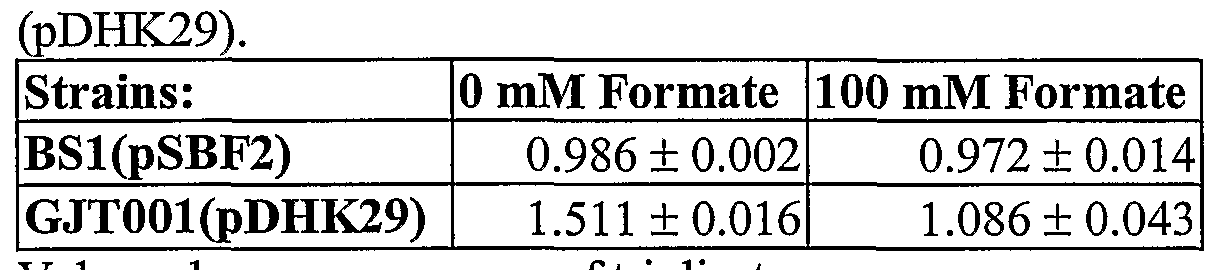
- Table 4 shows the specific FDH activity of strains BSl (pSBF2) and GJTOOl (pSBF2) in Units/mg of total protein. One unit is defined as the amount of enzyme that produced 1 ⁇ mol of NADH per minute at 30°C. Values shown are average of triplicates from anaerobic tube cultures. N.D.: not detected (less than 0.001 U/mg).
- strain GJTOOl was 46% higher (0.416 U/mg) than the activity of BSl ( ⁇ SBF2) (0.284 U/mg).
- Control strains GJT001(pDHK29) and BSl(pDHK30) showed no detectable FDH activity.
- FIG. 3A to 3F illustrate the results of these experiments, including the final cell density (FIG. 3A), the amount of glucose consumed in millimolar (mM) (FIG. 3B), and the concentrations of different metabolites produced (mM) after 72 hours of culture (FIG. 3C to 3F). Values shown are the average of triplicate cultures.
- Table 6 NADH availability of various strains under anaerobic conditions.
- FIG. 3A to 3F and FIG. 4A and 4B illustrate the results of anaerobic tube experiments performed with strains GJTOOl (pDHK29) and BSl (pSBF2) in which the media was supplemented with 50mM formate. Addition of formate to both strains increased lactate levels. A comparison of the results for BSl (pSBF2) and GJTOOl (pDHK29) indicates a 6-fold increase in ethanol accompanied by a 69% decrease in acetate levels. This leads to a 21 -fold increase in the Et/Ac ratio with the substitution of the native FDH for the NAD+-dependent FDH. This means that anaerobically it is not necessary to supplement the culture with formate.
- FIG. 5 A to 5F presents the results of these experiments, including the final cell density (FIG. 5A), glucose consumed (mM) (FIG. 5B), and the concentrations of different metabolites produced (mM) after 24 hours of culture (FIG. 5C to 5F). For both strains only minimal amounts of residual formate (less than 6mM) were detected.
- the data indicates that it is possible to increase the availability of intracellular NADH through metabolic engineering, thereby providing enhanced reducing power under both anaerobic and aerobic conditions.
- the novel approach to increasing availability of intracellular NADH in vivo through a NADH recycling system is applied to the production of commercially viable compounds, such as ethanol.
- the NADH recycling system comprises a biologically active NAD+-dependent formate dehydrogenase (FDH) from Candida boidinii, and overexpression thereof in Escherichia coli.
- the NADH recycling system e.g., recombinant formate dehydrogenase pathway
- This recombinant system bears contrast with the native formate dehydrogenase which converts formate to CO 2 and H 2 with no cofactor involvement.
- the new NADH recycling system allows the cells to retain the reducing power that are otherwise lost by release of formate or hydrogen.
- the inoculum was grown as a 5-ml LB culture supplemented with lOOmg/L ampicillin and/or kanamycin for 8-12 hours. Then, lOO ⁇ l of the 5-ml culture was transferred to 50 ml of LB in a 250-ml shake flask with the appropriate antibiotic, and grown at 37°C and 250 rpm for 8-12 hours in a rotary shaker. This culture was used to inoculate the bioreactor.
- Luria-Bertani broth (LB) medium supplemented with llOmM of glucose was used for the chemostat runs.
- LB medium Luria-Bertani broth (LB) medium supplemented with llOmM of glucose
- lg/L NaHCO3 was added to the LB media.
- the media was also supplemented with 30 ⁇ L/L antifoam 289 (Sigma), lOOmg/L ampicillin, and/or kanamycin.
- the pH, temperature and agitation were maintained at 7.0, 32°C, and 250 rpm, respectively.
- a constant flow of nitrogen (10-12 ml/min) was maintained through the fermentor headspace to establish anaerobic conditions.
- the continuous culture reached steady state after 4 to 6 residence times. Samples were taken during the steady state phase.
- Cell dry weight was determined by collection of 100 ml of culture in an ice bath. The samples were centrifuged at 4,000g and 4°C for 10 minutes, washed with 0.15M sodium chloride solution, and dried in an oven at 55°C until constant weight. The final weight ofthe dried samples was corrected for the weight of NaCl in the washing solution.
- Table 7 presents the specific NAD+-dependent FDH activity of strains GJTOOl (pSBF2) and BSl ( ⁇ SBF2) obtained from the anaerobic chemostat runs in units/mg of total protein.
- One unit is defined as the amount of enzyme that produced 1 ⁇ mol of NADH per minute at 30°C.
- Strain GJTOOl pDHK29
- Strain GJTOOl pDHK29
- Values shown are average of triplicates. N.D.: not detected (less than 0.001 U/mg).
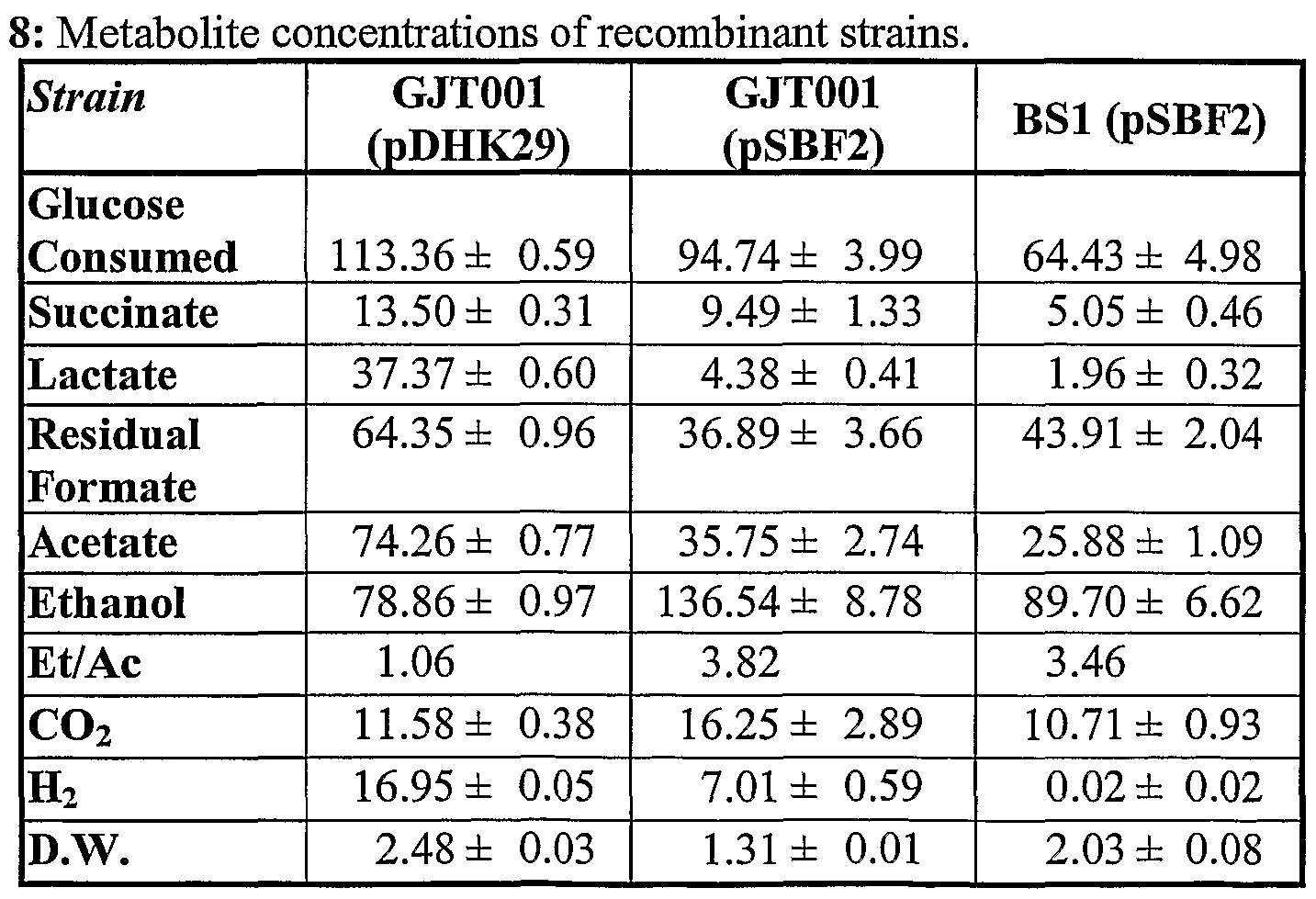
- Steady state concentrations of metabolites are given in Table 8 as millimolar (mM) units as measured by the HPLC, as well as the percent of CO 2 and H 2 per volume in the off-gases stream as measured by the GC.
- Table 9 presents the results as calculated metabolic fluxes in mmol/(g dry weight*h) represented as Vi to v ⁇ 2 according to the diagram illustrated in FIG. 8.
- V ⁇ 2 represents the newly added NAD+-dependent FDH pathway.
- V RF represents the flux of residual formate excreted to the media based on HPLC measurements.
- the metabolic fluxes with an asterisk were calculated based on measured metabolites, while the other fluxes were derived from the measured metabolites based on the relationships shown in FIG. 8, the law of mass conservation, and the pseudo-steady-state hypothesis (PSSH) on the intracellular intermediate metabolites as described previously (Aristidou et al, 1999; Yang et al, 1999).
- PSSH pseudo-steady-state hypothesis
- Metabolic fluxes with an asterisk were calculated based on measured metabolites, while the other fluxes were derived from the measured metabolites based on the relationships shown in FIG. 8.
- the percentages of increase (+) or decrease (-) presented are relative to strain GJTOOl (pDHK29).
- the "+” indicates that the culture comprised the newly added NAD+-dependent FDH pathway.
- Table 10 includes the NAD(H/+) concentrations in ⁇ mol/g dry weight (D.W.) in addition to the NADH formed through the oxidation of glucose and the new FDH degradation pathway, as well as the NADH utilized for the formation of reduced metabolites, namely, succinate, lactate, and ethanol.
- the percentages of increase (+) or decrease (-) are determined relative to strain GJTOOl (pDHK29).
- the cells are exposed to a very rich environment for most of the time during batch cultivation, while they are always under limiting environment under a chemostat setting.
- a similar behavior was observed previously in experiments where a significant acetate reduction was achieved under batch conditions by modulating glucose uptake using a glucose analog supplementation strategy, however the effect was greatly minimized under chemostat conditions (Chou et al, 1994).
- Table 9 presents the flux of formate converted to CO 2 through both the native FDH pathway (v 9 ) and the new NAD+-dependent FDH pathway (v ⁇ 2 ) for the different strains.
- the flux to formate was obtained based on the assumption that one mole of formate is produced per mole of acetyl-CoA formed through the PFL pathway (FIG. 9). Therefore, the flux to formate (v 8 ) was calculated by adding the fluxes to ethanol (vio) and acetate (vn) from acetyl-CoA.
- the total formate converted was calculated by subtracting the measured residual formate flux (V RF ) from the flux to formate (v 8 ).
- the flux through the new FDH pathway (v ⁇ 2 ) for strain GJTOOl (pSBF2) was determined by subtracting the flux to H 2 (v 9 ), determined from GC measurements, from the total formate converted.
- FIG. 9 also shows the amount of formate produced that is converted through either one or both of the FDH pathways.
- the control strain 57% of the formate produced is converted, while 80% is converted for GJTOOl (pSBF2) and 63% for BSl (pSBF2).
- the reductive capabilities of the chemostat cultures further demonstrate an increase in the availability of intracellular NADH through metabolic engineering and therefore provide a more reduced environment under anaerobic chemostat conditions.
- the substitution of the native cofactor independent FDH pathway by the NAD+- dependent FDH provoked a significant redistribution of both metabolic fluxes and C-mole yields under anaerobic chemostat conditions.
- the data demonstrate that NADH manipulations in a system comprising a NADH recycling system achieve redirection of carbon fluxes to produce reduced products.
- effects on other reduced cofactors such as FADH or NADPH directly are expected because of interconversions among the reduced cofactors in the cell.
- This reasoning leads to a plausible application of the present invention in terms of manipulating intracellular availability of other reduced cofactors such as FADH, a flavin coenzyme that is usually tightly bound to one particular enzyme, and NADPH, a nicotinamide cofactor that like NADH acts as a hydrogen carrier and is capable of diffusing from enzyme to enzyme.
- dibenzothiophene The usual model for the study of biodesulfurization is the compound dibenzothiophene. It has been extensively studied in the context of nonbiological and biological desulfurization. Dibenzothiophene is a member of a class of polyaromatic sulfur heterocycles (PASHs), and one of thousands of PASHs found in a hydrotreated diesel sample. Alkylated dibenzothiophenes are also target molecules for biodesulfurization technology.
- Known bacterial strains which are capable of breaking down dibenzothiophene using this pathway include Rhodococcus strains IGTS8, T09, and RA-18, and Gordonia desulfuricans 213E. Also capable of biodesulfurization are E. coli that express recombinant genes from Rhodococcus, and Pseudomonas putida that express recombinant genes from Rhodococcus. Gordonia rubropertinctus strain T08 is capable of biodesulfurization using a novel pathway.
- the first step in the desulfurization pathway is the transfer ofthe target molecules from oil into the cells.
- Rhodococcus sp. and other bacteria have been shown to metabolize many insoluble molecules through direct transfer from oil into the cells.
- Dibenzothiophene monooxygenase (SEQ ID NO: 12, Accession NO: P54995), the enzyme responsible for the first two oxidation in the biodesulfurization pathway has been isolated and characterized, and its gene has been cloned and sequenced. The enzyme catalyzes the transfer of an electron from flavin mononucleotide to dibenzothiophene, and catalyzes the oxidation of dibenzothiophene to the sulfoxide and the oxidation of the sulfoxide to the sulfone.
- dibenzothiophene sulfone monooxygenase SEQ ID NO: 13, Accession NO: P54997. This enzyme and its gene have been characterized. Production of sulfite is the last reaction in the pathway. This is catalyzed by a desulfinase (SEQ ID NO: 14, Accession NO: P54998), whose gene has been cloned and sequenced. Sulfite is released as well as an oil soluble product, hydroxyl biphenyl.
- NADH is required in this reaction system to keep the supply of reduced flavin mononucleotide in balance.
- PHAs Polyhydroxyalkanoates
- Bacteria accumulate PHAs when a carbon source is abundant.
- the genes involved in PHA synthesis from well over 20 different microorganisms have been characterized. These recombinant genes are transformed into cells comprising the NADH recycling system.
- the genes involved in PHA synthesis include beta- ketothiolase, acetoacetyl-CoA-reductase, butyrate dehydrogenase and poly-3- hydroxybutyrate synthase.
- Bacterial cells capable of PHA synthesis include the carbon monoxide (CO)-resistant strain of the hydrogen bacteria Ralstonia eutropha B5786, Synechocystis sp. PCC6803, and Pseudomonas corrugata. These bacteria are transformed with a recombinant NADH recycling system.
- CO carbon monoxide
- Cells comprising the NADH recycling system are transformed with a vector pSM552-545C-, containing the lacZ gene, which encodes beta-galactosidase.
- the expression of the lacZ gene is regulated by a powerful pH-inducible promoter. Experiments are conducted in a well-controlled fermenter under optimal conditions for the particular expression system. The expression of the lacZ gene is induced by changing the pH from 7.5, which has minimal induction, to a pH of 6.0, which is the optimal induction pH.
- NADH, acetate, and beta-galactosidase production are monitored through standard means in the art. Increased beta-galactosidase production is associated with lower levels of acetate. Lower levels of acetate production are associated with cells comprising the NADH recycling system.
- Pecher A., Zinoni, F., Jatisatienr, C, Wirth, R, Hennecke, H. and Bock, A. (1983). On the redox control of synthesis of anaerobically induced enzymes in enterobacteriaceae. Arch. Microbiol. 136, 131-136. [0209] Phillips, G. J., Park, S.-K. and Huber, D. (2000). High Copy Number Plasmids Compatible with Commonly Used Cloning Vectors. BioTechniques 28, 400- 408.
Landscapes
- Chemical & Material Sciences (AREA)
- Life Sciences & Earth Sciences (AREA)
- Organic Chemistry (AREA)
- Zoology (AREA)
- Engineering & Computer Science (AREA)
- Wood Science & Technology (AREA)
- Health & Medical Sciences (AREA)
- Genetics & Genomics (AREA)
- Bioinformatics & Cheminformatics (AREA)
- Microbiology (AREA)
- Biotechnology (AREA)
- Biochemistry (AREA)
- General Engineering & Computer Science (AREA)
- General Health & Medical Sciences (AREA)
- Chemical Kinetics & Catalysis (AREA)
- General Chemical & Material Sciences (AREA)
- Biomedical Technology (AREA)
- Molecular Biology (AREA)
- Medicinal Chemistry (AREA)
- Mycology (AREA)
- Micro-Organisms Or Cultivation Processes Thereof (AREA)
- Preparation Of Compounds By Using Micro-Organisms (AREA)
Abstract
Description





Claims
Priority Applications (4)
| Application Number | Priority Date | Filing Date | Title |
|---|---|---|---|
| MXPA04004194A MXPA04004194A (en) | 2001-11-02 | 2002-11-01 | Recycling system for manipulation of intracellular nadh availability. |
| EP02789374A EP1483378B1 (en) | 2001-11-02 | 2002-11-01 | Recycling system for manipulation of intracellular nadh availability |
| AU2002353970A AU2002353970A1 (en) | 2001-11-02 | 2002-11-01 | Recycling system for manipulation of intracellular nadh availability |
| CA002466133A CA2466133A1 (en) | 2001-11-02 | 2002-11-01 | Recycling system for manipulation of intracellular nadh availability |
Applications Claiming Priority (2)
| Application Number | Priority Date | Filing Date | Title |
|---|---|---|---|
| US33537101P | 2001-11-02 | 2001-11-02 | |
| US60/335,371 | 2001-11-02 |
Publications (2)
| Publication Number | Publication Date |
|---|---|
| WO2003040690A2 true WO2003040690A2 (en) | 2003-05-15 |
| WO2003040690A3 WO2003040690A3 (en) | 2004-10-07 |
Family
ID=23311497
Family Applications (1)
| Application Number | Title | Priority Date | Filing Date |
|---|---|---|---|
| PCT/US2002/035143 Ceased WO2003040690A2 (en) | 2001-11-02 | 2002-11-01 | Recycling system for manipulation of intracellular nadh availability |
Country Status (6)
| Country | Link |
|---|---|
| US (3) | US7256016B2 (en) |
| EP (1) | EP1483378B1 (en) |
| AU (1) | AU2002353970A1 (en) |
| CA (1) | CA2466133A1 (en) |
| MX (1) | MXPA04004194A (en) |
| WO (1) | WO2003040690A2 (en) |
Cited By (18)
| Publication number | Priority date | Publication date | Assignee | Title |
|---|---|---|---|---|
| JP2009529905A (en) * | 2006-03-24 | 2009-08-27 | バイオコンバージョン テクノロジーズ リミテッド | Enhancement of ethanol production by microorganisms |
| EP2204443A1 (en) * | 2008-12-23 | 2010-07-07 | Basf Se | Bacterial cells exhibiting formate dehydrogenase activity for the manufacture of suc-cinic acid |
| EP2255004A4 (en) * | 2008-02-20 | 2012-08-08 | Nagarjuna Fertilizers And Chemicals Ltd | Genetically transformed microorganism for biomass fermentation |
| US8574875B2 (en) | 2007-08-17 | 2013-11-05 | Basf Se | Bacterial strain and process for the fermentative production of organic acids |
| US8652816B2 (en) | 2007-12-04 | 2014-02-18 | Opx Biotechnologies, Inc. | Compositions and methods for 3-hydroxypropionate bio-production from biomass |
| US8673598B2 (en) | 2009-02-16 | 2014-03-18 | Basf Se | Microbial succinic acid producers and purification of succinic acid |
| US8809027B1 (en) | 2009-09-27 | 2014-08-19 | Opx Biotechnologies, Inc. | Genetically modified organisms for increased microbial production of 3-hydroxypropionic acid involving an oxaloacetate alpha-decarboxylase |
| US8877466B2 (en) | 2008-12-23 | 2014-11-04 | Basf Se | Bacterial cells having a glyoxylate shunt for the manufacture of succinic acid |
| US8883464B2 (en) | 2009-09-27 | 2014-11-11 | Opx Biotechnologies, Inc. | Methods for producing 3-hydroxypropionic acid and other products |
| CN104342406A (en) * | 2013-07-26 | 2015-02-11 | 南京朗恩生物科技有限公司 | Thermostability enhanced formate dehydrogenase mutant and preparation method thereof |
| US9512057B2 (en) | 2013-03-15 | 2016-12-06 | Cargill, Incorporated | 3-hydroxypropionic acid compositions |
| US10047383B2 (en) | 2013-03-15 | 2018-08-14 | Cargill, Incorporated | Bioproduction of chemicals |
| EP3263709A4 (en) * | 2015-02-24 | 2018-10-24 | Japan Science And Technology Agency | Method for producing coenzyme and transformant set for coenzyme production |
| US10337038B2 (en) | 2013-07-19 | 2019-07-02 | Cargill, Incorporated | Microorganisms and methods for the production of fatty acids and fatty acid derived products |
| US10465213B2 (en) | 2012-08-10 | 2019-11-05 | Cargill, Incorporated | Microorganisms and methods for the production of fatty acids and fatty acid derived products |
| US10494654B2 (en) | 2014-09-02 | 2019-12-03 | Cargill, Incorporated | Production of fatty acids esters |
| US11345938B2 (en) | 2017-02-02 | 2022-05-31 | Cargill, Incorporated | Genetically modified cells that produce C6-C10 fatty acid derivatives |
| US11408013B2 (en) | 2013-07-19 | 2022-08-09 | Cargill, Incorporated | Microorganisms and methods for the production of fatty acids and fatty acid derived products |
Families Citing this family (47)
| Publication number | Priority date | Publication date | Assignee | Title |
|---|---|---|---|---|
| EP1789569A2 (en) * | 2004-09-17 | 2007-05-30 | Rice University | High succinate producing bacteria |
| US7569380B2 (en) | 2004-12-22 | 2009-08-04 | Rice University | Simultaneous anaerobic production of isoamyl acetate and succinic acid |
| US7557085B2 (en) * | 2005-02-14 | 2009-07-07 | Wisconsin Alumni Research Foundation | Metabolic-based methods for modulating gene expression |
| WO2007030830A2 (en) * | 2005-09-09 | 2007-03-15 | Genomatica, Inc. | Methods and organisms for the growth-coupled production of succinate |
| CN104962586A (en) | 2006-07-21 | 2015-10-07 | 希乐克公司 | Biomass conversion system |
| US8673601B2 (en) * | 2007-01-22 | 2014-03-18 | Genomatica, Inc. | Methods and organisms for growth-coupled production of 3-hydroxypropionic acid |
| CA2696018A1 (en) * | 2007-08-10 | 2009-04-09 | Genomatica, Inc. | Methods for the synthesis of olefins and derivatives |
| US8486686B2 (en) * | 2007-12-28 | 2013-07-16 | William Marsh Rice University | Large scale microbial culture method |
| JP2011509691A (en) * | 2008-01-22 | 2011-03-31 | ジェノマティカ, インコーポレイテッド | Methods and organisms for utilizing synthesis gas or other gaseous carbon sources and methanol |
| GB2457820B (en) * | 2008-02-28 | 2010-09-08 | Green Biologics Ltd | Production process |
| EP2262901B1 (en) * | 2008-03-05 | 2018-11-21 | Genomatica, Inc. | Primary alcohol producing organisms |
| CN106119112B (en) * | 2008-03-27 | 2021-07-13 | 基因组股份公司 | Microorganisms for the production of adipic acid and other compounds |
| GB0806093D0 (en) * | 2008-04-03 | 2008-05-14 | Green Biologics Ltd | Production of butanol |
| AU2009242615A1 (en) | 2008-05-01 | 2009-11-05 | Genomatica, Inc. | Microorganisms for the production of methacrylic acid |
| EP2304039B1 (en) * | 2008-06-17 | 2019-08-21 | Genomatica, Inc. | Microorganisms and methods for the biosynthesis of fumarate, malate, and acrylate |
| US20100021978A1 (en) * | 2008-07-23 | 2010-01-28 | Genomatica, Inc. | Methods and organisms for production of 3-hydroxypropionic acid |
| US20100184173A1 (en) * | 2008-11-14 | 2010-07-22 | Genomatica, Inc. | Microorganisms for the production of methyl ethyl ketone and 2-butanol |
| CA2746952A1 (en) * | 2008-12-16 | 2010-06-24 | Genomatica, Inc. | Microorganisms and methods for conversion of syngas and other carbon sources to useful products |
| WO2010104938A1 (en) * | 2009-03-10 | 2010-09-16 | Athena Biotechnologies, Inc. | Reducing carbon dioxide production and increasing ethanol yield during microbial ethanol fermentation |
| JP5876822B2 (en) | 2009-04-30 | 2016-03-02 | ゲノマチカ, インク. | Organisms for the production of 1,3-butanediol |
| KR20120068763A (en) | 2009-04-30 | 2012-06-27 | 게노마티카 인코포레이티드 | Organisms for the production of isopropanol, n-butanol, and isobutanol |
| AU2010245687A1 (en) | 2009-05-07 | 2011-11-24 | Genomatica, Inc. | Microorganisms and methods for the biosynthesis of adipate, hexamethylenediamine and 6-aminocaproic acid |
| WO2010132845A1 (en) * | 2009-05-15 | 2010-11-18 | Genomatica, Inc. | Organisms for the production of cyclohexanone |
| EP2440669A4 (en) * | 2009-06-10 | 2013-08-28 | Genomatica Inc | Microorganisms and methods for carbon-efficient biosynthesis of mek and 2-butanol |
| EP2462221B1 (en) | 2009-08-05 | 2017-02-22 | Genomatica, Inc. | Semi-synthetic terephthalic acid via microorganisms that produce muconic acid |
| WO2011031897A1 (en) | 2009-09-09 | 2011-03-17 | Genomatica, Inc. | Microorganisms and methods for the co-production of isopropanol with primary alcohols, diols and acids |
| JP2013503647A (en) | 2009-09-09 | 2013-02-04 | ブラスケム ソシエダッド アノニマ | Microorganism and method for producing n-propanol |
| MX2012004291A (en) | 2009-10-13 | 2012-08-17 | Genomatica Inc | Microorganisms for the production of 1,4-butanediol, 4-hydroxybutanal, 4-hydroxybutyryl-coa, putrescine and related compounds, and methods related thereto. |
| WO2011050326A1 (en) * | 2009-10-23 | 2011-04-28 | Genomatica, Inc. | Microorganisms for the production of aniline |
| SG181607A1 (en) * | 2009-12-10 | 2012-07-30 | Genomatica Inc | Methods and organisms for converting synthesis gas or other gaseous carbon sources and methanol to 1,3-butanediol |
| AU2011209862A1 (en) * | 2010-01-29 | 2012-07-26 | Genomatica, Inc. | Microorganisms and methods for the biosynthesis of p-toluate and terephthalate |
| US8048661B2 (en) | 2010-02-23 | 2011-11-01 | Genomatica, Inc. | Microbial organisms comprising exogenous nucleic acids encoding reductive TCA pathway enzymes |
| US8445244B2 (en) | 2010-02-23 | 2013-05-21 | Genomatica, Inc. | Methods for increasing product yields |
| US9023636B2 (en) | 2010-04-30 | 2015-05-05 | Genomatica, Inc. | Microorganisms and methods for the biosynthesis of propylene |
| KR20190006103A (en) | 2010-05-05 | 2019-01-16 | 게노마티카 인코포레이티드 | Microorganisms and methods for the biosynthsis of butadiene |
| CN103025877A (en) | 2010-07-26 | 2013-04-03 | 基因组股份公司 | Microorganisms and methods for the biosynthesis of aromatics, 2,4-pentadienoate and 1,3-butadiene |
| US20130130339A1 (en) | 2010-07-31 | 2013-05-23 | Myriant Corporation | Fermentation process for the production of organic acids |
| WO2012129537A1 (en) * | 2011-03-23 | 2012-09-27 | Joule Unlimited Technologies, Inc. | Photoalkanogens with increased productivity |
| US9169486B2 (en) | 2011-06-22 | 2015-10-27 | Genomatica, Inc. | Microorganisms for producing butadiene and methods related thereto |
| CA2850480A1 (en) | 2011-09-30 | 2013-06-20 | Mascoma Corporation | Engineering microorganisms to increase ethanol production by metabolic redirection |
| US8349587B2 (en) | 2011-10-31 | 2013-01-08 | Ginkgo Bioworks, Inc. | Methods and systems for chemoautotrophic production of organic compounds |
| US20150315599A1 (en) | 2012-12-07 | 2015-11-05 | Ginkgo Bioworks, Inc | Methods and Systems for Methylotrophic Production of Organic Compounds |
| CN107849584A (en) | 2015-02-23 | 2018-03-27 | 百奥堪引赛股份有限公司 | The electrochemica biological reactor module and engineering metabolic pathway of 1 butanol are produced with high carbon efficiencies |
| US10851393B2 (en) | 2015-02-24 | 2020-12-01 | William Marsh Rice University | KAS-III free FA synthesis |
| CN104779203B (en) * | 2015-04-23 | 2017-11-28 | 京东方科技集团股份有限公司 | A kind of array base palte and its manufacture method, display device |
| WO2017177071A1 (en) | 2016-04-08 | 2017-10-12 | William Marsh Rice University | Improved galactose utilization |
| EP4092126A1 (en) | 2021-03-29 | 2022-11-23 | Instytut Katalizy I Fizykochemii Powierzchni Im.Jerzego Habera Polskiej Akademii Nauk | A method of enzymatic reduction of the oxidized nicotinamide adenine dinucleotide and carboxylic acids |
Family Cites Families (21)
| Publication number | Priority date | Publication date | Assignee | Title |
|---|---|---|---|---|
| US4237224A (en) * | 1974-11-04 | 1980-12-02 | Board Of Trustees Of The Leland Stanford Jr. University | Process for producing biologically functional molecular chimeras |
| US4879236A (en) * | 1984-05-16 | 1989-11-07 | The Texas A&M University System | Method for producing a recombinant baculovirus expression vector |
| DE3505397A1 (en) | 1985-02-16 | 1986-08-21 | Henkel KGaA, 4000 Düsseldorf | METHOD FOR REGENERATING COENZYME |
| US4683202A (en) * | 1985-03-28 | 1987-07-28 | Cetus Corporation | Process for amplifying nucleic acid sequences |
| US4682195A (en) * | 1985-09-30 | 1987-07-21 | General Electric Company | Insulated gate device with configured emitter contact pad |
| US5227296A (en) | 1990-09-25 | 1993-07-13 | Board Of Regents, The University Of Texas System | Enzymatic synthesis of isotopically labeled carbohydrates, nucleotides and citric acid intermediates |
| US5264092A (en) | 1991-10-02 | 1993-11-23 | Moltech Corporation | Redox polymer modified electrode for the electrochemical regeneration of coenzyme |
| DE4204650C1 (en) * | 1992-02-15 | 1993-07-08 | Hoffmeister, Helmut, Dr., 4400 Muenster, De | |
| GB9216851D0 (en) * | 1992-08-07 | 1992-09-23 | Univ Manitoba | Dna sequences of rat probasin gene |
| DE4228457A1 (en) * | 1992-08-27 | 1994-04-28 | Beiersdorf Ag | Production of heterodimeric PDGF-AB using a bicistronic vector system in mammalian cells |
| US5393615A (en) | 1994-02-03 | 1995-02-28 | Miles Inc. | Mediators suitable for the electrochemical regeneration of NADH, NADPH or analogs thereof |
| FR2722208B1 (en) * | 1994-07-05 | 1996-10-04 | Inst Nat Sante Rech Med | NEW INTERNAL RIBOSOME ENTRY SITE, VECTOR CONTAINING SAME AND THERAPEUTIC USE |
| US5871986A (en) * | 1994-09-23 | 1999-02-16 | The General Hospital Corporation | Use of a baculovirus to express and exogenous gene in a mammalian cell |
| US5520786A (en) | 1995-06-06 | 1996-05-28 | Bayer Corporation | Mediators suitable for the electrochemical regeneration of NADH, NADPH or analogs thereof |
| US6001590A (en) | 1995-09-12 | 1999-12-14 | Kirin Beer Kabushiki Kaisha | Promoter and terminator sequences of formate dehydrogenase gene of Candida boidinii |
| US5705629A (en) * | 1995-10-20 | 1998-01-06 | Hybridon, Inc. | Methods for H-phosphonate synthesis of mono- and oligonucleotides |
| US5928906A (en) * | 1996-05-09 | 1999-07-27 | Sequenom, Inc. | Process for direct sequencing during template amplification |
| DE19753350A1 (en) * | 1997-12-03 | 1999-06-10 | Degussa | Mutant formate dehydrogenase (FDH) from Candida boidinii for production of L-amino acids |
| DK2194122T3 (en) | 1998-04-13 | 2016-02-15 | Univ Georgia | Overexpression of pyruvate carboxylase increased the production of biochemicals derived from oxaloacetate, in microbial cells |
| JP2000236883A (en) * | 1998-12-21 | 2000-09-05 | Daicel Chem Ind Ltd | Novel carbonyl reductase, method for producing the enzyme, DNA encoding the enzyme, and method for producing alcohol using the same |
| FR2795090B1 (en) | 1999-06-17 | 2003-03-21 | Inst Francais Du Petrole | ORGANIC CULTURE CONTAINING RHODOCOCCUS ERYTHROPOLIS AND / OR RHODOCOCCUS RHODNII AND METHOD FOR DESULFURIZING OIL FRACTIONS |
-
2002
- 2002-11-01 WO PCT/US2002/035143 patent/WO2003040690A2/en not_active Ceased
- 2002-11-01 MX MXPA04004194A patent/MXPA04004194A/en unknown
- 2002-11-01 EP EP02789374A patent/EP1483378B1/en not_active Revoked
- 2002-11-01 US US10/286,326 patent/US7256016B2/en not_active Expired - Lifetime
- 2002-11-01 CA CA002466133A patent/CA2466133A1/en not_active Abandoned
- 2002-11-01 AU AU2002353970A patent/AU2002353970A1/en not_active Abandoned
-
2007
- 2007-07-04 US US11/773,408 patent/US7709261B2/en not_active Expired - Lifetime
-
2010
- 2010-02-12 US US12/705,170 patent/US20100184195A1/en not_active Abandoned
Cited By (30)
| Publication number | Priority date | Publication date | Assignee | Title |
|---|---|---|---|---|
| JP2009529905A (en) * | 2006-03-24 | 2009-08-27 | バイオコンバージョン テクノロジーズ リミテッド | Enhancement of ethanol production by microorganisms |
| US9631211B2 (en) | 2007-08-17 | 2017-04-25 | Basf Se | Bacterial strain and fermentative process for producing succinic acid |
| US8574875B2 (en) | 2007-08-17 | 2013-11-05 | Basf Se | Bacterial strain and process for the fermentative production of organic acids |
| US8652816B2 (en) | 2007-12-04 | 2014-02-18 | Opx Biotechnologies, Inc. | Compositions and methods for 3-hydroxypropionate bio-production from biomass |
| EP2255004A4 (en) * | 2008-02-20 | 2012-08-08 | Nagarjuna Fertilizers And Chemicals Ltd | Genetically transformed microorganism for biomass fermentation |
| US8883466B2 (en) | 2008-12-23 | 2014-11-11 | Basf Se | Bacterial cells exhibiting formate dehydrogenase activity for the manufacture of succinic acid |
| US8877466B2 (en) | 2008-12-23 | 2014-11-04 | Basf Se | Bacterial cells having a glyoxylate shunt for the manufacture of succinic acid |
| EP2204443A1 (en) * | 2008-12-23 | 2010-07-07 | Basf Se | Bacterial cells exhibiting formate dehydrogenase activity for the manufacture of suc-cinic acid |
| US9932612B2 (en) | 2009-02-16 | 2018-04-03 | Basf Se | Microbial succinic acid producers and purification of succinic acid |
| US9023632B2 (en) | 2009-02-16 | 2015-05-05 | Basf Se | Microbial succinic acid producers and purification of succinic acid |
| US8673598B2 (en) | 2009-02-16 | 2014-03-18 | Basf Se | Microbial succinic acid producers and purification of succinic acid |
| US8809027B1 (en) | 2009-09-27 | 2014-08-19 | Opx Biotechnologies, Inc. | Genetically modified organisms for increased microbial production of 3-hydroxypropionic acid involving an oxaloacetate alpha-decarboxylase |
| US8883464B2 (en) | 2009-09-27 | 2014-11-11 | Opx Biotechnologies, Inc. | Methods for producing 3-hydroxypropionic acid and other products |
| US9388419B2 (en) | 2009-09-27 | 2016-07-12 | Cargill, Incorporated | Methods for producing 3-hydroxypropionic acid and other products |
| US9428778B2 (en) | 2009-09-27 | 2016-08-30 | Cargill, Incorporated | Method for producing 3-hydroxypropionic acid and other products |
| US10100342B2 (en) | 2009-09-27 | 2018-10-16 | Cargill, Incorporated | Method for producing 3-hydroxypropionic acid and other products |
| US10465213B2 (en) | 2012-08-10 | 2019-11-05 | Cargill, Incorporated | Microorganisms and methods for the production of fatty acids and fatty acid derived products |
| US9512057B2 (en) | 2013-03-15 | 2016-12-06 | Cargill, Incorporated | 3-hydroxypropionic acid compositions |
| US10047383B2 (en) | 2013-03-15 | 2018-08-14 | Cargill, Incorporated | Bioproduction of chemicals |
| US10815473B2 (en) | 2013-03-15 | 2020-10-27 | Cargill, Incorporated | Acetyl-CoA carboxylases |
| US10337038B2 (en) | 2013-07-19 | 2019-07-02 | Cargill, Incorporated | Microorganisms and methods for the production of fatty acids and fatty acid derived products |
| US11408013B2 (en) | 2013-07-19 | 2022-08-09 | Cargill, Incorporated | Microorganisms and methods for the production of fatty acids and fatty acid derived products |
| US12129506B2 (en) | 2013-07-19 | 2024-10-29 | Cargill, Incorporated | Microorganisms and methods for the production of fatty acids and fatty acid derived products |
| CN104342406B (en) * | 2013-07-26 | 2017-03-08 | 南京朗恩生物科技有限公司 | Enhanced formic dehydrogenase mutant of heat stability and preparation method thereof |
| CN104342406A (en) * | 2013-07-26 | 2015-02-11 | 南京朗恩生物科技有限公司 | Thermostability enhanced formate dehydrogenase mutant and preparation method thereof |
| US10494654B2 (en) | 2014-09-02 | 2019-12-03 | Cargill, Incorporated | Production of fatty acids esters |
| EP3263709A4 (en) * | 2015-02-24 | 2018-10-24 | Japan Science And Technology Agency | Method for producing coenzyme and transformant set for coenzyme production |
| US11104906B2 (en) | 2015-02-24 | 2021-08-31 | Japan Science And Technology Agency | Method for producing coenzyme and transformant set for coenzyme production |
| US11345938B2 (en) | 2017-02-02 | 2022-05-31 | Cargill, Incorporated | Genetically modified cells that produce C6-C10 fatty acid derivatives |
| US12123045B2 (en) | 2017-02-02 | 2024-10-22 | Cargill, Incorporated | Genetically modified cells that produce C6-C10 fatty acid derivatives |
Also Published As
| Publication number | Publication date |
|---|---|
| MXPA04004194A (en) | 2005-03-31 |
| US20030175903A1 (en) | 2003-09-18 |
| EP1483378A4 (en) | 2006-03-15 |
| WO2003040690A3 (en) | 2004-10-07 |
| EP1483378B1 (en) | 2013-01-02 |
| US20080009034A1 (en) | 2008-01-10 |
| US20100184195A1 (en) | 2010-07-22 |
| AU2002353970A1 (en) | 2003-05-19 |
| US7709261B2 (en) | 2010-05-04 |
| EP1483378A2 (en) | 2004-12-08 |
| CA2466133A1 (en) | 2003-05-15 |
| US7256016B2 (en) | 2007-08-14 |
Similar Documents
| Publication | Publication Date | Title |
|---|---|---|
| US7709261B2 (en) | Recycling system for manipulation of intracellular NADH availability | |
| Berrıos-Rivera et al. | Metabolic engineering of Escherichia coli: increase of NADH availability by overexpressing an NAD+-dependent formate dehydrogenase | |
| JP6898365B2 (en) | Recombinant microorganisms and how to use them | |
| US10961539B2 (en) | Promoter system inducing expression by 3-hydroxypropionic acid and method for biological production of 3-hydroxypropionic acid using same | |
| CA2969233C (en) | Recombinant microorganisms exhibiting increased flux through a fermentation pathway | |
| EP2092070B1 (en) | Ethanol production | |
| KR20150127034A (en) | Ergothioneine production through metabolic engineering | |
| WO2021242408A2 (en) | Methods and compositions for the production of xylitol from xylose utilizing dynamic metabolic control | |
| US9587256B2 (en) | Sequestration of carbon dioxide with hydrogen to useful products | |
| US8546113B2 (en) | Hydrogen peroxide-forming NADH oxidase and DNA encoding the same | |
| JP2006512913A (en) | Improved production of vitamin B12 | |
| San et al. | Recycling system for manipulation of intracellular NADH availability | |
| CN101370931A (en) | Hydrogen generation with the help of a cell expression system | |
| JP4586149B2 (en) | Promoter and activation method thereof | |
| AU2021278792B2 (en) | Methods and compositions for the production of xylitol from xylose utilizing dynamic metabolic control | |
| JP2005278414A (en) | Methods for producing 1,3-propanediol and 3-hydroxypropionic acid | |
| JP5751756B2 (en) | A photosynthetic organism having aromatic compound resolution and a method for decomposing aromatic compounds | |
| US20230183757A1 (en) | Methods and compositions for the production of xylitol from xylose utilizing dynamic metabolic control | |
| Siedler | Increasing the NADPH supply for whole-cell biotransformation and development of a novel biosensor | |
| JP2005528094A (en) | Method for producing vitamin B12 | |
| Van Havere | Engineering of 3 methylaspartate ammonia-lyases for biobased adipic acid production | |
| JP2021524262A (en) | Method for producing D-xylose dehydrogenase and D-xylonate derived from coryneform bacteria (Hersterung) |
Legal Events
| Date | Code | Title | Description |
|---|---|---|---|
| AK | Designated states |
Kind code of ref document: A2 Designated state(s): AE AG AL AM AT AU AZ BA BB BG BR BY BZ CA CH CN CO CR CU CZ DE DK DM DZ EC EE ES FI GB GD GE GH GM HR HU ID IL IN IS JP KE KG KP KR KZ LC LK LR LS LT LU LV MA MD MG MK MN MW MX MZ NO NZ OM PH PL PT RO RU SD SE SG SI SK SL TJ TM TN TR TT TZ UA UG US UZ VC VN YU ZA ZM ZW |
|
| AL | Designated countries for regional patents |
Kind code of ref document: A2 Designated state(s): GH GM KE LS MW MZ SD SL SZ TZ UG ZM ZW AM AZ BY KG KZ MD RU TJ TM AT BE BG CH CY CZ DE DK EE ES FI FR GB GR IE IT LU MC NL PT SE SK TR BF BJ CF CG CI CM GA GN GQ GW ML MR NE SN TD TG |
|
| 121 | Ep: the epo has been informed by wipo that ep was designated in this application | ||
| WWE | Wipo information: entry into national phase |
Ref document number: PA/a/2004/004194 Country of ref document: MX Ref document number: 2466133 Country of ref document: CA |
|
| WWE | Wipo information: entry into national phase |
Ref document number: 2002789374 Country of ref document: EP |
|
| WWP | Wipo information: published in national office |
Ref document number: 2002789374 Country of ref document: EP |
|
| DFPE | Request for preliminary examination filed prior to expiration of 19th month from priority date (pct application filed before 20040101) | ||
| NENP | Non-entry into the national phase |
Ref country code: JP |
|
| WWW | Wipo information: withdrawn in national office |
Ref document number: JP |