[go: up one dir, main page]

WO2003027634A2 - Identification of modulatory molecules using inducible promoters - Google Patents

Identification of modulatory molecules using inducible promoters Download PDF

Info

Publication number
WO2003027634A2
WO2003027634A2 PCT/US2002/030249 US0230249W WO03027634A2 WO 2003027634 A2 WO2003027634 A2 WO 2003027634A2 US 0230249 W US0230249 W US 0230249W WO 03027634 A2 WO03027634 A2 WO 03027634A2
Authority
WO
WIPO (PCT)
Prior art keywords
target
cell
ion channel
inducible
sequence
Prior art date
Legal status (The legal status is an assumption and is not a legal conclusion. Google has not performed a legal analysis and makes no representation as to the accuracy of the status listed.)
Ceased
Application number
PCT/US2002/030249
Other languages
French (fr)
Other versions
WO2003027634A3 (en
Inventor
Steven J. Brown
Damien J. Dunnington
Imran Clark
Current Assignee (The listed assignees may be inaccurate. Google has not performed a legal analysis and makes no representation or warranty as to the accuracy of the list.)
Axiom Biotechnologies Inc
Original Assignee
Axiom Biotechnologies Inc
Priority date (The priority date is an assumption and is not a legal conclusion. Google has not performed a legal analysis and makes no representation as to the accuracy of the date listed.)
Filing date
Publication date
Application filed by Axiom Biotechnologies Inc filed Critical Axiom Biotechnologies Inc
Priority to AU2002336768A priority Critical patent/AU2002336768A1/en
Publication of WO2003027634A2 publication Critical patent/WO2003027634A2/en
Publication of WO2003027634A3 publication Critical patent/WO2003027634A3/en
Anticipated expiration legal-status Critical
Ceased legal-status Critical Current

Links

Classifications

    • GPHYSICS
    • G01MEASURING; TESTING
    • G01NINVESTIGATING OR ANALYSING MATERIALS BY DETERMINING THEIR CHEMICAL OR PHYSICAL PROPERTIES
    • G01N33/00Investigating or analysing materials by specific methods not covered by groups G01N1/00 - G01N31/00
    • G01N33/48Biological material, e.g. blood, urine; Haemocytometers
    • G01N33/50Chemical analysis of biological material, e.g. blood, urine; Testing involving biospecific ligand binding methods; Immunological testing
    • G01N33/5005Chemical analysis of biological material, e.g. blood, urine; Testing involving biospecific ligand binding methods; Immunological testing involving human or animal cells
    • G01N33/5008Chemical analysis of biological material, e.g. blood, urine; Testing involving biospecific ligand binding methods; Immunological testing involving human or animal cells for testing or evaluating the effect of chemical or biological compounds, e.g. drugs, cosmetics
    • G01N33/502Chemical analysis of biological material, e.g. blood, urine; Testing involving biospecific ligand binding methods; Immunological testing involving human or animal cells for testing or evaluating the effect of chemical or biological compounds, e.g. drugs, cosmetics for testing non-proliferative effects
    • G01N33/5023Chemical analysis of biological material, e.g. blood, urine; Testing involving biospecific ligand binding methods; Immunological testing involving human or animal cells for testing or evaluating the effect of chemical or biological compounds, e.g. drugs, cosmetics for testing non-proliferative effects on expression patterns
    • GPHYSICS
    • G01MEASURING; TESTING
    • G01NINVESTIGATING OR ANALYSING MATERIALS BY DETERMINING THEIR CHEMICAL OR PHYSICAL PROPERTIES
    • G01N33/00Investigating or analysing materials by specific methods not covered by groups G01N1/00 - G01N31/00
    • G01N33/48Biological material, e.g. blood, urine; Haemocytometers
    • G01N33/50Chemical analysis of biological material, e.g. blood, urine; Testing involving biospecific ligand binding methods; Immunological testing
    • G01N33/5005Chemical analysis of biological material, e.g. blood, urine; Testing involving biospecific ligand binding methods; Immunological testing involving human or animal cells
    • G01N33/5008Chemical analysis of biological material, e.g. blood, urine; Testing involving biospecific ligand binding methods; Immunological testing involving human or animal cells for testing or evaluating the effect of chemical or biological compounds, e.g. drugs, cosmetics
    • GPHYSICS
    • G01MEASURING; TESTING
    • G01NINVESTIGATING OR ANALYSING MATERIALS BY DETERMINING THEIR CHEMICAL OR PHYSICAL PROPERTIES
    • G01N33/00Investigating or analysing materials by specific methods not covered by groups G01N1/00 - G01N31/00
    • G01N33/48Biological material, e.g. blood, urine; Haemocytometers
    • G01N33/50Chemical analysis of biological material, e.g. blood, urine; Testing involving biospecific ligand binding methods; Immunological testing
    • G01N33/5005Chemical analysis of biological material, e.g. blood, urine; Testing involving biospecific ligand binding methods; Immunological testing involving human or animal cells
    • G01N33/5008Chemical analysis of biological material, e.g. blood, urine; Testing involving biospecific ligand binding methods; Immunological testing involving human or animal cells for testing or evaluating the effect of chemical or biological compounds, e.g. drugs, cosmetics
    • G01N33/502Chemical analysis of biological material, e.g. blood, urine; Testing involving biospecific ligand binding methods; Immunological testing involving human or animal cells for testing or evaluating the effect of chemical or biological compounds, e.g. drugs, cosmetics for testing non-proliferative effects
    • GPHYSICS
    • G01MEASURING; TESTING
    • G01NINVESTIGATING OR ANALYSING MATERIALS BY DETERMINING THEIR CHEMICAL OR PHYSICAL PROPERTIES
    • G01N33/00Investigating or analysing materials by specific methods not covered by groups G01N1/00 - G01N31/00
    • G01N33/48Biological material, e.g. blood, urine; Haemocytometers
    • G01N33/50Chemical analysis of biological material, e.g. blood, urine; Testing involving biospecific ligand binding methods; Immunological testing
    • G01N33/68Chemical analysis of biological material, e.g. blood, urine; Testing involving biospecific ligand binding methods; Immunological testing involving proteins, peptides or amino acids
    • G01N33/6872Intracellular protein regulatory factors and their receptors, e.g. including ion channels
    • GPHYSICS
    • G01MEASURING; TESTING
    • G01NINVESTIGATING OR ANALYSING MATERIALS BY DETERMINING THEIR CHEMICAL OR PHYSICAL PROPERTIES
    • G01N2500/00Screening for compounds of potential therapeutic value

Definitions

  • the present invention relates generally to the technical fields of molecular biology and drug discovery. More specifically, the invention relates to the method of identifying a drug target modulator using an inducible vector.
  • sequence information of the target does not provide the identity of the receptor's native ligand or that ligand' s biological function.
  • single transmembrane membrane receptors contain a cysteine rich domain, followed by an alpha helix motif, followed by a tyrosine kinase domain.
  • sequence is a receptor, whereby the cysteine rich domain is involved in ligand binding, the alpha helix traverses the membrane, and the tyrosine kinase domain is involved in cellular signaling.
  • sequencing an unknown receptor's ligand binding domain does not provide sufficient information that would easily lead to the identity of the ligand.
  • Similar problems occur when searching for the function of ion channels, enzymes, transporters, transcription factors, nuclear receptors, chaperone proteins and other regulatory molecules within the cell. Consequently, experiments must be designed and performed to identify the sequence's function and modulatory compounds. Controlled expression of the target sequence is necessary to identify modulatory compounds because constitutive expression often leads to over expression of the protein.
  • the activity of a compound against a target of interest is determined by a variety of techniques. Some examples include randomly screening the compound against cells transfected with the target, testing compounds in cells where the target has been mutated to express the protein in its active state, and binding studies between a compound and an isolated form of the target.
  • Random screening of transfected cells requires a number of assumptions that often may not be tested. It requires the target protein be properly expressed, correctly localized within the cell, functionally coupled to a signaling mechanism, and expressed stably throughout the duration of the testing process. However, when the function of the target is unknown, these requirements can not be tested.
  • the target When the target is a membrane protein such as a G-protein coupled receptor ("GPCR"), it may be mutated such that the protein is expressed in its activated form. Since ligand binding of the mutated protein frequently causes a drop in activity, an assay that detects a drop in activation suggests the compound binds the target. However, since this technique identifies compounds which bind to a mutated protein, the compounds may not possess the same affinity or avidity for a native protein. In addition, this technique is not available when information regarding the design of an activated receptor is unavailable, such as the active form of ion channels. Another frequently used technique to identify modulators is to perform competitive binding assays. However, competitive binding assays require a native ligand to assay the compound, and as previously discussed they are frequently unknown.
  • GPCR G-protein coupled receptor
  • assays that directly measure binding interactions using purified proteins allow the measurement of interactions between compounds and targets.
  • Examples of direct binding assays are surface plasmon resonance spectroscopy, thermal denaturation profiling, and multipole coupling spectroscopy.
  • these techniques only detect binding and are not functional assays. They do not distinguish between agonists, antagonists, or non-functional interactions.
  • the targets are membrane proteins in their native form, purification is not always possible. When a purified form is unavailable, interaction among other molecules in the preparation may lead to false positives or false negatives in the assay.
  • Figure 1 is an illustration of the inducible expression vector comprising a tetracycline inducible promoter, a pcDNA4/TO vector construct and a murine KCNC1 potassium ion channel gene.
  • Figure 2 is a photograph of a 1.5% agarose gel demonstrating KCNC1 mRNA production of clones 7, 13 and 22 under non-induced ("(-)Tet”) and induced ("(+)Tet”) conditions.
  • Figure 3 is a photograph of immuno-staining of KCNC1 produced by clone 22 under non- induced ("(-)Tet") and induced (“(+)Tet”) conditions.
  • Figure 4 is a graph demonstrating hyperpolarization of an induced population of cells compared to a non-induced population of cells and their responses to 50 mM, 100 mM and 150 mM KC1.
  • Figure 5 is a graph demonstrating that cells induced to overexpress KCNC1 when pre- incubated with 4-aminopyridine, show characteristics more similar to uninduced cells.
  • Figure 6 is a graph demonstrating that cells induced to overexpress KCNC1 when pre- incubated with BaCl 2 , show characteristics more similar to uninduced cells.
  • Figure 7 is an illustration of an inducible expression vector comprising a tetracycline inducible promoter, a pcDNA4/TO vector construct and a HERG potassium ion channel gene.
  • Figure 8 is a graph demonstrating that induced HERG expressing cells are hyperpolarized as compared with the uninduced cell population. The addition of 100 mM potassium chloride depolarizes the HERG expressing cells to a greater extent than the uninduced cells. Induced cells are also more sensitive to 25 nM pimozide than are uninduced cells.
  • FIG. 9 is an illustration of the CNTFR-DHR_SK_Pac_CMVTO vector construct.
  • the 5' and 3' flanking homologous arms are indicated.
  • the pac gene which confers puromycin resistance, is flanked by a 5' SV40 promoter and a 3' poly A site as indicated.
  • the vector also carries a cytomegalovirus immediate-early (CMV) promoter which contains and two tetracycline operator 2 (Tet0 2 ) sites.
  • CMV cytomegalovirus immediate-early
  • Fig. 10 is a graph demonstrating FACS analysis of cells stably transfected with CNTFR- DHR_SK_Pac_CMVTO.
  • the cells were incubated in the presence or absence of 5 ⁇ g/ml doxycycline.
  • Cells were stained with or without anti-human CNTFR ⁇ followed by Alexa Fluor 488 conjugated secondary antibody.
  • a region was drawn around the live cells of the forward scatter vs. side scatterplot and all other plots were gated on this region.
  • the negative population, density plots of uninduced samples and induced samples without primary antibody were set on the first log of FL1.
  • Panel A shows uninduced cells, untreated with doxycyline, but stained with both primary and secondary antibodies.
  • Panel B shows induced cells, treated with doxycycline, and only stained with secondary antibody.
  • Panel C shows cells induced and stained with primary and secondary antibodies. Density plots of the induced sample (Panel C) show a specific increase in Alexa Fluor 488 signal as demonstrated by increased cell counts in the third log of FL1 compared to Panel A and Panel B figures.
  • Fig. 11 is an immunoblot analysis of STAT3 and phosphorylated STAT3 from homologous recombinant clones. Isolated clones from sorting were expanded and treated with or without CNTF for 15 minutes. One clone which did not contain homologous integration of target vector, clone
  • One aspect of the present invention includes a method for identifying molecules that modulate a target protein, comprising providing mammalian cells transfected in such a way as to provide a nucleotide sequence encoding the target under control of a heterologous inducible promoter; inducing the promoter under conditions that provide a detectable change in a measurable parameter associated with the cells; contacting at least a portion of the cells with a test compound to ascertain whether the test compound affects a change in the measurable parameter; and repeating the contacting step with at least one other test compound.
  • the measurable parameter is a parameter other than growth or survival.
  • the contacting step comprises contacting cells with the test compound while the promoter is induced.
  • the method may advantageously include comprising comparing the value of the measurable parameter in uninduced cells with the value of the parameter in induced cells.
  • the method includes testing various candidate parameters to ascertain which one is most directly or most advantageously associated with induction of the target sequence.
  • the measurable parameter can be selected from among a plurality of candidate parameters based on the comparison.
  • the promoter can typically be induced to different degrees. In some cases, induction of the promoter can have a deleterious effect on cell growth or survival. Thus, the cells can be cultured and expanded without induction of the promoter, and then the promoter can be induced as part of the assay. In one embodiment, the promoter is induced to a degree that provides a detectable change in the parameter but not to a degree that kills the cell.
  • the invention also includes empirical testing of various levels of induction to select that level that optimally provides a cell that is responsive to stimulus or provides an optimal level of signal, while maintaining that amount of viability or cell function necessary for successful performance of the assay.
  • the methods of the invention include including the promoter by contacting the cell with an inducer molecule. They also include induction of the promoter by removal or inhibition of a repressor.
  • the target protein affects ion channel activity of the cell. In one particular embodiment, the target protein is an ion channel protein.
  • the target protein is a cell surface receptor, such as a G-protein coupled receptor.
  • the target protein is another type of signaling molecule or transport molecule.
  • One aspect of the present invention includes identification of the type of signal being produced by a candidate molecule, or more particularly, the method by which the signal is being produced or by which the modulation occurs.
  • the method may include identifying at least one test compound that modulates the measurable parameter in the cell; providing a second cell line that differs from the first cell line in that the inducible promoter controls expression of a reporter instead of polynucleotide encoding target; contacting the second cell line with the identified test compound; and ascertaining whether the identified test compound affects the expression of the reporter. In this manner, one can differentiate between compounds having a genuine effect on the target, and compounds that simply modulate the activity of the inducible promoter.
  • the polynucleotide encoding the target can be transfected into the cell, or can be endogenous polynucleotide that is simply placed under the control of an inducible heterologous promoter that functionally replaces the endogenous promoter (if any).
  • the invention also includes a method for identifying an ion channel modulator molecule comprising obtaining a cell that conditionally expresses an ion channel target; incubating a potential ion channel modulator molecule with the cell; and determining whether ion flow through the ion channel targets has modulated, thereby identifying molecules that modulate the ion channel target.
  • the cell that conditionally expresses the ion channel target has been induced to express the ion channel target.
  • the step of obtaining a cell that conditionally expresses an ion channel target comprises genetically adapting the cell to produce an ion channel target.
  • the cell can be genetically adapted, for example, by transducing or transfecting the cell with an inducible vector comprising an ion channel target.
  • the inducible vector may comprise an inducible cassette wherein the inducible cassette comprises an inducible promoter, an ion channel gene, and a gene conferring resistance to a selection agent for selecting transfected cells wherein the inducible promoter is operably linked to the ion channel gene.
  • Suitable inducible promoters include the heat shock inducible promoter, metallothionin promoter, ecdysone-inducible promoter, FKBP dimerization inducible promoter, Gal4-estrogen receptor fusion protein regulated promoter, lac repressor, steroid inducible promoter, streptogramin responsive promoters and tetracycline regulated promoters, as well as any other compatible promoter.
  • the inducible vector may be activated to express the ion channel target and inactivated to prevent expression of the ion channel target.
  • the ion channel target is an ion channel selected from the group consisting of a sodium ion channel, an epithelial sodium channel, a chloride ion channel, a voltage-gated chloride ion channel, a potassium ion channel, a voltage-gated potassium ion channel, a calcium- activated potassium channel, an inwardly rectifying potassium channel, a calcium ion channel, a voltage-gated calcium ion channel, a ligand-gated calcium ion channel, a cyclic-nucleotide gated ion channel, a hyperpolarization-activated cyclic-nucleotide gated channel, a water channel, a gap junction channel, a viral ion channel, an ATP-gated ion channel and a calcium permeable beta-
  • Yet another method of the present invention is a method for identifying an ion channel modulator molecule, comprising the steps of obtaining a cell that conditionally expresses an ion channel target; adding an inducer molecule that induces expression of the ion channel target in the cell; measuring membrane potential of the cell; incubating a potential ion channel modulator molecule with the cell; measuring changes in membrane potential; and determining whether ion flow through the ion channel targets has been modulated, thereby identifying a molecule that modulates the ion channel.
  • the invention also includes a method for screening chemical compounds to identify an ion channel modulator compound comprising the steps of obtaining a cell that conditionally expresses an ion channel target; adding an inducer molecule that induces expression of the ion channel target in the cell; measuring membrane potential of the cell; incubating the chemical compounds with the cell; measuring changes in membrane potential; and determining whether ion flow through the ion channel targets has been modulated, thereby identifying compounds that modulate the ion channel target.
  • Still another aspect of the present invention includes a method for identifying a membrane receptor modulator molecule comprising obtaining a cell that conditionally expresses a target membrane receptor; inducing expression of the target membrane receptor; measuring a physiological condition of the cell to obtain a first set of data; incubating a potential membrane receptor modulator molecule with the cell; measuring the physiological condition of the cell to obtain a second set of data; and comparing the first set of data with the second set of data to determine whether the physiological condition of the cell has been modulated, thereby identifying a molecule that modulates the target membrane receptor.
  • the cell used in the method can be provided as a cell that contains an endogenous target membrane receptor sequence and an endogenous noncoding sequence (such as a promoter); wherein the method includes inserting an inducible cassette comprising a 5' insertion adapter, a regulatory sequence and a 3' insertion adapter within the endogenous noncoding sequence such that the regulatory sequence is operably linked such that it is able to modulate transcription of the target membrane receptor by the presence or absence of a regulator.
  • the regulatory sequence is a non-mammalian enhancer sequence or a repressor sequence. This non-mammalian enhancer sequence can, for example, be a he ⁇ es virus enhancer or an artificial enhancer.
  • the non-mammalian enhancer sequence can be an inducible promoter, e.g., a herpes virus promoter or other suitable inducible promoter.
  • the regulator is VP16 or a functional domain of NP16.
  • One method of the present invention includes transfecting the cell with a regulatory expression vector construct comprising a second inducible promoter and a regulator gene encoding the regulator operably linked such that induction of the second inducible promoter by an exogenous stimulus initiates transcription of the regulator gene.
  • the second inducible promoter can, for example, be a tetracycline inducible promoter or an ecdysone-inducible promoter.
  • the external stimulus for inducing the target can be any suitable stimulus, such as, for example, tetracycline, ponasterone, dexamethasone, a heavy metal ion or heat.
  • the step of inducing expression of the target membrane receptor can also be initiated by the presence or absence of a regulator or by the presence or absence of an inducer.
  • the inducible cassette further comprises a target sequence such that the target sequence is transcribed upon induction of the inducible cassette
  • a target sequence such that the target sequence is transcribed upon induction of the inducible cassette
  • Particularly preferred target sequences may be selected from the group consisting of a G-protem coupled receptor target sequence, a nuclear hormone receptor target sequence, a cytokine receptor target sequence, a protein kmase-coupled receptor target sequence a mcotmic acetylcholme receptor target sequence, a lonotropic glutamate receptor target sequence, a glycme receptor target sequence, a gamma-ammobuty ⁇ c acid receptor target sequence, and a vamlloid receptor target sequence.
  • One useful target sequence is 5HT4.
  • Still another method of the present invention is a method for screening a chemical compound library to identify a G-protem coupled receptor modulator molecule, comprising obtaining a cell that conditionally expresses a G-protem coupled receptor; inducing expression of the G-protem coupled receptor; measuring a physiological parameter associated with the G-protem coupled receptor to obtain a first set of data; incubating a potential modulator of the G-protein coupled receptor with the cell; measuring the physiological parameter to obtain a second set of data; and comparing the first set of data with the second set of data to determine whether the physiological parameter has been modulated, thereby identifying a chemical compound that modulates a G-protein coupled receptor.
  • Suitable physiological parameters can include, for example, a cAMP level, a calcium level, and a membrane potential of the cell.
  • One particular embodiment of the invention comprises an inducible vector containing an ion channel target having a nucleotide sequence shown in SEQ. ID NO. 1, or a cell containing SEQ ID NO: 1 under control of an inducible promoter.
  • the invention may also include an inducible expression vector comprising a tetracycline inducible promoter, a pcDNA4/TO vector construct and a human HERG potassium channel gene.
  • Still another invention is an inducible regulatory expression vector construct comprising a subclonmg vector, a second inducible promoter and a regulator gene
  • the present invention also includes cells transduced or transfected with any of the inducible vectors desc ⁇ bed or contemplated herein.
  • the cell is a CHO cell and the transduced or transfected cell expresses tet repressor and HERG potassium ion channel gene.
  • the present invention also includes ion channel modulators, membrane receptor modulators, G-protem coupled receptor modulators, and other modulators identified using the methods of the present invention
  • the present invention also includes a kit comprising cells that conditionally express an ion channel target, a compound that induces expression of the ion channel target, and an indicator compound or system for indicating ion channel activity of the cells. It further includes a kit comprising cells that conditionally express an ion channel target and a fluorescent dye. Definitions
  • nucleic acid molecule or “nucleic acid sequence” is a linear segment of single- or double-stranded DNA or RNA that can be isolated from any source In the context of the present invention, the nucleic acid molecule is preferably a segment of DNA.
  • An "isolated” nucleic acid molecule or an isolated enzyme is a nucleic acid molecule or enzyme that, by the hand of man, exists apait from its native environment and is therefore not a product of nature.
  • An isolated nucleic acid molecule or enzyme may exist in a purified form or may exist in a non-native environment such as, for example, a recombinant host cell.
  • a “gene” is a defined region that is located withm a genome and that, besides the aforementioned coding nucleic acid sequence, comprises other, primarily regulatory, nucleic acid sequences responsible for the control of the expression, that is to say the transcription and translation, of the coding portion A gene may also comprise other 5' and 3' untranslated sequences and termination sequences. Further elements that may be present are, for example, mtrons. However, as context may require, the term “gene” can refer more simply to a sequence encoding a desired polypeptide or protein, particularly m the context of a "gene” under the control of an inducible promoter
  • construct refers to a recombinant DNA sequence, generally a recombinant DNA molecule, that has been generated for the purpose of the expression of a specific nucleotide sequence(s), or is to be used in the construction of other recombinant nucleotide sequences
  • the construct may be generated for the pu ⁇ ose of controlling the expression of a specific nucleotide sequence(s) as, for example, in a construct containing a viral enhancer.
  • construct is used herein to refer to a recombinant DNA molecule comprising a subclonmg vector and may further comprise an inducible cassette and/or a regulator gene.
  • the term "genetically adapting” as used herein refers to the process of establishing an inducible expression cloning vector construct withm a cell such that the target sequence's expression may be exogenously controlled.
  • exogenously controlled refers to an increase or decrease m expression of a target sequence by the presence or absence of an mducer molecule or inducing condition. The inducer molecule or inducing condition originates from outside of the host organism.
  • transfection refers to a process for introducing heterologous nucleic acid into a host cell or organism
  • a transfected cell refers to a host cell, such as a eukaryotic cell, and more specifically, a mammalian cell, into which a heterologous nucleic acid molecule has been introduced.
  • the nucleic acid molecule can be stably integrated into the genome of the host or the nucleic acid molecule and can also be present as an extrachromosomal molecule, such as a vector or plasmid. Such an extrachromosomal molecule can be auto-replicating.
  • modulator molecule refers to any compound that activates, enhances, increases, decreases, or suppresses the function of an expressed target or increases or decreases the amount of an expressed target.
  • modulation or “modulated” as used herein refers to any change in functional activity such as activation, enhancement, increasing, interference with or suppression or an increase or decrease in the amount of expressed target.
  • a "modulatory molecule” can modulate the activity of the target molecule in many ways.
  • a modulator may act on a target by affecting its conformation, folding (or other physical characteristics), binding to other moieties (such as ligands), activity (or other functional characteristics), and/or other aspects of protein structure or functions is considered to have modulated polypeptide function.
  • Any method of modifying the target activity is suitable for the present invention, as long as the modification of target activity when compared to the absence of the modulatory molecule can be assessed.
  • Such a modulatory molecule can include small organic or inorganic molecules as well as large macromolecules. Specific examples of small molecules include KG or BaCl 2 .
  • macromolecules which may be able to modulate the activity of the target of a cell include peptides, polypeptides, proteins, nucleic acid, carbohydrate and lipid.
  • chemical library or “array” refers to an intentionally created collection of differing molecules which can be prepared synthetically and screened for biological activity in a variety of different formats (e.g., libraries of soluble molecules, libraries of molecules bound to a solid support).
  • target sequence refers to a known DNA nucleotide sequence of a target wherein the DNA may be cDNA.
  • target refers to a protein of interest that has a known or suspected function or that has more than one known or suspected function.
  • function refers to a signaling event, rather than a role in a disease state. Changes in the target's function or functional activity when exposed to potential modulator molecules are utilized to identify modulator molecules.
  • target binding conditions refers to environmental conditions that may effect the interaction between a target and a modulator molecule such as pH, temperature, and salt concentration.
  • induction refers to the initiation of transcription and translation of the target sequence. Induction may occur in the presence of an inducer or in the absence of a repressor.
  • promoter is a DNA sequence which extends upstream from the transcription initiation site and is involved in binding of RNA polymerase.
  • the promoter may contain several short ( ⁇ 10 base pair) sequence elements that bind transcription factors, generally dispersed over >200 base pairs.
  • inducible promoter refers to a promoter that is transcriptionally active when bound to a regulator that activates transcription or when a regulator that represses transcription is absent.
  • the inducible promoter is operatively linked to a target sequence.
  • condition expression refers to the ability to activate and/or suppress the transcription of a target sequence by the presence or absence of an inducer molecule, an inducing condition or a regulator molecule.
  • operably linked refers to a DNA sequence and regulatory sequence(s) are connected in such a way as to permit gene expression when the appropriate molecules are bound to the regulatory sequences.
  • gene expression may occur in the absence of a repressor.
  • gene expression occurs by obtaining the inducing environmental condition (e.g. an increase in temperature activating a heat shock promoter).
  • inducible cassette refers to a sequence that may be inserted into a cloning vector that allows for the exogenous control of the transcription of a target sequence.
  • an “indicator molecule” refers to any molecule which allows visualization of the modulation of the target.
  • fluorescent indicator dyes which display altered fluorescence characteristics upon a change in membrane potential may be used.
  • identify refers to an act of assaying a compound or a plurality of compounds using the methods of the present invention to isolate a compound or compounds that modulate function or functional activity of a target.
  • determining refers to the act of comparing assay measurements of a compound or compounds that may or may not have modulatory function or activity with a compound or compounds that do not have modulatory function or activity to isolate a compound or compounds that modulate a function or functional activity of a target.
  • physiological condition refers to any biochemical or physiological change m the cell such that the event can be visualized using an indicator molecule according to the method of the present invention.
  • the present invention provides methods foi identifying modulator molecules by screening these molecules against cells that conditionally express a target
  • cells that are clonally selected from populations stably transfected with an inducible vector construct may be controlled by the presence or absence of an exogenous cell-permeable mducer This is especially advantageous when overexpression of the target interferes with the cell's growth or survival.
  • Cells may be cultured in the absence of mducer to expand the population then transcription of the target sequence may be initiated for assay pu ⁇ oses.
  • Assays to detect modulation may be different depending on the function of the target e g for a G-protem coupled receptor ("GPCR") modulation may result m a change in cyclic AMP or intracellular calcium levels and modulation of an ion channel may result in a change in membrane potential.
  • GPCR G-protem coupled receptor
  • the difference in functional activity of the target before and after induction provides an indication that the target is active and creates an 'assay window' that may be monitored during screening to ve ⁇ fy that the cell is continuing to express the target throughout the testing period.
  • the inducible vectoi construct provides control over the transcnption of a target sequence such as an ion channel or GPCR by the presence or absence of an exogenous mducer or inducing condition Therefoie, expression may be increased or decreased to a level that when modulation occuis the user is able to distinguish between compounds that activate or inhibit a target's function or functional activity
  • a target sequence such as an ion channel or GPCR
  • expression may be increased or decreased to a level that when modulation occuis the user is able to distinguish between compounds that activate or inhibit a target's function or functional activity
  • the detrimental effects associated with overexpression e.g toxicity and heterogeneous expression, e g variances m expression
  • the present invention provides methods for assaying transfected cells prior to induction ("steady state”) and after induction (“activated state”) of an inducible cassette.
  • a measurement may also be taken once induction has ceased, and the transfected cells have returned to steady state.
  • Steady state may be achieved by the absence of the mducer molecule or inducing condition or by the presence of a repressor such that the target sequence is unable to be transcribed
  • current methods of modulator molecule discovery are unable to achieve conditions that allow for measurement of an initial steady state condition and an activated state condition.
  • current methods are unable to monitor target activity during the course of a testing penod.
  • the inducible vector construct may advantageously comprise an inducible cassette and a subclonmg vector such as a plasmid or a cosmid.
  • the inducible cassette regulates the expression of a target sequence positioned withm the cassette by the induction of an inducible promoter positioned upstream of the target sequence This induction occurs by adding an mducer molecule, removing a repressor, or changing an environmental condition that initiates transcription at the inducible promoter. Therefore, the user is able to exogenously "turn on” or “turn off expression of the target sequence, and is advantageously also able to fine tune the level of expression.
  • inducible vector constructs that may be used are the tetracychne- dependent systems (Invitrogen, Carlsbad, CA, Clontech, Palo Alto CA) and the ecdysone inducible vector (Invitrogen, Carlsbad, CA)
  • the vector illustrated m Figure 1 may be used for the present invention
  • the construct contains a region allowing regulated expression from a cytomegalovirus enhancer-promoter sequence containing two copies of the tet-02 sequence, which is an enhancer that allows for highly regulated expression of the inserted gene.
  • the vector additionally contains a gene conferring antibiotic (ampicillin) resistance, which is useful for bacterial subclonmg procedures, and another gene conferring resistance to selection agents (such as zeocm) after transfection into the eukaryotic host cell.
  • the construct of Figure 1 also contains a multiple cloning site allowing for gene insertion downstream of the CMV tet-02 promoter- enhancer sequence.
  • One embodiment of the inducible cassette comprises an inducible promoter, a selecting sequence, and a target insertion domain able to accept at least one target sequence.
  • the inducible cassette may further comprise a reporter gene and/or at least one restriction site to enable ligation of the inducible cassette into a subclonmg vector
  • an inducible promoter (and preferably also a gene piovidmg for lesistance to selection agents) can be inserted into the genome of a cell in which the target gene is endogenous. This would typically involve the use of 5 ' and 3 ' adapters enabling insertion of the inducible cassette into the host's genome by homologous recombination.
  • the inducible promoter provides exogenous control over the transcription of the target sequence by the presence or absence of an mducer molecule, a repressor, oi an environmental condition that initiates transcription.
  • a promoter may be selected based on a variety of charactenstics such as its efficiency at initiating transcription, its ability to be exogenously controlled, the availability of its corresponding mducer and by the characteristics of the target.
  • the rate and efficiency of transcription by a given inducible promotei will vary depending on the promoter and its response to its corresponding inducer. Different inducible promoters are able to initiate tianscription at different efficiencies and have different response curves to the absence or presence of their corresponding mducers.
  • a promoter with a rapid response to mducer may be desired (e g a minimal CMV promoter with two Tet-operator sequences 5' of the promoter (as, for example, m the T-Rex system, Invitrogen, Carlsbad, CA).
  • a promoter with basal activity may be utilized.
  • an mducer molecule may be regulated by biological accessibility or economic concerns
  • the ability for an mducer to be available biologically m an assay system may depend on its concentration, affinity and specificity.
  • the cost for obtaining a sufficient supply of inducer may be economically unfeasible.
  • Tetracycline and its more stable analogue doxycycline are readily available inducers that may be utilized with the present invention.
  • the selecting sequence of the inducible cassette comprises a tetracycline resistance gene
  • a tetracycline inducible promoter may not be desired because the addition of the corresponding selecting media would also initiate transcription of the target sequence thereby reducing control over expression.
  • Cellular effects such as for example cell growth or apoptosis, resulting from an expressed target may be a factor when choosing an inducible promoter.
  • Steady state may be achieved when the promoter is "turned on” or “turned off consequently promoters that are "turned on” in their steady state may be better suited for targets that do not interfere with cell survival or that inhibit deleterious effects such as for example apoptosis.
  • promoters that are "turned off in their steady state may be better suited for targets that interfere with cell growth, such as certain ion channels or apoptosis activators.
  • promoters useful in the present invention are heat shock inducible promoter, metallothionin promoter, ecdysone-inducible promoter, FKBP dimerization inducible promoter, Gal4-estrogen receptor, fusion protein regulated promoter, Lac repressor, steroid inducible promoter, streptogramin responsive promoters, and tetracycline regulated promoters.
  • Mammalian cell transfection selection typically utilizes genes encoding resistance to selective agents such as, for example, zeocin, hygromycin, blasticidin, and geneticin.
  • the choice of a selecting sequence may depend on a variety of characteristics.
  • the choice of a selecting sequence may depend on the ability to provide resistance to more than one selection agent.
  • a selecting gene that confers resistance to a variety of selecting media may be desired to allow flexibility in the selecting procedure.
  • the addition of multiple selecting sequences may be combined into one cassette allowing the user to choose either for selection meme oses.
  • the selecting sequence may be any sequence that allows selection of cells that express an inducible construct from those that do not following transfection. Selection may be conducted by addition of a selecting media that requires the expression of the selecting sequence for cell survival. Generally the selecting sequence may be an antibiotic resistance gene conferring resistance to its corresponding antibiotic or a gene that expresses a nutrient necessary for cell survival in a nutrient deficient culture media. Alternatively, single cells may be selected using fluorescent activated cell sorting ("FACS") when the selecting sequence encodes a fluorescent protein such as, for example, a green fluorescent protein (“GFP").
  • FACS fluorescent activated cell sorting
  • the subcloning vector comprise a functionally different selecting sequence, so that the selection would not be specific to a construct comprising the inducible cassette.
  • the selecting sequence it is preferable that the selecting sequence not provide resistance against an inducer.
  • a different selection sequence may be inserted into each inducible cassette, allowing selection for cells able to express each.
  • zeocin resistance may be the selection sequence for one cassette
  • hygromycin resistance may be the selection sequence for the second cassette. Therefore, when both are transfected into a cell, the appropriate media may contain zeocin and hygromycin.
  • selecting sequences useful in the present invention are genes that confer resistance to the selective agents zeocin, hygromycin and geneticin.
  • nucleotide sequences that encode essential nutrients absent in nutrient deficient media may be utilized as selection sequences.
  • the target insertion domain is a sequence of nucleotides that enables ligation or insertion of a target sequence within the inducible cassette.
  • the target insertion domain may comprise a single cloning site or a multiple cloning site ("MCS") and may further comprise a reporter gene allowing detection of recombinant clones.
  • MCS multiple cloning site
  • the target insertion domain may comprise thymidine overhangs enabling PCR products to be directly ligated to the cloning vector and may further comprise a reporter gene allowing detection of recombinant clones (Current Protocols in Molecular Biology, John Wiley Press).
  • a reporter gene may be positioned outside of the target insertion domain such that expression of the reporter occurs when the inducible cassette is expressed within the subcloning vector.
  • a luciferase reporter gene may be utilized to detect insertion of the inducible cassette into the subcloning vector.
  • Other reporter genes that may be utilized with the present invention are b-galactosidase, chloramphenicol acetyltransferase and green fluorescent protein.
  • the inducible cassette may also comprise 5' and 3' insertion adapters enabling it to be inserted into the genome of the host organism by homologous recombination using standard recombination techniques (Mansour et al, Nature, 336:348-352,1988).
  • the insertion adapters are complementary to the non-coding region of the genome where the inducible cassette is to be inserted.
  • Transcription of the target sequence may be controlled directly by the inducer or may be controlled through an intermediary whereby the inducer initiates transcription at an inducible promoter positioned within a second construct ("regulatory construct") which may express a regulator.
  • the regulator in this configuration controls the tianscription of the target sequence.
  • the target sequence may be any nucleic acid sequence that encodes a cellular protein of pharmaceutical interest.
  • the target sequence may be a known or a previously unidentified sequence.
  • Known sequences may be selected by searching a database such as GenBank or SwissProt.
  • primers may be designed such that the sequence may be amplified from a cDNA library (Current Protocols in Molecular Biology, John Wiley Press).
  • the sequence may be purchased or obtained from a collection such as the I.M.A.G.E. Consortium [LLNL] cDNA Clones, (Lennon et al, Genomics 33:151-152, 1996).
  • the cDNA clones provided by the I.M.A.G.E.
  • the target sequence may encode a membrane-associated protein such as an ion channel protein, a receptor such as a G-protein coupled receptor target sequence, a nuclear hormone receptor target sequence, a cytokine receptor target sequence and a protein kinase-coupled receptor target sequence, a soluble protein such as an enzyme.
  • a membrane-associated protein such as an ion channel protein
  • a receptor such as a G-protein coupled receptor target sequence, a nuclear hormone receptor target sequence, a cytokine receptor target sequence and a protein kinase-coupled receptor target sequence
  • a soluble protein such as an enzyme
  • the target sequence may encode an entire protein or merely an active portion of the protein.
  • the full length estrogen receptor or the isolated ligand binding domain of the same receptor may be used.
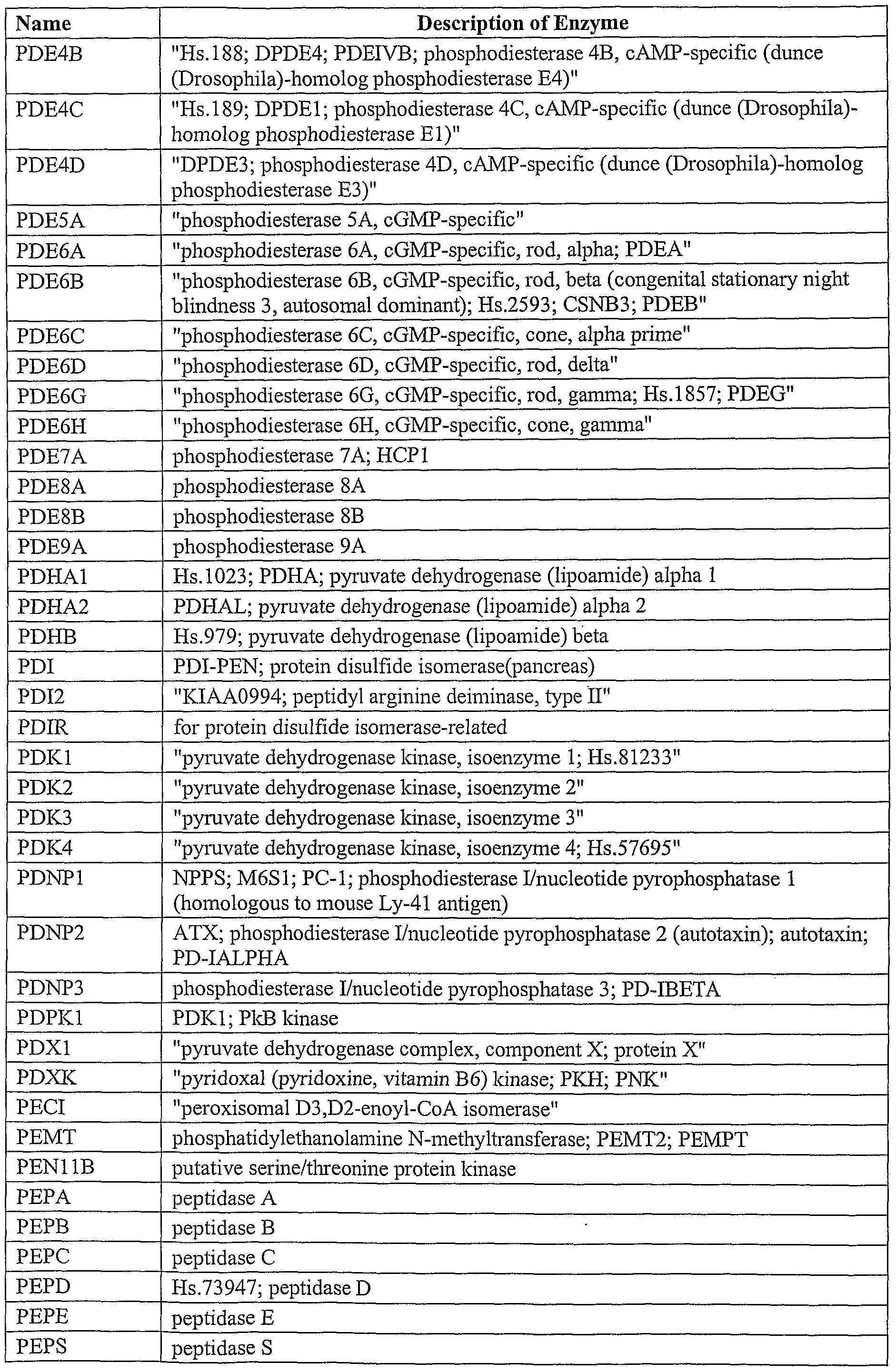
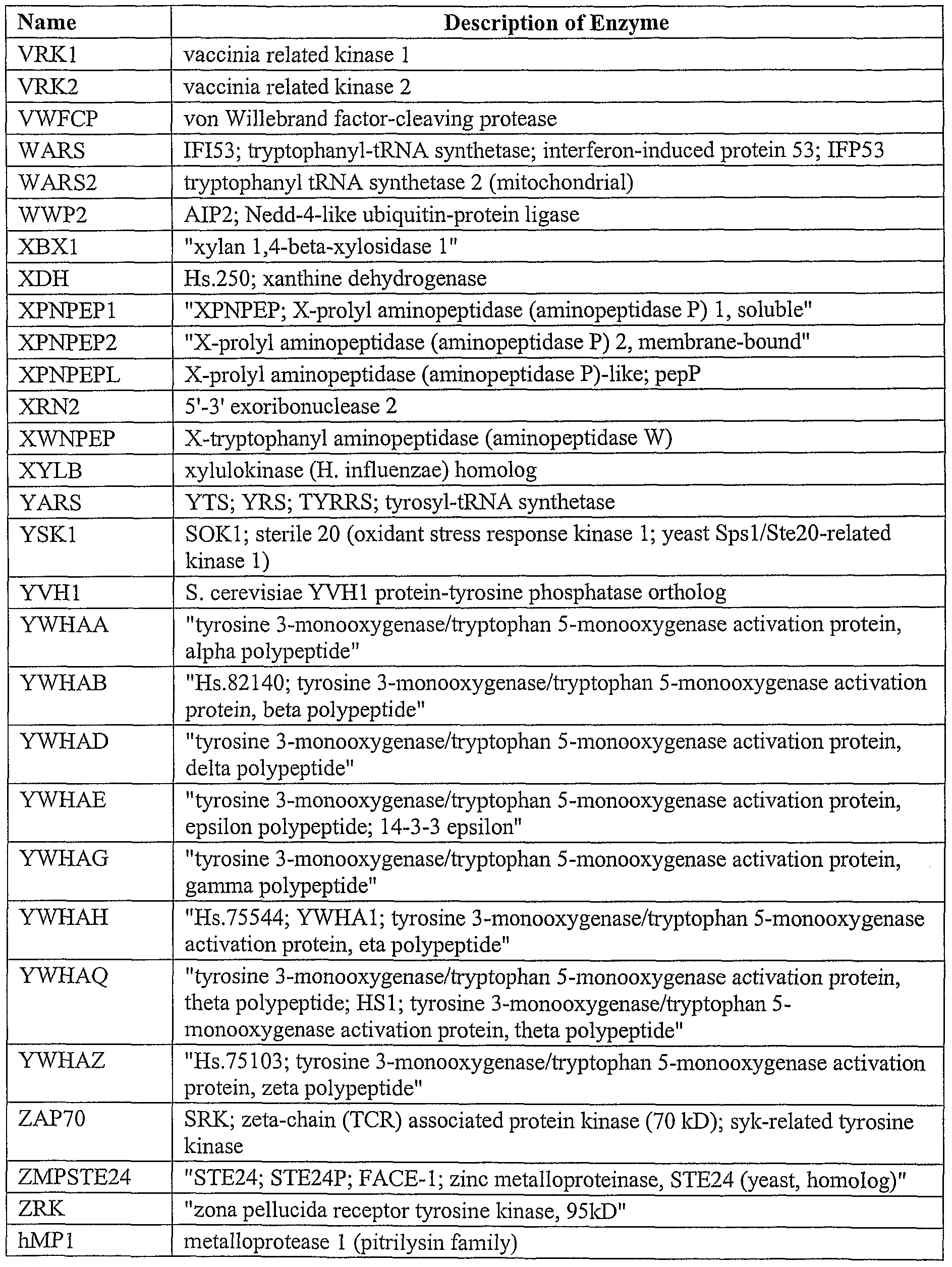
  • a list of enzymes that may be encoded by the target sequence of the present invention is presented in Table II.
  • the target sequence may encode a nuclear protein such as a nucleic acid binding protein.
  • nucleic acid binding proteins Examples of nucleic acid binding proteins that may be utilized in the present invention are presented in Table III. Table III
  • ALRP ankyrin-like repeat protein CARP; C-193; cytoldne inducible nuclear protein; cardiac ankyrin repeat protein
  • APEG1 "nuclear protein, marker for differentiated aortic smooth muscle and down- regulated with vascular injury"
  • APEX APE APEX nuclease (multifunctional DNA repair enzyme); REF1; HAP1; apurinic/apyrimidinic (abasic) endonuclease
  • ARNT aryl hydrocarbon receptor nuclear translocator Hs.47477; HIFlbeta
  • JEM-1 basic leucine zipper nuclear factor 1
  • DDX9 DEAD/H (Asp-Glu-Ala-Asp/His) box polypeptide 9 (RNA helicase A, nuclear DNA helicase II); NDHII"
  • DDX9 DEAD/H (Asp-Glu-Ala-Asp/His) box polypeptide 9 (RNA helicase A, nuclear DNA helicase II); NDHII"
  • DFFB DNA fragmentation factor, 40 lcD, beta polypeptide (caspase-activated DNase); DNA fragmentation factor, 40 lcD, beta subunit; CAD; DFF2; CPAN; DFF40; DFF-40"
  • DMC1 "DMC1 (dosage suppressor of mckl, yeast homolog) meiosis-specific homologous recombination; DMC1H; disrupted meiotic cDNA 1 homolog; LIM15"
  • DNA2L DNA2 (DNA replication helicase, yeast, homolog)-like
  • DNAH11 "DNAHC11; dynein, axonemal, heavy chain 11"
  • DNASE2 "DNL2; deoxyribonuclease II, lysosomal; DNL; DNase II, lysosomal"
  • ENC1 nuclear restricted protein, BTB domain-like (brain); PIG10; NRP/B
  • GADD45G "CR6; GADD45-GAMMA; growth arrest and DNA-damage-inducible, gamma"
  • GRLF1 GRF-1 glucocorticoid receptor DNA binding factor 1
  • HDGF hepatoma-derived growth factor high-mobility group protein 1-like
  • HMG1L2 high-mobility group protein 1-like
  • HIRIP4 DNAJ HIRA interacting protein 4 (dnaJ-like)
  • the inducible promoter is ligated upstream of the target insertion domain such that the promoter may induce expression of the target sequence.
  • the selecting sequence is generally ligated in a different reading frame from the inducible promoter such that expression of the selecting sequence does not result in induction of the target.
  • a reporter gene is desirable. If a reporter gene is used, the positioning of the reporter gene may be different depending on the reporter gene's function.
  • the reporter gene when a reporter gene is used to detect insertion of the target into the subcloning vector, the reporter gene is generally positioned such that the target insertion domain is within the reporter gene allowing the detection of an inserted target sequence by disruption of the reporter gene's expression.
  • the reporter gene when the reporter gene is used to detect insertion of the inducible construct into a mammalian cell, the reporter gene is positioned outside of the target insertion domain such that an inserted target does not disrupt expression of the reporter.
  • Orientation of the components that comprise the inducible cassette may further depend on the number of promoters within the cassette and the number of target sequences within the inducible cassette.
  • the inducible cassette When the inducible cassette consists of one promoter, it may be operably linked to the target sequence such that it initiates transcription of the target sequence.
  • the inducible cassette When two or more identical target sequences are inserted into the inducible cassette, it may be desirable to have one promoter or set of tandem promoters induce expression of the entire transcript.
  • the subcloning vector is a double stranded circular nucleic acid sequence able to replicate and be tianscribed within a host cell and able to accept an inducible cassette.
  • a subcloning vector preferably comprises an origin of replication site ("on") and an inducible cassette insertion domain. Similar to the inducible cassette, the subcloning vector may further comprise a reporter gene able to detect the insertion of the inducible cassette and a selecting gene able to select for cells expressing the subcloning vector.
  • the type of subcloning vector used with the present invention may depend on the size of the inducible cassette to be inserted.
  • the inducible cassette may be from about 0.1 kb to about 15 kb, preferably from about 0.5 kb to about 10 kb, and most preferably from 1 kb to 6 kb.
  • Plasmids that may be used in the present invention include, for example, pucl ⁇ , pucl9, and pBluescript II KS.
  • the plasmid is pc- DNA4/TO.
  • Endonuclease cleavage sites may be added to allow the removal or insertion of components in the subcloning vector by PCR.
  • a cleavage site may be engineered allowing the removal of one of the selecting sequences and insertion of an alternative selecting sequence.
  • the addition of sequences may be performed using standard PCR techniques whereby primers are designed to insert a desired endonuclease cleavage site.
  • endonuclease cleavage sites within the target insertion domain may be modified such that a target sequence may be removed from and inserted into the inducible construct without removal of the inducible cassette from the subcloning vector. This allows efficient transfer of target sequences into and out of the inducible construct.
  • a cleavage site may be removed by PCR or by ligation of a DNA sequence inactivating the cleaved site.
  • more than one inducible cassette may be inserted into a subcloning vector such that a single inducible construct may express one or more target sequences.
  • multiple inducible cassettes When multiple inducible cassettes are added to the subcloning vector they may be inserted in different reading frames such that each inducible cassette may be induced individually.
  • induction of multiple inducible cassettes in different reading frames within the same cell would require different inducer molecules or inducing conditions allowing for selective induction.
  • an assembly protein may be required for functional activity of the target sequence.
  • the assembly protein may be inserted within a second inducible cassette allowing the assembly protein to be induced prior to induction of the target sequence.
  • an additional inducible cassette may be inserted into the subcloning vector that encodes a growth factor or differentiation activator to enhance cell growth and promotes differentiation upon induction.
  • a reporter gene operably linked to a nuclear honnone receptor gene may be inserted into the subcloning vector such that induction produces a change in reporter activity that can be measured.
  • the inducer molecule or induction condition allows the user to selectively induce the tianscription of the target sequence.
  • the inducer molecule or induction condition may be different depending on the inducible promoter.
  • Ponasterone A is a molecule that induces the expression of a vector comprising an ecdysone promoter (Invitrogen, Carlsbad, CA) and tetracycline is a molecule that induces the expression of a vector comprising a tetiacycline-dependent promoter (Invitrogen, Carlsbad, CA; Clontech, Palo Alto, CA).
  • a change in an environmental condition may also be utilized for induction.
  • heat shock promoters are known to induce transcription upon an increase in temperature. Consequently, for example by controlling the temperature of the media the user is able to control induction of a target sequence.
  • a repressor may be used with an inducer or may be used in place of an inducer to regulate induction.
  • a repressor is a compound that interacts with a nucleotide sequence interfering with transcription. Therefore, induction generally occurs in the absence of a repressor.
  • ZFPs zinc finger proteins
  • Particularly potent ZFPs comprise a Kruppel-associated box (“KRAB”) domain (Vissing et al, FEBS Letts. 369:153-157, 1995; Beerli et al, Proc. Natl. Acad. Sci. 95:14628-14633, 1998).
  • a second inducible construct may encode an inducer or a repressor able to control tianscription of an endogenous target.
  • an inducible expression vector encoding a regulator such as for example VP16, FKBP or ZFP, may be used to modulate induction of the target wherein the inducer initiates tianscription of the regulator and the regulator initiates transcription of the target sequence.
  • a regulator such as for example VP16, FKBP or ZFP
  • the present invention provides an internal control because of the ability to initiate or terminate the expression of the target sequence. Therefore, modulation may be determined by comparing values collected prior to and after induction of the target sequence.
  • traditional methods for utilizing expression vectors generally involve transfection of an expression vector in one population of cells and transfection of a control in another population. However because there is variance in expression between populations and in stability of expression over time, modulation is difficult to measure.
  • homologous recombination to produce the inducible target may be useful for the present invention.
  • the endogenous promoter of an endogenous target gene is replaced with the inducible promoter of the present invention.
  • the DNA constructs derived by homologous recombination are useful for operatively linking exogenous regulatory and structural elements to endogenous coding sequences in a way that precisely creates a novel transcriptional unit, provides flexibility in the relative positioning of exogenous regulatory elements and endogenous genes and, ultimately, enables a highly controlled system for identification of modulatory compounds.
  • the inducible regulatory sequence of the construct is integrated into a pre-selected region of the target gene in a chromosome of a cell.
  • the inducible cassette may comprise 5' and 3' insertion adapters enabling it to be inserted into the genome of the host organism by homologous recombination using standard recombination techniques (Mansour et al, Nature 336:348, 1988; U.S. Pat. No. 6,270,989 to Treco, U.S. Pat. No. 6,242,218 to Treco, all of which are inco ⁇ orated in their entireties herein by reference).
  • the insertion adapters are complementary to the non-coding region of the genome where the inducible cassette is to be inserted.
  • 5 'and 3' adapter sequences permit homologous recombination of a desired sequence into a selected site in the host genome.
  • These adapter sequences are homologous to (i.e., able to homologously recombine with) their respective target regions in the host genome.
  • the adapter sequence is homologous to a pre-selected target site in the genome with which homologous recombination is to occur. It contains at least 20 (e.g., at least 50 or 100) contiguous nucleotides from the region of the target gene.
  • the targeting sequence is identical or sufficiently similar to its genomic target site so that the targeting sequence and target site can undergo site-specific recombination. A small percentage of base pair mismatches is acceptable, as long as homologous recombination can occur at a useful frequency.
  • the adapter sequence is preferably at least about 20 (e.g., 50, 100, 250, 400, or 1,000) base pairs ("bp") long.
  • a circular DNA construct can employ a single adapter sequence, or two or more separate adapter sequences.
  • a linear DNA construct may contain two or more separate targeting sequences.
  • the target site to which a given targeting sequence is homologous can reside within an exon and/or intron of the target gene, upstream of and immediately adjacent to the target gene coding region, or upstream of and at a distance from the target gene coding region.
  • homologous recombination to insert an inducible promoter to the regulatory region of an endogenous gene may encompass the expression of a gene which is normally silent in the cell.
  • the use of homologous recombination may also cause the increased expression level of the endogenous gene, or may change the regulation pattern of a gene.
  • the traditional methods utilizing expression vectors require multiple tiansfections.
  • the expression vector is inserted into one aliquot of cells of a sample while one or more control vectors are inserted into additional aliquots of the sample. This method is undesirable because transfection and expression efficiencies may vary significantly from sample to sample.
  • a steady state measurement maybe obtained by assaying the cells in the absence of inducer.
  • An activated state measurement may be made by assaying the cells in the presence of inducer and the modulation capability of a compound may be measured by assaying the cells in an activated state in the presence of the compound.
  • a steady state measurement in the presence of compound may be made following that activated state by assaying the cells once the inducer has been removed.
  • careful selection may be necessary to achieve determination the desired concentration of inducer for induction during development of the assay.
  • a bulk transfection may be performed and individual cells selected to determine inducibility by measuring the target expression, either by RT-PCR/Northem blotting, western blotting, observation of a phenotypic change, or preferably all of the above.
  • Clones with the desired expression levels are then selected, isolated and cultured to be assayed against possible modulatory compounds.
  • the recipient cell may be any in which the target is not endogenously active or has low or negligible activity, is able to grow from low densities, and is amenable to mass culture. Additionally, when secondary modification of the translated target is desirable such as glycosylation, the cell must be able to perform any such secondary modification.
  • the desired recipient cell should have the appropriate signaling mechanisms for the target to initiate a phenotypic change that may be measured.
  • the target is a GPCR
  • the desired cell would preferably have intact adenylyl cyclase and calcium signaling pathways.
  • a number of recipient cells may be utilized with the present invention such as for example CHO, CHO-K1, HEK293, COS, Vero, RBL, SH-SY5Y, and U20S cells.
  • One factor to consider when detennining whether a cell is appropriate for transfection is its endogenous expression of the target sequence. Activity may be measured using a variety of techniques such as RT-PCR, Northern analysis, and array hybridization. Suitable hosts would be those that do not have the target sequence or express it in a low level. More specifically, if a target cannot be detected by RT-PCR, it is highly unlikely that it will mediate a signaling event and therefore the cells would be desirable recipients.
  • Selection of clonal cell lines may be perfonned by growing cells from low densities and isolating colonies that desirably express the target sequence. More preferably the recipient cells are grown from single cell colonies. Recipient cells may be chosen by their ability to grow in culture to high density. In large preparations a high concentration of cells may be required. In this configuration non-adherent cells may be grown in spiimer flasks and adherent cells may be grown in roller bottles.
  • Transfection may be performed by a variety of methods that allow vector insertion into a cell such as for example calcium phosphate and electroporation (Sambrook et al, Molecular Cloning A Laboratory Manual, 1987).
  • Transfected cells may be selected from those that do not express a selecting sequence by a variety of methods.
  • the construct comprises a selection sequence encoding resistance to a selective agent
  • positive cells are selected by the addition of the conesponding selective agent.
  • optical assays may be used to select positive colonies when the inducible cassette comprises a reporter gene such as luciferase.
  • tiansfected cells may be selected using fluorescent activated cell sorting (FACS). Following selection cells are plated and grown to multicellular colonies.
  • FACS fluorescent activated cell sorting
  • Plates containing multicellular colonies are further passed into daughter plates such that there are about ten daughters per mother plate. Cells are then selected by RT-PCR and/or immunoblot analysis and target dependent responses. III. Selection of Cells by Target-Dependent Responses
  • the cells are tested for inducible expression of the desired mRNA.
  • the vector illustrated in Figure 1 to CHO cells as described in Example 2, and subsequent selection for the presence of the plasmid, putative positive cells were tested for induction of KCNCl mRNA expression after addition of the inducer molecule, tetracycline, following the method described in Example 3.
  • KCNCl mRNA was amplified by RT-PCR using primers specific for the KCNCl gene as described in Example 3, then separated by agarose gel electrophoresis ( Figure 2). The PCR products of several clones (# 7, 13, 22) were found to express the KCNCl mRNA when induced.
  • the inducible production of the target protein should be ensured.
  • the tetiacycline-inducibility of the KCNCl protein was detennined using an immunoassay according to the method described in Example 2. Briefly, a primary antibody that recognizes the KCNCl protein was added to the assay well. After a brief wash, the secondary antibody, conjugated to horseradish peroxidase to allow for color development, was added to the well. Upon development of the immunoassay, the tetracycline-induced well was darker than the control well ( Figure 3), indicating the presence of the KCNCl protein.
  • Figure 3 the control well
  • Positive cells are then tested for target-dependent responses by measuring the appropriate response in both the absence and presence of the inducer in order to identify those cells expressing a functional target sequence.
  • Figure 4 demonstrates the use of a cell containing an inducible target as described herein for screening for molecules that modulate its activity.
  • fluorescent dyes are used to assay for changes in membrane potential, essentially as described in Example 4.
  • CHO cells induced to produce the KCNCl target polypeptide are subsequently able to show a response (i.e. a change in fluorescence intensity of the indicator dye) when the modulator KC1 is added.
  • G-protein coupled receptor at high levels generally causes activation of a functional response (Wess et al, J. Pharmacol. Ther. 80:231-264, 1998; Choi et al, J Neurosci Methods. 94:217-25, 2000). Consequently, when the target sequence comprises a G-protein coupled receptor coupled to Gi, an assay that measures a decrease in cellular cyclic AMP ("cAMP") levels is desired.
  • cAMP cellular cyclic AMP
  • the GPCR is coupled to Gs and is constitutively active and inducibly expressed, an assay that measures increases in cAMP levels is desired.
  • an assay that measures intracellular calcium levels may be desired.
  • Examples of techniques to measure cAMP levels are competitive binding assays (the Biotiak enzyme immunoassay (Wallac, Piscataway, NJ)) or a Fluorescence polarization assay (NEN Life Science Products, Boston, MA)(Post et al, Methods Mol. Biol. 126:363-74, 2000).
  • Intercellular calcium levels may be detected by commercially available dyes such as Fura, Fluo or Indo (Molecular Probes, Eugene, OR). These dyes bind to calcium and cause a shift in the absorbance of the dye (Palmer et al, Am. J. Physiol. 279, C1278, 2000; Collet et al, J. Physiol. 520: 417-429, 1999; Meth. Molec. Biol. 114, (David Lambert, ed. Humana Press), 1999; 376). Detecting a dye may be performed by flow cytometric analysis such as for example at 356/478 nm for indo- 1.
  • the first plate is utilized as a control comprising tiansfected cells in which endogenous cAMP levels are measured.
  • the second plate is utilized as a positive control and contains an agent, such as Forskolin, able to elevate endogenous cAMP levels.
  • the cAMP level is elevated to about 80% of maximum. This is detennined by running a concentration range and monitoring the resulting cAMP levels. Maximum is the concentration at which the curve reaches a plateau.
  • the third plate comprises an inducer able to induce transcription of the target sequence, and the cAMP level is monitored over time.
  • the fourth includes the inducer and the test compounds.
  • cAMP levels may be measured over time and may continue until returning to steady state. Recordings are made documenting the elevation or depression of cAMP in response to target induction in order to determine the optimum amount of inducer for each induction procedure. Cells that show changes in the level of cAMP greater than about three standard deviations of the population average following induction are sorted into multiwell plates and grown to multicellular colonies.
  • the first comprises transfected cells absent inducer, and the second comprises adding an inducer and measuring calcium levels by detecting the fluorescent properties of the calcium sensitive-dye over time using a fluorometer.
  • Cells that show changes in the level of calcium dependent fluorescence greater than about three standard deviations of the population average following induction are sorted into multiwell plates and grown to multicellular colonies.
  • the assay preferably measures a change in membrane potential.
  • Fluorescent dyes such as DIBAC (Molecular Probes, Eugene, OR) may detect changes in membrane potential (Epps et al, Chem. Phys. Lipids 69:137-150 1994; Waggoner, J. Membr. Biol. 27:317-34, 1976).
  • DIBAC Molecular Probes, Eugene, OR
  • the direct phenotypic readout may be assayed by expression of an endogenous marker gene (Davis D.L. and Burch J.B., Mol. Endocrinol.
  • the promoter-reporter construct may be any reporter sequence that is operably linked to a promoter and an enhancer sequence that is responsive to the receptor or tianscription factor, such that when the promoter is active, the reporter verifies translation of the construct.
  • luciferase may be linked to the HSV thymidine kinase minimal promoter and an estrogen response element.
  • the enzymatic activity of luciferase in cell extracts may be detected upon addition of a suitable luciferase substrate (such as Luc-Lite, Packard Bioscience, Meriden, CT.) by measurement of the light emitted.
  • a suitable luciferase substrate such as Luc-Lite, Packard Bioscience, Meriden, CT.
  • the promoter-reporter strategy may also be useful in measuring activity.
  • Growth factor or angiogenesis factor receptor activation may be measured either by autophosphorylation (Smaill J.B. et al, J. Med. Chem. 44:429-40, 2001), or by promoter-reporter constructs (Ghezzo F. et al, J. Biol. Chem. 263:4758-63, 1988).
  • Cytoldne receptor activation may be measured by phosphorylation of STAT proteins (Spiotto M.T.
  • Intracellular pH may be measured by the detection of added dyes such as SNARF (Molecular Probes, Eugene, OR) that change their optical properties in response to changes in pH. Dyes such as SNARF may be measured using flow cyomtetric anaylsis (Burchiel S.W. et al, Methods 21:221-30, 2000, van E ⁇ P.E. et al, Cytometry 12:127-32, 1991).
  • SNARF Molecular Probes, Eugene, OR
  • Dyes such as SNARF may be measured using flow cyomtetric anaylsis (Burchiel S.W. et al, Methods 21:221-30, 2000, van E ⁇ P.E. et al, Cytometry 12:127-32, 1991).
  • SNARF Molecular Probes, Eugene, OR
  • Dyes such as SNARF may be measured using flow cyomtetric anaylsis (Burchiel S.W.
  • Dyes that change their optical properties in response to cellular pH, calcium, and membrane permeability such as SNARF (van Hooijdonk CA. et al, Cell Prolif. 30:351-363, 1997), FURA (Palmer B.M. and Moore R.L., Am. J. Physiol. 279:C1278 2000), and propidium iodide (Eray M. et al, J. Cytometry 43:134-142, 2001) may be used to detect activation.
  • the dyes fluoresce at different detectable wavelengths so that multiple independent measurements may be made simultaneously and detected using a flow cytometer or plate reader.
  • a “steady state” measurement is taken prior to induction.
  • the “steady state” measurement comprises cells transfected with inducible construct in the presence or absence of a potential modulator molecule compound.
  • the concentration of the test cells in the assay are generally from about 1 x 10 5 cells/mL to about 2 x 10 6 cells/mL. However, depending on the cell lines selected, one skilled in the art would recognize that the choice of inducible constructs and assays may require routine optimization.
  • Cells may be plated into multiwell plates and inducer added. Potential modulatory compounds may be added at the time expression commences. Control wells within the plate may receive either no inducer or compound, or inducer with no compound. The data may be analyzed to determine whether any of the compounds tested cause a signal deviation greater than about 3 standard deviations from the control wells that receive only inducer. During testing the control wells are monitored to ensure that the target is expressed and functionally active. Compounds identified as having activity may be tested against non-induced cells in a second identical assay excluding inducer to ensure that their effects are target related, rather than having an affect on basal activity.
  • the inducer is added at a concentration that produces a measurable change in the expression of the target by testing for target-dependent responses.
  • the target sequence is verified by methods previously described.
  • concentration of inducer will depend on the cell line, the assay, and the construct as previously described.
  • Activated state measurements are compared to "steady state” measurements to determine whether the potential modulator molecule has modulated the expressed target sequence. For example, modulation of a G-protein coupled receptor may be demonstrated by a change in cAMP or cellular calcium levels during activation. Compounds that test positive are then assayed to determine their effects on the induction mechanism to identify false positives.
  • One method to identify false positives is to test the compounds on a control cell line.
  • the control cell line is preferably of the same cell type as the test cell line and may comprise a reporter gene such as luciferase in place of the target sequence. If the reporter gene is inhibited luciferase will not be detected and it is likely that the compound is affecting the induction process and not the expressed target.
  • the compound When this occurs, the compound is no longer considered as a potential modulator molecule under the current test conditions.
  • positive compounds may be tested against a family of proteins to determine their specificity for a particular member protein in that family.
  • Clozapine is known to inhibit D4 and 5HT2A/C receptors. In this configuration multiple constructs may be created where each expresses a G-protein coupled receptor and each transfected into a different cell.
  • the present invention may also be used to further define or study a biological pathway such as for example an enzymatic cascade pathway. More specifically one could place a regulatory kinase such as MAP Idnase under inducible control. Induction of the Idnase to high levels may activate the MAP kinase cascade. Alternatively, one may engineer many signaling molecules to be 'dominant negative' e.g. 'kinase dead' mutants where key catalytic residues of the enzyme are mutated, or isolated DNA binding domains of tianscription factors. Inducible expression of these mutants may cause loss of function of the signaling pathway and may be useful in target validation studies. V. A Kit for Identifying Modulatory Molecules
  • a kit for identifying modulatory molecules may be any kit comprising a cell line that conditionally expresses a target sequence and an inducer able to induce expression of a target.
  • the kit may further comprise a fluorescent dye able to detect a change in a secondary effect that suggests binding of the target to a modulatory molecule, a buffered saline solution, and culture media.
  • the cell lines may be provided growing in microtitre plates or flasks at 37 C or frozen in vials or microtitre plates in liquid nitrogen. If frozen, the cells are thawed and resuspended in growth media. Standard growth media is provided with the cells and is typically DMEM+10% FCS.
  • the membrane-potential sensitive dye is prepared as a stock solution in DMSO and is diluted in assay media. Preferred assay media is PSS + glucose or hybridoma media (Sigma, Saint Louis, MO).
  • the cell line When the target is an ion channel, the cell line may be CHO or HEK293, the fluorescent dye may be DIBAC, the buffered saline solution may be PBS, and the culture media may be DMEM.
  • the target is a receptor (GPCR, cytoldne or nuclear honnone) the cell line may be CHO or HEK293, the fluorescent dye may be DIBAC or FURA, the buffered saline solution may be PBS, and the culture media may be DMEM.
  • Plasmid number 63333 (ATCC, Roclcville, MD) containing the mouse potassium voltage- gated channel KCNCl cDNA, the mammalian expression vector pcDNA4/TOb (Invitrogen, Carlsbad, CA) were commercially obtained. Both were digested with the restriction enzymes Kpnl and Psf (New England Biolabs, Beverly, MA). The 2 kb KCNCl gene fragment and the pcDNA4/Tob vector were gel purified, ligated and tiansfomied into competent Topi OF' E.coli (Invitrogen, Carlsbad, CA). Positive clones were identified by restriction analysis of plasmid DNA and confirmed by DNA sequencing. Plasmid DNA for transfection was prepared with an Endotoxin free kit (Qiagen, Valencia, CA).
  • the pcDNA4/Tob/KCNCl plasmid ( Figure 1) was tiansfected into T-Rex CHO cells (Invitrogen, Carlsbad, CA) by the following procedure. Cells were seeded into a 6-well plate at 2x10 5 cells per well. The next day cells were transfected using FuGene Reagent (Roche, Indianapolis, IN). The following morning tiansfected cells were split 1:10 into a 10 cm plate. Twenty-four hours later selection in 400 ⁇ g/mL zeocin (Invitrogen, Carlsbad, CA) was initiated, and continued for two weeks. Individual colonies of zeocin resistant cells were isolated using cloning paper (Scienceware, Pequannock, NJ) and passaged into a 24 well plate.
  • Clones producing the KCNCl protein were identified using an affinity-purified rabbit antibody to Kv3.1b (Sigma, St. Louis, MO), the rat homologue of the mouse KCNCl (NEB, Ontario, Canada), and a secondary goat-anti rabbit antibody conjugated to horseradish peroxidase (NEB, Ontario, Canada).
  • the assay was developed using TrueBlue Peroxidase Substrate (KPL Inc., Gaithersburg, MD). Clones that expressed KCNCl in 100% of the cell population when induced and in 0% of the cell population when not induced were saved and expanded in a third 24-well plate. All clones were maintained in zeocin.
  • KCNCl mRNA Induction of the KCNCl gene was confirmed by RT-PCR analysis of mRNA and by immunohistochemistry. PCR was used to verify production of KCNCl mRNA ( Figure 2). Two samples each containing 2x10 4 cells were collected from clones 7, 13, and 22. The first sample was a control whereby there was no induction and the second sample was induced with 10 ⁇ g/mL of tetracycline. The mRNA was reverse-transcribed into cDNA using SuperScripffl (Invitrogen, Carlsbad, CA). PCR was performed in a GeneAmp 9600 thermocycler (Applied Biosystems, Foster City, CA) using a forward primer (5'-CCACCAGACGTACCGCTCATC-3 ⁇ SEQ ID NO.
  • KCNCl induction was detected in induced cells but was absent in non-induced cells.
  • a membrane potential assay demonstrated depolarization of the an induced population of cells in comparison to a non-induced cell population upon the addition of potassium chloride in 50 mM steps (Figure 4).
  • a KCNCl positive TREX/CHO clone was plated at 3xl0 6 cells in replicate 10 cm tissue culture dishes. After 24 hours one dish was treated with 10 ⁇ g/mL deoxycycline to induce KCNCl expression. After a 24 hour induction period, both induced and uninduced cells were harvested with trypsin, counted, and adjusted to equal cell densities in hybridoma media (Sigma, St. Louis, MO).
  • 4-aminopyridine 900 ⁇ M
  • BaCl 2 30 mM
  • 4-aminopyridine is a l ⁇ iown specific inhibitor of Kv3.1b (Grissmer et al, Molec. Pharmacol. 45:1227-1234, 1994; Kirsch and Drewe, Jour. Gen. Physiol. 102:797-816, 1993; Grissmer et al. Jour. Biol. Chem. 267:20971-20979, 1992), the human homologue of KCNCl.
  • BaCl 2 another l ⁇ iown inhibitor of K + channels (Lopes et al, J Biol. Chem. 276:24449-52, 2001; Clarson et al, Placenta 22:328-36, 2001), also results in a less polarized resting potential and a decreased response to depolarization with KG, as shown in Figure 6.
  • Each cell population was tested in triplicate. The mean and SE are shown in the Figure 5 (aminopyridine) and Figure 6 (BaCl 2 ).
  • Example 5 Transfection and testing of an inducible expression vector construct containing a HERG-encoding gene
  • the pcDNA4/TOb/HERG plasmid ( Figure 7) was transfected into T-REx CHO cells
  • zeocin resistant cells were isolated using cloning paper (Scienceware, Pequannock, NJ) and passaged into a 24-well plate. When cells became confluent the clones were split in triplicate among 24-well plates. One set of clones was induced to express HERG with lOmg/ml tetracycline for 24 hours before cells were processed for immunohistochemistiy. An identical set of non-induced clones was also processed for immunohistochemistry. HERG expressing clones were identified using an affinity-purified rabbit antibody to HERG (Alomone Labs, Jerusalem, Israel).
  • the HERG positive TREX/CHO clone 5J was plated at 3X10 6 cells in replicate 10 cm tissue culture dishes. After 24 hours one dish was treated with lOmg/ml doxycycline to induce HERG expression. After 24 hours induction, both induced and uninduced cells were harvested with trypsin, counted and adjusted to the same cell density in hybridoma media (Sigma, St. Louis, MO). A solution of 1X10 5 cells/ml and 0.4 ⁇ M each Disbac5Me4 and Disbac3Me4 in hybridoma media was stirred in a cuvette in a JY-Spex fluorometer. Fluorescence intensity from 540 excitation and 690 emission was followed over time. The extracellular potassium chloride was adjusted to lOOmM with 3N KC1 at the indicated time. 25nM pimozide was then added at the indicated time. Each cell population was tested in triplicate and the mean and SE are shown in Figure 8.
  • the creation of the inducible target gene can be accomplished by a number of strategies, including the use of homologous recombination to replace a specific endogenous regulatory region of a gene with an inducible regulatory region.
  • an adaptor fragment is introduced into the genome of recipient cells for insertion ofa regulatory region upstream of the coding region of the target gene.
  • the targeting construct from which this fragment is derived is designed to include a first targeting sequence homologous to sequences upstream of the target gene, a selectable marker gene, an inducible regulatory region, and a second targeting sequence corresponding to sequences downstream of the first targeting sequence but upstream of exon 1 of the target gene.
  • This strategy allows the endogenous promoter of a target gene to be replaced with an inducible promoter.
  • the resulting homologously recombinant cells can be induced to produce an mRNA transcript of the target gene.
  • a homologous recombination vector containing the inducible promoter and the targeting sequences of a given target gene may be constructed by the following method.
  • a restriction enzyme digestion of a subcloning vector such as pBS (Stratagene, Inc., La Jolla, Calif.) containing the genomic DNA sequences within 1-5 kb of coding regions of the gene of interest is designed (based on the restriction map of the target gene upstream region and data published from human genome sequencing) in order to isolate the desired DNA fragments conesponding to 1) an upstream homologous recombination target sequence 1 of the given gene, and 2) an upstream homologous recombination target sequence 2 of the given gene.
  • the upstream fragments are then sequentially ligated to the plasmid containing the inducible promoter construct, so that the inducible promoter constiuct is between recombination target sequence 1 and 2.
  • one or more selectable marker genes may be added to the construct.
  • the plasmid is then transformed into competent E. coli cells or other cells, including human cell lines, and colonies containing the above inserts are analyzed by restriction enzyme analysis to confinn the orientation of the insert.
  • a membrane potential assay is then conducted using various candidate modulator molecules, by repeating the steps of Example 4 for each candidate molecule.
  • Example 8 Replacement of an endogenous promoter so as to obtain controllable expression of an endogenous gene (CNTF receptor).
  • the activation of the target gene can be accomplished by a number of strategies.
  • a targeting fragment is introduced into the genome of recipient cells for insertion of a regulatory region, optionally including a non-coding exon and a functional, unpaired splice-donor site upstream of the coding region of the target gene.
  • the targeting construct from which this fragment is derived is designed to include a first targeting sequence homologous to sequences upstream of the target gene, a selectable marker gene, a regulatory region and a second targeting sequence corresponding to sequences downstream of the first targeting sequence
  • the post-tianscriptional processing of the mRNA precursor and of its protein product retains the characteristics of the native cell, unlike heterologously expressed cDNAs.
  • the homologous recombination vector containing the inducible promoter and the target sequences of the noncoding region of the gene for the ciliary neurotrophic factor receptor (CNTFR) is constructed as follows:
  • CNTFR-DHR_SK_Pac_CMVTO vector Construction of CNTFR-DHR_SK_Pac_CMVTO vector.
  • pPUR (Clontech, Palo Alto CA.) was digested with Pvu ⁇ and ligated with a Notl linker. The resulting plasmid was then digested with Notl and BamHl to drop the pac gene expression cassette. The Notl-BamRl pac cassette was ligated into pBluescript SK (Stiatagene, San Diego, CA) to generate the plasmid SK_Pac.
  • CMVTO promoter was amplified from pcDNA4/TO_myc_hisB (Invitrogen, Carlsbad CA) with primers CMVTOUB 5'- GATCGGATTCGATATACGCGTTGACATTGATTAT (SEQ ID NO. 4) and CMVTOLE 5'- GATCGAATTCGCTTAAGTTTAAACGCTAGAGTCC (SEQ ID NO. 5) and cycling conditions: 30 cycles of 95 °C 30 sec, 55 °C 30 sec, 72 °C 1 min. PCR product was digested with BamH and EcoRI and cloned into SK JPac to yield SK_Pac_CMVTO.
  • the 3' homologous flanking am was generated by digesting SK-6C with Sapl, filling in this site and digesting with Xliol to generate a 4.3 IcB fragment containing some promoter sequences, the transcriptional start site and part of the first exon, excluding coding sequences.
  • This 4.3 kB fragment was cloned into SK_Pac_CMVTO digested with EcoRW and Xliol to yield SK_Pac_CMVTO-CNTFR_3 ' .
  • the 5' homologous flanking ann was generated by digesting a 2.5 kB Notl fragment from SK-6C and ligating into a CIP treated Notl digest of SK_Pac_CMVTO-C ⁇ TFR_3'. Clones were screened for the conect orientation by restriction digest analysis. Cloned PCR product and ligation junctions were confirmed by sequencing. The correct clone was called CNTFR-DHR_SK_Pac_CMVTO (Fig. 9).
  • This plasmid contains the pac gene, under the control of SV40 early promoter and polyadenylation signal, for puromycin resistance, and two tetracycline operator 2 (Tet0 2 ) sites within the human cytomegalovirus immediate-early (CMV) promoter, for controlling gene expression using doxycyline.
  • CMV cytomegalovirus immediate-early
  • CMVTO vector was linearized with Pvul.
  • Linearized DNA was purified and sterilized by phenol/chloroform extraction and precipitated using ethanol.
  • Recipient cells were isolated by transfecting HBL100 cells (ATCC, Manassas, VA) with pcDNA6/TR (Invitrogen, Carlsbad, CA) using FuGENE 6 (Roche Diagnostics, Indianapolis, IN) and maintaining in lO ⁇ g/ml Blasticidin (Invitiogen, Carlsbad, CA) to select for stable clones.
  • FACS Fluorescence Activated Cell Sorting
  • FACS buffer PBS without Ca 2+ and Mg 2+ supplemented with 1 mM EDTA, 25 mM HEPES pH 7.0, 3% dialyzed serum. 2 ⁇ g/ml of secondary antibody, rabbit anti-goat conjugated to Alexa Fluor 488 (Molecular Probes, Eugene, OR), was added to the samples and incubated for 30 minutes at 4°. Cells were washed three times with FACS buffer. Flow cytometry analysis was perfonned on a FACScan (Becton Dickinson, Franklin Lakes, NJ) and FACS was perfonned on a FACS Vantage (Becton Dickinson, Franklin Lakes, NJ).
  • a region was drawn around the live cells of forward scatter vs. side scatte ⁇ lot and all other plots were gated on this region.
  • the negative population, density plots of uninduced samples and induced samples without primary antibody, were set on the first log of FL1 (Fig. 10).
  • a sort gate was placed on the top 5% of the positive population on the induced samples incubated with primary antibody.
  • the sorted positive population was expanded and re-sorted using the same protocol for individual clones.
  • Example 9 Method of Screening and Identifying a Modulator Molecule for an Endogenous CNTF Receptor Protein Using a Homologous Recombination Vector Construct
  • a constitutive or inducible promoter and selectable marker are inserted by homologous recombination into a human cell line that contains an endogenous copy of CNTFR, and cells are selected for expression of CNTFR according to the above example.
  • An assay is then conducted using various candidate modulator molecules, by measuring the phosphorylation state of the STAT3 protein.
  • Cloned recombinant cells were grown to subconfluency. Cells were then serum starved overnight prior to ligand treatenent. After serum starvation cells were treated with 100 ng/ml CNTF ligand for 15 minutes. Cells were lysed and levels of STAT3 and phosphorylated STAT3 were measured by Western blot (Fig. 11). Anti- STAT3 and anti-phosphorylated STAT3 were purchased from Cell Signaling (Beverly, MA).

Landscapes

  • Health & Medical Sciences (AREA)
  • Life Sciences & Earth Sciences (AREA)
  • Engineering & Computer Science (AREA)
  • Biomedical Technology (AREA)
  • Immunology (AREA)
  • Molecular Biology (AREA)
  • Hematology (AREA)
  • Chemical & Material Sciences (AREA)
  • Urology & Nephrology (AREA)
  • Cell Biology (AREA)
  • Analytical Chemistry (AREA)
  • General Health & Medical Sciences (AREA)
  • Biotechnology (AREA)
  • Pathology (AREA)
  • General Physics & Mathematics (AREA)
  • Food Science & Technology (AREA)
  • Medicinal Chemistry (AREA)
  • Physics & Mathematics (AREA)
  • Microbiology (AREA)
  • Biochemistry (AREA)
  • Bioinformatics & Cheminformatics (AREA)
  • Toxicology (AREA)
  • Tropical Medicine & Parasitology (AREA)
  • Proteomics, Peptides & Aminoacids (AREA)
  • Measuring Or Testing Involving Enzymes Or Micro-Organisms (AREA)
  • Micro-Organisms Or Cultivation Processes Thereof (AREA)

Abstract

Methods for identifying an ion channel modulator, a target membrane receptor modulator molecule, and other modulatory molecules are disclosed, as well as cells and vectors for use in those methods. A polynucleotide encoding target is provided in a cell under control of an inducible promoter, and candidate modulatory molecules are contacted with the cell after induction of the promoter to ascertain whether a change in a measurable physiological parameter occurs as a result of the candidate modulatory molecule.

Description

IDENTIFICATION OF MODULATORY MOLECULES USING INDUCIBLE PROMOTERS
Technical Field The present invention relates generally to the technical fields of molecular biology and drug discovery. More specifically, the invention relates to the method of identifying a drug target modulator using an inducible vector.
Background of the Invention Advances in molecular biology have increased the efficiency of gene isolation and sequencing. Additionally, the availability of known sequences and sequence alignment programs allow comparisons to be made leading to the identification of motifs that are conserved between members of the same family or similar classes. This allows genes to be assigned to particular target families, such as G-protein coupled receptors or ion channels. However, in the case of receptors, sequence information of the target does not provide the identity of the receptor's native ligand or that ligand' s biological function. For example, single transmembrane membrane receptors contain a cysteine rich domain, followed by an alpha helix motif, followed by a tyrosine kinase domain. This may suggest that the sequence is a receptor, whereby the cysteine rich domain is involved in ligand binding, the alpha helix traverses the membrane, and the tyrosine kinase domain is involved in cellular signaling. Unfortunately, sequencing an unknown receptor's ligand binding domain does not provide sufficient information that would easily lead to the identity of the ligand. Similar problems occur when searching for the function of ion channels, enzymes, transporters, transcription factors, nuclear receptors, chaperone proteins and other regulatory molecules within the cell. Consequently, experiments must be designed and performed to identify the sequence's function and modulatory compounds. Controlled expression of the target sequence is necessary to identify modulatory compounds because constitutive expression often leads to over expression of the protein. This is frequently toxic to the cell or can cause down-regulation of the target by stimulation of intemalization and degradation processes. However gene expression is difficult to control in terms of both the level and time course of target expression. Current expression vectors are usually designed to maximize expression levels, and therefore yield cells that continuously express the target. Alternatively, techniques such as transient transfection reduce the target's duration of expression, but these techniques often lead to heterogeneous expression among replicate samples, are labor-intensive, and may damage the cells or alter their function due to the need to penetrate the membrane to deliver exogenous genes, making data difficult to collect and analyze. The activity of a compound against a target of interest is determined by a variety of techniques. Some examples include randomly screening the compound against cells transfected with the target, testing compounds in cells where the target has been mutated to express the protein in its active state, and binding studies between a compound and an isolated form of the target.
However each has problems associated with the technique.
Random screening of transfected cells requires a number of assumptions that often may not be tested. It requires the target protein be properly expressed, correctly localized within the cell, functionally coupled to a signaling mechanism, and expressed stably throughout the duration of the testing process. However, when the function of the target is unknown, these requirements can not be tested.
When the target is a membrane protein such as a G-protein coupled receptor ("GPCR"), it may be mutated such that the protein is expressed in its activated form. Since ligand binding of the mutated protein frequently causes a drop in activity, an assay that detects a drop in activation suggests the compound binds the target. However, since this technique identifies compounds which bind to a mutated protein, the compounds may not possess the same affinity or avidity for a native protein. In addition, this technique is not available when information regarding the design of an activated receptor is unavailable, such as the active form of ion channels. Another frequently used technique to identify modulators is to perform competitive binding assays. However, competitive binding assays require a native ligand to assay the compound, and as previously discussed they are frequently unknown.
Lastly, assays that directly measure binding interactions using purified proteins allow the measurement of interactions between compounds and targets. Examples of direct binding assays are surface plasmon resonance spectroscopy, thermal denaturation profiling, and multipole coupling spectroscopy. However, these techniques only detect binding and are not functional assays. They do not distinguish between agonists, antagonists, or non-functional interactions. Moreover, when the targets are membrane proteins in their native form, purification is not always possible. When a purified form is unavailable, interaction among other molecules in the preparation may lead to false positives or false negatives in the assay.
Therefore there is a need for methods to assay the effects of compounds on the function of biological targets. Specifically, there is a need for an assay that allows control of the expression of the target sequence, identifies target expressing cells, expresses the target in its native form, can distinguish between agonists, antagonists, and nonfunctional interactions and may be performed within the cellular environment.
Brief Description of the Figures Figure 1 is an illustration of the inducible expression vector comprising a tetracycline inducible promoter, a pcDNA4/TO vector construct and a murine KCNC1 potassium ion channel gene. Figure 2 is a photograph of a 1.5% agarose gel demonstrating KCNC1 mRNA production of clones 7, 13 and 22 under non-induced ("(-)Tet") and induced ("(+)Tet") conditions. Figure 3 is a photograph of immuno-staining of KCNC1 produced by clone 22 under non- induced ("(-)Tet") and induced ("(+)Tet") conditions.
Figure 4 is a graph demonstrating hyperpolarization of an induced population of cells compared to a non-induced population of cells and their responses to 50 mM, 100 mM and 150 mM KC1.
Figure 5 is a graph demonstrating that cells induced to overexpress KCNC1 when pre- incubated with 4-aminopyridine, show characteristics more similar to uninduced cells.
Figure 6 is a graph demonstrating that cells induced to overexpress KCNC1 when pre- incubated with BaCl2, show characteristics more similar to uninduced cells. Figure 7 is an illustration of an inducible expression vector comprising a tetracycline inducible promoter, a pcDNA4/TO vector construct and a HERG potassium ion channel gene.
Figure 8 is a graph demonstrating that induced HERG expressing cells are hyperpolarized as compared with the uninduced cell population. The addition of 100 mM potassium chloride depolarizes the HERG expressing cells to a greater extent than the uninduced cells. Induced cells are also more sensitive to 25 nM pimozide than are uninduced cells.
Figure 9 is an illustration of the CNTFR-DHR_SK_Pac_CMVTO vector construct. The 5' and 3' flanking homologous arms are indicated. The pac gene, which confers puromycin resistance, is flanked by a 5' SV40 promoter and a 3' poly A site as indicated. The vector also carries a cytomegalovirus immediate-early (CMV) promoter which contains and two tetracycline operator 2 (Tet02) sites.
Fig. 10 is a graph demonstrating FACS analysis of cells stably transfected with CNTFR- DHR_SK_Pac_CMVTO. The cells were incubated in the presence or absence of 5 μg/ml doxycycline. Cells were stained with or without anti-human CNTFRα followed by Alexa Fluor 488 conjugated secondary antibody. A region was drawn around the live cells of the forward scatter vs. side scatterplot and all other plots were gated on this region. The negative population, density plots of uninduced samples and induced samples without primary antibody were set on the first log of FL1. Panel A shows uninduced cells, untreated with doxycyline, but stained with both primary and secondary antibodies. Panel B shows induced cells, treated with doxycycline, and only stained with secondary antibody. Panel C shows cells induced and stained with primary and secondary antibodies. Density plots of the induced sample (Panel C) show a specific increase in Alexa Fluor 488 signal as demonstrated by increased cell counts in the third log of FL1 compared to Panel A and Panel B figures.
Fig. 11 is an immunoblot analysis of STAT3 and phosphorylated STAT3 from homologous recombinant clones. Isolated clones from sorting were expanded and treated with or without CNTF for 15 minutes. One clone which did not contain homologous integration of target vector, clone
#14, was used as a negative control. Two clones containing homologous integration of the target vector, clone #15 and #16, were analyzed. These cells were lysed and probed with anti- phosphorylated STAT3 to measure STAT3 activation as a result of ligand, CNTF, treatment and anti-STAT3 to measure total STAT3.
Summary of the Invention One aspect of the present invention includes a method for identifying molecules that modulate a target protein, comprising providing mammalian cells transfected in such a way as to provide a nucleotide sequence encoding the target under control of a heterologous inducible promoter; inducing the promoter under conditions that provide a detectable change in a measurable parameter associated with the cells; contacting at least a portion of the cells with a test compound to ascertain whether the test compound affects a change in the measurable parameter; and repeating the contacting step with at least one other test compound. Preferably, the measurable parameter is a parameter other than growth or survival. In one embodiment, the contacting step comprises contacting cells with the test compound while the promoter is induced. The method may advantageously include comprising comparing the value of the measurable parameter in uninduced cells with the value of the parameter in induced cells. In one embodiment, the method includes testing various candidate parameters to ascertain which one is most directly or most advantageously associated with induction of the target sequence. Thus, the measurable parameter can be selected from among a plurality of candidate parameters based on the comparison.
The promoter can typically be induced to different degrees. In some cases, induction of the promoter can have a deleterious effect on cell growth or survival. Thus, the cells can be cultured and expanded without induction of the promoter, and then the promoter can be induced as part of the assay. In one embodiment, the promoter is induced to a degree that provides a detectable change in the parameter but not to a degree that kills the cell. The invention also includes empirical testing of various levels of induction to select that level that optimally provides a cell that is responsive to stimulus or provides an optimal level of signal, while maintaining that amount of viability or cell function necessary for successful performance of the assay.
Induction can occur in various ways. Thus, the methods of the invention include including the promoter by contacting the cell with an inducer molecule. They also include induction of the promoter by removal or inhibition of a repressor. In some embodiments of the invention, the target protein affects ion channel activity of the cell. In one particular embodiment, the target protein is an ion channel protein.
In other embodiments of the invention, the target protein is a cell surface receptor, such as a G-protein coupled receptor. In still other embodiments, the target protein is another type of signaling molecule or transport molecule. One aspect of the present invention includes identification of the type of signal being produced by a candidate molecule, or more particularly, the method by which the signal is being produced or by which the modulation occurs. Thus, the method may include identifying at least one test compound that modulates the measurable parameter in the cell; providing a second cell line that differs from the first cell line in that the inducible promoter controls expression of a reporter instead of polynucleotide encoding target; contacting the second cell line with the identified test compound; and ascertaining whether the identified test compound affects the expression of the reporter. In this manner, one can differentiate between compounds having a genuine effect on the target, and compounds that simply modulate the activity of the inducible promoter.
The polynucleotide encoding the target can be transfected into the cell, or can be endogenous polynucleotide that is simply placed under the control of an inducible heterologous promoter that functionally replaces the endogenous promoter (if any). The invention also includes a method for identifying an ion channel modulator molecule comprising obtaining a cell that conditionally expresses an ion channel target; incubating a potential ion channel modulator molecule with the cell; and determining whether ion flow through the ion channel targets has modulated, thereby identifying molecules that modulate the ion channel target. In one embodiment, the cell that conditionally expresses the ion channel target has been induced to express the ion channel target. Some preferred cells include CHO, CHO-K1, HEK293, COS, Vero, SH-SY5Y, and U20S cells. The cells are advantageously mammalian cells, although other cell systems may also be used. In a particular embodiment, the step of obtaining a cell that conditionally expresses an ion channel target comprises genetically adapting the cell to produce an ion channel target. The cell can be genetically adapted, for example, by transducing or transfecting the cell with an inducible vector comprising an ion channel target. The inducible vector may comprise an inducible cassette wherein the inducible cassette comprises an inducible promoter, an ion channel gene, and a gene conferring resistance to a selection agent for selecting transfected cells wherein the inducible promoter is operably linked to the ion channel gene. Suitable inducible promoters include the heat shock inducible promoter, metallothionin promoter, ecdysone-inducible promoter, FKBP dimerization inducible promoter, Gal4-estrogen receptor fusion protein regulated promoter, lac repressor, steroid inducible promoter, streptogramin responsive promoters and tetracycline regulated promoters, as well as any other compatible promoter.
One embodiment of the invention includes a method wherein the inducible vector may be activated to express the ion channel target and inactivated to prevent expression of the ion channel target. As one example, the ion channel target is an ion channel selected from the group consisting of a sodium ion channel, an epithelial sodium channel, a chloride ion channel, a voltage-gated chloride ion channel, a potassium ion channel, a voltage-gated potassium ion channel, a calcium- activated potassium channel, an inwardly rectifying potassium channel, a calcium ion channel, a voltage-gated calcium ion channel, a ligand-gated calcium ion channel, a cyclic-nucleotide gated ion channel, a hyperpolarization-activated cyclic-nucleotide gated channel, a water channel, a gap junction channel, a viral ion channel, an ATP-gated ion channel and a calcium permeable beta- amyloid peptide channel. Yet another method of the present invention is a method for identifying an ion channel modulator molecule, comprising the steps of obtaining a cell that conditionally expresses an ion channel target; adding an inducer molecule that induces expression of the ion channel target in the cell; measuring membrane potential of the cell; incubating a potential ion channel modulator molecule with the cell; measuring changes in membrane potential; and determining whether ion flow through the ion channel targets has been modulated, thereby identifying a molecule that modulates the ion channel.
The invention also includes a method for screening chemical compounds to identify an ion channel modulator compound comprising the steps of obtaining a cell that conditionally expresses an ion channel target; adding an inducer molecule that induces expression of the ion channel target in the cell; measuring membrane potential of the cell; incubating the chemical compounds with the cell; measuring changes in membrane potential; and determining whether ion flow through the ion channel targets has been modulated, thereby identifying compounds that modulate the ion channel target. Still another aspect of the present invention includes a method for identifying a membrane receptor modulator molecule comprising obtaining a cell that conditionally expresses a target membrane receptor; inducing expression of the target membrane receptor; measuring a physiological condition of the cell to obtain a first set of data; incubating a potential membrane receptor modulator molecule with the cell; measuring the physiological condition of the cell to obtain a second set of data; and comparing the first set of data with the second set of data to determine whether the physiological condition of the cell has been modulated, thereby identifying a molecule that modulates the target membrane receptor. The cell used in the method can be provided as a cell that contains an endogenous target membrane receptor sequence and an endogenous noncoding sequence (such as a promoter); wherein the method includes inserting an inducible cassette comprising a 5' insertion adapter, a regulatory sequence and a 3' insertion adapter within the endogenous noncoding sequence such that the regulatory sequence is operably linked such that it is able to modulate transcription of the target membrane receptor by the presence or absence of a regulator. In one embodiment, the regulatory sequence is a non-mammalian enhancer sequence or a repressor sequence. This non-mammalian enhancer sequence can, for example, be a heφes virus enhancer or an artificial enhancer. Alternatively, the non-mammalian enhancer sequence can be an inducible promoter, e.g., a herpes virus promoter or other suitable inducible promoter. In another embodiment, the regulator is VP16 or a functional domain of NP16. One method of the present invention includes transfecting the cell with a regulatory expression vector construct comprising a second inducible promoter and a regulator gene encoding the regulator operably linked such that induction of the second inducible promoter by an exogenous stimulus initiates transcription of the regulator gene. The second inducible promoter can, for example, be a tetracycline inducible promoter or an ecdysone-inducible promoter. The external stimulus for inducing the target can be any suitable stimulus, such as, for example, tetracycline, ponasterone, dexamethasone, a heavy metal ion or heat. The step of inducing expression of the target membrane receptor can also be initiated by the presence or absence of a regulator or by the presence or absence of an inducer. In one embodiment that uses an inducible cassette as a transfection vector, the inducible cassette further comprises a target sequence such that the target sequence is transcribed upon induction of the inducible cassette Particularly preferred target sequences may be selected from the group consisting of a G-protem coupled receptor target sequence, a nuclear hormone receptor target sequence, a cytokine receptor target sequence, a protein kmase-coupled receptor target sequence a mcotmic acetylcholme receptor target sequence, a lonotropic glutamate receptor target sequence, a glycme receptor target sequence, a gamma-ammobutyπc acid receptor target sequence, and a vamlloid receptor target sequence. One useful target sequence is 5HT4.
When repressor sequences are used, one particularly useful repressor sequence is able to bind a zinc finger protein. Advantageously, the zinc finger protein comprises a KRAB domain. Still another method of the present invention is a method for screening a chemical compound library to identify a G-protem coupled receptor modulator molecule, comprising obtaining a cell that conditionally expresses a G-protem coupled receptor; inducing expression of the G-protem coupled receptor; measuring a physiological parameter associated with the G-protem coupled receptor to obtain a first set of data; incubating a potential modulator of the G-protein coupled receptor with the cell; measuring the physiological parameter to obtain a second set of data; and comparing the first set of data with the second set of data to determine whether the physiological parameter has been modulated, thereby identifying a chemical compound that modulates a G-protein coupled receptor. Suitable physiological parameters can include, for example, a cAMP level, a calcium level, and a membrane potential of the cell. One particular embodiment of the invention comprises an inducible vector containing an ion channel target having a nucleotide sequence shown in SEQ. ID NO. 1, or a cell containing SEQ ID NO: 1 under control of an inducible promoter. The invention may also include an inducible expression vector comprising a tetracycline inducible promoter, a pcDNA4/TO vector construct and a human HERG potassium channel gene. Still another invention is an inducible regulatory expression vector construct comprising a subclonmg vector, a second inducible promoter and a regulator gene The present invention also includes cells transduced or transfected with any of the inducible vectors descπbed or contemplated herein. In one embodiment, the cell is a CHO cell and the transduced or transfected cell expresses tet repressor and HERG potassium ion channel gene.
The present invention also includes ion channel modulators, membrane receptor modulators, G-protem coupled receptor modulators, and other modulators identified using the methods of the present invention The present invention also includes a kit comprising cells that conditionally express an ion channel target, a compound that induces expression of the ion channel target, and an indicator compound or system for indicating ion channel activity of the cells. It further includes a kit comprising cells that conditionally express an ion channel target and a fluorescent dye. Definitions
Prior to setting forth the invention, it may be helpful to first set forth the definitions of certain terms that will be used hereinafter All references, which have been cited below are hereby incorporated by reference m their entirety.
A "nucleic acid molecule" or "nucleic acid sequence" is a linear segment of single- or double-stranded DNA or RNA that can be isolated from any source In the context of the present invention, the nucleic acid molecule is preferably a segment of DNA. An "isolated" nucleic acid molecule or an isolated enzyme is a nucleic acid molecule or enzyme that, by the hand of man, exists apait from its native environment and is therefore not a product of nature. An isolated nucleic acid molecule or enzyme may exist in a purified form or may exist in a non-native environment such as, for example, a recombinant host cell.
A "gene" is a defined region that is located withm a genome and that, besides the aforementioned coding nucleic acid sequence, comprises other, primarily regulatory, nucleic acid sequences responsible for the control of the expression, that is to say the transcription and translation, of the coding portion A gene may also comprise other 5' and 3' untranslated sequences and termination sequences. Further elements that may be present are, for example, mtrons. However, as context may require, the term "gene" can refer more simply to a sequence encoding a desired polypeptide or protein, particularly m the context of a "gene" under the control of an inducible promoter
The term "construct" as used herein refers to a recombinant DNA sequence, generally a recombinant DNA molecule, that has been generated for the purpose of the expression of a specific nucleotide sequence(s), or is to be used in the construction of other recombinant nucleotide sequences The construct may be generated for the puφose of controlling the expression of a specific nucleotide sequence(s) as, for example, in a construct containing a viral enhancer. In general, "construct" is used herein to refer to a recombinant DNA molecule comprising a subclonmg vector and may further comprise an inducible cassette and/or a regulator gene.
The term "genetically adapting" as used herein refers to the process of establishing an inducible expression cloning vector construct withm a cell such that the target sequence's expression may be exogenously controlled. The term "exogenously controlled" as used herein refers to an increase or decrease m expression of a target sequence by the presence or absence of an mducer molecule or inducing condition. The inducer molecule or inducing condition originates from outside of the host organism. The term "transfection" refers to a process for introducing heterologous nucleic acid into a host cell or organism A transfected cell refers to a host cell, such as a eukaryotic cell, and more specifically, a mammalian cell, into which a heterologous nucleic acid molecule has been introduced. The nucleic acid molecule can be stably integrated into the genome of the host or the nucleic acid molecule and can also be present as an extrachromosomal molecule, such as a vector or plasmid. Such an extrachromosomal molecule can be auto-replicating.
The term "modulator molecule", "compound that modulates", "modulatory compound", or "compound" as used herein refers to any compound that activates, enhances, increases, decreases, or suppresses the function of an expressed target or increases or decreases the amount of an expressed target.
The term "modulation" or "modulated" as used herein refers to any change in functional activity such as activation, enhancement, increasing, interference with or suppression or an increase or decrease in the amount of expressed target.
A " modulatory molecule" can modulate the activity of the target molecule in many ways. For example, a modulator may act on a target by affecting its conformation, folding (or other physical characteristics), binding to other moieties (such as ligands), activity (or other functional characteristics), and/or other aspects of protein structure or functions is considered to have modulated polypeptide function. Any method of modifying the target activity is suitable for the present invention, as long as the modification of target activity when compared to the absence of the modulatory molecule can be assessed. Such a modulatory molecule can include small organic or inorganic molecules as well as large macromolecules. Specific examples of small molecules include KG or BaCl2. Examples of macromolecules which may be able to modulate the activity of the target of a cell include peptides, polypeptides, proteins, nucleic acid, carbohydrate and lipid.
Functional or structural analogues or mimics of such compounds which exhibit substantially the same activation or inhibition activity are also included within the meaning of the term as used herein. The type, size or shape of the molecule is not important so long as the molecules can modulate the specific target activity of a cell.
The term "chemical library" or "array" refers to an intentionally created collection of differing molecules which can be prepared synthetically and screened for biological activity in a variety of different formats (e.g., libraries of soluble molecules, libraries of molecules bound to a solid support).
The term "target sequence" as used herein refers to a known DNA nucleotide sequence of a target wherein the DNA may be cDNA.
The term "target" as used herein refers to a protein of interest that has a known or suspected function or that has more than one known or suspected function. In this case, the term "function" refers to a signaling event, rather than a role in a disease state. Changes in the target's function or functional activity when exposed to potential modulator molecules are utilized to identify modulator molecules.
The term "target binding conditions" as used herein refers to environmental conditions that may effect the interaction between a target and a modulator molecule such as pH, temperature, and salt concentration.
The term "induction" or "induced" as used herein refers to the initiation of transcription and translation of the target sequence. Induction may occur in the presence of an inducer or in the absence of a repressor.
As used herein, the term "promoter" is a DNA sequence which extends upstream from the transcription initiation site and is involved in binding of RNA polymerase. The promoter may contain several short (<10 base pair) sequence elements that bind transcription factors, generally dispersed over >200 base pairs.
The term "inducible promoter" as used herein refers to a promoter that is transcriptionally active when bound to a regulator that activates transcription or when a regulator that represses transcription is absent. The inducible promoter is operatively linked to a target sequence.
The term "conditional expression" or "conditionally expresses" as used herein refers to the ability to activate and/or suppress the transcription of a target sequence by the presence or absence of an inducer molecule, an inducing condition or a regulator molecule.
The term "operably linked" as used herein refers to a DNA sequence and regulatory sequence(s) are connected in such a way as to permit gene expression when the appropriate molecules are bound to the regulatory sequences. When the inducible promoter is regulated by a repressor, gene expression may occur in the absence of a repressor. When the inducible promoter is regulated by an environmental condition, gene expression occurs by obtaining the inducing environmental condition (e.g. an increase in temperature activating a heat shock promoter). The term "inducible cassette" as used herein refers to a sequence that may be inserted into a cloning vector that allows for the exogenous control of the transcription of a target sequence.
An "indicator molecule" refers to any molecule which allows visualization of the modulation of the target. For example, fluorescent indicator dyes which display altered fluorescence characteristics upon a change in membrane potential may be used. The term "identify", "identifying", or "identification" as used herein refers to an act of assaying a compound or a plurality of compounds using the methods of the present invention to isolate a compound or compounds that modulate function or functional activity of a target.
The term "determine", determining" or "determination" as used herein refers to the act of comparing assay measurements of a compound or compounds that may or may not have modulatory function or activity with a compound or compounds that do not have modulatory function or activity to isolate a compound or compounds that modulate a function or functional activity of a target. As used herein, the term "physiological condition" refers to any biochemical or physiological change m the cell such that the event can be visualized using an indicator molecule according to the method of the present invention.
Detailed Description of the Invention The present invention provides methods foi identifying modulator molecules by screening these molecules against cells that conditionally express a target In these methods cells that are clonally selected from populations stably transfected with an inducible vector construct may be controlled by the presence or absence of an exogenous cell-permeable mducer This is especially advantageous when overexpression of the target interferes with the cell's growth or survival. Cells may be cultured in the absence of mducer to expand the population then transcription of the target sequence may be initiated for assay puφoses. Assays to detect modulation may be different depending on the function of the target e g for a G-protem coupled receptor ("GPCR") modulation may result m a change in cyclic AMP or intracellular calcium levels and modulation of an ion channel may result in a change in membrane potential. Moreover, the difference in functional activity of the target before and after induction provides an indication that the target is active and creates an 'assay window' that may be monitored during screening to veπfy that the cell is continuing to express the target throughout the testing period. I Inducible Vector Construct
The inducible vectoi construct provides control over the transcnption of a target sequence such as an ion channel or GPCR by the presence or absence of an exogenous mducer or inducing condition Therefoie, expression may be increased or decreased to a level that when modulation occuis the user is able to distinguish between compounds that activate or inhibit a target's function or functional activity In addition the detrimental effects associated with overexpression (e.g toxicity and heterogeneous expression, e g variances m expression) of cells whether from the same population or of different type may be reduced. More specifically, the present invention provides methods for assaying transfected cells prior to induction ("steady state") and after induction ("activated state") of an inducible cassette. A measurement may also be taken once induction has ceased, and the transfected cells have returned to steady state. Steady state may be achieved by the absence of the mducer molecule or inducing condition or by the presence of a repressor such that the target sequence is unable to be transcribed As previously described, current methods of modulator molecule discovery are unable to achieve conditions that allow for measurement of an initial steady state condition and an activated state condition. In addition, current methods are unable to monitor target activity during the course of a testing penod.
The inducible vector construct may advantageously comprise an inducible cassette and a subclonmg vector such as a plasmid or a cosmid. The inducible cassette regulates the expression of a target sequence positioned withm the cassette by the induction of an inducible promoter positioned upstream of the target sequence This induction occurs by adding an mducer molecule, removing a repressor, or changing an environmental condition that initiates transcription at the inducible promoter. Therefore, the user is able to exogenously "turn on" or "turn off expression of the target sequence, and is advantageously also able to fine tune the level of expression.
Some examples of inducible vector constructs that may be used are the tetracychne- dependent systems (Invitrogen, Carlsbad, CA, Clontech, Palo Alto CA) and the ecdysone inducible vector (Invitrogen, Carlsbad, CA) For example, the vector illustrated m Figure 1 may be used for the present invention The construct contains a region allowing regulated expression from a cytomegalovirus enhancer-promoter sequence containing two copies of the tet-02 sequence, which is an enhancer that allows for highly regulated expression of the inserted gene. The vector additionally contains a gene conferring antibiotic (ampicillin) resistance, which is useful for bacterial subclonmg procedures, and another gene conferring resistance to selection agents (such as zeocm) after transfection into the eukaryotic host cell. The construct of Figure 1 also contains a multiple cloning site allowing for gene insertion downstream of the CMV tet-02 promoter- enhancer sequence. One embodiment of the inducible cassette comprises an inducible promoter, a selecting sequence, and a target insertion domain able to accept at least one target sequence. The inducible cassette may further comprise a reporter gene and/or at least one restriction site to enable ligation of the inducible cassette into a subclonmg vector
As an alternative to the use of the inducible cassette, an inducible promoter (and preferably also a gene piovidmg for lesistance to selection agents) can be inserted into the genome of a cell in which the target gene is endogenous. This would typically involve the use of 5 ' and 3 ' adapters enabling insertion of the inducible cassette into the host's genome by homologous recombination.
The inducible promoter provides exogenous control over the transcription of the target sequence by the presence or absence of an mducer molecule, a repressor, oi an environmental condition that initiates transcription. A promoter may be selected based on a variety of charactenstics such as its efficiency at initiating transcription, its ability to be exogenously controlled, the availability of its corresponding mducer and by the characteristics of the target.
The rate and efficiency of transcription by a given inducible promotei will vary depending on the promoter and its response to its corresponding inducer. Different inducible promoters are able to initiate tianscription at different efficiencies and have different response curves to the absence or presence of their corresponding mducers. When the precise level of expression withm the cell is to be quantitatively controlled a promoter with a rapid response to mducer may be desired (e g a minimal CMV promoter with two Tet-operator sequences 5' of the promoter (as, for example, m the T-Rex system, Invitrogen, Carlsbad, CA). However, when precise control is not desired a promoter with basal activity may be utilized.
The availability of an mducer molecule may be regulated by biological accessibility or economic concerns The ability for an mducer to be available biologically m an assay system may depend on its concentration, affinity and specificity. Correspondingly, the cost for obtaining a sufficient supply of inducer may be economically unfeasible. Tetracycline and its more stable analogue doxycycline are readily available inducers that may be utilized with the present invention. However, when the selecting sequence of the inducible cassette comprises a tetracycline resistance gene, a tetracycline inducible promoter may not be desired because the addition of the corresponding selecting media would also initiate transcription of the target sequence thereby reducing control over expression.
Cellular effects, such as for example cell growth or apoptosis, resulting from an expressed target may be a factor when choosing an inducible promoter. Steady state may be achieved when the promoter is "turned on" or "turned off consequently promoters that are "turned on" in their steady state may be better suited for targets that do not interfere with cell survival or that inhibit deleterious effects such as for example apoptosis. Alternatively, promoters that are "turned off in their steady state may be better suited for targets that interfere with cell growth, such as certain ion channels or apoptosis activators. Some examples of promoters useful in the present invention are heat shock inducible promoter, metallothionin promoter, ecdysone-inducible promoter, FKBP dimerization inducible promoter, Gal4-estrogen receptor, fusion protein regulated promoter, Lac repressor, steroid inducible promoter, streptogramin responsive promoters, and tetracycline regulated promoters.
Selection is performed to select for cells that have been transfected with the inducible target construct. Mammalian cell transfection selection typically utilizes genes encoding resistance to selective agents such as, for example, zeocin, hygromycin, blasticidin, and geneticin.
The choice of a selecting sequence may depend on a variety of characteristics. The choice of a selecting sequence may depend on the ability to provide resistance to more than one selection agent. A selecting gene that confers resistance to a variety of selecting media may be desired to allow flexibility in the selecting procedure. Similarly, the addition of multiple selecting sequences may be combined into one cassette allowing the user to choose either for selection pui oses.
The selecting sequence may be any sequence that allows selection of cells that express an inducible construct from those that do not following transfection. Selection may be conducted by addition of a selecting media that requires the expression of the selecting sequence for cell survival. Generally the selecting sequence may be an antibiotic resistance gene conferring resistance to its corresponding antibiotic or a gene that expresses a nutrient necessary for cell survival in a nutrient deficient culture media. Alternatively, single cells may be selected using fluorescent activated cell sorting ("FACS") when the selecting sequence encodes a fluorescent protein such as, for example, a green fluorescent protein ("GFP"). When choosing a selecting sequence for the inducible cassette it is preferable that the subcloning vector comprise a functionally different selecting sequence, so that the selection would not be specific to a construct comprising the inducible cassette. Correspondingly, when choosing a selecting sequence for the inducible cassette, it is preferable that the selecting sequence not provide resistance against an inducer.
One skilled in the art will recognize that when a cell is engineered to express different inducible cassettes, a different selection sequence may be inserted into each inducible cassette, allowing selection for cells able to express each. For example, zeocin resistance may be the selection sequence for one cassette, while hygromycin resistance may be the selection sequence for the second cassette. Therefore, when both are transfected into a cell, the appropriate media may contain zeocin and hygromycin. Some examples of selecting sequences useful in the present invention are genes that confer resistance to the selective agents zeocin, hygromycin and geneticin. Alternatively, nucleotide sequences that encode essential nutrients absent in nutrient deficient media may be utilized as selection sequences.
The target insertion domain is a sequence of nucleotides that enables ligation or insertion of a target sequence within the inducible cassette. The target insertion domain may comprise a single cloning site or a multiple cloning site ("MCS") and may further comprise a reporter gene allowing detection of recombinant clones. Alternatively the target insertion domain may comprise thymidine overhangs enabling PCR products to be directly ligated to the cloning vector and may further comprise a reporter gene allowing detection of recombinant clones (Current Protocols in Molecular Biology, John Wiley Press).
In addition, a reporter gene may be positioned outside of the target insertion domain such that expression of the reporter occurs when the inducible cassette is expressed within the subcloning vector. In this configuration for example a luciferase reporter gene may be utilized to detect insertion of the inducible cassette into the subcloning vector. Other reporter genes that may be utilized with the present invention are b-galactosidase, chloramphenicol acetyltransferase and green fluorescent protein. The inducible cassette may also comprise 5' and 3' insertion adapters enabling it to be inserted into the genome of the host organism by homologous recombination using standard recombination techniques (Mansour et al, Nature, 336:348-352,1988). In this configuration the insertion adapters are complementary to the non-coding region of the genome where the inducible cassette is to be inserted. Transcription of the target sequence may be controlled directly by the inducer or may be controlled through an intermediary whereby the inducer initiates transcription at an inducible promoter positioned within a second construct ("regulatory construct") which may express a regulator. The regulator in this configuration controls the tianscription of the target sequence.
The target sequence may be any nucleic acid sequence that encodes a cellular protein of pharmaceutical interest. The target sequence may be a known or a previously unidentified sequence. Known sequences may be selected by searching a database such as GenBank or SwissProt. Once the sequence of interest is selected primers may be designed such that the sequence may be amplified from a cDNA library (Current Protocols in Molecular Biology, John Wiley Press). Alternatively, the sequence may be purchased or obtained from a collection such as the I.M.A.G.E. Consortium [LLNL] cDNA Clones, (Lennon et al, Genomics 33:151-152, 1996). The cDNA clones provided by the I.M.A.G.E. Consortium are available through distributors including the ATCC (Roclcville, MD). The target sequence may encode a membrane-associated protein such as an ion channel protein, a receptor such as a G-protein coupled receptor target sequence, a nuclear hormone receptor target sequence, a cytokine receptor target sequence and a protein kinase-coupled receptor target sequence, a soluble protein such as an enzyme. A list of ion channel proteins that may be encoded by the target sequence of the present invention is listed in Table I, below.
Table I
Figure imgf000017_0001
Figure imgf000018_0001
Figure imgf000019_0001
Figure imgf000020_0001
Figure imgf000021_0001
Figure imgf000022_0001
Furthermore, the target sequence may encode an entire protein or merely an active portion of the protein. For example, the full length estrogen receptor or the isolated ligand binding domain of the same receptor may be used. A list of enzymes that may be encoded by the target sequence of the present invention is presented in Table II.
Table II
Figure imgf000022_0002
Figure imgf000023_0001
Figure imgf000024_0001
Figure imgf000025_0001
Figure imgf000026_0001
Figure imgf000027_0001
Figure imgf000028_0001
Figure imgf000029_0001
Figure imgf000030_0001
Figure imgf000031_0001
Figure imgf000032_0001
Figure imgf000033_0001
Figure imgf000034_0001
Figure imgf000035_0001
Figure imgf000037_0001
Figure imgf000038_0001
Figure imgf000039_0001
Figure imgf000040_0001
Figure imgf000041_0001
Figure imgf000042_0001
Figure imgf000043_0001
Figure imgf000044_0001
Figure imgf000045_0001
Figure imgf000046_0001
Figure imgf000047_0001
Figure imgf000048_0001
Figure imgf000049_0001
Figure imgf000050_0001
Figure imgf000051_0001
Figure imgf000052_0001
Figure imgf000053_0001
Figure imgf000054_0001
Figure imgf000055_0001
Figure imgf000056_0001
Figure imgf000057_0001
Figure imgf000058_0001
Figure imgf000059_0001
Figure imgf000060_0001
Figure imgf000061_0001
Figure imgf000062_0001
Figure imgf000063_0001
Figure imgf000064_0001
Figure imgf000065_0001
Figure imgf000066_0001
Figure imgf000067_0001
Figure imgf000068_0001
Figure imgf000069_0001
Figure imgf000070_0001
Figure imgf000071_0001
Figure imgf000072_0001
Figure imgf000073_0001
Figure imgf000074_0001
Figure imgf000075_0001
Figure imgf000076_0001
Figure imgf000077_0001
Figure imgf000078_0001
Figure imgf000079_0001
Figure imgf000080_0001
Figure imgf000081_0001
Figure imgf000082_0001
Figure imgf000083_0001
Figure imgf000084_0001
Figure imgf000085_0001
Figure imgf000086_0001
Figure imgf000087_0001
Figure imgf000088_0001
Figure imgf000089_0001
Figure imgf000090_0001
Figure imgf000091_0001
Figure imgf000092_0001
Alternatively, the target sequence may encode a nuclear protein such as a nucleic acid binding protein. Examples of nucleic acid binding proteins that may be utilized in the present invention are presented in Table III. Table III
Name DNA Binding Protein Description
ALRP ankyrin-like repeat protein; CARP; C-193; cytoldne inducible nuclear protein; cardiac ankyrin repeat protein
APEG1 "nuclear protein, marker for differentiated aortic smooth muscle and down- regulated with vascular injury"
APEX APE; APEX nuclease (multifunctional DNA repair enzyme); REF1; HAP1; apurinic/apyrimidinic (abasic) endonuclease
ARNT aryl hydrocarbon receptor nuclear translocator; Hs.47477; HIFlbeta
ARNTL aryl hydrocarbon receptor nuclear tianslocator-like; MOP3; JAP3; BMAL1
B4-2 proline-rich protein with nuclear targeting signal
BLZF1 JEM1; basic leucine zipper nuclear factor 1 (JEM-1)
C1D nuclear DNA-binding protein
CHD1 chromodomain helicase DNA binding protein 1
CHD1L CHDL; CHDIL-PENDLNG; chromodomain helicase DNA binding protein 1- like
CHD2 chromodomain helicase DNA binding protein 2
CHD3 chromodomain helicase DNA binding protein 3; Mi-2a
CHD4 chromodomain helicase DNA binding protein 4; Mi-2b
DAP10 DNAX-activati on protein 10
DDB1 Hs.74623; damage-specific DNA binding protein 1 (1271cD)
DDB2 Hs.77602; damage-specific DNA binding protein 2 (48kD)
DDX9 "DEAD/H (Asp-Glu-Ala-Asp/His) box polypeptide 9 (RNA helicase A, nuclear DNA helicase II); NDHII"
DDXL "nuclear RNA helicase, DECD variant of DEAD box family"
DEK DEK oncogene (DNA binding); D6S23 IE
DFFA "DNA fragmentation factor, 45 IdD, alpha subunit"
DFFB "DNA fragmentation factor, 40 lcD, beta polypeptide (caspase-activated DNase); DNA fragmentation factor, 40 lcD, beta subunit; CAD; DFF2; CPAN; DFF40; DFF-40"
DMC1 "DMC1 (dosage suppressor of mckl, yeast homolog) meiosis-specific homologous recombination; DMC1H; disrupted meiotic cDNA 1 homolog; LIM15"
DNA2L "DNA2 (DNA replication helicase, yeast, homolog)-like"
DNAH11 "DNAHC11; dynein, axonemal, heavy chain 11"
DNAH12 DHC3; HL19; HDHC3; HL-19; DNAHC3; DNAHC12; dynein heavy chain 12
DNASE2 "DNL2; deoxyribonuclease II, lysosomal; DNL; DNase II, lysosomal"
ENC1 "NRPB; nuclear restricted protein, BTB domain-like (brain); PIG10; NRP/B"
FBRNP heterogeneous nuclear protein similar to rat helix destabilizing protein
GADD45A DDIT1; Hs.80409; GADD45; DNA-damage-inducible transcript 1
GADD45G "CR6; GADD45-GAMMA; growth arrest and DNA-damage-inducible, gamma"
GRLF1 GRF-1; glucocorticoid receptor DNA binding factor 1
HDGF hepatoma-derived growth factor (high-mobility group protein 1-like); HMG1L2
HIRIP4 DNAJ; HIRA interacting protein 4 (dnaJ-like)
Figure imgf000094_0001
Figure imgf000095_0001
Figure imgf000096_0001
Figure imgf000097_0001
Figure imgf000098_0001
Assembly of the inducible cassette is generally performed using standard molecular biology techniques such as restriction endonuclease digestion and ligation as described in Sambrook et al, Molecular Cloning: A Laboratory Manual, 2nd Ed., Cold Spring Harbor Laboratory, 1989. In general, the inducible promoter is ligated upstream of the target insertion domain such that the promoter may induce expression of the target sequence. In addition, the selecting sequence is generally ligated in a different reading frame from the inducible promoter such that expression of the selecting sequence does not result in induction of the target. There may be some situations in which the addition of a reporter gene is desirable. If a reporter gene is used, the positioning of the reporter gene may be different depending on the reporter gene's function. Of course, when a reporter gene is used to detect insertion of the target into the subcloning vector, the reporter gene is generally positioned such that the target insertion domain is within the reporter gene allowing the detection of an inserted target sequence by disruption of the reporter gene's expression. In contrast, when the reporter gene is used to detect insertion of the inducible construct into a mammalian cell, the reporter gene is positioned outside of the target insertion domain such that an inserted target does not disrupt expression of the reporter.
Orientation of the components that comprise the inducible cassette may further depend on the number of promoters within the cassette and the number of target sequences within the inducible cassette.
When the inducible cassette consists of one promoter, it may be operably linked to the target sequence such that it initiates transcription of the target sequence. One skilled in the art will recognize the advantages of incoφorating two or more promoters within the inducible cassette. When two or more identical target sequences are inserted into the inducible cassette, it may be desirable to have one promoter or set of tandem promoters induce expression of the entire transcript. Alternatively, when different target sequences are inserted into the same inducible cassette, it may be desirable to have at least two promoters each able to induce expression of a target individually. For example two target sequences may be inserted in different reading frames allowing the selective induction by each promoter.
The subcloning vector is a double stranded circular nucleic acid sequence able to replicate and be tianscribed within a host cell and able to accept an inducible cassette. A subcloning vector preferably comprises an origin of replication site ("on") and an inducible cassette insertion domain. Similar to the inducible cassette, the subcloning vector may further comprise a reporter gene able to detect the insertion of the inducible cassette and a selecting gene able to select for cells expressing the subcloning vector. The type of subcloning vector used with the present invention may depend on the size of the inducible cassette to be inserted. When the subcloning vector is a plasmid the inducible cassette may be from about 0.1 kb to about 15 kb, preferably from about 0.5 kb to about 10 kb, and most preferably from 1 kb to 6 kb. Plasmids that may be used in the present invention include, for example, puclδ, pucl9, and pBluescript II KS. Preferably the plasmid is pc- DNA4/TO.
Endonuclease cleavage sites may be added to allow the removal or insertion of components in the subcloning vector by PCR. For example, when the same selecting sequence is present in both the inducible cassette and the subcloning vector, a cleavage site may be engineered allowing the removal of one of the selecting sequences and insertion of an alternative selecting sequence. The addition of sequences may be performed using standard PCR techniques whereby primers are designed to insert a desired endonuclease cleavage site. Similarly, endonuclease cleavage sites within the target insertion domain may be modified such that a target sequence may be removed from and inserted into the inducible construct without removal of the inducible cassette from the subcloning vector. This allows efficient transfer of target sequences into and out of the inducible construct. For example, a cleavage site may be removed by PCR or by ligation of a DNA sequence inactivating the cleaved site.
One skilled in the art will recognize that the same strategies comprising restriction and ligation of a target cDNA sequence into an inducible cassette are applicable in inserting the inducible cassette into the subcloning vector.
In addition, more than one inducible cassette may be inserted into a subcloning vector such that a single inducible construct may express one or more target sequences. When multiple inducible cassettes are added to the subcloning vector they may be inserted in different reading frames such that each inducible cassette may be induced individually. However, one skilled in the art would recognize that induction of multiple inducible cassettes in different reading frames within the same cell would require different inducer molecules or inducing conditions allowing for selective induction. For example in one configuration an assembly protein may be required for functional activity of the target sequence. In this case the assembly protein may be inserted within a second inducible cassette allowing the assembly protein to be induced prior to induction of the target sequence. In yet another configuration, an additional inducible cassette may be inserted into the subcloning vector that encodes a growth factor or differentiation activator to enhance cell growth and promotes differentiation upon induction. Alternatively, in another configuration a reporter gene operably linked to a nuclear honnone receptor gene may be inserted into the subcloning vector such that induction produces a change in reporter activity that can be measured.
As previously discussed, the inducer molecule or induction condition allows the user to selectively induce the tianscription of the target sequence. Correspondingly, the inducer molecule or induction condition may be different depending on the inducible promoter. For example, Ponasterone A is a molecule that induces the expression of a vector comprising an ecdysone promoter (Invitrogen, Carlsbad, CA) and tetracycline is a molecule that induces the expression of a vector comprising a tetiacycline-dependent promoter (Invitrogen, Carlsbad, CA; Clontech, Palo Alto, CA). A change in an environmental condition may also be utilized for induction. For example, heat shock promoters are known to induce transcription upon an increase in temperature. Consequently, for example by controlling the temperature of the media the user is able to control induction of a target sequence.
A repressor may be used with an inducer or may be used in place of an inducer to regulate induction. A repressor is a compound that interacts with a nucleotide sequence interfering with transcription. Therefore, induction generally occurs in the absence of a repressor. For example zinc finger proteins ("ZFPs") are commonly used as repressors. Particularly potent ZFPs comprise a Kruppel-associated box ("KRAB") domain (Vissing et al, FEBS Letts. 369:153-157, 1995; Beerli et al, Proc. Natl. Acad. Sci. 95:14628-14633, 1998).
A second inducible construct may encode an inducer or a repressor able to control tianscription of an endogenous target. For example, an inducible expression vector encoding a regulator, such as for example VP16, FKBP or ZFP, may be used to modulate induction of the target wherein the inducer initiates tianscription of the regulator and the regulator initiates transcription of the target sequence. In this configuration there may be an additional reporter within the inducible cassette or within the regulatory construct allowing the induction to be monitored between constructs. Unlike traditional expression systems, the present invention provides an internal control because of the ability to initiate or terminate the expression of the target sequence. Therefore, modulation may be determined by comparing values collected prior to and after induction of the target sequence. In contrast, traditional methods for utilizing expression vectors generally involve transfection of an expression vector in one population of cells and transfection of a control in another population. However because there is variance in expression between populations and in stability of expression over time, modulation is difficult to measure.
The use of homologous recombination to produce the inducible target may be useful for the present invention. In this method, the endogenous promoter of an endogenous target gene is replaced with the inducible promoter of the present invention. The DNA constructs derived by homologous recombination are useful for operatively linking exogenous regulatory and structural elements to endogenous coding sequences in a way that precisely creates a novel transcriptional unit, provides flexibility in the relative positioning of exogenous regulatory elements and endogenous genes and, ultimately, enables a highly controlled system for identification of modulatory compounds. Upon homologous recombination, the inducible regulatory sequence of the construct is integrated into a pre-selected region of the target gene in a chromosome of a cell. This region should be within 5kb of a coding exon and more preferably within 1 kb of a coding exon for the gene of interest. The resulting new tianscription unit containing the constract-derived inducible regulatory sequence alters the expression of the target gene. According to this method, the inducible cassette may comprise 5' and 3' insertion adapters enabling it to be inserted into the genome of the host organism by homologous recombination using standard recombination techniques (Mansour et al, Nature 336:348, 1988; U.S. Pat. No. 6,270,989 to Treco, U.S. Pat. No. 6,242,218 to Treco, all of which are incoφorated in their entireties herein by reference). In this configuration, the insertion adapters are complementary to the non-coding region of the genome where the inducible cassette is to be inserted. 5 'and 3' adapter sequences permit homologous recombination of a desired sequence into a selected site in the host genome. These adapter sequences are homologous to (i.e., able to homologously recombine with) their respective target regions in the host genome. The adapter sequence is homologous to a pre-selected target site in the genome with which homologous recombination is to occur. It contains at least 20 (e.g., at least 50 or 100) contiguous nucleotides from the region of the target gene. By "homologous" is meant that the targeting sequence is identical or sufficiently similar to its genomic target site so that the targeting sequence and target site can undergo site-specific recombination. A small percentage of base pair mismatches is acceptable, as long as homologous recombination can occur at a useful frequency. To facilitate homologous recombination, the adapter sequence is preferably at least about 20 (e.g., 50, 100, 250, 400, or 1,000) base pairs ("bp") long.
A circular DNA construct can employ a single adapter sequence, or two or more separate adapter sequences. A linear DNA construct may contain two or more separate targeting sequences. The target site to which a given targeting sequence is homologous can reside within an exon and/or intron of the target gene, upstream of and immediately adjacent to the target gene coding region, or upstream of and at a distance from the target gene coding region.
The use of homologous recombination to insert an inducible promoter to the regulatory region of an endogenous gene may encompass the expression of a gene which is normally silent in the cell. The use of homologous recombination may also cause the increased expression level of the endogenous gene, or may change the regulation pattern of a gene. II. Cell Transfection
As described above, the traditional methods utilizing expression vectors require multiple tiansfections. In particular, the expression vector is inserted into one aliquot of cells of a sample while one or more control vectors are inserted into additional aliquots of the sample. This method is undesirable because transfection and expression efficiencies may vary significantly from sample to sample.
The methods of the present invention do not require the transfection of additional controls. Once cells have been transfected with the inducible vector construct a steady state measurement maybe obtained by assaying the cells in the absence of inducer. An activated state measurement may be made by assaying the cells in the presence of inducer and the modulation capability of a compound may be measured by assaying the cells in an activated state in the presence of the compound. Correspondingly, a steady state measurement in the presence of compound may be made following that activated state by assaying the cells once the inducer has been removed. However, one skilled in the art would recognize that careful selection may be necessary to achieve determination the desired concentration of inducer for induction during development of the assay. For example, a bulk transfection may be performed and individual cells selected to determine inducibility by measuring the target expression, either by RT-PCR/Northem blotting, western blotting, observation of a phenotypic change, or preferably all of the above. Clones with the desired expression levels are then selected, isolated and cultured to be assayed against possible modulatory compounds. The recipient cell may be any in which the target is not endogenously active or has low or negligible activity, is able to grow from low densities, and is amenable to mass culture. Additionally, when secondary modification of the translated target is desirable such as glycosylation, the cell must be able to perform any such secondary modification. In addition, the desired recipient cell should have the appropriate signaling mechanisms for the target to initiate a phenotypic change that may be measured. For example, if the target is a GPCR, the desired cell would preferably have intact adenylyl cyclase and calcium signaling pathways. A number of recipient cells may be utilized with the present invention such as for example CHO, CHO-K1, HEK293, COS, Vero, RBL, SH-SY5Y, and U20S cells. One factor to consider when detennining whether a cell is appropriate for transfection is its endogenous expression of the target sequence. Activity may be measured using a variety of techniques such as RT-PCR, Northern analysis, and array hybridization. Suitable hosts would be those that do not have the target sequence or express it in a low level. More specifically, if a target cannot be detected by RT-PCR, it is highly unlikely that it will mediate a signaling event and therefore the cells would be desirable recipients.
Selection of clonal cell lines may be perfonned by growing cells from low densities and isolating colonies that desirably express the target sequence. More preferably the recipient cells are grown from single cell colonies. Recipient cells may be chosen by their ability to grow in culture to high density. In large preparations a high concentration of cells may be required. In this configuration non-adherent cells may be grown in spiimer flasks and adherent cells may be grown in roller bottles.
Transfection may be performed by a variety of methods that allow vector insertion into a cell such as for example calcium phosphate and electroporation (Sambrook et al, Molecular Cloning A Laboratory Manual, 1987). Transfected cells may be selected from those that do not express a selecting sequence by a variety of methods. Typically, when the construct comprises a selection sequence encoding resistance to a selective agent, positive cells are selected by the addition of the conesponding selective agent. Alternatively, optical assays may be used to select positive colonies when the inducible cassette comprises a reporter gene such as luciferase. In addition tiansfected cells may be selected using fluorescent activated cell sorting (FACS). Following selection cells are plated and grown to multicellular colonies.
Plates containing multicellular colonies are further passed into daughter plates such that there are about ten daughters per mother plate. Cells are then selected by RT-PCR and/or immunoblot analysis and target dependent responses. III. Selection of Cells by Target-Dependent Responses
After transfection and selection of stable cell lines containing the inducible vector, the cells are tested for inducible expression of the desired mRNA. For example, upon transfection of the vector illustrated in Figure 1 to CHO cells as described in Example 2, and subsequent selection for the presence of the plasmid, putative positive cells were tested for induction of KCNCl mRNA expression after addition of the inducer molecule, tetracycline, following the method described in Example 3. KCNCl mRNA was amplified by RT-PCR using primers specific for the KCNCl gene as described in Example 3, then separated by agarose gel electrophoresis (Figure 2). The PCR products of several clones (# 7, 13, 22) were found to express the KCNCl mRNA when induced. Furthermore, the inducible production of the target protein should be ensured. Using the above-described system as an example, the tetiacycline-inducibility of the KCNCl protein was detennined using an immunoassay according to the method described in Example 2. Briefly, a primary antibody that recognizes the KCNCl protein was added to the assay well. After a brief wash, the secondary antibody, conjugated to horseradish peroxidase to allow for color development, was added to the well. Upon development of the immunoassay, the tetracycline-induced well was darker than the control well (Figure 3), indicating the presence of the KCNCl protein. One of skill in the art will appreciate that the inducibility of any target sequence useful for the present invention can be detennined in a similar manner.
Positive cells are then tested for target-dependent responses by measuring the appropriate response in both the absence and presence of the inducer in order to identify those cells expressing a functional target sequence.
Figure 4 demonstrates the use of a cell containing an inducible target as described herein for screening for molecules that modulate its activity. In this example, fluorescent dyes are used to assay for changes in membrane potential, essentially as described in Example 4. CHO cells induced to produce the KCNCl target polypeptide are subsequently able to show a response (i.e. a change in fluorescence intensity of the indicator dye) when the modulator KC1 is added.
The addition of the KCNCl inhibitor aminopyridine to the induced cells lessened the response to KC1 addition (Figure 5). BaCl2, a K+ channel inhibitor, also ameliorated the response to KC1 addition (Figure 6). Target-dependent responses may also be measured or observed by secondary effects that demonstrate the expression of the target sequence such as by measuring changes in cellular adhesion and may vary depending on the target sequence.
Expression of a G-protein coupled receptor at high levels generally causes activation of a functional response (Wess et al, J. Pharmacol. Ther. 80:231-264, 1998; Choi et al, J Neurosci Methods. 94:217-25, 2000). Consequently, when the target sequence comprises a G-protein coupled receptor coupled to Gi, an assay that measures a decrease in cellular cyclic AMP ("cAMP") levels is desired. When the GPCR is coupled to Gs and is constitutively active and inducibly expressed, an assay that measures increases in cAMP levels is desired. Furthermore, when the GPCR is coupled to a Gq family G-protein, is constitutively active and inducibly expressed, an assay that measures intracellular calcium levels may be desired. Examples of techniques to measure cAMP levels are competitive binding assays (the Biotiak enzyme immunoassay (Wallac, Piscataway, NJ)) or a Fluorescence polarization assay (NEN Life Science Products, Boston, MA)(Post et al, Methods Mol. Biol. 126:363-74, 2000).
Intercellular calcium levels may be detected by commercially available dyes such as Fura, Fluo or Indo (Molecular Probes, Eugene, OR). These dyes bind to calcium and cause a shift in the absorbance of the dye (Palmer et al, Am. J. Physiol. 279, C1278, 2000; Collet et al, J. Physiol. 520: 417-429, 1999; Meth. Molec. Biol. 114, (David Lambert, ed. Humana Press), 1999; 376). Detecting a dye may be performed by flow cytometric analysis such as for example at 356/478 nm for indo- 1.
When cAMP levels are assayed at least four daughter plates containing the construct may be used to test at least four conditions. The first plate is utilized as a control comprising tiansfected cells in which endogenous cAMP levels are measured. The second plate is utilized as a positive control and contains an agent, such as Forskolin, able to elevate endogenous cAMP levels. Preferably, the cAMP level is elevated to about 80% of maximum. This is detennined by running a concentration range and monitoring the resulting cAMP levels. Maximum is the concentration at which the curve reaches a plateau. The third plate comprises an inducer able to induce transcription of the target sequence, and the cAMP level is monitored over time. The fourth includes the inducer and the test compounds. When the maximum induction of the target construct occurs, cAMP levels may be measured over time and may continue until returning to steady state. Recordings are made documenting the elevation or depression of cAMP in response to target induction in order to determine the optimum amount of inducer for each induction procedure. Cells that show changes in the level of cAMP greater than about three standard deviations of the population average following induction are sorted into multiwell plates and grown to multicellular colonies.
When calcium levels are assayed, two conditions are preferable. The first comprises transfected cells absent inducer, and the second comprises adding an inducer and measuring calcium levels by detecting the fluorescent properties of the calcium sensitive-dye over time using a fluorometer. Cells that show changes in the level of calcium dependent fluorescence greater than about three standard deviations of the population average following induction are sorted into multiwell plates and grown to multicellular colonies.
Induction of an ion channel target will generally increase the number of channels in the cell membrane and result in a change in membrane potential. Therefore, when the target is an ion channel, the assay preferably measures a change in membrane potential. Fluorescent dyes such as DIBAC (Molecular Probes, Eugene, OR) may detect changes in membrane potential (Epps et al, Chem. Phys. Lipids 69:137-150 1994; Waggoner, J. Membr. Biol. 27:317-34, 1976). When the target sequence is a nuclear hormone receptor or transcription factor, the direct phenotypic readout may be assayed by expression of an endogenous marker gene (Davis D.L. and Burch J.B., Mol. Endocrinol. 10:937-44, 1996) or by using a promoter-reporter construct (Martinez E. et al, EMBO J. 6:3719-27, 1987). The promoter-reporter construct may be any reporter sequence that is operably linked to a promoter and an enhancer sequence that is responsive to the receptor or tianscription factor, such that when the promoter is active, the reporter verifies translation of the construct. For example luciferase may be linked to the HSV thymidine kinase minimal promoter and an estrogen response element. Briefly, when the promoter is activated by binding of the estrogen receptor to the response element, the enzymatic activity of luciferase in cell extracts may be detected upon addition of a suitable luciferase substrate (such as Luc-Lite, Packard Bioscience, Meriden, CT.) by measurement of the light emitted.
Because receptors for growth factors, angiogenesis factors, or cytokines are known to couple through specific intiacellular pathways to activate gene expression, the promoter-reporter strategy may also be useful in measuring activity. Growth factor or angiogenesis factor receptor activation may be measured either by autophosphorylation (Smaill J.B. et al, J. Med. Chem. 44:429-40, 2001), or by promoter-reporter constructs (Ghezzo F. et al, J. Biol. Chem. 263:4758-63, 1988). Cytoldne receptor activation may be measured by phosphorylation of STAT proteins (Spiotto M.T. and Chung T.D., Prostate 42:88-98, 2000) or by STAT reporter constructs (Gaemers LC. et al, J. Biol. Chem. 276:6191-9, 2001). When the target sequence encodes a transporter, changes in intracellular pH may be measured to determine activity. Ion transporters such as proton pumps or anion transporters where hydrogen ions are accumulated within the cell, lead to a change in pH. For example, changes in activity of the sodium/hydrogen exchanger would alter the intracellular proton concentration. The activity of the sodium/hydrogen exchanger is coupled with the activity of other cation exchangers and thus intiacellular pH is an indication of the activity of all cation exchangers. Intracellular pH may be measured by the detection of added dyes such as SNARF (Molecular Probes, Eugene, OR) that change their optical properties in response to changes in pH. Dyes such as SNARF may be measured using flow cyomtetric anaylsis (Burchiel S.W. et al, Methods 21:221-30, 2000, van Eφ P.E. et al, Cytometry 12:127-32, 1991). When the target sequence encodes a protein that induces apoptosis such as by stimulation of the Fas receptor, different markers representing different points within the chain of cellular events may be measured such as activation of caspases (Smolewski P. et al, Cytometry 44: 73-82, 2001), display of cell surface markers, intiacellular acidification, calcium mobilization, and changes in penneability. Dyes that change their optical properties in response to cellular pH, calcium, and membrane permeability such as SNARF (van Hooijdonk CA. et al, Cell Prolif. 30:351-363, 1997), FURA (Palmer B.M. and Moore R.L., Am. J. Physiol. 279:C1278 2000), and propidium iodide (Eray M. et al, J. Cytometry 43:134-142, 2001) may be used to detect activation. Preferably, the dyes fluoresce at different detectable wavelengths so that multiple independent measurements may be made simultaneously and detected using a flow cytometer or plate reader. IV. Testing Compounds for the Ability to Modulate the Activity of an Induced Target Sequence Gene Product. Once cells that selectively express the target sequence have been identified and the desired inducing conditions have been determined, cells are grown and assayed to detennine the effects of potential modulatory compounds. Testing for modulation of the expressed target sequence occurs prior to induction and after induction. Testing may also occur once induction has ceased and the cell is allowed to return to its "steady state." Differences in the measurements between the "steady state" and "activated state" in the presence and absence of these compounds allows one to determine whether modulation has occurred.
A "steady state" measurement is taken prior to induction. The "steady state" measurement comprises cells transfected with inducible construct in the presence or absence of a potential modulator molecule compound. The concentration of the test cells in the assay are generally from about 1 x 10⁵ cells/mL to about 2 x 10⁶ cells/mL. However, depending on the cell lines selected, one skilled in the art would recognize that the choice of inducible constructs and assays may require routine optimization.
Cells may be plated into multiwell plates and inducer added. Potential modulatory compounds may be added at the time expression commences. Control wells within the plate may receive either no inducer or compound, or inducer with no compound. The data may be analyzed to determine whether any of the compounds tested cause a signal deviation greater than about 3 standard deviations from the control wells that receive only inducer. During testing the control wells are monitored to ensure that the target is expressed and functionally active. Compounds identified as having activity may be tested against non-induced cells in a second identical assay excluding inducer to ensure that their effects are target related, rather than having an affect on basal activity.
The inducer is added at a concentration that produces a measurable change in the expression of the target by testing for target-dependent responses. The target sequence is verified by methods previously described. In addition the concentration of inducer will depend on the cell line, the assay, and the construct as previously described.
"Activated state" measurements are compared to "steady state" measurements to determine whether the potential modulator molecule has modulated the expressed target sequence. For example, modulation of a G-protein coupled receptor may be demonstrated by a change in cAMP or cellular calcium levels during activation. Compounds that test positive are then assayed to determine their effects on the induction mechanism to identify false positives. One method to identify false positives is to test the compounds on a control cell line. The control cell line is preferably of the same cell type as the test cell line and may comprise a reporter gene such as luciferase in place of the target sequence. If the reporter gene is inhibited luciferase will not be detected and it is likely that the compound is affecting the induction process and not the expressed target. When this occurs, the compound is no longer considered as a potential modulator molecule under the current test conditions. In addition positive compounds may be tested against a family of proteins to determine their specificity for a particular member protein in that family. For example, Clozapine is known to inhibit D4 and 5HT2A/C receptors. In this configuration multiple constructs may be created where each expresses a G-protein coupled receptor and each transfected into a different cell.
The present invention may also be used to further define or study a biological pathway such as for example an enzymatic cascade pathway. More specifically one could place a regulatory kinase such as MAP Idnase under inducible control. Induction of the Idnase to high levels may activate the MAP kinase cascade. Alternatively, one may engineer many signaling molecules to be 'dominant negative' e.g. 'kinase dead' mutants where key catalytic residues of the enzyme are mutated, or isolated DNA binding domains of tianscription factors. Inducible expression of these mutants may cause loss of function of the signaling pathway and may be useful in target validation studies. V. A Kit for Identifying Modulatory Molecules
A kit for identifying modulatory molecules may be any kit comprising a cell line that conditionally expresses a target sequence and an inducer able to induce expression of a target. The kit may further comprise a fluorescent dye able to detect a change in a secondary effect that suggests binding of the target to a modulatory molecule, a buffered saline solution, and culture media.
The cell lines may be provided growing in microtitre plates or flasks at 37 C or frozen in vials or microtitre plates in liquid nitrogen. If frozen, the cells are thawed and resuspended in growth media. Standard growth media is provided with the cells and is typically DMEM+10% FCS. The membrane-potential sensitive dye is prepared as a stock solution in DMSO and is diluted in assay media. Preferred assay media is PSS + glucose or hybridoma media (Sigma, Saint Louis, MO).
When the target is an ion channel, the cell line may be CHO or HEK293, the fluorescent dye may be DIBAC, the buffered saline solution may be PBS, and the culture media may be DMEM. When the target is a receptor (GPCR, cytoldne or nuclear honnone) the cell line may be CHO or HEK293, the fluorescent dye may be DIBAC or FURA, the buffered saline solution may be PBS, and the culture media may be DMEM.
The above disclosure generally describes the present invention. A more complete understanding can be obtained by reference to the following specific examples which are provided herein for puφoses of illustration only and are not intended to limit the scope of the invention. EXAMPLES
Example 1 Insertion of the Mouse Potassium Voltage-Gated Channel KCNCl Gene Into the pcDNA4/TOb Inducible Expression Vector
Plasmid number 63333 (ATCC, Roclcville, MD) containing the mouse potassium voltage- gated channel KCNCl cDNA, the mammalian expression vector pcDNA4/TOb (Invitrogen, Carlsbad, CA) were commercially obtained. Both were digested with the restriction enzymes Kpnl and Psf (New England Biolabs, Beverly, MA). The 2 kb KCNCl gene fragment and the pcDNA4/Tob vector were gel purified, ligated and tiansfomied into competent Topi OF' E.coli (Invitrogen, Carlsbad, CA). Positive clones were identified by restriction analysis of plasmid DNA and confirmed by DNA sequencing. Plasmid DNA for transfection was prepared with an Endotoxin free kit (Qiagen, Valencia, CA).
Example 2 Transfection of the Inducible Expression Vector Target Construct
The pcDNA4/Tob/KCNCl plasmid (Figure 1) was tiansfected into T-Rex CHO cells (Invitrogen, Carlsbad, CA) by the following procedure. Cells were seeded into a 6-well plate at 2x10⁵ cells per well. The next day cells were transfected using FuGene Reagent (Roche, Indianapolis, IN). The following morning tiansfected cells were split 1:10 into a 10 cm plate. Twenty-four hours later selection in 400 μg/mL zeocin (Invitrogen, Carlsbad, CA) was initiated, and continued for two weeks. Individual colonies of zeocin resistant cells were isolated using cloning paper (Scienceware, Pequannock, NJ) and passaged into a 24 well plate.
When cells became confluent, the clones were split in triplicate among 24-well plates. To identify clones that were able to express KCNCl, One set of clones was induced to express KCNCl with 10 ug/mL tetracycline for 24 hours before cells were processed for immunohistochemistry. An identical set of non-induced clones was also processed for immunohistochemistry. Clones producing the KCNCl protein were identified using an affinity-purified rabbit antibody to Kv3.1b (Sigma, St. Louis, MO), the rat homologue of the mouse KCNCl (NEB, Ontario, Canada), and a secondary goat-anti rabbit antibody conjugated to horseradish peroxidase (NEB, Ontario, Canada). The assay was developed using TrueBlue Peroxidase Substrate (KPL Inc., Gaithersburg, MD). Clones that expressed KCNCl in 100% of the cell population when induced and in 0% of the cell population when not induced were saved and expanded in a third 24-well plate. All clones were maintained in zeocin.
Example 3 Confinning the Induction of the Mouse Potassium Voltage-Gated Channel KCNCl Gene
Induction of the KCNCl gene was confirmed by RT-PCR analysis of mRNA and by immunohistochemistry. PCR was used to verify production of KCNCl mRNA (Figure 2). Two samples each containing 2x10⁴ cells were collected from clones 7, 13, and 22. The first sample was a control whereby there was no induction and the second sample was induced with 10 μg/mL of tetracycline. The mRNA was reverse-transcribed into cDNA using SuperScripffl (Invitrogen, Carlsbad, CA). PCR was performed in a GeneAmp 9600 thermocycler (Applied Biosystems, Foster City, CA) using a forward primer (5'-CCACCAGACGTACCGCTCATC-3\ SEQ ID NO. 2) and reverse primer (5'CGGTGCTGGCGATAGGTCATC-3\ SEQ ID NO. 3) specific for the expressed KCNCl sequence. PCR products were separated on a 1.5% agarose gel and stained with SYBR Gold (Molecular Probes, Eugene, OR). KCNCl induction was detected in induced cells but was absent in non-induced cells.
The stable, zeocin-resistant cell lines containing the KCNCl gene were once again tested for their ability to produce the KCNCl protein upon induction (Figure 3), following essentially the same method as described in Example 2, above.
Example 4 Method of Screening and Identifying a Modulator Molecule for an Ion Channel
A membrane potential assay demonstrated depolarization of the an induced population of cells in comparison to a non-induced cell population upon the addition of potassium chloride in 50 mM steps (Figure 4). A KCNCl positive TREX/CHO clone was plated at 3xl06 cells in replicate 10 cm tissue culture dishes. After 24 hours one dish was treated with 10 μg/mL deoxycycline to induce KCNCl expression. After a 24 hour induction period, both induced and uninduced cells were harvested with trypsin, counted, and adjusted to equal cell densities in hybridoma media (Sigma, St. Louis, MO). A solution of 3.3 x 10⁵ cells and 0.4 μM of each Disbac5Me4 and Disbac3Me4 in hybridoma media was stirred in a cuvette in a JY- Fluonnax-2 fluorometer (JY, Edison NJ). Fluorescence intensity from 540 nm excitation and 690 nm emission was measured over time. The extracellular potassium chloride level was adjusted to 50 mM, lOOmM, and 150 mM with 3 N KC1 at the indicated times. Each cell population was tested in triplicate and the mean and standard error (SE) were detennined.
To demonstrate inhibition of KCNCl, the inhibitors 4-aminopyridine (900 μM) and BaCl2 (30 mM) were pre-incubated with cells at least 30 minutes prior to addition of membrane potential dyes and fluorescence measurement. 4-aminopyridine is a lαiown specific inhibitor of Kv3.1b (Grissmer et al, Molec. Pharmacol. 45:1227-1234, 1994; Kirsch and Drewe, Jour. Gen. Physiol. 102:797-816, 1993; Grissmer et al. Jour. Biol. Chem. 267:20971-20979, 1992), the human homologue of KCNCl. BaCl2, another lαiown inhibitor of K+ channels (Lopes et al, J Biol. Chem. 276:24449-52, 2001; Clarson et al, Placenta 22:328-36, 2001), also results in a less polarized resting potential and a decreased response to depolarization with KG, as shown in Figure 6. Pre- incubation with 30 mM KC1 had no effect, ruling out the possibility that effects of BaCl2 resulted from simply changing the ionic strength of the extiacellular medium (data not shown). Each cell population was tested in triplicate. The mean and SE are shown in the Figure 5 (aminopyridine) and Figure 6 (BaCl2).
Example 5 Transfection and testing of an inducible expression vector construct containing a HERG-encoding gene
The pcDNA4/TOb/HERG plasmid (Figure 7) was transfected into T-REx CHO cells
(Invitrogen, Carlsbad, CA). Cells were seeded into a 6-well plate at 2x10⁵ cells per well. The next day cells were transfected using FuGene Reagent (Roche, Indianapolis, IN). The following morning transfected cells were split 1:10 into a 10cm plate. Twenty four hours later selection in 400mg/ml zeocin (Invitrogen, Carlsbad, CA) was begun, and continued for two weeks.
Individual colonies of zeocin resistant cells were isolated using cloning paper (Scienceware, Pequannock, NJ) and passaged into a 24-well plate. When cells became confluent the clones were split in triplicate among 24-well plates. One set of clones was induced to express HERG with lOmg/ml tetracycline for 24 hours before cells were processed for immunohistochemistiy. An identical set of non-induced clones was also processed for immunohistochemistry. HERG expressing clones were identified using an affinity-purified rabbit antibody to HERG (Alomone Labs, Jerusalem, Israel). A secondary goat-anti-rabbit antibody conjugated to horseradish peroxidase (NEB, Ontario, Canada) was then detected using TrueBlue Peroxidase Substrate (KPL Inc., Gaithersburg, MD). Clones that expressed HERG in 100% of the cell population when induced and in 0% of the cell population when not induced were saved and expanded from the third 24-well plate. All clones were maintained in zeocin selection.
The HERG positive TREX/CHO clone 5J was plated at 3X10⁶ cells in replicate 10 cm tissue culture dishes. After 24 hours one dish was treated with lOmg/ml doxycycline to induce HERG expression. After 24 hours induction, both induced and uninduced cells were harvested with trypsin, counted and adjusted to the same cell density in hybridoma media (Sigma, St. Louis, MO). A solution of 1X10⁵ cells/ml and 0.4 μM each Disbac5Me4 and Disbac3Me4 in hybridoma media was stirred in a cuvette in a JY-Spex fluorometer. Fluorescence intensity from 540 excitation and 690 emission was followed over time. The extracellular potassium chloride was adjusted to lOOmM with 3N KC1 at the indicated time. 25nM pimozide was then added at the indicated time. Each cell population was tested in triplicate and the mean and SE are shown in Figure 8.
Example 6
Consfruction of an Homologous Recombination Vector Construct
The creation of the inducible target gene can be accomplished by a number of strategies, including the use of homologous recombination to replace a specific endogenous regulatory region of a gene with an inducible regulatory region. In a typical homologous recombination strategy, an adaptor fragment is introduced into the genome of recipient cells for insertion ofa regulatory region upstream of the coding region of the target gene. Specifically, the targeting construct from which this fragment is derived is designed to include a first targeting sequence homologous to sequences upstream of the target gene, a selectable marker gene, an inducible regulatory region, and a second targeting sequence corresponding to sequences downstream of the first targeting sequence but upstream of exon 1 of the target gene. This strategy allows the endogenous promoter of a target gene to be replaced with an inducible promoter. The resulting homologously recombinant cells can be induced to produce an mRNA transcript of the target gene.
For example, a homologous recombination vector containing the inducible promoter and the targeting sequences of a given target gene may be constructed by the following method. A restriction enzyme digestion of a subcloning vector such as pBS (Stratagene, Inc., La Jolla, Calif.) containing the genomic DNA sequences within 1-5 kb of coding regions of the gene of interest is designed (based on the restriction map of the target gene upstream region and data published from human genome sequencing) in order to isolate the desired DNA fragments conesponding to 1) an upstream homologous recombination target sequence 1 of the given gene, and 2) an upstream homologous recombination target sequence 2 of the given gene. The upstream fragments are then sequentially ligated to the plasmid containing the inducible promoter construct, so that the inducible promoter constiuct is between recombination target sequence 1 and 2. Optionally, one or more selectable marker genes may be added to the construct. The plasmid is then transformed into competent E. coli cells or other cells, including human cell lines, and colonies containing the above inserts are analyzed by restriction enzyme analysis to confinn the orientation of the insert. Example 7
Method of Screening and Identifying a Modulator Molecule for an Endogenous Ion Channel Protein Using a Homologous Recombination Vector Construct An inducible promoter and selectable marker are inserted by homologous recombination into a human tumor cell line that contains an endogenous copy of KCNCl, and transformed cells are selected using conventional techniques.
A membrane potential assay is then conducted using various candidate modulator molecules, by repeating the steps of Example 4 for each candidate molecule.
Example 8 Replacement of an endogenous promoter so as to obtain controllable expression of an endogenous gene (CNTF receptor).
The activation of the target gene can be accomplished by a number of strategies. In a typical strategy, a targeting fragment is introduced into the genome of recipient cells for insertion of a regulatory region, optionally including a non-coding exon and a functional, unpaired splice-donor site upstream of the coding region of the target gene. Specifically, the targeting construct from which this fragment is derived is designed to include a first targeting sequence homologous to sequences upstream of the target gene, a selectable marker gene, a regulatory region and a second targeting sequence corresponding to sequences downstream of the first targeting sequence By this strategy, homologously recombinant cells produce an mRNA precursor in response to modulation of the regulatory region which, when translated, will produce the target gene product. Advantageously, the post-tianscriptional processing of the mRNA precursor and of its protein product retains the characteristics of the native cell, unlike heterologously expressed cDNAs. For example, the homologous recombination vector containing the inducible promoter and the target sequences of the noncoding region of the gene for the ciliary neurotrophic factor receptor (CNTFR), is constructed as follows:
Construction of CNTFR-DHR_SK_Pac_CMVTO vector. pPUR (Clontech, Palo Alto CA.) was digested with Pvuϊ and ligated with a Notl linker. The resulting plasmid was then digested with Notl and BamHl to drop the pac gene expression cassette. The Notl-BamRl pac cassette was ligated into pBluescript SK (Stiatagene, San Diego, CA) to generate the plasmid SK_Pac. To construct the CΝTFR-DHR_SK_Pac_CMVTO vector, CMVTO promoter was amplified from pcDNA4/TO_myc_hisB (Invitrogen, Carlsbad CA) with primers CMVTOUB 5'- GATCGGATTCGATATACGCGTTGACATTGATTAT (SEQ ID NO. 4) and CMVTOLE 5'- GATCGAATTCGCTTAAGTTTAAACGCTAGAGTCC (SEQ ID NO. 5) and cycling conditions: 30 cycles of 95 °C 30 sec, 55 °C 30 sec, 72 °C 1 min. PCR product was digested with BamH and EcoRI and cloned into SK JPac to yield SK_Pac_CMVTO. The 3' homologous flanking am was generated by digesting SK-6C with Sapl, filling in this site and digesting with Xliol to generate a 4.3 IcB fragment containing some promoter sequences, the transcriptional start site and part of the first exon, excluding coding sequences. This 4.3 kB fragment was cloned into SK_Pac_CMVTO digested with EcoRW and Xliol to yield SK_Pac_CMVTO-CNTFR_3 ' . The 5' homologous flanking ann was generated by digesting a 2.5 kB Notl fragment from SK-6C and ligating into a CIP treated Notl digest of SK_Pac_CMVTO-CΝTFR_3'. Clones were screened for the conect orientation by restriction digest analysis. Cloned PCR product and ligation junctions were confirmed by sequencing. The correct clone was called CNTFR-DHR_SK_Pac_CMVTO (Fig. 9). This plasmid contains the pac gene, under the control of SV40 early promoter and polyadenylation signal, for puromycin resistance, and two tetracycline operator 2 (Tet02) sites within the human cytomegalovirus immediate-early (CMV) promoter, for controlling gene expression using doxycyline. Transfection and Selection of Homologous Recombinant Clones. CNTFR-DHR_SK_Pac
CMVTO vector was linearized with Pvul. Linearized DNA was purified and sterilized by phenol/chloroform extraction and precipitated using ethanol. Recipient cells were isolated by transfecting HBL100 cells (ATCC, Manassas, VA) with pcDNA6/TR (Invitrogen, Carlsbad, CA) using FuGENE 6 (Roche Diagnostics, Indianapolis, IN) and maintaining in lOμg/ml Blasticidin (Invitiogen, Carlsbad, CA) to select for stable clones. A 70-80% confluent culture of recipient cells was trypsinized, washed with PBS and resuspended at 1X10⁷ cells/ml in hypoosmolar electroporation buffer (Brinkmann, Westbury, NY.). 400 μl aliquots were taken and mixed with 10 μg of linearized CNTFR-DHR_SK_Pac_CMVTO. Samples were incubated on ice for 10-15 minutes, transferred to chilled 4 mm gap electroporation cuvette and electroporated at 150V/7ms/LV using an ECM 830 electroporator (BTX, San Diego, CA). After electroporation, cells were immediately incubated on ice for 10-15 minutes and plated in 100 mm dish containing McCoys medium supplemented with 10% Fetal Bovine Serum. Cells were grown at 37°C for 2 days. On the second day, media was changed to media containing 10 μg/ml Blasticidin (Invitrogen, Carlsbad, CA) and 1 μg/ml Puromycin (Invitrogen, Carlsbad, CA). Puromycin selection was maintained for 12-15 days. When cells reached subconfluency, cells were induced with 5 μg/ml doxycycline (Sigma, St. Louis, MO) for 2 days. Screening and Analysis of Recombinant Clones using Fluorescent Activated Cell Sorting
(FACS). Cells were washed with PBS and harvested with cell stripper (Cellgro, Hemdon VA). Cells were pelletted, washed with PBS, resuspended at 2-6X10⁶ cells/ml with 200 μg/ml Rabbit IgG (R&D Systems, Minneapolis, MN) in PBS blocking solution and incubated for 30 minutes at 4°. The primary antibody, a polyclonal goat anti-human CNTFRα (R&D Systems, Minneapolis, MN), was added at 2 μg/ml and incubated for 30 minutes at 4°. Cells were washed three times with FACS buffer (PBS without Ca2+ and Mg2+ supplemented with 1 mM EDTA, 25 mM HEPES pH 7.0, 3% dialyzed serum). 2 μg/ml of secondary antibody, rabbit anti-goat conjugated to Alexa Fluor 488 (Molecular Probes, Eugene, OR), was added to the samples and incubated for 30 minutes at 4°. Cells were washed three times with FACS buffer. Flow cytometry analysis was perfonned on a FACScan (Becton Dickinson, Franklin Lakes, NJ) and FACS was perfonned on a FACS Vantage (Becton Dickinson, Franklin Lakes, NJ). For analysis and sorting, a region was drawn around the live cells of forward scatter vs. side scatteφlot and all other plots were gated on this region. The negative population, density plots of uninduced samples and induced samples without primary antibody, were set on the first log of FL1 (Fig. 10). For sorting, a sort gate was placed on the top 5% of the positive population on the induced samples incubated with primary antibody. The sorted positive population was expanded and re-sorted using the same protocol for individual clones.
Example 9 Method of Screening and Identifying a Modulator Molecule for an Endogenous CNTF Receptor Protein Using a Homologous Recombination Vector Construct
A constitutive or inducible promoter and selectable marker are inserted by homologous recombination into a human cell line that contains an endogenous copy of CNTFR, and cells are selected for expression of CNTFR according to the above example.
An assay is then conducted using various candidate modulator molecules, by measuring the phosphorylation state of the STAT3 protein. Cloned recombinant cells were grown to subconfluency. Cells were then serum starved overnight prior to ligand treatenent. After serum starvation cells were treated with 100 ng/ml CNTF ligand for 15 minutes. Cells were lysed and levels of STAT3 and phosphorylated STAT3 were measured by Western blot (Fig. 11). Anti- STAT3 and anti-phosphorylated STAT3 were purchased from Cell Signaling (Beverly, MA). By comparison of the phosphorylation levels of the STAT3 protein in cells treated with candidate modulator molecules with levels in cells treated with ciliary neurotrophic factor or solvent controls, one can identify substances that activate the CNTFR. By conducting the same assay in the presence of ciliary neurotrophic factor plus candidate modulator agents, one can detect substances that inhibit the CNTFR.

Claims

WHAT IS CLAIMED IS:
1. A method for identifying compounds that modulate a target protein, comprising: providing cells transfected in such a way as to provide a polynucleotide sequence encoding said target under control of a heterologous inducible promoter; inducing the promoter under conditions that provide a detectable change in a measurable parameter associated with the cells; contacting at least a portion of the cells with a test compound to ascertain whether the test compound affects a change in the measurable parameter; and repeating the contacting step with at least one other test compound.
2. The method of Claim 1, wherein the measurable parameter is a parameter other than growth or survival.
3. The method of Claim 1, wherein the contacting step comprises contacting cells with said test compound while the promoter is induced.
4. The method of Claim 1, further comprising comparing the value of the measurable parameter in uninduced cells with the value of the parameter in induced cells.
5. The method of Claim 4, wherein the measurable parameter has been selected from among a plurality of candidate parameters based on said comparison.
6. The method of Claim 1, wherein the promoter is induced to a degree that provides a detectable change in the parameter but not to a degree that kills the cell.
7. The method of Claim 1, wherein the promoter is induced by contacting the cell with an inducer molecule.
8. The method of Claim 1, wherein the promoter is induced by removal or inhibition of a repressor.
9. The method of Claim 1, wherein the target protein affects ion channel activity of the cell.
10. The method of Claim 9, wherein the target protein is an ion channel protein.
11. The method of Claim 9, further comprising: identifying at least one test compound that modulates the measurable parameter in the cell; providing a second cell line that differs from the first cell line in that the inducible promoter controls expression of a reporter instead of polynucleotide encoding target; contacting the second cell line with the identified test compound; and ascertaining whether the identified test compound affects the expression of the reporter.
12. The method of Claim 1, wherein said polynucleotide encoding target and said promoter have been tiansfected into a mammalian cell.
13. The method of Claim 1, wherein said inducible promoter replaces an endogenous promoter and controls the expression of an endogenous polynucleotide encoding target.
14. A method for identifying an ion channel modulator molecule comprising the steps of: a. obtaining a cell that conditionally expresses an ion channel target; b. incubating a potential ion channel modulator molecule with said cell; and c. detennining whether ion flow through said ion channel targets has modulated, thereby identifying molecules that modulate said ion channel target.
15. A method according to claim 14 wherein said cell that conditionally expresses said ion channel target has been induced to express said ion channel target:
16. A method according to claim 14 wherein said cell is selected from the group consisting of CHO, CHO-K1, HEK293, COS, Vero, SH-SY5Y, RBL and U20S.
17. A method according to claim 14 wherein the step of obtaining a cell that conditionally expresses an ion channel target comprises genetically adapting said cell to produce an ion channel target.
18. A method according to claim 17 wherein said cell is genetically adapted by transducing or h-ansfecting said cell with an inducible vector comprising an ion channel target.
19. A method according to Claim 18 wherein said inducible vector comprises an inducible cassette wherein said inducible cassette comprises an inducible promoter, an ion channel gene, and a gene conferring resistance to a selection agent for selecting transfected cells wherein said inducible promoter is operably linked to said ion channel gene.
20. A method according to claim 19 wherein said inducible promoter is selected from the group consisting of the heat shock inducible promoter, metallothionin promoter, ecdysone-inducible promoter, FKBP dimerization inducible promoter, Gal4-estrogen receptor fusion protein regulated promoter, lac repressor, steroid inducible promoter, stieptogramin responsive promoters and tetracycline regulated promoters.
21. A method according to claim 18 wherein said inducible vector may be activated to express said ion channel target and inactivated to prevent expression of said ion channel target.
22. A method according to claim 14 wherein said ion channel target is an ion channel selected from the group consisting of a sodium ion channel, an epithelial sodium channel, a chloride ion channel, a voltage-gated chloride ion channel, a potassium ion channel, a voltage-gated potassium ion channel, a calcium-activated potassium channel, an inwardly rectifying potassium channel, a calcium ion channel, a voltage-gated calcium ion channel, a ligand-gated calcium ion channel, a cylic-nucleotide gated ion channel, a hypeφolarization-activated cyclic-nucleotide gated channel, a water channel, a gap junction channel, a viral ion channel, an ATP-gated ion channel and a calcium permeable beta-amyloid peptide channel.
23. A method for identifying an ion channel modulator molecule, comprising the steps of: a. obtaining a cell that conditionally expresses an ion channel target; b. adding an inducer molecule that induces expression of said ion channel target in said cell; c. measuring membrane potential of said cell; d. incubating a potential ion channel modulator molecule with said cell; e. measuring changes in membrane potential; and f. determining whether ion flow through said ion channel targets has been modulated, thereby identifying a molecule that modulates said ion channel.
24. A method for screening chemical compounds to identify an ion channel modulator compound, comprising the steps of: a. obtaining a cell that conditionally expresses an ion channel target; b. adding an inducer molecule that induces expression of said ion channel target in said cell; c. measuring membrane potential of said cell; d. incubating said chemical compounds with said cell; and measuring changes in membrane potential; e. detennining whether ion flow through said ion channel targets has been modulated, thereby identifying compounds that modulate said ion channel target.
25. A method for identifying a membrane receptor modulator molecule comprising: a. obtaining a cell that conditionally expresses a target membrane receptor; b. inducing expression of said target membrane receptor; c. measuring a physiological condition of said cell to obtain a first set of data; d. incubating a potential membrane receptor modulator molecule with said cell; e. measuring said physiological condition of said cell to obtain a second set of data; and f. comparing said first set of data with said second set of data to determine whether said physiological condition of said cell has been modulated, thereby identifying a molecule that modulates said target membrane receptor.
26. A method according to claim 25 wherein the step of obtaining a cell that conditionally expresses said membrane receptor comprises: a. obtaining a cell that contains an endogenous target membrane receptor sequence and an endogenous noncoding sequence; and b. inserting an inducible cassette comprising a 5' insertion adapter, a regulatory sequence and a 3 ' insertion adapter within said endogenous noncoding sequence such that said regulatory sequence is operably linked such that it is able to modulate transcription of said target membrane receptor by the presence or absence of a regulator.
27. A method according to claim 26 wherein said regulatory sequence is a non-mammalian enhancer sequence or a repressor sequence.
28. A method according to claim 27 wherein said non-mammalian enhancer sequence is a heφes virus enhancer or an artificial enhancer.
29. A method according to claim 28 wherein said non-mammalian enhancer sequence is an inducible promoter.
30. A method according to claim 29 wherein said inducible promoter is a heφes virus promoter.
31. A method according to claim 29 wherein said inducible cassette further comprises a target sequence such that said target sequence is tianscribed upon induction of said inducible cassette.
32. A method according to claim 31 wherein said target sequence is selected from the group consisting of a G-protein coupled receptor target sequence, a nuclear hormone receptor target sequence, a cytoldne receptor target sequence, a protein kinase-coupled receptor target sequence a nicotinic acetylcholine receptor target sequence, a ionotropic glutamate receptor target sequence, a glycine receptor target sequence, a gamma-aminobutyric acid receptor target sequence, and a vanilloid receptor target sequence.
33. A method according to claim 32 wherein said target sequence is 5HT4.
34. A method according to claim 27 wherein said repressor sequence is able to bind a zinc finger protein.
35. A method according to claim 34 wherein said zinc finger protein comprises a KRAB domain.
36. A method according to claim 26 wherein said regulator is VP 16 or a functional domain of VPlό.
37. A method according to Claim 25 further comprising transfecting said cell with a regulatory expression vector construct comprising a second inducible promoter and a regulator gene encoding said regulator operably linked such that induction of said second inducible promoter by an exogenous stimulus initiates tianscription of said regulator gene.
38. A method according to claim 37 wherein said second inducible promoter is a tetracycline inducible promoter or an ecdysone-inducible promoter.
39. A method according to claim 37 wherein said exogenous stimulus is tetracycline, ponasterone, dexamethasone, a heavy metal ion or heat.
40. A method according to claim 25 wherein said step of inducing expression of said target membrane receptor is initiated by the presence or absence or a regulator or by the presence or absence of an inducer.
41. A method for screening a chemical compound library to identify a G-protein coupled receptor modulator molecule, comprising: a. obtaining a cell that conditionally expresses a G-protein coupled receptor; b. inducing expression of said G-protein coupled receptor; c. measuring a physiological parameter associated with said G-protein coupled receptor to obtain a first set of data; d. incubating a potential modulator of said G-protein coupled receptor with said cell; e. measuring said physiological parameter to obtain a second set of data; and f. comparing said first set of data with said second set of data to determine whether said physiological parameter has been modulated, thereby identifying a chemical compound that modulates a G-protein coupled receptor.
42. A method according to Claim 41 wherein said physiological parameter is selected from the group consisting ofa cAMP level, a calcium level, and a membrane potential of said cell.
43. An inducible vector containing an ion channel target having a nucleotide sequence shown in SEQ. ID NO.: 1.
44. An inducible expression vector comprising a tetracycline inducible promoter, a pcDNA4/TO vector constiuct and a human HERG potassium channel gene.
45. An inducible regulatory expression vector constiuct comprising a subcloning vector, a second inducible promoter and a regulator gene.
46. A cell tiansduced or tiansfected with the inducible vector of claim 44.
47. A cell tiansduced or transfected with the inducible vector according to claim 46 wherein said cell is a CHO cell and wherein said transduced or transfected cell expresses Tet repressor and HERG potassium ion channel gene.
48. An ion channel modulator molecule identified by the method according to claim 14.
49. A membrane receptor modulator molecule identified by the method according to claim 25.
50. A G-protein coupled receptor modulator molecule identified by the method according to claim 41.
51. A kit comprising cells that conditionally express an ion channel target, a compound that induces expression of the ion channel target, and an indicator compound or system for indicating ion channel activity of said cells.
52. A kit comprising cells that conditionally express an ion channel target and a fluorescent dye.
PCT/US2002/030249 2001-09-25 2002-09-23 Identification of modulatory molecules using inducible promoters Ceased WO2003027634A2 (en)

Priority Applications (1)

Application Number Priority Date Filing Date Title
AU2002336768A AU2002336768A1 (en) 2001-09-25 2002-09-23 Identification of modulatory molecules using inducible promoters

Applications Claiming Priority (2)

Application Number Priority Date Filing Date Title
US09/965,201 2001-09-25
US09/965,201 US20030082511A1 (en) 2001-09-25 2001-09-25 Identification of modulatory molecules using inducible promoters

Publications (2)

Publication Number Publication Date
WO2003027634A2 true WO2003027634A2 (en) 2003-04-03
WO2003027634A3 WO2003027634A3 (en) 2003-11-20

Family

ID=25509621

Family Applications (1)

Application Number Title Priority Date Filing Date
PCT/US2002/030249 Ceased WO2003027634A2 (en) 2001-09-25 2002-09-23 Identification of modulatory molecules using inducible promoters

Country Status (3)

Country Link
US (1) US20030082511A1 (en)
AU (1) AU2002336768A1 (en)
WO (1) WO2003027634A2 (en)

Cited By (5)

* Cited by examiner, † Cited by third party
Publication number Priority date Publication date Assignee Title
WO2005047500A1 (en) * 2003-11-17 2005-05-26 Eisai Co., Ltd. hERG CHANNEL-EXPRESSING CELL
DE10350054A1 (en) * 2003-10-27 2005-07-07 Deutsches Institut für Ernährungsforschung Recombinant animal cell system expressing a G-protein coupled receptor and a calcium ion channel, useful for identifying receptor activators with potential therapeutic uses
WO2006003100A1 (en) 2004-06-25 2006-01-12 Janssen Pharmaceutica N.V. Functional screening assay
WO2008121735A1 (en) * 2007-03-28 2008-10-09 Wyeth Methods of identifying modulators of hyperpolarization-activated cyclic nucleotide-gated (hcn) channels
EP2171096A4 (en) * 2007-06-08 2011-02-23 Musc Found For Res Dev CARBOXYLESTERASE-1 POLYMORPHISMS AND METHODS OF USE

Families Citing this family (18)

* Cited by examiner, † Cited by third party
Publication number Priority date Publication date Assignee Title
JPH11507532A (en) * 1995-06-07 1999-07-06 ワシントン ユニバーシティ Recombinant bacterial systems with environmentally limited viability
US20050112118A1 (en) * 1999-12-02 2005-05-26 Myriad Genetics, Incorporated Compositions and methods for treating inflammatory disorders
WO2004065542A2 (en) * 2002-12-30 2004-08-05 Exelixis, Inc. MAT2As AS MODIFIERS OF THE p53 PATHWAY AND METHODS OF USE
ATE343795T1 (en) * 2003-03-04 2006-11-15 Schering Ag METHOD FOR DETERMINING THE HORMONAL EFFECT OF SUBSTANCES USING THE INTERACTION BETWEEN THE ANDROGEN RECEPTOR AND EWING SARCOMA PROTEIN.
WO2004093895A1 (en) * 2003-04-22 2004-11-04 Pharmacia Corporation Compositions of a cyclooxygenase-2 selective inhibitor and a potassium ion channel modulator for the treatment of pain, inflammation or inflammation mediated disorders
WO2004093896A1 (en) * 2003-04-22 2004-11-04 Pharmacia Corporation Compositions of a cyclooxygenase-2 selective inhibitor and a potassium ion channel modulator for the treatment of central nervous system damage
WO2007067512A2 (en) * 2005-12-08 2007-06-14 Merck & Co., Inc. Method for identifying modulators of adprh useful for treating alzheimer's disease
EP1992220B1 (en) * 2006-02-28 2013-05-22 Japan Science and Technology Agency Plant having reduced lignin and cellulose contents without reducing glucan content, method of producing the same and utilization thereof
CA2655043A1 (en) * 2006-06-20 2007-12-27 Metaproteomics, Llc Tetrahydro-isoalpha acid based protein kinase modulation cancer treatment
FR2903999B1 (en) * 2006-07-19 2008-09-05 Galderma Res & Dev S N C Snc MODULATORS OF SC4MOL IN THE TREATMENT OF ACNE OR HYPERSEBORRHEA
WO2009139804A2 (en) * 2008-02-21 2009-11-19 Board Of Supervisors Of Louisiana State University And Agricultural And Mechanical College Biologically active recombinant human saposin c and psap
US20150072877A1 (en) * 2013-09-06 2015-03-12 Tokyo Women's Medical University Composition for treatment of pancreatic cancer
MX2019000677A (en) * 2016-07-18 2019-06-10 Eth Zuerich B-cell-mimetic cells.
WO2018059216A1 (en) * 2016-09-29 2018-04-05 广州君赫生物科技有限公司 Compounds reducing saicar synthase activity, and applications
WO2018192323A1 (en) 2017-04-20 2018-10-25 广州君赫生物科技有限公司 Applications of spermidine and its derivative
US12344855B2 (en) 2018-11-06 2025-07-01 Cellino Biotech, Inc. Systems for cell control
JP2021089351A (en) * 2019-12-03 2021-06-10 キヤノン株式会社 Head-mounted system and information processing apparatus
CN113702340B (en) * 2020-05-22 2025-08-08 江苏奥赛康生物医药有限公司 Detection method of biological activity of granulocyte colony-stimulating factor

Family Cites Families (9)

* Cited by examiner, † Cited by third party
Publication number Priority date Publication date Assignee Title
US270989A (en) * 1883-01-23 Furnace
US5401629A (en) * 1990-08-07 1995-03-28 The Salk Institute Biotechnology/Industrial Associates, Inc. Assay methods and compositions useful for measuring the transduction of an intracellular signal
US6270989B1 (en) * 1991-11-05 2001-08-07 Transkaryotic Therapies, Inc. Protein production and delivery
US6342379B1 (en) * 1995-06-07 2002-01-29 The Regents Of The University Of California Detection of transmembrane potentials by optical methods
US6133027A (en) * 1996-08-07 2000-10-17 City Of Hope Inducible expression system
CA2328476A1 (en) * 1998-05-07 1999-11-11 Transkaryotic Therapies, Inc. Genomic sequences upstream of the coding region of the g-csf gene for protein production and delivery
US20040002056A1 (en) * 1998-05-12 2004-01-01 Lorens James B. Methods of screening for bioactive agents using cells transformed with self-inactivating viral vectors
WO2000018903A2 (en) * 1998-09-29 2000-04-06 The Johns Hopkins University Inducible genetic suppression of cellular excitability
US6780590B2 (en) * 1999-09-14 2004-08-24 Sangamo Biosciences, Inc. Gene identification

Cited By (7)

* Cited by examiner, † Cited by third party
Publication number Priority date Publication date Assignee Title
DE10350054A1 (en) * 2003-10-27 2005-07-07 Deutsches Institut für Ernährungsforschung Recombinant animal cell system expressing a G-protein coupled receptor and a calcium ion channel, useful for identifying receptor activators with potential therapeutic uses
DE10350054B4 (en) * 2003-10-27 2007-01-11 Deutsches Institut für Ernährungsforschung Recombinant cell system for deorphating G protein-coupled receptors
WO2005047500A1 (en) * 2003-11-17 2005-05-26 Eisai Co., Ltd. hERG CHANNEL-EXPRESSING CELL
US7935526B2 (en) 2003-11-17 2011-05-03 Eisai R & D Management Co., Ltd. hERG channel-expressing cell
WO2006003100A1 (en) 2004-06-25 2006-01-12 Janssen Pharmaceutica N.V. Functional screening assay
WO2008121735A1 (en) * 2007-03-28 2008-10-09 Wyeth Methods of identifying modulators of hyperpolarization-activated cyclic nucleotide-gated (hcn) channels
EP2171096A4 (en) * 2007-06-08 2011-02-23 Musc Found For Res Dev CARBOXYLESTERASE-1 POLYMORPHISMS AND METHODS OF USE

Also Published As

Publication number Publication date
WO2003027634A3 (en) 2003-11-20
US20030082511A1 (en) 2003-05-01
AU2002336768A1 (en) 2003-04-07

Similar Documents

Publication Publication Date Title
WO2003027634A2 (en) Identification of modulatory molecules using inducible promoters
US6410245B1 (en) Compositions and methods for detecting ligand-dependent nuclear receptor and coactivator interactions
Durocher et al. A reporter gene assay for high-throughput screening of G-protein-coupled receptors stably or transiently expressed in HEK293 EBNA cells grown in suspension culture
WO1997048820A1 (en) Promiscuous g-protein compositions and their use
EP2245046B1 (en) Novel cell lines expressing nav and methods using them
Gaitán‐Peñas et al. Leukoencephalopathy‐causing CLCN2 mutations are associated with impaired Cl− channel function and trafficking
Nakadai et al. Two target gene activation pathways for orphan ERR nuclear receptors
EP2985347B1 (en) Method for detecting protein stability and uses thereof
Ferron et al. The stargazin-related protein γ7 interacts with the mRNA-binding protein heterogeneous nuclear ribonucleoprotein A2 and regulates the stability of specific mRNAs, including Cav2. 2
US7960101B2 (en) Method for using division arrested cells in screening assays
CA2653929C (en) Screening method for prokinetic agent
Heinrich et al. Disruption of ShcA signaling halts cell proliferation—characterization of ShcC residues that influence signaling pathways using yeast
US6787323B2 (en) VEGF responsive cell-based assay for determining VEGF bioactivity
JP3862703B2 (en) Method for determining the hormonal action of a substance
WO1999023880A1 (en) Somatic transfer of modified genes to predict drug effects
AU778648B2 (en) Cells and assays
CN108570451A (en) A kind of application of cell model and its construction method and screening HRH1 target drugs
US20060269950A1 (en) Method of identifying compounds that modulate interaction of androgen receptor with beta-catenin
Chen et al. Application of large-scale transient transfection to cell-based functional assays for ion channels and GPCRs
JP2005304438A (en) New screening method
Miller Identification of potent and selective inhibitors of the epithelial sodium channel d
JP2005204516A (en) Dual inspection system for endoplasmic reticulum stress
Blaxall Mechanisms regulating mRNA stability
AU2006222204A1 (en) Use of MGC4504

Legal Events

Date Code Title Description
AK Designated states

Kind code of ref document: A2

Designated state(s): AE AG AL AM AT AU AZ BA BB BG BR BY CA CH CN CO CR CU CZ DE DK DM DZ EC EE ES FI GB GD GE GM HR HU ID IL IN IS JP KE KG KP KZ LC LK LR LS LT LU LV MA MD MK MN MW MX MZ NO NZ OM PH PT RO RU SD SE SG SI SK SL TJ TM TN TR TZ UA UG US UZ VC VN YU ZA ZM

AL Designated countries for regional patents

Kind code of ref document: A2

Designated state(s): GH GM KE LS MW MZ SD SL SZ UG ZM ZW AM AZ BY KG KZ RU TJ TM AT BE BG CH CY CZ DK EE ES FI FR GB GR IE IT LU MC PT SE SK TR BF BJ CF CG CI GA GN GQ GW ML MR NE SN TD TG

121 Ep: the epo has been informed by wipo that ep was designated in this application
DFPE Request for preliminary examination filed prior to expiration of 19th month from priority date (pct application filed before 20040101)
122 Ep: pct application non-entry in european phase
NENP Non-entry into the national phase

Ref country code: JP

WWW Wipo information: withdrawn in national office

Country of ref document: JP