WO2002078755A2 - Medical dressing comprising an antimicrobial silver compound - Google Patents
Medical dressing comprising an antimicrobial silver compound Download PDFInfo
- Publication number
- WO2002078755A2 WO2002078755A2 PCT/DK2002/000215 DK0200215W WO02078755A2 WO 2002078755 A2 WO2002078755 A2 WO 2002078755A2 DK 0200215 W DK0200215 W DK 0200215W WO 02078755 A2 WO02078755 A2 WO 02078755A2
- Authority
- WO
- WIPO (PCT)
- Prior art keywords
- dressing
- silver
- wound
- absorbing
- complex
- Prior art date
- Legal status (The legal status is an assumption and is not a legal conclusion. Google has not performed a legal analysis and makes no representation as to the accuracy of the status listed.)
- Ceased
Links
Classifications
-
- A—HUMAN NECESSITIES
- A61—MEDICAL OR VETERINARY SCIENCE; HYGIENE
- A61L—METHODS OR APPARATUS FOR STERILISING MATERIALS OR OBJECTS IN GENERAL; DISINFECTION, STERILISATION OR DEODORISATION OF AIR; CHEMICAL ASPECTS OF BANDAGES, DRESSINGS, ABSORBENT PADS OR SURGICAL ARTICLES; MATERIALS FOR BANDAGES, DRESSINGS, ABSORBENT PADS OR SURGICAL ARTICLES
- A61L15/00—Chemical aspects of, or use of materials for, bandages, dressings or absorbent pads
- A61L15/16—Bandages, dressings or absorbent pads for physiological fluids such as urine or blood, e.g. sanitary towels, tampons
- A61L15/42—Use of materials characterised by their function or physical properties
- A61L15/44—Medicaments
-
- A—HUMAN NECESSITIES
- A61—MEDICAL OR VETERINARY SCIENCE; HYGIENE
- A61L—METHODS OR APPARATUS FOR STERILISING MATERIALS OR OBJECTS IN GENERAL; DISINFECTION, STERILISATION OR DEODORISATION OF AIR; CHEMICAL ASPECTS OF BANDAGES, DRESSINGS, ABSORBENT PADS OR SURGICAL ARTICLES; MATERIALS FOR BANDAGES, DRESSINGS, ABSORBENT PADS OR SURGICAL ARTICLES
- A61L26/00—Chemical aspects of, or use of materials for, wound dressings or bandages in liquid, gel or powder form
- A61L26/0061—Use of materials characterised by their function or physical properties
- A61L26/0066—Medicaments; Biocides
-
- A—HUMAN NECESSITIES
- A61—MEDICAL OR VETERINARY SCIENCE; HYGIENE
- A61L—METHODS OR APPARATUS FOR STERILISING MATERIALS OR OBJECTS IN GENERAL; DISINFECTION, STERILISATION OR DEODORISATION OF AIR; CHEMICAL ASPECTS OF BANDAGES, DRESSINGS, ABSORBENT PADS OR SURGICAL ARTICLES; MATERIALS FOR BANDAGES, DRESSINGS, ABSORBENT PADS OR SURGICAL ARTICLES
- A61L28/00—Materials for colostomy devices
- A61L28/0034—Use of materials characterised by their function or physical properties
- A61L28/0038—Medicaments; Biocides
-
- A—HUMAN NECESSITIES
- A61—MEDICAL OR VETERINARY SCIENCE; HYGIENE
- A61L—METHODS OR APPARATUS FOR STERILISING MATERIALS OR OBJECTS IN GENERAL; DISINFECTION, STERILISATION OR DEODORISATION OF AIR; CHEMICAL ASPECTS OF BANDAGES, DRESSINGS, ABSORBENT PADS OR SURGICAL ARTICLES; MATERIALS FOR BANDAGES, DRESSINGS, ABSORBENT PADS OR SURGICAL ARTICLES
- A61L2300/00—Biologically active materials used in bandages, wound dressings, absorbent pads or medical devices
- A61L2300/10—Biologically active materials used in bandages, wound dressings, absorbent pads or medical devices containing or releasing inorganic materials
- A61L2300/102—Metals or metal compounds, e.g. salts such as bicarbonates, carbonates, oxides, zeolites, silicates
- A61L2300/104—Silver, e.g. silver sulfadiazine
-
- A—HUMAN NECESSITIES
- A61—MEDICAL OR VETERINARY SCIENCE; HYGIENE
- A61L—METHODS OR APPARATUS FOR STERILISING MATERIALS OR OBJECTS IN GENERAL; DISINFECTION, STERILISATION OR DEODORISATION OF AIR; CHEMICAL ASPECTS OF BANDAGES, DRESSINGS, ABSORBENT PADS OR SURGICAL ARTICLES; MATERIALS FOR BANDAGES, DRESSINGS, ABSORBENT PADS OR SURGICAL ARTICLES
- A61L2300/00—Biologically active materials used in bandages, wound dressings, absorbent pads or medical devices
- A61L2300/40—Biologically active materials used in bandages, wound dressings, absorbent pads or medical devices characterised by a specific therapeutic activity or mode of action
- A61L2300/404—Biocides, antimicrobial agents, antiseptic agents
-
- A—HUMAN NECESSITIES
- A61—MEDICAL OR VETERINARY SCIENCE; HYGIENE
- A61L—METHODS OR APPARATUS FOR STERILISING MATERIALS OR OBJECTS IN GENERAL; DISINFECTION, STERILISATION OR DEODORISATION OF AIR; CHEMICAL ASPECTS OF BANDAGES, DRESSINGS, ABSORBENT PADS OR SURGICAL ARTICLES; MATERIALS FOR BANDAGES, DRESSINGS, ABSORBENT PADS OR SURGICAL ARTICLES
- A61L2300/00—Biologically active materials used in bandages, wound dressings, absorbent pads or medical devices
- A61L2300/60—Biologically active materials used in bandages, wound dressings, absorbent pads or medical devices characterised by a special physical form
- A61L2300/602—Type of release, e.g. controlled, sustained, slow
-
- A—HUMAN NECESSITIES
- A61—MEDICAL OR VETERINARY SCIENCE; HYGIENE
- A61L—METHODS OR APPARATUS FOR STERILISING MATERIALS OR OBJECTS IN GENERAL; DISINFECTION, STERILISATION OR DEODORISATION OF AIR; CHEMICAL ASPECTS OF BANDAGES, DRESSINGS, ABSORBENT PADS OR SURGICAL ARTICLES; MATERIALS FOR BANDAGES, DRESSINGS, ABSORBENT PADS OR SURGICAL ARTICLES
- A61L2300/00—Biologically active materials used in bandages, wound dressings, absorbent pads or medical devices
- A61L2300/80—Biologically active materials used in bandages, wound dressings, absorbent pads or medical devices characterised by a special chemical form
- A61L2300/802—Additives, excipients, e.g. cyclodextrins, fatty acids, surfactants
Definitions
- a medical dressing comprising an antimicrobial silver compound and a method for enhancing wound healing.
- the present invention relates to a medical dressing comprising a complex of silver and being capable of releasing antimicrobial silver ion activity to a wound, a method for preparing such dressing, and a method for treating a human being.
- the primary therapy of chronic wounds is to treat the underlying conditions causing the wound, such as venous disease etc.
- other treatment targets also seem relevant when trying actively to promote healing of recalcitrant ulcers.
- Burns, leg ulcers, diabetic foot ulcers and pressure sores are all often more or less colonised or infected.
- the load of bacteria causes a risk of severe infection which may lead to amputation of parts of or whole extremities and eventually death e.g. due to sepsis.
- systemic antibiotic treatment is widely used in connection with the treatment of such wounds, which as a side effect create resistant bacteria species. Therefore, several antibacterial wound dressings have been developed for replacing or assisting therapy with systemic antibiotics. Some of these products claim that antimicrobial agents are delivered to the wound to avoid or treat infection.
- the antiseptic activity of silver compounds is a well known property which has been utilised for many years.
- the bacteriostatic and fungistatic effect is caused by the silver ion and a simple compound which has been used clinically is for instance silver nitrate.
- Bacteriostatics based on the silver ion are further used in various medical devices.
- One example of such application is the use in the wound dressing sold by Johnson & Johnson under the trademark Actisorb® which is an activated charcoal cloth dressing.
- Another example is the wound dressing sold under the trademark EZ-Derm by Genetic Laboratories which dressing is a modified pigskin impregnated with a soluble silver compound intended for treatment of burns.
- a number of patents disclose compositions or devices showing antiseptic properties based on contents of silver compounds.
- EP 272 149 B1 discloses a medical dressing of the 'hydrocolloid' type containing and releasing active components.
- Silver chloride is a specific antiseptically acting compound mentioned in this patent.
- Absorbing wound dressings are well known for use in connection with absorption of exudate from exuding wounds in order to reduce the amount of liquid.
- the present invention relates to a medical dressing comprising a silver compound and being capable of absorbing wound exudate.
- the invention relates to a method of enhancing healing of a wound comprising applying to the wound a dressing being capable of delivering an anti- microbially effective amount of silver ion activity to the wound bed and also being capable of removing wound exudate.
- the present invention relates to a medical dressing comprising a silver compound and being capable of releasing antimicrobial silver activity in the range of 50 - 10000 micrograms per cm 2 dressing to a wound and, at the same time, being capable of absorbing more than 0.09 grams per cm 2 dressing of wound exudate and also degrading enzymes from the wound.
- Such a dressing has surprisingly been found to initiate healing of chronic ulcers which for a long period has not responded by healing as a result of treatment with known wound dressings.
- a dressing of the invention typically comprises a substantially water-impervious layer or film and a skin-friendly adhesive matrix and, in the form of a separate constituent or in the form of hydrocolloid particles distributed in the adhesive matrix, an absorbing moiety and a silver compound.
- the present invention relates to a wound care product for use in moist wound healing. Further, the wound care product transports exudate away from the wound bed by absorption into the wound dressing. Still further, the wound care product releases anti-microbial activity to the wound bed in such an amount that the risk of infection in the wound bed is minimised.
- a wound dressing of the invention has been found to accelerate the wound healing process as compared to a standard moist wound care healing product.
- wound dressings combining moist wound healing, absorption of wound exudate and continuous high release of silver ions has a remarkable cleaning and healing promoting effect on wounds with delayed healing, also compared to the effect when using similar wound dressings without release of silver.
- the dressing according to the invention causes a wound healing effect through reduction of the activity of degrading enzymes, partially by inhibiting the activity of bacteria and thus the secretion of matrix metallo-proteinases etc. and partially by removing these enzymes together with wound exudate by absorption.
- All three features support wound healing, but when treating wounds with delayed healing it seems necessary to balance the three features to pass a threshold and enable the wound healing to proceed, as treatment with either moist wound healing, exudate handling or antibacterial therapy alone in many cases not is sufficient to achieve a biochemically acceptable environment to kick start the healing process in a wound with delayed healing.
- a medical dressing according to the invention may comprise the silver activity in the form of active free silver or preferably comprises the silver compound in the form silver ions in the form of a complex stabilising the silver against reduction to free silver. Such stabilisation ensures that the activity of silver is not lost during storage and furthermore reduces the risk of immediate inactivation of the silver ions on contact with the wound fluid.
- Suitable complexes of silver for use in the dressings of the invention are complexes comprising silver and a transitional element of Group IV of the periodic system of elements.
- the complex used in accordance with the present invention may preferably comprise titanium, zirconium of hafnium, and it is especially preferred that the silver is in the form of complex with zirconium.
- the complex is suitably a phosphate complex not having adverse effect when in contact with open wounds.
- Such complex preferably also comprises a further cation such as an alkali metal ion e.g. lithium, sodium, or potassium, preferably sodium.
- a silver sodium hydrogen zirconium phosphate complex has proven to be especially suitable for the purpose of the present invention.
- Suitable complexes of silver for use in the dressings of the invention are silver in the form of a complex with a primary, secondary or tertiary amine or amino alcohol.
- the amine being used in the compositions of the invention are suitably a primary, secondary or tertiary lower alkyl amine or amino alcohol having a free lone pair of electrons.
- a lower alkyl amine is preferably selected from mono, di or tri methyl, ethyl, propyl or butyl amines or mixtures thereof.
- a lower alkyl amino alcohol is preferably selected from mono, di or tri methyl ethyl or propyl aminoalcohols or mixtures thereof.
- a suitable silver complex is a complex with 5,5-dimethyl hydantoin.
- the load of silver is preferably sufficiently high to ensure a steady and high release of silver during the effective time of use of the dressing.
- Preferred release of silver is above 200 micrograms per cm 2 , and may be above 300 or even above 400 micrograms per cm 2 of dressing when determined as disclosed below.
- Lower release of silver may show the desired effect provided that the absorbing capacity is sufficiently high, e.g. higher than 0.9 grams per cm 2 dressing.
- the preferred release of silver is in the range of 100 - 4000 micrograms per cm 2 dressing and more preferred in the range of 200-2000 micrograms per cm 2 dressing. Such silver release ensures a sufficient concentration of silver in the wound to give rise to a dressing kick-starting the beginning of healing of chronic wounds.
- the dressings of the invention preferably comprise an absorbing moiety in the form of an individual part of the dressing or in the form of a discontinuous phase distributed in an adhesive matrix.
- the absorbing constituents may be in the form of hydrocolloid particles distributed in an adhesive matrix.
- the absorbing constituents are in the form of an element of an absorbing foam material.
- the absorbing constituent is in the form of an element of an alginate material.
- An absorbing foam material is preferably a polyurethane foam material which may fairly simply be tailored to the purpose of the present invention with respect to release of silver and absorption of exudate.
- An alginate material may e.g. be a suitable commercially available material showing a sufficient absorption capacity and being capable of containing and releasing silver in the desired amounts. Such a material is e.g. the material disclosed in WO 95/05204.
- a dressing of the invention comprising an alginate moiety may suitably be without a substantially water-impervious layer or film and be used in accordance with the conventional use of corresponding alginate dressings without silver.
- a hydrogel of the invention will typically not comprise a substantially water- impervious layer or film but is used in same manner as a conventional gel.
- the silver is essentially homogeneously distributed in the adhesive matrix and/or the absorbing moiety.
- a dressing of the invention comprising a separate absorbing element is suitably located in the form of an "island" encircled by an adhesive border.
- the dressing may have any appropriate shape such as circular, oval, square or rectangular.
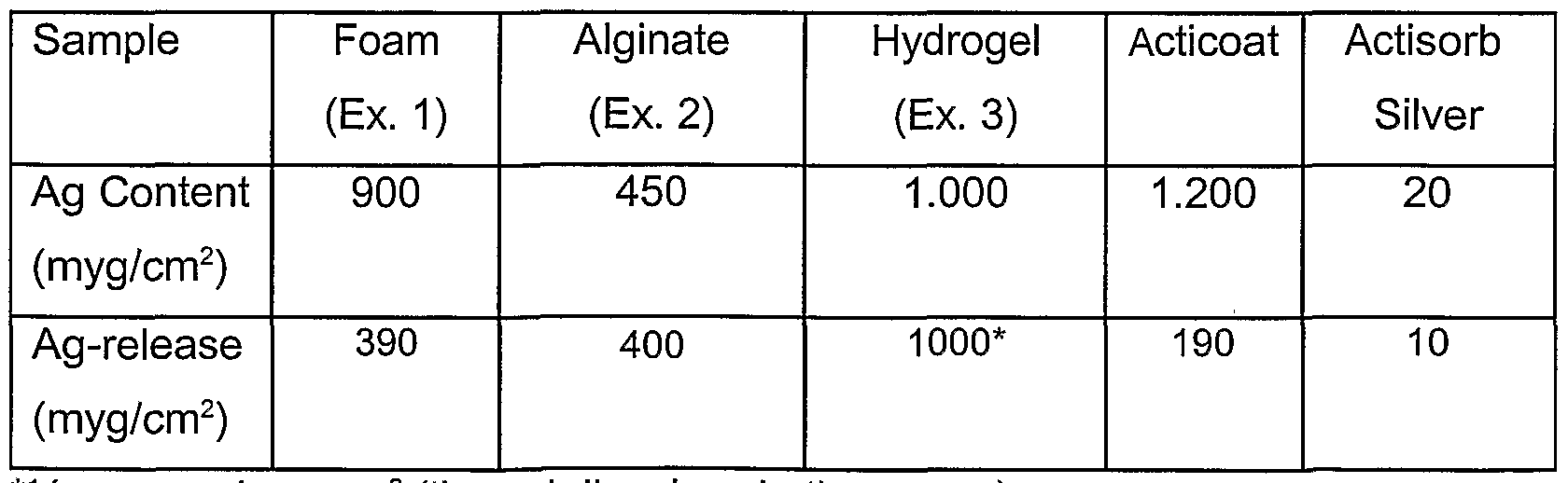
- a preferred embodiment of the invention is in the form of a dressing comprising a foam sheet and showing an absorption capacity above 0.40 grams per cm 2 , preferably above 0.5 grams per cm 2 and more preferred above 0.6 grams per cm 2 and a release of silver of 360 micrograms per cm 2 dressing when determined as disclosed below.
- Another preferred embodiment of the invention is in the form of a dressing comprising an alginate material and showing an absorption capacity above 0.15 and more preferred above 0.20 grams per cm 2 , e.g. about 0.22 grams per cm 2 and a release of silver of 400 micrograms per cm 2 dressing.
- a further preferred embodiment of the invention is in the form of a hydrogel showing a release of silver of 1000 micrograms per cm 2 dressing.
- the skin-friendly adhesive may be any skin-friendly adhesive known per se, e.g. an adhesive comprising hydrocolloids or other moisture absorbing constituents for prolonging the time of use.
- the adhesive may suitably be of the type disclosed in those disclosed in US patent specifications No. 4,867,748 or US patent Nos. 4,367,732.
- the water impervious layer or film may be of any suitable material known per se for use in the preparation of wound dressings e.g. a foam, a non-woven layer or a polyurethane, polyethylene, polyester or polyamide film.
- a suitable film is e.g. the film disclosed in US patent No. 5,643,187.
- the dressing of the invention may have bevelled edges in order to reduce the risk of "rolling-up" the edge of the dressing reducing the wear-time and thus disturbing and prolonging the healing of the wounds .
- a bevelling may be carried out discontinuously or continuously in a manner known per se e.g. as disclosed in EP patent No. 0 264 299.
- a protective cover or release liner may for instance be siliconized paper. It does not need to have the same contour as the dressing, e.g. a number of dressings may be attached to a larger sheet of protective cover.
- the protective cover is not present during the use of the dressing of the invention and is therefore not an essential part of the invention.
- the dressing of the invention may comprise a "non touch" grip known per se for applying the dressing to the skin without touching the adhesive layer. Such a non-touch grip is not present after application of the dressing.
- Suitable hydrocolloids for incorporation in the adhesive compositions of the invention are selected from naturally occurring hydrocolloids, semisynthetic hydrocolloids and synthetic hydrocolloids.
- the hydrocolloids are preferably selected from guar gum, locust bean gum (LBG), pectin, alginates, gelatine, xanthan and/or gum karaya; cellulose derivatives (e.g. salts of carboxymethylcellulose such as sodium carboxymethylcellulose, methylcellulose and hydroxypropylmethylcellulose) and/or sodium starch glycolate and/or polyvinylalcohol and/or polyethylene glycol.
- LBG locust bean gum
- pectin alginates
- gelatine xanthan and/or gum karaya
- cellulose derivatives e.g. salts of carboxymethylcellulose such as sodium carboxymethylcellulose, methylcellulose and hydroxypropylmethylcellulose
- sodium starch glycolate and/or polyvinylalcohol and/or polyethylene glycol e.g. salts of carboxymethylcellulose such as sodium carboxymethylcellulose, methylcellulose and hydroxypropylmethylcellulose
- the invention in a second aspect, relates to a method of enhancing healing of a wound comprising applying to the wound a dressing being capable of delivering an anti-microbially effective amount of silver ion activity in the range of 50 - 10000 micrograms per cm 2 dressing to the wound bed and also being capable of removing more than 0.09 grams per cm 2 dressing of wound exudate and matrix proteolytic enzymes from the wound bed.
- New-born Calf Serum (Lot. No.:118A) from Biochrom KG.
- Pluronic 6200 a PO-PE block copolymer defoamer and surfactant from BASF
- PEG 1000 Polyethylene glycol 1000, molecular weight 950-1050, available from Merck. Aquapol 302-0019 a polyurethane prepolymer from Carpenter Co.
- Silver nitrate powder (63.5% pure silver, commercially available from Johnson Matthey)
- Actisorb Silver 220 a silver containing wound dressing from Johnson & Johnson Inc.
- HX hydroxyethyl cellulose
- the absorption is measured in vitro by placing a sample of a size of 16 square centimetres in an excess of a solution of 1000 grams of distilled water from internal laboratory supply mixed with 142 mmol NaCI and 2.5 m ol CaCI 2 for 24 hours. After 24 hours, the sample is allowed to drip off for 1 minute and is re-weighed. The absorption capacity (g/cm 2 ) is calculated from the difference in weight before and after absorption. Determination of Release of Silver:
- the release of silver was determined by the following method.
- Step A) The silver content of each sample was measured using a Spectro- XEPOS spectrophotometer from Spectro Analytical Instruments. Each determination was carried out in triplicate.
- Step B) A sample of the material to be tested was cut in the shape of a disc having a diameter of 30 mm.
- Step C) The sample was immersed in 50 ml of new born calf serum.
- Step D) After stirring for 24 hours, the samples were removed from the liquid and, dried at 60 °C in a drying cupboard, and the remaining content of silver of the sample was measured using a Spectro-XEPOS spectrophotometer from Spectro Analytical Instruments. Each measurement was carried out in triplicate.
- Step E) The loss of silver was calculated as weight of the Silver released from the dressing per square centimetres.
- a polyurethane foam sheet was produced by mixing Hypol 2002 (10 grams), Aquapol (10 grams), Pluronic 6200 (0.2 grams), water (20 grams), Alphasan 2000 (3 grams) by first mixing the water, silver compound and Pluronic and then adding this mixture to the Hypol and Aquapol during mixing. While the mixture still was fluid it was transformed into thin layer by pouring the mixture onto a glass plate, placing a siliconised release paper on the mixture and adjusting the thickness to 2 mm using guiding bars and a doctor roll allowing the mixture to foam for several minutes. When the material was foamed, the foam sheet was dried in a dry air oven at 130 °C.
- the final foamed sheet had a thickness of 4.5 mm and was cut into pieces of 10x10 cm, laminated to a polyurethane film, packed and sterilised using 30 kGy (beta irradiation).
- the foam sheet had a content of silver of 90 mg per dressing or 0.9 mg silver per cm 2 foam.
- Alginate non woven fabric (Algisite M from Smith and Nephew) having the dimensions of 10x10 cm was immersed into SSS and allowed to absorb fluid until it was completely saturated (the fluid was absorbed within seconds). Then, surplus fluid was squeezed out of the alginate manually leaving 10 grams of absorbed fluid in the alginate. Finally the alginate was dried in an oven at 90 °C to a moisture content below 10 % w/w (10 minutes). The Alginate had a silver content of 0.45 mg silver /cm 2 alginate or 45 mg per product. The final antibacterial alginate was packed and sterilised at 30 kGy using gamma irradiation.
- Hydrogels are used on wounds which only secretes limited amounts or no exudate.
- the purpose of the study was to investigate the performance profile of the dressing on wounds with bacterial problems identified by stopped or delayed wound healing, recurring wound infections or clinical signs such as heavy wound odour, increased sloughy exudation or plaque-like bacteria coverings.
- the dressing was successful in initiating wound healing in these wounds being very difficult to heal.
- the overall reduction in relative wound area was 65% and the amount of granulation tissue in the wound increases from 32% to 83%.
- the odour from heavily smelling wounds was eliminated totally during the first week of treatment and exudation was decreased as well during the whole study period.
- the average wear-time of the dressing was 2.7 days.
- the absorption capacity of the dressing was evaluated as predominantly "good” and with very rare occasions of exudate leakage outside the dressing.
- the dressing was very easy to remove from the wound with no adherence to the wound tissue or any left over of residues. Peri-ulcer skin problems were reduced during treatment by the use of Conveen:Critic Barrier cream and the dressing in combination.
Landscapes
- Health & Medical Sciences (AREA)
- Public Health (AREA)
- Epidemiology (AREA)
- Life Sciences & Earth Sciences (AREA)
- Animal Behavior & Ethology (AREA)
- General Health & Medical Sciences (AREA)
- Veterinary Medicine (AREA)
- Chemical & Material Sciences (AREA)
- Engineering & Computer Science (AREA)
- Materials Engineering (AREA)
- Hematology (AREA)
- Materials For Medical Uses (AREA)
- Pharmaceuticals Containing Other Organic And Inorganic Compounds (AREA)
Abstract
Description

Claims
Priority Applications (1)
| Application Number | Priority Date | Filing Date | Title |
|---|---|---|---|
| EP02727306A EP1372745A2 (en) | 2001-03-30 | 2002-03-27 | Medical dressing comprising an antimicrobial silver compound |
Applications Claiming Priority (2)
| Application Number | Priority Date | Filing Date | Title |
|---|---|---|---|
| DKPA200100535 | 2001-03-30 | ||
| DKPA200100535 | 2001-03-30 |
Publications (2)
| Publication Number | Publication Date |
|---|---|
| WO2002078755A2 true WO2002078755A2 (en) | 2002-10-10 |
| WO2002078755A3 WO2002078755A3 (en) | 2002-11-21 |
Family
ID=8160410
Family Applications (1)
| Application Number | Title | Priority Date | Filing Date |
|---|---|---|---|
| PCT/DK2002/000215 Ceased WO2002078755A2 (en) | 2001-03-30 | 2002-03-27 | Medical dressing comprising an antimicrobial silver compound |
Country Status (3)
| Country | Link |
|---|---|
| US (1) | US20020172709A1 (en) |
| EP (1) | EP1372745A2 (en) |
| WO (1) | WO2002078755A2 (en) |
Cited By (15)
| Publication number | Priority date | Publication date | Assignee | Title |
|---|---|---|---|---|
| US7118761B2 (en) | 2003-08-14 | 2006-10-10 | Canada T Andrew | Method for producing a silver-containing wound care device |
| WO2007057657A1 (en) | 2005-11-15 | 2007-05-24 | Lantor (Uk) Limited | Improvements in and relating to medical products |
| WO2007098772A1 (en) * | 2006-03-03 | 2007-09-07 | Coloplast A/S | A wound dressing comprising an anti-inflammatory pain-killing agent and a complex of silver ion and a transitional element of group iv of the periodic system of elements |
| US7267828B2 (en) | 2000-11-29 | 2007-09-11 | Bristol-Myers Squibb Company | Light stabilized antimicrobial materials |
| US7329417B2 (en) | 2001-02-08 | 2008-02-12 | Coloplast A/S | Medical dressing comprising an antimicrobial silver compound |
| JP2009523485A (en) * | 2006-01-13 | 2009-06-25 | スリーエム イノベイティブ プロパティズ カンパニー | Silver-containing antimicrobial article and production method |
| WO2009019516A3 (en) * | 2007-08-06 | 2010-03-11 | Tissuemed Limited | Tissue-adhesive materials |
| US7745509B2 (en) | 2003-12-05 | 2010-06-29 | 3M Innovative Properties Company | Polymer compositions with bioactive agent, medical articles, and methods |
| US7842306B2 (en) | 2003-08-14 | 2010-11-30 | Milliken & Company | Wound care device having fluid transfer properties |
| US8563447B2 (en) | 2003-08-14 | 2013-10-22 | Milliken & Company | Silver-containing wound care device |
| WO2017040673A1 (en) * | 2015-09-01 | 2017-03-09 | Novabone Products, Llc | Silica-coated calcium salt compositions |
| US10493101B2 (en) | 2005-12-14 | 2019-12-03 | Convatec Technologies Inc. | Antimicrobial composition |
| US11135315B2 (en) | 2010-11-30 | 2021-10-05 | Convatec Technologies Inc. | Composition for detecting biofilms on viable tissues |
| US11286601B2 (en) | 2012-12-20 | 2022-03-29 | Convatec Technologies, Inc. | Processing of chemically modified cellulosic fibres |
| US12502454B2 (en) | 2013-05-15 | 2025-12-23 | Convatec Technologies Inc. | Wound dressing comprising an antimicrobial composition |
Families Citing this family (25)
| Publication number | Priority date | Publication date | Assignee | Title |
|---|---|---|---|---|
| US8801681B2 (en) | 1995-09-05 | 2014-08-12 | Argentum Medical, Llc | Medical device |
| US6861570B1 (en) | 1997-09-22 | 2005-03-01 | A. Bart Flick | Multilayer conductive appliance having wound healing and analgesic properties |
| US5814094A (en) | 1996-03-28 | 1998-09-29 | Becker; Robert O. | Iontopheretic system for stimulation of tissue healing and regeneration |
| US7214847B1 (en) | 1997-09-22 | 2007-05-08 | Argentum Medical, L.L.C. | Multilayer conductive appliance having wound healing and analgesic properties |
| US6087549A (en) | 1997-09-22 | 2000-07-11 | Argentum International | Multilayer laminate wound dressing |
| US8455710B2 (en) | 1997-09-22 | 2013-06-04 | Argentum Medical, Llc | Conductive wound dressings and methods of use |
| AU2001291640A1 (en) * | 2000-09-29 | 2002-04-08 | Coloplast A/S | Stabilised compositions having antibacterial activity |
| DE10316156B3 (en) * | 2003-04-09 | 2004-10-14 | Beiersdorf Ag | Antimicrobial polymer materials and their use as a wound dressing |
| DE10328261B4 (en) | 2003-06-23 | 2007-10-25 | Beiersdorf Ag | Disinfecting coating with silver coating and its use |
| US20050035327A1 (en) * | 2003-08-14 | 2005-02-17 | Canada T. Andrew | Topical silver-based antimicrobial composition for wound care devices |
| US20050147657A1 (en) * | 2003-08-14 | 2005-07-07 | Milliken & Company | White silver-containing wound care device |
| US20050037057A1 (en) * | 2003-08-14 | 2005-02-17 | Schuette Robert L. | Silver-containing antimicrobial fabric |
| US20100143430A1 (en) * | 2008-12-08 | 2010-06-10 | King Joseph A | Antimicrobial agents |
| BRPI0620533A2 (en) | 2005-12-06 | 2011-11-16 | Kci Licensing Inc | wound treatment apparatus, stasis and wound isolation apparatus and method of providing stasis and wound isolation |
| US8685421B2 (en) | 2006-07-07 | 2014-04-01 | Surmodics, Inc. | Beaded wound spacer device |
| US20100143427A1 (en) * | 2008-12-05 | 2010-06-10 | King Joseph A | Antimicrobial Surfaces |
| US20100030170A1 (en) * | 2008-08-01 | 2010-02-04 | Keith Alan Keller | Absorptive Pad |
| US20100140185A1 (en) * | 2008-12-05 | 2010-06-10 | John Hill | Wastewater treatment |
| WO2010065090A2 (en) * | 2008-12-05 | 2010-06-10 | King Technology, Inc. | Antimicrobials |
| US8846108B2 (en) * | 2008-12-08 | 2014-09-30 | King Technology, Inc. | Antimicrobial body affecting products |
| CA2888241C (en) | 2012-10-16 | 2020-12-29 | Surmodics, Inc. | Wound packing device and methods |
| GB2511528A (en) | 2013-03-06 | 2014-09-10 | Speciality Fibres And Materials Ltd | Absorbent materials |
| US10201457B2 (en) | 2014-08-01 | 2019-02-12 | Surmodics, Inc. | Wound packing device with nanotextured surface |
| US20170231401A1 (en) * | 2016-02-15 | 2017-08-17 | Dreamwell, Ltd. | Mattress panels including antimicrobial treated fibers and/or foams |
| US11504268B2 (en) * | 2018-06-27 | 2022-11-22 | Ethicon, Inc. | Wound treatment system |
Family Cites Families (7)
| Publication number | Priority date | Publication date | Assignee | Title |
|---|---|---|---|---|
| US3930000A (en) * | 1971-06-16 | 1975-12-30 | Univ Washington | Silver-zinc allantoinate compositions and method of killing bacteria and fungi therewith |
| DK154806C (en) * | 1986-12-19 | 1989-06-26 | Coloplast As | PROCEDURE CONTAINING AN ACTIVE SUBSTANCE FOR THE PROMOTION OF THE SEA TREATMENT AND PROCEDURES FOR PRODUCING THEREOF |
| JPH0610126B2 (en) * | 1989-08-29 | 1994-02-09 | 東亞合成化学工業株式会社 | Antibacterial agent |
| DK94693D0 (en) * | 1993-08-19 | 1993-08-19 | Coloplast As | NON-FIBROEST POROEST MATERIALS, SPECIAL BANDING INCLUDING SUCH A BANDAGE AND PROCEDURE FOR MANUFACTURING THE MATERIAL |
| JPH0978430A (en) * | 1995-09-11 | 1997-03-25 | Oji Paper Co Ltd | Method for producing antibacterial long-fiber nonwoven fabric |
| JP3051709B2 (en) * | 1997-09-30 | 2000-06-12 | 憲司 中村 | Antimicrobial cellulose fiber and method for producing the same |
| ATE266429T1 (en) * | 1998-08-14 | 2004-05-15 | Coloplast As | STABILIZED COMPOSITIONS WITH ANTIBACTERIAL EFFECTIVENESS |
-
2001
- 2001-08-08 US US09/923,913 patent/US20020172709A1/en not_active Abandoned
-
2002
- 2002-03-27 WO PCT/DK2002/000215 patent/WO2002078755A2/en not_active Ceased
- 2002-03-27 EP EP02727306A patent/EP1372745A2/en not_active Withdrawn
Cited By (20)
| Publication number | Priority date | Publication date | Assignee | Title |
|---|---|---|---|---|
| US7267828B2 (en) | 2000-11-29 | 2007-09-11 | Bristol-Myers Squibb Company | Light stabilized antimicrobial materials |
| US7329417B2 (en) | 2001-02-08 | 2008-02-12 | Coloplast A/S | Medical dressing comprising an antimicrobial silver compound |
| US7118761B2 (en) | 2003-08-14 | 2006-10-10 | Canada T Andrew | Method for producing a silver-containing wound care device |
| US8563447B2 (en) | 2003-08-14 | 2013-10-22 | Milliken & Company | Silver-containing wound care device |
| US8394403B2 (en) | 2003-08-14 | 2013-03-12 | Milliken & Company | Wound care device having fluid transfer properties |
| US7842306B2 (en) | 2003-08-14 | 2010-11-30 | Milliken & Company | Wound care device having fluid transfer properties |
| US8021685B2 (en) | 2003-08-14 | 2011-09-20 | Milliken + Co | Wound care device having fluid transfer properties |
| US8193267B2 (en) | 2003-12-05 | 2012-06-05 | 3M Innovative Properties Company | Polymer compositions with bioactive agent, medical articles, and methods |
| US7745509B2 (en) | 2003-12-05 | 2010-06-29 | 3M Innovative Properties Company | Polymer compositions with bioactive agent, medical articles, and methods |
| WO2007057657A1 (en) | 2005-11-15 | 2007-05-24 | Lantor (Uk) Limited | Improvements in and relating to medical products |
| US10493101B2 (en) | 2005-12-14 | 2019-12-03 | Convatec Technologies Inc. | Antimicrobial composition |
| JP2009523485A (en) * | 2006-01-13 | 2009-06-25 | スリーエム イノベイティブ プロパティズ カンパニー | Silver-containing antimicrobial article and production method |
| EP1979007A4 (en) * | 2006-01-13 | 2010-10-27 | 3M Innovative Properties Co | Silver-containing antimicrobial articles and methods of manufacture |
| US9289450B2 (en) | 2006-01-13 | 2016-03-22 | 3M Innovative Properties Company | Silver-containing antimicrobial articles and methods of manufacture |
| WO2007098772A1 (en) * | 2006-03-03 | 2007-09-07 | Coloplast A/S | A wound dressing comprising an anti-inflammatory pain-killing agent and a complex of silver ion and a transitional element of group iv of the periodic system of elements |
| WO2009019516A3 (en) * | 2007-08-06 | 2010-03-11 | Tissuemed Limited | Tissue-adhesive materials |
| US11135315B2 (en) | 2010-11-30 | 2021-10-05 | Convatec Technologies Inc. | Composition for detecting biofilms on viable tissues |
| US11286601B2 (en) | 2012-12-20 | 2022-03-29 | Convatec Technologies, Inc. | Processing of chemically modified cellulosic fibres |
| US12502454B2 (en) | 2013-05-15 | 2025-12-23 | Convatec Technologies Inc. | Wound dressing comprising an antimicrobial composition |
| WO2017040673A1 (en) * | 2015-09-01 | 2017-03-09 | Novabone Products, Llc | Silica-coated calcium salt compositions |
Also Published As
| Publication number | Publication date |
|---|---|
| WO2002078755A3 (en) | 2002-11-21 |
| US20020172709A1 (en) | 2002-11-21 |
| EP1372745A2 (en) | 2004-01-02 |
Similar Documents
| Publication | Publication Date | Title |
|---|---|---|
| US20020172709A1 (en) | Medical dressing comprising an antimicrobial silver compound and a method for enhancing wound healing | |
| EP1216065B1 (en) | Silver-containing compositions, devices and methods for making | |
| US7576255B2 (en) | Silver-containing compositions, devices, and methods for making | |
| Liptak | An overview of the topical management of wounds | |
| EP1993622B1 (en) | A wound dressing comprising an anti-inflammatory pain-killing agent and a complex of silver ion and a transitional element of group iv of the periodic system of elements | |
| EP2059206B1 (en) | Dry wound dressing and drug delivery system | |
| US20130251665A1 (en) | Treatment of chronic ulcerous skin lesions | |
| Manizate et al. | A prospective, single-center, nonblinded, comparative, postmarket clinical evaluation of a bovine-derived collagen with ionic silver dressing versus a carboxymethylcellulose and ionic silver dressing for the reduction of bioburden in variable-etiology, bilateral lower-extremity wounds | |
| AU2013255442B2 (en) | Wound dressings | |
| US8252335B2 (en) | Healing powder and method of use thereof | |
| JP4808402B2 (en) | Wound dressing material containing a complex of anionic polysaccharide and silver | |
| US20090148394A1 (en) | Treatment of chronic ulcerous skin lesions | |
| Lawrence | Medicated tulle dressings | |
| CN101394873A (en) | A wound dressing comprising an anti-inflammatory analgesic and a complex of silver ions and group IV transition elements of the periodic table | |
| Kivman et al. | Hydrocolloidal dressings—A new generation of substances for the treatment of wounds and burns | |
| Alvarez et al. | Local care of diabetic foot ulcers: Assessment, dressings, and topical treatments | |
| Assessment | Local Care of Diabetic Foot Ulcers |
Legal Events
| Date | Code | Title | Description |
|---|---|---|---|
| AK | Designated states |
Kind code of ref document: A2 Designated state(s): AE AG AL AM AT AT AU AZ BA BB BG BR BY BZ CA CH CN CO CR CU CZ CZ DE DE DK DK DM DZ EC EE EE ES FI FI GB GD GE GH GM HR HU ID IL IN IS JP KE KG KP KR KZ LC LK LR LS LT LU LV MA MD MG MK MN MW MX MZ NO NZ OM PH PL PT RO RU SD SE SG SI SK SK SL TJ TM TN TR TT TZ UA UG US UZ VN YU ZA ZM ZW |
|
| AL | Designated countries for regional patents |
Kind code of ref document: A2 Designated state(s): GH GM KE LS MW MZ SD SL SZ TZ UG ZM ZW AM AZ BY KG KZ MD RU TJ TM AT BE CH CY DE DK ES FI FR GB GR IE IT LU MC NL PT SE TR BF BJ CF CG CI CM GA GN GQ GW ML MR NE SN TD TG |
|
| AK | Designated states |
Kind code of ref document: A3 Designated state(s): AE AG AL AM AT AT AU AZ BA BB BG BR BY BZ CA CH CN CO CR CU CZ CZ DE DE DK DK DM DZ EC EE EE ES FI FI GB GD GE GH GM HR HU ID IL IN IS JP KE KG KP KR KZ LC LK LR LS LT LU LV MA MD MG MK MN MW MX MZ NO NZ OM PH PL PT RO RU SD SE SG SI SK SK SL TJ TM TN TR TT TZ UA UG US UZ VN YU ZA ZM ZW |
|
| AL | Designated countries for regional patents |
Kind code of ref document: A3 Designated state(s): GH GM KE LS MW MZ SD SL SZ TZ UG ZM ZW AM AZ BY KG KZ MD RU TJ TM AT BE CH CY DE DK ES FI FR GB GR IE IT LU MC NL PT SE TR BF BJ CF CG CI CM GA GN GQ GW ML MR NE SN TD TG |
|
| 121 | Ep: the epo has been informed by wipo that ep was designated in this application | ||
| DFPE | Request for preliminary examination filed prior to expiration of 19th month from priority date (pct application filed before 20040101) | ||
| WWE | Wipo information: entry into national phase |
Ref document number: 2002727306 Country of ref document: EP |
|
| WWP | Wipo information: published in national office |
Ref document number: 2002727306 Country of ref document: EP |
|
| REG | Reference to national code |
Ref country code: DE Ref legal event code: 8642 |
|
| NENP | Non-entry into the national phase |
Ref country code: JP |
|
| WWW | Wipo information: withdrawn in national office |
Country of ref document: JP |
|
| WWW | Wipo information: withdrawn in national office |
Ref document number: 2002727306 Country of ref document: EP |