WO2002060418A1 - Transdermal therapeutic system for administering non-steroidal antiphlogistic agents containing carboxyl groups, and a method for the production of the same - Google Patents
Transdermal therapeutic system for administering non-steroidal antiphlogistic agents containing carboxyl groups, and a method for the production of the same Download PDFInfo
- Publication number
- WO2002060418A1 WO2002060418A1 PCT/EP2002/000417 EP0200417W WO02060418A1 WO 2002060418 A1 WO2002060418 A1 WO 2002060418A1 EP 0200417 W EP0200417 W EP 0200417W WO 02060418 A1 WO02060418 A1 WO 02060418A1
- Authority
- WO
- WIPO (PCT)
- Prior art keywords
- layer
- active ingredient
- matrix
- group
- weight
- Prior art date
- Legal status (The legal status is an assumption and is not a legal conclusion. Google has not performed a legal analysis and makes no representation as to the accuracy of the status listed.)
- Ceased
Links
Classifications
-
- A—HUMAN NECESSITIES
- A61—MEDICAL OR VETERINARY SCIENCE; HYGIENE
- A61K—PREPARATIONS FOR MEDICAL, DENTAL OR TOILETRY PURPOSES
- A61K9/00—Medicinal preparations characterised by special physical form
- A61K9/70—Web, sheet or filament bases ; Films; Fibres of the matrix type containing drug
-
- A—HUMAN NECESSITIES
- A61—MEDICAL OR VETERINARY SCIENCE; HYGIENE
- A61K—PREPARATIONS FOR MEDICAL, DENTAL OR TOILETRY PURPOSES
- A61K9/00—Medicinal preparations characterised by special physical form
- A61K9/70—Web, sheet or filament bases ; Films; Fibres of the matrix type containing drug
- A61K9/7023—Transdermal patches and similar drug-containing composite devices, e.g. cataplasms
- A61K9/703—Transdermal patches and similar drug-containing composite devices, e.g. cataplasms characterised by shape or structure; Details concerning release liner or backing; Refillable patches; User-activated patches
- A61K9/7038—Transdermal patches of the drug-in-adhesive type, i.e. comprising drug in the skin-adhesive layer
- A61K9/7046—Transdermal patches of the drug-in-adhesive type, i.e. comprising drug in the skin-adhesive layer the adhesive comprising macromolecular compounds
- A61K9/7053—Transdermal patches of the drug-in-adhesive type, i.e. comprising drug in the skin-adhesive layer the adhesive comprising macromolecular compounds obtained by reactions only involving carbon to carbon unsaturated bonds, e.g. polyvinyl, polyisobutylene, polystyrene
- A61K9/7061—Polyacrylates
-
- A—HUMAN NECESSITIES
- A61—MEDICAL OR VETERINARY SCIENCE; HYGIENE
- A61K—PREPARATIONS FOR MEDICAL, DENTAL OR TOILETRY PURPOSES
- A61K47/00—Medicinal preparations characterised by the non-active ingredients used, e.g. carriers or inert additives; Targeting or modifying agents chemically bound to the active ingredient
- A61K47/02—Inorganic compounds
-
- A—HUMAN NECESSITIES
- A61—MEDICAL OR VETERINARY SCIENCE; HYGIENE
- A61K—PREPARATIONS FOR MEDICAL, DENTAL OR TOILETRY PURPOSES
- A61K47/00—Medicinal preparations characterised by the non-active ingredients used, e.g. carriers or inert additives; Targeting or modifying agents chemically bound to the active ingredient
- A61K47/06—Organic compounds, e.g. natural or synthetic hydrocarbons, polyolefins, mineral oil, petrolatum or ozokerite
- A61K47/08—Organic compounds, e.g. natural or synthetic hydrocarbons, polyolefins, mineral oil, petrolatum or ozokerite containing oxygen, e.g. ethers, acetals, ketones, quinones, aldehydes, peroxides
- A61K47/12—Carboxylic acids; Salts or anhydrides thereof
-
- A—HUMAN NECESSITIES
- A61—MEDICAL OR VETERINARY SCIENCE; HYGIENE
- A61P—SPECIFIC THERAPEUTIC ACTIVITY OF CHEMICAL COMPOUNDS OR MEDICINAL PREPARATIONS
- A61P29/00—Non-central analgesic, antipyretic or antiinflammatory agents, e.g. antirheumatic agents; Non-steroidal antiinflammatory drugs [NSAID]
Definitions
- Transdermal therapeutic system for the administration of non-steroidal anti-inflammatory drugs containing carboxyl groups, and method for its production.
- the present invention relates to transdermal therapeutic systems (TTS) which are intended for the administration of carboxyl-containing, non-steroidal anti-inflammatory drugs.
- TTS transdermal therapeutic systems
- the invention relates in particular to TTS of the type mentioned, which have a matrix based on carboxyl-containing polyacrylate PSAs.
- the present invention also includes methods for producing TTS of the type mentioned.
- Active ingredients from the group of non-steroidal anti-inflammatory drugs or anti-inflammatory drugs containing carboxyl groups are widely used in the treatment of inflammation, inflammatory joint diseases, rheumatic diseases and the resulting pain.
- This group of active substances includes representatives of the acetic acid derivatives, such as. B. Indomethacin, Acemetacin, Tolmetin, Diclofenac and Lonazolac, and on the other hand representatives of the propionic acid derivatives (Profene), such as. B. Ibufrofen, Flurbiprofen, Fenoprofen, Ketoprofen, Naproxen and Tiaprofen.
- acetic acid derivatives such as. B. Indomethacin, Acemetacin, Tolmetin, Diclofenac and Lonazolac
- Profileene propionic acid derivatives
- topical or transdermal administration is generally preferred. This can be done with the help of gels, creams, ointments or adhesive patches on the skin. The latter have the additional advantage that - unlike z. B. ointments - can remain at the application site for a long time and are easier to use.
- TTS containing NSAIDs are known for example from DE 198 30 649 AI. Reference is expressly made to this publication, as well as to the statements made there regarding the state of the art.
- the addition of an alkali metal hydroxide was proposed in JP 4074119 A.
- the addition of a permeation-demanding fatty acid is not intended.
- the object of the present invention was therefore to provide transdermal therapeutic systems which are suitable for the administration of the active compounds mentioned and which are distinguished by the advantageous properties described in DE 198 30 649 A1, but without the disadvantages described above.
- the active substance-containing matrix is produced on the basis of a carboxyl group-containing polyacrylate pressure-sensitive adhesive, and that it has a content of oleic acid and potassium ions, the quantitative proportion of the potassium ions being in the range is from 5 to 50%, based on the equivalent weight of the sum of all carboxyl group-containing matrix constituents.
- these TTS are characterized by a very homogeneous matrix layer; this matrix layer preferably consists of only a single phase, i. H. it is not an emulsion or suspension or multi-phase polymer mixture.
- the matrix layers according to the invention also have a significantly improved cohesion of the pressure-sensitive adhesive matrix layer and a perfect anchoring on back layers made of PET materials.
- JP 4074119 there is a significant improvement in the skin permeation of the active ingredient due to the permeation-promoting effect of the oleic acid contained.
- the carboxyl group-containing polyacrylate pressure-sensitive adhesives used to produce the active substance matrix according to the invention are preferably carboxyl group-containing pressure-sensitive adhesives which are sold by National Starch under the name "Durotak", in particular the pressure-sensitive adhesive Durotak 387-2333.
- other polyacrylate adhesives are also suitable in principle are produced by radical polymerisation of acrylic and / or methacrylic acid and its derivatives (e.g. 2-ethylhexyl acrylate).
- such polymers can also contain other comonomers, e.g. B. Vinyl acetate.
- suitable mixtures of various carboxyl-containing polyacrylate pressure sensitive adhesives can also be used.
- the weight per unit area of the matrix layer is preferably in the range of 30-120 g / m 2 , with a weight per unit area in the range of 50-80 g / m 2 being particularly preferred.
- the potassium ions contained in the matrix layers according to the invention are preferably added as potassium hydroxide. Since the formulations according to the invention have at least three carboxyl group-containing constituents, namely the active ingredient, oleic acid and the carboxyl group-containing pressure-sensitive adhesive, it is very difficult to determine with which of these carboxyl group-containing components salt formation occurs and in what ratio. An experimental investigation of this salt formation was therefore not carried out.
- the amount of potassium hydroxide contained in percentages of the equivalent weight of the sum of the carboxyl group-containing constituents of the matrix (see example 9).
- a quantity of 100% potassium hydroxide equivalents corresponds to the neutralization of all matrix constituents containing carboxyl groups. It was observed that a significant increase in the cohesion of the matrix film only occurs when at least an amount of 5%, better 10% potassium hydroxide equivalents is added. On the other hand, if the amount of KOH added is above a value of 50% potassium hydroxide equivalents, the matrix layer or matrix film loses a great deal of stickiness.
- KOH is preferably added in an amount of 10 to 40% potassium hydroxide equivalents, optimal results having been achieved at approximately 30% potassium hydroxide equivalents.
- the oleic acid content can be between 5 and 25% by weight, based on the matrix layer; oleic acid is preferably added in a proportion of 10-20% by weight.
- Ibuprofen, flurbiprofen, fenoprofen, ketoprofen, naproxen and tiaprofen are preferably used as active substances from the group of carboxyl group-containing NSAIDs, with ibuprofen being particularly preferred; however, other representatives of this group of active ingredients can also be used, for example the active ingredients mentioned at the beginning.
- the active substance is preferably essentially in the form of an (S) enantiomer.
- the active substance concentration in the matrix is preferably 5 to 25 wt.%, Particularly preferably 10 to 20 wt.
- the pressure sensitive adhesive is cross-linked by aluminum ions.
- Aluminum acetylacetonate is preferably used as the crosslinking reagent.
- the cohesion of the adhesive layer is additionally improved by the crosslinking.
- Aluminum acetylacetonate is preferably added in a concentration of 0.01 to 0.2% by weight, the concentration range of 0.05 to 0.1% by weight being particularly preferred. The percentages mentioned are calculated as aluminum-ion concentration in the active substance-containing adhesive matrix.
- the present invention also includes embodiments in which a water-resistant layer between the active substance-containing matrix layer of the TTS and its back layer vapor-blocking intermediate layer is attached, which has an occlusive effect on the skin when worn (see FIG. 2).
- This intermediate layer is preferably made up of hydrocarbon polymers, e.g. B. from polyisobutylene, polybutadiene, polyisoprene or block copolymers of styrene with butadiene or isoprene.
- the weight per unit area of the intermediate layer is in the range from 10 to 100 g / m 2 , preferably in the range from
- PET film is preferably used as the material for the backing layer of the TTS according to the invention, but particularly preferably longitudinally and transversely elastic, air and water vapor permeable PET fabric.
- PET Polyethylene terephthalate
- other polyester films or fabrics known to the person skilled in the art can also be used, materials with elastic properties being preferred.
- plastic films equipped with an adhesive are considered, for example made of polyethylene, polyethylene terephthalate (PET) or similar materials.
- FIGS. 1 and 2 are schematic, simplified drawings, each of which shows a TTS in a sectional representation.
- TTS consisting of a backing layer (1) and a homogeneous, active substance-containing matrix layer (2).
- the skin-facing side of the matrix layer (2) is covered with a removable protective layer (3).
- This preferred structure corresponds to that described in Example 9.
- FIG. 2 shows a further, preferred structure of a TTS according to the invention, which likewise has a backing layer (1), a homogeneous matrix layer (2) containing active ingredient and a removable protective layer (3).
- a water vapor-blocking intermediate layer (4) between the matrix layer (2) and the back layer (1).
- the percentages relate to the matrix weight. * cross-linked to the pressure-sensitive adhesive polymer. ** This proportion corresponds to approx. 29% of the equivalent weight of the sum of all components containing carboxyl groups.
- Example 9 the oleic acid is first stirred into the Durotak contact adhesive solution (Durotak 387-2353; National Starch). Potassium hydroxide in the form of a 10% strength (by weight) solution in methanol is then slowly added with stirring. Finally, ibuprofen is dissolved in this approach and the powdered crosslinking reagent aluminum acetylacetonate is added and stirred until dissolved. To adjust a viscosity suitable for the coating, ethyl acetate is added to the finished solution as required.
- Durotak contact adhesive solution Durotak 387-2353; National Starch
- Potassium hydroxide in the form of a 10% strength (by weight) solution in methanol is then slowly added with stirring. Finally, ibuprofen is dissolved in this approach and the powdered crosslinking reagent aluminum acetylacetonate is added and stirred until dissolved.
- ethyl acetate is added to the finished solution as required.
- This adhesive solution is coated on a siliconized polyester film (PET, 100 ⁇ m).
- PET siliconized polyester film
- the coating thickness is adjusted so that after drying for 10 minutes at 60 ° C. in a ventilated oven, a film with a weight per unit area from 60 to 80 g / m 2 is obtained.
- the dried adhesive film is provided with a longitudinally and transversely elastic PET fabric (KOB Karl Otto Braun) as a backing. Then individual plasters of suitable shape and size are punched out of this laminate.
Landscapes
- Health & Medical Sciences (AREA)
- Chemical & Material Sciences (AREA)
- Engineering & Computer Science (AREA)
- Veterinary Medicine (AREA)
- Medicinal Chemistry (AREA)
- Pharmacology & Pharmacy (AREA)
- Life Sciences & Earth Sciences (AREA)
- Animal Behavior & Ethology (AREA)
- General Health & Medical Sciences (AREA)
- Public Health (AREA)
- Epidemiology (AREA)
- Bioinformatics & Cheminformatics (AREA)
- Dermatology (AREA)
- General Chemical & Material Sciences (AREA)
- Chemical Kinetics & Catalysis (AREA)
- Oil, Petroleum & Natural Gas (AREA)
- Inorganic Chemistry (AREA)
- Pain & Pain Management (AREA)
- Rheumatology (AREA)
- Nuclear Medicine, Radiotherapy & Molecular Imaging (AREA)
- Organic Chemistry (AREA)
- Medicinal Preparation (AREA)
- Acyclic And Carbocyclic Compounds In Medicinal Compositions (AREA)
- Pharmaceuticals Containing Other Organic And Inorganic Compounds (AREA)
- Medical Preparation Storing Or Oral Administration Devices (AREA)
- Materials For Medical Uses (AREA)
Abstract
Description
Transdermales therapeutisches System für die Verabreichung carboxylgruppenhaltiger, nichtsteroidaler Antiphlogistika, sowie Verfahren zu seiner Herstellung.Transdermal therapeutic system for the administration of non-steroidal anti-inflammatory drugs containing carboxyl groups, and method for its production.
Die vorliegende Erfindung betrifft transdermale therapeutische Systeme (TTS), welche für die Verabreichung carboxylgruppenhaltiger, nichtsteroidaler Antiphlogistika bestimmt sind. Die Erfindung betrifft insbesondere TTS der genannten Art, welche eine Matrix auf der Basis von carboxylgruppenhaltigen Polyacrylathaftklebern aufweisen.The present invention relates to transdermal therapeutic systems (TTS) which are intended for the administration of carboxyl-containing, non-steroidal anti-inflammatory drugs. The invention relates in particular to TTS of the type mentioned, which have a matrix based on carboxyl-containing polyacrylate PSAs.
Des weiteren umfaßt die vorliegende Erfindung auch Verfahren zur Herstellung von TTS der genannten Art.Furthermore, the present invention also includes methods for producing TTS of the type mentioned.
Wirkstoffe aus der Gruppe der carboxylgruppenhaltigen nichtsteroidalen Antirheumatika bzw. Antiphlogistika (dt.: "NSAR" , engl.: "NSAID") finden breite Anwendung bei der Behandlung von Entzündungen, entzündlichen Gelenkerkrankungen, rheumatischen Krankheitsbildern und der dadurch bedingten Schmerzzustände.Active ingredients from the group of non-steroidal anti-inflammatory drugs or anti-inflammatory drugs containing carboxyl groups (German: "NSAID", English: "NSAID") are widely used in the treatment of inflammation, inflammatory joint diseases, rheumatic diseases and the resulting pain.
Zu dieser Wirkstoffgruppe zählen einerseits Vertreter der Essigsäurederivate, wie z. B. Indomethacin, Acemetacin, Tolmetin, Diclofenac und Lonazolac, und andererseits Vertreter der Propionsäurederivate (Profene) , wie z. B. Ibu- profen, Flurbiprofen, Fenoprofen, Ketoprofen, Naproxen und Tiaprofen.This group of active substances includes representatives of the acetic acid derivatives, such as. B. Indomethacin, Acemetacin, Tolmetin, Diclofenac and Lonazolac, and on the other hand representatives of the propionic acid derivatives (Profene), such as. B. Ibufrofen, Flurbiprofen, Fenoprofen, Ketoprofen, Naproxen and Tiaprofen.
Da durch die orale Aufnahme dieser Wirksubstanzen häufig Nebenwirkungen, wie z. B. Magenbeschwerden und Blutungen im Gastrointestinalbereich, verursacht werden, ist die topische oder transdermale Verabreichung grundsätzlich zu bevorzugen. Dies kann mit Hilfe von Gelen, Cremes, Salben oder auf der Haut haftklebenden Pflastern erfolgen. Letztere haben den zusätzlichen Vorteil, daß sie - anders als z. B. Salben - längere Zeit am Applikationsort verbleiben können und einfacher anzuwenden sind. TTS mit einem Gehalt an NSAR sind beispielsweise aus DE 198 30 649 AI bekannt. Auf diese Veröffentlichung, wie auch auf die dort gemachten Ausführungen zum Stand der Technik, wird hier ausdrücklich Bezug genommen.Since the oral intake of these active substances often causes side effects, such as. B. stomach discomfort and bleeding in the gastrointestinal area, topical or transdermal administration is generally preferred. This can be done with the help of gels, creams, ointments or adhesive patches on the skin. The latter have the additional advantage that - unlike z. B. ointments - can remain at the application site for a long time and are easier to use. TTS containing NSAIDs are known for example from DE 198 30 649 AI. Reference is expressly made to this publication, as well as to the statements made there regarding the state of the art.
Aus DE 198 30 649 AI geht hervor, daß mit einer Kombination von NSAID, insbesondere Ketoprofen, Flurbiprofen oder Ibu- profen, mit Fettsäuren als Permeationsbeschleunigern und einer carboxylgruppenhaltigen Klebermatrix hohe Freisetzungsraten erzielt werden können.DE 198 30 649 A1 shows that high release rates can be achieved with a combination of NSAIDs, in particular ketoprofen, flurbiprofen or ibuprofen, with fatty acids as permeation accelerators and an adhesive matrix containing carboxyl groups.
Allerdings wurde nun durch weitere Untersuchungen festgestellt, daß die Matrixformulierungen gemäß den Beispielen 1, 2 und insbesondere 3 aus DE 198 30 649 AI durch den hohen Gehalt an Wirkstoff und weichmachenden Fettsäuren eine sehr weiche Konsistenz und höchst unbefriedigende kohäsive Eigenschaften aufweisen. Zudem wurden im frisch hergestellten Zustand Probleme bezüglich der Verankerung der wirk- stoffhaltigen Matrixschicht speziell auf dem als Rück- sσhicht verwendeten Polyethylenterephthalat (PET) beobach- tet, und zwar sowohl bei der Verwendung von PET-Folien als auch von elastischen Geweben aus PET. Dies ist gerade deshalb von Nachteil, da PET wegen seiner Barriere-Eigenschaft gegenüber Wirkstoffen sowie aufgrund seiner mechanischen Strapazierfähigkeit das für Rückschichten am meisten bevor- zugte Material ist. Folglich bedeutet eine schlechte Verankerung der Wirkstoffmatrix auf derartigen PET-Materialien entsprechend große Einschränkungen bei der Nutzung der in DE 198 30 649 AI offenbarten Formulierungen zur Herstellung von TTS, welche carboxylgruppenhaltige NSAR enthalten.However, it has now been found through further investigations that the matrix formulations according to Examples 1, 2 and in particular 3 from DE 198 30 649 A1 have a very soft consistency and highly unsatisfactory cohesive properties owing to the high content of active ingredient and plasticizing fatty acids. In addition, problems with the anchoring of the matrix layer containing the active substance, especially on the polyethylene terephthalate (PET) used as a backing, were observed in the freshly produced state, both when using PET films and elastic fabrics made of PET. This is particularly disadvantageous because PET is the most preferred material for backing layers due to its barrier properties against active ingredients and its mechanical durability. Consequently, poor anchoring of the active substance matrix on such PET materials means correspondingly great restrictions when using the formulations disclosed in DE 198 30 649 A1 for the production of TTS which contain NSAIDs containing carboxyl groups.
Um die Kohäsion der Haftkleberschicht und zugleich die Freisetzung des Wirkstoffs Ibuprofen zu verbessern, wurde in JP 4074119 A der Zusatz eines Alkalihydroxids vorgeschlagen. Der Zusatz einer permeationsfordernden Fettsäure ist dabei allerdings nicht vorgesehen. Aufgabe der vorliegenden Erfindung war es deshalb, transdermale therapeutische Systeme bereitzustellen, welche für die Verabreichung der genannten Wirkstoffe geeignet sind, und welche sich durch die in DE 198 30 649 AI beschriebenen vorteilhaften Eigenschaften auszeichnen, ohne jedoch die vorstehend beschriebenen Nachteile aufzuweisen. Darüber hinaus wird gefordert, daß die Herstellung der NSAR-enthaltenden Polymermatrix im nicht-wassrigen Milieu, d.h. in organischen Lösungsmitteln möglich sein muß. Dies ist deshalb von Bedeutung, da die für die Ausführung der Erfindung in Betracht kommenden carboxylgruppenhaltigen Haftkleber in überwiegender Mehrzahl nur in organischer Lösung verarbeitet werden können.In order to improve the cohesion of the pressure-sensitive adhesive layer and at the same time the release of the active substance ibuprofen, the addition of an alkali metal hydroxide was proposed in JP 4074119 A. However, the addition of a permeation-demanding fatty acid is not intended. The object of the present invention was therefore to provide transdermal therapeutic systems which are suitable for the administration of the active compounds mentioned and which are distinguished by the advantageous properties described in DE 198 30 649 A1, but without the disadvantages described above. In addition, it is required that the production of the NSAID-containing polymer matrix must be possible in a non-aqueous environment, ie in organic solvents. This is important since the vast majority of the carboxyl-containing pressure sensitive adhesives that can be used for carrying out the invention can only be processed in organic solution.
Die Lösung besteht darin, daß bei einem TTS mit den Merkmalen des Oberbegriffs des Anspruchs 1 die wirkstoffhaltige Matrix auf der Basis eines carboxylgruppenhaltigen Polyacrylathaftklebers hergestellt ist, und daß sie einen Gehalt an Ölsäure und an Kaliumionen aufweist, wobei der Men- genanteil der Kaliumionen im Bereich von 5 bis 50 % liegt, bezogen auf das Äquivalentgewicht der Summe aller carboxylgruppenhaltigen Matrixbestandteile.The solution is that in the case of a TTS with the features of the preamble of claim 1, the active substance-containing matrix is produced on the basis of a carboxyl group-containing polyacrylate pressure-sensitive adhesive, and that it has a content of oleic acid and potassium ions, the quantitative proportion of the potassium ions being in the range is from 5 to 50%, based on the equivalent weight of the sum of all carboxyl group-containing matrix constituents.
Es wurde nämlich überraschenderweise gefunden, daß allein durch die Verwendung von Ölsäure als permeationsfördernder Fettsäure und von Kaliumhydroxid als Alkalihydroxid die Herstellung der Wirkstoffmatrix in nicht-wassrigem Milieu, tpyischerweise in Ethylacetat, ermöglicht wird. Eine Ausfällung des Fettsäuresalzes als unlöslicher Niederschlag unterbleibt in diesem Fall. Das Ausbleiben einer derartigen Niederschlagsbildung ist vermutlich auf die spezifischen Eigenschaften des Ölsäure-Kaliumsalzes zurückzuführen, welches durch den erfindungsgmäßen Zusatz von Ölsäure und Kaliumionen gebildet wird. Bei der Verwendung anderer Alkali- Fettsäuresalze kommt es in Gegenwart eines organischen Lö- sungsmittel zu Niederschlagsbildung (siehe Beispiele 1 bis 8 und Tab. 1) .Surprisingly, it has been found that the use of oleic acid as the permeation-promoting fatty acid and potassium hydroxide as the alkali hydroxide enables the preparation of the active substance matrix in a non-aqueous medium, typically in ethyl acetate. In this case, there is no precipitation of the fatty acid salt as an insoluble precipitate. The absence of such precipitation is presumably due to the specific properties of the oleic acid potassium salt which is formed by the addition of oleic acid and potassium ions according to the invention. When using other alkali fatty acid salts, it occurs in the presence of an organic solvent. means for precipitation formation (see Examples 1 to 8 and Tab. 1).
Aufgrund dieser vorteilhaften Eigenschaft, die sich aus der Kombination von Ölsäure mit Kaliumionen ergibt, können für die Herstellung der erfindungsgemäßen Matrixschichten grundsätzlich alle carboxylgruppenhaltigen Haftkleber verwendet werden, die in organischer Lösung verarbeitet werden, z. B. die unter der Bezeichnung "Durotak" von der Fa. National Starch vertriebenen Haftkleber.Due to this advantageous property, which results from the combination of oleic acid with potassium ions, it is possible in principle to use all carboxyl-containing pressure-sensitive adhesives which are processed in organic solution, for. B. the pressure sensitive adhesive marketed by National Starch under the name "Durotak".
Da bei den erfindungsgemäßen TTS eine Ausfällung von Ölsäure in der Matrixschicht zuverlässig verhindert werden kann, zeichnen sich diese TTS durch eine sehr homogene Matrixschicht aus; vorzugsweise besteht diese Matrixschicht nur aus einer einzigen Phase, d. h. sie stellt keine Emulsion oder Suspension oder mehrphasige Polymermischung dar.Since a precipitation of oleic acid in the matrix layer can be reliably prevented in the TTS according to the invention, these TTS are characterized by a very homogeneous matrix layer; this matrix layer preferably consists of only a single phase, i. H. it is not an emulsion or suspension or multi-phase polymer mixture.
Die erfindungsgemäßen Matrixschichten weisen ferner gegenüber DE 198 30 649 AI eine deutlich verbesserte Kohäsion der haftklebenden Matrixschicht und eine einwandfreie Verankerung auf Rückschichten aus PET-Materialien auf. Gegenüber JP 4074119 ergibt sich eine wesentliche Verbesserung der Hautpermeation des Wirkstoffs aufgrund der permeations- fordernden Wirkung der enthaltenen Ölsäure.Compared to DE 198 30 649 A1, the matrix layers according to the invention also have a significantly improved cohesion of the pressure-sensitive adhesive matrix layer and a perfect anchoring on back layers made of PET materials. Compared to JP 4074119 there is a significant improvement in the skin permeation of the active ingredient due to the permeation-promoting effect of the oleic acid contained.
Als carboxylgruppenhaltige Polyacrylathaftkleber zur Herstellung der er indungsgemäßen Wirkstoffmatrix werden bevorzugt carboxylgruppenhaltige Haftkleber verwendet, die unter der Bezeichnung "Durotak" von der Fa. National Starch vertrieben werden, insbesondere der Haftkleber Durotak 387- 2353. Daneben eignen sich grundsätzlich auch andere Po- lyacrylatkleber, die durch radikalische Polymerisation von Acryl- und/oder Methacrylsäure und ihren Derivaten (z. B. 2-Ethylhexylacrylat) hergestellt sind. Zusätzlich können solche Polymere auch weitere Comonomere enthalten, z. B. Vinylacetat. Im Einzelfall können auch geeignete Mischungen verschiedener carboxylgruppenhaltiger Polyacrylathaftkleber zum Einsatz kommen. Das Flächengewicht der Matrixschicht liegt vorzugsweise im Bereich von 30-120 g/m2, wobei ein Fläσhengewicht im Bereich von 50-80 g/m2 besonders bevorzugt wird.The carboxyl group-containing polyacrylate pressure-sensitive adhesives used to produce the active substance matrix according to the invention are preferably carboxyl group-containing pressure-sensitive adhesives which are sold by National Starch under the name "Durotak", in particular the pressure-sensitive adhesive Durotak 387-2333. In addition, other polyacrylate adhesives are also suitable in principle are produced by radical polymerisation of acrylic and / or methacrylic acid and its derivatives (e.g. 2-ethylhexyl acrylate). In addition, such polymers can also contain other comonomers, e.g. B. Vinyl acetate. In individual cases, suitable mixtures of various carboxyl-containing polyacrylate pressure sensitive adhesives can also be used. The weight per unit area of the matrix layer is preferably in the range of 30-120 g / m 2 , with a weight per unit area in the range of 50-80 g / m 2 being particularly preferred.
Die in den erfindungsgemäßen Matrixschichten enthaltenen Kaliumionen werden vorzugsweise als Kaliumhydroxid zuge- setzt. Da die erfindungsgemäßen Formulierungen mindestens drei carboxylgruppenhaltige Bestandteile aufweisen, nämlich den Wirkstoff, Ölsäure, sowie den carboxylgruppenhaltigen Haftkleber, läßt sich nur sehr schwer ermitteln, mit welcher dieser carboxylgruppenhaltigen Komponenten es zu einer Salzbildung kommt, und in welchem Verhältnis. Deshalb wurde auf eine experimentelle Untersuchung dieser Salzbildung verzichtet.The potassium ions contained in the matrix layers according to the invention are preferably added as potassium hydroxide. Since the formulations according to the invention have at least three carboxyl group-containing constituents, namely the active ingredient, oleic acid and the carboxyl group-containing pressure-sensitive adhesive, it is very difficult to determine with which of these carboxyl group-containing components salt formation occurs and in what ratio. An experimental investigation of this salt formation was therefore not carried out.
Statt dessen wird vorgezogen, die Menge des enthaltenen Ka- liumhydroxids in Prozentanteilen des Äquivalentgewichts der Summe der carboxylgruppenhaltigen Bestandteile der Matrix anzugeben (siehe Beispiel 9) . Eine Menge von 100 % Kaliumhydroxydäquivalenten entspricht dann der Neutralisation sämtlicher carboxylgruppenhaltiger Matrixbestandteile. Es wurde die Beobachtung gemacht, daß eine deutliche Erhöhung der Kohäsion des Matrixfilms erst eintritt, wenn mindestens eine Menge von 5 %, besser 10 % Kaliumhydroxidäquivalenten zugesetzt wird. Liegt andererseits die zugesetzte KOH-Menge über einem Wert 50 % Kaliumhydroxidäquivalenten, so verliert die Matrixschicht bzw. der Matrixfilm stark an Klebrigkeit. Gleichzeitig nimmt die Hydrophilie der Matrix stark zu, so daß der Matrixfilm beim Tragen auf der Haut durch Aufnahme von Hautfeuchtigkeit weiß anläuft und an Klebkraft verliert. Bevorzugt wird KOH in einer Menge von 10 bis 40 % Kaliumhydroxidäquivalenten zugesetzt, wobei optimale Resultate bei ca. 30 % Kaliumhydroxidäquivalenten erzielt wurden.Instead, it is preferred to specify the amount of potassium hydroxide contained in percentages of the equivalent weight of the sum of the carboxyl group-containing constituents of the matrix (see example 9). A quantity of 100% potassium hydroxide equivalents then corresponds to the neutralization of all matrix constituents containing carboxyl groups. It was observed that a significant increase in the cohesion of the matrix film only occurs when at least an amount of 5%, better 10% potassium hydroxide equivalents is added. On the other hand, if the amount of KOH added is above a value of 50% potassium hydroxide equivalents, the matrix layer or matrix film loses a great deal of stickiness. At the same time, the hydrophilicity of the matrix increases greatly, so that the matrix film turns white when worn on the skin due to absorption of skin moisture and loses its adhesive power. KOH is preferably added in an amount of 10 to 40% potassium hydroxide equivalents, optimal results having been achieved at approximately 30% potassium hydroxide equivalents.
Der Gehalt an Ölsäure kann zwischen 5 und 25 Gew.-% betragen, bezogen auf die Matrixschicht; vorzugsweise wird Ölsäure in einem Anteil von 10-20 Gew.-% zugesetzt.The oleic acid content can be between 5 and 25% by weight, based on the matrix layer; oleic acid is preferably added in a proportion of 10-20% by weight.
Als Wirkstoffe aus der Gruppe der carboxylgruppenhaltigen NSAR werden bevorzugt Ibuprofen, Flurbiprofen, Fenoprofen, Ketoprofen, Naproxen und Tiaprofen verwendet, wobei Ibuprofen besonders bevorzugt ist; es können aber auch andere Vertreter dieser Wirkstoffgruppe eingesetzt werden, beispielsweise die eingangs genannten Wirkstoffe. Bevorzugt liegt der Wirkstoff im wesentlichen als (S) -Enantiomer vor. Die Wirkstoffkonzentration in der Matrix beträgt vorzugsweise 5 bis 25 Gew.-Sδ, besonders bevorzugt 10 bis 20 Gew.-Ibuprofen, flurbiprofen, fenoprofen, ketoprofen, naproxen and tiaprofen are preferably used as active substances from the group of carboxyl group-containing NSAIDs, with ibuprofen being particularly preferred; however, other representatives of this group of active ingredients can also be used, for example the active ingredients mentioned at the beginning. The active substance is preferably essentially in the form of an (S) enantiomer. The active substance concentration in the matrix is preferably 5 to 25 wt.%, Particularly preferably 10 to 20 wt.
Gemäß einer besonderen Ausführungsform der Erfindung ist vorgesehen, daß der Haftkleber durch Aluminiumionen quervernetzt vorliegt. Als Vernetzungsreagens wird vorzugsweise Aluminiumacetylacetonat verwendet. Durch die Vernetzung wird die Kohäsion der Kleberschiσht zusätzlich verbessert. Aluminiumacetylacetonats wird vorzugsweise in einer Konzentration von 0,01 bis 0,2 Gew.-% zugesetzt, wobei der Konzentrationsbereich von 0.05 bis 0,1 Gew.-% besonders bevorzugt ist. Die genannten Prozentangaben sind als Aluminium- Ionen-Konzentration in der wirkstoffhaltigen Klebermatrix berechnet .According to a particular embodiment of the invention it is provided that the pressure sensitive adhesive is cross-linked by aluminum ions. Aluminum acetylacetonate is preferably used as the crosslinking reagent. The cohesion of the adhesive layer is additionally improved by the crosslinking. Aluminum acetylacetonate is preferably added in a concentration of 0.01 to 0.2% by weight, the concentration range of 0.05 to 0.1% by weight being particularly preferred. The percentages mentioned are calculated as aluminum-ion concentration in the active substance-containing adhesive matrix.
Die vorliegende Erfindung umfaßt ferner auch solche Ausführungsformen, bei welchen zwischen der wirkstoffhaltigen Ma- trixschicht des TTS und dessen Rückschicht eine wasser- dampfsperrende Zwischenschicht angebracht ist, die beim Tragen auf der Haut okklusiv wirkt (siehe Fig. 2). Diese Zwischenschicht ist vorzugsweise aus Kohlenwasserstoffpoly- meren aufgebaut, z. B. aus Polyisobutylen, Polybutadien, Polyisopren oder Blockcopolymeren des Styrols mit Butadien oder Isopren. Das Flächengewicht der Zwischenschicht liegt im Bereich von 10 bis 100 g/m2, vorzugsweise im Bereich vonThe present invention also includes embodiments in which a water-resistant layer between the active substance-containing matrix layer of the TTS and its back layer vapor-blocking intermediate layer is attached, which has an occlusive effect on the skin when worn (see FIG. 2). This intermediate layer is preferably made up of hydrocarbon polymers, e.g. B. from polyisobutylene, polybutadiene, polyisoprene or block copolymers of styrene with butadiene or isoprene. The weight per unit area of the intermediate layer is in the range from 10 to 100 g / m 2 , preferably in the range from
20 bis 80 m2.20 to 80 m 2 .
Das Anbringen einer solchen Zwischenschicht ist insbesonde- re dann von Vorteil, wenn die Rückschiσht aus wasserdampfdurchlässigem Material besteht.The application of such an intermediate layer is particularly advantageous if the rear layer consists of water vapor permeable material.
Als Material für die Rückschicht der erfindungsgemäßen TTS wird bevorzugt Polyethylenterephthalat (PET) -Folie, beson- ders bevorzugt aber längs- und querelastisches, luft- und wasserdampfdurchlässiges PET-Gewebe verwendet. Aber auch andere, dem Fachmann bekannte Polyester-Folien oder -Gewebe können verwendet werden, wobei Materialien mit elastischen Eigenschaften bevorzugt werden.Polyethylene terephthalate (PET) film is preferably used as the material for the backing layer of the TTS according to the invention, but particularly preferably longitudinally and transversely elastic, air and water vapor permeable PET fabric. However, other polyester films or fabrics known to the person skilled in the art can also be used, materials with elastic properties being preferred.
Für die ablösbare Schutzschicht kommen dehäsiv ausgerüstete (z. B. durch Silikonisierung) Kunststoffolien in Betracht, beispielsweise aus Polyethylen, Polyethylenterephthalat (PET) oder ähnlichen Materialien.For the removable protective layer, plastic films equipped with an adhesive (e.g. through siliconization) are considered, for example made of polyethylene, polyethylene terephthalate (PET) or similar materials.
Der Aufbau der erfindungsgemäßen TTS wird anhand der Fig. 1 und 2 beispielhaft erläutert. Es handelt sich dabei um schematische, vereinfachte Zeichnungen, welche jeweils ein TTS in Sσhnittdarstellung zeigen.The structure of the TTS according to the invention is explained by way of example with reference to FIGS. 1 and 2. These are schematic, simplified drawings, each of which shows a TTS in a sectional representation.
Fig. 1 zeigt ein TTS, bestehend aus einer Rückschicht (1) und einer homogenen, wirkstoffhaltigen Matrixschicht (2) . Die hautzugewandte Seite der Matrixschicht (2) ist mit einer wiederablösbaren Schutzschicht (3) bedeckt. Dieser bevorzugte Aufbau entspricht demjenigen, der in Beispiel 9 beschrieben wird.1 shows a TTS, consisting of a backing layer (1) and a homogeneous, active substance-containing matrix layer (2). The skin-facing side of the matrix layer (2) is covered with a removable protective layer (3). This preferred structure corresponds to that described in Example 9.
Fig. 2 zeigt einen weiteren, bevorzugten Aufbau eines erfindungsgemäßen TTS, der ebenfalls eine Rückschicht (1), eine homogene, Wirkstoffhaltige Matrixschicht (2) und eine wiederablösbare Schutzschicht (3) aufweist. Zusätzlich befindet sich zwischen Matrixschicht (2) und Rüσkschicht (1) eine wasserdampfsperrende Zwischenschicht (4) .2 shows a further, preferred structure of a TTS according to the invention, which likewise has a backing layer (1), a homogeneous matrix layer (2) containing active ingredient and a removable protective layer (3). In addition, there is a water vapor-blocking intermediate layer (4) between the matrix layer (2) and the back layer (1).
Beispiele 1 bis 8:Examples 1 to 8:
Löslichkeit von Alkali-FettsäuresalzenSolubility of alkali fatty acid salts
Die Versuche wurden wie folgt durchgeführt: Die in Tabelle 1 bezeichnete Fettsäure wurde in Ethylaσetat in einer Konzentration von 10 Gew.-% gelöst. Anschließend wurde diese Lösung mit 2 Tropfen einer Lösung des angegebenen Alkalihydroxids in Methanol (10 Gew.-%) versetzt. Es wurde festgehalten, ob an der Eintropfstelle ein weißer Niederschlag (N) auftrat, oder ob die Lösung klar (K) blieb. Die Ergebnisse sind in Tab. 1 dargestellt.The experiments were carried out as follows: The fatty acid shown in Table 1 was dissolved in ethyl acetate in a concentration of 10% by weight. This solution was then mixed with 2 drops of a solution of the stated alkali metal hydroxide in methanol (10% by weight). It was recorded whether a white precipitate (N) appeared at the dropping point or whether the solution remained clear (K). The results are shown in Tab. 1.
Tabelle 1:Table 1:

Unter den bei der Herstellung von TTS gebräuchlichsten Fettsäuren erwies sich allein das Kaliumsalz der Ölsäure als löslich in Ethylacetat (Beispiel 8) . Beispiel 9:Among the fatty acids most commonly used in the production of TTS, only the potassium salt of oleic acid proved to be soluble in ethyl acetate (Example 8). Example 9:
Herstellung eines TTS mit dem Wirkstoff IbuprofenProduction of a TTS with the active ingredient ibuprofen
Zusammensetzung:Composition:
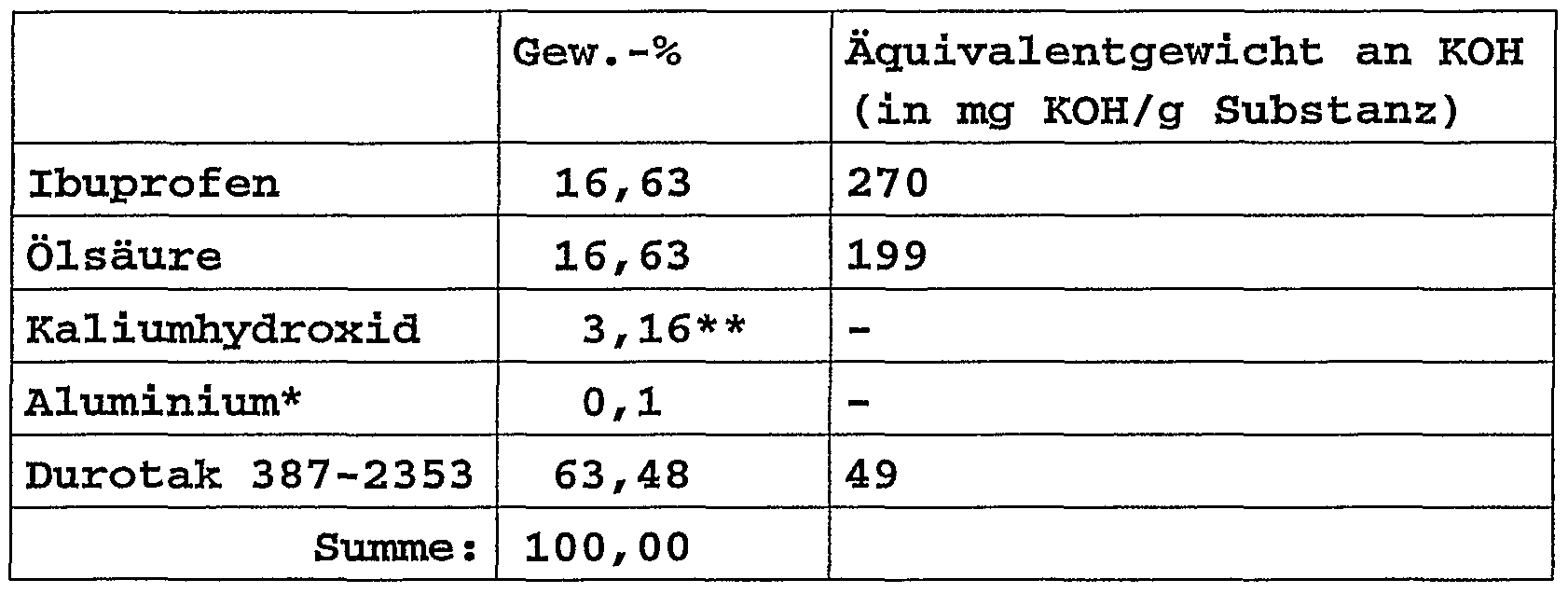
Die Prozentangaben beziehen sich auf das Matrixgewicht. *vernetzend an das haftklebende Polymer gebunden. **Dieser Anteil entspricht ca. 29 % des Äquivalenzgewichts der Summe aller carboxylgruppenhaltiger Bestandteile.The percentages relate to the matrix weight. * cross-linked to the pressure-sensitive adhesive polymer. ** This proportion corresponds to approx. 29% of the equivalent weight of the sum of all components containing carboxyl groups.
Herstellung:production:
Zur Herstellung des Beispiels 9 wird zunächst die Ölsäure in die Durotak-Haftkleberlösung (Durotak 387-2353; Fa. Na- tional Starch) eingerührt. Danach wird Kaliumhydroxid in Form einer 10 %igen (Gew.-%) Lösung in Methanol unter Rühren langsam zugefügt. Schließlich wird Ibuprofen in diesem Ansatz aufgelöst und das pulverförmige Vernetzungsreagenz Aluminiumacetylacetonat hinzugefügt und bis zur Auflösung eingerührt. Zur Einstellung einer für die Beschichtung geeigneten Viskosität wird zu der fertigen Lösung nach Bedarf Ethylacetat zugefügt.To produce Example 9, the oleic acid is first stirred into the Durotak contact adhesive solution (Durotak 387-2353; National Starch). Potassium hydroxide in the form of a 10% strength (by weight) solution in methanol is then slowly added with stirring. Finally, ibuprofen is dissolved in this approach and the powdered crosslinking reagent aluminum acetylacetonate is added and stirred until dissolved. To adjust a viscosity suitable for the coating, ethyl acetate is added to the finished solution as required.
Diese Kleberlösung wird auf eine silikonisierte Polyester- folie (PET, 100 um) beschichtet. Die Beschichtungsdicke wird so eingestellt, daß nach lOminütiger Trocknung bei 60 °C in einem Abluftofen ein Film mit einem Flächengewicht von 60 bis 80 g/m2 erhalten wird. Der getrocknete Kleberfilm wird mit einem längs- und querelastischen PET-Gewebe (Fa. KOB Karl Otto Braun) als Rücksσhiσht ausgestattet. Anschließend werden aus diesem Laminat einzelne Pflaster ge- eigneter Form und Größe ausgestanzt. This adhesive solution is coated on a siliconized polyester film (PET, 100 µm). The coating thickness is adjusted so that after drying for 10 minutes at 60 ° C. in a ventilated oven, a film with a weight per unit area from 60 to 80 g / m 2 is obtained. The dried adhesive film is provided with a longitudinally and transversely elastic PET fabric (KOB Karl Otto Braun) as a backing. Then individual plasters of suitable shape and size are punched out of this laminate.
Claims
Priority Applications (6)
| Application Number | Priority Date | Filing Date | Title |
|---|---|---|---|
| DK02715442T DK1355636T3 (en) | 2001-01-30 | 2002-01-17 | Transdermal therapeutic system for the administration of carboxyl group-containing, non-steroidal antiphlogistics and a method of preparation thereof |
| DE50212267T DE50212267D1 (en) | 2001-01-30 | 2002-01-17 | TRANSDERMALES THERAPEUTIC SYSTEM FOR THE ADMINISTRATION OF CARBOXYL GROUP-CONTAINING, NON-TTEROIDAL ANTIPHLOGISTICS, AND METHOD FOR THE PRODUCTION THEREOF |
| US10/470,701 US7332180B2 (en) | 2001-01-30 | 2002-01-17 | Transdermal therapeutic system for administering non-steroidal antiphlogistic agents containing carboxyl groups, and a method for the production of the same |
| EP02715442A EP1355636B1 (en) | 2001-01-30 | 2002-01-17 | Transdermal therapeutic system for administering non-steroidal antiphlogistic agents containing carboxyl groups, and a method for the production of the same |
| JP2002560611A JP4160394B2 (en) | 2001-01-30 | 2002-01-17 | Transdermal therapeutic absorption system for administration of non-steroidal anti-inflammatory agent containing carboxyl group and method for producing the same |
| KR1020037009972A KR100822418B1 (en) | 2001-01-30 | 2002-01-17 | Transdermal therapeutic dosage forms for the administration of carboxyl group-containing nonsteroidal anti-inflammatory agents, and methods of making the same |
Applications Claiming Priority (2)
| Application Number | Priority Date | Filing Date | Title |
|---|---|---|---|
| DE10103860.7 | 2001-01-30 | ||
| DE10103860A DE10103860B4 (en) | 2001-01-30 | 2001-01-30 | Transdermal therapeutic system for the administration of carboxyl group-containing, non-steroidal anti-inflammatory drugs, and process for its preparation |
Publications (1)
| Publication Number | Publication Date |
|---|---|
| WO2002060418A1 true WO2002060418A1 (en) | 2002-08-08 |
Family
ID=7672050
Family Applications (1)
| Application Number | Title | Priority Date | Filing Date |
|---|---|---|---|
| PCT/EP2002/000417 Ceased WO2002060418A1 (en) | 2001-01-30 | 2002-01-17 | Transdermal therapeutic system for administering non-steroidal antiphlogistic agents containing carboxyl groups, and a method for the production of the same |
Country Status (11)
| Country | Link |
|---|---|
| US (1) | US7332180B2 (en) |
| EP (1) | EP1355636B1 (en) |
| JP (1) | JP4160394B2 (en) |
| KR (1) | KR100822418B1 (en) |
| AT (1) | ATE395050T1 (en) |
| CY (1) | CY1108250T1 (en) |
| DE (2) | DE10103860B4 (en) |
| DK (1) | DK1355636T3 (en) |
| ES (1) | ES2307737T3 (en) |
| PT (1) | PT1355636E (en) |
| WO (1) | WO2002060418A1 (en) |
Cited By (3)
| Publication number | Priority date | Publication date | Assignee | Title |
|---|---|---|---|---|
| JP2006509534A (en) * | 2002-10-31 | 2006-03-23 | トランスファーマ メディカル リミテッド | Transdermal delivery system for dry microparticles or freeze-dried therapeutics |
| US8133505B2 (en) | 2002-10-31 | 2012-03-13 | Transpharma Medical Ltd. | Transdermal delivery system for dried particulate or lyophilized medications |
| EP1951211B1 (en) | 2005-10-24 | 2017-06-14 | Handok Inc. | Transdermal preparations containing hydrophobic non-steroidal anti-inflammatory drugs |
Families Citing this family (17)
| Publication number | Priority date | Publication date | Assignee | Title |
|---|---|---|---|---|
| DE10102817B4 (en) * | 2001-01-23 | 2006-01-12 | Lts Lohmann Therapie-Systeme Ag | Device and method for heat pulse-assisted transdermal application of active substances |
| DE10159745A1 (en) | 2001-12-05 | 2003-07-03 | Lohmann Therapie Syst Lts | Transdermal therapeutic system with improved long-term comfort |
| US20050137262A1 (en) * | 2003-12-22 | 2005-06-23 | Hu Patrick C. | Highly concentrated pourable aqueous solutions of potassium ibuprofen, their preparation and their uses |
| DE102004039728A1 (en) * | 2004-08-16 | 2006-02-23 | Beiersdorf Ag | Active substance-containing tape for the treatment of joint diseases |
| TWI389709B (en) | 2005-12-01 | 2013-03-21 | Novartis Ag | Transdermal therapeutic system |
| DE102006054733A1 (en) * | 2006-11-21 | 2008-05-29 | Lts Lohmann Therapie-Systeme Ag | Transdermal therapeutic system with high drug utilization rate and dosing accuracy |
| JP5209433B2 (en) * | 2007-10-19 | 2013-06-12 | 日東電工株式会社 | Patch preparation |
| WO2011129269A1 (en) * | 2010-04-13 | 2011-10-20 | 東亞合成株式会社 | Adhesive composition for medical use, adhesive patch for medical use, and method for producing the composition |
| PL2468274T3 (en) * | 2010-12-14 | 2015-11-30 | Luye Pharma Ag | Transdermal therapeutic system for application of an agent |
| DE102011114411A1 (en) * | 2011-09-26 | 2013-03-28 | Lts Lohmann Therapie-Systeme Ag | Plaster with adjustable occlusion |
| WO2014159798A1 (en) | 2013-03-13 | 2014-10-02 | Avery Dennison Corporation | Improving adhesive properties |
| DE102014007650A1 (en) | 2013-05-24 | 2014-11-27 | Amw Gmbh | Plaster with bielastic backing layer |
| JP7531821B2 (en) * | 2015-11-16 | 2024-08-13 | ノーヴェン ファーマシューティカルズ インコーポレイテッド | Stretchable backing layer for transdermal drug delivery systems - Patents.com |
| JP2019531355A (en) * | 2016-10-18 | 2019-10-31 | エルテーエス ローマン テラピー−ジステーメ アーゲー | Two-layer local treatment system |
| WO2019068288A1 (en) | 2017-10-04 | 2019-04-11 | Berlimed International Research Gmbh | ACTIVE AND ACTIVE MATRIX-CONTAINING PRODUCT FOR THE TRANSDERMAL ACTIVE SUBSTANCE, AND ITS MANUFACTURE AND USE, AND THE ACTIVE MATRIX, THEIR PREPARATION AND USE |
| DE102021128911A1 (en) | 2021-11-05 | 2023-05-11 | Lts Lohmann Therapie-Systeme Ag. | DICLOFENAC CONTAINING TTS WITH DIMETHYLPROPYLENE UREA |
| DE102021128912A1 (en) | 2021-11-05 | 2023-05-11 | Lts Lohmann Therapie-Systeme Ag. | OCLUSIVE PLASTER WITH FLEXIBLE BACKING |
Citations (6)
| Publication number | Priority date | Publication date | Assignee | Title |
|---|---|---|---|---|
| EP0446636A2 (en) * | 1990-03-12 | 1991-09-18 | Showa Denko Kabushiki Kaisha | External application base or auxiliary agent and external application composition for human being or animal containing the same |
| JPH0474119A (en) * | 1990-07-16 | 1992-03-09 | Nitto Denko Corp | Plaster and plaster preparation |
| US5125995A (en) * | 1990-09-10 | 1992-06-30 | Minnesota Mining And Manufacturing Company | Method of using a water-dispersible pressure sensitive adhesive tape on cloth body coverings |
| EP0965626A1 (en) * | 1998-06-18 | 1999-12-22 | SSP Co., Ltd. | Hydrophilic adhesive masses |
| DE19830649A1 (en) * | 1998-07-09 | 2000-01-13 | Lohmann Therapie Syst Lts | Topical patch with non-steroidal anti-inflammatory drugs with acid group |
| DE19918106A1 (en) * | 1999-04-22 | 2000-10-26 | Lohmann Therapie Syst Lts | Transdermal patches containing basic or neutral drug include adhesive (meth)acrylic acid polymer in alkali(ne earth) metal salt form |
Family Cites Families (5)
| Publication number | Priority date | Publication date | Assignee | Title |
|---|---|---|---|---|
| DE4020144A1 (en) * | 1990-06-25 | 1992-01-09 | Lohmann Therapie Syst Lts | Patches for topical or transdermal drug delivery - with adhesive layer contg. polyacrylate adhesive and film former |
| JPH0474113A (en) * | 1990-07-13 | 1992-03-09 | Kao Corp | Hair-dye composition |
| US5906830A (en) * | 1995-09-08 | 1999-05-25 | Cygnus, Inc. | Supersaturated transdermal drug delivery systems, and methods for manufacturing the same |
| DE19706824C1 (en) * | 1997-02-21 | 1998-03-26 | Lohmann Therapie Syst Lts | Plaster for transdermal drug delivery |
| DE19814083C2 (en) * | 1998-03-30 | 2002-02-07 | Lohmann Therapie Syst Lts | Process for the production of transdermal therapeutic systems using basic alkali metal salts for converting active substance salts into the free bases |
-
2001
- 2001-01-30 DE DE10103860A patent/DE10103860B4/en not_active Expired - Fee Related
-
2002
- 2002-01-17 WO PCT/EP2002/000417 patent/WO2002060418A1/en not_active Ceased
- 2002-01-17 PT PT02715442T patent/PT1355636E/en unknown
- 2002-01-17 ES ES02715442T patent/ES2307737T3/en not_active Expired - Lifetime
- 2002-01-17 KR KR1020037009972A patent/KR100822418B1/en not_active Expired - Lifetime
- 2002-01-17 EP EP02715442A patent/EP1355636B1/en not_active Expired - Lifetime
- 2002-01-17 DE DE50212267T patent/DE50212267D1/en not_active Expired - Lifetime
- 2002-01-17 US US10/470,701 patent/US7332180B2/en not_active Expired - Lifetime
- 2002-01-17 DK DK02715442T patent/DK1355636T3/en active
- 2002-01-17 JP JP2002560611A patent/JP4160394B2/en not_active Expired - Lifetime
- 2002-01-17 AT AT02715442T patent/ATE395050T1/en active
-
2008
- 2008-08-11 CY CY20081100839T patent/CY1108250T1/en unknown
Patent Citations (6)
| Publication number | Priority date | Publication date | Assignee | Title |
|---|---|---|---|---|
| EP0446636A2 (en) * | 1990-03-12 | 1991-09-18 | Showa Denko Kabushiki Kaisha | External application base or auxiliary agent and external application composition for human being or animal containing the same |
| JPH0474119A (en) * | 1990-07-16 | 1992-03-09 | Nitto Denko Corp | Plaster and plaster preparation |
| US5125995A (en) * | 1990-09-10 | 1992-06-30 | Minnesota Mining And Manufacturing Company | Method of using a water-dispersible pressure sensitive adhesive tape on cloth body coverings |
| EP0965626A1 (en) * | 1998-06-18 | 1999-12-22 | SSP Co., Ltd. | Hydrophilic adhesive masses |
| DE19830649A1 (en) * | 1998-07-09 | 2000-01-13 | Lohmann Therapie Syst Lts | Topical patch with non-steroidal anti-inflammatory drugs with acid group |
| DE19918106A1 (en) * | 1999-04-22 | 2000-10-26 | Lohmann Therapie Syst Lts | Transdermal patches containing basic or neutral drug include adhesive (meth)acrylic acid polymer in alkali(ne earth) metal salt form |
Non-Patent Citations (1)
| Title |
|---|
| PATENT ABSTRACTS OF JAPAN vol. 016, no. 283 (C - 0955) 24 June 1992 (1992-06-24) * |
Cited By (3)
| Publication number | Priority date | Publication date | Assignee | Title |
|---|---|---|---|---|
| JP2006509534A (en) * | 2002-10-31 | 2006-03-23 | トランスファーマ メディカル リミテッド | Transdermal delivery system for dry microparticles or freeze-dried therapeutics |
| US8133505B2 (en) | 2002-10-31 | 2012-03-13 | Transpharma Medical Ltd. | Transdermal delivery system for dried particulate or lyophilized medications |
| EP1951211B1 (en) | 2005-10-24 | 2017-06-14 | Handok Inc. | Transdermal preparations containing hydrophobic non-steroidal anti-inflammatory drugs |
Also Published As
| Publication number | Publication date |
|---|---|
| EP1355636B1 (en) | 2008-05-14 |
| CY1108250T1 (en) | 2014-02-12 |
| DE10103860A1 (en) | 2002-08-14 |
| JP4160394B2 (en) | 2008-10-01 |
| EP1355636A1 (en) | 2003-10-29 |
| JP2004516916A (en) | 2004-06-10 |
| KR100822418B1 (en) | 2008-04-16 |
| ES2307737T3 (en) | 2008-12-01 |
| PT1355636E (en) | 2008-08-25 |
| ATE395050T1 (en) | 2008-05-15 |
| US20040071764A1 (en) | 2004-04-15 |
| DK1355636T3 (en) | 2008-09-08 |
| KR20030072609A (en) | 2003-09-15 |
| DE10103860B4 (en) | 2004-12-23 |
| DE50212267D1 (en) | 2008-06-26 |
| US7332180B2 (en) | 2008-02-19 |
Similar Documents
| Publication | Publication Date | Title |
|---|---|---|
| EP1355636B1 (en) | Transdermal therapeutic system for administering non-steroidal antiphlogistic agents containing carboxyl groups, and a method for the production of the same | |
| EP0617972B1 (en) | Dermal therapeutic system based on a mixture of fusible polymethacrylates | |
| DE4241874C2 (en) | Medical patch for percutaneous administration of the active ingredient ketoprofen | |
| DE4336557C2 (en) | Estradiol-containing transdermal therapeutic system, process for its preparation and its use | |
| DE69822327T2 (en) | TRANSDERMAL DRUG DISPENSING SYSTEM FOR ANTI-INFLAMMATORY ANALYZER CONTAINING DICLOFENAC DIETHYLAMMONIUM SALT, AND METHOD FOR THE PRODUCTION THEREOF | |
| DE19728517C2 (en) | TTS for the administration of sex steroid hormones and process for its preparation | |
| DE68917292T2 (en) | TRANSDERMAL ESTRADIOL AS A THERAPEUTIC SYSTEM. | |
| DE19918106A1 (en) | Transdermal patches containing basic or neutral drug include adhesive (meth)acrylic acid polymer in alkali(ne earth) metal salt form | |
| EP0659081B1 (en) | Dexpanthenol-containing plaster for the transdermal application of steroid hormones | |
| EP0464573A1 (en) | Plaster high in softening substances | |
| EP0376067A2 (en) | Transdermal therapeutic system having physostigmine as the active ingredient, and process for its development | |
| EP0305726B1 (en) | Transdermal therapeutic system | |
| EP1089719B1 (en) | Transdermal therapeutic system containing hormones and crystallization inhibitors | |
| WO1996021433A1 (en) | Plaster containing estradiol | |
| DE10118282A1 (en) | Pressure sensitive adhesive based on ethylene-vinyl acetate copolymers and adhesive resins, for medical purposes | |
| EP1305378B1 (en) | Medical contact adhesive comprising a two phase adhesive matrix of polyacrylates and polyamine salts | |
| EP0379933B1 (en) | Surface treatment system containing an antineoplastic agent, particularly 5-fluor uracil | |
| DE60013431T2 (en) | TRANSDERMAL DEVICE FOR THE ADMINISTRATION OF TESTOSTERONE OR A DERIVATIVE THEREOF | |
| EP1560608B1 (en) | Moisture-activated adhesives for medical applications | |
| DE69530832T2 (en) | TRANSDERMAL DELIVERY SYSTEM CONTAINING AN ESTROGEN | |
| DE19828274C2 (en) | Transdermal therapeutic system containing hormones and crystallization inhibitors | |
| WO2006040059A1 (en) | Self-adhesive dental floss | |
| DE4438989C2 (en) | Scopolamine patches | |
| DD279818A1 (en) | METHOD FOR PRODUCING A MEDICAL PLASTER | |
| WO2021148634A1 (en) | Transdermal therapeutic system comprising the ingredient rotigotine and at least one non-amine-resistant silicone adhesive |
Legal Events
| Date | Code | Title | Description |
|---|---|---|---|
| AK | Designated states |
Kind code of ref document: A1 Designated state(s): JP KR US |
|
| AL | Designated countries for regional patents |
Kind code of ref document: A1 Designated state(s): AT BE CH CY DE DK ES FI FR GB GR IE IT LU MC NL PT SE TR |
|
| DFPE | Request for preliminary examination filed prior to expiration of 19th month from priority date (pct application filed before 20040101) | ||
| 121 | Ep: the epo has been informed by wipo that ep was designated in this application | ||
| WWE | Wipo information: entry into national phase |
Ref document number: 2002715442 Country of ref document: EP |
|
| WWE | Wipo information: entry into national phase |
Ref document number: 1020037009972 Country of ref document: KR Ref document number: 1020037009970 Country of ref document: KR Ref document number: 2002560611 Country of ref document: JP |
|
| WWE | Wipo information: entry into national phase |
Ref document number: 10470701 Country of ref document: US |
|
| WWP | Wipo information: published in national office |
Ref document number: 1020037009972 Country of ref document: KR |
|
| WWR | Wipo information: refused in national office |
Ref document number: 1020037009970 Country of ref document: KR |
|
| WWW | Wipo information: withdrawn in national office |
Ref document number: 1020037009970 Country of ref document: KR |
|
| WWP | Wipo information: published in national office |
Ref document number: 2002715442 Country of ref document: EP |
|
| WWG | Wipo information: grant in national office |
Ref document number: 2002715442 Country of ref document: EP |