WO2002044226A1 - Explosion-free emulsion polymerisation process for the production of polytetrafluoroethylene - Google Patents
Explosion-free emulsion polymerisation process for the production of polytetrafluoroethylene Download PDFInfo
- Publication number
- WO2002044226A1 WO2002044226A1 PCT/US2001/044726 US0144726W WO0244226A1 WO 2002044226 A1 WO2002044226 A1 WO 2002044226A1 US 0144726 W US0144726 W US 0144726W WO 0244226 A1 WO0244226 A1 WO 0244226A1
- Authority
- WO
- WIPO (PCT)
- Prior art keywords
- polymerization
- tfe
- emulsion polymerization
- ptfe
- explosion
- Prior art date
- Legal status (The legal status is an assumption and is not a legal conclusion. Google has not performed a legal analysis and makes no representation as to the accuracy of the status listed.)
- Ceased
Links
Classifications
-
- C—CHEMISTRY; METALLURGY
- C08—ORGANIC MACROMOLECULAR COMPOUNDS; THEIR PREPARATION OR CHEMICAL WORKING-UP; COMPOSITIONS BASED THEREON
- C08F—MACROMOLECULAR COMPOUNDS OBTAINED BY REACTIONS ONLY INVOLVING CARBON-TO-CARBON UNSATURATED BONDS
- C08F14/00—Homopolymers and copolymers of compounds having one or more unsaturated aliphatic radicals, each having only one carbon-to-carbon double bond, and at least one being terminated by a halogen
- C08F14/18—Monomers containing fluorine
- C08F14/26—Tetrafluoroethene
-
- C—CHEMISTRY; METALLURGY
- C08—ORGANIC MACROMOLECULAR COMPOUNDS; THEIR PREPARATION OR CHEMICAL WORKING-UP; COMPOSITIONS BASED THEREON
- C08F—MACROMOLECULAR COMPOUNDS OBTAINED BY REACTIONS ONLY INVOLVING CARBON-TO-CARBON UNSATURATED BONDS
- C08F2438/00—Living radical polymerisation
- C08F2438/01—Atom Transfer Radical Polymerization [ATRP] or reverse ATRP
Definitions
- the invention pertains to a safe technology for the production of polytetrafluoroethylene (PTFE) through aqueous emulsion polymerization of tetrafluoroethylene (TFE), whereby a significant cause of explosions is avoided.
- PTFE polytetrafluoroethylene
- TFE tetrafluoroethylene
- the radical polymerization of TFE to PTFE in the aqueous medium is carried out according to two different processes, namely, suspension polymerization (S-process) and so-called emulsion polymerization (E-process).
- S-process suspension polymerization
- E-process emulsion polymerization
- the E-process is more susceptible to explosions than the S-process. With the S-process, little or no emulsifier with a non-telogenic effect is used, but with the E- process, a relatively large amount of this emulsifier is used.
- the products differ accordingly:
- the S-process leads to a relatively coarse-particle suspension of PTFE that is essentially processed using the sintering process
- the E-process leads to a colloidal PTFE dispersion with latex particles having a particle size of up to about 250 nm that can either be used - directly or after being concentrated - for coatings, for example, or else following isolation of the solids.
- the "fine resin powder” is then mixed into a paste with organic liquids such as benzene, and extruded into formed objects such as strands, tubes, hoses, or strips, which - following removal of the liquid - are sintered or stretched into flat sheets. For that reason, this form of PTFE is also known as "pasteware".
- An extremely high molecular weight of up to 10 s g/mol is absolutely essential for good mechanical properties of the end products.
- the molecular weight is defined in this case by means of the "specific standard gravity" (SSG, ASTM D 1457-66).
- SSG specific standard gravity
- the melt viscosity is 10 6 to 10 13 Pa • s, measured according to the creep test per Ajroldi, J. Appl. Polym. Sci., 14 (1970), p. 79 ff., which means that the products cannot be melt- processed.
- PTFE can contain up to 0.1 mol-% of other monomers.
- this kind of "modified" PTFE behaves like the homopolymers. They exhibit a melt viscosity of > 10 6 Pa • s, preferably > 10 7 Pa • s.
- micropowder Here, the molecular weight is markedly below 10 6 g/mol.
- Such products are made, first, through the decomposition of high-molecular products by means of heat or irradiation, or second, through polymerization by using chain transfer agents (or “regulators”).
- Chain transfer agents or “regulators”
- Micropowder has poor mechanical properties. It is crumbly and brittle. For that reason, formed end products made from micropowder cannot be produced. It is, for example, suitable as an additive to polyacetates (EP-A-0 664 209) in order to improve the sliding properties.
- the aqueous E-polymerization of TFE to PTFE has been known for a long time. Despite the long experience with this process on a commercial scale and the corresponding equipping of the apparatus with bursting disks, etc., deflagrations and explosions occur again and again.
- the invention is therefore based on the task of making available a safe process that effectively avoids the explosions that endanger people and inflict great damage.
- TFE is thermodynamically unstable, and decomposes with great reaction enthalpy into carbon and tetrafluoromethane. Under adiabatic and isochoric conditions, the initial pressure increases by 8- to 10-fold during the decomposition. That results in an explosion. However, the decomposition requires an ignition temperature of about 300°C.
- the invention is based on the knowledge that the explosions start from so-called "hot spots". These form from small amounts of floating dispersion coagulate. The coagulate is not wetted by water, a specific property of the PTFE, and therefore floats on the aqueous surface despite having a density of more than 2 g/cm 3 .
- the coagulate is exposed to an elevated TFE concentration in the gas phase, which causes the polymerization speed to accelerate while the cooling at the surface is decreased, and both of these effects lead to a heating of the coagulate above the ignition temperature of approximately 300°C.
- lumps can form in which the PTFE was not only melted, but is black in color as well (carbonized), as has been found following explosions. Temperatures above some 450°C are required for carbonization.
- TFE polymerization One attribute of TFE polymerization is that the polymer chain radicals cannot terminate themselves because there is no chain transfer of the polynter in which a fluorine atom separates in order to form a terminal double bond. Consequently, the heat-generating radicals are fixed in place within the coagulate.
- the substance that is added in accordance with the invention should not intervene substantially in the aqueous phase, that is, it should not have a substantial effect on the speed of polymerization and the product properties, which are characterized by mol weight and density. This substance must therefore be chosen in such a way that
- Emulsion polymerization of TFE is usually carried out at temperatures between 0 and 100°C and TFE pressures between 5 and 30 bar.
- the vapor pressure decreases with an increasing number of carbon atoms, and for that reason compounds with more than 6 carbon atoms generally exhibit volatilities that are too low.
- Unsaturated compounds can polymerize into the polymer as a comonomer, and are thus removed from the gas phase and additionally disturb the crystalline PTFE structure, which is especially important in pasteware.
- ether with the formula C a F 2a+ ⁇ -0-CF 2 -CFH 2 where a 1 to 4 and cyclical ether can be used, but are hard to obtain with the required purity.
- F 3 C-CH 2 F (“R134a”) is especially preferred.
- F 3 C-CH 2 F is commercially available, inexpensive and sufficiently pure (“polymerization grade”). The water solubility at room temperature is 1.5 • 10 "3 mol/ (1 • bar).
- the partial pressure of the explosion inhibitor is set to between 2.5 mbar and about 0.5 bar, preferably up to 0.2 bar.
- the ratio of the partial pressure of the chain transfer agent to the partial pressure of the TFE is at least 1 • 10 "4 , preferably at least 1 • 10 "3 .
- High temperatures or strong chain transfer agents require lower partial pressures for the regulator, whereas higher partial pressures can be used at lower temperatures or with more weakly transfer agents. The upper limit of the partial pressure can easily be determined.
- the lower limit is difficult to determine. With S-polymerization in presence of ⁇ 0.02 bar partial pressure perfluoro-(propylvinyl) ether (PPVE) and a TFE partial pressure of 10 bar, no explosions were observed despite the formation of lumps.
- PPVE is a regulator (US-A-3 642 742). A lower limit may thus be estimated at about 0.005 bar.
- the aqueous radical E-polymerization is carried out in a manner that is known in the art.
- Common water-soluble initiators such as persulfates or so-called redox systems come into consideration as the initiators.
- the permanganate system (US-A-3 632 847) is preferred, since the oxidizing component of this redox system eliminates fluorinated hydrocarbons that get into the aqueous phase. As a result, a regulating action by these substances is avoided, which is particularly advantageous because, first, high-molecular PTFE is generated, and second, a deceleration of the polymerization is avoided as well.
- the explosion inhibitor should therefore be metered in during the polymerization, that is, fed to the polymerization vessel continuously or in steps as required.
- DE-A-41 39 665 pertains to E-polymerization of TFE using the addition of 1,1,2 trifluoroethane ("R134a"). Only a micropowder (MFI 0 to 0.5) is produced as a homopolymer PTFE. Under these conditions and with a partial pressure ratio R134a/TFE > 0.4, R134a thus acts as a chain transfer agent in the polymerization medium. It was also found that because of its low chemical reactivity, this compound can act as an inerting agent at these high partial pressure ratios, and can thus prevent deflagrations.
- R134a 1,1,2 trifluoroethane
- the invention also allows the use of larger polymerization vessels and the achieving of higher concentrations of solids. Thus it not only leads to the safety of the process, it also leads to substantial economic benefits as well.
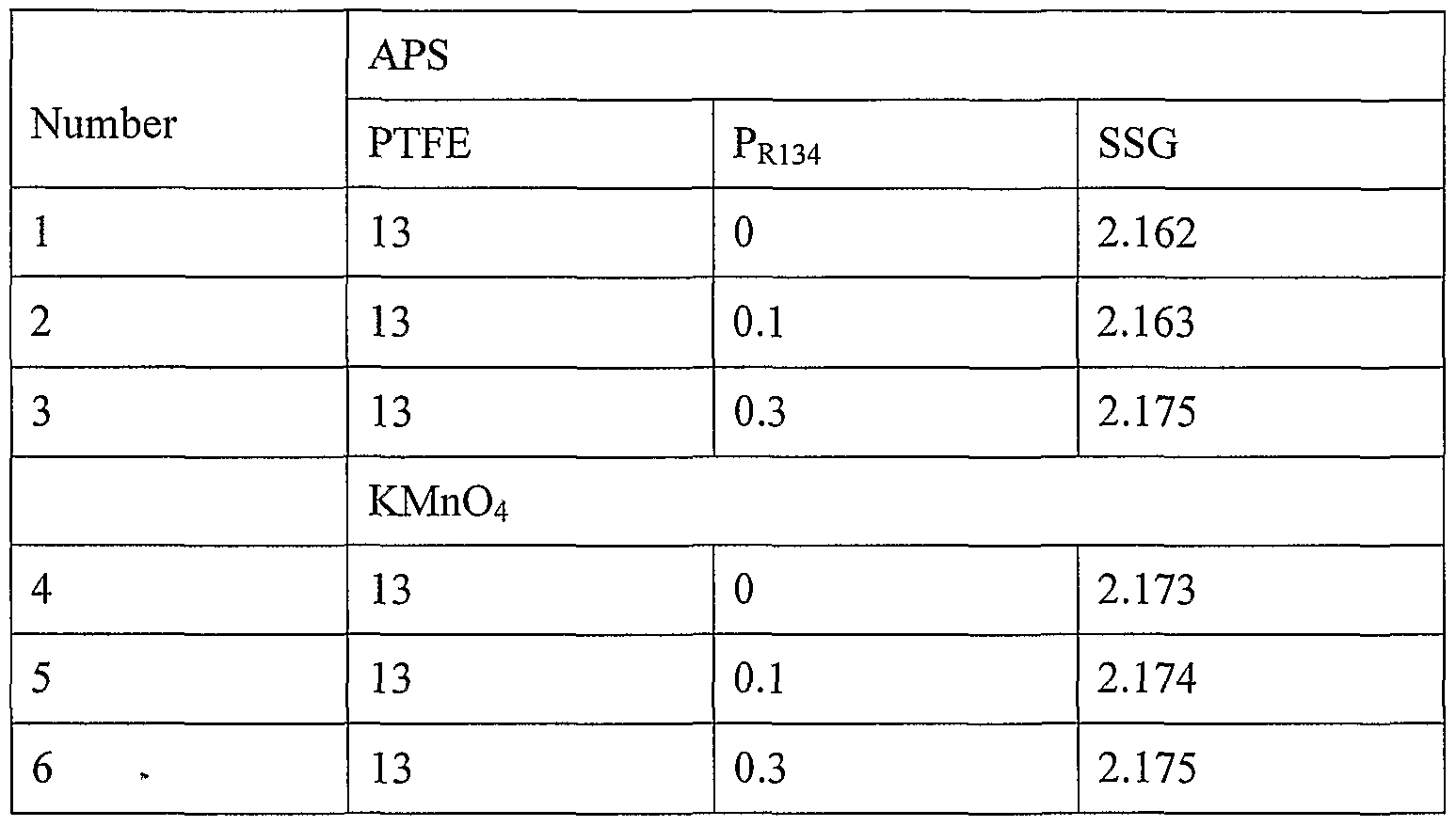
- the polymerization, its preparation and the measurements of the SSG per ASTM D 1457-66 are carried out as described in US-A-4 391 940.
- the polymerization takes place in a 50-liter vessel boiler equipped with an impeller agitator and a baffle.
- the agitator speed is 200 rpm.
- the reactor is filled with 22 g of ammonium perfluoro-octanate dissolved in 31 liters of deionized water.
- the air is removed by alternately evacuating and pressing TFE, as is known in the state of the art.
- the vessel is pressurized to 13 bar with TFE.
- the temperature is set to 35°C.
- R134a partial pressure of R134a is varied per Table 1.
- the R134a is pressurized before the starter is added.
- the initiator KMnO is used in place of APS, while the rest of the conditions remain the same.
- the aqueous phase contains 22 g ammonium perfluoro-octanate,
Landscapes
- Chemical & Material Sciences (AREA)
- Health & Medical Sciences (AREA)
- Chemical Kinetics & Catalysis (AREA)
- Medicinal Chemistry (AREA)
- Polymers & Plastics (AREA)
- Organic Chemistry (AREA)
- Addition Polymer Or Copolymer, Post-Treatments, Or Chemical Modifications (AREA)
- Polymerisation Methods In General (AREA)
- Organic Low-Molecular-Weight Compounds And Preparation Thereof (AREA)
- Polyethers (AREA)
- Processes Of Treating Macromolecular Substances (AREA)
Abstract
Description
Claims
Priority Applications (6)
| Application Number | Priority Date | Filing Date | Title |
|---|---|---|---|
| US10/415,250 US7253240B2 (en) | 2000-11-30 | 2001-11-29 | Explosion-free process for the production of polytetrafluoroethylene |
| AU2002228671A AU2002228671A1 (en) | 2000-11-30 | 2001-11-29 | Explosion-free process for the production of polytetrafluoroethylene |
| DE60114666T DE60114666T2 (en) | 2000-11-30 | 2001-11-29 | EXPLOSION-FREE EMULSION POLYMERIZATION PROCESS FOR THE PREPARATION OF POLYTETRAFLUOROETHYLENE |
| AT01989792T ATE308573T1 (en) | 2000-11-30 | 2001-11-29 | EXPLOSION-FREE EMULSION POLYMERIZATION PROCESS FOR PRODUCING POLYTETRAFLUORETHYLENE |
| EP01989792A EP1353965B1 (en) | 2000-11-30 | 2001-11-29 | Explosion-free emulsion polymerisation process for the production of polytetrafluoroethylene |
| JP2002546593A JP3929898B2 (en) | 2000-11-30 | 2001-11-29 | Non-explosive emulsion polymerization process for the production of polytetrafluoroethylene |
Applications Claiming Priority (2)
| Application Number | Priority Date | Filing Date | Title |
|---|---|---|---|
| DE10059735 | 2000-11-30 | ||
| DE10059735.1 | 2000-11-30 |
Publications (2)
| Publication Number | Publication Date |
|---|---|
| WO2002044226A1 true WO2002044226A1 (en) | 2002-06-06 |
| WO2002044226A8 WO2002044226A8 (en) | 2002-06-27 |
Family
ID=7665417
Family Applications (1)
| Application Number | Title | Priority Date | Filing Date |
|---|---|---|---|
| PCT/US2001/044726 Ceased WO2002044226A1 (en) | 2000-11-30 | 2001-11-29 | Explosion-free emulsion polymerisation process for the production of polytetrafluoroethylene |
Country Status (9)
| Country | Link |
|---|---|
| EP (1) | EP1353965B1 (en) |
| JP (1) | JP3929898B2 (en) |
| CN (1) | CN1240731C (en) |
| AT (1) | ATE308573T1 (en) |
| AU (1) | AU2002228671A1 (en) |
| DE (1) | DE60114666T2 (en) |
| RU (1) | RU2302430C2 (en) |
| WO (1) | WO2002044226A1 (en) |
| ZA (1) | ZA200305002B (en) |
Cited By (8)
| Publication number | Priority date | Publication date | Assignee | Title |
|---|---|---|---|---|
| WO2002092670A3 (en) * | 2001-05-14 | 2003-11-13 | Du Pont | Fluoropolymer compositions comprising a fluor-containing liquid |
| US7129009B2 (en) | 2002-05-14 | 2006-10-31 | E. I. Du Pont De Nemours And Company | Polymer-liquid compositions useful in ultraviolet and vacuum ultraviolet uses |
| US7402377B2 (en) | 2004-02-20 | 2008-07-22 | E. I. Du Pont De Nemours And Company | Use of perfluoro-n-alkanes in vacuum ultraviolet applications |
| US20080287599A1 (en) * | 2001-09-05 | 2008-11-20 | 3M Innovative Properties Company | Fluoropolymer dispersion containing no or little low molecular weight fluorinated surfactant |
| US8119750B2 (en) * | 2006-07-13 | 2012-02-21 | 3M Innovative Properties Company | Explosion taming surfactants for the production of perfluoropolymers |
| US8404790B2 (en) | 2005-07-15 | 2013-03-26 | 3M Innovative Properties Company | Aqueous emulsion polymerization process for producing fluoropolymers |
| US8623957B2 (en) | 2007-08-23 | 2014-01-07 | 3M Innovative Properties Company | Method of preparing fluoropolymers by aqueous emulsion polymerization |
| US8754176B2 (en) | 2009-03-31 | 2014-06-17 | Daikin Industries, Ltd. | Low molecular weight polytetrafluoroethylene powder and preparation method therefor |
Families Citing this family (1)
| Publication number | Priority date | Publication date | Assignee | Title |
|---|---|---|---|---|
| CN116217765B (en) * | 2021-12-03 | 2024-04-02 | 中昊晨光化工研究院有限公司 | A kind of polytetrafluoroethylene dispersion resin for dry electrode binder and its preparation method |
Citations (6)
| Publication number | Priority date | Publication date | Assignee | Title |
|---|---|---|---|---|
| BE678637A (en) * | 1965-04-01 | 1966-09-01 | ||
| US3345317A (en) * | 1963-04-04 | 1967-10-03 | Thiokol Chemical Corp | Emulsion polymerization of tetrafluoroethylene using trifluorotrichloroethane as emulsion stabilizer |
| US3462401A (en) * | 1965-01-12 | 1969-08-19 | Daikin Ind Ltd | Polytetrafluoroethylene molding powder and method of preparation thereof |
| FR2123703A5 (en) * | 1971-01-28 | 1972-09-15 | Ugine Kuhlmann | |
| JPH0427596A (en) * | 1990-05-22 | 1992-01-30 | Osamu Fukuya | Optimum preparation of question paper of learning and examination |
| EP1199322A1 (en) * | 2000-10-17 | 2002-04-24 | Solutia Austria GmbH | Two component systems based on water soluble polyester and blocked isocyanates for the formulation of aqueous stoving enamels |
Family Cites Families (2)
| Publication number | Priority date | Publication date | Assignee | Title |
|---|---|---|---|---|
| GB1146465A (en) * | 1965-05-21 | 1969-03-26 | Ferrania Spa | Photographic sensitising dyes |
| IT1271422B (en) * | 1993-10-15 | 1997-05-28 | Ausimont Spa | PROCEDURE FOR THE PREPARATION OF TETRAFLUOROETHYLENE COPOLYMERS WITH OTHER FLUORINATED MONOMERS |
-
2001
- 2001-11-29 CN CNB018196357A patent/CN1240731C/en not_active Expired - Fee Related
- 2001-11-29 JP JP2002546593A patent/JP3929898B2/en not_active Expired - Fee Related
- 2001-11-29 DE DE60114666T patent/DE60114666T2/en not_active Expired - Fee Related
- 2001-11-29 AU AU2002228671A patent/AU2002228671A1/en not_active Abandoned
- 2001-11-29 RU RU2003116062/04A patent/RU2302430C2/en not_active IP Right Cessation
- 2001-11-29 WO PCT/US2001/044726 patent/WO2002044226A1/en not_active Ceased
- 2001-11-29 EP EP01989792A patent/EP1353965B1/en not_active Expired - Lifetime
- 2001-11-29 AT AT01989792T patent/ATE308573T1/en not_active IP Right Cessation
-
2003
- 2003-06-26 ZA ZA200305002A patent/ZA200305002B/en unknown
Patent Citations (6)
| Publication number | Priority date | Publication date | Assignee | Title |
|---|---|---|---|---|
| US3345317A (en) * | 1963-04-04 | 1967-10-03 | Thiokol Chemical Corp | Emulsion polymerization of tetrafluoroethylene using trifluorotrichloroethane as emulsion stabilizer |
| US3462401A (en) * | 1965-01-12 | 1969-08-19 | Daikin Ind Ltd | Polytetrafluoroethylene molding powder and method of preparation thereof |
| BE678637A (en) * | 1965-04-01 | 1966-09-01 | ||
| FR2123703A5 (en) * | 1971-01-28 | 1972-09-15 | Ugine Kuhlmann | |
| JPH0427596A (en) * | 1990-05-22 | 1992-01-30 | Osamu Fukuya | Optimum preparation of question paper of learning and examination |
| EP1199322A1 (en) * | 2000-10-17 | 2002-04-24 | Solutia Austria GmbH | Two component systems based on water soluble polyester and blocked isocyanates for the formulation of aqueous stoving enamels |
Non-Patent Citations (2)
| Title |
|---|
| CHEMICAL ABSTRACTS, vol. 64, no. 3, 31 January 1966, Columbus, Ohio, US; abstract no. 3725g, XP002197564 * |
| CHEMICAL ABSTRACTS, vol. 74, no. 8, 22 February 1971, Columbus, Ohio, US; abstract no. 32158, XP002197565 * |
Cited By (9)
| Publication number | Priority date | Publication date | Assignee | Title |
|---|---|---|---|---|
| WO2002092670A3 (en) * | 2001-05-14 | 2003-11-13 | Du Pont | Fluoropolymer compositions comprising a fluor-containing liquid |
| US20080287599A1 (en) * | 2001-09-05 | 2008-11-20 | 3M Innovative Properties Company | Fluoropolymer dispersion containing no or little low molecular weight fluorinated surfactant |
| US8598267B2 (en) * | 2001-09-05 | 2013-12-03 | 3M Innovative Properties Company | Fluoropolymer dispersion containing no or little low molecular weight fluorinated surfactant |
| US7129009B2 (en) | 2002-05-14 | 2006-10-31 | E. I. Du Pont De Nemours And Company | Polymer-liquid compositions useful in ultraviolet and vacuum ultraviolet uses |
| US7402377B2 (en) | 2004-02-20 | 2008-07-22 | E. I. Du Pont De Nemours And Company | Use of perfluoro-n-alkanes in vacuum ultraviolet applications |
| US8404790B2 (en) | 2005-07-15 | 2013-03-26 | 3M Innovative Properties Company | Aqueous emulsion polymerization process for producing fluoropolymers |
| US8119750B2 (en) * | 2006-07-13 | 2012-02-21 | 3M Innovative Properties Company | Explosion taming surfactants for the production of perfluoropolymers |
| US8623957B2 (en) | 2007-08-23 | 2014-01-07 | 3M Innovative Properties Company | Method of preparing fluoropolymers by aqueous emulsion polymerization |
| US8754176B2 (en) | 2009-03-31 | 2014-06-17 | Daikin Industries, Ltd. | Low molecular weight polytetrafluoroethylene powder and preparation method therefor |
Also Published As
| Publication number | Publication date |
|---|---|
| CN1478110A (en) | 2004-02-25 |
| RU2003116062A (en) | 2004-11-27 |
| EP1353965B1 (en) | 2005-11-02 |
| ATE308573T1 (en) | 2005-11-15 |
| WO2002044226A8 (en) | 2002-06-27 |
| CN1240731C (en) | 2006-02-08 |
| AU2002228671A1 (en) | 2002-06-11 |
| ZA200305002B (en) | 2004-08-11 |
| JP3929898B2 (en) | 2007-06-13 |
| DE60114666T2 (en) | 2006-07-20 |
| RU2302430C2 (en) | 2007-07-10 |
| JP2004514769A (en) | 2004-05-20 |
| EP1353965A1 (en) | 2003-10-22 |
| DE60114666D1 (en) | 2005-12-08 |
Similar Documents
| Publication | Publication Date | Title |
|---|---|---|
| JP5439186B2 (en) | Aqueous polymerization of fluorinated monomers using a polymeric agent containing a fluoropolyether acid or salt and a hydrocarbon surfactant. | |
| RU2441883C2 (en) | Process for producing melt-moldable tetrafluoroethylene copolymer | |
| EP0006346B1 (en) | Process for producing an aqueous dispersion of polytetrafluoroethylene | |
| CN1326893C (en) | Directly polymerized low molecular weight granular polytetrafluoroethylene | |
| US7728087B2 (en) | Fluoropolymer dispersion and method for making the same | |
| JP5435089B2 (en) | Fluorine-containing polymer aqueous dispersion | |
| JP2003500495A (en) | Polymerization of fluoromonomer | |
| CN1612911A (en) | Concentrated fluoroploymer dispersions | |
| EP1353965B1 (en) | Explosion-free emulsion polymerisation process for the production of polytetrafluoroethylene | |
| CN102762611B (en) | Produce the method for fluoropolymer | |
| EP0006344B1 (en) | A process for the aqueous dispersion polymerization of tetrafluoroethylene | |
| JP2001270969A (en) | Thermoplastic fluoropolymer | |
| JP3626202B2 (en) | Polymerization method | |
| US7253240B2 (en) | Explosion-free process for the production of polytetrafluoroethylene | |
| WO1994017109A1 (en) | Process for producing fluoropolymer | |
| KR20220080153A (en) | Process for the preparation of fluoropolymers and fluoroelastomers in the presence of non-fluorinated sulfonate type hydrocarbon containing surfactants thereof | |
| EP0149000B1 (en) | Process for preparing an aqueous dispersion of polytetrafluoroethylene | |
| US3639328A (en) | Polymers of tetrafluoroethylene | |
| WO2008024601A1 (en) | Solvent slurry process for producing high solids fluoropolymers |
Legal Events
| Date | Code | Title | Description |
|---|---|---|---|
| AK | Designated states |
Kind code of ref document: A1 Designated state(s): AE AG AL AM AT AT AU AZ BA BB BG BR BY BZ CA CH CN CO CR CU CZ CZ DE DE DK DK DM DZ EC EE EE ES FI FI GB GD GE GH GM HR HU ID IL IN IS JP KE KG KP KR KZ LC LK LR LS LT LU LV MA MD MG MK MN MW MX MZ NO NZ OM PH PL PT RO RU SD SE SG SI SK SK SL TJ TM TR TT TZ UA UG US UZ VN YU ZA ZM ZW |
|
| AL | Designated countries for regional patents |
Kind code of ref document: A1 Designated state(s): GH GM KE LS MW MZ SD SL SZ TZ UG ZM ZW AM AZ BY KG KZ MD RU TJ TM AT BE CH CY DE DK ES FI FR GB GR IE IT LU MC NL PT SE TR BF BJ CF CG CI CM GA GN GQ GW ML MR NE SN TD TG |
|
| AK | Designated states |
Kind code of ref document: C1 Designated state(s): AE AG AL AM AT AT AU AZ BA BB BG BR BY BZ CA CH CN CO CR CU CZ CZ DE DE DK DK DM DZ EC EE EE ES FI FI GB GD GE GH GM HR HU ID IL IN IS JP KE KG KP KR KZ LC LK LR LS LT LU LV MA MD MG MK MN MW MX MZ NO NZ OM PH PL PT RO RU SD SE SG SI SK SK SL TJ TM TR TT TZ UA UG US UZ VN YU ZA ZM ZW |
|
| AL | Designated countries for regional patents |
Kind code of ref document: C1 Designated state(s): GH GM KE LS MW MZ SD SL SZ TZ UG ZM ZW AM AZ BY KG KZ MD RU TJ TM AT BE CH CY DE DK ES FI FR GB GR IE IT LU MC NL PT SE TR BF BJ CF CG CI CM GA GN GQ GW ML MR NE SN TD TG |
|
| DFPE | Request for preliminary examination filed prior to expiration of 19th month from priority date (pct application filed before 20040101) | ||
| 121 | Ep: the epo has been informed by wipo that ep was designated in this application | ||
| WWE | Wipo information: entry into national phase |
Ref document number: 10415250 Country of ref document: US |
|
| WWE | Wipo information: entry into national phase |
Ref document number: 2001989792 Country of ref document: EP |
|
| WWE | Wipo information: entry into national phase |
Ref document number: 2002546593 Country of ref document: JP Ref document number: 018196357 Country of ref document: CN |
|
| WWE | Wipo information: entry into national phase |
Ref document number: 2003/05002 Country of ref document: ZA Ref document number: 200305002 Country of ref document: ZA |
|
| ENP | Entry into the national phase |
Country of ref document: RU Kind code of ref document: A Format of ref document f/p: F Ref document number: 2003116062 Country of ref document: RU Kind code of ref document: A Format of ref document f/p: F |
|
| REG | Reference to national code |
Ref country code: DE Ref legal event code: 8642 |
|
| WWP | Wipo information: published in national office |
Ref document number: 2001989792 Country of ref document: EP |
|
| WWG | Wipo information: grant in national office |
Ref document number: 2001989792 Country of ref document: EP |