WO2002043714A2 - Use of substituted 6-dimethylaminomethyl-1-phenyl-cyclohexane compounds for treating urinary incontinence - Google Patents
Use of substituted 6-dimethylaminomethyl-1-phenyl-cyclohexane compounds for treating urinary incontinence Download PDFInfo
- Publication number
- WO2002043714A2 WO2002043714A2 PCT/EP2001/013917 EP0113917W WO0243714A2 WO 2002043714 A2 WO2002043714 A2 WO 2002043714A2 EP 0113917 W EP0113917 W EP 0113917W WO 0243714 A2 WO0243714 A2 WO 0243714A2
- Authority
- WO
- WIPO (PCT)
- Prior art keywords
- alkyl
- och
- unsubstituted
- dimethylaminomethyl
- polysubstituted
- Prior art date
- Legal status (The legal status is an assumption and is not a legal conclusion. Google has not performed a legal analysis and makes no representation as to the accuracy of the status listed.)
- Ceased
Links
Classifications
-
- A—HUMAN NECESSITIES
- A61—MEDICAL OR VETERINARY SCIENCE; HYGIENE
- A61K—PREPARATIONS FOR MEDICAL, DENTAL OR TOILETRY PURPOSES
- A61K31/00—Medicinal preparations containing organic active ingredients
- A61K31/13—Amines
- A61K31/135—Amines having aromatic rings, e.g. ketamine, nortriptyline
-
- A—HUMAN NECESSITIES
- A61—MEDICAL OR VETERINARY SCIENCE; HYGIENE
- A61K—PREPARATIONS FOR MEDICAL, DENTAL OR TOILETRY PURPOSES
- A61K31/00—Medicinal preparations containing organic active ingredients
- A61K31/13—Amines
-
- A—HUMAN NECESSITIES
- A61—MEDICAL OR VETERINARY SCIENCE; HYGIENE
- A61P—SPECIFIC THERAPEUTIC ACTIVITY OF CHEMICAL COMPOUNDS OR MEDICINAL PREPARATIONS
- A61P13/00—Drugs for disorders of the urinary system
-
- A—HUMAN NECESSITIES
- A61—MEDICAL OR VETERINARY SCIENCE; HYGIENE
- A61P—SPECIFIC THERAPEUTIC ACTIVITY OF CHEMICAL COMPOUNDS OR MEDICINAL PREPARATIONS
- A61P13/00—Drugs for disorders of the urinary system
- A61P13/06—Anti-spasmodics
-
- A—HUMAN NECESSITIES
- A61—MEDICAL OR VETERINARY SCIENCE; HYGIENE
- A61P—SPECIFIC THERAPEUTIC ACTIVITY OF CHEMICAL COMPOUNDS OR MEDICINAL PREPARATIONS
- A61P13/00—Drugs for disorders of the urinary system
- A61P13/10—Drugs for disorders of the urinary system of the bladder
Definitions
- the invention relates to the use of substituted 6-dimethylaminomethyl-1-phenyl-cyclohexane compounds as free bases and / or in the form of physiologically tolerable salts for the manufacture of a medicament for the treatment of increased urge to urinate or urinary incontinence as well as corresponding medicaments and methods for the treatment of increased urge to urinate or Urinary incontinence.
- Urinary incontinence is the involuntary loss of urine. This occurs in an uncontrolled manner when the pressure inside the bladder exceeds the pressure necessary to close the ureter.
- the causes can be, on the one hand, an increased internal bladder pressure (e.g. due to detrusor instability) with the consequence of urge incontinence and on the other hand a reduced sphincter pressure (e.g. after birth or surgical interventions) with the result of stress incontinence.
- the detrusor is the roughly bundled, multilayered bladder wall muscles, the contraction of which leads to emptying of the urine, the sphincter the sphincter of the urethra.
- Urge to urinate is the state of increased bladder muscle tension aimed at emptying urine (micturition) when the bladder capacity is approached (or exceeded). This tension acts as a micturition.
- An increased urge to urinate means in particular especially the appearance of premature or sometimes even painful urge to urinate up to the so-called urge to urinate. This leads to a significantly more frequent micturition.
- Causes can include bladder infections and neurogenic bladder disorders as well as bladder tuberculosis. However, not all causes have yet been clarified.
- the subject of the invention is the use of a substituted 6-dimethylaminomethyl-1-phenyl-cyclohexane compound according to general formula I.
- X is selected from OH, F, Cl, H or OC (O) R 7 with R 7 selected from Cj.
- R 7 selected from Cj. Alkyl, branched or unbranched, saturated or unsaturated, unsubstituted or mono- or polysubstituted,
- R 1 is selected from C ⁇ alkyl, benzyl, CF3, OH, OCH 2 - CßH5, O-C ⁇ _4-alkyl, Cl or F and
- R9 to R " ! 3 are each independently selected from H, F, Cl, Br, I, CH 2 F, CHF 2 , CF3, OH, SH, OR 14 , OCF3,
- R ⁇ 4 selected from C-
- NHR 18 CO-C 6 H 4 -R 1 5 , with R 5 ortho-OCOC-i_3-alkyl or meta- or para-CH 2 N (R 16 ) 2 with R 16 C-
- alkyl radicals are taken to mean saturated and unsaturated, branched and unbranched hydrocarbons, which can also be substituted at least once.
- Preferred alkyl radicals are methyl, ethyl, vinyl (ethenyl), propyl, allyl (2-propenyl), 1-propynyl, methylethyl, n-butyl, sec-butyl, tert-butyl, 1-methyl propyl, 2-methyl propyl , 1, 1-dimethylethyl, pentyl, 1, 1-dimethylpropyl, 1, 2-dimethylpropyl, 2,2-dimethylpropyl, hexyl, 1-methylpentyl, CHF 2 , CF 3 or CH 2 OH.
- Cycloalkyl radicals for the purposes of this invention are also understood to be saturated cyclic hydrocarbons which can also be at least monosubstituted.
- Preferred cycloalkyl radicals are cyclopropyl, cyclobutyl, cyclopentyl, cyclohexyl or cycloheptyl
- substituted is preferably the substitution with H, F, Cl, Br, I, CH 2 F, CHF 2, CF 3, OH, SH, OR 1 9, OCF 3, SRI 9 , NH 2 , CONH 2 , SOCH3, SOCF3,
- Suitable salts in the sense of this invention and in each of the claimed uses are salts of the respective active ingredient with inorganic or organic acids and / or a sugar substitute such as saccharin, cyclamate or acesulfame.
- the hydrochloride is particularly preferred.
- OH, F, Cl, OC (O) CH 3 or H preferably OH, F or H, in particular OH.
- R 14 is selected from C j _3-alkyl, saturated and unsubstituted, branched or unbranched; preferably H, Cl, F, OH, CF 2 H, CF 3 , OCH 3 or SCH 3
- R 9 , R 11 and R 13 correspond to H
- one of R 10 or R 12 also corresponds to H, while the other is selected from:
- R 9 and R 13 correspond to H and R 11 corresponds to OH, OCH 3 , Cl or F, preferably Cl
- one of R 10 or R 12 also corresponds to H, while the other OH, OCH 3 , Cl or F, preferably Cl corresponds to
- R 11 is selected from CF 3 , CF 2 H, Cl or F, preferably F,
- R 10 , R 11 and R 12 correspond to H
- one of R 9 or R 13 also corresponds to H
- the other is selected from OH, OC 2 H 5 or OC 3 H 7 .
- R 9 , R 11 and R 13 correspond to H
- one of R 10 or R 12 also corresponds to H, while the other is selected from:
- the compounds of the formula I in the form of the (+) enantiomer in particular in mixtures with a higher proportion of the (+) enantiomer compared to the (-) - enantiomer of a racemic compound or as pure (+) - Enantiomer can be used.
- (+) enantiomer In general, even with preferred use of the (+) enantiomer, there is a lower proportion of (-) enantiomer than the (+) enantiomer acceptable and may - but need not - be included in the use according to the invention.
- morphine antagonists in particular naloxone, naltrexone and / or levallorphan, in addition to compounds of the general formula I.
- the invention also encompasses medicaments for the treatment of increased urge to urinate or urinary incontinence which contain at least one substituted 6-dimethylaminomethyl-1-phenyl-cyclohexane compound according to general formula I as active ingredient
- X is selected from OH, F, Cl, H or OC (O) R 7 with R 7 selected from C 3 alkyl, branched or unbranched, saturated or unsaturated, unsubstituted or mono- or polysubstituted,
- R 1 is selected from C ⁇ alkyl, benzyl, CF3, OH, OCH 2 - C6H5, OC ⁇ _4 alkyl, Cl or F and
- R 9 to R1 8 are each independently selected from H, F, Cl, Br, I, CH 2 F, CHF 2 , CF 3 , OH, SH, OR 14 , OCF3, SRI 4 ,
- RI selected from C ⁇ _6-alkyl; Pyridyl, thienyl,
- R ⁇ 7 and R18 each independently selected from H; Ci-ß-alkyl, branched or unbranched, saturated or unsaturated, unsubstituted or mono- or polysubstituted; Phenyl, benzyl or phenethyl, in each case unsubstituted or mono- or polysubstituted,
- Suitable salts in the sense of this invention and in each of the claimed uses are salts of the respective active ingredient with inorganic or organic acids and / or a sugar substitute such as Saccharin, cyclamate or acesulfame.
- a sugar substitute such as Saccharin, cyclamate or acesulfame.
- hydrochloride is particularly preferred.
- auxiliaries for the purposes of this invention are all substances known to the person skilled in the art from the prior art for achieving galenical formulations.
- the selection of these auxiliaries and the amounts to be used depend on whether the medicament is to be administered orally, intravenously, intraperitoneally, intradermally, intramuscularly, intranasally, buccally or locally.
- Preparations in the form of tablets, chewable tablets, dragees, capsules, granules, drops, juices or syrups are suitable for oral administration, and solutions, suspensions, easily reconstitutable dry preparations and sprays are suitable for parenteral, topical and inhalation administration.
- Another possibility is suppositories for use in the rectum.
- Patches are examples of suitable percutaneous forms of application.
- auxiliaries and additives for oral administration forms are disintegrants, lubricants, binders, fillers, mold release agents, if appropriate solvents, flavorings, sugars, in particular carriers, diluents, colorants, antioxidants, etc.
- suppositories i.a. Waxes or fatty acid esters and carriers, preservatives, suspension aids etc. are used for parenteral application agents.
- the amounts of active ingredient to be administered to patients vary depending on the weight of the patient
- the compounds according to the invention can be released in a delayed manner from preparation forms which can be used orally, rectally or percutaneously.
- corresponding slow-release formulations in particular in the form of a “once-daily” preparation, which only has to be taken once a day, are particularly preferred.
- drugs that contain at least 0.05 to 90.0% of the active ingredient, in particular low effective doses, in order to avoid side effects or analgesic effects.
- 0.1 to 5000 mg / kg, in particular 1 to 500 mg / kg, preferably 2 to 250 mg / kg body weight of at least one compound of the formula I are applied.
- application of 0.01 to 5 mg / kg, preferably 0.03 to 2 mg / kg, in particular 0.05 to 1 mg / kg of body weight is also preferred and usual.
- Excipients can be, for example: water, ethanol, 2-propanol, glycerol, ethylene glycol, propylene glycol, polyethylene glycol, polypropylene glycol, glucose, fructose, lactose, sucrose, dextrose, molasses, starch, modified starch, gelatin, sorbitol, inositol, mannitol, microcrystalline cellulose , Methyl cellulose, carboxymethyl cellulose,
- compositions according to the invention are produced with the aid of the prior art the pharmaceutical formulation of well-known agents, devices, methods and processes, as described, for example, in "Remington's Pharmaceutical Sciences", ed. AR Gennaro, 17th Ed., Mack Publishing Company, Easton, Pa. (1985), in particular in Part 8, Chapters 76 to 93.
- a solid formulation such as a tablet
- the active ingredient of the drug i.e. a compound of general structure I or one of its pharmaceutically acceptable salts
- a pharmaceutical carrier e.g. conventional tablet ingredients such as corn starch, lactose, sucrose, sorbitol, talc, magnesium stearate, dicalcium phosphate or pharmaceutically acceptable gums
- pharmaceutical diluents such as e.g. Water, granulated to form a solid composition containing a compound of the invention or a pharmaceutically acceptable salt thereof in homogeneous distribution.
- a homogeneous distribution is understood here to mean that the active ingredient is uniformly distributed over the entire composition, so that it can be easily divided into equally effective unit dose forms, such as tablets, pills or capsules.
- the solid composition is then divided into unit dose forms.
- the tablets or pills of the medicament according to the invention or of the compositions according to the invention can also be coated or compounded in some other way in order to provide a dosage form with delayed release.
- Suitable coating agents include polymeric acids and mixtures of polymeric acids with materials such as e.g. Shellac, cetyl alcohol and / or cellulose acetate.
- Drugs are preferred in which compounds according to general formula I are used, wherein X is selected from
- OH, F, Cl, OC (O) CH 3 or H preferably OH, F or H, in particular OH.
- R 9 , R 1 and R 13 correspond to H
- one of R 10 or R 12 also corresponds to H, while the other is selected from:
- Alkyl preferably OH or OCH 3 ,
- R 9 and R 13 correspond to H and R 11 corresponds to OH, OCH 3 , Cl or F, preferably Cl
- one of R 10 or R 12 also corresponds to H, while the other OH, OCH 3 , Cl or F, preferably Cl corresponds to
- R 11 is selected from CF 3 , CF 2 H, Cl or F, preferably F,
- R 10 , R 11 and R 12 correspond to H
- one of R 9 or R 13 also corresponds to H, while the other is selected from OH, OC 2 H 5 or OC 3 H 7 .
- medicaments in which compounds according to general formula I are used, in which R 9 , R 11 and R 13 correspond to H, one of R 10 or R 12 also corresponds to H, while the other is selected from: Cl, F, OH, SH, CF 2 H, CF 3 , OR 14 or SR 14 , preferably OH or OR 14 , in particular OH or OC ⁇ alkyl, preferably
- the medicaments according to the invention contain compounds of the general formula I which are in the form of the diastereomers with the relative configuration Ia
- the medicaments according to the invention contain compounds according to general formula I which are in the form of the (+) enantiomer, in particular in mixtures with a higher proportion of the (+) enantiomer compared to the (-) enantiomer racemic compound or as pure (+) - enantiomer.
- the invention further relates to a method for the treatment of increased urge to urinate or urinary incontinence, in which the substituted 6-dimethylaminomethyl-1-phenyl-cyclohexane compounds according to general formula I in the form of their racemates; enantiomers,
- Diastereomers in particular mixtures of their enantiomers or diastereomers or of a single enantiomer or diastereomer; can be used as a free base and / or in the form of physiologically acceptable salts.
- Example 1 List of substances tested: The following is a list of the compounds tested for effectiveness:
- Example 2 Test system cystometry on the awake naive rat
- threshold pressure threshold pressure TP, bladder pressure immediately before micturition
- bladder capacity bladedder capacity BC, residual volume after prior micturition plus volume of infused solution during the filling phase
- ICI Inter-contraction interval
- TP threshold pressure
- ICI inter-contraction interval
- the mean of 3 micturition cycles was determined at the effective maximum and presented as a percentage change compared to the previous value (Table 1).
- Table 1 Influence of the cystometric parameters by the test substances (change from previous value [%]); n corresponds to the number of test animals.
- the investigated substances show a positive effect on bladder regulation and are therefore suitable for the treatment of urinary incontinence.
- Example 3 Test system cystometry on the anesthetized naive rat
- the cystometric examination in naive female rats was carried out according to the method of Kimura et al. (Kimura et al., 1996, Int. J. Ural. 3: 218-227).
- Kimura et al. 1996, Int. J. Ural. 3: 218-227).
- ventilated rats the abdomen is opened and the ureters are tied off.
- the urine is drained from the kidneys.
- a catheter is inserted into the bladder and fixed. Saline is infused into the bladder by means of an infusion pump until this shows rhythmic activity in the form of contractions, which can be recorded via a connected pressure transducer.
- the test substance is administered iv in a cumulative manner after stable initial values have been reached. Influencing bladder function expresses itself about the suppression of spontaneous contractions. The absence of contractions over a period of 10 minutes is considered a parameter for the suppression.
- the investigated substances show a positive effect on bladder regulation and are therefore suitable for the treatment of urinary incontinence.
Landscapes
- Health & Medical Sciences (AREA)
- Veterinary Medicine (AREA)
- Public Health (AREA)
- General Health & Medical Sciences (AREA)
- Pharmacology & Pharmacy (AREA)
- Animal Behavior & Ethology (AREA)
- Chemical & Material Sciences (AREA)
- Medicinal Chemistry (AREA)
- Life Sciences & Earth Sciences (AREA)
- Bioinformatics & Cheminformatics (AREA)
- Nuclear Medicine, Radiotherapy & Molecular Imaging (AREA)
- General Chemical & Material Sciences (AREA)
- Chemical Kinetics & Catalysis (AREA)
- Urology & Nephrology (AREA)
- Organic Chemistry (AREA)
- Engineering & Computer Science (AREA)
- Epidemiology (AREA)
- Acyclic And Carbocyclic Compounds In Medicinal Compositions (AREA)
- Organic Low-Molecular-Weight Compounds And Preparation Thereof (AREA)
- Pharmaceuticals Containing Other Organic And Inorganic Compounds (AREA)
Abstract
Description
Verwendung von substituierten 6-Dimethylaminomethyl-1-phenyl- cyclohexanverbindunqen zur Therapie der Harninkontinenz Use of substituted 6-dimethylaminomethyl-1-phenyl-cyclohexane compounds for the treatment of urinary incontinence
Die Erfindung betrifft die Verwendung von substituierten 6- Dimethylaminomethyl-1-phenyl-cyclohexanverbindungen als freie Basen und/oder in Form physiologisch verträglicher Salze zur Herstellung eines Arzneimittels zur Behandlung von vermehrtem Harndrang bzw. Harninkontinenz sowie entsprechende Arzneimittel und Verfahren zur Behandlung von vermehrtem Harndrang bzw. Harninkontinenz.The invention relates to the use of substituted 6-dimethylaminomethyl-1-phenyl-cyclohexane compounds as free bases and / or in the form of physiologically tolerable salts for the manufacture of a medicament for the treatment of increased urge to urinate or urinary incontinence as well as corresponding medicaments and methods for the treatment of increased urge to urinate or Urinary incontinence.
Harninkontinenz ist der unwillkürliche Harnabgang. Dieser tritt unkontrol- liert auf, wenn der Druck innerhalb der Harnblase den Druck übersteigt, der zum Schließen des Harnleiters notwendig ist. Ursachen können zum einen ein erhöhter interner Blasendruck (z. B. durch Detrusorinstabilität) mit der Folge der Dranginkontinenz und zum anderen ein erniedrigter Sphinkterdruck (z. B. nach Geburt oder chirurgischen Eingriffen) mit der Folge der Streßinkontinenz sein. Der Detrusor ist die grob gebündelte mehrschichtige Blasenwandmuskulatur, deren Kontraktion zur Harnentleerung führt, der Sphinkter der Schließmuskel der Harnröhre. Es treten Mischformen dieser Inkontinenzarten sowie die sogenannte Überflußinkontinenz (z. B. bei benigner Prostatahyperplasie) oder Reflexinkonti- nenz (z. B. nach Rückenmarksschädigungen) auf. Näheres dazu findet sich bei Chutka, D. S. und Takahashi, P. Y., 1998, Drugs 560: 587-595.Urinary incontinence is the involuntary loss of urine. This occurs in an uncontrolled manner when the pressure inside the bladder exceeds the pressure necessary to close the ureter. The causes can be, on the one hand, an increased internal bladder pressure (e.g. due to detrusor instability) with the consequence of urge incontinence and on the other hand a reduced sphincter pressure (e.g. after birth or surgical interventions) with the result of stress incontinence. The detrusor is the roughly bundled, multilayered bladder wall muscles, the contraction of which leads to emptying of the urine, the sphincter the sphincter of the urethra. Mixed forms of these types of incontinence as well as so-called excess incontinence (eg in the case of benign prostatic hyperplasia) or reflex incontinence (eg after damage to the spinal cord) occur. More on this can be found in Chutka, D.S. and Takahashi, P. Y., 1998, Drugs 560: 587-595.
Harndrang ist der auf Harnentleerung (Miktion) abzielende Zustand vermehrter Blasenmuskelspannung bei Annäherung an die Blasenkapazität (bzw. bei deren Überschreitung). Dabei wirkt diese Anspannung als Mik- tionsreiz. Unter einem vermehrten Harndrang versteht man dabei insbe- sondere das Auftreten vorzeitigen oder gehäuften manchmal sogar schmerzhaften Harndrangs bis hin zum sog. Harnzwang. Das führt in der Folge zu einer deutlich häufigeren Miktion. Ursachen können u.a. Harnblasenentzündungen und neurogene Blasenstörungen sowie auch Blasentuberkulose sein. Es sind aber noch nicht alle Ursachen geklärt.Urge to urinate is the state of increased bladder muscle tension aimed at emptying urine (micturition) when the bladder capacity is approached (or exceeded). This tension acts as a micturition. An increased urge to urinate means in particular especially the appearance of premature or sometimes even painful urge to urinate up to the so-called urge to urinate. This leads to a significantly more frequent micturition. Causes can include bladder infections and neurogenic bladder disorders as well as bladder tuberculosis. However, not all causes have yet been clarified.
Vermehrter Harndrang wie auch Harninkontinenz werden als extrem unangenehm empfunden und es besteht ein deutlicher Bedarf bei von diesen Indikationen betroffenen Personen, eine möglichst langfristige Verbes- serung zu erreichen.Increased urge to urinate as well as urinary incontinence are perceived as extremely uncomfortable and there is a clear need for people affected by these indications to achieve the longest possible improvement.
Üblicherweise werden vermehrter Harndrang und insbesondere Harninkontinenz medikamentös mit Substanzen behandelt, die an den Reflexen des unteren Harntraktes beteiligt sind (Wein, A. J., 1998, Urology 51 (Suppl. 21 ): 43 - 47). Meistens sind dies Medikamente, die eine hemmende Wirkung auf den Detrusormuskel, der für den inneren Blasendruck verantwortlich ist, haben. Diese Medikamente sind z. B. Parasympatholy- tika wie Oxybutynin, Propiverin oder Tolterodin, trizyklische Antidepressiva wie Imipramin oder Muskelrelaxantien wie Flavoxat. Andere Medikamente, die insbesondere den Widerstand der Harnröhre oder des Blasenhalses erhöhen, zeigen Affinitäten zu α-Adrenorezeptoren wie Ephedrin, zu ß- Adrenorezeptoren wie Clenbutarol oder sind Hormone wie Östradiol. Auch bestimmte Opioide, Diarylmethylpiperazine und -piperidine, sind für diese Indikation in der WO 93/15062 beschrieben.Increased urge to urinate and especially urinary incontinence are usually treated with drugs that are involved in the reflexes of the lower urinary tract (Wein, A.J., 1998, Urology 51 (Suppl. 21): 43-47). Most often, these are drugs that have an inhibitory effect on the detrusor muscle, which is responsible for internal bladder pressure. These drugs are e.g. B. Parasympatholytics such as oxybutynin, propiverine or tolterodine, tricyclic antidepressants such as imipramine or muscle relaxants such as flavoxate. Other drugs that particularly increase the resistance of the urethra or bladder neck show affinities for α-adrenoreceptors like ephedrine, for ß-adrenoreceptors like Clenbutarol or are hormones like estradiol. Certain opioids, diarylmethylpiperazines and piperidines, are also described for this indication in WO 93/15062.
Bei den hier in Frage kommenden Indikationen ist zu beachten, daß es sich im allgemeinen um sehr langfristige medikamentöse Anwendungen handelt und sich die Betroffenen im Gegensatz zu vielen Situationen, in denen Analgetika eingesetzt werden, einer sehr unangenehmen, aber nicht unaushaltbaren Situation gegenüber sehen. Daher ist hier - noch mehr als bei Analgetika - darauf zu achten, Nebenwirkungen zu vermeiden, will der Betroffene nicht ein Übel gegen das andere tauschen. Auch sind bei einer dauerhaften Harninkontinenzbehandlung auch analgetische Wirkungen weitgehend unerwünscht.In the case of the indications in question here, it should be noted that, in general, these are very long-term medicinal uses and, in contrast to many situations in which analgesics are used, those affected face a very unpleasant but not unbearable situation. Therefore - even more so than with analgesics - care must be taken to avoid side effects if the Do not swap affected people for another. Also, with permanent urinary incontinence treatment, analgesic effects are largely undesirable.
Aufgabe der vorliegenden Erfindung war es daher, Stoffe aufzufinden, die zur Behandlung von vermehrtem Harndrang bzw. Harninkontinenz hilfreich sind und bei den wirksamen Dosen bevorzugt gleichzeitig geringere Nebenwirkungen und/oder analgetische Wirkungen zeigen als aus dem Stand der Technik bekannt.It was therefore an object of the present invention to find substances which are helpful for the treatment of increased urge to urinate or urinary incontinence and which, at the effective doses, preferably simultaneously have fewer side effects and / or analgesic effects than are known from the prior art.
Überraschenderweise wurde nun gefunden, daß Verbindungen gemäß allgemeiner Formel I eine hervorragende Wirkung auf die Blasenfunktion besitzen und demzufolge gut zur Behandlung entsprechender Erkrankungen geeignet sind.Surprisingly, it has now been found that compounds according to general formula I have an excellent effect on bladder function and are therefore well suited for the treatment of corresponding diseases.
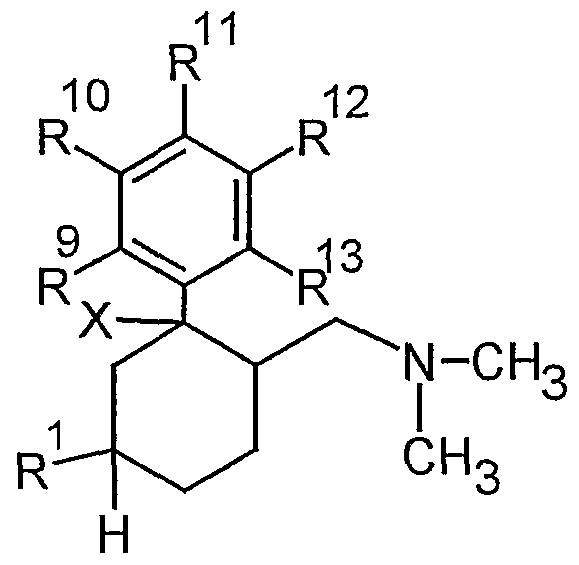
Dementsprechend ist Erfindungsgegenstand die Verwendung einer substituierten 6-Dimethylaminomethyl-1-phenyl-cyclohexanverbindung gemäß allgemeiner Formel IAccordingly, the subject of the invention is the use of a substituted 6-dimethylaminomethyl-1-phenyl-cyclohexane compound according to general formula I.
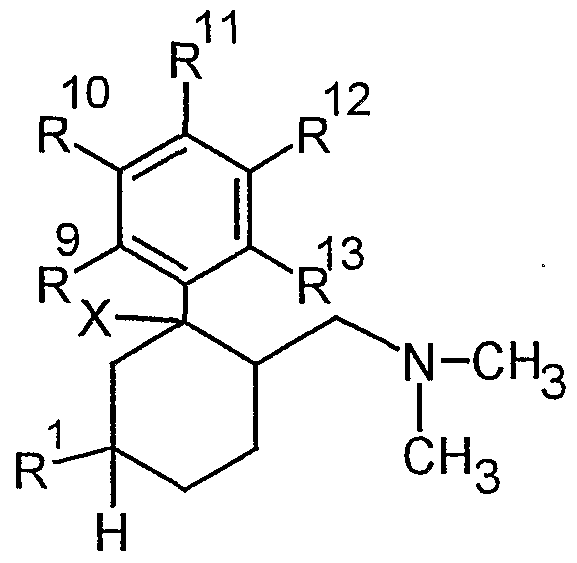
worin X ausgewählt ist aus OH, F, Cl, H oder OC(O)R7 mit R7 ausgewählt aus C-j. -Alkyl, verzweigt oder unverzweigt, gesättigt oder ungesättigt, unsubstituiert oder ein- oder mehrfach substituiert,wherein X is selected from OH, F, Cl, H or OC (O) R 7 with R 7 selected from Cj. Alkyl, branched or unbranched, saturated or unsaturated, unsubstituted or mono- or polysubstituted,
R1 ausgewählt ist aus C^-Alkyl, Benzyl, CF3, OH, OCH2- CßH5, O-Cι_4-Alkyl, Cl oder F undR 1 is selected from C ^ alkyl, benzyl, CF3, OH, OCH 2 - CßH5, O-Cι_4-alkyl, Cl or F and
R9 bis R"! 3 jeweils unabhängig voneinander ausgewählt sind aus H, F, Cl, Br, I, CH2F, CHF2, CF3, OH, SH, OR14, OCF3,R9 to R " ! 3 are each independently selected from H, F, Cl, Br, I, CH 2 F, CHF 2 , CF3, OH, SH, OR 14 , OCF3,
SR14, NR17R18, SOCH3, SOCF3; SO2CH3, SO2CF3, CN,SR 14 , NR 17 R 18 , SOCH3, SOCF 3; SO 2 CH 3 , SO 2 CF 3 , CN,
COOR14, NO2, CONR17R18 ; Cι_6-Alkyl, verzweigt oder unverzweigt, gesättigt oder ungesättigt, unsubstituiert oder ein- oder mehrfach substituiert; Phenyl, unsubstituiert oder ein- oder mehrfach substituiert;COOR 14 , NO 2 , CONR 17 R 18 ; Cι_6-alkyl, branched or unbranched, saturated or unsaturated, unsubstituted or mono- or polysubstituted; Phenyl, unsubstituted or mono- or polysubstituted;
mit R^4 ausgewählt aus C-|_6-Alkyl; Pyridyl, Thienyl,with R ^ 4 selected from C- | _6-alkyl; Pyridyl, thienyl,
Thiazolyl, Phenyl, Benzyl oder Phenethyl, jeweils unsubstituiert oder ein- oder mehrfach substituiert; PO(O-C _4-Alkyl)2, CO(OC-|_5-Alkyl),Thiazolyl, phenyl, benzyl or phenethyl, each unsubstituted or mono- or polysubstituted; PO (OC _4-alkyl) 2 , CO (OC- | _5-alkyl),
CONH-C6H4-(C-]_3-Alkyl), CO(C1_5-Alkyl), CO-CHR17-CONH-C 6 H 4 - (C -] _ 3 -alkyl), CO (C 1 _ 5 -alkyl), CO-CHR 17 -
NHR18, CO-C6H4-R1 5, mit R 5 ortho-OCOC-i_3-Alkyl oder meta- oder para-CH2N(R16)2 mit R16 C-|_4-Alkyl oder 4-Morpholino, wobei in den Resten R14, R15 und R 6 die Alkylgruppen verzweigt oder unverzweigt, gesättigt oder ungesättigt, unsubstituiert oder ein- oder mehrfach substituiert sein können; mit R^7 und R18 jeweils unabhängig voneinander ausgewählt aus H; Cι_6-Alkyl, verzweigt oder unverzweigt, gesättigt oder ungesättigt, unsubstituiert oder ein- oder mehrfach substituiert; Phenyl, Benzyl oder Phenethyl, jeweils unsubstituiert oder ein- oder mehrfach substituiert,NHR 18 , CO-C 6 H 4 -R 1 5 , with R 5 ortho-OCOC-i_3-alkyl or meta- or para-CH 2 N (R 16 ) 2 with R 16 C- | _4-alkyl or 4- Morpholino, where in the radicals R 14 , R 15 and R 6 the alkyl groups can be branched or unbranched, saturated or unsaturated, unsubstituted or mono- or polysubstituted; with R ^ 7 and R18 each independently selected from H; Cι_6-alkyl, branched or unbranched, saturated or unsaturated, unsubstituted or mono- or polysubstituted; Phenyl, benzyl or phenethyl, in each case unsubstituted or mono- or polysubstituted,
oderor
R9 und R 0 oder R10 und R1 zusammen einen OCH O-, OCH2CH2O-, OCH=CH-, CH=CHO-, CH=C(CH3)O-,R 9 and R 0 or R 10 and R 1 together form an OCH O-, OCH 2 CH 2 O-, OCH = CH-, CH = CHO-, CH = C (CH3) O-,
OC(CH3)=CH-, (CH2)4- oder OCH=CHO-Ring bilden,Form OC (CH3) = CH-, (CH 2 ) 4 - or OCH = CHO ring,
in Form ihrer Razemate; Enantiomere, Diastereomere, insbesondere Mischungen ihrer Enantiomere oder Diastereomere oder eines einzelnen Enantiomers oder Diastereomers; ihrer Basen und/oderin the form of their racemates; Enantiomers, diastereomers, in particular mixtures of their enantiomers or diastereomers or of a single enantiomer or diastereomer; their bases and / or
Salze physiologisch verträglicher SäurenSalts of physiologically acceptable acids
zur Herstellung eines Arzneimittels zur Behandlung von vermehrtem Harndrang bzw. Harninkontinenz.for the manufacture of a medicament for the treatment of increased urge to urinate or urinary incontinence.
Überraschenderweise hatte sich herausgestellt, daß die genannten Substanzen bestimmte physiologische Parameter, die bei vermehrtem Harndrang bzw. Harninkontinenz von Bedeutung sind, deutlich positiv beeinflußen, so entweder den Schwellendruck, das Interkontraktionsintervall, bzw. die Verringerung der rhythmischenSurprisingly, it had been found that the substances mentioned have a clearly positive influence on certain physiological parameters which are important in the case of increased urge to urinate or urinary incontinence, such as either the threshold pressure, the inter-contraction interval or the reduction in the rhythmic
Blasenkontraktionen und/oder die Blasenkapazität. Jede einzelne dieser Veränderungen kann eine deutliche Erleichterung im symptomatischen Bild von betroffener Patienten bedeuten. Entsprechende Verbindungen und deren Herstellung sind aus der DE 195 25 137 A1 bekannt. Im Sinne dieser Erfindung versteht man unter Alkyl-Resten gesättigte und ungesättigte, verzweigte und unverzweigte Kohlenwasserstoffe, die auch mindestens einfach substituiert sein können. Bevorzugte Alkyl-Reste sind Methyl, Ethyl, Vinyl (Ethenyl), Propyl, Allyl (2-Propenyl), 1-Propinyl, Methylethyl, n-Butyl, sek.-Butyl, tert.-Butyl, 1-Methylpropyl, 2-Methylpropyl, 1 ,1-Dimethylethyl, Pentyl, 1 ,1-Dimethylpropyl, 1 ,2-Dimethylpropyl, 2,2-Di- methylpropyl, Hexyl, 1-Methylpentyl, CHF2, CF3 oder CH2OH.Bladder contractions and / or bladder capacity. Each and every one of these changes can mean a significant relief in the symptomatic picture of affected patients. Corresponding compounds and their preparation are known from DE 195 25 137 A1. For the purposes of this invention, alkyl radicals are taken to mean saturated and unsaturated, branched and unbranched hydrocarbons, which can also be substituted at least once. Preferred alkyl radicals are methyl, ethyl, vinyl (ethenyl), propyl, allyl (2-propenyl), 1-propynyl, methylethyl, n-butyl, sec-butyl, tert-butyl, 1-methyl propyl, 2-methyl propyl , 1, 1-dimethylethyl, pentyl, 1, 1-dimethylpropyl, 1, 2-dimethylpropyl, 2,2-dimethylpropyl, hexyl, 1-methylpentyl, CHF 2 , CF 3 or CH 2 OH.
Weiter versteht man unter Cykloalkyl-Resten im Sinne dieser Erfindung gesättigte cyklische Kohlenwasserstoffe, die auch mindestens einfach substituiert sein können. Bevorzugte Cykloalkyl-Reste sind Cyclopropyl, Cyclobutyl, Cyclopentyl, Cyclohexyl oder CycloheptylCycloalkyl radicals for the purposes of this invention are also understood to be saturated cyclic hydrocarbons which can also be at least monosubstituted. Preferred cycloalkyl radicals are cyclopropyl, cyclobutyl, cyclopentyl, cyclohexyl or cycloheptyl
Dabei versteht man im Zusammenhang mit Alkyl und Cycloalkyl unter dem Begriff substituiert im Sinne dieser Erfindung die Substitution eines Wasserstoffrestes durch F, Cl, Br, I, NH2, SH oder OH, wobei unter „mehrfach substituiert" zu verstehen ist, daß die Substitution sowohl an verschiedenen als auch an gleichen Atomen mehrfach mit den gleichen oder verschiedenen Substituenten erfolgt, beispielsweise dreifach am gleichen C-Atom wie im Falle von CF3 oder an verschiedenen Stellen wie im Falle von -CH(OH)-CH=CH-CHCI2.In connection with alkyl and cycloalkyl, the term substituted in the sense of this invention means the substitution of a hydrogen radical by F, Cl, Br, I, NH 2 , SH or OH, where “multiply substituted” is understood to mean that the substitution both on different and on the same atoms are carried out several times with the same or different substituents, for example three times on the same carbon atom as in the case of CF 3 or at different points as in the case of -CH (OH) -CH = CH-CHCI 2 ,
Dabei versteht man im Zusammenhang mit Phenyl, Benzyl oder Phenethyl unter substituiert bevorzugt die Substitution mit H, F, Cl, Br, I, CH2F, CHF2, CF3, OH, SH, OR1 9, OCF3, SRI 9, NH2, CONH2, SOCH3, SOCF3,In this case, in connection with phenyl, benzyl or phenethyl, the term substituted is preferably the substitution with H, F, Cl, Br, I, CH 2 F, CHF 2, CF 3, OH, SH, OR 1 9, OCF 3, SRI 9 , NH 2 , CONH 2 , SOCH3, SOCF3,
SO2CH3, SO2CF3, CN, COOR1 9, NO ; C<| _6-Alkyl, verzweigt oder unverzweigt, gesättigt oder ungesättigt, unsubstituiert oder ein- oder mehrfach substituiert; Phenyl, unsubstituiert; mit R19 ausgewählt aus Cι_6-Alkyl; verzweigt oder unverzweigt, gesättigt oder ungesättigt, unsubstituiert oder ein- oder mehrfach substituiert; oder C3.7-Cycloalkyl.SO 2 CH 3, SO 2 CF 3, CN, COOR 1 9, NO; C <| _6-alkyl, branched or unbranched, saturated or unsaturated, unsubstituted or mono- or polysubstituted; Phenyl, unsubstituted; with R19 selected from Cι_6-alkyl; branched or unbranched, saturated or unsaturated, unsubstituted or mono- or polysubstituted; or C 3 . 7- cycloalkyl.
Geeignete Salze im Sinne dieser Erfindung und in jeder der beanspruchten Verwendungen sind Salze des jeweiligen Wirkstoffes mit anorganischen bzw. organischen Säuren und/oder einem Zuckeraustauschstoff wie Saccharin, Cyclamat oder Acesulfam. Besonders bevorzugt ist jedoch das Hydrochlorid.Suitable salts in the sense of this invention and in each of the claimed uses are salts of the respective active ingredient with inorganic or organic acids and / or a sugar substitute such as saccharin, cyclamate or acesulfame. However, the hydrochloride is particularly preferred.
Bevorzugt ist dabei die Verwendung von Verbindungen gemäß Formel I worin X ausgewählt ist ausPreference is given to the use of compounds of the formula I in which X is selected from
OH, F, Cl, OC(O)CH3 oder H, vorzugsweise OH, F oder H, insbesondere OH.OH, F, Cl, OC (O) CH 3 or H, preferably OH, F or H, in particular OH.
Weiter bevorzugt ist dabei auch die Verwendung von Verbindungen gemäß Formel I worin R1 ausgewählt ist ausAlso preferred is the use of compounds of the formula I in which R 1 is selected from
Cι_4-Alkyl, CF3, OH, O-C-|_4-Alkyl, Cl oder F, vorzugsweiseCι_4-alkyl, CF3, OH, O-C- | _4-alkyl, Cl or F, preferably
OH, CF3 oder CH3.OH, CF 3 or CH 3 .
Bevorzugt ist weiter die Verwendung von Verbindungen gemäß Formel I worin R9 bis R13, wobei 3 oder 4 der Reste R9 bis R 3 H entsprechen müssen, unabhängig voneinander ausgewählt sind ausPreference is furthermore given to the use of compounds of the formula I in which R 9 to R 13 , where 3 or 4 of the radicals R 9 to R 3 must correspond to H, are selected independently of one another
H, Cl, F, OH, CF2H, CF3 oder C1_4-Alkyl, gesättigt und unsubstituiert, verzweigt oder unverzweigt; OR14 oder SR14, mit R14 ausgewählt aus C-j_3-Alkyl, gesättigt und unsubstituiert, verzweigt oder unverzweigt; vorzugsweise H, Cl, F, OH, CF2H, CF3, OCH3 oder SCH3 H, Cl, F, OH, CF 2 H, CF 3 or C 1 _ 4 alkyl, saturated and unsubstituted, branched or unbranched; OR 14 or SR 14, where R 14 is selected from C j _3-alkyl, saturated and unsubstituted, branched or unbranched; preferably H, Cl, F, OH, CF 2 H, CF 3 , OCH 3 or SCH 3
oder R12 und R11 einen 3,4-OCH=CH-Ring bildenor R 12 and R 11 form a 3,4-OCH = CH ring
insbesondere solche, worin,especially those in which
wenn R9, R11 und R13 H entsprechen, einer von R10 oder R12 auch H entspricht, während der andere ausgewählt ist aus:if R 9 , R 11 and R 13 correspond to H, one of R 10 or R 12 also corresponds to H, while the other is selected from:
Cl, F, OH, CF2H, CF3, OR14 oder SR14, vorzugsweise OH,Cl, F, OH, CF 2 H, CF 3 , OR 14 or SR 14 , preferably OH,
CF2H, OCH3 oder SCH3,CF 2 H, OCH 3 or SCH 3 ,
oder,or,
wenn R9 und R13 H entsprechen und R11 OH, OCH3, Cl oder F, vorzugsweise Cl, entspricht, einer von R10 oder R12 auch H entspricht, während der andere OH, OCH3, Cl oder F, vorzugsweise Cl, entspricht,when R 9 and R 13 correspond to H and R 11 corresponds to OH, OCH 3 , Cl or F, preferably Cl, one of R 10 or R 12 also corresponds to H, while the other OH, OCH 3 , Cl or F, preferably Cl corresponds to
oder,or,
wenn R9, R10, R12 und R13 H entsprechen, R11 ausgewählt ist aus CF3, CF2H, Cl oder F, vorzugsweise F,when R 9 , R 10 , R 12 and R 13 correspond to H, R 11 is selected from CF 3 , CF 2 H, Cl or F, preferably F,
oder,or,
wenn R10, R11 und R12 H entsprechen, einer von R9 oder R13 auch H entspricht, während der andere ausgewählt ist aus OH, OC2H5 oder OC3H7. Ebenfalls bevorzugt ist die Verwendung von Verbindungen gemäß Formel worin R9, R11 und R13 H entsprechen, einer von R10 oder R12 auch H entspricht, während der andere ausgewählt ist aus:when R 10 , R 11 and R 12 correspond to H, one of R 9 or R 13 also corresponds to H, while the other is selected from OH, OC 2 H 5 or OC 3 H 7 . Also preferred is the use of compounds according to the formula in which R 9 , R 11 and R 13 correspond to H, one of R 10 or R 12 also corresponds to H, while the other is selected from:
Cl, F, OH, SH, CF2H, CF3, OR14 oder SR14, vorzugsweise OH oder OR14, insbesondere OH oder OC-j_3-Alkyl, vorzugsweiseCl, F, OH, SH, CF 2 H, CF 3, OR 14 or SR 14, preferably OH or OR 14, in particular OH or OC j _3-alkyl, preferably
OH oder OCH3.OH or OCH 3 .
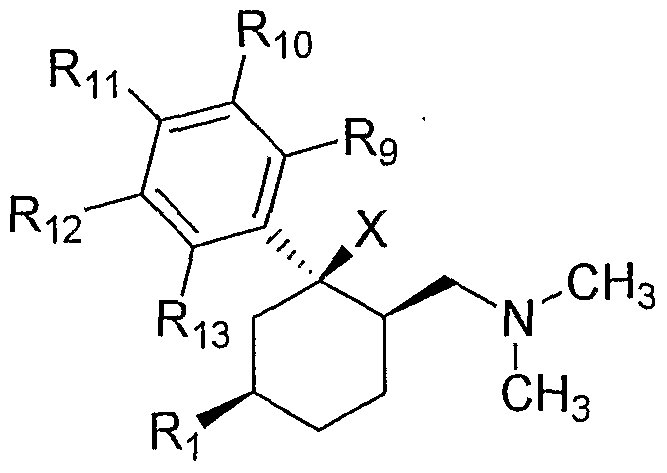
Es ist auch bevorzugt, wenn Verbindungen gemäß Formel I in Form der Diastereomeren mit der relativen Konfiguration laIt is also preferred if compounds of the formula I in the form of the diastereomers with the relative configuration Ia
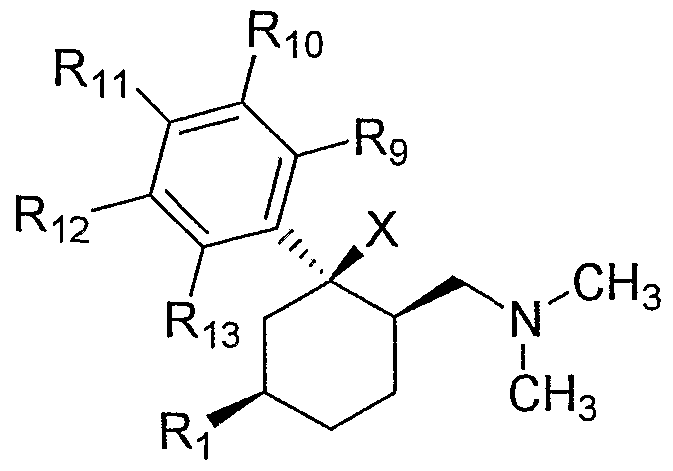
lala
vorliegen, insbesondere in Mischungen mit höherem Anteil dieses Diastereomeren im Vergleich zum anderen Diastereomeren oder als reines Diastereomer verwendet werden.are present, in particular in mixtures with a higher proportion of this diastereomer compared to the other diastereomers or used as a pure diastereomer.
Weiter ist es bevorzugt, wenn die Verbindungen der Formel I in Form des (+)-Enantiomeren, insbesondere in Mischungen mit höherem Anteil des (+)-Enantiomeren im Vergleich zum (-)-Enantiomeren einer racemischen Verbindung oder als reines (+)-Enantiomer verwendet werden.It is further preferred if the compounds of the formula I in the form of the (+) enantiomer, in particular in mixtures with a higher proportion of the (+) enantiomer compared to the (-) - enantiomer of a racemic compound or as pure (+) - Enantiomer can be used.
Generell ist auch bei bevorzugter Verwendung des (+)-Enantiomeren ein gegenüber dem (+)-Enantiomeren geringerer Anteil an (-)-Enantiomer akzeptabel und darf - muß aber nicht - bei der erfindungsgemässen Verwendung enthalten sein.In general, even with preferred use of the (+) enantiomer, there is a lower proportion of (-) enantiomer than the (+) enantiomer acceptable and may - but need not - be included in the use according to the invention.
Besonders bevorzugt ist die Verwendung einer Verbindung ausgewählt aus folgender Gruppe:The use of a compound selected from the following group is particularly preferred:
(1 RS,3RS,6RS)-6-Dimethylaminomethyl-1 -(3-methoxy- phenyl)-cyclohexan-1 ,3-diol,(1 RS, 3RS, 6RS) -6-dimethylaminomethyl-1 - (3-methoxyphenyl) cyclohexane-1, 3-diol,
(+)-(1 R,3R,6R)-6-Dimethylaminomethyl-1 -(3-methoxy- phenyl)-cyclohexan-1 ,3-diol,(+) - (1 R, 3R, 6R) -6-dimethylaminomethyl-1 - (3-methoxyphenyl) cyclohexane-1, 3-diol,
(1 RS,3RS,6RS)-6-Dimethylaminomethyl-1 -(3-hydroxy- phenyl)-cyclohexan-1 ,3-diol,(1 RS, 3RS, 6RS) -6-dimethylaminomethyl-1 - (3-hydroxyphenyl) cyclohexane-1, 3-diol,
(1 RS,3SR,6RS)-6-Dimethylaminomethyl-1 -(3-methoxy- phenyl)-cyclohexan-1 ,3-diol,(1 RS, 3SR, 6RS) -6-dimethylaminomethyl-1 - (3-methoxyphenyl) cyclohexane-1, 3-diol,
(+)-(1 R,2R,5S)-3-(2-Dimethylaminomethyl-1 -hydroxy-5-me- thyl-cyclohexyl)-phenol, oder(+) - (1 R, 2R, 5S) -3- (2-dimethylaminomethyl-1-hydroxy-5-methylcyclohexyl) phenol, or
(1 RS,2RS,5RS)-3-(2-Dimethylaminomethyl-1 -hydroxy-5-tri- fluoromethyl-cyclohexyl)-phenol,(1 RS, 2RS, 5RS) -3- (2-dimethylaminomethyl-1-hydroxy-5-trifluoromethyl-cyclohexyl) phenol,
vorzugsweise als Hydrochlorid.preferably as hydrochloride.
Auch wenn die erfindungsgemässen Verwendungen lediglich geringeEven if the uses according to the invention are only minor
Nebenwirkungen zeigen, kann es beispielsweise zur Vermeidung von bestimmten Formen der Abhängigkeit auch von Vorteil sein, neben Verbindungen gemäß allgemeiner Formel I auch Morphinantagonisten, insbesondere Naloxon, Naltrexon und/oder Levallorphan, zu verwenden.To show side effects, for example in order to avoid certain forms of dependency, it can also be advantageous to use morphine antagonists, in particular naloxone, naltrexone and / or levallorphan, in addition to compounds of the general formula I.
Die Erfindung umfaßt ebenfalls Arzneimittel zur Behandlung von vermehrtem Harndrang bzw. Harninkontinenz, die als Wirkstoff wenigstens eine substituierte 6-Dimethylaminomethyl-1 -phenyl-cyclohexanverbindung gemäß allgemeiner Formel I The invention also encompasses medicaments for the treatment of increased urge to urinate or urinary incontinence which contain at least one substituted 6-dimethylaminomethyl-1-phenyl-cyclohexane compound according to general formula I as active ingredient
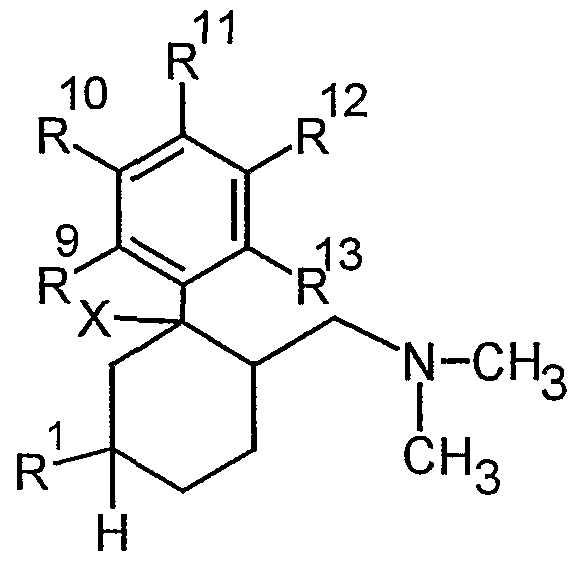
worinwherein
X ausgewählt ist aus OH, F, Cl, H oder OC(O)R7 mit R7 ausgewählt aus Cι_3-Alkyl, verzweigt oder unverzweigt, gesättigt oder ungesättigt, unsubstituiert oder ein- oder mehrfach substituiert,X is selected from OH, F, Cl, H or OC (O) R 7 with R 7 selected from C 3 alkyl, branched or unbranched, saturated or unsaturated, unsubstituted or mono- or polysubstituted,
R1 ausgewählt ist aus C^-Alkyl, Benzyl, CF3, OH, OCH2- C6H5, O-C-ι_4-Alkyl, Cl oder F undR 1 is selected from C ^ alkyl, benzyl, CF3, OH, OCH 2 - C6H5, OC ι_4 alkyl, Cl or F and
R9 bis R18 jeweils unabhängig voneinander ausgewählt sind aus H, F, Cl, Br, I, CH2F, CHF2, CF3, OH, SH, OR14, OCF3, SRI4,R 9 to R1 8 are each independently selected from H, F, Cl, Br, I, CH 2 F, CHF 2 , CF 3 , OH, SH, OR 14 , OCF3, SRI 4 ,
NR17R18, SOCH3, SOCF3; SO2CH3, SO2CF3, CN, COOR14, NO2,NR 17 R 18 , SOCH3, SOCF 3; SO 2 CH 3 , SO 2 CF 3 , CN, COOR 14 , NO 2 ,

mit RI ausgewählt aus C<ι_6-Alkyl; Pyridyl, Thienyl,with RI selected from C <ι_6-alkyl; Pyridyl, thienyl,
Thiazolyl, Phenyl, Benzyl oder Phenethyl, jeweils unsubstituiert oder ein- oder mehrfach substituiert; PO(O-C-ι_4-Alkyl)2, 00(00-1 _5-Alkyl), CONH-C6H -(C1_3-Alkyl), CO(C1_5-Alkyl), CO-CHR 7- NHR18, CO-C6H4-R15, mit R15 ortho-OCOC-|.3-Alkyl oder meta- oder para-CH2N(R 6)2 mit R 6 C-|_4-Alkyl oderThiazolyl, phenyl, benzyl or phenethyl, each unsubstituted or mono- or polysubstituted; PO (OC-ι_4-alkyl) 2 , 00 (00-1 _ 5 alkyl), CONH-C 6 H - (C 1 _3-alkyl), CO (C 1 _ 5 -alkyl), CO-CHR 7 - NHR 18 , CO-C 6 H 4 -R 15 , with R 15 ortho-OCOC- | , 3 -alkyl or meta- or para-CH 2 N (R 6 ) 2 with R 6 C- | _4-alkyl or
4-Morpholino, wobei in den Resten R14, R15 und R16 die Alkylgruppen verzweigt oder unverzweigt, gesättigt oder ungesättigt, unsubstituiert oder ein- oder mehrfach substituiert sein können;4-morpholino, where in the radicals R 14 , R 15 and R 16 the alkyl groups can be branched or unbranched, saturated or unsaturated, unsubstituted or mono- or polysubstituted;
mit R^ 7 und R18 jeweils unabhängig voneinander ausgewählt aus H; C-i-ß-Alkyl, verzweigt oder unverzweigt, gesättigt oder ungesättigt, unsubstituiert oder ein- oder mehrfach substituiert; Phenyl, Benzyl oder Phenethyl, jeweils unsubstituiert oder ein- oder mehrfach substituiert,with R ^ 7 and R18 each independently selected from H; Ci-ß-alkyl, branched or unbranched, saturated or unsaturated, unsubstituted or mono- or polysubstituted; Phenyl, benzyl or phenethyl, in each case unsubstituted or mono- or polysubstituted,
oderor
R9 und R10 oder R1 0 und R1 1 zusammen einen OCH2O-, OCH2CH2O-, OCH=CH-, CH=CHO-, CH=C(CH3)O-, OC(CH3)=CH-, (CH2)4- oder OCH=CHO-Ring bilden,R 9 and R 10 or R 1 0 and R 1 1 together form an OCH 2 O-, OCH 2 CH 2 O-, OCH = CH-, CH = CHO-, CH = C (CH3) O-, OC (CH3) = Form CH-, (CH 2 ) 4 - or OCH = CHO ring,
in Form ihrer Razemate; Enantiomere, Diastereomere, insbesondere Mischungen ihrer Enantiomere oder Diastereomere oder eines einzelnen Enantiomers oder Diastereomers; ihrer Basen und/oder Salze physiologisch verträglicher Säurenin the form of their racemates; Enantiomers, diastereomers, in particular mixtures of their enantiomers or diastereomers or of a single enantiomer or diastereomer; their bases and / or salts of physiologically acceptable acids
sowie gegebenenfalls Zusatz- und/oder Hilfsstoffe enthalten.and optionally contain additives and / or auxiliaries.
Geeignete Salze im Sinne dieser Erfindung und in jeder der beanspruchten Verwendungen sind Salze des jeweiligen Wirkstoffes mit anorganischen bzw. organischen Säuren und/oder einem Zuckeraustauschstoff wie Saccharin, Cyclamat oder Acesulfam. Besonders bevorzugt ist jedoch das Hydrochlohd.Suitable salts in the sense of this invention and in each of the claimed uses are salts of the respective active ingredient with inorganic or organic acids and / or a sugar substitute such as Saccharin, cyclamate or acesulfame. However, hydrochloride is particularly preferred.
Geeignete Zusatz- und/oder Hilfsstoffe im Sinne dieser Erfindung sind alle dem Fachmann aus dem Stand der Technik bekannten Stoffe zur Erreichung galenischer Formulierungen. Die Auswahl dieser Hilfsstoffe sowie die einzusetzenden Mengen derselben hängen davon ab, ob das Arzneimittel oral, intravenös, intraperitoneal, intradermal, intramuskulär, intranasal, buccal oder lokal appliziert werden soll. Für die orale Applika- tion eignen sich Zubereitungen in Form von Tabletten, Kautabletten, Dragees, Kapseln, Granulaten, Tropfen, Säften oder Sirupen, für die parenterale, topische und inhalative Applikation Lösungen, Suspensionen, leicht rekonstituierbare Trockenzubereitungen sowie Sprays. Eine weitere Möglichkeit sind Suppositorien für die Anwendung im Rektum. Die Anwen- düng in einem Depot in gelöster Form, einer Trägerfolie oder einemSuitable additives and / or auxiliaries for the purposes of this invention are all substances known to the person skilled in the art from the prior art for achieving galenical formulations. The selection of these auxiliaries and the amounts to be used depend on whether the medicament is to be administered orally, intravenously, intraperitoneally, intradermally, intramuscularly, intranasally, buccally or locally. Preparations in the form of tablets, chewable tablets, dragees, capsules, granules, drops, juices or syrups are suitable for oral administration, and solutions, suspensions, easily reconstitutable dry preparations and sprays are suitable for parenteral, topical and inhalation administration. Another possibility is suppositories for use in the rectum. The application in a depot in dissolved form, a carrier film or a
Pflaster, gegebenenfalls unter Zusatz von die Hautpenetration fördernden Mitteln, sind Beispiele für geeignete perkutane Applikationsformen. Beispiele für Hilfs- und Zusatzmitteln für die oralen Applikationsformen sind Sprengmittel, Gleitmittel, Binder, Füllmittel, Formtrennmittel, gegebenen- falls Lösungsmittel, Geschmacksstoffe, Zucker, insbesondere Trägermittel, Verdünnungsmittel, Farbstoffe, Antioxidantien etc. Für Suppositorien können u.a. Wachse bzw. Fettsäureester und für parenterale Applikationsmittel Trägerstoffe, Konservierungsmittel, Suspensionshilfsmittel etc. verwendet werden. Die an Patienten zu verabreichenden Wirkstoffmengen variieren in Abhängigkeit vom Gewicht des Patienten, von derPatches, possibly with the addition of agents that promote skin penetration, are examples of suitable percutaneous forms of application. Examples of auxiliaries and additives for oral administration forms are disintegrants, lubricants, binders, fillers, mold release agents, if appropriate solvents, flavorings, sugars, in particular carriers, diluents, colorants, antioxidants, etc. For suppositories, i.a. Waxes or fatty acid esters and carriers, preservatives, suspension aids etc. are used for parenteral application agents. The amounts of active ingredient to be administered to patients vary depending on the weight of the patient
Applikationsart und dem Schweregrad der Erkrankung. Aus oral, rektal oder perkutan anwendbaren Zubereitungsformen können die erfindungsgemäßen Verbindungen verzögert freigesetzt werden. Bei der erfindungsgemäßen Indikation sind entsprechende Retard-Formulierungen, ins- besondere in Form eines „Once-daily"-Präparats, das nur einmal am Tag eingenommen werden muß, besonders bevorzugt. Weiter bevorzugt sind Arzneimittel, die wenigstens 0,05 bis 90,0 % des Wirkstoffes enthalten, insbesondere niedrige wirksame Dosierungen, um Neben- oder analgetische Wirkungen zu vermeiden. Üblicherweise werden 0,1 bis 5000 mg/kg, insbesondere 1 bis 500 mg/kg, vorzugsweise 2 bis 250 mg/kg Körpergewicht wenigstens einer Verbindung der Formel I appliziert. Ebenso bevorzugt und üblich ist aber auch die Applikation von 0,01 - 5 mg/kg, vorzugsweise 0,03 bis 2 mg/kg, insbesondere 0,05 bis 1 mg/kg Körpergewicht.Type of application and the severity of the disease. The compounds according to the invention can be released in a delayed manner from preparation forms which can be used orally, rectally or percutaneously. In the indication according to the invention, corresponding slow-release formulations, in particular in the form of a “once-daily” preparation, which only has to be taken once a day, are particularly preferred. Further preferred are drugs that contain at least 0.05 to 90.0% of the active ingredient, in particular low effective doses, in order to avoid side effects or analgesic effects. Usually 0.1 to 5000 mg / kg, in particular 1 to 500 mg / kg, preferably 2 to 250 mg / kg body weight of at least one compound of the formula I are applied. However, application of 0.01 to 5 mg / kg, preferably 0.03 to 2 mg / kg, in particular 0.05 to 1 mg / kg of body weight is also preferred and usual.
Hilfsstoffe können beispielsweise sein: Wasser, Ethanol, 2-Propanol, Glycerin, Ethylenglycol, Propylenglycol, Polyethylenglycol, Polypropylenglycol, Glucose, Fructose, Lactose, Saccharose, Dextrose, Melasse, Stärke, modifizierte Stärke, Gelatine, Sorbitol, Inositol, Mannitol, mikrokristalline Cellulose, Methylcellulose, Carboxymethylcellulose,Excipients can be, for example: water, ethanol, 2-propanol, glycerol, ethylene glycol, propylene glycol, polyethylene glycol, polypropylene glycol, glucose, fructose, lactose, sucrose, dextrose, molasses, starch, modified starch, gelatin, sorbitol, inositol, mannitol, microcrystalline cellulose , Methyl cellulose, carboxymethyl cellulose,
Celluloseacetat, Schellack, Cetylalkohol, Polyvinylpyrrolidon, Paraffine, Wachse, natürliche und synthetische Gummis, Akaziengummi, Alginate, Dextran, gesättigte und ungesättigte Fettsäuren, Stearinsäure, Magnesiumstearat, Zinkstearat, Glycerylstearat, Natriumlaurylsulfat, ge- nießbare Öle, Sesamöl, Kokusnußöl, Erdnußöl, Sojabohnenöl, Lecithin, Natriumlactat, Polyoxyethylen- und -propylen-fettsäureester, Sorbitanfettsäureester, Sorbinsäure, Benzoesäure, Citronensäure, Ascorbinsäure, Tanninsäure, Natriumchlorid, Kaliumchlorid, Magnesiumchlorid, Calciumchlorid, Magnesiumoxid, Zinkoxid, Siliciumdioxid, Titanoxid, Titandioxid, Magnesiumsulfat, Zinksulfat, Calciumsulfat, Pottasche, Calciumphosphat, Dicalciumphosphat, Kaliumbromid, Kaliumiodid, Talkum, Kaolin, Pectin, Crospovidon, Agar und Bentonit.Cellulose acetate, shellac, cetyl alcohol, polyvinylpyrrolidone, paraffins, waxes, natural and synthetic gums, acacia gum, alginates, dextran, saturated and unsaturated fatty acids, stearic acid, magnesium stearate, zinc stearate, glyceryl stearate, sodium lauryl oil oil, edible oil oil, edible oil oil, edible oil oil, edible oil oil, edible oil oil, edible oil oil, edible oil oil, edible oil oil , Lecithin, sodium lactate, polyoxyethylene and propylene fatty acid esters, sorbitan fatty acid esters, sorbic acid, benzoic acid, citric acid, ascorbic acid, tannic acid, sodium chloride, potassium chloride, magnesium chloride, calcium chloride, magnesium oxide, zinc oxide, silicon dioxide, titanium oxide, titanium dioxide, magnesium sulfate, zinc sulfate, zinc sulfate, zinc sulfate , Calcium phosphate, dicalcium phosphate, potassium bromide, potassium iodide, talc, kaolin, pectin, crospovidone, agar and bentonite.
Die Herstellung der erfindungsgemäßen Arzneimittel und pharmazeutischen Zusammensetzungen erfolgt mit Hilfe von im Stand der Technik der pharmazeutischen Formulierung wohlbekannten Mitteln, Vorrichtungen, Methoden und Verfahren, wie sie beispielsweise in "Remington's Pharmaceutical Sciences", Hrsg. A.R. Gennaro, 17. Ed., Mack Publishing Company, Easton, Pa. (1985), insbesondere in Teil 8, Kapitel 76 bis 93, beschrieben sind.The pharmaceuticals and pharmaceutical compositions according to the invention are produced with the aid of the prior art the pharmaceutical formulation of well-known agents, devices, methods and processes, as described, for example, in "Remington's Pharmaceutical Sciences", ed. AR Gennaro, 17th Ed., Mack Publishing Company, Easton, Pa. (1985), in particular in Part 8, Chapters 76 to 93.
So kann z.B. für eine feste Formulierung, wie eine Tablette, der Wirkstoff des Arzneimittels, d.h. eine Verbindung der allgemeinen Struktur I oder eines ihrer pharmazeutisch annehmbaren Salze, mit einem pharmazeutischen Träger, z.B. herkömmlichen Tabletteninhaltsstoffen, wie Maisstärke, Lactose, Saccharose, Sorbitol, Talkum, Magnesiumstearat, Dicalciumphosphat oder pharmazeutisch akzeptable Gummis, und pharmazeutischen Verdünnungsmitteln, wie z.B. Wasser, granuliert werden, um eine feste Zusammensetzungzu bilden, die eine erfindungsgemäße Verbindung oder ein pharmazeutisch annehmbares Salz davon in homogener Verteilung enthält. Unter einer homogenen Verteilung wird hier verstanden, daß der Wirkstoff gleichmäßig über die gesamte Zusammensetzung verteilt ist, so daß diese ohne weiteres in gleich wirksame Einheitsdosis-Formen, wie Tabletten, Pillen oder Kapseln, unterteilt werden kann. Die feste Zusammensetzungwird anschließend in Einheitsdosis-Formen unterteilt. Die Tabletten oder Pillen des erfindungsgemäßen Arzneimittels bzw. der erfindungsgemäßen Zusammensetzungen können auch überzogen oder auf andere Weise kompoundiert werden, um eine Dosisform mit verzögerter Freisetzung bereitzustellen. Geeignete Beschichtungsmittel sind u.a. polymere Säuren und Mischungen von polymeren Säuren mit Materialien wie z.B. Schellack, Cetylalkohol und/oder Celluloseacetat.For example, for a solid formulation, such as a tablet, the active ingredient of the drug, i.e. a compound of general structure I or one of its pharmaceutically acceptable salts, with a pharmaceutical carrier, e.g. conventional tablet ingredients such as corn starch, lactose, sucrose, sorbitol, talc, magnesium stearate, dicalcium phosphate or pharmaceutically acceptable gums, and pharmaceutical diluents such as e.g. Water, granulated to form a solid composition containing a compound of the invention or a pharmaceutically acceptable salt thereof in homogeneous distribution. A homogeneous distribution is understood here to mean that the active ingredient is uniformly distributed over the entire composition, so that it can be easily divided into equally effective unit dose forms, such as tablets, pills or capsules. The solid composition is then divided into unit dose forms. The tablets or pills of the medicament according to the invention or of the compositions according to the invention can also be coated or compounded in some other way in order to provide a dosage form with delayed release. Suitable coating agents include polymeric acids and mixtures of polymeric acids with materials such as e.g. Shellac, cetyl alcohol and / or cellulose acetate.
Auch wenn die erfindungsgemässen Arzneimittel lediglich geringe Neben- Wirkungen zeigen, kann es beispielsweise zur Vermeidung von bestimmten Formen der Abhängigkeit von Vorteil sein, neben den Verbindungen gemäß allgemeiner Formel l auch Morphinantagonisten, insbesondere Naloxon, Naltrexon und/oder Levallorphan, zu verwenden.Even if the medicaments according to the invention show only minor side effects, it can be advantageous, for example, to avoid certain forms of dependency, in addition to the compounds to use morphine antagonists, in particular naloxone, naltrexone and / or levallorphan, according to general formula I.
Bevorzugt sind Arzneimittel, in denen Verbindungen gemäß allgemeiner Formel I verwendet werden, worin X ausgewählt ist ausDrugs are preferred in which compounds according to general formula I are used, wherein X is selected from
OH, F, Cl, OC(O)CH3 oder H, vorzugsweise OH, F oder H, insbesondere OH.OH, F, Cl, OC (O) CH 3 or H, preferably OH, F or H, in particular OH.
Ebenfalls bevorzugt sind Arzneimittel, in denen Verbindungen gemäß allgemeiner Formel I verwendet werden, worin R1 ausgewählt ist ausAlso preferred are drugs in which compounds according to general formula I are used, in which R 1 is selected from
C-ι_4-Alkyl, CF3, OH, O-C-|_4-Alkyl, Cl oder F, vorzugsweise OH, CF3 oder CH3.C 1-4 alkyl, CF3, OH, OC- | _4 alkyl, Cl or F, preferably OH, CF 3 or CH 3 .
Es ist weiter bevorzugt, wenn in den erfindungsgemäßen ArzneimittelnIt is further preferred if in the pharmaceuticals according to the invention
Verbindungen gemäß allgemeiner Formel I verwendet werden, worin R >9 bis R13, wobei 3 oder 4 der Reste R9 bis R13 H entsprechen müssen, unabhängig voneinander ausgewählt sind ausCompounds according to general formula I are used, in which R> 9 to R 13 , where 3 or 4 of the radicals R 9 to R 13 must correspond to H, are selected independently of one another
H, Cl, F, OH, CF2H, CF3 oder C1. -Alkyl, gesättigt und unsubstituiert, verzweigt oder unverzweigt; OR14 oder SR14, mit R14 ausgewählt aus C-|_3-Alkyl, gesättigt und unsubstituiert, verzweigt oder unverzweigt;H, Cl, F, OH, CF 2 H, CF 3 or C 1 . -Alkyl, saturated and unsubstituted, branched or unbranched; OR 14 or SR 14 , with R 14 selected from C- | _3-alkyl, saturated and unsubstituted, branched or unbranched;
vorzugsweise H, Cl, F, OH, CF2H, CF3, OCH3 oder SCH3 preferably H, Cl, F, OH, CF 2 H, CF 3 , OCH 3 or SCH 3
oder R12 und R11 einen 3,4-OCH=CH-Ring bildenor R 12 and R 11 form a 3,4-OCH = CH ring
insbesondere dadurch gekennzeichnet, daß, wenn R9, R 1 und R13 H entsprechen, einer von R10 oder R12 auch H entspricht, während der andere ausgewählt ist aus:in particular characterized in that if R 9 , R 1 and R 13 correspond to H, one of R 10 or R 12 also corresponds to H, while the other is selected from:
Cl, F, OH, CF2H, CF3, OR14 oder SR14, vorzugsweise OH, C CFF22HH,, OORR1144 ooddeerr SSCCHH33,, iinnssbbeessoonnddeerre OH oder OC-| .Cl, F, OH, CF 2 H, CF 3 , OR 14 or SR 14 , preferably OH, C CFF 22 HH ,, OORR 1144 ooddeerr SSCCHH 33 ,, iinnssbbeessoonnddeerre OH or OC- | ,
Alkyl, vorzugsweise OH oder OCH3,Alkyl, preferably OH or OCH 3 ,
oder,or,
wenn R9 und R13 H entsprechen und R11 OH, OCH3, Cl oder F, vorzugsweise Cl, entspricht, einer von R10 oder R12 auch H entspricht, während der andere OH, OCH3, Cl oder F, vorzugsweise Cl, entspricht,when R 9 and R 13 correspond to H and R 11 corresponds to OH, OCH 3 , Cl or F, preferably Cl, one of R 10 or R 12 also corresponds to H, while the other OH, OCH 3 , Cl or F, preferably Cl corresponds to
oder,or,
wenn R9, R10, R und R13 H entsprechen, R11 ausgewählt ist aus CF3, CF2H, Cl oder F, vorzugsweise F,if R 9 , R 10 , R and R 13 correspond to H, R 11 is selected from CF 3 , CF 2 H, Cl or F, preferably F,
oder,or,
wenn R10, R11 und R12 H entsprechen, einer von R9 oder R13 auch H entspricht, während der andere ausgewählt ist aus OH, OC2H5 oder OC3H7.when R 10 , R 11 and R 12 correspond to H, one of R 9 or R 13 also corresponds to H, while the other is selected from OH, OC 2 H 5 or OC 3 H 7 .
Ebenfalls bevorzugt sind Arzneimittel, in denen Verbindungen gemäß allgemeiner Formel I verwendet werden, worin R9, R11 und R13 H entsprechen, einer von R10 oder R12 auch H entspricht, während der andere ausgewählt ist aus: Cl, F, OH, SH, CF2H, CF3, OR14 oder SR14, vorzugsweise OH oder OR14, insbesondere OH oder OC^-Alkyl, vorzugsweiseAlso preferred are medicaments in which compounds according to general formula I are used, in which R 9 , R 11 and R 13 correspond to H, one of R 10 or R 12 also corresponds to H, while the other is selected from: Cl, F, OH, SH, CF 2 H, CF 3 , OR 14 or SR 14 , preferably OH or OR 14 , in particular OH or OC ^ alkyl, preferably
OH oder OCH3.OH or OCH 3 .
Es ist weiter bevorzugt, wenn in den erfindungsgemäßen Arzneimitteln Verbindungen gemäß allgemeiner Formel I enthalten sind, die in Form der Diastereomeren mit der relativen Konfiguration laIt is further preferred if the medicaments according to the invention contain compounds of the general formula I which are in the form of the diastereomers with the relative configuration Ia
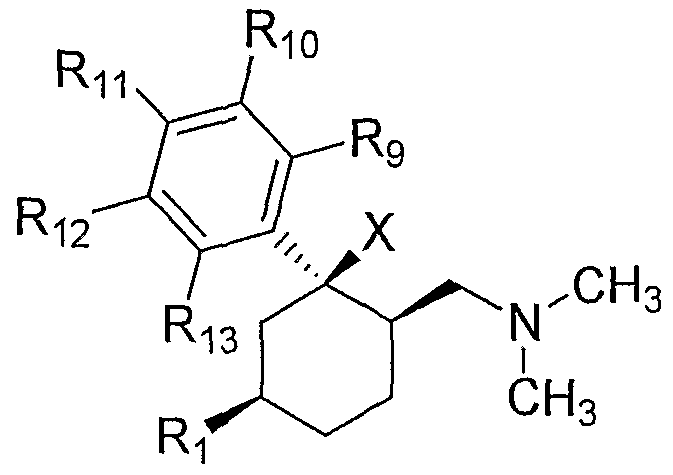
lala
vorliegen, insbesondere in Mischungen mit höherem Anteil dieses Diastereomeren im Vergleich zum anderen Diastereomeren oder als reines Diastereomer.are present, especially in mixtures with a higher proportion of this diastereomer compared to the other diastereomers or as a pure diastereomer.
Es ist weiter bevorzugt, wenn in den erfindungsgemäßen Arzneimitteln Verbindungen gemäß allgemeiner Formel I enthalten sind, die in Form des (+)-Enantiomeren vorliegen, insbesondere in Mischungen mit höherem Anteil des (+)-Enantiomeren im Vergleich zum (-)-Enantiomeren einer racemischen Verbindung oder als reines (+)-Enantiomer.It is further preferred if the medicaments according to the invention contain compounds according to general formula I which are in the form of the (+) enantiomer, in particular in mixtures with a higher proportion of the (+) enantiomer compared to the (-) enantiomer racemic compound or as pure (+) - enantiomer.
Generell ist auch bei bevorzugter Verwendung des (+)-Enantiomeren ein gegenüber dem (+)-Enantiomeren geringerer Anteil an (-)-Enantiomer akzeptabel und darf - muß aber nicht - bei den erfindungsgemässen Arzneimitteln enthalten sein. Besonders bevorzugt sind erfindungsgemäße Arzneimittel, die mindestens eine Verbindung ausgewählt aus folgender Gruppe enthalten:In general, even with preferred use of the (+) enantiomer, a lower proportion of (-) - enantiomer than the (+) enantiomer is acceptable and may - but need not - be present in the medicaments according to the invention. Medicaments according to the invention which contain at least one compound selected from the following group are particularly preferred:
(1 RS,3RS,6RS)-6-Dimethylaminomethyl-1-(3-methoxy- phenyl)-cyclohexan-1 ,3-diol,(1 RS, 3RS, 6RS) -6-dimethylaminomethyl-1- (3-methoxyphenyl) cyclohexane-1, 3-diol,
(+)-(1 R,3R,6R)-6-Dimethylaminomethyl-1 -(3-methoxy- phenyl)-cyclohexan-1 ,3-diol,(+) - (1 R, 3R, 6R) -6-dimethylaminomethyl-1 - (3-methoxyphenyl) cyclohexane-1, 3-diol,
(1 RS,3RS,6RS)-6-Dimethylaminomethyl-1-(3-hydroxy- phenyl)-cyclohexan-1 ,3-diol,(1 RS, 3RS, 6RS) -6-dimethylaminomethyl-1- (3-hydroxyphenyl) cyclohexane-1, 3-diol,
(1 RS,3SR,6RS)-6-Dimethylaminomethyl-1 -(3-methoxy- phenyl)-cyclohexan-1 ,3-diol,(1 RS, 3SR, 6RS) -6-dimethylaminomethyl-1 - (3-methoxyphenyl) cyclohexane-1, 3-diol,
(+)-(1 R,2R,5S)-3-(2-Dimethylaminomethyl-1 -hydroxy-5-me- thyl-cyclohexyl)-phenol oder(+) - (1 R, 2R, 5S) -3- (2-dimethylaminomethyl-1-hydroxy-5-methylcyclohexyl) phenol or
(1 RS,2RS,5RS)-3-(2-Dimethylaminomethyl-1-hydroxy-5-tri- fluoromethyl-cyclohexyl)-phenol,(1 RS, 2RS, 5RS) -3- (2-dimethylaminomethyl-1-hydroxy-5-trifluoromethyl-cyclohexyl) phenol,
vorzugsweise als Hydrochlorid.preferably as hydrochloride.
Weiter betrifft die Erfindung auch ein Verfahren zur Behandlung von vermehrtem Harndrang bzw. Harninkontinenz, bei dem die substituierten 6- Dimethylaminomethyl-1 -phenyl-cyclohexanverbindungen gemäß allgemeiner Formel I in Form ihrer Razemate; Enantiomere,The invention further relates to a method for the treatment of increased urge to urinate or urinary incontinence, in which the substituted 6-dimethylaminomethyl-1-phenyl-cyclohexane compounds according to general formula I in the form of their racemates; enantiomers,
Diastereomere, insbesondere Mischungen ihrer Enantiomere oder Diastereomere oder eines einzelnen Enantiomers oder Diastereomers; als freie Base und/oder in Form physiologisch verträglicher Salze verwendet werden.Diastereomers, in particular mixtures of their enantiomers or diastereomers or of a single enantiomer or diastereomer; can be used as a free base and / or in the form of physiologically acceptable salts.
Die folgenden Beispiele sollen die Erfindung erläutern, ohne daß der Gegenstand der Erfindung darauf beschränkt wäre.The following examples are intended to illustrate the invention, without the object of the invention being restricted thereto.
BeispieleExamples
Beispiel 1: Liste der getesteten Substanzen: Es folgt eine Liste der auf ihre Wirksamkeit getesteten Verbindungen:Example 1: List of substances tested: The following is a list of the compounds tested for effectiveness:

Beispiel 2: Testsystem Cystometrie an der wachen naiven RatteExample 2: Test system cystometry on the awake naive rat
Es wurden cystometrische Untersuchungen an naiven, weiblichen Sprague-Dawley-Ratten nach der Methode von Ishizuka et. al. ((1997), Naunyn-Schmiedeberg's Arch. Pharmacol. 355: 787 - 793) durchgeführt. Drei Tage nach Implantation von Blasen- und venösen Kathetern wurden die Tiere im wachen Zustand, frei beweglich untersucht. Der Blasenkatheter wurde an einem Druckaufnehmer und eine Injektionspumpe angeschlossen. Die Tiere wurden in Stoffwechselkäfige gesetzt, die die Messung des Harnvolumens ermöglichten. Physiologische Kochsalzlösung wurde in die entleerte Blase infundiert (10 ml/Std.) und Blasendruck und Miktionsvolumen kontinuierlich aufgezeichnet. Nach einer Stabilisierungsphase wurde eine 20minütige Phase aufgezeichnet, die durch normale, reproduzierbare Miktionszyklen gekennzeichnet war. Es wurden unter anderem die folgenden Parameter bestimmt:Cystometric studies on naive, female Sprague-Dawley rats were carried out according to the method of Ishizuka et. al. ((1997), Naunyn-Schmiedeberg's Arch. Pharmacol. 355: 787-793). Three days after the implantation of bladder and venous catheters, the animals were examined while awake, free to move. The urinary catheter was connected to a pressure transducer and an injection pump. The animals were placed in metabolic cages, which made it possible to measure urine volume. Physiological saline was infused into the emptied bladder (10 ml / hour) and bladder pressure and micturition volume were recorded continuously. After a stabilization phase, a 20-minute phase was recorded, which was characterized by normal, reproducible micturition cycles. Among other things, the following parameters were determined:
■ Schwellendruck (threshold pressure TP, Blasendruck unmittelbar vor Miktion), ■ Blasenkapazität (bladder capacity BC, Restvolumen nach vorhergehender Miktion plus Volumen der infudierten Lösung während der Füllungsphase), ■ threshold pressure (threshold pressure TP, bladder pressure immediately before micturition), ■ bladder capacity (bladder capacity BC, residual volume after prior micturition plus volume of infused solution during the filling phase)
■ Interkontraktionsintervall (inter-contraction interval (ICI), das Zeitintervall zwischen den Miktionen). ■ Inter-contraction interval (ICI), the time interval between micturition.
Eine Erhöhung des Schwellendrucks (TP) zeigt eine wichtige therapeutische Wirkung bei einer der erfindungsgemässen Indikationen an. Auch das Interkontraktionsintervall (ICI) ist ein wichtiger Parameter zur Messung der physiologischen Wirksamkeit eines Stoffes in derAn increase in the threshold pressure (TP) indicates an important therapeutic effect in one of the indications according to the invention. The inter-contraction interval (ICI) is also an important parameter for measuring the physiological effectiveness of a substance in the
Behandlung der Harninkontinenz, ebenso wie die Blasenkapazität (BC). Dabei ist es für eine Wirksamkeit aufgrund der sehr heterogenen Ursachen für die Symptomatik dieser Erkrankungsbilder nicht nötig, alle drei Parameter positiv zu beeinflussen. Es genügt daher völlig, wenn nur in einem dieser Parameter eine posive Wirkung festzustellen ist, um in der Harninkontinenz oder vermehrtem Harndrang einsetzbar zu sein.Treatment of urinary incontinence, as well as bladder capacity (BC). In order to be effective, it is not necessary to have a positive influence on all three parameters due to the very heterogeneous causes for the symptoms of these clinical pictures. It is therefore entirely sufficient if only one of these parameters has a positive effect in order to be used in urinary incontinence or increased urge to urinate.
Nach der Aufzeichnung von drei reproduzierbaren Miktionszyklen als Vorwert, wurden die Testsubstanzen 24 (1 ,0; 3,0; 5,0 mg/kg), 25 (1 ,5 mg/kg) und 26 (3,0 mg/kg) im Vehikel = 0.9 % NaCI i.v. appliziert und die Wirkung auf die cystometrischen Parameter 90 bis 120 Minuten aufgezeichnet. Im Wirkmaximum wurde der Mittelwert von 3 Miktionszyklen bestimmt und als prozentuale Veränderung gegenüber dem Vorwert dargestellt (Tabelle 1 ). After recording three reproducible micturition cycles as a preliminary value, the test substances 24 (1, 0; 3.0; 5.0 mg / kg), 25 (1, 5 mg / kg) and 26 (3.0 mg / kg) in vehicle = 0.9% NaCI applied iv and the effect on the cystometric parameters recorded for 90 to 120 minutes. The mean of 3 micturition cycles was determined at the effective maximum and presented as a percentage change compared to the previous value (Table 1).

Tabelle 1 : Beeinflussung der cystometrischen Parameter durch die Testsubstanzen (Veränderung zum Vorwert [%]); n entspricht der Anzahl der Versuchstiere.Table 1: Influence of the cystometric parameters by the test substances (change from previous value [%]); n corresponds to the number of test animals.
Die untersuchten Substanzen zeigen eine positive Wirkung auf die Blasenregulation und sind somit geeignet zur Behandlung der Harninkontinenz.The investigated substances show a positive effect on bladder regulation and are therefore suitable for the treatment of urinary incontinence.
Beispiel 3. Testsystem Cystometrie an der narkotisierten naiven RatteExample 3. Test system cystometry on the anesthetized naive rat
Die cystometrische Untersuchung an naiven weiblichen Ratten wurde nach der Methode von Kimura et al. (Kimura et al., 1996, Int. J. Ural. 3:218-227) durchgeführt. An narkotisierten, ventilierten Ratten wird das Abdomen eröffnet und die Harnleiter abgebunden. Der Harn wird von den Nieren abgeleitet. Ein Katheter wird in die Blase eingeführt und fixiert. Über diesen wird Saline mittels Infusionspumpe in die Blase infundiert, bis diese rhythmische Spσntanaktivität in Form von Kontraktionen zeigt, welche über einen angeschlossenen Druckaufnehmer aufgenommen werden können. Die Testsubstanz wird nach Erreichen stabiler Ausgangswerte in kumulativer Weise i.v. appliziert. Eine Beeinflussung der Blasenfunktion äußert sich über die Unterdrückung der Spontankontraktionen. Dabei gilt als Parameter für die Unterdrückung das Ausbleiben der Kontraktionen über einen Zeitraum von 10 min.The cystometric examination in naive female rats was carried out according to the method of Kimura et al. (Kimura et al., 1996, Int. J. Ural. 3: 218-227). On anesthetized, ventilated rats, the abdomen is opened and the ureters are tied off. The urine is drained from the kidneys. A catheter is inserted into the bladder and fixed. Saline is infused into the bladder by means of an infusion pump until this shows rhythmic activity in the form of contractions, which can be recorded via a connected pressure transducer. The test substance is administered iv in a cumulative manner after stable initial values have been reached. Influencing bladder function expresses itself about the suppression of spontaneous contractions. The absence of contractions over a period of 10 minutes is considered a parameter for the suppression.
Bei allen hier aufgelisteten Substanzen war eine Unterdrückung der Spontankontraktionen in den Ratten meßbar, wobei Tabelle 2 den Mittelwert der niedrigsten Dosis aus mindestens 2 Versuchen angibt, bei der erstmals Kontraktionen über einen Zeitraum von 10 min ausbleiben.Suppression of spontaneous contractions in the rats was measurable for all substances listed here, Table 2 giving the mean value of the lowest dose from at least 2 experiments in which contractions did not occur over a period of 10 min for the first time.
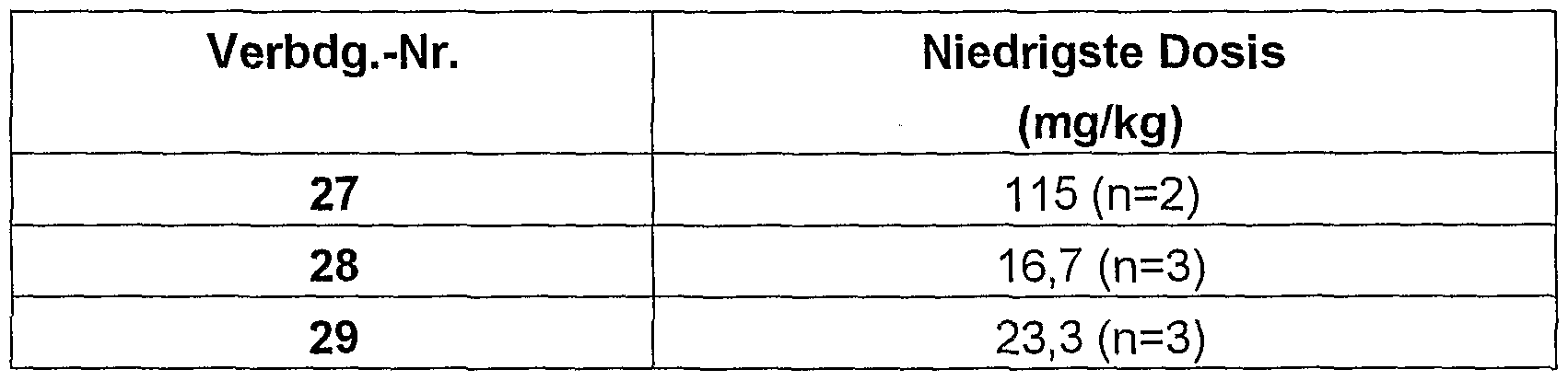
Die untersuchten Substanzen zeigen eine positive Wirkung auf die Blasenregulation und sind somit geeignet zur Behandlung der Harninkontinenz.The investigated substances show a positive effect on bladder regulation and are therefore suitable for the treatment of urinary incontinence.
Beispiel 4: Parenterale ApplikationsformExample 4: Parenteral application form
1 g der Verbindung 26 wird in 1 I Wasser für Injektionszwecke bei1 g of compound 26 is added in 1 liter of water for injections
Raumtemperatur gelöst und anschließend durch Zugabe von NaCI auf isotone Bedingungen eingestellt. Room temperature dissolved and then adjusted to isotonic conditions by adding NaCl.
Claims


Priority Applications (21)
| Application Number | Priority Date | Filing Date | Title |
|---|---|---|---|
| SI200130507T SI1353660T1 (en) | 2000-11-30 | 2001-11-28 | Use of substituted 6-dimethylaminomethyl-1-phenyl-cyclohexane compounds for treating urinary incontinence |
| AU2368802A AU2368802A (en) | 2000-11-30 | 2001-11-28 | Use of substituted 6-dimethylaminomethyl-1-phenyl-cyclohexane compounds for treating urinary incontinence |
| HK04102809.3A HK1061355B (en) | 2000-11-30 | 2001-11-28 | Use of substituted 6-dimethylaminomethyl-1-phenyl-cyclohexane compounds for treating urinary incontinence |
| AU2002223688A AU2002223688B2 (en) | 2000-11-30 | 2001-11-28 | Use of substituted 6-dimethylaminomethyl-1-phenyl-cyclohexane compounds for treating urinary incontinence |
| CN018197205A CN1518444B (en) | 2000-11-30 | 2001-11-28 | Use of substituted 6-dimethylaminomethyl-1-phenylcyclohexane compound in preparation of medicine for treating urinary incontinence |
| BR0115881-3A BR0115881A (en) | 2000-11-30 | 2001-11-28 | Use of 6-dimethylaminomethyl-1-phenyl-substituted cyclohexanone compounds for urinary incontinence therapy |
| JP2002545685A JP4284065B2 (en) | 2000-11-30 | 2001-11-28 | Methods of using substituted 6-dimethylaminomethyl-1-phenyl-cyclohexane compounds for the treatment of urinary incontinence |
| IL15614001A IL156140A0 (en) | 2000-11-30 | 2001-11-28 | Use of substituted 6-dimethylaminomethyl-1-phenyl-cyclohexane compounds for treating urinary incontinence |
| CA2430282A CA2430282C (en) | 2000-11-30 | 2001-11-28 | Use of substituted 6-dimethylaminomethyl-1-phenylcyclohexane compounds for treating urinary incontinence |
| EP01998336A EP1353660B1 (en) | 2000-11-30 | 2001-11-28 | Use of substituted 6-dimethylaminomethyl-1-phenyl-cyclohexane compounds for treating urinary incontinence |
| DE50108711T DE50108711D1 (en) | 2000-11-30 | 2001-11-28 | USE OF SUBSTITUTED 6-DIMETHYLAMINOMETHYL-1-PHENYL-CYCLOHEXANE COMPOUNDS FOR THE THERAPY OF HARNESS INCONTINENCE |
| MXPA03004801A MXPA03004801A (en) | 2000-11-30 | 2001-11-28 | Use of substituted 6-dimethylaminomethyl-1-phenyl-cyclohexane compounds for treating urinary incontinence. |
| SK595-2003A SK287536B6 (en) | 2000-11-30 | 2001-11-28 | Use of substituted 6-dimethylaminomethyl-1-phenyl-cyclohexanone compounds for treating urinary incontinence |
| PL365517A PL203093B1 (en) | 2000-11-30 | 2001-11-28 | Use of substituted 6-dimethylaminomethyl-1-phenyl-cyclohexane compounds for treating urinary incontinence |
| KR1020037007316A KR100835874B1 (en) | 2000-11-30 | 2001-11-28 | Use of substituted 6-dimethylaminomethyl-1-phenyl-cyclohexane compounds for the treatment of urinary incontinence |
| HU0303268A HU227927B1 (en) | 2000-11-30 | 2001-11-28 | Use of substituted 6-dimethylaminomethyl-1-phenyl-cyclohexane compounds for treating urinary incontinence |
| NO20032411A NO333963B1 (en) | 2000-11-30 | 2003-05-27 | Use of substituted 6-dimethylaminomethyl-1-phenyl-cyclohexane compounds for the treatment of urinary incontinence. |
| IL156140A IL156140A (en) | 2000-11-30 | 2003-05-27 | Use of substituted 6-dimethylaminomethyl-1-phenyl- cyclohexane compounds for the preparation of medicaments for treating urinary incontinence |
| US10/448,443 US20040029878A1 (en) | 2000-11-30 | 2003-05-30 | Compositions and methods for the treatment of urinary incontinence |
| US10/978,565 US7361690B2 (en) | 2000-11-30 | 2004-11-02 | Compositions and methods for the treatment of urinary incontinence |
| CY20061100341T CY1105142T1 (en) | 2000-11-30 | 2006-03-10 | USE OF 6-DIMETHYLAMINOMETHYL-1-PHENYL-CYCLOHEXANE SUBSTITUTED COMPOUNDS FOR THE TREATMENT OF URINARY INCONTINENCE |
Applications Claiming Priority (2)
| Application Number | Priority Date | Filing Date | Title |
|---|---|---|---|
| DE10059413A DE10059413A1 (en) | 2000-11-30 | 2000-11-30 | Use of substituted 6-dimethylaminomethyl-1-phenyl-cyclohexane compounds for the treatment of urinary incontinence |
| DE10059413.1 | 2000-11-30 |
Related Child Applications (1)
| Application Number | Title | Priority Date | Filing Date |
|---|---|---|---|
| US10/448,443 Continuation US20040029878A1 (en) | 2000-11-30 | 2003-05-30 | Compositions and methods for the treatment of urinary incontinence |
Publications (2)
| Publication Number | Publication Date |
|---|---|
| WO2002043714A2 true WO2002043714A2 (en) | 2002-06-06 |
| WO2002043714A3 WO2002043714A3 (en) | 2003-08-14 |
Family
ID=7665211
Family Applications (1)
| Application Number | Title | Priority Date | Filing Date |
|---|---|---|---|
| PCT/EP2001/013917 Ceased WO2002043714A2 (en) | 2000-11-30 | 2001-11-28 | Use of substituted 6-dimethylaminomethyl-1-phenyl-cyclohexane compounds for treating urinary incontinence |
Country Status (25)
| Country | Link |
|---|---|
| US (2) | US20040029878A1 (en) |
| EP (1) | EP1353660B1 (en) |
| JP (1) | JP4284065B2 (en) |
| KR (1) | KR100835874B1 (en) |
| CN (1) | CN1518444B (en) |
| AT (1) | ATE315387T1 (en) |
| AU (2) | AU2368802A (en) |
| BR (1) | BR0115881A (en) |
| CA (1) | CA2430282C (en) |
| CY (1) | CY1105142T1 (en) |
| CZ (1) | CZ299343B6 (en) |
| DE (2) | DE10059413A1 (en) |
| DK (1) | DK1353660T3 (en) |
| EC (1) | ECSP034632A (en) |
| ES (1) | ES2256338T3 (en) |
| HU (1) | HU227927B1 (en) |
| IL (2) | IL156140A0 (en) |
| MX (1) | MXPA03004801A (en) |
| NO (1) | NO333963B1 (en) |
| NZ (1) | NZ538924A (en) |
| PL (1) | PL203093B1 (en) |
| RU (1) | RU2279875C2 (en) |
| SK (1) | SK287536B6 (en) |
| WO (1) | WO2002043714A2 (en) |
| ZA (1) | ZA200304999B (en) |
Cited By (3)
| Publication number | Priority date | Publication date | Assignee | Title |
|---|---|---|---|---|
| WO2005009329A3 (en) * | 2003-07-24 | 2005-06-30 | Gruenenthal Gmbh | Medicament containing 6-dimethylaminomethyl-1-(3-methoxy-phenyl)-cyclohexane-1,3-diol with delayed release of active ingredients |
| DE102007022790A1 (en) | 2007-05-11 | 2008-11-20 | Grünenthal GmbH | Axomadol for the treatment of pain in osteoarthritis |
| WO2011029614A1 (en) * | 2009-09-14 | 2011-03-17 | Grünenthal GmbH | Crystalline modifications of 6-dimethylaminomethyl-1-(3-methoxy-phenyl)-cyclohexane-1,3-diol |
Families Citing this family (4)
| Publication number | Priority date | Publication date | Assignee | Title |
|---|---|---|---|---|
| US20050176790A1 (en) | 2001-02-28 | 2005-08-11 | Johannes Bartholomaus | Pharmaceutical salts |
| AU2005245403B2 (en) * | 2004-05-14 | 2012-04-19 | Janssen Pharmaceutica N.V. | Carboxamido opioid compounds |
| US20060254029A1 (en) * | 2005-05-11 | 2006-11-16 | Conrad Swenson | Pocket loss prevention device |
| WO2008027220A2 (en) * | 2006-08-28 | 2008-03-06 | Schering Corporation | Process and intermediates for the synthesis of (3-alkyl-5-piperidin-1-yl-3, 3a-dihydropyrazol0 [1, 5-a] pyrimidin-7-yl) -amino derivatives |
Family Cites Families (10)
| Publication number | Priority date | Publication date | Assignee | Title |
|---|---|---|---|---|
| US4371720A (en) * | 1980-09-19 | 1983-02-01 | Pfizer Inc. | 2-Hydroxy-4-(substituted) phenyl cycloalkanes and derivatives |
| GB9202238D0 (en) * | 1992-02-03 | 1992-03-18 | Wellcome Found | Compounds |
| IL110512A (en) * | 1993-07-30 | 1998-10-30 | Delta Pharmaceuticals Inc | Diarylmethyl piperazine derivatives their preparation and pharmaceutical compositions containing them |
| DE19525137C2 (en) * | 1995-07-11 | 2003-02-27 | Gruenenthal Gmbh | 6-Dimethylaminomethyl-1-phenyl-cyclohexane compounds as intermediates for the preparation of pharmaceutical agents |
| DE19609847A1 (en) * | 1996-03-13 | 1997-09-18 | Gruenenthal Gmbh | Dimethyl- (3-aryl-but-3-enyl) amine compounds as active pharmaceutical ingredients |
| EP1005861B1 (en) * | 1997-04-11 | 2005-06-29 | Nippon Shinyaku Co., Ltd. | Remedies for frequent urination and urinary incontinence |
| PE20010623A1 (en) * | 1999-10-05 | 2001-07-07 | Gruenenthal Chemie | USE OF (+) - TRAMADOL AND / OR O-DEMETILTRAMADOL FOR TREATMENT OF INCREASED URINARY URGENCY AND / OR URINARY INCONTINENCE |
| DE10004926A1 (en) * | 2000-02-04 | 2001-08-09 | Gruenenthal Gmbh | Process for the enzymatic resolution of aminomethyl aryl cyclohexanol derivatives |
| US6326404B1 (en) * | 2000-02-21 | 2001-12-04 | Gruenenthal Gmbh | Use of O-desmethyl-N-mono-desmethyl-tramadol |
| DE10059411A1 (en) * | 2000-11-30 | 2002-06-13 | Gruenenthal Gmbh | Use of 6-dimethylaminomethyl-1-phenyl-cyclohexane compounds for the treatment of urinary incontinence |
-
2000
- 2000-11-30 DE DE10059413A patent/DE10059413A1/en not_active Withdrawn
-
2001
- 2001-11-28 HU HU0303268A patent/HU227927B1/en not_active IP Right Cessation
- 2001-11-28 MX MXPA03004801A patent/MXPA03004801A/en active IP Right Grant
- 2001-11-28 CZ CZ20031390A patent/CZ299343B6/en not_active IP Right Cessation
- 2001-11-28 DK DK01998336T patent/DK1353660T3/en active
- 2001-11-28 JP JP2002545685A patent/JP4284065B2/en not_active Expired - Fee Related
- 2001-11-28 WO PCT/EP2001/013917 patent/WO2002043714A2/en not_active Ceased
- 2001-11-28 AU AU2368802A patent/AU2368802A/en active Pending
- 2001-11-28 PL PL365517A patent/PL203093B1/en unknown
- 2001-11-28 RU RU2003117705/15A patent/RU2279875C2/en not_active IP Right Cessation
- 2001-11-28 EP EP01998336A patent/EP1353660B1/en not_active Expired - Lifetime
- 2001-11-28 AT AT01998336T patent/ATE315387T1/en active
- 2001-11-28 CN CN018197205A patent/CN1518444B/en not_active Expired - Fee Related
- 2001-11-28 KR KR1020037007316A patent/KR100835874B1/en not_active Expired - Fee Related
- 2001-11-28 ES ES01998336T patent/ES2256338T3/en not_active Expired - Lifetime
- 2001-11-28 NZ NZ538924A patent/NZ538924A/en not_active IP Right Cessation
- 2001-11-28 CA CA2430282A patent/CA2430282C/en not_active Expired - Fee Related
- 2001-11-28 DE DE50108711T patent/DE50108711D1/en not_active Expired - Lifetime
- 2001-11-28 AU AU2002223688A patent/AU2002223688B2/en not_active Ceased
- 2001-11-28 IL IL15614001A patent/IL156140A0/en active IP Right Grant
- 2001-11-28 BR BR0115881-3A patent/BR0115881A/en not_active Application Discontinuation
- 2001-11-28 SK SK595-2003A patent/SK287536B6/en not_active IP Right Cessation
-
2003
- 2003-05-27 IL IL156140A patent/IL156140A/en not_active IP Right Cessation
- 2003-05-27 NO NO20032411A patent/NO333963B1/en not_active IP Right Cessation
- 2003-05-29 EC EC2003004632A patent/ECSP034632A/en unknown
- 2003-05-30 US US10/448,443 patent/US20040029878A1/en not_active Abandoned
- 2003-06-26 ZA ZA200304999A patent/ZA200304999B/en unknown
-
2004
- 2004-11-02 US US10/978,565 patent/US7361690B2/en not_active Expired - Fee Related
-
2006
- 2006-03-10 CY CY20061100341T patent/CY1105142T1/en unknown
Cited By (4)
| Publication number | Priority date | Publication date | Assignee | Title |
|---|---|---|---|---|
| WO2005009329A3 (en) * | 2003-07-24 | 2005-06-30 | Gruenenthal Gmbh | Medicament containing 6-dimethylaminomethyl-1-(3-methoxy-phenyl)-cyclohexane-1,3-diol with delayed release of active ingredients |
| JP2006528604A (en) * | 2003-07-24 | 2006-12-21 | グリュネンタール・ゲゼルシャフト・ミト・ベシュレンクテル・ハフツング | An active substance sustained-release pharmaceutical comprising 6-dimethylaminomethyl-1- (3-methoxy-phenyl) -cyclohexane-1,3-diol |
| DE102007022790A1 (en) | 2007-05-11 | 2008-11-20 | Grünenthal GmbH | Axomadol for the treatment of pain in osteoarthritis |
| WO2011029614A1 (en) * | 2009-09-14 | 2011-03-17 | Grünenthal GmbH | Crystalline modifications of 6-dimethylaminomethyl-1-(3-methoxy-phenyl)-cyclohexane-1,3-diol |
Also Published As
Similar Documents
| Publication | Publication Date | Title |
|---|---|---|
| EP1429754B1 (en) | Combination of selected opioids with muscarine antagonists for treating urinary incontinence | |
| EP1217998B1 (en) | Use of (+)-tramadol, o-demethyltramadol, o-desmethyl-n-mono-desmethyl-tramadol for treating urinary incontinence | |
| EP1438034B1 (en) | Use of 1-phenyl-3-dimethylaminopropane compounds for treating urinary incontinence | |
| DE10224107A1 (en) | Combination of selected opioids with other active substances for the treatment of urinary incontinence | |
| EP1353660B1 (en) | Use of substituted 6-dimethylaminomethyl-1-phenyl-cyclohexane compounds for treating urinary incontinence | |
| EP1337246B1 (en) | Use of 6-dimethylaminomethyl-1-phenyl-cyclohexane compounds for treating urinary incontinence | |
| EP1337254B1 (en) | Use of weak opioids and mixed opioid agonists/antagonists for treating urinary incontinence | |
| DE19947747A1 (en) | Treatment of urinary incontinence using (+)-tramadol, O-demethyl-tramadol or O-demethyl-N-mono-desmethyl-tramadol, having strong effect on bladder function without side-effects or analgesic action | |
| WO2002066031A1 (en) | Utilization of buprenorphine in urinary incontinence therapy | |
| DE10225315A1 (en) | Active substance salts and esters of 1-dimethylamino-3- (3-methoxyphenyl) -2-methylpentan-3-ol and 3- (3-dimethylamino-1-ethyl-1-hydroxy-2-methylpropyl) - phenol | |
| DE10224624A1 (en) | Metabolites and prodrugs of 1-dimethylamino-3- (3-methoxyphenyl) -2-methylpentan-3-ol | |
| DE20115429U1 (en) | Opioids in urinary incontinence | |
| WO2003101439A1 (en) | Medicament containing 1-dimethylamino-3-(3-methoxy-phenyl)-2-methyl-pentan-3-ol in different formulations for treating urinary incontinence |
Legal Events
| Date | Code | Title | Description |
|---|---|---|---|
| AK | Designated states |
Kind code of ref document: A2 Designated state(s): AE AG AL AM AT AU AZ BA BB BG BR BY BZ CA CH CN CO CR CU CZ DK DM DZ EC EE ES FI GB GD GE GH GM HR HU ID IL IN IS JP KE KG KP KR KZ LC LK LR LS LT LU LV MA MD MG MK MN MW MX MZ NO NZ PH PL PT RO RU SD SE SG SI SK SL TJ TM TR TT TZ UA UG US UZ VN YU ZA ZW |
|
| AL | Designated countries for regional patents |
Kind code of ref document: A2 Designated state(s): GH GM KE LS MW MZ SD SL SZ TZ UG ZM ZW AM AZ BY KG KZ MD RU TJ TM AT BE CH CY DE DK ES FI FR GB GR IE IT LU MC NL PT SE TR BF BJ CF CG CI CM GA GN GQ GW ML MR NE SN TD TG |
|
| 121 | Ep: the epo has been informed by wipo that ep was designated in this application | ||
| WWE | Wipo information: entry into national phase |
Ref document number: 2001998336 Country of ref document: EP |
|
| WWE | Wipo information: entry into national phase |
Ref document number: 5952003 Country of ref document: SK |
|
| WWE | Wipo information: entry into national phase |
Ref document number: PV2003-1390 Country of ref document: CZ |
|
| WWE | Wipo information: entry into national phase |
Ref document number: 156140 Country of ref document: IL Ref document number: 03044771 Country of ref document: CO |
|
| WWE | Wipo information: entry into national phase |
Ref document number: 2430282 Country of ref document: CA |
|
| WWE | Wipo information: entry into national phase |
Ref document number: 2002545685 Country of ref document: JP Ref document number: 018197205 Country of ref document: CN Ref document number: PA/a/2003/004801 Country of ref document: MX |
|
| WWE | Wipo information: entry into national phase |
Ref document number: 1020037007316 Country of ref document: KR Ref document number: 10448443 Country of ref document: US |
|
| WWE | Wipo information: entry into national phase |
Ref document number: 526555 Country of ref document: NZ |
|
| WWE | Wipo information: entry into national phase |
Ref document number: 2003/04999 Country of ref document: ZA Ref document number: 200304999 Country of ref document: ZA |
|
| WWE | Wipo information: entry into national phase |
Ref document number: 2002223688 Country of ref document: AU |
|
| ENP | Entry into the national phase |
Ref document number: 2003117705 Country of ref document: RU Kind code of ref document: A Ref country code: RU Ref document number: RU A |
|
| WWP | Wipo information: published in national office |
Ref document number: 1020037007316 Country of ref document: KR |
|
| WWP | Wipo information: published in national office |
Ref document number: PV2003-1390 Country of ref document: CZ |
|
| WWP | Wipo information: published in national office |
Ref document number: 2001998336 Country of ref document: EP |
|
| WWG | Wipo information: grant in national office |
Ref document number: 2001998336 Country of ref document: EP |