WO2001094441A1 - Polyesters and oligoesters of cationic hydroxy acids, method for producing the same and use thereof - Google Patents
Polyesters and oligoesters of cationic hydroxy acids, method for producing the same and use thereof Download PDFInfo
- Publication number
- WO2001094441A1 WO2001094441A1 PCT/EP2001/005380 EP0105380W WO0194441A1 WO 2001094441 A1 WO2001094441 A1 WO 2001094441A1 EP 0105380 W EP0105380 W EP 0105380W WO 0194441 A1 WO0194441 A1 WO 0194441A1
- Authority
- WO
- WIPO (PCT)
- Prior art keywords
- poly
- lactone
- formula
- carnitine
- oligoester
- Prior art date
- Legal status (The legal status is an assumption and is not a legal conclusion. Google has not performed a legal analysis and makes no representation as to the accuracy of the status listed.)
- Ceased
Links
Classifications
-
- A—HUMAN NECESSITIES
- A61—MEDICAL OR VETERINARY SCIENCE; HYGIENE
- A61Q—SPECIFIC USE OF COSMETICS OR SIMILAR TOILETRY PREPARATIONS
- A61Q5/00—Preparations for care of the hair
-
- A—HUMAN NECESSITIES
- A61—MEDICAL OR VETERINARY SCIENCE; HYGIENE
- A61K—PREPARATIONS FOR MEDICAL, DENTAL OR TOILETRY PURPOSES
- A61K8/00—Cosmetics or similar toiletry preparations
- A61K8/18—Cosmetics or similar toiletry preparations characterised by the composition
- A61K8/72—Cosmetics or similar toiletry preparations characterised by the composition containing organic macromolecular compounds
- A61K8/84—Cosmetics or similar toiletry preparations characterised by the composition containing organic macromolecular compounds obtained by reactions otherwise than those involving only carbon-carbon unsaturated bonds
- A61K8/88—Polyamides
-
- A—HUMAN NECESSITIES
- A61—MEDICAL OR VETERINARY SCIENCE; HYGIENE
- A61Q—SPECIFIC USE OF COSMETICS OR SIMILAR TOILETRY PREPARATIONS
- A61Q19/00—Preparations for care of the skin
-
- C—CHEMISTRY; METALLURGY
- C08—ORGANIC MACROMOLECULAR COMPOUNDS; THEIR PREPARATION OR CHEMICAL WORKING-UP; COMPOSITIONS BASED THEREON
- C08G—MACROMOLECULAR COMPOUNDS OBTAINED OTHERWISE THAN BY REACTIONS ONLY INVOLVING UNSATURATED CARBON-TO-CARBON BONDS
- C08G63/00—Macromolecular compounds obtained by reactions forming a carboxylic ester link in the main chain of the macromolecule
- C08G63/68—Polyesters containing atoms other than carbon, hydrogen and oxygen
- C08G63/685—Polyesters containing atoms other than carbon, hydrogen and oxygen containing nitrogen
- C08G63/6852—Polyesters containing atoms other than carbon, hydrogen and oxygen containing nitrogen derived from hydroxy carboxylic acids
Definitions
- the present invention relates to polyesters and oligoesters which are composed of at least one type of monomer selected from cationically substituted hydroxycarboxylic acids, their preparation and use.
- Cationic substances such as cationic polymers and cationic surfactants have found widespread use, for example, in skin and hair cosmetics such as shampoos, styling agents or conditioners or in detergents and cleaning agents such as laundry detergents and dishwashing detergents and in textile treatment agents such as fabric softeners. They can either act on the substrate and clean it, keep it moist, give it shine, condition it, style it, give it protection and care, or act as a soil-release compound. But you can also improve the consistency of the formulation or the properties of other ingredients by emulsifying, thickening, preserving or serving as a carrier (carrier) or deposition polymer for other active ingredients.
- carrier carrier
- the present application relates to polyesters or oligoesters which are composed of at least one first type of monomer which is selected from hydroxy acids substituted with at least one quaternary ammonium group.
- Hydroxy acids in the sense of the invention are carboxylic acids which are substituted by at least one hydroxyl group.
- Chiral hydroxy acids can be used in optically active form, i.e. can be used in the D or L form or as a racemate.
- These can be homopolymers or homooligomers which consist exclusively of monomer units of the formula (I)
- M stands for a trivalent organic group
- the radicals R 1 , R 2 and R 3 independently of one another represent identical or different monovalent organic groups which can also be cyclically linked to one another
- X (-) represents an anion, for example is a halide, sulfate, phosphate, alkyl sulfate or alkyl phosphate.
- the group M is preferably a substituted or unsubstituted, linear or branched, trivalent organic group with 2 to 22, in particular 3 to 12 carbon atoms.
- the group CH 2 -CH-CH 2 is particularly preferred.
- the groups R 1 , R 2 , R 3 are preferably substituted or unsubstituted, linear or branched Cl to C22 alkyl, cyclo alkyl, aryl, alkylaryl or arylalkyl groups, especially methyl, ethyl or propyl.
- Oligomers generally consist of greater than or equal to 2 to 10 monomer units, polymers generally consist of more than 10 monomer units.
- Polymers and oligomers according to the invention can be prepared by catalyzed ring-opening polymerization in solution or solvent-free from lactones of the formula (II)
- Chiral Lactones can be used in optically active form, ie in the D or L form or as a racemate
- the lactone is preferably a ⁇ -lactone substituted with a quaternary ammonium group, in particular a substituted one
- Hydroxy-butyric acid- ⁇ -lactone in particular carnitine- ⁇ -lactone (Ha),
- polyesters or oligoesters in which monomer units of the formula (III) CHaN ⁇ R ⁇ R 3 X (-)
- R 1 , R 2 , R 3 substituted or unsubstituted, linear or branched Cl to C22 alkyl, cycloalkyl, aryl, alkylaryl or arylalkyl groups and X (_) is a halogen, sulfate, phosphate, alkyl sulfate or alkyl phosphate anion.
- Polycarnitine is particularly preferred.
- the polymers or oligomers according to the invention can also be copolymers or cooligomers which, in addition to monomer units of the formula (I), contain further, preferably non-cationic, monomer units.
- the further monomer units can be a mixture of dicarboxylic acids and diols or preferably monomer units derived from hydroxycarboxylic acids or from aminocarboxylic acids.
- non-cationic comonomer units are preferably present in a ratio of 2:98 to 98: 2, particularly preferably from 20:80 to 80:20, very particularly preferably from 30:70 to 70:30 ,
- Suitable comonomer units derived from hydroxycarboxylic acids or aminocarboxylic acids are, for example, those of the formulas (purple) or (Illb)
- R 1 and R 2 may be the same or different and are selected from H and C0 2 R 4
- R 3 and R 4 may be the same or different and are selected from hydrogen and saturated or unsaturated, branched or unbranched alkyl, aryl, alkylaryl or aralkyl groups having 1 to 18 carbon atoms, where these groups can carry further substituents such as hydroxyl groups, amino groups, carboxylic acid groups or halogens and
- X, Y and Z can be the same or different and either represent a single bond or are selected from saturated or unsaturated, branched or unbranched alkylene groups with preferably 1 to 5 carbon atoms, where the alkylene groups can carry further substituents such as hydroxyl groups, amino groups or halogens.
- Units of the formulas (purple) or (IIIb) in which X, Y and Z are identical or different and are either a single bond, a methylene group or a hydroxymethylene group are particularly preferred.
- Units which are derived from citric acid, malic acid or their monoesters, tartaric acid or their monoesters, lactic acid, lysine, alanine or glycine are particularly suitable.
- Chiral units can exist as a pure optical isomer or as a racemate.
- polymers or oligomers which can be prepared by a catalyzed ring-opening polymerization in solution or solvent-free from lactones of the formula (IV)
- A is a divalent organic group and Y is O, NH or NR and R is a monovalent organic group , preferably represents a branched or linear, saturated or unsaturated alkyl, cycloalkyl, aryl, alkylaryl or arylalkyl group having 1 to 22 carbon atoms.
- Group A can be a saturated or unsaturated, branched or unbranched alkylene group having 1 to 22, preferably 2 to 12 carbon atoms, it being possible for the alkylene groups to carry further substituents such as hydroxyl, amino, carboxyl or ester groups or halogens.
- -CO-AY- groups which are derived from the above-mentioned hydroxycarboxylic acids, in particular from citric acid, malic acid or their monoesters, tartaric acid or their monoesters, lactic acid and from amino acids such as alanine, glycine, lysine etc.
- a suitable lactone of the formula (IV) is, for example, lactic acid-carnitine lactone:
- copolymers or co-oligomers that can be produced by a catalyzed ring-opening polymerization in solution or solvent-free from a first lactone, selected from lactones Formulas (II) and (IV), and from at least one second lactone or lactam of the formula (V)
- B and D can be the same or different and stand for a divalent organic group, Y 1 and Y 2 independently of one another for 0, ⁇ H or ⁇ R and R for a monovalent organic group, preferably for a branched or linear , saturated or unsaturated alkyl, cycloalkyl, aryl, alkylaryl or arylalkyl group having 1 to 22 carbon atoms.
- the groups B and D can be saturated or unsaturated, branched or unbranched alkylene groups having 1 to 22, preferably 2 to 12 carbon atoms, it being possible for the alkylene groups to carry further substituents, such as hydroxyl, amino, carboxyl or ester groups or halogens.
- Suitable lactones of the formula (V) are
- R is a Cl to C22 radical, in particular an easily hydrolytically removable radical such as benzyl.
- Preferred lactones of the formula (V) are selected from dimilic lactilone (dilactide) and Diäpfelklaklandilacton (Malid) or its mono- or diesters, especially its benzyl esters.
- Suitable cyclic comonomers are glycolide, trimethylene carbonate, p-dioxanone, epsilon-caprolactone and 1, 5-dioxepan-2-one or their substituted derivatives.
- Suitable cyclic comonomers generally have structural features which are derived from ⁇ -lactone, 1,4-dioxanedione, morpholine dione, piperazinedione and cyclic dicarboxylic acid anhydrides.
- Preferred polymers and oligomers according to the invention are poly- or oligocarnitine, poly- or oligo (carnitine-co-lactic acid), poly- or oligo (carnitine-co-malic acid) and their esters, poly- or oligo (carnitine-co-aspartic acid) -co-lactic acid) and its esters, poly- or oligo (carnitine-old-lactic acid), poly- or oligo- (carnitine-old-malic acid), poly- or oligo (carnitine-old-aspartic acid), poly- or oligo (carnitine-co-malic acid-co-lactic acid) and their esters.
- Another object of the present invention is a method for producing the above-defined polymers, copolymers, oligomers and co-oligomers.
- a cationically substituted lactone is polymerized or oligomerized in the melt with catalytic ring opening in solution or solvent-free in the melt.
- Analogous processes for the production of polyesters are known as anionic or cationic ring-opening polymerization, in particular as lactone polymerization.
- Suitable initiators are, for example, anionic initiators such as organometallic compounds of the 1st, 3rd, 4th and 5th main group of the periodic table, such as butyllithium, tetraethylaluminium, triphenylantimony, triphenyl bismuth, in particular organotin compounds, such as tetraphenyltin or tetrabutyltin.
- anionic initiators such as organometallic compounds of the 1st, 3rd, 4th and 5th main group of the periodic table, such as butyllithium, tetraethylaluminium, triphenylantimony, triphenyl bismuth, in particular organotin compounds, such as tetraphenyltin or tetrabutyltin.
- alkyl-substituted amines such as dimethylbenzylamine or alkylated organic salts derived therefrom, such as tetraalkyammonium salts, in particular tetraethylammonium benzoate or tetrabutylammonium acetate or betaine structures derived therefrom, in particular betaine in heterogeneous or homogeneous phase or alkyl-substituted phosphorus compounds such as e.g. Triethyl phosphate.
- alkyl-substituted amines such as dimethylbenzylamine or alkylated organic salts derived therefrom, such as tetraalkyammonium salts, in particular tetraethylammonium benzoate or tetrabutylammonium acetate or betaine structures derived therefrom, in particular betaine in heterogeneous or homogeneous phase or alkyl-substituted phosphorus compounds such as e.g
- Suitable initiators for cationically induced ring opening polymerizations are protonic acids such as trifluoromethanesulfonic acid or alkylating initiators such as methyl trifluoromethanesulfonate or Lewis acids such as boron trifluoride.
- initiators are special metal compounds of metals of the 3rd or 4th main group or the 4th subgroup of the periodic table, such as alkoxides of aluminum, alkoxides of titanium, alkoxides of zirconium, tin salts such as tin halides or alkylated tin salts such as tributyltin acetate or alkylated tin oxides such as dioctyltin oxide or dibutyltin oxide or tin carboxylates or alkylated tin carboxylates, in particular special tin-II-ethylhexanoate.
- alkoxides of aluminum alkoxides of titanium, alkoxides of zirconium
- tin salts such as tin halides or alkylated tin salts such as tributyltin acetate or alkylated tin oxides such as dioctyltin oxide or dibutyl
- Further initiators are complex compounds such as acetylacetonates of subgroups 2, 4 and 5 of the periodic table, such as zirconium acetylacetonate, zinc acetylacetonate, titanium acetylacetonate or vanadium (IV) oxyacetylacetonate.
- the ring opening polymerization can also be enzyme-catalyzed, for example using lipase.
- the polymerization process can be controlled by conventional measures such that polymers and
- the polyesters and oligoesters according to the invention have a number of advantages over known cationic polymers, such as, for example, excellent biological ones Degradability with the formation of non-toxic degradation products, especially if the polyesters and oligoesters according to the invention are made from naturally occurring building blocks and their analogs.
- the cationic polyesters and oligoesters according to the invention have the advantage of a more defined structure, in particular with regard to a more defined, more uniform distribution of the cationic charge over the molecule.
- polyesters and oligoesters according to the invention can be used in the field of detergents and cleaning agents, cosmetics, textile treatment agents, hair treatment agents, pharmaceuticals, medicine, foodstuffs, animal feed, for the production of films, foils, surgical threads, biomedical sustained release delivery systems etc.
- polyesters and oligoesters according to the invention which are readily biodegradable and are made up of natural building blocks, the degradation of which leads to non-toxic degradation products. These can be used particularly advantageously for biomedical applications, for example in the interior
- biodegradable materials for food packaging and food service biodegradable materials and performance products for horticulture and agriculture, e.g. Covering foils, watering foils, pipes, nets, yarns, grid pots, matrix materials for the continuous release of fertilizers etc.
- polyelectrolyte complexes in particular of biodegradable polyelectrolyte complexes from poly- and oligoesters of cationic trimethylammonium-substituted hydroxycarboxylic acids and cellulose derivatives, for example for the production of separating and carrier materials, such as separating membranes, microcapsules, flocculants, etc. are tailor-made separation membranes, e.g.
- polyesters and oligoesters according to the invention are particularly suitable for use in cosmetic compositions, in particular in hair treatment compositions, in a suitable cosmetic base.
- the polymerizations were carried out under high vacuum in closed 50 ml crimp neck bottles. 0.35 mg (1.14 10 ⁇ 3 mmol) tetrabutylam onium acetate (TBAA) were dried in IV and then 5 ml DMF dried over PO 10 and 0.5 g (2.1 mmol) D (+) -carnitine-ß- lactone methanesulfonate introduced under N 2 flow.
- the monomer solution is subjected to repeated freeze-thaw cycles under vacuum 5 times and the polymerization bottle sealed.
- the bottles are then kept in an oil bath for 24 hours at a temperature of 50 ° C, 60 ° C or 70 ° C. Depending on the temperature setting, the reaction solutions slowly turn from yellowish to reddish.
- the DMF is removed in a rotary evaporator in an oil pump vacuum, the product is dissolved in methanol and precipitated with ether. First, monomeric impurities are separated, then the polymeric product. The monomer conversion is 42-64%.
- the control of The purification of the fractionation products is carried out by thin layer chromatography (TLC, silica gel 60):
- the starting monomer has an Rf value of 0.4
- GPLC gel permeation chromatography
- the polymerizations were carried out under high vacuum in closed 50 ml crimp neck bottles. 0.57 mg (2.28 10 "3 mmol) tetraethylammonium benzoate (TEBA) were dried in IV and then 10 ml DMF dried over PO ⁇ 0 and 0.5 g (2.1 mmol) D-carnitine- ⁇ -lactone methanesulfonate and 0, 3 g (2.1 mmol) of L, L-dilactide are introduced under a stream of N 2. The monomer solution is subjected to repeated freeze-thaw cycles under vacuum 5 times and the polymerization bottle is sealed The temperature of the reaction solutions slowly changes from yellowish to slightly reddish depending on the temperature setting.
- TEBA tetraethylammonium benzoate
- the polymer solution is then fractionally precipitated with ether monomer contaminants are removed, then the polymeric product, the copolymers are dried in vacuo at 40 ° C for 5 days.
- the starting monomers have Rf values of 0.4 and 0.6.
- the fractionated polymer was dissolved in the flux and separated at 0.8 ml / min over a period of 30 minutes.
- the evaluation was carried out against a calibration curve (polystyrene standard in the flux) by detection by means of refractive index (RI) and UV.
- Elemental analysis poly (carnitine-co-lactic acid) based on the ratio of the signal intensities of the carnitine ß-lactone unit and the dilactide unit from the 1 H
- the 50 ml crimp neck bottles to be used for the polymerization are silanized using trimethylsilyl chloride (20% by volume in toluene) and then washed repeatedly using toluene and methanol. A stir bar is placed in the jars and dried at 110 ° C for 18 hours. After the tubes have cooled to room temperature in a vacuum desiccator, they are filled with nitrogen.
- the homogeneous polymerisation mixture turns yellow to reddish, whereby the viscosity increases.
- the reaction mixture is cooled to room temperature.
- the vessels are opened and the mixture is separated from the remaining monomers by taking up in methanol and fractional precipitation using ether / n-hexane.
- the polymers are dried in a vacuum at 40 ° C. for 24 hours.
- TLC TLC, silica gel 60, methanol: acetone: water: HC1 36% 2: 18: 1: 1): I 2 detection or NH 2 OH-FeCl 3 -
- the 50 ml crimp neck bottles to be used for the polymerization are silanized using trimethylsilyl chloride (20% by volume in toluene) and then washed repeatedly using toluene and methanol. A stir bar is placed in the jars and dried at 110 ° C for 18 hours. After the tubes have cooled to room temperature in a vacuum desiccator, they are filled with nitrogen.
- the reaction mixture is cooled to room temperature for hours.
- the vessels are opened and the mixture is separated from the remaining monomers by taking up in DMF and fractional precipitation using ether / n-hexane.
- the copolymers are dried in vacuo at 40 ° C for 24 hours.
- DC TLC, silica gel 60
- GPLC column PL Mix Gel 200-1 million MW; flux DMF: The fractionated polymer was dissolved in the flux and separated in a run time of 30 min at 1 ml / min. The evaluation was carried out against a calibration curve (polystyrene standard in the flux) by detection using a refractive index.
- Carnitine- ⁇ -lactone unit 3.80-4.48 ppm (m, 1H), 3.81-3.90 ppm (m, 1H), 3.33-3.45 ppm (m, 3H) , 3.15 (m, 9H), 2.75 ppm (s, 3H) dilactide unit: 5.15-5.40 (m, 1H); 1.48-1.59 (m, 3H)
- a monomer ratio of 0.15: 0.85 results.
- Elemental analysis poly (carnitine-co-lactic acid) based on the ratio of the signal intensities of the carnitine-ß-lactone unit and the dilactide unit from the X H-NMR spectrum ((C 8 H 17 N0 5 S) x . 5 (C 6 H 8 0 4 ) 8. 5 ) n (158, 40) n C calc. 47.55 found. 47.26 H calc. 5.89 found 6.21 N calc. 1.32 found 1.30 S calc. 3.02 found 3.18 0 calc. 42.22 found 42.18
Landscapes
- Health & Medical Sciences (AREA)
- Life Sciences & Earth Sciences (AREA)
- Veterinary Medicine (AREA)
- Animal Behavior & Ethology (AREA)
- General Health & Medical Sciences (AREA)
- Public Health (AREA)
- Chemical & Material Sciences (AREA)
- Dermatology (AREA)
- Epidemiology (AREA)
- Birds (AREA)
- Chemical Kinetics & Catalysis (AREA)
- Medicinal Chemistry (AREA)
- Polymers & Plastics (AREA)
- Organic Chemistry (AREA)
- Polyesters Or Polycarbonates (AREA)
- Cosmetics (AREA)
Abstract
Description
Poly- und Oligoester kationischer Hydroxysäuren, Verfahren zu ihrer Herstellung und ihre Verwendung Poly- and oligoesters of cationic hydroxy acids, process for their preparation and their use
Gegenstand der vorliegenden Erfindung sind Poly- und Oligoester, welche aus mindestens einer Monomerart aufgebaut sind, die ausgewählt ist aus kationisch substituierten Hydroxycarbonsäuren, deren Herstellung und Verwendung .The present invention relates to polyesters and oligoesters which are composed of at least one type of monomer selected from cationically substituted hydroxycarboxylic acids, their preparation and use.
Kationische Substanzen wie beispielsweise kationische Polymere und kationische Tenside haben eine breite Verwendung gefunden beispielsweise in Haut- und Haar- kosmetika wie Shampoos, Stylingmitteln oder Kondition- iermitteln oder in Wasch- und Reinigungsmitteln wie z.B. Wäschewaschmitteln und Geschirrspülmitteln sowie in Textilbehandlungsmitteln wie z.B. Weichspülern. Sie können entweder auf das Substrat einwirken und reinigen, feuchthalten, Glanz geben, konditionieren, stylen, Schutz und Pflegewirkung verleihen oder als soil-release-Verbindung fungieren. Sie können aber auch die Konsistenz der Formulierung oder die Eigenschaften anderer Inhaltsstoffe verbessern indem sie emulgieren, verdicken, konservieren oder als Träger (Carrier) oder Ablagerungshilfe (deposition polymer) für andere Wirk- Stoffe dienen. Aufgund ihrer kationischen Ladung sind sie besonders dazu geeignet, sich an Oberflächen mit anionischen Gruppen, beispielsweise an geschädigten Haaren oder an Textilien anzulagern und dadurch eine Pflegewirkung auszuüben. Es besteht ein fortgesetzter Bedarf an neuen und verbesserten derartigen kationischen Verbindungen. Besonders interessant sind dabei Verbindungen, die sich aus natürlichen Bausteinen bzw. deren Derivaten, d.h. aus nachwachsenden Rohstoffen herstellen lassen.Cationic substances such as cationic polymers and cationic surfactants have found widespread use, for example, in skin and hair cosmetics such as shampoos, styling agents or conditioners or in detergents and cleaning agents such as laundry detergents and dishwashing detergents and in textile treatment agents such as fabric softeners. They can either act on the substrate and clean it, keep it moist, give it shine, condition it, style it, give it protection and care, or act as a soil-release compound. But you can also improve the consistency of the formulation or the properties of other ingredients by emulsifying, thickening, preserving or serving as a carrier (carrier) or deposition polymer for other active ingredients. Due to their cationic charge, they are particularly suitable for attaching to surfaces with anionic groups, for example on damaged hair or on textiles, and thereby having a care effect. There is a continuing need for new and improved such cationic compounds. Connections that are made of natural building blocks or their derivatives, ie have them made from renewable raw materials.
Gegenstand der vorliegenden Anmeldung sind Polyester oder Oligoester, welche aufgebaut sind aus mindestens einer ersten Monomerart, die ausgewählt ist aus mit mindestens einer quaternären Ammoniumgruppe substituierten Hydroxysäuren. Hydroxysäuren im Sinne der Erfindung sind Carbonsäuren, welche mit mindestens einer Hydroxygruppe substituiert sind. Chirale Hydroxysäuren können dabei in optisch aktiver Form, d.h. in der D- oder L-Form oder als Racemat eingesetzt werden. Dabei kann es sich um Homopolymere oder Homooligomere handeln, welche ausschließlich aus Monomereinheiten der Formel (I)The present application relates to polyesters or oligoesters which are composed of at least one first type of monomer which is selected from hydroxy acids substituted with at least one quaternary ammonium group. Hydroxy acids in the sense of the invention are carboxylic acids which are substituted by at least one hydroxyl group. Chiral hydroxy acids can be used in optically active form, i.e. can be used in the D or L form or as a racemate. These can be homopolymers or homooligomers which consist exclusively of monomer units of the formula (I)
N(+)R1R2R3 χ (-) N (+) R 1 R 2 R 3 χ (-)
(I)(I)
-C(=0) -M-O--C (= 0) -M-O-
aufgebaut sind, wobei M für eine trivalente organische Gruppe steht, die Reste R1, R2 und R3 unabhängig voneinander für gleiche oder verschiedene monovalente organische Gruppen stehen, die auch cyclisch miteinander verbunden sein können und X(-) für ein Anion, beispielsweise ein Halogenid, Sulfat, Phosphat, Alkylsulfat oder Alkylphosphat steht. Die Gruppe M ist vorzugsweise eine substituierte oder unsubstituierte, lineare oder verzweigte, trivalente organische Gruppe mit 2 bis 22, insbesondere 3 bis 12 Kohlenstoffatomen. Besonders bevorzugt ist die Gruppe CH2-CH-CH2. Die Gruppen R1, R2, R3 sind vorzugsweise substituierte oder unsubstituierte, lineare oder verzweigte Cl- bis C22-Alkyl-, Cyclo- alkyl-, Aryl-, Alkylaryl- oder Arylalkylgruppen, insbesondere Methyl, Ethyl oder Propyl .are built up, where M stands for a trivalent organic group, the radicals R 1 , R 2 and R 3 independently of one another represent identical or different monovalent organic groups which can also be cyclically linked to one another and X (-) represents an anion, for example is a halide, sulfate, phosphate, alkyl sulfate or alkyl phosphate. The group M is preferably a substituted or unsubstituted, linear or branched, trivalent organic group with 2 to 22, in particular 3 to 12 carbon atoms. The group CH 2 -CH-CH 2 is particularly preferred. The groups R 1 , R 2 , R 3 are preferably substituted or unsubstituted, linear or branched Cl to C22 alkyl, cyclo alkyl, aryl, alkylaryl or arylalkyl groups, especially methyl, ethyl or propyl.
Oligomere bestehen im allgemeinen aus größer oder gleich 2 bis 10 Monomereinheiten, Polymere bestehen im allgemeinen aus mehr als 10 Monomereinheiten. Erfindungsgemäße Polymere und Oligomere sind herstellbar durch katalysierte Ringöffnungspolymerisation in Lösung oder lδsungsmittelfrei aus Lactonen der Formel (II)Oligomers generally consist of greater than or equal to 2 to 10 monomer units, polymers generally consist of more than 10 monomer units. Polymers and oligomers according to the invention can be prepared by catalyzed ring-opening polymerization in solution or solvent-free from lactones of the formula (II)
-N(+,R1R2R3 X ( Λ (II) o- c=o wobei M, R1, R2, R3 und X(-) die gleiche Bedeutung haben wie bei Formel (I) . Chirale Lactone können dabei in optisch aktiver Form, d.h. in der D- oder L-Form oder als Racemat eingesetzt werden. Das Lacton ist vorzugsweise ein mit einer quaternären Ammoniumgruppe substi- tuiertes ß-Lacton, insbesondere ein substituiertes-N (+, R 1 R 2 R 3 X (Λ (II) o- c = o where M, R 1 , R 2 , R 3 and X (-) have the same meaning as in formula (I). Chiral Lactones can be used in optically active form, ie in the D or L form or as a racemate The lactone is preferably a β-lactone substituted with a quaternary ammonium group, in particular a substituted one
Hydroxy-buttersäure-ß-lacton, insbesondere Carnitin-ß- lacton (Ha) ,Hydroxy-butyric acid-β-lactone, in particular carnitine-β-lactone (Ha),
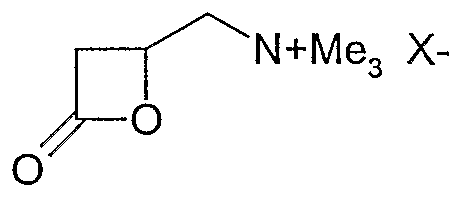
(Ha) von dem prinzipiell jedes seiner optischen Isomere oder ein Isomerengemisch einsetzbar ist.(Ha) of which in principle any of its optical isomers or a mixture of isomers can be used.
Bevorzugt sind Polyester oder Oligoester, in denen Monomereinheiten der Formel (III) CHaN^R^R3 X(-)Preferred are polyesters or oligoesters in which monomer units of the formula (III) CHaN ^ R ^ R 3 X (-)
(III)(III)
-CO-CH2-CH-O- enthalten sind, wobei R1, R2, R3 substituierte oder unsubstituierte, lineare oder verzweigte Cl- bis C22- Alkyl-, Cycloalkyl-, Aryl-, Alkylaryl- oder Arylalkyl- gruppen und X(_) ein Halogen-, Sulfat-, Phosphat-, Alkylsulfat- oder Alkylphosphatanion bedeuten. Besonders bevorzugt ist Polycarnitin.-CO-CH 2 -CH-O- are contained, wherein R 1 , R 2 , R 3 substituted or unsubstituted, linear or branched Cl to C22 alkyl, cycloalkyl, aryl, alkylaryl or arylalkyl groups and X (_) is a halogen, sulfate, phosphate, alkyl sulfate or alkyl phosphate anion. Polycarnitine is particularly preferred.
Bei den erfindungsgemäßen Polymeren oder Oligomeren kann es sich auch um Copolymere oder Cooligomere handeln, welche neben Monomereinheiten der Formel (I) weitere, vorzugsweise nicht kationische Monomereinheiten enthalten. Bei den weiteren Monomereinheiten kann es sich um von einem Gemisch aus Dicarbonsäuren und Diolen oder vorzugsweise um von Hydroxycarbonsäuren oder von Aminocarbonsäuren abgeleiteten Monomereinhei- ten handeln. Kationische Monomereinheiten der FormelThe polymers or oligomers according to the invention can also be copolymers or cooligomers which, in addition to monomer units of the formula (I), contain further, preferably non-cationic, monomer units. The further monomer units can be a mixture of dicarboxylic acids and diols or preferably monomer units derived from hydroxycarboxylic acids or from aminocarboxylic acids. Cationic monomer units of the formula
(I) und die weiteren, nicht-kationischen Comonomerein- heiten liegen vorzugsweise in einem Verhältnis von 2:98 bis 98:2, besonders bevorzugt von 20:80 bis 80:20, ganz besonders bevorzugt von 30:70 bis 70:30 vor.(I) and the further, non-cationic comonomer units are preferably present in a ratio of 2:98 to 98: 2, particularly preferably from 20:80 to 80:20, very particularly preferably from 30:70 to 70:30 ,
Von Hydroxycarbonsäuren oder Aminocarbonsäuren abgeleitete geeignete Comonomereinheiten sind beispielsweise solche der Formeln (lila) bzw. (Illb)Suitable comonomer units derived from hydroxycarboxylic acids or aminocarboxylic acids are, for example, those of the formulas (purple) or (Illb)
-0-C(XR1) (YR2) -Z-CO2- (lila)-0-C (XR 1 ) (YR 2 ) -Z-CO 2 - (purple)
-NR3-C(XR1) (YR2) -Z-CO2- (IHb)-NR 3 -C (XR 1 ) (YR 2 ) -Z-CO2- (IHb)
wobei R1 und R2 gleich oder verschieden sein können und ausgewählt sind aus H und C02R4, R3 und R4 gleich oder verschieden sein können und ausgewählt sind aus Wasserstoff und gesättigten oder ungesättigten, verzweigten oder unverzweigten Alkyl-, Aryl-, Alkylaryl- oder Aralkylgruppen mit 1 bis 18 Kohlenstoffatomen, wobei diese Gruppen weitere Substituenten wie Hydroxygruppen, Aminogruppen, Carbonsäuregruppen oder Halogene tragen können und X, Y und Z gleich oder verschieden sein können und entweder eine Einfachbindung darstellen oder ausgewählt sind aus gesättigten oder ungesättigten, verzweigten oder unverzweigten Alkylengruppen mit vorzugsweise 1 bis 5 Kohlenstoffatomen, wobei die Alkylengruppen weitere Substituenten wie Hydroxygruppen, Aminogruppen oder Halogene tragen können. Besonders bevorzugt sind Einheiten der Formeln (lila) bzw. (Illb) , bei denen X, Y und Z gleich oder verschieden sind und entweder eine Einfachbindung, eine Methylengruppe oder eine Hydroxymethylengruppe bedeuten. Insbesondere geeignet sind Einheiten, welche abgeleitet sind von Citronensäure, Äpfelsäure bzw. deren Monoester, Weinsäure bzw. deren Monoester, Milchsäure, Lysin, Alanin oder Glycin. Chirale Einheiten können als reines optisches Isomer oder als Racemat vorliegen.where R 1 and R 2 may be the same or different and are selected from H and C0 2 R 4 , R 3 and R 4 may be the same or different and are selected from hydrogen and saturated or unsaturated, branched or unbranched alkyl, aryl, alkylaryl or aralkyl groups having 1 to 18 carbon atoms, where these groups can carry further substituents such as hydroxyl groups, amino groups, carboxylic acid groups or halogens and X, Y and Z can be the same or different and either represent a single bond or are selected from saturated or unsaturated, branched or unbranched alkylene groups with preferably 1 to 5 carbon atoms, where the alkylene groups can carry further substituents such as hydroxyl groups, amino groups or halogens. Units of the formulas (purple) or (IIIb) in which X, Y and Z are identical or different and are either a single bond, a methylene group or a hydroxymethylene group are particularly preferred. Units which are derived from citric acid, malic acid or their monoesters, tartaric acid or their monoesters, lactic acid, lysine, alanine or glycine are particularly suitable. Chiral units can exist as a pure optical isomer or as a racemate.
Erfindungsgemäß sind weiterhin Polymere oder Oligomere, herstellbar durch eine katalysierte Ringöffnungspolymerisation in Lösung oder lösemittelfrei aus Lactonen der Formel (IV)According to the invention, polymers or oligomers which can be prepared by a catalyzed ring-opening polymerization in solution or solvent-free from lactones of the formula (IV)
M-N(+)RXR2R3 XMN (+) R X R 2 R 3 X
( λ(λ
O C=0 (IV)O C = 0 (IV)
0=C Y ^ )0 = C Y ^)
A wobei M, R1, R2, R3 und X(_) die gleiche Bedeutung haben wie bei Formel (I) , A für eine divalente organische Gruppe steht und Y für O, NH oder NR steht und R für eine monovalente organische Gruppe, vorzugsweise für eine verzweigte oder lineare, gesättigte oder ungesättigte Alkyl-, Cycloalkyl-, Aryl-, Alkylaryl- oder Arylalkylgruppe mit 1 bis 22 Kohlenstoffatomen steht. Die Gruppe A kann eine gesättigte oder ungesättigte, verzweigte oder unverzweigte Alkylengruppe mit 1 bis 22, vorzugsweise 2 bis 12 Kohlenstoffatomen sein, wobei die Alkylengruppen weitere Substituenten wie Hydroxy-, Amino-, Carboxyl- oder Estergruppen oder Halogene tragen können. Besonders bevorzugt sind für die Gruppe -CO-A-Y- Gruppen, die abgeleitet sind von den oben genannten Hydroxycarbonsäuren, insbesondere von Citronensäure, Äpfelsäure bzw. deren Monoestern, Weinsäure bzw. deren Monoestern, Milchsäure sowie von Aminosäuren wie Alanin, Glycin, Lysin etc.. Ein geeignetes' Lacton der Formel (IV) ist beispielsweise Milchsäure-Carnitin- lacton:A where M, R 1 , R 2 , R 3 and X (_) have the same meaning as in formula (I), A is a divalent organic group and Y is O, NH or NR and R is a monovalent organic group , preferably represents a branched or linear, saturated or unsaturated alkyl, cycloalkyl, aryl, alkylaryl or arylalkyl group having 1 to 22 carbon atoms. Group A can be a saturated or unsaturated, branched or unbranched alkylene group having 1 to 22, preferably 2 to 12 carbon atoms, it being possible for the alkylene groups to carry further substituents such as hydroxyl, amino, carboxyl or ester groups or halogens. Particularly preferred for the group are -CO-AY- groups, which are derived from the above-mentioned hydroxycarboxylic acids, in particular from citric acid, malic acid or their monoesters, tartaric acid or their monoesters, lactic acid and from amino acids such as alanine, glycine, lysine etc. A suitable lactone of the formula (IV) is, for example, lactic acid-carnitine lactone:
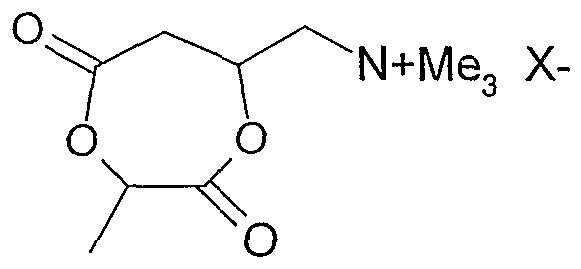
Erfindungsgemäß sind weiterhin Copolymere oder Co- Oligomere, herstellbar durch eine katalysierte Ring- Öffnungspolymerisation in Lösung oder lösemittelfrei aus einem ersten Lacton, ausgewählt aus Lactonen der Formeln (II) und (IV) , sowie aus mindestens einem zweiten Lacton oder Lactam der Formel (V)According to the invention are also copolymers or co-oligomers that can be produced by a catalyzed ring-opening polymerization in solution or solvent-free from a first lactone, selected from lactones Formulas (II) and (IV), and from at least one second lactone or lactam of the formula (V)
BB
( \(\
Y1 c=o (N)Y 1 c = o (N)
0=C YA D wobei B und D gleich oder verschieden sein können und für eine divalente organische Gruppe stehen, Y1 und Y2 unabhängig voneinander für 0, ΝH oder ΝR steht und R für eine monovalente organische Gruppe, vorzugsweise für eine verzweigte oder lineare, gesättigte oder ungesättigte Alkyl-, Cycloalkyl-, Aryl-, Alkylaryl- oder Arylalkylgruppe mit 1 bis 22 Kohlenstoffatomen steht. Die Gruppen B und D können gesättigte oder unge- sättigte, verzweigte oder unverzweigte Alkylengruppen mit 1 bis 22, vorzugsweise 2 bis 12 Kohlenstoffatomen sein, wobei die Alkylengruppen weitere Substituenten wie Hydroxy-, Amino-, Carboxyl- oder Estergruppen oder Halogene tragen können. Geeignete Lactone der Formel (V) sind0 = CY A D where B and D can be the same or different and stand for a divalent organic group, Y 1 and Y 2 independently of one another for 0, ΝH or ΝR and R for a monovalent organic group, preferably for a branched or linear , saturated or unsaturated alkyl, cycloalkyl, aryl, alkylaryl or arylalkyl group having 1 to 22 carbon atoms. The groups B and D can be saturated or unsaturated, branched or unbranched alkylene groups having 1 to 22, preferably 2 to 12 carbon atoms, it being possible for the alkylene groups to carry further substituents, such as hydroxyl, amino, carboxyl or ester groups or halogens. Suitable lactones of the formula (V) are

wobei R für einen Cl- bis C22-Rest, insbesondere für einen leicht hydrolytisch abspaltbaren Rest wie z.B. Benzyl steht . Bevorzugte Lactone der Formel (V) sind ausgewählt aus Dimilchsäuredilacton (Dilactid) und Diäpfelsäuredilacton (Malid) bzw. dessen Mono- oder Diestern, insbesondere dessen Benzylestern.where R is a Cl to C22 radical, in particular an easily hydrolytically removable radical such as benzyl. Preferred lactones of the formula (V) are selected from dimilic lactilone (dilactide) and Diäpfelsäuredilacton (Malid) or its mono- or diesters, especially its benzyl esters.
Weitere, geeignete cyclische Comonomere sind Glycolid, Trimethylencarbonat, p-Dioxanon, epsilon-Caprolacton und 1, 5-Dioxepan-2-on oder deren substituierte Derivate. Geeignete cyclische Comonomere weisen in der Regel Strukturmerkmale auf, die abgeleitet sind von ß- Lacton, 1, 4-Dioxandion, Morpholindion, Piperazindion und cyclischen Dicarbonsäureanhydriden.Further suitable cyclic comonomers are glycolide, trimethylene carbonate, p-dioxanone, epsilon-caprolactone and 1, 5-dioxepan-2-one or their substituted derivatives. Suitable cyclic comonomers generally have structural features which are derived from β-lactone, 1,4-dioxanedione, morpholine dione, piperazinedione and cyclic dicarboxylic acid anhydrides.
Bevorzugte erfindungsgemäße Polymere und Oligomere sind Poly- oder Oligocarnitin, Poly- oder Oligo (carnitin-co- milchsäure) , Poly- oder Oligo (carnitin-co-äpfelsäure) und deren Ester, Poly- oder Oligo (carnitin-co-aspara- ginsäure-co-milchsäure) und deren Ester, Poly- oder Oligo (carnitin-alt-milchsäure) , Poly- oder Oligo- (carnitin-alt-äpfelsäure) , Poly- oder Oligo (carnitin- alt-asparaginsäure) , Poly- oder Oligo (carnitin-co- äpfelsäure-co-milchsäure) und deren Ester.Preferred polymers and oligomers according to the invention are poly- or oligocarnitine, poly- or oligo (carnitine-co-lactic acid), poly- or oligo (carnitine-co-malic acid) and their esters, poly- or oligo (carnitine-co-aspartic acid) -co-lactic acid) and its esters, poly- or oligo (carnitine-old-lactic acid), poly- or oligo- (carnitine-old-malic acid), poly- or oligo (carnitine-old-aspartic acid), poly- or oligo (carnitine-co-malic acid-co-lactic acid) and their esters.
Ein weiterer Gegenstand der vorliegenden Erfindung ist ein Verfahren zur Herstellung der vorstehend definierten Polymere, Copolymere, Oligomere und Co-Oligomere . Hier- bei werden ein kationisch substituiertes Lacton unter katalytischer Ringöffnung in Lösung oder lösungsmittel- frei in der Schmelze polymerisiert oder oligomerisiert . Analoge Verfahren zur Herstellung von Polyestern sind als anionische oder kationische ringöffnende Polymeri- sation, insbesondere als Lactonpolymerisation bekannt. Bei der anionischen Ringöffnüngspolymerisation erfolgt, durch ein geeignetes Initiatorsystem ausgelöst, eine Basenaddition an die C=0-Gruppe der Estergruppierung mit nachfolgender Ringspaltung an der Esterbindung. Geeignete Initiatoren sind z.B. anionische Initiatoren wie metallorganische Verbindungen der 1. , 3. , 4. und 5. Hauptgruppe des Periodensystems, wie Butyllithium, Tetraethylaluminium, Triphenylantimon, Triphenyl- bismuth, insbesondere zinnorganische Verbindungen, wie Tetraphenylzinn oder Tetrabutylzinn.Another object of the present invention is a method for producing the above-defined polymers, copolymers, oligomers and co-oligomers. Here, a cationically substituted lactone is polymerized or oligomerized in the melt with catalytic ring opening in solution or solvent-free in the melt. Analogous processes for the production of polyesters are known as anionic or cationic ring-opening polymerization, in particular as lactone polymerization. In anionic ring opening polymerization, one is triggered by a suitable initiator system Base addition to the C = 0 group of the ester group with subsequent ring cleavage at the ester bond. Suitable initiators are, for example, anionic initiators such as organometallic compounds of the 1st, 3rd, 4th and 5th main group of the periodic table, such as butyllithium, tetraethylaluminium, triphenylantimony, triphenyl bismuth, in particular organotin compounds, such as tetraphenyltin or tetrabutyltin.
Weitere geeignete Initiatoren sind alkylsubstituierte Amine, wie Dimethylbenzylamin oder davon abgeleitete alkylierte organische Salze, wie Tetraalkyammonium- salze, insbesondere Tetraethylammoniumbenzoat oder Tetrabutylammoniumacetat oder davon abgeleitete beta- inische Strukturen, insbesondere Betain in heterogener oder homogener Phase oder alkylsubstituierte Phosphorverbindungen wie z.B. Triethylphosphat .Further suitable initiators are alkyl-substituted amines, such as dimethylbenzylamine or alkylated organic salts derived therefrom, such as tetraalkyammonium salts, in particular tetraethylammonium benzoate or tetrabutylammonium acetate or betaine structures derived therefrom, in particular betaine in heterogeneous or homogeneous phase or alkyl-substituted phosphorus compounds such as e.g. Triethyl phosphate.
Geeignete Initiatoren für kationisch induzierte Ring- Öffnungspolymerisationen sind Protonensäuren, wie Tri- fluormethansulfonsäure oder alkylierende Initiatoren, wie Methyltrifluormethansulfonat oder Lewissäuren, wie Bortrifluorid .Suitable initiators for cationically induced ring opening polymerizations are protonic acids such as trifluoromethanesulfonic acid or alkylating initiators such as methyl trifluoromethanesulfonate or Lewis acids such as boron trifluoride.
Desweiteren als Initiatoren geeignet sind spezielle Metal.-Verbindungen von Metallen der 3. oder 4. Hauptgruppe oder der 4. Nebengruppe des Periodensystems, wie Alkoxide des Aluminiums, Alkoxide des Titans, Alkoxide des Zirkons, Zinnsalze wie Zinnhalogenide oder alky- lierte Zinnsalze wie Tributylzinnacetat oder alkylierte Zinnoxide wie Dioctylzinnoxid oder Dibutylzinnoxid oder Zinncarboxylate oder alkylierte Zinncarboxylate, insbe- sondere Zinn-II-ethylhexanoat. Weitere Initiatoren sind Komplexverbindungen wie Acetylacetonate der 2. , 4. und 5. Nebengruppe des Periodensystems, wie Zirkonium- acetylacetonat , Zinkacetylacetonat , Titanacetylacetonat oder Vanadin- (IV) -oxidacetylacetonat . Die Ringöffnungspolymerisation kann auch enzymkatalysiert erfolgen, beispielsweise unter Verwendung von Lipase.Also suitable as initiators are special metal compounds of metals of the 3rd or 4th main group or the 4th subgroup of the periodic table, such as alkoxides of aluminum, alkoxides of titanium, alkoxides of zirconium, tin salts such as tin halides or alkylated tin salts such as tributyltin acetate or alkylated tin oxides such as dioctyltin oxide or dibutyltin oxide or tin carboxylates or alkylated tin carboxylates, in particular special tin-II-ethylhexanoate. Further initiators are complex compounds such as acetylacetonates of subgroups 2, 4 and 5 of the periodic table, such as zirconium acetylacetonate, zinc acetylacetonate, titanium acetylacetonate or vanadium (IV) oxyacetylacetonate. The ring opening polymerization can also be enzyme-catalyzed, for example using lipase.
Das Polymerisationsverfahren kann durch übliche Maßnahmen so gesteuert werden, dass Polymere undThe polymerization process can be controlled by conventional measures such that polymers and
Oligomere mit maßgeschneiderten Eigenschaften hergestellt werden hinsichtlichOligomers with tailored properties are made with regard to
- Einstellung des Polymerisationsgerades bzw. Molekulargewichtes - Einstellung der Hydrophilie/Hydrophobie und damit Einstellung der gewünschten Verträglichkeit oder Löslichkeit in Lösungsmitteln sowie Einstellung von tensidischen Eigenschaften wie Spreitbarkeit , Schaum- bildungs ermögen, Emulgierfähigkeit etc. durch Wahl geeigneter Substituenten oder Comonomerer- Adjustment of the degree of polymerization or molecular weight - Adjustment of the hydrophilicity / hydrophobicity and thus adjustment of the desired compatibility or solubility in solvents as well as adjustment of surfactant properties such as spreadability, foaming power, emulsification capacity etc. by choosing suitable substituents or comonomers
- Einstellung der Monomerverhältnisse in den Copoly- eren- Setting the monomer ratios in the copolymers
- Einstellung der Filmbildungseigenschaften- Setting the film formation properties
- Einstellung der Affinität zu keratinischen oder textilen Materialien durch Variation der Kationaktivität bzw. der kationischen Ladungsdichte- Setting the affinity for keratinic or textile materials by varying the cation activity or the cationic charge density
- Einstellung der rheologischen Eigenschaften von Lösungen/Dispersionen der Polymere/Oligomere- Setting the rheological properties of solutions / dispersions of the polymers / oligomers
Die erfindungsgemäßen Polyester und Oligoester weisen eine Reihe von Vorteilen gegenüber bekannten kationischen Polymeren auf wie z.B. hervorragende biologische Abbaubarkeit unter Bildung von nicht-toxischen Abbauprodukten, insbesondere wenn die erfindungsgemäßen Polyester und Oligoester hergestellt sind aus natürlich vorkommenden Bausteinen und deren Analoga. Gegenüber herkömmlichen kationischen Polymeren, welche durch nachträgliche Alkylierung kationisiert werden, weisen die erfindungsgemäßen kationischen Poly- und Oligoester den Vorteil einer definierteren Struktur, insbesondere hinsichtlich einer definierteren, gleichmäßigeren Verteilung der kationischen Ladung über das Molekül auf.The polyesters and oligoesters according to the invention have a number of advantages over known cationic polymers, such as, for example, excellent biological ones Degradability with the formation of non-toxic degradation products, especially if the polyesters and oligoesters according to the invention are made from naturally occurring building blocks and their analogs. Compared to conventional cationic polymers which are cationized by subsequent alkylation, the cationic polyesters and oligoesters according to the invention have the advantage of a more defined structure, in particular with regard to a more defined, more uniform distribution of the cationic charge over the molecule.
Die erfindungsgemäßen Poly- und Oligoester sind verwendbar auf dem Gebiet der Wasch- und Reinigungsmittel , Kosmetik, Textilbehandlungs itteln, Haarbehandlungs- mittein, Pharmazie, Medizin, Nahrungsmittel, Futtermittel, zur Herstellung von Filmen, Folien, chirurgischen Fäden, biomedizinischen Retardabgabesystemen etc ..The polyesters and oligoesters according to the invention can be used in the field of detergents and cleaning agents, cosmetics, textile treatment agents, hair treatment agents, pharmaceuticals, medicine, foodstuffs, animal feed, for the production of films, foils, surgical threads, biomedical sustained release delivery systems etc.
Besonders bevorzugt sind solche erfindungsgemäßen Poly- und Oligoester, die biologisch gut abbaubar sind und aus natürlichen Bausteinen aufgebaut sind, deren Abbau zu nicht-toxischen Abbauprodukten führt. Diese können besonders vorteilhaft eingesetzt werden für biomedizi- nische Anwendungen, beispielsweise in der InnerenParticularly preferred are those polyesters and oligoesters according to the invention which are readily biodegradable and are made up of natural building blocks, the degradation of which leads to non-toxic degradation products. These can be used particularly advantageously for biomedical applications, for example in the interior
Medizin bei Implantaten für Speicherung und kontinuierliche Abgabe von Arzneimitteln (drug release Systeme) , in der Chirurgie bei temporären, resorbierbaren Implantaten zur Behandlung von Verletzungen verschiedener Gewebe wie Gefäße, Nerven, Bänder, Haut oder Knochen, insbesondere in der Herzchirurgie für gewebebindende Gerüstsubstanzen für Herzklappenimplantate z.B. für sogenannte mitwachsende Herzklappen für Kinder etc.Medicine for implants for the storage and continuous delivery of drugs (drug release systems), in surgery for temporary, resorbable implants for the treatment of injuries to various tissues such as vessels, nerves, ligaments, skin or bones, especially in cardiac surgery for tissue-binding Framework substances for heart valve implants eg for so-called growing heart valves for children etc.
Weitere vorteilhafte Anwendungen sind die Herstellung von biologisch abbaubaren Materialien für Lebensmittel- Verpackung und Lebensmittelservice, biologisch abbaubare Werkstoffe und Performance-Produkte für Gartenbau und Landwirtschaft, z.B. Abdeckungsfolien, Bewässerungsfolien, Rohre, Netze, Garne, Gittertδpfe, Matrix- aterialien für die kontinuierliche Abgabe von Düngemitteln etc.Further advantageous applications are the production of biodegradable materials for food packaging and food service, biodegradable materials and performance products for horticulture and agriculture, e.g. Covering foils, watering foils, pipes, nets, yarns, grid pots, matrix materials for the continuous release of fertilizers etc.
Eine weitere vorteilhafte Anwendung ist die Herstellung von Polyelektrolytkomplexen, insbesondere von biolo- gisch abbaubaren Polyelektrolytkomplexen aus Poly- und Oligoestern kationischer Trimethylammonium-substituierter Hydroxycarbonsäuren und Cellulosederivaten, beispielsweise für die Herstellung von Trenn- und Trägermaterialien, wie Trennmembranen, Mikrokapseln, Flockungsmittel etc.. Herstellbar sind maßgeschneiderte Trennmembranen, z.B. zur Trennung von Lösungsmittel - gemischen, wie Wasser/Alkohol sowie für Ionentrennungen (Trennung zweiwertiger von einwertigen Ionen) , Poly- elektrolytkomplexe für Mikrokapseln zur Verkapselung von Medikamenten, kosmetischen Wirkstoffen oder auch zur Verkapselung von lebenden Zellen für eine gezielte lokale Anwendung an lebenden Organismen (z. B. Gentherapie bei Tumorerkrankungen) sowie Polyelektrolyt- komplexe für Flockungsmittel, beispielsweise zur Anwendung für die Schlammentwässerung oder als Prozeßhilfsmittel bei der Papierbeschichtung. Aufgrund ihrer Substantivität zu keratinischen Materialien, sind die erfindungsgemäßen Polyester und Oligoester besonders geeignet für einen Einsatz in kosmetischen Mitteln, insbesondere in Haarbehandlungsmitteln, in einer geeigneten kosmetischen Grundlage.Another advantageous application is the production of polyelectrolyte complexes, in particular of biodegradable polyelectrolyte complexes from poly- and oligoesters of cationic trimethylammonium-substituted hydroxycarboxylic acids and cellulose derivatives, for example for the production of separating and carrier materials, such as separating membranes, microcapsules, flocculants, etc. are tailor-made separation membranes, e.g. for the separation of solvent mixtures such as water / alcohol as well as for ion separations (separation of divalent from monovalent ions), polyelectrolyte complexes for microcapsules for encapsulating medication, cosmetic active ingredients or also for encapsulating living cells for a targeted local Use on living organisms (eg gene therapy for tumor diseases) and polyelectrolyte complexes for flocculants, for example for use in sludge dewatering or as process aids in paper coating tung. Because of their substantivity to keratinic materials, the polyesters and oligoesters according to the invention are particularly suitable for use in cosmetic compositions, in particular in hair treatment compositions, in a suitable cosmetic base.
Die folgenden Beispiele sollen die Gegenstände der vorliegenden Erfindung näher erläutern, ohne dass die angefügten Ansprüche hierauf beschränkt sind.The following examples are intended to explain the subject matter of the present invention in more detail, without the appended claims being limited thereto.
BeispieleExamples
Beispiel 1: Herstellung von Polycarnitin in LösungExample 1: Preparation of polycarnitine in solution
Die Polymerisationen wurden unter Hochvakkuum in geschlossenen 50 ml Rollrandflaschen durchgeführt. 0,35 mg (1,14 10~3 mmol) Tetrabutylam oniumacetat (TBAA) wurden i.V. getrocknet und anschließend 5 ml über PO10 getrocknetes DMF und 0,5 g (2,1 mmol) D (+) -Carnitin-ß- lacton-methansulfonat unter N2-Strom eingeführt. Die Monomer-Lösung wird mit 5facher Wiederholung Einfrier- Auftau-Cyclen unter Vakuum unterworfen und die Polymerisationsflasche versiegelt. Die Flaschen werden anschließend 24 Stunden bei einer Temperatur von 50 °C, 60°C bzw. 70°C im Ölbad gehalten. Die Reaktionslösungen färben sich langsam je nach Temperatureinstellung von gelblich bis rötlich. Im Anschluß an die Reaktion wird das DMF im Rotationsverdampfer im Ölpumpenvakuum entfernt, das Produkt in Methanol gelöst und mit Ether fraktioniert gefällt. Zunächst trennt man monomere Verunreinigungen ab, anschließend das polymere Produkt. Der Monomerumsatz beträgt 42-64%. Die Kontrolle der Reinheit der Fraktionierungsprodukte erfolgt dünn- schichtchromatographisch (TLC, silica gel 60) :The polymerizations were carried out under high vacuum in closed 50 ml crimp neck bottles. 0.35 mg (1.14 10 ~ 3 mmol) tetrabutylam onium acetate (TBAA) were dried in IV and then 5 ml DMF dried over PO 10 and 0.5 g (2.1 mmol) D (+) -carnitine-ß- lactone methanesulfonate introduced under N 2 flow. The monomer solution is subjected to repeated freeze-thaw cycles under vacuum 5 times and the polymerization bottle sealed. The bottles are then kept in an oil bath for 24 hours at a temperature of 50 ° C, 60 ° C or 70 ° C. Depending on the temperature setting, the reaction solutions slowly turn from yellowish to reddish. Following the reaction, the DMF is removed in a rotary evaporator in an oil pump vacuum, the product is dissolved in methanol and precipitated with ether. First, monomeric impurities are separated, then the polymeric product. The monomer conversion is 42-64%. The control of The purification of the fractionation products is carried out by thin layer chromatography (TLC, silica gel 60):
Eluent : Methanol/28%ige Ammoniaklösung 1:1,Eluent: methanol / 28% ammonia solution 1: 1,
I2-Detektion: 5-7,5 cm (Sh = 9 cm)I 2 detection: 5-7.5 cm (Sh = 9 cm)
Das Ausgangsmonomer wird bei 0,1-5 cm (Sh=9 cm) nachgewiesen .The starting monomer is detected at 0.1-5 cm (Sh = 9 cm).
Eluent: Methanol/Aceton/Wasser/HCl 36% =2:18:4:1,Eluent: methanol / acetone / water / HCl 36% = 2: 18: 4: 1,
I2-Detektion oder NH2OH-FeCl3-Detektion: Rf=0,79.I 2 detection or NH 2 OH-FeCl 3 detection: Rf = 0.79.
Das Ausgangsmonomer weist einen Rf-Wert von 0,4 auf,The starting monomer has an Rf value of 0.4,
Nach Entfernen des Lösungsmittels im Vakuum wurde die Molmassenverteilung mittels Gelpermeationschromatogra- phie (GPC) bestimmt. GPLC (Säule P-L Mix Gel 200-1 Mio MW; Flussmittel DMF + 2% Triethylamin) : Das fraktio- nierte Polymer wurde im Flussmittel gelöst und in einer Laufzeit von 30 min bei 0,8 ml/min aufgetrennt. Die Auswertung erfolgte gegen eine Eichkurve (Polystyren- Standard in dem Flussmittel) durch Detektion mittels Brechungsindex (RI) und UV. RI-Detektion: GPC= 5969, n=6483, w=7302, Polydispersität 1,13After the solvent had been removed in vacuo, the molar mass distribution was determined by means of gel permeation chromatography (GPC). GPLC (column PL Mix Gel 200-1 million MW; flux DMF + 2% triethylamine): The fractionated polymer was dissolved in the flux and separated in a run time of 30 min at 0.8 ml / min. The evaluation was carried out against a calibration curve (polystyrene standard in the flux) by detection by means of refractive index (RI) and UV. RI detection: GPC = 5969, n = 6483, w = 7302, polydispersity 1.13
UV-Detektion: GPC= 6406, n=5907, w=7791, Polydispersität 1,32UV detection: GPC = 6406, n = 5907, w = 7791, polydispersity 1.32
Elementaranalyse Polycarnitin (C8H17N05S) n: C ber. 40,16 gef . 40,28 H ber. 4,16 gef . 4,08Elemental analysis polycarnitine (C 8 H 17 N0 5 S) n : C calc. 40.16 found. 40.28 H calc. 4.16 found. 4.08
N ber. 5,83 gef. 6,97 S ber. 13,40 gef. 13,48 O ber. 33,43 gef. 33,15 IR-Spektrum (Angaben in cm"1) :N calc. 5.83 found 6.97 S calc. 13.40 found 13.48 O. 33.43 found. 33,15 IR spectrum (data in cm "1 ):
2961 (C-H) , 1735 (C=0) , 1471 (CH3) , 1382 (CH3) , 1194 (C-O) , 1059 (C-O)2961 (CH), 1735 (C = 0), 1471 (CH 3 ), 1382 (CH 3 ), 1194 (CO), 1059 (CO)
^Η-NMR-Spektrum (300 MHz, D20, 20°C, HDO) :^ Η NMR spectrum (300 MHz, D 2 0, 20 ° C, HDO):
4,57-4,61 ppm (m, 1H) , 4,04/4,07 ppm (d, 1H) , 3,39-3,42 ppm (m, 3H) , 3,15 ppm (s, 9H) , 2,77 ppm (s, 3H)4.57-4.61 ppm (m, 1H), 4.04 / 4.07 ppm (d, 1H), 3.39-3.42 ppm (m, 3H), 3.15 ppm (s, 9H) ), 2.77 ppm (s, 3H)
"C-NMR-Spektrum (75,48 MHz, D20, 20°C) : 173,41 ppm, 74,10 ppm, 67,42 ppm, 58,65 ppm, 44,67 ppm, 42,96 ppm"C-NMR spectrum (75.48 MHz, D 2 0, 20 ° C): 173.41 ppm, 74.10 ppm, 67.42 ppm, 58.65 ppm, 44.67 ppm, 42.96 ppm
Beispiel 2: Herstellung von Poly (carnitin-co- milchsäure) in LösungExample 2: Preparation of poly (carnitine-co-lactic acid) in solution
Die Polymerisationen wurden unter Hochvakuum in geschlossenen 50 ml Rollrandflaschen durchgeführt. 0,57 mg (2.28 10"3 mmol) Tetraethylammoniumbenzoat (TEBA) wurden i.V. getrocknet und anschließend 10 ml über POι0 getrocknetes DMF und 0,5 g (2,1 mmol) D-Carnitin-ß- lacton-methansulfonat und 0,3 g (2,1 mmol) L,L-Dilactid unter N2-Strom eingeführt. Die Monomer-Lösung wird mit 5 facher Wiederholung Einfrier-Auftau-Cyclen unter Vakuum unterworfen und die Polymerisationsflasche versiegelt. Die Flaschen werden anschließend 24 Stunden bei einer Temperatur von 50°C, 60°C bzw. 70°C im Ölbad gehalten. Die Reaktionslösungen färben sich während der Temperierung langsam je nach Temperatureinstellung von gelblich bis leicht rötlich. Im Anschluß an die Reaktion wird die Polymerlδsung mit Ether fraktioniert gefällt . Zunächst trennt man monomere Verunreinigungen ab, anschließend das polymere Produkt. Die Copolymere werden im Vakuum bei 40°C 5 Tage getrocknet. Die Kontrolle der Reinheit der Fraktionierungsprodukte erfolgt dünnschichtchromatographisch (TLC, silica gel 60) : Eluent: Methanol/Aceton/Wasser/HCl 36% =2:18:4:1,The polymerizations were carried out under high vacuum in closed 50 ml crimp neck bottles. 0.57 mg (2.28 10 "3 mmol) tetraethylammonium benzoate (TEBA) were dried in IV and then 10 ml DMF dried over POι 0 and 0.5 g (2.1 mmol) D-carnitine-β-lactone methanesulfonate and 0, 3 g (2.1 mmol) of L, L-dilactide are introduced under a stream of N 2. The monomer solution is subjected to repeated freeze-thaw cycles under vacuum 5 times and the polymerization bottle is sealed The temperature of the reaction solutions slowly changes from yellowish to slightly reddish depending on the temperature setting. The polymer solution is then fractionally precipitated with ether monomer contaminants are removed, then the polymeric product, the copolymers are dried in vacuo at 40 ° C for 5 days. The purity of the fractionation products is checked by thin layer chromatography (TLC, silica gel 60): eluent: methanol / acetone / water / HCl 36% = 2: 18: 4: 1,
I2-Detektion oder NH2OH-FeCl3-Detektion: 5 cm-7.5 cm (ShI 2 detection or NH 2 OH-FeCl 3 detection: 5 cm-7.5 cm (Sh
9.5 cm) . Die Ausgangsmonomere weisen Rf-Werte von 0,4 und 0 , 6 auf .9.5 cm). The starting monomers have Rf values of 0.4 and 0.6.
GPLC (Säule P-L Mix Gel 200-1 Mio MW; Flussmittel DMF + 2% Triethylamin) :GPLC (column P-L Mix Gel 200-1 million MW; flux DMF + 2% triethylamine):
Das fraktionierte Polymer wurde im Flussmittel gelöst und in einer Laufzeit von 30 min bei 0,8 ml/min aufgetrennt . Die Auswertung erfolgte gegen eine Eichkurve (Polystyren-Standard in dem Flussmittel) durch Detektion mittels Brechungsindex (RI) und UV.The fractionated polymer was dissolved in the flux and separated at 0.8 ml / min over a period of 30 minutes. The evaluation was carried out against a calibration curve (polystyrene standard in the flux) by detection by means of refractive index (RI) and UV.
RI-Detektion: GPC= 7578, n=6851, w=8153 Polydispersität 1,19RI detection: GPC = 7578, n = 6851, w = 8153 polydispersity 1.19
UV-Detektion: GPC= 8103, n=7015, w=8979 Polydispersität 1,28UV detection: GPC = 8103, n = 7015, w = 8979 polydispersity 1.28
^-NMR-Spektrum (300 MHz, D20, 20 °C, HDO) :^ NMR spectrum (300 MHz, D 2 0, 20 ° C, HDO):
Carnitin-ß-lacton-Einheit : 4,55-4,61 ppm (m, 1H) , 4,0-Carnitine-β-lactone unit: 4.55-4.61 ppm (m, 1H), 4.0-
4.06 ppm (m, 1 H) , 3,35-3,42 ppm (m, 3H) , 3,14 (m, 9H) , 2,76 ppm (s, 3H) Dilactid-Einheit: 5,2-5,38 (m, 1 H) ; 1,45-1,59 ( , 3H) Auf Basis des Verhältnisses der Signal-Intensitäten der Carnitin-ß-lacton-Einheit und der Dilactid-Einheit ergibt sich ein Monomerverhältnis von 0,63:0,37.4.06 ppm (m, 1H), 3.35-3.42 ppm (m, 3H), 3.14 (m, 9H), 2.76 ppm (s, 3H) dilactide unit: 5.2-5 , 38 (m, 1H); 1.45-1.59 (, 3H) On the basis of the ratio of the signal intensities of the carnitine-β-lactone unit and the dilactide unit, a monomer ratio of 0.63: 0.37 results.
Elementaranalyse Poly (carnitin-co-milchsäure) auf Basis des Verhältnisses der Signal-Intensitäten der Carnitin- ß-lacton-Einheit und der Dilactid-Einheit aus dem 1H-Elemental analysis poly (carnitine-co-lactic acid) based on the ratio of the signal intensities of the carnitine ß-lactone unit and the dilactide unit from the 1 H
NMR-SpektrumNMR spectrum
((C8H17NO5S)0,63 (CsH804)o,3v)n (204, 07) n ((C 8 H 17 NO 5 S) 0, 63 () o, 3v C s H 8 0 4) n (204, 07) n
C ber. 44,43 gef. 43,28 H ber. 6,84 Gef. 7,08 N ber. 4,32 gef. 4,28 S ber. 9,88 Gef. 9,63 0 ber. 34,53 gef. 33,98C calc. 44.43 found 43.28 H calc. 6.84 found 7.08 N calc. 4.32 found 4.28 S calc. 9.88 found 9.63 0 calc. 34.53 found 33.98
IR-Spektrum (Angaben in cm"1) :IR spectrum (data in cm "1 ):
2985, 2960 (C-H) , 1724, 1740 (C=0) , 1465, 1471 (CH3) , 1382, 1428 (CH3) , 1190, 1194 (C-O), 1059-1110 (C-O)2985, 2960 (CH), 1724, 1740 (C = 0), 1465, 1471 (CH 3 ), 1382, 1428 (CH 3 ), 1190, 1194 (CO), 1059-1110 (CO)
Beispiel 3 : Herstellung von Polycarnitin ohne LösungsmittelExample 3: Preparation of polycarnitine without solvent
Die zur Polymerisation einzusetzenden 50 ml Rollrandflaschen werden silaniert mittels Trimethylsilylchlorid (20Vol% in Toluen) und anschließend wiederholt mittels Toluen und Methanol gewaschen. In die Gefäße wird ein RührStäbchen gegeben und 18 Stunden bei 110 °C getrocknet. Nach Abkühlen der Gefäße auf Raumtemperatur im Vakuum-Exikkator werden Sie mit Stickstoff gefüllt. 1,20 g (5 mmol) sorgfältig gereinigtes und im Vakuum über P4Oι0 getrocknetes D-Carnitin-ß-lacton-methan- sulfonat wird in das Gefäß gegeben und 25 μl einer frisch hergestellten 0,2 M Lösung von Zinn-II-ethylhexanoat in trockenem Toluen in einer trockenen Glas- spritze zudosiert. Das Lösungsmittel wird durch Eindampfen im Vakkum entfernt. Die Gefäße werden mit trockenem Stickstoff gefüllt und mit einem Gummiseptum versiegelt. Über eine Metall-Kapillare wird trockener Stickstoff in die Gefäße eingeleitet und in einem Ölbad auf eine Temperatur von 110-130°C erwärmt. Während des Erwärmens wird gerührt . Die homogene Polymerisationsmischung färbt sich gelb bis rötlich, wobei die Viskosität zunimmt. Nach 48 Stunden wird die Reaktionsmischung auf Raumtemperatur abgekühlt. Die Gefäße werden geöffnet und die Mischung mittels Aufnahme in Methanol und fraktionierte Fällung mittels Ether/ n- Hexan von den Rest-Monomeren separiert. Die Polymere werden im Vakuum bei 40°C 24 Stunden getrocknet. DC (TLC, silica gel 60, Methanol :Aceton:Wasser :HC1 36%ig 2:18:1:1): I2-Detektion oder NH2OH-FeCl3-The 50 ml crimp neck bottles to be used for the polymerization are silanized using trimethylsilyl chloride (20% by volume in toluene) and then washed repeatedly using toluene and methanol. A stir bar is placed in the jars and dried at 110 ° C for 18 hours. After the tubes have cooled to room temperature in a vacuum desiccator, they are filled with nitrogen. 1.20 g (5 mmol) of thoroughly purified and dried in vacuo over P 4 0 Oι dried D-carnitine-.beta.-lactone-methane sulfonate is added to the vessel and 25 .mu.l of a freshly prepared 0.2 M solution of tin-II Ethyl hexanoate in dry toluene added in a dry glass syringe. The solvent is removed by evaporation in a vacuum. The tubes are filled with dry nitrogen and sealed with a rubber septum. Dry nitrogen is introduced into the vessels via a metal capillary and heated to a temperature of 110-130 ° C in an oil bath. During the Warming is stirred. The homogeneous polymerisation mixture turns yellow to reddish, whereby the viscosity increases. After 48 hours the reaction mixture is cooled to room temperature. The vessels are opened and the mixture is separated from the remaining monomers by taking up in methanol and fractional precipitation using ether / n-hexane. The polymers are dried in a vacuum at 40 ° C. for 24 hours. TLC (TLC, silica gel 60, methanol: acetone: water: HC1 36% 2: 18: 1: 1): I 2 detection or NH 2 OH-FeCl 3 -
Detektion: 3-7,5 cm (Sh 9,5 cm) . Das Ausgangsmonomer zeigt einen Rf-Wert von 0,4.Detection: 3-7.5 cm (Sh 9.5 cm). The starting monomer shows an Rf value of 0.4.
GPLC (Säule P-L Mix Gel 200-1 Mio MW; Flussmittel DMF) : Das fraktionierte Polymer wurde im Flussmittel gelöst und in einer Laufzeit von 30 min bei 1 ml/min aufgetrennt . Die Auswertung erfolgte gegen eine Eichkurve (Polystyren-Standard in DMF) durch Detektion mittels Brechungsindex: GPC=43780, n=25660, w=48640, Polydispersität 1,89GPLC (column PL Mix Gel 200-1 million MW; flux DMF): The fractionated polymer was dissolved in the flux and separated in a run time of 30 min at 1 ml / min. The evaluation was carried out against a calibration curve (polystyrene standard in DMF) by detection using a refractive index: GPC = 43780, n = 25660, w = 48640, polydispersity 1.89
Elementaranalyse Polycarnitin (C8Hι7N05S)n Elemental analysis polycarnitine (C 8 Hι 7 N0 5 S) n
C ber. 40,16 gef. 39,85 H ber. 4,16 gef. 4,09C calc. 40.16 found 39.85 H calc. 4.16 found 4.09
N ber. 5,83 gef. 4,68 S ber. 13,40 gef. 13,38N calc. 5.83 found 4.68 S calc. 13.40 found 13.38
0 ber. 33,43 gef. 33,140 calc. 33.43 found 33.14
IR-Spektrum (Angaben in cm"1) :IR spectrum (data in cm "1 ):
2982 (C-H) , 1734 (C=0) , 1469 (CH3) , 1385 (CH3) , 1191 (C-O) , 1023 (C-O)2982 (CH), 1734 (C = 0), 1469 (CH 3 ), 1385 (CH 3 ), 1191 (CO), 1023 (CO)
^- MR-Spektrum (300 MHz, D20, 20°C, HDO) :^ - MR spectrum (300 MHz, D 2 0, 20 ° C, HDO):
4,38-4,59 ppm (m, 1H) , 4,01-4.06 ppm (m, 1 H) , 3,36-4.38-4.59 ppm (m, 1H), 4.01-4.06 ppm (m, 1H), 3.36-
3,44 ppm (m, 3H) , 3,31 (m, 9H) , 2,69 ppm (s, 3H) Beispiel 4: Copolymerisation von Carnitin-ß-lacton und Milchsäuredilactid ohne Lösungsmittel3.44 ppm (m, 3H), 3.31 (m, 9H), 2.69 ppm (s, 3H) Example 4: Copolymerization of carnitine-β-lactone and lactic acid dilactide without solvent
Die zur Polymerisation einzusetzenden 50 ml Rollrand- flaschen werden silaniert mittels Trimethylsilylchlorid (20Vol% in Toluen) und anschließend wiederholt mittels Toluen und Methanol gewaschen. In die Gefäße wird ein Rührstäbchen gegeben und 18 Stunden bei 110 °C getrocknet. Nach Abkühlen der Gefäße auf Raumtemperatur im Vakuum-Exikkator werden Sie mit Stickstoff gefüllt. 1,20 g (5 mmol) sorgfältig gereinigtes und im Vakuum über POι0 getrocknetes D-Carnitin-ß-lacton-methan- sulfonat und 0,72 (5 mmol) sorgfältig gereinigtes und im Vakuum über PO10 getrocknetes L,L-Dilactid werden in das Gefäß gegeben und 50 μl einer frisch hergestellten 0,2 M Lösung von Zinn-II-ethylhexanoat in trockenem Toluen mit einer trockenen Glasspritze zudosiert. Das Lösungsmittel wird durch Eindampfen im Vakkum entfernt. Die Gefäße werden mit trockenem Stickstoff gefüllt und mit einem Gummiseptum versiegelt. Über eine Metall- Kapillare wird trockener Stickstoff in die Gefäße eingeleitet und in einem Ölbad auf eine Temperatur von 110-150°C erwärmt. Während des Erwärmens wird gerührt. Die homogene Polymerisationsmischung färbt sich gelb bis rötlich, wobei die Viskosität zunimmt. Nach 48The 50 ml crimp neck bottles to be used for the polymerization are silanized using trimethylsilyl chloride (20% by volume in toluene) and then washed repeatedly using toluene and methanol. A stir bar is placed in the jars and dried at 110 ° C for 18 hours. After the tubes have cooled to room temperature in a vacuum desiccator, they are filled with nitrogen. 1.20 g (5 mmol) of D-carnitine-ß-lactone-methanesulfonate, carefully cleaned and dried in vacuo over POι 0 and 0.72 (5 mmol) carefully cleaned and vacuum-dried over PO 10 L, L-dilactide are added to the vessel and 50 μl of a freshly prepared 0.2 M solution of tin-II-ethylhexanoate in dry toluene are added with a dry glass syringe. The solvent is removed by evaporation in a vacuum. The tubes are filled with dry nitrogen and sealed with a rubber septum. Dry nitrogen is introduced into the vessels via a metal capillary and heated to a temperature of 110-150 ° C in an oil bath. While heating, stirring is carried out. The homogeneous polymerisation mixture turns yellow to reddish, whereby the viscosity increases. After 48
Stunden wird die Reaktionsmischung auf Raumtemperatur abgekühlt. Die Gefäße werden geöffnet und die Mischung mittels Aufnahme in DMF und fraktionierter Fällung mittels Ether/n-Hexan von den Rest-Monomeren separiert. Die Copolymere werden im Vakuum bei 40°C 24 Stunden getrocknet . DC (TLC, silica gel 60)The reaction mixture is cooled to room temperature for hours. The vessels are opened and the mixture is separated from the remaining monomers by taking up in DMF and fractional precipitation using ether / n-hexane. The copolymers are dried in vacuo at 40 ° C for 24 hours. DC (TLC, silica gel 60)
Eluent: Methanol/Aceton/Wasser/HCl 36% =2:18:4:1, I2-Detektion oder NH2OH-FeCl3-Detektion: 4 cm-7,5 cm (Sh 9,5 cm) . Die Ausgangsmonomeren weisen Rf-Werte von 0,4 und 0 , 6 auf .Eluent: methanol / acetone / water / HCl 36% = 2: 18: 4: 1, I 2 detection or NH 2 OH-FeCl 3 detection: 4 cm-7.5 cm (Sh 9.5 cm). The starting monomers have Rf values of 0.4 and 0.6.
GPLC (Säule P-L Mix Gel 200-1 Mio MW; Flussmittel DMF) : Das fraktionierte Polymer wurde im Flussmittel gelöst und in einer Laufzeit von 30 min bei 1 ml/min aufge- trennt. Die Auswertung erfolgte gegen eine Eichkurve (Polystyren-Standard in dem Flussmittel) durch Detektion mittels Brechungsindex. GPC= 20600, n=16150, w=21330, Polydispersität 1,32GPLC (column PL Mix Gel 200-1 million MW; flux DMF): The fractionated polymer was dissolved in the flux and separated in a run time of 30 min at 1 ml / min. The evaluation was carried out against a calibration curve (polystyrene standard in the flux) by detection using a refractive index. GPC = 20600, n = 16150, w = 21330, polydispersity 1.32
1H-NMR-Spektrum (300 MHz, D20, 22°C, HDO) : 1 H-NMR spectrum (300 MHz, D 2 0, 22 ° C, HDO):
Carnitin-ß-lacton-Einheit: 3,80-4,48 ppm (m, 1H) , 3,81- 3,90 ppm (m, 1 H) , 3,33-3,45 ppm (m, 3H) , 3,15 (m, 9H) , 2,75 ppm (s, 3H) Dilactid-Einheit: 5,15-5,40 (m, 1 H) ; 1,48-1,59 (m, 3H) Auf Basis des Verhältnisses der Signal-Intensitäten der Carnitin-ß-lacton-Einheit und der Dilactid-Einheit ergibt sich ein Monomerverhältnis von von 0,15:0,85.Carnitine-β-lactone unit: 3.80-4.48 ppm (m, 1H), 3.81-3.90 ppm (m, 1H), 3.33-3.45 ppm (m, 3H) , 3.15 (m, 9H), 2.75 ppm (s, 3H) dilactide unit: 5.15-5.40 (m, 1H); 1.48-1.59 (m, 3H) On the basis of the ratio of the signal intensities of the carnitine-β-lactone unit and the dilactide unit, a monomer ratio of 0.15: 0.85 results.
Elementaranalyse Poly (carnitin-co-milchsäure) auf Basis des Verhältnisses der Signal-Intensitäten der Carnitin- ß-lacton-Einheit und der Dilactid-Einheit aus dem XH- NMR-Spektrum ( (C8H17N05S) x.5 (C6H804) 8.5) n (158, 40) n C ber. 47,55 gef. 47,26 H ber. 5,89 gef. 6,21 N ber. 1,32 gef. 1,30 S ber. 3,02 gef. 3,18 0 ber. 42,22 gef. 42,18 Elemental analysis poly (carnitine-co-lactic acid) based on the ratio of the signal intensities of the carnitine-ß-lactone unit and the dilactide unit from the X H-NMR spectrum ((C 8 H 17 N0 5 S) x . 5 (C 6 H 8 0 4 ) 8. 5 ) n (158, 40) n C calc. 47.55 found. 47.26 H calc. 5.89 found 6.21 N calc. 1.32 found 1.30 S calc. 3.02 found 3.18 0 calc. 42.22 found 42.18
Claims
Priority Applications (1)
| Application Number | Priority Date | Filing Date | Title |
|---|---|---|---|
| AU62281/01A AU6228101A (en) | 2000-06-02 | 2001-05-11 | Polyesters and oligoesters of cationic hydroxy acids, method for producing the same and use thereof |
Applications Claiming Priority (2)
| Application Number | Priority Date | Filing Date | Title |
|---|---|---|---|
| DE2000127393 DE10027393B4 (en) | 2000-06-02 | 2000-06-02 | Poly- and oligoesters of cationic hydroxy acids, process for their preparation and their use |
| DE10027393.9 | 2000-06-02 |
Publications (1)
| Publication Number | Publication Date |
|---|---|
| WO2001094441A1 true WO2001094441A1 (en) | 2001-12-13 |
Family
ID=7644473
Family Applications (1)
| Application Number | Title | Priority Date | Filing Date |
|---|---|---|---|
| PCT/EP2001/005380 Ceased WO2001094441A1 (en) | 2000-06-02 | 2001-05-11 | Polyesters and oligoesters of cationic hydroxy acids, method for producing the same and use thereof |
Country Status (3)
| Country | Link |
|---|---|
| AU (1) | AU6228101A (en) |
| DE (1) | DE10027393B4 (en) |
| WO (1) | WO2001094441A1 (en) |
Cited By (10)
| Publication number | Priority date | Publication date | Assignee | Title |
|---|---|---|---|---|
| WO2003035716A1 (en) * | 2001-10-25 | 2003-05-01 | Massachusetts Institute Of Technology | Methods of making decomposable thin films of polyelectrolytes and uses thereof |
| US8105652B2 (en) | 2002-10-24 | 2012-01-31 | Massachusetts Institute Of Technology | Methods of making decomposable thin films of polyelectrolytes and uses thereof |
| EP2516503A4 (en) * | 2009-12-23 | 2013-06-12 | Ibm | ANTIMICROBIAL POLYMERS AND METHODS OF MAKING THE SAME |
| US9198875B2 (en) | 2008-08-17 | 2015-12-01 | Massachusetts Institute Of Technology | Controlled delivery of bioactive agents from decomposable films |
| US9393217B2 (en) | 2007-06-14 | 2016-07-19 | Massachusetts Institute Of Technology | Self assembled films for protein and drug delivery applications |
| US9463244B2 (en) | 2013-03-15 | 2016-10-11 | Massachusetts Institute Of Technology | Compositions and methods for nucleic acid delivery |
| US9737557B2 (en) | 2013-02-26 | 2017-08-22 | Massachusetts Institute Of Technology | Nucleic acid particles, methods and use thereof |
| US10278927B2 (en) | 2012-04-23 | 2019-05-07 | Massachusetts Institute Of Technology | Stable layer-by-layer coated particles |
| US11419947B2 (en) | 2017-10-30 | 2022-08-23 | Massachusetts Institute Of Technology | Layer-by-layer nanoparticles for cytokine therapy in cancer treatment |
| US12018315B2 (en) | 2019-05-30 | 2024-06-25 | Massachusetts Institute Of Technology | Peptide nucleic acid functionalized hydrogel microneedles for sampling and detection of interstitial fluid nucleic acids |
Families Citing this family (1)
| Publication number | Priority date | Publication date | Assignee | Title |
|---|---|---|---|---|
| US20070178125A1 (en) * | 2003-05-21 | 2007-08-02 | Aki Laine | Process for the preparation of carnitine esters and their use |
Citations (3)
| Publication number | Priority date | Publication date | Assignee | Title |
|---|---|---|---|---|
| US3533998A (en) * | 1967-06-08 | 1970-10-13 | Du Pont | Polyesters and polyamides bearing pendant quaternary ammonium groups |
| US4026916A (en) * | 1976-03-15 | 1977-05-31 | E. I. Du Pont De Nemours & Company | Terminal amine-containing polypivalolactone |
| WO1999029758A1 (en) * | 1997-12-12 | 1999-06-17 | Samyang Corporation | Positively-charged poly[alpha-(omega-aminoalkyl)glycolic acid] for the delivery of a bioactive agent via tissue and cellular uptake |
Family Cites Families (6)
| Publication number | Priority date | Publication date | Assignee | Title |
|---|---|---|---|---|
| CA1258680A (en) * | 1984-02-09 | 1989-08-22 | John A. Cornell | Polyfunctional acrylate derivatives of caprolactone- polyols |
| DE3800389A1 (en) * | 1988-01-09 | 1989-07-20 | Bayer Ag | WATER-DISCOVERABLE BINDING AGENTS, A METHOD FOR THE PRODUCTION AND THEIR USE |
| US5319107A (en) * | 1990-09-18 | 1994-06-07 | Biopak Technology, Ltd. | Method to produce cyclic esters |
| AU636481B2 (en) * | 1990-05-18 | 1993-04-29 | Bracco International B.V. | Polymeric gas or air filled microballoons usable as suspensions in liquid carriers for ultrasonic echography |
| IT1256705B (en) * | 1992-12-21 | 1995-12-12 | Sigma Tau Ind Farmaceuti | PROCEDURE FOR THE PREPARATION OF L - (-) - CARNITINE FROM A WASTE PRODUCT WITH OPPOSITE CONFIGURATION. |
| DE19625774A1 (en) * | 1996-06-27 | 1998-01-02 | Hoechst Ag | Self-crosslinking aqueous dispersions of polyesters and vinyl polymers |
-
2000
- 2000-06-02 DE DE2000127393 patent/DE10027393B4/en not_active Expired - Fee Related
-
2001
- 2001-05-11 WO PCT/EP2001/005380 patent/WO2001094441A1/en not_active Ceased
- 2001-05-11 AU AU62281/01A patent/AU6228101A/en not_active Abandoned
Patent Citations (3)
| Publication number | Priority date | Publication date | Assignee | Title |
|---|---|---|---|---|
| US3533998A (en) * | 1967-06-08 | 1970-10-13 | Du Pont | Polyesters and polyamides bearing pendant quaternary ammonium groups |
| US4026916A (en) * | 1976-03-15 | 1977-05-31 | E. I. Du Pont De Nemours & Company | Terminal amine-containing polypivalolactone |
| WO1999029758A1 (en) * | 1997-12-12 | 1999-06-17 | Samyang Corporation | Positively-charged poly[alpha-(omega-aminoalkyl)glycolic acid] for the delivery of a bioactive agent via tissue and cellular uptake |
Cited By (13)
| Publication number | Priority date | Publication date | Assignee | Title |
|---|---|---|---|---|
| US7112361B2 (en) | 2001-10-25 | 2006-09-26 | Massachusetts Institute Of Technology | Methods of making decomposable thin films of polyelectrolytes and uses thereof |
| WO2003035716A1 (en) * | 2001-10-25 | 2003-05-01 | Massachusetts Institute Of Technology | Methods of making decomposable thin films of polyelectrolytes and uses thereof |
| US8105652B2 (en) | 2002-10-24 | 2012-01-31 | Massachusetts Institute Of Technology | Methods of making decomposable thin films of polyelectrolytes and uses thereof |
| US9393217B2 (en) | 2007-06-14 | 2016-07-19 | Massachusetts Institute Of Technology | Self assembled films for protein and drug delivery applications |
| US9198875B2 (en) | 2008-08-17 | 2015-12-01 | Massachusetts Institute Of Technology | Controlled delivery of bioactive agents from decomposable films |
| EP2516503A4 (en) * | 2009-12-23 | 2013-06-12 | Ibm | ANTIMICROBIAL POLYMERS AND METHODS OF MAKING THE SAME |
| US9284404B2 (en) | 2009-12-23 | 2016-03-15 | International Business Machines Corporation | Antimicrobial polymers and methods of manufacture thereof |
| US10278927B2 (en) | 2012-04-23 | 2019-05-07 | Massachusetts Institute Of Technology | Stable layer-by-layer coated particles |
| US9737557B2 (en) | 2013-02-26 | 2017-08-22 | Massachusetts Institute Of Technology | Nucleic acid particles, methods and use thereof |
| US9463244B2 (en) | 2013-03-15 | 2016-10-11 | Massachusetts Institute Of Technology | Compositions and methods for nucleic acid delivery |
| US11419947B2 (en) | 2017-10-30 | 2022-08-23 | Massachusetts Institute Of Technology | Layer-by-layer nanoparticles for cytokine therapy in cancer treatment |
| US11964026B2 (en) | 2017-10-30 | 2024-04-23 | Massachusetts Institute Of Technology | Layer-by-layer nanoparticles for cytokine therapy in cancer treatment |
| US12018315B2 (en) | 2019-05-30 | 2024-06-25 | Massachusetts Institute Of Technology | Peptide nucleic acid functionalized hydrogel microneedles for sampling and detection of interstitial fluid nucleic acids |
Also Published As
| Publication number | Publication date |
|---|---|
| DE10027393B4 (en) | 2007-05-16 |
| DE10027393A1 (en) | 2001-12-13 |
| AU6228101A (en) | 2001-12-17 |
Similar Documents
| Publication | Publication Date | Title |
|---|---|---|
| DE69821600T2 (en) | MONOMERS DERIVED FROM HYDROXYLIC ACIDS AND POLYMERS MANUFACTURED THEREOF | |
| DE60320282T2 (en) | PROCESS FOR PREPARING ALIPHATIC POLYESTER | |
| DE69925733T2 (en) | HYALURONIC ACID AMIDES AND THEIR DERIVATIVES AND A METHOD FOR THE PRODUCTION THEREOF | |
| DE60316115T3 (en) | DL-LACTIDE-CO-E-CAPROLACTONE COPOLYMERS | |
| DE69734905T2 (en) | Absorbable polyoxaamide-containing mixtures | |
| DE60104703T2 (en) | NEW NETWORKED DERIVATIVES OF HYALURONIC ACID. | |
| EP0696605B1 (en) | Biocompatible block copolymer | |
| EP1498147B1 (en) | Absorbable biocompatible block copolymer | |
| WO2001094441A1 (en) | Polyesters and oligoesters of cationic hydroxy acids, method for producing the same and use thereof | |
| DE3854079T2 (en) | Bioabsorbable polydepsipeptides, their production and use. | |
| DE3936191C2 (en) | New copolymers of lactic acid and tartaric acid, their production and their use | |
| EP2609109A2 (en) | Method for producing highly concentrated solutions of self-assembling proteins | |
| DE19641334A1 (en) | Triblock terpolymer, its use in medical products and manufacturing processes | |
| DE69218625T2 (en) | COPOLYMER FROM A LACTON AND CARBONATE AND METHOD FOR PRODUCING THIS COPOLYMER | |
| EP1077073B1 (en) | Resorbable copolylactides and their use | |
| US5466444A (en) | Resorbable, biocompatible copolymers and their use | |
| DE69631402T2 (en) | Polymer blends containing polyoxaesters and Lactonpolymeren | |
| EP0509203A2 (en) | Resorbable, physiologically acceptable copolymers and their use | |
| DE19723807C2 (en) | Process for making copolyesters | |
| EP1152776A1 (en) | Biodegradable, injectable oligomer-polymer composition | |
| EP0782865A2 (en) | Use of lactide polymers for prevention of adhesion | |
| EP2209772B1 (en) | Method for producing cyclic diesters of l-, d- and d, l-lactic acid | |
| EP3233964B1 (en) | Alternating and semi-alternating poly(ester-anhydride) copolymers | |
| EP2024418B1 (en) | Multiblock copolymers with shape-memory properties | |
| DE102007036101A1 (en) | New glycolide-rich copolymers |
Legal Events
| Date | Code | Title | Description |
|---|---|---|---|
| AK | Designated states |
Kind code of ref document: A1 Designated state(s): AE AG AL AM AT AU AZ BA BB BG BR BY BZ CA CH CN CR CU CZ DE DK DM DZ EE ES FI GB GD GE GH GM HR HU ID IL IN IS JP KE KG KP KR KZ LC LK LR LS LT LU LV MA MD MG MK MN MW MX MZ NO NZ PL PT RO RU SD SE SG SI SK SL TJ TM TR TT TZ UA UG US UZ VN YU ZA ZW |
|
| AL | Designated countries for regional patents |
Kind code of ref document: A1 Designated state(s): GH GM KE LS MW MZ SD SL SZ TZ UG ZW AM AZ BY KG KZ MD RU TJ TM AT BE CH CY DE DK ES FI FR GB GR IE IT LU MC NL PT SE TR BF BJ CF CG CI CM GA GN GW ML MR NE SN TD TG |
|
| 121 | Ep: the epo has been informed by wipo that ep was designated in this application | ||
| REG | Reference to national code |
Ref country code: DE Ref legal event code: 8642 |
|
| 122 | Ep: pct application non-entry in european phase | ||
| NENP | Non-entry into the national phase |
Ref country code: JP |