WO2001047899A1 - Substituted piperazine derivatives as mtp inhibitors - Google Patents
Substituted piperazine derivatives as mtp inhibitors Download PDFInfo
- Publication number
- WO2001047899A1 WO2001047899A1 PCT/EP2000/012842 EP0012842W WO0147899A1 WO 2001047899 A1 WO2001047899 A1 WO 2001047899A1 EP 0012842 W EP0012842 W EP 0012842W WO 0147899 A1 WO0147899 A1 WO 0147899A1
- Authority
- WO
- WIPO (PCT)
- Prior art keywords
- group
- alkyl
- phenyl
- butyl
- carboxylic acid
- Prior art date
- Legal status (The legal status is an assumption and is not a legal conclusion. Google has not performed a legal analysis and makes no representation as to the accuracy of the status listed.)
- Ceased
Links
Classifications
-
- C—CHEMISTRY; METALLURGY
- C07—ORGANIC CHEMISTRY
- C07D—HETEROCYCLIC COMPOUNDS
- C07D403/00—Heterocyclic compounds containing two or more hetero rings, having nitrogen atoms as the only ring hetero atoms, not provided for by group C07D401/00
- C07D403/02—Heterocyclic compounds containing two or more hetero rings, having nitrogen atoms as the only ring hetero atoms, not provided for by group C07D401/00 containing two hetero rings
- C07D403/06—Heterocyclic compounds containing two or more hetero rings, having nitrogen atoms as the only ring hetero atoms, not provided for by group C07D401/00 containing two hetero rings linked by a carbon chain containing only aliphatic carbon atoms
-
- C—CHEMISTRY; METALLURGY
- C07—ORGANIC CHEMISTRY
- C07D—HETEROCYCLIC COMPOUNDS
- C07D233/00—Heterocyclic compounds containing 1,3-diazole or hydrogenated 1,3-diazole rings, not condensed with other rings
- C07D233/54—Heterocyclic compounds containing 1,3-diazole or hydrogenated 1,3-diazole rings, not condensed with other rings having two double bonds between ring members or between ring members and non-ring members
- C07D233/64—Heterocyclic compounds containing 1,3-diazole or hydrogenated 1,3-diazole rings, not condensed with other rings having two double bonds between ring members or between ring members and non-ring members with substituted hydrocarbon radicals attached to ring carbon atoms, e.g. histidine
-
- A—HUMAN NECESSITIES
- A61—MEDICAL OR VETERINARY SCIENCE; HYGIENE
- A61P—SPECIFIC THERAPEUTIC ACTIVITY OF CHEMICAL COMPOUNDS OR MEDICINAL PREPARATIONS
- A61P3/00—Drugs for disorders of the metabolism
- A61P3/06—Antihyperlipidemics
-
- A—HUMAN NECESSITIES
- A61—MEDICAL OR VETERINARY SCIENCE; HYGIENE
- A61P—SPECIFIC THERAPEUTIC ACTIVITY OF CHEMICAL COMPOUNDS OR MEDICINAL PREPARATIONS
- A61P35/00—Antineoplastic agents
-
- A—HUMAN NECESSITIES
- A61—MEDICAL OR VETERINARY SCIENCE; HYGIENE
- A61P—SPECIFIC THERAPEUTIC ACTIVITY OF CHEMICAL COMPOUNDS OR MEDICINAL PREPARATIONS
- A61P7/00—Drugs for disorders of the blood or the extracellular fluid
-
- C—CHEMISTRY; METALLURGY
- C07—ORGANIC CHEMISTRY
- C07D—HETEROCYCLIC COMPOUNDS
- C07D209/00—Heterocyclic compounds containing five-membered rings, condensed with other rings, with one nitrogen atom as the only ring hetero atom
- C07D209/02—Heterocyclic compounds containing five-membered rings, condensed with other rings, with one nitrogen atom as the only ring hetero atom condensed with one carbocyclic ring
- C07D209/04—Indoles; Hydrogenated indoles
- C07D209/10—Indoles; Hydrogenated indoles with substituted hydrocarbon radicals attached to carbon atoms of the hetero ring
- C07D209/18—Radicals substituted by carbon atoms having three bonds to hetero atoms with at the most one bond to halogen, e.g. ester or nitrile radicals
-
- C—CHEMISTRY; METALLURGY
- C07—ORGANIC CHEMISTRY
- C07D—HETEROCYCLIC COMPOUNDS
- C07D213/00—Heterocyclic compounds containing six-membered rings, not condensed with other rings, with one nitrogen atom as the only ring hetero atom and three or more double bonds between ring members or between ring members and non-ring members
- C07D213/02—Heterocyclic compounds containing six-membered rings, not condensed with other rings, with one nitrogen atom as the only ring hetero atom and three or more double bonds between ring members or between ring members and non-ring members having three double bonds between ring members or between ring members and non-ring members
- C07D213/04—Heterocyclic compounds containing six-membered rings, not condensed with other rings, with one nitrogen atom as the only ring hetero atom and three or more double bonds between ring members or between ring members and non-ring members having three double bonds between ring members or between ring members and non-ring members having no bond between the ring nitrogen atom and a non-ring member or having only hydrogen or carbon atoms directly attached to the ring nitrogen atom
- C07D213/24—Heterocyclic compounds containing six-membered rings, not condensed with other rings, with one nitrogen atom as the only ring hetero atom and three or more double bonds between ring members or between ring members and non-ring members having three double bonds between ring members or between ring members and non-ring members having no bond between the ring nitrogen atom and a non-ring member or having only hydrogen or carbon atoms directly attached to the ring nitrogen atom with substituted hydrocarbon radicals attached to ring carbon atoms
- C07D213/54—Radicals substituted by carbon atoms having three bonds to hetero atoms with at the most one bond to halogen, e.g. ester or nitrile radicals
- C07D213/56—Amides
-
- C—CHEMISTRY; METALLURGY
- C07—ORGANIC CHEMISTRY
- C07D—HETEROCYCLIC COMPOUNDS
- C07D219/00—Heterocyclic compounds containing acridine or hydrogenated acridine ring systems
- C07D219/02—Heterocyclic compounds containing acridine or hydrogenated acridine ring systems with only hydrogen, hydrocarbon or substituted hydrocarbon radicals, directly attached to carbon atoms of the ring system
-
- C—CHEMISTRY; METALLURGY
- C07—ORGANIC CHEMISTRY
- C07D—HETEROCYCLIC COMPOUNDS
- C07D241/00—Heterocyclic compounds containing 1,4-diazine or hydrogenated 1,4-diazine rings
- C07D241/02—Heterocyclic compounds containing 1,4-diazine or hydrogenated 1,4-diazine rings not condensed with other rings
- C07D241/06—Heterocyclic compounds containing 1,4-diazine or hydrogenated 1,4-diazine rings not condensed with other rings having one or two double bonds between ring members or between ring members and non-ring members
- C07D241/08—Heterocyclic compounds containing 1,4-diazine or hydrogenated 1,4-diazine rings not condensed with other rings having one or two double bonds between ring members or between ring members and non-ring members with oxygen atoms directly attached to ring carbon atoms
-
- C—CHEMISTRY; METALLURGY
- C07—ORGANIC CHEMISTRY
- C07D—HETEROCYCLIC COMPOUNDS
- C07D243/00—Heterocyclic compounds containing seven-membered rings having two nitrogen atoms as the only ring hetero atoms
- C07D243/06—Heterocyclic compounds containing seven-membered rings having two nitrogen atoms as the only ring hetero atoms having the nitrogen atoms in positions 1 and 4
- C07D243/08—Heterocyclic compounds containing seven-membered rings having two nitrogen atoms as the only ring hetero atoms having the nitrogen atoms in positions 1 and 4 not condensed with other rings
-
- C—CHEMISTRY; METALLURGY
- C07—ORGANIC CHEMISTRY
- C07D—HETEROCYCLIC COMPOUNDS
- C07D295/00—Heterocyclic compounds containing polymethylene-imine rings with at least five ring members, 3-azabicyclo [3.2.2] nonane, piperazine, morpholine or thiomorpholine rings, having only hydrogen atoms directly attached to the ring carbon atoms
- C07D295/16—Heterocyclic compounds containing polymethylene-imine rings with at least five ring members, 3-azabicyclo [3.2.2] nonane, piperazine, morpholine or thiomorpholine rings, having only hydrogen atoms directly attached to the ring carbon atoms acylated on ring nitrogen atoms
- C07D295/18—Heterocyclic compounds containing polymethylene-imine rings with at least five ring members, 3-azabicyclo [3.2.2] nonane, piperazine, morpholine or thiomorpholine rings, having only hydrogen atoms directly attached to the ring carbon atoms acylated on ring nitrogen atoms by radicals derived from carboxylic acids, or sulfur or nitrogen analogues thereof
- C07D295/182—Radicals derived from carboxylic acids
- C07D295/185—Radicals derived from carboxylic acids from aliphatic carboxylic acids
-
- C—CHEMISTRY; METALLURGY
- C07—ORGANIC CHEMISTRY
- C07D—HETEROCYCLIC COMPOUNDS
- C07D295/00—Heterocyclic compounds containing polymethylene-imine rings with at least five ring members, 3-azabicyclo [3.2.2] nonane, piperazine, morpholine or thiomorpholine rings, having only hydrogen atoms directly attached to the ring carbon atoms
- C07D295/16—Heterocyclic compounds containing polymethylene-imine rings with at least five ring members, 3-azabicyclo [3.2.2] nonane, piperazine, morpholine or thiomorpholine rings, having only hydrogen atoms directly attached to the ring carbon atoms acylated on ring nitrogen atoms
- C07D295/18—Heterocyclic compounds containing polymethylene-imine rings with at least five ring members, 3-azabicyclo [3.2.2] nonane, piperazine, morpholine or thiomorpholine rings, having only hydrogen atoms directly attached to the ring carbon atoms acylated on ring nitrogen atoms by radicals derived from carboxylic acids, or sulfur or nitrogen analogues thereof
- C07D295/182—Radicals derived from carboxylic acids
- C07D295/192—Radicals derived from carboxylic acids from aromatic carboxylic acids
-
- C—CHEMISTRY; METALLURGY
- C07—ORGANIC CHEMISTRY
- C07D—HETEROCYCLIC COMPOUNDS
- C07D295/00—Heterocyclic compounds containing polymethylene-imine rings with at least five ring members, 3-azabicyclo [3.2.2] nonane, piperazine, morpholine or thiomorpholine rings, having only hydrogen atoms directly attached to the ring carbon atoms
- C07D295/16—Heterocyclic compounds containing polymethylene-imine rings with at least five ring members, 3-azabicyclo [3.2.2] nonane, piperazine, morpholine or thiomorpholine rings, having only hydrogen atoms directly attached to the ring carbon atoms acylated on ring nitrogen atoms
- C07D295/20—Heterocyclic compounds containing polymethylene-imine rings with at least five ring members, 3-azabicyclo [3.2.2] nonane, piperazine, morpholine or thiomorpholine rings, having only hydrogen atoms directly attached to the ring carbon atoms acylated on ring nitrogen atoms by radicals derived from carbonic acid, or sulfur or nitrogen analogues thereof
- C07D295/205—Radicals derived from carbonic acid
-
- C—CHEMISTRY; METALLURGY
- C07—ORGANIC CHEMISTRY
- C07D—HETEROCYCLIC COMPOUNDS
- C07D295/00—Heterocyclic compounds containing polymethylene-imine rings with at least five ring members, 3-azabicyclo [3.2.2] nonane, piperazine, morpholine or thiomorpholine rings, having only hydrogen atoms directly attached to the ring carbon atoms
- C07D295/16—Heterocyclic compounds containing polymethylene-imine rings with at least five ring members, 3-azabicyclo [3.2.2] nonane, piperazine, morpholine or thiomorpholine rings, having only hydrogen atoms directly attached to the ring carbon atoms acylated on ring nitrogen atoms
- C07D295/20—Heterocyclic compounds containing polymethylene-imine rings with at least five ring members, 3-azabicyclo [3.2.2] nonane, piperazine, morpholine or thiomorpholine rings, having only hydrogen atoms directly attached to the ring carbon atoms acylated on ring nitrogen atoms by radicals derived from carbonic acid, or sulfur or nitrogen analogues thereof
- C07D295/215—Radicals derived from nitrogen analogues of carbonic acid
-
- C—CHEMISTRY; METALLURGY
- C07—ORGANIC CHEMISTRY
- C07D—HETEROCYCLIC COMPOUNDS
- C07D295/00—Heterocyclic compounds containing polymethylene-imine rings with at least five ring members, 3-azabicyclo [3.2.2] nonane, piperazine, morpholine or thiomorpholine rings, having only hydrogen atoms directly attached to the ring carbon atoms
- C07D295/22—Heterocyclic compounds containing polymethylene-imine rings with at least five ring members, 3-azabicyclo [3.2.2] nonane, piperazine, morpholine or thiomorpholine rings, having only hydrogen atoms directly attached to the ring carbon atoms with hetero atoms directly attached to ring nitrogen atoms
- C07D295/26—Sulfur atoms
-
- C—CHEMISTRY; METALLURGY
- C07—ORGANIC CHEMISTRY
- C07D—HETEROCYCLIC COMPOUNDS
- C07D311/00—Heterocyclic compounds containing six-membered rings having one oxygen atom as the only hetero atom, condensed with other rings
- C07D311/02—Heterocyclic compounds containing six-membered rings having one oxygen atom as the only hetero atom, condensed with other rings ortho- or peri-condensed with carbocyclic rings or ring systems
- C07D311/78—Ring systems having three or more relevant rings
- C07D311/80—Dibenzopyrans; Hydrogenated dibenzopyrans
- C07D311/82—Xanthenes
- C07D311/84—Xanthenes with hetero atoms or with carbon atoms having three bonds to hetero atoms with at the most one bond to halogen, e.g. ester or nitrile radicals, directly attached in position 9
-
- C—CHEMISTRY; METALLURGY
- C07—ORGANIC CHEMISTRY
- C07D—HETEROCYCLIC COMPOUNDS
- C07D317/00—Heterocyclic compounds containing five-membered rings having two oxygen atoms as the only ring hetero atoms
- C07D317/08—Heterocyclic compounds containing five-membered rings having two oxygen atoms as the only ring hetero atoms having the hetero atoms in positions 1 and 3
- C07D317/44—Heterocyclic compounds containing five-membered rings having two oxygen atoms as the only ring hetero atoms having the hetero atoms in positions 1 and 3 ortho- or peri-condensed with carbocyclic rings or ring systems
- C07D317/46—Heterocyclic compounds containing five-membered rings having two oxygen atoms as the only ring hetero atoms having the hetero atoms in positions 1 and 3 ortho- or peri-condensed with carbocyclic rings or ring systems condensed with one six-membered ring
- C07D317/48—Methylenedioxybenzenes or hydrogenated methylenedioxybenzenes, unsubstituted on the hetero ring
- C07D317/50—Methylenedioxybenzenes or hydrogenated methylenedioxybenzenes, unsubstituted on the hetero ring with only hydrogen atoms, hydrocarbon or substituted hydrocarbon radicals, directly attached to atoms of the carbocyclic ring
- C07D317/60—Radicals substituted by carbon atoms having three bonds to hetero atoms with at the most one bond to halogen, e.g. ester or nitrile radicals
-
- C—CHEMISTRY; METALLURGY
- C07—ORGANIC CHEMISTRY
- C07C—ACYCLIC OR CARBOCYCLIC COMPOUNDS
- C07C2601/00—Systems containing only non-condensed rings
- C07C2601/02—Systems containing only non-condensed rings with a three-membered ring
-
- C—CHEMISTRY; METALLURGY
- C07—ORGANIC CHEMISTRY
- C07C—ACYCLIC OR CARBOCYCLIC COMPOUNDS
- C07C2601/00—Systems containing only non-condensed rings
- C07C2601/06—Systems containing only non-condensed rings with a five-membered ring
- C07C2601/08—Systems containing only non-condensed rings with a five-membered ring the ring being saturated
-
- C—CHEMISTRY; METALLURGY
- C07—ORGANIC CHEMISTRY
- C07C—ACYCLIC OR CARBOCYCLIC COMPOUNDS
- C07C2601/00—Systems containing only non-condensed rings
- C07C2601/12—Systems containing only non-condensed rings with a six-membered ring
- C07C2601/14—The ring being saturated
-
- C—CHEMISTRY; METALLURGY
- C07—ORGANIC CHEMISTRY
- C07C—ACYCLIC OR CARBOCYCLIC COMPOUNDS
- C07C2602/00—Systems containing two condensed rings
- C07C2602/02—Systems containing two condensed rings the rings having only two atoms in common
- C07C2602/04—One of the condensed rings being a six-membered aromatic ring
- C07C2602/10—One of the condensed rings being a six-membered aromatic ring the other ring being six-membered, e.g. tetraline
-
- C—CHEMISTRY; METALLURGY
- C07—ORGANIC CHEMISTRY
- C07C—ACYCLIC OR CARBOCYCLIC COMPOUNDS
- C07C2603/00—Systems containing at least three condensed rings
- C07C2603/02—Ortho- or ortho- and peri-condensed systems
- C07C2603/04—Ortho- or ortho- and peri-condensed systems containing three rings
- C07C2603/06—Ortho- or ortho- and peri-condensed systems containing three rings containing at least one ring with less than six ring members
- C07C2603/10—Ortho- or ortho- and peri-condensed systems containing three rings containing at least one ring with less than six ring members containing five-membered rings
- C07C2603/12—Ortho- or ortho- and peri-condensed systems containing three rings containing at least one ring with less than six ring members containing five-membered rings only one five-membered ring
- C07C2603/18—Fluorenes; Hydrogenated fluorenes
Definitions
- the present invention relates to substituted pipazine derivatives of the general formula
- the compounds of the general formula I above are valuable inhibitors of the microsomal triglyceride transfer protein (MTP) and are therefore suitable for lowering the plasma levels of the atherogenic lipoproteins.
- MTP microsomal triglyceride transfer protein
- n is the number 2, 3, 4 or 5
- X is a carbon-carbon bond, an oxygen atom, a methylene, ethylene, imino or N- (C ⁇ -alkyl) -imino group
- Y a is a carbonyl or sulfonyl group
- Y b is the group - (CH 2 ) m - / where m is the number 2 or 3 and in which a hydrogen tom can be replaced by a C 3 alkyl group or a methylene group linked to a nitrogen atom by a carbonyl group,
- R a is a C X - 6 alkoxy, phenyl -C 3 alkoxy or amino group, where the amino group can be mono- or disubstituted by C ⁇ 3 alkyl, phenyl C 4 alkyl or phenyl groups and the substituents can be the same or different,
- a phenyl, naphthyl, tetrahydronaphthyl, phenoxy or heteroaryl group one optionally by a hydroxy, Ci- 3 -alko y-, C 1 . 4 -alkoxycarbonyl or C 1 - 4 alkyl-substituted carbo- nyloxy distr C ⁇ _ 9 alkyl group which 3. in the alkyl moiety by a C - 3 -AIkyl distr by one or two phenyl groups, by a naphthyl, fluorenyl, phenoxy , Heteroaryl or C 3 . 7 cycloalkyl group may be substituted, or a substituted by a phenyl C 3-7 cycloalkyl group,
- R a all of the phenyl, naphthyl and heteroaryl parts mentioned above under R a can each be substituted by the radicals R x and R 2 , where Ri is a hydrogen, fluorine, chlorine or bromine atom, a cyano, C ⁇ _ 3 alkyl, C 2 - 4 alkenyl, phenyl, hydroxy, C ⁇ 4 alkoxy, phenyl C 3 alkoxy -, Carboxy-, C ⁇ _ 3 -alkoxycarbonyl-, aminocarbonyl-, C- 3 -alkylaminocarbonyl-, N, N-di- (C ⁇ - 3 -alkyl) -aminocarbonyl-, nitro-, amino-, C ⁇ _ 3 -alkylamines - no-, di- (C ⁇ -3-alkyl) -amino-, phenyl-C ⁇ _ 3 -alkylamino-, N- (C ⁇ - 3 -alkyl)
- R 2 is a hydrogen, fluorine, chlorine or bromine atom, a C 3 alkyl, hydroxy or C 4 alkoxy group, the hydrogen atoms in the abovementioned alkyl and alkoxy parts of the radicals R 1 and R 2 each being completely or can be partially replaced by fluorine atoms, or
- Ri and R 2 together represent a methylenedioxy group
- R b is a carboxy, C ⁇ S alkoxycarbonyl, C ⁇ . 6 -alkoxycarbonyl-C- 3 -alkylcarbonyl, C 3 - 7 -cycloalkoxycarbonyl or phenyl - C ⁇ - 3 -alkoxycarbonyl group or an R 3 NR 4 -CO group in which
- R 3 and R 4 which may be the same or different, hydrogen atoms, Ci-g-alkyl groups in which the hydrogen atoms can be replaced in whole or in part by fluorine atoms and the C ⁇ _ 3 alkyl part of a C ⁇ - 3 alkylamino group by one Carboxy or C ⁇ - 3 alkoxycarbonyl group or in the 2- or 3-position can also be substituted by an amino, C ⁇ - 3 alkylamino or di- (C ⁇ - 3 alkyl) amino group, C 3 _ 7 -Cy - Cloalkyl, pyridyl, pyridinyl-C ⁇ _ 3 alkyl, phenyl, naphthyl or phenyl-C ⁇ - 3 alkyl groups, the above-mentioned phenyl groups in each case by a fluorine, chlorine or bromine atom, by a C ⁇ _ 3 alkyl group, in which the hydrogen atoms can be replaced in whole or in part by fluorine atom
- R 3 and R 4 together with the intervening nitrogen atom form a 3- to 7-membered cycloalkyleneimino group, the methylene group in position 4 in a 6- or 7-membered cycloalkyleneimino group additionally being provided by an oxygen or sulfur atom, by a sulfinyl , Sulfonyl, imino or N- (-C 3 alkyl) -imino group can be replaced,
- R c is a hydrogen atom or a C 3 alkyl group
- tricyclic group in the above-mentioned general formula I can additionally be mono- or disubstituted by fluorine or chlorine atoms, by methyl or methoxy groups and the substituents can be identical or different,
- a 6-membered heteroaryl group containing one, two or three nitrogen atoms or a 5-membered heteroaryl group containing an imino group optionally substituted by a C ⁇ - 3 alkyl group, an oxygen or sulfur atom or
- carboxy group mentioned in the definition of the above-mentioned radicals can also be replaced by a group which can be converted into a carboxy group in vivo or by a group which is negatively charged under physiological conditions.
- a group which can be converted into a carboxy group in vivo is, for example, a hydroxmethyl group, a carboxy group esterified with an alcohol, in which the alcoholic part is preferably a C 1 -C. 6 -alkanol, a phenyl -C 3 alkanol, a C 3 -. 9 -cycloalkanol, where a C 5 _ 8 -cycloalkanol can additionally be substituted by one or two C ⁇ - 3 alkyl groups, a C 5 - 8 -cycloalkanol in which a methylene group in the 3- or 4-position by an oxygen atom or by an optionally by a C ⁇ _ 3 alkyl, phenyl-C !
- R a is a C 8 alkyl, C 5 _ 7 cycloalkyl, phenyl or phenyl
- R b is a hydrogen atom, a -C 3 alkyl, C 5 _ 7 cycloalkyl or phenyl group and
- R c represents a hydrogen atom or a C ⁇ - 3 alkyl group
- saturated alkyl and alkoxy parts which contain more than 2 carbon atoms also include their branched isomers such as the isopropyl, tert-butyl, isobutyl group etc.
- X, Y a , Y b and R a to R c are as defined above and n is 3, 4 or 5,
- n is the number 3 or 4
- X is a carbon-carbon bond or an oxygen atom
- Y a is a carbonyl or sulfonyl group
- Y b is the group - (CH 2 ) m -, where m is the number 2 or 3 and in which a hydrogen atom can be replaced by a C ⁇ - 3 alkyl group or a methylene group linked to a nitrogen atom by a carbonyl group,
- R a is a C 4 alkoxy or phenyl C alkoxy group, a by a C ⁇ _ 3 alkyl, phenyl-alkyl or C ⁇ - 3 monosubstitiutechnisch phenyl or alkyl by a C ⁇ _ 3 alkyl and a phenyl C ⁇ _ 3 or phenyl disubstituted amino, wherein the alkyl moieties may be straight chain or branched .
- Ri is a hydrogen, fluorine, chlorine or bromine atom, a cyano, C 3. -. 3- alkyl-, C 3 _ 4 -alkenyl-, phenyl-, hydroxy-, C ⁇ - 3 -alkoxy-, nitro-, amino-, C ⁇ _ 3 -alkylamino-, di- (- 3 -alkyl) -amino-, C ⁇ - 3 -alkylcarbonylamino- or N- (C ⁇ _ 3 -alkyl) - C ⁇ - 3rd -alkylcarbonylamino group and
- R 2 is a hydrogen, fluorine, chlorine or bromine atom, a C 3 alkyl, hydroxyl or C 3 alkoxy group, the hydrogen atoms in the abovementioned alkyl and alkoxy parts of the radicals R 1 and R 2 each being completely or can be partially replaced by fluorine atoms, or
- Ri and R 2 together represent a methylenedioxy group
- R is a C 3 -C 3 -alkoxycarbonyl-, C 1 _ 3 -alkoxy carbonyl-C 3 C alkylcarbonyl or an R 3 NR4-CO group in which
- R 3 is a hydrogen atom or a C ⁇ - 3 alkyl group
- R is a C 6 alkyl group in which the hydrogen atoms can be replaced in whole or in part by fluorine atoms, a C 3 _ 7 cycloalkyl, phenyl, naphthyl, pyridyl, C 3 _ 7 cycloalkyl C 1 - 3 alkyl, phenyl-3 C ⁇ _ alkyl, or pyridinyl C 1 - 3 alkyl group,
- R c represents a hydrogen atom or a C ⁇ _ 3 alkyl group
- the tricyclic group in the above-mentioned general formula I can additionally be substituted by a fluorine or chlorine atom, by a methyl or methoxy group,
- X is a carbon-carbon bond
- Y a is a carbonyl group
- R a is a phenyl-C 3 alkylamino group
- Ri is a hydrogen, fluorine, chlorine or bromine atom, a cyano or C x - 3 alkyl group in which the hydrogen atoms can be replaced in whole or in part by fluorine atoms, and
- R 2 is a hydrogen, fluorine, chlorine or bromine atom
- R b is an R 3 NR 4 -CO group in which
- R 3 is a hydrogen atom and R is a C ⁇ - 3 alkyl group in which the hydrogen atoms can be replaced in whole or in part by fluorine atoms, or a phenyl-C ⁇ _ 3 alkyl group,
- R c represents a hydrogen atom or a C 3 alkyl group
- the new compounds are obtained by processes known from the literature, for example by the following processes:
- R b , R c , X, Y b and n are defined as mentioned at the outset, with a compound of the general formula
- R a and Y a are defined as mentioned at the outset and Z- L is a hydroxyl group, a nucleofugic leaving group such as a halogen atom, for example a chlorine, bromine or iodine atom, or, if Y a is a carbonyl group, together with the hydrogen atom of an adjacent one NH group of the radical R a means a further carbon-nitrogen bond.
- a nucleofugic leaving group such as a halogen atom, for example a chlorine, bromine or iodine atom, or, if Y a is a carbonyl group, together with the hydrogen atom of an adjacent one NH group of the radical R a means a further carbon-nitrogen bond.
- the reaction is optionally carried out in a solvent or solvent mixture such as methylene chloride, dimethylformamide, Benzene, toluene, chlorobenzene, tetrahydrofuran, benzene / tetrahydrofuran or dioxane, if appropriate in the presence of an inorganic or organic base and if appropriate in the presence of a dehydrating agent, advantageously at temperatures between -50 and 150 ° C., preferably at temperatures between -20 and 80 ° C.
- a solvent or solvent mixture such as methylene chloride, dimethylformamide, Benzene, toluene, chlorobenzene, tetrahydrofuran, benzene / tetrahydrofuran or dioxane
- the reaction is optionally carried out in a solvent or solvent mixture such as methylene chloride, dimethylformamide, benzene, toluene, chlorobenzene, tetrahydrofuran, benzene / tetrahydrofuran or dioxane in the presence of a tertiary organic base such as triethylamine, pyridine or 2-dimethylaminopyridine, in the presence of N-ethyl-diisopropylamine (Hünig base), these organic bases can also serve as solvents at the same time, or in the presence of an inorganic base such as sodium carbonate, potassium carbonate or Sodium hydroxide solution expediently carried out at temperatures between -50 and 150 ° C, preferably at temperatures between -20 and 80 ° C.
- a solvent or solvent mixture such as methylene chloride, dimethylformamide, benzene, toluene, chlorobenzene, tetrahydrofuran, benzene
- the reaction is preferably carried out in the presence of a dehydrating agent, for example in the presence of isobutyl chloroformate, thionyl chloride, trimethylchlorosilane, phosphorus trichloride, phosphorus pentoxide, hexamethyl disilazane, N, N '- Dicyclohexylcarbodiimide, O- (benzotriazol-1-yl) -N, NN ', N' -tetraethyluroniumtetrafluoroborat, N, N '-di- cyclohexylcarbodiimide / N-hydroxysuccinimide or 1-hydroxy-benzotriazole and optionally additionally in the presence of 4 -Dimethylamino-pyridine, N, N'-carbonyldiimidazole or triphenylphosphine / carbon tetrachlor
- Nem solvent such as methylene chloride, tetrahydrofuran, dioxane, toluene, chlorobenzene, dimethyl sulfoxide, ethylene glycol diethyl ether or sulfolane and optionally in the presence of a reaction accelerator such as 4-dimethylaminopyridine at temperatures between -50 and 150 ° C, but preferably at temperatures between -20 and 80 ° C.
- a reaction accelerator such as 4-dimethylaminopyridine at temperatures between -50 and 150 ° C, but preferably at temperatures between -20 and 80 ° C.
- R is a Ci- 6 alkoxycarbonyl, C 3-7 -Cycloalkoxycarbonyl- or phenyl -ci- 3 alkoxycarbonyl group or an R 3 NR 4 -CO group, in which R 3 and R 4 are defined as mentioned at the beginning:
- R a , R c . X. Y a / Yb and n are defined as mentioned above, with a compound of the general formula
- reaction is advantageously carried out with a corresponding halide or anhydride of the general formula IV in a solvent such as methylene chloride, chloroform, carbon tetrachloride, ether, tetrahydrofuran, dioxane, benzene, toluene, acetonitrile or sulfolane, optionally in the presence of an inorganic or organic base at temperatures between -20 and 200 ° C, but preferably at temperatures between -10 and 160 ° C.
- a solvent such as methylene chloride, chloroform, carbon tetrachloride, ether, tetrahydrofuran, dioxane, benzene, toluene, acetonitrile or sulfolane
- an inorganic or organic base at temperatures between -20 and 200 ° C, but preferably at temperatures between -10 and 160 ° C.
- this can also be done with the free acid, optionally in the presence of an acid activating agent
- a compound of the general formula I which contains an amino or alkylamino group, this can be converted into a corresponding acyl compound by means of acylation, or
- a compound of the general formula I which contains a nitro group this can be converted into a corresponding amino compound by reduction.
- the subsequent acylation is advantageously carried out with a corresponding halide, anhydride or isocyanate in a solvent such as methylene chloride, chloroform, carbon tetrachloride, ether, tetrahydrofuran, dioxane, benzene, toluene, acetonitrile or sulfolane, optionally in the presence of an inorganic or organic base at temperatures between -20 and 200 ° C, but preferably at temperatures between -10 and 160 ° C.
- this can also be carried out with the free acid, if appropriate in the presence of an acid-activating agent or a dehydrating agent, for example in the presence of isobutyl chloroformate, thionyl chloride, trimethylchlorosilane, hydrogen chloride, sulfuric acid, methanesulfonic acid, p-toluenesulfonic acid, phosphorus trichloride, phosphorus pentoxide, N, N.
- an acid-activating agent or a dehydrating agent for example in the presence of isobutyl chloroformate, thionyl chloride, trimethylchlorosilane, hydrogen chloride, sulfuric acid, methanesulfonic acid, p-toluenesulfonic acid, phosphorus trichloride, phosphorus pentoxide, N, N.
- the subsequent reduction of a nitro group is expediently hydrogenolytic, for example with hydrogen in the presence of a catalyst such as platinum, palladium / carbon or Raney nickel in a suitable solvent such as methanol, ethanol, ethyl acetate, tetrahydrofuran, dioxane, dimethylformamide or glacial acetic acid, optionally with the addition of a Acid such as hydrochloric acid and at a hydrogen pressure of 1 to 7 bar, but preferably 1 to 5 bar, with metals such as iron, tin or zinc in the presence of an acid such as acetic acid or hydrochloric acid, with salts such as iron (II) sulfate, tin (II ) Chloride, sodium sulfide, sodium hydrogen sulfite or sodium dithionite, or with hydrazine in the presence of Raney nickel at temperature temperatures between 0 and 100 ° C, but preferably at temperatures between 20 and 60 ° C.
- a catalyst such as
- any reactive groups present such as hydroxyl, carboxy, amino, alkylamino or imino groups, can be protected during the reaction by customary protective groups which are split off again after the reaction.
- the trimethylsilyl, tert comes as a protective residue for a hydroxyl group.
- Butyl, trityl, benzyl or tetrahyropyranyl group
- an amino, alkylamino or imino group the formyl, acetyl, trifluoroacetyl, ethoxycarbonyl, tert. - Butoxycarbonyl-, Benzyloxycarbonyl-, Benzyl-, Methoxybenzyl- or 2, 4-Dimethoxybenzyl distr and for the amino group additionally the phthalyl group.
- the subsequent subsequent splitting off of a protective radical used is carried out, for example, hydrolytically in an aqueous solvent, for example in water, isopropanol / water, acetic acid / water, tetrahydrofuran / water or dioxane / water, in the presence of an acid such as trifluoroacetic acid, hydrochloric acid or sulfuric acid or in the presence of an alkali base such as sodium hydroxide or potassium hydroxide or aprotic, for example in the presence of iodotrimethylsilane, at temperatures between 0 and 120 ° C, preferably at temperatures between 10 and 100 ° C.
- a silyl group can also be split off using tetrabutylammonium fluoride as described above.
- a benzyl, methoxybenzyl or benzyloxycarbonyl radical is split off, for example by hydrogenolysis, e.g. with hydrogen in the presence of a catalyst such as palladium / carbon in a suitable solvent such as methanol, ethanol, ethyl acetate or glacial acetic acid, optionally with the addition of an acid such as hydrochloric acid at temperatures between 0 and 100 ° C, but preferably at temperatures between 20 and 60 ° C, and at a hydrogen pressure of 1 to 7 bar, but preferably from 3 to 5 bar.
- a 2,4-dimethoxybenzyl radical is preferably cleaved in trifluoroacetic acid in the presence of anisole.
- the splitting off of a tert. -Butyl or tert. -Butyloxycarbonyl- rest is preferably carried out by treatment with an acid such as trifluoroacetic acid or hydrochloric acid or by treatment with iodotrimethylsilane, optionally using a solvent such as methylene chloride, dioxane, methanol or diethyl ether.
- an acid such as trifluoroacetic acid or hydrochloric acid
- iodotrimethylsilane optionally using a solvent such as methylene chloride, dioxane, methanol or diethyl ether.
- a trifluoroacetyl radical is preferably split off by treatment with an acid such as hydrochloric acid, if appropriate in the presence of a solvent such as acetic acid at temperatures between 50 and 120 ° C. or by treatment with sodium hydroxide solution optionally in the presence of a solvent such as tetrahydrofuran at temperatures between 0 and 50 ° C.
- the compounds of general formula I obtained can be converted into their enantiomeric ren and / or diastereomers are separated.
- cis / trans mixtures can be separated into their ice and trans isomers, and compounds with at least one optically active carbon atom can be separated into their enantiomers.
- the cis / trans mixtures obtained can be chromatographed into their eis and trans isomers, the compounds of general formula I obtained which occur in racemates, according to methods known per se (see Allinger NL and Eliel EL in "Topics in Stereochemistry", Vol. 6, Wiley Interscience, 1971) in their optical antipodes and compounds of general formula I with at least 2 asymmetric carbon atoms due to their physicochemical differences according to methods known per se, for example by chromatography and / or fractional crystallization, into their diastereomers, which, if they occur in racemic form, can then be separated into the enantiomers as mentioned above.
- the enantiomers are separated preferably by column separation on chiral phases or by recrystallization from an optically active solvent or by reaction with an optically active substance which forms salts or derivatives, such as esters or amides, for example esters or amides, in particular acids and their activated derivatives or alcohols, and Separation of the diastereomeric salt mixture or derivative obtained in this way, for example on the basis of different solubilities, it being possible for the free antipodes to be released from the pure diastereomeric salts or derivatives by the action of suitable agents.
- an optically active substance which forms salts or derivatives, such as esters or amides, for example esters or amides, in particular acids and their activated derivatives or alcohols
- optically active acids are, for example, the D and L forms of tartaric acid or dibenzoyl tartaric acid, di-o-tolyltartaric acid, malic acid, mandelic acid, camphorsulfonic acid, glutamic acid, aspartic acid or quinic acid.
- suitable optically active alcohols are (+) - or (-) menthol and optically active acyl radicals in amides are, for example, (+) or (-) menthyloxycarbonyl.
- the compounds of the formula I obtained can be converted into their salts, in particular for pharmaceutical use into their physiologically tolerable salts with inorganic or organic acids.
- suitable acids for this purpose are hydrochloric acid, hydrobromic acid, sulfuric acid, phosphoric acid, fumaric acid, succinic acid, lactic acid, citric acid, tartaric acid or maleic acid.
- the new compounds of formula I thus obtained if they contain an acidic group such as a carboxy group, can, if desired, subsequently be converted into their salts with inorganic or organic bases, in particular for their pharmaceutical use into their physiologically tolerable salts.
- bases which can be used here are sodium hydroxide, potassium hydroxide, arginine, cyclohexylamine, ethanolamine, diethanolamine and triethanolamine.
- a compound of the general formula II is obtained, for example, by reacting a compound of the general formula in the
- R b , X and n are defined as mentioned at the outset and Z 2 represents a nucleofugic leaving group such as a chlorine or bromine atom, with a corresponding piperazine or homopiperazine, in which an imino group can conveniently be protected by a customary protective radical, for example by a tert.
- Butoxycarbonyl or benzyloxycarbonyl group in the melt or in a solvent such as ethanol, dioxane, tetrahydrofuran, acetonitrile or dimethylformamide in the presence of a base such as triethylamine or potassium carbonate and at temperatures between 0 and 130 ° C, but preferably at temperatures between 20 and 80 ° C.
- a base such as triethylamine or potassium carbonate
- a compound of the general formula IV is obtained, for example, analogously to process a) by reacting an appropriately substituted carboxylic acid derivative with a compound of the general formula III and, if appropriate, subsequently splitting off a protective radical used to protect the carboxy group.
- the compounds of the general formula I and their physiologically tolerable salts have valuable pharmacological properties. These are particularly valuable inhibitors of the microsomal triglycer rid transfer protein (MTP) and are therefore suitable for lowering the plasma levels of atherogenic lipoproteins.
- MTP microsomal triglycer rid transfer protein
- MTP inhibitors were identified by a cell-free MTP activity test. Solubilized liver microsomes from various species (eg rats, pigs) can be used as MTP sources.
- lipids dissolved in organic solvents were mixed in a suitable ratio and applied to a glass vessel wall as a thin layer by blowing the solvent in a stream of nitrogen.
- the solution used to prepare donor vesicles contained 400 ⁇ M phosphatidylcholine, 75 ⁇ M cardiolipin and 10 ⁇ M [ 1 C] triolein
- [ 3 H] dipalmitoylphosphatidylcholine (108 mCi / mg) was used. Vesicles are formed by wetting the dried lipids with test buffer and subsequent sonication. Vesicle populations of uniform size were obtained by gel filtration of the ultrasound-exposed lipids.
- the MTP activity test contains donor vesicles, acceptor vesicles and the MTP source in test buffer. Substances were added from concentrated DMSO-containing stock solutions, the final concentration of DMSO in the test was 0.1%. The reaction was started by adding MTP. After an appropriate incubation period, the transfer process was stopped by adding 500 ⁇ l of a SOURCE 30Q anion exchange suspension (Pharmacia ' Biotech).
- the compounds of the general formula I and their physiologically tolerable salts are particularly suitable for lowering the plasma concentration of atherogenic apolipoprotein B (apoB) -containing lipoproteins such as chylomicrons and / or very low density lipoproteins (VLDL) and their remains, such as low-density lipoproteins (LDL) and / or lipoprotein (a) (Lp (a)), for the treatment of hyperlipidemia, for the prevention and treatment of atherosclerosis and its clinical consequences, and for the prevention and treatment of related diseases such as diabetes mellitus, obesity and pancreatitis, with oral administration being preferred.
- apoB apolipoprotein B
- VLDL very low density lipoproteins
- LDL low-density lipoproteins
- Lp (a) lipoprotein
- related diseases such as diabetes mellitus, obesity and pancreatitis
- the daily dose required to achieve a corresponding effect in adults is between 0.5 and 500 mg, advantageously between 1 and 350 mg, but preferably between 5 and 200 mg.
- the compounds of formula I prepared according to the invention optionally in combination with other active substances such as other lipid-lowering agents, for example with HMG-CoA reductase inhibitors, cholesterol biosynthesis inhibitors such as squalene synthase inhibitors and squalene cyclase inhibitors, bile acid-binding resins, fibrates, Cholesterol absorption inhibitors, niacin, probucol, CETP inhibitors and ACAT inhibitors together with one or more inert customary carriers and / or diluents, for example with Corn starch, milk sugar, cane sugar, microcrystalline cellulose, magnesium stearate, polyvinylpyrrolidone, citric acid, tartaric acid, water, water / ethanol, water / glycerin, water / - sorbitol, water / polyethylene glycol, propylene glycol, cetylstearyl alcohol, carboxymethyl cellulose or fat-containing substances such as hard fat suitable mixtures,
- the aqueous phase is acidified with 150 ml IN hydrochloric acid and extracted three times with 250 ml dichloromethane. The combined organic phases are dried over sodium sulfate and the solvent is removed. Yield: 18.5 g (53.6% of theory), melting point: 123 ° C
- Example 12 3.5 g of methyl 9- [3- (4-phenylacetylpiperazino) propyl] -9H-fluorene-9-carboxylate (Example 12) are taken up in 80 ml of methanol / dioxane (1: 1) and with 38 ml Stirred in sodium hydroxide solution at 50 ° C. for 2 hours. Then it is acidified and with
- Methyl 9- (4- ⁇ 4-phenyl-acetyl] piperazin-2-one-l-yl ⁇ -butyl) -9H-fluorene-9-carboxylate is saponified analogously to Example VI and then to 9- (4- ⁇ 4-phenyl-acetyl] -piperazin-2-one-1-yl ⁇ -butyl) -9H-fluorene-9-carboxylic acid chloride reacted analogously to Example II.
- the active ingredient is mixed with lactose monohydrate, microcrystalline cellulose and carboxymethyl cellulose sodium in a suitable diffusion mixer for 15 minutes. Magnesium stearate is added and mixed with the other substances for a further 3 minutes.
- the finished mixture is compressed on a tablet press into round, flat tablets with a facet. Tablet diameter: 7 mm. Weight of one tablet: 120 mg
- a starch paste is made by swelling part of the corn starch with an appropriate amount of hot water. The paste is then allowed to cool to room temperature.
- the active ingredient is premixed in a suitable mixer with lactose monohydrate and corn starch for 15 minutes.
- the starch paste is added and sufficient water is added to the mixture to obtain a homogeneous moist mass.
- the moist mass is passed through a sieve with a mesh size of 1.6 mm.
- the sieved granules are dried on trays at about 55 ° C for 12 hours.
- the dried granulate is then passed through sieves with mesh sizes of 1.2 and 0.8 mm. Highly disperse silicon is mixed with the granules in a suitable mixer in 3 minutes. Then magnesium stearate is added and mixed for a further 3 minutes.
- the finished mixture is filled into empty capsule shells made of size 1 hard gelatin using a capsule filling machine.
- HPMC HPMC is dispersed in hot water. After cooling, the mixture gives a clear solution.
- the active ingredient is premixed in a suitable mixer for 5 minutes with lactose monohydrate and microcrystalline cellulose.
- the HPMC solution is added and mixing continued until a homogeneous moist mass is obtained.
- the moist mass is passed through a sieve with a mesh size of 1.6 mm.
- the sieved granules are dried on trays at about 55 ° C for 12 hours.
- the dried granules are then passed through sieves with a mesh size of 1.2 and 0.8 mm.
- Poly-l-vinyl-2-pyrrolidone is mixed with the granules in a suitable mixer for 3 minutes.
- magnesium stearate is added and mixed for a further 3 minutes.
- the finished mixture is compressed on a tablet press to oblong tablets (16.2 x 7.9 mm). Weight of one tablet: 480 mg
Landscapes
- Chemical & Material Sciences (AREA)
- Organic Chemistry (AREA)
- Health & Medical Sciences (AREA)
- Pharmacology & Pharmacy (AREA)
- Life Sciences & Earth Sciences (AREA)
- Veterinary Medicine (AREA)
- Public Health (AREA)
- General Health & Medical Sciences (AREA)
- Chemical Kinetics & Catalysis (AREA)
- General Chemical & Material Sciences (AREA)
- Medicinal Chemistry (AREA)
- Nuclear Medicine, Radiotherapy & Molecular Imaging (AREA)
- Animal Behavior & Ethology (AREA)
- Bioinformatics & Cheminformatics (AREA)
- Engineering & Computer Science (AREA)
- Hematology (AREA)
- Diabetes (AREA)
- Obesity (AREA)
- Pharmaceuticals Containing Other Organic And Inorganic Compounds (AREA)
Abstract
Description
SUBSTITUIERTE PIPERAZINDERIVATΞ ALS INHIBITOREN DES MTP SUBSTITUTED PIPERAZINE DERIVATIVES AS INHIBITORS OF THE MTP
Gegenstand der vorliegenden Erfindung sind substituierte Pipe- razinderivate der allgemeinen FormelThe present invention relates to substituted pipazine derivatives of the general formula

Die Verbindungen der obigen allgemeinen Formel I stellen wertvolle Inhibitoren des mikrosomalen Triglyzerid-Transferproteins (MTP) dar und eignen sich daher zur Senkung der Plasmaspiegel der atherogenen Lipoproteine .The compounds of the general formula I above are valuable inhibitors of the microsomal triglyceride transfer protein (MTP) and are therefore suitable for lowering the plasma levels of the atherogenic lipoproteins.
In der obigen allgemeinen Formel I bedeutetIn the above general formula I means
n die Zahl 2, 3, 4 oder 5,n is the number 2, 3, 4 or 5,
X eine Kohlenstoff-Kohlenstoff-Bindung, ein Sauerstoffatom, eine Methylen-, Ethylen-, Imino- oder N- (C^-Alkyl) -imino- gruppe, Ya eine Carbonyl- oder Sulfonylgruppe,X is a carbon-carbon bond, an oxygen atom, a methylene, ethylene, imino or N- (C ^ -alkyl) -imino group, Y a is a carbonyl or sulfonyl group,
Yb die Gruppe -(CH2)m-/ wobei m die Zahl 2 oder 3 bedeutet und in der ein Wasserstoff tom durch eine Cι-3-Alkylgruppe oder eine mit einem Stickstoffatom verknüpfte Methylengruppe durch eine Carbonylgruppe ersetzt sein kann,Y b is the group - (CH 2 ) m - / where m is the number 2 or 3 and in which a hydrogen tom can be replaced by a C 3 alkyl group or a methylene group linked to a nitrogen atom by a carbonyl group,
Ra eine CX-6-Alkoxy- , Phenyl-Cι_3-alkoxy- oder Aminogruppe, wobei die Aminogruppe durch Cχ-3-Alkyl-, Phenyl-Cι_4-alkyl- oder Phen- ylgruppen mono- oder disubstitiuiert sein kann und die Substi- tuenten gleich oder verschieden sein können,R a is a C X - 6 alkoxy, phenyl -C 3 alkoxy or amino group, where the amino group can be mono- or disubstituted by Cχ 3 alkyl, phenyl C 4 alkyl or phenyl groups and the substituents can be the same or different,
eine Phenyl-, Naphthyl-, Tetrahydronaphthyl- , Phenoxy- oder Heteroarylgruppe, eine gegebenenfalls durch eine Hydroxy, Ci-3-Alko y- , C1.4-Alkoxycarbonyl- oder C1-4-Alkyl-carbo- nyloxygruppe substituierte Cι_9-Alkylgruppe, die im Alkylteil durch eine C3.-3-AIkylgruppe, durch ein oder zwei Phenylgruppen, durch eine Naphthyl-, Fluorenyl-, Phenoxy-, Heteroaryl- oder C3.7-Cycloalkylgruppe substituiert sein kann, oder eine durch eine Phenylgruppe substituierte C3-7-Cycloalkylgruppe,a phenyl, naphthyl, tetrahydronaphthyl, phenoxy or heteroaryl group, one optionally by a hydroxy, Ci- 3 -alko y-, C 1 . 4 -alkoxycarbonyl or C 1 - 4 alkyl-substituted carbo- nyloxygruppe Cι_ 9 alkyl group which 3. in the alkyl moiety by a C - 3 -AIkylgruppe by one or two phenyl groups, by a naphthyl, fluorenyl, phenoxy , Heteroaryl or C 3 . 7 cycloalkyl group may be substituted, or a substituted by a phenyl C 3-7 cycloalkyl group,
eine Phenylcarbonyl- , Naphthylcarbonyl- , Tetrahydronaphthyl- carbonyl-, Phenoxycarbonyl- oder Heteroarylcarbonylgruppe, eine Cι_9-Alkylcarbonylgruppe, die im Alkylteil durch ein oder zwei Phenylgruppen, durch eine Naphthyl-, Fluorenyl-, Phenoxy-, Heteroaryl- oder C3-7-Cycloalkylgruppe substituiert sein kann, oder eine durch eine Phenylgruppe substituierte C3_7-Cy- cloalkylcarbonylgruppe,a phenylcarbonyl, naphthylcarbonyl, tetrahydronaphthyl carbonyl, phenoxycarbonyl or heteroarylcarbonyl group, a 9 Cι_ alkylcarbonyl group, the alkyl moiety in by one or two phenyl groups, by a naphthyl, fluorenyl, phenoxy, heteroaryl or C 3-7 Cycloalkyl group may be substituted, or a C 3 _ 7 -cycloalkylcarbonyl group substituted by a phenyl group,
wobei alle vorstehend unter Ra erwähnten Phenyl-, Naphthyl- und Heteroarylteile jeweils durch die Reste Rx und R2 substituiert sein können, wobei Ri ein Wasserstoff-, Fluor-, Chlor- oder Bromatom, eine Cyano-, Cι_3-Alkyl- , C2-4-Alkenyl- , Phenyl-, Hydroxy- , Cι-4-Alkoxy-, Phenyl-Cι_3-alkoxy- , Carboxy- , Cι_3-Alkoxycarbo- nyl-, Aminocarbonyl-, C-3-Alkylaminocarbonyl- , N,N-Di- (Cι-3-Alkyl) -aminocarbonyl-, Nitro-, Amino- , Cι_3-Alkylami- no-, Di- (Cι-3-Alkyl) -amino-, Phenyl-Cι_3-alkylamino- , N- (Cι-3-Alkyl) -phenyl-Cι_3-alkylamino- , Cχ-3-Alkylcarbo- nylamino-, N- (Cι-3-Alkyl) -Cι_3-alkylcarbonylamino- , C1-3-AIkylsulfonylamino- oder N- (Cι_3-Alkyl) -Cι_3-alkylsulfo- nylaminogruppe undall of the phenyl, naphthyl and heteroaryl parts mentioned above under R a can each be substituted by the radicals R x and R 2 , where Ri is a hydrogen, fluorine, chlorine or bromine atom, a cyano, Cι_ 3 alkyl, C 2 - 4 alkenyl, phenyl, hydroxy, Cι 4 alkoxy, phenyl C 3 alkoxy -, Carboxy-, Cι_ 3 -alkoxycarbonyl-, aminocarbonyl-, C- 3 -alkylaminocarbonyl-, N, N-di- (Cι- 3 -alkyl) -aminocarbonyl-, nitro-, amino-, Cι_ 3 -alkylamines - no-, di- (Cι-3-alkyl) -amino-, phenyl-Cι_ 3 -alkylamino-, N- (Cι- 3 -alkyl) -phenyl-Cι_ 3 -alkylamino-, Cχ- 3 -alkylcarbonylamino -, N- (Cι- 3 alkyl) -Cι_ 3 alkylcarbonylamino-, C 1 - 3 -Akylsulfonylamino- or N- (Cι_ 3 alkyl) -Cι_ 3 alkylsulfonylamino group and
R2 ein Wasserstoff-, Fluor-, Chlor- oder Bromatom, eine Cι-3-Alkyl-, Hydroxy- oder Cι_4-Alkoxygruppe, wobei in den vorstehend erwähnten Alkyl- und Alkoxyteilen der Reste Ri und R2 die Wasserstoffatome jeweils ganz oder teilweise durch Fluoratome ersetzt sein können, oderR 2 is a hydrogen, fluorine, chlorine or bromine atom, a C 3 alkyl, hydroxy or C 4 alkoxy group, the hydrogen atoms in the abovementioned alkyl and alkoxy parts of the radicals R 1 and R 2 each being completely or can be partially replaced by fluorine atoms, or
Ri und R2 zusammen eine Methylendioxygruppe darstellen,Ri and R 2 together represent a methylenedioxy group,
oder wobei alle vorstehend unter Ra erwähnten Phenylteile jeweils durch drei Chlor- oder Bromatome oder durch drei bis fünf Fluoratome substituiert sein können,or where all phenyl parts mentioned above under R a can each be substituted by three chlorine or bromine atoms or by three to five fluorine atoms,
Rb eine Carboxy-, Cι-S-Alkoxycarbonyl- , Cι-.6-Alkoxycarbo- nyl-C-3-alkylcarbonyl, C3-7-Cycloalkoxycarbonyl- oder Phenyl - Cχ-3-alkoxycarbonylgruppe oder eine R3NR4-CO-Gruppe, in derR b is a carboxy, Cι S alkoxycarbonyl, Cι. 6 -alkoxycarbonyl-C- 3 -alkylcarbonyl, C 3 - 7 -cycloalkoxycarbonyl or phenyl - Cχ- 3 -alkoxycarbonyl group or an R 3 NR 4 -CO group in which
R3 und R4, die gleich oder verschieden sein können, Wasserstoffatome, Ci-g-Alkylgruppen, in denen die Wasserstoffatome ganz oder teilweise durch Fluoratome ersetzt sein können und der Cι_3-Alkylteil einer Cι-3-Alkylaminogruppe durch eine Carboxy- oder Cι-3-Alkoxycarbonylgruppe oder in 2- oder 3-Stellung auch durch eine Amino-, Cι-3-Alkylamino- oder Di- (Cι-3-Alkyl) -aminogruppe substituiert sein kann, C3_7-Cy- cloalkyl-, Pyridyl-, Pyridinyl-Cι_3-alkyl- , Phenyl-, Naphthyl- oder Phenyl-Cι-3-alkylgruppen, wobei die vorstehend erwähnten Phenylgruppen jeweils durch ein Fluor-, Chloroder Bromatom, durch eine Cι_3-Alkylgruppe, in der die Wasserstoffatome ganz oder teilweise durch Fluoratome ersetzt sein können, durch eine Hydroxy-, Cx-3-Alkoxy- , Carboxy-, Cι-3-Alkoxycarbonyl- , Aminocarbonyl-, Cχ-3-Alkylaminocarbo- nyl-, N,N-Di- (Cι-3-Alkyl) -aminocarbonyl- oder N,N-Di- (Cχ-3-Alkyl) -aminogruppe substituiert sein können, oderR 3 and R 4 , which may be the same or different, hydrogen atoms, Ci-g-alkyl groups in which the hydrogen atoms can be replaced in whole or in part by fluorine atoms and the Cι_ 3 alkyl part of a Cι- 3 alkylamino group by one Carboxy or Cι- 3 alkoxycarbonyl group or in the 2- or 3-position can also be substituted by an amino, Cι- 3 alkylamino or di- (Cι- 3 alkyl) amino group, C 3 _ 7 -Cy - Cloalkyl, pyridyl, pyridinyl-Cι_ 3 alkyl, phenyl, naphthyl or phenyl-Cι- 3 alkyl groups, the above-mentioned phenyl groups in each case by a fluorine, chlorine or bromine atom, by a Cι_ 3 alkyl group, in which the hydrogen atoms can be replaced in whole or in part by fluorine atoms, by a hydroxy, C x - 3 alkoxy, carboxy, C 3 alkoxycarbonyl, aminocarbonyl, Cχ 3 alkylaminocarbonyl, N, N-Di- (Cι- 3 alkyl) aminocarbonyl or N, N-Di- (Cχ- 3 alkyl) amino group may be substituted, or
R3 und R4 zusammen mit dem dazwischenliegenden Stickstoff- atom eine 3- bis 7-gliedrige Cycloalkyleniminogruppe, wobei die Methylengruppe in Position 4 in einer 6- oder 7-glied- rigen Cycloalkyleniminogruppe zusätzlich durch ein Sauerstoff- oder Schwefelatom, durch eine Sulfinyl-, Sulfonyl-, Imino- oder N- (Cι-3-Alkyl) -iminogruppe ersetzt sein kann, darstellen,R 3 and R 4 together with the intervening nitrogen atom form a 3- to 7-membered cycloalkyleneimino group, the methylene group in position 4 in a 6- or 7-membered cycloalkyleneimino group additionally being provided by an oxygen or sulfur atom, by a sulfinyl , Sulfonyl, imino or N- (-C 3 alkyl) -imino group can be replaced,
und Rc ein Wasserstoffatom oder eine Cι-3-Alkylgruppe,and R c is a hydrogen atom or a C 3 alkyl group,
wobei die tricyclische Gruppe in der vorstehend erwähnten allgemeinen Formel I zusätzlich durch Fluor- oder Chloratome, durch Methyl- oder Methoxygruppen mono- oder disubstituiert sein kann und die Substituenten gleich oder verschieden sein können,where the tricyclic group in the above-mentioned general formula I can additionally be mono- or disubstituted by fluorine or chlorine atoms, by methyl or methoxy groups and the substituents can be identical or different,
unter den vorstehend erwähnten Heteroarylgruppen eine 6-glied- rige Heteroarylgruppe, enthaltend ein, zwei oder drei Stickstoffatome, oder eine 5-gliedrige Heteroarylgruppe, enthaltend eine gegebenenfalls durch eine Cχ-3-Alkylgruppe substituierte Iminogruppe, ein Sauerstoff- oder Schwefelatom oderamong the heteroaryl groups mentioned above, a 6-membered heteroaryl group containing one, two or three nitrogen atoms, or a 5-membered heteroaryl group containing an imino group optionally substituted by a Cχ- 3 alkyl group, an oxygen or sulfur atom or
eine gegebenenfalls durch eine Cι-3-Alkylgruppe substituierte Iminogruppe und ein oder zwei Stickstoffatome oderan imino group which is optionally substituted by a C 3 alkyl group and one or two nitrogen atoms or
ein Sauerstoff- oder Schwefelatom und ein Stickstoffatom zu verstehen ist,an oxygen or sulfur atom and a nitrogen atom is to be understood,
wobei an die vorstehend genannten Heteroarylgruppen über eine Vinylengruppe jeweils ein Phenylring ankondensiert sein kann,where a phenyl ring can in each case be fused to the heteroaryl groups mentioned above via a vinylene group,
und wobei die bei der Definition der vorstehend erwähnten Reste erwähnte Carboxygruppe außerdem durch eine in-vivo in eine Carboxygruppe überführbare Gruppe oder durch eine unter physiologischen Bedingungen negativ geladene Gruppe ersetzt sein kann.and wherein the carboxy group mentioned in the definition of the above-mentioned radicals can also be replaced by a group which can be converted into a carboxy group in vivo or by a group which is negatively charged under physiological conditions.
Unter einer in-vivo in eine Carboxygruppe überführbaren Gruppe ist beispielsweise eine Hydroxmethylgruppe, eine mit einem Alkohol veresterte Carboxygruppe, in der der alkoholische Teil vorzugsweise ein Cι-.6-Alkanol, ein Phenyl-Cι_3-alkanol, ein C3-.9-Cycloalkanol, wobei ein C5_8-Cycloalkanol zusätzlich durch ein oder zwei Cι-3-Alkylgruppen substituiert sein kann, ein C5-8-Cycloalkanol, in dem eine Methylengruppe in 3- oder 4-Stellung durch ein Sauerstoffatom oder durch eine gegebenenfalls durch eine Cι_3-Alkyl- , Phenyl-C!_3-alkyl- , Phenyl- Cχ-3-alkoxycarbonyl- oder C2-6-Alkanoylgruppe substituierte Iminogruppe ersetzt ist und der Cycloalkanolteil zusätzlich durch ein oder zwei Cι-3-Alkylgruppen substituiert sein kann, ein C4_.7-Cycloalkenol, ein C3-s-Alkenol, ein Phenyl-C3-5-alkenol, ein C3_5-Alkinol oder Phenyl-C3-5-alkinol mit der Maßgabe, daß keine Bindung an das Sauerstoffatom von einem Kohlenstoffatom ausgeht, welches eine Doppel- oder Dreifachbindung trägt, ein C3-8-Cycloalkyl-Cι_3-alkanol, ein Bicycloalkanol mit insgesamt 8 bis 10 Kohlenstoffatomen, das im Bicycloalkylteil zusätzlich durch eine oder zwei Cι_3-Alkylgruppen substituiert sein kann, ein 1, 3-Dihydro-3-oxo-l-isobenzfuranol oder ein Alkohol der FormelA group which can be converted into a carboxy group in vivo is, for example, a hydroxmethyl group, a carboxy group esterified with an alcohol, in which the alcoholic part is preferably a C 1 -C. 6 -alkanol, a phenyl -C 3 alkanol, a C 3 -. 9 -cycloalkanol, where a C 5 _ 8 -cycloalkanol can additionally be substituted by one or two Cι- 3 alkyl groups, a C 5 - 8 -cycloalkanol in which a methylene group in the 3- or 4-position by an oxygen atom or by an optionally by a Cι_ 3 alkyl, phenyl-C ! _ 3 alkyl, phenyl Cχ- 3 -alkoxycarbonyl or C 2 - 6 alkanoyl group substituted imino group is replaced and the cycloalkanol moiety additionally can be substituted by one or two C 3 alkyl groups, a C 4 _. 7- cycloalkenol, a C 3 - s- alkenol, a phenyl-C 3 - 5 -alkenol, a C 3 _ 5 -alkinol or phenyl-C 3 - 5 -alkynol with the proviso that no binding to the oxygen atom of one Carbon atom, which carries a double or triple bond, a C 3 - 8 cycloalkyl-Cι_ 3 alkanol, a bicycloalkanol with a total of 8 to 10 carbon atoms, which in the bicycloalkyl part can additionally be substituted by one or two Cι_ 3 alkyl groups 1, 3-dihydro-3-oxo-l-isobenzfuranol or an alcohol of the formula
Ra-CO-0- (RbCRc) -OH,R a -CO-0- (R b CR c ) -OH,
in demby doing
Ra eine Cι-8-Alkyl-, C5_7-Cycloalkyl- , Phenyl- oder Phenyl-R a is a C 8 alkyl, C 5 _ 7 cycloalkyl, phenyl or phenyl
Cι-3-alkylgruppe,C 3 alkyl group,
Rb ein Wasserstoffatom, eine Cι-3-Alkyl-, C5_7-Cycloalkyl- oder Phenylgruppe undR b is a hydrogen atom, a -C 3 alkyl, C 5 _ 7 cycloalkyl or phenyl group and
Rc ein Wasserstoffatom oder eine Cχ-3-Alkylgruppe darstellen,R c represents a hydrogen atom or a Cχ- 3 alkyl group,
und unter einer unter physiologischen Bedingungen negativ geladenen Gruppe eine Carboxy-, Hydroxysulfonyl- , Phosphono-, Tetrazol-5-yl- , Phenylcarbonyl minocarbonyl- , Trifluormethyl- carbonylaminocarbonyl- , Cχ-6-Alkylsulfonylamino- , Phenylsulfo- nylamino-, Benzylsulfonylamino- , Trifluormethylsulfonylamino- , Cι-6-Alkylsulfonylaminocarbonyl- , Phenylsulfonyl minocarbonyl- , Benzylsulfonylaminocarbonyl- oder Perfluor-Cι_6-alkylsulfonyl- aminocarbonylgruppe zu verstehen. Desweiteren schließen die bei der Definition der vorstehend erwähnten gesättigten Alkyl- und Alkoxyteile, die mehr als 2 Kohlenstoffatome enthalten, auch deren verzweigte Isomere wie beispielsweise die Isopropyl-, tert.Butyl-, Isobutylgruppe etc. ein.and under a group negatively charged under physiological conditions, a carboxy-, hydroxysulfonyl-, phosphono-, tetrazol-5-yl-, phenylcarbonyl-minocarbonyl-, trifluoromethyl-carbonylaminocarbonyl-, Cχ- 6- alkylsulfonylamino-, phenylsulfonylamino-, benzylsulfonylamino Trifluoromethylsulfonylamino-, Cι- 6 alkylsulfonylaminocarbonyl, phenylsulfonyl minocarbonyl, benzylsulfonylaminocarbonyl or perfluoro-Cι_ 6 alkylsulfonyl aminocarbonyl group to understand. Furthermore, the definition of the above-mentioned saturated alkyl and alkoxy parts which contain more than 2 carbon atoms also include their branched isomers such as the isopropyl, tert-butyl, isobutyl group etc.
Bevorzugte Verbindungen der obigen allgemeinen Formel I sind diejenigen, in denenPreferred compounds of the above general formula I are those in which
X, Ya, Yb und Ra bis Rc wie vorstehend erwähnt definiert sind und n die Zahl 3, 4 oder 5 bedeutet,X, Y a , Y b and R a to R c are as defined above and n is 3, 4 or 5,
deren Isomere und deren Salze.their isomers and their salts.
Besonders bevorzugte Verbindungen der obigen allgemeinen Formel I sind diejenigen, in denenParticularly preferred compounds of the general formula I above are those in which
n die Zahl 3 oder 4,n is the number 3 or 4,
X eine Kohlenstoff-Kohlenstoff-Bindung oder ein Sauerstoffatom,X is a carbon-carbon bond or an oxygen atom,
Ya eine Carbonyl- oder Sulfonylgruppe,Y a is a carbonyl or sulfonyl group,
Yb die Gruppe -(CH2)m-, wobei m die Zahl 2 oder 3 bedeutet und in der ein Wasserstoffatom durch eine Cχ-3-Alkylgruppe oder eine mit einem Stickstoffatom verknüpfte Methylengruppe durch eine Carbonylgruppe ersetzt sein kann,Y b is the group - (CH 2 ) m -, where m is the number 2 or 3 and in which a hydrogen atom can be replaced by a Cχ- 3 alkyl group or a methylene group linked to a nitrogen atom by a carbonyl group,
Ra eine Cι-4-Alkoxy- oder Phenyl -Cι_ -alkoxygruppe, eine durch eine Cι_3-Alkyl-, Phenyl-Cι-3-alkyl- oder Phenylgruppe monosubstitiuierte oder durch eine Cι_3-Alkyl- und eine Phenyl-Cι_3-alkyl- oder Phenylgruppe disubstituierte Aminogruppe, wobei die Alkylteile geradkettig oder verzweigt sein können,R a is a C 4 alkoxy or phenyl C alkoxy group, a by a Cι_ 3 alkyl, phenyl-alkyl or Cι- 3 monosubstitiuierte phenyl or alkyl by a Cι_ 3 alkyl and a phenyl Cι_ 3 or phenyl disubstituted amino, wherein the alkyl moieties may be straight chain or branched .
eine Phenyl-, Naphthyl-, 1, 2 , 3 , 4-Tetrahydro-l-naphthyl- , 1, 2, 3, 4-Tetrahydro-2 -naphthyl-, Phenoxy- oder Heteroaryl- gruppe,a phenyl, naphthyl, 1, 2, 3, 4-tetrahydro-l-naphthyl, 1, 2, 3, 4-tetrahydro-2-naphthyl, phenoxy or heteroaryl group,
eine Cι_5-Alkylgruppe,a Cι_ 5 alkyl group,
eine durch eine C5_7-Cycloalkyl- , Phenyl-, Phenoxy-,one by a C 5 _ 7 cycloalkyl, phenyl, phenoxy,
1-Naphthyl-, 2 -Naphthyl-, Fluoren-9-yl- oder Heteroarylgruppe substituierte Cι_3-Alkylgruppe,1-naphthyl, 2-naphthyl, fluoren-9-yl or heteroaryl group substituted Cι_ 3 alkyl group,
eine durch zwei Phenylgruppen oder durch eine Phenylgruppe und eine Hydroxy-, Cι-3-Alkoxycarbonyl- oder Cι_3-Alkyl -carbonyloxy- gruppe disubstituierte Cι-3-Alkylgruppe,a, by two phenyl groups or by a phenyl group and a hydroxy, Cι- 3 alkoxycarbonyl or Cι_ 3 alkyl group -carbonyloxy- disubstituted Cι- 3 alkyl group
eine durch eine Phenylgruppe substituierte C3-7-Cycloalkyl- gruppe,a substituted phenyl group by a C 3 - 7 cycloalkyl group,
eine Phenylcarbonyl- oder Naphthylcarbonylgruppe,a phenylcarbonyl or naphthylcarbonyl group,
wobei alle vorstehend unter Ra erwähnten Phenylteile unabhängig voneinander durch die Reste Rx und R2 und alle vorstehend unter Ra erwähnten Naphthyl- und Heteroarylteile durch den Rest R2 substituiert sein können, wobeiwhere all phenyl parts mentioned above under R a can be substituted independently of one another by the radicals R x and R 2 and all naphthyl and heteroaryl parts mentioned above under R a by the radical R 2 , where
Ri ein Wasserstoff-, Fluor-, Chlor- oder Bromatom, eine Cyano-, C3.-.3-Alkyl- , C3_4-Alkenyl- , Phenyl-, Hydroxy-, Cι-3-Alkoxy- , Nitro-, Amino-, Cι_3-Alkylamino- , Di- ( -3-Alkyl) -amino-, Cι-3-Alkylcarbonylamino- oder N- (Cι_3-Alkyl) - Cχ-3-alkylcarbonylaminogruppe undRi is a hydrogen, fluorine, chlorine or bromine atom, a cyano, C 3. -. 3- alkyl-, C 3 _ 4 -alkenyl-, phenyl-, hydroxy-, Cι- 3 -alkoxy-, nitro-, amino-, Cι_ 3 -alkylamino-, di- (- 3 -alkyl) -amino-, Cι- 3 -alkylcarbonylamino- or N- (Cι_ 3 -alkyl) - Cχ- 3rd -alkylcarbonylamino group and
R2 ein Wasserstoff-, Fluor-, Chlor- oder Bromatom, eine Cι_3-Alkyl-, Hydroxy- oder Cι_3-Alkoxygruppe, wobei in den vorstehend erwähnten Alkyl- und Alkoxyteilen der Reste Ri und R2 die Wasserstoff tome jeweils ganz oder teilweise durch Fluoratome ersetzt sein können, oderR 2 is a hydrogen, fluorine, chlorine or bromine atom, a C 3 alkyl, hydroxyl or C 3 alkoxy group, the hydrogen atoms in the abovementioned alkyl and alkoxy parts of the radicals R 1 and R 2 each being completely or can be partially replaced by fluorine atoms, or
Ri und R2 zusammen eine Methylendioxygruppe darstellen,Ri and R 2 together represent a methylenedioxy group,
oder wobei alle vorstehend unter Ra erwähnten Phenylteile jeweils durch drei Chloratome oder durch drei bis fünf Fluoratome substituiert sein können,or where all phenyl parts mentioned above under R a can each be substituted by three chlorine atoms or by three to five fluorine atoms,
R eine Cι-3-Alkoxycarbonyl- , C1_3-Alkoxycarbonyl-Cι_3-alkylcarbo- nyl oder eine R3NR4-CO-Gruppe, in derR is a C 3 -C 3 -alkoxycarbonyl-, C 1 _ 3 -alkoxy carbonyl-C 3 C alkylcarbonyl or an R 3 NR4-CO group in which
R3 ein Wasserstoffatom oder eine Cχ-3-Alkylgruppe undR 3 is a hydrogen atom or a Cχ- 3 alkyl group and
R eine Cι_6-Alkylgruppe, in der die Wasserstoffatome ganz oder teilweise durch Fluoratome ersetzt sein können, eine C3_7-Cycloalkyl-, Phenyl-, Naphthyl-, Pyridyl-, C3_7-Cy- cloalkyl-C1-3-alkyl , Phenyl-Cι_3-alkyl oder Pyridinyl- C1-3-alkylgruppe,R is a C 6 alkyl group in which the hydrogen atoms can be replaced in whole or in part by fluorine atoms, a C 3 _ 7 cycloalkyl, phenyl, naphthyl, pyridyl, C 3 _ 7 cycloalkyl C 1 - 3 alkyl, phenyl-3 Cι_ alkyl, or pyridinyl C 1 - 3 alkyl group,
wobei die vorstehend erwähnten Phenylgruppen jeweils durch ein Fluor-, Chlor- oder Bromatom, durch eine C1-3-Alkylgruppe, in der die Wasserstoffatome ganz oder teilweise durch Fluoratome ersetzt sein können, durch eine Hydroxy- oder Cι_3-Alkoxygruppe substituiert sein können,whilst the abovementioned phenyl groups in each case by a fluorine, chlorine or bromine atom, by a C 1-3 alkyl group in which the hydrogen atoms may be wholly or partly replaced by fluorine atoms, by a hydroxy or C 3 alkoxy group can be substituted,
und Rc ein Wasserstoffatom oder eine Cι_3-Alkylgruppe bedeuten,and R c represents a hydrogen atom or a Cι_ 3 alkyl group,
wobei unter einer vorstehend genannten Heteroarylgruppe eine im Kohlenstoffgerüst gegebenfalls durch eine Cι_3-Alkylgruppe substituierte Pyridinyl-, Pyrazinyl-, Pyrimidinyl- , Pyrida- zinyl-, Pyrrolyl-, Furyl-, Thienyl-, Oxazolyl-, Thiazolyl-, Pyrazolyl-, Imidazolyl-, Triazolyl-, Chinolinyl-, Chinoxali- nyl-, Chinazolinyl- , Iosochinolinyl- , Indolyl- oder Benzimi- dazolylgruppe, in denen ein an ein Stickstoffatom gebundenes Wasserstoffatom durch eine Cι_3-Alkylgruppe ersetzt sein kann und wobei die 5-gliedrigen monocyclisehen oder benzokonden- sierten, mindestens eine Iminogruppe enthaltenden Heteroarylgruppen über ein Kohlenstoff- oder Stickstoffatom gebunden sind, zu verstehen ist,where under a heteroaryl group mentioned in the carbon skeleton optionally substituted by a Cι_ 3 -alkyl group substituted pyridinyl, pyrazinyl, pyrimidinyl, pyridazinyl, pyrrolyl, furyl, thienyl, oxazolyl, thiazolyl, pyrazolyl, imidazolyl -, Triazolyl, quinolinyl, quinoxalinyl, quinazolinyl, iosoquinolinyl, indolyl or benzimidazolyl group, in which a hydrogen atom bonded to a nitrogen atom can be replaced by a C 3 alkyl group and the 5-membered monocyclisehen or benzo-condensed heteroaryl groups containing at least one imino group are bonded via a carbon or nitrogen atom,
die tricyclische Gruppe in der vorstehend erwähnten allgemeinen Formel I zusätzlich durch ein Fluor- oder Chloratom, durch eine Methyl- oder Methoxygruppe substituiert sein kann,the tricyclic group in the above-mentioned general formula I can additionally be substituted by a fluorine or chlorine atom, by a methyl or methoxy group,
und alle vorstehend erwähnten gesättigten Alkyl- und Alkoxy- teile, die mehr als 2 Kohlenstoffatome enthalten, geradkettig oder verzweigt sein können, sofern nichts anderes erwähnt wurde ,and all of the above-mentioned saturated alkyl and alkoxy parts which contain more than 2 carbon atoms can be straight-chain or branched, unless stated otherwise,
deren Isomere und deren Salze.their isomers and their salts.
Ganz besonders bevorzugte Verbindungen der obigen allgemeinen Formel I sind diejenigen, in denen n die Zahl 4 ,Very particularly preferred compounds of the general formula I above are those in which n is the number 4,
X eine Kohlenstoff-Kohlenstoff-Bindung,X is a carbon-carbon bond,
Ya eine Carbonylgruppe,Y a is a carbonyl group,
Yb die Gruppe -(CH2)2-.Y b the group - (CH 2 ) 2 -.
Ra eine Phenyl-Cι-3-alkylaminogruppe,R a is a phenyl-C 3 alkylamino group,
eine durch eine Phenyl- oder Fluoren-9-ylgruppe substituierte geradkettige oder verzweigte Cι_3-Alkylgruppe,a straight-chain or branched C 3 alkyl group substituted by a phenyl or fluoren-9-yl group,
eine Phenylcarbonylgruppe,a phenylcarbonyl group,
wobei alle vorstehend unter Ra erwähnten Phenylteile unabhängig voneinander durch die Reste Rx und R2 substituiert sein können, wobeiwhere all phenyl parts mentioned above under R a can be substituted independently of one another by the radicals R x and R 2 , where
Ri ein Wasserstoff-, Fluor-, Chlor- oder Bromatom, eine Cyano- oder Cx-3-Alkylgruppe, in der die Wasserstoffatome ganz oder teilweise durch Fluoratome ersetzt sein können, undRi is a hydrogen, fluorine, chlorine or bromine atom, a cyano or C x - 3 alkyl group in which the hydrogen atoms can be replaced in whole or in part by fluorine atoms, and
R2 ein Wasserstoff-, Fluor-, Chlor- oder Bromatom,R 2 is a hydrogen, fluorine, chlorine or bromine atom,
Rb eine R3NR4-CO-Gruppe, in derR b is an R 3 NR 4 -CO group in which
R3 ein Wasserstoffatom und R eine Cχ-3-Alkylgruppe, in der die Wasserstoffatome ganz oder teilweise durch Fluoratome ersetzt sein können, oder eine Phenyl-Cι_3-alkylgruppe,R 3 is a hydrogen atom and R is a Cχ- 3 alkyl group in which the hydrogen atoms can be replaced in whole or in part by fluorine atoms, or a phenyl-Cι_ 3 alkyl group,
wobei die vorstehend erwähnten Phenylgruppen jeweils durch ein Fluor- , Chlor- oder Bromatom, durch eine C1-3-Alkylgruppe, in der die Wasserstoffatome ganz oder teilweise durch Fluoratome ersetzt sein können, durch eine Hydroxy- oder Cπ.-3-Alkoxygruppe substituiert sein können, undwhilst the abovementioned phenyl groups in each case by a fluorine, chlorine or bromine atom, by a C 1-3 alkyl group in which the hydrogen atoms may be replaced by fluorine atoms entirely or partially, by a hydroxy or Cπ. - 3 -alkoxy group can be substituted, and
Rc ein Wasserstoffatom oder eine C-3-Alkylgruppe bedeuten,R c represents a hydrogen atom or a C 3 alkyl group,
deren Isomere und deren Salze.their isomers and their salts.
Als besonders wertvolle Verbindungen seien beispielsweise folgende erwähnt :The following may be mentioned as particularly valuable compounds:
(1) 9- [4- (4-Phenylacetyl -piperazino) -butyl] -9H-fluoren-9-car- bonsäure- (2,2, 2-trifluor-ethyl) -amid,(1) 9- [4- (4-phenylacetylpiperazino) butyl] -9H-fluoren-9-carboxylic acid- (2,2,2-trifluoroethyl) amide,
(2) 9- (4- {4- [2- (4 -Trifluormethyl-phenyl) -acetyl] -piperazino} - butyl) -9H-fluoren-9-carbonsäure- (2,2, 2-trifluor-ethyl) -amid,(2) 9- (4- {4- [2- (4-trifluoromethylphenyl) acetyl] piperazino} butyl) -9H-fluoren-9-carboxylic acid (2,2,2-trifluoro-ethyl) amide,
(3) 9- {4- [4- (4-Brom-phenylacetyl) -piperazino] -butyl} ) - 9H-fluoren-9-carbonsäure- (2,2, 2-trifluor-ethyl) -amid,(3) 9- {4- [4- (4-bromo-phenylacetyl) piperazino] butyl}) - 9H-fluorene-9-carboxylic acid- (2,2,2-trifluoroethyl) amide,
(4) 9- {4- [4- (Benzylcarbamoyl) -piperazino] -butyl} -9H-fluoren- 9-carbonsäure- (2,2, 2-trifluor-ethyl) -amid,(4) 9- {4- [4- (benzylcarbamoyl) piperazino] butyl} -9H-fluorene-9-carboxylic acid- (2,2,2-trifluoroethyl) amide,
(5) 9- (4- {4- [2 -Phenyl-butyryl] -piperazino} -butyl) -9H-fluoren- 9-carbonsäure- (2,2, 2-trifluor-ethyl) -amid, (6) 9- [4- (4-Chlorphenylacetyl-piperazino) -butyl] -9H-fluoren- 9-carbonsäure- (2,2, 2-trifluor-ethyl) -amid,(5) 9- (4- {4- [2-phenyl-butyryl] piperazino} butyl) -9H-fluorene-9-carboxylic acid- (2,2,2-trifluoro-ethyl) -amide, (6) 9- [4- (4-chlorophenylacetylpiperazino) butyl] -9H-fluorene-9-carboxylic acid- (2,2,2-trifluoroethyl) amide,
(7) 9- (4- {4- [ (4-Fluorphenyl) -acetyl] -piperazino} -butyl) -9H- fluoren-9-carbonsäure- (2,2, 2-trifluor-ethyl) -amid,(7) 9- (4- {4- [(4-fluorophenyl) acetyl] piperazino} butyl) -9H-fluoren-9-carboxylic acid- (2,2,2-trifluoroethyl) amide,
(8) 9- (4 - {4- [Phenylacetyl] -piperazino} -butyl ) - 9H-fluoren-9- carbonsäure-benzyl-amid,(8) 9- (4 - {4- [phenylacetyl] piperazino} butyl) - 9H-fluorene-9-carboxylic acid benzyl amide,
(9) 9- (4- {4- [ (3-Chlorophenyl) -acetyl] -piperazino} -butyl) -9H- fluoren-9-carbonsäure- (2,2, 2-trifluor-ethyl) -amid,(9) 9- (4- {4- [(3-chlorophenyl) acetyl] piperazino} butyl) -9H-fluoren-9-carboxylic acid- (2,2,2-trifluoroethyl) amide,
(10) 9- (4- {4- [2-Oxo-2 -phenyl-acetyl] -piperazino} -butyl) -9H- fluoren-9-carbonsäure- (2,2, 2-trifluor-ethyl) -amid,(10) 9- (4- {4- [2-Oxo-2-phenyl-acetyl] piperazino} butyl) -9H-fluorene-9-carboxylic acid- (2,2,2-trifluoro-ethyl) -amide .
(11) 9- (4- {4- [ (2,4-Dichlorophenyl) -acetyl] -piperazino} -butyl) 9H-fluoren-9-carbonsäure- (2,2, 2-trifluor-ethyl) -amid,(11) 9- (4- {4- [(2,4-dichlorophenyl) acetyl] piperazino} butyl) 9H-fluoren-9-carboxylic acid (2,2,2-trifluoroethyl) amide,
(12) 9- (4- {4- [ (2 , 3-Difluorphenyl) -acetyl] -piperazino} -butyl) - 9H-fluoren-9-carbonsäure- (2,2, 2-trifluor-ethyl) -amid,(12) 9- (4- {4- [(2,3-difluorophenyl) acetyl] piperazino} butyl) 9H-fluoren-9-carboxylic acid (2,2,2-trifluoroethyl) amide .
(13) 9- (4-{4- [ (Fluoren-9-yl) -acetyl] -piperazino} -butyl) -9H- fluoren-9-carbonsäure- (2,2, 2-trifluor-ethyl) -amid,(13) 9- (4- {4- [(Fluoren-9-yl) acetyl] piperazino} butyl) -9H-fluoren-9-carboxylic acid- (2,2,2-trifluoroethyl) amide .
(14) 9- (4- {4- [(2,4-Dichlorphenyl) -acetyl] - (S) -2-methyl- piperazino} -butyl) -9H-fluoren-9-carbonsäure- (2,2, 2-trifluor- ethyl) -amid und(14) 9- (4- {4- [(2,4-dichlorophenyl) acetyl] - (S) -2-methylpiperazino} butyl) -9H-fluorene-9-carboxylic acid- (2,2, 2-trifluoroethyl) amide and
(15) 9- (4- {4- [(2,4-Dichlorphenyl) -acetyl] - (R) -2-methyl- piperazino} -butyl) -9H-fluoren-9-carbonsäure- (2,2, 2-trifluor- ethyl) -amid, sowie deren Salze.(15) 9- (4- {4- [(2,4-dichlorophenyl) acetyl] - (R) -2-methylpiperazino} butyl) -9H-fluoren-9-carboxylic acid- (2,2, 2-trifluoroethyl) amide, as well as their salts.
Erfindungsgemäß erhält man die neuen Verbindungen nach literaturbekannten Verfahren, beispielsweise nach folgenden Verfahren:According to the invention, the new compounds are obtained by processes known from the literature, for example by the following processes:
a. Umsetzung einer Verbindung der allgemeinen Formela. Implementation of a compound of the general formula

Rb, Rc, X, Yb und n wie eingangs erwähnt definiert sind, mit einer Verbindung der allgemeinen FormelR b , R c , X, Y b and n are defined as mentioned at the outset, with a compound of the general formula
Ra " a " Z-. , (III)R a " a " Z-. , (III)
in derin the
Ra und Ya wie eingangs erwähnt definiert sind und Z-L eine Hydroxygruppe, eine nukleofuge Austrittsgruppe wie ein Halogenatom, z.B. ein Chlor-, Brom- oder Jodatom, oder auch, wenn Ya eine Carbonylgruppe darstellt, zusammen mit dem Wasserstoffatom einer benachbarten NH-Gruppe des Restes Ra eine wie- tere Kohlenstoff-Stickstoffbindung bedeutet.R a and Y a are defined as mentioned at the outset and Z- L is a hydroxyl group, a nucleofugic leaving group such as a halogen atom, for example a chlorine, bromine or iodine atom, or, if Y a is a carbonyl group, together with the hydrogen atom of an adjacent one NH group of the radical R a means a further carbon-nitrogen bond.
Die Umsetzung wird gegebenenfalls in einem Lösungsmittel oder Lösungsmittelgemisch wie Methylenchlorid, Dimethylformamid, Benzol, Toluol , Chlorbenzol, Tetrahydrofuran, Benzol/Tetrahy- drofuran oder Dioxan gegebenenfalls in Gegenwart einer anorganischen oder organischen Base und gegebenenfalls in Gegenwart eines wasserentziehenden Mittels zweckmäßigerweise bei Temperaturen zwischen -50 und 150 °C, vorzugsweise bei Temperaturen zwischen -20 und 80 °C, durchgeführt.The reaction is optionally carried out in a solvent or solvent mixture such as methylene chloride, dimethylformamide, Benzene, toluene, chlorobenzene, tetrahydrofuran, benzene / tetrahydrofuran or dioxane, if appropriate in the presence of an inorganic or organic base and if appropriate in the presence of a dehydrating agent, advantageously at temperatures between -50 and 150 ° C., preferably at temperatures between -20 and 80 ° C.
Mit einer Verbindung der allgemeinen Formel III, in der Zλ eine Austrittsgruppe darstellt, wird die Umsetzung gegebenenfalls in einem Lösungsmittel oder Lösungsmittelgemisch wie Methylenchlorid, Dimethylformamid, Benzol, Toluol, Chlorbenzol, Tetrahydrofuran, Benzol/Tetrahydrofuran oder Dioxan zeckmäßiger- weise in Gegenwart einer tertiären organischen Base wie Tri- ethylamin, Pyridin oder 2-Dimethylaminopyridin, in Gegenwart von N-Ethyl-diisopropylamin (Hünig-Base) , wobei diese organischen Basen gleichzeitig auch als Lösungsmittel dienen können, oder in Gegenwart einer anorganischen Base wie Natriumkarbonat, Kaliu carbonat oder Natronlauge zweckmäßigerweise bei Temperaturen zwischen -50 und 150 °C, vorzugsweise bei Temperaturen zwischen -20 und 80 °C, durchgeführt.With a compound of the general formula III, in which Z λ represents a leaving group, the reaction is optionally carried out in a solvent or solvent mixture such as methylene chloride, dimethylformamide, benzene, toluene, chlorobenzene, tetrahydrofuran, benzene / tetrahydrofuran or dioxane in the presence of a tertiary organic base such as triethylamine, pyridine or 2-dimethylaminopyridine, in the presence of N-ethyl-diisopropylamine (Hünig base), these organic bases can also serve as solvents at the same time, or in the presence of an inorganic base such as sodium carbonate, potassium carbonate or Sodium hydroxide solution expediently carried out at temperatures between -50 and 150 ° C, preferably at temperatures between -20 and 80 ° C.
Mit einer Verbindung der allgemeinen Formel III, in der Z eine Hydroxygruppe darstellt, wird die Umsetzung vorzugsweise in Gegenwart eines wasserentziehenden Mittels, z.B. in Gegenwart von Chlorameisensäureisobutylester, Thionylchlorid, Trimethyl- chlorsilan, Phosphortrichlorid, Phosphorpentoxid, Hexamethyl- disilazan, N,N' -Dicyclohexylcarbodiimid, O- (Benzotriazol-1- yl) -N,N.N' ,N' -tetra ethyluroniumtetrafluoroborat , N,N' -Di- cyclohexylcarbodiimid/N-Hydroxysuccinimid oder 1-Hydro- xy-benztriazol und gegebenenfalls zusätzlich in Gegenwart von 4-Dimethylamino-pyridin, N,N' -Carbonyldiimidazol oder Tri- phenylphosphin/Tetrachlorkohlenstoff zweckmäßigerweise in ei- - 1.With a compound of the general formula III in which Z represents a hydroxyl group, the reaction is preferably carried out in the presence of a dehydrating agent, for example in the presence of isobutyl chloroformate, thionyl chloride, trimethylchlorosilane, phosphorus trichloride, phosphorus pentoxide, hexamethyl disilazane, N, N '- Dicyclohexylcarbodiimide, O- (benzotriazol-1-yl) -N, NN ', N' -tetraethyluroniumtetrafluoroborat, N, N '-di- cyclohexylcarbodiimide / N-hydroxysuccinimide or 1-hydroxy-benzotriazole and optionally additionally in the presence of 4 -Dimethylamino-pyridine, N, N'-carbonyldiimidazole or triphenylphosphine / carbon tetrachloride expediently in a - 1.
nem Lösungsmittel wie Methylenchlorid, Tetrahydrofuran, Dioxan, Toluol, Chlorbenzol, Dimethylsulfoxid, Ethylenglycoldi- ethylether oder Sulfolan und gegebenenfalls in Gegenwart eines Reaktionsbeschleunigers wie 4-Dimethylaminopyridin bei Temperaturen zwischen -50 und 150°C, vorzugsweise jedoch bei Temperaturen zwischen -20 und 80 °C, durchgeführt.Nem solvent such as methylene chloride, tetrahydrofuran, dioxane, toluene, chlorobenzene, dimethyl sulfoxide, ethylene glycol diethyl ether or sulfolane and optionally in the presence of a reaction accelerator such as 4-dimethylaminopyridine at temperatures between -50 and 150 ° C, but preferably at temperatures between -20 and 80 ° C.
b. Zur Herstellung einer Verbindung der allgemeinen Formel I, in der R eine Ci-6-Alkoxycarbonyl- , C3-7-Cycloalkoxycarbonyl- oder Phenyl -Ci-3-alkoxycarbonylgruppe oder eine R3NR4-CO-Gruppe, in der R3 und R4 wie eingangs erwähnt definiert sind, darstellt :b. For preparing a compound of the general formula I, in which R is a Ci- 6 alkoxycarbonyl, C 3-7 -Cycloalkoxycarbonyl- or phenyl -ci- 3 alkoxycarbonyl group or an R 3 NR 4 -CO group, in which R 3 and R 4 are defined as mentioned at the beginning:
Umsetzung einer Verbindung der allgemeinen FormelImplementation of a compound of the general formula

Ra, Rc. X. Ya/ Yb und n wie eingangs erwähnt definiert sind, mit einer Verbindung der allgemeinen FormelR a , R c . X. Y a / Yb and n are defined as mentioned above, with a compound of the general formula
H - Rb' , (V)H - R b ', (V)
in derin the
Rb ' eine C!_s-Alkoxy- , C3_7-Cycloalkoxy- oder Phenyl - Cι-3-alkoxygruppe oder eine R3NR4-Gruppe bedeutet , wobei R3 und R wie eingangs erwähnt definiert sind, oder mit deren reaktionsfähigen Derivaten.R b 'a C ! _ s -alkoxy-, C 3 _ 7 -cycloalkoxy or phenyl - Cι- 3 alkoxy group or an R 3 NR 4 group, where R 3 and R are defined as mentioned at the beginning, or with their reactive derivatives.
Die Umsetzung wird zweckmäßigerweise mit einem entsprechenden Halogenid oder Anhydrid der allgemeinen Formel IV in einem Lösungsmittel wie Methylenchlorid, Chloroform, Tetrachlorkohlenstoff, Ether, Tetrahydrofuran, Dioxan, Benzol, Toluol, Aceto- nitril oder Sulfolan gegebenenfalls in Gegenwart einer anorganischen oder organischen Base bei Temperaturen zwischen -20 und 200 °C, vorzugsweise jedoch bei Temperaturen zwischen -10 und 160 °C, durchgeführt. Diese kann jedoch auch mit der freien Säure gegebenenfalls in Gegenwart eines die Säure aktivierenden Mittels oder eines wasserentziehenden Mittels, z.B. in Gegenwart von Chlorameisensäureisobutylester, Thionylchlorid, Trimethylchlorsilan, Chlorwasserstoff, Schwefelsäure, Methan- sulfonsäure, p-Toluolsulfonsäure, Phosphortrichlorid, Phos- phorpentoxid, N,N' -Dicyclohexylcarbodiimid, N,N' -Dicyclohexyl- carbodiimid/N-Hydroxysuccinimid oder 1-Hydroxy-benztriazol, N,N' -Carbonyldiimidazol oder N,N' -Thionyldiimidazol oder Tri- phenylphosphin/Tetrachlorkohlenstoff , bei Temperaturen zwischen -20 und 200 °C, vorzugsweise jedoch bei Temperaturen zwischen -10 und 160°C, durchgeführt werden.The reaction is advantageously carried out with a corresponding halide or anhydride of the general formula IV in a solvent such as methylene chloride, chloroform, carbon tetrachloride, ether, tetrahydrofuran, dioxane, benzene, toluene, acetonitrile or sulfolane, optionally in the presence of an inorganic or organic base at temperatures between -20 and 200 ° C, but preferably at temperatures between -10 and 160 ° C. However, this can also be done with the free acid, optionally in the presence of an acid activating agent or a dehydrating agent, e.g. in the presence of isobutyl chloroformate, thionyl chloride, trimethylchlorosilane, hydrogen chloride, sulfuric acid, methanesulfonic acid, p-toluenesulfonic acid, phosphorus trichloride, phosphorus pentoxide, N, N '-dicyclohexylcarbodiimide, N, N'-dicyclohexyl-n-hydroxidimide or carbodiimide -benztriazole, N, N '-carbonyldiimidazole or N, N' -thionyldiimidazole or triphenylphosphine / carbon tetrachloride, at temperatures between -20 and 200 ° C, but preferably at temperatures between -10 and 160 ° C.
Erhält man erfindungsgemäß eine Verbindung der allgemeinen Formel I, die eine Amino- oder Alkylaminogruppe enthält, so kann diese mittels Acylierung in eine entsprechende Acylver- bindung überführt werden, oderIf, according to the invention, a compound of the general formula I is obtained which contains an amino or alkylamino group, this can be converted into a corresponding acyl compound by means of acylation, or
eine Verbindung der allgemeinen Formel I, die eine Nitrogruppe enthält, so kann diese mittels Reduktion in eine entsprechende Aminoverbindung überführt werden. Die nachträgliche Acylierung wird zweckmäßigerweise mit einem entsprechenden Halogenid, Anhydrid oder Isocyanat in einem Lösungsmittel wie Methylenchlorid, Chloroform, Tetrachlorkohlenstoff, Ether, Tetrahydrofuran, Dioxan, Benzol, Toluol, Acetonitril oder Sulfolan gegebenenfalls in Gegenwart einer anorganischen oder organischen Base bei Temperaturen zwischen -20 und 200 °C, vorzugsweise jedoch bei Temperaturen zwischen -10 und 160°C, durchgeführt. Diese kann jedoch auch mit der freien Säure gegebenenfalls in Gegenwart eines die Säure aktivierenden Mittels oder eines wasserentziehenden Mittels, z.B. in Gegenwart von Chlorameisensäureisobutylester, Thionyl- chlorid, Trimethylchlorsilan, Chlorwasserstoff, Schwefelsäure, Methansulfonsäure, p-Toluolsulfonsäure, Phosphortrichlorid, Phosphorpentoxid, N,N' -Dicyclohexylcarbodiimid, N,N'-Di- cyclohexylcarbodiimid/N-Hydroxysuccinimid, TBTU oder 1-Hy- droxy-benztriazol, N,N' -Carbonyldiimidazol oder N,N' -Thionyl- diimidazol oder Triphenylphosphin/Tetrachlorkohlenstoff , bei Temperaturen zwischen -20 und 200 °C, vorzugsweise jedoch bei Temperaturen zwischen -10 und 160 °C, durchgeführt werden.a compound of the general formula I which contains a nitro group, this can be converted into a corresponding amino compound by reduction. The subsequent acylation is advantageously carried out with a corresponding halide, anhydride or isocyanate in a solvent such as methylene chloride, chloroform, carbon tetrachloride, ether, tetrahydrofuran, dioxane, benzene, toluene, acetonitrile or sulfolane, optionally in the presence of an inorganic or organic base at temperatures between -20 and 200 ° C, but preferably at temperatures between -10 and 160 ° C. However, this can also be carried out with the free acid, if appropriate in the presence of an acid-activating agent or a dehydrating agent, for example in the presence of isobutyl chloroformate, thionyl chloride, trimethylchlorosilane, hydrogen chloride, sulfuric acid, methanesulfonic acid, p-toluenesulfonic acid, phosphorus trichloride, phosphorus pentoxide, N, N. '-Dicyclohexylcarbodiimid, N, N'-Dicyclohexylcarbodiimid / N-hydroxysuccinimide, TBTU or 1-Hydroxy-benztriazol, N, N' -carbonyldiimidazole or N, N '-Thionyl-diimidazole or triphenylphosphine / carbon tetrachloride -20 and 200 ° C, but preferably at temperatures between -10 and 160 ° C.
Die nachträgliche Reduktion einer Nitrogruppe wird zweckmäßigerweise hydrogenolytisch, z.B. mit Wasserstoff in Gegenwart eines Katalysators wie Platin, Palladium/Kohle oder Raney-Nickel in einem geeigneten Lösungsmittel wie Methanol, Ethanol, Essigsäureethylester, Tetrahydrofuran, Dioxan, Di- methylformamid oder Eisessig gegebenenfalls unter Zusatz einer Säure wie Salzsäure und bei einem Wasserstoffdruck von 1 bis 7 bar, vorzugsweise jedoch von 1 bis 5 bar, mit Metallen wie Eisen, Zinn oder Zink in Gegenwart einer Säure wie Essigsäure oder Salzsäure, mit Salzen wie Eisen (II) sulfat, Zinn (II) Chlorid, Natriumsulfid, Natriumhydrogensulfit oder Natriumdithio- nit, oder mit Hydrazin in Gegenwart von Raney-Nickel bei Tem- peraturen zwischen 0 und 100 °C, vorzugsweise jedoch bei Temperaturen zwischen 20 und 60 °C, durchgeführt.The subsequent reduction of a nitro group is expediently hydrogenolytic, for example with hydrogen in the presence of a catalyst such as platinum, palladium / carbon or Raney nickel in a suitable solvent such as methanol, ethanol, ethyl acetate, tetrahydrofuran, dioxane, dimethylformamide or glacial acetic acid, optionally with the addition of a Acid such as hydrochloric acid and at a hydrogen pressure of 1 to 7 bar, but preferably 1 to 5 bar, with metals such as iron, tin or zinc in the presence of an acid such as acetic acid or hydrochloric acid, with salts such as iron (II) sulfate, tin (II ) Chloride, sodium sulfide, sodium hydrogen sulfite or sodium dithionite, or with hydrazine in the presence of Raney nickel at temperature temperatures between 0 and 100 ° C, but preferably at temperatures between 20 and 60 ° C.
Bei den vorstehend beschriebenen Umsetzungen können gegebenenfalls vorhandene reaktive Gruppen wie Hydroxy-, Carboxy-, Amino-, Alkylamino- oder Iminogruppen während der Umsetzung durch übliche Schutzgruppen geschützt werden, welche nach der Umsetzung wieder abgespalten werden.In the reactions described above, any reactive groups present, such as hydroxyl, carboxy, amino, alkylamino or imino groups, can be protected during the reaction by customary protective groups which are split off again after the reaction.
Beispielsweise kommt als Schutzrest für eine Hydroxygruppe die Trimethylsilyl- , tert . Butyl-dimethylsilyl- , Acetyl-, Benzoyl-, Methyl-, Ethyl-, tert. Butyl-, Trityl-, Benzyl- oder Tetrahy- dropyranylgruppe ,For example, the trimethylsilyl, tert comes as a protective residue for a hydroxyl group. Butyl-dimethylsilyl, acetyl, benzoyl, methyl, ethyl, tert. Butyl, trityl, benzyl or tetrahyropyranyl group,
als Schutzreste für eine Carboxygruppe die Trimethylsilyl-, Methyl-, Ethyl-, tert. Butyl-, Benzyl- oder Tetrahydropyranyl- gruppe undas protective residues for a carboxy group, the trimethylsilyl, methyl, ethyl, tert. Butyl, benzyl or tetrahydropyranyl group and
als Schutzreste für eine Amino-, Alkylamino- oder Iminogruppe die Formyl-, Acetyl-, Trifluoracetyl- , Ethoxycarbonyl- , tert . - Butoxycarbonyl- , Benzyloxycarbonyl- , Benzyl-, Methoxybenzyl- oder 2 , 4-Dimethoxybenzylgruppe und für die Aminogruppe zusätzlich die Phthalylgruppe Betracht.as protective residues for an amino, alkylamino or imino group, the formyl, acetyl, trifluoroacetyl, ethoxycarbonyl, tert. - Butoxycarbonyl-, Benzyloxycarbonyl-, Benzyl-, Methoxybenzyl- or 2, 4-Dimethoxybenzylgruppe and for the amino group additionally the phthalyl group.
Die gegebenenfalls anschließende Abspaltung eines verwendeten Schutzrestes erfolgt beispielsweise hydrolytisch in einem wässrigen Lösungsmittel, z.B. in Wasser, Isopropanol/Wasser, Essigsäure/Wasser, Tetrahydrofuran/Wasser oder Dioxan/Wasser, in Gegenwart einer Säure wie Trifluoressigsäure, Salzsäure oder Schwefelsäure oder in Gegenwart einer Alkalibase wie Natriumhydroxid oder Kaliumhydroxid oder aprotisch, z.B. in Gegenwart von Jodtrimethylsilan, bei Temperaturen zwischen 0 und 120 °C, vorzugsweise bei Temperaturen zwischen 10 und 100 °C. - Die Abspaltung einer Silylgruppe kann jedoch auch mittels Te- trabutylammoniumfluorid wie vorstehend beschrieben erfolgen.The subsequent subsequent splitting off of a protective radical used is carried out, for example, hydrolytically in an aqueous solvent, for example in water, isopropanol / water, acetic acid / water, tetrahydrofuran / water or dioxane / water, in the presence of an acid such as trifluoroacetic acid, hydrochloric acid or sulfuric acid or in the presence of an alkali base such as sodium hydroxide or potassium hydroxide or aprotic, for example in the presence of iodotrimethylsilane, at temperatures between 0 and 120 ° C, preferably at temperatures between 10 and 100 ° C. - However, a silyl group can also be split off using tetrabutylammonium fluoride as described above.
Die Abspaltung eines Benzyl-, Methoxybenzyl- oder Benzyloxy- carbonylrestes erfolgt jedoch beispielsweise hydrogenolytisch, z.B. mit Wasserstoff in Gegenwart eines Katalysators wie Palladium/Kohle in einem geeigneten Lösungsmittel wie Methanol, Ethanol, Essigsäureethylester oder Eisessig gegebenenfalls unter Zusatz einer Säure wie Salzsäure bei Temperaturen zwischen 0 und 100°C, vorzugsweise jedoch bei Temperaturen zwischen 20 und 60 °C, und bei einem Wasserstoffdruck von 1 bis 7 bar, vorzugsweise jedoch von 3 bis 5 bar. Die Abspaltung eines 2,4-Di- methoxybenzylrestes erfolgt jedoch vorzugsweise in Trifluor- essigsäure in Gegenwart von Anisol.However, a benzyl, methoxybenzyl or benzyloxycarbonyl radical is split off, for example by hydrogenolysis, e.g. with hydrogen in the presence of a catalyst such as palladium / carbon in a suitable solvent such as methanol, ethanol, ethyl acetate or glacial acetic acid, optionally with the addition of an acid such as hydrochloric acid at temperatures between 0 and 100 ° C, but preferably at temperatures between 20 and 60 ° C, and at a hydrogen pressure of 1 to 7 bar, but preferably from 3 to 5 bar. However, a 2,4-dimethoxybenzyl radical is preferably cleaved in trifluoroacetic acid in the presence of anisole.
Die Abspaltung eines tert. -Butyl- oder tert . -Butyloxycarbonyl- restes erfolgt vorzugsweise durch Behandlung mit einer Säure wie Trifluoressigsäure oder Salzsäure oder durch Behandlung mit Jodtrimethylsilan gegebenenfalls unter Verwendung eines Lösungsmittels wie Methylenchlorid, Dioxan, Methanol oder Di- ethylether .The splitting off of a tert. -Butyl or tert. -Butyloxycarbonyl- rest is preferably carried out by treatment with an acid such as trifluoroacetic acid or hydrochloric acid or by treatment with iodotrimethylsilane, optionally using a solvent such as methylene chloride, dioxane, methanol or diethyl ether.
Die Abspaltung eines Trifluoracetylrestes erfolgt vorzugsweise durch Behandlung mit einer Säure wie Salzsäure gegebenenfalls in Gegenwart eines Lösungsmittels wie Essigsäure bei Temperaturen zwischen 50 und 120 °C oder durch Behandlung mit Natronlauge gegebenenfalls in Gegenwart eines Lösungsmittels wie Tetrahydrofuran bei Temperaturen zwischen 0 und 50 °C.A trifluoroacetyl radical is preferably split off by treatment with an acid such as hydrochloric acid, if appropriate in the presence of a solvent such as acetic acid at temperatures between 50 and 120 ° C. or by treatment with sodium hydroxide solution optionally in the presence of a solvent such as tetrahydrofuran at temperatures between 0 and 50 ° C.
Ferner können die erhaltenen Verbindungen der allgemeinen Formel I, wie bereits eingangs erwähnt wurde, in ihre Enantiome- ren und/oder Diastereomeren aufgetrennt werden. So können beispielsweise cis-/trans-Gemische in ihre eis- und trans-Iso- mere, und Verbindungen mit mindestens einem optisch aktiven Kohlenstoffatom in ihre Enantiomeren aufgetrennt werden.Furthermore, as already mentioned at the beginning, the compounds of general formula I obtained can be converted into their enantiomeric ren and / or diastereomers are separated. For example, cis / trans mixtures can be separated into their ice and trans isomers, and compounds with at least one optically active carbon atom can be separated into their enantiomers.
So lassen sich beispielsweise die erhaltenen cis-/trans-Gemi- sche durch Chromatographie in ihre eis- und trans-Isomeren, die erhaltenen Verbindungen der allgemeinen Formel I, welche in Racematen auftreten, nach an sich bekannten Methoden (siehe Allinger N. L. und Eliel E. L. in "Topics in Stereochemistry" , Vol. 6, Wiley Interscience, 1971) in ihre optischen Antipoden und Verbindungen der allgemeinen Formel I mit mindestens 2 asymmetrischen Kohlenstoffatomen auf Grund ihrer physikalischchemischen Unterschiede nach an sich bekannten Methoden, z.B. durch Chromatographie und/oder fraktionierte Kristallisation, in ihre Diastereomeren auftrennen, die, falls sie in racemi- scher Form anfallen, anschließend wie oben erwähnt in die Enantiomeren getrennt werden können.For example, the cis / trans mixtures obtained can be chromatographed into their eis and trans isomers, the compounds of general formula I obtained which occur in racemates, according to methods known per se (see Allinger NL and Eliel EL in "Topics in Stereochemistry", Vol. 6, Wiley Interscience, 1971) in their optical antipodes and compounds of general formula I with at least 2 asymmetric carbon atoms due to their physicochemical differences according to methods known per se, for example by chromatography and / or fractional crystallization, into their diastereomers, which, if they occur in racemic form, can then be separated into the enantiomers as mentioned above.
Die Enantiomerentrennung erfolgt vorzugsweise durch Säulentrennung an chiralen Phasen oder durch Umkristallisieren aus einem optisch aktiven Lösungsmittel oder durch Umsetzen mit einer, mit der racemischen Verbindung Salze oder Derivate wie z.B. Ester oder Amide bildenden optisch aktiven Substanz, insbesondere Säuren und ihre aktivierten Derivate oder Alkohole, und Trennen des auf diese Weise erhaltenen diastereomeren Salzgemisches oder Derivates, z.B. auf Grund von verschiedenen Löslichkeiten, wobei aus den reinen diastereomeren Salzen oder Derivaten die freien Antipoden durch Einwirkung geeigneter Mittel freigesetzt werden können. Besonders gebräuchliche, optisch aktive Säuren sind z.B. die D- und L-Formen von Weinsäure oder Dibenzoylweinsäure, Di-o-Tolylweinsäure, Äpfel- säure, Mandelsäure, Camphersulfonsäure, Glutaminsäure, Aspara- ginsäure oder Chinasäure. Als optisch aktiver Alkohol kommt beispielsweise (+) - oder (-) -Menthol und als optisch aktiver Acylrest in Amiden beispielsweise (+) -oder ( - ) -Menthyloxycarbonyl in Betracht .The enantiomers are separated preferably by column separation on chiral phases or by recrystallization from an optically active solvent or by reaction with an optically active substance which forms salts or derivatives, such as esters or amides, for example esters or amides, in particular acids and their activated derivatives or alcohols, and Separation of the diastereomeric salt mixture or derivative obtained in this way, for example on the basis of different solubilities, it being possible for the free antipodes to be released from the pure diastereomeric salts or derivatives by the action of suitable agents. Particularly common, optically active acids are, for example, the D and L forms of tartaric acid or dibenzoyl tartaric acid, di-o-tolyltartaric acid, malic acid, mandelic acid, camphorsulfonic acid, glutamic acid, aspartic acid or quinic acid. Examples of suitable optically active alcohols are (+) - or (-) menthol and optically active acyl radicals in amides are, for example, (+) or (-) menthyloxycarbonyl.
Desweiteren können die erhaltenen Verbindungen der Formel I in ihre Salze, insbesondere für die pharmazeutische Anwendung in ihre physiologisch verträglichen Salze mit anorganischen oder organischen Säuren, übergeführt werden. Als Säuren kommen hierfür beispielsweise Salzsäure, Bromwasserstoffsäure, Schwefelsäure, Phosphorsäure, Fumarsäure, Bernsteinsäure, Milchsäure, Zitronensäure, Weinsäure oder Maleinsäure in Betracht.Furthermore, the compounds of the formula I obtained can be converted into their salts, in particular for pharmaceutical use into their physiologically tolerable salts with inorganic or organic acids. Examples of suitable acids for this purpose are hydrochloric acid, hydrobromic acid, sulfuric acid, phosphoric acid, fumaric acid, succinic acid, lactic acid, citric acid, tartaric acid or maleic acid.
Außerdem lassen sich die so erhaltenen neuen Verbindungen der Formel I, falls diese eine saure Gruppe wie eine Carboxygruppe enthalten, gewünschtenfalls anschließend in ihre Salze mit anorganischen oder organischen Basen, insbesondere für die pharmazeutische Anwendung in ihre physiologisch verträglichen Salze, überführen. Als Basen kommen hierbei beispielsweise Natriumhydroxid, Kaliumhydroxid, Arginin, Cyclohexylamin, Ethanol- amin, Diethanolamin und Triethanolamin in Betracht.In addition, the new compounds of formula I thus obtained, if they contain an acidic group such as a carboxy group, can, if desired, subsequently be converted into their salts with inorganic or organic bases, in particular for their pharmaceutical use into their physiologically tolerable salts. Examples of bases which can be used here are sodium hydroxide, potassium hydroxide, arginine, cyclohexylamine, ethanolamine, diethanolamine and triethanolamine.
Die als Ausgangsstoffe verwendeten Verbindungen der allgemeinen Formeln II bis VI sind literaturbekannt oder man erhält diese nach literaturbekannten Verfahren bzw. werden in den Beispielen beschrieben.The compounds of general formulas II to VI used as starting materials are known from the literature or can be obtained by processes known from the literature or are described in the examples.
Eine Verbindung der allgemeinen Formel II erhält man beispielsweise durch Umsetzung einer Verbindung der allgemeinen Formel
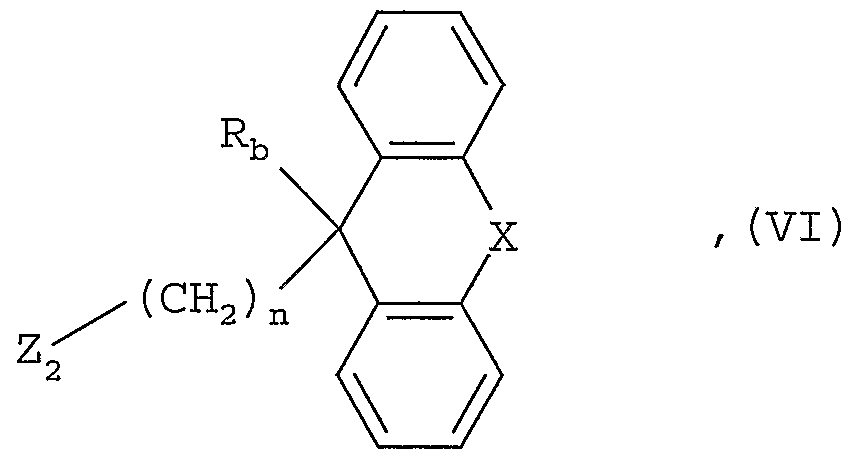
Rb, X und n wie eingangs erwähnt definiert sind und Z2 eine nukleofuge Austrittsgruppe wie ein Chlor- oder Bromatom darstellt, mit einem entsprechenden Piperazin oder Homopipera- zin, in dem eine Iminogruppe zeckmäßigerweise durch einen üblichen Schutzrest geschützt sein kann, beispielsweise durch eine tert .Butoxycarbonyl- oder Benzyloxycarbonylgruppe, in der Schmelze oder in einem Lösungsmittel wie Ethanol, Dioxan, Tetrahydrofuran, Acetonitril oder Dimethylformamid in Gegenwart einer Base wie Triethylamin oder Kaliumkarbonat und bei Temperaturen zwischen 0 und 130 °C, vorzugsweise jedoch bei Temperaturen zwischen 20 und 80 °C. Die anschließende Abspaltung einer verwendeten Schutzgruppe erfolgt nach literaturbekannten Verf hren .R b , X and n are defined as mentioned at the outset and Z 2 represents a nucleofugic leaving group such as a chlorine or bromine atom, with a corresponding piperazine or homopiperazine, in which an imino group can conveniently be protected by a customary protective radical, for example by a tert. Butoxycarbonyl or benzyloxycarbonyl group, in the melt or in a solvent such as ethanol, dioxane, tetrahydrofuran, acetonitrile or dimethylformamide in the presence of a base such as triethylamine or potassium carbonate and at temperatures between 0 and 130 ° C, but preferably at temperatures between 20 and 80 ° C. The subsequent splitting off of a protective group used is carried out according to methods known from the literature.
Eine Verbindung der allgemeinen Formel IV erhält man beispielsweise analog Verfahren a) durch Umsetzung eines entsprechend substituierten Carbonsäurederivats mit einer Verbindung der allgemeinen Formel III und gegebenenfalls anschließende Abspaltung eines zum Schütze der Carboxygruppe verwendeten Schutzrestes.A compound of the general formula IV is obtained, for example, analogously to process a) by reacting an appropriately substituted carboxylic acid derivative with a compound of the general formula III and, if appropriate, subsequently splitting off a protective radical used to protect the carboxy group.
Wie bereits eingangs erwähnt, weisen die Verbindungen der allgemeinen Formel I und deren physiologisch verträgliche Salze wertvolle pharmakologische Eigenschaften auf. Diese stellen insbesondere wertvolle Inhibitoren des mikrosomalen Triglyze- rid-Transferproteins (MTP) dar und eignen sich daher zur Senkung der Plasmaspiegel der atherogenen Lipoproteine .As already mentioned at the beginning, the compounds of the general formula I and their physiologically tolerable salts have valuable pharmacological properties. These are particularly valuable inhibitors of the microsomal triglycer rid transfer protein (MTP) and are therefore suitable for lowering the plasma levels of atherogenic lipoproteins.
Beispielsweise wurden die erfindungsgemäßen Verbindungen auf ihre biologischen Wirkungen wie folgt untersucht:For example, the compounds of the invention were examined for their biological effects as follows:
Inhibitoren von MTP wurden durch einen zellfreien MTP-Aktivitätstest identifiziert. Solubilisierte Lebermikroso en aus verschiedenen Spezies (z.B. Ratte, Schwein) können als MTP-Quelle benutzt werden. Zur Herstellung von Donor- und Akzeptorvesikeln wurden in organischen Lösungsmitteln gelöste Lipide in einem geeigneten Verhältnis gemischt und durch Verblasen des Lösungsmittels im Stickstoffström als dünne Schicht auf eine Glasgefäßwand aufgebracht. Die zur Herstellung von Donorvesikeln verwendete Lösung enthielt 400 μM Phosphatidylcholin, 75 μM Cardiolipin und 10 μM [1C] -TrioleinMTP inhibitors were identified by a cell-free MTP activity test. Solubilized liver microsomes from various species (eg rats, pigs) can be used as MTP sources. To produce donor and acceptor vesicles, lipids dissolved in organic solvents were mixed in a suitable ratio and applied to a glass vessel wall as a thin layer by blowing the solvent in a stream of nitrogen. The solution used to prepare donor vesicles contained 400 μM phosphatidylcholine, 75 μM cardiolipin and 10 μM [ 1 C] triolein
(68,8 μCi/mg) . Zur Herstellung von Akzeptorvesikeln wurde eine Lösung aus 1,2 mM Phosphatidylcholin, 5 μM Triolein und 15 μM(68.8 µCi / mg). A solution of 1.2 mM phosphatidylcholine, 5 μM triolein and 15 μM was used to produce acceptor vesicles
[3H] -Dipalmitoylphosphatidylcholin (108 mCi/mg) verwendet. Ve- sikel entstehen durch Benetzung der getrockneten Lipide mit Testpuffer und anschließende Ultrabeschallung. Vesikelpopula- tionen einheitlicher Größe wurden durch Gelfiltration der ultrabeschallten Lipide erhalten. Der MTP-Aktivitätstest enthält Donorvesikel, Akzeptorvesikel sowie die MTP-Quelle in Testpuffer. Substanzen wurden aus konzentrierten DMSO-haltigen Stammlösungen zugegeben, die Endkonzentration an DMSO im Test betrug 0,1%. Die Reaktion wurde durch Zugabe von MTP gestartet. Nach entsprechender Inkubationszeit wurde der Transferprozeß durch Zugabe von 500 μl einer SOURCE 30Q Anionenaustau- scher-Suspension (Pharmacia' Biotech) gestoppt. Die Mischung wurde für 5 Minuten geschüttelt- und die an das Anionenaus- tauschermaterial gebundenen Donorvesikel durch Zentrifugation abgetrennt. Die sich im Überstand befindende Radioaktivität von [3H] und [14C] wurde durch Flüssigkeits-Szintillations- Messung bestimmt und daraus die Wiederfindung der Akzeptorve- sikel und die Triglyzerid-Transfer-Geschwindigkeit berechnet.[ 3 H] dipalmitoylphosphatidylcholine (108 mCi / mg) was used. Vesicles are formed by wetting the dried lipids with test buffer and subsequent sonication. Vesicle populations of uniform size were obtained by gel filtration of the ultrasound-exposed lipids. The MTP activity test contains donor vesicles, acceptor vesicles and the MTP source in test buffer. Substances were added from concentrated DMSO-containing stock solutions, the final concentration of DMSO in the test was 0.1%. The reaction was started by adding MTP. After an appropriate incubation period, the transfer process was stopped by adding 500 μl of a SOURCE 30Q anion exchange suspension (Pharmacia ' Biotech). The mixture was shaken for 5 minutes and the donor vesicles bound to the anion exchange material by centrifugation separated. The radioactivity of [3H] and [14C] in the supernatant was determined by liquid scintillation measurement and from this the recovery of the acceptor vesicles and the triglyceride transfer rate were calculated.
Auf Grund der vorstehend erwähnten biologischen Eigenschaften eignen sich die Verbindungen der allgemeinen Formel I und deren physiologisch verträgliche Salze insbesondere zur Senkung der Plasmakonzentration von atherogenen Apolipoprotein B (apoB) -haltigen Lipoproteinen wie Chylomikronen und/oder Lipo- proteinen sehr niedriger Dichte (VLDL) sowie deren Überreste wie Lipoproteine niedriger Dichte (LDL) und/oder Lipoprote- in(a) (Lp(a)), zur Behandlung von Hyperlipidämien, zur Vorbeugung und Behandlung der Atherosklerose und ihrer klinischen Folgen, und zur Vorbeugung und Behandlung verwandter Erkrankungen wie Diabetes mellitus, Adipositas und Pankreatitis, wobei die orale Applikation bevorzugt ist.On the basis of the biological properties mentioned above, the compounds of the general formula I and their physiologically tolerable salts are particularly suitable for lowering the plasma concentration of atherogenic apolipoprotein B (apoB) -containing lipoproteins such as chylomicrons and / or very low density lipoproteins (VLDL) and their remains, such as low-density lipoproteins (LDL) and / or lipoprotein (a) (Lp (a)), for the treatment of hyperlipidemia, for the prevention and treatment of atherosclerosis and its clinical consequences, and for the prevention and treatment of related diseases such as diabetes mellitus, obesity and pancreatitis, with oral administration being preferred.
Die zur Erzielung einer entsprechenden Wirkung erforderliche Tagesdosis liegt beim Erwachsenen zwischen 0,5 und 500 mg, zweckmäßigerweise zwischen 1 und 350 mg, vorzugsweise jedoch zwischen 5 und 200 mg.The daily dose required to achieve a corresponding effect in adults is between 0.5 and 500 mg, advantageously between 1 and 350 mg, but preferably between 5 and 200 mg.
Hierzu lassen sich die erfindungsgemäß hergestellten Verbindungen der Formel I, gegebenenfalls in Kombination mit anderen Wirksubstanzen wie anderen Lipidsenker, beispielsweise mit HMG-CoA-Reduktase-Inhibitoren, Cholesterolbiosynthese-Inhibitoren wie Squalensynthase-Inhibitoren und Squalenzyklase-Inhibitoren, Gallensäure-bindende Harze, Fibrate, Cholesterol-Re- sorptions-Inhibitoren, Niacin, Probucol, CETP Inhibitoren und ACAT Inhibitoren zusammen mit einem oder mehreren inerten üblichen Trägerstoffen und/oder Verdünnungsmitteln, z.B. mit Maisstärke, Milchzucker, Rohrzucker, mikrokristalliner Zellulose, Magnesiumstearat, Polyvinylpyrrolidon, Zitronensäure, Weinsäure, Wasser, Wasser/Ethanol, Wasser/Glycerin, Wasser/- Sorbit, Wasser/Polyethylenglykol, Propylenglykol, Cetylstea- rylalkohol, Carboxymethylcellulose oder fetthaltigen Substanzen wie Hartfett oder deren geeigneten Gemischen, in übliche galenische Zubereitungen wie Tabletten, Dragees, Kapseln, Pulver, Suspensionen oder Zäpfchen einarbeiten.For this purpose, the compounds of formula I prepared according to the invention, optionally in combination with other active substances such as other lipid-lowering agents, for example with HMG-CoA reductase inhibitors, cholesterol biosynthesis inhibitors such as squalene synthase inhibitors and squalene cyclase inhibitors, bile acid-binding resins, fibrates, Cholesterol absorption inhibitors, niacin, probucol, CETP inhibitors and ACAT inhibitors together with one or more inert customary carriers and / or diluents, for example with Corn starch, milk sugar, cane sugar, microcrystalline cellulose, magnesium stearate, polyvinylpyrrolidone, citric acid, tartaric acid, water, water / ethanol, water / glycerin, water / - sorbitol, water / polyethylene glycol, propylene glycol, cetylstearyl alcohol, carboxymethyl cellulose or fat-containing substances such as hard fat suitable mixtures, work into common galenical preparations such as tablets, dragees, capsules, powders, suspensions or suppositories.
Die nachfolgenden Beispiele sollen die Erfindung nähers erläutern: The following examples are intended to explain the invention in more detail:
Herstellung der Ausgangsprodukte:Production of the starting products:
Beispiel IExample I
9- (4-Brom-butyl) -9H-fluoren-9-carbonsäure9- (4-bromo-butyl) -9H-fluorene-9-carboxylic acid
Zu einer Lösung von 21 g (0,1 Mol) 9-Fluorencarbonsäure in 700 ml Tetrahydrofuran werden bei 0°C unter Stickstoff 89 ml (0,11 Mol) einer 1,6 molaren n-Butyl-lithiumlösung in Hexan zugetropft und eine Stunde gerührt. Im Anschluß werden ebenfalls bei 0°C 13,13 ml (0,11 Mol) Dibrombutan zugesetzt und die Lösung 30 Stunden bei Raumtemperatur gerührt. Nach dieser Zeit werden 50 ml Wasser zugesetztund 30 Minuten gerührt. Die Lösung wird eingeengt, mit Wasser versetzt und mit 250 ml Di- ethylether extrahiert. Die wäßrige Phase wird mit 150 ml IN Salzsäure angesäuert und dreimal mit je 250 ml Dichlor- methan extrahiert. Die vereinigten organischen Phasen werden über Natriumsulfat getrocknet und das Solvens entfernt. Ausbeute: 18,5 g (53,6 % der Theorie), Schmelzpunkt: 123 °C89 ml (0.11 mol) of a 1.6 molar n-butyl lithium solution in hexane are added dropwise at 0 ° C. under nitrogen to a solution of 21 g (0.1 mol) of 9-fluorenecarboxylic acid in 700 ml of tetrahydrofuran and one hour touched. Subsequently, 13.13 ml (0.11 mol) of dibromobutane are also added at 0 ° C. and the solution is stirred at room temperature for 30 hours. After this time, 50 ml of water are added and stirred for 30 minutes. The solution is concentrated, water is added and the mixture is extracted with 250 ml of diethyl ether. The aqueous phase is acidified with 150 ml IN hydrochloric acid and extracted three times with 250 ml dichloromethane. The combined organic phases are dried over sodium sulfate and the solvent is removed. Yield: 18.5 g (53.6% of theory), melting point: 123 ° C
Analog Beispiel I werden folgende Verbindungen hergestellt:The following compounds are prepared analogously to Example I:
(1) 9- (4-Brom-butyl) -9H-xanthen-9-carbonsäure Hergestellt aus Xanthen-9-carbonsäure und Dibrombutan(1) 9- (4-Bromobutyl) -9H-xanthene-9-carboxylic acid Made from xanthene-9-carboxylic acid and dibromobutane
(2) (3-Brom-propyl) -9H-fluoren-9-carbonsäure-methylester Hergestellt aus Fluoren-9-carbonsäure-methylester und Dibrom- propan Beispiel II(2) (3-Bromopropyl) -9H-fluorene-9-carboxylic acid methyl ester Made from fluorene-9-carboxylic acid methyl ester and dibromopropane Example II
9- (4-Brom-butyl) -9H-fluoren-9-carbonsäurechlorid9- (4-bromo-butyl) -9H-fluorene-9-carboxylic acid chloride
23 g (0,067 Mol) 9- (4-Brom-butyl) -9H-fluoren-9-carbonsäure werden in 40 ml Dichlormethan gelöst, mit drei Tropfen Dime- thylformamid und 6,96 ml (0,081 Mol) Oxalychlorid, gelöst in23 g (0.067 mol) of 9- (4-bromo-butyl) -9H-fluorene-9-carboxylic acid are dissolved in 40 ml of dichloromethane, with three drops of dimethylformamide and 6.96 ml (0.081 mol) of oxalychloride, dissolved in
10 ml Dichlormethan, unter Stickstoff bei 0°C versetzt. Es wird 3 Stunden bei Raumtemperatur gerührt. Anschließend wird das Solvens entfernt und das Rohprodukt ohne weitere Reinigung weiter umgesetzt.10 ml dichloromethane, added under nitrogen at 0 ° C. The mixture is stirred at room temperature for 3 hours. The solvent is then removed and the crude product is reacted further without further purification.
Ausbeute: 24 g (99 % der Theorie)Yield: 24 g (99% of theory)
Analog Beispiel II werden folgende Verbindungen hergestellt:The following compounds are prepared analogously to Example II:
(1) 9- (4-Brom-butyl) -9H-xanthen-9-carbonsäurechlorid(1) 9- (4-Bromo-butyl) -9H-xanthene-9-carboxylic acid chloride
(2) 9- [3- (4-Phenylacetyl-piperazino) -propyl] -9H-fluoren-9-car- bonsäurechlorid(2) 9- [3- (4-Phenylacetylpiperazino) propyl] -9H-fluorene-9-carboxylic acid chloride
Hergestellt aus 9- [3- (4-Phenylacetyl-piperazino) -propyl] -9H- fluoren-9-carbonsäureMade from 9- [3- (4-phenylacetyl-piperazino) propyl] -9H-fluorene-9-carboxylic acid
Beispiel IIIExample III
9- (4-Brom-butyl) -9H-fluoren-9-carbonsäure- (2,2, 2-trifluor- ethyl) -amid9- (4-Bromo-butyl) -9H-fluorene-9-carboxylic acid (2,2, 2-trifluoroethyl) amide
Zu einer Lösung von 9,35 g (0,069 Mol) 2, 2, 2-Trifluorethyl- amin-hydrochlorid und 26 ml (0,188 Mol) Triethylamin in 550 ml Dichlormethan werden bei 0°C unter Stickstoff 23 g (0,063 Mol) 9- (4-Brom-butyl) -9H-fluoren-9-carbonsäurechlorid zugetropft und 2 Stunden bei Raumtemperatur gerührt. Das Reaktionsgemisch wird je zweimal mit Wasser, IN Salzsäure und Natriumhydrogen- carbonatlösung extrahiert. Die organische Phase wird über Na- triumsulfat getrocknet und das Lösungsmittel abdestilliert. Die Reinigung erfolgt durch Säulenchromatographie an Kieselgel (Eluens: Cyclohexan/Essigsäuerethylester = 8:1). Ausbeute: 15,8 g (58,6 % der Theorie), Schmelzpunkt: 172 °CTo a solution of 9.35 g (0.069 mol) of 2,2,2-trifluoroethylamine hydrochloride and 26 ml (0.188 mol) of triethylamine in 550 ml of dichloromethane are 23 g (0.063 mol) of nitrogen at 0 ° C under nitrogen. (4-Bromobutyl) -9H-fluorene-9-carboxylic acid chloride was added dropwise and the mixture was stirred at room temperature for 2 hours. The reaction mixture is extracted twice with water, 1N hydrochloric acid and sodium hydrogen carbonate solution. The organic phase is Dried trium sulfate and the solvent was distilled off. The purification is carried out by column chromatography on silica gel (eluent: cyclohexane / ethyl acetate = 8: 1). Yield: 15.8 g (58.6% of theory), melting point: 172 ° C
Analog Beispiel III werden folgende Verbindungen hergestellt:The following compounds are prepared analogously to Example III:
(1) 9- (4-Brom-butyl) -9H-xanthen-9-carbonsäure- (2,2, 2-trifluor- ethyl) -amid(1) 9- (4-Bromo-butyl) -9H-xanthene-9-carboxylic acid- (2,2,2-trifluoroethyl) amide
(2) 9- (4-Brom-butyl) -9H-fluoren-9-carbonsäure-propylamid(2) 9- (4-bromo-butyl) -9H-fluorene-9-carboxylic acid propylamide
(3) 9- (4-Brom-butyl) -9H-fluoren-9-carbonsäure-benzylamid(3) 9- (4-bromo-butyl) -9H-fluorene-9-carboxylic acid benzylamide
(4) 9- (4-Brom-butyl) -9H-fluoren-9-carbonsäure-phenylamid(4) 9- (4-bromo-butyl) -9H-fluorene-9-carboxylic acid phenylamide
(5) 9- (4-Brom-butyl) -9H-fluoren-9-carbonsäure-cyclopentylamid(5) 9- (4-Bromo-butyl) -9H-fluorene-9-carboxylic acid cyclopentylamide
(6) 9- ( 4-Brom-butyl) -9H-fluoren-9-carbonsäure-N-methyl-N- ethylamid(6) 9- (4-Bromo-butyl) -9H-fluorene-9-carboxylic acid-N-methyl-N-ethylamide
Beispiel IVExample IV
9- [4- (4 -tert .Butyloxycarbonyl -piperazino) -butyl] -9H-fluoren-9- carbonsäure- (2,2, 2-trifluorethyl) amid9- [4- (4-tert. Butyloxycarbonyl-piperazino) butyl] -9H-fluorene-9-carboxylic acid- (2,2,2-trifluoroethyl) amide
Eine Lösung von 1, 6 g (8,59 mMol) Piperazin-1-carbonsäure- tertiärbutylester, 3,7 g (8,68 mMol) 9- (4-Brom-butyl) -9H- fluoren-9-carbonsäure- (2, 2, 2-trifluor-ethyl) -amid und 2,6 g (20,15 mMol) Ethyldiisopropylamin in 80 ml DMF wird 40 Stunden bei 40 °C gerührt. Das DMF wird am Rotationsverdampfer abdestilliert. Der Rückstand wird in Dichlormethan aufgenommen und mit einer Ammoniumhydroxidlösung extrahiert. Die organische Phase wird über Natriumsulfat getrocknet und das Lösungsmittel abdestilliert. Die Reinigung erfolgt durch Säulenchromatographie an Kieselgel (Eluens: Dichlormethan/Ethanol = 19:1). Ausbeute: 4,6 g (99,7 % d. Theorie), C29H36F3N3θ3 (M= 531,62)A solution of 1, 6 g (8.59 mmol) of tert-butyl piperazine-1-carboxylic acid, 3.7 g (8.68 mmol) of 9- (4-bromo-butyl) -9H-fluorene-9-carboxylic acid- ( 2, 2, 2-trifluoro-ethyl) -amide and 2.6 g (20.15 mmol) of ethyldiisopropylamine in 80 ml of DMF is stirred at 40 ° C for 40 hours. The DMF is distilled off on a rotary evaporator. The residue is taken up in dichloromethane and extracted with an ammonium hydroxide solution. The organic phase is dried over sodium sulfate and the solvent is distilled off. The purification is carried out by column chromatography on silica gel (eluent: dichloromethane / ethanol = 19: 1). Yield: 4.6 g (99.7% of theory), C 2 9H3 6 F 3 N3θ3 (M = 531.62)
Ber.: Molpeak (M+H)+: 532 Gef.: Molpeak (M+H) + : 532Calc .: Molpeak (M + H) + : 532 Found: Molpeak (M + H) +: 532
Analog Beispiel IV werden folgende Verbindungen hergestellt :The following compounds are prepared analogously to Example IV:
(1) 9- [4- (4-tert .Butyloxycarbonyl-piperazino) -butyl] -9H- xanthen-9-carbonsäure- (2,2, 2-trifluorethyl) amid(1) 9- [4- (4-tert-Butyloxycarbonyl-piperazino) butyl] -9H-xanthene-9-carboxylic acid- (2,2,2-trifluoroethyl) amide
(2) 9- [4- (4-tert .Butyloxycarbonyl- (S) -2-methyl-piperazino) - butyl] -9H-fluoren-9-carbonsäure- (2,2, 2-trifluorethyl) amid(2) 9- [4- (4-tert-Butyloxycarbonyl- (S) -2-methyl-piperazino) butyl] -9H-fluorene-9-carboxylic acid- (2,2,2-trifluoroethyl) amide
(3) 9- [4- (4-tert .Butyloxycarbonyl- (R) -2 -methyl-piperazino) - butyl] -9H-fluoren-9-carbonsäure- (2,2, 2-trifluorethyl) amid(3) 9- [4- (4-tert-Butyloxycarbonyl- (R) -2-methyl-piperazino) - butyl] -9H-fluorene-9-carboxylic acid- (2,2,2-trifluoroethyl) amide
(4) 9- [4- (4-tert .Butyloxycarbonyl- [1,4] diazepan-1-yl) -butyl] - 9H-fluoren-9-carbonsäure- (2,2, 2-trifluorethyl) amid(4) 9- [4- (4-tert-Butyloxycarbonyl- [1,4] diazepan-1-yl) butyl] - 9H-fluorene-9-carboxylic acid- (2,2,2-trifluoroethyl) amide
(5) 9- [3- (4-tert .Butyloxycarbonyl-piperazino) propyl] -9H- fluoren-9-carbonsäuremethylester(5) 9- [3- (4-tert-Butyloxycarbonyl-piperazino) propyl] -9H-fluorene-9-carboxylic acid methyl ester
Beispiel VExample V
9- (4-Piperazino-butyl) -9H-fluoren-9-carbonsäure- (2,2, 2-tri- fluor-ethyl) -amid9- (4-Piperazino-butyl) -9H-fluorene-9-carboxylic acid- (2,2,2-tri-fluoro-ethyl) -amide
Eine Lösung von 4,6 g (8,65 mMol) 9- [4- (4-tert .Butyloxycarbonyl-piperazino) -butyl] -9H-fluoren-9-carbonsäure- (2,2, 2-tri- fluor-ethyl) -amid und 20 ml Trifluoressigsäure in 200 ml Dichlormethan wird zwei Stunden bei Raumtemperatur gerührt. Anschließend wird die Reaktionslösung am Rotationsverdampfer eingeengt, der Rückstand in Dichlormethan aufgenommen und mit einer Ammoniumhydroxidlösung extrahiert. Die organische Phase wird über Natriumsulfat getrocknet und das Lösungsmittel abdestilliert. Die Reinigung erfolgt durch Säulenchromatographie an Kieselgel (Eluens: Dichlormethan/Ethanol = 9:1). Ausbeute: 3,6 g (96,4 % der Theorie), C24H28F3N30 (M = 431,50)A solution of 4.6 g (8.65 mmol) of 9- [4- (4-tert-butyloxycarbonyl-piperazino) butyl] -9H-fluorene-9-carboxylic acid- (2,2, 2-tri- fluoro-ethyl) -amide and 20 ml trifluoroacetic acid in 200 ml dichloromethane is stirred for two hours at room temperature. The reaction solution is then concentrated on a rotary evaporator, the residue is taken up in dichloromethane and extracted with an ammonium hydroxide solution. The organic phase is dried over sodium sulfate and the solvent is distilled off. The purification is carried out by column chromatography on silica gel (eluent: dichloromethane / ethanol = 9: 1). Yield: 3.6 g (96.4% of theory), C 24 H 28 F 3 N 3 0 (M = 431.50)
Ber. : Molpeak (M+H) + : 432Ber. : Molpeak (M + H) +: 432
Gef.: Molpeak (M+H) + : 432Found: Molpeak (M + H) +: 432
Analog Beispiel V werden folgende Verbindungen hergestellt:The following compounds are produced analogously to Example V:
(1) 9- (4-Piperazino-butyl) -9H-xanthen-9-carbonsäure- (2,2,2- trifluor-ethyl) -amid(1) 9- (4-Piperazino-butyl) -9H-xanthene-9-carboxylic acid- (2,2,2-trifluoro-ethyl) -amide
(2) 9- [4- ( (S) -2 -Methyl-piperazino) -butyl] -9H-fluoren-9-carbonsäure- (2,2, 2-trifluorethyl) amid(2) 9- [4- ((S) -2-Methyl-piperazino) butyl] -9H-fluorene-9-carboxylic acid- (2,2,2-trifluoroethyl) amide
(3) 9- [4- ( (R) -2-Methyl-piperazino) -butyl] -9H-fluoren-9-carbonsäure- (2,2, 2-trifluorethyl) amid(3) 9- [4- ((R) -2-methyl-piperazino) butyl] -9H-fluorene-9-carboxylic acid- (2,2,2-trifluoroethyl) amide
(4) 9- [4- ( [1, 4] Diazepan-1-yl) -butyl] -9H-fluoren-9-carbonsäure- (2,2, 2 -trifluorethyl) amid(4) 9- [4- ([1, 4] diazepan-1-yl) butyl] -9H-fluorene-9-carboxylic acid- (2,2,2-trifluoroethyl) amide
(5) 9- (3-Piperazino-propyl) -9H-fluoren-9-carbonsäure-methyl- ester(5) 9- (3-Piperazino-propyl) -9H-fluorene-9-carboxylic acid methyl ester
Ausbeute: 98 % der Theorie, C22H2SN202 (M = 350,46) Ber.: Molpeak (M+H) + : 351 Gef.: Molpeak (M+H) + : 351Yield: 98% of theory, C 22 H 2S N 2 0 2 (M = 350.46) Calc .: Molpeak (M + H) +: 351 Found: Molpeak (M + H) +: 351
Beispiel VIExample VI
9- [3- ( -Phenylacetyl-piperazino) -propyl] -9H-fluoren-9-carbon- säure9- [3- (-Phenylacetyl-piperazino) propyl] -9H-fluorene-9-carboxylic acid
3,5 g 9- [3- (4 -Phenylacetyl-piperazino) -propyl] -9H-fluoren- 9-carbonsäure-methylester (Beispiel 12) werden in 80 ml Methanol/Dioxan (1:1) aufgenommen und mit 38 ml IN Natronlauge bei 50 °C 2 Stunden gerührt. Anschließend wird sauer gestellt und mit3.5 g of methyl 9- [3- (4-phenylacetylpiperazino) propyl] -9H-fluorene-9-carboxylate (Example 12) are taken up in 80 ml of methanol / dioxane (1: 1) and with 38 ml Stirred in sodium hydroxide solution at 50 ° C. for 2 hours. Then it is acidified and with
Methylenchlorid extrahiert . Die organische Phase wird einrotiert . Ausbeute : 2,7 gExtracted methylene chloride. The organic phase is spun in. Yield: 2.7 g
Beispiel VIIExample VII
9- (4- {4- [Phenyl-acetyl] -piperazin-2-on-l-yl} -butyl) -9H- fluoren-9-carbonsäure-methylester9- (4- {4- [Phenylacetyl] piperazin-2-one-1-yl} butyl) -9H-fluorene-9-carboxylic acid methyl ester
1,4 g 4 -Phenylacetyl -piperazin-2-on (hergestellt aus Pipera- zin-2-on und Phenylessigsäurechlorid) werden in 30 ml Dime- thylformamid gelöst und mit 0,3 g Natriumhydrid 1,5 h bei Raumtemperatur gerührt. Anschließend gibt man portionsweise 2,3 g 9- (4-Brom-butyl) -9H-fluoren-9-carbonsäure-methylester zu und rührt weitere 4 h bei Raumtemperatur. Dann wird das Lösungsmittel abgedampft, der Rückstand in Methylenchlorid aufgenommen und mit Wasser gewaschen. Die organische Phase wird einrotiert und der Rückstand über eine Kieselgelsäule mit Methylenchlorid/Ethanol 19:1 chromatographiert . Ausbeute: 87 % d. Theorie Herstellung der Endprodukte:1.4 g of 4-phenylacetyl-piperazin-2-one (prepared from piperazine-2-one and phenylacetic acid chloride) are dissolved in 30 ml of dimethylformamide and stirred with 0.3 g of sodium hydride at room temperature for 1.5 hours. Then 2.3 g of 9- (4-bromo-butyl) -9H-fluorene-9-carboxylic acid methyl ester are added in portions and the mixture is stirred for a further 4 h at room temperature. Then the solvent is evaporated off, the residue is taken up in methylene chloride and washed with water. The organic phase is evaporated in a rotary evaporator and the residue is chromatographed on a silica gel column with methylene chloride / ethanol 19: 1. Yield: 87% of theory theory Production of the end products:
Beispiel 1example 1
9- [4- (4-Phenylacetyl-piperazino) -butyl] -9H-fluoren-9-carbon- säure- (2,2, 2-trifluor-ethyl) -amid9- [4- (4-Phenylacetyl-piperazino) butyl] -9H-fluorene-9-carboxylic acid- (2,2,2-trifluoro-ethyl) -amide
Zu einer Lösung von 0,3 g (0,695 mMol) 9- (4-Piperazino-butyl) - 9H-fluoren-9-carbonsäure- (2, 2, 2-trifluor-ethyl) -amid in 20 ml Dichlormethan werden nacheinander 0,15 g (1,5 mMol) Triethyl- amin und 0,11 g (0,712 mMol) Phenylessigsäuerchlorid, gelöst in 5 ml Dichlormethan, zugetropft und eine Stunde bei Raumtemperatur gerührt. Die Reaktionsmischung wird mit einer Ammoniumhydroxidlösung extrahiert. Die organische Phase wird über Natriumsulfat getrocknet und das Lösungsmittel abdestilliert. Die Reinigung erfolgt durch Säulenchromatographie an Kieselgel (Eluens: Dichlormethan und anschließend Dichlor- methan/Ethanol = 19:1).To a solution of 0.3 g (0.695 mmol) of 9- (4-piperazino-butyl) - 9H-fluoren-9-carboxylic acid (2, 2, 2-trifluoro-ethyl) -amide in 20 ml of dichloromethane are successively 0 , 15 g (1.5 mmol) of triethylamine and 0.11 g (0.712 mmol) of phenylacetic acid chloride, dissolved in 5 ml of dichloromethane, were added dropwise and the mixture was stirred at room temperature for one hour. The reaction mixture is extracted with an ammonium hydroxide solution. The organic phase is dried over sodium sulfate and the solvent is distilled off. The purification is carried out by column chromatography on silica gel (eluent: dichloromethane and then dichloromethane / ethanol = 19: 1).
Ausbeute: 0,25 g (65,4 % der Theorie), C32H34F3 3θ2 (M = 549,64)Yield: 0.25 g (65.4% of theory), C 32 H 34 F 3 3 θ 2 (M = 549.64)
Ber. : Molpeak (M+H) + : 550Ber. : Molpeak (M + H) +: 550
Gef.: Molpeak (M+H) + : 550Found: Molpeak (M + H) + : 550
Beispiel 2Example 2
9- [4- (4-Cyclohexylacetyl-piperazino) -butyl] -9H-fluoren-9-car- bonsäure- (2,2, 2-trifluor-ethyl) -amid9- [4- (4-Cyclohexylacetyl-piperazino) butyl] -9H-fluorene-9-carboxylic acid- (2,2,2-trifluoroethyl) amide
Hergestellt analog Beispiel 1 aus 9- (4-Piperazino-butyl) -9H- fluoren-9-carbonsäure- (2, 2, 2-trifluor-ethyl) -amid und Cyclohexylacetylchlorid.Prepared analogously to Example 1 from 9- (4-piperazino-butyl) -9H-fluorene-9-carboxylic acid- (2, 2, 2-trifluoro-ethyl) -amide and cyclohexylacetyl chloride.
Ausbeute : 0 , 35 g ( 90 , 6 % der Theorie ) , C32H40F3N3O2 (M = 555 , 69 )Yield: 0, 35 g (90, 6% of theory), C 32 H 4 0F 3 N 3 O 2 (M = 555, 69)
Ber . : Molpeak (M+H) + : 556 Gef.: Molpeak (M+H) + : 556Ber. : Molpeak (M + H) +: 556 Found: Molpeak (M + H) +: 556
Beispiel 3Example 3
9- [4- (4-Propionyl-piperazino) -butyl] -9H-fluoren-9-carbonsäure-9- [4- (4-propionyl-piperazino) butyl] -9H-fluorene-9-carboxylic acid -
(2,2, 2-trifluor-ethyl) -amid(2,2,2-trifluoro-ethyl) amide
Hergestellt analog Beispiel 1 aus 9- (4-Piperazino-butyl) -9H- fluoren-9-carbonsäure- (2, 2, 2-trifluor-ethyl) -amid und Pro- pionsäurechlorid.Prepared analogously to Example 1 from 9- (4-piperazino-butyl) -9H-fluorene-9-carboxylic acid- (2, 2, 2-trifluoro-ethyl) -amide and propionic acid chloride.
Ausbeute: 0,3 g (88,5 % der Theorie),Yield: 0.3 g (88.5% of theory),
C27H32F3N3θ2 (M = 487,57)C 27 H32F 3 N3θ2 (M = 487.57)
Ber.: Molpeak (M+H) + : 488Calc .: Molpeak (M + H) +: 488
Gef.: Molpeak (M+H) + : 488Found: Molpeak (M + H) +: 488
Beispiel 4Example 4
9- [4- (4-Benzoyl-piperazino) -butyl] -9H-fluoren-9-carbonsäure-9- [4- (4-Benzoyl-piperazino) butyl] -9H-fluorene-9-carboxylic acid -
(2,2, 2-trifluor-ethyl) -amid(2,2,2-trifluoro-ethyl) amide
Hergestellt analog Beispiel 1 aus 9- (4-Piperazino-butyl) -9H- fluoren-9-carbonsäure- (2, 2, 2-trifluor-ethyl) -amid und Benzoyl- chlorid.Prepared analogously to Example 1 from 9- (4-piperazino-butyl) -9H-fluorene-9-carboxylic acid (2, 2, 2-trifluoro-ethyl) -amide and benzoyl chloride.
Ausbeute : 0 , 23 g ( 92 , 7 % der Theorie) ,Yield: 0.23 g (92.7% of theory),
C3ιH32F3N302 (M = 535 , 61 )C 3 ιH 32 F 3 N 3 0 2 (M = 535, 61)
Ber . : Molpeak (M+H) + : 536Ber. : Molpeak (M + H) +: 536
Gef . : Molpeak (M+H) + : 536 Beispiel 5Gef. : Molpeak (M + H) +: 536 Example 5
9- {4- [4- (4 -Phenyl-butyryl) -piperazino] -butyl} -9H-fluoren-9- {4- [4- (4-phenyl-butyryl) piperazino] butyl} -9H-fluorene-
9-carbonsäure- (2 , 2 , 2-trifluor-ethyl) -amid9-carboxylic acid (2, 2, 2-trifluoroethyl) amide
Hergestellt analog Beispiel 1 aus 9- (4-Piperazino-butyl) -9H- fluoren-9-carbonsäure- (2, 2, 2-trifluor-ethyl) -amid und 4-Phe- nylbuttersäurechlorid .Prepared analogously to Example 1 from 9- (4-piperazino-butyl) -9H-fluorene-9-carboxylic acid- (2, 2, 2-trifluoro-ethyl) -amide and 4-phenylbutyric acid chloride.
Ausbeute: 0,26 g (97,2 % der Theorie),Yield: 0.26 g (97.2% of theory),
C34H38F3N3θ2 (M = 577,69)C 34 H 38 F 3 N 3 θ 2 (M = 577.69)
Ber.: Molpeak (M+H)+: 578Calc .: Molpeak (M + H) +: 578
Gef.: Molpeak (M+H) + : 578Found: Molpeak (M + H) +: 578
Beispiel 6Example 6
9- {4- [4- (2, 5-Dimethoxy-phenylacetyl) -piperazino] -butyl }-9H- flυoren-9-carbonsäure- (2f 2 , 2-trifluor-ethyl) -amid9- {4- [4- (2,5-Dimethoxy-phenylacetyl) piperazino] butyl} -9H-fluorene-9-carboxylic acid- (2 f 2, 2-trifluoro-ethyl) -amide
Hergestellt analog Beispiel 1 aus 9- (4-Piperazino-butyl) -9H- fluoren-9-carbonsäure- (2 , 2 , 2-trifluor-ethyl) -amid und 2,5-Di- methoxy-phenylessigsäurechlorid. Ausbeute: 0,26 g (92,1 % der Theorie), C34H38F3N3θ4 (M = 609,69)Prepared analogously to Example 1 from 9- (4-piperazino-butyl) -9H-fluorene-9-carboxylic acid (2, 2, 2-trifluoro-ethyl) -amide and 2,5-dimethoxy-phenylacetic acid chloride. Yield: 0.26 g (92.1% of theory), C 34 H 38 F 3 N 3 θ 4 (M = 609.69)
Ber.: Molpeak (M+H)+: 610Calc .: Molpeak (M + H) +: 610
Gef.: Molpeak (M+H) + : 610Found: Molpeak (M + H) +: 610
Beispiel 7Example 7
9-{4- [4- (3 ,4-Dimethoxy-phenylacetyl) -piperazino] -butyl }-£.______ fluoren-9-carbonsäure- (2 , 2 r -trifluor-ethyl) -amid9- {4- [4- (3,4-Dimethoxy-phenylacetyl) piperazino] butyl} - £ .______ fluorene-9-carboxylic acid- (2,2 r -trifluoro-ethyl) -amide
Hergestellt analog Beispiel 1 aus 9- (4-Piperazino-butyl) -9H- fluoren-9-carbonsäure- (2, 2, 2-trifluor-ethyl) -amid und 3,4-Di- methoxy-phenylessigsäurechlorid. Ausbeute: 0,22 g (77,9 % der Theorie), C34H38F3N304 (M = 609 , 69 ) Ber . : Molpeak (M+H) + : 610 Gef . : Molpeak (M+H) + : 610Prepared analogously to Example 1 from 9- (4-piperazino-butyl) -9H-fluorene-9-carboxylic acid (2, 2, 2-trifluoro-ethyl) -amide and 3,4-dimethoxy-phenylacetic acid chloride. Yield: 0.22 g (77.9% of theory), C 34 H 38 F 3 N 3 0 4 (M = 609, 69) calc. : Molpeak (M + H) +: 610 found : Molpeak (M + H) + : 610
Beispiel 8Example 8
9- [4- (4-Benzylsulfonyl-piperazino-butyl) -9H-fluoren~9-car- bonsäure- (2,2, 2-trifluor-ethyl) -amid9- [4- (4-Benzylsulfonyl-piperazino-butyl) -9H-fluorene ~ 9-carboxylic acid- (2,2,2-trifluoro-ethyl) -amide
Hergestellt analog Beispiel 1 aus 9- (4 -Piperazino-butyl ) -9H- fluoren-9-carbonsäure- ( 2 , 2 , 2-trif luor-ethyl ) -amid und Benzyl - sulfonsäurechlorid . Ausbeute : (49% der Theorie) , C3ιH24F3N303S (M == 585 , 69)Prepared analogously to Example 1 from 9- (4-piperazino-butyl) -9H-fluorene-9-carboxylic acid- (2, 2, 2-trifluoro-ethyl) -amide and benzyl sulfonic acid chloride. Yield: (49% of theory), C 3 ιH 24 F 3 N 3 0 3 S (M == 585, 69)
Ber.: Molpeak (M+H) + : 586Calc .: Molpeak (M + H) +: 586
Gef.: Molpeak (M+H) + : 586Found: Molpeak (M + H) +: 586
Beispiel 9Example 9
9- [4- (4-Toluolsulfonyl-piperazino) -butyl] -9H-fluoren-9-car- bonsäure- (2,2, 2-trifluor-ethyl) -amid9- [4- (4-Toluenesulfonyl-piperazino) butyl] -9H-fluorene-9-carboxylic acid- (2,2,2-trifluoro-ethyl) -amide
Hergestellt analog Beispiel 1 aus 9- (4-Piperazino-butyl) -9H- fluoren-9-carbonsäure- (2, 2, 2-trifluor-ethyl) -amid und Toluol- sulfonsäurechlorid. Ausbeute: (81 % der Theorie), C3ιH24F3N3θ3S (M = 585,69)Prepared analogously to Example 1 from 9- (4-piperazino-butyl) -9H-fluorene-9-carboxylic acid (2, 2, 2-trifluoro-ethyl) -amide and toluenesulfonic acid chloride. Yield: (81% of theory), C 3 ιH 24 F 3 N 3 θ 3 S (M = 585.69)
Ber.: Molpeak (M+H) + : 586Calc .: Molpeak (M + H) +: 586
Gef.: Molpeak (M+H) + : 586Found: Molpeak (M + H) + : 586
Beispiel 10 9- [4- (4-Phenylacetyl-piperazino) -butyl] -9H-xanthen-9-carbon- säure- (2,2, 2-trifluor-ethyl) -amidExample 10 9- [4- (4-Phenylacetyl-piperazino) butyl] -9H-xanthene-9-carboxylic acid- (2,2,2-trifluoro-ethyl) -amide
Hergestellt analog Beispiel 1 aus 9- (4-Piperazino-butyl) -9H- xanthen-9-carbonsäure- (2, 2, 2-trifluor-ethyl) -amid und Phenyl- essigsäurechlorid.Prepared analogously to Example 1 from 9- (4-piperazino-butyl) -9H-xanthene-9-carboxylic acid- (2, 2, 2-trifluoro-ethyl) -amide and phenylacetic acid chloride.
Ausbeute: 0,4 g (91 % der Theorie),Yield: 0.4 g (91% of theory),
C32H34F3N303 (M = 565,64)C 32 H 34 F 3 N 3 0 3 (M = 565.64)
Ber.: Molpeak (M-H) + : 564Calc .: Molpeak (M-H) +: 564
Gef.: Molpeak (M-H) + : 564Found: Molpeak (M-H) +: 564
Beispiel 11Example 11
9- [4- (4-Chlorphenylacetyl-piperazino) -butyl] -9H-fluoren-9-car- bonsäure- (2,2, 2-trifluor-ethyl) -amid9- [4- (4-Chlorophenylacetyl-piperazino) butyl] -9H-fluorene-9-carboxylic acid- (2,2,2-trifluoro-ethyl) -amide
Hergestellt analog Beispiel 1 aus 9- (4-Piperazino-butyl) -9H- fluoren-9-carbonsäure- (2, 2, 2-trifluor-ethyl) -amid und 4-Chlor- phenylessigsäurechlorid.Prepared analogously to Example 1 from 9- (4-piperazino-butyl) -9H-fluorene-9-carboxylic acid (2, 2, 2-trifluoro-ethyl) -amide and 4-chlorophenylacetic acid chloride.
Ausbeute: 0,3 g (69 % der Theorie),Yield: 0.3 g (69% of theory),
C32H33C1F3N302 (M = 584,09)C 32 H 33 C1F 3 N 3 0 2 (M = 584.09)
Ber.: Molpeak (M-H) + : 582/584Calc .: Molpeak (M-H) +: 582/584
Gef.: Molpeak (M-H)+: 582/584Found: Molpeak (M-H) +: 582/584
Beispiel 12Example 12
9- [3- (4-Phenylacetyl-piperazino) -propyl] -9H-fluoren-9-carbon- säuremethylester9- [3- (4-Phenylacetyl-piperazino) propyl] -9H-fluorene-9-carboxylic acid, methyl ester
Hergestellt analog Beispiel 1 aus 9- (3 -Piperazino) -propyl] -Manufactured analogously to Example 1 from 9- (3 -piperazino) propyl] -
9H-fluoren-9-carbonsäuremethylester und Phenylessigsäure- chlorid.9H-fluorene-9-carboxylic acid methyl ester and phenylacetic acid chloride.
Ausbeute : 3 , 6 g ( 53 % der Theorie) ,Yield: 3.6 g (53% of theory),
C30H32N2O3 (M = 468 , 60 )C 30 H 32 N 2 O 3 (M = 468, 60)
Ber . : Molpeak (M-H) + : 469 Gef.: Molpeak (M-H) + : 469Ber. : Molpeak (MH) +: 469 Found: Molpeak (MH) +: 469
Beispiel 13Example 13
9- [4- (4-Phenoxyacetyl-piperazino) -butyl] -9H-fluoren-9-carbon- säure- (2,2, 2-trifluor-ethyl) -amid9- [4- (4-Phenoxyacetyl-piperazino) butyl] -9H-fluorene-9-carboxylic acid- (2,2,2-trifluoro-ethyl) -amide
Hergestellt analog Beispiel 1 aus 9- (4-Piperazino-butyl) -9H- fluoren-9-carbonsäure- (2, 2, 2-trifluor-ethyl) -amid und Phenoxy- essigsäurechlorid.Prepared analogously to Example 1 from 9- (4-piperazino-butyl) -9H-fluorene-9-carboxylic acid (2, 2, 2-trifluoro-ethyl) -amide and phenoxyacetic acid chloride.
Ausbeute: 0,3 g (89 % der Theorie),Yield: 0.3 g (89% of theory),
C32H34F3N303 (M = 565,64)C 32 H 34 F 3 N 3 0 3 (M = 565.64)
Ber.: Molpeak (M+H) + : 566Calc .: Molpeak (M + H) +: 566
Gef.: Molpeak (M+H) + : 566Found: Molpeak (M + H) +: 566
Analog Beispiel 13 werden folgende Verbindungen hergestellt:The following compounds are prepared analogously to Example 13:
(1) 9- (4- {4- [ (4-Nitrophenyl) -acetyl] -piperazino} -butyl) -9H- fluoren-9-carbonsäure- (2,2, 2-trifluor-ethyl) -amid Ausbeute: 57 % d. Theorie,(1) 9- (4- {4- [(4-nitrophenyl) acetyl] piperazino} butyl) -9H-fluorene-9-carboxylic acid- (2,2,2-trifluoroethyl) amide Yield: 57% of theory Theory,
C32H33F3N404 (M= 594.63)C 32 H 33 F 3 N 4 0 4 (M = 594.63)
Ber.: Molpeak (M+H) + : 595 Gef.: Molpeak (M+H) + : 595Calc .: Molpeak (M + H) +: 595 Found: Molpeak (M + H) +: 595
(2) 9- (4- {4- [2 , 2 -Diphenyl-acetyl] -piperazino} -butyl) -9H-fluo- ren-9-carbonsäure- (2,2, 2-trifluor-ethyl) -amid(2) 9- (4- {4- [2, 2 -Diphenyl-acetyl] -piperazino} -butyl) -9H-fluorene-9-carboxylic acid- (2,2,2-trifluoro-ethyl) -amide
Ausbeute: 80 % d. Theorie, C38H38F3N3θ2 (M= 625.74) Ber.: Molpeak (M+H) + : 626 Gef.: Molpeak (M+H) + : 626 (3) 9- (4- {4- [ (4-Fluorphenyl) -acetyl] -piperazino} -butyl) -9H- f luoren- 9 -carbonsäure- (2,2, 2-trif luor-ethyl) -amid Ausbeute: 63 % d. Theorie,Yield: 80% of theory Theory, C 38 H3 8 F3N 3 θ2 (M = 625.74) Calc .: Molpeak (M + H) +: 626 Found: Molpeak (M + H) +: 626 (3) 9- (4- {4- [(4-fluorophenyl) acetyl] piperazino} butyl) -9H- fluorene-9-carboxylic acid- (2,2,2-trifluoroethyl) amide Yield: 63% of theory Theory,
C32H33F4N3θ2 (M= 567.63) Ber. : Molpeak (M+H) + : 568 Gef. : Molpeak (M+H) + : 568C 3 2H33F 4 N 3 θ2 (M = 567.63) Calc. : Molpeak (M + H) +: 568 Found: Molpeak (M + H) +: 568
(4) 9- (4- {4- [2 -Phenyl -butyryl] -piperazino} -butyl) -9H-fluoren- 9-carbonsäure- (2,2, 2-trifluor-ethyl) -amid(4) 9- (4- {4- [2-phenyl-butyryl] -piperazino} -butyl) -9H-fluorene-9-carboxylic acid- (2,2,2-trifluoro-ethyl) -amide
Ausbeute: 97 % d. Theorie, C34H38F3N302 (M= 577.69) Ber. : Molpeak (M+H) + : 578 Gef. : Molpeak (M+H) + : 578Yield: 97% of theory Theory, C 34 H 38 F 3 N 3 0 2 (M = 577.69) calc. : Molpeak (M + H) +: 578 Found: Molpeak (M + H) +: 578
(5) 9- (4-{4- [2-Phenyl-2-acetoxy-acetyl] -piperazino} -butyl) -9H- f luoren- 9 -carbonsäure- (2,2, 2-trif luor-ethyl) -amid Ausbeute: 94 % d. Theorie,(5) 9- (4- {4- [2-phenyl-2-acetoxyacetyl] piperazino} butyl) -9H- fluorene- 9-carboxylic acid- (2,2,2-trifluoroethyl) -amide yield: 94% of theory Theory,
C34H36F3N3θ4 (M= 607.67)C 34 H 36 F 3 N 3 θ 4 (M = 607.67)
Ber. : Molpeak (M+H) + : 608 Gef. : Molpeak (M+H)+: 608Ber. : Molpeak (M + H) +: 608 Found: Molpeak (M + H) +: 608
(6) 9- (4- {4- [Phenyl -acetyl] - (S) -2-methyl-piperazino} -butyl) - 9H-f luoren-9-carbonsäure- (2,2, 2-trif luor-ethyl) -amid Ausbeute: 79 % d. Theorie,(6) 9- (4- {4- [phenylacetyl] - (S) -2-methylpiperazino} butyl) - 9H-fluorene-9-carboxylic acid- (2,2,2-trifluoro- ethyl) -amide yield: 79% of theory Theory,
C33H36F3N3θ2 (M= 563.66) Ber. : Molpeak (M+H) + : 564 Gef.: Molpeak (M+H) + : 564C 3 3H 3 6F3N 3 θ2 (M = 563.66) Calc. : Molpeak (M + H) +: 564 Found: Molpeak (M + H) +: 564
(7) 9- (4- {4- [Phenyl -acetyl] - (R) -2-methyl-piperazino}-butyl) - 9H-f luoren- 9 -carbonsäure- (2,2, 2-trif luor-ethyl) -amid Ausbeute: 68 % d. Theorie, .0 -(7) 9- (4- {4- [phenylacetyl] - (R) -2-methylpiperazino} butyl) - 9H-fluorene- 9-carboxylic acid- (2,2,2-trifluoro- ethyl) -amide yield: 68% of theory Theory, .0 -
C33H36F3N3O2 (M= 563.66) Ber. : Molpeak (M+H) + : 564 Gef. : Molpeak (M+H) + : 564C33H36F3N3O2 (M = 563.66) calc. : Molpeak (M + H) +: 564 Found: Molpeak (M + H) +: 564
(8) 9- (4- {4- (Benzyloxycarbonyl -piperazino} -butyl) -9H-fluoren- 9-carbonsäure- (2, 2, 2-trifluor-ethyl) -amid(8) 9- (4- {4- (Benzyloxycarbonyl-piperazino} -butyl) -9H-fluoren-9-carboxylic acid- (2, 2, 2-trifluoro-ethyl) -amide
Ausbeute: 63 % d. Theorie, C32H34F3N3θ3 (M= 565.64)Yield: 63% of theory Theory, C 32 H 34 F 3 N 3 θ 3 (M = 565.64)
Ber. : Molpeak (M+H) + : 566Ber. : Molpeak (M + H) +: 566
.Gef. : Molpeak (M+H) + : 566 , Found: Molpeak (M + H) +: 566
(9) 9- (4- {4- (3-Phenylpropionly) -piperazino) } -butyl) -9H- f luoren-9-carbonsäure- (2,2, 2-trif luor-ethyl) -amid Ausbeute: 84 % d. Theorie,(9) 9- (4- {4- (3-Phenylpropionly) piperazino)} butyl) -9H- for fluorene-9-carboxylic acid- (2,2,2-trifluoroethyl) amide Yield: 84 % d. Theory,
C33H36F3N3O2 (M= 563.66) Ber. : Molpeak (M+H) + : 564 Gef.: Molpeak (M+H) + : 564C33H36F3N3O2 (M = 563.66) calc. : Molpeak (M + H) + : 564 Found: Molpeak (M + H) +: 564
(10) 9- (4- {4-Hexanoyl -piperazino} -butyl) -9H-f luoren- 9 -carbon - säure- (2, 2, 2-trif luor-ethyl) -amid(10) 9- (4- {4-Hexanoyl -piperazino} -butyl) -9H-fluorene-9-carbon-acid- (2, 2, 2-trifluoro-ethyl) -amide
Ausbeute: 95 % d. Theorie, C3oH38F3N3θ2 (M= 529.65) Ber.: Molpeak (M+H)+: 530 Gef.: Molpeak (M+H) + : 530Yield: 95% of theory Theory, C 3 oH3 8 F 3 N3θ2 (M = 529.65) Calc .: Molpeak (M + H) +: 530 Found: Molpeak (M + H) +: 530
(11) 9- (4- {4- (2-Brom-benzoyl) -piperazino) } -butyl) -9H-f luoren- 9-carbonsäure- (2,2, 2-trif luor-ethyl) -amid(11) 9- (4- {4- (2-Bromo-benzoyl) piperazino)} butyl) -9H-fluorene-9-carboxylic acid- (2,2,2-trifluoro-ethyl) -amide
Ausbeute: 89 % d. Theorie, C31H31BrF3N3θ2 (M= 614.51) Ber. : Molpeak (M+H) + : 614/616 Gef.: Molpeak (M+H) + : 614/616 (12) 9- (4- {4- (3-Brom-benzoyl) -piperazino) } -butyl) -9H-fluoren- 9-carbonsäure- (2,2, 2-trif luor-ethyl) -amidYield: 89% of theory Theory, C 31 H 31 BrF3N 3 θ2 (M = 614.51) calc. : Molpeak (M + H) +: 614/616 Found: Molpeak (M + H) +: 614/616 (12) 9- (4- {4- (3-Bromo-benzoyl) piperazino)} butyl) -9H-fluorene-9-carboxylic acid- (2,2,2-trifluoro-ethyl) -amide
Ausbeute: 88 % d. Theorie, C3ιH31BrF3N302 (M= 614.51)Yield: 88% of theory Theory, C 3 ιH 31 BrF 3 N 3 0 2 (M = 614.51)
Ber.: Molpeak (M+H)+: 614/616Calc .: Molpeak (M + H) +: 614/616
Gef.: Molpeak (M+H) + : 614/616Found: Molpeak (M + H) +: 614/616
(13) 9- (4- {4- [N-Methyl-N-phenylcarbamoly] -piperazino} -butyl) - 9H-fluoren-9-carbonsäure- (2,2, 2-trif luor-ethyl) -amid (Hergestellt aus N-Methyl-N-phenyl-carbamoyl- Chlorid)(13) 9- (4- {4- [N-Methyl-N-phenylcarbamoly] piperazino} butyl) - 9H-fluorene-9-carboxylic acid- (2,2,2-trifluoro-ethyl) -amide ( Made from N-methyl-N-phenyl-carbamoyl chloride)
Ausbeute: 96 % d. Theorie, C32H35F3N402 (M= 564.65)Yield: 96% of theory Theory, C 32 H 35 F 3 N 4 0 2 (M = 564.65)
Ber.: Molpeak (M+H)+: 565Calc .: Molpeak (M + H) +: 565
Gef.: Molpeak (M+H)+: 565Found: Molpeak (M + H) +: 565
(14) 9- (4-{4- (Phenyl -acetyl) - [1, 4] Diazepan-1-yl} -butyl) -9H- fluoren-9-carbonsäure- (2,2, 2-trif luor-ethyl) -amid Ausbeute: 52 % d. Theorie,(14) 9- (4- {4- (Phenylacetyl) - [1, 4] diazepan-1-yl} butyl) -9H- fluorene-9-carboxylic acid- (2,2,2-trifluoro- ethyl) -amide yield: 52% of theory Theory,
C33H35F3N3θ2 (M= 563.66) Ber. : Molpeak (M+H) + : 564 Gef. : Molpeak (M+H) + : 564 C 33 H 35 F 3 N3θ2 (M = 563.66) calc. : Molpeak (M + H) +: 564 Found: Molpeak (M + H) +: 564
Beispiel 14Example 14
9- {4- [4- (4-Trifluormethyl-phenylacetyl) -piperazino] -butyl }-9H- fluoren-9-carbonsäure- (2,2, 2-trifluor-ethyl) -amid9- {4- [4- (4-Trifluoromethyl-phenylacetyl) piperazino] butyl} -9H-fluorene-9-carboxylic acid- (2,2,2-trifluoro-ethyl) -amide
Eine Lösung von 0,3 g (0,695 mMol) 9- (4-Piperazino-butyl) -9H- fluoren-9-carbonsäure- (2, 2, 2-trifluor-ethyl) -amid, 0,14 g (0,686 mMol) 4- (Trifluormethyl) -phenylessigsäure, 1,27 g (9,845 mMol) N-Ethyl-diisopropylamin und 0,45 g (1,402 mMol) TBTU in 10 ml Dimethylformamid wird 20 Stunden bei Raumtemperatur gerührt. Anschließend wird die Reaktionslösung am Rotationsverdampfer eingeengt, der Rückstand in Dichlormethan aufgenommen und mit einer Ammoniumhydroxidlösung extrahiert. Die organische Phase wird über Natriumsulfat getrocknet und das Lösungsmittel abdestilliert. Die Reinigung erfolgt durch Säulenchromatographie über Kieselgel (Dichlormethan, dann Di- chlormethan/Ethanol = 19:1) . Ausbeute: 0,3 g (69,9 % der Theorie), C33H33FSN302 (M = 617,64) Ber.: Molpeak (M+H) + : 618 Gef.: Molpeak (M+H) + : 618A solution of 0.3 g (0.695 mmol) of 9- (4-piperazino-butyl) -9H-fluorene-9-carboxylic acid- (2,2,2-trifluoro-ethyl) -amide, 0.14 g (0.686 mmol ) 4- (Trifluoromethyl) phenylacetic acid, 1.27 g (9.845 mmol) of N-ethyl-diisopropylamine and 0.45 g (1.402 mmol) of TBTU in 10 ml of dimethylformamide is stirred for 20 hours at room temperature. The reaction solution is then concentrated on a rotary evaporator, the residue is taken up in dichloromethane and extracted with an ammonium hydroxide solution. The organic phase is dried over sodium sulfate and the solvent is distilled off. The purification is carried out by column chromatography on silica gel (dichloromethane, then dichloromethane / ethanol = 19: 1). Yield: 0.3 g (69.9% of theory), C 3 3H33F S N 3 02 (M = 617.64) Calc .: Molpeak (M + H) +: 618 Found: Molpeak (M + H) +: 618
Analog Beispiel 14 werden folgende Verbindungen hergestellt :The following compounds are prepared analogously to Example 14:
(1) 9- (4- {4- [ (3-Chlorphenyl) -acetyl] -piperazino} -butyl) -9H- fluoren-9-carbonsäure- (2,2, 2-trifluor-ethyl) -amid Ausbeute: 49 % d. Theorie,(1) 9- (4- {4- [(3-Chlorophenyl) acetyl] piperazino} butyl) -9H-fluorene-9-carboxylic acid- (2,2,2-trifluoroethyl) amide Yield: 49% of theory Theory,
C32H33C1F3N302 (M= 584.08) Ber.: Molpeak (M+H) + : 584/586 Gef.: Molpeak (M+H) + : 584/586C 3 2H33C1F 3 N 3 02 (M = 584.08) Calc .: Molpeak (M + H) +: 584/586 Found: Molpeak (M + H) + : 584/586
(2) 9- (4- {4- [ (3-Trifluormethylphenyl) -acetyl] -piperazino} -butyl) -9H-fluoren-9-carbonsäure- (2,2, 2-trifluor-ethyl) -amid Ausbeute: 65 % d. Theorie, C33H33FSN302 (M= 617.64) Ber. : Molpeak (M+H) + : 618 Gef. : Molpeak (M+H) + : 618(2) 9- (4- {4- [(3-Trifluoromethylphenyl) acetyl] piperazino} butyl) -9H-fluorene-9-carboxylic acid- (2,2,2-trifluoroethyl) amide Yield: 65% of theory Theory, C 33 H 33 F S N 3 0 2 (M = 617.64) calc. : Molpeak (M + H) +: 618 Found: Molpeak (M + H) +: 618
(3) 9-(4-{4-[ (4-Cyanophenyl) -acetyl] -piperazino} -butyl) -9H- f luoren- 9 -carbonsäure- (2,2, 2-trif luor-ethyl) -amid Ausbeute: 62 % d. Theorie,(3) 9- (4- {4- [(4-Cyanophenyl) acetyl] piperazino} butyl) -9H- fluorene-9-carboxylic acid- (2,2,2-trifluoroethyl) amide Yield: 62% of theory Theory,
C33H33F3N4θ2 (M= 574.65) Ber. : Molpeak (M+H) + : 575 Gef. : Molpeak (M+H) + : 575C 3 3H33F 3 N 4 θ2 (M = 574.65) Calc. : Molpeak (M + H) +: 575 Found: Molpeak (M + H) + : 575
(4) 9- (4- {4- [ (4 -Methoxymethyl -phenyl) -acetyl] -piperazino} -butyl) -9H-fluoren-9-carbonsäure- (2,2, 2-trif luor-ethyl) -amid Ausbeute: 72 % d. Theorie,(4) 9- (4- {4- [(4-methoxymethylphenyl) acetyl] piperazino} butyl) -9H-fluorene-9-carboxylic acid- (2,2,2-trifluoro-ethyl) - amide yield: 72% of theory Theory,
C34H38F3N303 (M= 593.69)C 34 H 38 F 3 N 3 0 3 (M = 593.69)
Ber.: Molpeak (M+H) + : 594 Gef. : Molpeak (M+H) + : 594Calc .: Molpeak (M + H) +: 594 Found: Molpeak (M + H) +: 594
(5) 9- (4- {4- [ (2 , 6-Dichlorophenyl) -acetyl] -piperazino} -butyl) - 9H-fluoren-9-carbonsäure- (2,2, 2-trif luor-ethyl) -amid Ausbeute: 81 % d. Theorie,(5) 9- (4- {4- [(2, 6-dichlorophenyl) acetyl] piperazino} butyl) - 9H-fluorene-9-carboxylic acid- (2,2,2-trifluoro-ethyl) - amide yield: 81% of theory Theory,
C32H32Cl2F3N3θ2 (M= 618.53)C 32 H 32 Cl 2 F 3 N 3 θ 2 (M = 618.53)
Ber. : Molpeak (M+H) + : 616/618/620 Gef.: Molpeak (M+H) + : 616/618/620Ber. : Molpeak (M + H) +: 616/618/620 Found: Molpeak (M + H) +: 616/618/620
(6) 9- (4- {4- [ (2 , 4-Dichlorophenyl) -acetyl] -piperazino} -butyl) - 9H-fluoren-9-carbonsäure- (2,2, 2-trif luor-ethyl) -amid Ausbeute: 81 % d. Theorie,(6) 9- (4- {4- [(2,4-dichlorophenyl) acetyl] piperazino} butyl) - 9H-fluorene-9-carboxylic acid- (2,2,2-trifluoro-ethyl) - amide yield: 81% of theory Theory,
C32H32Cl2F3N3θ2 (M= 618.53)C 3 2H 3 2Cl2F 3 N 3 θ2 (M = 618.53)
Ber. : Molpeak (M+Na) + : 640/642/644 Gef. : Molpeak (M+Na)+: 640/642/644Ber. : Molpeak (M + Na) +: 640/642/644 Found: Molpeak (M + Na) + : 640/642/644
(7) 9- (4- {4- [ (2,3-Difluorphenyl) -acetyl] -piperazino} -butyl) - 9H-f luoren- 9 -carbonsäure- (2,2, 2-trif luor-ethyl) -amid Ausbeute: 68 % d. Theorie,

(8) 9- (4- {4- [ (2 , 3 , 6-Trichlorophenyl) -acetyl] -piperazino} -butyl) -9H-f luoren- 9-carbonsäure- (2,2, 2-trif luor-ethyl) -amid Ausbeute: 77 % d. Theorie,(8) 9- (4- {4- [(2, 3, 6-trichlorophenyl) acetyl] piperazino} butyl) -9H-fluorene- 9-carboxylic acid- (2,2,2-trifluoro- ethyl) -amide yield: 77% of theory Theory,
C32H31Cl3F3N3θ2 (M= 652.97)C 32 H 31 Cl3F 3 N3θ2 (M = 652.97)
Ber. : Molpeak (M+H) + : 652/654/656Ber. : Molpeak (M + H) +: 652/654/656
Gef.: Molpeak (M+H) + : 652/654/656Found: Molpeak (M + H) +: 652/654/656
(9) 9- (4- {4- [ (3-Bromphenyl) -acetyl] -piperazino} -butyl) -9H- f luoren-9-carbonsäure- (2,2, 2-trif luor-ethyl) -amid Ausbeute: 98 % d. Theorie,(9) 9- (4- {4- [(3-Bromophenyl) acetyl] piperazino} butyl) -9H- fluorene-9-carboxylic acid- (2,2,2-trifluoroethyl) amide Yield: 98% of theory Theory,
C32H33BrF3N302 (M= 628.53) Ber. : Molpeak (M-H)-: 626/628 Gef. : Molpeak (M-H)-: 626/628C 32 H 33 BrF 3 N 3 0 2 (M = 628.53) calc. : Molpeak (MH) -: 626/628 Found: Molpeak (MH) -: 626/628
(10) 9- (4- {4- [ (3-Fluorphenyl) -acetyl] -piperazino} -butyl) -9H- fluoren-9-carbonsäure- (2,2, 2-trif luor-ethyl) -amid Ausbeute: 98 % d. Theorie,(10) 9- (4- {4- [(3-fluorophenyl) acetyl] piperazino} butyl) -9H-fluoren-9-carboxylic acid- (2,2,2-trifluoro-ethyl) -amide yield : 98% of theory Theory,
C32H33F4N3θ2 (M= 567.63)C 3 2H33F 4 N 3 θ2 (M = 567.63)
Ber. : Molpeak (M-H)-: 566 Gef. : Molpeak (M-H)-: 566 (11) 9- (4- {4- [ (3 , 5-Difluorphenyl) -acetyl] -piperazino} -butyl) - 9H-fluoren-9-carbonsäure- (2,2, 2-trifluor-ethyl) -amid Ausbeute: 77 % d. Theorie,Ber. : Molpeak (MH) -: 566 Found: Molpeak (MH) -: 566 (11) 9- (4- {4- [(3,5-difluorophenyl) acetyl] piperazino} butyl) 9H-fluoren-9-carboxylic acid (2,2,2-trifluoroethyl) amide Yield: 77% of theory Theory,
C32H32F5N3O2 (M= 585.62)C32H32F5N3O2 (M = 585.62)
Ber.: Molpeak (M+H) + : 586 Gef.: Molpeak (M+H)+: 586Calc .: Molpeak (M + H) +: 586 Found: Molpeak (M + H) + : 586
(12) 9- (4- {4- [ (2 , 5-Difluorphenyl) -acetyl] -piperazino} -butyl) - 9H-fluoren-9-carbonsäure- (2,2, 2-trifluor-ethyl) -amid Ausbeute: 98 % d. Theorie,(12) 9- (4- {4- [(2,5-difluorophenyl) acetyl] piperazino} butyl) 9H-fluorene-9-carboxylic acid (2,2,2-trifluoroethyl) amide Yield: 98% of theory Theory,
C32H32F5N3O2 (M= 585.62) Ber.: Molpeak (M+H)+: 586 Gef.: Molpeak (M+H) + : 586C32H32F5N3O2 (M = 585.62) Calc .: Molpeak (M + H) +: 586 Found: Molpeak (M + H) +: 586
(13) 9- (4- {4- [ (2-Hydroxyphenyl) -acetyl] -piperazino} -butyl) -9H- fluoren-9-carbonsäure- (2,2, 2-trifluor-ethyl) -amid Ausbeute: 38 % d. Theorie,(13) 9- (4- {4- [(2-Hydroxyphenyl) acetyl] piperazino} butyl) -9H-fluoren-9-carboxylic acid- (2,2,2-trifluoroethyl) amide Yield: 38% of theory Theory,
C32H34F3N303 (M= 565.64)C 32 H 34 F 3 N 3 0 3 (M = 565.64)
Ber.: Molpeak (M+H)+: 566 Gef.: Molpeak (M+H) + : 566Calc .: Molpeak (M + H) + : 566 Found: Molpeak (M + H) +: 566
(14) 9- (4- {4- [ (3 , 4-Dihydroxyphenyl) -acetyl] -piperazino} -butyl) -9H-fluoren-9-carbonsäure- (2, 2, 2-trifluor-ethyl) -amid Ausbeute: 44 % d. Theorie,(14) 9- (4- {4- [(3,4-Dihydroxyphenyl) acetyl] piperazino} butyl) -9H-fluoren-9-carboxylic acid- (2,2,2-trifluoroethyl) amide Yield: 44% of theory Theory,
C32H34F3N304 (M= 581.64)C 32 H 34 F 3 N 3 0 4 (M = 581.64)
Ber.: Molpeak (M+H) + : 582 Gef.: Molpeak (M+H) + : 582Calc .: Molpeak (M + H) +: 582 Found: Molpeak (M + H) +: 582
(15) 9- (4- {4- [ (3 , 4-Methylendioxy-phenyl) -acetyl] -piperazino} - butyl) -9H-fluoren-9-carbonsäure- (2,2, 2-trifluor-ethyl) -amid Ausbeute: 86 % d. Theorie, C33H34F3N304 (M= 593.65) Ber. : Molpeak (M+H) + : 594 Gef. : Molpeak (M+H)+: 594(15) 9- (4- {4- [(3,4-methylenedioxyphenyl) acetyl] piperazino} butyl) -9H-fluorene-9-carboxylic acid (2,2,2-trifluoro-ethyl) -amide yield: 86% of theory Theory, C 33 H 34 F 3 N 3 0 4 (M = 593.65) calc. : Molpeak (M + H) + : 594 Found: Molpeak (M + H) + : 594
(16) 9- (4- {4- [ (3 , 4-Dichlorphenyl) -acetyl] -piperazino} -butyl) - 9H-fluoren-9-carbonsäure- (2,2, 2-trif luor-ethyl) -amid Ausbeute: 88 % d. Theorie,(16) 9- (4- {4- [(3, 4-dichlorophenyl) acetyl] piperazino} butyl) - 9H-fluorene-9-carboxylic acid- (2,2,2-trifluoro-ethyl) - amide yield: 88% of theory Theory,
C32H32Cl2F3N3θ2 (M= 618.53)C 32 H 32 Cl 2 F 3 N 3 θ 2 (M = 618.53)
Ber. : Molpeak (M+H) + : 619 Gef. : Molpeak (M+H) + : 619Ber. : Molpeak (M + H) +: 619 Found: Molpeak (M + H) +: 619
(17) 9- (4- {4- [ (4-Methylphenyl) -acetyl] -piperazino} -butyl) -9H- f luoren-9-carbonsäure- (2,2, 2-trif luor-ethyl) -amid Ausbeute: 63 % d. Theorie,(17) 9- (4- {4- [(4-Methylphenyl) acetyl] piperazino} butyl) -9H- fluorene-9-carboxylic acid- (2,2,2-trifluoroethyl) amide Yield: 63% of theory Theory,
C33H36F3N302 (M= 563.66) Ber. : Molpeak (M+H) + : 564 Gef. : Molpeak (M+H) + : 564C 33 H 36 F 3 N 3 0 2 (M = 563.66) calc. : Molpeak (M + H) +: 564 Found: Molpeak (M + H) +: 564
(18) 9- (4- {4- [2- (2,3,4,5, 6 -Pentaf luorphenyl) -acetyl] -piperazino} -butyl) -9H-f luoren- 9 -carbonsäure- (2,2, 2-trif luor-ethyl) - amid(18) 9- (4- {4- [2- (2,3,4,5, 6 -pentafluorophenyl) acetyl] piperazino} butyl) -9H-fluorene-9-carboxylic acid- (2, 2,2-trif luor-ethyl) amide
Ausbeute: 87 % d. Theorie, C32H29F8N302 (M= 639.59)Yield: 87% of theory Theory, C 32 H 29 F 8 N 3 0 2 (M = 639.59)
Ber. : Molpeak (M-H)-: 638Ber. : Molpeak (M-H) -: 638
Gef. : Molpeak (M-H)": 638Found: Molpeak (MH) " : 638
(19) 9- (4- {4- [2- (2L) -Hydroxy- 2 -phenyl -acetyl] -piperazino} -butyl) -9H-f luoren-9-carbonsäure- (2,2, 2-trif luor-ethyl) -amid Ausbeute: 63 % d. Theorie,(19) 9- (4- {4- [2- (2L) -hydroxy-2-phenyl -acetyl] -piperazino} -butyl) -9H-fluorene-9-carboxylic acid- (2,2,2-trif luor-ethyl) -amide Yield: 63% of theory Theory,
C32H34F3N303 (M= 565.64)C 32 H 34 F 3 N 3 0 3 (M = 565.64)
Ber. : Molpeak (M+H) + : 566 Gef. : Molpeak (M+H) + : 566Ber. : Molpeak (M + H) +: 566 Found: Molpeak (M + H) +: 566
(20) 9- (4-{4- [2- (2D) -Hydroxy-2 -phenyl -acetyl] -piperazino} -butyl) -9H-f luoren- 9 -carbonsäure- (2,2, 2-trif luor-ethyl) -amid Ausbeute: 34 % d. Theorie,(20) 9- (4- {4- [2- (2D) -hydroxy-2-phenyl-acetyl] -piperazino} -butyl) -9H-fluorene-9-carboxylic acid- (2,2,2-trif luor-ethyl) -amide Yield: 34% of theory Theory,
C32H34F3N3θ3 (M= 565.64)C 32 H 34 F 3 N 3 θ 3 (M = 565.64)
Ber. : Molpeak (M+H) + : 566 Gef. : Molpeak (M+H) + : 566Ber. : Molpeak (M + H) +: 566 Found: Molpeak (M + H) +: 566
(21) 9- (4- {4- [2-OXO-2 -phenyl -acetyl] -piperazino} -butyl) -9H- f luoren- 9 -carbonsäure- (2,2, 2-trif luor-ethyl) -amid Ausbeute: 46 % d. Theorie,(21) 9- (4- {4- [2-OXO-2-phenyl-acetyl] -piperazino} -butyl) -9H- f luoren- 9-carboxylic acid- (2,2,2-trifluoro-ethyl) -amide yield: 46% of theory Theory,
C32H32F3N3θ3 (M= 563.62) Ber. : Molpeak (M+H)+: 564 Gef. : Molpeak (M+H) + : 564C 3 2H32F 3 N3θ 3 (M = 563.62) calc. : Molpeak (M + H) +: 564 Found: Molpeak (M + H) +: 564
(22) 9- (4-{4- [2-Oxo-2- (3-Chlorphenyl) -acetyl] -piperazino} - butyl) -9H-fluoren-9-carbonsäure- (2,2, 2-trif luor-ethyl) -amid Ausbeute: 65 % d. Theorie,(22) 9- (4- {4- [2-Oxo-2- (3-chlorophenyl) acetyl] piperazino} butyl) -9H-fluorene-9-carboxylic acid- (2,2,2-trifluor -ethyl) -amide Yield: 65% of theory Theory,
C32H3ιClF3N303 (M= 598.07)C 32 H 3 ιClF 3 N 3 0 3 (M = 598.07)
Ber. : Molpeak (M-H)-: 596/598 Gef. : Molpeak (M-H)": 596/598Ber. : Molpeak (MH) -: 596/598 Found: Molpeak (MH) " : 596/598
(23) 9- (4- {4- [ (2,4-Dichlorphenyl) -acetyl] - (S) -2-methyl-pipera- zino}-butyl) -9H-f luoren-9-carbonsäure- (2,2, 2-trif luor-ethyl) - amid(23) 9- (4- {4- [(2,4-dichlorophenyl) acetyl] - (S) -2-methyl-piperazino} butyl) -9H-fluorene-9-carboxylic acid- (2nd , 2, 2-trif luor-ethyl) amide
Ausbeute: 47 % d. Theorie, C33H34Cl2F3N3θ2 (M= 632.55) Ber. : Molpeak (M+H) + : 632/634/636 Gef. : Molpeak (M+H) + : 632/634/636 (24) 9- (4-{4- [ (2,4-Dichlorphenyl) -acetyl] - (R) -2-methyl-pipera- zino}-butyl) -9H-f luoren-9-carbonsäure- (2,2, 2-trifluor-ethyl) - amidYield: 47% of theory Theory, C 3 3H 34 Cl2F 3 N3θ2 (M = 632.55) Calc. : Molpeak (M + H) +: 632/634/636 Found: Molpeak (M + H) +: 632/634/636 (24) 9- (4- {4- [(2,4-dichlorophenyl) acetyl] - (R) -2-methyl-piperazino} butyl) -9H-fluorene-9-carboxylic acid- (2nd , 2, 2-trifluoro-ethyl) amide
Ausbeute: 11 % d. Theorie, C33H34Cl2F3N3θ2 (M= 632.55)Yield: 11% of theory Theory, C 33 H 34 Cl 2 F 3 N 3 θ 2 (M = 632.55)
Ber. : Molpeak (M+H) + : 632/634/636Ber. : Molpeak (M + H) +: 632/634/636
Gef.: Molpeak (M+H) + : 632/634/636Found: Molpeak (M + H) +: 632/634/636
(25) 9- (4- {4- [2-Oxo-2-phenyl-acetyl] - (S) -2-methyl-piperazino} - butyl) -9H-f luoren-9-carbonsäure- (2,2, 2-trif luor-ethyl) -amid Ausbeute: 72 % d. Theorie,(25) 9- (4- {4- [2-Oxo-2-phenyl-acetyl] - (S) -2-methyl-piperazino} - butyl) -9H-fluorene-9-carboxylic acid- (2.2 , 2-trif luor-ethyl) -amide Yield: 72% of theory Theory,
C33H34F3N303 (M= 577.65)C 33 H 34 F 3 N 3 0 3 (M = 577.65)
Ber. : Molpeak (M+H) + : 578 Gef. : Molpeak (M+H)+: 578Ber. : Molpeak (M + H) +: 578 Found: Molpeak (M + H) + : 578
(26) 9- (4- {4- [2-0x0-2 -phenyl -acetyl] - (R) -2-methyl-piperazino} - butyl) -9H-fluoren-9-carbonsäure- (2,2, 2-trif luor-ethyl) -amid Ausbeute: 43 % d. Theorie,(26) 9- (4- {4- [2-0x0-2 -phenyl-acetyl] - (R) -2-methyl-piperazino} - butyl) -9H-fluorene-9-carboxylic acid- (2,2, 2-trif luor-ethyl) -amide Yield: 43% of theory Theory,
C33H34F3N303 (M= 577.65)C 33 H 34 F 3 N 3 0 3 (M = 577.65)
Ber. : Molpeak (M+H) + : 578 Gef.: Molpeak (M+H) + : 578Ber. : Molpeak (M + H) +: 578 Found: Molpeak (M + H) +: 578
(27) 9- (4- {4- (1,2, 3, 4 -tetrahydro-naphthalin-2- carbonyl) -pi- perazino}-butyl) -9H-fluoren-9-carbonsäure- (2,2, 2-trifluor- ethyl) -amid(27) 9- (4- {4- (1,2,3,4 -tetrahydro-naphthalene-2-carbonyl) -piperazino} -butyl) -9H-fluorene-9-carboxylic acid- (2,2, 2-trifluoroethyl) amide
Ausbeute: 97 % d. Theorie, C35H38F3N3θ2 (M= 589.70) Ber. : Molpeak (M+H) + : 590 Gef. : Molpeak (M+H) + : 590 (28) 9- (4- {4- (4-Trifluormethyl-benzoyl) -piperazino} -butyl) -9H- fluoren-9-carbonsäure- (2,2, 2-trifluor-ethyl) -amid Ausbeute: 90 % d. Theorie,Yield: 97% of theory Theory, C 35 H 38 F 3 N 3 θ2 (M = 589.70) calc. : Molpeak (M + H) +: 590 Found: Molpeak (M + H) +: 590 (28) 9- (4- {4- (4-Trifluoromethyl-benzoyl) -piperazino} -butyl) -9H-fluorene-9-carboxylic acid- (2,2,2-trifluoro-ethyl) -amide Yield: 90% d. Theory,
C32H31F6N302 (M= 603.61)C 32 H 31 F 6 N 3 0 2 (M = 603.61)
Ber.: Molpeak (M+H) + : 604 Gef.: Molpeak (M+H)+: 604Calc .: Molpeak (M + H) +: 604 Found: Molpeak (M + H) +: 604
(29) 9- (4- {4- (4- (Pyridin-2-yl-acetyl) -piperazino} -butyl) -9H- fluoren-9-carbonsäure- (2,2, 2-trifluor-ethyl) -amid Ausbeute: 78 % d. Theorie,(29) 9- (4- {4- (4- (4- (pyridin-2-yl-acetyl) piperazino} butyl) -9H-fluoren-9-carboxylic acid- (2,2,2-trifluoro-ethyl) - amide yield: 78% of theory,
C3ιH33F3N402 (M= 550.62)C 3 ιH 33 F 3 N 4 0 2 (M = 550.62)
Ber.: Molpeak (M+H) + : 551 Gef.: Molpeak (M+H) + : 551Calc .: Molpeak (M + H) +: 551 Found: Molpeak (M + H) +: 551
(30) 9- (4- {4- (4- (Pyridin-3-yl -acetyl) -piperazino} -butyl) -9H- fluoren-9-carbonsäure- (2,2, 2-trifluor-ethyl) -amid Ausbeute: 77 % d. Theorie,(30) 9- (4- {4- (4- (4- (pyridin-3-ylacetyl) piperazino} butyl) -9H-fluoren-9-carboxylic acid- (2,2,2-trifluoro-ethyl) - amide yield: 77% of theory,
C3ιH33F3N402 (M= 550.62)C 3 ιH 33 F 3 N 4 0 2 (M = 550.62)
Ber.: Molpeak (M+H) + : 551 Gef.: Molpeak (M+H) + : 551Calc .: Molpeak (M + H) +: 551 Found: Molpeak (M + H) +: 551
(31) 9- (4-{4- (4- (2-lH-indol-3-yl-acetyl) -piperazino} -butyl) - 9H-fluoren-9-carbonsäure- (2,2, 2-trifluor-ethyl) -amid Ausbeute: 61 % d. Theorie,(31) 9- (4- {4- (4- (2-1H-indol-3-yl-acetyl) piperazino} butyl) - 9H-fluorene-9-carboxylic acid- (2,2,2-trifluoro -ethyl) -amide yield: 61% of theory,
C34H35F3N4θ2 (M= 588.67) Ber.: Molpeak (M+H) + : 589 Gef.: Molpeak (M+H) + : 589C 34 H3 5 F 3 N 4 θ2 (M = 588.67) Calc .: Molpeak (M + H) + : 589 Found: Molpeak (M + H) +: 589
(32) 9- (4- {4- [ (3-Methylphenyl) -acetyl] -piperazino} -butyl) -9H- fluoren-9-carbonsäure- (2,2, 2-trifluor-ethyl) -amid Ausbeute: 71 % d. Theorie, C33H36F3N3θ2 (M= 563.66) Ber. : Molpeak (M+H) + : 564 Gef. : Molpeak (M+H) + : 564(32) 9- (4- {4- [(3-Methylphenyl) acetyl] piperazino} butyl) -9H-fluorene-9-carboxylic acid- (2,2,2-trifluoroethyl) amide Yield: 71% of theory Theory, C 33 H 3 6F 3 N 3 θ 2 (M = 563.66) calc. : Molpeak (M + H) +: 564 Found: Molpeak (M + H) +: 564
(33) 9- (4- {4- [3- (3 -Cyanophenyl) -propionyl] -piperazino} -butyl) 9H-f luoren-9-carbonsäure- (2,2, 2-trif luor-ethyl) -amid Ausbeute: 73 % d. Theorie,(33) 9- (4- {4- [3- (3-Cyanophenyl) propionyl] piperazino} butyl) 9H-fluorene-9-carboxylic acid- (2,2,2-trifluoro-ethyl) - amide yield: 73% of theory Theory,
C34H35F3N402 (M= 588.67)C 34 H 35 F 3 N 4 0 2 (M = 588.67)
Ber. : Molpeak (M+H) + : 589 Gef. : Molpeak (M+H) + : 589Ber. : Molpeak (M + H) +: 589 Found: Molpeak (M + H) +: 589
(34) 9- (4- {4- [3- ( 4 - Cyanophenyl ) -propionyl] -piperazino} -butyl) 9H-f luoren- 9 -carbonsäure- (2,2, 2-trif luor-ethyl) -amid Ausbeute: 68 % d. Theorie,(34) 9- (4- {4- [3- (4 - Cyanophenyl) propionyl] piperazino} butyl) 9H-fluorene- 9-carboxylic acid- (2,2,2-trifluoro-ethyl) - amide yield: 68% of theory Theory,
C3 H35F3N4θ2 (M= 588.67) Ber. : Molpeak (M+H) + : 589 Gef. : Molpeak (M+H) + : 589C 3 H 35 F 3 N 4 θ2 (M = 588.67) calc. : Molpeak (M + H) +: 589 Found: Molpeak (M + H) +: 589
(35) 9- (4- {4- [ (Fluoren-9-yl) -acetyl] -piperazino} -butyl) -9H- f luoren- 9- carbonsäure- (2,2, 2-trif luor-ethyl) -amid Ausbeute: 60 % d. Theorie,(35) 9- (4- {4- [(Fluoren-9-yl) acetyl] piperazino} butyl) -9H- f luoren- 9-carboxylic acid- (2,2,2-trifluoro-ethyl) -amide yield: 60% of theory Theory,
C39H38F3N302 (M= 637.75)C 39 H 38 F 3 N 3 0 2 (M = 637.75)
Ber. : Molpeak (M+H) + : 638 Gef. : Molpeak (M+H) + : 638Ber. : Molpeak (M + H) +: 638 Found: Molpeak (M + H) +: 638
Beispiel 15Example 15
9- {4- [4- (4-Brom-phenylacetyl) -piperazino] -butyl}) -9H-fluoren- 9-carbonsäure- (2,2, 2-trifluor-ethyl) -amid Hergestellt analog Beispiel 14 aus 9- (4-Piperazino-butyl) -9H- fluoren-9-carbonsäure- (2, 2, 2-trifluor-ethyl) -amid und 4-Brom- phenylessigsäure .9- {4- [4- (4-Bromo-phenylacetyl) piperazino] butyl}) -9H-fluorene-9-carboxylic acid- (2,2,2-trifluoroethyl) amide Prepared analogously to Example 14 from 9- (4-piperazino-butyl) -9H-fluorene-9-carboxylic acid- (2, 2, 2-trifluoro-ethyl) -amide and 4-bromophenylacetic acid.
Ausbeute: 0 , 15 g (34,3 % der Theorie),Yield: 0.15 g (34.3% of theory),
C32H33BrF3 3θ2 (M = 628,53)C 32 H 33 BrF 3 3 θ 2 (M = 628.53)
Ber.: Molpeak (M+H) + : 628/630Calc .: Molpeak (M + H) +: 628/630
Gef.: Molpeak (M+H) + : 628/630Found: Molpeak (M + H) +: 628/630
Beispiel 16Example 16
9- {4- [4- (3 -Cyclohexyl-propionyl) -piperazino] -butyl} -9H-fluo- ren-9-carbonsäure- (2,2, 2-trifluor-ethyl) -amid9- {4- [4- (3-Cyclohexyl-propionyl) piperazino] butyl} -9H-fluorene-9-carboxylic acid (2,2,2-trifluoroethyl) amide
Hergestellt analog Beispiel 14 aus 9- (4-Piperazino-butyl) -9H- fluoren-9-carbonsäure- (2, 2, 2-trifluor-ethyl) -amid und 3-Cyclo- hexyl-propionsäure .Prepared analogously to Example 14 from 9- (4-piperazino-butyl) -9H-fluorene-9-carboxylic acid- (2, 2, 2-trifluoro-ethyl) -amide and 3-cyclohexyl-propionic acid.
Ausbeute: 0,2 g (50,5 % der Theorie),Yield: 0.2 g (50.5% of theory),
C33H42F3N302 (M = 569,71)C 33 H 42 F 3 N 3 0 2 (M = 569.71)
Ber.: Molpeak (M+H) + : 570Calc .: Molpeak (M + H) +: 570
Gef.: Molpeak (M+H) + : 570 Found: Molpeak (M + H) +: 570
Beispiel 17Example 17
9- {4- [4- (Naphthalin-2-yl-acetyl) -piperazino] -butyl} -9H-fluo- ren-9-carbonsäure- (2,2, 2-trifluor-ethyl) -amid9- {4- [4- (Naphthalin-2-yl-acetyl) piperazino] butyl} -9H-fluorene-9-carboxylic acid (2,2,2-trifluoroethyl) amide
Hergestellt analog Beispiel 14 aus 9- (4-Piperazino-butyl) -9H- fluoren-9-carbonsäure- (2, 2 , 2-trifluor-ethyl) -amid und Naphtha- lin-2-yl-essigsäure .Prepared analogously to Example 14 from 9- (4-piperazino-butyl) -9H-fluorene-9-carboxylic acid (2, 2, 2-trifluoro-ethyl) -amide and naphthalene-2-yl-acetic acid.
Ausbeute: 0,35 g (84 % der Theorie),Yield: 0.35 g (84% of theory),
C3SH3SF3N302 (M = 599,70)C 3S H 3S F 3 N 3 0 2 (M = 599.70)
Ber.: Molpeak (M+H) + : 600Calc .: Molpeak (M + H) +: 600
Gef.: Molpeak (M+H) + : 600, Found: Molpeak (M + H) +: 600 ,
Beispiel 18Example 18
9- {4- [4- (Biphenyl-4-yl-acetyl) -piperazino] -butyl} -9H-fluoren-9- {4- [4- (biphenyl-4-yl-acetyl) piperazino] butyl} -9H-fluorene-
9-carbonsäure- (2,2, 2-trifluor-ethyl) -amid9-carboxylic acid (2,2,2-trifluoroethyl) amide
Hergestellt analog Beispiel 14 aus 9- (4-Piperazino-butyl) -9H- fluoren-9-carbonsäure- (2, 2, 2-trifluor-ethyl) -amid und Biphe- nyl-4-yl-essigsäure .Prepared analogously to Example 14 from 9- (4-piperazino-butyl) -9H-fluorene-9-carboxylic acid (2, 2, 2-trifluoro-ethyl) -amide and biphenyl-4-yl-acetic acid.
Ausbeute: 0,35 g (80,5 % der Theorie),Yield: 0.35 g (80.5% of theory),
C38H38F3N302 (M = 625,74)C 38 H 38 F 3 N 3 0 2 (M = 625.74)
Ber.: Molpeak (M+H) + : 626Calc .: Molpeak (M + H) +: 626
Gef.: Molpeak (M+H) + : 626Found: Molpeak (M + H) + : 626
Beispiel 19Example 19
9- {4- [4- (1-Phenyl-cyclopropancarbonyl) -piperazino] -butyl }-9H- fluoren-9-carbonsäure- (2,2, 2-trifluor-ethyl) -amid9- {4- [4- (1-Phenyl-cyclopropanecarbonyl) piperazino] butyl} -9H-fluorene-9-carboxylic acid- (2,2,2-trifluoro-ethyl) -amide
Hergestellt analog Beispiel 14 aus 9- (4-Piperazino-butyl) -9H- fluoren-9-carbonsäure- (2, 2, 2-trifluor-ethyl) -amid und 1-Phe- nyl-cyclopropancarbonsäure . Ausbeute: 0,2 g (50 % der Theorie), C3 H36F3N302 (M = 575 , 68 ) Ber . : Molpeak (M+H) + : 576 ' Gef . : Molpeak (M+H) + : 576Prepared analogously to Example 14 from 9- (4-piperazino-butyl) -9H-fluorene-9-carboxylic acid- (2, 2, 2-trifluoro-ethyl) -amide and 1-phenyl-cyclopropanecarboxylic acid. Yield: 0.2 g (50% of theory), C 3 H 36 F 3 N 3 0 2 (M = 575, 68) calc. : Molpeak (M + H) +: 576 ' Found. : Molpeak (M + H) +: 576
Beispiel 20Example 20
9- {4- [4- (1-Phenyl -cyclopentancarbonyl) -piperazino] -butyl} -9H- fluoren-9-carbonsäure- (2,2, 2-trifluor-ethyl) -amid9- {4- [4- (1-Phenylcyclopentanecarbonyl) piperazino] butyl} -9H-fluorene-9-carboxylic acid- (2,2,2-trifluoroethyl) amide
Hergestellt analog Beispiel 14 aus 9- (4-Piperazino-butyl) -9H- fluoren-9-carbonsäure- (2, 2, 2-trifluor-ethyl) -amid und 1-Phe- nyl-cyclopentancarbonsäure .Prepared analogously to Example 14 from 9- (4-piperazino-butyl) -9H-fluorene-9-carboxylic acid- (2, 2, 2-trifluoro-ethyl) -amide and 1-phenyl-cyclopentane carboxylic acid.
Ausbeute: 0,2 g (43 % der Theorie),Yield: 0.2 g (43% of theory),
C36H40F3N3θ2 (M = 603,73)C 36 H 4 0F 3 N 3 θ2 (M = 603.73)
Ber.: Molpeak (M+H) + : 604Calc .: Molpeak (M + H) +: 604
Gef.: Molpeak (M+H) + : 604Found: Molpeak (M + H) +: 604
Beispiel 21Example 21
9- {4- [4- (4-Pyridyl-acetyl) -piperazino] -butyl} -9H-fluoren-9- {4- [4- (4-pyridyl-acetyl) piperazino] butyl} -9H-fluoren-
9-carbonsäure- (2,2, 2-trifluor-ethyl) -amid9-carboxylic acid (2,2,2-trifluoroethyl) amide
Hergestellt analog Beispiel 14 aus 9- (4-Piperazino-butyl) -9H- fluoren-9-carbonsäure- (2, 2, 2-trifluor-ethyl) -amid und 4-Pyri- dylessigsäure .Prepared analogously to Example 14 from 9- (4-piperazino-butyl) -9H-fluorene-9-carboxylic acid (2, 2, 2-trifluoro-ethyl) -amide and 4-pyridylacetic acid.
Ausbeute: 0,15 g (52 % der Theorie),Yield: 0.15 g (52% of theory),
C3ιH33F3N402 (M = 550,62)C 3 ιH 33 F 3 N 4 0 2 (M = 550.62)
Ber.: Molpeak M+ : 550Calc .: Molpeak M +: 550
Gef.: Molpeak M+: 550Found: Molpeak M +: 550
Beispiel 22 9-{4- [4- (Benzylcarbamoyl) -piperazino] -butyl} -9H-fluoren-9-car- bonsäure- (2,2, 2-tri luor-ethyl) -amidExample 22 9- {4- [4- (Benzylcarbamoyl) piperazino] butyl} -9H-fluorene-9-carboxylic acid- (2,2,2-tri-luoroethyl) amide
Eine Lösung von 0,2 g 9- (4-Piperazino-butyl) -9H-fluoren- 9-carbonsäure- (2, 2, 2-trifluor-ethyl) -amid in 20 ml Methylenchlorid werden mit 0,062 g Benzylisocyanat in 5 ml Methylenchlorid 2 Stunden bei Raumtemperatur gerührt. Anschließend wird das Lösungsmittel einrotiert und der Rückstand mit Pe- trolether verrieben und getrocknet. Ausbeute: 0,23 g (88 % der Theorie), C32H35F3N402 (M = 564,65)A solution of 0.2 g of 9- (4-piperazino-butyl) -9H-fluorene-9-carboxylic acid (2, 2, 2-trifluoro-ethyl) -amide in 20 ml of methylene chloride is mixed with 0.062 g of benzyl isocyanate in 5 ml Methylene chloride stirred for 2 hours at room temperature. The solvent is then spun in, and the residue is triturated with petroleum ether and dried. Yield: 0.23 g (88% of theory), C 32 H 35 F 3 N40 2 (M = 564.65)
Ber.: Molpeak (M+H)+: 565Calc .: Molpeak (M + H) +: 565
Gef.: Molpeak (M+H) + : 565Found: Molpeak (M + H) +: 565
Analog Beispiel 22 werden folgende Verbindungen hergestellt:The following compounds are produced analogously to Example 22:
(1) 9- (4- {4- [Phenylcarbamoyl] -piperazino} -butyl) -9H-fluoren-9- carbonsäure- (2 , 2, 2-trifluor-ethyl) -amid(1) 9- (4- {4- [Phenylcarbamoyl] piperazino} butyl) -9H-fluorene-9-carboxylic acid- (2, 2, 2-trifluoro-ethyl) -amide
Ausbeute: 94 % d. Theorie, C31H33F3N402 (M= 550.62) Ber.: Molpeak (M+H) + : 551 Gef.: Molpeak (M+H) + : 551Yield: 94% of theory Theory, C 31 H 33 F 3 N 4 0 2 (M = 550.62) Calc .: Molpeak (M + H) +: 551 Found: Molpeak (M + H) +: 551
(2) 9- (4- {4- [4-Trifluor-phenylcarbamoyl] -piperazino} -butyl) - 9H-fluoren-9-carbonsäure- (2, 2, 2-trifluor-ethyl) -amid Ausbeute: 93 % d.- Theorie, .(2) 9- (4- {4- [4-Trifluorophenylcarbamoyl] piperazino} butyl) - 9H-fluoren-9-carboxylic acid- (2,2,2-trifluoroethyl) amide Yield: 93% d.- Theory,.
C32H32F6N402 (M= 618.62)C 32 H 32 F 6 N 4 0 2 (M = 618.62)
Ber.: Molpeak (M+H)+: 619 Gef.: Molpeak (M+H)+: 619Calc .: Molpeak (M + H) +: 619 Found: Molpeak (M + H) +: 619
(3) 9- (4-{4- [Phenylcarbamoyl] - [1, 4] diazepan-1-yl} -butyl) -9H- fluoren-9-carbonsäure- (2,2, 2-trifluor-ethyl) -amid Ausbeute: 65 % d. Theorie, C32H35F3N402 (M= 564.65)(3) 9- (4- {4- [phenylcarbamoyl] - [1, 4] diazepan-1-yl} butyl) -9H- fluorene-9-carboxylic acid- (2,2,2-trifluoro-ethyl) - amide Yield: 65% of theory Theory, C 32 H 35 F 3 N 4 0 2 (M = 564.65)
Ber.: Molpeak (M+H) + : 565Calc .: Molpeak (M + H) +: 565
Gef.: Molpeak (M+H)+: 565Found: Molpeak (M + H) + : 565
Beispiel 23Example 23
9- {4- [4- (α,α-Dimethyl-3-isopropenyl-benzylcarbamoyl) -piperazino] -butyl }-9H-fluoren-9-carbonsäure- (2,2, 2-trifluor-ethyl) - amid9- {4- [4- (α, α-Dimethyl-3-isopropenyl-benzylcarbamoyl) piperazino] butyl} -9H-fluoren-9-carboxylic acid (2,2,2-trifluoroethyl) amide
Hergestellt analog Beispiel 22 aus 9- (4-Piperazino-butyl) -9H- fluoren-9-carbonsäure- (2, 2, 2-trif luor-ethyl) -amid und α,α-Di- methyl-3-isopropenyl-benzylisocyanat . Ausbeute: 0,2 g (82 % der Theorie) , C37H43F3N402 (M = 632,78)Prepared analogously to Example 22 from 9- (4-piperazino-butyl) -9H-fluorene-9-carboxylic acid- (2, 2, 2-trifluoro-ethyl) -amide and α, α-dimethyl-3-isopropenyl- benzyl isocyanate. Yield: 0.2 g (82% of theory), C 37 H 43 F 3 N 4 0 2 (M = 632.78)
Ber.: Molpeak (M+H) + : 633 Gef.: Molpeak (M+H)+: 633Calc .: Molpeak (M + H) + : 633 Found: Molpeak (M + H) + : 633
Beispiel 24Example 24
9- (4-{ 4- [Phenyl-acetyl]—2, 6-dimethyl-piperazino} -butyl) -9H- fluoren-9-carbonsäure- (2,2, 2-trifluor-ethyl) -amid Hergestellt analog Beispiel IV aus 9- (4-Brom-butyl) -9H- fluoren-9-carbonsäure- (2, 2, 2-trifluor-ethyl) -amid und 4- Phenylacetyl-2, 6-dimethylpiperazin. Ausbeute: 14 % d. Theorie, C34H38F3N3θ2 (M= 577.69)9- (4- {4- [Phenyl-acetyl] -2,6-dimethyl-piperazino} -butyl) -9H-fluorene-9-carboxylic acid- (2,2,2-trifluoro-ethyl) -amide. Prepared as in Example IV from 9- (4-bromo-butyl) -9H-fluorene-9-carboxylic acid- (2, 2, 2-trifluoro-ethyl) -amide and 4-phenylacetyl-2, 6-dimethylpiperazine. Yield: 14% of theory Theory, C 34 H 38 F 3 N 3 θ 2 (M = 577.69)
Ber.: Molpeak (M+H)+: 578Calc .: Molpeak (M + H) + : 578
Gef.: Molpeak (M+H) + : 578Found: Molpeak (M + H) +: 578
Analog Beispiel 24 werden folgende Verbindungen hergestellt: (1) 9- (4- {4- [Phenyl-acetyl] -piperazino} -butyl) -9H-fluoren-9- carbonsäure-propyl-amidThe following compounds are prepared analogously to Example 24: (1) 9- (4- {4- [Phenylacetyl] piperazino} butyl) -9H-fluorene-9-carboxylic acid propyl amide
Hergestellt aus 9- (4-Brom-butyl) -9H-fluoren-9-carbonsäure- propylamid und Phenylacetyl -piperazin.Made from 9- (4-bromo-butyl) -9H-fluorene-9-carboxylic acid propylamide and phenylacetyl piperazine.
Ausbeute: 48 % d. Theorie,Yield: 48% of theory Theory,
C33H39N302 (M= 509.69)C 33 H 39 N 3 0 2 (M = 509.69)
Ber.: Molpeak (M+H) + : 510Calc .: Molpeak (M + H) +: 510
Gef.: Molpeak (M+H) + : 510Found: Molpeak (M + H) +: 510
(2) 9- (4- {4- [Phenyl-acetyl] -piperazino} -butyl) -9H-fluoren-9- carbonsäure-benzyl-amid(2) 9- (4- {4- [Phenylacetyl] piperazino} butyl) -9H-fluorene-9-carboxylic acid benzyl amide
Hergestellt aus 9- (4-Brom-butyl) -9H-fluoren-9-carbonsäure- benzylamid und Phenylacetyl-piperazin. Ausbeute: 54 % d. Theorie, C37H39N302 (M= 557.74)Made from 9- (4-bromo-butyl) -9H-fluorene-9-carboxylic acid benzylamide and phenylacetyl piperazine. Yield: 54% of theory Theory, C 37 H 39 N 3 0 2 (M = 557.74)
Ber.: Molpeak (M+H) + : 558Calc .: Molpeak (M + H) +: 558
Gef.: Molpeak (M+H) + : 558Found: Molpeak (M + H) +: 558
(3) 9- (4- {4- [Phenyl -acetyl] -piperazino} -butyl) -9H-fluoren-9- carbonsäure-phenyl-amid(3) 9- (4- {4- [Phenylacetyl] piperazino} butyl) -9H-fluorene-9-carboxylic acid phenylamide
Hergestellt aus 9- (4-Brom-butyl) -9H-fluoren-9-carbonsäure- phenylamid und Phenylacetyl-piperazin.Made from 9- (4-bromo-butyl) -9H-fluorene-9-carboxylic acid phenylamide and phenylacetyl piperazine.
Ausbeute: 55 % d. Theorie,Yield: 55% of theory Theory,
C36H37N302 (M= 543.71)C 36 H 37 N 3 0 2 (M = 543.71)
Ber.: Molpeak (M-H)-: 542Calc .: Molpeak (M-H) -: 542
Gef.: Molpeak (M-H)-: 542Found: Molpeak (M-H) -: 542
(4) 9- (4- {4- [Phenyl-acetyl] -piperazino} -butyl) -9H-fluoren-9- carbonsäure-cyclopentyl-amid Hergestellt aus 9- (4-Brom-butyl) -9H-fluoren-9-carbonsäure- cyclopentylamid und Phenylacetyl-piperazin. Ausbeute: 66 % d. Theorie, C35H4ιN302 (M= 535.73)(4) 9- (4- {4- [Phenylacetyl] piperazino} butyl) -9H-fluorene-9-carboxylic acid cyclopentyl amide Made from 9- (4-bromo-butyl) -9H-fluorene-9-carboxylic acid cyclopentylamide and phenylacetyl piperazine. Yield: 66% of theory Theory, C 35 H 4 ιN 3 0 2 (M = 535.73)
Ber.: Molpeak (M+H) + : 536Calc .: Molpeak (M + H) +: 536
Gef.: Molpeak (M+H) + : 536Found: Molpeak (M + H) +: 536
(5) 9- (4- {4- [Phenyl-acetyl] -piperazino} -butyl) -9H-fluoren-9- carbonsäure-N-methyl-N-ethyl-amid(5) 9- (4- {4- [Phenylacetyl] piperazino} butyl) -9H-fluorene-9-carboxylic acid N-methyl-N-ethyl-amide
Hergestellt aus 9- (4-Brom-butyl) -9H-fluoren-9-carbonsäure-N- methyl-N-ethylamid und Phenylacetyl-piperazin Ausbeute: 30 % d. Theorie, C33H39N302 (M= 509.69)Made from 9- (4-bromo-butyl) -9H-fluorene-9-carboxylic acid-N-methyl-N-ethylamide and phenylacetyl-piperazine Yield: 30% of theory Theory, C 33 H 39 N 3 0 2 (M = 509.69)
Ber.: Molpeak (M+H) + : 510Calc .: Molpeak (M + H) +: 510
Gef.: Molpeak (M+H) + : 510Found: Molpeak (M + H) +: 510
Beispiel 25Example 25
9- [3- (4-Phenylacetyl -piperazino) -propyl] -9H-fluoren-9-carbon- säure- (2,2, 2-trifluor-ethyl) -amid9- [3- (4-Phenylacetyl-piperazino) propyl] -9H-fluorene-9-carboxylic acid- (2,2,2-trifluoro-ethyl) -amide
1,3 g 9- [3- (4-Phenylacetyl-piperazino) -propyl] -9H-fluoren- 9-carbonsäurechlorid werden in 20 ml Methylenchlorid gelöst und bei 0°C zu einer Lösung von 0,4 g 2, 2, 2-Trifluorethylamin- hydrochlofid mit 0,9 g Triethylamin in 30 ml Methylenchlorid getropft. Nach einer Stunde wird mit Wasser gewaschen und die organische Phase einrotiert. Die Reinigung erfolgt durch Säulenchromatographie an Kieselgel (Dichlormethan/Ethanol = 19:1) .1.3 g of 9- [3- (4-phenylacetyl-piperazino) propyl] -9H-fluorene-9-carboxylic acid chloride are dissolved in 20 ml of methylene chloride and at 0 ° C. to a solution of 0.4 g of 2,2 2-trifluoroethylamine hydrochloride was added dropwise with 0.9 g of triethylamine in 30 ml of methylene chloride. After one hour, it is washed with water and the organic phase is spun in. The purification is carried out by column chromatography on silica gel (dichloromethane / ethanol = 19: 1).
Ausbeute: 0,8 g (57 % der Theorie), C31H32F3N302 (M = 535,62)Yield: 0.8 g (57% of theory), C 31 H 32 F 3 N 3 0 2 (M = 535.62)
Ber.: Molpeak (M+H) + : 536 Gef.: Molpeak (M+H)+: 536Calc .: Molpeak (M + H) +: 536 Found: Molpeak (M + H) + : 536
Beispiel 26Example 26
9- (4- {4- [ (4-Aminophenyl) -acetyl] -piperazino} -butyl) -9H-fluo- ren-9-carbonsäure- (2,2, 2-trifluor-ethyl) -amid9- (4- {4- [(4-Aminophenyl) acetyl] piperazino} butyl) -9H-fluorene-9-carboxylic acid- (2,2,2-trifluoroethyl) amide
0,5 g 9- (4- {4- [2- (4-Nitrophenyl) -acetyl] -piperazino} -butyl) - 9H-fluoren-9-carbonsäure- (2, 2, 2-trifluor-ethyl) -amid werden in 20 ml Methanol aufgenommen und über 0,3 g Raney-Nickel bei Raumtemperatur und 5 bar Wasserstoffdruck während 2,5 h hydriert. Anschließend wird der Katalysator abgesaugt und die Lösung eingeengt. Ausbeute: 95 % d. Theorie, C32H35F3N402 (M= 564.65) Ber.: Molpeak (M+H) + : 565 Gef.: Molpeak (M+H) + : 5650.5 g 9- (4- {4- [2- (4-nitrophenyl) acetyl] piperazino} butyl) - 9H-fluorene-9-carboxylic acid- (2, 2, 2-trifluoro-ethyl) - amide are taken up in 20 ml of methanol and hydrogenated over 0.3 g of Raney nickel at room temperature and 5 bar hydrogen pressure for 2.5 h. The catalyst is then suctioned off and the solution is concentrated. Yield: 95% of theory Theory, C 32 H 35 F 3 N 4 02 (M = 564.65) Calc .: Molpeak (M + H) +: 565 Found: Molpeak (M + H) +: 565
Beispiel 27Example 27
9- (4- {4- [ (4-Acetylaminophenyl) -acetyl] -piperazino} -butyl) -9H- fluoren-9-carbonsäure- (2,2, 2-trifluor-ethyl) -amid9- (4- {4- [(4-Acetylaminophenyl) acetyl] piperazino} butyl) -9H-fluorene-9-carboxylic acid- (2,2,2-trifluoroethyl) amide
0,4 g 9- (4- {4- [2- (4-Aminophenyl) -acetyl] -piperazino} -butyl) - 9H-fluoren-9-carbonsäure- (2, 2, 2-trifluor-ethyl) -amid werden in 20 ml Methylenchlorid gelöst und mit 0,1 g Acetylchlorid 1 h bei Raumtemperatur gerührt. Anschließend wäscht man mit Wasser und verdünntem Ammoniak und dampft die organische Phase ein. Ausbeute: 90 % d. Theorie, C34H37F3N403 (M= 606.69)0.4 g 9- (4- {4- [2- (4-aminophenyl) acetyl] piperazino} butyl) - 9H-fluoren-9-carboxylic acid- (2, 2, 2-trifluoro-ethyl) - amide are dissolved in 20 ml of methylene chloride and stirred with 0.1 g of acetyl chloride at room temperature for 1 h. Then it is washed with water and dilute ammonia and the organic phase is evaporated. Yield: 90% of theory Theory, C 34 H 37 F 3 N 4 0 3 (M = 606.69)
Ber.: Molpeak (M+H) + : 607Calc .: Molpeak (M + H) +: 607
Gef.: Molpeak (M+H) + : 607 Beispiel 28Found: Molpeak (M + H) +: 607 Example 28
9- (4- {4- [2 -Phenylacetyl] -piperazin-2-on-l-yl} -butyl) -9H-fluo- ren-9-carbonsäure- (2,2, 2-trifluor-ethyl) -amid9- (4- {4- [2-phenylacetyl] piperazin-2-one-l-yl} butyl) -9H-fluorene-9-carboxylic acid- (2,2,2-trifluoro-ethyl) - amide
9- (4- {4-Phenyl-acetyl] -piperazin-2-on-l-yl} -butyl) -9H-fluoren- 9-carbonsäure-methylester wird analog Beispiel VI verseift und dann zu 9- (4- {4-Phenyl-acetyl] -piperazin-2-on-l-yl } -butyl) -9H- fluoren-9-carbonsäurechlorid analog Beispiel II umgesetzt. 1,5 g 9- (4-{4-Phenyl-acetyl] -piperazin-2-on-l-yl} -butyl) -9H- fluoren-9-carbonsäurechlorid werden in 30 ml Methylenchlorid gelöst. Zu dieser Lösung gibt man 0,4 g 2, 2, 2-Trifluorethyl- amin-hydrochlorid und 0,9 g Triethylamin in 20 ml Methylenchlorid und läßt über Nacht bei Raumtemperatur rühren. Dann wird mit Wasser gewaschen, die organische Phase einrotiert und der Rückstand über eine Kieselgelsäule mit Methylenchlo- rid/Ethanol 20:1 chromatographiert . Ausbeute: 73 % d. Theorie, C32H32F3N3θ3 (M= 563.62) Ber.: Molpeak (M+H) + : 564 Gef.: Molpeak (M+H) + : 564Methyl 9- (4- {4-phenyl-acetyl] piperazin-2-one-l-yl} -butyl) -9H-fluorene-9-carboxylate is saponified analogously to Example VI and then to 9- (4- { 4-phenyl-acetyl] -piperazin-2-one-1-yl} -butyl) -9H-fluorene-9-carboxylic acid chloride reacted analogously to Example II. 1.5 g of 9- (4- {4-phenyl-acetyl] piperazin-2-one-1-yl} -butyl) -9H-fluorene-9-carboxylic acid chloride are dissolved in 30 ml of methylene chloride. 0.4 g of 2,2,2-trifluoroethylamine hydrochloride and 0.9 g of triethylamine in 20 ml of methylene chloride are added to this solution and the mixture is stirred overnight at room temperature. Then it is washed with water, the organic phase is spun in and the residue is chromatographed on a silica gel column using methylene chloride / ethanol 20: 1. Yield: 73% of theory Theory, C 32 H 3 2F 3 N3θ3 (M = 563.62) Calc .: Molpeak (M + H) +: 564 Found: Molpeak (M + H) +: 564
Analog den vorstehenden Beispielen können folgende Verbindungen hergestellt werden:The following compounds can be prepared analogously to the examples above:
(1) 9- [4- (4 -Phenylacetyl -piperazino) -butyl] -9H-fluoren-9-car- bonsäure-ethylamid(1) 9- [4- (4-Phenylacetylpiperazino) butyl] -9H-fluorene-9-carboxylic acid ethylamide
(2) 9- [4- (4 -Phenylacetyl -piperazino) -butyl] -9H-fluoren-9-car- bonsäure-n-butylamid (3) 9- [4- (4 -Phenylacetyl -piperazino) -butyl] -9H-fluoren-9-car- bonsäure-methylamid(2) 9- [4- (4-Phenylacetylpiperazino) butyl] -9H-fluorene-9-carboxylic acid n-butylamide (3) 9- [4- (4-phenylacetylpiperazino) butyl] -9H-fluorene-9-carboxylic acid methylamide
(4) 9- [4- (4-Phenylacetyl-piperazino) -butyl] -9H-fluoren-9-car- bonsäure-dimethylamid(4) 9- [4- (4-Phenylacetylpiperazino) butyl] -9H-fluorene-9-carboxylic acid dimethylamide
(5) 9- [4- (4 -Phenylacetyl -piperazino) -butyl] -9H-fluoren-9-car- bonsäure-N-ethyl-methylamid(5) 9- [4- (4-phenylacetyl-piperazino) butyl] -9H-fluorene-9-carboxylic acid-N-ethyl-methylamide
(6) 9- [4- (4-Phenylacetyl-piperazino) -butyl] -9H-fluoren-9-car- bonsäure-cyclohexylamid(6) 9- [4- (4-Phenylacetylpiperazino) butyl] -9H-fluorene-9-carboxylic acid cyclohexylamide
(7) 9- [4- (4 -Phenylacetyl -piperazino) -butyl] -9H-fluoren-9-car- bonsäure- (2-methoxycarbonyl-ethyl) -amid(7) 9- [4- (4-Phenylacetyl-piperazino) butyl] -9H-fluorene-9-carboxylic acid- (2-methoxycarbonyl-ethyl) -amide
(8) 9- [4- (4-Phenylacetyl-piperazino) -butyl] -9H-fluoren-9-car- bonsäure-N-methoxycarbonyl -methylamid(8) 9- [4- (4-Phenylacetylpiperazino) butyl] -9H-fluorene-9-carboxylic acid-N-methoxycarbonylmethylamide
(9) 9- (4- {4- [2 -Phenyl-2-hydroxy-acetyl] -piperazino} -butyl) -9H- fluoren-9-carbonsäure- (2,2, 2-trifluor-ethyl) -amid(9) 9- (4- {4- [2-Phenyl-2-hydroxyacetyl] piperazino} butyl) -9H-fluorene-9-carboxylic acid- (2,2,2-trifluoroethyl) amide
(10) 9- (4- {4- [ (4-Imidazolyl) -acetyl] -piperazino} -butyl) -9H- fluoren-9-carbonsäure- (2,2, 2-trifluor-ethyl) -amid (10) 9- (4- {4- [(4-Imidazolyl) acetyl] piperazino} butyl) -9H-fluorene-9-carboxylic acid- (2,2,2-trifluoroethyl) amide
Beispiel 29Example 29
Tabletten mit 5 mg Wirkstoff pro TabletteTablets with 5 mg of active ingredient per tablet
Zusammensetzung :Composition:
Wirkstoff 5 , 0 mgActive ingredient 5.0 mg
Lactose-monohydrat 70,8 mgLactose monohydrate 70.8 mg
Mikrokristalline Cellulose 40,0 mgMicrocrystalline cellulose 40.0 mg
Carboxymethylcellulose-Natrium, unlöslich quervernetzt 3,0 mgCarboxymethyl cellulose sodium, insoluble cross-linked 3.0 mg
Magnesiumstearat 1,2 mgMagnesium stearate 1.2 mg
Herstellung:production:
Der Wirkstoff wird für 15 Minuten zusammen mit Lactose-monohydrat, mikrokristalliner Cellulose und Carboxymethylcellulose- Natrium in einem geeigneten Diffusionsmischer gemischt. Magnesiumstearat wird zugesetzt und für weitere 3 Minuten mit den übrigen Stoffen vermischt.The active ingredient is mixed with lactose monohydrate, microcrystalline cellulose and carboxymethyl cellulose sodium in a suitable diffusion mixer for 15 minutes. Magnesium stearate is added and mixed with the other substances for a further 3 minutes.
Die fertige Mischung wird auf einer Tablettenpresse zu runden, flachen Tabletten mit Facette verpreßt. Durchmesser der Tablette: 7 mm Gewicht einer Tablette: 120 mgThe finished mixture is compressed on a tablet press into round, flat tablets with a facet. Tablet diameter: 7 mm. Weight of one tablet: 120 mg
Beispiel 30Example 30
Kapseln mit 50 mg Wirkstoff pro KapselCapsules with 50 mg of active ingredient per capsule
Zusammensetzung :Composition:
Wirkstoff 50,0 mg Lactose-monohydrat 130,0 mgActive ingredient 50.0 mg Lactose monohydrate 130.0 mg
Maisstärke 65,0 mgCorn starch 65.0 mg
Siliciumdioxid hochdispers 2,5 mgSilicon dioxide 2.5 mg
Magnesiumstearat 2 , 5 mgMagnesium stearate 2.5 mg
Herstellung:production:
Eine Stärkepaste wird hergestellt, indem ein Teil der Maisstärke mit einer geeigneten Menge heißen Wassers angequollen wird. Die Paste läßt man danach auf Zimmertemperatur abkühlen.A starch paste is made by swelling part of the corn starch with an appropriate amount of hot water. The paste is then allowed to cool to room temperature.
Der Wirkstoff wird in einem geeigneten Mischer mit Lactose- monohydrat und Maisstärke für 15 Minuten vorgemischt. Die Stärkepaste wird zugefügt und die Mischung wird ausreichend mit Wasser versetzt, um eine homogene feuchte Masse zu erhalten. Die feuchte Masse wird durch ein Sieb mit einer Maschenweite von 1,6 mm gegeben. Das gesiebte Granulat wird auf Horden bei etwa 55 °C für 12 Stunden getrocknet.The active ingredient is premixed in a suitable mixer with lactose monohydrate and corn starch for 15 minutes. The starch paste is added and sufficient water is added to the mixture to obtain a homogeneous moist mass. The moist mass is passed through a sieve with a mesh size of 1.6 mm. The sieved granules are dried on trays at about 55 ° C for 12 hours.
Das getrocknete Granulat wird danach durch Siebe mit den Maschenweiten 1,2 und 0,8 mm gegeben. Hochdisperses Silicium wird in einem geeigneten Mischer in 3 Minuten mit dem Granulat vermischt. Danach wird Magnesiumstearat zugesetzt und für wie- tere 3 Minuten gemischt.The dried granulate is then passed through sieves with mesh sizes of 1.2 and 0.8 mm. Highly disperse silicon is mixed with the granules in a suitable mixer in 3 minutes. Then magnesium stearate is added and mixed for a further 3 minutes.
Die fertige Mischung wird mit Hilfe einer Kapselfüllmaschine in leere Kapselhüllen aus Hartgelatine der Größe 1 gefüllt.The finished mixture is filled into empty capsule shells made of size 1 hard gelatin using a capsule filling machine.
Beispiel 31Example 31
Tabletten mit 200 mg Wirkstoff pro Tablette Zusammensetzung :Tablets with 200 mg of active ingredient per tablet Composition:
Wirkstoff 200,0 mgActive ingredient 200.0 mg
Lactose-mMonohydrat 167,0 mgLactose monohydrate 167.0 mg
Microkristalline Cellulose 80,0 mgMicrocrystalline cellulose 80.0 mg
Hydroxypropyl-methylcellulose, Typ 2910 10,0 mgHydroxypropyl methyl cellulose, type 2910 10.0 mg
Poly-l-vinyl-2-pyrrolidon, unlöslich quervernetzt 20,0 mgPoly-1-vinyl-2-pyrrolidone, insoluble cross-linked 20.0 mg
Magnesiumstearat 3,0 mgMagnesium stearate 3.0 mg
Herstellung:production:
HPMC wird in heißem Wasser dispergiert. Die Mischung ergibt nach dem Abkühlen eine klare Lösung.HPMC is dispersed in hot water. After cooling, the mixture gives a clear solution.
Der Wirkstoff wird in einem geeigneten Mischer für 5 Minuten mit Lactose Monohydrat und mikrokristalliner Cellulose vorgemischt. Die HPMC- Lösung wird hinzugefügt und das Mischen fortgesetzt bis eine homogene feuchte Masse erhalten wird. Die feuchte Masse wird durch ein Sieb mit der Maschenweite 1,6 mm gegeben. Das gesiebte Granulat wird auf Horden bei etwa 55 °C für 12 Stunden getrocknet.The active ingredient is premixed in a suitable mixer for 5 minutes with lactose monohydrate and microcrystalline cellulose. The HPMC solution is added and mixing continued until a homogeneous moist mass is obtained. The moist mass is passed through a sieve with a mesh size of 1.6 mm. The sieved granules are dried on trays at about 55 ° C for 12 hours.
Das getrocknete Granulat wird danach durch Siebe der Maschenweite 1,2 und 0,8 mm gegeben. Poly-l-vinyl-2-pyrrolidon wird in einem geeigneten Mischer für 3 Minuten mit dem Granulat vermischt. Danach wird Magnesiumstearat zugesetzt und für weitere 3 Minuten gemischt.The dried granules are then passed through sieves with a mesh size of 1.2 and 0.8 mm. Poly-l-vinyl-2-pyrrolidone is mixed with the granules in a suitable mixer for 3 minutes. Then magnesium stearate is added and mixed for a further 3 minutes.
Die fertige Mischung wird auf einer Tablettenpresse zu oblong- förmigen Tabletten verpreßt (16,2 x 7,9 mm). Gewicht einer Tablette: 480 mg The finished mixture is compressed on a tablet press to oblong tablets (16.2 x 7.9 mm). Weight of one tablet: 480 mg
Claims


Priority Applications (15)
| Application Number | Priority Date | Filing Date | Title |
|---|---|---|---|
| CA002394644A CA2394644A1 (en) | 1999-12-27 | 2000-12-16 | Substituted piperazine derivatives,the preparation thereof and their useas medicaments |
| BR0016780-0A BR0016780A (en) | 1999-12-27 | 2000-12-16 | Substituted piperazine derivatives, their preparation and their use as medicines |
| JP2001549371A JP2003519131A (en) | 1999-12-27 | 2000-12-16 | Substituted piperazine derivatives, their preparation and their use as drugs |
| EEP200200364A EE200200364A (en) | 1999-12-27 | 2000-12-16 | Substituted piperazine derivatives as MTP inhibitors, their preparation and their use as medicaments |
| EA200200650A EA200200650A1 (en) | 1999-12-27 | 2000-12-16 | SUBSTITUTED DERIVATIVES OF PIPERAZIN AS MTP-PROTEIN INHIBITORS |
| MXPA02006510A MXPA02006510A (en) | 1999-12-27 | 2000-12-16 | Substituted piperazine derivatives as mtp inhibitors. |
| HU0203855A HUP0203855A3 (en) | 1999-12-27 | 2000-12-16 | Substituted piperazine derivatives as mtp inhibitors |
| EP00987409A EP1259492A1 (en) | 1999-12-27 | 2000-12-16 | Substituted piperazine derivatives as mtp inhibitors |
| SK927-2002A SK9272002A3 (en) | 1999-12-27 | 2000-12-16 | Substituted piperazine derivatives as mtp inhibitors |
| IL15035700A IL150357A0 (en) | 1999-12-27 | 2000-12-16 | Substituted piperazine derivatives as mtp inhibitors |
| PL00355394A PL355394A1 (en) | 1999-12-27 | 2000-12-16 | Substituted piperazine derivatives as mtp inhibitors |
| KR1020027008320A KR20020065916A (en) | 1999-12-27 | 2000-12-16 | Substituted piperazine derivatives as MTP inhibitors |
| AU23660/01A AU2366001A (en) | 1999-12-27 | 2000-12-16 | Substituted piperazine derivatives as mtp inhibitors |
| BG106847A BG106847A (en) | 1999-12-27 | 2002-06-20 | SUBSTITUTED PIPERAZINE DERIVATIVES AS INHIBITORY MICROSOFT TRIGLIZER PROTEIN (MTP) |
| NO20023001A NO20023001L (en) | 1999-12-27 | 2002-06-21 | Substituted piperazine derivatives as MTP inhibitors |
Applications Claiming Priority (2)
| Application Number | Priority Date | Filing Date | Title |
|---|---|---|---|
| DE19963235A DE19963235A1 (en) | 1999-12-27 | 1999-12-27 | Substituted piperazine derivatives, their manufacture and their use as pharmaceuticals |
| DE19963235.9 | 1999-12-27 |
Publications (1)
| Publication Number | Publication Date |
|---|---|
| WO2001047899A1 true WO2001047899A1 (en) | 2001-07-05 |
Family
ID=7934665
Family Applications (1)
| Application Number | Title | Priority Date | Filing Date |
|---|---|---|---|
| PCT/EP2000/012842 Ceased WO2001047899A1 (en) | 1999-12-27 | 2000-12-16 | Substituted piperazine derivatives as mtp inhibitors |
Country Status (26)
| Country | Link |
|---|---|
| US (1) | US20030114442A1 (en) |
| EP (1) | EP1259492A1 (en) |
| JP (1) | JP2003519131A (en) |
| KR (1) | KR20020065916A (en) |
| CN (1) | CN1414956A (en) |
| AR (1) | AR027112A1 (en) |
| AU (1) | AU2366001A (en) |
| BG (1) | BG106847A (en) |
| BR (1) | BR0016780A (en) |
| CA (1) | CA2394644A1 (en) |
| CO (1) | CO5251384A1 (en) |
| CZ (1) | CZ20022281A3 (en) |
| DE (1) | DE19963235A1 (en) |
| EA (1) | EA200200650A1 (en) |
| EE (1) | EE200200364A (en) |
| HU (1) | HUP0203855A3 (en) |
| IL (1) | IL150357A0 (en) |
| MX (1) | MXPA02006510A (en) |
| NO (1) | NO20023001L (en) |
| PL (1) | PL355394A1 (en) |
| SK (1) | SK9272002A3 (en) |
| TR (1) | TR200201669T2 (en) |
| UY (1) | UY26501A1 (en) |
| WO (1) | WO2001047899A1 (en) |
| YU (1) | YU49902A (en) |
| ZA (1) | ZA200205012B (en) |
Cited By (9)
| Publication number | Priority date | Publication date | Assignee | Title |
|---|---|---|---|---|
| US6720351B2 (en) | 2001-06-28 | 2004-04-13 | Pfizer Inc. | Triamide-substituted heterobicyclic compounds |
| WO2008049806A1 (en) * | 2006-10-24 | 2008-05-02 | Janssen Pharmaceutica Nv | Piperidine or piperazine substituted tetrahydro-naphthalene-1-carboxylic acid mtp inhibiting compounds |
| WO2008049808A1 (en) * | 2006-10-24 | 2008-05-02 | Janssen Pharmaceutica Nv | Mtp inhibiting tetrahydro-naphthalene-1-carboxylic acid derivatives |
| US7432392B2 (en) | 2003-08-29 | 2008-10-07 | Japan Tobacco Inc. | Ester derivatives and medical use thereof |
| US7625948B2 (en) | 2002-02-28 | 2009-12-01 | Japan Tobacco Inc. | Ester compound and medicinal use thereof |
| US8101774B2 (en) | 2004-10-18 | 2012-01-24 | Japan Tobacco Inc. | Ester derivatives and medicinal use thereof |
| US8895556B2 (en) | 2007-12-26 | 2014-11-25 | Critical Outcome Technologies Inc. | Compounds and method for treatment of cancer |
| US8987272B2 (en) | 2010-04-01 | 2015-03-24 | Critical Outcome Technologies Inc. | Compounds and method for treatment of HIV |
| US9284275B2 (en) | 2007-01-11 | 2016-03-15 | Critical Outcome Technologies Inc. | Inhibitor compounds and cancer treatment methods |
Families Citing this family (4)
| Publication number | Priority date | Publication date | Assignee | Title |
|---|---|---|---|---|
| DE10200633A1 (en) * | 2002-01-10 | 2003-07-24 | Boehringer Ingelheim Pharma | Reducing hepatotoxicity of microsomal triglyceride transfer protein inhibitors, used e.g. in treatment of hyperlipemia, atherosclerosis or diabetes, by co-administration with fibrate |
| US20060030623A1 (en) * | 2004-07-16 | 2006-02-09 | Noboru Furukawa | Agent for the treatment or prevention of diabetes, obesity or arteriosclerosis |
| AU2005297923B2 (en) * | 2004-10-25 | 2010-12-23 | Japan Tobacco Inc. | Solid medicinal preparation improved in solubility and stability and process for producing the same |
| US8190707B2 (en) | 2007-10-20 | 2012-05-29 | Citrix Systems, Inc. | System and method for transferring data among computing environments |
Citations (3)
| Publication number | Priority date | Publication date | Assignee | Title |
|---|---|---|---|---|
| US5712279A (en) * | 1995-02-21 | 1998-01-27 | Bristol-Myers Squibb Company | Inhibitors of microsomal triglyceride transfer protein and method |
| US5885983A (en) * | 1996-05-10 | 1999-03-23 | Bristol-Myers Squibb Company | Inhibitors of microsomal triglyceride transfer protein and method |
| US5965577A (en) * | 1996-12-20 | 1999-10-12 | Bristol-Myers Squibb Company | Heterocyclic inhibitors of microsomal triglyceride transfer protein and method |
-
1999
- 1999-12-27 DE DE19963235A patent/DE19963235A1/en not_active Withdrawn
-
2000
- 2000-12-16 JP JP2001549371A patent/JP2003519131A/en active Pending
- 2000-12-16 WO PCT/EP2000/012842 patent/WO2001047899A1/en not_active Ceased
- 2000-12-16 BR BR0016780-0A patent/BR0016780A/en not_active Application Discontinuation
- 2000-12-16 HU HU0203855A patent/HUP0203855A3/en unknown
- 2000-12-16 KR KR1020027008320A patent/KR20020065916A/en not_active Withdrawn
- 2000-12-16 EP EP00987409A patent/EP1259492A1/en not_active Withdrawn
- 2000-12-16 AU AU23660/01A patent/AU2366001A/en not_active Abandoned
- 2000-12-16 IL IL15035700A patent/IL150357A0/en unknown
- 2000-12-16 CZ CZ20022281A patent/CZ20022281A3/en unknown
- 2000-12-16 TR TR2002/01669T patent/TR200201669T2/en unknown
- 2000-12-16 YU YU49902A patent/YU49902A/en unknown
- 2000-12-16 MX MXPA02006510A patent/MXPA02006510A/en unknown
- 2000-12-16 CA CA002394644A patent/CA2394644A1/en not_active Abandoned
- 2000-12-16 US US10/168,926 patent/US20030114442A1/en not_active Abandoned
- 2000-12-16 EA EA200200650A patent/EA200200650A1/en unknown
- 2000-12-16 SK SK927-2002A patent/SK9272002A3/en unknown
- 2000-12-16 CN CN00817889A patent/CN1414956A/en active Pending
- 2000-12-16 PL PL00355394A patent/PL355394A1/en not_active Application Discontinuation
- 2000-12-16 EE EEP200200364A patent/EE200200364A/en unknown
- 2000-12-22 UY UY26501A patent/UY26501A1/en not_active Application Discontinuation
- 2000-12-26 CO CO00097654A patent/CO5251384A1/en not_active Application Discontinuation
- 2000-12-27 AR ARP000106940A patent/AR027112A1/en unknown
-
2002
- 2002-06-20 BG BG106847A patent/BG106847A/en unknown
- 2002-06-21 NO NO20023001A patent/NO20023001L/en not_active Application Discontinuation
- 2002-06-21 ZA ZA200205012A patent/ZA200205012B/en unknown
Patent Citations (3)
| Publication number | Priority date | Publication date | Assignee | Title |
|---|---|---|---|---|
| US5712279A (en) * | 1995-02-21 | 1998-01-27 | Bristol-Myers Squibb Company | Inhibitors of microsomal triglyceride transfer protein and method |
| US5885983A (en) * | 1996-05-10 | 1999-03-23 | Bristol-Myers Squibb Company | Inhibitors of microsomal triglyceride transfer protein and method |
| US5965577A (en) * | 1996-12-20 | 1999-10-12 | Bristol-Myers Squibb Company | Heterocyclic inhibitors of microsomal triglyceride transfer protein and method |
Cited By (23)
| Publication number | Priority date | Publication date | Assignee | Title |
|---|---|---|---|---|
| US6949572B2 (en) | 2001-06-28 | 2005-09-27 | Pfizer Inc. | Triamide-substituted heterobicyclic compounds |
| US6979692B2 (en) | 2001-06-28 | 2005-12-27 | Pfizer Inc. | Triamide-substituted heterobicyclic compounds |
| US7348355B2 (en) | 2001-06-28 | 2008-03-25 | Pfizer Inc. | Triamide-substituted heterobicyclic compounds |
| US6720351B2 (en) | 2001-06-28 | 2004-04-13 | Pfizer Inc. | Triamide-substituted heterobicyclic compounds |
| US7482368B2 (en) | 2001-06-28 | 2009-01-27 | Pfizer Inc | Triamide-substituted heterobicyclic compounds |
| US7625948B2 (en) | 2002-02-28 | 2009-12-01 | Japan Tobacco Inc. | Ester compound and medicinal use thereof |
| US7432392B2 (en) | 2003-08-29 | 2008-10-07 | Japan Tobacco Inc. | Ester derivatives and medical use thereof |
| US8101774B2 (en) | 2004-10-18 | 2012-01-24 | Japan Tobacco Inc. | Ester derivatives and medicinal use thereof |
| US8114880B2 (en) | 2006-10-24 | 2012-02-14 | Janssen Pharmaceutica N.V. | Piperidine or piperazine substituted tetrahydro-naphthalene-1-carboxylic acid MTP inhibiting compounds |
| CN101528695B (en) * | 2006-10-24 | 2013-07-17 | 詹森药业有限公司 | MTP inhibitory compounds of tetrahydro-naphthalene-1-carboxylic acids substituted with piperidine or piperazine |
| WO2008049806A1 (en) * | 2006-10-24 | 2008-05-02 | Janssen Pharmaceutica Nv | Piperidine or piperazine substituted tetrahydro-naphthalene-1-carboxylic acid mtp inhibiting compounds |
| US8158783B2 (en) | 2006-10-24 | 2012-04-17 | Janssen Pharmaceutica N.V. | MTP inhibiting tetrahydro-naphthalene-1-carboxylic acid derivatives |
| EA016311B1 (en) * | 2006-10-24 | 2012-04-30 | Янссен Фармацевтика Нв | Piperidine or piperazine substituted tetrahydro-naphthalene-1-carboxylic acid mtp inhibiting compounds |
| AU2007310925B2 (en) * | 2006-10-24 | 2012-07-26 | Janssen Pharmaceutica Nv | Piperidine or piperazine substituted tetrahydro-naphthalene-1-carboxylic acid MTP inhibiting compounds |
| EA017376B1 (en) * | 2006-10-24 | 2012-12-28 | Янссен Фармацевтика Нв | Mtp inhibiting tetrahydro-naphthalene-1-carboxylic acid derivatives |
| WO2008049808A1 (en) * | 2006-10-24 | 2008-05-02 | Janssen Pharmaceutica Nv | Mtp inhibiting tetrahydro-naphthalene-1-carboxylic acid derivatives |
| KR101387459B1 (en) | 2006-10-24 | 2014-05-14 | 얀센 파마슈티카 엔.브이. | Tetrahydro-naphthalene-1-carboxylic acid derivatives that inhibit MTP |
| KR101415536B1 (en) | 2006-10-24 | 2014-07-16 | 얀센 파마슈티카 엔.브이. | Piperidine or piperazine substituted tetrahydro-naphthalene-1-carboxylic acid MTP inhibiting compound |
| US9284275B2 (en) | 2007-01-11 | 2016-03-15 | Critical Outcome Technologies Inc. | Inhibitor compounds and cancer treatment methods |
| US8895556B2 (en) | 2007-12-26 | 2014-11-25 | Critical Outcome Technologies Inc. | Compounds and method for treatment of cancer |
| US8987272B2 (en) | 2010-04-01 | 2015-03-24 | Critical Outcome Technologies Inc. | Compounds and method for treatment of HIV |
| US9422282B2 (en) | 2010-04-01 | 2016-08-23 | Critical Outcome Technologies Inc. | Compounds and method for treatment of HIV |
| US9624220B2 (en) | 2010-04-01 | 2017-04-18 | Critical Outcome Technologies Inc. | Compounds and method for treatment of HIV |
Also Published As
| Publication number | Publication date |
|---|---|
| TR200201669T2 (en) | 2002-10-21 |
| KR20020065916A (en) | 2002-08-14 |
| CO5251384A1 (en) | 2003-02-28 |
| HUP0203855A3 (en) | 2004-07-28 |
| PL355394A1 (en) | 2004-04-19 |
| CZ20022281A3 (en) | 2002-10-16 |
| BG106847A (en) | 2003-02-28 |
| AR027112A1 (en) | 2003-03-12 |
| EP1259492A1 (en) | 2002-11-27 |
| AU2366001A (en) | 2001-07-09 |
| EA200200650A1 (en) | 2002-12-26 |
| BR0016780A (en) | 2002-08-27 |
| NO20023001D0 (en) | 2002-06-21 |
| CN1414956A (en) | 2003-04-30 |
| SK9272002A3 (en) | 2002-11-06 |
| US20030114442A1 (en) | 2003-06-19 |
| ZA200205012B (en) | 2003-01-16 |
| DE19963235A1 (en) | 2001-07-05 |
| YU49902A (en) | 2005-03-15 |
| MXPA02006510A (en) | 2002-11-29 |
| IL150357A0 (en) | 2002-12-01 |
| HUP0203855A2 (en) | 2003-03-28 |
| CA2394644A1 (en) | 2001-07-05 |
| NO20023001L (en) | 2002-06-21 |
| UY26501A1 (en) | 2001-07-31 |
| EE200200364A (en) | 2003-10-15 |
| JP2003519131A (en) | 2003-06-17 |
Similar Documents
| Publication | Publication Date | Title |
|---|---|---|
| EP1202969B1 (en) | Biphenyl derivatives, production thereof and use as medicines | |
| EP0707006B1 (en) | Aroyl-piperidine derivatives | |
| DE69805769T2 (en) | ANTI-INFLAMMATION CONNECTIONS | |
| EP0567966B1 (en) | Cyclic imino derivatives, medicaments containing these compounds and processes for the production thereof | |
| DE3347565A1 (en) | NEW PHENYL ACETIC DERIVATIVES, MEDICINAL PRODUCTS CONTAINING THESE COMPOUNDS AND METHOD FOR THE PRODUCTION THEREOF | |
| DE19963234A1 (en) | Substituted piperazine derivatives, their preparation and their use as medicines | |
| AT391694B (en) | METHOD FOR PRODUCING NEW ETHYLENE DIAMONOAMIDE DERIVATIVES | |
| EP0574808A1 (en) | Amidine-biphenyl derivatives, process for their production & medical preparation containing them | |
| EP1259492A1 (en) | Substituted piperazine derivatives as mtp inhibitors | |
| DE10046029A1 (en) | indazoles | |
| EP1301464A1 (en) | Biphenylcarboxylic acid amides, production thereof and use thereof as medicaments | |
| WO2002081445A1 (en) | Indolinones, substituted in position 6, and their use as kinase inhibitors | |
| EP1414790A1 (en) | Substituted n-acyl aniline derivatives, production and use thereof as medicaments | |
| DE19945594A1 (en) | Substituted piperazine derivatives, their preparation and their use as medicines | |
| DE3630903A1 (en) | NEW TETRAHYDRONAPHTHALINE AND INDANDERIVATIVES, METHOD FOR THE PRODUCTION THEREOF AND THE MEDICINAL PRODUCTS CONTAINING THEM | |
| WO2002036564A1 (en) | Sulfonylamino substituted 3-(aminomethylide)-2-indolinones as cell proliferation inhibitors | |
| DE69408674T2 (en) | PHENYLPYRROL DERIVATIVES AND THEIR USE AS DOPAMINE D3 ANTAGONISTS | |
| EP0546389A1 (en) | Piperidylmethyl substituted chroman derivatives as agents for the treatment of diseases of the central nervous system | |
| DE10132686A1 (en) | Heteroarylcarboxamides, their preparation and their use as medicines | |
| JP2025521503A (en) | Substituted pyrrolidinyl and piperidinyl compounds and related methods of treatment | |
| JPH05213957A (en) | New spiropyrrolidineimdazoline derivative and new aminopyrrolidine carboxylic acid derivative and anticonvulsant containing the compound as active ingredient | |
| DD210266A5 (en) | PROCESS FOR PREPARING 3- (UREIDOCYCLOHEXYLAMINO) PROPANE-1,2-DIOLDERIVATE | |
| WO2000005207A1 (en) | Substituted phenylamidines with antithrombotic action | |
| EP0001585A1 (en) | Piperazino-pyrrolobenzodiazepines, methods for their preparation and pharmaceutical compositions containing them | |
| EP0737680B1 (en) | (Phenylalkylaminoalkyloxyl)-hetero-aryl compounds, processes and intermediates for their preparation and medicaments containing these compounds |
Legal Events
| Date | Code | Title | Description |
|---|---|---|---|
| WWE | Wipo information: entry into national phase |
Ref document number: P-499/02 Country of ref document: YU |
|
| AK | Designated states |
Kind code of ref document: A1 Designated state(s): AE AG AL AM AT AU AZ BA BB BG BR BY BZ CA CH CN CR CU CZ DE DK DM DZ EE ES FI GB GD GE GH GM HR HU ID IL IN IS JP KE KG KP KR KZ LC LK LR LS LT LU LV MA MD MG MK MN MW MX MZ NO NZ PL PT RO RU SD SE SG SI SK SL TJ TM TR TT TZ UA UG US UZ VN YU ZA ZW |
|
| AL | Designated countries for regional patents |
Kind code of ref document: A1 Designated state(s): GH GM KE LS MW MZ SD SL SZ TZ UG ZW AM AZ BY KG KZ MD RU TJ TM AT BE CH CY DE DK ES FI FR GB GR IE IT LU MC NL PT SE TR BF BJ CF CG CI CM GA GN GW ML MR NE SN TD TG |
|
| DFPE | Request for preliminary examination filed prior to expiration of 19th month from priority date (pct application filed before 20040101) | ||
| 121 | Ep: the epo has been informed by wipo that ep was designated in this application | ||
| WWE | Wipo information: entry into national phase |
Ref document number: IN/PCT/2002/00746/MU Country of ref document: IN |
|
| WWE | Wipo information: entry into national phase |
Ref document number: 2000987409 Country of ref document: EP |
|
| WWE | Wipo information: entry into national phase |
Ref document number: 2394644 Country of ref document: CA |
|
| ENP | Entry into the national phase |
Ref document number: 2000 106847 Country of ref document: BG Kind code of ref document: A |
|
| WWE | Wipo information: entry into national phase |
Ref document number: 150357 Country of ref document: IL |
|
| WWE | Wipo information: entry into national phase |
Ref document number: 2002/05012 Country of ref document: ZA Ref document number: 200205012 Country of ref document: ZA |
|
| WWE | Wipo information: entry into national phase |
Ref document number: 9272002 Country of ref document: SK |
|
| WWE | Wipo information: entry into national phase |
Ref document number: P20020554A Country of ref document: HR Ref document number: 2002/01669 Country of ref document: TR Ref document number: 1020027008320 Country of ref document: KR |
|
| ENP | Entry into the national phase |
Ref document number: 2001 549371 Country of ref document: JP Kind code of ref document: A |
|
| WWE | Wipo information: entry into national phase |
Ref document number: PA/a/2002/006510 Country of ref document: MX Ref document number: 008178895 Country of ref document: CN Ref document number: 23660/01 Country of ref document: AU |
|
| WWE | Wipo information: entry into national phase |
Ref document number: PV2002-2281 Country of ref document: CZ |
|
| WWE | Wipo information: entry into national phase |
Ref document number: 519978 Country of ref document: NZ |
|
| WWE | Wipo information: entry into national phase |
Ref document number: 200200650 Country of ref document: EA |
|
| ENP | Entry into the national phase |
Ref document number: 20020518 Country of ref document: UZ Kind code of ref document: A |
|
| WWP | Wipo information: published in national office |
Ref document number: 1020027008320 Country of ref document: KR |
|
| WWE | Wipo information: entry into national phase |
Ref document number: 10168926 Country of ref document: US |
|
| WWP | Wipo information: published in national office |
Ref document number: PV2002-2281 Country of ref document: CZ |
|
| REG | Reference to national code |
Ref country code: DE Ref legal event code: 8642 |
|
| WWP | Wipo information: published in national office |
Ref document number: 2000987409 Country of ref document: EP |
|
| WWR | Wipo information: refused in national office |
Ref document number: PV2002-2281 Country of ref document: CZ |
|
| WWW | Wipo information: withdrawn in national office |
Ref document number: 2000987409 Country of ref document: EP |
|
| WWW | Wipo information: withdrawn in national office |
Ref document number: 1020027008320 Country of ref document: KR |